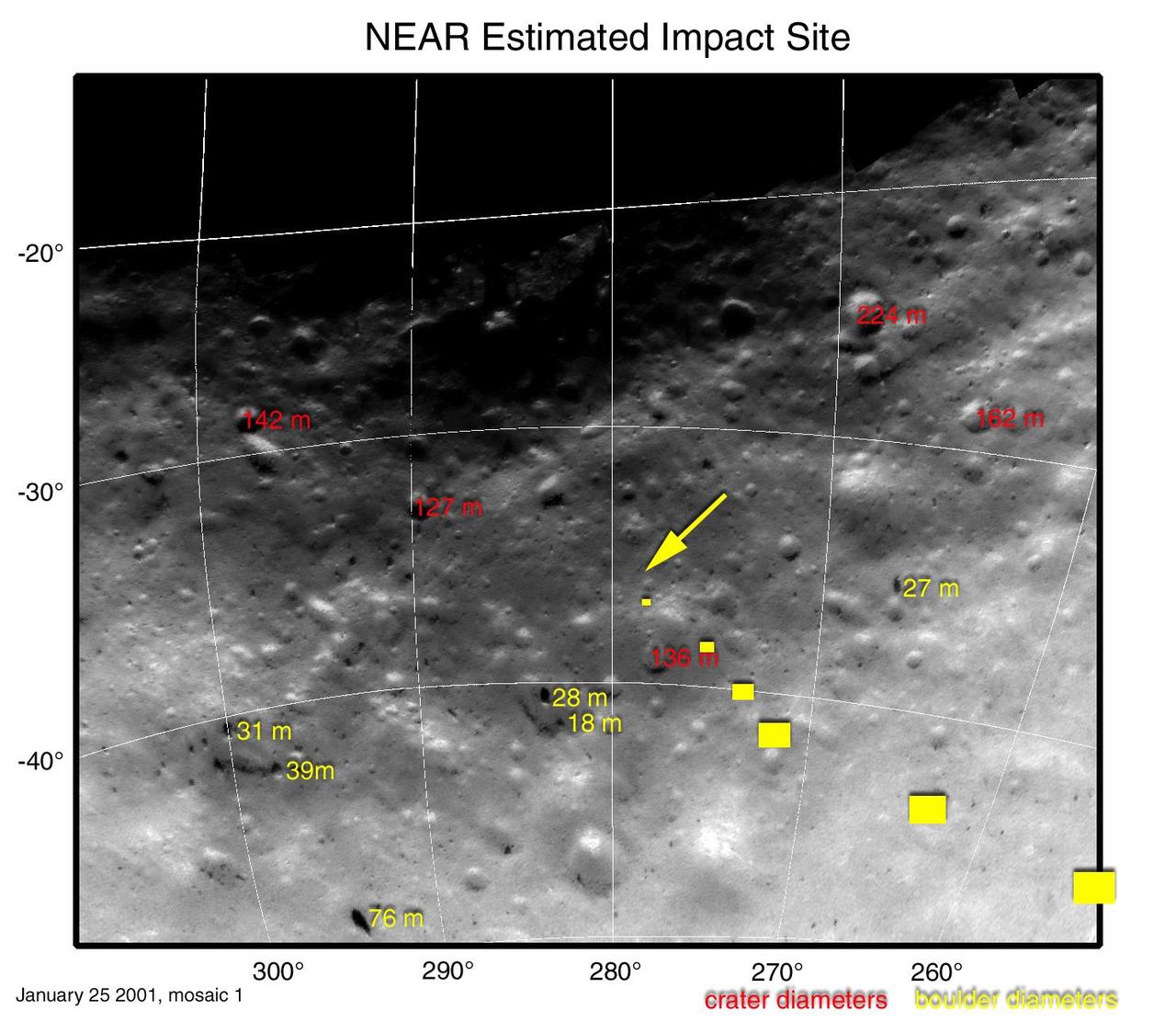
Landmarks at NEAR Shoemaker Touchdown Site
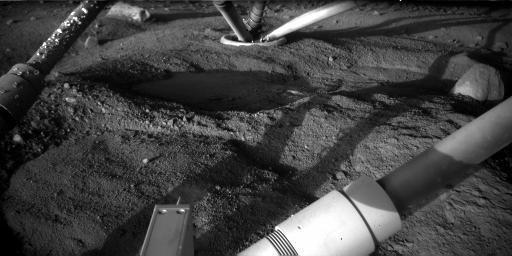
Underneath Phoenix Lander 97 Sols After Touchdown
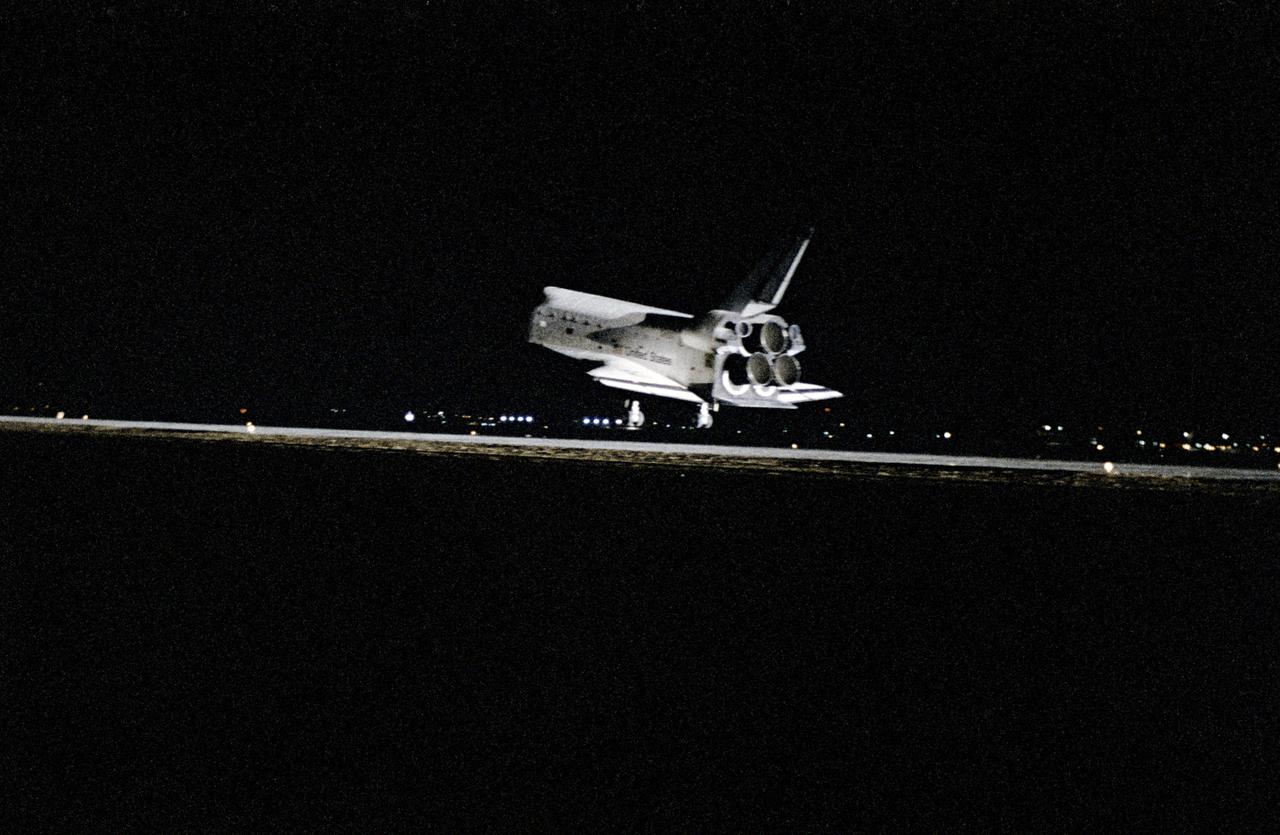
Night landing of STS-8, just before touchdown nose in dark. KSC, FL
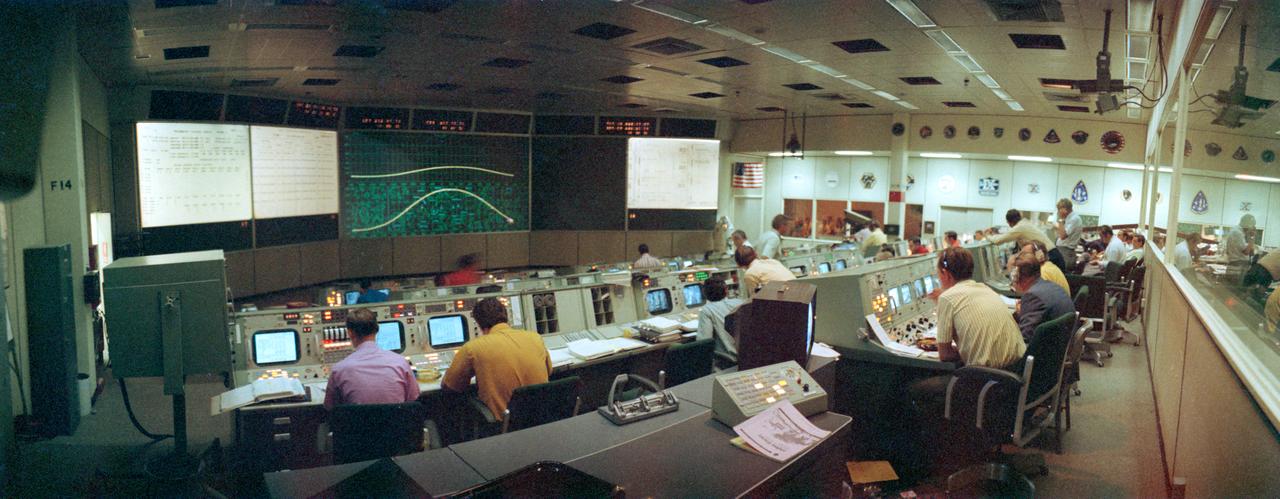
Overall wide-angle view of the MOCR in the Mission Control Center (MCC) during the touchdown of the Apollo XV LM at the Hadley-Apennine Moon site. MSC, Houston, TX
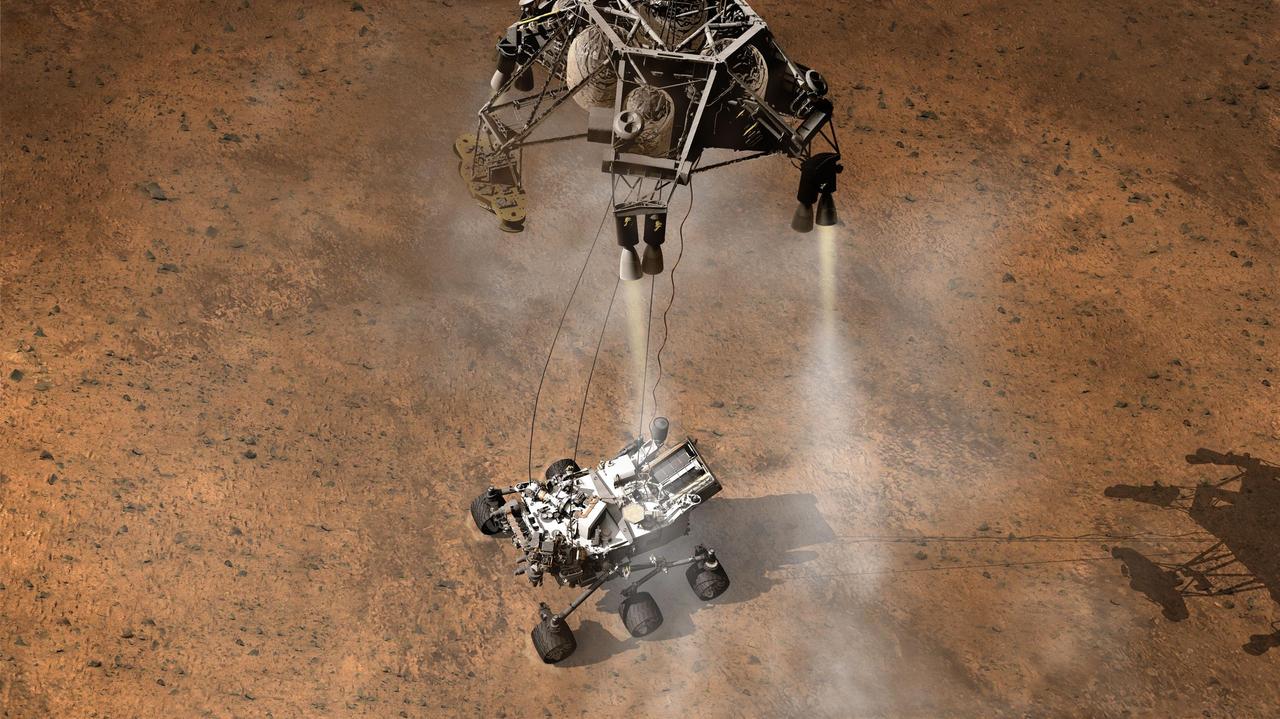
This artist concept depicts the moment immediately after NASA Curiosity rover touches down onto the Martian surface. The spacecraft has detected touchdown, and pyrotechnic cutters have severed connections between rover and spacecraft descent stage.
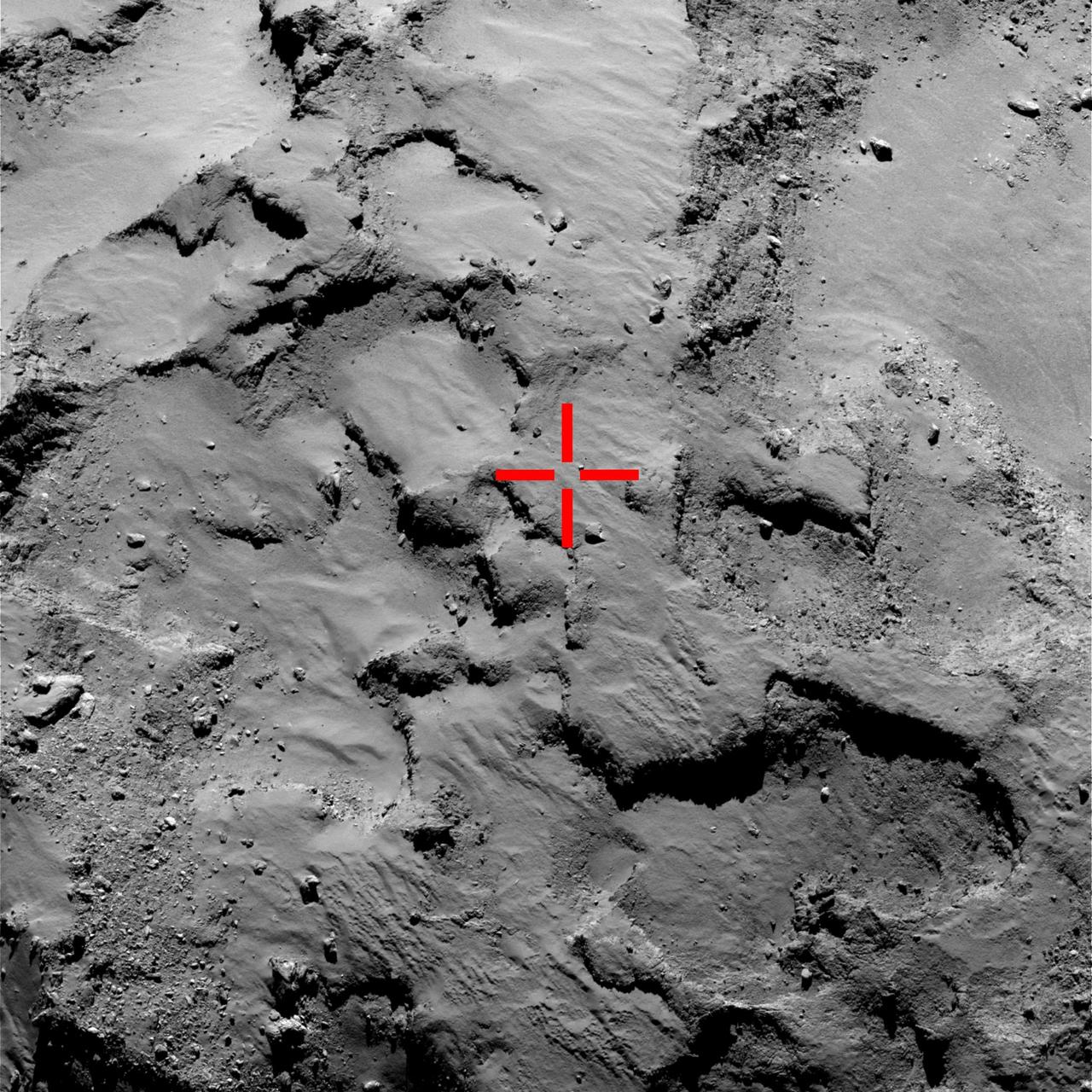
This image of comet 67P/Churyumov-Gerasimenko marks the first touchdown point of the Philae lander of the European Space Agency Rosetta mission. The image was taken by on Sept. 14, 2104, nearly two months before Philae Nov. 12 landing.
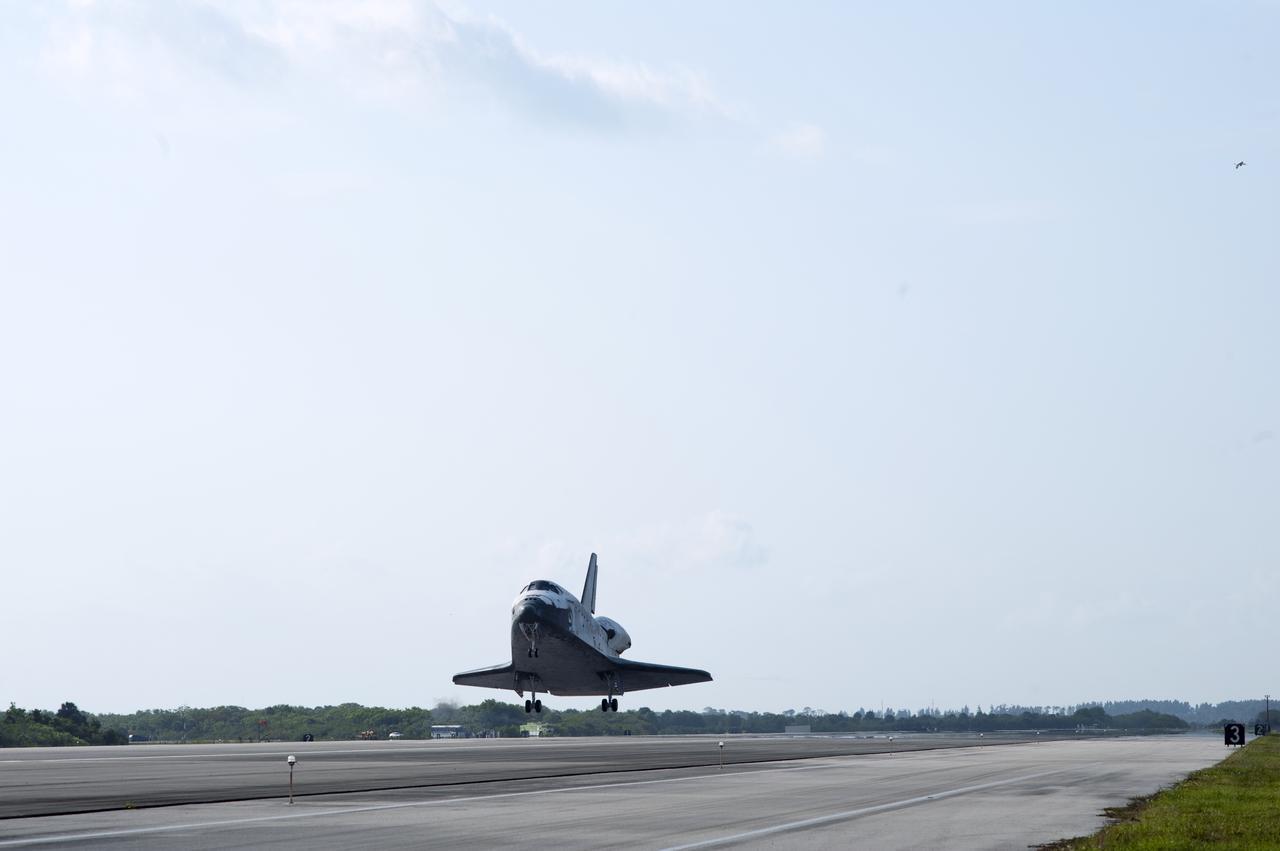
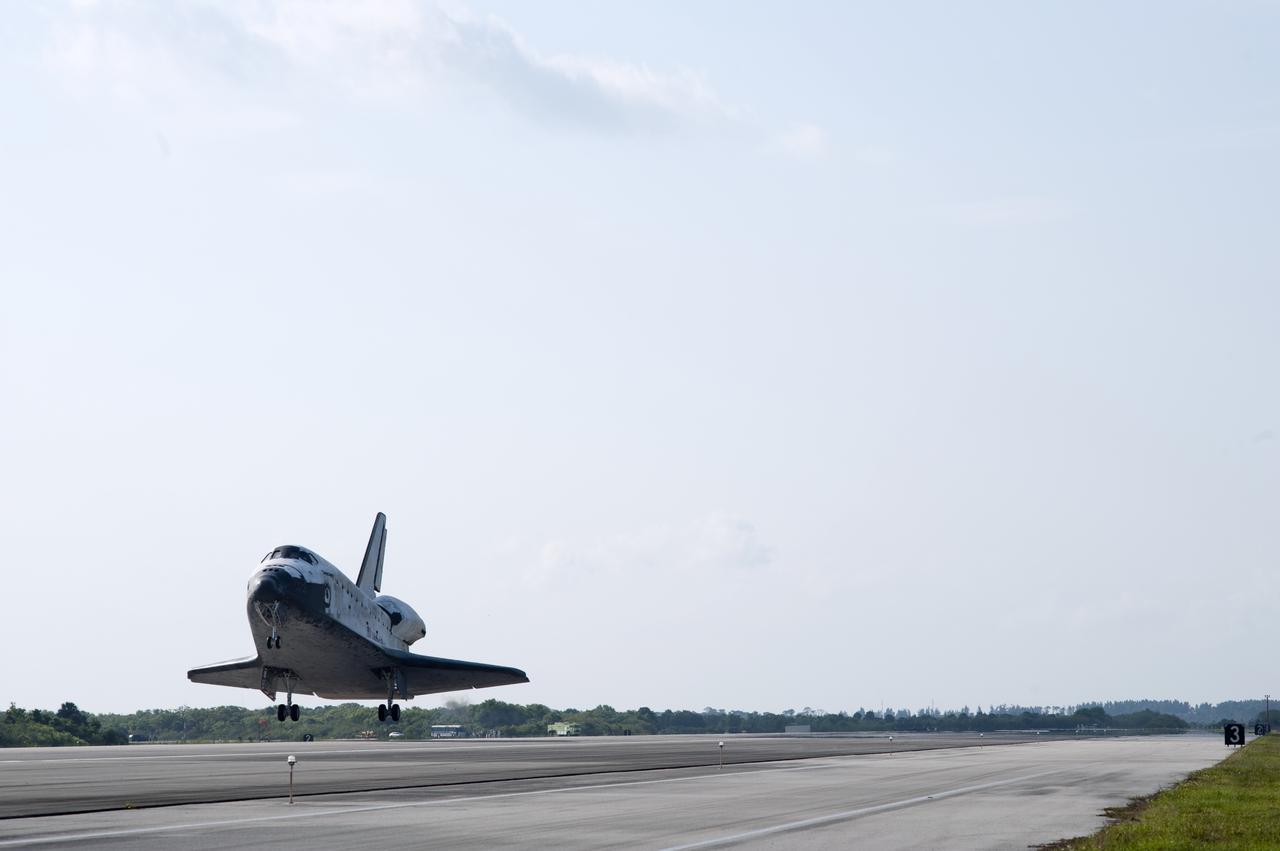
CAPE CANAVERAL, Fla. - Space shuttle Discovery appears to hover above the ground as it nears touchdown on Runway 33 at the Shuttle Landing Facility at NASA's Kennedy Space Center in Florida at 9:08 a.m. EDT, completing the 15-day STS-131 mission to the International Space Station. Main gear touchdown was at 9:08:35 a.m. EDT followed by nose gear touchdown at 9:08:47 a.m. and wheelstop at 9:09:33 a.m. Aboard are Commander Alan Poindexter; Pilot James P. Dutton Jr.; and Mission Specialists Rick Mastracchio, Clayton Anderson, Dorothy Metcalf-Lindenburger, Stephanie Wilson and Naoko Yamazaki of the Japan Aerospace Exploration Agency. The seven-member STS-131 crew carried the multi-purpose logistics module Leonardo, filled with supplies, a new crew sleeping quarters and science racks that were transferred to the International Space Station's laboratories. The crew also switched out a gyroscope on the station’s truss, installed a spare ammonia storage tank and retrieved a Japanese experiment from the station’s exterior. STS-131 is the 33rd shuttle mission to the station and the 131st shuttle mission overall. For information on the STS-131 mission and crew, visit http:__www.nasa.gov_mission_pages_shuttle_shuttlemissions_sts131_index.html. Photo credit: NASA_Tony Gray and Tom Farrar
CAPE CANAVERAL, Fla. - Space shuttle Discovery nears touchdown on Runway 33 at the Shuttle Landing Facility at NASA's Kennedy Space Center in Florida. Landing was at 9:08 a.m. EDT, completing the 15-day STS-131 mission to the International Space Station. Main gear touchdown was at 9:08:35 a.m. EDT followed by nose gear touchdown at 9:08:47 a.m. and wheelstop at 9:09:33 a.m. Aboard are Commander Alan Poindexter; Pilot James P. Dutton Jr.; and Mission Specialists Rick Mastracchio, Clayton Anderson, Dorothy Metcalf-Lindenburger, Stephanie Wilson and Naoko Yamazaki of the Japan Aerospace Exploration Agency. The seven-member STS-131 crew carried the multi-purpose logistics module Leonardo, filled with supplies, a new crew sleeping quarters and science racks that were transferred to the International Space Station's laboratories. The crew also switched out a gyroscope on the station’s truss, installed a spare ammonia storage tank and retrieved a Japanese experiment from the station’s exterior. STS-131 is the 33rd shuttle mission to the station and the 131st shuttle mission overall. For information on the STS-131 mission and crew, visit http:__www.nasa.gov_mission_pages_shuttle_shuttlemissions_sts131_index.html. Photo credit: NASA_Tony Gray and Tom Farrar
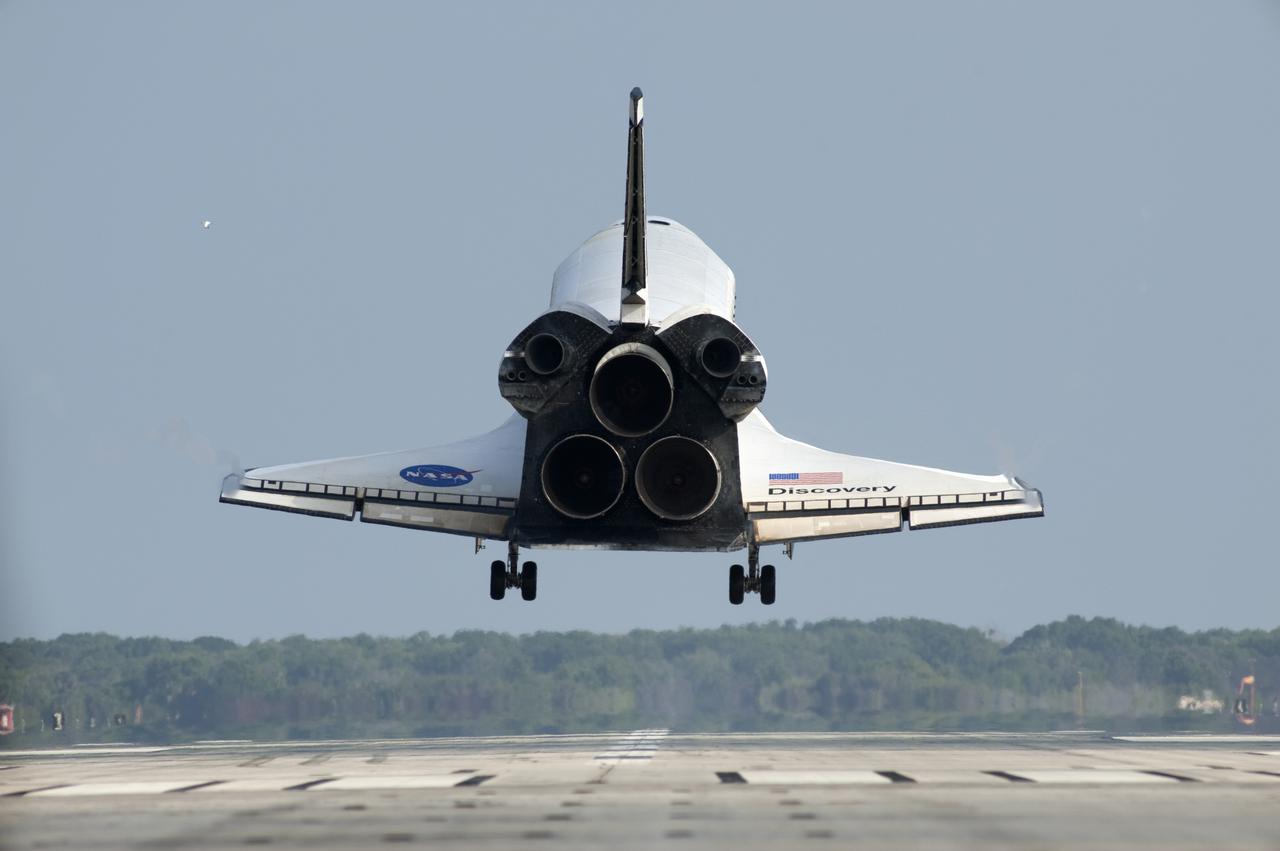
CAPE CANAVERAL, Fla. - Space shuttle Discovery is moments away from touchdown on Runway 33 at the Shuttle Landing Facility at NASA's Kennedy Space Center in Florida. Landing was at 9:08 a.m. EDT, completing the 15-day STS-131 mission to the International Space Station. Main gear touchdown was at 9:08:35 a.m. EDT followed by nose gear touchdown at 9:08:47 a.m. and wheelstop at 9:09:33 a.m. Aboard are Commander Alan Poindexter; Pilot James P. Dutton Jr.; and Mission Specialists Rick Mastracchio, Clayton Anderson, Dorothy Metcalf-Lindenburger, Stephanie Wilson and Naoko Yamazaki of the Japan Aerospace Exploration Agency. The seven-member STS-131 crew carried the multi-purpose logistics module Leonardo, filled with supplies, a new crew sleeping quarters and science racks that were transferred to the International Space Station's laboratories. The crew also switched out a gyroscope on the station’s truss, installed a spare ammonia storage tank and retrieved a Japanese experiment from the station’s exterior. STS-131 is the 33rd shuttle mission to the station and the 131st shuttle mission overall. For information on the STS-131 mission and crew, visit http:__www.nasa.gov_mission_pages_shuttle_shuttlemissions_sts131_index.html. Photo credit: NASA_Tony Gray and Tom Farrar
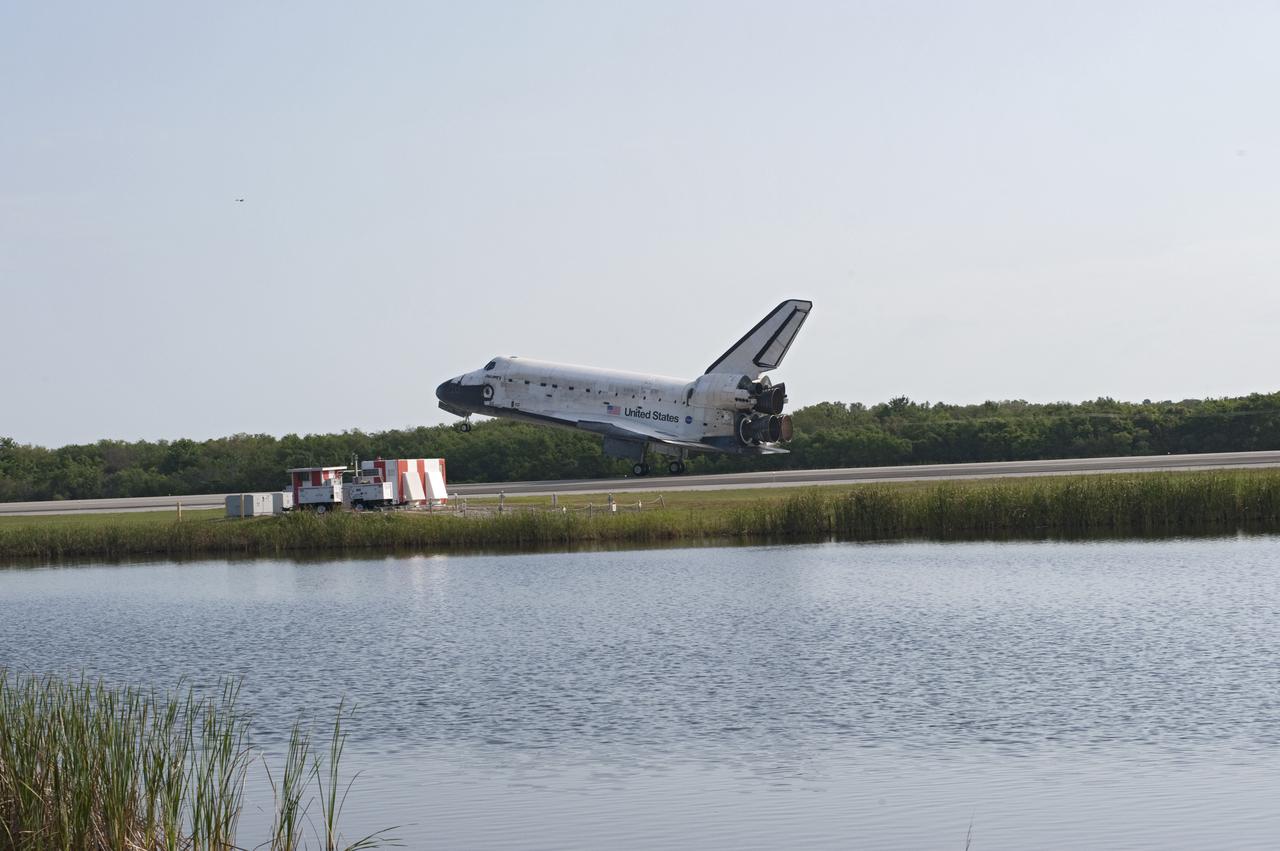
CAPE CANAVERAL, Fla. - Space shuttle Discovery nears touchdown on Runway 33 at the Shuttle Landing Facility at NASA's Kennedy Space Center in Florida. Landing was at 9:08 a.m. EDT, completing the 15-day STS-131 mission to the International Space Station. Main gear touchdown was at 9:08:35 a.m. EDT followed by nose gear touchdown at 9:08:47 a.m. and wheelstop at 9:09:33 a.m. Aboard are Commander Alan Poindexter; Pilot James P. Dutton Jr.; and Mission Specialists Rick Mastracchio, Clayton Anderson, Dorothy Metcalf-Lindenburger, Stephanie Wilson and Naoko Yamazaki of the Japan Aerospace Exploration Agency. The seven-member STS-131 crew carried the multi-purpose logistics module Leonardo, filled with supplies, a new crew sleeping quarters and science racks that were transferred to the International Space Station's laboratories. The crew also switched out a gyroscope on the station’s truss, installed a spare ammonia storage tank and retrieved a Japanese experiment from the station’s exterior. STS-131 is the 33rd shuttle mission to the station and the 131st shuttle mission overall. For information on the STS-131 mission and crew, visit http:__www.nasa.gov_mission_pages_shuttle_shuttlemissions_sts131_index.html. Photo credit: NASA_Chuck Tintera
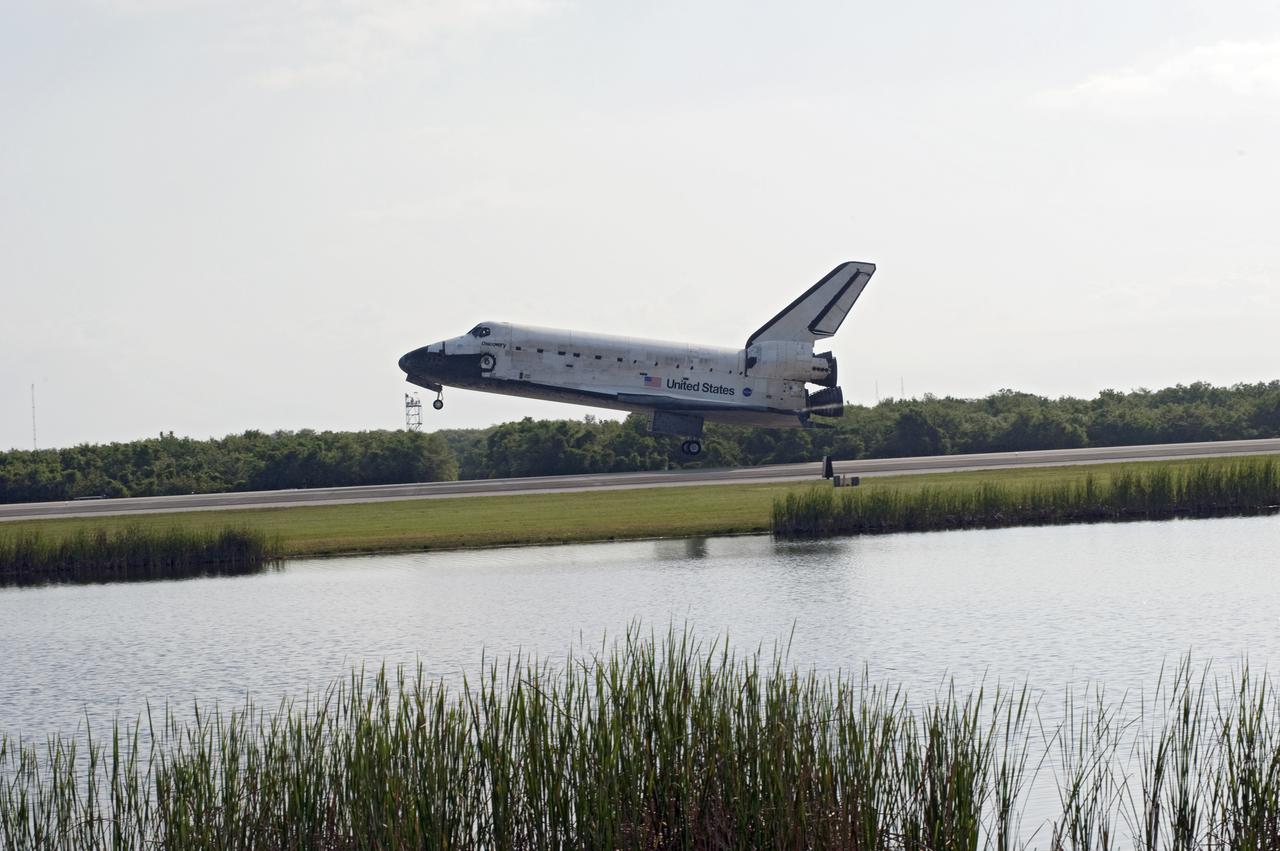
CAPE CANAVERAL, Fla. - Space shuttle Discovery appears to hover above the ground as it nears touchdown on Runway 33 at the Shuttle Landing Facility at NASA's Kennedy Space Center in Florida at 9:08 a.m. EDT, completing the 15-day STS-131 mission to the International Space Station. Main gear touchdown was at 9:08:35 a.m. EDT followed by nose gear touchdown at 9:08:47 a.m. and wheelstop at 9:09:33 a.m. Aboard are Commander Alan Poindexter; Pilot James P. Dutton Jr.; and Mission Specialists Rick Mastracchio, Clayton Anderson, Dorothy Metcalf-Lindenburger, Stephanie Wilson and Naoko Yamazaki of the Japan Aerospace Exploration Agency. The seven-member STS-131 crew carried the multi-purpose logistics module Leonardo, filled with supplies, a new crew sleeping quarters and science racks that were transferred to the International Space Station's laboratories. The crew also switched out a gyroscope on the station’s truss, installed a spare ammonia storage tank and retrieved a Japanese experiment from the station’s exterior. STS-131 is the 33rd shuttle mission to the station and the 131st shuttle mission overall. For information on the STS-131 mission and crew, visit http:__www.nasa.gov_mission_pages_shuttle_shuttlemissions_sts131_index.html. Photo credit: NASA_Chuck Tintera
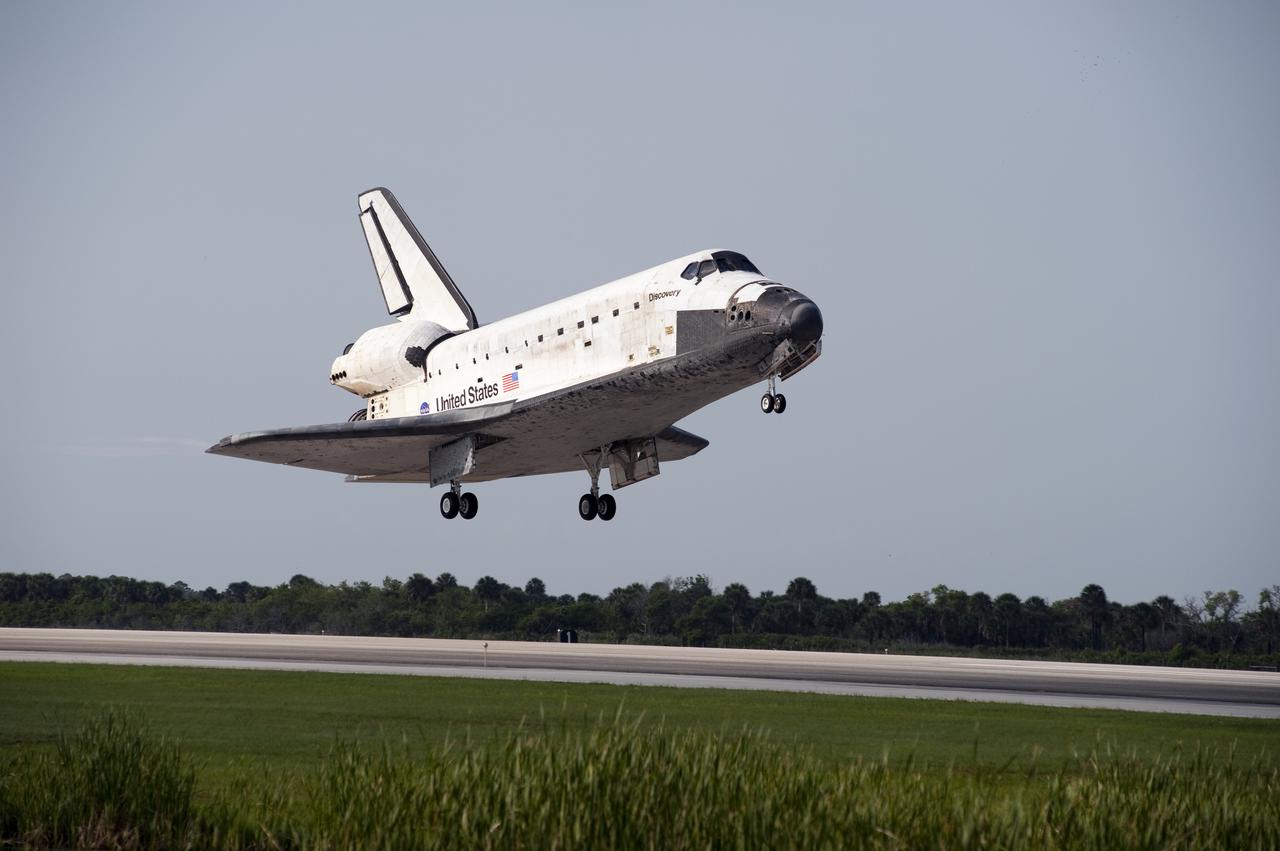
CAPE CANAVERAL, Fla. - Space shuttle Discovery nears touchdown on Runway 33 at the Shuttle Landing Facility at NASA's Kennedy Space Center in Florida. Landing was at 9:08 a.m. EDT, completing the 15-day STS-131 mission to the International Space Station. Main gear touchdown was at 9:08:35 a.m. EDT followed by nose gear touchdown at 9:08:47 a.m. and wheelstop at 9:09:33 a.m. Aboard are Commander Alan Poindexter; Pilot James P. Dutton Jr.; and Mission Specialists Rick Mastracchio, Clayton Anderson, Dorothy Metcalf-Lindenburger, Stephanie Wilson and Naoko Yamazaki of the Japan Aerospace Exploration Agency. The seven-member STS-131 crew carried the multi-purpose logistics module Leonardo, filled with supplies, a new crew sleeping quarters and science racks that were transferred to the International Space Station's laboratories. The crew also switched out a gyroscope on the station’s truss, installed a spare ammonia storage tank and retrieved a Japanese experiment from the station’s exterior. STS-131 is the 33rd shuttle mission to the station and the 131st shuttle mission overall. For information on the STS-131 mission and crew, visit http:__www.nasa.gov_mission_pages_shuttle_shuttlemissions_sts131_index.html. Photo credit: NASA_Ben Cooper
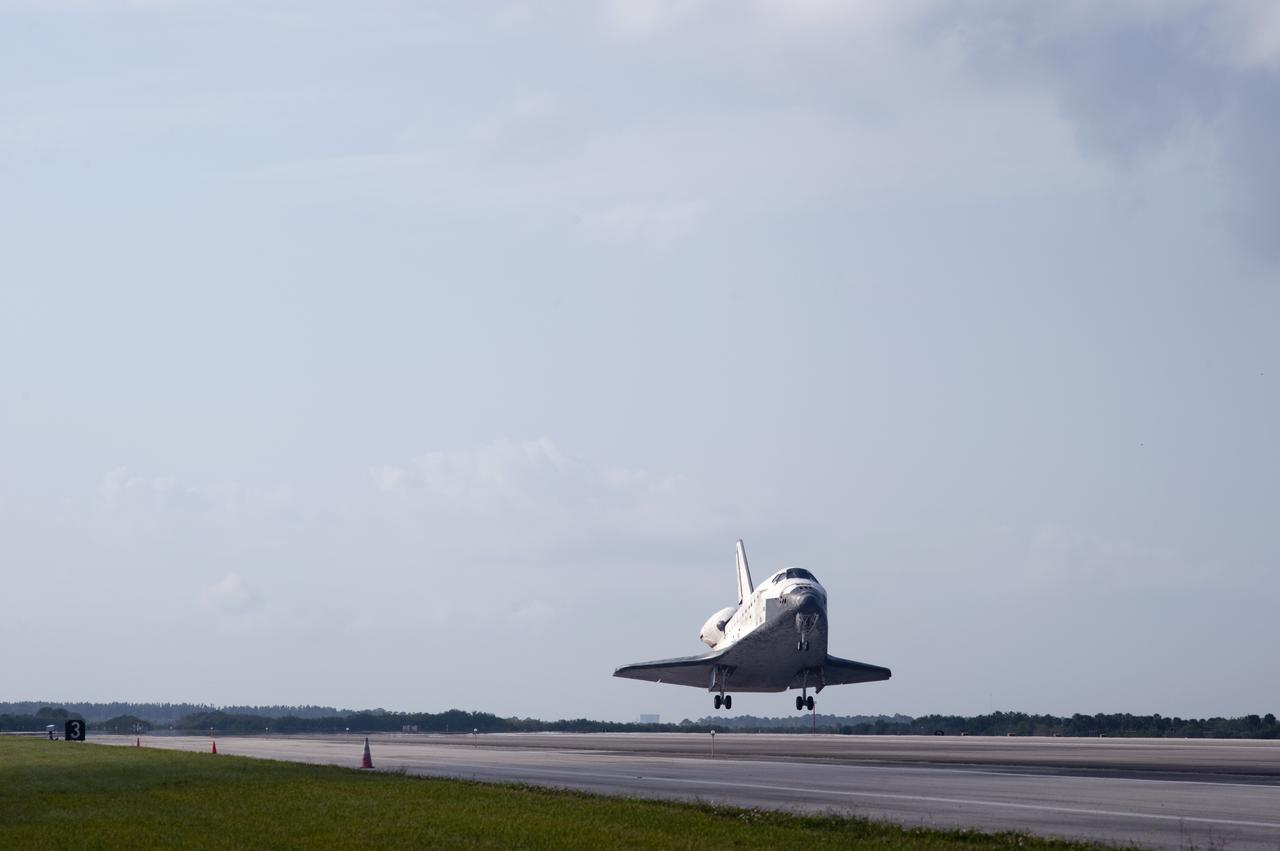
CAPE CANAVERAL, Fla. - Space shuttle Discovery appears to hover above the ground as it nears touchdown on Runway 33 at the Shuttle Landing Facility at NASA's Kennedy Space Center in Florida at 9:08 a.m. EDT, completing the 15-day STS-131 mission to the International Space Station. Main gear touchdown was at 9:08:35 a.m. EDT followed by nose gear touchdown at 9:08:47 a.m. and wheelstop at 9:09:33 a.m. Aboard are Commander Alan Poindexter; Pilot James P. Dutton Jr.; and Mission Specialists Rick Mastracchio, Clayton Anderson, Dorothy Metcalf-Lindenburger, Stephanie Wilson and Naoko Yamazaki of the Japan Aerospace Exploration Agency. The seven-member STS-131 crew carried the multi-purpose logistics module Leonardo, filled with supplies, a new crew sleeping quarters and science racks that were transferred to the International Space Station's laboratories. The crew also switched out a gyroscope on the station’s truss, installed a spare ammonia storage tank and retrieved a Japanese experiment from the station’s exterior. STS-131 is the 33rd shuttle mission to the station and the 131st shuttle mission overall. For information on the STS-131 mission and crew, visit http:__www.nasa.gov_mission_pages_shuttle_shuttlemissions_sts131_index.html. Photo credit: NASA_Tony Gray and Tom Farrar
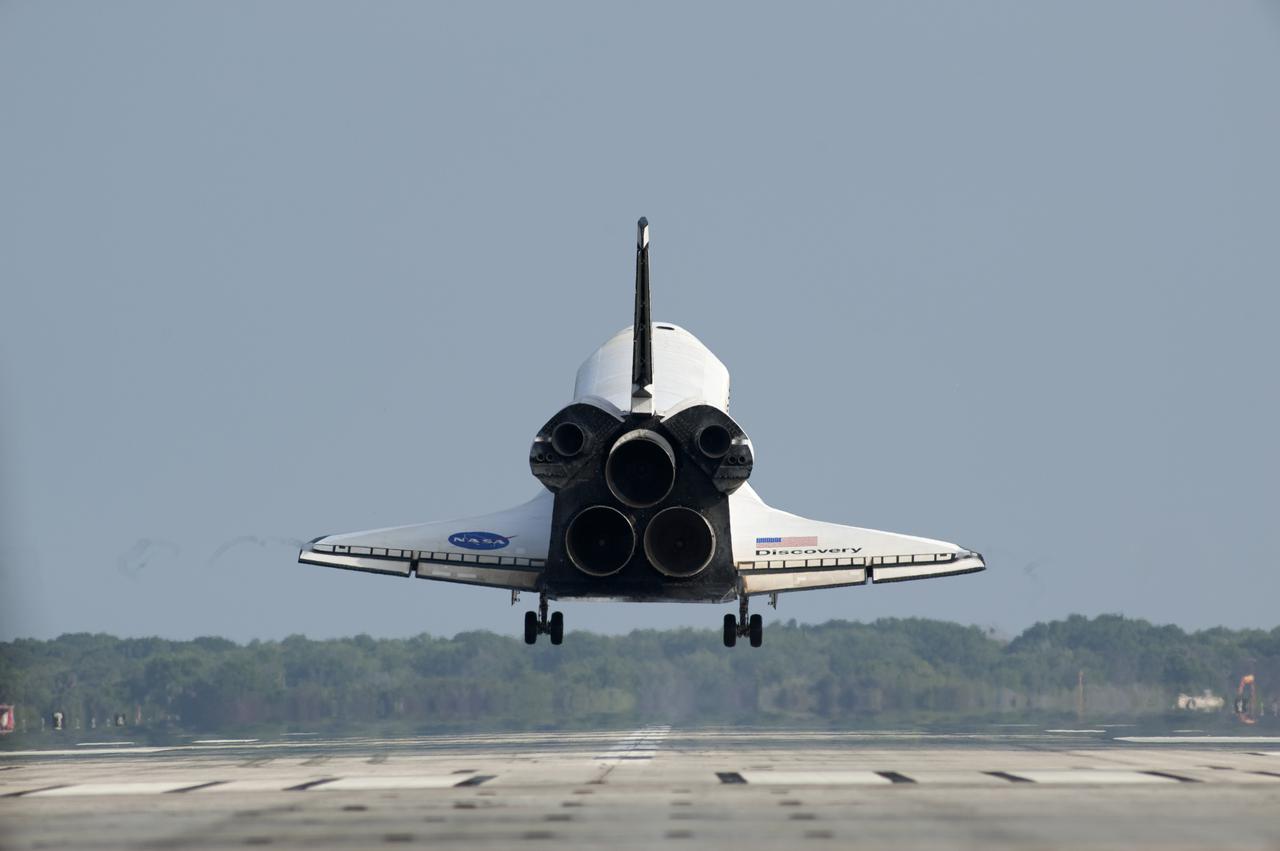
CAPE CANAVERAL, Fla. - Space shuttle Discovery is moments away from touchdown on Runway 33 at the Shuttle Landing Facility at NASA's Kennedy Space Center in Florida. Landing was at 9:08 a.m. EDT, completing the 15-day STS-131 mission to the International Space Station. Main gear touchdown was at 9:08:35 a.m. EDT followed by nose gear touchdown at 9:08:47 a.m. and wheelstop at 9:09:33 a.m. Aboard are Commander Alan Poindexter; Pilot James P. Dutton Jr.; and Mission Specialists Rick Mastracchio, Clayton Anderson, Dorothy Metcalf-Lindenburger, Stephanie Wilson and Naoko Yamazaki of the Japan Aerospace Exploration Agency. The seven-member STS-131 crew carried the multi-purpose logistics module Leonardo, filled with supplies, a new crew sleeping quarters and science racks that were transferred to the International Space Station's laboratories. The crew also switched out a gyroscope on the station’s truss, installed a spare ammonia storage tank and retrieved a Japanese experiment from the station’s exterior. STS-131 is the 33rd shuttle mission to the station and the 131st shuttle mission overall. For information on the STS-131 mission and crew, visit http:__www.nasa.gov_mission_pages_shuttle_shuttlemissions_sts131_index.html. Photo credit: NASA_Tony Gray and Tom Farrar
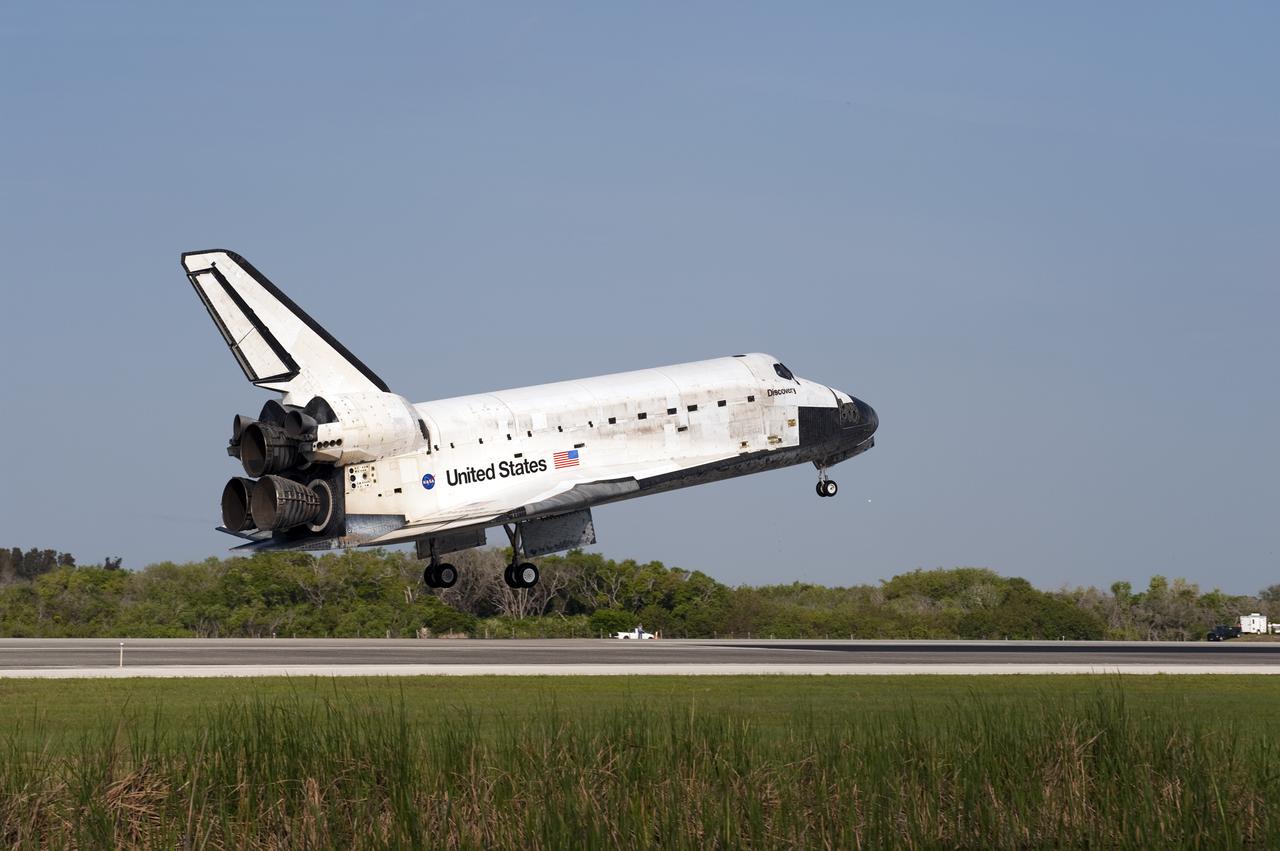
CAPE CANAVERAL, Fla. - Space shuttle Discovery nears touchdown on Runway 33 at the Shuttle Landing Facility at NASA's Kennedy Space Center in Florida. Landing was at 9:08 a.m. EDT, completing the 15-day STS-131 mission to the International Space Station. Main gear touchdown was at 9:08:35 a.m. EDT followed by nose gear touchdown at 9:08:47 a.m. and wheelstop at 9:09:33 a.m. Aboard are Commander Alan Poindexter; Pilot James P. Dutton Jr.; and Mission Specialists Rick Mastracchio, Clayton Anderson, Dorothy Metcalf-Lindenburger, Stephanie Wilson and Naoko Yamazaki of the Japan Aerospace Exploration Agency. The seven-member STS-131 crew carried the multi-purpose logistics module Leonardo, filled with supplies, a new crew sleeping quarters and science racks that were transferred to the International Space Station's laboratories. The crew also switched out a gyroscope on the station’s truss, installed a spare ammonia storage tank and retrieved a Japanese experiment from the station’s exterior. STS-131 is the 33rd shuttle mission to the station and the 131st shuttle mission overall. For information on the STS-131 mission and crew, visit http:__www.nasa.gov_mission_pages_shuttle_shuttlemissions_sts131_index.html. Photo credit: NASA_Ben Cooper
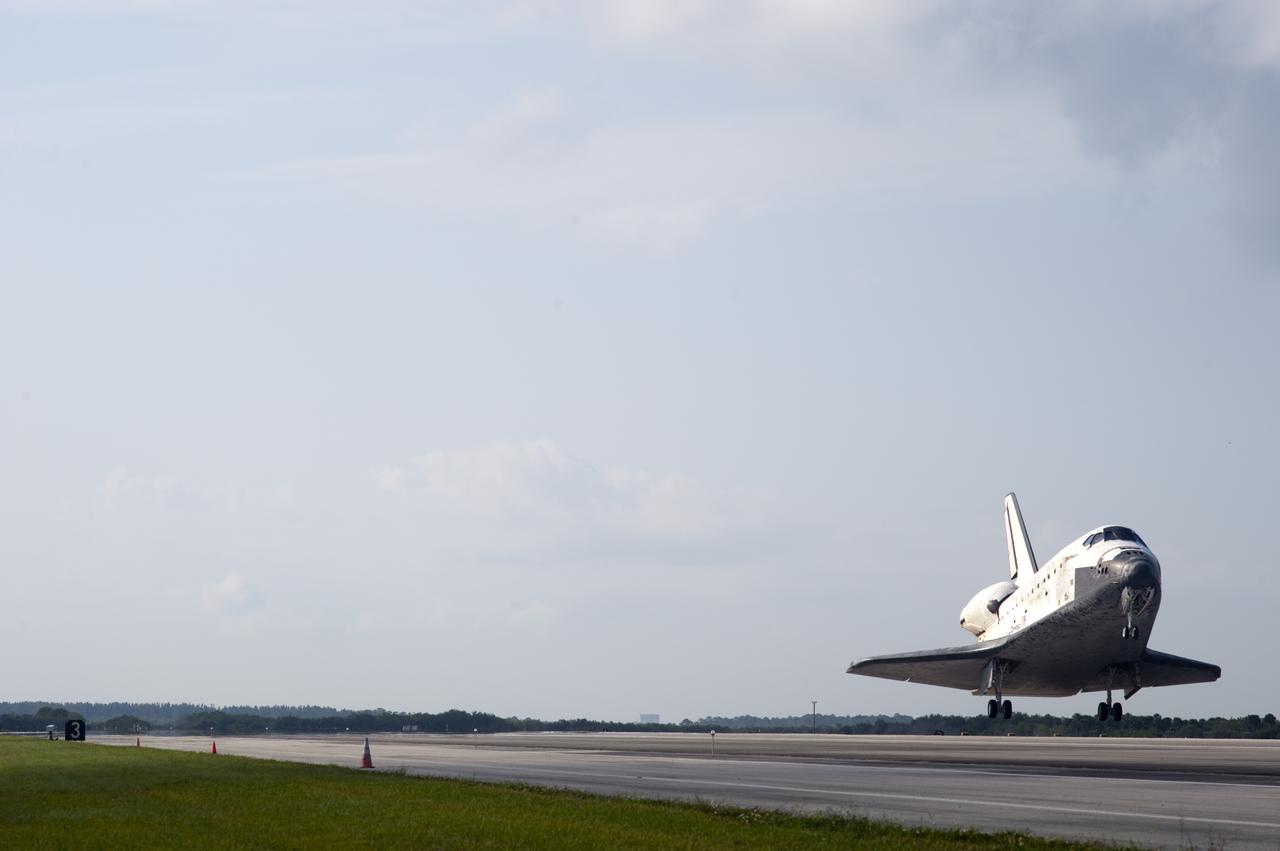
CAPE CANAVERAL, Fla. - Space shuttle Discovery nears touchdown on Runway 33 at the Shuttle Landing Facility at NASA's Kennedy Space Center in Florida. Landing was at 9:08 a.m. EDT, completing the 15-day STS-131 mission to the International Space Station. Main gear touchdown was at 9:08:35 a.m. EDT followed by nose gear touchdown at 9:08:47 a.m. and wheelstop at 9:09:33 a.m. Aboard are Commander Alan Poindexter; Pilot James P. Dutton Jr.; and Mission Specialists Rick Mastracchio, Clayton Anderson, Dorothy Metcalf-Lindenburger, Stephanie Wilson and Naoko Yamazaki of the Japan Aerospace Exploration Agency. The seven-member STS-131 crew carried the multi-purpose logistics module Leonardo, filled with supplies, a new crew sleeping quarters and science racks that were transferred to the International Space Station's laboratories. The crew also switched out a gyroscope on the station’s truss, installed a spare ammonia storage tank and retrieved a Japanese experiment from the station’s exterior. STS-131 is the 33rd shuttle mission to the station and the 131st shuttle mission overall. For information on the STS-131 mission and crew, visit http:__www.nasa.gov_mission_pages_shuttle_shuttlemissions_sts131_index.html. Photo credit: NASA_Tony Gray and Tom Farrar
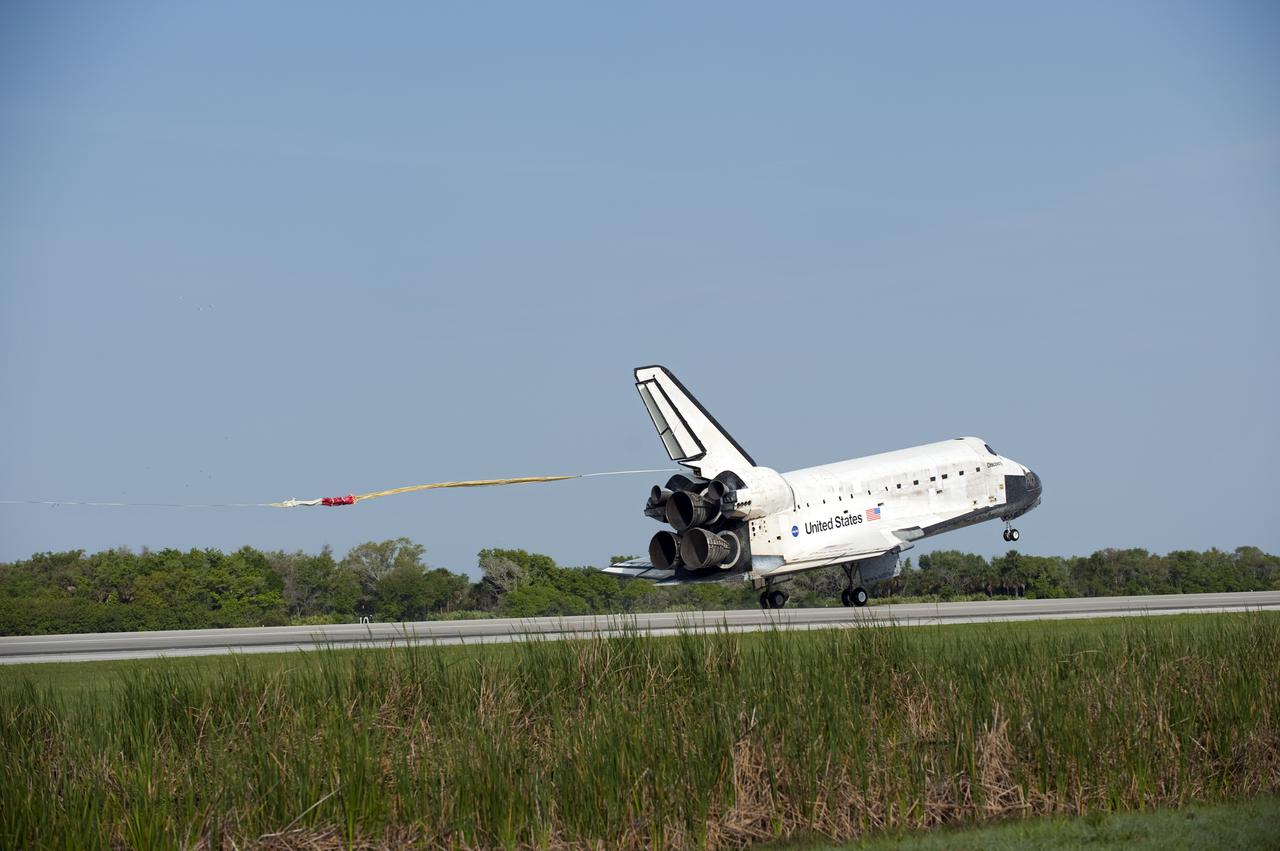
CAPE CANAVERAL, Fla. - Space shuttle Discovery's 40-foot-diameter drag chute extends with the aid of a mortar-deployed pilot chute. Its purpose is to slow the shuttle as it lands on Runway 33 at the Shuttle Landing Facility at NASA's Kennedy Space Center in Florida after 15 days in space, completing the more than 6.2-million-mile STS-131 mission on orbit 238. Main gear touchdown was at 9:08:35 a.m. EDT followed by nose gear touchdown at 9:08:47 a.m. and wheelstop at 9:09:33 a.m. Aboard are Commander Alan Poindexter; Pilot James P. Dutton Jr.; and Mission Specialists Rick Mastracchio, Clayton Anderson, Dorothy Metcalf-Lindenburger, Stephanie Wilson and Naoko Yamazaki of the Japan Aerospace Exploration Agency. The seven-member STS-131 crew carried the multi-purpose logistics module Leonardo, filled with supplies, a new crew sleeping quarters and science racks that were transferred to the International Space Station's laboratories. The crew also switched out a gyroscope on the station’s truss, installed a spare ammonia storage tank and retrieved a Japanese experiment from the station’s exterior. STS-131 is the 33rd shuttle mission to the station and the 131st shuttle mission overall. For information on the STS-131 mission and crew, visit http:__www.nasa.gov_mission_pages_shuttle_shuttlemissions_sts131_index.html. Photo credit: NASA_Kevin O'Connell
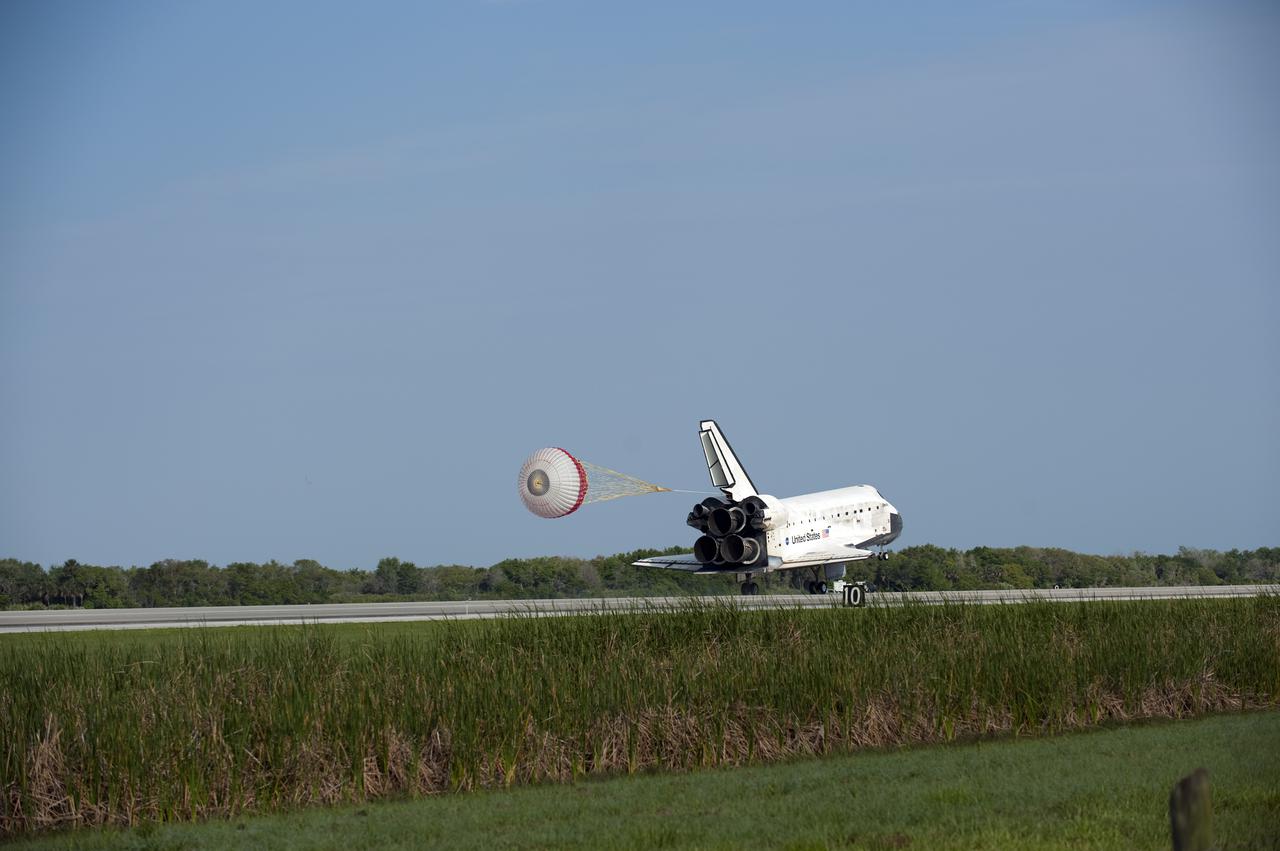
CAPE CANAVERAL, Fla. - Space shuttle Discovery's 40-foot-diameter drag chute unfurls to slow the shuttle as it lands on Runway 33 at the Shuttle Landing Facility at NASA's Kennedy Space Center in Florida after 15 days in space, completing the more than 6.2-million-mile STS-131 mission on orbit 238. Main gear touchdown was at 9:08:35 a.m. EDT followed by nose gear touchdown at 9:08:47 a.m. and wheelstop at 9:09:33 a.m. Aboard are Commander Alan Poindexter; Pilot James P. Dutton Jr.; and Mission Specialists Rick Mastracchio, Clayton Anderson, Dorothy Metcalf-Lindenburger, Stephanie Wilson and Naoko Yamazaki of the Japan Aerospace Exploration Agency. The seven-member STS-131 crew carried the multi-purpose logistics module Leonardo, filled with supplies, a new crew sleeping quarters and science racks that were transferred to the International Space Station's laboratories. The crew also switched out a gyroscope on the station’s truss, installed a spare ammonia storage tank and retrieved a Japanese experiment from the station’s exterior. STS-131 is the 33rd shuttle mission to the station and the 131st shuttle mission overall. For information on the STS-131 mission and crew, visit http:__www.nasa.gov_mission_pages_shuttle_shuttlemissions_sts131_index.html. Photo credit: NASA_Kevin O'Connell
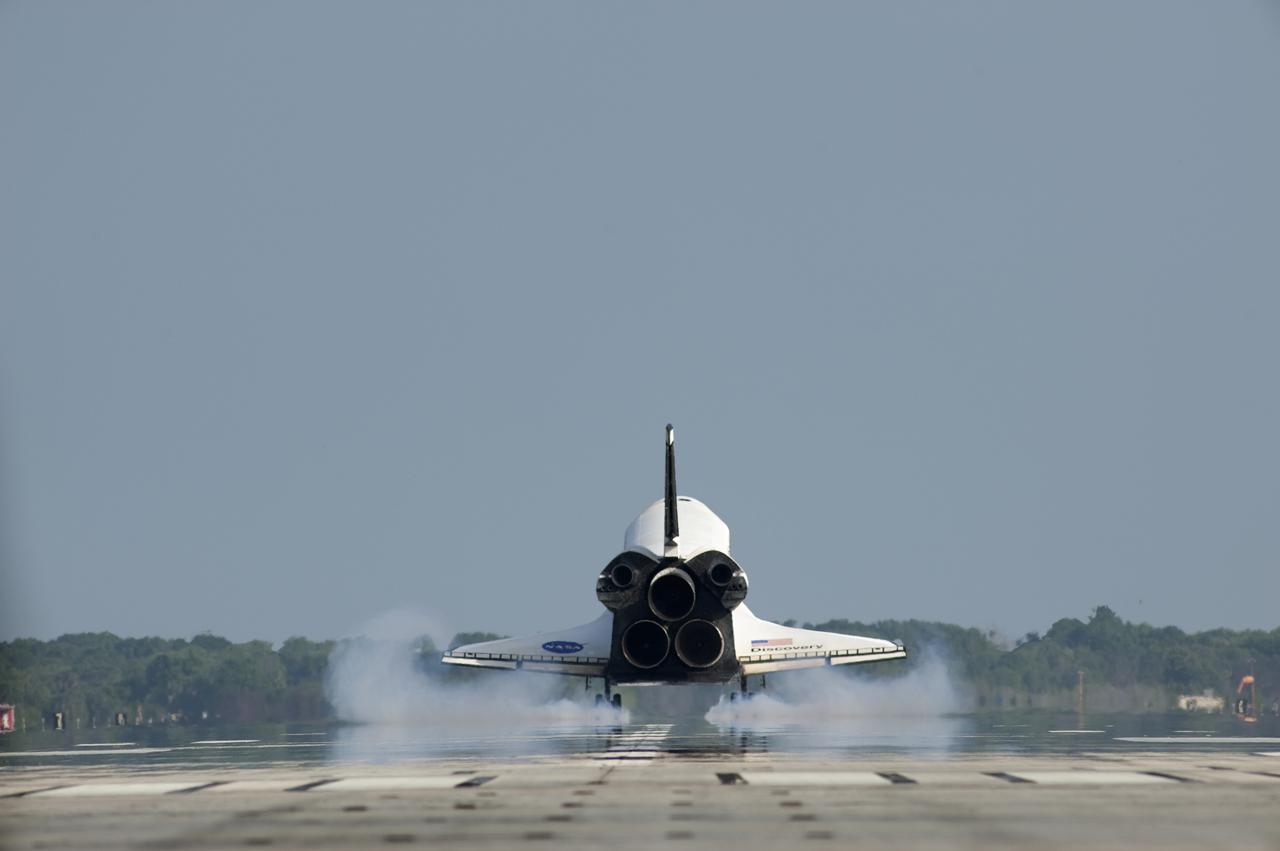
CAPE CANAVERAL, Fla. - Space shuttle Discovery touches down on Runway 33 at the Shuttle Landing Facility at NASA's Kennedy Space Center in Florida at 9:08 a.m. EDT, completing the 15-day STS-131 mission to the International Space Station. Main gear touchdown was at 9:08:35 a.m. EDT followed by nose gear touchdown at 9:08:47 a.m. and wheelstop at 9:09:33 a.m. Aboard are Commander Alan Poindexter; Pilot James P. Dutton Jr.; and Mission Specialists Rick Mastracchio, Clayton Anderson, Dorothy Metcalf-Lindenburger, Stephanie Wilson and Naoko Yamazaki of the Japan Aerospace Exploration Agency. The seven-member STS-131 crew carried the multi-purpose logistics module Leonardo, filled with supplies, a new crew sleeping quarters and science racks that were transferred to the International Space Station's laboratories. The crew also switched out a gyroscope on the station’s truss, installed a spare ammonia storage tank and retrieved a Japanese experiment from the station’s exterior. STS-131 is the 33rd shuttle mission to the station and the 131st shuttle mission overall. For information on the STS-131 mission and crew, visit http:__www.nasa.gov_mission_pages_shuttle_shuttlemissions_sts131_index.html. Photo credit: NASA_Tony Gray and Tom Farrar
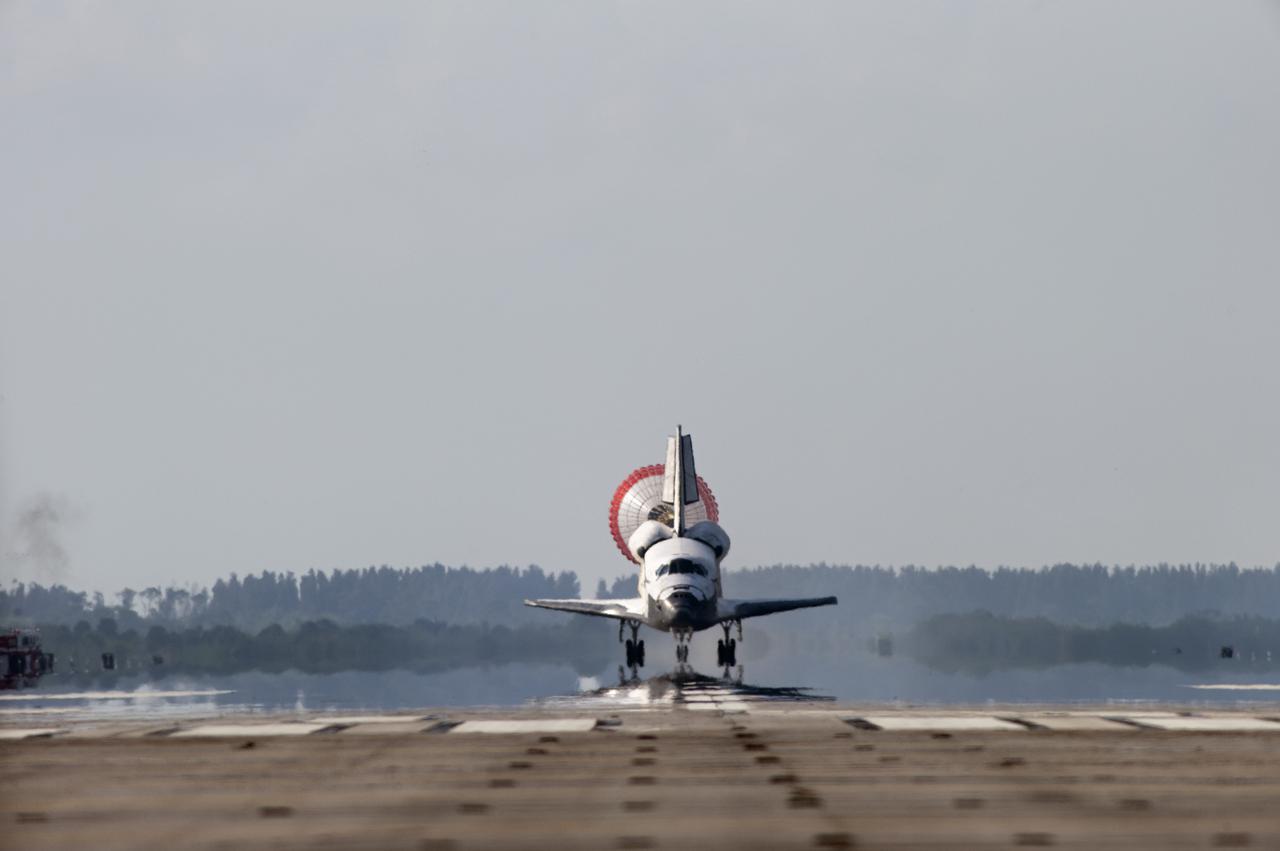
CAPE CANAVERAL, Fla. - With drag chute unfurled, space shuttle Discovery lands on Runway 33 at the Shuttle Landing Facility at NASA's Kennedy Space Center in Florida after 15 days in space, completing the more than 6.2-million-mile STS-131 mission on orbit 238. Main gear touchdown was at 9:08:35 a.m. EDT followed by nose gear touchdown at 9:08:47 a.m. and wheelstop at 9:09:33 a.m. Aboard are Commander Alan Poindexter; Pilot James P. Dutton Jr.; and Mission Specialists Rick Mastracchio, Clayton Anderson, Dorothy Metcalf-Lindenburger, Stephanie Wilson and Naoko Yamazaki of the Japan Aerospace Exploration Agency. The seven-member STS-131 crew carried the multi-purpose logistics module Leonardo, filled with supplies, a new crew sleeping quarters and science racks that were transferred to the International Space Station's laboratories. The crew also switched out a gyroscope on the station’s truss, installed a spare ammonia storage tank and retrieved a Japanese experiment from the station’s exterior. STS-131 is the 33rd shuttle mission to the station and the 131st shuttle mission overall. For information on the STS-131 mission and crew, visit http:__www.nasa.gov_mission_pages_shuttle_shuttlemissions_sts131_index.html. Photo credit: NASA_Sandra Joseph and Kevin O'Connell
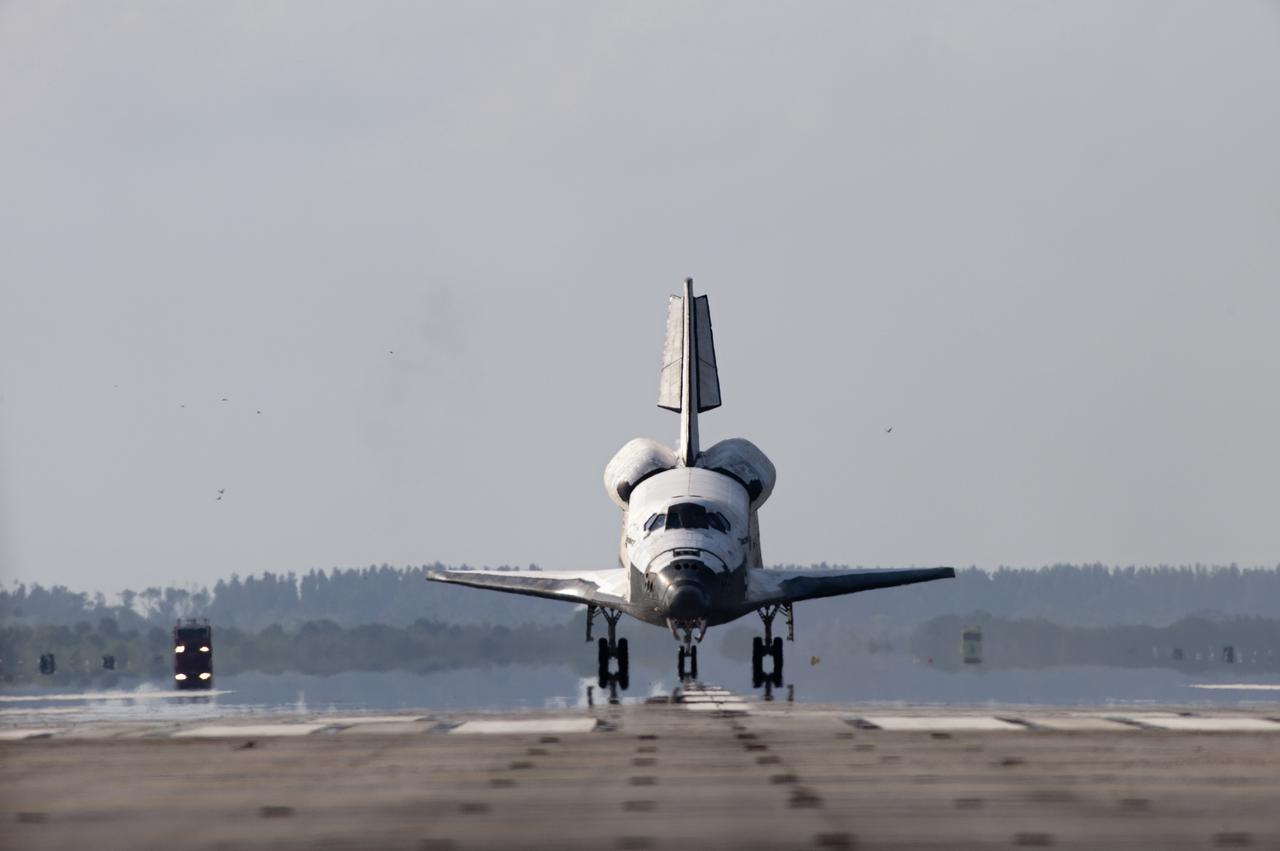
CAPE CANAVERAL, Fla. - Space shuttle Discovery lands on Runway 33 at the Shuttle Landing Facility at NASA's Kennedy Space Center in Florida at 9:08 a.m. EDT, completing the 15-day STS-131 mission to the International Space Station. Main gear touchdown was at 9:08:35 a.m. EDT followed by nose gear touchdown at 9:08:47 a.m. and wheelstop at 9:09:33 a.m. Aboard are Commander Alan Poindexter; Pilot James P. Dutton Jr.; and Mission Specialists Rick Mastracchio, Clayton Anderson, Dorothy Metcalf-Lindenburger, Stephanie Wilson and Naoko Yamazaki of the Japan Aerospace Exploration Agency. The seven-member STS-131 crew carried the multi-purpose logistics module Leonardo, filled with supplies, a new crew sleeping quarters and science racks that were transferred to the International Space Station's laboratories. The crew also switched out a gyroscope on the station’s truss, installed a spare ammonia storage tank and retrieved a Japanese experiment from the station’s exterior. STS-131 is the 33rd shuttle mission to the station and the 131st shuttle mission overall. For information on the STS-131 mission and crew, visit http:__www.nasa.gov_mission_pages_shuttle_shuttlemissions_sts131_index.html. Photo credit: NASA_Sandra Joseph and Kevin O'Connell
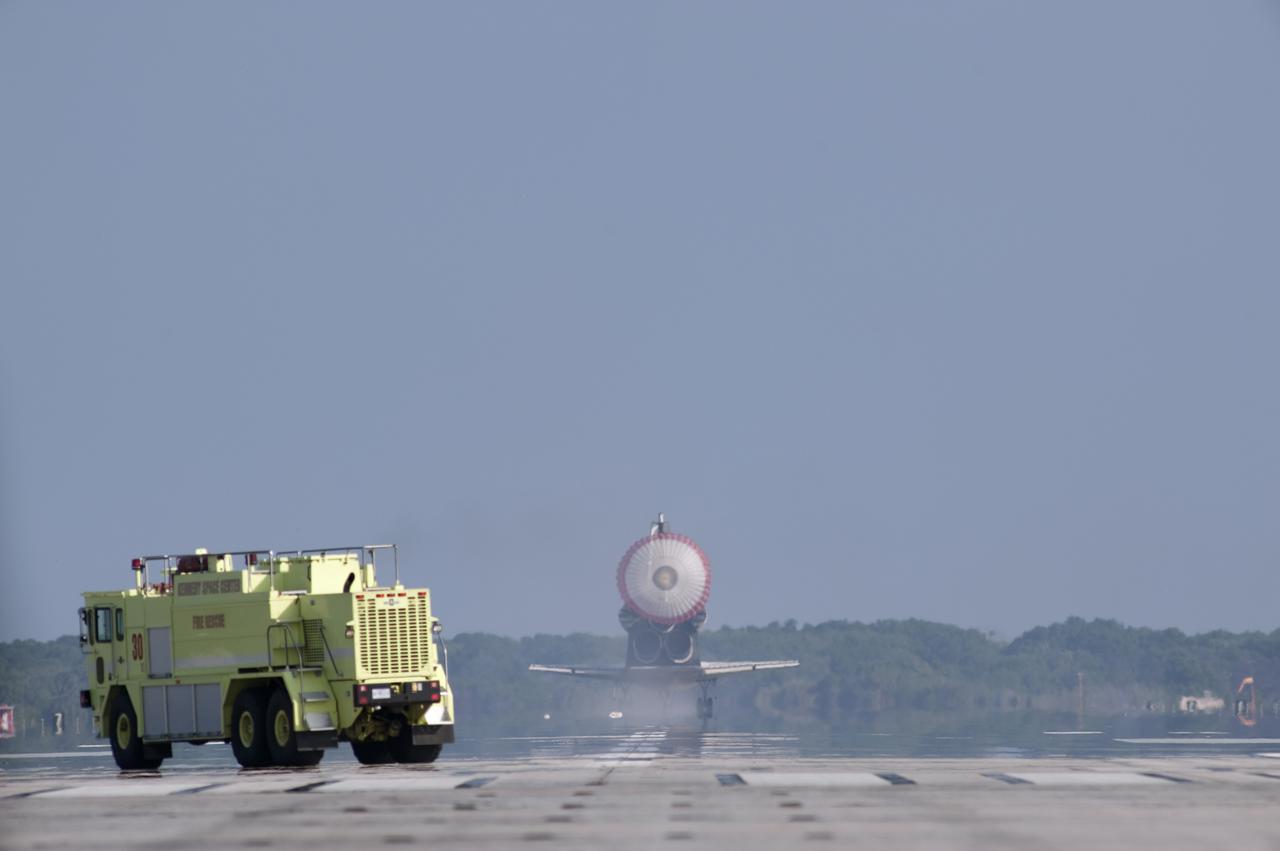
CAPE CANAVERAL, Fla. - With drag chute unfurled, space shuttle Discovery rolls past a fire rescue vehicle on Runway 33 as it lands at the Shuttle Landing Facility at NASA's Kennedy Space Center in Florida after 15 days in space, completing the more than 6.2-million-mile STS-131 mission on orbit 238. Main gear touchdown was at 9:08:35 a.m. EDT followed by nose gear touchdown at 9:08:47 a.m. and wheelstop at 9:09:33 a.m. Aboard are Commander Alan Poindexter; Pilot James P. Dutton Jr.; and Mission Specialists Rick Mastracchio, Clayton Anderson, Dorothy Metcalf-Lindenburger, Stephanie Wilson and Naoko Yamazaki of the Japan Aerospace Exploration Agency. The seven-member STS-131 crew carried the multi-purpose logistics module Leonardo, filled with supplies, a new crew sleeping quarters and science racks that were transferred to the International Space Station's laboratories. The crew also switched out a gyroscope on the station’s truss, installed a spare ammonia storage tank and retrieved a Japanese experiment from the station’s exterior. STS-131 is the 33rd shuttle mission to the station and the 131st shuttle mission overall. For information on the STS-131 mission and crew, visit http:__www.nasa.gov_mission_pages_shuttle_shuttlemissions_sts131_index.html. Photo credit: NASA_Tony Gray and Tom Farrar
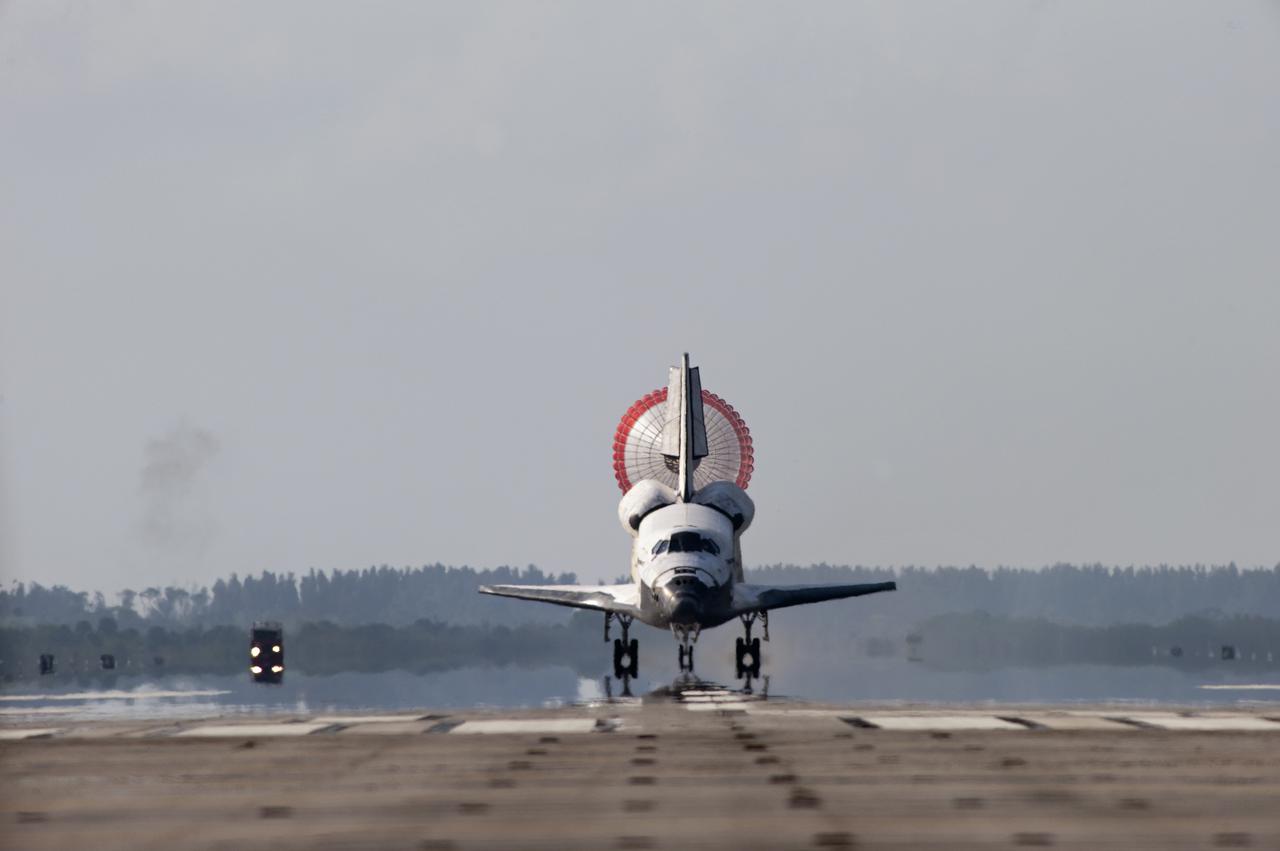
CAPE CANAVERAL, Fla. - With drag chute unfurled, space shuttle Discovery touches down on Runway 33 at the Shuttle Landing Facility at NASA's Kennedy Space Center in Florida after 15 days in space, completing the more than 6.2-million-mile STS-131 mission on orbit 238. Main gear touchdown was at 9:08:35 a.m. EDT followed by nose gear touchdown at 9:08:47 a.m. and wheelstop at 9:09:33 a.m. Aboard are Commander Alan Poindexter; Pilot James P. Dutton Jr.; and Mission Specialists Rick Mastracchio, Clayton Anderson, Dorothy Metcalf-Lindenburger, Stephanie Wilson and Naoko Yamazaki of the Japan Aerospace Exploration Agency. The seven-member STS-131 crew carried the multi-purpose logistics module Leonardo, filled with supplies, a new crew sleeping quarters and science racks that were transferred to the International Space Station's laboratories. The crew also switched out a gyroscope on the station’s truss, installed a spare ammonia storage tank and retrieved a Japanese experiment from the station’s exterior. STS-131 is the 33rd shuttle mission to the station and the 131st shuttle mission overall. For information on the STS-131 mission and crew, visit http:__www.nasa.gov_mission_pages_shuttle_shuttlemissions_sts131_index.html. Photo credit: NASA_Sandra Joseph and Kevin O'Connell
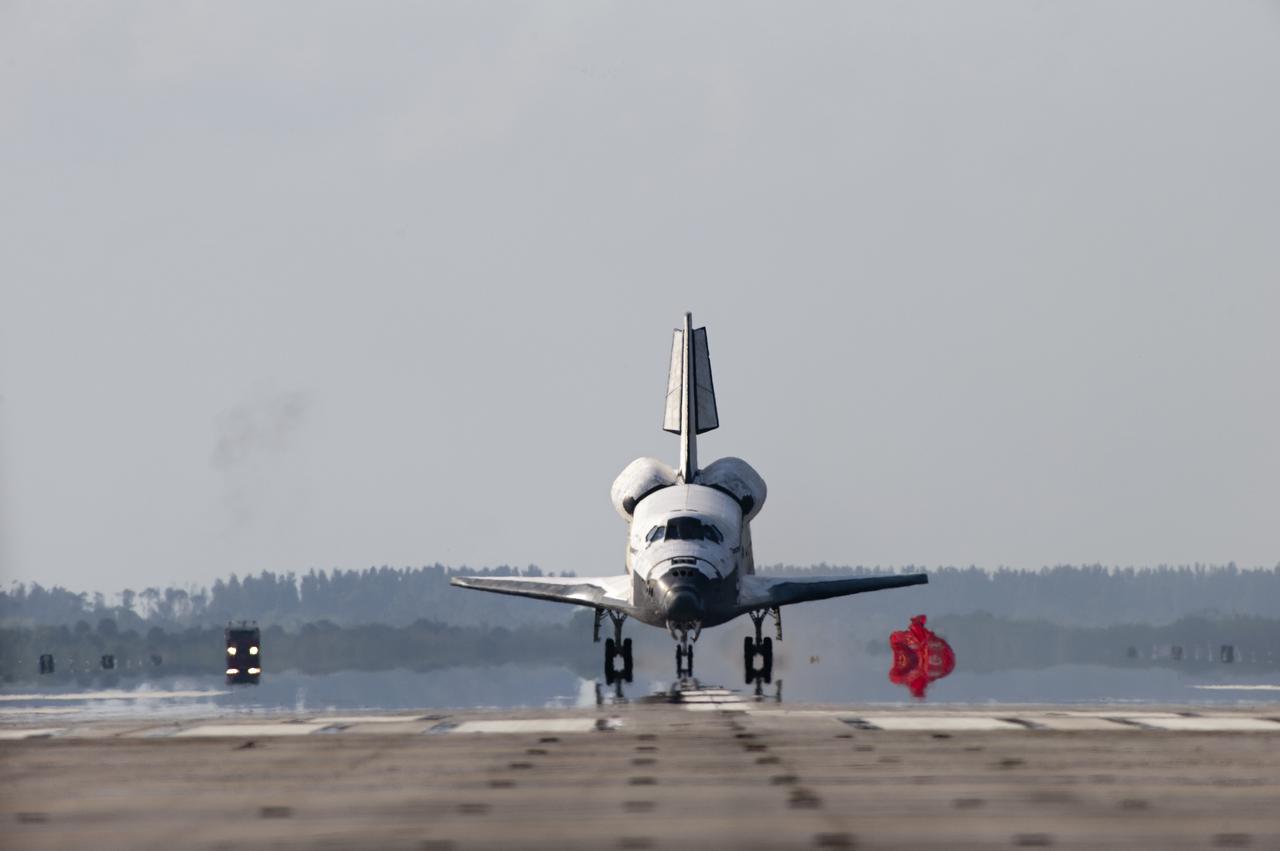
CAPE CANAVERAL, Fla. - Space shuttle Discovery's drag chute is jettisoned after slowing the shuttle for its touch down on Runway 33 at the Shuttle Landing Facility at NASA's Kennedy Space Center in Florida after 15 days in space, completing the more than 6.2-million-mile STS-131 mission on orbit 238. Main gear touchdown was at 9:08:35 a.m. EDT followed by nose gear touchdown at 9:08:47 a.m. and wheelstop at 9:09:33 a.m. Aboard are Commander Alan Poindexter; Pilot James P. Dutton Jr.; and Mission Specialists Rick Mastracchio, Clayton Anderson, Dorothy Metcalf-Lindenburger, Stephanie Wilson and Naoko Yamazaki of the Japan Aerospace Exploration Agency. The seven-member STS-131 crew carried the multi-purpose logistics module Leonardo, filled with supplies, a new crew sleeping quarters and science racks that were transferred to the International Space Station's laboratories. The crew also switched out a gyroscope on the station’s truss, installed a spare ammonia storage tank and retrieved a Japanese experiment from the station’s exterior. STS-131 is the 33rd shuttle mission to the station and the 131st shuttle mission overall. For information on the STS-131 mission and crew, visit http:__www.nasa.gov_mission_pages_shuttle_shuttlemissions_sts131_index.html. Photo credit: NASA_Sandra Joseph and Kevin O'Connell
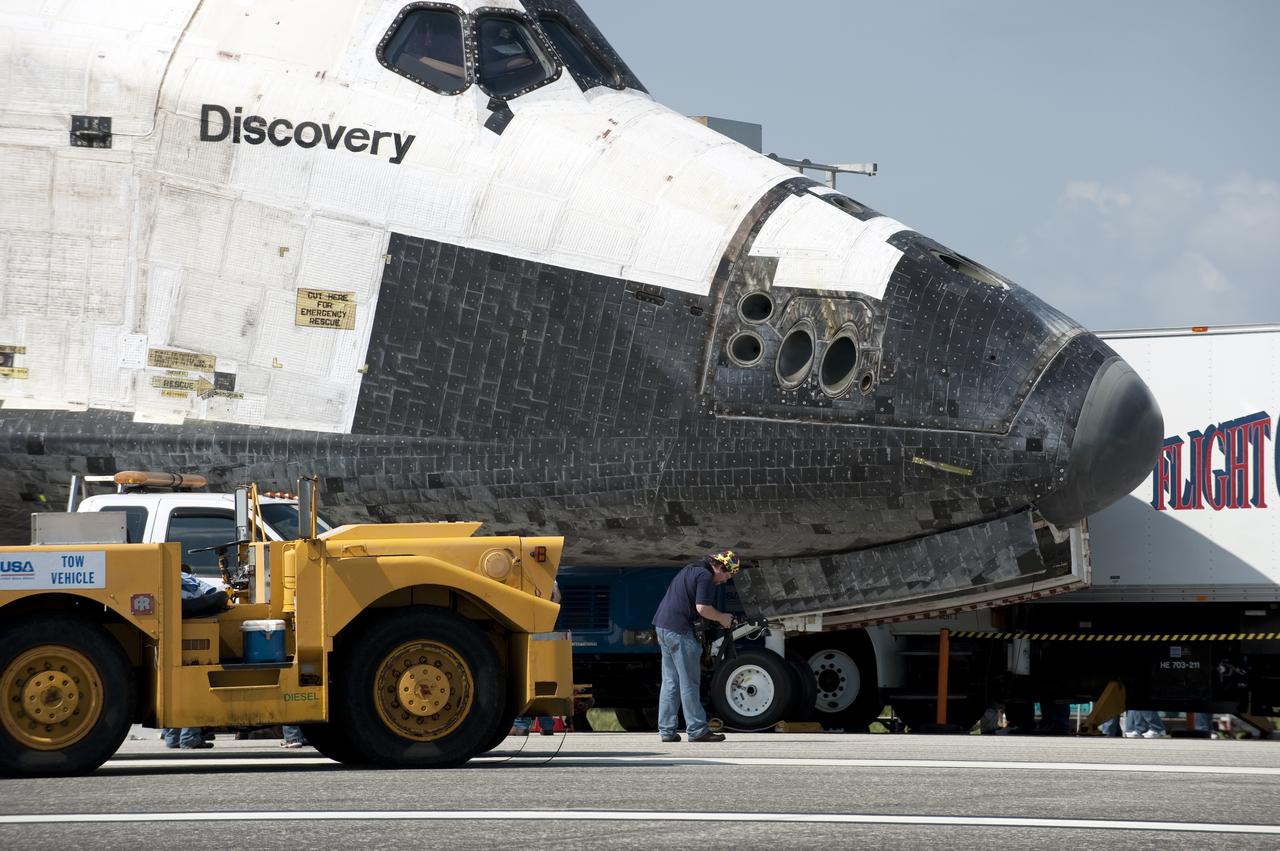
CAPE CANAVERAL, Fla. - At NASA's Kennedy Space Center in Florida, a member of the convoy team does his part to 'safe' space shuttle Discovery after its landing on Runway 33 at the Shuttle Landing Facility. Discovery landed at Kennedy after 15 days in space, completing the more than 6.2-million-mile STS-131 mission on orbit 238. Main gear touchdown was at 9:08:35 a.m. EDT followed by nose gear touchdown at 9:08:47 a.m. and wheelstop at 9:09:33 a.m. Aboard are Commander Alan Poindexter; Pilot James P. Dutton Jr.; and Mission Specialists Rick Mastracchio, Clayton Anderson, Dorothy Metcalf-Lindenburger, Stephanie Wilson and Naoko Yamazaki of the Japan Aerospace Exploration Agency. The seven-member STS-131 crew carried the multi-purpose logistics module Leonardo, filled with supplies, a new crew sleeping quarters and science racks that were transferred to the International Space Station's laboratories. The crew also switched out a gyroscope on the station’s truss, installed a spare ammonia storage tank and retrieved a Japanese experiment from the station’s exterior. STS-131 is the 33rd shuttle mission to the station and the 131st shuttle mission overall. For information on the STS-131 mission and crew, visit http:__www.nasa.gov_mission_pages_shuttle_shuttlemissions_sts131_index.html. Photo credit: NASA_Kevin O'Connell
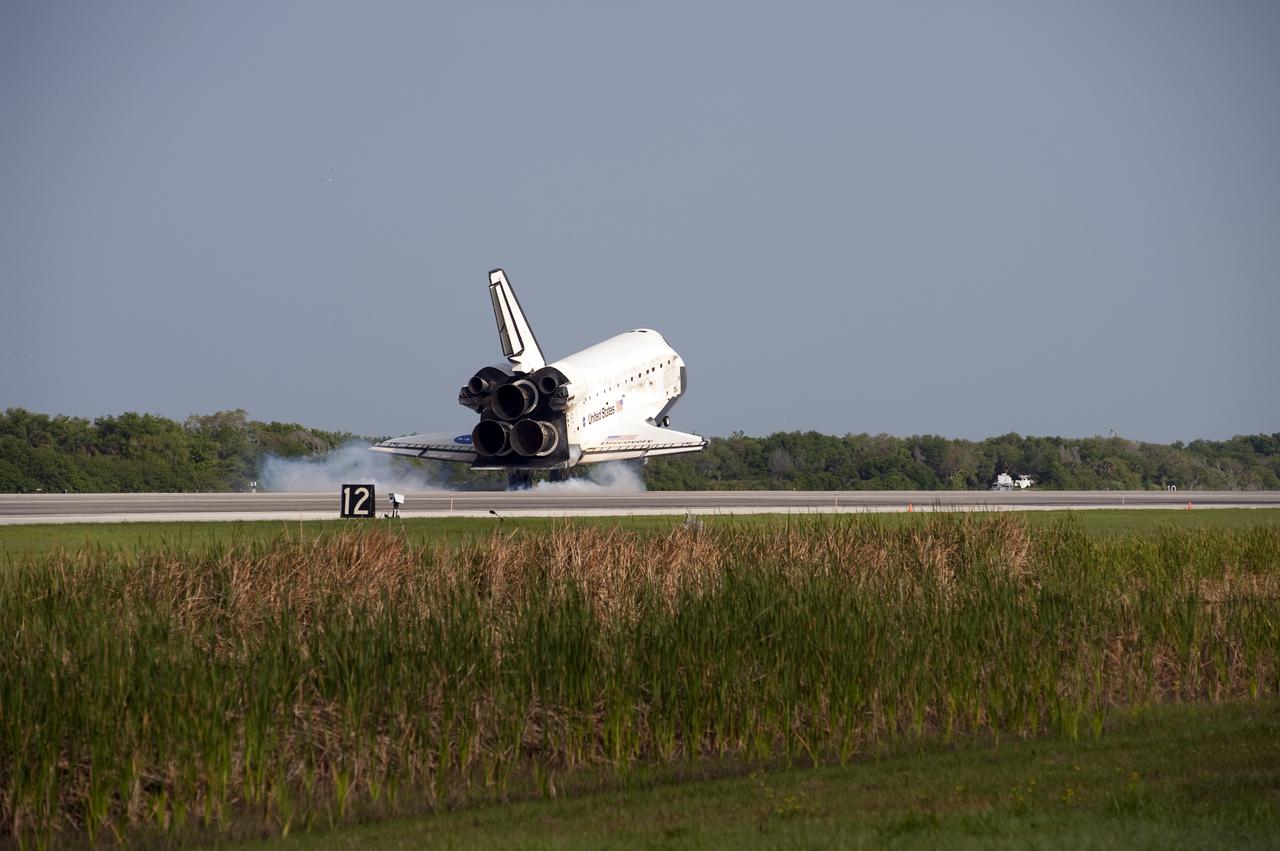
CAPE CANAVERAL, Fla. - Space shuttle Discovery lands on Runway 33 at the Shuttle Landing Facility at NASA's Kennedy Space Center in Florida at 9:08 a.m. EDT, completing the 15-day STS-131 mission to the International Space Station. Main gear touchdown was at 9:08:35 a.m. EDT followed by nose gear touchdown at 9:08:47 a.m. and wheelstop at 9:09:33 a.m. Aboard are Commander Alan Poindexter; Pilot James P. Dutton Jr.; and Mission Specialists Rick Mastracchio, Clayton Anderson, Dorothy Metcalf-Lindenburger, Stephanie Wilson and Naoko Yamazaki of the Japan Aerospace Exploration Agency. The seven-member STS-131 crew carried the multi-purpose logistics module Leonardo, filled with supplies, a new crew sleeping quarters and science racks that were transferred to the International Space Station's laboratories. The crew also switched out a gyroscope on the station’s truss, installed a spare ammonia storage tank and retrieved a Japanese experiment from the station’s exterior. STS-131 is the 33rd shuttle mission to the station and the 131st shuttle mission overall. For information on the STS-131 mission and crew, visit http:__www.nasa.gov_mission_pages_shuttle_shuttlemissions_sts131_index.html. Photo credit: NASA_Ben Cooper
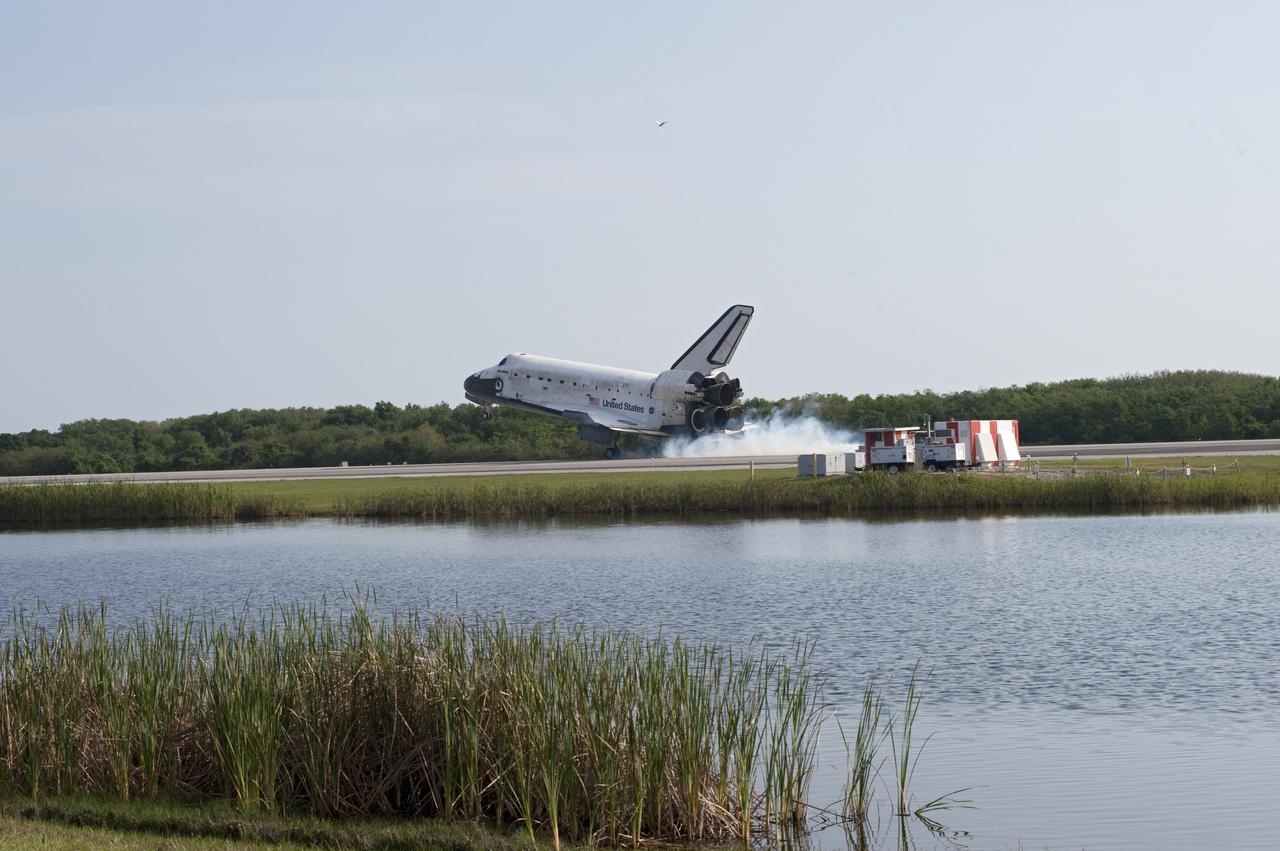
CAPE CANAVERAL, Fla. - Space shuttle Discovery lands on Runway 33 at the Shuttle Landing Facility at NASA's Kennedy Space Center in Florida at 9:08 a.m. EDT, completing the 15-day STS-131 mission to the International Space Station. Main gear touchdown was at 9:08:35 a.m. EDT followed by nose gear touchdown at 9:08:47 a.m. and wheelstop at 9:09:33 a.m. Aboard are Commander Alan Poindexter; Pilot James P. Dutton Jr.; and Mission Specialists Rick Mastracchio, Clayton Anderson, Dorothy Metcalf-Lindenburger, Stephanie Wilson and Naoko Yamazaki of the Japan Aerospace Exploration Agency. The seven-member STS-131 crew carried the multi-purpose logistics module Leonardo, filled with supplies, a new crew sleeping quarters and science racks that were transferred to the International Space Station's laboratories. The crew also switched out a gyroscope on the station’s truss, installed a spare ammonia storage tank and retrieved a Japanese experiment from the station’s exterior. STS-131 is the 33rd shuttle mission to the station and the 131st shuttle mission overall. For information on the STS-131 mission and crew, visit http:__www.nasa.gov_mission_pages_shuttle_shuttlemissions_sts131_index.html. Photo credit: NASA_Chuck Tintera

CAPE CANAVERAL, Fla. - At NASA's Kennedy Space Center in Florida, the shuttle convoy vehicles are in position near the Shuttle Landing Facility awaiting the return of space shuttle Discovery. The convoy is made up of about 40 vehicles, including 25 specially designed vehicles, and a team of trained personnel who 'safe' the shuttle, prepare it for towing, assist the crew in leaving the shuttle, and finally, tow the shuttle to its hangar. Discovery landed at Kennedy after 15 days in space, completing the more than 6.2-million-mile STS-131 mission on orbit 238. Main gear touchdown was at 9:08:35 a.m. EDT followed by nose gear touchdown at 9:08:47 a.m. and wheelstop at 9:09:33 a.m. Aboard are Commander Alan Poindexter; Pilot James P. Dutton Jr.; and Mission Specialists Rick Mastracchio, Clayton Anderson, Dorothy Metcalf-Lindenburger, Stephanie Wilson and Naoko Yamazaki of the Japan Aerospace Exploration Agency. The seven-member STS-131 crew carried the multi-purpose logistics module Leonardo, filled with supplies, a new crew sleeping quarters and science racks that were transferred to the International Space Station's laboratories. The crew also switched out a gyroscope on the station’s truss, installed a spare ammonia storage tank and retrieved a Japanese experiment from the station’s exterior. STS-131 is the 33rd shuttle mission to the station and the 131st shuttle mission overall. For information on the STS-131 mission and crew, visit http:__www.nasa.gov_mission_pages_shuttle_shuttlemissions_sts131_index.html. Photo credit: NASA_Ben Smegelsky
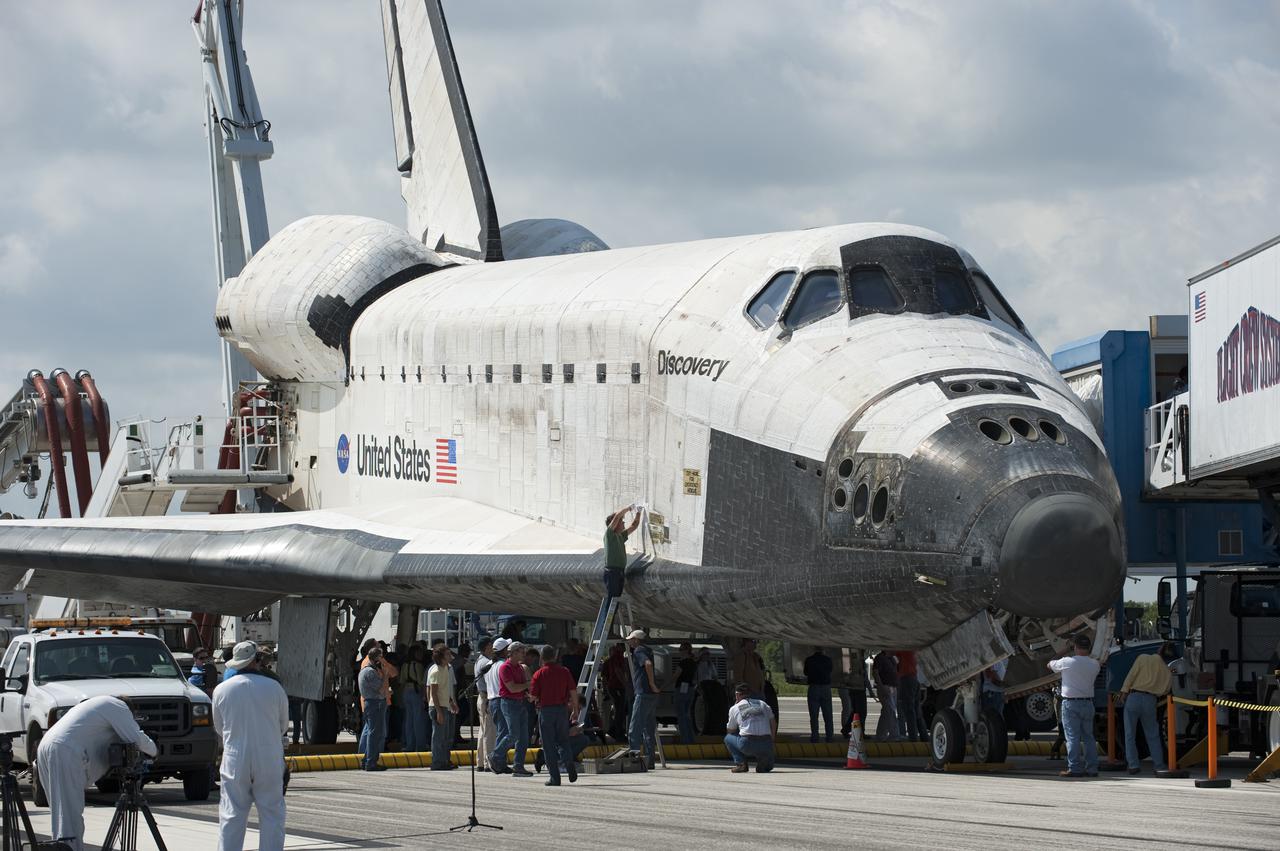
CAPE CANAVERAL, Fla. - At NASA's Kennedy Space Center in Florida, members of the convoy team 'safe' space shuttle Discovery after its landing on Runway 33 at the Shuttle Landing Facility. Discovery landed at Kennedy after 15 days in space, completing the more than 6.2-million-mile STS-131 mission on orbit 238. The convoy is made up of about 25 specially designed vehicles and a team of trained personnel who 'safe' the shuttle, prepare it for towing, assist the crew in leaving the shuttle, and finally, tow the shuttle to its hangar. Main gear touchdown was at 9:08:35 a.m. EDT followed by nose gear touchdown at 9:08:47 a.m. and wheelstop at 9:09:33 a.m. Aboard are Commander Alan Poindexter; Pilot James P. Dutton Jr.; and Mission Specialists Rick Mastracchio, Clayton Anderson, Dorothy Metcalf-Lindenburger, Stephanie Wilson and Naoko Yamazaki of the Japan Aerospace Exploration Agency. The seven-member STS-131 crew carried the multi-purpose logistics module Leonardo, filled with supplies, a new crew sleeping quarters and science racks that were transferred to the International Space Station's laboratories. The crew also switched out a gyroscope on the station’s truss, installed a spare ammonia storage tank and retrieved a Japanese experiment from the station’s exterior. STS-131 is the 33rd shuttle mission to the station and the 131st shuttle mission overall. For information on the STS-131 mission and crew, visit http:__www.nasa.gov_mission_pages_shuttle_shuttlemissions_sts131_index.html. Photo credit: NASA_Kevin O'Connell
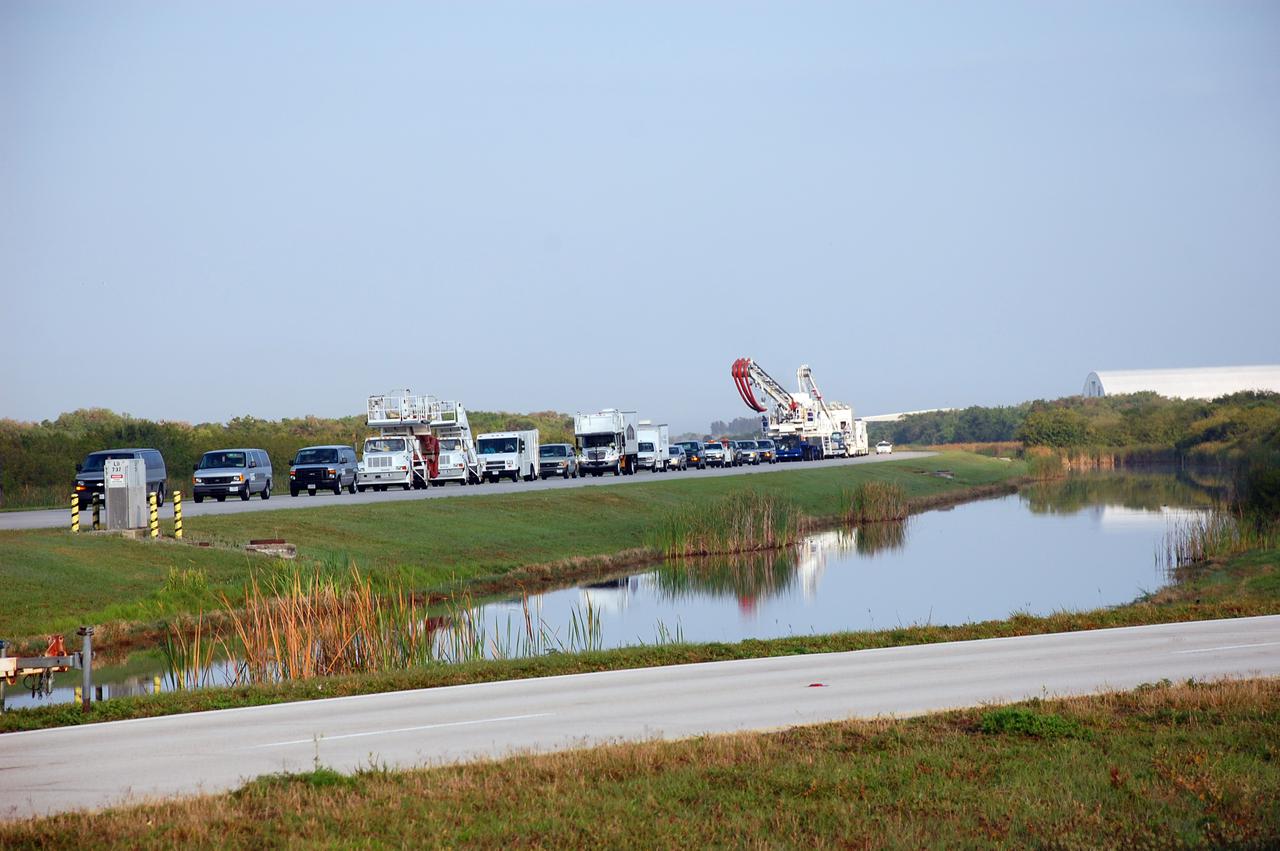
CAPE CANAVERAL, Fla. - At NASA's Kennedy Space Center in Florida, the shuttle convoy vehicles roll to the Shuttle Landing Facility in preparation for the landing of space shuttle Discovery. The convoy is made up of about 40 vehicles, including 25 specially designed vehicles, and a team of trained personnel who 'safe' the shuttle, prepare it for towing, assist the crew in leaving the shuttle, and finally, tow the shuttle to its hangar. Discovery landed at Kennedy after 15 days in space, completing the more than 6.2-million-mile STS-131 mission on orbit 238. Main gear touchdown was at 9:08:35 a.m. EDT followed by nose gear touchdown at 9:08:47 a.m. and wheelstop at 9:09:33 a.m. Aboard are Commander Alan Poindexter; Pilot James P. Dutton Jr.; and Mission Specialists Rick Mastracchio, Clayton Anderson, Dorothy Metcalf-Lindenburger, Stephanie Wilson and Naoko Yamazaki of the Japan Aerospace Exploration Agency. The seven-member STS-131 crew carried the multi-purpose logistics module Leonardo, filled with supplies, a new crew sleeping quarters and science racks that were transferred to the International Space Station's laboratories. The crew also switched out a gyroscope on the station’s truss, installed a spare ammonia storage tank and retrieved a Japanese experiment from the station’s exterior. STS-131 is the 33rd shuttle mission to the station and the 131st shuttle mission overall. For information on the STS-131 mission and crew, visit http:__www.nasa.gov_mission_pages_shuttle_shuttlemissions_sts131_index.html. Photo credit: NASA_Ben Smegelsky
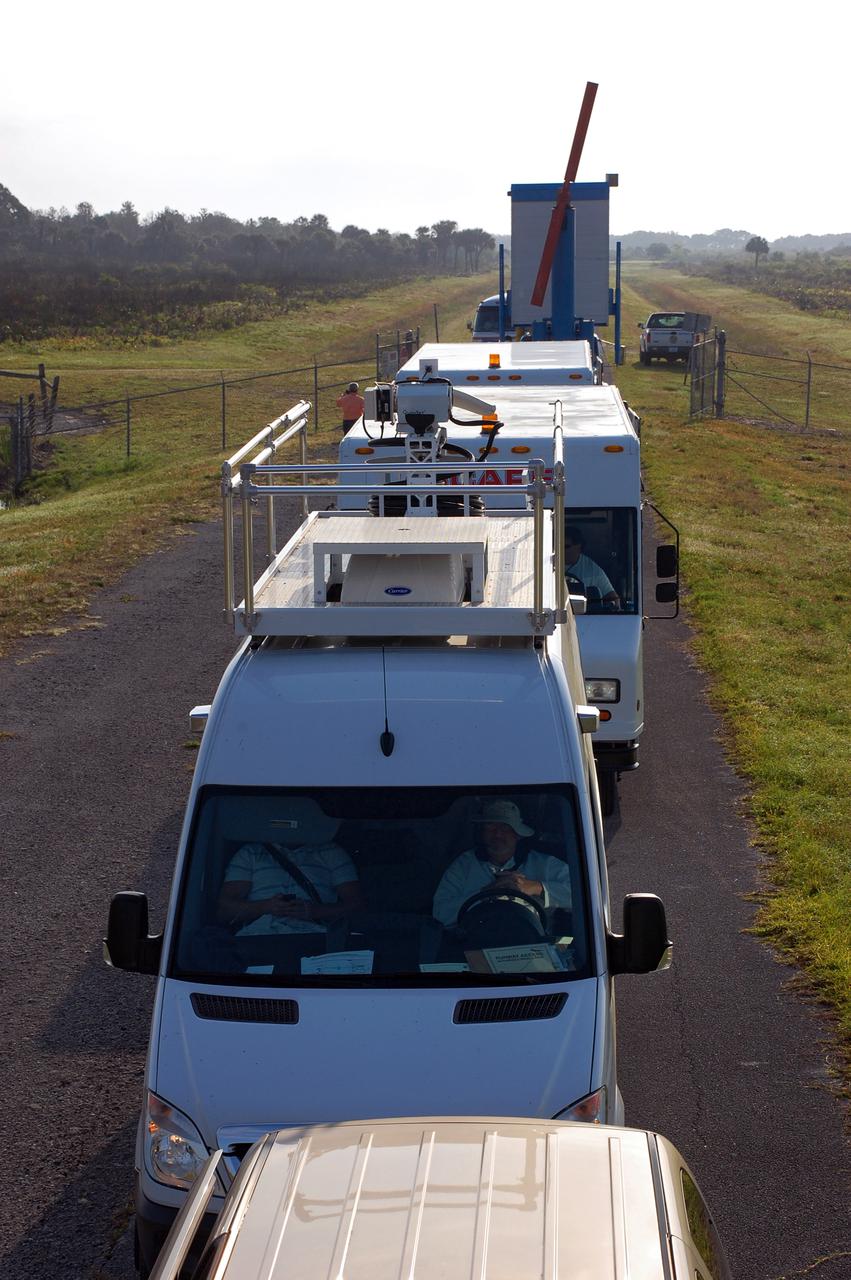
CAPE CANAVERAL, Fla. - At NASA's Kennedy Space Center in Florida, the shuttle convoy vehicles are in position near the Shuttle Landing Facility in preparation for the return of space shuttle Discovery. The convoy is made up of about 40 vehicles, including 25 specially designed vehicles, and a team of trained personnel who 'safe' the shuttle, prepare it for towing, assist the crew in leaving the shuttle, and finally, tow the shuttle to its hangar. Discovery landed at Kennedy after 15 days in space, completing the more than 6.2-million-mile STS-131 mission on orbit 238. Main gear touchdown was at 9:08:35 a.m. EDT followed by nose gear touchdown at 9:08:47 a.m. and wheelstop at 9:09:33 a.m. Aboard are Commander Alan Poindexter; Pilot James P. Dutton Jr.; and Mission Specialists Rick Mastracchio, Clayton Anderson, Dorothy Metcalf-Lindenburger, Stephanie Wilson and Naoko Yamazaki of the Japan Aerospace Exploration Agency. The seven-member STS-131 crew carried the multi-purpose logistics module Leonardo, filled with supplies, a new crew sleeping quarters and science racks that were transferred to the International Space Station's laboratories. The crew also switched out a gyroscope on the station’s truss, installed a spare ammonia storage tank and retrieved a Japanese experiment from the station’s exterior. STS-131 is the 33rd shuttle mission to the station and the 131st shuttle mission overall. For information on the STS-131 mission and crew, visit http:__www.nasa.gov_mission_pages_shuttle_shuttlemissions_sts131_index.html. Photo credit: NASA_Ben Smegelsky
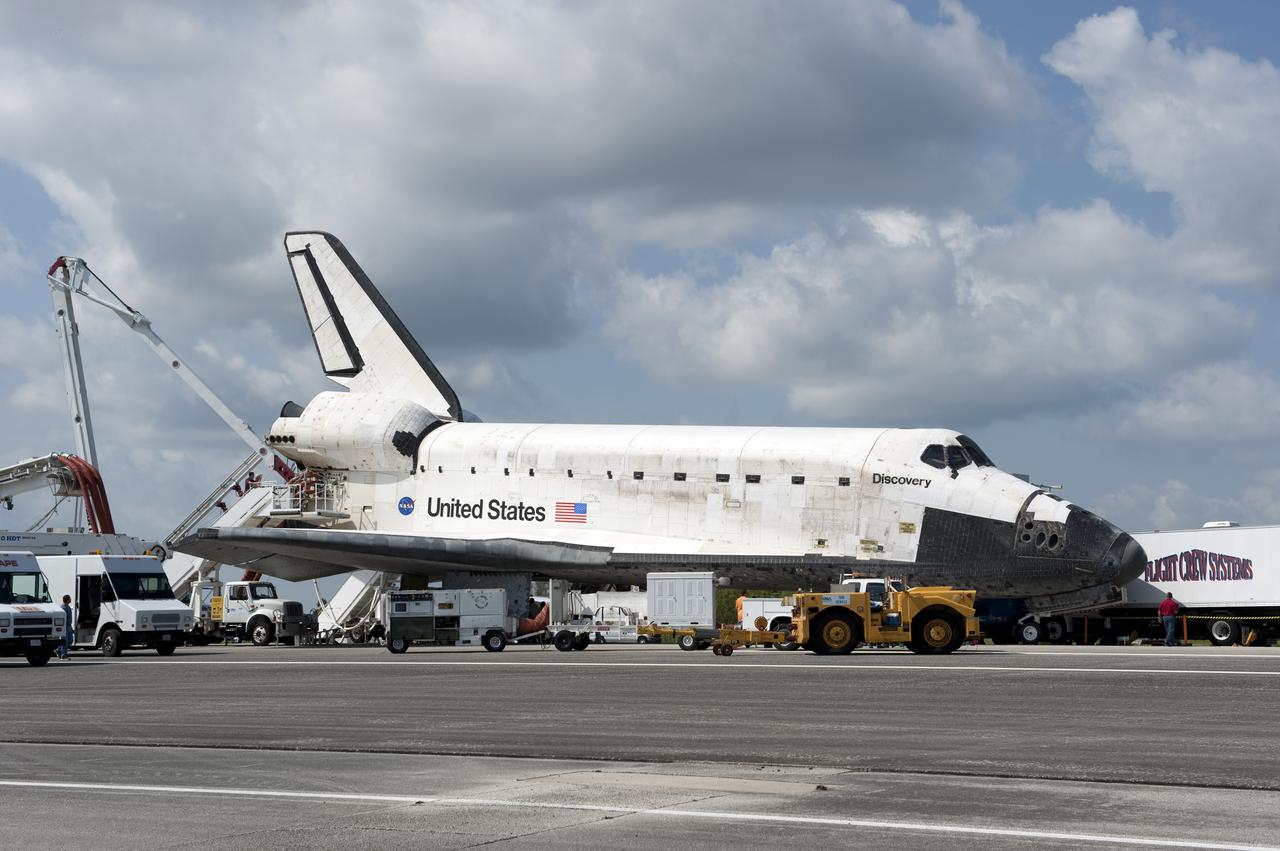
CAPE CANAVERAL, Fla. - At NASA's Kennedy Space Center in Florida, the shuttle convoy vehicles move into place around space shuttle Discovery after its landing on Runway 33 at the Shuttle Landing Facility. Discovery landed at Kennedy after 15 days in space, completing the more than 6.2-million-mile STS-131 mission on orbit 238. The convoy is made up of about 25 specially designed vehicles and a team of trained personnel who 'safe' the shuttle, prepare it for towing, assist the crew in leaving the shuttle, and finally, tow the shuttle to its hangar. Main gear touchdown was at 9:08:35 a.m. EDT followed by nose gear touchdown at 9:08:47 a.m. and wheelstop at 9:09:33 a.m. Aboard are Commander Alan Poindexter; Pilot James P. Dutton Jr.; and Mission Specialists Rick Mastracchio, Clayton Anderson, Dorothy Metcalf-Lindenburger, Stephanie Wilson and Naoko Yamazaki of the Japan Aerospace Exploration Agency. The seven-member STS-131 crew carried the multi-purpose logistics module Leonardo, filled with supplies, a new crew sleeping quarters and science racks that were transferred to the International Space Station's laboratories. The crew also switched out a gyroscope on the station’s truss, installed a spare ammonia storage tank and retrieved a Japanese experiment from the station’s exterior. STS-131 is the 33rd shuttle mission to the station and the 131st shuttle mission overall. For information on the STS-131 mission and crew, visit http:__www.nasa.gov_mission_pages_shuttle_shuttlemissions_sts131_index.html. Photo credit: NASA_Kevin O'Connell
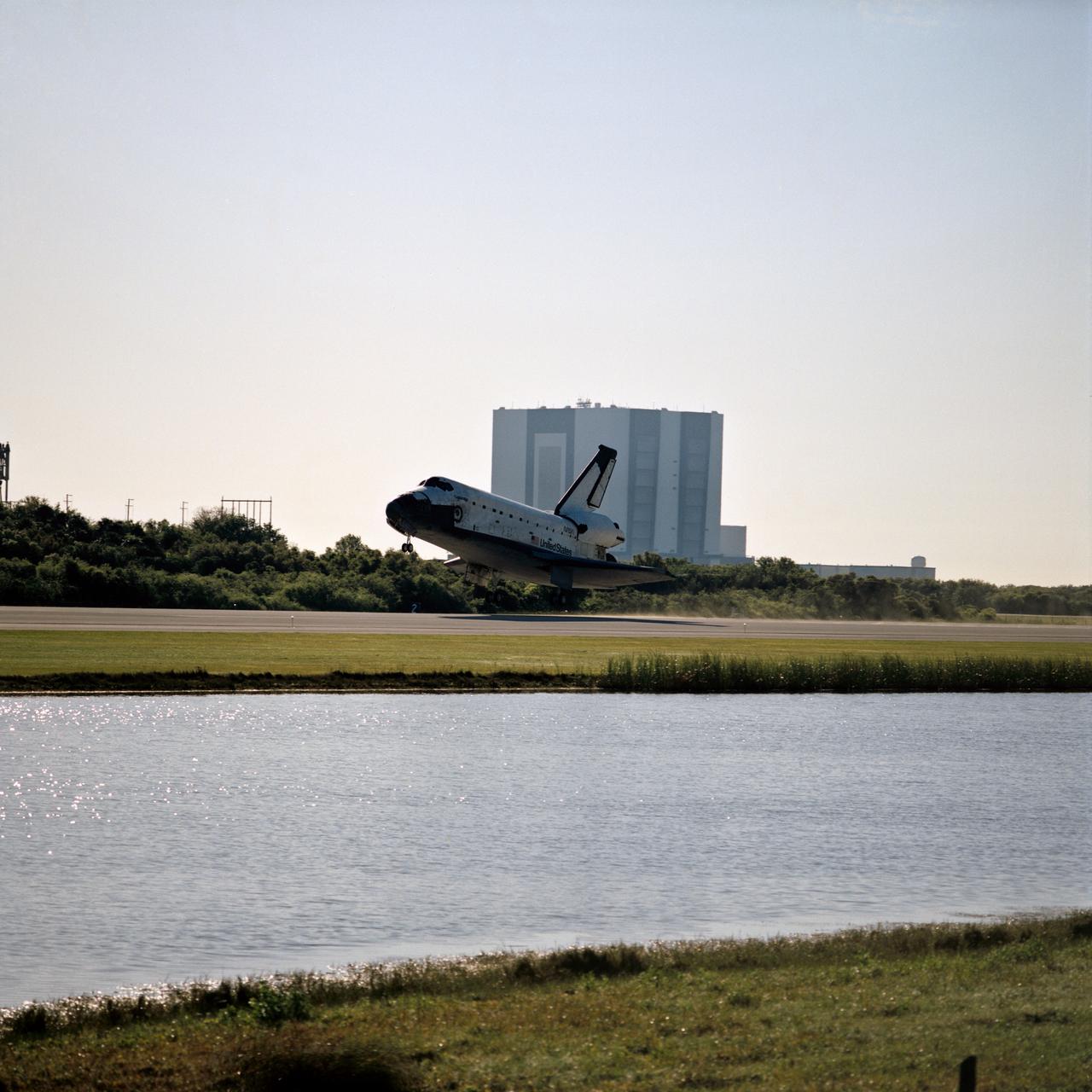
STS062-S-030 (18 March 1994) --- The Space Shuttle Columbia is about to touch down on the Shuttle landing facility following almost 14 days in earth orbit for five NASA astronauts and a variety of experiments. The giant Vehicle Assembly Building (VAB) where Columbia had been mated to its external fuel tank and two solid rockets is in the background. Touchdown occurred at 8:09 a.m. (EST), March 18, 1994. Thirteen days, 23 hours and 16 minutes were logged by the crew members -- astronauts John H. Casper, Andrew M. Allen, Marsha S. Ivins, Pierre J. Thuot and Charles D. (Sam) Gemar.
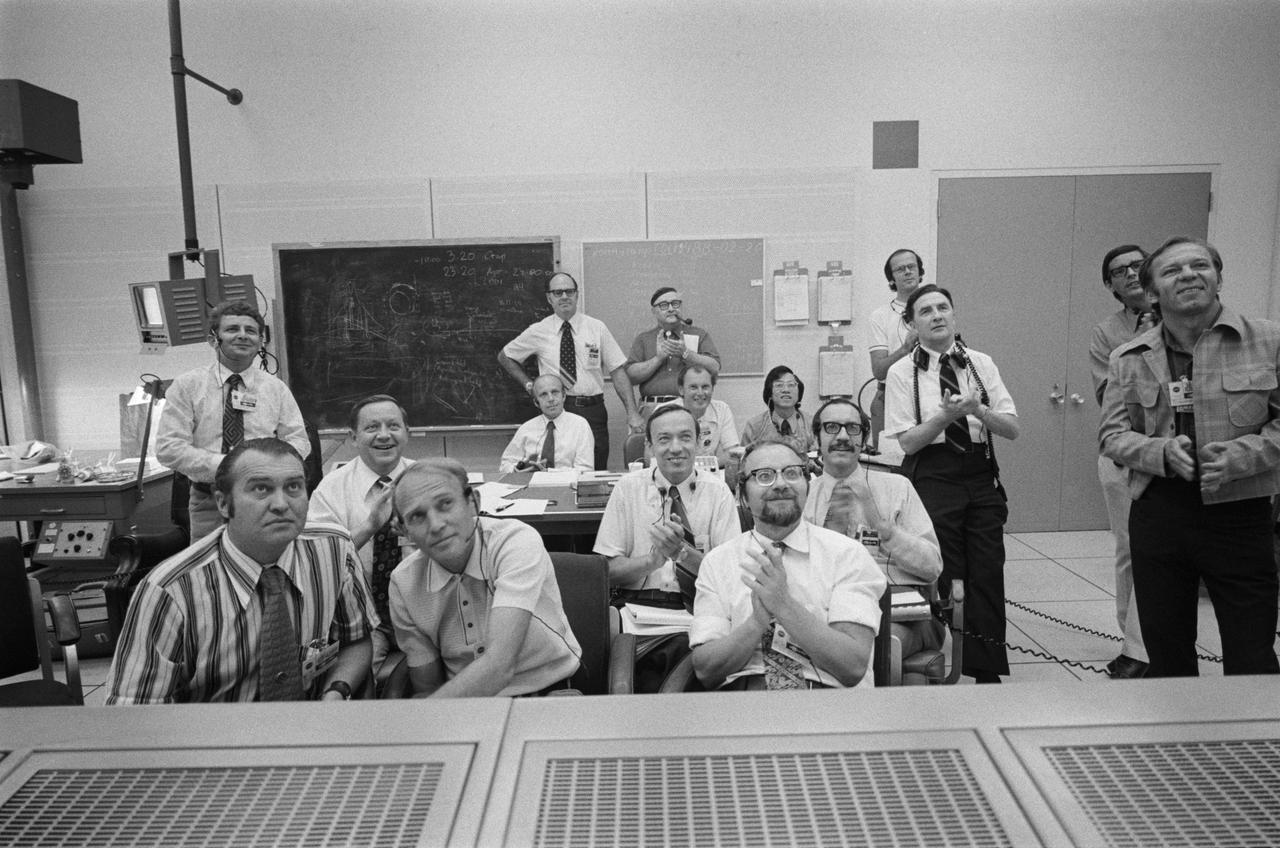
S75-28659 (21 July 1975) --- An overall view of the group of Soviet Union flight controllers who served at the Mission Control Center during the joint U.S.-USSR Apollo-Soyuz Test Project docking mission in Earth orbit. They are applauding the successful touchdown of the Soyuz spacecraft in Central Asia. The television monitor had just shown the land landing of the Soyuz descent vehicle.
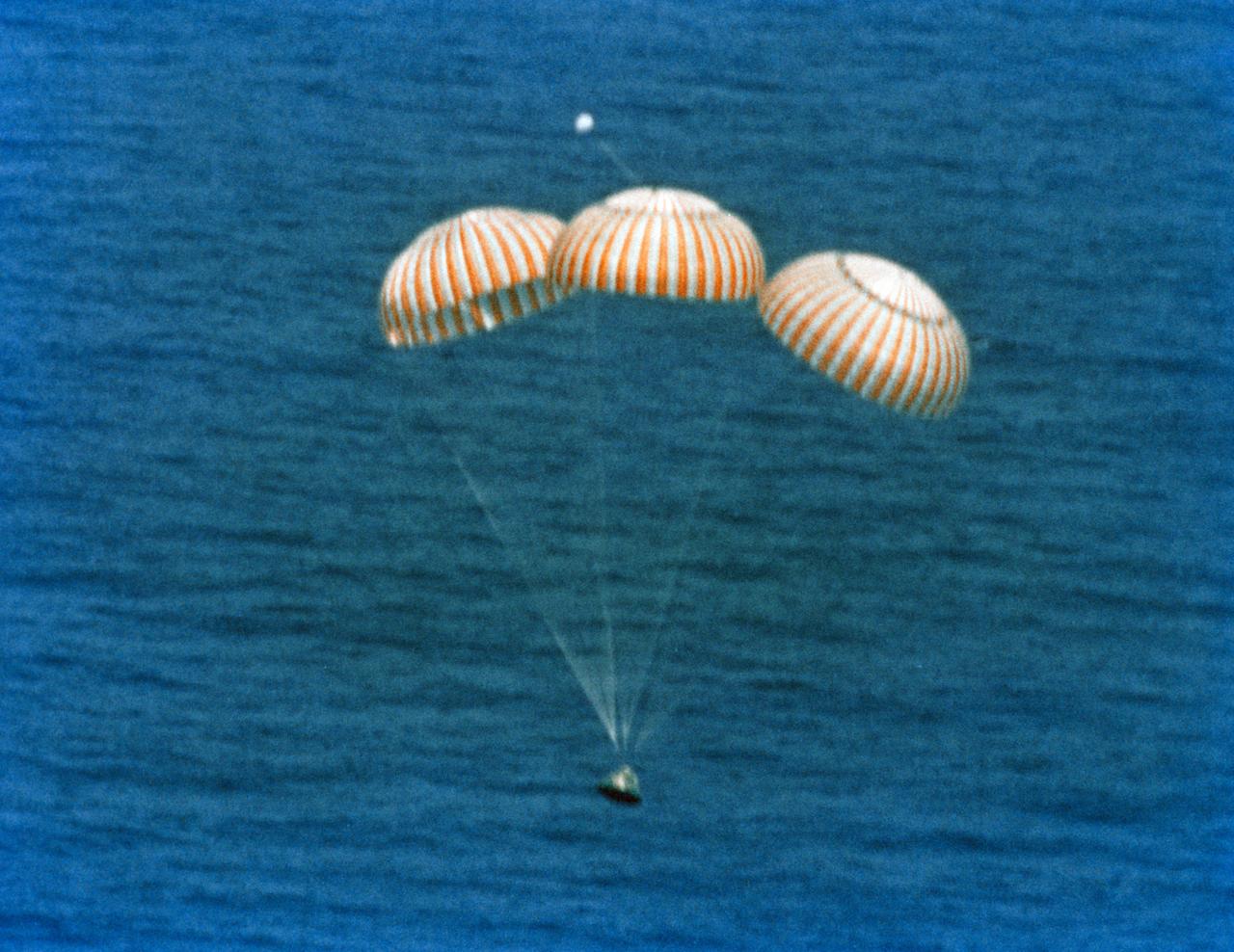
S75-29719 (24 July 1975) --- The ASTP Apollo Command Module, with astronauts Thomas P. Stafford, Vance D. Brand and Donald K. Slayton aboard, nears a touchdown in the Central Pacific Ocean to conclude the historic joint U.S.-USSR Apollo-Soyuz Test Project docking mission in Earth orbit. The spacecraft splashed down in the Hawaiian Islands area at 4:18 p.m. (CDT), July 24, 1975.

41G-102-047 (13 Oct. 1984) --- An unusual picture, photographed by astronaut Kathryn D. Sullivan, shows the beginning and ending location of her eight-day mission in space with six other 41-G crew members aboard the space shuttle Challenger. The picture was made moments before touchdown at the KSC landing facility. Dr. Sullivan aimed a 35mm camera through the port hole in Challenger's hatch. The five ground features represented as circles or pentagonals are launch areas. Photo credit: NASA
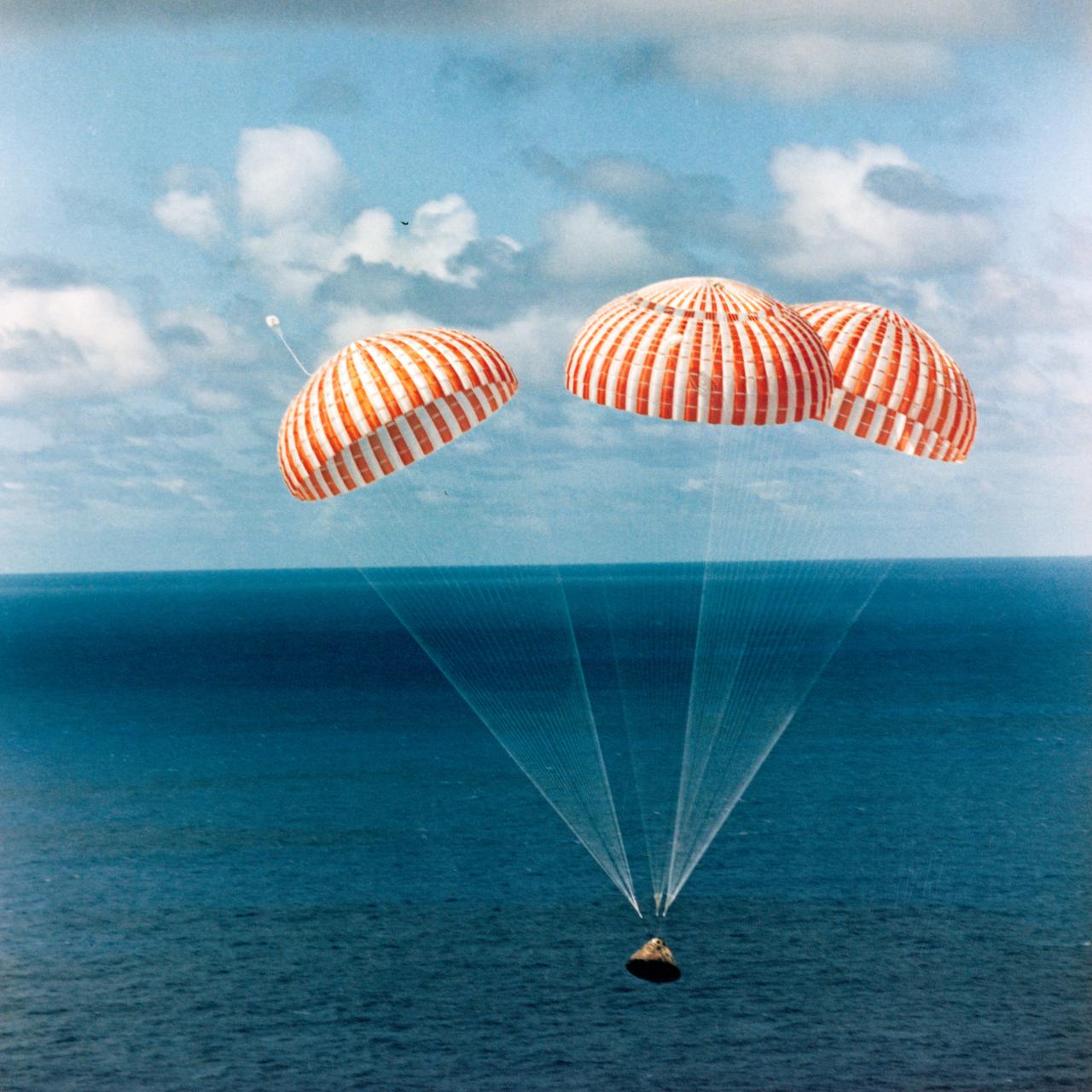
S71-18753 (9 Feb. 1971) --- The Apollo 14 Command Module (CM), with astronauts Alan B. Shepard Jr., commander; Stuart A. Roosa, command module pilot; and Edgar D. Mitchell, lunar module pilot, aboard, approaches touchdown in the South Pacific Ocean to successfully end a 10-day lunar landing mission. The splashdown occurred at 3:04:39 p.m. (CST), Feb. 9, 1971, approximately 765 nautical miles south of American Samoa. The three crew men were flown by helicopter to the USS New Orleans prime recovery ship.
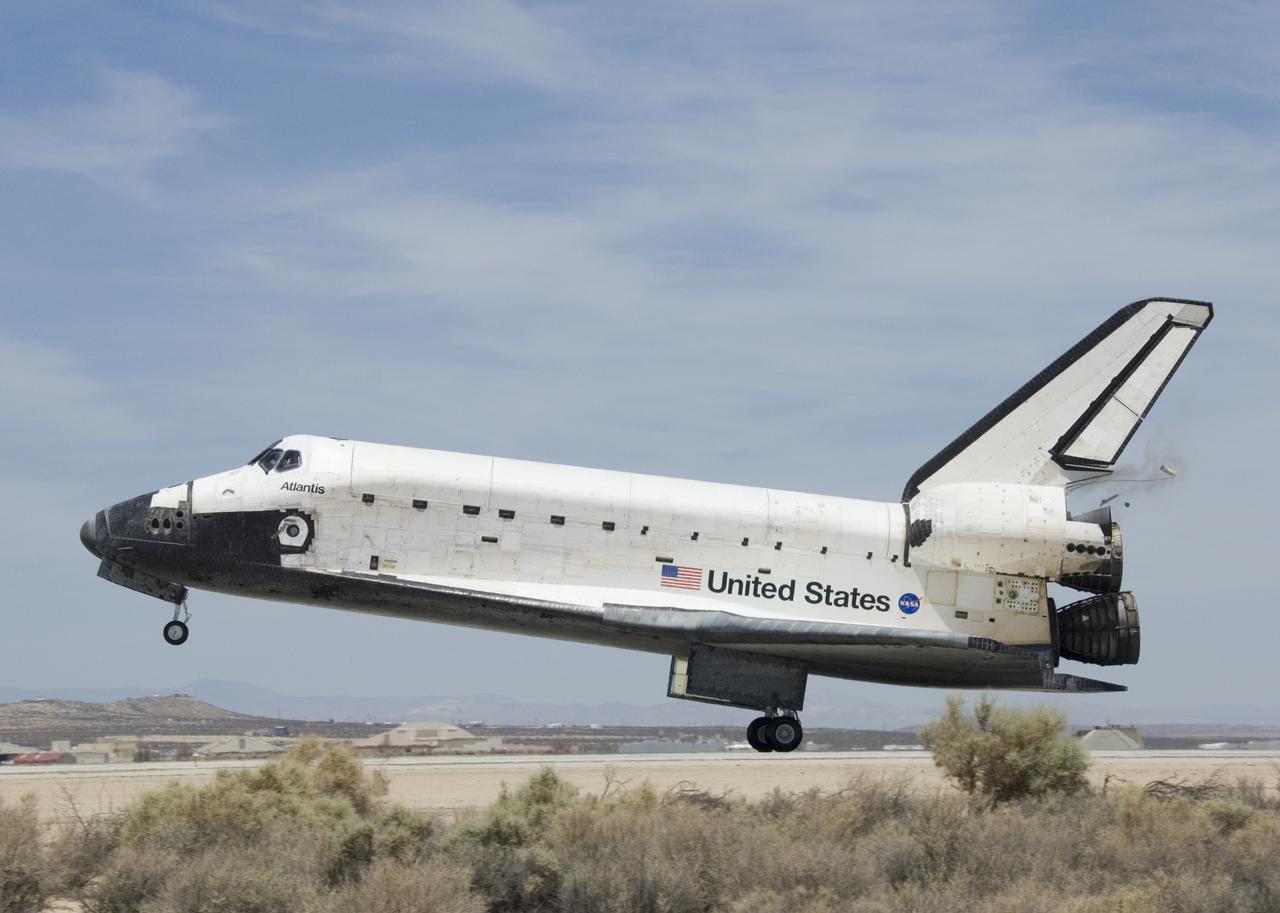
Space Shuttle Atlantis starts to deploy its braking parachute following touchdown at Edwards Air Force Base, California, on June 22, 2007.
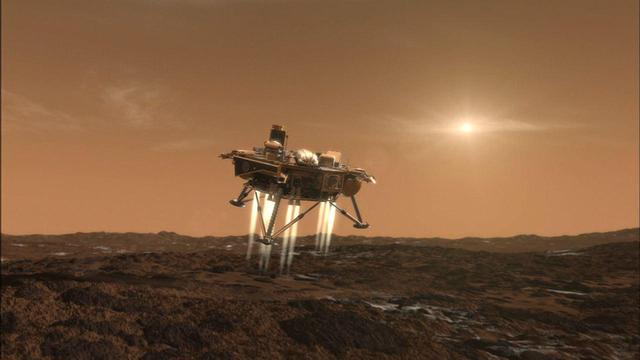
This artist conception depicts NASA Phoenix Mars Lander a moment before its touchdown on the arctic plains of Mars.
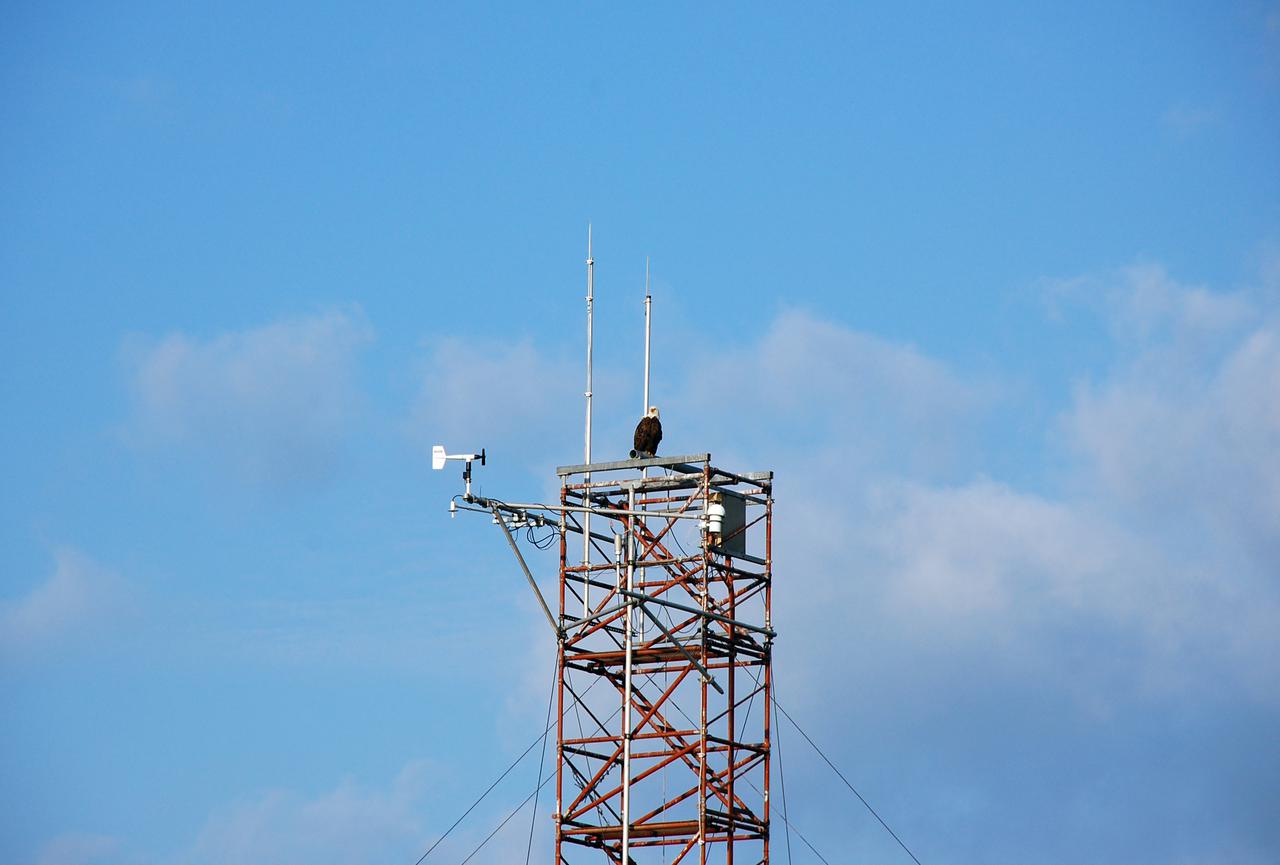
CAPE CANAVERAL, Fla. - At NASA's Kennedy Space Center in Florida, a bald eagle is in prime position at the top of a tower at the Shuttle Landing Facility to watch the landing of space shuttle Discovery. Bald eagles mate for life, choosing the tops of large trees to build nests, which they typically use and enlarge each year. Nests may reach 10 feet across and weigh half a ton. The birds travel great distances but usually return to breeding grounds within 100 miles of the place where they were raised. Bald eagles may live 15 to 25 years in the wild. There are 18 active eagle nests within Kennedy's boundaries, including several in the vicinity of the landing strip. The Merritt Island National Wildlife Refuge coexists with Kennedy Space Center and provides a habitat for 330 species of birds including the bald eagle. A variety of other wildlife - 117 kinds of fish, 65 types of amphibians and reptiles, 31 different mammals, and 1,045 species of plants - also inhabit the refuge. For information on the refuge, visit http:__www.fws.gov_merrittisland_Index.html. For information on Kennedy Space Center, visit http:__www.nasa.gov_kennedy. Photo credit: NASA_Ben Smegelsky
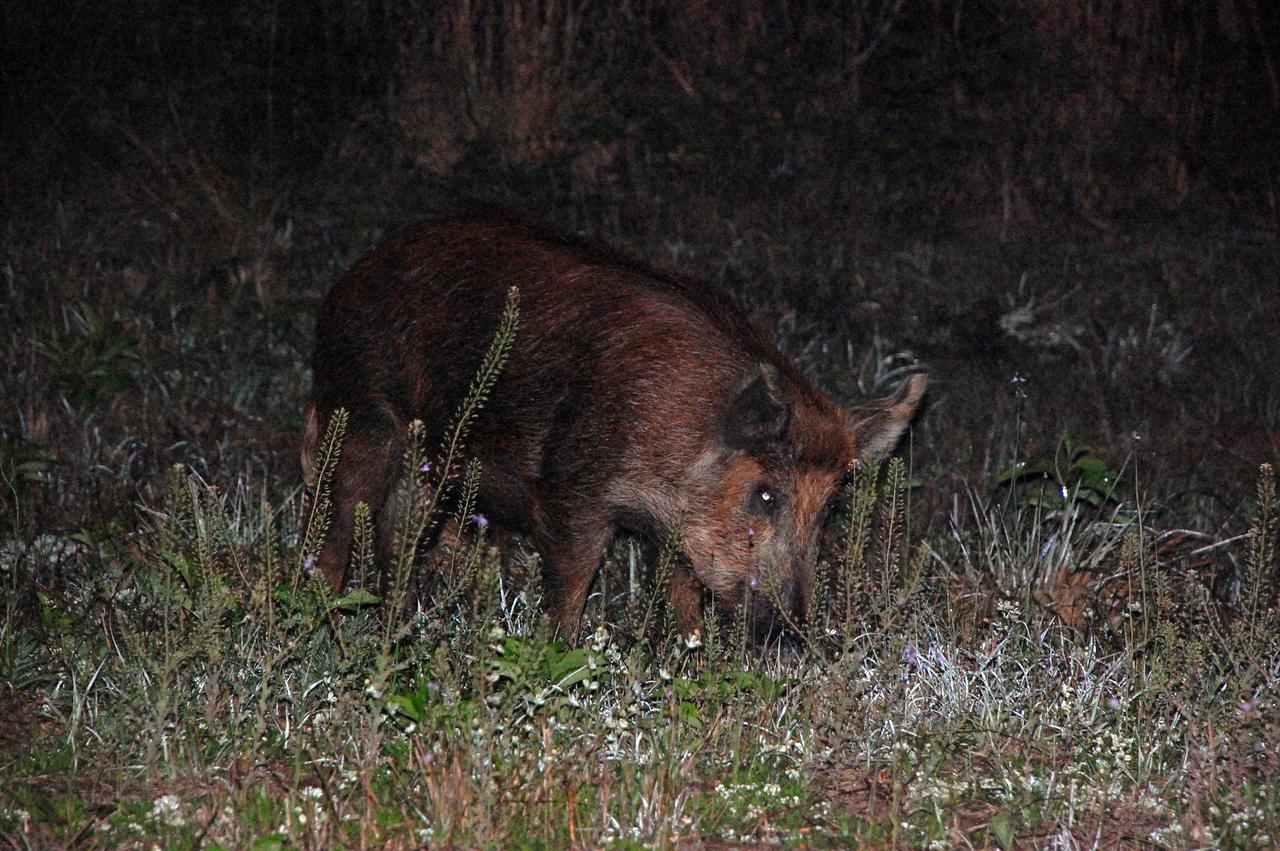
CAPE CANAVERAL, Fla. - A young feral hog roots for his breakfast at NASA's Kennedy Space Center in Florida. Wild hogs flourish in the environs around Kennedy, which coexists with the Merritt Island National Wildlife Refuge, without many predators other than panthers and humans. Hogs were introduced to Florida in the 1500s and are now found statewide in wooded areas close to water. Estimates of the hog population on the refuge vary from 5,000 to 12,000. The Merritt Island National Wildlife Refuge coexists with Kennedy Space Center and provides a habitat for 330 species of birds and a variety of other wildlife - 117 kinds of fish, 65 types of amphibians and reptiles, 31 different mammals, and 1,045 species of plants. For information on the refuge, visit http:__www.fws.gov_merrittisland_Index.html. For information on Kennedy Space Center, visit http:__www.nasa.gov_kennedy. Photo credit: NASA_Ben Smegelsky
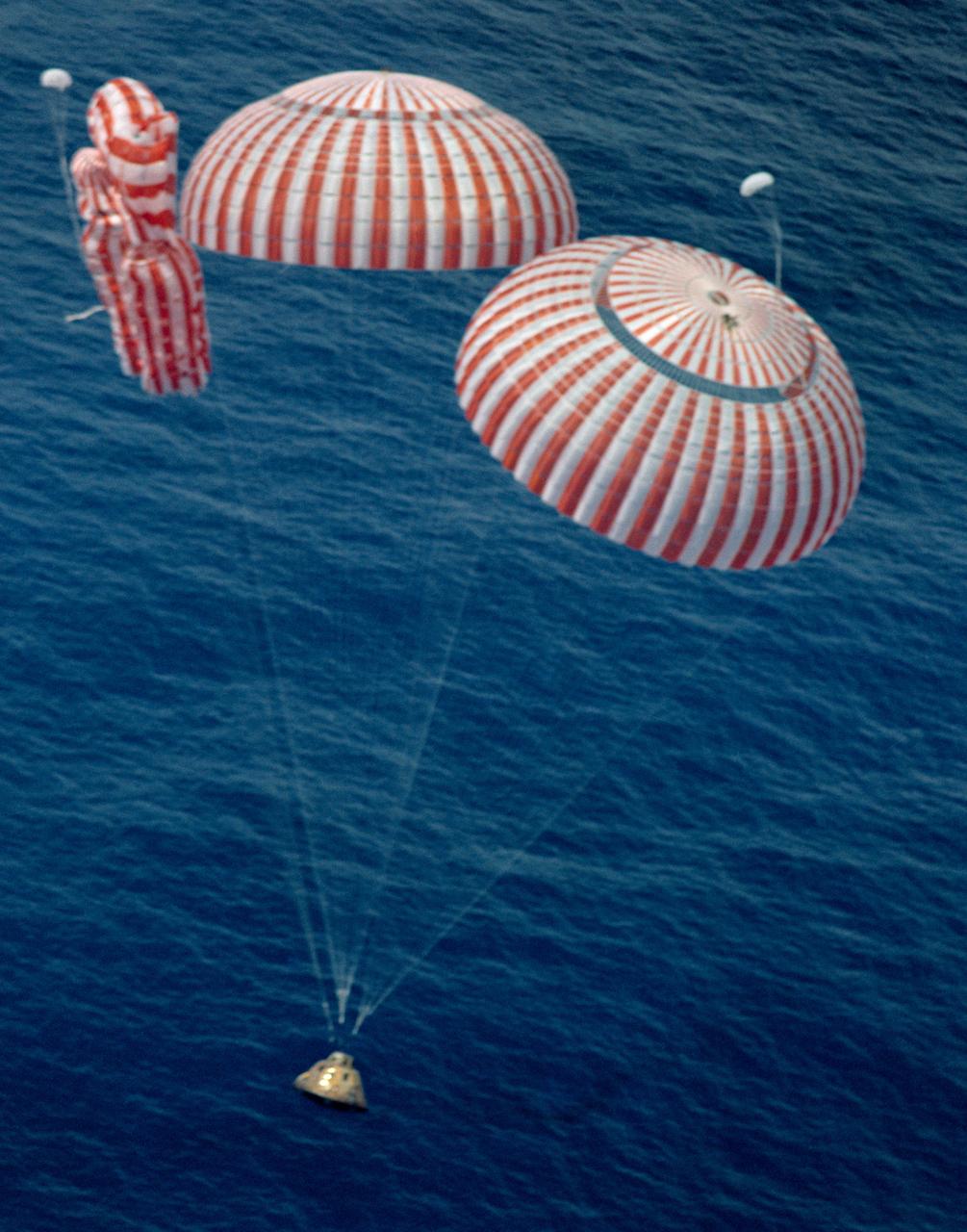
S71-41999 (7 Aug. 1971) --- The Apollo 15 Command Module (CM), with astronauts David R. Scott, commander; Alfred M. Worden, command module pilot; and James B. Irwin, lunar module pilot, aboard, nears a safe touchdown in the mid-Pacific Ocean to conclude a highly successful lunar landing mission. Although causing no harm to the crewmen, one of the three main parachutes failed to function properly. The splashdown occurred at 3:45:53 p.m. (CDT), Aug. 7, 1971, some 330 miles north of Honolulu, Hawaii. The three astronauts were picked up by helicopter and flown to the prime recovery ship USS Okinawa, which was only 6 1/2 miles away.
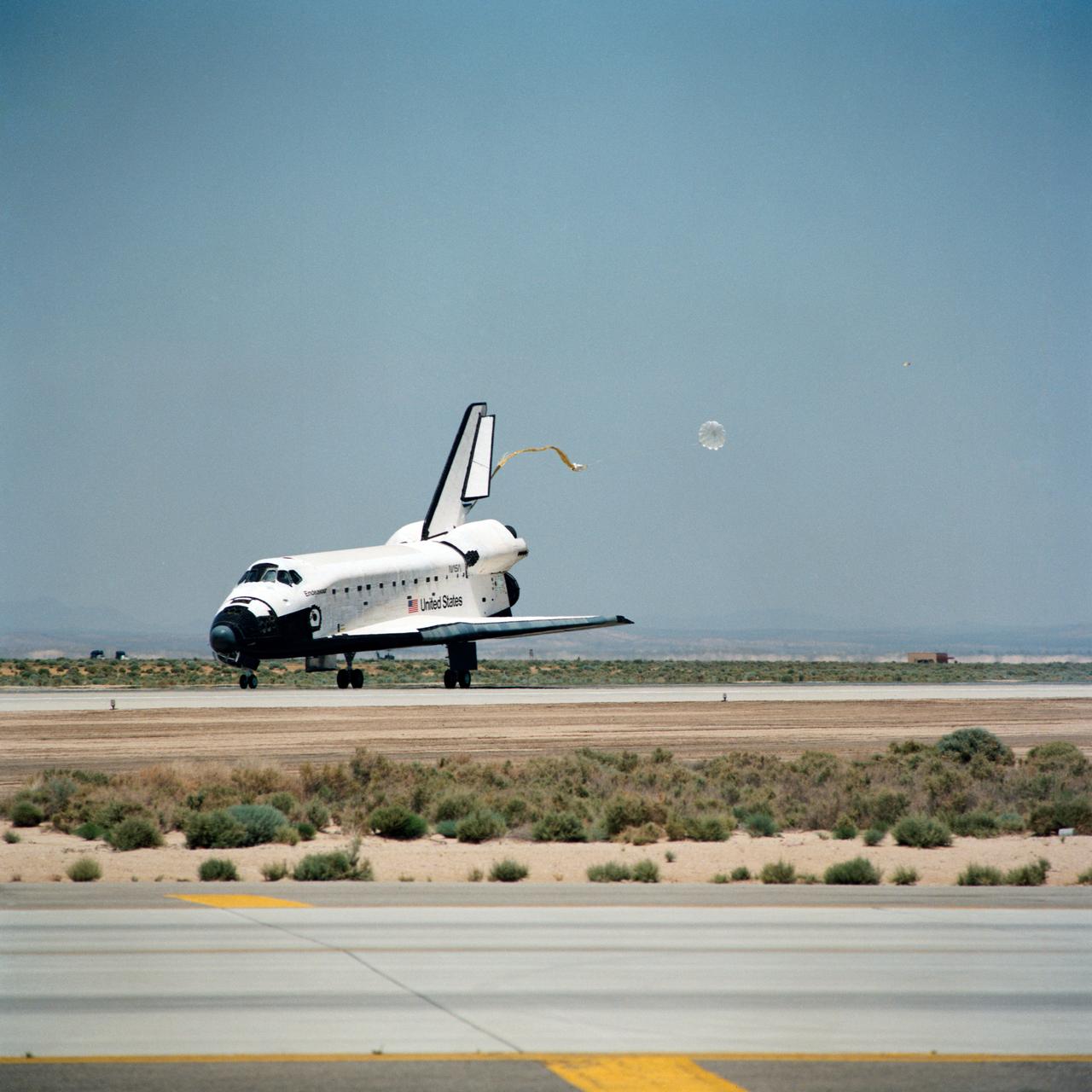
STS049-S-268 (16 May 1992) --- A three-quarter forward view of the Space Shuttle Endeavour making its first landing, following a successful nine-day mission in Earth orbit. The drogue chute precedes the main chute in NASA's first exercise of its detailed test objective (DTO-521) on the drag chute system. Main gear touchdown occurred at 1:57:38 p.m. (PDT), May 16, 1992.
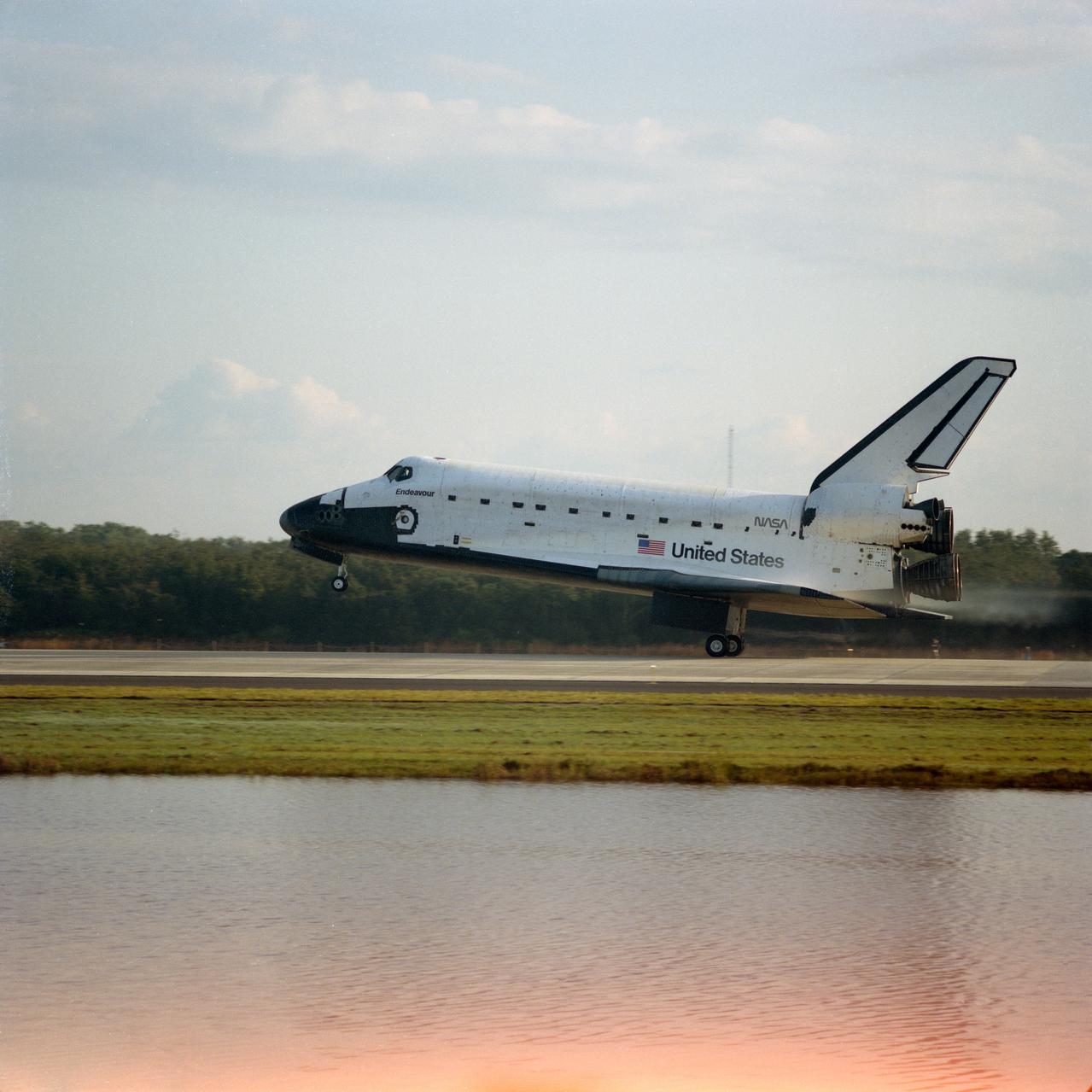
STS054-S-098 (19 Jan 1993) --- This ground-level side view shows the Space Shuttle Endeavour during main landing gear touchdown at KSC's Shuttle Landing Facility to successfully complete a six day Earth-orbital mission. Landing occurred at 8:38 a.m. (EST), Jan. 19, 1993. Onboard were astronauts John H. Casper, mission commander; Donald R. McMonagle, pilot; Gregory J. Harbaugh, Mario Runco Jr. and Susan J. Helms, mission specialists.
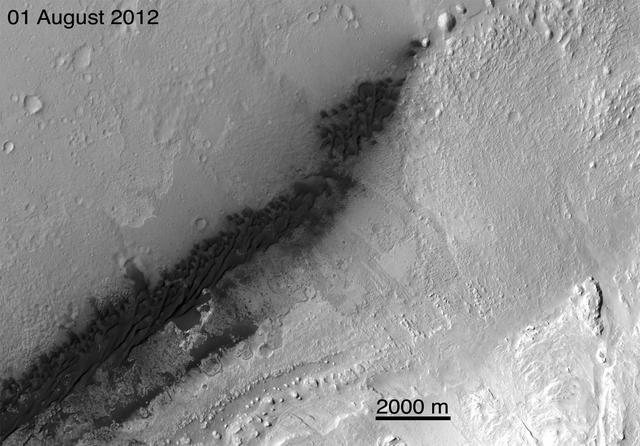
This image from an animation is from NASA Mars Reconnaissance Orbiter MRO showing the landing effects of the descent stage, the rover lander, the back shell and parachute, and the heat shield, all found on the left side of the image.

Engineers at NASA's Jet Propulsion Laboratory dropped this prototype to learn how a future Sample Return Lander could safely touch down on Mars. The lander would be part of the Mars Sample Return campaign. NASA's Mars Sample Return will revolutionize our understanding of Mars by returning scientifically-selected samples for study using the most sophisticated instruments around the world. The mission will fulfill a solar system exploration goal, a high priority since 1980 and the last two National Academy of Sciences Planetary Decadal Surveys. This strategic partnership of NASA and ESA (European Space Agency) will be the first mission to return samples from another planet, including the first launch and return from the surface of another planet. These samples collected by Perseverance during its exploration of an ancient river-delta are thought to be the best opportunity to reveal the early evolution of Mars, including the potential for life. Movie available at https://photojournal.jpl.nasa.gov/catalog/PIA24766

An illustration of NASA's Perseverance rover landing on Mars. Hundreds of critical events must execute perfectly and exactly on time for the rover to land safely on Feb. 18, 2021. https://photojournal.jpl.nasa.gov/catalog/PIA24342
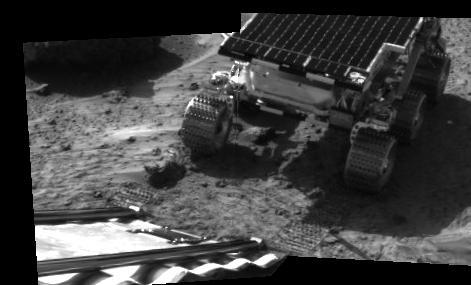
This picture taken by the IMP (Imager for Mars Pathfinder) aboard the Mars Pathfinder spacecraft depicts the rover Sojourner's position after driving onto the Martian surface. Sojourner has become the first autonomous robot ever to traverse the surface of Mars. This image reflects the success of Pathfinder's principle objective -- to place a payload on Mars in a safe, operational configuration. The primary mission of Sojourner, scheduled to last seven days, will be to use its Alpha Proton X-ray Spectrometer (APXS) instrument to determine the elements that make up the rocks and soil on Mars. A full study using the APXS takes approximately ten hours, and can measure all elements except hydrogen at any time of the Martian day or night. The APXS will conduct its studies by bombarding rocks and soil samples with alpha particle radiation -- charged particles equivalent to the nucleus of a helium atom, consisting of two protons and two neutrons. http://photojournal.jpl.nasa.gov/catalog/PIA00623
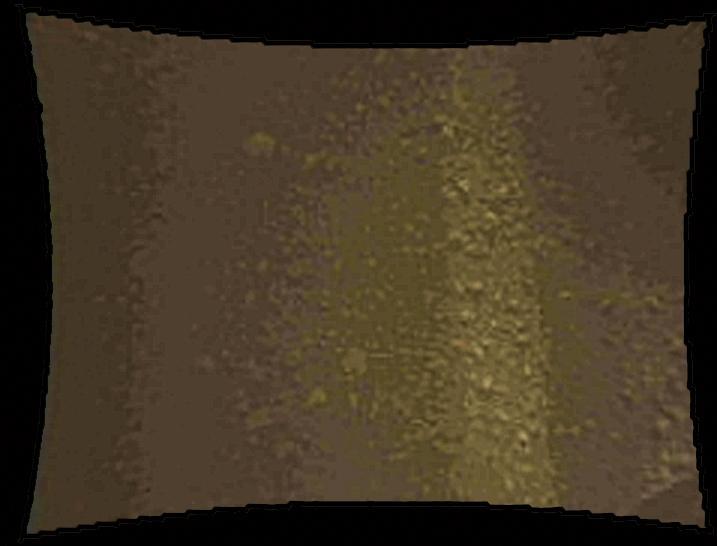
This color thumbnail image was obtained by NASA Curiosity rover and is representative of the images acquired once the Curiosity rover was resting on the surface of Mars after touchdown.
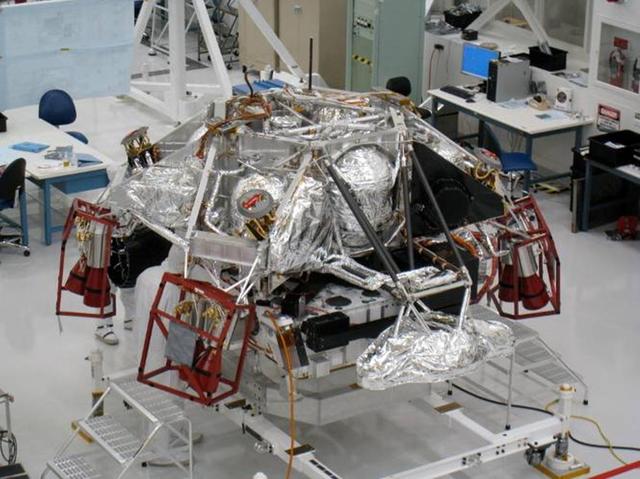
This portion of NASA Mars Science Laboratory, called the descent stage, does its main work during the final few minutes before touchdown on Mars.
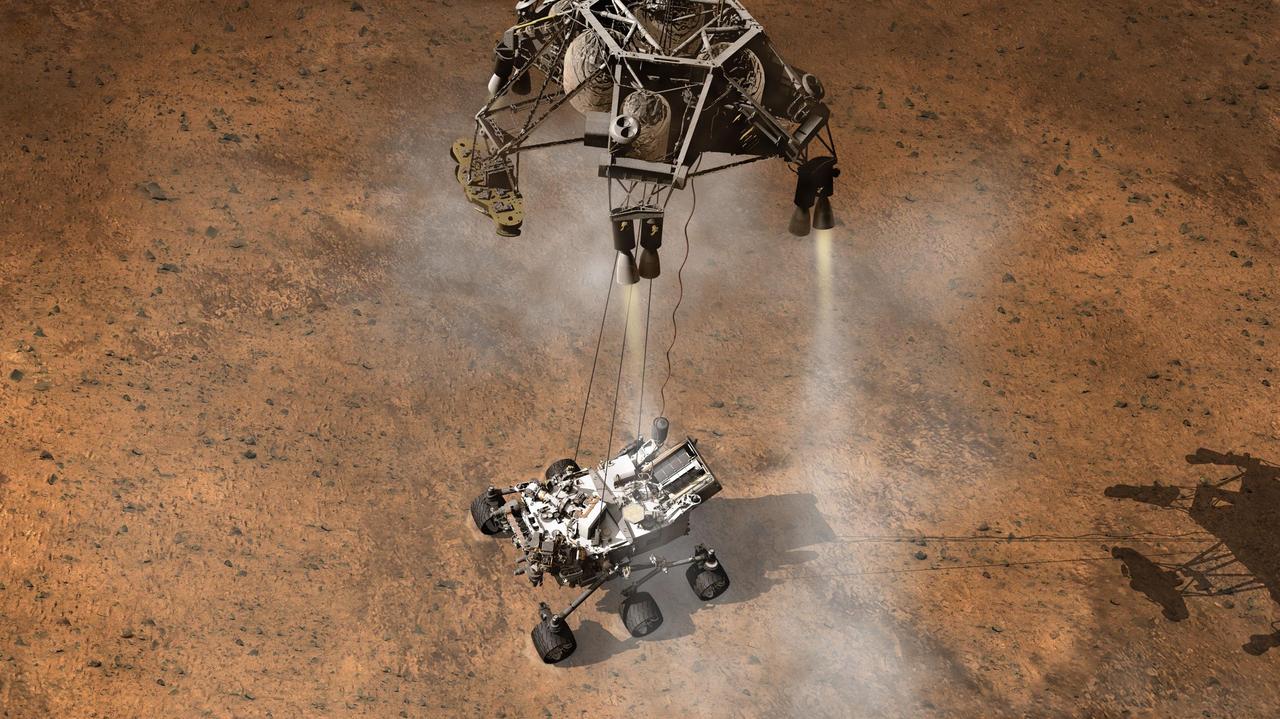
This artist concept depicts the moment that NASA Curiosity rover touches down onto the Martian surface. The Mars Science Laboratory will use the sky crane touchdown system.
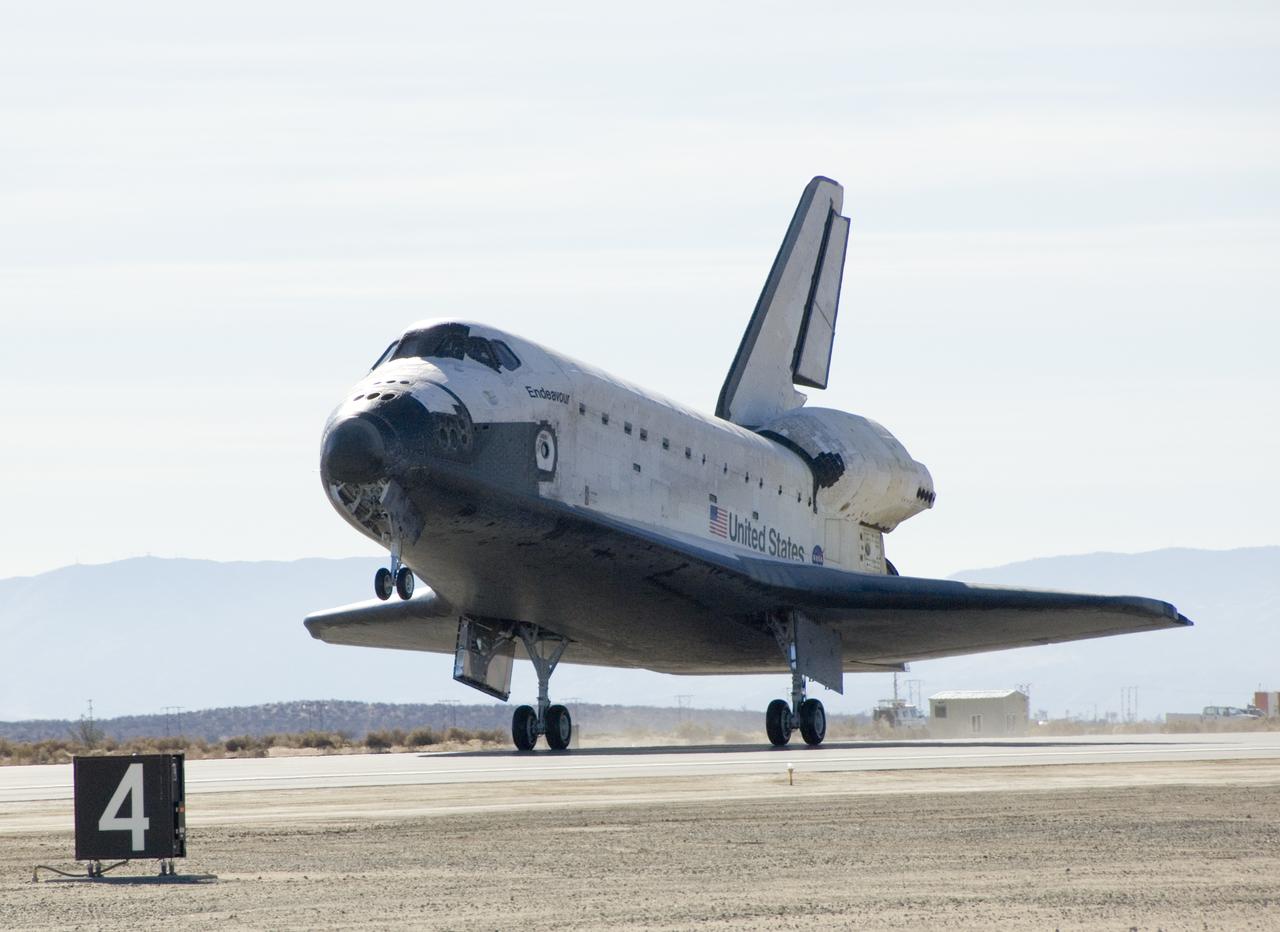
Space Shuttle Endeavour rolls out on runway 04-L at Edwards Air Force Base moments after touchdown, ending mission STS-126 to the International Space Station.

STS049-S-301 (16 May 1992) --- A three-quarter aft view of the Space Shuttle Endeavour making its first landing, following a successful nine-day mission in Earth orbit. Fully deployed here is the main chute in NASA's first exercise of its detailed test objective (DTO-521) on the drag chute system. Main gear touchdown occurred at 1:57:38 p.m. (PDT), May 16, 1992.
An illustration of NASA's Perseverance rover landing on Mars. Hundreds of critical events must execute perfectly and exactly on time for the rover to land safely on Feb. 18, 2021. https://photojournal.jpl.nasa.gov/catalog/PIA24345
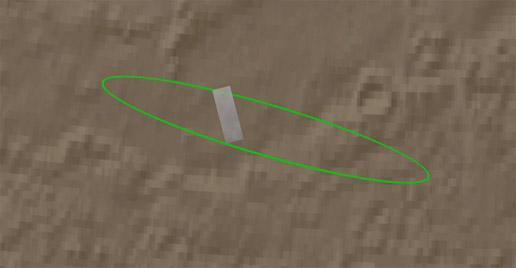
This animation zooms in on the area on Mars where NASA Phoenix Mars Lander will touchdown on May 25, 2008. The image was taken by the High Resolution Imaging Science Experiment HiRISE camera on NASA Mars Reconnaissance Orbiter.
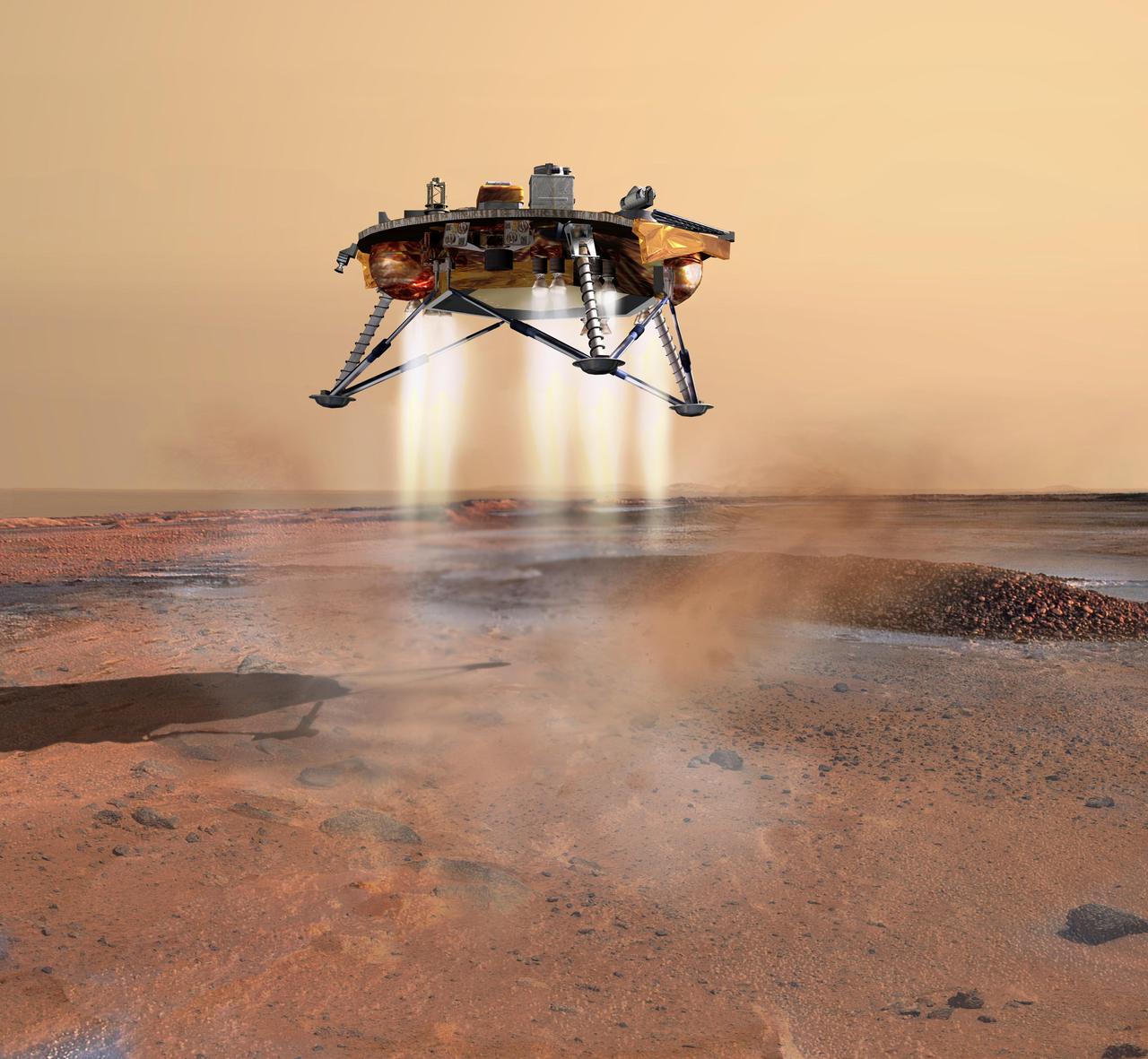
This artist concept depicts NASA Phoenix Mars Lander a moment before its 2008 touchdown on the arctic plains of Mars. Pulsed rocket engines control the spacecraft speed during the final seconds of descent.
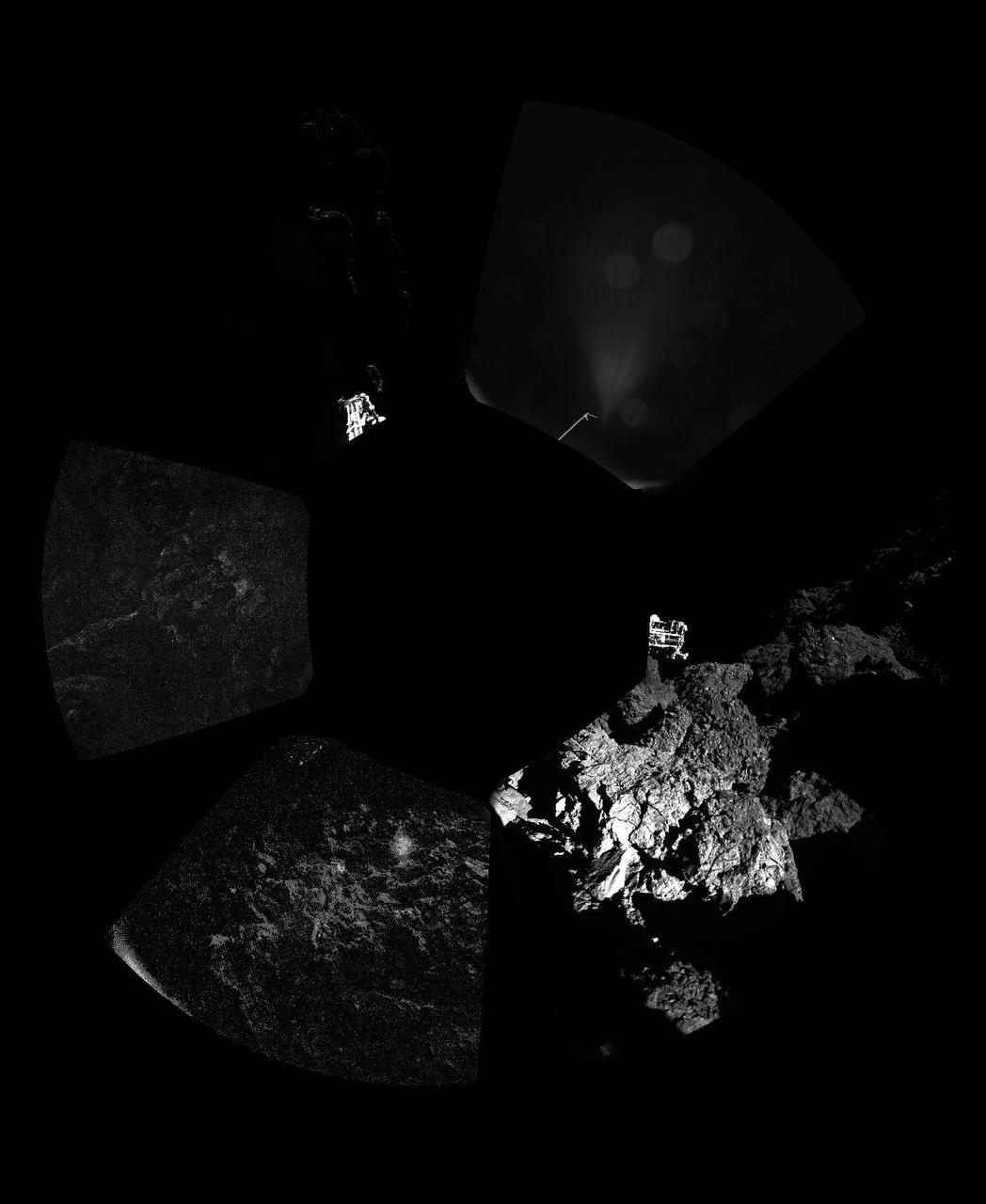
The Philae lander of Europe Rosetta mission has returned the first panoramic image from the surface of a comet. The unprocessed panorama from the lander CIVA-P camera shows a 360-degree view around the point of final touchdown.
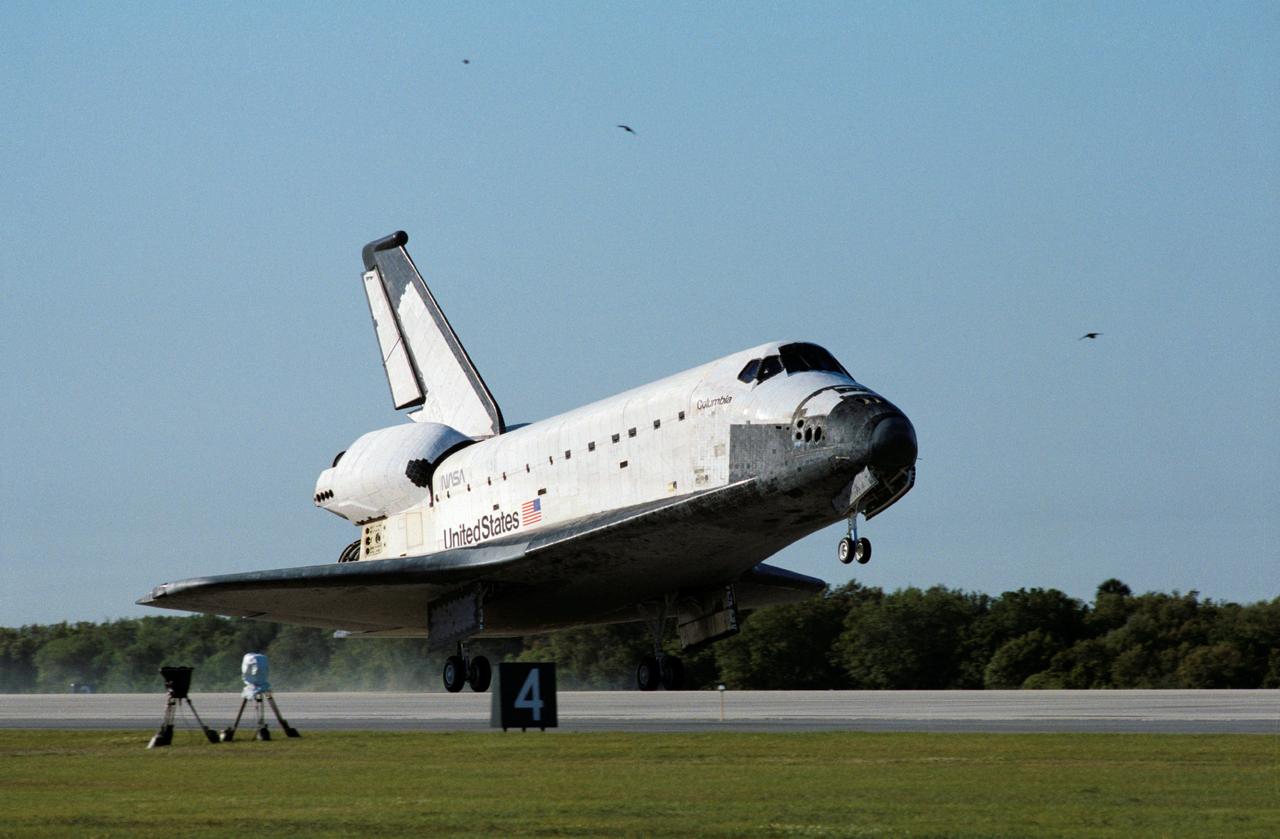
STS062-S-031 (18 March 1994) --- The main landing gear on the Space Shuttle Columbia touches down on the Shuttle Landing Facility at Kennedy Space Center (KSC). The scene followed almost 14-days in Earth-orbit for five NASA astronauts and a variety of experiments. Touch down occurred at 8:09 a.m. (EST), March 18, 1994. Thirteen days, 23 hours and 16 minutes were logged by the crew members -- astronauts John H. Casper, Andrew M. Allen, Marsha S. Ivins, Pierre J. Thuot and Charles D. (Sam) Gemar.
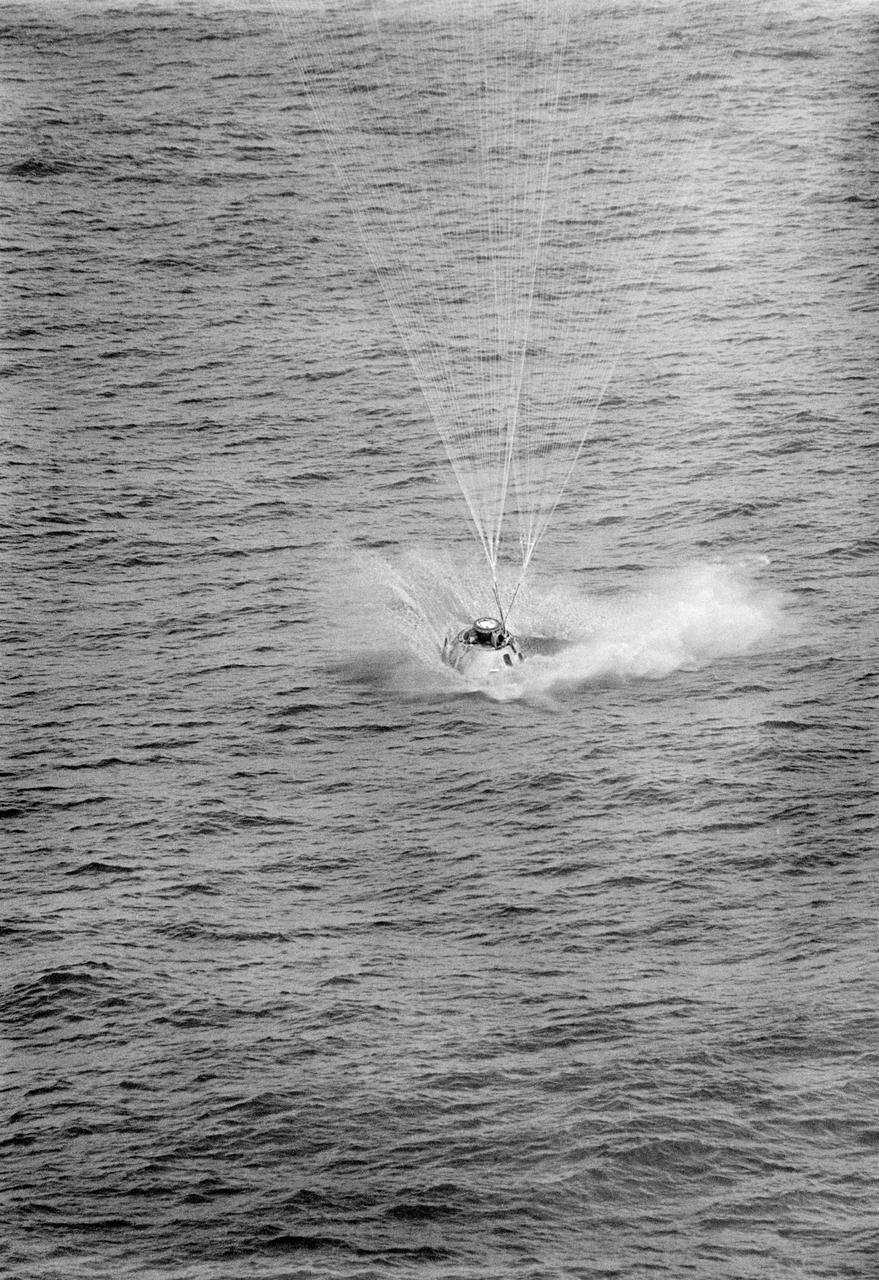
S69-27466 (13 March 1969) --- The Apollo 9 spacecraft, with astronauts James A. McDivitt, David R. Scott, and Russell L. Schweickart aboard, touches down in the Atlantic recovery area to conclude a successful 10-day Earth-orbital space mission. Splashdown occurred at 12:00:53 p.m. (EST), March 13, 1969, only 4.5 nautical miles from the prime recovery ship, USS Guadalcanal.
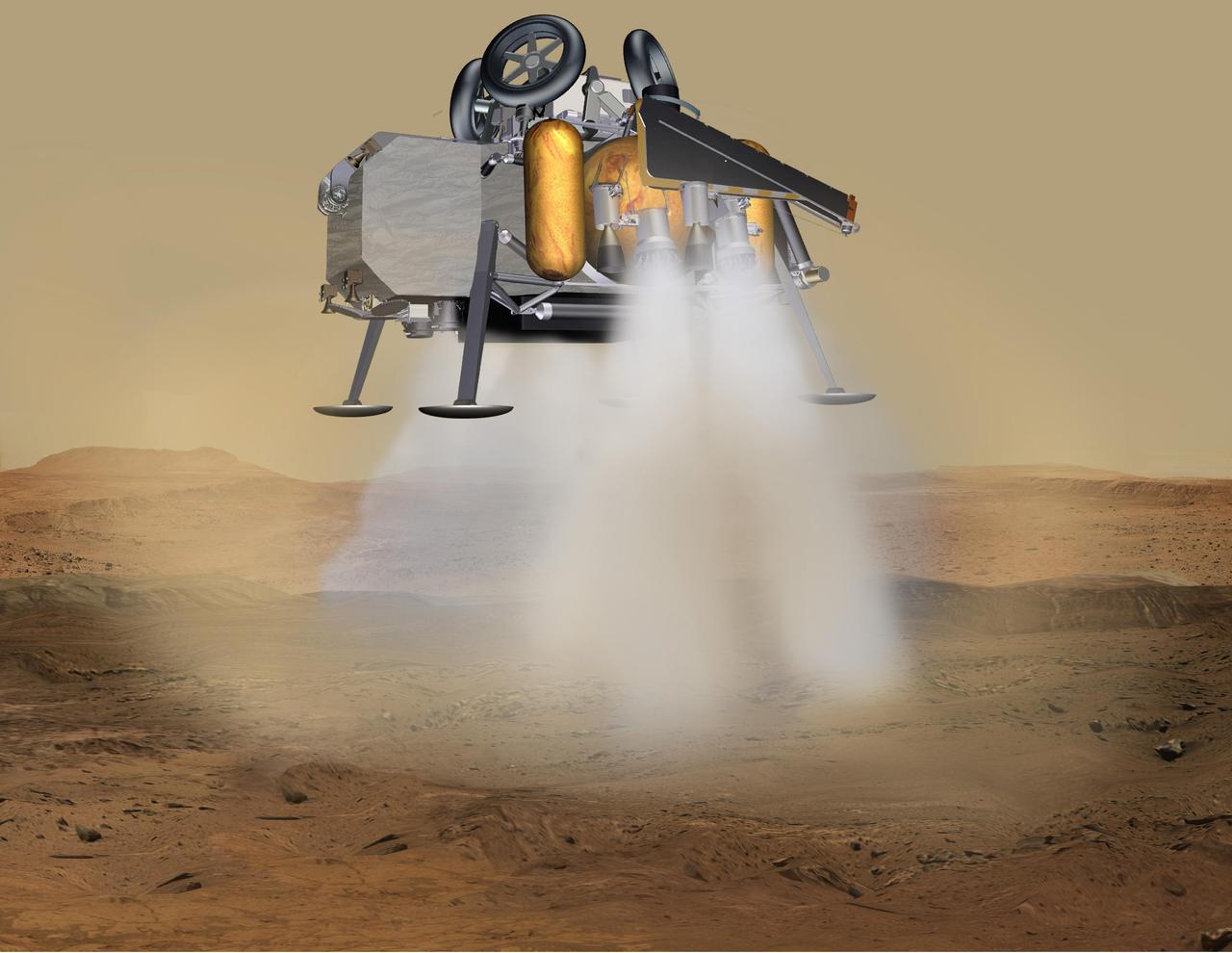
In this illustration of a Mars sample return mission concept, a lander carrying a fetch rover touches down on the surface of Mars. NASA and the European Space Agency (ESA) are solidifying concepts for a Mars sample return mission after NASA's Mars 2020 rover collects rock and soil samples, storing them in sealed tubes on the planet's surface for future return to Earth. NASA will deliver a Mars lander in the vicinity of Jezero Crater, where Mars 2020 will have collected and cached samples. The lander will carry a NASA rocket (the Mars Ascent Vehicle), along with ESA's Sample Fetch Rover that is roughly the size of NASA's Opportunity Mars rover. The fetch rover will gather the cached samples and carry them back to the lander for transfer to the ascent vehicle; additional samples could also be delivered directly by Mars 2020. The ascent vehicle will then launch a special container holding the samples into Mars orbit. ESA will put a spacecraft in orbit around Mars before the ascent vehicle launches. This spacecraft will rendezvous with and capture the orbiting samples before returning them to Earth. NASA will provide the payload module for the orbiter. https://photojournal.jpl.nasa.gov/catalog/PIA23494
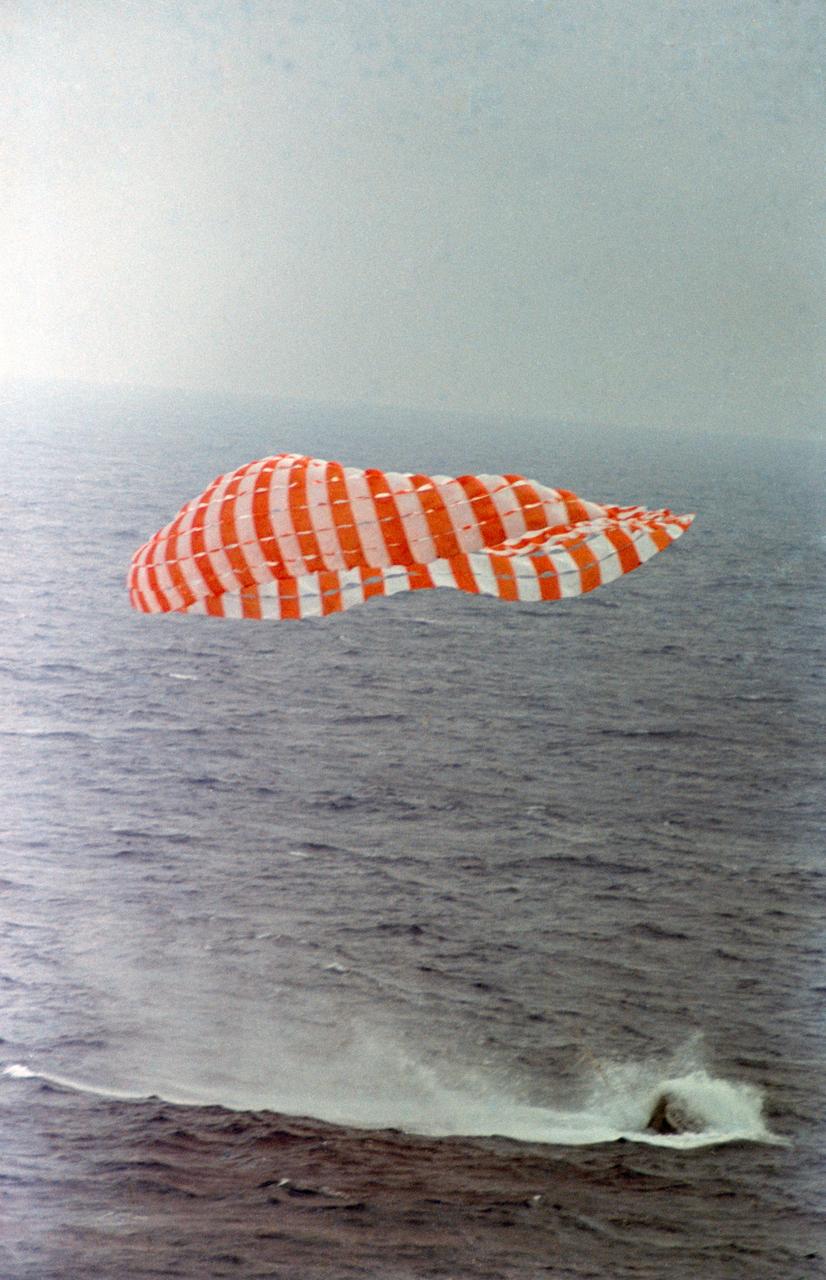
S66-34117 (6 June 1966) --- The 72-hour, 21-minute Gemini-9A spaceflight is concluded as the Gemini spacecraft, with astronaut Thomas P. Stafford and Eugene A. Cernan aboard, touches down in the Atlantic Ocean only 3.5 miles from the prime recovery ship, the aircraft carrier USS Wasp. Gemini-9 splashed down 345 miles east of Cape Kennedy at 9 a.m. (EST), June 6, 1966. Photo credit: NASA
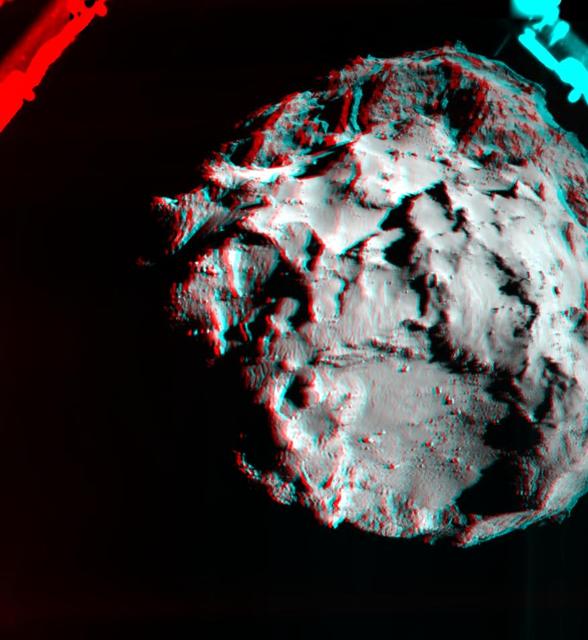
A 3D image shows what it would look like to fly over the surface of comet 67P/Churyumov-Gerasimenko. The image was generated by data collected by ESA Philae spacecraft during the decent to the spacecraft initial touchdown on the comet Nov. 12, 2014.
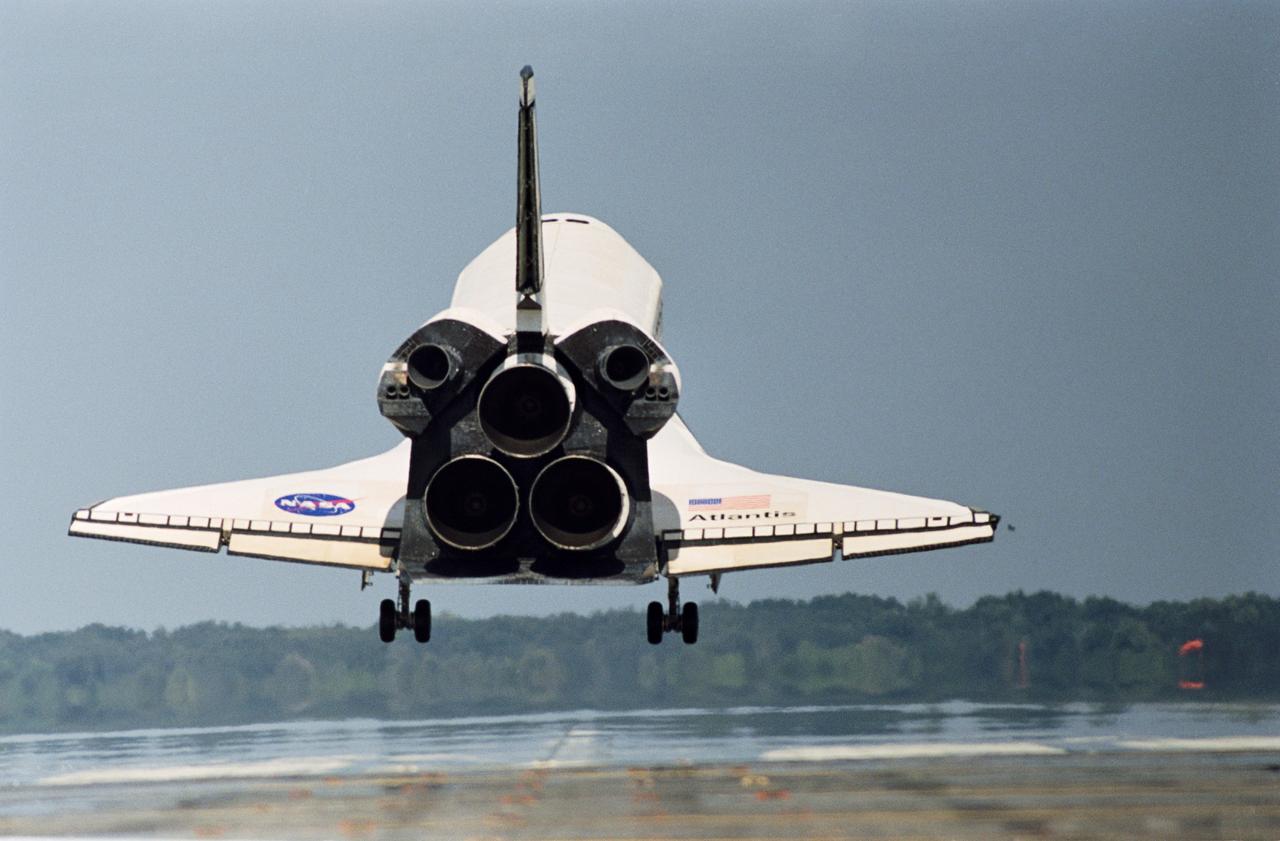
STS112-S-038 (18 October 2002) --- An aft view shows the Space Shuttle Atlantis just prior to touchdown of its main landing gear at the Shuttle Landing Facility. The touchdown completed the 4.5-million-mile STS-112 journey to the International Space Station. Main gear touchdown occurred at 11:43:40 a.m. EDT nose gear touchdown at 11:43:48 a.m.; and wheel stop at 11:44:35 a.m. Mission elapsed time was 10:19:58:44. Mission STS-112 expanded the size of the Station with the addition of the S1 truss segment. The returning crew of Atlantis are Jeffrey S. Ashby, commander; Pamela A. Melroy, pilot; and David A. Wolf, Piers J. Sellers, Sandra H. Magnus and Rosaviakosmos' Fyodor N. Yurchikhin, all mission specialists. This landing is the 60th at KSC in the 21-year history of the Shuttle program.
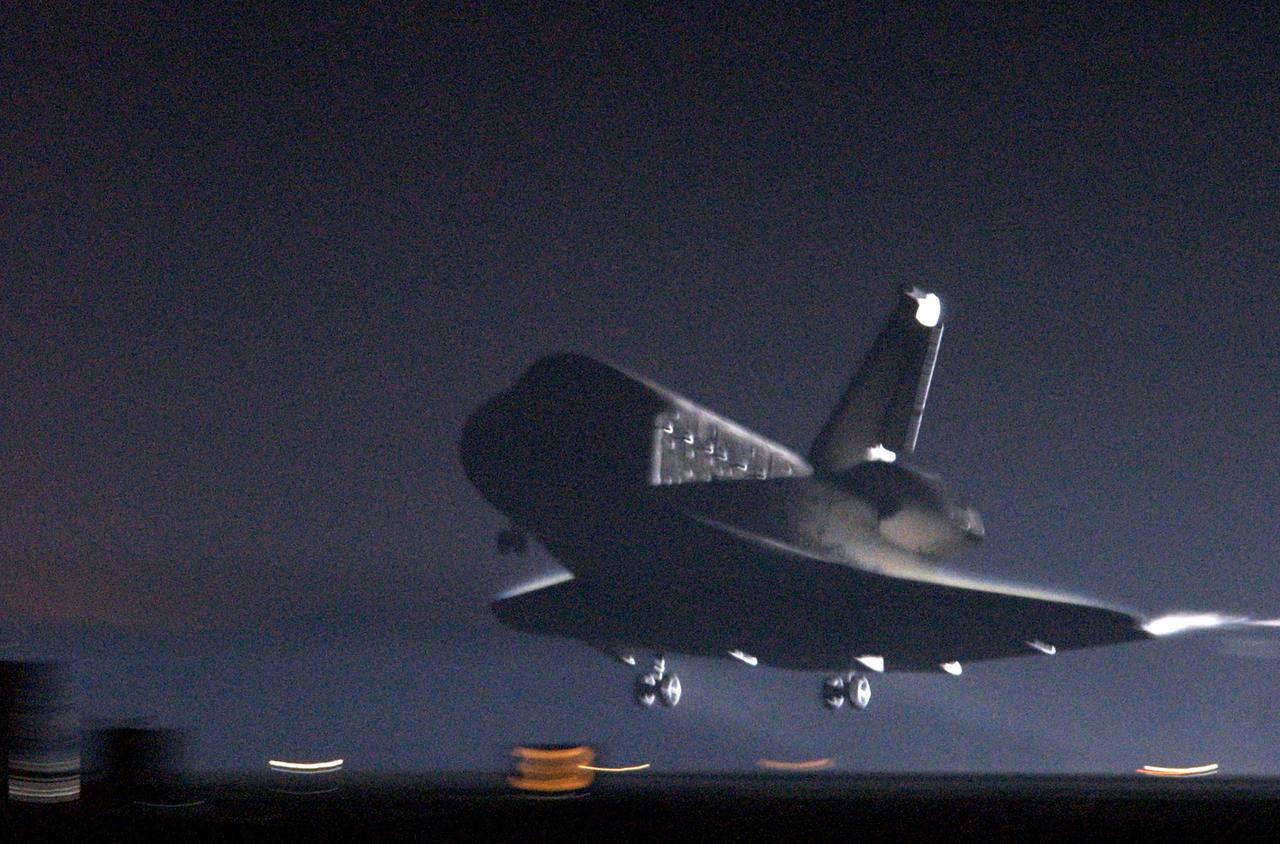
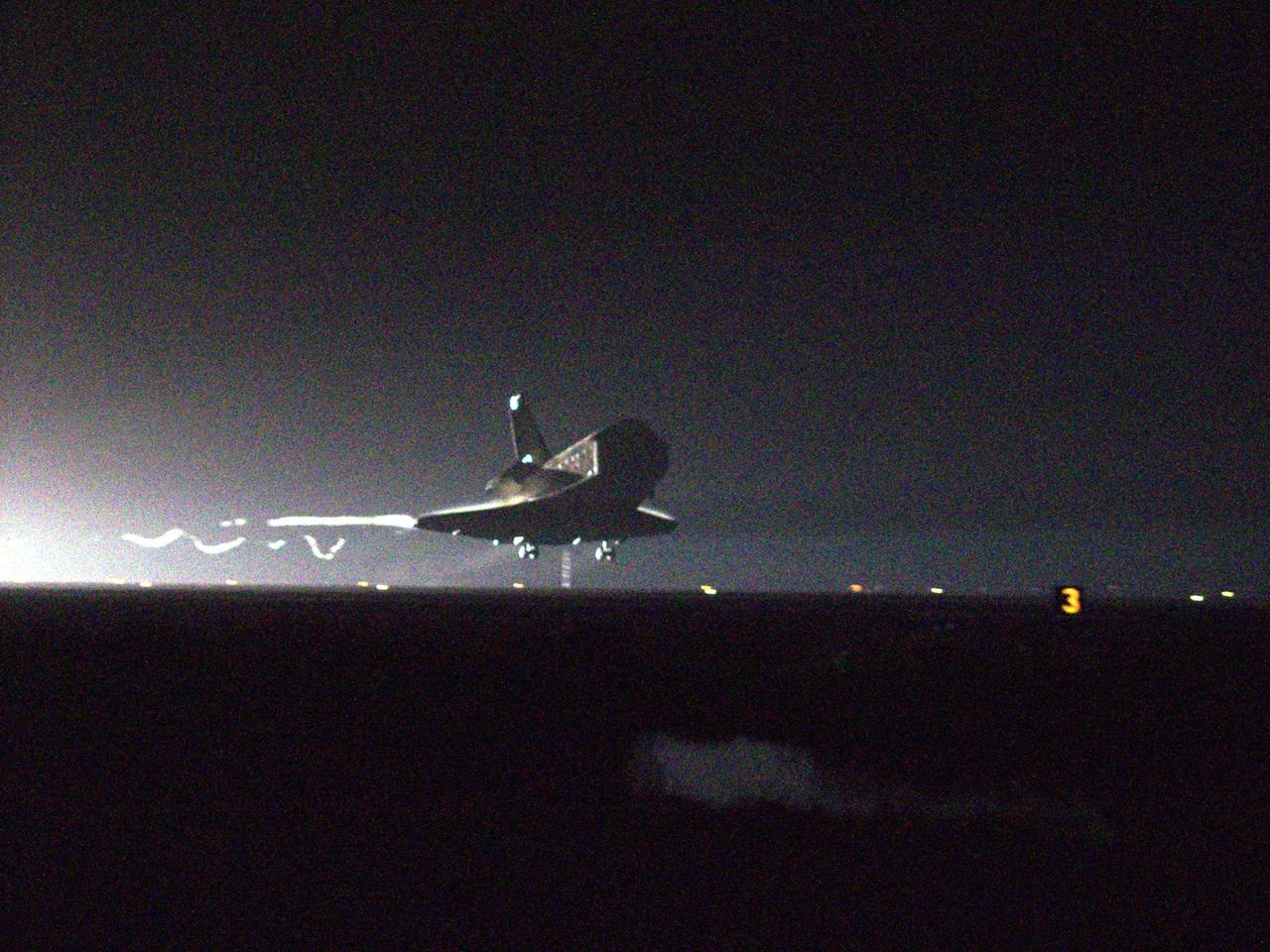
KENNEDY SPACE CENTER, FLA. -- Powerful xenon lights on the Shuttle Landing Facility outline the dark image of orbiter Columbia as it approaches touchdown on Runway 33. The landing completes mission STS-109 to service the Hubble Space Telescope, returning the crew of seven to Earth after a mission elapsed time of 10 days, 22 hours, 11 minutes. Wheel stop occurred on orbit 165 at 4:33:09 a.m. EST. Main gear touchdown occurred at 4:31:52 a.m. and nose wheel touchdown an 4:32:02. It was the 58th landing at KSC out of 108 missions in the history of the Shuttle program
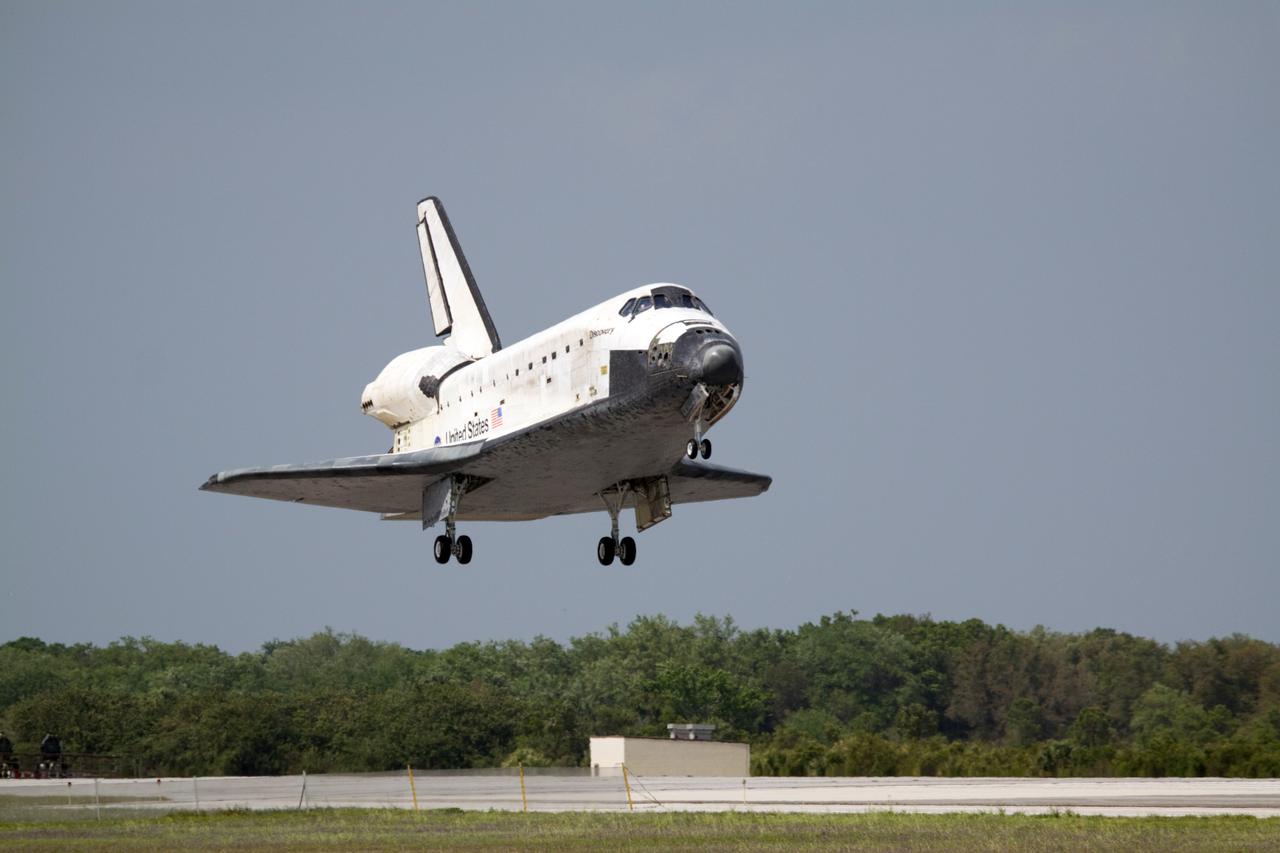
CAPE CANAVERAL, Fla. – Space shuttle Discovery nears touchdown on Runway 15 at NASA's Kennedy Space Center in Florida to complete the 13-day, 5.3-million mile journey on the STS-119 mission to the International Space Station. Main gear touchdown was at 3:13:17 p.m. EDT. Nose gear touchdown was at 3:13:40 p.m. and wheels stop was at 3:14:45 p.m. Discovery delivered the final pair of large power-generating solar array wings and the S6 truss segment. The mission was the 28th flight to the station, the 36th flight of Discovery and the 125th in the Space Shuttle Program, as well as the 70th landing at Kennedy. Photo credit: NASA/Kenny Allen
KENNEDY SPACE CENTER, FLA. -- Orbiter Columbia, with its crew of seven, approaches touchdown on Runway 33 of the KSC Shuttle Landing Facility, completing mission STS-109 to service the Hubble Space Telescope. Wheel stop occurred on orbit 165 at 4:33:09 a.m. EST with mission elapsed time of 10 days, 22 hours, 11 minutes. Main gear touchdown occurred at 4:31:52 a.m. and nose wheel touchdown an 4:32:02. It was the 58th landing at KSC out of 108 missions in the history of the Shuttle program
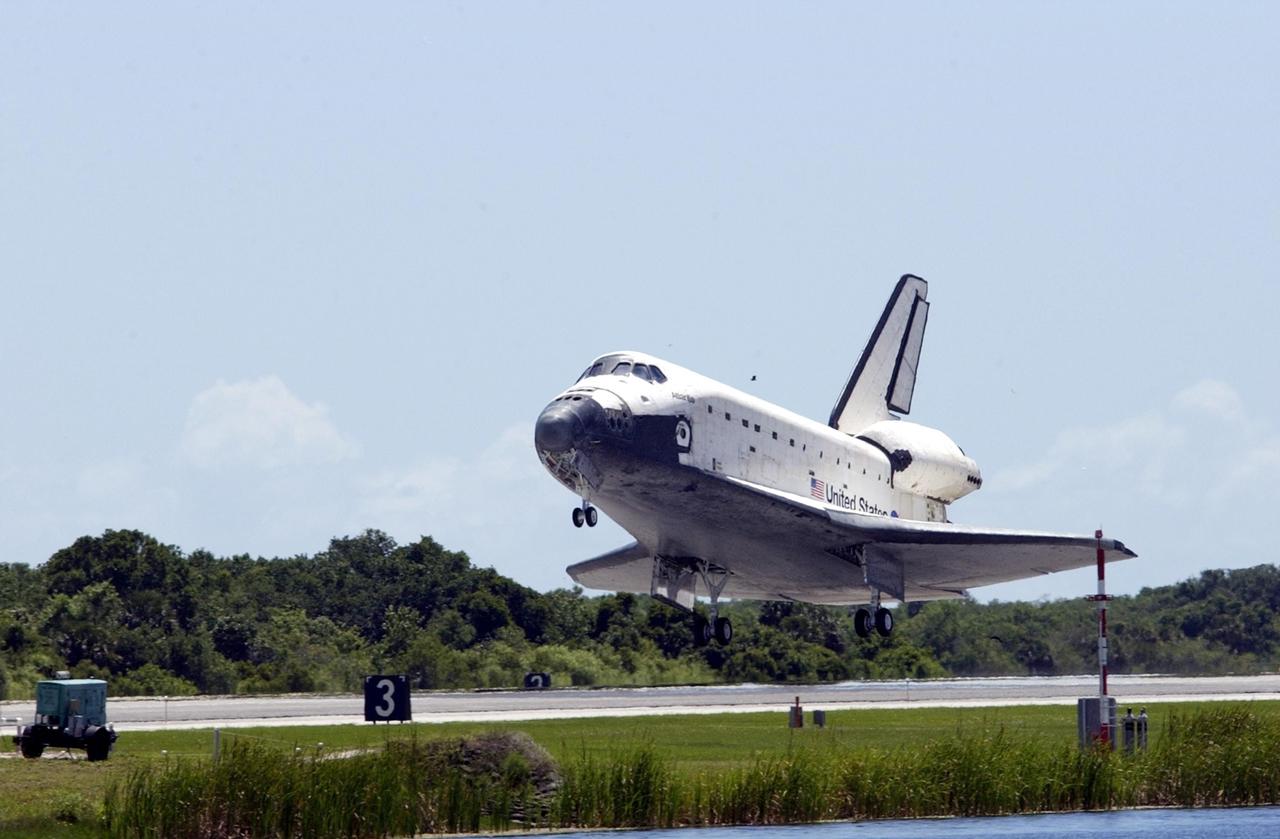
KENNEDY SPACE CENTER, FLA. - Atlantis nears touchdown on runway 33 after completing the 10-day, 19-hour, 4.5-million mile mission STS-110 to the International Space Station. The orbiter carries the returning crew Commander Michael Bloomfield, Pilot Stephen Frick and Mission Specialists Jerry Ross, Steven Smith, Ellen Ochoa, Lee Morin and Rex Walheim. Main gear touchdown was 12:26:57 p.m. EDT, nose gear touchdown was 12:27:09 p.m. and wheel stop was 12:28:07 p.m. The crew delivered and installed the S0 truss, which will support cooling and power systems essential for the addition of future international laboratories, on the Station
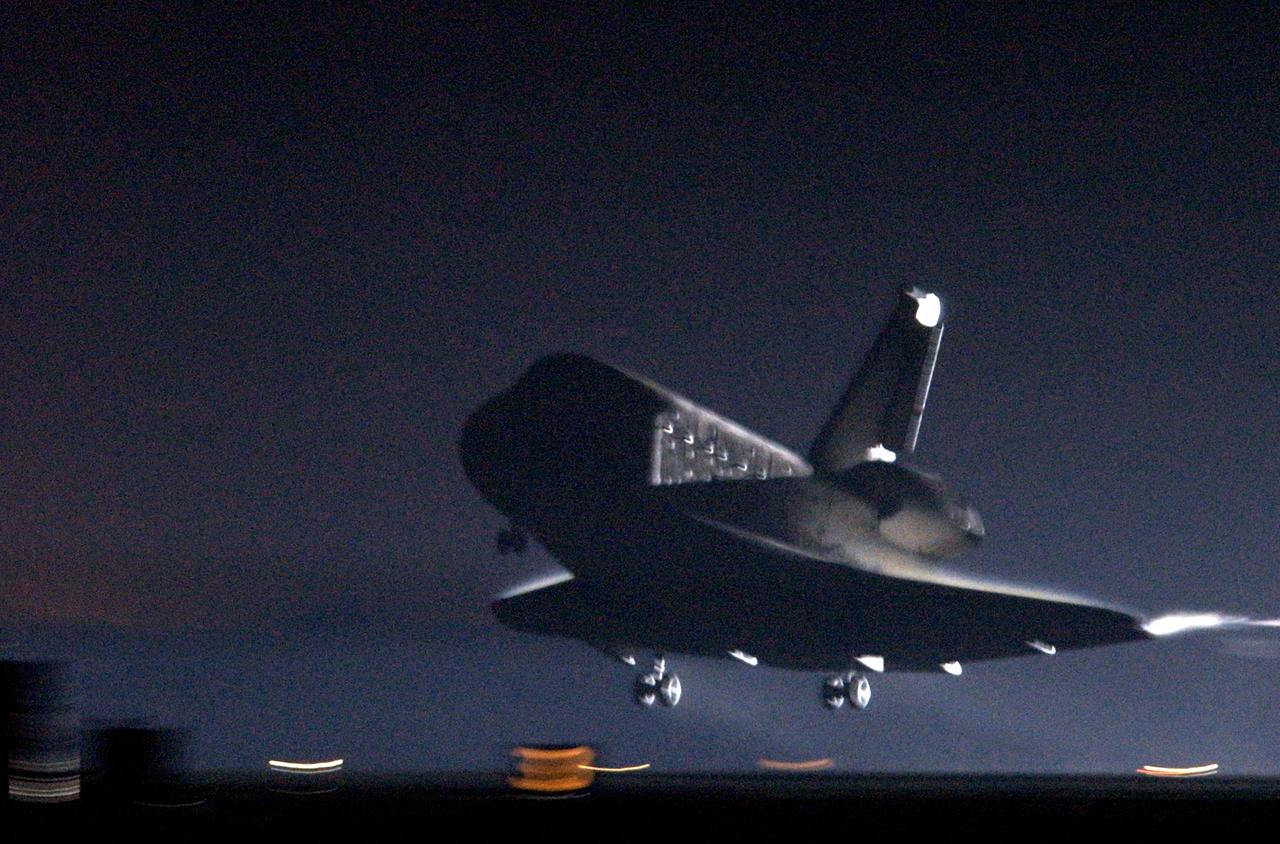
STS109-S-016 (12 March 2002)--- The Space Shuttle Columbia, with its crew of seven astronauts on board, approaches touchdown on Runway 33 of the KSC Shuttle Landing Facility, completing mission STS-109 to service the Hubble Space Telescope. Wheel stop occurred on orbit 165 at 4:33:09 a.m. EST with mission elapsed time of 10 days, 22 hours, 11 minutes. Main gear touchdown occurred at 4:31:52 a.m. and nose wheel touchdown an 4:32:02. It was the 58th landing at KSC out of 108 missions in the history of the Shuttle program.
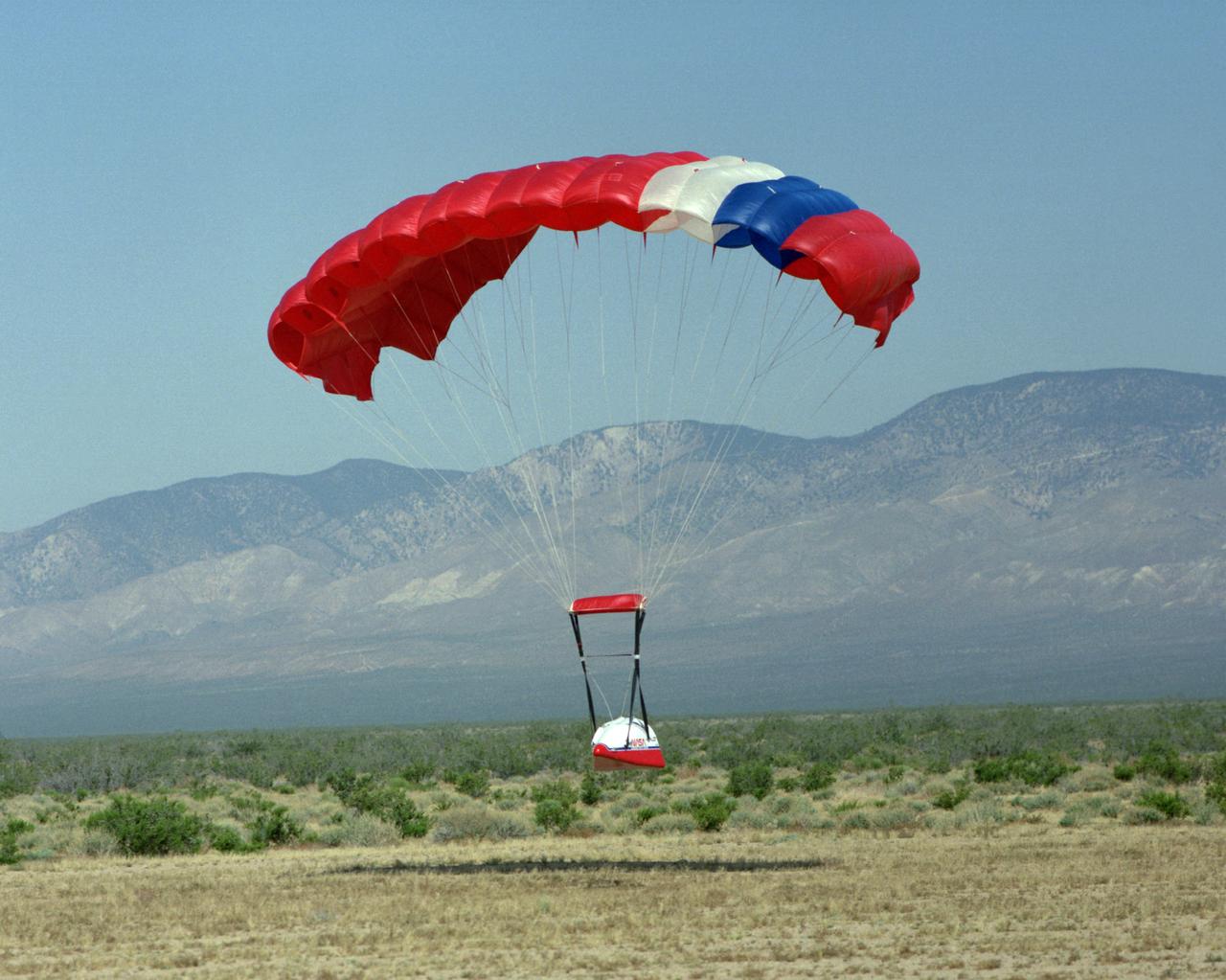
The Spacewedge subscale research model glides in toward a touchdown at a California City landing zone during 1992 flight tests of the vehicle.
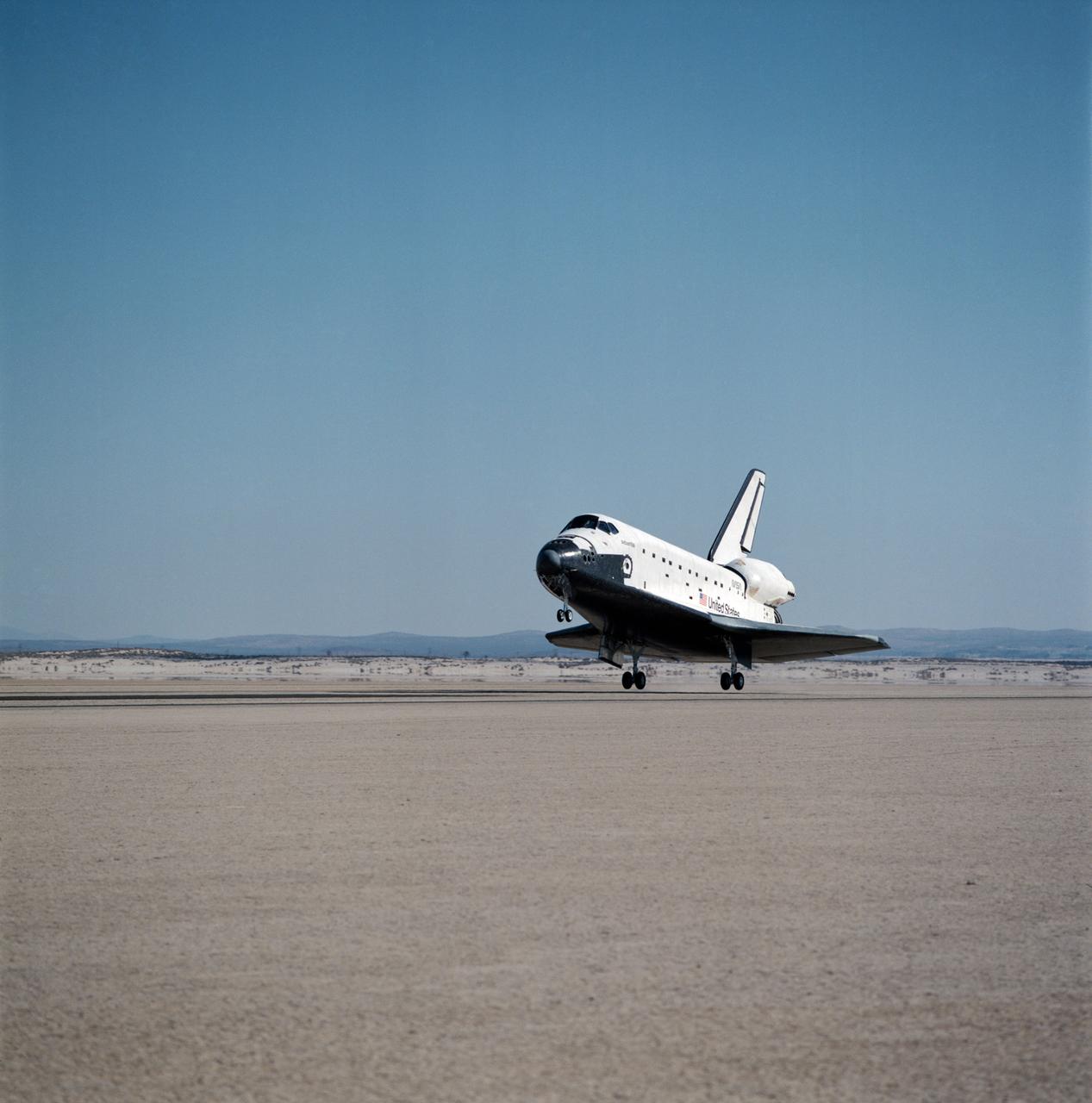
DFRF views of "Atlantis" Touchdown, Landing and Egress at the end of the STS-28/51J Mission, 10/07/1985.
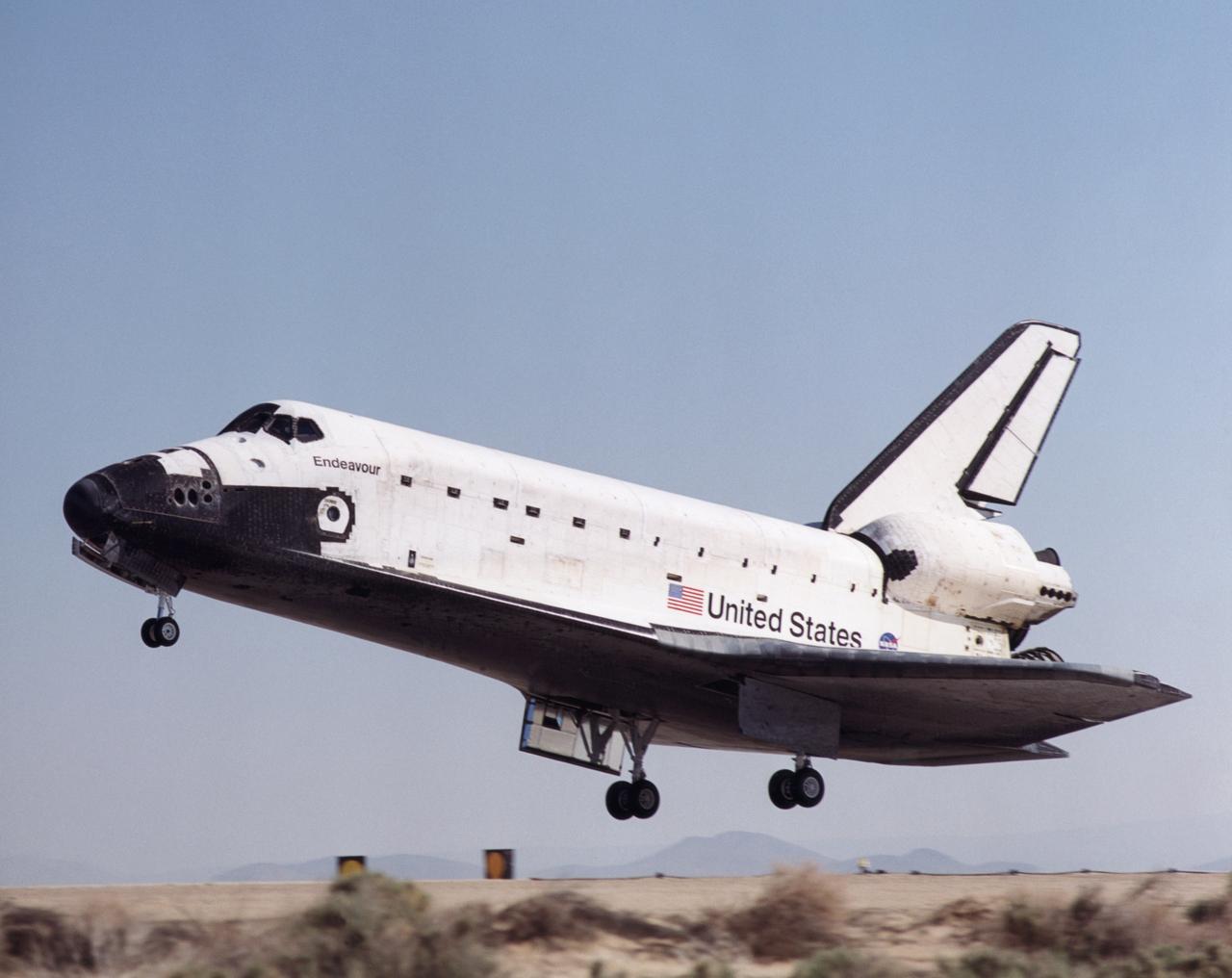
STS100-S-023 (1 May 2001) --- The space shuttle Endeavour is only seconds away from main gear touchdown on a desert runway at Edwards Air Force Base in California to complete the STS-100 mission. Touchdown occurred at 9:11 a.m. (PDT), May 1, 2001. Onboard the shuttle were six NASA astronauts and a cosmonaut representing Rosaviakosmos. Photo credit: NASA
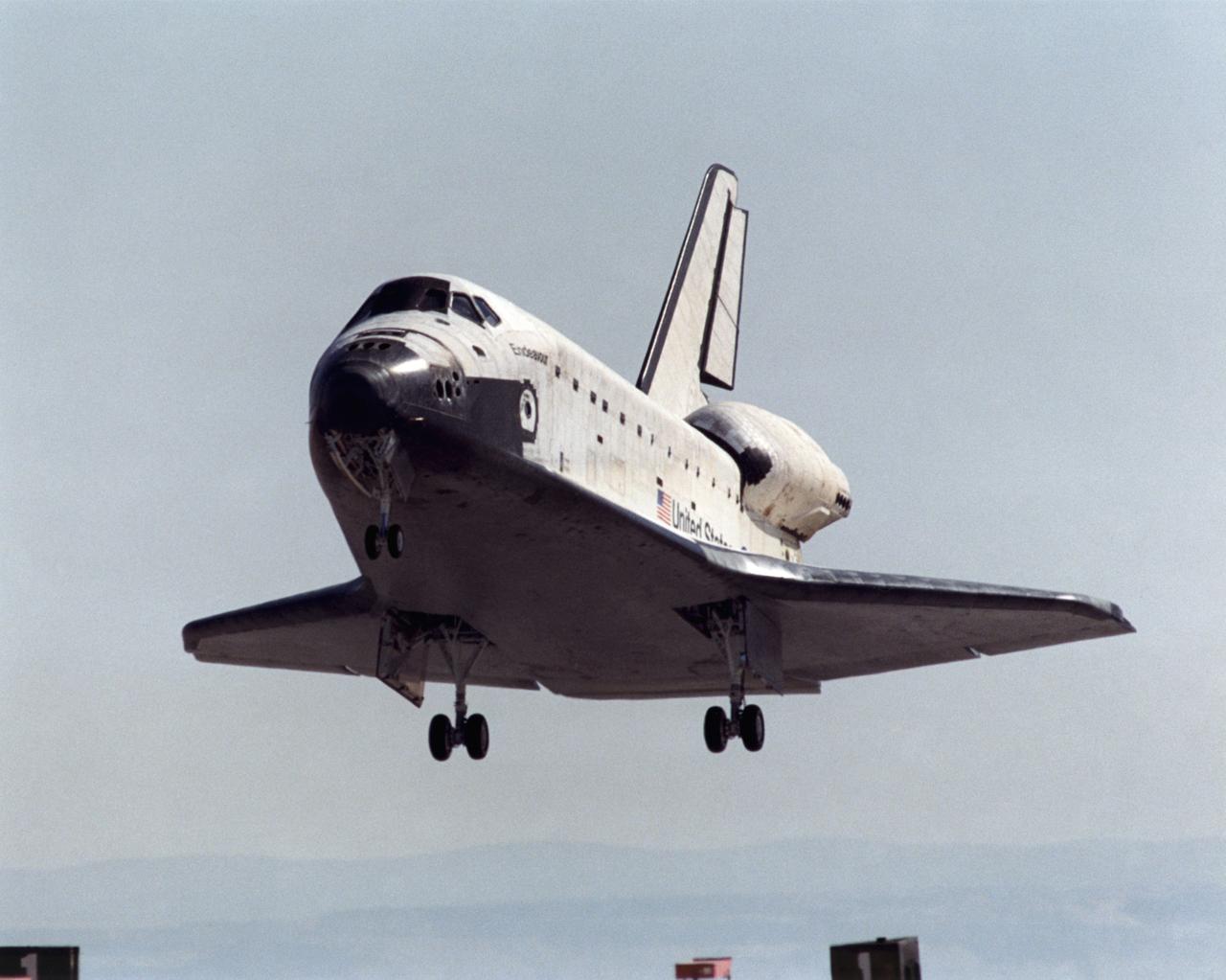
STS100-S-025 (1 May 2001) --- The space shuttle Endeavour is only seconds away from main gear touchdown on a desert runway at Edwards Air Force Base in California to complete the STS-100 mission. Touchdown occurred at 9:11 a.m. (PDT), May 1, 2001. Onboard the shuttle were six NASA astronauts and a cosmonaut representing Rosaviakosmos. Photo credit: NASA
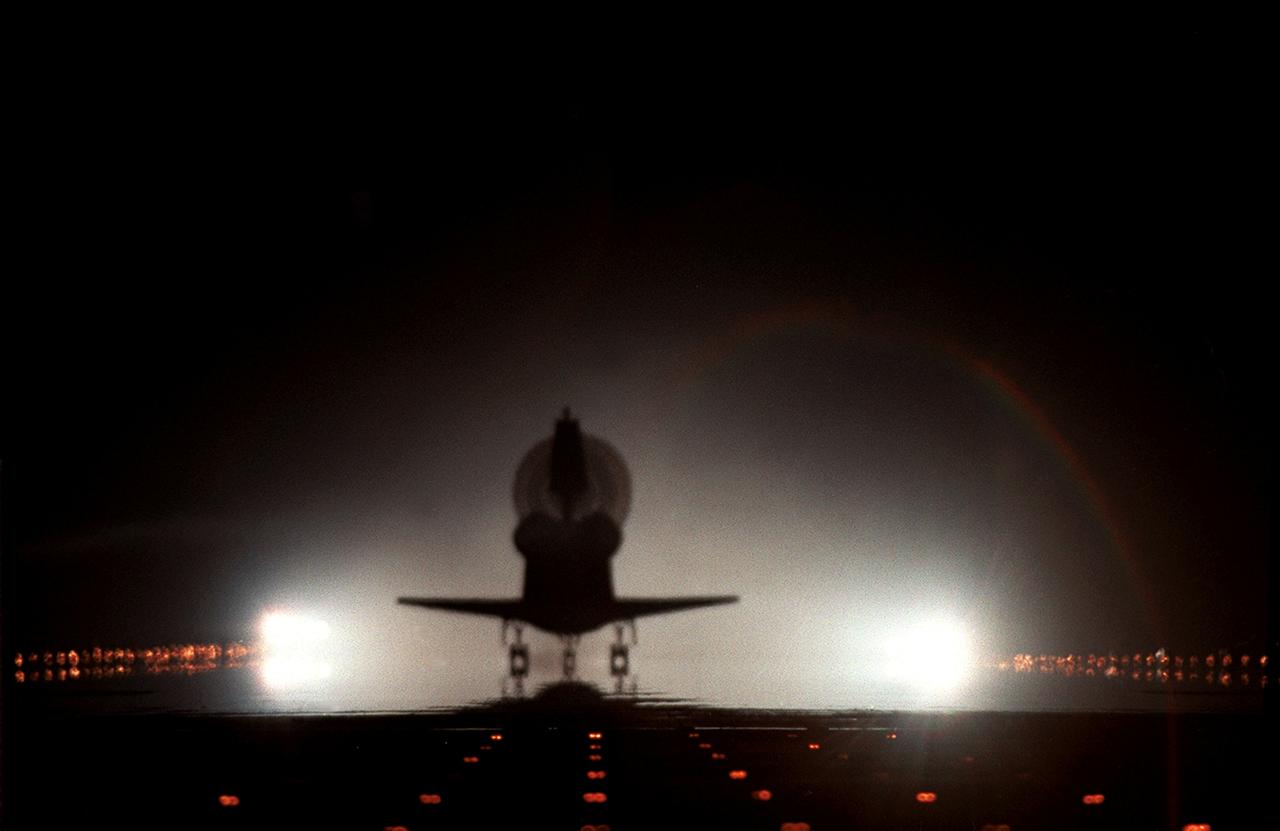
The Space Shuttle Columbia, with its crew of seven astronauts on board, touches down on Runway 33 of the KSC Shuttle Landing Facility, completing mission STS-109 to service the Hubble Space Telescope. Wheel stop occurred on orbit 165 at 4:33:09 a.m. EST with mission elapsed time of 10 days, 22 hours, 11 minutes. Main gear touchdown occurred at 4:31:52 a.m. and nose wheel touchdown an 4:32:02.
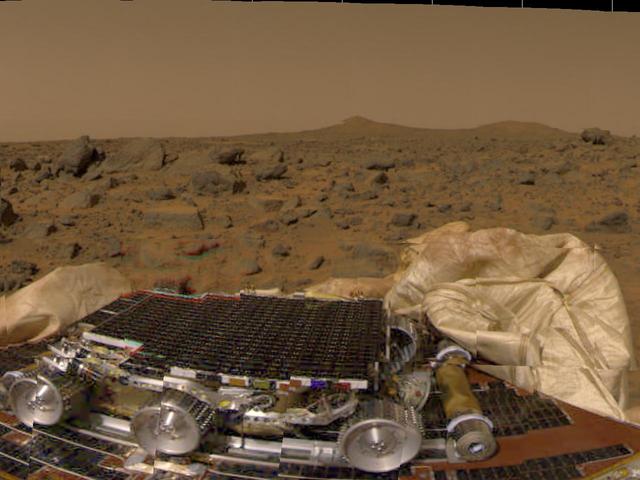
This is one of the first pictures taken by the camera on the Mars Pathfinder lander shortly after its touchdown at 10:07 AM Pacific Daylight Time on July 4, 1997. The small rover, named Sojourner, is seen in the foreground in its position on a solar panel of the lander. The white material on either side of the rover is part of the deflated airbag system used to absorb the shock of the landing. Between the rover and the horizon is the rock-strewn martian surface. Two hills are seen in the right distance, profiled against the light brown sky. http://photojournal.jpl.nasa.gov/catalog/PIA00611
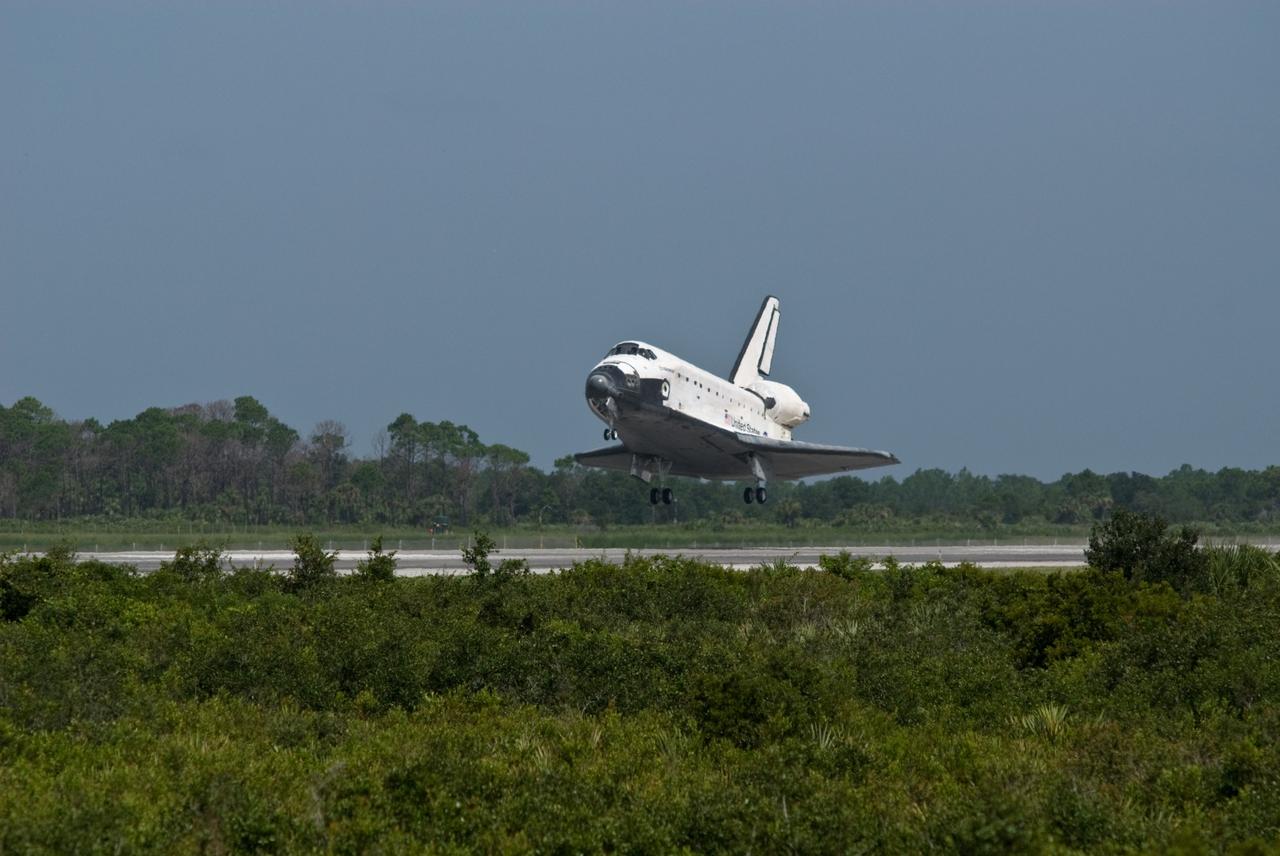
CAPE CANAVERAL, Fla. – Space shuttle Endeavour nears touchdown on Runway 15 at NASA's Kennedy Space Center in Florida to complete the 16-day, 6.5-million mile journey on the STS-127 mission to the International Space Station. Endeavour landed on orbit 248. Main gear touchdown was at 10:48:08 a.m. EDT. Nose gear touchdown was at 10:48:21 a.m. and wheels stop was at 10:49:13 a.m. Endeavour delivered the Japanese Experiment Module's Exposed Facility and the Experiment Logistics Module-Exposed Section to the International Space Station. The mission was the 29th flight to the station, the 23rd flight of Endeavour and the 127th in the Space Shuttle Program, as well as the 71st landing at Kennedy. Photo credit: NASA/Kevin O'Connell
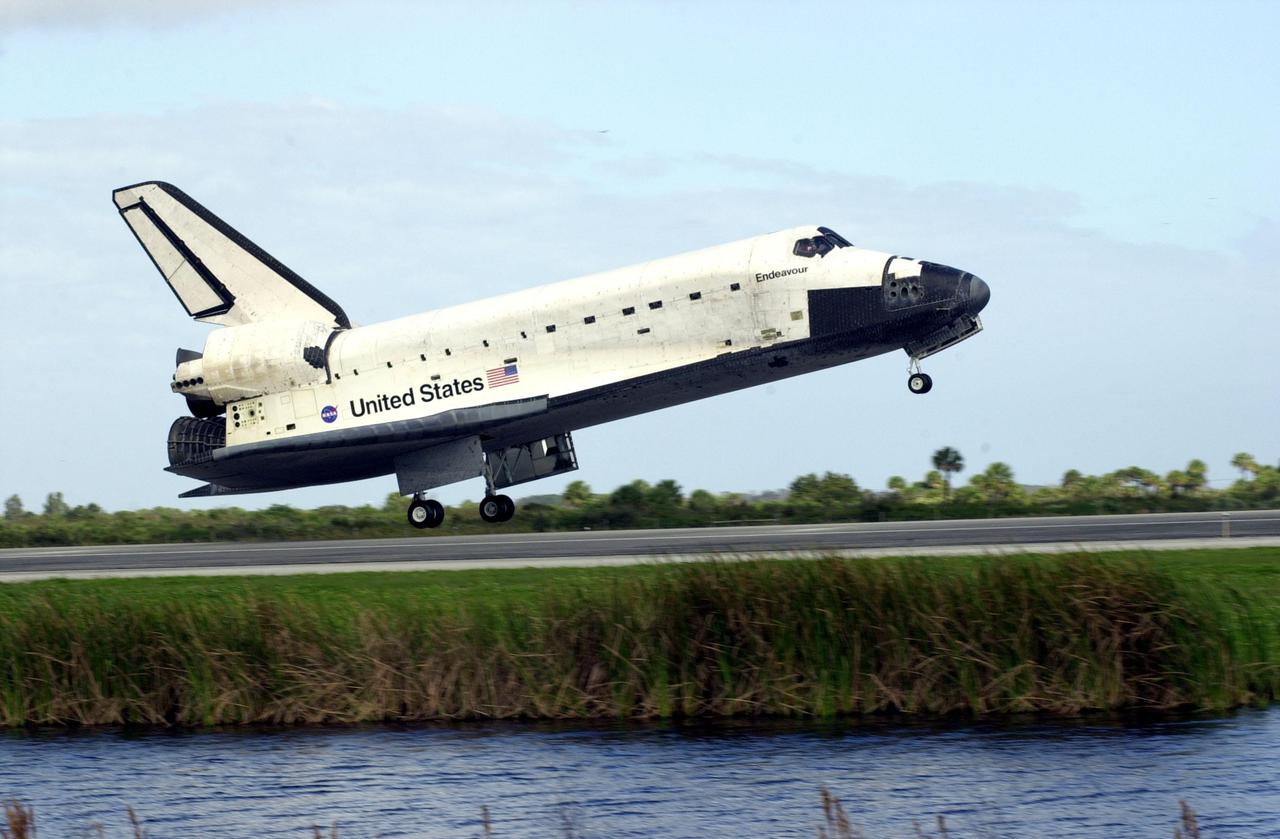
KENNEDY SPACE CENTER, FLA. -- Orbiter Endeavour approaches touchdown on Runway 15 at the KSC Shuttle Landing Facility, completing mission STS-108. After a mission-elapsed time of 11 days, 19 hours and 35 minutes, the landing is the 57th at KSC in the history of the program. Main gear touchdown occurred at 12:55:10 p.m. EST (17:55:10 GMT), nose gear touchdown at 12:55:23 p.m. (17:55:23 GMT) , wheel stop at 12:56:13 p.m. (17:56:13 GMT). STS-108 was the 12th mission to the International Space Station. This mission was the 107th flight in the Shuttle program and the 17th flight for the orbiter. Endeavour carries both the mission crew and the Expedition 3 crew - Commander Frank Culbertson and cosmonauts Vladimir Dezhurov and Mikhail Tyurin - who are returning to Earth after 129 days in space on the Space Station
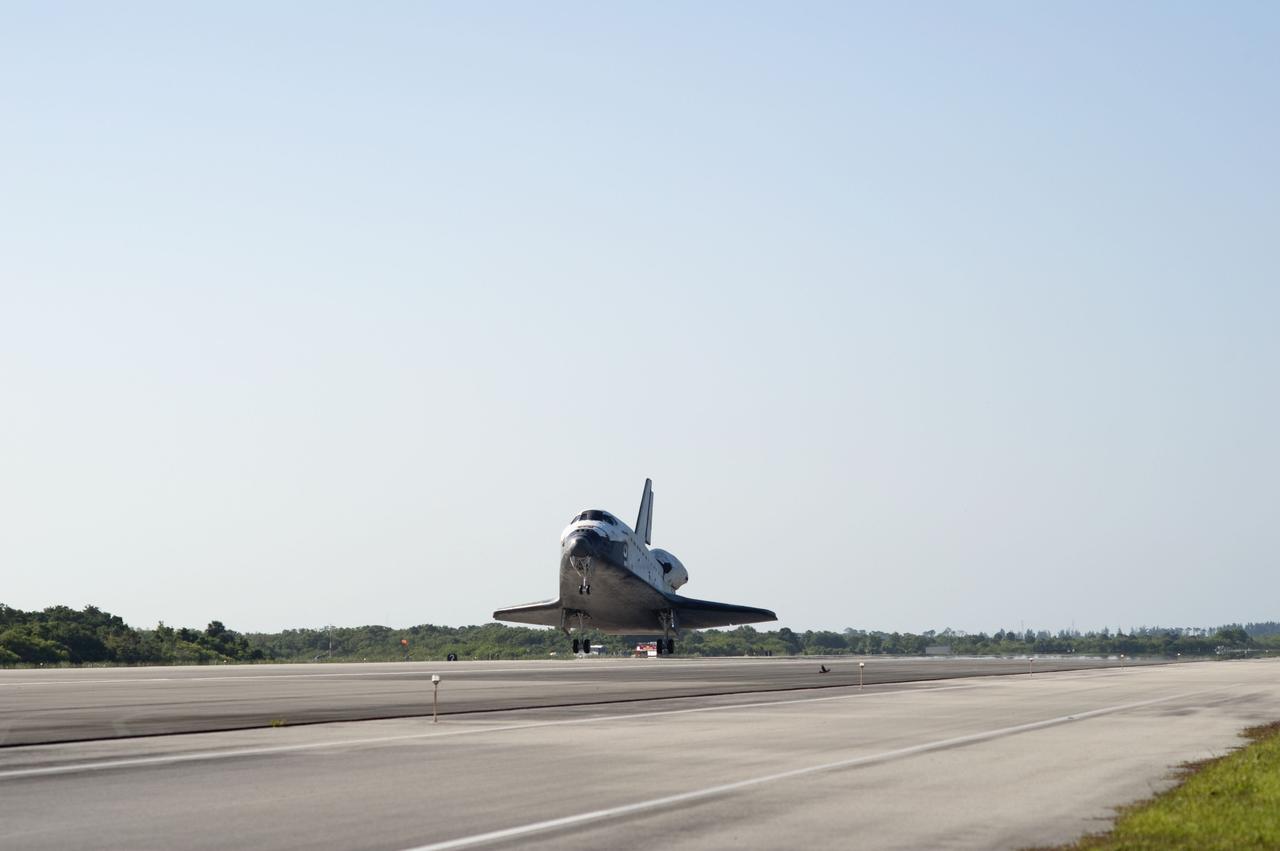
STS132-S-124 (26 May 2010) --- Space shuttle Atlantis nears touchdown on Runway 33 at the Shuttle Landing Facility at NASA's Kennedy Space Center in Florida. Landing was at 8:48 a.m. (EDT) on May 26, 2010, completing the 12-day STS-132 mission to the International Space Station. Main gear touchdown was at 8:48:11 a.m., followed by nose gear touchdown at 8:48:21 a.m. and wheelstop at 8:49:18 a.m. Onboard are NASA astronauts Ken Ham, commander; Tony Antonelli, pilot; Garrett Reisman, Michael Good, Steve Bowen and Piers Sellers, all mission specialists. The six-member STS-132 crew carried the Russian-built Mini Research Module 1 (MRM1) to the orbital complex. STS-132 is the 34th shuttle mission to the station, the 132nd shuttle mission overall and the last planned flight for Atlantis.
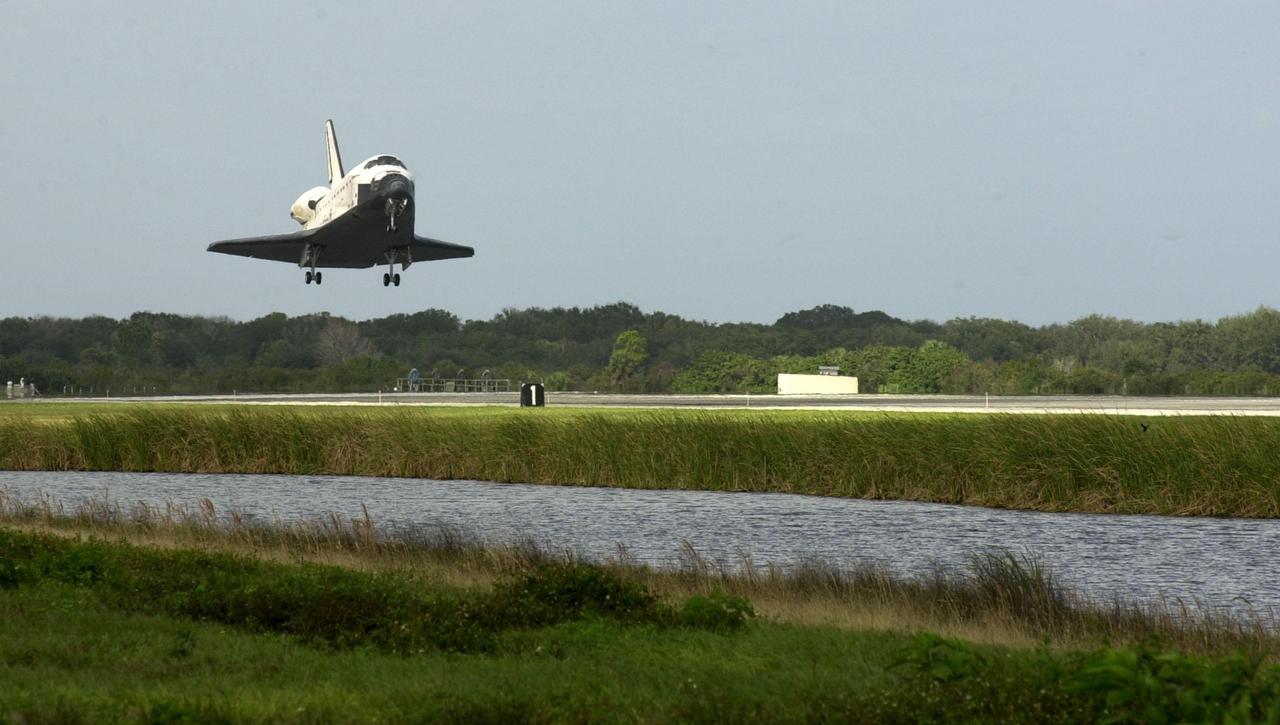
KENNEDY SPACE CENTER, FLA. -- Orbiter Endeavour glides toward touchdown on Runway 15 at the KSC Shuttle Landing Facility, completing mission STS-108. After a mission-elapsed time of 11 days, 19 hours and 35 minutes, the landing is the 57th at KSC in the history of the program. Main gear touchdown occurred at 12:55:10 p.m. EST (17:55:10 GMT), nose gear touchdown at 12:55:23 p.m. (17:55:23 GMT) , wheel stop at 12:56:13 p.m. (17:56:13 GMT). STS-108 was the 12th mission to the International Space Station. This mission was the 107th flight in the Shuttle program and the 17th flight for the orbiter. Endeavour carries both the mission crew and the Expedition 3 crew - Commander Frank Culbertson and cosmonauts Vladimir Dezhurov and Mikhail Tyurin - who are returning to Earth after 129 days in space on the Space Station
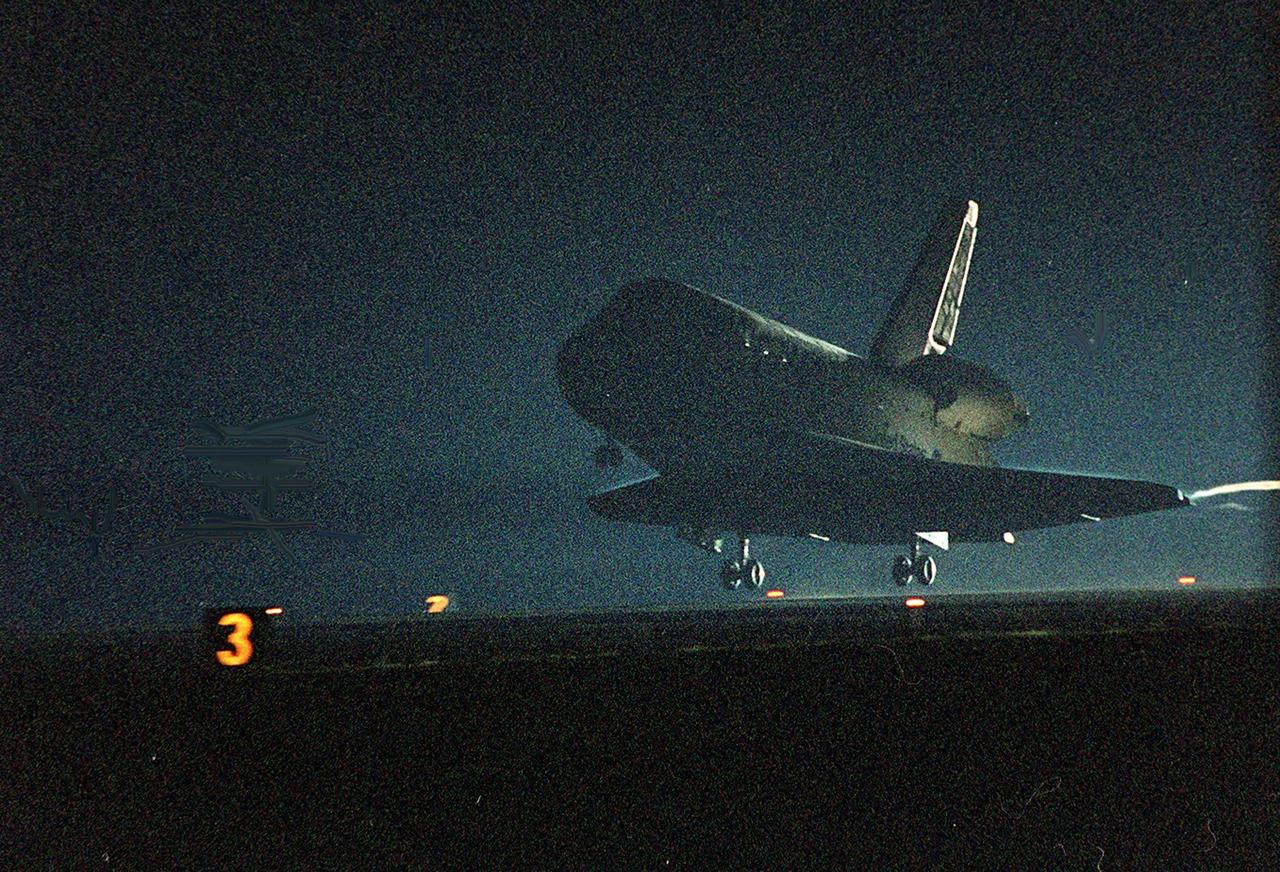
KENNEDY SPACE CENTER, Fla. -- Space Shuttle Discovery approaches touchdown on runway 15 at the KSC Shuttle Landing Facility. Main gear touchdown occurred about 2:31:42 a.m. EST, nose wheel touchdown at 2:31:54 a.m., and wheel stop at 2:33:06 a.m. The landing, on orbit 201, concluded mission STS-102, the eighth flight to the International Space Station, carrying the first Multi-Purpose Logistics Module Leonardo, to the ISS and Expedition Two, a replacement crew for the Station. The 12-day, 19-hour, 51-minute mission returned both the Leonardo and the first resident crew of the ISS, Expedition One, to KSC. Discovery logged 5.3 million miles on this mission. The landing marked the 54th at KSC in the history of the program, and the 12th night landing at KSC
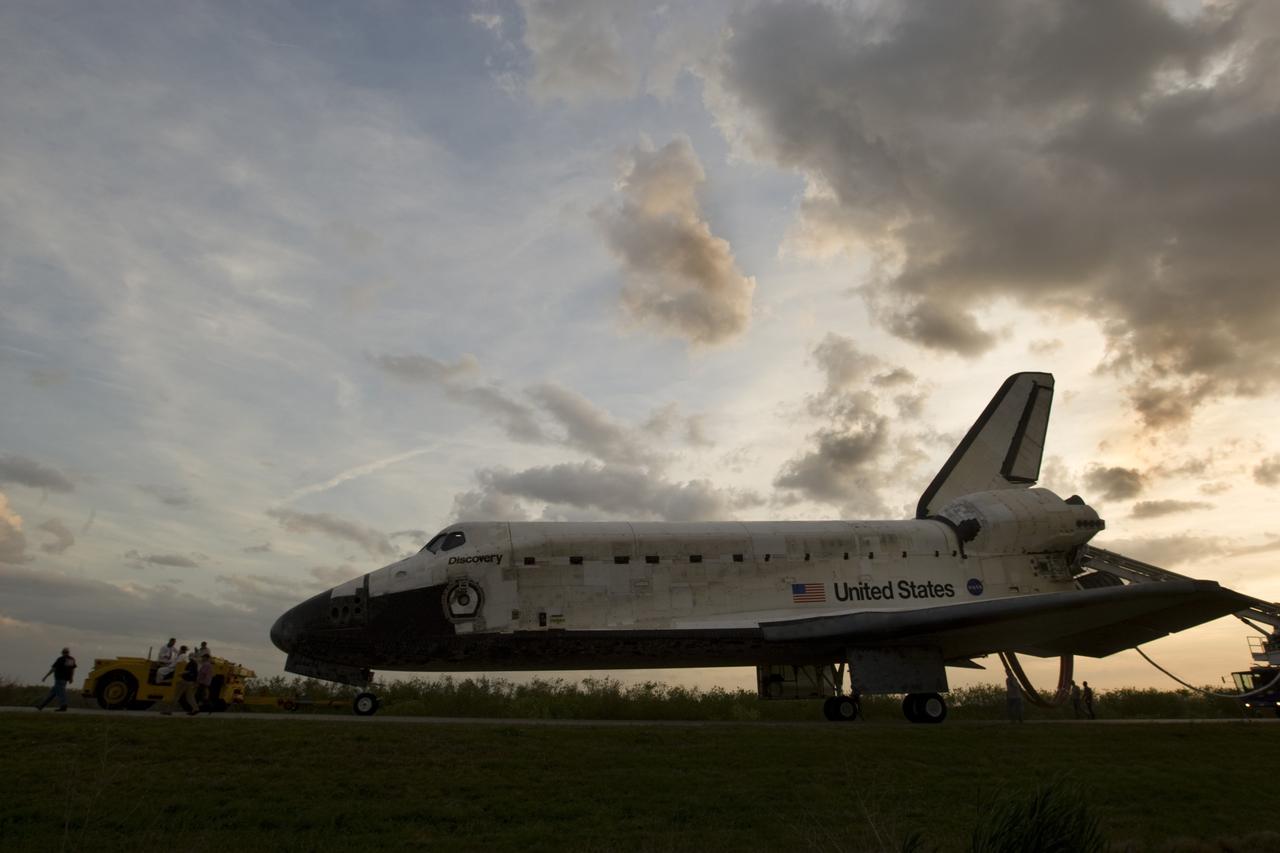
CAPE CANAVERAL, Fla. – Space shuttle Discovery is towed to Orbiter Processing Facility-3 following touchdown on Runway 15 at NASA's Kennedy Space Center in Florida to complete the 13-day, 5.3-million mile journey of the STS-119 mission to the International Space Station. Main gear touchdown was at 3:13:17 p.m. EDT. Nose gear touchdown was at 3:13:40 p.m. and wheels stop was at 3:14:45 p.m. Discovery delivered the final pair of large power-generating solar array wings and the S6 truss segment. The mission was the 28th flight to the station, the 36th flight of Discovery and the 125th in the Space Shuttle Program, as well as the 70th landing at Kennedy. Photo courtesy of Scott Andrews, Canon
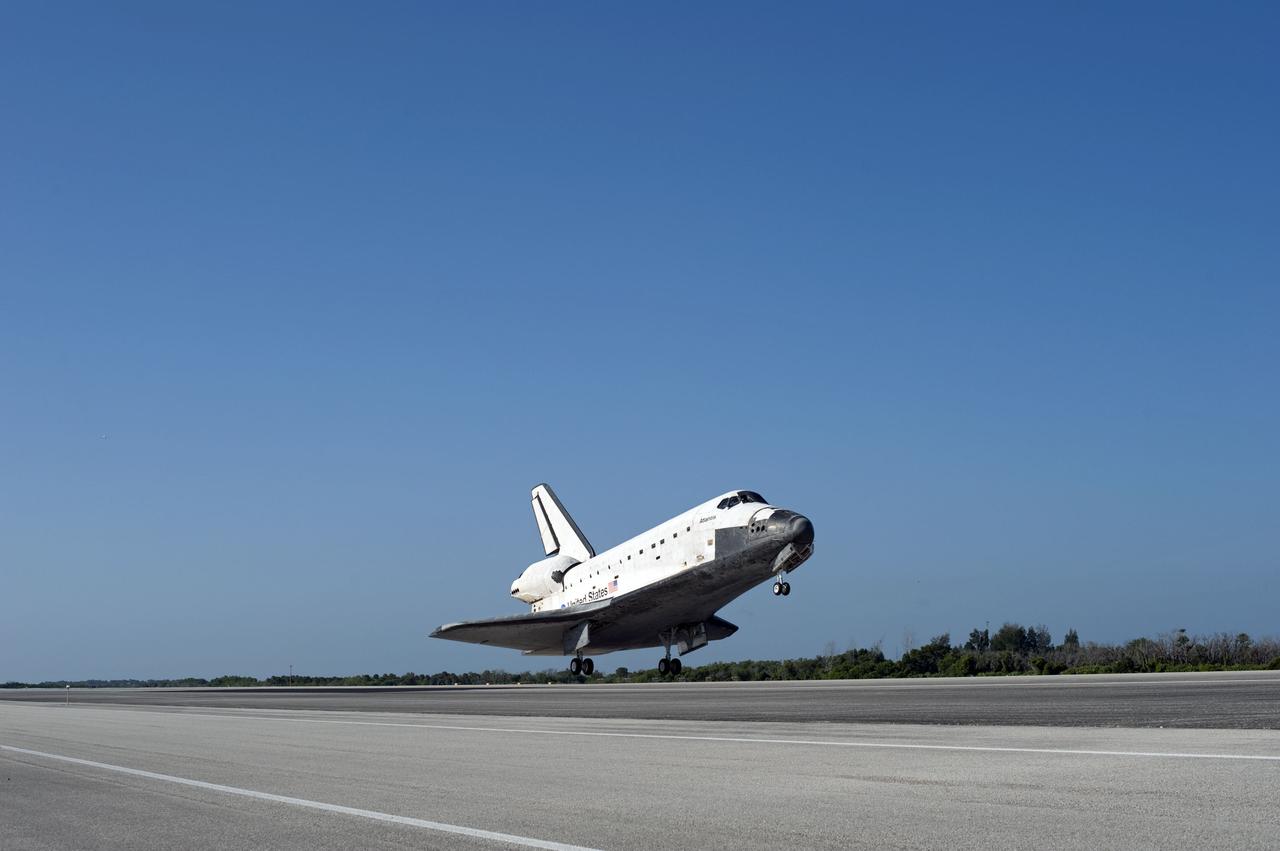
STS132-S-139 (26 May 2010) --- Space shuttle Atlantis nears touchdown on Runway 33 at the Shuttle Landing Facility at NASA's Kennedy Space Center in Florida. Landing was at 8:48 a.m. (EDT) on May 26, 2010, completing the 12-day STS-132 mission to the International Space Station. Main gear touchdown was at 8:48:11 a.m., followed by nose gear touchdown at 8:48:21 a.m. and wheelstop at 8:49:18 a.m. Onboard are NASA astronauts Ken Ham, commander; Tony Antonelli, pilot; Garrett Reisman, Michael Good, Steve Bowen and Piers Sellers, all mission specialists. The six-member STS-132 crew carried the Russian-built Mini Research Module 1 (MRM1) to the orbital complex. STS-132 is the 34th shuttle mission to the station, the 132nd shuttle mission overall and the last planned flight for Atlantis.
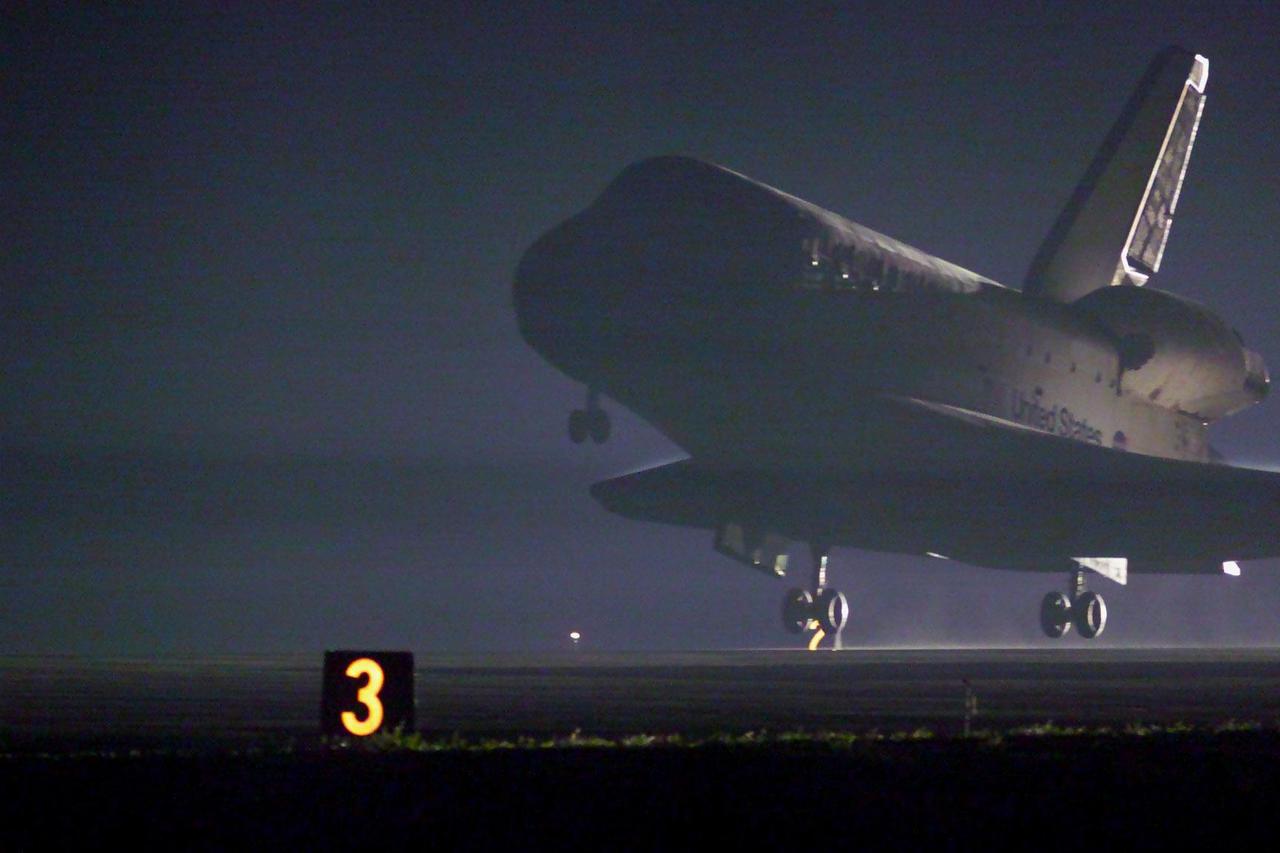
KENNEDY SPACE CENTER, Fla. -- Space Shuttle Discovery approaches touchdown on runway 15 at the KSC Shuttle Landing Facility. Main gear touchdown occurred at 2:31:42 a.m. EST, nose wheel touchdown at 2:31:54 a.m., and wheel stop at 2:33:06 a.m. The landing on orbit 201 concluded mission STS-102, the eighth flight to the International Space Station, carrying the first Multi-Purpose Logistics Module Leonardo, to the ISS and Expedition Two, a replacement crew for the Station. The 12-day, 19-hour, 51-minute mission returned both the Leonardo and the first resident crew of the ISS, Expedition One, to KSC . Discovery logged 5.3 million miles on this mission. The landing marked the 54th at KSC in the history of the program, and the 12th night landing at KSC
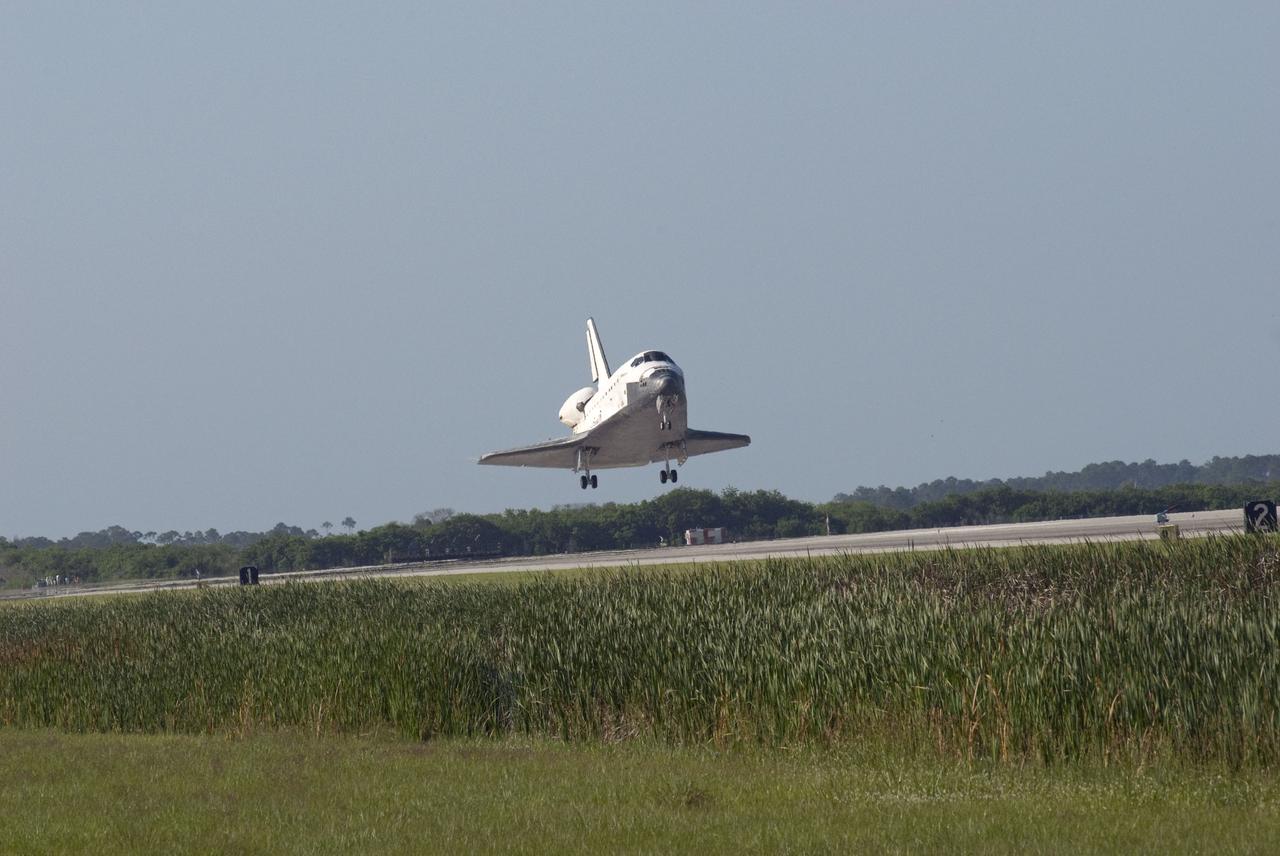
STS132-S-087 (26 May 2010) --- Space shuttle Atlantis nears touchdown on Runway 33 at the Shuttle Landing Facility at NASA's Kennedy Space Center in Florida. Landing was at 8:48 a.m. (EDT) on May 26, 2010, completing the 12-day STS-132 mission to the International Space Station. Main gear touchdown was at 8:48:11 a.m., followed by nose gear touchdown at 8:48:21 a.m. and wheelstop at 8:49:18 a.m. Onboard are NASA astronauts Ken Ham, commander; Tony Antonelli, pilot; Garrett Reisman, Michael Good, Steve Bowen and Piers Sellers, all mission specialists. The six-member STS-132 crew carried the Russian-built Mini Research Module 1 (MRM1) to the orbital complex. STS-132 is the 34th shuttle mission to the station, the 132nd shuttle mission overall and the last planned flight for Atlantis.

STS132-S-102 (26 May 2010) --- Space shuttle Atlantis nears touchdown on Runway 33 at the Shuttle Landing Facility at NASA's Kennedy Space Center in Florida. Landing was at 8:48 a.m. (EDT) on May 26, 2010, completing the 12-day STS-132 mission to the International Space Station. Main gear touchdown was at 8:48:11 a.m., followed by nose gear touchdown at 8:48:21 a.m. and wheelstop at 8:49:18 a.m. Onboard are NASA astronauts Ken Ham, commander; Tony Antonelli, pilot; Garrett Reisman, Michael Good, Steve Bowen and Piers Sellers, all mission specialists. The six-member STS-132 crew carried the Russian-built Mini Research Module 1 (MRM1) to the orbital complex. STS-132 is the 34th shuttle mission to the station, the 132nd shuttle mission overall and the last planned flight for Atlantis.
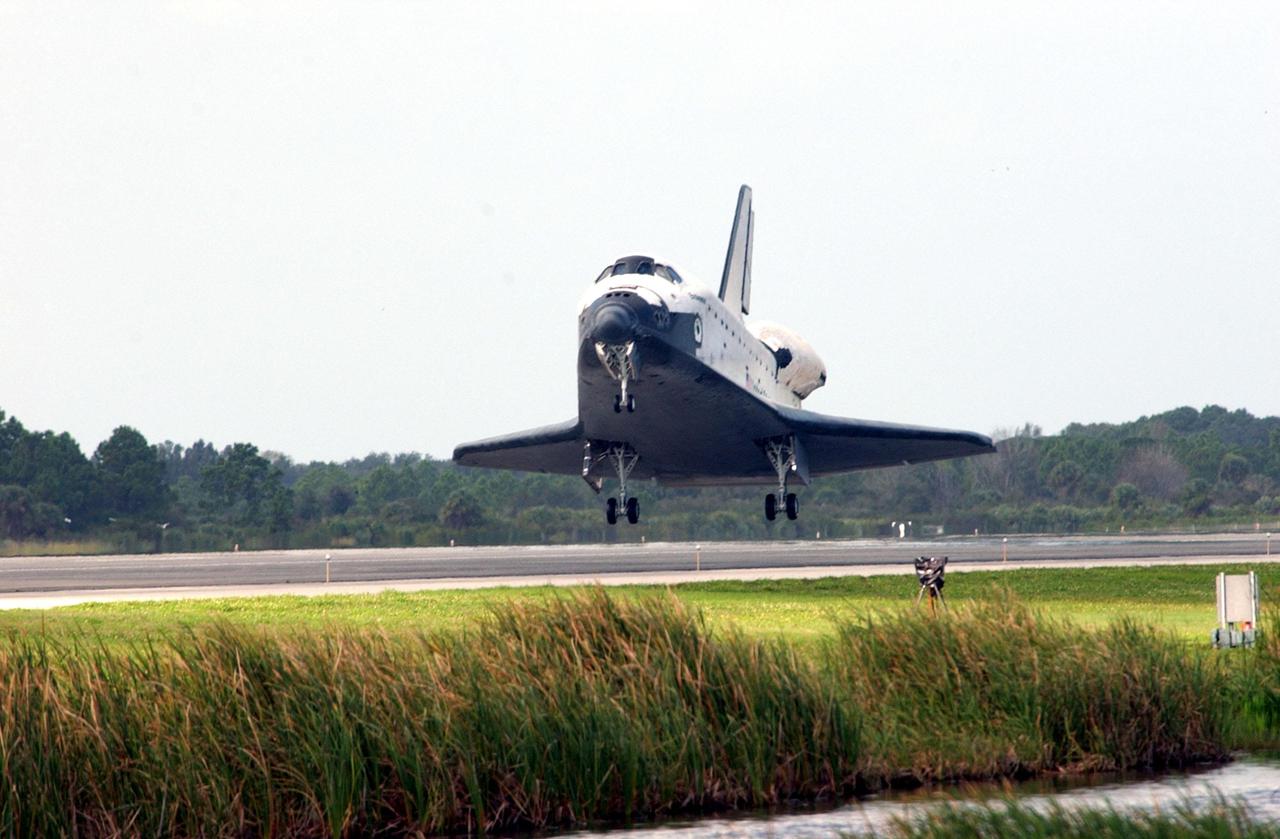
KENNEDY SPACE CENTER, FLA. -- Orbiter Endeavour approaches touchdown on Runway 15 at the KSC Shuttle Landing Facility, completing mission STS-108. After a mission-elapsed time of 11 days, 19 hours and 35 minutes, the landing is the 57th at KSC in the history of the program. Main gear touchdown occurred at 12:55:10 p.m. EST (17:55:10 GMT), nose gear touchdown at 12:55:23 p.m. (17:55:23 GMT) , wheel stop at 12:56:13 p.m. (17:56:13 GMT). STS-108 was the 12th mission to the International Space Station. This mission was the 107th flight in the Shuttle program and the 17th flight for the orbiter. Endeavour carries both the mission crew and the Expedition 3 crew - Commander Frank Culbertson and cosmonauts Vladimir Dezhurov and Mikhail Tyurin - who are returning to Earth after 129 days in space on the Space Station
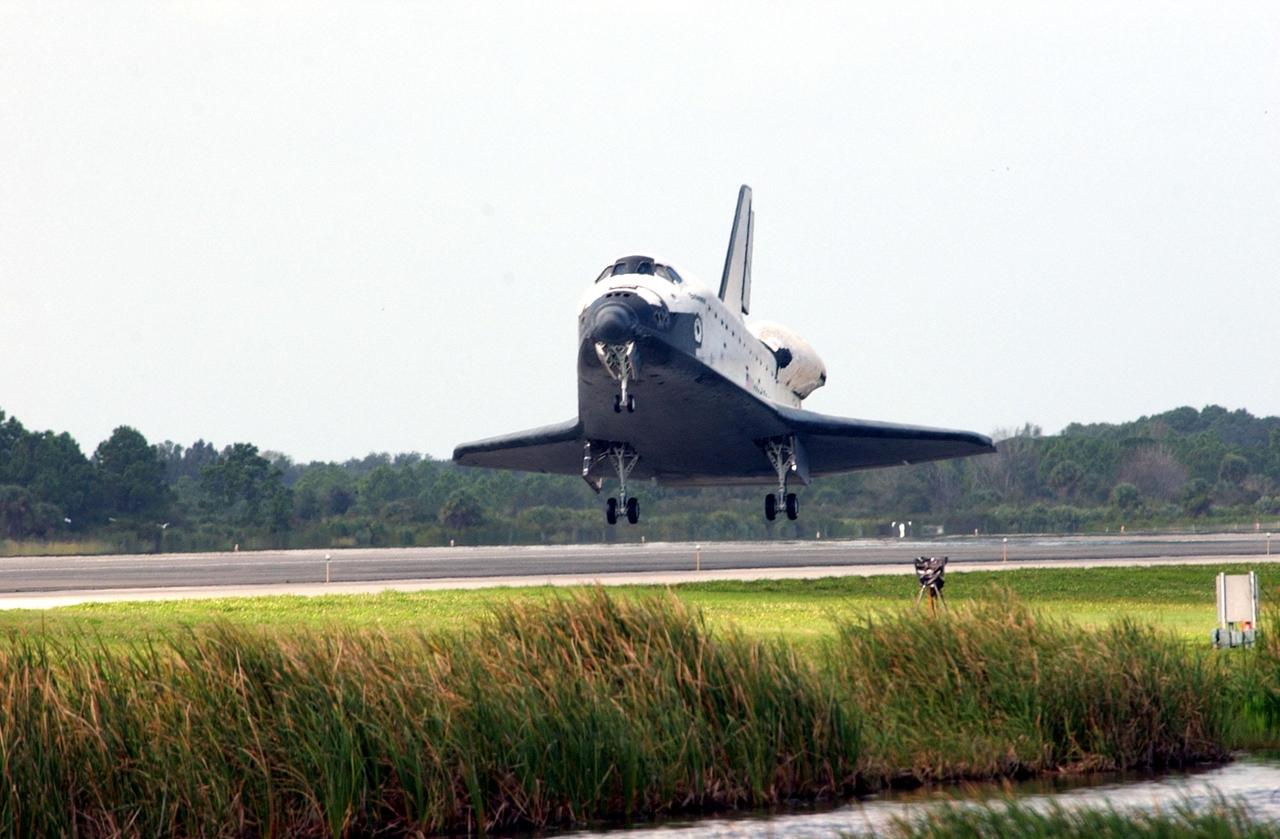
KENNEDY SPACE CENTER, FLA. -- Orbiter Endeavour approaches touchdown on Runway 15 at the KSC Shuttle Landing Facility, completing mission STS-108. After a mission-elapsed time of 11 days, 19 hours and 35 minutes, the landing is the 57th at KSC in the history of the program. Main gear touchdown occurred at 12:55:10 p.m. EST (17:55:10 GMT), nose gear touchdown at 12:55:23 p.m. (17:55:23 GMT) , wheel stop at 12:56:13 p.m. (17:56:13 GMT). STS-108 was the 12th mission to the International Space Station. This mission was the 107th flight in the Shuttle program and the 17th flight for the orbiter. Endeavour carries both the mission crew and the Expedition 3 crew - Commander Frank Culbertson and cosmonauts Vladimir Dezhurov and Mikhail Tyurin - who are returning to Earth after 129 days in space on the Space Station
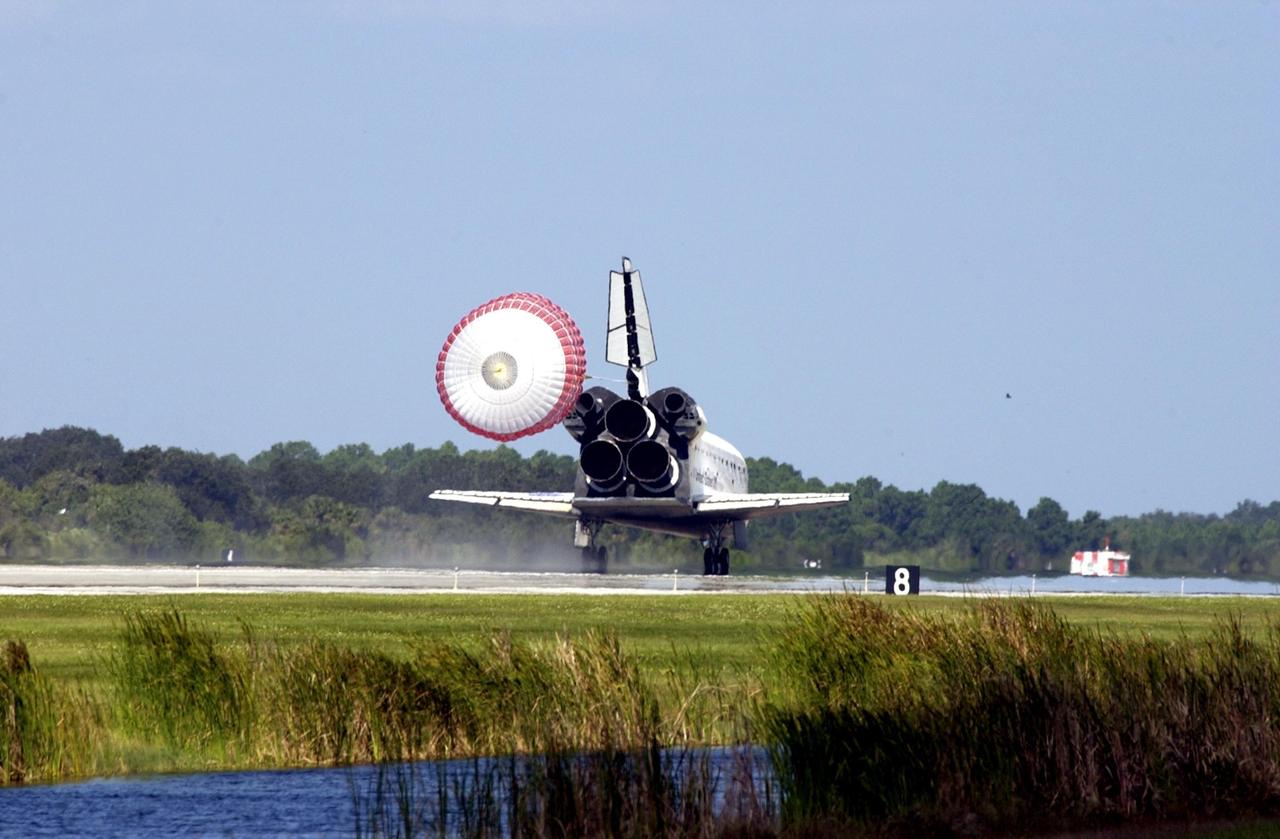
KENNEDY SPACE CENTER, FLA. -- Its drag chute deployed, Space Shuttle Atlantis slows to a stop after touchdown on Runway 33 at the Shuttle Landing Facility, completing the 4.5-million-mile journey to the International Space Station. Main gear touchdown occurred at 11:43:40 a.m. EDT; nose gear touchdown at 11:43:48 a.m.; and wheel stop at 11:44:35 a.m. Mission elapsed time was 10:19:58:44. Mission STS-112 expanded the size of the Station with the addition of the S1 truss segment. The returning crew of Atlantis are Commander Jeffrey Ashby, Pilot Pamela Melroy, and Mission Specialists David Wolf, Piers Sellers, Sandra Magnus and Fyodor Yurchikhin. This landing is the 60th at KSC in the history of the Shuttle program. .
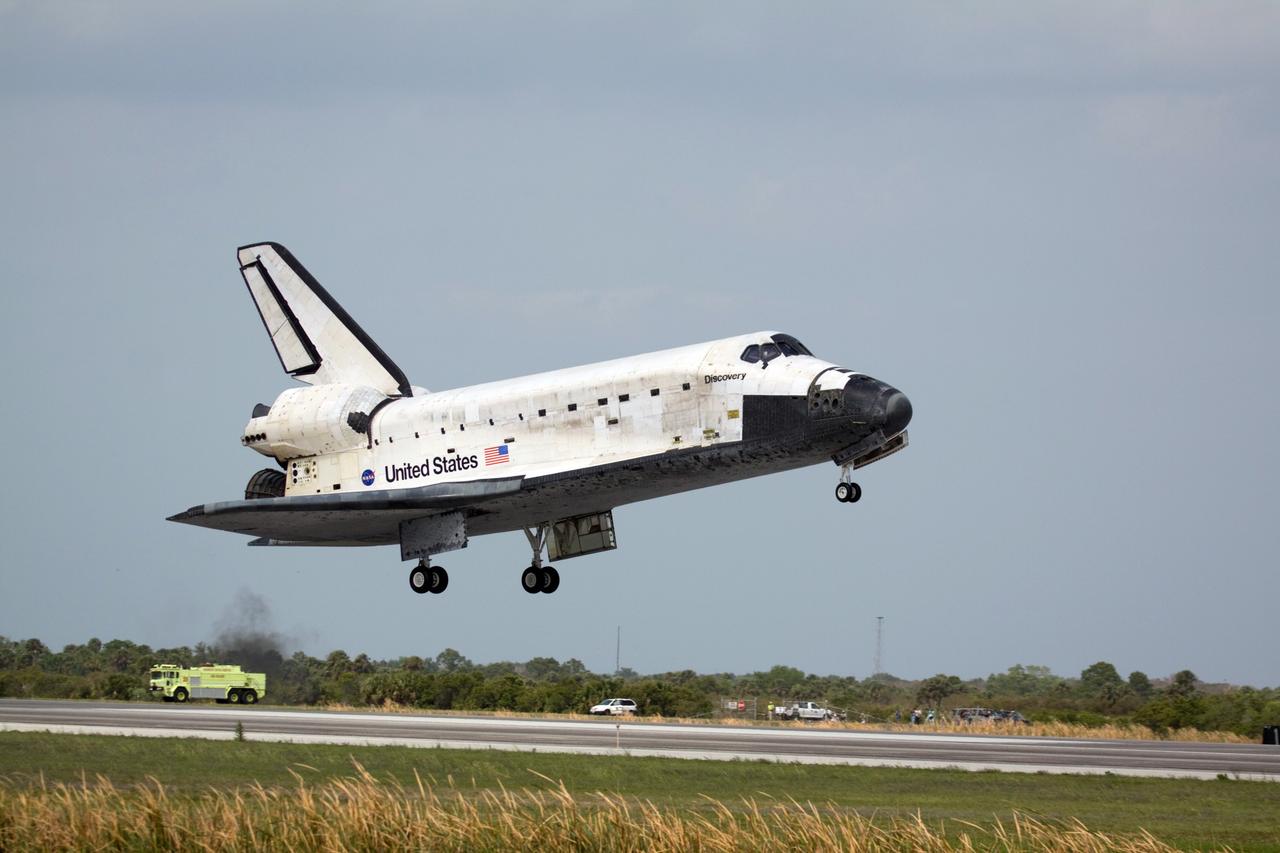
CAPE CANAVERAL, Fla. – A Fire Rescue Services vehicle stands by as space shuttle Discovery nears touchdown on Runway 15 at NASA's Kennedy Space Center in Florida to complete the 13-day, 5.3-million mile journey on the STS-119 mission to the International Space Station. Main gear touchdown was at 3:13:17 p.m. EDT. Nose gear touchdown was at 3:13:40 p.m. and wheels stop was at 3:14:45 p.m. Discovery delivered the final pair of large power-generating solar array wings and the S6 truss segment. The mission was the 28th flight to the station, the 36th flight of Discovery and the 125th in the Space Shuttle Program, as well as the 70th landing at Kennedy. Photo credit: NASA/Kenny Allen
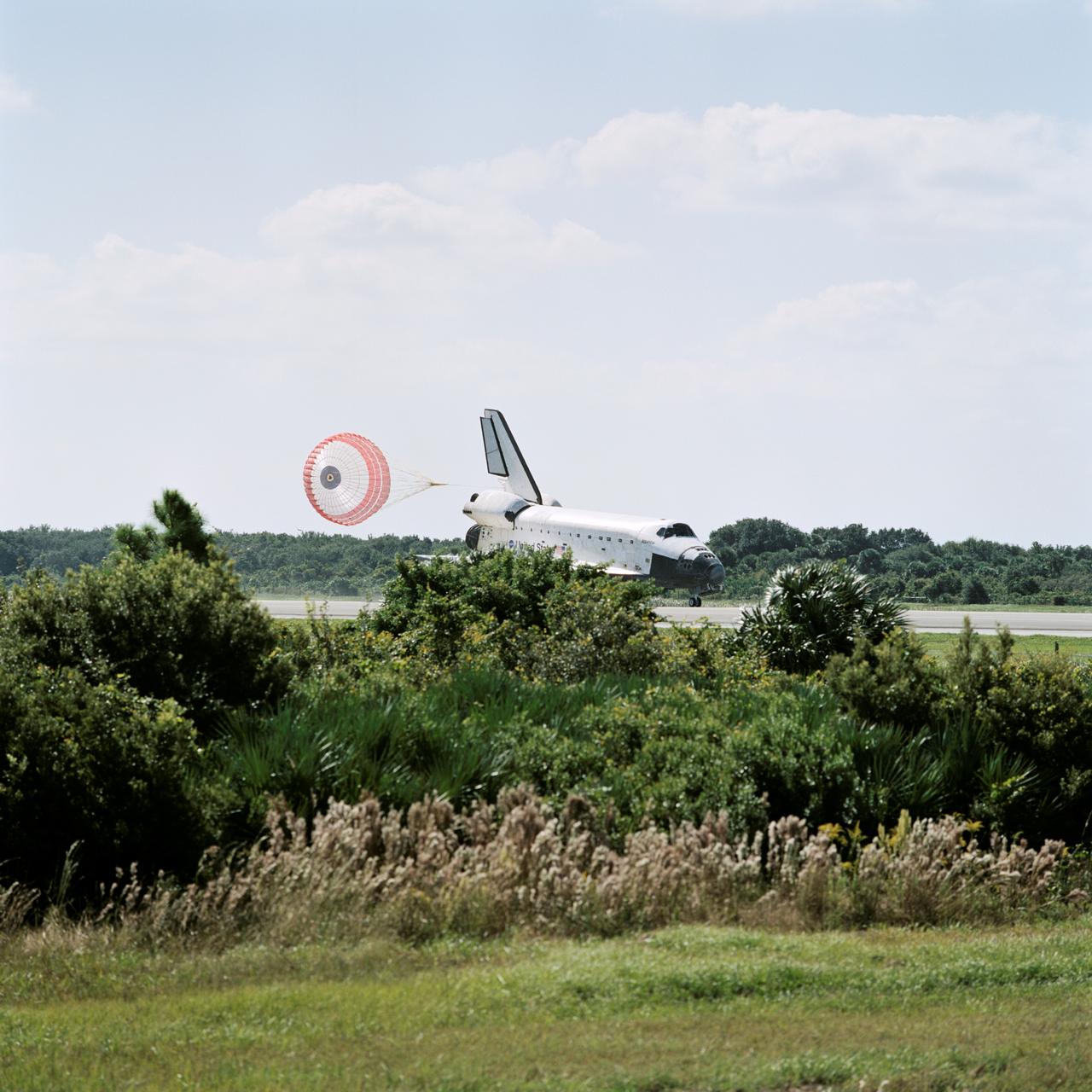
STS112-S-039 (18 October 2002) --- The drag chute of the Space Shuttle Atlantis helps to slow the vehicle following its touchdown at the Shuttle Landing Facility, completing the 4.5-million-mile journey to the International Space Station. Main gear touchdown occurred at 11:43:40 a.m. EDT; nose gear touchdown at 11:43:48 a.m.; and wheel stop at 11:44:35 a.m. Mission elapsed time was 10:19:58:44. Mission STS-112 expanded the size of the Station with the addition of the S1 truss segment. The returning crew of Atlantis are Jeffrey S. Ashby, commander; Pamela A. Melroy, pilot; and David A. Wolf, Piers J. Sellers, Sandra H. Magnus and Rosaviakosmos' Fyodor N. Yurchikhin, all mission specialists. This landing is the 60th at KSC in the 21-year history of the Shuttle program.
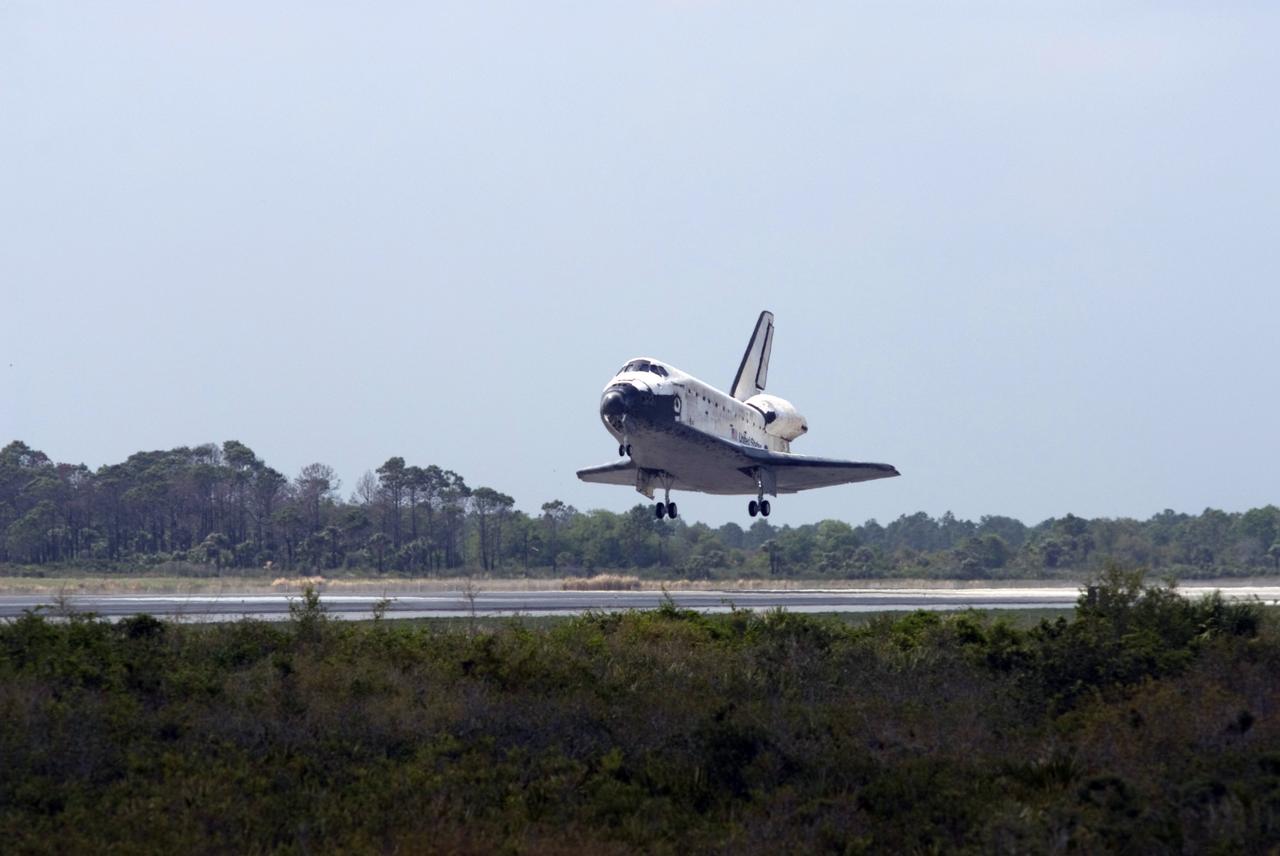
CAPE CANAVERAL, Fla. – Main landing gear are in place for touchdown of space shuttle Discovery on Runway 15 at NASA's Kennedy Space Center in Florida, completing the 13-day, 5.3-million mile journey on the STS-119 mission to the International Space Station. Main gear touchdown was at 3:13:17 p.m. EDT. Nose gear touchdown was at 3:13:40 p.m. and wheels stop was at 3:14:45 p.m. Discovery delivered the final pair of large power-generating solar array wings and the S6 truss segment. The mission was the 28th flight to the station, the 36th flight of Discovery and the 125th in the Space Shuttle Program, as well as the 70th landing at Kennedy. Photo credit: NASA/Rick Wetherington
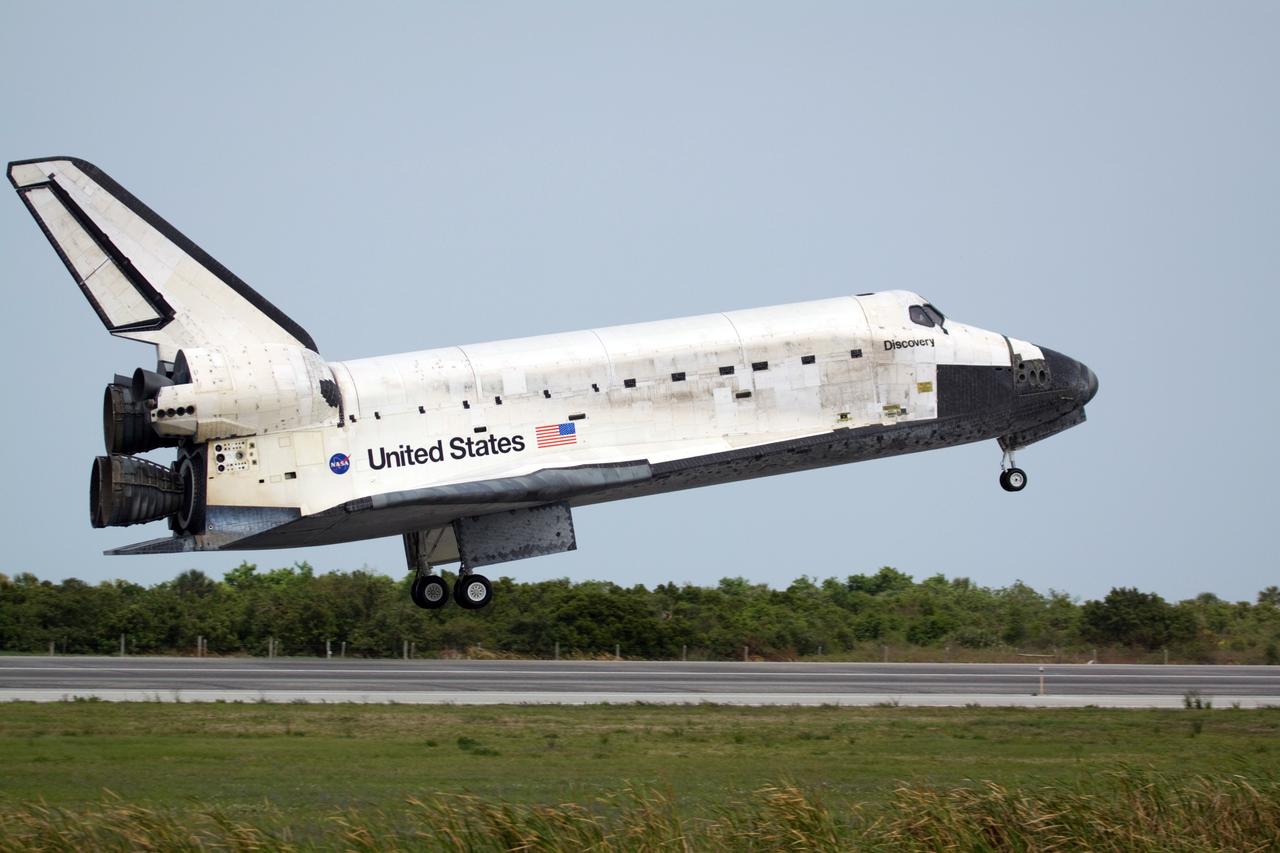
CAPE CANAVERAL, Fla. – Space shuttle Discovery’s main landing gear are extended for touchdown on Runway 15 at NASA's Kennedy Space Center in Florida, completing the 13-day, 5.3-million mile journey on the STS-119 mission to the International Space Station. Main gear touchdown was at 3:13:17 p.m. EDT. Nose gear touchdown was at 3:13:40 p.m. and wheels stop was at 3:14:45 p.m. Discovery delivered the final pair of large power-generating solar array wings and the S6 truss segment. The mission was the 28th flight to the station, the 36th flight of Discovery and the 125th in the Space Shuttle Program, as well as the 70th landing at Kennedy. Photo credit: NASA/Kenny Allen
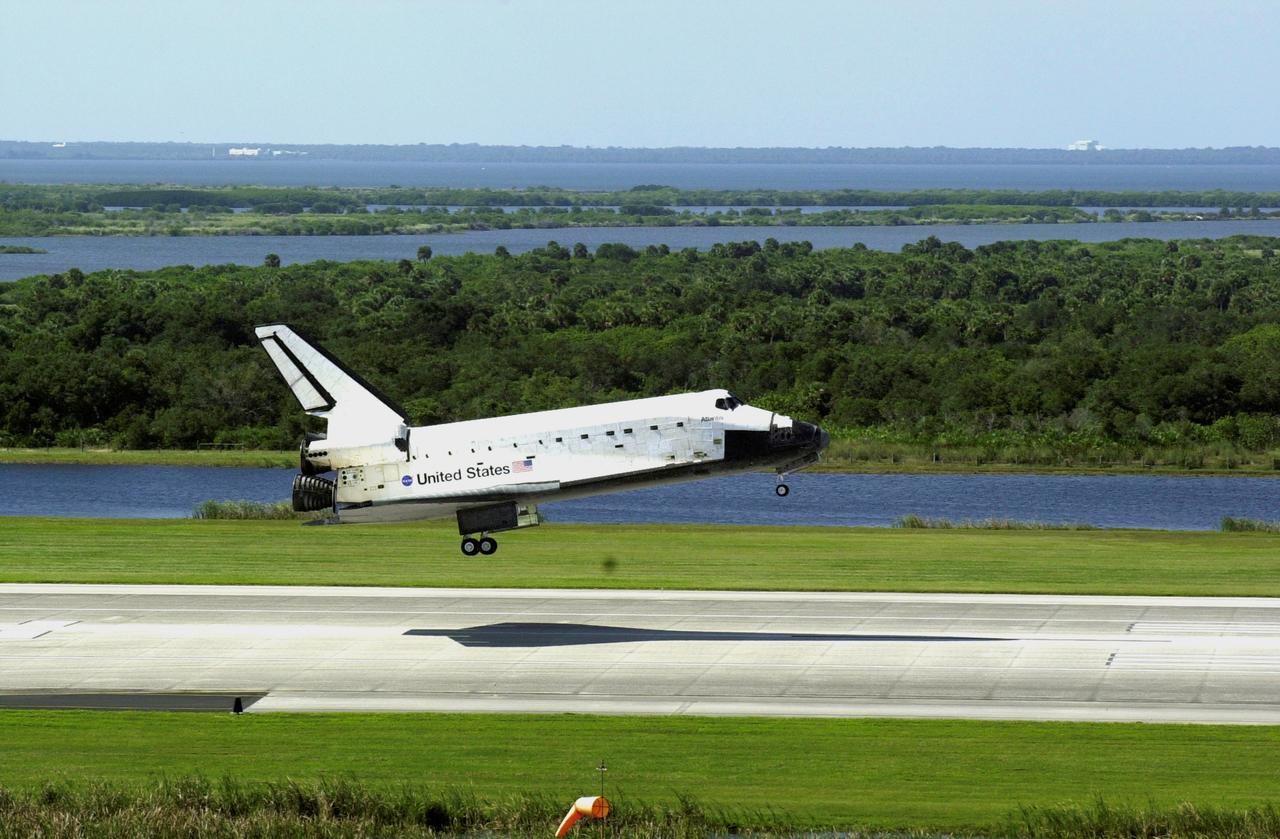
STS112-S-028 (18 October 2002) --- The main landing gear of the Space Shuttle Atlantis is seconds away from touchdown at the Shuttle Landing Facility, completing the 4.5-million-mile journey that included a week of work with the International Space Station. Main gear touchdown occurred at 11:43:40 a.m. (EDT), October 18, 2002; nose gear touchdown at 11:43:48 a.m.; and wheel stop at 11:44:35 a.m. Mission elapsed time was 10:19:58:44. Mission STS-112 expanded the size of the Station with the addition of the S1 truss segment. The STS-112 crew members of Atlantis are Jeffrey S. Ashby, commander; Pamela A. Melroy, pilot; and David A. Wolf, Piers J. Sellers, Sandra H. Magnus and Rosaviakosmos' Fyodor N. Yurchikhin, all mission specialists.
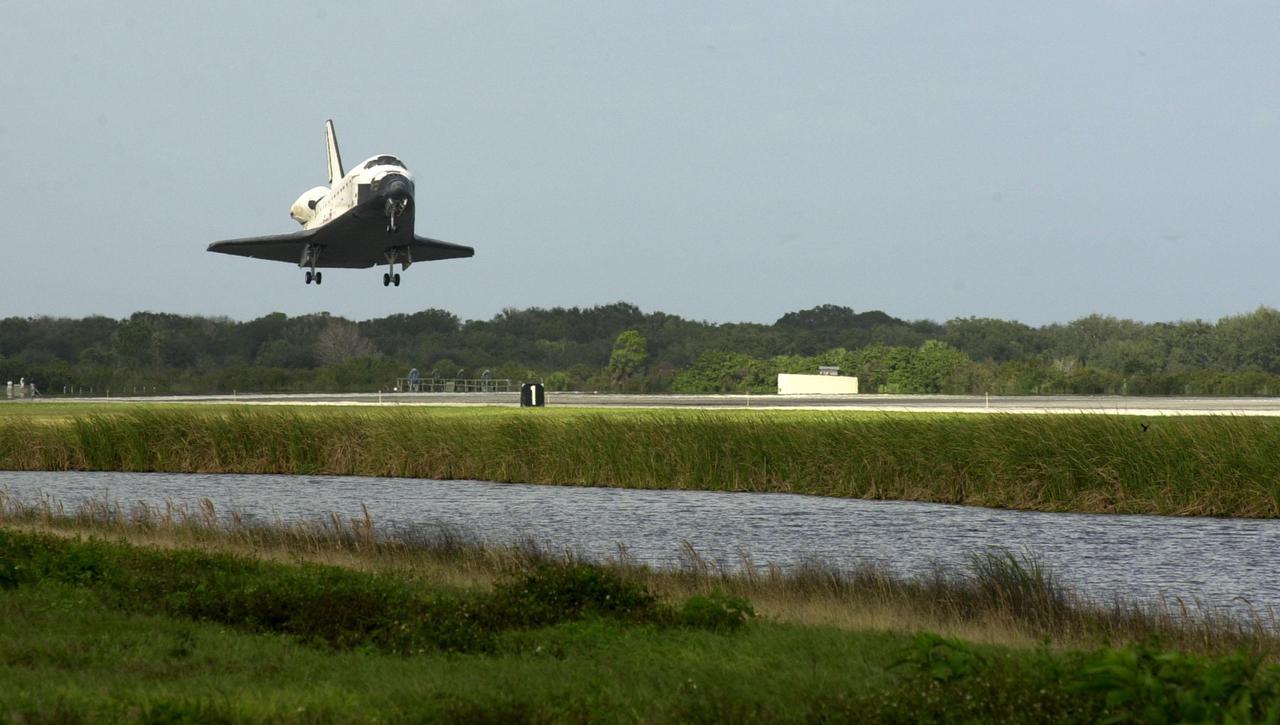
KENNEDY SPACE CENTER, FLA. -- Orbiter Endeavour glides toward touchdown on Runway 15 at the KSC Shuttle Landing Facility, completing mission STS-108. After a mission-elapsed time of 11 days, 19 hours and 35 minutes, the landing is the 57th at KSC in the history of the program. Main gear touchdown occurred at 12:55:10 p.m. EST (17:55:10 GMT), nose gear touchdown at 12:55:23 p.m. (17:55:23 GMT) , wheel stop at 12:56:13 p.m. (17:56:13 GMT). STS-108 was the 12th mission to the International Space Station. This mission was the 107th flight in the Shuttle program and the 17th flight for the orbiter. Endeavour carries both the mission crew and the Expedition 3 crew - Commander Frank Culbertson and cosmonauts Vladimir Dezhurov and Mikhail Tyurin - who are returning to Earth after 129 days in space on the Space Station
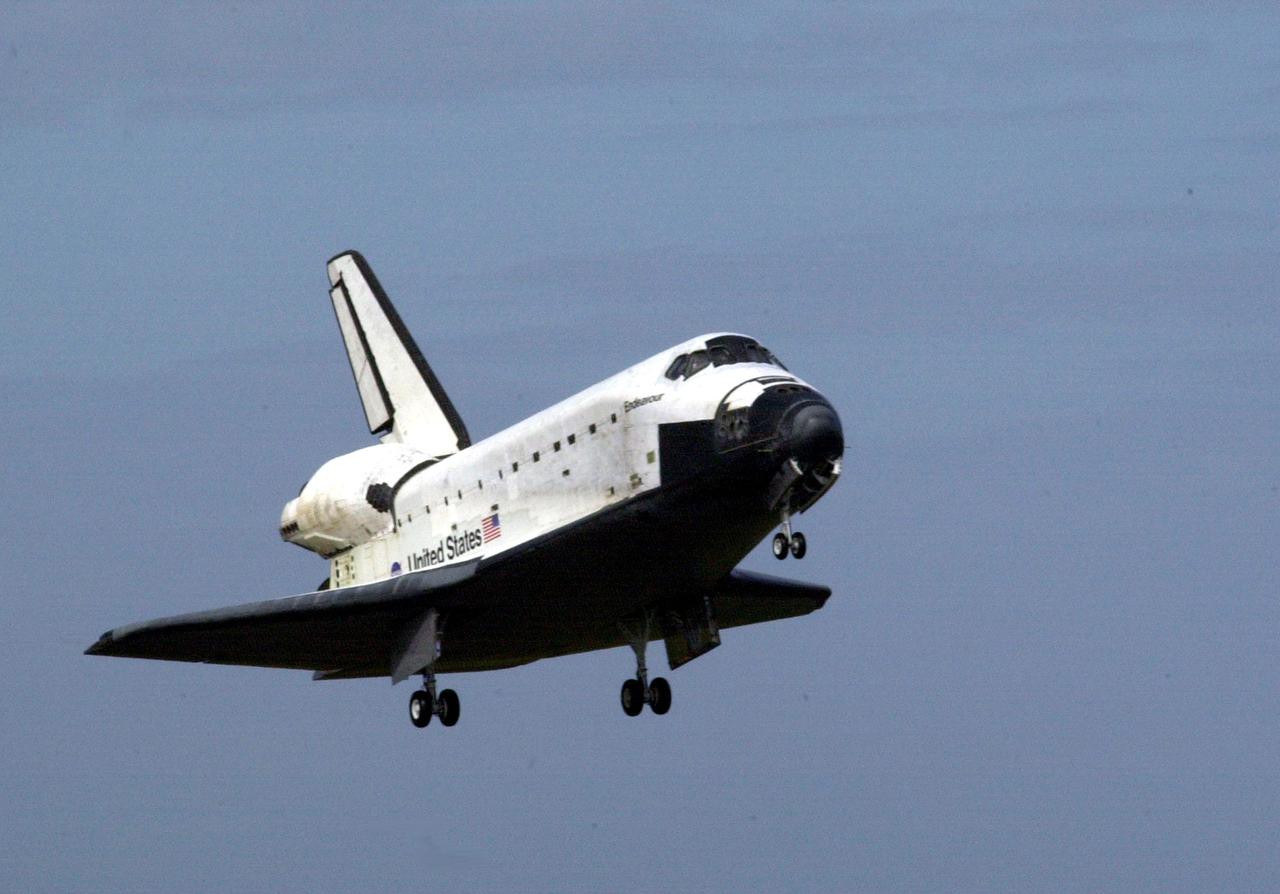
KENNEDY SPACE CENTER, FLA. -- Orbiter Endeavour glides smoothly through the air towards touchdown on Runway 15 at the KSC Shuttle Landing Facility, completing mission STS-108. After a mission-elapsed time of 11 days, 19 hours and 35 minutes, the landing is the 57th at KSC in the history of the program. Main gear touchdown occurred at 12:55:10 p.m. EST (17:55:10 GMT), nose gear touchdown at 12:55:23 p.m. (17:55:23 GMT) , wheel stop at 12:56:13 p.m. (17:56:13 GMT). STS-108 was the 12th mission to the International Space Station. This mission was the 107th flight in the Shuttle program and the 17th flight for the orbiter. Endeavour carries both the mission crew and the Expedition 3 crew - Commander Frank Culbertson and cosmonauts Vladimir Dezhurov and Mikhail Tyurin - who are returning to Earth after 129 days in space on the Space Station
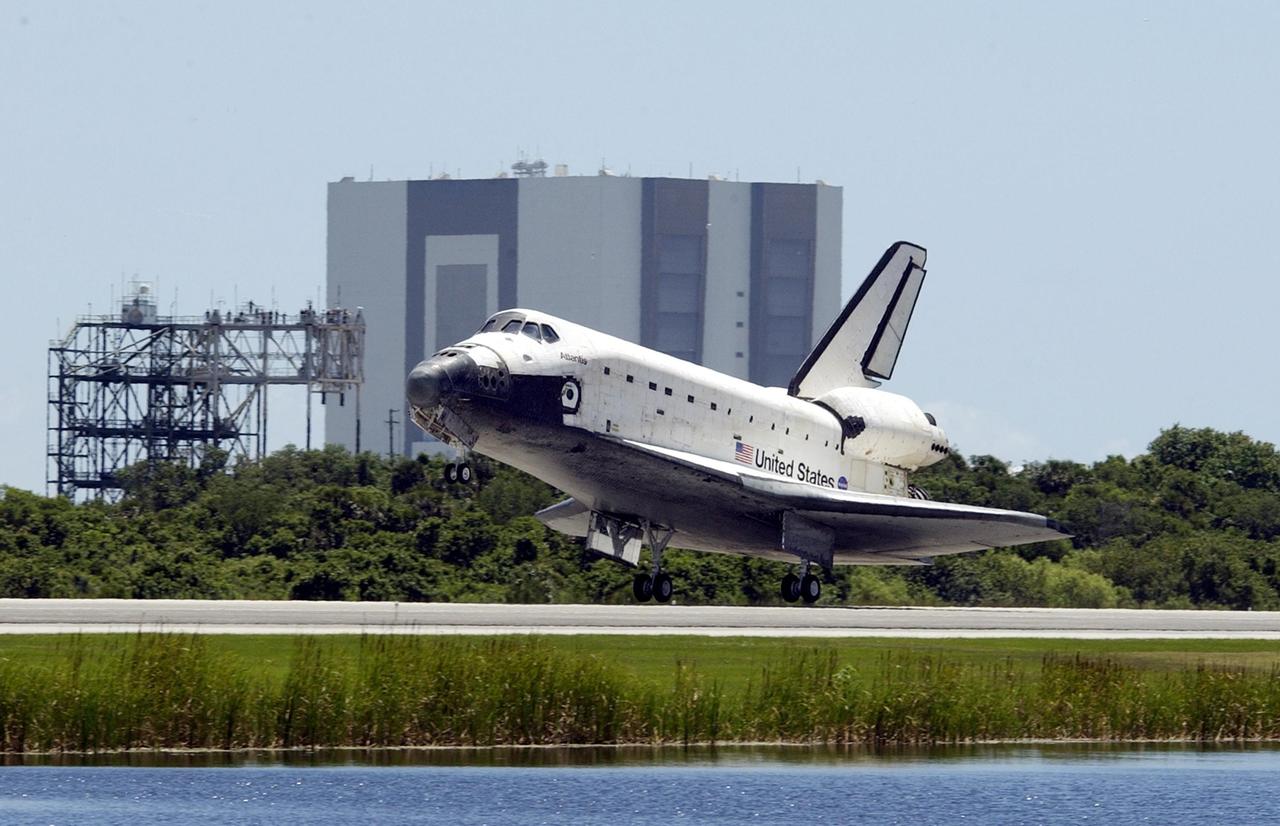
KENNEDY SPACE CENTER, FLA. -- Atlantis approaches touchdown on runway 33 at KSC's Shuttle Landing Facility. The landing completes the 10-day, 19-hour, 4.5-million mile mission STS-110 to the International Space Station. In the upper right corner is the chase plane following Atlantis' path. The orbiter carries the returning crew Commander Michael Bloomfield, Pilot Stephen Frick and Mission Specialists Jerry Ross, Steven Smith, Ellen Ochoa, Lee Morin and Rex Walheim. Main gear touchdown was 12:26:57 p.m. EDT, nose gear touchdown was 12:27:09 p.m. and wheel stop was 12:28:07 p.m. The crew delivered and installed the S0 truss, which will support cooling and power systems essential for the addition of future international laboratories, on the Station
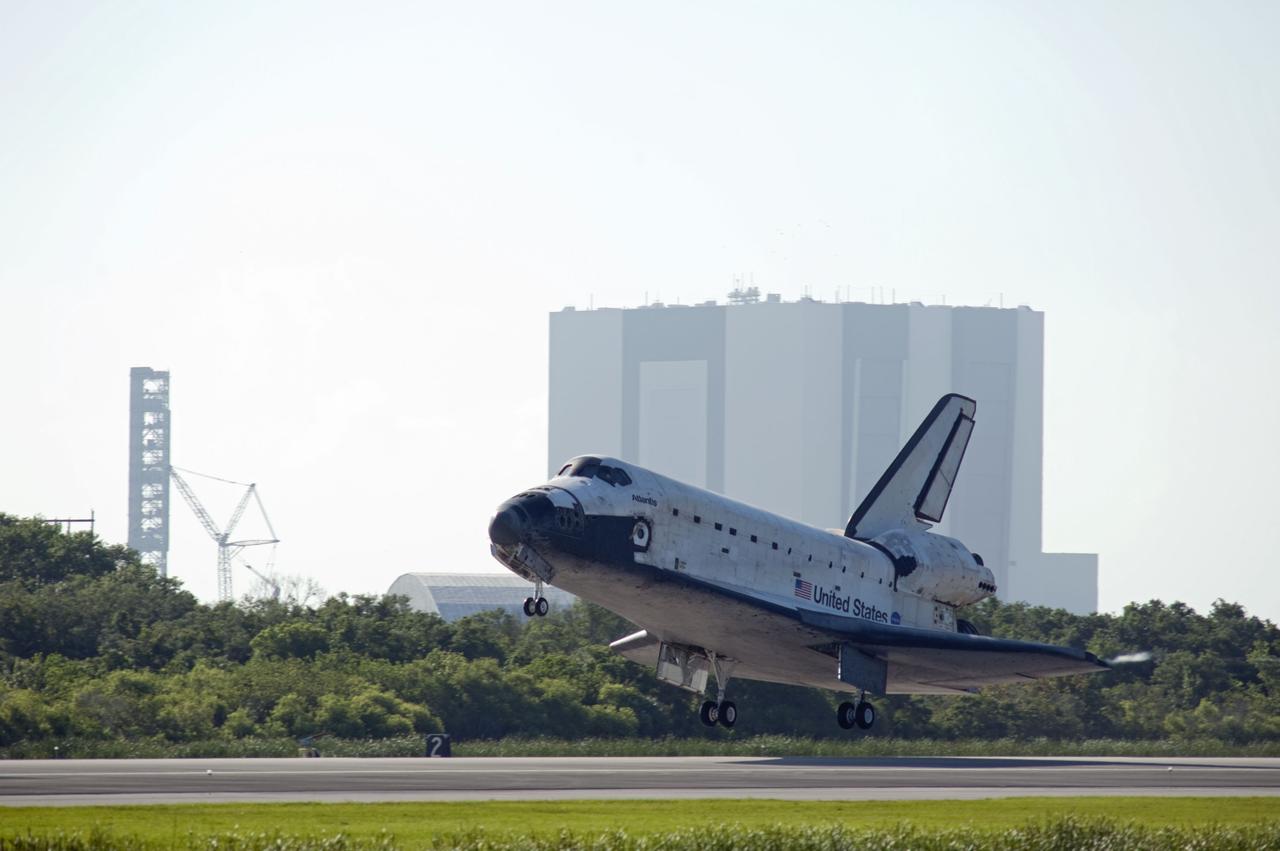
STS132-S-101 (26 May 2010) --- Space shuttle Atlantis nears touchdown on Runway 33 at the Shuttle Landing Facility at NASA's Kennedy Space Center in Florida. Landing was at 8:48 a.m. (EDT) on May 26, 2010, completing the 12-day STS-132 mission to the International Space Station. Main gear touchdown was at 8:48:11 a.m., followed by nose gear touchdown at 8:48:21 a.m. and wheelstop at 8:49:18 a.m. Onboard are NASA astronauts Ken Ham, commander; Tony Antonelli, pilot; Garrett Reisman, Michael Good, Steve Bowen and Piers Sellers, all mission specialists. The six-member STS-132 crew carried the Russian-built Mini Research Module 1 (MRM1) to the orbital complex. STS-132 is the 34th shuttle mission to the station, the 132nd shuttle mission overall and the last planned flight for Atlantis.
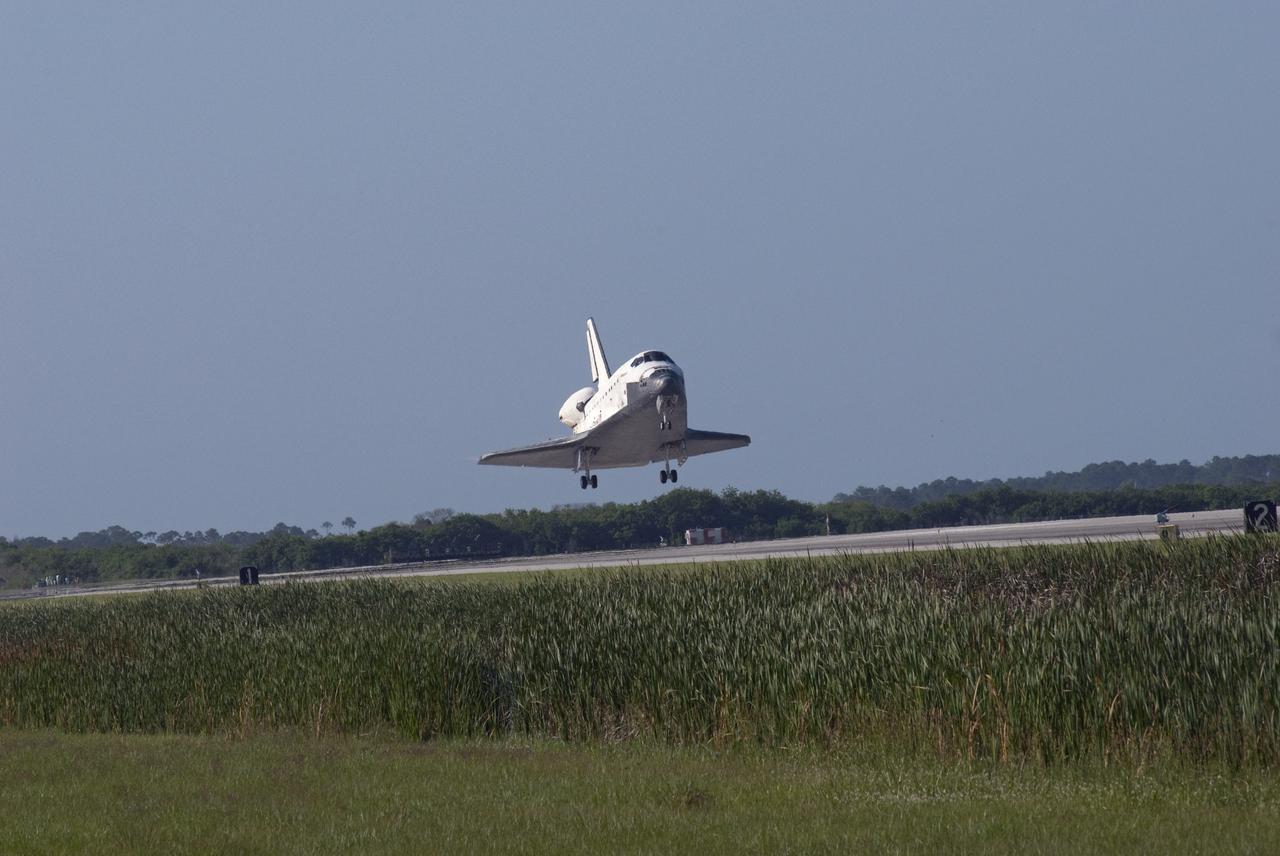
CAPE CANAVERAL, Fla. - Space shuttle Atlantis nears touchdown on Runway 33 at the Shuttle Landing Facility at NASA's Kennedy Space Center in Florida. Landing was at 8:48 a.m. EDT, completing the 12-day STS-132 mission to the International Space Station. Main gear touchdown was at 8:48:11 a.m. EDT, followed by nose gear touchdown at 8:48:21 a.m. and wheelstop at 8:49:18 a.m. On board are Commander Ken Ham, Pilot Tony Antonelli, Mission Specialists Garrett Reisman, Michael Good, Steve Bowen and Piers Sellers. The six-member STS-132 crew carried the Russian-built Mini Research Module-1 to the International Space Station. STS-132 is the 34th shuttle mission to the station, the 132nd shuttle mission overall and the last planned flight for Atlantis. For information on the STS-132 mission and crew, visit www.nasa.gov_mission_pages_shuttle_shuttlemissions_sts132_index.html. Photo credit: NASA_Jim Grossmann
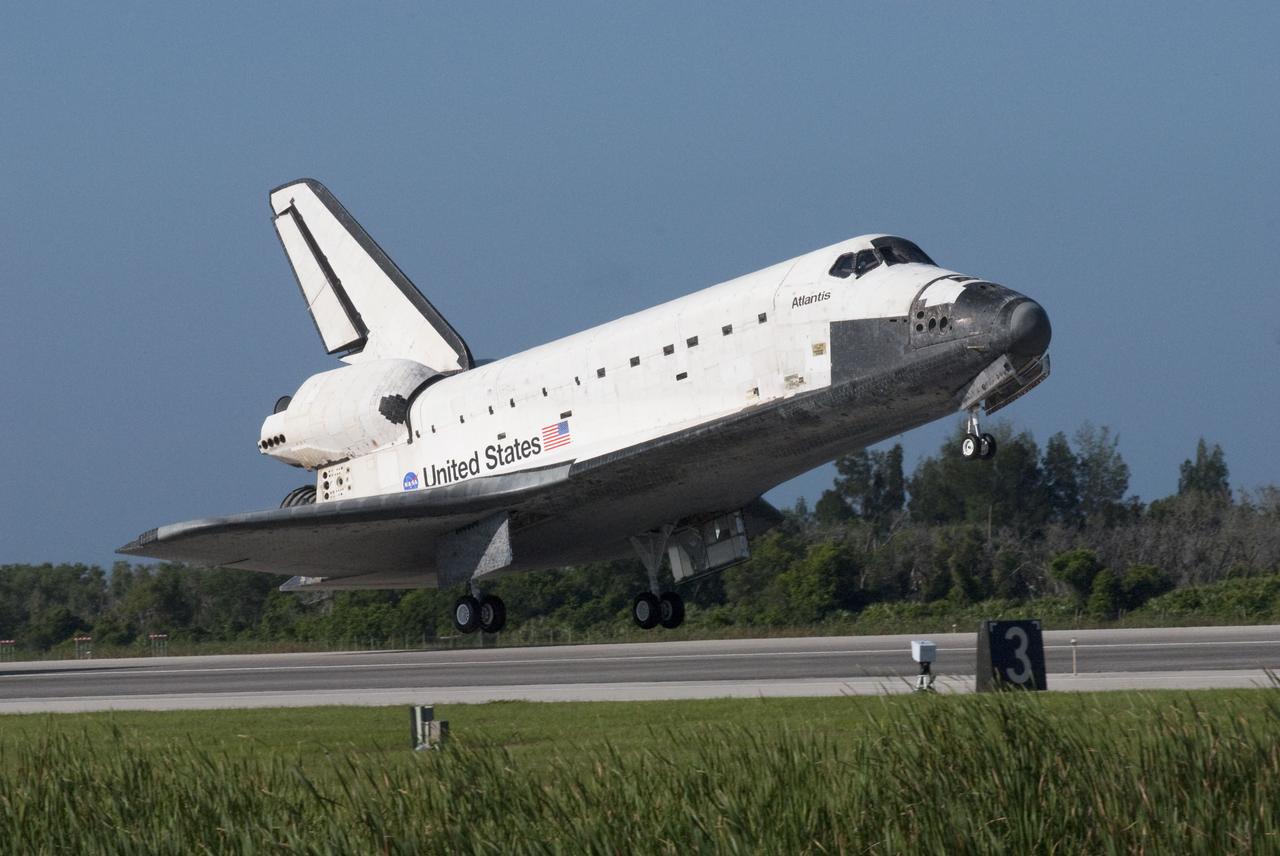
STS132-S-088 (26 May 2010) --- Space shuttle Atlantis nears touchdown on Runway 33 at the Shuttle Landing Facility at NASA's Kennedy Space Center in Florida. Landing was at 8:48 a.m. (EDT) on May 26, 2010, completing the 12-day STS-132 mission to the International Space Station. Main gear touchdown was at 8:48:11 a.m., followed by nose gear touchdown at 8:48:21 a.m. and wheelstop at 8:49:18 a.m. Onboard are NASA astronauts Ken Ham, commander; Tony Antonelli, pilot; Garrett Reisman, Michael Good, Steve Bowen and Piers Sellers, all mission specialists. The six-member STS-132 crew carried the Russian-built Mini Research Module 1 (MRM1) to the orbital complex. STS-132 is the 34th shuttle mission to the station, the 132nd shuttle mission overall and the last planned flight for Atlantis.
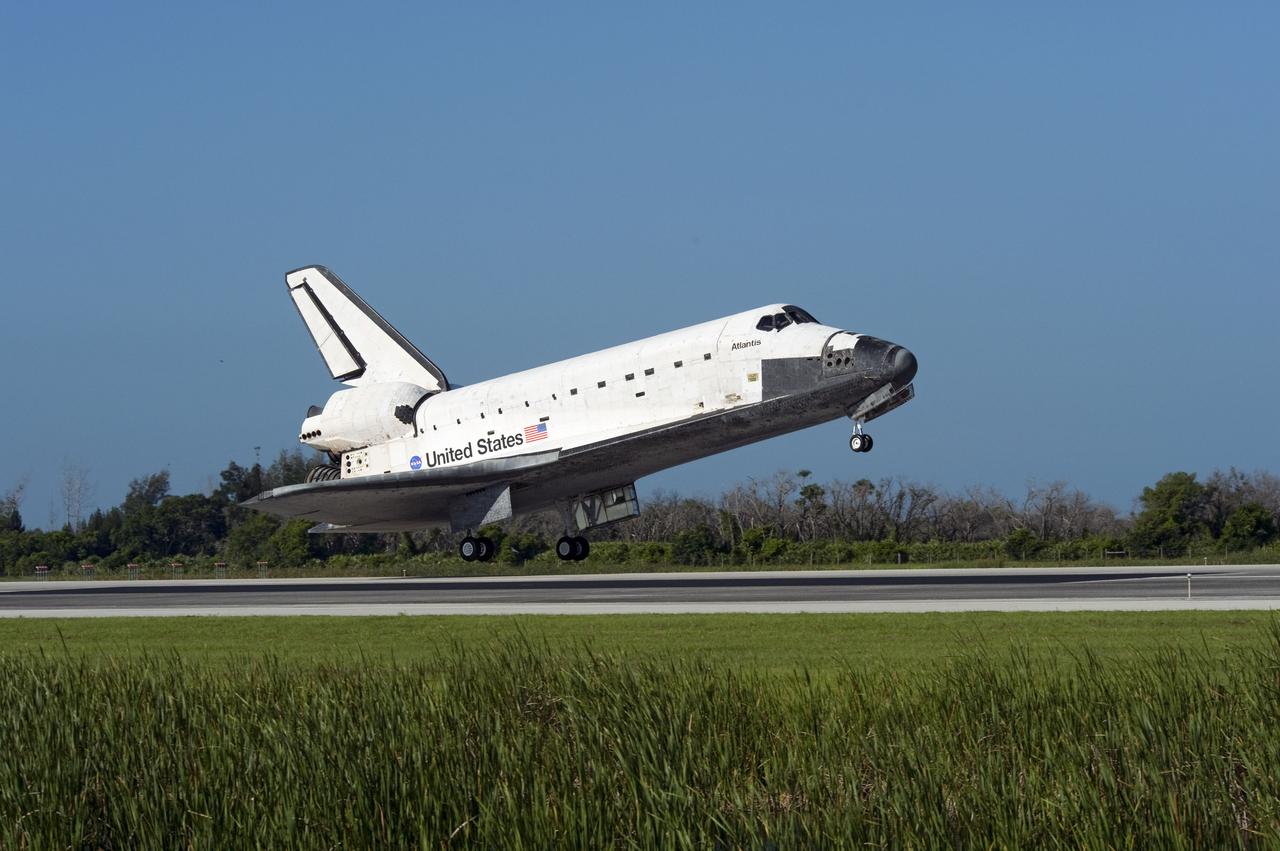
STS132-S-082 (26 May 2010) --- Space shuttle Atlantis nears touchdown on Runway 33 at the Shuttle Landing Facility at NASA's Kennedy Space Center in Florida. Landing was at 8:48 a.m. (EDT) on May 26, 2010, completing the 12-day STS-132 mission to the International Space Station. Main gear touchdown was at 8:48:11 a.m., followed by nose gear touchdown at 8:48:21 a.m. and wheelstop at 8:49:18 a.m. Onboard are NASA astronauts Ken Ham, commander; Tony Antonelli, pilot; Garrett Reisman, Michael Good, Steve Bowen and Piers Sellers, all mission specialists. The six-member STS-132 crew carried the Russian-built Mini Research Module 1 (MRM1) to the orbital complex. STS-132 is the 34th shuttle mission to the station, the 132nd shuttle mission overall and the last planned flight for Atlantis.
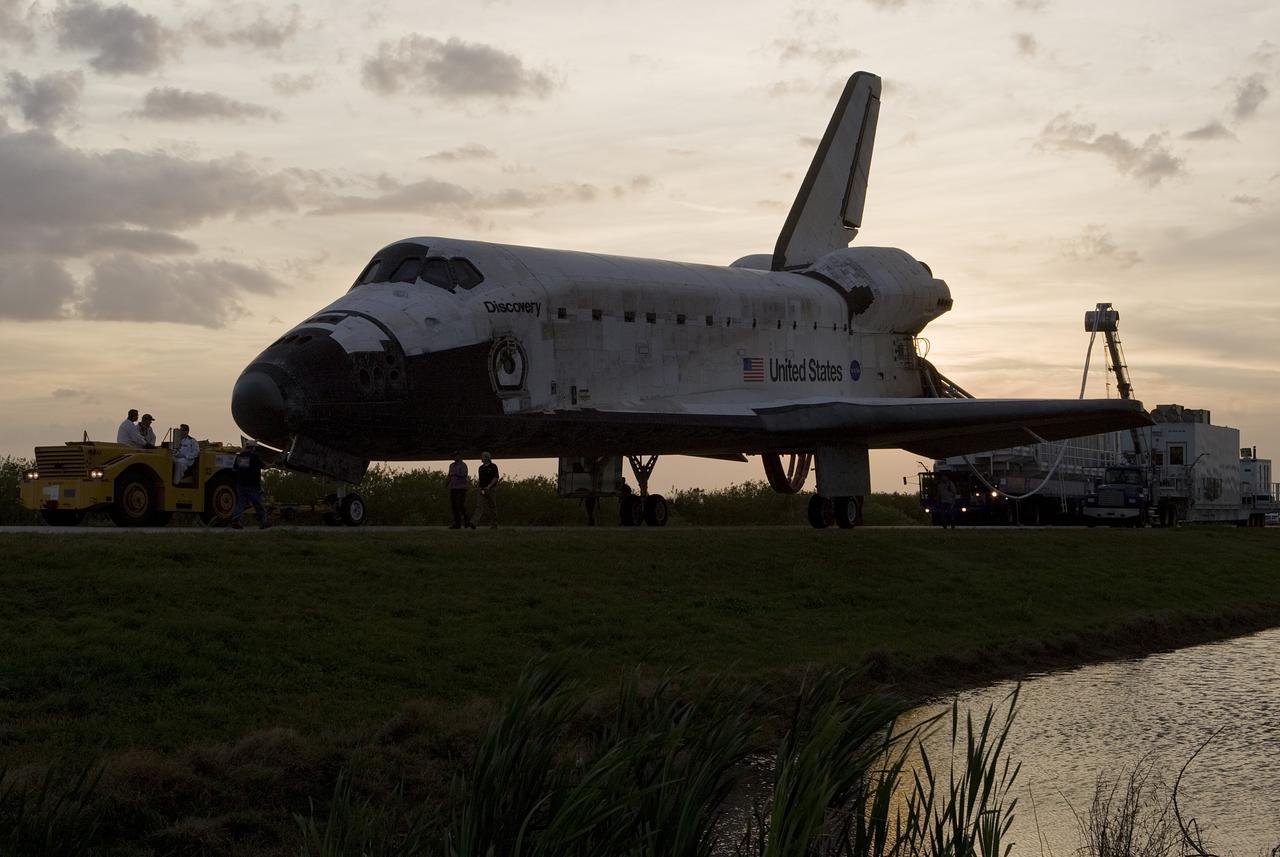
CAPE CANAVERAL, Fla. – Space shuttle Discovery is towed to Orbiter Processing Facility-3 following touchdown on Runway 15 at NASA's Kennedy Space Center in Florida to complete the 13-day, 5.3-million mile journey of the STS-119 mission to the International Space Station. Main gear touchdown was at 3:13:17 p.m. EDT. Nose gear touchdown was at 3:13:40 p.m. and wheels stop was at 3:14:45 p.m. Discovery delivered the final pair of large power-generating solar array wings and the S6 truss segment. The mission was the 28th flight to the station, the 36th flight of Discovery and the 125th in the Space Shuttle Program, as well as the 70th landing at Kennedy. Photo courtesy of Scott Andrews, Canon