Aeronautic Academy Continuous Trailing Edge Flap
Aeronautic Academy Continuous Trailing Edge Flap
Aeronautic Academy Continuous Trailing Edge Flap
Aeronautic Academy Continuous Trailing Edge Flap
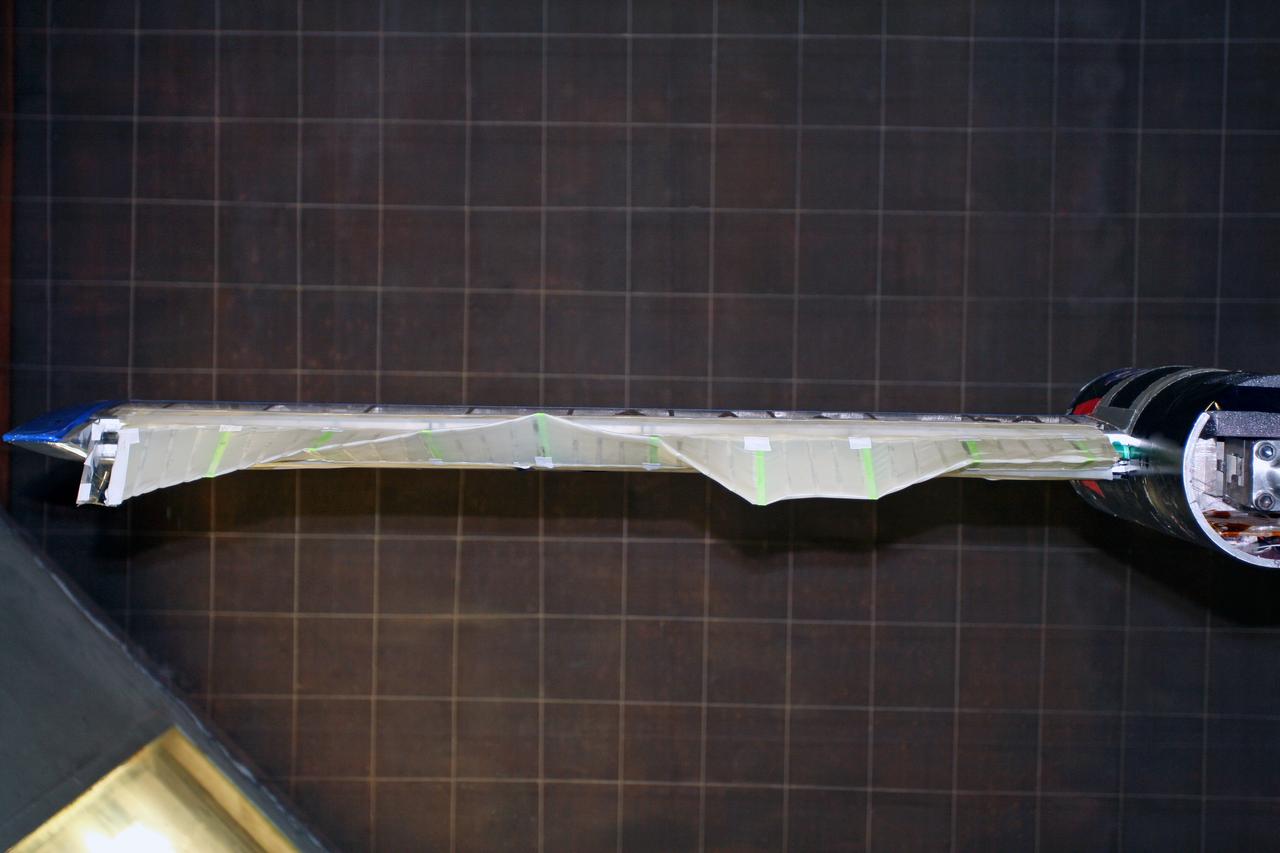
Aeronautic Academy Continuous Trailing Edge Flap
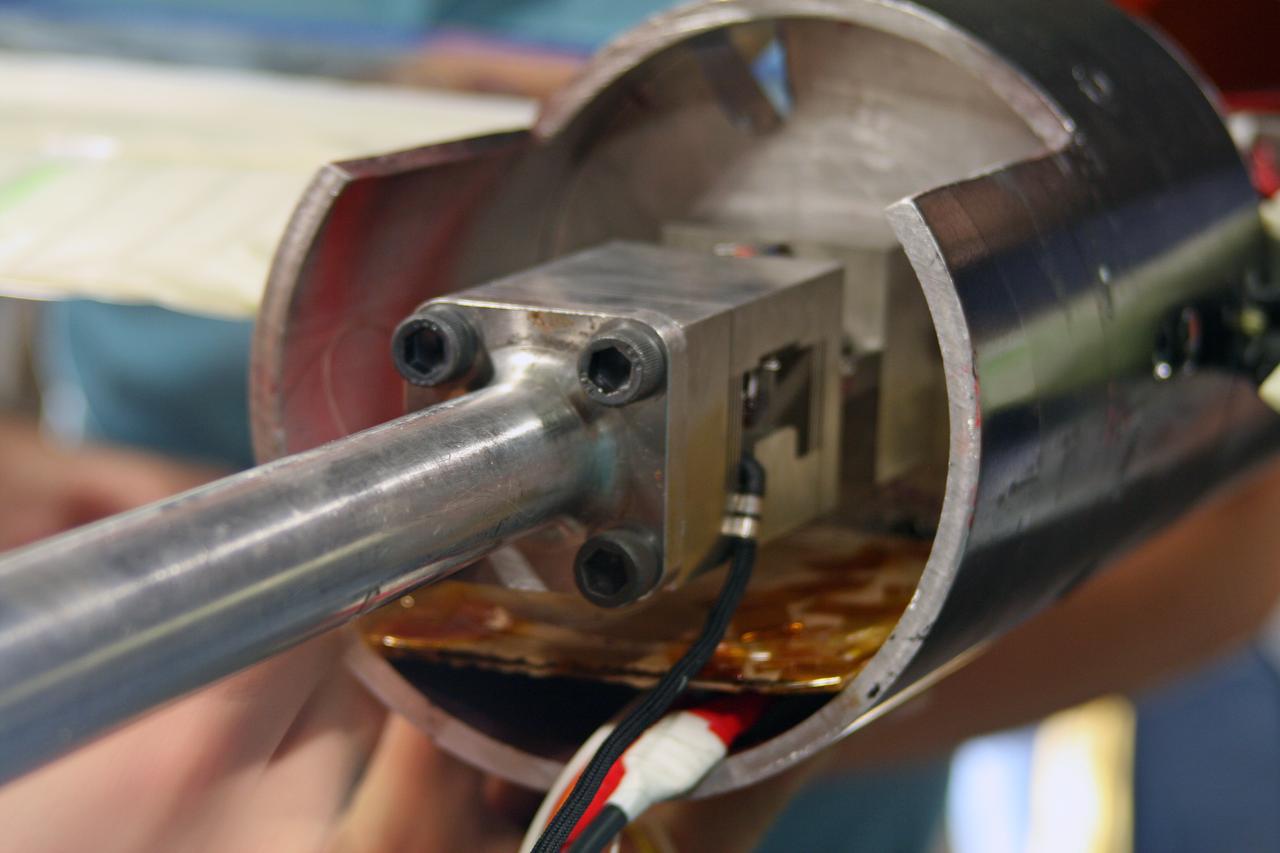
Aeronautic Academy Continuous Trailing Edge Flap

3/4 front view of Wind Tunnel investigation of the Lockheed T-33 modified for area-suction leading-edge and trailing edge flaps in Ames 40x80 foot Wind Tunnel.

An Armstrong G-III aircraft carrying the Flexys© Adaptive Compliant Trailing Edge flap. The smooth transition between the flaps and wing reduced drag and noise.

Application of blowing-type boundry-layer control to the leading-and trailing-edge flaps of a Change Vought XF8U-1 wing
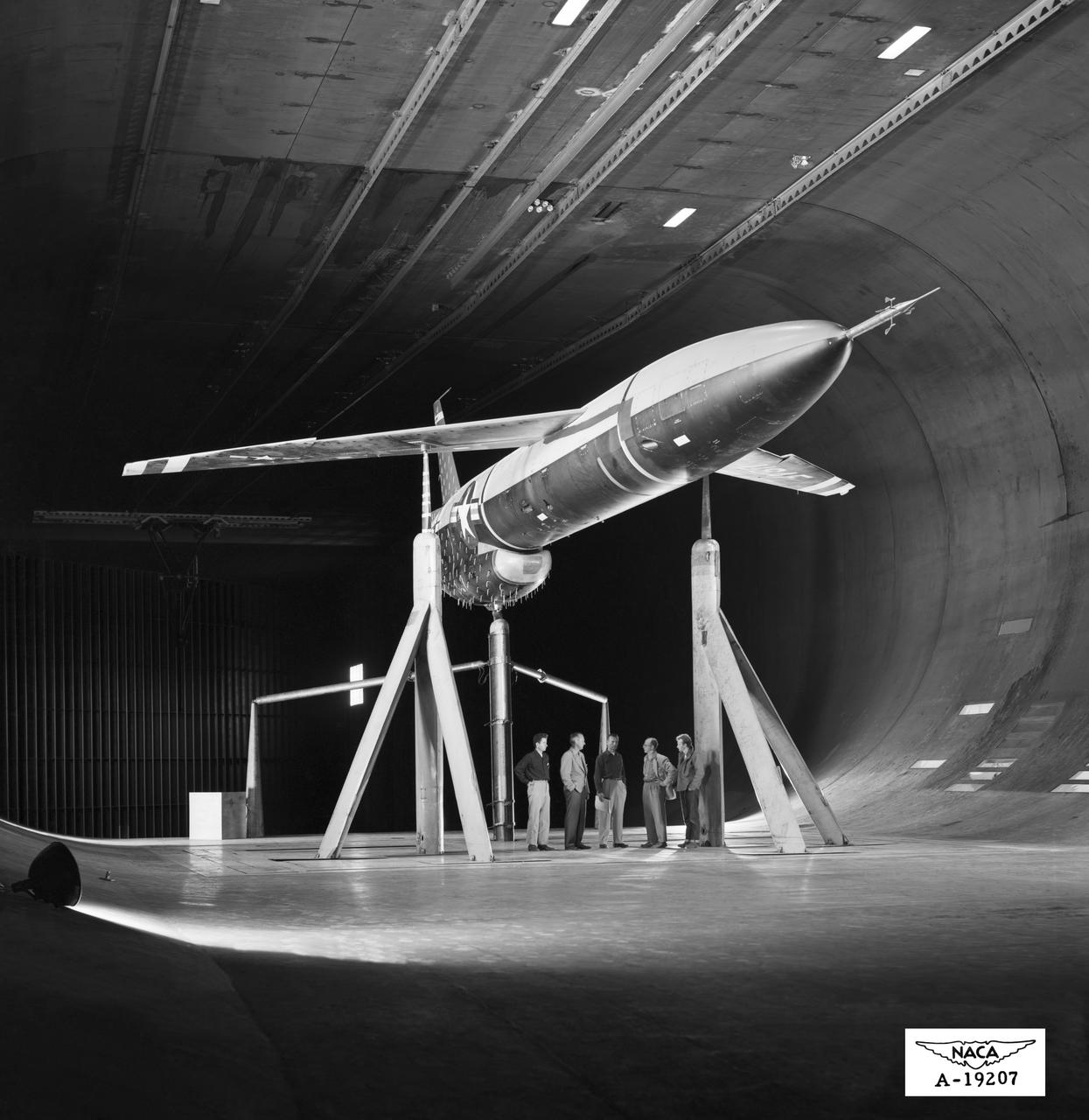
3/4 front view in Ames 40x80 foot Wind Tunnel investigation of the Lockheed T-33 modified for area-suction leading-edge and trailing edge flaps.

3/4 rear view of SCAT-17 supersonic transport with thrust reverser installed and trailing edge flaps deflected at 30 deg.
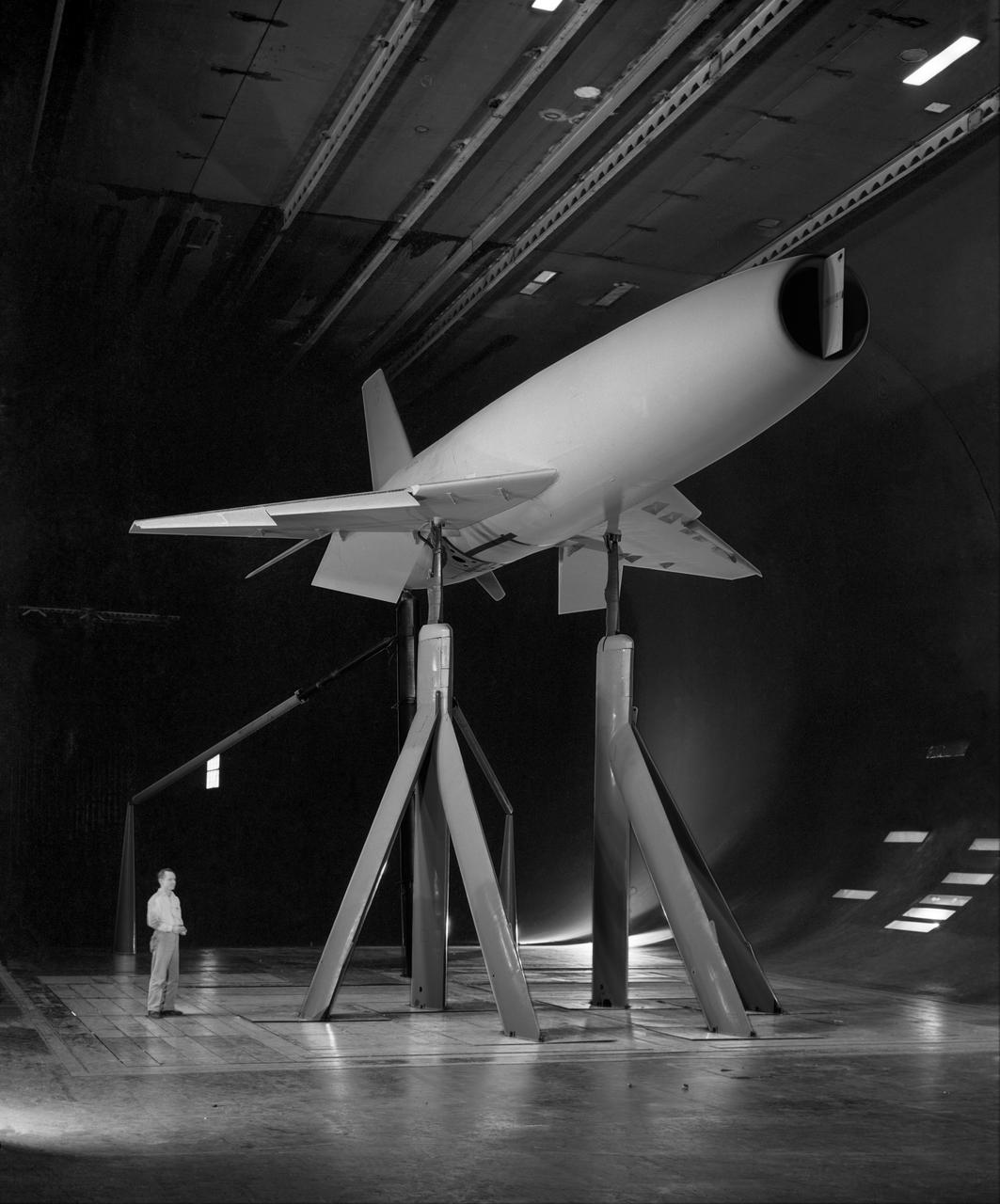
Application of blowing type boundry-layer control to the leading and trailing edge flaps of a 52 deg swept wing. 3/4 view of Aspect Ratio 2.8, taper ratio .17, 45 deg swept back wing model -3/4 front view
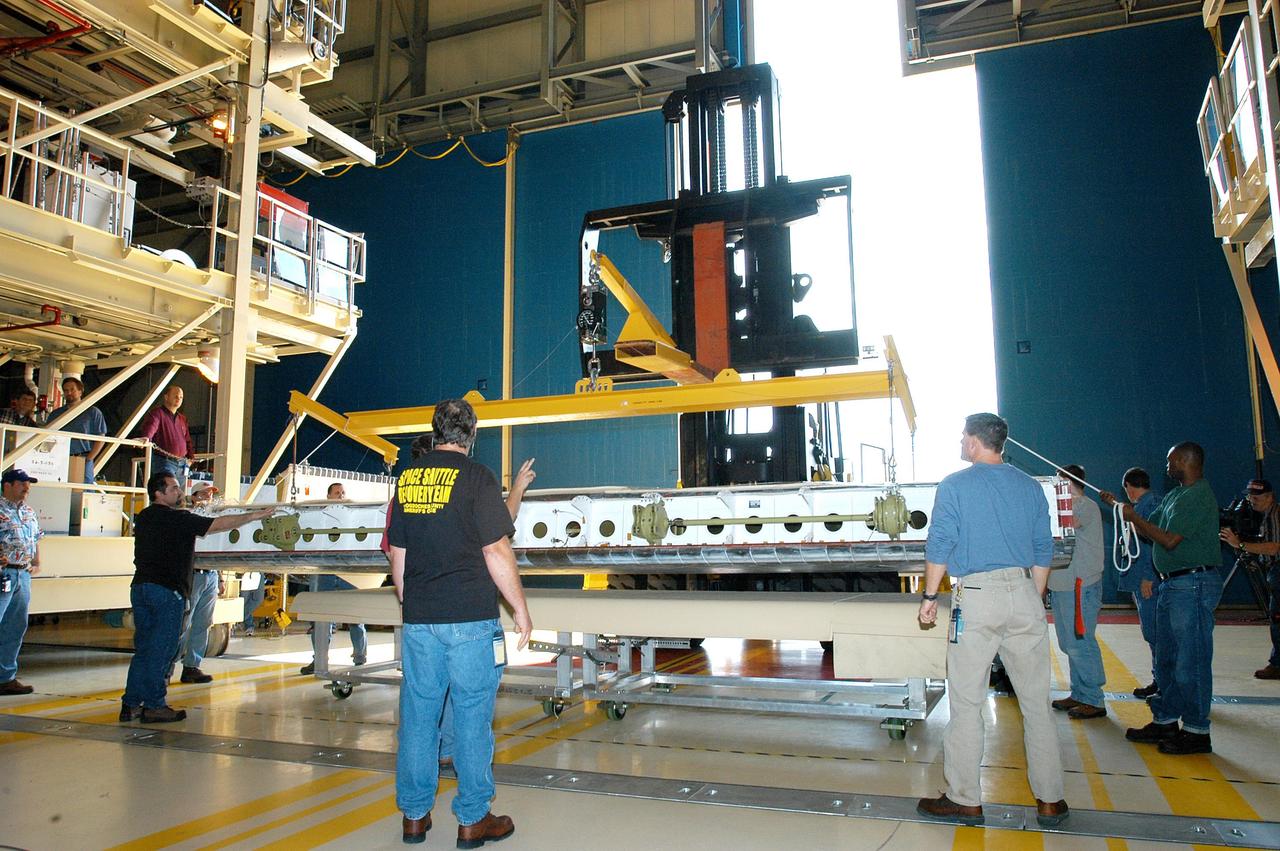
KENNEDY SPACE CENTER, FLA. - Workers in the Orbiter Processing Facility help prepare the body flap for lifting prior to installation on the orbiter Discovery. The body flap is an aluminum structure consisting of ribs, spars, skin panels and a trailing edge assembly. It thermally shields the three main engines during entry and provides pitch control trim during landing approach. Discovery is being processed for launch on the first Return to Flight mission, STS-114.
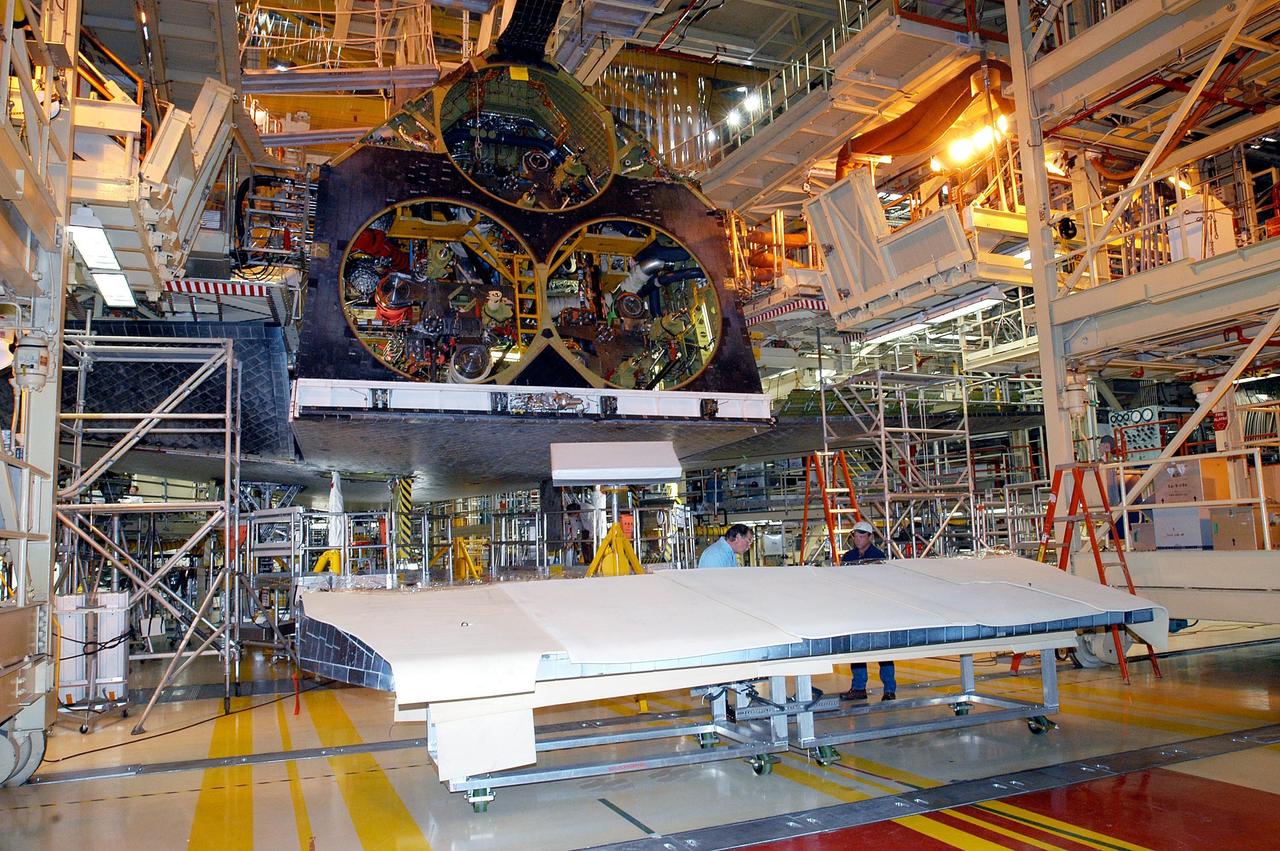
KENNEDY SPACE CENTER, FLA. - In the Orbiter Processing Facility, the body flap for the orbiter Discovery is prepared for installation. The body flap is an aluminum structure consisting of ribs, spars, skin panels and a trailing edge assembly. It thermally shields the three main engines during entry and provides pitch control trim during landing approach. Discovery is being processed for launch on the first Return to Flight mission, STS-114.
KENNEDY SPACE CENTER, FLA. - A Hyster forklift in the Orbiter Processing Facility moves the body flap toward the aft of the orbiter Discovery. The body flap is an aluminum structure consisting of ribs, spars, skin panels and a trailing edge assembly. It thermally shields the three main engines during entry and provides pitch control trim during landing approach. Discovery is being processed for launch on the first Return to Flight mission, STS-114.
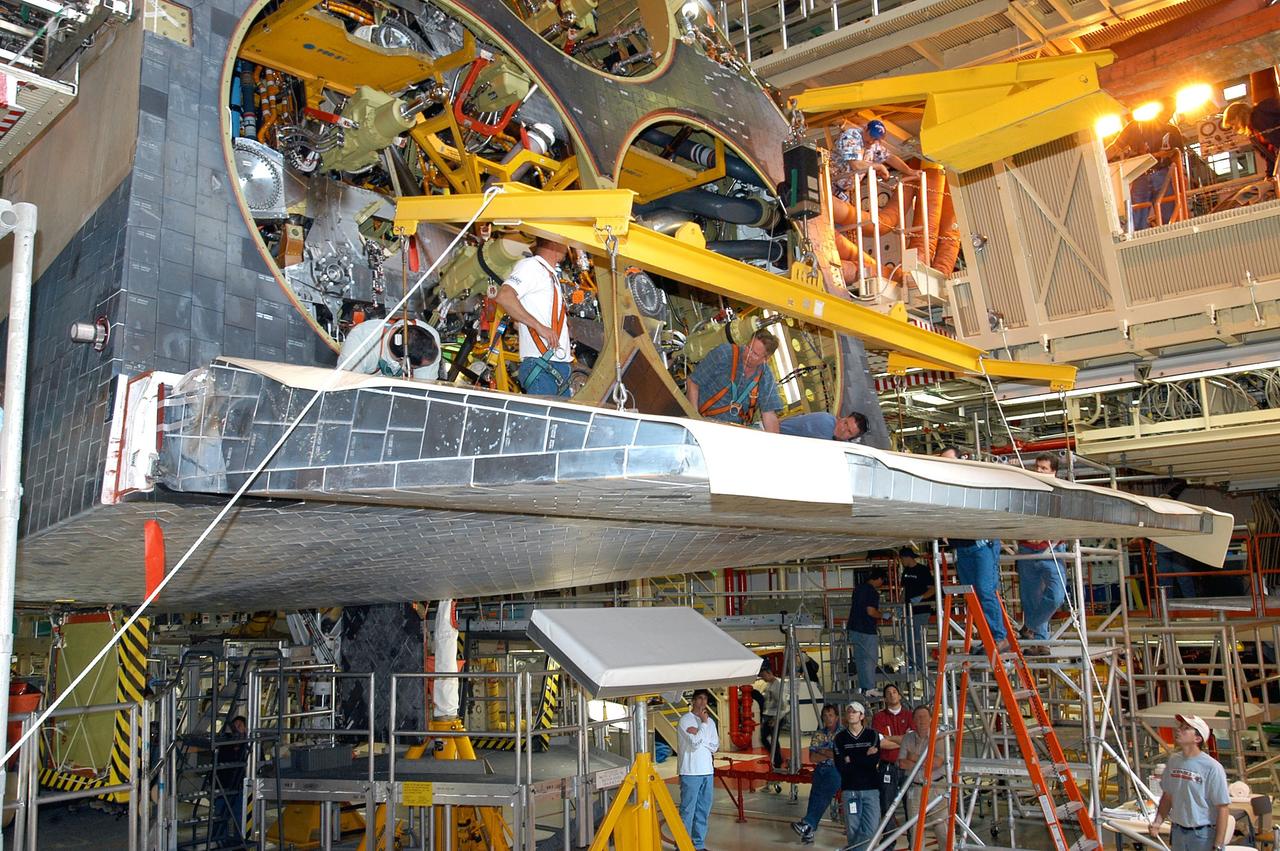
KENNEDY SPACE CENTER, FLA. - The body flap is installed on the orbiter Discovery. The body flap is an aluminum structure consisting of ribs, spars, skin panels and a trailing edge assembly. It thermally shields the three main engines during entry and provides pitch control trim during landing approach. Discovery is being processed for launch on the first Return to Flight mission, STS-114.
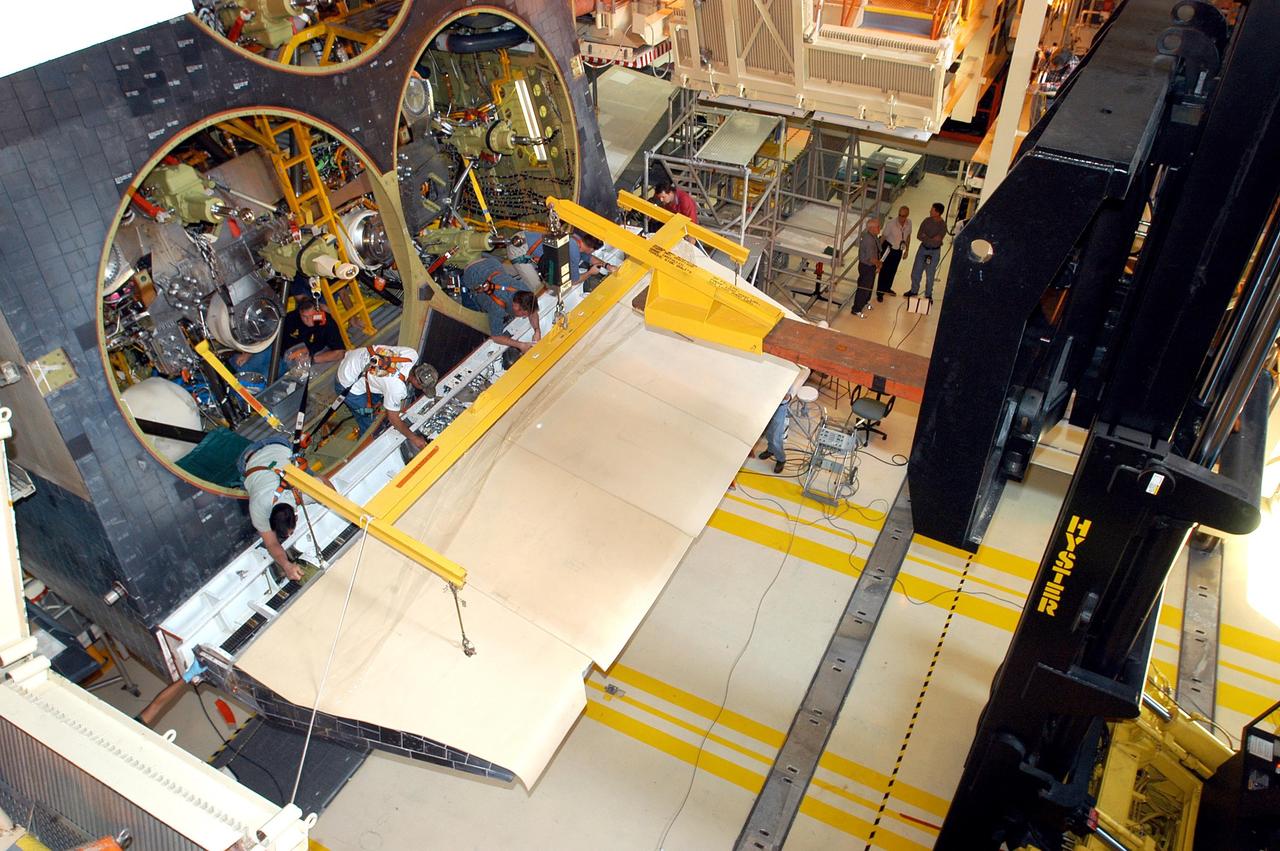
KENNEDY SPACE CENTER, FLA. - In the Orbiter Processing Facility, A Hyster forklift supports the body flap as workers secure it to the orbiter Discovery. The body flap is an aluminum structure consisting of ribs, spars, skin panels and a trailing edge assembly. It thermally shields the three main engines during entry and provides pitch control trim during landing approach. Discovery is being processed for launch on the first Return to Flight mission, STS-114.
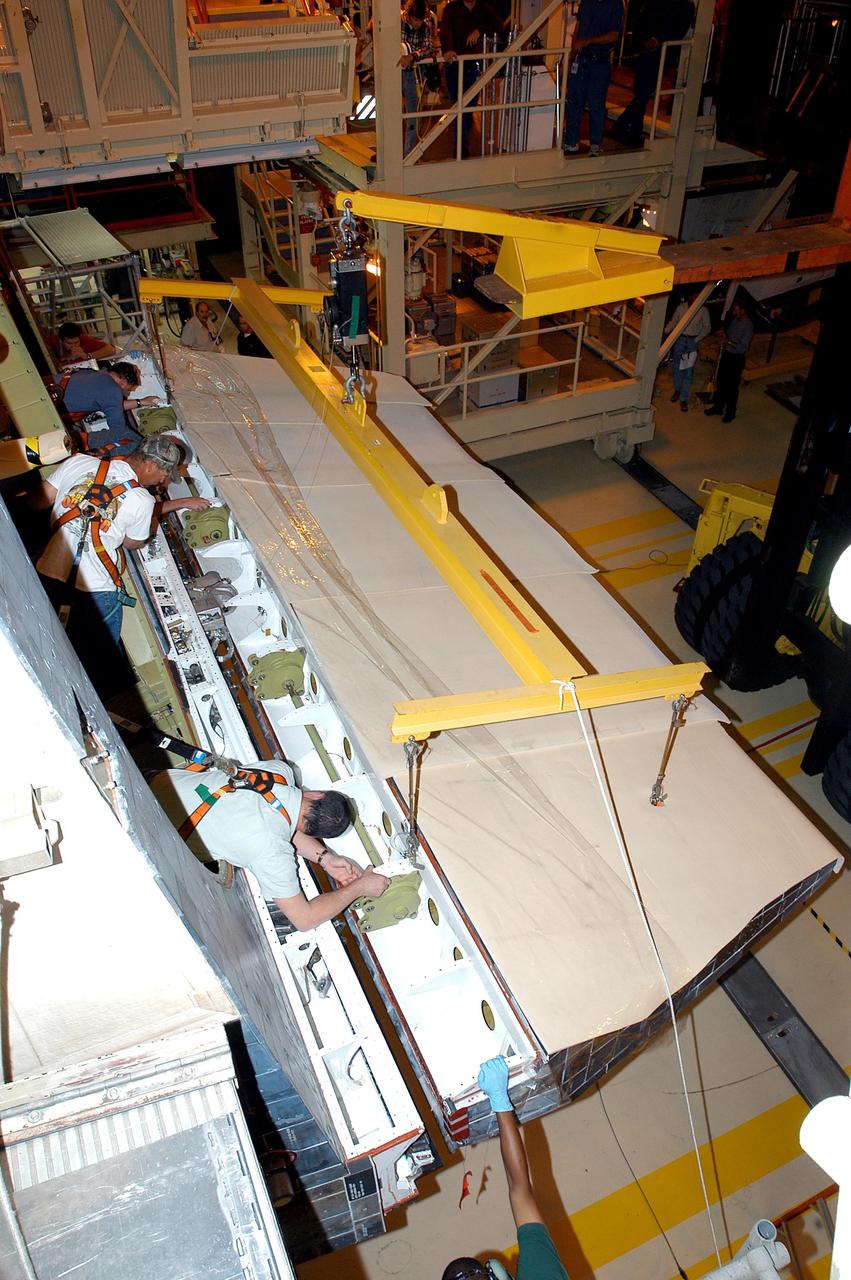
KENNEDY SPACE CENTER, FLA. - Workers in the Orbiter Processing Facility help move the body flap into position on the orbiter Discovery. The body flap is an aluminum structure consisting of ribs, spars, skin panels and a trailing edge assembly. It thermally shields the three main engines during entry and provides pitch control trim during landing approach. Discovery is being processed for launch on the first Return to Flight mission, STS-114.
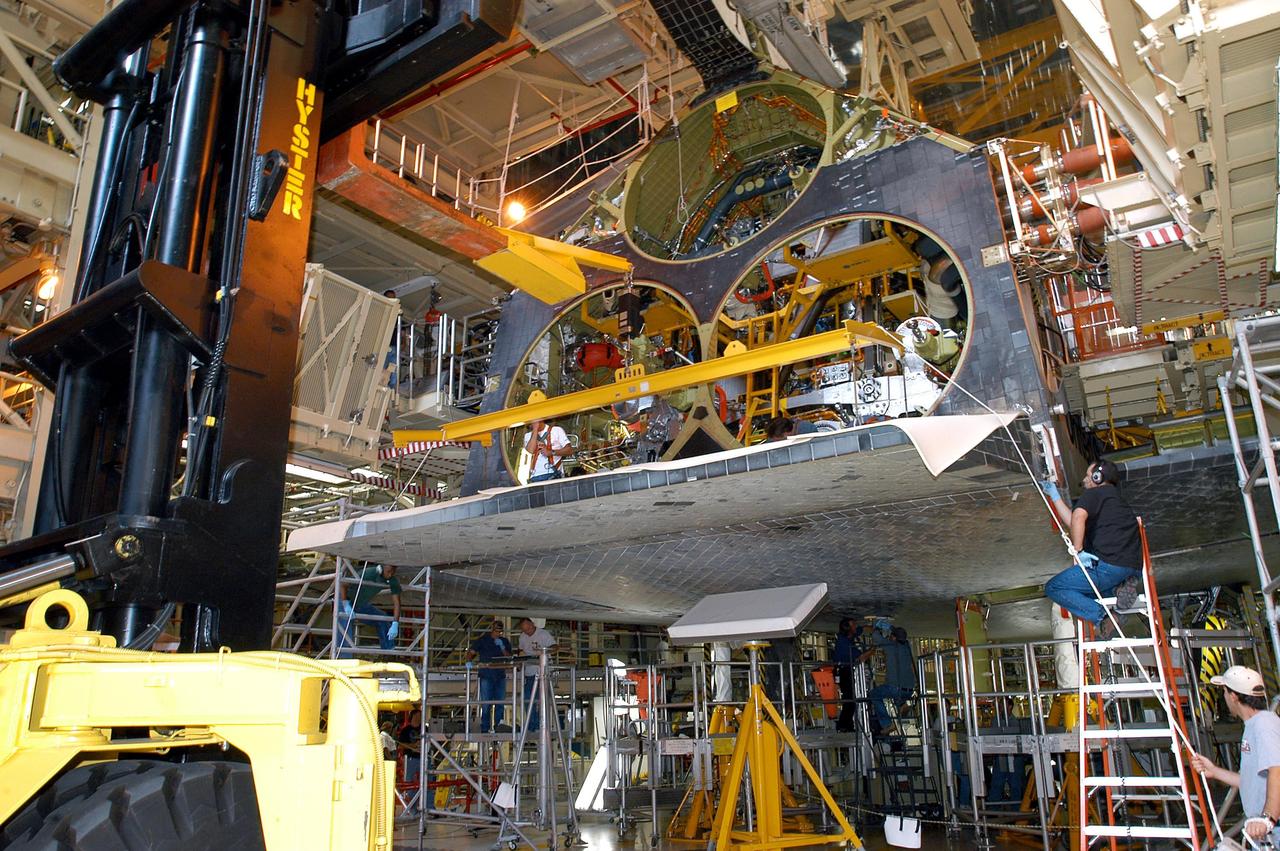
KENNEDY SPACE CENTER, FLA. - The body flap is installed on the orbiter Discovery. The body flap is an aluminum structure consisting of ribs, spars, skin panels and a trailing edge assembly. It thermally shields the three main engines during entry and provides pitch control trim during landing approach. Discovery is being processed for launch on the first Return to Flight mission, STS-114.
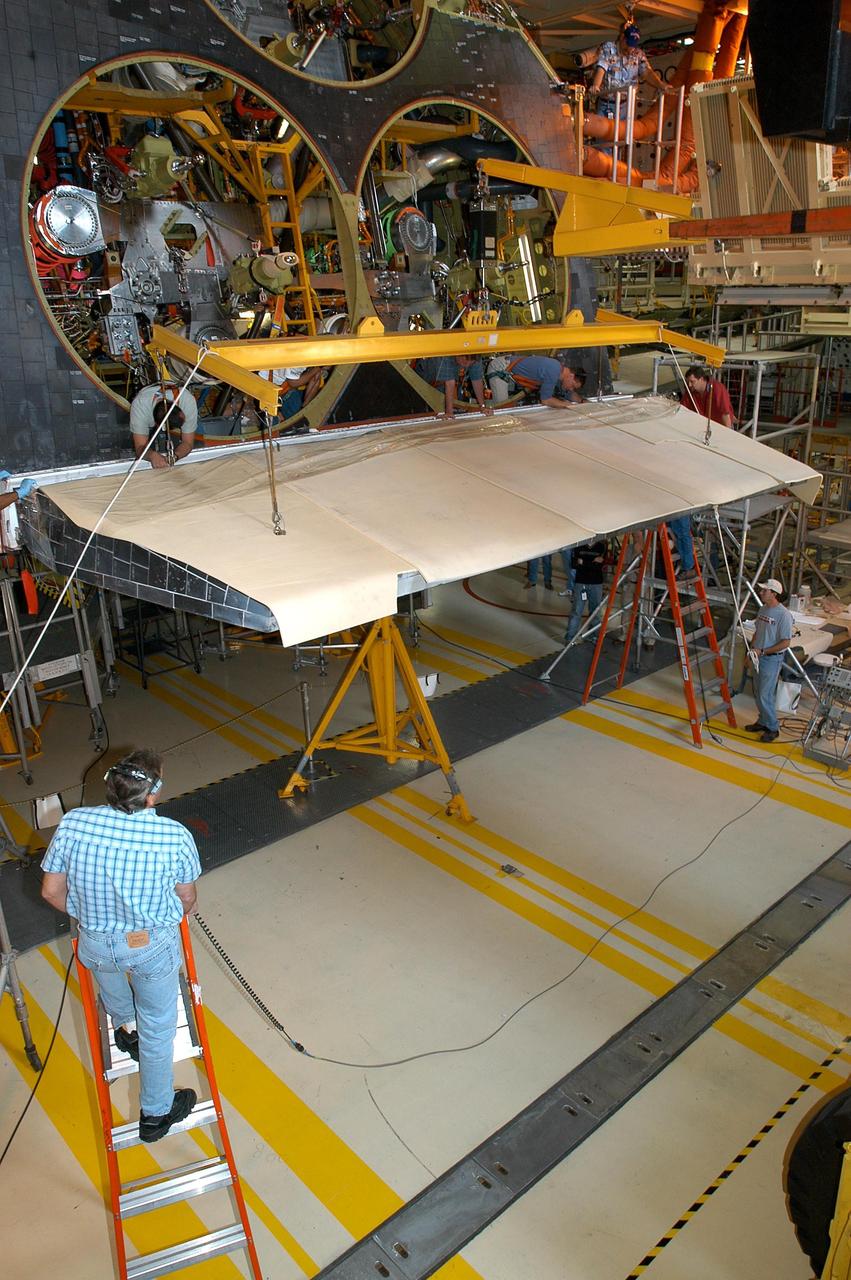
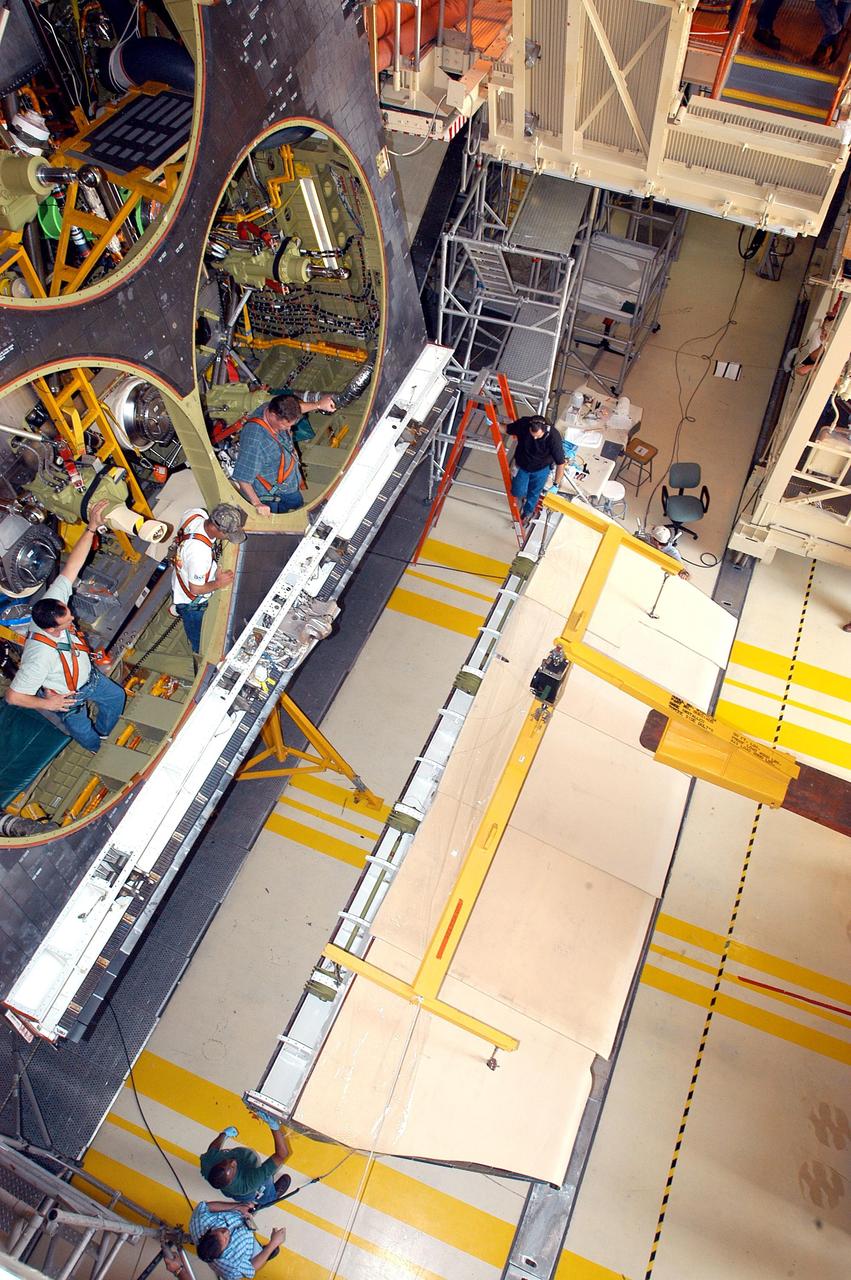
KENNEDY SPACE CENTER, FLA. - A worker on a ladder (lower left) observes installation of the body flap onto the orbiter Discovery. The body flap is an aluminum structure consisting of ribs, spars, skin panels and a trailing edge assembly. It thermally shields the three main engines during entry and provides pitch control trim during landing approach. Discovery is being processed for launch on the first Return to Flight mission, STS-114.
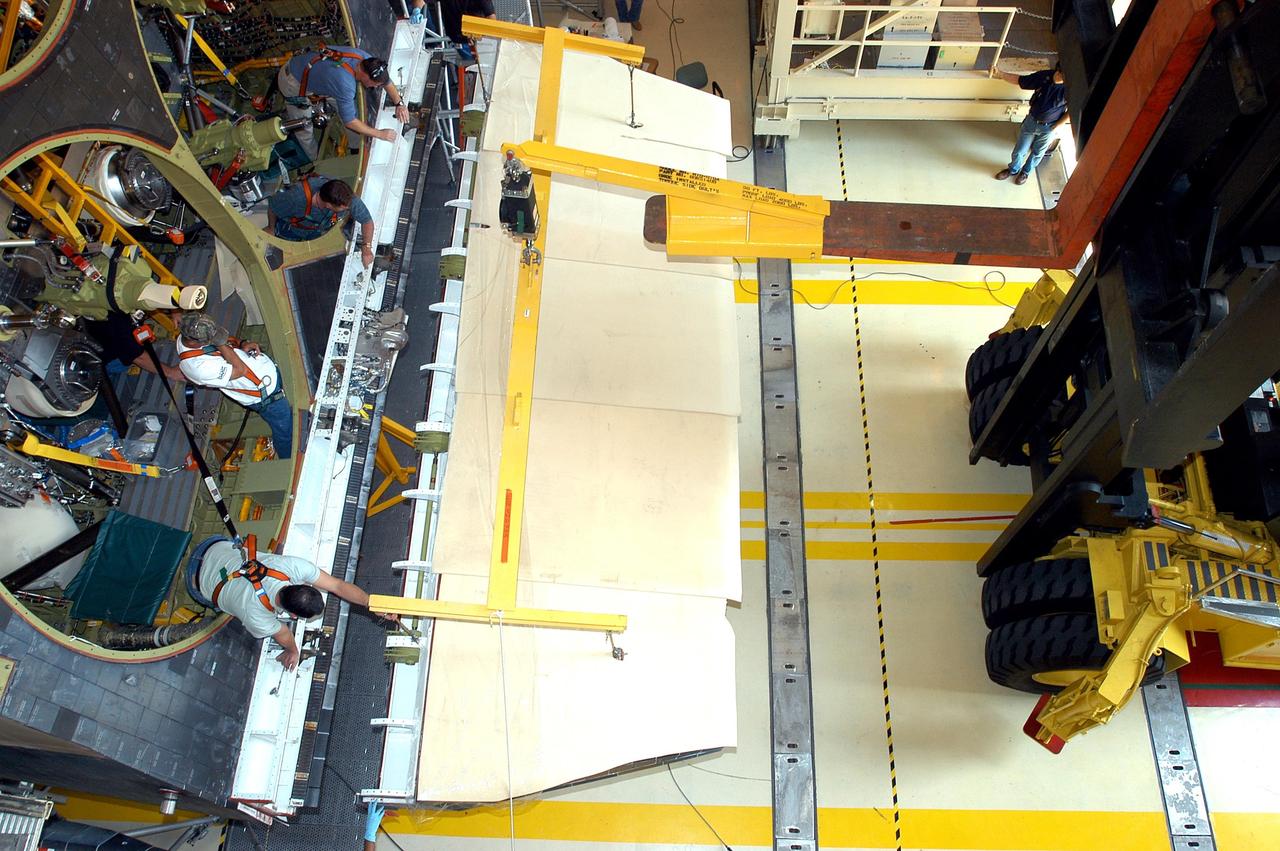
KENNEDY SPACE CENTER, FLA. - In the Orbiter Processing Facility, the body flap is moved into position for installation on the orbiter Discovery. The body flap is an aluminum structure consisting of ribs, spars, skin panels and a trailing edge assembly. It thermally shields the three main engines during entry and provides pitch control trim during landing approach. Discovery is being processed for launch on the first Return to Flight mission, STS-114.
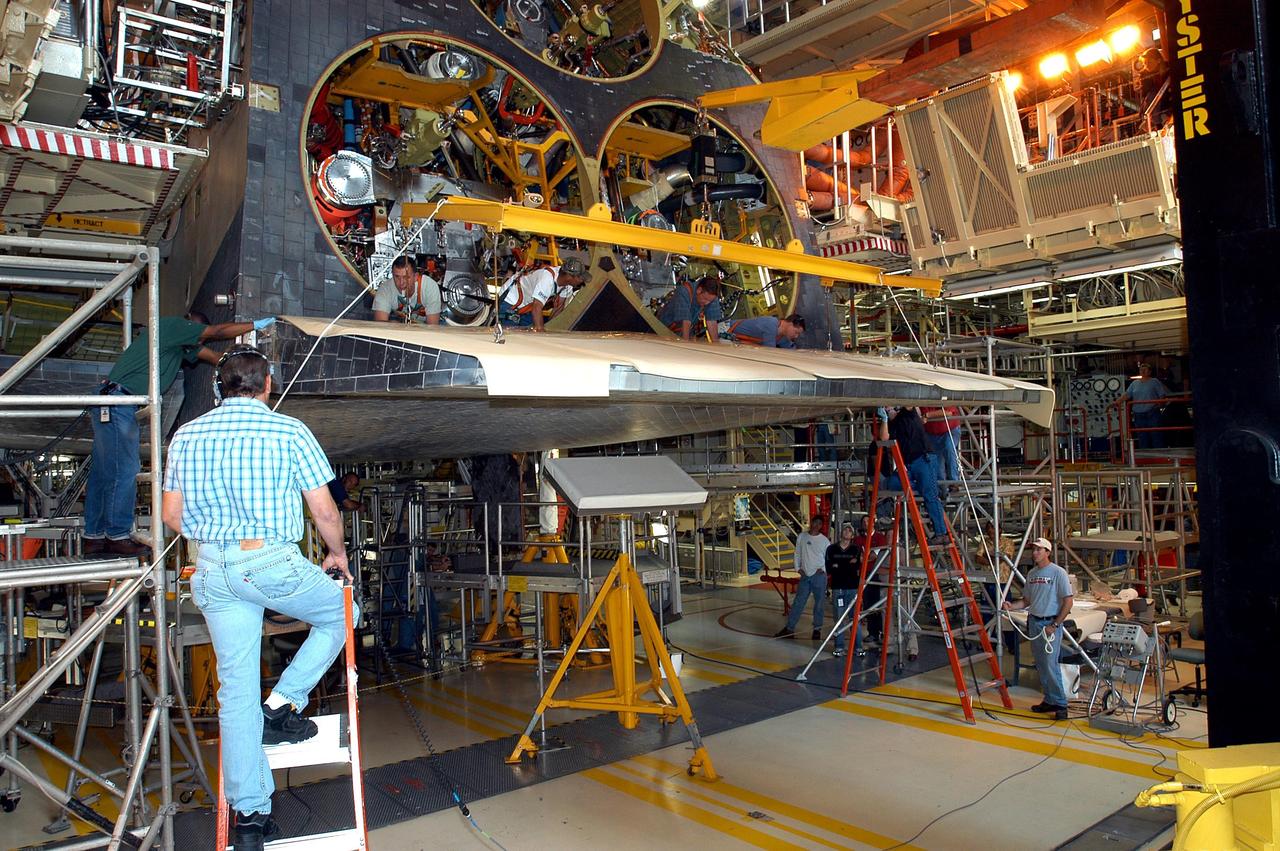
KENNEDY SPACE CENTER, FLA. - Workers on ladders (left and right) check installation of the body flap onto the orbiter Discovery. The body flap is an aluminum structure consisting of ribs, spars, skin panels and a trailing edge assembly. It thermally shields the three main engines during entry and provides pitch control trim during landing approach. Discovery is being processed for launch on the first Return to Flight mission, STS-114.
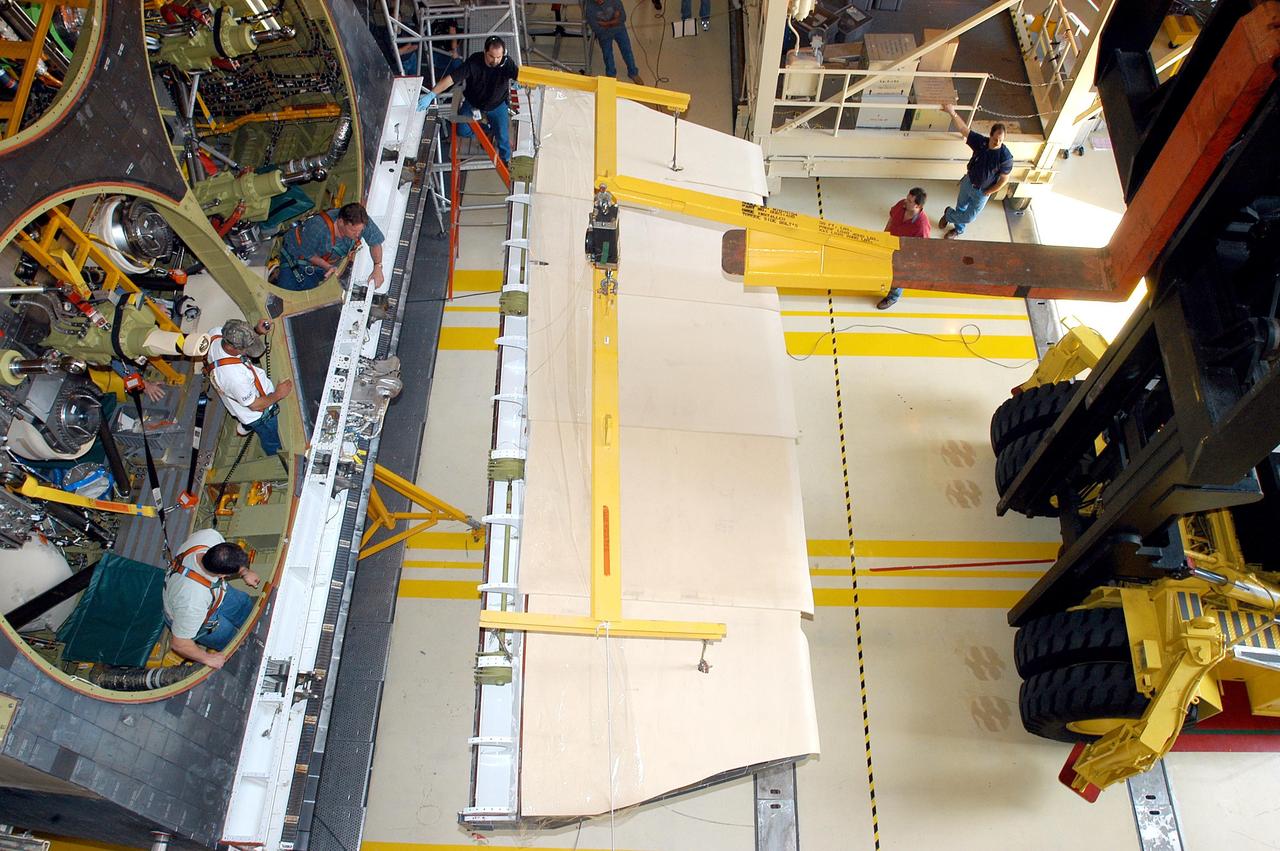
KENNEDY SPACE CENTER, FLA. - In the Orbiter Processing Facility, the body flap is moved into position for installation on the orbiter Discovery. The body flap is an aluminum structure consisting of ribs, spars, skin panels and a trailing edge assembly. It thermally shields the three main engines during entry and provides pitch control trim during landing approach. Discovery is being processed for launch on the first Return to Flight mission, STS-114.
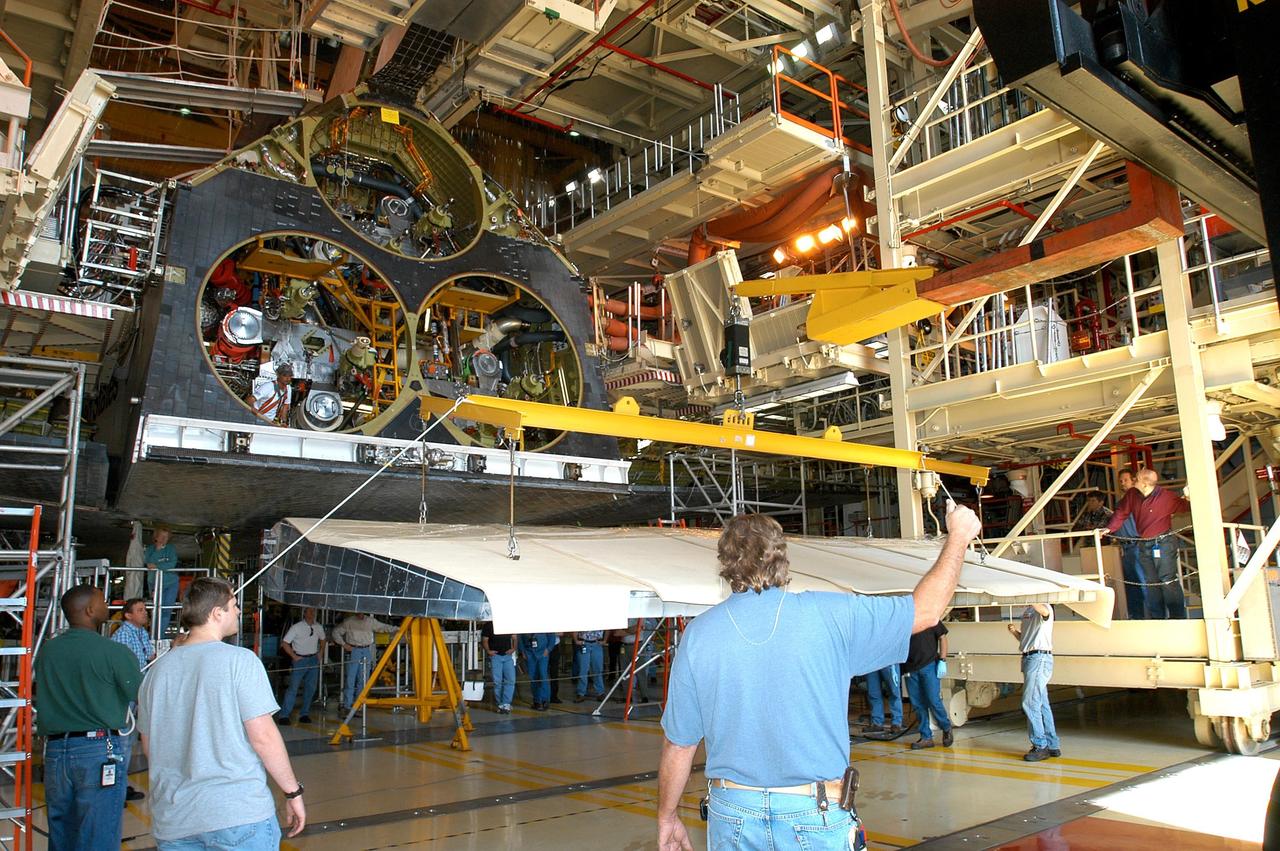
KENNEDY SPACE CENTER, FLA. - A Hyster forklift in the Orbiter Processing Facility lifts the body flap to be installed on the orbiter Discovery. The body flap is an aluminum structure consisting of ribs, spars, skin panels and a trailing edge assembly. It thermally shields the three main engines during entry and provides pitch control trim during landing approach. Discovery is being processed for launch on the first Return to Flight mission, STS-114.
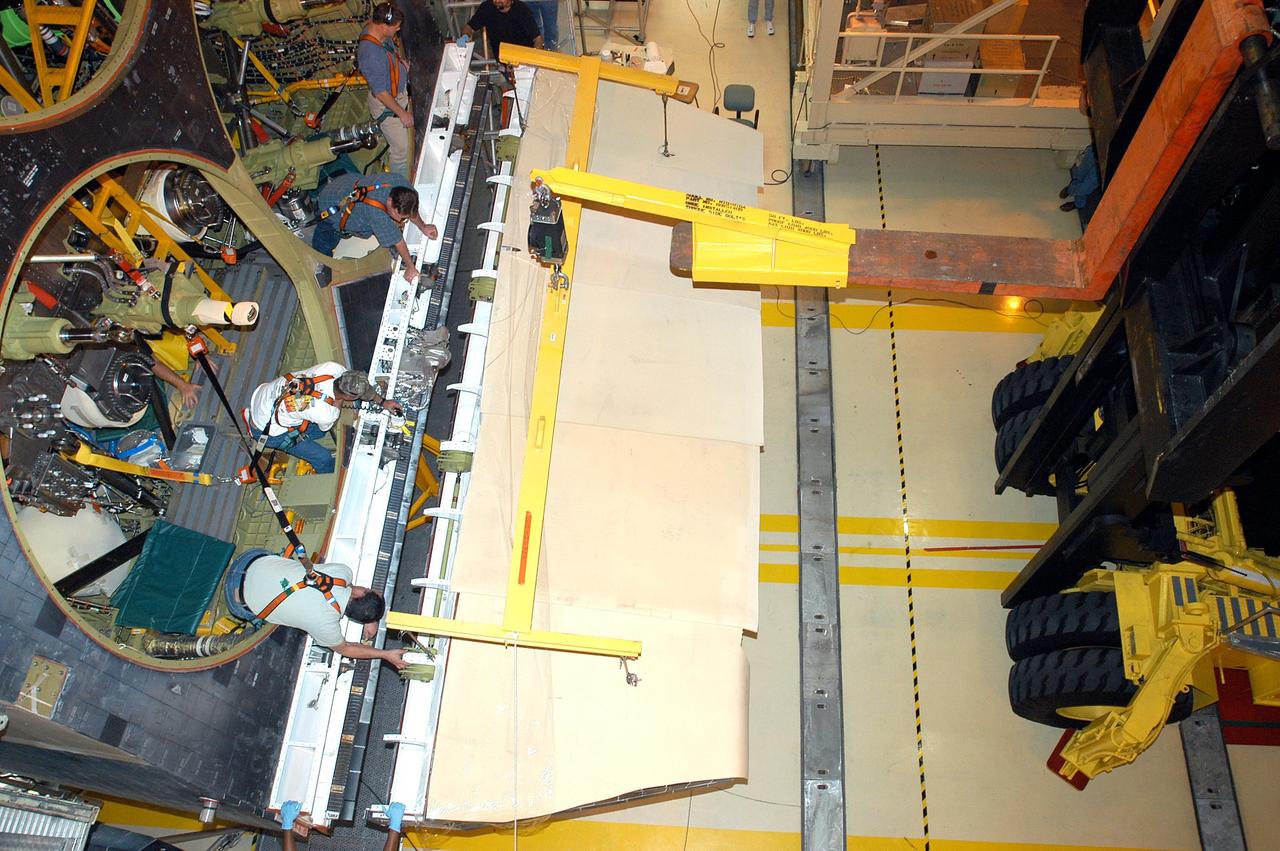
KENNEDY SPACE CENTER, FLA. - Workers in the Orbiter Processing Facility lean toward the body flap to be installed on the orbiter Discovery. The body flap is an aluminum structure consisting of ribs, spars, skin panels and a trailing edge assembly. It thermally shields the three main engines during entry and provides pitch control trim during landing approach. Discovery is being processed for launch on the first Return to Flight mission, STS-114.
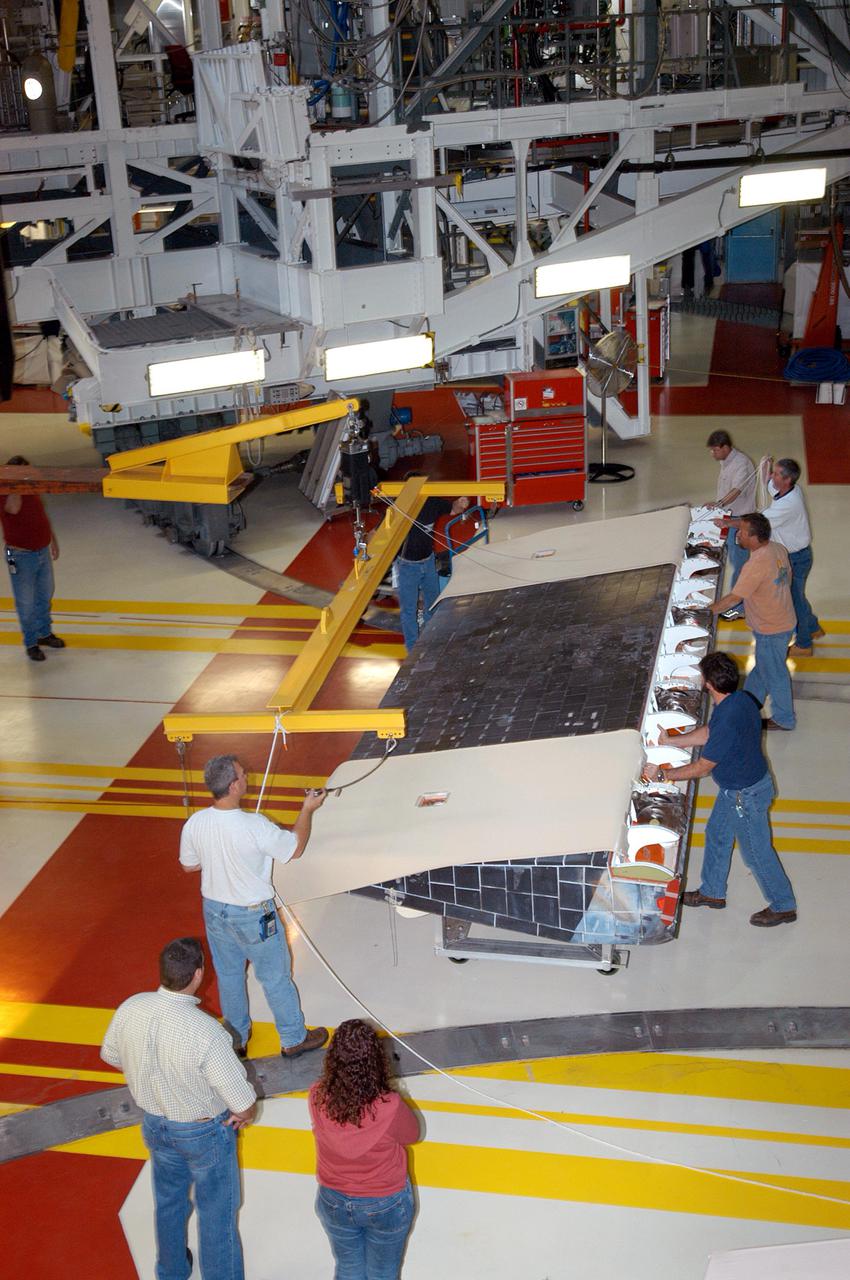
KENNEDY SPACE CENTER, FLA. - In the Orbiter Processing Facility, workers on the floor prepare to attach a crane to the body flap for the orbiter Atlantis. The crane will lift the body flap for installation on the orbiter. The body flap is an aluminum structure consisting of ribs, spars, skin panels and a trailing edge assembly. It thermally shields the three Space Shuttle Main Engines during entry and provides the orbiter with pitch control trim during its atmospheric flight after entry. Atlantis is being processed for its mission, designated STS-121, this summer to the International Space Station. The launch planning window is July 12 - August 3.
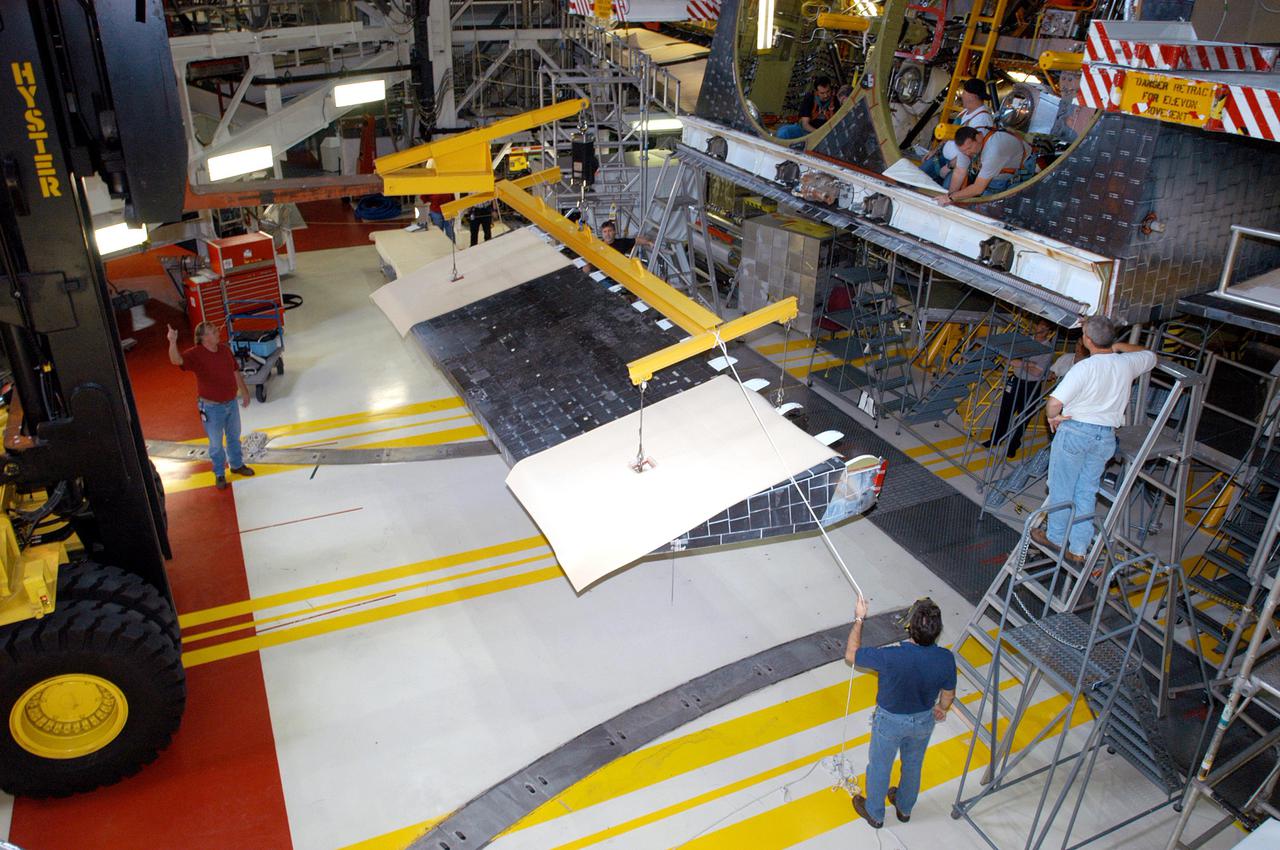
KENNEDY SPACE CENTER, FLA. - In the Orbiter Processing Facility, workers help guide the body flap toward the orbiter Atlantis for installation. The body flap is an aluminum structure consisting of ribs, spars, skin panels and a trailing edge assembly. It thermally shields the three Space Shuttle Main Engines during entry and provides the orbiter with pitch control trim during its atmospheric flight after entry. Atlantis is being processed for its mission, designated STS-121, this summer to the International Space Station. The launch planning window is July 12 - August 3.
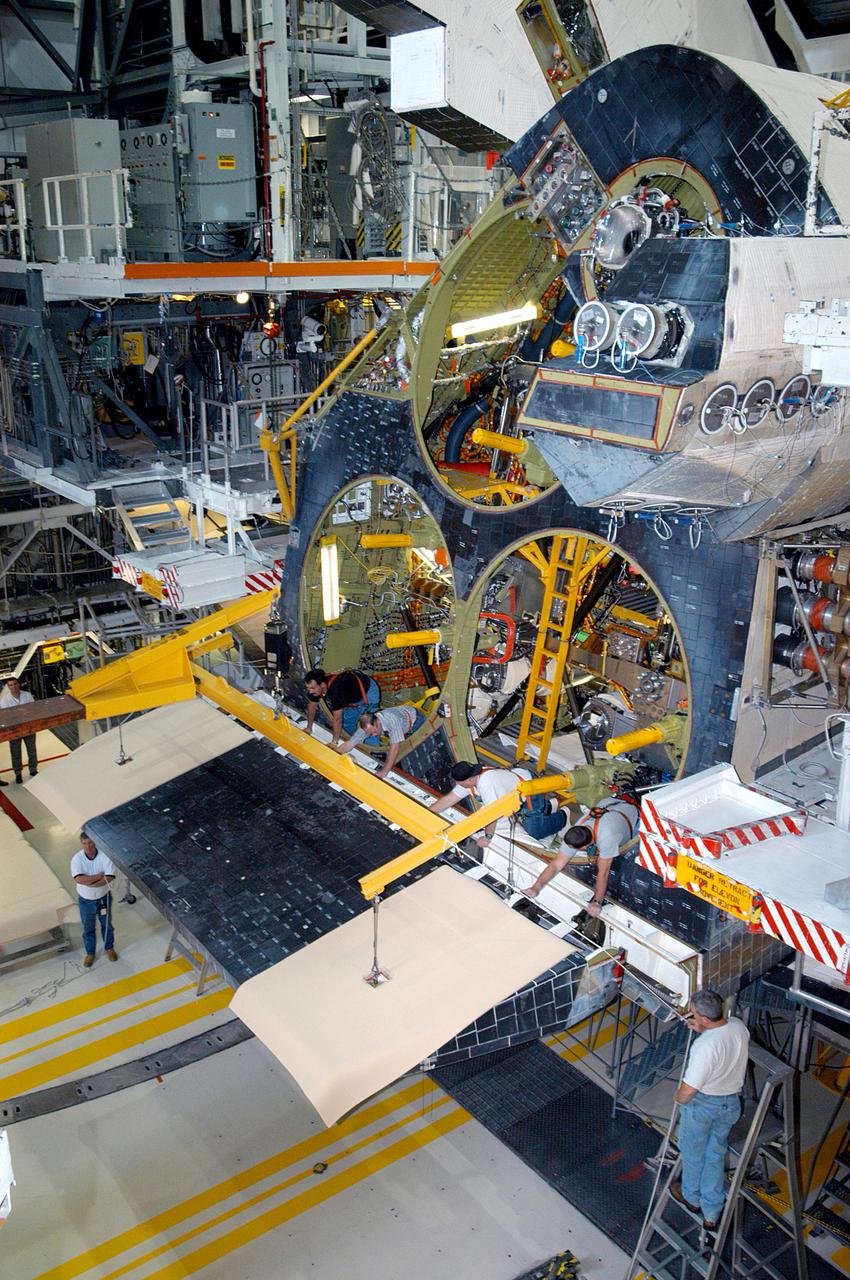
KENNEDY SPACE CENTER, FLA. - In the Orbiter Processing Facility, workers inside the openings for the Space Shuttle Main Engines reach out to install the body flap, suspended behind the orbiter Atlantis. The body flap is an aluminum structure consisting of ribs, spars, skin panels and a trailing edge assembly. It thermally shields the three Space Shuttle Main Engines during entry and provides the orbiter with pitch control trim during its atmospheric flight after entry. Atlantis is being processed for its mission, designated STS-121, this summer to the International Space Station. The launch planning window is July 12 - August 3.
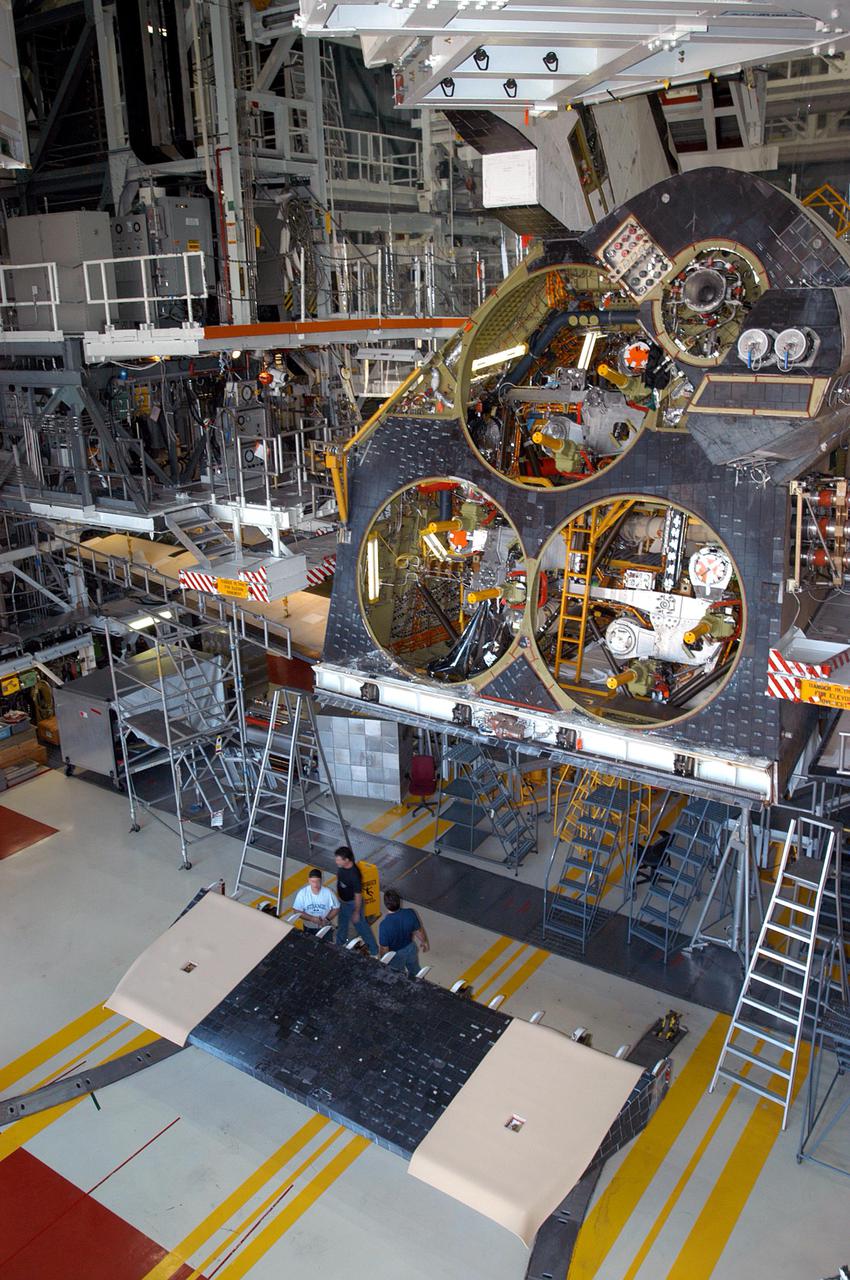
KENNEDY SPACE CENTER, FLA. - In the Orbiter Processing Facility, workers on the floor get ready to install the body flap on the orbiter Atlantis, behind them. The body flap is an aluminum structure consisting of ribs, spars, skin panels and a trailing edge assembly. It thermally shields the three Space Shuttle Main Engines during entry and provides the orbiter with pitch control trim during its atmospheric flight after entry. Atlantis is being processed for its mission, designated STS-121, this summer to the International Space Station. The launch planning window is July 12 - August 3.

Lockheed NC-130B STOL turboprop-powered aircraft with ailerons drooped 30 degrees. Note trailing-edge flaps deflected 90 degrees for increased lift. Two T-56 turboshaft engines, which drove wing-mounted load compressors for boundary-layer control, are mounted on outboard wing pods. Landing approach speed was reduced 30 knots with boundary-layer control
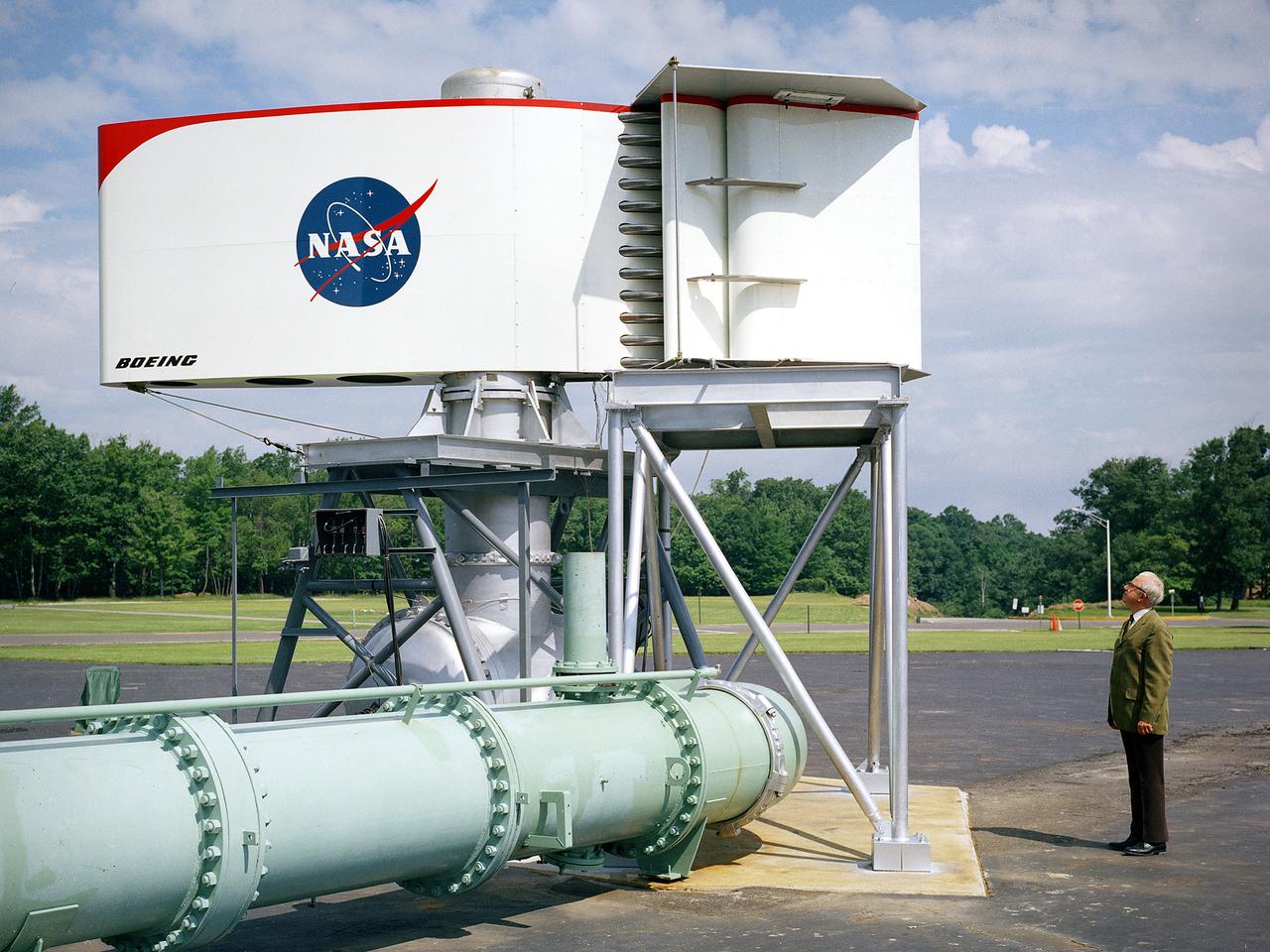
The augmentor wing concept was introduced during the early 1960s to enhance the performance of vertical and short takeoff (VSTOL) aircraft. The leading edge of the wing has full-span vertical flaps, and the trailing edge has double-slotted flaps. This provides aircraft with more control in takeoff and landing conditions. The augmentor wing also produced lower noise levels than other VSTOL designs. In the early 1970s Boeing Corporation built a Buffalo C-8A augmentor wing research aircraft for Ames Research Center. Researches at Lewis Research Center concentrated their efforts on reducing the noise levels of the wing. They initially used small-scale models to develop optimal nozzle screening methods. They then examined the nozzle designs on a large-scale model, seen here on an external test stand. This test stand included an airflow system, nozzle, the augmentor wing, and a muffler system below to reduce the atmospheric noise levels. The augmentor was lined with noise-reducing acoustic panels. The Lewis researchers were able to adjust the airflow to simulate conditions at takeoff and landing. Once the conditions were stabilized they took noise measurements from microphones placed in all directions from the wing, including an aircraft flying over. They found that the results coincided with the earlier small-scale studies for landing situations but not takeoffs. The acoustic panels were found to be successful.
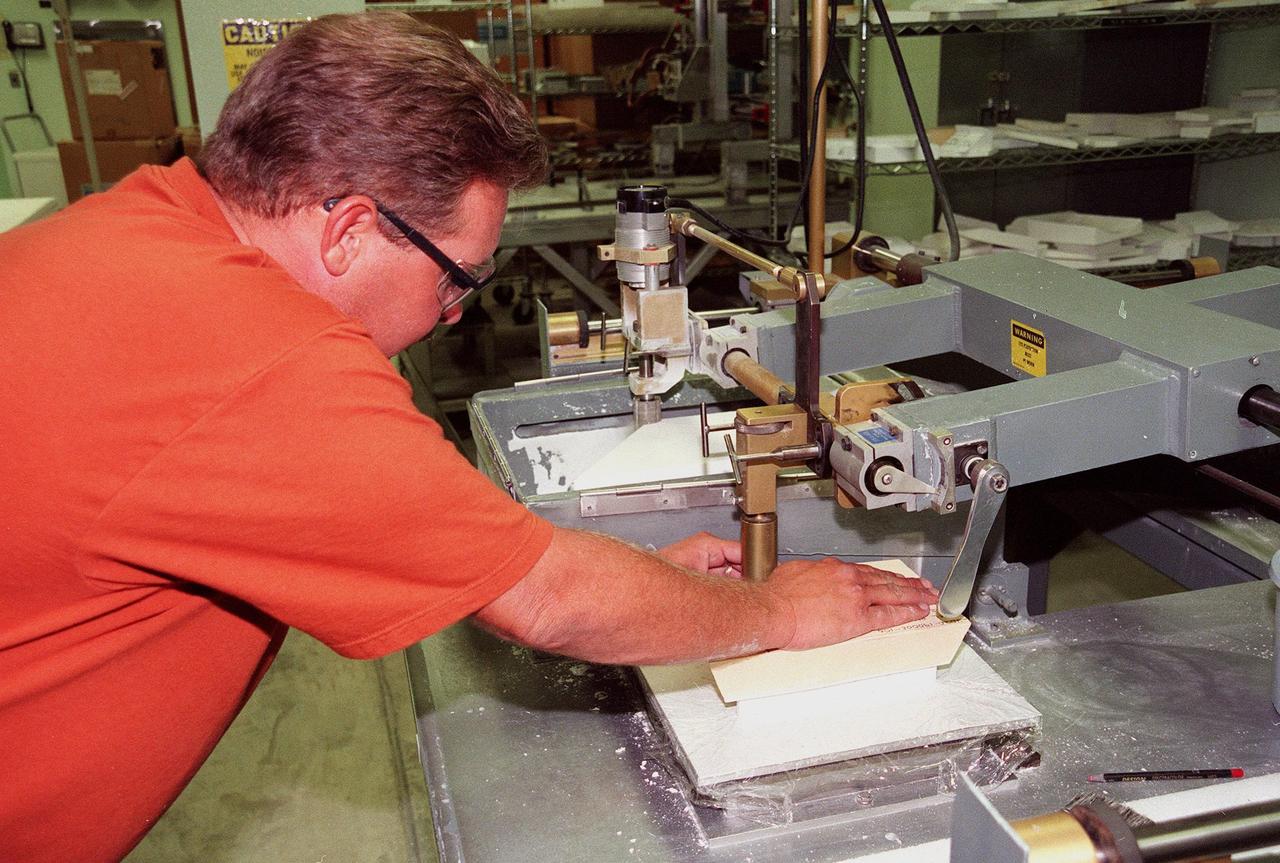
In the Tile Fabrication Shop, Tony Rollins, with United Space Alliance, cuts a High-Temperature Reusable Surface Insulation (HRSI) tile on a gun stock contour milling machine. About 70 percent of a Space Shuttle orbiter’s external surface is shielded from heat by a network of more than 24,000 tiles formed from a silica fiber compound. HRSI tiles cover the lower surface of the orbiter, areas around the forward windows, upper body flap, the base heat shield, the "eyeballs" on the front of the Orbital Maneuvering System (OMS) pods, and the leading and trailing edges of the vertical stabilizer and the rudder speed brake. They are generally 6 inches square, but may also be as large as 12 inches square in some areas, and 1 to 5 inches thick. More advanced materials such as Flexible Insulation Blankets have replaced tiles on some upper surfaces of the orbiter
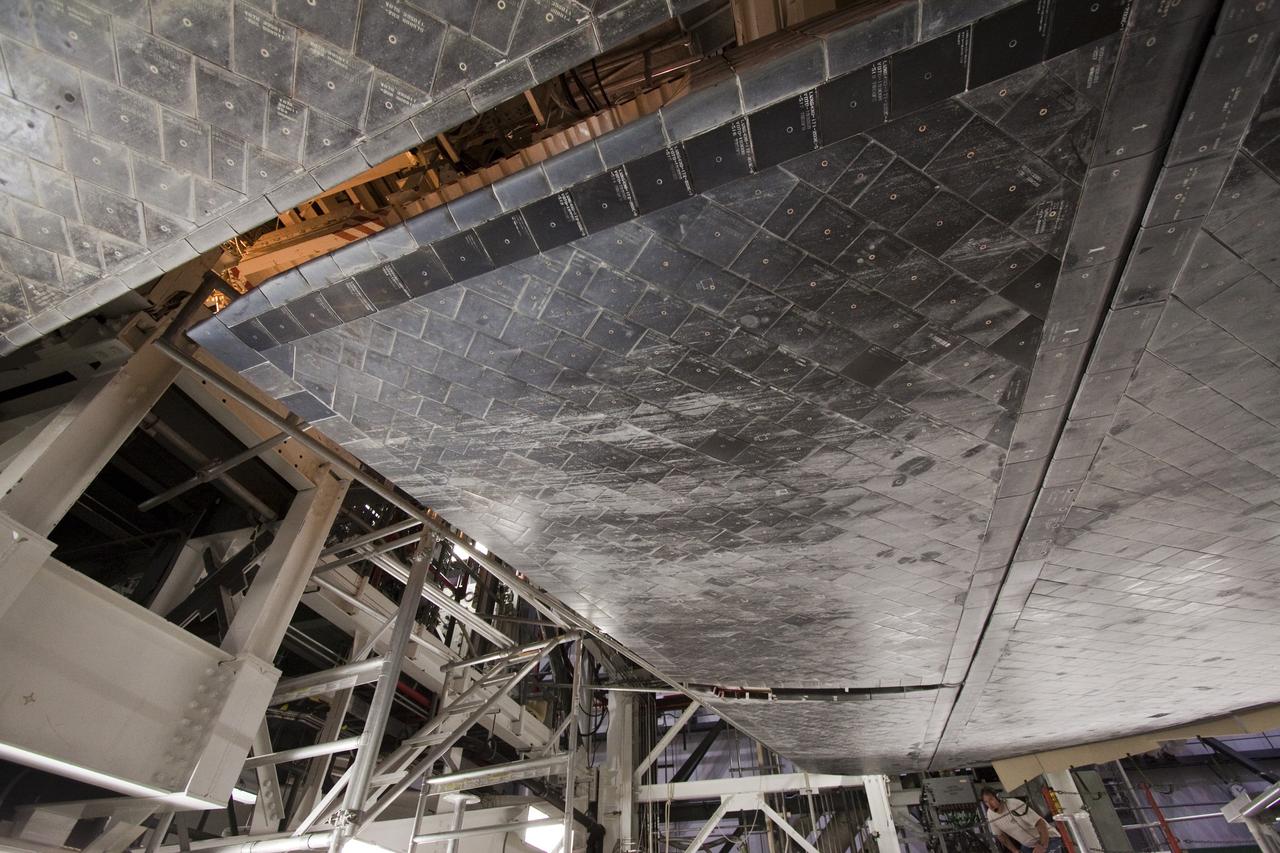
CAPE CANAVERAL, Fla. -- Space shuttle Atlantis goes through a routine landing gear test in Orbiter Processing Facility-1 at NASA's Kennedy Space Center in Florida. Technicians are checking to make sure the shuttle's wheels, brakes, elevons and body flap function properly. Seen here, an elevon is tested. Elevons are located on the trailing edge of each wing and help control pitch of the shuttle as it comes in for landing. Atlantis is being prepared for the STS-135 mission, which will deliver the Raffaello multi-purpose logistics module packed with supplies, logistics and spare parts to the International Space Station. STS-135 is targeted to launch June 28, and will be the last spaceflight for the Space Shuttle Program. Photo credit: NASA/Jack Pfaller
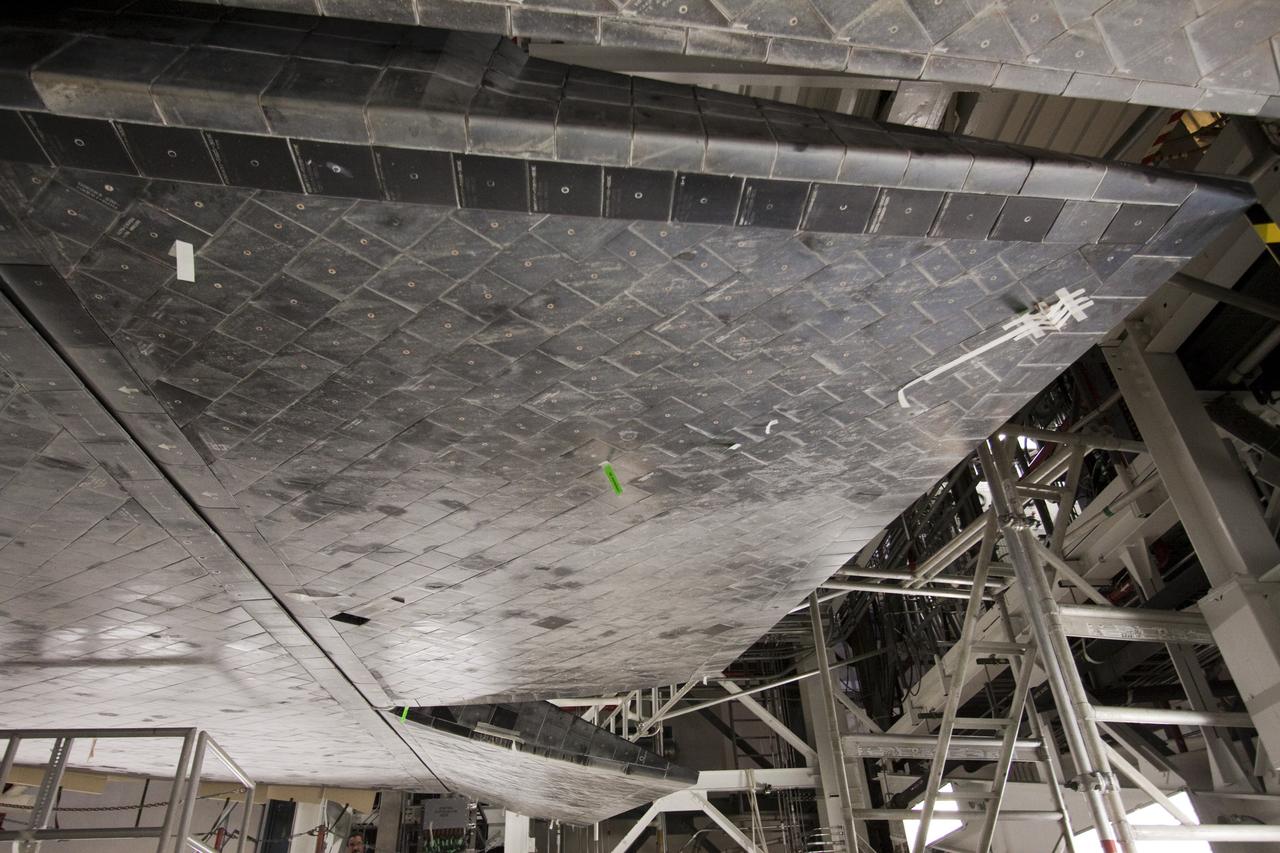
CAPE CANAVERAL, Fla. -- Space shuttle Atlantis goes through a routine landing gear test in Orbiter Processing Facility-1 at NASA's Kennedy Space Center in Florida. Technicians are checking to make sure the shuttle's wheels, brakes, elevons and body flap function properly. Seen here, an elevon is tested. Elevons are located on the trailing edge of each wing and help control pitch of the shuttle as it comes in for landing. Atlantis is being prepared for the STS-135 mission, which will deliver the Raffaello multi-purpose logistics module packed with supplies, logistics and spare parts to the International Space Station. STS-135 is targeted to launch June 28, and will be the last spaceflight for the Space Shuttle Program. Photo credit: NASA/Jack Pfaller