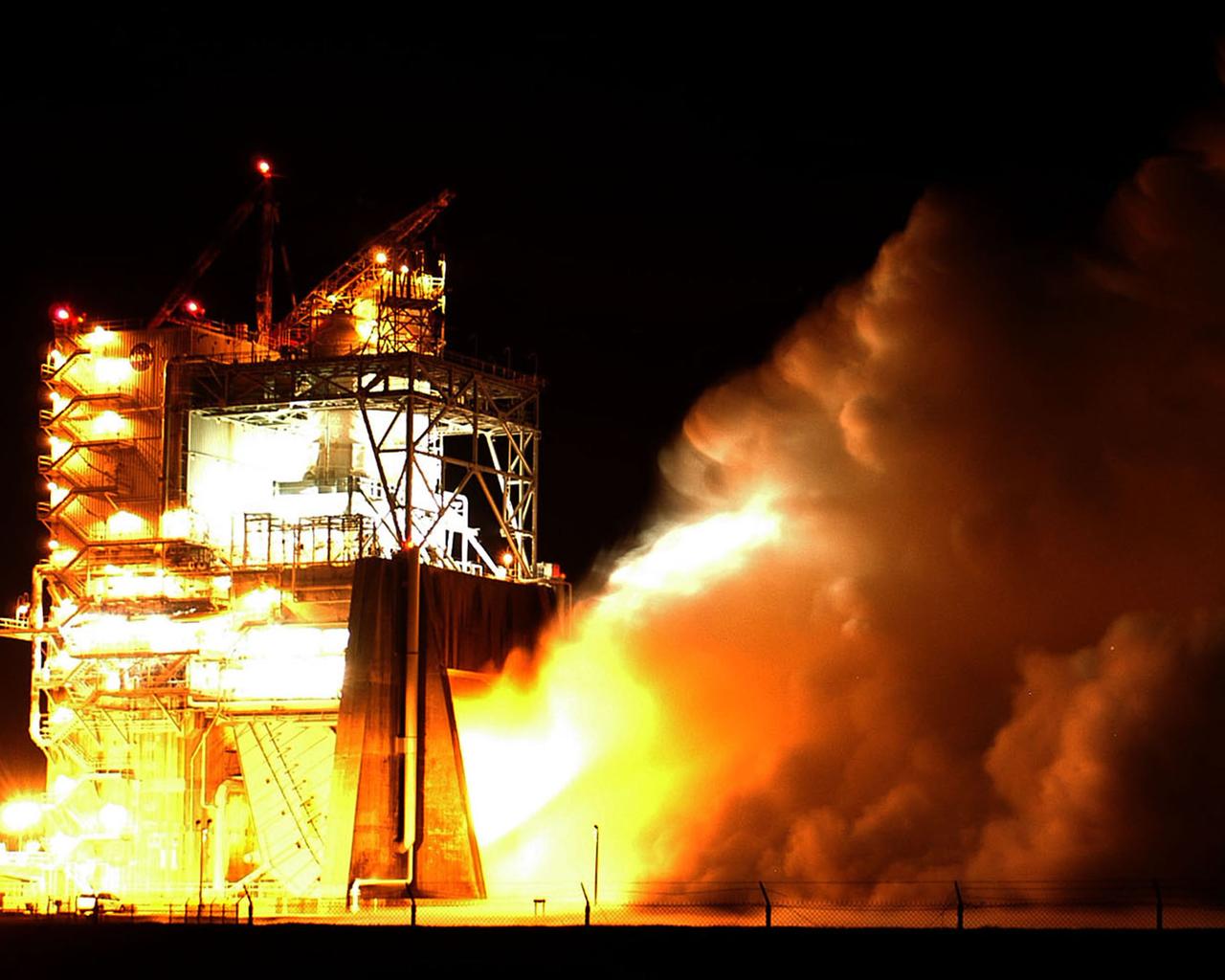
Water vapor surges from the flame deflector of the A-2 Test Stand at NASA's Stennis Space Center on Jan. 9 during the first space shuttle main engine test of the year. The test was an engine acceptance test of flight engine 2058. It's the first space shuttle main engine to be completely assembled at Kennedy Space Center. Objectives also included first-time (green run) tests of a high-pressure oxidizer turbo pump and an Advanced Health System Monitor engine controller. The test ran for the planned duration of 520 seconds.
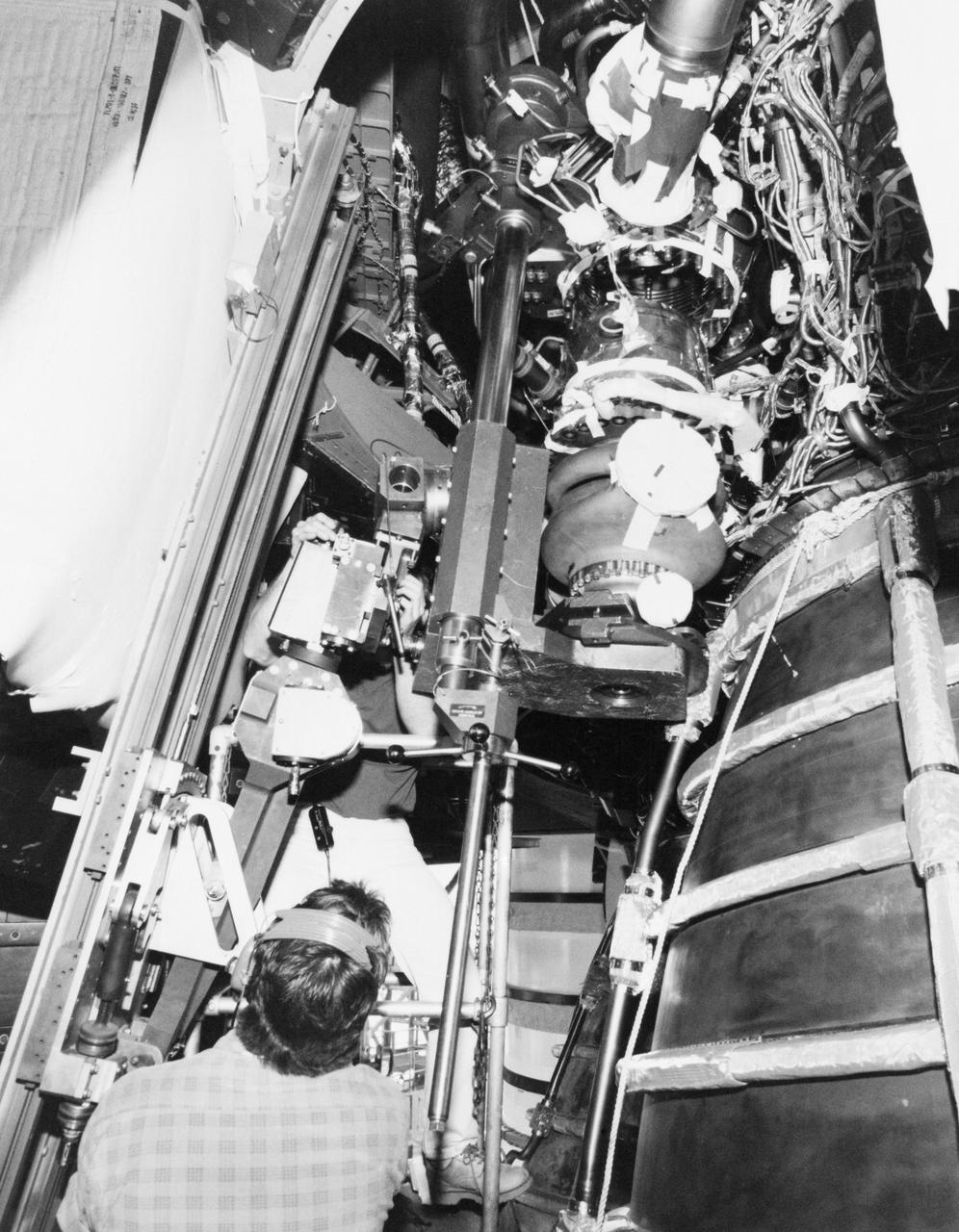
S89-28092 (7 Feb 1989) --- Kennedy Space Center technicians inspect an area near the three main engines of the Space Shuttle Discovery prior to the removal of one of three oxidozer turbo pumps. New pumps are scheduled to be installed soon. Now at Launch Pad 39-B, Discovery is set for launch in mid-March for Mission STS-29. Primary payload will be TDRS-D. Crewmembers are Astronauts Michael L. Coats, mission commander, John E. Blaha, pilot; along with James F. Buchli, Robert C. Springer and James P. Bagian, all mission specialists.
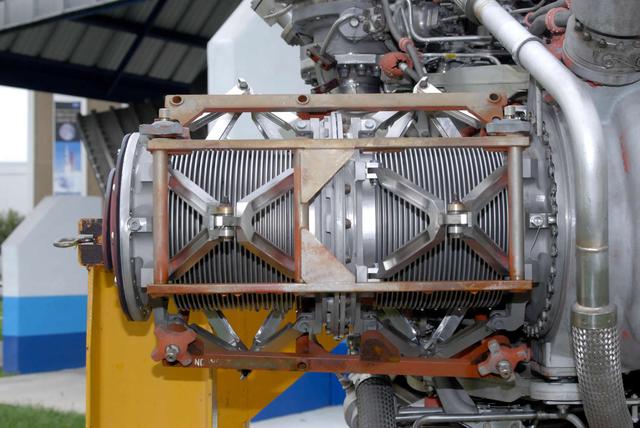
Stennis Space Center engineers are preparing to conduct water tests on an updated version of the scissors duct component of the J-2X engine. Measuring about 2 feet long and about 8 inches in diameter, the duct on the J-2X predecessor, the J-2, connected its fuel turbo pumps to the flight vehicle's upper stage run tanks. According to NASA's J-2X project manager at SSC, Gary Benton, the water tests should establish the limits of the duct's ability to withstand vibration.
STS-133 DISCOVERY ENGINE-1 TURBO PUMP REMOVAL
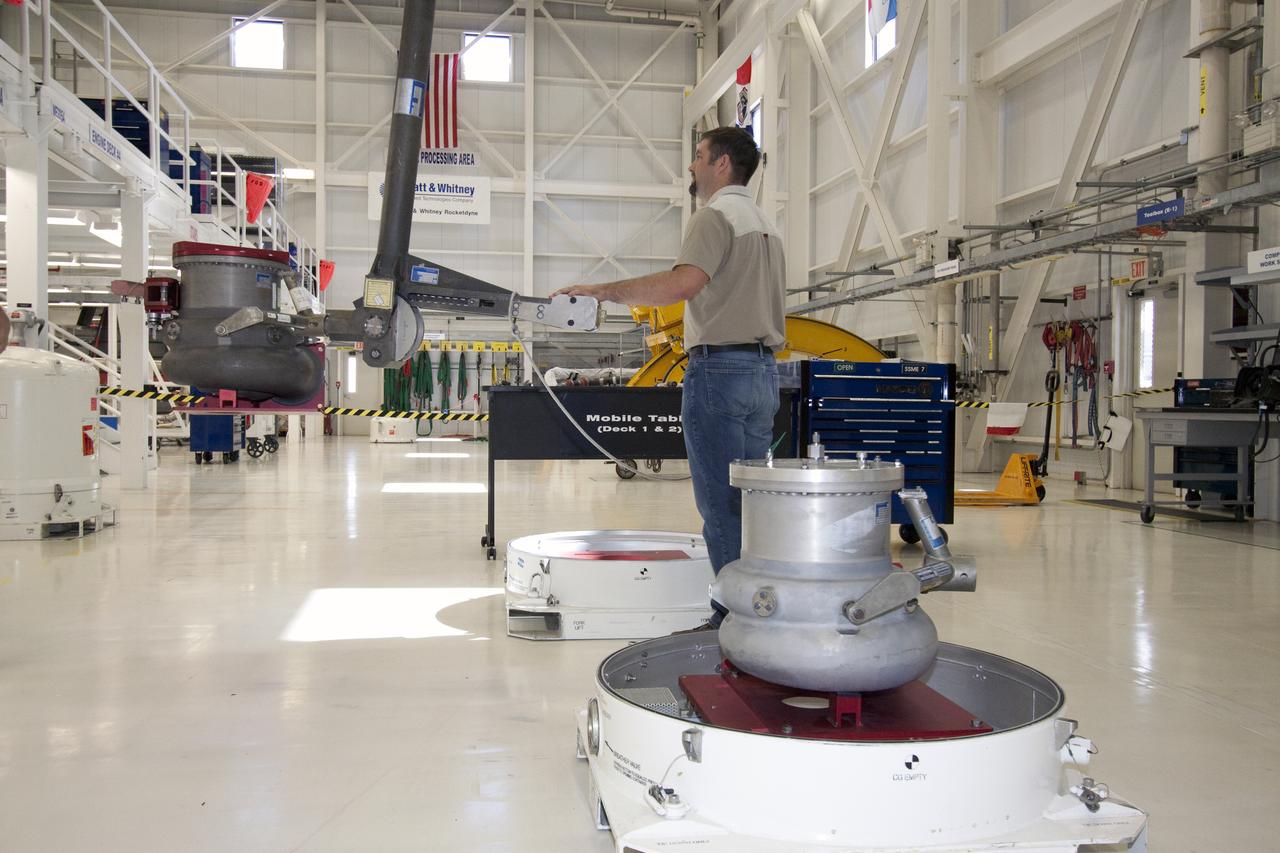
STS-133 DISCOVERY ENGINE-1 TURBO PUMP REMOVAL
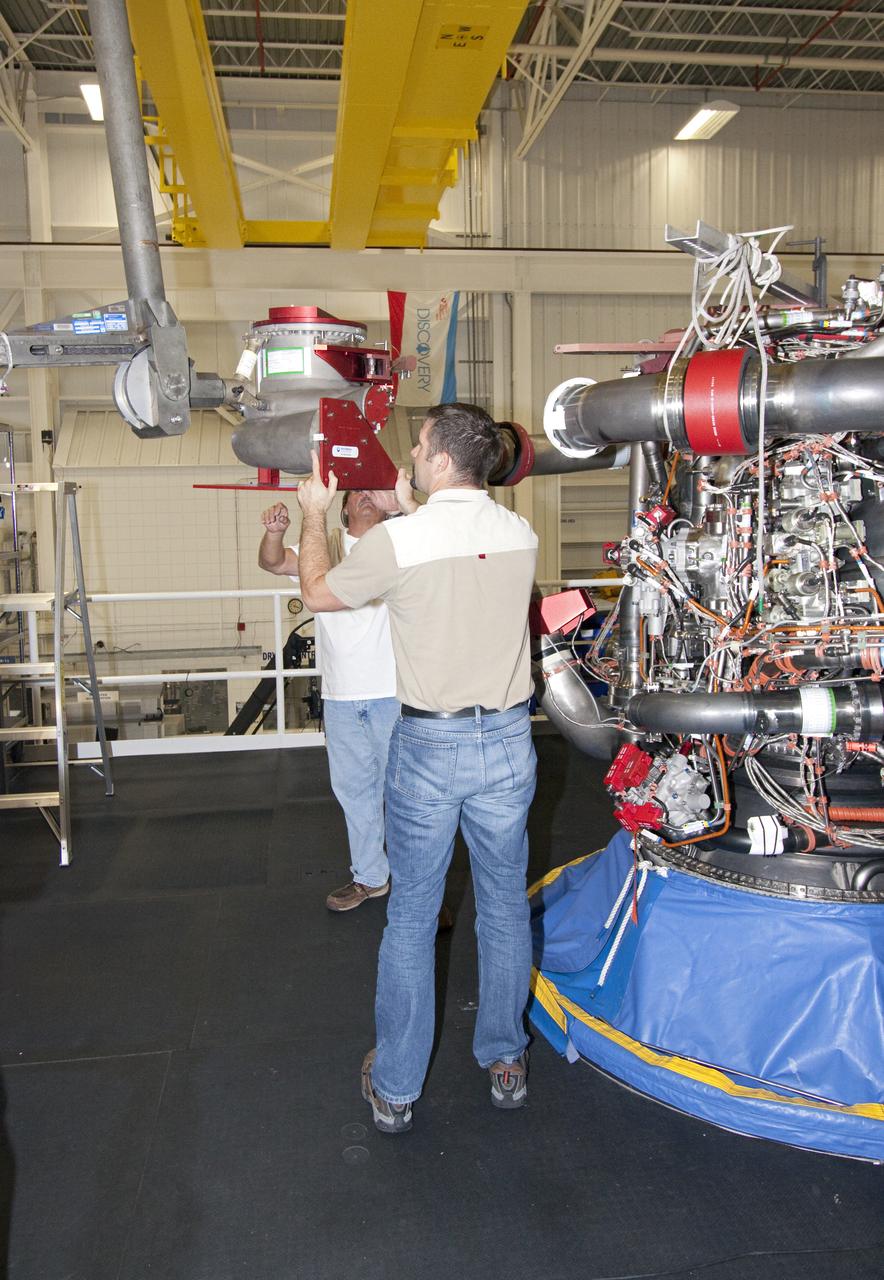
STS-133 DISCOVERY ENGINE-1 TURBO PUMP REMOVAL
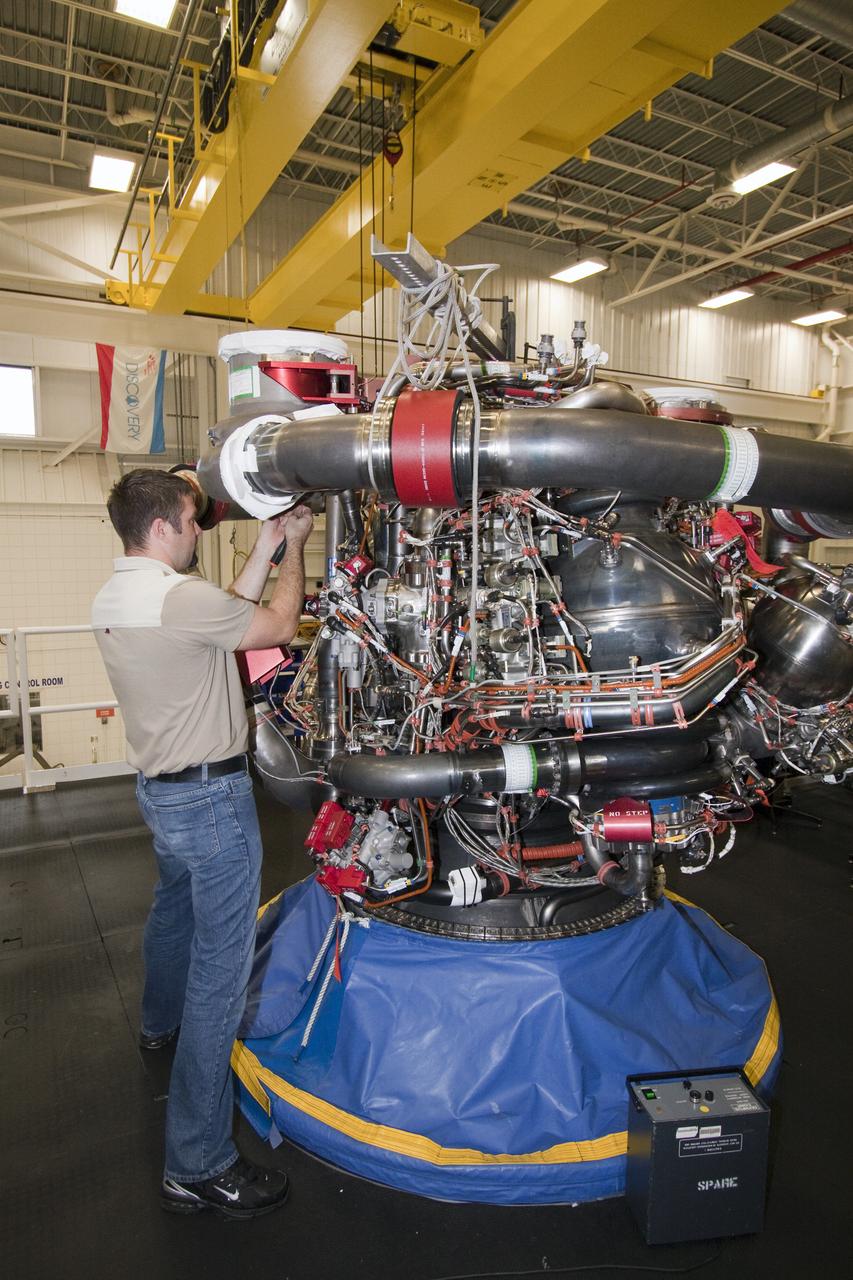
STS-133 DISCOVERY ENGINE-1 TURBO PUMP REMOVAL
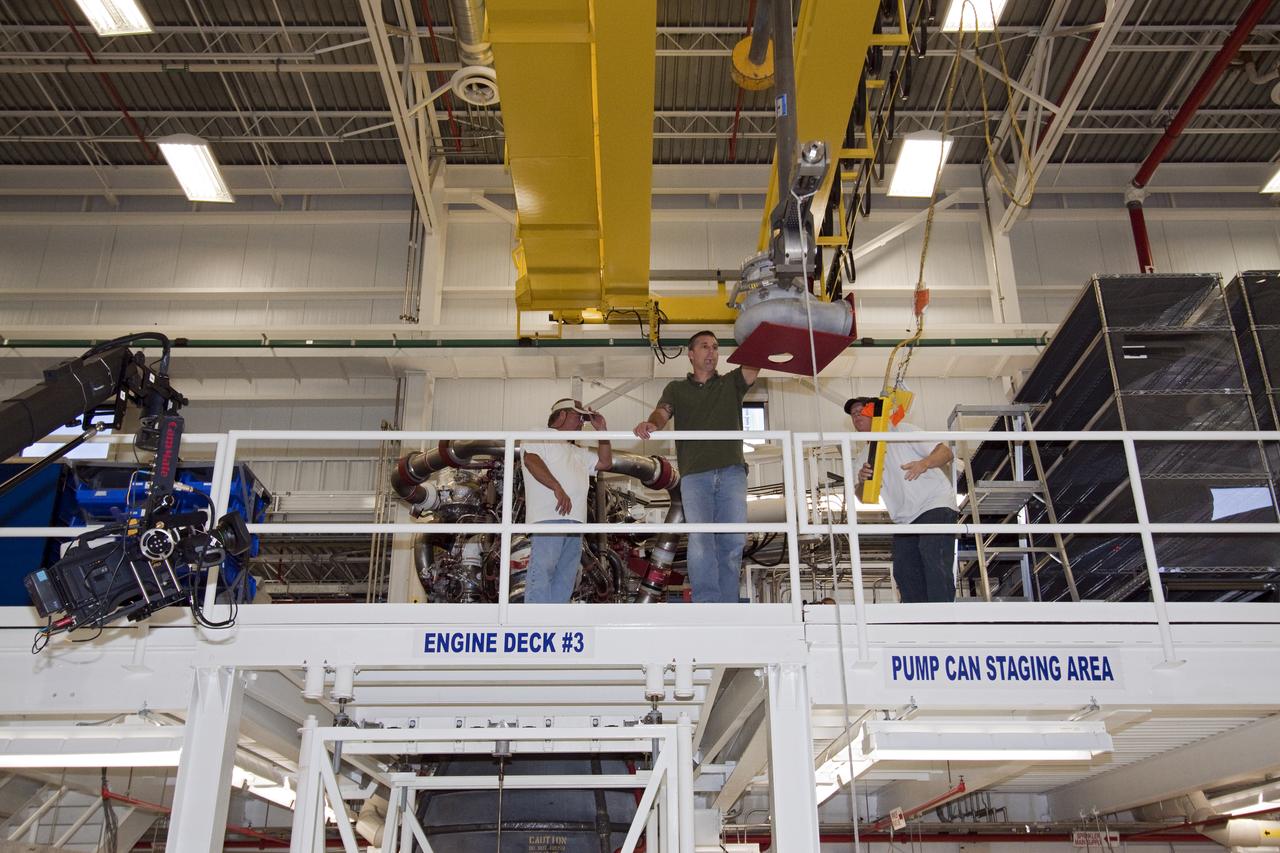
STS-133 DISCOVERY ENGINE-1 TURBO PUMP REMOVAL
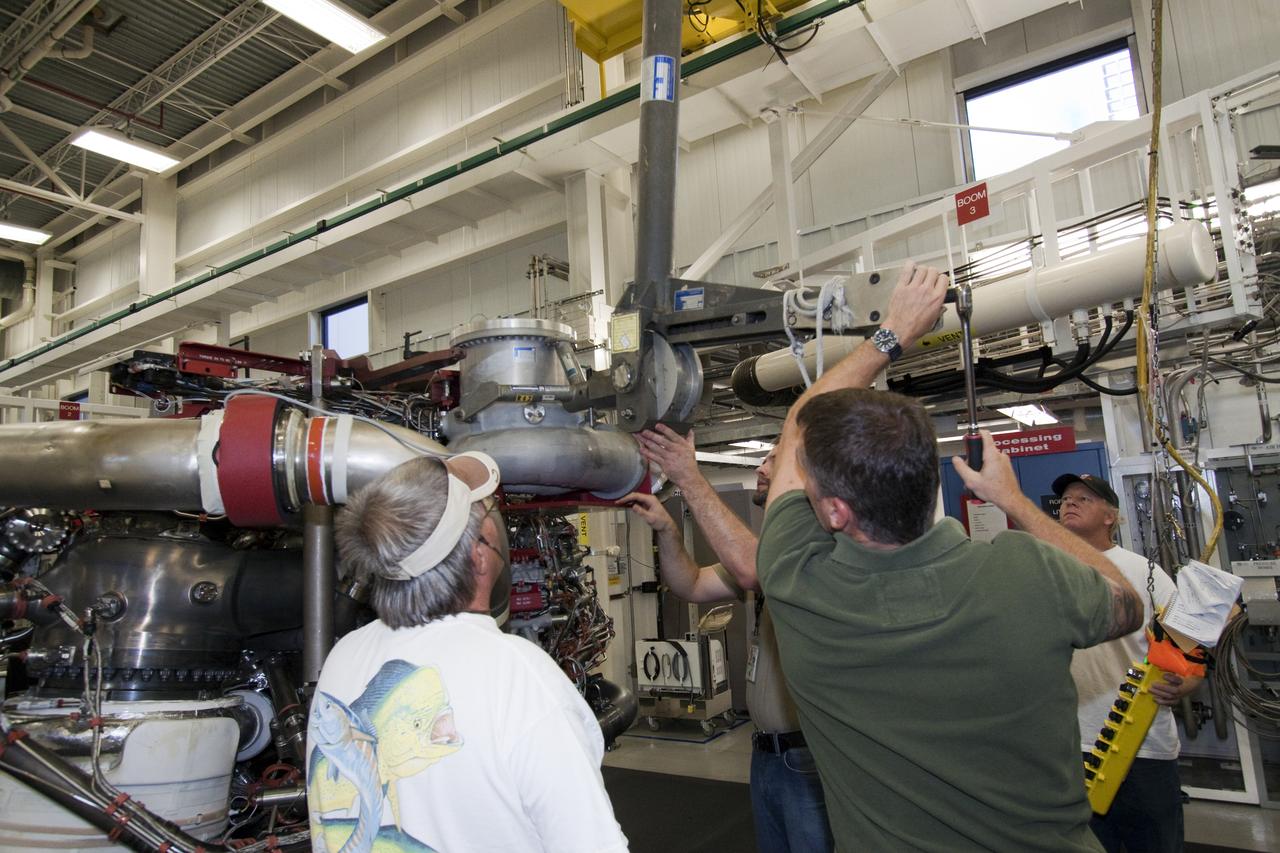
STS-133 DISCOVERY ENGINE-1 TURBO PUMP REMOVAL
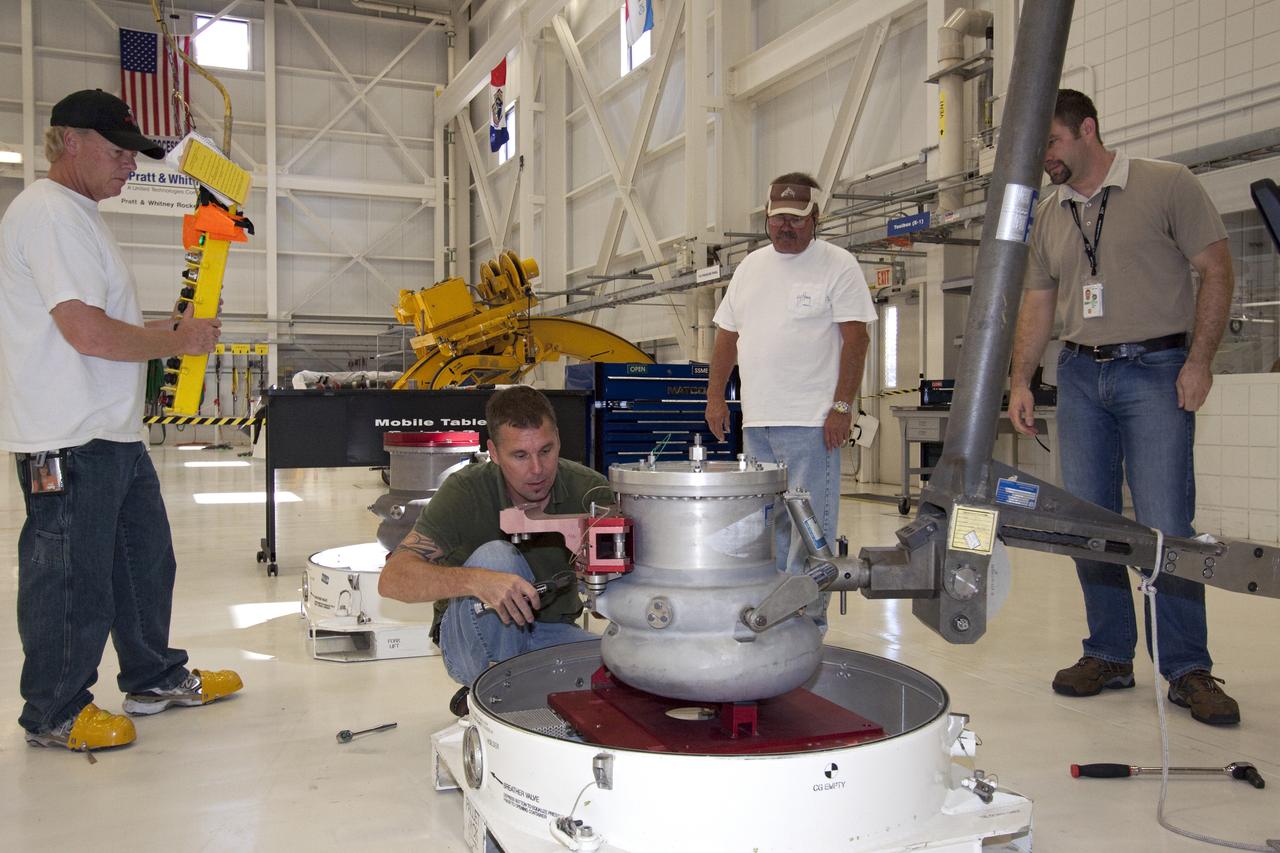
STS-133 DISCOVERY ENGINE-1 TURBO PUMP REMOVAL
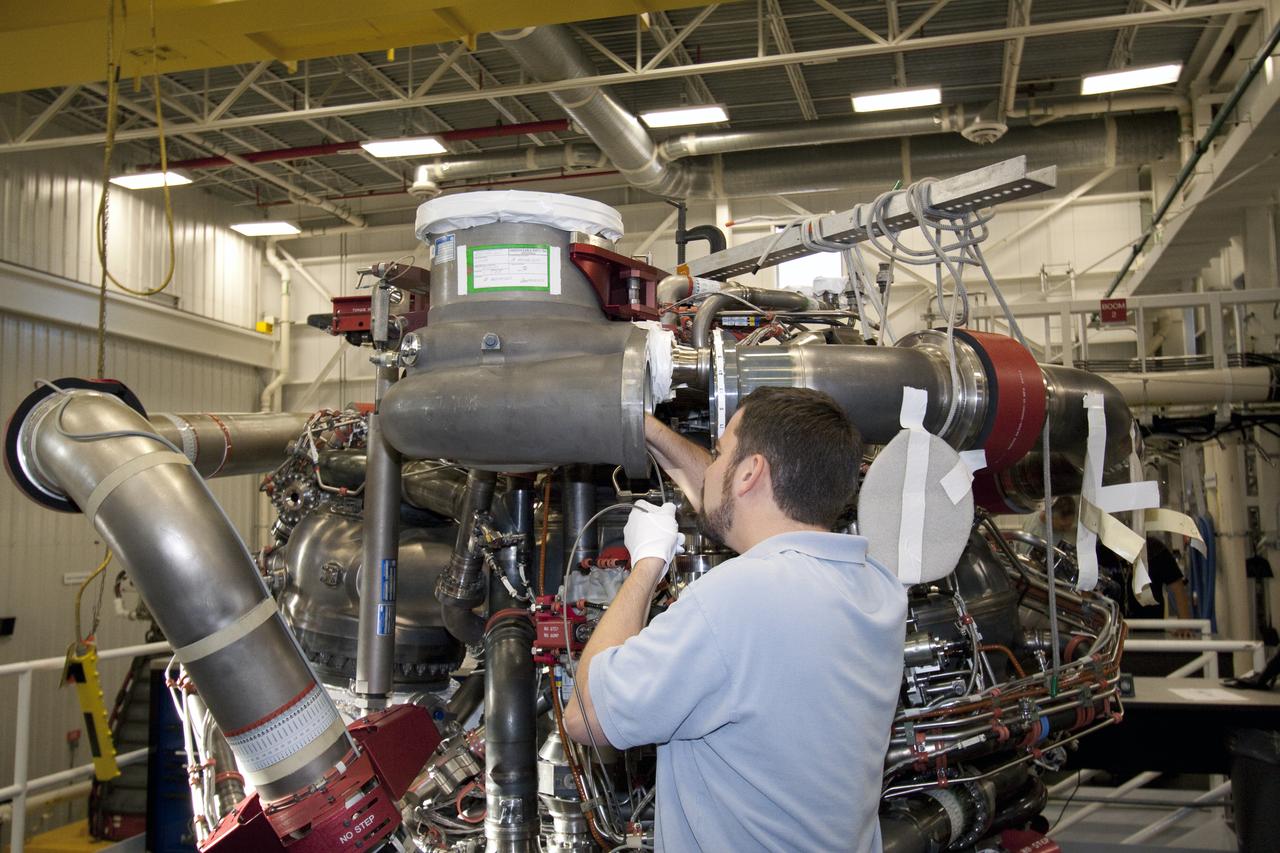
STS-133 DISCOVERY ENGINE-1 TURBO PUMP REMOVAL
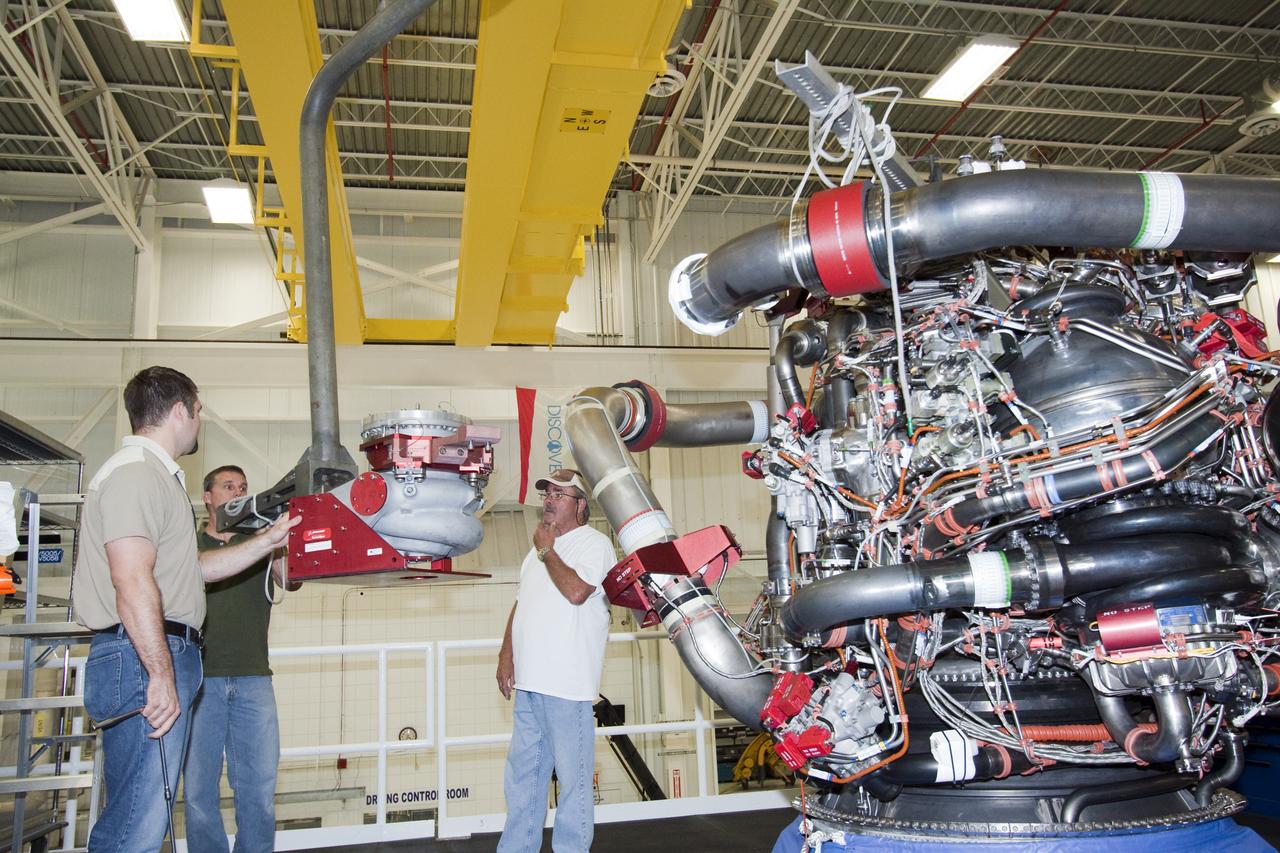
STS-133 DISCOVERY ENGINE-1 TURBO PUMP REMOVAL
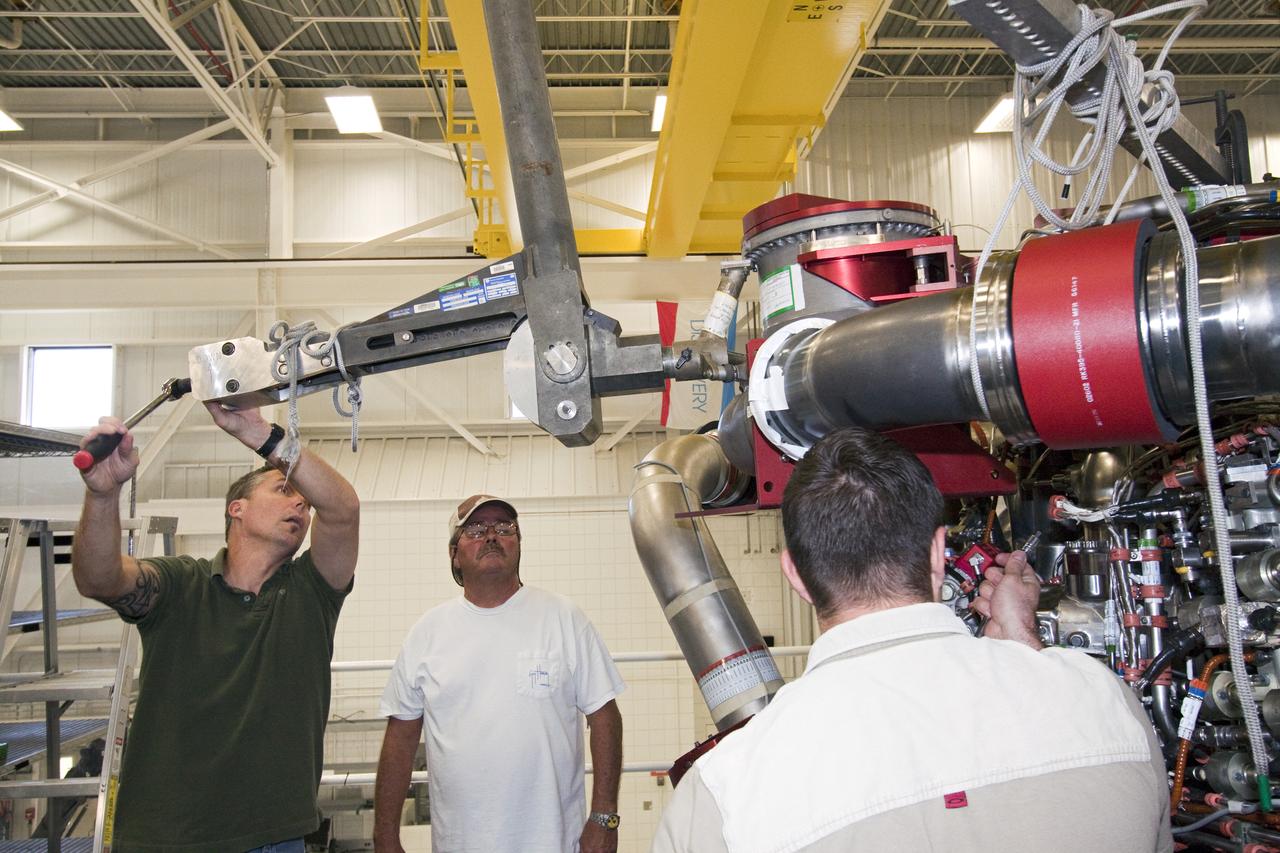
STS-133 DISCOVERY ENGINE-1 TURBO PUMP REMOVAL
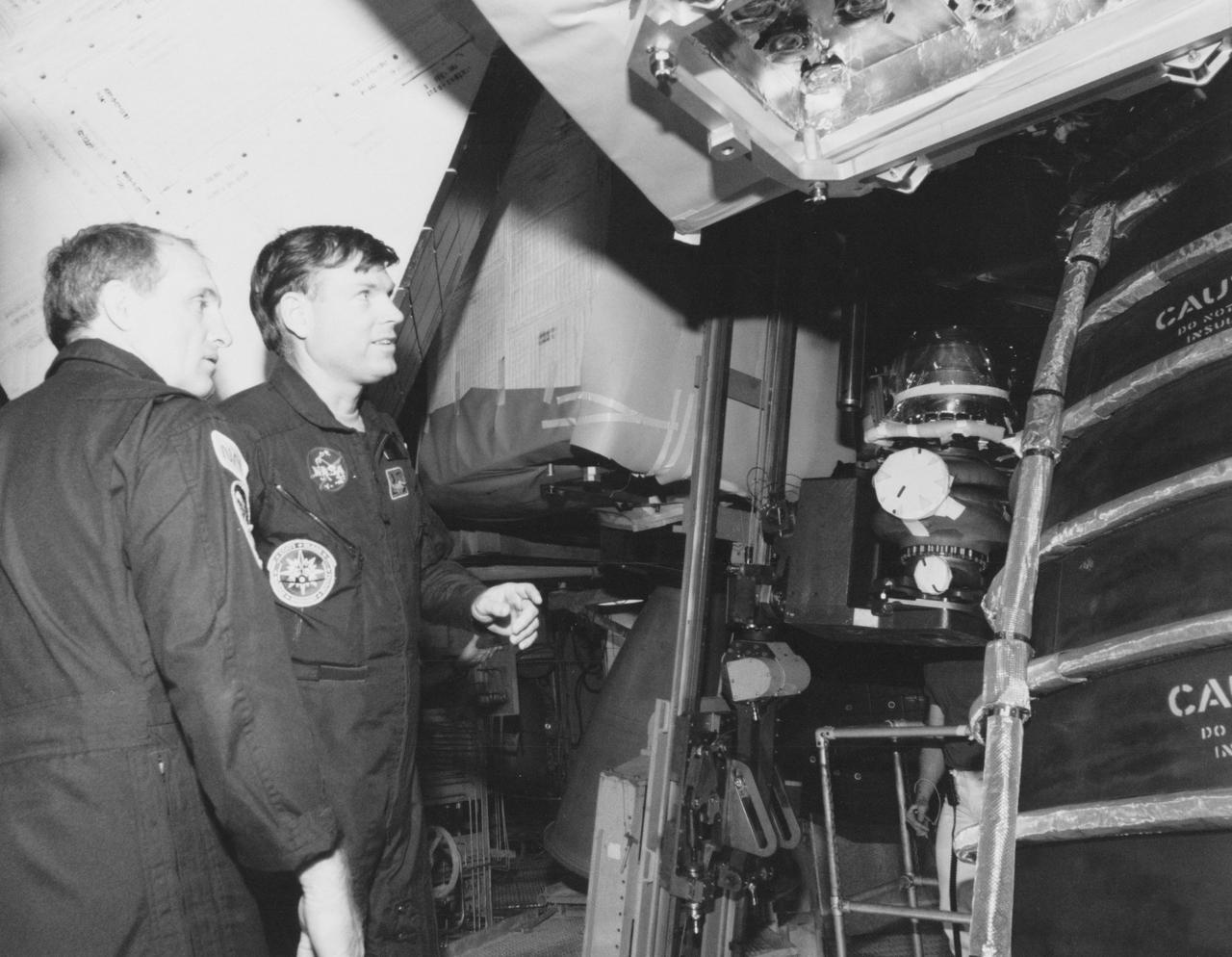
S89-28091 (7 Feb 1989) --- STS-29 astronauts inspect an area near the three main engines of the Space Shuttle Discovery prior to the removal of one of three oxidozer turbo pumps. Left to right are Astronauts James F. Buchli, mission specialist, and Michael L. Coats, mission commander. New pumps are scheduled to be installed soon. Now at Launch Pad 39-B, Discovery is set for launch in mid-March for Mission STS-29. Primary payload will be TDRS-D. Crewmembers not seen here are John E. Blaha, the pilot; and Robert C. Springer and James P. Bagian, both mission specialists.

KENNEDY SPACE CENTER, FLA. - In the Orbiter Processing Facility bay 1, the main engine is in place on Discovery. The main engine configuration is manufactured by Boeing Rocketdyne in Canoga Park, Calif., and includes a Pratt & Whitney high-pressure fuel turbo pump. Each space shuttle main engine is 14 feet (4.3 meters) long, weighs about 6,700 pounds (3,039 kilograms), and is 7.5 feet (2.3 meters) in diameter at the end of the nozzle. Discovery is being processed for the second return-to-flight mission STS-121.
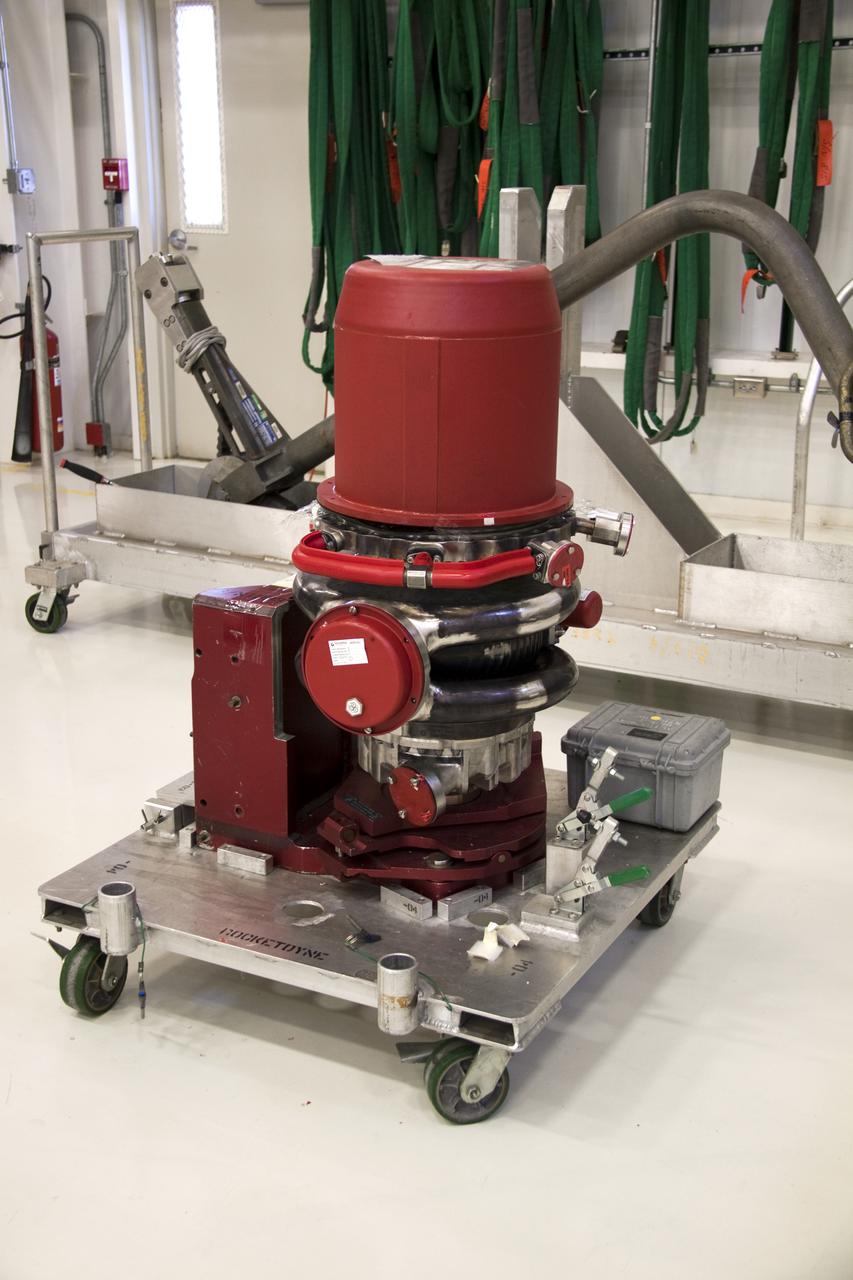
CAPE CANAVERAL, Fla. – In the Space Shuttle Main Engine Processing Facility at NASA's Kennedy Space Center in Florida, preparations are under way to install this high pressure oxidizer turbo pump on space shuttle main engine no. 2062. The engine, or SSME, is the last one scheduled to be built at Kennedy by Pratt and Whitney Rocketdyne before the end of the Space Shuttle Program. Three main engines are clustered at the aft end of the shuttle and have a combined thrust of more than 1.2 million pounds. Even though an SSME weighs one-seventh as much as a locomotive engine, its high-pressure fuel pump alone delivers as much horsepower as 28 locomotives. Each engine operates during the entire eight-and-a-half minute climb to orbit. Post-flight inspections and maintenance of each engine also are conducted in the SSME Processing Facility between shuttle missions. Photo credit: NASA_Amanda Diller
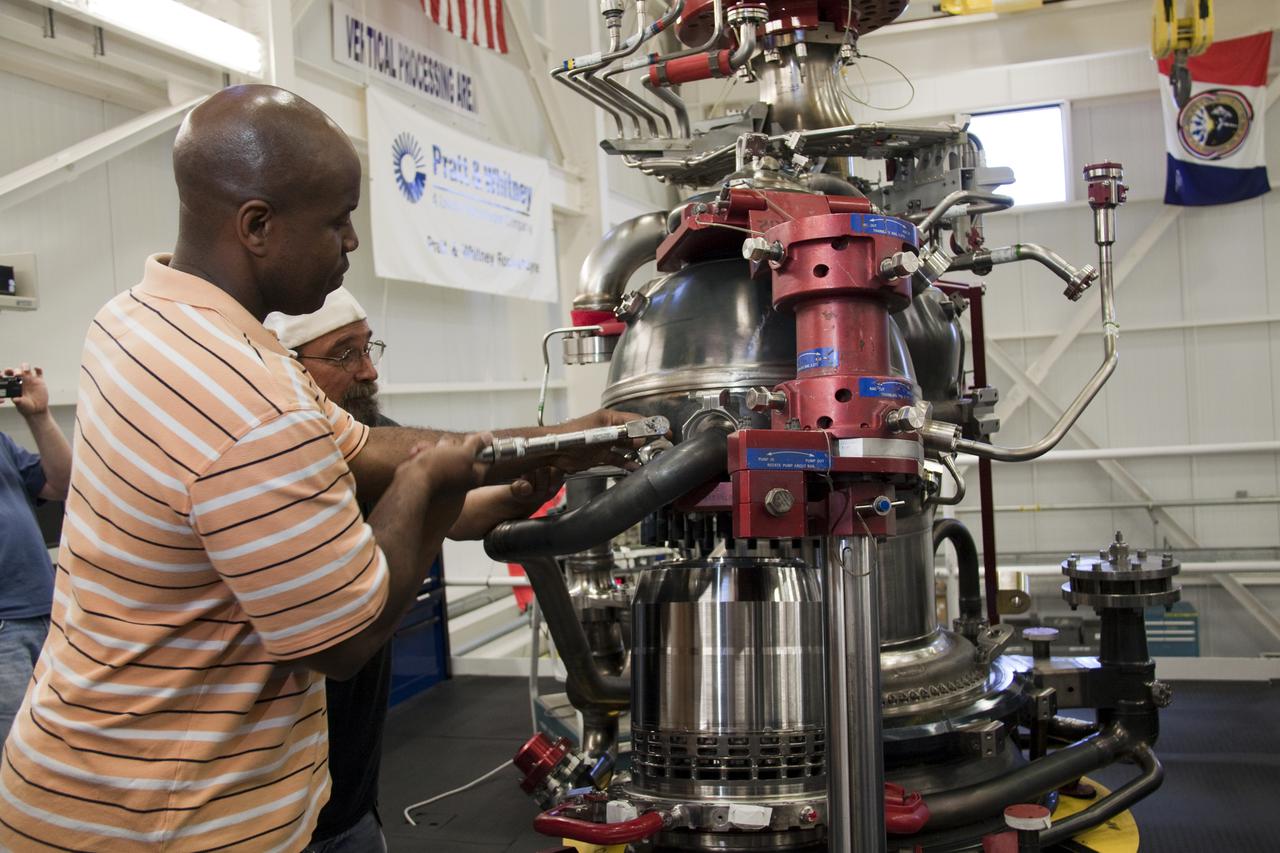
CAPE CANAVERAL, Fla. – In the Space Shuttle Main Engine Processing Facility at NASA's Kennedy Space Center in Florida, Pratt and Whitney Rocketdyne engine technician Teryon Jones, left, and quality inspector Barry Martin install a high pressure oxidizer turbo pump on space shuttle main engine no. 2062. The engine, or SSME, is the last one scheduled to be built at Kennedy before the end of the Space Shuttle Program. Three main engines are clustered at the aft end of the shuttle and have a combined thrust of more than 1.2 million pounds. Even though an SSME weighs one-seventh as much as a locomotive engine, its high-pressure fuel pump alone delivers as much horsepower as 28 locomotives. Each engine operates during the entire eight-and-a-half minute climb to orbit. Post-flight inspections and maintenance of each engine also are conducted in the SSME Processing Facility between shuttle missions. Photo credit: NASA_Amanda Diller
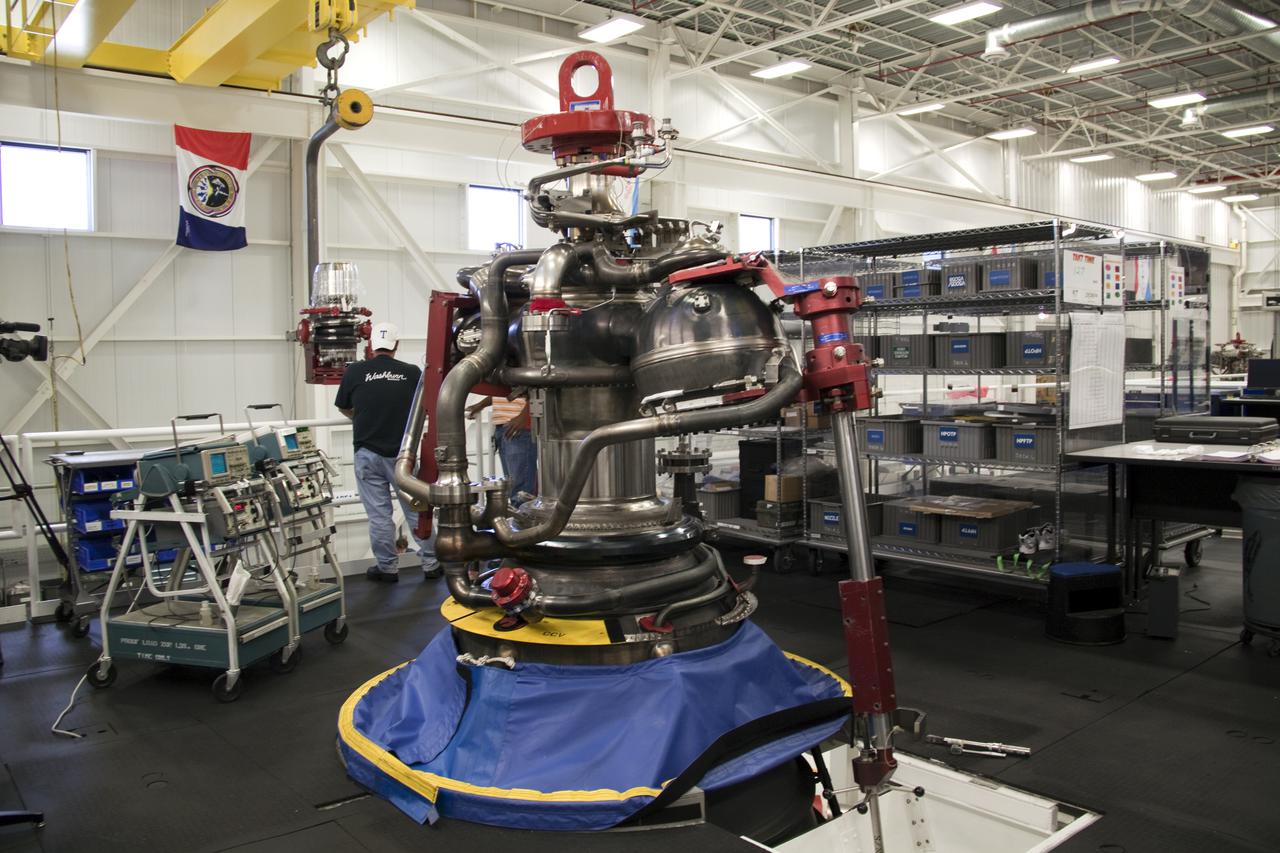
CAPE CANAVERAL, Fla. – In the Space Shuttle Main Engine Processing Facility at NASA's Kennedy Space Center in Florida, preparations are under way to install a high pressure oxidizer turbo pump on space shuttle main engine no. 2062, seen here. The engine, or SSME, is the last one scheduled to be built at Kennedy by Pratt and Whitney Rocketdyne before the end of the Space Shuttle Program. Three main engines are clustered at the aft end of the shuttle and have a combined thrust of more than 1.2 million pounds. Even though an SSME weighs one-seventh as much as a locomotive engine, its high-pressure fuel pump alone delivers as much horsepower as 28 locomotives. Each engine operates during the entire eight-and-a-half minute climb to orbit. Post-flight inspections and maintenance of each engine also are conducted in the SSME Processing Facility between shuttle missions. Photo credit: NASA_Amanda Diller
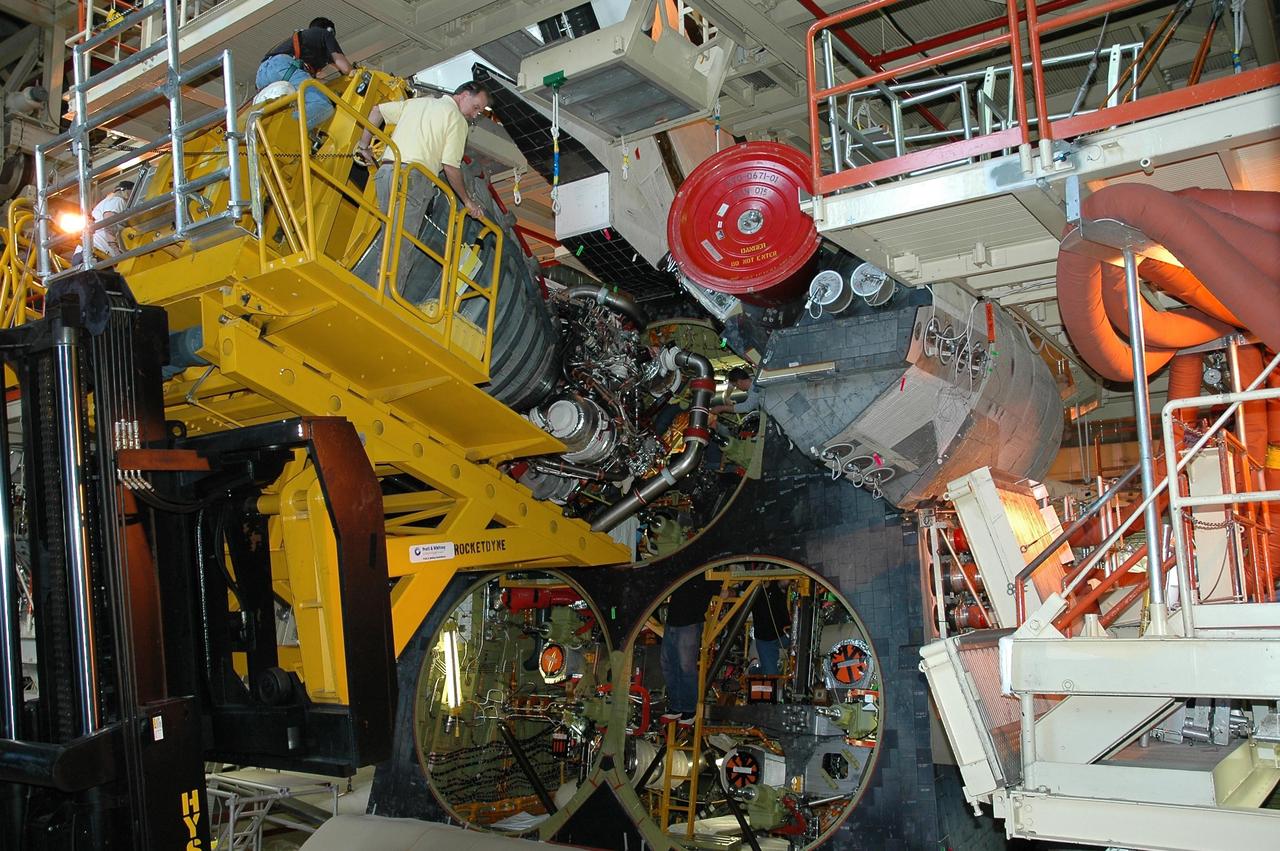
KENNEDY SPACE CENTER, FLA. - In the Orbiter Processing Facility bay 1, technicians on the Hyster forklift move a main engine into place on Discovery. The main engine configuration is manufactured by Boeing Rocketdyne in Canoga Park, Calif., and includes a Pratt & Whitney high-pressure fuel turbo pump. Each space shuttle main engine is 14 feet (4.3 meters) long, weighs about 6,700 pounds (3,039 kilograms), and is 7.5 feet (2.3 meters) in diameter at the end of the nozzle. Discovery is being processed for the second return-to-flight mission STS-121.
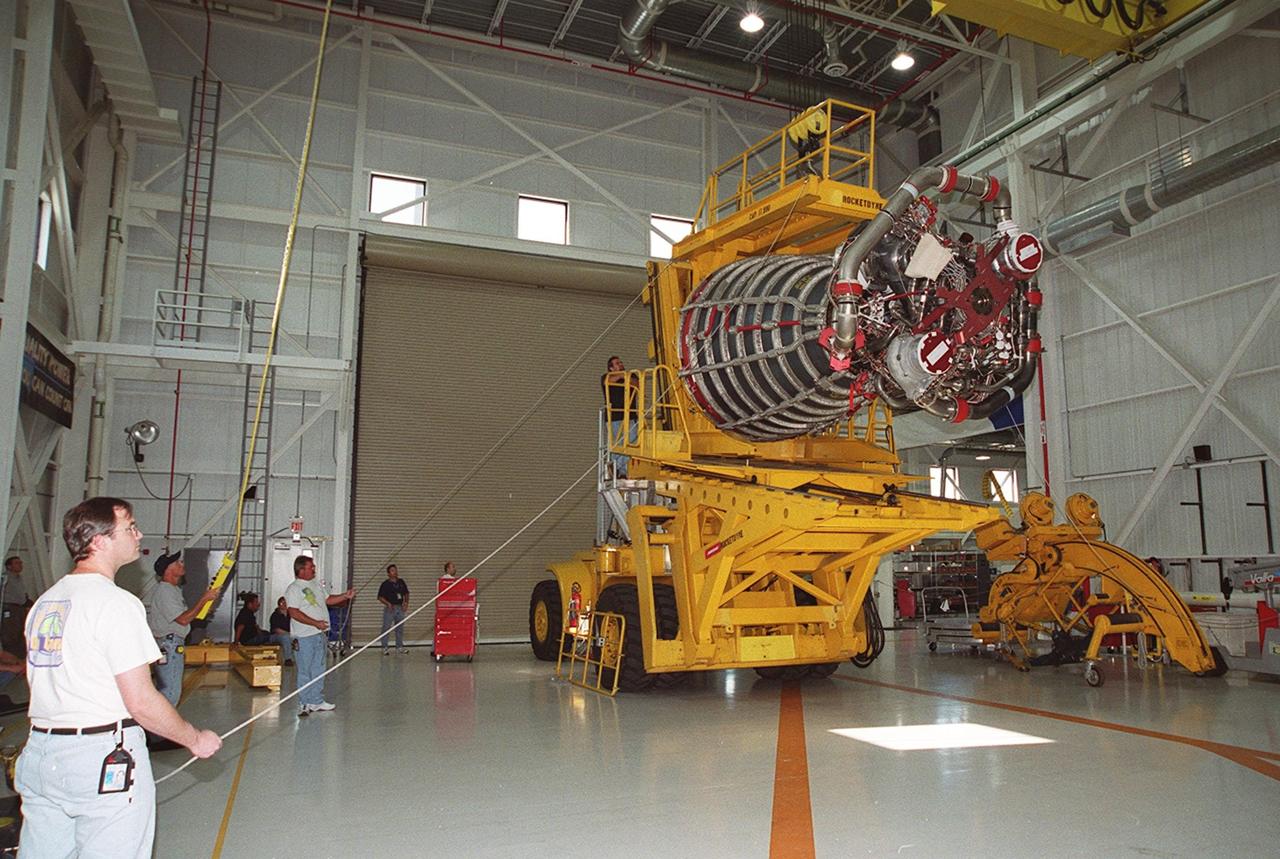
A new block 2 engine is lowered onto a transport vehicle for a move to the Orbiter Processing Facility. There it will be installed for its first flight on the orbiter Atlantis, on mission STS-104. The Block II Main Engine configuration is manufactured by Boeing Rocketdyne in Canoga Park, Calif., and includes a new Pratt & Whitney high-pressure fuel turbo pump. Engine improvements are managed by NASA’s Marshall Space Flight Center in Huntsville, Ala. Each Space Shuttle Main Engine is 14 feet (4.3 meters) long, weighs about 7,000 pounds (3,175 kilograms), and is 7.5 feet (2.3 meters) in diameter at the end of the nozzle
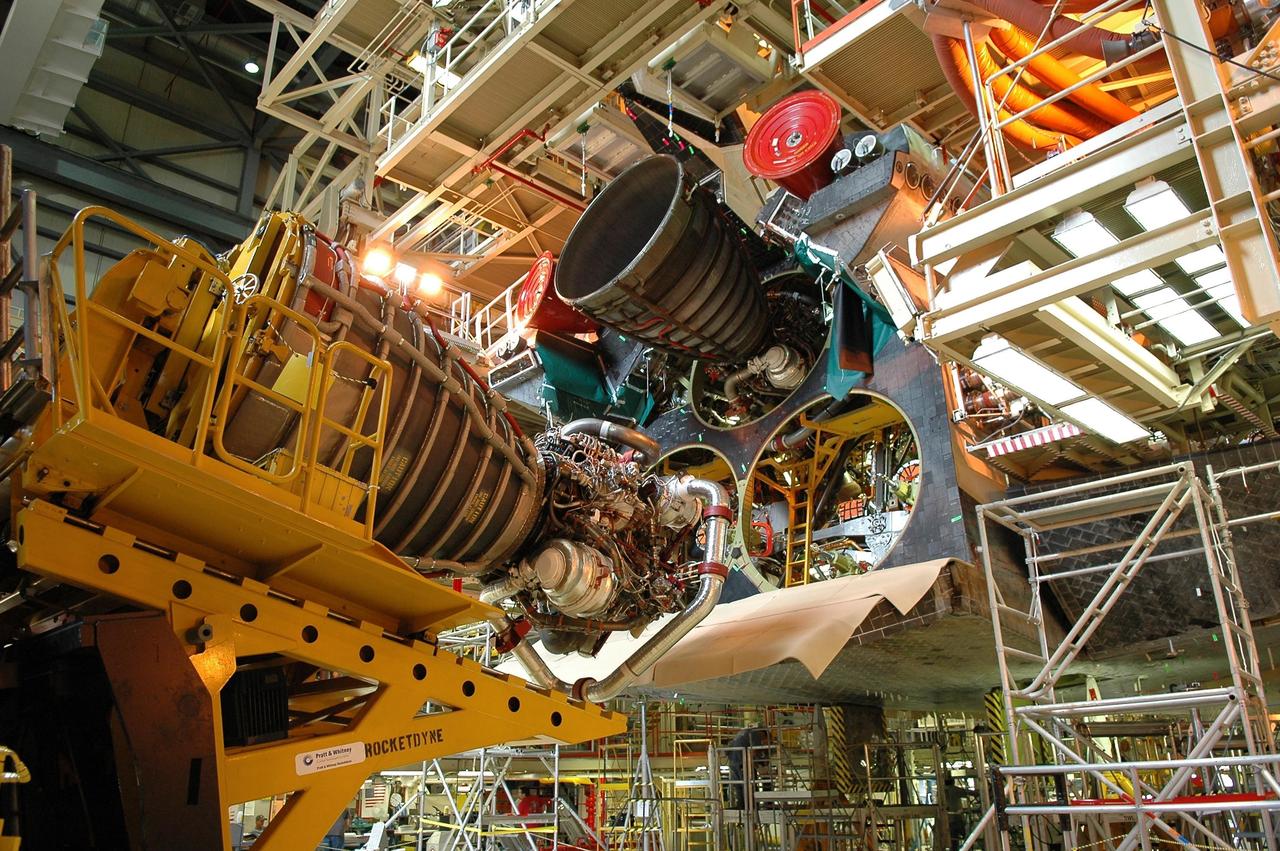
KENNEDY SPACE CENTER, FLA. - Engine No. 3 is ready to be installed on Discovery in the Orbiter Processing Facility bay 3. The main engine configuration is manufactured by Pratt & Whitney Rocketdyne in Canoga Park, Calif., and includes a Pratt & Whitney high-pressure fuel turbo pump. Each space shuttle main engine is 14 feet long, weighs about 6,700 pounds, and is 7.5 feet in diameter at the end of the nozzle. Discovery is being processed for its next mission, STS-116 (12A.1), to deliver a third truss segment, a SPACEHAB module and other key components to the International Space Station. The launch is currently scheduled no earlier than Dec. 14. Photo credit: NASA/Kim Shiflett
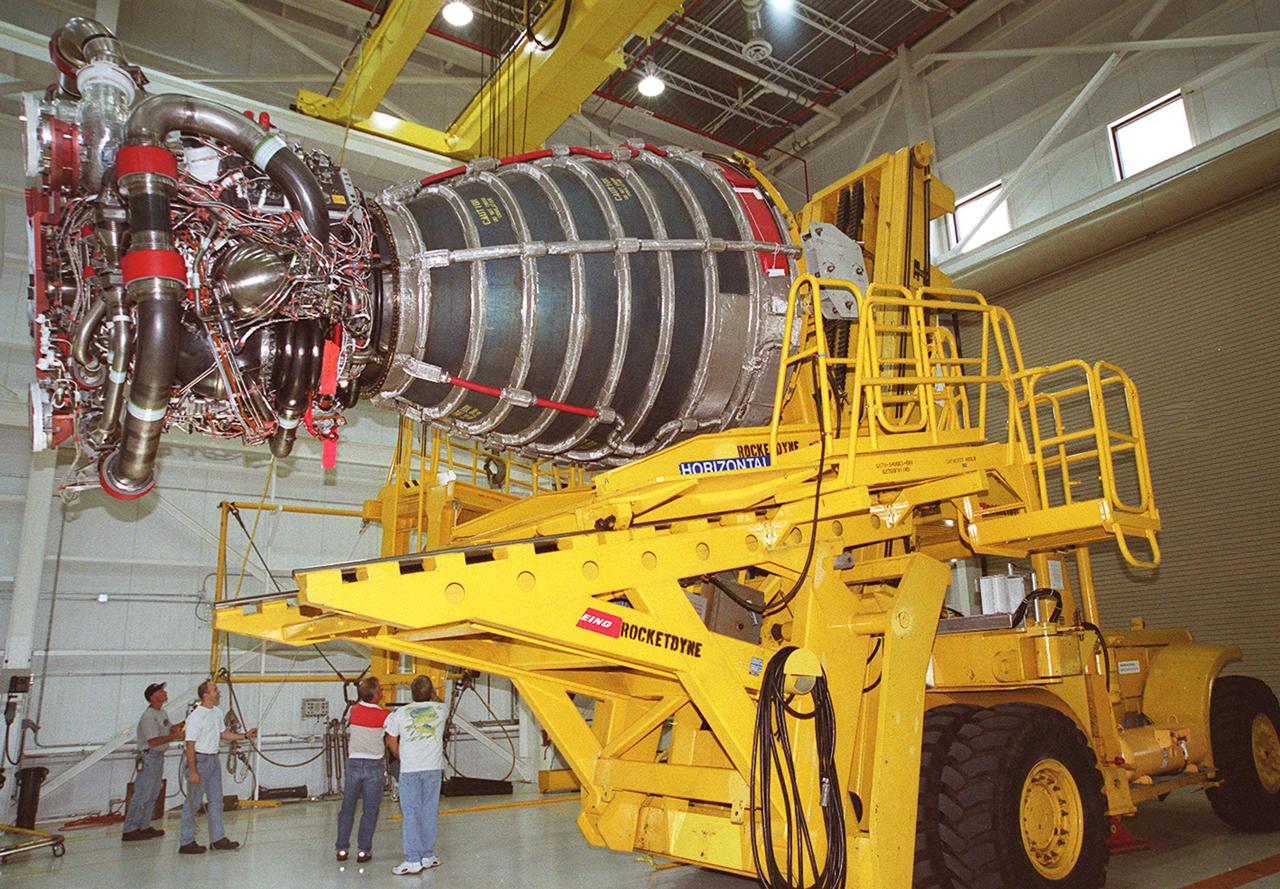
KENNEDY SPACE CENTER, FLA. -- A new block 2 engine is ready for its move to Orbiter Processing Facility bay 3. There it will be installed on the orbiter Atlantis, on mission STS-104, for its first flight. The Block II Main Engine configuration is manufactured by Boeing Rocketdyne in Canoga Park, Calif., and includes a new Pratt and Whitney high-pressure fuel turbo pump. Engine improvements are managed by NASA’s Marshall Space Flight Center in Huntsville, Ala. Each Space Shuttle Main Engine is 14 feet (4.3 meters) long, weighs about 7,000 pounds (3,175 kilograms), and is 7.5 feet (2.3 meters) in diameter at the end of the nozzle
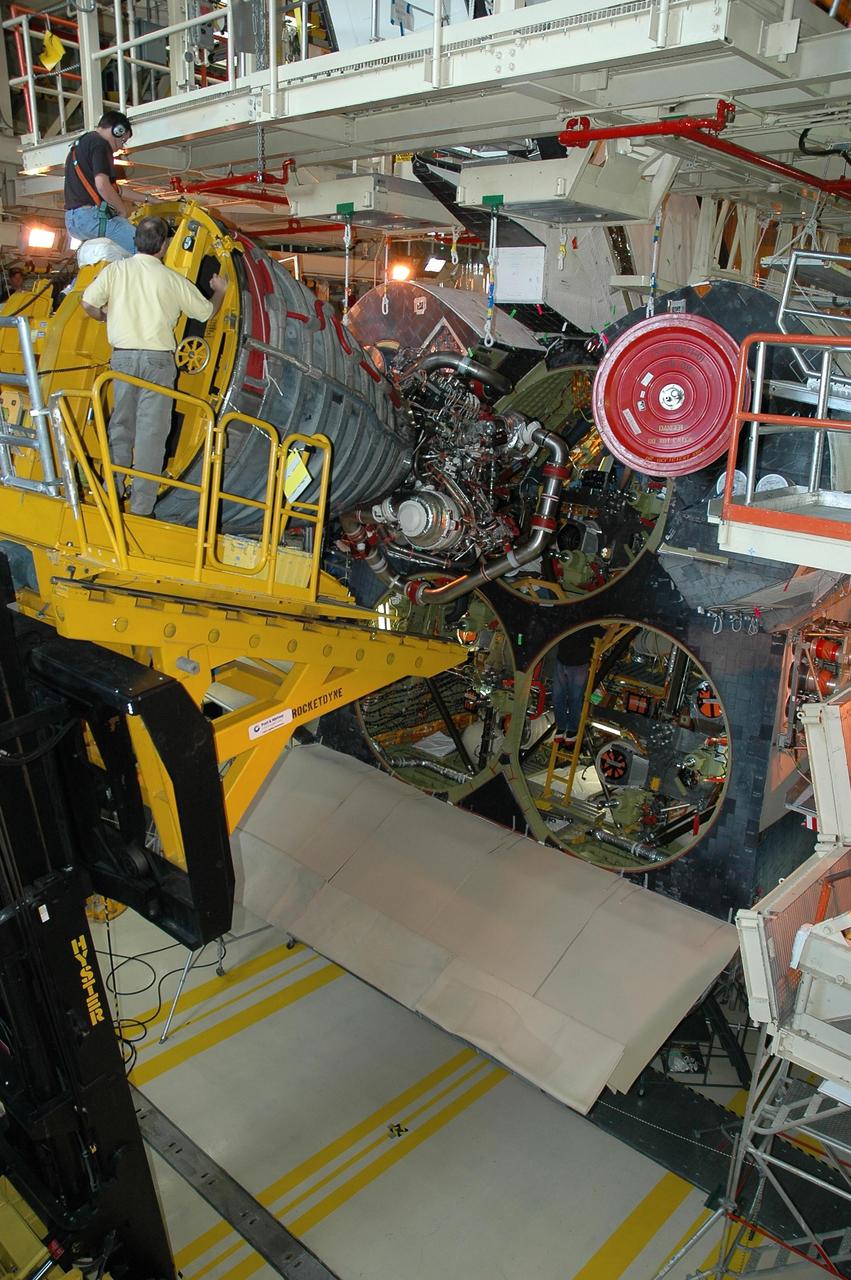
KENNEDY SPACE CENTER, FLA. - In the Orbiter Processing Facility bay 1, a Hyster forklift moves a main engine into position for installation into Discovery. The main engine configuration is manufactured by Boeing Rocketdyne in Canoga Park, Calif., and includes a Pratt & Whitney high-pressure fuel turbo pump. Each space shuttle main engine is 14 feet (4.3 meters) long, weighs about 6,700 pounds (3,039 kilograms), and is 7.5 feet (2.3 meters) in diameter at the end of the nozzle. Discovery is being processed for the second return-to-flight mission STS-121.
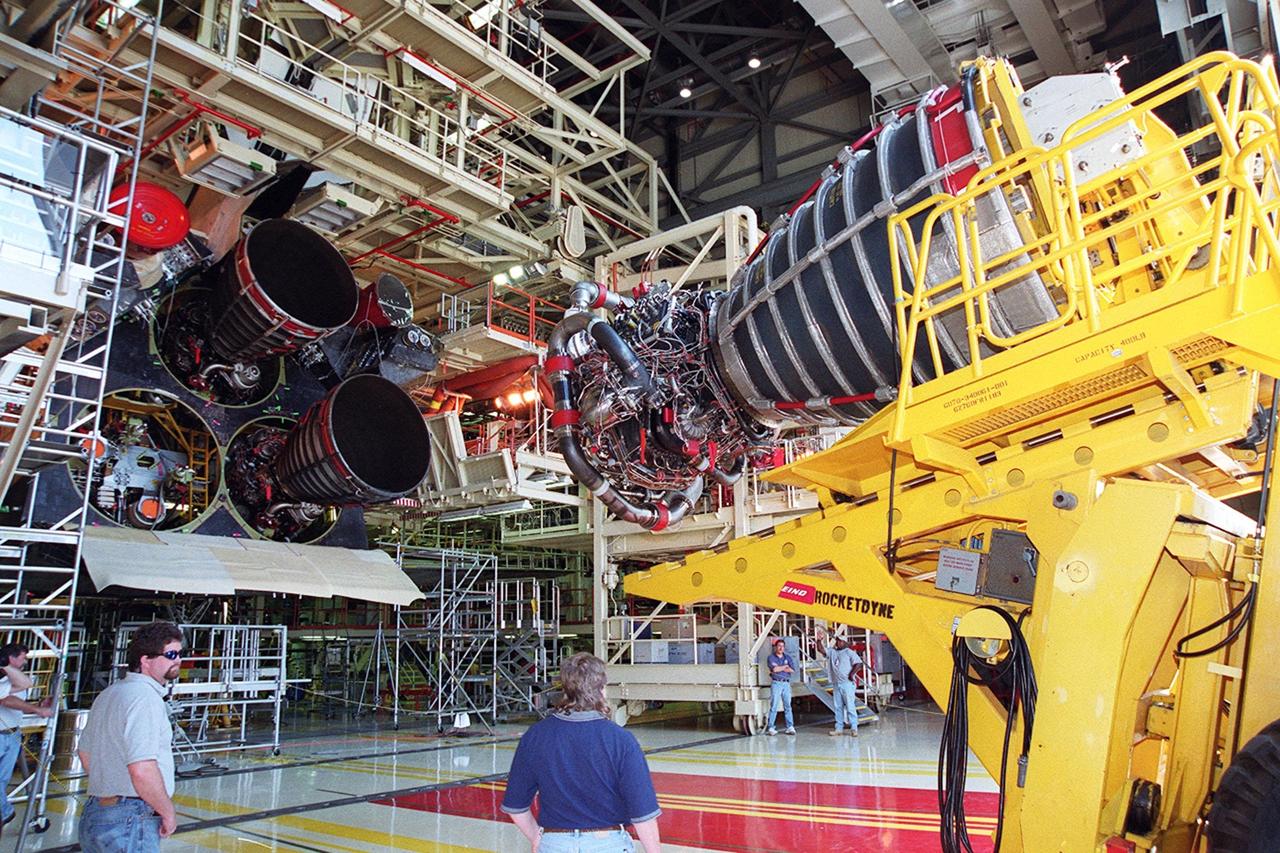
KENNEDY SPACE CENTER, FLA. -- A new block 2 engine heads toward Atlantis in Orbiter Processing Facility bay 3. There the new engine will be installed for its first flight on Atlantis, for mission STS-104. The Block II Main Engine configuration is manufactured by Boeing Rocketdyne in Canoga Park, Calif., and includes a new Pratt & Whitney high-pressure fuel turbo pump. Engine improvements are managed by NASA’s Marshall Space Flight Center in Huntsville, Ala. Each Space Shuttle Main Engine is 14 feet (4.3 meters) long, weighs about 7,000 pounds (3,175 kilograms), and is 7.5 feet (2.3 meters) in diameter at the end of the nozzle
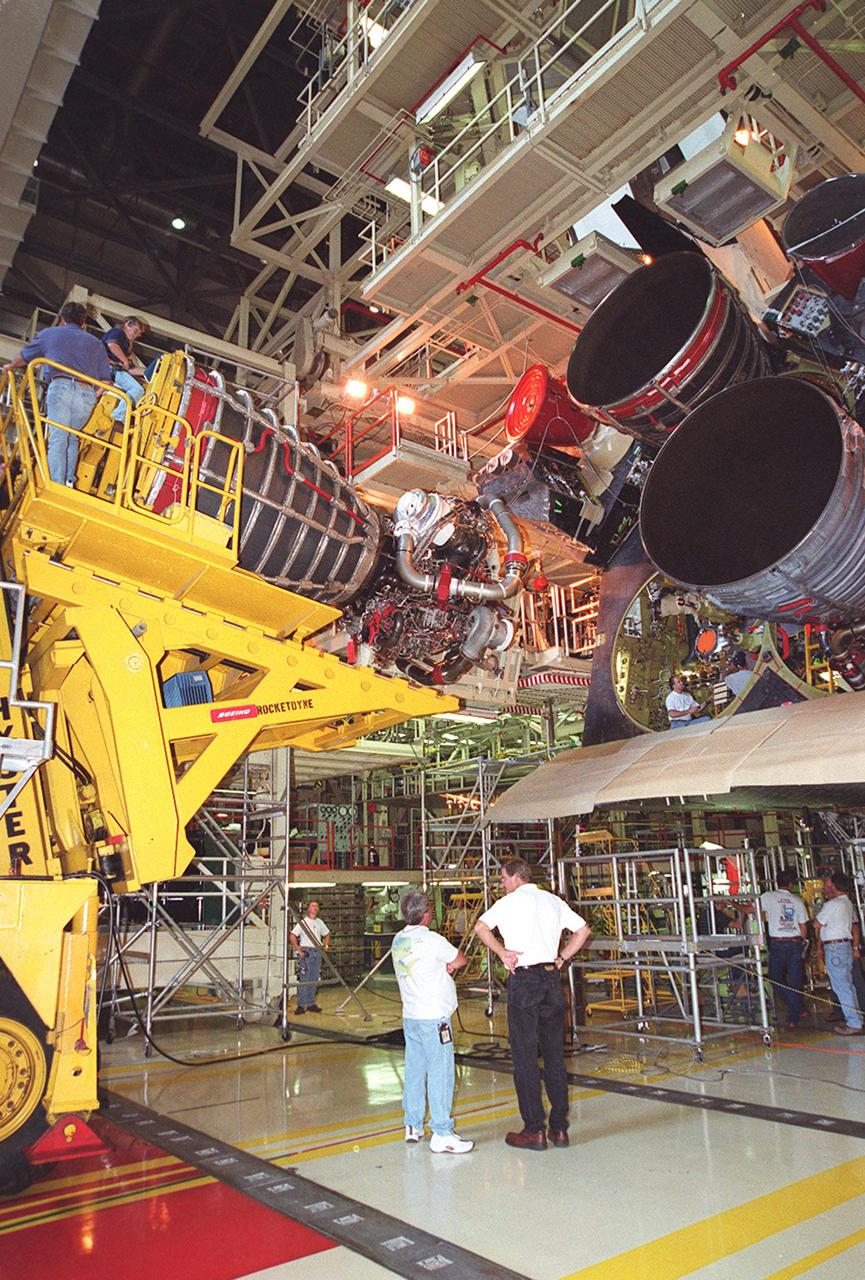
KENNEDY SPACE CENTER, FLA. -- In Orbiter Processing Facility bay 3, a new block 2 engine, at left, is moved into position for installation on Atlantis. The engine will have its first flight on mission STS-104, scheduled for launch June 14. The Block II Main Engine configuration is manufactured by Boeing Rocketdyne in Canoga Park, Calif., and includes a new Pratt and Whitney high-pressure fuel turbo pump. Engine improvements are managed by NASA’s Marshall Space Flight Center in Huntsville, Ala. Each Space Shuttle Main Engine is 14 feet (4.3 meters) long, weighs about 7,000 pounds (3,175 kilograms), and is 7.5 feet (2.3 meters) in diameter at the end of the nozzle
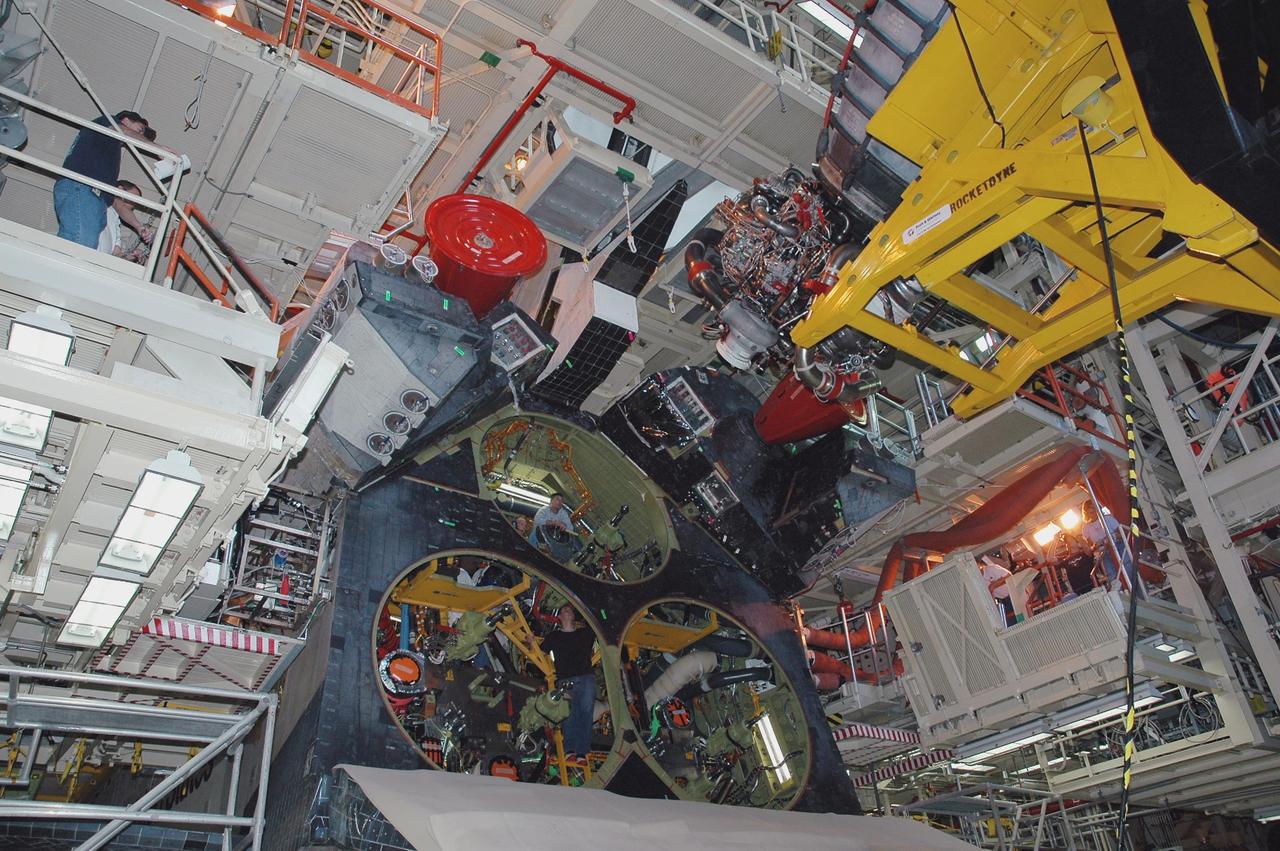
KENNEDY SPACE CENTER, FLA. - In the Orbiter Processing Facility bay 1, a Hyster forklift moves a main engine toward the aft of Discovery as technicians stand by for insertion and installation. The main engine configuration is manufactured by Boeing Rocketdyne in Canoga Park, Calif., and includes a Pratt & Whitney high-pressure fuel turbo pump. Each space shuttle main engine is 14 feet (4.3 meters) long, weighs about 6,700 pounds (3,039 kilograms), and is 7.5 feet (2.3 meters) in diameter at the end of the nozzle. Discovery is being processed for the second return-to-flight mission STS-121.
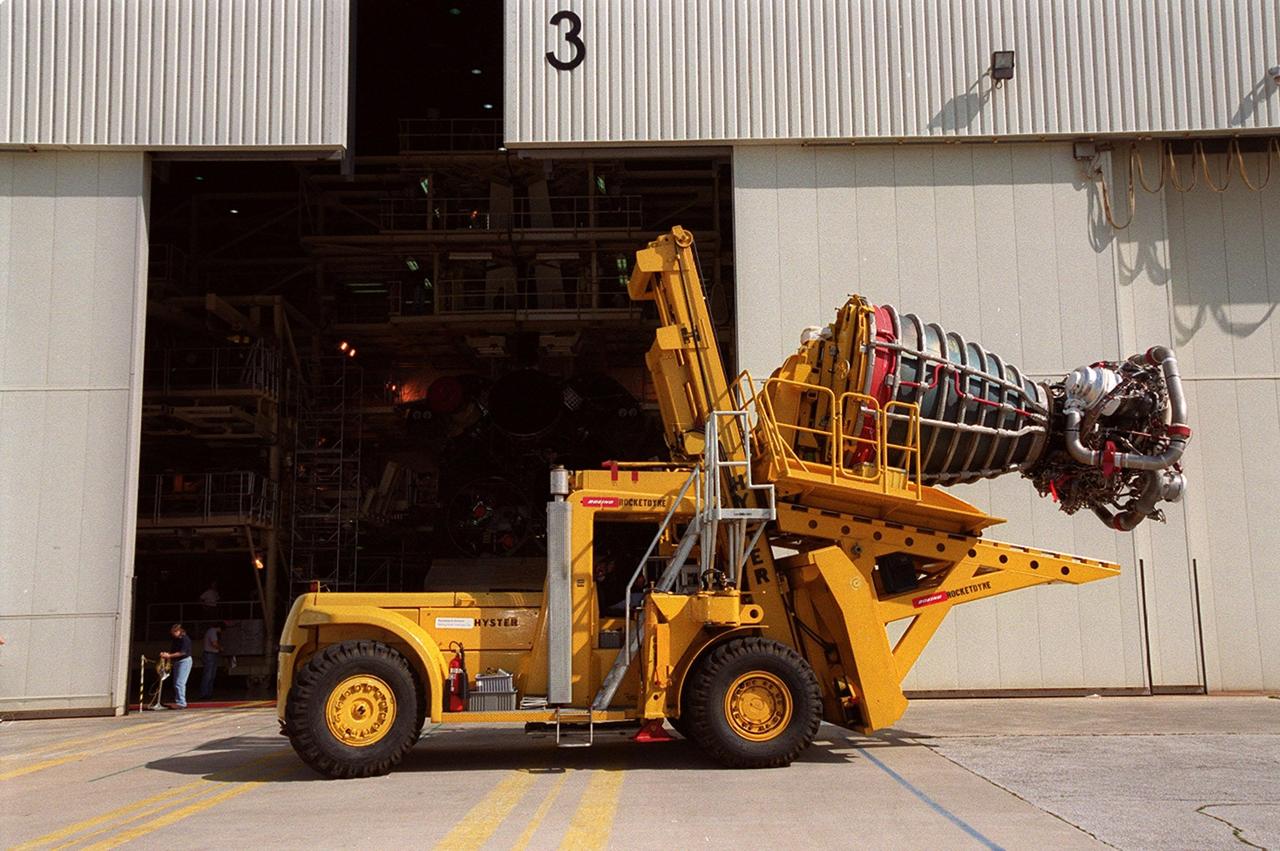
KENNEDY SPACE CENTER, FLA. -- The transport vehicle carrying a new block 2 engine arrives at Orbiter Processing Facility bay 3. There the new engine will be installed on the orbiter Atlantis, on mission STS-104, for its first flight. The Block II Main Engine configuration is manufactured by Boeing Rocketdyne in Canoga Park, Calif., and includes a new Pratt & Whitney high-pressure fuel turbo pump. Engine improvements are managed by NASA’s Marshall Space Flight Center in Huntsville, Ala. Each Space Shuttle Main Engine is 14 feet (4.3 meters) long, weighs about 7,000 pounds (3,175 kilograms), and is 7.5 feet (2.3 meters) in diameter at the end of the nozzle

A new block 2 engine is lowered onto a transport vehicle for a move to the Orbiter Processing Facility. There it will be installed for its first flight on the orbiter Atlantis, on mission STS-104. The Block II Main Engine configuration is manufactured by Boeing Rocketdyne in Canoga Park, Calif., and includes a new Pratt & Whitney high-pressure fuel turbo pump. Engine improvements are managed by NASA’s Marshall Space Flight Center in Huntsville, Ala. Each Space Shuttle Main Engine is 14 feet (4.3 meters) long, weighs about 7,000 pounds (3,175 kilograms), and is 7.5 feet (2.3 meters) in diameter at the end of the nozzle

KENNEDY SPACE CENTER, FLA. -- An upgraded Space Shuttle main engine (block 2 engine) sits in the Space Shuttle Main Engine Processing Facility. The new engine will be installed for its first flight on the orbiter Atlantis, on mission STS-104. The Block II Main Engine configuration is manufactured by Boeing Rocketdyne in Canoga Park, Calif., and includes a new Pratt & Whitney high-pressure fuel turbo pump. Engine improvements are managed by NASA’s Marshall Space Flight Center in Huntsville, Ala. Each Space Shuttle Main Engine is 14 feet (4.3 meters) long, weighs about 7,000 pounds (3,175 kilograms), and is 7.5 feet (2.3 meters) in diameter at the end of the nozzle
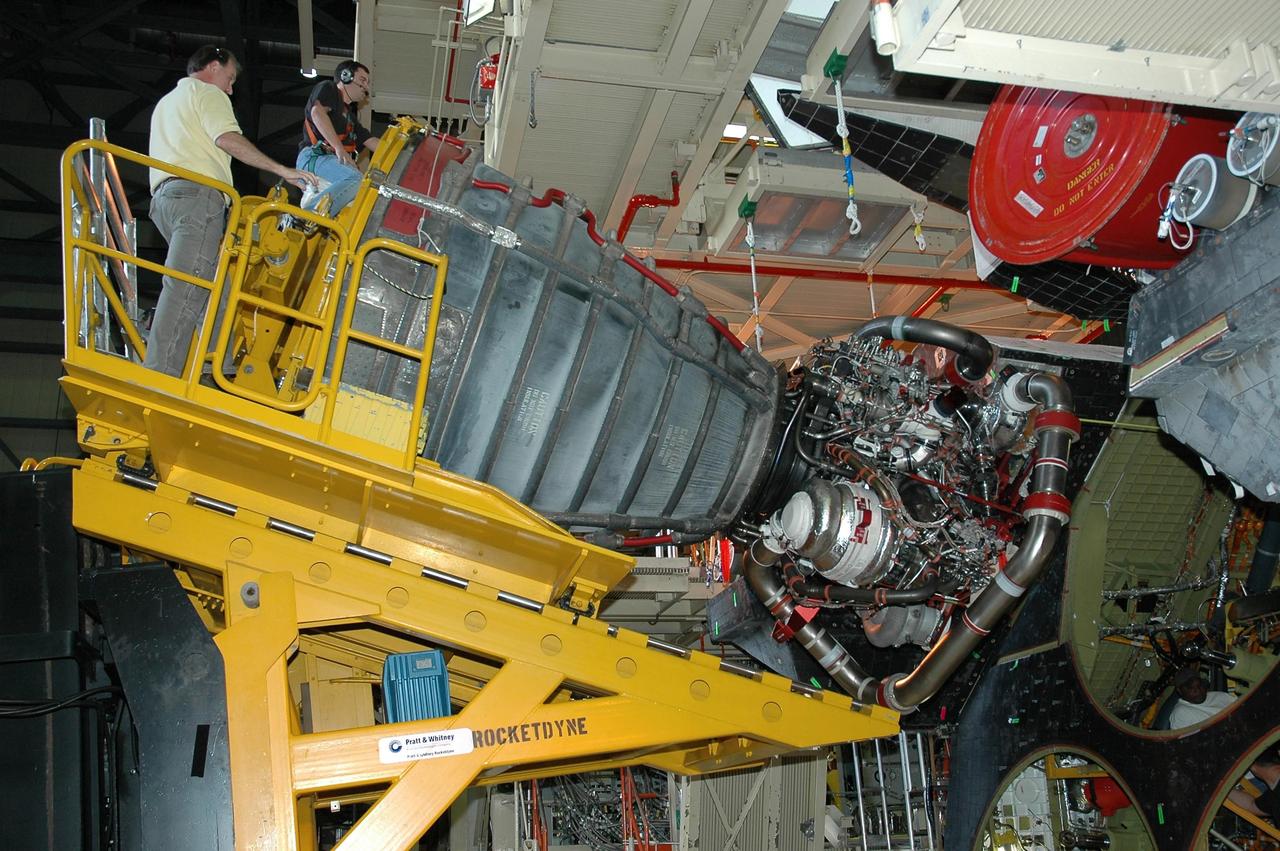
KENNEDY SPACE CENTER, FLA. - In In the Orbiter Processing Facility bay 1, a Hyster forklift maneuvers a main engine into position for installation into Discovery. The main engine configuration is manufactured by Boeing Rocketdyne in Canoga Park, Calif., and includes a Pratt & Whitney high-pressure fuel turbo pump. Each space shuttle main engine is 14 feet (4.3 meters) long, weighs about 6,700 pounds (3,039 kilograms), and is 7.5 feet (2.3 meters) in diameter at the end of the nozzle. Discovery is being processed for the second return-to-flight mission STS-121.

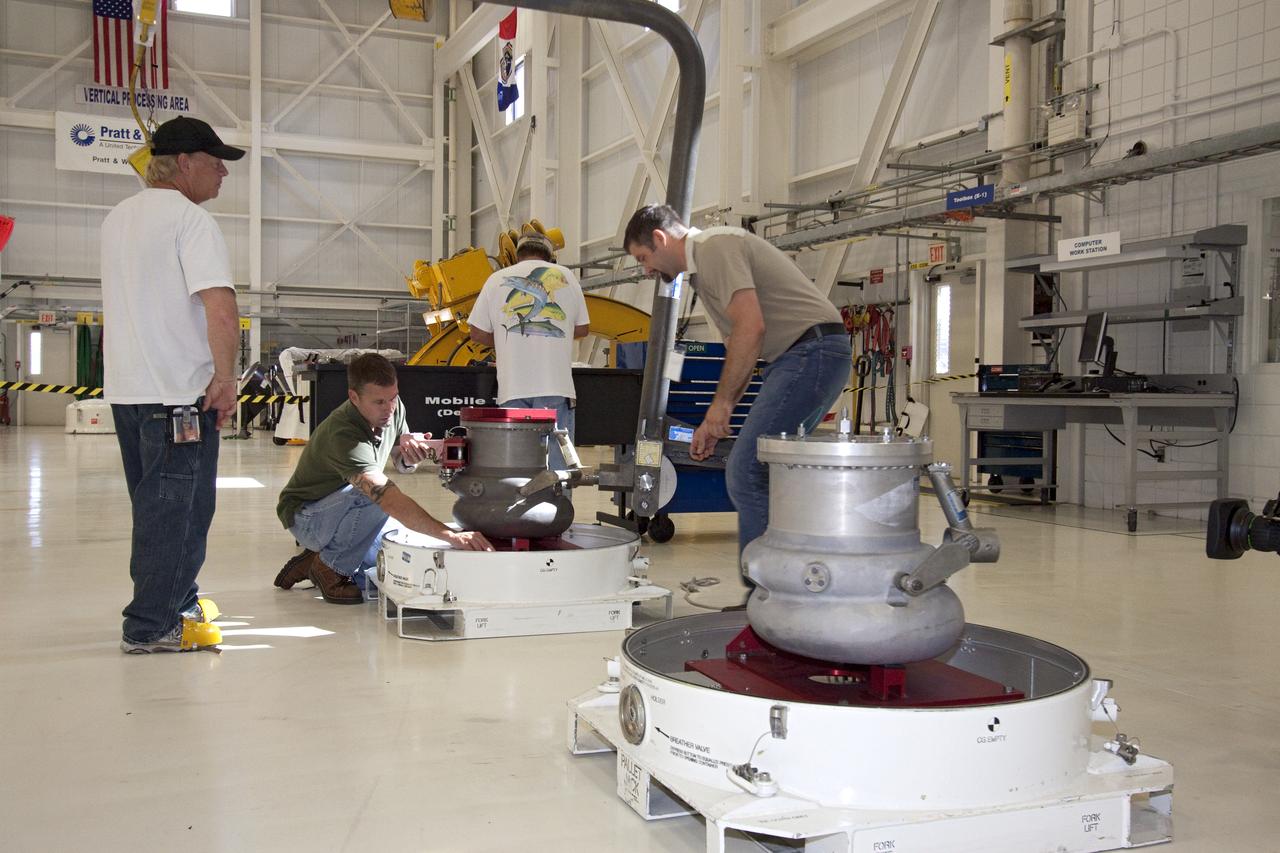
CAPE CANAVERAL, Fla. – In the Space Shuttle Main Engine Processing Facility at NASA's Kennedy Space Center in Florida, Pratt and Whitney Rocketdyne engine technicians prepare a high pressure oxidizer turbo pump for installation on space shuttle main engine no. 2062. The engine, or SSME, is the last one scheduled to be built at Kennedy before the end of the Space Shuttle Program. Ryan Mahony is standing; Teryon Jones, left, and Dan Bode are kneeling next to the pump. Three main engines are clustered at the aft end of the shuttle and have a combined thrust of more than 1.2 million pounds. Even though an SSME weighs one-seventh as much as a locomotive engine, its high-pressure fuel pump alone delivers as much horsepower as 28 locomotives. Each engine operates during the entire eight-and-a-half minute climb to orbit. Post-flight inspections and maintenance of each engine also are conducted in the SSME Processing Facility between shuttle missions. Photo credit: NASA_Amanda Diller
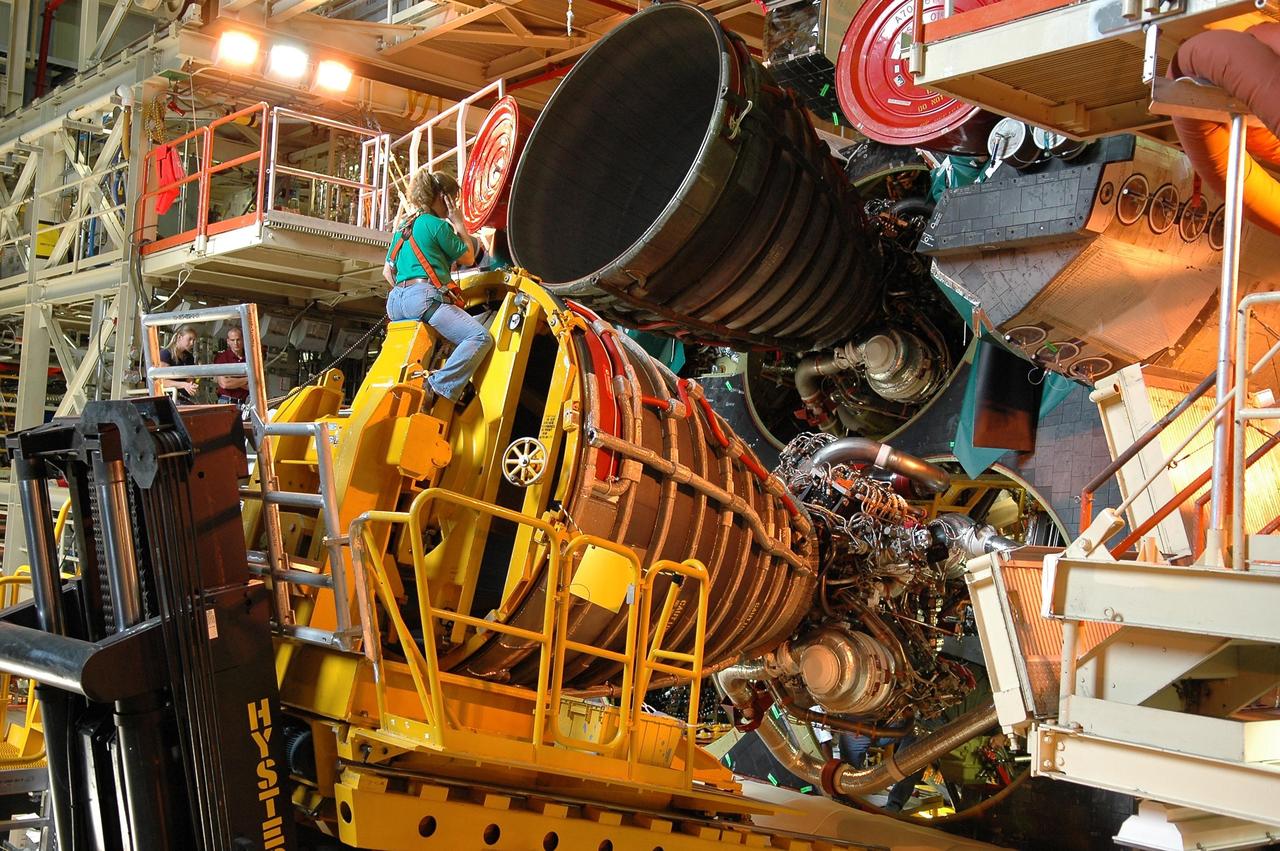
KENNEDY SPACE CENTER, FLA. - In the Orbiter Processing Facility bay 3, technicians on the Hyster forklift maneuver main engine No. 3 into place in Discovery. The main engine configuration is manufactured by Pratt & Whitney Rocketdyne in Canoga Park, Calif., and includes a Pratt & Whitney high-pressure fuel turbo pump. Each space shuttle main engine is 14 feet long, weighs about 6,700 pounds, and is 7.5 feet in diameter at the end of the nozzle. Discovery is being processed for its next mission, STS-116 (12A.1), to deliver a third truss segment, a SPACEHAB module and other key components to the International Space Station. The launch is currently scheduled no earlier than Dec. 14. Photo credit: NASA/Kim Shiflett
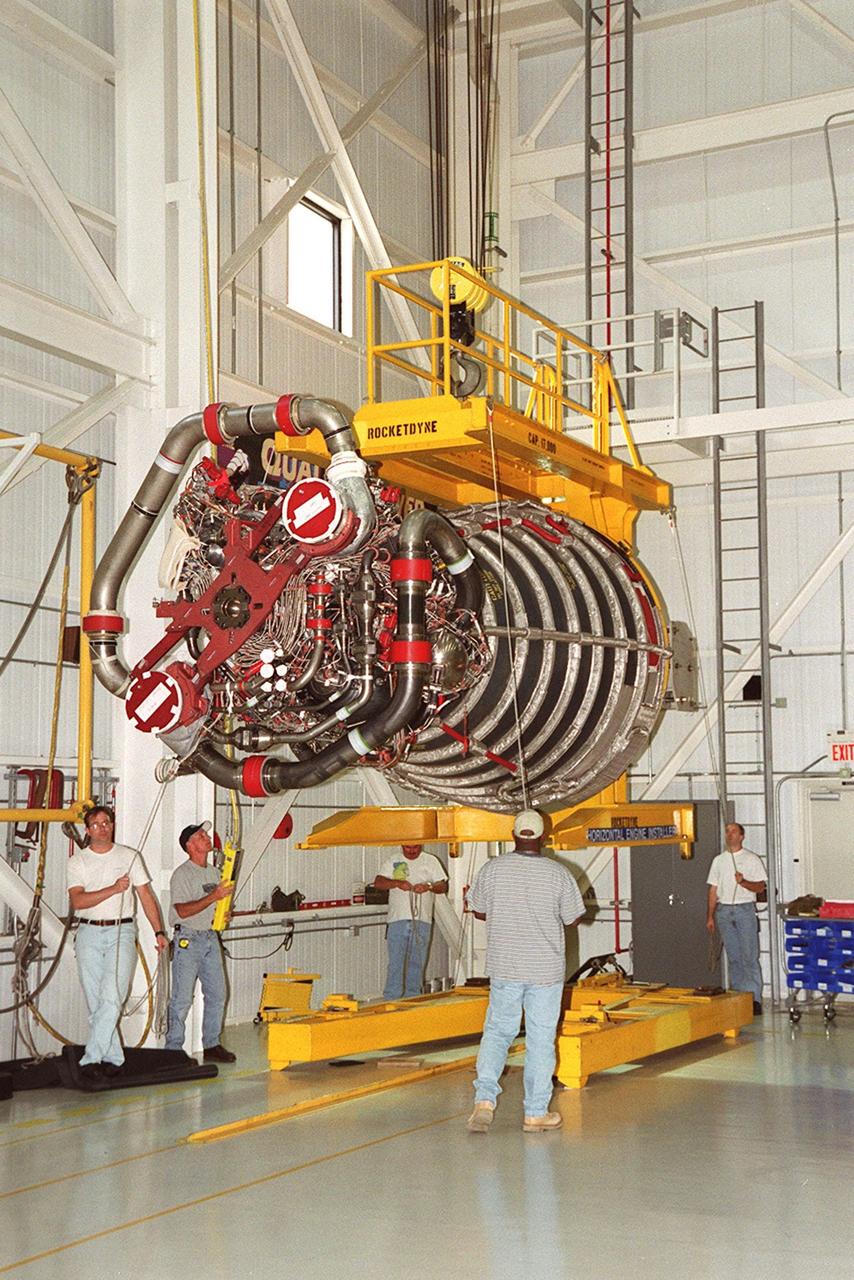
KENNEDY SPACE CENTER, FLA. -- Workers in the Space Shuttle Main Engine Processing Facility oversee lifting a new Space Shuttle main engine (block 2 engine) off its stand. The engine will be moved to the Orbiter Processing Facility and installed for its first flight on the orbiter Atlantis, on mission STS-104. The Block II Main Engine configuration is manufactured by Boeing Rocketdyne in Canoga Park, Calif., and includes a new Pratt & Whitney high-pressure fuel turbo pump. Engine improvements are managed by NASA’s Marshall Space Flight Center in Huntsville, Ala. Each Space Shuttle Main Engine is 14 feet (4.3 meters) long, weighs about 7,000 pounds (3,175 kilograms), and is 7.5 feet (2.3 meters) in diameter at the end of the nozzle
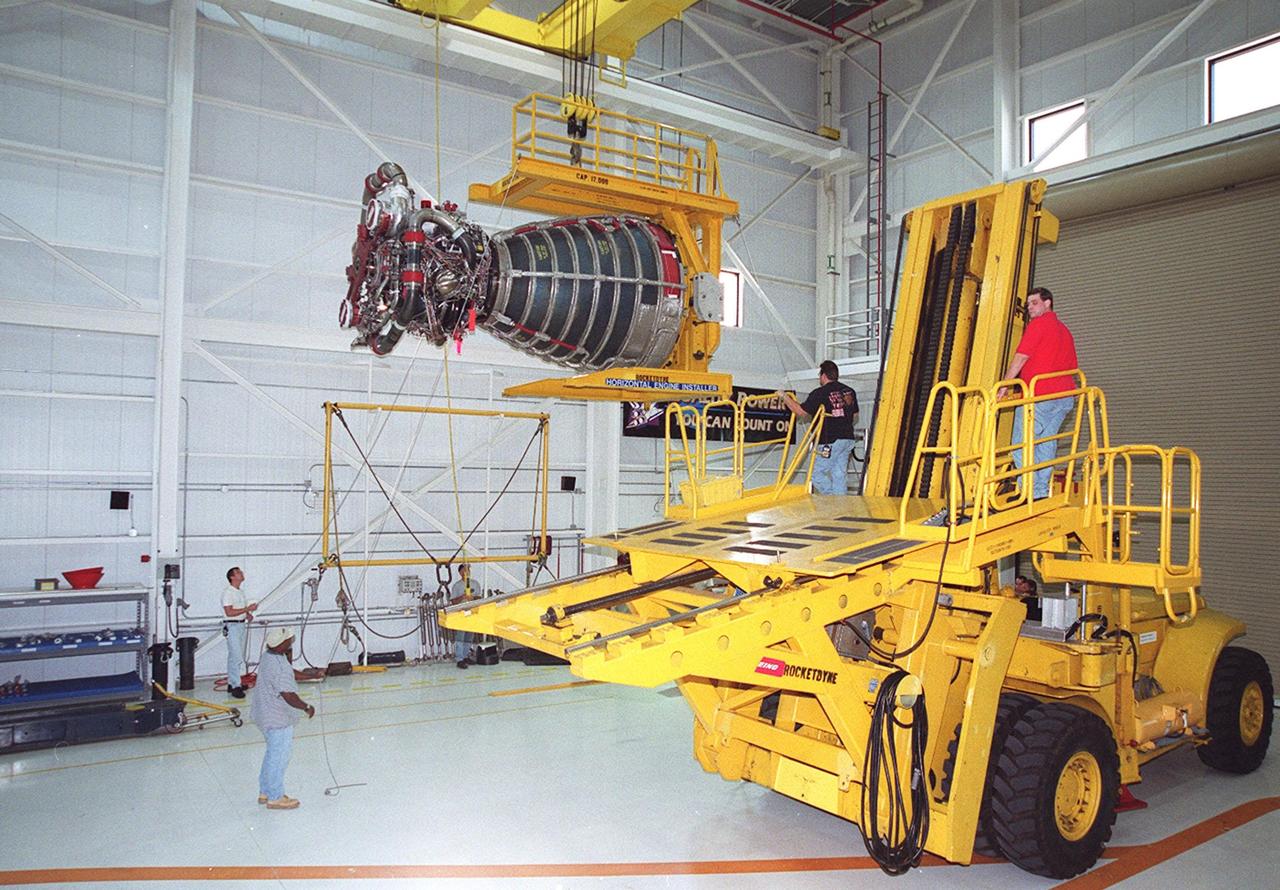
Workers in the Space Shuttle Main Engine Processing Facility oversee the movement of a new Space Shuttle main engine (block 2 engine) toward the transport vehicle in the foreground. The engine will be moved to the Orbiter Processing Facility and installed for its first flight on the orbiter Atlantis, on mission STS-104. The Block II Main Engine configuration is manufactured by Boeing Rocketdyne in Canoga Park, Calif., and includes a new Pratt & Whitney high-pressure fuel turbo pump. Engine improvements are managed by NASA’s Marshall Space Flight Center in Huntsville, Ala. Each Space Shuttle Main Engine is 14 feet (4.3 meters) long, weighs about 7,000 pounds (3,175 kilograms), and is 7.5 feet (2.3 meters) in diameter at the end of the nozzle. <font
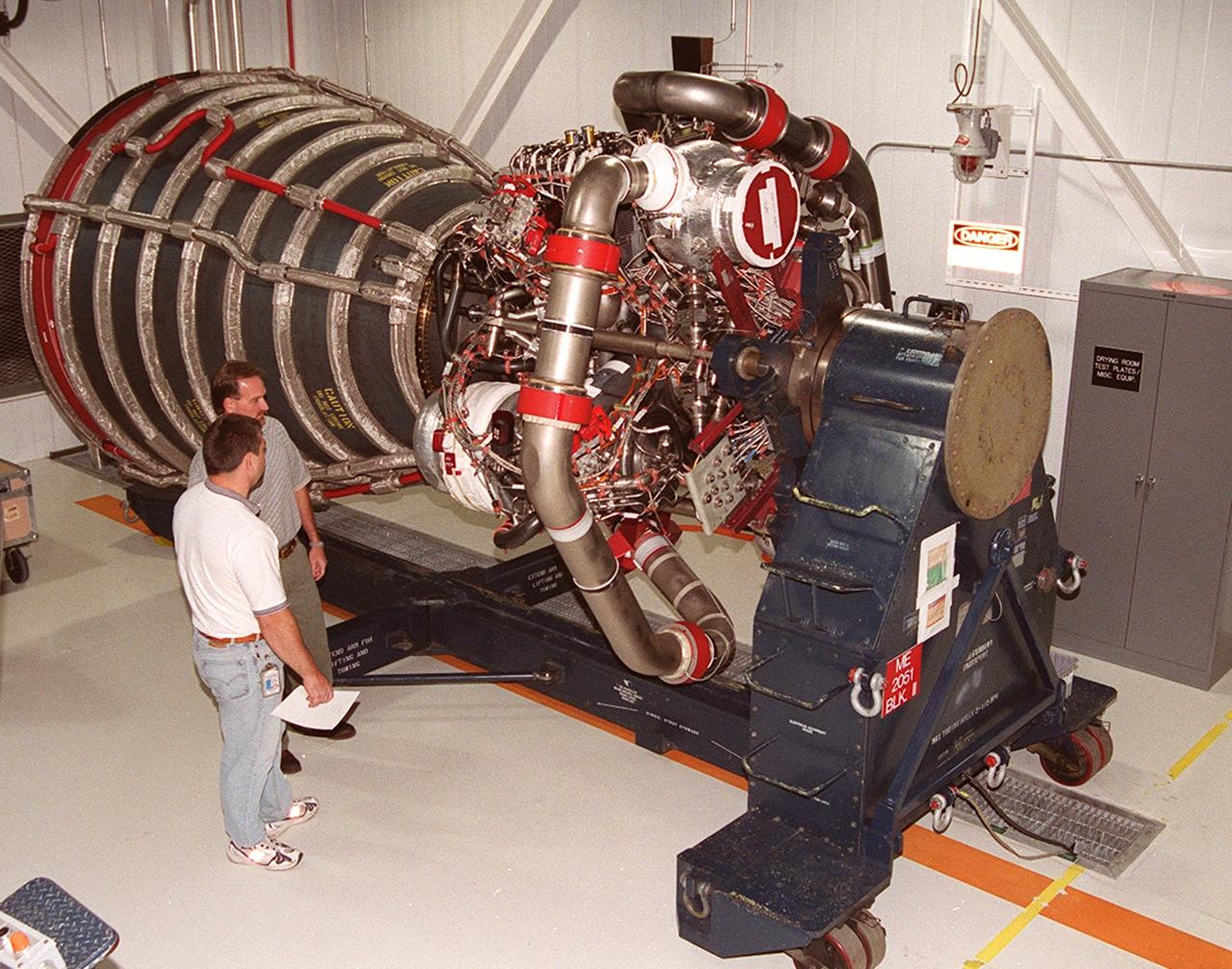
KENNEDY SPACE CENTER, FLA. -- Mike Cosgrove (front) and Bob Petrie (behind), both with Boeing/Rocketdyne, look over the upgraded Space Shuttle main engine (block 2 engine) as it sits in the Space Shuttle Main Engine Processing Facility. The new engine will be installed for its first flight on the orbiter Atlantis, on mission STS-104. The Block II Main Engine configuration is manufactured by Boeing Rocketdyne in Canoga Park, Calif., and includes a new Pratt & Whitney high-pressure fuel turbo pump. Engine improvements are managed by NASA’s Marshall Space Flight Center in Huntsville, Ala. Each Space Shuttle Main Engine is 14 feet (4.3 meters) long, weighs about 7,000 pounds (3,175 kilograms), and is 7.5 feet (2.3 meters) in diameter at the end of the nozzle
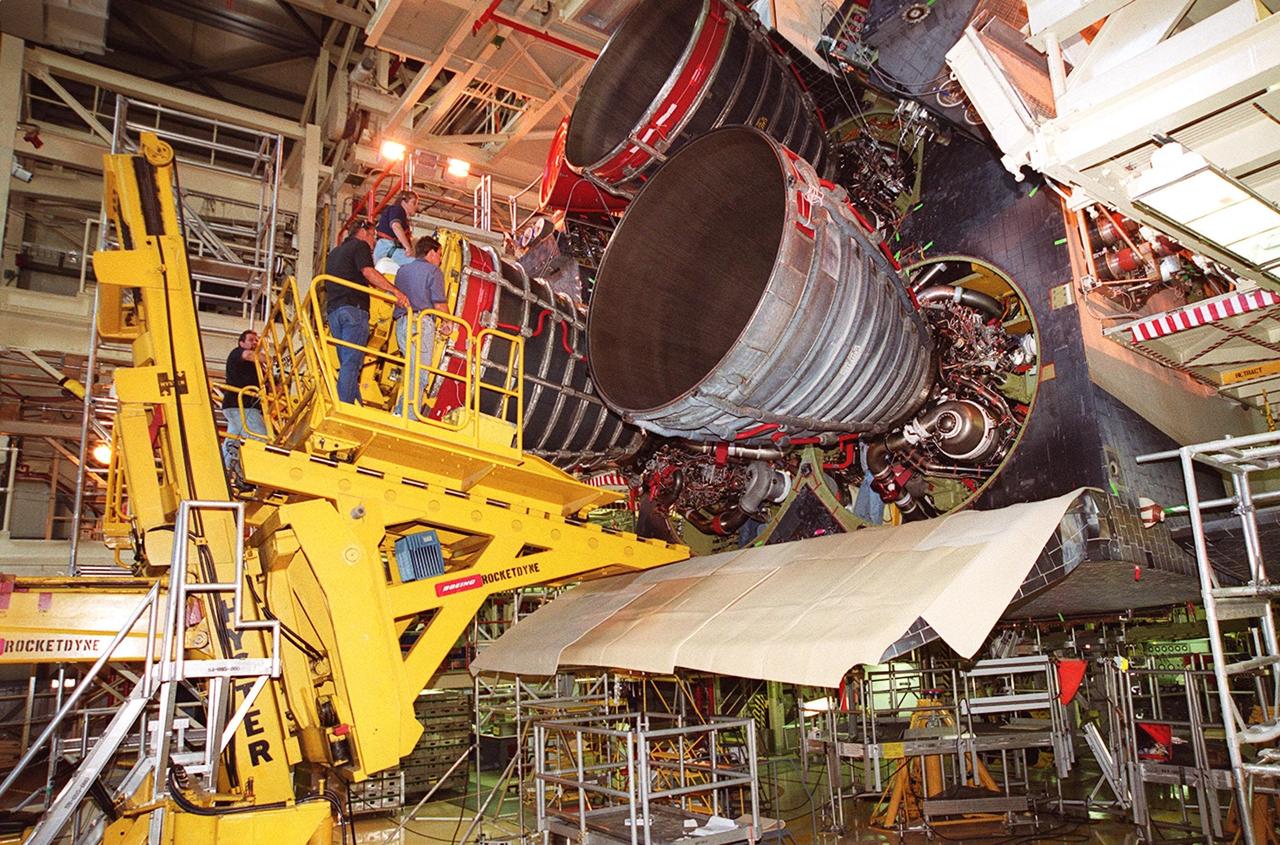
KENNEDY SPACE CENTER, FLA. -- The new block 2 engine for the orbiter Atlantis is moved into place next to the other two engines. The work is being done in the Orbiter Processing Facility bay 3. The engine will have its first flight on mission STS-104, scheduled for launch June 14. The Block II Main Engine configuration is manufactured by Boeing Rocketdyne in Canoga Park, Calif., and includes a new Pratt & Whitney high-pressure fuel turbo pump. Engine improvements are managed by NASA’s Marshall Space Flight Center in Huntsville, Ala. Each Space Shuttle Main Engine is 14 feet (4.3 meters) long, weighs about 7,000 pounds (3,175 kilograms), and is 7.5 feet (2.3 meters) in diameter at the end of the nozzle
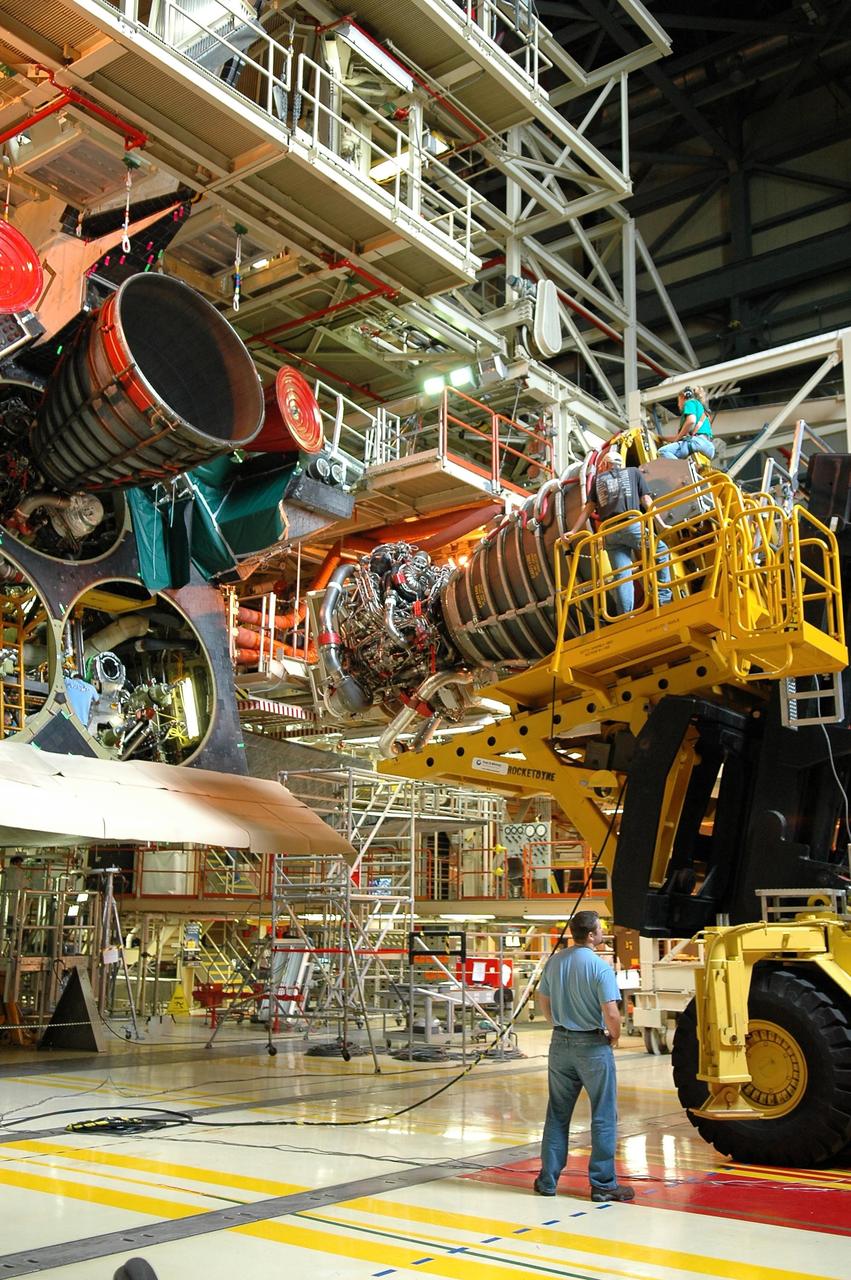
KENNEDY SPACE CENTER, FLA. - In the Orbiter Processing Facility bay 3, technicians on the Hyster forklift are ready to install main engine No. 3 on Discovery. The main engine configuration is manufactured by Pratt & Whitney Rocketdyne in Canoga Park, Calif., and includes a Pratt & Whitney high-pressure fuel turbo pump. Each space shuttle main engine is 14 feet long, weighs about 6,700 pounds, and is 7.5 feet in diameter at the end of the nozzle. Discovery is being processed for its next mission, STS-116 (12A.1), to deliver a third truss segment, a SPACEHAB module and other key components to the International Space Station. The launch is currently scheduled no earlier than Dec. 14. Photo credit: NASA/Kim Shiflett
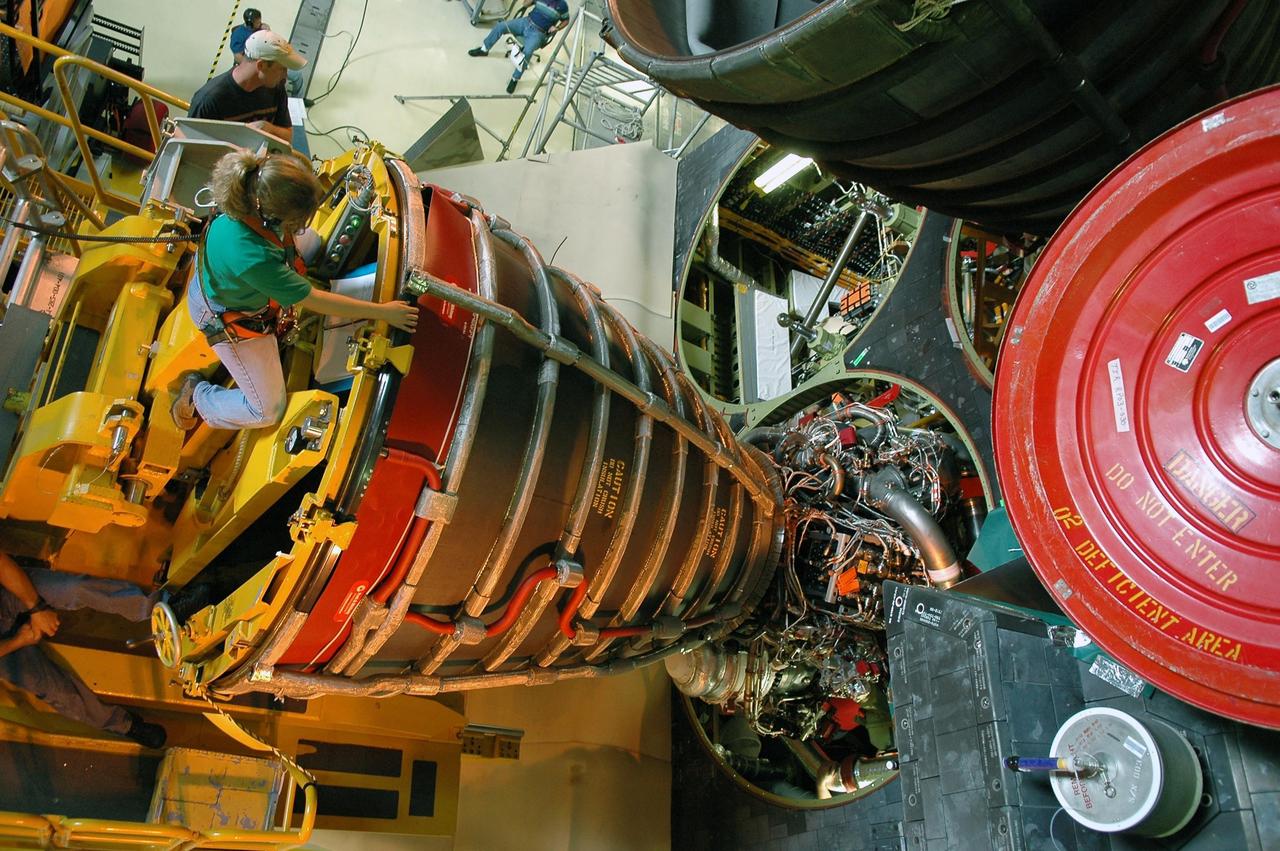
KENNEDY SPACE CENTER, FLA. - In the Orbiter Processing Facility bay 3, technicians on the Hyster forklift maneuver main engine No. 3 into place in Discovery. The main engine configuration is manufactured by Pratt & Whitney Rocketdyne in Canoga Park, Calif., and includes a Pratt & Whitney high-pressure fuel turbo pump. Each space shuttle main engine is 14 feet long, weighs about 6,700 pounds, and is 7.5 feet in diameter at the end of the nozzle. Discovery is being processed for its next mission, STS-116 (12A.1), to deliver a third truss segment, a SPACEHAB module and other key components to the International Space Station. The launch is currently scheduled no earlier than Dec. 14. Photo credit: NASA/Kim Shiflett
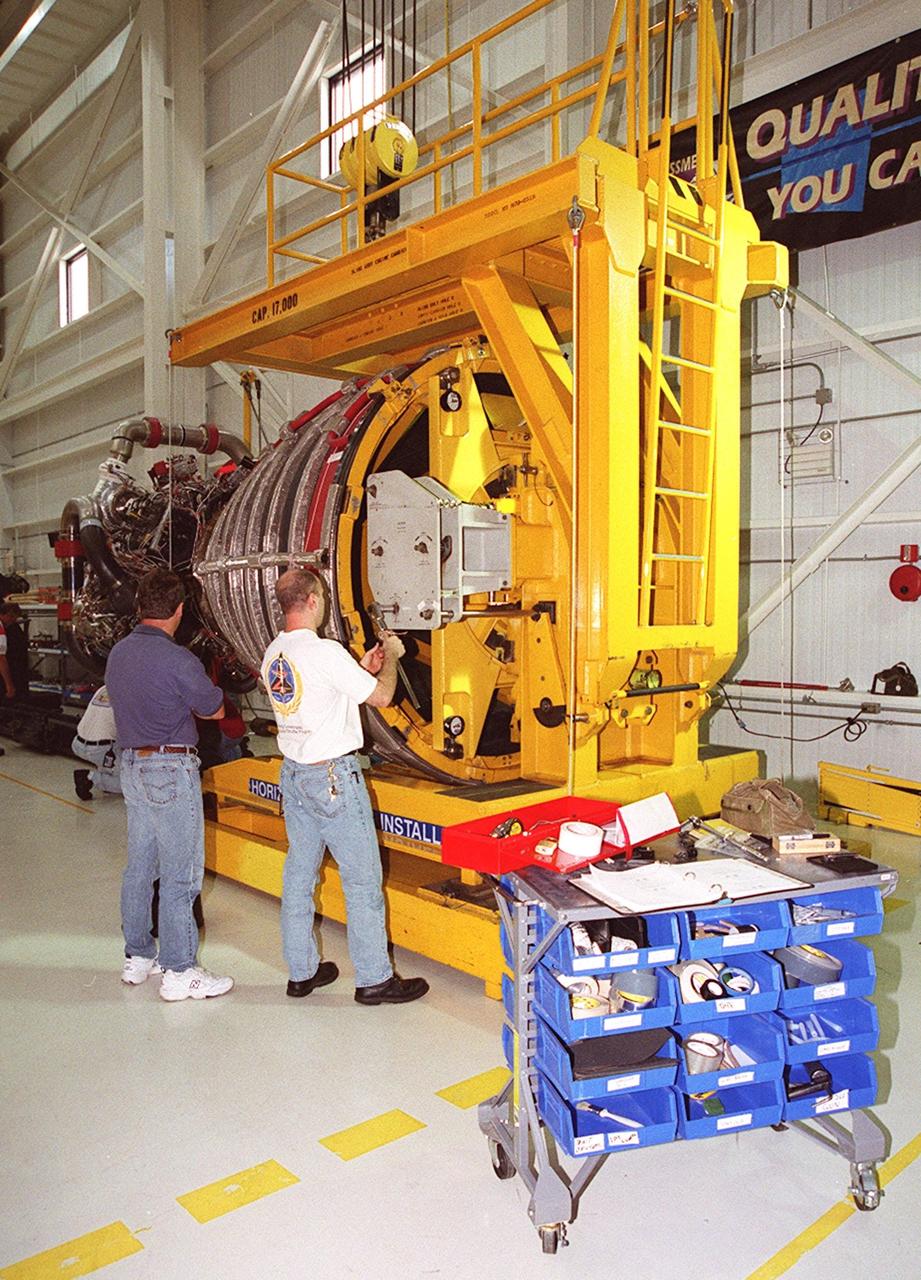
Workers in the Space Shuttle Main Engine Processing Facility get a new Space Shuttle main engine (block 2 engine) ready to move to the Orbiter Processing Facility. The engine will be installed for its first flight on the orbiter Atlantis, on mission STS-104. The Block II Main Engine configuration is manufactured by Boeing Rocketdyne in Canoga Park, Calif., and includes a new Pratt & Whitney high-pressure fuel turbo pump. Engine improvements are managed by NASA’s Marshall Space Flight Center in Huntsville, Ala. Each Space Shuttle Main Engine is 14 feet (4.3 meters) long, weighs about 7,000 pounds (3,175 kilograms), and is 7.5 feet (2.3 meters) in diameter at the end of the nozzle
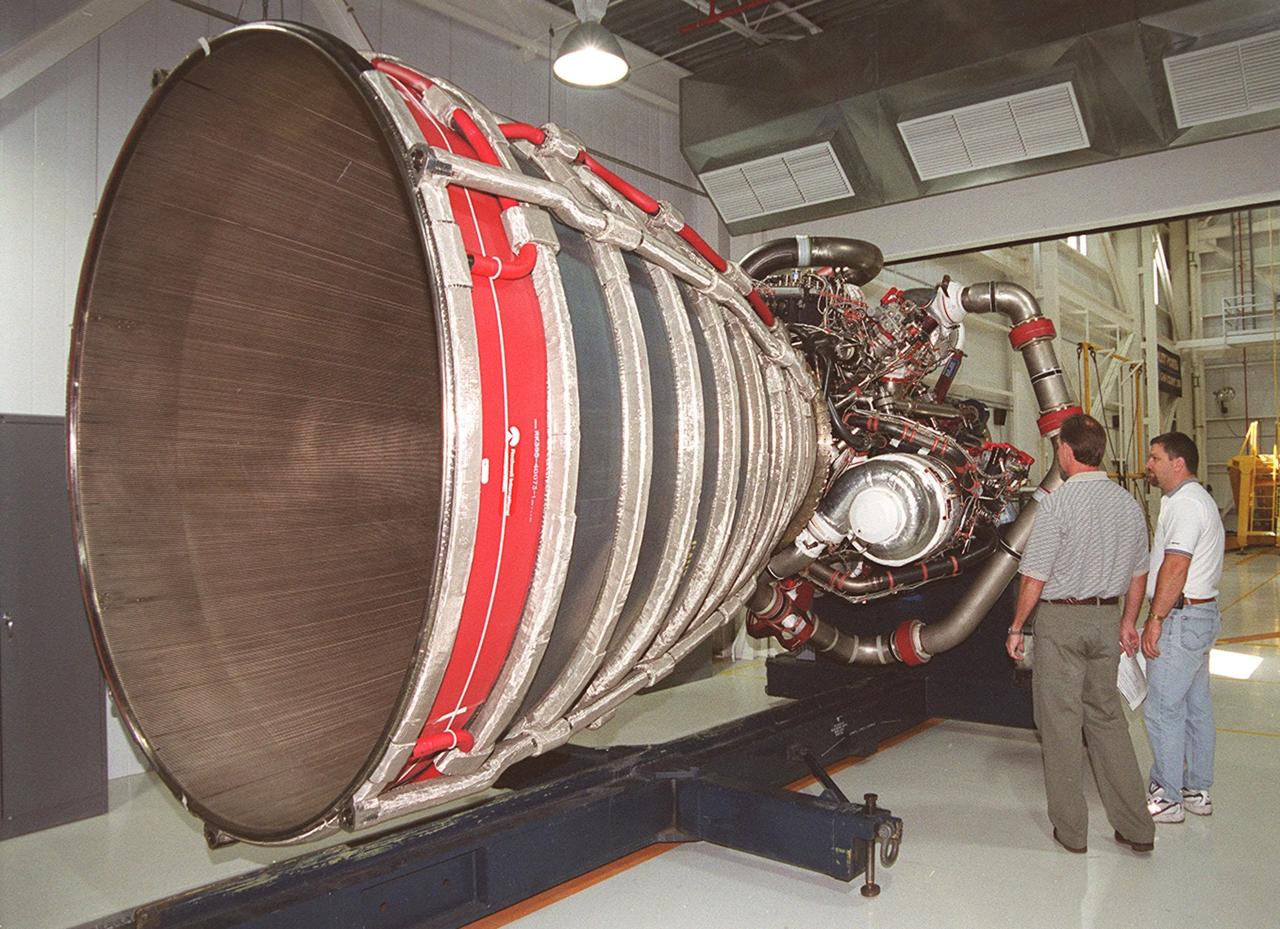
KENNEDY SPACE CENTER, FLA. -- Looking over the upgraded Space Shuttle main engine (block 2 engine) in the Space Shuttle Main Engine Processing Facility are Bob Petrie (left) and Mike Cosgrove (right). Both are with Boeing/Rocketdyne. The new engine will be installed for its first flight on the orbiter Atlantis, on mission STS-104. The Block II Main Engine configuration is manufactured by Boeing Rocketdyne in Canoga Park, Calif., and includes a new Pratt & Whitney high-pressure fuel turbo pump. Engine improvements are managed by NASA’s Marshall Space Flight Center in Huntsville, Ala. Each Space Shuttle Main Engine is 14 feet (4.3 meters) long, weighs about 7,000 pounds (3,175 kilograms), and is 7.5 feet (2.3 meters) in diameter at the end of the nozzle
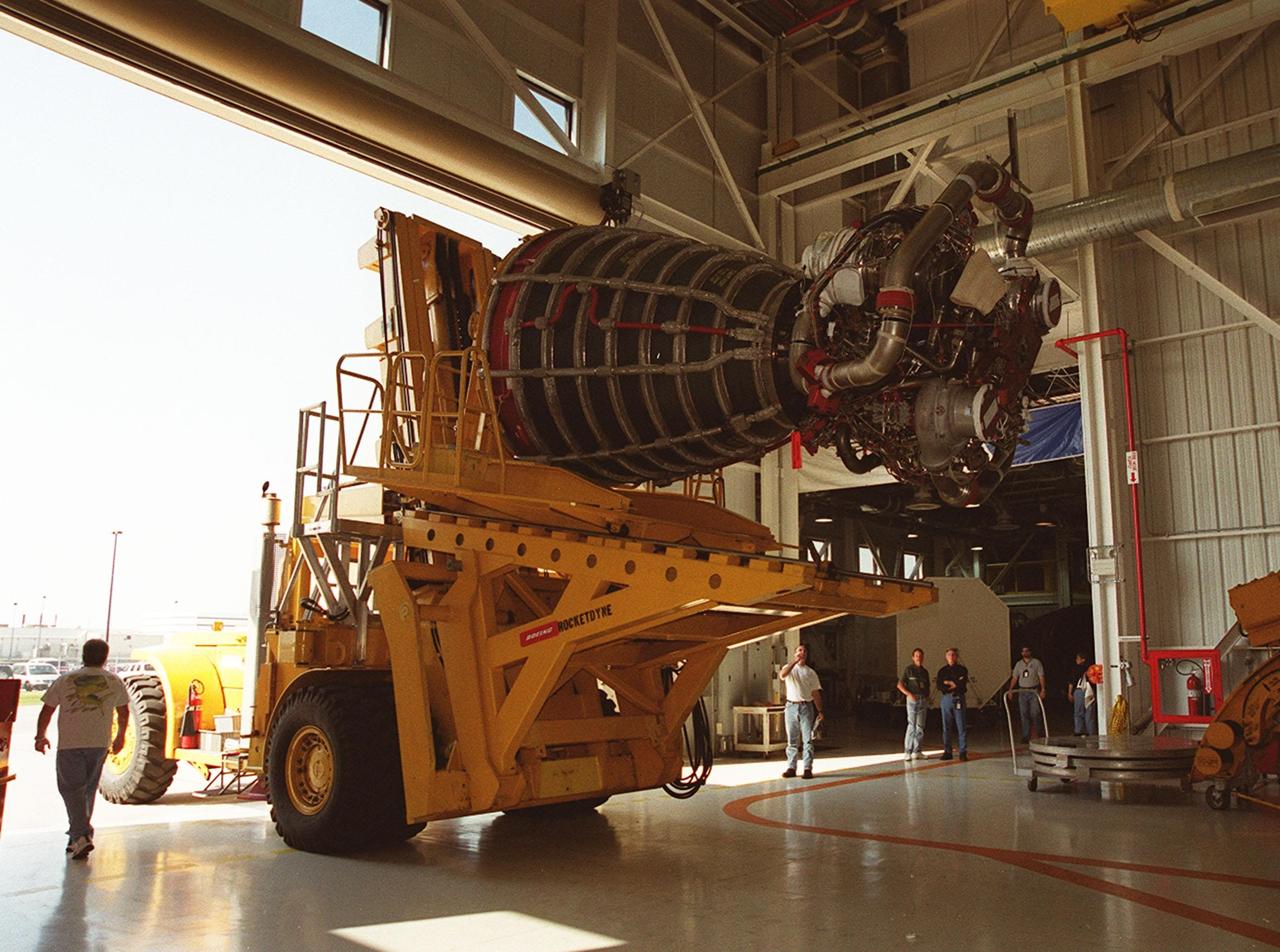
KENNEDY SPACE CENTER, FLA. -- The transport vehicle carrying a new block 2 engine leaves the Space Station Main Engine Processing Facility for a short trip to Orbiter Processing Facility bay 3. The new engine will be installed on the orbiter Atlantis, on mission STS-104, for its first flight. The Block II Main Engine configuration is manufactured by Boeing Rocketdyne in Canoga Park, Calif., and includes a new Pratt & Whitney high-pressure fuel turbo pump. Engine improvements are managed by NASA’s Marshall Space Flight Center in Huntsville, Ala. Each Space Shuttle Main Engine is 14 feet (4.3 meters) long, weighs about 7,000 pounds (3,175 kilograms), and is 7.5 feet (2.3 meters) in diameter at the end of the nozzle
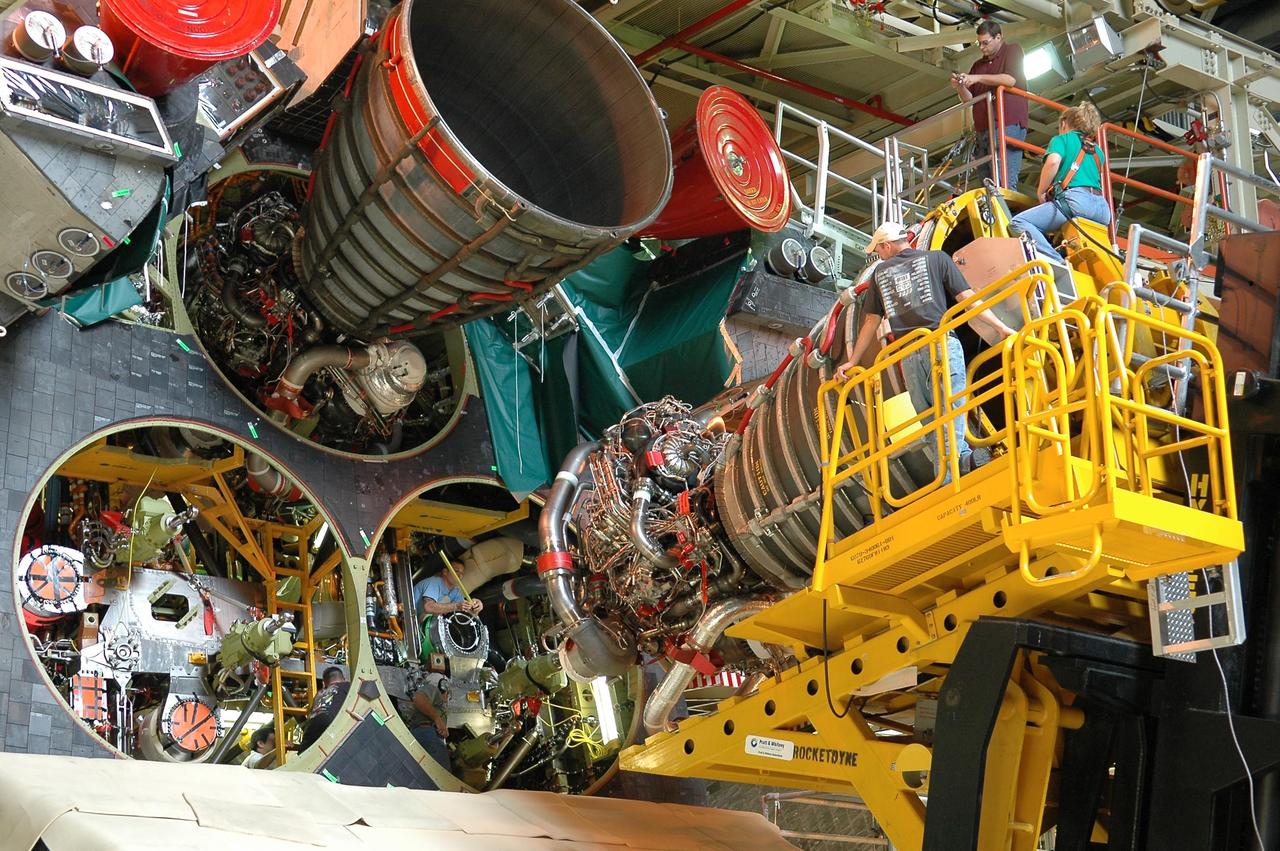
KENNEDY SPACE CENTER, FLA. - In the Orbiter Processing Facility bay 3, technicians on the Hyster forklift maneuver main engine No. 3 into place in Discovery. The main engine configuration is manufactured by Pratt & Whitney Rocketdyne in Canoga Park, Calif., and includes a Pratt & Whitney high-pressure fuel turbo pump. Each space shuttle main engine is 14 feet long, weighs about 6,700 pounds, and is 7.5 feet in diameter at the end of the nozzle. Discovery is being processed for its next mission, STS-116 (12A.1), to deliver a third truss segment, a SPACEHAB module and other key components to the International Space Station. The launch is currently scheduled no earlier than Dec. 14. Photo credit: NASA/Kim Shiflett

KENNEDY SPACE CENTER, FLA. -- The new block 2 engine for the orbiter Atlantis is moved into place next to the other two engines. The work is being done in the Orbiter Processing Facility bay 3. The engine will have its first flight on mission STS-104, scheduled for launch June 14. The Block II Main Engine configuration is manufactured by Boeing Rocketdyne in Canoga Park, Calif., and includes a new Pratt and Whitney high-pressure fuel turbo pump. Engine improvements are managed by NASA’s Marshall Space Flight Center in Huntsville, Ala. Each Space Shuttle Main Engine is 14 feet (4.3 meters) long, weighs about 7,000 pounds (3,175 kilograms), and is 7.5 feet (2.3 meters) in diameter at the end of the nozzle
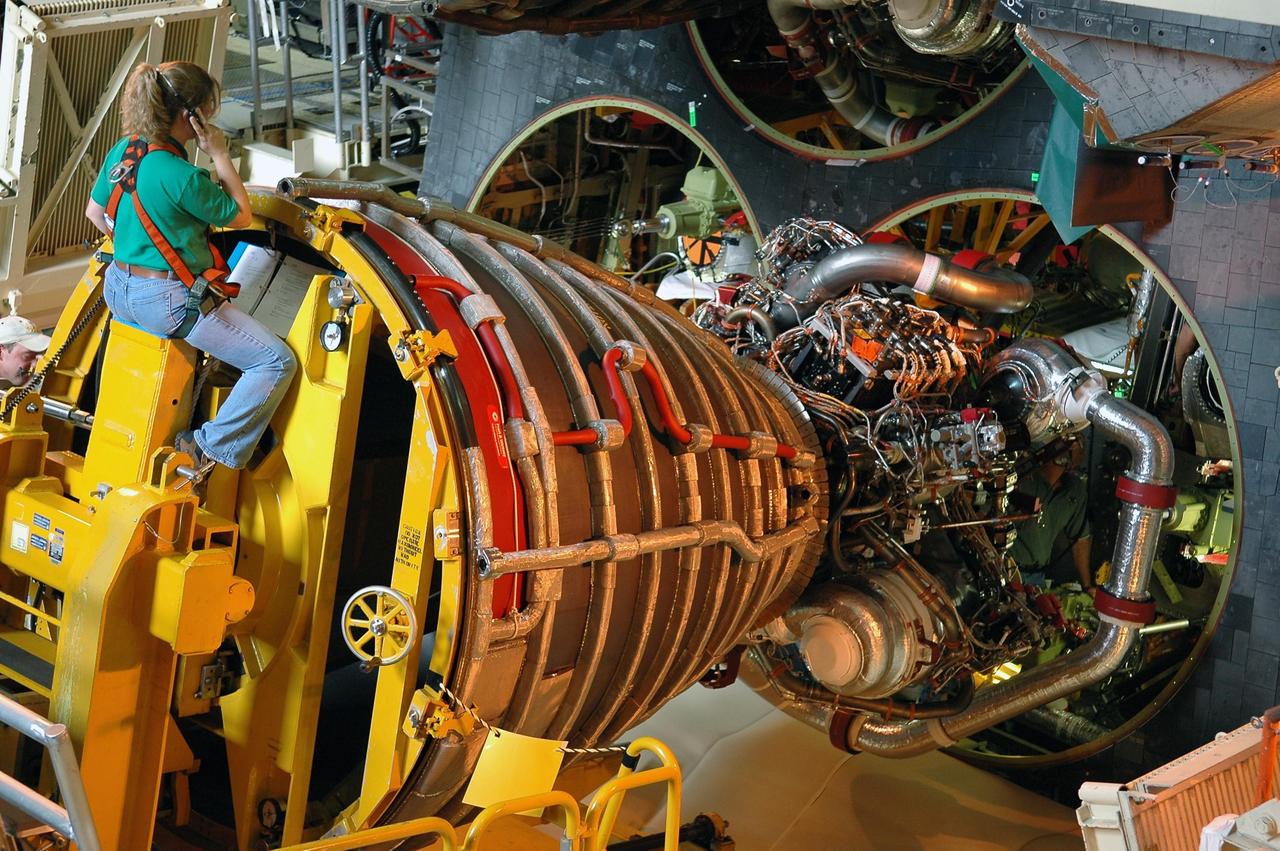
KENNEDY SPACE CENTER, FLA. - In the Orbiter Processing Facility bay 3, technicians on the Hyster forklift maneuver main engine No. 3 into place in Discovery. The main engine configuration is manufactured by Pratt & Whitney Rocketdyne in Canoga Park, Calif., and includes a Pratt & Whitney high-pressure fuel turbo pump. Each space shuttle main engine is 14 feet long, weighs about 6,700 pounds, and is 7.5 feet in diameter at the end of the nozzle. Discovery is being processed for its next mission, STS-116 (12A.1), to deliver a third truss segment, a SPACEHAB module and other key components to the International Space Station. The launch is currently scheduled no earlier than Dec. 14. Photo credit: NASA/Kim Shiflett
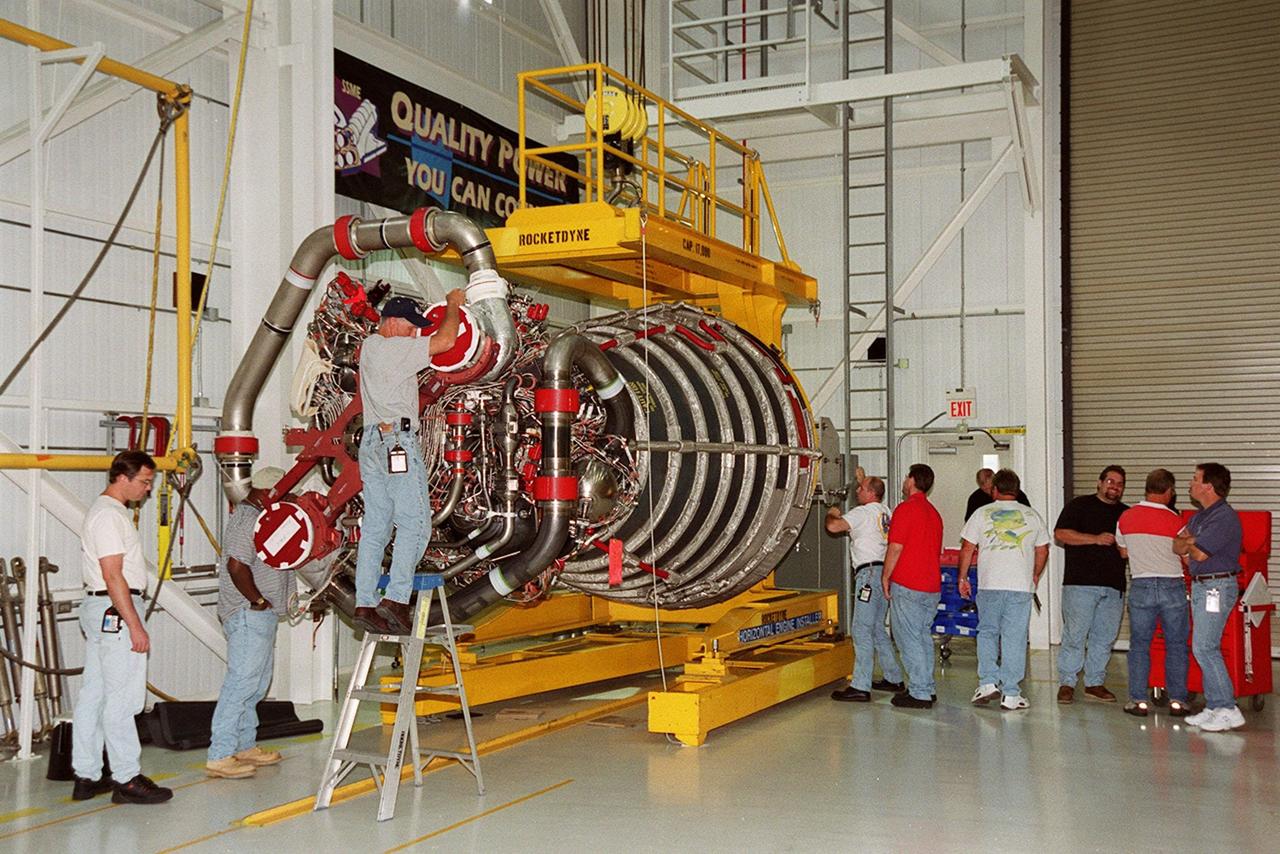
Workers in the Space Shuttle Main Engine Processing Facility prepare a new Space Shuttle main engine (block 2 engine) for its move to the Orbiter Processing Facility. The engine will be installed for its first flight on the orbiter Atlantis, on mission STS-104. The Block II Main Engine configuration is manufactured by Boeing Rocketdyne in Canoga Park, Calif., and includes a new Pratt & Whitney high-pressure fuel turbo pump. Engine improvements are managed by NASA’s Marshall Space Flight Center in Huntsville, Ala. Each Space Shuttle Main Engine is 14 feet (4.3 meters) long, weighs about 7,000 pounds (3,175 kilograms), and is 7.5 feet (2.3 meters) in diameter at the end of the nozzle. <font

KENNEDY SPACE CENTER, FLA. -- As the giant forklift moves closer to Atlantis, workers keep watch as the new block 2 engine nears its installation point. The work is being done in the Orbiter Processing Facility bay 3. The engine will have its first flight on mission STS-104, scheduled for launch June 14. The Block II Main Engine configuration is manufactured by Boeing Rocketdyne in Canoga Park, Calif., and includes a new Pratt & Whitney high-pressure fuel turbo pump. Engine improvements are managed by NASA’s Marshall Space Flight Center in Huntsville, Ala. Each Space Shuttle Main Engine is 14 feet (4.3 meters) long, weighs about 7,000 pounds (3,175 kilograms), and is 7.5 feet (2.3 meters) in diameter at the end of the nozzle
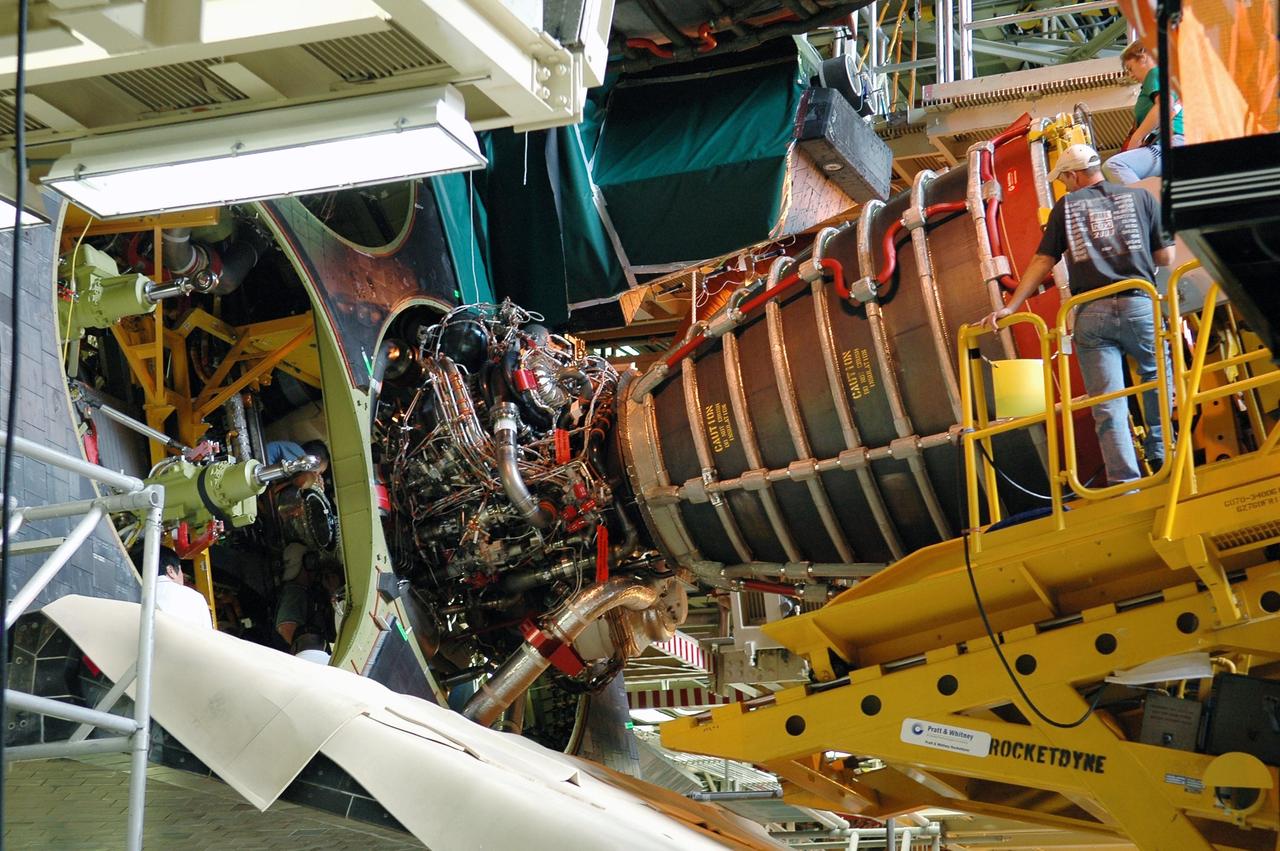
KENNEDY SPACE CENTER, FLA. - In the Orbiter Processing Facility bay 3, technicians on the Hyster forklift maneuver main engine No. 3 into place in Discovery. The main engine configuration is manufactured by Pratt & Whitney Rocketdyne in Canoga Park, Calif., and includes a Pratt & Whitney high-pressure fuel turbo pump. Each space shuttle main engine is 14 feet long, weighs about 6,700 pounds, and is 7.5 feet in diameter at the end of the nozzle. Discovery is being processed for its next mission, STS-116 (12A.1), to deliver a third truss segment, a SPACEHAB module and other key components to the International Space Station. The launch is currently scheduled no earlier than Dec. 14. Photo credit: NASA/Kim Shiflett
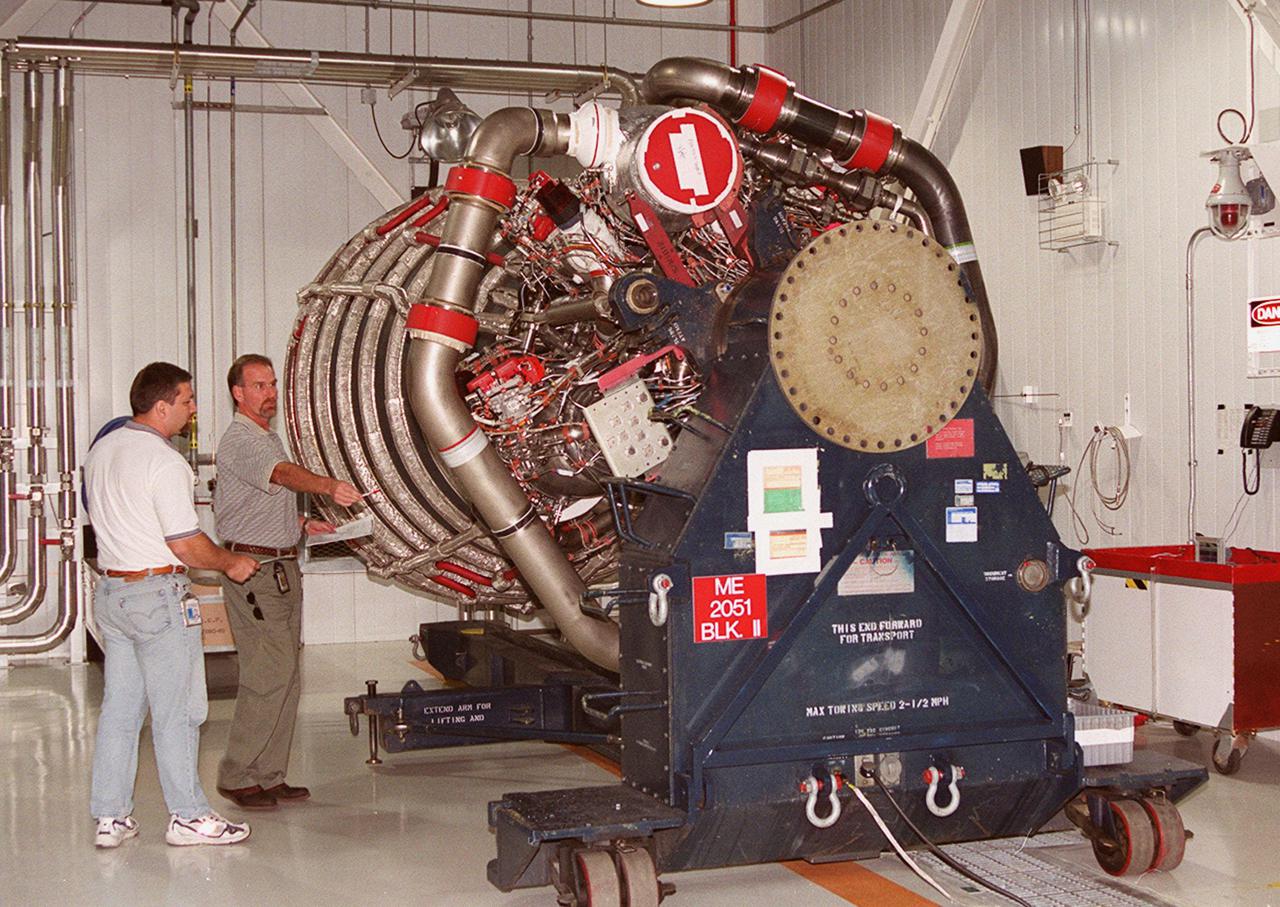
KENNEDY SPACE CENTER, FLA. -- Mike Cosgrove (left) and Bob Petrie (right), both with Boeing_Rocketdyne, look over the upgraded Space Shuttle main engine (block 2 engine) as it sits in the Space Shuttle Main Engine Processing Facility. The new engine will be installed for its first flight on the orbiter Atlantis, on mission STS-104. The Block II Main Engine configuration is manufactured by Boeing Rocketdyne in Canoga Park, Calif., and includes a new Pratt and Whitney high-pressure fuel turbo pump. Engine improvements are managed by NASA’s Marshall Space Flight Center in Huntsville, Ala. Each Space Shuttle Main Engine is 14 feet (4.3 meters) long, weighs about 7,000 pounds (3,175 kilograms), and is 7.5 feet (2.3 meters) in diameter at the end of the nozzle

KENNEDY SPACE CENTER, FLA. -- A new block 2 engine, situated on a giant forklift, is moved toward the aft of Atlantis where it will be installed. The work is being done in the Orbiter Processing Facility bay 3. The engine will have its first flight on mission STS-104, scheduled for launch June 14. The Block II Main Engine configuration is manufactured by Boeing Rocketdyne in Canoga Park, Calif., and includes a new Pratt & Whitney high-pressure fuel turbo pump. Engine improvements are managed by NASA’s Marshall Space Flight Center in Huntsville, Ala. Each Space Shuttle Main Engine is 14 feet (4.3 meters) long, weighs about 7,000 pounds (3,175 kilograms), and is 7.5 feet (2.3 meters) in diameter at the end of the nozzle
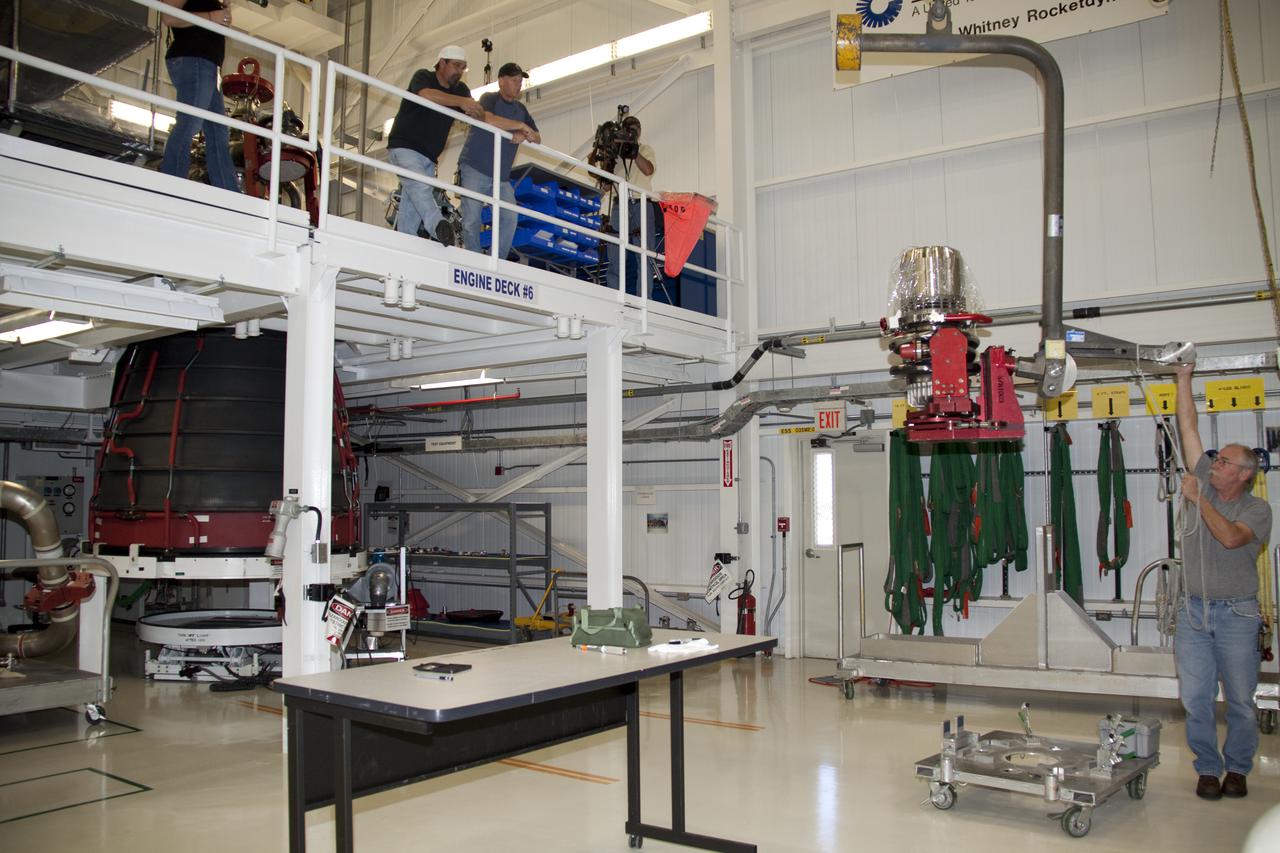
CAPE CANAVERAL, Fla. – On the floor of the Space Shuttle Main Engine Processing Facility at NASA's Kennedy Space Center in Florida, Pratt and Whitney Rocketdyne engine technician Dan Bode lifts a high pressure oxidizer turbo pump off its stand for installation on space shuttle main engine no. 2062. The engine, or SSME, is the last one scheduled to be built at Kennedy by Pratt and Whitney Rocketdyne before the end of the Space Shuttle Program. Three main engines are clustered at the aft end of the shuttle and have a combined thrust of more than 1.2 million pounds. Even though an SSME weighs one-seventh as much as a locomotive engine, its high-pressure fuel pump alone delivers as much horsepower as 28 locomotives. Each engine operates during the entire eight-and-a-half minute climb to orbit. Post-flight inspections and maintenance of each engine also are conducted in the SSME Processing Facility between shuttle missions. Photo credit: NASA_Amanda Diller
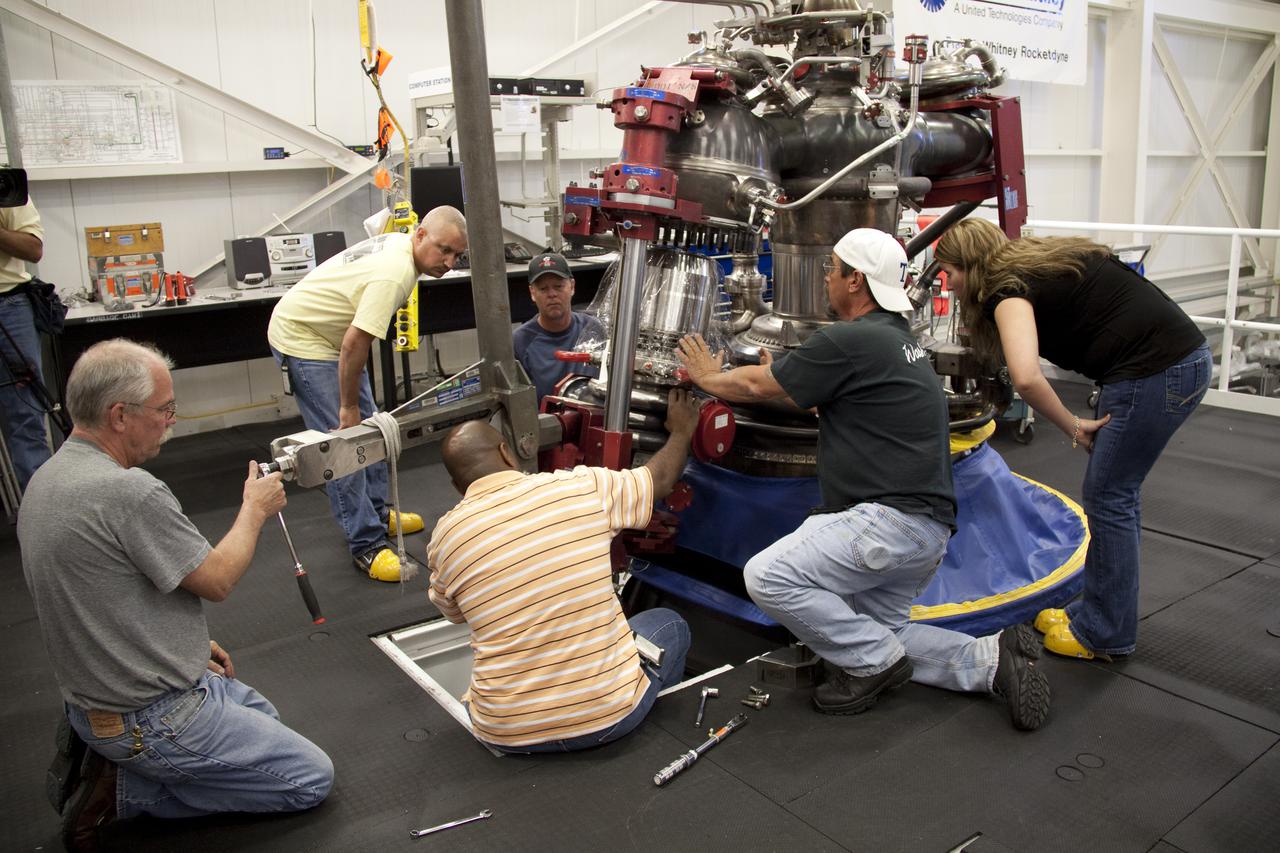
CAPE CANAVERAL, Fla. – In the Space Shuttle Main Engine Processing Facility at NASA's Kennedy Space Center in Florida, Pratt and Whitney Rocketdyne engine technicians install a high pressure oxidizer turbo pump on space shuttle main engine no. 2062. The engine, or SSME, is the last one scheduled to be built at Kennedy before the end of the Space Shuttle Program. In front of the engine, from left, are Dan Bode, Teryon Jones, quality inspector Barry Martin, and engineer Jessica Tandy. Behind the engine, from left, are Ryan Mahony and Ken Burley. Three main engines are clustered at the aft end of the shuttle and have a combined thrust of more than 1.2 million pounds. Even though an SSME weighs one-seventh as much as a locomotive engine, its high-pressure fuel pump alone delivers as much horsepower as 28 locomotives. Each engine operates during the entire eight-and-a-half minute climb to orbit. Post-flight inspections and maintenance of each engine also are conducted in the SSME Processing Facility between shuttle missions. Photo credit: NASA_Amanda Diller
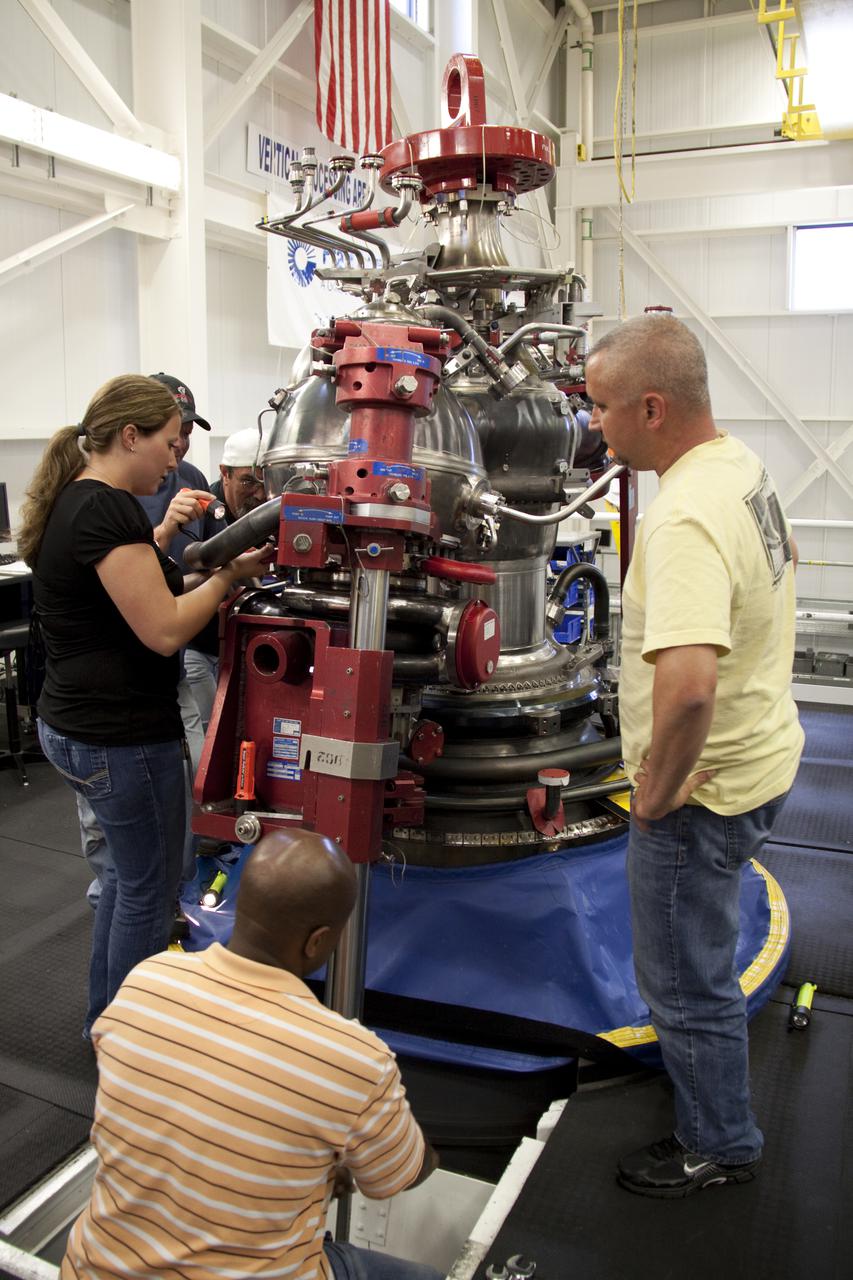
CAPE CANAVERAL, Fla. – In the Space Shuttle Main Engine Processing Facility at NASA's Kennedy Space Center in Florida, a team of Pratt and Whitney Rocketdyne employees installs a high pressure oxidizer turbo pump on space shuttle main engine no. 2062. The engine, or SSME, is the last one scheduled to be built at Kennedy before the end of the Space Shuttle Program. Around the engine, from right to left, are engine technicians Ryan Mahony and Teryon Jones, engineer Jessica Tandy, engine technician Ken Burley and quality inspector Barry Martin. Three main engines are clustered at the aft end of the shuttle and have a combined thrust of more than 1.2 million pounds. Even though an SSME weighs one-seventh as much as a locomotive engine, its high-pressure fuel pump alone delivers as much horsepower as 28 locomotives. Each engine operates during the entire eight-and-a-half minute climb to orbit. Post-flight inspections and maintenance of each engine also are conducted in the SSME Processing Facility between shuttle missions. Photo credit: NASA_Amanda Diller
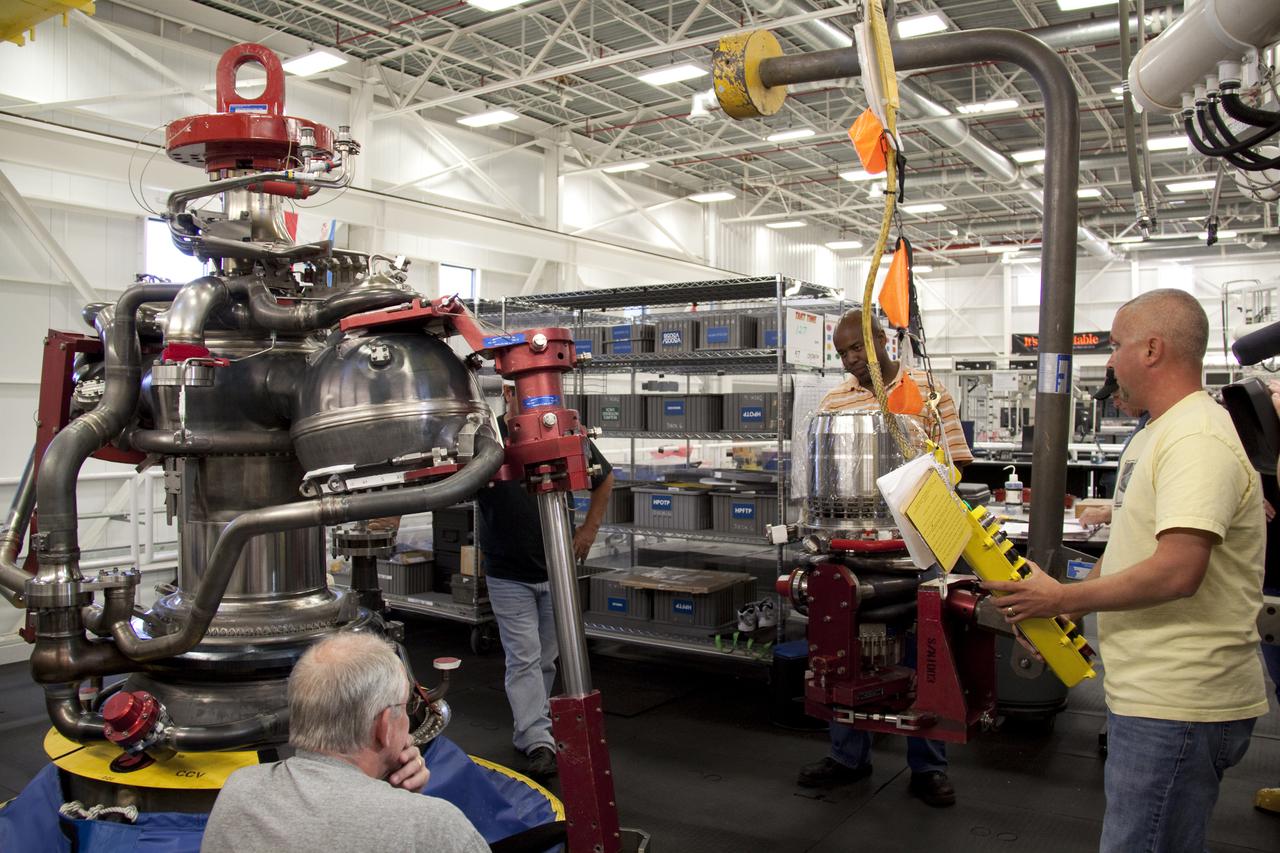
CAPE CANAVERAL, Fla. – In the Space Shuttle Main Engine Processing Facility at NASA's Kennedy Space Center in Florida, Pratt and Whitney Rocketdyne engine technicians prepare to install a high pressure oxidizer turbo pump on space shuttle main engine no. 2062. The engine, or SSME, is the last one scheduled to be built at Kennedy before the end of the Space Shuttle Program. From left are Dan Bode, Teryon Jones, and Ryan Mahony. Quality inspector Barry Martin is standing beside the engine, just out of view. Three main engines are clustered at the aft end of the shuttle and have a combined thrust of more than 1.2 million pounds. Even though an SSME weighs one-seventh as much as a locomotive engine, its high-pressure fuel pump alone delivers as much horsepower as 28 locomotives. Each engine operates during the entire eight-and-a-half minute climb to orbit. Post-flight inspections and maintenance of each engine also are conducted in the SSME Processing Facility between shuttle missions. Photo credit: NASA_Amanda Diller
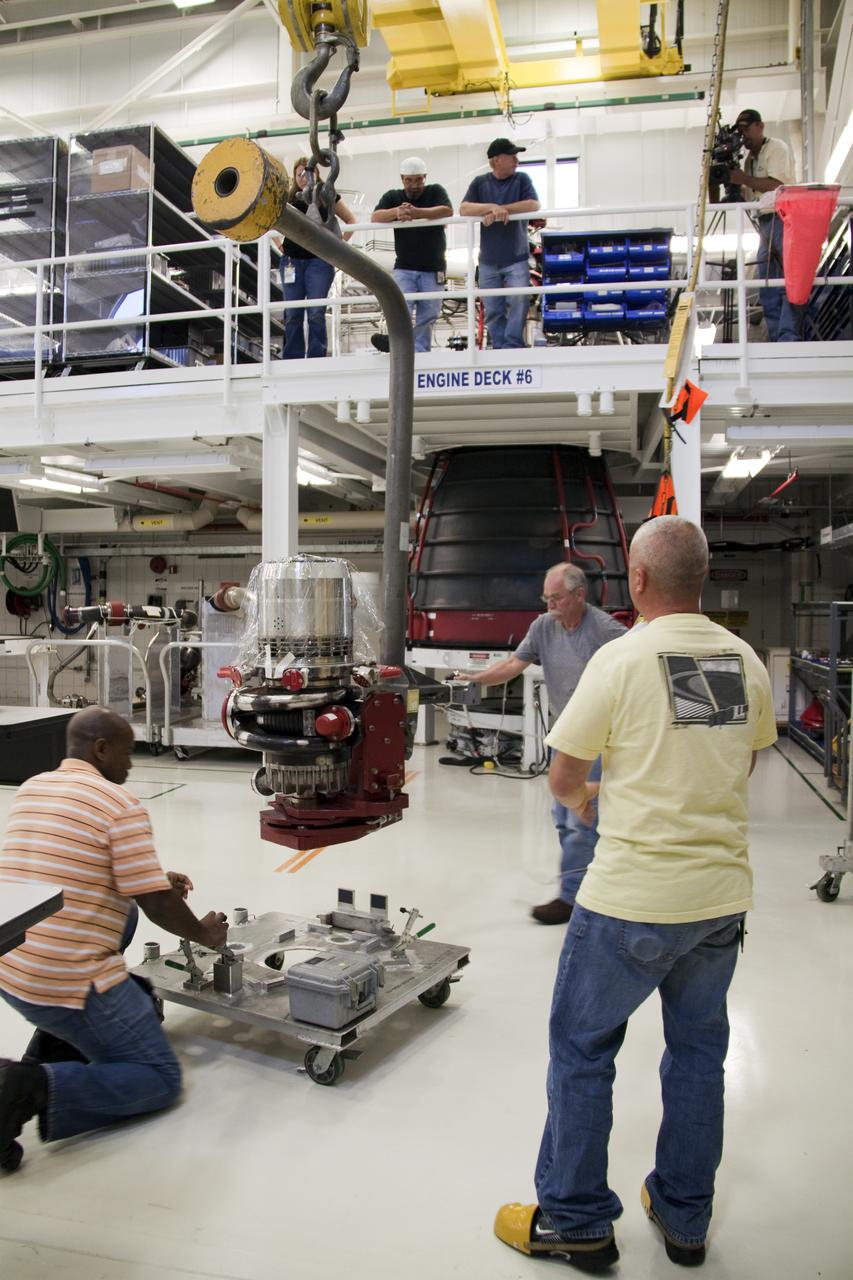
CAPE CANAVERAL, Fla. – On the floor of the Space Shuttle Main Engine Processing Facility at NASA's Kennedy Space Center in Florida, Pratt and Whitney Rocketdyne engine technicians lift a high pressure oxidizer turbo pump off its stand for installation on space shuttle main engine no. 2062. The engine, or SSME, is the last one scheduled to be built at Kennedy by Pratt and Whitney Rocketdyne before the end of the Space Shuttle Program. From left are Teryon Jones, Dan Bode and Ryan Mahony. Three main engines are clustered at the aft end of the shuttle and have a combined thrust of more than 1.2 million pounds. Even though an SSME weighs one-seventh as much as a locomotive engine, its high-pressure fuel pump alone delivers as much horsepower as 28 locomotives. Each engine operates during the entire eight-and-a-half minute climb to orbit. Post-flight inspections and maintenance of each engine also are conducted in the SSME Processing Facility between shuttle missions. Photo credit: NASA_Amanda Diller
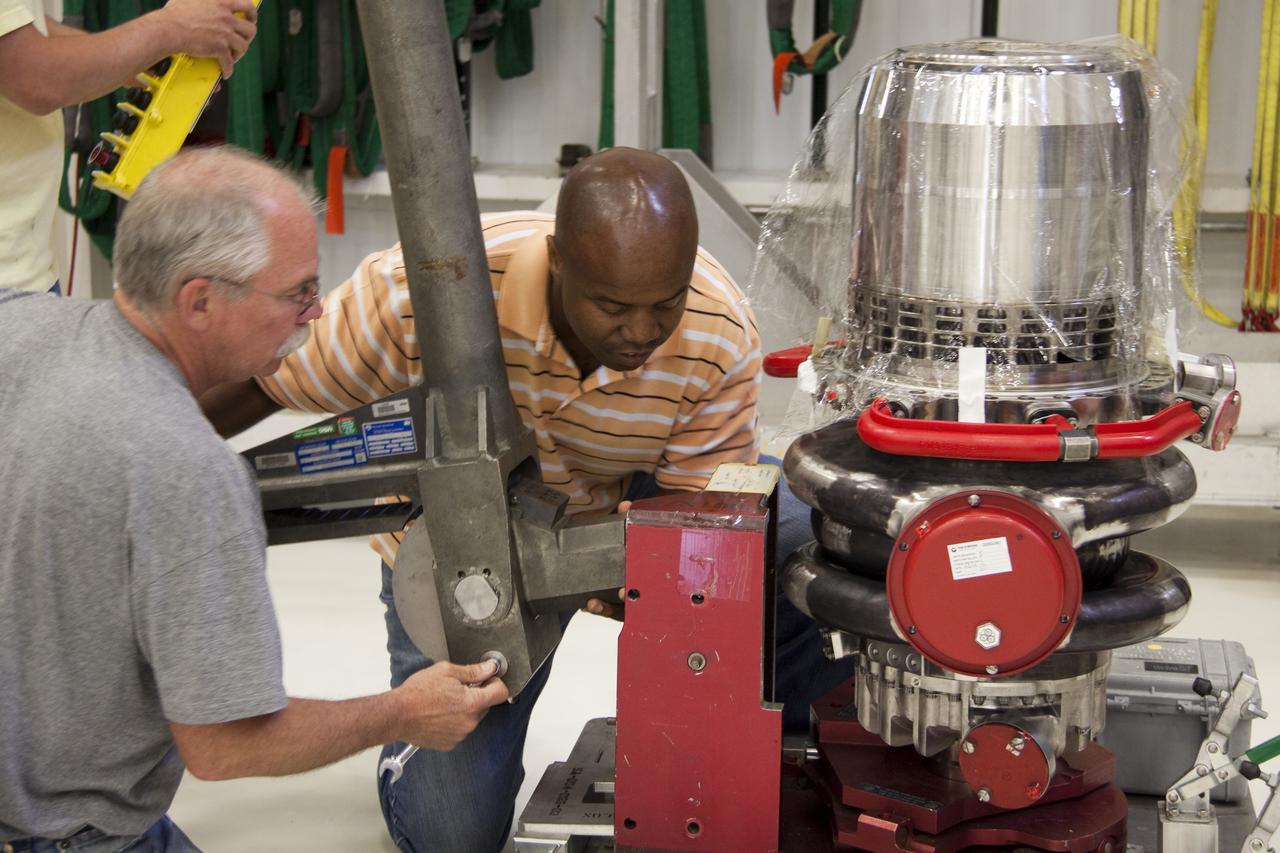
CAPE CANAVERAL, Fla. – In the Space Shuttle Main Engine Processing Facility at NASA's Kennedy Space Center in Florida, Pratt and Whitney Rocketdyne engine technicians prepare a high pressure oxidizer turbo pump for installation on space shuttle main engine no. 2062. The engine, or SSME, is the last one scheduled to be built at Kennedy by Pratt and Whitney Rocketdyne before the end of the Space Shuttle Program. From left are Dan Bode and Teryon Jones. Three main engines are clustered at the aft end of the shuttle and have a combined thrust of more than 1.2 million pounds. Even though an SSME weighs one-seventh as much as a locomotive engine, its high-pressure fuel pump alone delivers as much horsepower as 28 locomotives. Each engine operates during the entire eight-and-a-half minute climb to orbit. Post-flight inspections and maintenance of each engine also are conducted in the SSME Processing Facility between shuttle missions. Photo credit: NASA_Amanda Diller
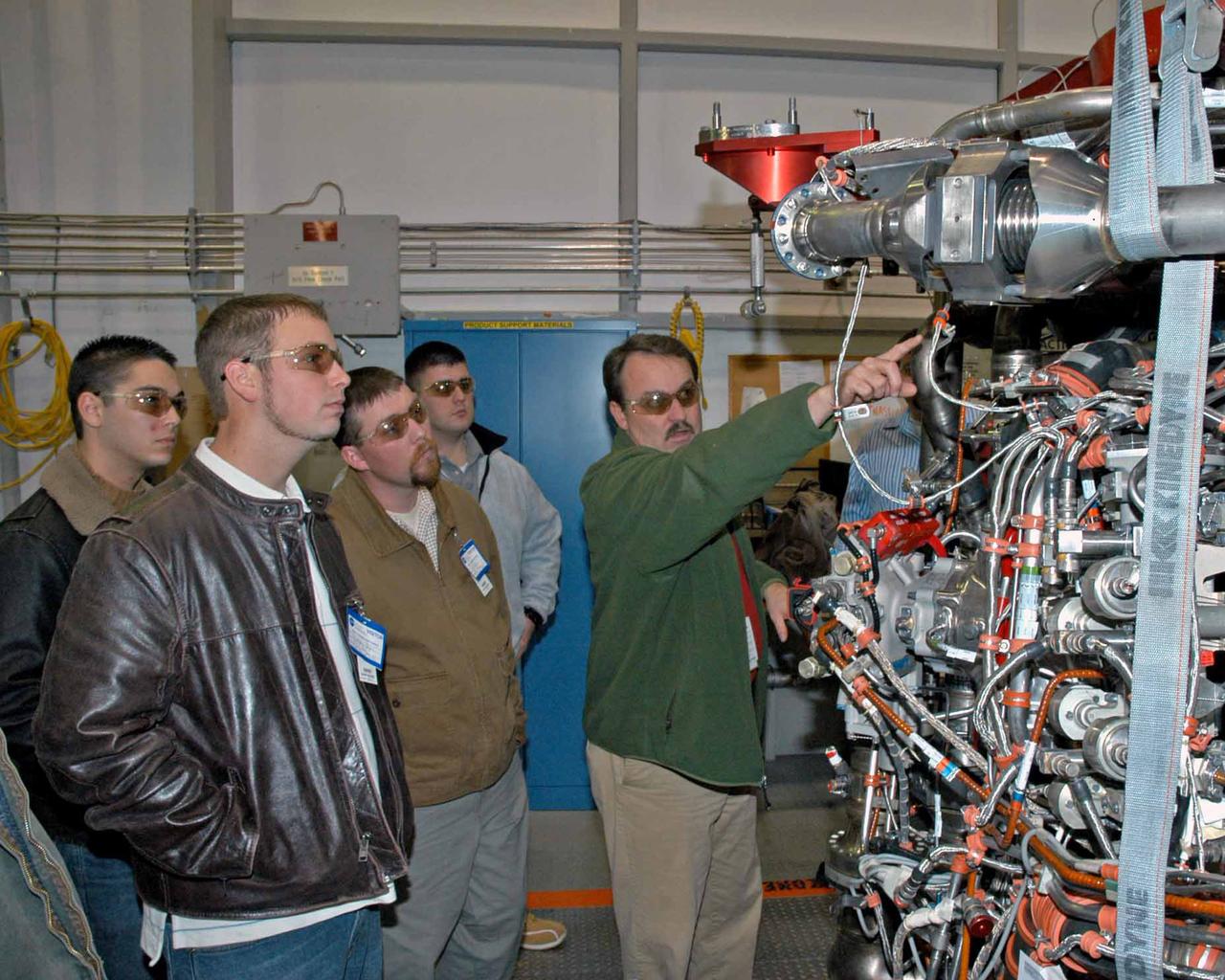
Pratt & Whitney Rocketdyne's Jeff Hansell, right, explains functions of a space shuttle main engine to Pearl River Community College Aviation Maintenance Technology Program students. Christopher Bryon, left, of Bay St. Louis, Ret Tolar of Kiln, Dan Holston of Baxterville and Billy Zugg of Long Beach took a recent tour of the SSME Processing Facility and the E-1 Test Complex at Stennis Space Center in South Mississippi. The students attend class adjacent to the Stennis International Airport tarmac in Kiln, where they get hands-on experience. PRCC's program prepares students to be responsible for the inspection, repair and maintenance of technologically advanced aircraft. A contractor to NASA, Pratt & Whitney Rocketdyne in Canoga Park, Calif., manufactures the space shuttle main engine and its high-pressure turbo pumps. SSC was established in the 1960s to test the huge engines for the Saturn V moon rockets. Now 40 years later, the center tests every main engine for the space shuttle, and is America's largest rocket engine test complex. SSC will soon begin testing the rocket engines that will power spacecraft carrying Americans back to the moon and on to Mars.