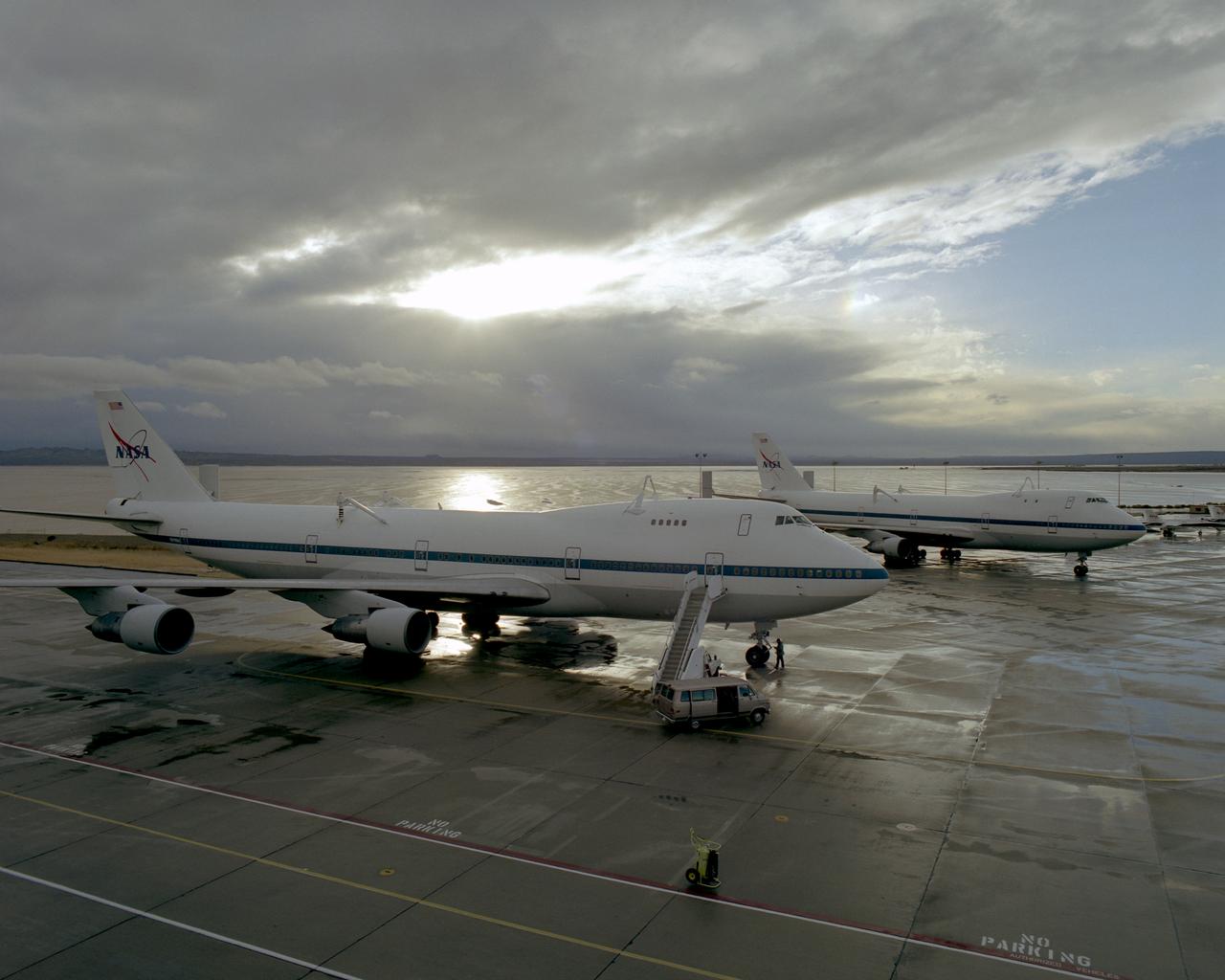
The sun begins to break through the clouds over NASA's two 747 Shuttle Carrier Aircraft on the NASA Dryden ramp after a rain shower in February 2001.
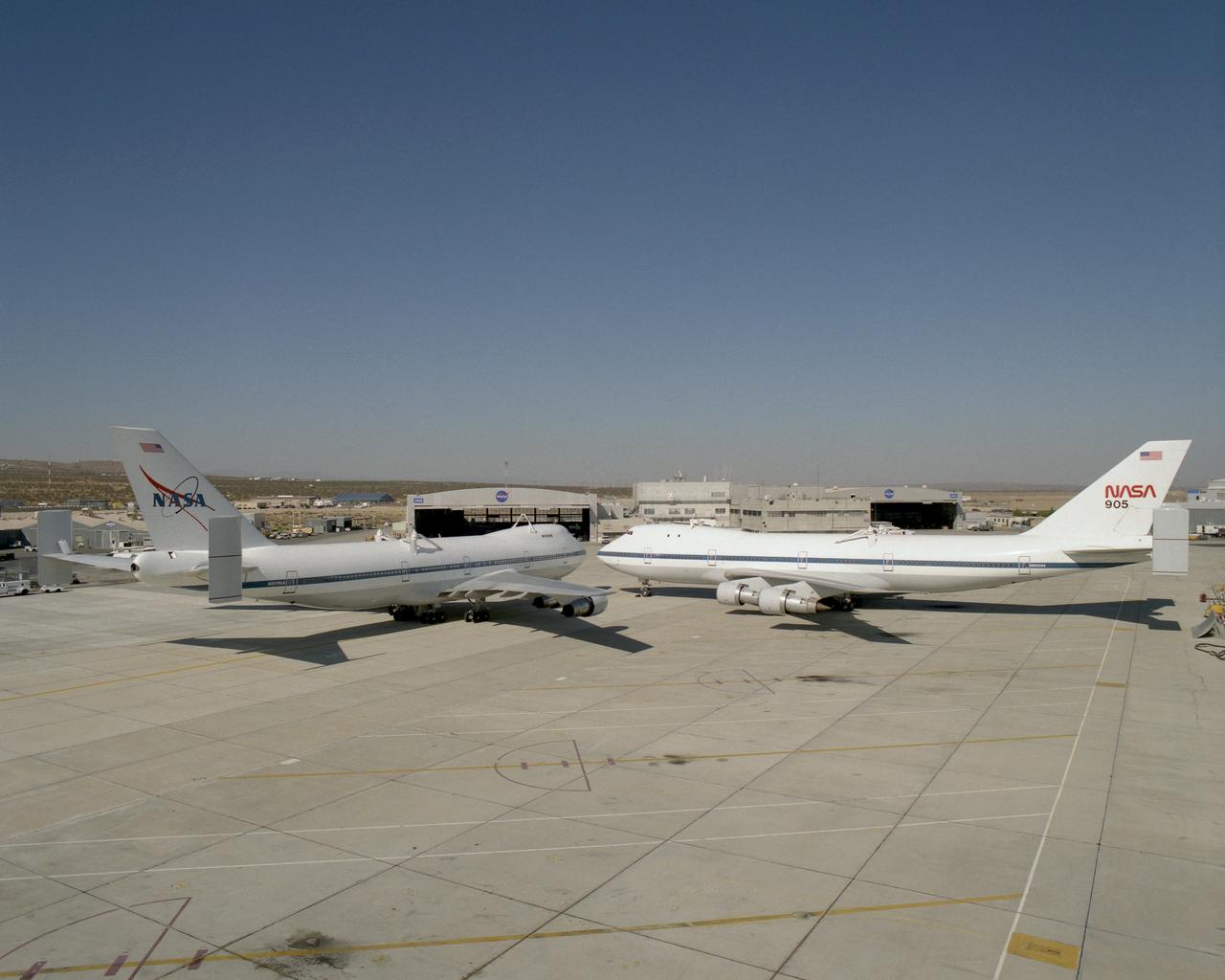
NASA's two modified Boeing 747 Shuttle Carrier Aircraft #911 (left) and #905 (right) were nose-to-nose on the ramp at NASA Dryden in this 1995 photo.
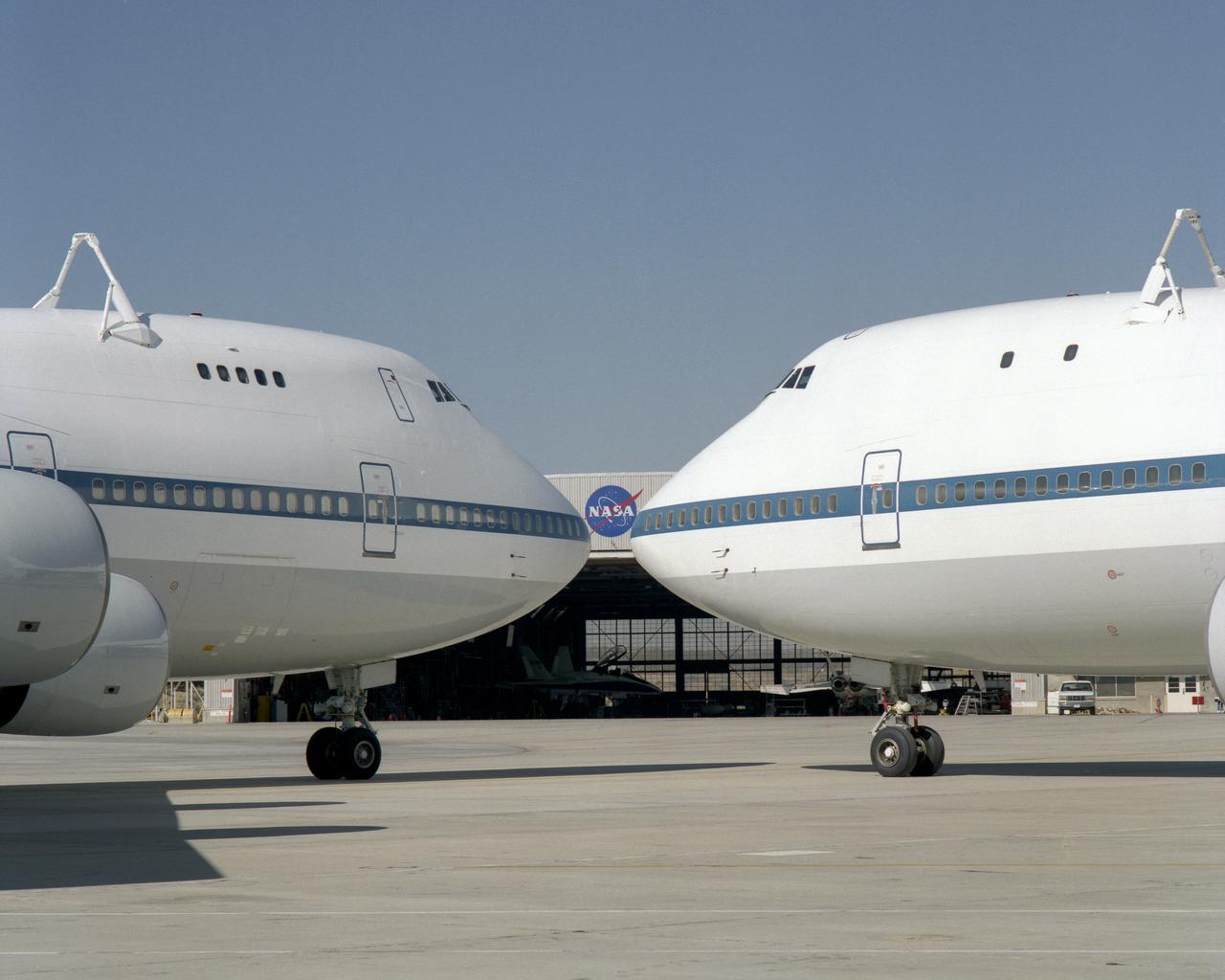
The NASA logo on a hangar is framed by the noses of NASA's two modified 747 Shuttle Carrier Aircraft on the ramp at NASA Dryden in this 1995 photo.
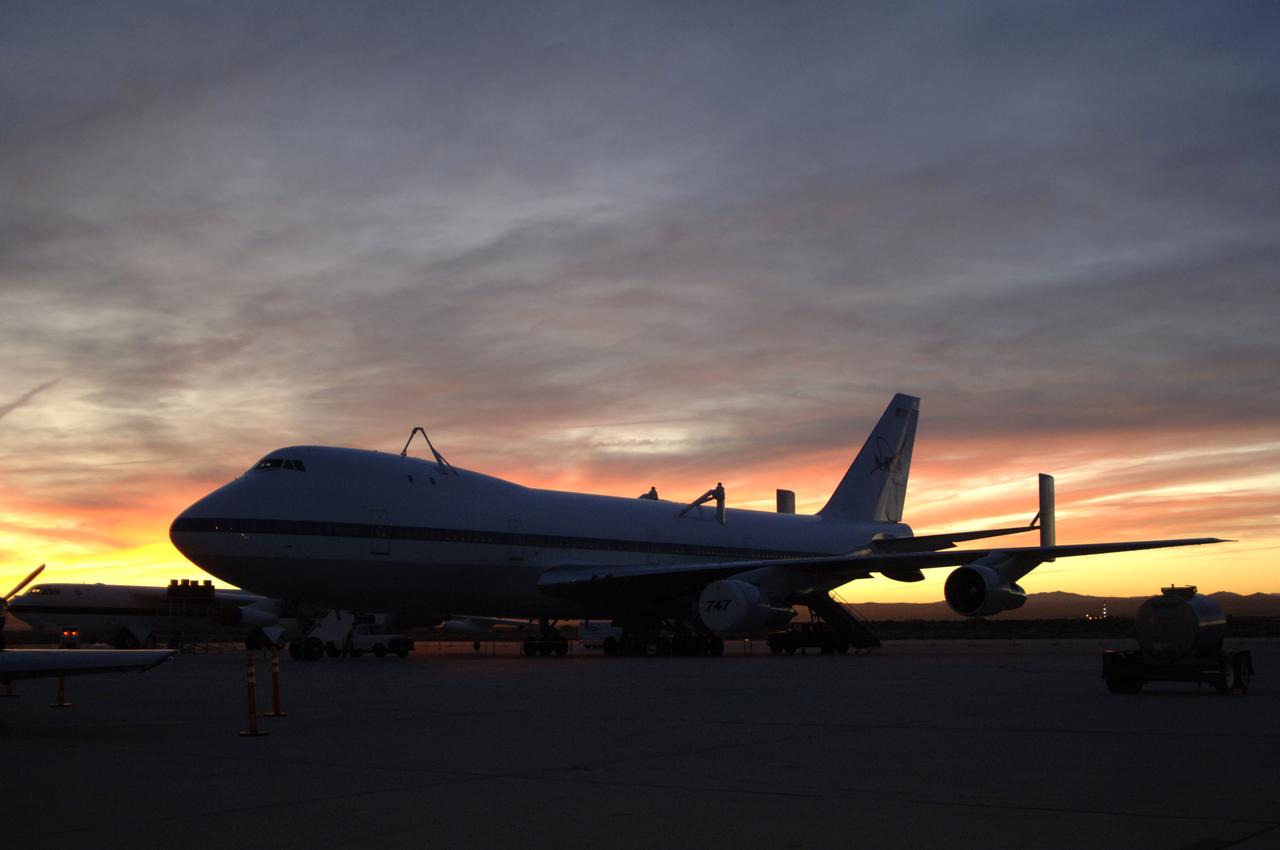
One of NASA's two modified Boeing 747 Shuttle Carrier Aircraft is silhouetted against the morning sky at sunrise on the ramp at Edwards Air Force Base.
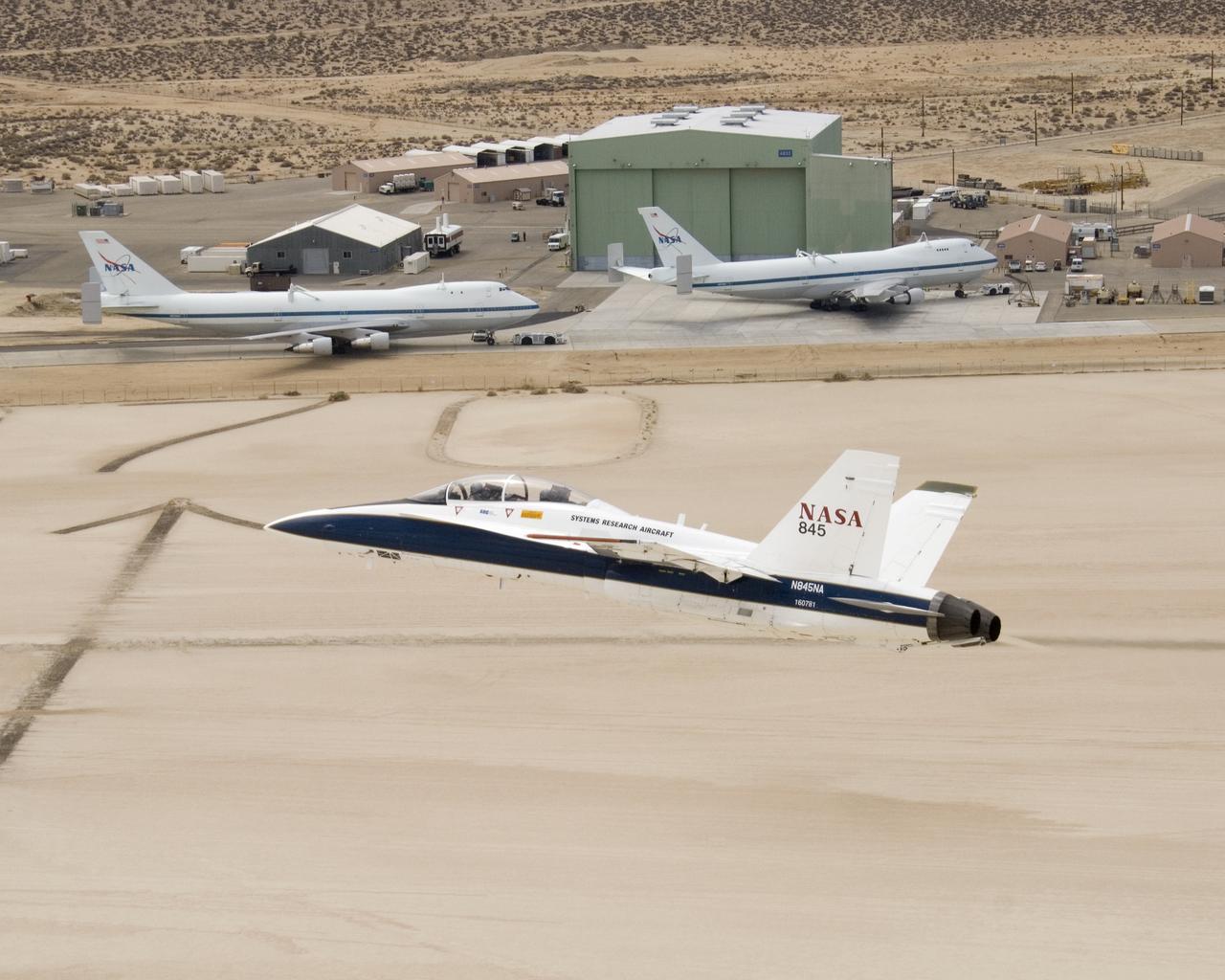
NASA's two Boeing 747 Shuttle Carrier Aircraft form the backdrop as pilot Dick Ewers banks NASA F/A-18 #845 low over Rogers Dry Lake to end a research flight.

The NASA Dryden 747 Shuttle Carrier Aircraft crew poses in an engine inlet; Standing L to R - aircraft mechanic John Goleno and SCA Team Leader Pete Seidl; Kneeling L to R - aircraft mechanics Todd Weston and Arvid Knutson, and avionics technician Jim Bedard NASA uses two modified Boeing 747 jetliners, originally manufactured for commercial use, as Space Shuttle Carrier Aircraft (SCA). One is a 747-100 model, while the other is designated a 747-100SR (short range). The two aircraft are identical in appearance and in their performance as Shuttle Carrier Aircraft. The 747 series of aircraft are four-engine intercontinental-range swept-wing "jumbo jets" that entered commercial service in 1969. The SCAs are used to ferry space shuttle orbiters from landing sites back to the launch complex at the Kennedy Space Center, and also to and from other locations too distant for the orbiters to be delivered by ground transportation. The orbiters are placed atop the SCAs by Mate-Demate Devices, large gantry-like structures which hoist the orbiters off the ground for post-flight servicing, and then mate them with the SCAs for ferry flights.
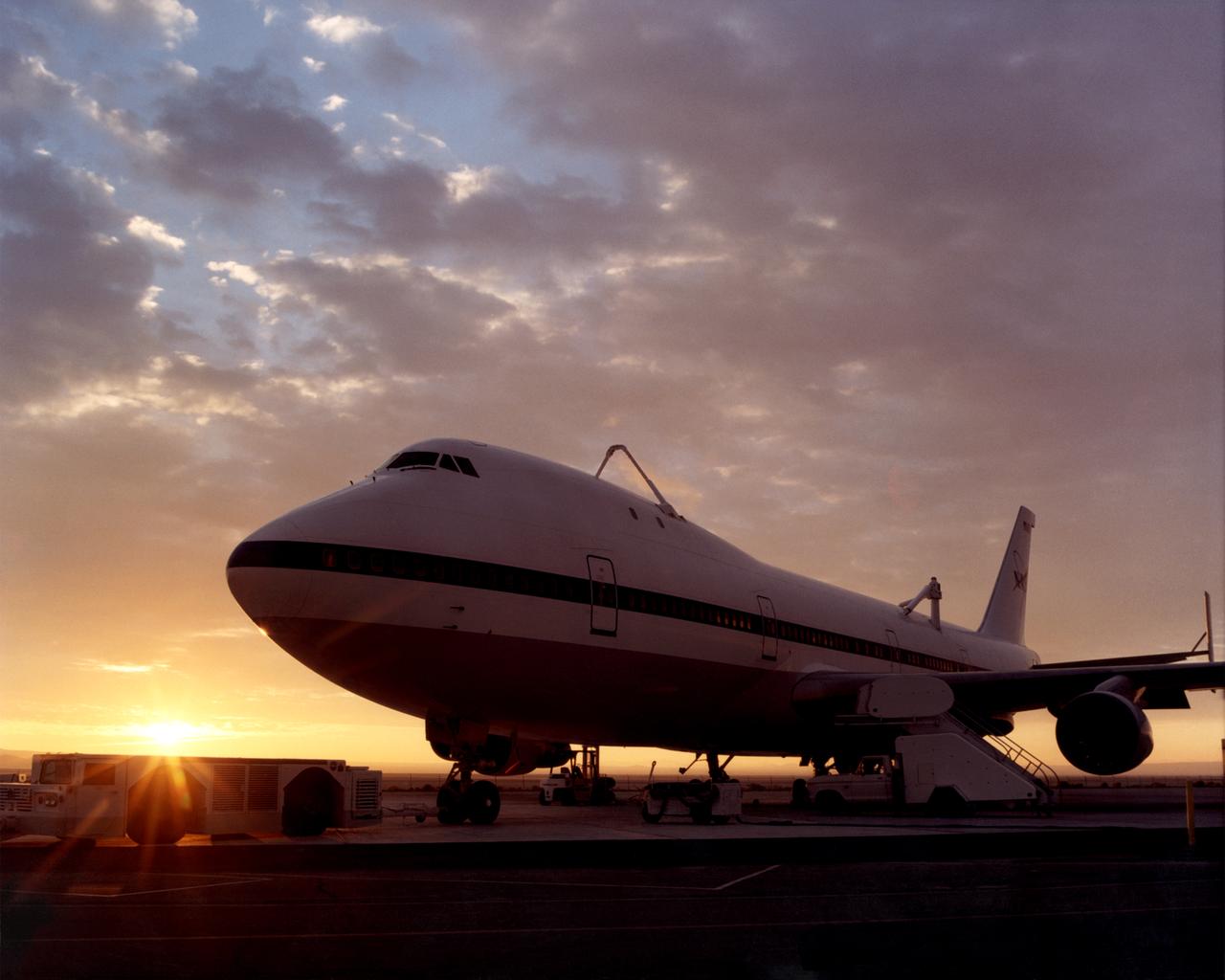
One of NASA’s two modified Boeing 747 Shuttle Carrier Aircraft is bathed in the morning Sun at NASA’s Dryden Flight Research Center at Edwards, California. The modified jumbo jetliners are used to ferry the Space Shuttle orbiters between Dryden and the Kennedy Space Center in Florida and Boeing’s Reusable Space Systems modification facility at Palmdale, California. Features which distinguish the two SCAs from standard 747 jetliners are three struts, with associated interior structural strengthening, which protrude from the top of the fuselage (two aft, one forward) on which the orbiter is attached, and two additional vertical stabilizers, one on each end of the standard horizontal stabilizer, to enhance directional stability. All interior furnishings and equipment aft of the forward No. 1 doors have also been removed to reduce weight. The two SCAs are under the operational control of NASA's Johnson Space Center, Houston, Texas.
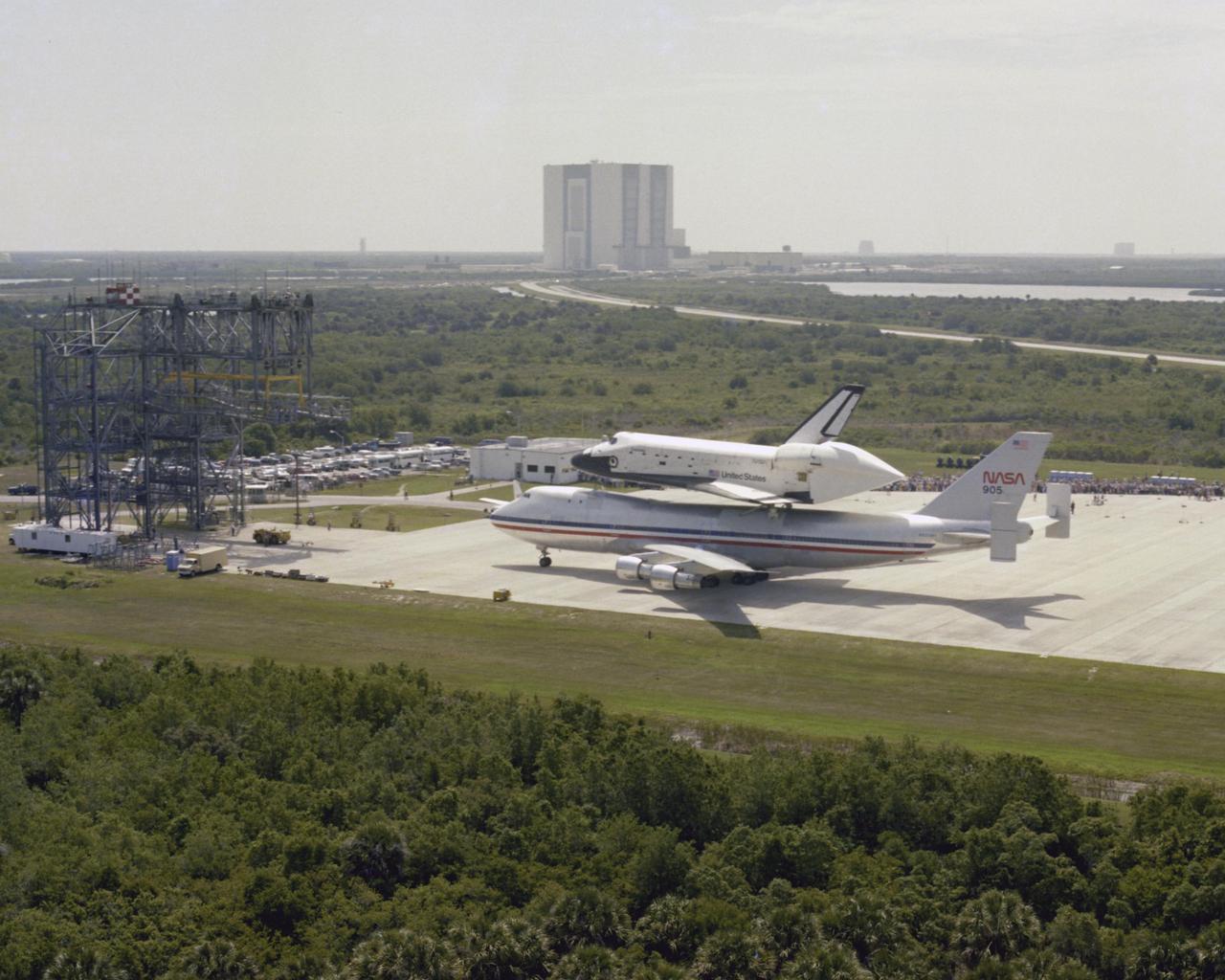
KENNEDY SPACE CENTER, FLA. - The Space Shuttle Orbiter Columbia - riding piggy back atop a modified 747 jet called the Shuttle Carrier Aircraft - arrives at Kennedy Space Center after a two-day journey from the Dryden Flight Research Center in California. Welcomed home by a crowd of KSC employees and their families and guests, Columbia touched down on the Shuttle Landing Facility at 11:23 a.m. Tuesday, two weeks after its return to Earth from the first Space Shuttle flight into space. The orbiter and SCA are seen here parked in front of the Mate_Demate Device, where the orbiter will be hoisted off the 747.
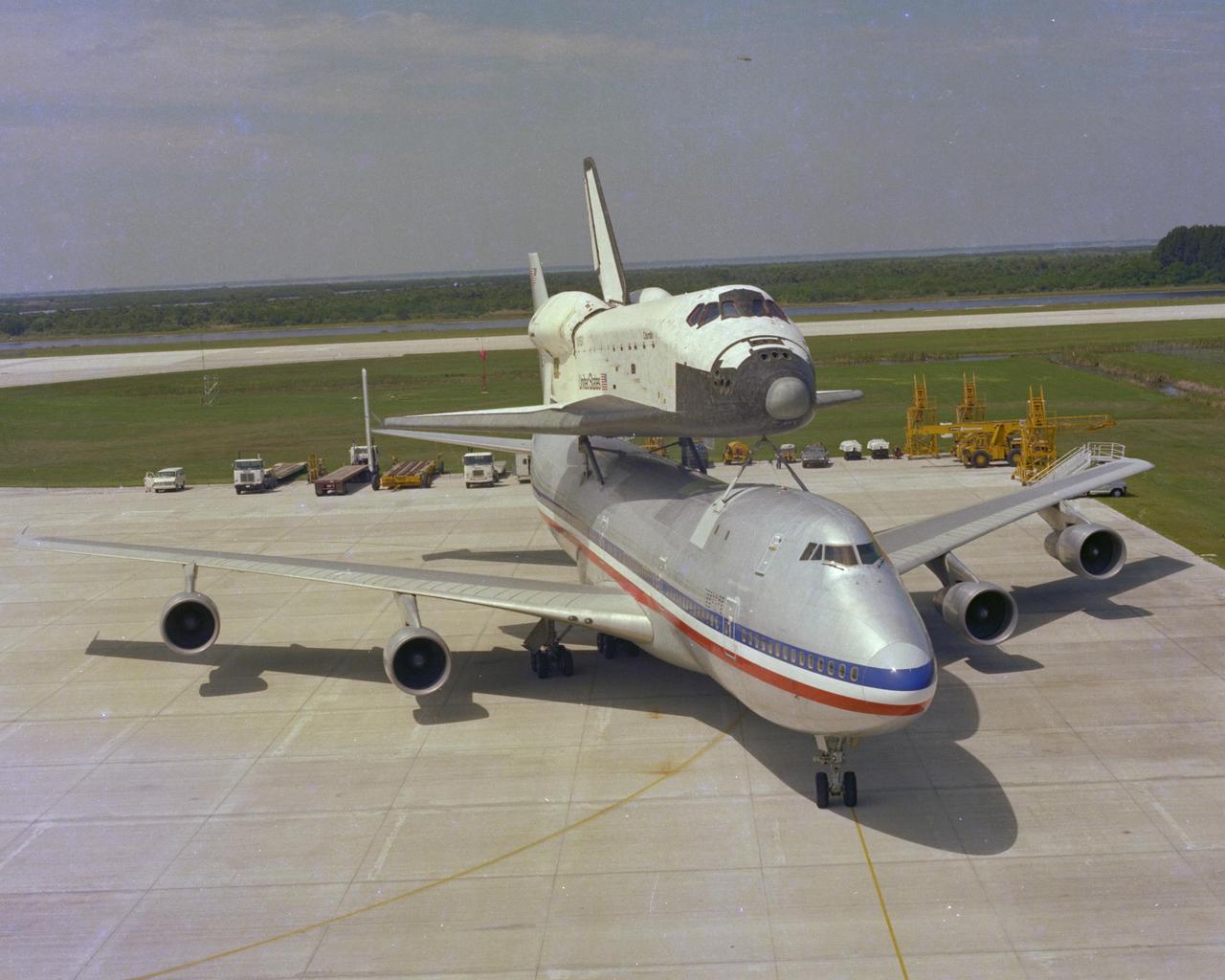
KENNEDY SPACE CENTER, FLA. - The Space Shuttle Orbiter Columbia - riding piggyback atop a modified 747 jet called the Shuttle Carrier Aircraft - arrives at Kennedy Space Center after a two-day journey from the Dryden Flight Research Center in California. Welcomed home by a crowd of KSC employees and their families and guests, Columbia touched down on the Shuttle Landing Facility at 11:23 a.m. Tuesday, two weeks after its return to Earth from the first Space Shuttle flight into space. The orbiter and SCA are seen here parked in front of the Mate_Demate Device, where the orbiter will be hoisted off the 747.
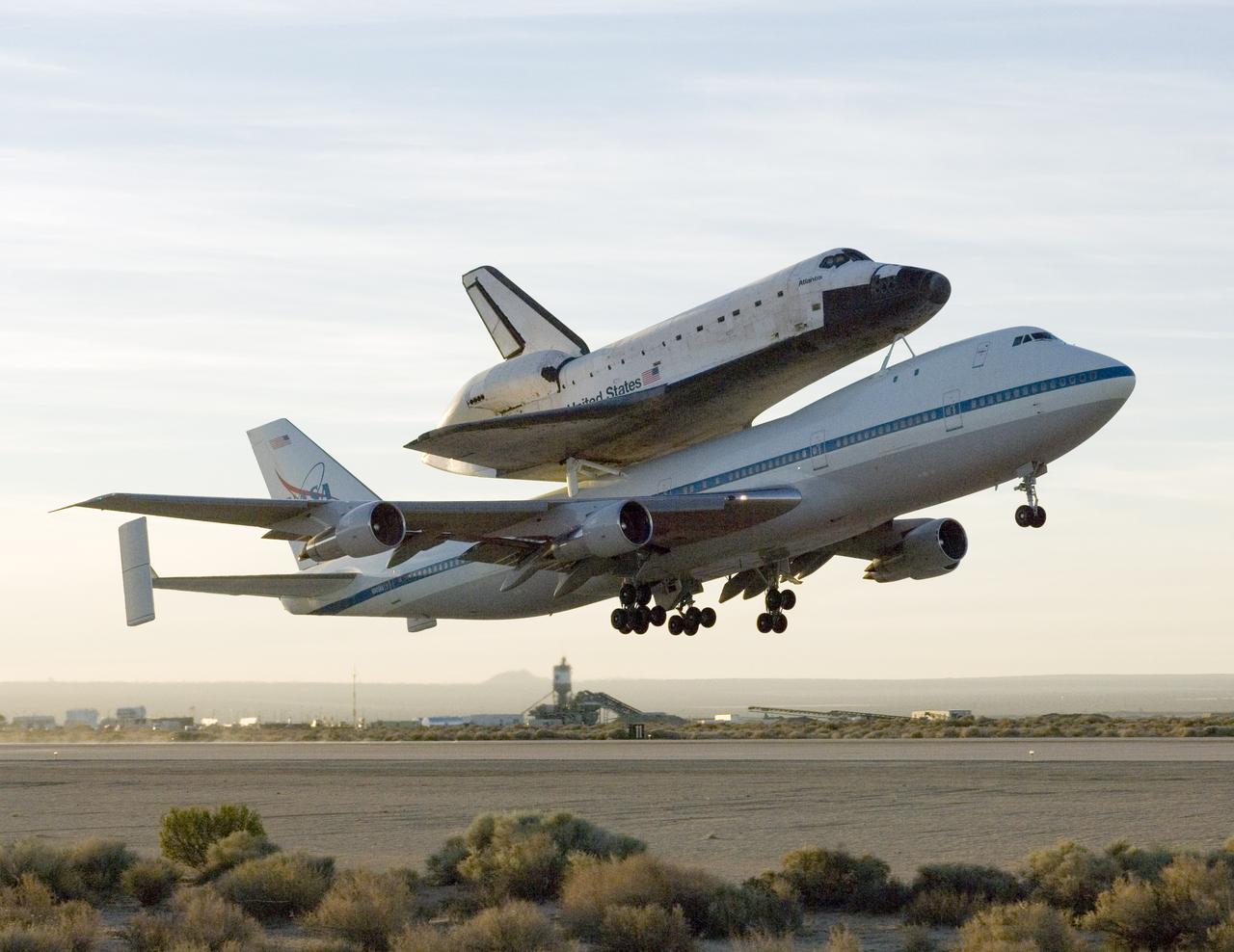
NASA's modified Boeing 747 Shuttle Carrier Aircraft with the Space Shuttle Atlantis on top lifts off from Edwards Air Force Base to begin its ferry flight back to the Kennedy Space Center in Florida. The cross-country journey will take approximately two days, with stops at several intermediate points for refueling.
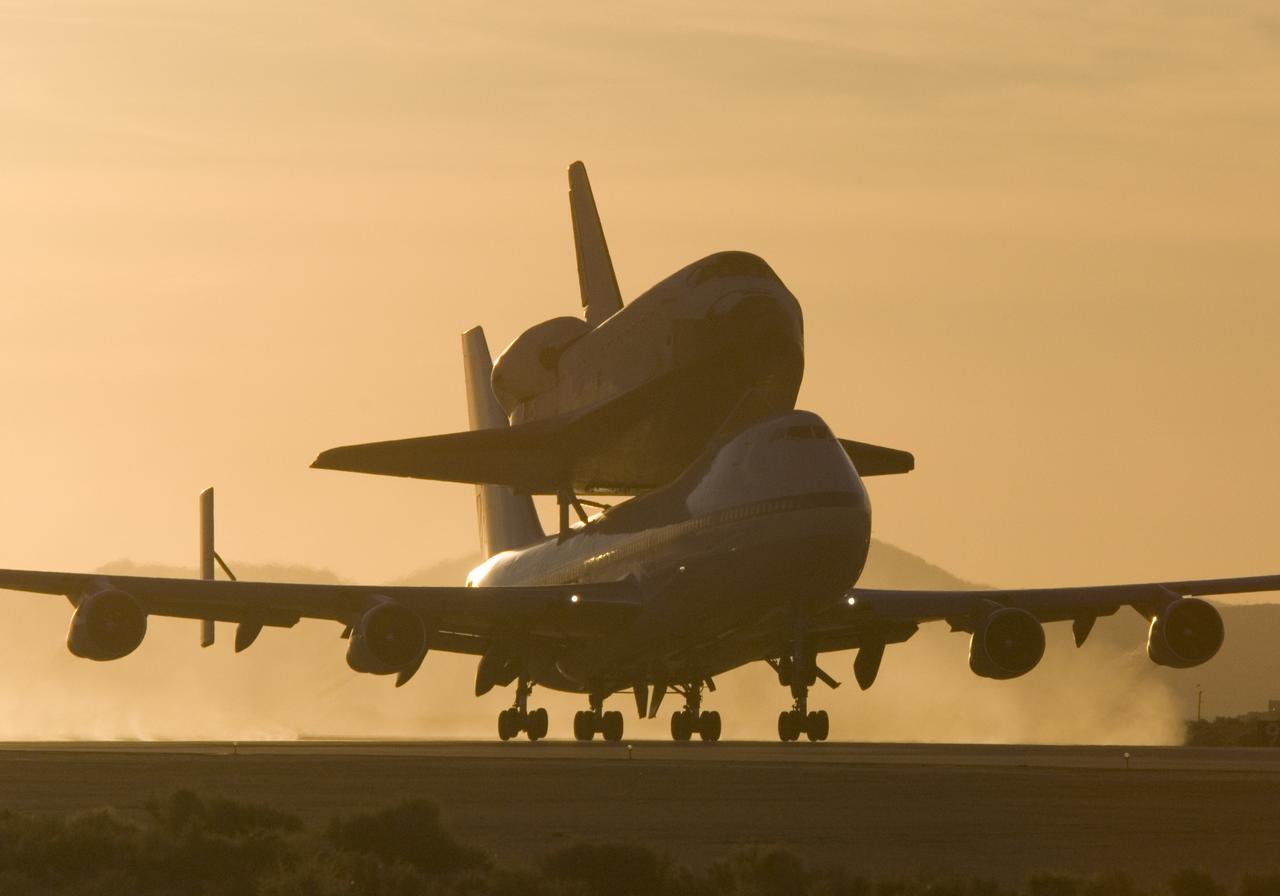
NASA's modified Boeing 747 Shuttle Carrier Aircraft with the Space Shuttle Atlantis on top lifts off from Edwards Air Force Base to begin its ferry flight back to the Kennedy Space Center in Florida. The cross-country journey will take approximately two days, with stops at several intermediate points for refueling.
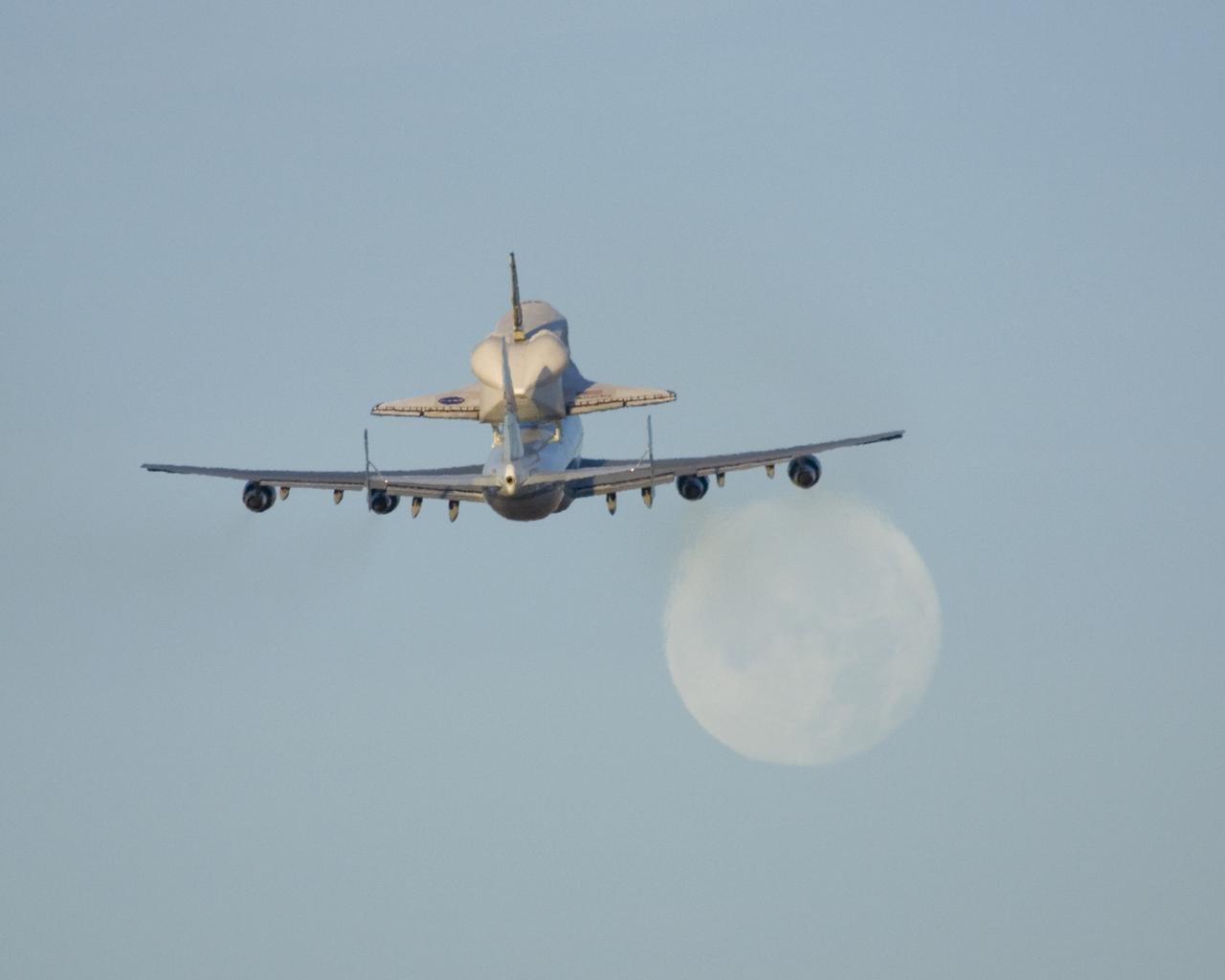
NASA's modified Boeing 747 Shuttle Carrier Aircraft with the Space Shuttle Atlantis on top lifts off from Edwards Air Force Base to begin its ferry flight back to the Kennedy Space Center in Florida. The cross-country journey will take approximately two days, with stops at several intermediate points for refueling.
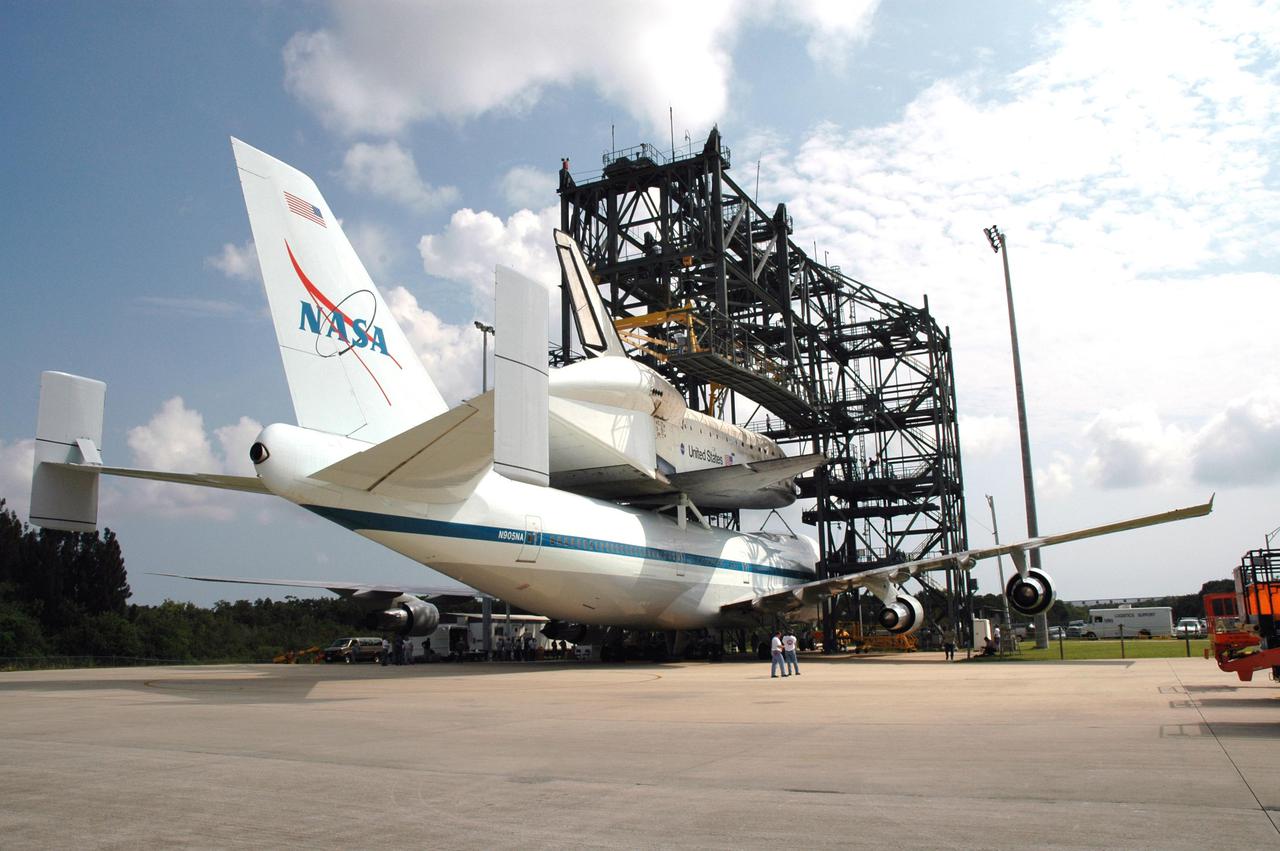
KENNEDY SPACE CENTER, FLA. - The orbiter Discovery on top of the Shuttle Carrier Aircraft, a modified Boeing 747, is towed into the mate_demate device at NASA Kennedy Space Center’s Shuttle Landing Facility. Discovery was returned to Kennedy Space Center on a ferry flight from Edwards Air Force Base in California, where it landed Aug. 9 after 13 days in space on mission STS-114. In the mate_demate device, a horizontal structure mounted at the 80-foot level between two towers controls and guides a large lift beam that attaches to the orbiter to raise and lower it. Once Discovery is lifted off the back of the SCA, the 747 can then roll away and the orbiter will be lowered to the ground. It will then be towed from the SLF to the Orbiter Processing Facility. Once inside the OPF, the payload bay doors will be opened and the MPLM Raffaello brought back from the International Space Station will be unloaded and transferred to the Space Station Processing Facility. This concludes mission STS-114.
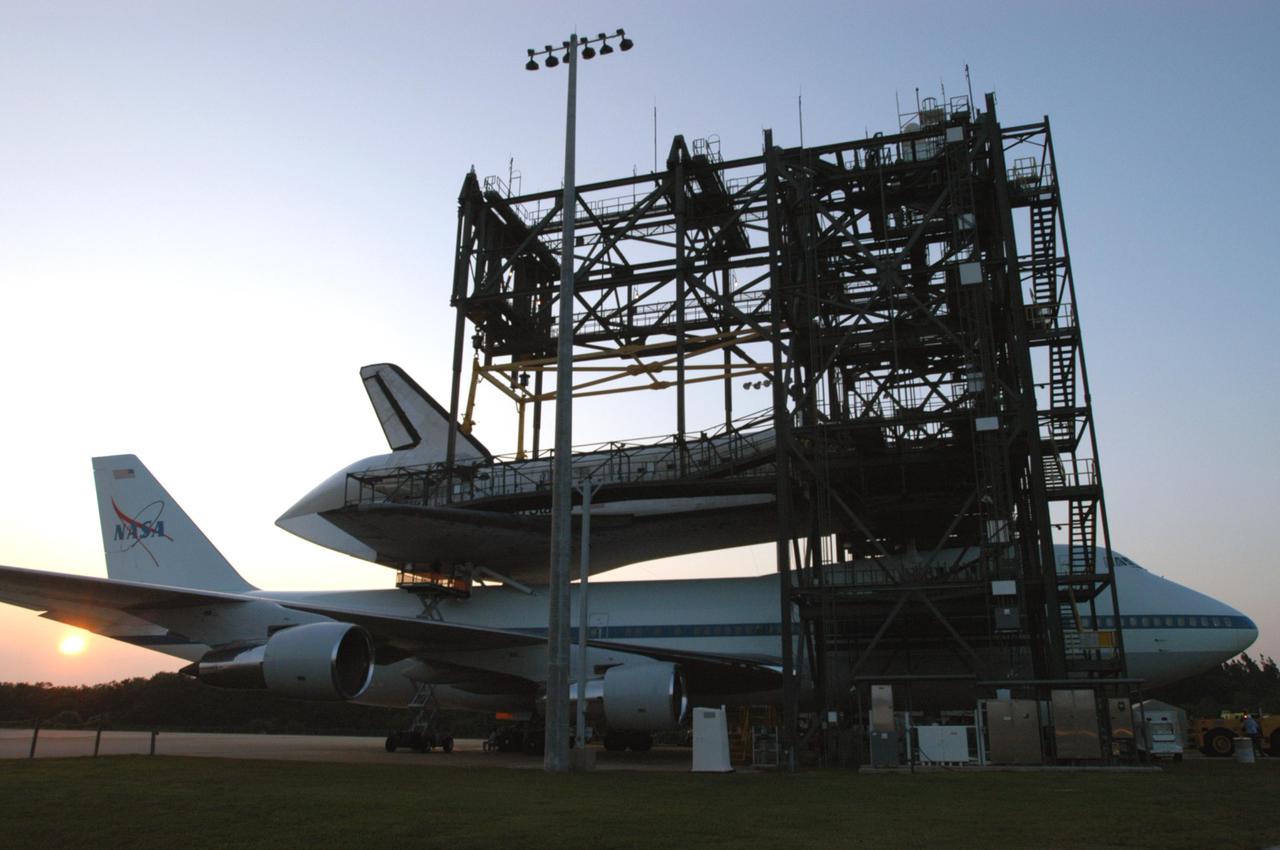
KENNEDY SPACE CENTER, FLA. - The sun is setting behind the tail of the Shuttle Carrier Aircraft, a modified Boeing 747, and orbiter Discovery where they are parked in the mate_demate device. Discovery was returned to Kennedy Space Center on a ferry flight from Edwards Air Force Base in California, where it landed Aug. 9 after 13 days in space on mission STS-114. In the mate_demate device, a horizontal structure mounted at the 80-foot level between two towers controls and guides a large lift beam that attaches to the orbiter to raise and lower it. Once Discovery is lifted off the back of the SCA, the 747 can then roll away and the orbiter will be lowered to the ground. It will then be towed from the SLF to the Orbiter Processing Facility. Once inside the OPF, the payload bay doors will be opened and the MPLM Raffaello brought back from the International Space Station will be unloaded and transferred to the Space Station Processing Facility. This concludes mission STS-114.
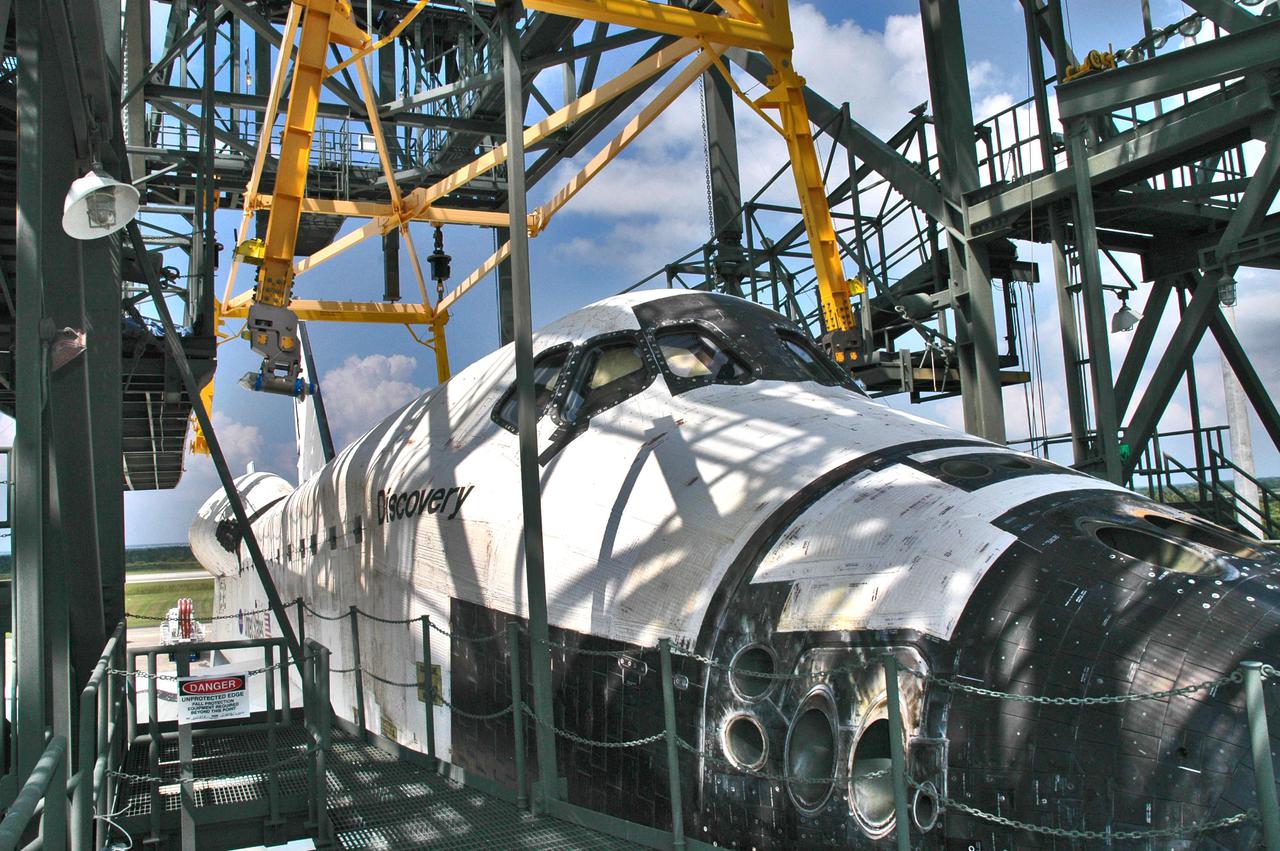
KENNEDY SPACE CENTER, FLA. - The orbiter Discovery on top of the Shuttle Carrier Aircraft, a modified Boeing 747, is in place under the mate_demate device at NASA Kennedy Space Center’s Shuttle Landing Facility. Discovery was returned to Kennedy Space Center on a ferry flight from Edwards Air Force Base in California, where it landed Aug. 9 after 13 days in space on mission STS-114. In the mate_demate device, a horizontal structure mounted at the 80-foot level between two towers controls and guides a large lift beam that attaches to the orbiter to raise and lower it. Once Discovery is lifted off the back of the SCA, the 747 can then roll away and the orbiter will be lowered to the ground. It will then be towed from the SLF to the Orbiter Processing Facility. Once inside the OPF, the payload bay doors will be opened and the MPLM Raffaello brought back from the International Space Station will be unloaded and transferred to the Space Station Processing Facility. This concludes mission STS-114.
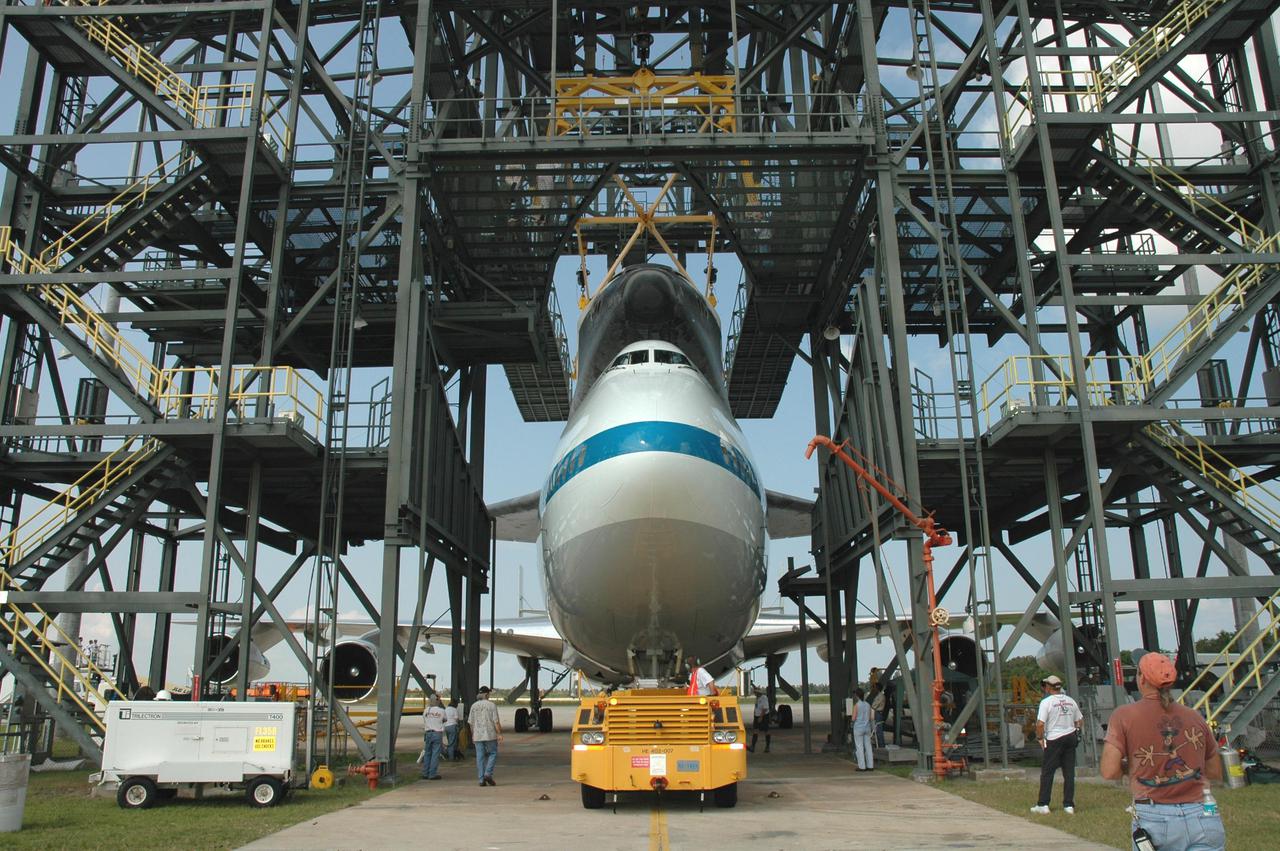
KENNEDY SPACE CENTER, FLA. - The Shuttle Carrier Aircraft, a modified Boeing 747, with the orbiter Discovery on top is towed into the mate_demate device at NASA Kennedy Space Center’s Shuttle Landing Facility. Discovery was returned to Kennedy Space Center on a ferry flight from Edwards Air Force Base in California, where it landed Aug. 9 after 13 days in space on mission STS-114. In the mate_demate device, a horizontal structure mounted at the 80-foot level between two towers controls and guides a large lift beam that attaches to the orbiter to raise and lower it. Once Discovery is lifted off the back of the SCA, the 747 can then roll away and the orbiter will be lowered to the ground. It will then be towed from the SLF to the Orbiter Processing Facility. Once inside the OPF, the payload bay doors will be opened and the MPLM Raffaello brought back from the International Space Station will be unloaded and transferred to the Space Station Processing Facility. This concludes mission STS-114.

CAPE CANAVERAL, Fla. – At NASA Kennedy Space Center's Shuttle Landing Facility, the 747 Shuttle Carrier Aircraft with space shuttle Discovery on top is towed into the mate-demate device. The piggybacked shuttle and aircraft touched down on runway 33 at 12:05 p.m. EDT. Discovery landed at Edwards Air Force Base in California on Sept. 11 after the 13-day STS-128 mission to the International Space Station. Landings at Kennedy were waved off on two days due to inclement weather, leading to the landing at Edwards. The two-day return flight from California began at 9:20 a.m. EDT Sept. 20. Photo credit: NASA/Kim Shiflett
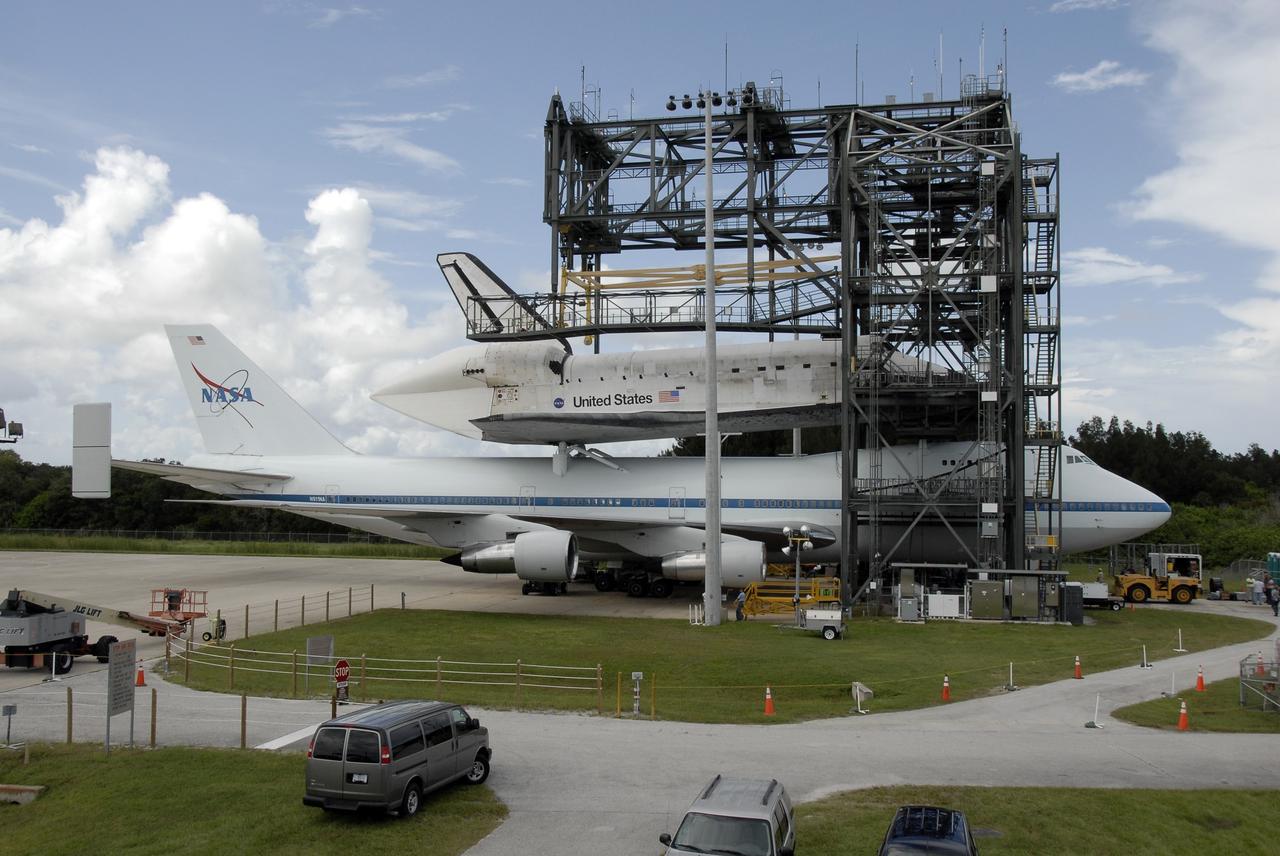
CAPE CANAVERAL, Fla. – At NASA Kennedy Space Center's Shuttle Landing Facility, platforms of the mate-demate device surround the 747 Shuttle Carrier Aircraft with space shuttle Discovery on top. The piggybacked shuttle and aircraft touched down on runway 33 at 12:05 p.m. EDT. Discovery landed at Edwards Air Force Base in California on Sept. 11 after the 13-day STS-128 mission to the International Space Station. Landings at Kennedy were waved off on two days due to inclement weather, leading to the landing at Edwards. The two-day return flight from California began at 9:20 a.m. EDT Sept. 20. Photo credit: NASA/Kim Shiflett

CAPE CANAVERAL, Fla. – At NASA Kennedy Space Center's Shuttle Landing Facility, the 747 Shuttle Carrier Aircraft with space shuttle Discovery on top is towed toward the mate-demate device. The piggybacked shuttle and aircraft touched down on runway 33 at 12:05 p.m. EDT. Discovery landed at Edwards Air Force Base in California on Sept. 11 after the 13-day STS-128 mission to the International Space Station. Landings at Kennedy were waved off on two days due to inclement weather, leading to the landing at Edwards. The two-day return flight from California began at 9:20 a.m. EDT Sept. 20. Photo credit: NASA/Kim Shiflett

CAPE CANAVERAL, Fla. – At NASA Kennedy Space Center's Shuttle Landing Facility, platforms of the mate-demate device surround the 747 Shuttle Carrier Aircraft with space shuttle Discovery on top. The piggybacked shuttle and aircraft touched down on runway 33 at 12:05 p.m. EDT. Discovery landed at Edwards Air Force Base in California on Sept. 11 after the 13-day STS-128 mission to the International Space Station. Landings at Kennedy were waved off on two days due to inclement weather, leading to the landing at Edwards. The two-day return flight from California began at 9:20 a.m. EDT Sept. 20. Photo credit: NASA/Kim Shiflett

CAPE CANAVERAL, Fla. – At NASA Kennedy Space Center's Shuttle Landing Facility, the 747 Shuttle Carrier Aircraft with space shuttle Discovery on top is towed into the mate-demate device. The piggybacked shuttle and aircraft touched down on runway 33 at 12:05 p.m. EDT. Discovery landed at Edwards Air Force Base in California on Sept. 11 after the 13-day STS-128 mission to the International Space Station. Landings at Kennedy were waved off on two days due to inclement weather, leading to the landing at Edwards. The two-day return flight from California began at 9:20 a.m. EDT Sept. 20. Photo credit: NASA/Kim Shiflett
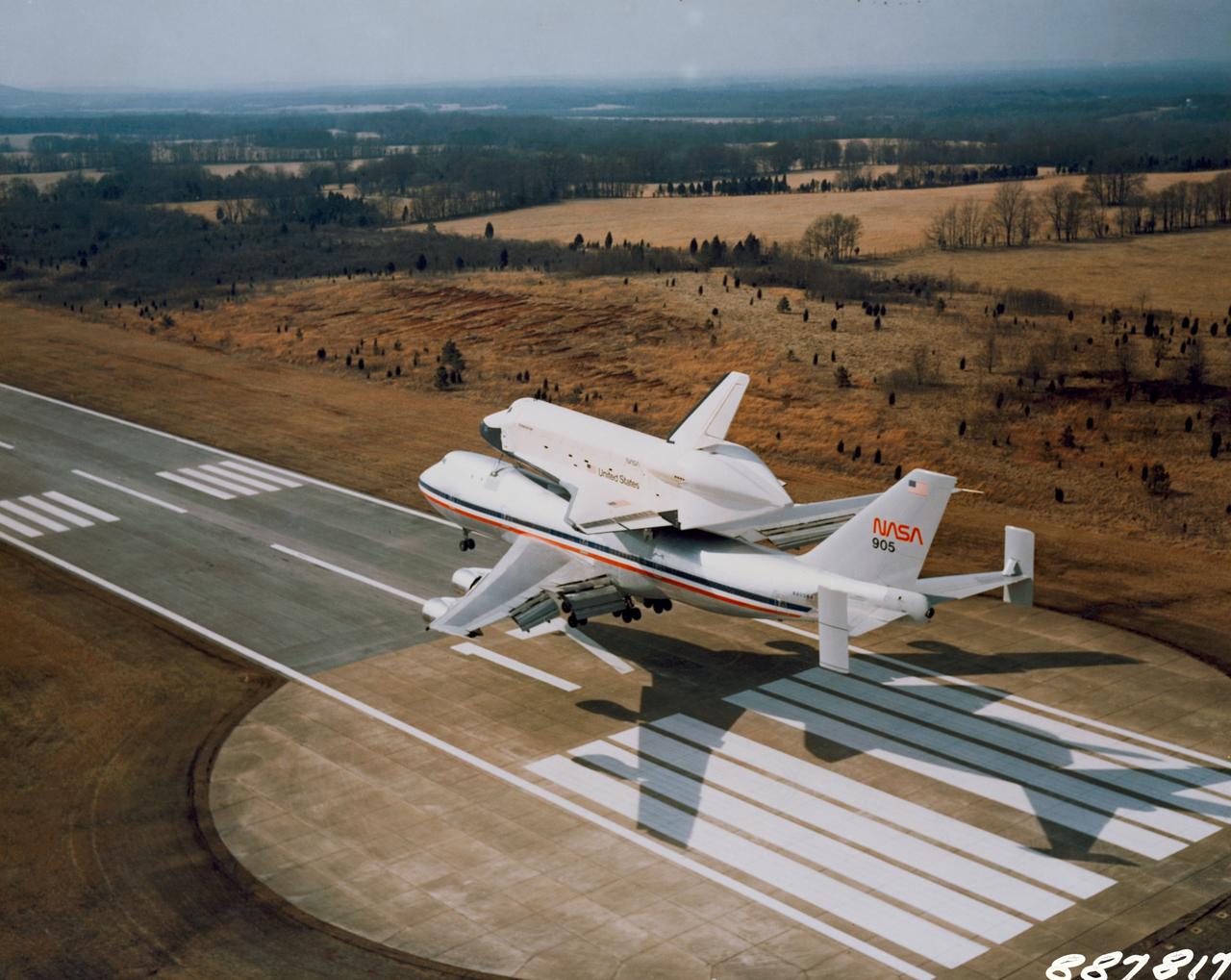
S78-27238 (13 March 1978) --- The space shuttle orbiter 101 Enterprise approaches riding atop its 747 carrier aircraft, arrives at the Redstone Arsenal airstrip near Marshall Space Flight Center (MSFC), Huntsville, Alabama, on March 13, 1978. It is to undergo ground vibration tests along with the external tank and solid rocket boosters, in preparation for Orbiter Flight Tests (OFT) in which its successor craft (Orbiter 102) will take several two-man crews into Earth orbit. Photo credit: NASA

The Space Shuttle Endeavour receives post-flight servicing in the Mate-Demate Device (MDD), following its landing at NASA's Dryden Flight Research Center, Edwards, California, May 1, 2001. Once servicing was complete, one of NASA's two 747 Shuttle Carrier Aircraft, No. 905, was readied to ferry Endeavour back to the Kennedy Space Center, FL.
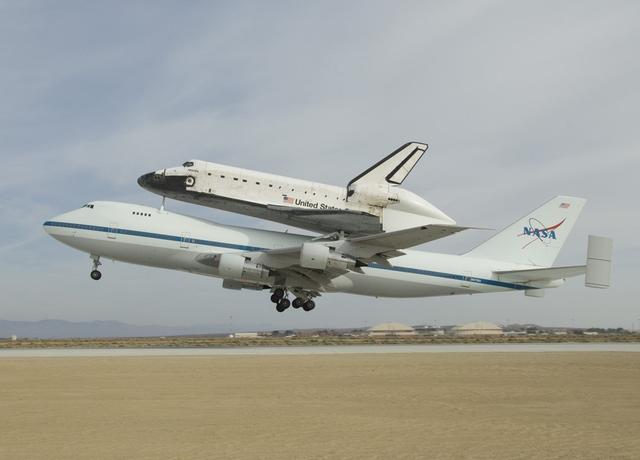
CAPE CANAVERAL, Fla. – NASA 911, one of NASA's two modified Boeing 747 space shuttle carriers, lifts off Runway 22L at Edwards Air Force Base with the shuttle Atlantis on its back on the first leg of Atlantis' ferry flight back to NASA's Kennedy Space Center in Florida. Photo credit: NASA/Tom Tschida
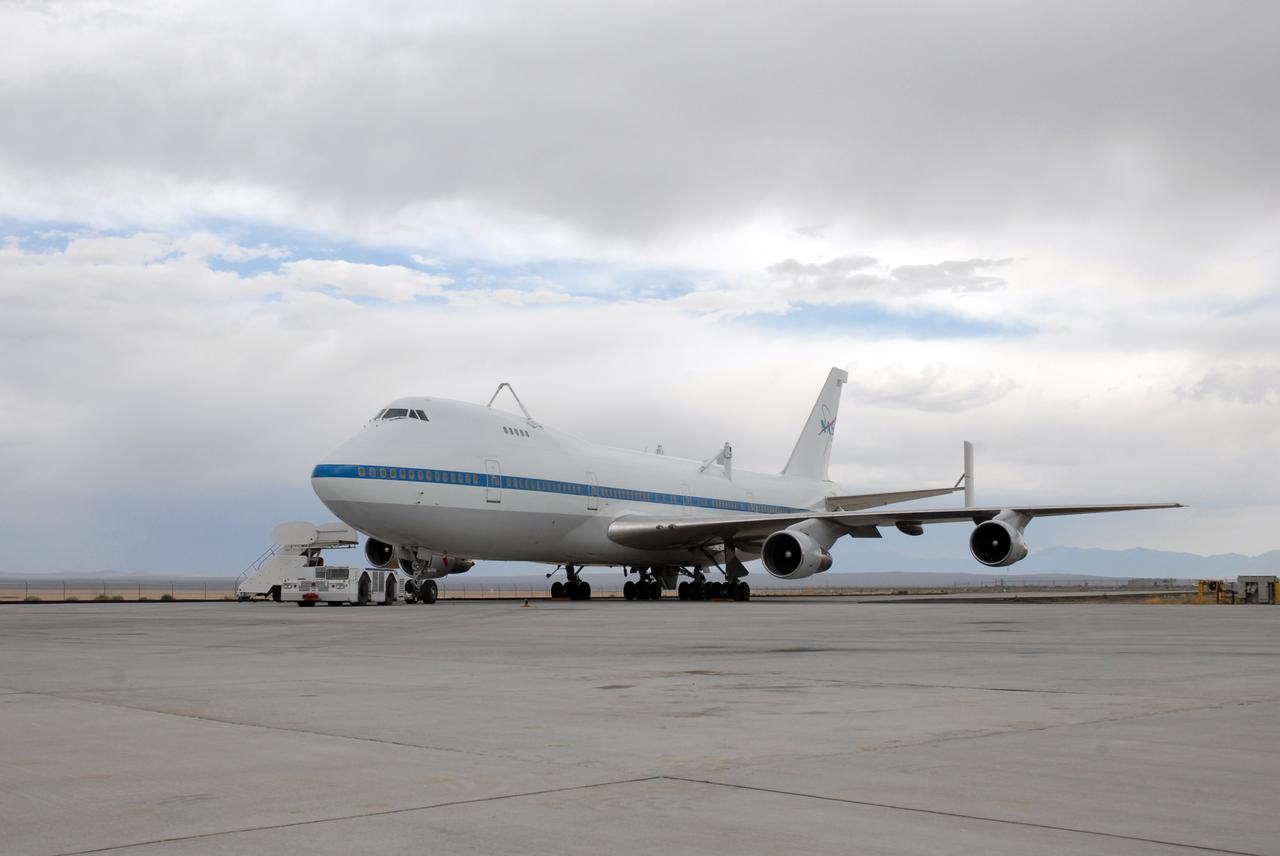
CAPE CANAVERAL, Fla. – This Shuttle Carrier Aircraft, or SCA, a modified Boeing 747, is fitted with struts on top that will attach to space shuttle Atlantis for a piggyback flight. Atlantis landed at Edwards on May 24, which concluded mission STS-125, after two landing opportunities at Kennedy were waved off due to weather concerns. Atlantis is being returned to Florida on a ferry flight on the SCA. Atlantis' next assignment is the STS-129 mission, targeted to launch in November 2009. Photo credit: NASA/Ben Smegelsky
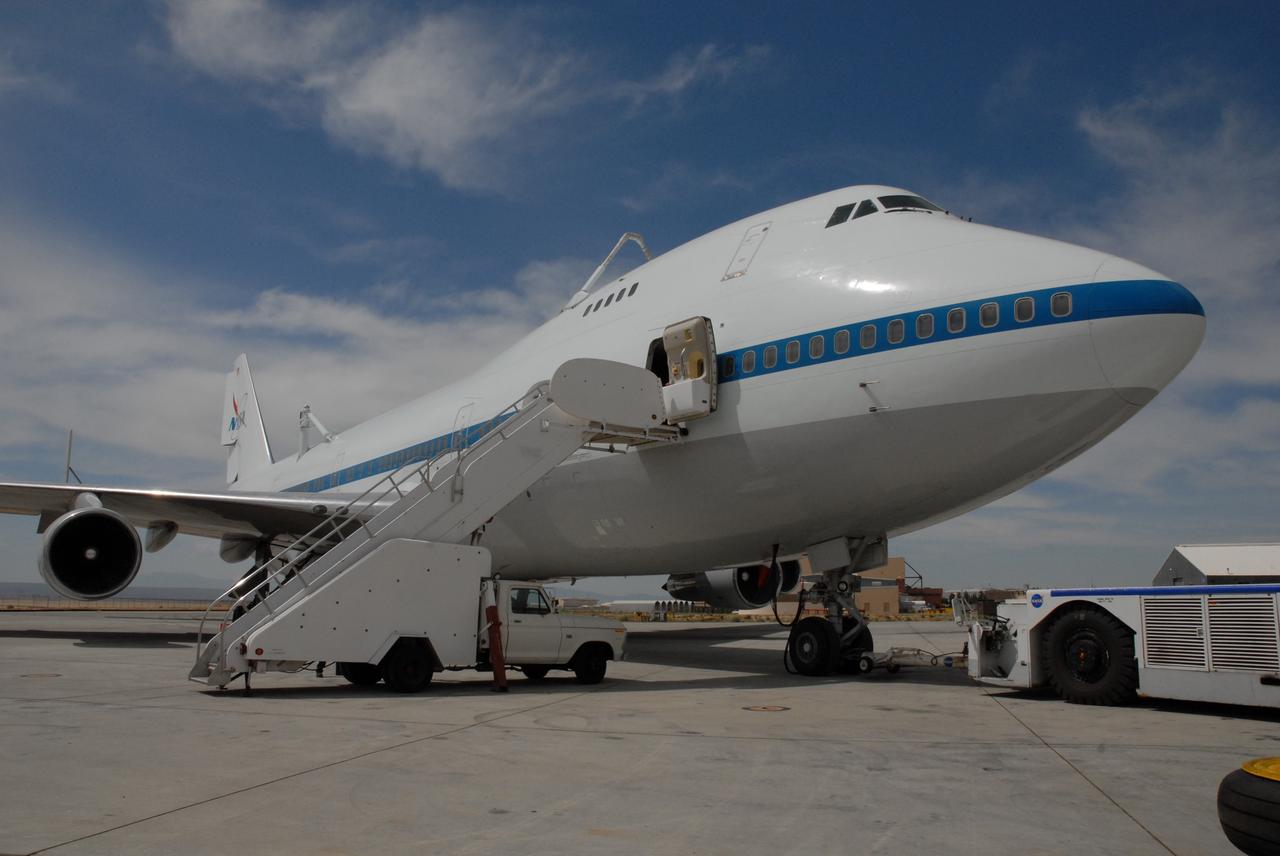
CAPE CANAVERAL, Fla. – This Shuttle Carrier Aircraft, or SCA, a modified Boeing 747, is prepared for its ferry flight to Florida, carrying space shuttle Atlantis. Atlantis landed at Edwards on May 24, which concluded mission STS-125, after two landing opportunities at Kennedy were waved off due to weather concerns. Atlantis is being returned to Florida on a ferry flight on the SCA. Atlantis' next assignment is the STS-129 mission, targeted to launch in November 2009. Photo credit: NASA/Ben Smegelsky
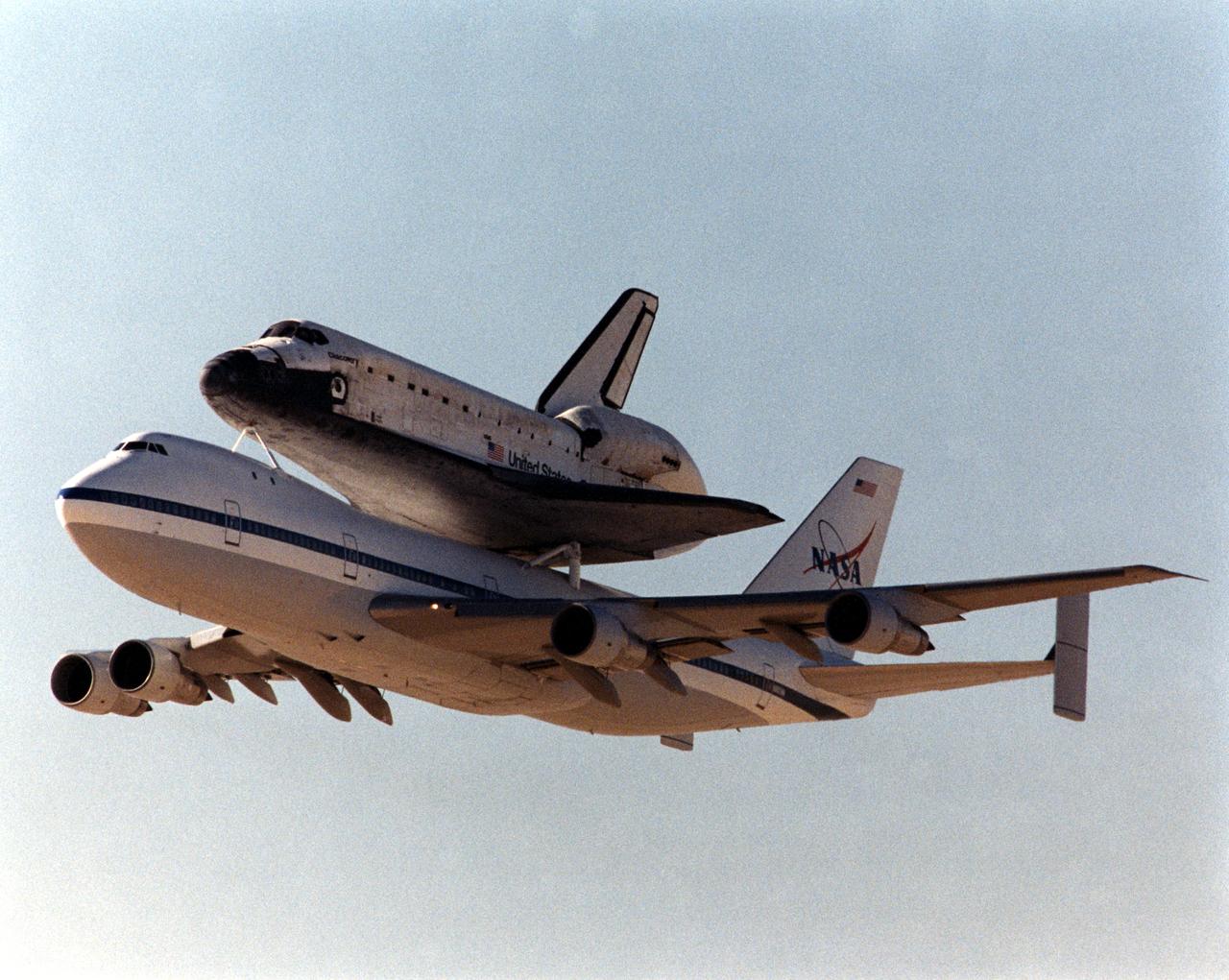
One of NASA’s two modified Boeing 747 Shuttle Carrier Aircraft with the Space Shuttle orbiter Discovery on its back climbs out after takeoff from Edwards Air Force Base, California. The Discovery was ferried from NASA’s Dryden Flight Research Center at Edwards to NASA’s Kennedy Space Center in Florida on November 2, 2000, after extensive post-landing servicing and ferry flight preparations.
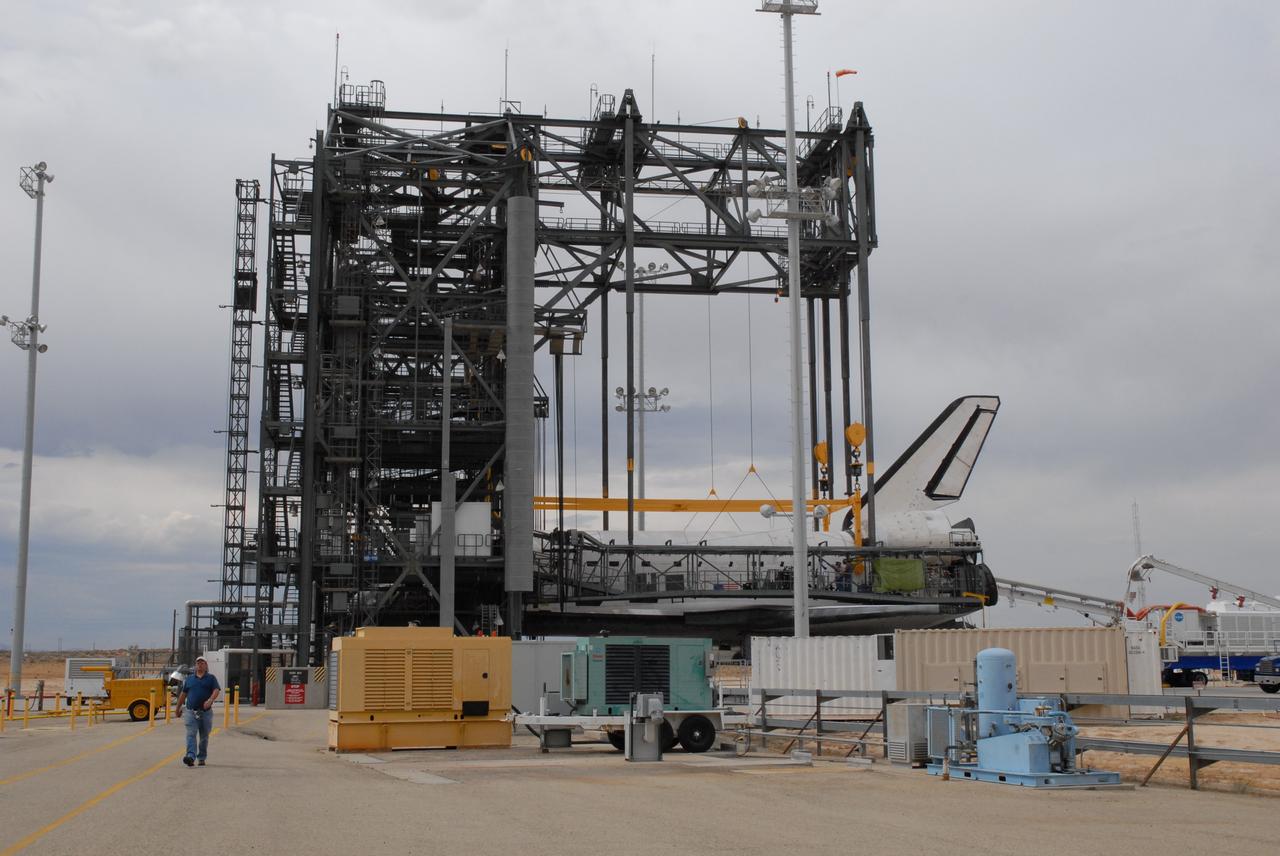
CAPE CANAVERAL, Fla. – At Edwards Air Force Base in California, space shuttle Atlantis is moved inside the mate/demate device for attachment to the Shuttle Carrier Aircraft, or SCA, a modified Boeing 747. Atlantis landed at Edwards on May 24, which concluded mission STS-125, after two landing opportunities at Kennedy were waved off due to weather concerns. Atlantis is being returned to Florida on a ferry flight on the SCA. Atlantis' next assignment is the STS-129 mission, targeted to launch in November 2009. Photo credit: NASA/Ben Smegelsky

CAPE CANAVERAL, Fla. –This modified Boeing 747, with its stripped interior, is the Shuttle Carrier Aircraft, or SCA, at Edwards Air Force Base in California that will carry space shuttle Atlantis on its ferry flight to Florida. Atlantis landed at Edwards on May 24, which concluded mission STS-125, after two landing opportunities at Kennedy were waved off due to weather concerns. Atlantis is being returned to Florida on a ferry flight on the SCA. Atlantis' next assignment is the STS-129 mission, targeted to launch in November 2009. Photo credit: NASA/Ben Smegelsky
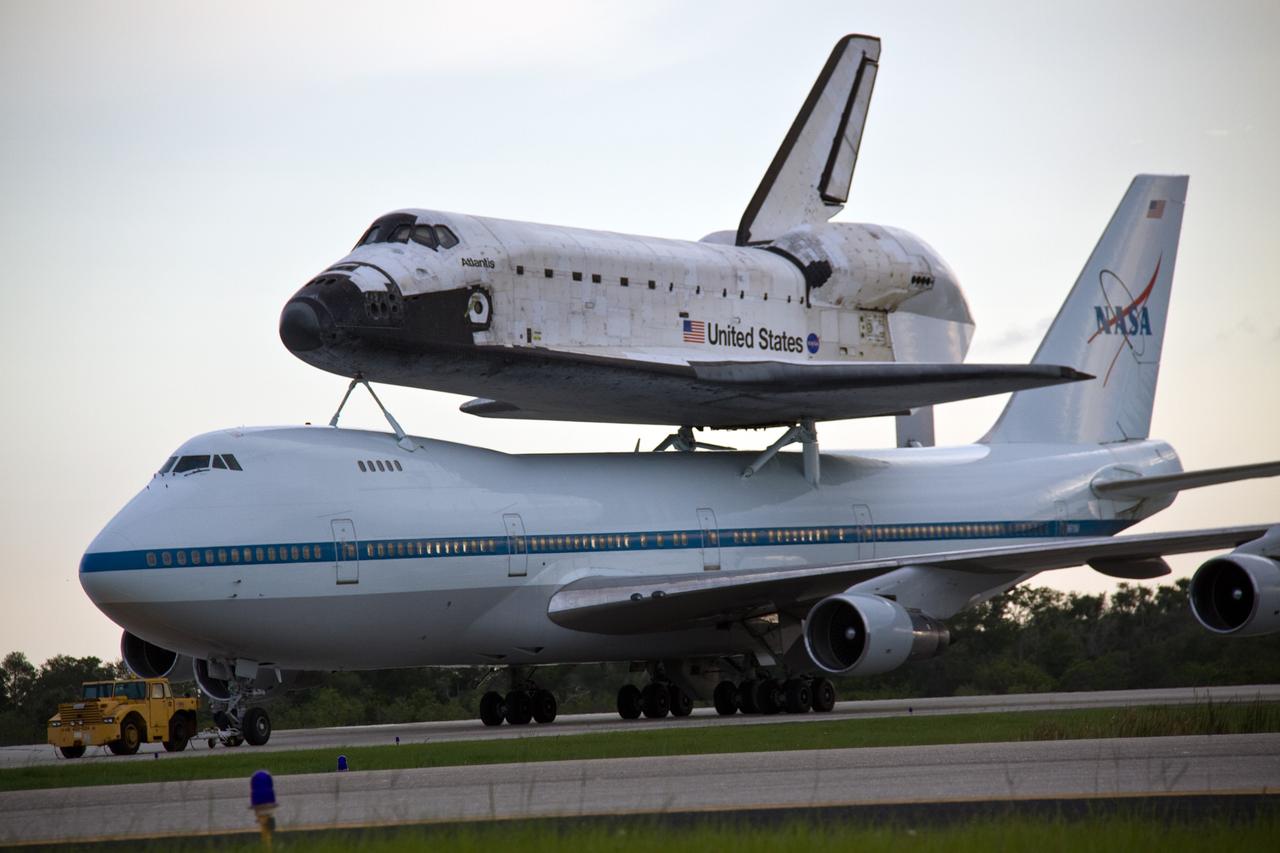
CAPE CANAVERAL, Fla. – After a two-day trip from California, space shuttle Atlantis, atop a Shuttle Carrier Aircraft, or SCA, is towed from the runway at NASA's Kennedy Space Center in Florida. The SCA is a modified Boeing 747 jetliner. Atlantis returned from California atop the SCA after its May 24 landing at Edwards Air Force Base, concluding mission STS-125. The ferry flight from Edwards Air Force Base began June 1. Atlantis' next assignment is the STS-129 mission, targeted to launch in November 2009. Photo credit: NASA/Jack Pfaller
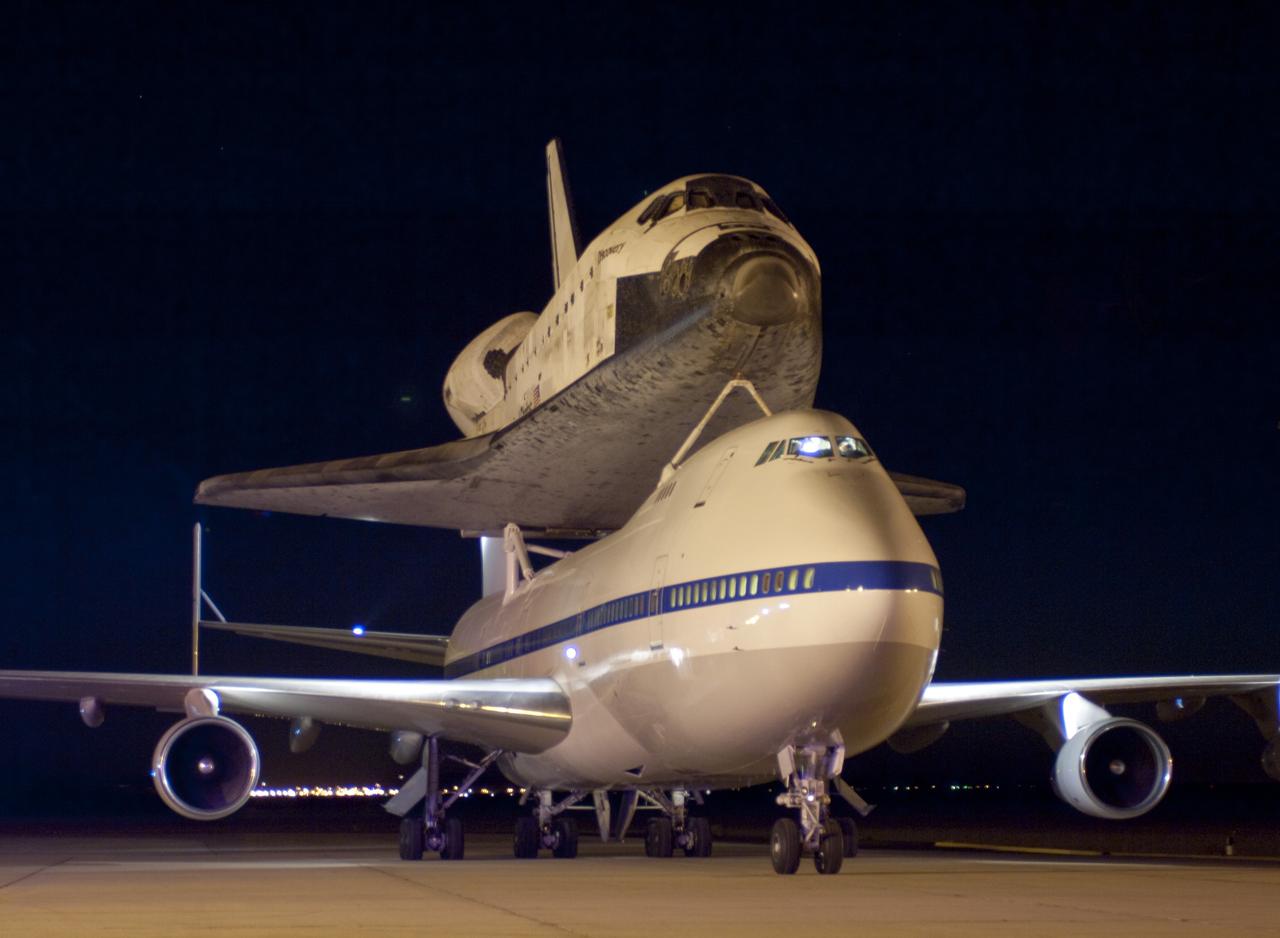
EDWARDS AIR FORCE BASE, Calif. – (ED09-0253-114) NASA’s modified Boeing 747 carrying the space shuttle Discovery taxis toward the runway at Edwards Air Force Base in Southern California shortly before dawn on Sept. 20, 2009 prior to taking off on their two-day ferry flight to the Kennedy Space Center in Florida. Discovery had landed at Edwards Sept. 11 after the almost 14-day mission STS-128 to the International Space Station. The shuttle delivered more than 7 tons of supplies, science racks and equipment, as well as additional environmental hardware to sustain six crew members on the International Space Station. NASA photo /Jim Ross
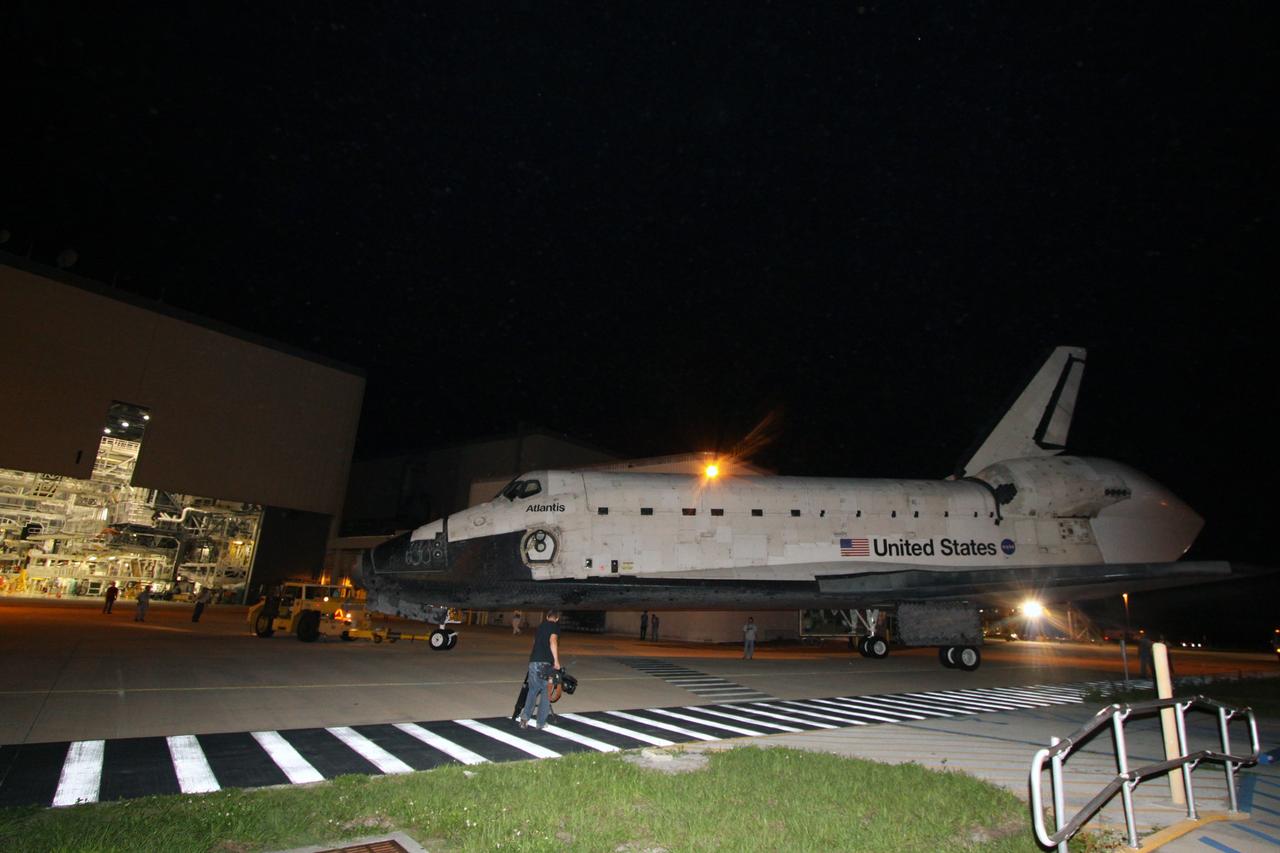
CAPE CANAVERAL, Fla. – At NASA's Kennedy Space Center in Florida, space shuttle Atlantis is towed toward Orbiter Processing Facility 1. Atlantis was demated from the Shuttle Carrier Aircraft, or SCA, via the mate/demate device at the Shuttle Landing Facility. After its May 24 landing at Edwards Air Force Base in California, which concluded its STS-125 mission, the modified Boeing 747 SCA carried the shuttle on a two-day ferry flight from Edwards to Kennedy beginning June 1. Atlantis' next assignment is the STS-129 mission, targeted to launch in November 2009. Photo credit: NASA/Jack Pfaller
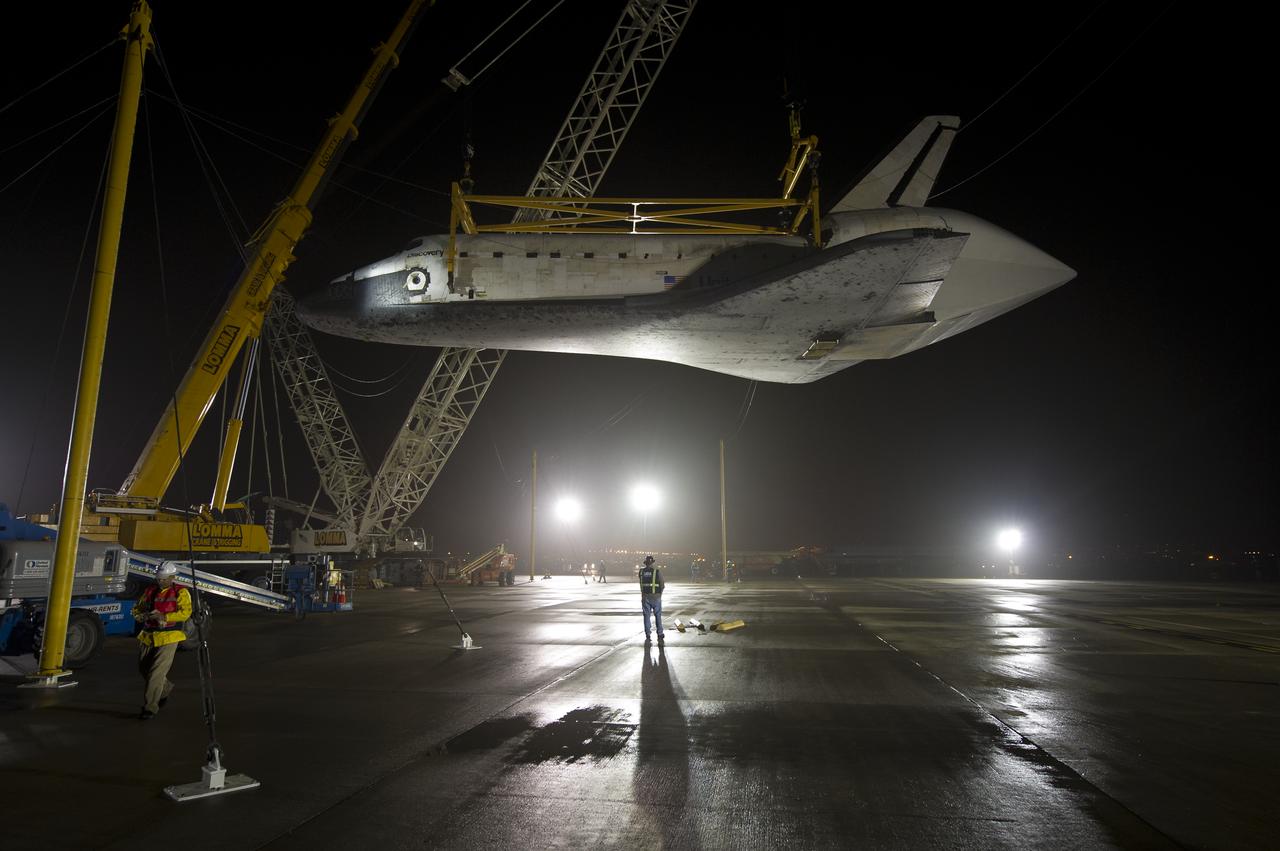
The space shuttle Discovery is suspended from a sling held by two cranes shortly after the NASA 747 Shuttle Carrier Aircraft (SCA) was pushed back from underneath at Washington Dulles International Airport, Thursday, April 19, 2012, in Sterling, VA. Discovery, the first orbiter retired from NASA’s shuttle fleet, completed 39 missions, spent 365 days in space, orbited the Earth 5,830 times, and traveled 148,221,675 miles. NASA will transfer Discovery to the National Air and Space Museum to begin its new mission to commemorate past achievements in space and to educate and inspire future generations of explorers. Photo Credit: (NASA/Bill Ingalls)
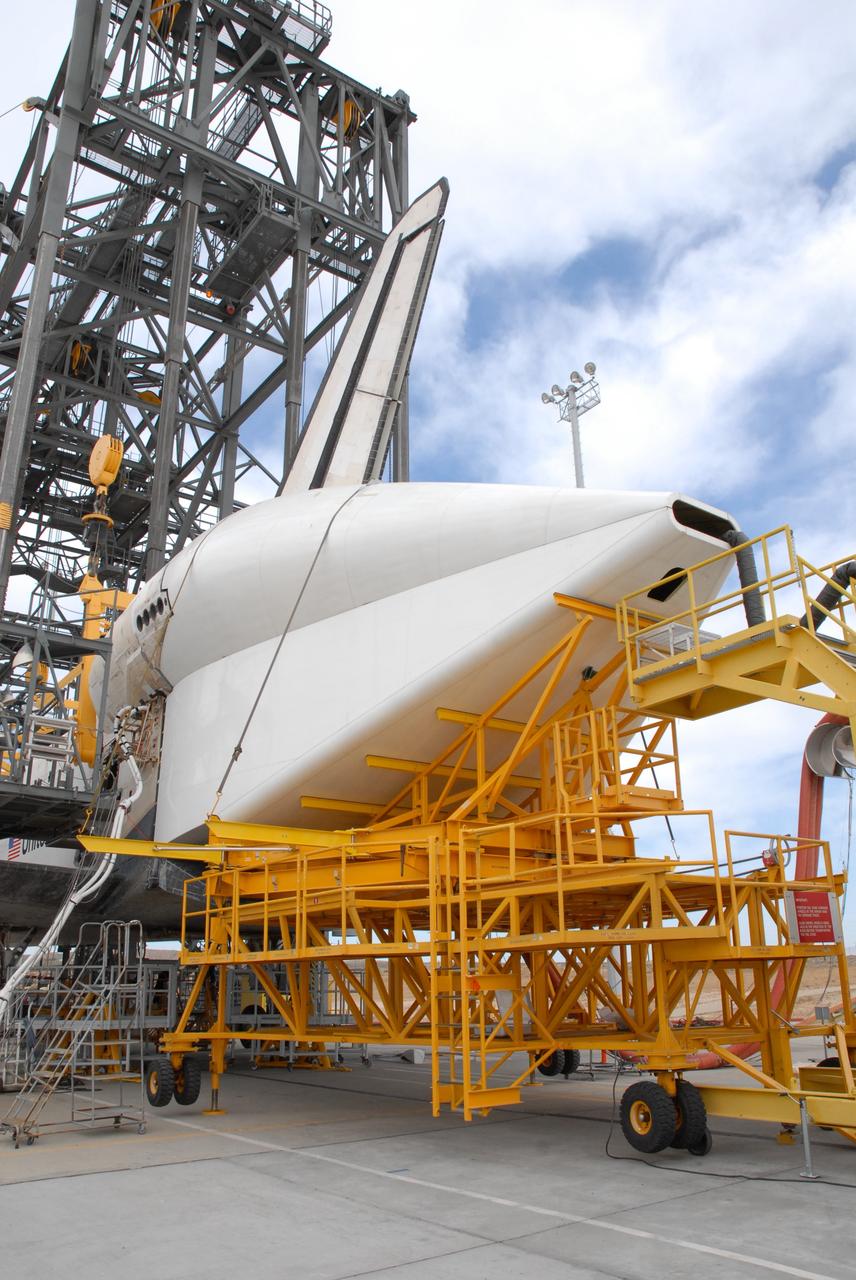
CAPE CANAVERAL, Fla. – At Edwards Air Force Base in California, space shuttle Atlantis is fitted with a tail cone, which protects the aft engine area and provides a more efficient aeronautical dimension during its piggyback flight on the Shuttle Carrier Aircraft, or SCA, a modified Boeing 747. Atlantis landed at Edwards on May 24, which concluded mission STS-125, after two landing opportunities at Kennedy were waved off due to weather concerns. Atlantis is being returned to Florida on a ferry flight on the SCA. Atlantis' next assignment is the STS-129 mission, targeted to launch in November 2009. Photo credit: NASA/Ben Smegelsky
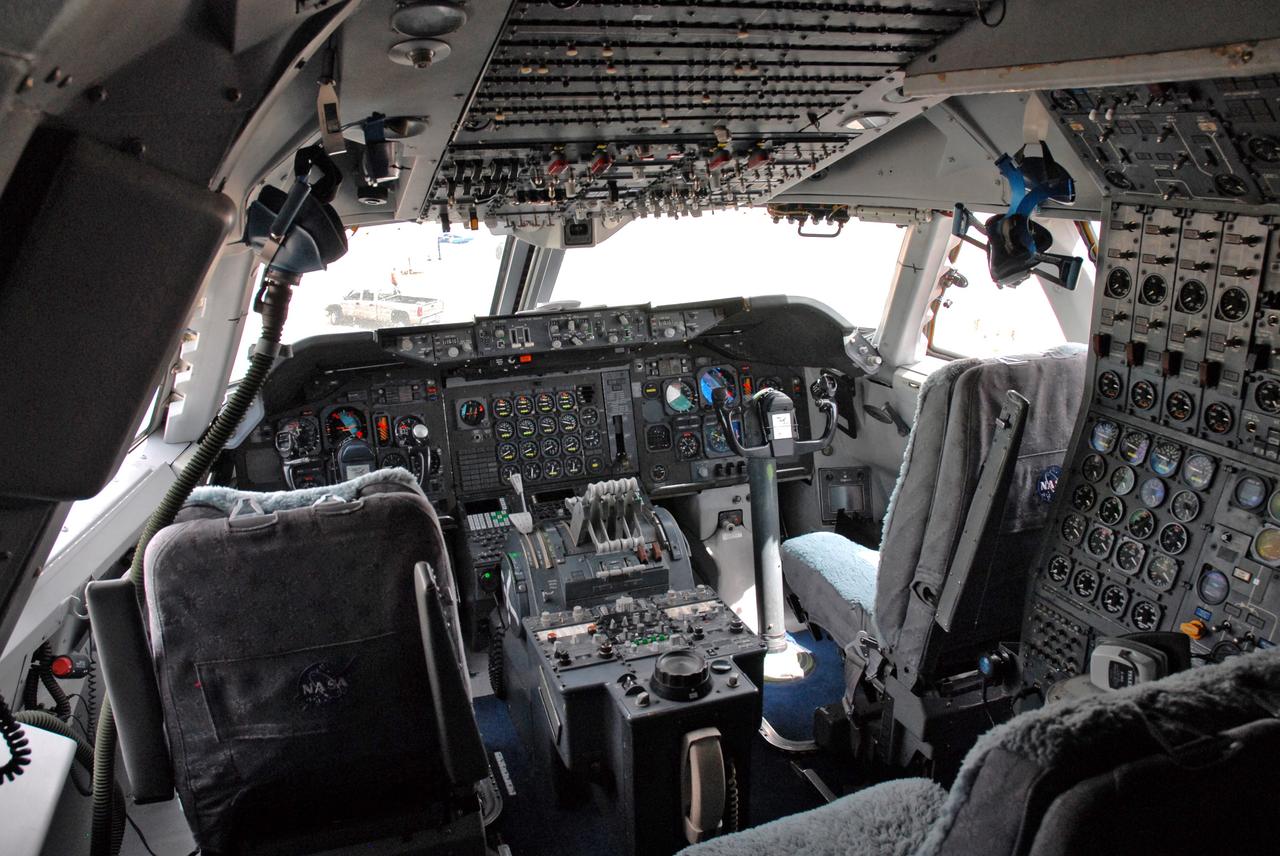
CAPE CANAVERAL, Fla. – This is the cockpit of the Shuttle Carrier Aircraft, or SCA, a modified Boeing 747, at Edwards Air Force Base in California. The SCA will carry space shuttle Atlantis on its ferry flight to Florida. Atlantis landed at Edwards on May 24, which concluded mission STS-125, after two landing opportunities at Kennedy were waved off due to weather concerns. Atlantis is being returned to Florida on a ferry flight on the SCA. Atlantis' next assignment is the STS-129 mission, targeted to launch in November 2009. Photo credit: NASA/Ben Smegelsky
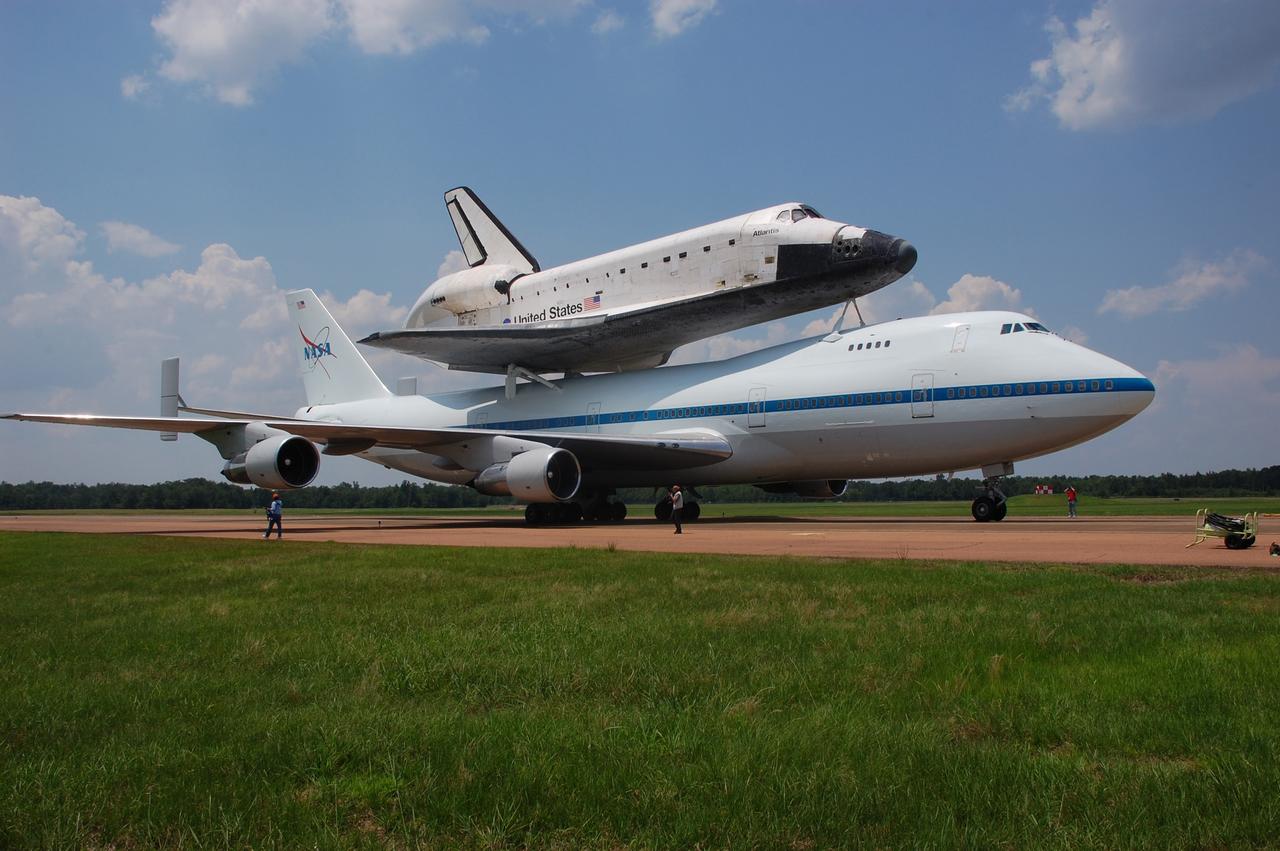
CAPE CANAVERAL, Fla. – Space shuttle Atlantis, atop the Shuttle Carrier Aircraft, or SCA, a modified Boeing 747, is ready for takeoff from Columbus Air Force Base in Mississippi after a fuel stop on its journey back to Florida. Atlantis landed at Edwards Air Force Base in California on May 24, which concluded mission STS-125, after two landing opportunities at Kennedy were waved off due to weather concerns. Atlantis is being returned to Florida on a ferry flight on the SCA. Atlantis' next assignment is the STS-129 mission, targeted to launch in November 2009. Photo credit: NASA/Ben Smegelsky

CAPE CANAVERAL, Fla. – Hitching a ride on the Shuttle Carrier Aircraft, or SCA, a modified Boeing 747, space shuttle Atlantis has arrived at Biggs Armuy Air Field in El Paso, Texas. Atlantis landed at Edwards Air Force Base in California on May 24, which concluded mission STS-125, after two landing opportunities at Kennedy were waved off due to weather concerns. Atlantis is being returned to Florida on a ferry flight on the SCA. Atlantis' next assignment is the STS-129 mission, targeted to launch in November 2009. Photo credit: NASA/Ben Smegelsky
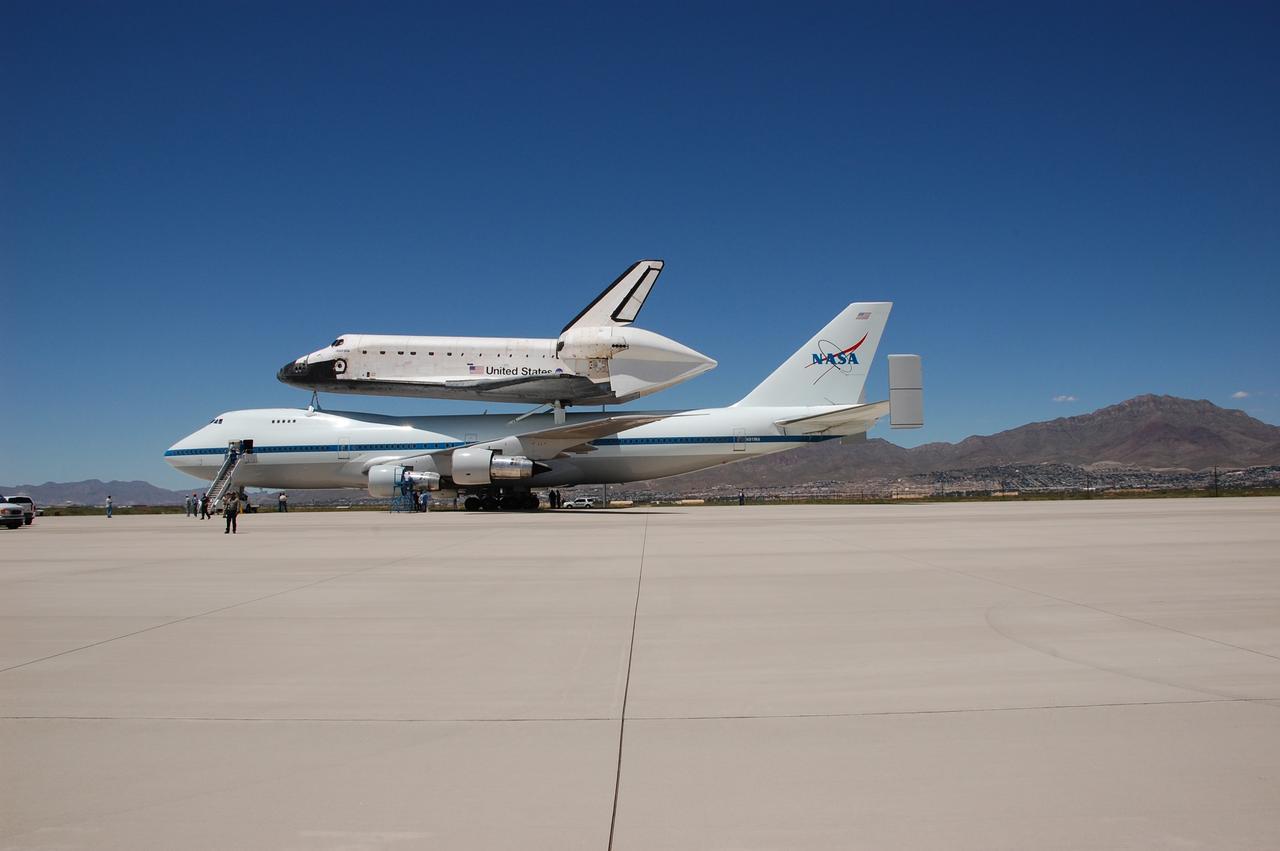
CAPE CANAVERAL, Fla. – Hitching a ride on the Shuttle Carrier Aircraft, or SCA, a modified Boeing 747, space shuttle Atlantis is ready for takeoff from El Paso. Atlantis landed at Edwards Air Force Base in California on May 24, which concluded mission STS-125, after two landing opportunities at Kennedy were waved off due to weather concerns. Atlantis is being returned to Florida on a ferry flight on the SCA. Atlantis' next assignment is the STS-129 mission, targeted to launch in November 2009. Photo credit: NASA/Ben Smegelsky
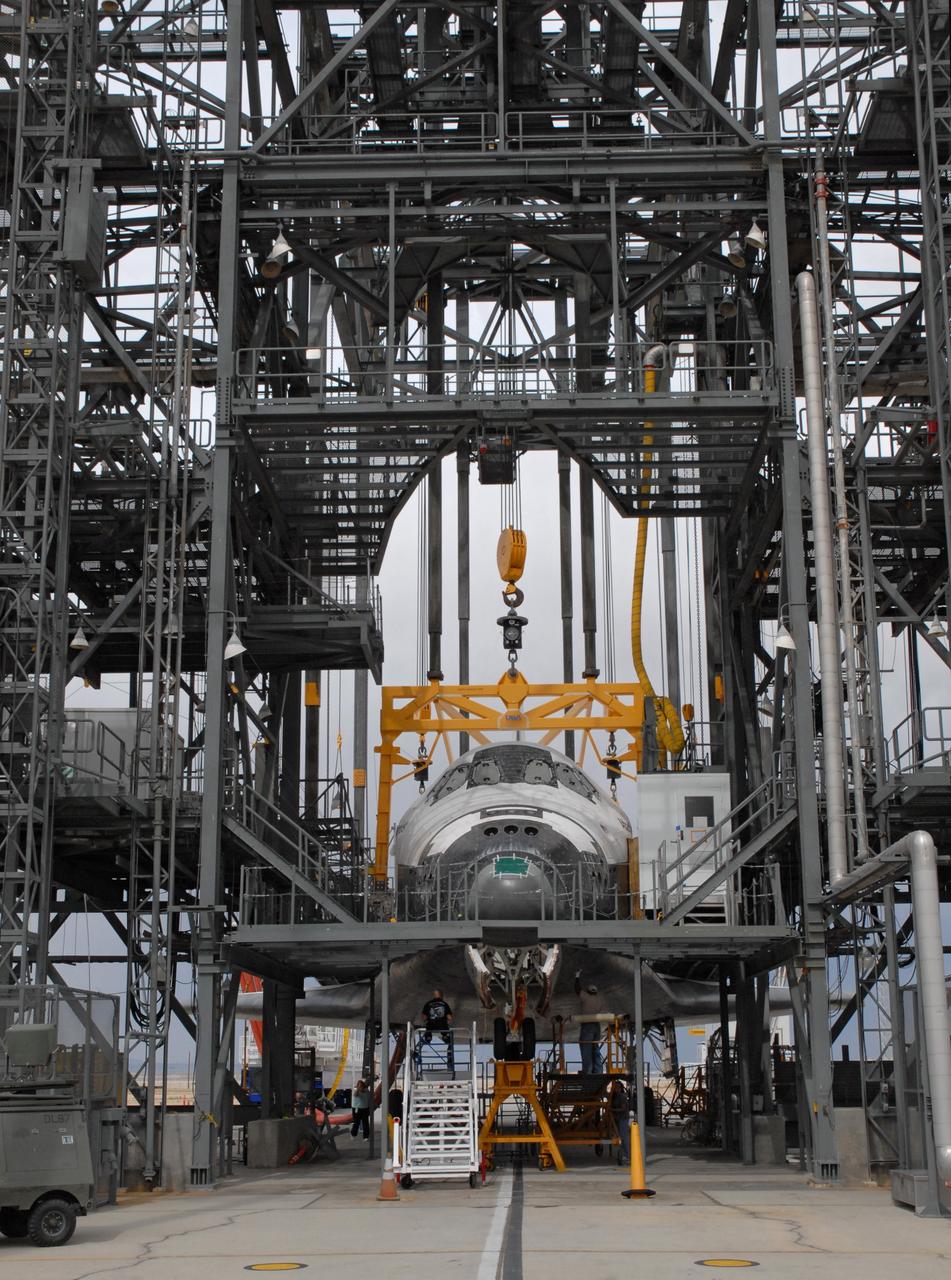
CAPE CANAVERAL, Fla. – At Edwards Air Force Base in California, space shuttle Atlantis is fitted with a sling in the mate/demate device to lift it for attachment to the Shuttle Carrier Aircraft, or SCA, a modified Boeing 747. Atlantis landed at Edwards on May 24, which concluded mission STS-125, after two landing opportunities at Kennedy were waved off due to weather concerns. Atlantis is being returned to Florida on a ferry flight on the SCA. Atlantis' next assignment is the STS-129 mission, targeted to launch in November 2009. Photo credit: NASA/Ben Smegelsky
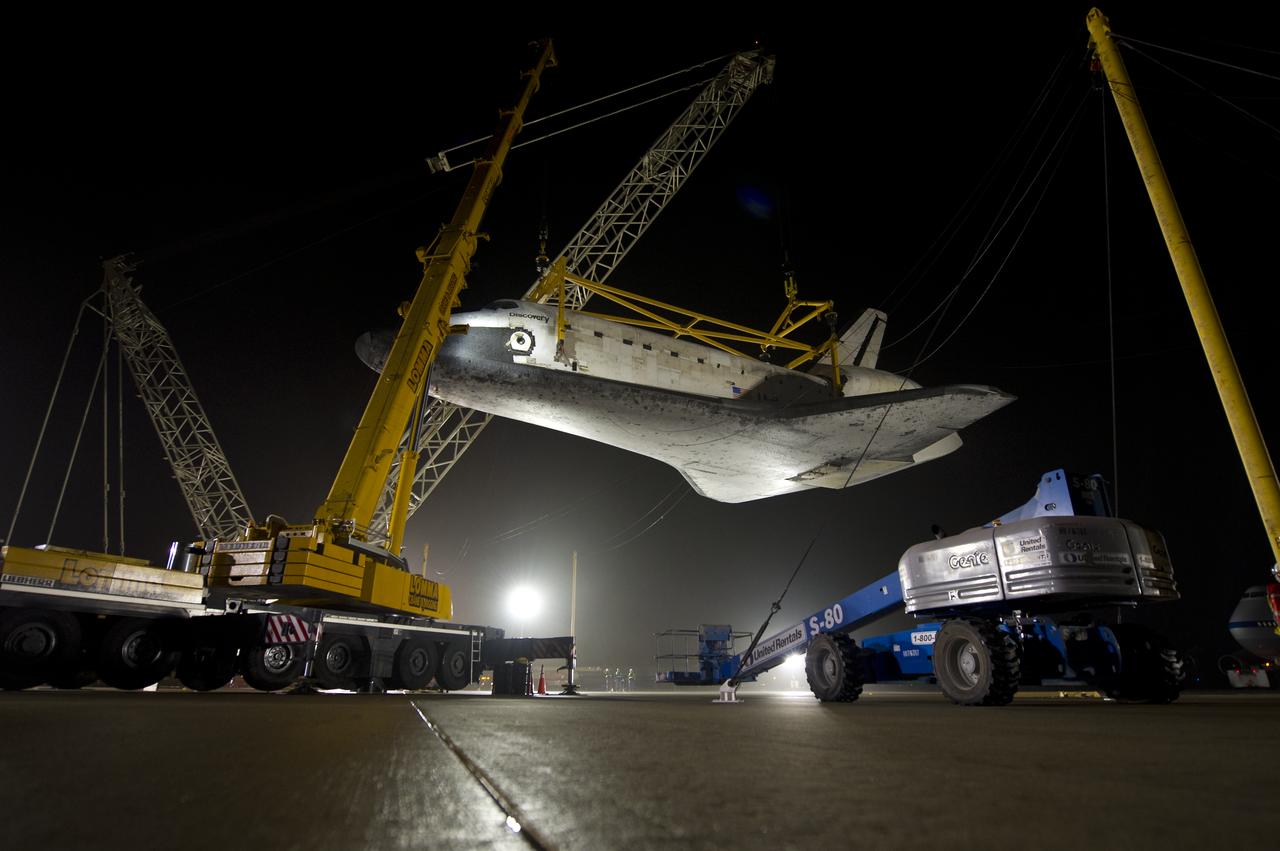
The space shuttle Discovery is suspended from a sling held by two cranes shortly after the NASA 747 Shuttle Carrier Aircraft (SCA) was pushed back from underneath at Washington Dulles International Airport, Thursday, April 19, 2012, in Sterling, VA. Discovery, the first orbiter retired from NASA’s shuttle fleet, completed 39 missions, spent 365 days in space, orbited the Earth 5,830 times, and traveled 148,221,675 miles. NASA will transfer Discovery to the National Air and Space Museum to begin its new mission to commemorate past achievements in space and to educate and inspire future generations of explorers. Photo Credit: (NASA/Bill Ingalls)
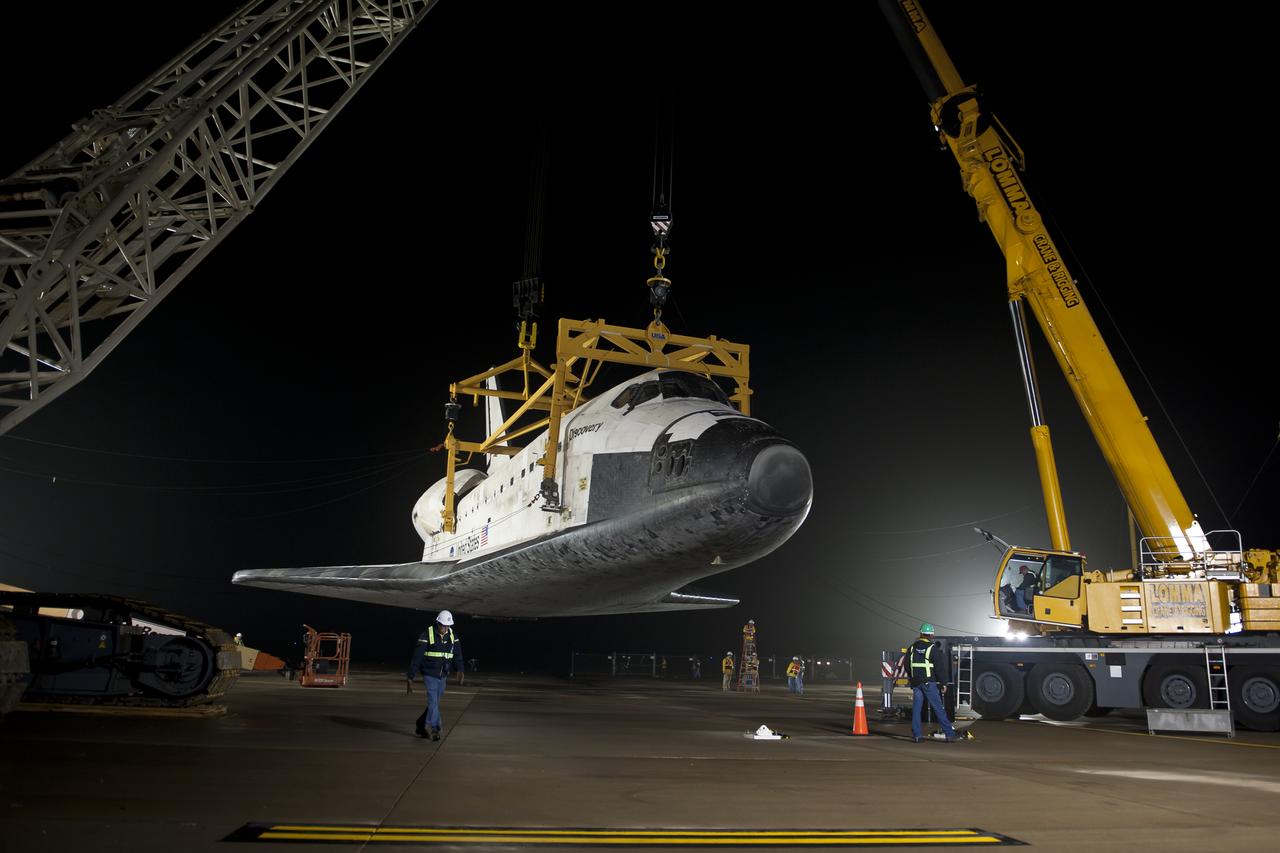
The space shuttle Discovery is suspended from a sling held by two cranes after the NASA 747 Shuttle Carrier Aircraft (SCA) was pushed back from underneath at Washington Dulles International Airport, Thursday, April 19, 2012, in Sterling, VA. Discovery, the first orbiter retired from NASA’s shuttle fleet, completed 39 missions, spent 365 days in space, orbited the Earth 5,830 times, and traveled 148,221,675 miles. NASA will transfer Discovery to the National Air and Space Museum to begin its new mission to commemorate past achievements in space and to educate and inspire future generations of explorers. Photo Credit: (NASA/Bill Ingalls)
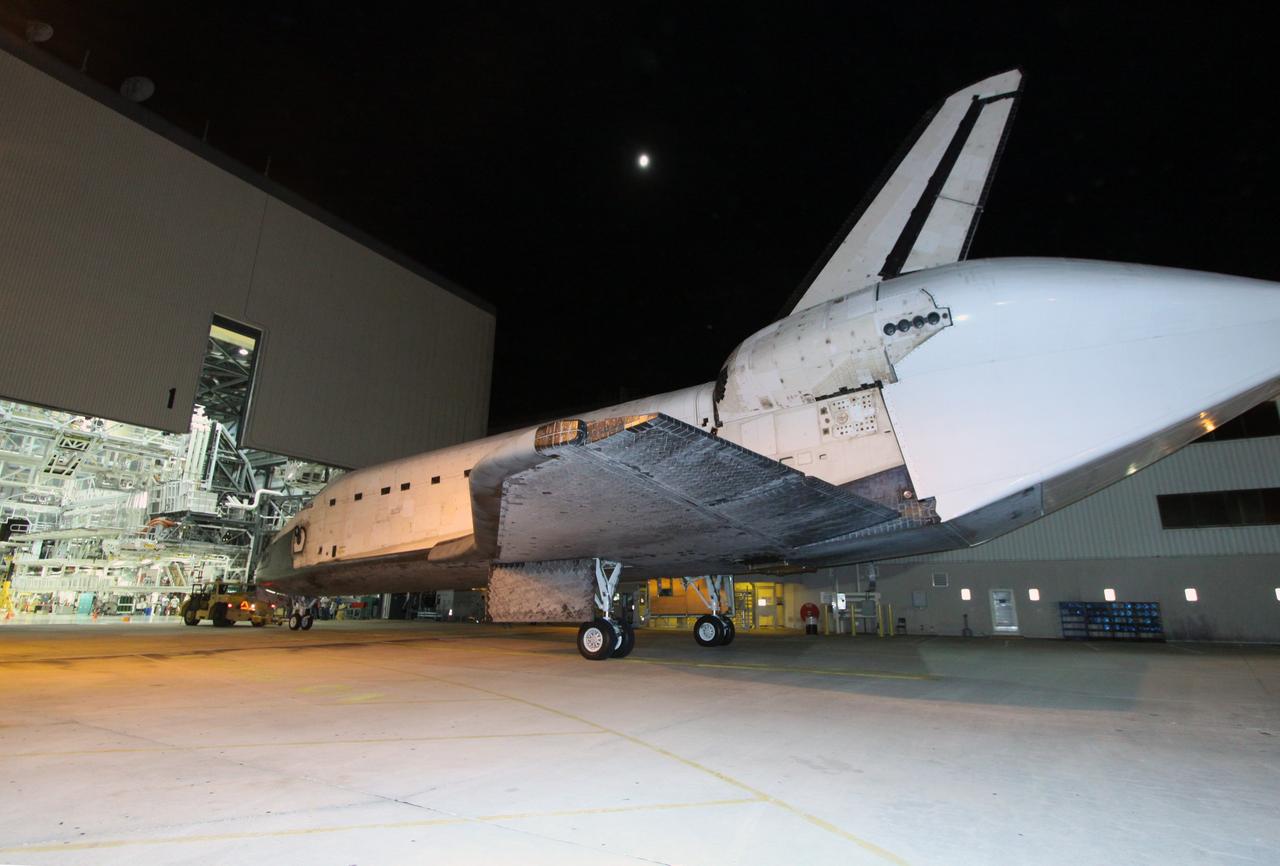
CAPE CANAVERAL, Fla. – At NASA's Kennedy Space Center in Florida, space shuttle Atlantis rolls toward the open doors of Orbiter Processing Facility 1. Atlantis was demated from the Shuttle Carrier Aircraft, or SCA, via the mate/demate device at the Shuttle Landing Facility. After its May 24 landing at Edwards Air Force Base in California, which concluded its STS-125 mission, the modified Boeing 747 SCA carried the shuttle on a two-day ferry flight from Edwards to Kennedy beginning June 1. Atlantis' next assignment is the STS-129 mission, targeted to launch in November 2009. Photo credit: NASA/Jack Pfaller
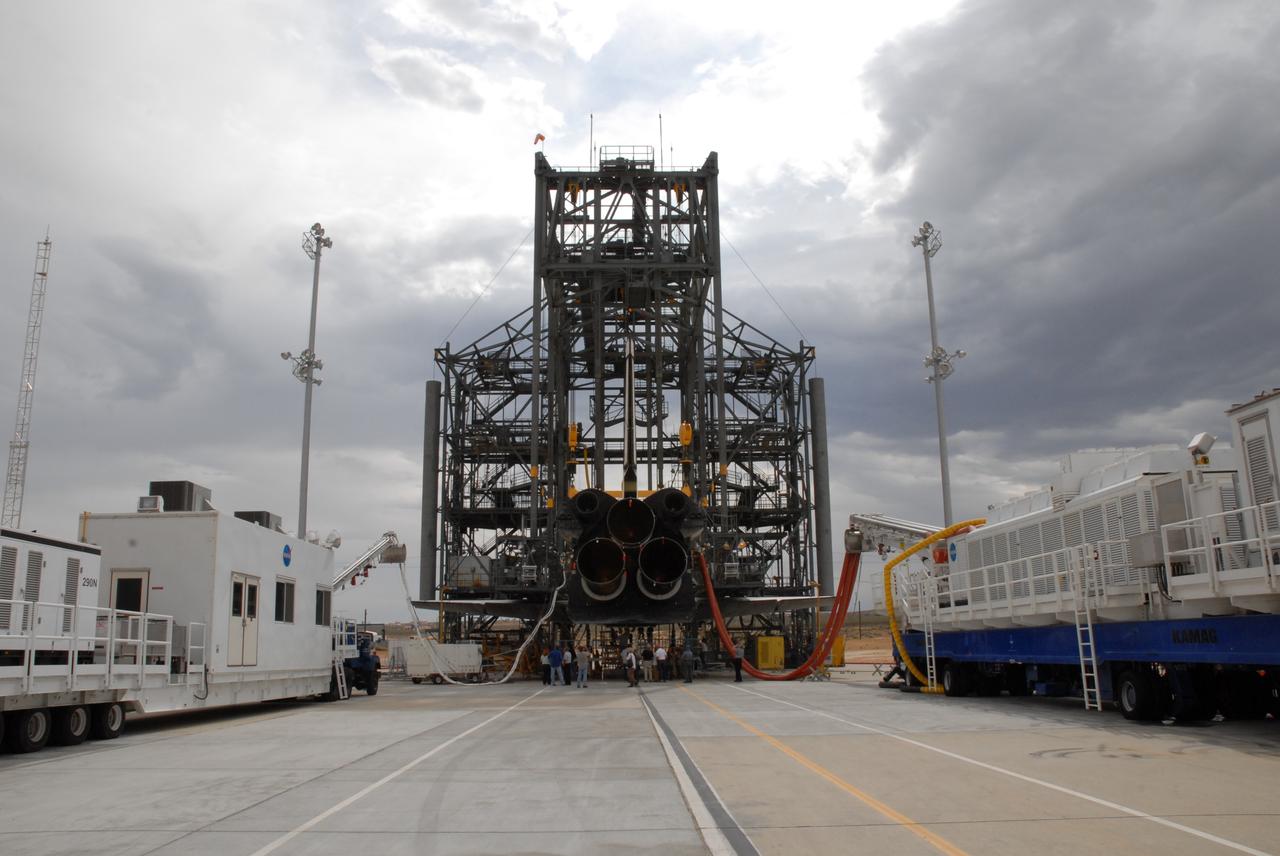
CAPE CANAVERAL, Fla. – Under the mate/demate device at Edwards Air Force Base in California, Atlantis is fitted with a sling to lift it for attachment to the Shuttle Carrier Aircraft, or SCA, a modified Boeing 747. Atlantis landed at Edwards on May 24, which concluded mission STS-125, after two landing opportunities at Kennedy were waved off due to weather concerns. Atlantis is being returned to Florida on a ferry flight on the SCA. Atlantis' next assignment is the STS-129 mission, targeted to launch in November 2009. Photo credit: NASA/Ben Smegelsky
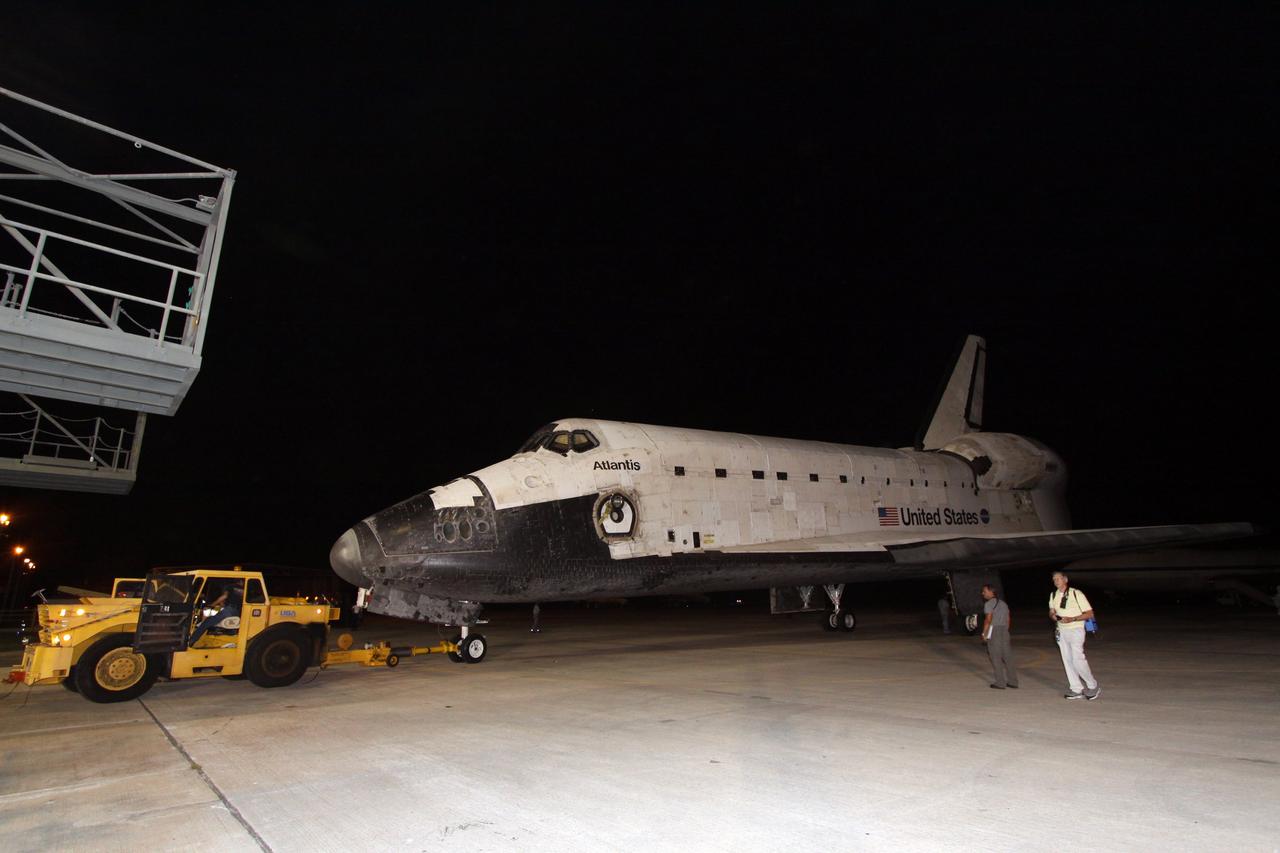
CAPE CANAVERAL, Fla. – On the Shuttle Landing Facility at NASA's Kennedy Space Center in Florida, space shuttle Atlantis is moved away from the mate/demate device where it was separated from the Shuttle Carrier Aircraft, or SCA. Atlantis will be towed to Orbiter Processing Facility 1. After its May 24 landing at Edwards Air Force Base in California, which concluded its STS-125 mission, the modified Boeing 747 SCA carried the shuttle on a two-day ferry flight from Edwards to Kennedy beginning June 1. Atlantis' next assignment is the STS-129 mission, targeted to launch in November 2009. Photo credit: NASA/Jack Pfaller
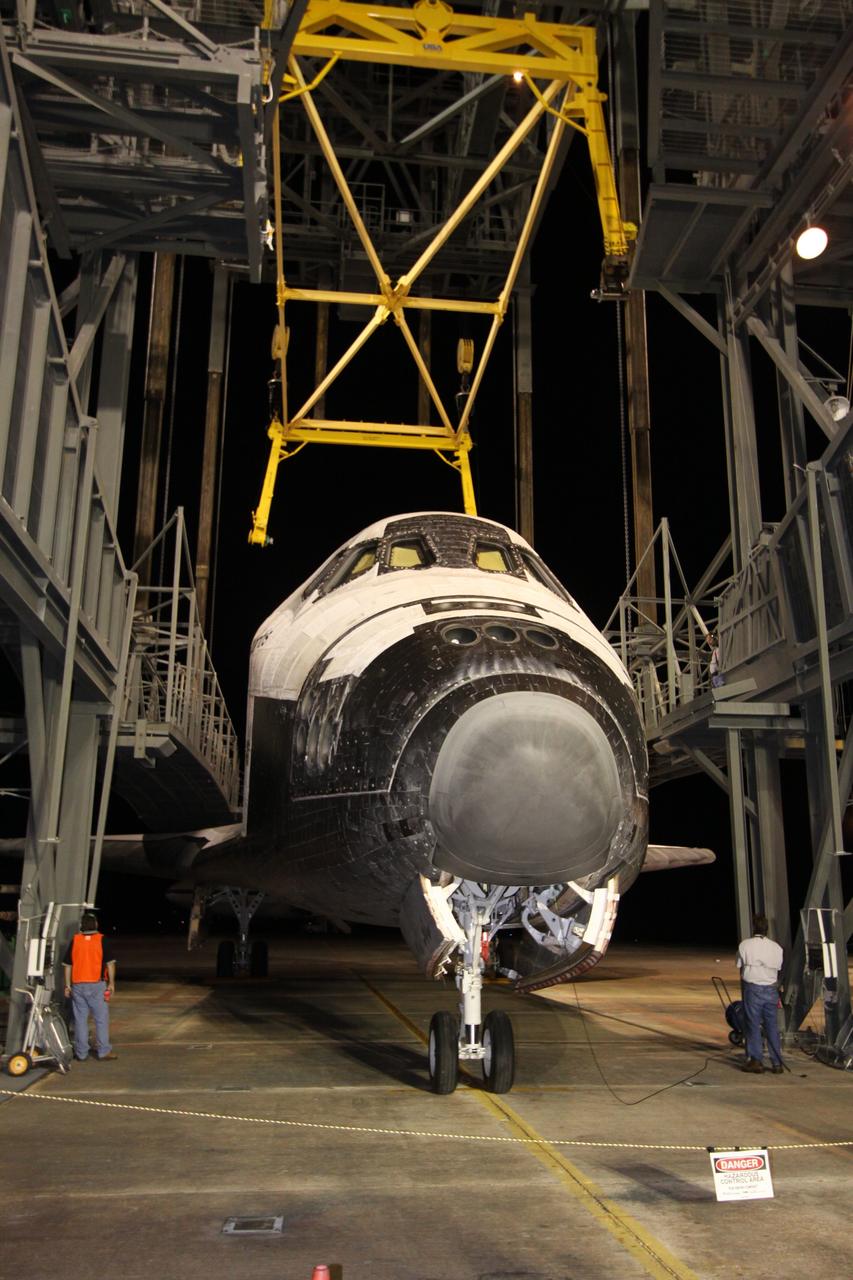
CAPE CANAVERAL, Fla. – On the Shuttle Landing Facility at NASA's Kennedy Space Center in Florida, the hoist is removed from space shuttle Atlantis before the shuttle is towed to Orbiter Processing Facility 1. After its May 24 landing at Edwards Air Force Base in California, which concluded its STS-125 mission, the modified Boeing 747 SCA carried the shuttle on a two-day ferry flight from Edwards to Kennedy beginning June 1. Atlantis' next assignment is the STS-129 mission, targeted to launch in November 2009. Photo credit: NASA/Jack Pfaller

CAPE CANAVERAL, Fla. – Hitching a ride on the Shuttle Carrier Aircraft, or SCA, a modified Boeing 747, space shuttle Atlantis is ready for takeoff from El Paso. Atlantis landed at Edwards Air Force Base in California on May 24, which concluded mission STS-125, after two landing opportunities at Kennedy were waved off due to weather concerns. Atlantis is being returned to Florida on a ferry flight on the SCA. Atlantis' next assignment is the STS-129 mission, targeted to launch in November 2009. Photo credit: NASA/Ben Smegelsky

CAPE CANAVERAL, Fla. – Under the mate/demate device at Edwards Air Force Base in California, Atlantis is fitted with a sling to lift it for attachment to the Shuttle Carrier Aircraft, or SCA, a modified Boeing 747. Atlantis landed at Edwards on May 24, which concluded mission STS-125, after two landing opportunities at Kennedy were waved off due to weather concerns. Atlantis is being returned to Florida on a ferry flight on the SCA. Atlantis' next assignment is the STS-129 mission, targeted to launch in November 2009. Photo credit: NASA/Ben Smegelsky
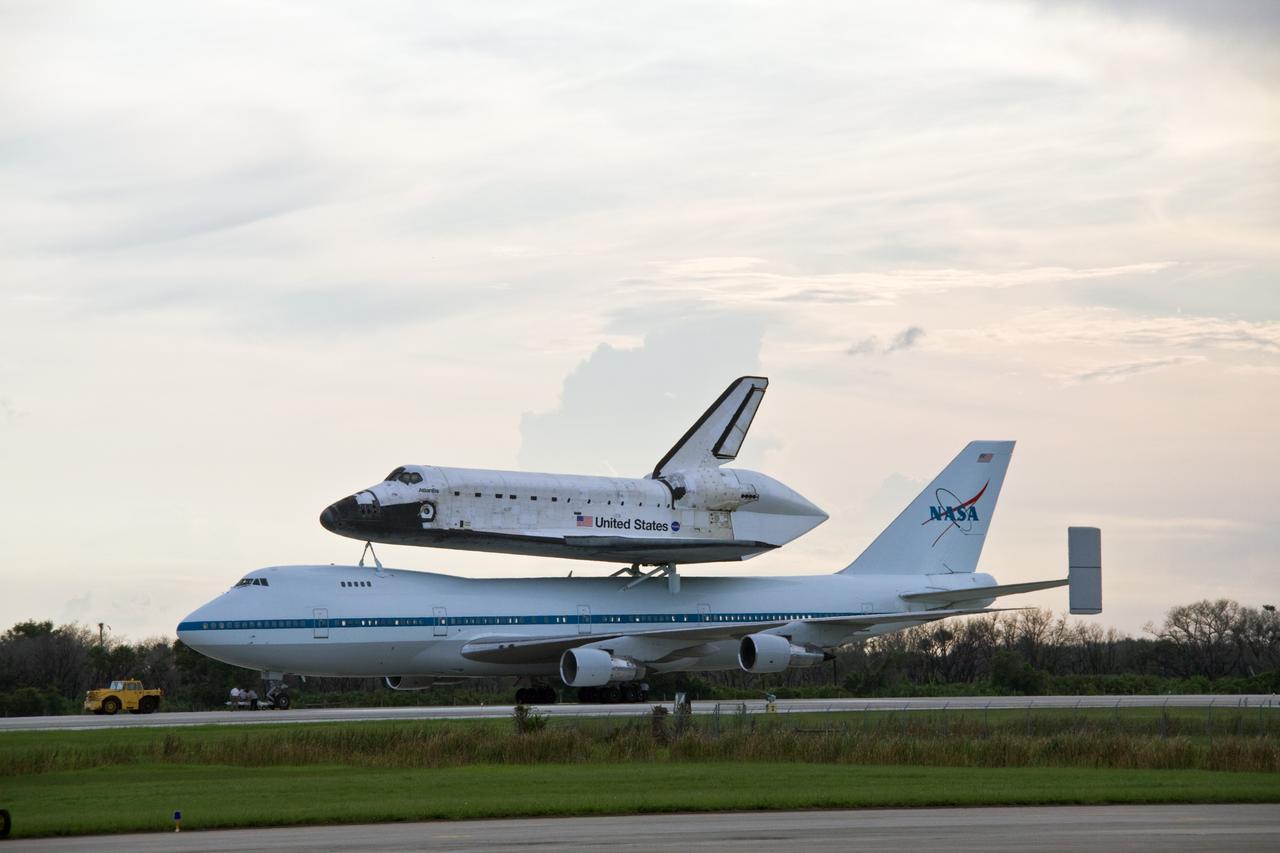
CAPE CANAVERAL, Fla. – After a two-day trip from California, space shuttle Atlantis, atop a Shuttle Carrier Aircraft, or SCA, is towed from the runway at NASA's Kennedy Space Center in Florida. The SCA is a modified Boeing 747 jetliner. Atlantis returned from California atop the SCA after its May 24 landing at Edwards Air Force Base, concluding mission STS-125. The ferry flight from Edwards Air Force Base began June 1. Atlantis' next assignment is the STS-129 mission, targeted to launch in November 2009. Photo credit: NASA/Jack Pfaller
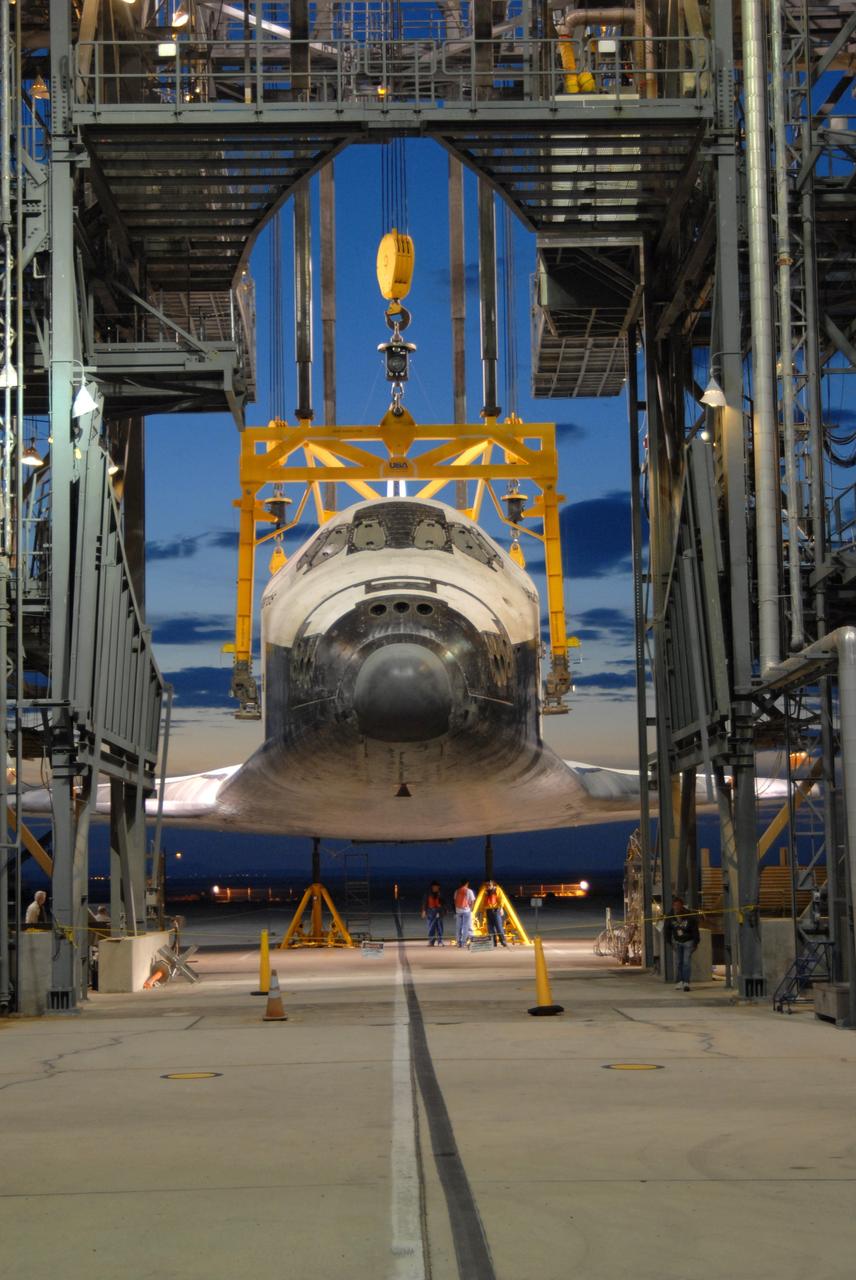
CAPE CANAVERAL, Fla. – At Edwards Air Force Base in California, a sling in the mate/demate device hoists space shuttle Atlantis from the ground. A Shuttle Carrier Aircraft, or SCA, will be moved underneath and Atlantis bolted to the top of the modified Boeing 747. Atlantis landed at Edwards on May 24, which concluded mission STS-125, after two landing opportunities at Kennedy were waved off due to weather concerns. Atlantis is being returned to Florida on a ferry flight on the SCA. Atlantis' next assignment is the STS-129 mission, targeted to launch in November 2009. Photo credit: NASA/Ben Smegelsky

CAPE CANAVERAL, Fla. – Bolted onto the Shuttle Carrier Aircraft, or SCA, a modified Boeing 747, space shuttle Atlantis gets ready for takeoff from Edwards Air Force Base in California, headed for its first stop at Biggs Army Air Field in El Paso, Texas. Atlantis landed at Edwards on May 24, which concluded mission STS-125, after two landing opportunities at Kennedy were waved off due to weather concerns. Atlantis is being returned to Florida on a ferry flight on the SCA. Atlantis' next assignment is the STS-129 mission, targeted to launch in November 2009. Photo credit: NASA/Ben Smegelsky
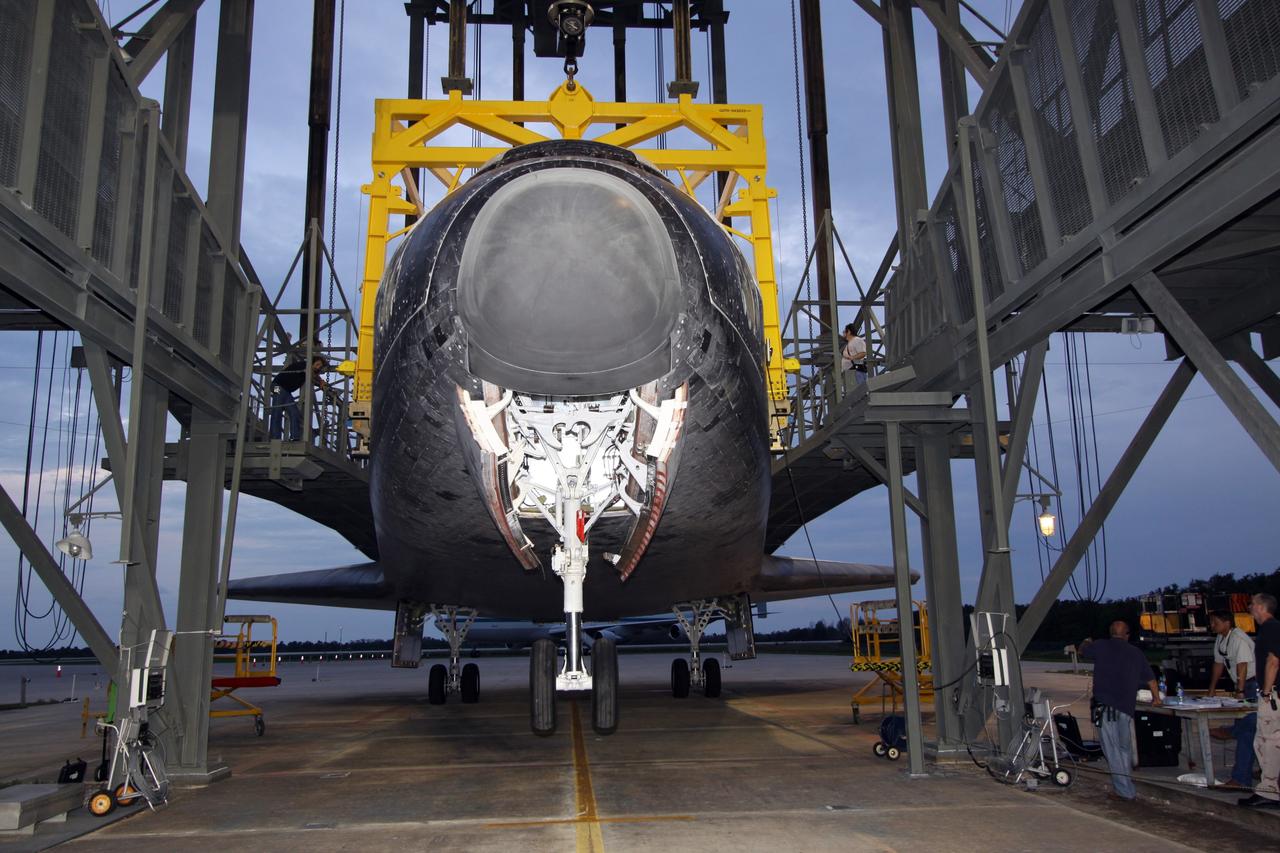
CAPE CANAVERAL, Fla. – On the Shuttle Landing Facility at NASA's Kennedy Space Center in Florida, wheels are down on space shuttle Atlantis as it is prepared to be towed to Orbiter Processing Facility 1. After its May 24 landing at Edwards Air Force Base in California, which concluded its STS-125 mission, the modified Boeing 747 Shuttle Carrier Aircraft carried the shuttle on a two-day ferry flight from Edwards to Kennedy beginning June 1. Atlantis' next assignment is the STS-129 mission, targeted to launch in November 2009. Photo credit: NASA/Jack Pfaller
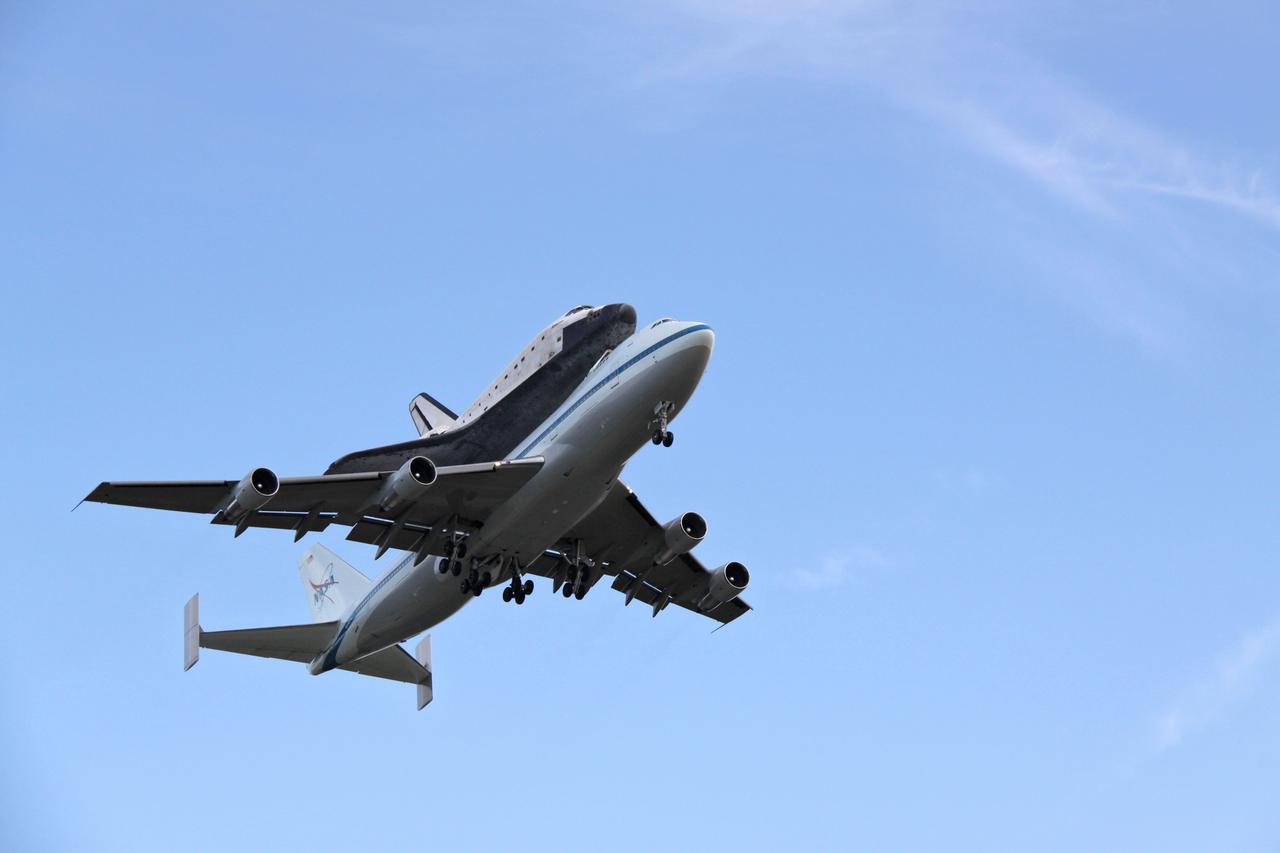
CAPE CANAVERAL, Fla. – After a two-day trip from California, the Shuttle Carrier Aircraft, or SCA, and its piggyback passenger space shuttle Atlantis approach NASA Kennedy Space Center's Shuttle Landing Facility runway. The SCA is a modified Boeing 747 jetliner. Atlantis returned from California atop the SCA after its May 24 landing at Edwards Air Force Base, concluding mission STS-125. The ferry flight from Edwards Air Force Base began June 1. Touchdown at Kennedy was at 6:53 p.m. EDT. Photo credit: NASA/Jack Pfaller
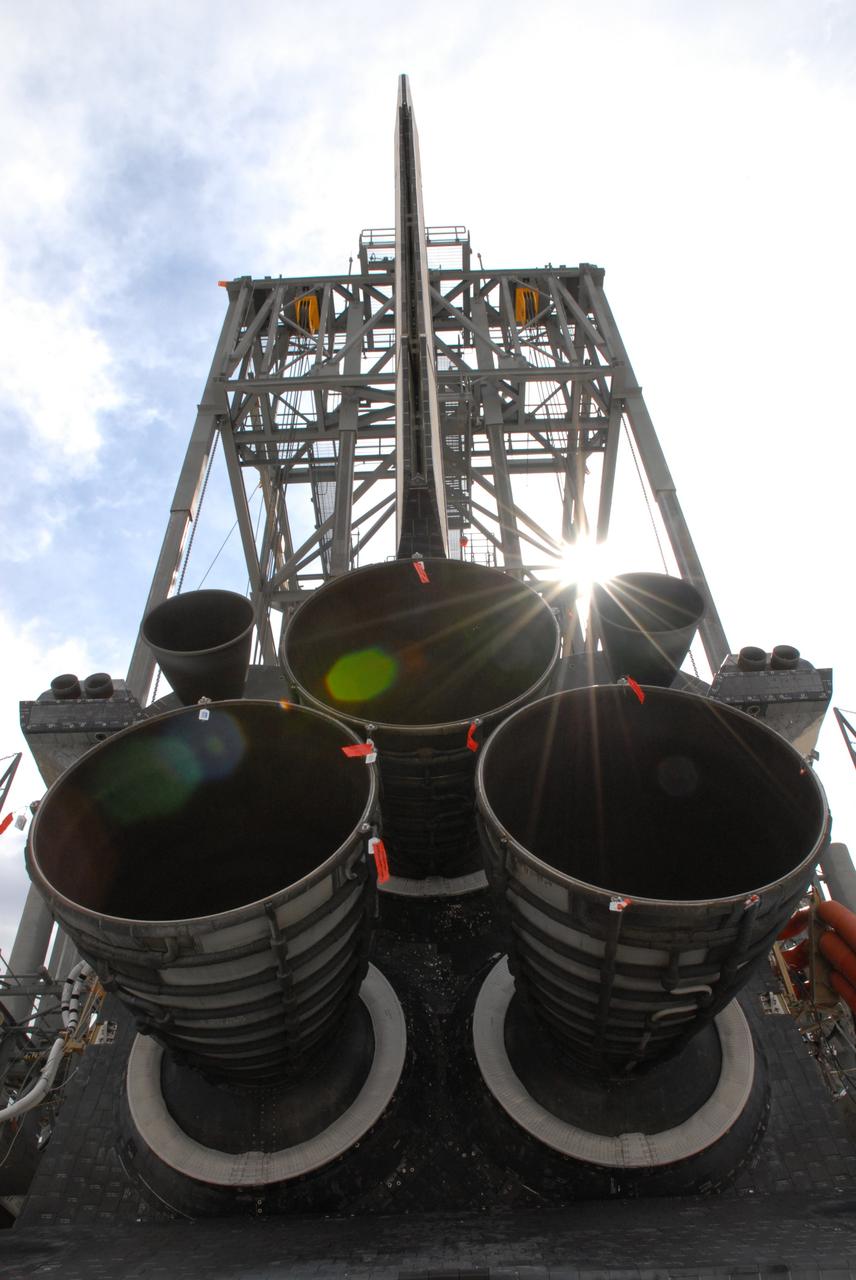
CAPE CANAVERAL, Fla. – The sun casts diamond-bright light over space shuttle Atlantis under the mate/demate device at Edwards Air Force Base in California. Atlantis is being fitted with a sling to lift it for attachment to the Shuttle Carrier Aircraft, or SCA, a modified Boeing 747. Atlantis landed at Edwards on May 24, which concluded mission STS-125, after two landing opportunities at Kennedy were waved off due to weather concerns. Atlantis is being returned to Florida on a ferry flight on the SCA. Atlantis' next assignment is the STS-129 mission, targeted to launch in November 2009. Photo credit: NASA/Ben Smegelsky
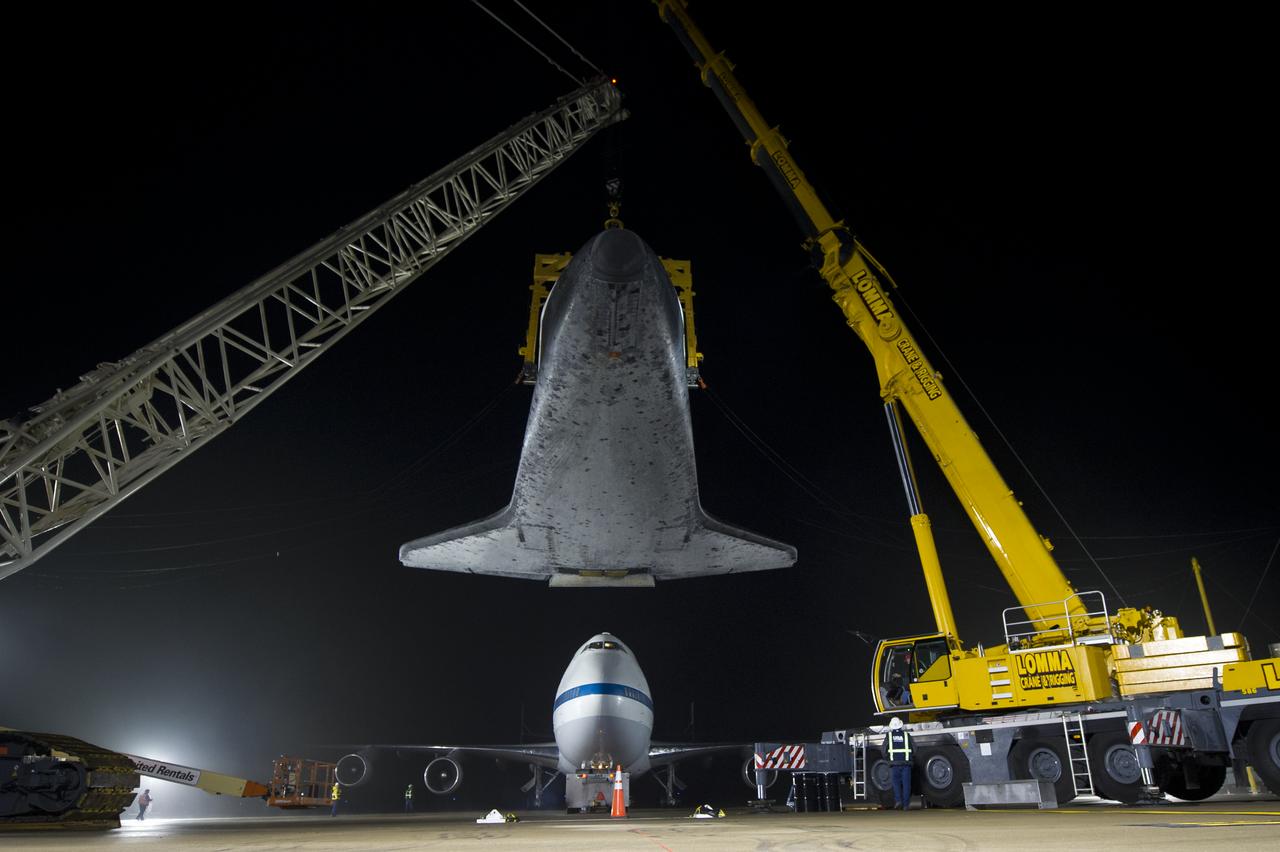
The space shuttle Discovery is suspended from a sling held by two cranes as the NASA 747 Shuttle Carrier Aircraft (SCA) is pushed back from underneath at Washington Dulles International Airport, Thursday, April 19, 2012, in Sterling, VA. Discovery, the first orbiter retired from NASA’s shuttle fleet, completed 39 missions, spent 365 days in space, orbited the Earth 5,830 times, and traveled 148,221,675 miles. NASA will transfer Discovery to the National Air and Space Museum to begin its new mission to commemorate past achievements in space and to educate and inspire future generations of explorers. Photo Credit: (NASA/Bill Ingalls)
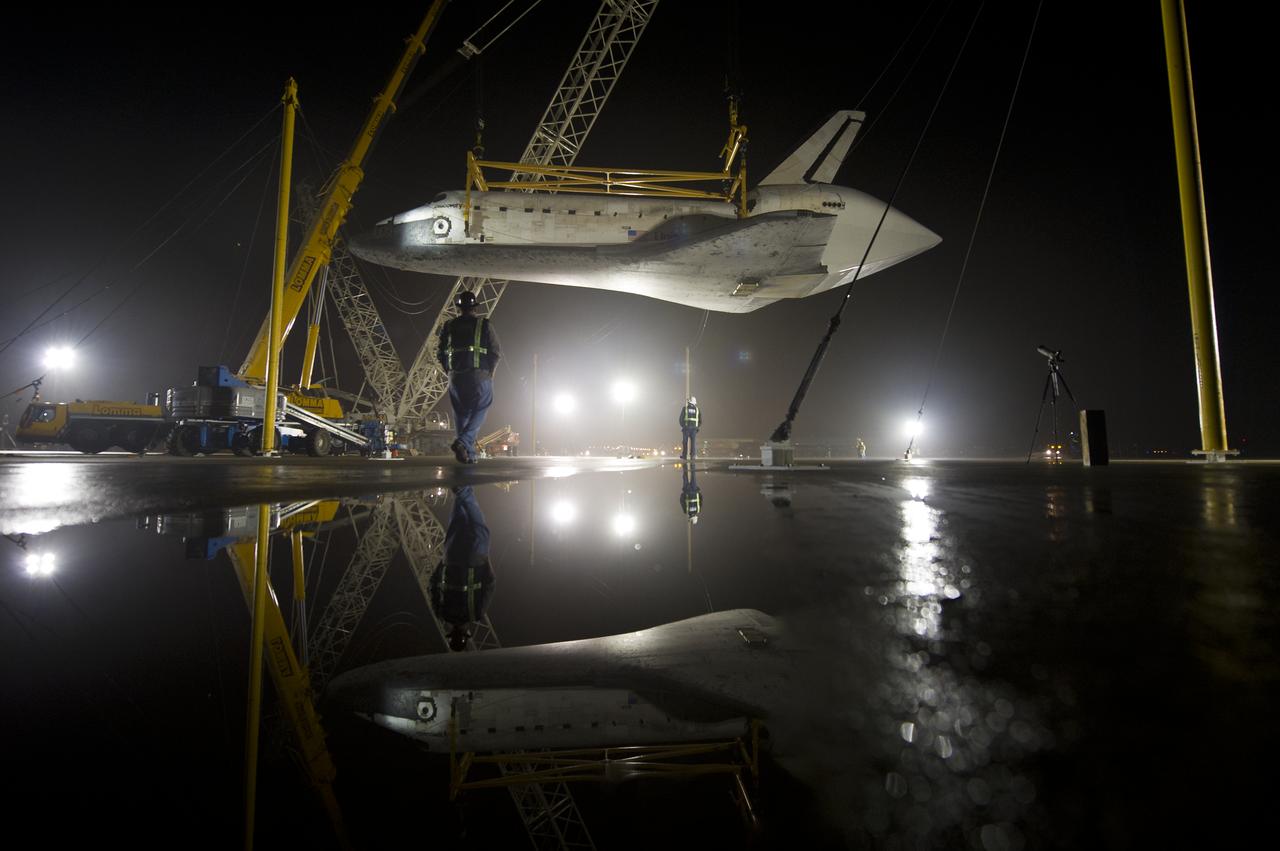
The space shuttle Discovery is suspended from a sling held by two cranes shortly after the NASA 747 Shuttle Carrier Aircraft (SCA) was pushed back from underneath at Washington Dulles International Airport, Thursday, April 19, 2012, in Sterling, VA. Discovery, the first orbiter retired from NASA’s shuttle fleet, completed 39 missions, spent 365 days in space, orbited the Earth 5,830 times, and traveled 148,221,675 miles. NASA will transfer Discovery to the National Air and Space Museum to begin its new mission to commemorate past achievements in space and to educate and inspire future generations of explorers. Photo Credit: (NASA/Bill Ingalls)
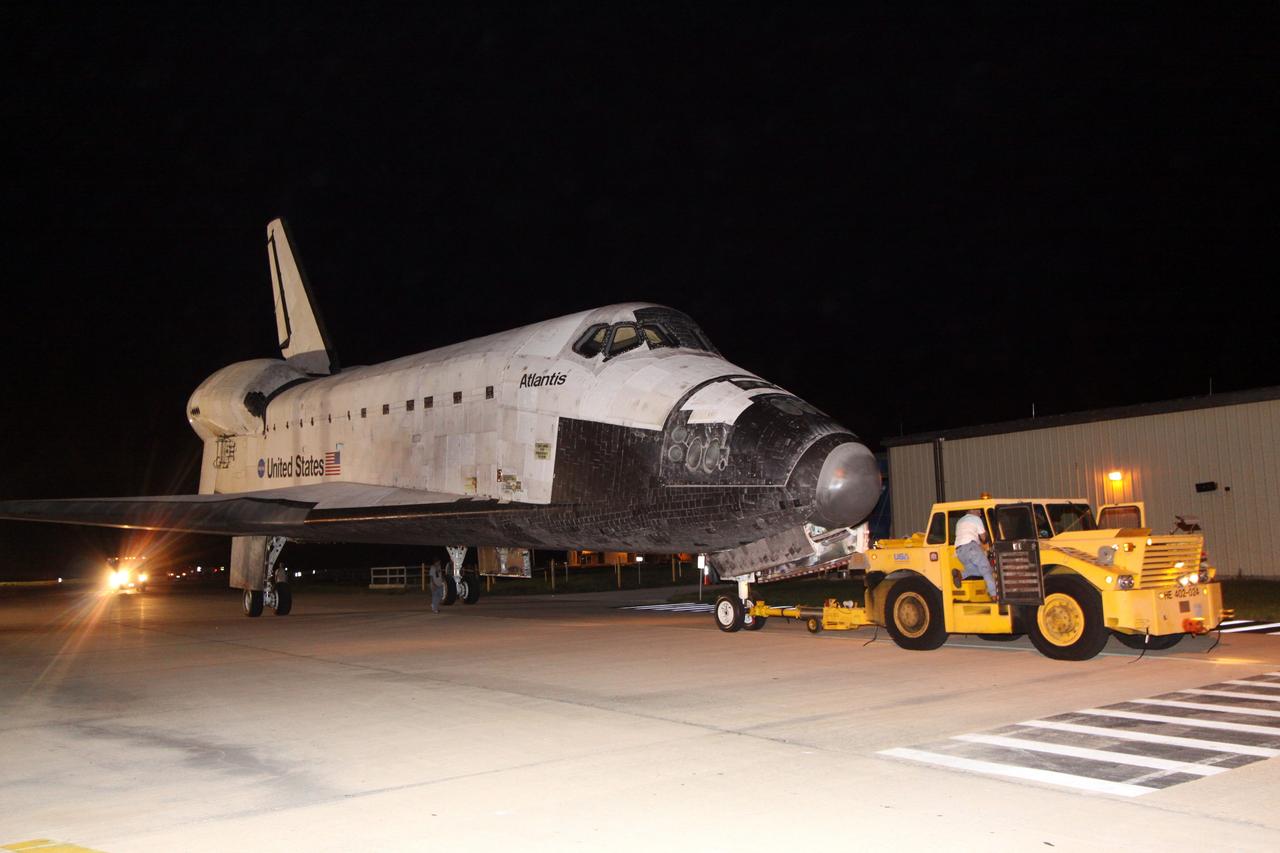
CAPE CANAVERAL, Fla. – On the Shuttle Landing Facility at NASA's Kennedy Space Center in Florida, space shuttle Atlantis is moved away from the mate/demate device where it was separated from the Shuttle Carrier Aircraft, or SCA. Atlantis will be towed to Orbiter Processing Facility 1. After its May 24 landing at Edwards Air Force Base in California, which concluded its STS-125 mission, the modified Boeing 747 SCA carried the shuttle on a two-day ferry flight from Edwards to Kennedy beginning June 1. Atlantis' next assignment is the STS-129 mission, targeted to launch in November 2009. Photo credit: NASA/Jack Pfaller
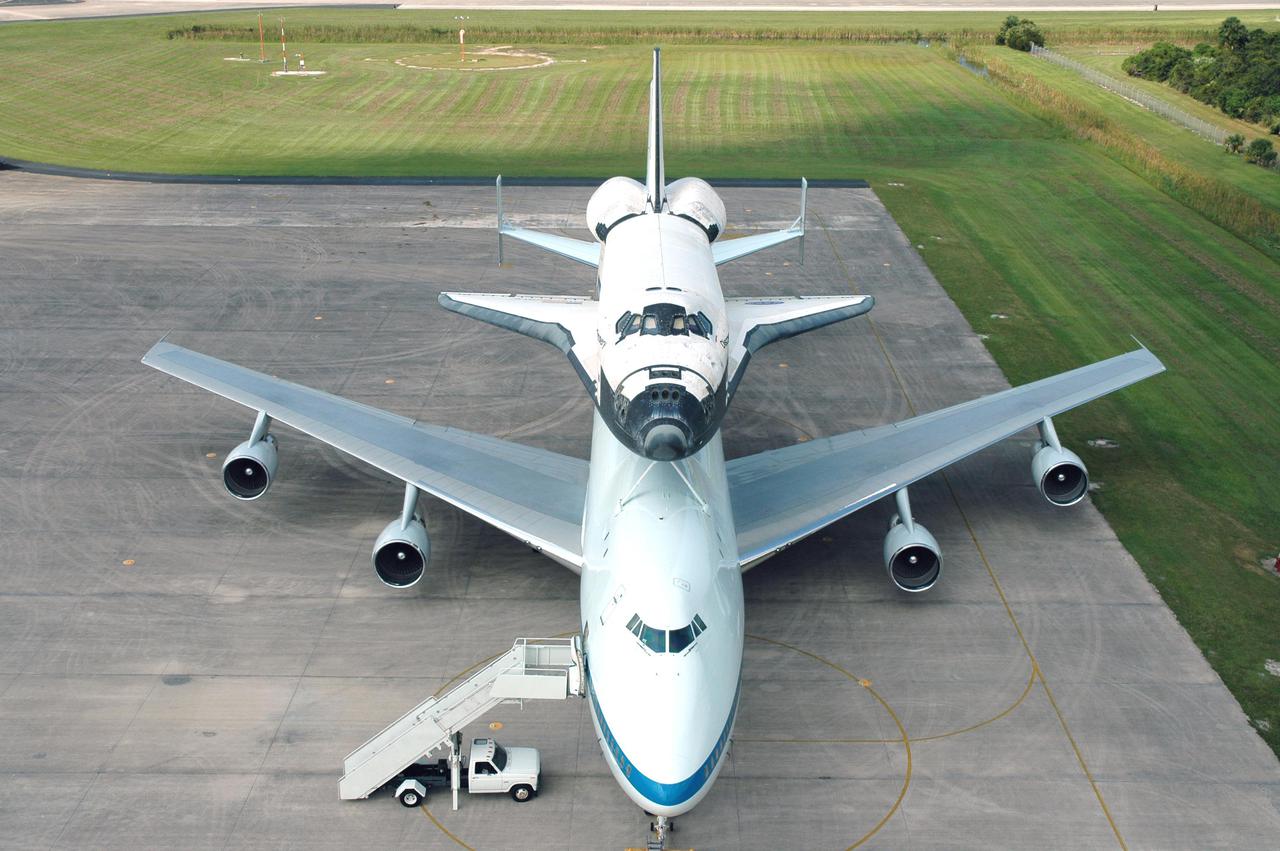
KENNEDY SPACE CENTER, FLA. - Space Shuttle Discovery, atop a modified Boeing 747 Shuttle Carrier Aircraft (SCA), has arrived at the Mate_Demate Device (MDD) at NASA Kennedy Space Center's Shuttle Landing Facility (SLF) following touchdown on runway 15 at about 10:00 a.m. EDT. The cross-country ferry flight became necessary when two days of unfavorable weather conditions at KSC forced Discovery to land on runway 22 at Edwards Air Force Base, Calif., on Aug. 9 following mission STS-114. On the return trip, stops were made at Altus Air Force Base, Okla., and Barksdale Air Force Base, La., where Discovery stayed for two nights. A crane on the MDD will lift Discovery from the SCA and place it on solid ground. Discovery will then be towed to the Orbiter Processing Facility where preparations will begin for its next flight, STS-121.
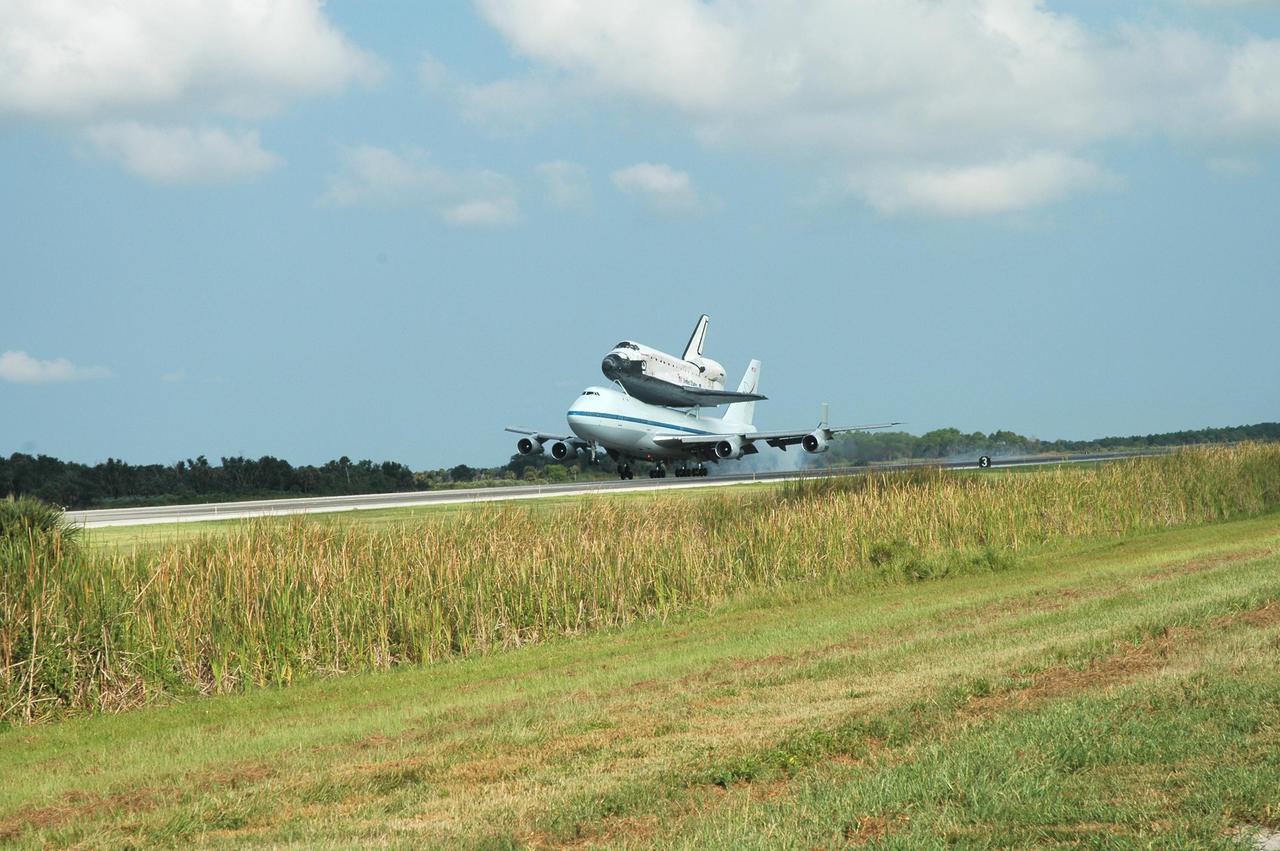
KENNEDY SPACE CENTER, FLA. - Space Shuttle Discovery, atop a modified Boeing 747 Shuttle Carrier Aircraft (SCA), touches down on runway 15 at NASA Kennedy Space Center's Shuttle Landing Facility (SLF) at about 10:00 a.m. EDT. The cross-country ferry flight became necessary when two days of unfavorable weather conditions at KSC forced Discovery to land on runway 22 at Edwards Air Force Base, Calif., on Aug. 9 following mission STS-114. On the return trip, stops were made at Altus Air Force Base, Okla., and Barksdale Air Force Base, La., where Discovery stayed for two nights. The SCA and Discovery will be towed to the Mate_Demate Device at the SLF where a crane will lift Discovery from the SCA and place it on solid ground. Discovery will then be towed to the Orbiter Processing Facility where preparations will begin for its next flight, STS-121.
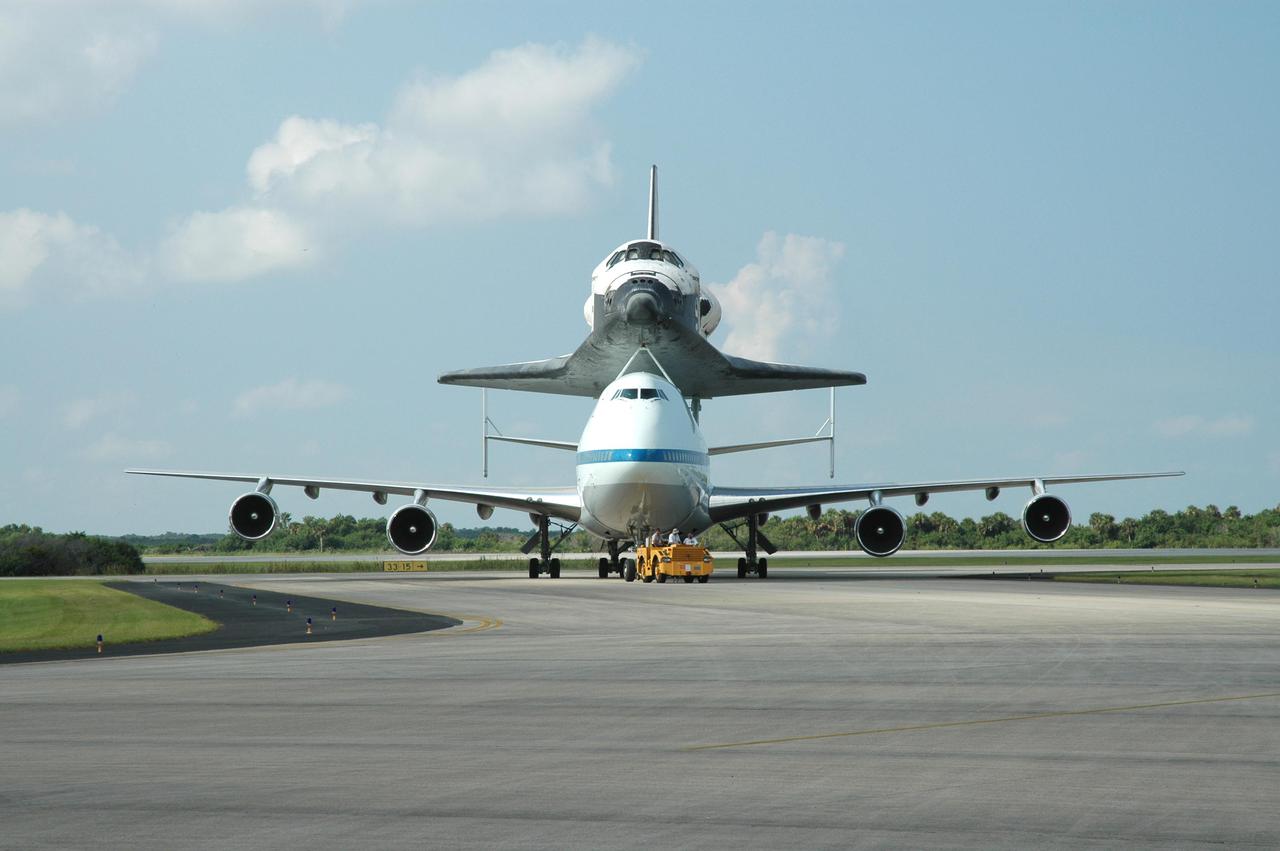
KENNEDY SPACE CENTER, FLA. - Space Shuttle Discovery, atop a modified Boeing 747 Shuttle Carrier Aircraft (SCA), is towed to the Mate_Demate Device (MDD) at NASA Kennedy Space Center's Shuttle Landing Facility (SLF) following touchdown on runway 15 at about 10:00 a.m. EDT. The cross-country ferry flight became necessary when two days of unfavorable weather conditions at KSC forced Discovery to land on runway 22 at Edwards Air Force Base, Calif., on Aug. 9 following mission STS-114. On the return trip, stops were made at Altus Air Force Base, Okla., and Barksdale Air Force Base, La., where Discovery stayed for two nights. A crane on the MDD will lift Discovery from the SCA and place it on solid ground. Discovery will then be towed to the Orbiter Processing Facility where preparations will begin for its next flight, STS-121.
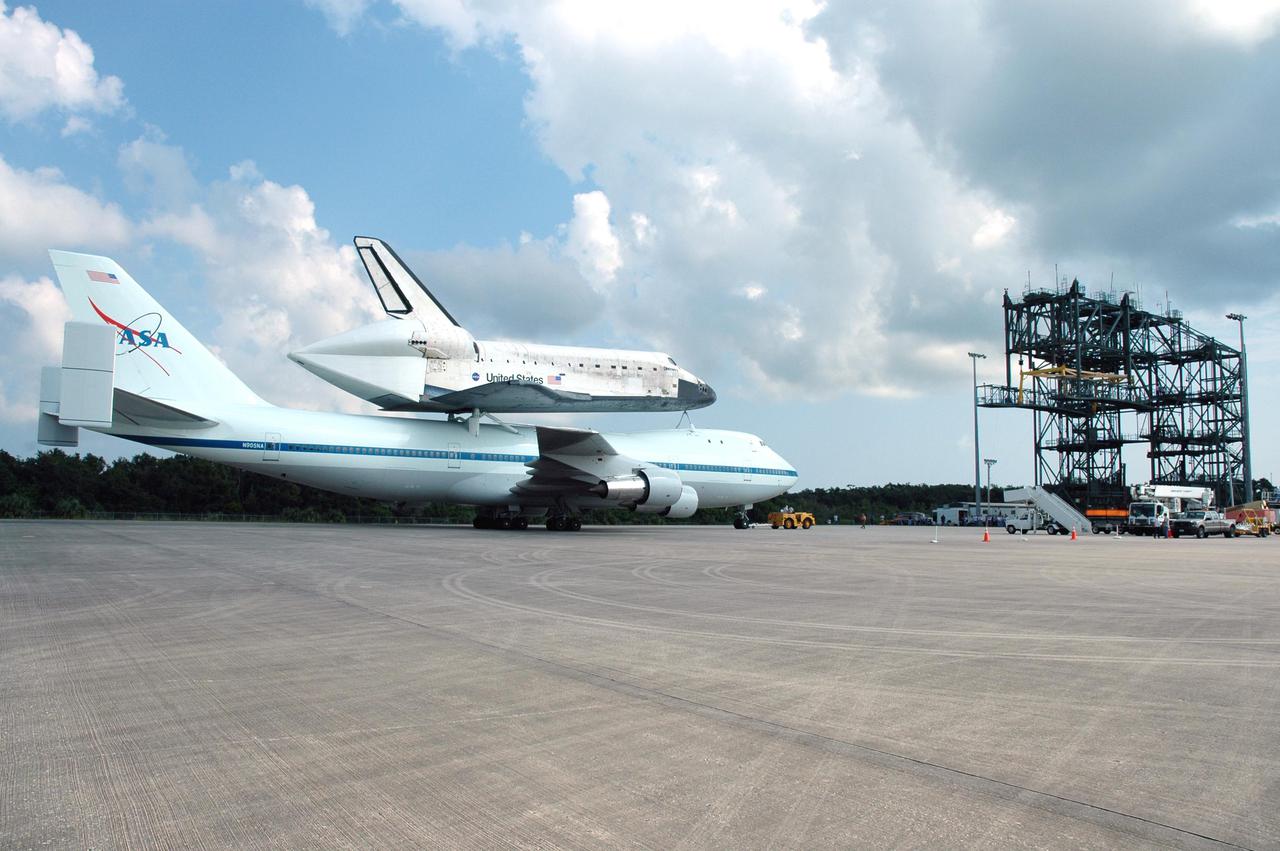
KENNEDY SPACE CENTER, FLA. - Space Shuttle Discovery, atop a modified Boeing 747 Shuttle Carrier Aircraft (SCA), is towed to the Mate_Demate Device (MDD), at right, at NASA Kennedy Space Center's Shuttle Landing Facility (SLF) following touchdown on runway 15 at about 10:00 a.m. EDT. The cross-country ferry flight became necessary when two days of unfavorable weather conditions at KSC forced Discovery to land on runway 22 at Edwards Air Force Base, Calif., on Aug. 9 following mission STS-114. On the return trip, stops were made at Altus Air Force Base, Okla., and Barksdale Air Force Base, La., where Discovery stayed for two nights. A crane on the MDD will lift Discovery from the SCA and place it on solid ground. Discovery will then be towed to the Orbiter Processing Facility where preparations will begin for its next flight, STS-121.
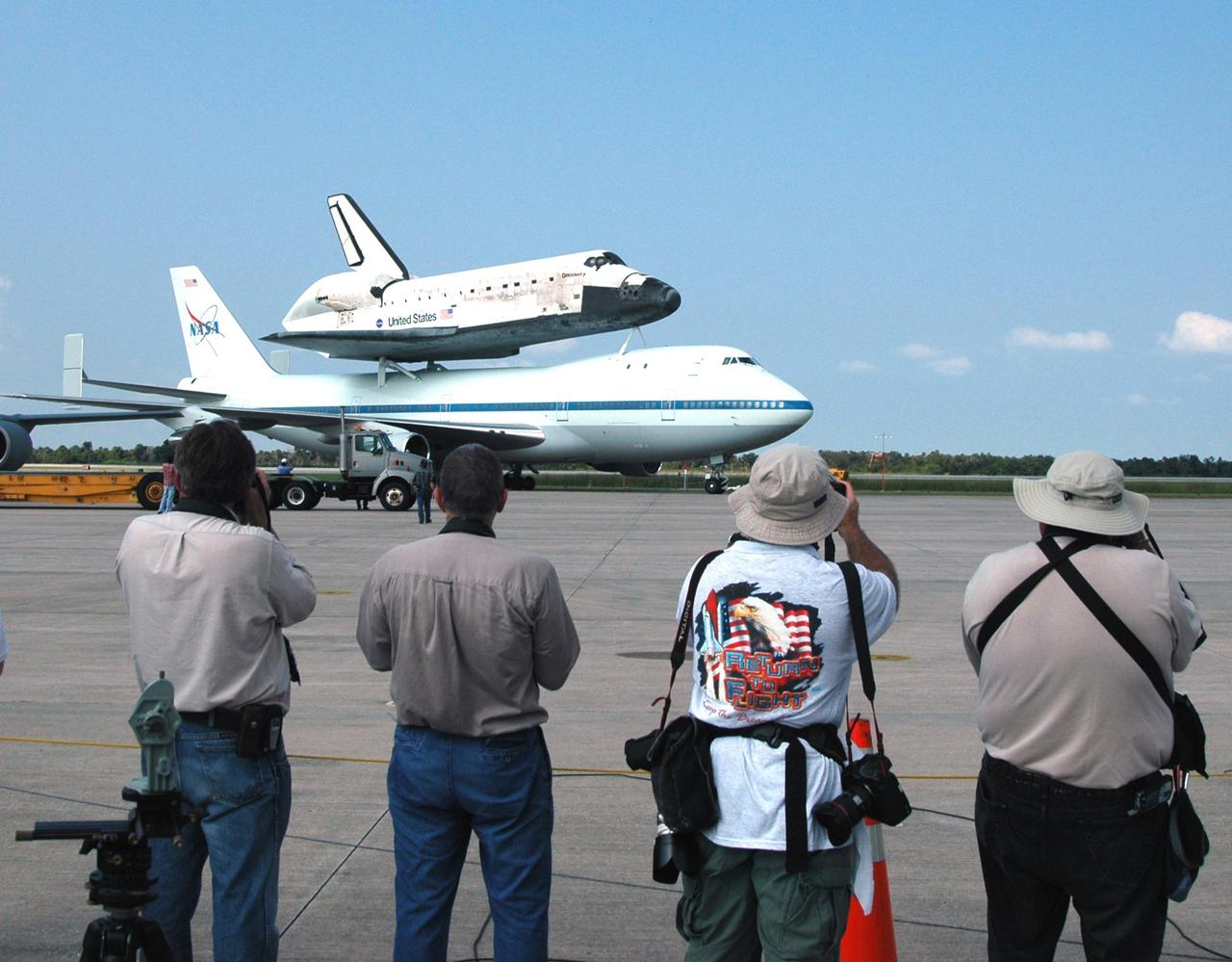
KENNEDY SPACE CENTER, FLA. - News media photographers are on hand for the touchdown of Space Shuttle Discovery, atop a modified Boeing 747 Shuttle Carrier Aircraft (SCA), on runway 15 at NASA Kennedy Space Center's Shuttle Landing Facility (SLF) at about 10:00 a.m. EDT. The cross-country ferry flight became necessary when two days of unfavorable weather conditions at KSC forced Discovery to land on runway 22 at Edwards Air Force Base, Calif., on Aug. 9 following mission STS-114. On the return trip, stops were made at Altus Air Force Base, Okla., and Barksdale Air Force Base, La., where Discovery stayed for two nights. The SCA and Discovery will be towed to the Mate_Demate Device at the SLF where a crane will lift Discovery from the SCA and place it on solid ground. Discovery will then be towed to the Orbiter Processing Facility where preparations will begin for its next flight, STS-121.
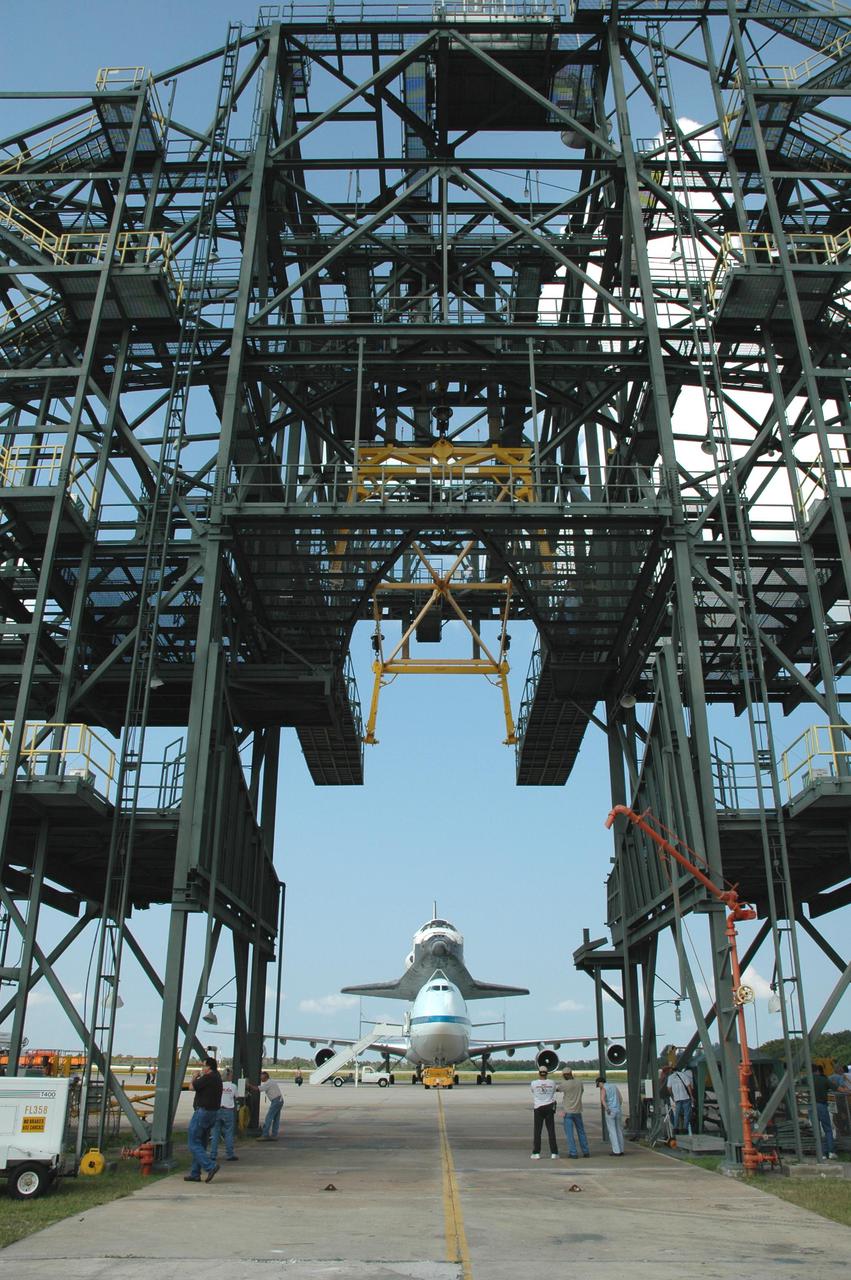
KENNEDY SPACE CENTER, FLA. - Space Shuttle Discovery, atop a modified Boeing 747 Shuttle Carrier Aircraft (SCA), is towed toward the Mate_Demate Device (MDD), in the foreground, at NASA Kennedy Space Center's Shuttle Landing Facility (SLF) following touchdown on runway 15 at about 10:00 a.m. EDT. The cross-country ferry flight became necessary when two days of unfavorable weather conditions at KSC forced Discovery to land on runway 22 at Edwards Air Force Base, Calif., on Aug. 9 following mission STS-114. On the return trip, stops were made at Altus Air Force Base, Okla., and Barksdale Air Force Base, La., where Discovery stayed for two nights. A crane on the MDD will lift Discovery from the SCA and place it on solid ground. Discovery will then be towed to the Orbiter Processing Facility where preparations will begin for its next flight, STS-121.
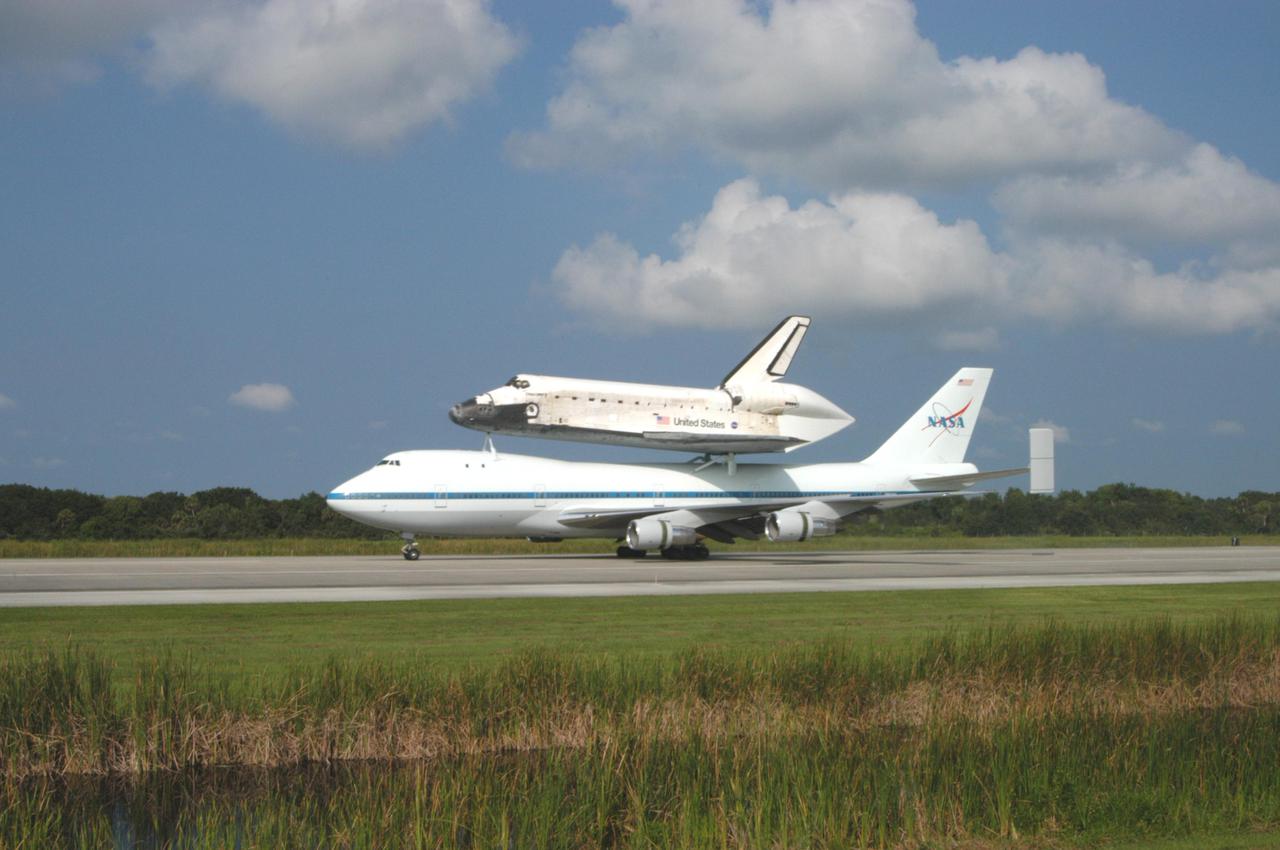
KENNEDY SPACE CENTER, FLA. - Space Shuttle Discovery, atop a modified Boeing 747 Shuttle Carrier Aircraft (SCA), lands on runway 15 at NASA Kennedy Space Center's Shuttle Landing Facility (SLF) at about 10:00 a.m. EDT. The cross-country ferry flight became necessary when two days of unfavorable weather conditions at KSC forced Discovery to land on runway 22 at Edwards Air Force Base, Calif., on Aug. 9 following mission STS-114. On the return trip, stops were made at Altus Air Force Base, Okla., and Barksdale Air Force Base, La., where Discovery stayed for two nights. The SCA and Discovery will be towed to the Mate_Demate Device at the SLF where a crane will lift Discovery from the SCA and place it on solid ground. Discovery will then be towed to the Orbiter Processing Facility where preparations will begin for its next flight, STS-121.
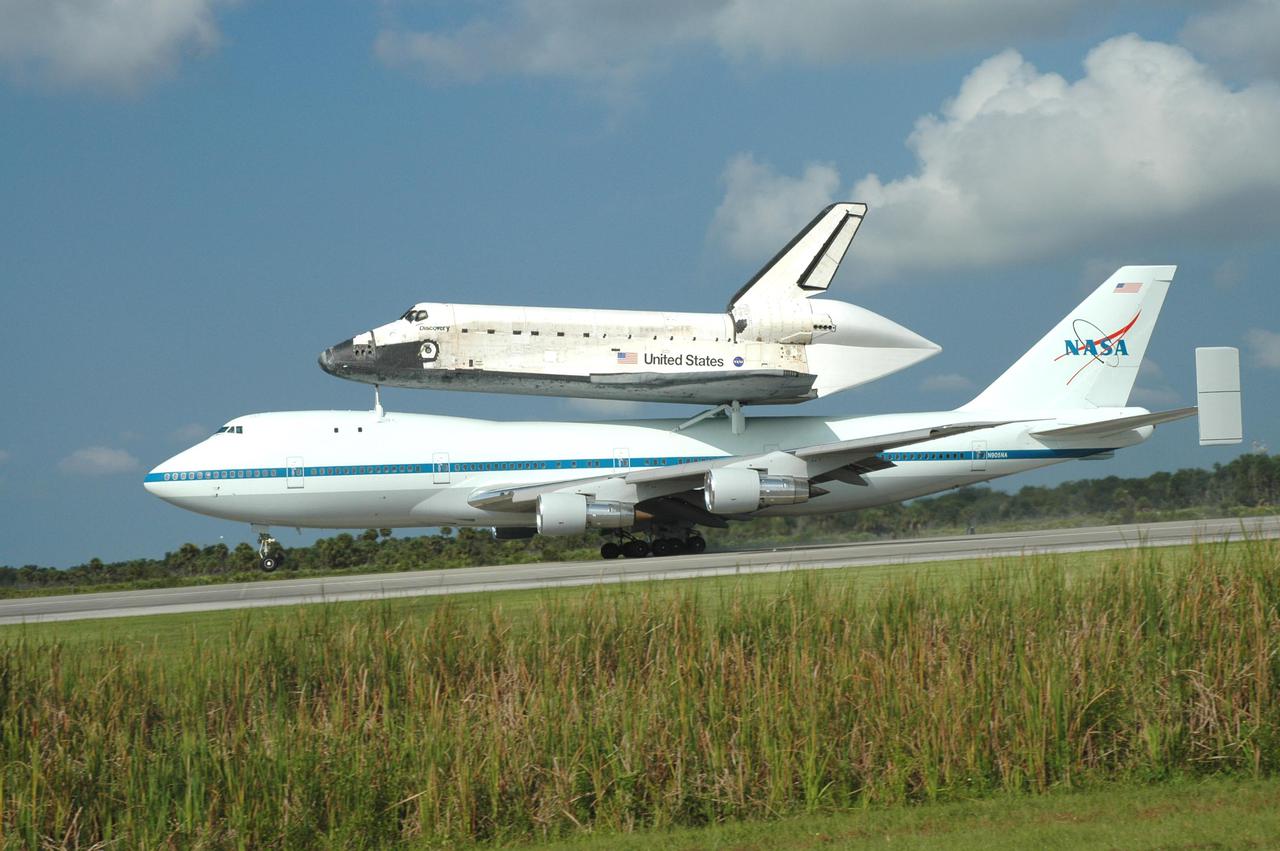
KENNEDY SPACE CENTER, FLA. - Space Shuttle Discovery, atop a modified Boeing 747 Shuttle Carrier Aircraft (SCA), touches down on runway 15 at NASA Kennedy Space Center's Shuttle Landing Facility (SLF) at about 10:00 a.m. EDT. The cross-country ferry flight became necessary when two days of unfavorable weather conditions at KSC forced Discovery to land on runway 22 at Edwards Air Force Base, Calif., on Aug. 9 following mission STS-114. On the return trip, stops were made at Altus Air Force Base, Okla., and Barksdale Air Force Base, La., where Discovery stayed for two nights. The SCA and Discovery will be towed to the Mate_Demate Device at the SLF where a crane will lift Discovery from the SCA and place it on solid ground. Discovery will then be towed to the Orbiter Processing Facility where preparations will begin for its next flight, STS-121.

CAPE CANAVERAL, Fla. – At NASA Kennedy Space Center's Shuttle Landing Facility, workers surround the 747 Shuttle Carrier Aircraft with space shuttle Discovery on top after it was towed beneath the mate-demate device. The piggybacked shuttle and aircraft touched down on runway 33 at 12:05 p.m. EDT. Discovery landed at Edwards Air Force Base in California on Sept. 11 after the 13-day STS-128 mission to the International Space Station. Landings at Kennedy were waved off on two days due to inclement weather, leading to the landing at Edwards. The two-day return flight from California began at 9:20 a.m. EDT Sept. 20. Photo credit: NASA/Kim Shiflett
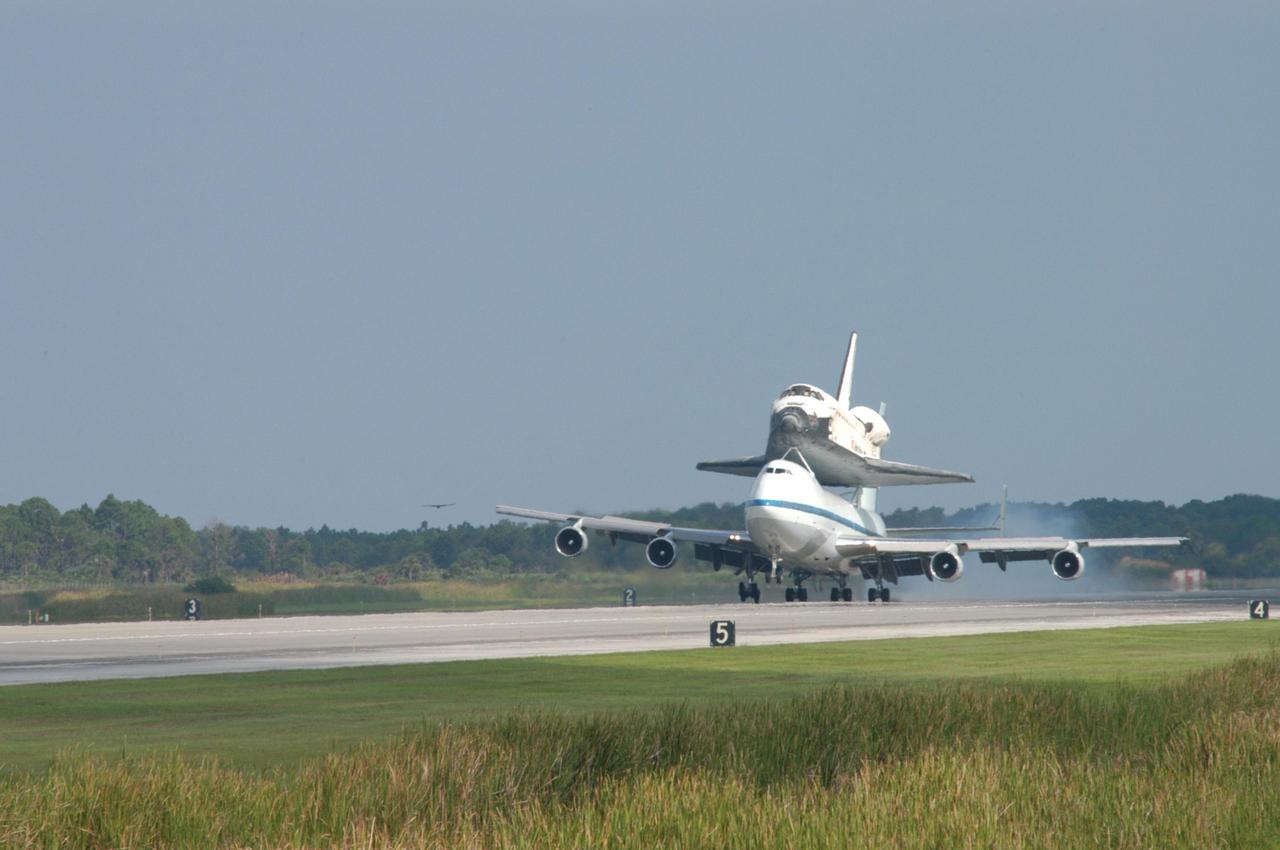
KENNEDY SPACE CENTER, FLA. - Space Shuttle Discovery, atop a modified Boeing 747 Shuttle Carrier Aircraft (SCA), lands on runway 15 at NASA Kennedy Space Center's Shuttle Landing Facility (SLF) at about 10:00 a.m. EDT. The cross-country ferry flight became necessary when two days of unfavorable weather conditions at KSC forced Discovery to land on runway 22 at Edwards Air Force Base, Calif., on Aug. 9 following mission STS-114. On the return trip, stops were made at Altus Air Force Base, Okla., and Barksdale Air Force Base, La., where Discovery stayed for two nights. The SCA and Discovery will be towed to the Mate_Demate Device at the SLF where a crane will lift Discovery from the SCA and place it on solid ground. Discovery will then be towed to the Orbiter Processing Facility where preparations will begin for its next flight, STS-121.
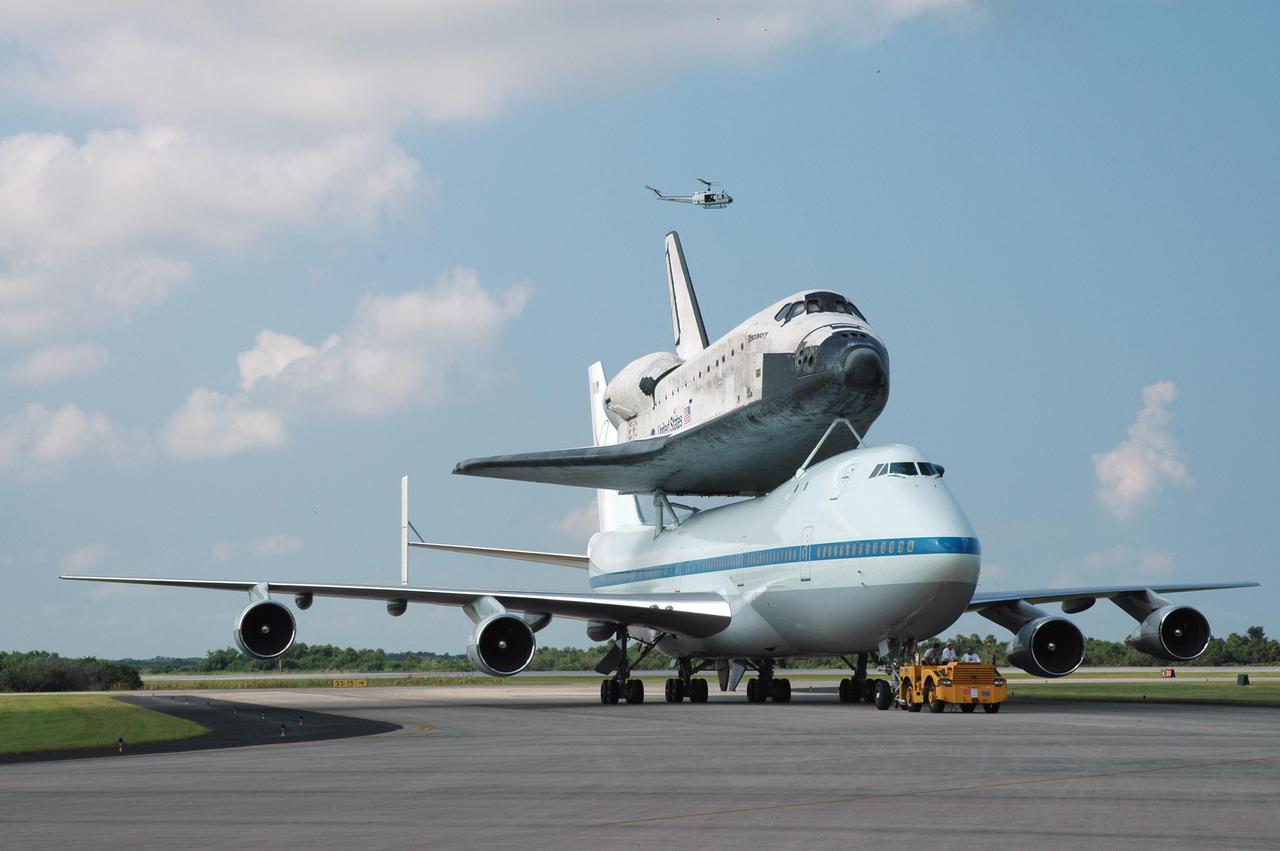
KENNEDY SPACE CENTER, FLA. - Space Shuttle Discovery, atop a modified Boeing 747 Shuttle Carrier Aircraft (SCA), is towed to the Mate_Demate Device (MDD) at NASA Kennedy Space Center's Shuttle Landing Facility (SLF) following touchdown on runway 15 at about 10:00 a.m. EDT. The cross-country ferry flight became necessary when two days of unfavorable weather conditions at KSC forced Discovery to land on runway 22 at Edwards Air Force Base, Calif., on Aug. 9 following mission STS-114. On the return trip, stops were made at Altus Air Force Base, Okla., and Barksdale Air Force Base, La., where Discovery stayed for two nights. A crane on the MDD will lift Discovery from the SCA and place it on solid ground. Discovery will then be towed to the Orbiter Processing Facility where preparations will begin for its next flight, STS-121.
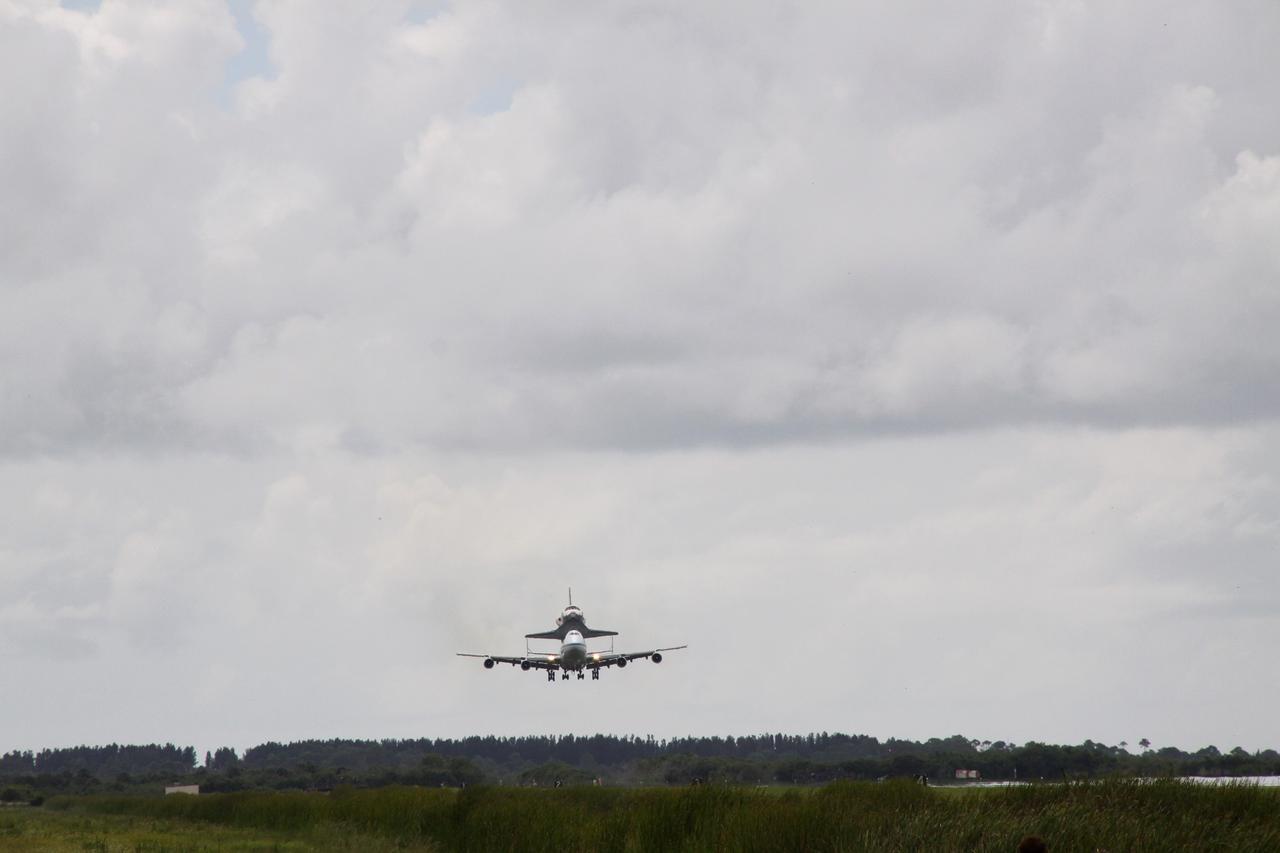
CAPE CANAVERAL, Fla. – Space shuttle Discovery arrives at NASA's Kennedy Space Center in Florida on the back of the Boeing 747 Shuttle Carrier Aircraft, or SCA. The two-day return flight from Edwards Air Force Base in California began at 9:20 a.m. EDT Sept. 20. After three fueling stops that included an overnight stay in Louisiana, the piggybacked shuttle had to navigate through a line of showers across Louisiana and around Kennedy. Discovery had landed at Edwards Sept. 11 after the 13-day STS-128 mission to the International Space Station. The shuttle delivered more than 7 tons of supplies, science racks and equipment, as well as additional environmental hardware to sustain six crew members on the station. Landings at Kennedy were waved off on two days due to inclement weather, leading to the landing at Edwards. Photo credit: NASA/Jack Pfaller
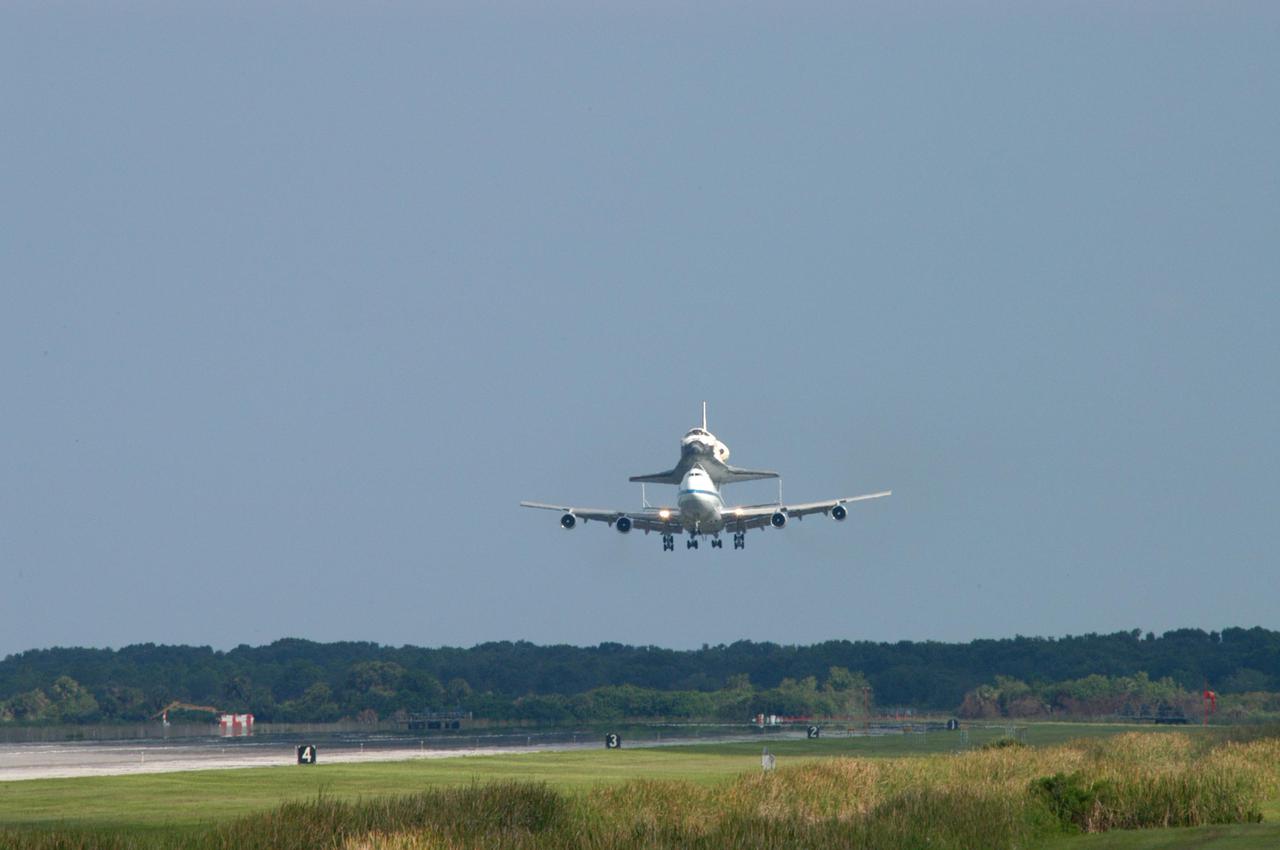
KENNEDY SPACE CENTER, FLA. - Space Shuttle Discovery, atop a modified Boeing 747 Shuttle Carrier Aircraft (SCA), is on its final approach to land on runway 15 at NASA Kennedy Space Center's Shuttle Landing Facility (SLF) at about 10:00 a.m. EDT. The cross-country ferry flight became necessary when two days of unfavorable weather conditions at KSC forced Discovery to land on runway 22 at Edwards Air Force Base, Calif., on Aug. 9 following mission STS-114. On the return trip, stops were made at Altus Air Force Base, Okla., and Barksdale Air Force Base, La., where Discovery stayed for two nights. The SCA and Discovery will be towed to the Mate_Demate Device at the SLF where a crane will lift Discovery from the SCA and place it on solid ground. Discovery will then be towed to the Orbiter Processing Facility where preparations will begin for its next flight, STS-121.
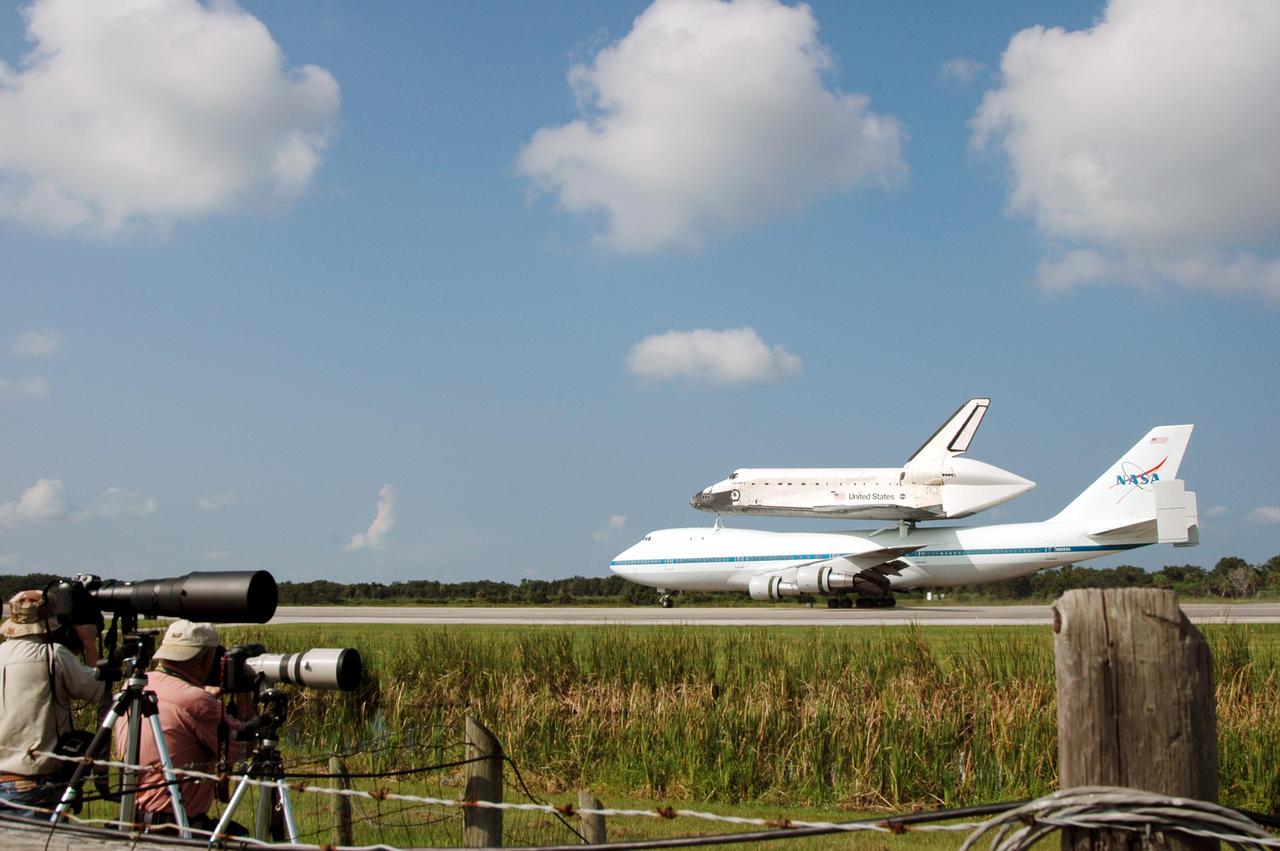
KENNEDY SPACE CENTER, FLA. - News media photographers capture the touchdown of Space Shuttle Discovery, atop a modified Boeing 747 Shuttle Carrier Aircraft (SCA), on runway 15 at NASA Kennedy Space Center's Shuttle Landing Facility (SLF) at about 10:00 a.m. EDT. The cross-country ferry flight became necessary when two days of unfavorable weather conditions at KSC forced Discovery to land on runway 22 at Edwards Air Force Base, Calif., on Aug. 9 following mission STS-114. On the return trip, stops were made at Altus Air Force Base, Okla., and Barksdale Air Force Base, La., where Discovery stayed for two nights. The SCA and Discovery will be towed to the Mate_Demate Device at the SLF where a crane will lift Discovery from the SCA and place it on solid ground. Discovery will then be towed to the Orbiter Processing Facility where preparations will begin for its next flight, STS-121.
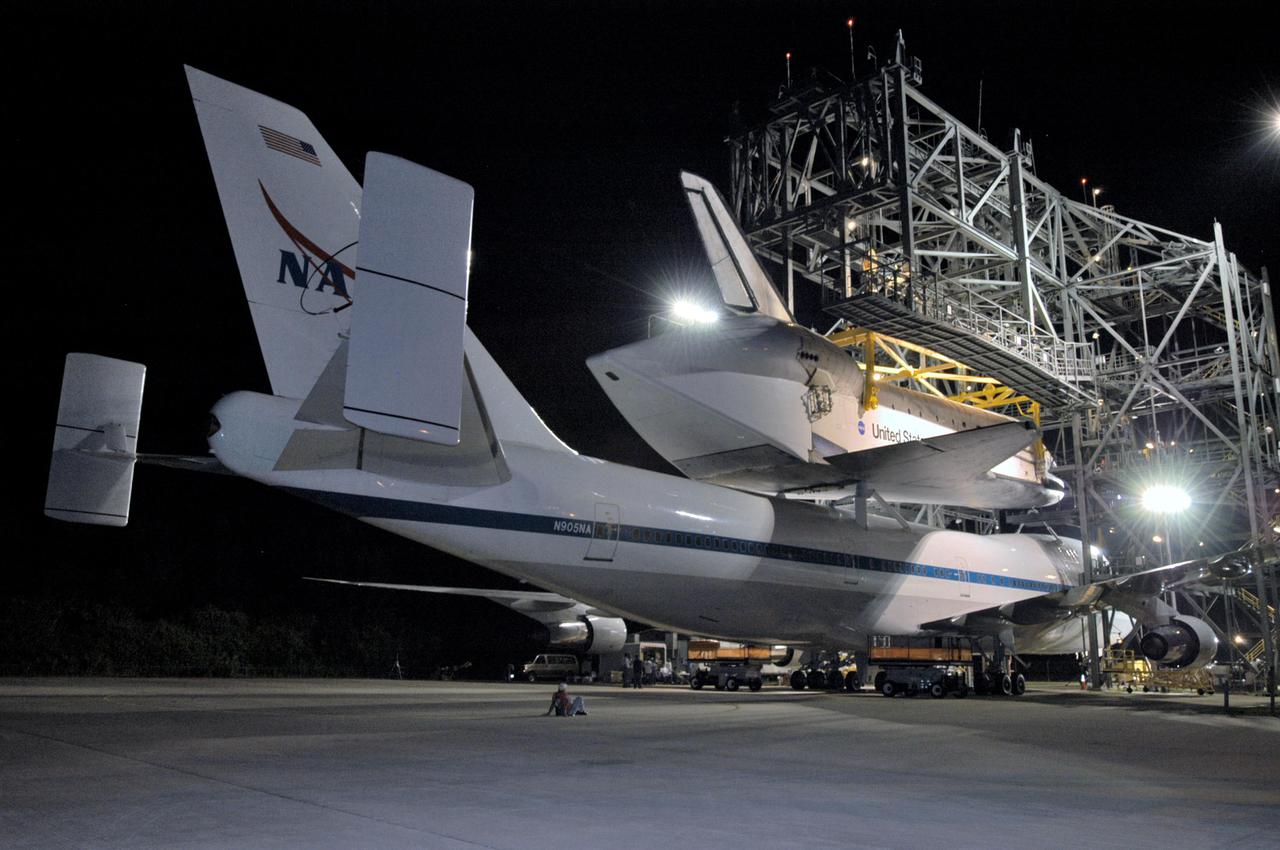
KENNEDY SPACE CENTER, FLA. - Near midnight, lights from the mate_demate device at NASA Kennedy Space Center’s Shuttle Landing Facility shine on the orbiter Discovery on top of the Shuttle Carrier Aircraft, a modified Boeing 747. Discovery was returned to Kennedy Space Center on a ferry flight from Edwards Air Force Base in California, where it landed Aug. 9 after 13 days in space on mission STS-114. In the mate_demate device, a horizontal structure mounted at the 80-foot level between two towers controls and guides a large lift beam that attaches to the orbiter to raise and lower it. Once Discovery is lifted off the back of the SCA, the 747 can then roll away and the orbiter will be lowered to the ground. It will then be towed from the SLF to the Orbiter Processing Facility. Once inside the OPF, the payload bay doors will be opened and the MPLM Raffaello brought back from the International Space Station will be unloaded and transferred to the Space Station Processing Facility. This concludes mission STS-114.
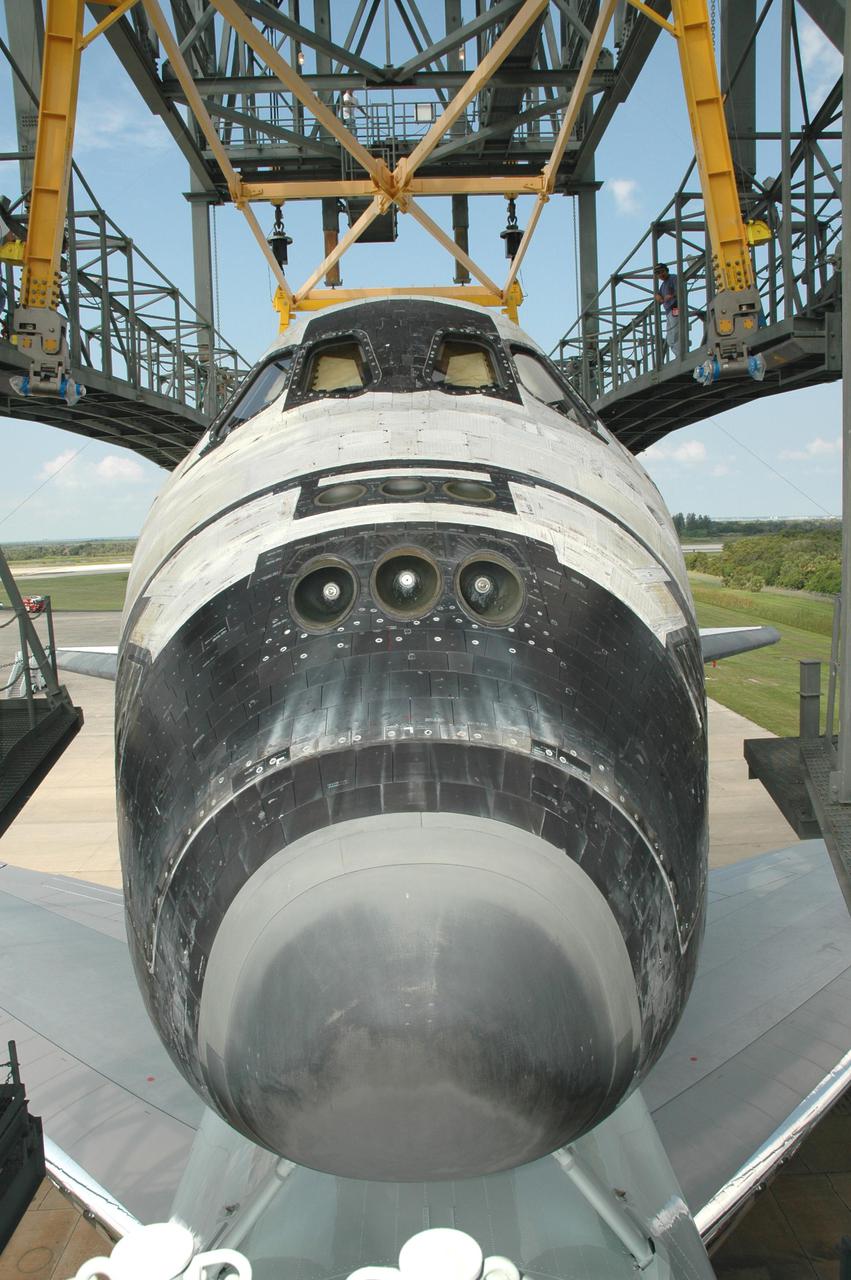
KENNEDY SPACE CENTER, FLA. - This view shows the orbiter Discovery on top of the Shuttle Carrier Aircraft, a modified Boeing 747, being towed into the mate_demate device at NASA Kennedy Space Center’s Shuttle Landing Facility. Discovery was returned to Kennedy Space Center on a ferry flight from Edwards Air Force Base in California, where it landed Aug. 9 after 13 days in space on mission STS-114. In the mate_demate device, a horizontal structure mounted at the 80-foot level between two towers controls and guides a large lift beam that attaches to the orbiter to raise and lower it. Once Discovery is lifted off the back of the SCA, the 747 can then roll away and the orbiter will be lowered to the ground. It will then be towed from the SLF to the Orbiter Processing Facility. Once inside the OPF, the payload bay doors will be opened and the MPLM Raffaello brought back from the International Space Station will be unloaded and transferred to the Space Station Processing Facility. This concludes mission STS-114.
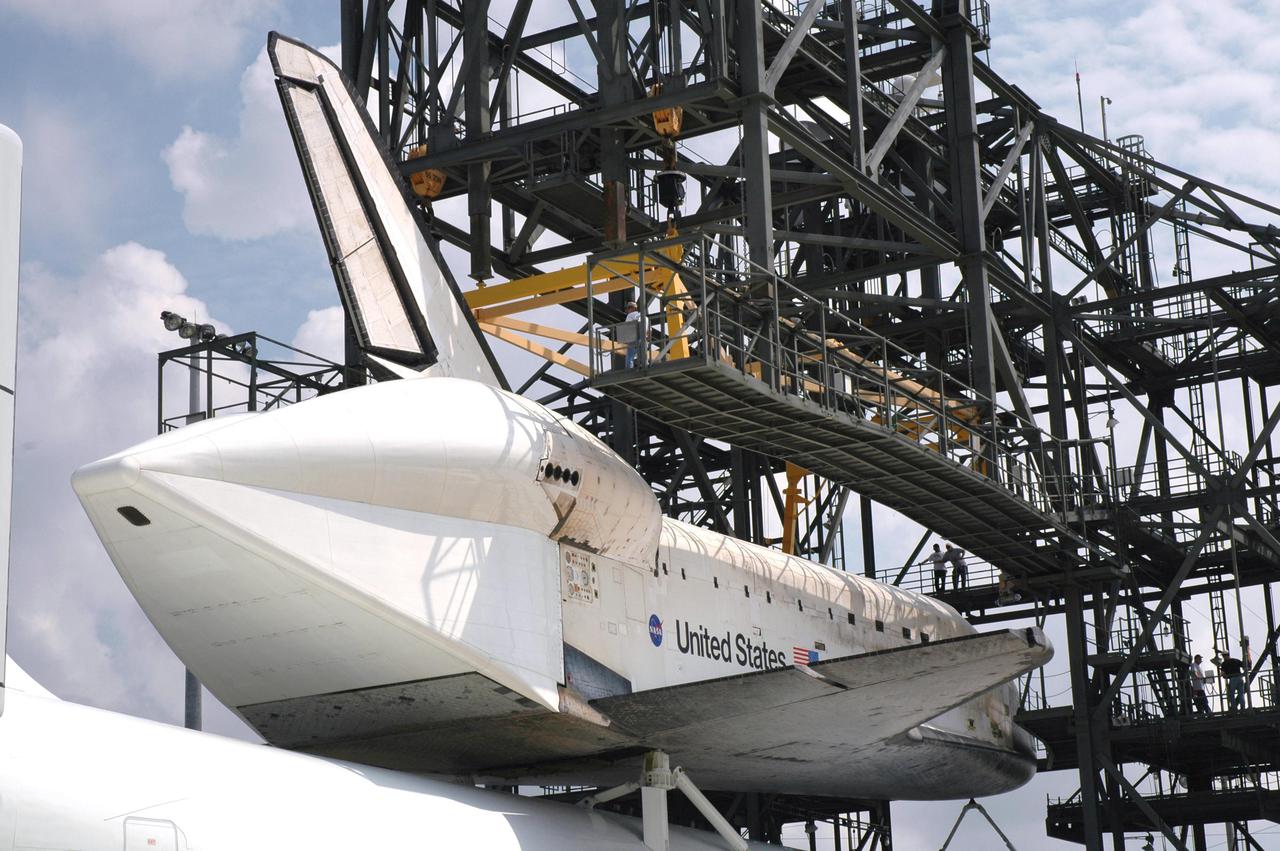
KENNEDY SPACE CENTER, FLA. - The orbiter Discovery on top of the Shuttle Carrier Aircraft, a modified Boeing 747, is towed into the mate_demate device at NASA Kennedy Space Center’s Shuttle Landing Facility. Visible in the closeup is the tail cone that covers the main engines during the ferry flight. Discovery was returned to Kennedy Space Center on a ferry flight from Edwards Air Force Base in California, where it landed Aug. 9 after 13 days in space on mission STS-114. In the mate_demate device, a horizontal structure mounted at the 80-foot level between two towers controls and guides a large lift beam that attaches to the orbiter to raise and lower it. Once Discovery is lifted off the back of the SCA, the 747 can then roll away and the orbiter will be lowered to the ground. It will then be towed from the SLF to the Orbiter Processing Facility. Once inside the OPF, the payload bay doors will be opened and the MPLM Raffaello brought back from the International Space Station will be unloaded and transferred to the Space Station Processing Facility. This concludes mission STS-114.
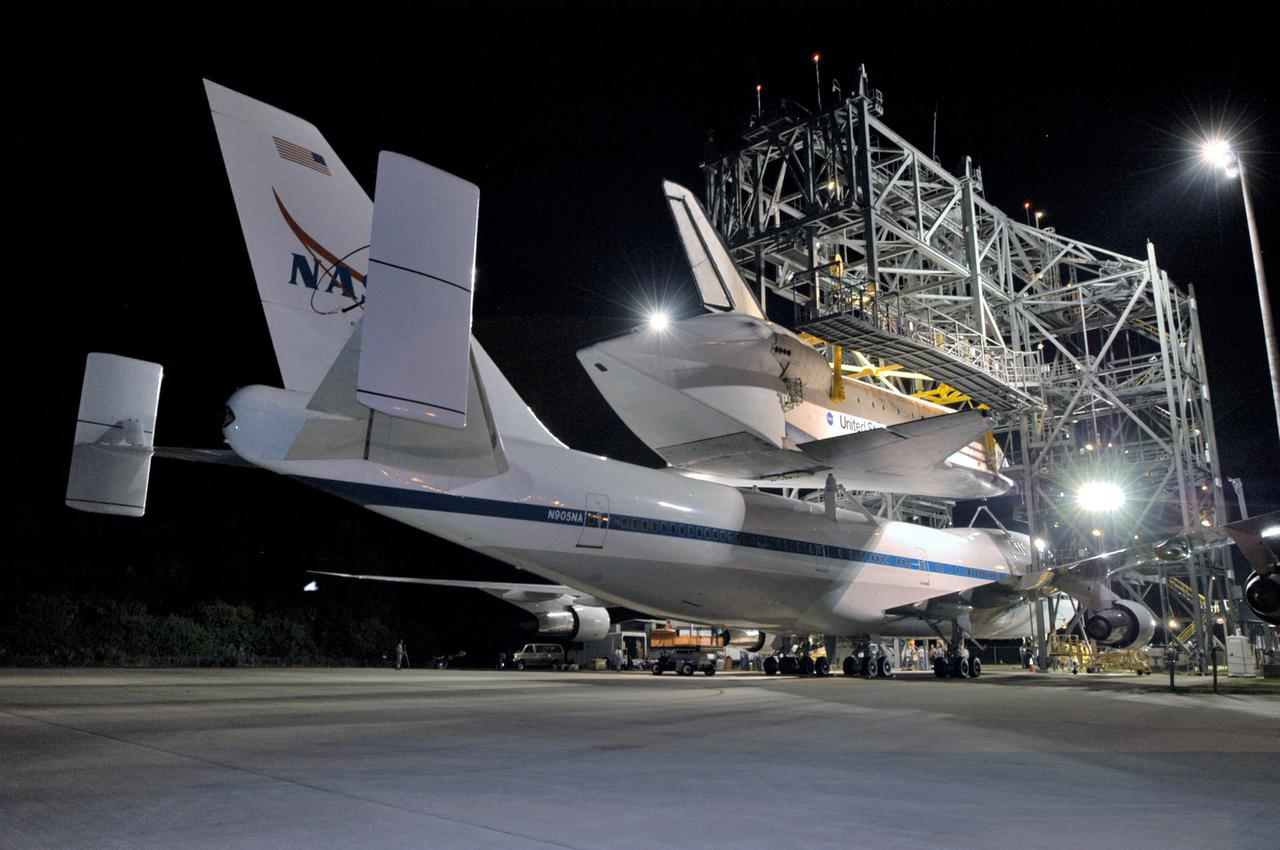
KENNEDY SPACE CENTER, FLA. - In the early morning hours at NASA Kennedy Space Center’s Shuttle Landing Facility, the orbiter Discovery is being demated from the Shuttle Carrier Aircraft, a modified Boeing 747, beneath it. Discovery was returned to Kennedy Space Center on a ferry flight from Edwards Air Force Base in California, where it landed Aug. 9 after 13 days in space on mission STS-114. In the mate_demate device, a horizontal structure mounted at the 80-foot level between two towers controls and guides a large lift beam that attaches to the orbiter to raise and lower it. Once Discovery is lifted off the back of the SCA, the 747 can then roll away and the orbiter will be lowered to the ground. It will then be towed from the SLF to the Orbiter Processing Facility. Once inside the OPF, the payload bay doors will be opened and the MPLM Raffaello brought back from the International Space Station will be unloaded and transferred to the Space Station Processing Facility. This concludes mission STS-114.

KENNEDY SPACE CENTER, FLA. - The orbiter Discovery on top of the Shuttle Carrier Aircraft, a modified Boeing 747, is towed into the mate_demate device at NASA Kennedy Space Center’s Shuttle Landing Facility. Visible on the orbiter is the tail cone that covers the main engines during the ferry flight. Discovery was returned to Kennedy Space Center on a ferry flight from Edwards Air Force Base in California, where it landed Aug. 9 after 13 days in space on mission STS-114. In the mate_demate device, a horizontal structure mounted at the 80-foot level between two towers controls and guides a large lift beam that attaches to the orbiter to raise and lower it. Once Discovery is lifted off the back of the SCA, the 747 can then roll away and the orbiter will be lowered to the ground. It will then be towed from the SLF to the Orbiter Processing Facility. Once inside the OPF, the payload bay doors will be opened and the MPLM Raffaello brought back from the International Space Station will be unloaded and transferred to the Space Station Processing Facility. This concludes mission STS-114.
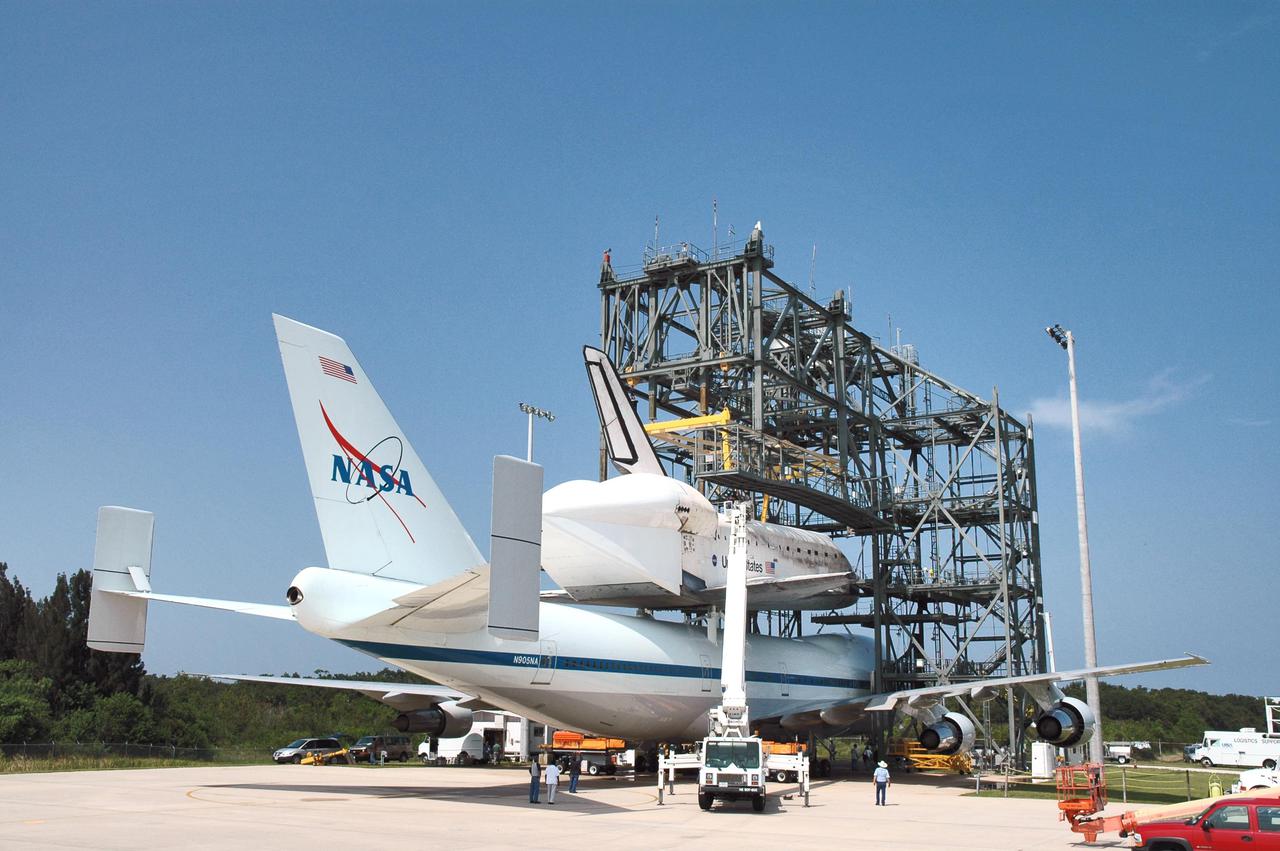
KENNEDY SPACE CENTER, FLA. - At NASA Kennedy Space Center’s Shuttle Landing Facility, the Shuttle Carrier Aircraft, a modified Boeing 747, and orbiter Discovery on top, remain in the mate_demate device while Discovery is prepared for demating. Discovery was returned to Kennedy Space Center on a ferry flight from Edwards Air Force Base in California, where it landed Aug. 9 after 13 days in space on mission STS-114. In the mate_demate device, a horizontal structure mounted at the 80-foot level between two towers controls and guides a large lift beam that attaches to the orbiter to raise and lower it. Once Discovery is lifted off the back of the SCA, the 747 can then roll away and the orbiter will be lowered to the ground. It will then be towed from the SLF to the Orbiter Processing Facility. Once inside the OPF, the payload bay doors will be opened and the MPLM Raffaello brought back from the International Space Station will be unloaded and transferred to the Space Station Processing Facility. This concludes mission STS-114.
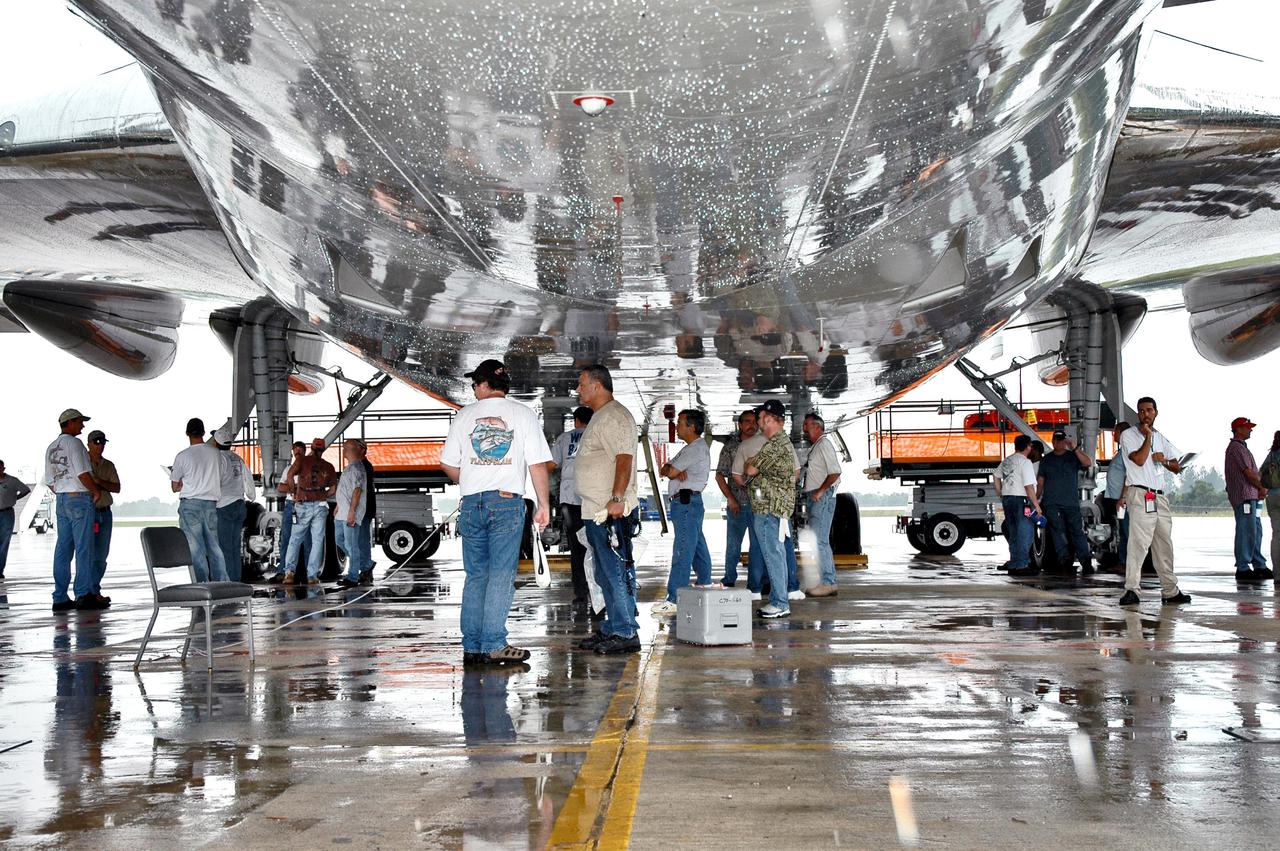
KENNEDY SPACE CENTER, FLA. - At NASA Kennedy Space Center’s Shuttle Landing Facility, workers secure the Shuttle Carrier Aircraft, a modified Boeing 747, on the ground under the mate_demate device. The orbiter Discovery is still on top of the aircraft. Discovery was returned to Kennedy Space Center on a ferry flight from Edwards Air Force Base in California, where it landed Aug. 9 after 13 days in space on mission STS-114. In the mate_demate device, a horizontal structure mounted at the 80-foot level between two towers controls and guides a large lift beam that attaches to the orbiter to raise and lower it. Once Discovery is lifted off the back of the SCA, the 747 can then roll away and the orbiter will be lowered to the ground. It will then be towed from the SLF to the Orbiter Processing Facility. Once inside the OPF, the payload bay doors will be opened and the MPLM Raffaello brought back from the International Space Station will be unloaded and transferred to the Space Station Processing Facility. This concludes mission STS-114.
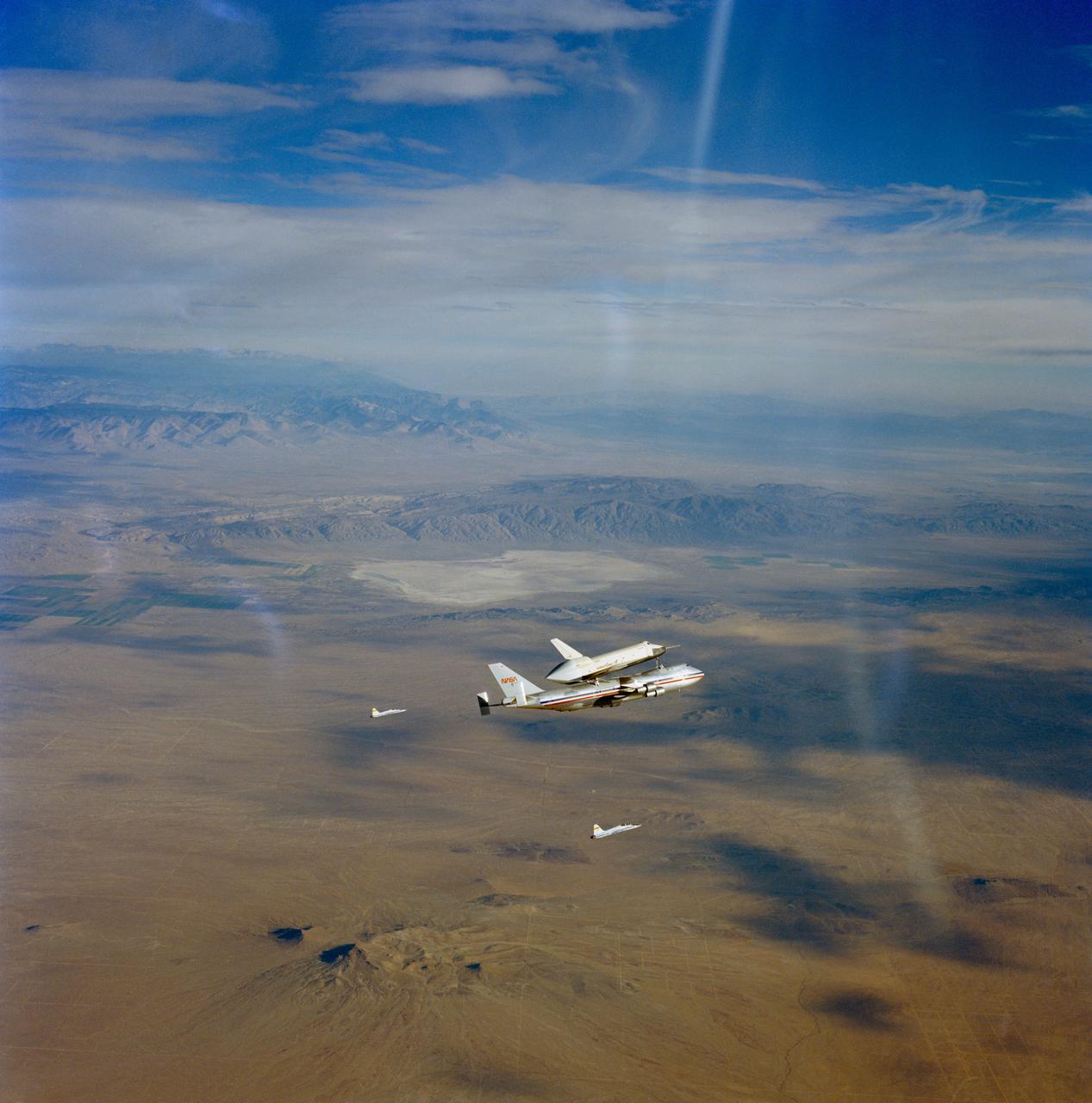
S77-28139 (13 Sept 1977) --- The Orbiter 101 "Enterprise" is seen riding "piggy-back" atope the NASA 747 carrier aircraft during the second free flight of the Shuttle Approach and Landing Tests (ALT) conducted on September 13, 1977, at the Dryden Flight Research Center in Southern California. Moments later the Orbiter 101 separated from the 747 and made a five-minute, 28-second unpowered flight before landing. Astronauts Joe H. Engle, commander, and Richard H. Truly, pilot, were the crew of the "Enterprise." two T-38 chase planes are seen in the background. The ALT free flights are designed to verify orbiter subsonic airworthiness, integrated systems operations and pilot-guided approach andlanding capability and satisfy prerequisites to automatic flight control and navigation mode. Astronaut Vance D. Brand took this picture while riding in T-38 chase plane number five. He used a 70mm Hasselblad camera with an 80mm lens.
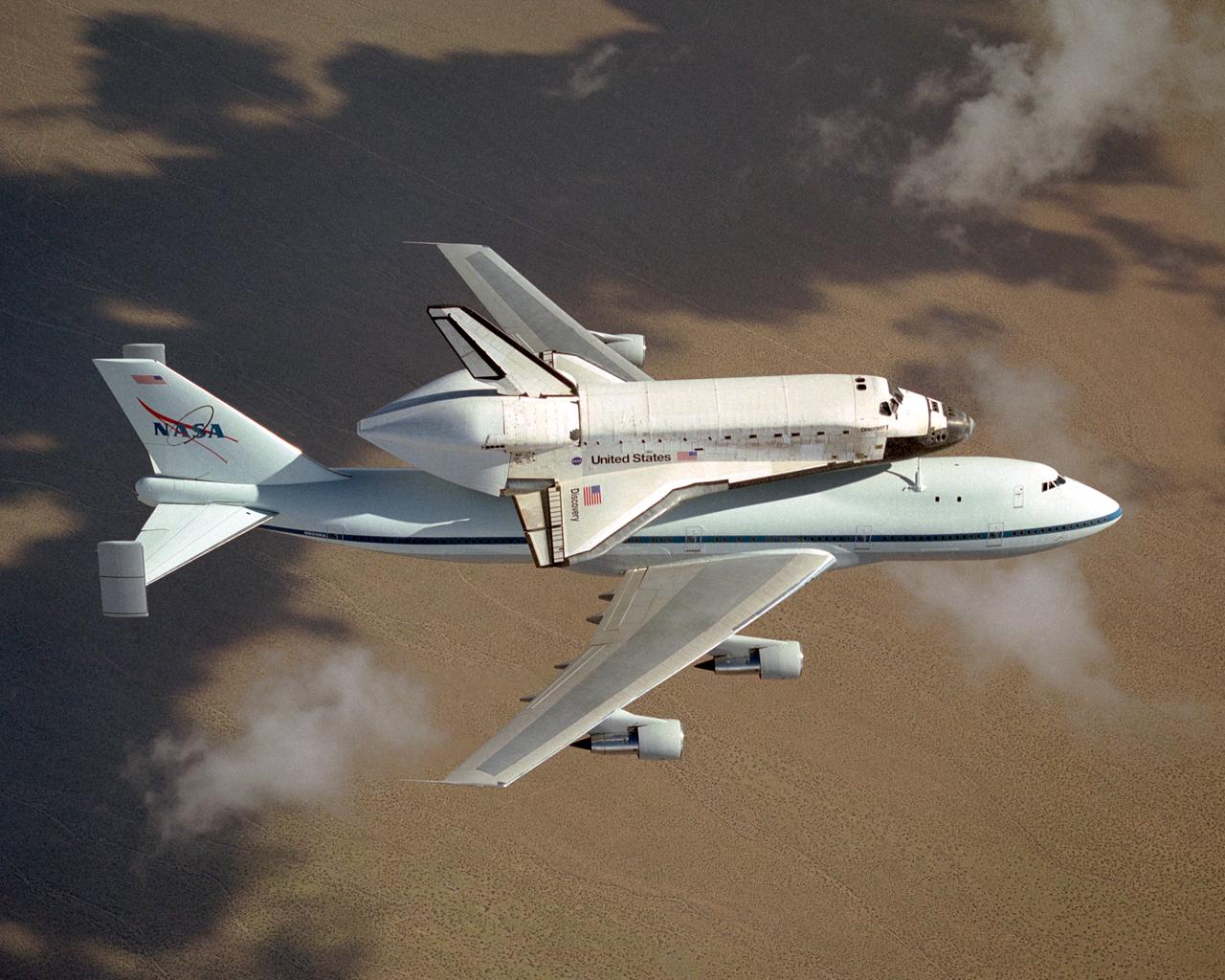
The space shuttle Discovery atop NASA's modified 747 is captured over the Mojave Desert while being ferried from NASA Dryden to the Kennedy Space Center. NASA's modified Boeing 747 Shuttle Carrier Aircraft with the Space Shuttle Discovery on top lifts off from Edwards Air Force Base to begin its ferry flight back to the Kennedy Space Center in Florida. The cross-country journey will take two days, with stops at several intermediate points for refueling. Space shuttle Discovery landed safely at NASA's Dryden Flight Research Center at Edwards Air Force Base in California at 5:11:22 a.m. PDT, August 9, 2005, following the very successful 14-day STS-114 return to flight mission. During their two weeks in space, Commander Eileen Collins and her six crewmates tested out new safety procedures and delivered supplies and equipment the International Space Station. Discovery spent two weeks in space, where the crew demonstrated new methods to inspect and repair the Shuttle in orbit. The crew also delivered supplies, outfitted and performed maintenance on the International Space Station. A number of these tasks were conducted during three spacewalks. In an unprecedented event, spacewalkers were called upon to remove protruding gap fillers from the heat shield on Discovery's underbelly. In other spacewalk activities, astronauts installed an external platform onto the Station's Quest Airlock and replaced one of the orbital outpost's Control Moment Gyroscopes. Inside the Station, the STS-114 crew conducted joint operations with the Expedition 11 crew. They unloaded fresh supplies from the Shuttle and the Raffaello Multi-Purpose Logistics Module. Before Discovery undocked, the crews filled Raffeallo with unneeded items and returned to Shuttle payload bay. Discovery launched on July 26 and spent almost 14 days on orbit.
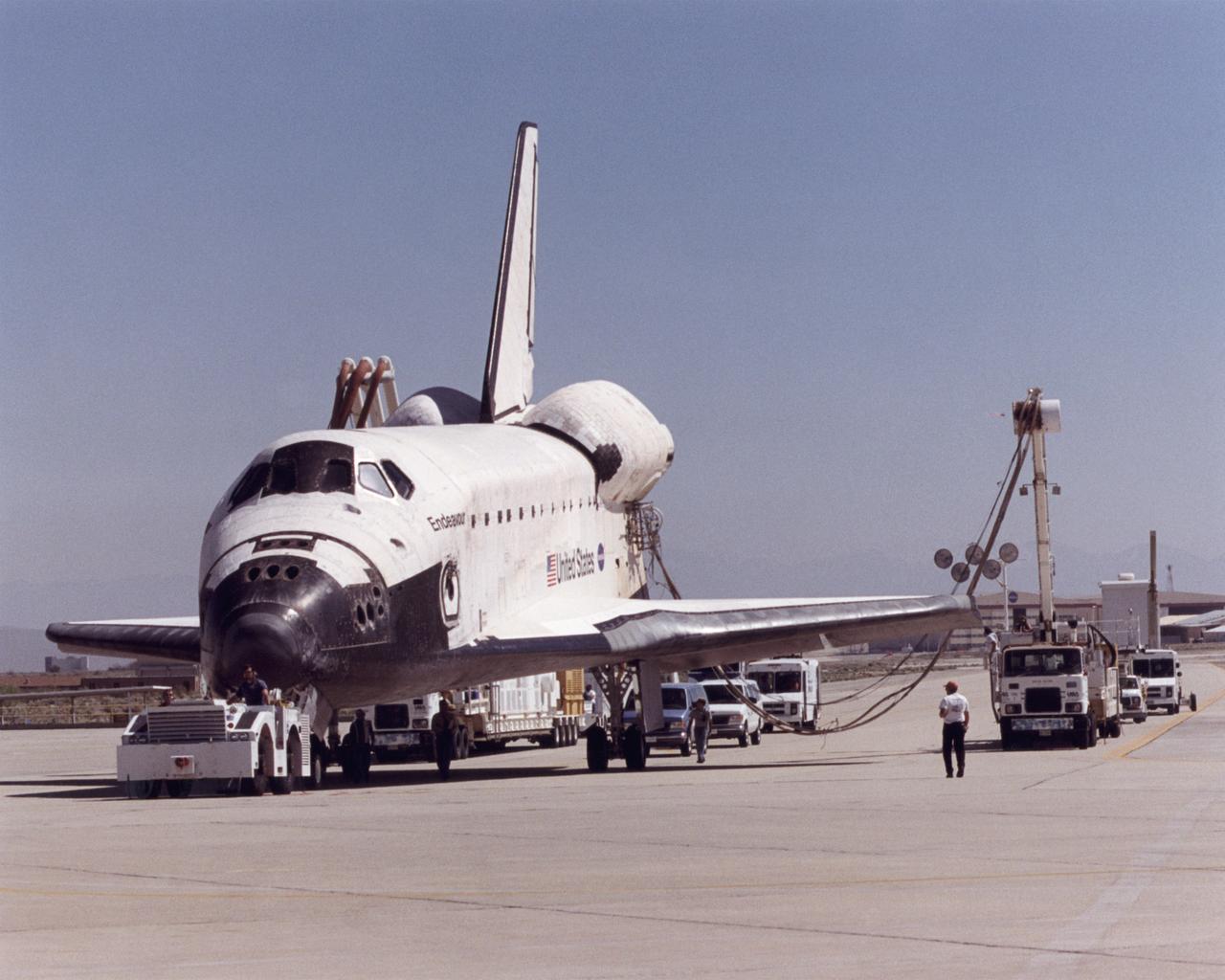
A convoy of specialized support vehicles follow the Space Shuttle Endeavour as it is towed up a taxiway at NASA's Dryden Flight Research Center on Edwards Air Force Base, California, after landing on May 1, 2001. The two largest vehicles trailing the shuttle provide electrical power and air conditioning to the shuttle's systems during post-flight recovery operations. The Endeavour had just completed mission STS-100, an almost 12-day mission to install the Canadarm 2 robotic arm and deliver some three tons of supplies and experiments to the International Space Station. The landing was the 48th shuttle landing at Edwards since shuttle flights began in 1981. After post-flight processing, the Endeavour was mounted atop one of NASA's modified Boeing 747 shuttle carrier aircraft and ferried back to the Kennedy Space Center in Florida on May 8, 2001.
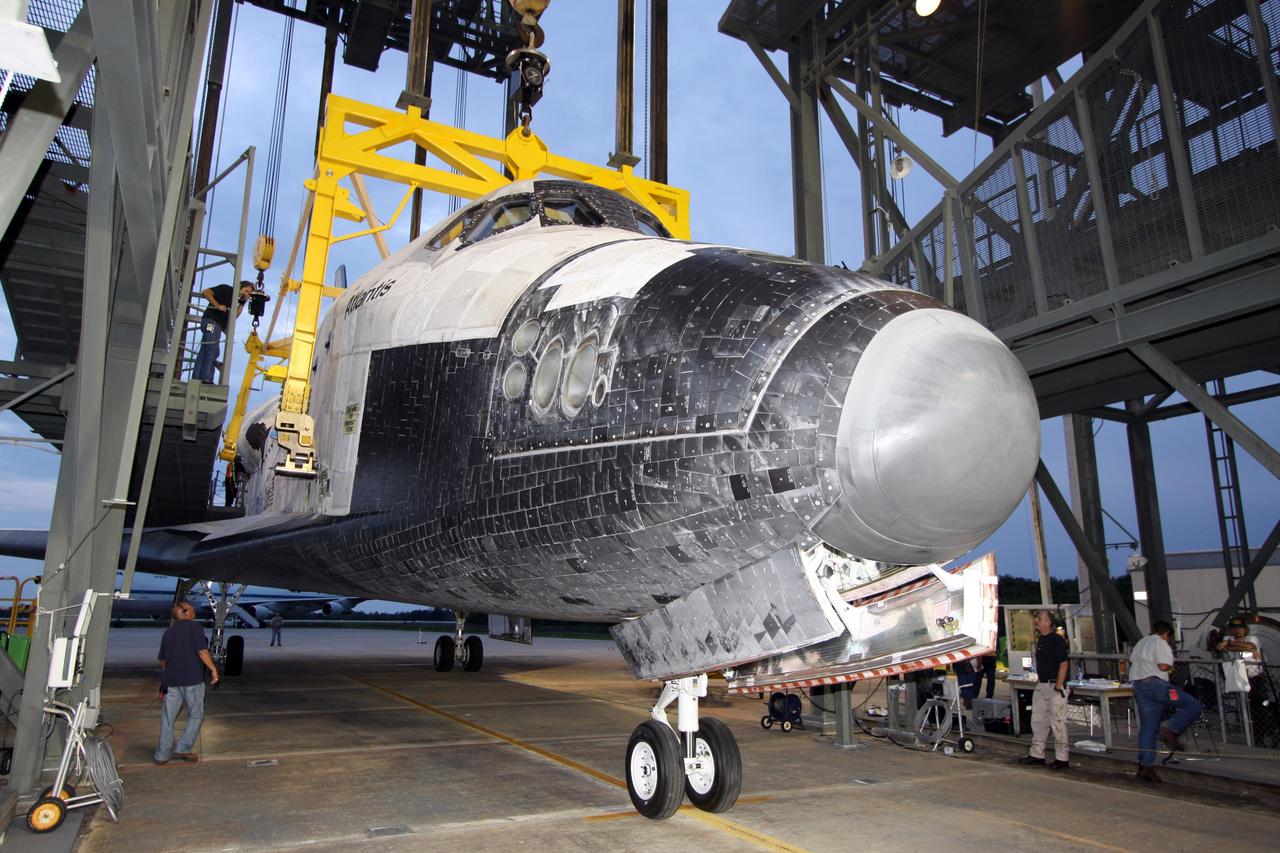
CAPE CANAVERAL, Fla. – Space shuttle Atlantis is on the ground at the Shuttle Landing Facility at NASA's Kennedy Space Center in Florida. Workers prepare to remove the hoist from Atlantis that was used to separate it from the Shuttle Carrier Aircraft, or SCA, which returned it to Kennedy from California. Atlantis will be towed to Orbiter Processing Facility 1. After its May 24 landing at Edwards Air Force Base in California, which concluded its STS-125 mission, the modified Boeing 747 SCA carried the shuttle on a two-day ferry flight from Edwards to Kennedy beginning June 1. Atlantis' next assignment is the STS-129 mission, targeted to launch in November 2009. Photo credit: NASA/Jack Pfaller
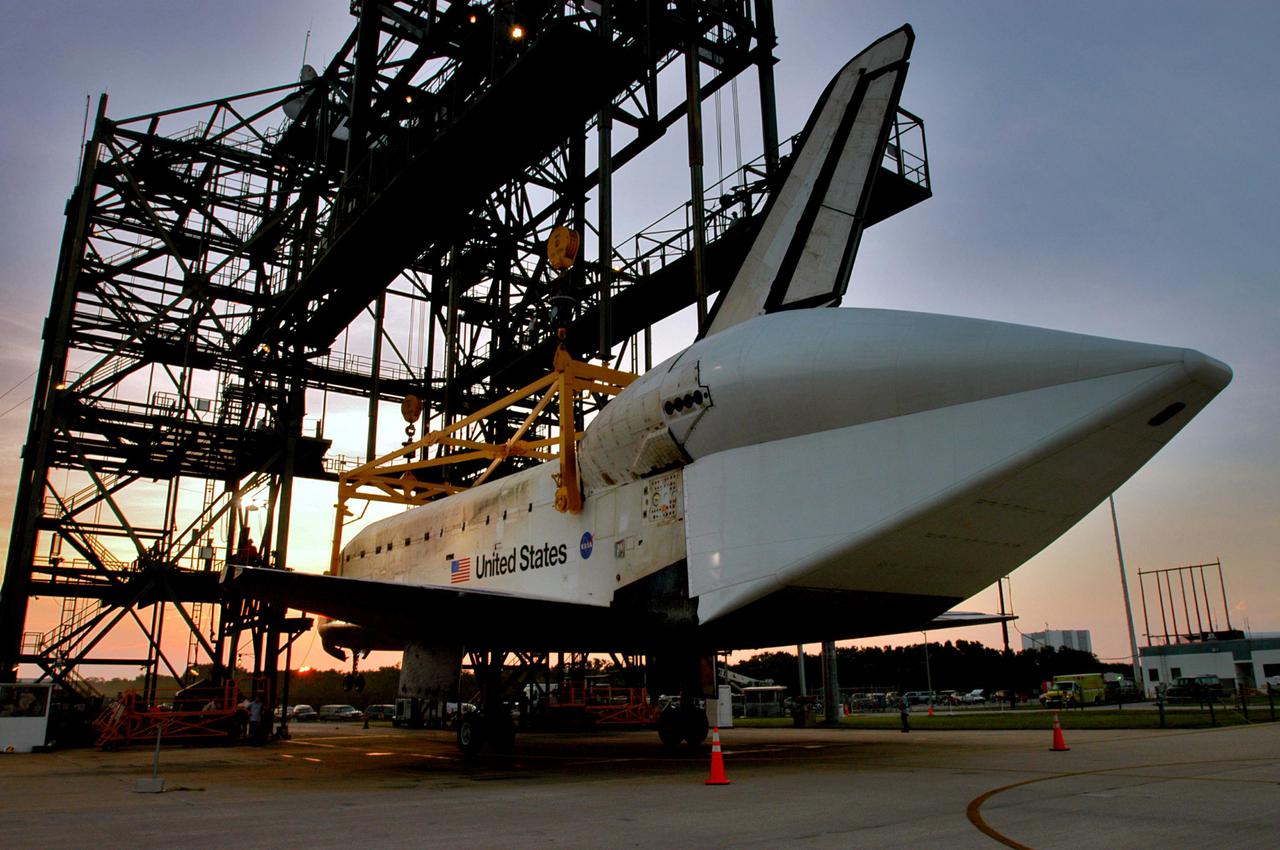
KENNEDY SPACE CENTER, FLA. - Just before sunrise, Discovery finally rests on its wheels on the ground at NASA Kennedy Space Center’s Shuttle Landing Facility. The orbiter was lowered overnight from the mate_demate device after the Shuttle Carrier Aircraft, a modified Boeing 747, was rolled away. Discovery was returned to Kennedy Space Center on a ferry flight from Edwards Air Force Base in California, where it landed Aug. 9 after 13 days in space on mission STS-114. In the mate_demate device, a horizontal structure mounted at the 80-foot level between two towers controls and guides a large lift beam that attaches to the orbiter to raise and lower it. The orbiter will be lowered to the ground and then be towed to the Orbiter Processing Facility. Once inside the OPF, the payload bay doors will be opened and the MPLM Raffaello brought back from the International Space Station will be unloaded and transferred to the Space Station Processing Facility. This concludes mission STS-114.
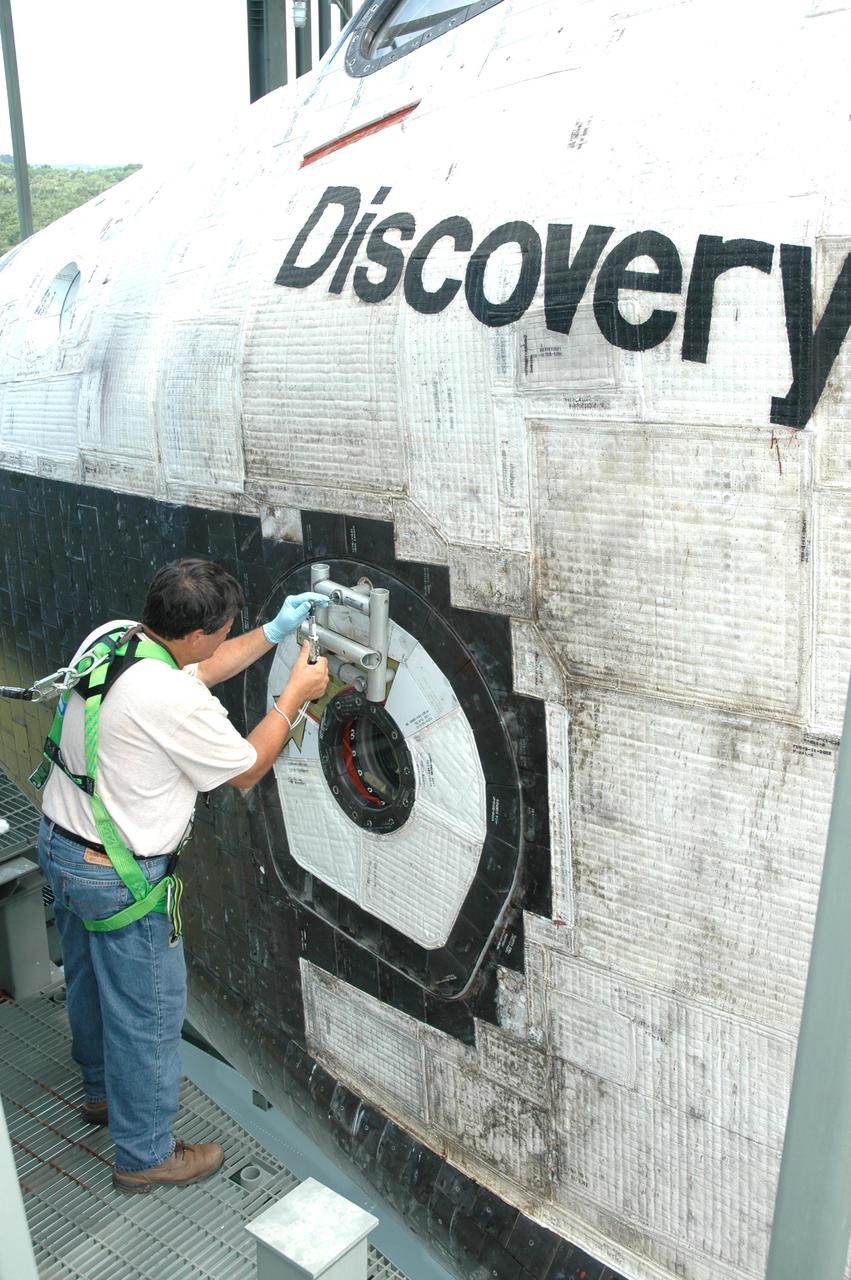
KENNEDY SPACE CENTER, FLA. - At NASA Kennedy Space Center’s Shuttle Landing Facility, a worker begins preparing the orbiter Discovery for demating. Discovery was returned to Kennedy Space Center on a ferry flight from Edwards Air Force Base in California, where it landed Aug. 9 after 13 days in space on mission STS-114. In the mate_demate device, a horizontal structure mounted at the 80-foot level between two towers controls and guides a large lift beam that attaches to the orbiter to raise and lower it. Once Discovery is lifted off the back of the SCA, the 747 can then roll away and the orbiter will be lowered to the ground. It will then be towed from the SLF to the Orbiter Processing Facility. Once inside the OPF, the payload bay doors will be opened and the MPLM Raffaello brought back from the International Space Station will be unloaded and transferred to the Space Station Processing Facility. This concludes mission STS-114.
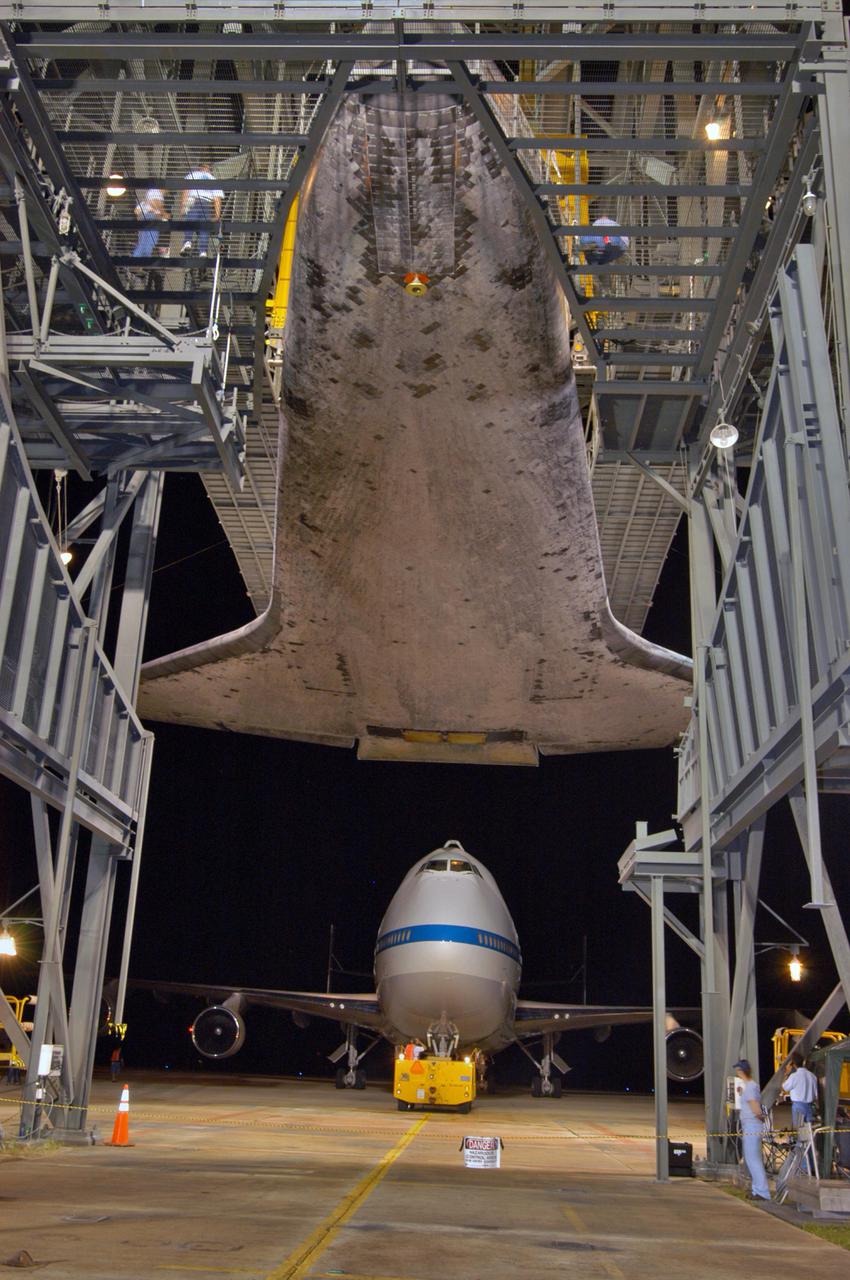
KENNEDY SPACE CENTER, FLA. - In the early morning hours at NASA Kennedy Space Center’s Shuttle Landing Facility, the orbiter Discovery is suspended within the mate_demate device after the Shuttle Carrier Aircraft, a modified Boeing 747, has rolled away from beneath it. Discovery was returned to Kennedy Space Center on a ferry flight from Edwards Air Force Base in California, where it landed Aug. 9 after 13 days in space on mission STS-114. In the mate_demate device, a horizontal structure mounted at the 80-foot level between two towers controls and guides a large lift beam that attaches to the orbiter to raise and lower it. The orbiter will be lowered to the ground and then be towed to the Orbiter Processing Facility. Once inside the OPF, the payload bay doors will be opened and the MPLM Raffaello brought back from the International Space Station will be unloaded and transferred to the Space Station Processing Facility. This concludes mission STS-114.
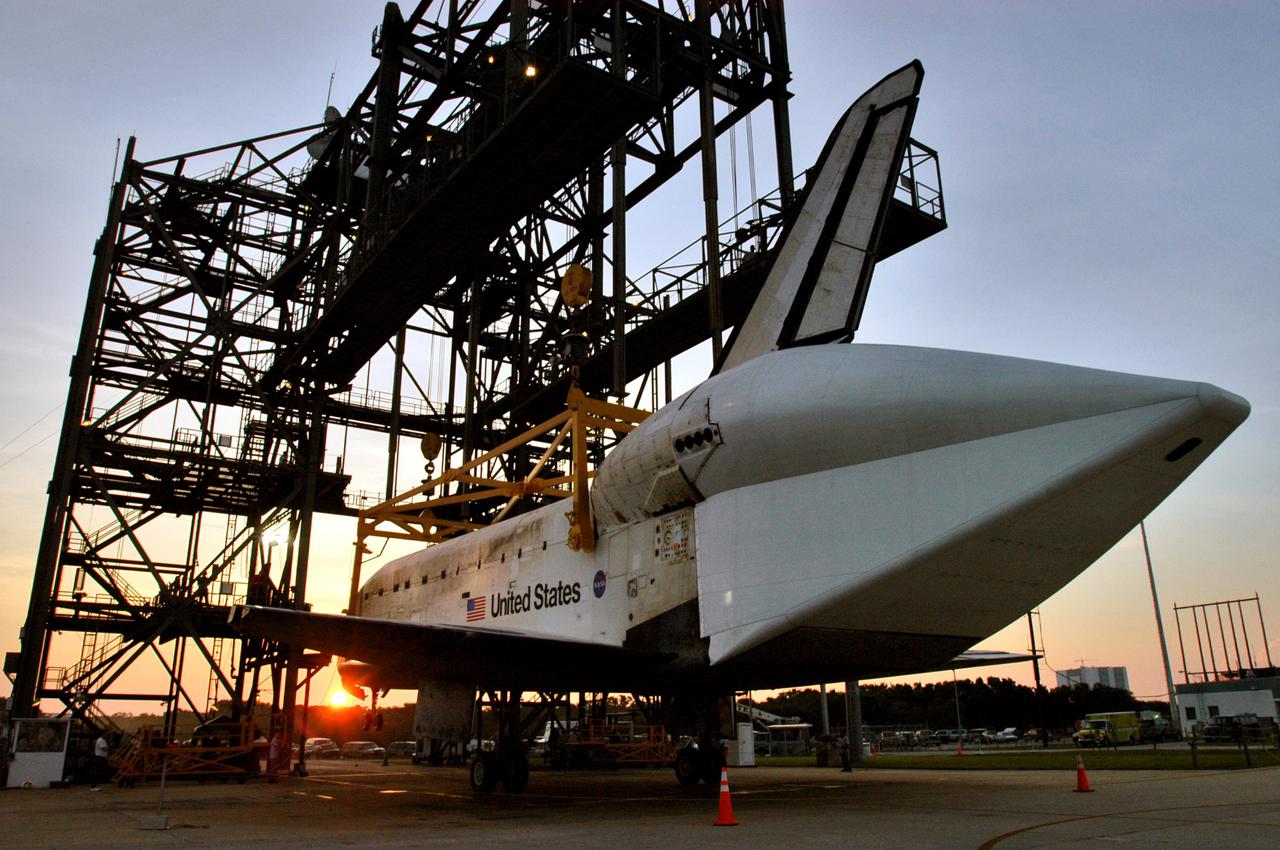
KENNEDY SPACE CENTER, FLA. - At sunrise, Discovery finally rests on its wheels on the ground at NASA Kennedy Space Center’s Shuttle Landing Facility. The orbiter was lowered overnight from the mate_demate device after the Shuttle Carrier Aircraft, a modified Boeing 747, was rolled away. Discovery was returned to Kennedy Space Center on a ferry flight from Edwards Air Force Base in California, where it landed Aug. 9 after 13 days in space on mission STS-114. In the mate_demate device, a horizontal structure mounted at the 80-foot level between two towers controls and guides a large lift beam that attaches to the orbiter to raise and lower it. The orbiter will be towed to the Orbiter Processing Facility. Once inside the OPF, the payload bay doors will be opened and the MPLM Raffaello brought back from the International Space Station will be unloaded and transferred to the Space Station Processing Facility. This concludes mission STS-114.

CAPE CANAVERAL, Fla. – The Shuttle Carrier Aircraft, or SCA, touched down at NASA Kennedy Space Center’s Shuttle Landing Facility in Florida at 5:05 p.m. EDT to prepare for shuttle Endeavour’s ferry flight to the Los Angeles International Airport on Sept. 17. This SCA, designated NASA 905, is a modified Boeing 747 jet airliner, originally manufactured for commercial use. One of two SCAs employed over the course of the Space Shuttle Program, NASA 905 is assigned to the final ferry mission. Endeavour will be placed on permanent public display at the California Science Center in Los Angeles. For more information on the SCA, visit http://www.nasa.gov/centers/dryden/news/FactSheets/FS-013-DFRC.html. For more information on shuttle transition and retirement activities, visit http://www.nasa.gov/shuttle. Photo credit: NASA/Frankie Martin

CAPE CANAVERAL, Fla. – The Shuttle Carrier Aircraft, or SCA, touched down at NASA Kennedy Space Center’s Shuttle Landing Facility in Florida at 5:05 p.m. EDT to prepare for shuttle Endeavour’s ferry flight to the Los Angeles International Airport on Sept. 17. This SCA, designated NASA 905, is a modified Boeing 747 jet airliner, originally manufactured for commercial use. One of two SCAs employed over the course of the Space Shuttle Program, NASA 905 is assigned to the final ferry mission. Endeavour will be placed on permanent public display at the California Science Center in Los Angeles. For more information on the SCA, visit http://www.nasa.gov/centers/dryden/news/FactSheets/FS-013-DFRC.html. For more information on shuttle transition and retirement activities, visit http://www.nasa.gov/shuttle. Photo credit: NASA/Frankie Martin

CAPE CANAVERAL, Fla. – At Edwards Air Force Base in California, space shuttle Atlantis is lowered from the mate/demate device onto the Shuttle Carrier Aircraft, or SCA, a modified Boeing 747, beneath it. Atlantis will be bolted to the SCA for a piggyback flight to Florida. A tail cone, which protects the aft engine area and provides a more efficient aeronautical dimension during its piggyback flight, can be seen. Atlantis landed at Edwards on May 24, which concluded mission STS-125, after two landing opportunities at Kennedy were waved off due to weather concerns. Atlantis is being returned to Florida on a ferry flight on the SCA. Atlantis' next assignment is the STS-129 mission, targeted to launch in November 2009. Photo credit: NASA/Ben Smegelsky
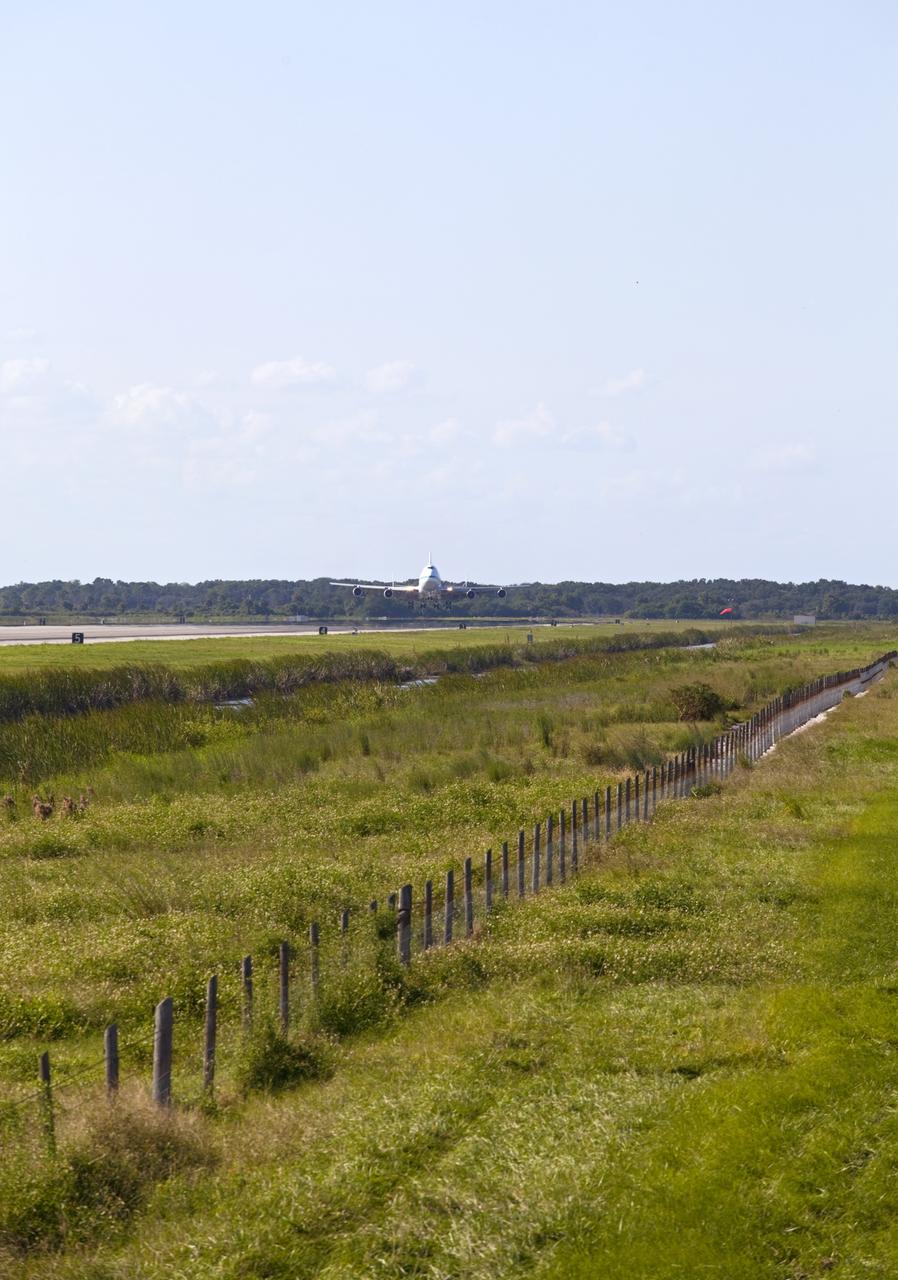
CAPE CANAVERAL, Fla. – The Shuttle Carrier Aircraft, or SCA, approaches the runway at NASA Kennedy Space Center’s Shuttle Landing Facility in Florida. The SCA touched down at 5:05 p.m. EDT to prepare for shuttle Endeavour’s ferry flight to the Los Angeles International Airport on Sept. 17. This SCA, designated NASA 905, is a modified Boeing 747 jet airliner, originally manufactured for commercial use. One of two SCAs employed over the course of the Space Shuttle Program, NASA 905 is assigned to the final ferry mission. Endeavour will be placed on permanent public display at the California Science Center in Los Angeles. For more information on the SCA, visit http://www.nasa.gov/centers/dryden/news/FactSheets/FS-013-DFRC.html. For more information on shuttle transition and retirement activities, visit http://www.nasa.gov/shuttle. Photo credit: NASA/Frankie Martin
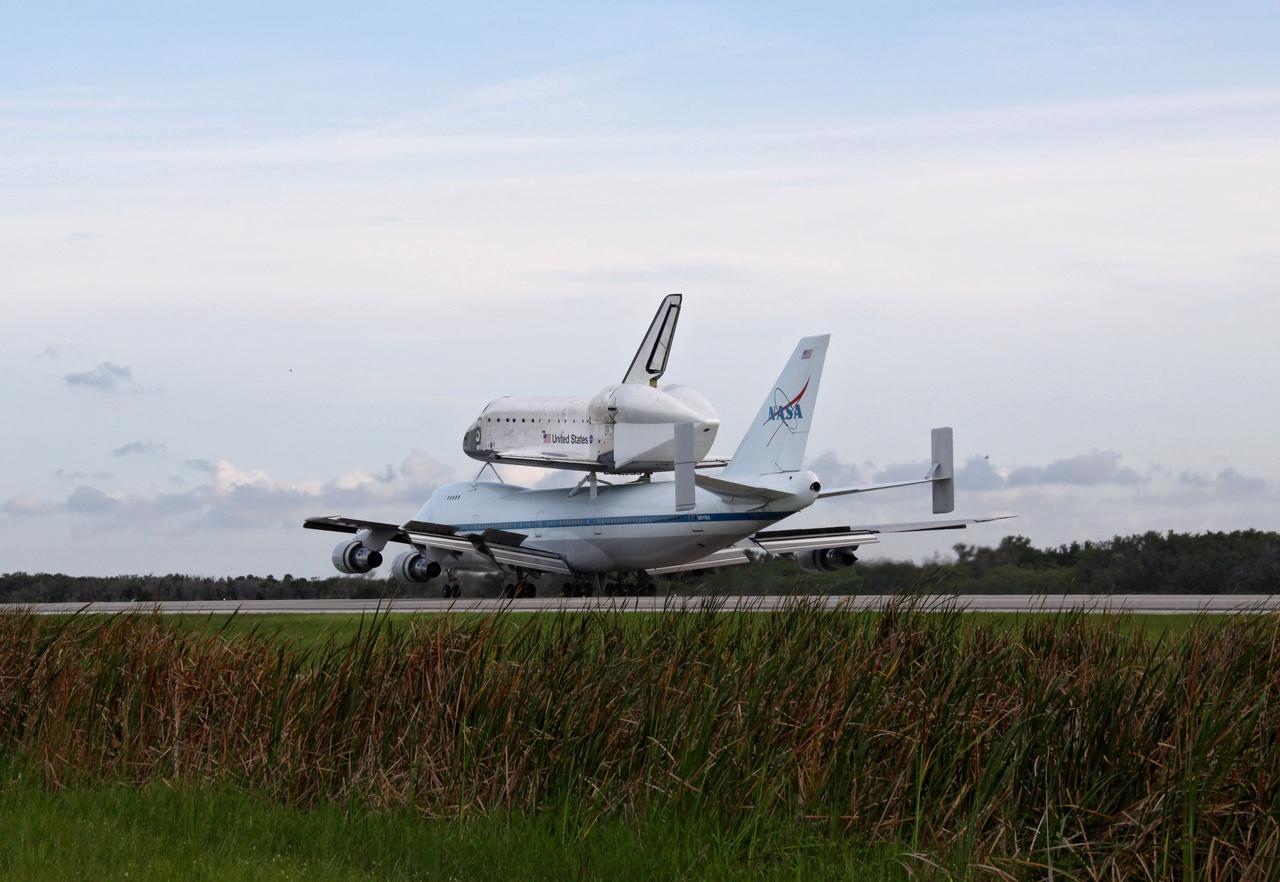
CAPE CANAVERAL, Fla. – After a two-day trip from California, space shuttle Atlantis returns home to NASA's Kennedy Space Center secured atop a Shuttle Carrier Aircraft, or SCA. Touchdown on runway 15 at Kennedy's Shuttle Landing Facility was at 6:53 p.m. EDT. The SCA is a modified Boeing 747 jetliner. Atlantis returned from California atop the SCA after its May 24 landing at Edwards Air Force Base, concluding mission STS-125. The ferry flight from Edwards Air Force Base began June 1. Atlantis' next assignment is the STS-129 mission, targeted to launch in November 2009. Photo credit: NASA/Jack Pfaller
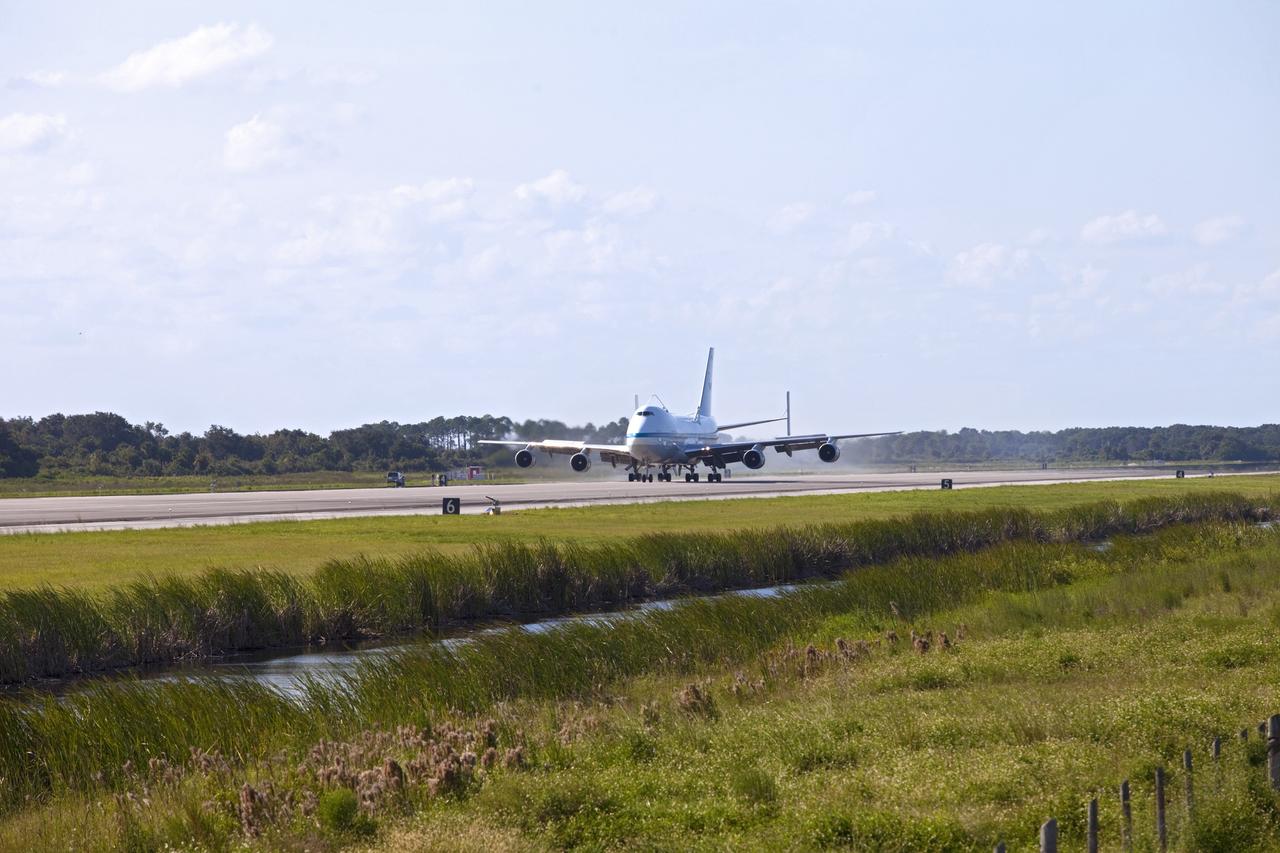
CAPE CANAVERAL, Fla. – The Shuttle Carrier Aircraft, or SCA, touched down at NASA Kennedy Space Center’s Shuttle Landing Facility in Florida at 5:05 p.m. EDT to prepare for shuttle Endeavour’s ferry flight to the Los Angeles International Airport on Sept. 17. This SCA, designated NASA 905, is a modified Boeing 747 jet airliner, originally manufactured for commercial use. One of two SCAs employed over the course of the Space Shuttle Program, NASA 905 is assigned to the final ferry mission. Endeavour will be placed on permanent public display at the California Science Center in Los Angeles. For more information on the SCA, visit http://www.nasa.gov/centers/dryden/news/FactSheets/FS-013-DFRC.html. For more information on shuttle transition and retirement activities, visit http://www.nasa.gov/shuttle. Photo credit: NASA/Frankie Martin
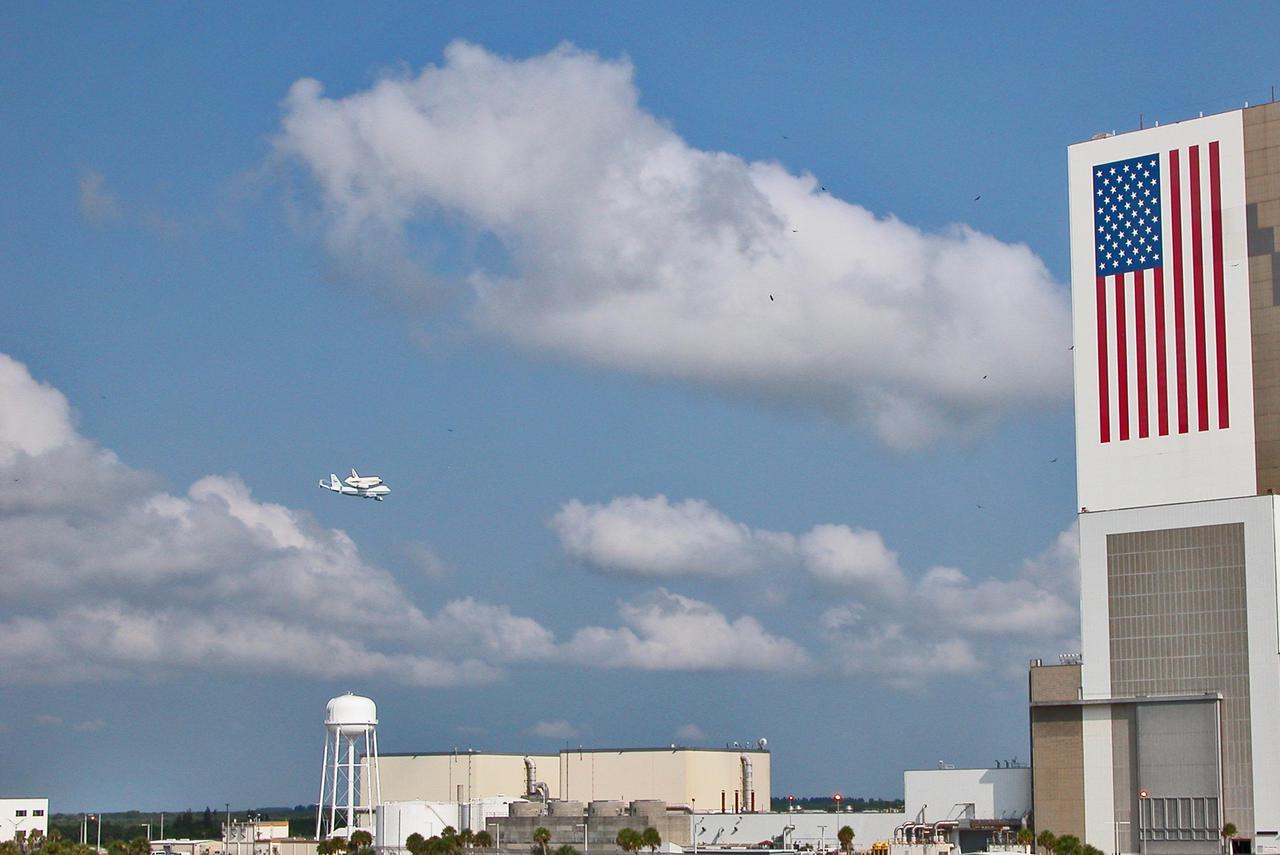
KENNEDY SPACE CENTER, FLA. -- Space Shuttle Discovery, atop a modified Boeing 747 Shuttle Carrier Aircraft (SCA), flies past the Vehicle Assembly Building at Kennedy Space Center on its final approach to runway 15 at the Shuttle Landing Facility (SLF). Landing was at about 10:00 a.m. EDT. The cross-country ferry flight became necessary when two days of unfavorable weather conditions at KSC forced Discovery to land on runway 22 at Edwards Air Force Base, Calif., on Aug. 9 following mission STS-114. The SCA and Discovery will be towed to the Mate_Demate Device at the SLF where a crane will lift Discovery from the SCA and place it on solid ground. Discovery will then be towed to the Orbiter Processing Facility where preparations will begin for its next flight, STS-121.
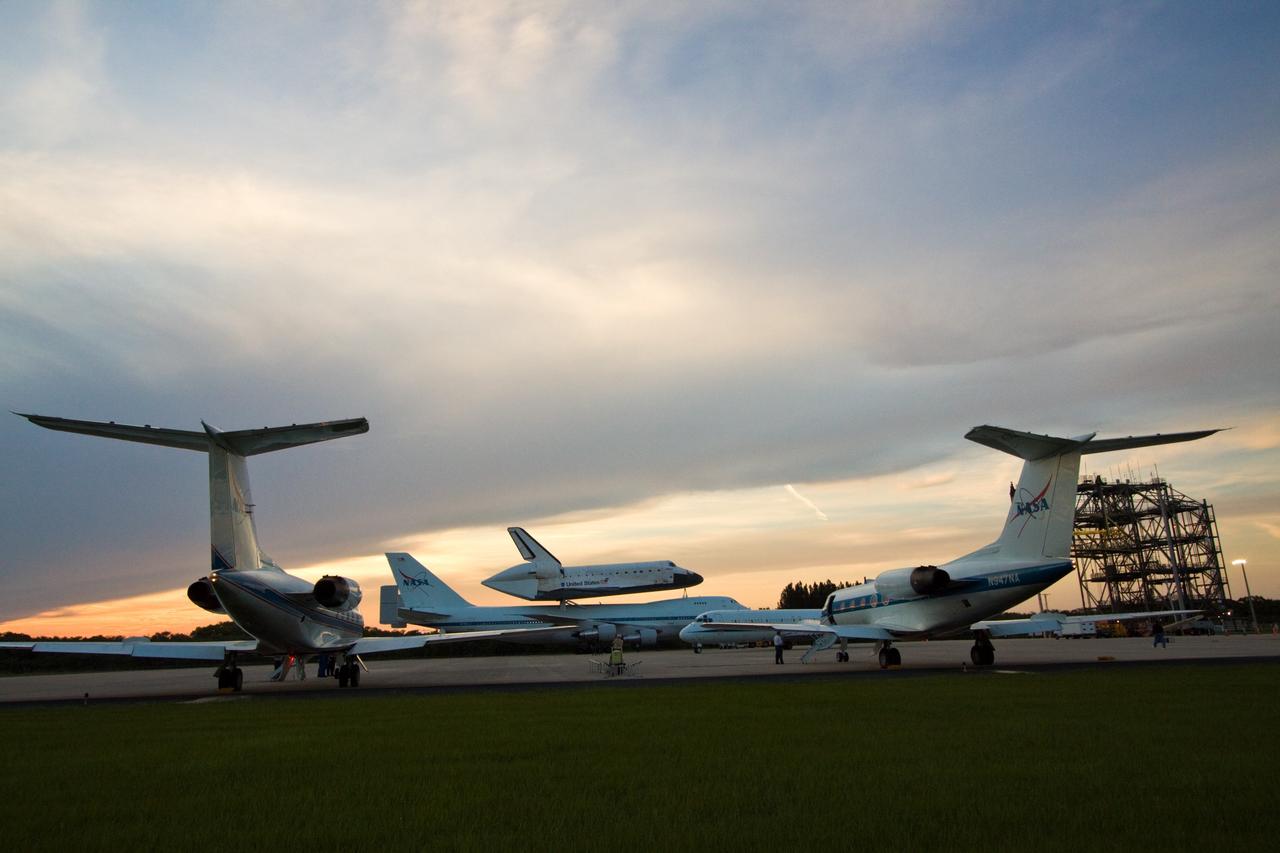
CAPE CANAVERAL, Fla. – Under a dimming sky, space shuttle Atlantis, atop a Shuttle Carrier Aircraft, or SCA, is framed between two Shuttle Training Aircraft on the Shuttle Landing Facility at NASA's Kennedy Space Center in Florida. The SCA is a modified Boeing 747 jetliner. The SCA and Atlantis are being towed the mate/demate device (at far right) on the Shuttle Landing Facility where Atlantis will be lifted from the SCA and placed on the ground. Atlantis returned from California atop the SCA after its May 24 landing at Edwards Air Force Base, concluding mission STS-125. The ferry flight from Edwards Air Force Base began June 1. Atlantis' next assignment is the STS-129 mission, targeted to launch in November 2009. Photo credit: NASA/Jack Pfaller

CAPE CANAVERAL, Fla. – After a two-day trip from California, space shuttle Atlantis returns home to NASA's Kennedy Space Center secured atop a Shuttle Carrier Aircraft, or SCA. Touchdown on runway 15 at Kennedy's Shuttle Landing Facility was at 6:53 p.m. EDT. The SCA is a modified Boeing 747 jetliner. Atlantis returned from California atop the SCA after its May 24 landing at Edwards Air Force Base, concluding mission STS-125. The ferry flight from Edwards Air Force Base began June 1. Atlantis' next assignment is the STS-129 mission, targeted to launch in November 2009. Photo credit: NASA/Jack Pfaller

CAPE CANAVERAL, Fla. – At Edwards Air Force Base in California, the Shuttle Carrier Aircraft, or SCA, a modified Boeing 747, is moved beneath space shuttle Atlantis, suspended in the mate/demate device. Atlantis will be bolted to the SCA for a piggyback flight to Florida. A tail cone, which protects the aft engine area and provides a more efficient aeronautical dimension during its piggyback flight, can be seen. Atlantis landed at Edwards on May 24, which concluded mission STS-125, after two landing opportunities at Kennedy were waved off due to weather concerns. Atlantis is being returned to Florida on a ferry flight on the SCA. Atlantis' next assignment is the STS-129 mission, targeted to launch in November 2009. Photo credit: NASA/Ben Smegelsky
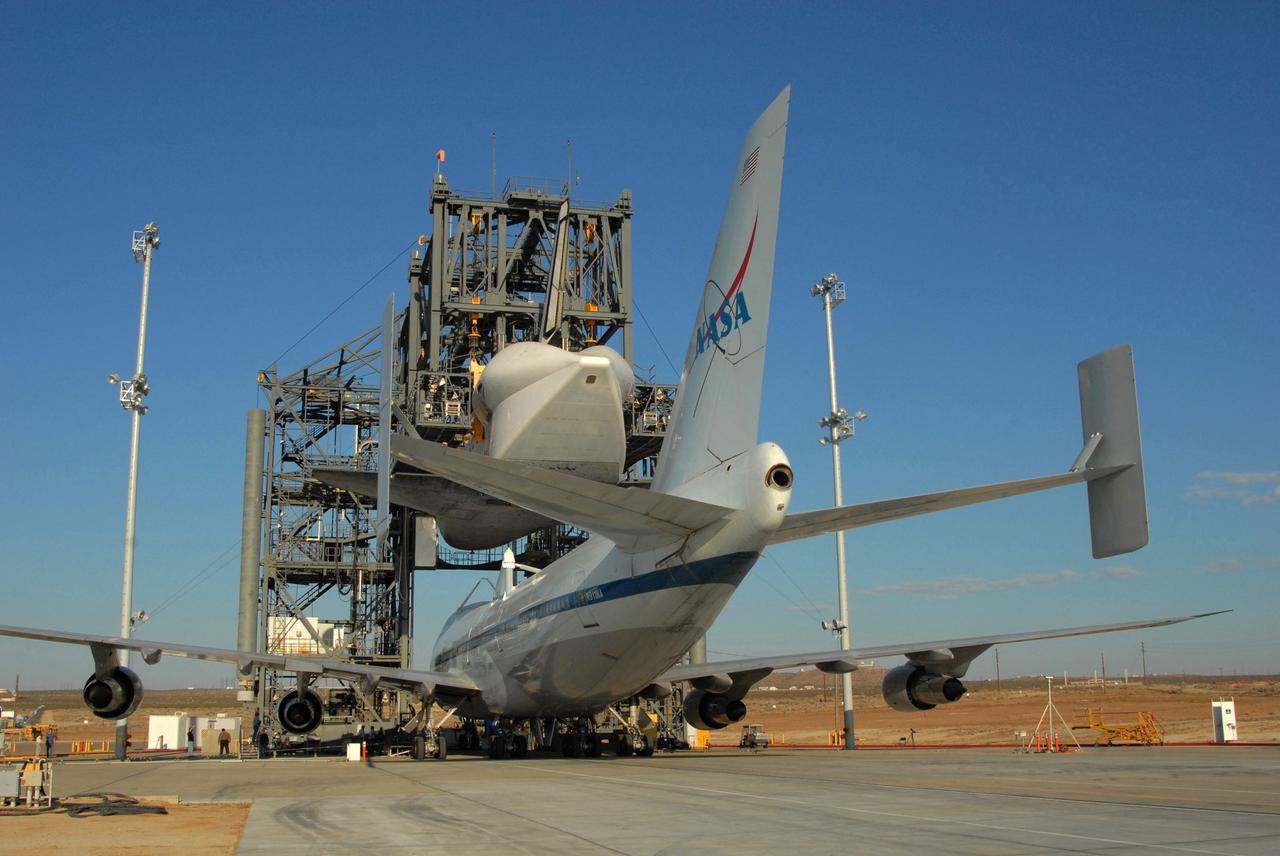
CAPE CANAVERAL, Fla. – At Edwards Air Force Base in California, the Shuttle Carrier Aircraft, or SCA, a modified Boeing 747, is moved beneath space shuttle Atlantis, suspended in the mate/demate device. Atlantis will be bolted to the SCA for a piggyback flight to Florida. A tail cone, which protects the aft engine area and provides a more efficient aeronautical dimension during its piggyback flight, can be seen. Atlantis landed at Edwards on May 24, which concluded mission STS-125, after two landing opportunities at Kennedy were waved off due to weather concerns. Atlantis is being returned to Florida on a ferry flight on the SCA. Atlantis' next assignment is the STS-129 mission, targeted to launch in November 2009. Photo credit: NASA/Ben Smegelsky
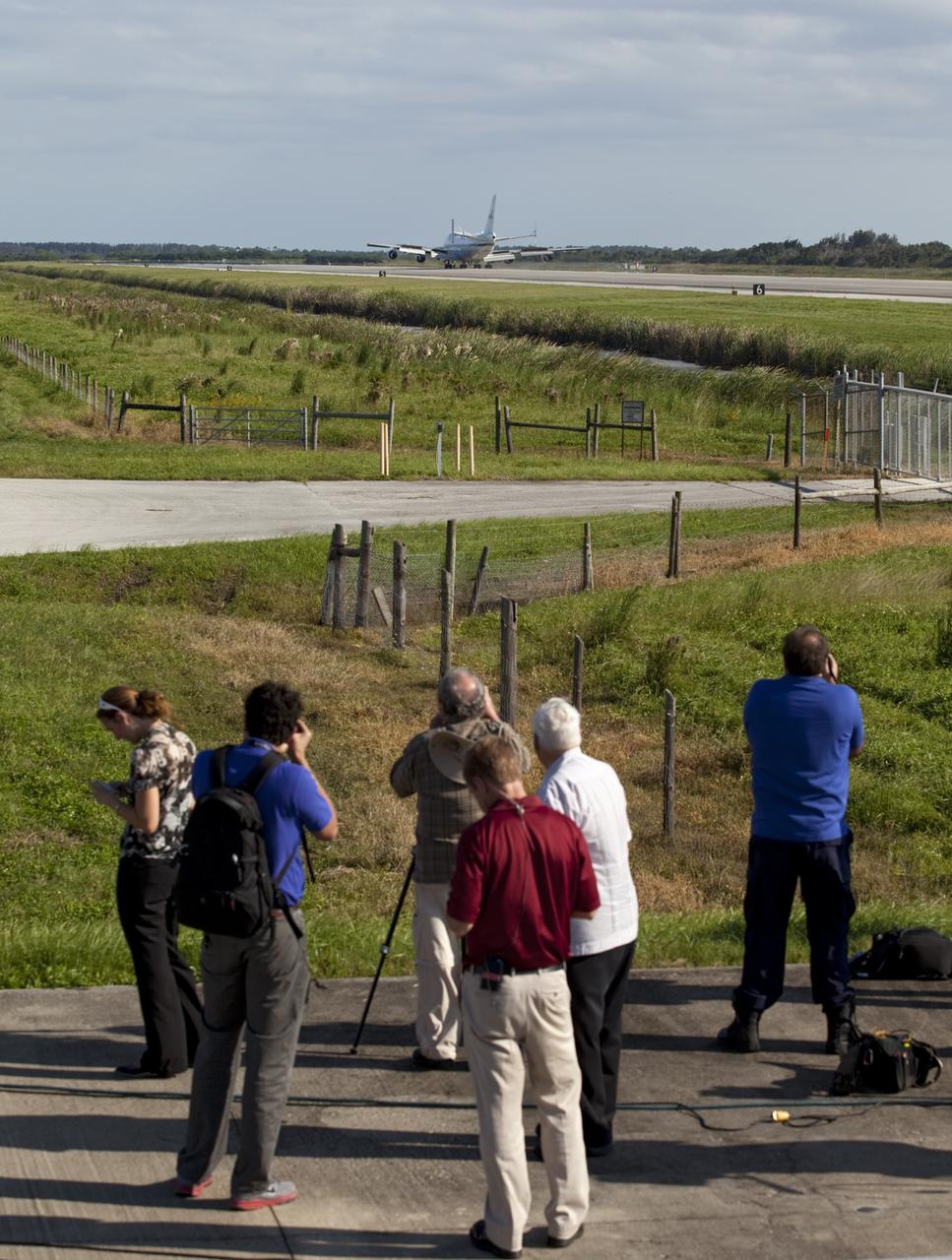
CAPE CANAVERAL, Fla. – Members of the media watch as the Shuttle Carrier Aircraft, or SCA, touched down at NASA Kennedy Space Center’s Shuttle Landing Facility in Florida at 5:05 p.m. EDT to prepare for shuttle Endeavour’s ferry flight to the Los Angeles International Airport on Sept. 17. This SCA, designated NASA 905, is a modified Boeing 747 jet airliner, originally manufactured for commercial use. One of two SCAs employed over the course of the Space Shuttle Program, NASA 905 is assigned to the final ferry mission. Endeavour will be placed on permanent public display at the California Science Center in Los Angeles. For more information on the SCA, visit http://www.nasa.gov/centers/dryden/news/FactSheets/FS-013-DFRC.html. For more information on shuttle transition and retirement activities, visit http://www.nasa.gov/shuttle. Photo credit: NASA/Frankie Martin
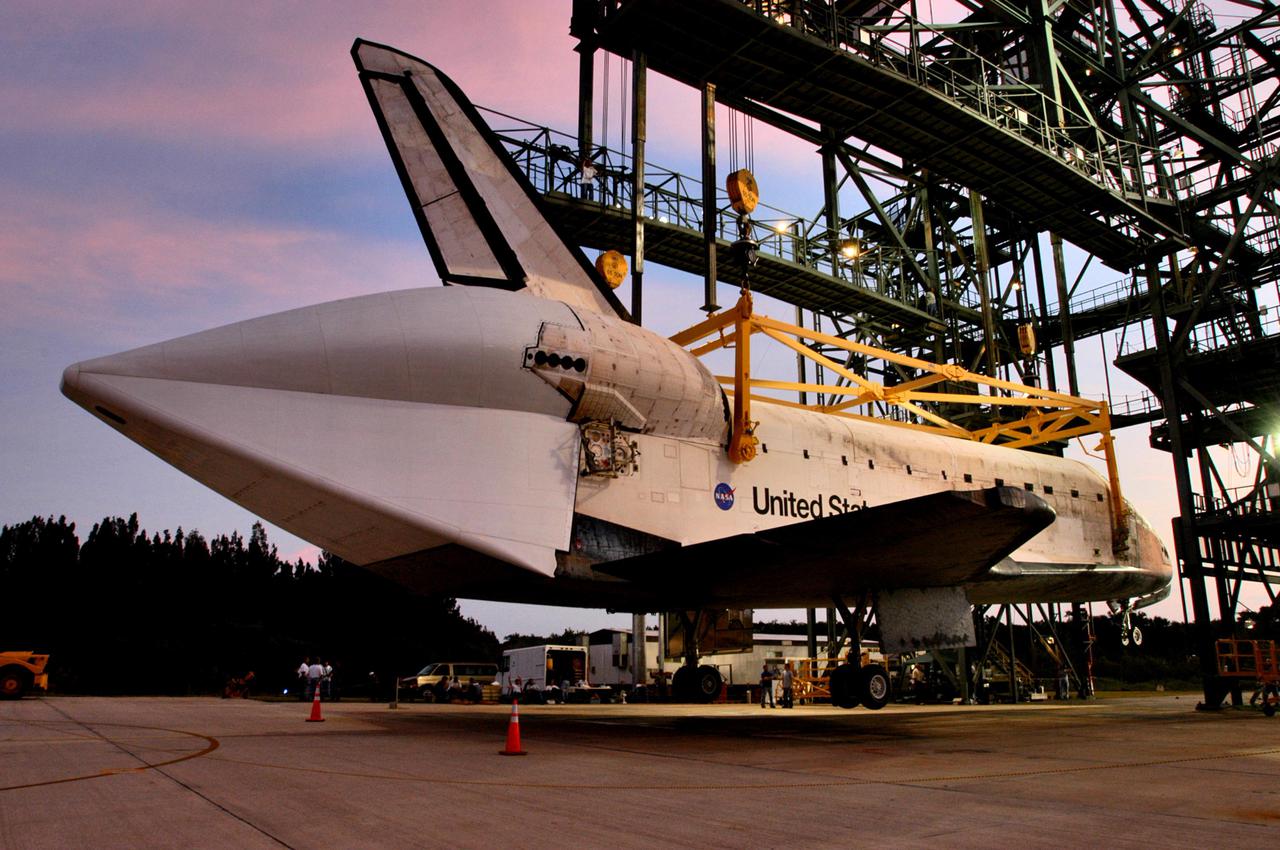
KENNEDY SPACE CENTER, FLA. - Just before sunrise, Discovery finally rests on its wheels on the ground at NASA Kennedy Space Center’s Shuttle Landing Facility. The orbiter was lowered overnight from the mate_demate device after the Shuttle Carrier Aircraft, a modified Boeing 747, was rolled away. Discovery was returned to Kennedy Space Center on a ferry flight from Edwards Air Force Base in California, where it landed Aug. 9 after 13 days in space on mission STS-114. In the mate_demate device, a horizontal structure mounted at the 80-foot level between two towers controls and guides a large lift beam that attaches to the orbiter to raise and lower it. The orbiter will be lowered to the ground and then be towed to the Orbiter Processing Facility. Once inside the OPF, the payload bay doors will be opened and the MPLM Raffaello brought back from the International Space Station will be unloaded and transferred to the Space Station Processing Facility. This concludes mission STS-114.

CAPE CANAVERAL, Fla. – At Edwards Air Force Base in California, a sling in the mate/demate device suspends space shuttle Atlantis above the ground. A Shuttle Carrier Aircraft, or SCA, will be moved underneath and Atlantis bolted to the top of the modified Boeing 747. A tail cone, which protects the aft engine area and provides a more efficient aeronautical dimension during its piggyback flight, can be seen. Atlantis landed at Edwards on May 24, which concluded mission STS-125, after two landing opportunities at Kennedy were waved off due to weather concerns. Atlantis is being returned to Florida on a ferry flight on the SCA. Atlantis' next assignment is the STS-129 mission, targeted to launch in November 2009. Photo credit: NASA/Ben Smegelsky
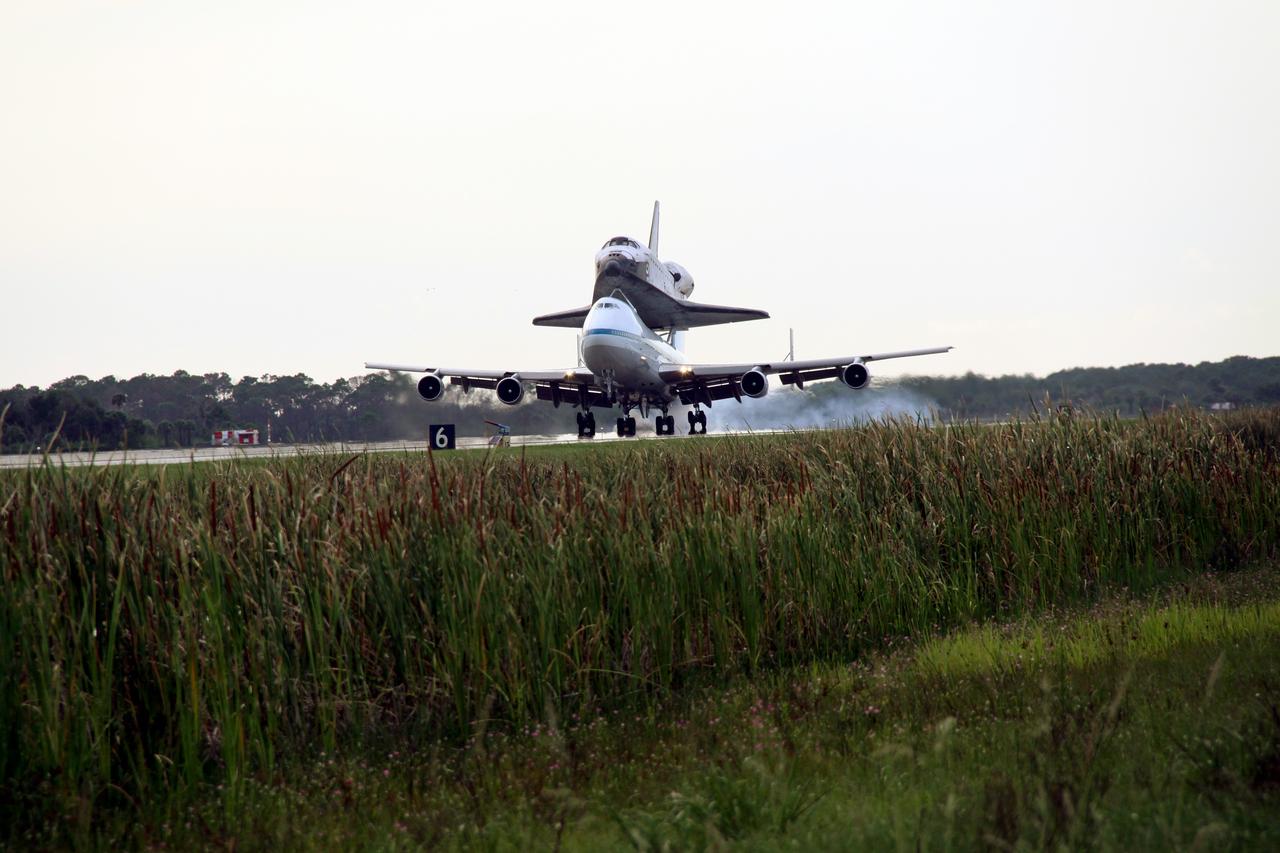
CAPE CANAVERAL, Fla. – After a two-day trip from California, the Shuttle Carrier Aircraft, or SCA, and its piggyback passenger space shuttle Atlantis lands on NASA Kennedy Space Center's Shuttle Landing Facility runway 15. The SCA is a modified Boeing 747 jetliner. Visible on Atlantis is the tail cone, which protects the aft engine area and provides a more efficient aeronautical dimension during flight. Atlantis returned from California atop the SCA after its May 24 landing at Edwards Air Force Base, concluding mission STS-125. The ferry flight from Edwards Air Force Base began June 1. Touchdown at Kennedy was at 6:53 p.m. EDT. Photo credit: NASA/Jack Pfaller