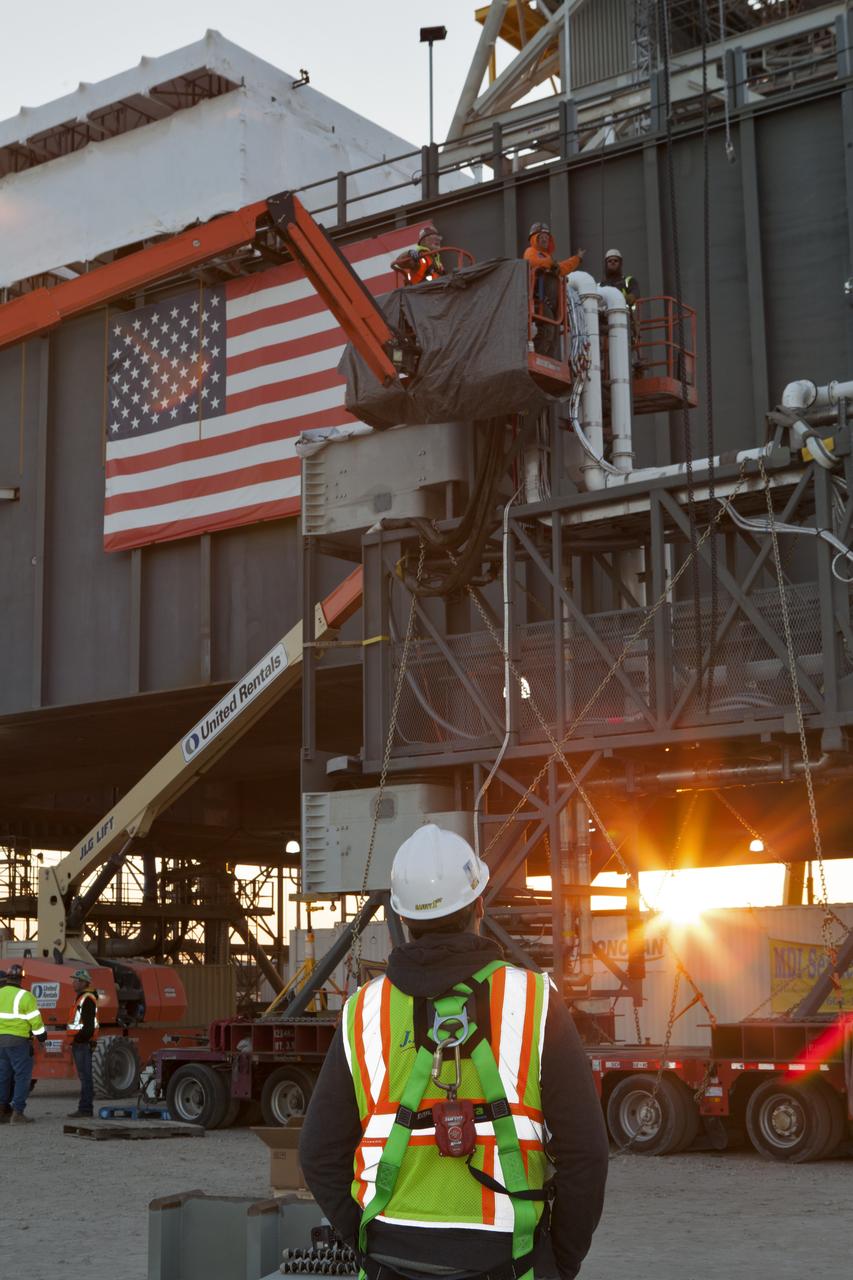
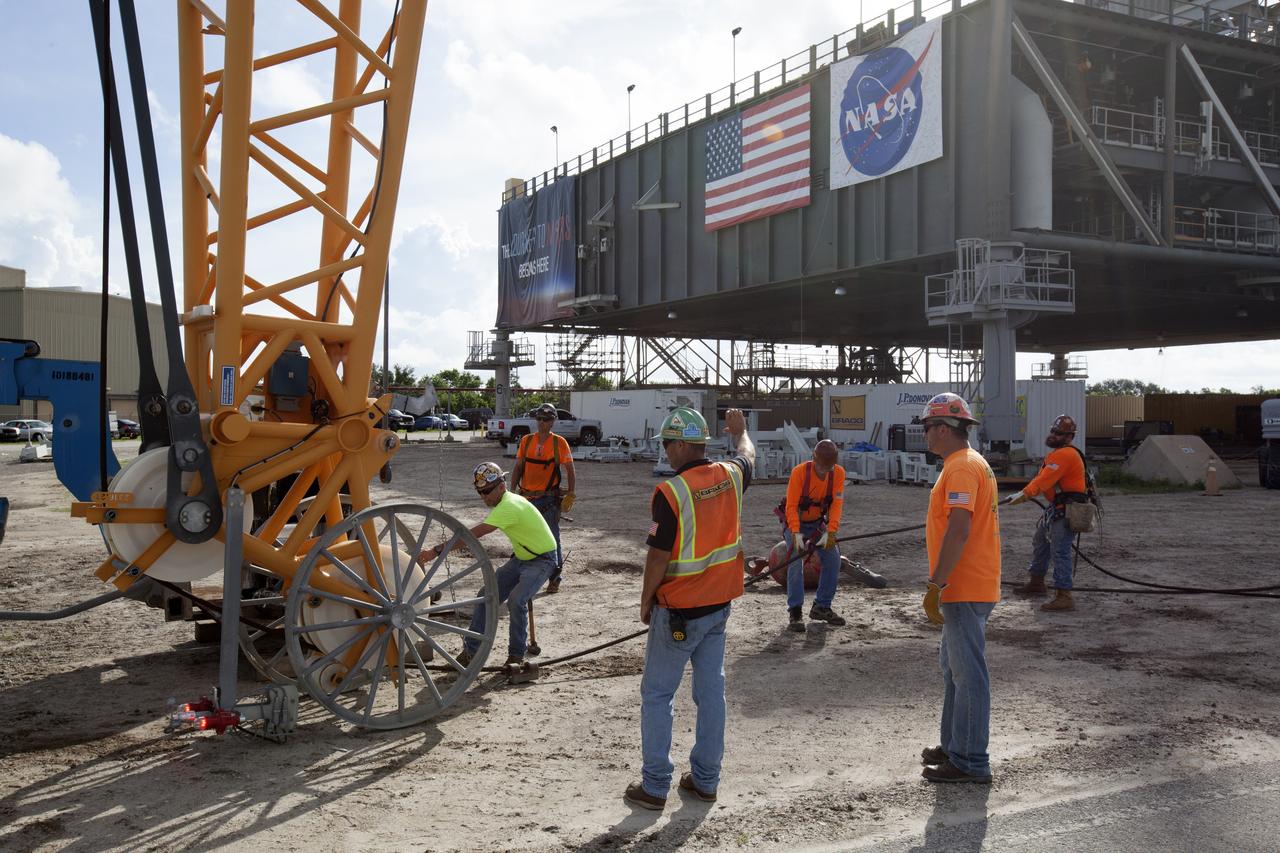
Construction workers with JP Donovan assist with preparations to lift and install the Interim Cryogenic Propulsion Stage Umbilical on the tower of the mobile launcher at NASA's Kennedy Space Center in Florida. The last of the large umbilicals to be installed, the ICPSU will provide super-cooled hydrogen and liquid oxygen to the Space Launch System (SLS) rocket's interim cryogenic propulsion stage, or upper stage, at T-0 for Exploration Mission-1. The umbilical is located at about the 240-foot-level of the mobile launcher and will supply fuel, oxidizer, gaseous helium, hazardous gas leak detection, electrical commodities and environment control systems to the upper stage of the SLS rocket during launch. Exploration Ground Systems is overseeing installation of the umbilicals on the ML.
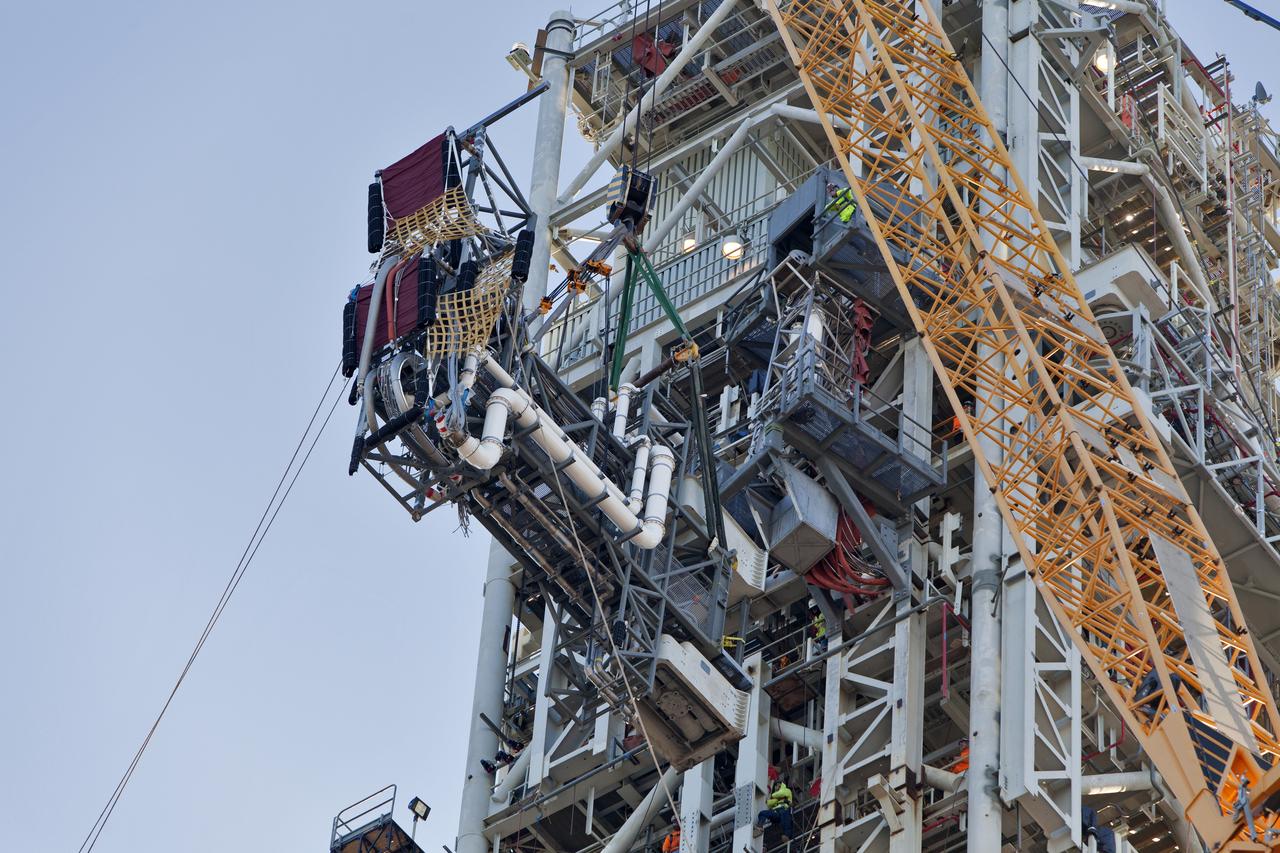
A crane and rigging lines are used to install the Interim Cryogenic Propulsion Stage Umbilical (ICPSU) high up on the mobile launcher (ML) at NASA's Kennedy Space Center in Florida. The last of the large umbilicals to be installed, the ICPSU will provide super-cooled hydrogen and liquid oxygen to the Space Launch System (SLS) rocket's interim cryogenic propulsion stage, or upper stage, at T-0 for Exploration Mission-1. The umbilical is located at about the 240-foot-level of the mobile launcher and will supply fuel, oxidizer, gaseous helium, hazardous gas leak detection, electrical commodities and environment control systems to the upper stage of the SLS rocket during launch. Exploration Ground Systems is overseeing installation of the umbilicals on the ML.

A crane and rigging lines are used to install the Interim Cryogenic Propulsion Stage Umbilical (ICPSU) high up on the mobile launcher (ML) at NASA's Kennedy Space Center in Florida. The last of the large umbilicals to be installed, the ICPSU will provide super-cooled hydrogen and liquid oxygen to the Space Launch System (SLS) rocket's interim cryogenic propulsion stage, or upper stage, at T-0 for Exploration Mission-1. The umbilical is located at about the 240-foot-level of the mobile launcher and will supply fuel, oxidizer, gaseous helium, hazardous gas leak detection, electrical commodities and environment control systems to the upper stage of the SLS rocket during launch. Exploration Ground Systems is overseeing installation of the umbilicals on the ML.
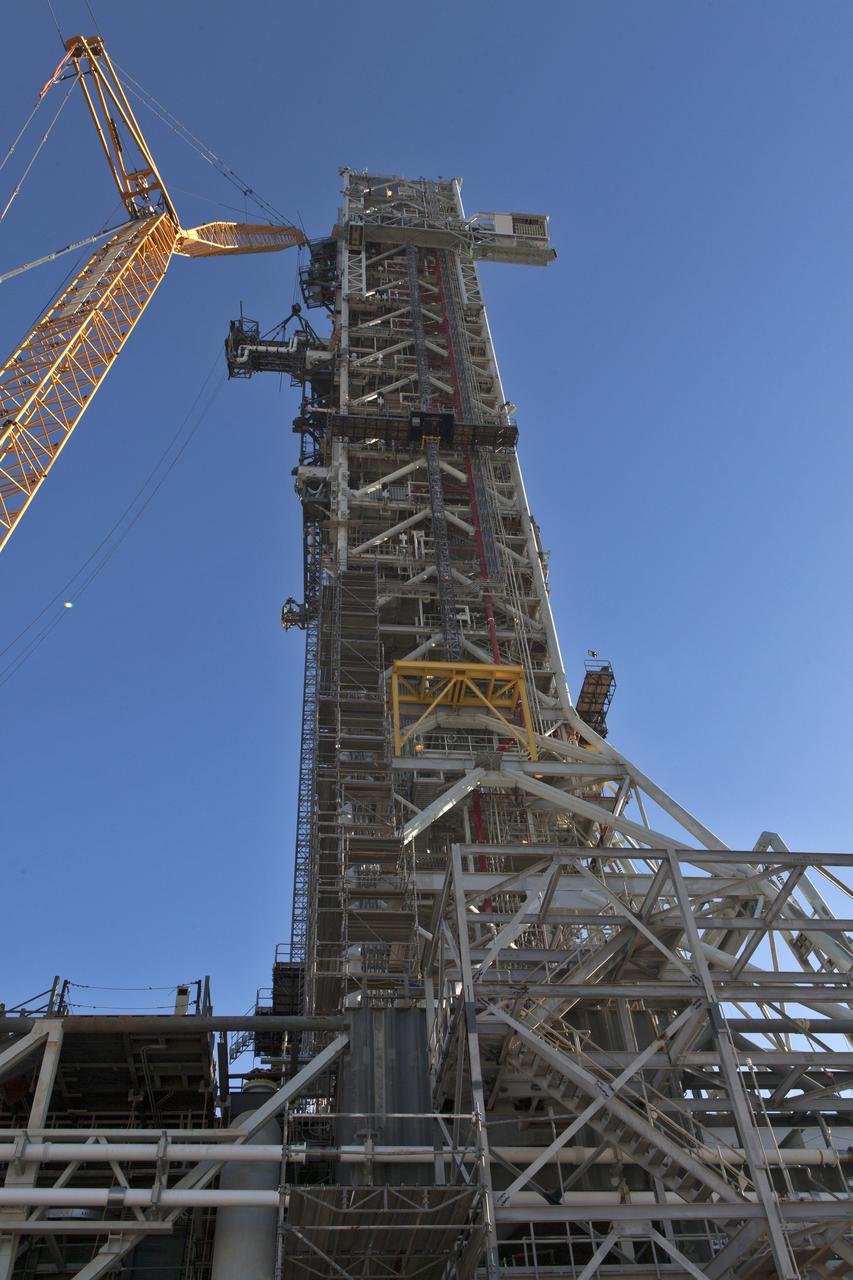
A crane and rigging lines are used to install the Interim Cryogenic Propulsion Stage Umbilical (ICPSU) high up on the mobile launcher (ML) at NASA's Kennedy Space Center in Florida. The last of the large umbilicals to be installed, the ICPSU will provide super-cooled hydrogen and liquid oxygen to the Space Launch System (SLS) rocket's interim cryogenic propulsion stage, or upper stage, at T-0 for Exploration Mission-1. The umbilical is located at about the 240-foot-level of the mobile launcher and will supply fuel, oxidizer, gaseous helium, hazardous gas leak detection, electrical commodities and environment control systems to the upper stage of the SLS rocket during launch. Exploration Ground Systems is overseeing installation of the umbilicals on the ML.
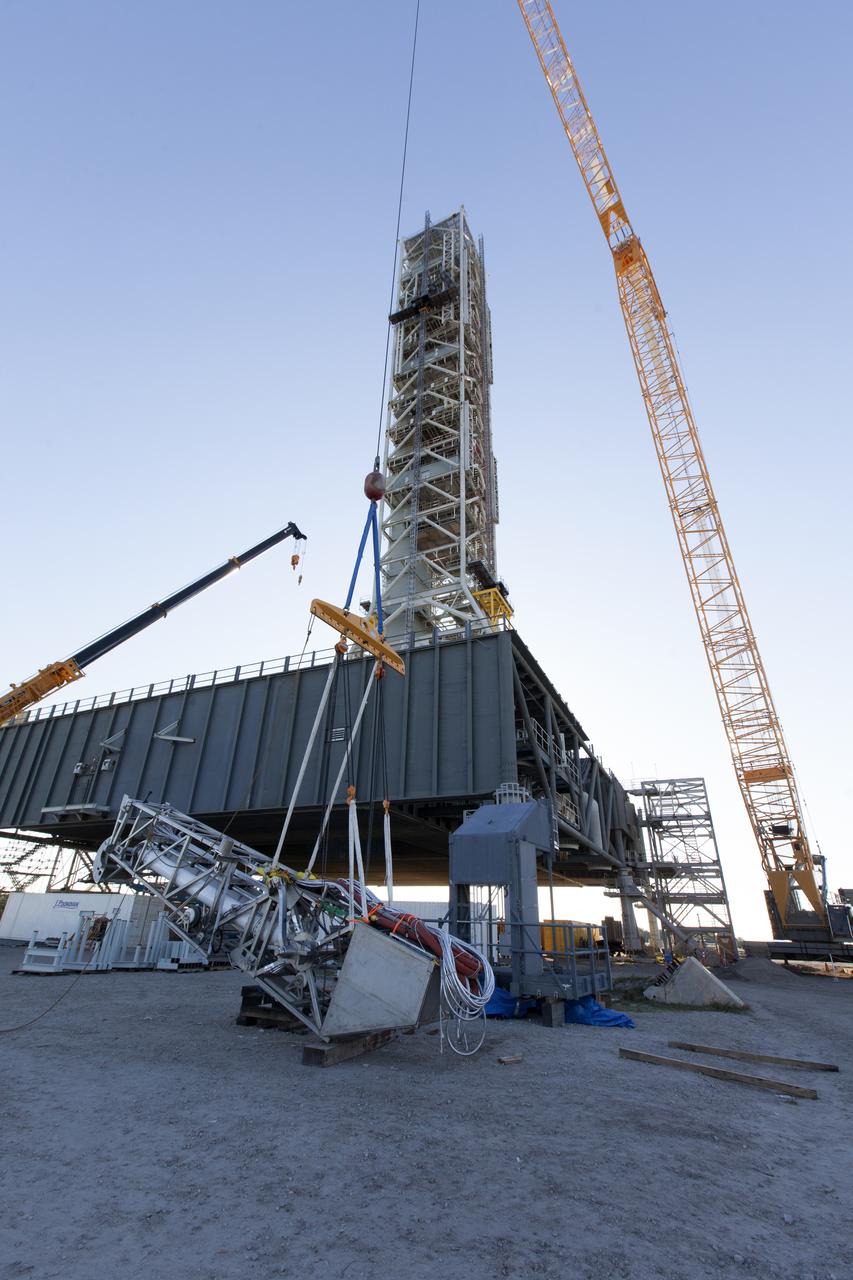
Preparations are underway to lift the Orion Service Module Umbilical (OSMU) up for installation on the mobile launcher tower at NASA's Kennedy Space Center in Florida. The mobile launcher tower will be equipped with a number of lines, called umbilicals, that will connect to the Space Launch System rocket and Orion spacecraft for Exploration Mission-1 (EM-1). The OSMU will be located high on the mobile launcher tower and, prior to launch, will transfer liquid coolant for the electronics and air for the Environmental Control System to the Orion service module that houses these critical systems to support the spacecraft. EM-1 is scheduled to launch in 2018. The Ground Systems Development and Operations Program is overseeing installation of the umbilicals.
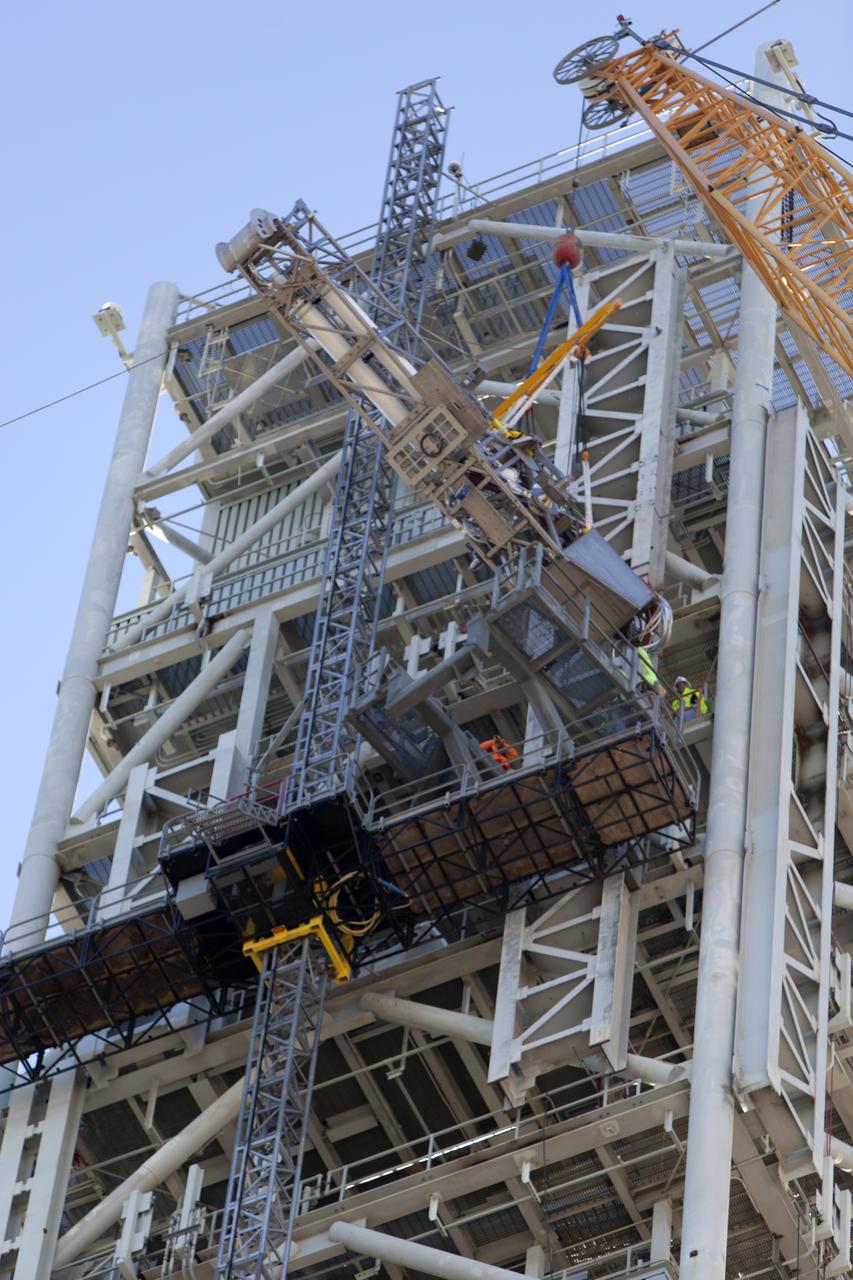
A crane and rigging are used to lift the Orion Service Module Umbilical (OSMU) high up for installation on the mobile launcher tower at NASA's Kennedy Space Center in Florida. The mobile launcher tower will be equipped with a number of lines, called umbilicals, that will connect to the Space Launch System rocket and Orion spacecraft for Exploration Mission-1 (EM-1). The OSMU will be located high on the mobile launcher tower and, prior to launch, will transfer liquid coolant for the electronics and air for the Environmental Control System to the Orion service module that houses these critical systems to support the spacecraft. EM-1 is scheduled to launch in 2018. The Ground Systems Development and Operations Program is overseeing installation of the umbilicals.
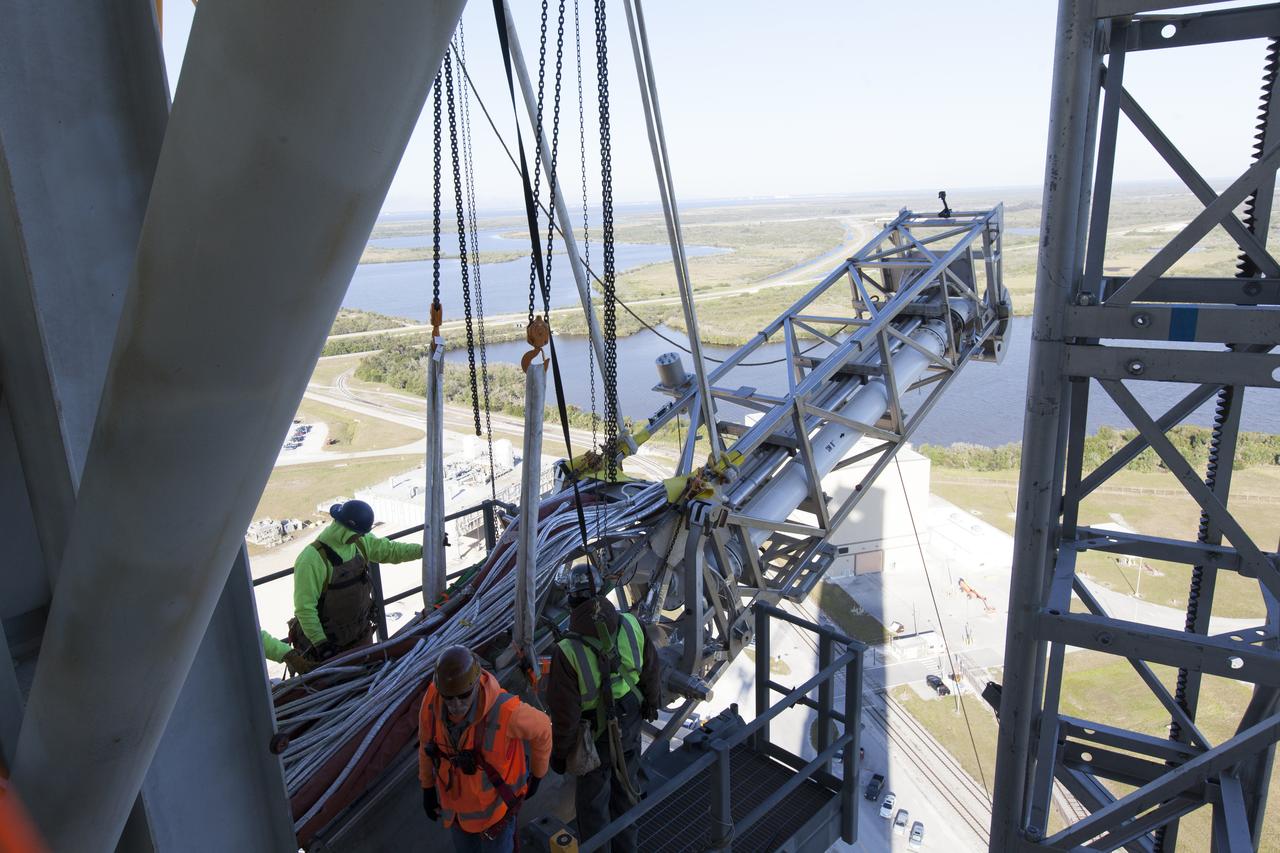
Construction workers assist as a crane and rigging are used to position the Orion Service Module Umbilical (OSMU) for installation high up on the mobile launcher tower at NASA's Kennedy Space Center in Florida. The mobile launcher tower will be equipped with a number of lines, called umbilicals, that will connect to the Space Launch System rocket and Orion spacecraft for Exploration Mission-1 (EM-1). The OSMU will be located high on the mobile launcher tower and, prior to launch, will transfer liquid coolant for the electronics and air for the Environmental Control System to the Orion service module that houses these critical systems to support the spacecraft. EM-1 is scheduled to launch in 2018. The Ground Systems Development and Operations Program is overseeing installation of the umbilicals.
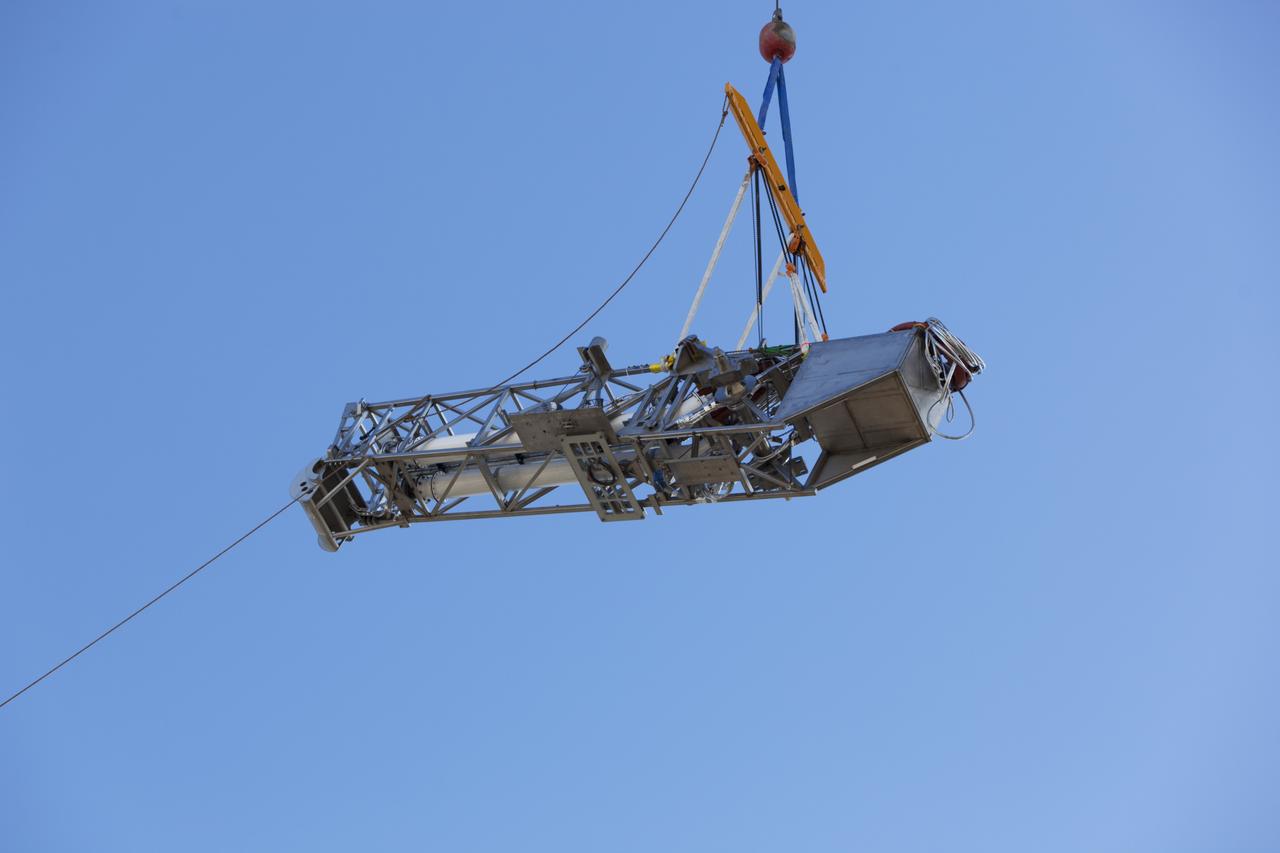
Seeming to hang in midair, the Orion Service Module Umbilical (OSMU) is lifted high up by crane for installation on the mobile launcher tower at NASA's Kennedy Space Center in Florida. The mobile launcher tower will be equipped with a number of lines, called umbilicals, that will connect to the Space Launch System rocket and Orion spacecraft for Exploration Mission-1 (EM-1). The OSMU will be located high on the mobile launcher tower and, prior to launch, will transfer liquid coolant for the electronics and air for the Environmental Control System to the Orion service module that houses these critical systems to support the spacecraft. EM-1 is scheduled to launch in 2018. The Ground Systems Development and Operations Program is overseeing installation of the umbilicals.
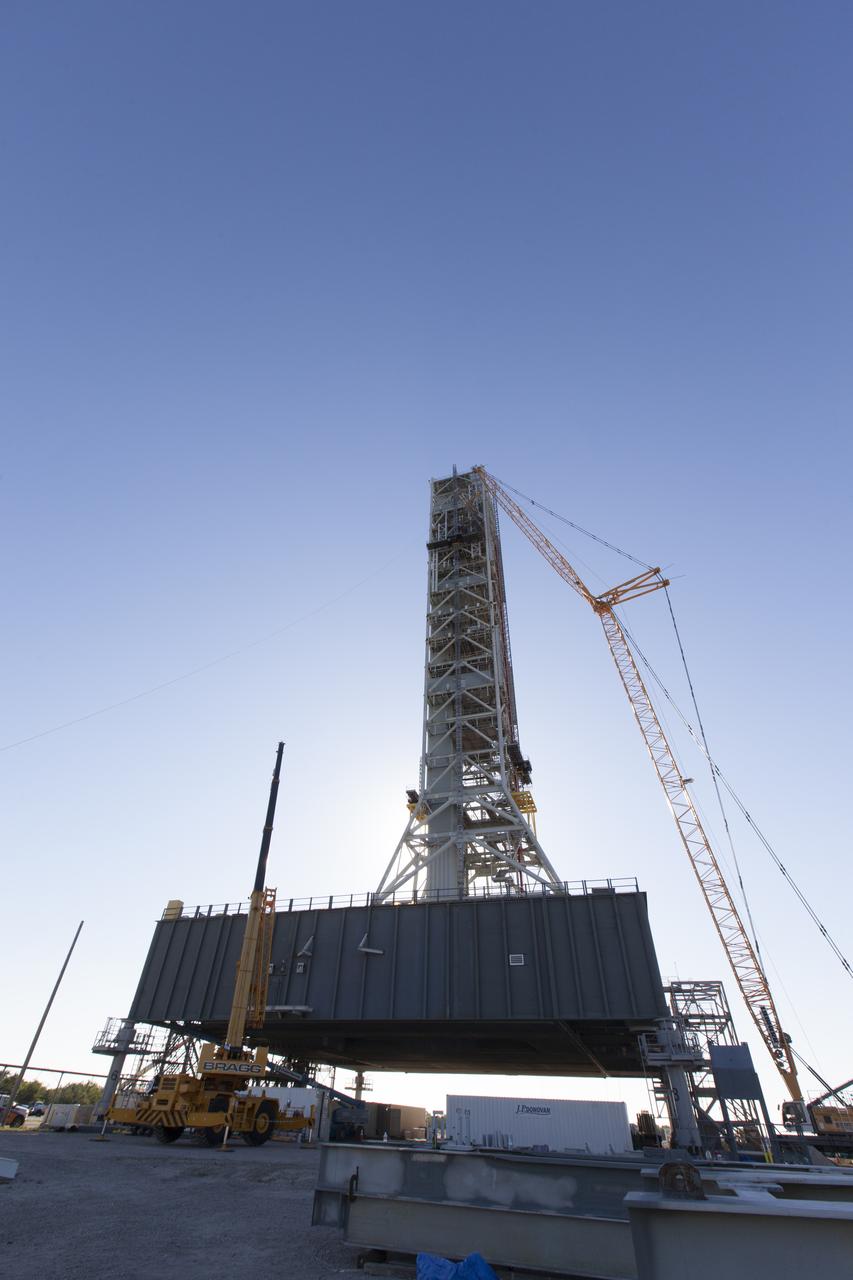
A crane and rigging are used to position the Orion Service Module Umbilical (OSMU) for installation high up on the mobile launcher tower at NASA's Kennedy Space Center in Florida. The mobile launcher tower will be equipped with a number of lines, called umbilicals, that will connect to the Space Launch System rocket and Orion spacecraft for Exploration Mission-1 (EM-1). The OSMU will be located high on the mobile launcher tower and, prior to launch, will transfer liquid coolant for the electronics and air for the Environmental Control System to the Orion service module that houses these critical systems to support the spacecraft. EM-1 is scheduled to launch in 2018. The Ground Systems Development and Operations Program is overseeing installation of the umbilicals.
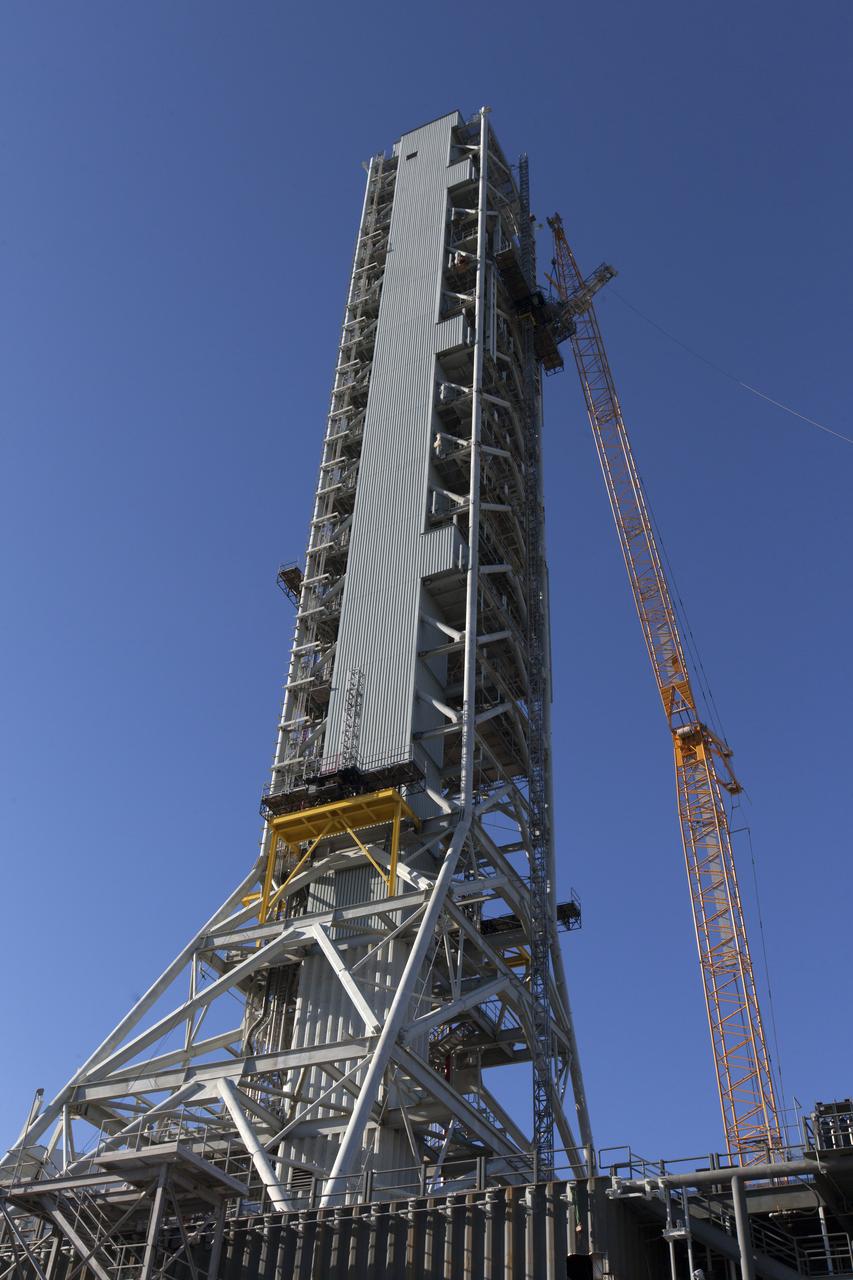
A crane and rigging are used to position the Orion Service Module Umbilical (OSMU) for installation high up on the mobile launcher tower at NASA's Kennedy Space Center in Florida. The mobile launcher tower will be equipped with a number of lines, called umbilicals, that will connect to the Space Launch System rocket and Orion spacecraft for Exploration Mission-1 (EM-1). The OSMU will be located high on the mobile launcher tower and, prior to launch, will transfer liquid coolant for the electronics and air for the Environmental Control System to the Orion service module that houses these critical systems to support the spacecraft. EM-1 is scheduled to launch in 2018. The Ground Systems Development and Operations Program is overseeing installation of the umbilicals.

A crane and rigging are used to lift the Orion Service Module Umbilical (OSMU) up for installation on the mobile launcher tower at NASA's Kennedy Space Center in Florida. The mobile launcher tower will be equipped with a number of lines, called umbilicals, that will connect to the Space Launch System rocket and Orion spacecraft for Exploration Mission-1 (EM-1). The OSMU will be located high on the mobile launcher tower and, prior to launch, will transfer liquid coolant for the electronics and air for the Environmental Control System to the Orion service module that houses these critical systems to support the spacecraft. EM-1 is scheduled to launch in 2018. The Ground Systems Development and Operations Program is overseeing installation of the umbilicals.
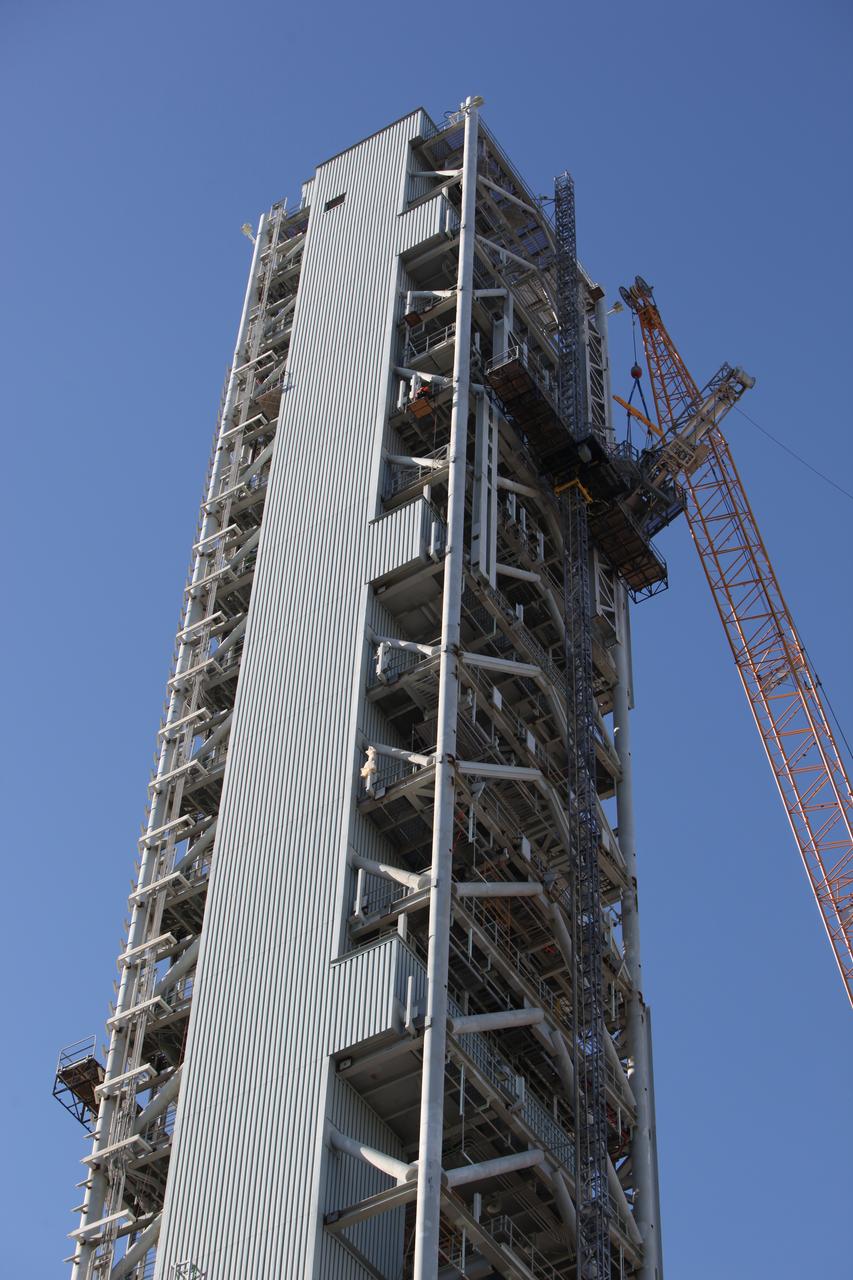
A crane and rigging are used to position the Orion Service Module Umbilical (OSMU) for installation high up on the mobile launcher tower at NASA's Kennedy Space Center in Florida. The mobile launcher tower will be equipped with a number of lines, called umbilicals, that will connect to the Space Launch System rocket and Orion spacecraft for Exploration Mission-1 (EM-1). The OSMU will be located high on the mobile launcher tower and, prior to launch, will transfer liquid coolant for the electronics and air for the Environmental Control System to the Orion service module that houses these critical systems to support the spacecraft. EM-1 is scheduled to launch in 2018. The Ground Systems Development and Operations Program is overseeing installation of the umbilicals.
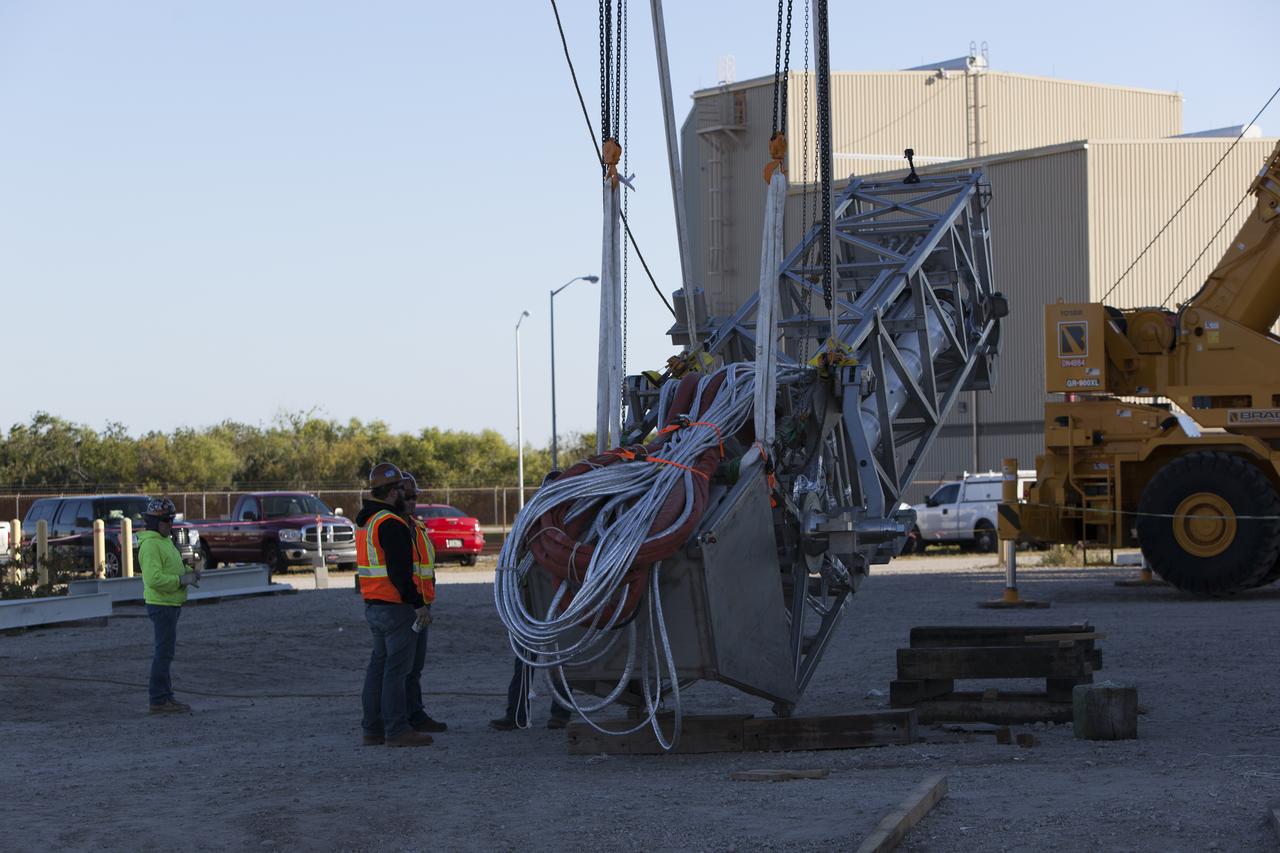
Preparations are underway to lift the Orion Service Module Umbilical (OSMU) up for installation on the mobile launcher tower at NASA's Kennedy Space Center in Florida. The mobile launcher tower will be equipped with a number of lines, called umbilicals, that will connect to the Space Launch System rocket and Orion spacecraft for Exploration Mission-1 (EM-1). The OSMU will be located high on the mobile launcher tower and, prior to launch, will transfer liquid coolant for the electronics and air for the Environmental Control System to the Orion service module that houses these critical systems to support the spacecraft. EM-1 is scheduled to launch in 2018. The Ground Systems Development and Operations Program is overseeing installation of the umbilicals.
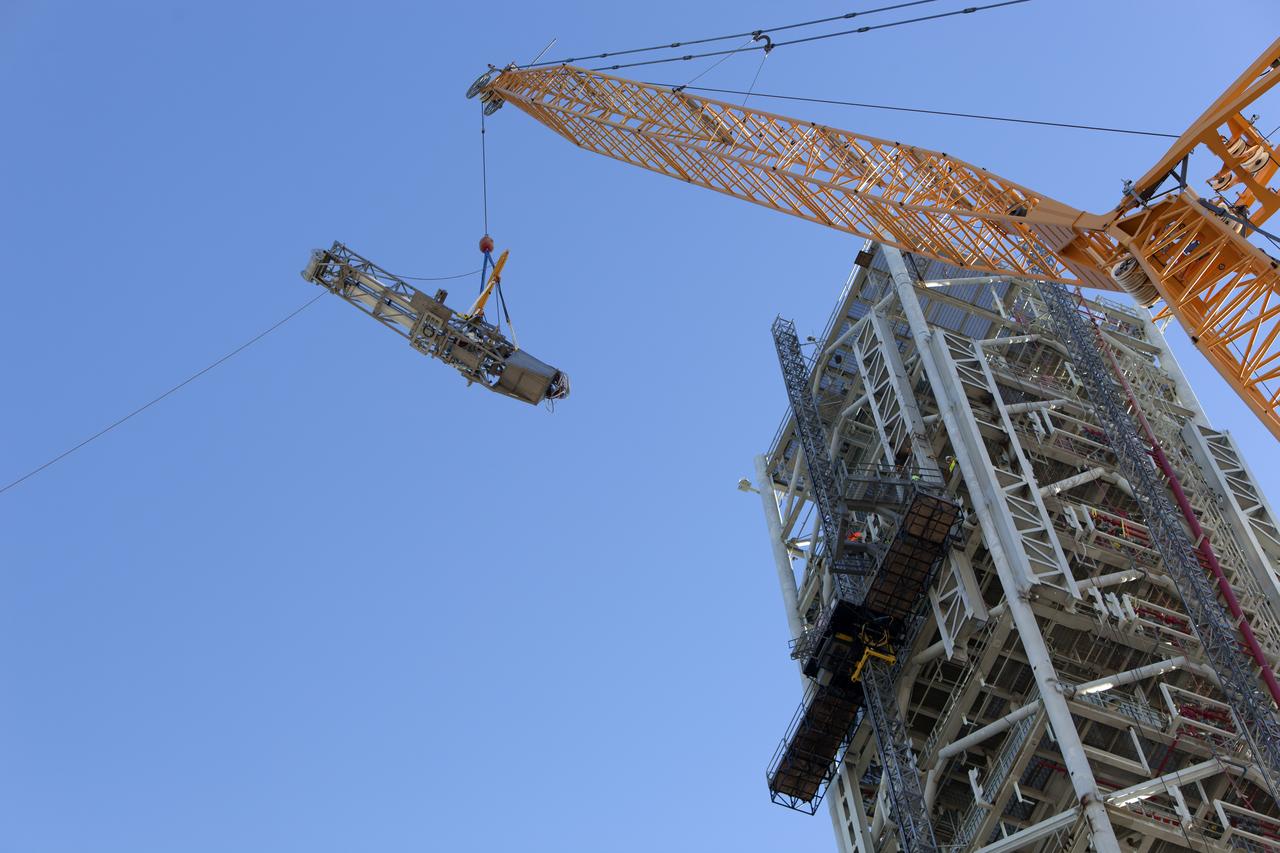
A crane and rigging are used to lift the Orion Service Module Umbilical (OSMU) high up for installation on the mobile launcher tower at NASA's Kennedy Space Center in Florida. The mobile launcher tower will be equipped with a number of lines, called umbilicals, that will connect to the Space Launch System rocket and Orion spacecraft for Exploration Mission-1 (EM-1). The OSMU will be located high on the mobile launcher tower and, prior to launch, will transfer liquid coolant for the electronics and air for the Environmental Control System to the Orion service module that houses these critical systems to support the spacecraft. EM-1 is scheduled to launch in 2018. The Ground Systems Development and Operations Program is overseeing installation of the umbilicals.

A crane and rigging are used to lift the Orion Service Module Umbilical (OSMU) high up for installation on the mobile launcher tower at NASA's Kennedy Space Center in Florida. The mobile launcher tower will be equipped with a number of lines, called umbilicals, that will connect to the Space Launch System rocket and Orion spacecraft for Exploration Mission-1 (EM-1). The OSMU will be located high on the mobile launcher tower and, prior to launch, will transfer liquid coolant for the electronics and air for the Environmental Control System to the Orion service module that houses these critical systems to support the spacecraft. EM-1 is scheduled to launch in 2018. The Ground Systems Development and Operations Program is overseeing installation of the umbilicals.
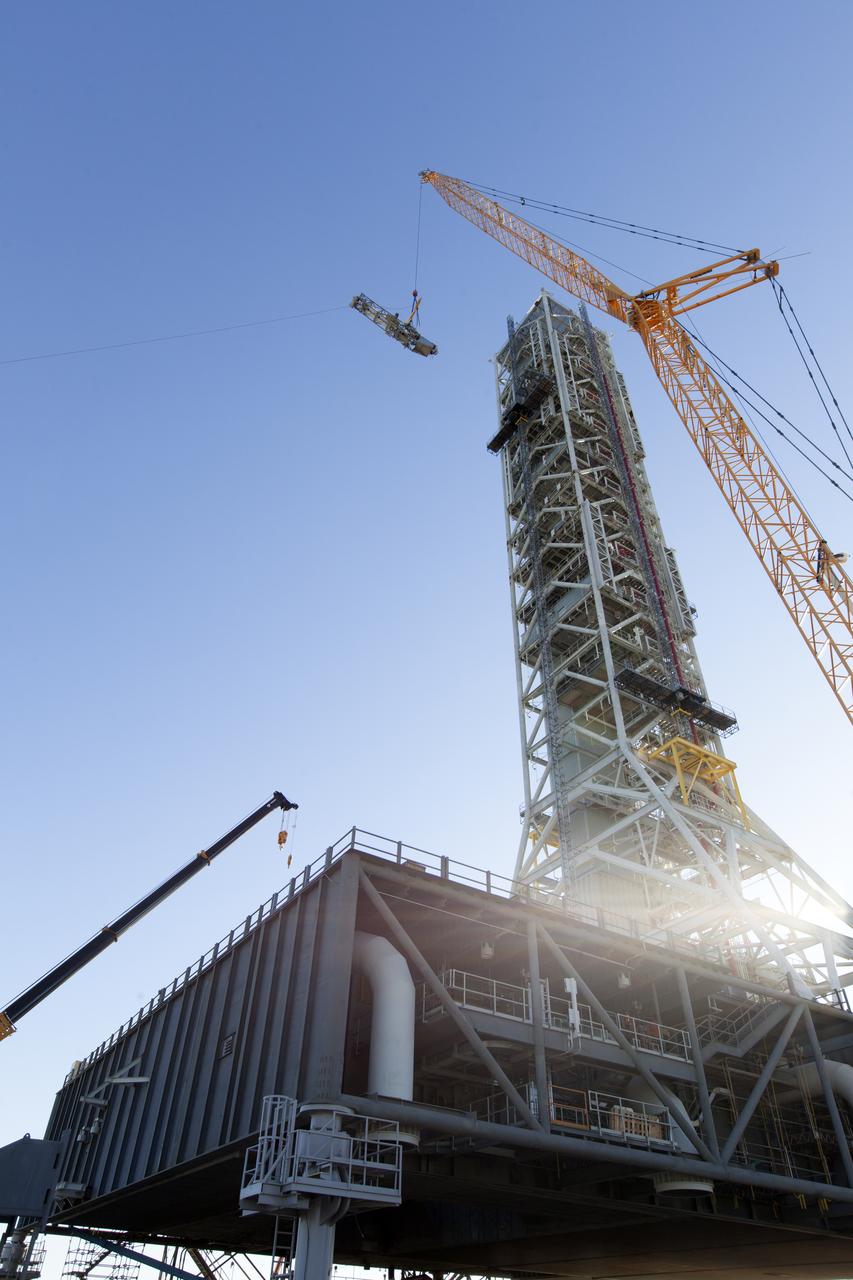
A crane lifts the Orion Service Module Umbilical (OSMU) high up for installation on the mobile launcher tower at NASA's Kennedy Space Center in Florida. The mobile launcher tower will be equipped with a number of lines, called umbilicals, that will connect to the Space Launch System rocket and Orion spacecraft for Exploration Mission-1 (EM-1). The OSMU will be located high on the mobile launcher tower and, prior to launch, will transfer liquid coolant for the electronics and air for the Environmental Control System to the Orion service module that houses these critical systems to support the spacecraft. EM-1 is scheduled to launch in 2018. The Ground Systems Development and Operations Program is overseeing installation of the umbilicals.

A construction worker with JP Donovan helps prepare the Interim Cryogenic Propulsion Stage Umbilical (ICPSU) for installation high up on the tower of the mobile launcher (ML) at NASA's Kennedy Space Center in Florida. The last of the large umbilicals to be installed, the ICPSU will provide super-cooled hydrogen and liquid oxygen to the Space Launch System (SLS) rocket's interim cryogenic propulsion stage, or upper stage, at T-0 for Exploration Mission-1. The umbilical will be located at about the 240-foot-level of the mobile launcher and will supply fuel, oxidizer, gaseous helium, hazardous gas leak detection, electrical commodities and environment control systems to the upper stage of the SLS rocket during launch. Exploration Ground Systems is overseeing installation of the umbilicals on the ML.
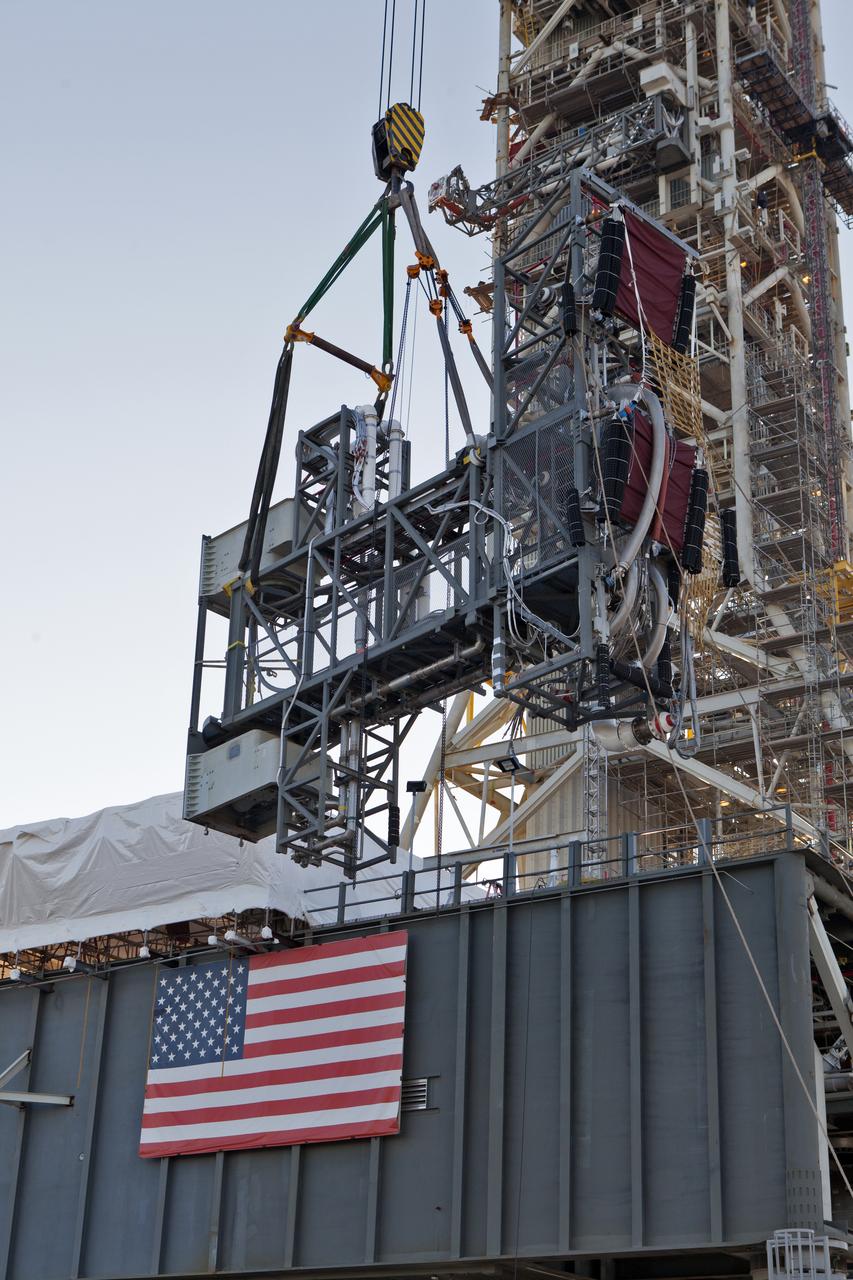
A heavy-lift crane slowly lifts the Interim Cryogenic Propulsion Stage Umbilical (ICPSU) up for installation on the tower of the mobile launcher (ML) at NASA's Kennedy Space Center in Florida. The last of the large umbilicals to be installed, the ICPSU will provide super-cooled hydrogen and liquid oxygen to the Space Launch System (SLS) rocket's interim cryogenic propulsion stage, or upper stage, at T-0 for Exploration Mission-1. The umbilical is located at about the 240-foot-level of the mobile launcher and will supply fuel, oxidizer, gaseous helium, hazardous gas leak detection, electrical commodities and environment control systems to the upper stage of the SLS rocket during launch. Exploration Ground Systems is overseeing installation of the umbilicals on the ML.
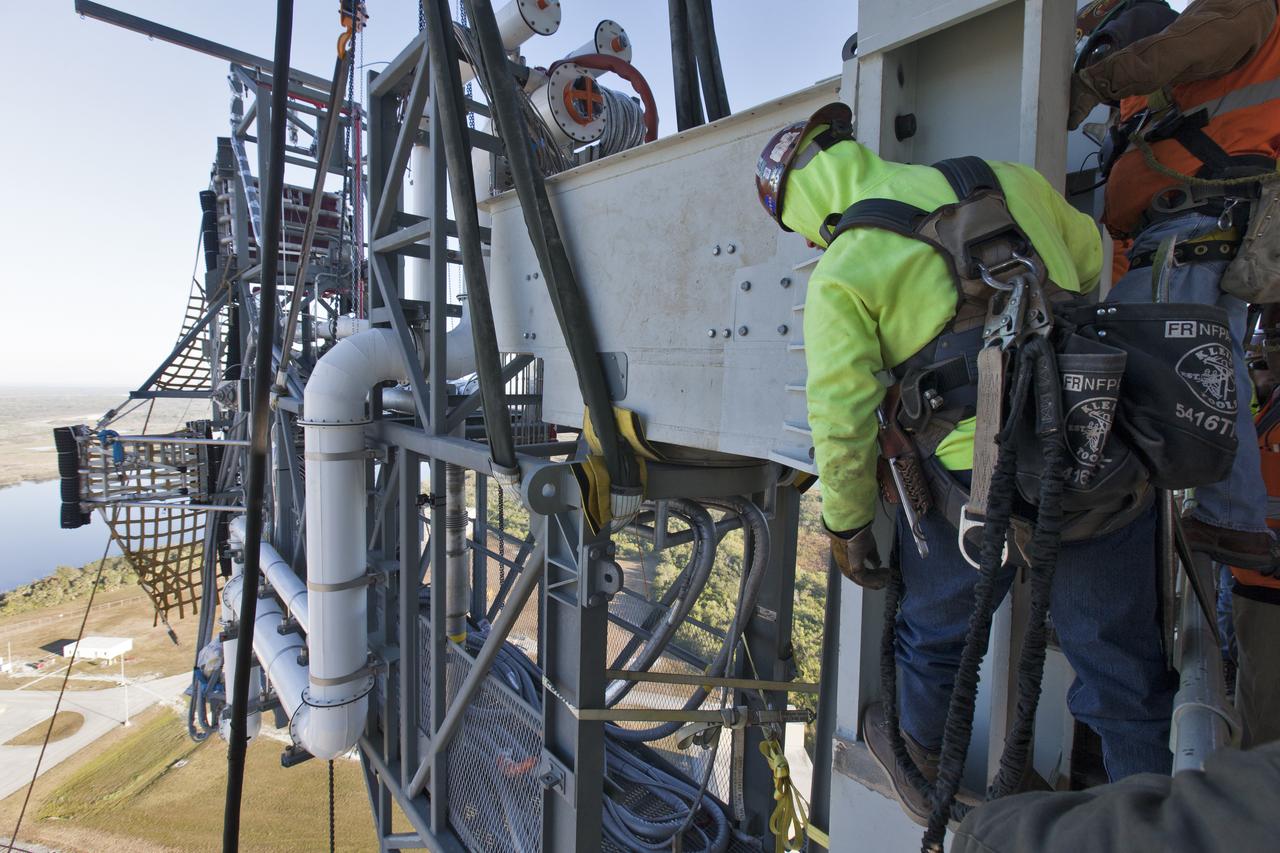
Construction workers with JP Donovan install the Interim Cryogenic Propulsion Stage Umbilical (ICPSU) at about the 240-foot-level of the mobile launcher (ML) tower at NASA's Kennedy Space Center in Florida. The last of the large umbilicals to be installed, the ICPSU will provide super-cooled hydrogen and liquid oxygen to the Space Launch System (SLS) rocket's interim cryogenic propulsion stage, or upper stage, at T-0 for Exploration Mission-1. The umbilical is located at about the 240-foot-level of the mobile launcher and will supply fuel, oxidizer, gaseous helium, hazardous gas leak detection, electrical commodities and environment control systems to the upper stage of the SLS rocket during launch. Exploration Ground Systems is overseeing installation of the umbilicals on the ML.
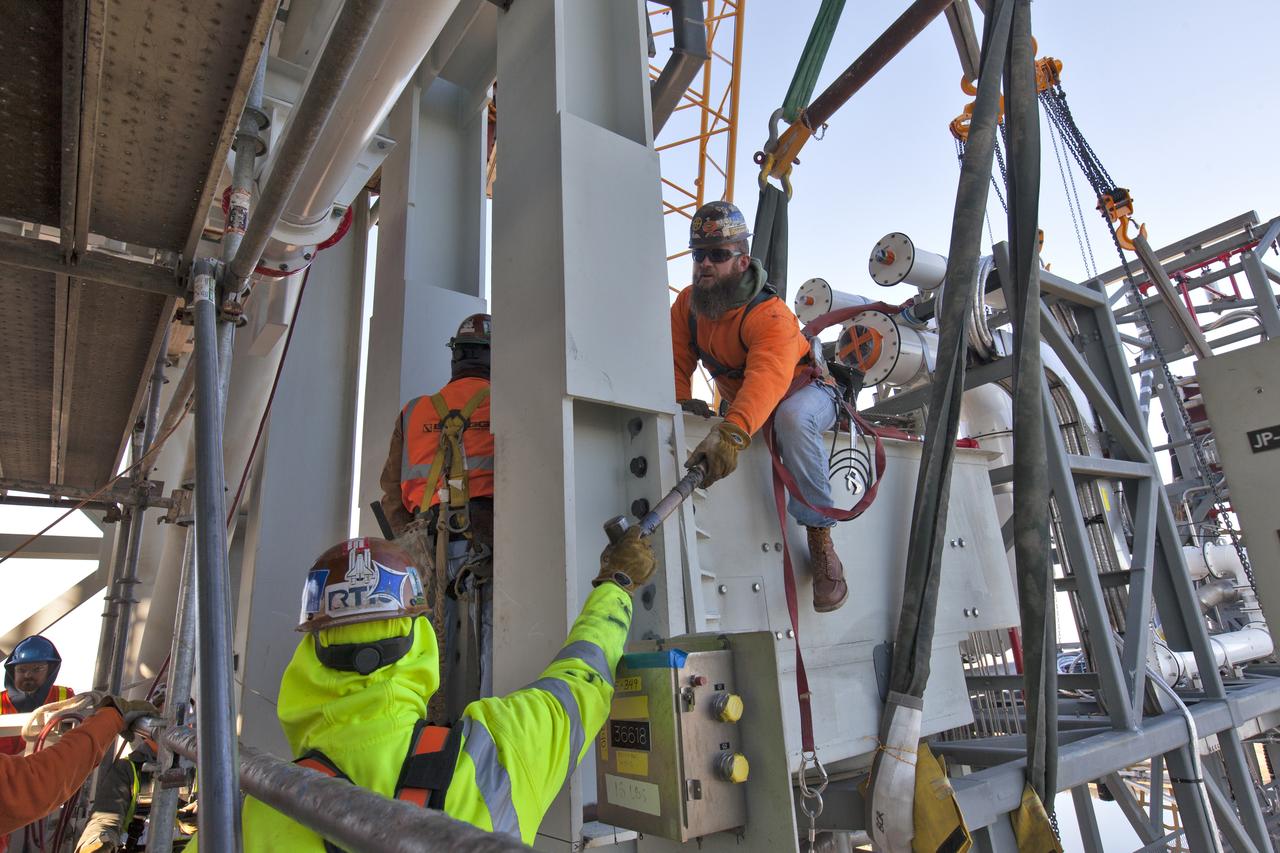
Construction workers with JP Donovan install the Interim Cryogenic Propulsion Stage Umbilical (ICPSU) at about the 240-foot-level of the mobile launcher (ML) tower at NASA's Kennedy Space Center in Florida. The last of the large umbilicals to be installed, the ICPSU will provide super-cooled hydrogen and liquid oxygen to the Space Launch System (SLS) rocket's interim cryogenic propulsion stage, or upper stage, at T-0 for Exploration Mission-1. The umbilical is located at about the 240-foot-level of the mobile launcher and will supply fuel, oxidizer, gaseous helium, hazardous gas leak detection, electrical commodities and environment control systems to the upper stage of the SLS rocket during launch. Exploration Ground Systems is overseeing installation of the umbilicals on the ML.

The mobile launcher (ML) is reflected in the sunglasses of a construction worker with JP Donovan at NASA's Kennedy Space Center in Florida. A crane is lifting the Interim Cryogenic Propulsion Stage Umbilical (ICPSU) up for installation on the tower of the ML. The last of the large umbilicals to be installed, the ICPSU will provide super-cooled hydrogen and liquid oxygen to the Space Launch System (SLS) rocket's interim cryogenic propulsion stage, or upper stage, at T-0 for Exploration Mission-1. The umbilical is located at about the 240-foot-level of the mobile launcher and will supply fuel, oxidizer, gaseous helium, hazardous gas leak detection, electrical commodities and environment control systems to the upper stage of the SLS rocket during launch. Exploration Ground Systems is overseeing installation of the umbilicals on the ML.
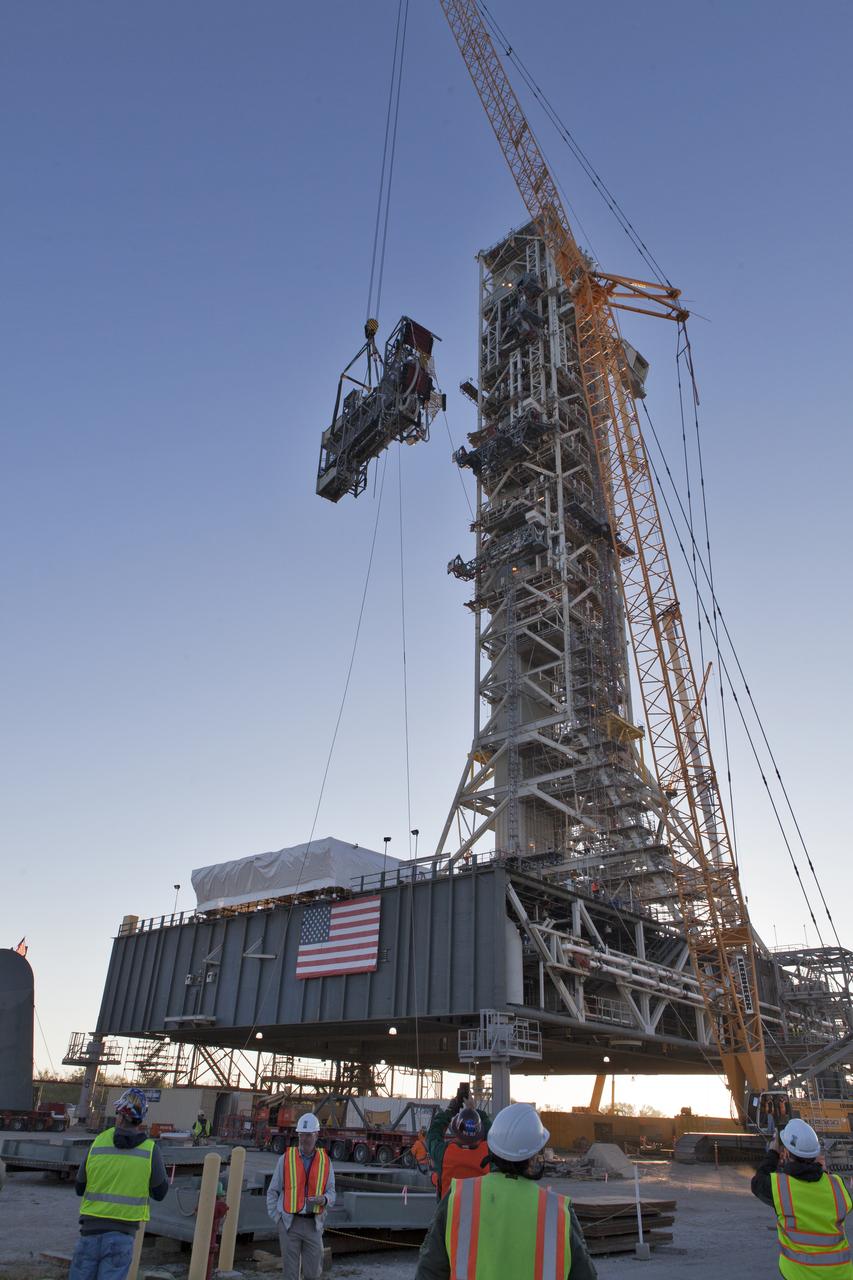
A heavy-lift crane slowly lifts the Interim Cryogenic Propulsion Stage Umbilical (ICPSU) high up for installation on the tower of the mobile launcher (ML) at NASA's Kennedy Space Center in Florida. The last of the large umbilicals to be installed, the ICPSU will provide super-cooled hydrogen and liquid oxygen to the Space Launch System (SLS) rocket's interim cryogenic propulsion stage, or upper stage, at T-0 for Exploration Mission-1. The umbilical is located at about the 240-foot-level of the mobile launcher and will supply fuel, oxidizer, gaseous helium, hazardous gas leak detection, electrical commodities and environment control systems to the upper stage of the SLS rocket during launch. Exploration Ground Systems is overseeing installation of the umbilicals on the ML.

The mobile launcher (ML) tower is lit up before early morning sunrise at NASA's Kennedy Space Center in Florida. Preparations are underway to lift and install the Interim Cryogenic Propulsion Stage Umbilical (ICPSU) at about the 240-foot-level on the tower. The last of the large umbilicals to be installed, the ICPSU will provide super-cooled hydrogen and liquid oxygen to the Space Launch System (SLS) rocket's interim cryogenic propulsion stage, or upper stage, at T-0 for Exploration Mission-1. The umbilical will supply fuel, oxidizer, gaseous helium, hazardous gas leak detection, electrical commodities and environment control systems to the upper stage of the SLS rocket during launch. Exploration Ground Systems is overseeing installation of the umbilicals on the ML.
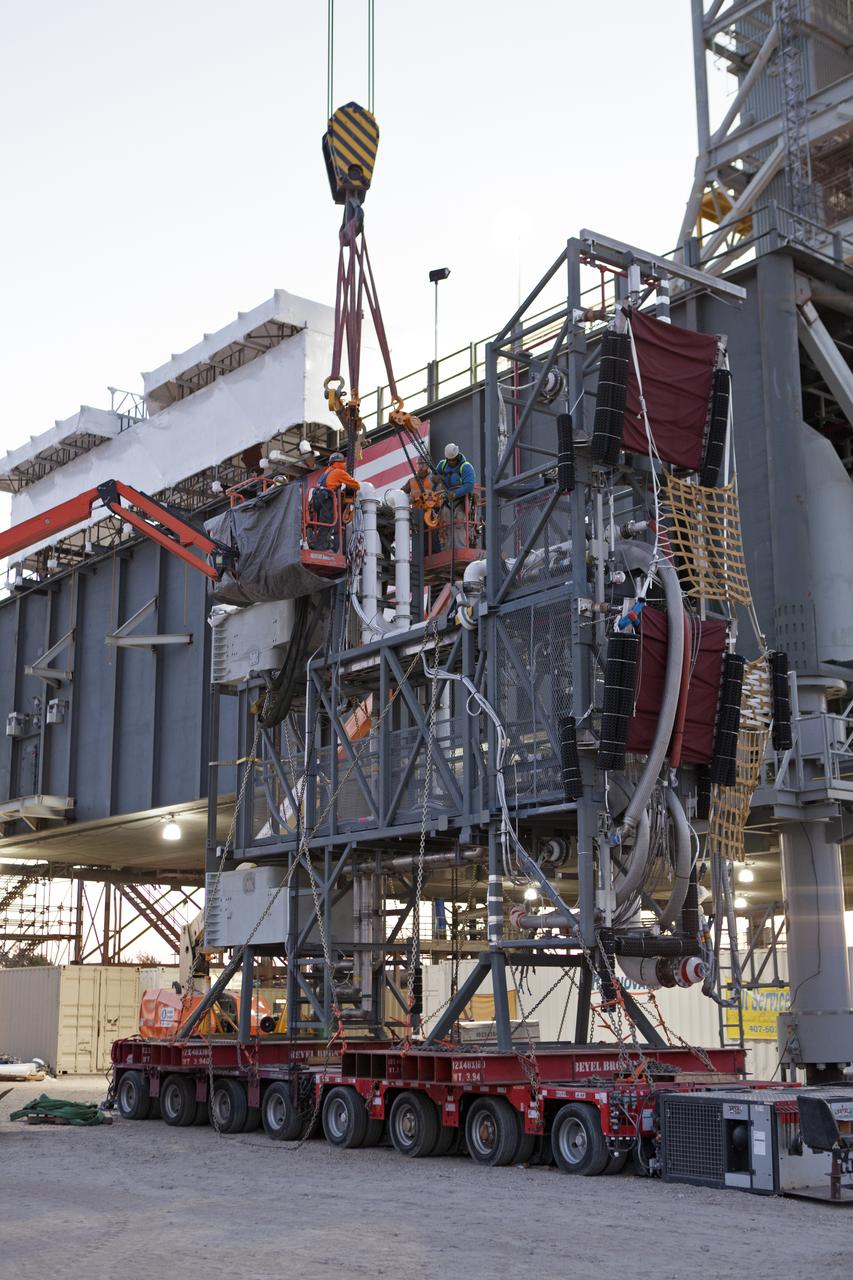
Construction workers with JP Donovan attach a heavy-lift crane to the Interim Cryogenic Propulsion Stage Umbilical (ICPSU) to prepare for lifting and installation on the mobile launcher (ML) tower at NASA's Kennedy Space Center in Florida. The last of the large umbilicals to be installed, the ICPSU will provide super-cooled hydrogen and liquid oxygen to the Space Launch System (SLS) rocket's interim cryogenic propulsion stage, or upper stage, at T-0 for Exploration Mission-1. The umbilical will be located at about the 240-foot-level of the ML and will supply fuel, oxidizer, gaseous helium, hazardous gas leak detection, electrical commodities and environment control systems to the upper stage of the SLS rocket during launch. Exploration Ground Systems is overseeing installation of the umbilicals on the ML.
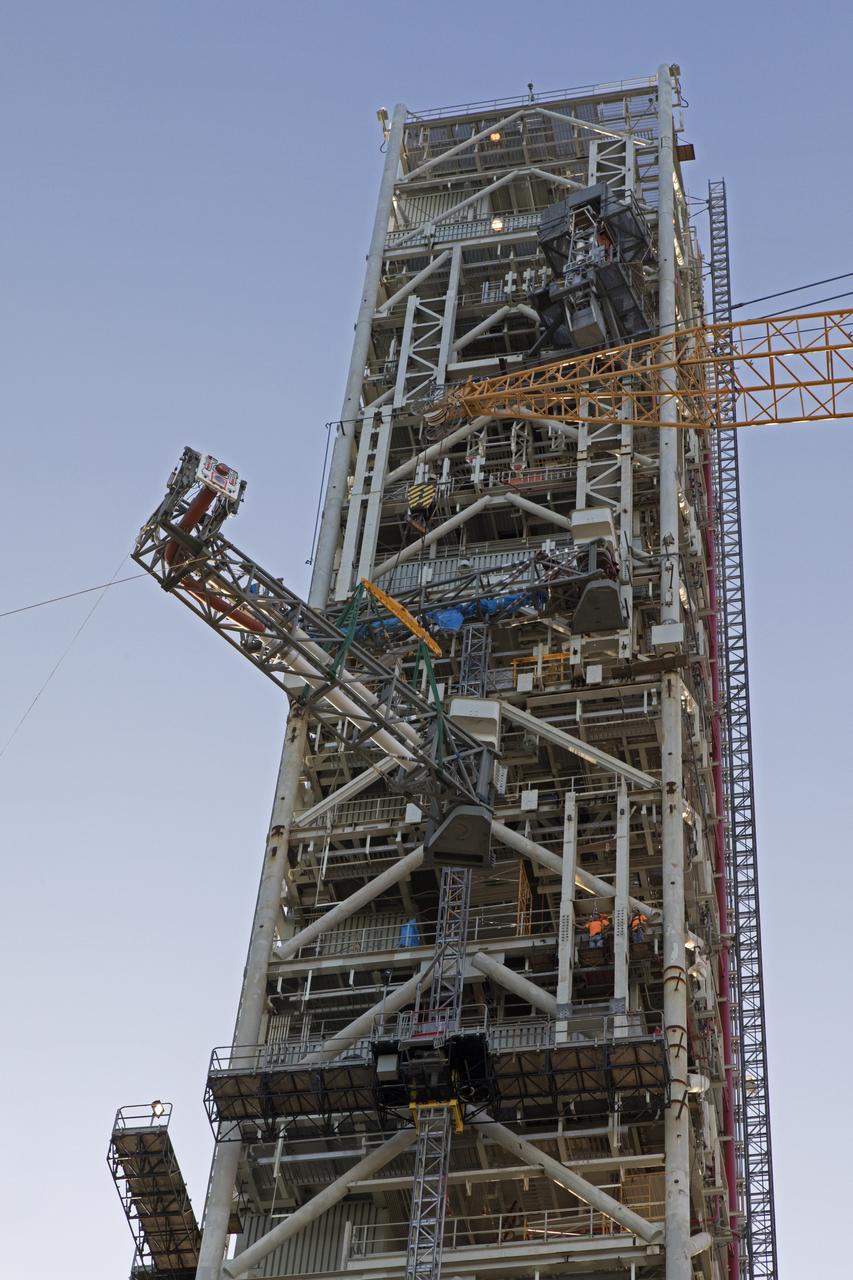
A heavy-lift crane moves the Core Stage Inter-tank Umbilical (CSITU) up to about the 140-foot level of the mobile launcher (ML) tower at NASA's Kennedy Space Center in Florida. The CSITU is moved into place for a fit check of the attachment hardware. The umbilical will be lowered down and installed permanently on the ML at a later date. The CSITU is a swing-arm umbilical that will connect to the Space Launch System core stage inter-tank. It will provide conditioned air, pressurized gases and power and data connection to the core stage. The Ground Systems Development and Operations Program is overseeing installation of the umbilicals.
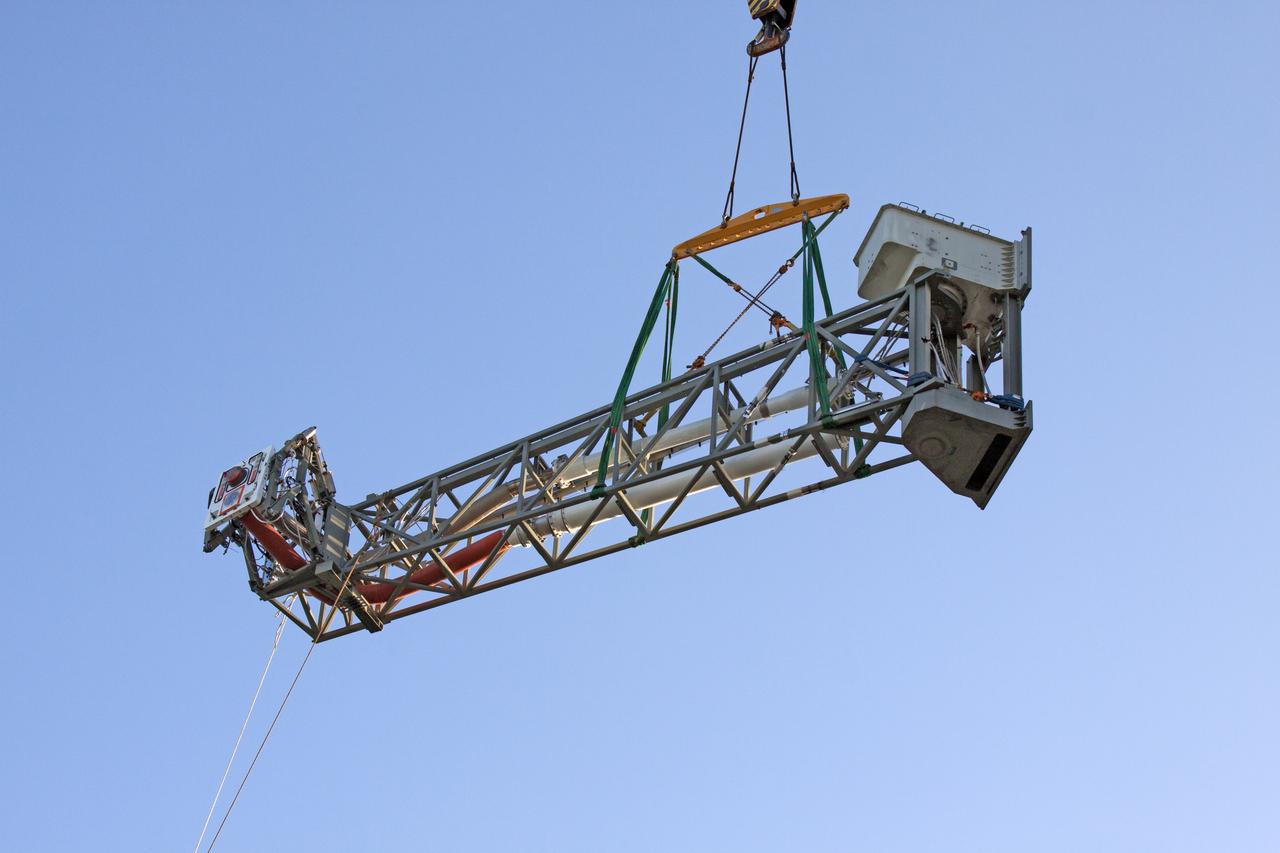
Seeming to hang in midair, the Core Stage Inter-tank Umbilical (CSITU) is lifted by crane and rigging up to about the 140-foot level of the mobile launcher (ML) tower at NASA's Kennedy Space Center in Florida. The CSITU will be moved into place for a fit check of the attachment hardware. The umbilical will be lowered down and installed permanently on the ML at a later date. The CSITU is a swing-arm umbilical that will connect to the Space Launch System core stage inter-tank. It will provide conditioned air, pressurized gases and power and data connection to the core stage. The Ground Systems Development and Operations Program is overseeing installation of the umbilicals.

A heavy-lift crane and rigging are used to lift the Core Stage Inter-tank Umbilical (CSITU) up to about the 140-foot level of the mobile launcher (ML) tower at NASA's Kennedy Space Center in Florida. The CSITU will be moved into place for a fit check of the attachment hardware. The umbilical will be lowered down and installed permanently on the ML at a later date. The CSITU is a swing-arm umbilical that will connect to the Space Launch System core stage inter-tank. It will provide conditioned air, pressurized gases and power and data connection to the core stage. The Ground Systems Development and Operations Program is overseeing installation of the umbilicals.
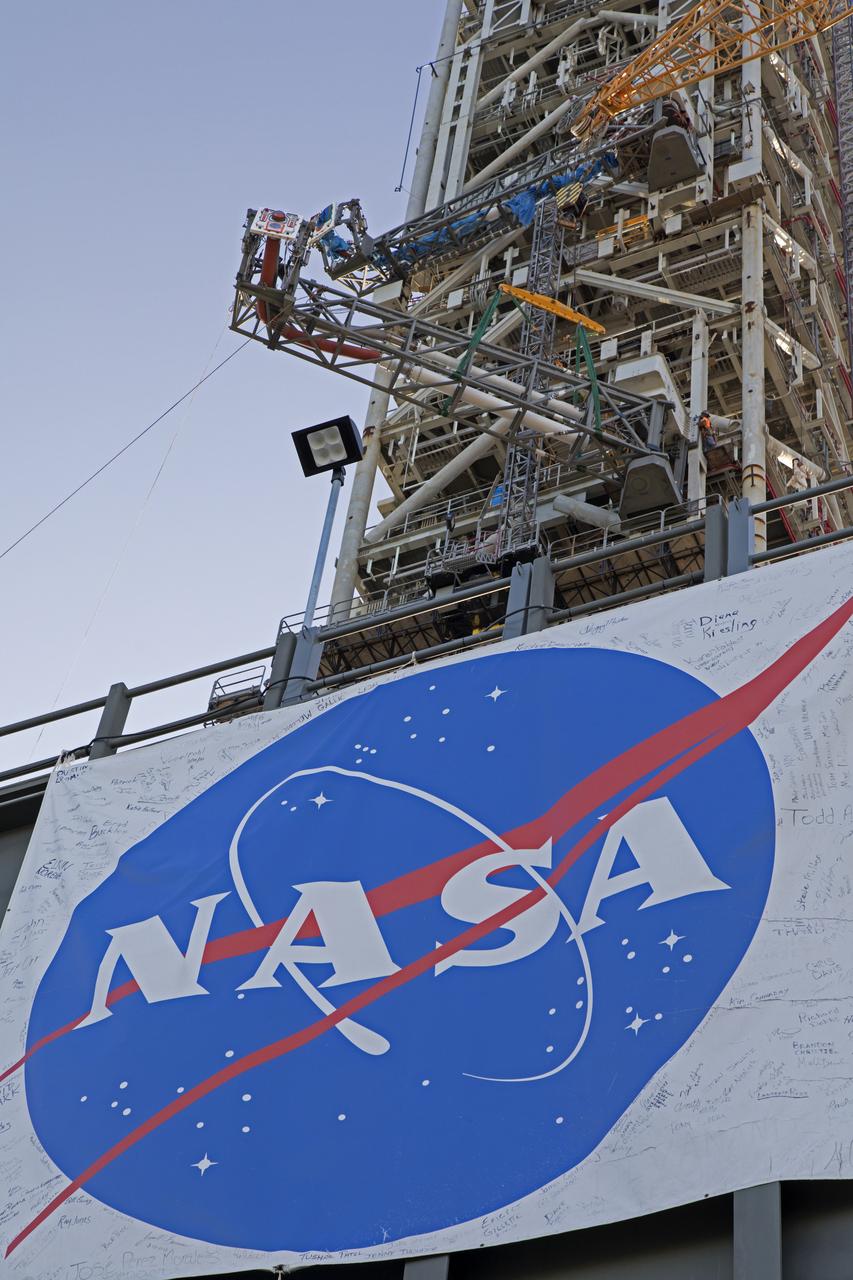
A heavy-lift crane moves the Core Stage Inter-tank Umbilical (CSITU) up to about the 140-foot level of the mobile launcher (ML) tower at NASA's Kennedy Space Center in Florida. The CSITU is moved into place for a fit check of the attachment hardware. The umbilical will be lowered down and installed permanently on the ML at a later date. The CSITU is a swing-arm umbilical that will connect to the Space Launch System core stage inter-tank. It will provide conditioned air, pressurized gases and power and data connection to the core stage. The Ground Systems Development and Operations Program is overseeing installation of the umbilicals.
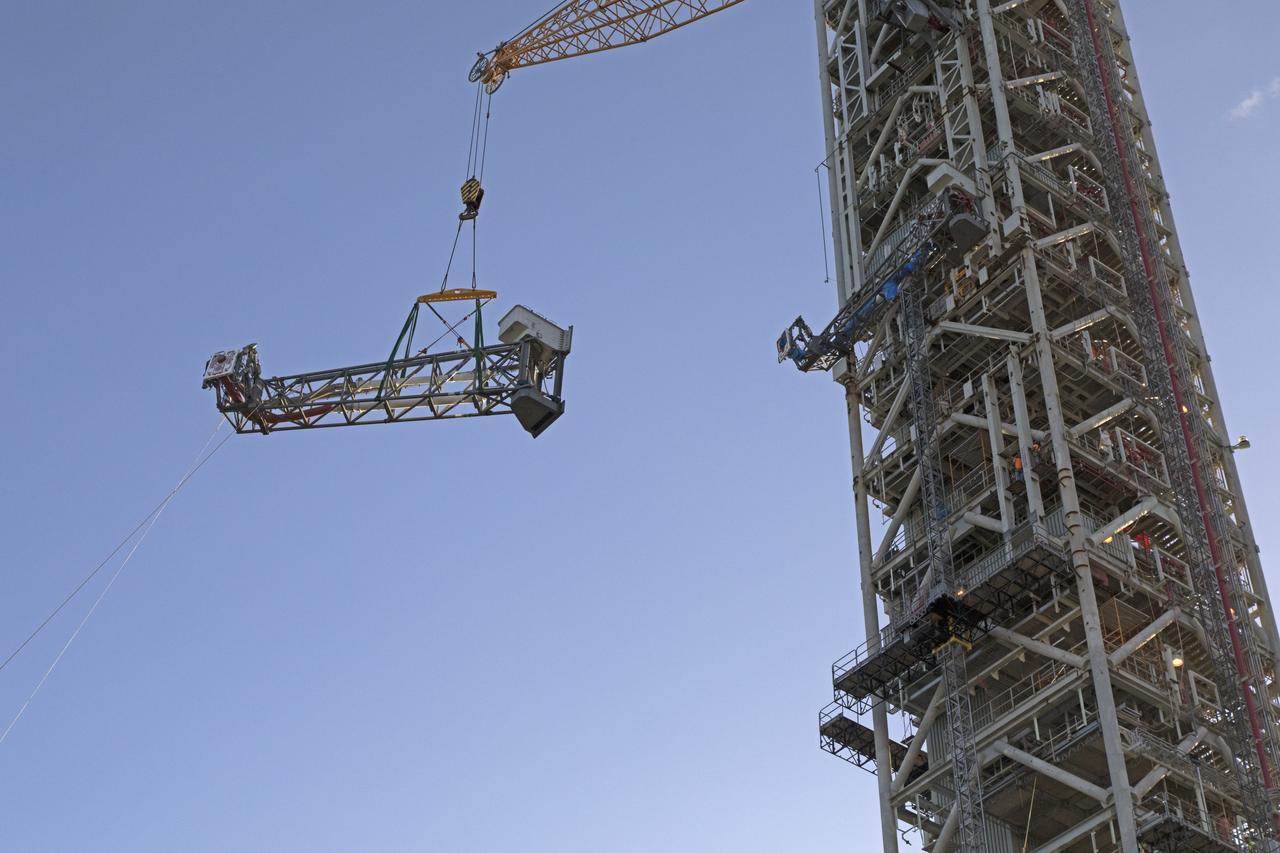
A heavy-lift crane and rigging are used to lift the Core Stage Inter-tank Umbilical (CSITU) up to about the 140-foot level of the mobile launcher (ML) tower at NASA's Kennedy Space Center in Florida. The CSITU will be moved into place for a fit check of the attachment hardware. The umbilical will be lowered down and installed permanently on the ML at a later date. The CSITU is a swing-arm umbilical that will connect to the Space Launch System core stage inter-tank. It will provide conditioned air, pressurized gases and power and data connection to the core stage. The Ground Systems Development and Operations Program is overseeing installation of the umbilicals.
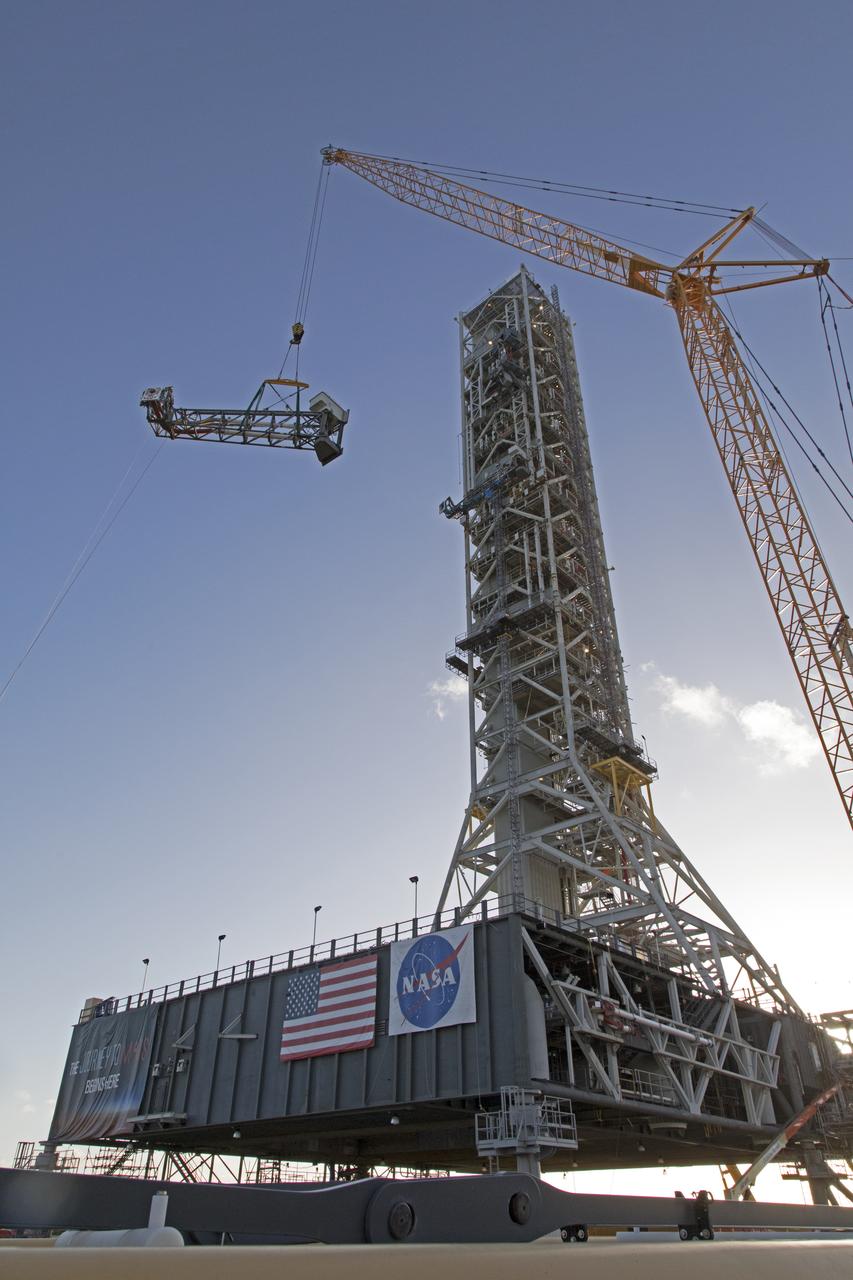
A heavy-lift crane and rigging are used to lift the Core Stage Inter-tank Umbilical (CSITU) up to about the 140-foot level of the mobile launcher (ML) tower at NASA's Kennedy Space Center in Florida. The CSITU will be moved into place for a fit check of the attachment hardware. The umbilical will be lowered down and installed permanently on the ML at a later date. The CSITU is a swing-arm umbilical that will connect to the Space Launch System core stage inter-tank. It will provide conditioned air, pressurized gases and power and data connection to the core stage. The Ground Systems Development and Operations Program is overseeing installation of the umbilicals.
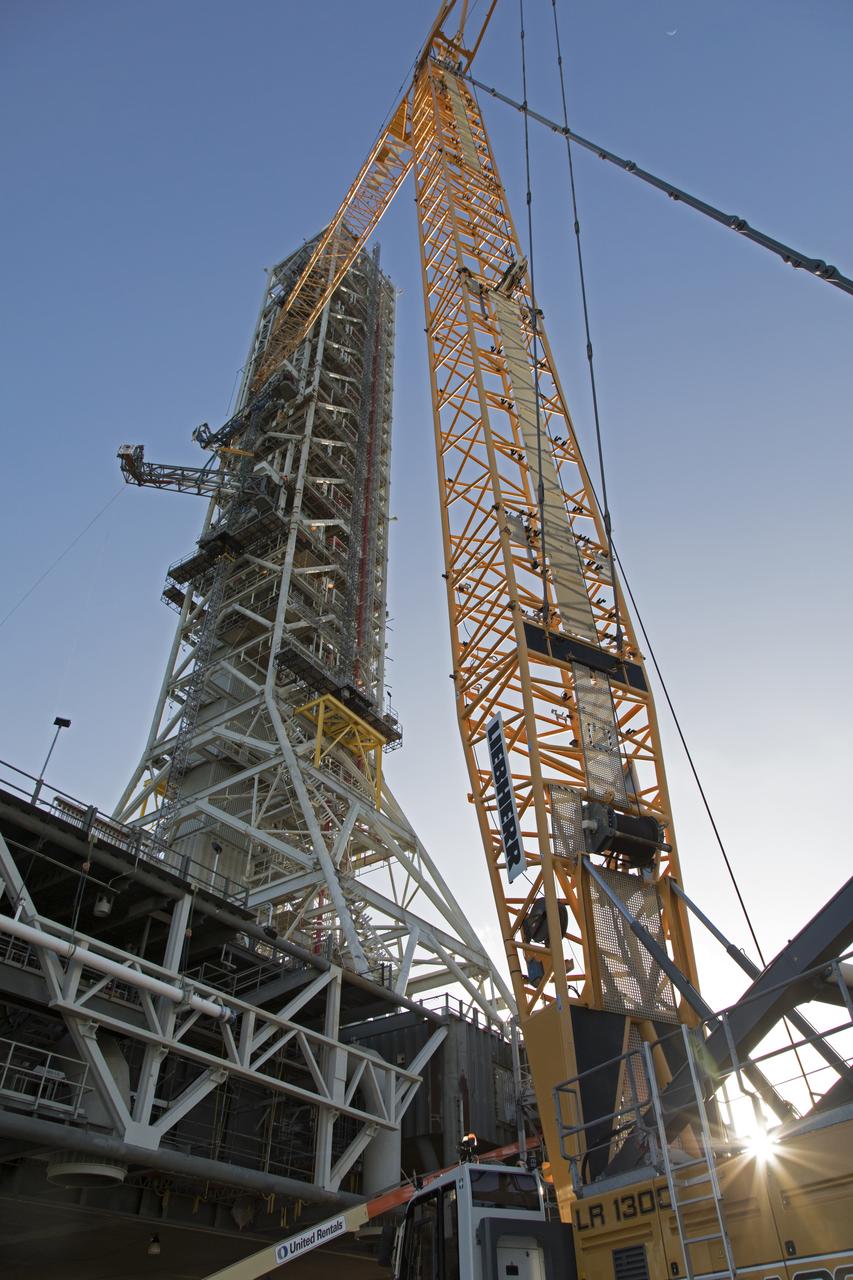
High up on the mobile launcher (ML) tower at NASA's Kennedy Space Center in Florida, construction workers assist as a crane moves the Core Stage Inter-tank Umbilical (CSITU) into place for a fit check of the attachment hardware. The CSITU will be located at about the 140-foot level of the ML tower. The umbilical will be lowered down and installed permanently on the ML at a later date. The CSITU is a swing-arm umbilical that will connect to the Space Launch System core stage inter-tank. It will provide conditioned air, pressurized gases and power and data connection to the core stage. The Ground Systems Development and Operations Program is overseeing installation of the umbilicals.
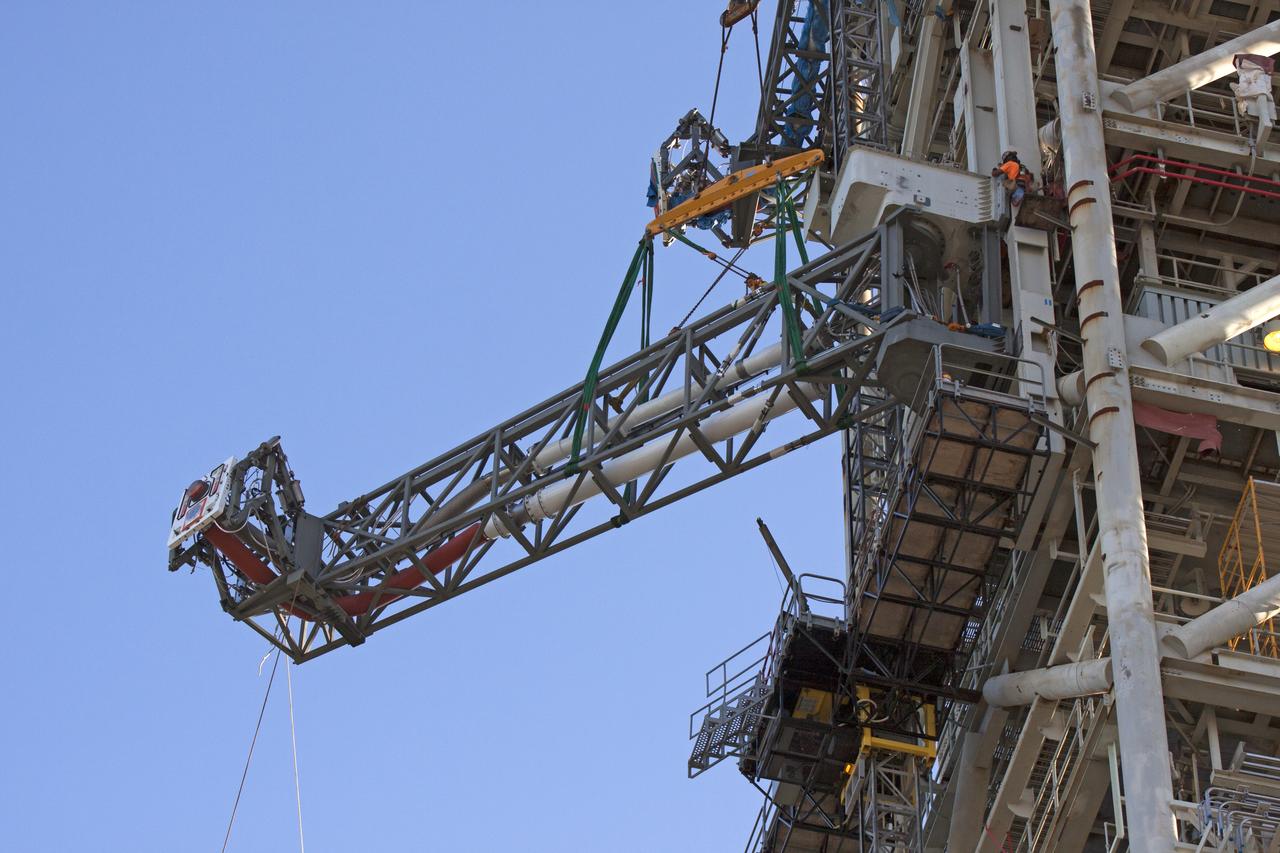
High up on the mobile launcher (ML) tower at NASA's Kennedy Space Center in Florida, construction workers assist as a crane moves the Core Stage Inter-tank Umbilical (CSITU) into place for a fit check of the attachment hardware. The CSITU will be located at about the 140-foot level of the ML tower. The umbilical will be lowered down and installed permanently on the ML at a later date. The CSITU is a swing-arm umbilical that will connect to the Space Launch System core stage inter-tank. It will provide conditioned air, pressurized gases and power and data connection to the core stage. The Ground Systems Development and Operations Program is overseeing installation of the umbilicals.
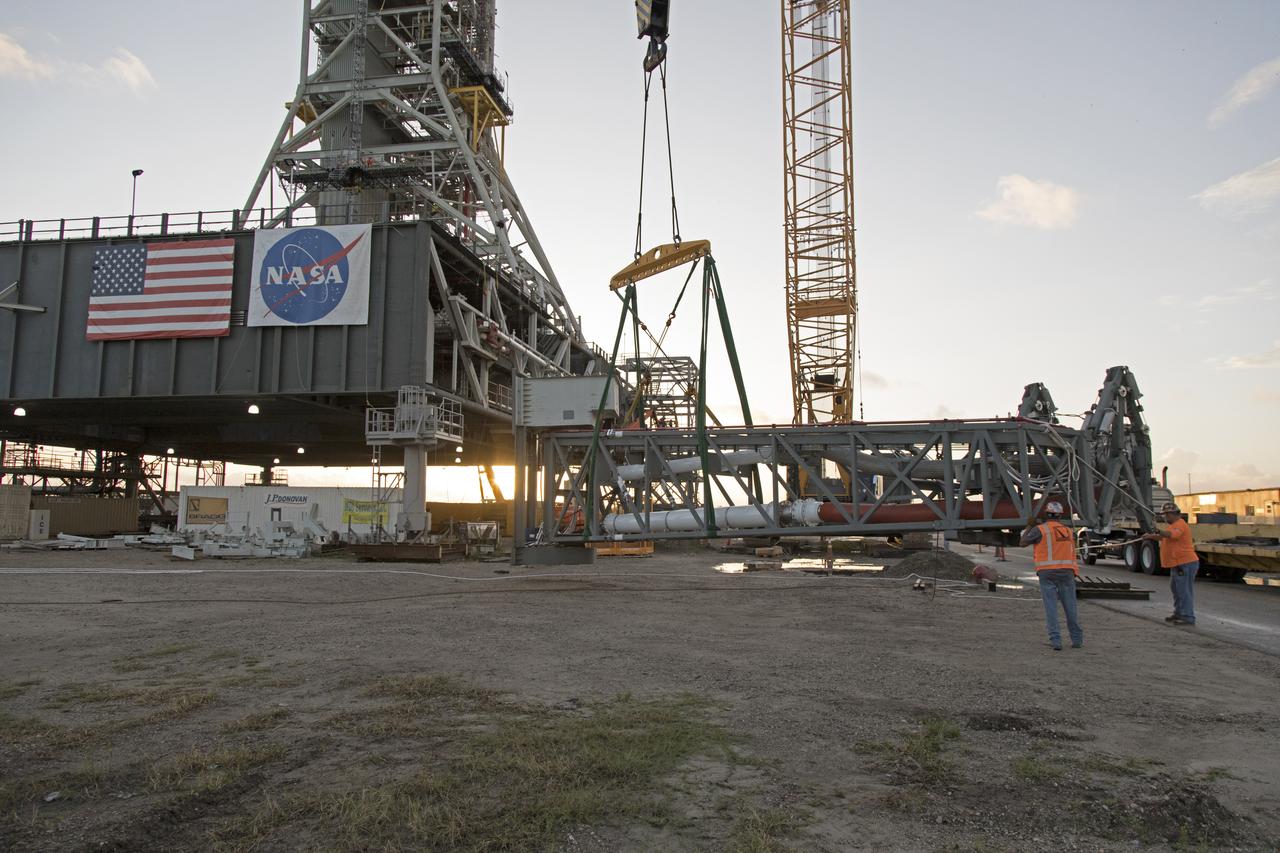
A heavy-lift crane has been attached to the Core Stage Inter-tank Umbilical (CSITU) to lift it up from a flatbed truck near the Vehicle Assembly Building at NASA's Kennedy Space Center in Florida. The CSITU will be lifted up to about the 140-foot level of the mobile launcher (ML) tower for a fit check of the attachment hardware. It will be lowered down and installed permanently on the ML at a later date. The CSITU is a swing-arm umbilical that will connect to the Space Launch System core stage inter-tank. It will provide conditioned air, pressurized gases and power and data connection to the core stage. The Ground Systems Development and Operations Program is overseeing installation of the umbilicals.
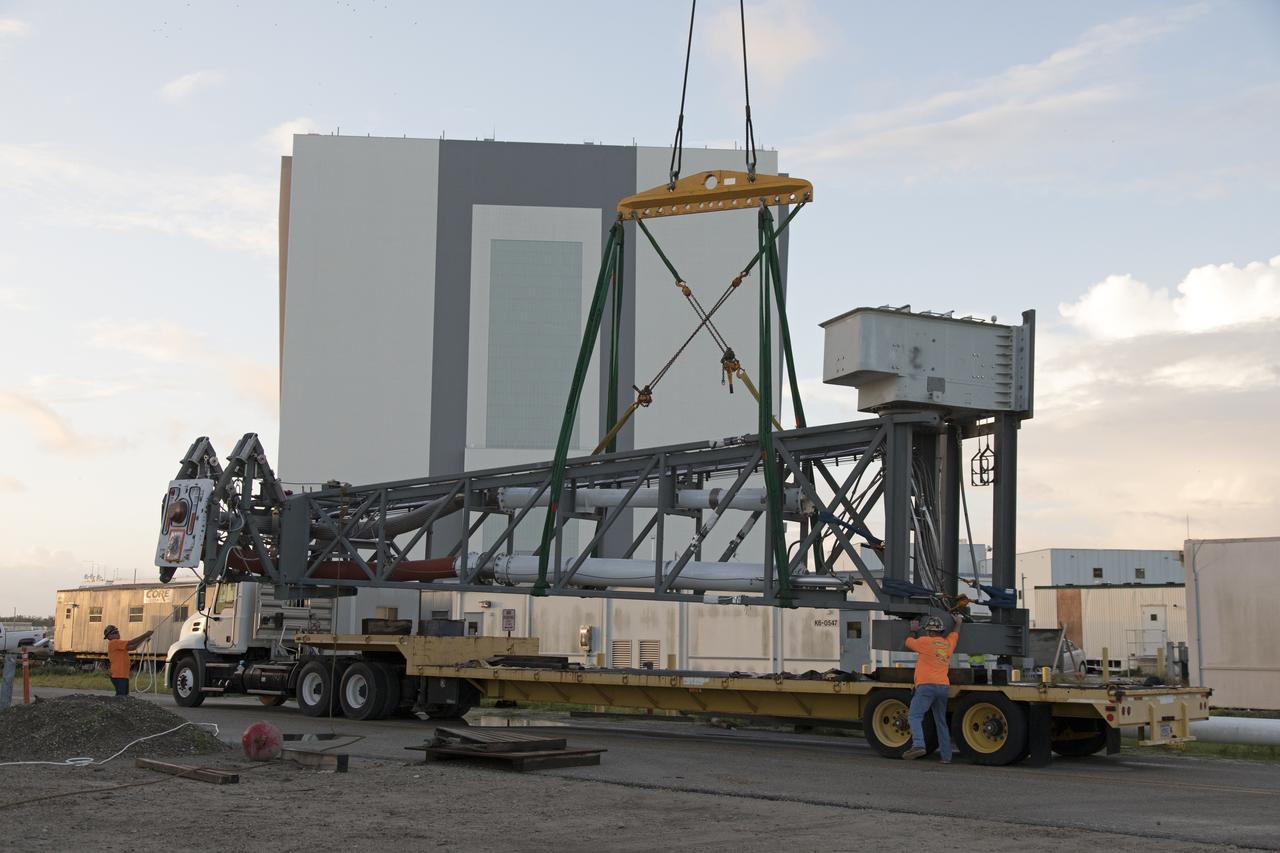
A heavy-lift crane has been attached to the Core Stage Inter-tank Umbilical (CSITU) to lift it up from a flatbed truck near the Vehicle Assembly Building at NASA's Kennedy Space Center in Florida. The CSITU will be lifted up to about the 140-foot level of the mobile launcher (ML) tower for a fit check of the attachment hardware. It will be lowered down and installed permanently on the ML at a later date. The CSITU is a swing-arm umbilical that will connect to the Space Launch System core stage inter-tank. It will provide conditioned air, pressurized gases and power and data connection to the core stage. The Ground Systems Development and Operations Program is overseeing installation of the umbilicals.
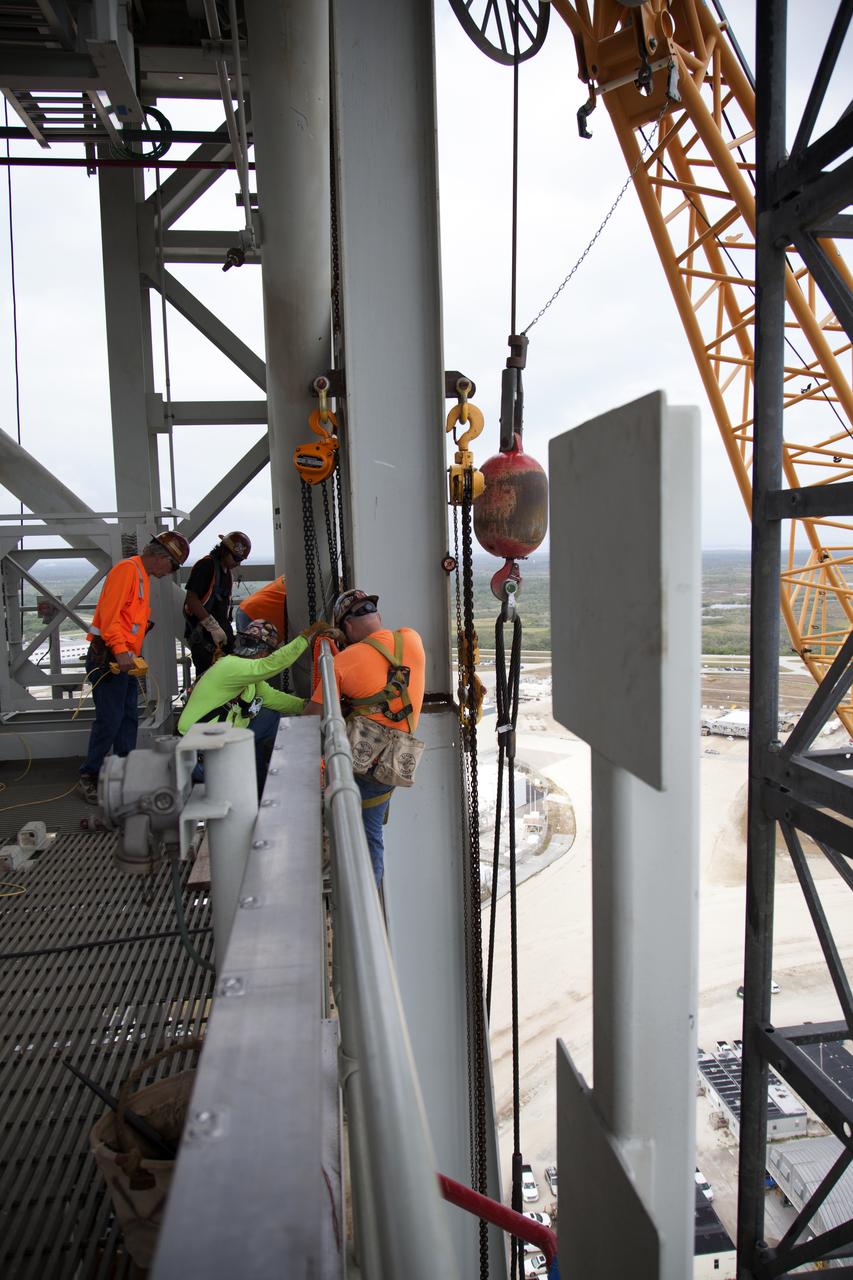
Construction workers assist as a crane lifts the Core Stage Forward Skirt Umbilical into position for installation on the mobile launcher tower at NASA's Kennedy Space Center in Florida. The mobile launcher tower will be equipped with a number of lines, called umbilicals that will connect to the Space Launch System (SLS) rocket and Orion spacecraft for Exploration Mission-1 (EM-1). The CSFSU will be located at about the 180-foot level on the tower, above the liquid oxygen tank. The CSFSU is an umbilical that will swing into position to provide connections to the core stage forward skirt of the SLS rocket, and then swing away before launch. Its main purpose is to provide conditioned air/GN2 to the SLS core stage forward skirt cavity. The Ground Systems Development and Operations Program is overseeing installation of the umbilicals.
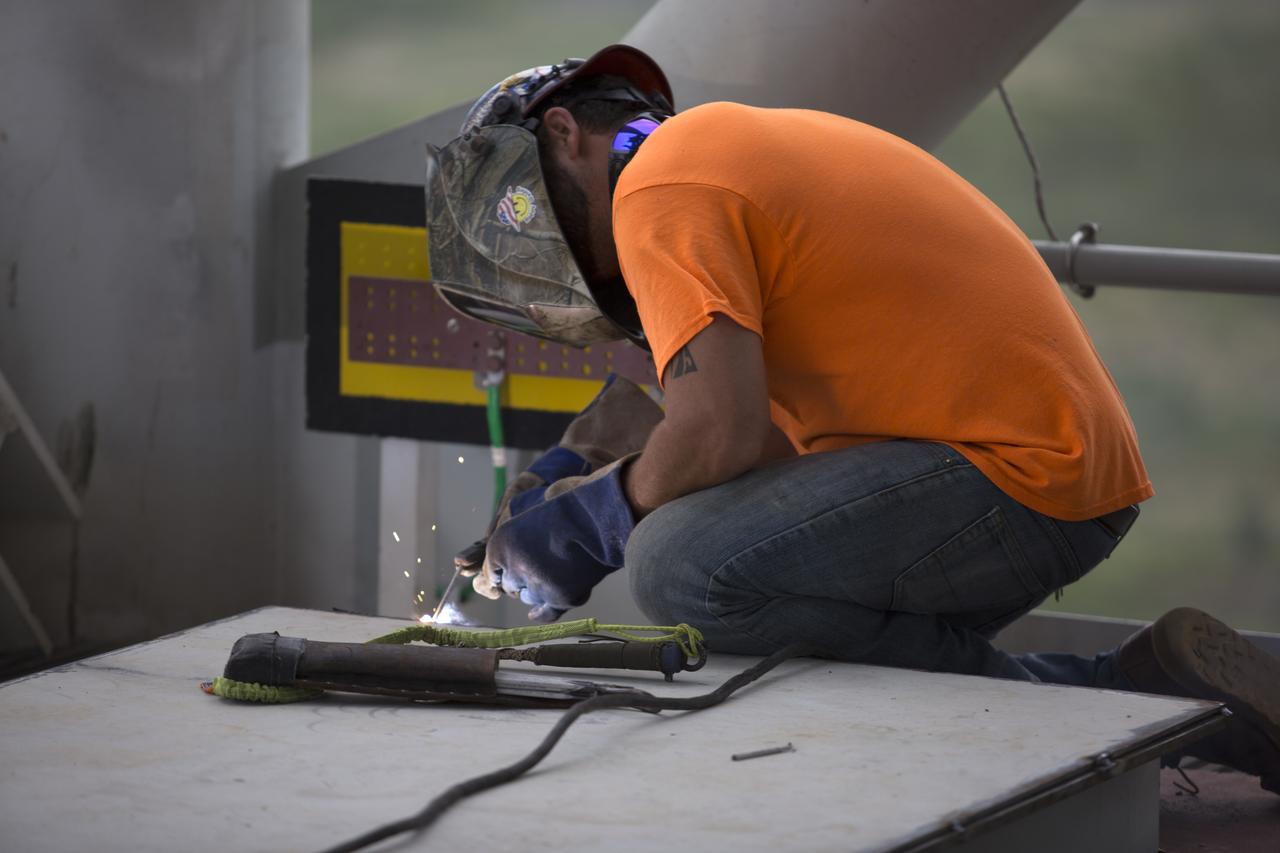
A construction worker welds a metal part during installation of the Core Stage Forward Skirt Umbilical on the mobile launcher tower at NASA's Kennedy Space Center in Florida. The mobile launcher tower will be equipped with a number of lines, called umbilicals that will connect to the Space Launch System (SLS) rocket and Orion spacecraft for Exploration Mission-1 (EM-1). The CSFSU will be located at about the 180-foot level on the tower, above the liquid oxygen tank. The CSFSU is an umbilical that will swing into position to provide connections to the core stage forward skirt of the SLS rocket, and then swing away before launch. Its main purpose is to provide conditioned air/GN2 to the SLS core stage forward skirt cavity. The Ground Systems Development and Operations Program is overseeing installation of the umbilicals.
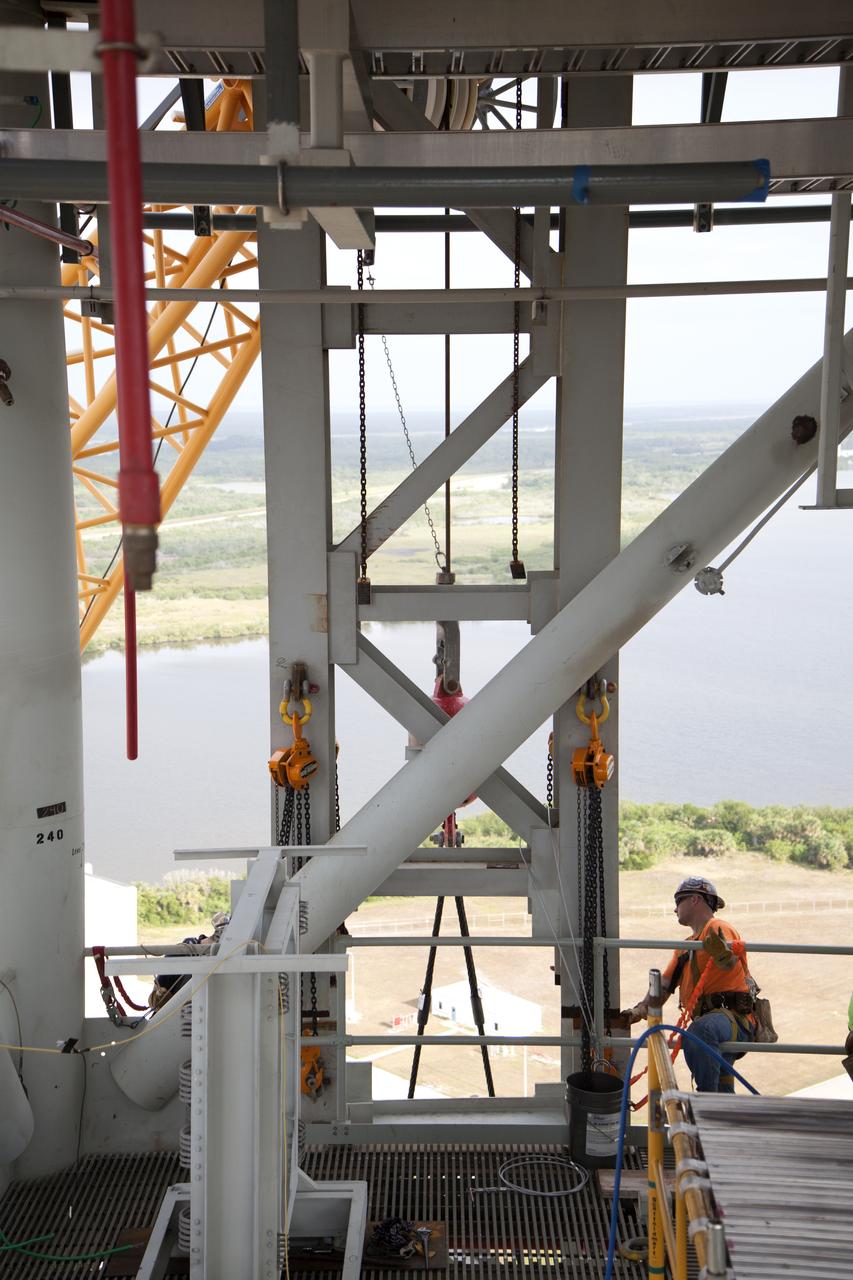
Construction workers assist as a crane lifts the Core Stage Forward Skirt Umbilical up for installation on the mobile launcher tower at NASA's Kennedy Space Center in Florida. The mobile launcher tower will be equipped with a number of lines, called umbilicals that will connect to the Space Launch System (SLS) rocket and Orion spacecraft for Exploration Mission-1 (EM-1). The CSFSU will be located at about the 180-foot level on the tower, above the liquid oxygen tank. The CSFSU is an umbilical that will swing into position to provide connections to the core stage forward skirt of the SLS rocket, and then swing away before launch. Its main purpose is to provide conditioned air/GN2 to the SLS core stage forward skirt cavity. The Ground Systems Development and Operations Program is overseeing installation of the umbilicals.
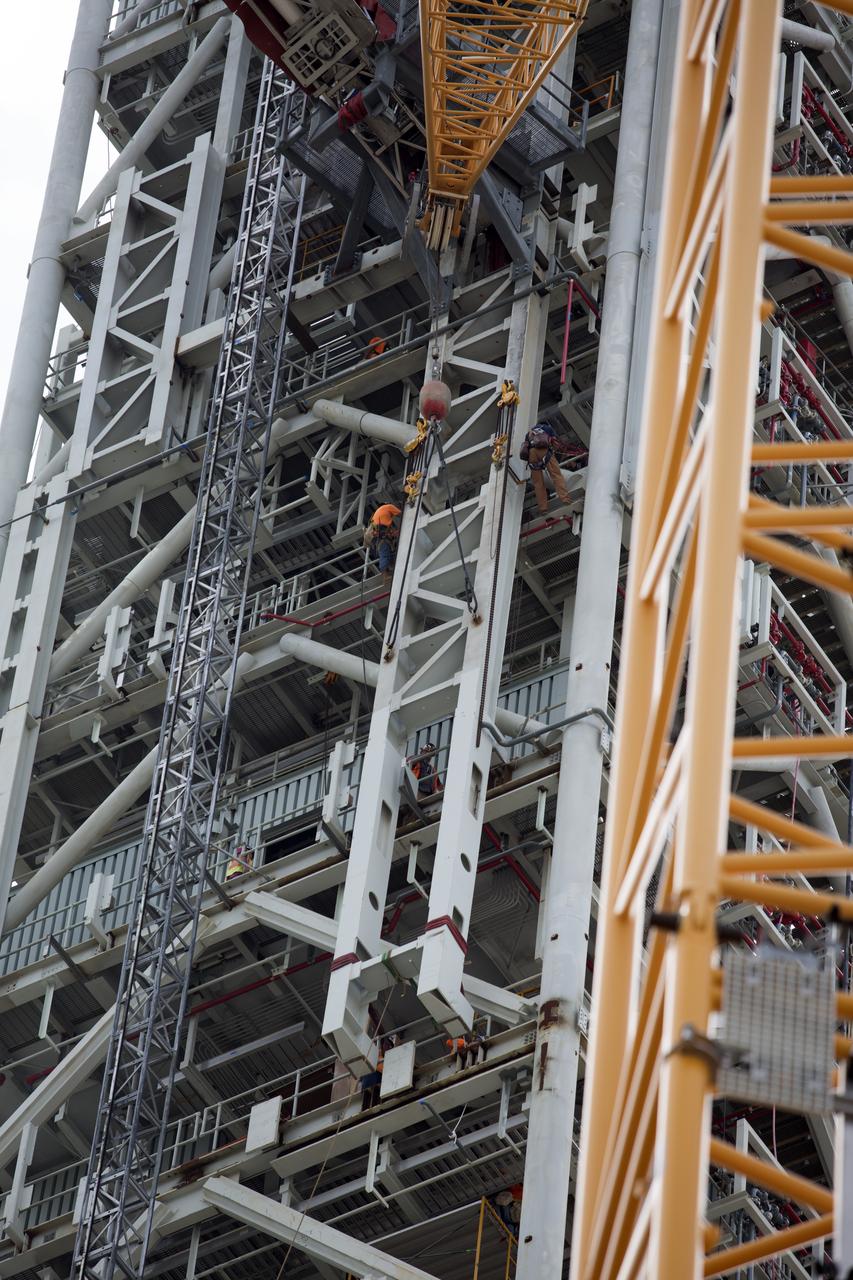
Construction workers assist as a crane lifts the Core Stage Forward Skirt Umbilical into position for installation on the mobile launcher tower at NASA's Kennedy Space Center in Florida. The mobile launcher tower will be equipped with a number of lines, called umbilicals that will connect to the Space Launch System (SLS) rocket and Orion spacecraft for Exploration Mission-1 (EM-1). The CSFSU will be located at about the 180-foot level on the tower, above the liquid oxygen tank. The CSFSU is an umbilical that will swing into position to provide connections to the core stage forward skirt of the SLS rocket, and then swing away before launch. Its main purpose is to provide conditioned air/GN2 to the SLS core stage forward skirt cavity. The Ground Systems Development and Operations Program is overseeing installation of the umbilicals.
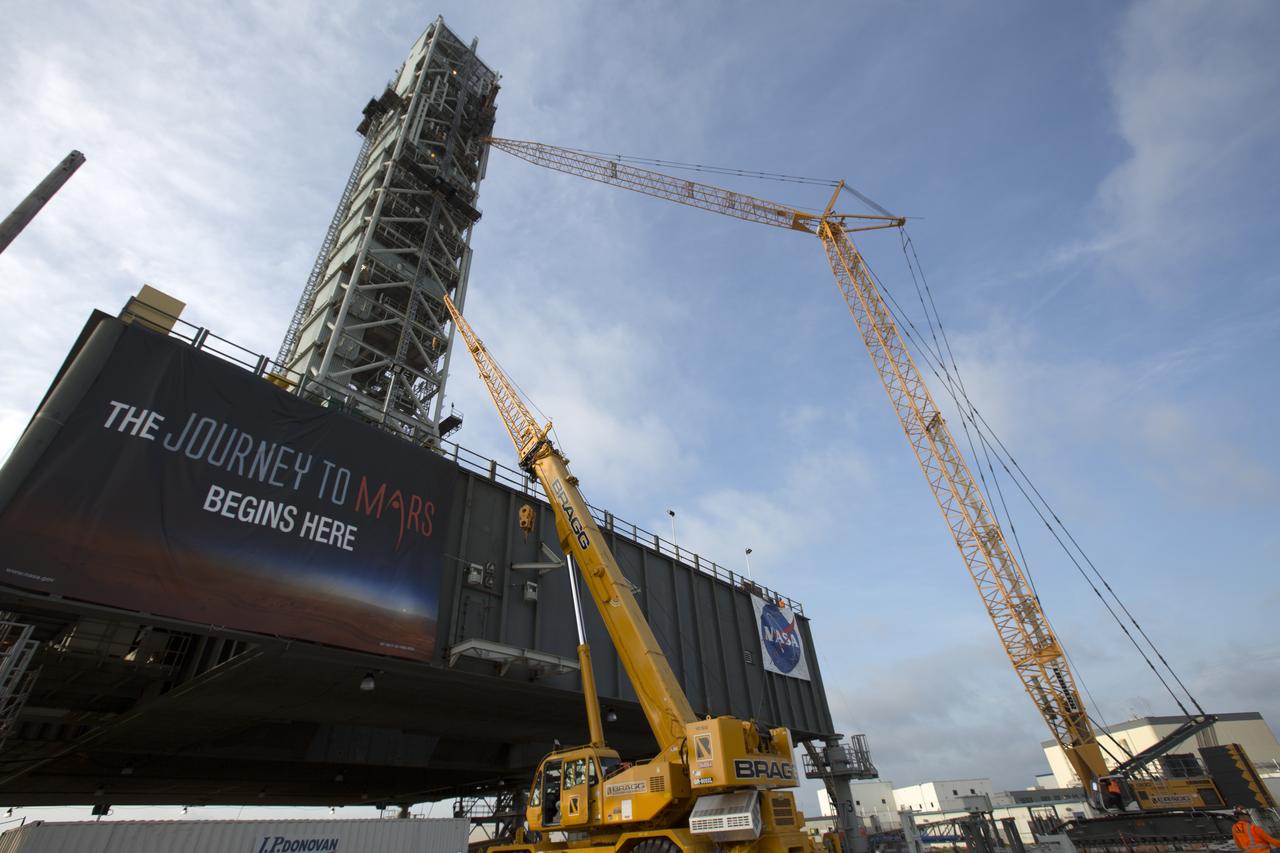
Cranes and rigging are being used to lift up the Core Stage Forward Skirt Umbilical (CSFSU) for installation on the mobile launcher tower at NASA's Kennedy Space Center in Florida. The mobile launcher tower will be equipped with a number of lines, called umbilicals that will connect to the Space Launch System (SLS) rocket and Orion spacecraft for Exploration Mission-1 (EM-1). The CSFSU will be located at about the 180-foot level on the tower, above the liquid oxygen tank. The CSFSU is an umbilical that will swing into position to provide connections to the core stage forward skirt of the SLS rocket, and then swing away before launch. Its main purpose is to provide conditioned air/GN2 to the SLS core stage forward skirt cavity. The Ground Systems Development and Operations Program is overseeing installation of the umbilicals.
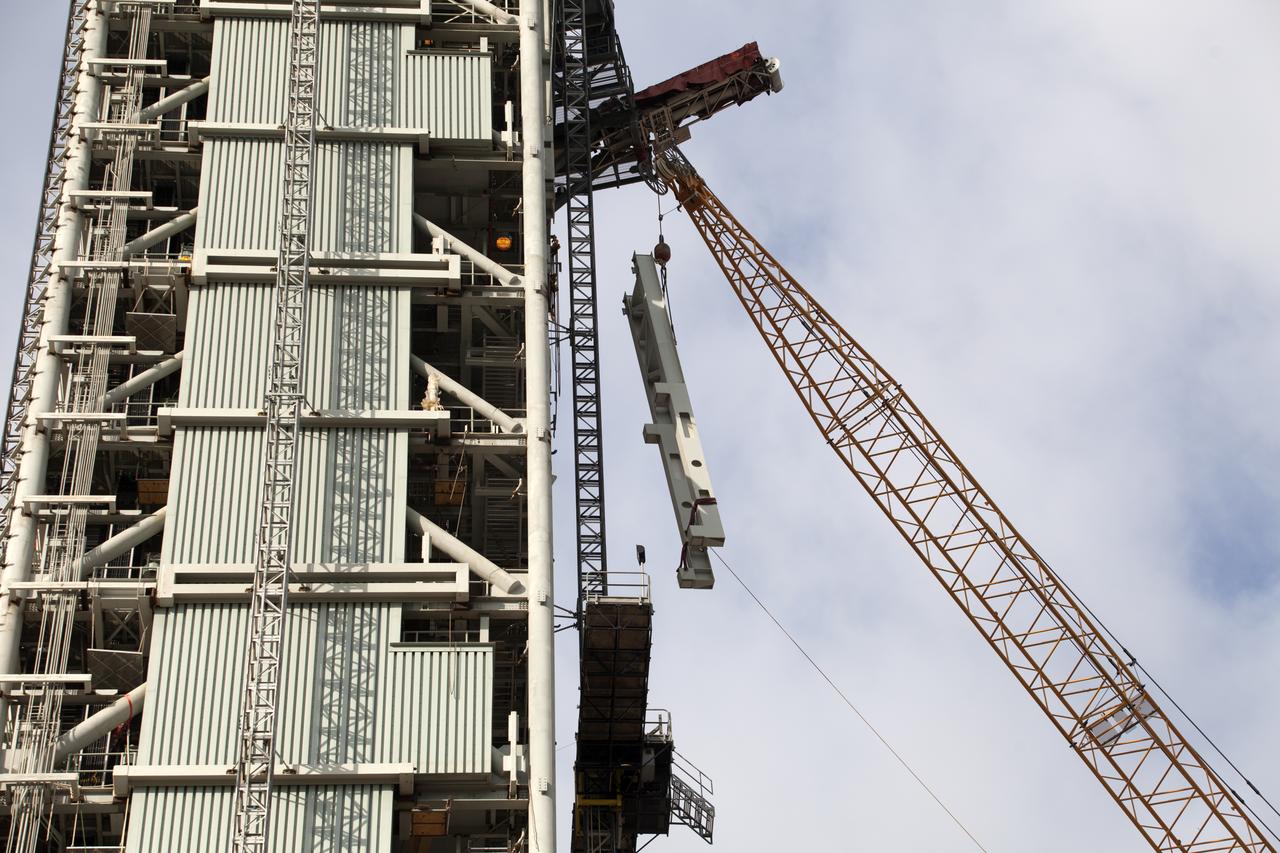
Cranes and rigging are being used to lift up the Core Stage Forward Skirt Umbilical (CSFSU) for installation on the mobile launcher tower at NASA's Kennedy Space Center in Florida. The mobile launcher tower will be equipped with a number of lines, called umbilicals that will connect to the Space Launch System (SLS) rocket and Orion spacecraft for Exploration Mission-1 (EM-1). The CSFSU will be located at about the 180-foot level on the tower, above the liquid oxygen tank. The CSFSU is an umbilical that will swing into position to provide connections to the core stage forward skirt of the SLS rocket, and then swing away before launch. Its main purpose is to provide conditioned air/GN2 to the SLS core stage forward skirt cavity. The Ground Systems Development and Operations Program is overseeing installation of the umbilicals.
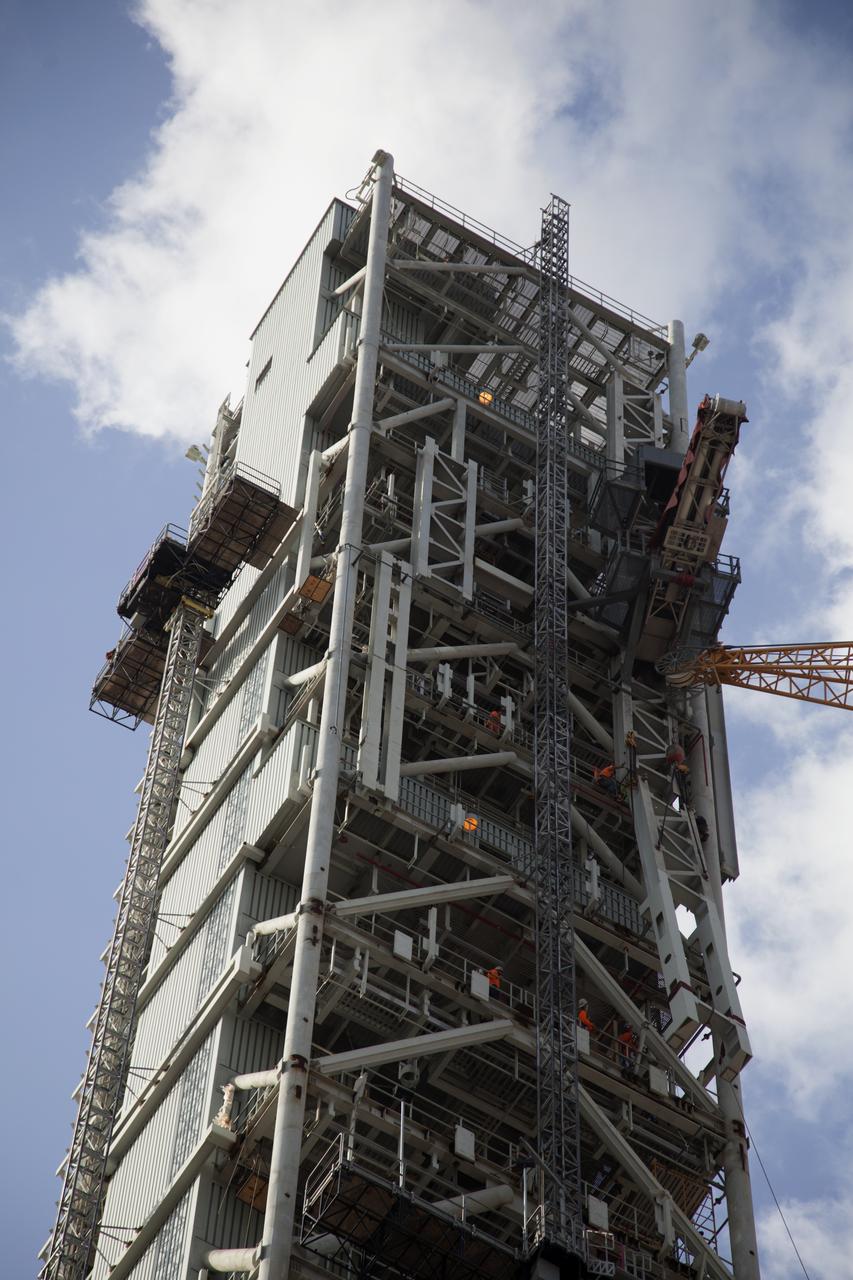
Cranes and rigging are being used to lift up the Core Stage Forward Skirt Umbilical (CSFSU) for installation on the mobile launcher tower at NASA's Kennedy Space Center in Florida. The mobile launcher tower will be equipped with a number of lines, called umbilicals that will connect to the Space Launch System (SLS) rocket and Orion spacecraft for Exploration Mission-1 (EM-1). The CSFSU will be located at about the 180-foot level on the tower, above the liquid oxygen tank. The CSFSU is an umbilical that will swing into position to provide connections to the core stage forward skirt of the SLS rocket, and then swing away before launch. Its main purpose is to provide conditioned air/GN2 to the SLS core stage forward skirt cavity. The Ground Systems Development and Operations Program is overseeing installation of the umbilicals.
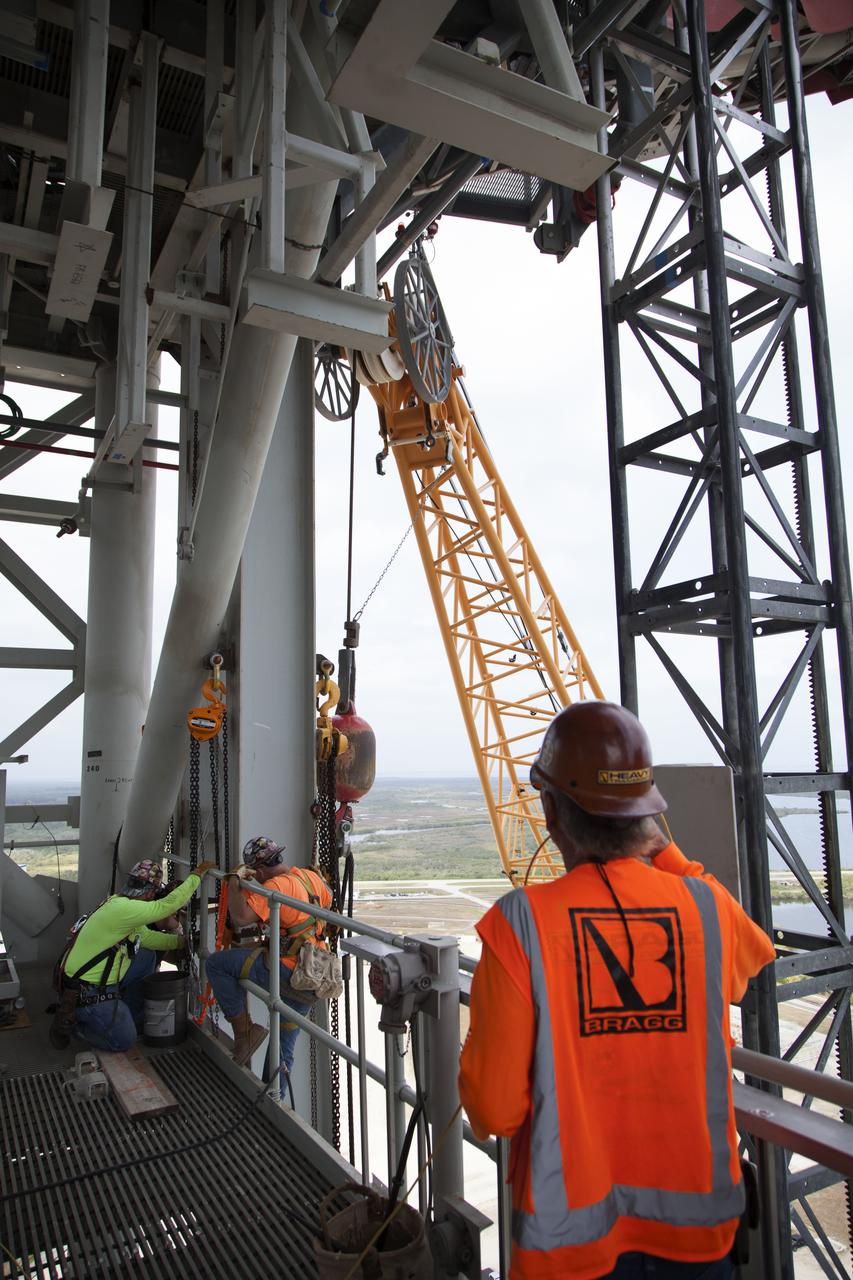
Construction workers assist as a crane lifts the Core Stage Forward Skirt Umbilical up for installation on the mobile launcher tower at NASA's Kennedy Space Center in Florida. The mobile launcher tower will be equipped with a number of lines, called umbilicals that will connect to the Space Launch System (SLS) rocket and Orion spacecraft for Exploration Mission-1 (EM-1). The CSFSU will be located at about the 180-foot level on the tower, above the liquid oxygen tank. The CSFSU is an umbilical that will swing into position to provide connections to the core stage forward skirt of the SLS rocket, and then swing away before launch. Its main purpose is to provide conditioned air/GN2 to the SLS core stage forward skirt cavity. The Ground Systems Development and Operations Program is overseeing installation of the umbilicals.
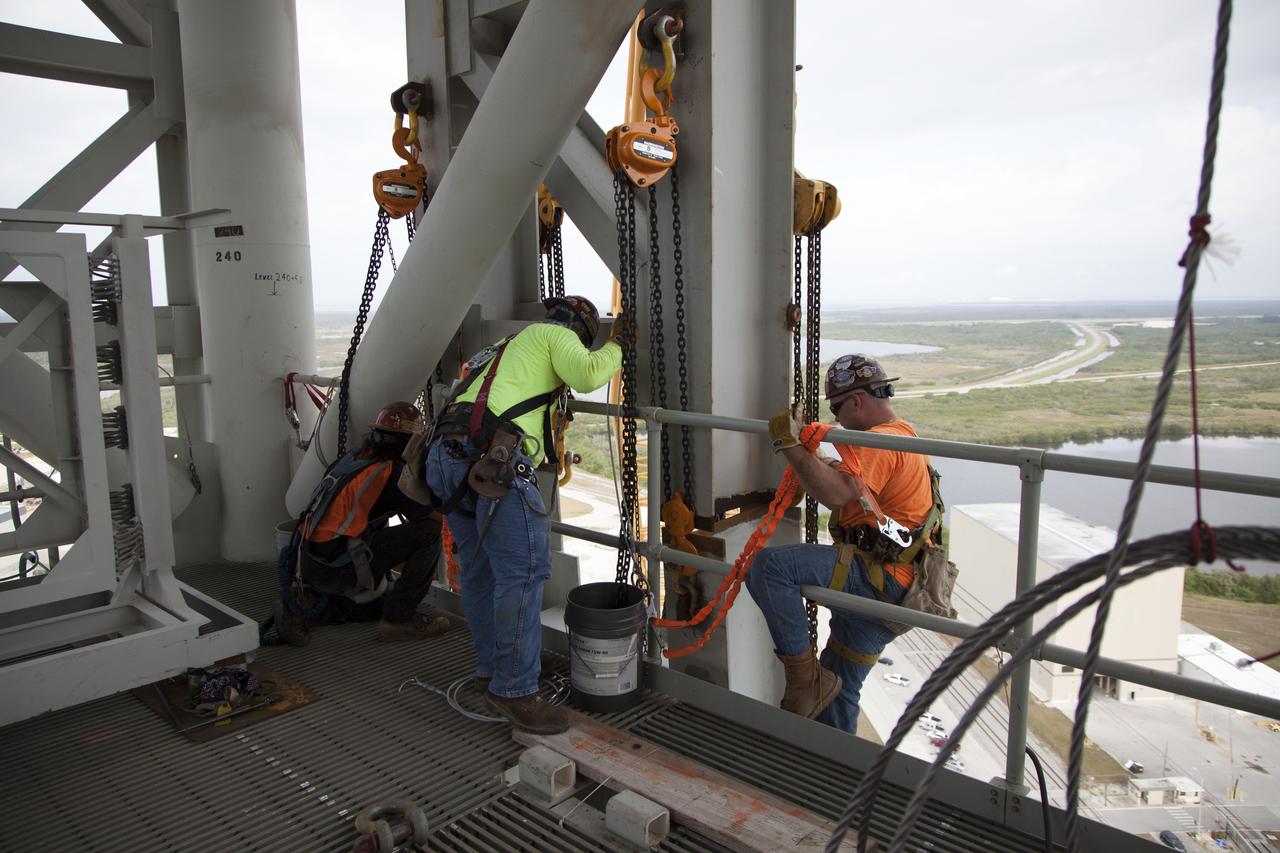
Construction workers assist as a crane lifts the Core Stage Forward Skirt Umbilical up for installation on the mobile launcher tower at NASA's Kennedy Space Center in Florida. The mobile launcher tower will be equipped with a number of lines, called umbilicals that will connect to the Space Launch System (SLS) rocket and Orion spacecraft for Exploration Mission-1 (EM-1). The CSFSU will be located at about the 180-foot level on the tower, above the liquid oxygen tank. The CSFSU is an umbilical that will swing into position to provide connections to the core stage forward skirt of the SLS rocket, and then swing away before launch. Its main purpose is to provide conditioned air/GN2 to the SLS core stage forward skirt cavity. The Ground Systems Development and Operations Program is overseeing installation of the umbilicals.
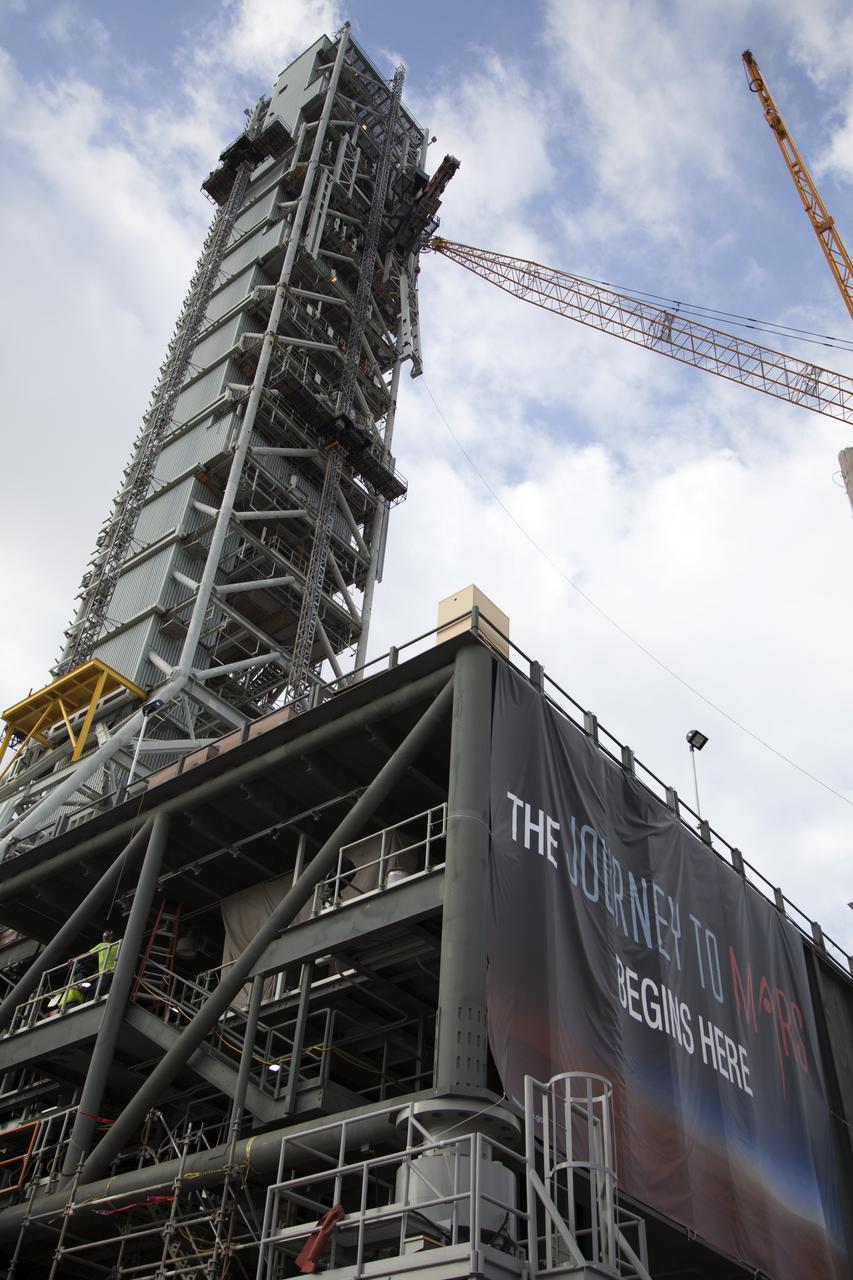
Cranes and rigging are being used to lift up the Core Stage Forward Skirt Umbilical (CSFSU) for installation on the mobile launcher tower at NASA's Kennedy Space Center in Florida. The mobile launcher tower will be equipped with a number of lines, called umbilicals that will connect to the Space Launch System (SLS) rocket and Orion spacecraft for Exploration Mission-1 (EM-1). The CSFSU will be located at about the 180-foot level on the tower, above the liquid oxygen tank. The CSFSU is an umbilical that will swing into position to provide connections to the core stage forward skirt of the SLS rocket, and then swing away before launch. Its main purpose is to provide conditioned air/GN2 to the SLS core stage forward skirt cavity. The Ground Systems Development and Operations Program is overseeing installation of the umbilicals.
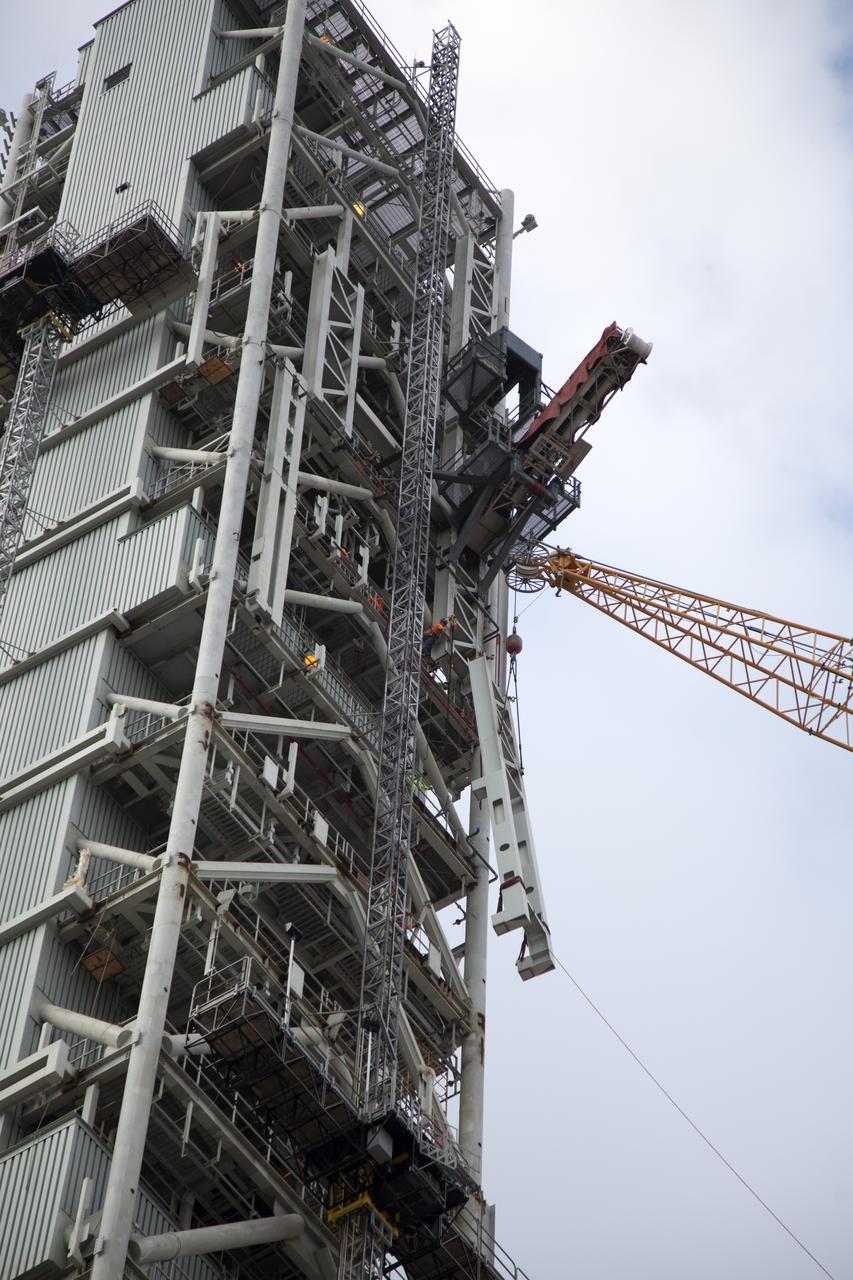
Seeming to hang in midair, the Core Stage Forward Skirt Umbilical (CSFSU) is lifted high up by crane for installation on the mobile launcher tower at NASA's Kennedy Space Center in Florida. The mobile launcher tower will be equipped with a number of lines, called umbilicals that will connect to the Space Launch System rocket and Orion spacecraft for Exploration Mission-1 (EM-1). The CSFSU will be located at about the 180-foot level on the tower, above the liquid oxygen tank. The CSFSU is an umbilical that will swing into position to provide connections to the core stage forward skirt of the SLS rocket, and then swing away before launch. Its main purpose is to provide conditioned air/GN2 to the SLS core stage forward skirt cavity. The Ground Systems Development and Operations Program is overseeing installation of the umbilicals.
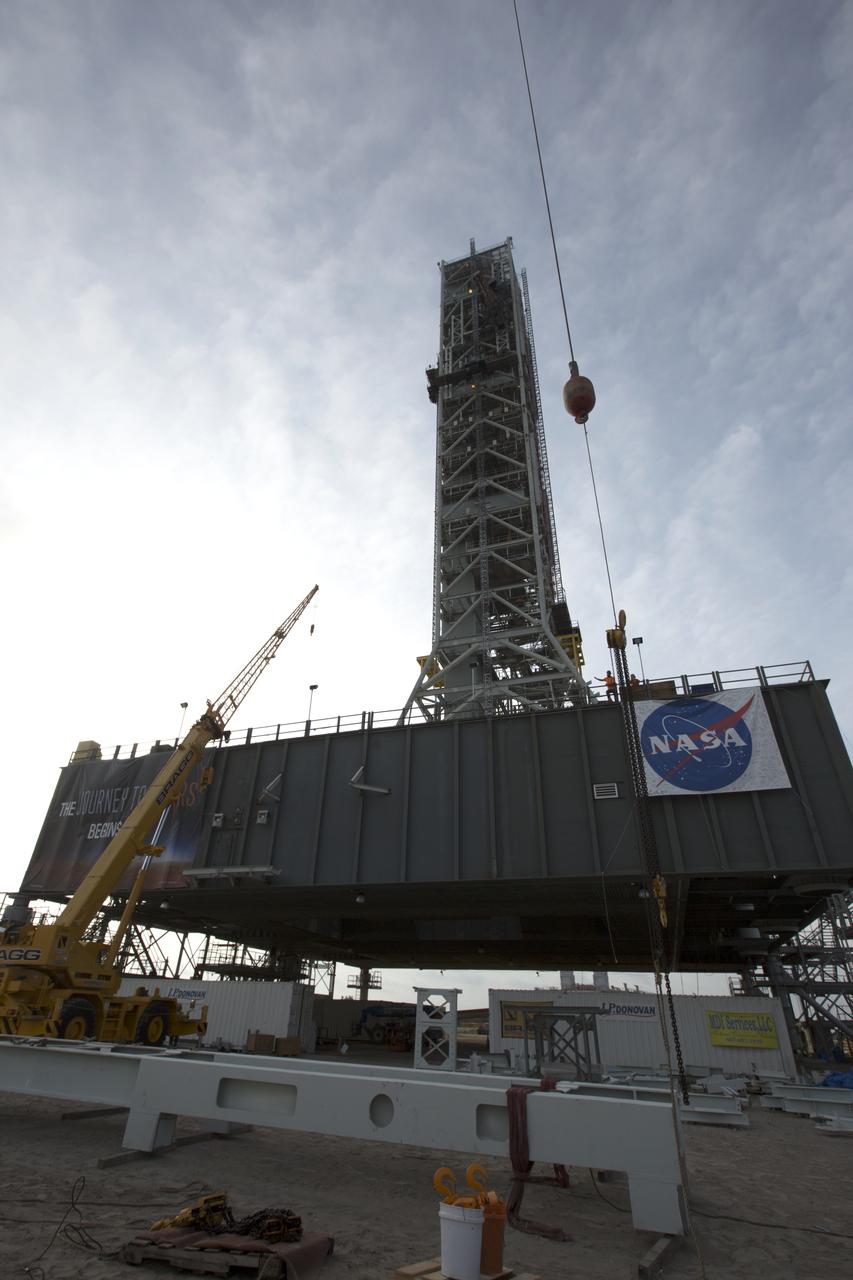
A crane has been attached to the Core Stage Forward Skirt Umbilical (CSFSU) to lift it up for installation on the mobile launcher tower at NASA's Kennedy Space Center in Florida. The mobile launcher tower will be equipped with a number of lines, called umbilicals that will connect to the Space Launch System (SLS) rocket and Orion spacecraft for Exploration Mission-1 (EM-1). The CSFSU will be located at about the 180-foot level on the tower, above the liquid oxygen tank. The CSFSU is an umbilical that will swing into position to provide connections to the core stage forward skirt of the SLS rocket, and then swing away before launch. Its main purpose is to provide conditioned air/GN2 to the SLS core stage forward skirt cavity. The Ground Systems Development and Operations Program is overseeing installation of the umbilicals.
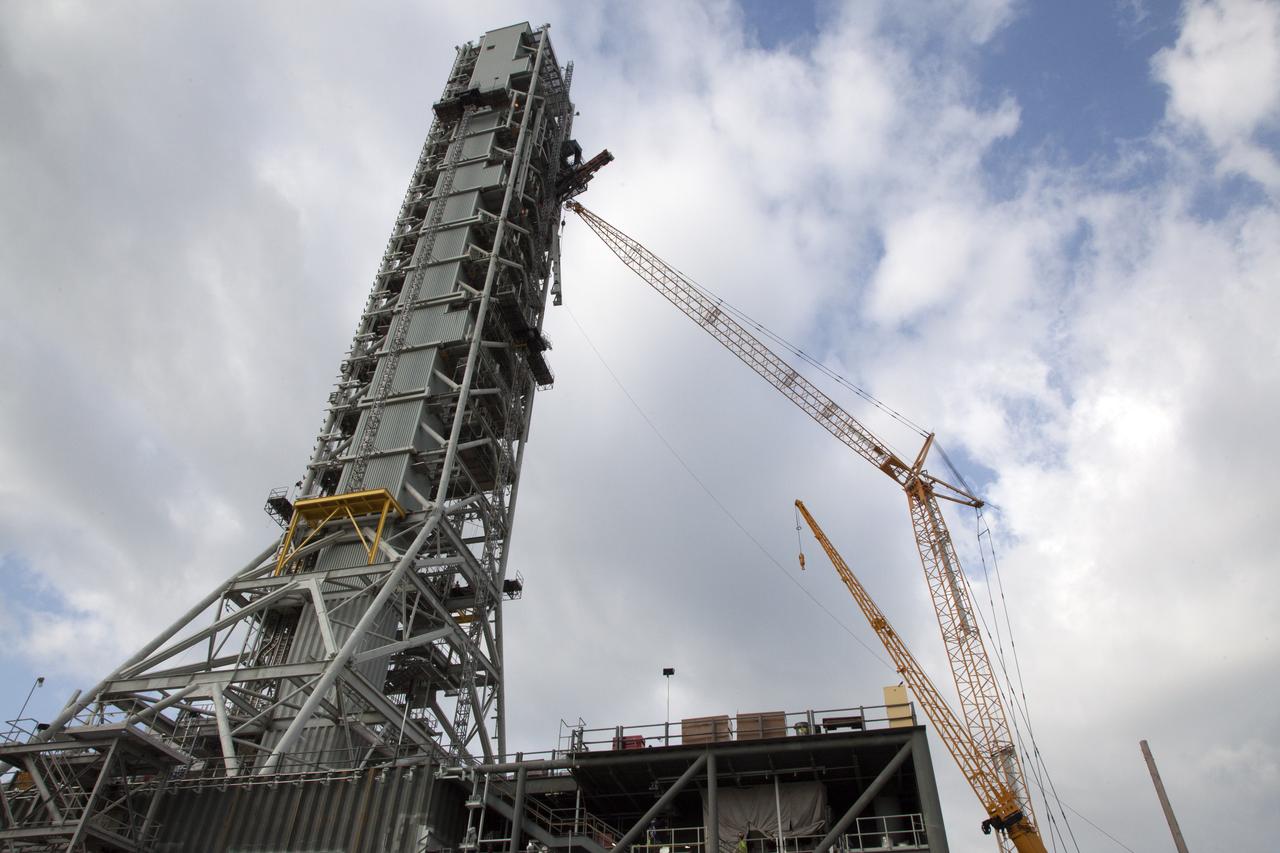
Cranes and rigging are being used to lift up the Core Stage Forward Skirt Umbilical (CSFSU) for installation on the mobile launcher tower at NASA's Kennedy Space Center in Florida. The mobile launcher tower will be equipped with a number of lines, called umbilicals that will connect to the Space Launch System (SLS) rocket and Orion spacecraft for Exploration Mission-1 (EM-1). The CSFSU will be located at about the 180-foot level on the tower, above the liquid oxygen tank. The CSFSU is an umbilical that will swing into position to provide connections to the core stage forward skirt of the SLS rocket, and then swing away before launch. Its main purpose is to provide conditioned air/GN2 to the SLS core stage forward skirt cavity. The Ground Systems Development and Operations Program is overseeing installation of the umbilicals.
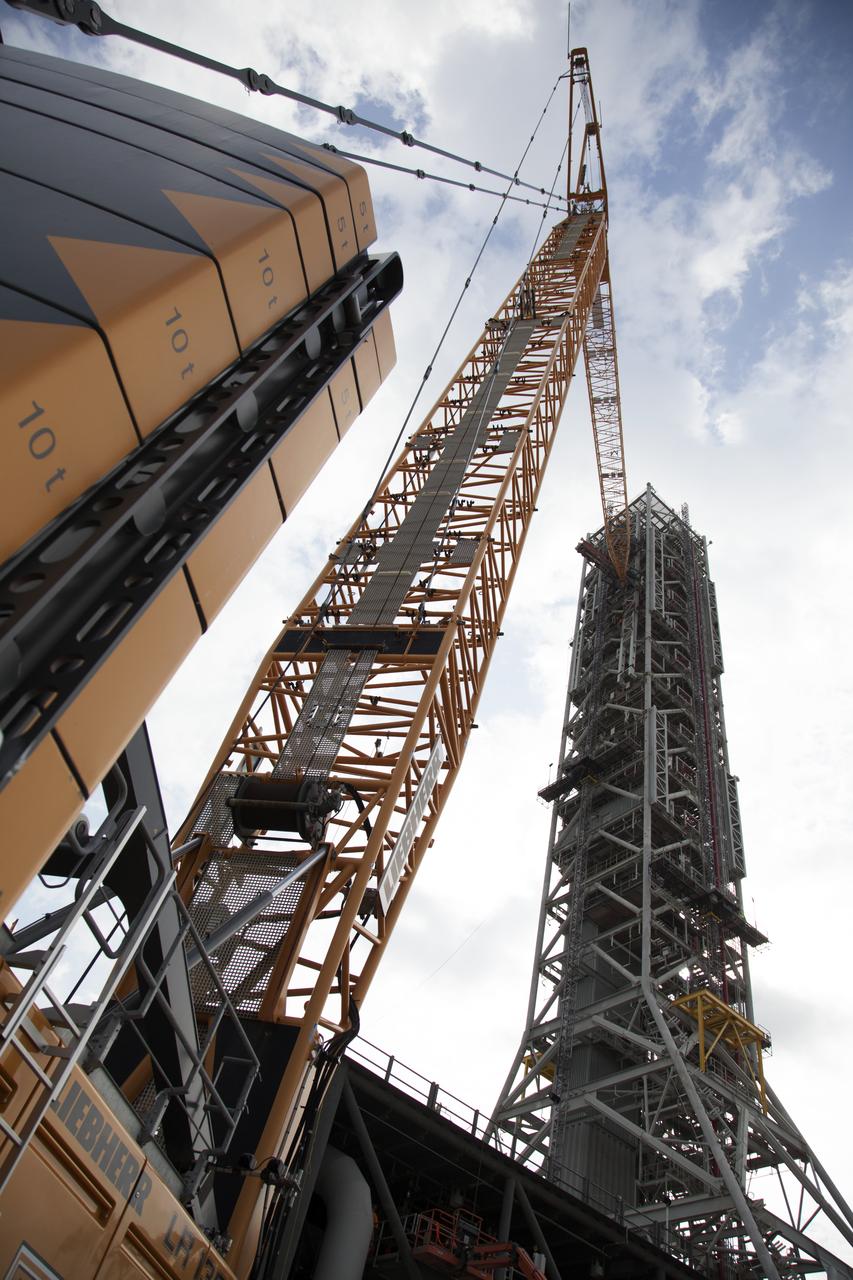
Cranes and rigging are being used to lift the Core Stage Forward Skirt Umbilical (CSFSU) into position for installation on the mobile launcher tower at NASA's Kennedy Space Center in Florida. The mobile launcher tower will be equipped with a number of lines, called umbilicals that will connect to the Space Launch System (SLS) rocket and Orion spacecraft for Exploration Mission-1 (EM-1). The CSFSU will be located at about the 180-foot level on the tower, above the liquid oxygen tank. The CSFSU is an umbilical that will swing into position to provide connections to the core stage forward skirt of the SLS rocket, and then swing away before launch. Its main purpose is to provide conditioned air/GN2 to the SLS core stage forward skirt cavity. The Ground Systems Development and Operations Program is overseeing installation of the umbilicals.
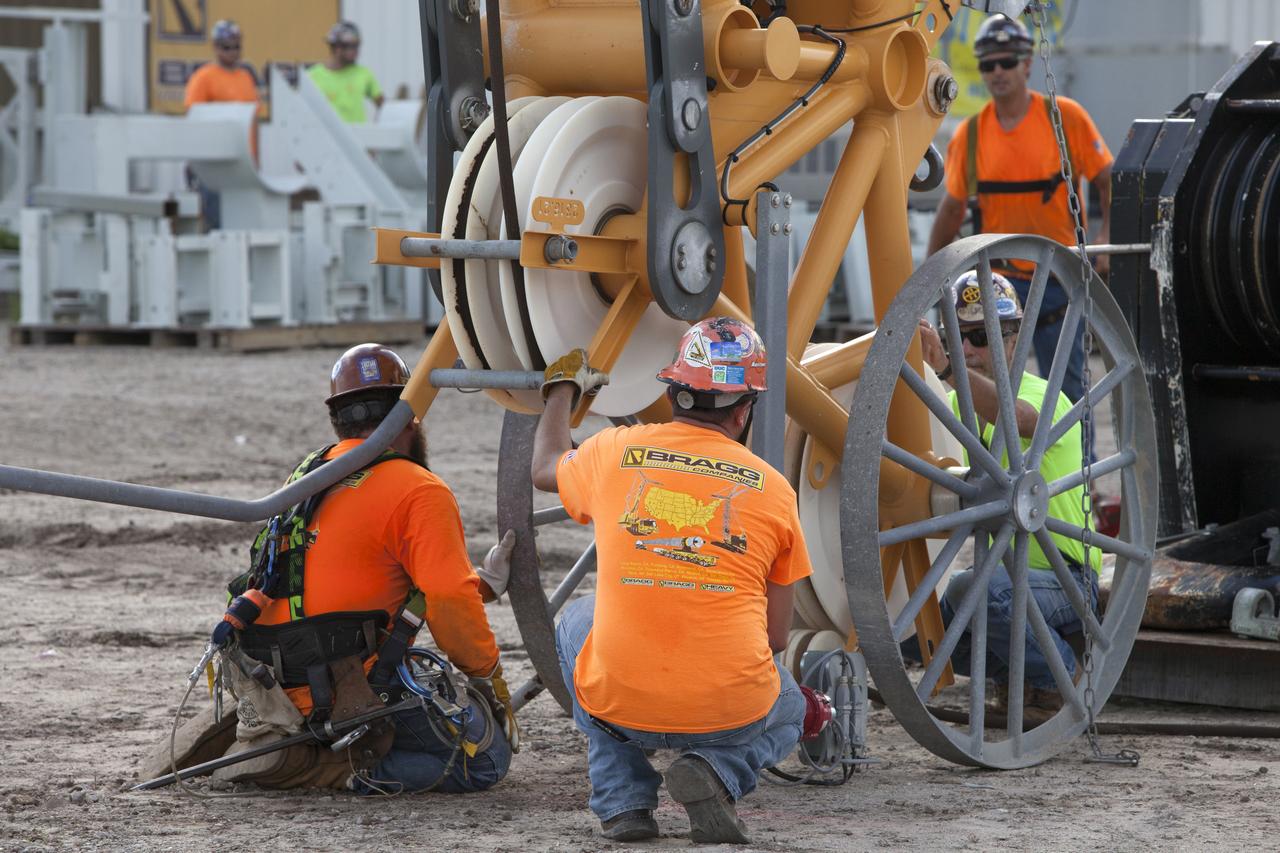
Just north of the Vehicle Assembly Building at NASA's Kennedy Space Center in Florida, technicians prepare a crane to lift the core stage forward skirt umbilical for installation onto the mobile launcher. The mobile launcher is designed to support the assembly, testing and check-out of the agency's Space Launch System (SLS) rocket and the Orion spacecraft.
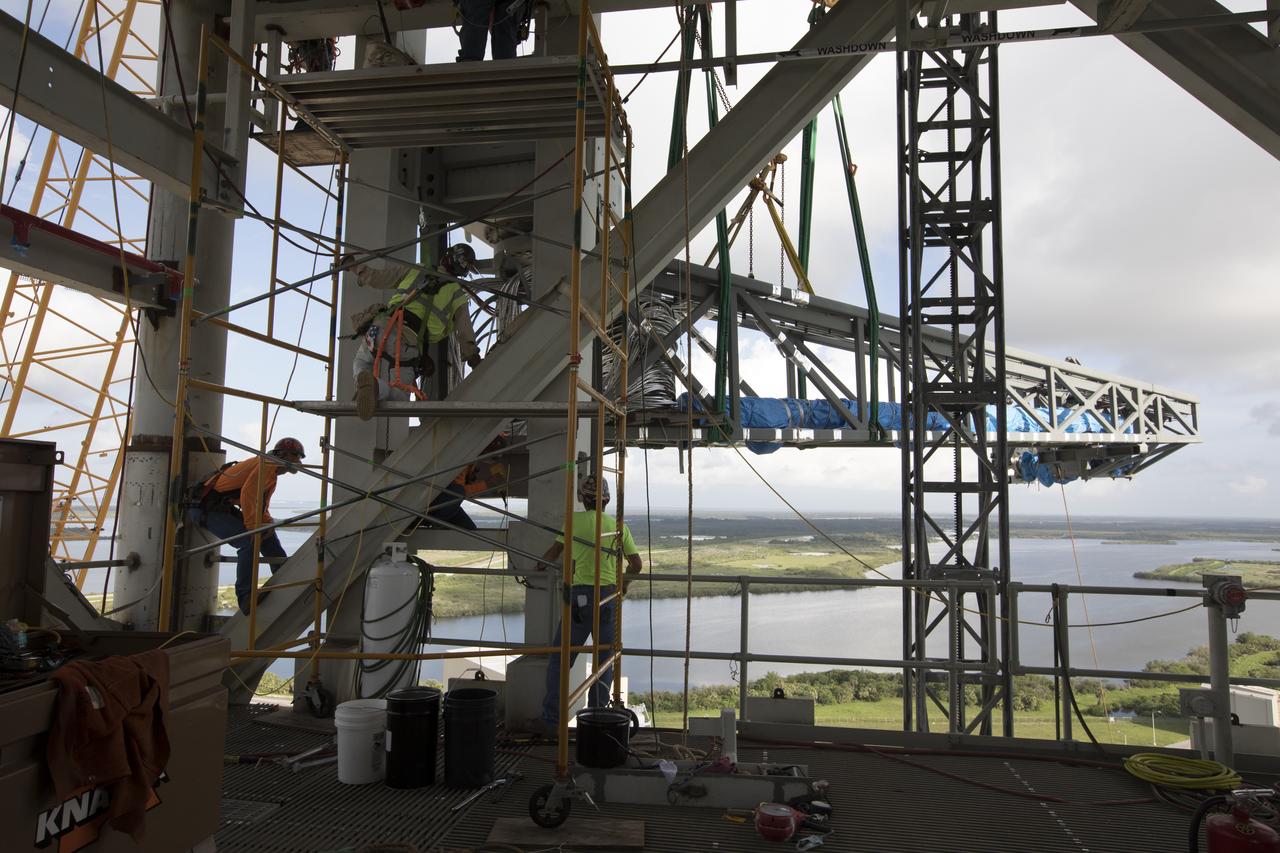
Just north of the Vehicle Assembly Building at NASA's Kennedy Space Center in Florida, technicians install the core stage forward skirt umbilical on the mobile launcher. The mobile launcher is designed to support the assembly, testing and check-out of the agency's Space Launch System (SLS) rocket and the Orion spacecraft.
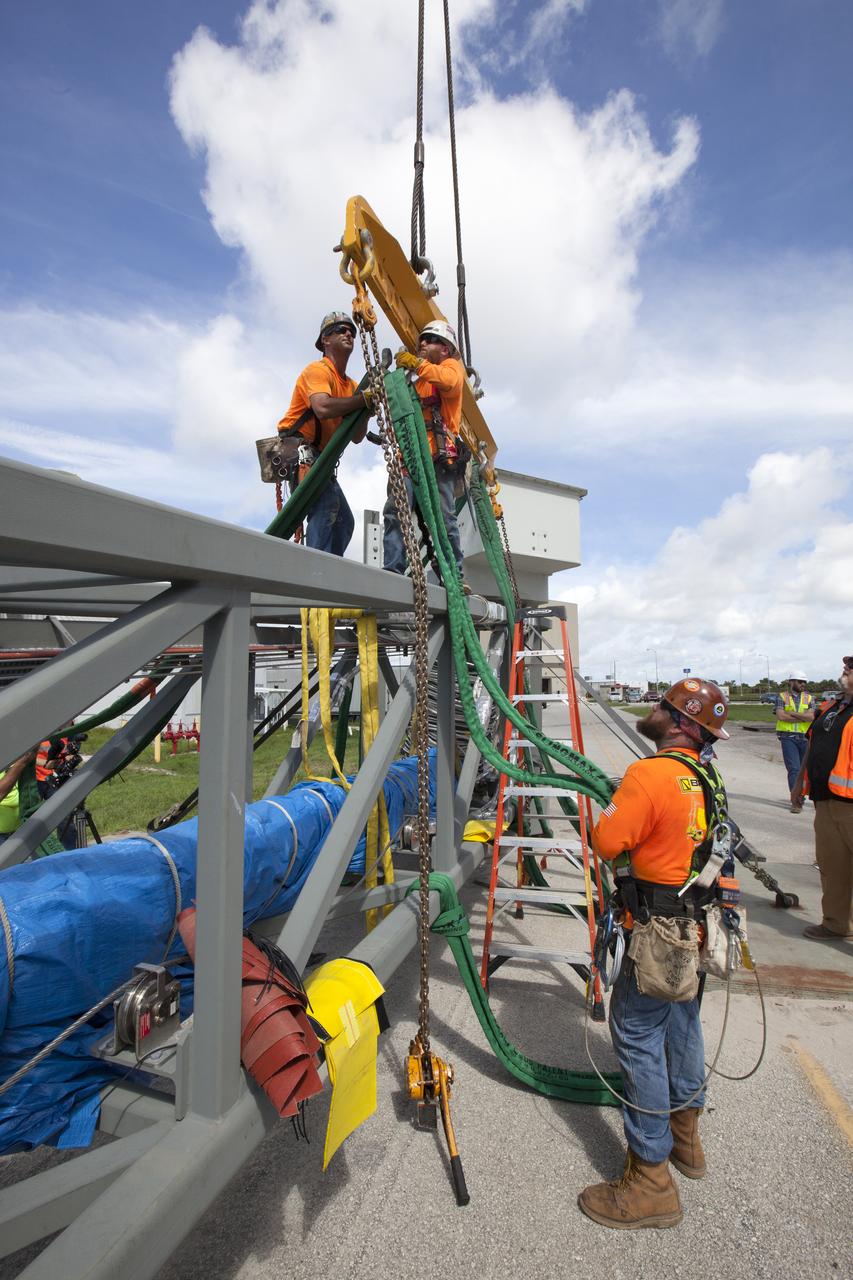
Just north of the Vehicle Assembly Building at NASA's Kennedy Space Center in Florida, technicians prepare a crane to lift the core stage forward skirt umbilical for installation onto the mobile launcher. The mobile launcher is designed to support the assembly, testing and check-out of the agency's Space Launch System (SLS) rocket and the Orion spacecraft.
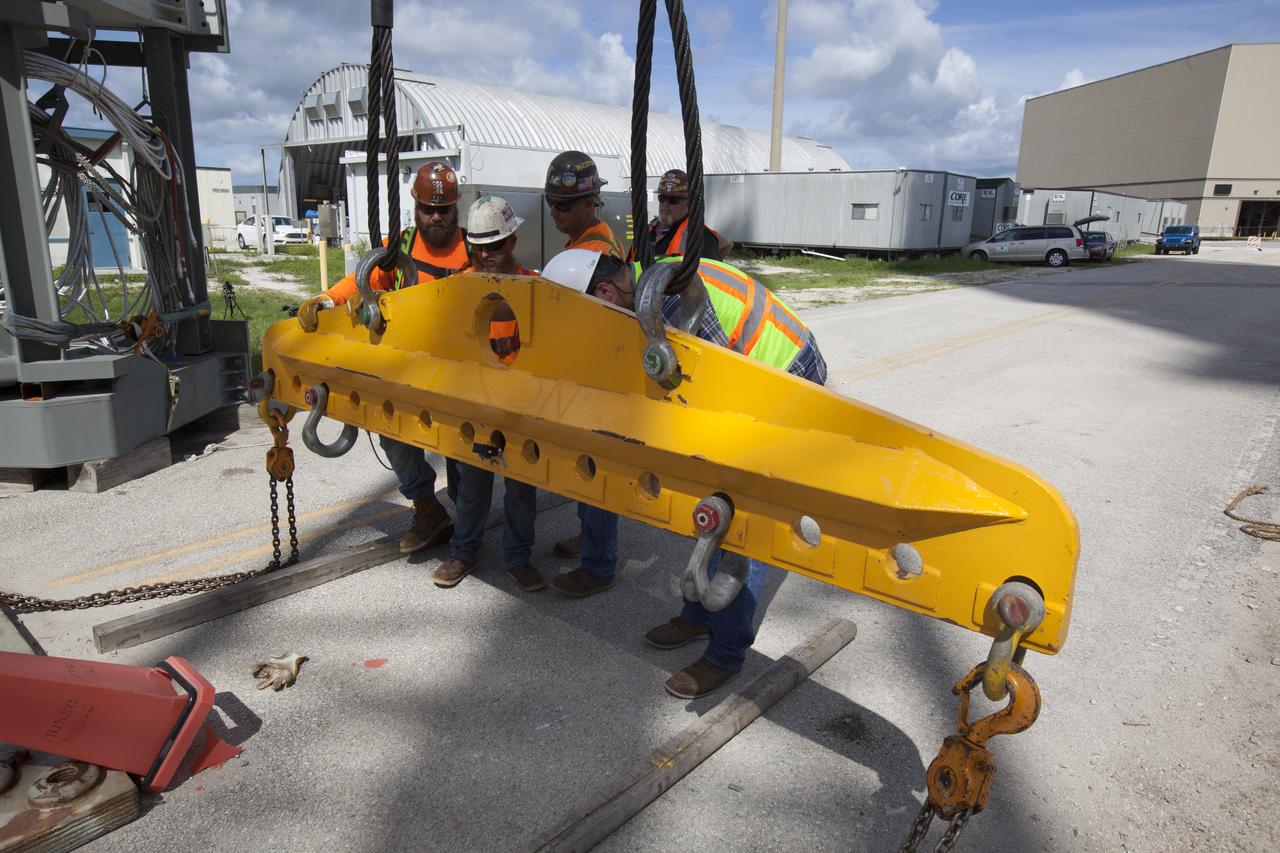
Just north of the Vehicle Assembly Building at NASA's Kennedy Space Center in Florida, technicians prepare a crane to lift the core stage forward skirt umbilical (CSFSU) for installation onto the mobile launcher. The mobile launcher is designed to support the assembly, testing and check-out of the agency's Space Launch System (SLS) rocket and the Orion spacecraft.
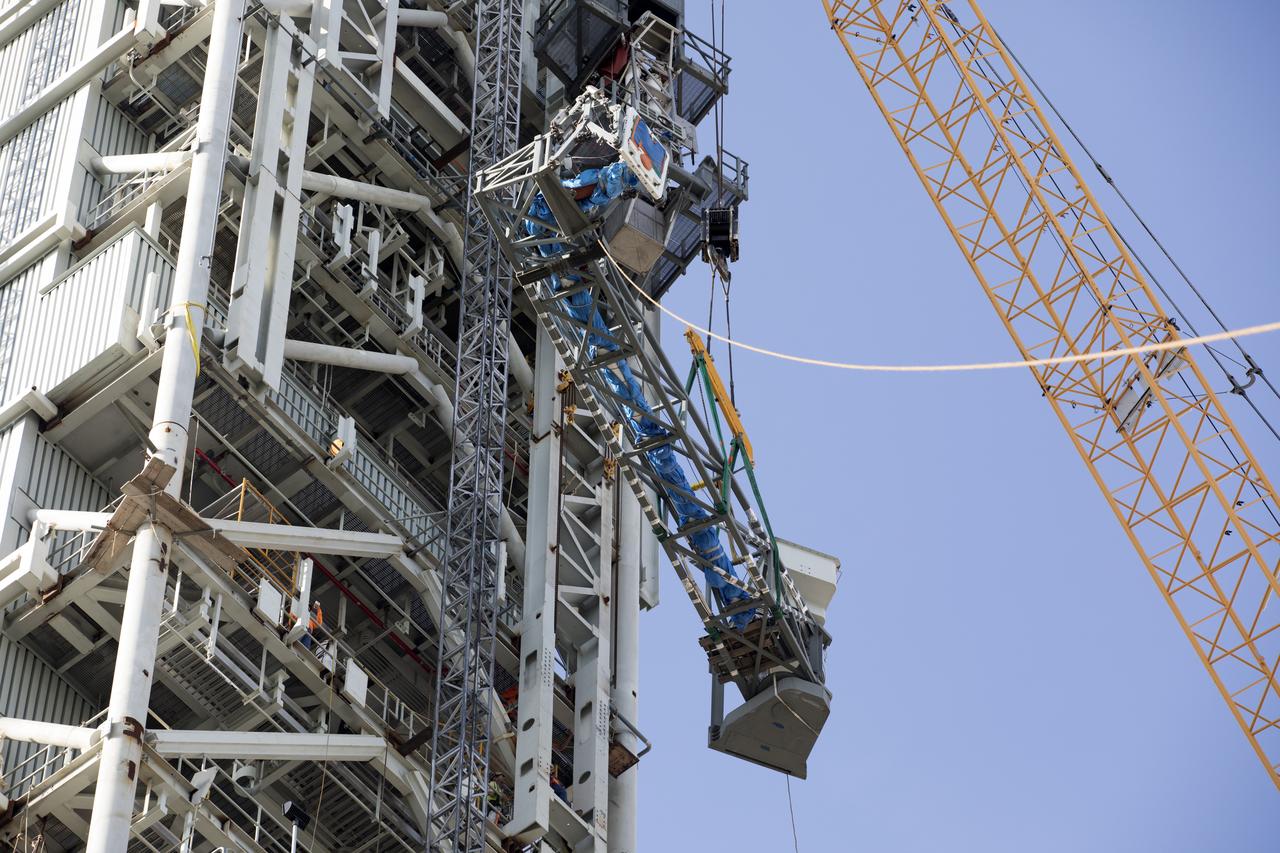
Just north of the Vehicle Assembly Building at NASA's Kennedy Space Center in Florida, the core stage forward skirt umbilical is installed on the mobile launcher. The mobile launcher is designed to support the assembly, testing and check-out of the agency's Space Launch System (SLS) rocket and the Orion spacecraft.
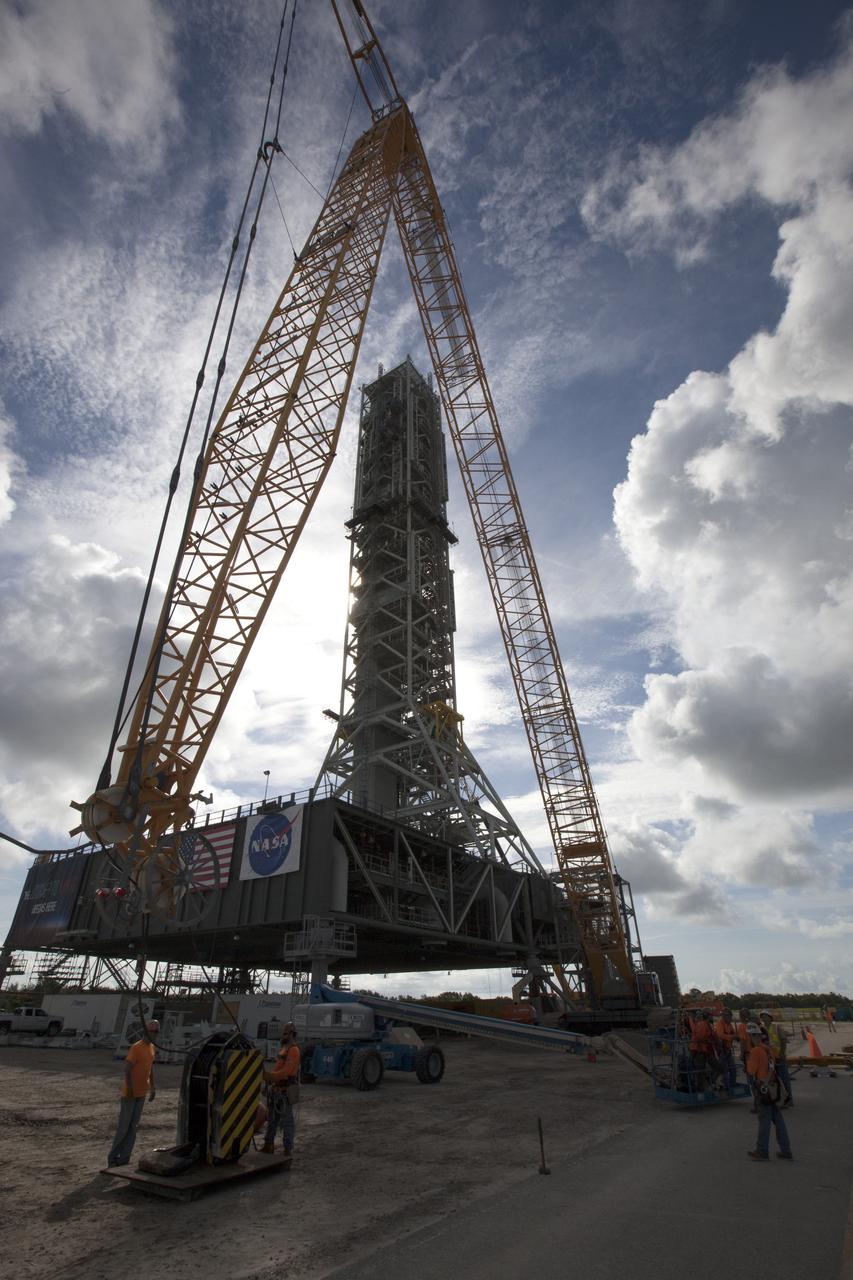
Just north of the Vehicle Assembly Building at NASA's Kennedy Space Center in Florida, a crane is prepared to lift the core stage forward skirt umbilical for installation onto the mobile launcher. The mobile launcher is designed to support the assembly, testing and check-out of the agency's Space Launch System (SLS) rocket and the Orion spacecraft.
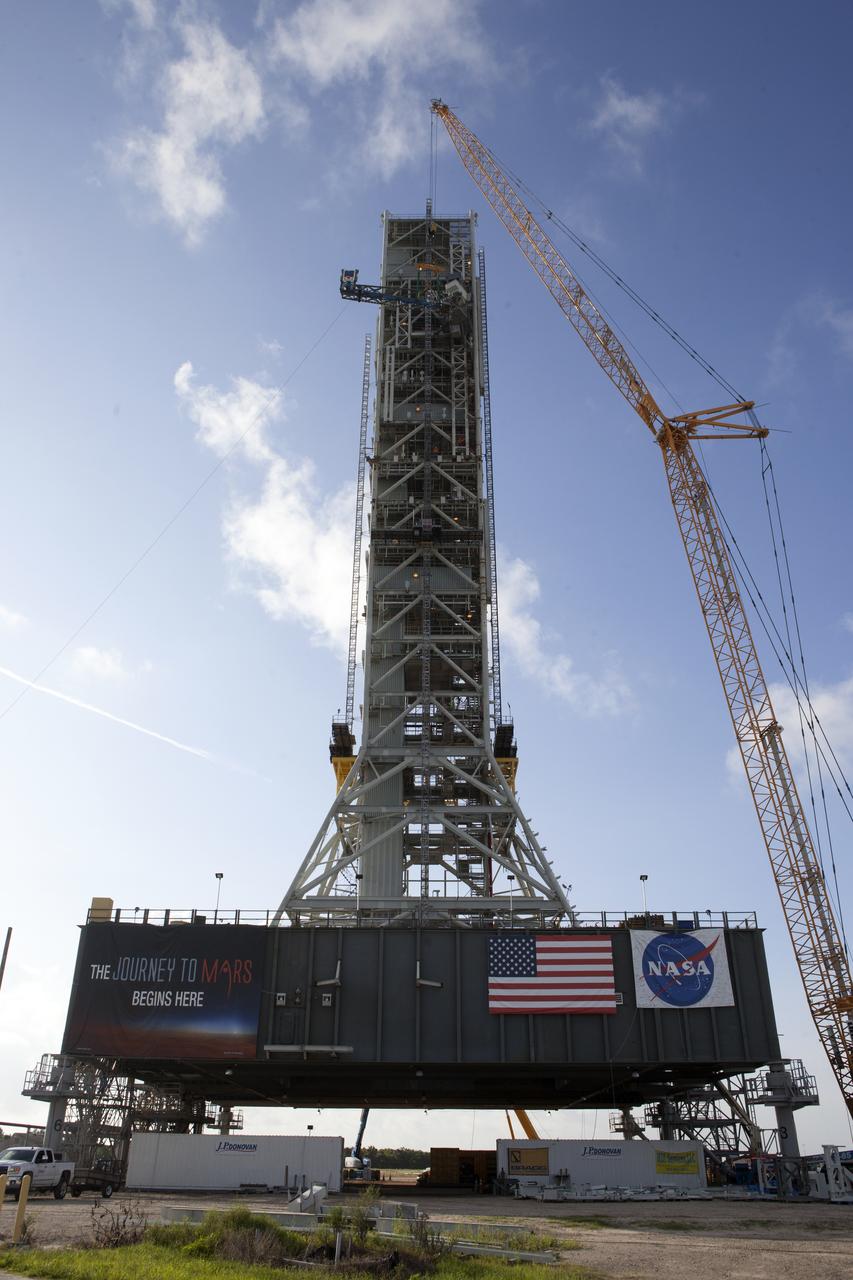
Just north of the Vehicle Assembly Building at NASA's Kennedy Space Center in Florida, a crane lifts the core stage forward skirt umbilical for installation onto the mobile launcher. The mobile launcher is designed to support the assembly, testing and check-out of the agency's Space Launch System (SLS) rocket and the Orion spacecraft.
Just north of the Vehicle Assembly Building at NASA's Kennedy Space Center in Florida, the core stage forward skirt umbilical is installed on the mobile launcher. The mobile launcher is designed to support the assembly, testing and check-out of the agency's Space Launch System (SLS) rocket and the Orion spacecraft.
Just north of the Vehicle Assembly Building at NASA's Kennedy Space Center in Florida, a crane is prepared to lift the core stage forward skirt umbilical for installation onto the mobile launcher. The mobile launcher is designed to support the assembly, testing and check-out of the agency's Space Launch System (SLS) rocket and the Orion spacecraft.
Just north of the Vehicle Assembly Building at NASA's Kennedy Space Center in Florida, a crane lifts the core stage forward skirt umbilical for installation onto the mobile launcher. The mobile launcher is designed to support the assembly, testing and check-out of the agency's Space Launch System (SLS) rocket and the Orion spacecraft.
Just north of the Vehicle Assembly Building at NASA's Kennedy Space Center in Florida, the core stage forward skirt umbilical is installed on the mobile launcher. The mobile launcher is designed to support the assembly, testing and check-out of the agency's Space Launch System (SLS) rocket and the Orion spacecraft.
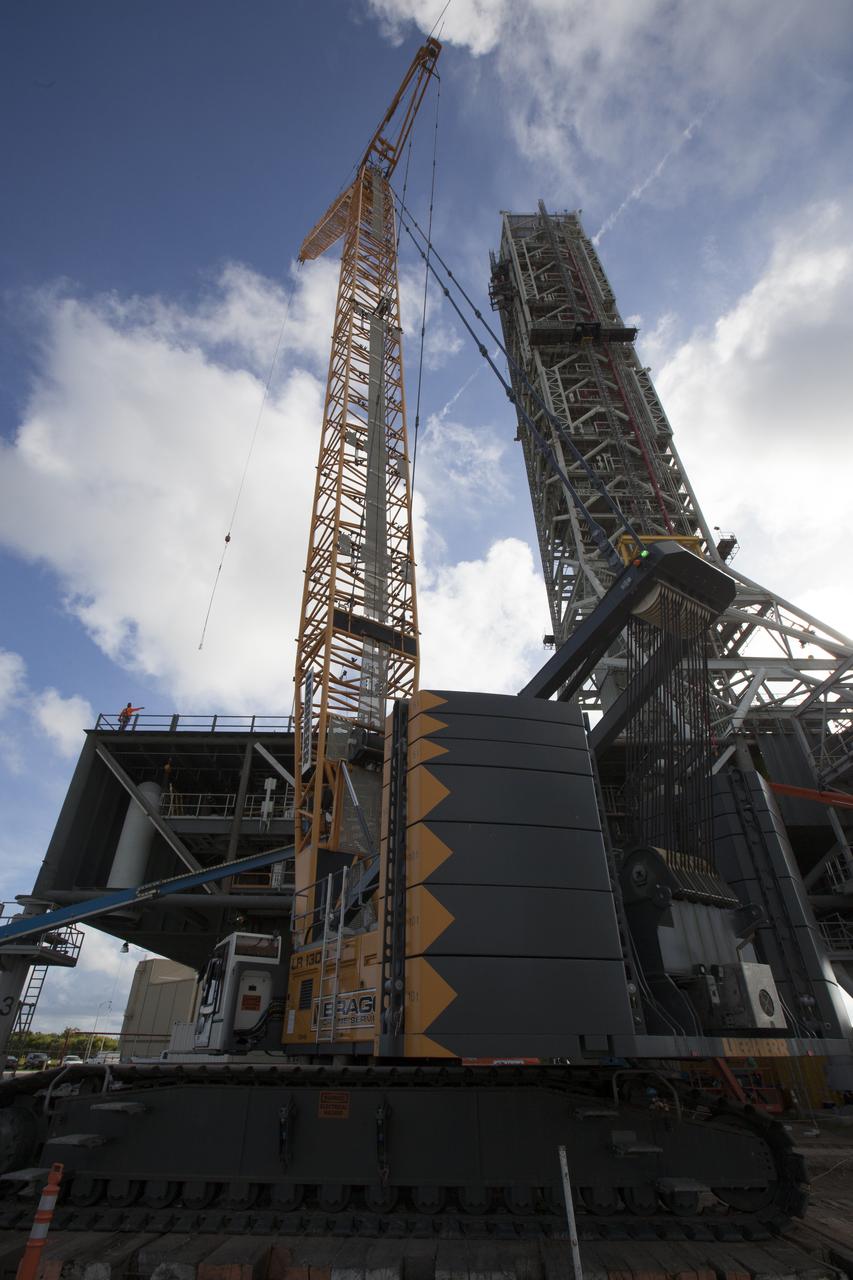
Just north of the Vehicle Assembly Building at NASA's Kennedy Space Center in Florida, a crane is prepared to lift the core stage forward skirt umbilical) for installation onto the mobile launcher. The mobile launcher is designed to support the assembly, testing and check-out of the agency's Space Launch System (SLS) rocket and the Orion spacecraft.
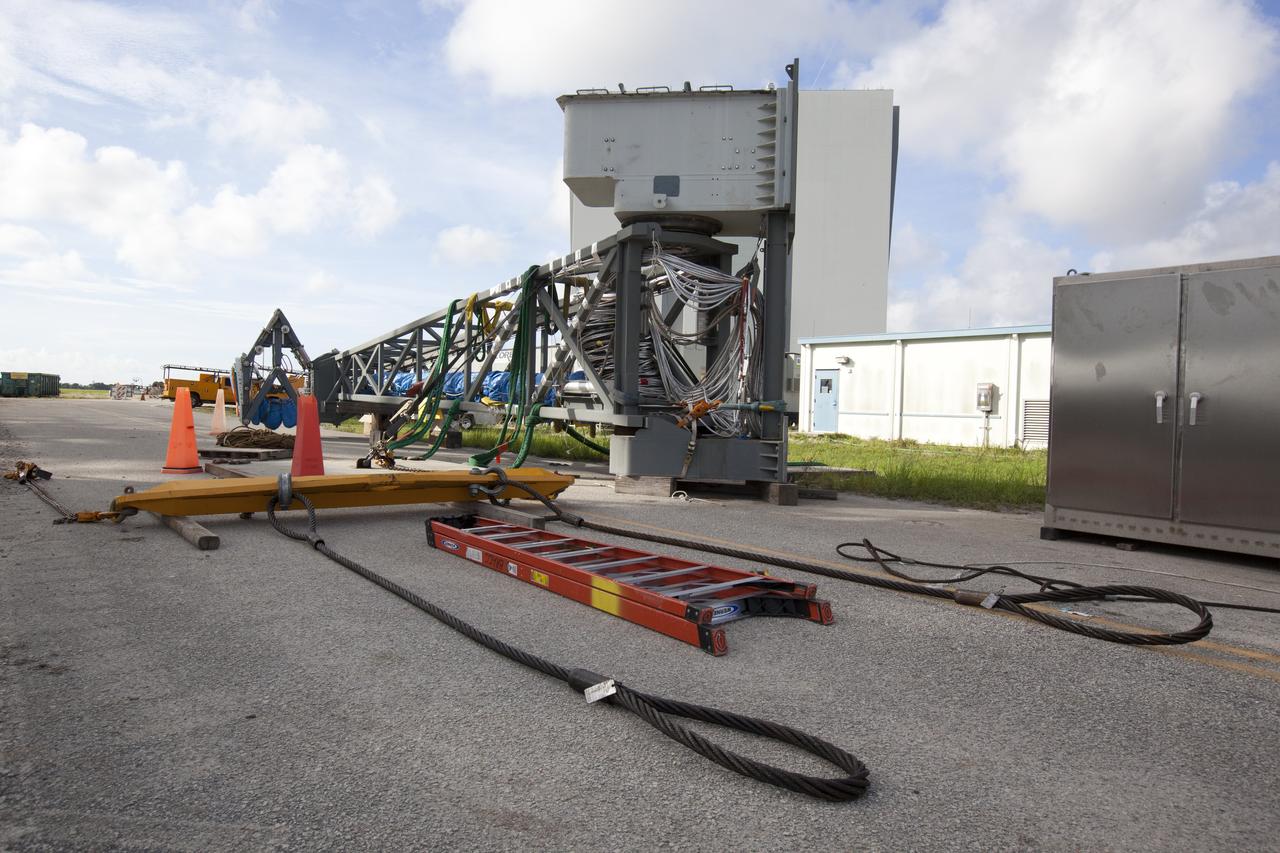
Just north of the Vehicle Assembly Building at NASA's Kennedy Space Center in Florida, the core stage forward skirt umbilical is prepped and rigged for installation onto the mobile launcher. The mobile launcher is designed to support the assembly, testing and check-out of the agency's Space Launch System (SLS) rocket and the Orion spacecraft.
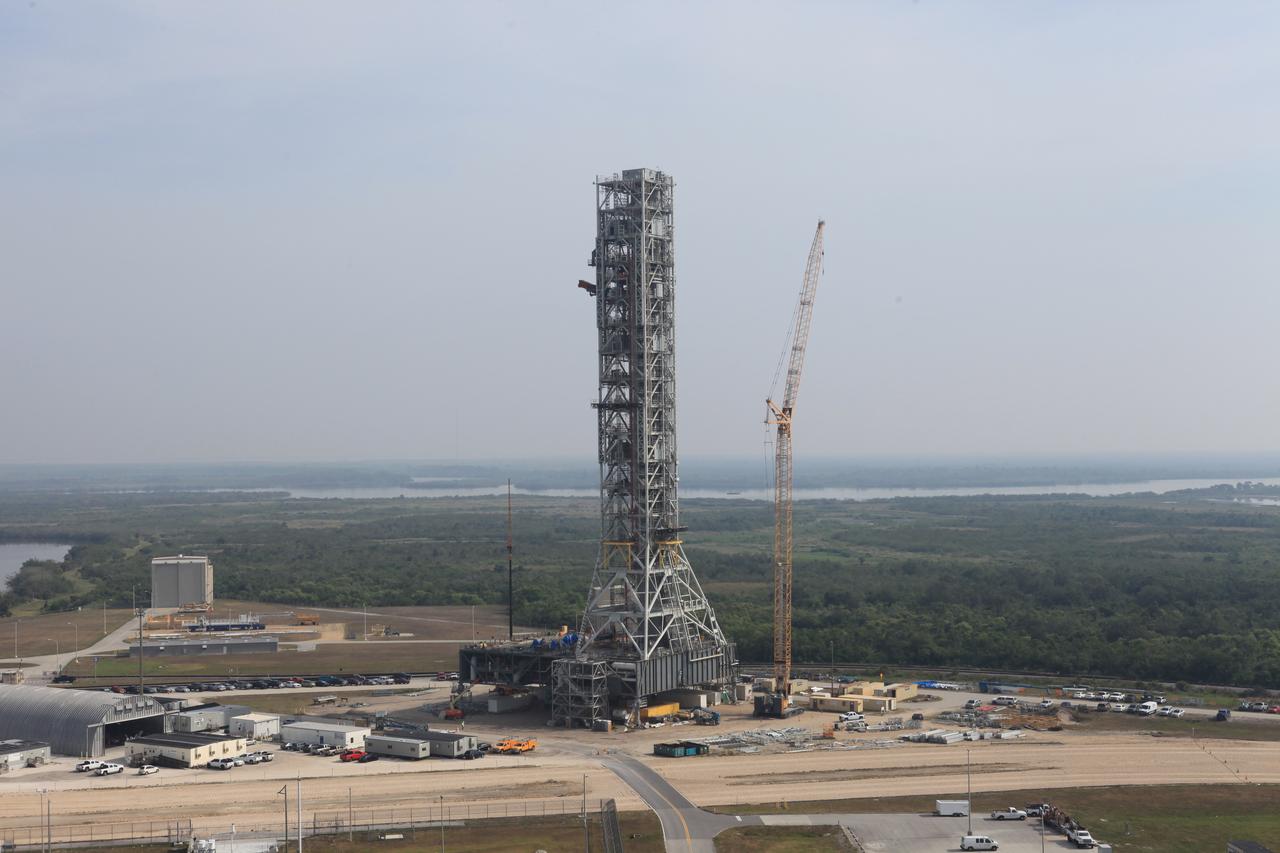
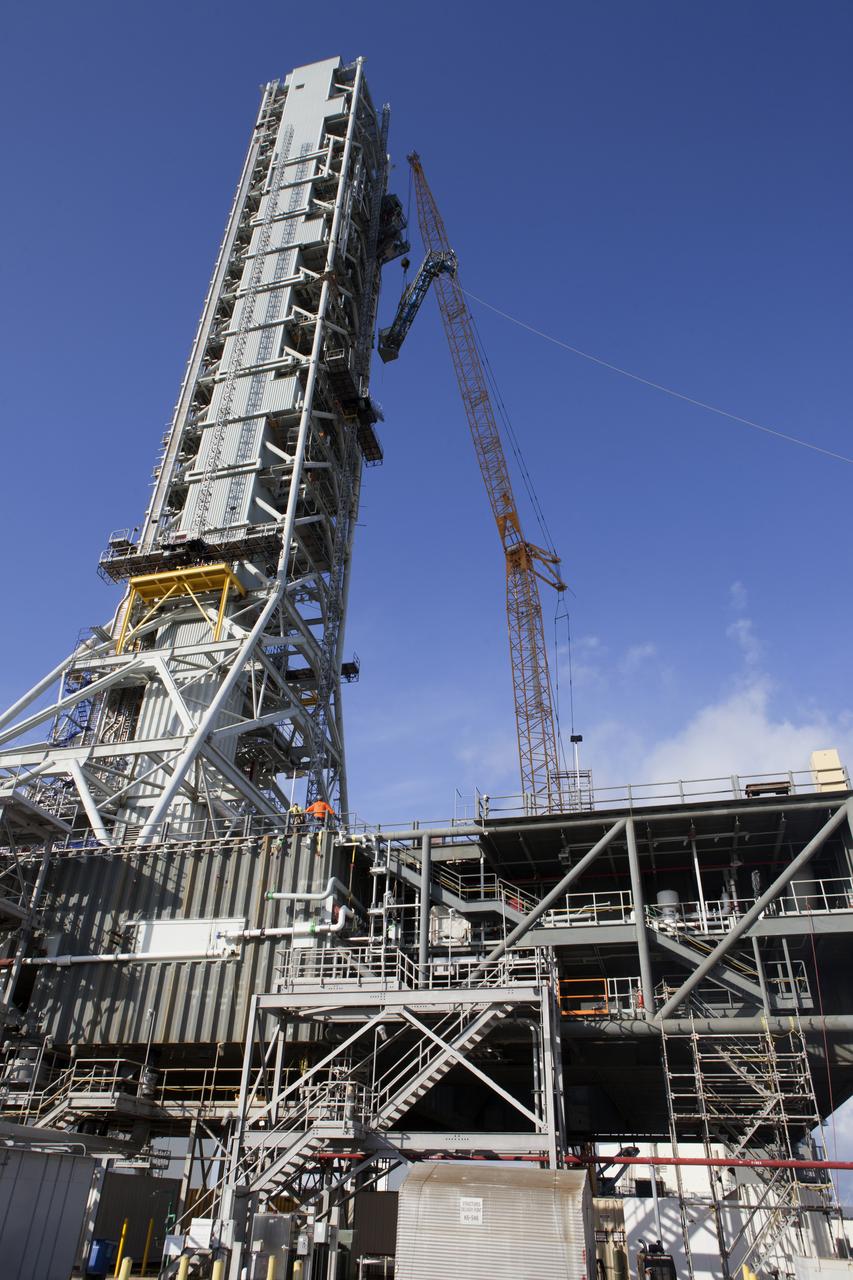
A view of the mobile launcher (ML) taken from the "eyebrow" of the nearby Vehicle Assembly Building at NASA's Kennedy Space Center in Florida. The ML tower will be equipped with a number of lines, called umbilicals that will connect to the Space Launch System rocket and Orion spacecraft for Exploration Mission-1 (EM-1). The Orion Service Module Umbilical and Core State Forward Skirt Umbilical were recently installed on the ML. The Ground Systems Development and Operations Program is overseeing installation of the umbilicals.
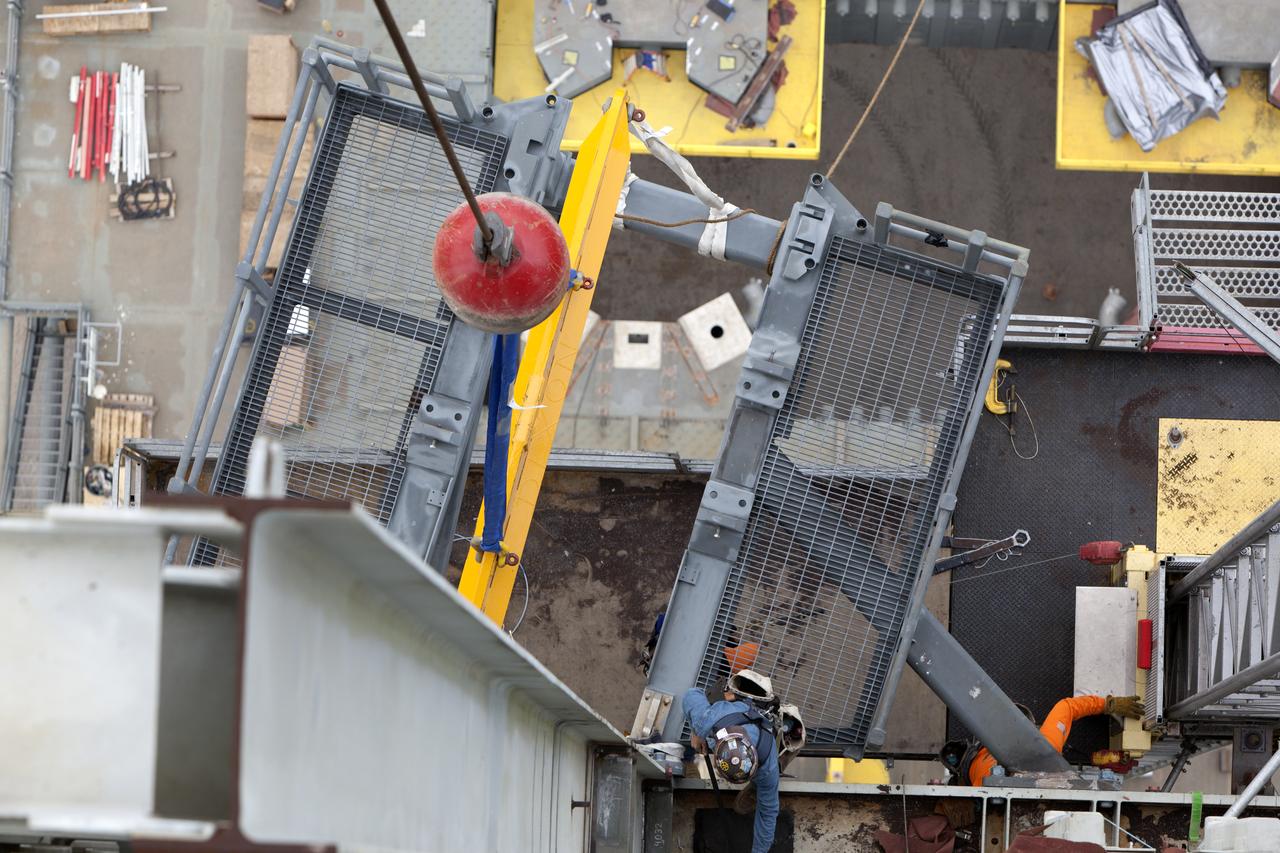
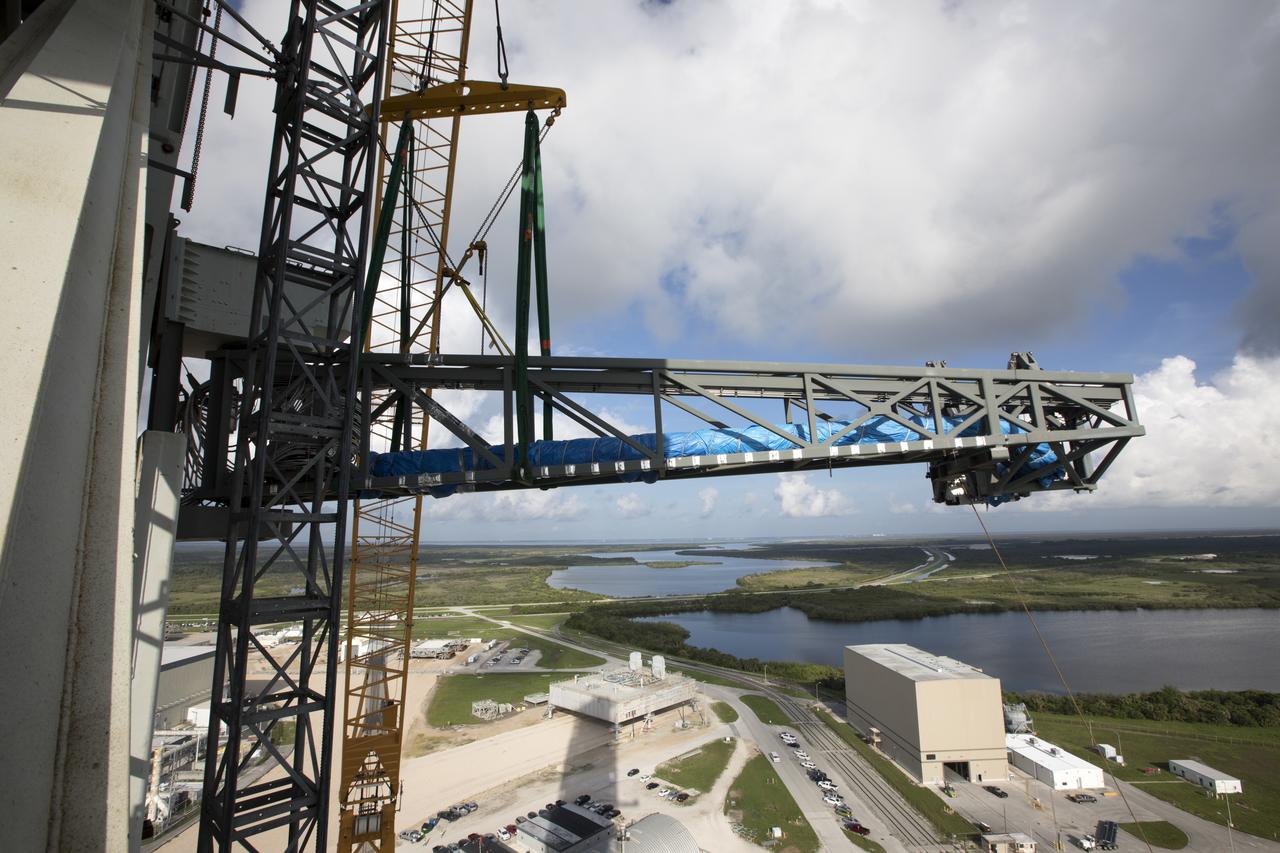
In this view looking down from high up on the mobile launcher, a crane positions the bracket for the Orion Service Module Umbilical (OSMU) for installation on the mobile launcher tower at NASA's Kennedy Space Center in Florida. The mobile launcher tower will be equipped with a number of lines, called umbilicals, that will connect to the Space Launch System rocket and Orion spacecraft for Exploration Mission-1 (EM-1). The OSMU will be located high on the mobile launcher tower and, prior to launch, will transfer liquid coolant for the electronics and air for the Environmental Control System to the Orion service module that houses these critical systems to support the spacecraft. EM-1 is scheduled to launch in 2018. The Ground Systems Development and Operations Program is overseeing installation of the umbilicals.
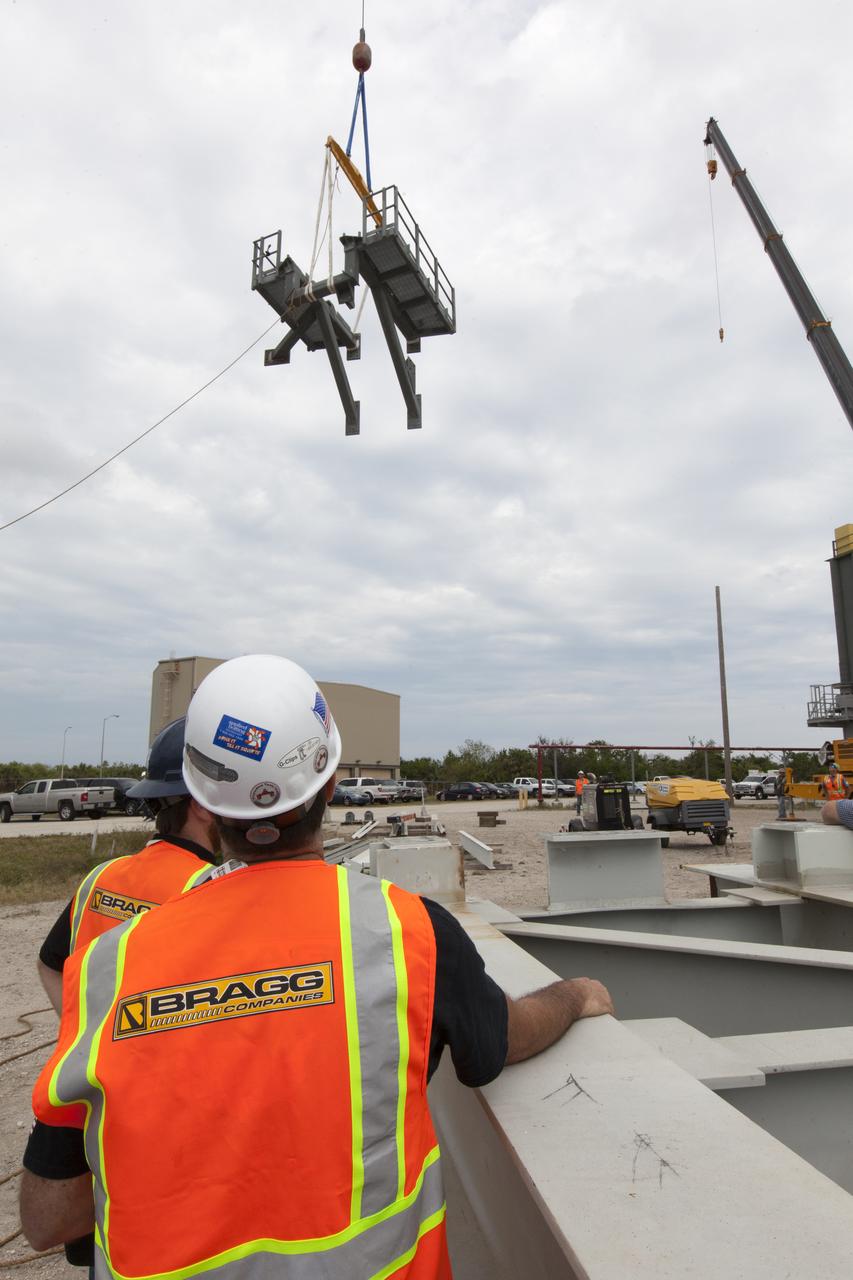
Crane specialists monitor the progress as the bracket for the Orion Service Module Umbilical (OSMU) is lifted up for installation on the mobile launcher tower at NASA's Kennedy Space Center in Florida. The mobile launcher tower will be equipped with a number of lines, called umbilicals, that will connect to the Space Launch System rocket and Orion spacecraft for Exploration Mission-1 (EM-1). The OSMU will be located high on the mobile launcher tower and, prior to launch, will transfer liquid coolant for the electronics and air for the Environmental Control System to the Orion service module that houses these critical systems to support the spacecraft. EM-1 is scheduled to launch in 2018. The Ground Systems Development and Operations Program is overseeing installation of the umbilicals.
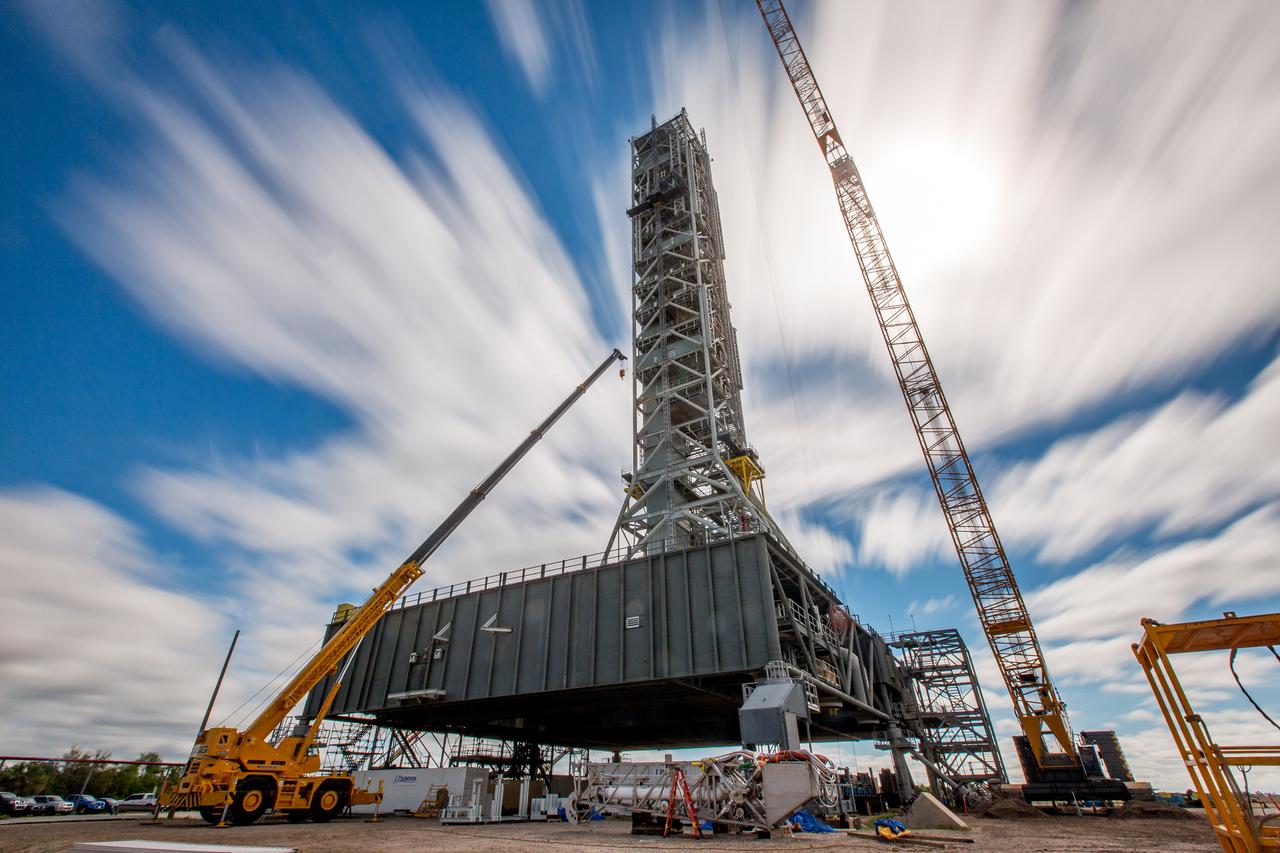
A long-exposure view of the mobile launcher at NASA's Kennedy Space Center in Florida. Cranes and rigging are being used to lift the bracket for the Orion Service Module Umbilical (OSMU) up for installation on the mobile launcher tower. The tower will be equipped with a number of lines, called umbilicals, that will connect to the Space Launch System rocket and Orion spacecraft for Exploration Mission-1 (EM-1). The OSMU will be located high on the mobile launcher tower and, prior to launch, will transfer liquid coolant for the electronics and air for the Environmental Control System to the Orion service module that houses these critical systems to support the spacecraft. EM-1 is scheduled to launch in 2018. The Ground Systems Development and Operations Program is overseeing installation of the umbilicals.
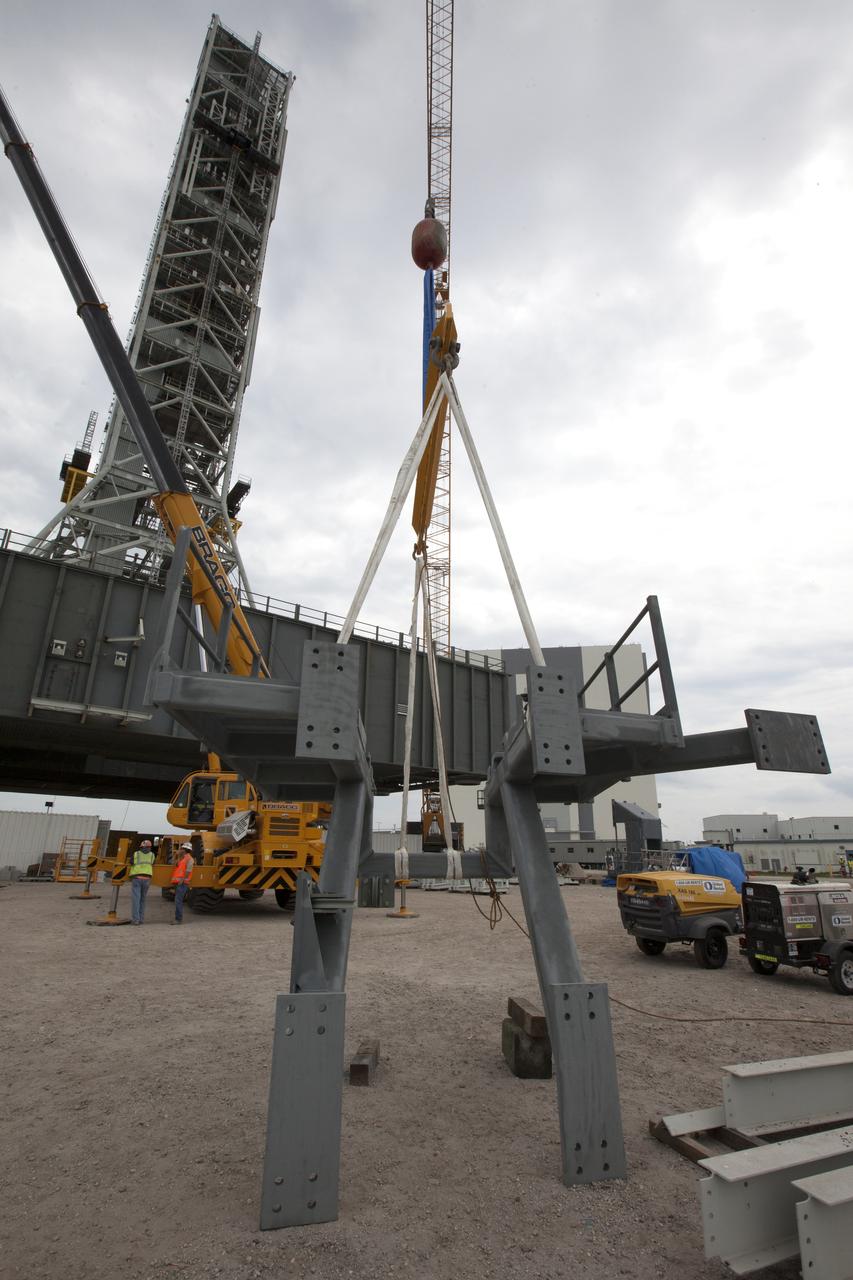
Preparations are underway to lift the bracket for the Orion Service Module Umbilical (OSMU) up for installation on the mobile launcher tower at NASA's Kennedy Space Center in Florida. The mobile launcher tower will be equipped with a number of lines, called umbilicals, that will connect to the Space Launch System rocket and Orion spacecraft for Exploration Mission-1 (EM-1). The OSMU will be located high on the mobile launcher tower and, prior to launch, will transfer liquid coolant for the electronics and air for the Environmental Control System to the Orion service module that houses these critical systems to support the spacecraft. EM-1 is scheduled to launch in 2018. The Ground Systems Development and Operations Program is overseeing installation of the umbilicals.
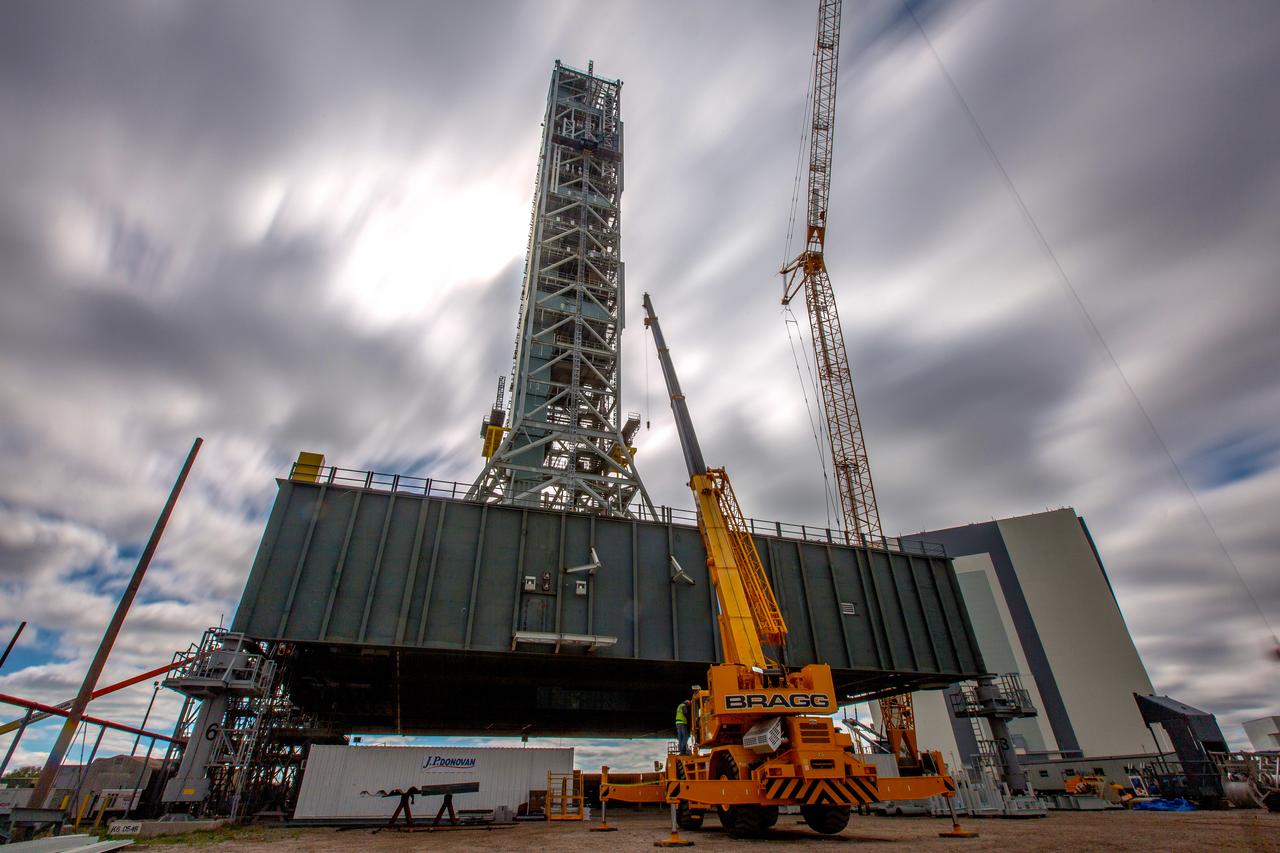
A long-exposure view of the mobile launcher at NASA's Kennedy Space Center in Florida. Cranes and rigging are being used to lift the bracket for the Orion Service Module Umbilical (OSMU) up for installation on the mobile launcher tower. The tower will be equipped with a number of lines, called umbilicals, that will connect to the Space Launch System rocket and Orion spacecraft for Exploration Mission-1 (EM-1). The OSMU will be located high on the mobile launcher tower and, prior to launch, will transfer liquid coolant for the electronics and air for the Environmental Control System to the Orion service module that houses these critical systems to support the spacecraft. EM-1 is scheduled to launch in 2018. The Ground Systems Development and Operations Program is overseeing installation of the umbilicals.
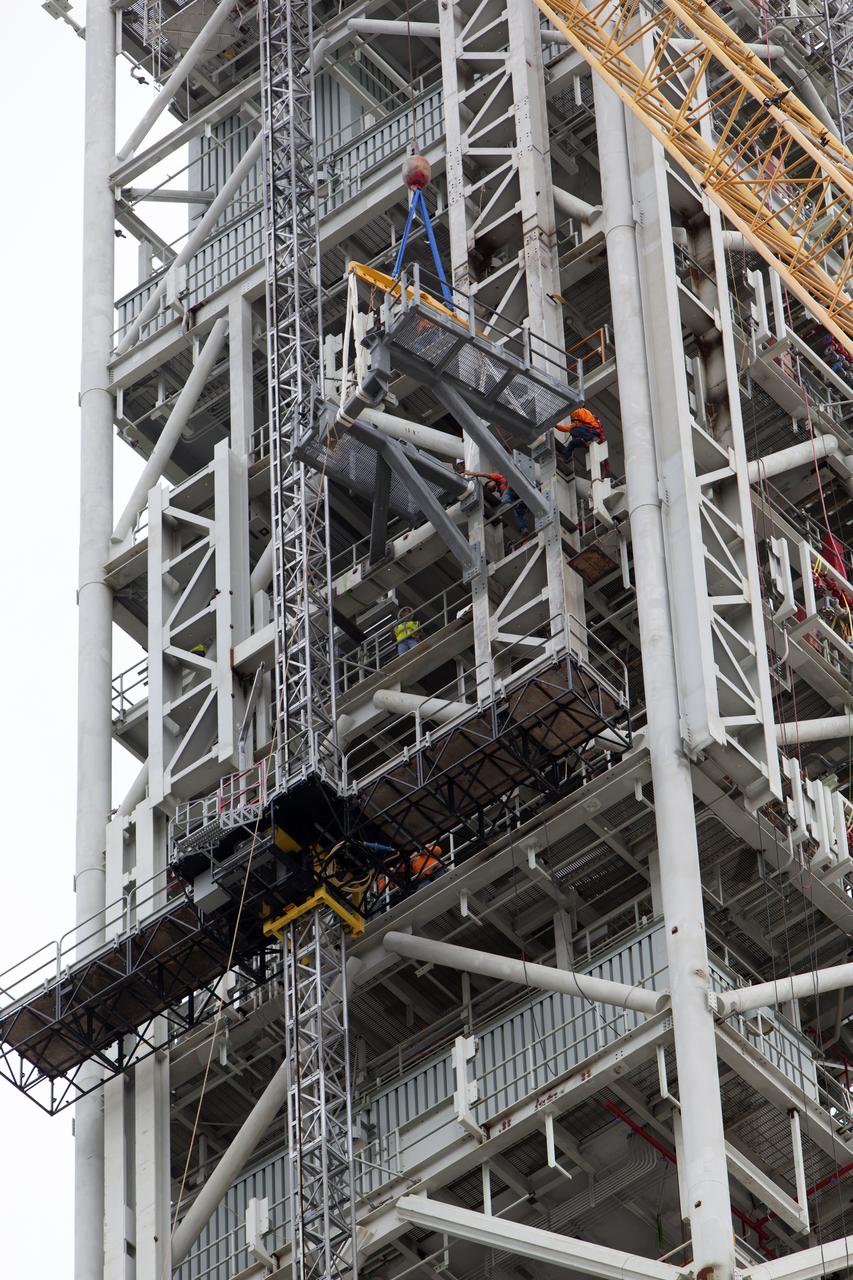
A crane positions the bracket for the Orion Service Module Umbilical (OSMU) for installation on the mobile launcher tower at NASA's Kennedy Space Center in Florida. The mobile launcher tower will be equipped with a number of lines, called umbilicals, that will connect to the Space Launch System rocket and Orion spacecraft for Exploration Mission-1 (EM-1). The OSMU will be located high on the mobile launcher tower and, prior to launch, will transfer liquid coolant for the electronics and air for the Environmental Control System to the Orion service module that houses these critical systems to support the spacecraft. EM-1 is scheduled to launch in 2018. The Ground Systems Development and Operations Program is overseeing installation of the umbilicals.
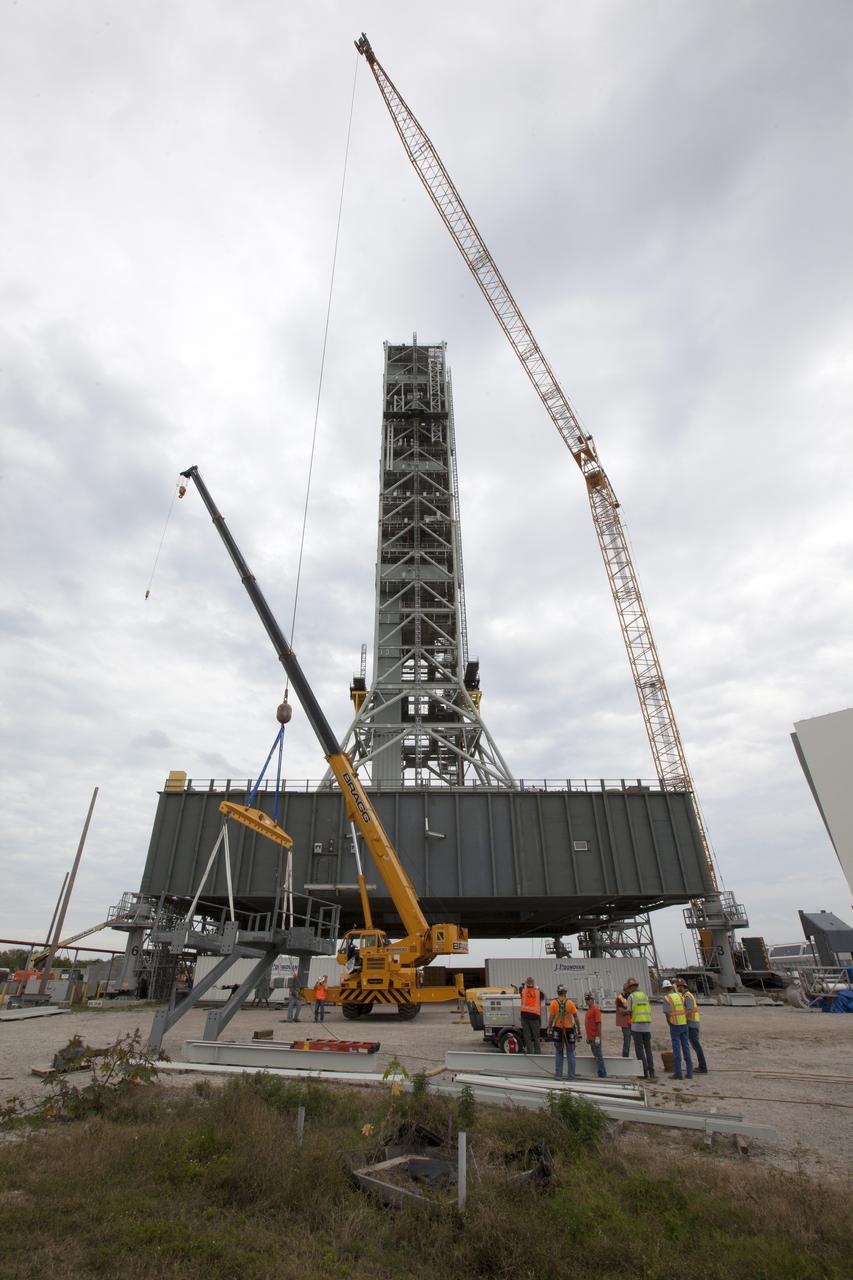
Preparations are underway to lift the bracket for the Orion Service Module Umbilical (OSMU) up for installation on the mobile launcher tower at NASA's Kennedy Space Center in Florida. The mobile launcher tower will be equipped with a number of lines, called umbilicals, that will connect to the Space Launch System rocket and Orion spacecraft for Exploration Mission-1 (EM-1). The OSMU will be located high on the mobile launcher tower and, prior to launch, will transfer liquid coolant for the electronics and air for the Environmental Control System to the Orion service module that houses these critical systems to support the spacecraft. EM-1 is scheduled to launch in 2018. The Ground Systems Development and Operations Program is overseeing installation of the umbilicals.
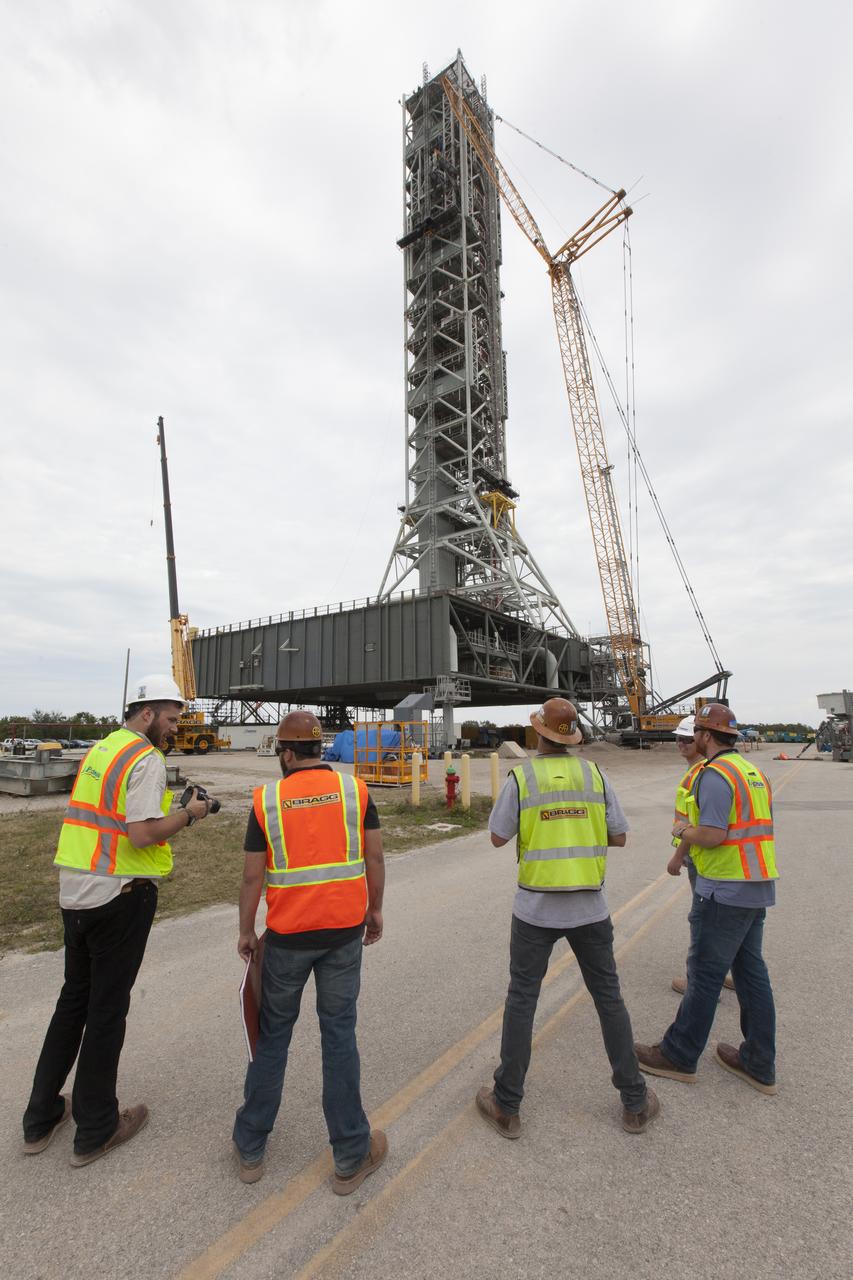
Crane specialists monitor the progress as the bracket for the Orion Service Module Umbilical (OSMU) is lifted high up for installation on the mobile launcher tower at NASA's Kennedy Space Center in Florida. The mobile launcher tower will be equipped with a number of lines, called umbilicals, that will connect to the Space Launch System rocket and Orion spacecraft for Exploration Mission-1 (EM-1). The OSMU will be located high on the mobile launcher tower and, prior to launch, will transfer liquid coolant for the electronics and air for the Environmental Control System to the Orion service module that houses these critical systems to support the spacecraft. EM-1 is scheduled to launch in 2018. The Ground Systems Development and Operations Program is overseeing installation of the umbilicals.

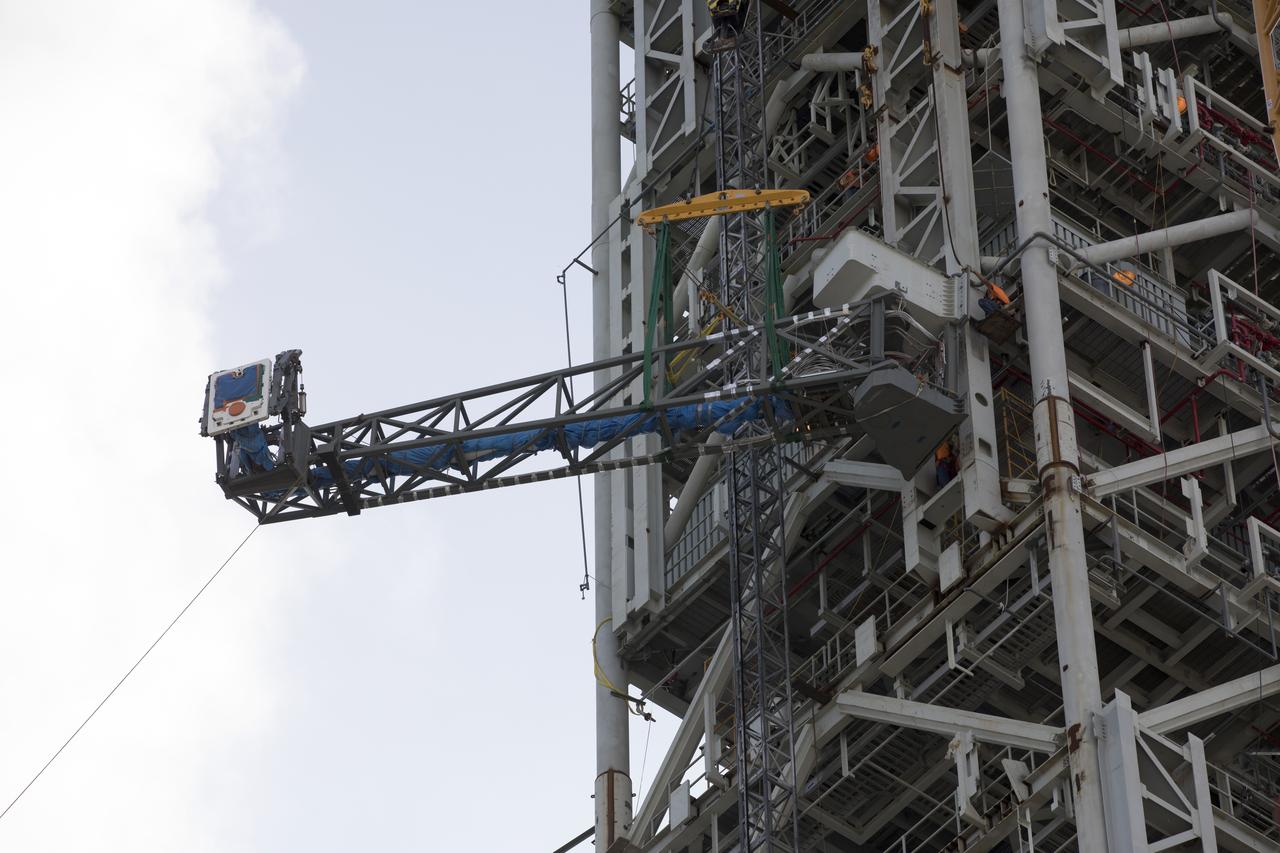
A view from below the mobile launcher shows a crane positioning the bracket for the Orion Service Module Umbilical (OSMU) high up for installation on the mobile launcher tower at NASA's Kennedy Space Center in Florida. The mobile launcher tower will be equipped with a number of lines, called umbilicals, that will connect to the Space Launch System rocket and Orion spacecraft for Exploration Mission-1 (EM-1). The OSMU will be located high on the mobile launcher tower and, prior to launch, will transfer liquid coolant for the electronics and air for the Environmental Control System to the Orion service module that houses these critical systems to support the spacecraft. EM-1 is scheduled to launch in 2018. The Ground Systems Development and Operations Program is overseeing installation of the umbilicals.

A long-exposure view of the mobile launcher at NASA's Kennedy Space Center in Florida. Cranes and rigging are being used to lift the bracket for the Orion Service Module Umbilical (OSMU) up for installation on the mobile launcher tower. The tower will be equipped with a number of lines, called umbilicals, that will connect to the Space Launch System rocket and Orion spacecraft for Exploration Mission-1 (EM-1). The OSMU will be located high on the mobile launcher tower and, prior to launch, will transfer liquid coolant for the electronics and air for the Environmental Control System to the Orion service module that houses these critical systems to support the spacecraft. EM-1 is scheduled to launch in 2018. The Ground Systems Development and Operations Program is overseeing installation of the umbilicals.
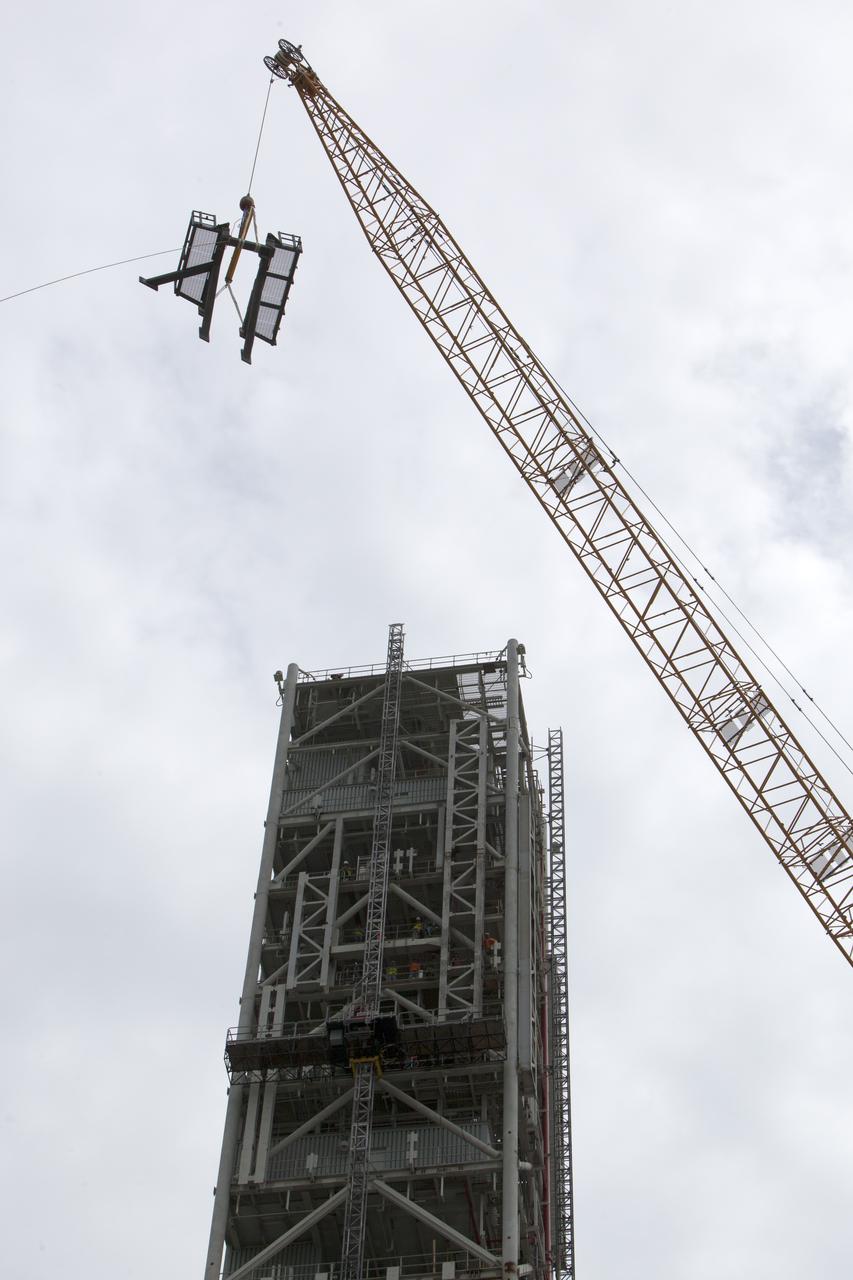
A crane lifts the bracket for the Orion Service Module Umbilical (OSMU) high up for installation on the mobile launcher tower at NASA's Kennedy Space Center in Florida. The mobile launcher tower will be equipped with a number of lines, called umbilicals, that will connect to the Space Launch System rocket and Orion spacecraft for Exploration Mission-1 (EM-1). The OSMU will be located high on the mobile launcher tower and, prior to launch, will transfer liquid coolant for the electronics and air for the Environmental Control System to the Orion service module that houses these critical systems to support the spacecraft. EM-1 is scheduled to launch in 2018. The Ground Systems Development and Operations Program is overseeing installation of the umbilicals.
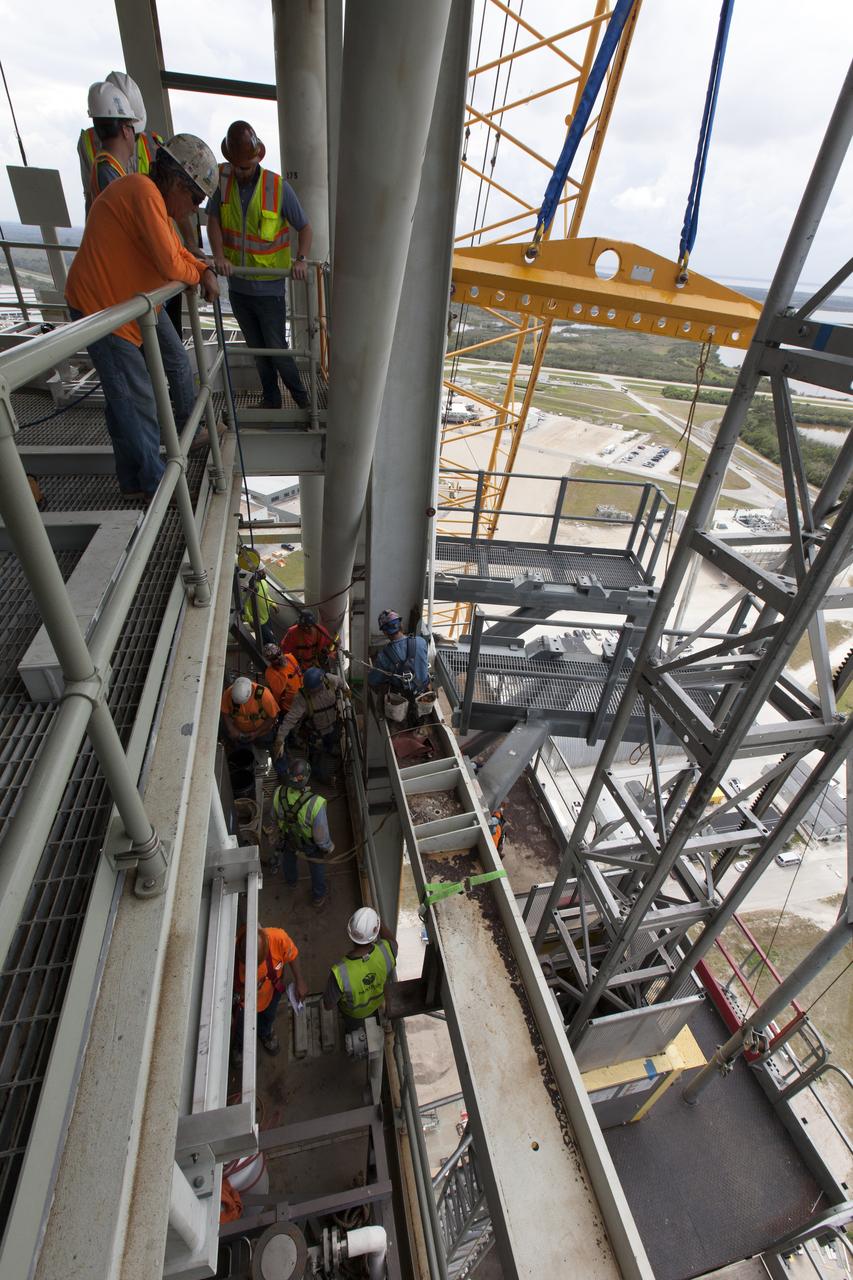
Construction workers and crane specialists high up on the mobile launcher tower monitor the progress as a crane positions the bracket for the Orion Service Module Umbilical (OSMU) for installation on the mobile launcher tower at NASA's Kennedy Space Center in Florida. The tower will be equipped with a number of lines, called umbilicals, that will connect to the Space Launch System rocket and Orion spacecraft for Exploration Mission-1 (EM-1). The OSMU will be located high on the mobile launcher tower and, prior to launch, will transfer liquid coolant for the electronics and air for the Environmental Control System to the Orion service module that houses these critical systems to support the spacecraft. EM-1 is scheduled to launch in 2018. The Ground Systems Development and Operations Program is overseeing installation of the umbilicals.
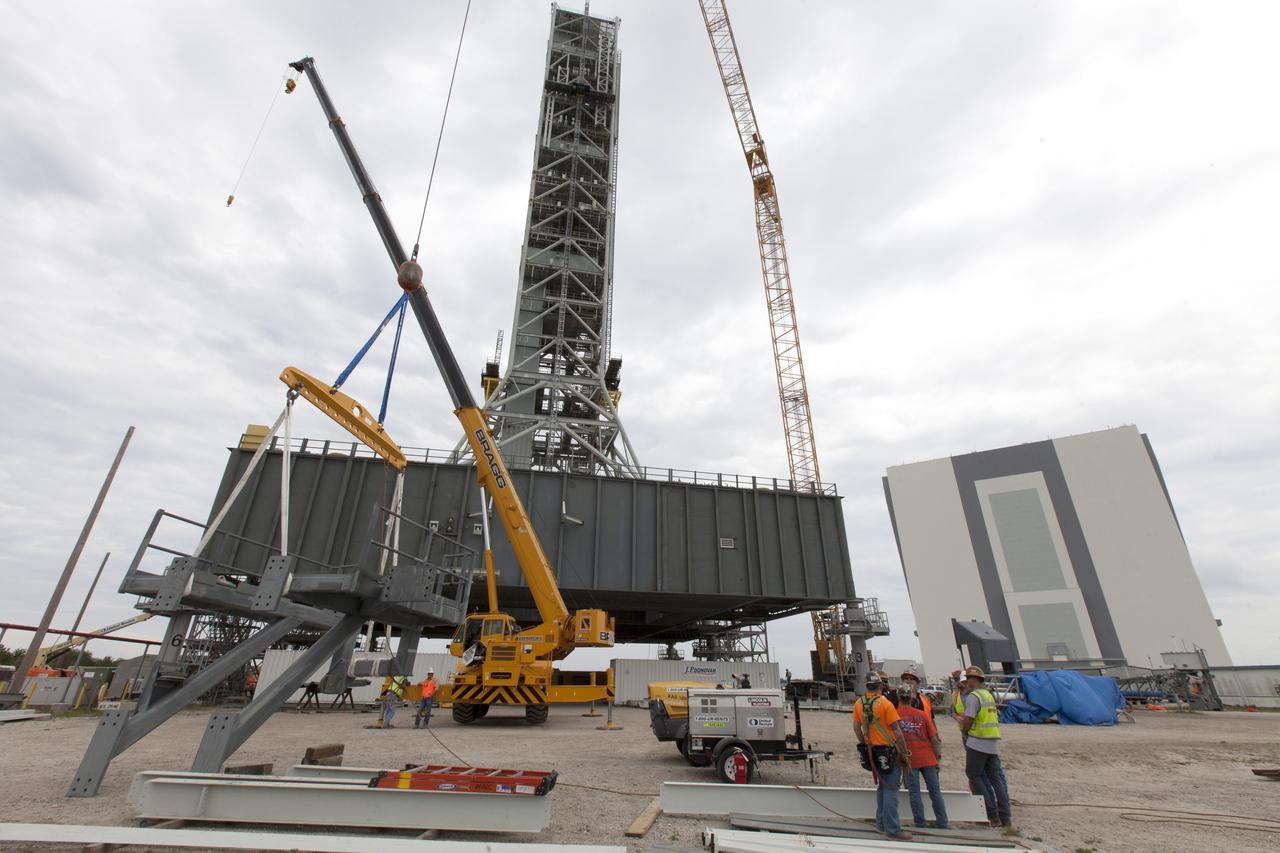
Preparations are underway to lift the bracket for the Orion Service Module Umbilical (OSMU) up for installation on the mobile launcher tower at NASA's Kennedy Space Center in Florida. The mobile launcher tower will be equipped with a number of lines, called umbilicals, that will connect to the Space Launch System rocket and Orion spacecraft for Exploration Mission-1 (EM-1). The OSMU will be located high on the mobile launcher tower and, prior to launch, will transfer liquid coolant for the electronics and air for the Environmental Control System to the Orion service module that houses these critical systems to support the spacecraft. EM-1 is scheduled to launch in 2018. The Ground Systems Development and Operations Program is overseeing installation of the umbilicals.
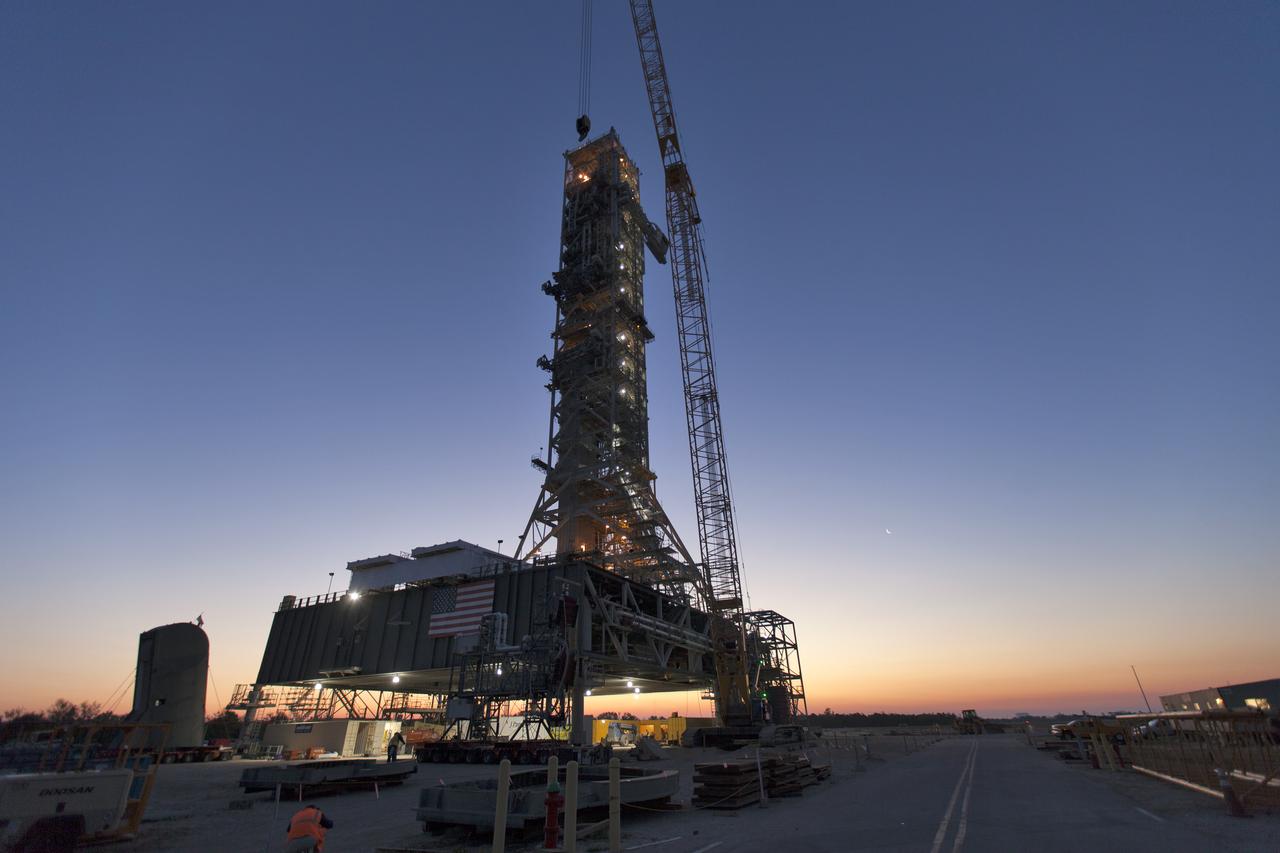
A colorful sunrise serves as the backdrop for the mobile launcher (ML) at NASA's Kennedy Space Center in Florida. Several launch umbilicals have been installed on the ML tower. Exploration Ground Systems is overseeing installation of umbilicals and launch accessories on the ML to prepare for the first integrated test flight of the Orion spacecraft on the agency's Space Launch System rocket on Exploration Mission-1.
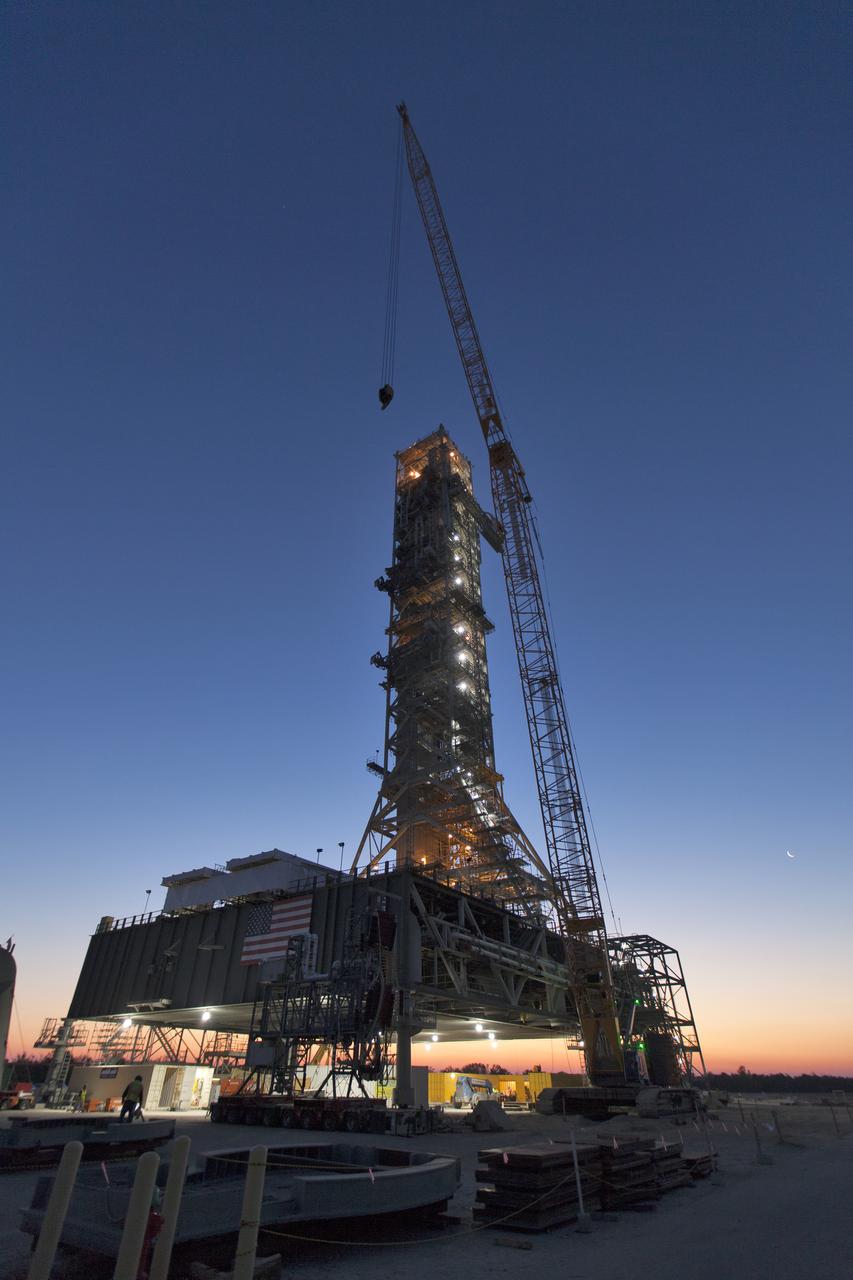
A colorful sunrise serves as the backdrop for the mobile launcher (ML) at NASA's Kennedy Space Center in Florida. Several launch umbilicals have been installed on the ML tower. Exploration Ground Systems is overseeing installation of umbilicals and launch accessories on the ML to prepare for the first integrated test flight of the Orion spacecraft on the agency's Space Launch System rocket on Exploration Mission-1.

A sliver of the Moon is visible just before sunrise at NASA's Kennedy Space Center in Florida. In view is one of the steel structures of the mobile launcher (ML). Several launch umbilicals have been installed on the ML tower. Exploration Ground Systems is overseeing installation of umbilicals and launch accessories on the ML to prepare for the first integrated test flight of the Orion spacecraft on the agency's Space Launch System rocket on Exploration Mission-1.
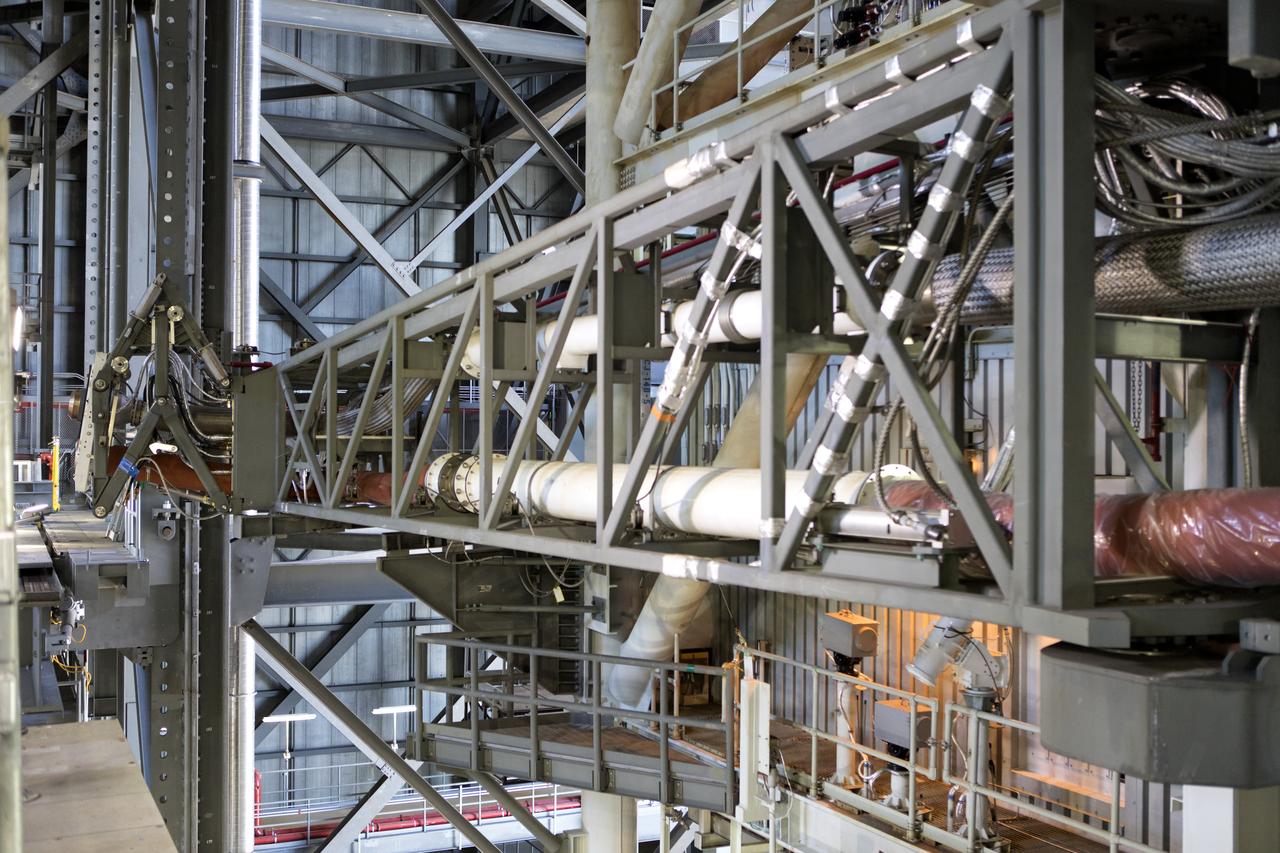
Preparations are underway to perform a preliminary swing test of the Core Stage Inter-tank Umbilical (CSITU) on the mobile launcher in High Bay 3 of the Vehicle Assembly Building on Feb. 22, 2019, at NASA's Kennedy Space Center in Florida. The CSITU is a swing-arm umbilical that will connect to the Space Launch System core stage inter-tank. It will provide conditioned air, pressurized gases and power and data connection to the core stage. The Exploration Ground Systems Program is overseeing installation of the umbilicals.
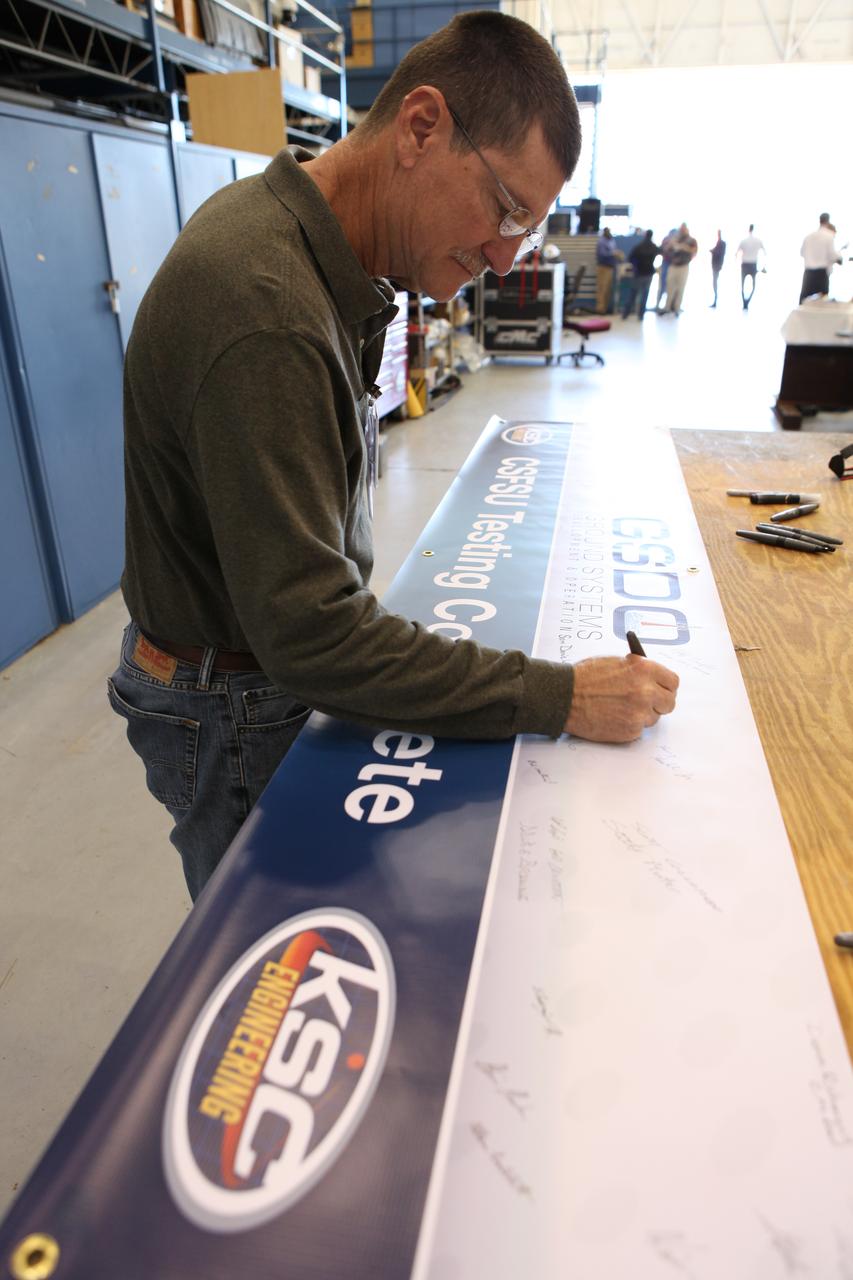
A NASA technician signs the banner inside a support building at the Launch Equipment Test Facility at Kennedy Space Center in Florida. Testing of the Core Stage Forward Skirt Umbilical (CSFSU) for NASA's Space Launch System is complete and the umbilical has been transported to the mobile launcher area. The umbilical will be prepared for installation on the tower of the mobile launcher. The CSFSU will be mated to the core stage forward skirt to provide commodities to the SLS rocket, and then disconnect and swing away before launch. Its main purpose is to provide conditioned air and gaseous nitrogen to the SLS Core Stage Forward Skirt. The center’s Engineering Directorate and the Ground Systems Development and Operations Program are overseeing processing and testing of the umbilicals.
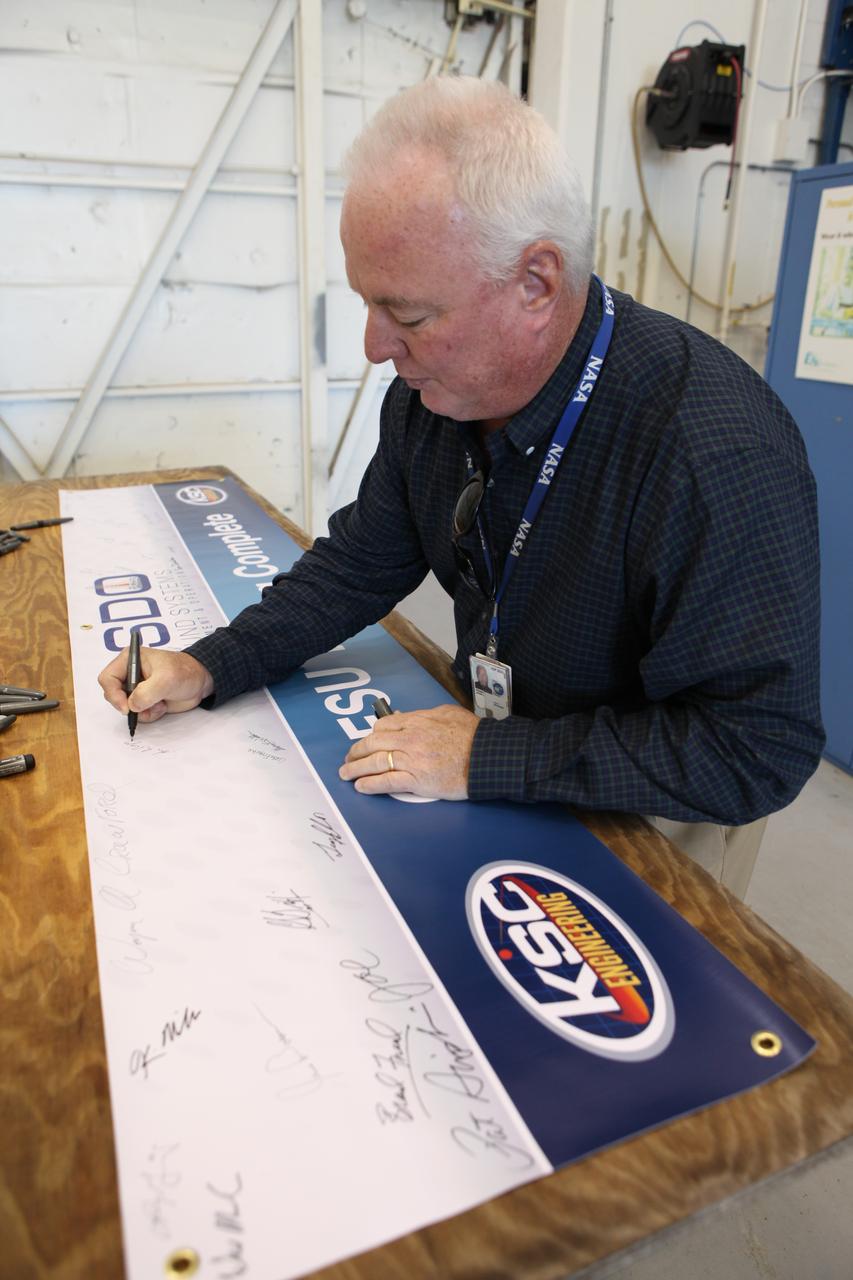
A NASA engineer signs the banner inside a support building at the Launch Equipment Test Facility at Kennedy Space Center in Florida. Testing of the Core Stage Forward Skirt Umbilical (CSFSU) for NASA's Space Launch System is complete and the umbilical has been transported to the mobile launcher area. The umbilical will be prepared for installation on the tower of the mobile launcher. The CSFSU will be mated to the core stage forward skirt to provide commodities to the SLS rocket, and then disconnect and swing away before launch. Its main purpose is to provide conditioned air and gaseous nitrogen to the SLS Core Stage Forward Skirt. The center’s Engineering Directorate and the Ground Systems Development and Operations Program are overseeing processing and testing of the umbilicals.
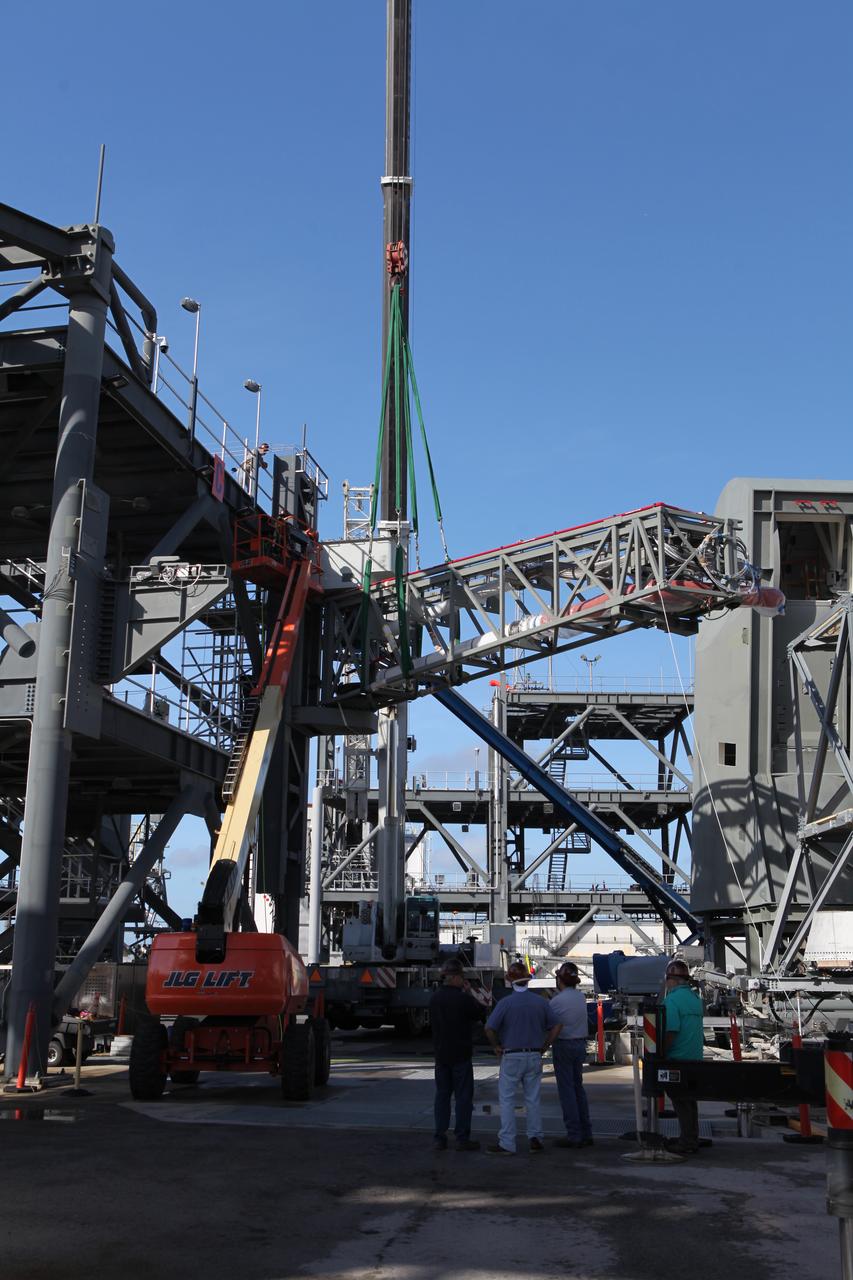
A crane moves the Core State Inter-tank Umbilical (CSITU) for NASA's Space Launch System (SLS) closer for attachment to the "C" tower of the Vehicle Motion Simulator 2 test fixture at the Launch Equipment Test Facility at the agency's Kennedy Space Center in Florida. The umbilical will undergo a series of tests to confirm it is functioning properly and ready to support the SLS rocket for launch. The CSITU is a swing arm umbilical that will connect to the SLS core stage inter-tank. The umbilical's main function is to vent gaseous hydrogen from the core stage. The arm also provides conditioned air, pressurized gases, and power and data connection to the core stage. The center’s Engineering Directorate and the Ground Systems Development and Operations Program are overseeing processing and testing of the umbilicals.
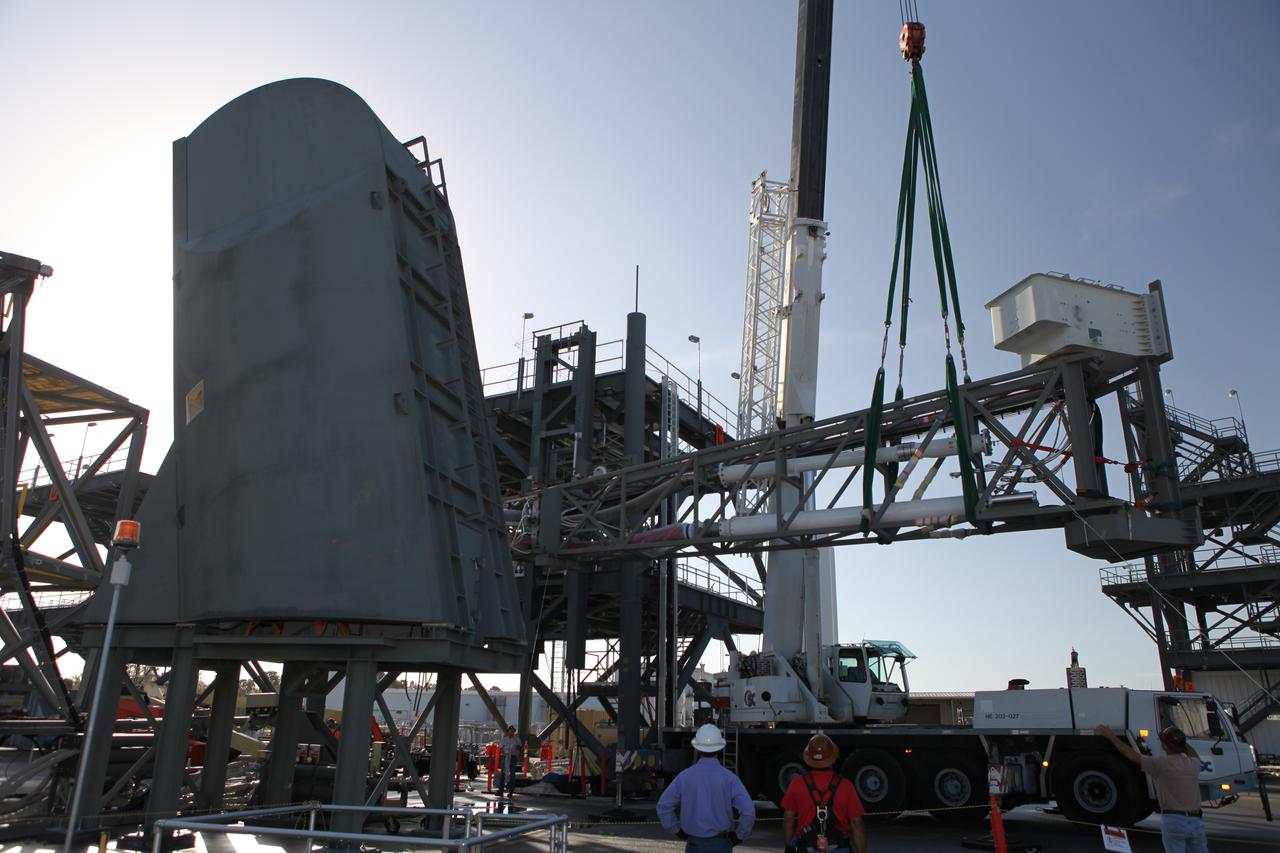
A crane is used to lift the Core State Inter-tank Umbilical (CSITU) for NASA's Space Launch System (SLS) at the Launch Equipment Test Facility at the agency's Kennedy Space Center in Florida. The CSITU will be attached to the "C" tower of the Vehicle Motion Simulator 2 test fixture. The umbilical will undergo a series of tests to confirm it is functioning properly and ready to support the SLS rocket for launch. The CSITU is a swing arm umbilical that will connect to the SLS core stage inter-tank. The umbilical's main function is to vent gaseous hydrogen from the core stage. The arm also provides conditioned air, pressurized gases, and power and data connection to the core stage. The center’s Engineering Directorate and the Ground Systems Development and Operations Program are overseeing processing and testing of the umbilicals.
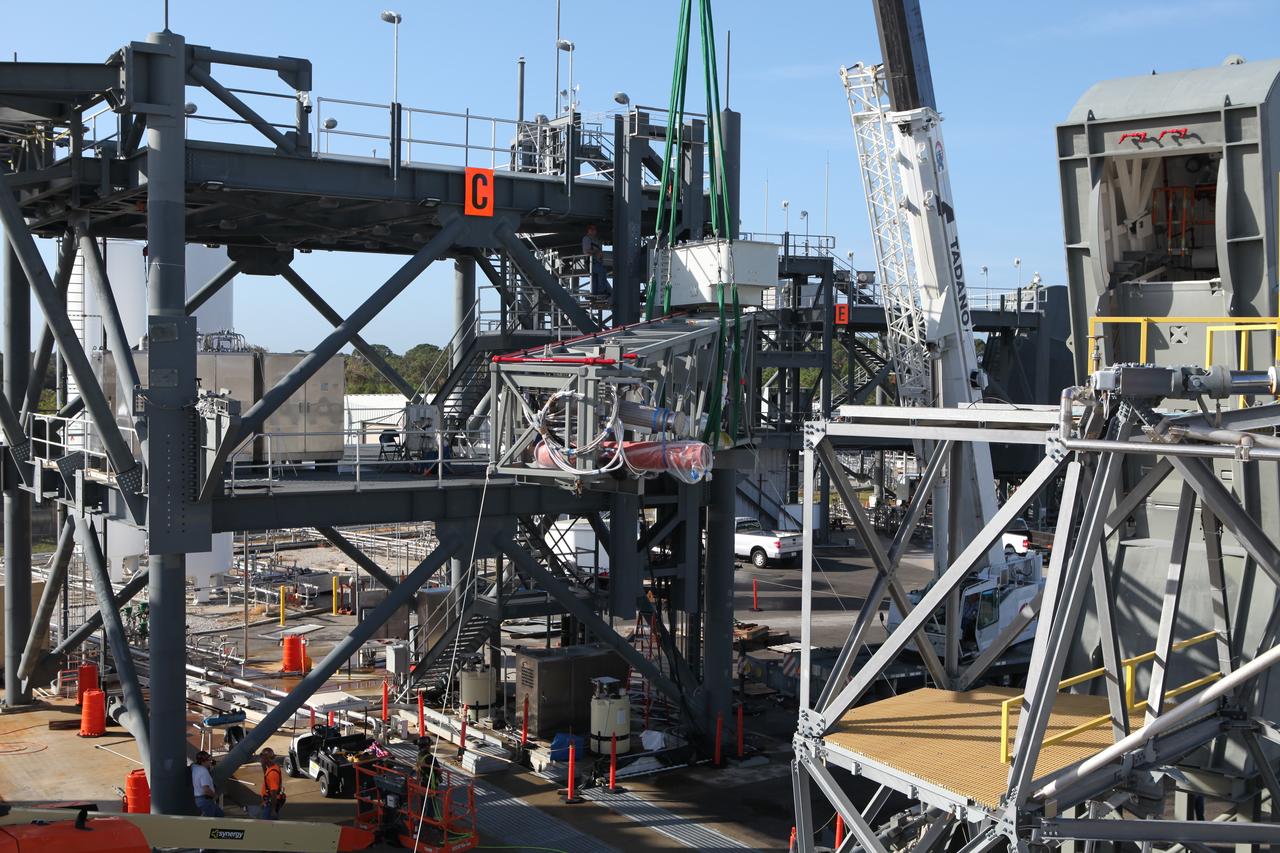
A crane lifts the Core State Inter-tank Umbilical (CSITU) for NASA's Space Launch System (SLS) at the Launch Equipment Test Facility at the agency's Kennedy Space Center in Florida. The CSITU will be attached to the "C" tower of the Vehicle Motion Simulator 2 test fixture. The umbilical will undergo a series of tests to confirm it is functioning properly and ready to support the SLS rocket for launch. The CSITU is a swing arm umbilical that will connect to the SLS core stage inter-tank. The umbilical's main function is to vent gaseous hydrogen from the core stage. The arm also provides conditioned air, pressurized gases, and power and data connection to the core stage. The center’s Engineering Directorate and the Ground Systems Development and Operations Program are overseeing processing and testing of the umbilicals.
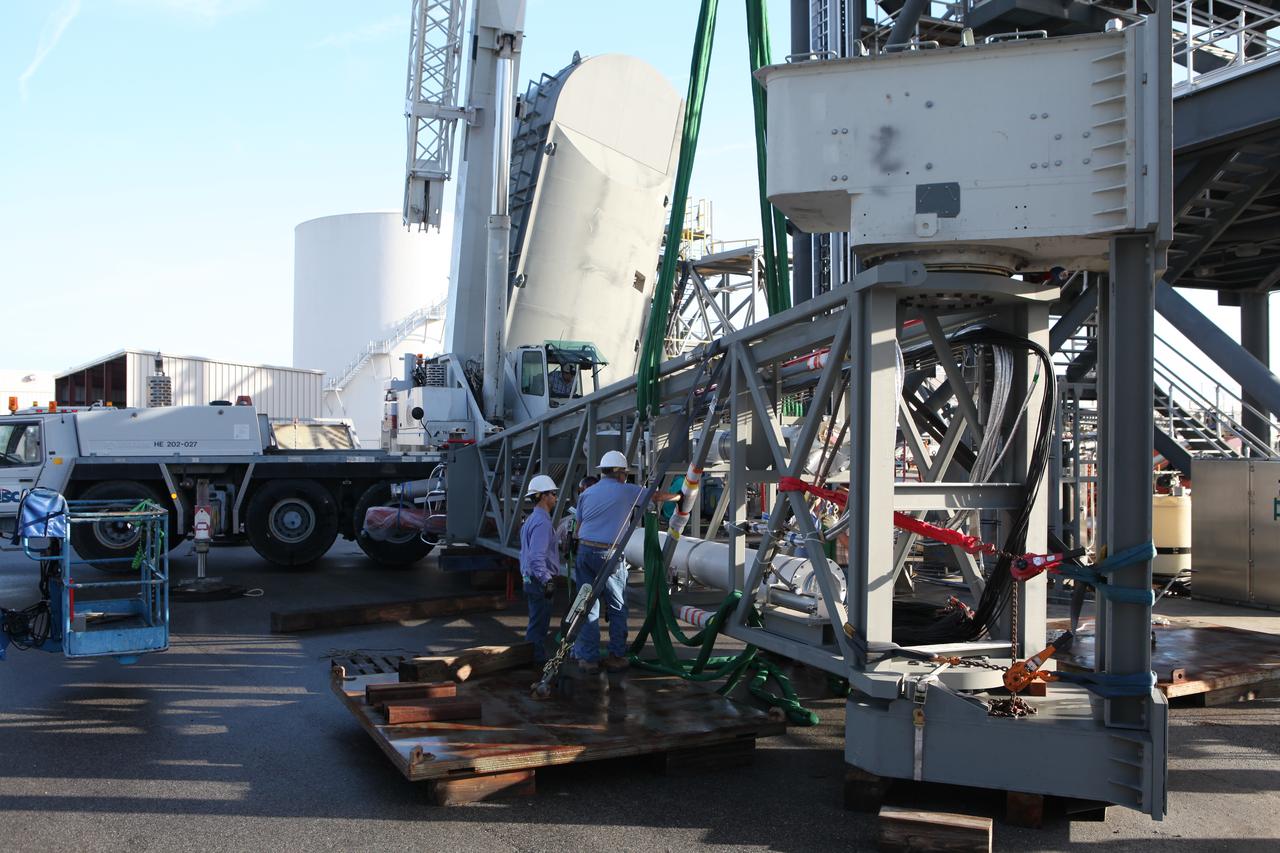
The Core State Inter-tank Umbilical (CSITU) for NASA's Space Launch System (SLS) arrives at the Launch Equipment Test Facility at the agency's Kennedy Space Center in Florida. The CSITU will be attached to the "C" tower of the Vehicle Motion Simulator 2 test fixture. The umbilical will undergo a series of tests to confirm it is functioning properly and ready to support the SLS rocket for launch. The CSITU is a swing arm umbilical that will connect to the SLS core stage inter-tank. The umbilical's main function is to vent gaseous hydrogen from the core stage. The arm also provides conditioned air, pressurized gases, and power and data connection to the core stage. The center’s Engineering Directorate and the Ground Systems Development and Operations Program are overseeing processing and testing of the umbilicals.
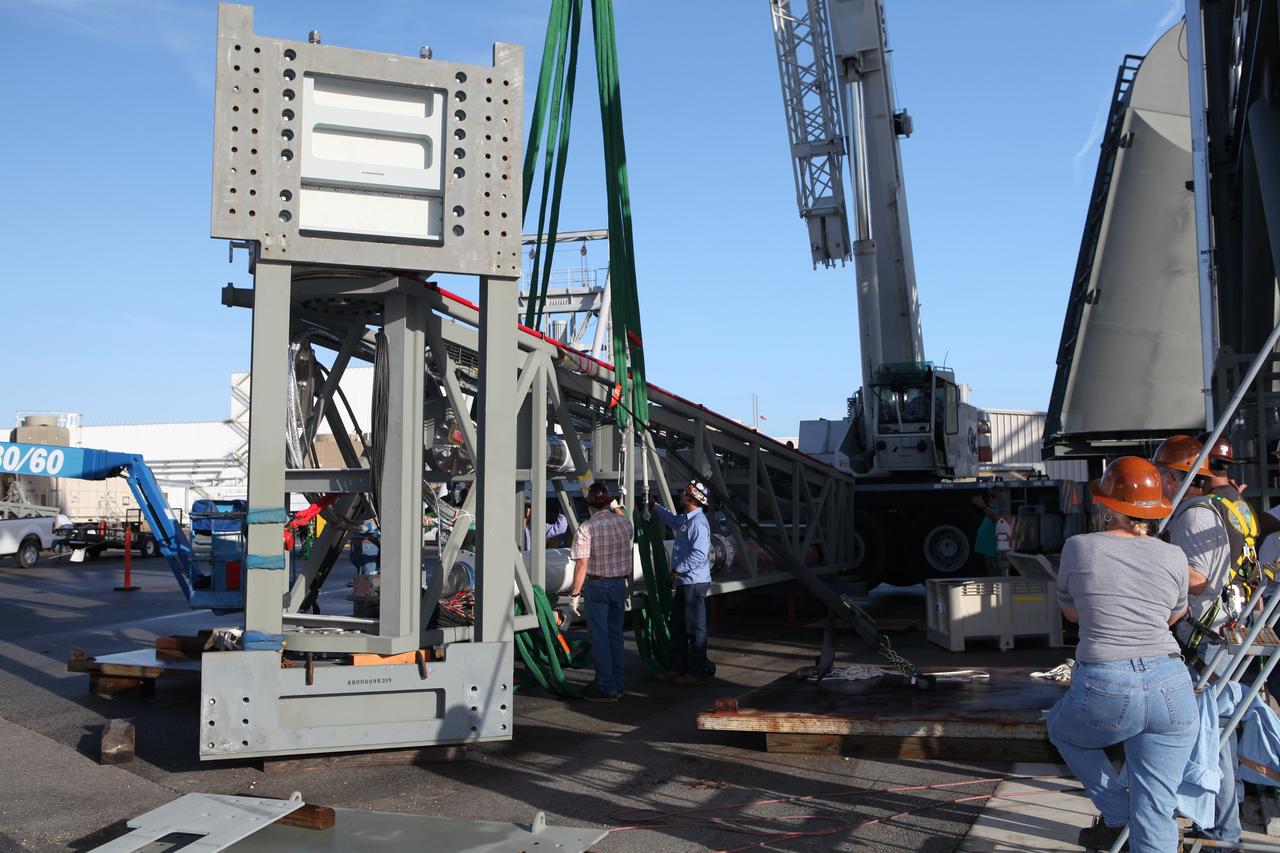
Efforts are underway to lift the Core State Inter-tank Umbilical (CSITU) for NASA's Space Launch System (SLS) at the Launch Equipment Test Facility at the agency's Kennedy Space Center in Florida. The CSITU will be attached to the "C" tower of the Vehicle Motion Simulator 2 test fixture. The umbilical will undergo a series of tests to confirm it is functioning properly and ready to support the SLS rocket for launch. The CSITU is a swing arm umbilical that will connect to the SLS core stage inter-tank. The umbilical's main function is to vent gaseous hydrogen from the core stage. The arm also provides conditioned air, pressurized gases, and power and data connection to the core stage. The center’s Engineering Directorate and the Ground Systems Development and Operations Program are overseeing processing and testing of the umbilicals.
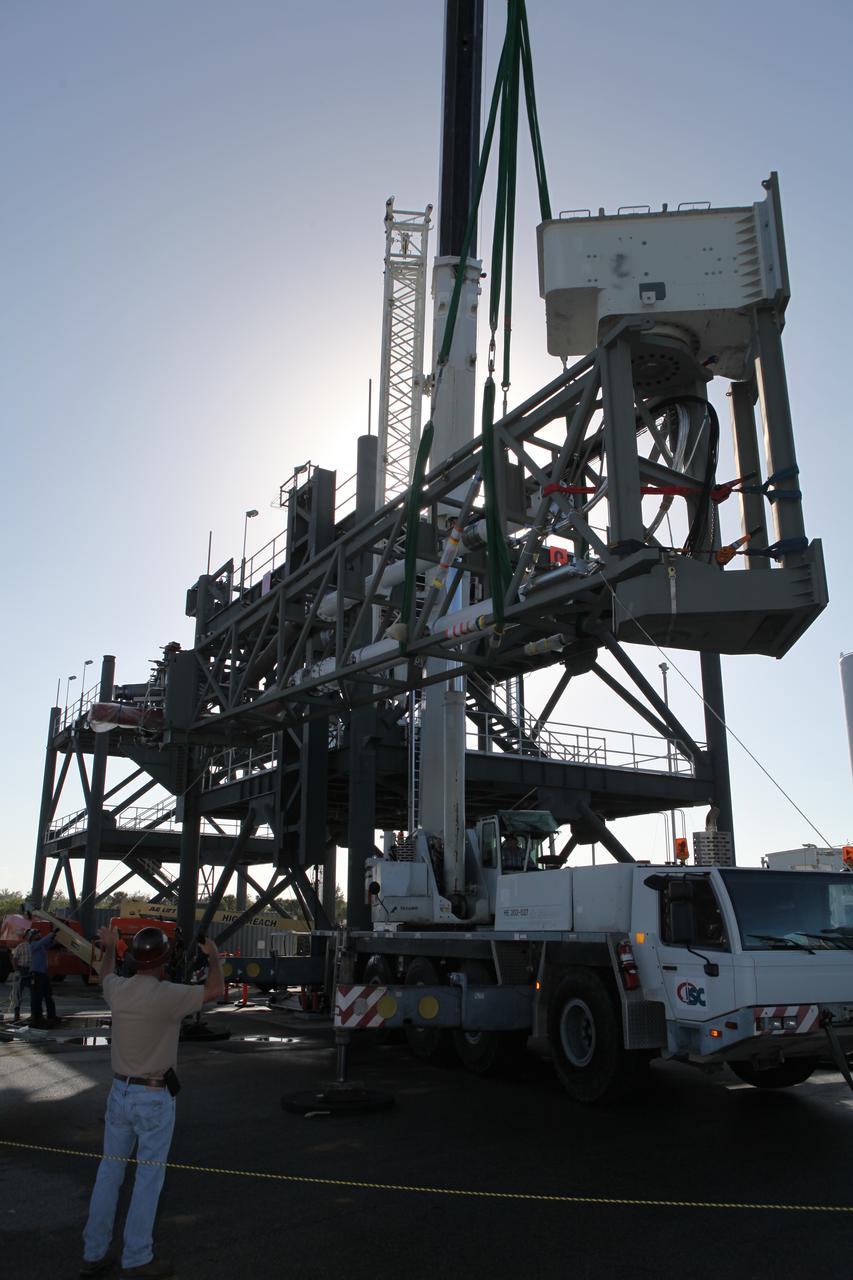
A crane is used to lift the Core State Inter-tank Umbilical (CSITU) for NASA's Space Launch System (SLS) at the Launch Equipment Test Facility at the agency's Kennedy Space Center in Florida. The CSITU will be attached to the "C" tower of the Vehicle Motion Simulator 2 test fixture. The umbilical will undergo a series of tests to confirm it is functioning properly and ready to support the SLS rocket for launch. The CSITU is a swing arm umbilical that will connect to the SLS core stage inter-tank. The umbilical's main function is to vent gaseous hydrogen from the core stage. The arm also provides conditioned air, pressurized gases, and power and data connection to the core stage. The center’s Engineering Directorate and the Ground Systems Development and Operations Program are overseeing processing and testing of the umbilicals.
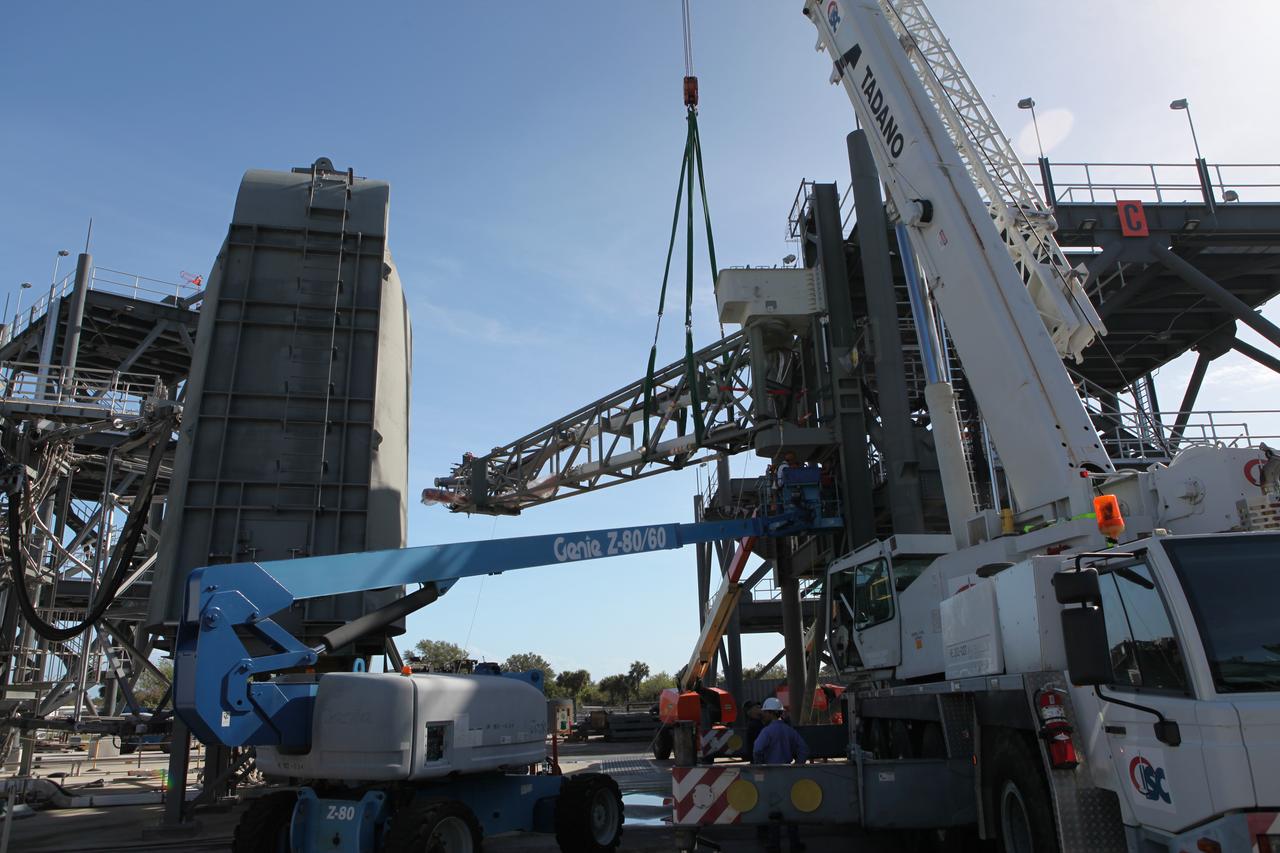
The Core State Inter-tank Umbilical (CSITU) for NASA's Space Launch System (SLS) is attached to the "C" tower of the Vehicle Motion Simulator 2 test fixture at the Launch Equipment Test Facility at the agency's Kennedy Space Center in Florida. The umbilical will undergo a series of tests to confirm it is functioning properly and ready to support the SLS rocket for launch. The CSITU is a swing arm umbilical that will connect to the SLS core stage inter-tank. The umbilical's main function is to vent gaseous hydrogen from the core stage. The arm also provides conditioned air, pressurized gases, and power and data connection to the core stage. The center’s Engineering Directorate and the Ground Systems Development and Operations Program are overseeing processing and testing of the umbilicals.

A crane is used to lift the Core State Inter-tank Umbilical (CSITU) for NASA's Space Launch System (SLS) at the Launch Equipment Test Facility at the agency's Kennedy Space Center in Florida. The CSITU will be attached to the "C" tower of the Vehicle Motion Simulator 2 test fixture. The umbilical will undergo a series of tests to confirm it is functioning properly and ready to support the SLS rocket for launch. The CSITU is a swing arm umbilical that will connect to the SLS core stage inter-tank. The umbilical's main function is to vent gaseous hydrogen from the core stage. The arm also provides conditioned air, pressurized gases, and power and data connection to the core stage. The center’s Engineering Directorate and the Ground Systems Development and Operations Program are overseeing processing and testing of the umbilicals.
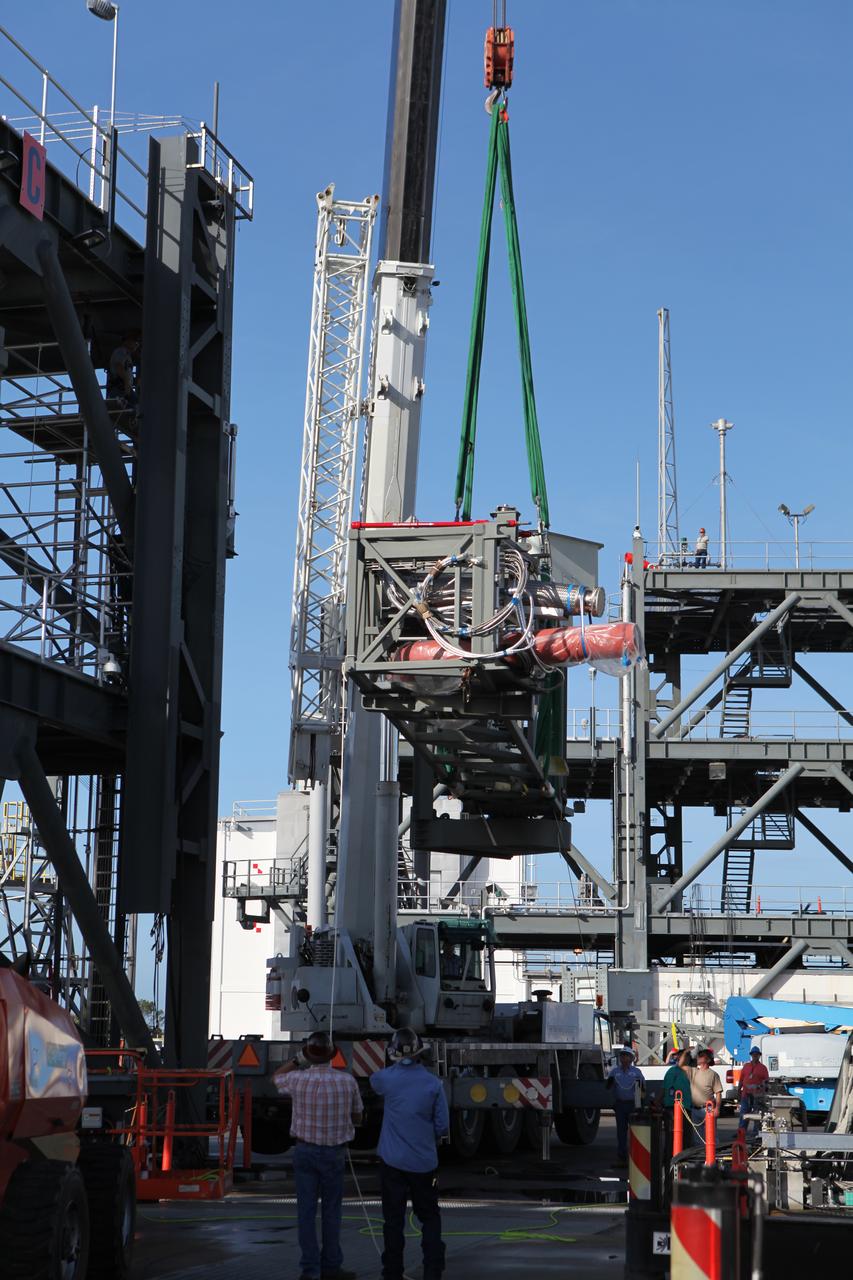
A crane is used to lift the Core State Inter-tank Umbilical (CSITU) for NASA's Space Launch System (SLS) at the Launch Equipment Test Facility at the agency's Kennedy Space Center in Florida. The CSITU will be attached to the "C" tower of the Vehicle Motion Simulator 2 test fixture. The umbilical will undergo a series of tests to confirm it is functioning properly and ready to support the SLS rocket for launch. The CSITU is a swing arm umbilical that will connect to the SLS core stage inter-tank. The umbilical's main function is to vent gaseous hydrogen from the core stage. The arm also provides conditioned air, pressurized gases, and power and data connection to the core stage. The center’s Engineering Directorate and the Ground Systems Development and Operations Program are overseeing processing and testing of the umbilicals.
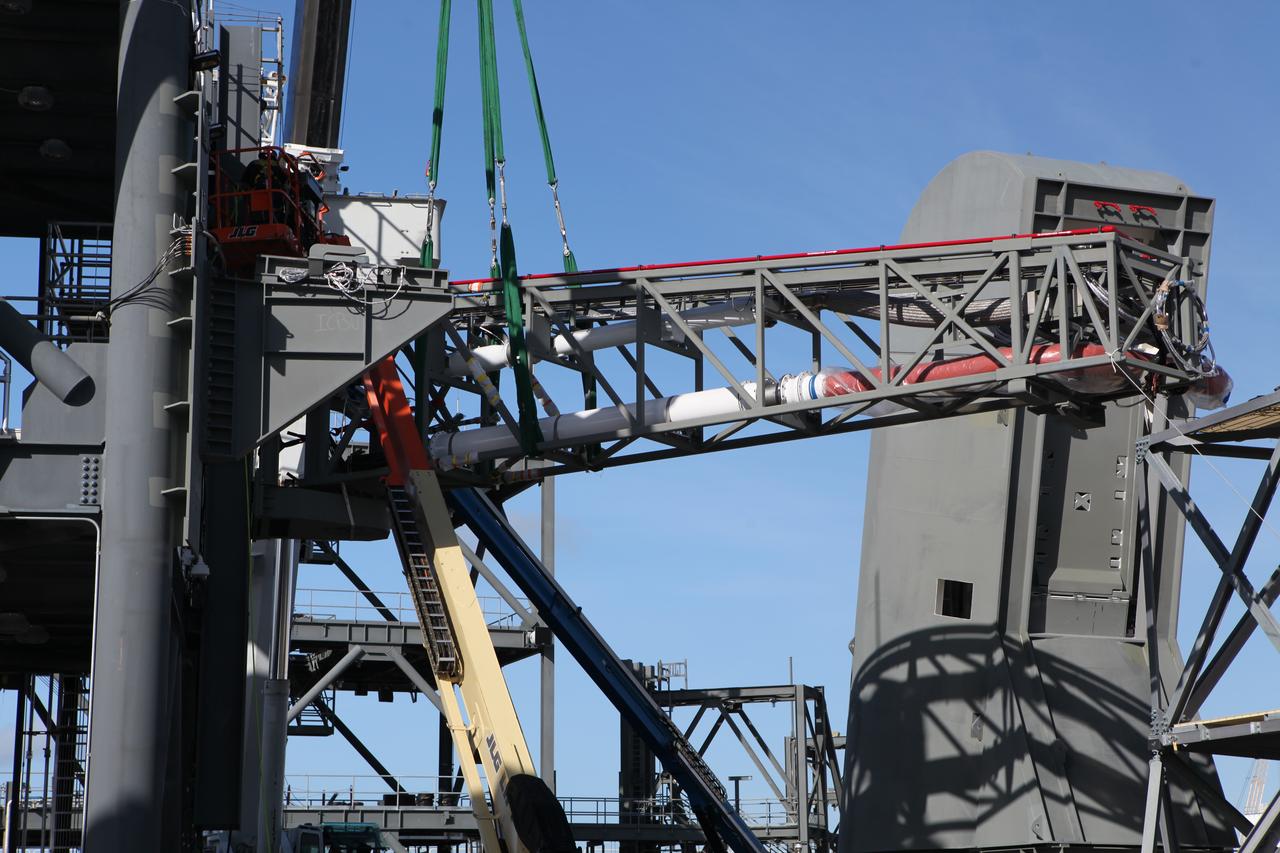
A crane moves the Core State Inter-tank Umbilical (CSITU) for NASA's Space Launch System (SLS) closer for attachment to the "C" tower of the Vehicle Motion Simulator 2 test fixture at the Launch Equipment Test Facility at the agency's Kennedy Space Center in Florida. The umbilical will undergo a series of tests to confirm it is functioning properly and ready to support the SLS rocket for launch. The CSITU is a swing arm umbilical that will connect to the SLS core stage inter-tank. The umbilical's main function is to vent gaseous hydrogen from the core stage. The arm also provides conditioned air, pressurized gases, and power and data connection to the core stage. The center’s Engineering Directorate and the Ground Systems Development and Operations Program are overseeing processing and testing of the umbilicals.
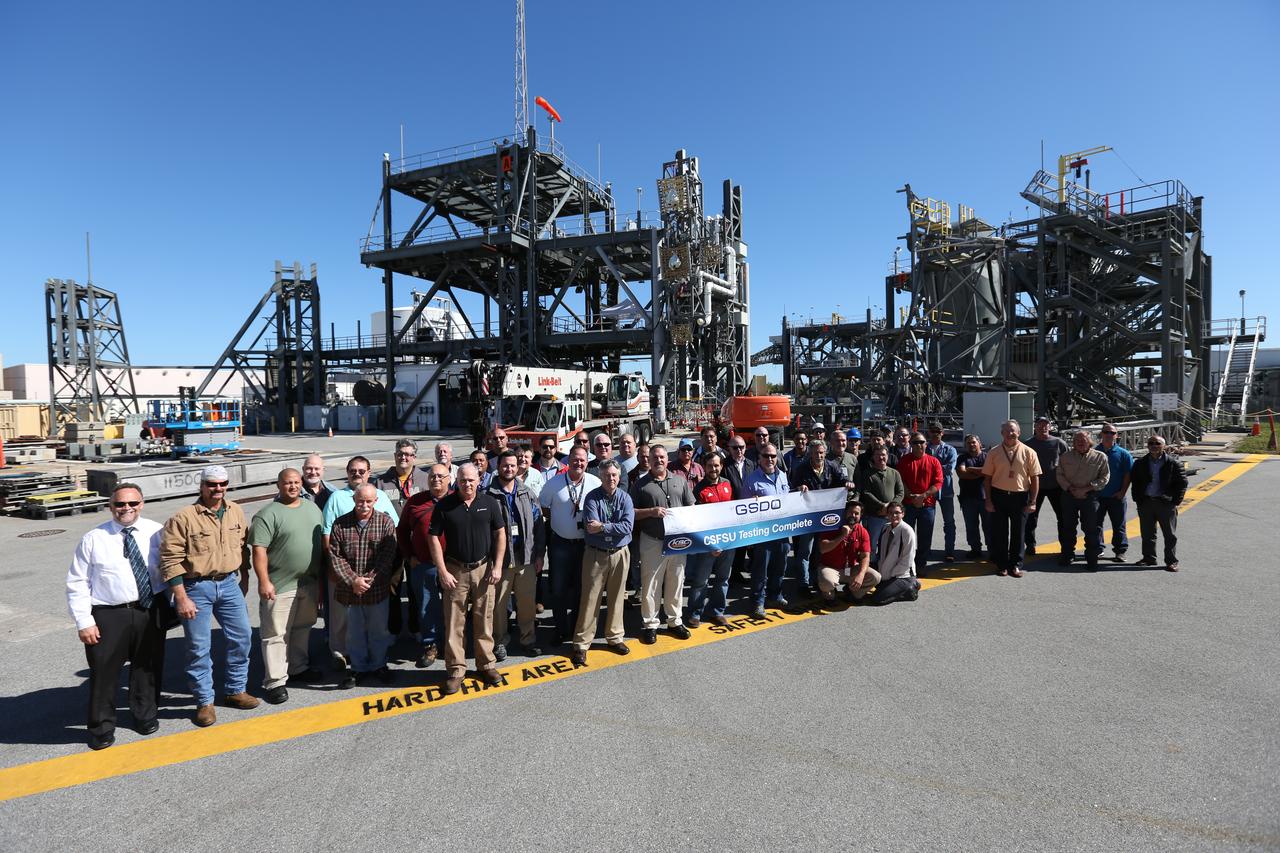
The test team holds a signed banner at the Launch Equipment Test Facility at Kennedy Space Center in Florida. Behind them are some of the test structures used to test the launch umbilicals. Testing of the Core Stage Forward Skirt Umbilical (CSFSU) for NASA's Space Launch System is complete and the umbilical has been transported to the mobile launcher area. The umbilical will be prepared for installation on the tower of the mobile launcher. The CSFSU will be mated to the core stage forward skirt to provide commodities to the SLS rocket, and then disconnect and swing away before launch. Its main purpose is to provide conditioned air and gaseous nitrogen to the SLS Core Stage Forward Skirt. The center’s Engineering Directorate and the Ground Systems Development and Operations Program are overseeing processing and testing of the umbilicals.
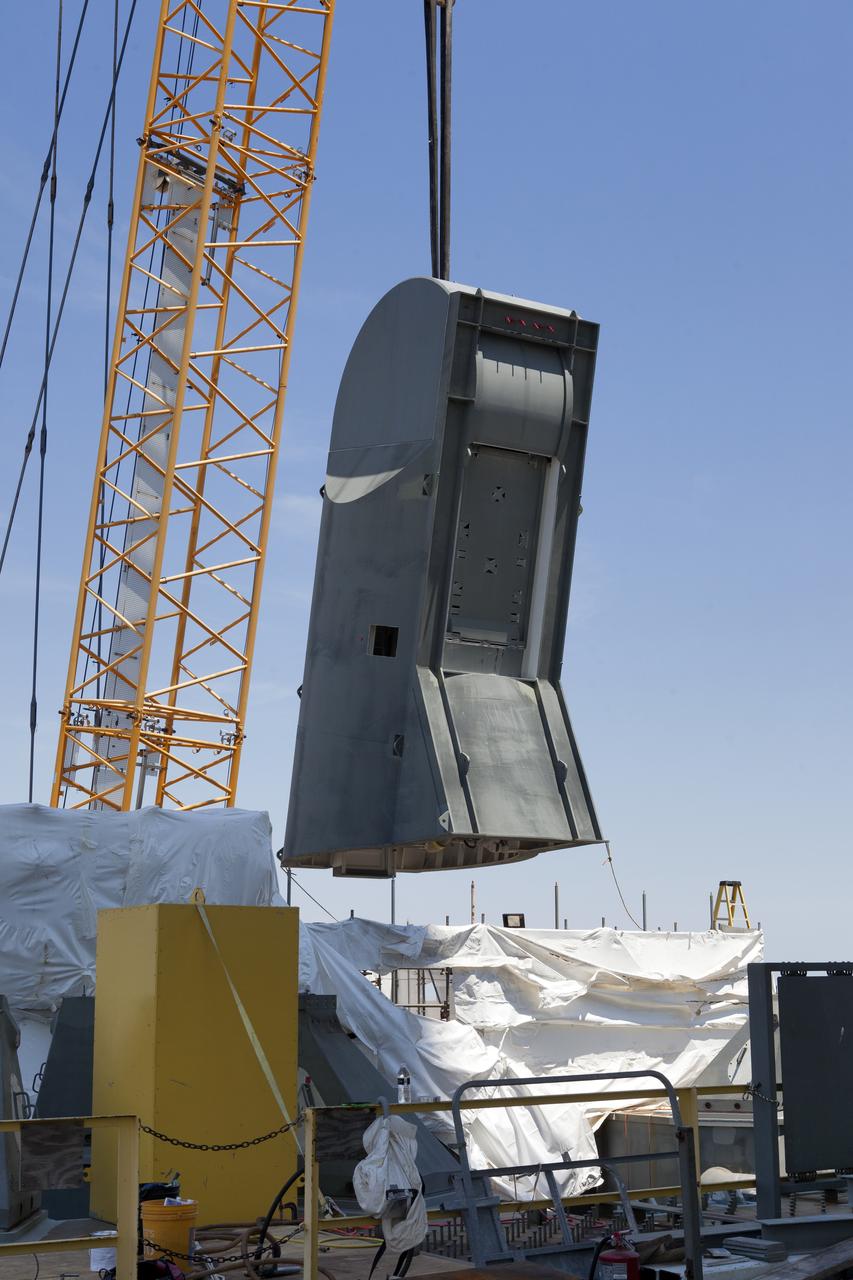
A crane is used to lift up the first of two Tail Service Mast Umbilicals for installation on the 0-level deck of the mobile launcher on July 12, at NASA's Kennedy Space Center in Florida. The 35-foot-tall umbilical will connect to NASA's Space Launch System rocket core stage aft section and provide liquid oxygen and electrical cable connections to the core stage engine section to support propellant handling during prelaunch operations. The installation brings Exploration Ground Systems one step closer to supporting prelaunch operations for the agency's SLS rocket and Orion spacecraft on Exploration Mission-1 and deep space destinations.
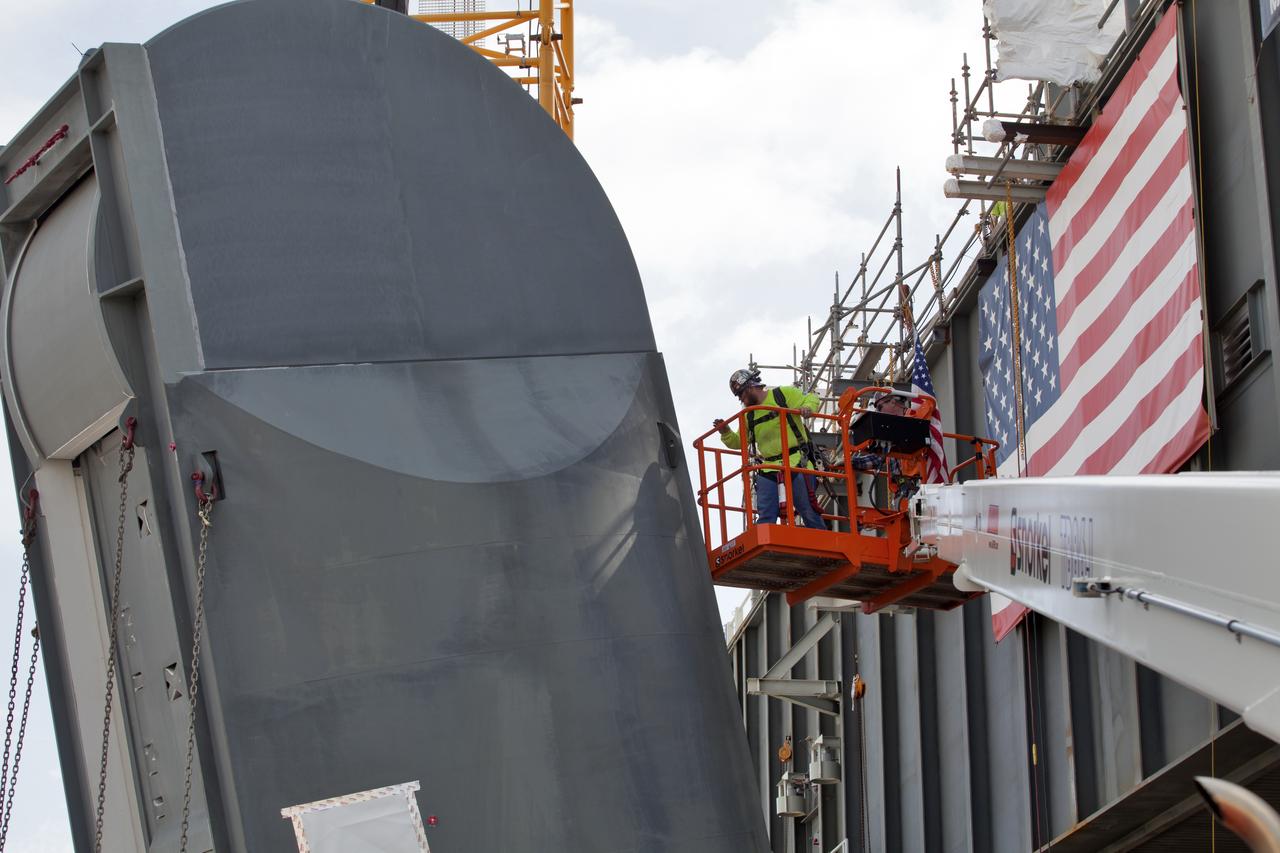
Preparations are underway to install the second of two Tail Service Mast Umbilicals on the 0-level deck of the mobile launcher on July 27, at NASA's Kennedy Space Center in Florida. The 35-foot-tall umbilical will connect to NASA's Space Launch System (SLS) rocket core stage aft section and provide liquid hydrogen and electrical cable connections to the core stage engine section to support propellant handling during prelaunch operations. The installation brings Exploration Ground Systems one step closer to supporting prelaunch operations for the agency's SLS rocket and Orion spacecraft on Exploration Mission-1 and deep space destinations.
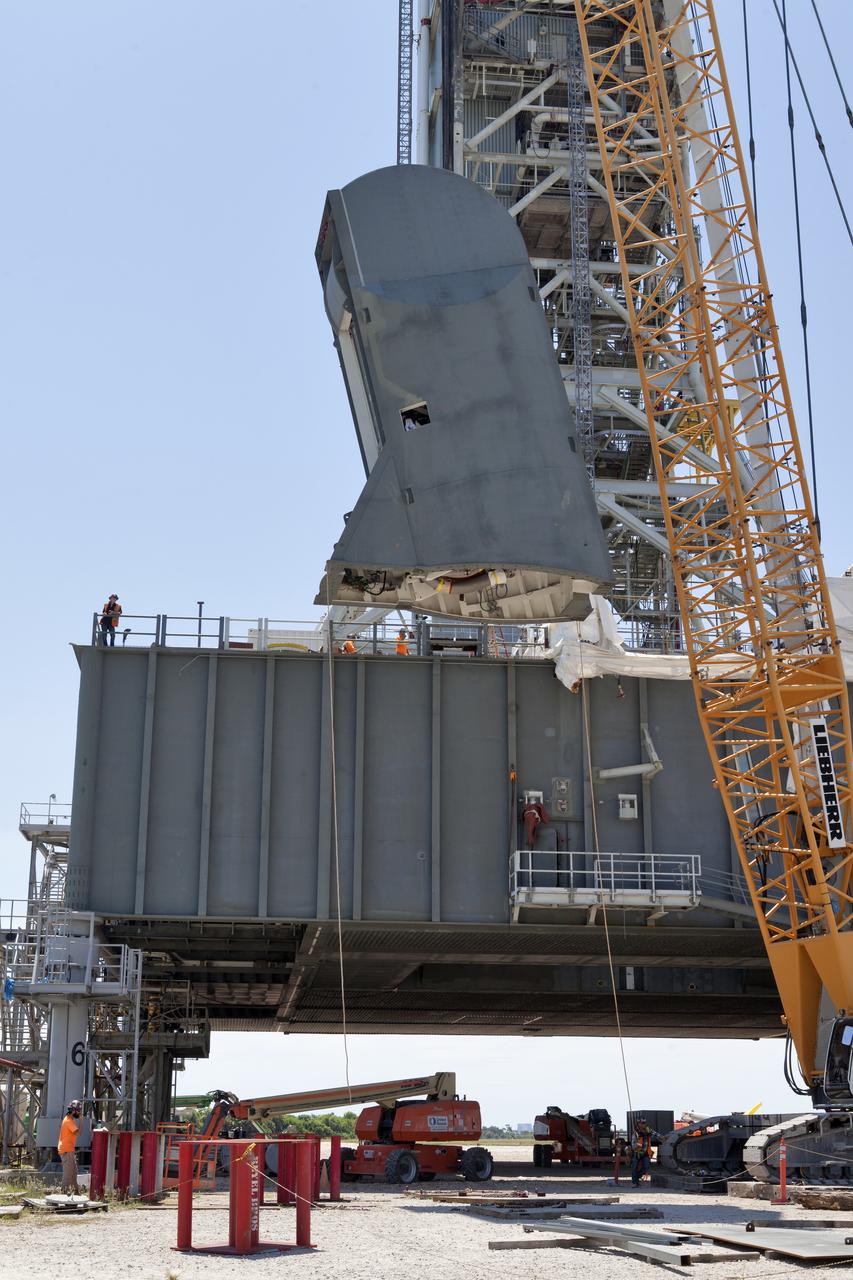
The first of two Tail Service Mast Umbilicals is lifted up for installation on the 0-level deck of the mobile launcher on July 12, at NASA's Kennedy Space Center in Florida. The 35-foot-tall umbilical will connect to NASA's Space Launch System rocket core stage aft section and provide liquid oxygen and electrical cable connections to the core stage engine section to support propellant handling during prelaunch operations. The installation brings Exploration Ground Systems one step closer to supporting prelaunch operations for the agency's SLS rocket and Orion spacecraft on Exploration Mission-1 and deep space destinations.
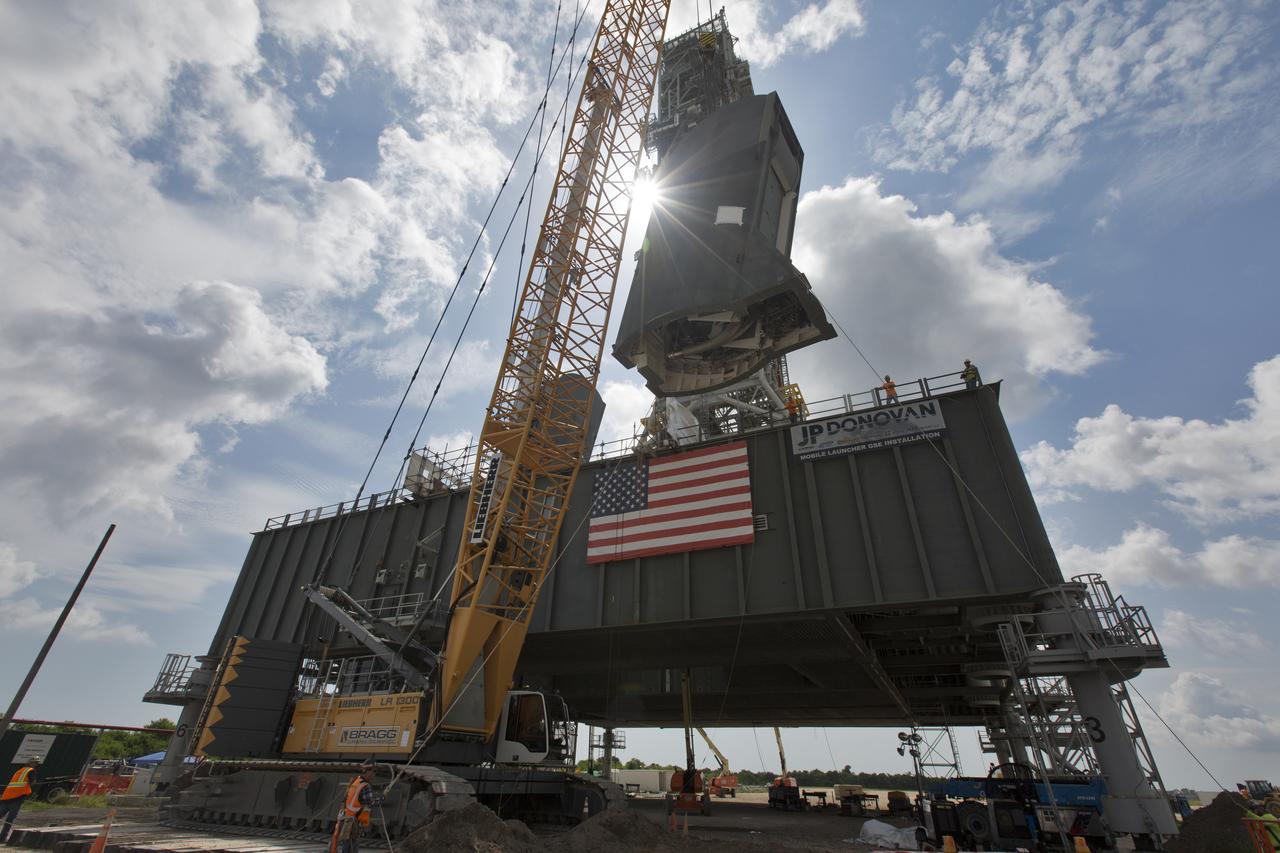
The second of two Tail Service Mast Umbilicals is lifted by crane for installation on the 0-level deck of the mobile launcher on July 27, at NASA's Kennedy Space Center in Florida. The 35-foot-tall umbilical will connect to NASA's Space Launch System (SLS) rocket core stage aft section and provide liquid hydrogen and electrical cable connections to the core stage engine section to support propellant handling during prelaunch operations. The installation brings Exploration Ground Systems one step closer to supporting prelaunch operations for the agency's SLS rocket and Orion spacecraft on Exploration Mission-1 and deep space destinations.
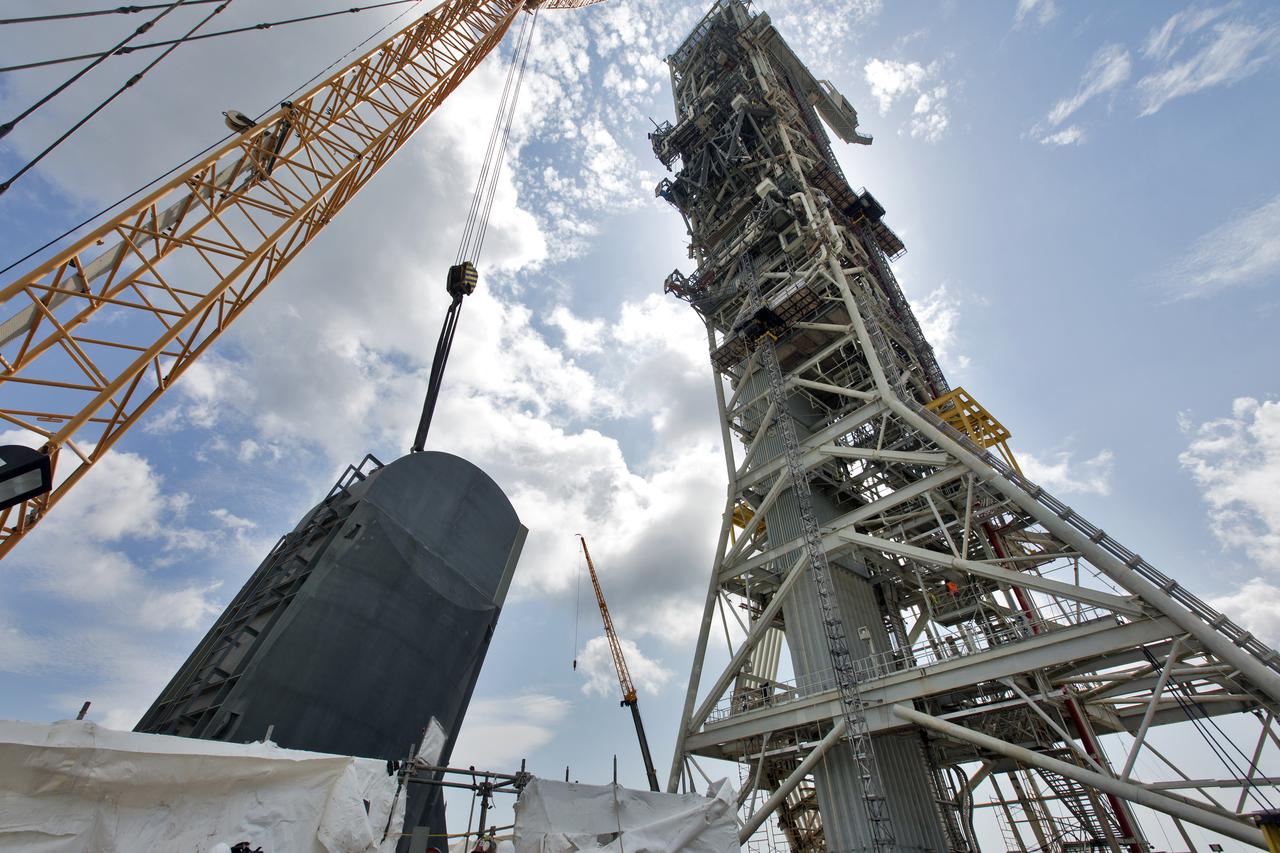
The second of two Tail Service Mast Umbilicals is lowered by crane for installation on the 0-level deck of the mobile launcher on July 27, at NASA's Kennedy Space Center in Florida. The 35-foot-tall umbilical will connect to NASA's Space Launch System (SLS) rocket core stage aft section and provide liquid hydrogen and electrical cable connections to the core stage engine section to support propellant handling during prelaunch operations. The installation brings Exploration Ground Systems one step closer to supporting prelaunch operations for the agency's SLS rocket and Orion spacecraft on Exploration Mission-1 and deep space destinations.
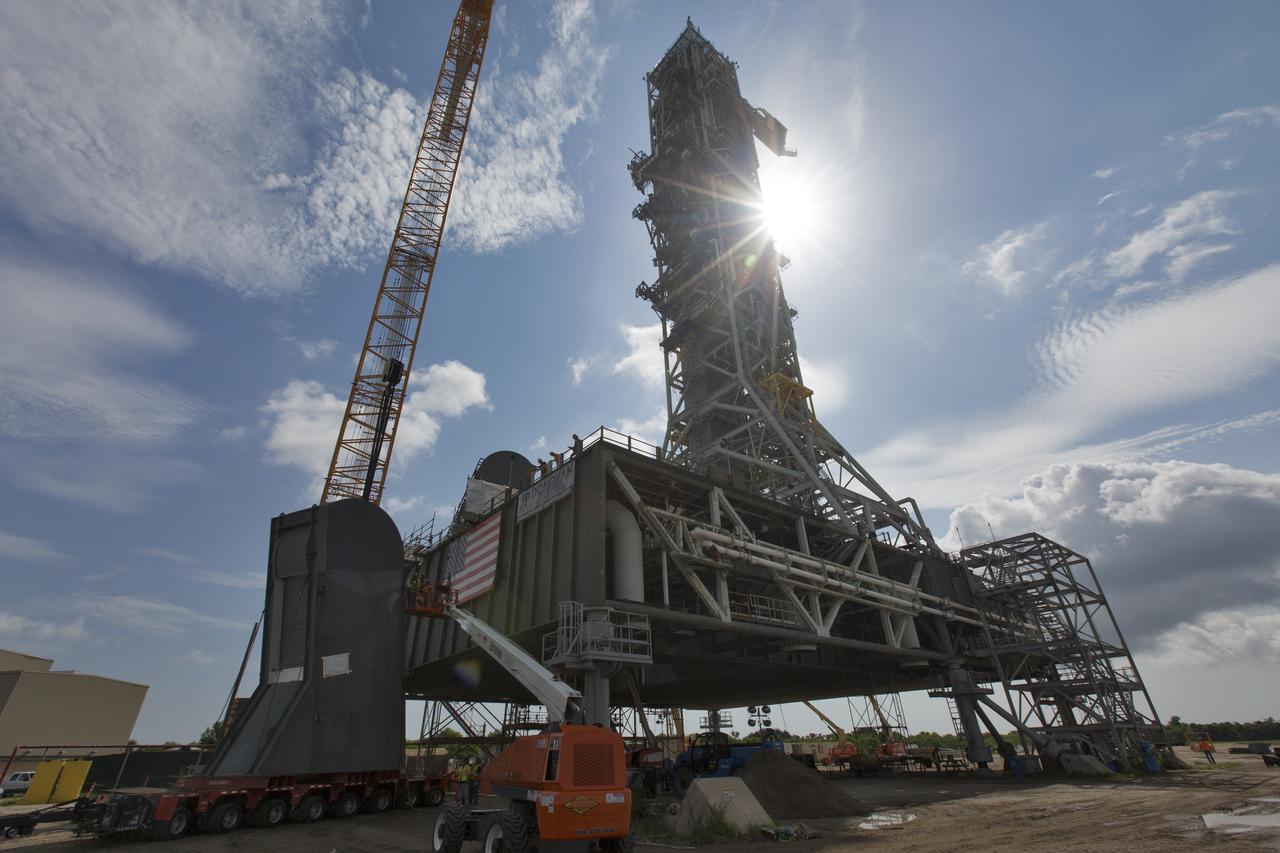
Preparations are underway to install the second of two Tail Service Mast Umbilicals on the 0-level deck of the mobile launcher on July 27, at NASA's Kennedy Space Center in Florida. The 35-foot-tall umbilical will connect to NASA's Space Launch System (SLS) rocket core stage aft section and provide liquid hydrogen and electrical cable connections to the core stage engine section to support propellant handling during prelaunch operations. The installation brings Exploration Ground Systems one step closer to supporting prelaunch operations for the agency's SLS rocket and Orion spacecraft on Exploration Mission-1 and deep space destinations.
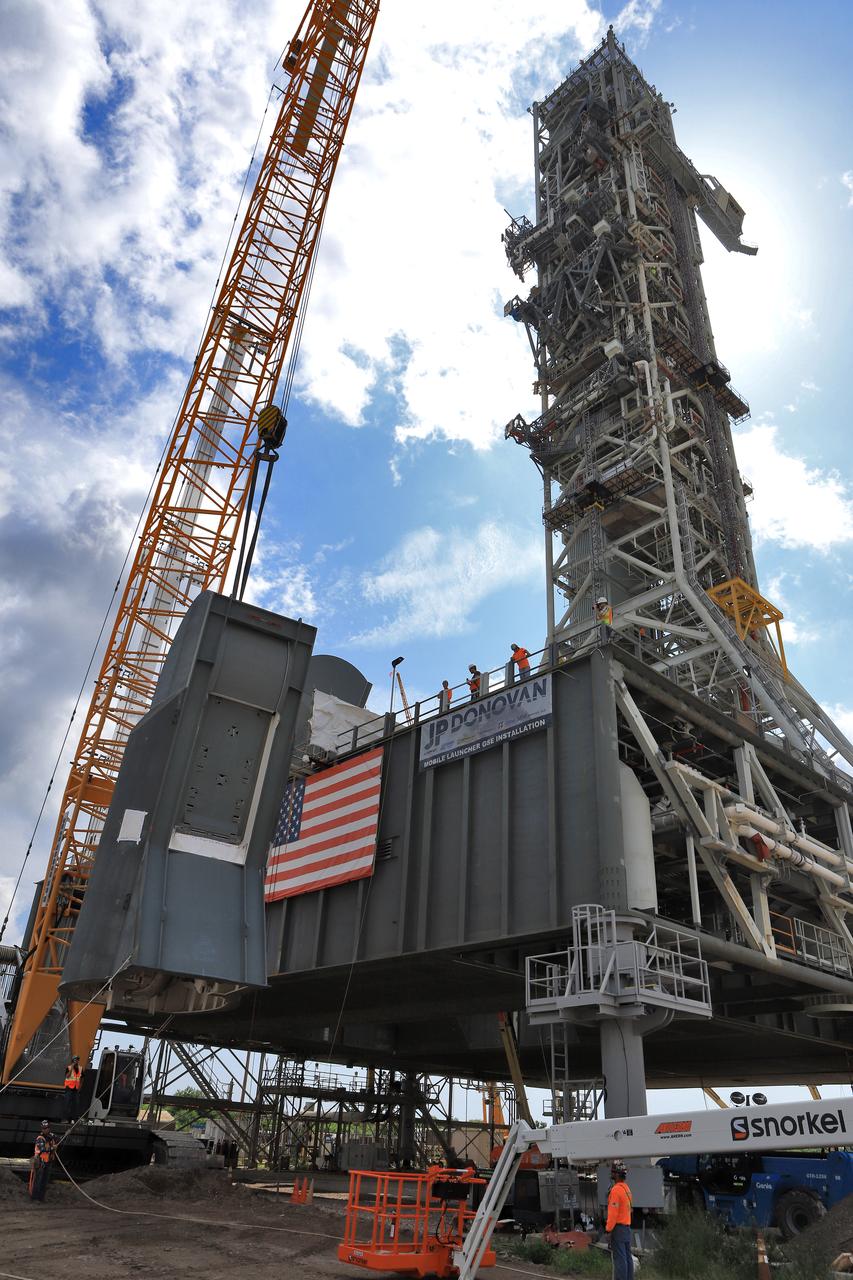
The second of two Tail Service Mast Umbilicals is lifted by crane for installation on the 0-level deck of the mobile launcher on July 27, at NASA's Kennedy Space Center in Florida. The 35-foot-tall umbilical will connect to NASA's Space Launch System (SLS) rocket core stage aft section and provide liquid hydrogen and electrical cable connections to the core stage engine section to support propellant handling during prelaunch operations. The installation brings Exploration Ground Systems one step closer to supporting prelaunch operations for the agency's SLS rocket and Orion spacecraft on Exploration Mission-1 and deep space destinations.
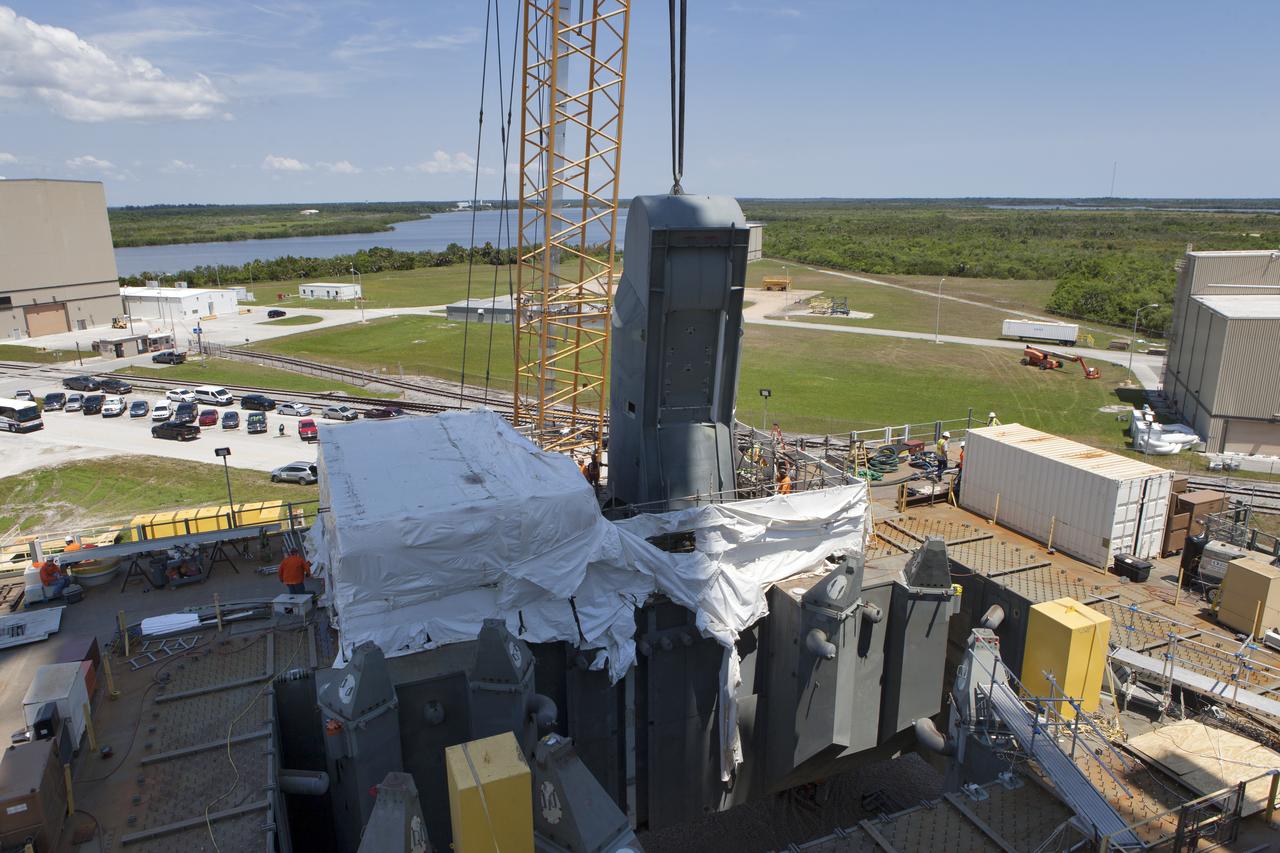
A crane is used to lower the first of two Tail Service Mast Umbilicals for installation on the 0-level deck of the mobile launcher on July 12, at NASA's Kennedy Space Center in Florida. The 35-foot-tall umbilical will connect to NASA's Space Launch System rocket core stage aft section and provide liquid oxygen and electrical cable connections to the core stage engine section to support propellant handling during prelaunch operations. The installation brings Exploration Ground Systems one step closer to supporting prelaunch operations for the agency's SLS rocket and Orion spacecraft on Exploration Mission-1 and deep space destinations.