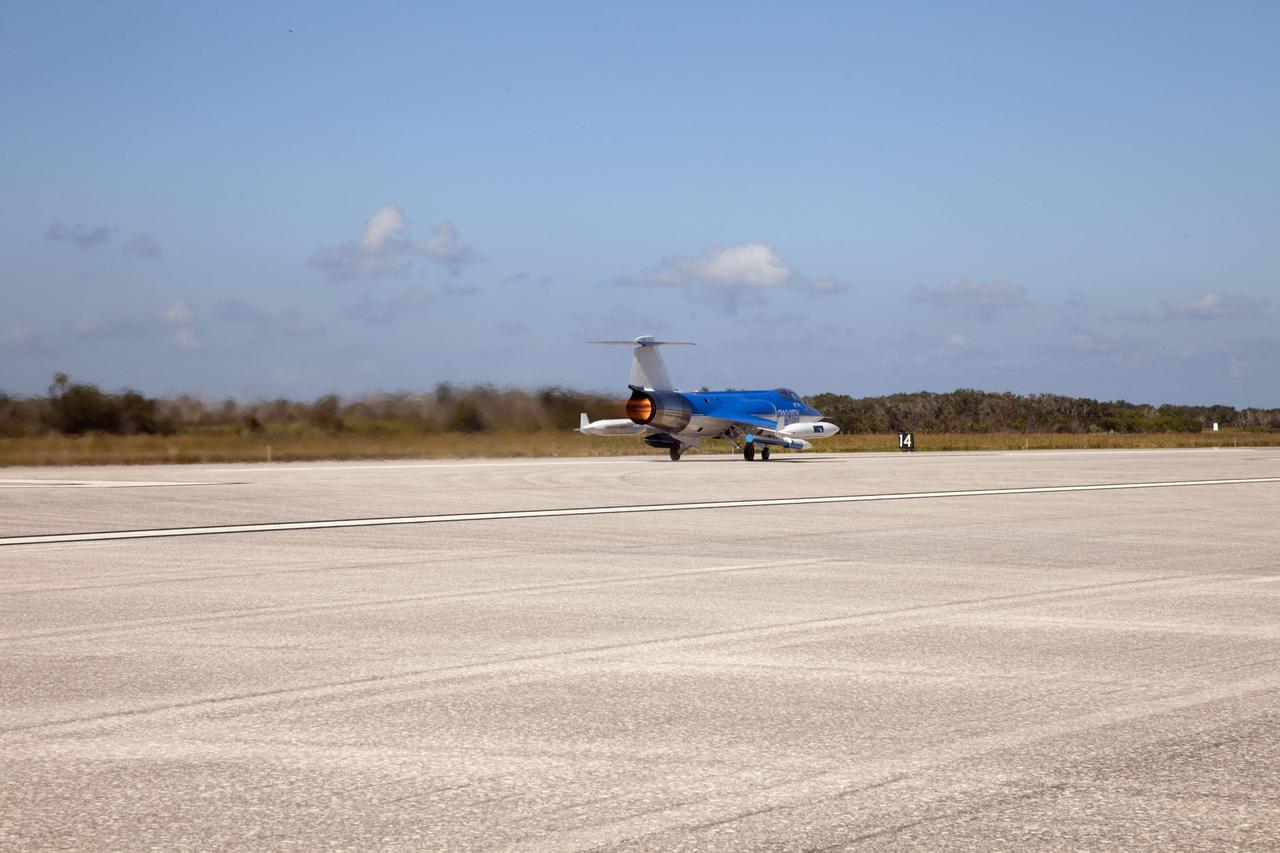
CAPE CANAVERAL, Fla. – On the runway at the Shuttle Landing Facility (SLF) at NASA’s Kennedy Space Center in Florida, a Starfighters, Inc. F-104 supersonic jet, piloted by Rick Svetkoff, picks up speed to conduct a high speed taxi test. The Star Lab suborbital launch vehicle developed by 4Frontiers Corporation is located on the right side of the jet. 4Frontiers is testing the Star Lab suborbital launch vehicle which has the potential to carry payloads into low earth orbit. Tests are being conducted to verify the aeronautical conditions of the Star Lab suborbital launch vehicle. This is the first of eight tests the launch vehicle will undergo. 4Frontiers Corporation is aiming for testing to be completed by early 2012, with commercial flights starting mid-2012. Starfighters, Inc. has signed a Space Act Agreement with NASA for the use of the SLF facilities at Kennedy Space Center. Photo credit: NASA_Gianni M. Woods
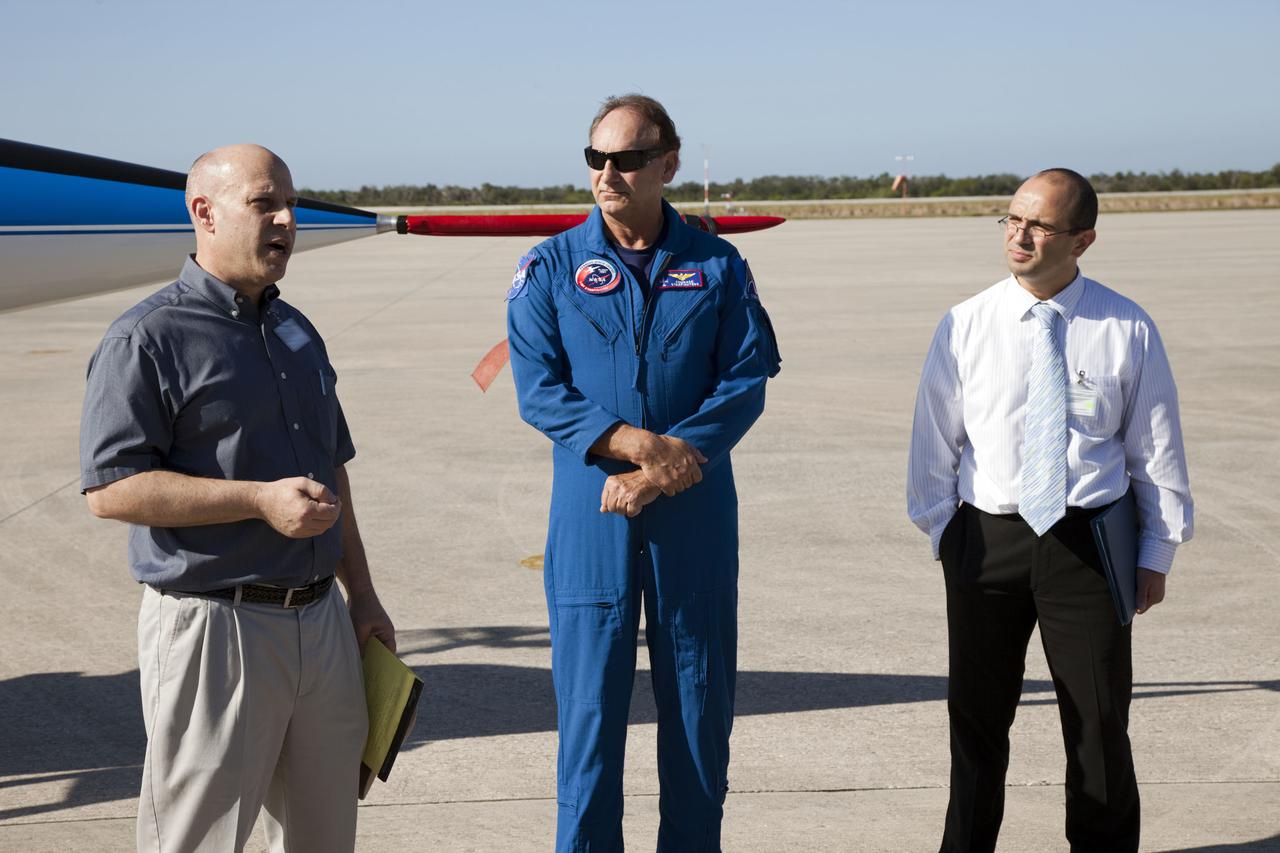
CAPE CANAVERAL, Fla. – Before a high speed taxi test using a Starfighters, Inc. F-104, from left, Mark Homnick, CEO of 4Frontiers Corporation, Rick Svetkoff, Starfighters, Inc. president and pilot, and Panayot Slavov, business development manager for 4Frontiers Corporation, address guests at the Shuttle Landing Facility (SLF) at NASA’s Kennedy Space Center in Florida. 4Frontiers is testing the Star Lab suborbital launch vehicle which has the potential to carry payloads into low earth orbit. Tests are being conducted to verify the aeronautical conditions of the Star Lab suborbital launch vehicle. This is the first of eight tests the launch vehicle will undergo. 4Frontiers Corporation is aiming for testing to be completed by early 2012, with commercial flights starting mid-2012. Starfighters, Inc. has signed a Space Act Agreement with NASA for the use of the SLF facilities at Kennedy Space Center. Photo credit: NASA_Gianni M. Woods
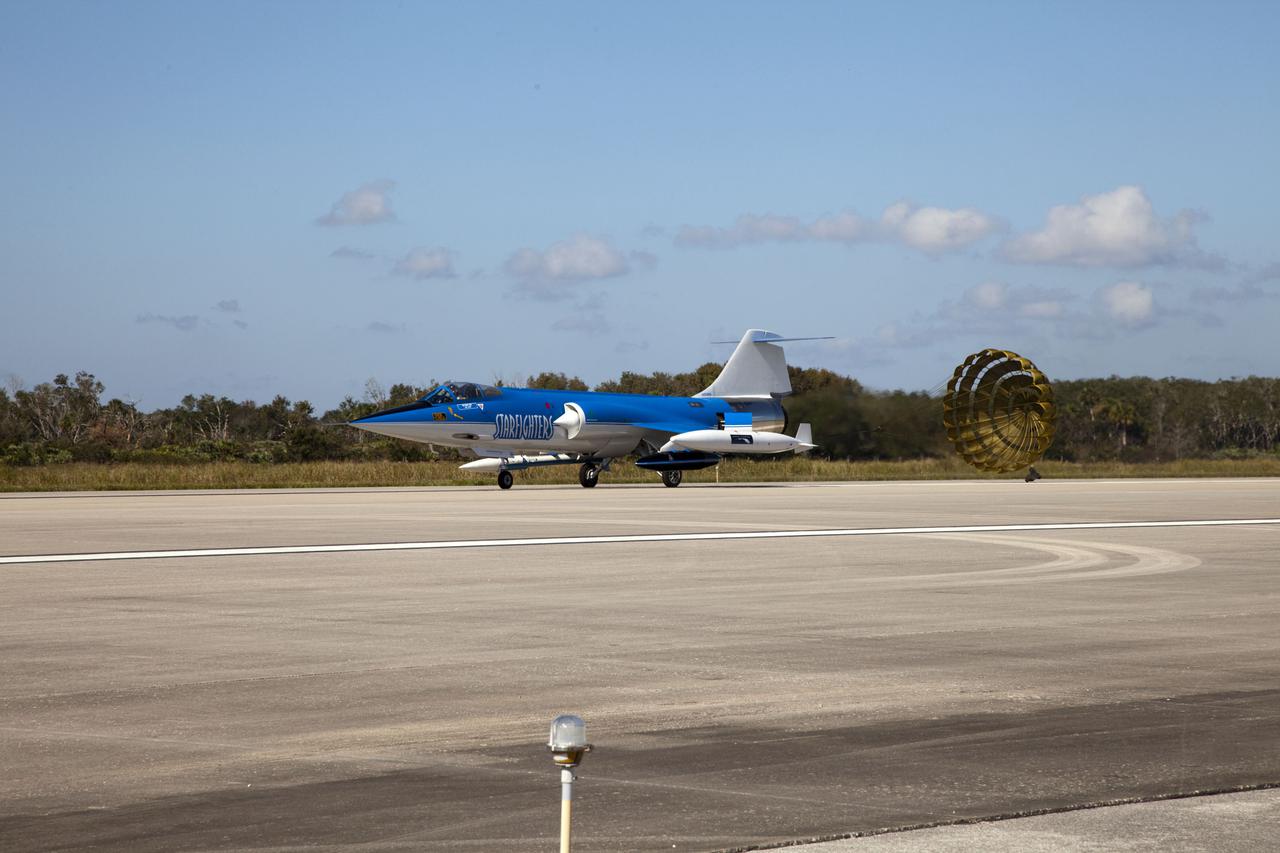
CAPE CANAVERAL, Fla. – On the runway at the Shuttle Landing Facility (SLF) at NASA’s Kennedy Space Center in Florida, the parachute on a Starfighters, Inc. F-104 supersonic jet, piloted by Rick Svetkoff, deploys after conducting a high speed taxi test. The Star Lab suborbital launch vehicle developed by 4Frontiers Corporation can be seen just above the front wheel. 4Frontiers is testing the Star Lab suborbital launch vehicle which has the potential to carry payloads into low earth orbit. Tests are being conducted to verify the aeronautical conditions of the Star Lab suborbital launch vehicle. This is the first of eight tests the launch vehicle will undergo. 4Frontiers Corporation is aiming for testing to be completed by early 2012, with commercial flights starting mid-2012. Starfighters, Inc. has signed a Space Act Agreement with NASA for the use of the SLF facilities at Kennedy Space Center. Photo credit: NASA_Gianni M. Woods
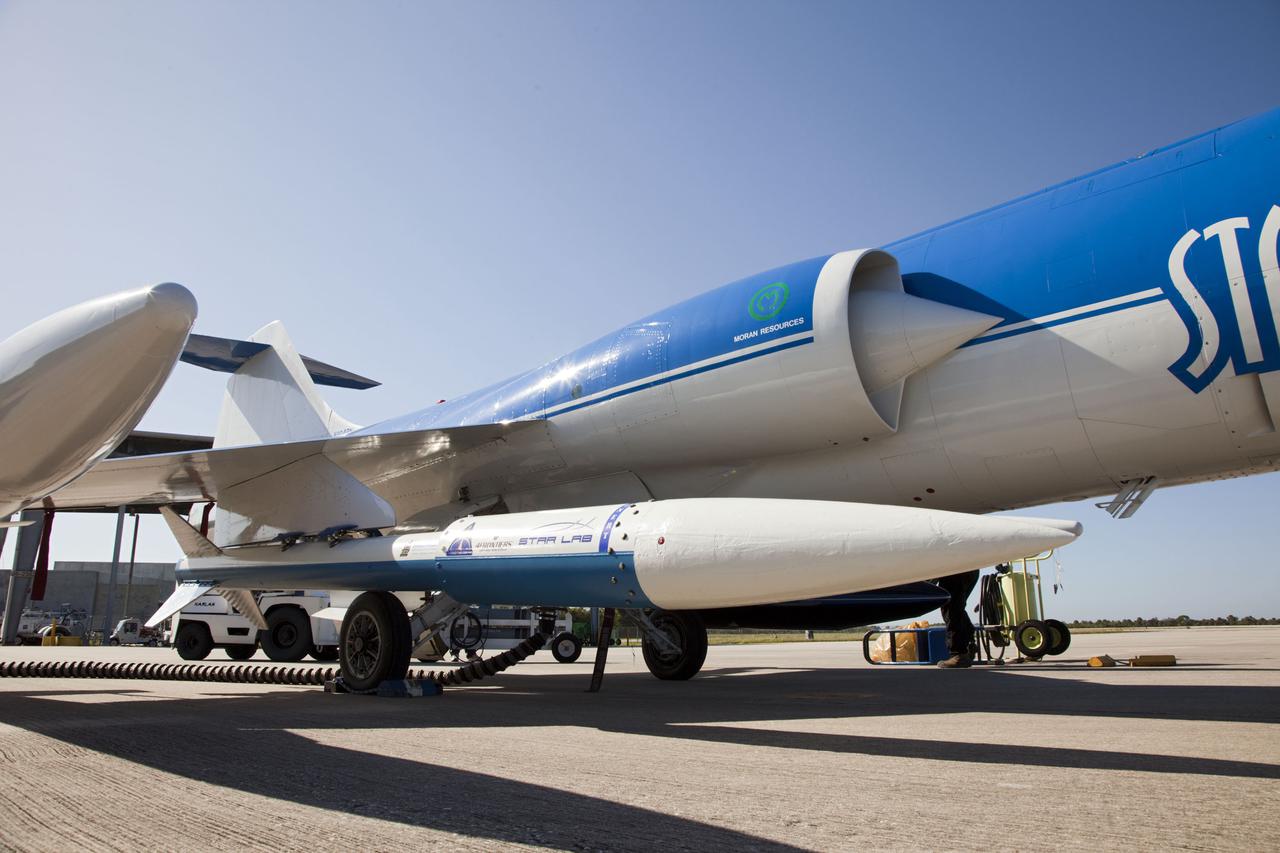
CAPE CANAVERAL, Fla. – A Starfighters, Inc. F-104 supersonic jet is being fueled before conducting a high speed taxi test at the Shuttle Landing Facility (SLF) at NASA’s Kennedy Space Center in Florida. On the right side of the jet is the Star Lab suborbital launch vehicle developed by 4Frontiers Corporation. 4Frontiers is testing the Star Lab suborbital launch vehicle which has the potential to carry payloads into low earth orbit. Tests are being conducted to verify the aeronautical conditions of the Star Lab suborbital launch vehicle. This is the first of eight tests the launch vehicle will undergo. 4Frontiers Corporation is aiming for testing to be completed by early 2012, with commercial flights starting mid-2012. Starfighters, Inc. has signed a Space Act Agreement with NASA for the use of the SLF facilities at Kennedy Space Center. Photo credit: NASA_Gianni M. Woods
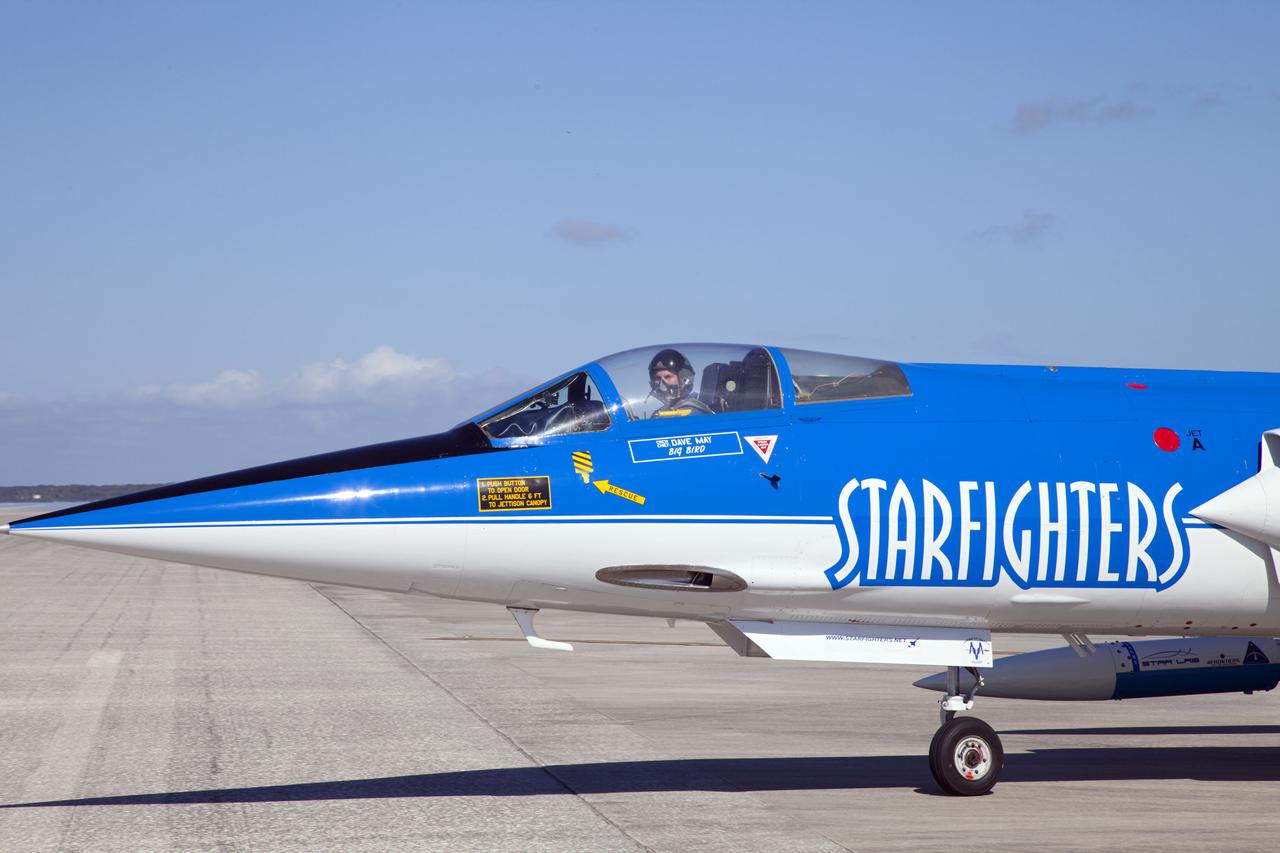
CAPE CANAVERAL, Fla. – Pilot Rick Svetkoff sits in the cockpit of a Starfighters, Inc. F-104 supersonic jet before conducting a high speed taxi test on the runway at the Shuttle Landing Facility (SLF) at NASA’s Kennedy Space Center in Florida. The Star Lab suborbital launch vehicle developed by 4Frontiers Corporation can be seen above the front wheel. 4Frontiers is testing the Star Lab suborbital launch vehicle which has the potential to carry payloads into low earth orbit. Tests are being conducted to verify the aeronautical conditions of the Star Lab suborbital launch vehicle. This is the first of eight tests the launch vehicle will undergo. 4Frontiers Corporation is aiming for testing to be completed by early 2012, with commercial flights starting mid-2012. Starfighters, Inc. has signed a Space Act Agreement with NASA for the use of the SLF facilities at Kennedy Space Center. Photo credit: NASA_Gianni M. Woods

CAPE CANAVERAL, Fla. – Pilot Rick Svetkoff sits in the cockpit of a Starfighters, Inc. F-104 supersonic jet after conducting a high speed taxi test on the runway at the Shuttle Landing Facility (SLF) at NASA’s Kennedy Space Center in Florida. The Star Lab suborbital launch vehicle developed by 4Frontiers Corporation is attached to the right side of the jet. 4Frontiers is testing the Star Lab suborbital launch vehicle which has the potential to carry payloads into low earth orbit. Tests are being conducted to verify the aeronautical conditions of the Star Lab suborbital launch vehicle. This is the first of eight tests the launch vehicle will undergo. 4Frontiers Corporation is aiming for testing to be completed by early 2012, with commercial flights starting mid-2012. Starfighters, Inc. has signed a Space Act Agreement with NASA for the use of the SLF facilities at Kennedy Space Center. Photo credit: NASA_Gianni M. Woods
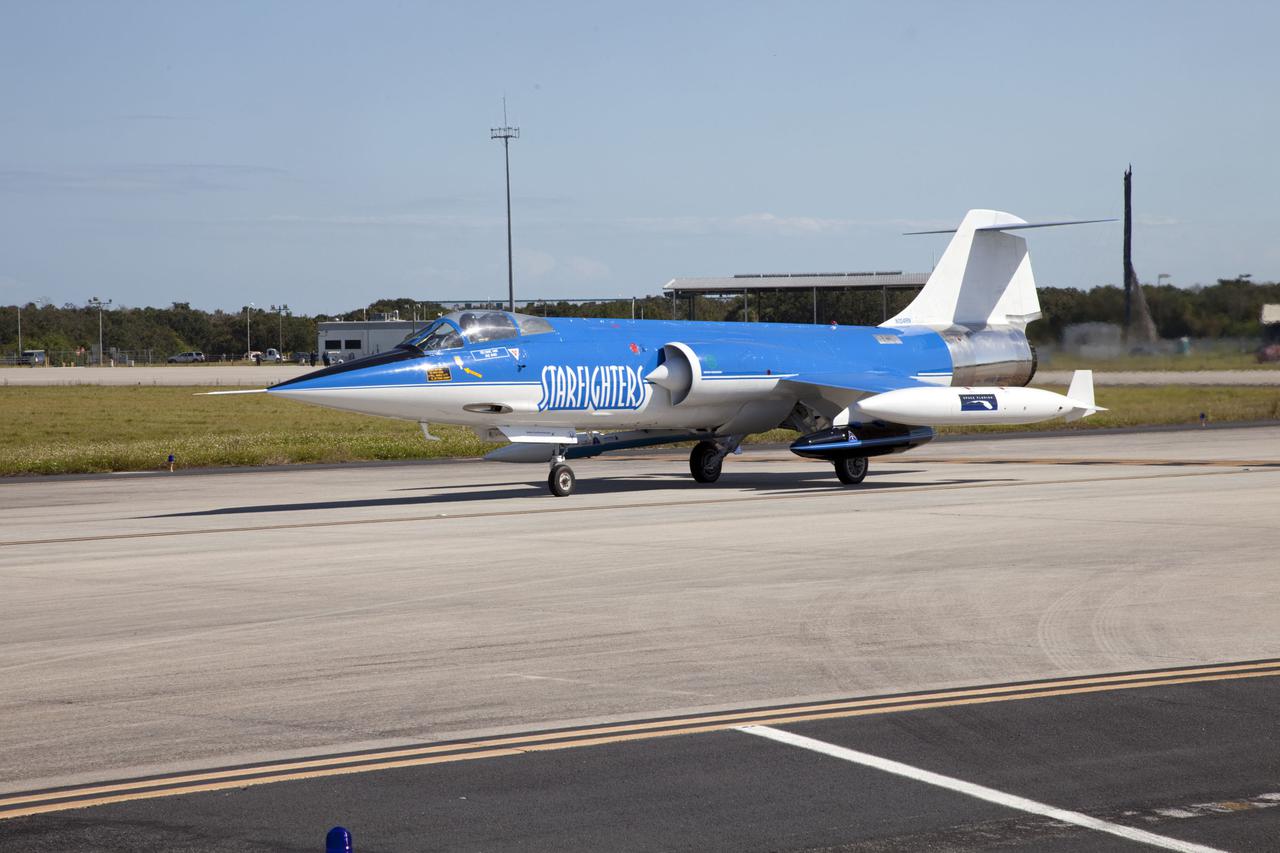
CAPE CANAVERAL, Fla. – Pilot Rick Svetkoff sits in the cockpit of a Starfighters, Inc. F-104 supersonic jet before conducting a high speed taxi test at the Shuttle Landing Facility (SLF) at NASA’s Kennedy Space Center in Florida. Hidden from the camera on the right side of the jet is the Star Lab suborbital launch vehicle developed by 4Frontiers Corporation. 4Frontiers is testing the Star Lab suborbital launch vehicle which has the potential to carry payloads into low earth orbit. Tests are being conducted to verify the aeronautical conditions of the Star Lab suborbital launch vehicle. This is the first of eight tests the launch vehicle will undergo. 4Frontiers Corporation is aiming for testing to be completed by early 2012, with commercial flights starting mid-2012. Starfighters, Inc. has signed a Space Act Agreement with NASA for the use of the SLF facilities at Kennedy Space Center. Photo credit: NASA_Gianni M. Woods
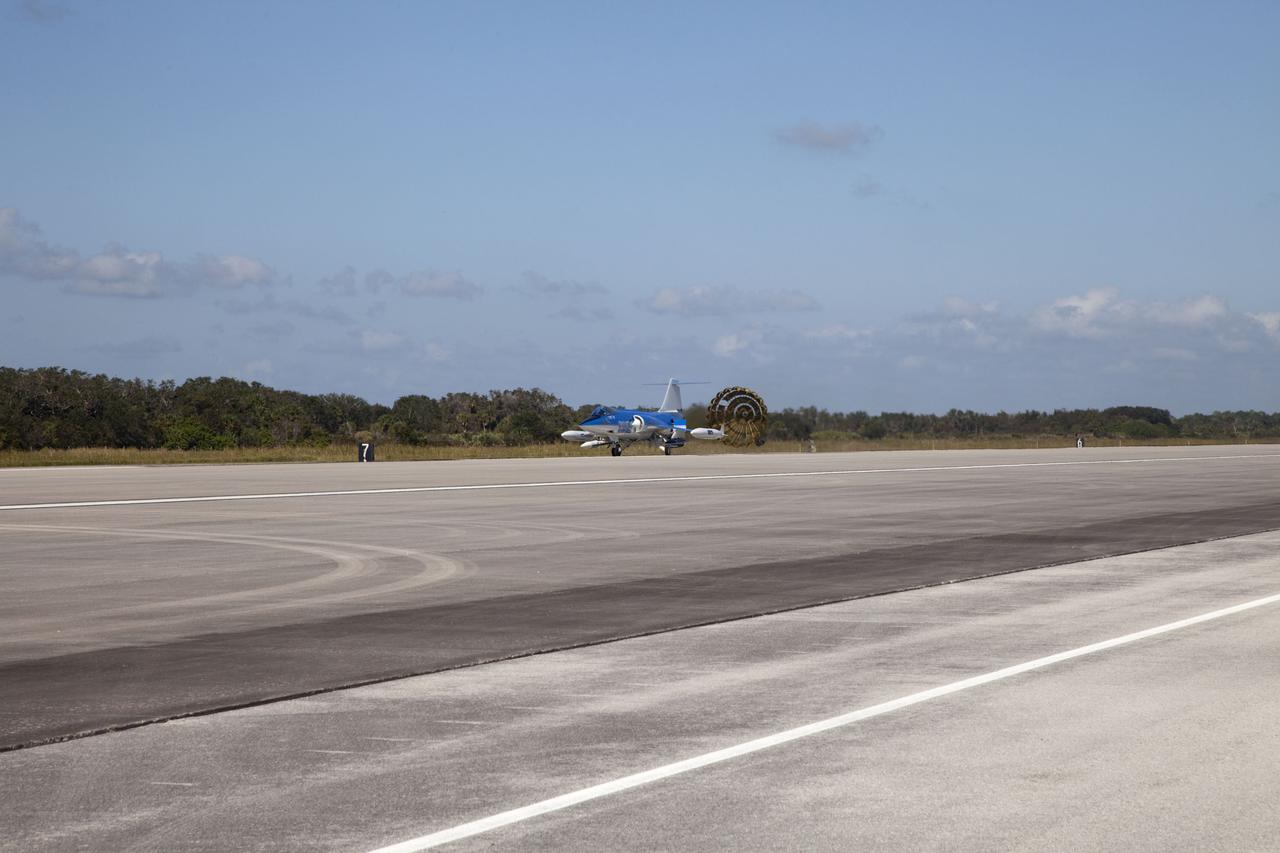
CAPE CANAVERAL, Fla. – On the runway at the Shuttle Landing Facility (SLF) at NASA’s Kennedy Space Center in Florida, the parachute on a Starfighters, Inc. F-104 supersonic jet, piloted by Rick Svetkoff, deploys after conducting a high speed taxi test. Hidden from the camera on the right side of the jet is the Star Lab suborbital launch vehicle developed by 4Frontiers Corporation. 4Frontiers is testing the Star Lab suborbital launch vehicle which has the potential to carry payloads into low earth orbit. Tests are being conducted to verify the aeronautical conditions of the Star Lab suborbital launch vehicle. This is the first of eight tests the launch vehicle will undergo. 4Frontiers Corporation is aiming for testing to be completed by early 2012, with commercial flights starting mid-2012. Starfighters, Inc. has signed a Space Act Agreement with NASA for the use of the SLF facilities at Kennedy Space Center. Photo credit: NASA_Gianni M. Woods
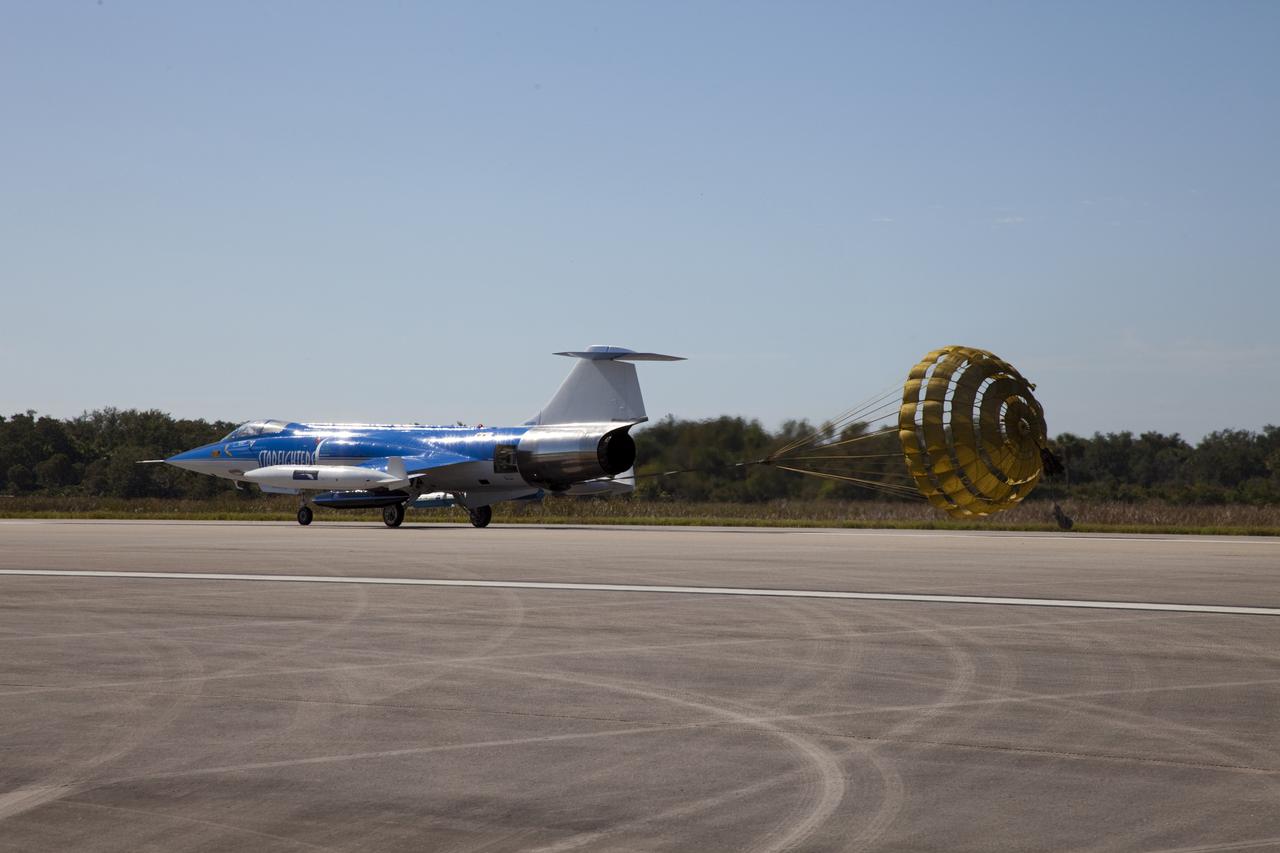
CAPE CANAVERAL, Fla. – On the runway at the Shuttle Landing Facility (SLF) at NASA’s Kennedy Space Center in Florida, the parachute on a Starfighters, Inc. F-104 supersonic jet, piloted by Rick Svetkoff, deploys after conducting a high speed taxi test. Hidden from the camera on the right side of the jet is the Star Lab suborbital launch vehicle developed by 4Frontiers Corporation. 4Frontiers is testing the Star Lab suborbital launch vehicle which has the potential to carry payloads into low earth orbit. Tests are being conducted to verify the aeronautical conditions of the Star Lab suborbital launch vehicle. This is the first of eight tests the launch vehicle will undergo. 4Frontiers Corporation is aiming for testing to be completed by early 2012, with commercial flights starting mid-2012. Starfighters, Inc. has signed a Space Act Agreement with NASA for the use of the SLF facilities at Kennedy Space Center. Photo credit: NASA_Gianni M. Woods
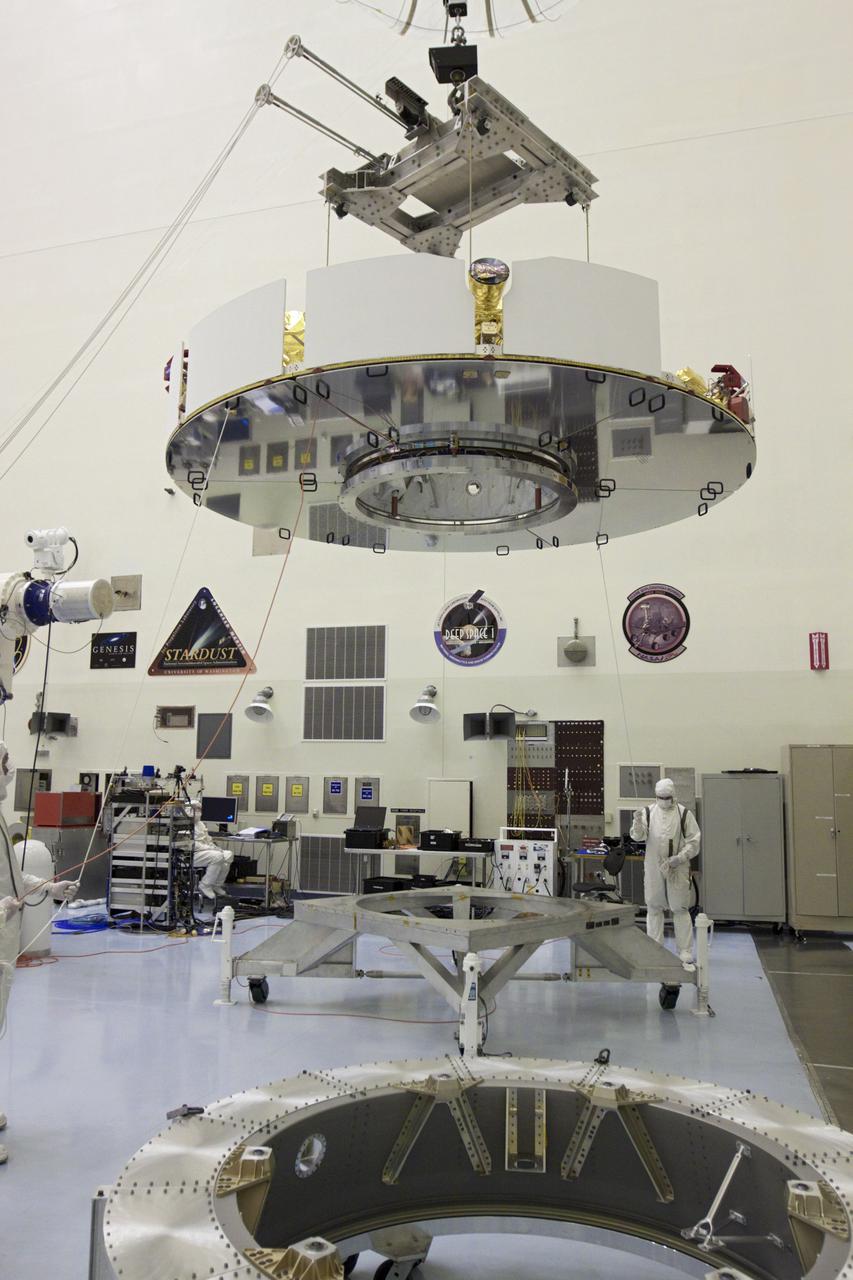
CAPE CANAVERAL, Fla. – In the Payload Hazardous Servicing Facility at NASA’s Kennedy Space Center in Florida, technicians, using an overhead crane, lift NASA's Mars Science Laboratory (MSL) mission cruise stage for placement onto a rotation stand. The cruise stage provides solar power, thrusters for navigation, and heat exchangers to the rover during its flight from Earth to Mars. MSL's components include a car-sized rover, Curiosity, which has 10 science instruments designed to search for evidence on whether Mars has had environments favorable to microbial life, including chemical ingredients for life. The unique rover will use a laser to look inside rocks and release its gasses so that the rover’s spectrometer can analyze and send the data back to Earth. Launch of MSL aboard a United Launch Alliance Atlas V rocket is scheduled for Nov. 25 from Space Launch Complex 41 on Cape Canaveral Air Force Station in Florida. For more information, visit http:__www.nasa.gov_msl. Photo credit: NASA_Glenn Benson
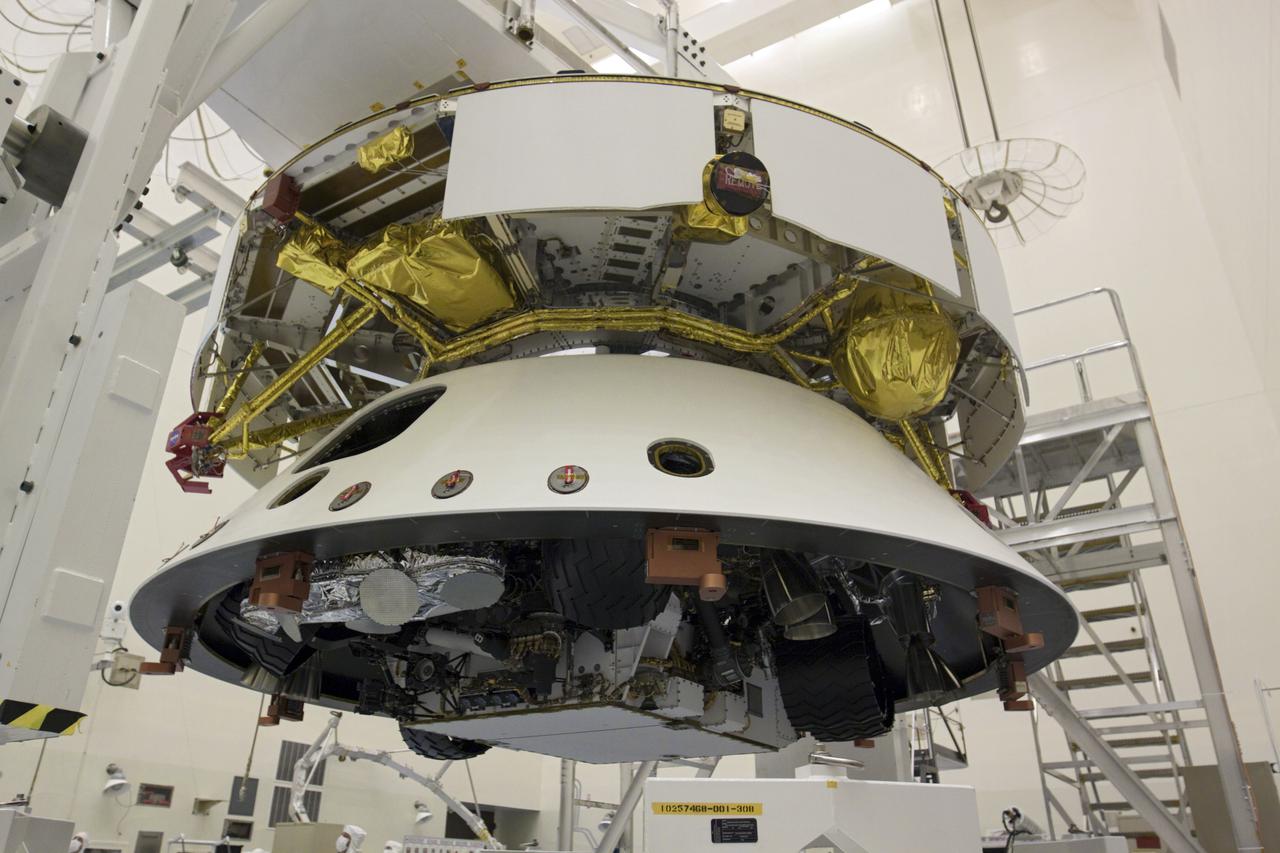
CAPE CANAVERAL, Fla. – In the Payload Hazardous Servicing Facility at NASA’s Kennedy Space Center in Florida, NASA's Mars Science Laboratory (MSL) mission aeroshell, (containing the compact car-sized rover Curiosity), has been mated to the cruise stage. The cruise stage provides solar power, thrusters for navigation, and heat exchangers to the rover during its flight from Earth to Mars. The rover Curiosity has 10 science instruments designed to search for evidence on whether Mars has had environments favorable to microbial life, including chemical ingredients for life. The unique rover will use a laser to look inside rocks and release its gasses so that the rover’s spectrometer can analyze and send the data back to Earth. Launch of MSL aboard a United Launch Alliance Atlas V rocket is scheduled for Nov. 25 from Space Launch Complex 41 on Cape Canaveral Air Force Station in Florida. For more information, visit http:__www.nasa.gov_msl. Photo credit: NASA_Glenn Benson
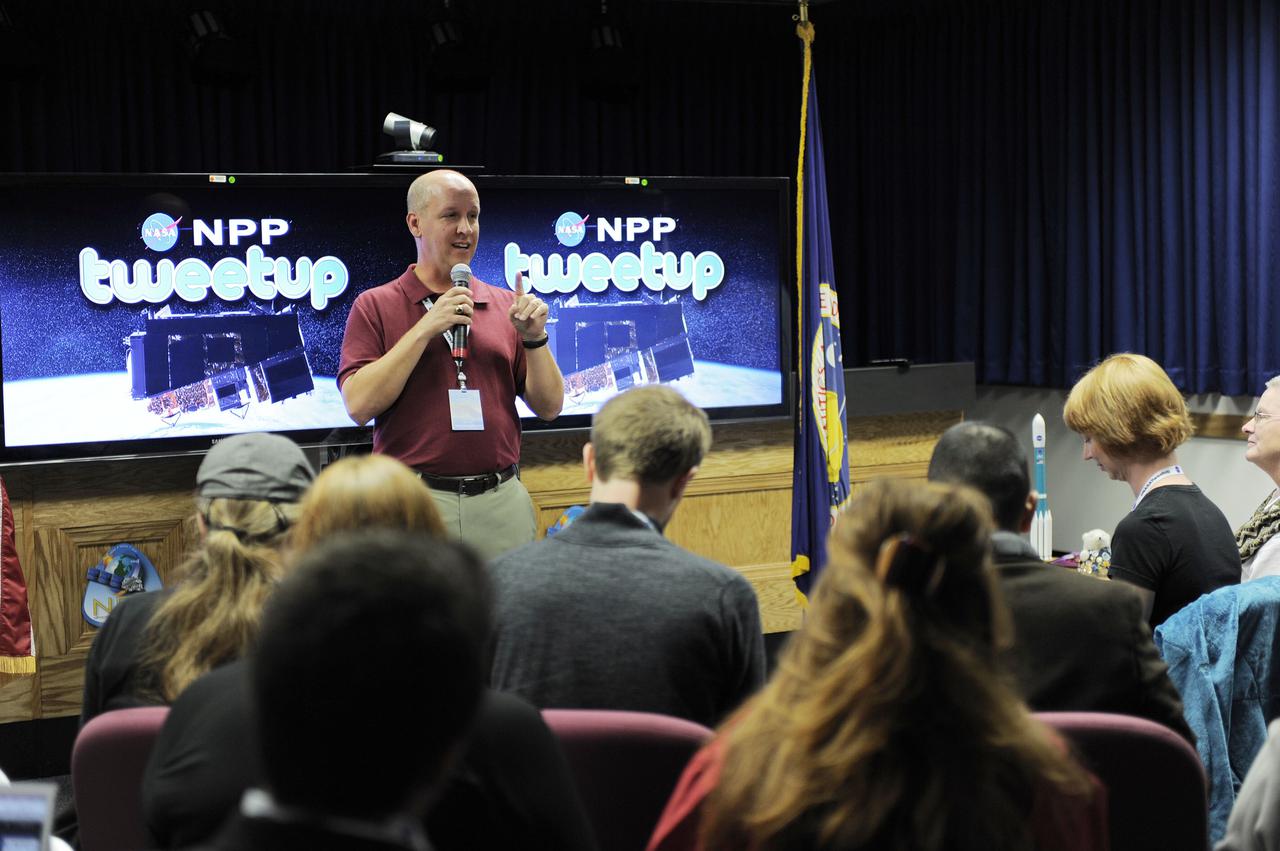
VANDENBERG AIR FORCE BASE, Calif. – A speaker talks with a group of Tweetup participants at Vandenberg Air Force Base in California during prelaunch activities for NASA’s National Polar-orbiting Operational Environmental Satellite System Preparatory Project (NPP) spacecraft mission. The tweeters will share their experiences with followers through the social networking site Twitter. NPP represents a critical first step in building the next-generation of Earth-observing satellites. NPP will carry the first of the new sensors developed for this satellite fleet, now known as the Joint Polar Satellite System (JPSS) to be launched in 2016. NPP is the bridge between NASA's Earth Observing System (EOS) satellites and the forthcoming series of JPSS satellites. The mission will test key technologies and instruments for the JPSS missions. NPP is targeted to launch Oct. 28 from Space Launch Complex-2 aboard a United Launch Alliance Delta II rocket. For more information, visit http:__www.nasa.gov_NPP. Photo credit: NASA_Kim Shiflett
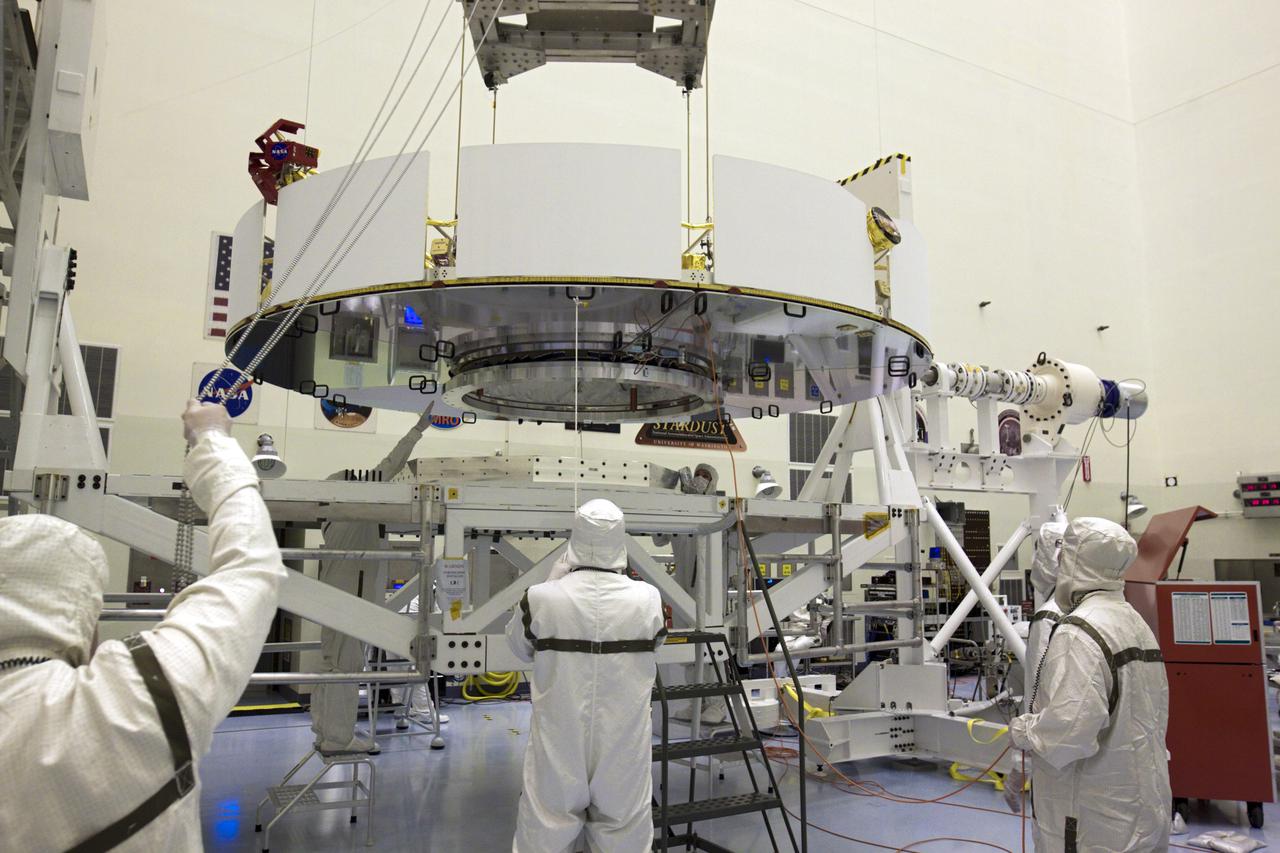
CAPE CANAVERAL, Fla. – In the Payload Hazardous Servicing Facility at NASA’s Kennedy Space Center in Florida, technicians, using an overhead crane, lower NASA's Mars Science Laboratory (MSL) mission cruise stage onto a rotation stand. The cruise stage provides solar power, thrusters for navigation, and heat exchangers to the rover during its flight from Earth to Mars. MSL's components include a car-sized rover, Curiosity, which has 10 science instruments designed to search for evidence on whether Mars has had environments favorable to microbial life, including chemical ingredients for life. The unique rover will use a laser to look inside rocks and release its gasses so that the rover’s spectrometer can analyze and send the data back to Earth. Launch of MSL aboard a United Launch Alliance Atlas V rocket is scheduled for Nov. 25 from Space Launch Complex 41 on Cape Canaveral Air Force Station in Florida. For more information, visit http:__www.nasa.gov_msl. Photo credit: NASA_Glenn Benson
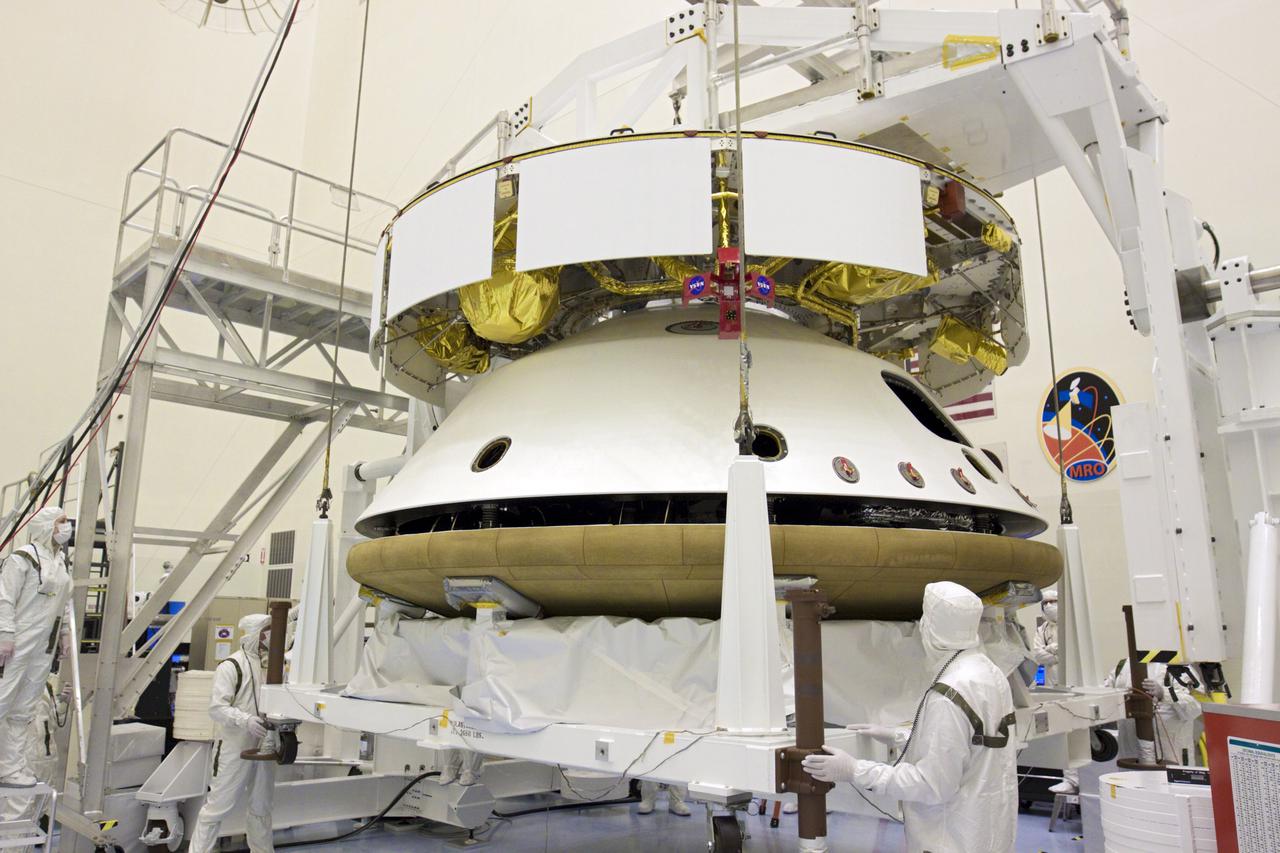
CAPE CANAVERAL, Fla. – In the Payload Hazardous Servicing Facility at NASA’s Kennedy Space Center in Florida, under the watchful eyes of technicians, an overhead crane lifts the heat shield for integration with NASA's Mars Science Laboratory (MSL) mission aeroshell, (containing the compact car-sized rover Curiosity). Earlier, the aeroshell was mated to the cruise stage, which provides solar power, thrusters for navigation, and heat exchangers to the rover during its flight from Earth to Mars. The rover Curiosity has 10 science instruments designed to search for evidence on whether Mars has had environments favorable to microbial life, including chemical ingredients for life. The unique rover will use a laser to look inside rocks and release its gasses so that the rover’s spectrometer can analyze and send the data back to Earth. Launch of MSL aboard a United Launch Alliance Atlas V rocket is scheduled for Nov. 25 from Space Launch Complex 41 on Cape Canaveral Air Force Station in Florida. For more information, visit http:__www.nasa.gov_msl. Photo credit: NASA_Glenn Benson
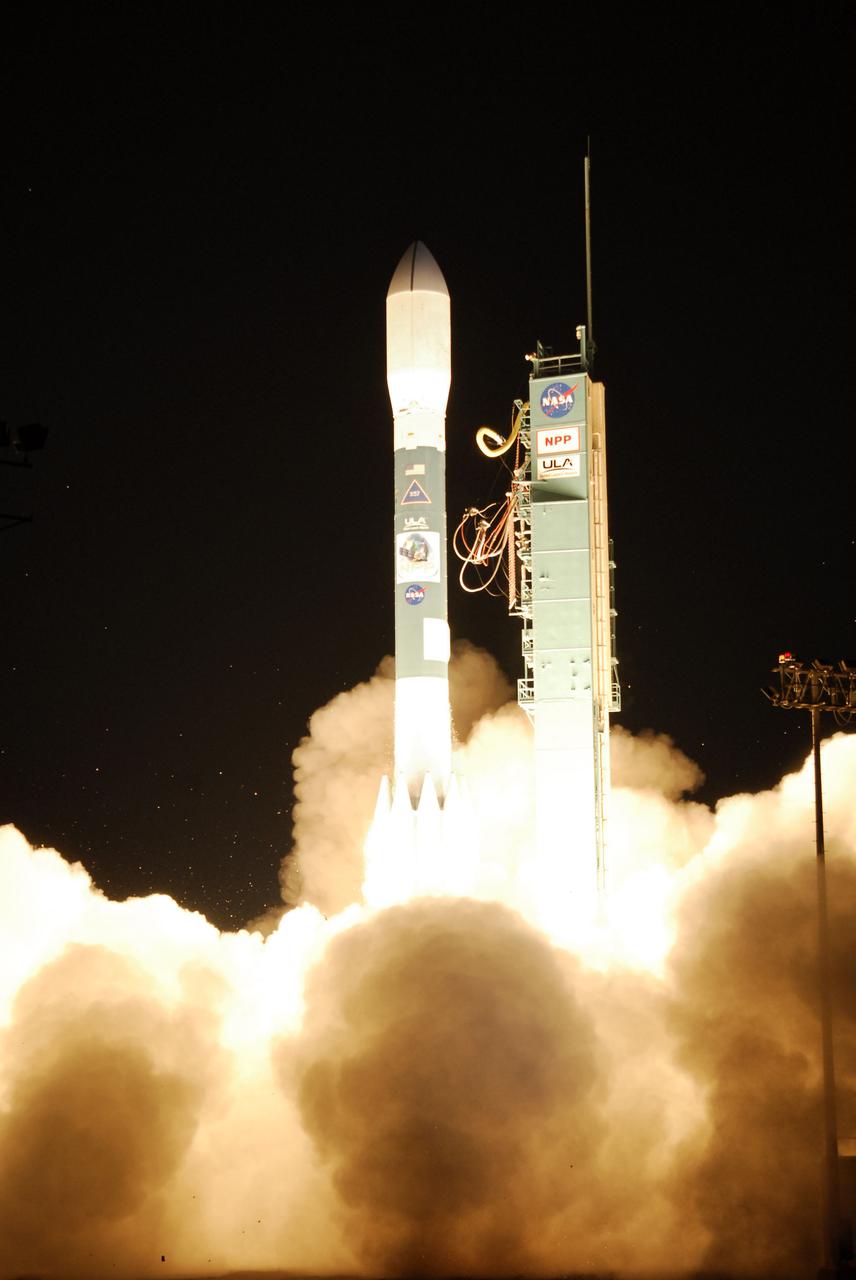
VANDENBERG AIR FORCE BASE, Calif. -- At Space Launch Complex-2 on Vandenberg Air Force Base in California, an exhaust cloud builds around the United Launch Alliance Delta II rocket carrying NASA's National Polar-orbiting Operational Environmental Satellite System Preparatory Project (NPP) into space. Liftoff was at 2:48 a.m. PDT. NPP represents a critical first step in building the next-generation of Earth-observing satellites. NPP will carry the first of the new sensors developed for this satellite fleet, now known as the Joint Polar Satellite System (JPSS) to be launched in 2016. NPP is the bridge between NASA's Earth Observing System (EOS) satellites and the forthcoming series of JPSS satellites. The mission will test key technologies and instruments for the JPSS missions. For more information, visit http:__www.nasa.gov_NPP. Photo credit: NASA_Kim Shiflett
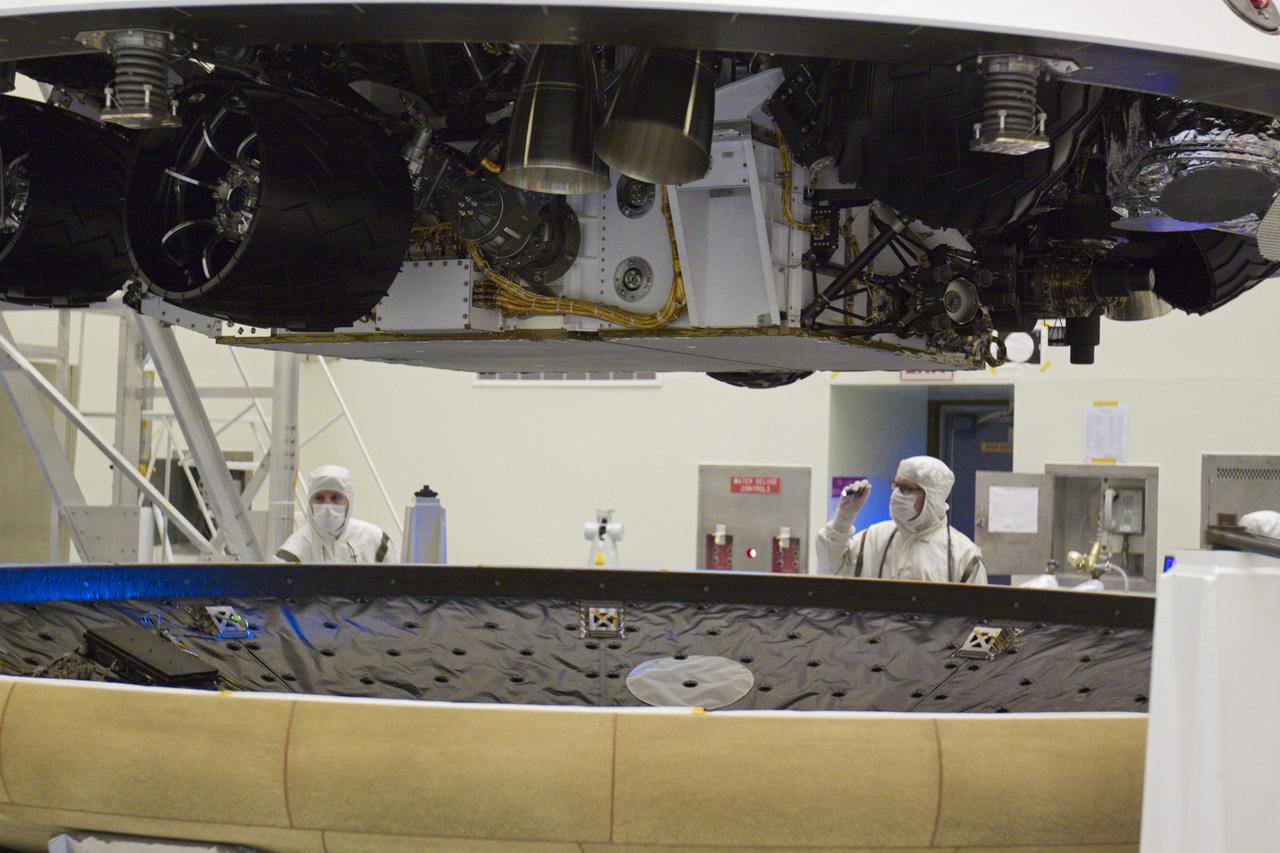
CAPE CANAVERAL, Fla. – In the Payload Hazardous Servicing Facility at NASA’s Kennedy Space Center in Florida, technicians inspect the heat shield in preparation for integration with NASA's Mars Science Laboratory (MSL) mission aeroshell, (containing the compact car-sized rover Curiosity). Earlier, the aeroshell was mated to the cruise stage, which provides solar power, thrusters for navigation, and heat exchangers to the rover during its flight from Earth to Mars. The rover Curiosity has 10 science instruments designed to search for evidence on whether Mars has had environments favorable to microbial life, including chemical ingredients for life. The unique rover will use a laser to look inside rocks and release its gasses so that the rover’s spectrometer can analyze and send the data back to Earth. Launch of MSL aboard a United Launch Alliance Atlas V rocket is scheduled for Nov. 25 from Space Launch Complex 41 on Cape Canaveral Air Force Station in Florida. For more information, visit http:__www.nasa.gov_msl. Photo credit: NASA_Glenn Benson
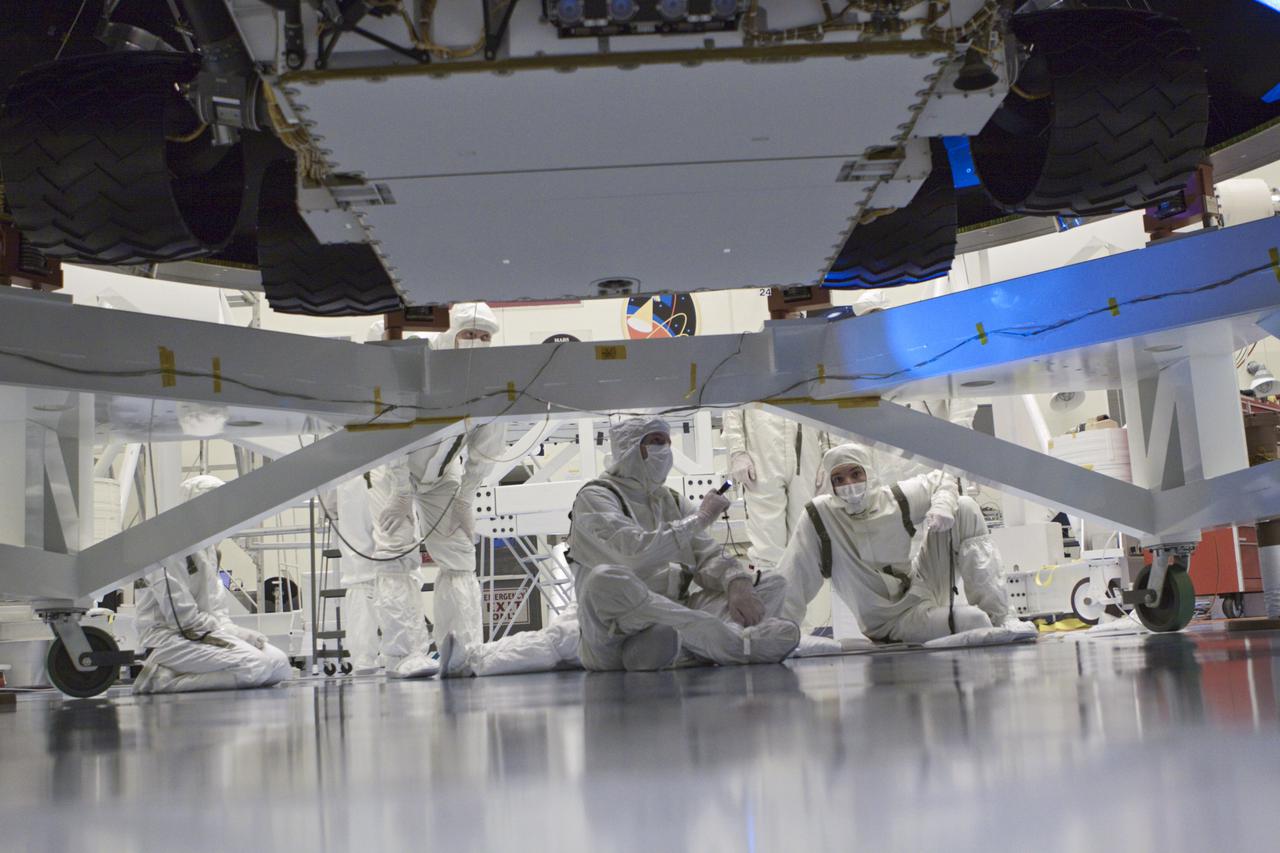
CAPE CANAVERAL, Fla. – In the Payload Hazardous Servicing Facility at NASA’s Kennedy Space Center in Florida, technicians inspect under NASA's Mars Science Laboratory (MSL) mission aeroshell, where the wheels of the rover Curiosity can be seen. MSL's components include a car-sized rover, Curiosity, which has 10 science instruments designed to search for evidence on whether Mars has had environments favorable to microbial life, including chemical ingredients for life. The unique rover will use a laser to look inside rocks and release its gasses so that the rover’s spectrometer can analyze and send the data back to Earth. Launch of MSL aboard a United Launch Alliance Atlas V rocket is scheduled for Nov. 25 from Space Launch Complex 41 on Cape Canaveral Air Force Station in Florida. For more information, visit http:__www.nasa.gov_msl. Photo credit: NASA_Glenn Benson
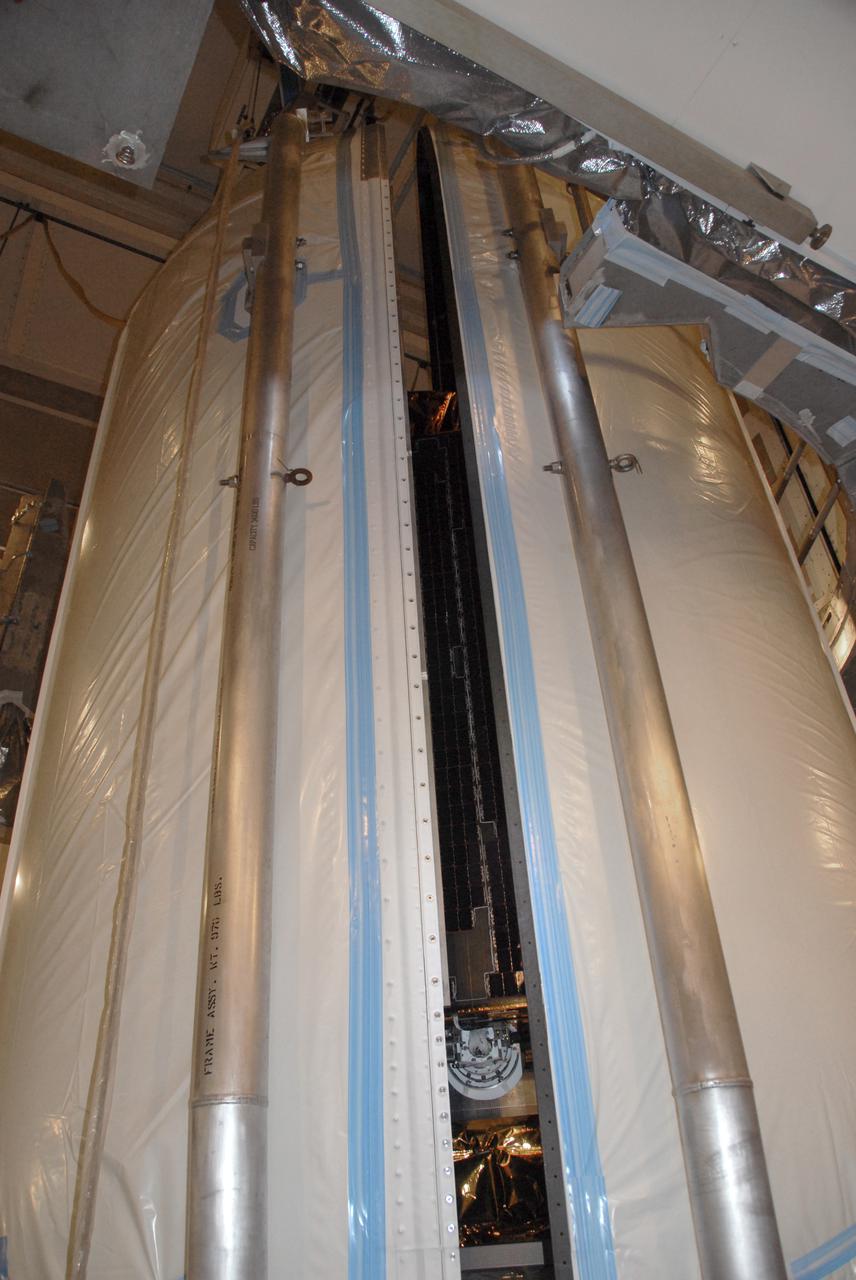
VANDENBERG AIR FORCE BASE, Calif. – At Vandenberg Air Force Base's Space Launch Complex-2 in California, encapsulation of NASA’s National Polar-orbiting Operational Environmental Satellite System Preparatory Project (NPP) spacecraft into the clamshell-shaped Delta payload fairing is almost complete. The fairing will protect the spacecraft from the impact of aerodynamic pressure and heating during ascent and will be jettisoned once the spacecraft is outside the Earth's atmosphere. NPP represents a critical first step in building the next-generation of Earth-observing satellites. NPP will carry the first of the new sensors developed for this satellite fleet, now known as the Joint Polar Satellite System (JPSS) to be launched in 2016. NPP is the bridge between NASA's Earth Observing System (EOS) satellites and the forthcoming series of JPSS satellites. The mission will test key technologies and instruments for the JPSS missions. NPP is targeted to launch Oct. 28 from Space Launch Complex-2 aboard a United Launch Alliance Delta II rocket. For more information, visit http:__www.nasa.gov_NPP. Photo credit: NASA_Mark P. Mackley, VAFB
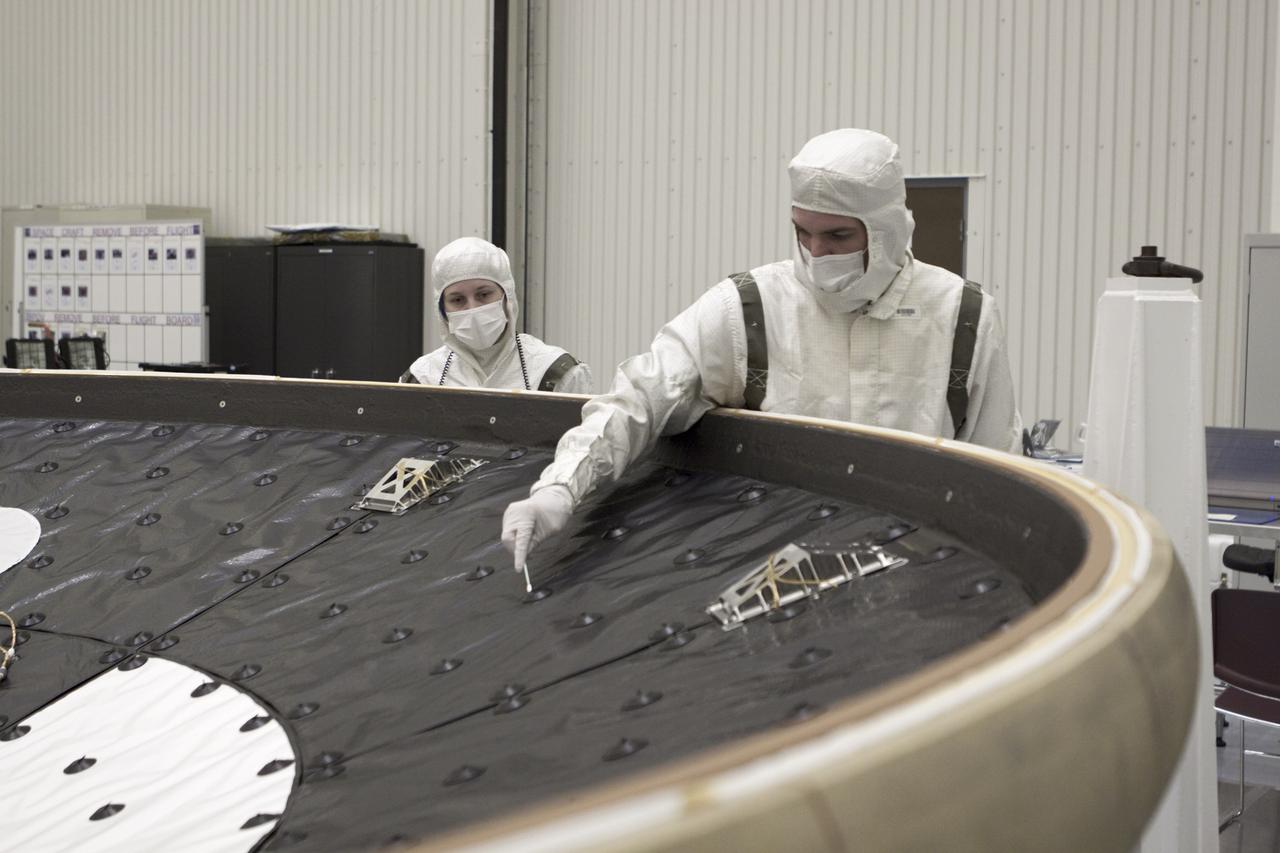
CAPE CANAVERAL, Fla. – In the Payload Hazardous Servicing Facility at NASA’s Kennedy Space Center in Florida, a technician cleans along the edge of NASA's Mars Science Laboratory (MSL) mission heat shield. MSL's components include a car-sized rover, Curiosity, which has 10 science instruments designed to search for evidence on whether Mars has had environments favorable to microbial life, including chemical ingredients for life. The unique rover will use a laser to look inside rocks and release its gasses so that the rover’s spectrometer can analyze and send the data back to Earth. Launch of MSL aboard a United Launch Alliance Atlas V rocket is scheduled for Nov. 25 from Space Launch Complex 41 on Cape Canaveral Air Force Station in Florida. For more information, visit http:__www.nasa.gov_msl. Photo credit: NASA_Glenn Benson
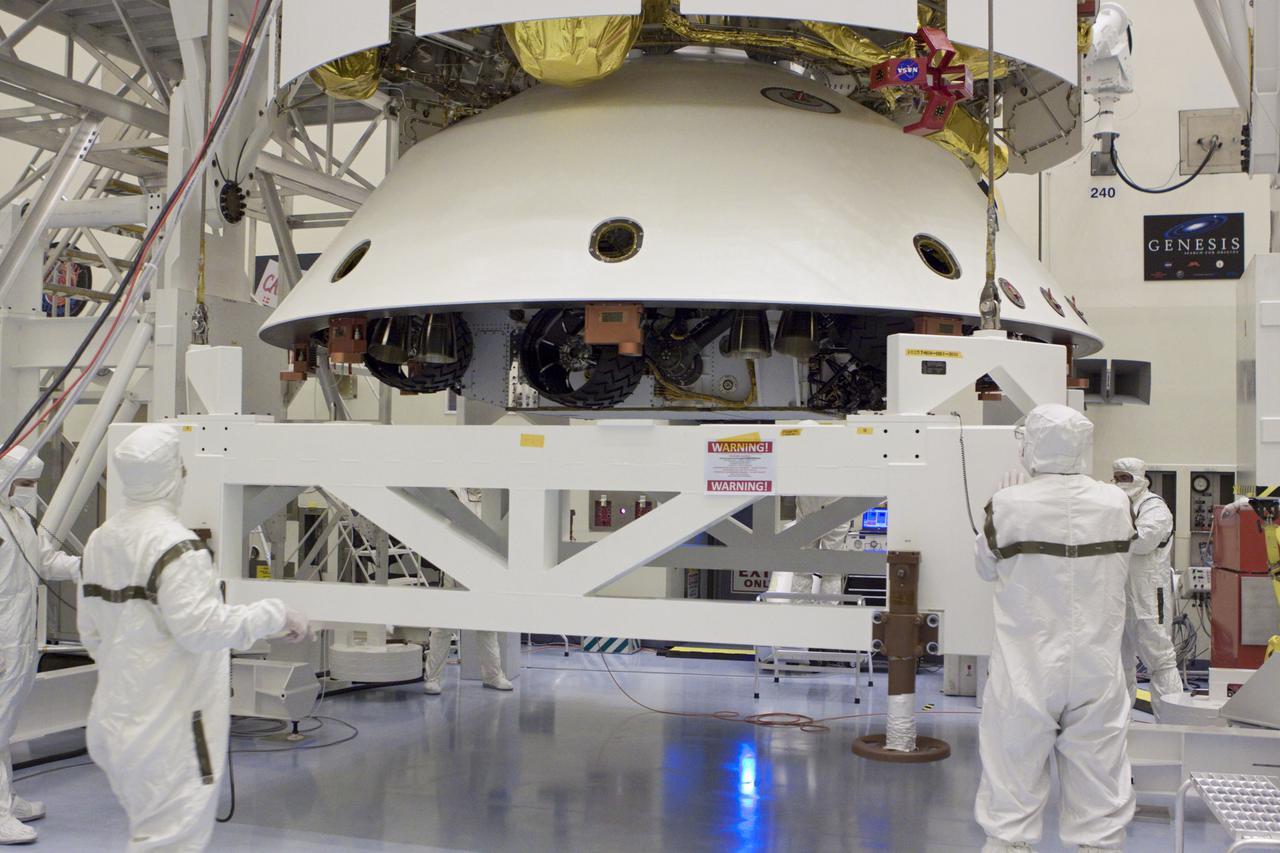
CAPE CANAVERAL, Fla. – In the Payload Hazardous Servicing Facility at NASA’s Kennedy Space Center in Florida, technicians, using an overhead crane, lift NASA's Mars Science Laboratory (MSL) mission aeroshell, (containing the compact car-sized rover Curiosity), for mating to the cruise stage. The cruise stage provides solar power, thrusters for navigation, and heat exchangers to the rover during its flight from Earth to Mars. The rover Curiosity has 10 science instruments designed to search for evidence on whether Mars has had environments favorable to microbial life, including chemical ingredients for life. The unique rover will use a laser to look inside rocks and release its gasses so that the rover’s spectrometer can analyze and send the data back to Earth. Launch of MSL aboard a United Launch Alliance Atlas V rocket is scheduled for Nov. 25 from Space Launch Complex 41 on Cape Canaveral Air Force Station in Florida. For more information, visit http:__www.nasa.gov_msl. Photo credit: NASA_Glenn Benson
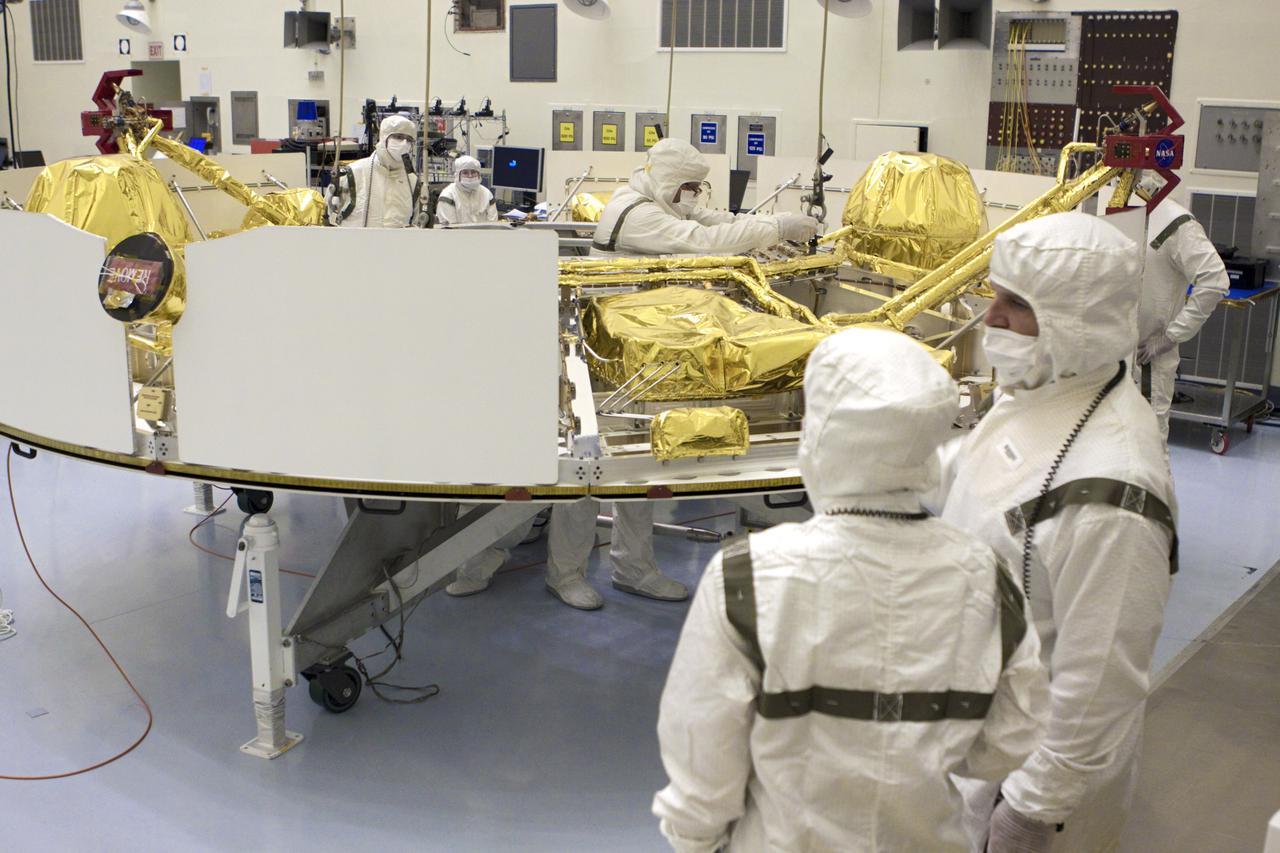
CAPE CANAVERAL, Fla. – In the Payload Hazardous Servicing Facility at NASA’s Kennedy Space Center in Florida, technicians prepare to attach an overhead crane to NASA's Mars Science Laboratory (MSL) mission cruise stage. The cruise stage, which will be lifted onto a rotation stand, provides solar power, thrusters for navigation, and heat exchangers to the rover during its flight from Earth to Mars. MSL's components include a car-sized rover, Curiosity, which has 10 science instruments designed to search for evidence on whether Mars has had environments favorable to microbial life, including chemical ingredients for life. The unique rover will use a laser to look inside rocks and release its gasses so that the rover’s spectrometer can analyze and send the data back to Earth. Launch of MSL aboard a United Launch Alliance Atlas V rocket is scheduled for Nov. 25 from Space Launch Complex 41 on Cape Canaveral Air Force Station in Florida. For more information, visit http:__www.nasa.gov_msl. Photo credit: NASA_Glenn Benson
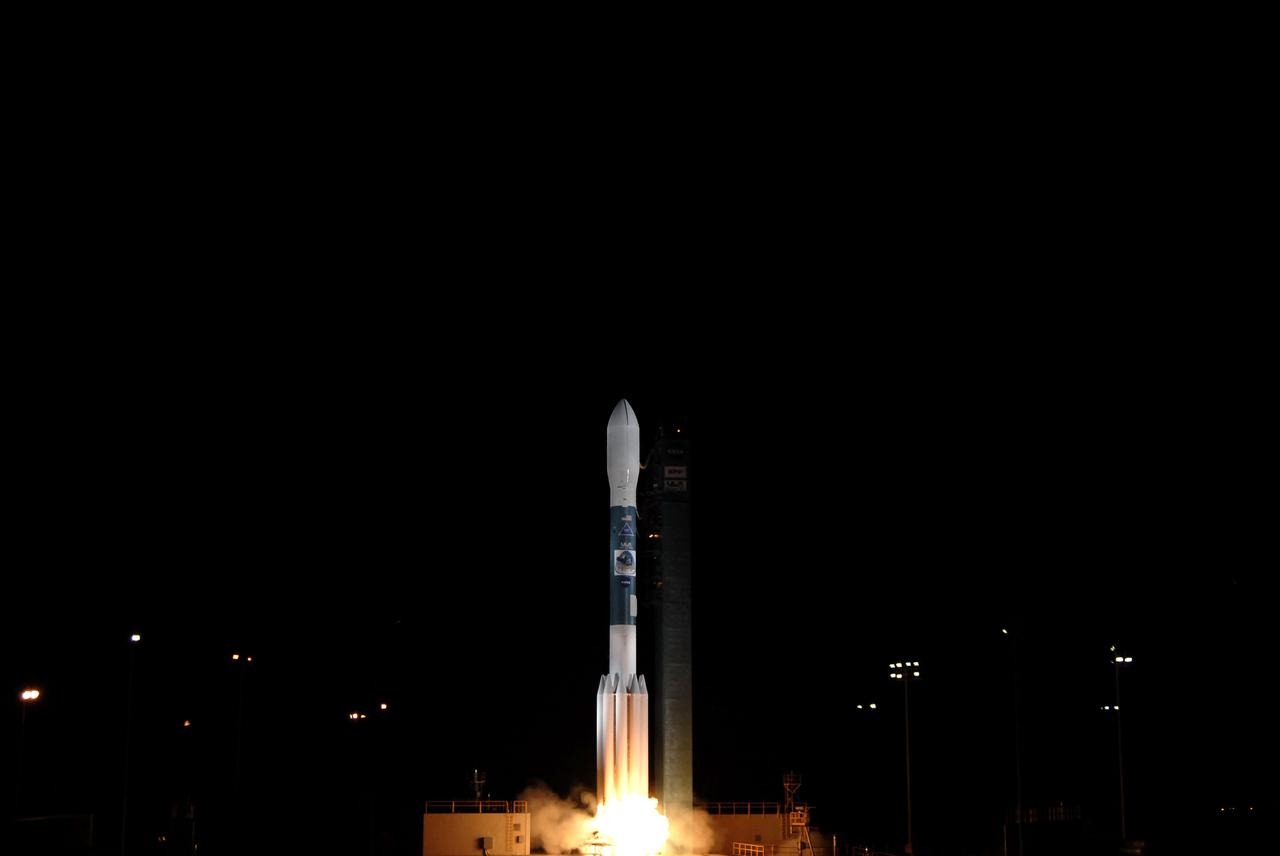
VANDENBERG AIR FORCE BASE, Calif. -- At Space Launch Complex-2 on Vandenberg Air Force Base in California, the engines ignite beneath the United Launch Alliance Delta II rocket carrying NASA's National Polar-orbiting Operational Environmental Satellite System Preparatory Project (NPP) into space. Liftoff was at 2:48 a.m. PDT. NPP represents a critical first step in building the next-generation of Earth-observing satellites. NPP will carry the first of the new sensors developed for this satellite fleet, now known as the Joint Polar Satellite System (JPSS) to be launched in 2016. NPP is the bridge between NASA's Earth Observing System (EOS) satellites and the forthcoming series of JPSS satellites. The mission will test key technologies and instruments for the JPSS missions. For more information, visit http:__www.nasa.gov_NPP. Photo credit: NASA_Kim Shiflett
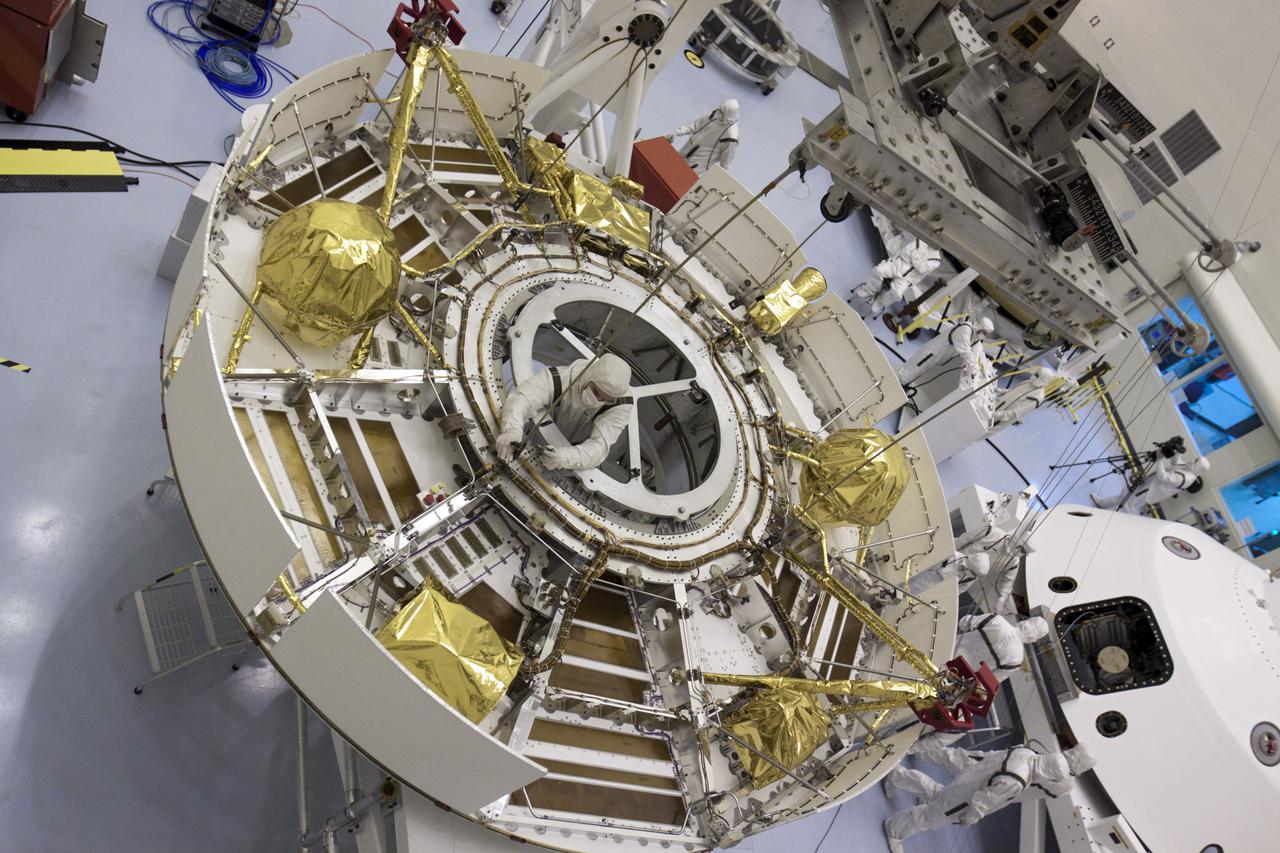
CAPE CANAVERAL, Fla. – In the Payload Hazardous Servicing Facility at NASA’s Kennedy Space Center in Florida, the camera captures a unique view of NASA's Mars Science Laboratory (MSL) mission as a technician separates the overhead crane from the cruise stage after it was lifted onto a rotation stand. The cruise stage provides solar power, thrusters for navigation, and heat exchangers to the rover during its flight from Earth to Mars. MSL's components include a car-sized rover, Curiosity, which has 10 science instruments designed to search for evidence on whether Mars has had environments favorable to microbial life, including chemical ingredients for life. The unique rover will use a laser to look inside rocks and release its gasses so that the rover’s spectrometer can analyze and send the data back to Earth. Launch of MSL aboard a United Launch Alliance Atlas V rocket is scheduled for Nov. 25 from Space Launch Complex 41 on Cape Canaveral Air Force Station in Florida. For more information, visit http:__www.nasa.gov_msl. Photo credit: NASA_Glenn Benson
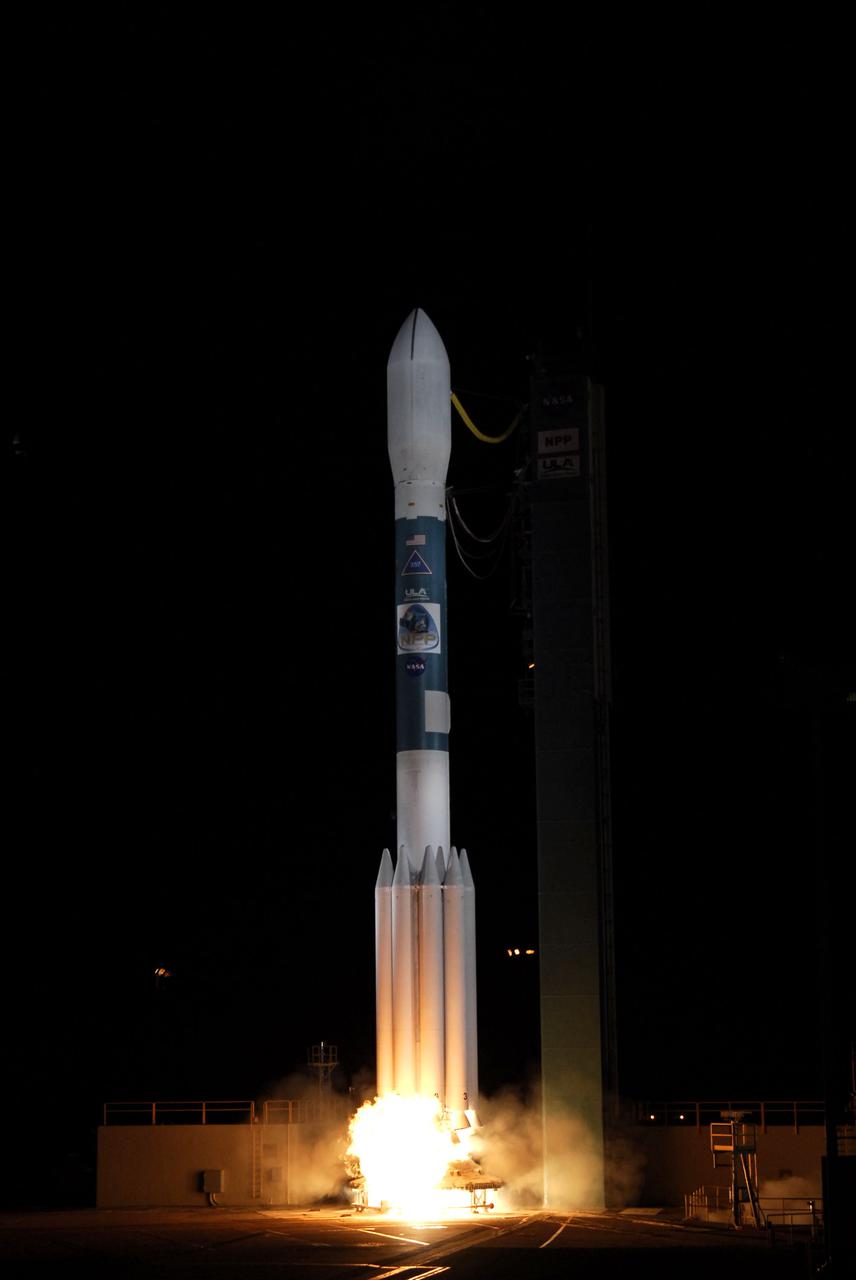
VANDENBERG AIR FORCE BASE, Calif. -- The ground begins to rumble at Space Launch Complex-2 on Vandenberg Air Force Base in California as the engines ignite beneath the United Launch Alliance Delta II rocket carrying NASA's National Polar-orbiting Operational Environmental Satellite System Preparatory Project (NPP) into space. Liftoff was at 2:48 a.m. PDT. NPP represents a critical first step in building the next-generation of Earth-observing satellites. NPP will carry the first of the new sensors developed for this satellite fleet, now known as the Joint Polar Satellite System (JPSS) to be launched in 2016. NPP is the bridge between NASA's Earth Observing System (EOS) satellites and the forthcoming series of JPSS satellites. The mission will test key technologies and instruments for the JPSS missions. For more information, visit http:__www.nasa.gov_NPP. Photo credit: NASA_Kim Shiflett
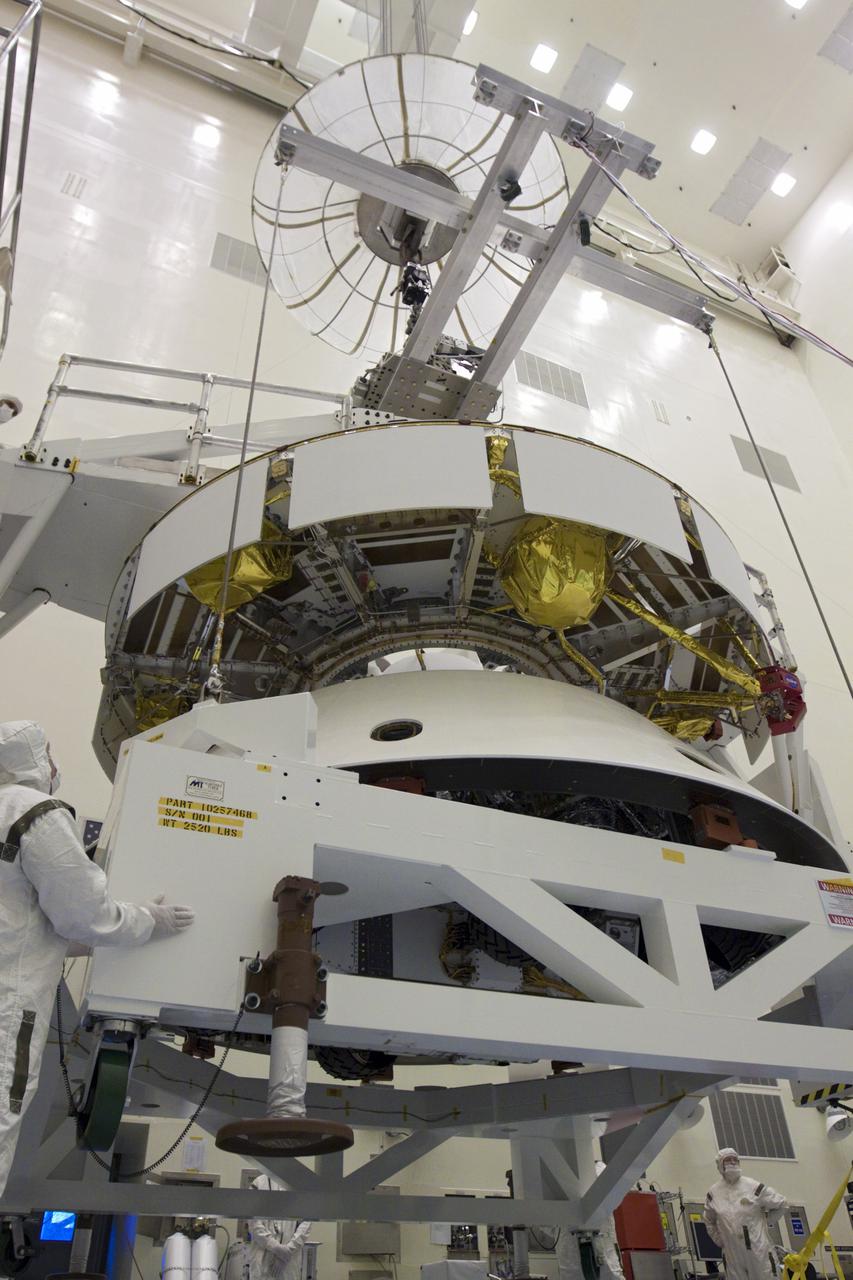
CAPE CANAVERAL, Fla. – In the Payload Hazardous Servicing Facility at NASA’s Kennedy Space Center in Florida, technicians, using an overhead crane, lift NASA's Mars Science Laboratory (MSL) mission aeroshell, (containing the compact car-sized rover Curiosity), for mating to the cruise stage. The cruise stage provides solar power, thrusters for navigation, and heat exchangers to the rover during its flight from Earth to Mars. The rover Curiosity has 10 science instruments designed to search for evidence on whether Mars has had environments favorable to microbial life, including chemical ingredients for life. The unique rover will use a laser to look inside rocks and release its gasses so that the rover’s spectrometer can analyze and send the data back to Earth. Launch of MSL aboard a United Launch Alliance Atlas V rocket is scheduled for Nov. 25 from Space Launch Complex 41 on Cape Canaveral Air Force Station in Florida. For more information, visit http:__www.nasa.gov_msl. Photo credit: NASA_Glenn Benson
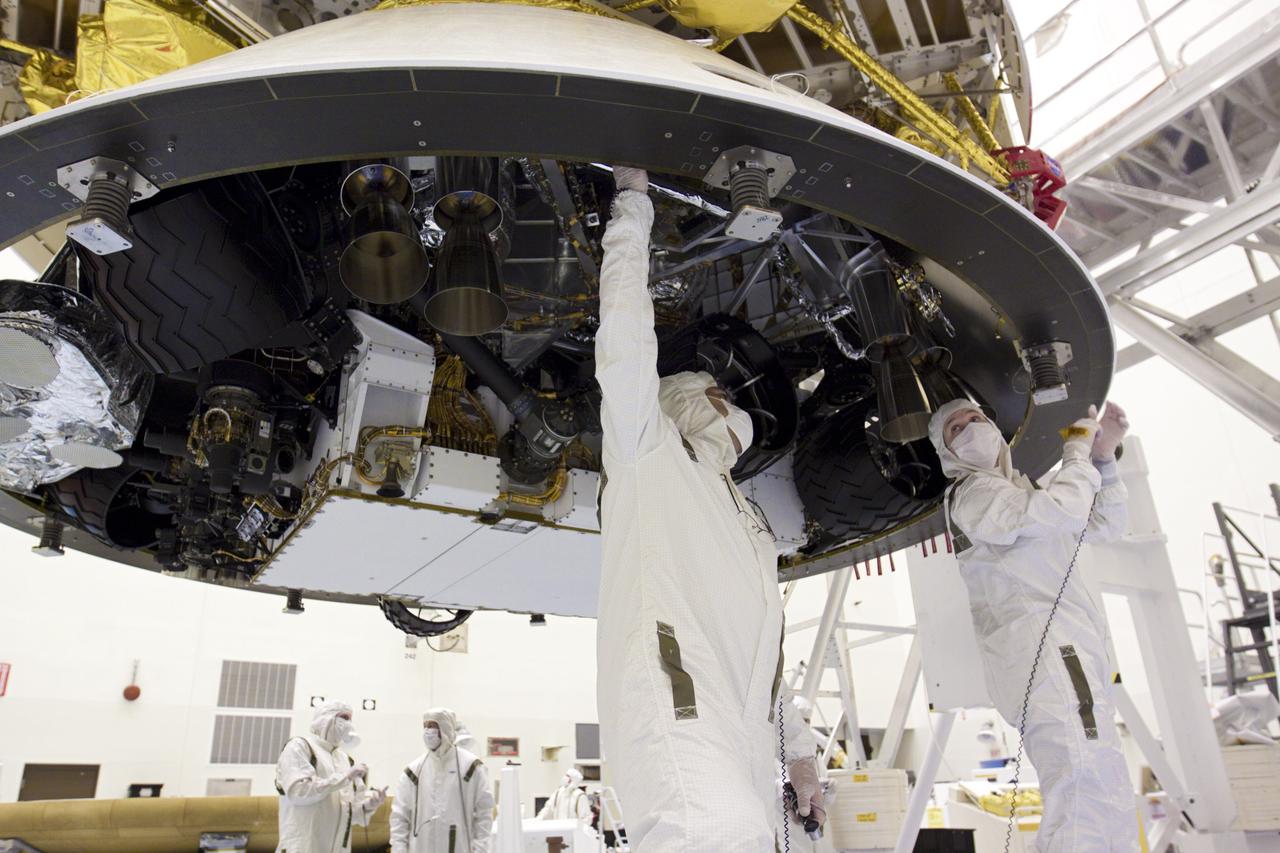
CAPE CANAVERAL, Fla. – In the Payload Hazardous Servicing Facility at NASA’s Kennedy Space Center in Florida, technicians work beneath NASA's Mars Science Laboratory (MSL) mission aeroshell, (containing the compact car-sized rover Curiosity), which has been mated to the cruise stage. The cruise stage provides solar power, thrusters for navigation, and heat exchangers to the rover during its flight from Earth to Mars. The rover Curiosity has 10 science instruments designed to search for evidence on whether Mars has had environments favorable to microbial life, including chemical ingredients for life. The unique rover will use a laser to look inside rocks and release its gasses so that the rover’s spectrometer can analyze and send the data back to Earth. Launch of MSL aboard a United Launch Alliance Atlas V rocket is scheduled for Nov. 25 from Space Launch Complex 41 on Cape Canaveral Air Force Station in Florida. For more information, visit http:__www.nasa.gov_msl. Photo credit: NASA_Glenn Benson
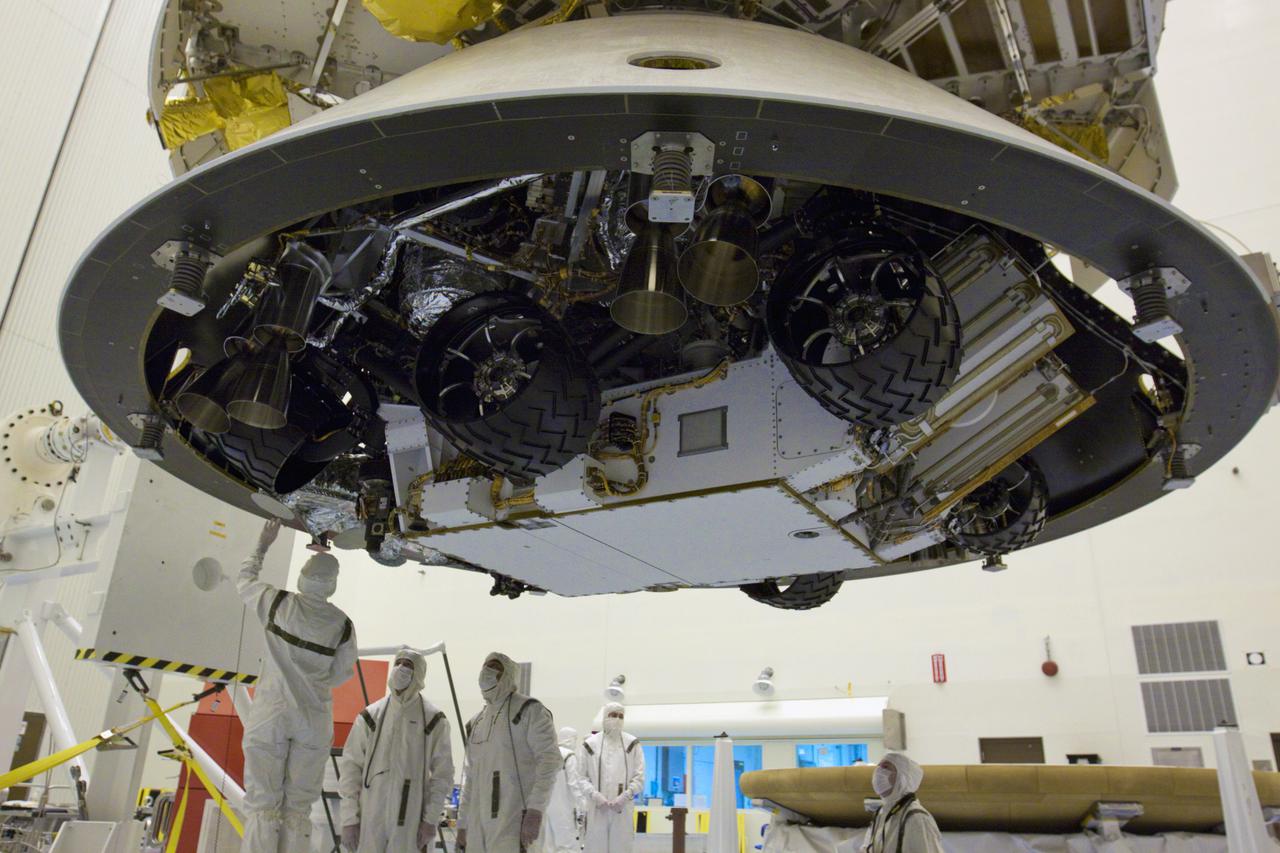
CAPE CANAVERAL, Fla. – In the Payload Hazardous Servicing Facility at NASA’s Kennedy Space Center in Florida, technicians work beneath NASA's Mars Science Laboratory (MSL) mission aeroshell, (containing the compact car-sized rover Curiosity), which has been mated to the cruise stage. The cruise stage provides solar power, thrusters for navigation, and heat exchangers to the rover during its flight from Earth to Mars. The rover Curiosity has 10 science instruments designed to search for evidence on whether Mars has had environments favorable to microbial life, including chemical ingredients for life. The unique rover will use a laser to look inside rocks and release its gasses so that the rover’s spectrometer can analyze and send the data back to Earth. Launch of MSL aboard a United Launch Alliance Atlas V rocket is scheduled for Nov. 25 from Space Launch Complex 41 on Cape Canaveral Air Force Station in Florida. For more information, visit http:__www.nasa.gov_msl. Photo credit: NASA_Glenn Benson
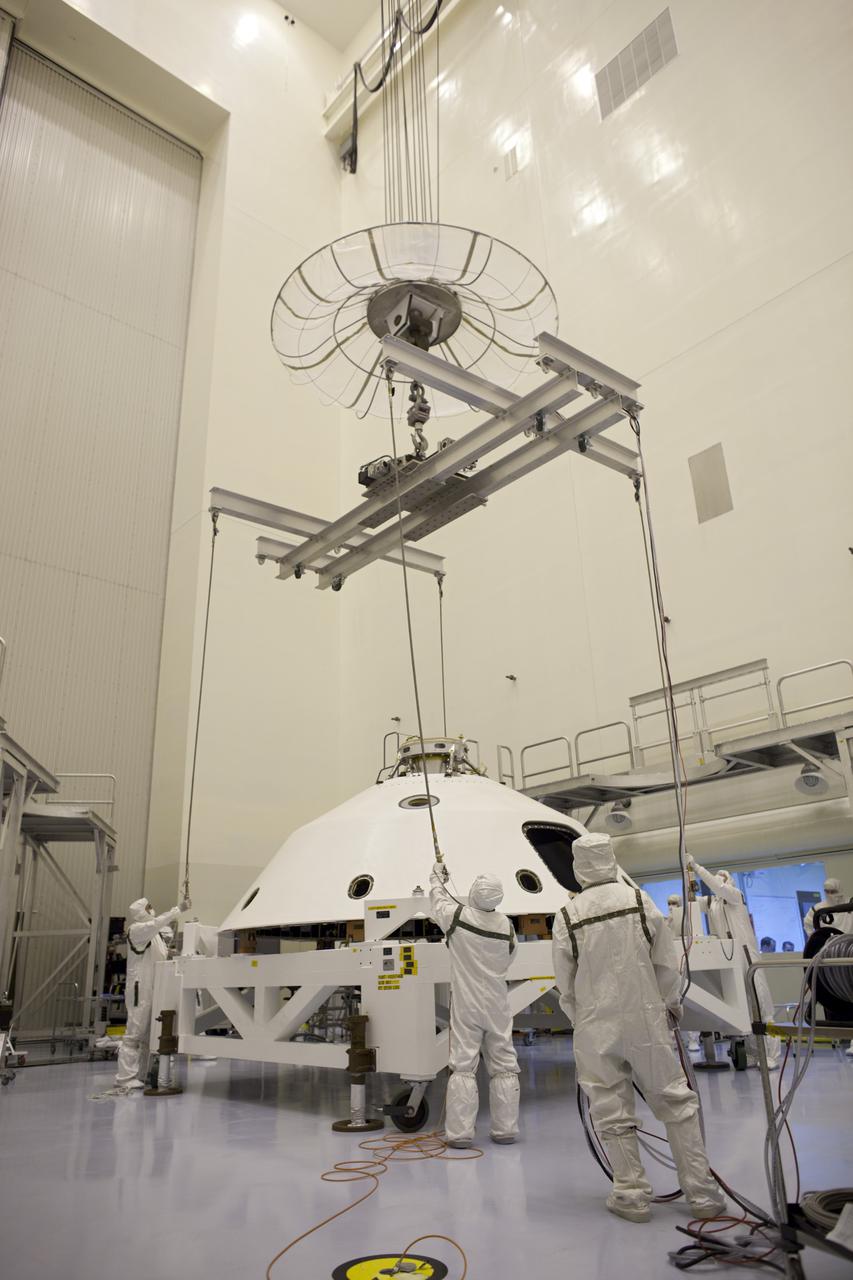
CAPE CANAVERAL, Fla. – In the Payload Hazardous Servicing Facility at NASA's Kennedy Space Center in Florida, technicians attach an overhead crane to the backshell for NASA's Mars Science Laboratory (MSL) rover, Curiosity. The backshell, a protective cover which carries the parachute and several components used during later stages of entry, descent and landing, will be encapsulated over the rover. A United Launch Alliance Atlas V-541 configuration will be used to loft MSL into space. MSL's components include a compact car-sized rover, Curiosity, which has 10 science instruments designed to search for evidence on whether Mars has had environments favorable to microbial life, including chemical ingredients for life. The unique rover will use a laser to look inside rocks and release its gasses so that the rover’s spectrometer can analyze and send the data back to Earth. MSL is scheduled to launch Nov. 25 with a window extending to Dec. 18 and arrival at Mars Aug. 2012. For more information, visit http:__www.nasa.gov_msl. Photo credit: NASA_Dimitri Gerondidakis
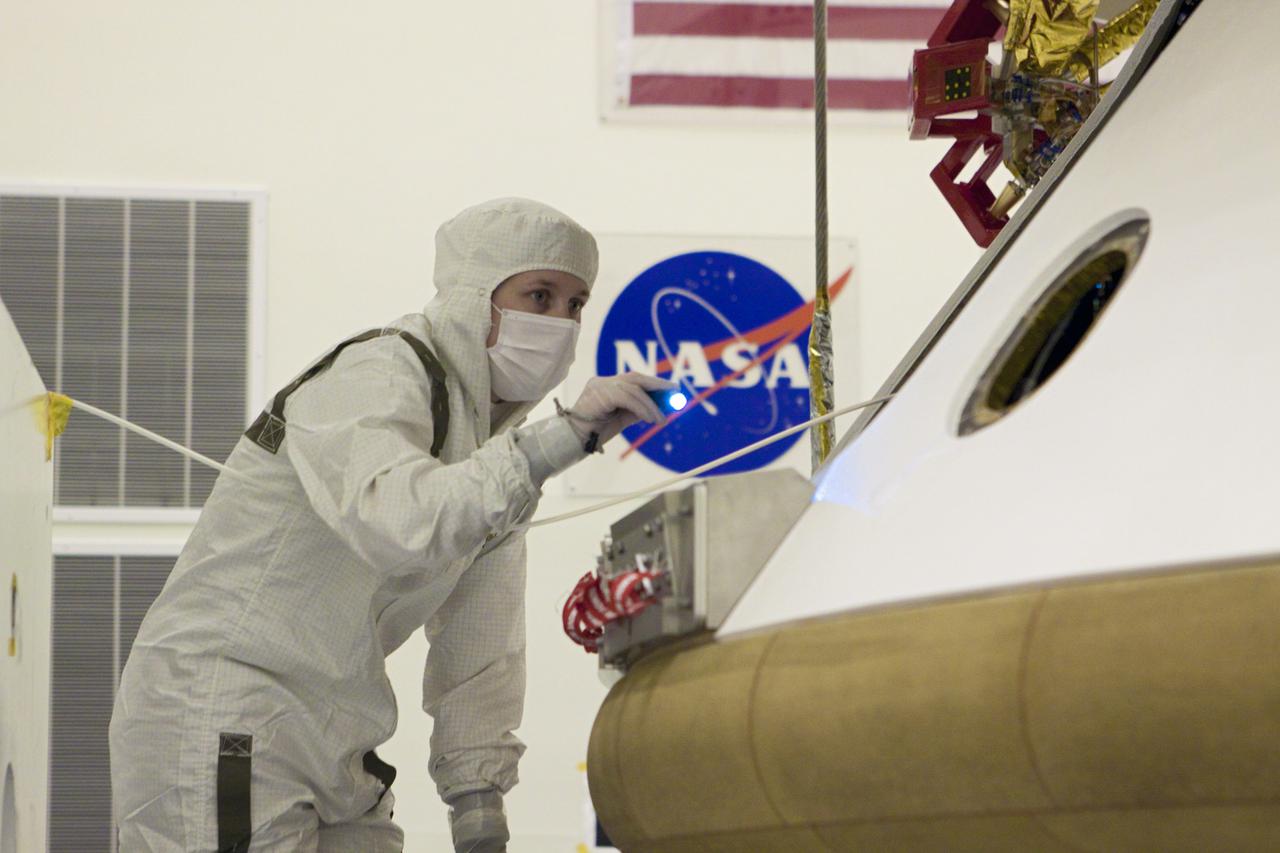
CAPE CANAVERAL, Fla. – In the Payload Hazardous Servicing Facility at NASA’s Kennedy Space Center in Florida, a technician inspects the alignment of the heat shield after integration with NASA's Mars Science Laboratory (MSL) mission aeroshell, (containing the compact car-sized rover Curiosity). Earlier, the aeroshell was mated to the cruise stage, which provides solar power, thrusters for navigation, and heat exchangers to the rover during its flight from Earth to Mars. The rover Curiosity has 10 science instruments designed to search for evidence on whether Mars has had environments favorable to microbial life, including chemical ingredients for life. The unique rover will use a laser to look inside rocks and release its gasses so that the rover’s spectrometer can analyze and send the data back to Earth. Launch of MSL aboard a United Launch Alliance Atlas V rocket is scheduled for Nov. 25 from Space Launch Complex 41 on Cape Canaveral Air Force Station in Florida. For more information, visit http:__www.nasa.gov_msl. Photo credit: NASA_Glenn Benson
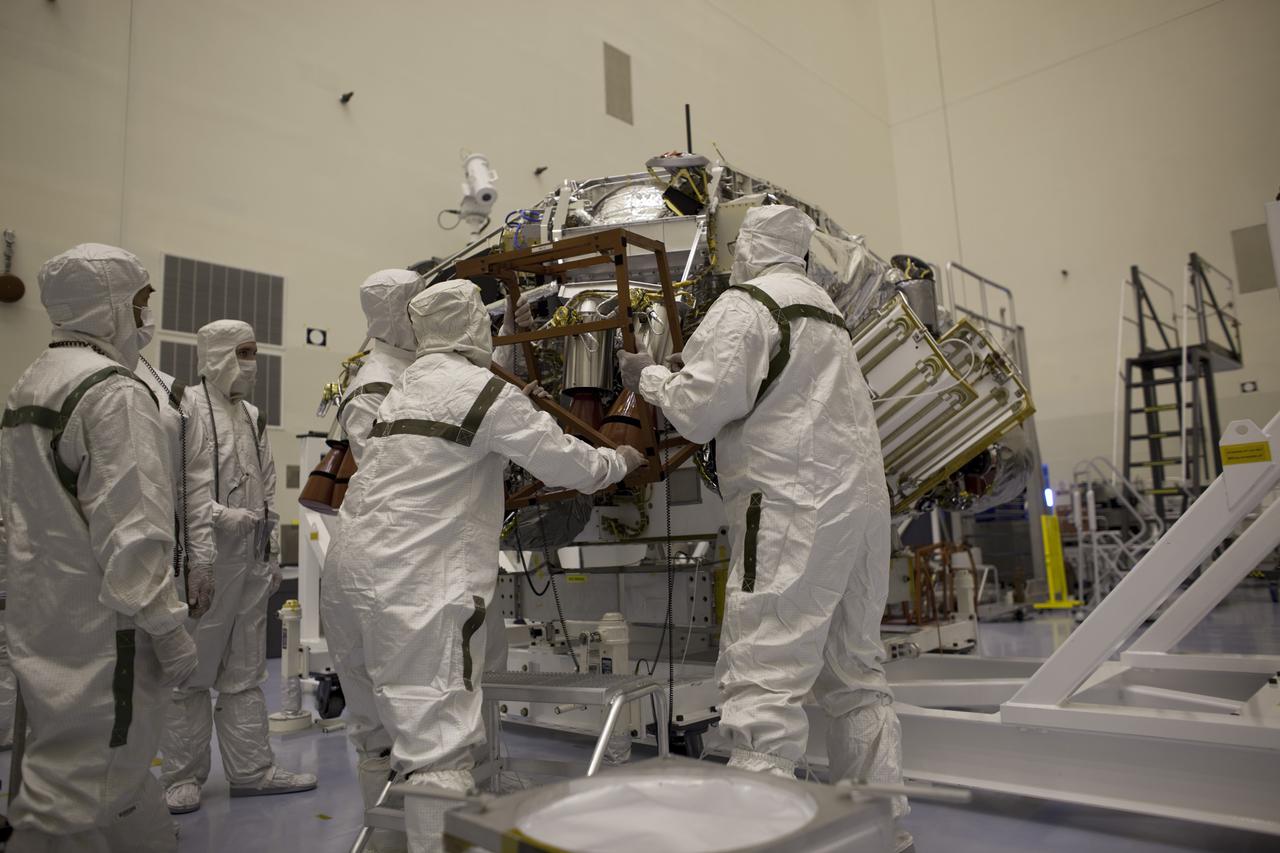
CAPE CANAVERAL, Fla. – In the Payload Hazardous Servicing Facility at NASA's Kennedy Space Center in Florida, technicians dressed in clean room attire, known as 'bunny' suits, prepare the Mars Science Laboratory (MSL) rover, Curiosity, for encapsulation inside a backshell by first removing the protective cage over the rockets on the descent stage. The spacecraft's backshell, a protective cover, carries the parachute and several components used during later stages of entry, descent and landing of the MSL's rover. A United Launch Alliance Atlas V-541 configuration will be used to loft MSL into space. MSL's components include a compact car-sized rover, Curiosity, which has 10 science instruments designed to search for evidence on whether Mars has had environments favorable to microbial life, including chemical ingredients for life. The unique rover will use a laser to look inside rocks and release its gasses so that the rover’s spectrometer can analyze and send the data back to Earth. MSL is scheduled to launch Nov. 25 with a window extending to Dec. 18 and arrival at Mars Aug. 2012. For more information, visit http:__www.nasa.gov_msl. Photo credit: NASA_Dimitri Gerondidakis
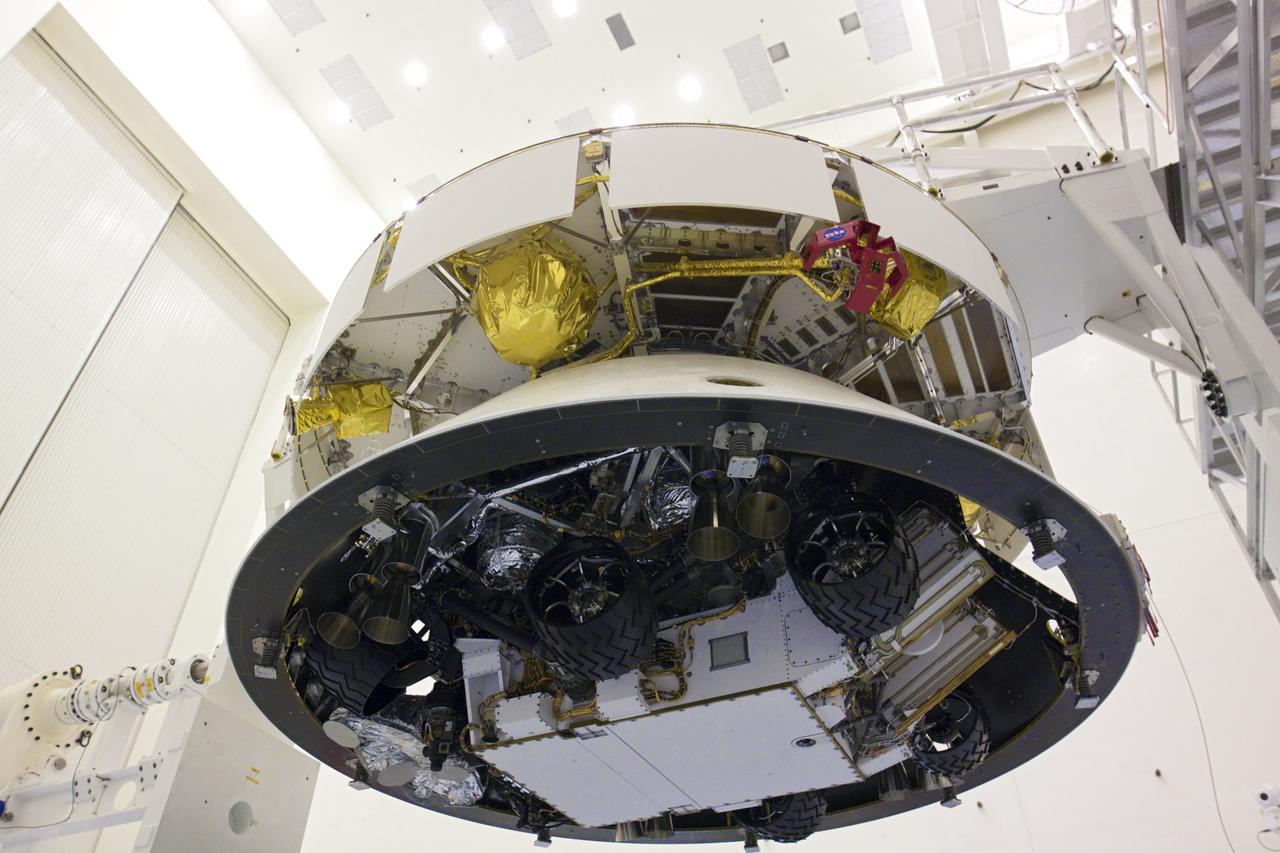
CAPE CANAVERAL, Fla. – In the Payload Hazardous Servicing Facility at NASA’s Kennedy Space Center in Florida, the camera captures a unique view of NASA's Mars Science Laboratory (MSL) mission aeroshell, (containing the compact car-sized rover Curiosity), which has been mated to the cruise stage. The cruise stage provides solar power, thrusters for navigation, and heat exchangers to the rover during its flight from Earth to Mars. The rover Curiosity has 10 science instruments designed to search for evidence on whether Mars has had environments favorable to microbial life, including chemical ingredients for life. The unique rover will use a laser to look inside rocks and release its gasses so that the rover’s spectrometer can analyze and send the data back to Earth. Launch of MSL aboard a United Launch Alliance Atlas V rocket is scheduled for Nov. 25 from Space Launch Complex 41 on Cape Canaveral Air Force Station in Florida. For more information, visit http:__www.nasa.gov_msl. Photo credit: NASA_Glenn Benson
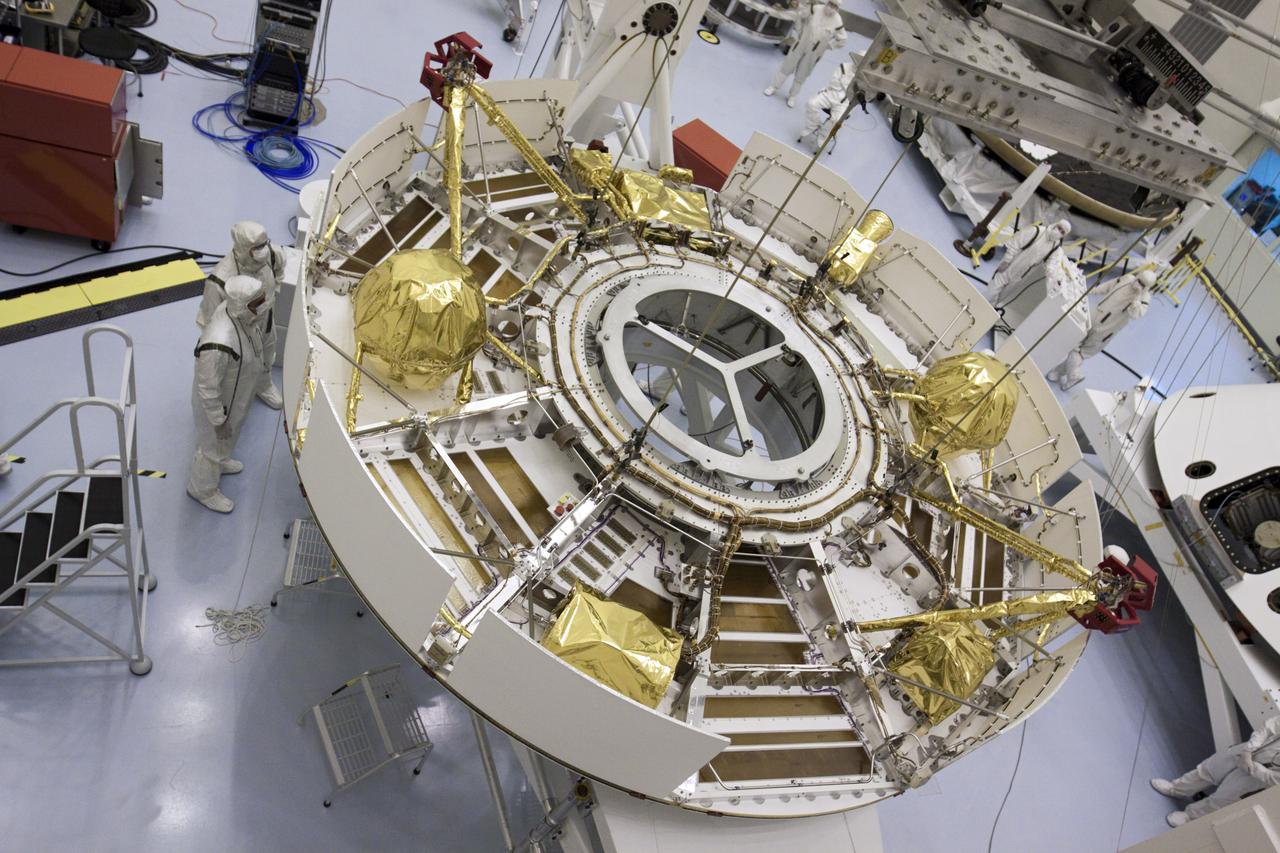
CAPE CANAVERAL, Fla. – In the Payload Hazardous Servicing Facility at NASA’s Kennedy Space Center in Florida, the camera captures a unique view of NASA's Mars Science Laboratory (MSL) mission cruise stage as technicians guide it onto a rotation stand using an overhead crane. The cruise stage provides solar power, thrusters for navigation, and heat exchangers to the rover during its flight from Earth to Mars. MSL's components include a car-sized rover, Curiosity, which has 10 science instruments designed to search for evidence on whether Mars has had environments favorable to microbial life, including chemical ingredients for life. The unique rover will use a laser to look inside rocks and release its gasses so that the rover’s spectrometer can analyze and send the data back to Earth. Launch of MSL aboard a United Launch Alliance Atlas V rocket is scheduled for Nov. 25 from Space Launch Complex 41 on Cape Canaveral Air Force Station in Florida. For more information, visit http:__www.nasa.gov_msl. Photo credit: NASA_Glenn Benson
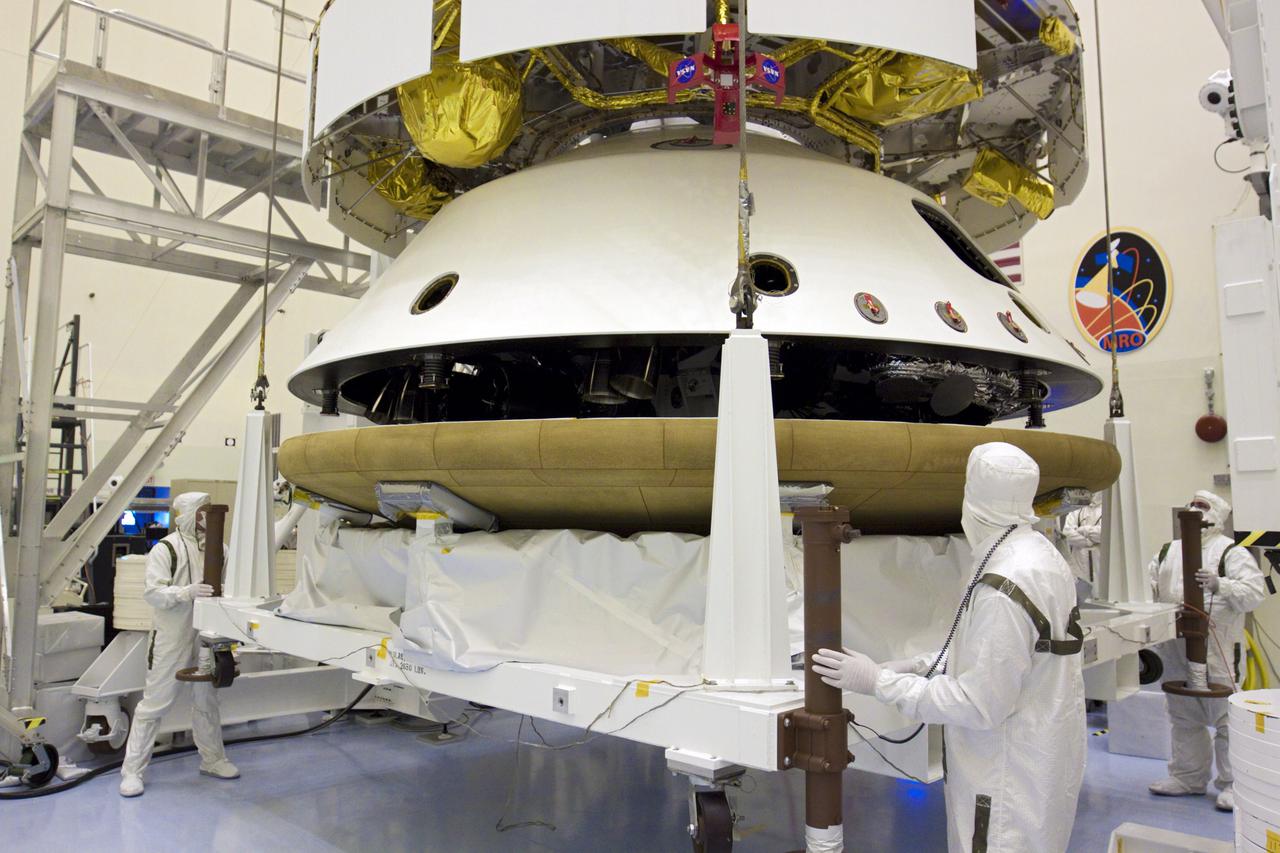
CAPE CANAVERAL, Fla. – In the Payload Hazardous Servicing Facility at NASA’s Kennedy Space Center in Florida, under the watchful eyes of technicians, an overhead crane lifts the heat shield for integration with NASA's Mars Science Laboratory (MSL) mission aeroshell, (containing the compact car-sized rover Curiosity). Earlier, the aeroshell was mated to the cruise stage, which provides solar power, thrusters for navigation, and heat exchangers to the rover during its flight from Earth to Mars. The rover Curiosity has 10 science instruments designed to search for evidence on whether Mars has had environments favorable to microbial life, including chemical ingredients for life. The unique rover will use a laser to look inside rocks and release its gasses so that the rover’s spectrometer can analyze and send the data back to Earth. Launch of MSL aboard a United Launch Alliance Atlas V rocket is scheduled for Nov. 25 from Space Launch Complex 41 on Cape Canaveral Air Force Station in Florida. For more information, visit http:__www.nasa.gov_msl. Photo credit: NASA_Glenn Benson
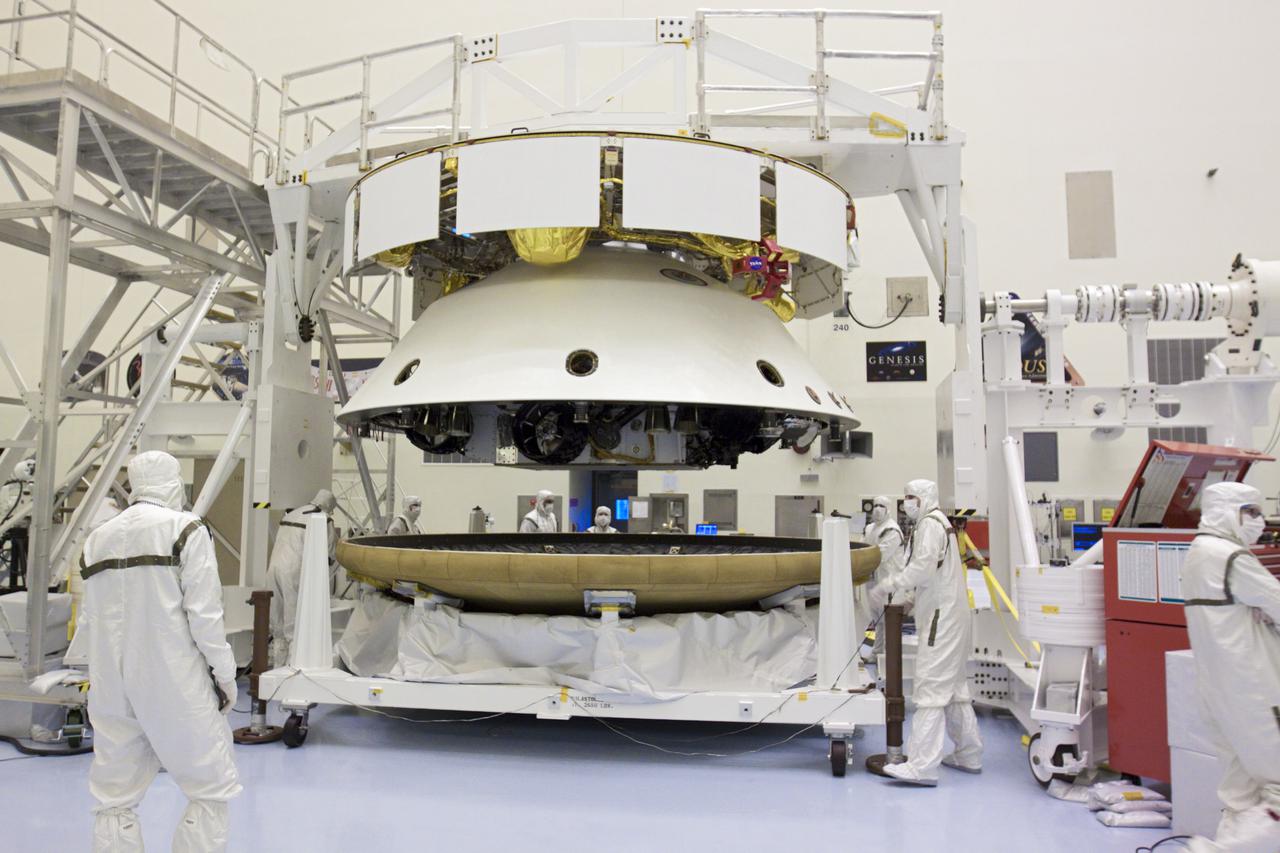
CAPE CANAVERAL, Fla. – In the Payload Hazardous Servicing Facility at NASA’s Kennedy Space Center in Florida, technicians prepare the heat shield for integration with NASA's Mars Science Laboratory (MSL) mission aeroshell, (containing the compact car-sized rover Curiosity). Earlier, the aeroshell was mated to the cruise stage, which provides solar power, thrusters for navigation, and heat exchangers to the rover during its flight from Earth to Mars. The rover Curiosity has 10 science instruments designed to search for evidence on whether Mars has had environments favorable to microbial life, including chemical ingredients for life. The unique rover will use a laser to look inside rocks and release its gasses so that the rover’s spectrometer can analyze and send the data back to Earth. Launch of MSL aboard a United Launch Alliance Atlas V rocket is scheduled for Nov. 25 from Space Launch Complex 41 on Cape Canaveral Air Force Station in Florida. For more information, visit http:__www.nasa.gov_msl. Photo credit: NASA_Glenn Benson
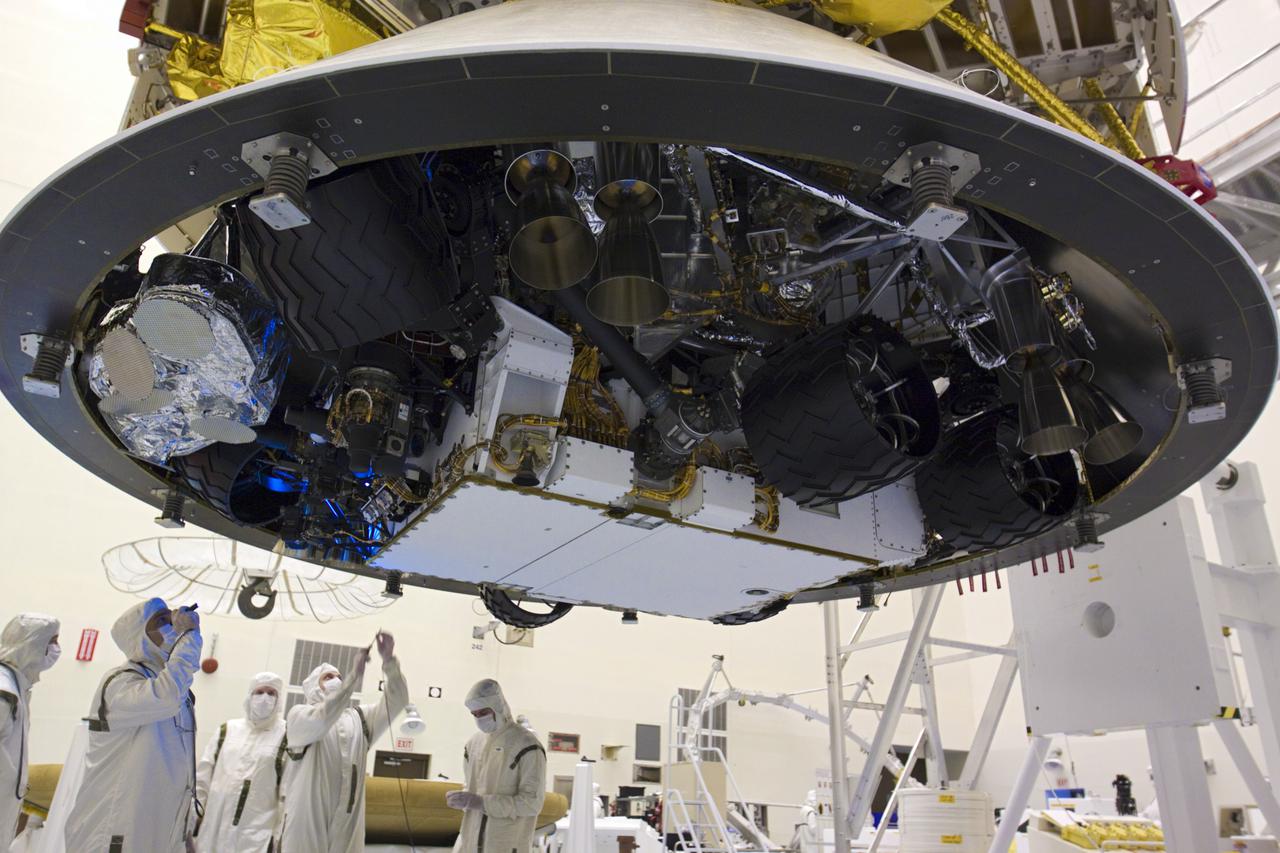
CAPE CANAVERAL, Fla. – In the Payload Hazardous Servicing Facility at NASA’s Kennedy Space Center in Florida, technicians inspect beneath NASA's Mars Science Laboratory (MSL) mission aeroshell, (containing the compact car-sized rover Curiosity), which has been mated to the cruise stage. The cruise stage provides solar power, thrusters for navigation, and heat exchangers to the rover during its flight from Earth to Mars. The rover Curiosity has 10 science instruments designed to search for evidence on whether Mars has had environments favorable to microbial life, including chemical ingredients for life. The unique rover will use a laser to look inside rocks and release its gasses so that the rover’s spectrometer can analyze and send the data back to Earth. Launch of MSL aboard a United Launch Alliance Atlas V rocket is scheduled for Nov. 25 from Space Launch Complex 41 on Cape Canaveral Air Force Station in Florida. For more information, visit http:__www.nasa.gov_msl. Photo credit: NASA_Glenn Benson
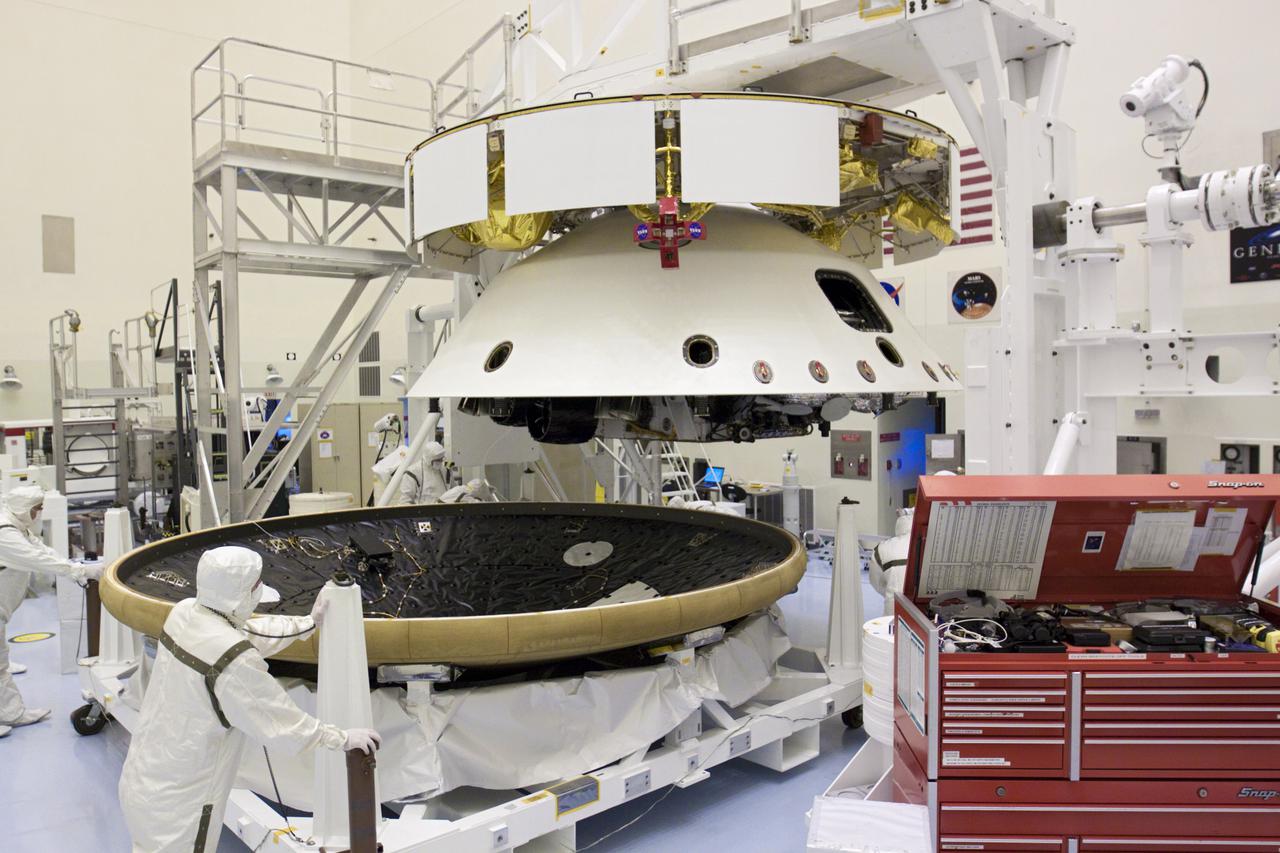
CAPE CANAVERAL, Fla. – In the Payload Hazardous Servicing Facility at NASA’s Kennedy Space Center in Florida, technicians roll the heat shield beneath NASA's Mars Science Laboratory (MSL) mission aeroshell, (containing the compact car-sized rover Curiosity), for integration. Earlier, the aeroshell was mated to the cruise stage, which provides solar power, thrusters for navigation, and heat exchangers to the rover during its flight from Earth to Mars. The rover Curiosity has 10 science instruments designed to search for evidence on whether Mars has had environments favorable to microbial life, including chemical ingredients for life. The unique rover will use a laser to look inside rocks and release its gasses so that the rover’s spectrometer can analyze and send the data back to Earth. Launch of MSL aboard a United Launch Alliance Atlas V rocket is scheduled for Nov. 25 from Space Launch Complex 41 on Cape Canaveral Air Force Station in Florida. For more information, visit http:__www.nasa.gov_msl. Photo credit: NASA_Glenn Benson
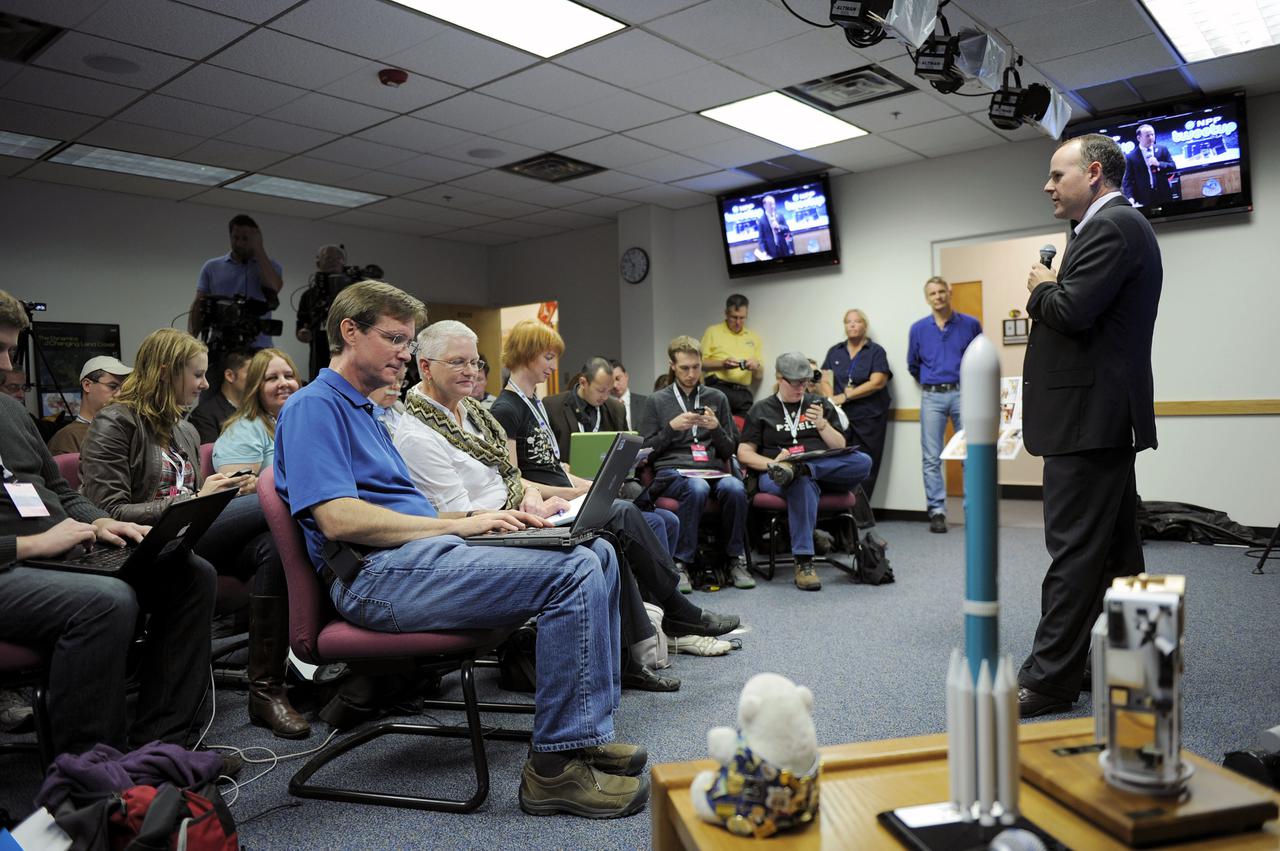
VANDENBERG AIR FORCE BASE, Calif. – A speaker talks with a group of Tweetup participants at Vandenberg Air Force Base in California during prelaunch activities for NASA’s National Polar-orbiting Operational Environmental Satellite System Preparatory Project (NPP) spacecraft mission. The tweeters will share their experiences with followers through the social networking site Twitter. NPP represents a critical first step in building the next-generation of Earth-observing satellites. NPP will carry the first of the new sensors developed for this satellite fleet, now known as the Joint Polar Satellite System (JPSS) to be launched in 2016. NPP is the bridge between NASA's Earth Observing System (EOS) satellites and the forthcoming series of JPSS satellites. The mission will test key technologies and instruments for the JPSS missions. NPP is targeted to launch Oct. 28 from Space Launch Complex-2 aboard a United Launch Alliance Delta II rocket. For more information, visit http:__www.nasa.gov_NPP. Photo credit: NASA_Kim Shiflett
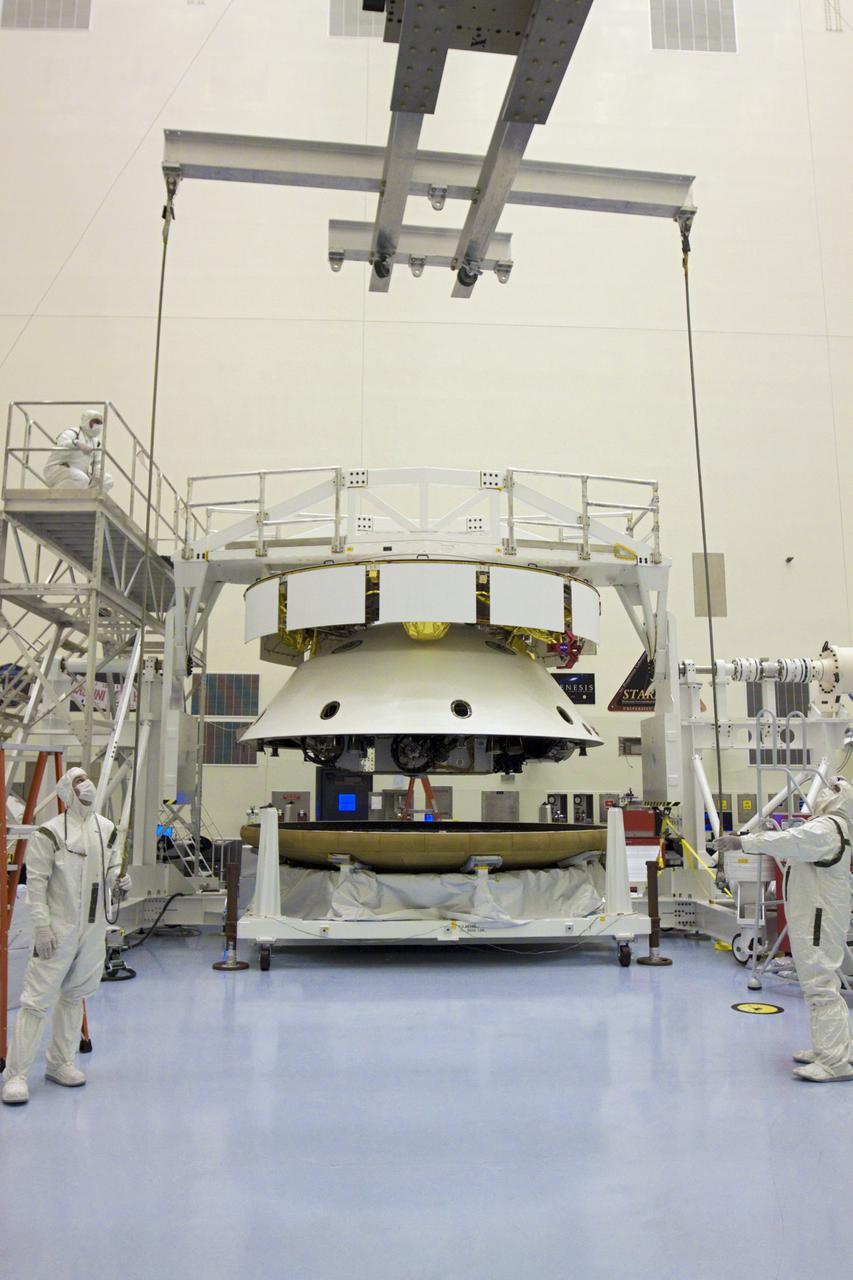
CAPE CANAVERAL, Fla. – In the Payload Hazardous Servicing Facility at NASA’s Kennedy Space Center in Florida, technicians prepare to attach an overhead crane to the heat shield in preparation for integration with NASA's Mars Science Laboratory (MSL) mission aeroshell, (containing the compact car-sized rover Curiosity). Earlier, the aeroshell was mated to the cruise stage, which provides solar power, thrusters for navigation, and heat exchangers to the rover during its flight from Earth to Mars. The rover Curiosity has 10 science instruments designed to search for evidence on whether Mars has had environments favorable to microbial life, including chemical ingredients for life. The unique rover will use a laser to look inside rocks and release its gasses so that the rover’s spectrometer can analyze and send the data back to Earth. Launch of MSL aboard a United Launch Alliance Atlas V rocket is scheduled for Nov. 25 from Space Launch Complex 41 on Cape Canaveral Air Force Station in Florida. For more information, visit http:__www.nasa.gov_msl. Photo credit: NASA_Glenn Benson
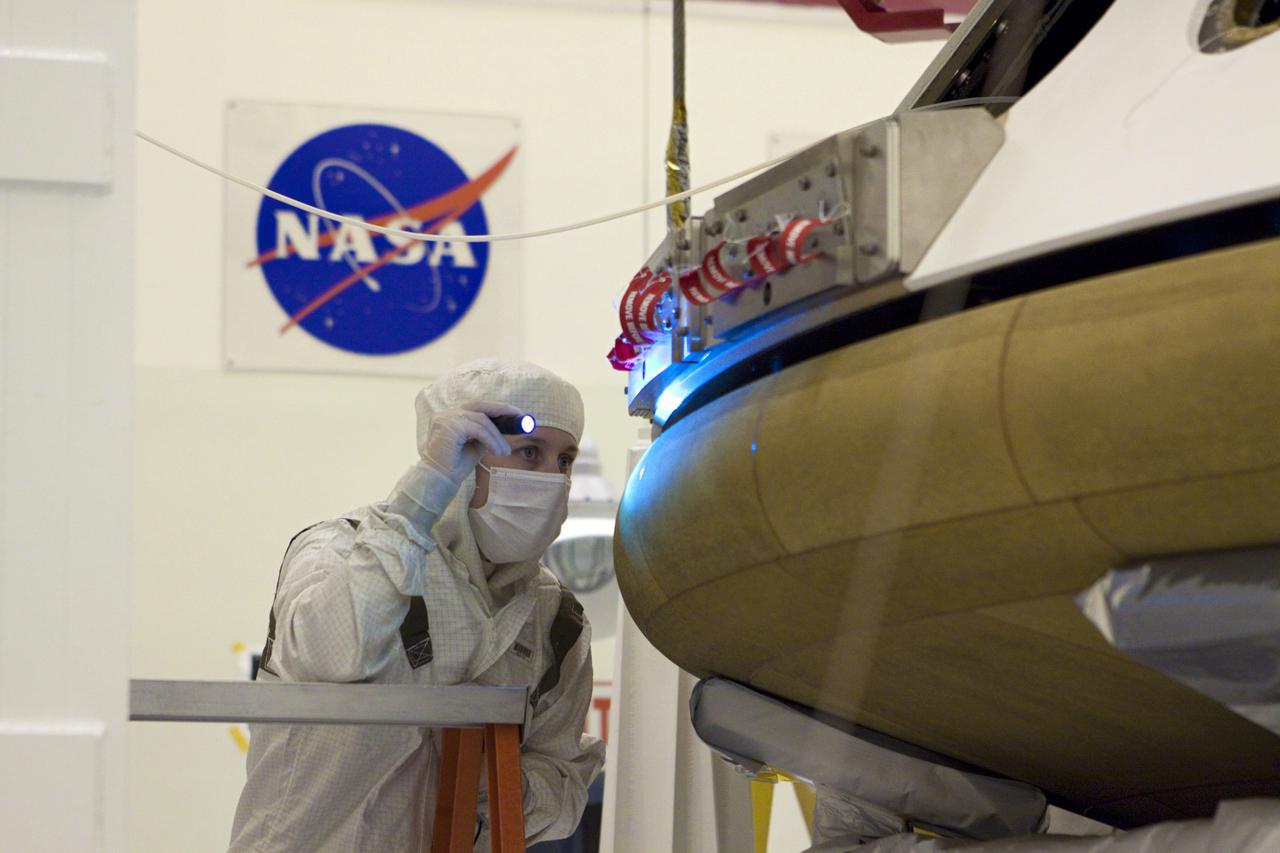
CAPE CANAVERAL, Fla. – In the Payload Hazardous Servicing Facility at NASA’s Kennedy Space Center in Florida, a technician inspects the alignment of the heat shield as an overhead crane lifts it for integration with NASA's Mars Science Laboratory (MSL) mission aeroshell, (containing the compact car-sized rover Curiosity). Earlier, the aeroshell was mated to the cruise stage, which provides solar power, thrusters for navigation, and heat exchangers to the rover during its flight from Earth to Mars. The rover Curiosity has 10 science instruments designed to search for evidence on whether Mars has had environments favorable to microbial life, including chemical ingredients for life. The unique rover will use a laser to look inside rocks and release its gasses so that the rover’s spectrometer can analyze and send the data back to Earth. Launch of MSL aboard a United Launch Alliance Atlas V rocket is scheduled for Nov. 25 from Space Launch Complex 41 on Cape Canaveral Air Force Station in Florida. For more information, visit http:__www.nasa.gov_msl. Photo credit: NASA_Glenn Benson
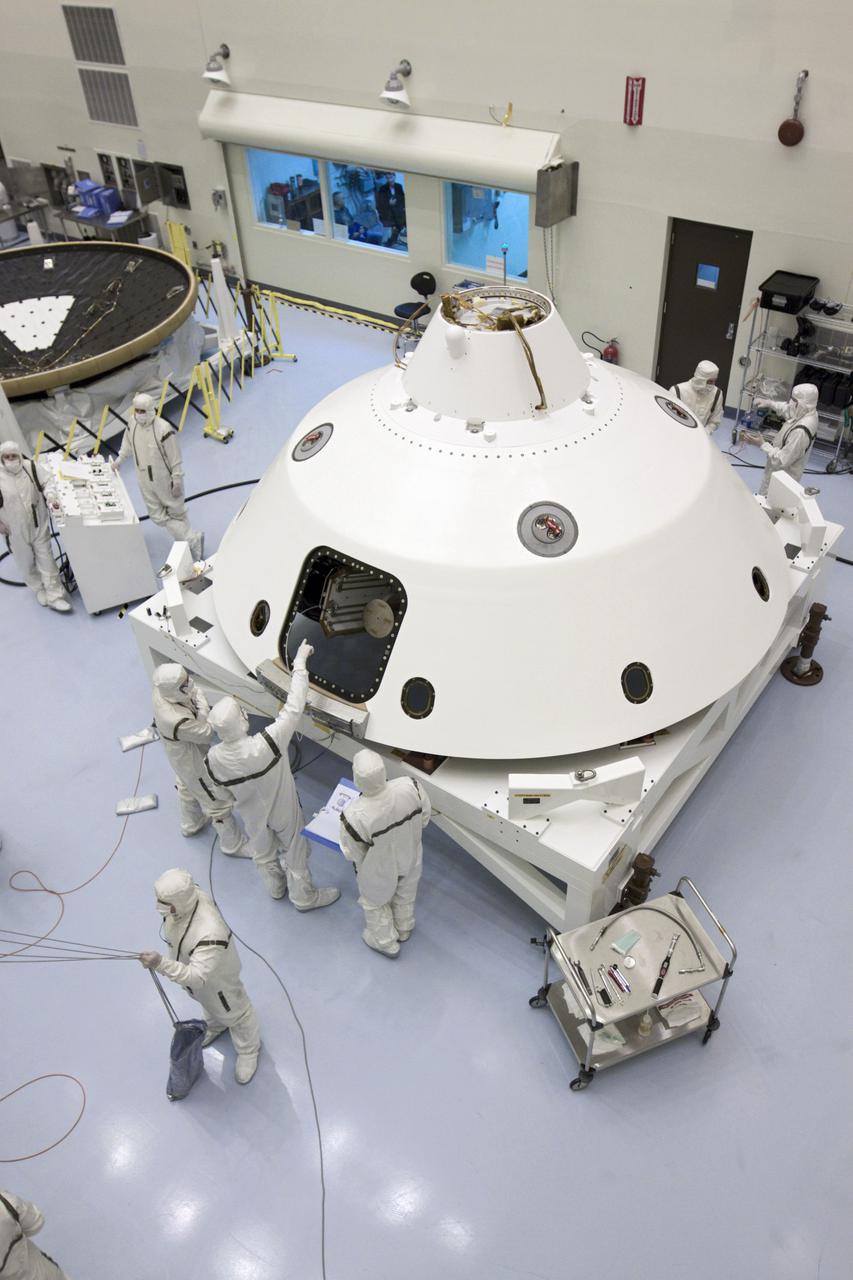
CAPE CANAVERAL, Fla. – In the Payload Hazardous Servicing Facility at NASA’s Kennedy Space Center in Florida, technicians stand next to NASA's Mars Science Laboratory (MSL) mission aeroshell as, in the foreground, a technician guides the cruise stage onto a rotation stand. The cruise stage provides solar power, thrusters for navigation, and heat exchangers to the rover during its flight from Earth to Mars. To the back left is the MSL heat shield. MSL's components include a car-sized rover, Curiosity, which has 10 science instruments designed to search for evidence on whether Mars has had environments favorable to microbial life, including chemical ingredients for life. The unique rover will use a laser to look inside rocks and release its gasses so that the rover’s spectrometer can analyze and send the data back to Earth. Launch of MSL aboard a United Launch Alliance Atlas V rocket is scheduled for Nov. 25 from Space Launch Complex 41 on Cape Canaveral Air Force Station in Florida. For more information, visit http:__www.nasa.gov_msl. Photo credit: NASA_Glenn Benson
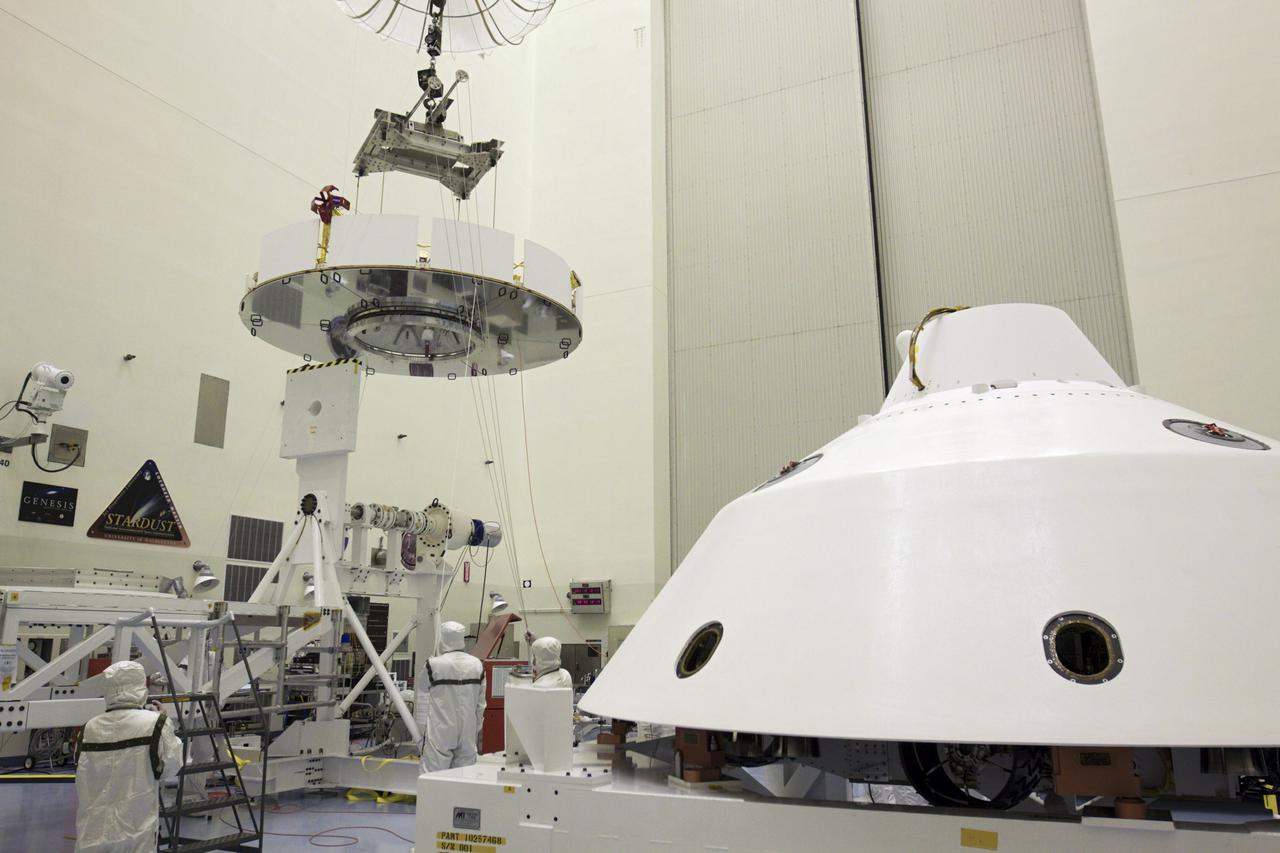
CAPE CANAVERAL, Fla. – In the Payload Hazardous Servicing Facility at NASA’s Kennedy Space Center in Florida, technicians, using an overhead crane, guide NASA's Mars Science Laboratory (MSL) mission cruise stage over a rotation stand. The cruise stage provides solar power, thrusters for navigation, and heat exchangers to the rover during its flight from Earth to Mars. To the right is the MSL aeroshell. MSL's components include a car-sized rover, Curiosity, which has 10 science instruments designed to search for evidence on whether Mars has had environments favorable to microbial life, including chemical ingredients for life. The unique rover will use a laser to look inside rocks and release its gasses so that the rover’s spectrometer can analyze and send the data back to Earth. Launch of MSL aboard a United Launch Alliance Atlas V rocket is scheduled for Nov. 25 from Space Launch Complex 41 on Cape Canaveral Air Force Station in Florida. For more information, visit http:__www.nasa.gov_msl. Photo credit: NASA_Glenn Benson
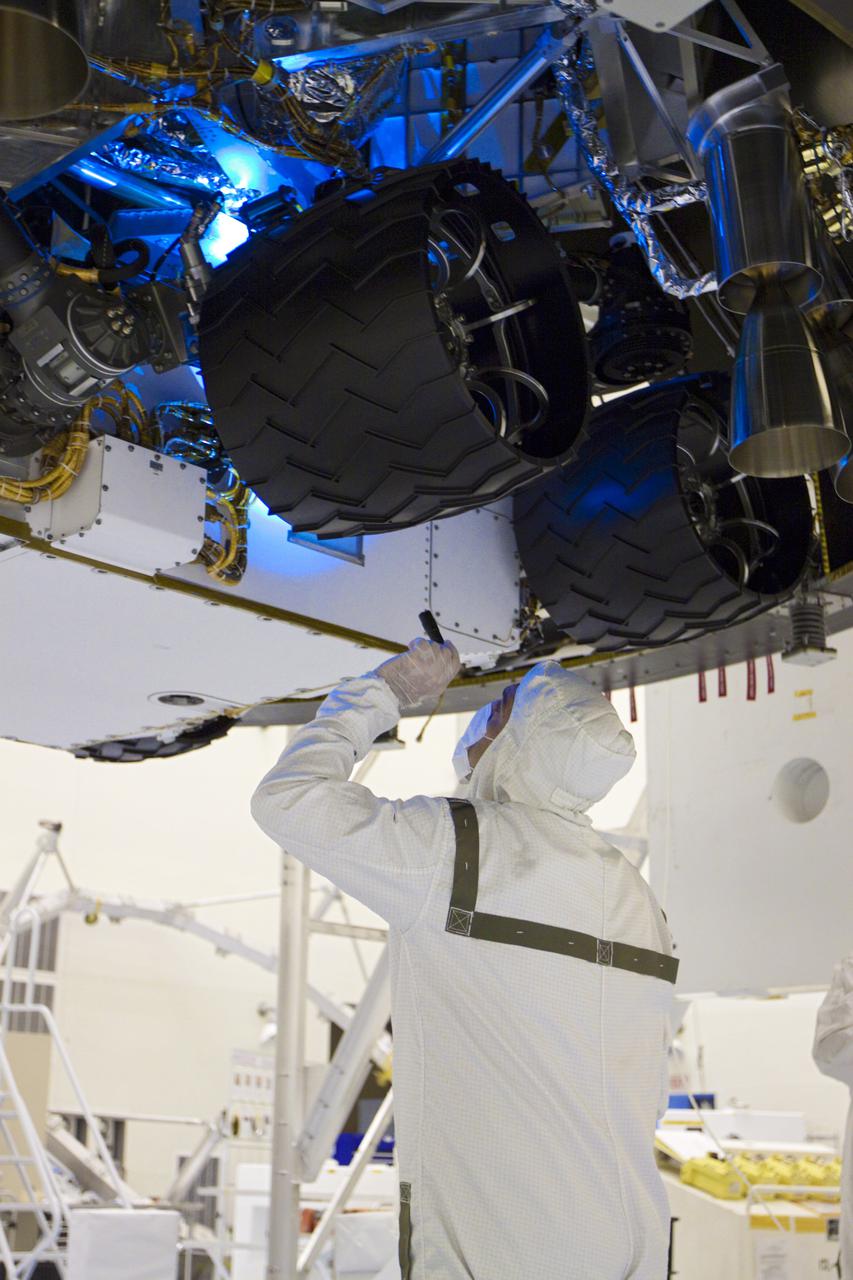
CAPE CANAVERAL, Fla. – In the Payload Hazardous Servicing Facility at NASA’s Kennedy Space Center in Florida, a technician inspects beneath NASA's Mars Science Laboratory (MSL) mission aeroshell, (containing the compact car-sized rover Curiosity), which has been mated to the cruise stage. The cruise stage provides solar power, thrusters for navigation, and heat exchangers to the rover during its flight from Earth to Mars. The rover Curiosity has 10 science instruments designed to search for evidence on whether Mars has had environments favorable to microbial life, including chemical ingredients for life. The unique rover will use a laser to look inside rocks and release its gasses so that the rover’s spectrometer can analyze and send the data back to Earth. Launch of MSL aboard a United Launch Alliance Atlas V rocket is scheduled for Nov. 25 from Space Launch Complex 41 on Cape Canaveral Air Force Station in Florida. For more information, visit http:__www.nasa.gov_msl. Photo credit: NASA_Glenn Benson
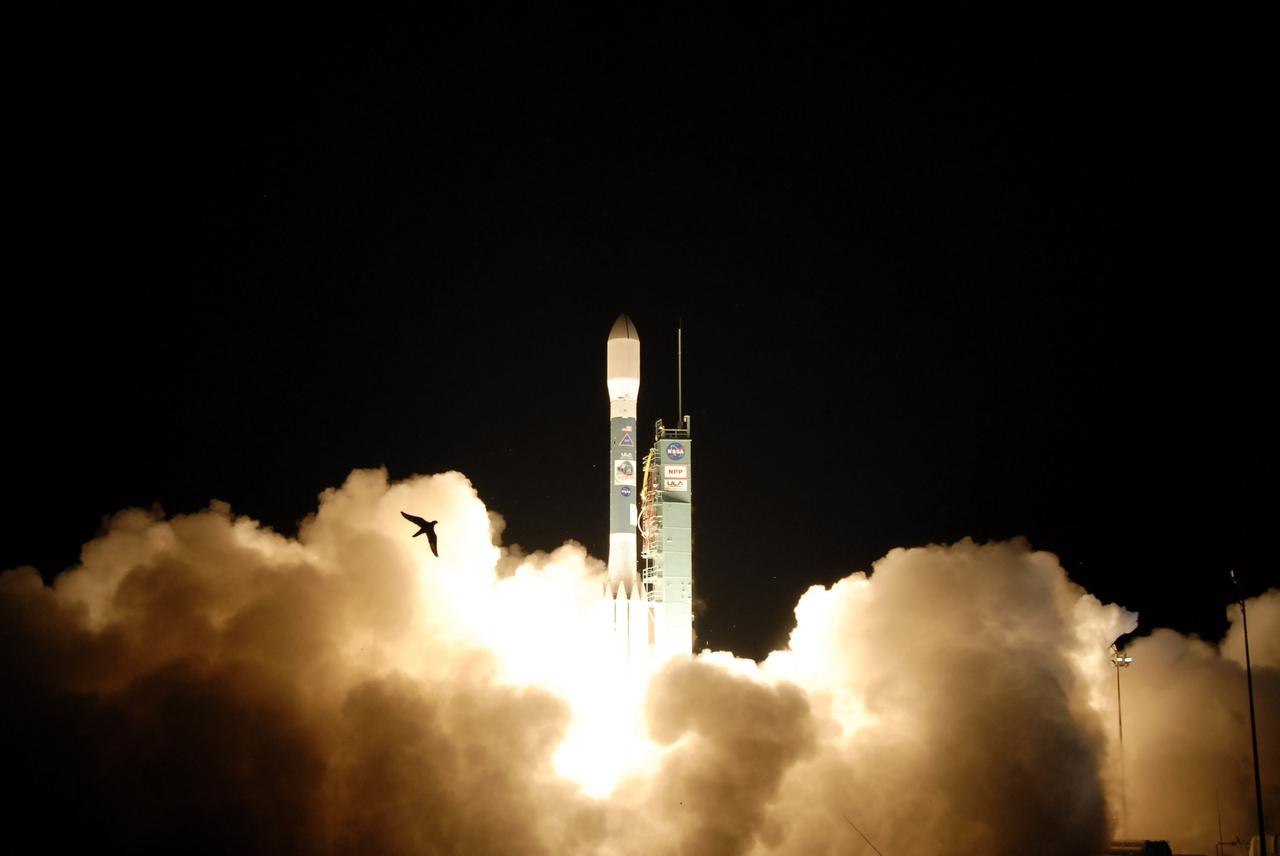
VANDENBERG AIR FORCE BASE, Calif. -- A bird soars away from Space Launch Complex-2 on Vandenberg Air Force Base in California as the United Launch Alliance Delta II rocket carrying NASA's National Polar-orbiting Operational Environmental Satellite System Preparatory Project (NPP) lifts off the pad. Launch was at 2:48 a.m. PDT. NPP represents a critical first step in building the next-generation of Earth-observing satellites. NPP will carry the first of the new sensors developed for this satellite fleet, now known as the Joint Polar Satellite System (JPSS) to be launched in 2016. NPP is the bridge between NASA's Earth Observing System (EOS) satellites and the forthcoming series of JPSS satellites. The mission will test key technologies and instruments for the JPSS missions. For more information, visit http:__www.nasa.gov_NPP. Photo credit: NASA_Kim Shiflett
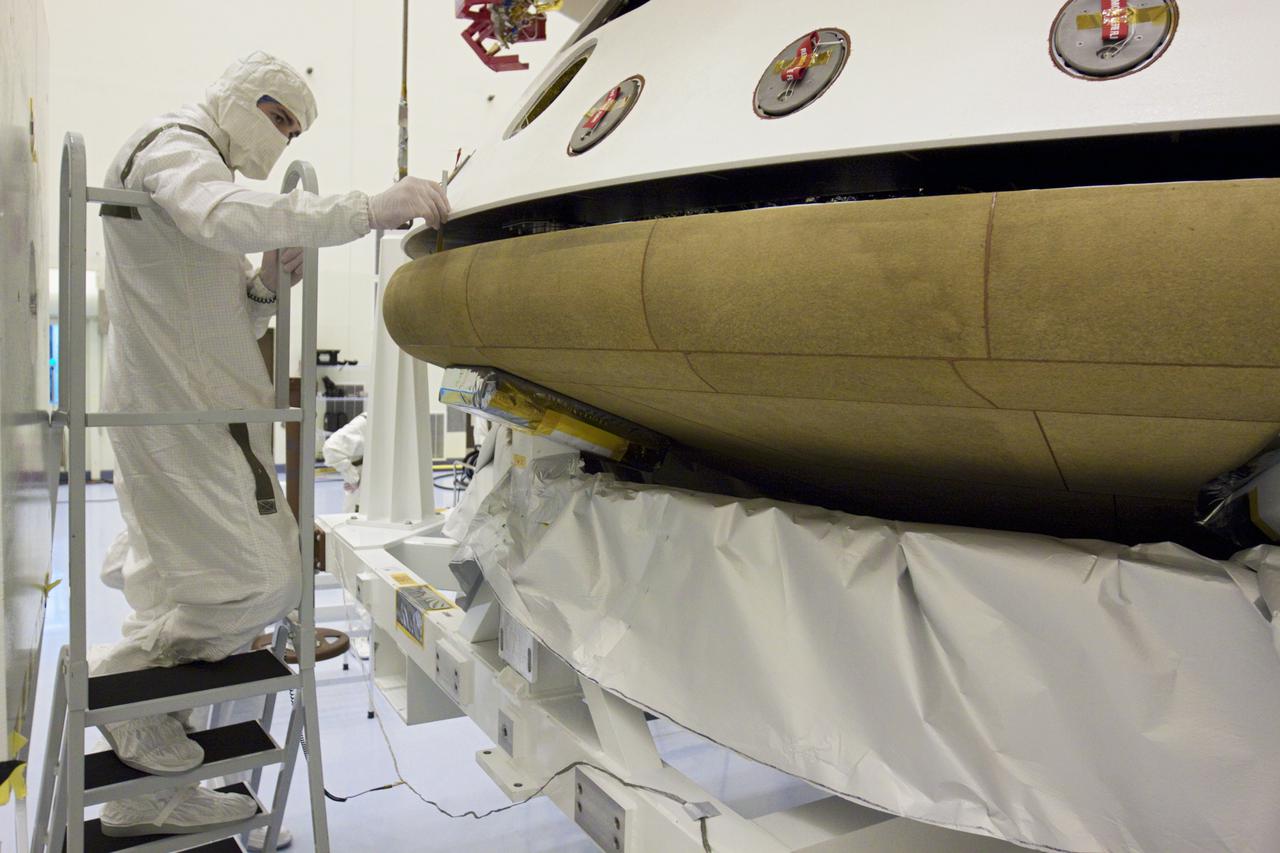
CAPE CANAVERAL, Fla. – In the Payload Hazardous Servicing Facility at NASA’s Kennedy Space Center in Florida, a technician inspects the alignment of the heat shield as an overhead crane lifts it for integration with NASA's Mars Science Laboratory (MSL) mission aeroshell, (containing the compact car-sized rover Curiosity). Earlier, the aeroshell was mated to the cruise stage, which provides solar power, thrusters for navigation, and heat exchangers to the rover during its flight from Earth to Mars. The rover Curiosity has 10 science instruments designed to search for evidence on whether Mars has had environments favorable to microbial life, including chemical ingredients for life. The unique rover will use a laser to look inside rocks and release its gasses so that the rover’s spectrometer can analyze and send the data back to Earth. Launch of MSL aboard a United Launch Alliance Atlas V rocket is scheduled for Nov. 25 from Space Launch Complex 41 on Cape Canaveral Air Force Station in Florida. For more information, visit http:__www.nasa.gov_msl. Photo credit: NASA_Glenn Benson
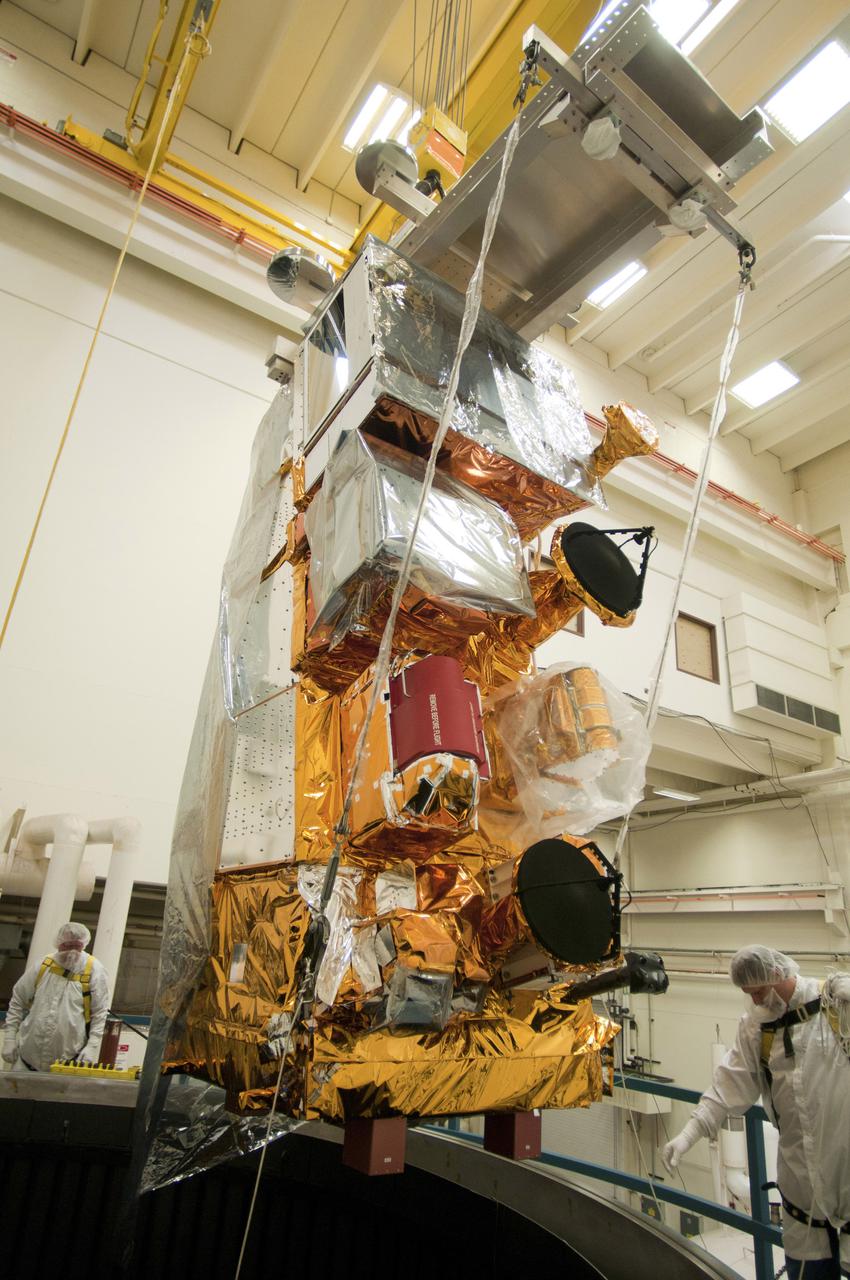
BALL AEROSPACE, Boulder, Colo. – In a cleanroom at Ball Aerospace and Technologies Corp., NASA's National Polar-orbiting Operational Environmental Satellite System Preparatory Project (NPP) satellite, with all systems integrated, is being lowered by technicians into a thermal vacuum chamber for testing. A United Launch Alliance Delta II rocket will carry NPP into space. NPP represents a critical first step in building the next-generation of Earth-observing satellites. NPP will carry the first of the new sensors developed for this satellite fleet, now known as the Joint Polar Satellite System (JPSS) to be launched in 2016. NPP is the bridge between NASA's Earth Observing System (EOS) satellites and the forthcoming series of JPSS satellites. The mission will test key technologies and instruments for the JPSS missions. NPP is targeted to launch Oct. 27. For more information, visit http:__www.nasa.gov_NPP. Photo credit: Ball Aerospace
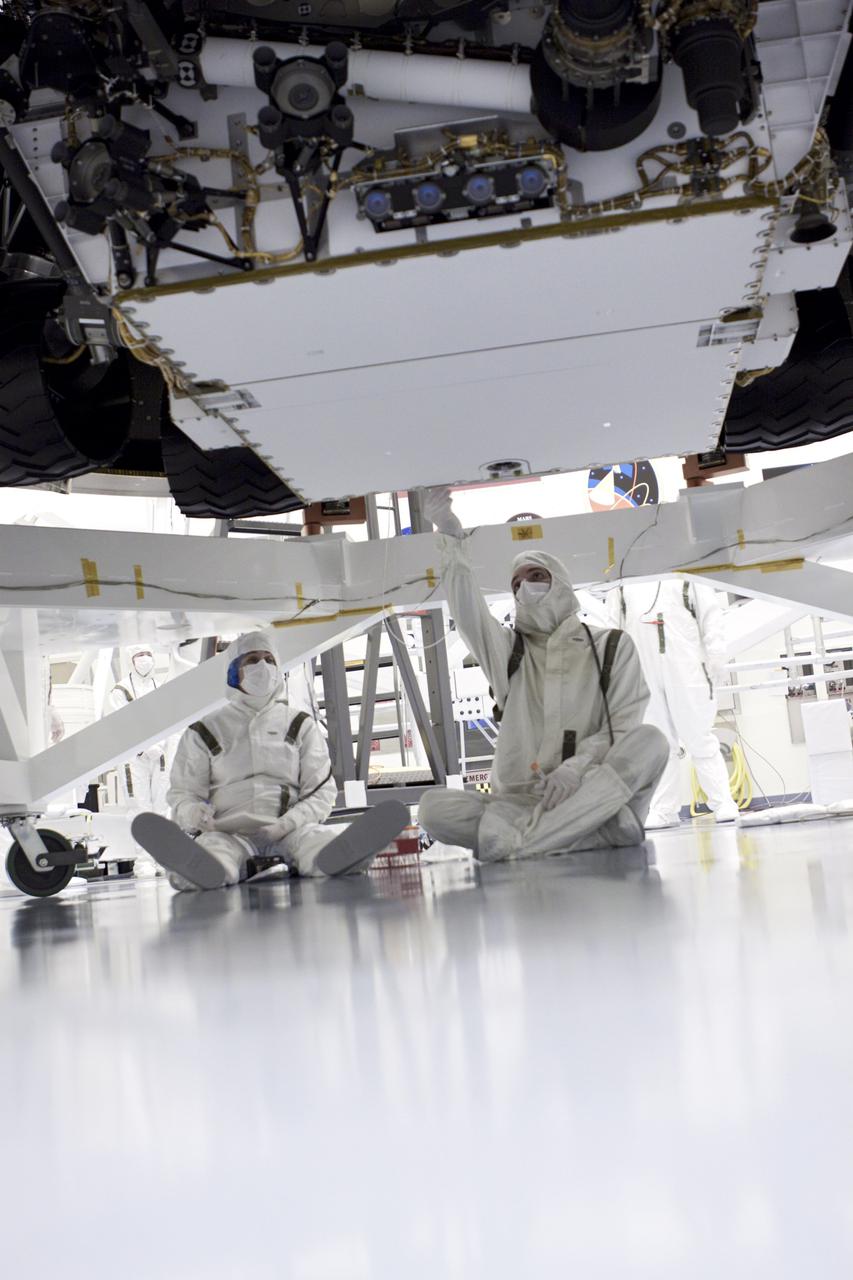
CAPE CANAVERAL, Fla. – In the Payload Hazardous Servicing Facility at NASA’s Kennedy Space Center in Florida, technicians inspect under NASA's Mars Science Laboratory (MSL) mission aeroshell, where the wheels of the rover Curiosity can be seen. MSL's components include a car-sized rover, Curiosity, which has 10 science instruments designed to search for evidence on whether Mars has had environments favorable to microbial life, including chemical ingredients for life. The unique rover will use a laser to look inside rocks and release its gasses so that the rover’s spectrometer can analyze and send the data back to Earth. Launch of MSL aboard a United Launch Alliance Atlas V rocket is scheduled for Nov. 25 from Space Launch Complex 41 on Cape Canaveral Air Force Station in Florida. For more information, visit http:__www.nasa.gov_msl. Photo credit: NASA_Glenn Benson
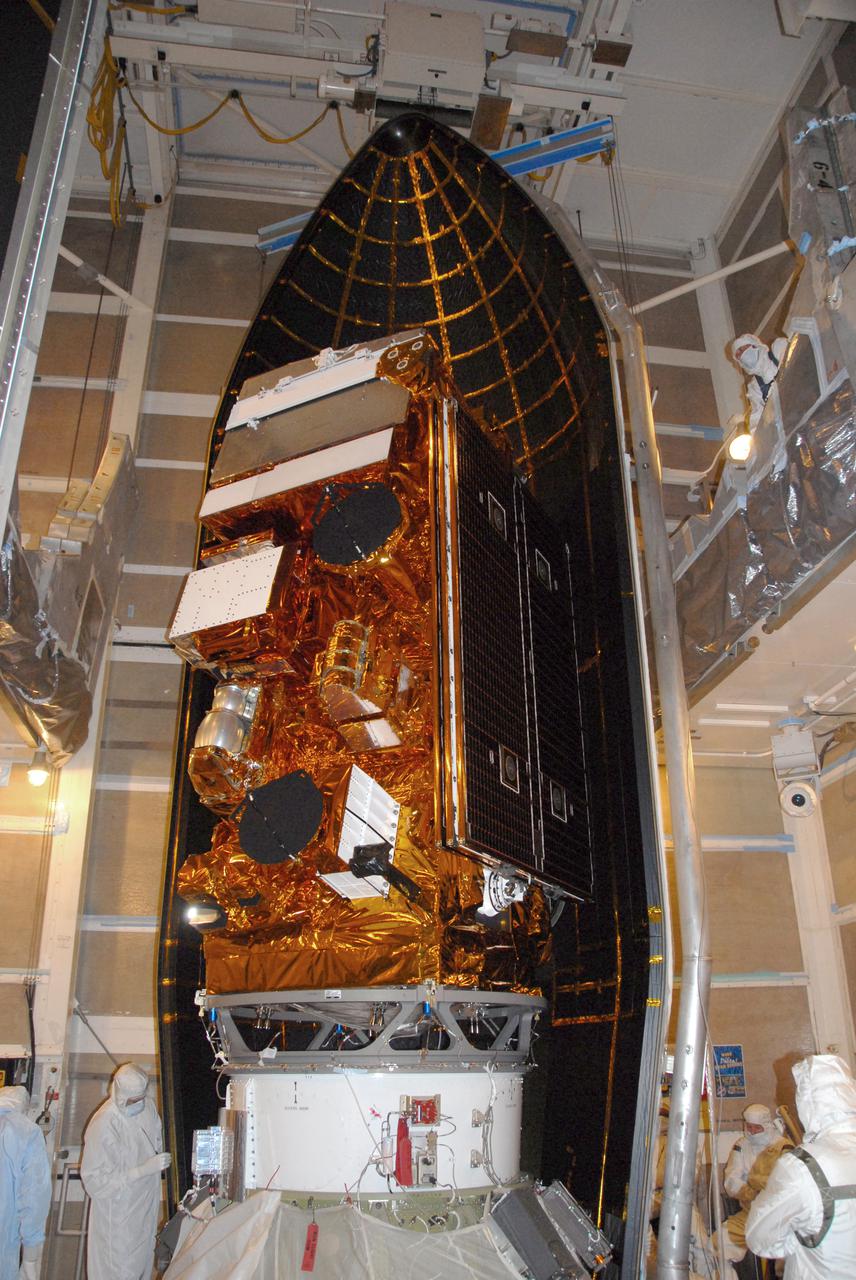
VANDENBERG AIR FORCE BASE, Calif. – At Vandenberg Air Force Base's Space Launch Complex-2 in California, technicians monitor the movement of a section of the clamshell-shaped Delta payload fairing as it encloses NASA’s National Polar-orbiting Operational Environmental Satellite System Preparatory Project (NPP) spacecraft. The fairing will protect the spacecraft from the impact of aerodynamic pressure and heating during ascent and will be jettisoned once the spacecraft is outside the Earth's atmosphere. NPP represents a critical first step in building the next-generation of Earth-observing satellites. NPP will carry the first of the new sensors developed for this satellite fleet, now known as the Joint Polar Satellite System (JPSS) to be launched in 2016. NPP is the bridge between NASA's Earth Observing System (EOS) satellites and the forthcoming series of JPSS satellites. The mission will test key technologies and instruments for the JPSS missions. NPP is targeted to launch Oct. 28 from Space Launch Complex-2 aboard a United Launch Alliance Delta II rocket. For more information, visit http:__www.nasa.gov_NPP. Photo credit: NASA_Mark P. Mackley, VAFB
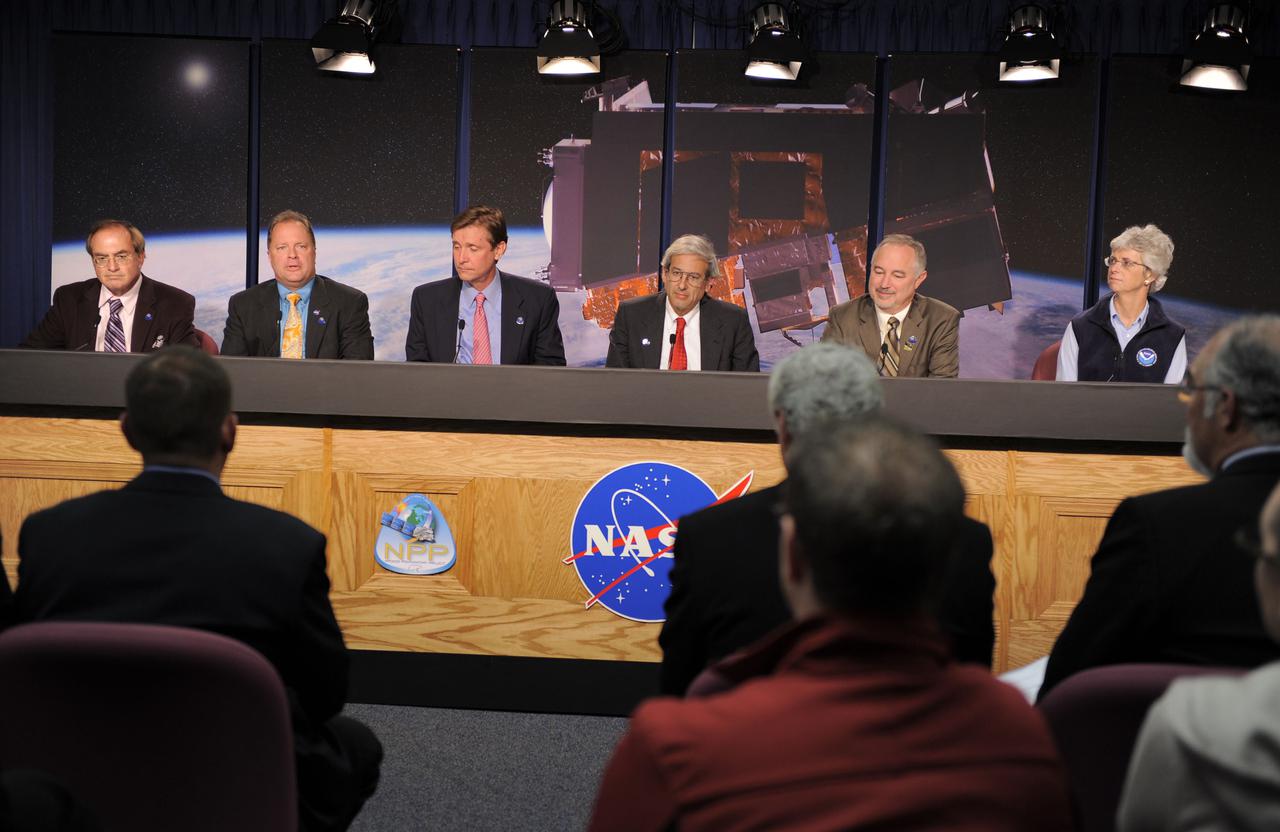
VANDENBERG AIR FORCE BASE, Calif. -- At Vandenberg Air Force Base in California, NASA and NOAA managers participate in a news briefing following the successful launch of NASA's National Polar-orbiting Operational Environmental Satellite System Preparatory Project (NPP) aboard a United Launch Alliance Delta II rocket. From left are George Diller, NASA Public Affairs; Ken Schwer, NPP project manager, NASA's Goddard Space Flight Center; Jim Gleason, NPP project scientist, NASA's Goddard Space Flight Center; Mike Frielich, director, NASA Earth Science Division; Charles Gay, acting associate administrator, NASA Mission Directorate; and Mary Glackin, deputy undersecretary for Operations, National Oceanic and Atmospheric Administration. Launch was at 2:48 a.m. PDT. NPP represents a critical first step in building the next-generation of Earth-observing satellites. NPP will carry the first of the new sensors developed for this satellite fleet, now known as the Joint Polar Satellite System (JPSS) to be launched in 2016. NPP is the bridge between NASA's Earth Observing System (EOS) satellites and the forthcoming series of JPSS satellites. The mission will test key technologies and instruments for the JPSS missions. For more information, visit http:__www.nasa.gov_NPP. Photo credit: NASA_Kim Shiflett
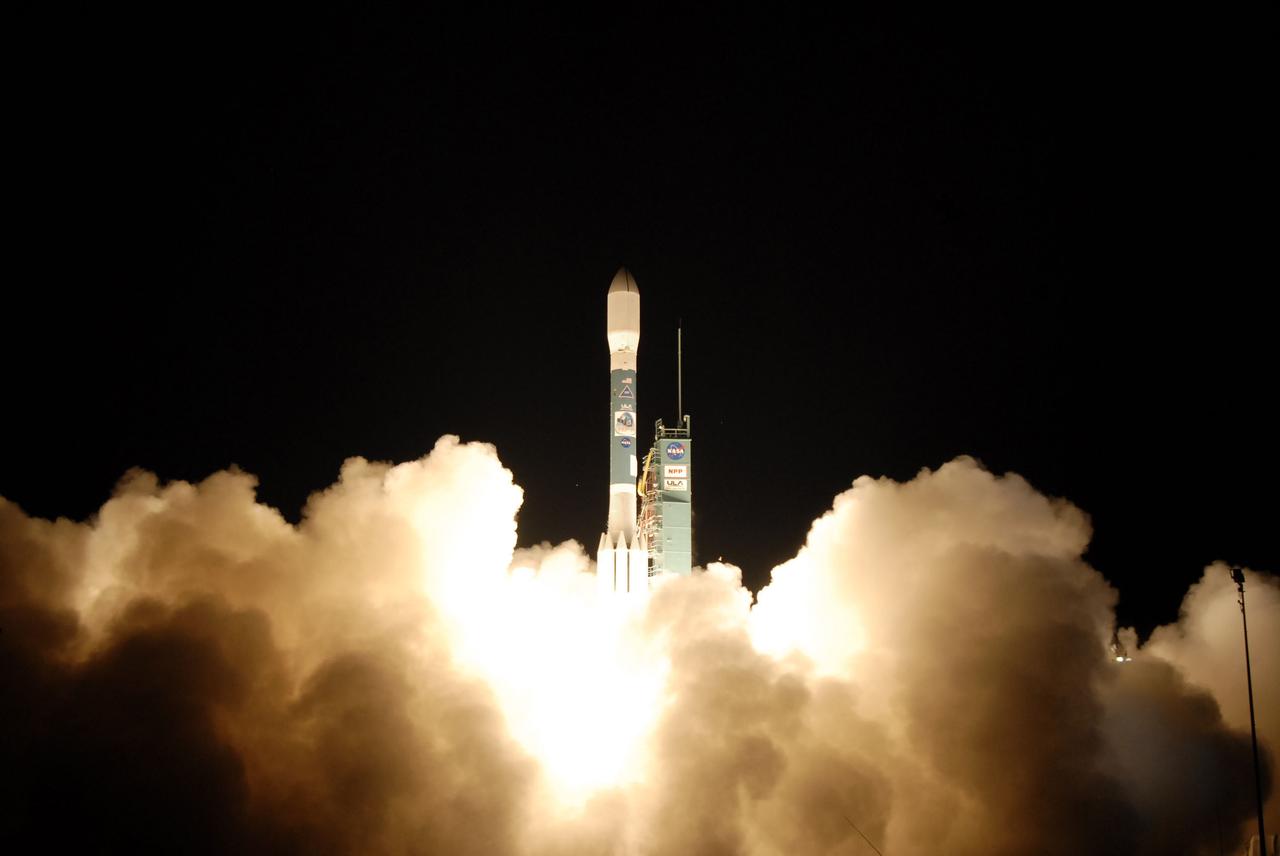
VANDENBERG AIR FORCE BASE, Calif. -- NASA's National Polar-orbiting Operational Environmental Satellite System Preparatory Project (NPP) roars off Space Launch Complex-2 at Vandenberg Air Force Base in California. Liftoff was at 2:48 a.m. PDT aboard a United Launch Alliance Delta II rocket. NPP represents a critical first step in building the next-generation of Earth-observing satellites. NPP will carry the first of the new sensors developed for this satellite fleet, now known as the Joint Polar Satellite System (JPSS) to be launched in 2016. NPP is the bridge between NASA's Earth Observing System (EOS) satellites and the forthcoming series of JPSS satellites. The mission will test key technologies and instruments for the JPSS missions. For more information, visit http:__www.nasa.gov_NPP. Photo credit: NASA_Kim Shiflett
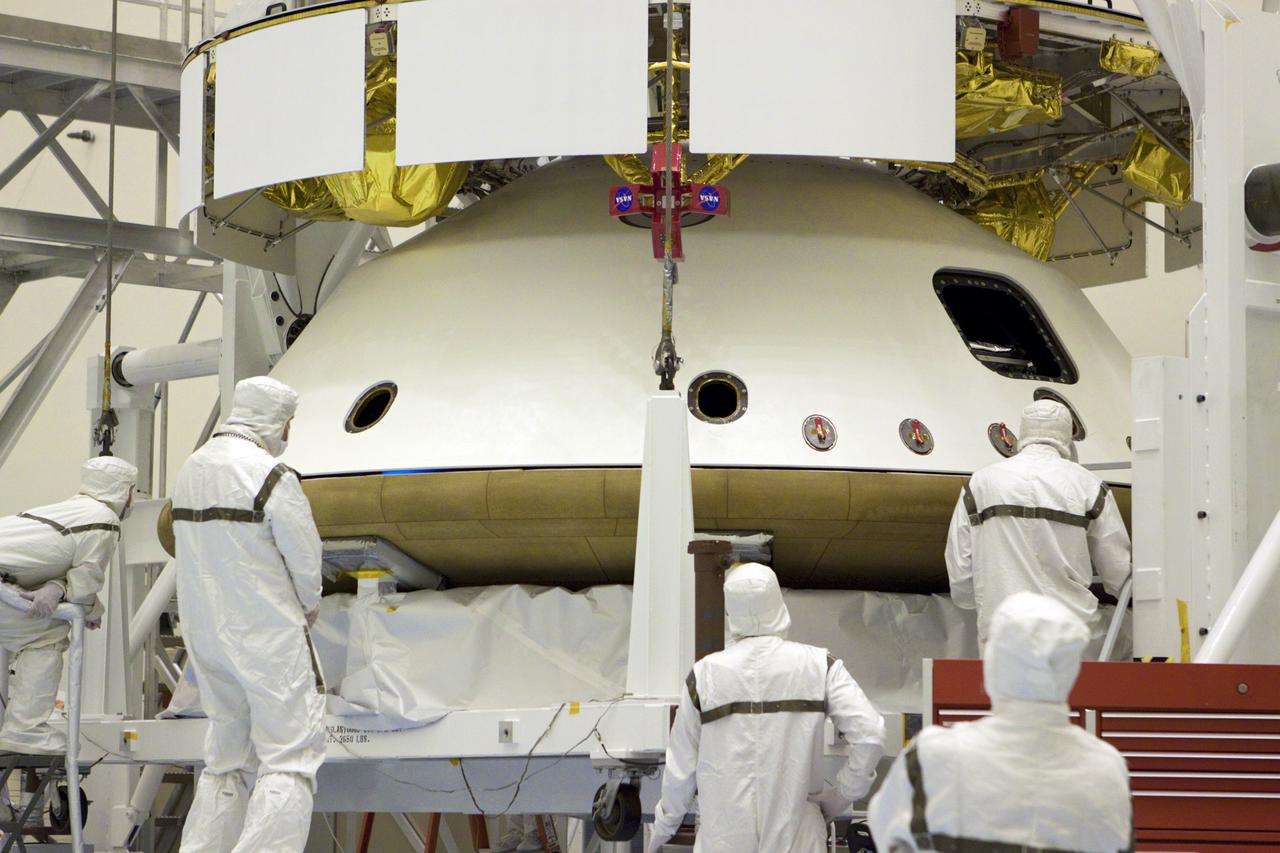
CAPE CANAVERAL, Fla. – In the Payload Hazardous Servicing Facility at NASA’s Kennedy Space Center in Florida, technicians monitor the alignment of the heat shield as an overhead crane lifts it for integration with NASA's Mars Science Laboratory (MSL) mission aeroshell, (containing the compact car-sized rover Curiosity). Earlier, the aeroshell was mated to the cruise stage, which provides solar power, thrusters for navigation, and heat exchangers to the rover during its flight from Earth to Mars. The rover Curiosity has 10 science instruments designed to search for evidence on whether Mars has had environments favorable to microbial life, including chemical ingredients for life. The unique rover will use a laser to look inside rocks and release its gasses so that the rover’s spectrometer can analyze and send the data back to Earth. Launch of MSL aboard a United Launch Alliance Atlas V rocket is scheduled for Nov. 25 from Space Launch Complex 41 on Cape Canaveral Air Force Station in Florida. For more information, visit http:__www.nasa.gov_msl. Photo credit: NASA_Glenn Benson
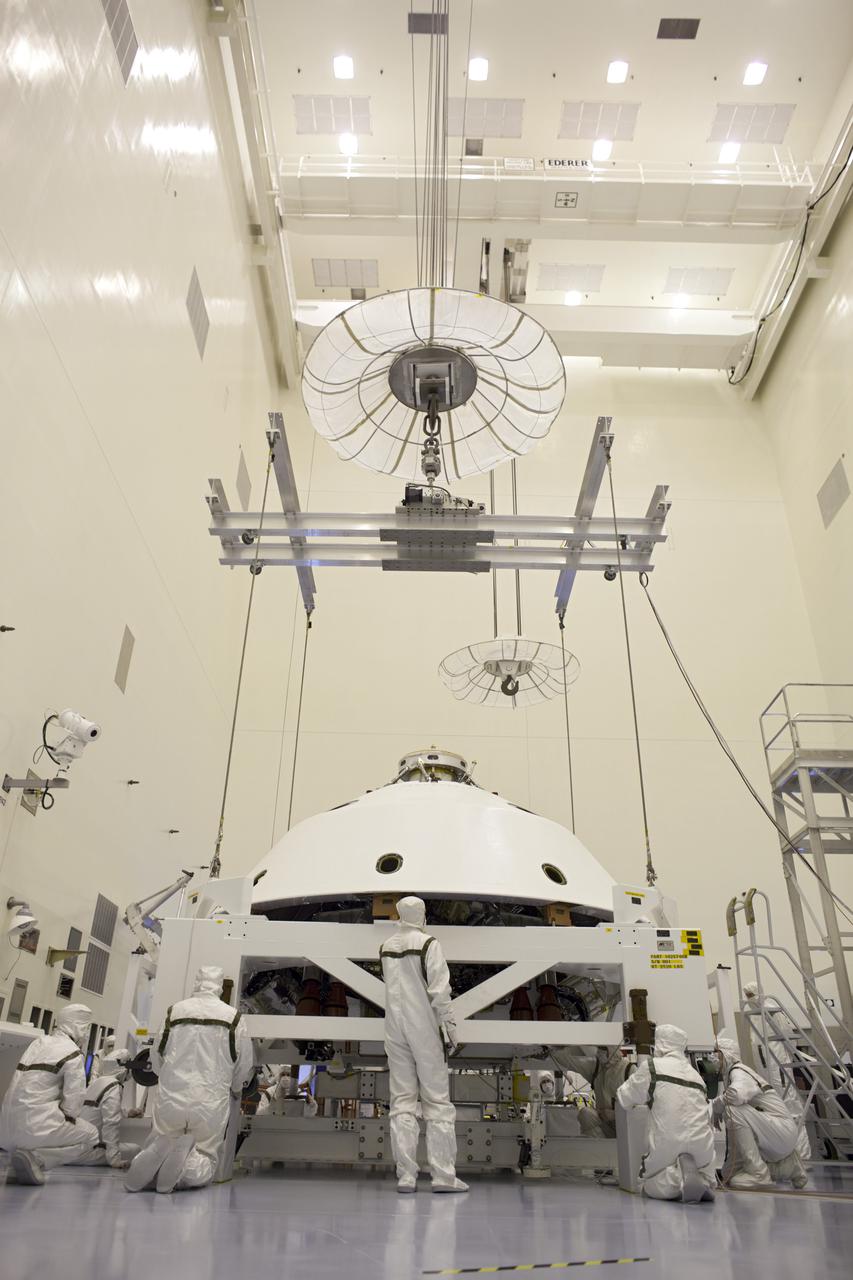
CAPE CANAVERAL, Fla. – In the Payload Hazardous Servicing Facility at NASA's Kennedy Space Center in Florida, technicians check the placement of the backshell over NASA's Mars Science Laboratory (MSL) rover, Curiosity. The backshell, a protective cover, carries the parachute and several components used during later stages of entry, descent and landing. A United Launch Alliance Atlas V-541 configuration will be used to loft MSL into space. MSL's components include a compact car-sized rover, Curiosity, which has 10 science instruments designed to search for evidence on whether Mars has had environments favorable to microbial life, including chemical ingredients for life. The unique rover will use a laser to look inside rocks and release its gasses so that the rover’s spectrometer can analyze and send the data back to Earth. MSL is scheduled to launch Nov. 25 with a window extending to Dec. 18 and arrival at Mars Aug. 2012. For more information, visit http:__www.nasa.gov_msl. Photo credit: NASA_Dimitri Gerondidakis
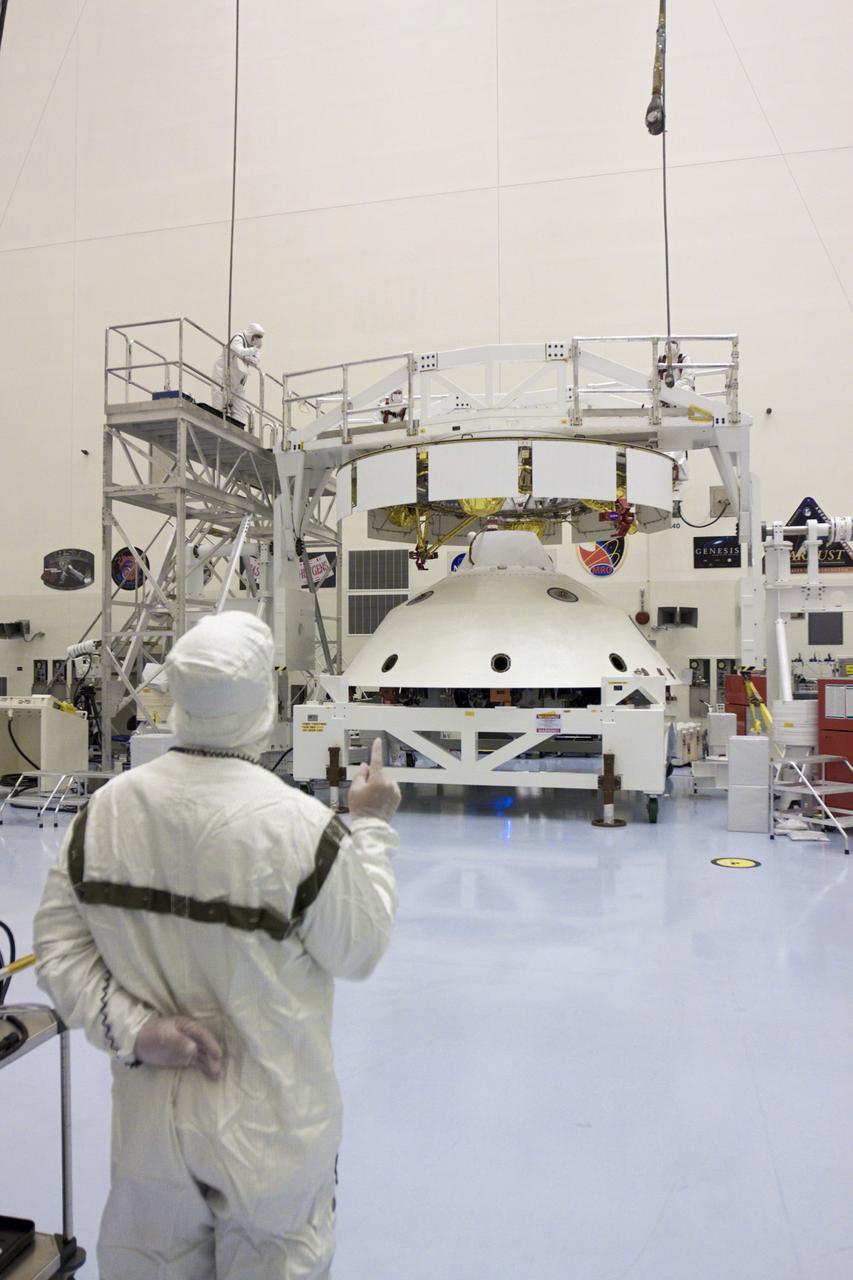
CAPE CANAVERAL, Fla. – In the Payload Hazardous Servicing Facility at NASA’s Kennedy Space Center in Florida, technicians begin the process of mating NASA's Mars Science Laboratory (MSL) mission cruise stage to the aeroshell, which contains the compact car-sized rover Curiosity. The cruise stage provides solar power, thrusters for navigation, and heat exchangers to the rover during its flight from Earth to Mars. The rover Curiosity has 10 science instruments designed to search for evidence on whether Mars has had environments favorable to microbial life, including chemical ingredients for life. The unique rover will use a laser to look inside rocks and release its gasses so that the rover’s spectrometer can analyze and send the data back to Earth. Launch of MSL aboard a United Launch Alliance Atlas V rocket is scheduled for Nov. 25 from Space Launch Complex 41 on Cape Canaveral Air Force Station in Florida. For more information, visit http:__www.nasa.gov_msl. Photo credit: NASA_Glenn Benson
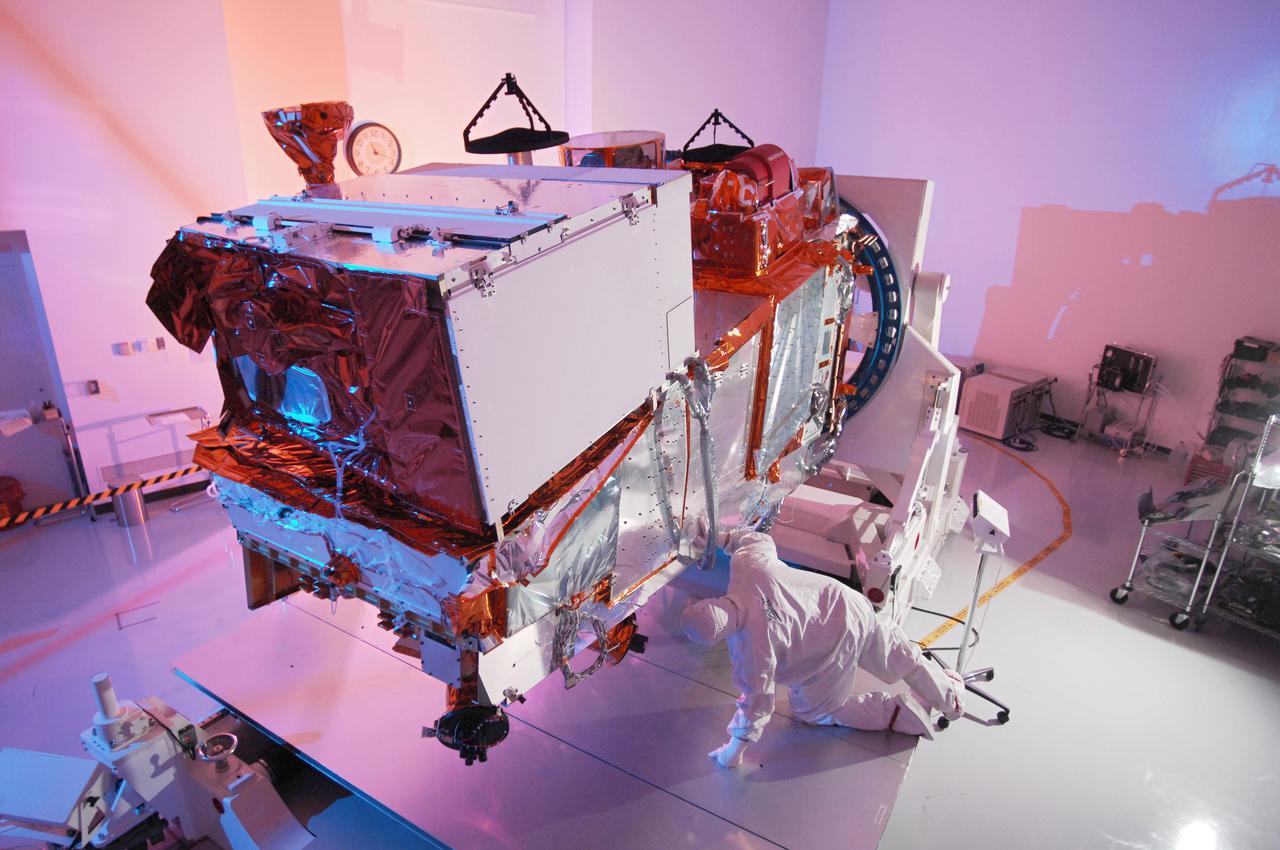
BALL AEROSPACE, Boulder, Colo. – In a cleanroom at Vandenberg Air Force Base in California, Ball Aerospace and Technologies Corp. technicians begin integration of the medium resolution Visible Infrared Imaging Radiometer Suite VIIRS into NASA’s National Polar-orbiting Operational Environmental Satellite System Preparatory Project NPP satellite. NPP is carrying five instruments on board, the biggest being VIIRS which will provide highly detailed imagery of clouds, vegetation, snow cover, dust storms, sea surface temperature and other environmental phenomena. A United Launch Alliance Delta II rocket will carry NPP into space. NPP represents a critical first step in building the next-generation of Earth-observing satellites. NPP will carry the first of the new sensors developed for this satellite fleet, now known as the Joint Polar Satellite System JPSS to be launched in 2016. NPP is the bridge between NASA's Earth Observing System EOS satellites and the forthcoming series of JPSS satellites. The mission will test key technologies and instruments for the JPSS missions. NPP is targeted to launch Oct. 27. For more information, visit http:__www.nasa.gov_NPP. Photo credit: Ball Aerospace
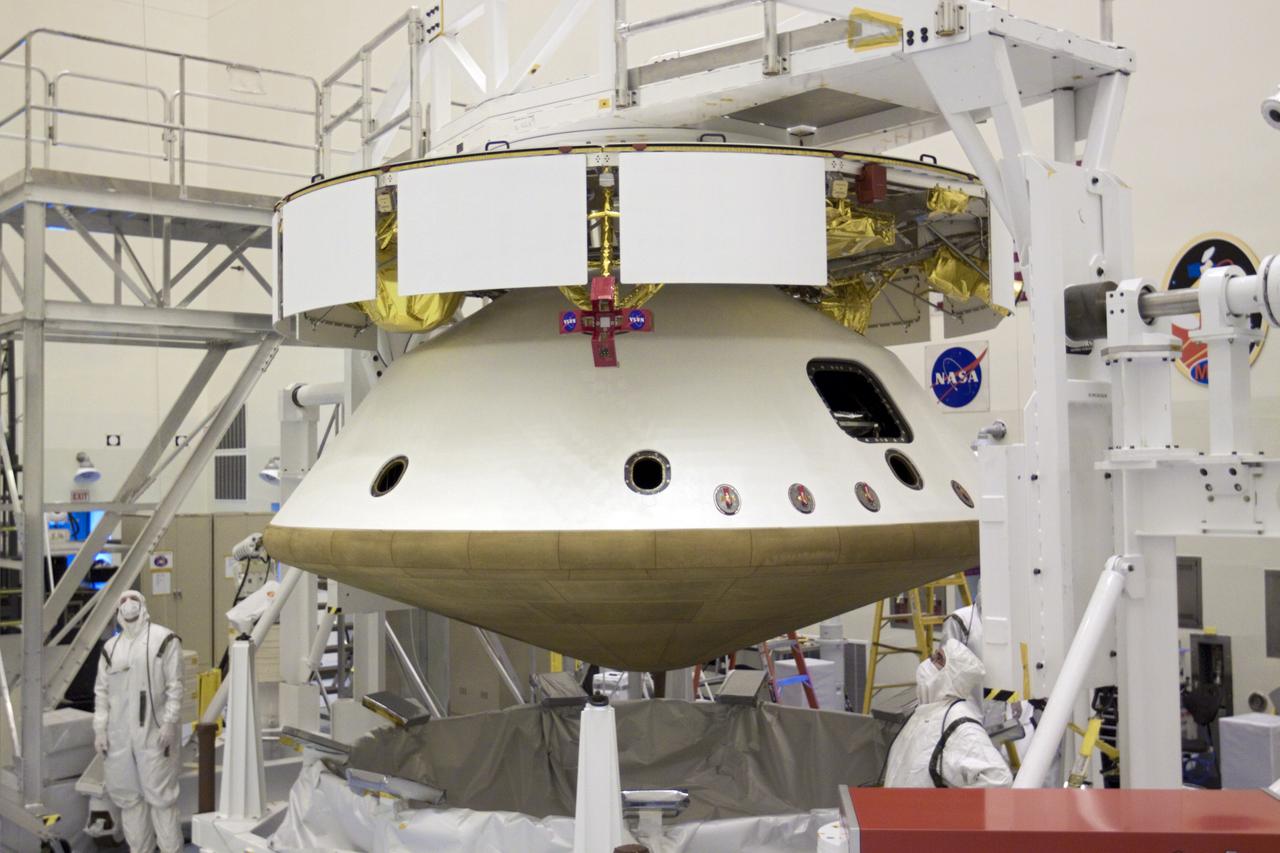
CAPE CANAVERAL, Fla. – In the Payload Hazardous Servicing Facility at NASA’s Kennedy Space Center in Florida, technicians observe the raising of an overhead crane. The crane was used to integrate the heat shield with NASA's Mars Science Laboratory (MSL) mission aeroshell, (containing the compact car-sized rover Curiosity). Earlier, the aeroshell was mated to the cruise stage, which provides solar power, thrusters for navigation, and heat exchangers to the rover during its flight from Earth to Mars. The rover Curiosity has 10 science instruments designed to search for evidence on whether Mars has had environments favorable to microbial life, including chemical ingredients for life. The unique rover will use a laser to look inside rocks and release its gasses so that the rover’s spectrometer can analyze and send the data back to Earth. Launch of MSL aboard a United Launch Alliance Atlas V rocket is scheduled for Nov. 25 from Space Launch Complex 41 on Cape Canaveral Air Force Station in Florida. For more information, visit http:__www.nasa.gov_msl. Photo credit: NASA_Glenn Benson
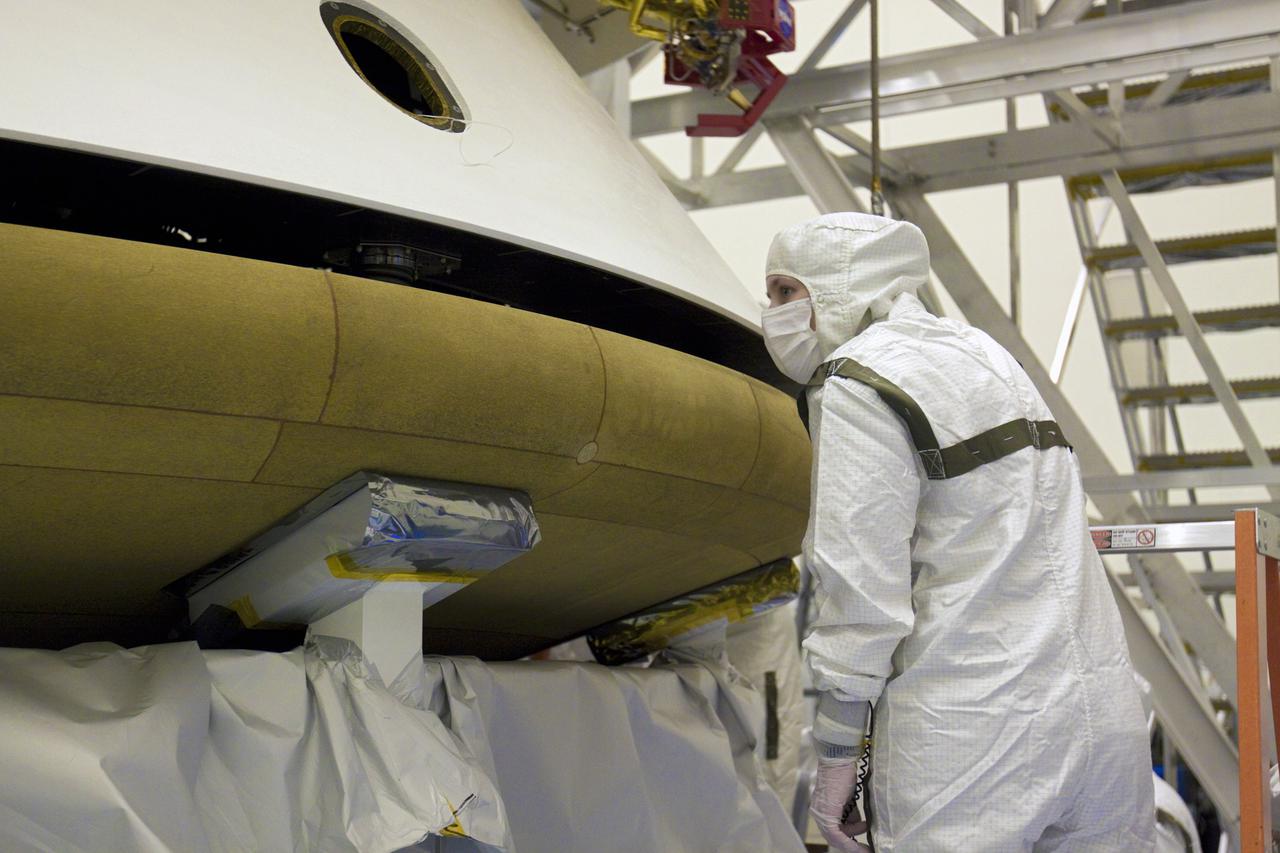
CAPE CANAVERAL, Fla. – In the Payload Hazardous Servicing Facility at NASA’s Kennedy Space Center in Florida, a technician inspects the alignment of the heat shield as an overhead crane lifts it for integration with NASA's Mars Science Laboratory (MSL) mission aeroshell, (containing the compact car-sized rover Curiosity). Earlier, the aeroshell was mated to the cruise stage, which provides solar power, thrusters for navigation, and heat exchangers to the rover during its flight from Earth to Mars. The rover Curiosity has 10 science instruments designed to search for evidence on whether Mars has had environments favorable to microbial life, including chemical ingredients for life. The unique rover will use a laser to look inside rocks and release its gasses so that the rover’s spectrometer can analyze and send the data back to Earth. Launch of MSL aboard a United Launch Alliance Atlas V rocket is scheduled for Nov. 25 from Space Launch Complex 41 on Cape Canaveral Air Force Station in Florida. For more information, visit http:__www.nasa.gov_msl. Photo credit: NASA_Glenn Benson
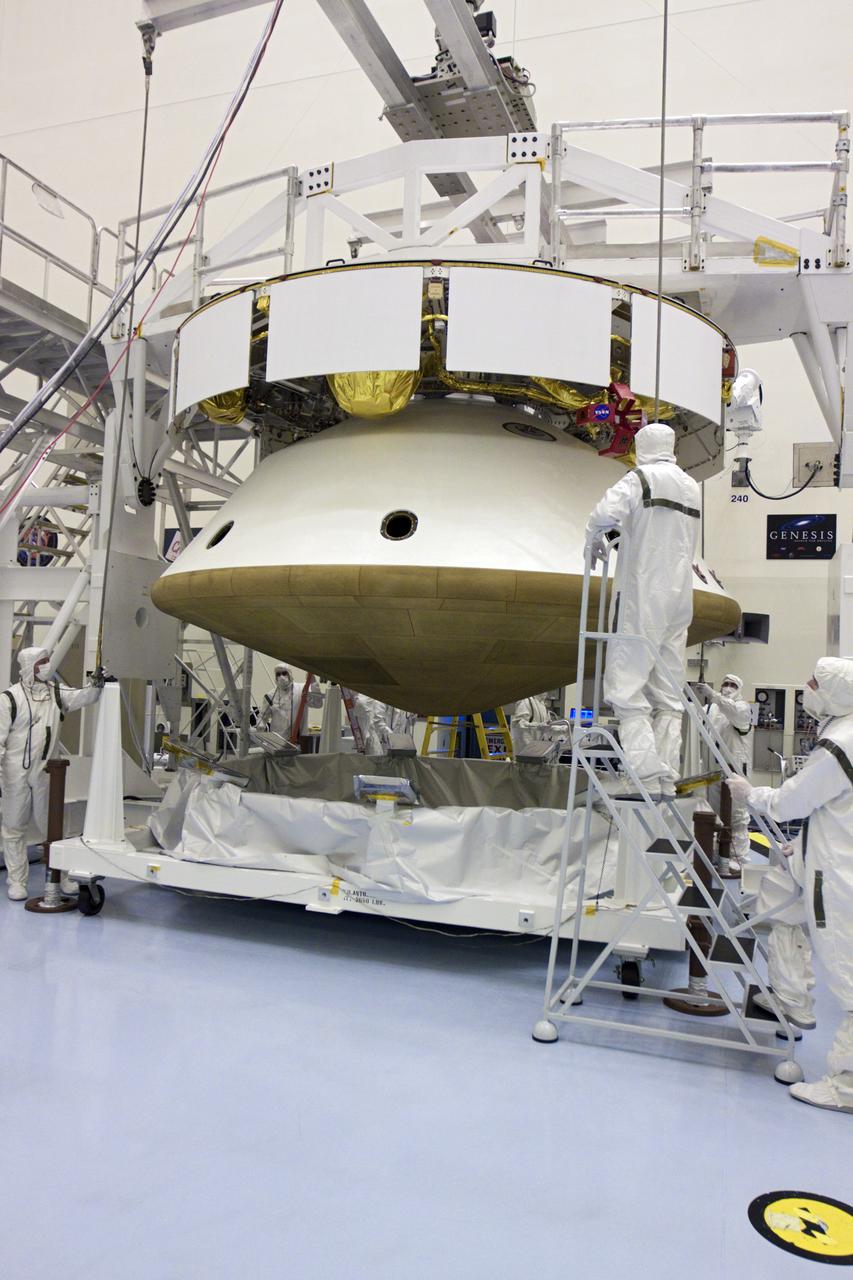
CAPE CANAVERAL, Fla. – In the Payload Hazardous Servicing Facility at NASA’s Kennedy Space Center in Florida, technicians detach the overhead crane from the heat shield after integration with NASA's Mars Science Laboratory (MSL) mission aeroshell, (containing the compact car-sized rover Curiosity). Earlier, the aeroshell was mated to the cruise stage, which provides solar power, thrusters for navigation, and heat exchangers to the rover during its flight from Earth to Mars. The rover Curiosity has 10 science instruments designed to search for evidence on whether Mars has had environments favorable to microbial life, including chemical ingredients for life. The unique rover will use a laser to look inside rocks and release its gasses so that the rover’s spectrometer can analyze and send the data back to Earth. Launch of MSL aboard a United Launch Alliance Atlas V rocket is scheduled for Nov. 25 from Space Launch Complex 41 on Cape Canaveral Air Force Station in Florida. For more information, visit http:__www.nasa.gov_msl. Photo credit: NASA_Glenn Benson
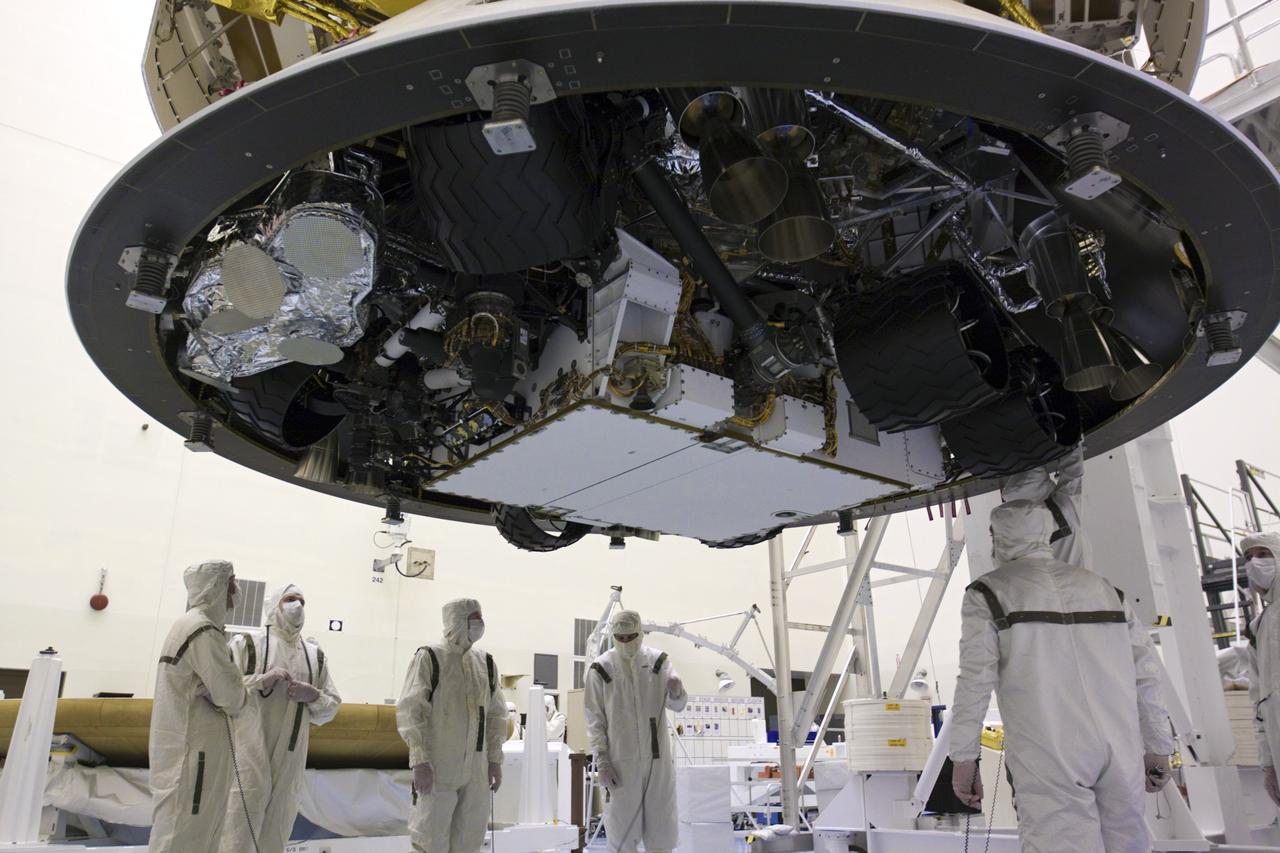
CAPE CANAVERAL, Fla. – In the Payload Hazardous Servicing Facility at NASA’s Kennedy Space Center in Florida, technicians work beneath NASA's Mars Science Laboratory (MSL) mission aeroshell, (containing the compact car-sized rover Curiosity), which has been mated to the cruise stage. The cruise stage provides solar power, thrusters for navigation, and heat exchangers to the rover during its flight from Earth to Mars. The rover Curiosity has 10 science instruments designed to search for evidence on whether Mars has had environments favorable to microbial life, including chemical ingredients for life. The unique rover will use a laser to look inside rocks and release its gasses so that the rover’s spectrometer can analyze and send the data back to Earth. Launch of MSL aboard a United Launch Alliance Atlas V rocket is scheduled for Nov. 25 from Space Launch Complex 41 on Cape Canaveral Air Force Station in Florida. For more information, visit http:__www.nasa.gov_msl. Photo credit: NASA_Glenn Benson
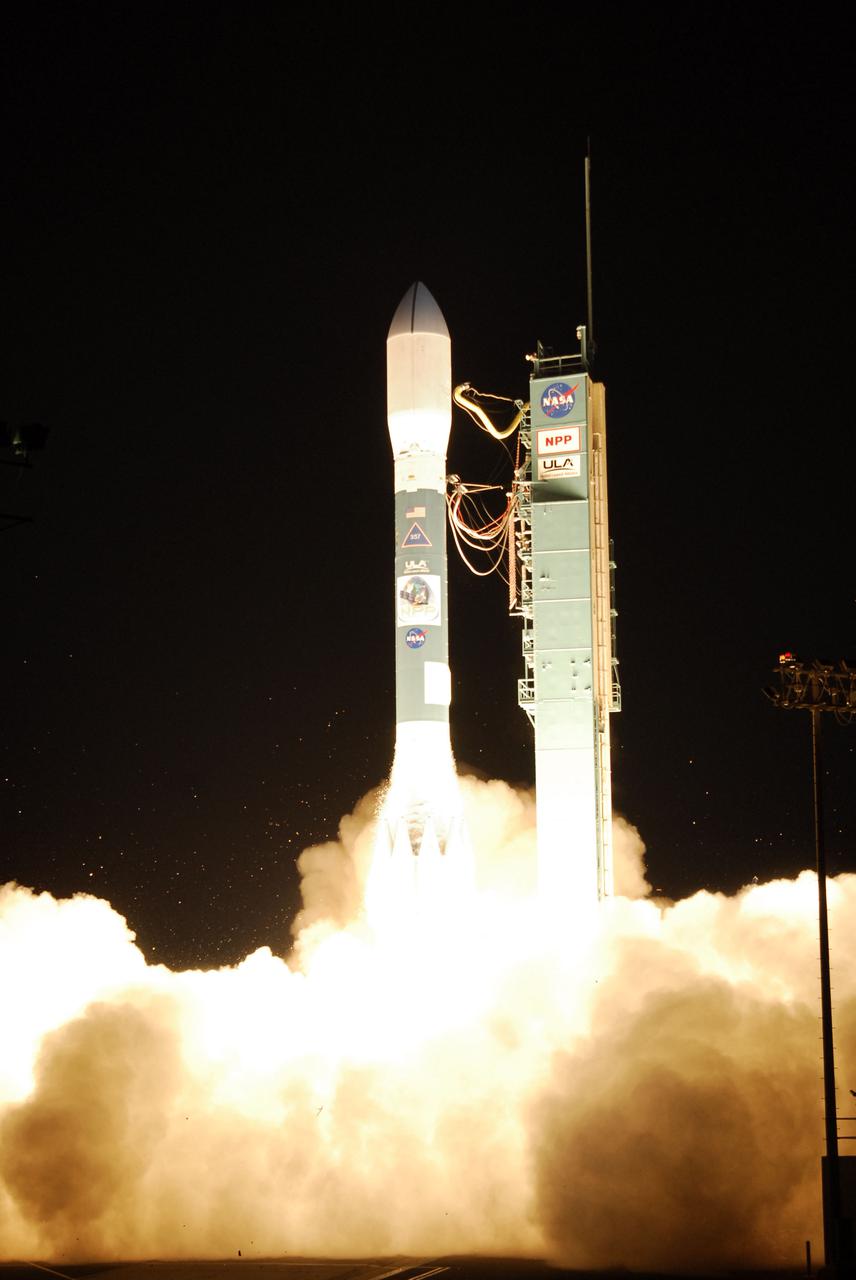
VANDENBERG AIR FORCE BASE, Calif. -- At Space Launch Complex-2 on Vandenberg Air Force Base in California, the United Launch Alliance Delta II rocket carrying NASA's National Polar-orbiting Operational Environmental Satellite System Preparatory Project (NPP) is illuminated by the brilliance of its engines' ignition. Liftoff was at 2:48 a.m. PDT. NPP represents a critical first step in building the next-generation of Earth-observing satellites. NPP will carry the first of the new sensors developed for this satellite fleet, now known as the Joint Polar Satellite System (JPSS) to be launched in 2016. NPP is the bridge between NASA's Earth Observing System (EOS) satellites and the forthcoming series of JPSS satellites. The mission will test key technologies and instruments for the JPSS missions. For more information, visit http:__www.nasa.gov_NPP. Photo credit: NASA_Kim Shiflett
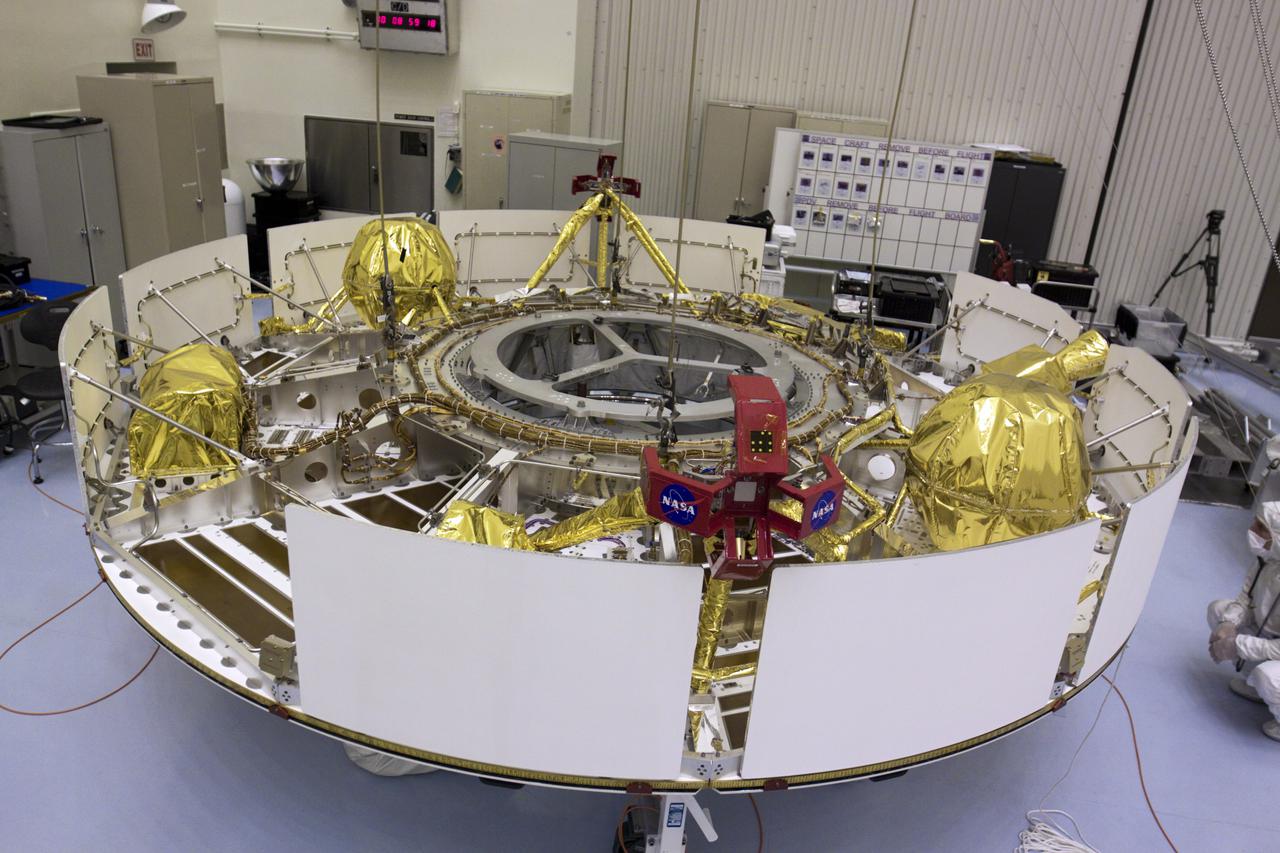
CAPE CANAVERAL, Fla. – In the Payload Hazardous Servicing Facility at NASA’s Kennedy Space Center in Florida, an overhead crane has been attached to NASA's Mars Science Laboratory (MSL) mission cruise stage. The cruise stage, which will be lifted onto a rotation stand, provides solar power, thrusters for navigation, and heat exchangers to the rover during its flight from Earth to Mars. MSL's components include a car-sized rover, Curiosity, which has 10 science instruments designed to search for evidence on whether Mars has had environments favorable to microbial life, including chemical ingredients for life. The unique rover will use a laser to look inside rocks and release its gasses so that the rover’s spectrometer can analyze and send the data back to Earth. Launch of MSL aboard a United Launch Alliance Atlas V rocket is scheduled for Nov. 25 from Space Launch Complex 41 on Cape Canaveral Air Force Station in Florida. For more information, visit http:__www.nasa.gov_msl. Photo credit: NASA_Glenn Benson
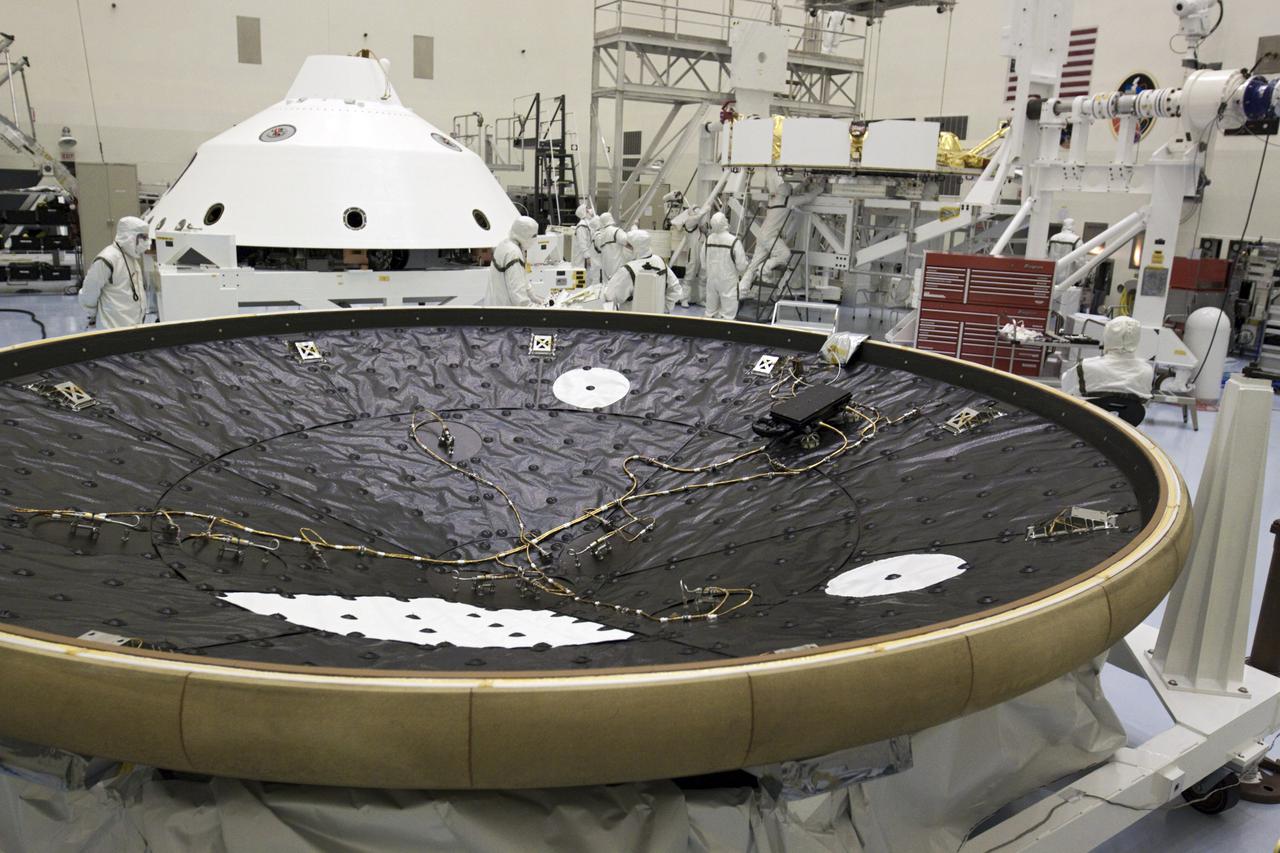
CAPE CANAVERAL, Fla. – In the Payload Hazardous Servicing Facility at NASA’s Kennedy Space Center in Florida, technicians inspect NASA's Mars Science Laboratory (MSL) mission cruise stage as it is guided onto a rotation stand. The cruise stage provides solar power, thrusters for navigation, and heat exchangers to the rover during its flight from Earth to Mars. In the foreground is the MSL heat shield and to the left, the aeroshell. MSL's components include a car-sized rover, Curiosity, which has 10 science instruments designed to search for evidence on whether Mars has had environments favorable to microbial life, including chemical ingredients for life. The unique rover will use a laser to look inside rocks and release its gasses so that the rover’s spectrometer can analyze and send the data back to Earth. Launch of MSL aboard a United Launch Alliance Atlas V rocket is scheduled for Nov. 25 from Space Launch Complex 41 on Cape Canaveral Air Force Station in Florida. For more information, visit http:__www.nasa.gov_msl. Photo credit: NASA_Glenn Benson
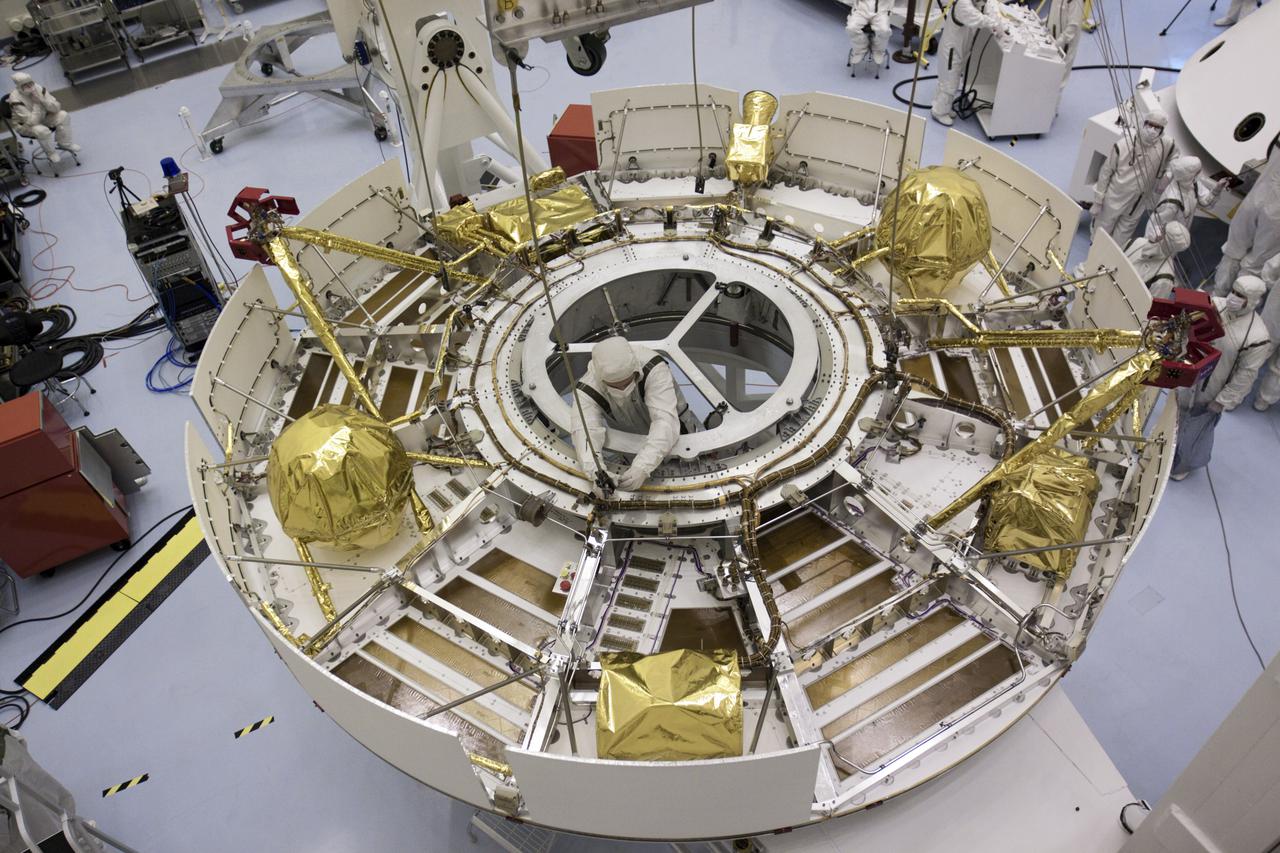
CAPE CANAVERAL, Fla. – In the Payload Hazardous Servicing Facility at NASA’s Kennedy Space Center in Florida, the camera captures a unique view of NASA's Mars Science Laboratory (MSL) mission as a technician separates the overhead crane from the cruise stage after it was lifted onto a rotation stand. The cruise stage provides solar power, thrusters for navigation, and heat exchangers to the rover during its flight from Earth to Mars. MSL's components include a car-sized rover, Curiosity, which has 10 science instruments designed to search for evidence on whether Mars has had environments favorable to microbial life, including chemical ingredients for life. The unique rover will use a laser to look inside rocks and release its gasses so that the rover’s spectrometer can analyze and send the data back to Earth. Launch of MSL aboard a United Launch Alliance Atlas V rocket is scheduled for Nov. 25 from Space Launch Complex 41 on Cape Canaveral Air Force Station in Florida. For more information, visit http:__www.nasa.gov_msl. Photo credit: NASA_Glenn Benson

CAPE CANAVERAL, Fla. – In the Payload Hazardous Servicing Facility at NASA’s Kennedy Space Center in Florida, technicians move the heat shield carrier away from under the heat shield after integration with NASA's Mars Science Laboratory (MSL) mission aeroshell, (containing the compact car-sized rover Curiosity). Earlier, the aeroshell was mated to the cruise stage, which provides solar power, thrusters for navigation, and heat exchangers to the rover during its flight from Earth to Mars. The rover Curiosity has 10 science instruments designed to search for evidence on whether Mars has had environments favorable to microbial life, including chemical ingredients for life. The unique rover will use a laser to look inside rocks and release its gasses so that the rover’s spectrometer can analyze and send the data back to Earth. Launch of MSL aboard a United Launch Alliance Atlas V rocket is scheduled for Nov. 25 from Space Launch Complex 41 on Cape Canaveral Air Force Station in Florida. For more information, visit http:__www.nasa.gov_msl. Photo credit: NASA_Glenn Benson
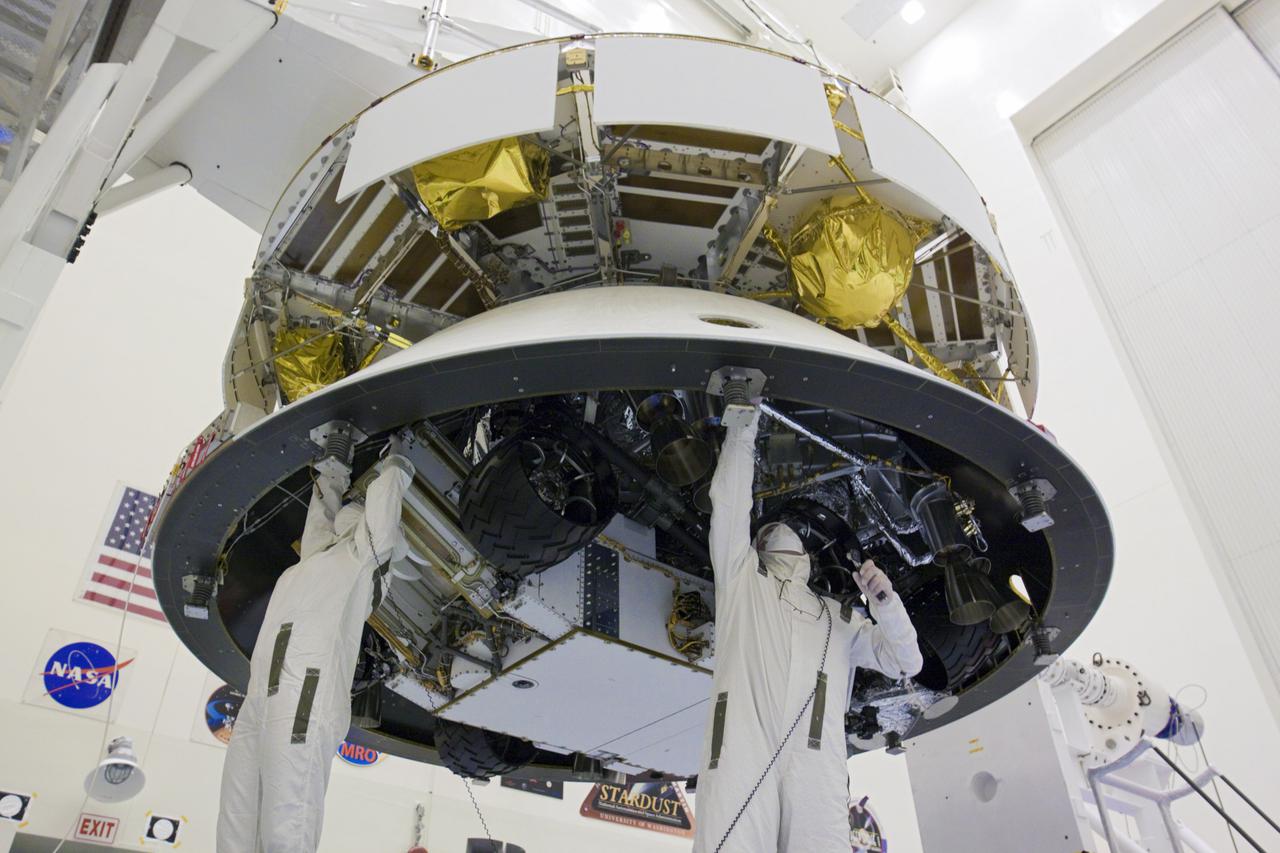
CAPE CANAVERAL, Fla. – In the Payload Hazardous Servicing Facility at NASA’s Kennedy Space Center in Florida, technicians work beneath NASA's Mars Science Laboratory (MSL) mission aeroshell, (containing the compact car-sized rover Curiosity), which has been mated to the cruise stage. The cruise stage provides solar power, thrusters for navigation, and heat exchangers to the rover during its flight from Earth to Mars. The rover Curiosity has 10 science instruments designed to search for evidence on whether Mars has had environments favorable to microbial life, including chemical ingredients for life. The unique rover will use a laser to look inside rocks and release its gasses so that the rover’s spectrometer can analyze and send the data back to Earth. Launch of MSL aboard a United Launch Alliance Atlas V rocket is scheduled for Nov. 25 from Space Launch Complex 41 on Cape Canaveral Air Force Station in Florida. For more information, visit http:__www.nasa.gov_msl. Photo credit: NASA_Glenn Benson
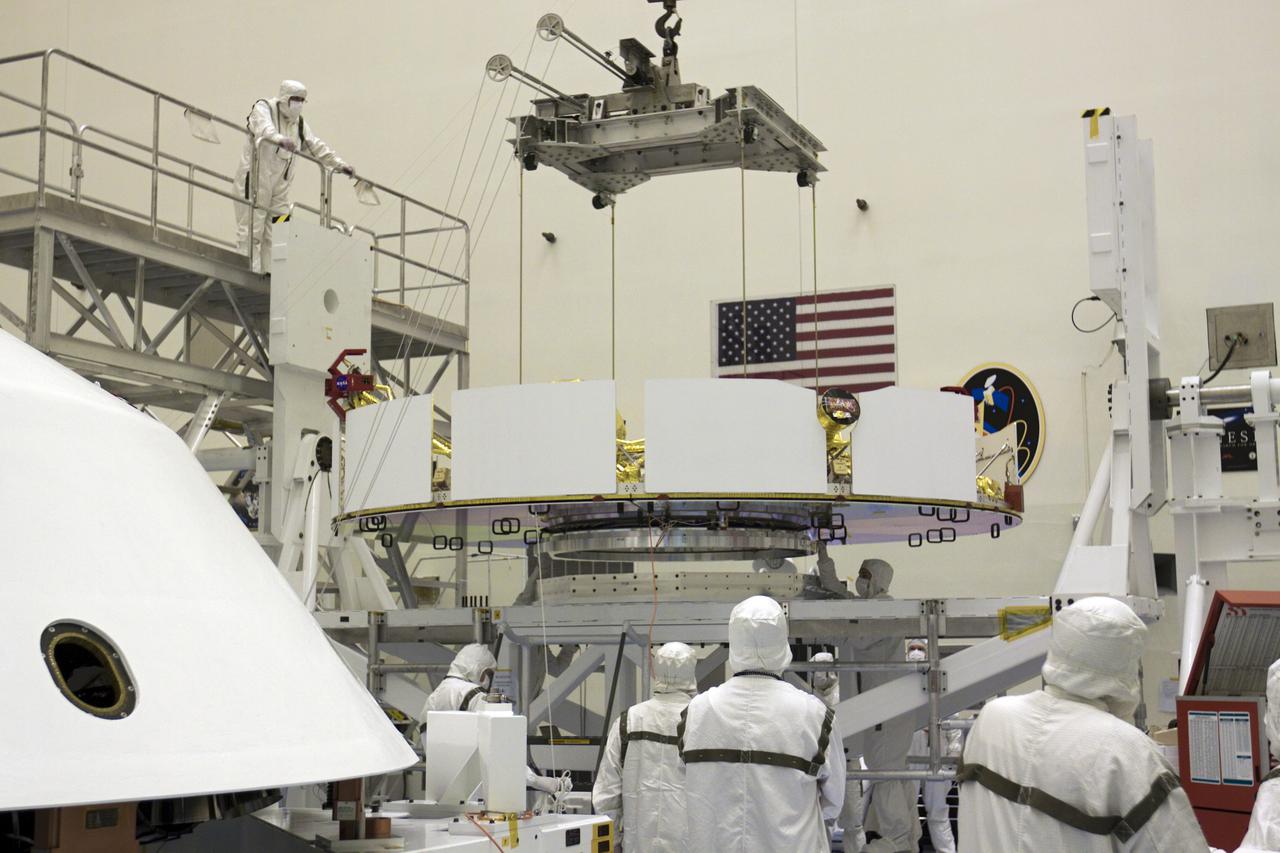
CAPE CANAVERAL, Fla. – In the Payload Hazardous Servicing Facility at NASA’s Kennedy Space Center in Florida, technicians inspect NASA's Mars Science Laboratory (MSL) mission cruise stage as it is guided onto a rotation stand. The cruise stage provides solar power, thrusters for navigation, and heat exchangers to the rover during its flight from Earth to Mars. MSL's components include a car-sized rover, Curiosity, which has 10 science instruments designed to search for evidence on whether Mars has had environments favorable to microbial life, including chemical ingredients for life. The unique rover will use a laser to look inside rocks and release its gasses so that the rover’s spectrometer can analyze and send the data back to Earth. Launch of MSL aboard a United Launch Alliance Atlas V rocket is scheduled for Nov. 25 from Space Launch Complex 41 on Cape Canaveral Air Force Station in Florida. For more information, visit http:__www.nasa.gov_msl. Photo credit: NASA_Glenn Benson
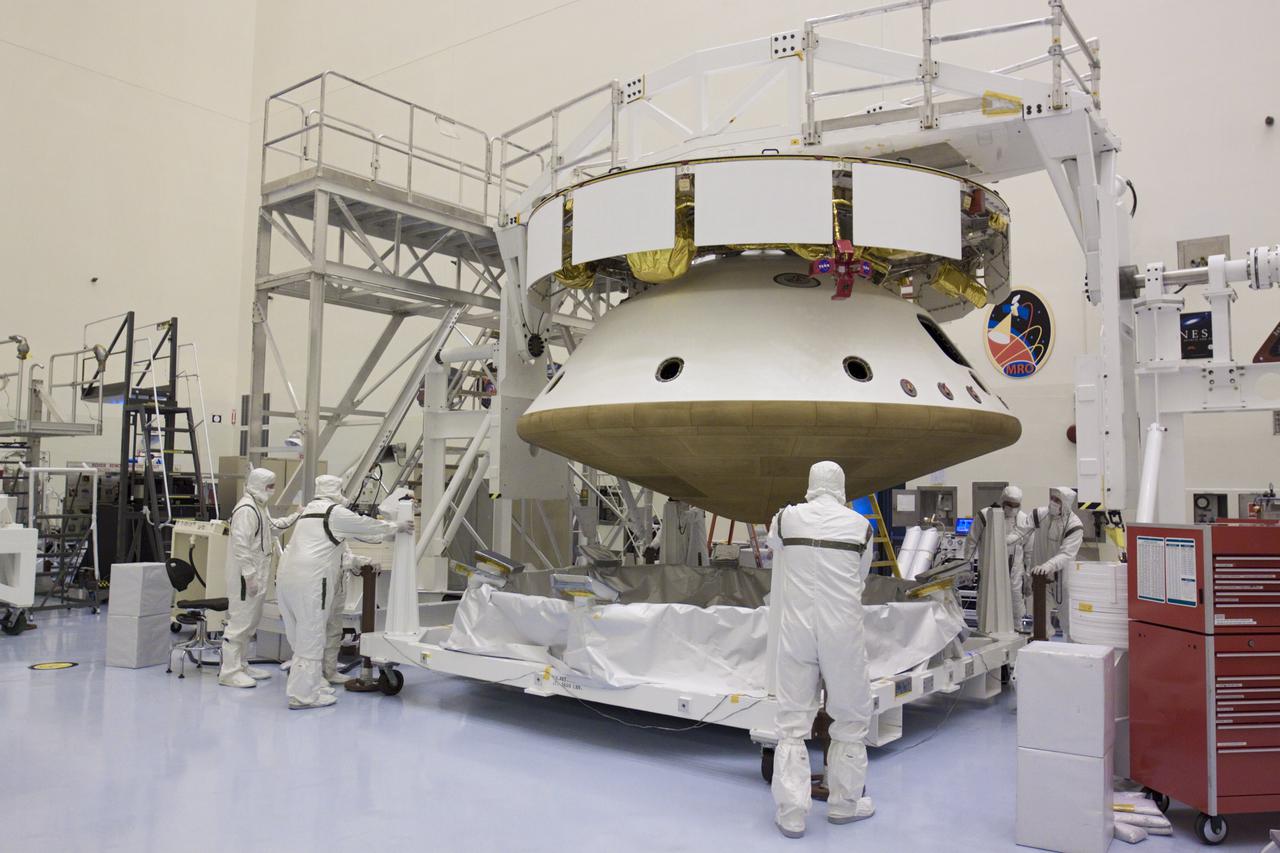
CAPE CANAVERAL, Fla. – In the Payload Hazardous Servicing Facility at NASA’s Kennedy Space Center in Florida, technicians move the heat shield carrier away from under the heat shield after integration with NASA's Mars Science Laboratory (MSL) mission aeroshell, (containing the compact car-sized rover Curiosity). Earlier, the aeroshell was mated to the cruise stage, which provides solar power, thrusters for navigation, and heat exchangers to the rover during its flight from Earth to Mars. The rover Curiosity has 10 science instruments designed to search for evidence on whether Mars has had environments favorable to microbial life, including chemical ingredients for life. The unique rover will use a laser to look inside rocks and release its gasses so that the rover’s spectrometer can analyze and send the data back to Earth. Launch of MSL aboard a United Launch Alliance Atlas V rocket is scheduled for Nov. 25 from Space Launch Complex 41 on Cape Canaveral Air Force Station in Florida. For more information, visit http:__www.nasa.gov_msl. Photo credit: NASA_Glenn Benson
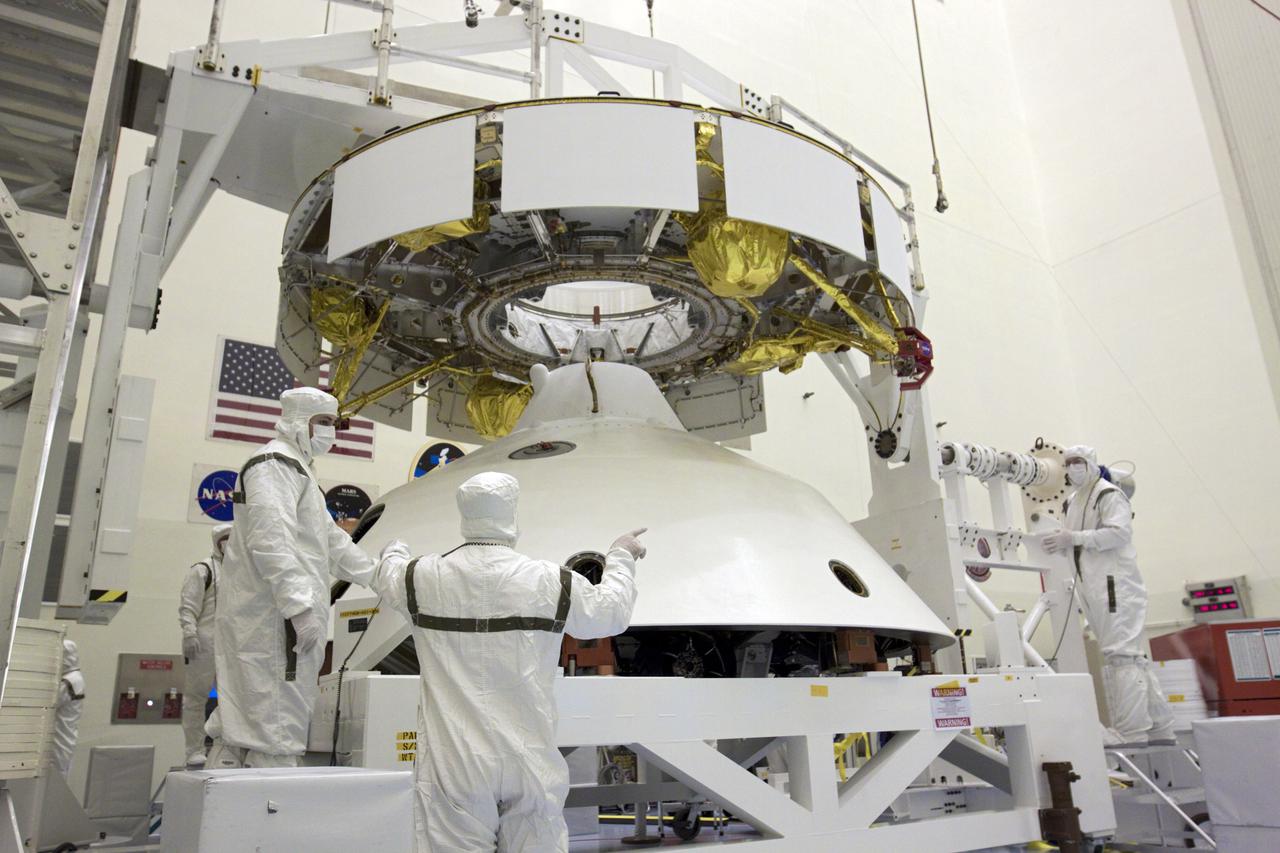
CAPE CANAVERAL, Fla. – In the Payload Hazardous Servicing Facility at NASA’s Kennedy Space Center in Florida, technicians prepare to attach an overhead crane to NASA's Mars Science Laboratory (MSL) mission aeroshell, (containing the compact car-sized rover Curiosity), which will be mated to the cruise stage. The cruise stage provides solar power, thrusters for navigation, and heat exchangers to the rover during its flight from Earth to Mars. The rover Curiosity has 10 science instruments designed to search for evidence on whether Mars has had environments favorable to microbial life, including chemical ingredients for life. The unique rover will use a laser to look inside rocks and release its gasses so that the rover’s spectrometer can analyze and send the data back to Earth. Launch of MSL aboard a United Launch Alliance Atlas V rocket is scheduled for Nov. 25 from Space Launch Complex 41 on Cape Canaveral Air Force Station in Florida. For more information, visit http:__www.nasa.gov_msl. Photo credit: NASA_Glenn Benson
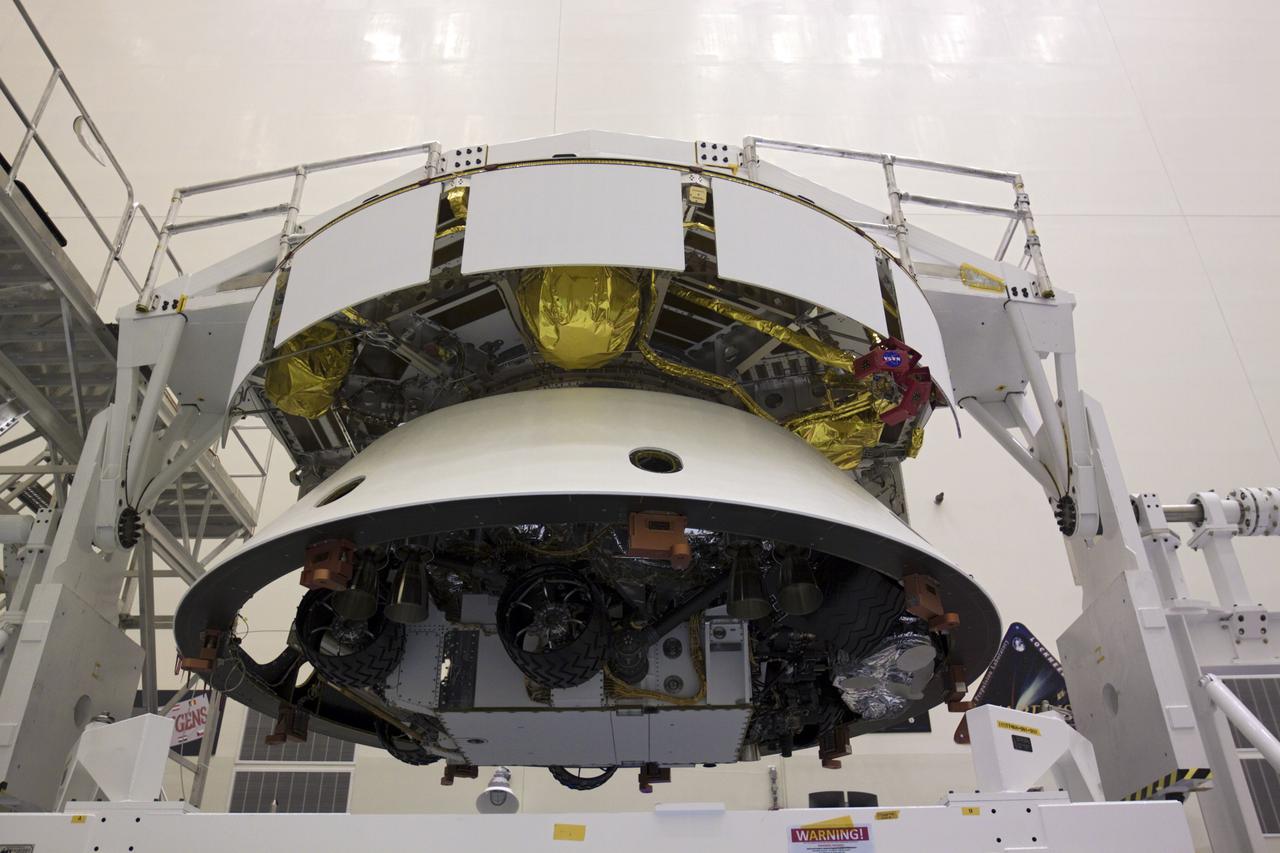
CAPE CANAVERAL, Fla. – In the Payload Hazardous Servicing Facility at NASA’s Kennedy Space Center in Florida, NASA's Mars Science Laboratory (MSL) mission aeroshell, (containing the compact car-sized rover Curiosity), has been mated to the cruise stage. The cruise stage provides solar power, thrusters for navigation, and heat exchangers to the rover during its flight from Earth to Mars. The rover Curiosity has 10 science instruments designed to search for evidence on whether Mars has had environments favorable to microbial life, including chemical ingredients for life. The unique rover will use a laser to look inside rocks and release its gasses so that the rover’s spectrometer can analyze and send the data back to Earth. Launch of MSL aboard a United Launch Alliance Atlas V rocket is scheduled for Nov. 25 from Space Launch Complex 41 on Cape Canaveral Air Force Station in Florida. For more information, visit http:__www.nasa.gov_msl. Photo credit: NASA_Glenn Benson
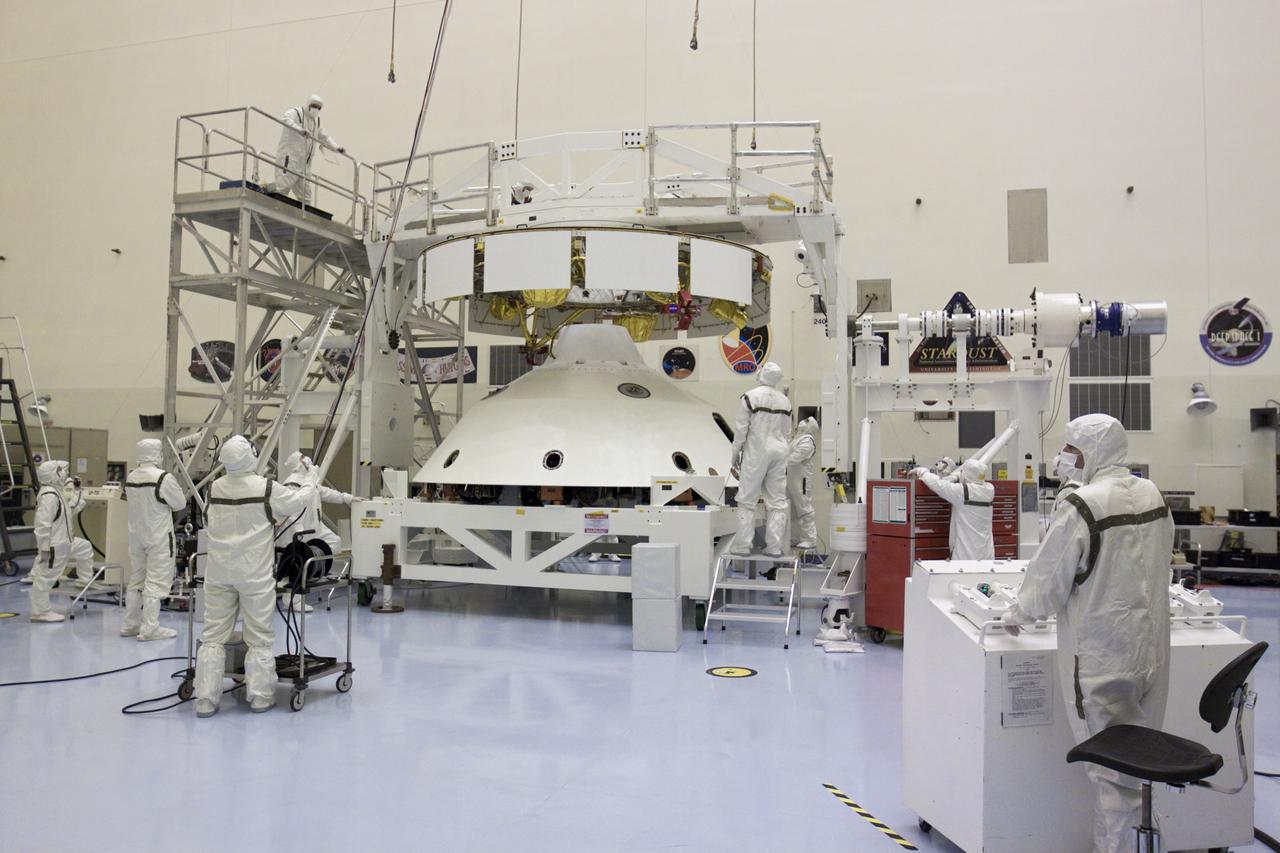
CAPE CANAVERAL, Fla. – In the Payload Hazardous Servicing Facility at NASA’s Kennedy Space Center in Florida, technicians prepare to attach an overhead crane to NASA's Mars Science Laboratory (MSL) mission aeroshell, (containing the compact car-sized rover Curiosity), which will be mated to the cruise stage. The cruise stage provides solar power, thrusters for navigation, and heat exchangers to the rover during its flight from Earth to Mars. The rover Curiosity has 10 science instruments designed to search for evidence on whether Mars has had environments favorable to microbial life, including chemical ingredients for life. The unique rover will use a laser to look inside rocks and release its gasses so that the rover’s spectrometer can analyze and send the data back to Earth. Launch of MSL aboard a United Launch Alliance Atlas V rocket is scheduled for Nov. 25 from Space Launch Complex 41 on Cape Canaveral Air Force Station in Florida. For more information, visit http:__www.nasa.gov_msl. Photo credit: NASA_Glenn Benson
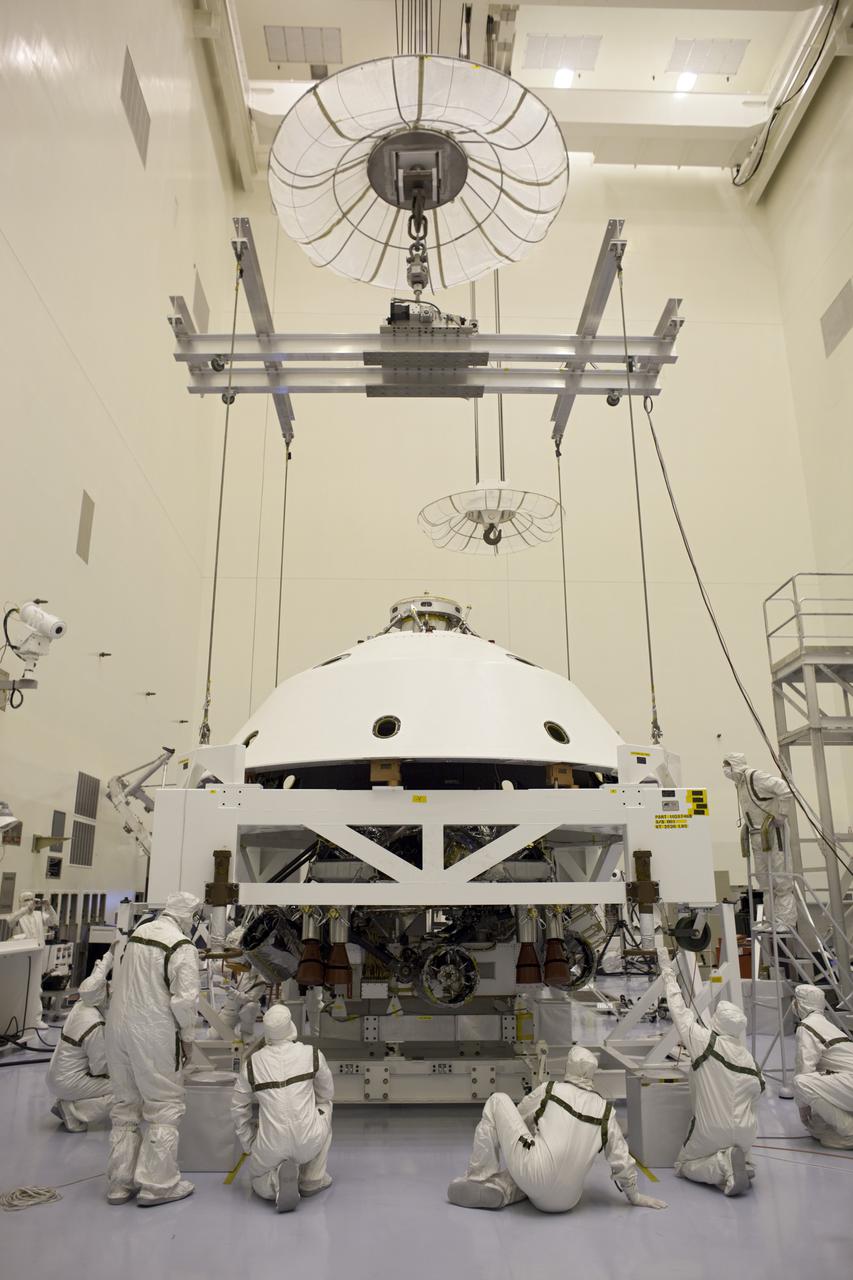
CAPE CANAVERAL, Fla. – In the Payload Hazardous Servicing Facility at NASA's Kennedy Space Center in Florida, technicians guide the backshell as it is lowered over NASA's Mars Science Laboratory (MSL) rover, Curiosity, for encapsulation. The backshell, a protective cover, carries the parachute and several components used during later stages of entry, descent and landing. A United Launch Alliance Atlas V-541 configuration will be used to loft MSL into space. MSL's components include a compact car-sized rover, Curiosity, which has 10 science instruments designed to search for evidence on whether Mars has had environments favorable to microbial life, including chemical ingredients for life. The unique rover will use a laser to look inside rocks and release its gasses so that the rover’s spectrometer can analyze and send the data back to Earth. MSL is scheduled to launch Nov. 25 with a window extending to Dec. 18 and arrival at Mars Aug. 2012. For more information, visit http:__www.nasa.gov_msl. Photo credit: NASA_Dimitri Gerondidakis
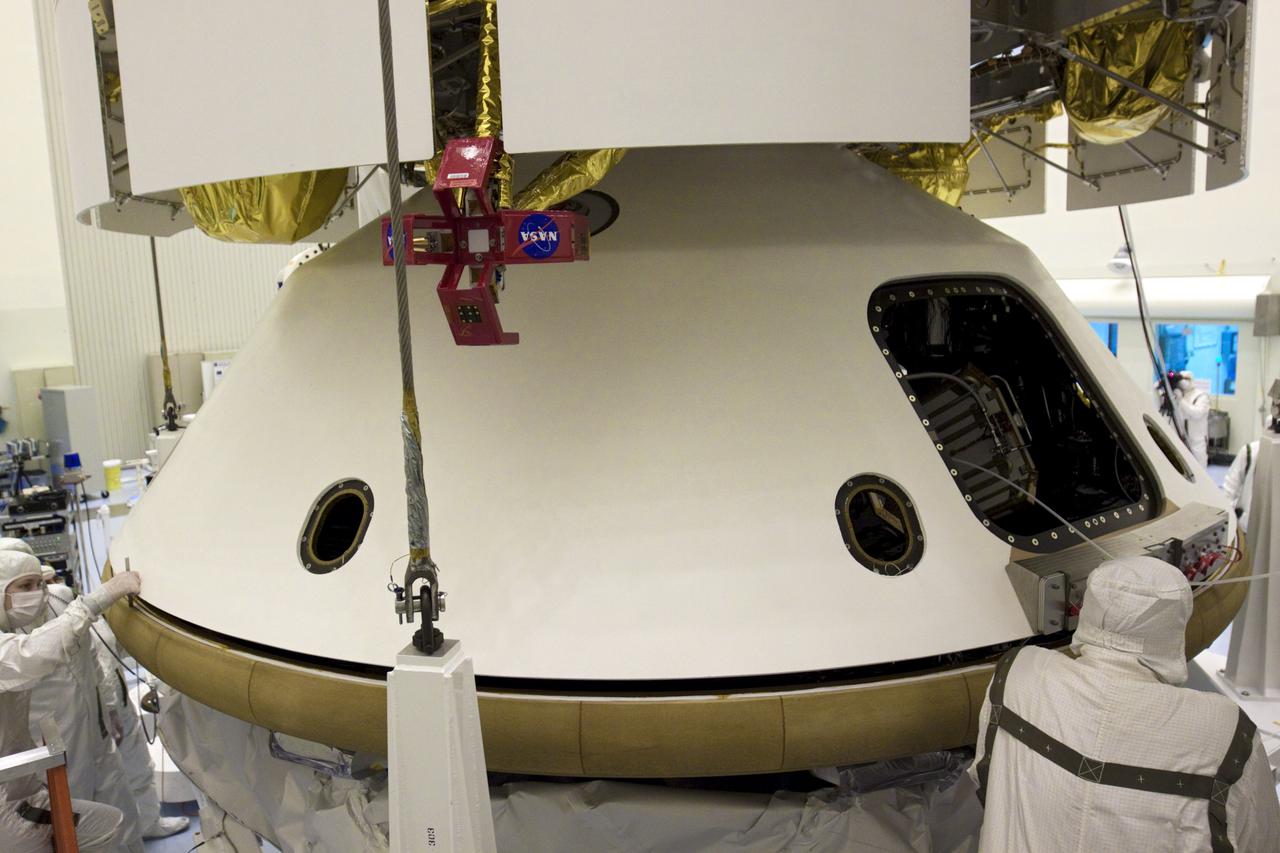
CAPE CANAVERAL, Fla. – In the Payload Hazardous Servicing Facility at NASA’s Kennedy Space Center in Florida, technicians inspect the alignment of the heat shield as an overhead crane lifts it for integration with NASA's Mars Science Laboratory (MSL) mission aeroshell, (containing the compact car-sized rover Curiosity). Earlier, the aeroshell was mated to the cruise stage, which provides solar power, thrusters for navigation, and heat exchangers to the rover during its flight from Earth to Mars. The rover Curiosity has 10 science instruments designed to search for evidence on whether Mars has had environments favorable to microbial life, including chemical ingredients for life. The unique rover will use a laser to look inside rocks and release its gasses so that the rover’s spectrometer can analyze and send the data back to Earth. Launch of MSL aboard a United Launch Alliance Atlas V rocket is scheduled for Nov. 25 from Space Launch Complex 41 on Cape Canaveral Air Force Station in Florida. For more information, visit http:__www.nasa.gov_msl. Photo credit: NASA_Glenn Benson
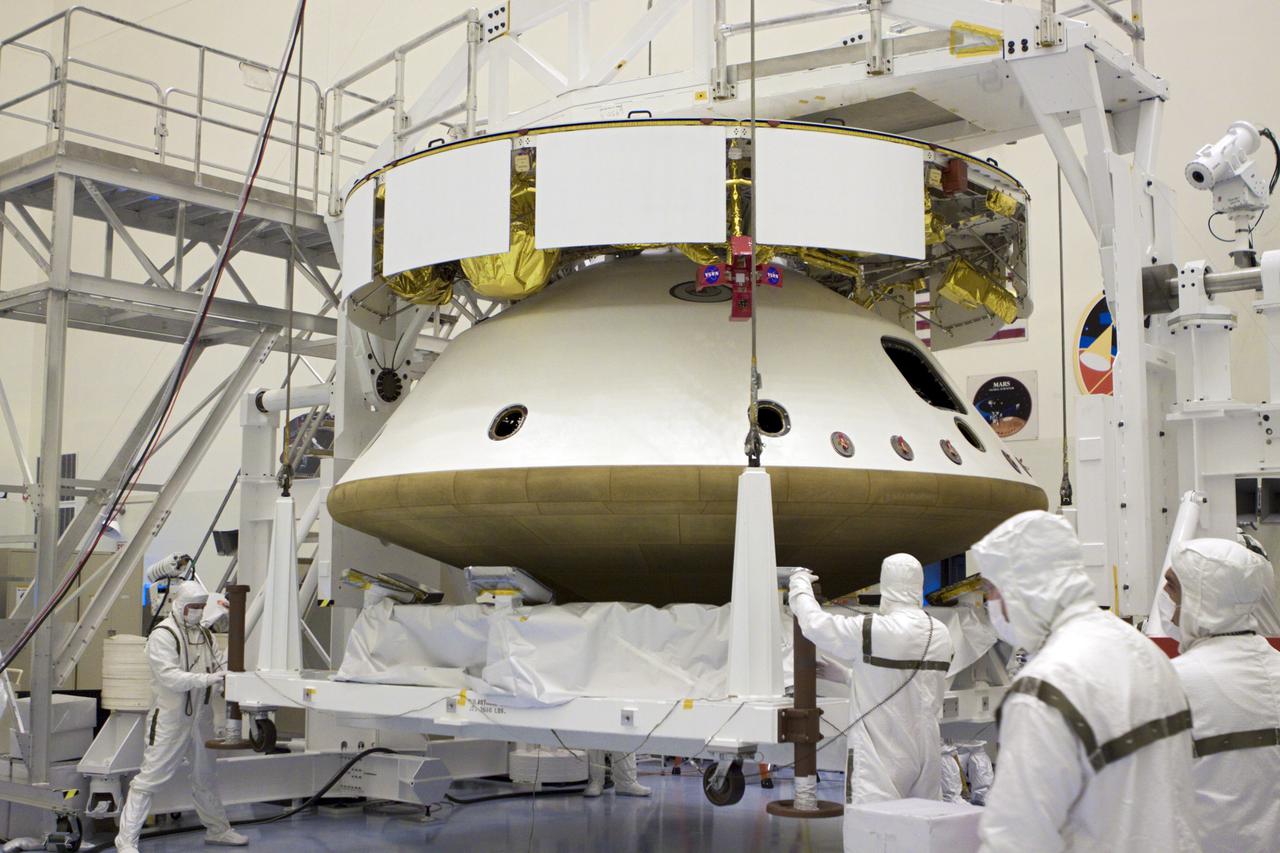
CAPE CANAVERAL, Fla. – In the Payload Hazardous Servicing Facility at NASA’s Kennedy Space Center in Florida, using an overhead crane, technicians lower a carrier which housed the heat shield, after integration with NASA's Mars Science Laboratory (MSL) mission aeroshell, (containing the compact car-sized rover Curiosity). Earlier, the aeroshell was mated to the cruise stage, which provides solar power, thrusters for navigation, and heat exchangers to the rover during its flight from Earth to Mars. The rover Curiosity has 10 science instruments designed to search for evidence on whether Mars has had environments favorable to microbial life, including chemical ingredients for life. The unique rover will use a laser to look inside rocks and release its gasses so that the rover’s spectrometer can analyze and send the data back to Earth. Launch of MSL aboard a United Launch Alliance Atlas V rocket is scheduled for Nov. 25 from Space Launch Complex 41 on Cape Canaveral Air Force Station in Florida. For more information, visit http:__www.nasa.gov_msl. Photo credit: NASA_Glenn Benson
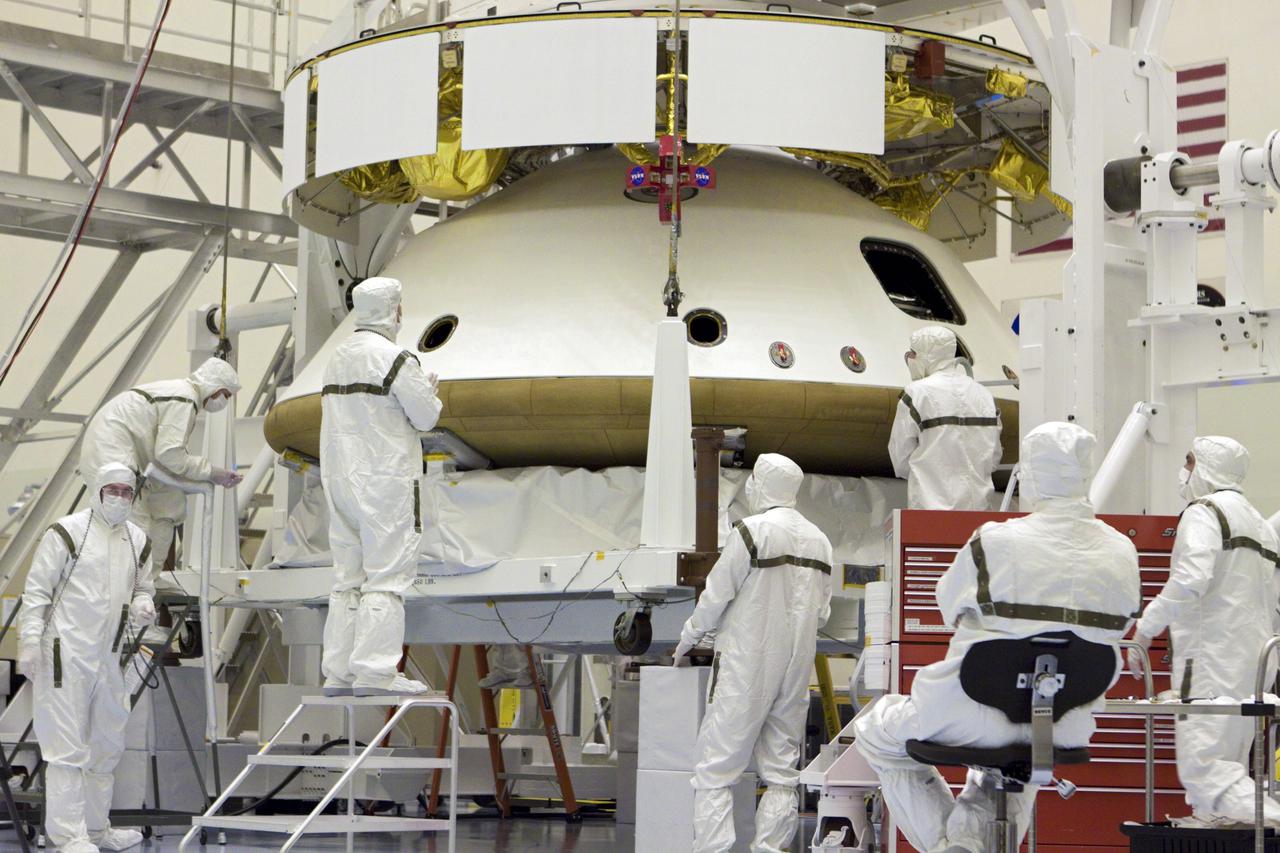
CAPE CANAVERAL, Fla. – In the Payload Hazardous Servicing Facility at NASA’s Kennedy Space Center in Florida, technicians monitor the alignment of the heat shield as an overhead crane lifts it for integration with NASA's Mars Science Laboratory (MSL) mission aeroshell, (containing the compact car-sized rover Curiosity). Earlier, the aeroshell was mated to the cruise stage, which provides solar power, thrusters for navigation, and heat exchangers to the rover during its flight from Earth to Mars. The rover Curiosity has 10 science instruments designed to search for evidence on whether Mars has had environments favorable to microbial life, including chemical ingredients for life. The unique rover will use a laser to look inside rocks and release its gasses so that the rover’s spectrometer can analyze and send the data back to Earth. Launch of MSL aboard a United Launch Alliance Atlas V rocket is scheduled for Nov. 25 from Space Launch Complex 41 on Cape Canaveral Air Force Station in Florida. For more information, visit http:__www.nasa.gov_msl. Photo credit: NASA_Glenn Benson
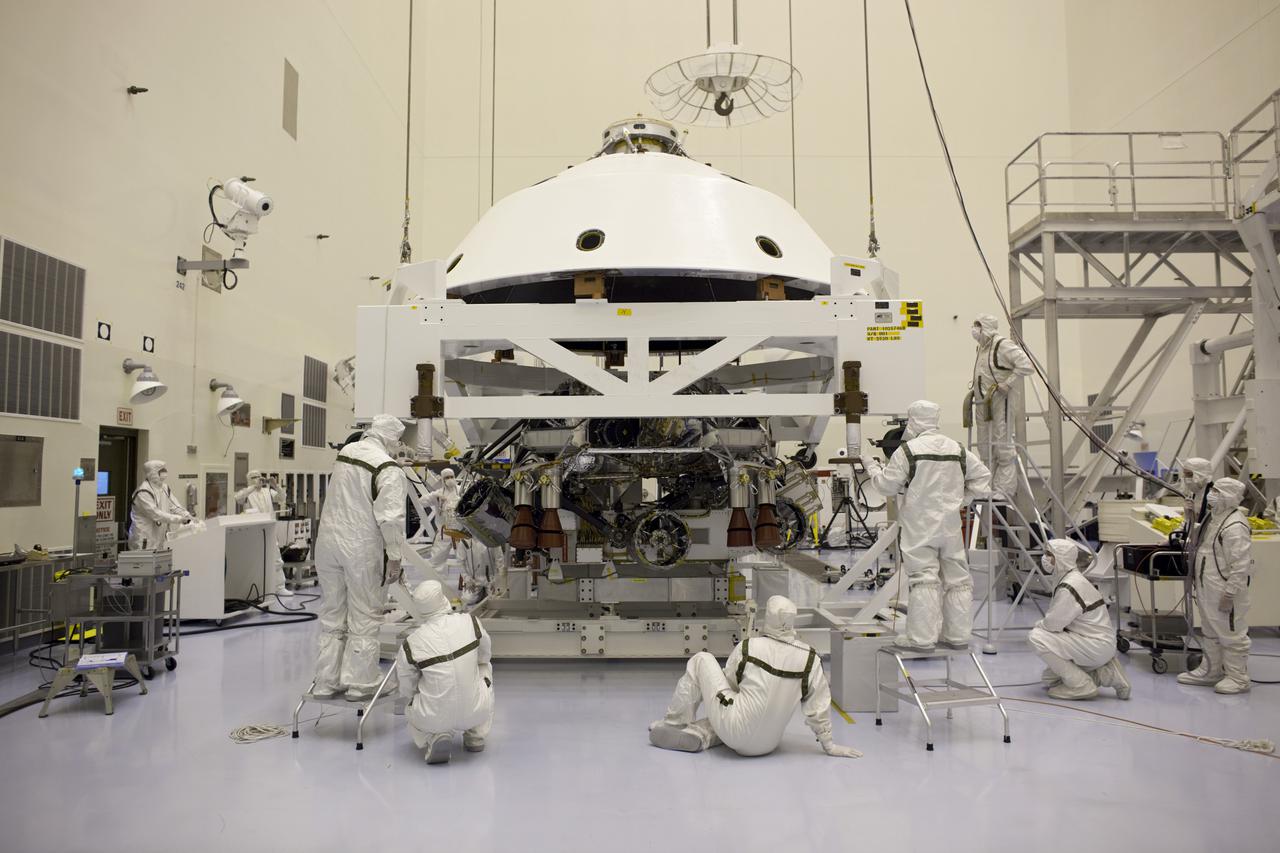
CAPE CANAVERAL, Fla. – In the Payload Hazardous Servicing Facility at NASA's Kennedy Space Center in Florida, technicians guide the backshell as it is lowered over NASA's Mars Science Laboratory (MSL) rover, Curiosity, for encapsulation. The backshell, a protective cover, carries the parachute and several components used during later stages of entry, descent and landing. A United Launch Alliance Atlas V-541 configuration will be used to loft MSL into space. MSL's components include a compact car-sized rover, Curiosity, which has 10 science instruments designed to search for evidence on whether Mars has had environments favorable to microbial life, including chemical ingredients for life. The unique rover will use a laser to look inside rocks and release its gasses so that the rover’s spectrometer can analyze and send the data back to Earth. MSL is scheduled to launch Nov. 25 with a window extending to Dec. 18 and arrival at Mars Aug. 2012. For more information, visit http:__www.nasa.gov_msl. Photo credit: NASA_Dimitri Gerondidakis
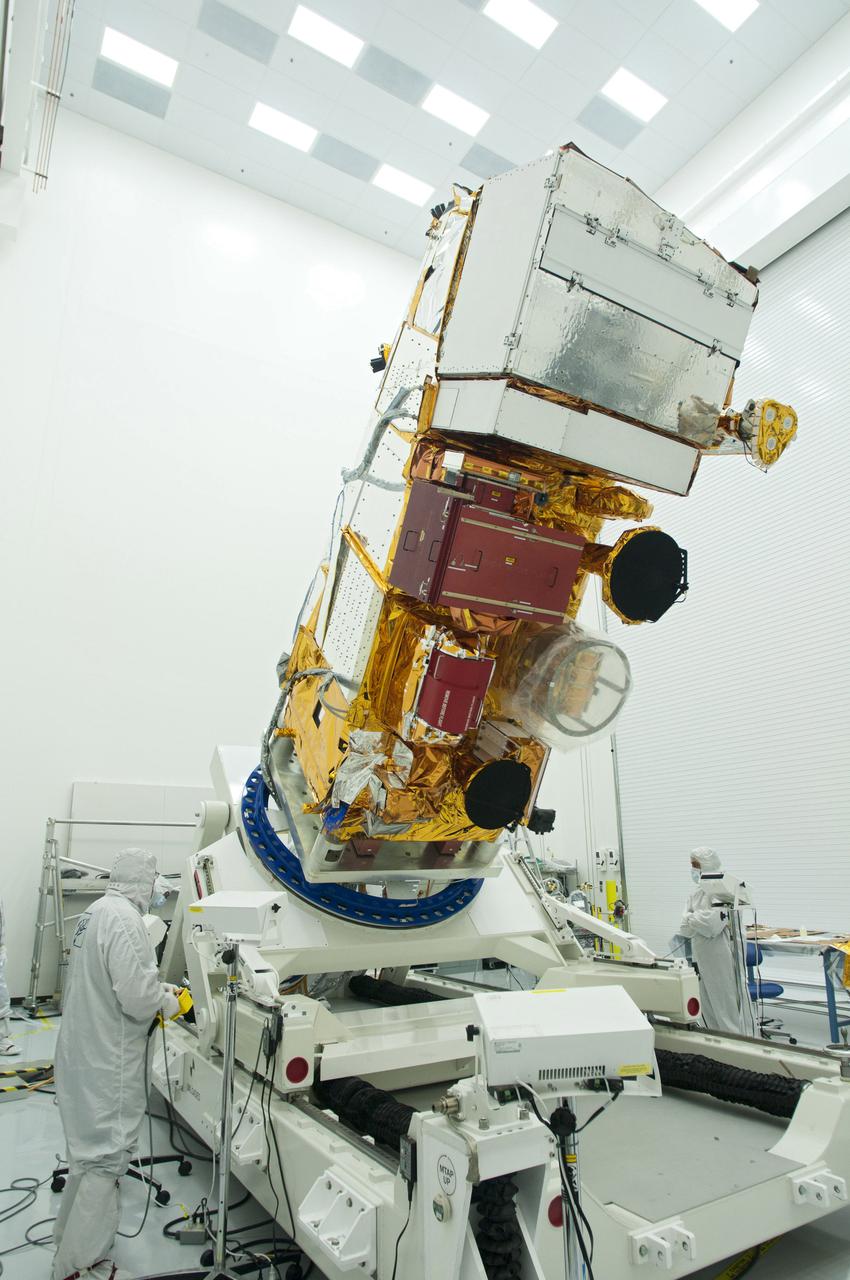
BALL AEROSPACE, Boulder, Colo. – In a cleanroom at Ball Aerospace and Technologies Corp., technicians inspect NASA's National Polar-orbiting Operational Environmental Satellite System Preparatory Project NPP satellite following electromagnetic compatibility testing. A United Launch Alliance Delta II rocket will carry NPP into space. NPP represents a critical first step in building the next-generation of Earth-observing satellites. NPP will carry the first of the new sensors developed for this satellite fleet, now known as the Joint Polar Satellite System JPSS to be launched in 2016. NPP is the bridge between NASA's Earth Observing System EOS satellites and the forthcoming series of JPSS satellites. The mission will test key technologies and instruments for the JPSS missions. NPP is targeted to launch Oct. 27. For more information, visit http:__www.nasa.gov_NPP. Photo credit: Ball Aerospace
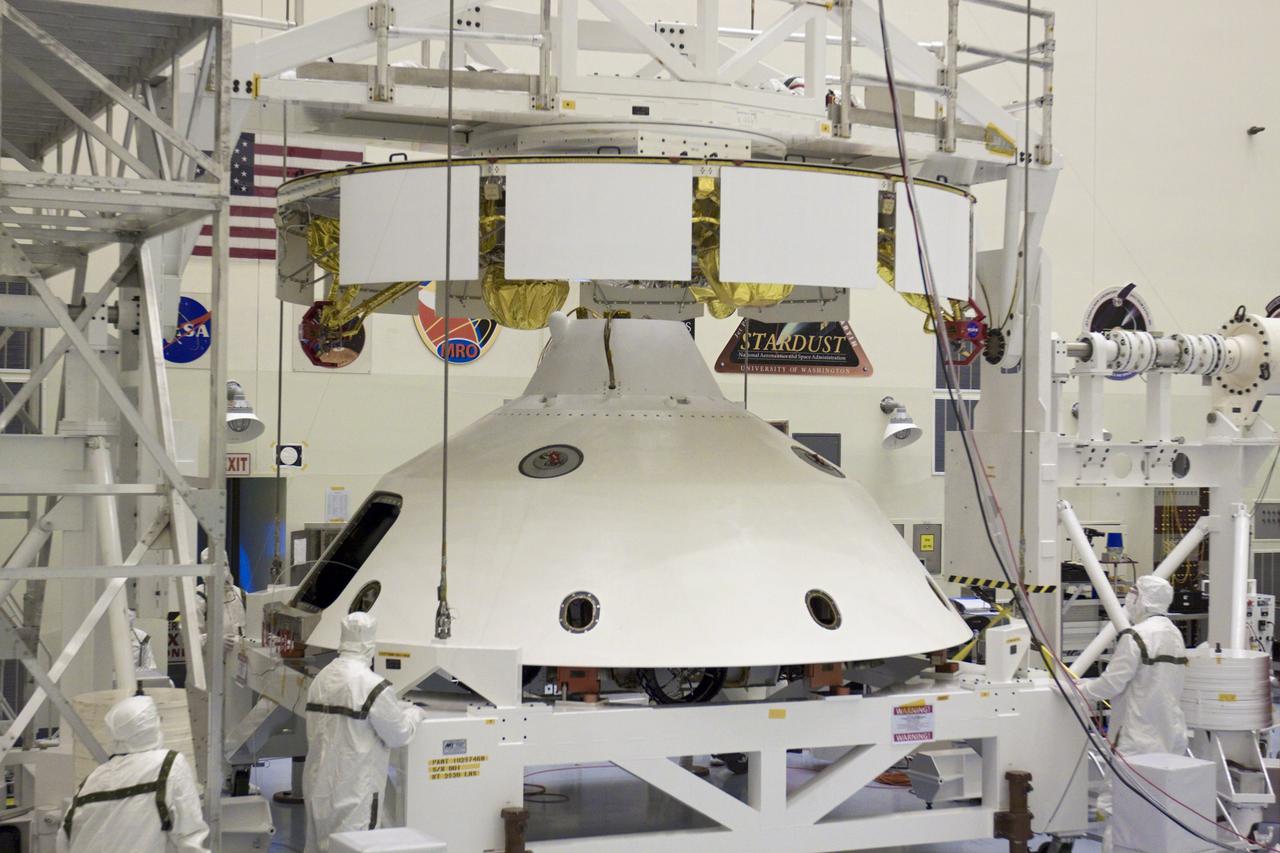
CAPE CANAVERAL, Fla. – In the Payload Hazardous Servicing Facility at NASA’s Kennedy Space Center in Florida, technicians, using an overhead crane, lift NASA's Mars Science Laboratory (MSL) mission aeroshell, (containing the compact car-sized rover Curiosity), for mating to the cruise stage. The cruise stage provides solar power, thrusters for navigation, and heat exchangers to the rover during its flight from Earth to Mars. The rover Curiosity has 10 science instruments designed to search for evidence on whether Mars has had environments favorable to microbial life, including chemical ingredients for life. The unique rover will use a laser to look inside rocks and release its gasses so that the rover’s spectrometer can analyze and send the data back to Earth. Launch of MSL aboard a United Launch Alliance Atlas V rocket is scheduled for Nov. 25 from Space Launch Complex 41 on Cape Canaveral Air Force Station in Florida. For more information, visit http:__www.nasa.gov_msl. Photo credit: NASA_Glenn Benson
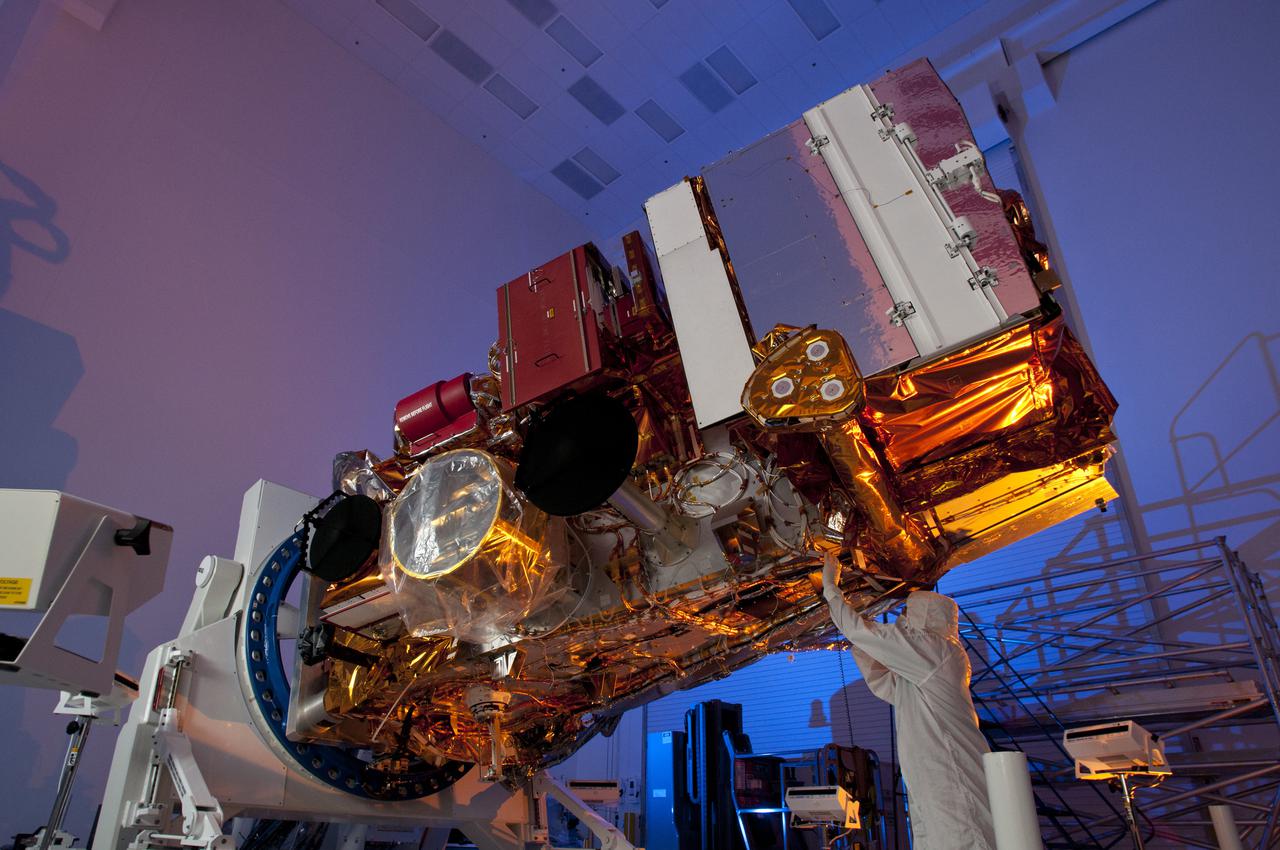
BALL AEROSPACE, Boulder, Colo. – In a Ball Aerospace and Technologies Corp. cleanroom in Boulder, Colo., technicians have completed integration and performance testing of the Cross-track Infrared Sounder CrIS that will fly aboard NASA's National Polar-orbiting Operational Environmental Satellite System Preparatory Project NPP satellite. CrIS will produce high-resolution, three-dimensional temperature, pressure, and moisture profiles which will be used to enhance weather forecasting models for short and long-term weather forecasting. A United Launch Alliance Delta II rocket will carry NPP into space. NPP represents a critical first step in building the next-generation of Earth-observing satellites. NPP will carry the first of the new sensors developed for this satellite fleet, now known as the Joint Polar Satellite System JPSS to be launched in 2016. NPP is the bridge between NASA's Earth Observing System EOS satellites and the forthcoming series of JPSS satellites. The mission will test key technologies and instruments for the JPSS missions. NPP is targeted to launch Oct. 27. For more information, visit http:__www.nasa.gov_NPP. Photo credit: Ball Aerospace
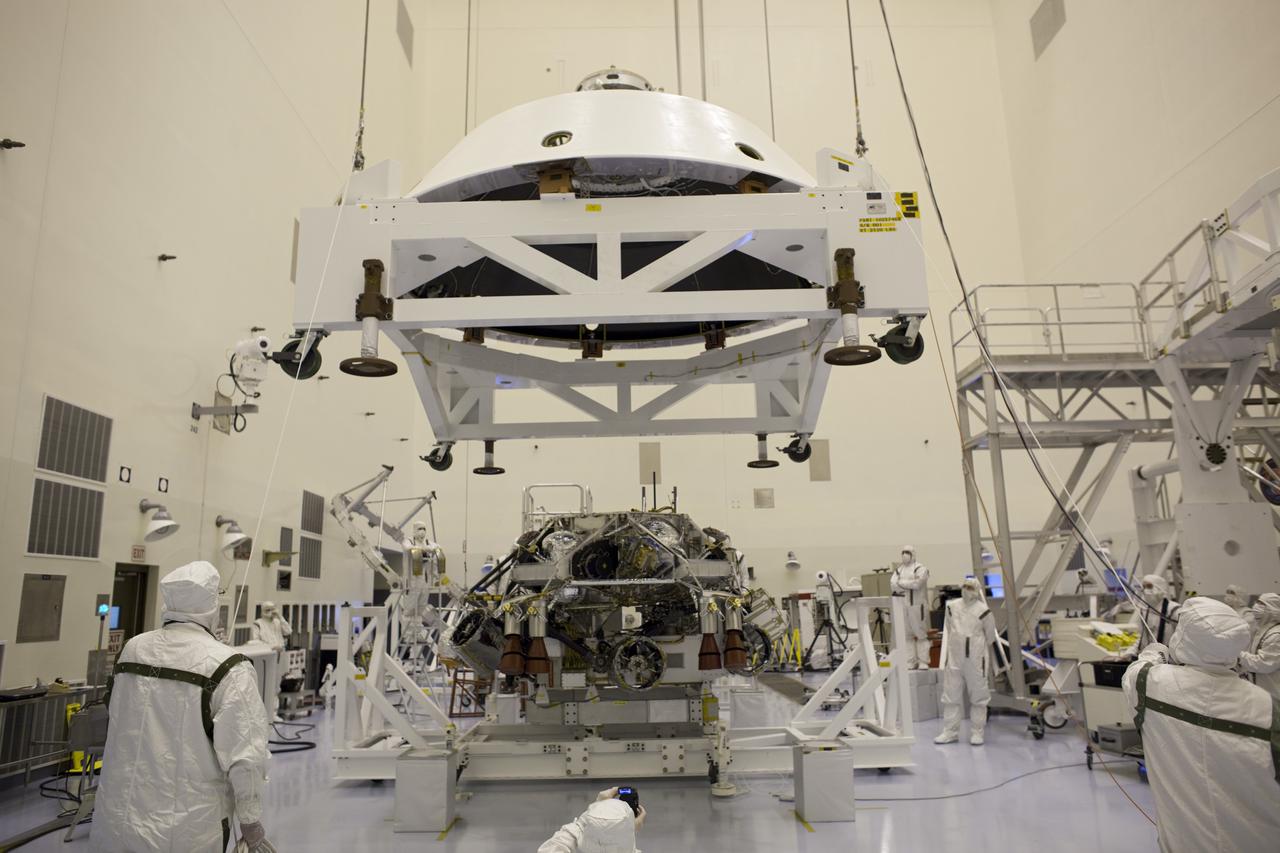
CAPE CANAVERAL, Fla. – In the Payload Hazardous Servicing Facility at NASA's Kennedy Space Center in Florida, technicians guide the backshell as it is lowered over NASA's Mars Science Laboratory (MSL) rover, Curiosity, for encapsulation. The backshell, a protective cover, carries the parachute and several components used during later stages of entry, descent and landing. A United Launch Alliance Atlas V-541 configuration will be used to loft MSL into space. MSL's components include a compact car-sized rover, Curiosity, which has 10 science instruments designed to search for evidence on whether Mars has had environments favorable to microbial life, including chemical ingredients for life. The unique rover will use a laser to look inside rocks and release its gasses so that the rover’s spectrometer can analyze and send the data back to Earth. MSL is scheduled to launch Nov. 25 with a window extending to Dec. 18 and arrival at Mars Aug. 2012. For more information, visit http:__www.nasa.gov_msl. Photo credit: NASA_Dimitri Gerondidakis
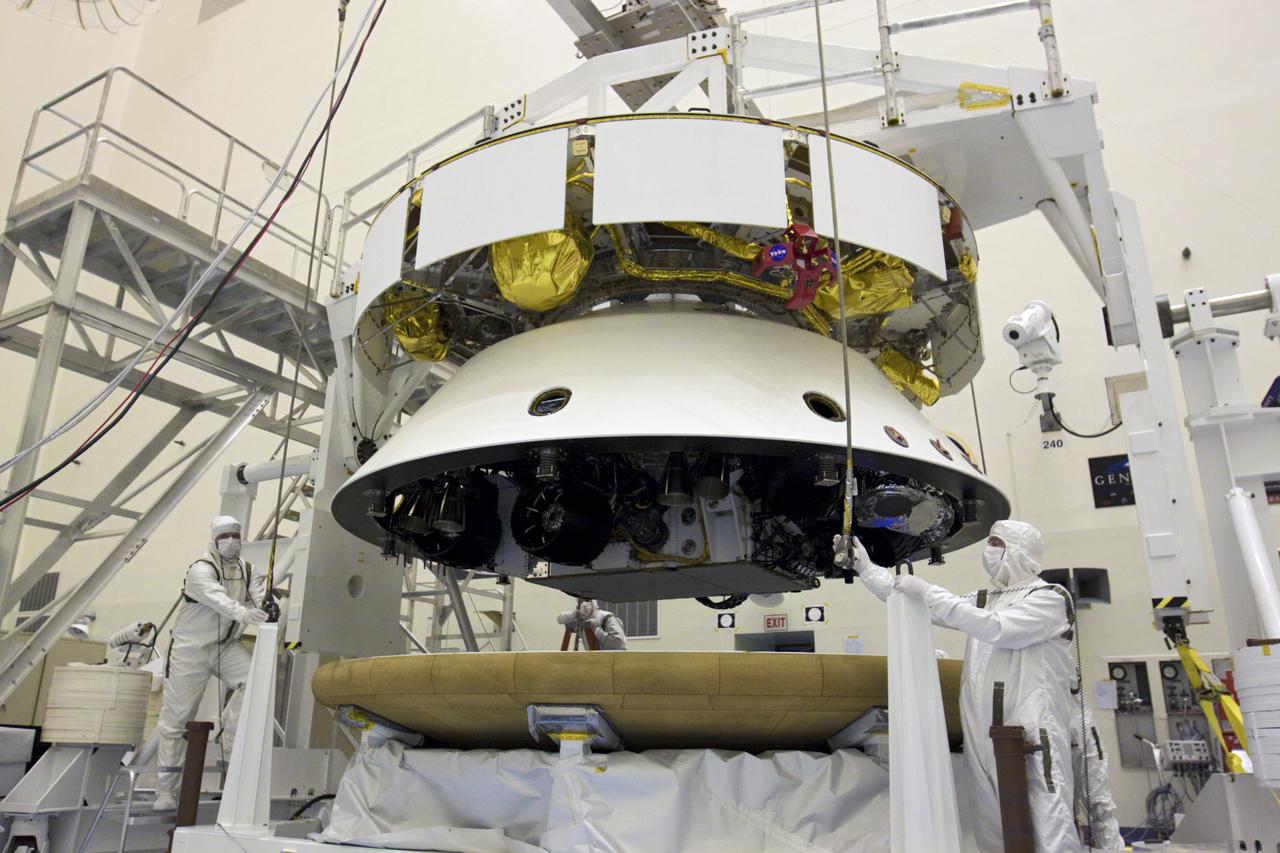
CAPE CANAVERAL, Fla. – In the Payload Hazardous Servicing Facility at NASA’s Kennedy Space Center in Florida, technicians attach an overhead crane to the heat shield in preparation for integration with NASA's Mars Science Laboratory (MSL) mission aeroshell, (containing the compact car-sized rover Curiosity). Earlier, the aeroshell was mated to the cruise stage, which provides solar power, thrusters for navigation, and heat exchangers to the rover during its flight from Earth to Mars. The rover Curiosity has 10 science instruments designed to search for evidence on whether Mars has had environments favorable to microbial life, including chemical ingredients for life. The unique rover will use a laser to look inside rocks and release its gasses so that the rover’s spectrometer can analyze and send the data back to Earth. Launch of MSL aboard a United Launch Alliance Atlas V rocket is scheduled for Nov. 25 from Space Launch Complex 41 on Cape Canaveral Air Force Station in Florida. For more information, visit http:__www.nasa.gov_msl. Photo credit: NASA_Glenn Benson

CAPE CANAVERAL, Fla. – In the Payload Hazardous Servicing Facility at NASA's Kennedy Space Center in Florida, technicians prepare the Mars Science Laboratory (MSL) rover, Curiosity, for encapsulation inside a backshell. The spacecraft's backshell, a protective cover, carries the parachute and several components used during later stages of entry, descent and landing of the MSL's rover. The rover has been integrated with a rocket-powered descent stage which will lower Curiosity to the surface of Mars. A United Launch Alliance Atlas V-541 configuration will be used to loft MSL into space. MSL's components include a compact car-sized rover, Curiosity, which has 10 science instruments designed to search for evidence on whether Mars has had environments favorable to microbial life, including chemical ingredients for life. The unique rover will use a laser to look inside rocks and release its gasses so that the rover’s spectrometer can analyze and send the data back to Earth. MSL is scheduled to launch Nov. 25 with a window extending to Dec. 18 and arrival at Mars Aug. 2012. For more information, visit http:__www.nasa.gov_msl. Photo credit: NASA_Dimitri Gerondidakis
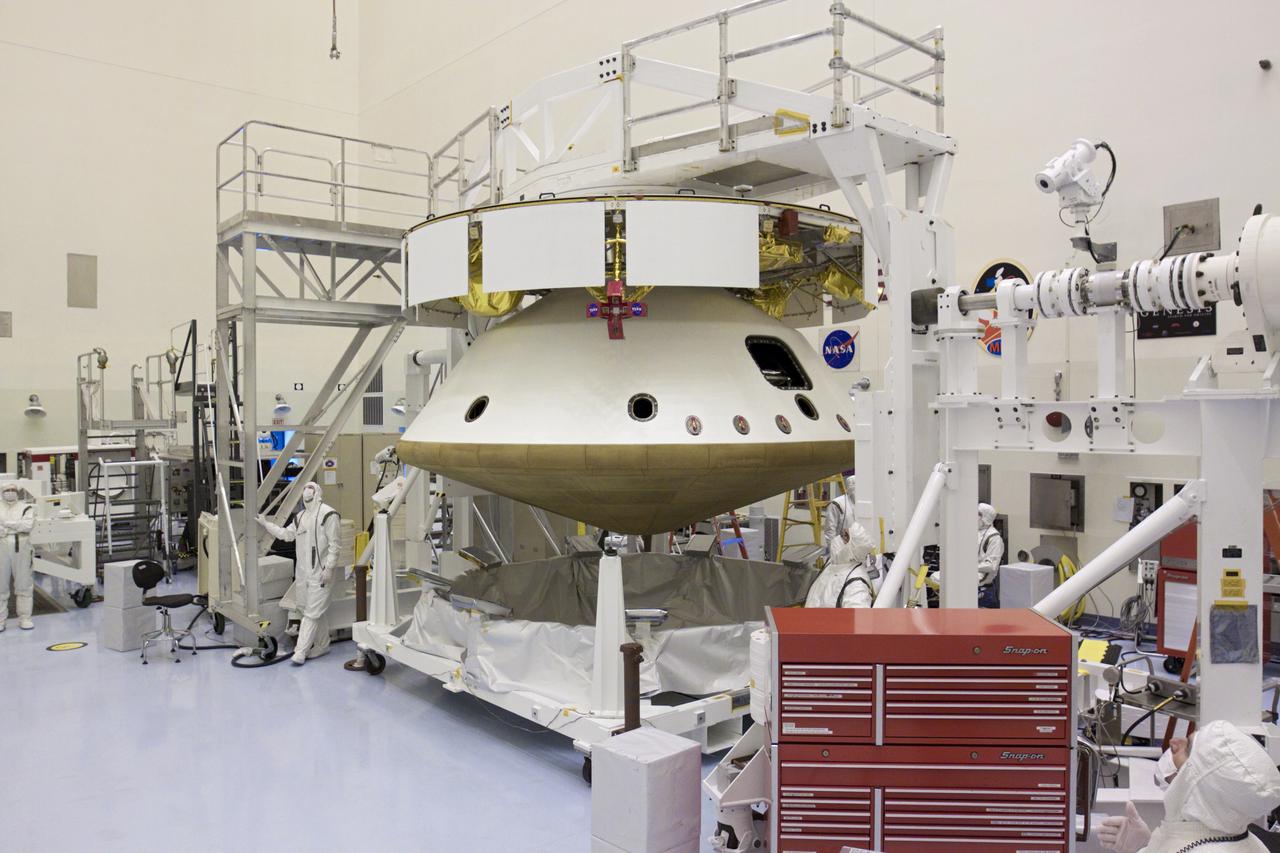
CAPE CANAVERAL, Fla. – In the Payload Hazardous Servicing Facility at NASA’s Kennedy Space Center in Florida, technicians observe the raising of an overhead crane. The crane was used to integrate the heat shield with NASA's Mars Science Laboratory (MSL) mission aeroshell, (containing the compact car-sized rover Curiosity). Earlier, the aeroshell was mated to the cruise stage, which provides solar power, thrusters for navigation, and heat exchangers to the rover during its flight from Earth to Mars. The rover Curiosity has 10 science instruments designed to search for evidence on whether Mars has had environments favorable to microbial life, including chemical ingredients for life. The unique rover will use a laser to look inside rocks and release its gasses so that the rover’s spectrometer can analyze and send the data back to Earth. Launch of MSL aboard a United Launch Alliance Atlas V rocket is scheduled for Nov. 25 from Space Launch Complex 41 on Cape Canaveral Air Force Station in Florida. For more information, visit http:__www.nasa.gov_msl. Photo credit: NASA_Glenn Benson
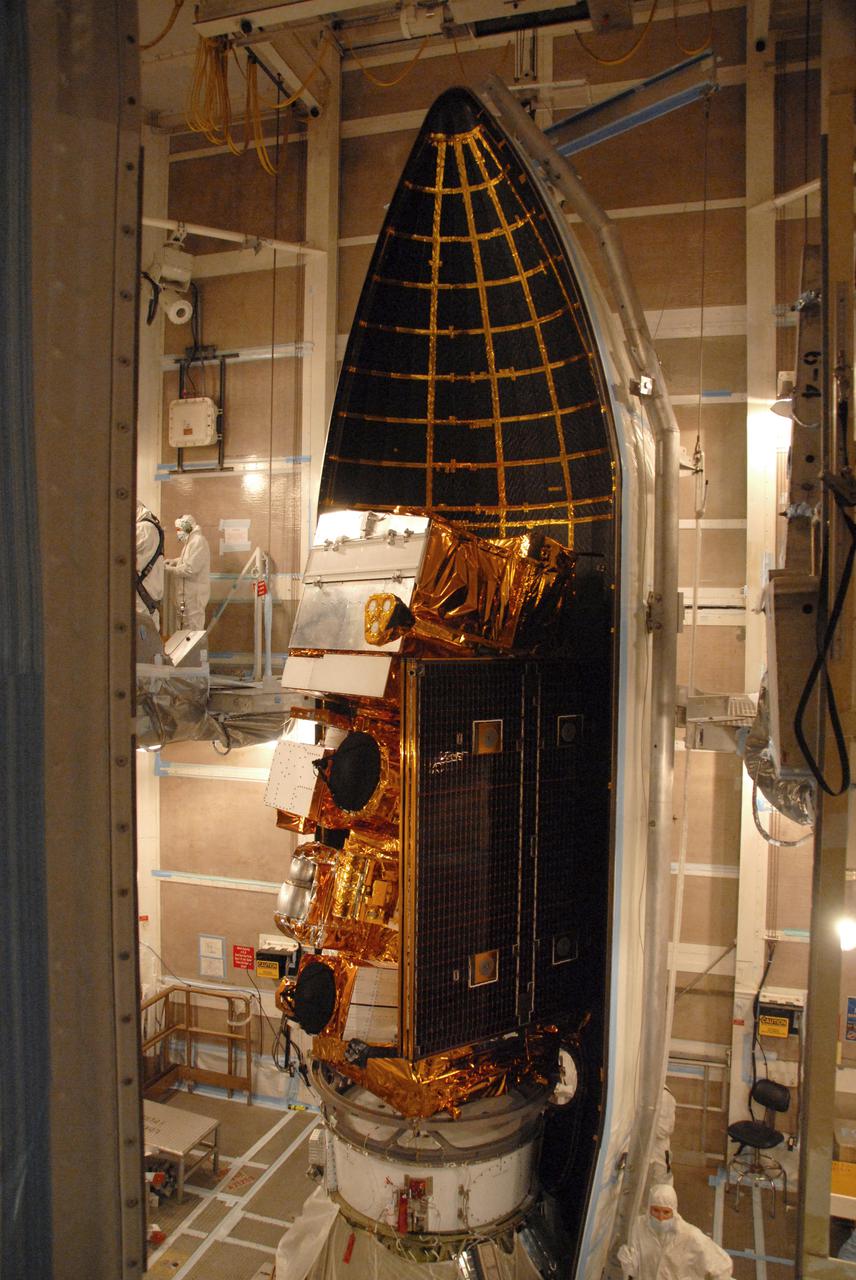
VANDENBERG AIR FORCE BASE, Calif. – At Vandenberg Air Force Base's Space Launch Complex-2 in California, technicians monitor the movement of a section of the clamshell-shaped Delta payload fairing as it encloses NASA’s National Polar-orbiting Operational Environmental Satellite System Preparatory Project (NPP) spacecraft. The fairing will protect the spacecraft from the impact of aerodynamic pressure and heating during ascent and will be jettisoned once the spacecraft is outside the Earth's atmosphere. NPP represents a critical first step in building the next-generation of Earth-observing satellites. NPP will carry the first of the new sensors developed for this satellite fleet, now known as the Joint Polar Satellite System (JPSS) to be launched in 2016. NPP is the bridge between NASA's Earth Observing System (EOS) satellites and the forthcoming series of JPSS satellites. The mission will test key technologies and instruments for the JPSS missions. NPP is targeted to launch Oct. 28 from Space Launch Complex-2 aboard a United Launch Alliance Delta II rocket. For more information, visit http:__www.nasa.gov_NPP. Photo credit: NASA_Mark P. Mackley, VAFB
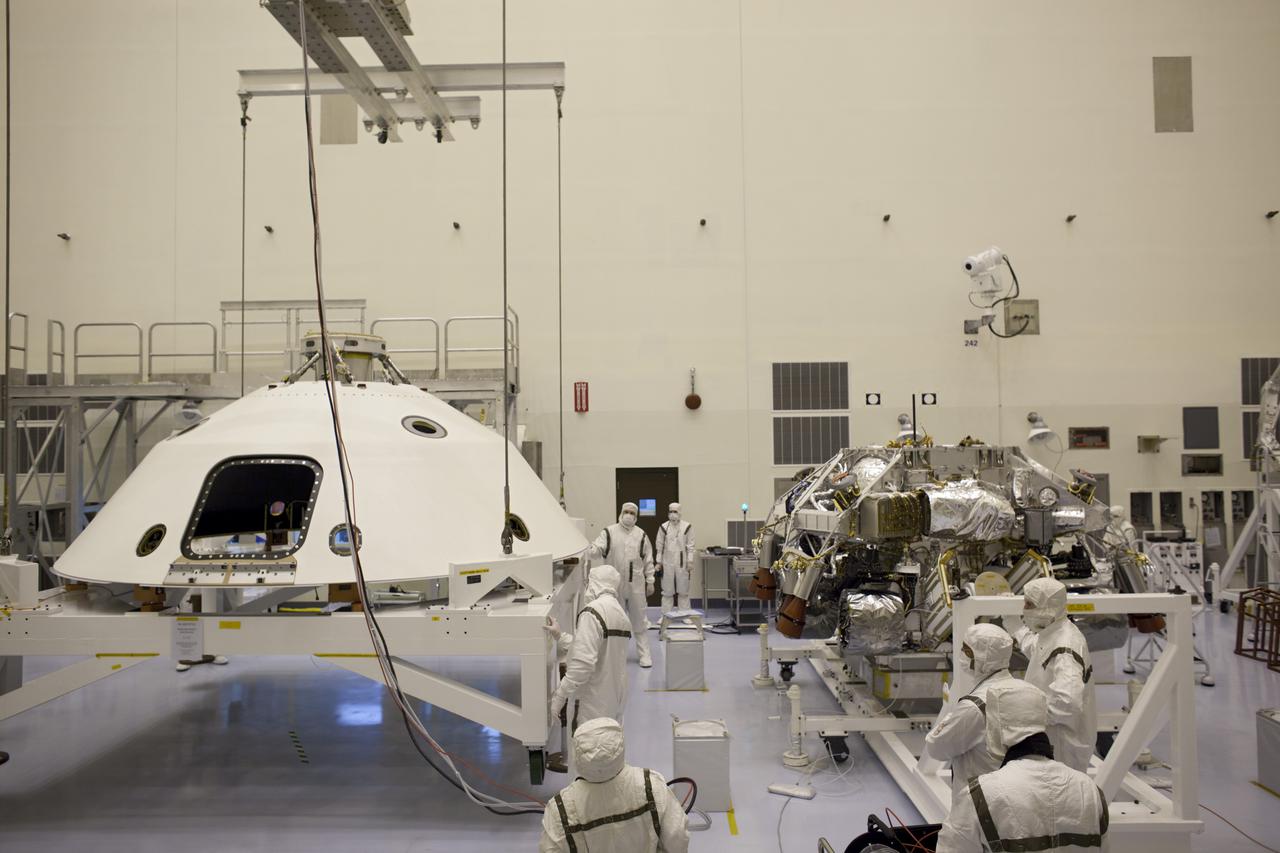
CAPE CANAVERAL, Fla. – In the Payload Hazardous Servicing Facility at NASA's Kennedy Space Center in Florida, technicians, using an overhead crane, lift the backshell for NASA's Mars Science Laboratory (MSL) rover, Curiosity. The backshell, a protective cover which carries the parachute and several components used during later stages of entry, descent and landing, will be encapsulated over the rover (seen to the right). A United Launch Alliance Atlas V-541 configuration will be used to loft MSL into space. MSL's components include a compact car-sized rover, Curiosity, which has 10 science instruments designed to search for evidence on whether Mars has had environments favorable to microbial life, including chemical ingredients for life. The unique rover will use a laser to look inside rocks and release its gasses so that the rover’s spectrometer can analyze and send the data back to Earth. MSL is scheduled to launch Nov. 25 with a window extending to Dec. 18 and arrival at Mars Aug. 2012. For more information, visit http:__www.nasa.gov_msl. Photo credit: NASA_Dimitri Gerondidakis
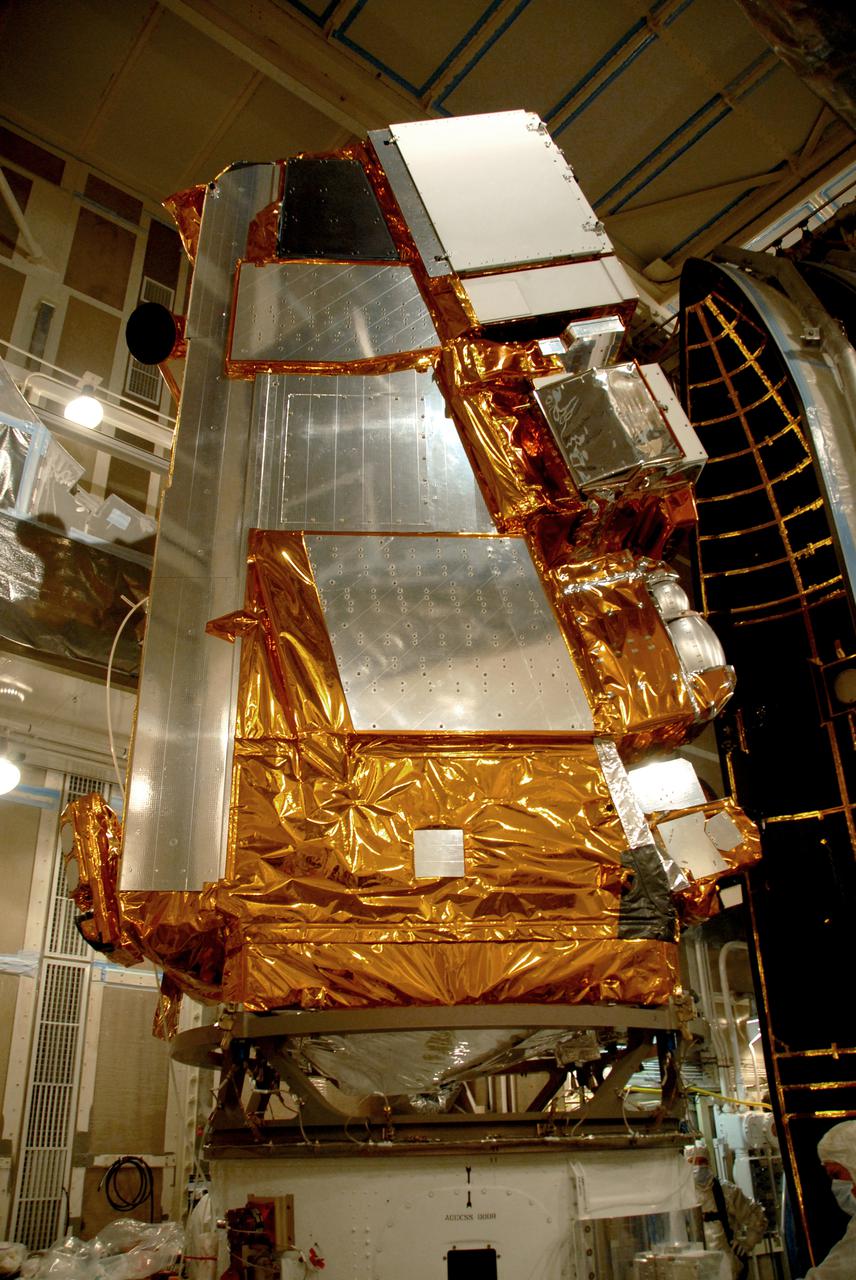
VANDENBERG AIR FORCE BASE, Calif. – At Vandenberg Air Force Base's Space Launch Complex-2 in California, preparations are under way to enclose NASA’s National Polar-orbiting Operational Environmental Satellite System Preparatory Project (NPP) spacecraft into clamshell-shaped the Delta payload fairing. The fairing will protect the spacecraft from the impact of aerodynamic pressure and heating during ascent and will be jettisoned once the spacecraft is outside the Earth's atmosphere. NPP represents a critical first step in building the next-generation of Earth-observing satellites. NPP will carry the first of the new sensors developed for this satellite fleet, now known as the Joint Polar Satellite System (JPSS) to be launched in 2016. NPP is the bridge between NASA's Earth Observing System (EOS) satellites and the forthcoming series of JPSS satellites. The mission will test key technologies and instruments for the JPSS missions. NPP is targeted to launch Oct. 28 from Space Launch Complex-2 aboard a United Launch Alliance Delta II rocket. For more information, visit http:__www.nasa.gov_NPP. Photo credit: NASA_Mark P. Mackley, VAFB
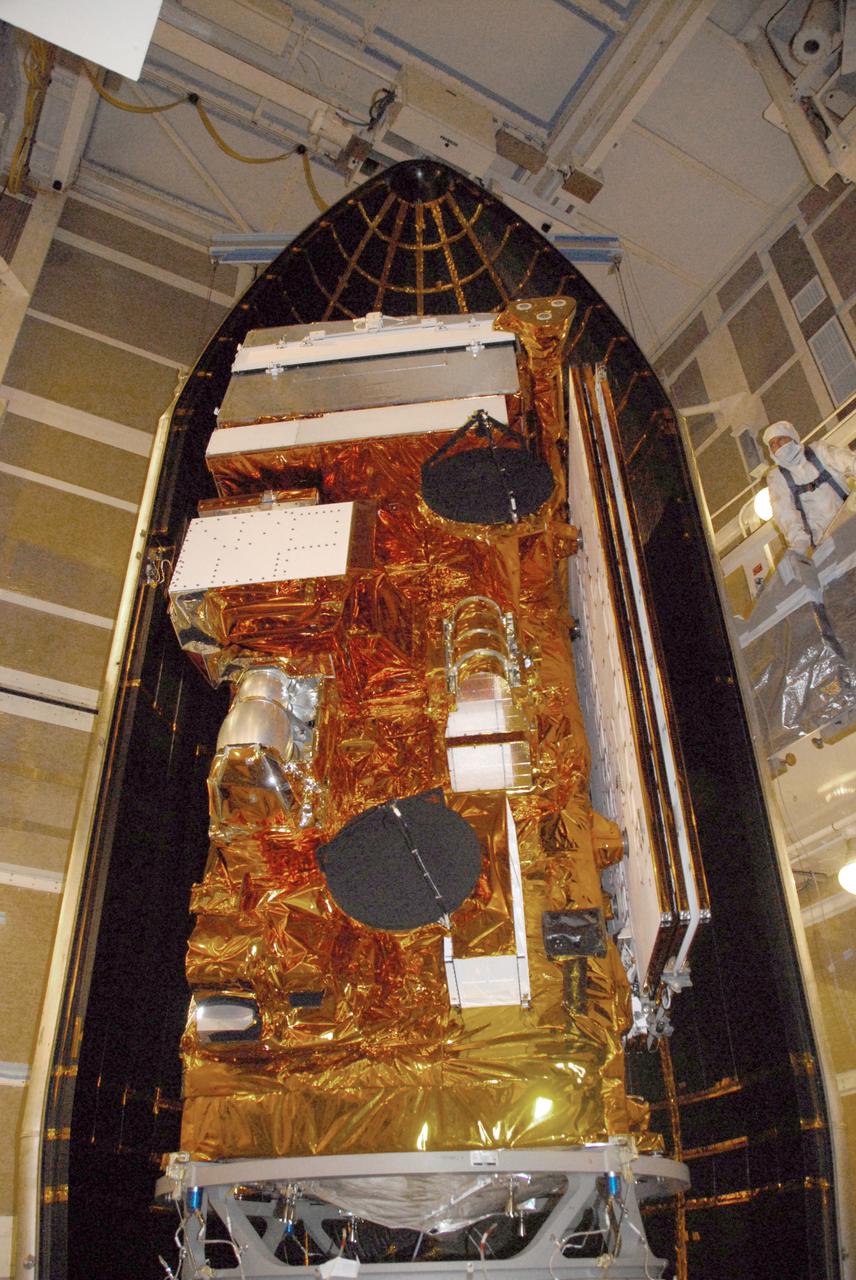
VANDENBERG AIR FORCE BASE, Calif. – At Vandenberg Air Force Base's Space Launch Complex-2 in California, technicians monitor the movement of a section of the clamshell-shaped Delta payload fairing as it encloses NASA’s National Polar-orbiting Operational Environmental Satellite System Preparatory Project (NPP) spacecraft. The fairing will protect the spacecraft from the impact of aerodynamic pressure and heating during ascent and will be jettisoned once the spacecraft is outside the Earth's atmosphere. NPP represents a critical first step in building the next-generation of Earth-observing satellites. NPP will carry the first of the new sensors developed for this satellite fleet, now known as the Joint Polar Satellite System (JPSS) to be launched in 2016. NPP is the bridge between NASA's Earth Observing System (EOS) satellites and the forthcoming series of JPSS satellites. The mission will test key technologies and instruments for the JPSS missions. NPP is targeted to launch Oct. 28 from Space Launch Complex-2 aboard a United Launch Alliance Delta II rocket. For more information, visit http:__www.nasa.gov_NPP. Photo credit: NASA_Mark P. Mackley, VAFB
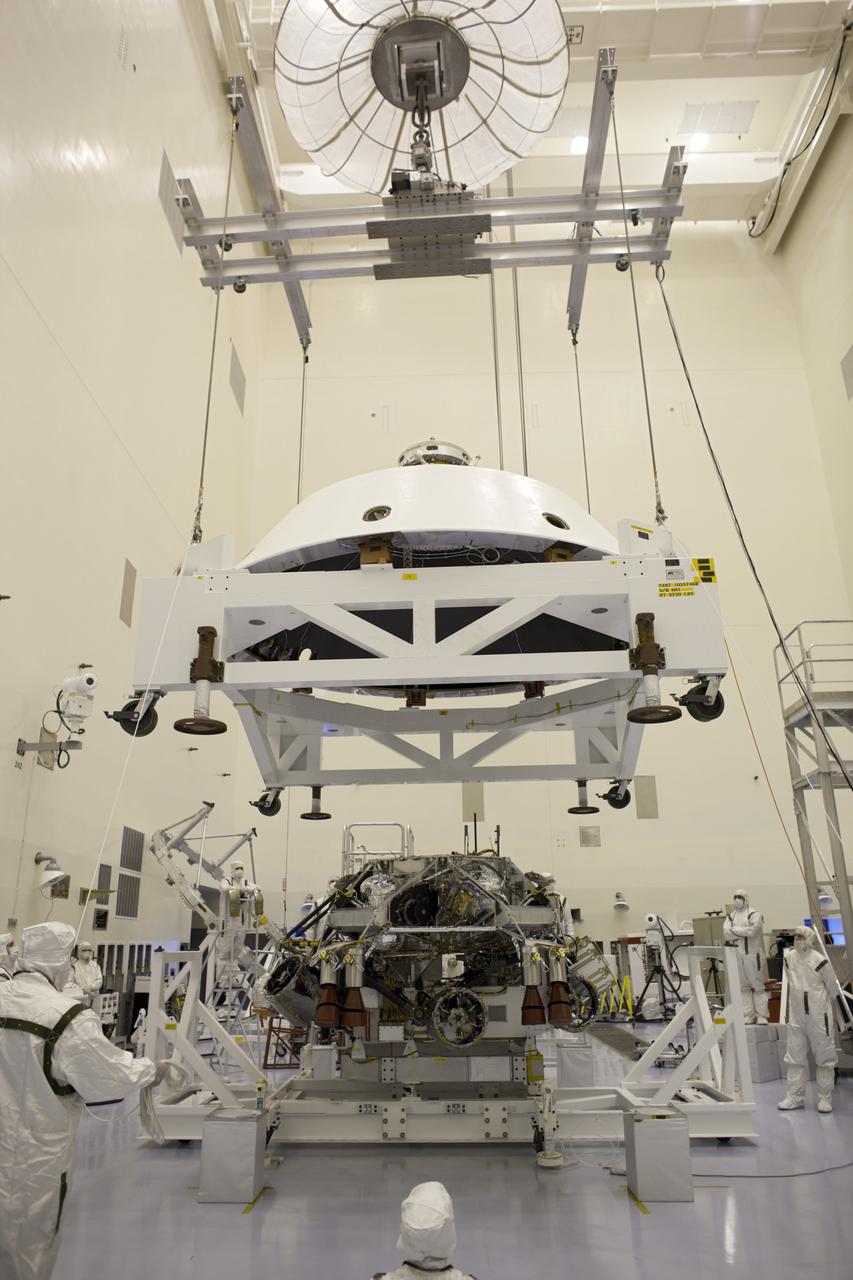
CAPE CANAVERAL, Fla. – In the Payload Hazardous Servicing Facility at NASA's Kennedy Space Center in Florida, technicians guide the backshell as it is lowered over NASA's Mars Science Laboratory (MSL) rover, Curiosity, for encapsulation. The backshell, a protective cover, carries the parachute and several components used during later stages of entry, descent and landing. A United Launch Alliance Atlas V-541 configuration will be used to loft MSL into space. MSL's components include a compact car-sized rover, Curiosity, which has 10 science instruments designed to search for evidence on whether Mars has had environments favorable to microbial life, including chemical ingredients for life. The unique rover will use a laser to look inside rocks and release its gasses so that the rover’s spectrometer can analyze and send the data back to Earth. MSL is scheduled to launch Nov. 25 with a window extending to Dec. 18 and arrival at Mars Aug. 2012. For more information, visit http:__www.nasa.gov_msl. Photo credit: NASA_Dimitri Gerondidakis
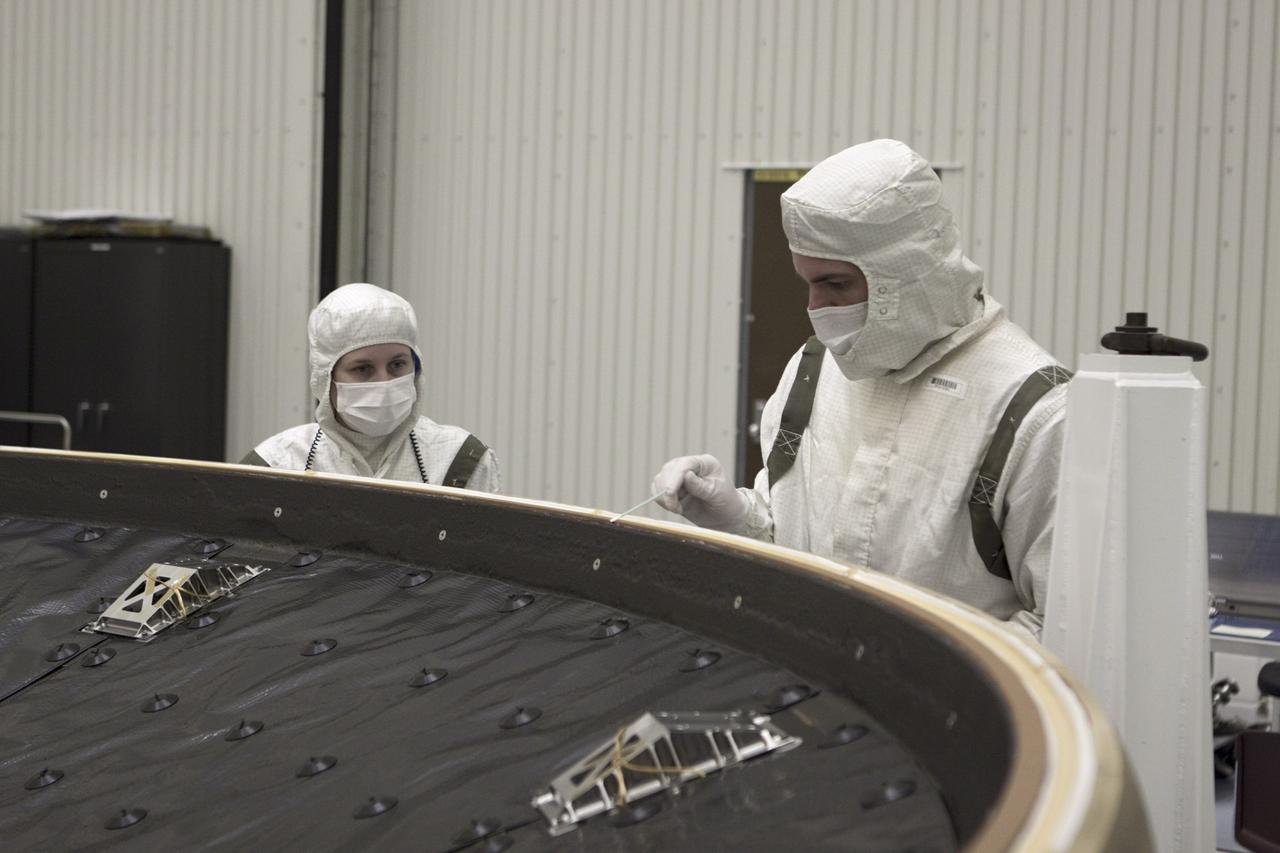
CAPE CANAVERAL, Fla. – In the Payload Hazardous Servicing Facility at NASA’s Kennedy Space Center in Florida, a technician cleans along the edge of NASA's Mars Science Laboratory (MSL) mission heat shield. MSL's components include a car-sized rover, Curiosity, which has 10 science instruments designed to search for evidence on whether Mars has had environments favorable to microbial life, including chemical ingredients for life. The unique rover will use a laser to look inside rocks and release its gasses so that the rover’s spectrometer can analyze and send the data back to Earth. Launch of MSL aboard a United Launch Alliance Atlas V rocket is scheduled for Nov. 25 from Space Launch Complex 41 on Cape Canaveral Air Force Station in Florida. For more information, visit http:__www.nasa.gov_msl. Photo credit: NASA_Glenn Benson
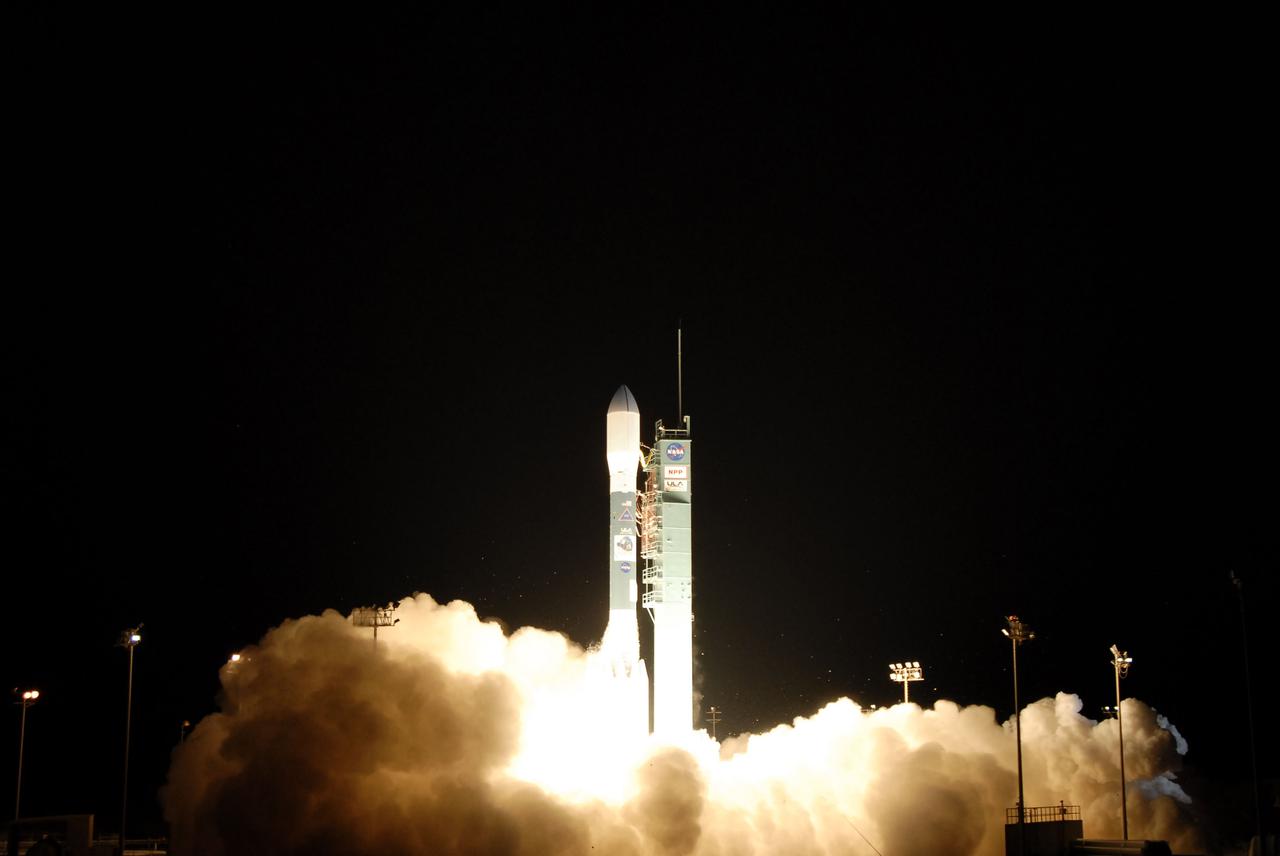
VANDENBERG AIR FORCE BASE, Calif. -- At Space Launch Complex-2 on Vandenberg Air Force Base in California, an exhaust cloud forms around the United Launch Alliance Delta II rocket carrying NASA's National Polar-orbiting Operational Environmental Satellite System Preparatory Project (NPP) into space. Liftoff was at 2:48 a.m. PDT. NPP represents a critical first step in building the next-generation of Earth-observing satellites. NPP will carry the first of the new sensors developed for this satellite fleet, now known as the Joint Polar Satellite System (JPSS) to be launched in 2016. NPP is the bridge between NASA's Earth Observing System (EOS) satellites and the forthcoming series of JPSS satellites. The mission will test key technologies and instruments for the JPSS missions. For more information, visit http:__www.nasa.gov_NPP. Photo credit: NASA_Kim Shiflett
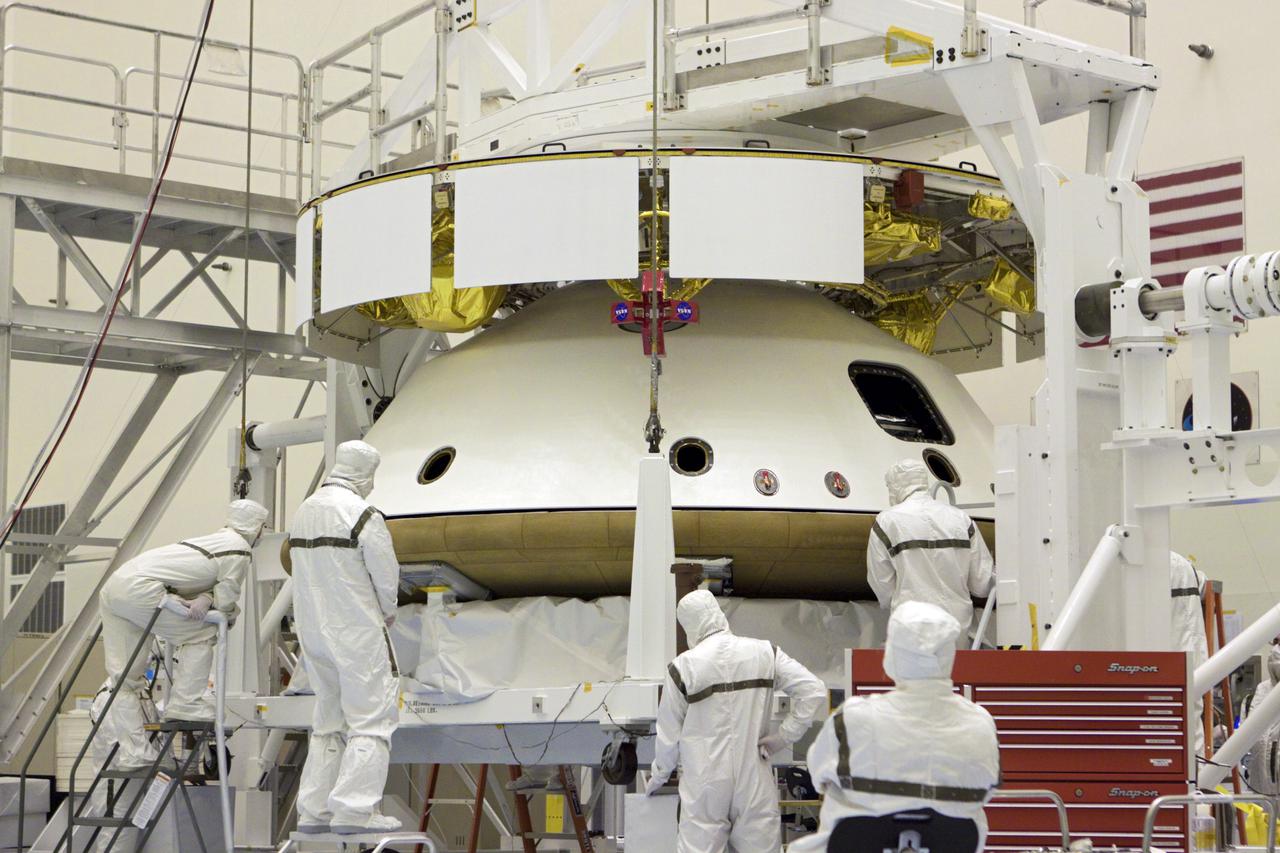
CAPE CANAVERAL, Fla. – In the Payload Hazardous Servicing Facility at NASA’s Kennedy Space Center in Florida, technicians monitor the alignment of the heat shield as an overhead crane lifts it for integration with NASA's Mars Science Laboratory (MSL) mission aeroshell, (containing the compact car-sized rover Curiosity). Earlier, the aeroshell was mated to the cruise stage, which provides solar power, thrusters for navigation, and heat exchangers to the rover during its flight from Earth to Mars. The rover Curiosity has 10 science instruments designed to search for evidence on whether Mars has had environments favorable to microbial life, including chemical ingredients for life. The unique rover will use a laser to look inside rocks and release its gasses so that the rover’s spectrometer can analyze and send the data back to Earth. Launch of MSL aboard a United Launch Alliance Atlas V rocket is scheduled for Nov. 25 from Space Launch Complex 41 on Cape Canaveral Air Force Station in Florida. For more information, visit http:__www.nasa.gov_msl. Photo credit: NASA_Glenn Benson
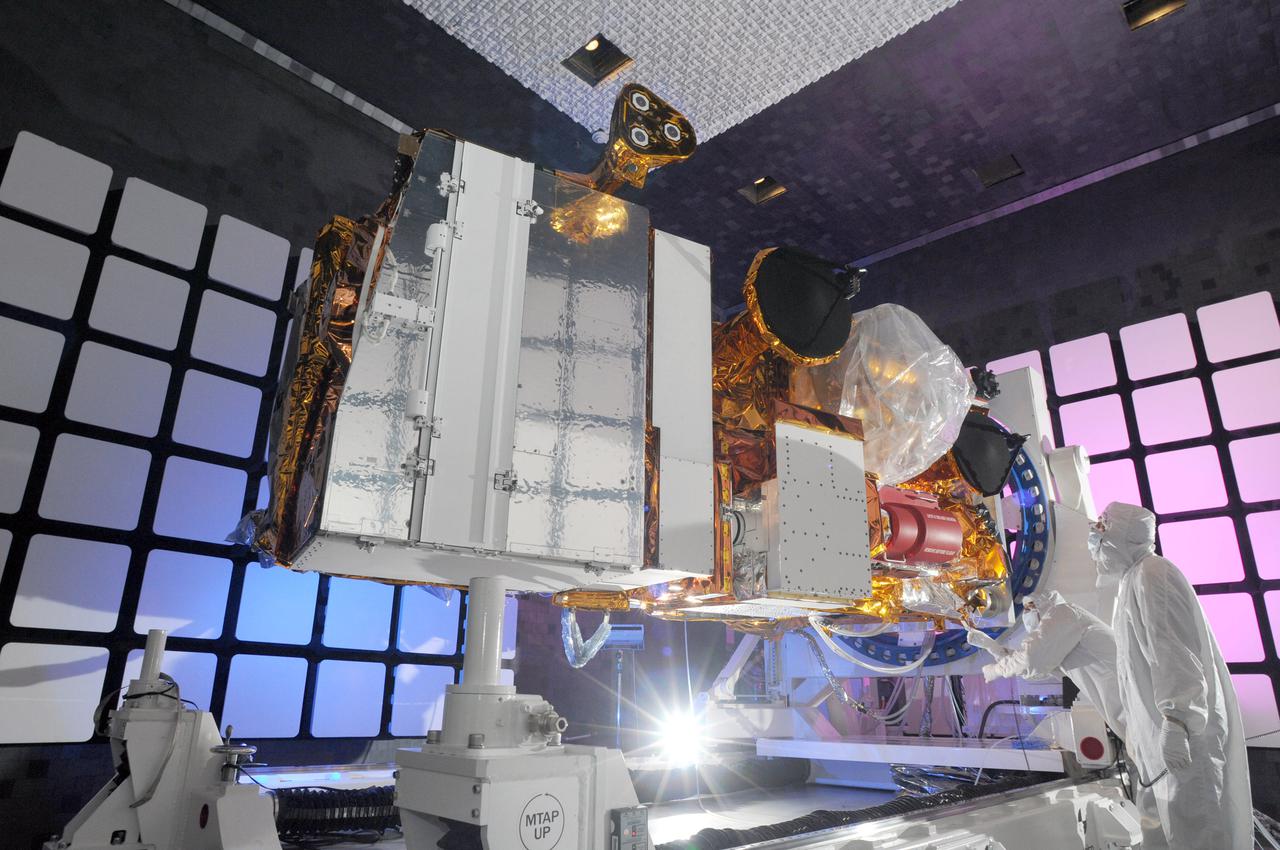
BALL AEROSPACE, Boulder, Colo. – In a Ball Aerospace and Technologies Corp. cleanroom in Boulder, Colo., NASA's National Polar-orbiting Operational Environmental Satellite System Preparatory Project NPP satellite is undergoing Electromagnetic Interference_Electromagnetic Compatibility EMI_EMC testing. A United Launch Alliance Delta II rocket will carry NPP into space. NPP represents a critical first step in building the next-generation of Earth-observing satellites. NPP will carry the first of the new sensors developed for this satellite fleet, now known as the Joint Polar Satellite System JPSS to be launched in 2016. NPP is the bridge between NASA's Earth Observing System EOS satellites and the forthcoming series of JPSS satellites. The mission will test key technologies and instruments for the JPSS missions. NPP is targeted to launch Oct. 27. For more information, visit http:__www.nasa.gov_NPP. Photo credit: Ball Aerospace
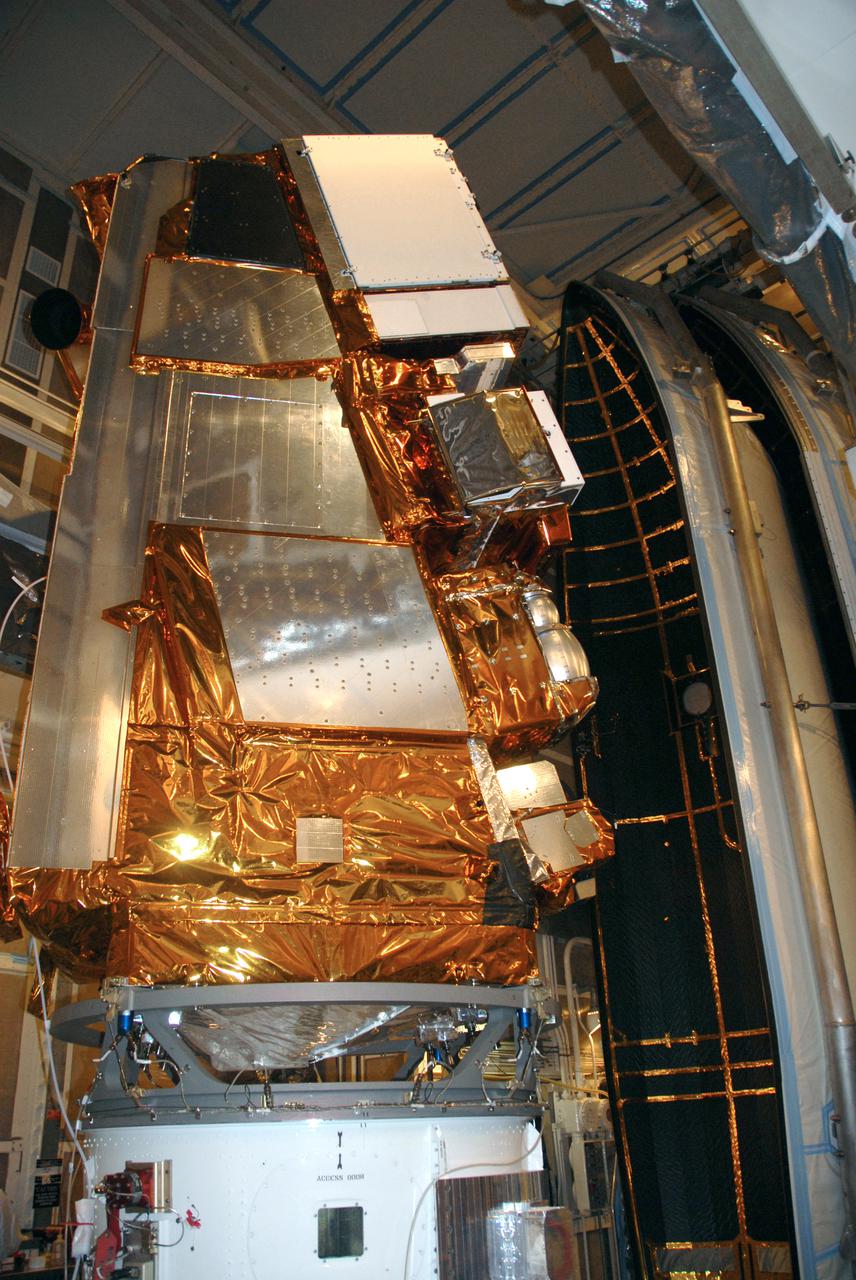
VANDENBERG AIR FORCE BASE, Calif. – At Vandenberg Air Force Base's Space Launch Complex-2 in California, preparations are under way to enclose NASA’s National Polar-orbiting Operational Environmental Satellite System Preparatory Project (NPP) spacecraft into the clamshell-shaped Delta payload fairing. The fairing will protect the spacecraft from the impact of aerodynamic pressure and heating during ascent and will be jettisoned once the spacecraft is outside the Earth's atmosphere. NPP represents a critical first step in building the next-generation of Earth-observing satellites. NPP will carry the first of the new sensors developed for this satellite fleet, now known as the Joint Polar Satellite System (JPSS) to be launched in 2016. NPP is the bridge between NASA's Earth Observing System (EOS) satellites and the forthcoming series of JPSS satellites. The mission will test key technologies and instruments for the JPSS missions. NPP is targeted to launch Oct. 28 from Space Launch Complex-2 aboard a United Launch Alliance Delta II rocket. For more information, visit http:__www.nasa.gov_NPP. Photo credit: NASA_Mark P. Mackley, VAFB
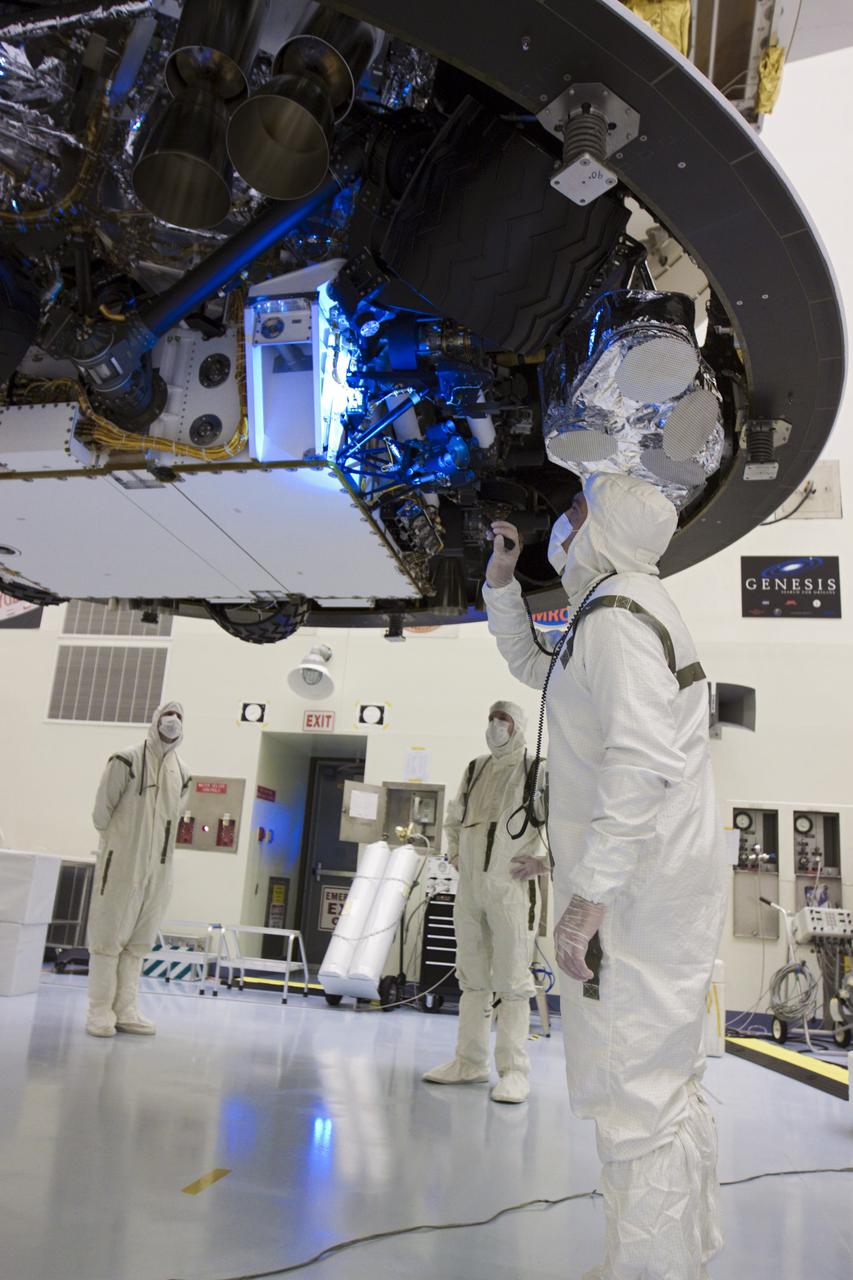
CAPE CANAVERAL, Fla. – In the Payload Hazardous Servicing Facility at NASA’s Kennedy Space Center in Florida, a technician inspects beneath NASA's Mars Science Laboratory (MSL) mission aeroshell, (containing the compact car-sized rover Curiosity), which has been mated to the cruise stage. The cruise stage provides solar power, thrusters for navigation, and heat exchangers to the rover during its flight from Earth to Mars. The rover Curiosity has 10 science instruments designed to search for evidence on whether Mars has had environments favorable to microbial life, including chemical ingredients for life. The unique rover will use a laser to look inside rocks and release its gasses so that the rover’s spectrometer can analyze and send the data back to Earth. Launch of MSL aboard a United Launch Alliance Atlas V rocket is scheduled for Nov. 25 from Space Launch Complex 41 on Cape Canaveral Air Force Station in Florida. For more information, visit http:__www.nasa.gov_msl. Photo credit: NASA_Glenn Benson
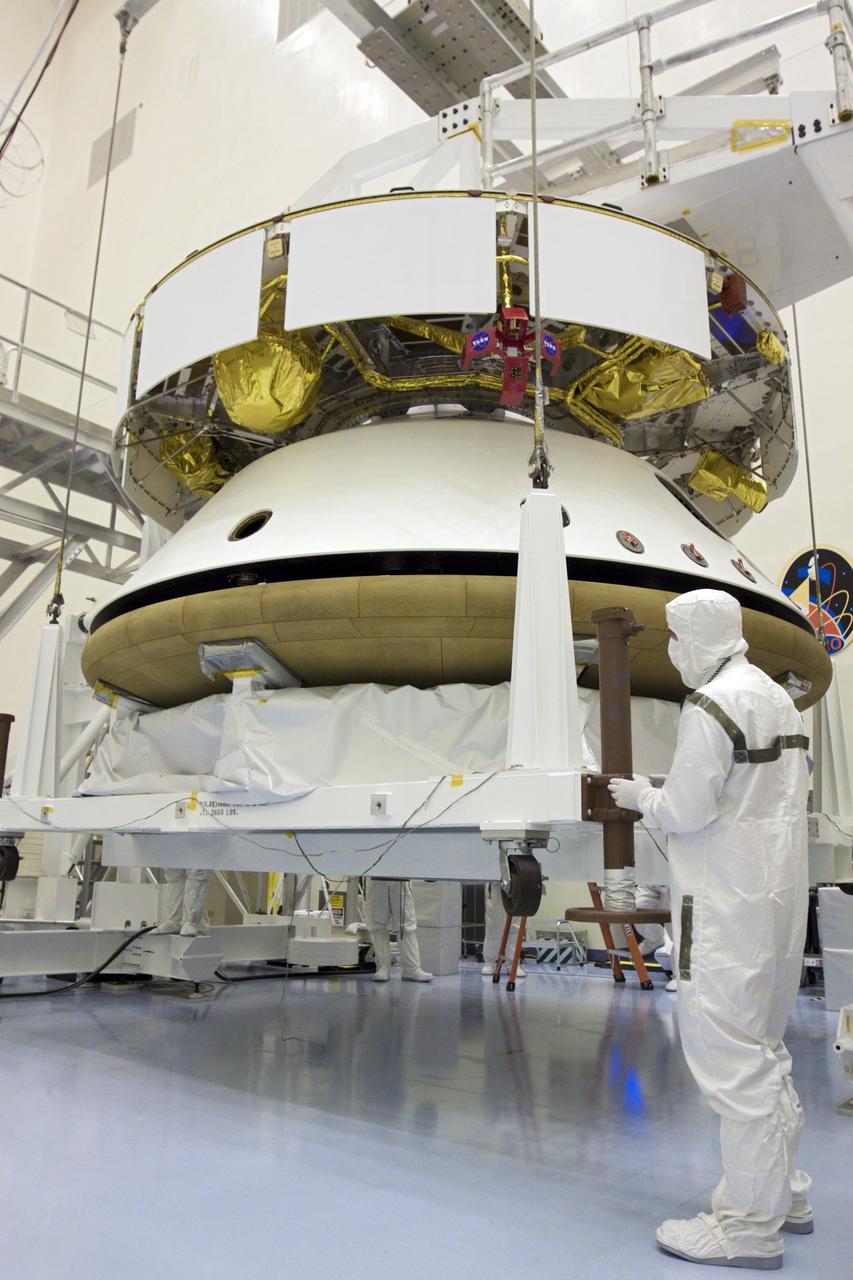
CAPE CANAVERAL, Fla. – In the Payload Hazardous Servicing Facility at NASA’s Kennedy Space Center in Florida, a technician watches as an overhead crane lifts the heat shield for integration with NASA's Mars Science Laboratory (MSL) mission aeroshell, (containing the compact car-sized rover Curiosity). Earlier, the aeroshell was mated to the cruise stage, which provides solar power, thrusters for navigation, and heat exchangers to the rover during its flight from Earth to Mars. The rover Curiosity has 10 science instruments designed to search for evidence on whether Mars has had environments favorable to microbial life, including chemical ingredients for life. The unique rover will use a laser to look inside rocks and release its gasses so that the rover’s spectrometer can analyze and send the data back to Earth. Launch of MSL aboard a United Launch Alliance Atlas V rocket is scheduled for Nov. 25 from Space Launch Complex 41 on Cape Canaveral Air Force Station in Florida. For more information, visit http:__www.nasa.gov_msl. Photo credit: NASA_Glenn Benson
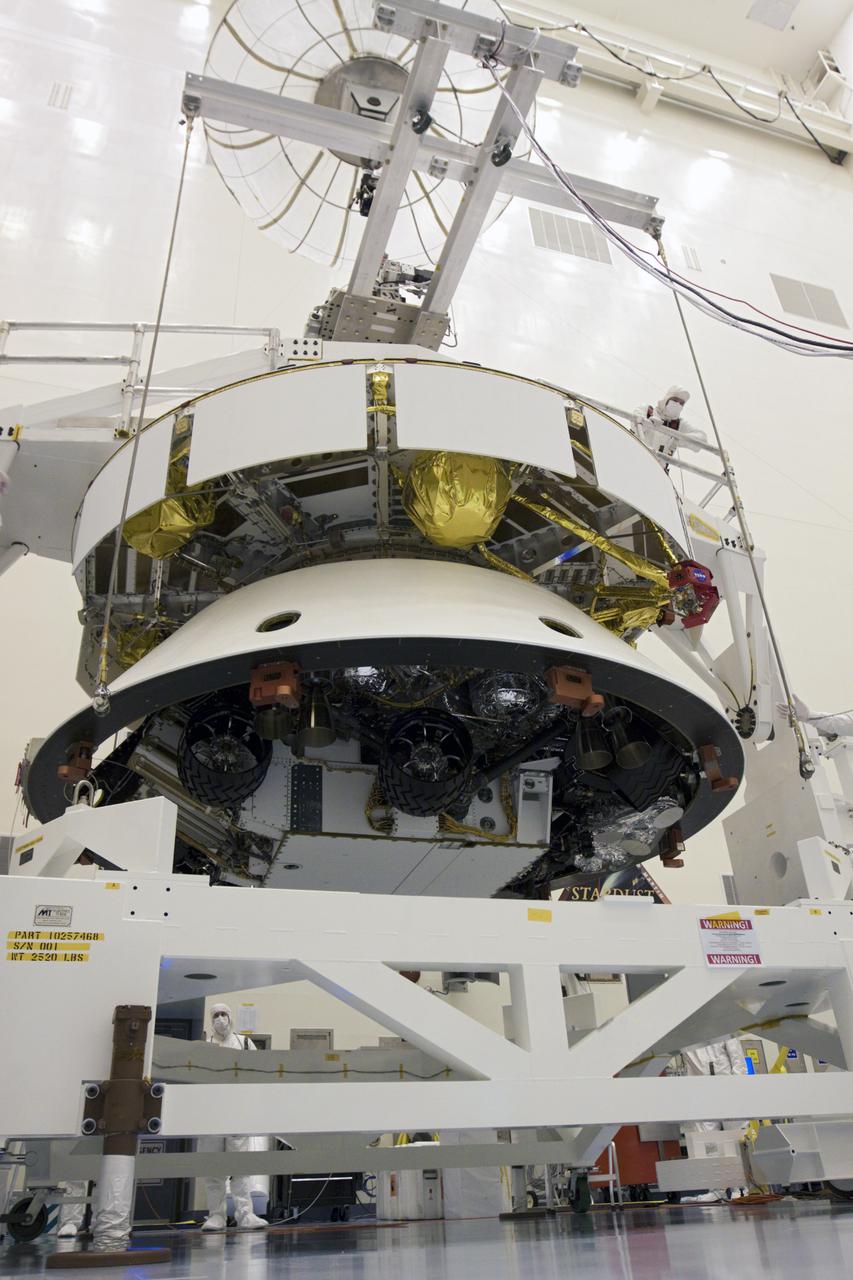
CAPE CANAVERAL, Fla. – In the Payload Hazardous Servicing Facility at NASA’s Kennedy Space Center in Florida, technicians, using an overhead crane, lift NASA's Mars Science Laboratory (MSL) mission aeroshell, (containing the compact car-sized rover Curiosity), for mating to the cruise stage. The cruise stage provides solar power, thrusters for navigation, and heat exchangers to the rover during its flight from Earth to Mars. The rover Curiosity has 10 science instruments designed to search for evidence on whether Mars has had environments favorable to microbial life, including chemical ingredients for life. The unique rover will use a laser to look inside rocks and release its gasses so that the rover’s spectrometer can analyze and send the data back to Earth. Launch of MSL aboard a United Launch Alliance Atlas V rocket is scheduled for Nov. 25 from Space Launch Complex 41 on Cape Canaveral Air Force Station in Florida. For more information, visit http:__www.nasa.gov_msl. Photo credit: NASA_Glenn Benson

CAPE CANAVERAL, Fla. – In the Payload Hazardous Servicing Facility at NASA’s Kennedy Space Center in Florida, the heat shield has been integrated with NASA's Mars Science Laboratory (MSL) mission aeroshell, (containing the compact car-sized rover Curiosity). Earlier, the aeroshell was mated to the cruise stage, which provides solar power, thrusters for navigation, and heat exchangers to the rover during its flight from Earth to Mars. The rover Curiosity has 10 science instruments designed to search for evidence on whether Mars has had environments favorable to microbial life, including chemical ingredients for life. The unique rover will use a laser to look inside rocks and release its gasses so that the rover’s spectrometer can analyze and send the data back to Earth. Launch of MSL aboard a United Launch Alliance Atlas V rocket is scheduled for Nov. 25 from Space Launch Complex 41 on Cape Canaveral Air Force Station in Florida. For more information, visit http:__www.nasa.gov_msl. Photo credit: NASA_Glenn Benson
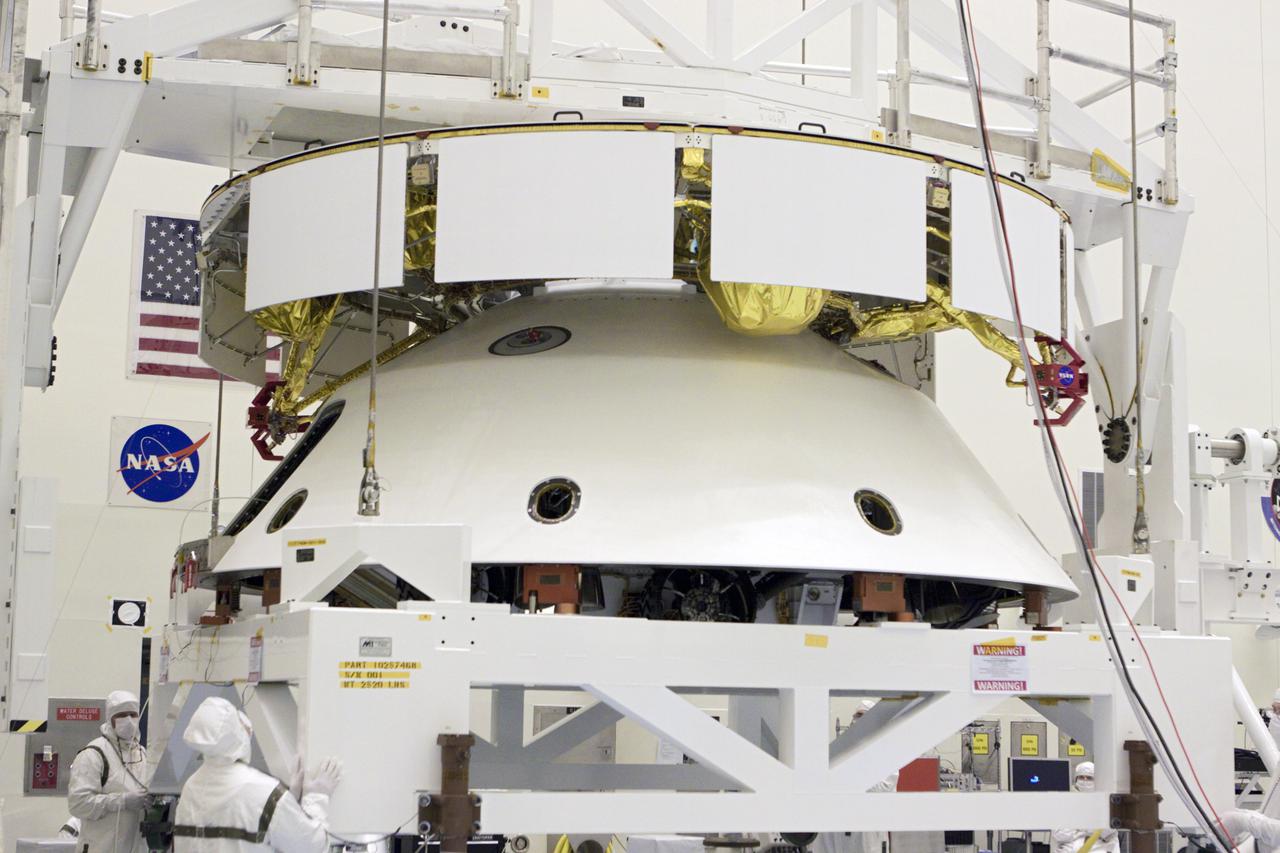
CAPE CANAVERAL, Fla. – In the Payload Hazardous Servicing Facility at NASA’s Kennedy Space Center in Florida, technicians, using an overhead crane, lift NASA's Mars Science Laboratory (MSL) mission aeroshell, (containing the compact car-sized rover Curiosity), for mating to the cruise stage. The cruise stage provides solar power, thrusters for navigation, and heat exchangers to the rover during its flight from Earth to Mars. The rover Curiosity has 10 science instruments designed to search for evidence on whether Mars has had environments favorable to microbial life, including chemical ingredients for life. The unique rover will use a laser to look inside rocks and release its gasses so that the rover’s spectrometer can analyze and send the data back to Earth. Launch of MSL aboard a United Launch Alliance Atlas V rocket is scheduled for Nov. 25 from Space Launch Complex 41 on Cape Canaveral Air Force Station in Florida. For more information, visit http:__www.nasa.gov_msl. Photo credit: NASA_Glenn Benson
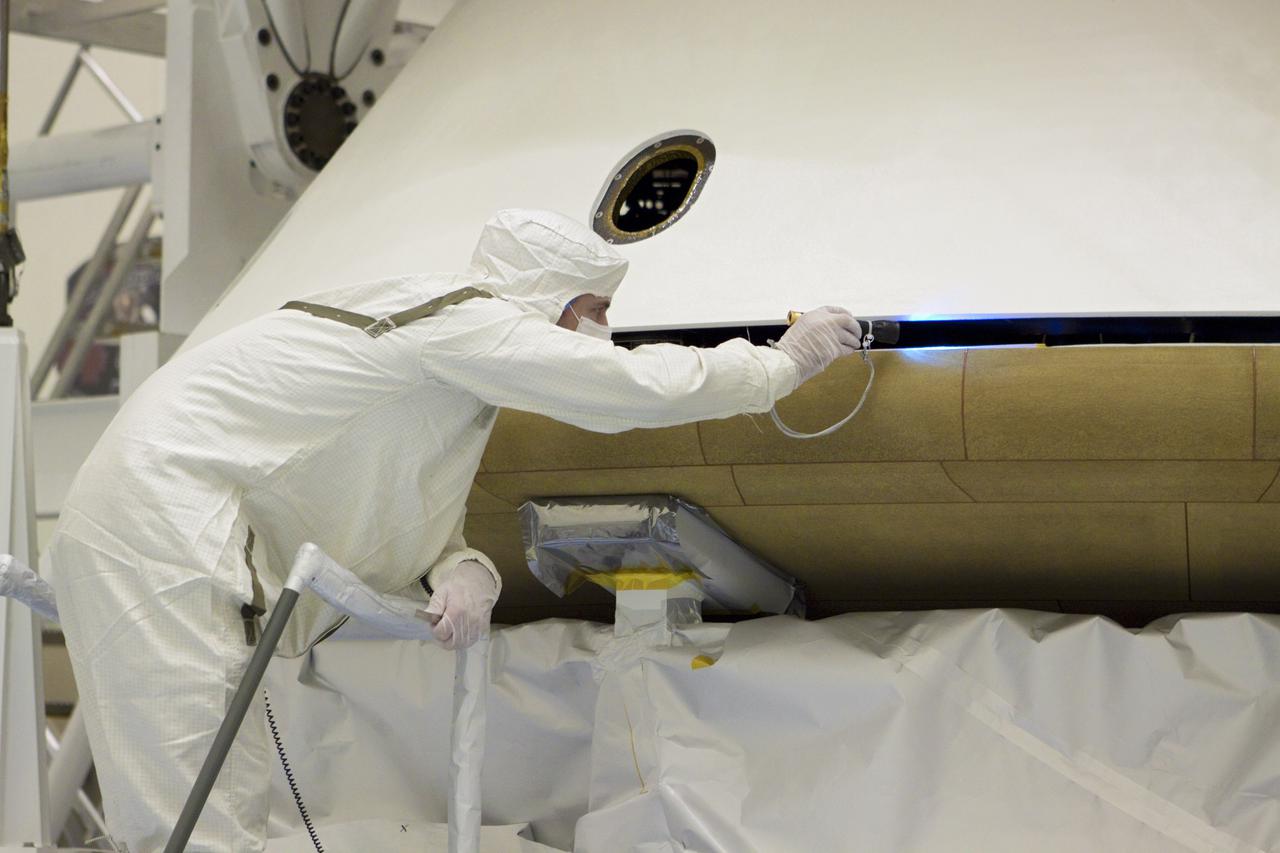
CAPE CANAVERAL, Fla. – In the Payload Hazardous Servicing Facility at NASA’s Kennedy Space Center in Florida, a technician inspects the alignment of the heat shield as an overhead crane lifts it for integration with NASA's Mars Science Laboratory (MSL) mission aeroshell, (containing the compact car-sized rover Curiosity). Earlier, the aeroshell was mated to the cruise stage, which provides solar power, thrusters for navigation, and heat exchangers to the rover during its flight from Earth to Mars. The rover Curiosity has 10 science instruments designed to search for evidence on whether Mars has had environments favorable to microbial life, including chemical ingredients for life. The unique rover will use a laser to look inside rocks and release its gasses so that the rover’s spectrometer can analyze and send the data back to Earth. Launch of MSL aboard a United Launch Alliance Atlas V rocket is scheduled for Nov. 25 from Space Launch Complex 41 on Cape Canaveral Air Force Station in Florida. For more information, visit http:__www.nasa.gov_msl. Photo credit: NASA_Glenn Benson
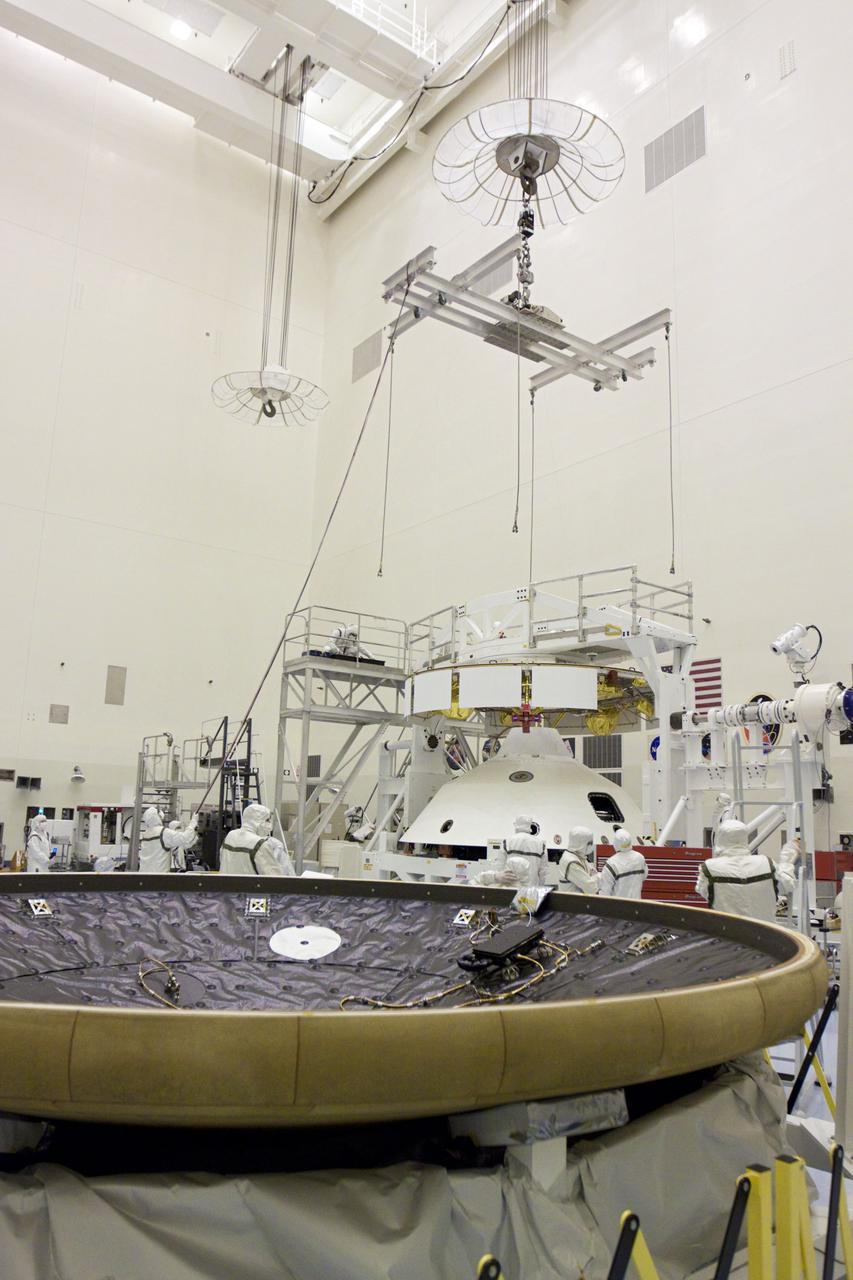
CAPE CANAVERAL, Fla. – In the Payload Hazardous Servicing Facility at NASA’s Kennedy Space Center in Florida, technicians prepare to attach an overhead crane to NASA's Mars Science Laboratory (MSL) mission aeroshell, (containing the compact car-sized rover Curiosity), which will be mated to the cruise stage. The cruise stage provides solar power, thrusters for navigation, and heat exchangers to the rover during its flight from Earth to Mars. In the foreground is the MSL heat shield. The rover Curiosity has 10 science instruments designed to search for evidence on whether Mars has had environments favorable to microbial life, including chemical ingredients for life. The unique rover will use a laser to look inside rocks and release its gasses so that the rover’s spectrometer can analyze and send the data back to Earth. Launch of MSL aboard a United Launch Alliance Atlas V rocket is scheduled for Nov. 25 from Space Launch Complex 41 on Cape Canaveral Air Force Station in Florida. For more information, visit http:__www.nasa.gov_msl. Photo credit: NASA_Glenn Benson
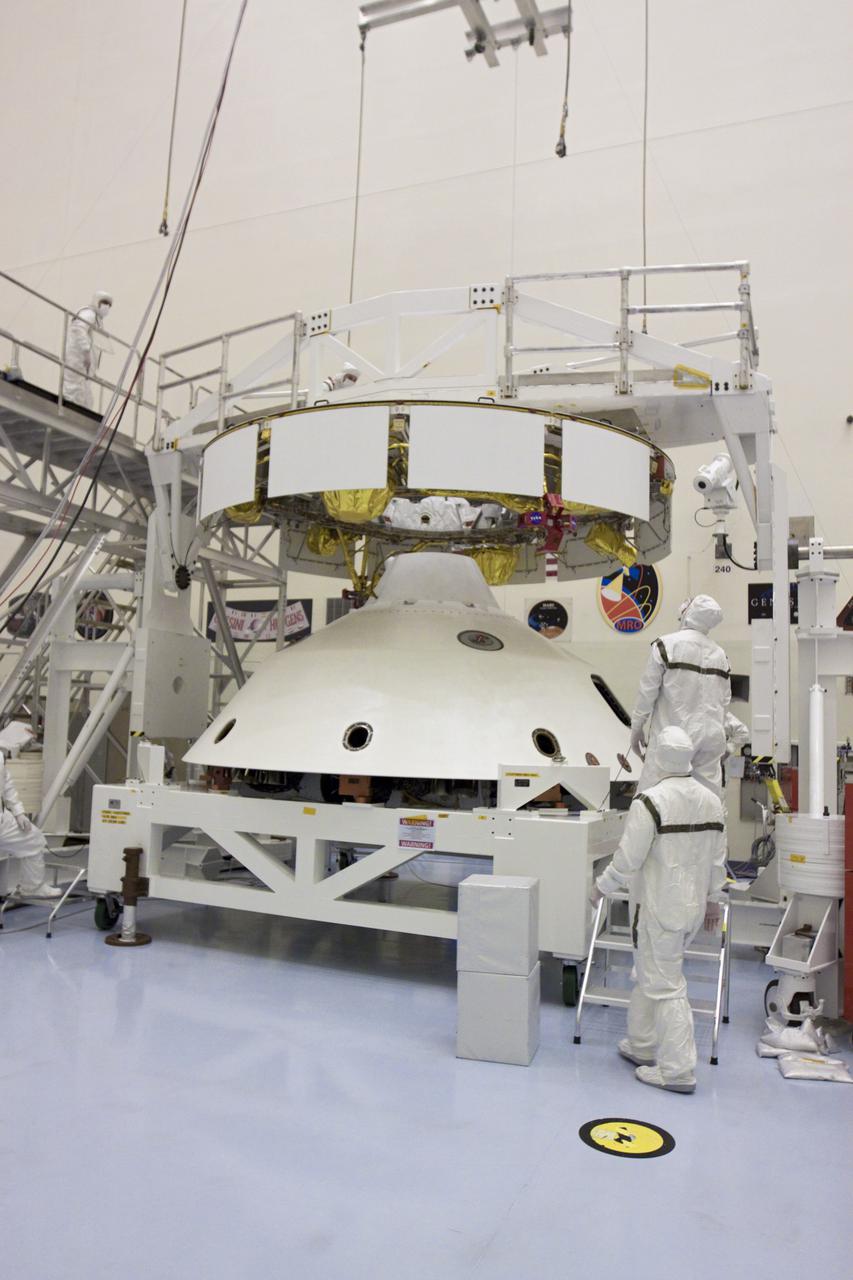
CAPE CANAVERAL, Fla. – In the Payload Hazardous Servicing Facility at NASA’s Kennedy Space Center in Florida, technicians prepare to attach an overhead crane to NASA's Mars Science Laboratory (MSL) mission aeroshell, (containing the compact car-sized rover Curiosity), which will be mated to the cruise stage. The cruise stage provides solar power, thrusters for navigation, and heat exchangers to the rover during its flight from Earth to Mars. The rover Curiosity has 10 science instruments designed to search for evidence on whether Mars has had environments favorable to microbial life, including chemical ingredients for life. The unique rover will use a laser to look inside rocks and release its gasses so that the rover’s spectrometer can analyze and send the data back to Earth. Launch of MSL aboard a United Launch Alliance Atlas V rocket is scheduled for Nov. 25 from Space Launch Complex 41 on Cape Canaveral Air Force Station in Florida. For more information, visit http:__www.nasa.gov_msl. Photo credit: NASA_Glenn Benson
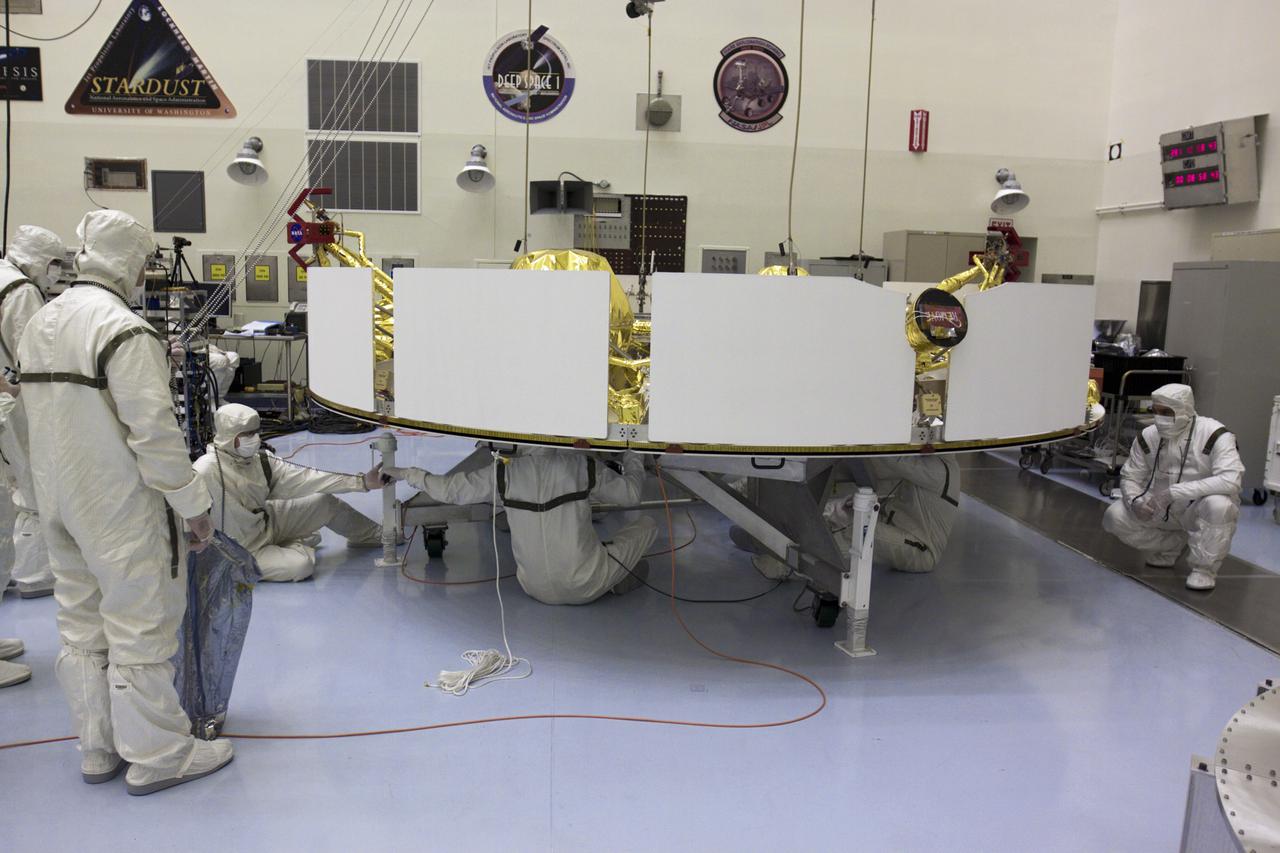
CAPE CANAVERAL, Fla. – In the Payload Hazardous Servicing Facility at NASA’s Kennedy Space Center in Florida, technicians attach an overhead crane to NASA's Mars Science Laboratory (MSL) mission cruise stage. The cruise stage, which will be lifted onto a rotation stand, provides solar power, thrusters for navigation, and heat exchangers to the rover during its flight from Earth to Mars. MSL's components include a car-sized rover, Curiosity, which has 10 science instruments designed to search for evidence on whether Mars has had environments favorable to microbial life, including chemical ingredients for life. The unique rover will use a laser to look inside rocks and release its gasses so that the rover’s spectrometer can analyze and send the data back to Earth. Launch of MSL aboard a United Launch Alliance Atlas V rocket is scheduled for Nov. 25 from Space Launch Complex 41 on Cape Canaveral Air Force Station in Florida. For more information, visit http:__www.nasa.gov_msl. Photo credit: NASA_Glenn Benson

VANDENBERG AIR FORCE BASE, Calif. – A speaker talks with a group of Tweetup participants at Vandenberg Air Force Base in California during prelaunch activities for NASA’s National Polar-orbiting Operational Environmental Satellite System Preparatory Project (NPP) spacecraft mission. The tweeters will share their experiences with followers through the social networking site Twitter. NPP represents a critical first step in building the next-generation of Earth-observing satellites. NPP will carry the first of the new sensors developed for this satellite fleet, now known as the Joint Polar Satellite System (JPSS) to be launched in 2016. NPP is the bridge between NASA's Earth Observing System (EOS) satellites and the forthcoming series of JPSS satellites. The mission will test key technologies and instruments for the JPSS missions. NPP is targeted to launch Oct. 28 from Space Launch Complex-2 aboard a United Launch Alliance Delta II rocket. For more information, visit http:__www.nasa.gov_NPP. Photo credit: NASA_Kim Shiflett