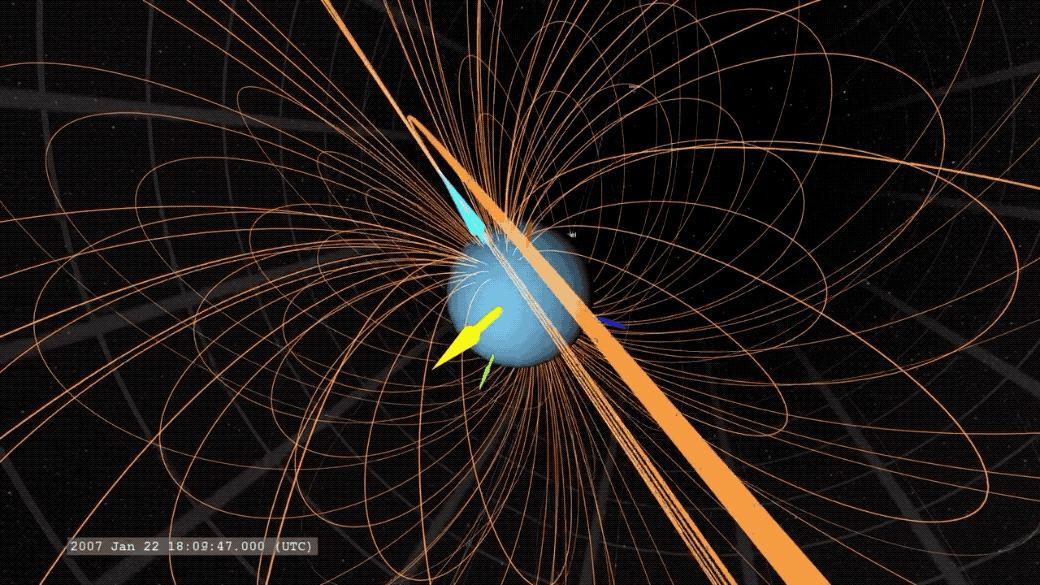
An animated GIF showing Uranus' magnetic field. The yellow arrow points to the Sun, the light blue arrow marks Uranus' magnetic axis, and the dark blue arrow marks Uranus' rotation axis. Animation available at https://photojournal.jpl.nasa.gov/catalog/PIA23683
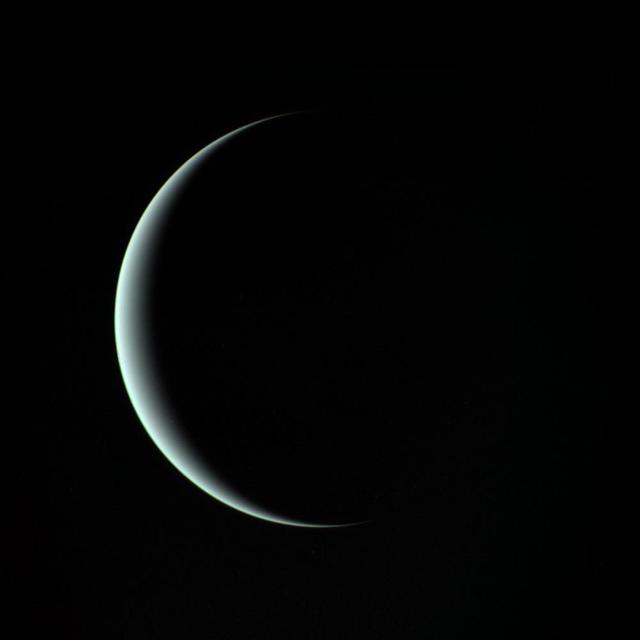
A sliver of Uranus is seen by NASA Voyager 2. This image was taken through three color filters and recombined to produce the color image.
Processing brings out Uranus atmosphere in this image taken by NASA Voyager 2.
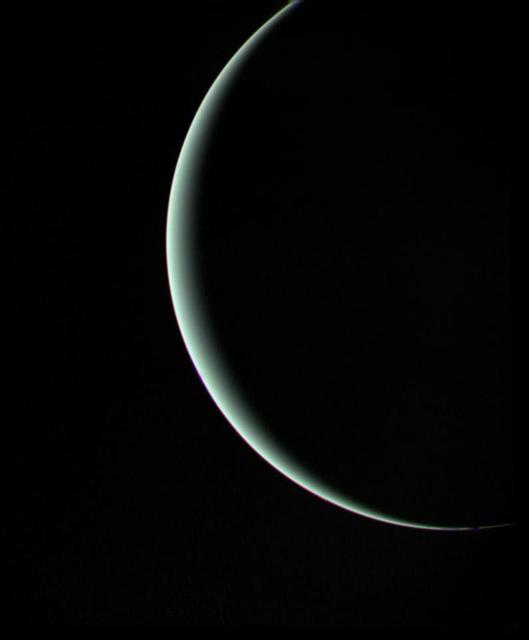
This view of pale blue-green Uranus was recorded by NASA's Voyager 2 on Jan 25, 1986, as the spacecraft left the planet behind. The thin crescent of Uranus is seen here between the spacecraft, the planet and the Sun. http://photojournal.jpl.nasa.gov/catalog/PIA00143

This is an image of the planet Uranus taken by the spacecraft Voyager 2 in 1986.
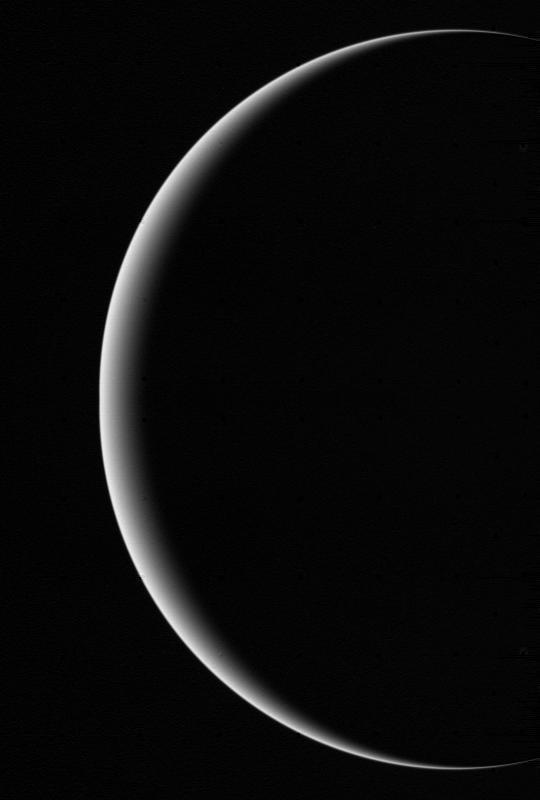
This image shows a crescent Uranus, a view that Earthlings never witnessed until Voyager 2 flew near and then beyond Uranus on Jan 24, 1986. http://photojournal.jpl.nasa.gov/catalog/PIA00346
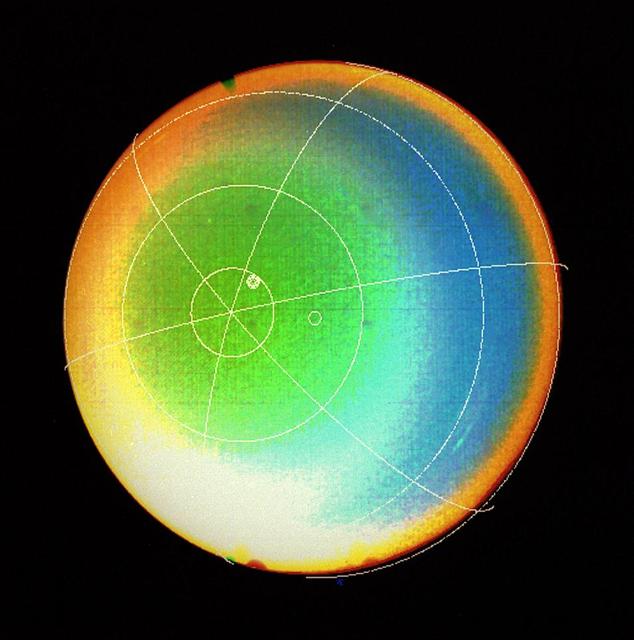
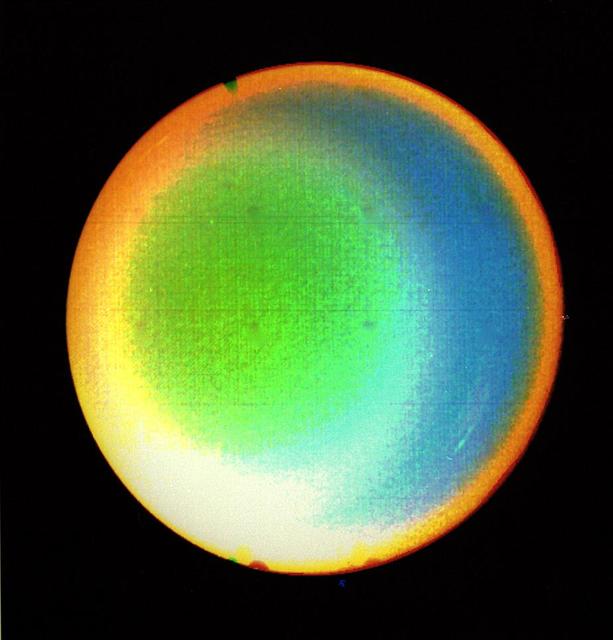
A latitude-longitude grid superimposed on this false color image obtained by NASA Voyager 2 in 1986 shows that Uranus atmosphere circulates in the same direction as the planet rotates.

This computer enhancement of a NASA Voyager 2 image, emphasizes the high-level haze in Uranus upper atmosphere. Clouds are obscured by the overlying atmosphere.

NASA Hubble Space Telescope peered deep into Uranus atmosphere to see clear and hazy layers created by a mixture of gases. Using infrared filters, Hubble captured detailed features of three layers of Uranus atmosphere.
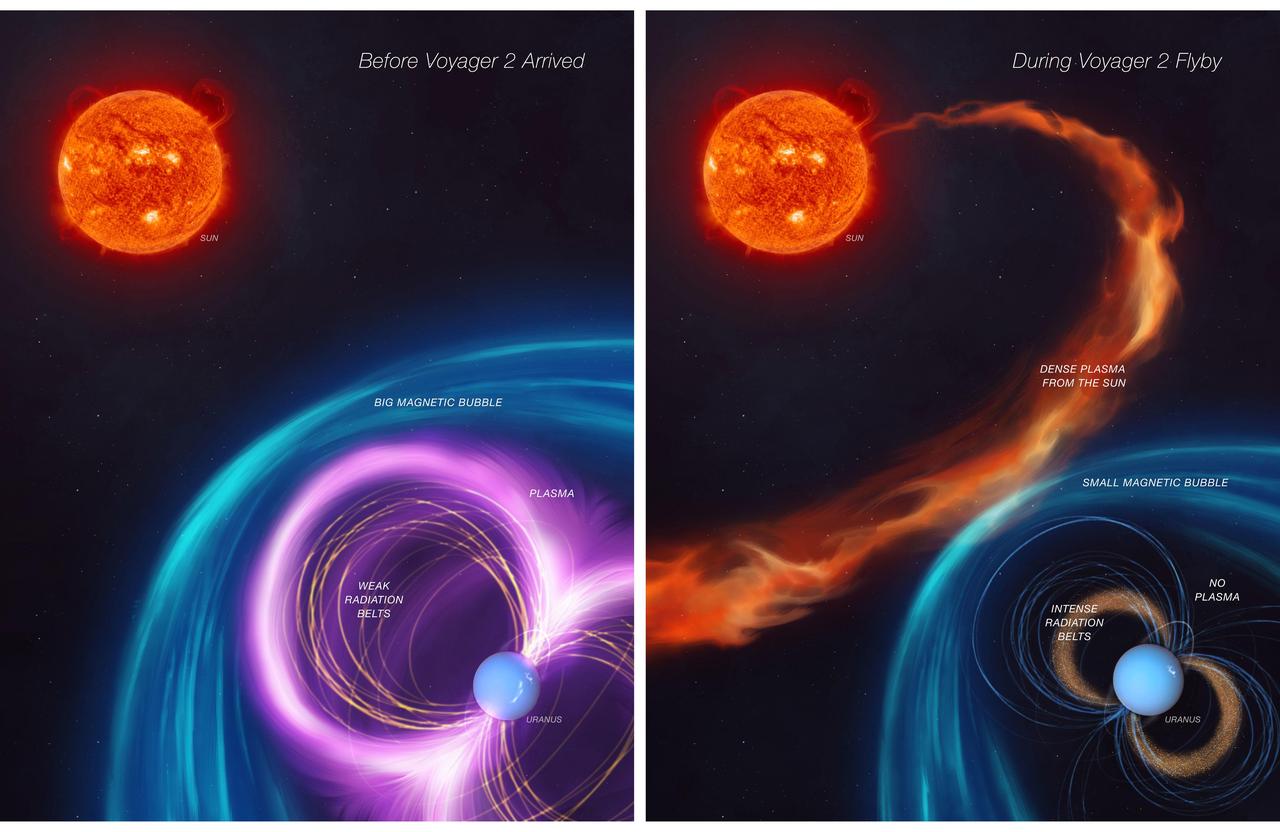
When NASA's Voyager 2 spacecraft flew by Uranus in 1986, it provided scientists' first – and, so far, only – close glimpse of this outer planet. Scientists were confronted by a mystery: The energized particles around the planet defied their understanding of how magnetic fields work to trap particle radiation. The first panel of this artist's concept depicts how Uranus's magnetosphere (its protective bubble) was behaving before Voyager 2's flyby. The second panel shows that an unusual kind of solar weather was happening at the same time as the spacecraft's flyby, giving scientists a skewed view of Uranus's magnetosphere. The work, led by a scientist at NASA's Jet Propulsion Laboratory and described in a paper published in Nature Astronomy in November 2024, contributes to scientists' understanding of this enigmatic planet. It also opens the door to the possibility that Uranus' five major moons may be active. https://photojournal.jpl.nasa.gov/catalog/PIA26069
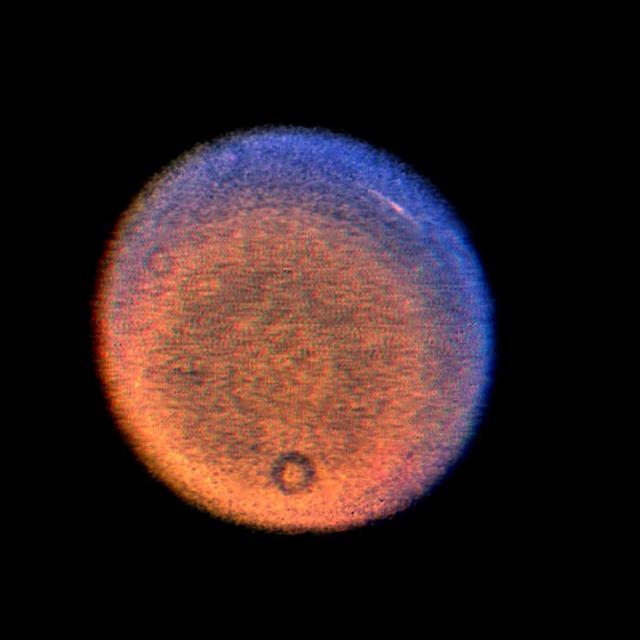
This false-color picture of Uranus, obtained by NASA Voyager on Jan. 14, 1986, shows a discrete cloud seen as a bright streak near the planet limb. http://photojournal.jpl.nasa.gov/catalog/PIA00370
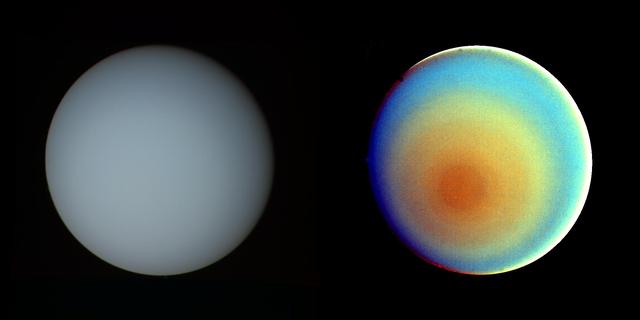
These two pictures of Uranus -- one in true color (left) and the other in false color -- were compiled from images returned Jan. 17, 1986, by the narrow-angle camera of Voyager 2. The spacecraft was 9.1 million kilometers (5.7 million miles) from the planet, several days from closest approach. The picture at left has been processed to show Uranus as human eyes would see it from the vantage point of the spacecraft. The picture is a composite of images taken through blue, green and orange filters. The darker shadings at the upper right of the disk correspond to the day-night boundary on the planet. Beyond this boundary lies the hidden northern hemisphere of Uranus, which currently remains in total darkness as the planet rotates. The blue-green color results from the absorption of red light by methane gas in Uranus' deep, cold and remarkably clear atmosphere. The picture at right uses false color and extreme contrast enhancement to bring out subtle details in the polar region of Uranus. Images obtained through ultraviolet, violet and orange filters were respectively converted to the same blue, green and red colors used to produce the picture at left. The very slight contrasts visible in true color are greatly exaggerated here. In this false-color picture, Uranus reveals a dark polar hood surrounded by a series of progressively lighter concentric bands. One possible explanation is that a brownish haze or smog, concentrated over the pole, is arranged into bands by zonal motions of the upper atmosphere. The bright orange and yellow strip at the lower edge of the planet's limb is an artifact of the image enhancement. In fact, the limb is dark and uniform in color around the planet. http://photojournal.jpl.nasa.gov/catalog/PIA00032

This NASA Hubble Space Telescope image of the planet Uranus reveals the planet rings and bright clouds and a high altitude haze above the planet south pole.
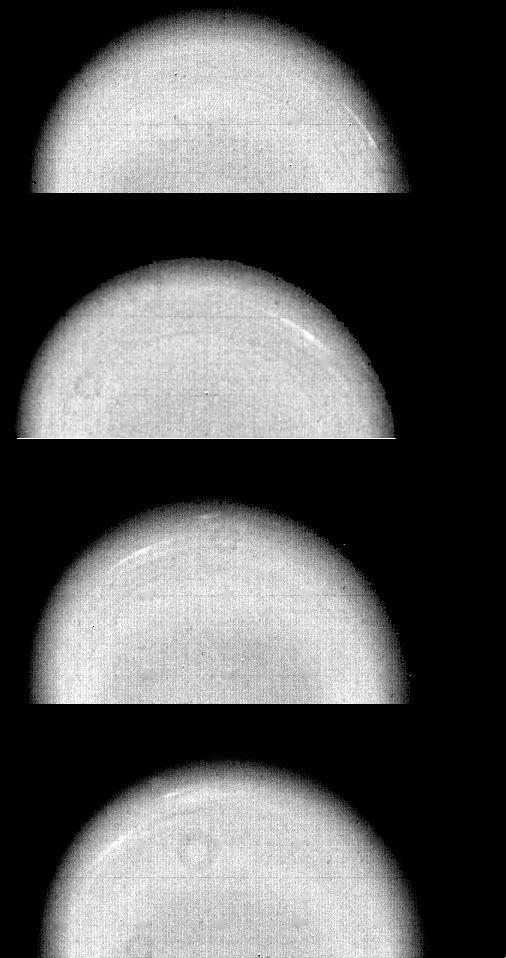
These time-lapse images of Uranus. taken by NASA Voyager 2 on Jan. 14, 1986, show the movement of two small, bright, streaky clouds -- the first such features ever seen on the planet. http://photojournal.jpl.nasa.gov/catalog/PIA00369

This NASA Hubble Space Telescope image of the planet Uranus reveals the planet rings, at least five of the inner moons, and bright clouds in the planet southern hemisphere.

Taken in 1997, NASA Hubble Space Telescope, using visible light, detected clouds in the northern hemisphere of Uranus.

These three NASA Hubble Space Telescope images of the planet Uranus reveal the motion of a pair of bright clouds in the planet southern hemisphere, and a high altitude haze that forms a cap above the planet south pole.

Taking its first peek at Uranus, NASA Hubble Space Telescope Near Infrared Camera and Multi-Object Spectrometer NICMOS detected six distinct clouds in images taken July 28,1997.
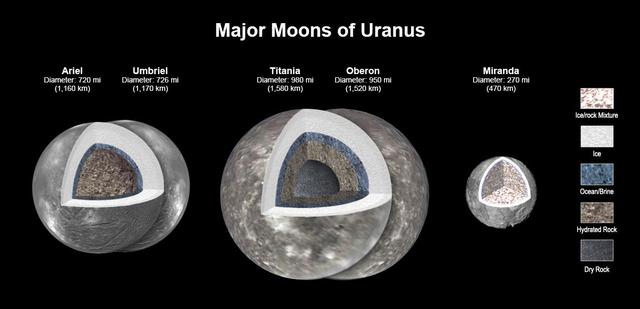
New modeling shows that there likely is an ocean layer in four of Uranus' major moons: Ariel, Umbriel, Titania, and Oberon. Salty – or briny – oceans lie under the ice and atop layers of water-rich rock and dry rock. Miranda is too small to retain enough heat for an ocean layer. The modeling, detailed in a paper published in the Journal of Geophysical Research, was informed by a re-analysis of data from NASA's Voyager spacecraft. Scientists have long thought that Titania, given its size, would be most likely to retain internal heat, caused by radioactive decay. The other moons had been widely considered too small to retain the heat necessary to keep an internal ocean from freezing, especially as heating created by the gravitational pull of Uranus is only a minor source of heat. https://photojournal.jpl.nasa.gov/catalog/PIA25500

A recent NASA Hubble Space Telescope view reveals Uranus surrounded by its four major rings and by 10 of its 17 known satellites.
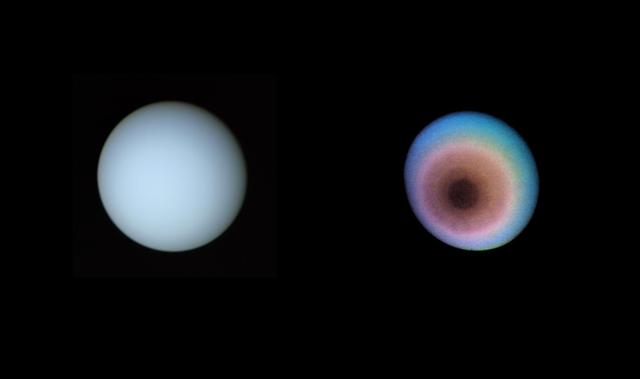
These two pictures of Uranus were compiled from images recorded by NASA Voyager 2 on Jan. 1O, 1986. This view is toward the planet pole of rotation, which lies just left of center. The image on the right is a false-color image.

This is a composite image of Uranus by Voyager 2 and two different observations made by Hubble — one for the ring and one for the auroras. Ever since Voyager 2 beamed home spectacular images of the planets in the 1980s, planet-lovers have been hooked on auroras on other planets. Auroras are caused by streams of charged particles like electrons that come from various origins such as solar winds, the planetary ionosphere, and moon volcanism. They become caught in powerful magnetic fields and are channeled into the upper atmosphere, where their interactions with gas particles, such as oxygen or nitrogen, set off spectacular bursts of light. The auroras on Jupiter and Saturn are well-studied, but not much is known about the auroras of the giant ice planet Uranus. In 2011, the NASA/ESA Hubble Space Telescope became the first Earth-based telescope to snap an image of the auroras on Uranus. In 2012 and 2014 a team led by an astronomer from Paris Observatory took a second look at the auroras using the ultraviolet capabilities of the Space Telescope Imaging Spectrograph (STIS) installed on Hubble. They tracked the interplanetary shocks caused by two powerful bursts of solar wind traveling from the sun to Uranus, then used Hubble to capture their effect on Uranus’ auroras — and found themselves observing the most intense auroras ever seen on the planet. By watching the auroras over time, they collected the first direct evidence that these powerful shimmering regions rotate with the planet. They also re-discovered Uranus’ long-lost magnetic poles, which were lost shortly after their discovery by Voyager 2 in 1986 due to uncertainties in measurements and the featureless planet surface. Credit: ESA/Hubble & NASA, L. Lamy / Observatoire de Paris <b><a href="http://www.nasa.gov/audience/formedia/features/MP_Photo_Guidelines.html" rel="nofollow">NASA image use policy.</a></b> <b><a href="http://www.nasa.gov/centers/goddard/home/index.html" rel="nofollow">NASA Goddard Space Flight Center</a></b> enables NASA’s mission through four scientific endeavors: Earth Science, Heliophysics, Solar System Exploration, and Astrophysics. Goddard plays a leading role in NASA’s accomplishments by contributing compelling scientific knowledge to advance the Agency’s mission. <b>Follow us on <a href="http://twitter.com/NASAGoddardPix" rel="nofollow">Twitter</a></b> <b>Like us on <a href="http://www.facebook.com/pages/Greenbelt-MD/NASA-Goddard/395013845897?ref=tsd" rel="nofollow">Facebook</a></b> <b>Find us on <a href="http://instagrid.me/nasagoddard/?vm=grid" rel="nofollow">Instagram</a></b>
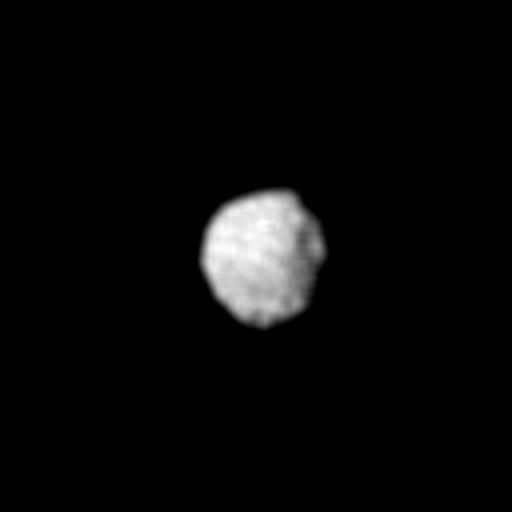
Uranus Moon - 1985U1

This Hubble Space Telescope Wide Field Camera 3 image of Uranus, taken in November 2018, reveals a vast, bright stormy cloud cap across the planet's north pole. Credits: NASA, ESA, A. Simon (NASA Goddard Space Flight Center), and M.H. Wong and A. Hsu (University of California, Berkeley)
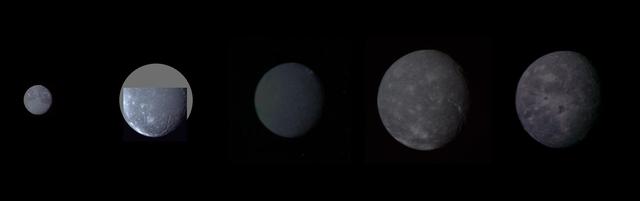
Montage of Uranus five largest satellites taken by NASA Voyager 2. From to right to left in order of decreasing distance from Uranus are Oberon, Titania, Umbriel, Ariel, and Miranda.

During its routine yearly monitoring of the weather on our solar system's outer planets, NASA's Hubble Space Telescope has uncovered a new mysterious dark storm on Neptune (right) and provided a fresh look at a long-lived storm circling around the north polar region on Uranus (left).
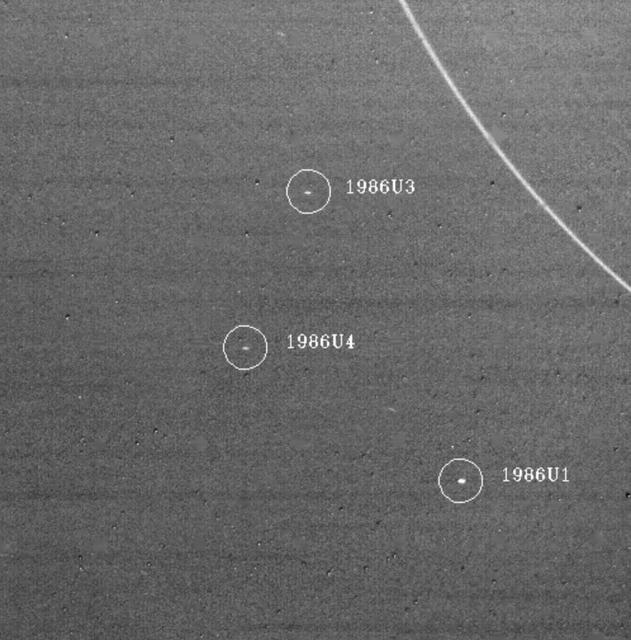
On Jan. 18, 1986, NASA Voyager 2 discoverd three Uranus satellites. All three lie outside the orbits of Uranus nine known rings, the outermost of which, the epsilon ring, is seen at upper right. http://photojournal.jpl.nasa.gov/catalog/PIA00368
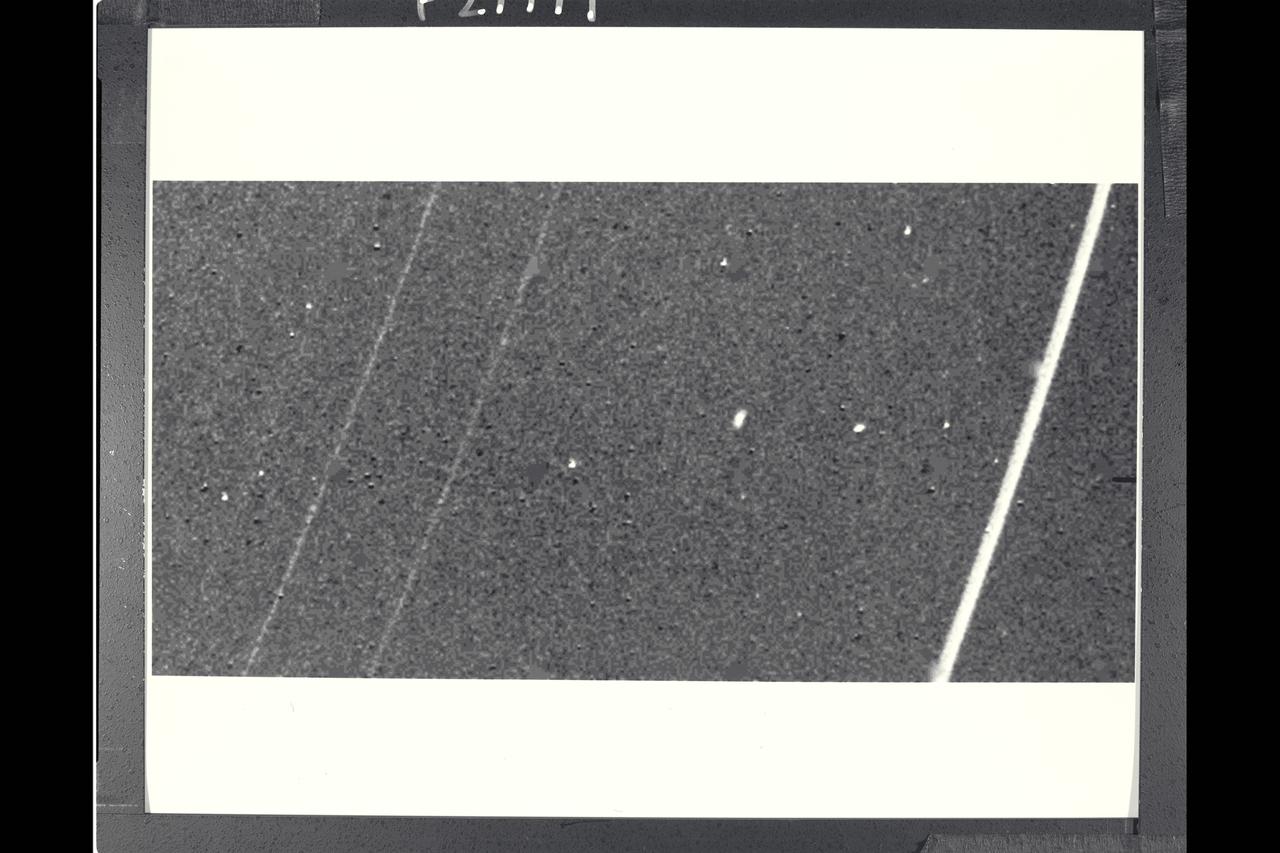
P-29499 Rings of Uranus
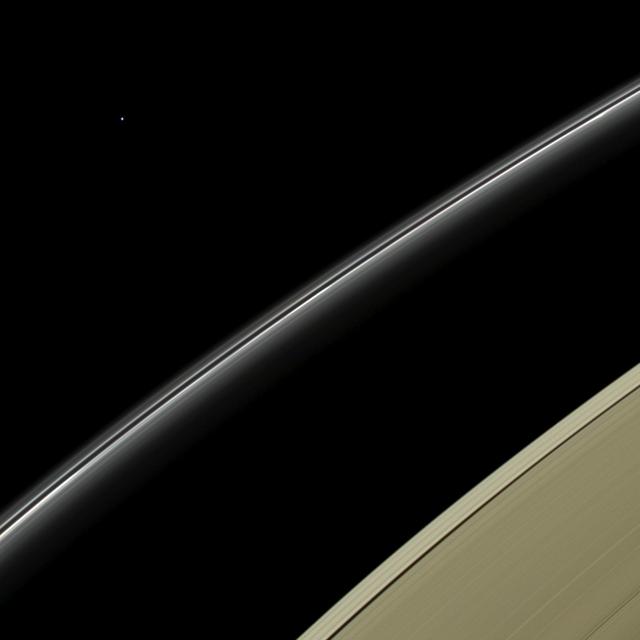
This view from NASA's Cassini spacecraft features a blue planet, imaged by Cassini for the first time. Uranus is a pale blue in this natural color image because its visible atmosphere contains methane gas and few aerosols or clouds. Methane on Uranus -- and its sapphire-colored sibling, Neptune -- absorbs red wavelengths of incoming sunlight, but allows blue wavelengths to escape back into space, resulting in the predominantly bluish color seen here. Cassini imaging scientists combined red, green and blue spectral filter images to create a final image that represents what human eyes might see from the vantage point of the spacecraft. Uranus has been brightened by a factor of 4.5 to make it more easily visible. The outer portion of Saturn's A ring, seen at bottom right, has been brightened by a factor of two. The bright ring cutting across the image center is Saturn's narrow F ring. Uranus was approximately 28.6 astronomical units from Cassini and Saturn when this view was obtained. An astronomical unit is the average distance from Earth to the sun, equal to 93,000,000 miles (150,000,000 kilometers). This view was acquired by the Cassini narrow-angle camera at a distance of approximately 614,300 miles (988,600 kilometers) from Saturn on April 11, 2014. Image scale at Uranus is approximately 16,000 miles (25,700 kilometers) per pixel. Image scale at Saturn's rings is approximately 4 miles (6 kilometers) per pixel. In the image, the disk of Uranus is just barely resolved. The solar phase angle at Uranus, seen from Cassini, is 11.9 degrees. http://photojournal.jpl.nasa.gov/catalog/PIA17178

This silhouetted image of the rings of Uranus was taken by NASA Voyager 2 spacecraft on Jan. 24, 1986, just 27 minutes before its closest approach to the planet.
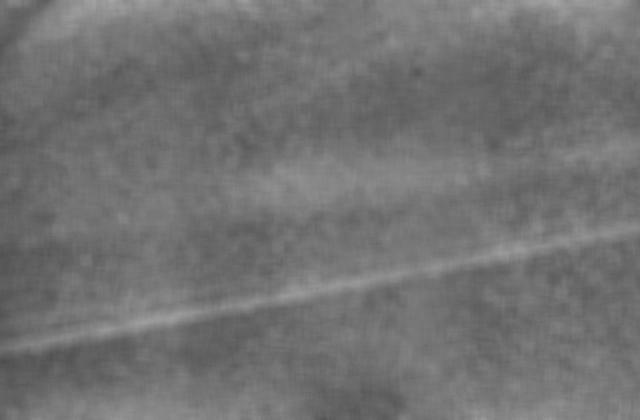
NASA Voyager 2 took this wide-angle image of Uranus rings as the spacecraft neared the plane of the rings less than an hour before closest approach to the planet.
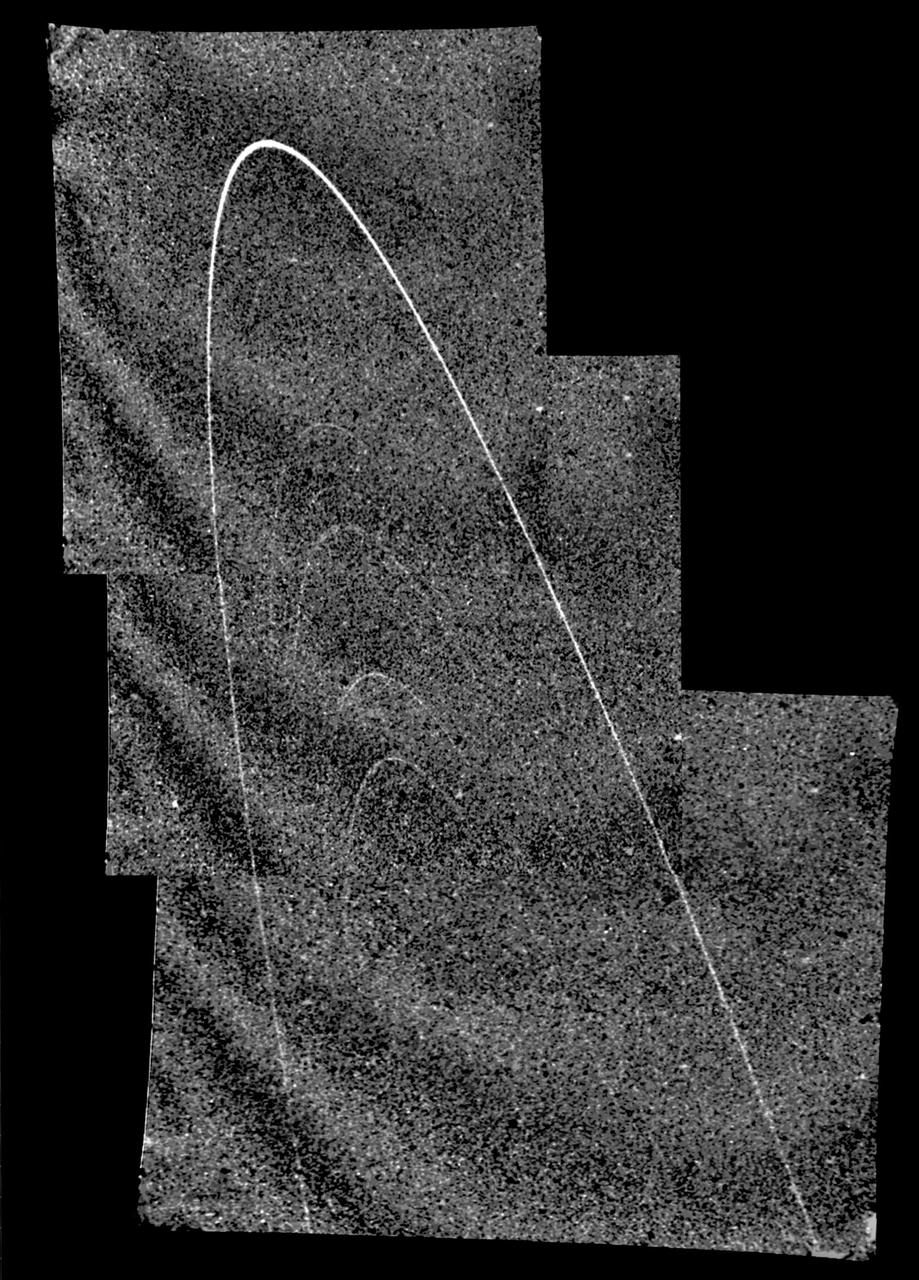
Uranus rings, photographed by NASA Voyager 2 in 1986 as it approached the plane of the Uranian ring system.
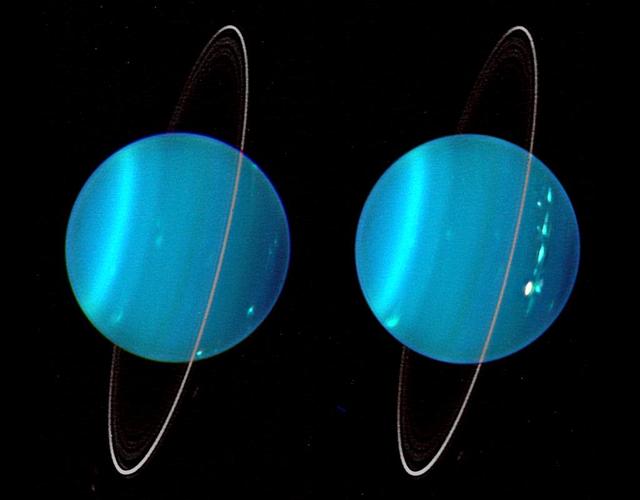
An infrared composite image of the two hemispheres of Uranus obtained with Keck Telescope adaptive optics.
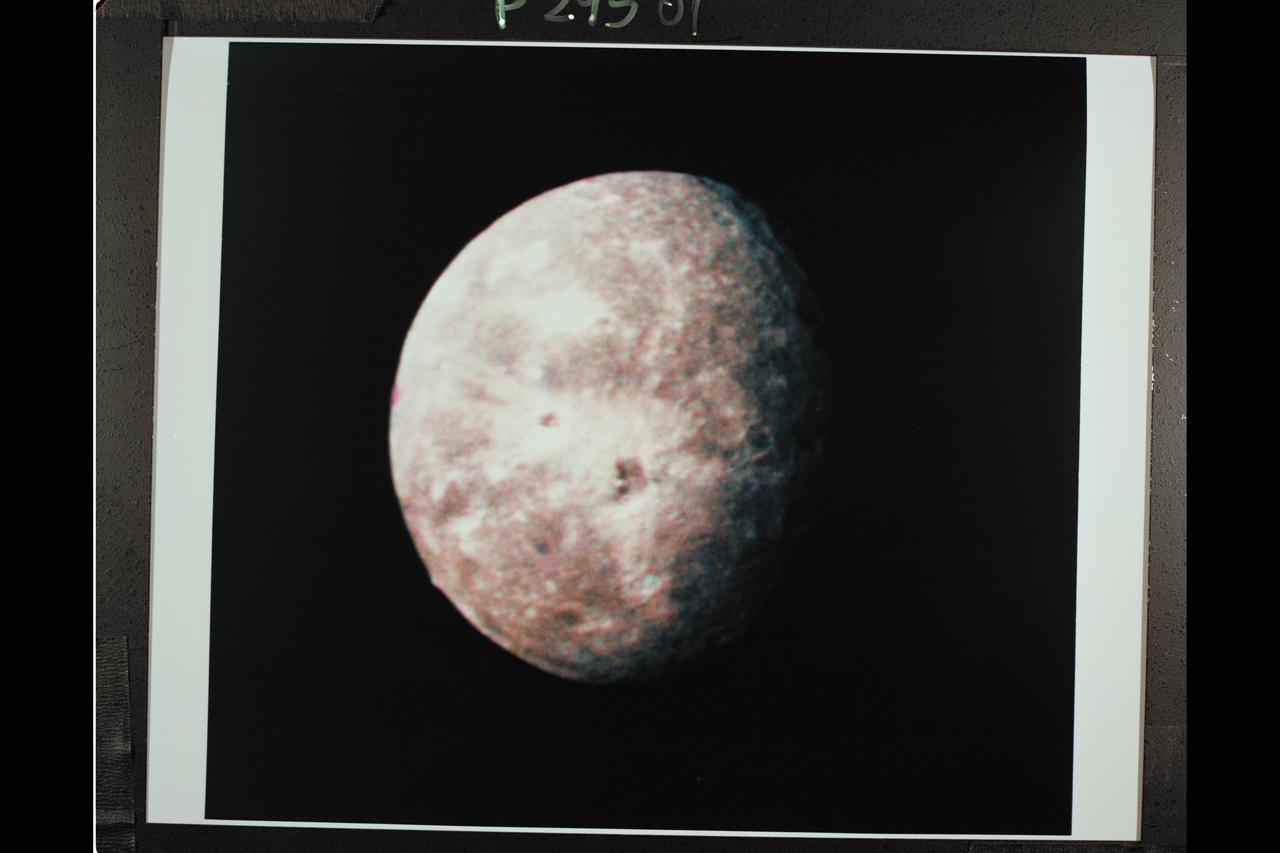
P29501C Moon from Voyager 2 Uranus flyby
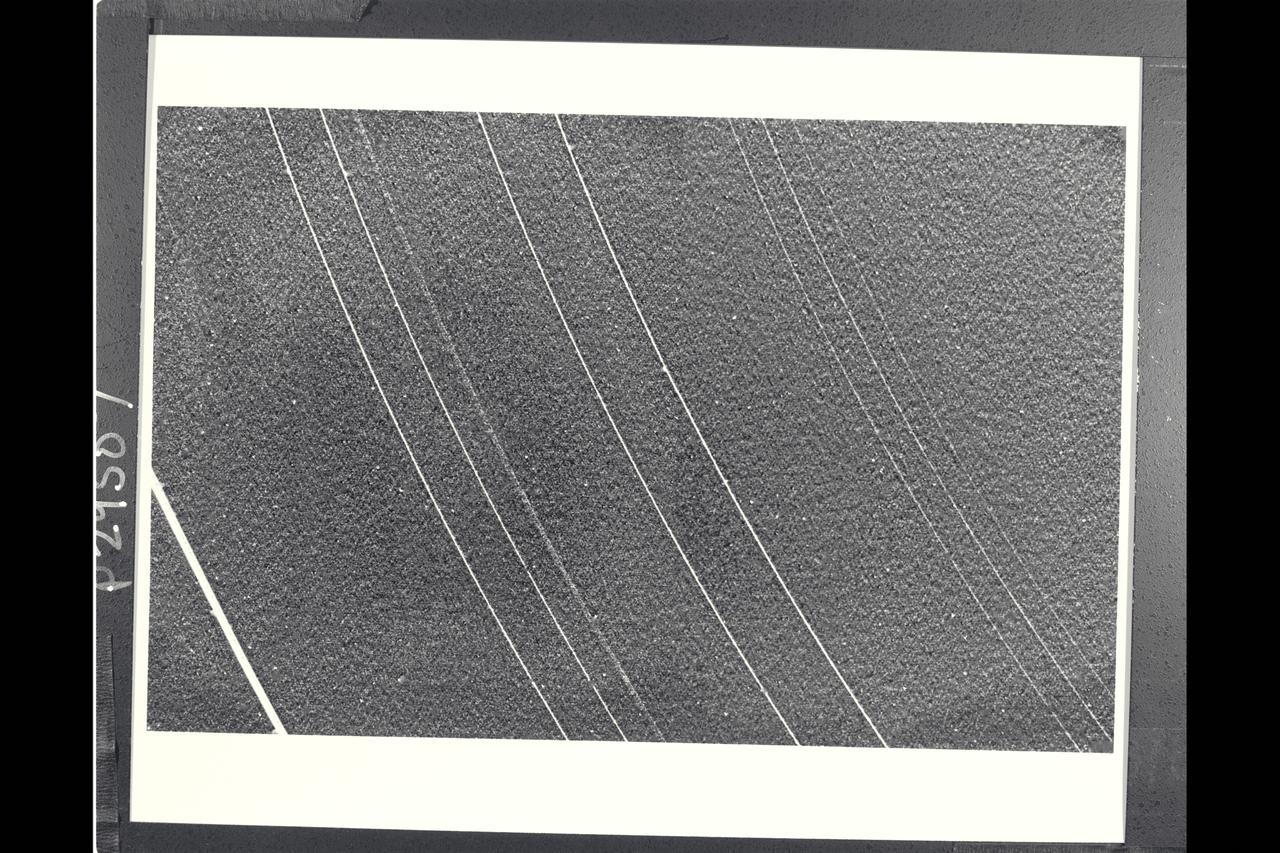
P-29507 Rings Voyager 2 flyby of Uranus
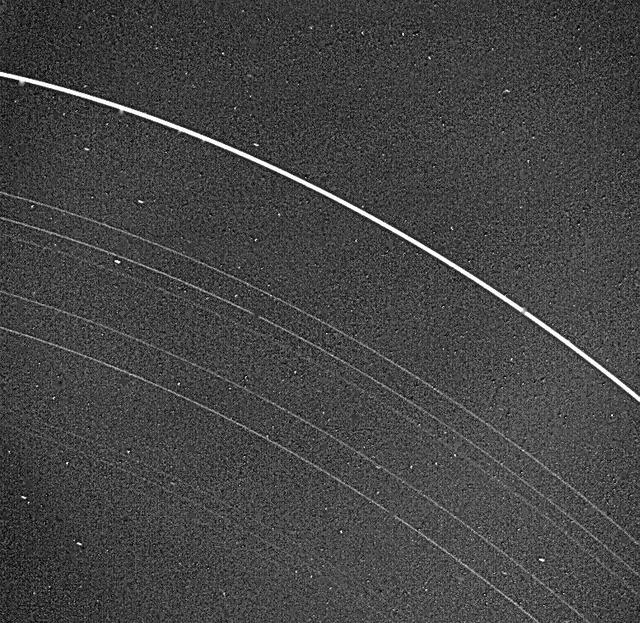
NASA Voyager 2 returned this picture of the Uranus rings on Jan. 22, 1986, from a distance of 2.52 million kilometers 1.56 million miles. All nine known rings are visible in this image.

P-25517 3 UP COMPOSITE Voyager 2 and Uranus
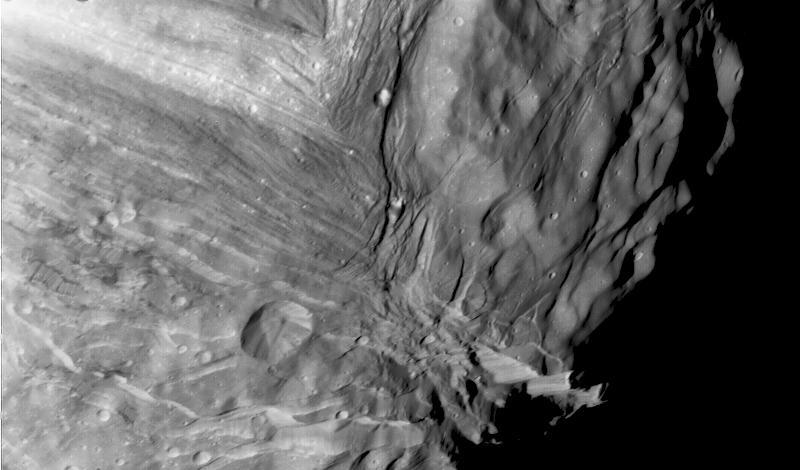
Miranda, innermost of Uranus large satellites, is seen at close range in this Voyager 2 image, taken Jan. 24, 1986, as part of a high-resolution mosaicing sequence.
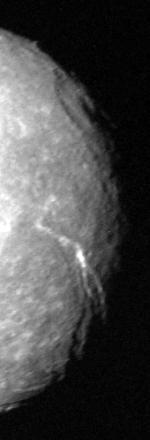
The terminator region of Titania, one of Uranus five large moons, was captured in this Voyager 2 image obtained in the early morning hours of Jan. 24, 1986.
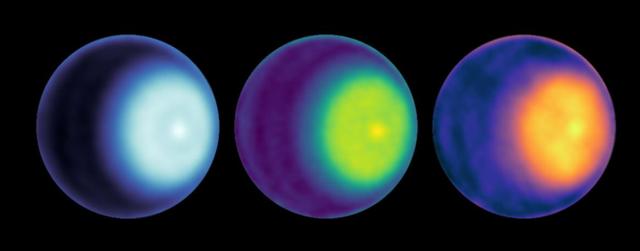
NASA scientists have made the first observation of a polar cyclone on Uranus. Using radio antenna dishes of the Very Large Array in New Mexico, they were able to peer below the methane clouds and determine there is circulating air at the planet's north pole that is warm and dry. These images were generated using the microwave observations – from left, in wavelength bands K, Ka, and Q. The average brightness was removed to enhance the contrast, and three different color maps were used to highlight various features. The cyclone is visible at the north pole, seen as a light-colored dot right of center in each image of Uranus. The observations used to generate these images were made in October 2021. https://photojournal.jpl.nasa.gov/catalog/PIA25951
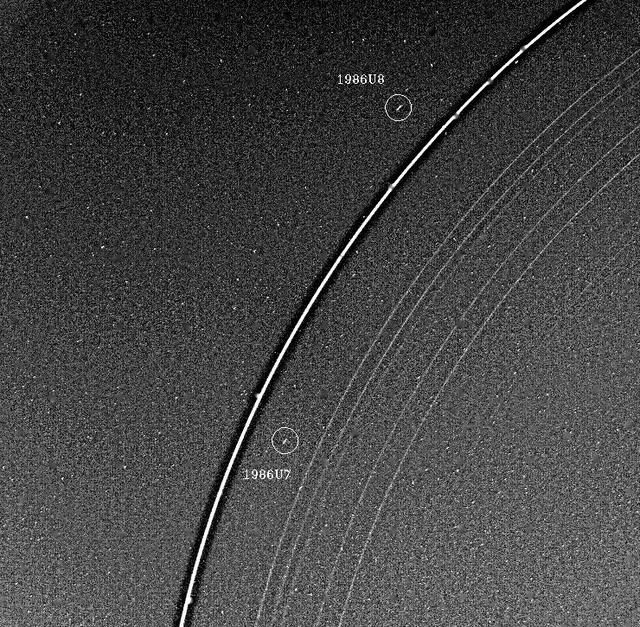
Voyager 2 has discovered two hepherd satellites associated with the rings of Uranus. The two moons, designated 1986U7 and 1986U8, are seen here on either side of the bright epsilon ring; all nine of the known Uranian rings are visible.
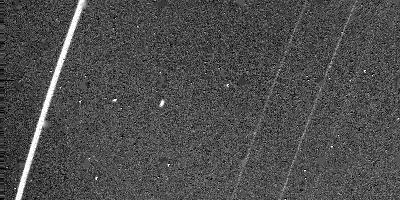
The outer rings of Uranus are visible in this image, obtained by NASA Voyager 2 on Jan. 23, 1986. The outermost and brightest ring, called epsilon, is visible along with the fainter and narrower delta and gamma rings from left.

This family portrait of Uranus five largest moons was compiled from images sent back Jan. 20, 1986, by NASA Voyager 2 spacecraft. Even in these distant views, the satellites exhibit distinct differences in appearance.
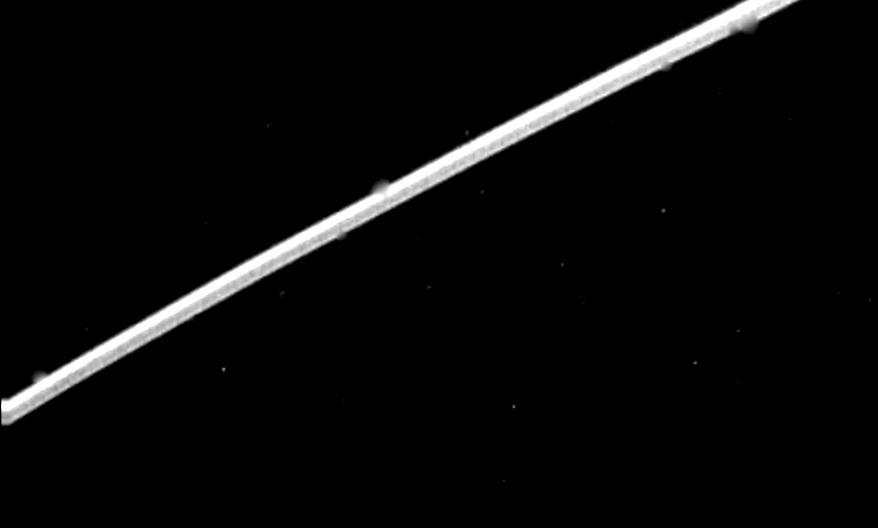
NASA Voyager 2 acquired this high-resolution image of the epsilon ring of Uranus on Jan. 23, 1986. This clear-filter image from Voyager narrow-angle camera has a resolution of about 10 km 6 mi.

This Voyager 2 image of Miranda was taken Jan. 23, 1986, as the spacecraft neared Uranus. Miranda is the innermost of the five Uranian satellites known from Earth-based observations.
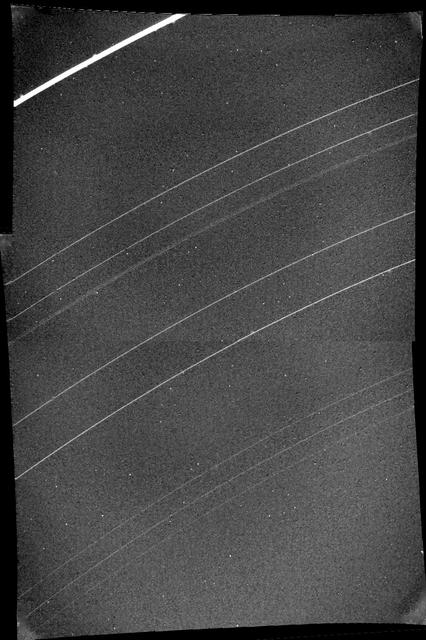
On Jan. 23, 1986, NASA Voyager 2 discovered a tenth ring orbiting Uranus. The tenth ring is about midway between the bright, outermost epsilon ring and the next ring down, called delta. http://photojournal.jpl.nasa.gov/catalog/PIA00035
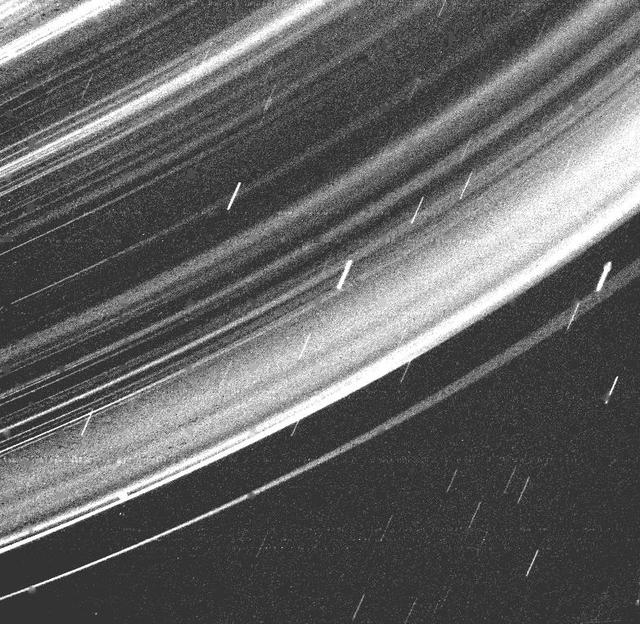
This image captured by NASA's Voyager 2 in 1986 revealed a continuous distribution of small particles throughout the Uranus ring system. This unique geometry, the highest phase angle at which Voyager imaged the rings, allowed us to see lanes of fine dust. http://photojournal.jpl.nasa.gov/catalog/PIA00142
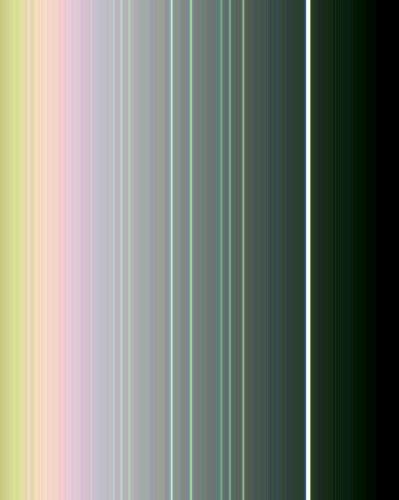
This false-color view of the rings of Uranus was made from images taken by NASA Voyager 2 on Jan. 21, 1986. All nine known rings are visible here; the somewhat fainter, pastel lines seen between them are contributed by the computer enhancement. http://photojournal.jpl.nasa.gov/catalog/PIA00033

This Hubble Space Telescope Wide Field Camera 3 image of Neptune, taken in September and November 2018, shows a new dark storm (top center). Credits: NASA, ESA, A. Simon (NASA Goddard Space Flight Center), and M.H. Wong and A. Hsu (University of California, Berkeley)
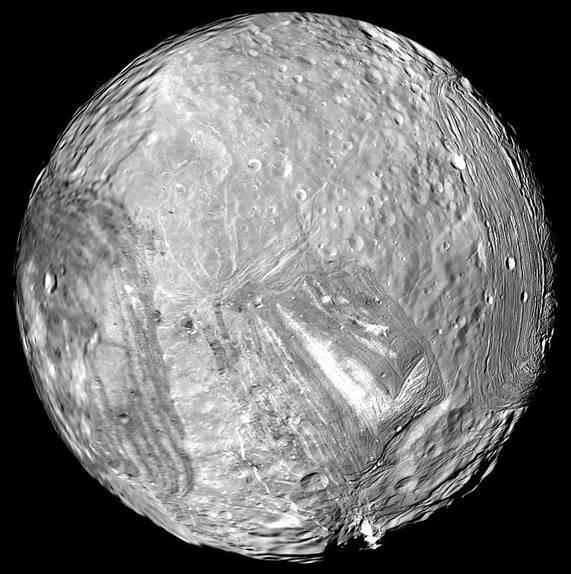
Uranus icy moon Miranda is seen in this image from Voyager 2 on January 24, 1986. https://photojournal.jpl.nasa.gov/catalog/PIA18185
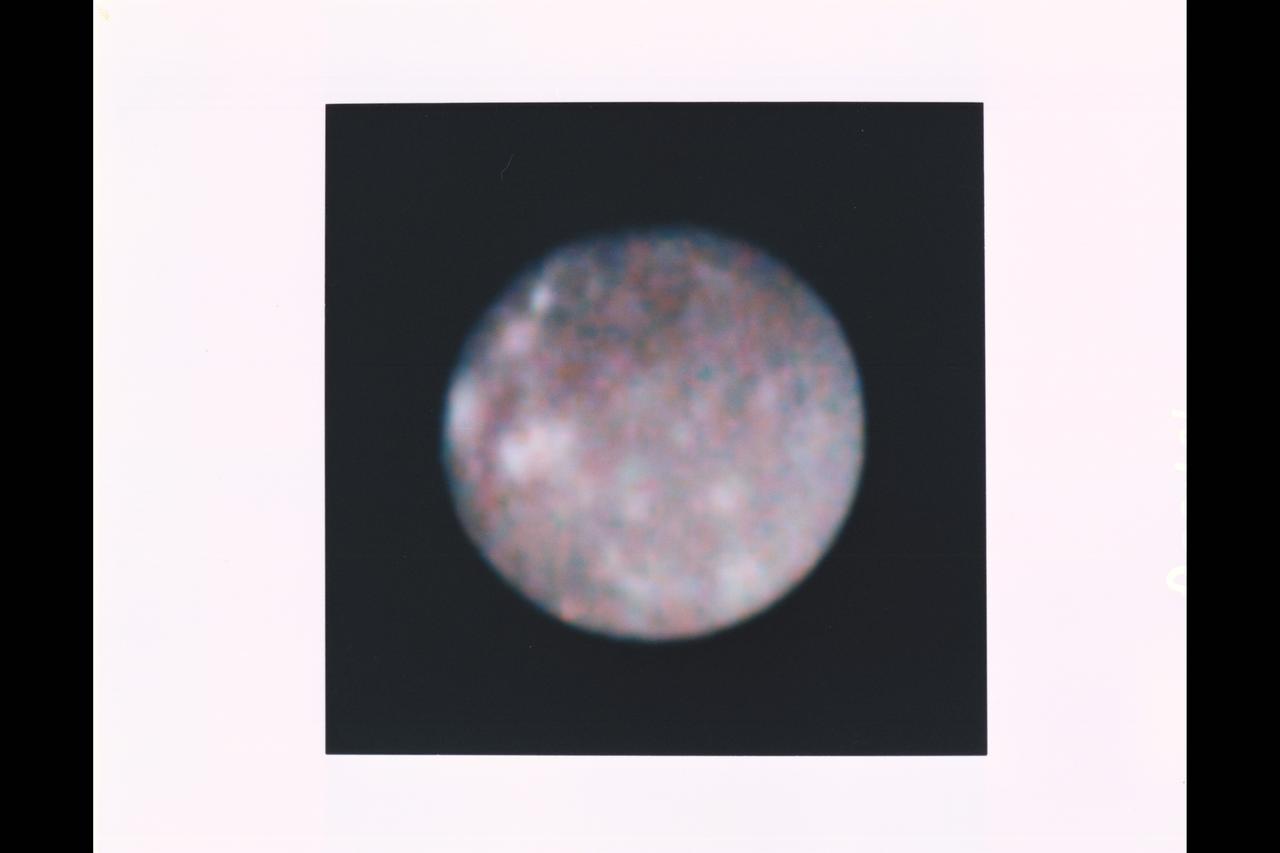
P-29496C Uranuss moon
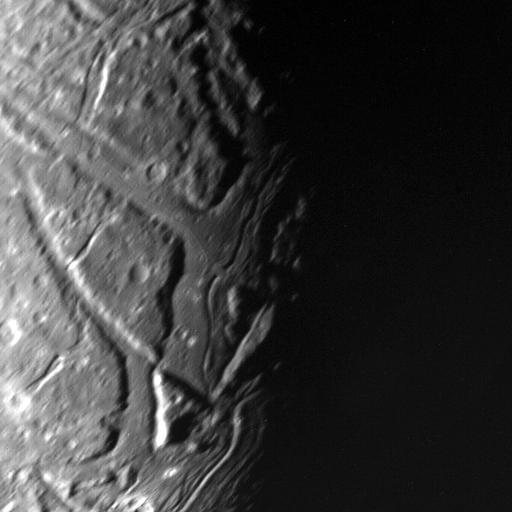
This NASA Voyager 2 view of Uranus moon Ariel terminator shows a complex array of transecting valleys with super-imposed impact craters.
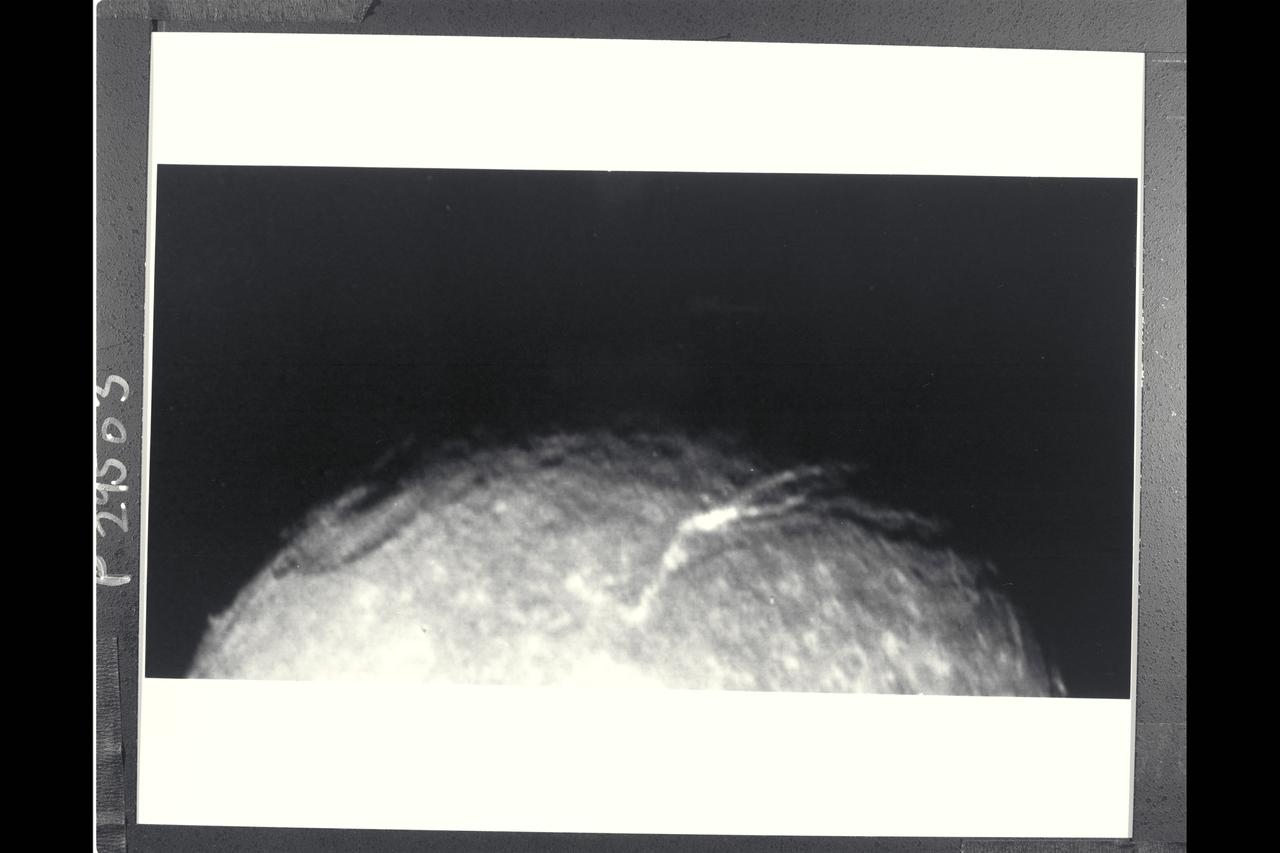
P29503 Moon (closeup) Voyager 2 flyby of Uranus

Jupiter, Saturn, Uranus, and Neptune are known as the jovian Jupiter-like planets because they are all gigantic compared with Earth, and they have a gaseous nature. This diagram shows the approximate distance of the jovian planets from the Sun.

This is a montage of planetary images taken by spacecraft managed by NASA’s Jet Propulsion Laboratory in Pasadena, CA. Included are from top to bottom images of Mercury, Venus, Earth and Moon, Mars, Jupiter, Saturn, Uranus and Neptune.
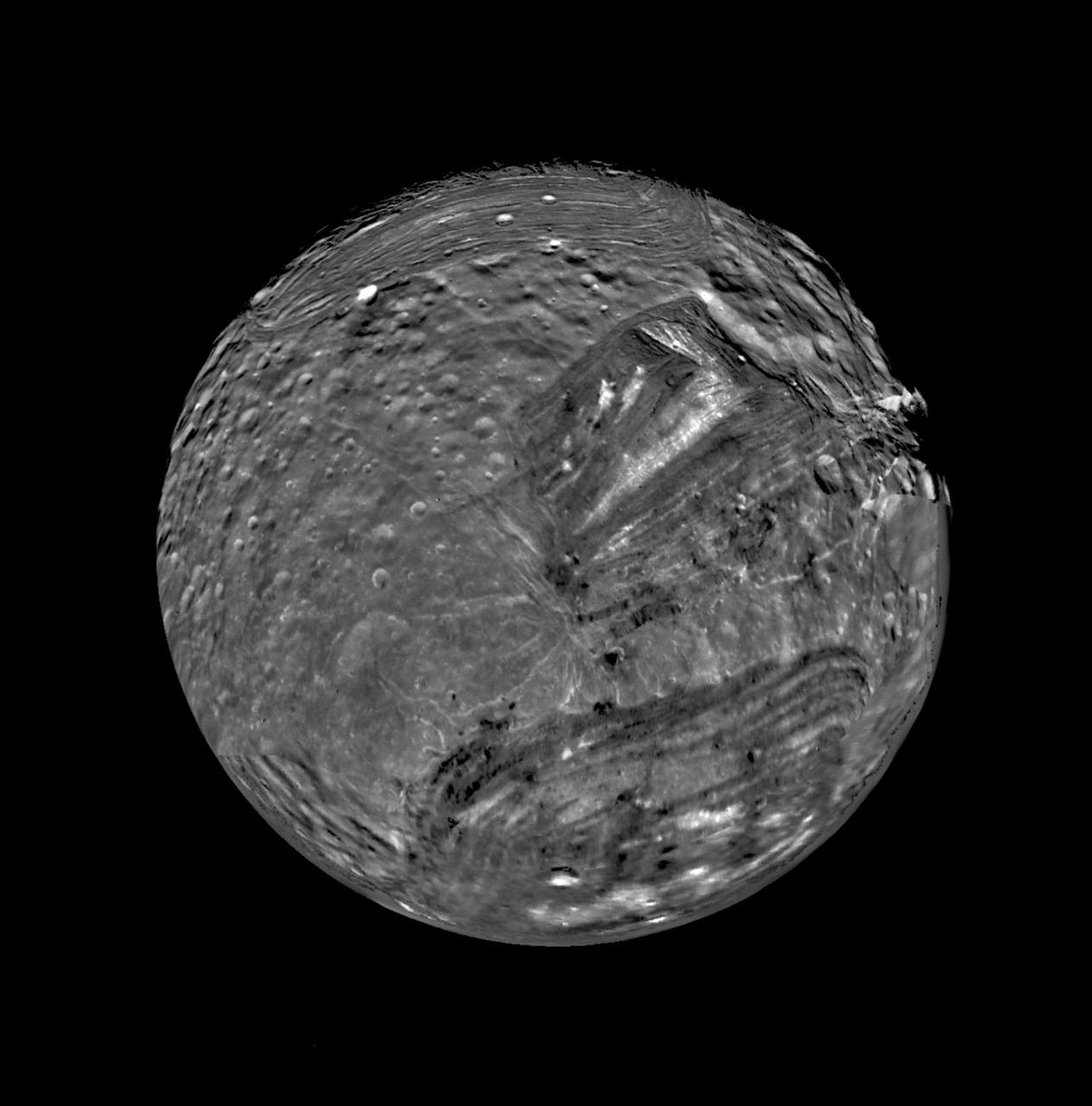
Uranus moon Miranda is shown in a computer-assembled mosaic of images obtained Jan. 24, 1986, by NASA Voyager 2 spacecraft. Miranda is the innermost and smallest of the five major Uranian satellites,

This is a montage of planetary images taken by spacecraft managed by NASA’s Jet Propulsion Laboratory in Pasadena, CA. Included are from top to bottom images of Mercury, Venus, Earth and Moon, Mars, Jupiter, Saturn, Uranus and Neptune.
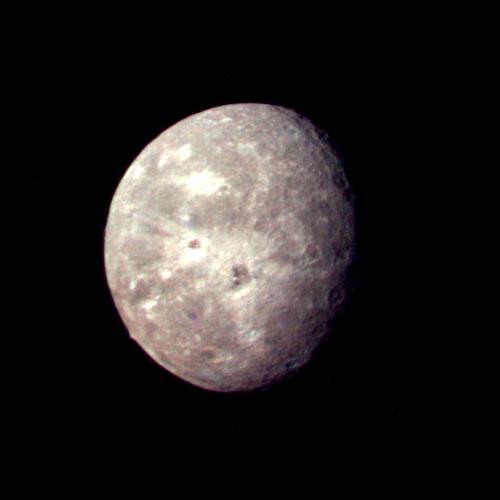
This image of Oberon, Uranus outermost moon, was captured by NASA Voyager 2 on Jan. 24, 1986. Clearly visible are several large impact craters in Oberon icy surface surrounded by bright rays. http://photojournal.jpl.nasa.gov/catalog/PIA00034
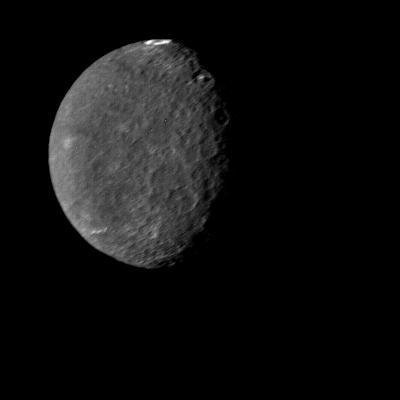
The southern hemisphere of Umbriel displays heavy cratering in this NASA Voyager 2 image, taken Jan. 24, 1986. This frame is the most detailed image of Umbriel, the darkest of Uranus larger moons. http://photojournal.jpl.nasa.gov/catalog/PIA00040

This is an updated montage of planetary images taken by spacecraft managed by NASA’s Jet Propulsion Laboratory in Pasadena, CA. Included are from top to bottom images of Mercury, Venus, Earth and Moon, Mars, Jupiter, Saturn, Uranus and Neptune.
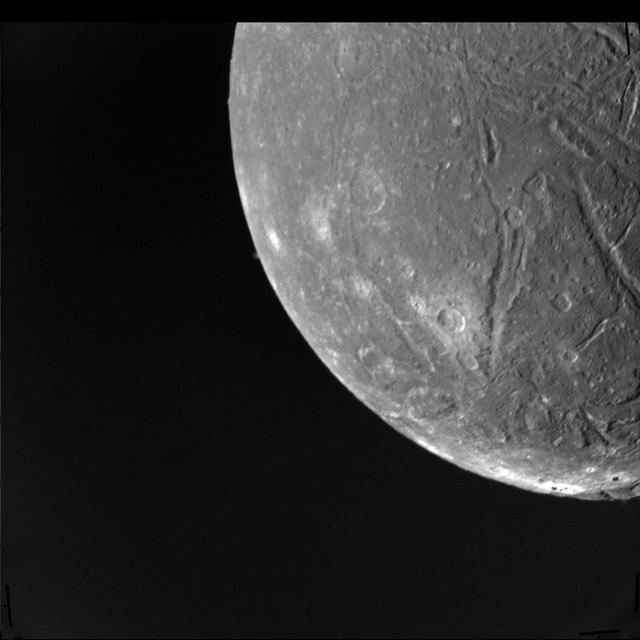
This picture is part of NASA Voyager 2 imaging sequence of Ariel, a moon of Uranus taken on January 24, 1986. The complexity of Ariel surface indicates that a variety of geologic processes have occurred. http://photojournal.jpl.nasa.gov/catalog/PIA00037
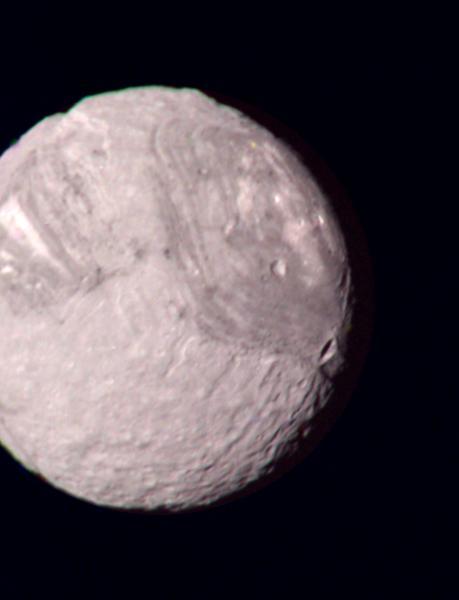
This color composite of the Uranian satellite Miranda was taken by NASA Voyager 2 on January 24, 1986. Miranda, just 480 km 300 mi across, is the smallest of Uranus five major satellites. http://photojournal.jpl.nasa.gov/catalog/PIA00042
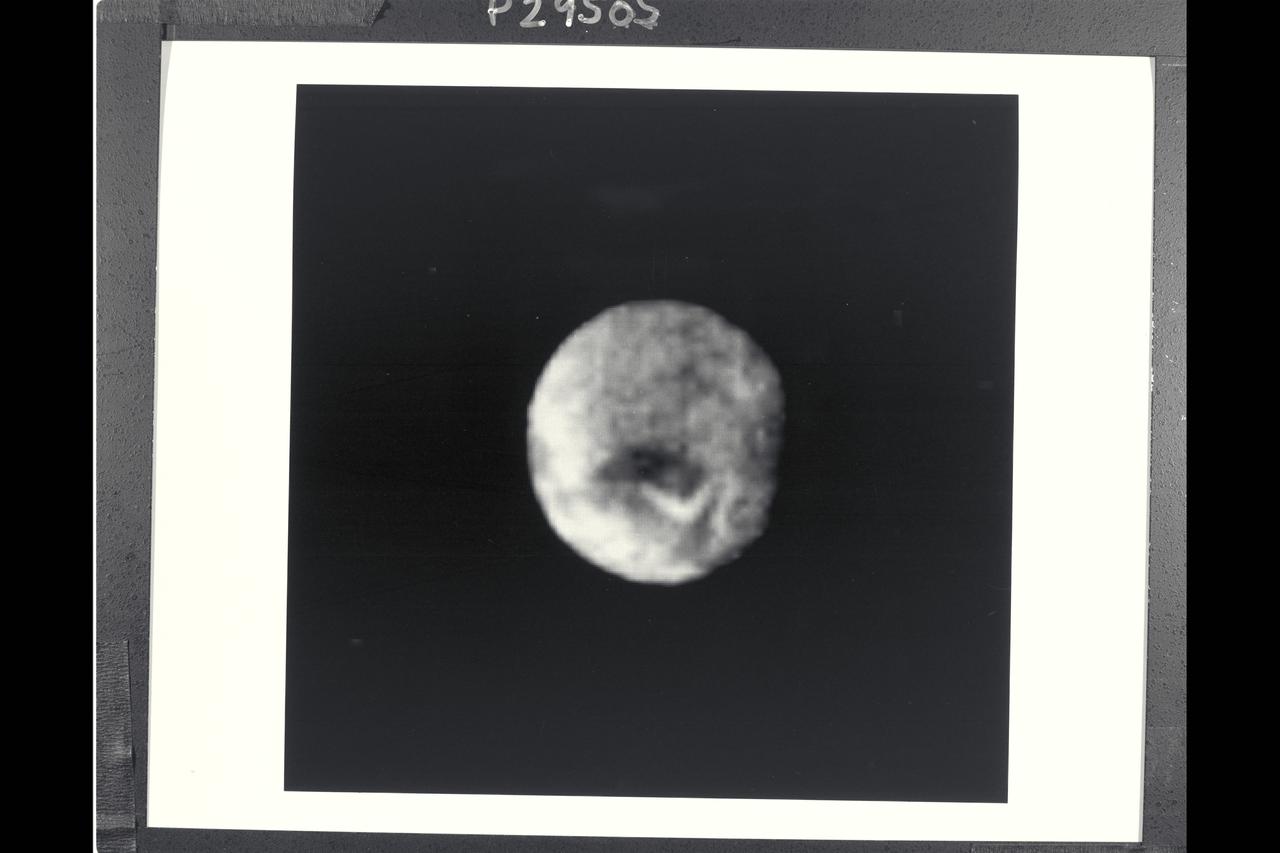
P-29505 Moon Voyager 2 flyby of Uranus' moons
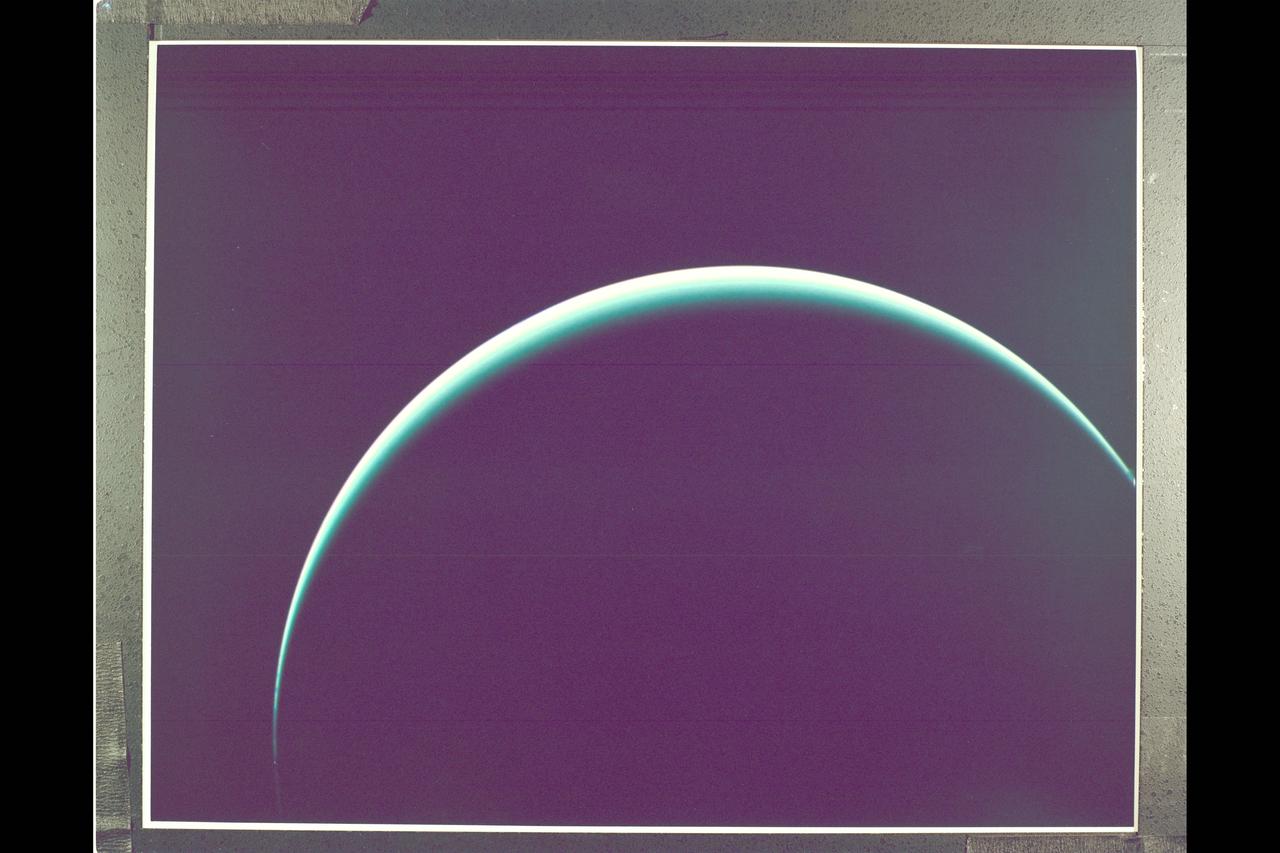
Range : 1 illion km. ( 600,000 mi. ) Resolution : 140 km. ( 90 mi. ) P-29539C This Voyager 2 image of Uranus was captured as the spacecraft was leaving Uranus behind on its cruise to Neptune. The image is a color composite of three photographs taken through blue, grren, and orange filters. Thin thin crecent seen here is at an angle of 153 degrees between the the spacecraft, the planet, and the sun. Even at this extreme angle, uranus retains the pale blue-green color seen by the ground based astronomers and recorded by Voyager 2 during its historic encounter, this color results from the presence of methane in Uranus' atmosphere. The gas absorbs red wavelengths of light, leaving the predominant hue seen here. The tendency for the cresent to become white at the extreme edge is cased by the presence of a high-altitude haze. Voyager 2, having encountered Jupiter in 1979, Saturn in 1981, and Uranus in 1986, will proceed on its jouney to Neptune. Closest approach is scheduled for August 24, 1989.
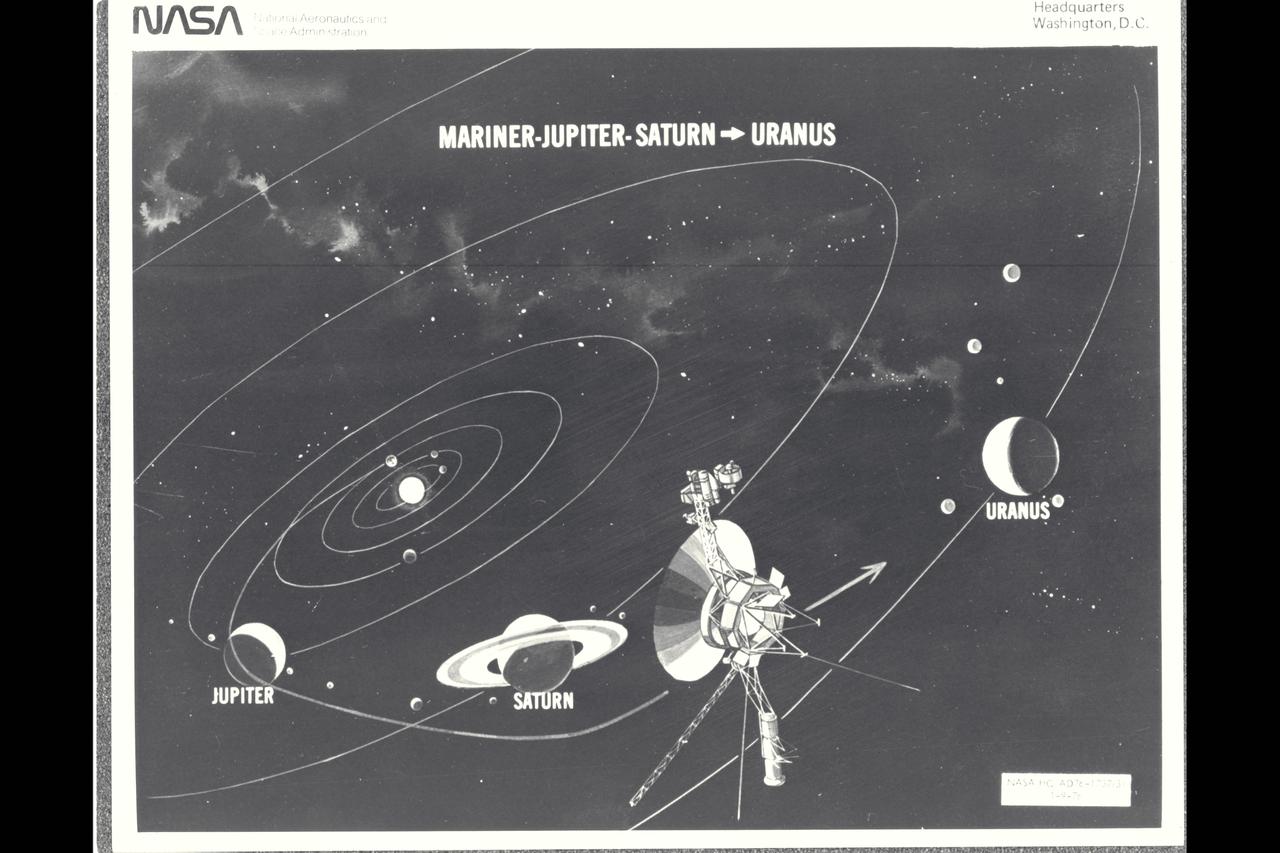
Voyager Saturn Mission Artwork (Mariner - Jupiter - Saturn - Uranus) show slingshot technique
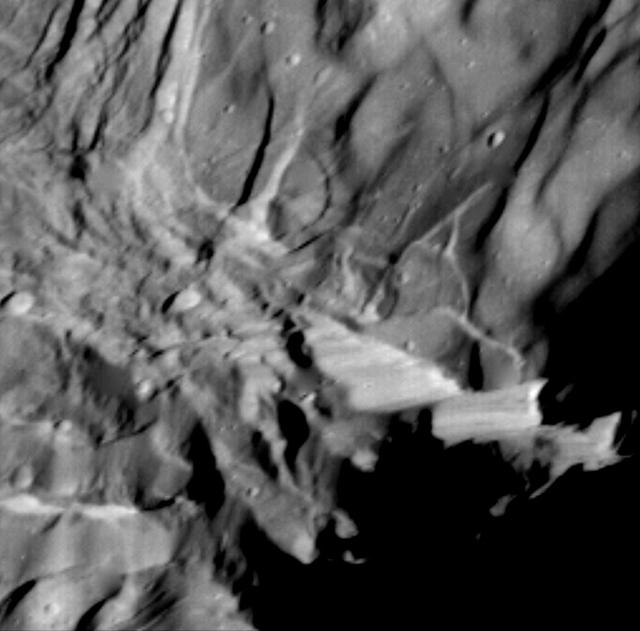
This image of Miranda, Uranus moon, was acquired by NASA Voyager 2 on Jan. 24, 1986. Miranda displays a dramatically varied surface. Well shown are numerous ridges and valleys -- a topography that was probably produced by compressional tectonics. http://photojournal.jpl.nasa.gov/catalog/PIA00044
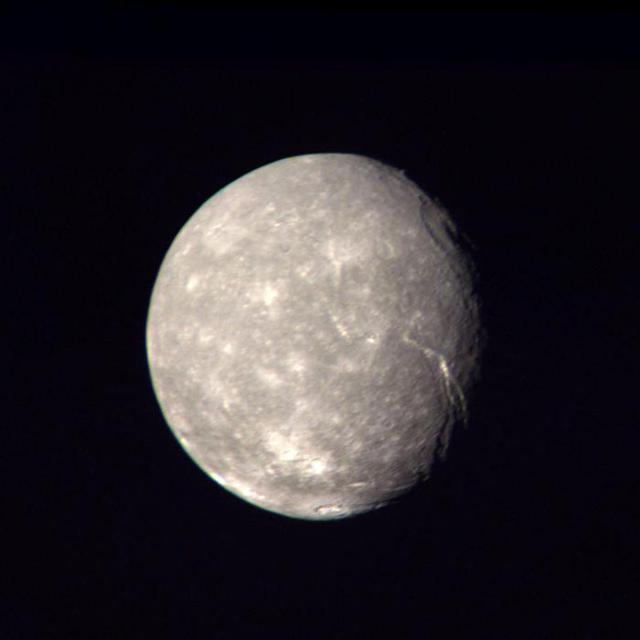
This high-resolution color composite of Titania was made from NASA Voyager 2 images taken Jan. 24, 1986, as the spacecraft neared its closest approach to Uranus. A large, trenchlike feature is seen near the terminator. http://photojournal.jpl.nasa.gov/catalog/PIA00036
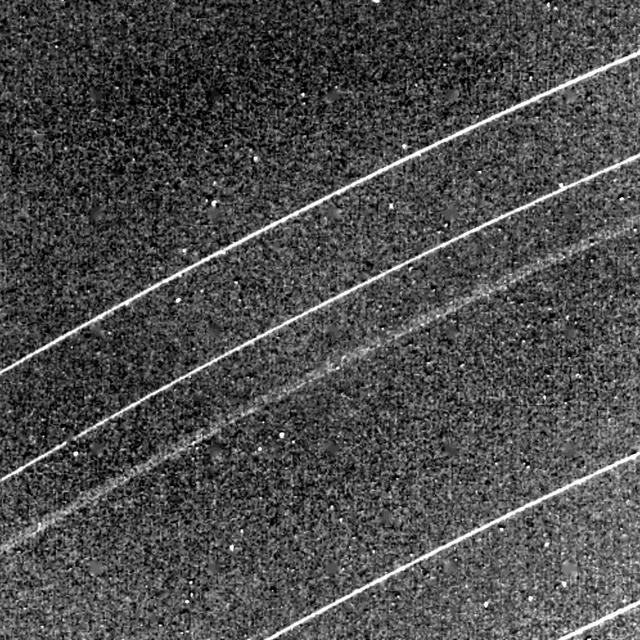
This NASA Voyager 2 image of the Uranian rings delta, gamma, eta, beta and alpha from top was taken Jan. 23, 1986.
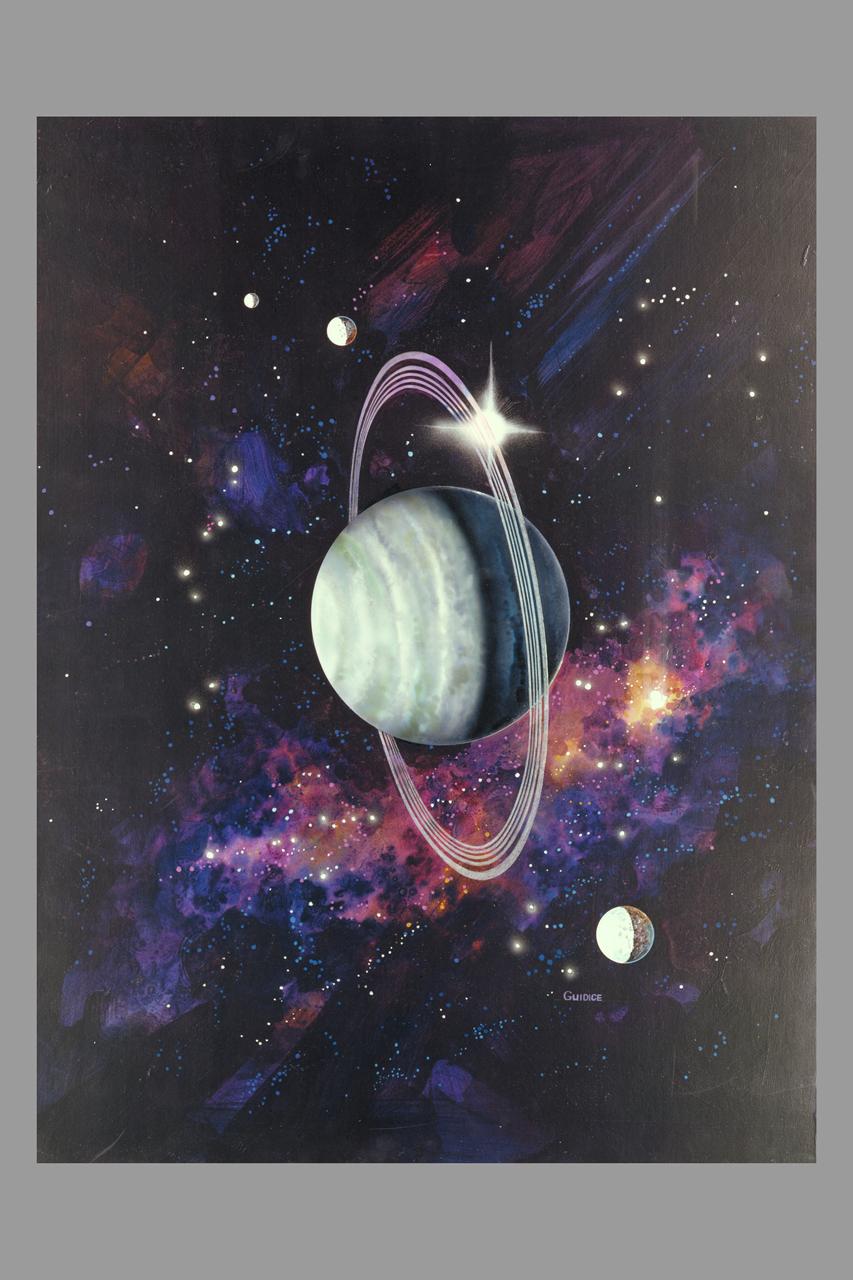
Artist: Rick Guidace This artist concept depicts the rings of Uranus in polar rotation as discovered by NASA Ames C-141 Kuiper Airborne Observatory
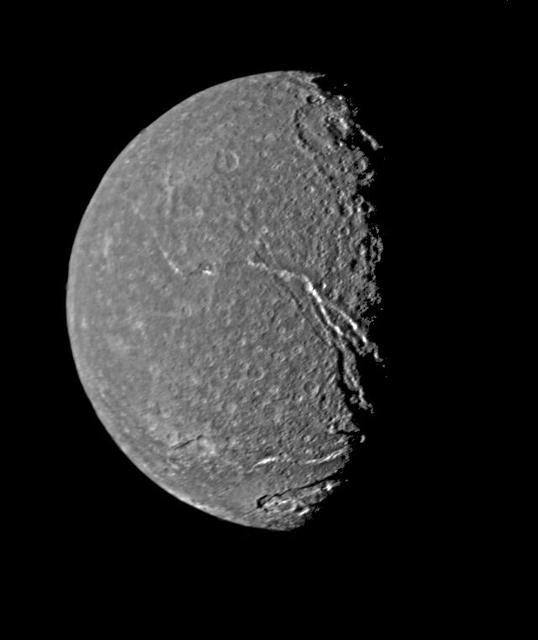
On Jan. 24, 1986, NASA Voyager 2 returned the highest-resolution picture of Titania, Uranus largest satellite. Abundant impact craters of many sizes pockmark the ancient surface; most prominent features are fault valleys that stretch across Titania. http://photojournal.jpl.nasa.gov/catalog/PIA00039
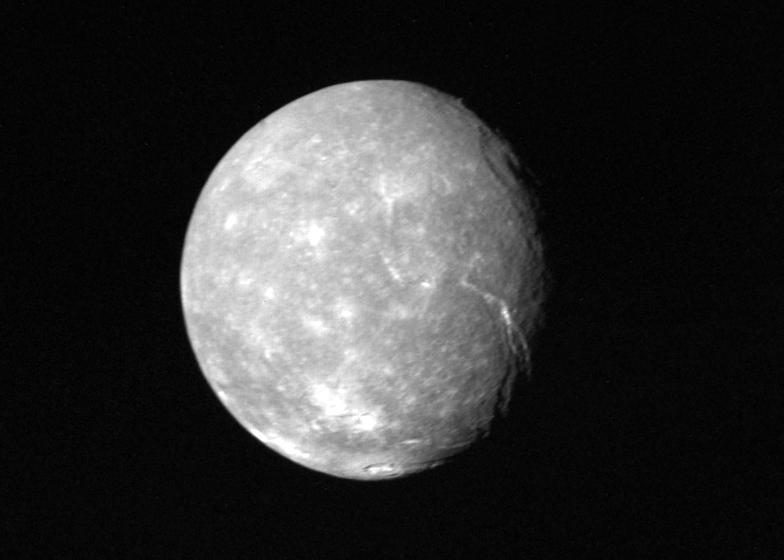
Voyager 2 obtained this full-disk view of Uranus moon Titania in the early morning hours of Jan. 24, 1986, from a distance of about 500,000 kilometers 300,000 miles. Many circular depressions, probably impact craters, are visible in this clear-filter.
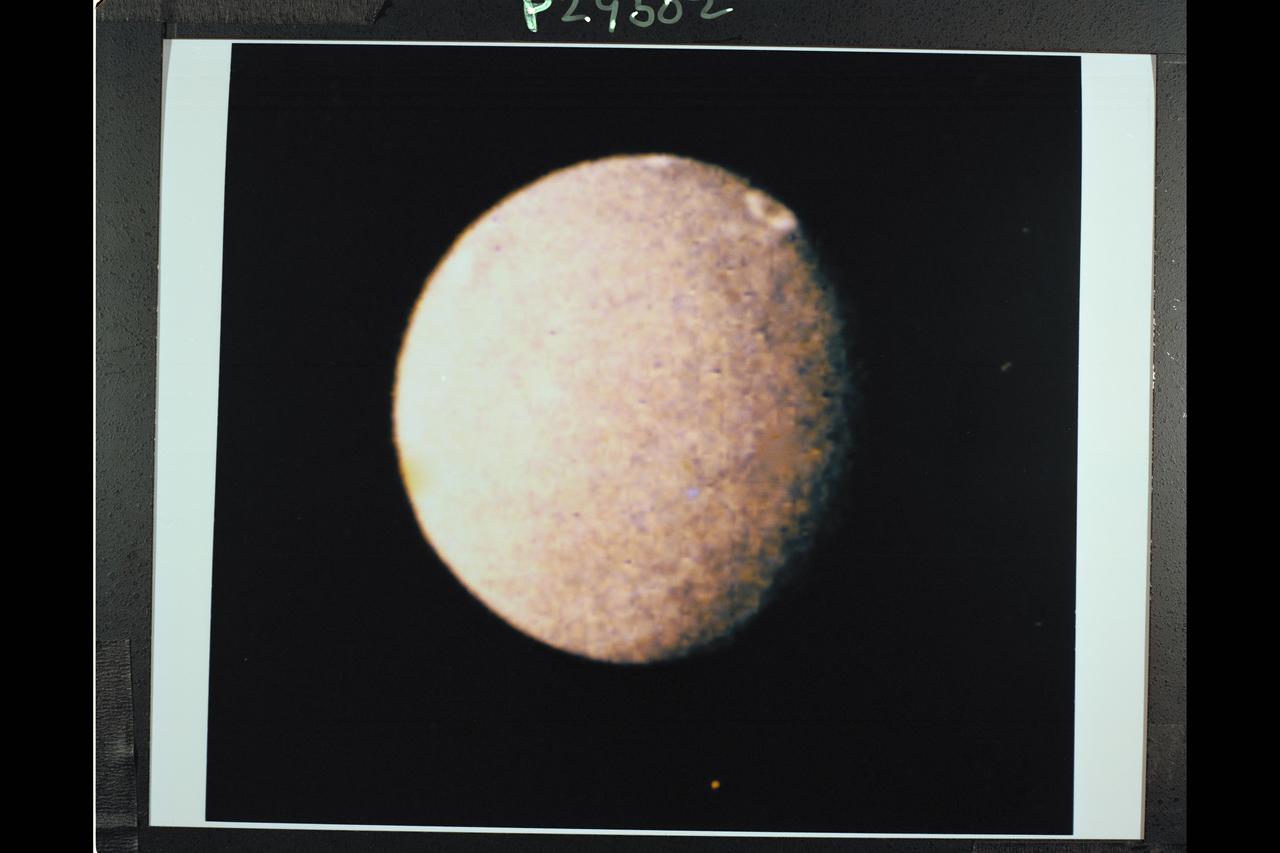
P-29502C Range: 1.04 million kilometers (650,000 miles) This color photo of Umbriel, the darkest of Uranus' five large moons was synthesized from frames exposed with the Voyager narrow-angle camera's violet and clear filters and has a resolution of 19 km (12 mi.). Umbriel is characterized by the darkest surface and smallest brightness variations of any of the large satellites of Uranus. As seen here, the surface is also generally gray and colorless. Nevertheless, at this resolution, considerable topographic detail is revealed, showing that Umbriel's surface is covered by impact craters. The brightest spot (shown at top near the equator at approxiamately 270 ° longitude) appears as a bright ring. Its geological significance is not yet understood. Umbriel has a diameter of about 1,200 km (750 miles) and orbits 267,000 km (166,000 mi) from Uranus' center. The satellite's name, from Alexander Pope's 'Rape of the Lock,' means 'dark angel'.
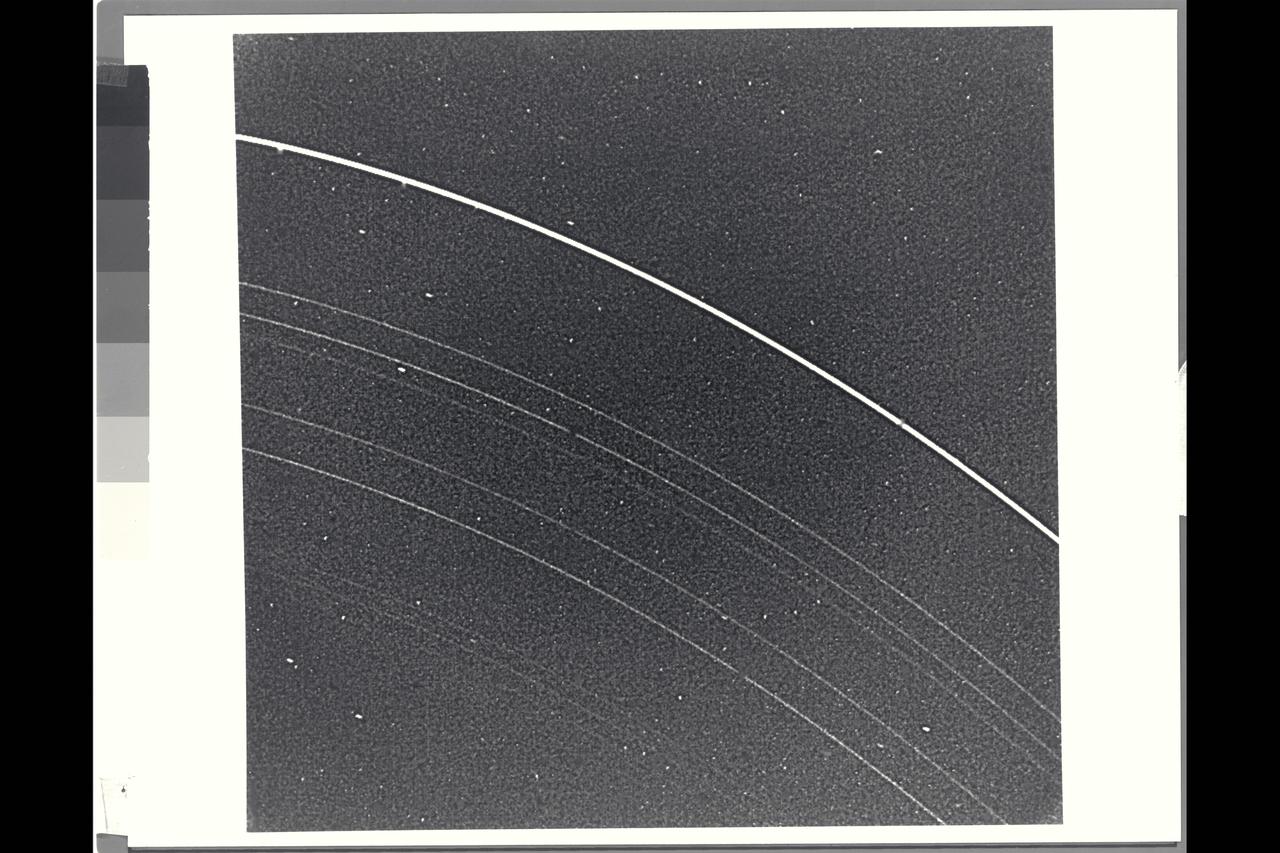
Range : 2.52 million miles (1.56 million miles) P-29481B/W Voyager 2 returned this photograph with all nine known Uranus rings visible from a 15 sec. exposure through the narrow angle camera. The rings are quite dark and very narrow. The most prominent and outermost of the nine, Epsilon, is seen at top. The next three in toward Uranus, called Delta, Gamma, and Eta, are much fainter and more narrow than Epsilon ring. Then come Beta and Alpha rings, and finally, the innermost grouping, known simply as the 4,5, & 6 rings. The last three are very faint and are at the limit of detection for the Voyager camera. Uranus' rings range in width from about 100 km. (60 mi.) at the widest part of the Epsilon ring, to only a few kilometers for most of the others. this iamge was processed to enhance narrow features; the bright dots are imperfections on the camera detector. The resolution scale is about 50 km. (30 mi.)
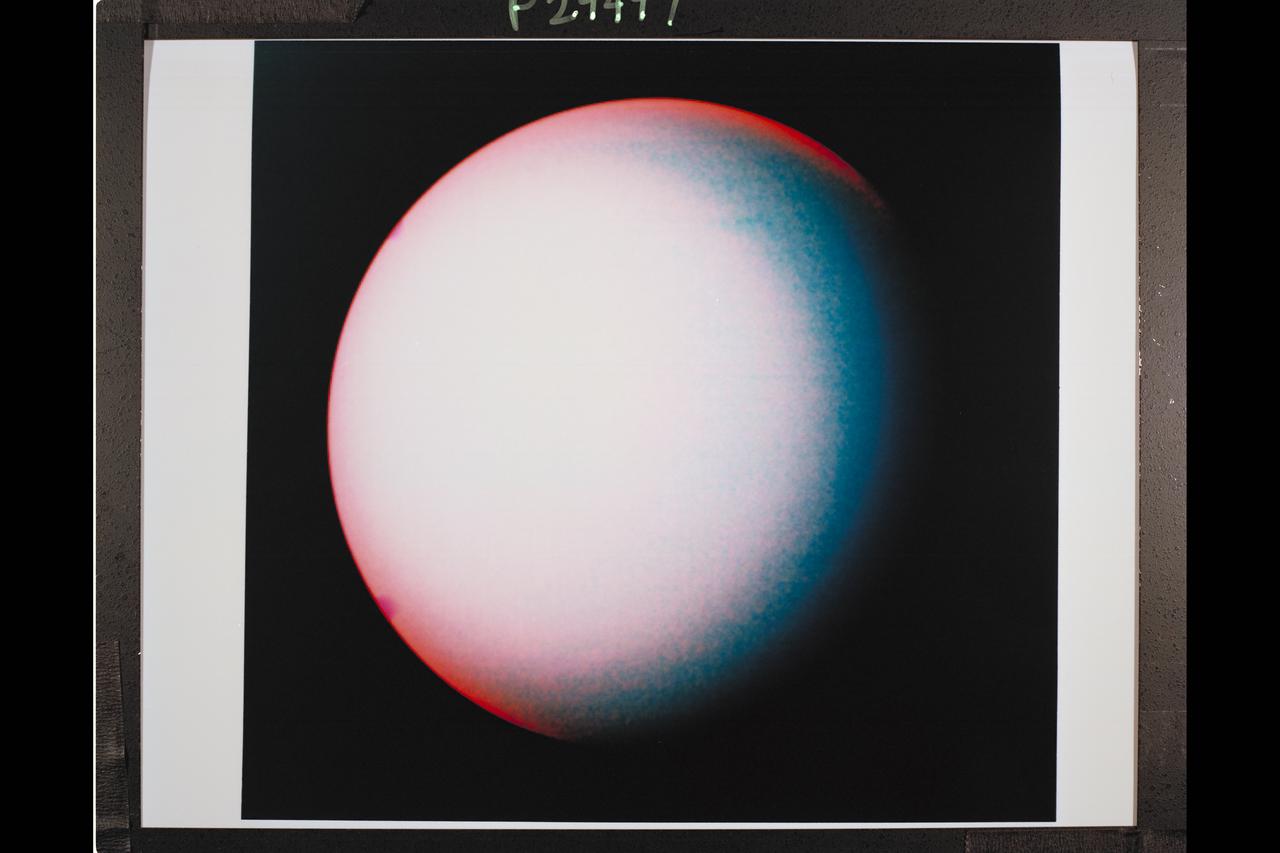
Range : 2.7 million miles (1.7 million miles) P-29497C Tis Voyager 2, false color composite of Uranus demonstrates the usefulness of special filters in the Voyager cameras for revealing the presence of high altitude hazes in Uranus' atmosphere. The picture is a composite of images obtained through the single orange and two methane filters of Voyager's wide angle camera. Orange, short wavelength and long wavelength methane images are displayed, retrospectively, as blue, green, and orange. The pink area centered on the pole is due to the presence of hazes high in the atmosphere that reflect the light before it has traversed a long enough path through the atmosphere to suffer absorbtion by methane gas. The bluest region at mid-latitude represent the most haze free regions on Uranus, thus, deeper cloud levels can be detected in these areas.
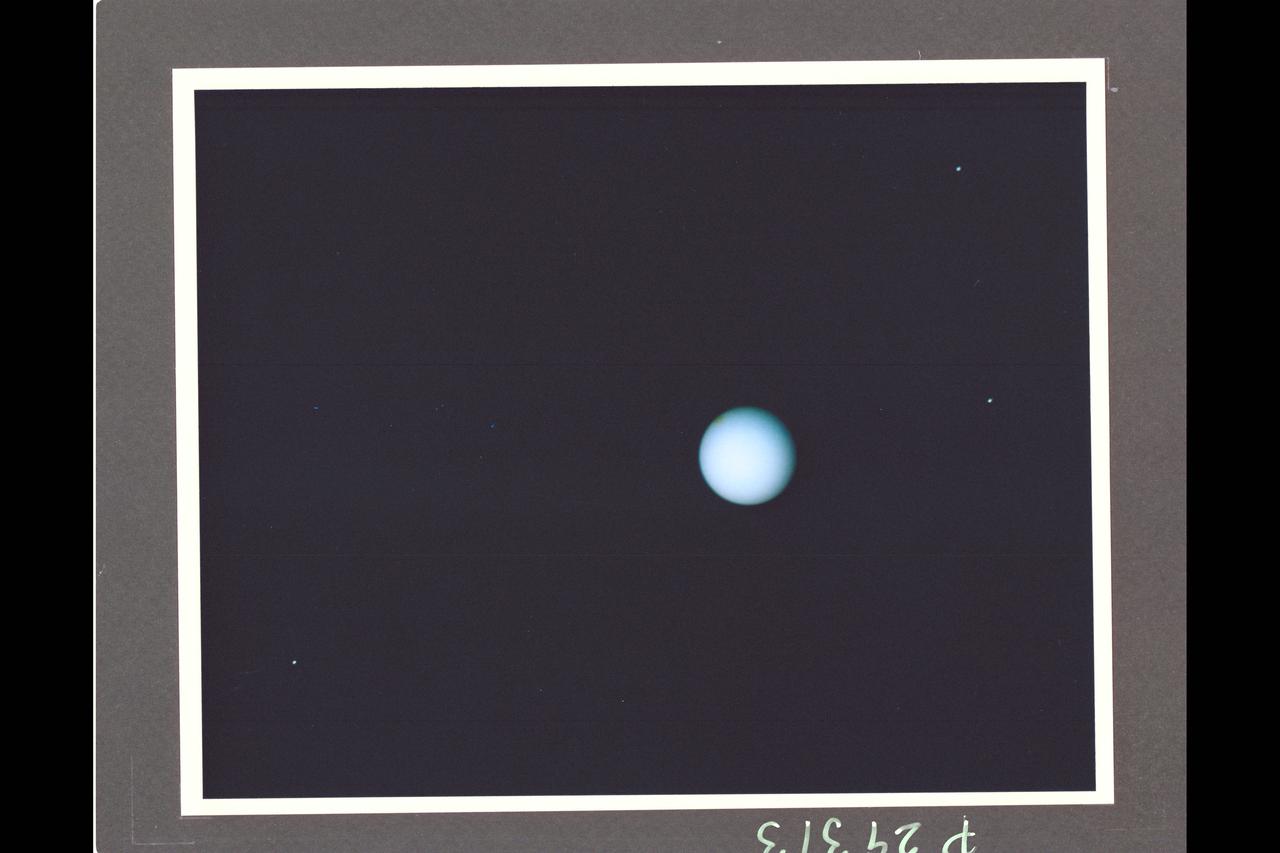
Range : 74 million km. ( 46 million miles ) P-29313CThis Voyager photograph of Uranus is a composite of for images taken by the narrow angle camera. At this range, clouds and other features in the atmosphere as small as 1,370 km. could be detected by Voyager 2. Yet, no such features are visible. This view is toward the illuminated south pole of Uranus. The predominant blue color is the result of atmospheric methane, which absorbs the red wavelengths from incoming sunlight. The spot at the upper left edge of the planet's disk reulted from the removal of a reseau mark used in making measurments on the photograph. Three of Uranus' five known satellites are visible; Miranda ( at far right, closest to the planet ), Ariel ( next out , at top), and Umbriel ( lower left ). Titania and Oberon are now outside the narrow angle camera's field of view when it centered on the planet. This color composite was made from images taken through blue, green, orange, and clear filters.
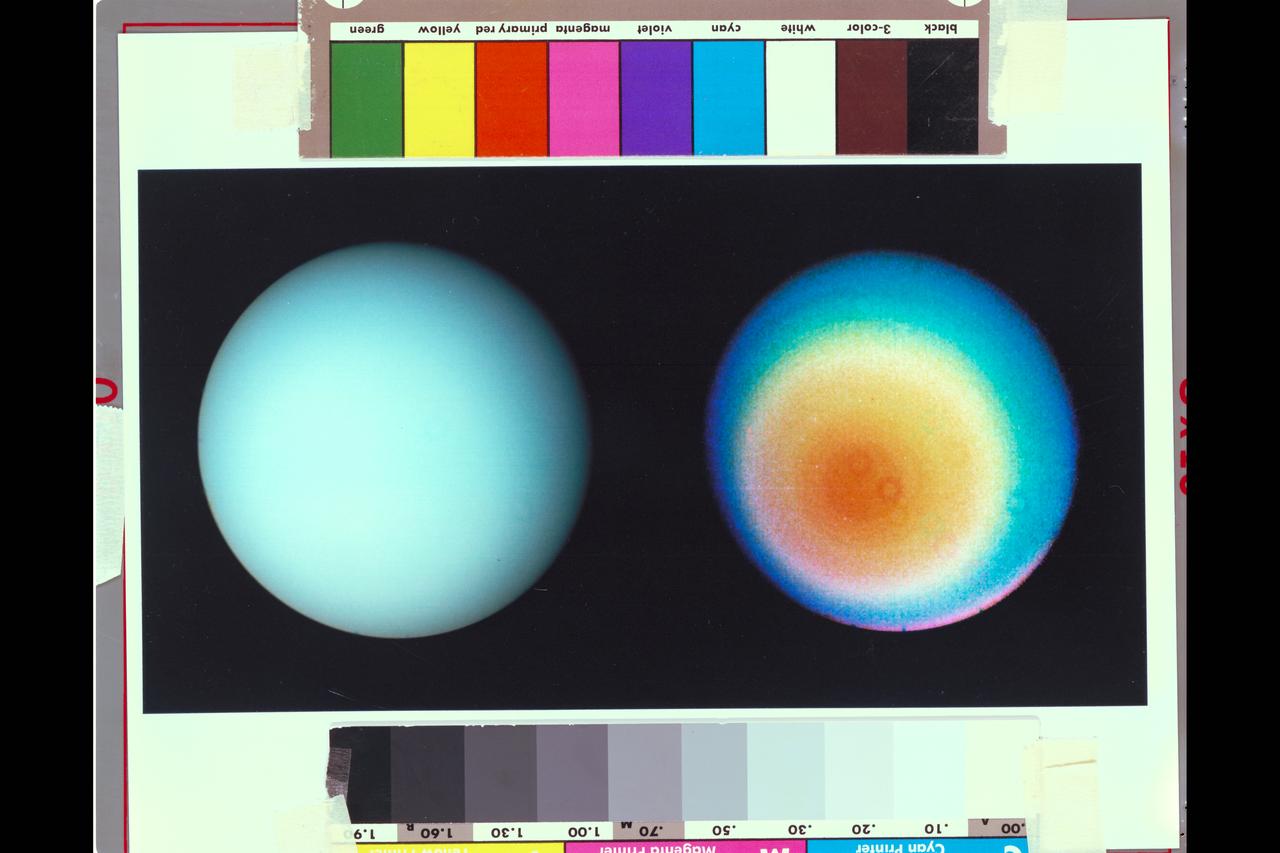
Range : 9.1 million miles (5.7 million miles) P-29478C These two images pictures of Uranus, one in true color and the other in false color, were shot by Voyager 2's narrow angle camera. The picture at left has been processed to show Uranus as the human eye would see from the vantage point of the spacecraft. The image is a composite of shots taken through blue, green, and orange filters. The darker shadings on the upper right of the disk correspond to day-night boundaries on the planet. Beyond this boundary lies the hidden northern hemisphere of Uranus, which currently remains in total darkness as the planet rotates. The blue-green color results from the aborption of red light by methane gas in Uranus' deep, cold, and remarkably clear atmosphere. The picture at right uses false color and extreme contrast to bring out subtle details in the polar region of Uranus. Images obtained through ultraviolet, violet, and orange filters were respectively converted to the same blue, green, and red colors used to produce the picture at left. The very slight contrasts visible in true color are greatly exaggerated here. In this false colr picture, Uranus reveals a dark polar hood surrounded by aseries of progressively lighter concentric bands. One possible explanation is that a brownish haze or smog, concentrated around the pole, is arranged into bands of zonal motions of the upper atmosphere. Several artifacts of the optics and processing are visible. The occasional donut shapes are shadows cast by dust in the camera optics;the processing needed to bring ot faint features also bring out camera blemishes. in addition, the bright pink strip at the lower edge of the planets limb is an artifact of the image enhancement. In fact, the limb is dark and uniform in color around the planet.
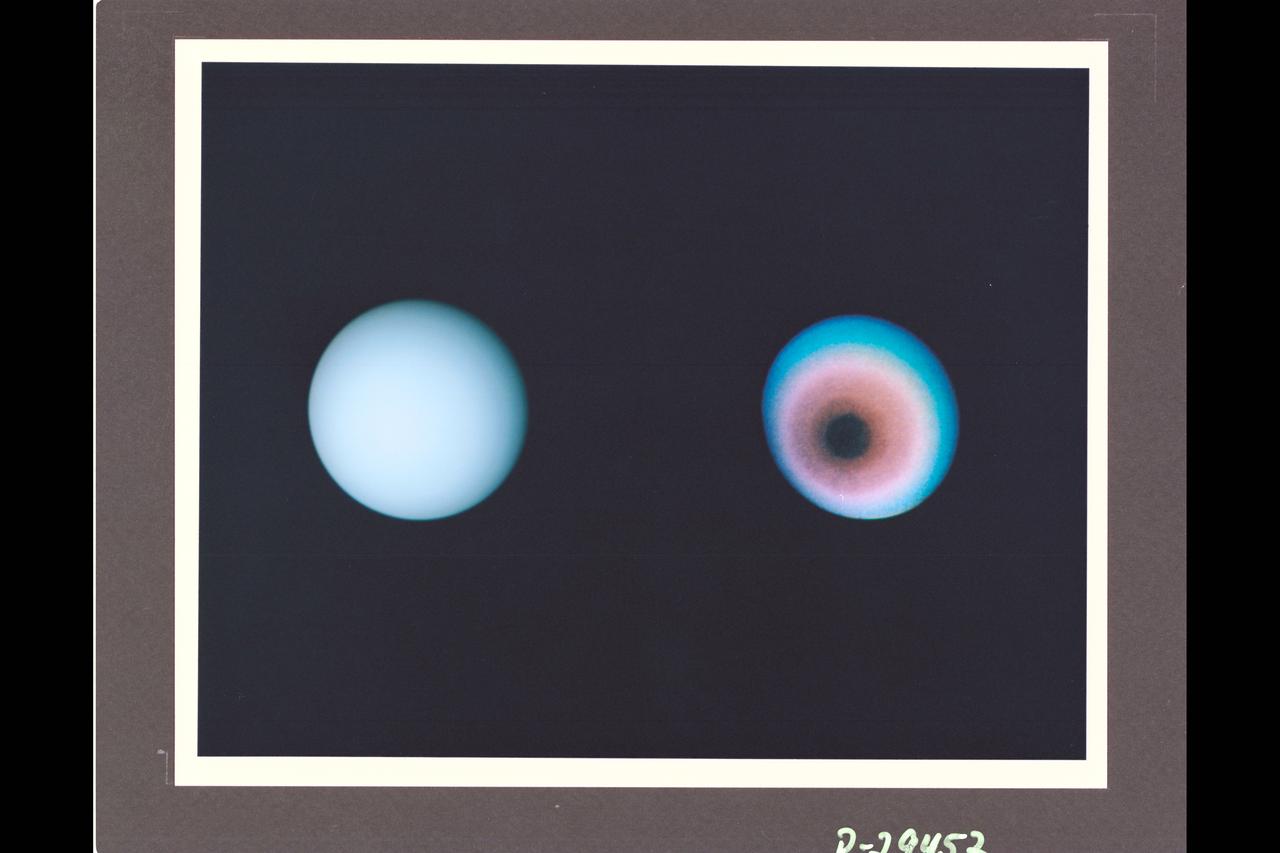
P-29452 These two images of Uranus are shown here to reveal the pole rotation of the planet, as photographed by Voyager 2. The left is seen as the human eye would see, and the right isfalse color to reveal more intricate details.
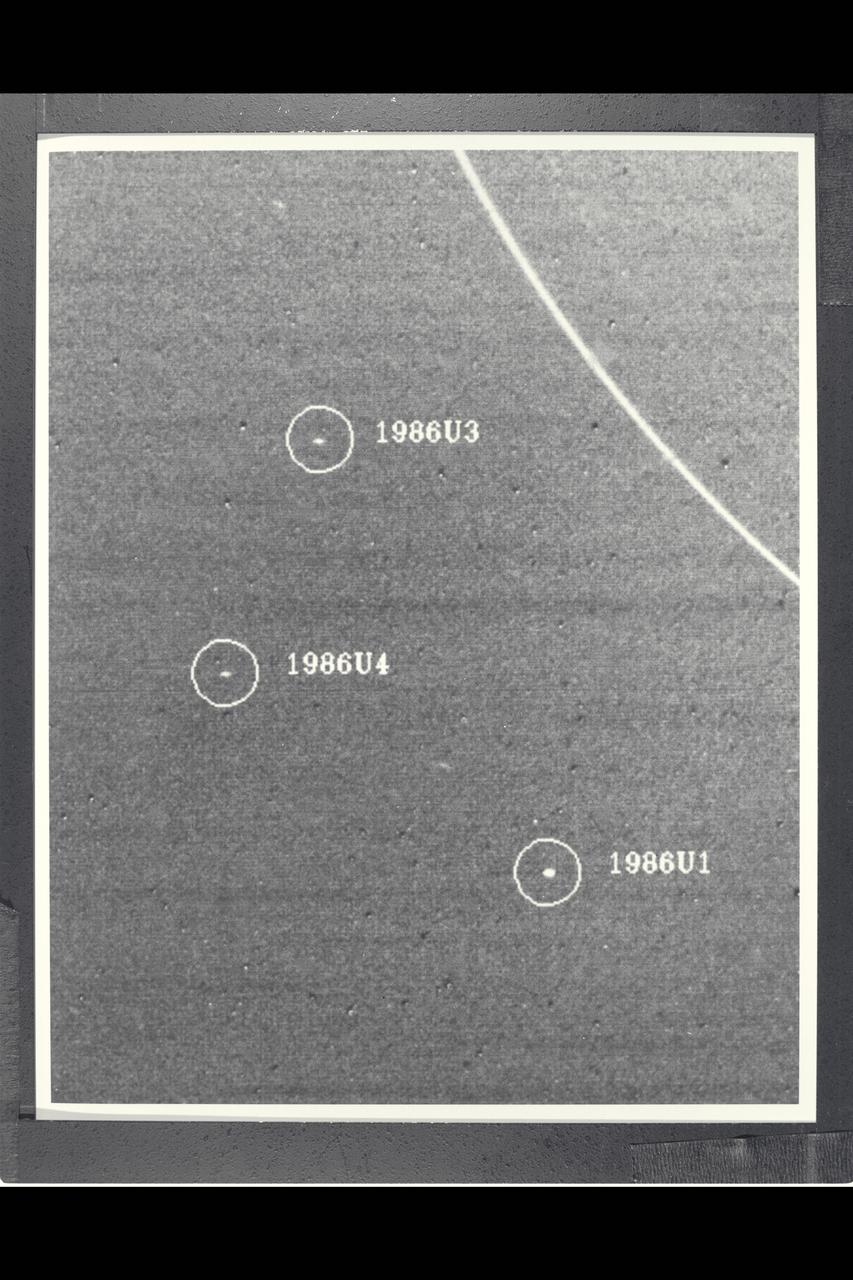
Range : 7.7 million km. ( 4.8 million miles ) P-29465 In this image captured by Voyager 2, three newly discovered satellites of Uranus can be seen orbiting outside of the nine known rings of Uranus. The outermost of the rings, the Epsilon Ring can be seen here at upper right. The largest of the three moons viewed here, 1986U1, was discovered January 3rd. it is an estimated 90 km. ( 55 mi. ) across and its orbits Uranus every 12 hours, 19 minutes ata distance of 66,090 km. ( 41,040 mi.) from the planets center. the other two moons are slightly smaller, 1986U3 orbits every 11 hours, 6 minutes at 61,750 km. ( 38,350 mi.),1986U4 every 13 hours, 24 minutes at 69,920 km. ( 43,420 mi.). They were dicovered on January 9th and 13th, respectively. Long exposures were required to bring out these small objects. As a result of the relative motions of the spacecraft and the moons, they appear slightly elongated.
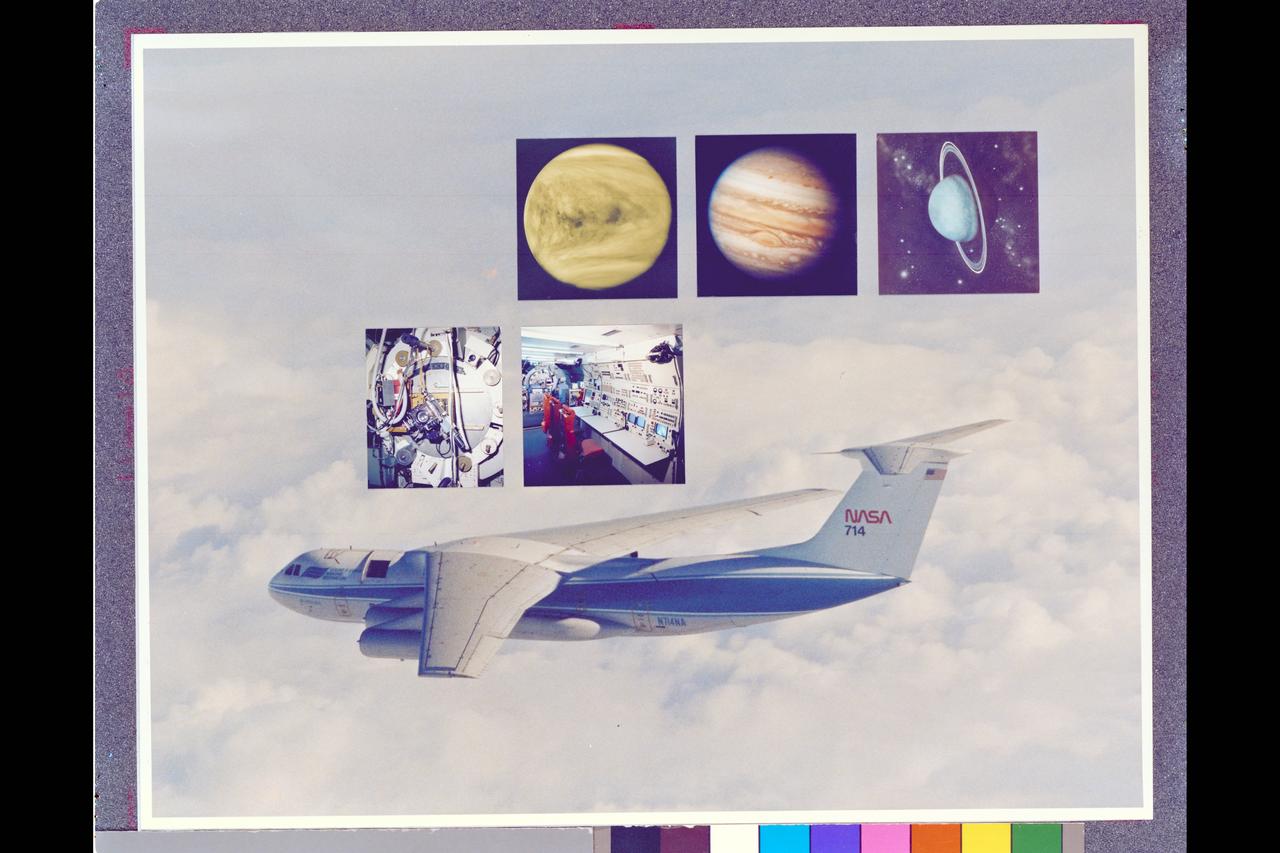
Composite Art C-141 KAO Airborne Astronomy Composite shows A/C AC80-0006-2, Venus AC78-9140, Jupiter AC79-0143-1, Uranus AC77-0359, Console AC75-1345 and Telescope AC81-0299-17
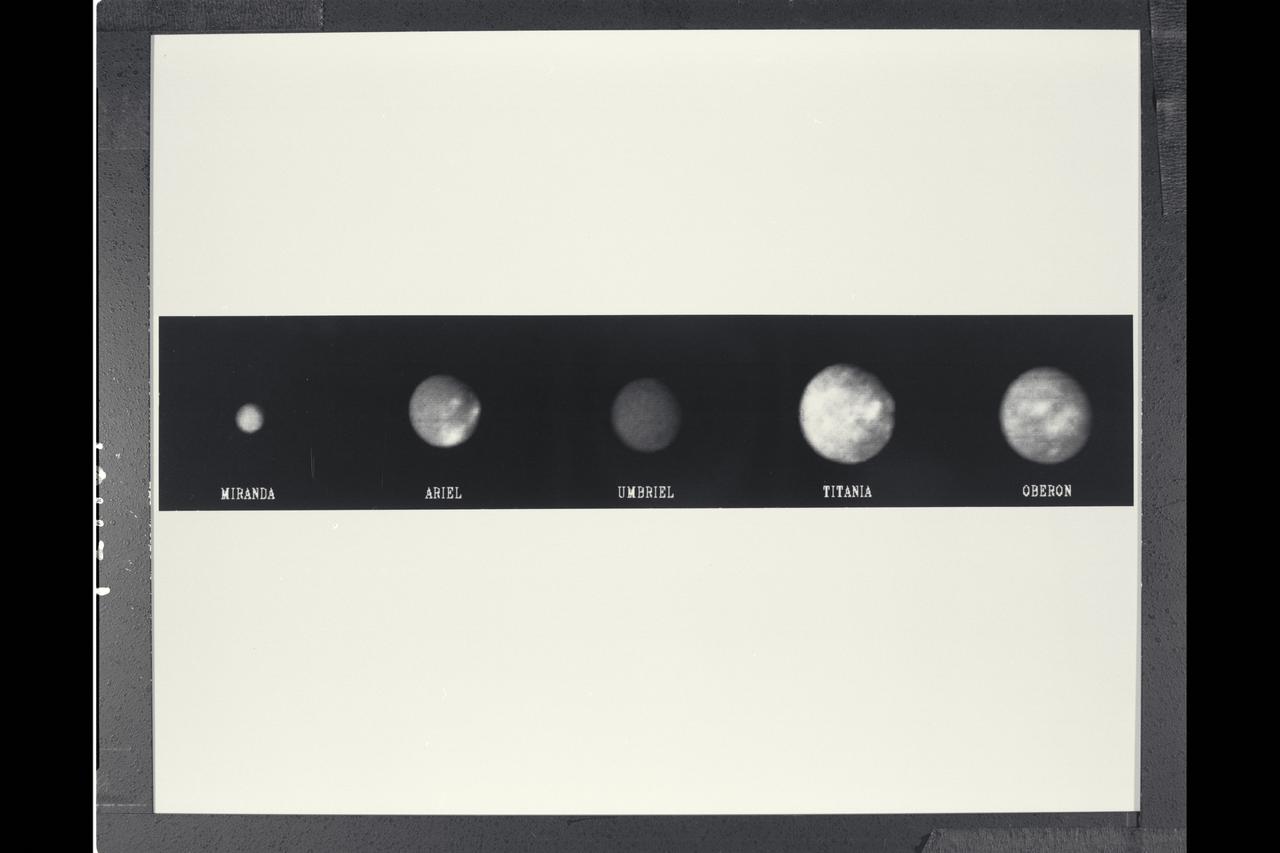
Range : 5 to 6.1 million km. ( 3.1-.8 million miles ) P-29314B/W This 'family portrait' of Uranus' five largest moons was compiled from images sent back from Voyager 2 The photographs were taken through a clear filter.
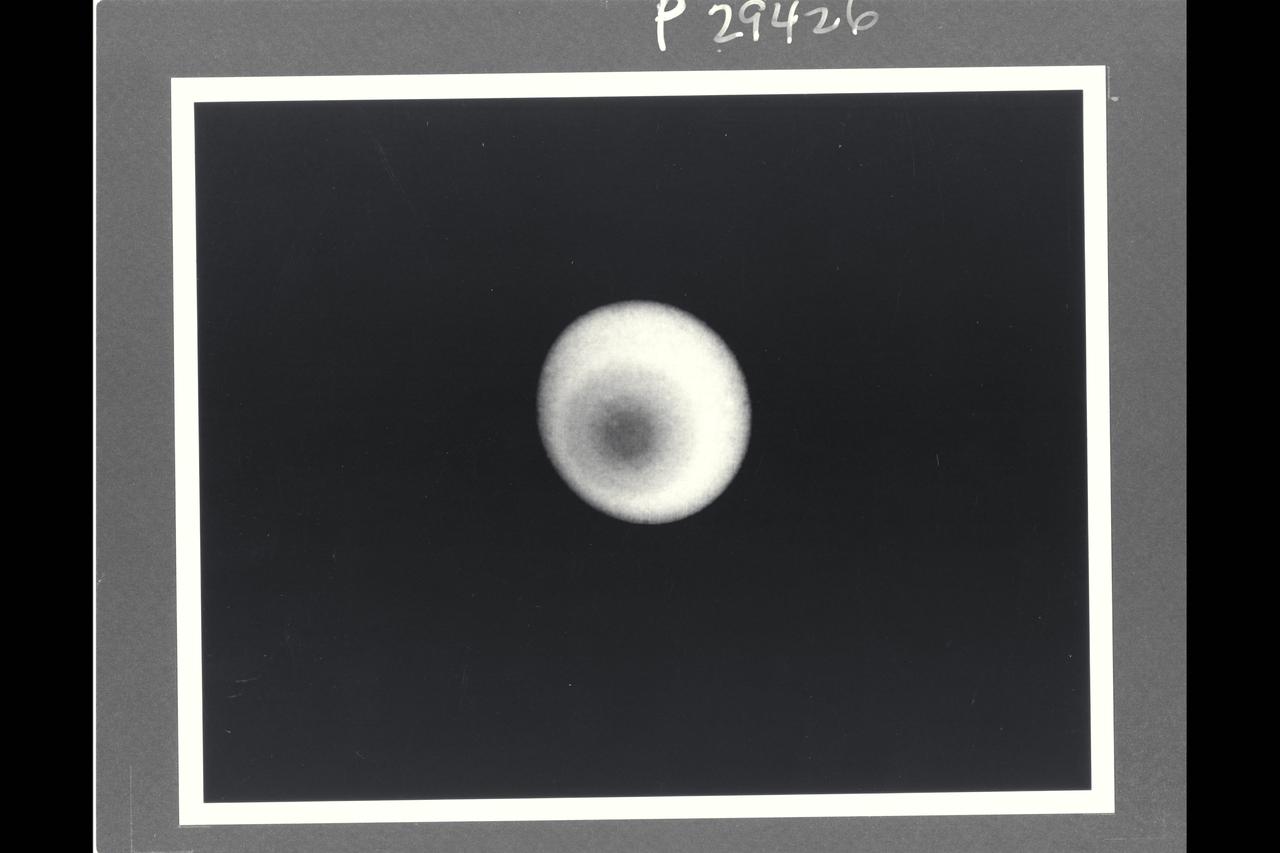
Range : 36 million km. ( 22 million miles ) P-29426B/W This Voyager 2 photograph of Uranus shows the is the first picture to show clear evidence of latitudinal banding in the planet's atmosphere. This is a computerized summation of five images shot by the narrow angle camera. The concentric pattern emanates like a bulls-eye from the planets pole of rotation, which, in this view, lies left of center. uranus lies almost on its side with respect to the other planets and is rotating in a counter clockwise direction, as seen here. Clouds in the Uranian atmosphere give rise to the pattern, the first clear evidence of banding similiar to that seen previosly on Saturn and Jupiter. The bandind on Uranus, however, shows much less contrast. At the distance at which the images were acquired, Voyager's camera could have detected individual features as small as 660 km. (410 miles) across, but no such cloud or markings were apparent. Scientists cannot yet say what properties, such as cloud height, composition, or particle size, are giving rise to the varying levels of brightness visible here. The images composing this picture were shot through a filter that transmits only violet light. in the original, unprocessed images, the contrast of features producing the banding is low, not more than 10 percent. In order to reduce 'noise' and enhance the visiblity of the features, processors combined five images and then compared the resulting composite to a hypothetical featureless planet illuminated by the Sun from the proper direction. Only the ratio between the original data and the hypothetical image is shown.

P-34712 Range: 1.1 million kilometers (683,000 miles) This wide-angle Voyager 2 image, taken through the camera's clear filter, is the first to show Neptune's rings in detail. The two main rings, about 53,000 km (33,000 miles) and 63,000 km (39,000 miles) from Neptune, are 5 to 10 times brighter than in earlier images. The difference is due to lighting and viewing geometry. In approach images, the rings were seen in light scattered backward toward the spacecraft at a 15° phase angle. However, this image was taken at a 135° phase angle as Voyager left the planet. That geometry is ideal for detecting microscopic particles that forward scatter light preferentially. The fact that Neptune's rings are so much brighter at that angle means the particle-size distribution is quite different from most of Uranus' and Saturn's rings, which contain fewer dust-size grains. However, a few componenets of the Saturian and Uranian ring systems exhibit forward-scattering behavior: The F ring and the Encke Gap ringlet at Saturn and 1986U1R at Uranus. They are also narrow, clumpy ringlets with kinks, and are associated with nearby moonlets too small to detect directly. In this image, the main clumpy arc, composed of three features each about 6 to 8 degrees long, is clearly seen. Exposure time for this image was 111 seconds.
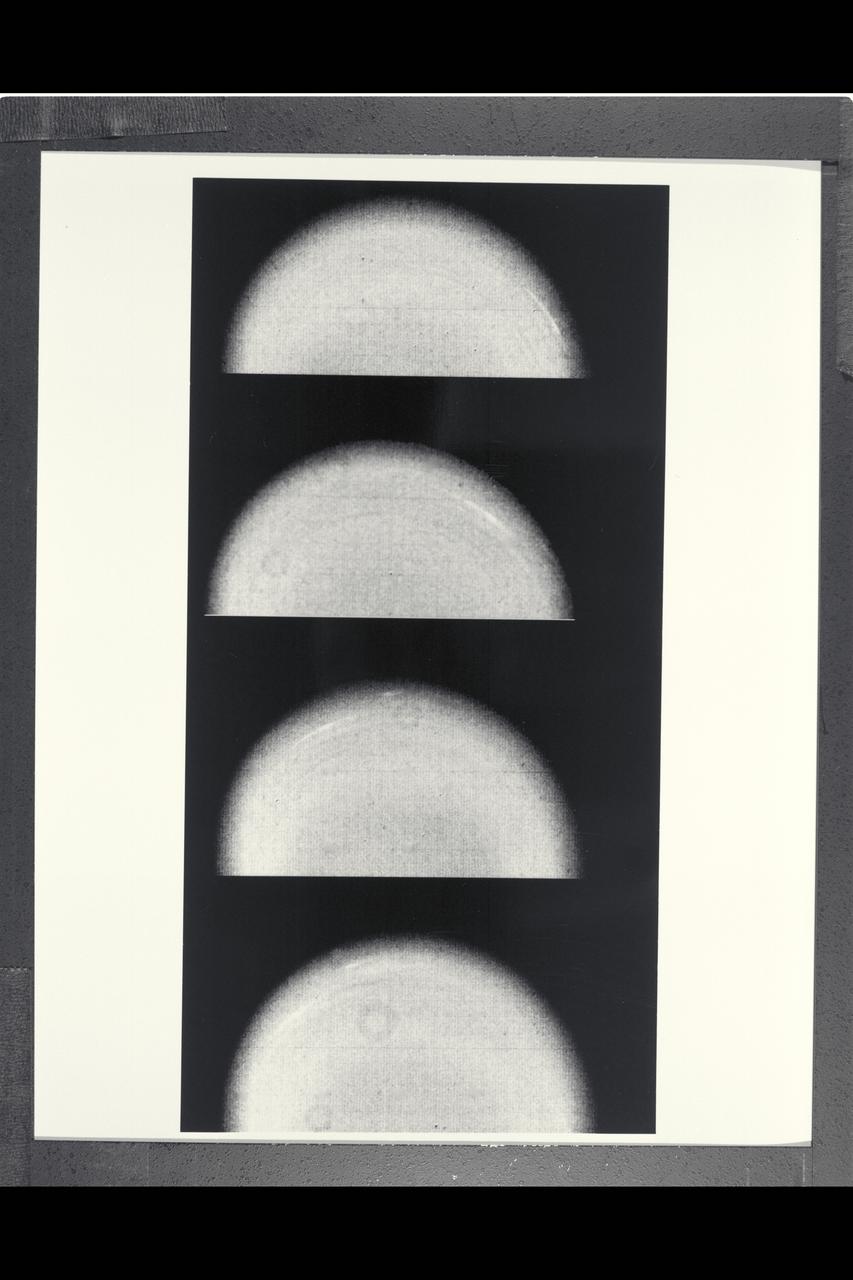
Range : 12.9 million km. ( 8.0 million miles ) P-29467B/W Time lapse Voyager 2 images of Uranus show the movement of two small, bright, streaky clouds, the first such features ever seen on the planet. The clouds were detected in this series of orange filtered images, over a 4.6 hour interval ( from top to bottom ). Uranus, which is tipped on its side with respect to the other planets, is rotating in a counter-clockwise direction, with its pole of rotation near the center of the disk, as are the two clouds seen here as bright streaks. The larger of the two clouds is ata lattitude of 33 degrees. The smaller cloud, seen faintly in the three lower images, lies at 26 degrees ( a lower alttitude and hence closer to the limb). Their counterclockwise periods of rotation are 16.2 and 16.9 hours, respectively. This difference implies that the lower lattitude feature is lagging behind the higher latitude feture at a speed of almost 100 meters pers second (220 mph). Latitudinal bands are also visible in these images, the faint bands, more numerous now then in previous Voyager images from longer range, are concentric with the pole rotation. thatis, they circle the planet in lines of contant latitude.
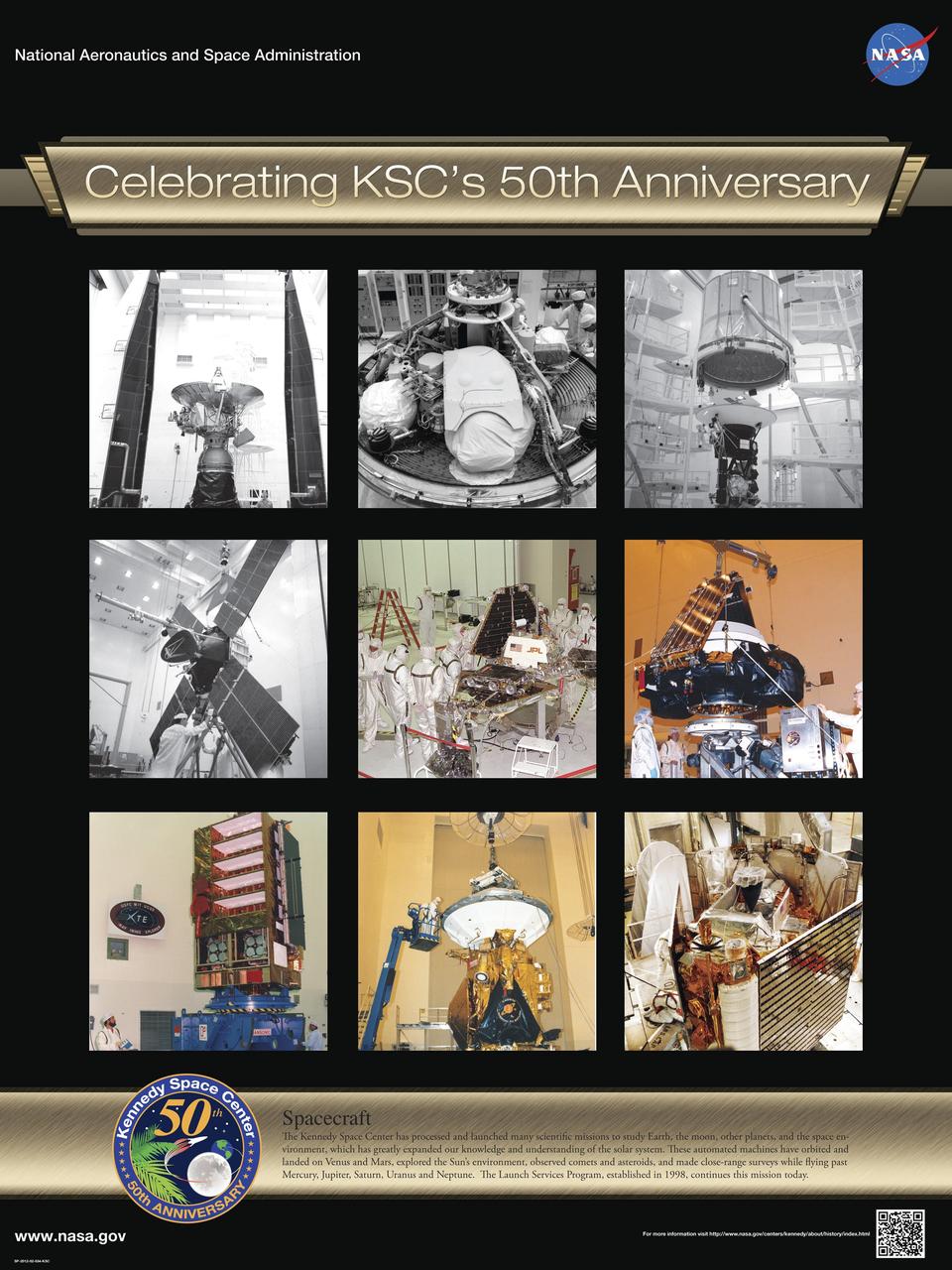
Spacecraft: The Kennedy Space Center has processed and launched many scientific missions to study Earth, the moon, other planets, and the space environment, which has greatly expanded our knowledge and understanding of the solar system. These automated machines have orbited and landed on Venus and Mars, explored the Sun’s environment, observed comets and asteroids, and made close-range surveys while flying past Mercury, Jupiter, Saturn, Uranus and Neptune. The Launch Services Program, established in 1998, continues this mission today. Poster designed by Kennedy Space Center Graphics Department/Greg Lee. Credit: NASA
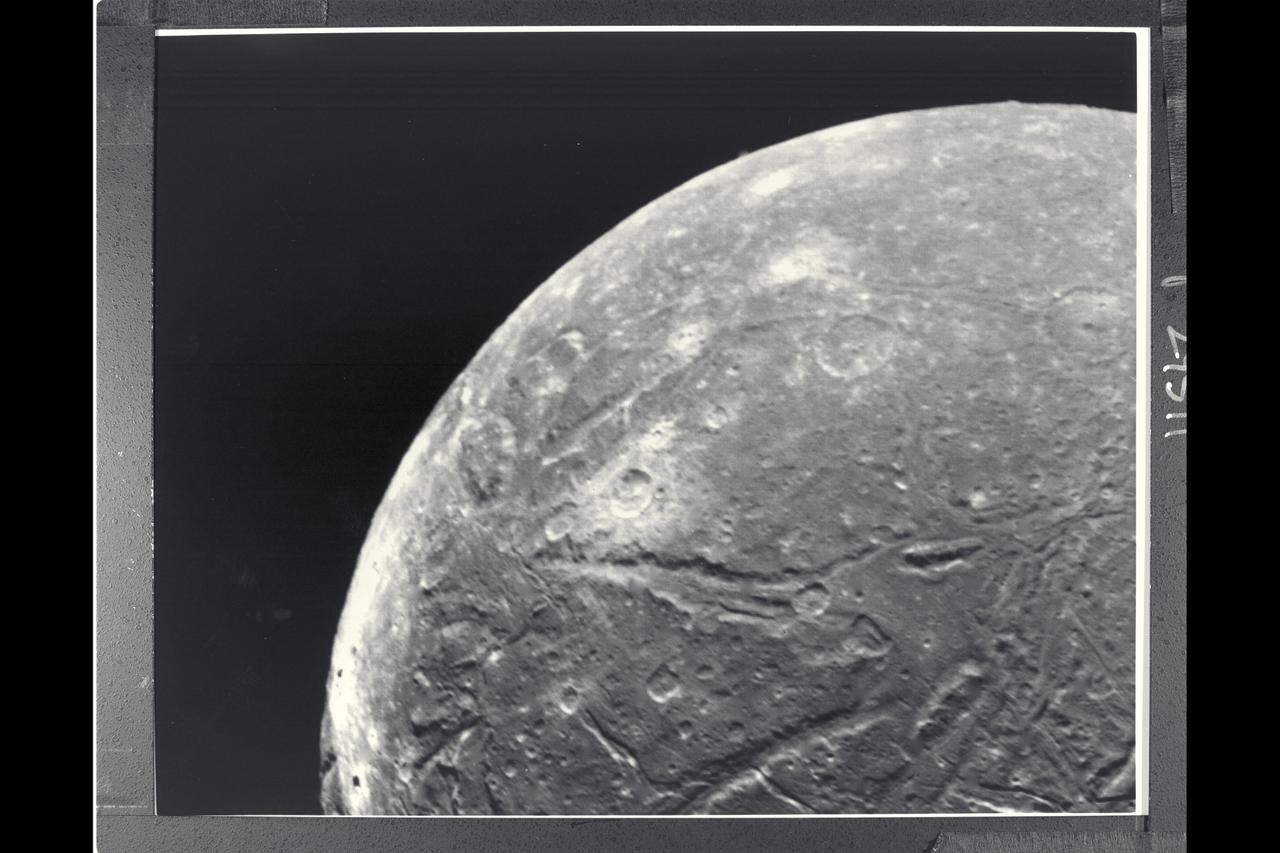
P-29511 BW Range: 130,000 kilometers (80,000 miles) This clear-filter, narrow-angle picture is part of the high-resolution Voyager 2 imaging sequence of Ariel, a moon of Uranus about 1,300 kilometers (800 miles) in diameter. The complexity of Ariels' surface indicates that a variety of geologic processes have occured. The numerous craters, for example, are indications of an old surface bombarded by meteroids over a long periond. Also conspicuous at this resolution, about 2.4 km (1.5 mi), are linear grooves (evidence of tectonic activity that has broken up the surface) and smooth patches (indicative of deposition of material).
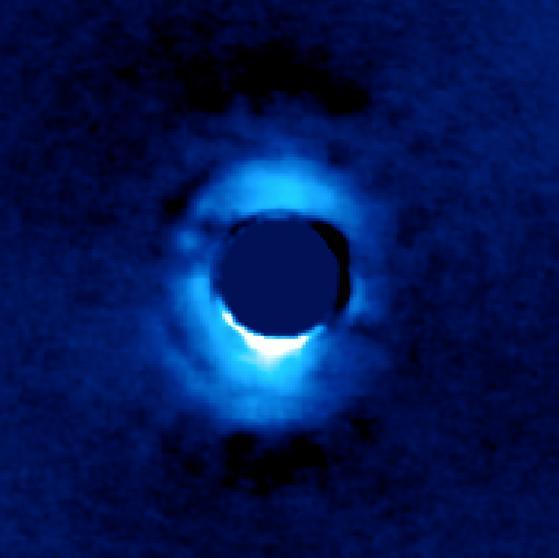
This image shows the dusty disk of planetary material surrounding the young star HD 141569, located 380 light-years away from Earth. It was taken using the vortex coronagraph on the W.M. Keck Observatory. The vortex suppressed light from the star in the center, revealing light from the innermost ring of planetary material around the star (blue). The disk around the star, made of olivine particles, extends from 23 to 70 astronomical units from the star. By comparison, Uranus is over 19 astronomical units from our sun, and Neptune about 30 astronomical units. One astronomical unit is the distance between Earth and our sun. http://photojournal.jpl.nasa.gov/catalog/PIA21090
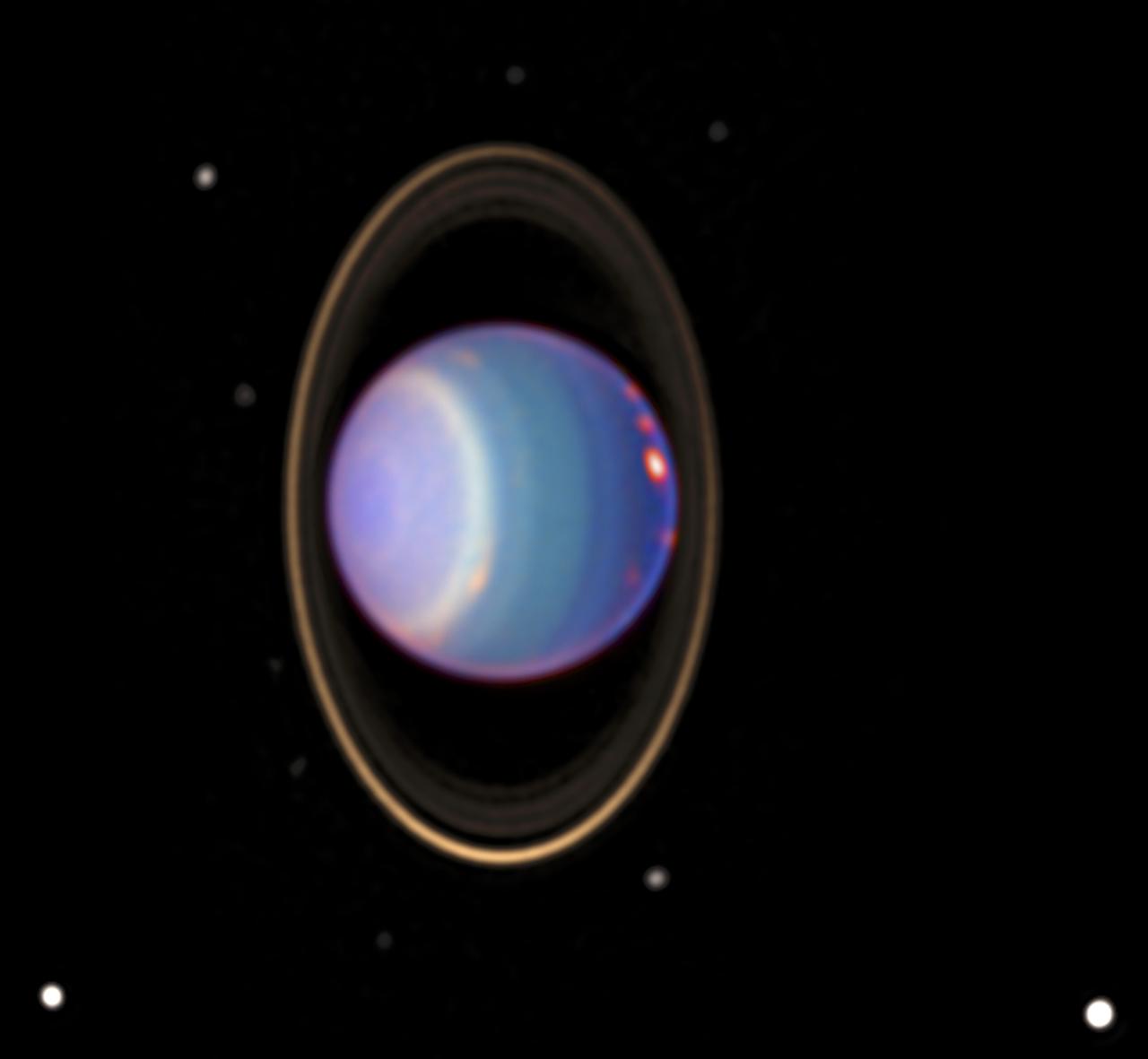
A recent Hubble Space Telescope (HST) view reveals Uranus surrounded by its 4 major rings and 10 of its 17 known satellites. This false color image was generated by Erich Karoschka using data taken with Hubble's Near Infrared Camera and Multi-Object Spectrometer. The HST recently found about 20 clouds. The colors in the image indicate altitude. The green and blue regions show where the atmosphere is clear and can be penetrated by sunlight. In yellow and grey regions, the sunlight reflects from a higher haze or cloud layer. The orange and red colors indicate very high clouds, such as cirrus clouds on Earth.
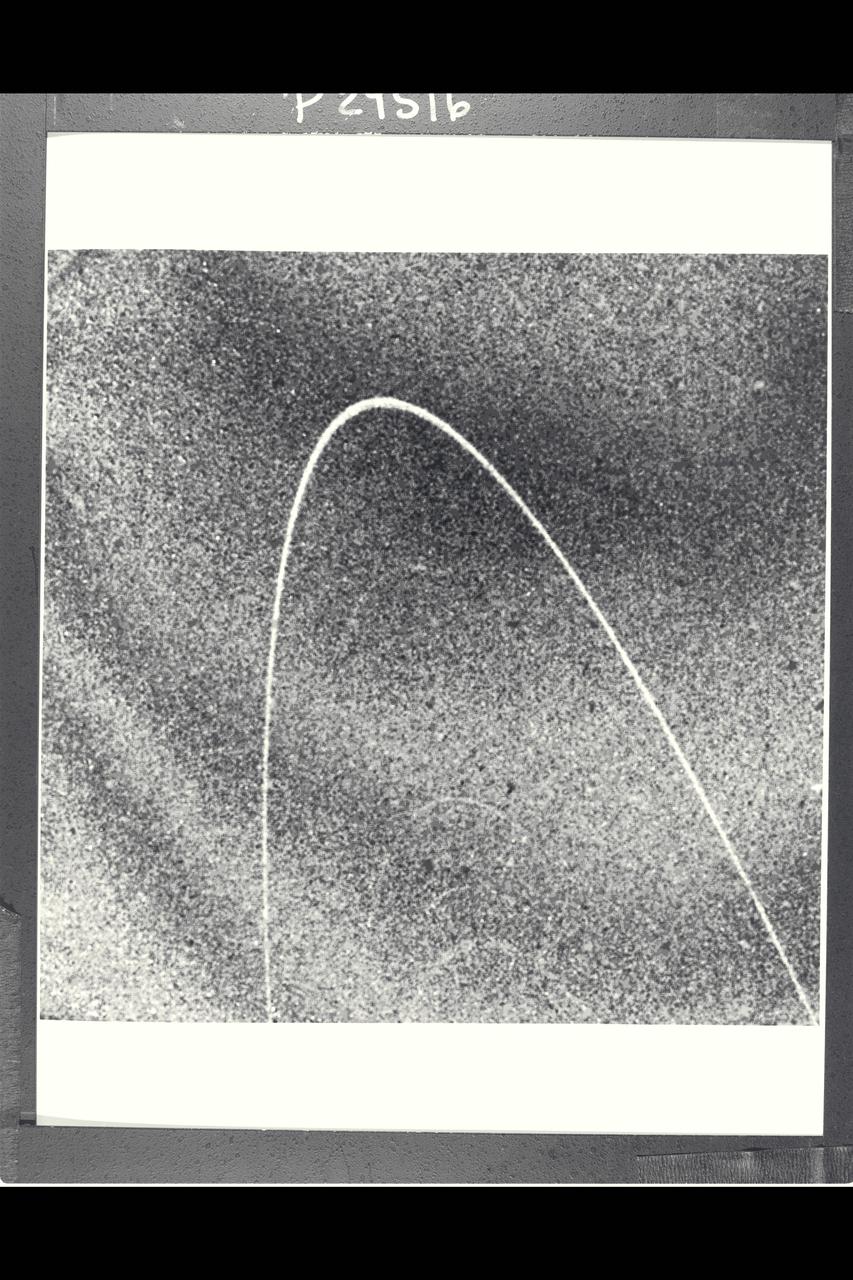
P-29516 BW Range: 125, 000 kilometers (78,000 miles) Voyager 2's wide-angle camera captured this view of the outer part of the Uranian ring system just 11 minutes before passing though the ring plane. The resolution in this clear-filter view is slightly better than 9 km (6 mi). The brightest, outermost ring is known as epsilon. Interior to epsilon lie (from top) the newly discovered 10th ring of Uranus--designated 1986UR1 and barely visible here--and then the delta, gamma and eta rings.
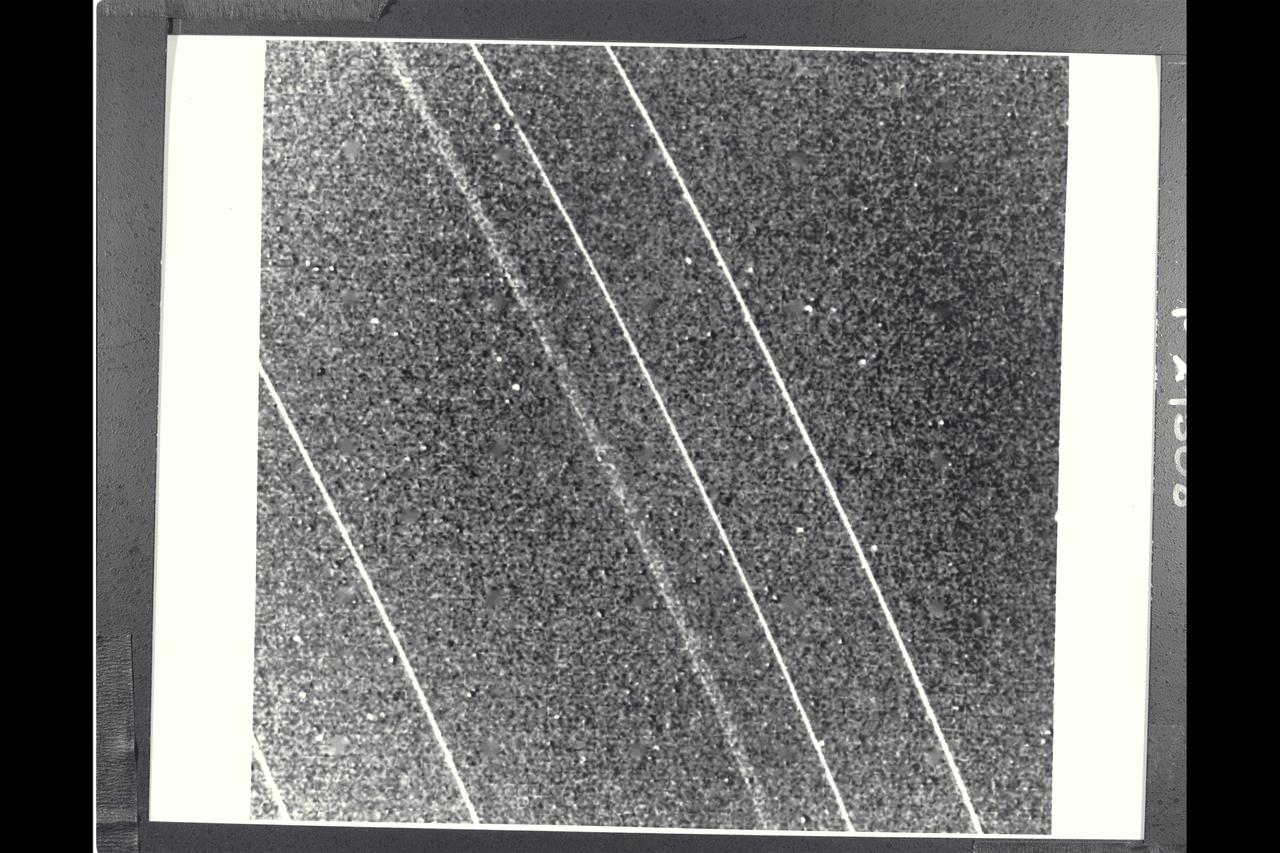
P-29508BW Range: 1.12 million kilometers (690,000 miles) This clear-filter view of the Uranian rings delta, gamma, eta, beta and alpha (from top) was taken with Voyager 2's narrow-angle camera and clearly illustrates the broad outer component and narrow inner component of the eta ring, which orbits Uranus at a radius of some 47,000 km (29,000 mi). The broad component is considerably more transparent than the dense, narrow inner eta component, as well as the other narrow rings shown. Resolution here is about 10 km (6 mi).
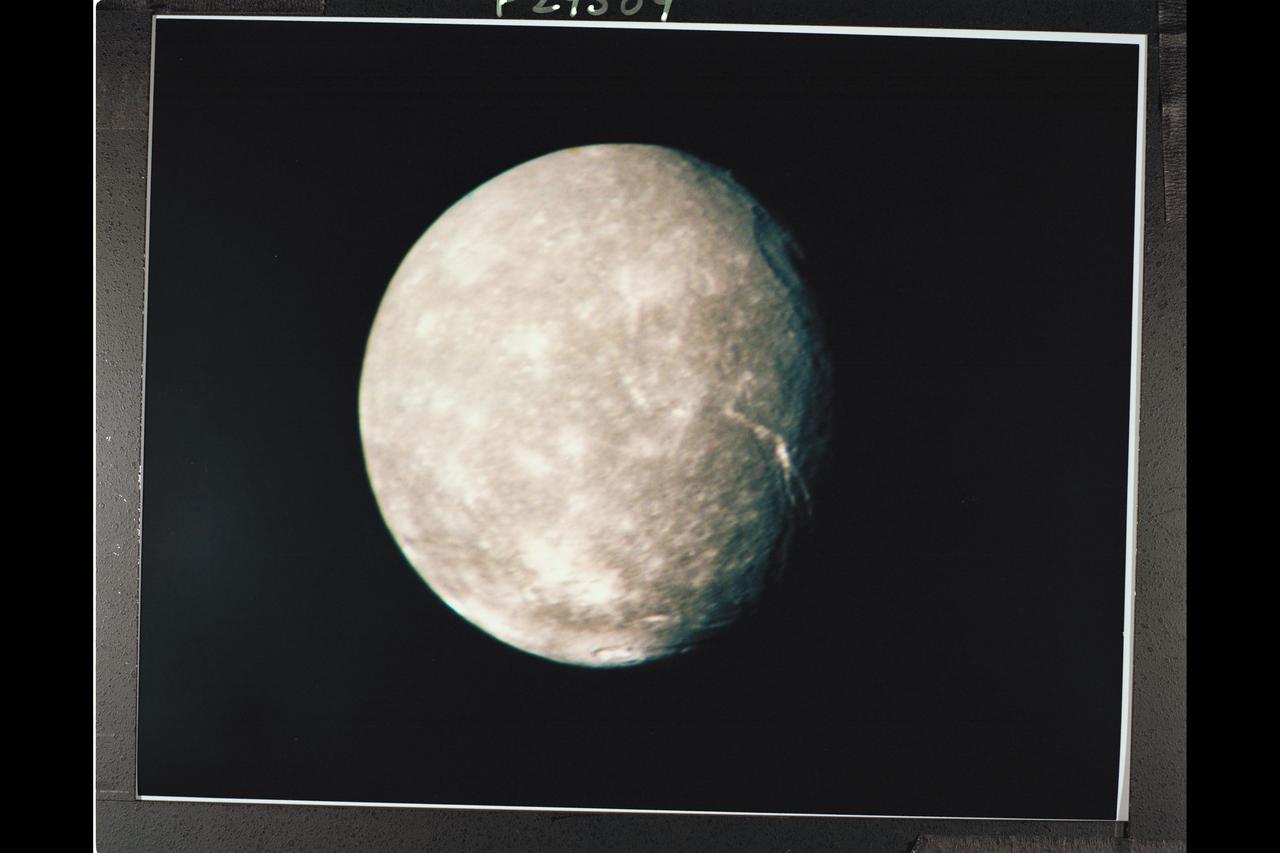
P-29509 C Range: 500,000 kilometers (300,000 miles) This high-resolution color composite of Titania was made as Voyager 2 neared its closest approach to Uranus. Voyager's narrow-angle camera acquired this image through the violet and clear filters and shows details about 9 km (6 mi) in size. Titania has a diameter of about 1,600 km (1,000 MI). In addition to many scars due to impacts, Titania displays evidence of other geologic activity at some point in its history. The large trench-like feature near the terminator (day-night boundary) at middle right suggests at least one episode of tectonic activity, Another, basinlike structure near the upper right is evidence of an ancient period of heavy impact activity. The neutral gray color of Titania is characteristic of the Uranian satellites as a whole.
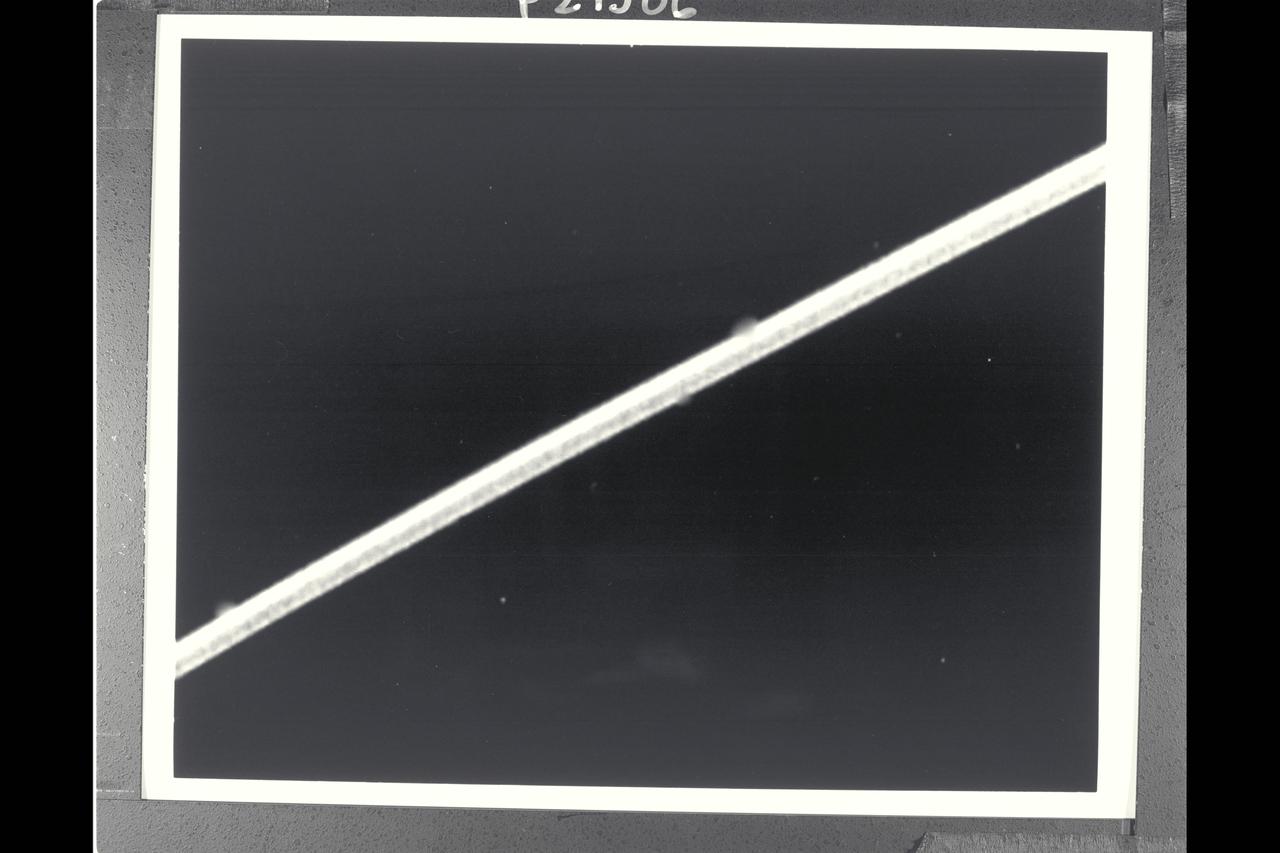
P-29506BW Range: 1.12 million kilometers (690,000 miles) This high-resolution image of the epsilon ring of Uranus is a clear-filter picture from Voyager's narrow-angle camera and has a resolution of about 10 km (6 mi). The epsilon ring, approx. 100 km (60 mi) wide at this location, clearly shows a structural variation. Visible here are a broad, bright outer component about 40 km (25 mi) wide; a darker, middle region of comparable width; and a narrow, bright inner strip about 15 km (9 mi) wide. The epsilon-ring structure seen by Voyager is similiar to that observed from the ground with stellar-occultation techniques. This frame represents the first Voyager image that resolves these features within the epsilon ring. The occasional fuzzy splotches on the outer and innerparts of the ring are artifacts left by the removal of reseau marks (used for making measurements on the image).
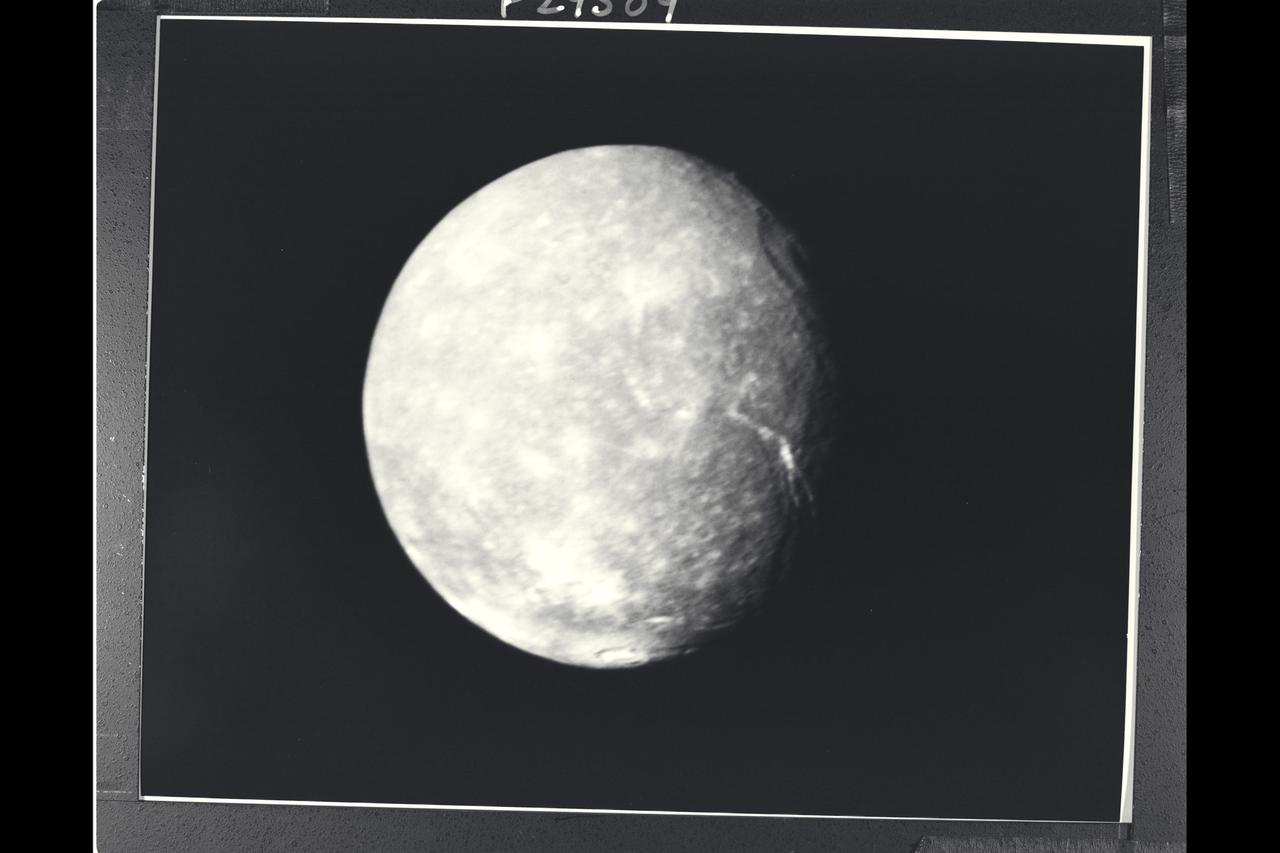
P-29509 BW Range: 500,000 kilometers (300,000 miles) This high-resolution image of Titania was made as Voyager 2 neared its closest approach to Uranus. Voyager's narrow-angle camera acquired this image through the violet and clear filters and shows details about 9 km (6 mi) in size. Titania has a diameter of about 1,600 km (1,000 MI). In addition to many scars due to impacts, Titania displays evidence of other geologic activity at some point in its history. The large trench-like feature near the terminator (day-night boundary) at middle right suggests at least one episode of tectonic activity, Another, basinlike structure near the upper right is evidence of an ancient period of heavy impact activity. The neutral gray color of Titania is characteristic of the Uranian satellites as a whole.
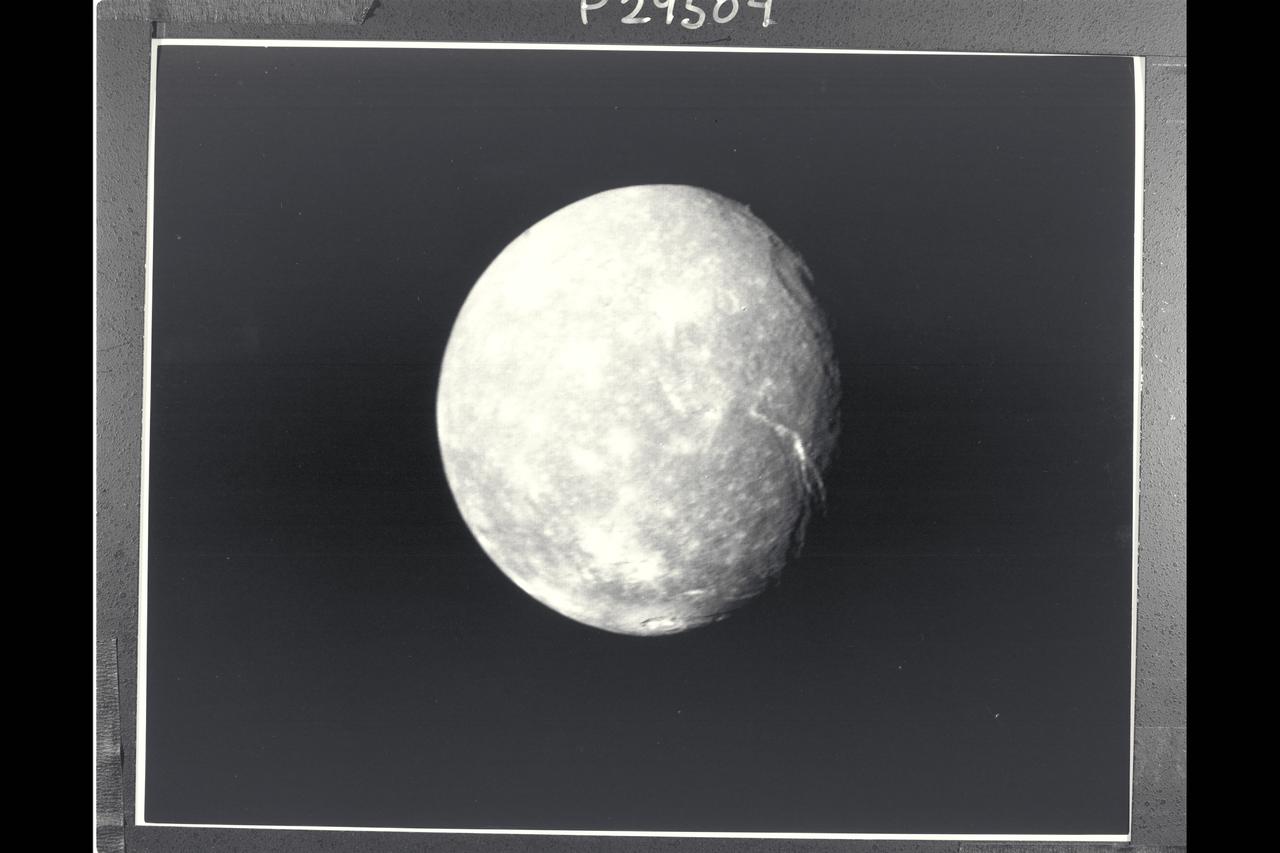
P-29504BW Range: 500,000 kilometers (300,000 miles) This full-disk view of Uranus' moon Titania in the early morning hours, a clear-filter image returned by the Voyager narrow-angle camera, shows many circular depressions-probably impact craters. Other bright spots are distinguished by radiating rays and are probably halo craters that mark relatively more recent impacts. Even more interesting are the linear troughs (right) that are probably fault canyons. The troughs break the crust in two directions, an indication of some tectonic extension of Titania's crust. These features indicate that this icy satellite has a dynamic, active interior. Titania is about 1,600 km (1,000 mi) in diameter; the resolution of this image is about 9 km (6 mi).
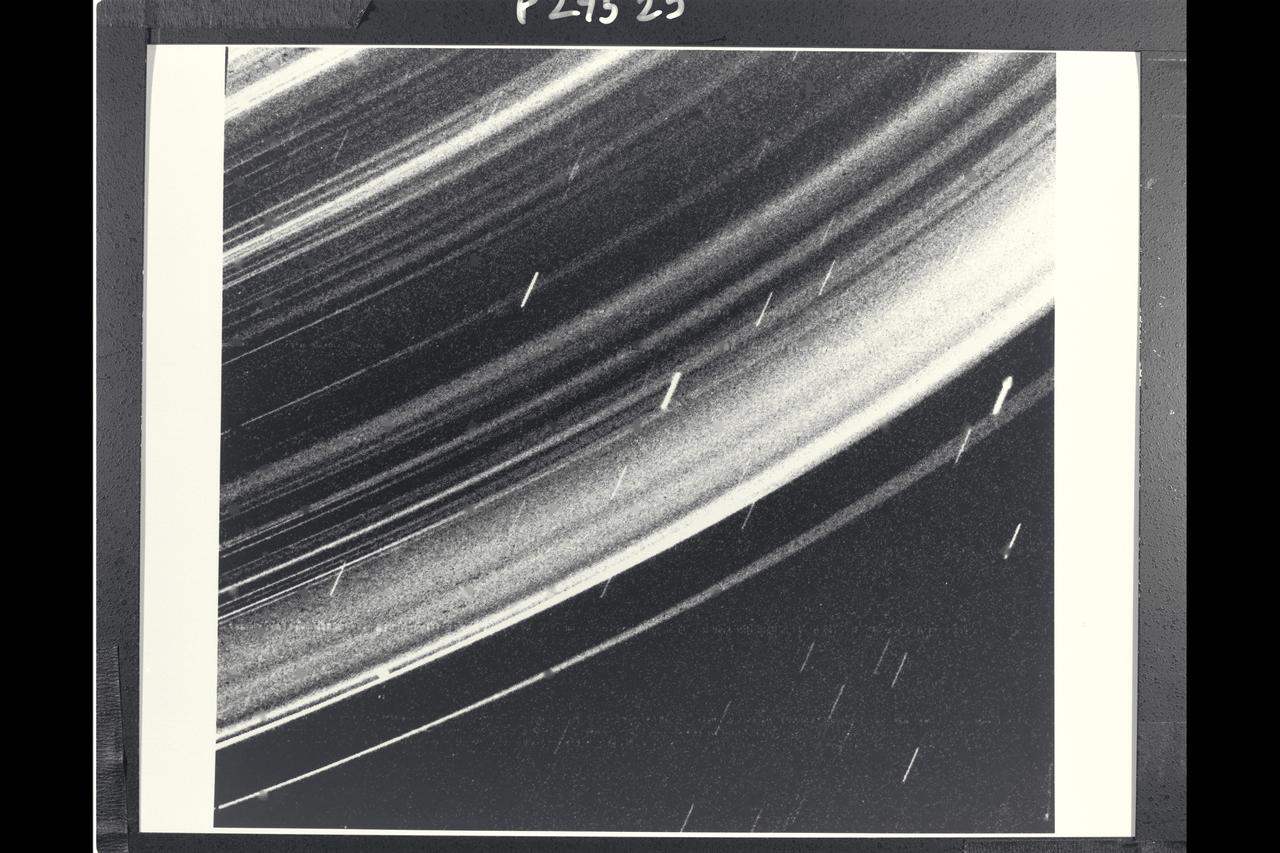
Range : 236,000 km. ( 147,000 mi. ) Resolution : 33 km. ( 20 mi. ) P-29525B/W This Voyager 2 image reveals a contiuos distribution of small particles throughout the Uranus ring system. This unigue geometry, the highest phase angle at which Voyager imaged the rings, allows us to see lanes of fine dust particles not visible from other viewing angles. All the previously known rings are visible. However, some of the brightest features in the image are bright dust lanes not previously seen. the combination of this unique geometry and a long, 96 second exposure allowed this spectacular observation, acquired through the clear filter if Voyager 2's wide angle camera. the long exposure produced a noticable, non-uniform smear, as well as streaks due to trailed stars.
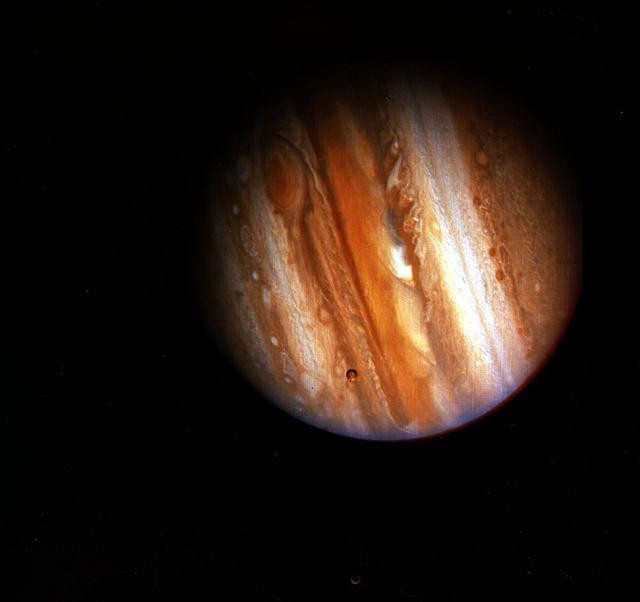
On February 5, 1979, Voyager 1 made its closest approach to Jupiter since early 1974 and 1975 when Pioneers 10 and 11 made their voyages to Jupiter and beyond. Voyager 1 completed its Jupiter encounter in early April, after taking almost 19,000 pictures and recording many other scientific measurements. Although astronomers had studied Jupiter from Earth for several centuries, scientists were surprised by many of Voyager 1 and 2's findings. They now understand that important physical, geological, and atmospheric processes go on that they had never observed from Earth. Discovery of active volcanism on the satellite Io was probably the greatest surprise. It was the first time active volcanoes had been seen on another body in the solar system. Voyager also discovered a ring around Jupiter. Thus Jupiter joins Saturn, Uranus, and Neptune as a ringed planet -- although each ring system is unique and distinct from the others.
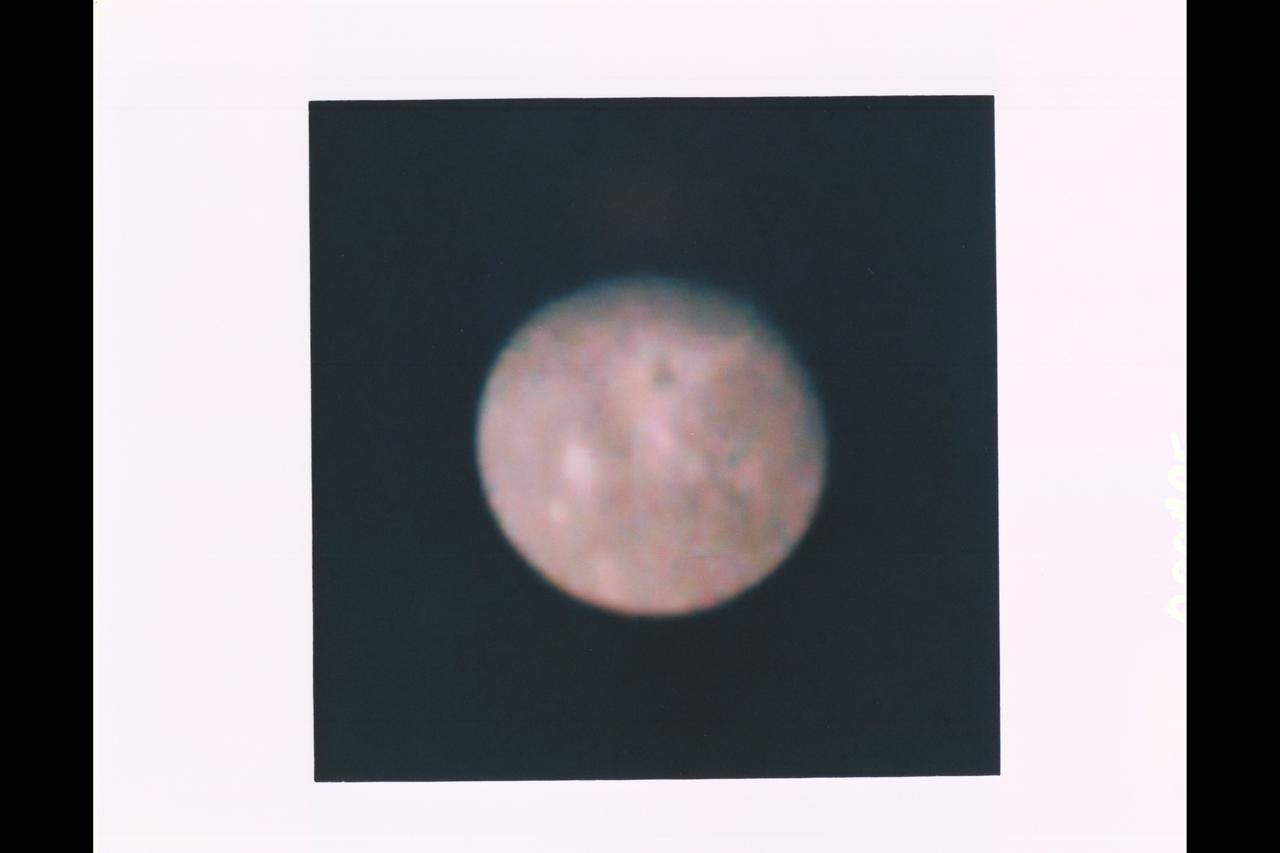
Range : 2.77 million miles (1.72 million miles) resolution : 51 km. (32 mi.) P-29495C This Voyager 2 photograph of the outermost Uranian satellite, Oberon is a computer reconstruction of three frames , exposed through the narrow angle camera's blue, green, and orange filters. the grayness or apparent lack of strong color is a distinctive characteristic of the satellites and the rings of Uranus and can serve as one indicator of the possible composition of the satellites' surfaces. Oberon has a diameter of about 1,600 km. (1,000 mi.) and orbits the planet at a radial distance of 586,000 km. (364,000 mi.). Oberon's surface displays areas of lighter and darker material, probably associated in part with impact craters formed during its long exposure to bombardment by cosmic debris. Thr resolution of this particular image is not sufficient, however, to reveal with confidece the nature of these features.

The cameras of Voyager 1 on Feb. 14, 1990, pointed back toward the sun and took a series of pictures of the sun and the planets, making the first ever portrait of our solar system as seen from the outside. In the course of taking this mosaic consisting of a total of 60 frames, Voyager 1 made several images of the inner solar system from a distance of approximately 4 billion miles and about 32 degrees above the ecliptic plane. Thirty-nine wide angle frames link together six of the planets of our solar system in this mosaic. Outermost Neptune is 30 times further from the sun than Earth. Our sun is seen as the bright object in the center of the circle of frames. The wide-angle image of the sun was taken with the camera's darkest filter (a methane absorption band) and the shortest possible exposure (5 thousandths of a second) to avoid saturating the camera's vidicon tube with scattered sunlight. The sun is not large as seen from Voyager, only about one-fortieth of the diameter as seen from Earth, but is still almost 8 million times brighter than the brightest star in Earth's sky, Sirius. The result of this great brightness is an image with multiple reflections from the optics in the camera. Wide-angle images surrounding the sun also show many artifacts attributable to scattered light in the optics. These were taken through the clear filter with one second exposures. The insets show the planets magnified many times. Narrow-angle images of Earth, Venus, Jupiter, Saturn, Uranus and Neptune were acquired as the spacecraft built the wide-angle mosaic. Jupiter is larger than a narrow-angle pixel and is clearly resolved, as is Saturn with its rings. Uranus and Neptune appear larger than they really are because of image smear due to spacecraft motion during the long (15 second) exposures. From Voyager's great distance Earth and Venus are mere points of light, less than the size of a picture element even in the narrow-angle camera. Earth was a crescent only 0.12 pixel in size. Coincidentally, Earth lies right in the center of one of the scattered light rays resulting from taking the image so close to the sun. http://photojournal.jpl.nasa.gov/catalog/PIA00451
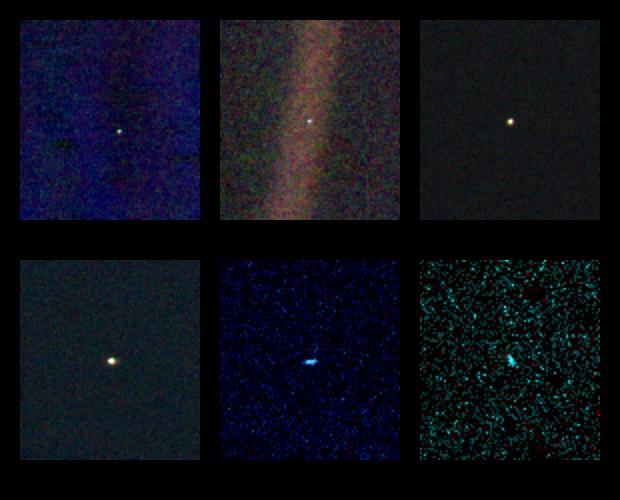
These six narrow-angle color images were made from the first ever portrait of the solar system taken by NASA’s Voyager 1, which was more than 4 billion miles from Earth and about 32 degrees above the ecliptic. The spacecraft acquired a total of 60 frames for a mosaic of the solar system which shows six of the planets. Mercury is too close to the sun to be seen. Mars was not detectable by the Voyager cameras due to scattered sunlight in the optics, and Pluto was not included in the mosaic because of its small size and distance from the sun. These blown-up images, left to right and top to bottom are Venus, Earth, Jupiter, and Saturn, Uranus, Neptune. The background features in the images are artifacts resulting from the magnification. The images were taken through three color filters -- violet, blue and green -- and recombined to produce the color images. Jupiter and Saturn were resolved by the camera but Uranus and Neptune appear larger than they really are because of image smear due to spacecraft motion during the long (15 second) exposure times. Earth appears to be in a band of light because it coincidentally lies right in the center of the scattered light rays resulting from taking the image so close to the sun. Earth was a crescent only 0.12 pixels in size. Venus was 0.11 pixel in diameter. The planetary images were taken with the narrow-angle camera (1500 mm focal length). http://photojournal.jpl.nasa.gov/catalog/PIA00453
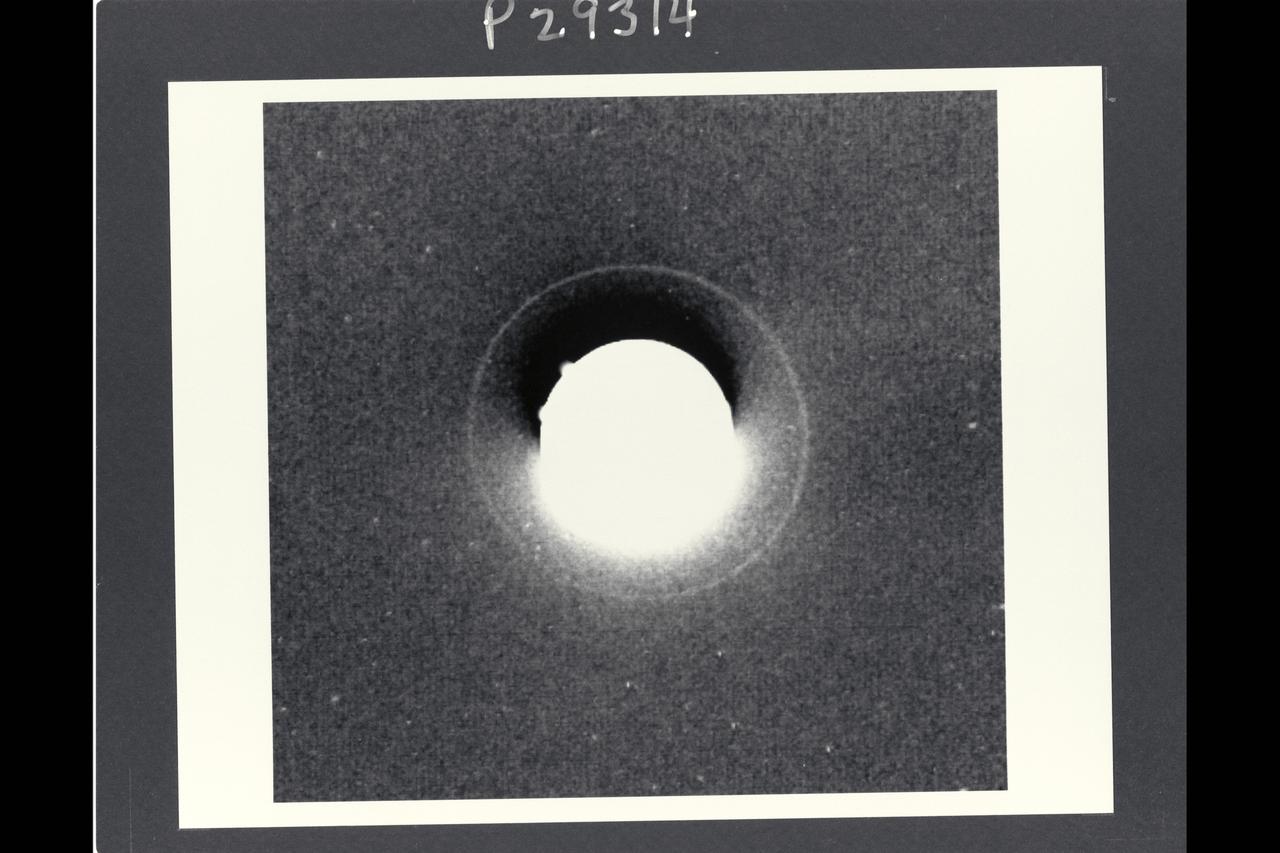
Range: 72.3 million km. ( 44.9 million miles ) P-29314B/W This Voyager 2 photograph of Uranus shows the planets outermost, or epsilon, ring. This is a computerized summation of six images shot by the narrow angle camera. It is the first photo to show the epsilon ring unblurred by Earth's atmosphere. The Epsilon ring, some 51,200 km. ( 31,800 miles ) from the planets center, is the most prominent of Uranus' nine known rings. Ground based observations of stellar occulations by the rings have determined that the Epsilon ring is eccentric, or elliptical, with its widest portion about 100 km. ( 60 miles ) wide and its narrowest portion about 20 km. (12 miles ). Estimates of the rings brightness suggest that it is also very dark, with a reflectance of only 1 or 2 percent and a probable composition of carbonaceous material similiar to that on dark asteroids and the dark side of Saturn's moon Lapetus. Because the ring is so narrow and dark, at this range, the Voyager camera could not resolve even the widest part, resulting in long exposure times so obtain a good image. six exposures of 11 or 15 second duration were added together by computer to produce this image. In this image, the central portion is greatly overexposed. Various artifacts due to electronic effects and image proccessing can be seen in the central portion of the frame, including the dark image just above the planets image, the diffuse brightening below it and the small, bright projection from the edge of the planet in the upper left. The ring is distinctly less prominent in the lower left portion and more prominent in the upper right. This is in agreement with the predicted locations of the narrow and wide portions of the ring, respectively.
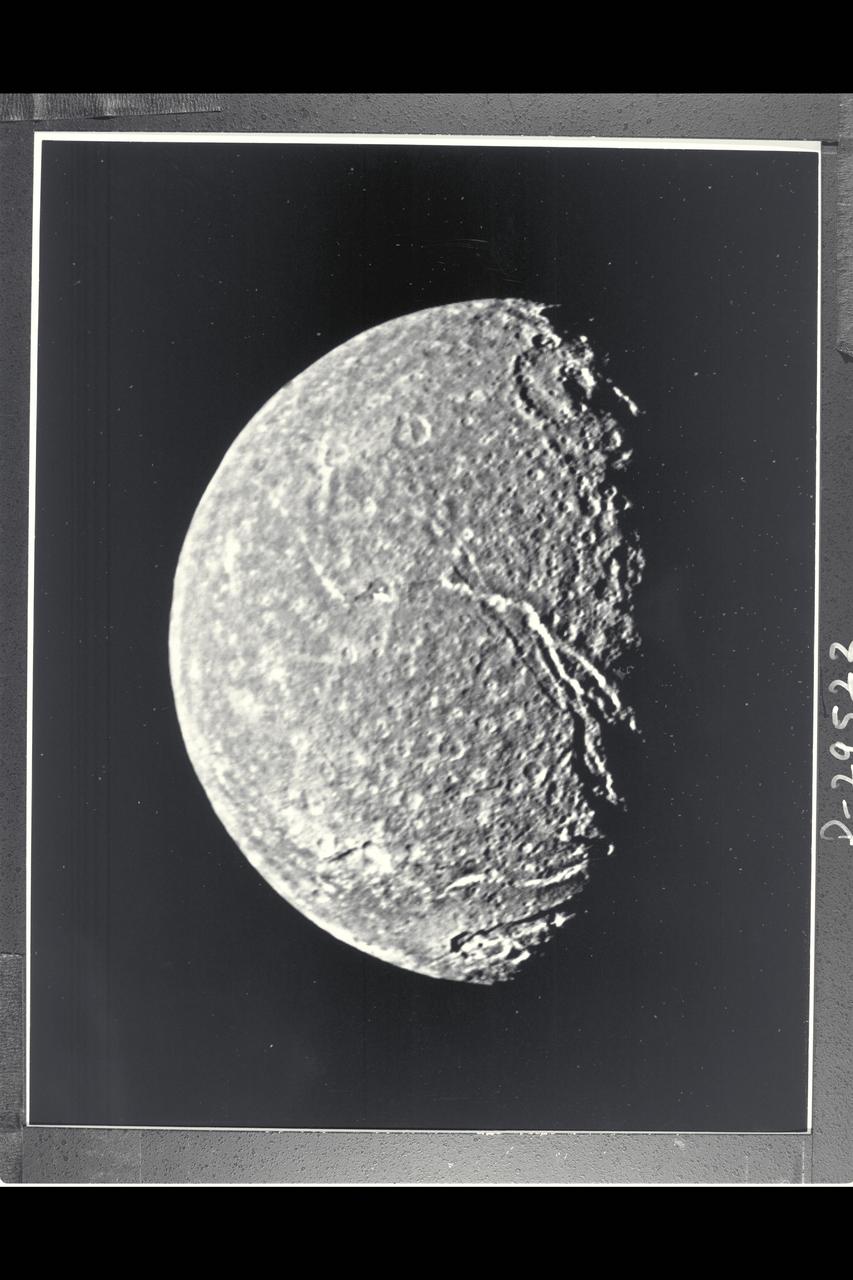
P-29522BW Range: 369,000 kilometers (229,000 miles) This is the highest-resolution picture of Titania returned by Voyager 2. The picture is a composite of two images taken through the clear-filter of Voyager's narrow-angle camera. The resolution of this image is 13 km (8 mi). Titania is the largest satellite of Uranus, with a diameter of little more than 1,600 km (1,000 mi). Abundant impact craters of many sizes pockmark the ancient surface. The most prominant features are fault valleys that stretch across Titania. They are up to 1,500 km (nearly 1,000 mi) long and as much as 75 km (45 mi) wide. In valleys seen at right center, the sunward-facing walls are very bright. While this is due partly to the lighting angle, the brightness also indicates the presence of a lighter material, possibly young frost deposits. An impact crater more than 200 km (125 mi) in diameter distinguishes the very bottom of the disk; the crater is cut by a younger fault valley more than 100 km (60 mi) wide. An even larger impact crater, perhaps 300 km (180 mi) across, is visible at top.