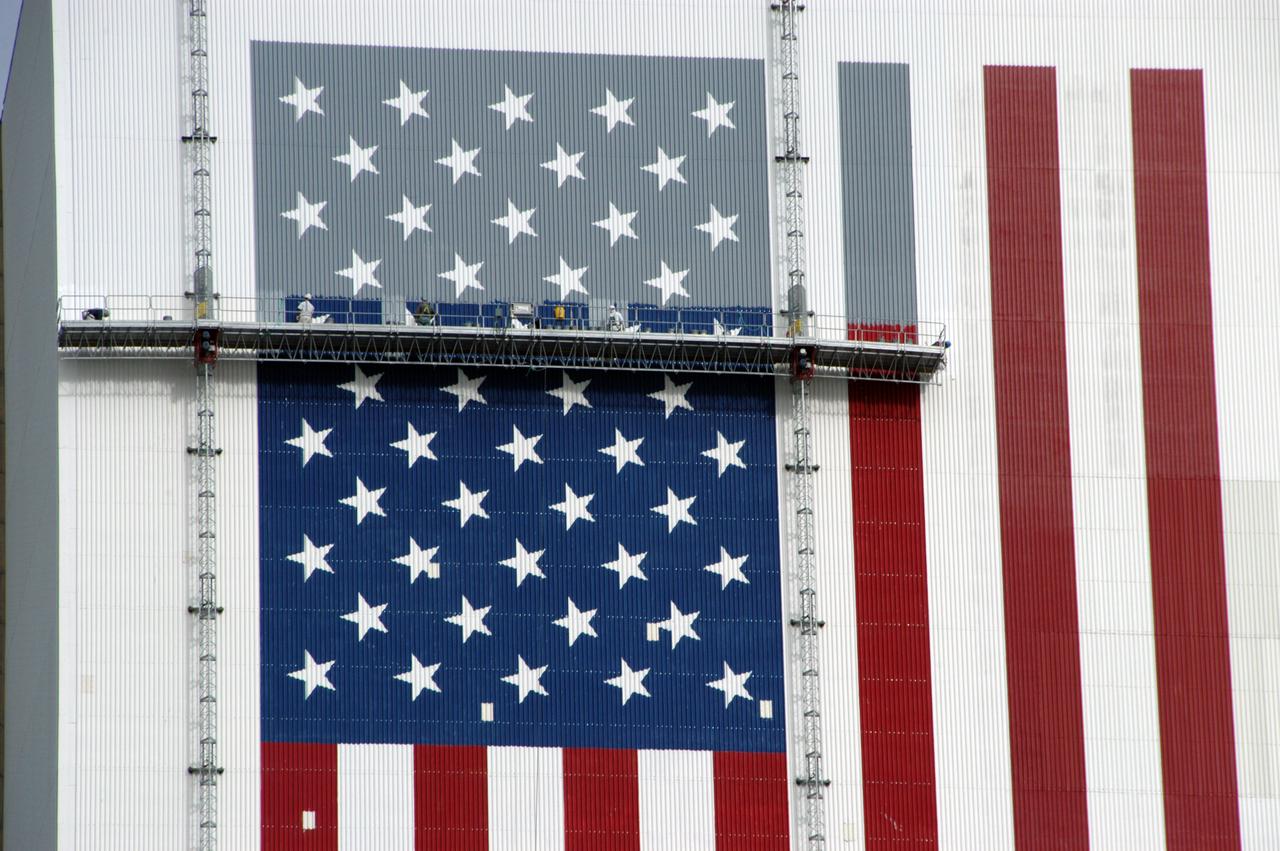
Workers painting the Flag and Meatball on the VAB.
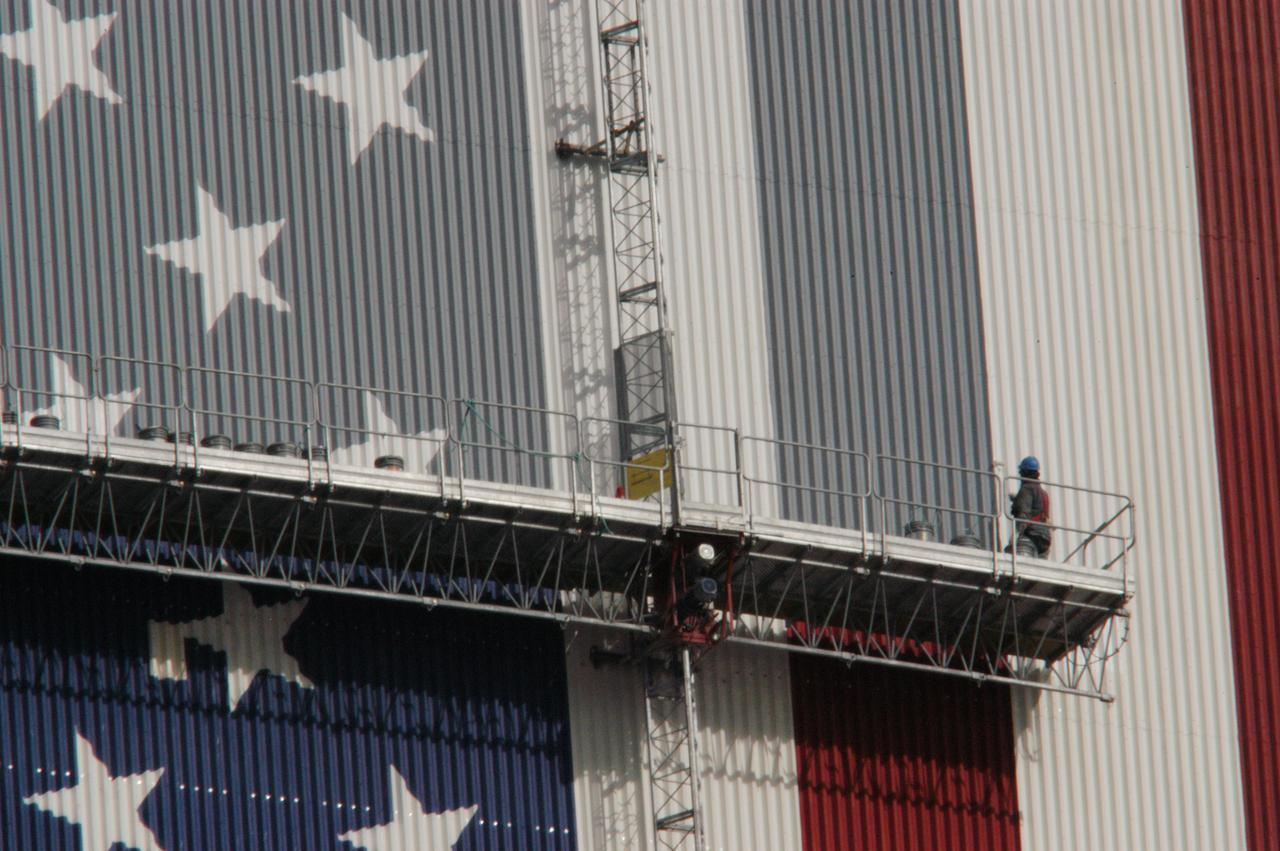
Workers painting the Flag and Meatball on the VAB.
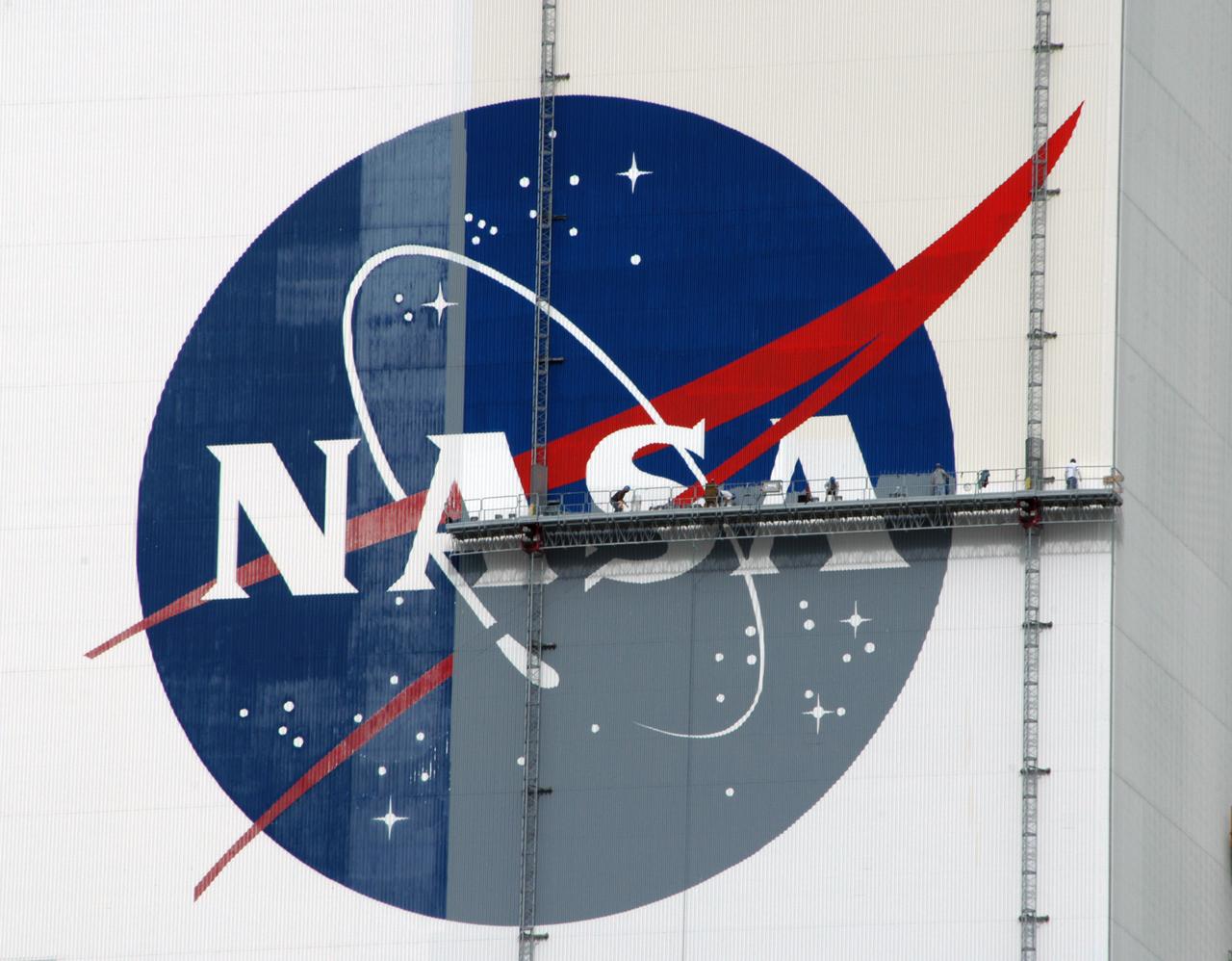
Workers painting the Flag and Meatball on the VAB.
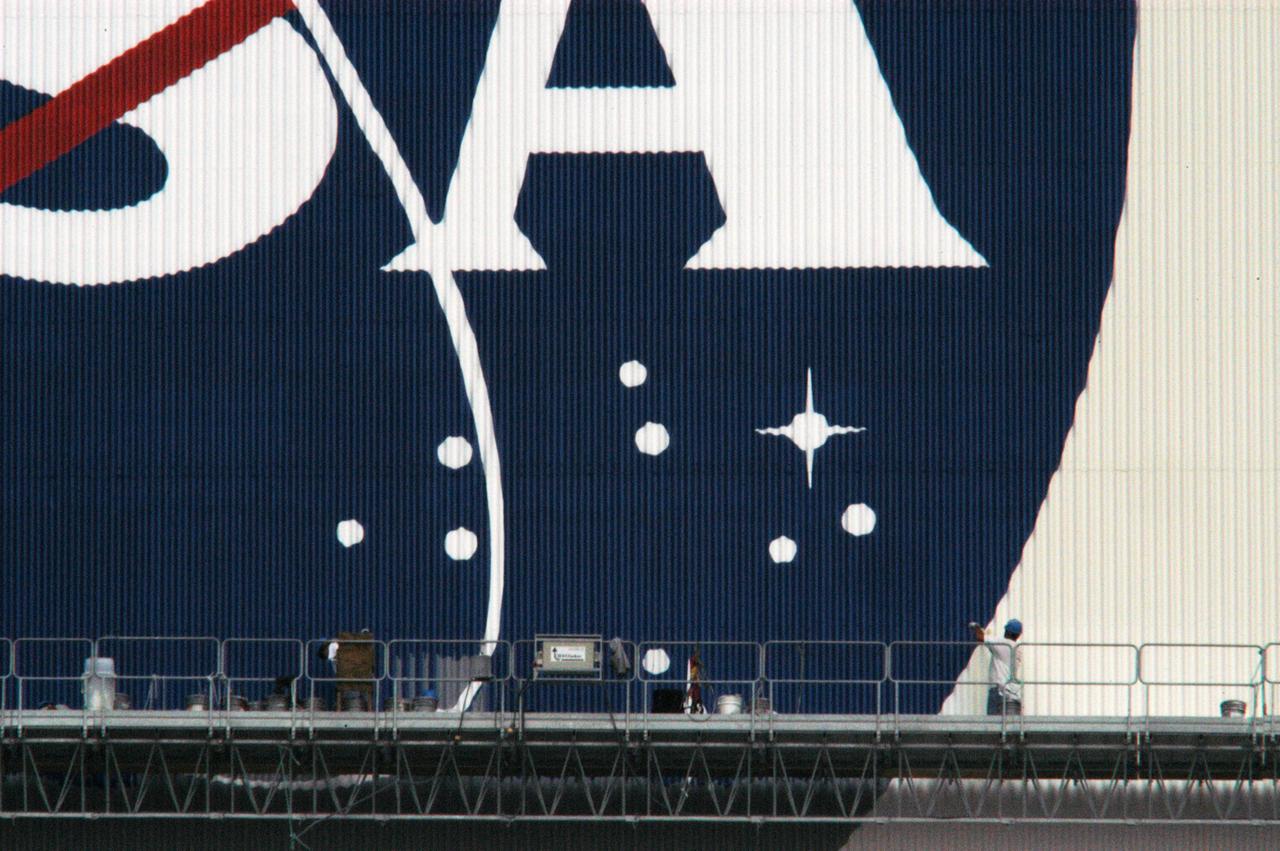
Workers painting the Flag and Meatball on the VAB.

Workers painting the Flag and Meatball on the VAB.

A long exposure photograph of the Vehicle Assembly Building, against the backdrop of a bright blue sky, at NASA's Kennedy Space Center in Florida. Inside the VAB, 10 levels of platforms, 20 platform halves altogether, have been installed in High Bay 3. The platforms will surround NASA's Space Launch System (SLS) rocket and the Orion spacecraft and allow access during processing for missions, including the first uncrewed flight test of Orion atop the SLS rocket in 2018. The Ground Systems Development and Operations Program, along with center's Engineering Directorate, is overseeing upgrades and modifications to the VAB to support the multi-user spaceport.
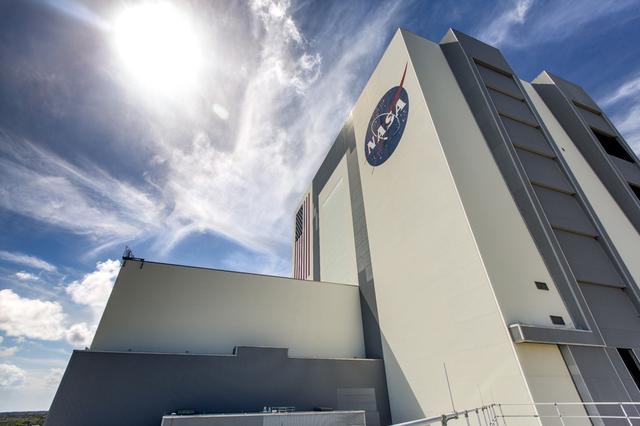
A long exposure photograph of the Vehicle Assembly Building, against the backdrop of a bright blue sky, at NASA's Kennedy Space Center in Florida. Inside the VAB, 10 levels of platforms, 20 platform halves altogether, have been installed in High Bay 3. The platforms will surround NASA's Space Launch System (SLS) rocket and the Orion spacecraft and allow access during processing for missions, including the first uncrewed flight test of Orion atop the SLS rocket in 2018. The Ground Systems Development and Operations Program, along with center's Engineering Directorate, is overseeing upgrades and modifications to the VAB to support the multi-user spaceport.
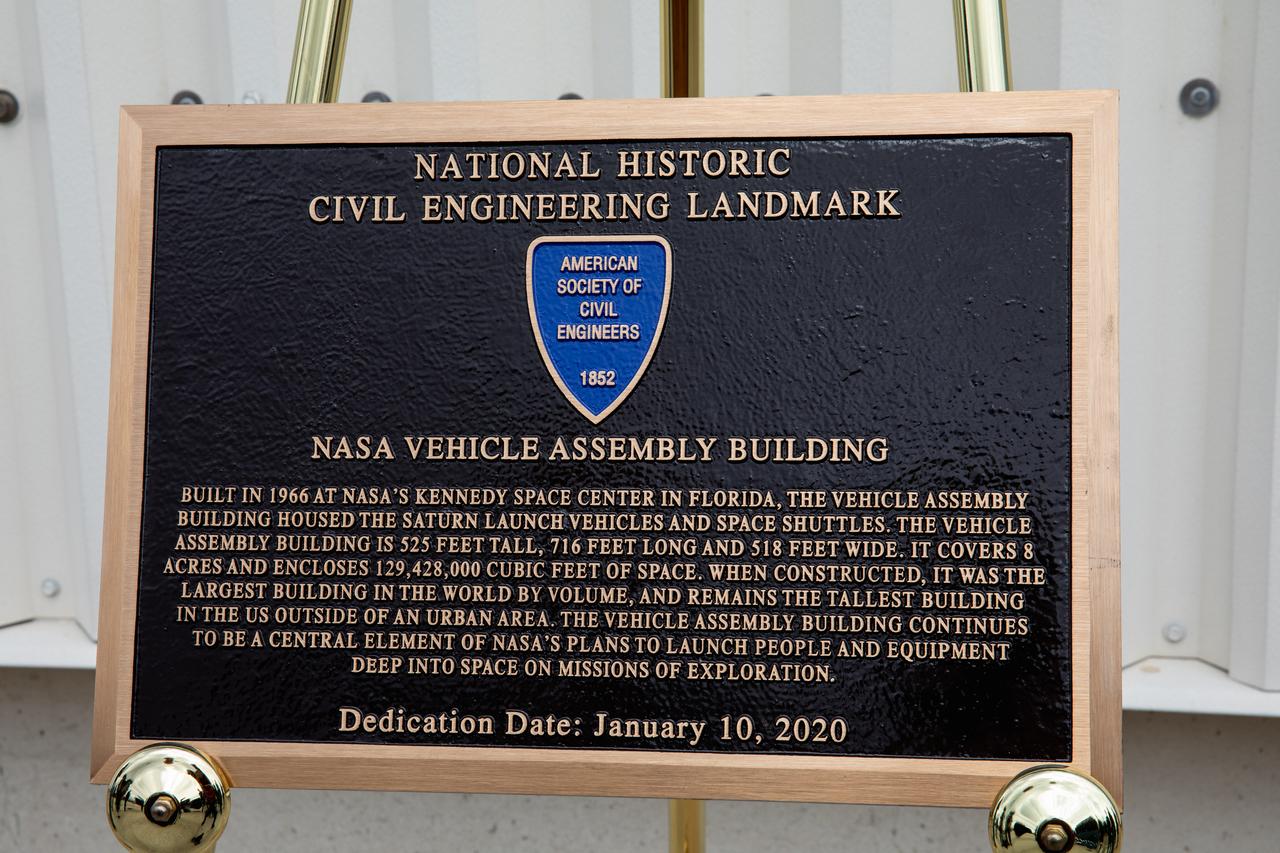
The Florida Section of the American Society of Civil Engineers bestowed the ASCE National Historic Civil Engineering Landmark award to Kennedy Space Center’s iconic Vehicle Assembly Building during a ceremony on Jan. 10, 2020. The VAB is the first building at Kennedy Space Center to earn this distinction. At the time of its completion, the 129-million-cubic-foot structure was the largest building in the world. Originally designed and built to accommodate the Saturn V/Apollo used in Project Apollo, the VAB was later modified for its role in the Space Shuttle Program.

Phil Moyer, original project lead for the Vehicle Assembly Building (VAB), tours the Vehicle Assembly Building on Nov. 22, 2019 at NASA’s Kennedy Space Center in Florida. The VAB was recognized with the National Historic Civil Engineering Landmark award by the Florida Section American Society of Civil Engineers during a ceremony on Jan. 10, 2020. The VAB is the first building at Kennedy Space Center to earn this distinction. At the time of its completion, the 129-million-cubic-foot structure was the largest building in the world. Originally designed and built to accommodate the Saturn V/Apollo used in Project Apollo, the VAB was later modified for its role in the Space Shuttle Program.
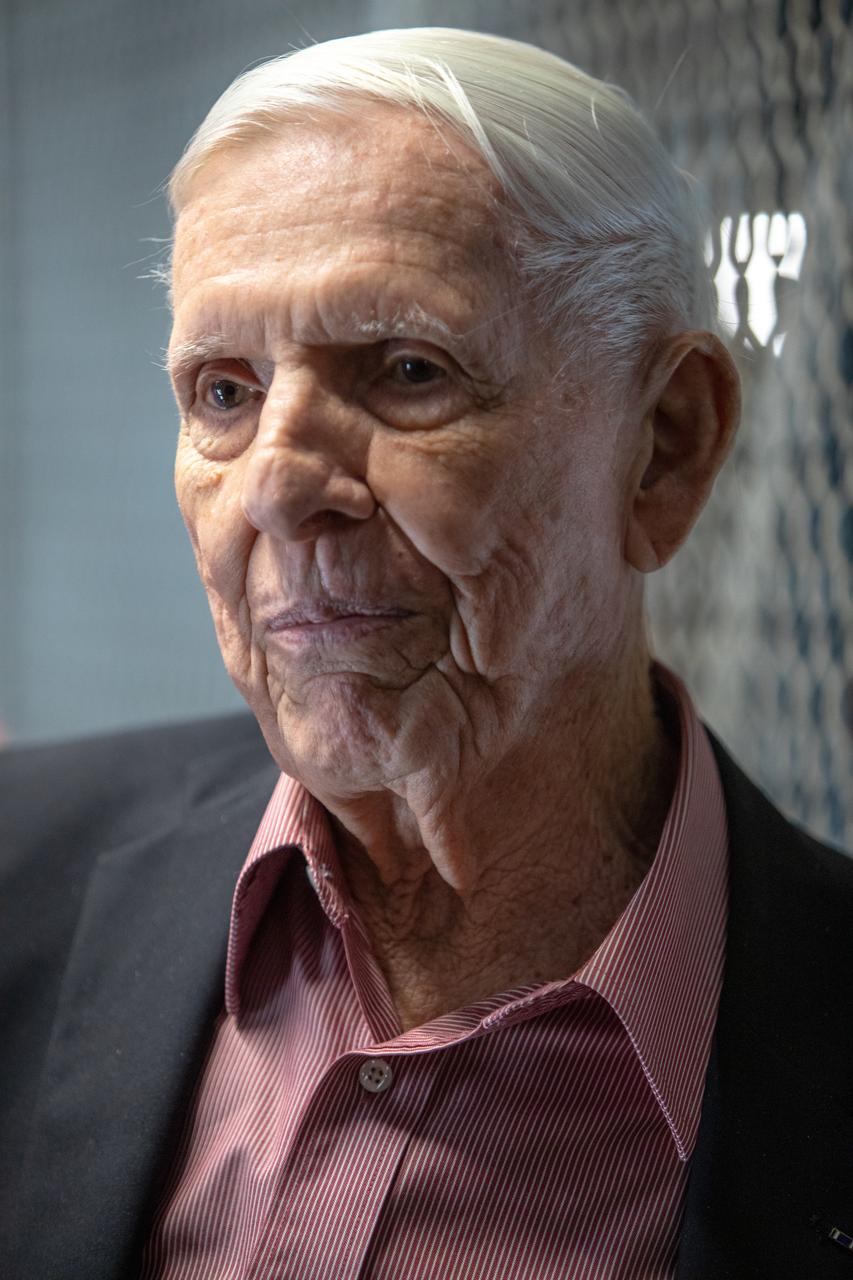
Phil Moyer, original project lead for the Vehicle Assembly Building (VAB), tours the Vehicle Assembly Building on Nov. 22, 2019 at NASA’s Kennedy Space Center in Florida. The VAB was recognized with the National Historic Civil Engineering Landmark award by the Florida Section American Society of Civil Engineers during a ceremony on Jan. 10, 2020. The VAB is the first building at Kennedy Space Center to earn this distinction. At the time of its completion, the 129-million-cubic-foot structure was the largest building in the world. Originally designed and built to accommodate the Saturn V/Apollo used in Project Apollo, the VAB was later modified for its role in the Space Shuttle Program.
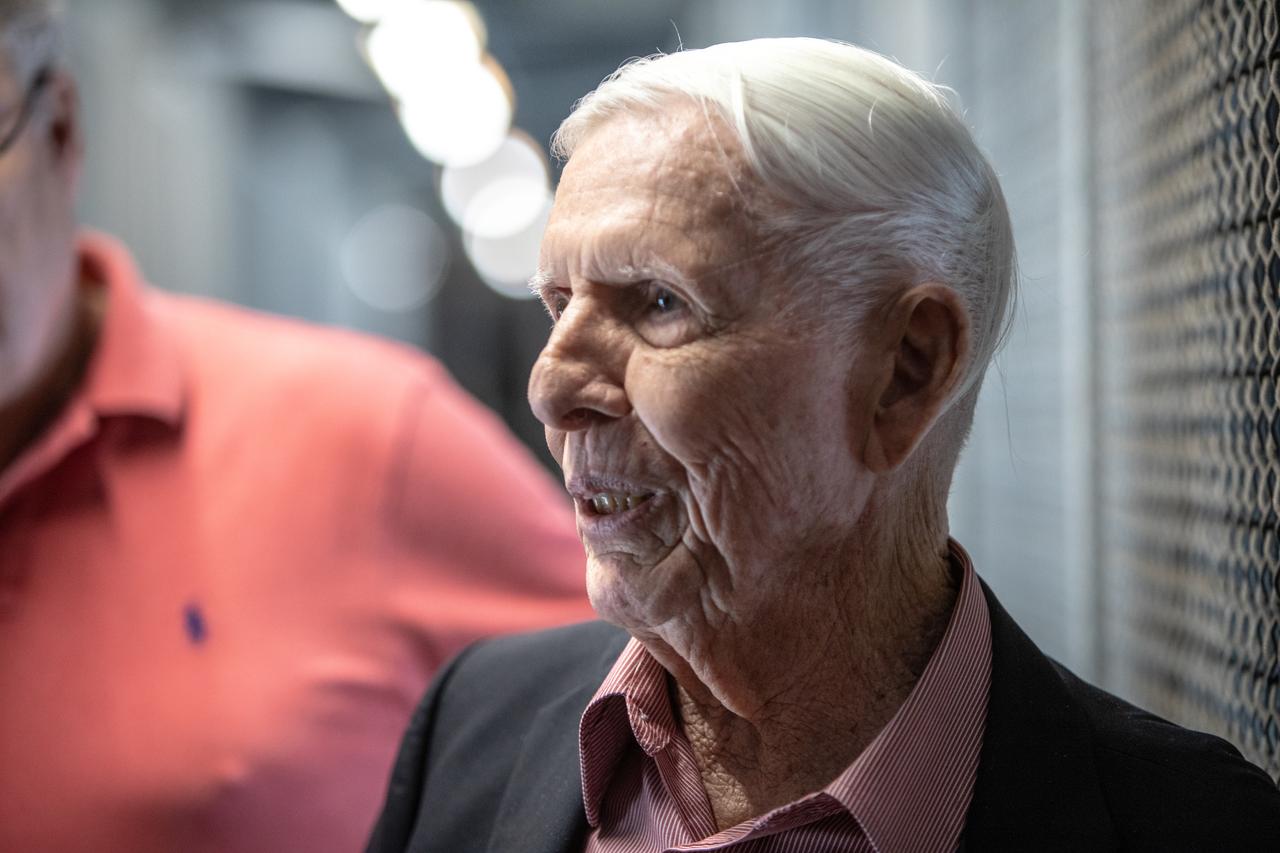
Phil Moyer, original project lead for the Vehicle Assembly Building (VAB), tours the Vehicle Assembly Building on Nov. 22, 2019 at NASA’s Kennedy Space Center in Florida. The VAB was recognized with the National Historic Civil Engineering Landmark award by the Florida Section American Society of Civil Engineers during a ceremony on Jan. 10, 2020. The VAB is the first building at Kennedy Space Center to earn this distinction. At the time of its completion, the 129-million-cubic-foot structure was the largest building in the world. Originally designed and built to accommodate the Saturn V/Apollo used in Project Apollo, the VAB was later modified for its role in the Space Shuttle Program.
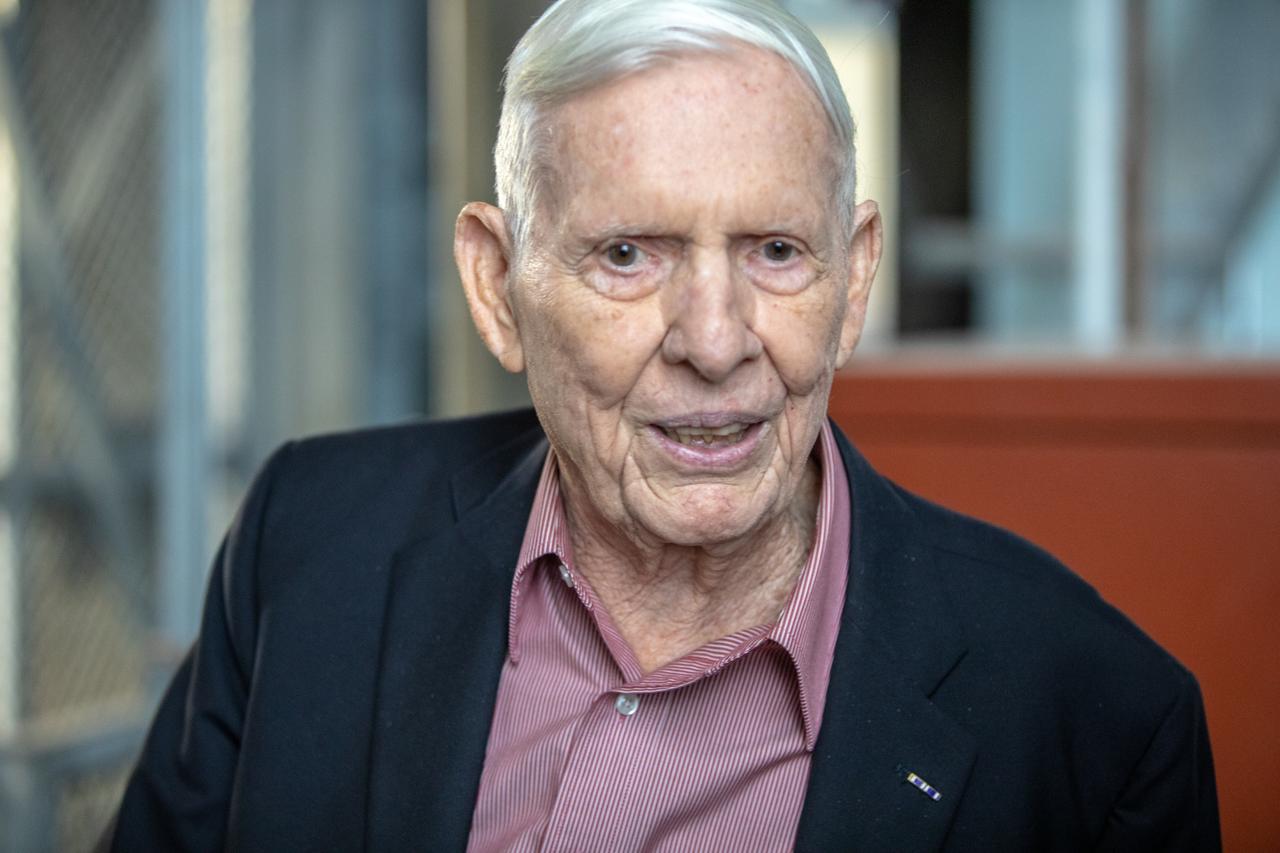
Phil Moyer, original project lead for the Vehicle Assembly Building (VAB), tours the Vehicle Assembly Building on Nov. 22, 2019 at NASA’s Kennedy Space Center in Florida. The VAB was recognized with the National Historic Civil Engineering Landmark award by the Florida Section American Society of Civil Engineers during a ceremony on Jan. 10, 2020. The VAB is the first building at Kennedy Space Center to earn this distinction. At the time of its completion, the 129-million-cubic-foot structure was the largest building in the world. Originally designed and built to accommodate the Saturn V/Apollo used in Project Apollo, the VAB was later modified for its role in the Space Shuttle Program.
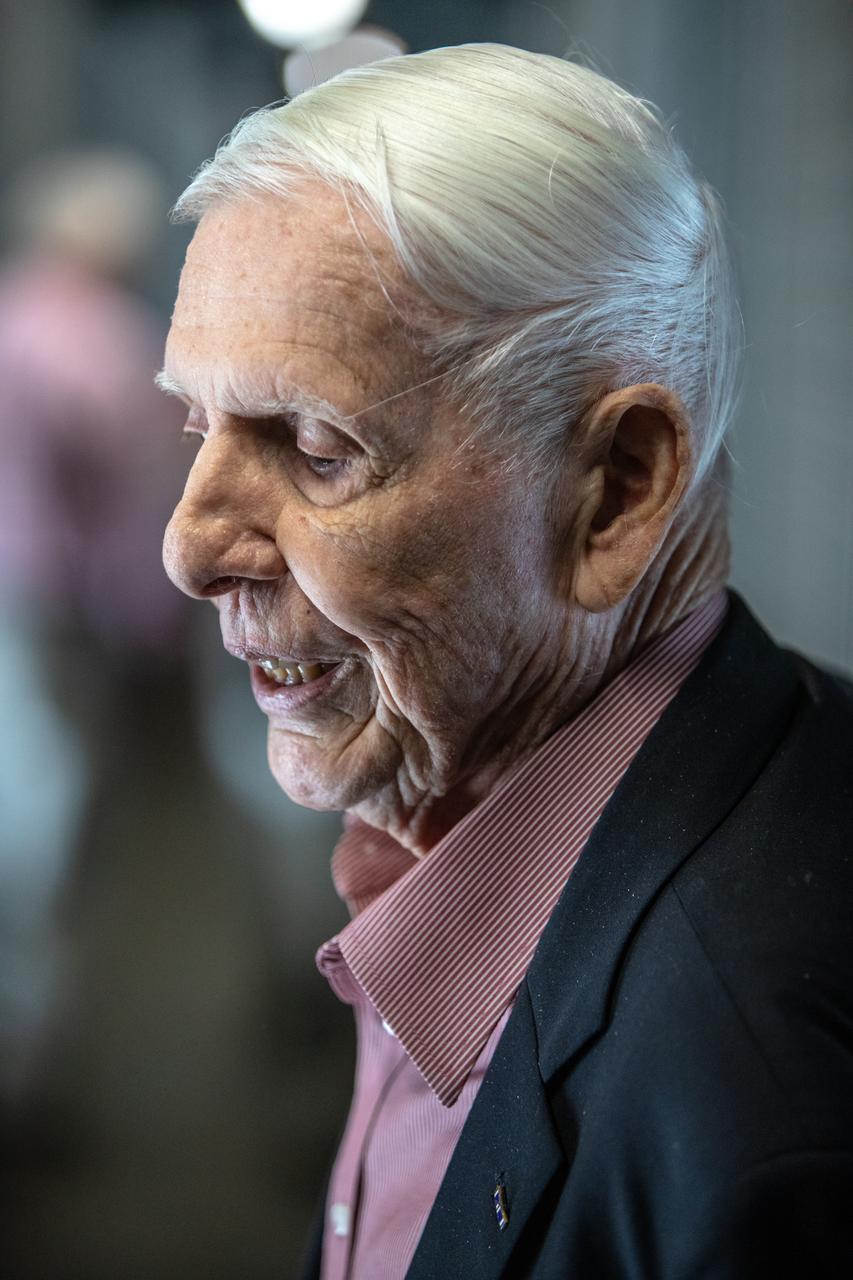
Phil Moyer, original project lead for the Vehicle Assembly Building (VAB), tours the Vehicle Assembly Building on Nov. 22, 2019 at NASA’s Kennedy Space Center in Florida. The VAB was recognized with the National Historic Civil Engineering Landmark award by the Florida Section American Society of Civil Engineers during a ceremony on Jan. 10, 2020. The VAB is the first building at Kennedy Space Center to earn this distinction. At the time of its completion, the 129-million-cubic-foot structure was the largest building in the world. Originally designed and built to accommodate the Saturn V/Apollo used in Project Apollo, the VAB was later modified for its role in the Space Shuttle Program.

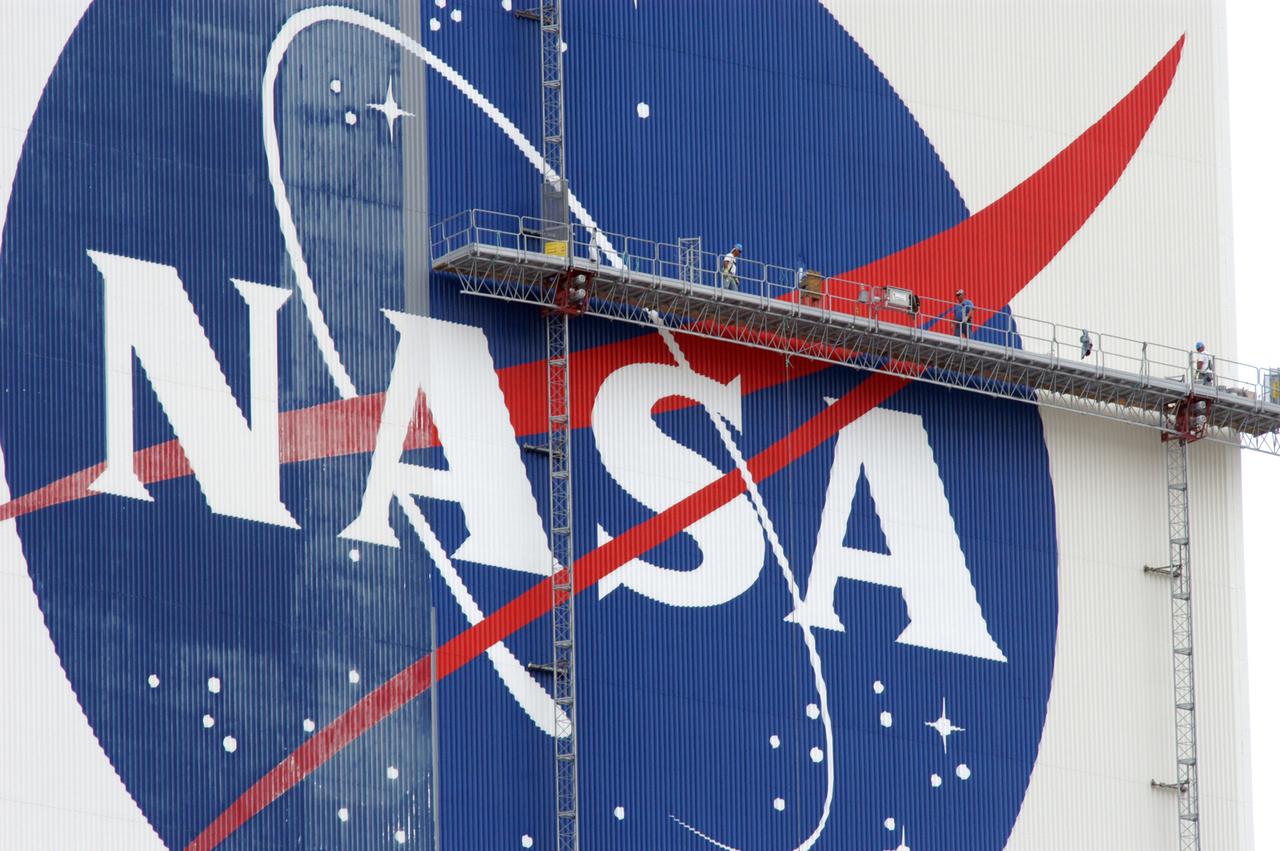
Painting of the NASA logo, also called the meatball, continues on the 525-foot-tall Vehicle Assembly Building (VAB) at the agency’s Kennedy Space Center in Florida on June 23, 2020. HM2 and H.I.S. Painting of Titusville, Florida, are repainting the meatball and the American Flag on the iconic building. The VAB was last painted in 2007 when the repairs were completed after 2004 Hurricanes Frances and Jeanne tore 845 panels off the building. It will take over 500 gallons of paint to paint the 209 X 110-foot flag and the 110’ X 132’ meatball.

Painting of the NASA logo, also called the meatball, continues on the 525-foot-tall Vehicle Assembly Building (VAB) at the agency’s Kennedy Space Center in Florida on June 23, 2020. HM2 and H.I.S. Painting of Titusville, Florida, are repainting the meatball and the American Flag on the iconic building. The VAB was last painted in 2007 when the repairs were completed after 2004 Hurricanes Frances and Jeanne tore 845 panels off the building. It will take over 500 gallons of paint to paint the 209 X 110-foot flag and the 110’ X 132’ meatball.

Painting of the NASA logo, also called the meatball, continues on the 525-foot-tall Vehicle Assembly Building (VAB) at the agency’s Kennedy Space Center in Florida on June 23, 2020. HM2 and H.I.S. Painting of Titusville, Florida, are repainting the meatball and the American Flag on the iconic building. The VAB was last painted in 2007 when the repairs were completed after 2004 Hurricanes Frances and Jeanne tore 845 panels off the building. It will take over 500 gallons of paint to paint the 209 X 110-foot flag and the 110’ X 132’ meatball.

Painting of the NASA logo, also called the meatball, continues on the 525-foot-tall Vehicle Assembly Building (VAB) at the agency’s Kennedy Space Center in Florida on June 23, 2020. HM2 and H.I.S. Painting of Titusville, Florida, are repainting the meatball and the American Flag on the iconic building. The VAB was last painted in 2007 when the repairs were completed after 2004 Hurricanes Frances and Jeanne tore 845 panels off the building. It will take over 500 gallons of paint to paint the 209 X 110-foot flag and the 110’ X 132’ meatball.

Painting of the NASA logo, also called the meatball, continues on the 525-foot-tall Vehicle Assembly Building (VAB) at the agency’s Kennedy Space Center in Florida on June 23, 2020. HM2 and H.I.S. Painting of Titusville, Florida, are repainting the meatball and the American Flag on the iconic building. The VAB was last painted in 2007 when the repairs were completed after 2004 Hurricanes Frances and Jeanne tore 845 panels off the building. It will take over 500 gallons of paint to paint the 209 X 110-foot flag and the 110’ X 132’ meatball.

Painting of the NASA logo, also called the meatball, continues on the 525-foot-tall Vehicle Assembly Building (VAB) at the agency’s Kennedy Space Center in Florida on June 23, 2020. HM2 and H.I.S. Painting of Titusville, Florida, are repainting the meatball and the American Flag on the iconic building. The VAB was last painted in 2007 when the repairs were completed after 2004 Hurricanes Frances and Jeanne tore 845 panels off the building. It will take over 500 gallons of paint to paint the 209 X 110-foot flag and the 110’ X 132’ meatball.

Family members of the original Vehicle Assembly Building (VAB) architect ride in an elevator during a tour of the iconic facility on Nov. 22, 2019 at NASA’s Kennedy Space Center in Florida. Among the visitors are Phil Moyer, in front, original project lead for the VAB; and Dick Bergmann, in the light green shirt, original lead designer for the VAB. The Florida Section American Society of Civil Engineers bestowed its National Historic Civil Engineering Landmark award to the facility. The VAB is the first building at Kennedy Space Center to earn this distinction. At the time of its completion, the 129-million-cubic-foot structure was the largest building in the world. Originally designed and built to accommodate the Saturn V/Apollo used in Project Apollo, the VAB was later modified for its role in the Space Shuttle Program.
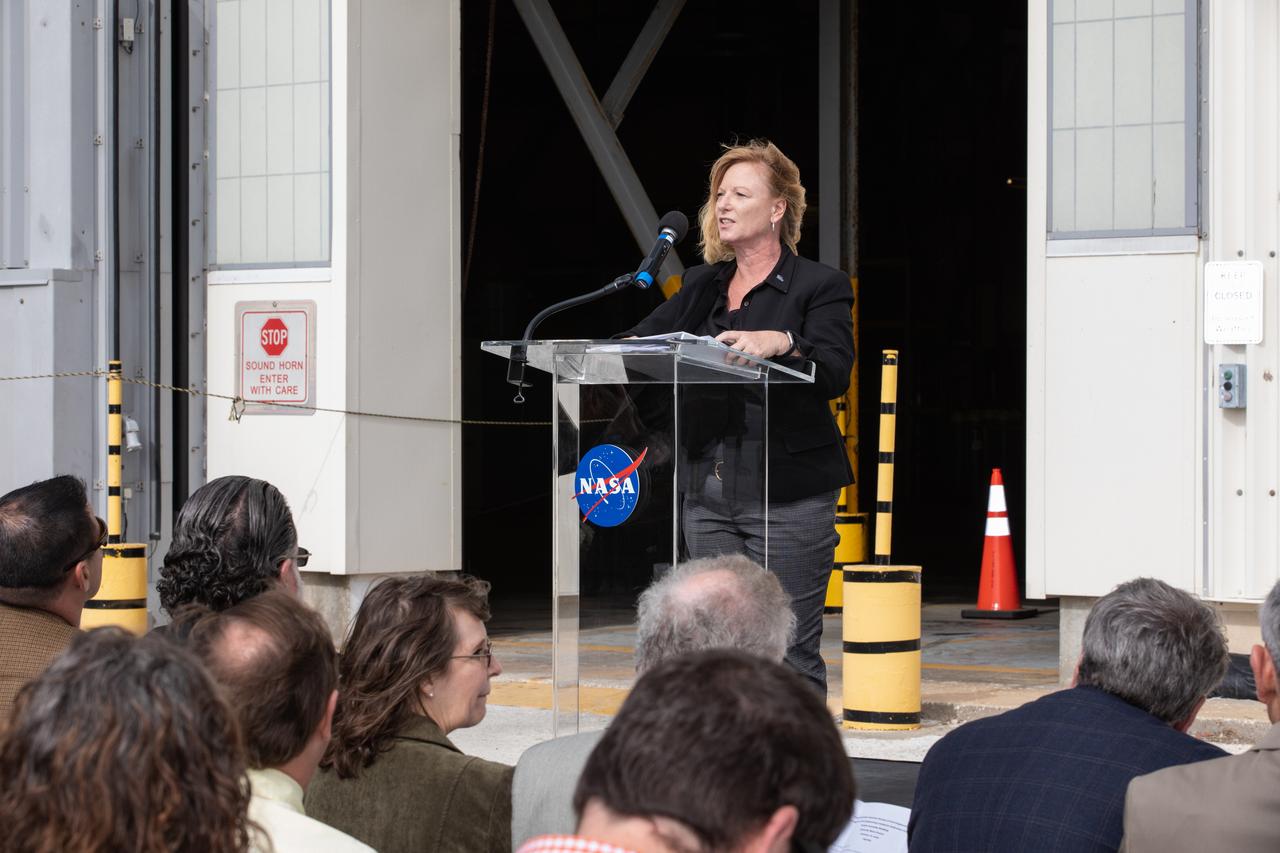
Kathleen Ruvarac, History and Heritage Committee chairperson with the American Society of Civil Engineers (ASCE), speaks to attendees during a ceremony on Jan. 10, 2020, to recognize the Vehicle Assembly Building with the National Historic Civil Engineering Landmark award. The Florida Section ASCE nominated the historic building and bestowed the award. The VAB is the first building at Kennedy Space Center to earn this distinction. At the time of its completion, the 129-million-cubic-foot structure was the largest building in the world. Originally designed and built to accommodate the Saturn V/Apollo used in Project Apollo, the VAB was later modified for its role in the Space Shuttle Program.
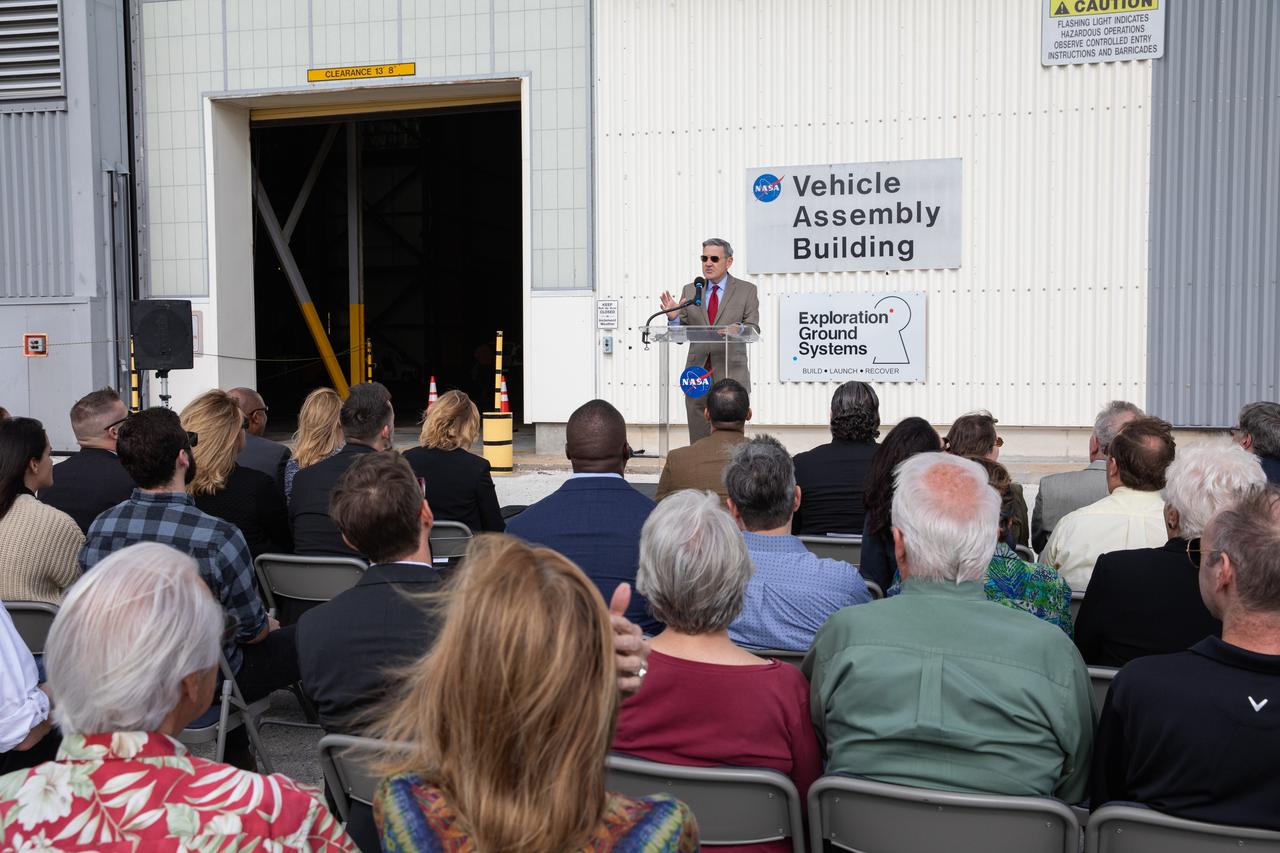
Kennedy Space Center Director Bob Cabana, speaks to attendees during a ceremony on Jan. 10, 2020, to recognize the Vehicle Assembly Building with the National Historic Civil Engineering Landmark award. The Florida Section American Society of Civil Engineers nominated the historic building and bestowed the award. The VAB is the first building at Kennedy Space Center to earn this distinction. At the time of its completion, the 129-million-cubic-foot structure was the largest building in the world. Originally designed and built to accommodate the Saturn V/Apollo used in Project Apollo, the VAB was later modified for its role in the Space Shuttle Program.
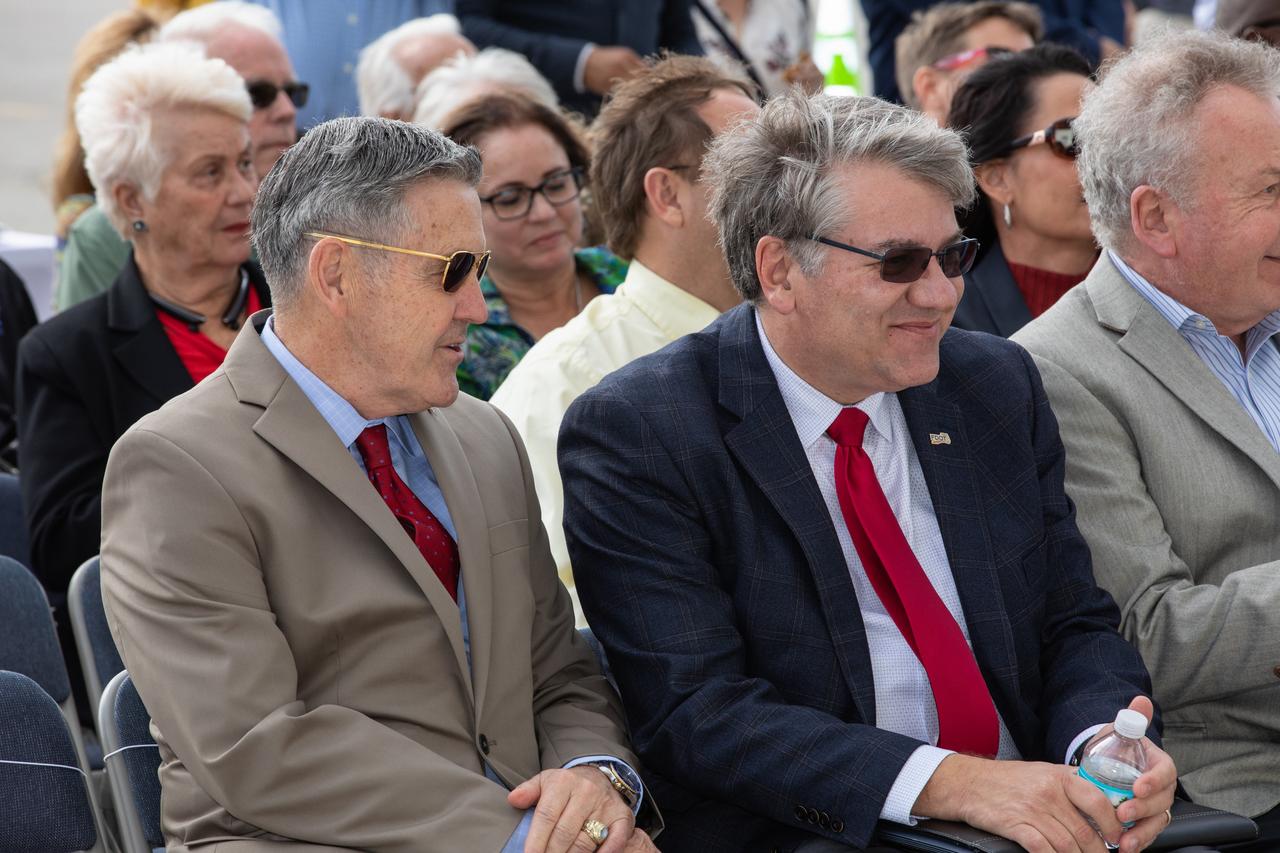
Kennedy Space Center Director Bob Cabana, left, talks with Florida Department of Transportation Secretary Kevin Thibault during a ceremony on Jan. 10, 2020, to recognize the Vehicle Assembly Building with the National Historic Civil Engineering Landmark award. The Florida Section American Society of Civil Engineers nominated the historic building and bestowed the award. The VAB is the first building at Kennedy Space Center to earn this distinction. At the time of its completion, the 129-million-cubic-foot structure was the largest building in the world. Originally designed and built to accommodate the Saturn V/Apollo used in Project Apollo, the VAB was later modified for its role in the Space Shuttle Program.
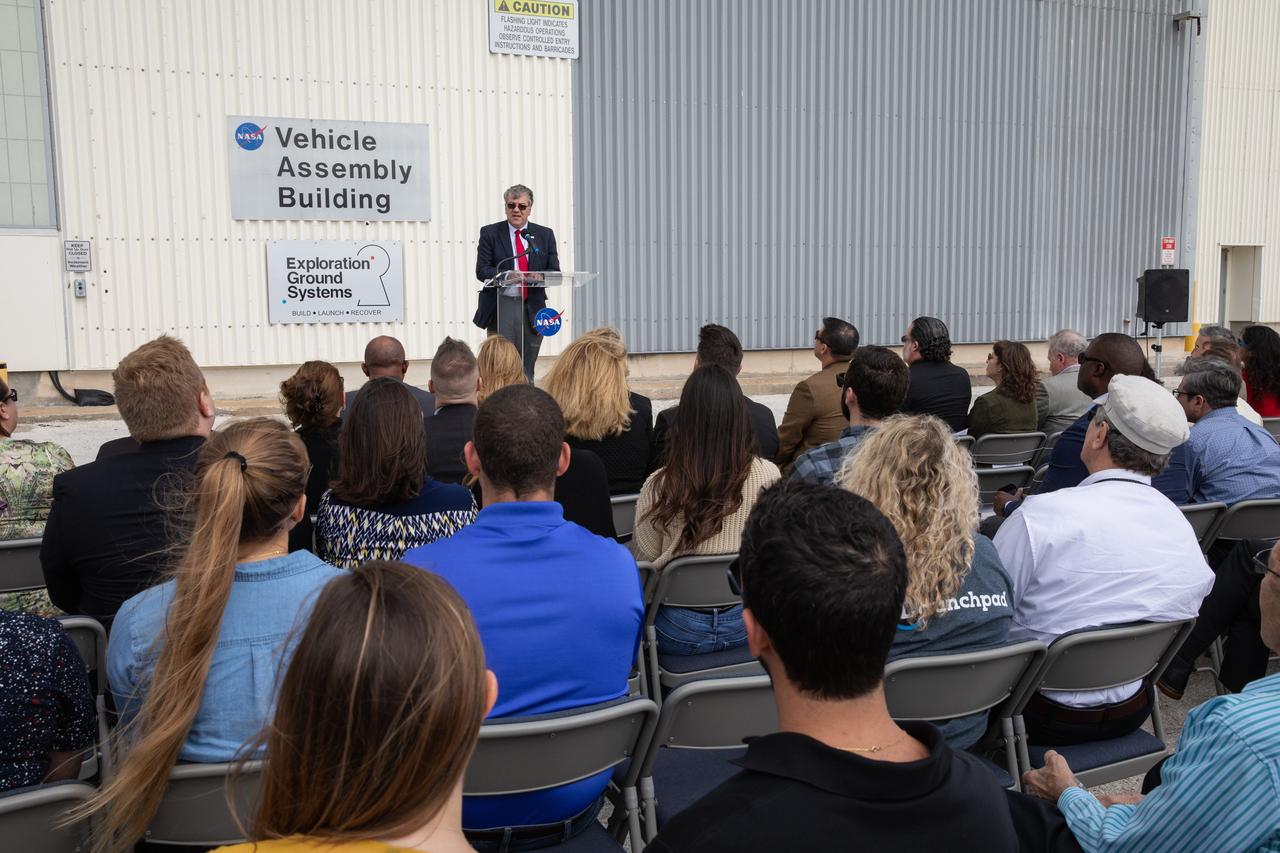
Florida Department of Transportation Secretary Kevin Thibault speaks to attendees during a ceremony on Jan. 10, 2020, to recognize the Vehicle Assembly Building with the National Historic Civil Engineering Landmark award. The Florida Section American Society of Civil Engineers nominated the historic building and bestowed the award. The VAB is the first building at Kennedy Space Center to earn this distinction. At the time of its completion, the 129-million-cubic-foot structure was the largest building in the world. Originally designed and built to accommodate the Saturn V/Apollo used in Project Apollo, the VAB was later modified for its role in the Space Shuttle Program.
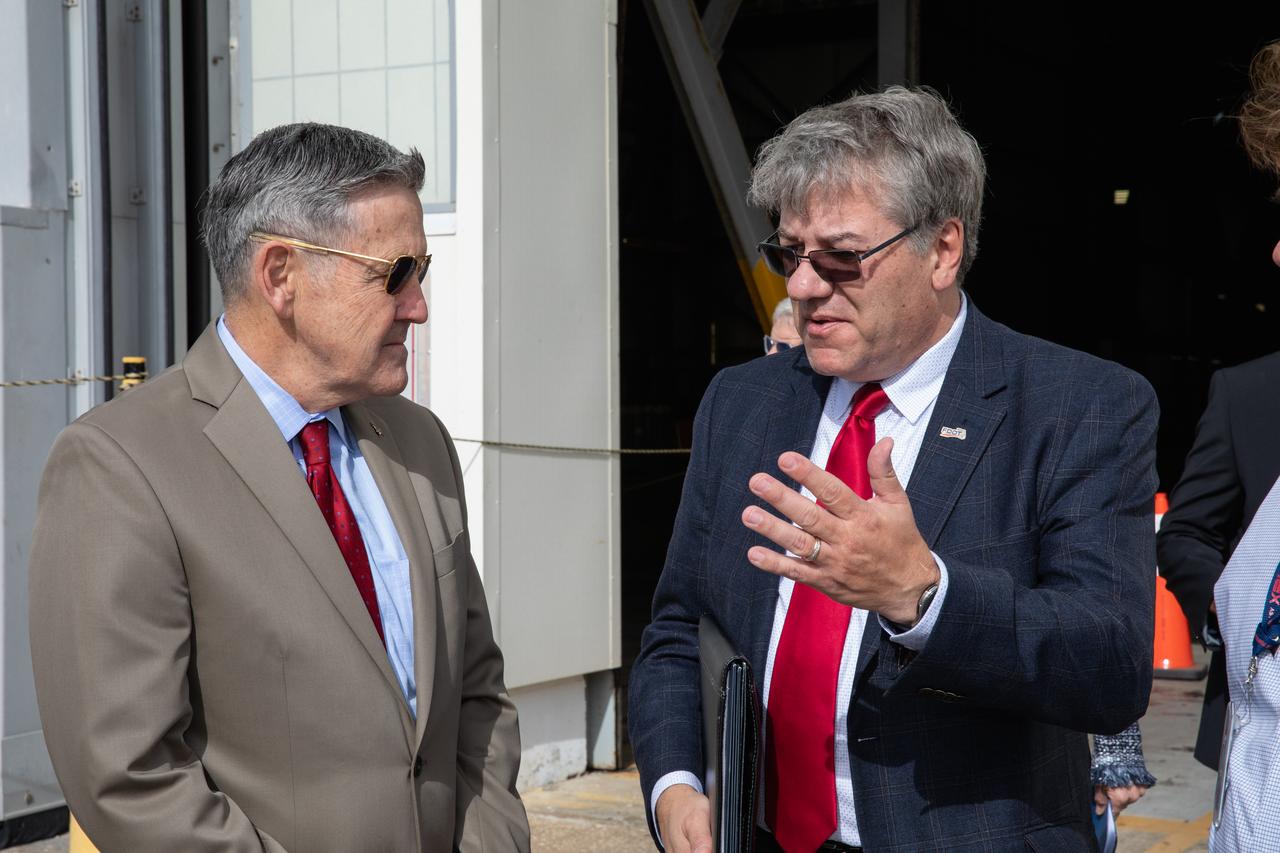
Kennedy Space Center Director Bob Cabana, left, talks with Florida Department of Transportation Secretary Kevin Thibault during a ceremony on Jan. 10, 2020, to recognize the Vehicle Assembly Building with the National Historic Civil Engineering Landmark award. The Florida Section American Society of Civil Engineers nominated the historic building and bestowed the award. The VAB is the first building at Kennedy Space Center to earn this distinction. At the time of its completion, the 129-million-cubic-foot structure was the largest building in the world. Originally designed and built to accommodate the Saturn V/Apollo used in Project Apollo, the VAB was later modified for its role in the Space Shuttle Program.
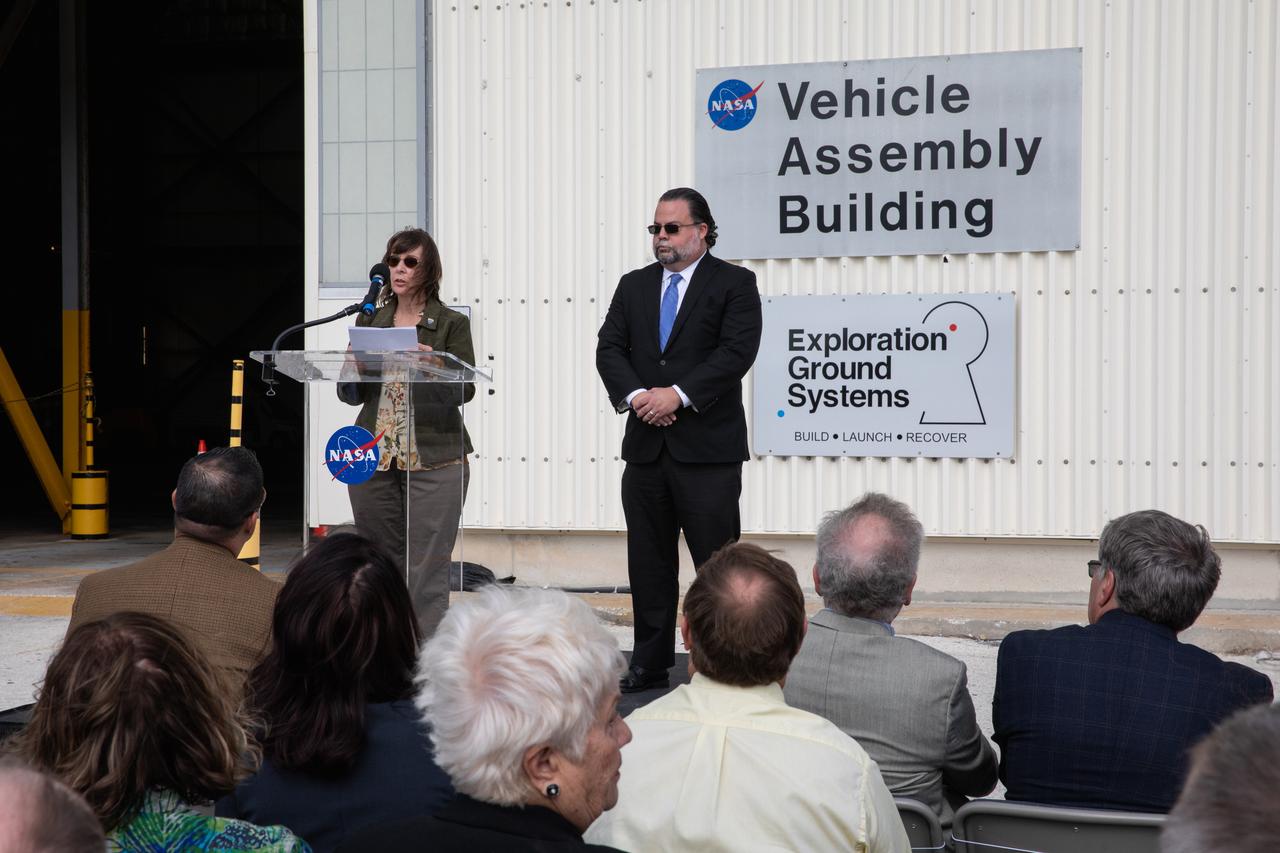
Carol Stevens, History and Heritage Committee member with the American Society of Civil Engineers (ASCE), speaks to attendees during a ceremony on Jan. 10, 2020, to recognize the Vehicle Assembly Building with the National Historic Civil Engineering Landmark award. At right is Peter Moore, ASCE Region 5 director. The Florida Section ASCE nominated the historic building and bestowed the award. The VAB is the first building at Kennedy Space Center to earn this distinction. At the time of its completion, the 129-million-cubic-foot structure was the largest building in the world. Originally designed and built to accommodate the Saturn V/Apollo used in Project Apollo, the VAB was later modified for its role in the Space Shuttle Program.
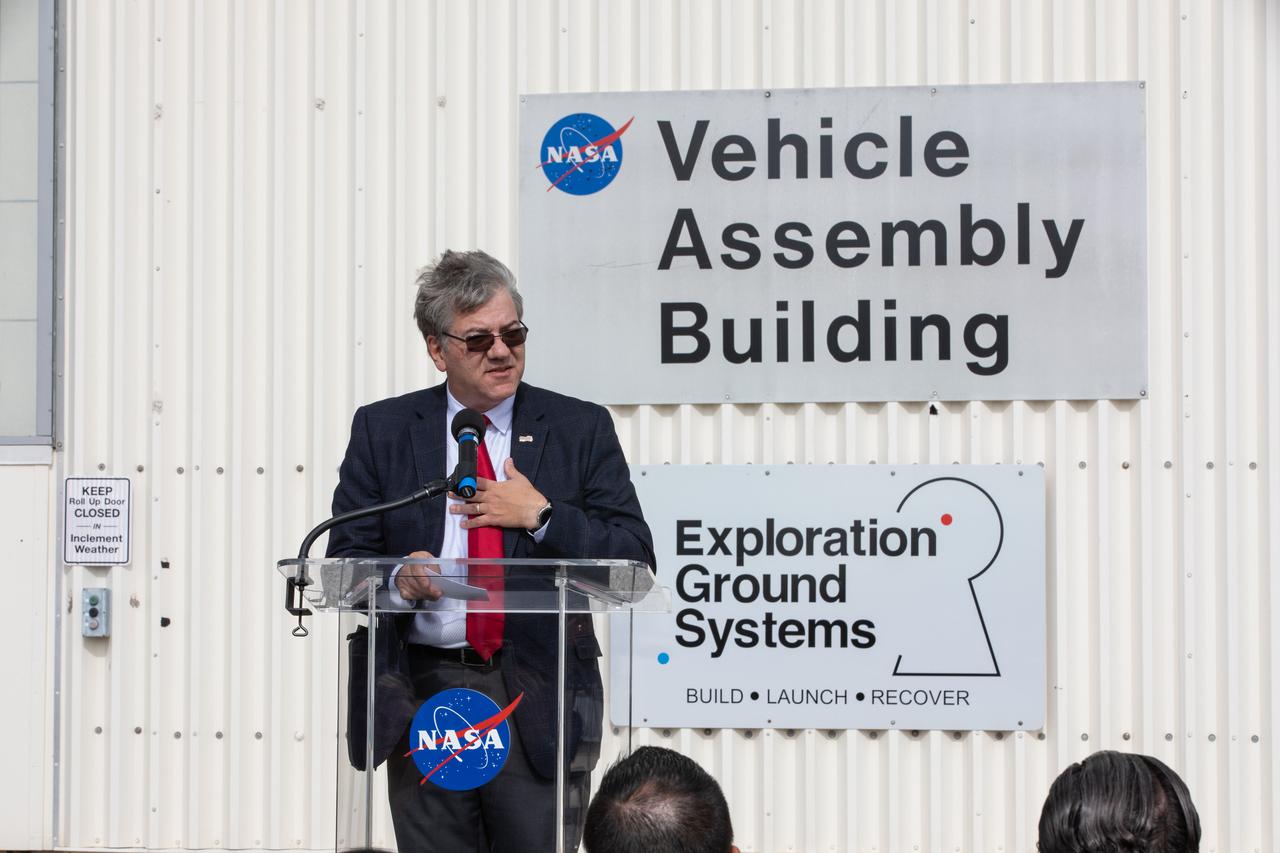
Florida Department of Transportation Secretary Kevin Thibault speaks to attendees during a ceremony on Jan. 10, 2020, to recognize the Vehicle Assembly Building with the National Historic Civil Engineering Landmark award. The Florida Section American Society of Civil Engineers nominated the historic building and bestowed the award. The VAB is the first building at Kennedy Space Center to earn this distinction. At the time of its completion, the 129-million-cubic-foot structure was the largest building in the world. Originally designed and built to accommodate the Saturn V/Apollo used in Project Apollo, the VAB was later modified for its role in the Space Shuttle Program.
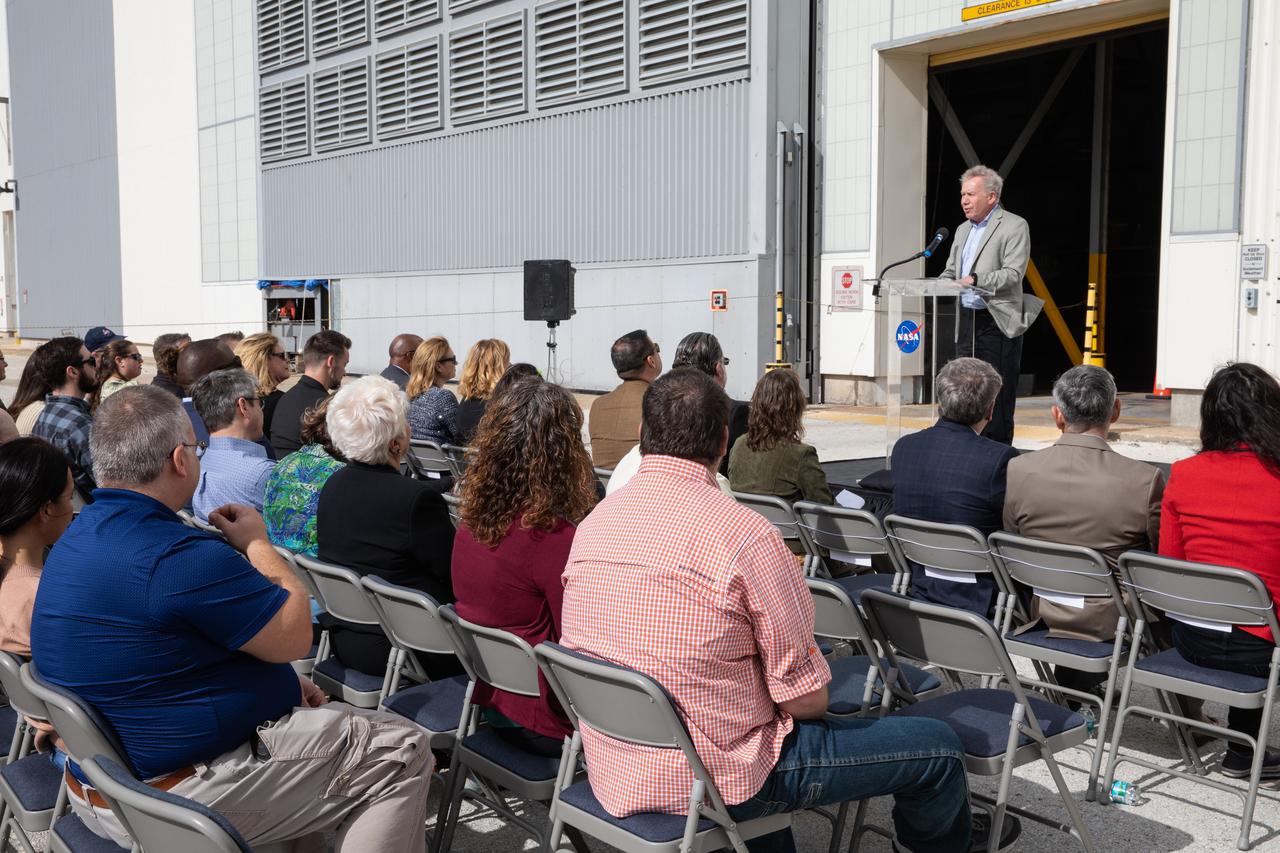
Glenn Bell, American Society of Civil Engineers (ASCE) Society of Structural Engineering Institute president speaks to attendees during a ceremony on Jan. 10, 2020, to recognize the Vehicle Assembly Building with the National Historic Civil Engineering Landmark award. The Florida Section ASCE nominated the historic building and bestowed the award. The VAB is the first building at Kennedy Space Center to earn this distinction. At the time of its completion, the 129-million-cubic-foot structure was the largest building in the world. Originally designed and built to accommodate the Saturn V/Apollo used in Project Apollo, the VAB was later modified for its role in the Space Shuttle Program.
On platforms suspended from the top of the 525-foot-high VAB, workers use rollers and brushes to repaint the U.S. flag on the southwest side of the Vehicle Assembly Building. The flag spans an area 209 feet by 110 feet, or about 23, 437 square feet. Each stripe is 9 feet wide and each star is 6 feet in diameter. The logo is also being painted. Known as the "meatball," the logo measures 110 feet by 132 feet, or about 12,300 square feet. The flag and logo were last painted in 1998, honoring NASA's 40th anniversary.
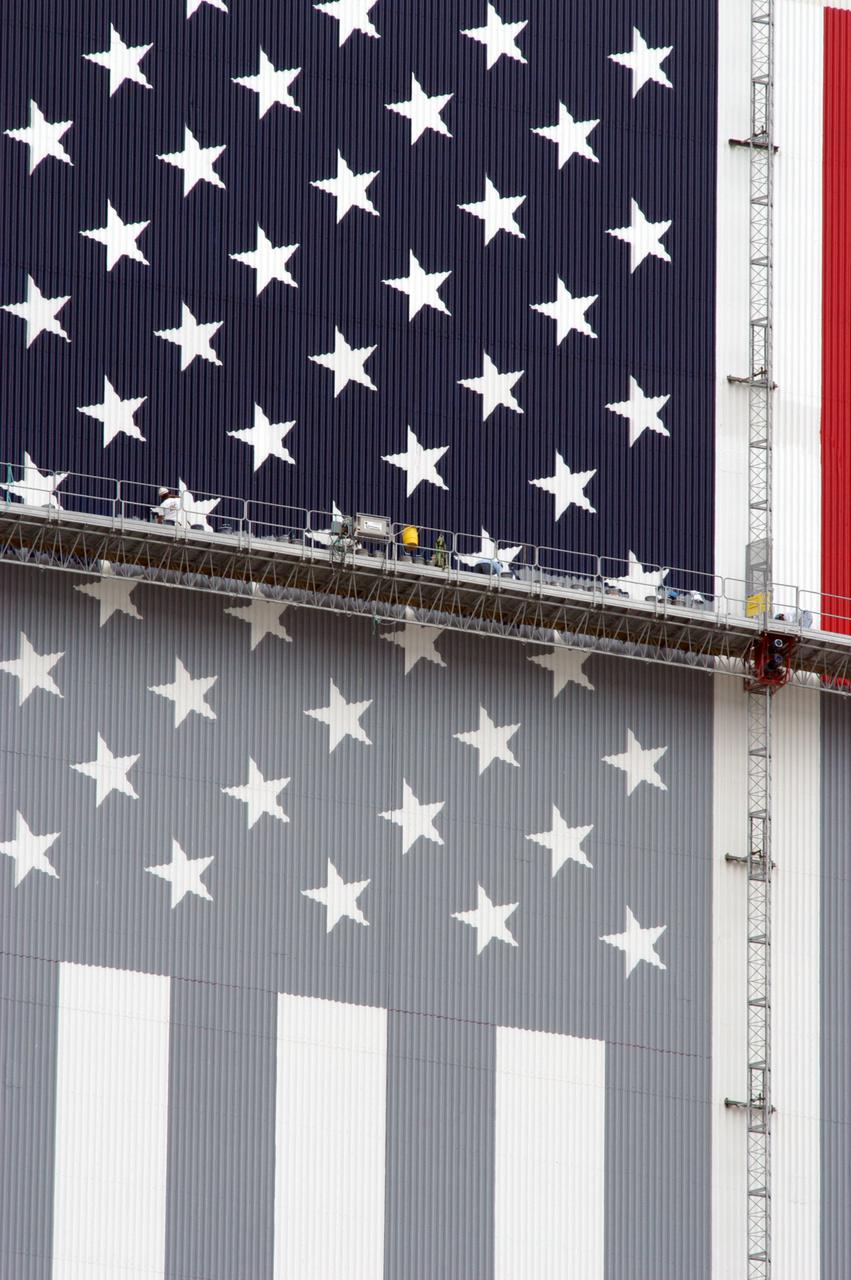
On platforms suspended from the top of the 525-foot-high VAB, workers use rollers and brushes to repaint the U.S. flag on the southwest side of the Vehicle Assembly Building. The flag spans an area 209 feet by 110 feet, or about 23, 437 square feet. Each stripe is 9 feet wide and each star is 6 feet in diameter. The logo is also being painted. Known as the "meatball," the logo measures 110 feet by 132 feet, or about 12,300 square feet. The flag and logo were last painted in 1998, honoring NASA's 40th anniversary.
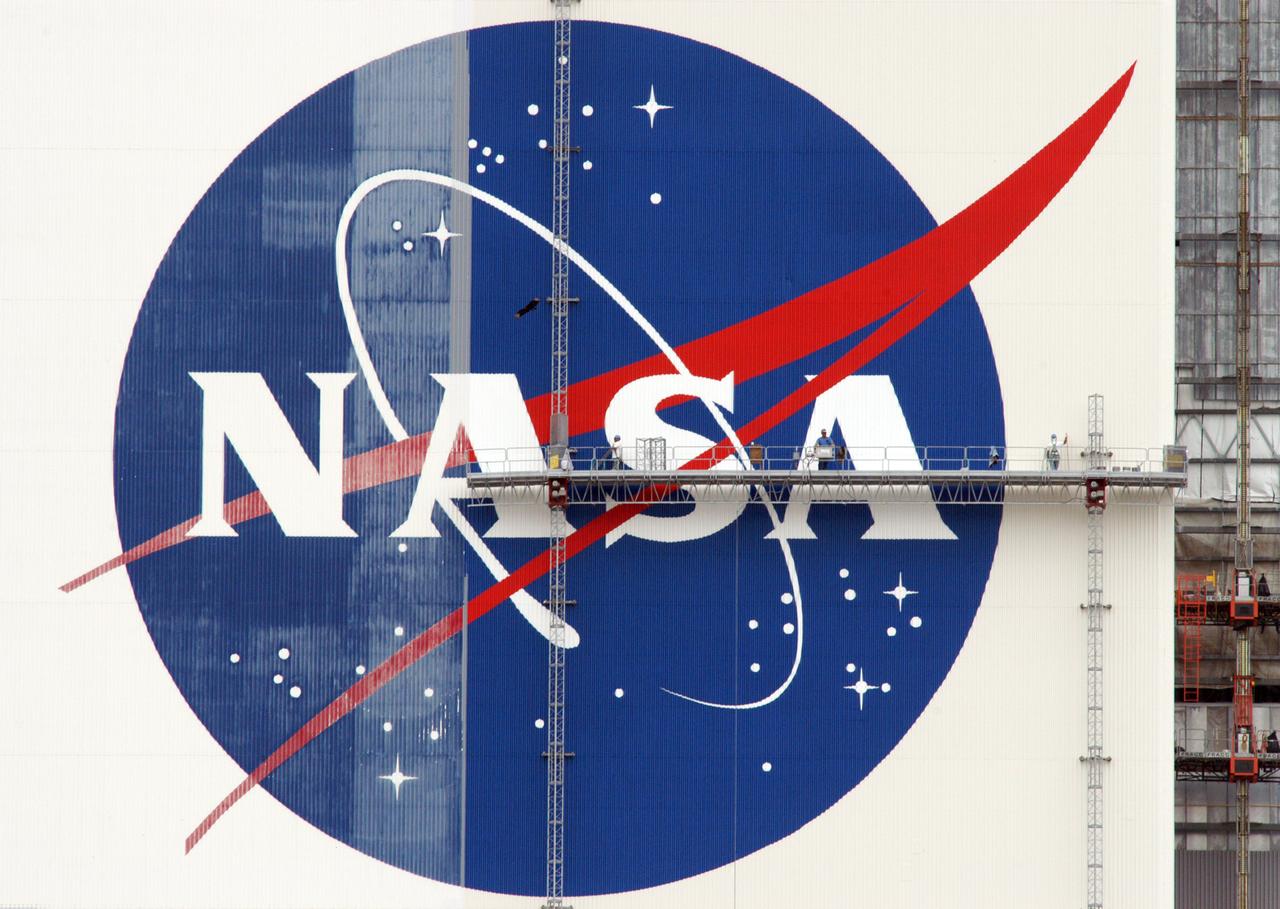
On platforms suspended from the top of the 525-foot-high VAB, workers use rollers and brushes to repaint the NASA logo on the southeast side of the Vehicle Assembly Building. Known as the "meatball," the logo measures 110 feet by 132 feet, or about 12,300 square feet. The U.S. flag is also being repainted. The flag spans an area 209 feet by 110 feet, or about 23, 437 square feet. Each stripe is 9 feet wide and each star is 6 feet in diameter. The flag and logo were last painted in 1998, honoring NASA's 40th anniversary.
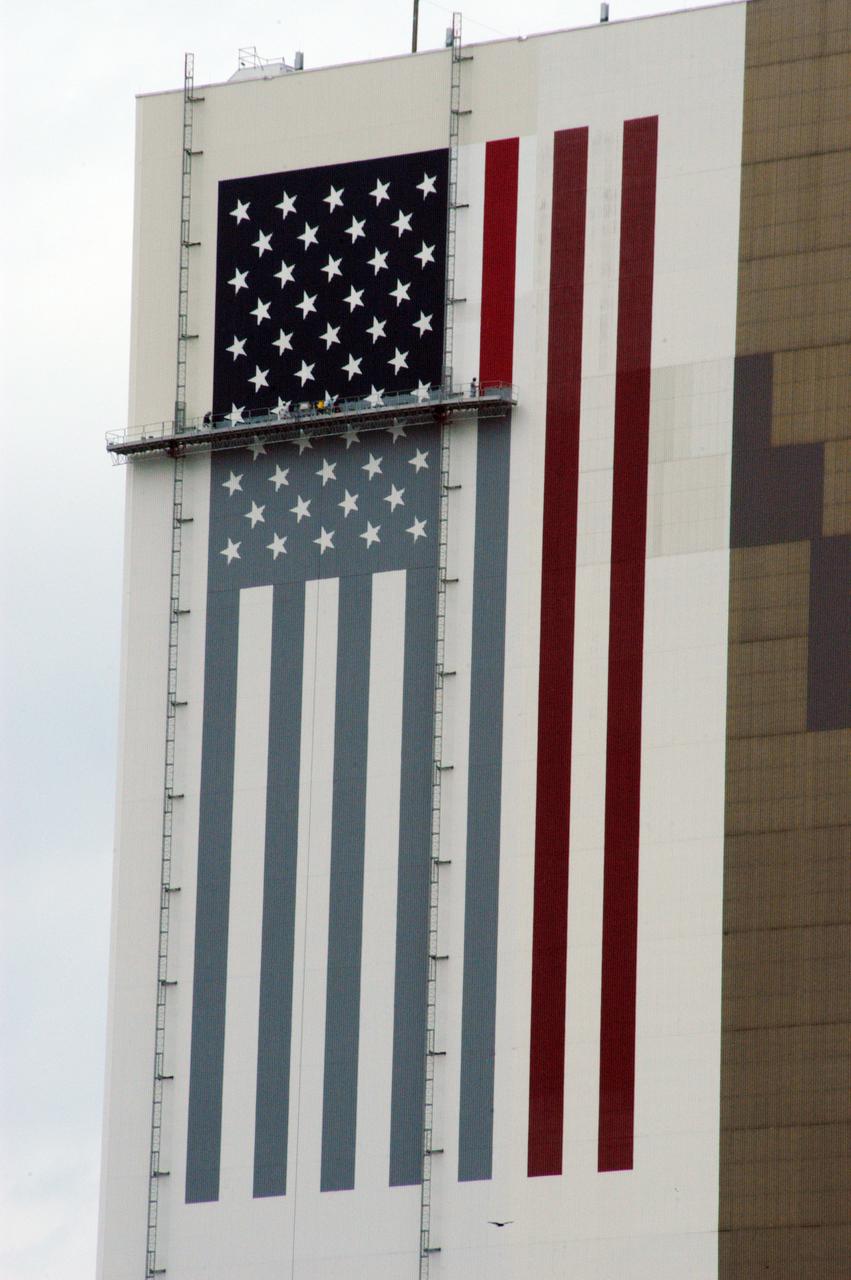
On platforms suspended from the top of the 525-foot-high VAB, workers use rollers and brushes to repaint the U.S. flag on the southwest side of the Vehicle Assembly Building. The flag spans an area 209 feet by 110 feet, or about 23, 437 square feet. Each stripe is 9 feet wide and each star is 6 feet in diameter. The logo is also being painted. Known as the "meatball," the logo measures 110 feet by 132 feet, or about 12,300 square feet. The flag and logo were last painted in 1998, honoring NASA's 40th anniversary.
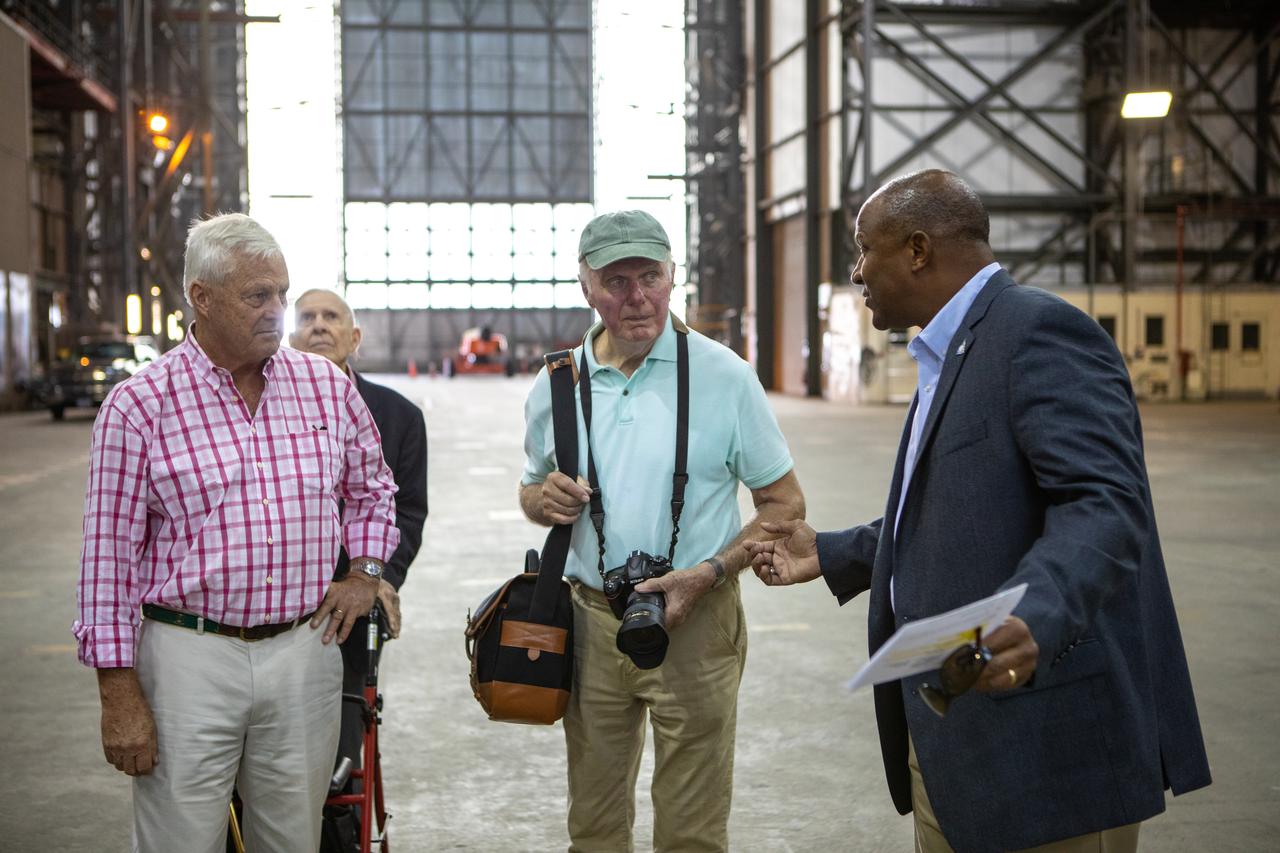
Kelvin Manning, at right, Kennedy Space Center’s associate director, technical, speaks to Dick Bergmann, center, original lead designer for the Vehicle Assembly (VAB), during a tour of the iconic facility on Nov. 22, 2019, at NASA’s Kennedy Space Center in Florida. The VAB was recognized with the National Historic Civil Engineering Landmark award by the Florida Section American Society of Civil Engineers during a ceremony on Jan. 10, 2020. The VAB is the first building at Kennedy to earn this distinction. At the time of its completion, the 129-million-cubic-foot structure was the largest building in the world. Originally designed and built to accommodate the Saturn V/Apollo used in Project Apollo, the VAB was later modified for its role in the Space Shuttle Program.
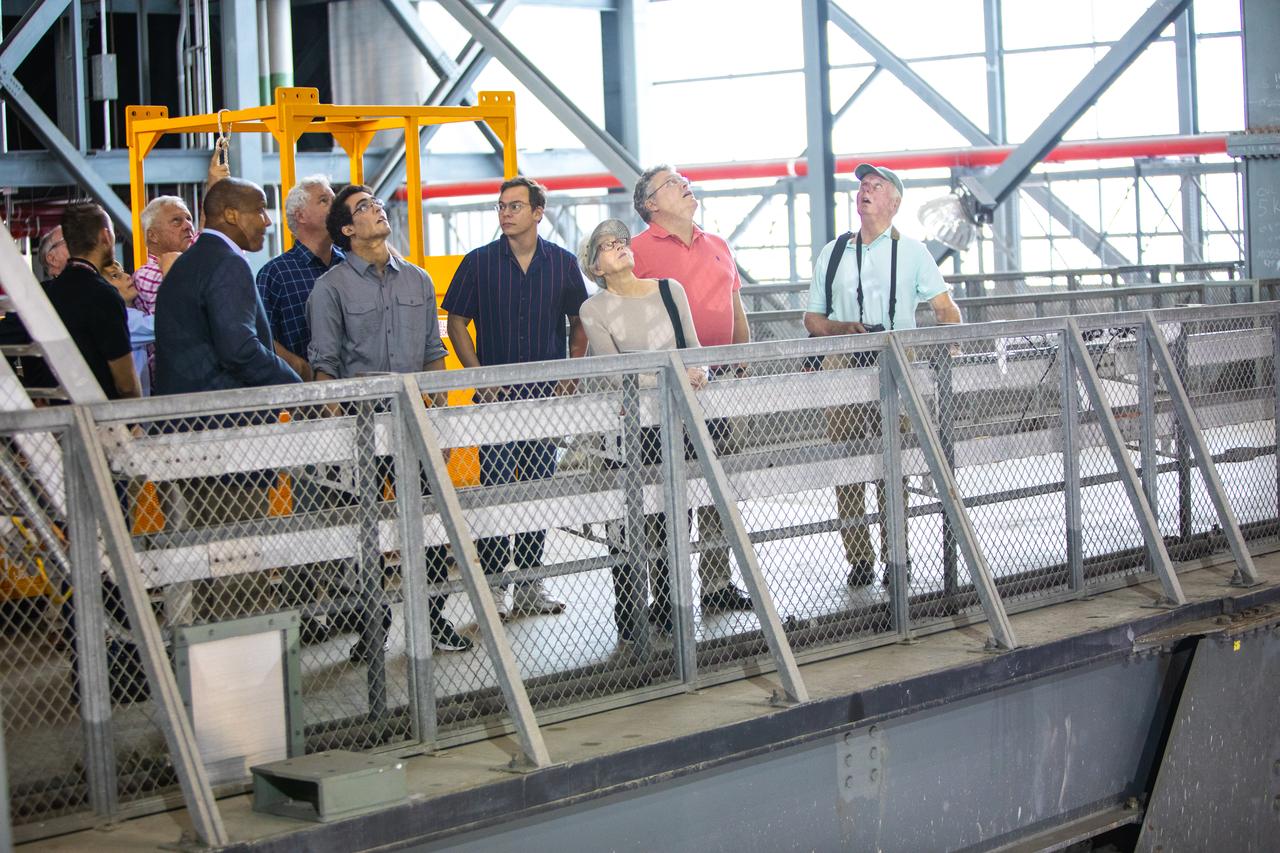
Family members of the original Vehicle Assembly Building (VAB) architect tour the iconic facility on Nov. 22, 2019 at NASA’s Kennedy Space Center in Florida. Among the visitors are Dick Bergmann, far right, original lead designer for the VAB. In view, far left, is Kelvin Manning, Kennedy’s associate director, technical. The Florida Section American Society of Civil Engineers bestowed its National Historic Civil Engineering Landmark award to the facility. The VAB is the first building at Kennedy Space Center to earn this distinction. At the time of its completion, the 129-million-cubic-foot structure was the largest building in the world. Originally designed and built to accommodate the Saturn V/Apollo used in Project Apollo, the VAB was later modified for its role in the Space Shuttle Program.
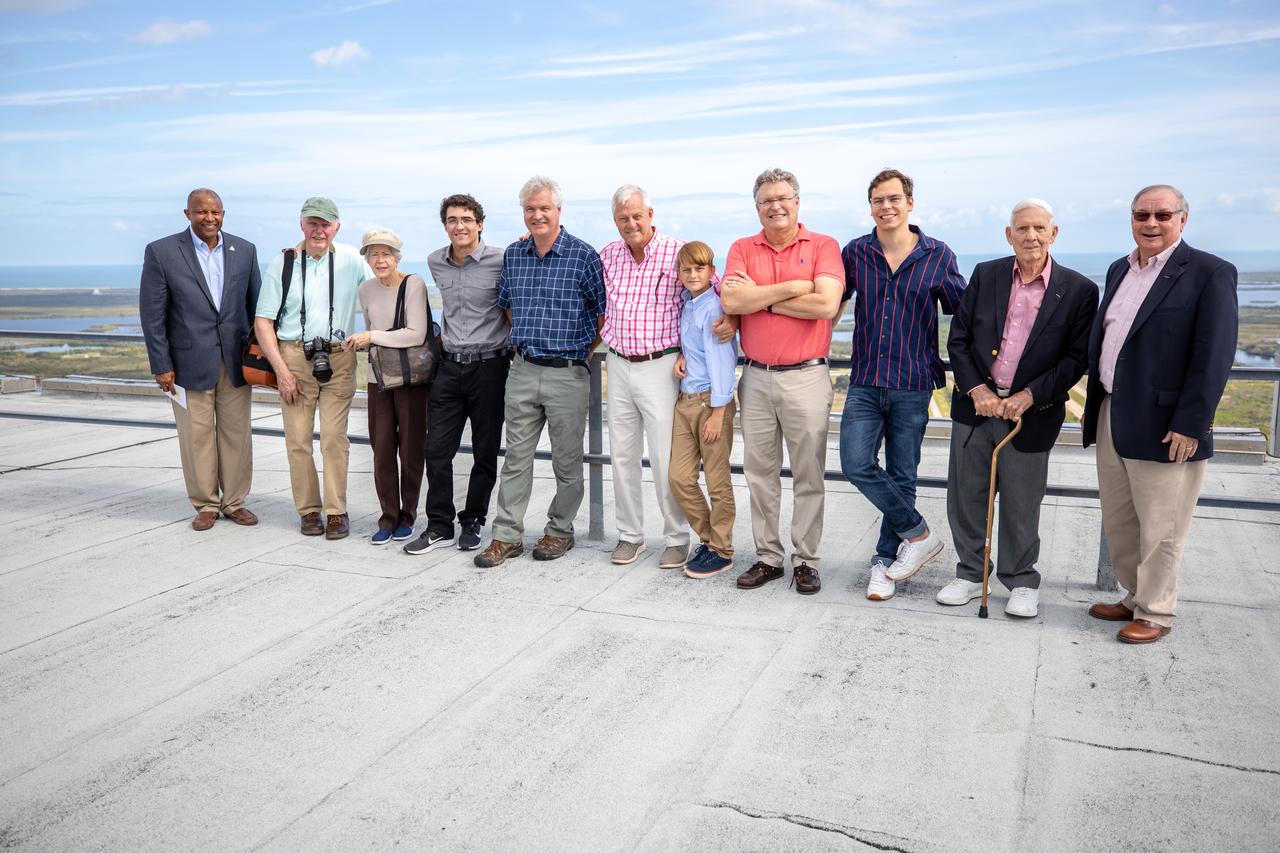
Dick Bergmann, second from left, original lead designer for the Vehicle Assembly Building (VAB), and Phil Moyer, second from right, original project lead, are on the roof of the VAB during a tour of Kennedy Space Center in Florida with descendants of Max Urbahn, the original architect, on Nov. 22, 2019. At far left is Kelvin Manning, Kennedy associate director, technical. The Florida Section American Society of Civil Engineers bestowed its National Historic Civil Engineering Landmark award to the facility. The VAB is the first building at Kennedy Space Center to earn this distinction. At the time of its completion, the 129-million-cubic-foot structure was the largest building in the world. Originally designed and built to accommodate the Saturn V/Apollo used in Project Apollo, the VAB was later modified for its role in the Space Shuttle Program.
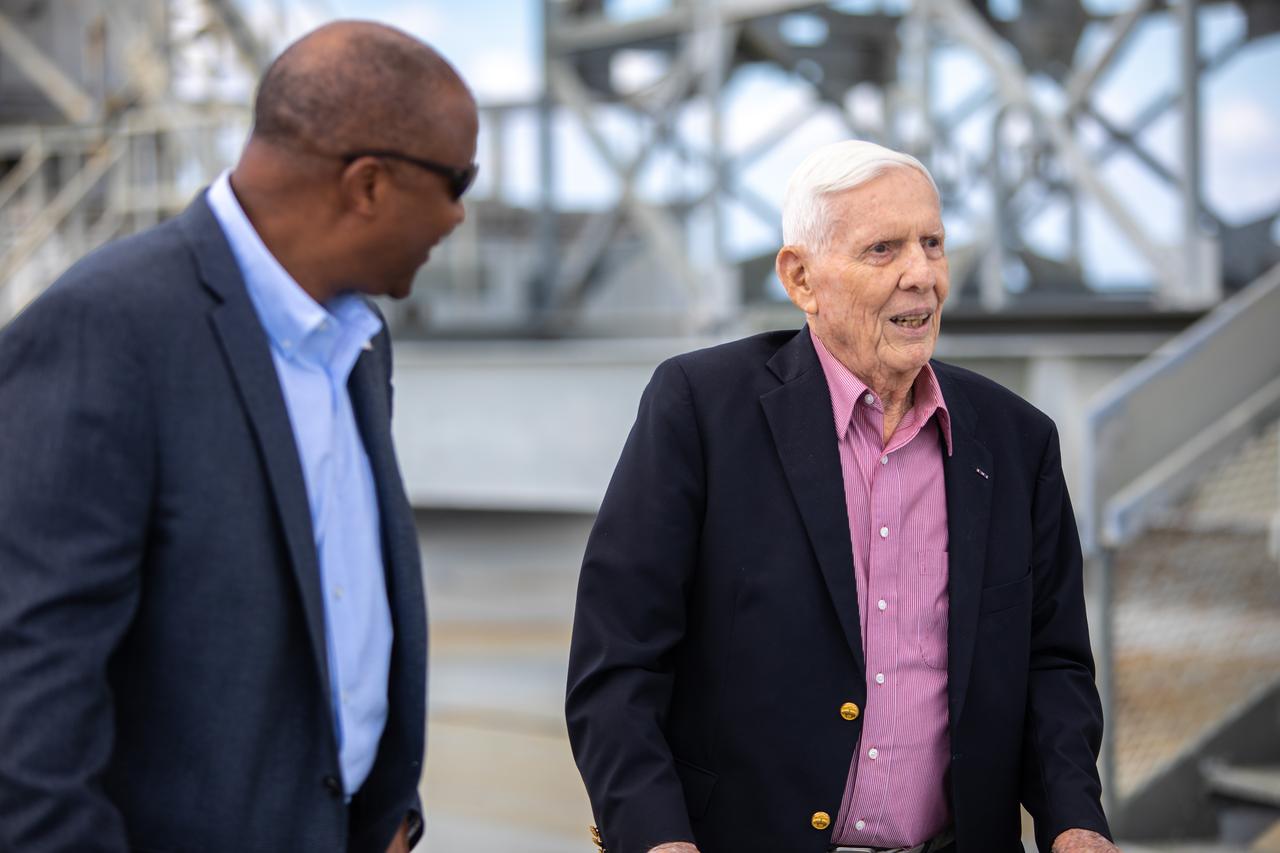
Phil Moyer, at right, original project lead for the Vehicle Assembly Building (VAB), tours the iconic facility on Nov. 22, 2019 at NASA’s Kennedy Space Center in Florida. At left is Kelvin Manning, Kennedy’s associate director, technical. The VAB was recognized with the National Historic Civil Engineering Landmark award by the Florida Section American Society of Civil Engineers during a ceremony on Jan. 10, 2020. The VAB is the first building at Kennedy Space Center to earn this distinction. At the time of its completion, the 129-million-cubic-foot structure was the largest building in the world. Originally designed and built to accommodate the Saturn V/Apollo used in Project Apollo, the VAB was later modified for its role in the Space Shuttle Program.
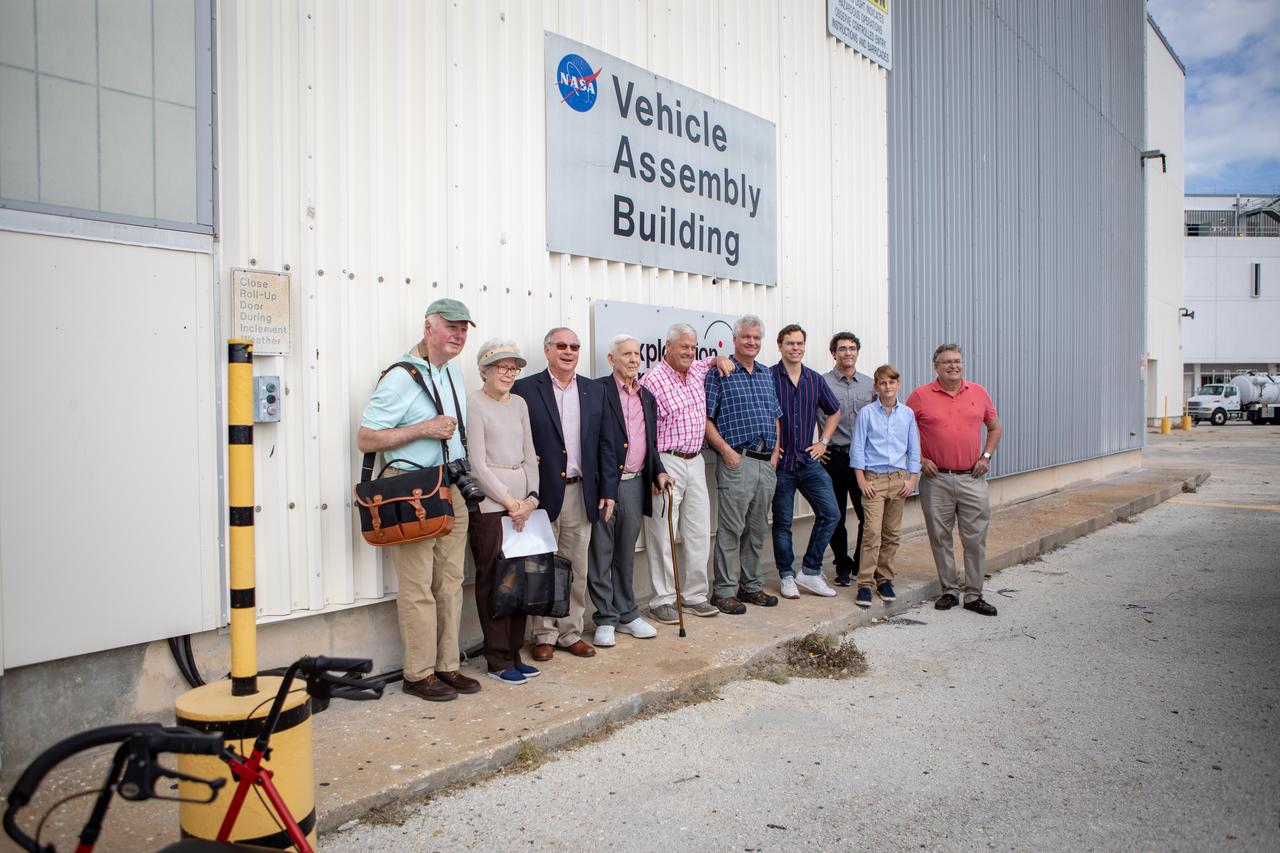
Dick Bergmann, far left, original lead designer for the Vehicle Assembly Building (VAB); and Phil Moyer, fourth from left, original project lead for the VAB, tour the iconic facility at Kennedy Space Center in Florida with descendants of Max Urbahn, the original architect, on Nov. 22, 2019. The Florida Section American Society of Civil Engineers bestowed its National Historic Civil Engineering Landmark award to the facility. The VAB is the first building at Kennedy Space Center to earn this distinction. At the time of its completion, the 129-million-cubic-foot structure was the largest building in the world. Originally designed and built to accommodate the Saturn V/Apollo used in Project Apollo, the VAB was later modified for its role in the Space Shuttle Program.
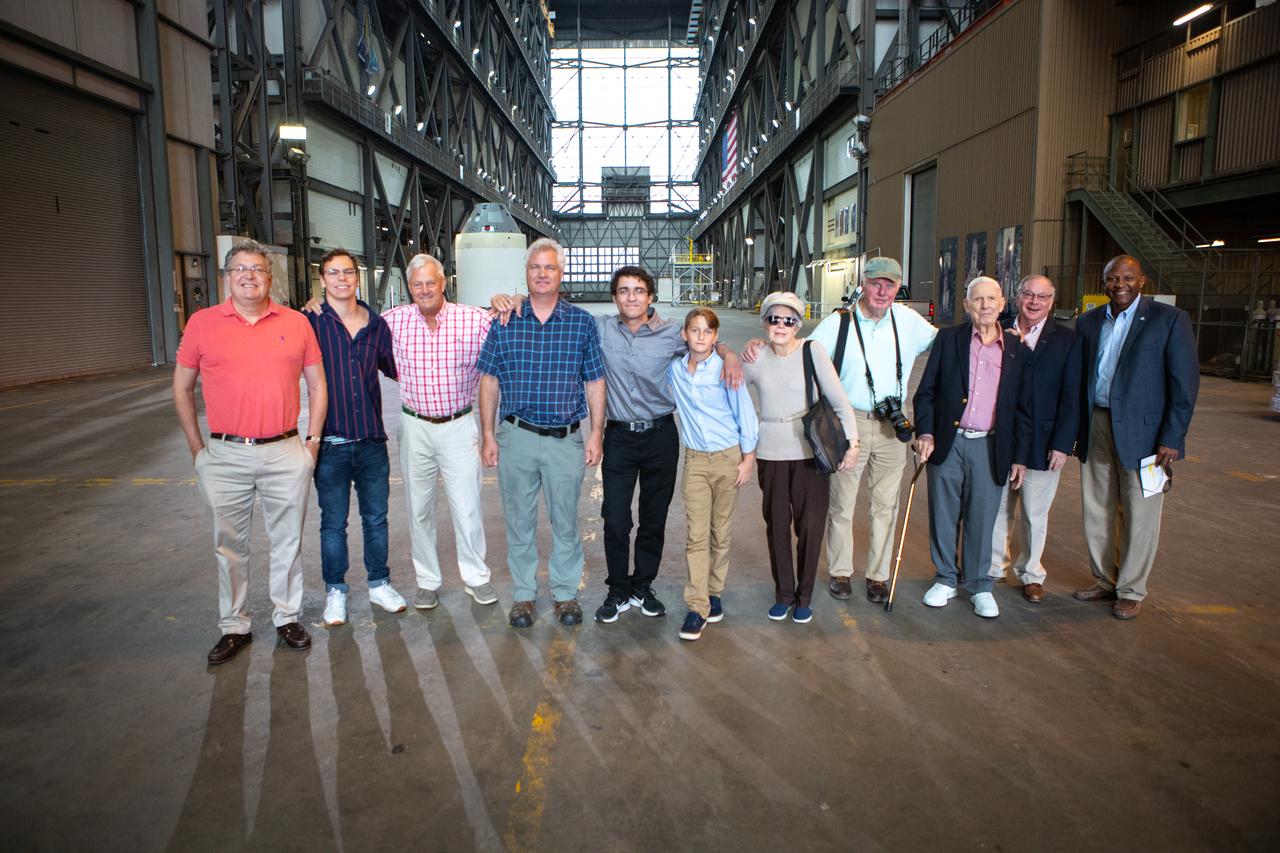
Phil Moyer, third from right, original project lead for the Vehicle Assembly Building (VAB); and Dick Bergmann, fourth from right, original lead designer for the VAB, tour the iconic facility with the families of the original architect on Nov. 22, 2019 at NASA’s Kennedy Space Center in Florida. At far right is Kelvin Manning, Kennedy’s associate director, technical. The Florida Section American Society of Civil Engineers bestowed the historic building with its National Historic Civil Engineering Landmark award during a ceremony on Jan. 10, 2020. The VAB is the first building at Kennedy Space Center to earn this distinction. At the time of its completion, the 129-million-cubic-foot structure was the largest building in the world. Originally designed and built to accommodate the Saturn V/Apollo used in Project Apollo, the VAB was later modified for its role in the Space Shuttle Program.

Painting of the NASA logo, also called the meatball, continues on the 525-foot-tall Vehicle Assembly Building (VAB) at the agency’s Kennedy Space Center in Florida on June 22, 2020. HM2 and H.I.S. Painting of Titusville, Florida, are repainting the meatball and the American Flag on the iconic building. The VAB was last painted in 2007, when repairs were completed after the 2004 Hurricanes Frances and Jeanne tore 845 panels off the building. It will take over 500 gallons of paint to paint the 209-by-110-foot flag and the 110-by-132-foot meatball. Exploration Ground Systems is overseeing upgrades to the VAB to support the launch of the SLS and Orion for Artemis missions. Under the Artemis program, NASA will send the first woman and next man to the Moon.

Painting of the NASA logo, also called the meatball, continues on the 525-foot-tall Vehicle Assembly Building (VAB) at the agency’s Kennedy Space Center in Florida on June 22, 2020. HM2 and H.I.S. Painting of Titusville, Florida, are repainting the meatball and the American Flag on the iconic building. The VAB was last painted in 2007, when repairs were completed after the 2004 Hurricanes Frances and Jeanne tore 845 panels off the building. It will take over 500 gallons of paint to paint the 209-by-110-foot flag and the 110-by-132-foot meatball. Exploration Ground Systems is overseeing upgrades to the VAB to support the launch of the SLS and Orion for Artemis missions. Under the Artemis program, NASA will send the first woman and next man to the Moon.

A scrub jay perches on a branch near the Vehicle Assembly Building (VAB) at NASA’s Kennedy Space Center in Florida on June 22, 2020. Painting of the NASA logo, also called the meatball, continues on the 525-foot-tall building. HM2 and H.I.S. Painting of Titusville, Florida, are repainting the meatball and the American Flag on the iconic building. The VAB was last painted in 2007, when repairs were completed after the 2004 Hurricanes Frances and Jeanne tore 845 panels off the building. It will take over 500 gallons of paint to paint the 209-by-110-foot flag and the 110-by-132-foot meatball. Exploration Ground Systems is overseeing upgrades to the VAB to support the launch of the SLS and Orion for Artemis missions. Under the Artemis program, NASA will send the first woman and next man to the Moon.

Painting of the NASA logo, also called the meatball, continues on the 525-foot-tall Vehicle Assembly Building (VAB) at the agency’s Kennedy Space Center in Florida on June 22, 2020. HM2 and H.I.S. Painting of Titusville, Florida, are repainting the meatball and the American Flag on the iconic building. The VAB was last painted in 2007, when repairs were completed after the 2004 Hurricanes Frances and Jeanne tore 845 panels off the building. It will take over 500 gallons of paint to paint the 209-by-110-foot flag and the 110-by-132-foot meatball. Exploration Ground Systems is overseeing upgrades to the VAB to support the launch of the SLS and Orion for Artemis missions. Under the Artemis program, NASA will send the first woman and next man to the Moon.

A view of the Vehicle Assembly Building (VAB) at NASA’s Kennedy Space Center in Florida on June 22, 2020. Painting of the NASA logo, also called the meatball, continues on the 525-foot-tall building. HM2 and H.I.S. Painting of Titusville, Florida, are repainting the meatball and the American Flag on the iconic building. The VAB was last painted in 2007, when repairs were completed after the 2004 Hurricanes Frances and Jeanne tore 845 panels off the building. It will take over 500 gallons of paint to paint the 209-by-110-foot flag and the 110-by-132-foot meatball. Exploration Ground Systems is overseeing upgrades to the VAB to support the launch of the SLS and Orion for Artemis missions. Under the Artemis program, NASA will send the first woman and next man to the Moon.

A close-up view of the Vehicle Assembly Building (VAB) at NASA’s Kennedy Space Center in Florida on June 22, 2020. Painting of the NASA logo, also called the meatball, continues on the 525-foot-tall building. HM2 and H.I.S. Painting of Titusville, Florida, are repainting the meatball and the American Flag on the iconic building. The VAB was last painted in 2007, when repairs were completed after the 2004 Hurricanes Frances and Jeanne tore 845 panels off the building. It will take over 500 gallons of paint to paint the 209-by-110-foot flag and the 110-by-132-foot meatball. Exploration Ground Systems is overseeing upgrades to the VAB to support the launch of the SLS and Orion for Artemis missions. Under the Artemis program, NASA will send the first woman and next man to the Moon.

A view of the Vehicle Assembly Building (VAB) and a waterway at NASA’s Kennedy Space Center in Florida on June 22, 2020. Painting of the NASA logo, also called the meatball, continues on the 525-foot-tall building. HM2 and H.I.S. Painting of Titusville, Florida, are repainting the meatball and the American Flag on the iconic building. The VAB was last painted in 2007, when repairs were completed after the 2004 Hurricanes Frances and Jeanne tore 845 panels off the building. It will take over 500 gallons of paint to paint the 209-by-110-foot flag and the 110-by-132-foot meatball. Exploration Ground Systems is overseeing upgrades to the VAB to support the launch of the SLS and Orion for Artemis missions. Under the Artemis program, NASA will send the first woman and next man to the Moon.

A view of the Vehicle Assembly Building (VAB) and a waterway at NASA’s Kennedy Space Center in Florida on June 22, 2020. Painting of the NASA logo, also called the meatball, continues on the 525-foot-tall building. HM2 and H.I.S. Painting of Titusville, Florida, are repainting the meatball and the American Flag on the iconic building. The VAB was last painted in 2007, when repairs were completed after the 2004 Hurricanes Frances and Jeanne tore 845 panels off the building. It will take over 500 gallons of paint to paint the 209-by-110-foot flag and the 110-by-132-foot meatball. Exploration Ground Systems is overseeing upgrades to the VAB to support the launch of the SLS and Orion for Artemis missions. Under the Artemis program, NASA will send the first woman and next man to the Moon.

Painting of the NASA logo, also called the meatball, continues on the 525-foot-tall Vehicle Assembly Building (VAB) at the agency’s Kennedy Space Center in Florida on June 22, 2020. HM2 and H.I.S. Painting of Titusville, Florida, are repainting the meatball and the American Flag on the iconic building. The VAB was last painted in 2007, when repairs were completed after the 2004 Hurricanes Frances and Jeanne tore 845 panels off the building. It will take over 500 gallons of paint to paint the 209-by-110-foot flag and the 110-by-132-foot meatball. Exploration Ground Systems is overseeing upgrades to the VAB to support the launch of the SLS and Orion for Artemis missions. Under the Artemis program, NASA will send the first woman and next man to the Moon.

A view of the Vehicle Assembly Building (VAB) at NASA’s Kennedy Space Center in Florida on June 22, 2020. Painting of the NASA logo, also called the meatball, continues on the 525-foot-tall building. HM2 and H.I.S. Painting of Titusville, Florida, are repainting the meatball and the American Flag on the iconic building. The VAB was last painted in 2007, when repairs were completed after the 2004 Hurricanes Frances and Jeanne tore 845 panels off the building. It will take over 500 gallons of paint to paint the 209-by-110-foot flag and the 110-by-132-foot meatball. Exploration Ground Systems is overseeing upgrades to the VAB to support the launch of the SLS and Orion for Artemis missions. Under the Artemis program, NASA will send the first woman and next man to the Moon.

A view of the Vehicle Assembly Building (VAB) and a waterway at NASA’s Kennedy Space Center in Florida on June 22, 2020. Painting of the NASA logo, also called the meatball, continues on the 525-foot-tall building. HM2 and H.I.S. Painting of Titusville, Florida, are repainting the meatball and the American Flag on the iconic building. The VAB was last painted in 2007, when repairs were completed after the 2004 Hurricanes Frances and Jeanne tore 845 panels off the building. It will take over 500 gallons of paint to paint the 209-by-110-foot flag and the 110-by-132-foot meatball. Exploration Ground Systems is overseeing upgrades to the VAB to support the launch of the SLS and Orion for Artemis missions. Under the Artemis program, NASA will send the first woman and next man to the Moon.

A view of the Vehicle Assembly Building (VAB) at NASA’s Kennedy Space Center in Florida on June 22, 2020. Painting of the NASA logo, also called the meatball, continues on the 525-foot-tall building. HM2 and H.I.S. Painting of Titusville, Florida, are repainting the meatball and the American Flag on the iconic building. The VAB was last painted in 2007, when repairs were completed after the 2004 Hurricanes Frances and Jeanne tore 845 panels off the building. It will take over 500 gallons of paint to paint the 209-by-110-foot flag and the 110-by-132-foot meatball. Exploration Ground Systems is overseeing upgrades to the VAB to support the launch of the SLS and Orion for Artemis missions. Under the Artemis program, NASA will send the first woman and next man to the Moon.
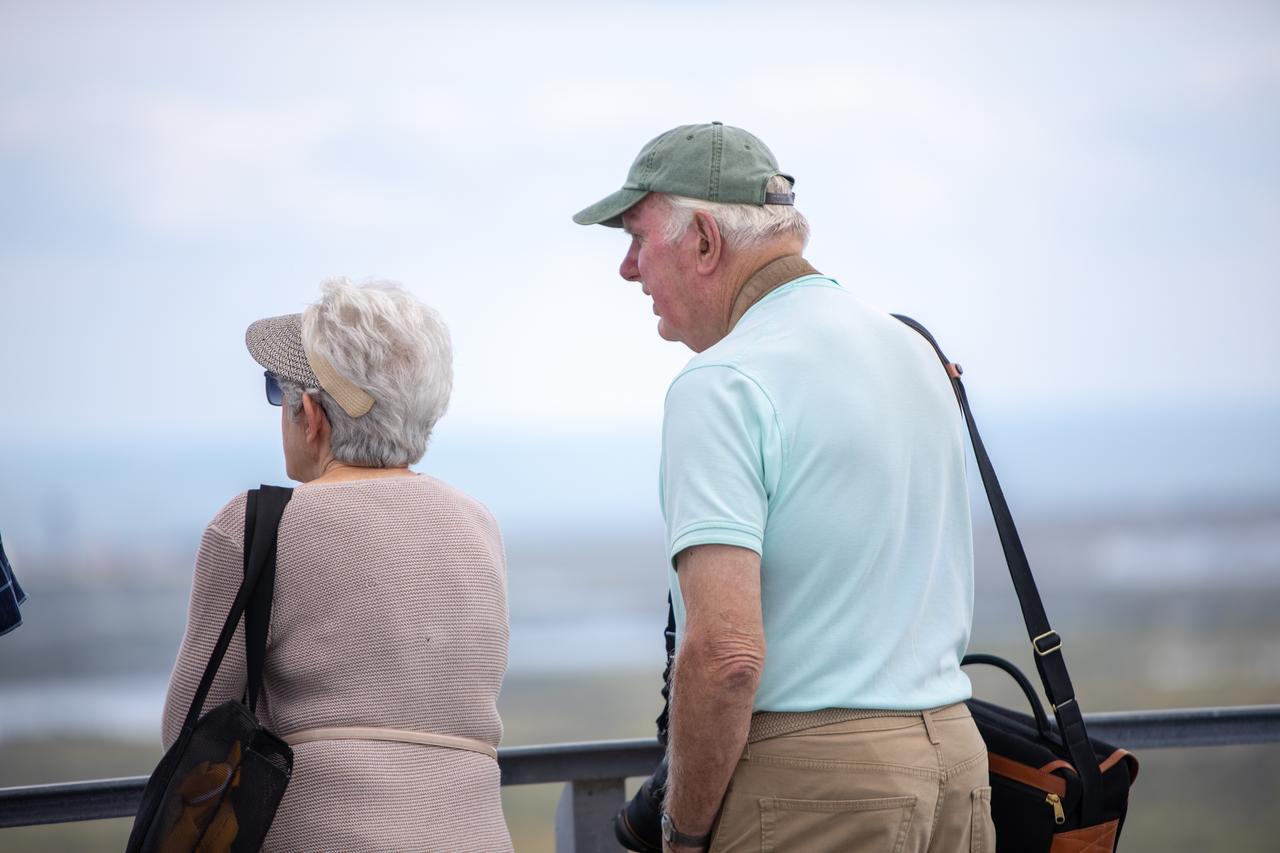
Dick Bergmann, at right, original lead designer for the Vehicle Assembly Building, stands on the roof of the iconic facility during a tour on Nov. 22, 2019 at NASA’s Kennedy Space Center in Florida. The VAB was recognized with the National Historic Civil Engineering Landmark award by the Florida Section American Society of Civil Engineers during a ceremony on Jan. 10, 2020. The VAB is the first building at Kennedy Space Center to earn this distinction. At the time of its completion, the 129-million-cubic-foot structure was the largest building in the world. Originally designed and built to accommodate the Saturn V/Apollo used in Project Apollo, the VAB was later modified for its role in the Space Shuttle Program.
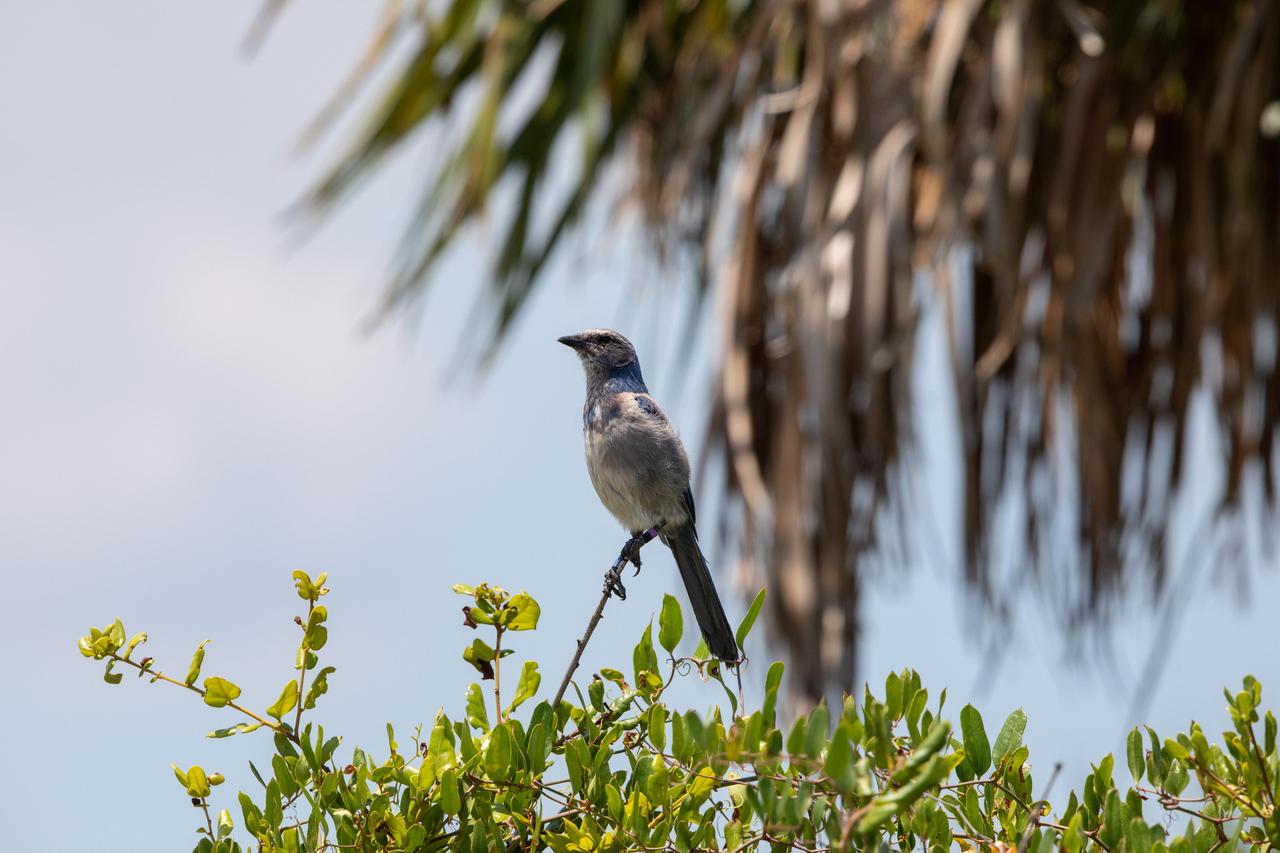
A scrub jay perches on a branch near the Vehicle Assembly Building (VAB) at NASA’s Kennedy Space Center in Florida on June 22, 2020. Painting of the NASA logo, also called the meatball, continues on the 525-foot-tall building. HM2 and H.I.S. Painting of Titusville, Florida, are repainting the meatball and the American Flag on the iconic building. The VAB was last painted in 2007, when repairs were completed after the 2004 Hurricanes Frances and Jeanne tore 845 panels off the building. It will take over 500 gallons of paint to paint the 209-by-110-foot flag and the 110-by-132-foot meatball. High Bay 3 inside the VAB has been upgraded with 10 new levels of work platforms that will surround and provide access for service and processing of NASA's Space Launch System (SLS) rocket and Orion spacecraft. Exploration Ground Systems is overseeing upgrades to the VAB to support the launch of the SLS and Orion for Artemis missions. Under the Artemis program, NASA will send the first woman and next man to the Moon.
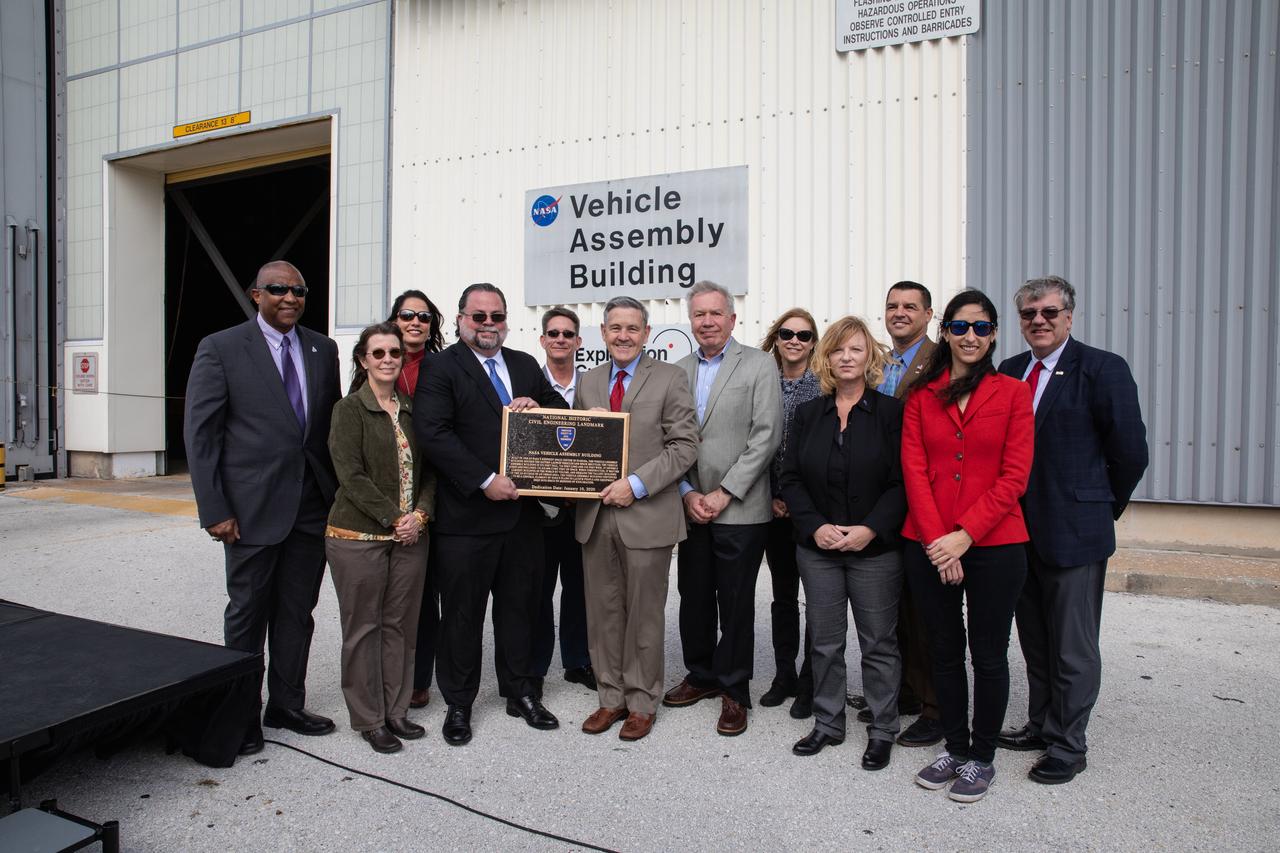
Kennedy Space Center Director Bob Cabana, center, accepts the National Historic Civil Engineering Landmark award from the Florida Section American Society of Civil Engineers (ASCE) for the Vehicle Assembly Building during a ceremony in front of the iconic facility on Jan. 10, 2020. Holding the award with Cabana is Peter Moore, ASCE Region 5 director. At far left is Kelvin Manning, associate director, technical. The ASCE nominated the historic building and bestowed the award. The VAB is the first building at Kennedy Space Center to earn this distinction. At the time of its completion, the 129-million-cubic-foot structure was the largest building in the world. Originally designed and built to accommodate the Saturn V/Apollo used in Project Apollo, the VAB was later modified for its role in the Space Shuttle Program.
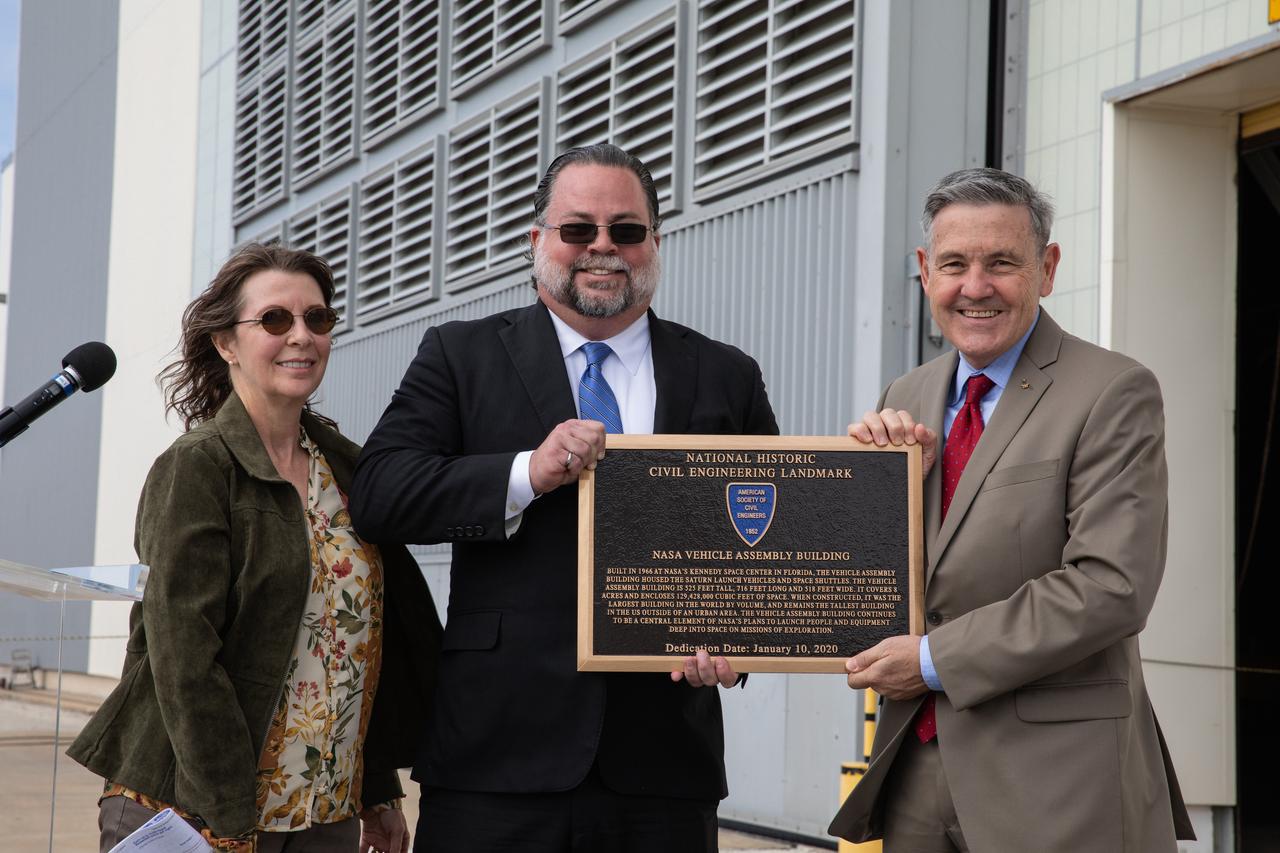
Kennedy Space Center Director Bob Cabana, far right, accepts the National Historic Civil Engineering Landmark award from the Florida Section American Society of Civil Engineers (ASCE) for the Vehicle Assembly Building during a ceremony in front of the iconic facility on Jan. 10, 2020. Next to Cabana, from left are Carol Stevens, ASCE Society of History and Heritage Committee member; and Peter Moore, ASCE Region 5 director. The ASCE nominated the historic building and bestowed the award. The VAB is the first building at Kennedy Space Center to earn this distinction. At the time of its completion, the 129-million-cubic-foot structure was the largest building in the world. Originally designed and built to accommodate the Saturn V/Apollo used in Project Apollo, the VAB was later modified for its role in the Space Shuttle Program.
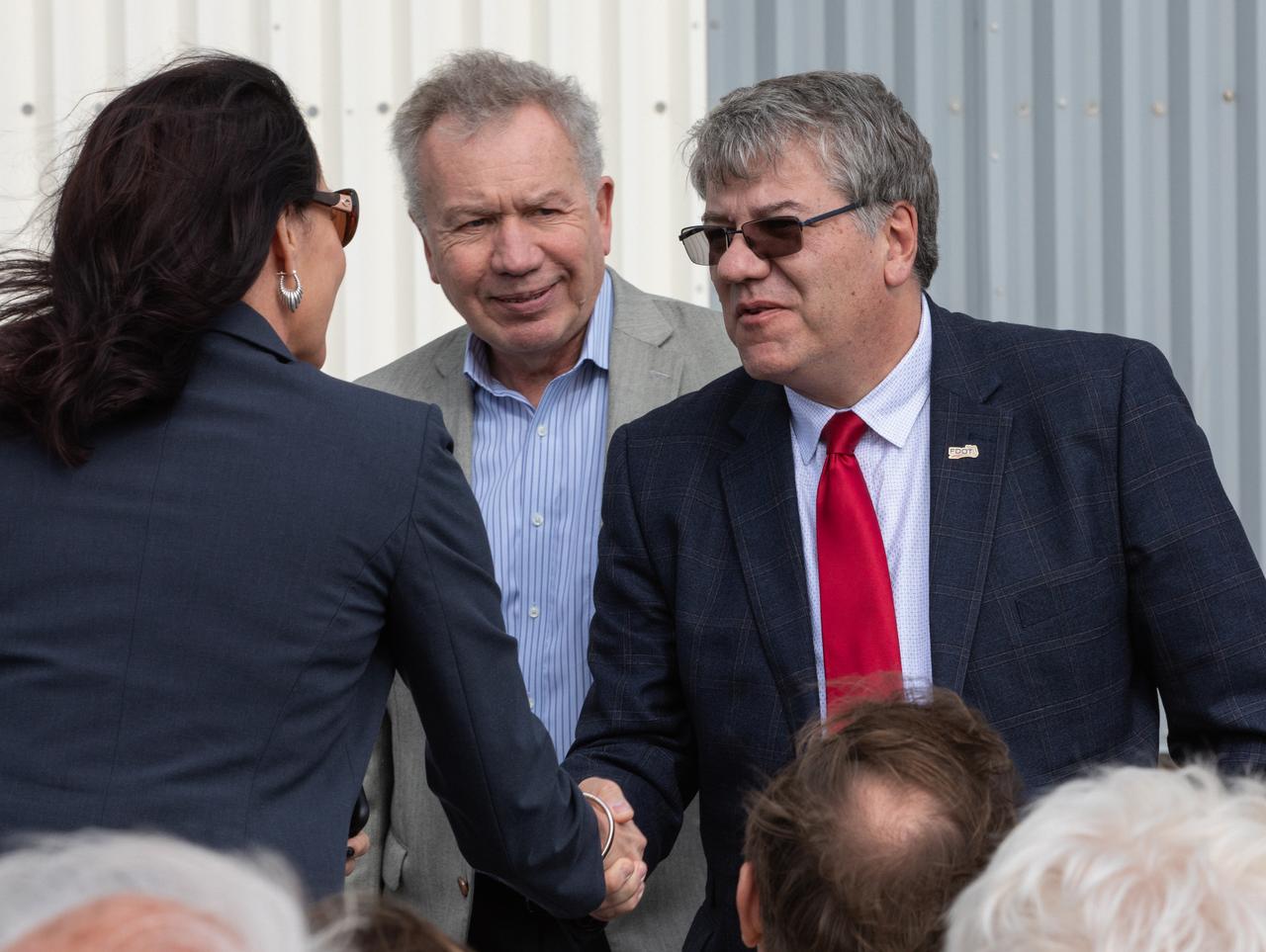
Florida Department of Transportation Secretary Kevin Thibault shakes hands with an attendee during a ceremony on Jan. 10, 2020, to recognize the Vehicle Assembly Building with the National Historic Civil Engineering Landmark award. The Florida Section American Society of Civil Engineers (ASCE) nominated the historic building and bestowed the award. Standing next to Thibault is Glenn Bell, ASCE Society of Structural Engineering Institute president. The VAB is the first building at Kennedy Space Center to earn this distinction. At the time of its completion, the 129-million-cubic-foot structure was the largest building in the world. Originally designed and built to accommodate the Saturn V/Apollo used in Project Apollo, the VAB was later modified for its role in the Space Shuttle Program.
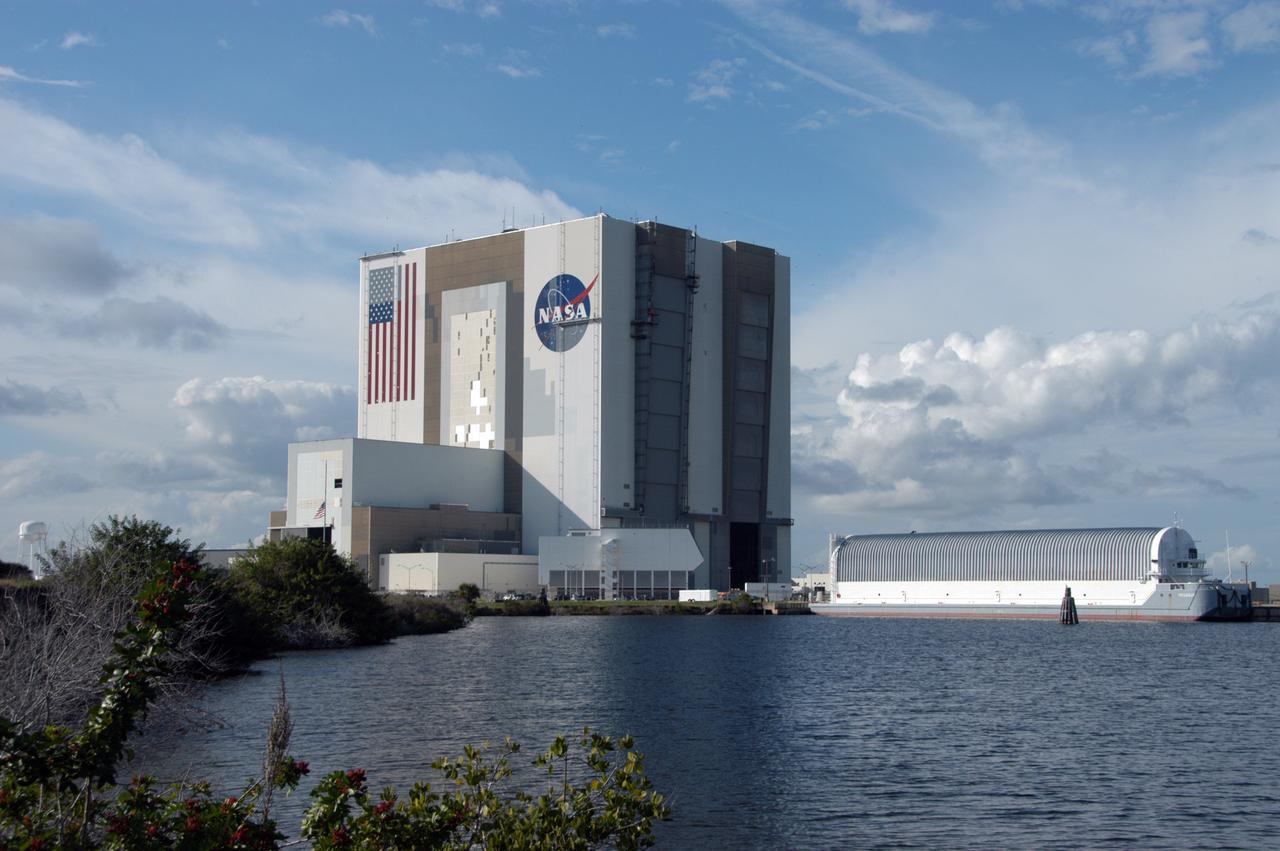
Elevated platforms are seen hanging on the side of Kennedy Space Center's Vehicle Assembly Building in a view looking across from the turn basin. To the right is the large external tank barge. Workers, suspended on the platforms from the top of the 525-foot-high VAB, use rollers and brushes to do the painting. The flag and logo were last painted in 1998, honoring NASA's 40th anniversary. The flag spans an area 209 feet by 110 feet, or about 23, 437 square feet. Each stripe is 9 feet wide and each star is 6 feet in diameter. The logo, also known as the "meatball," measures 110 feet by 132 feet, or about 12,300 square feet.
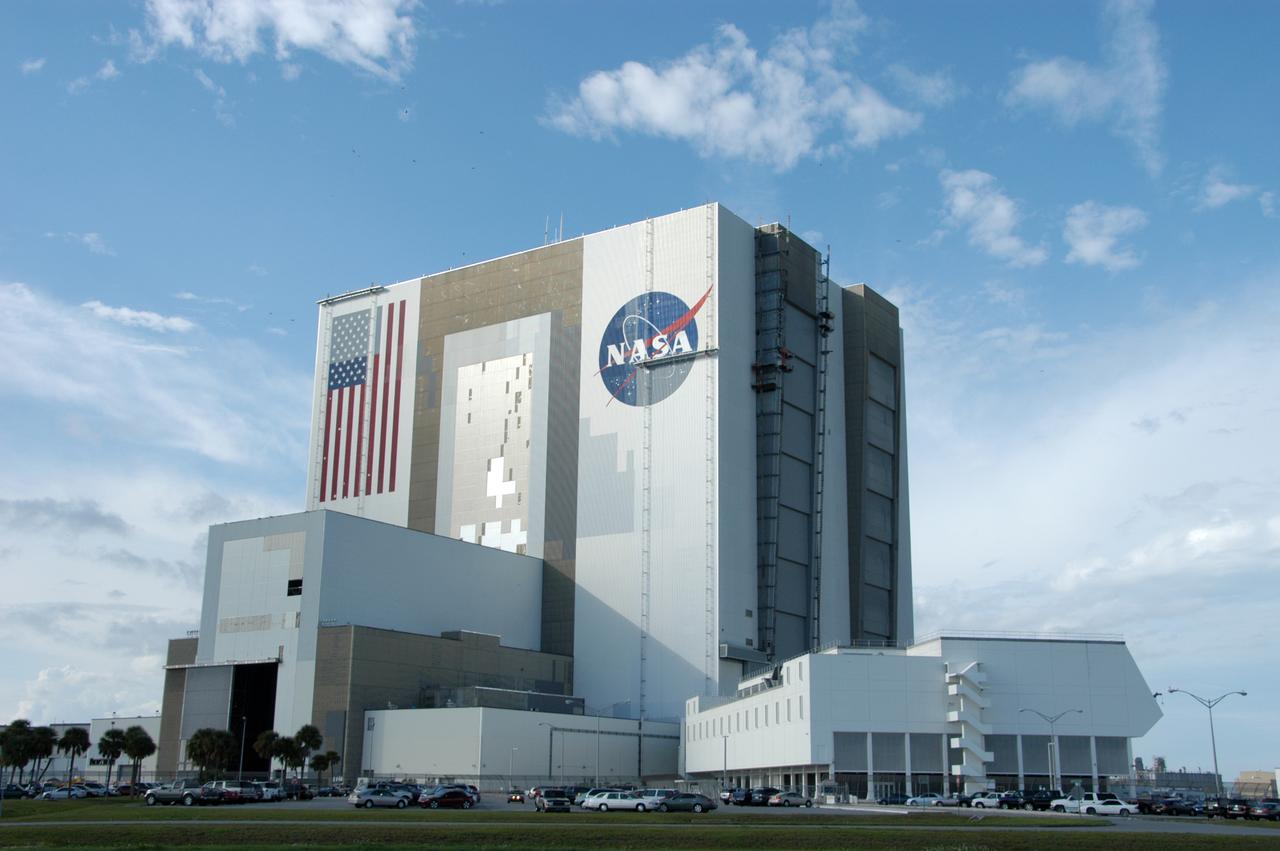
Elevated platforms are seen hanging in front of the NASA Logo on the side of Kennedy Space Center's Vehicle Assembly Building. Also in view on the east side of the building are platforms on the facility's large vertical doors. Workers, suspended on the platforms from the top of the 525-foot-high VAB, use rollers and brushes to do the painting. The flag and logo were last painted in 1998, honoring NASA's 40th anniversary. The flag spans an area 209 feet by 110 feet, or about 23, 437 square feet. Each stripe is 9 feet wide and each star is 6 feet in diameter. The logo, also known as the "meatball," measures 110 feet by 132 feet, or about 12,300 square feet.
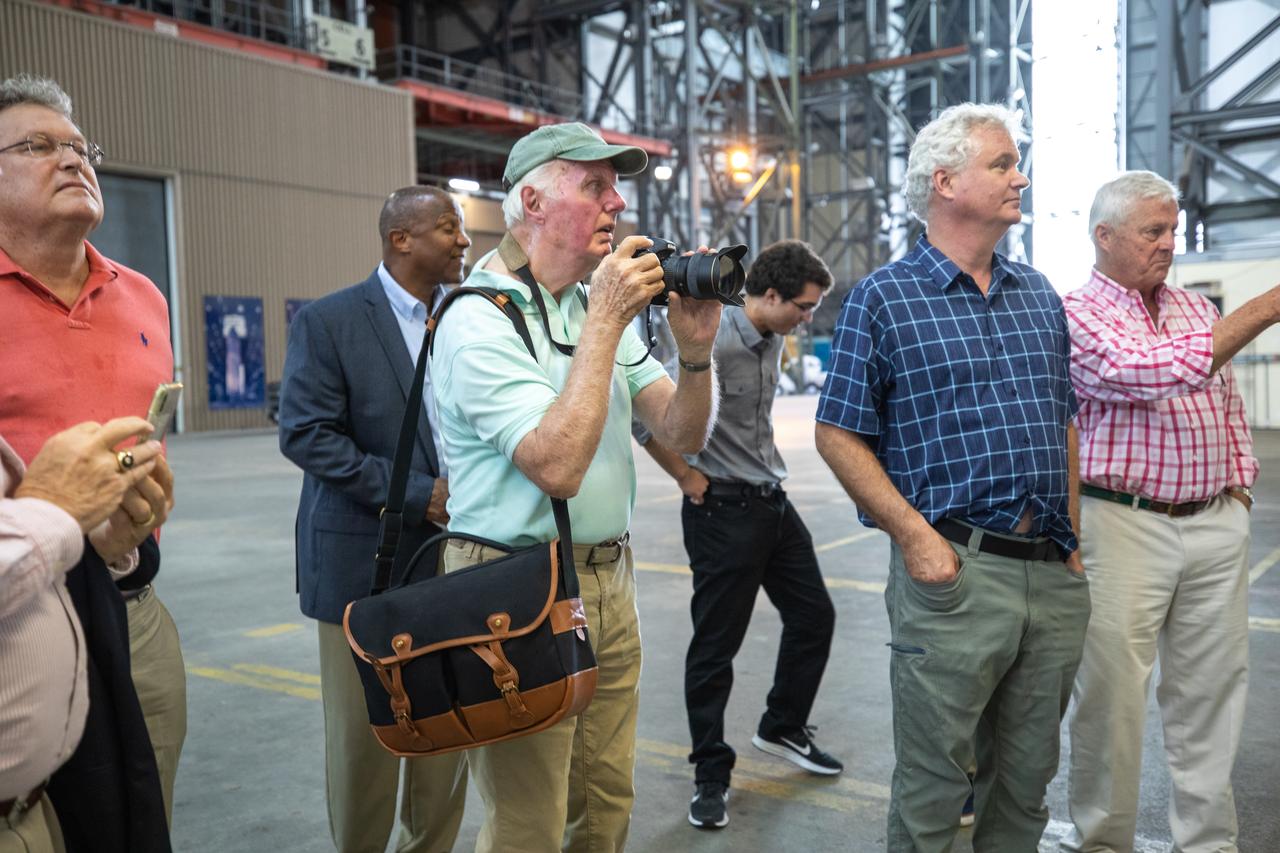
Dick Bergmann, far left in front, original lead designer for the Vehicle Assembly Building (VAB), tours the iconic facility at Kennedy Space Center in Florida with descendants of Max Urbahn, the original architect, on Nov. 22, 2019. Behind Bergmann is Kelvin Manning, Kennedy associate director, technical. The Florida Section American Society of Civil Engineers bestowed its National Historic Civil Engineering Landmark award to the facility. The VAB is the first building at Kennedy Space Center to earn this distinction. At the time of its completion, the 129-million-cubic-foot structure was the largest building in the world. Originally designed and built to accommodate the Saturn V/Apollo used in Project Apollo, the VAB was later modified for its role in the Space Shuttle Program.
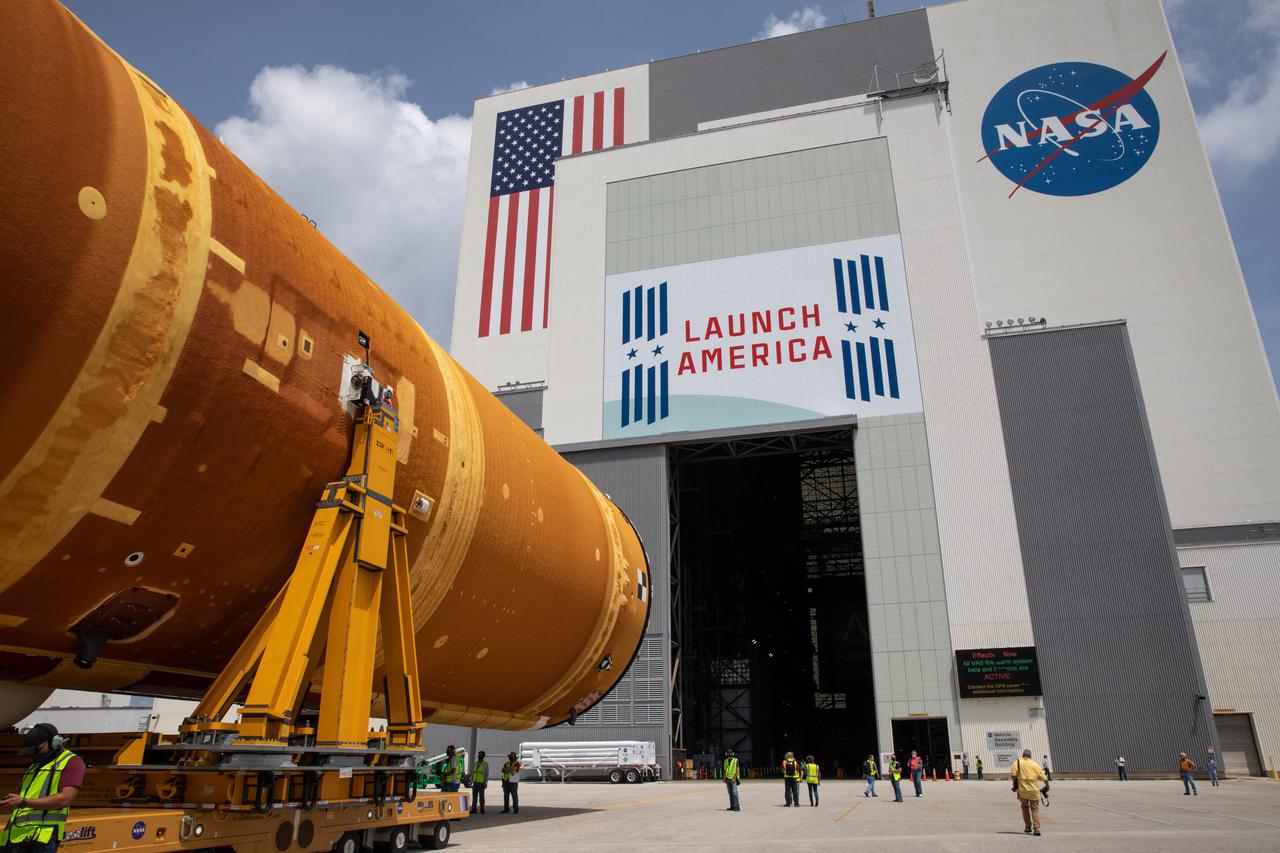
Artemis I Core Stage Offload to VAB
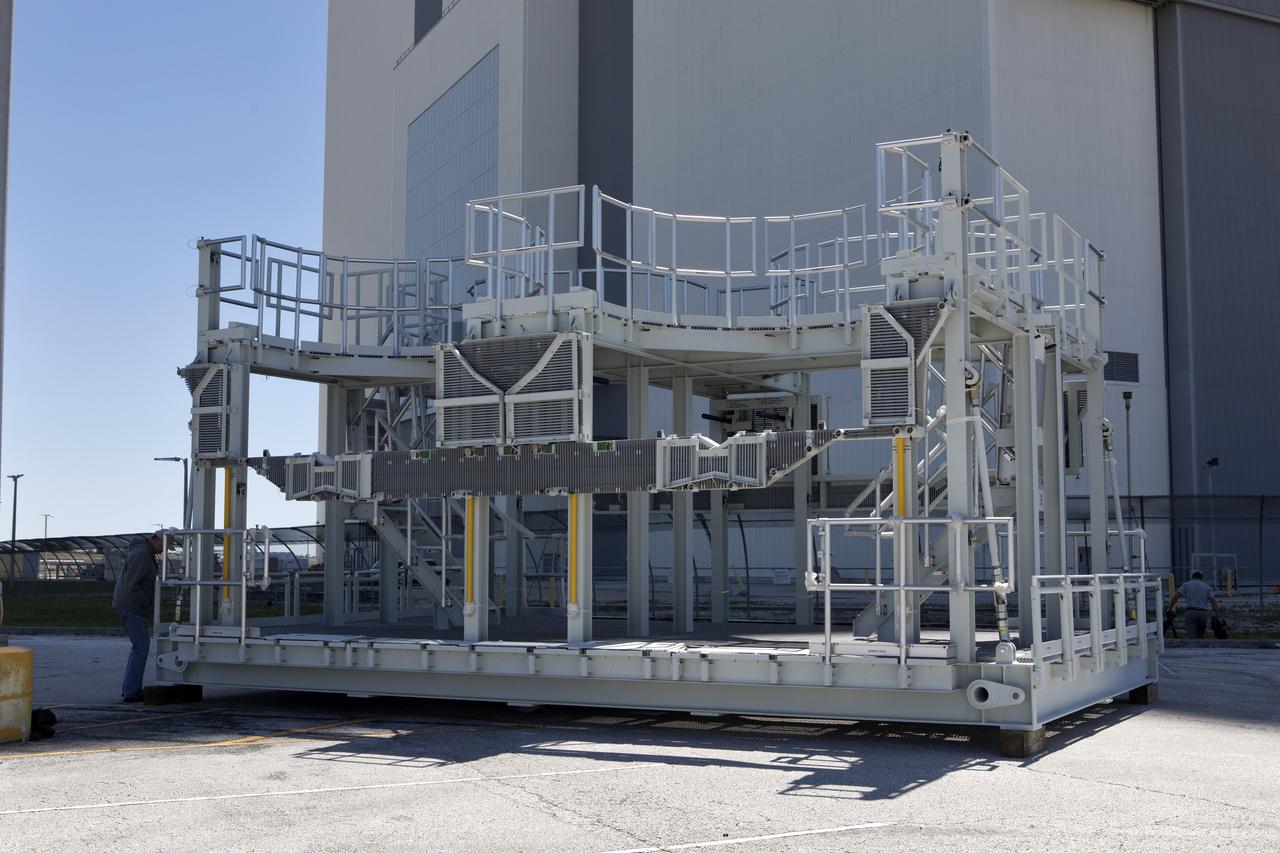
A new service platform for NASA's Space Launch System booster engines is being prepared for the move into the Vehicle Assembly Building (VAB) at the agency's Kennedy Space Center in Florida. The platform was transported from fabricator Met-Con Inc. in Cocoa, Florida. It will be stored in the VAB, and used for processing and checkout of the engines for the rocket's twin five-segment solid rocket boosters for Exploration Mission-1. EM-1 will launch an uncrewed Orion spacecraft to a stable orbit beyond the Moon and bring it back to Earth for a splashdown in the Pacific Ocean.
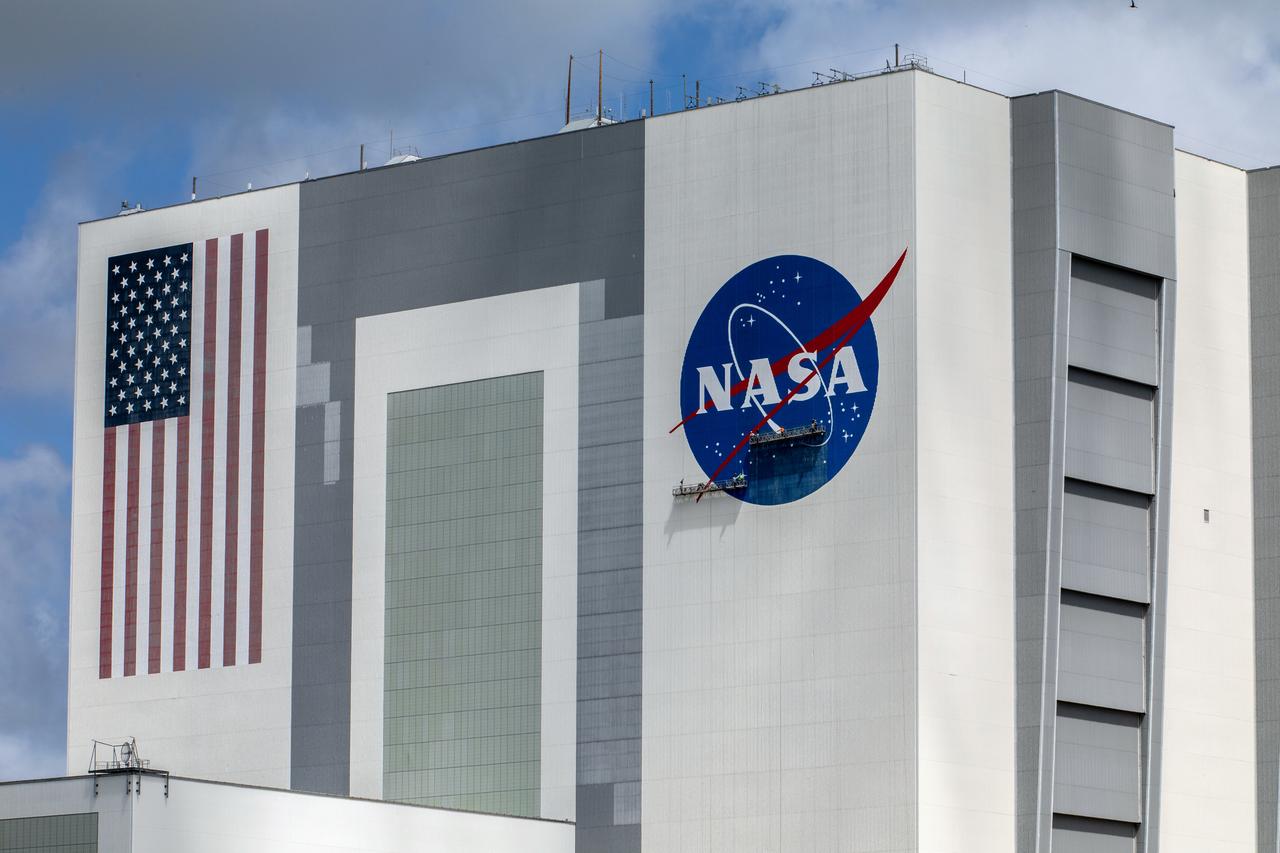
Painting of the NASA logo, also called the meatball, continues on the 525-foot-tall Vehicle Assembly Building (VAB) at the agency’s Kennedy Space Center in Florida on May 29 2020. HM2 and H.I.S. Painting of Titusville, Florida, are repainting the meatball and the American Flag on the iconic building. High Bay 3 inside the VAB has been upgraded with 10 new levels of work platforms that will surround and provide access for service and processing of NASA's Space Launch System (SLS) rocket and Orion spacecraft. Exploration Ground Systems is overseeing upgrades to the VAB to support the launch of the SLS and Orion for Artemis missions. Under the Artemis program, NASA will send the first woman and next man to the Moon.
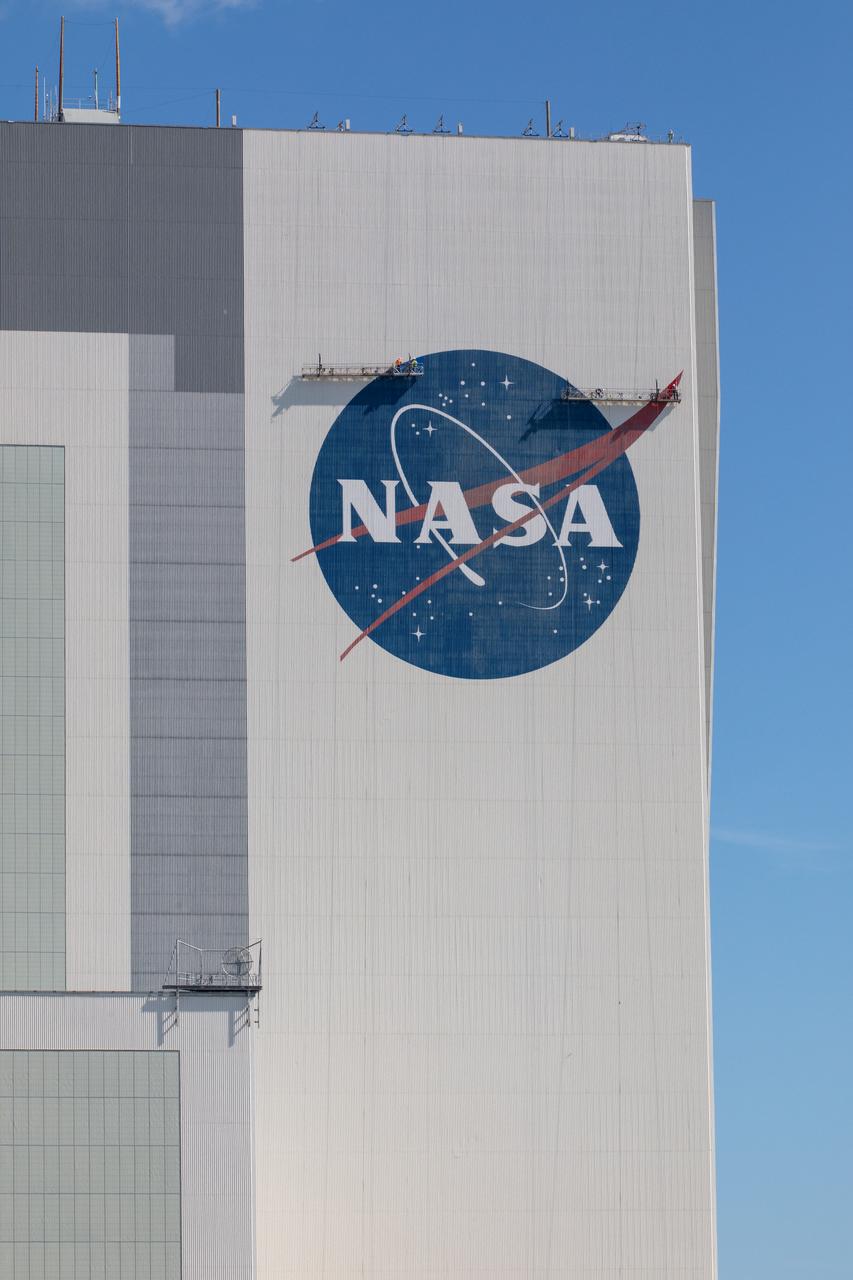
Painting of the NASA logo, also called the meatball, is underway on the 525-foot-tall Vehicle Assembly Building (VAB) at the agency’s Kennedy Space Center in Florida on May 8, 2020. HM2 and H.I.S. Painting of Titusville, Florida, are repainting the meatball and the American Flag on the iconic building. High Bay 3 inside the VAB has been upgraded with 10 new levels of work platforms that will surround and provide access for service and processing of NASA's Space Launch System (SLS) rocket and Orion spacecraft. Exploration Ground Systems is overseeing upgrades to the VAB to support the launch of the SLS and Orion for Artemis missions. Under the Artemis program, NASA will send the first woman and next man to the Moon.
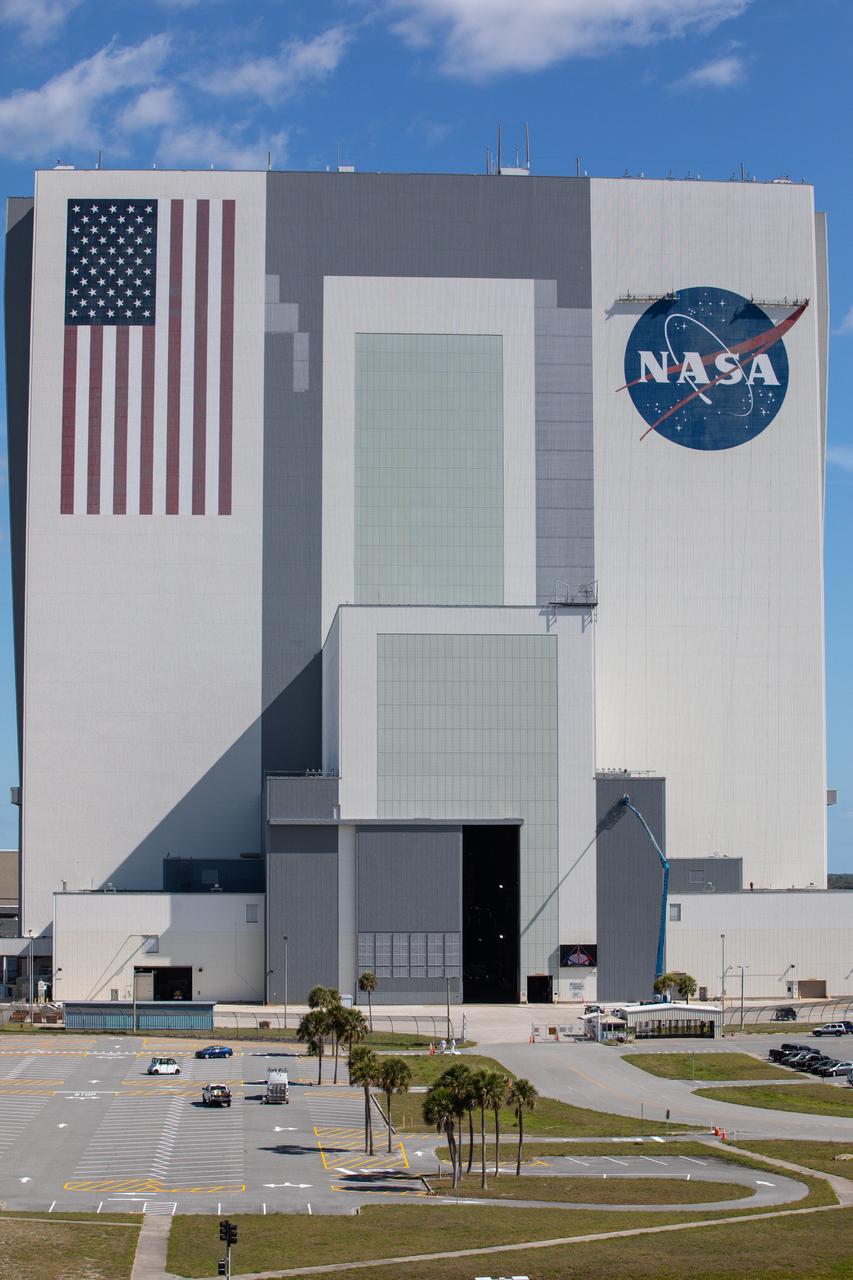
Painting of the NASA logo, also called the meatball, is underway on the 525-foot-tall Vehicle Assembly Building (VAB) at the agency’s Kennedy Space Center in Florida on May 8, 2020. HM2 and H.I.S. Painting of Titusville, Florida, are repainting the meatball and the American Flag on the iconic building. High Bay 3 inside the VAB has been upgraded with 10 new levels of work platforms that will surround and provide access for service and processing of NASA's Space Launch System (SLS) rocket and Orion spacecraft. Exploration Ground Systems is overseeing upgrades to the VAB to support the launch of the SLS and Orion for Artemis missions. Under the Artemis program, NASA will send the first woman and next man to the Moon.
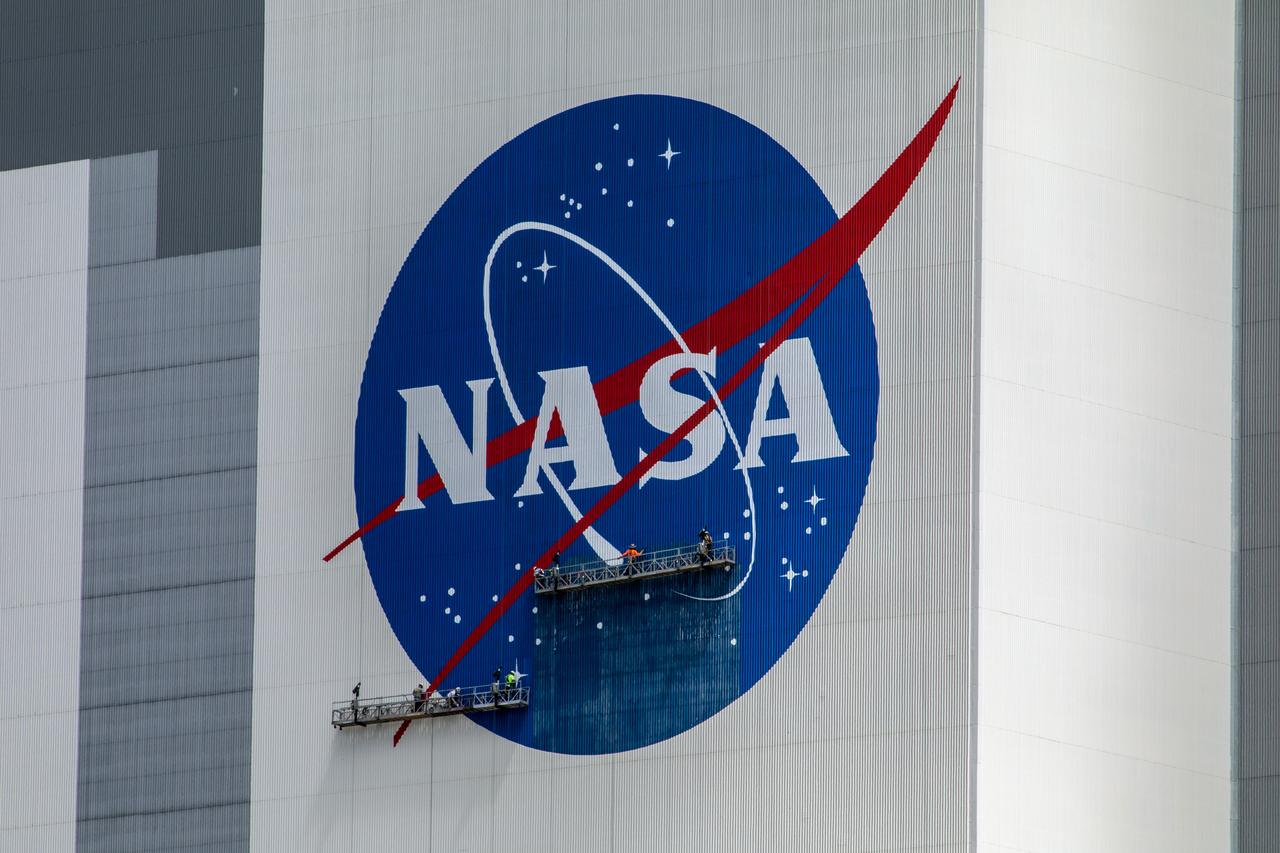
Painting of the NASA logo, also called the meatball, continues on the 525-foot-tall Vehicle Assembly Building (VAB) at the agency’s Kennedy Space Center in Florida on May 29 2020. HM2 and H.I.S. Painting of Titusville, Florida, are repainting the meatball and the American Flag on the iconic building. High Bay 3 inside the VAB has been upgraded with 10 new levels of work platforms that will surround and provide access for service and processing of NASA's Space Launch System (SLS) rocket and Orion spacecraft. Exploration Ground Systems is overseeing upgrades to the VAB to support the launch of the SLS and Orion for Artemis missions. Under the Artemis program, NASA will send the first woman and next man to the Moon.
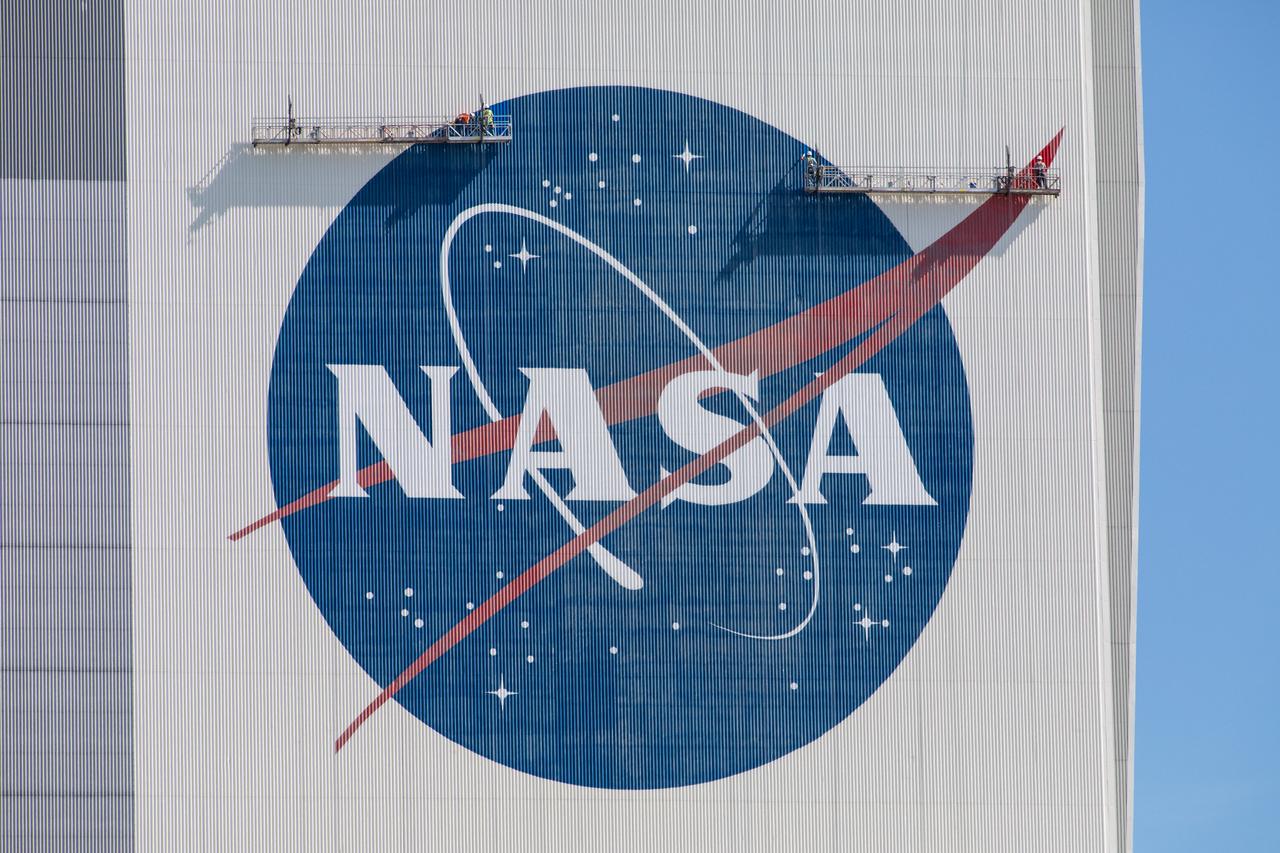
Painting of the NASA logo, also called the meatball, is underway on the 525-foot-tall Vehicle Assembly Building (VAB) at the agency’s Kennedy Space Center in Florida on May 8, 2020. HM2 and H.I.S. Painting of Titusville, Florida, are repainting the meatball and the American Flag on the iconic building. High Bay 3 inside the VAB has been upgraded with 10 new levels of work platforms that will surround and provide access for service and processing of NASA's Space Launch System (SLS) rocket and Orion spacecraft. Exploration Ground Systems is overseeing upgrades to the VAB to support the launch of the SLS and Orion for Artemis missions. Under the Artemis program, NASA will send the first woman and next man to the Moon.
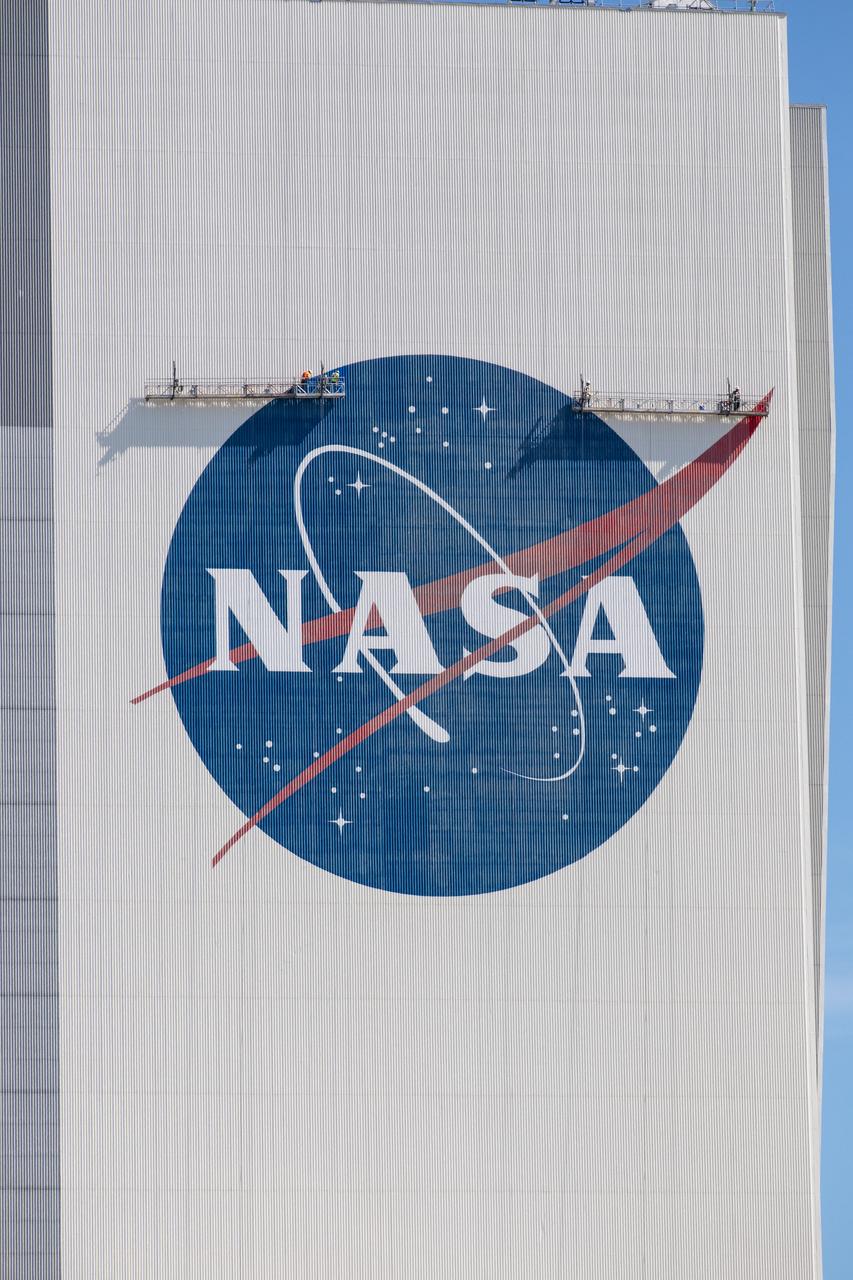
Painting of the NASA logo, also called the meatball, is underway on the 525-foot-tall Vehicle Assembly Building (VAB) at the agency’s Kennedy Space Center in Florida on May 8, 2020. HM2 and H.I.S. Painting of Titusville, Florida, are repainting the meatball and the American Flag on the iconic building. High Bay 3 inside the VAB has been upgraded with 10 new levels of work platforms that will surround and provide access for service and processing of NASA's Space Launch System (SLS) rocket and Orion spacecraft. Exploration Ground Systems is overseeing upgrades to the VAB to support the launch of the SLS and Orion for Artemis missions. Under the Artemis program, NASA will send the first woman and next man to the Moon.
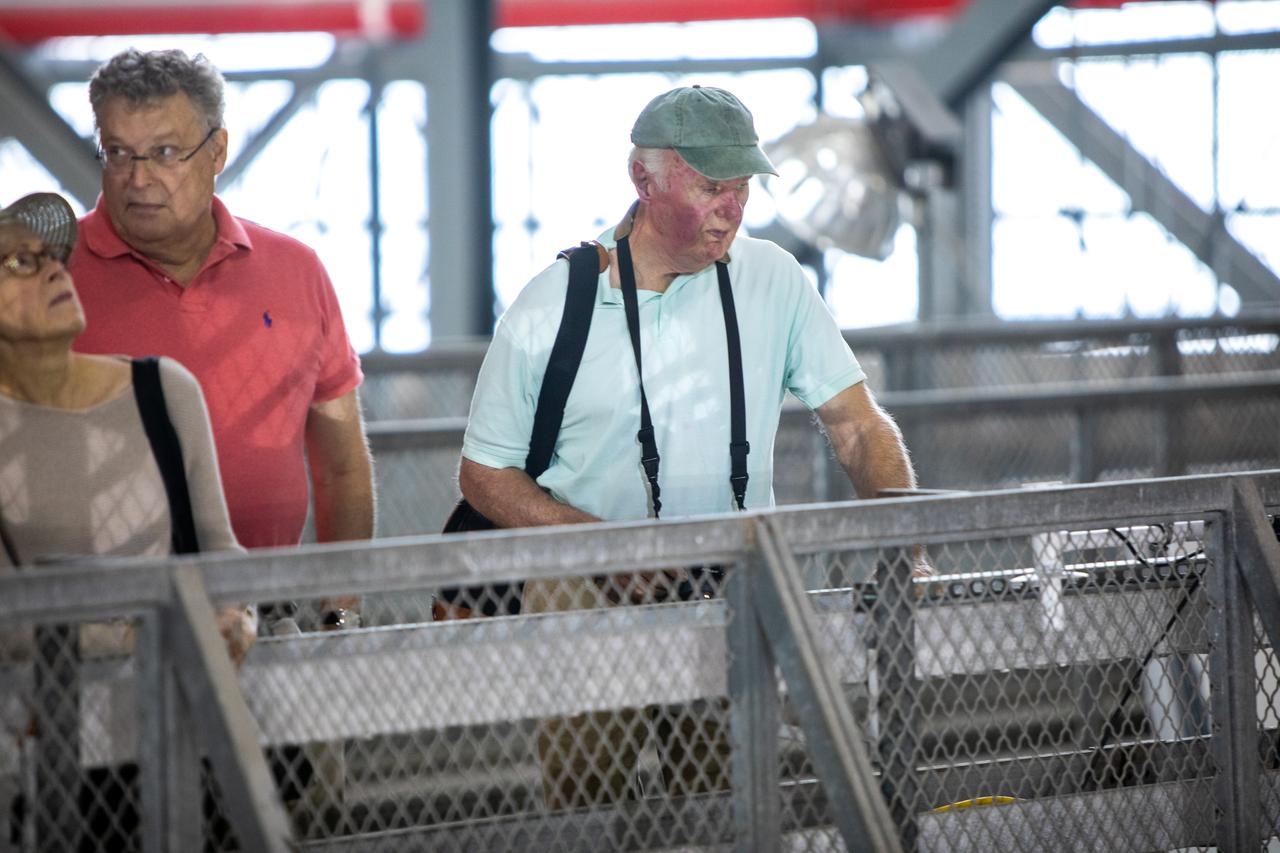
Dick Bergmann, at right, original lead designer for the Vehicle Assembly Building, tours the iconic facility on Nov. 22, 2019 at NASA’s Kennedy Space Center in Florida. Vehicle Assembly Building with the National Historic Civil Engineering Landmark award. The Florida Section American Society of Civil Engineers bestowed its National Historic Civil Engineering Landmark award during a ceremony on Jan. 10, 2020. The VAB is the first building at Kennedy Space Center to earn this distinction. At the time of its completion, the 129-million-cubic-foot structure was the largest building in the world. Originally designed and built to accommodate the Saturn V/Apollo used in Project Apollo, the VAB was later modified for its role in the Space Shuttle Program.
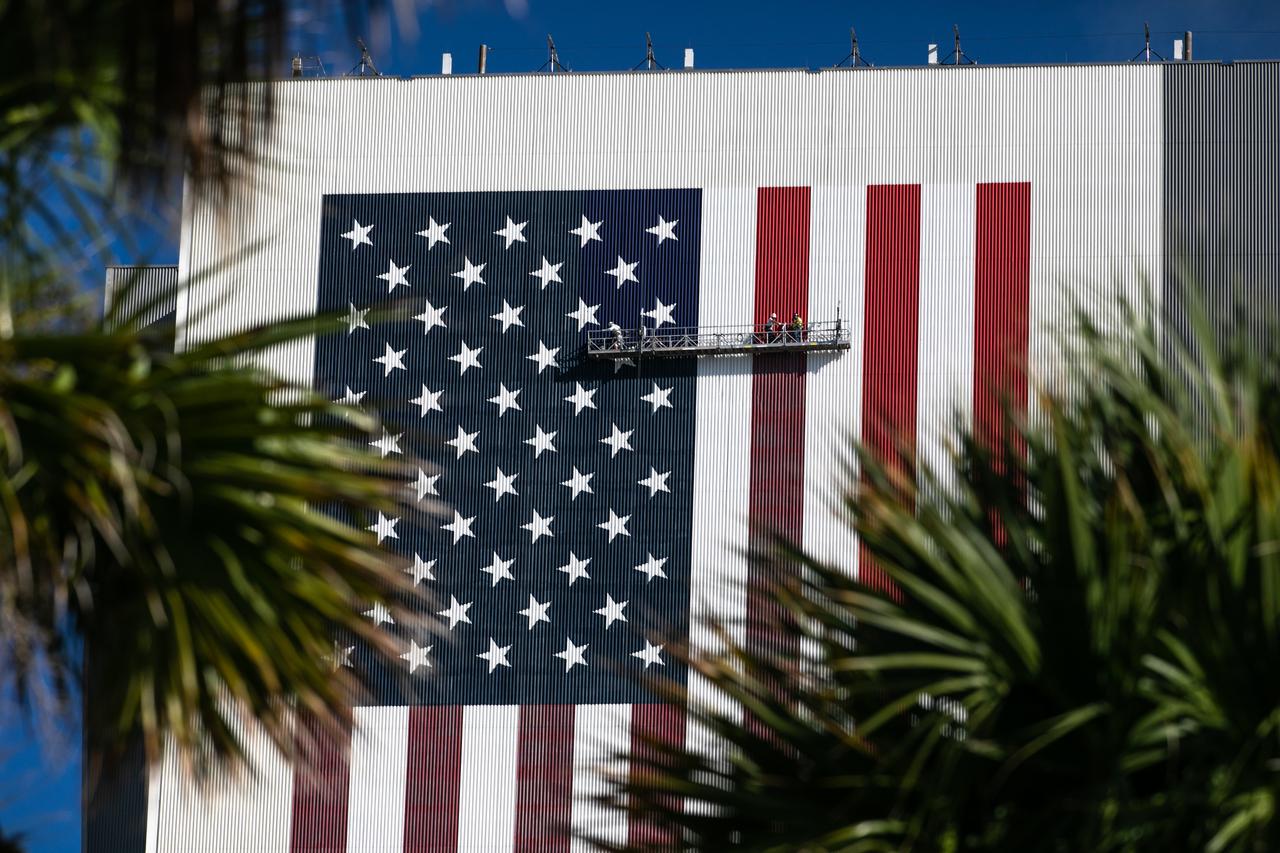
Painting of the U.S. flag continues on the 525-foot-tall Vehicle Assembly Building (VAB) at NASA’s Kennedy Space Center in Florida on Sept. 17, 2020. HM2 and H.I.S. Painting of Titusville, Florida, are repainting the American Flag on the iconic building. The flag is 209 feet long by 110 feet wide. Each star is more than six feet in diameter, and each stripe is nine feet wide. Exploration Ground Systems is overseeing upgrades to the VAB to support the launch of the Space Launch System and Orion for Artemis missions. Under the Artemis program, NASA will send the first woman and next man to the Moon.
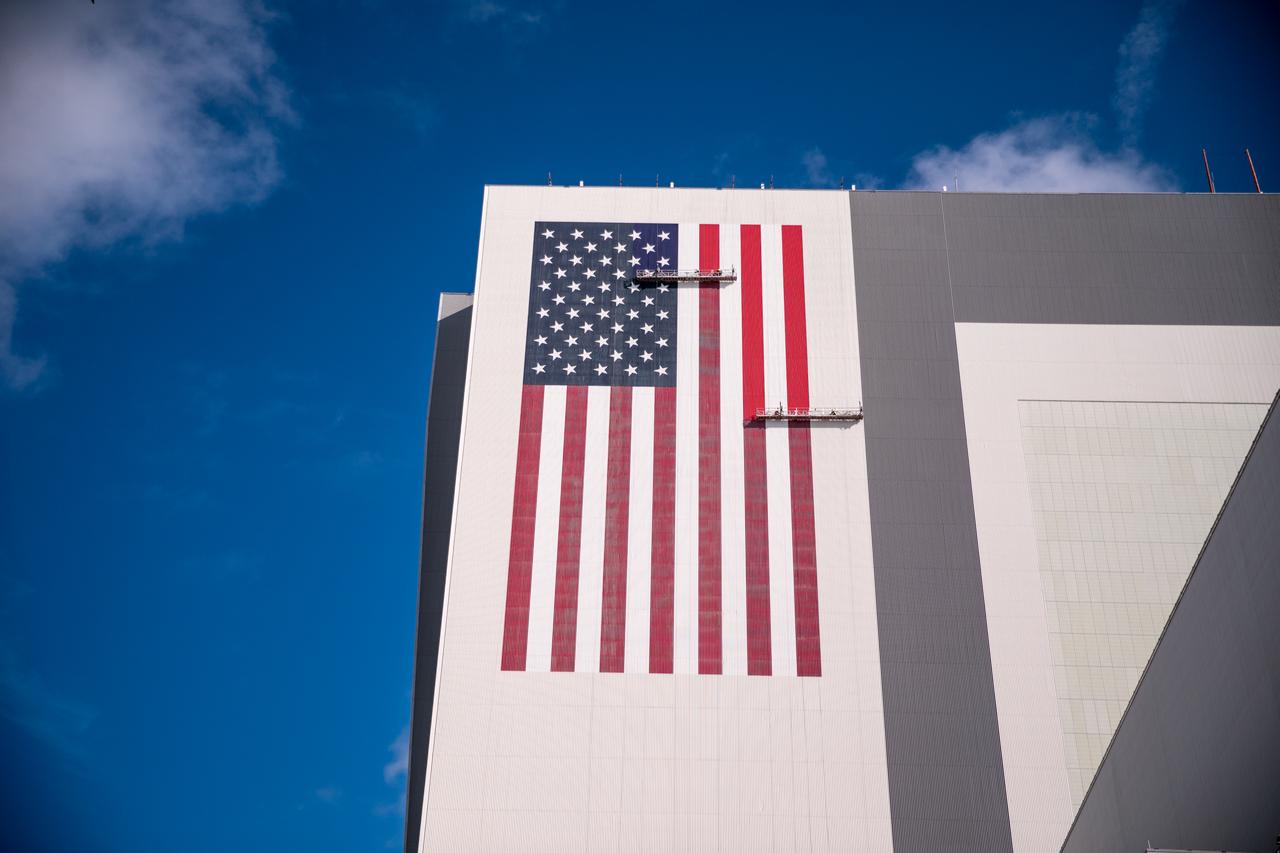
Painting of the U.S. flag continues on the 525-foot-tall Vehicle Assembly Building (VAB) at NASA’s Kennedy Space Center in Florida on Sept. 17, 2020. HM2 and H.I.S. Painting of Titusville, Florida, are repainting the American Flag on the iconic building. The flag is 209 feet long by 110 feet wide. Each star is more than six feet in diameter, and each stripe is nine feet wide. Exploration Ground Systems is overseeing upgrades to the VAB to support the launch of the Space Launch System and Orion for Artemis missions. Under the Artemis program, NASA will send the first woman and next man to the Moon.
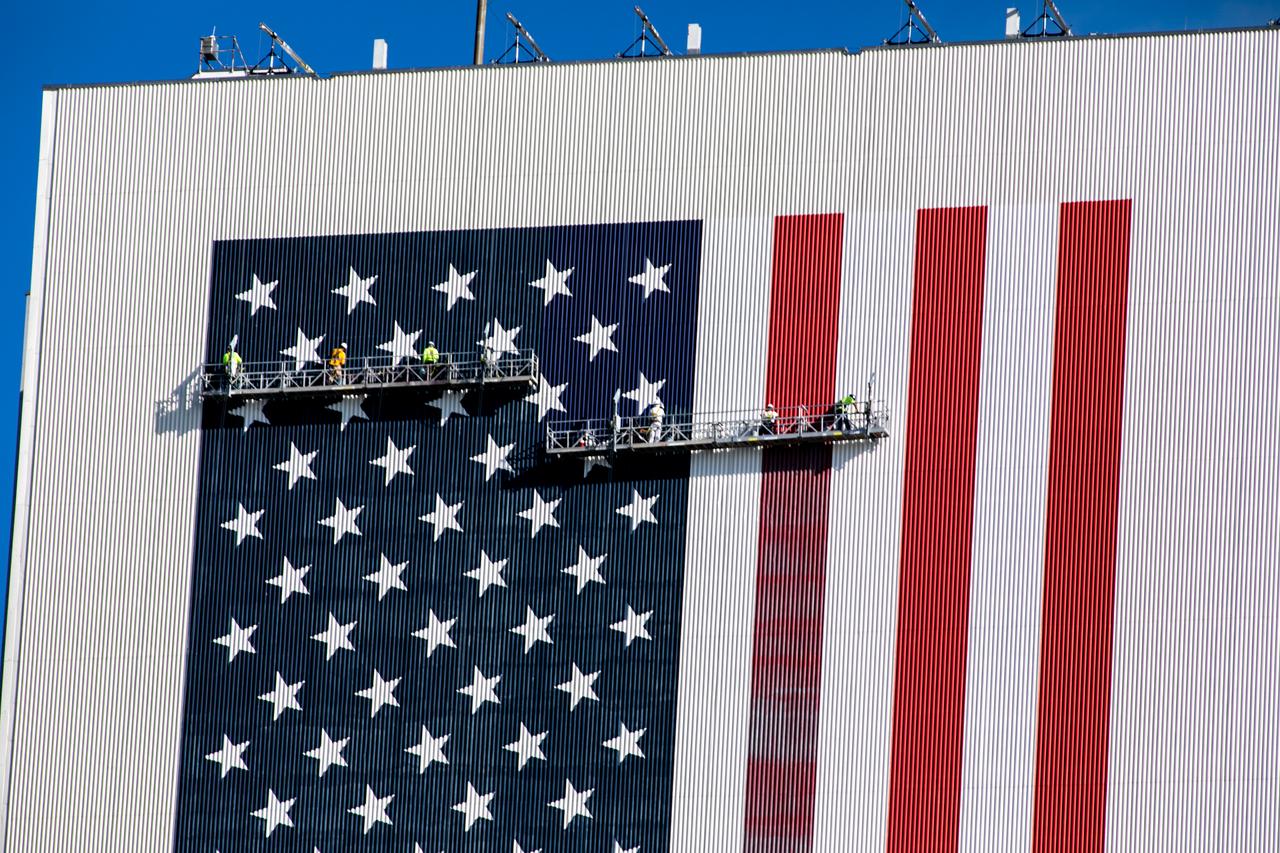
Painting of the U.S. flag continues on the 525-foot-tall Vehicle Assembly Building (VAB) at NASA’s Kennedy Space Center in Florida on Sept. 17, 2020. HM2 and H.I.S. Painting of Titusville, Florida, are repainting the American Flag on the iconic building. The flag is 209 feet long by 110 feet wide. Each star is more than six feet in diameter, and each stripe is nine feet wide. Exploration Ground Systems is overseeing upgrades to the VAB to support the launch of the Space Launch System and Orion for Artemis missions. Under the Artemis program, NASA will send the first woman and next man to the Moon.
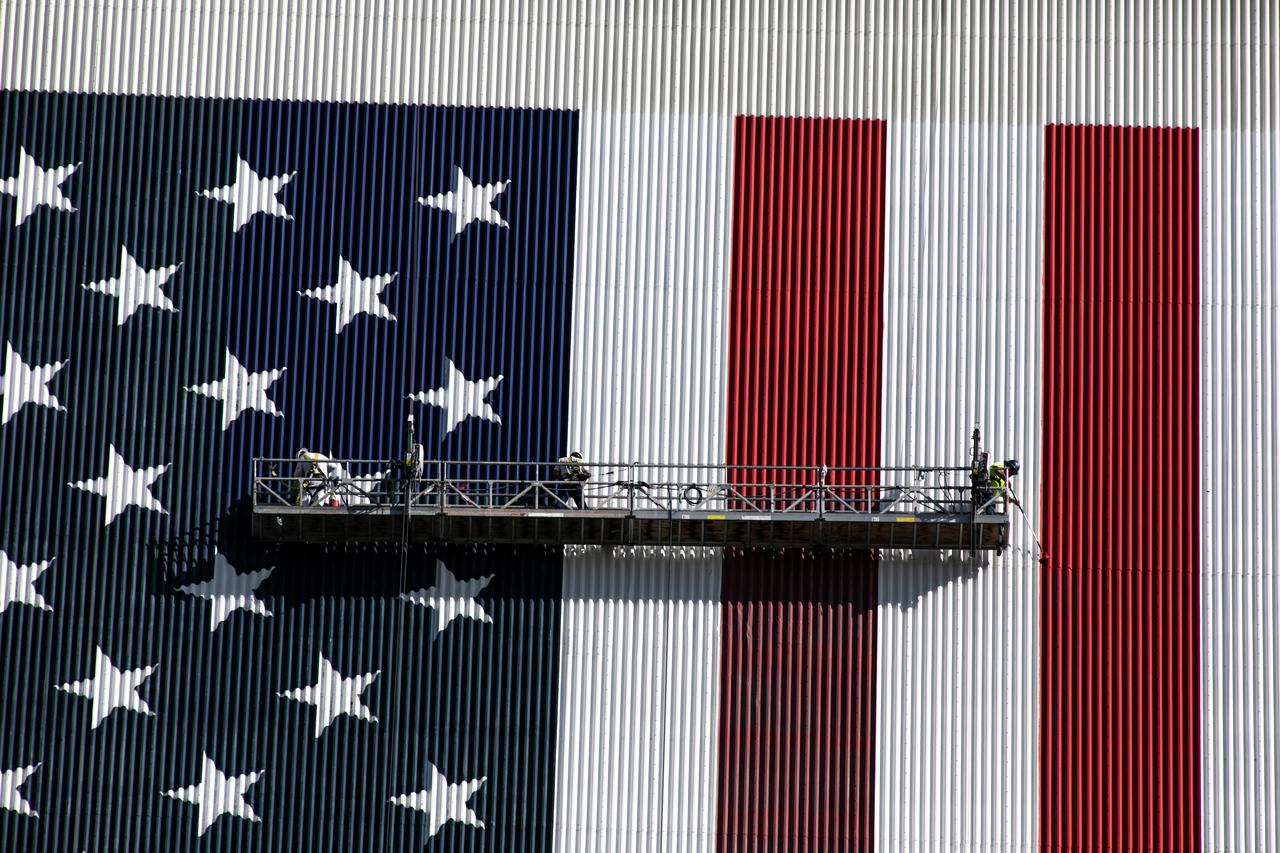
Painting of the U.S. flag continues on the 525-foot-tall Vehicle Assembly Building (VAB) in this close-up view at NASA’s Kennedy Space Center in Florida on Sept. 17, 2020. HM2 and H.I.S. Painting of Titusville, Florida, are repainting the American Flag on the iconic building. The flag is 209 feet long by 110 feet wide. Each star is more than six feet in diameter, and each stripe is nine feet wide. Exploration Ground Systems is overseeing upgrades to the VAB to support the launch of the Space Launch System and Orion for Artemis missions. Under the Artemis program, NASA will send the first woman and next man to the Moon.
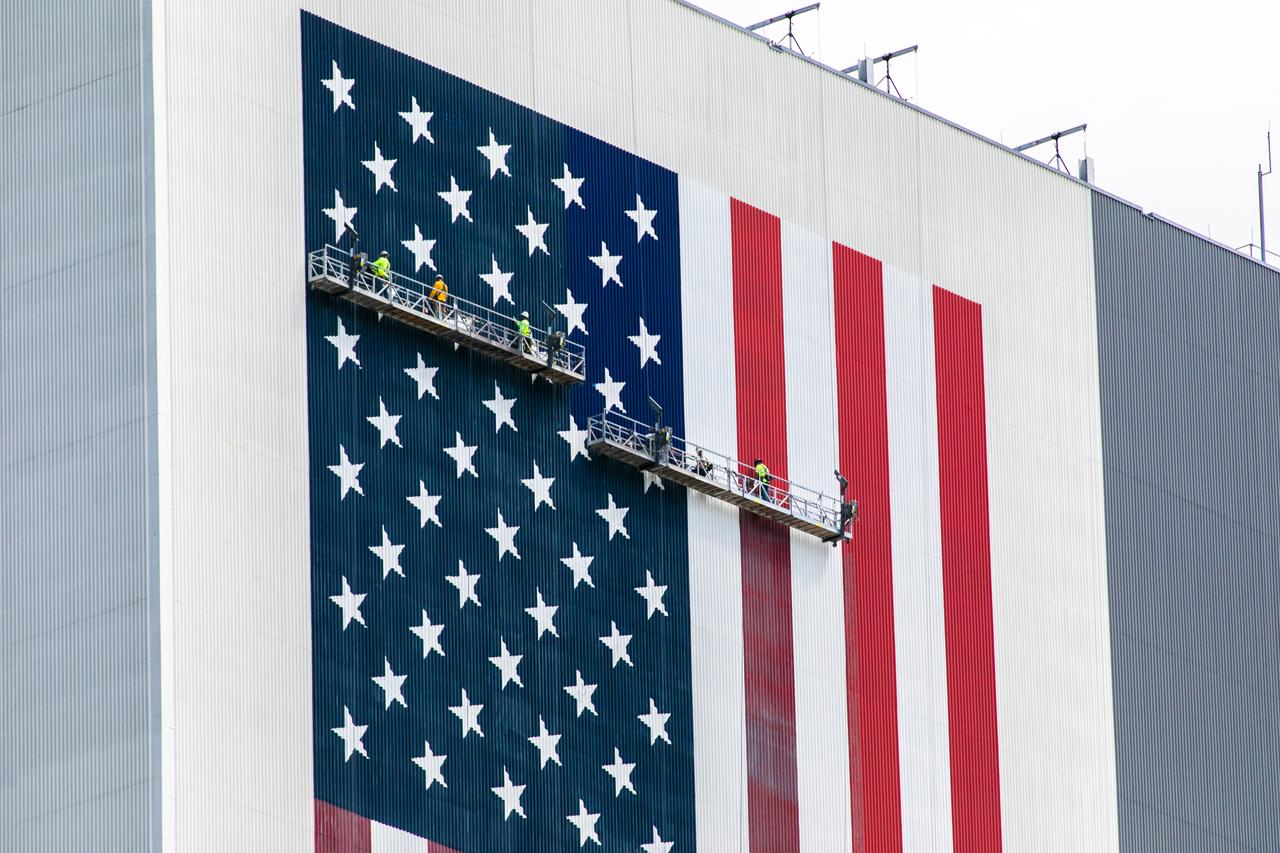
Painting of the U.S. flag continues on the 525-foot-tall Vehicle Assembly Building (VAB) in this close-up view at NASA’s Kennedy Space Center in Florida on Sept. 17, 2020. HM2 and H.I.S. Painting of Titusville, Florida, are repainting the American Flag on the iconic building. The flag is 209 feet long by 110 feet wide. Each star is more than six feet in diameter, and each stripe is nine feet wide. Exploration Ground Systems is overseeing upgrades to the VAB to support the launch of the Space Launch System and Orion for Artemis missions. Under the Artemis program, NASA will send the first woman and next man to the Moon.
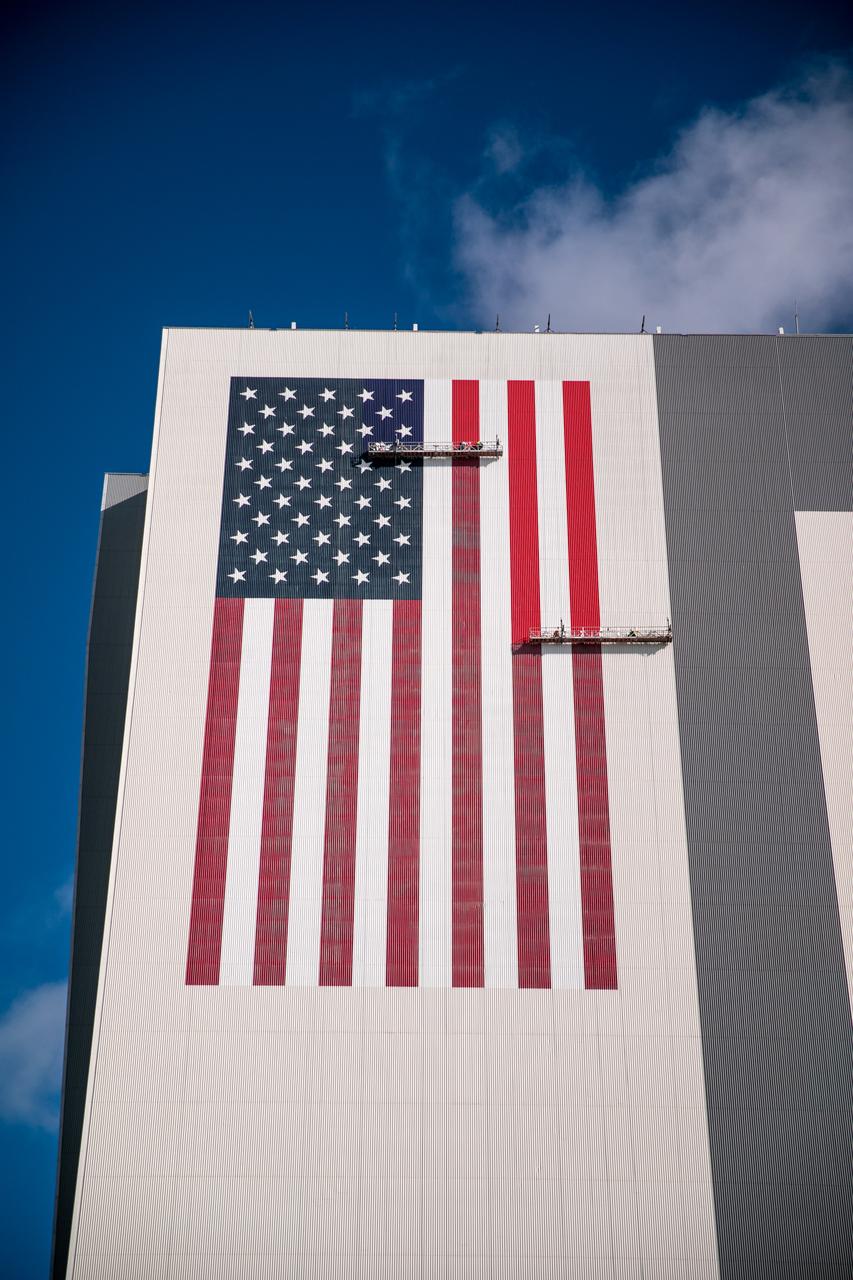
Painting of the U.S. flag continues on the 525-foot-tall Vehicle Assembly Building (VAB) at NASA’s Kennedy Space Center in Florida on Sept. 17, 2020. HM2 and H.I.S. Painting of Titusville, Florida, are repainting the American Flag on the iconic building. The flag is 209 feet long by 110 feet wide. Each star is more than six feet in diameter, and each stripe is nine feet wide. Exploration Ground Systems is overseeing upgrades to the VAB to support the launch of the Space Launch System and Orion for Artemis missions. Under the Artemis program, NASA will send the first woman and next man to the Moon.
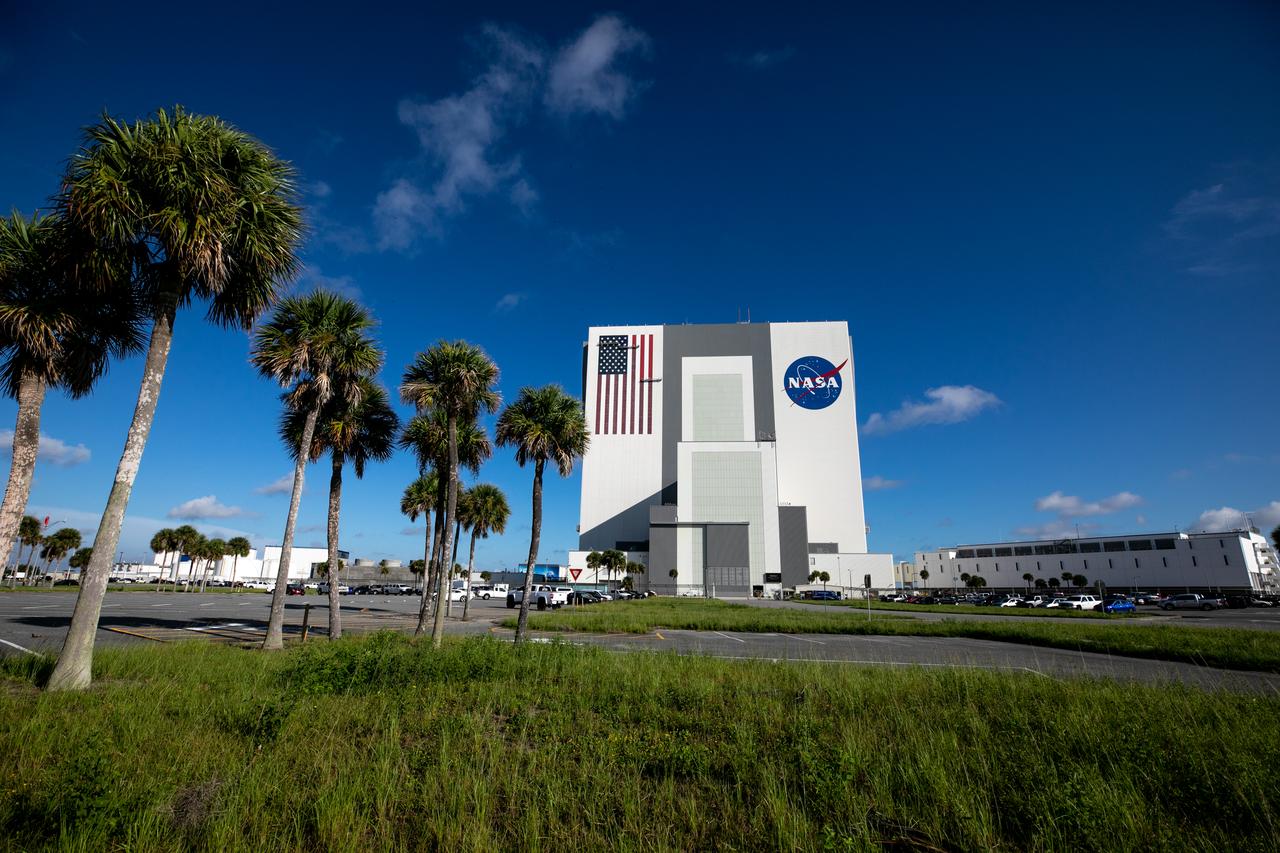
A view of the 525-foot-tall Vehicle Assembly Building (VAB) at NASA’s Kennedy Space Center in Florida, as painting of the U.S. flag continues on the iconic building on Sept. 17, 2020. HM2 and H.I.S. Painting of Titusville, Florida, are repainting the American Flag on the building. The flag is 209 feet long by 110 feet wide. Each star is more than six feet in diameter, and each stripe is nine feet wide. Exploration Ground Systems is overseeing upgrades to the VAB to support the launch of the Space Launch System and Orion for Artemis missions. Under the Artemis program, NASA will send the first woman and next man to the Moon.
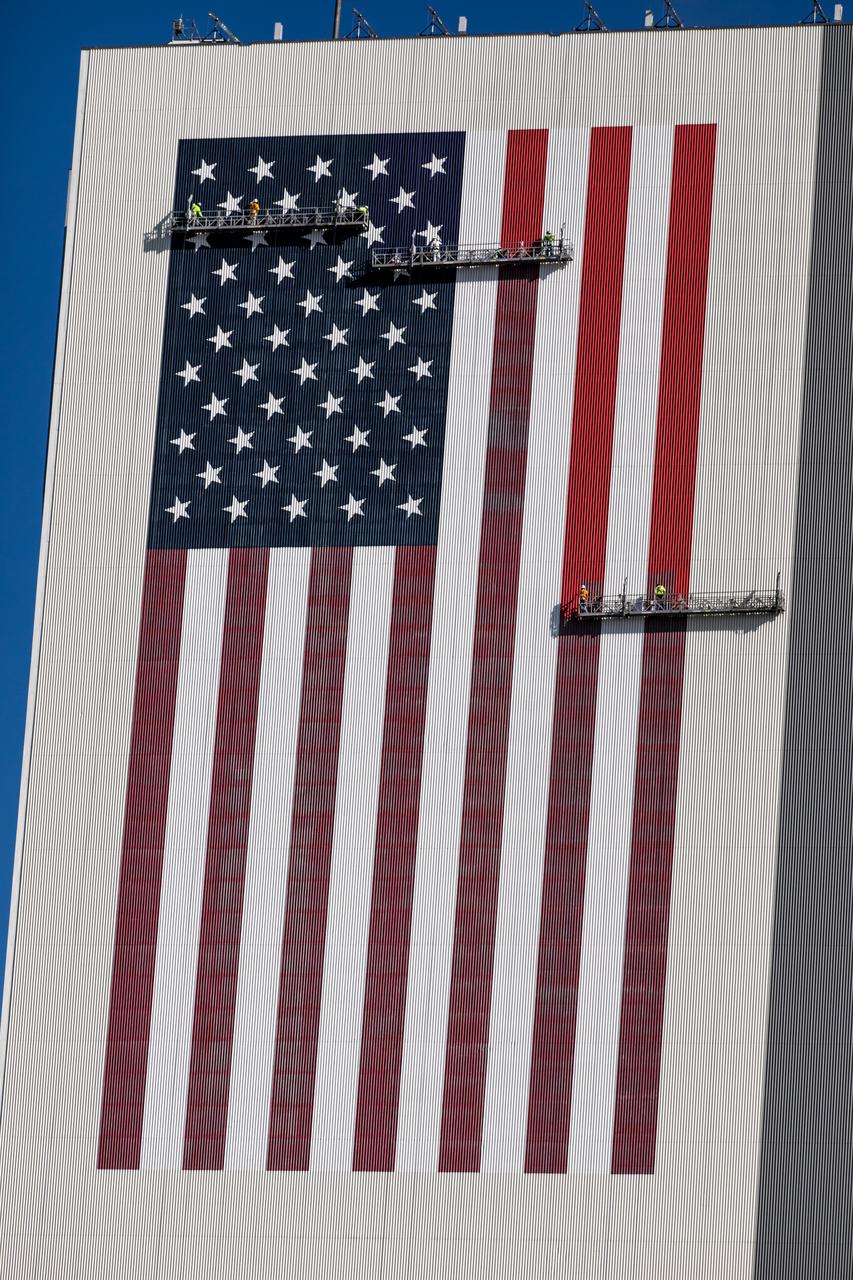
Painting of the U.S. flag continues on the 525-foot-tall Vehicle Assembly Building (VAB) at NASA’s Kennedy Space Center in Florida on Sept. 17, 2020. HM2 and H.I.S. Painting of Titusville, Florida, are repainting the American Flag on the iconic building. The flag is 209 feet long by 110 feet wide. Each star is more than six feet in diameter, and each stripe is nine feet wide. Exploration Ground Systems is overseeing upgrades to the VAB to support the launch of the Space Launch System and Orion for Artemis missions. Under the Artemis program, NASA will send the first woman and next man to the Moon.
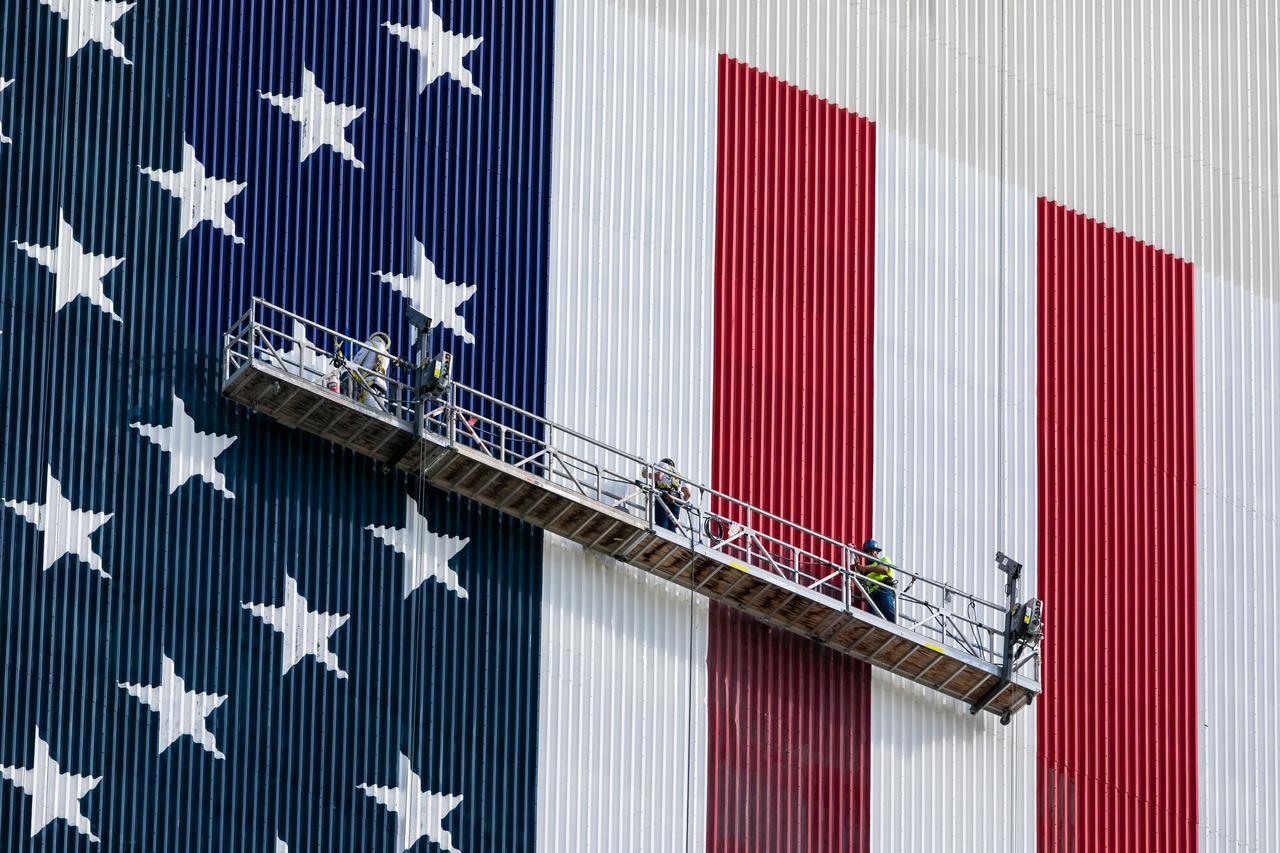
Painting of the U.S. flag continues on the 525-foot-tall Vehicle Assembly Building (VAB) in this close-up view at NASA’s Kennedy Space Center in Florida on Sept. 17, 2020. HM2 and H.I.S. Painting of Titusville, Florida, are repainting the American Flag on the iconic building. The flag is 209 feet long by 110 feet wide. Each star is more than six feet in diameter, and each stripe is nine feet wide. Exploration Ground Systems is overseeing upgrades to the VAB to support the launch of the Space Launch System and Orion for Artemis missions. Under the Artemis program, NASA will send the first woman and next man to the Moon.
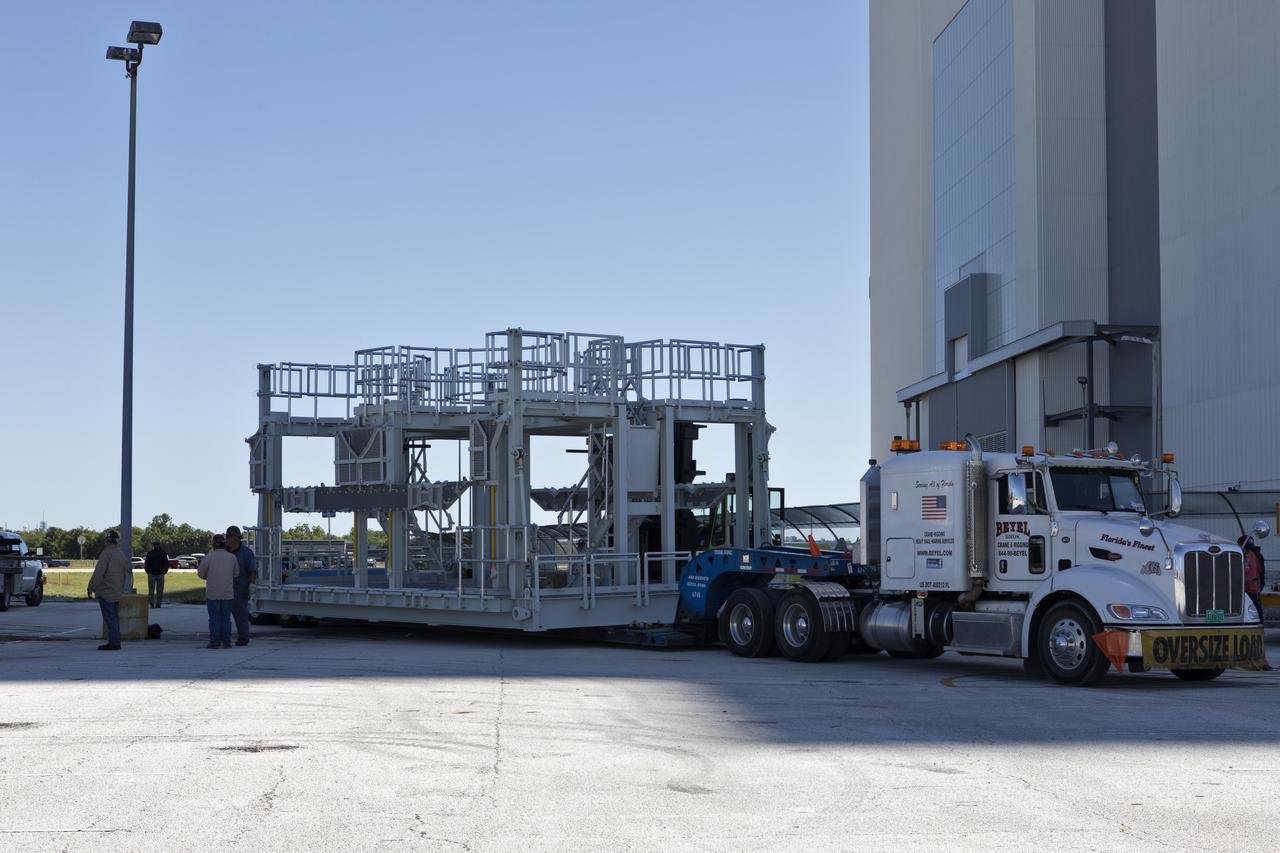
A new service platform for NASA's Space Launch System booster engines, secured on a flatbed truck, has arrived at the Vehicle Assembly Building (VAB) at the agency's Kennedy Space Center in Florida. It was transported from fabricator Met-Con Inc. in Cocoa, Florida. The platform will be stored in the VAB and used for processing and checkout of the engines for the rocket's twin five-segment solid rocket boosters for Exploration Mission-1 (EM-1). During EM-1, an uncrewed Orion spacecraft will launch on the SLS to a stable orbit beyond the Moon and return to Earth for a splashdown in the Pacific Ocean.
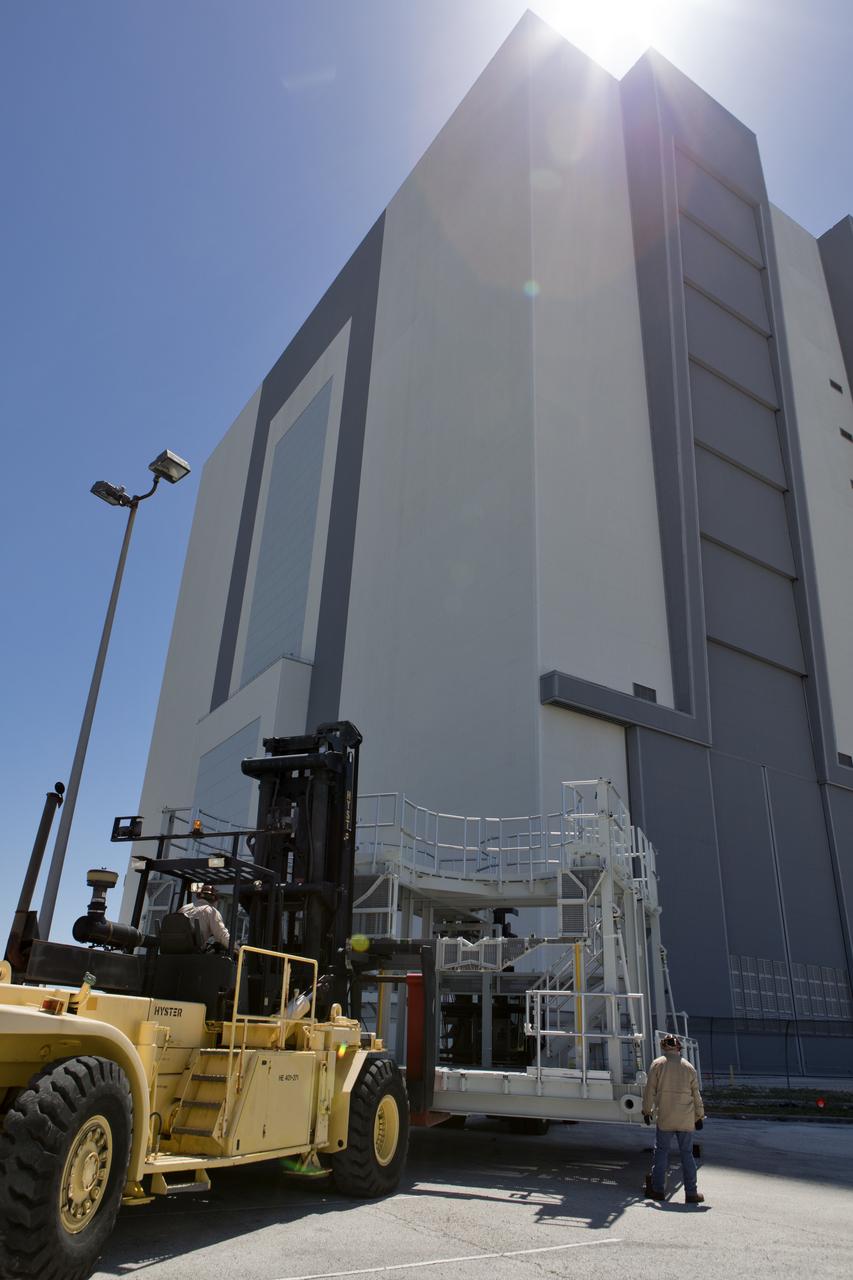
A new service platform for NASA's Space Launch System booster engines has been offloaded from a flatbed truck and is being prepared for the move into the Vehicle Assembly Building (VAB) at the agency's Kennedy Space Center in Florida. The platform was transported from fabricator Met-Con Inc. in Cocoa, Florida. It will be stored in the VAB, and used for processing and checkout of the engines for the rocket's twin five-segment solid rocket boosters for Exploration Mission-1. EM-1 will launch an uncrewed Orion spacecraft to a stable orbit beyond the Moon and bring it back to Earth for a splashdown in the Pacific Ocean.
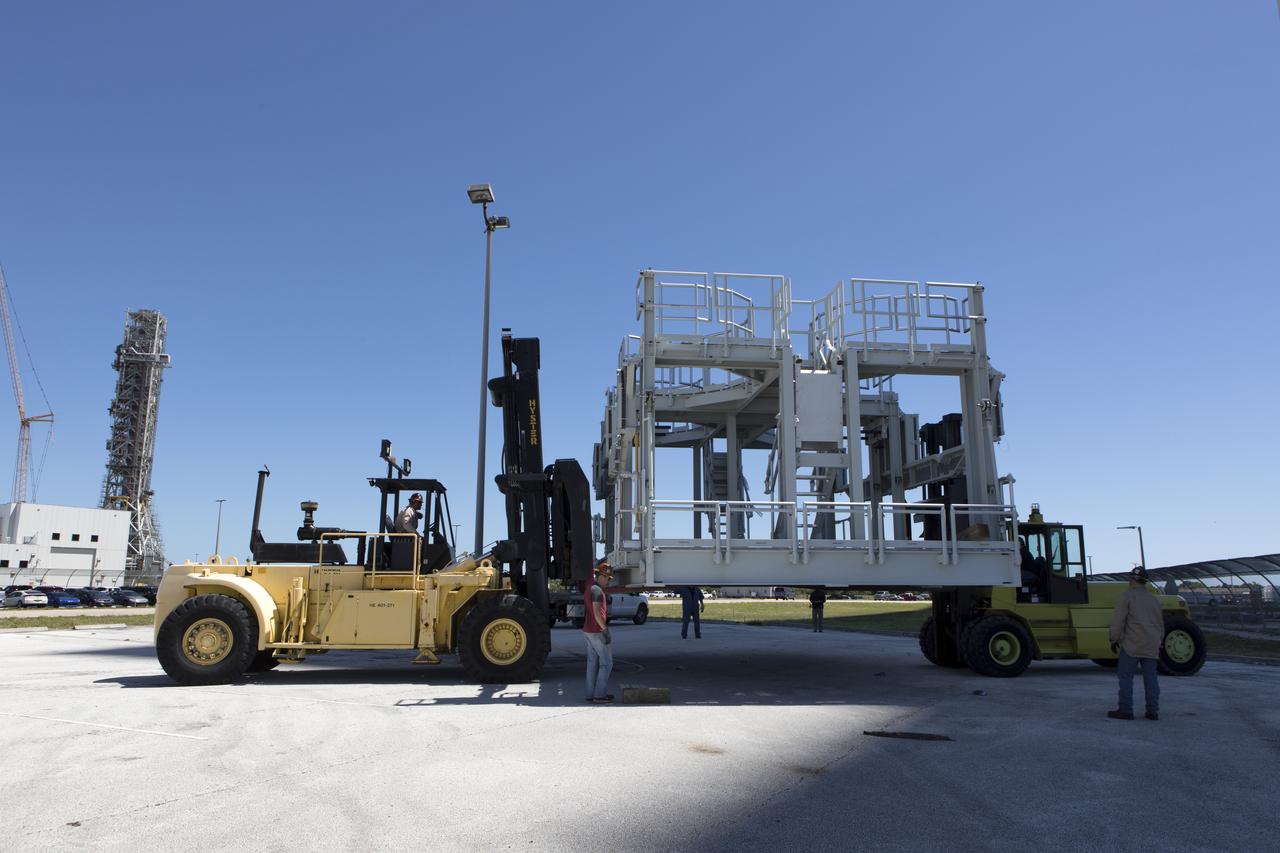
A new service platform for NASA's Space Launch System booster engines has been offloaded from a flatbed truck and is being prepared for the move into the Vehicle Assembly Building (VAB) at the agency's Kennedy Space Center in Florida. The platform was transported from fabricator Met-Con Inc. in Cocoa, Florida. It will be stored in the VAB, and used for processing and checkout of the engines for the rocket's twin five-segment solid rocket boosters for Exploration Mission-1. EM-1 will launch an uncrewed Orion spacecraft to a stable orbit beyond the Moon and bring it back to Earth for a splashdown in the Pacific Ocean.
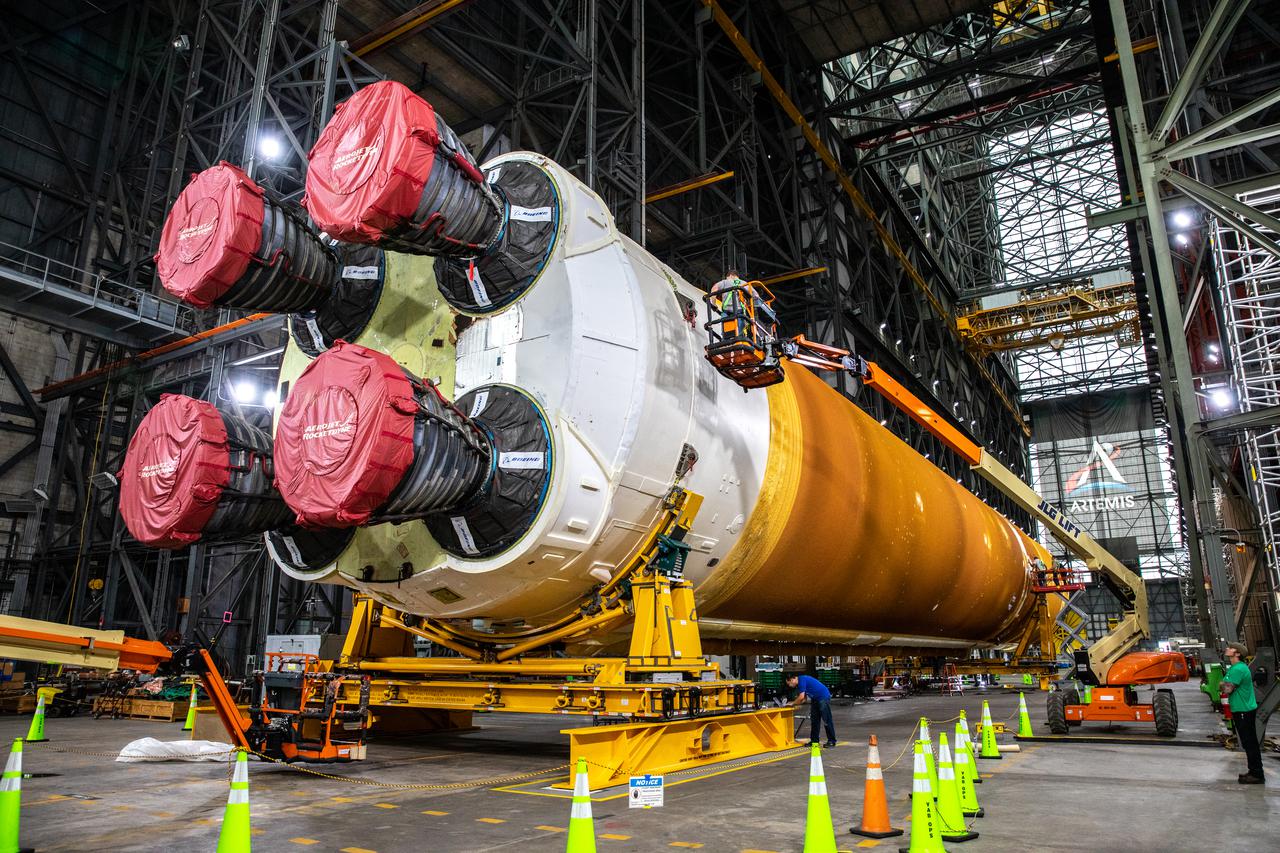
The Space Launch System (SLS) core stage is seen in the transfer aisle of the Vehicle Assembly Building (VAB) at NASA’s Kennedy Space Center in Florida on June 4, 2021. Teams with the agency’s Exploration Ground Systems and contractor Jacobs are preparing to lift the 188,000-pound core stage and place it on the mobile launcher in between the two solid rocket boosters in High Bay 3 of the VAB. The core stage alone will provide more than 2 million pounds of thrust at launch, and coupled with the boosters, will provide more than 8.8 million pounds of thrust to launch the Artemis I mission. The first in an increasingly complex series of missions, Artemis I will test SLS and the Orion spacecraft as an integrated system ahead of crewed flights to the Moon.
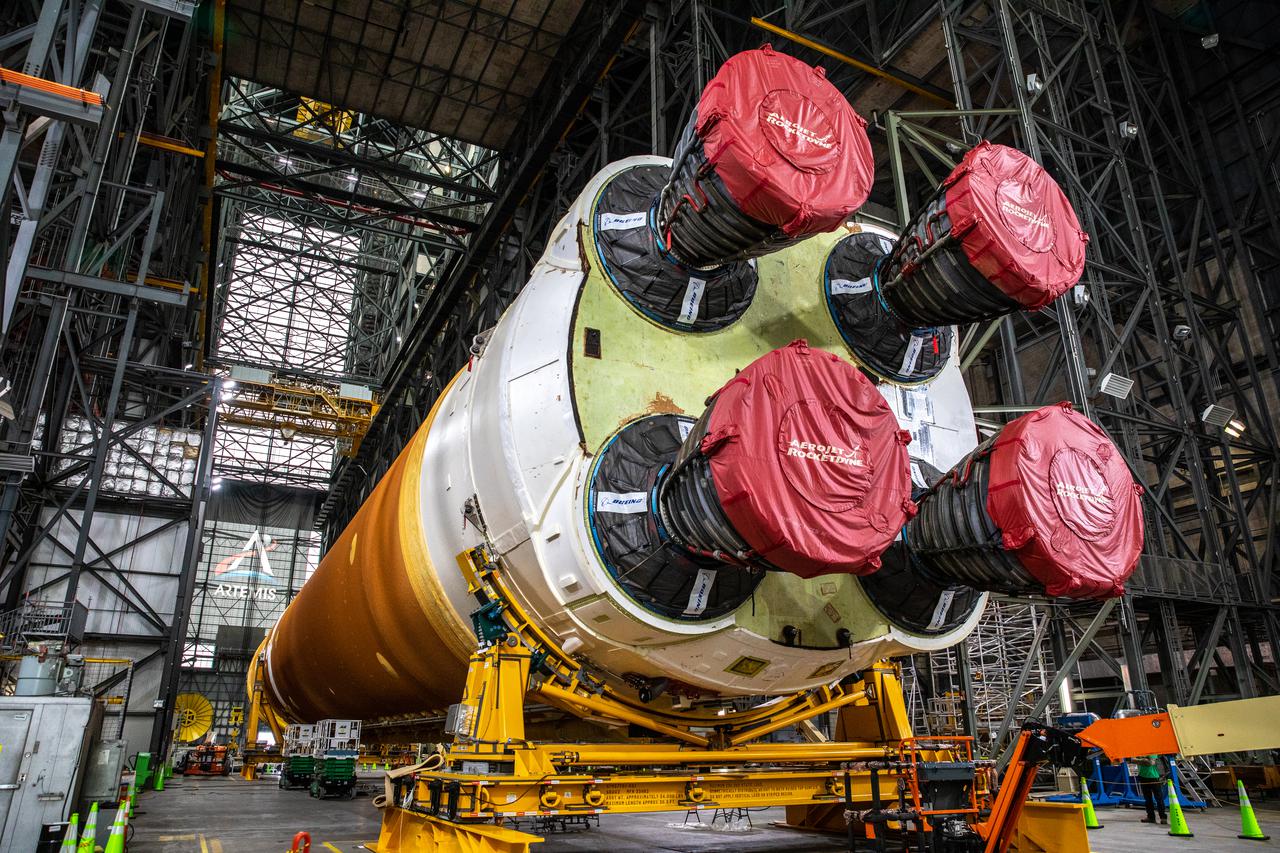
The Space Launch System (SLS) core stage is seen in the transfer aisle of the Vehicle Assembly Building (VAB) at NASA’s Kennedy Space Center in Florida on June 4, 2021. Teams with the agency’s Exploration Ground Systems and contractor Jacobs are preparing to lift the 188,000-pound core stage and place it on the mobile launcher in between the two solid rocket boosters in High Bay 3 of the VAB. The core stage alone will provide more than 2 million pounds of thrust at launch, and coupled with the boosters, will provide more than 8.8 million pounds of thrust to launch the Artemis I mission. The first in an increasingly complex series of missions, Artemis I will test SLS and the Orion spacecraft as an integrated system ahead of crewed flights to the Moon.
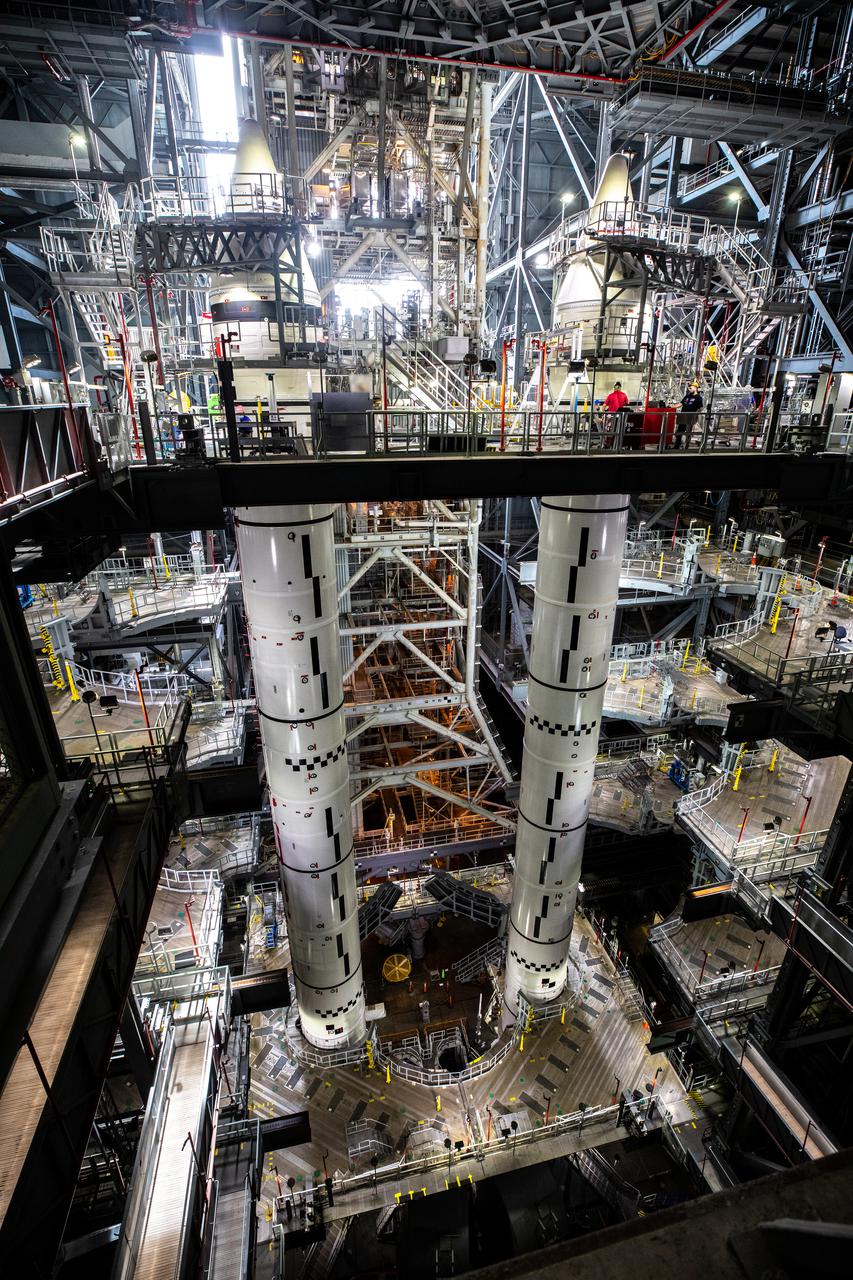
The fully stacked twin solid rocket boosters for NASA’s Space Launch System (SLS) rocket are seen on top of the mobile launcher inside High Bay 3 of the Vehicle Assembly Building (VAB) at the agency’s Kennedy Space Center in Florida on June 4, 2021. Now that booster stacking is complete, teams with NASA’s Exploration Ground Systems and contractor Jacobs are preparing to integrate the massive core stage, which arrived at Kennedy in April 2020, with the boosters inside the VAB. The 188,000-pound core stage alone will provide more than 2 million pounds of thrust at launch, and coupled with the boosters, will provide more than 8.8 million pounds of thrust to launch the Artemis I mission. The first in an increasingly complex series of missions, Artemis I will test SLS and the Orion spacecraft as an integrated system ahead of crewed flights to the Moon.
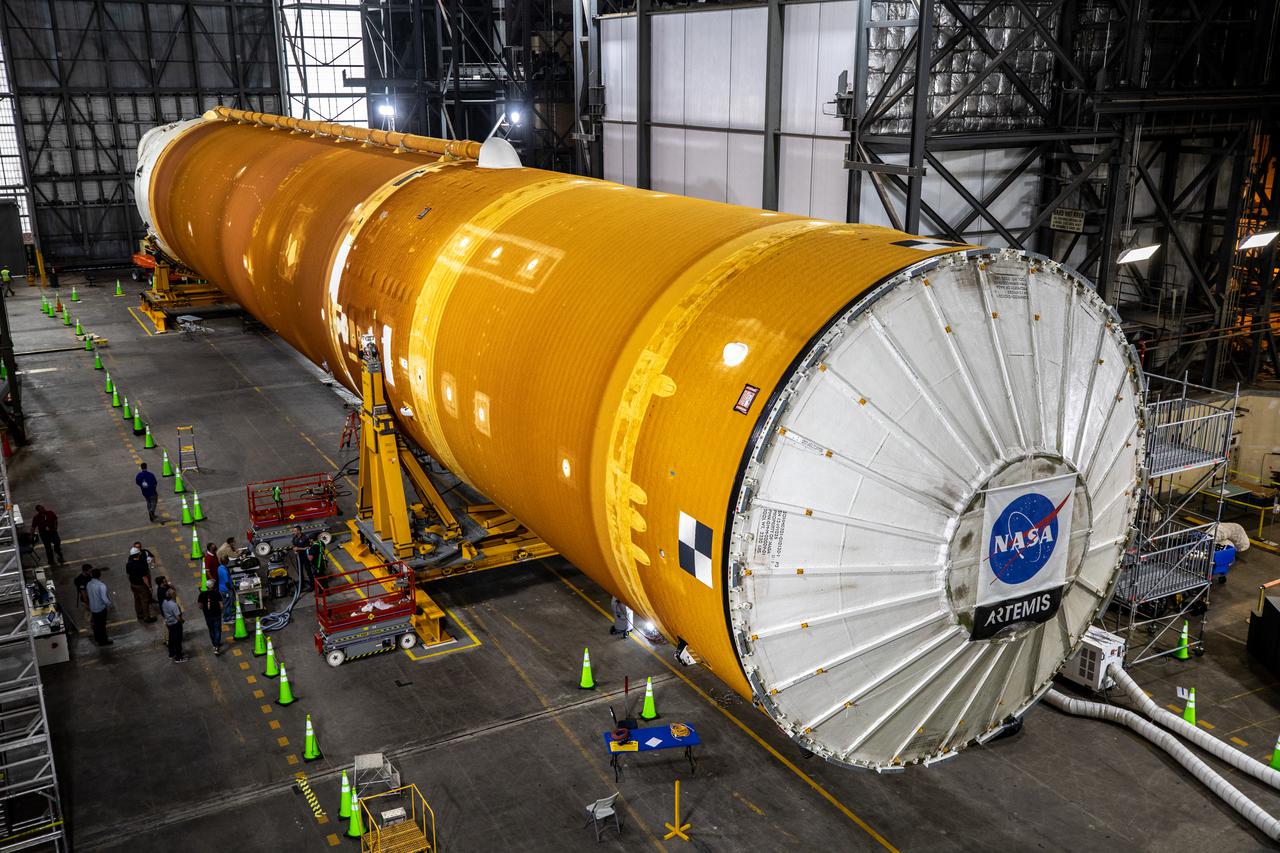
The Space Launch System (SLS) core stage is seen in the transfer aisle of the Vehicle Assembly Building (VAB) at NASA’s Kennedy Space Center in Florida on June 4, 2021. Teams with the agency’s Exploration Ground Systems and contractor Jacobs are preparing to lift the 188,000-pound core stage and place it on the mobile launcher in between the two solid rocket boosters in High Bay 3 of the VAB. The core stage alone will provide more than 2 million pounds of thrust at launch, and coupled with the boosters, will provide more than 8.8 million pounds of thrust to launch the Artemis I mission. The first in an increasingly complex series of missions, Artemis I will test SLS and the Orion spacecraft as an integrated system ahead of crewed flights to the Moon.
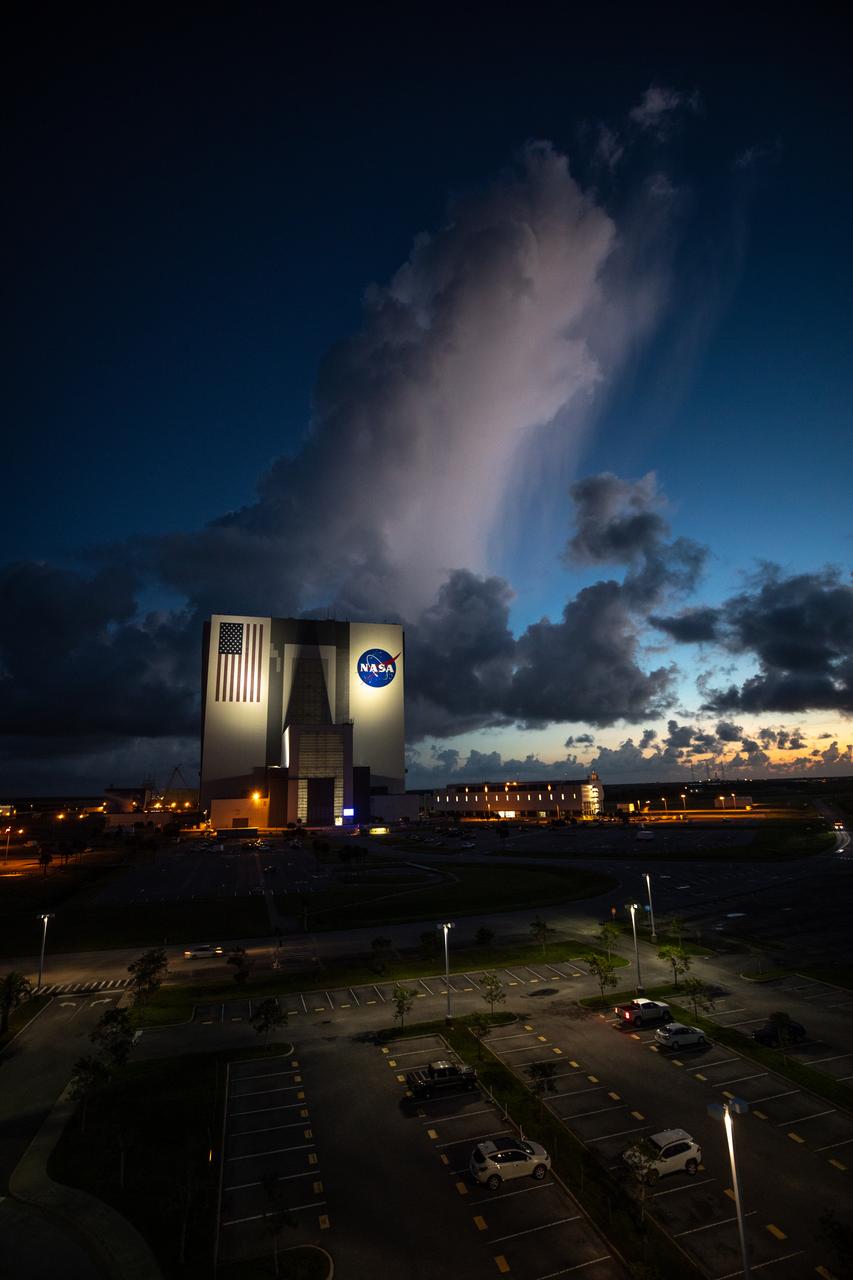
An early sunrise view of the iconic Vehicle Assembly Building (VAB) at NASA's Kennedy Space Center in Florida on July 25, 2020. Repainting of the NASA meatball and American flag recently was completed on the 525-foot-tall facility. Inside the VAB, 10 new work platforms, 20 platform halves altogether, have been installed in High Bay 3 for the agency's Space Launch System (SLS) rocket and Orion spacecraft. Exploration Ground Systems is overseeing upgrades to the VAB.
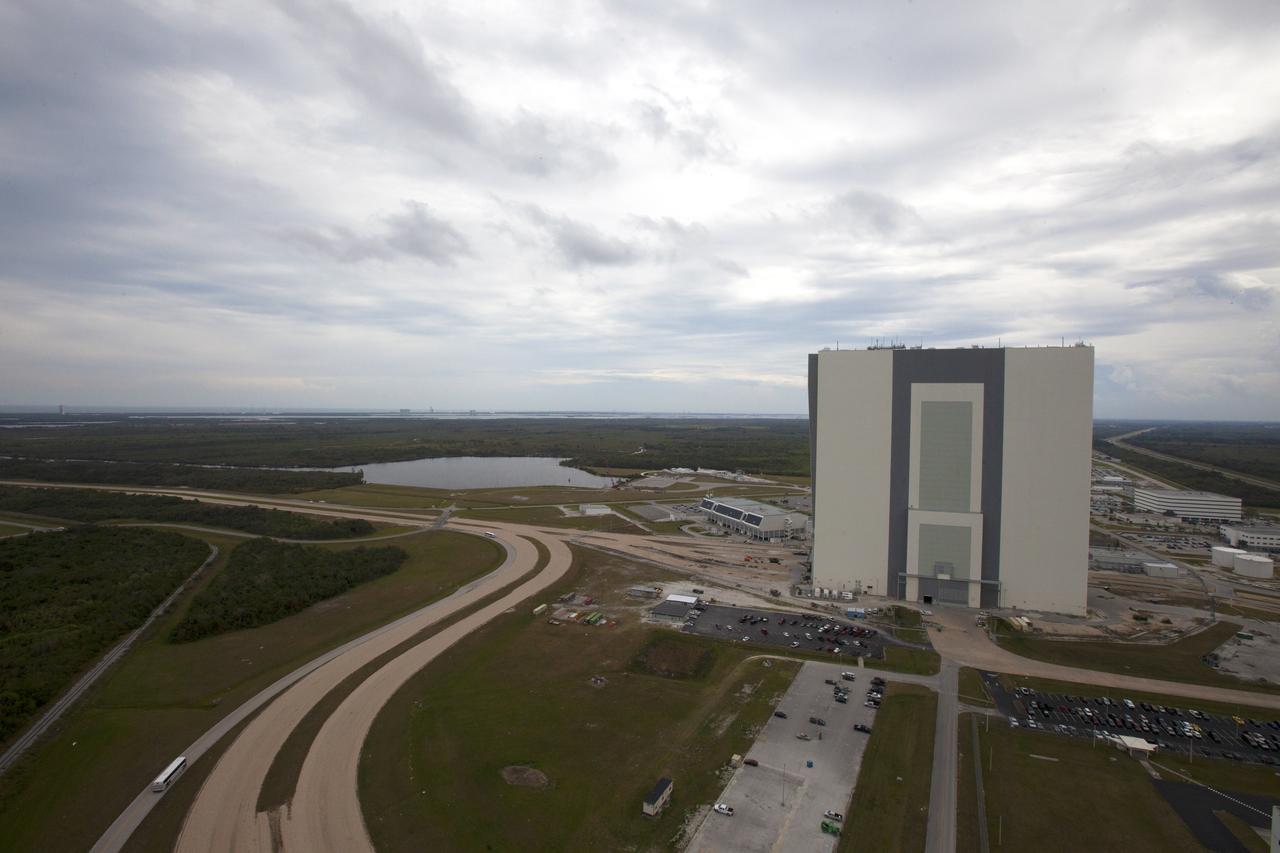
A view of the north side of the Vehicle Assembly Building (VAB) from the top of the mobile launcher tower at NASA's Kennedy Space Center in Florida. Inside the VAB, 10 levels of platforms, 20 platform halves altogether, have been installed in High Bay 3. The platforms will surround NASA's Space Launch System (SLS) rocket and the Orion spacecraft and allow access during processing for missions, including the first uncrewed flight test of Orion atop the SLS rocket in 2018. Crawler-transporter 2 will carry the rocket and spacecraft atop the mobile launcher to Launch Pad 39B for Exploration Mission 1. The Ground Systems Development and Operations Program, with support from the center's Engineering Directorate, is overseeing upgrades and modifications to the VAB and the mobile launcher.
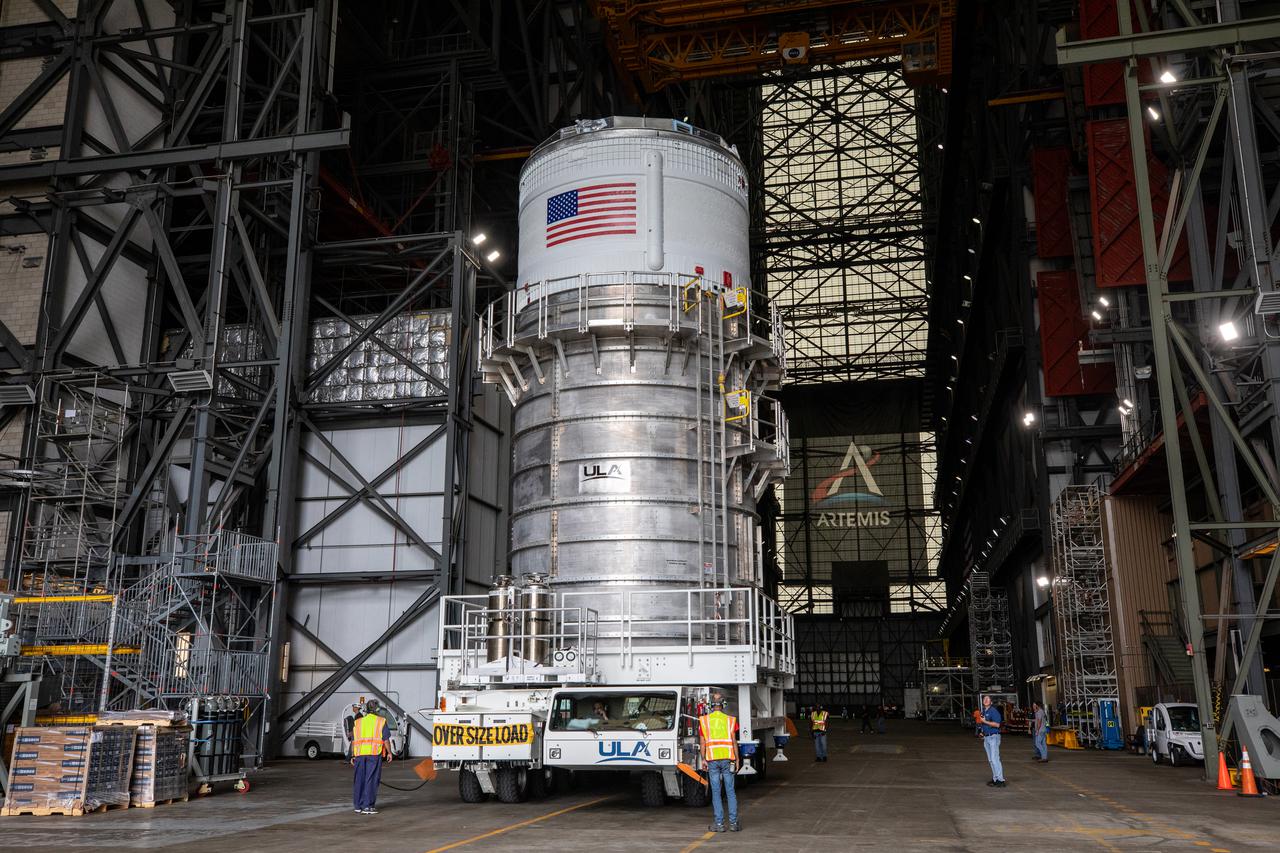
The Space Launch System (SLS) rocket’s interim cryogenic propulsion stage (ICPS) is moved into the transfer aisle of the Vehicle Assembly Building (VAB) by teams with NASA’s Exploration Ground Systems and contractor Jacobs at NASA’s Kennedy Space Center in Florida on Saturday, June 19, 2021. After being fueled and serviced inside the Multi-Payload Processing Facility (MPPF), the ICPS will be hoisted into place atop the SLS core stage while its Aerojet Rocketdyne-built RL-10 engine will be protected inside the launch vehicle stage adapter (LVSA) on the mobile launcher in preparation for the launch of Artemis I. The ICPS will provide Orion spacecraft with the push needed for its flight around the Moon. The first in a series of increasingly complex missions, Artemis I will test SLS and the Orion spacecraft as an integrated system prior to crewed flights in which NASA will land the first woman and person of color on the Moon.
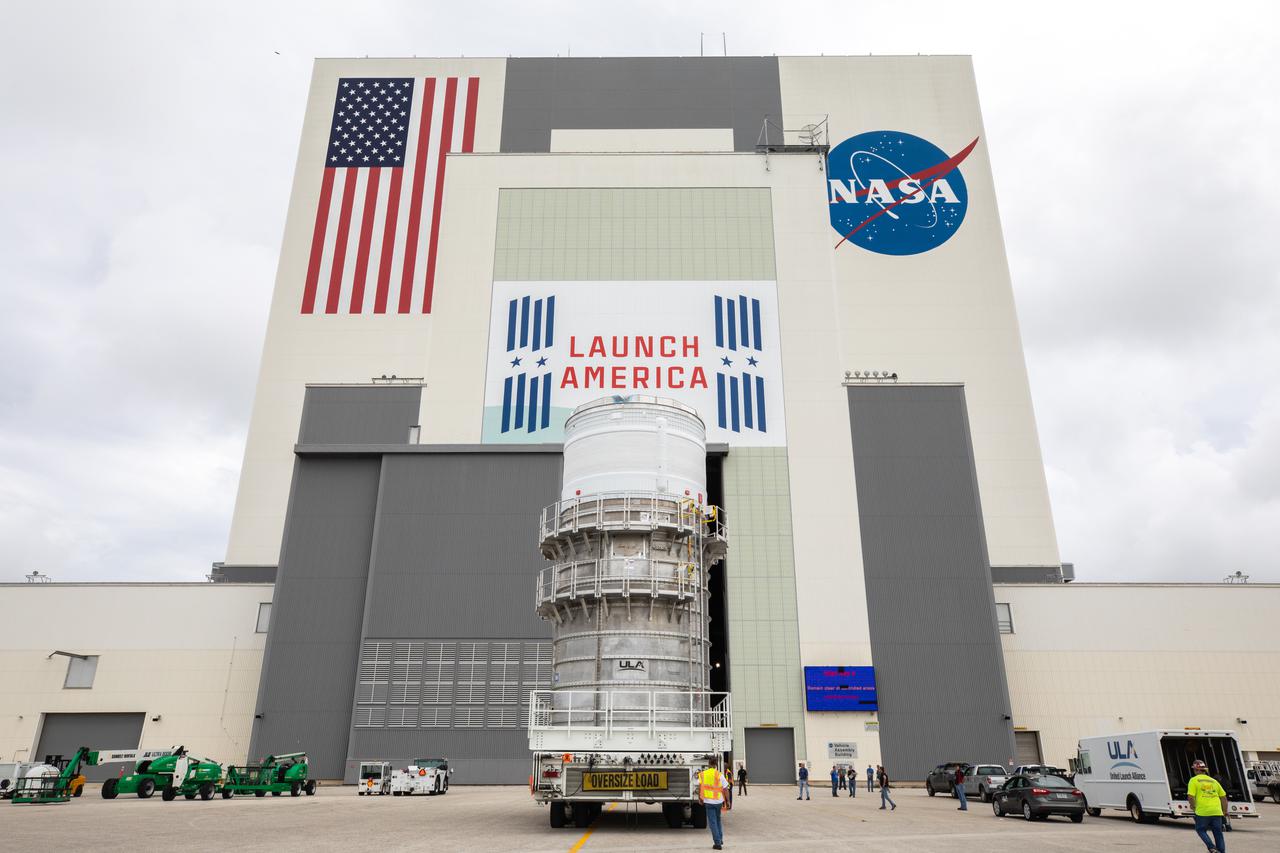
Teams with NASA’s Exploration Ground Systems and contractor Jacobs move the Space Launch System (SLS) rocket’s interim cryogenic propulsion stage (ICPS) into the Vehicle Assembly Building (VAB) at NASA’s Kennedy Space Center in Florida on Saturday, June 19, 2021. After being fueled and serviced inside the Multi-Payload Processing Facility (MPPF), the ICPS will be hoisted into place atop the SLS core stage while its Aerojet Rocketdyne-built RL-10 engine will be protected inside the launch vehicle stage adapter (LVSA) on the mobile launcher in preparation for the launch of Artemis I. The ICPS will provide Orion spacecraft with the push needed for its flight around the Moon. The first in a series of increasingly complex missions, Artemis I will test SLS and the Orion spacecraft as an integrated system prior to crewed flights in which NASA will land the first woman and person of color on the Moon.
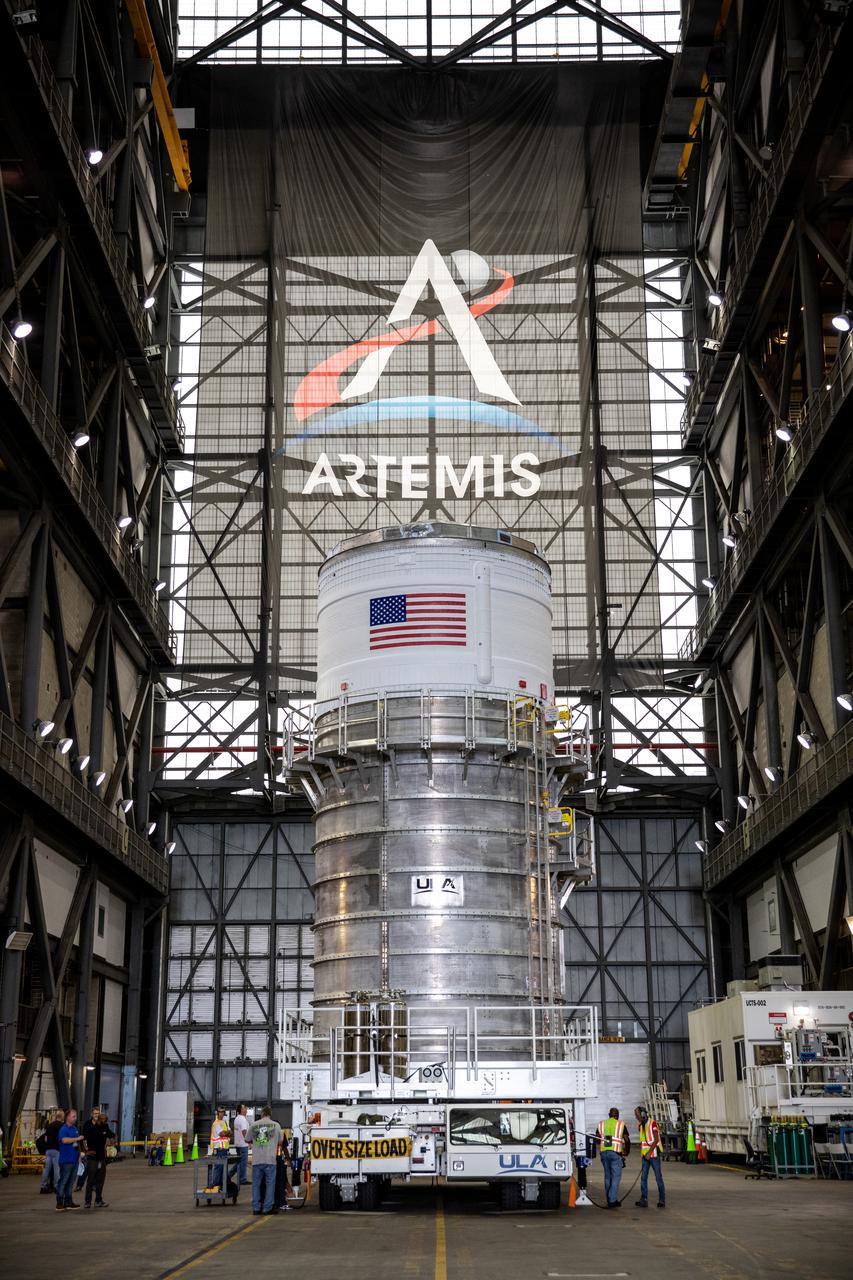
The Space Launch System (SLS) rocket’s interim cryogenic propulsion stage (ICPS) sits in the transfer aisle of the Vehicle Assembly Building (VAB), upon being moved by teams with NASA’s Exploration Ground Systems and contractor Jacobs at NASA’s Kennedy Space Center in Florida on Saturday, June 19, 2021. After being fueled and serviced inside the Multi-Payload Processing Facility (MPPF), the ICPS will be hoisted into place atop the SLS core stage while its Aerojet Rocketdyne-built RL-10 engine will be protected inside the launch vehicle stage adapter (LVSA) on the mobile launcher in preparation for the launch of Artemis I. The ICPS will provide Orion spacecraft with the push needed for its flight around the Moon. The first in a series of increasingly complex missions, Artemis I will test SLS and the Orion spacecraft as an integrated system prior to crewed flights in which NASA will land the first woman and person of color on the Moon.

A view of the Vehicle Assembly Building (VAB) at NASA’s Kennedy Space Center in Florida, during sunrise on Jan. 19, 2022. Inside the VAB, NASA’s Space Launch System (SLS) and Orion spacecraft are stacked in High Bay 3 in preparation for the agency’s Artemis I mission. Artemis I will be the first integrated test of the SLS and Orion spacecraft. In later missions, NASA will land the first woman and the first person of color on the surface of the Moon, paving the way for a long-term lunar presence and serving as a steppingstone on the way to Mars.

A view of the Vehicle Assembly Building (VAB) at NASA’s Kennedy Space Center in Florida, during sunrise on Jan. 19, 2022. Inside the VAB, NASA’s Space Launch System (SLS) and Orion spacecraft are stacked in High Bay 3 in preparation for the agency’s Artemis I mission. Artemis I will be the first integrated test of the SLS and Orion spacecraft. In later missions, NASA will land the first woman and the first person of color on the surface of the Moon, paving the way for a long-term lunar presence and serving as a steppingstone on the way to Mars.
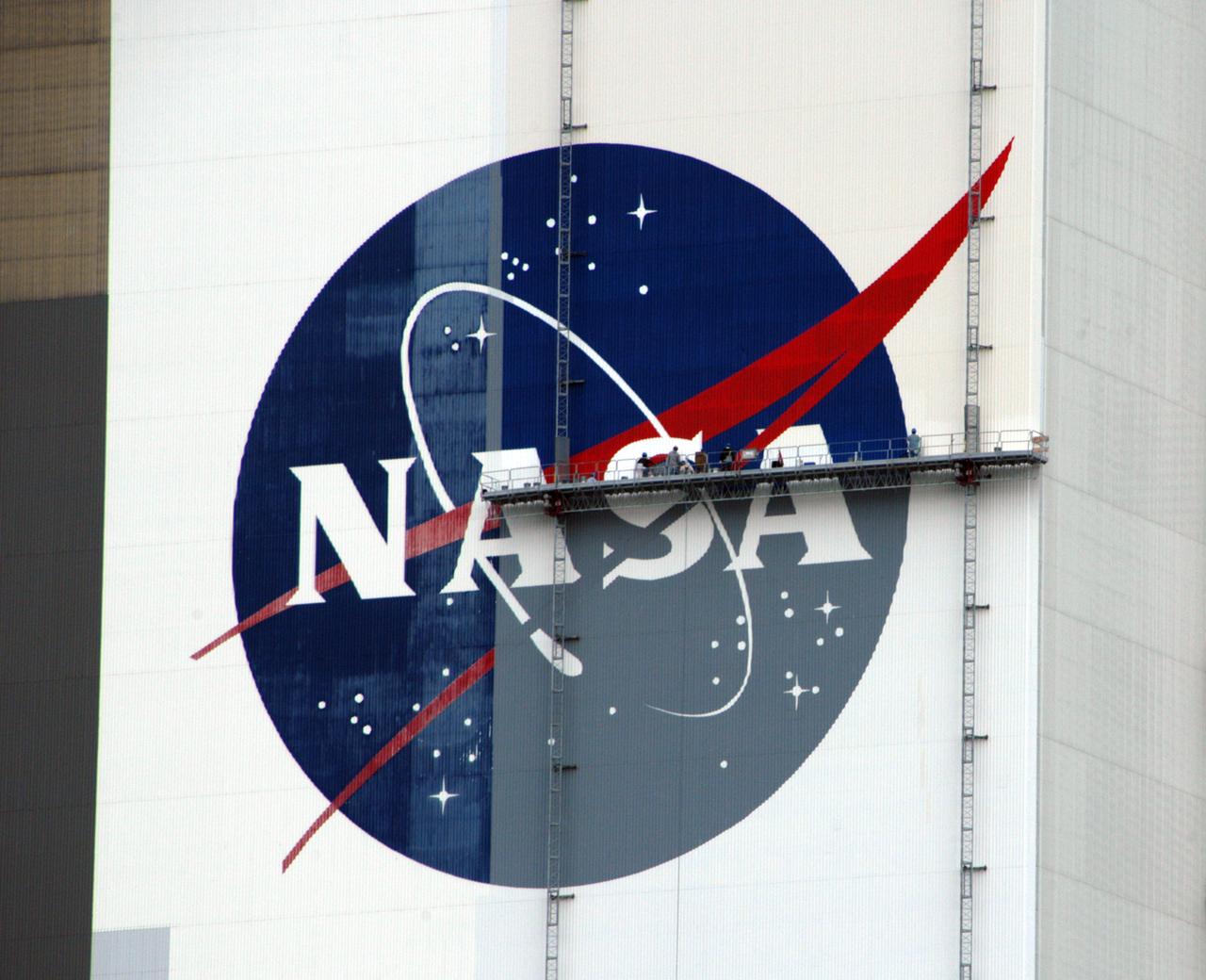
Workers painting the Flag and Meatball on the VAB.

A view of the low bay entrance to the Vehicle Assembly Building (VAB) at NASA’s Kennedy Space Center in Florida, during sunrise on Jan. 19, 2022. The Artemis banner is above the door. Inside the VAB, NASA’s Space Launch System (SLS) and Orion spacecraft are stacked in High Bay 3 in preparation for the agency’s Artemis I mission. Artemis I will be the first integrated test of the SLS and Orion spacecraft. In later missions, NASA will land the first woman and the first person of color on the surface of the Moon, paving the way for a long-term lunar presence and serving as a steppingstone on the way to Mars.
The crawler-transporter, driven by engineers, approaches the Vehicle Assembly Building (VAB) at NASA’s Kennedy Space Center in Florida on June 1, 2022. The crawler will go inside the VAB, where it will slide under the Artemis I Space Launch System with the Orion spacecraft atop on the mobile launcher and carry it to Launch Complex 39B for a wet dress rehearsal test ahead of the Artemis I launch. Artemis I will be the first integrated test of the SLS and Orion spacecraft. In later missions, NASA will land the first woman and the first person of color on the surface of the Moon, paving the way for a long-term lunar presence and serving as a steppingstone on the way to Mars.
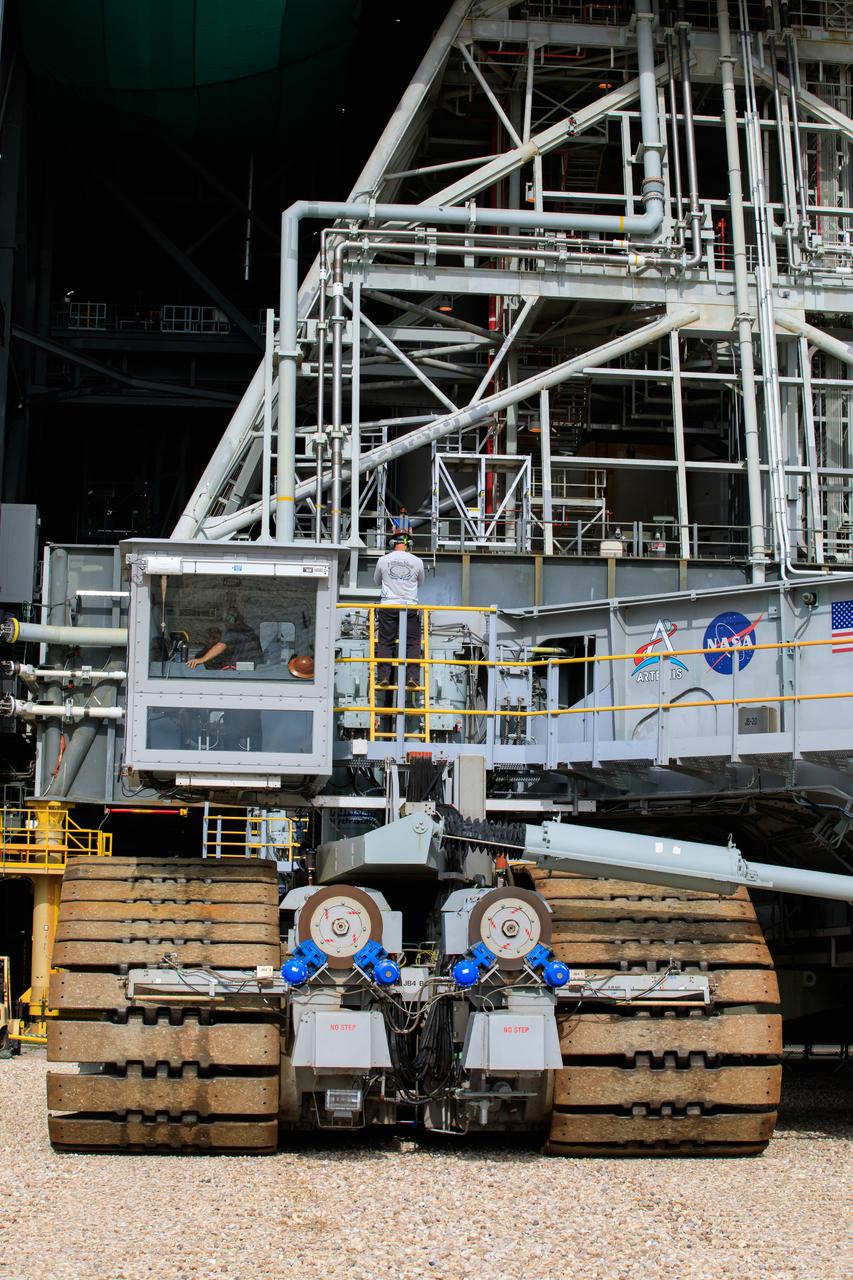
The crawler-transporter, driven by engineers, approaches the Vehicle Assembly Building (VAB) at NASA’s Kennedy Space Center in Florida on June 1, 2022. The crawler will go inside the VAB, where it will slide under the Artemis I Space Launch System with the Orion spacecraft atop on the mobile launcher and carry it to Launch Complex 39B for a wet dress rehearsal test ahead of the Artemis I launch. Artemis I will be the first integrated test of the SLS and Orion spacecraft. In later missions, NASA will land the first woman and the first person of color on the surface of the Moon, paving the way for a long-term lunar presence and serving as a steppingstone on the way to Mars.
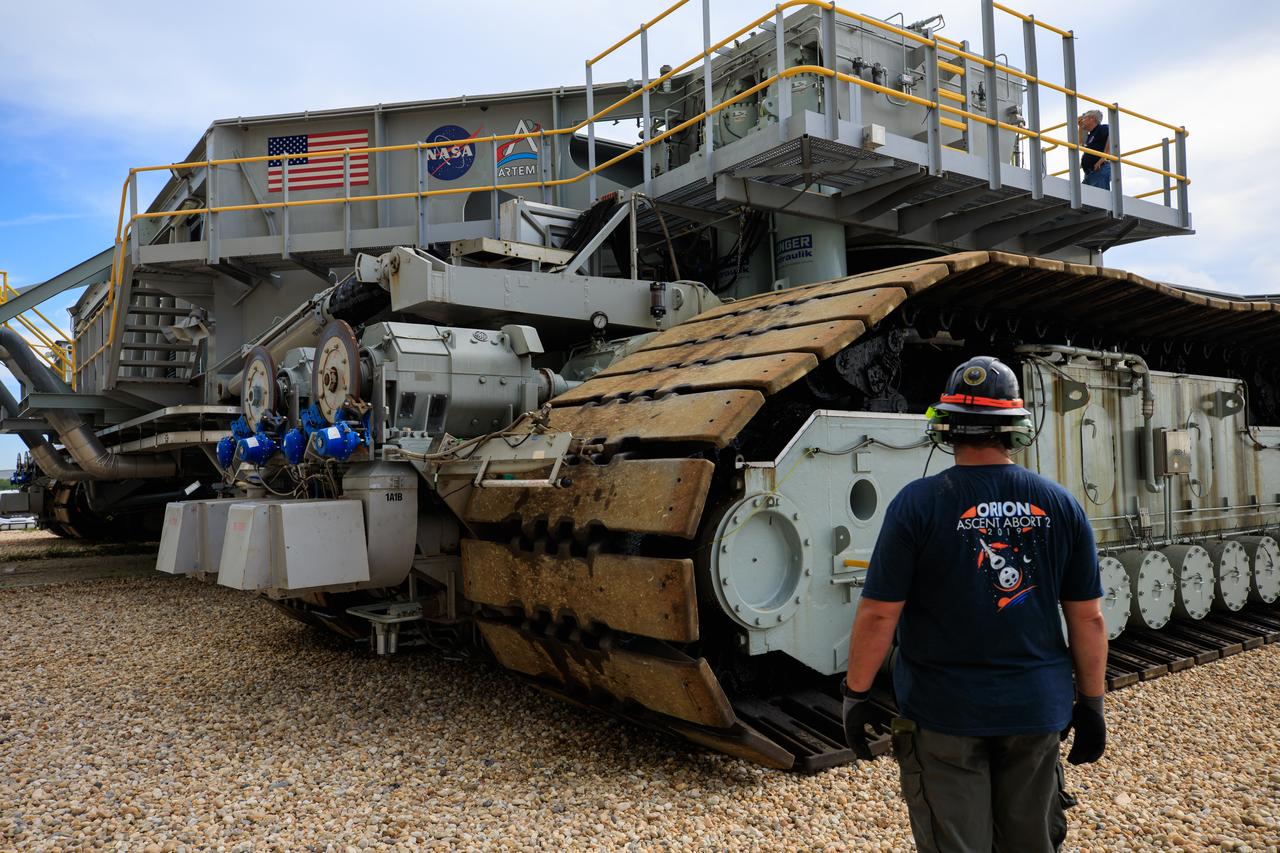
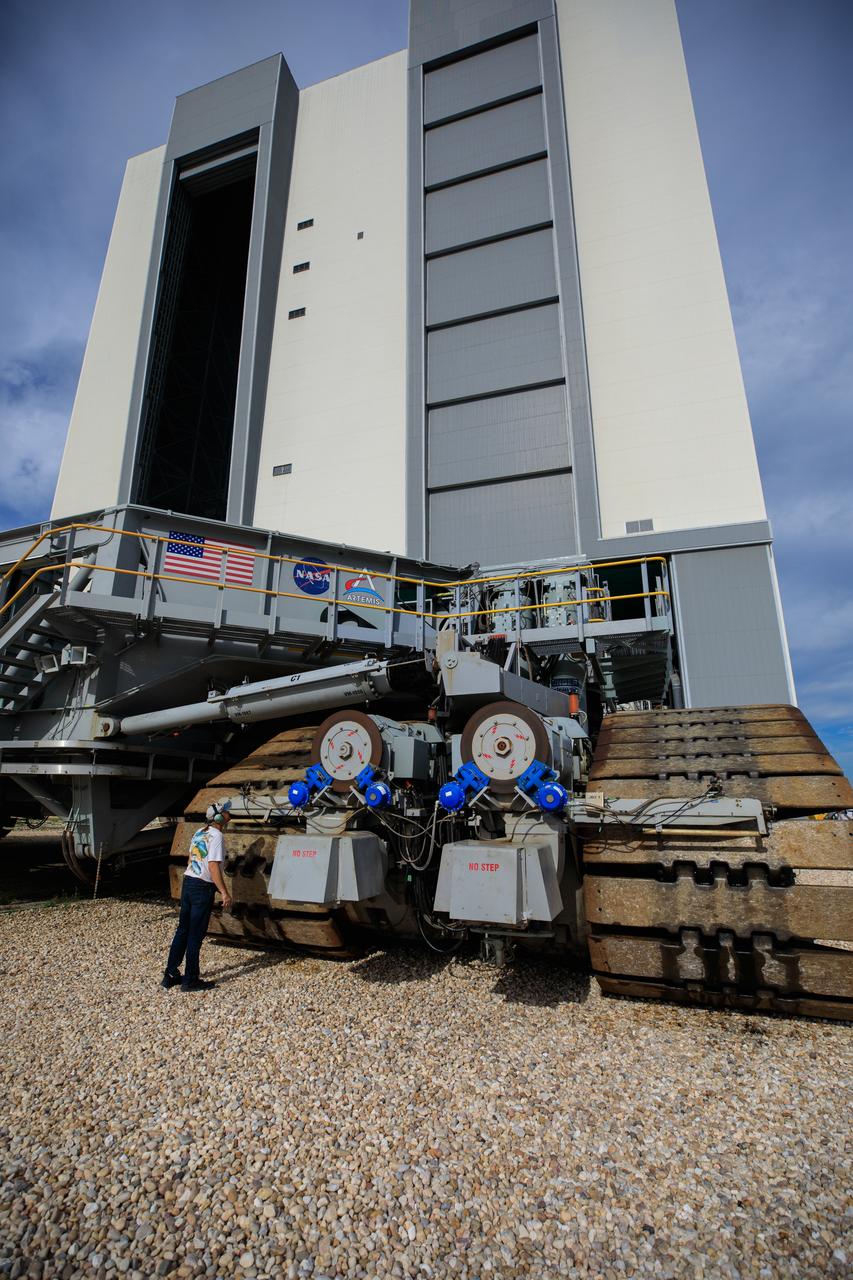
A technician checks the giant tracks crawler-transporter 2 during its trip to the Vehicle Assembly Building (VAB) at NASA’s Kennedy Space Center in Florida on June 3, 2022. The crawler will go inside the VAB, where it will slide under the Artemis I Space Launch System with the Orion spacecraft atop on the mobile launcher and carry it to Launch Complex 39B for a wet dress rehearsal test ahead of the Artemis I launch. Artemis I will be the first integrated test of the SLS and Orion spacecraft. In later missions, NASA will land the first woman and the first person of color on the surface of the Moon, paving the way for a long-term lunar presence and serving as a steppingstone on the way to Mars.
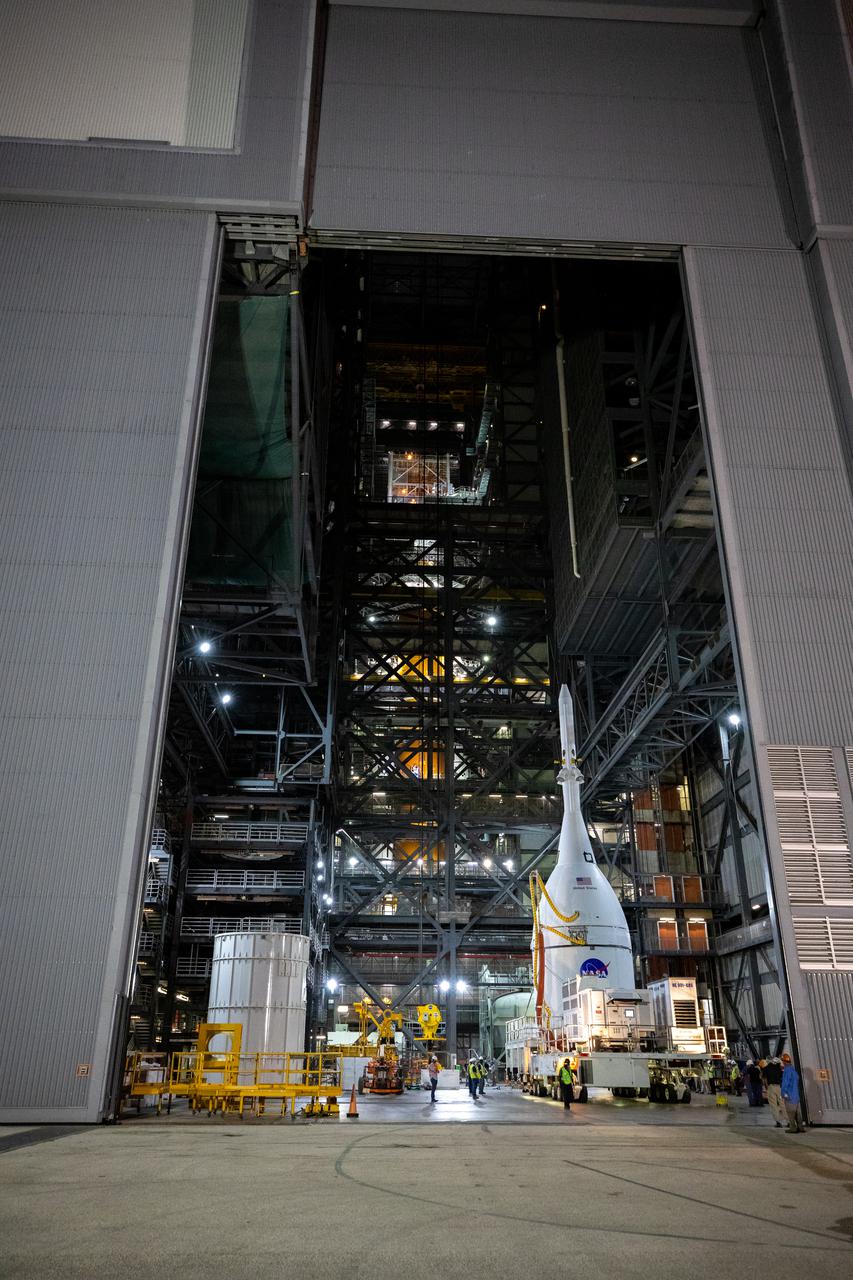
The Orion spacecraft for NASA’s Artemis I mission, fully assembled with its launch abort system, is moved into the transfer aisle of the Vehicle Assembly Building (VAB) at Kennedy Space Center in Florida on Oct. 19, 2021. In the VAB, Orion will join the already stacked flight hardware and be raised into position atop the Space Launch System rocket in High Bay 3. Launching in 2021, Artemis I will be an uncrewed test flight of the Orion spacecraft and Space Launch System rocket as an integrated system ahead of crewed flights to the Moon. Under Artemis, NASA aims to land the first woman and first person of color on the Moon and establish sustainable lunar exploration.
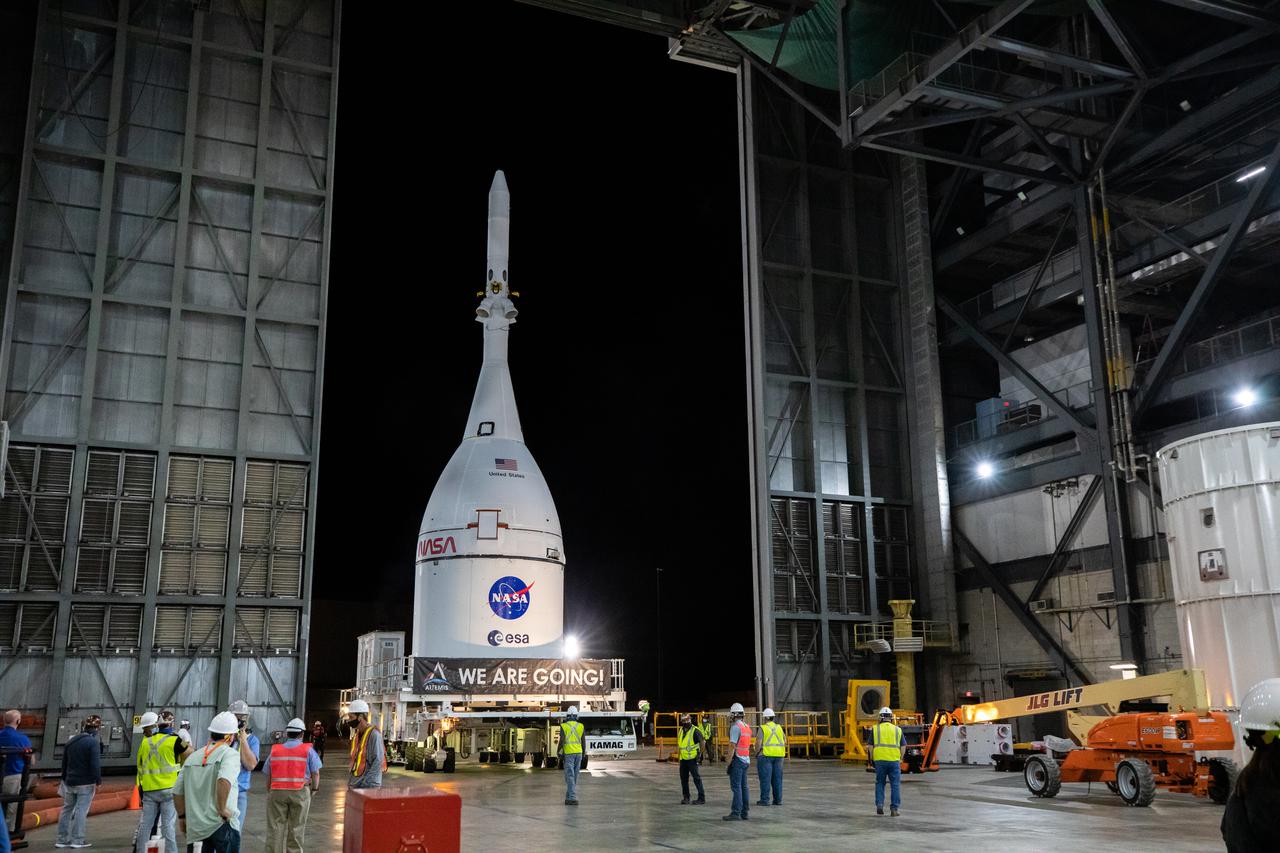
The Orion spacecraft for NASA’s Artemis I mission, fully assembled with its launch abort system, is moved into the transfer aisle of the Vehicle Assembly Building (VAB) at Kennedy Space Center in Florida on Oct. 19, 2021. In the VAB, Orion will join the already stacked flight hardware and be raised into position atop the Space Launch System rocket in High Bay 3. Launching in 2021, Artemis I will be an uncrewed test flight of the Orion spacecraft and Space Launch System rocket as an integrated system ahead of crewed flights to the Moon. Under Artemis, NASA aims to land the first woman and first person of color on the Moon and establish sustainable lunar exploration.
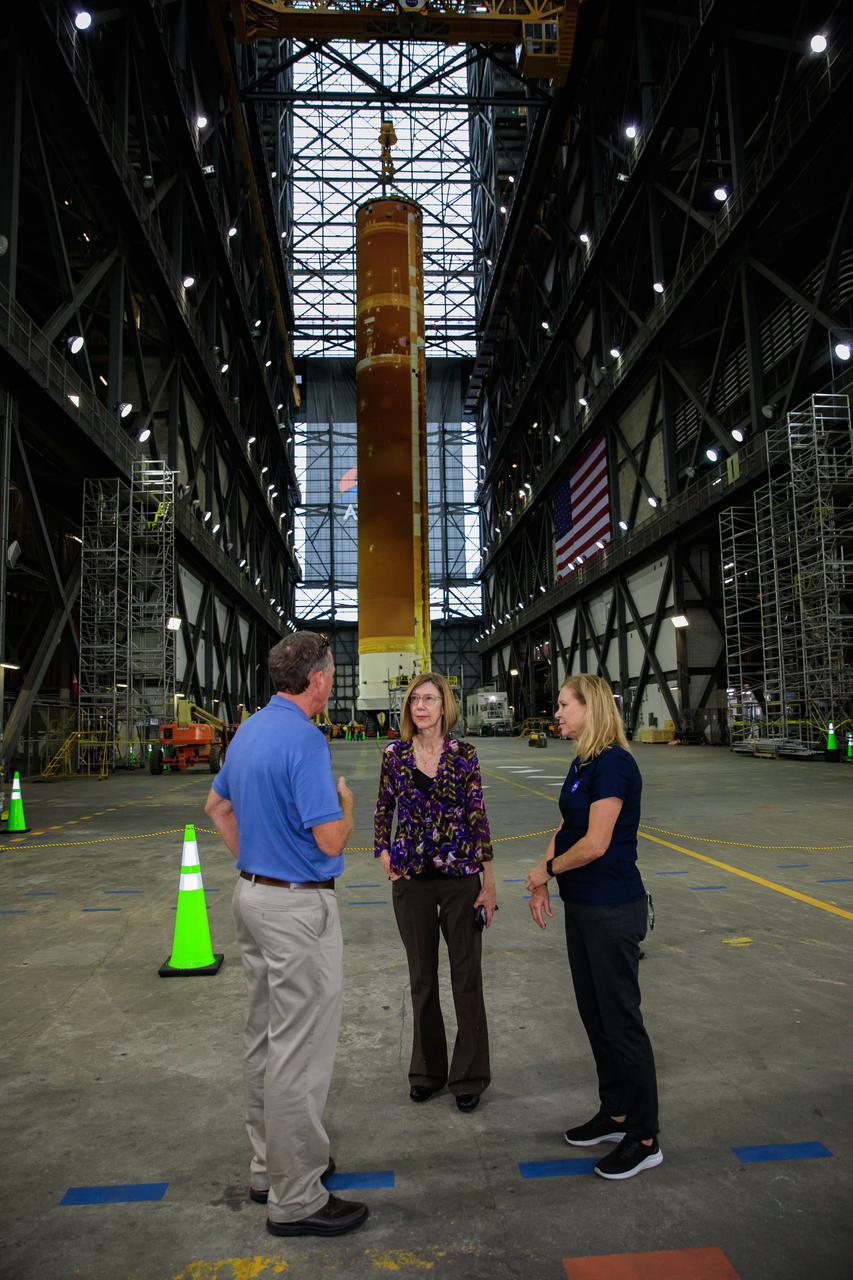
Exploration Ground Systems Manager Mike Bolger (left), NASA Human Exploration and Operations Associate Administrator Kathy Lueders (center), and Acting Director of Kennedy Space Center Janet Petro (right), visit the spaceport’s iconic Vehicle Assembly Building (VAB) in Florida on June 11, 2021. In the background, the core stage of NASA’s massive Space Launch System (SLS) rocket is visible in vertical position during lift and mate operations, prior to the core stage being moved and integrated with the twin solid rocket boosters atop the mobile launcher in High Bay 3 of the VAB. The 188,000-pound core stage, with its four RS-25 engines, will provide more than 2 million pounds of thrust during launch and ascent, and coupled with the boosters, will provide more than 8.8 million pounds of thrust to send the Artemis I mission to space. Under the Artemis program, NASA will land the first woman and first person of color on the Moon, as well as establish a sustainable presence on the lunar surface in preparation for human missions to Mars.
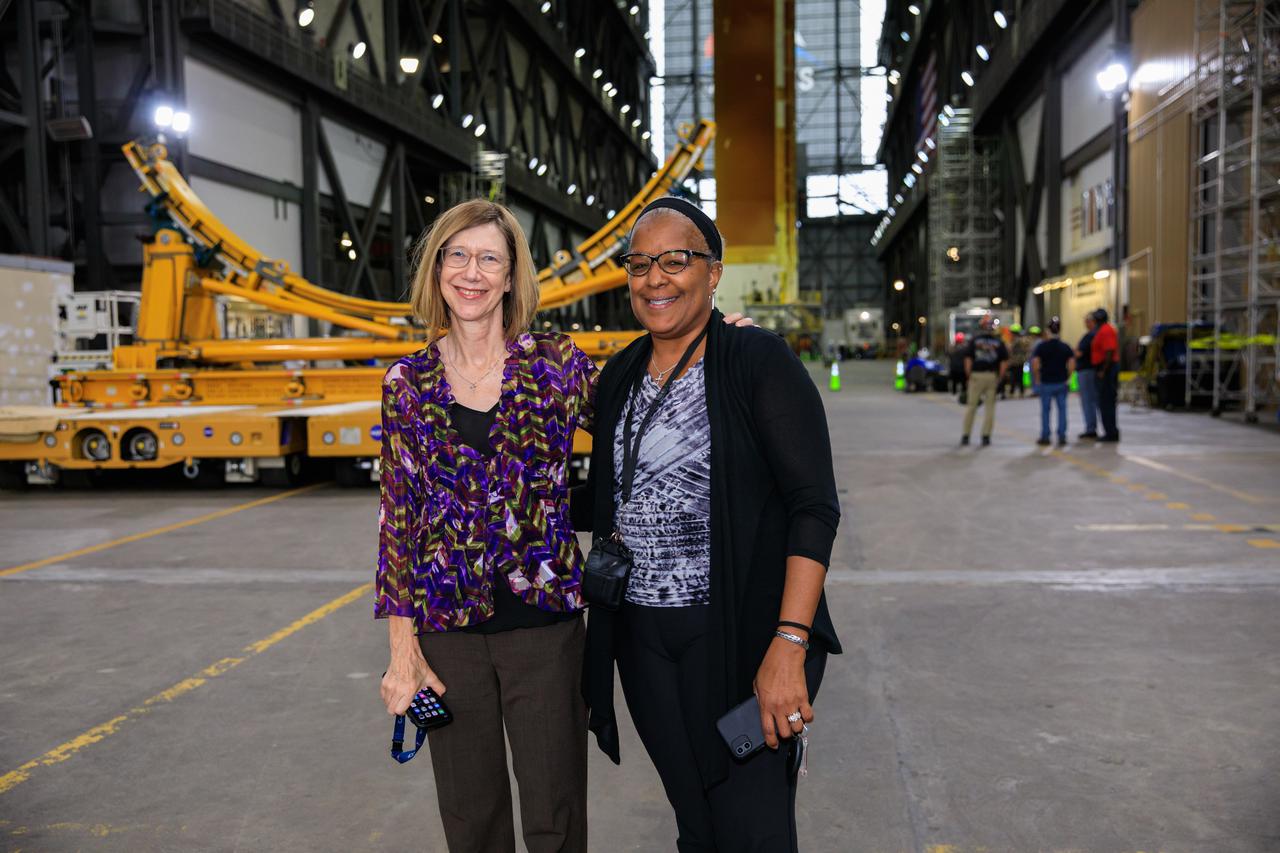
NASA Human Exploration and Operations (HEO) Deputy Associate Administrator Kathy Lueders (left) and HEO Deputy Associate Administrator for Management Altonell “Toni” Mumford (right) visit Kennedy Space Center's iconic Vehicle Assembly Building (VAB) in Florida on June 11, 2021. In the background, the core stage of NASA’s massive Space Launch System (SLS) rocket is visible in vertical position during lift and mate operations, prior to the core stage being moved and integrated with the twin solid rocket boosters atop the mobile launcher in High Bay 3 of the VAB. The 188,000-pound core stage, with its four RS-25 engines, will provide more than 2 million pounds of thrust during launch and ascent, and coupled with the boosters, will provide more than 8.8 million pounds of thrust to send the Artemis I mission to space. Under the Artemis program, NASA will land the first woman and first person of color on the Moon, as well as establish a sustainable presence on the lunar surface in preparation for human missions to Mars.
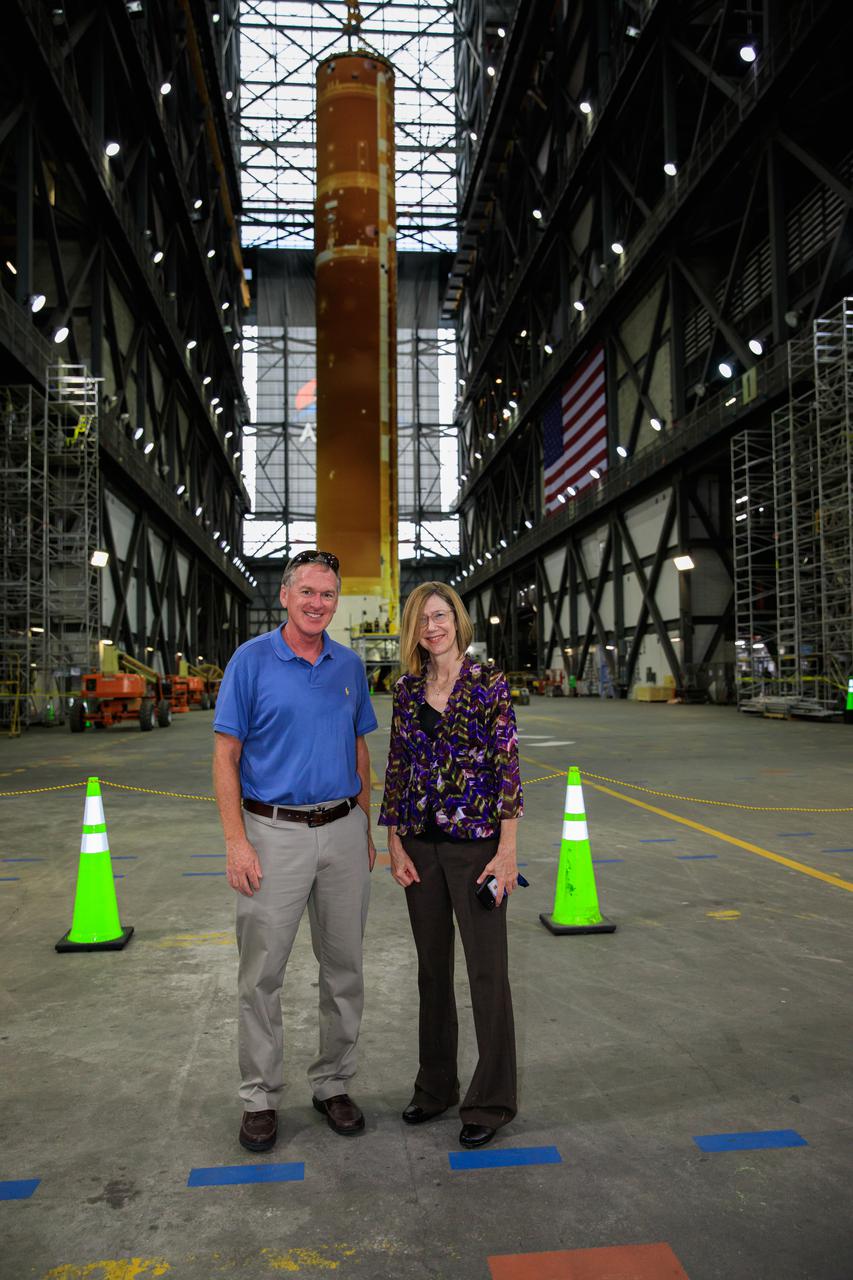
Exploration Ground Systems Manager Mike Bolger (left) and NASA Human Exploration and Operations Associate Administrator Kathy Lueders (right) visit Kennedy Space Center's Vehicle Assembly Building (VAB) in Florida on June 11, 2021. In the background, the core stage of NASA’s massive Space Launch System (SLS) rocket is visible in vertical position during stacking operations, prior to the core stage being moved and integrated with the twin solid rocket boosters atop the mobile launcher in High Bay 3 of the VAB. The 188,000-pound core stage, with its four RS-25 engines, will provide more than 2 million pounds of thrust during launch and ascent, and coupled with the boosters, will provide more than 8.8 million pounds of thrust to send the Artemis I mission to space. Under the Artemis program, NASA will land the first woman and first person of color on the Moon, as well as establish a sustainable presence on the lunar surface in preparation for human missions to Mars.