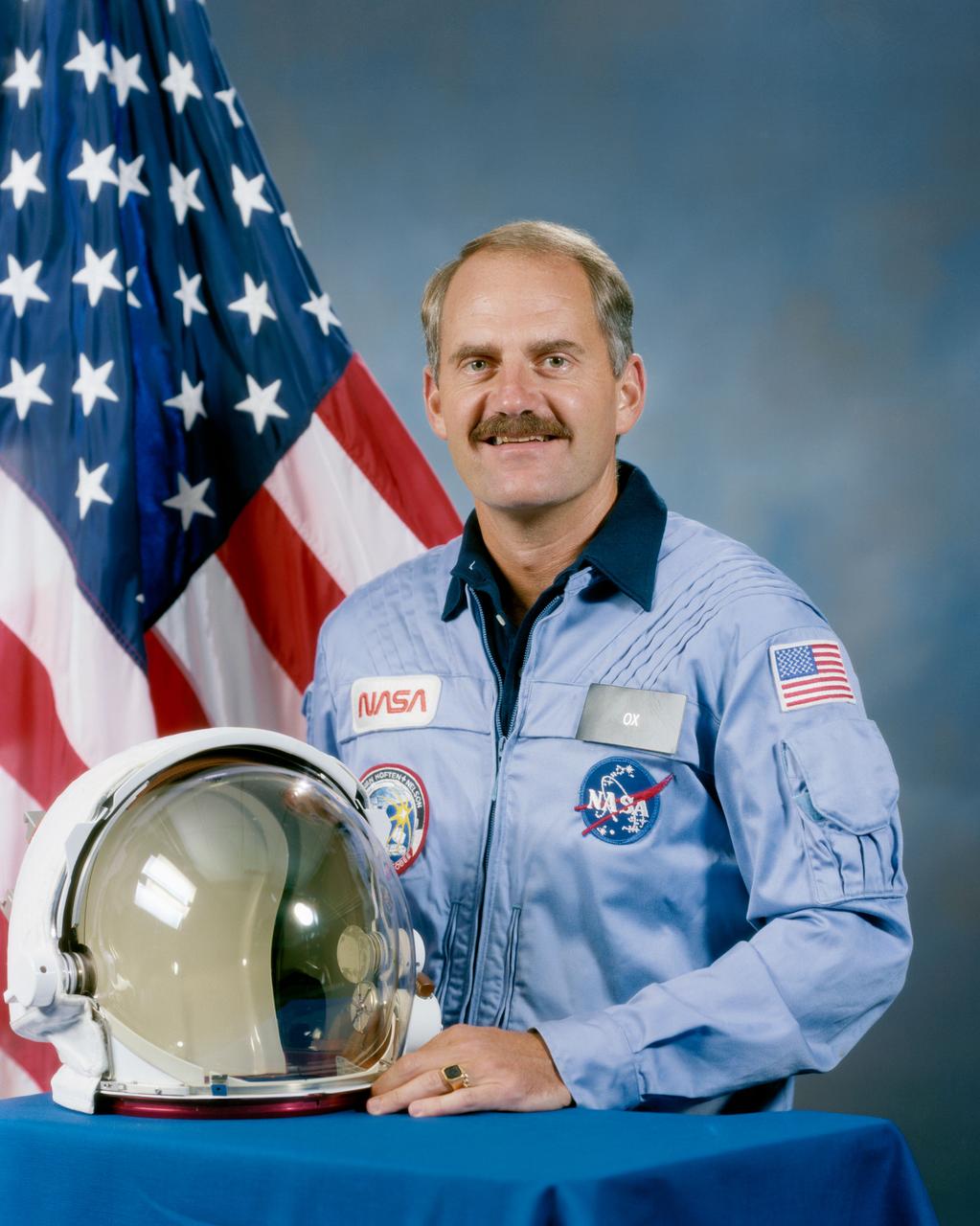
S84-42000 (31 Jan 1978) --- Asronaut James D. Van Hoften, astronaut candidate and mission specialist.
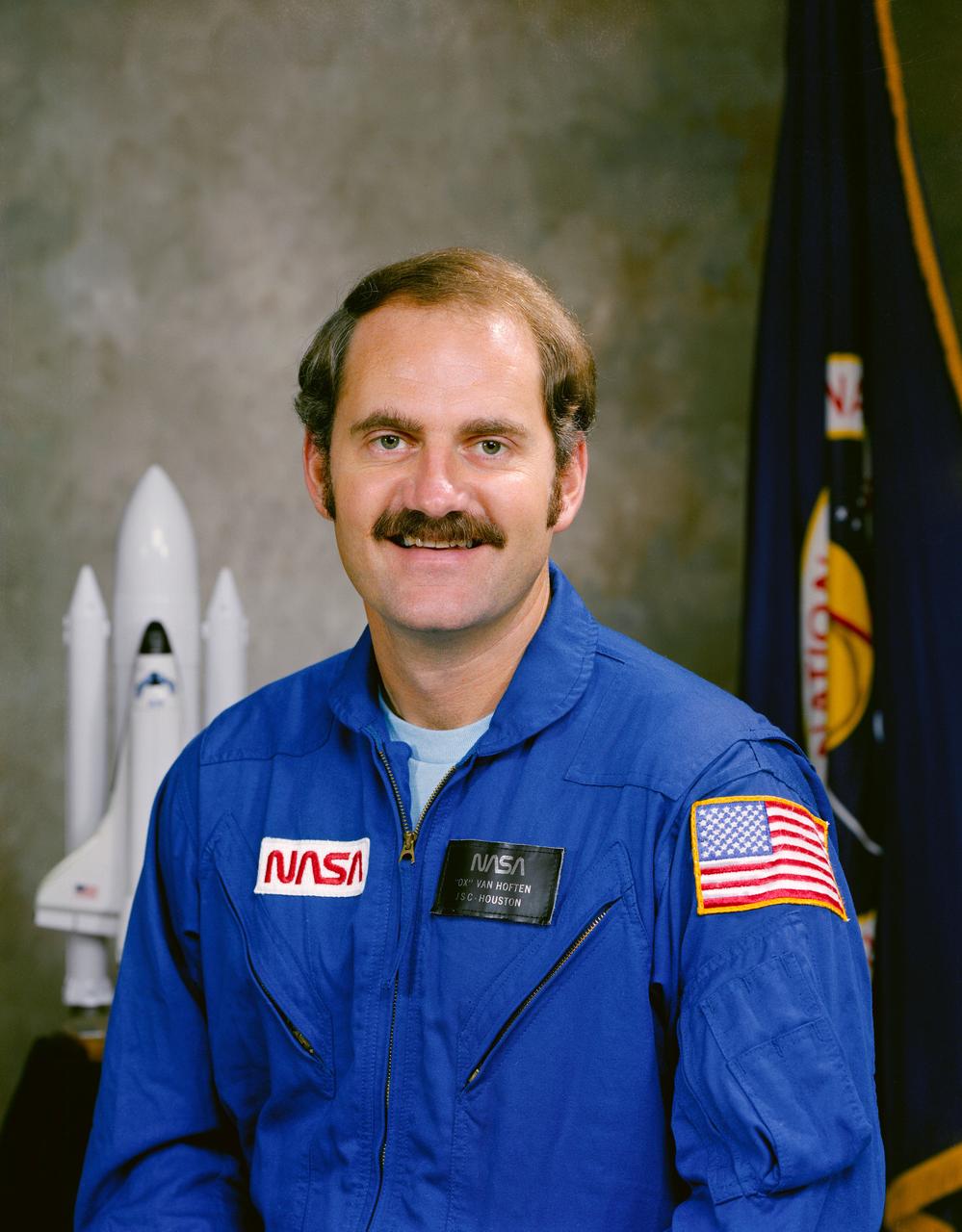
S78-35311 (31 Jan 1978) --- Astronaut James D. Van Hoften.
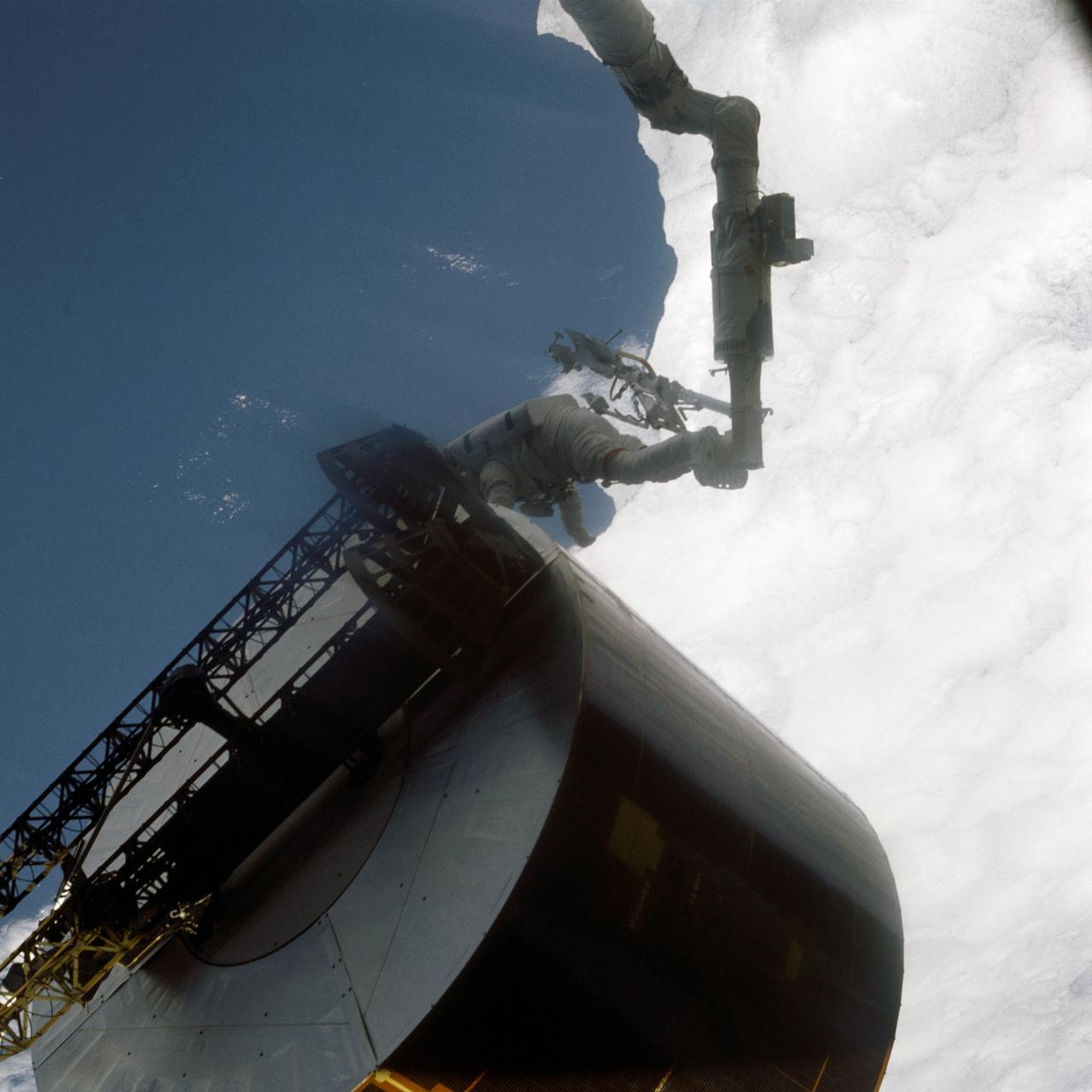
51I-44-014 (31 Aug-1 Sept. 1985) --- This photograph is one of a series of six covering extravehicular activity (EVA) which were released by NASA on Sept. 4, 1985. Here, astronaut James D. van Hoften, dwarfed by the large satellite, moves in for initial contact. Astronaut John M. (Mike) Lounge, out of frame inside cabin, maneuvers the remote manipulator system (RMS) arm to assist astronauts van Hoften and William F. Fisher. Photo credit: NASA
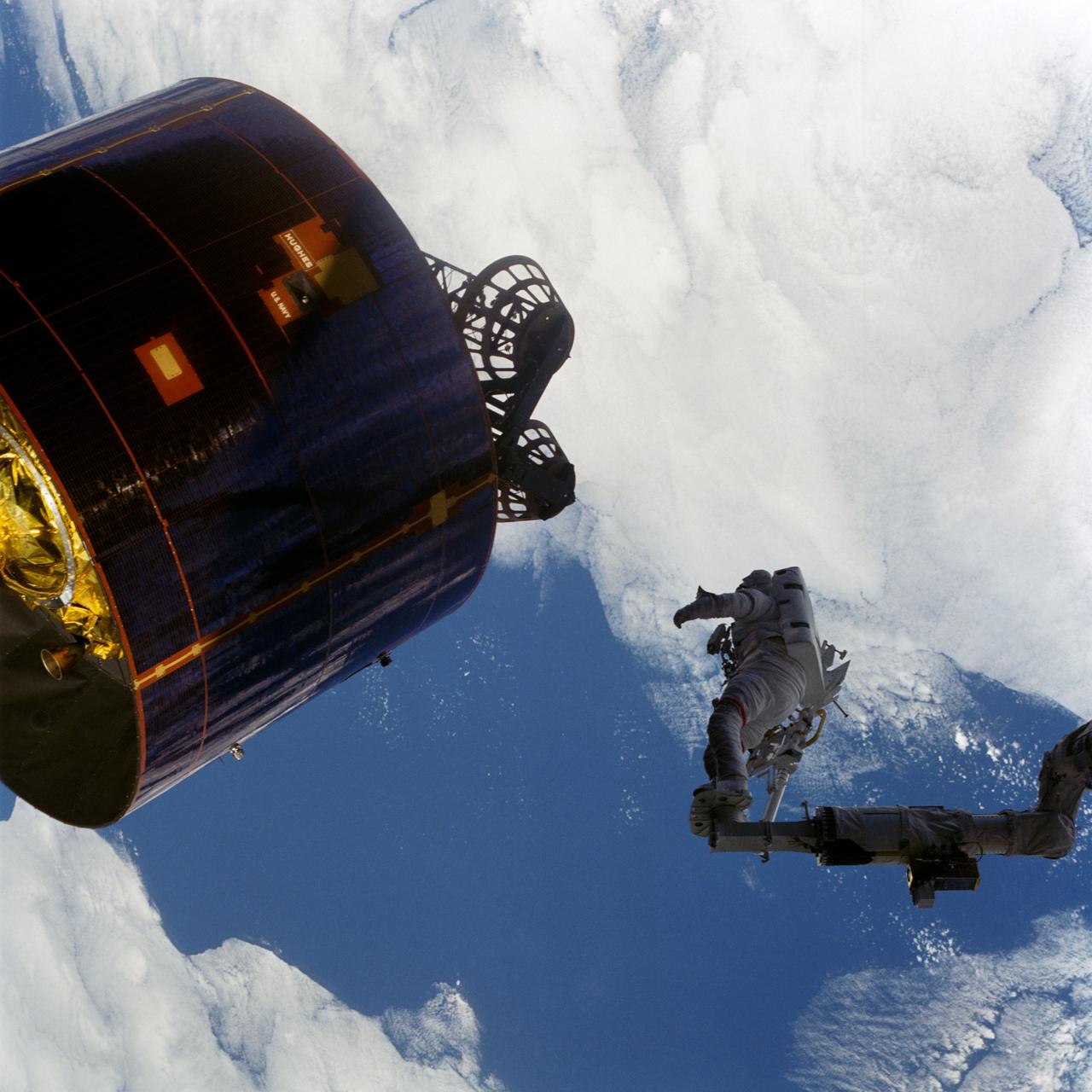
51I-44-012 (1 Sept. 1985) --- Astronaut James D. van Hoften looks on as the Syncom IVC-3 satellite responds to his push against it moments earlier. Dr. van Hoften, mission specialist, is anchored to a foot restraint on the end of the remote manipulator system (RMS) arm of the Earth-orbiting space shuttle Discovery. The 51-I crew members showed this photograph at their Sept. 11 postflight press conference. Photo credit: NASA
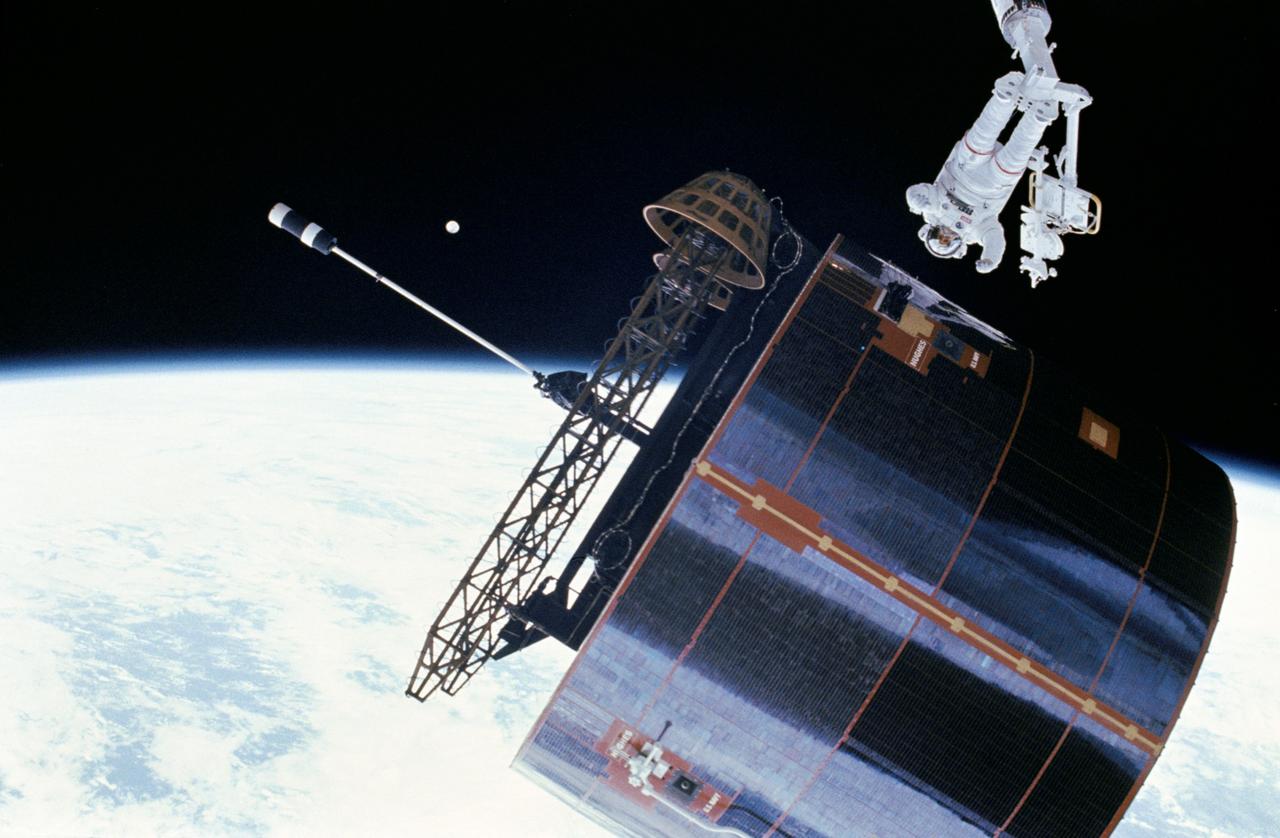
51I-102-029 (31 August - 1 September 1985) --- This is one of a series of six photographs released by NASA covering the extravehicular activity (EVA) of astronauts James D. van Hoften and William F. Fisher, who helped to capture, repair and release the previously errant Syncom IV-3 communications satellite. Here, Dr. van Hoften has just given a shove to the the Syncom. (For orientation, moon should be in lower right quadrant).
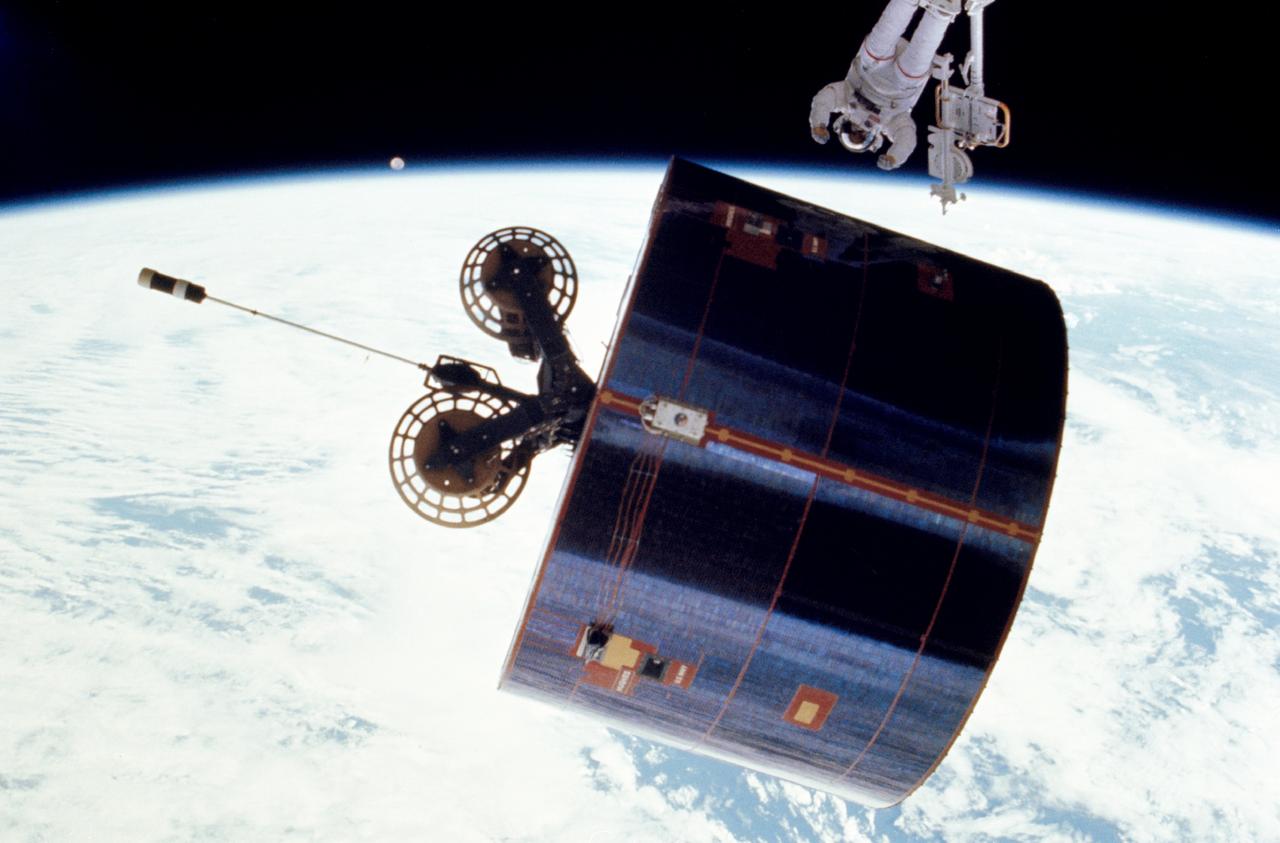
51I-102-033 (31 August - 1 September 1985) --- This is one of a series of six photographs released by NASA covering the extravehicular activity (EVA) of astronauts James D. van Hoften and William F. Fisher, who helped to capture, repair and release the previously errant Syncom IV-3 communications satellite. Here, Dr. van Hoften has just given a shove to the the Syncom. (For orientation, moon should be in lower right quadrant).
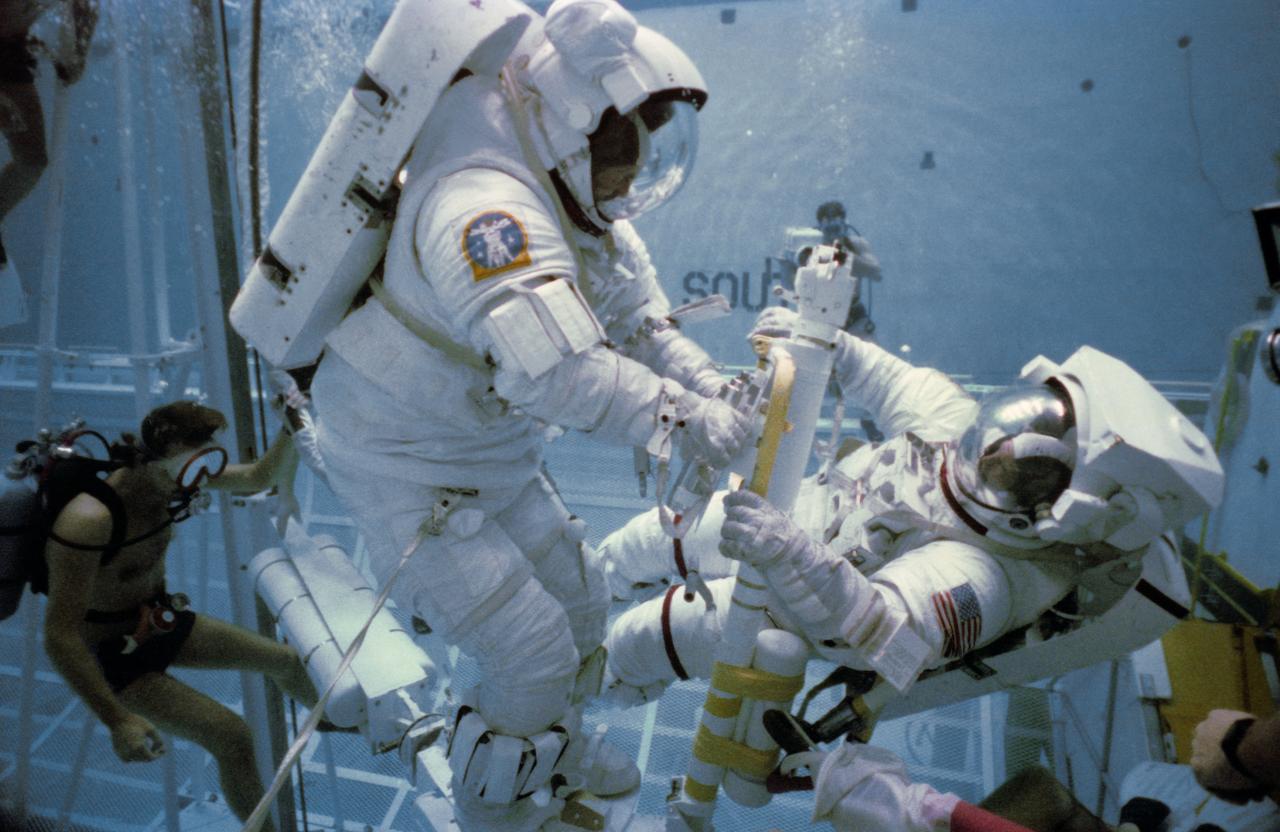
S83-42895 (19 Oct 1983) --- Astronauts George D. Nelson and James D. van Hoften, NASA Flight STS-41C mission specialists, offer an underwater version of a preview of their mission's extravehicular activity (EVA). The April 1984 flight includes as one of its primary objectives a two-person EVA and a visit to the damaged Solar Maximum Satellite (SMS). Van Hoften, left, and Nelson work here with the mobile foot restraint (MFR), which attaches to the remote manipulator system (RMS) arm to form a "cherry-picker" device. Van Hoften is standing on the MFR. The two are making use of the Johnson Space Center's (JSC) weightless environment training facility (WET-F). This photograph was taken by Otis Imboden.
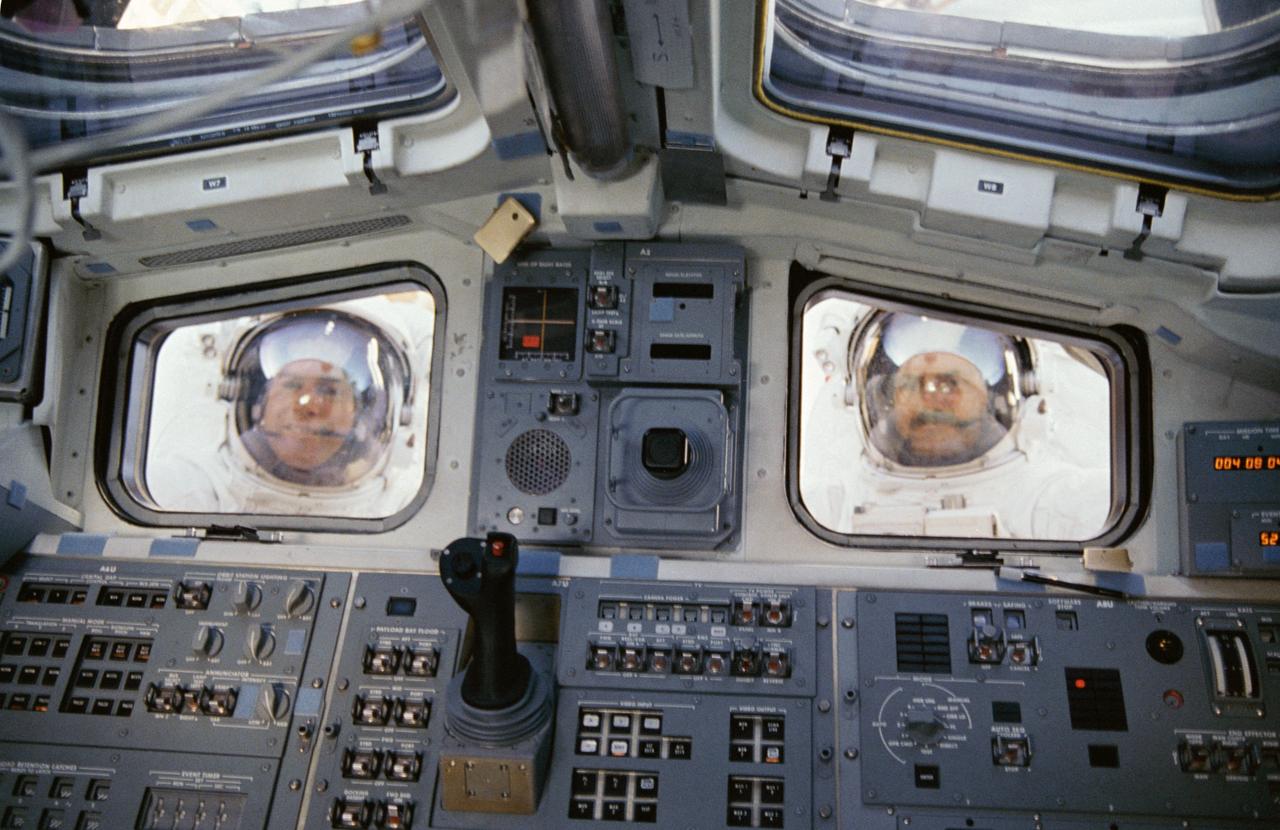
51I-11-027 (1 Sept 1985) --- The extravehicular activity (EVA) of astronauts William F. Fisher (left) and James D. van Hoften succeeded in the capture, repair and re-release of the troubled Syncom IV-3 satellite. Here, the two take a break from the serious side of their EVA to look into the Discovery's cabin. The 51-I crewmembers showed this scene at their Sept. 11 post-flight press conference.
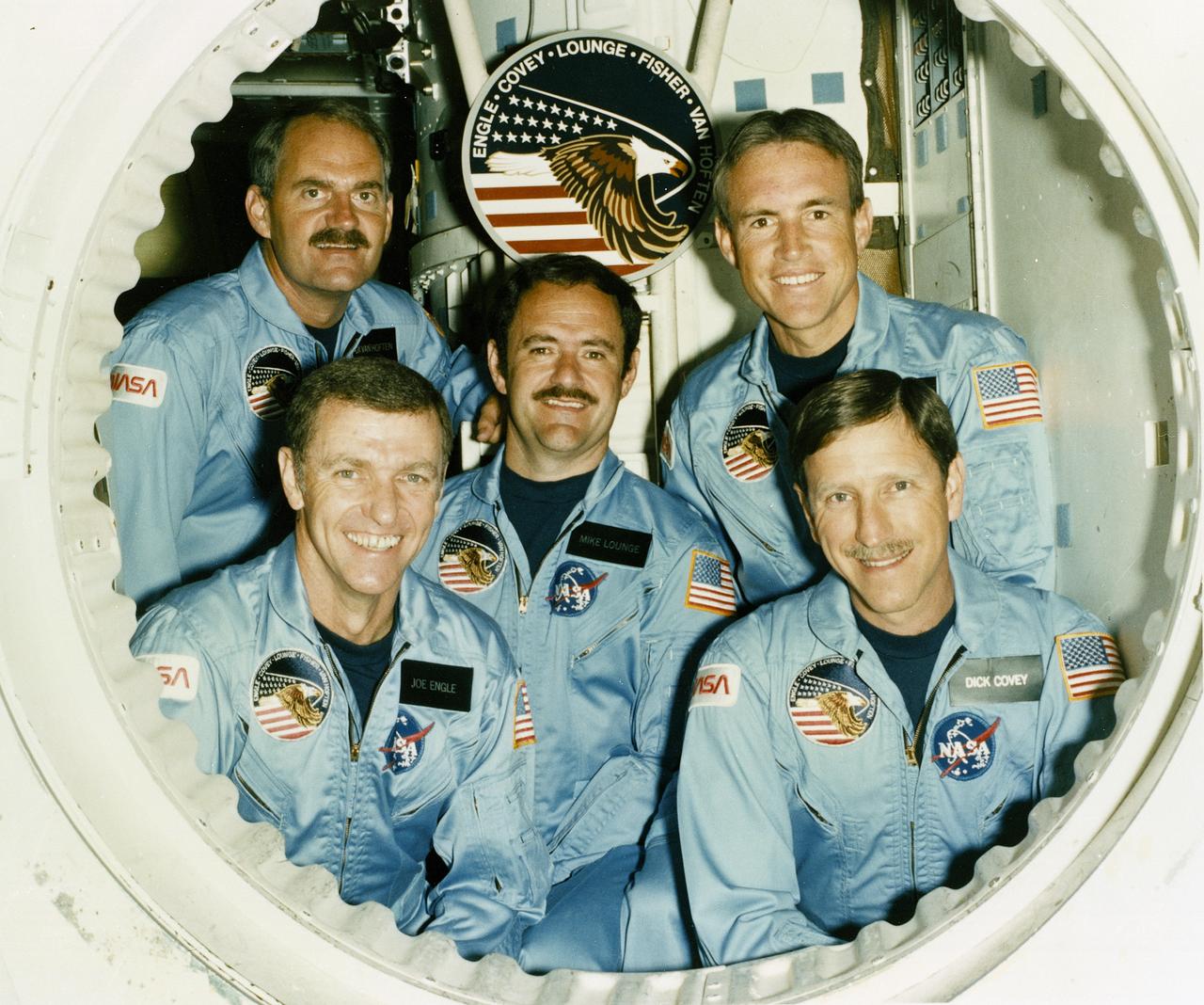
The crew assigned to the STS-51I mission included (front row left to right) Joe H. Engle, commander; and Richard O. Covey, pilot. In the center is John M. (Mike) Lounge, mission specialist. On the back row, from left to right, are mission specialists James D. van Hoften, and William F. Fisher. Launched aboard the Space Shuttle Discovery on August 27, 1985 at 6:58:01 am (EDT), the STS-51I mission’s primary payloads were three communication satellites: the ASC-1 for the American Satellite Company; the AUSSAT-1, an Australian communications satellite; and the SYNCOM-IV-4, the synchronous communications satellite.
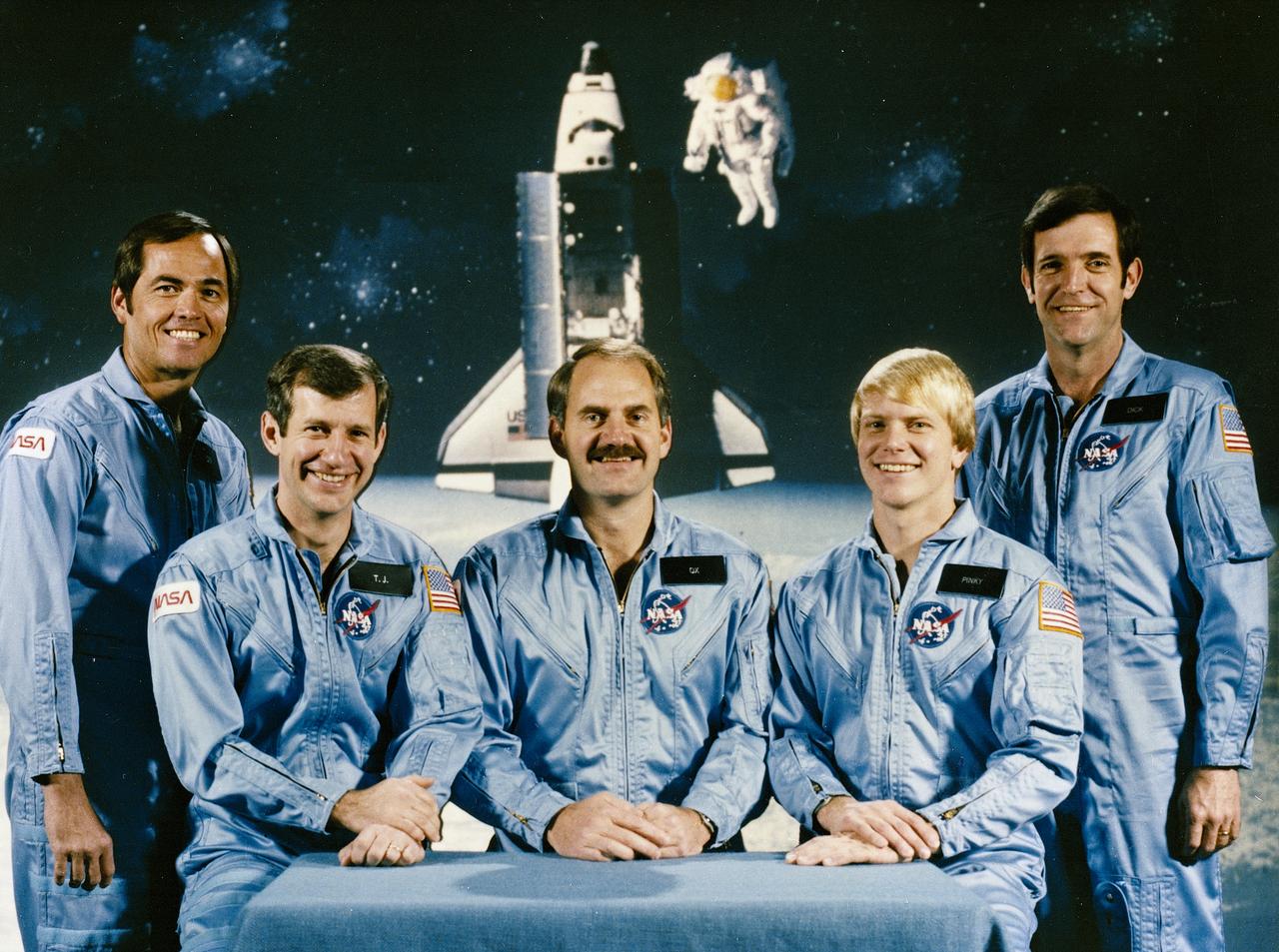
The crew assigned to the STS-41CB (STS-13) mission included (left to right) Robert L. Crippen, commander; Terry J. Hart, mission specialist; James D. Van-Hoften, mission specialist; George D. Nelson, mission specialist; and Francis R. (Dick) Scobee, pilot. Launched aboard the Space Shuttle Challenger on April 6, 1984 at 8:58:00 am (EST), the STS-41C mission marked the first direct ascent trajectory for the Space Shuttle. The crew deployed the Long Duration Exposure Facility (LDEF).
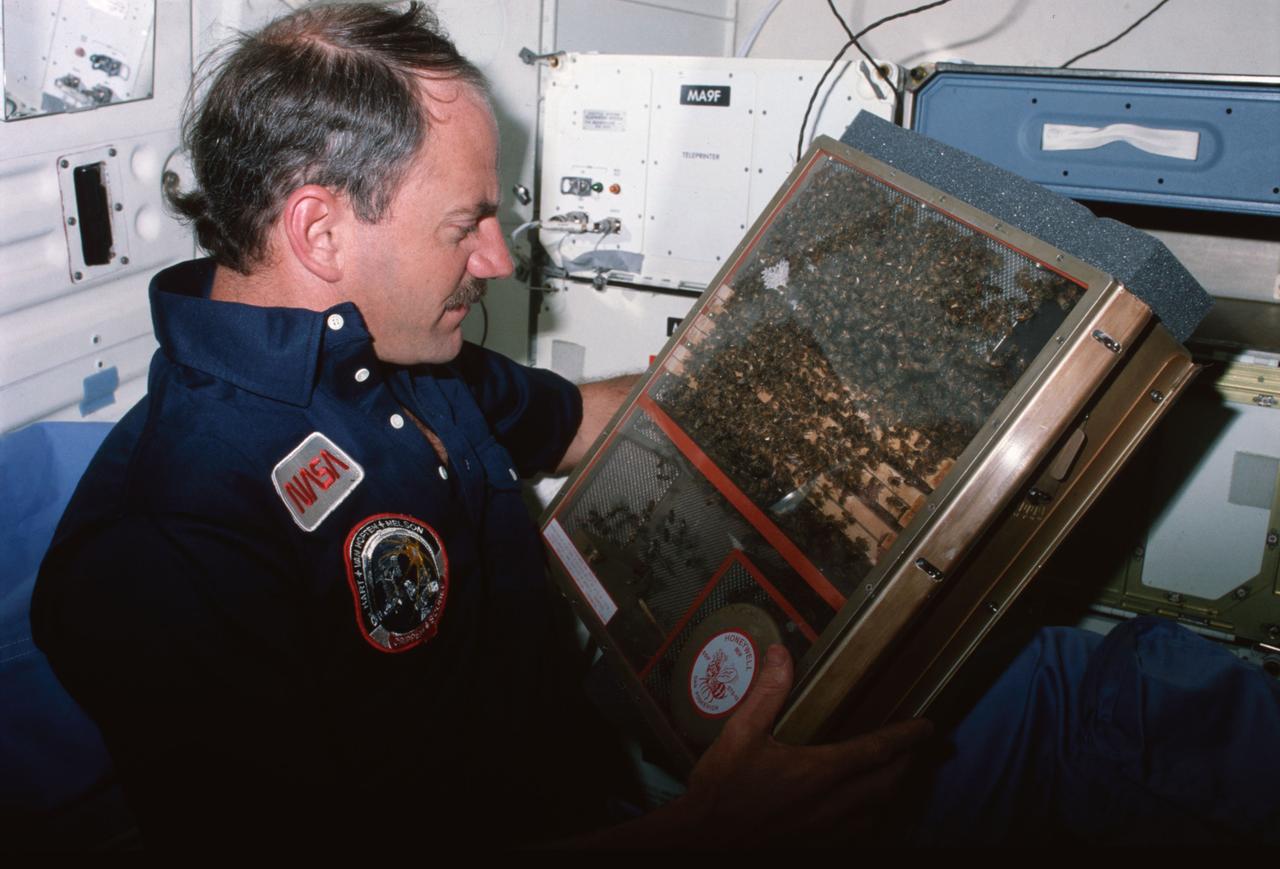
41C-05-188 (12 April 1984) --- Astronaut James D. van Hoften, mission specialist, holds an aluminum box, full of honeybees. The experiment in Earth-orbit is duplicated with another colony of the young honeycomb builders on Earth. Dan Poskevich submitted the experiment to NASA as part of the Shuttle student involvement program.
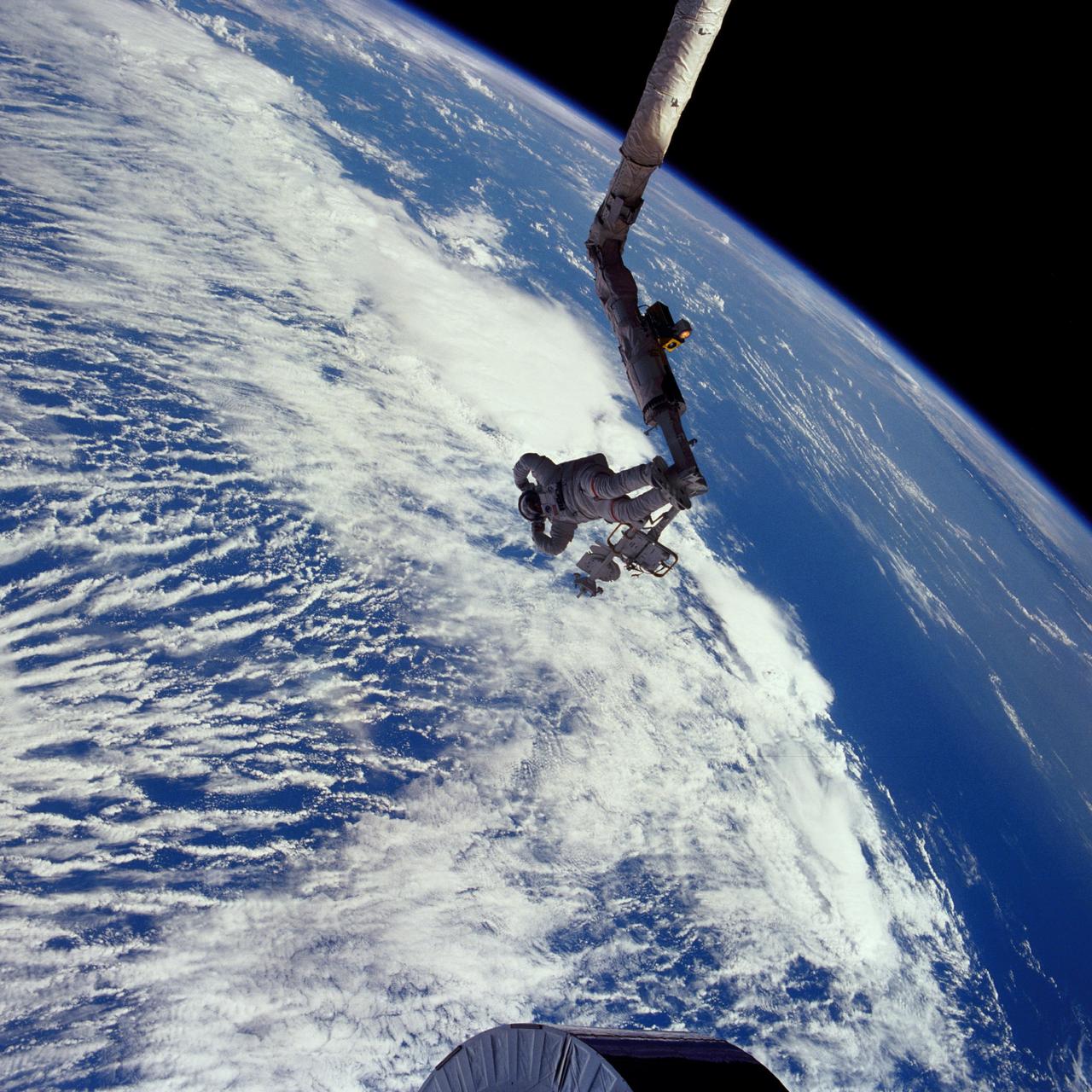
51I-41-086 (1 September 1985) --- Astronaut James D. van Hoften, mission specialist, flexes his muscles in celebration of a triumphant extravehicular task. Clouds over the ocean form the backdrop for this 70mm scene, toward the end of a two-day effort to capture, repair and release the previously errant Syncom IV-3 communications satellite. Van Hoften, anchored to a special foot restraint device on the end of Discovery's Remote Manipulator System (RMS), had just performed the final "shove" that started the relative separation of the Shuttle and the Syncom, which is not far out of frame. He had been joined by astronaut William F. Fisher for the busy two days of EVA.
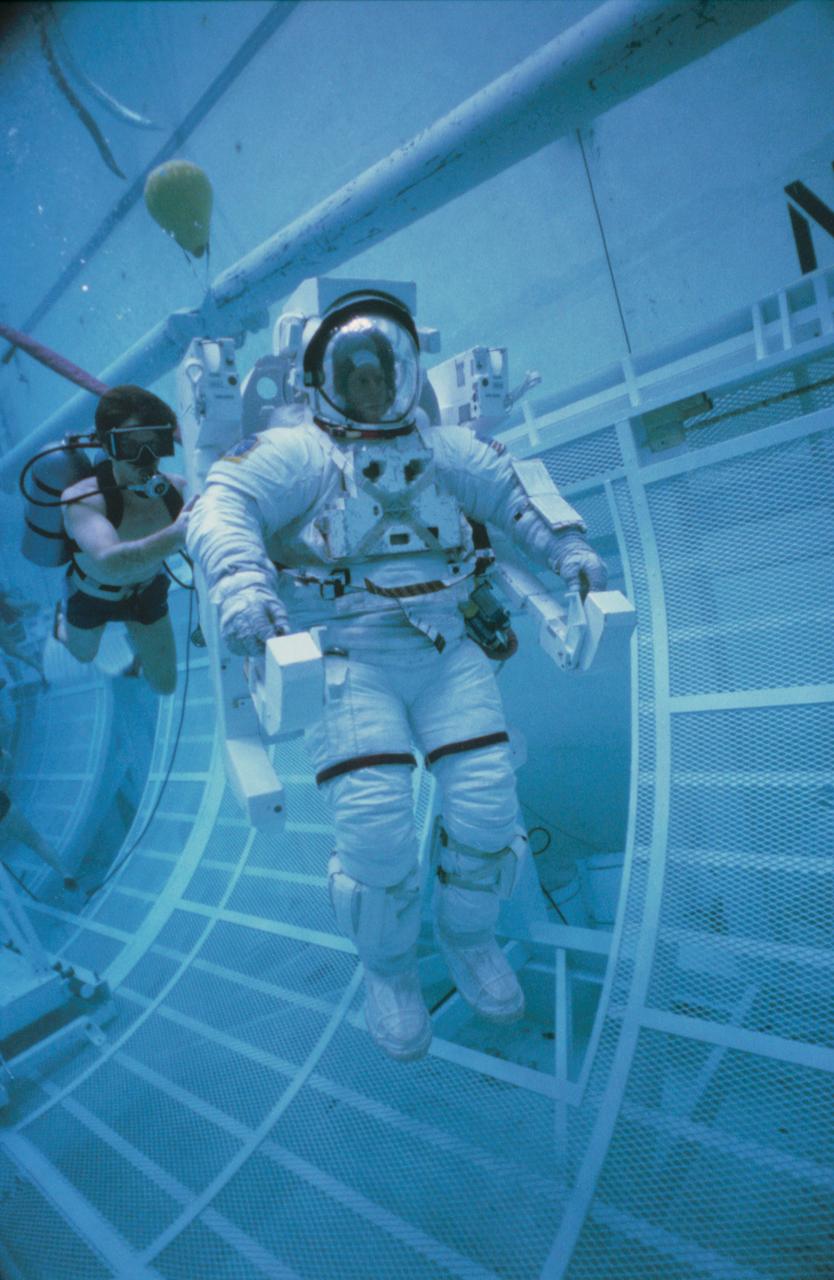
Underwater extravehicular activity (EVA) training in the weightless environment training facility (WETF) with astronauts George Nelson and James van Hoften. They are using tools to assemble material in the facility while surrounded by divers (428895); View of George Nelson in full extravehicular mobility unit (EMU) floating inside the space shuttle payload bay mockup with a diver behind him (42896).
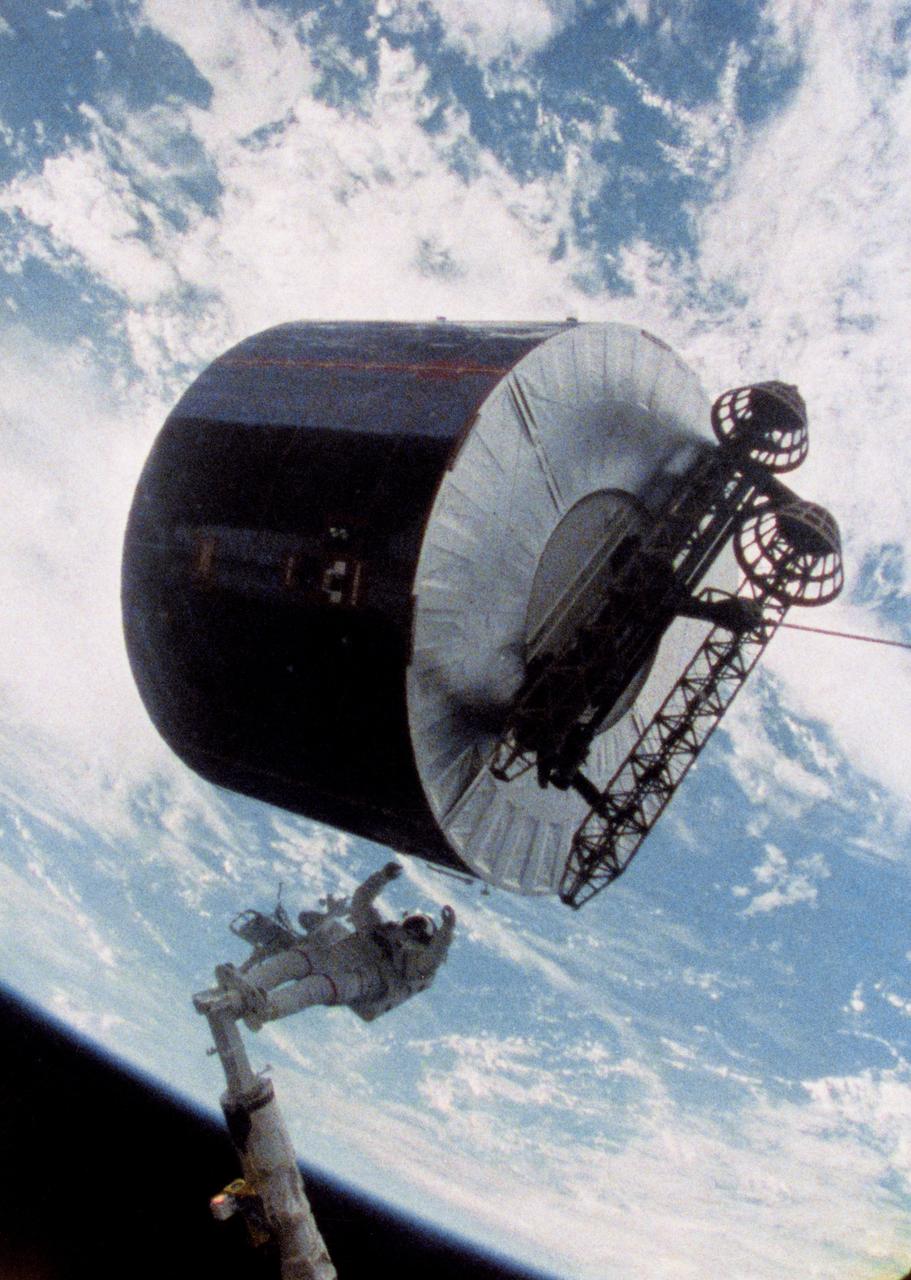
51I-S-237 (1 Sept. 1985) --- A still photo made from a video downlink shows astronaut James D. van Hoften, just after giving a shove to the Syncom IV-3 communications satellite. NASA's 51-I astronaut crew aboard the space shuttle Discovery had earlier captured and repaired the previously errant satellite. Photo credit: NASA
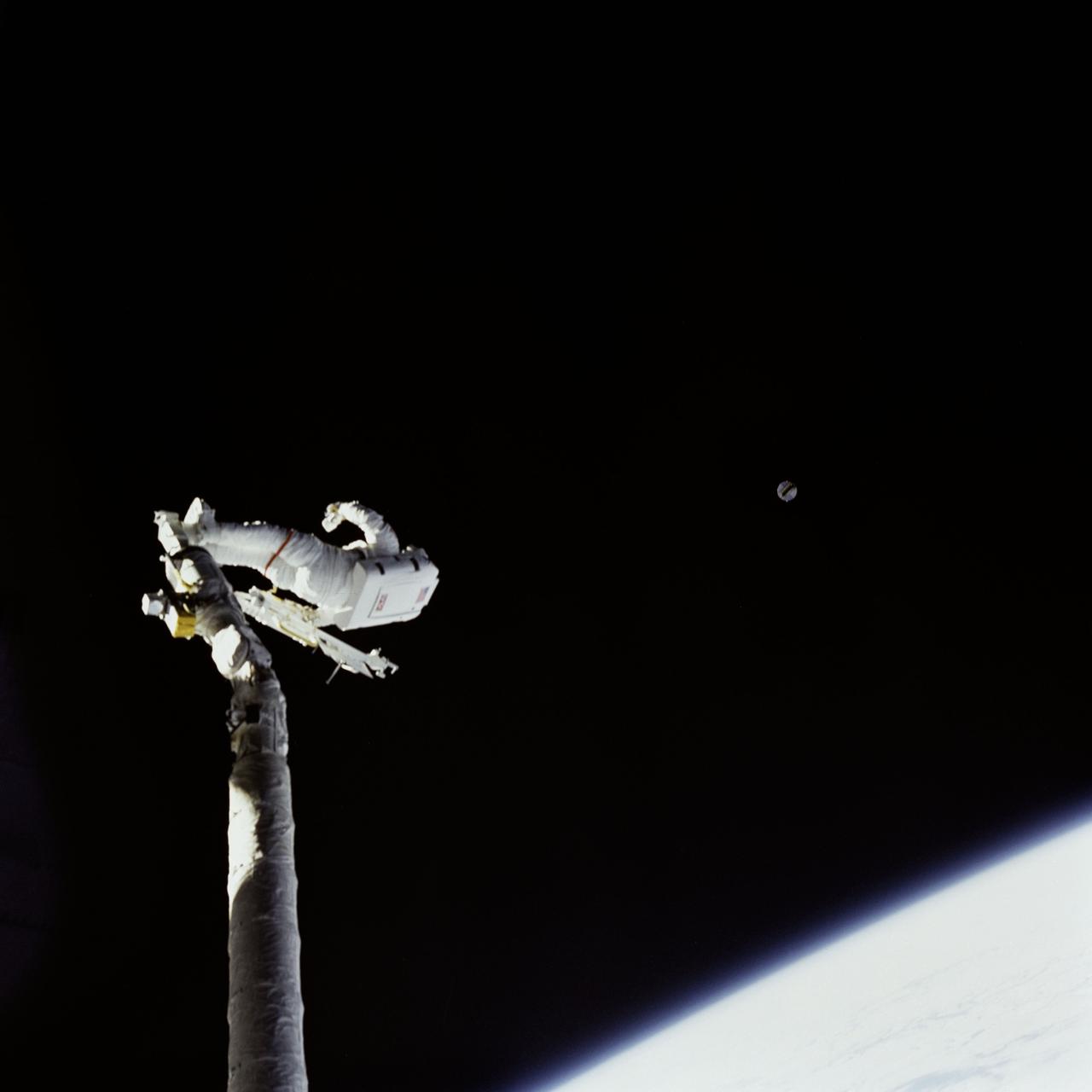
51I-44-081 (1 Sept 1985) --- Astronaut James D. van Hoften on the Discovery's remote manipulator system (RMS) arm visually tracks the distant Syncom IV-3 communications satellite after its second release, on Sept. 1, 1985.
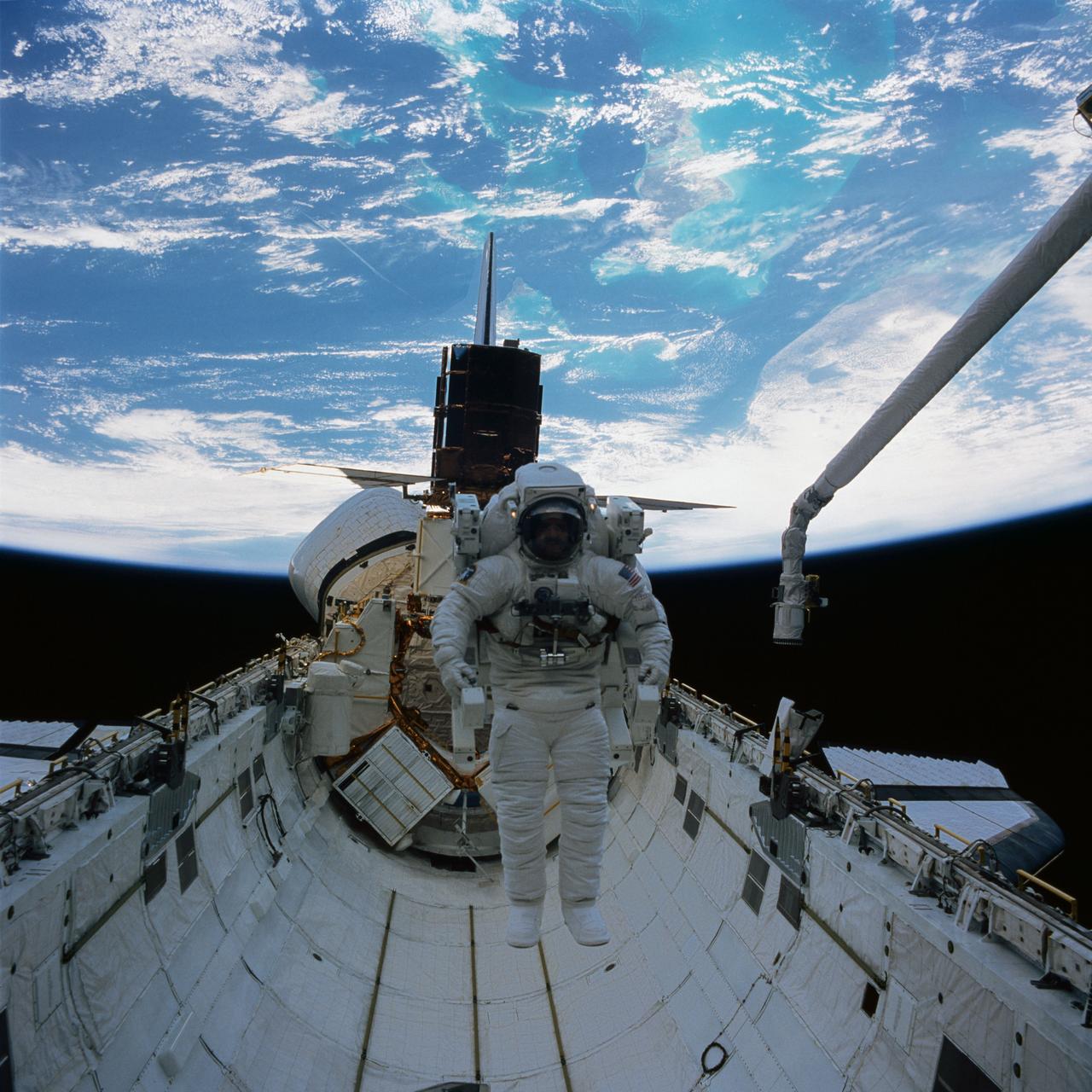
41C-37-1718 (11 April 1984) --- Astronaut James D. van Hoften and a repaired satellite are captured by a Hasselblad camera aimed through Challenger's aft cabin windows toward the cargo bay of the Earth orbiting Challenger. Dr. van Hoften is getting in his first "field" test of the manned maneuvering unit (MMU) after months of training in an underwater facility and in a simulator on Earth. The Solar Maximum Mission Satellite (SMMS), revived and almost ready for release into space once more, is docked at the flight support system (FSS).
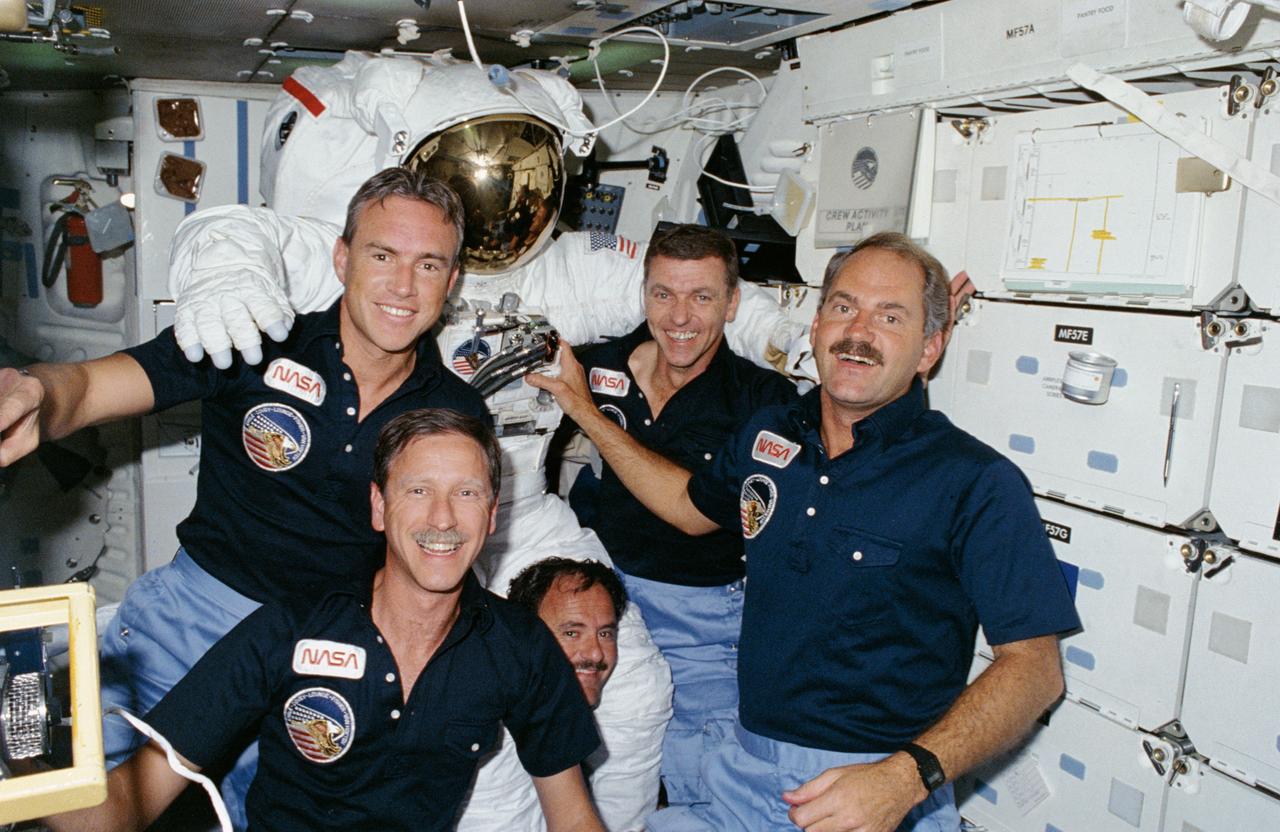
51I-07-015 (4-5 Sept 1985) --- All five STS 51-I crewmembers pose with one of two extravehicular mobility unit (EMU) spacesuits used by Astronauts van Hoften and Fisher on their two-day EVA.
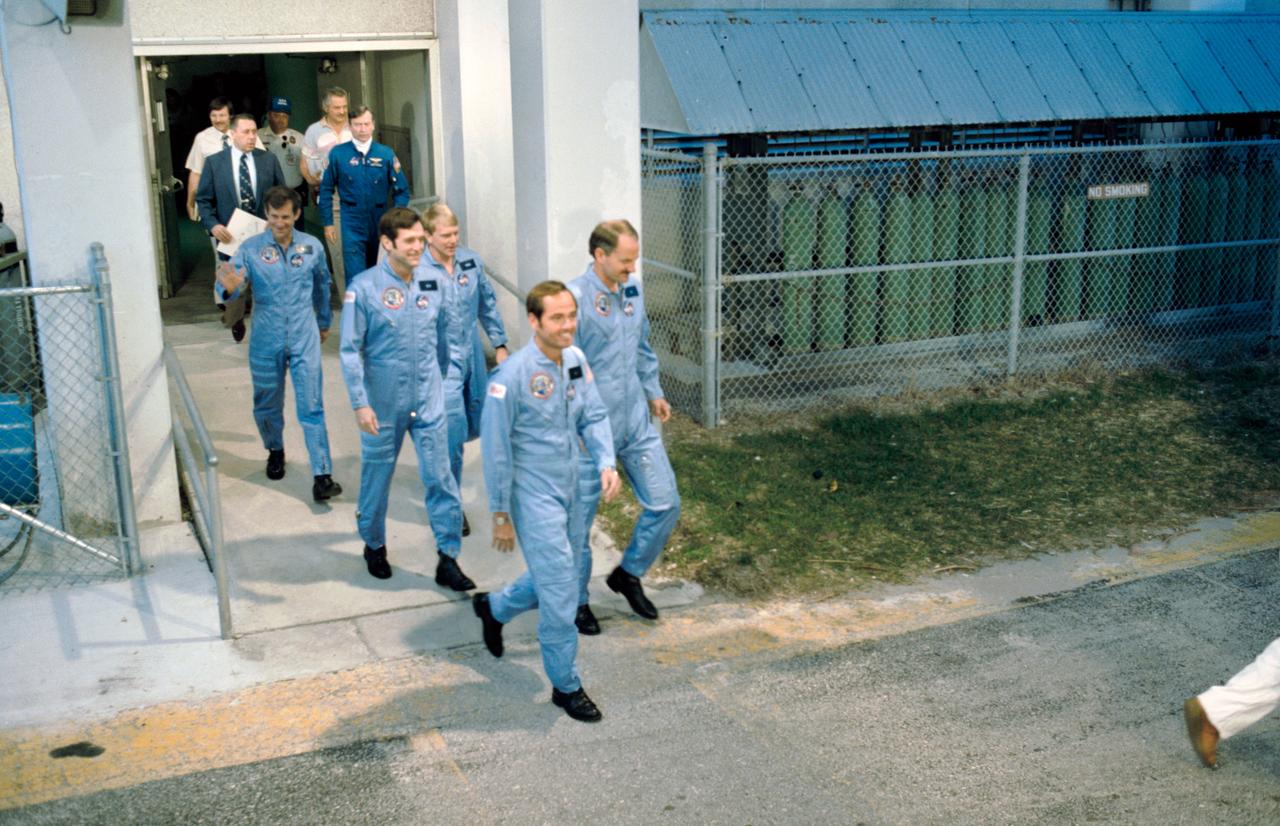
41C-3061 (6 April 1984) --- The five-member astronauts crew for NASA's STS-41C Space Shuttle mission head for the transfer van that will transport them to Launch Pad 39B at the Kennedy Space Center. Astronaut Robert L. Crippen, commander, leads the way. Immediately behind Crippen is Astronaut Francis R. (Dick) Scobee, pilot. The three mission specialists are (left to right) Astronauts Terry J. Hart, George D. Nelson and James D. van Hoften. The photograph was taken by Otis Imobden.
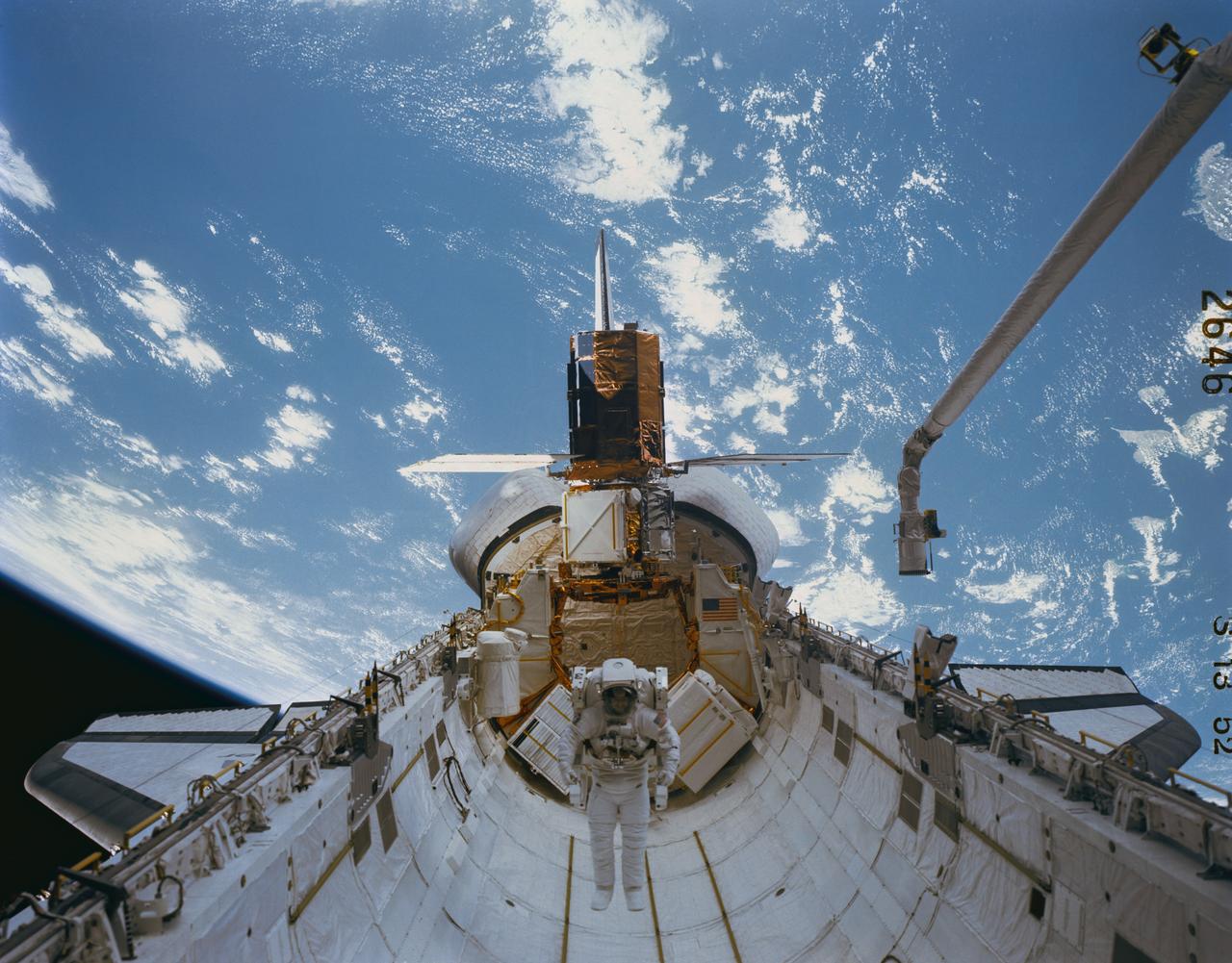
41C-52-2646 (11 April 1984) --- Astronaut James D. van Hoften and a repaired satellite are in a wide panorama recorded on film with a Linhof camera, making its initial flight aboard the Space Shuttle Challenger. Dr. van Hoften is getting in his first "field" test of the Manned Maneuvering Unit (MMU) after months of training in an underwater facility and in a simulator on Earth. The Solar Maximum Mission Satellite (SMMS), revived and almost ready for release into space once more, is docked at the Flight Support System (FSS). The Remote Manipulator System (RMS) is backdropped against the blue and white Earth at frame's edge. Outside of pictures made of the Earth from astronauts on the way to the Moon, this frame showing the planet from 285 nautical miles represents the highest orbital photography in the manned space program.
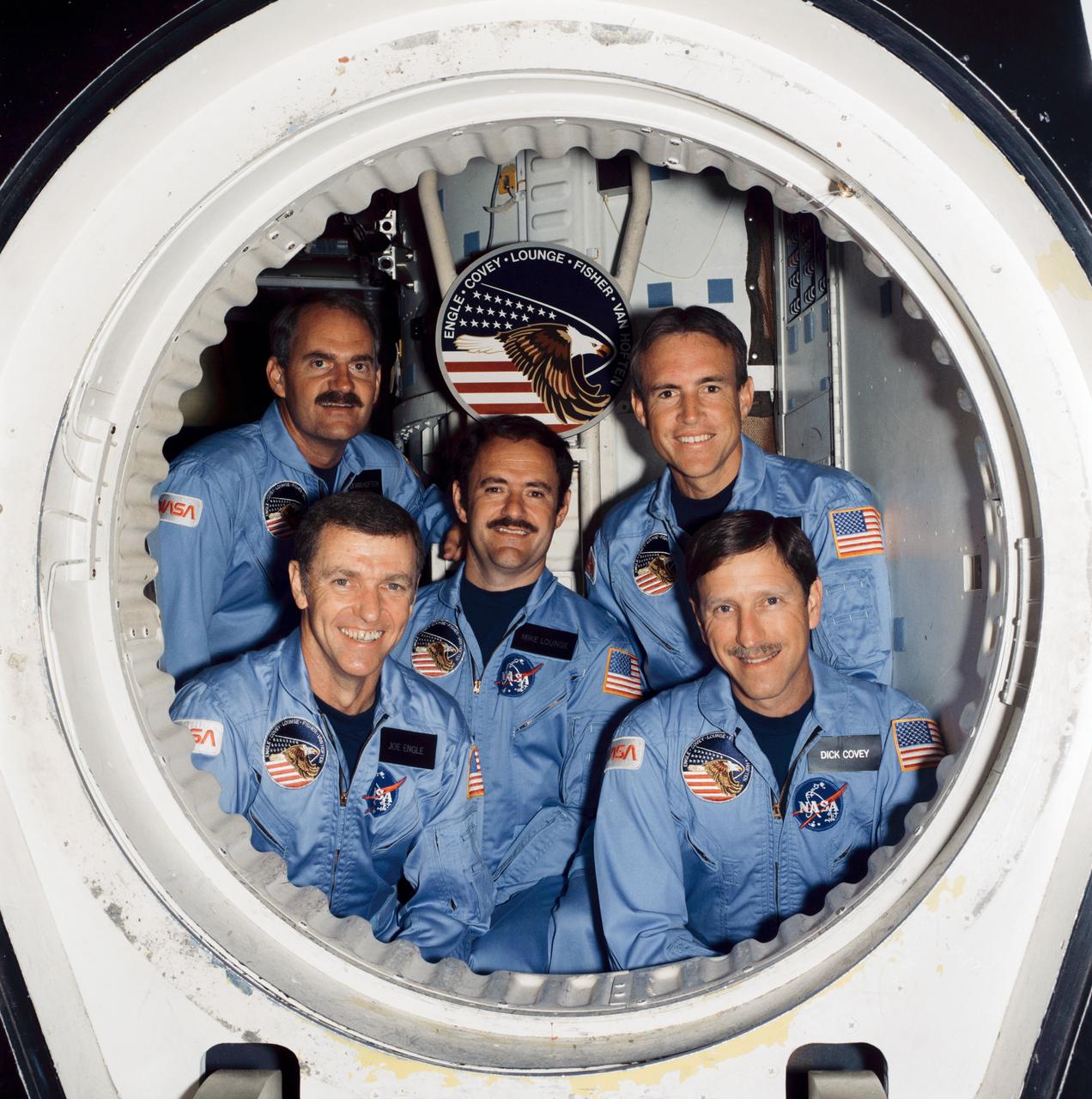
S85-36062 (1 July 1985) --- These five NASA astronauts make up the crew for the mission STS-51I, scheduled for launch in August of this year. Taking a break from rehearsals in the crew compartment trainer in the Shuttle Mockup and Integration Laboratory at JSC are astronauts Joe H. Engle (front left), crew commander; Richard O. Covey (front right), pilot; and (back row, left-to-right) astronauts James D. van Hoften, John M. (Mike) Lounge and William F. Fisher -- all mission specialists.
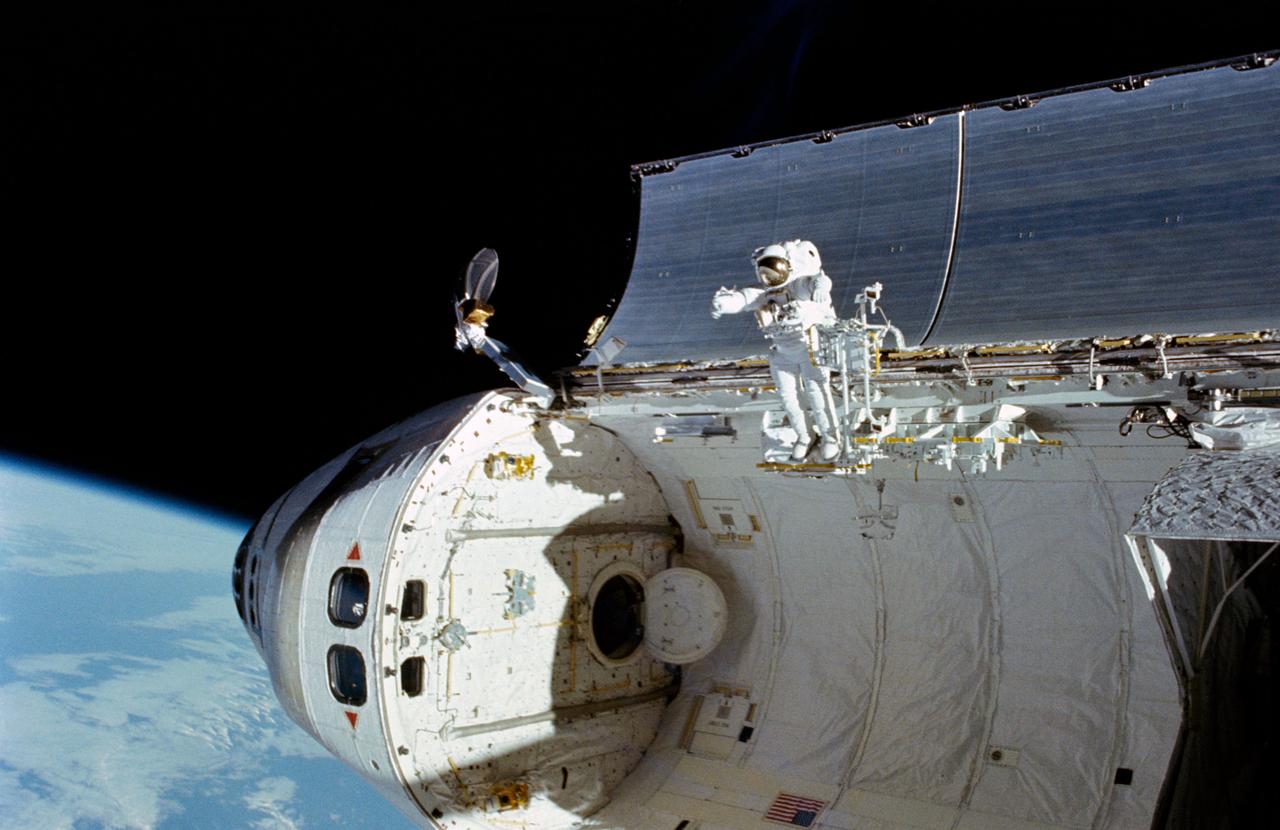
51I-102-048 (4-5 Sept 1985) --- A 35mm frame showing astronaut William F. Fisher standing on the edge of Discovery's cargo bay (in foot restraint) during the second day of a two-day effort to capture, repair and re-release the Syncom IV-3 communications satellite. Astronaut James D. van Hoften, standing on the Discovery's RMS arm, exposed the frame.
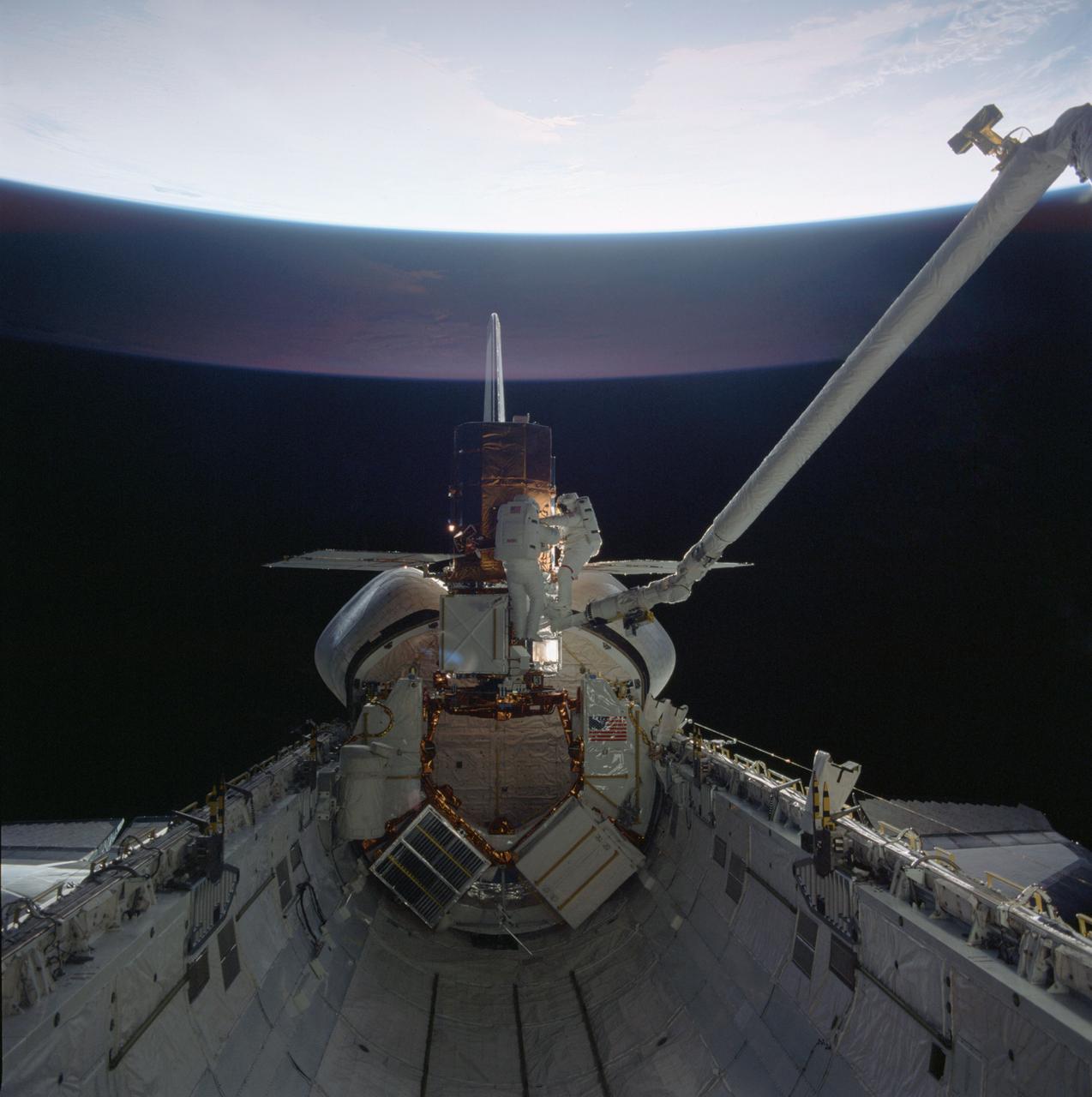
41C-37-1711 (11 April 1984) --- The two mission specialist-EVA participants of Flight 41-C share a repair task at the "captured" Solar Maximum Mission Satellite (SMMS) in the aft end of the Challenger's cargo bay. Astronauts George D. Nelson, right, and James D. van Hoften uses the mobile foot restraint and the Remote Manipulator System (RMS) as a "cherry picker" device for moving about. Later, the RMS lifted the SMMS into space once more.
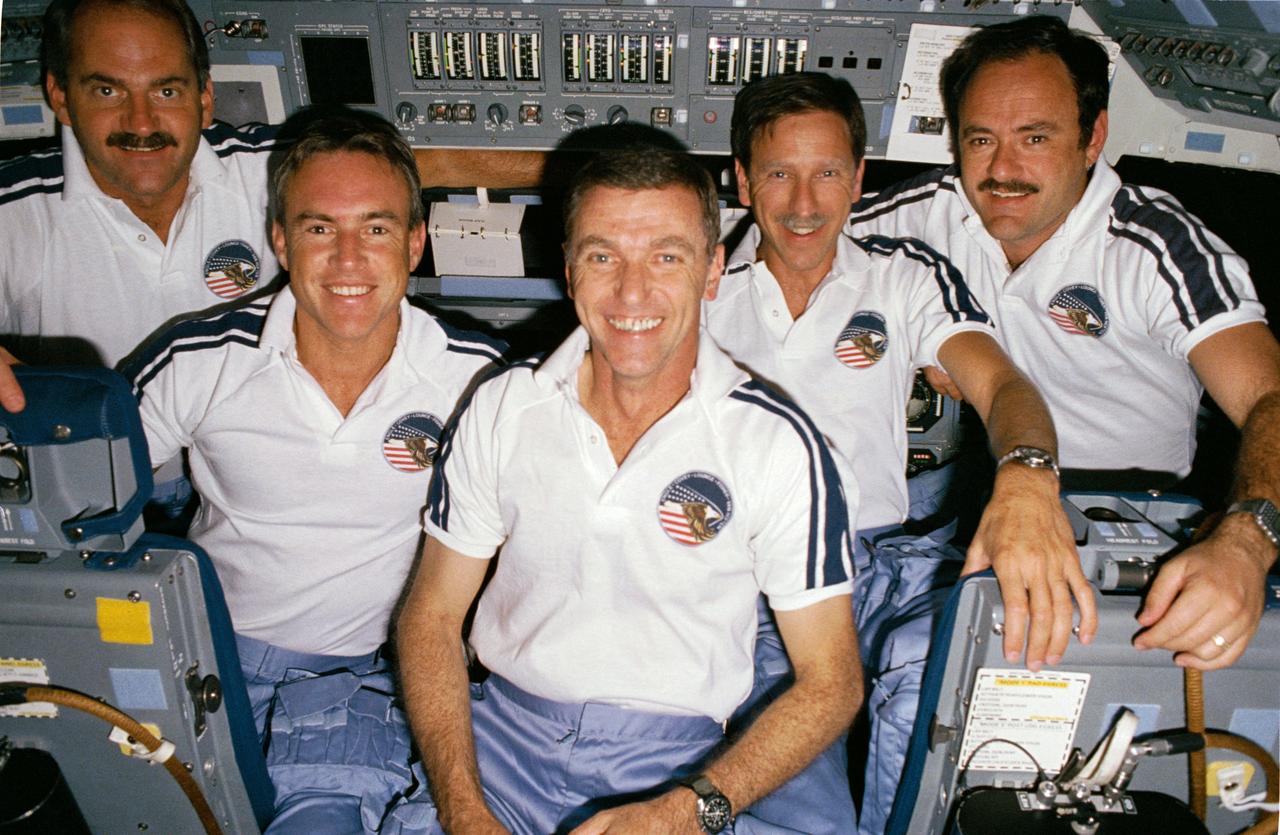
51I-17-029 (Aug-Sept 1985) --- A group portrait, recorded by a pre-set 35mm camera, shows all five STS- 51-I crewmembers on the flight deck of the Earth-orbiting Discovery in early September 1985, following the successful Syncom repair performed by the crewmembers. Left to right are Astronauts James D. van Hoften, William F. Fisher, Joe H. Engle, Richard O. Covey and John M. (Mike) Lounge.
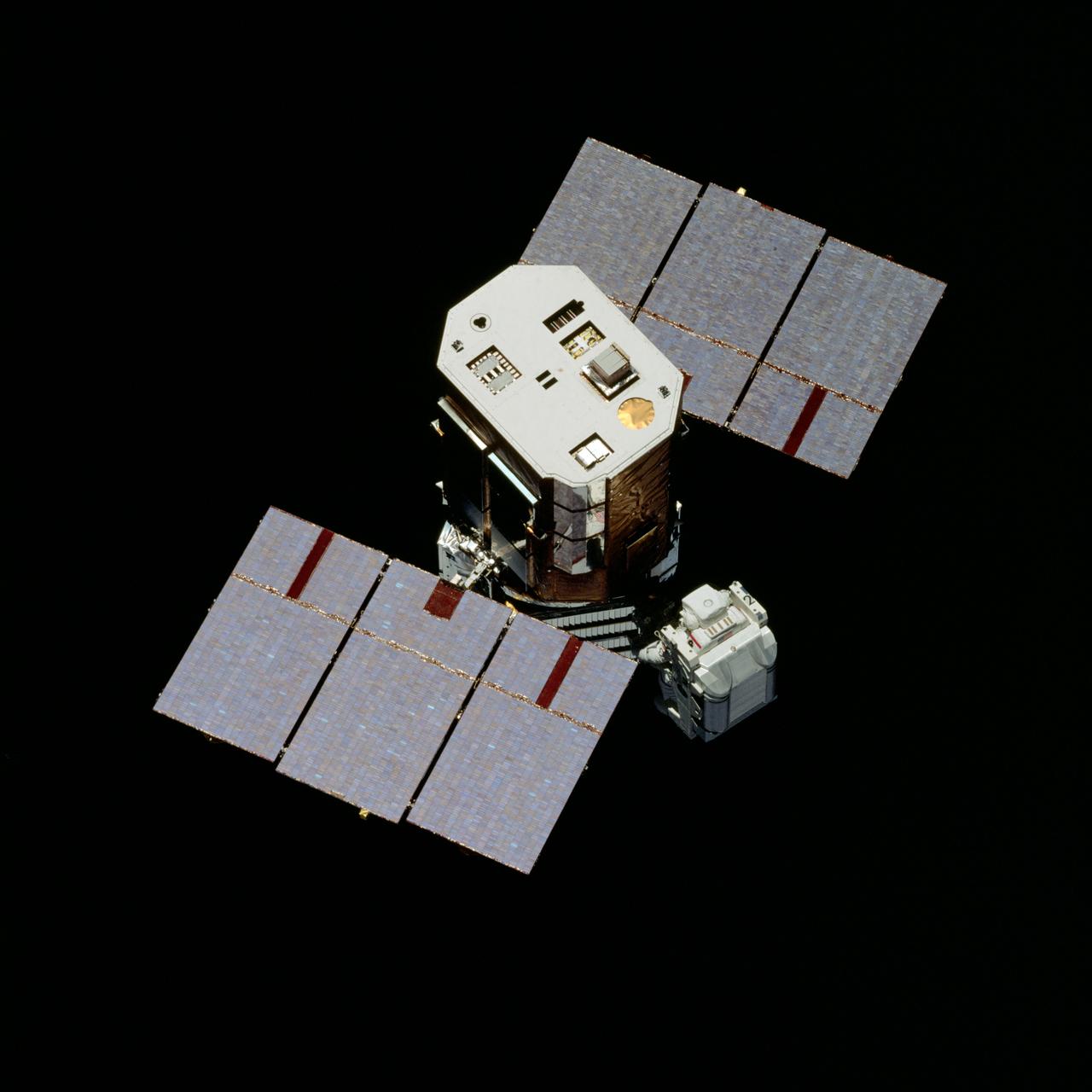
41C-34-1380 (10-11 April 1984) --- Astronaut George D. Nelson, using the manned maneuvering unit (MMU), arrives at the ailing Solar Maximum Mission Satellite (SMMS). After the STS-41C crewmembers captured the errant satellite and temporarily cradled it in Challenger?s payload bay, astronauts Nelson and James D. van Hoften repaired it and later re-released it.
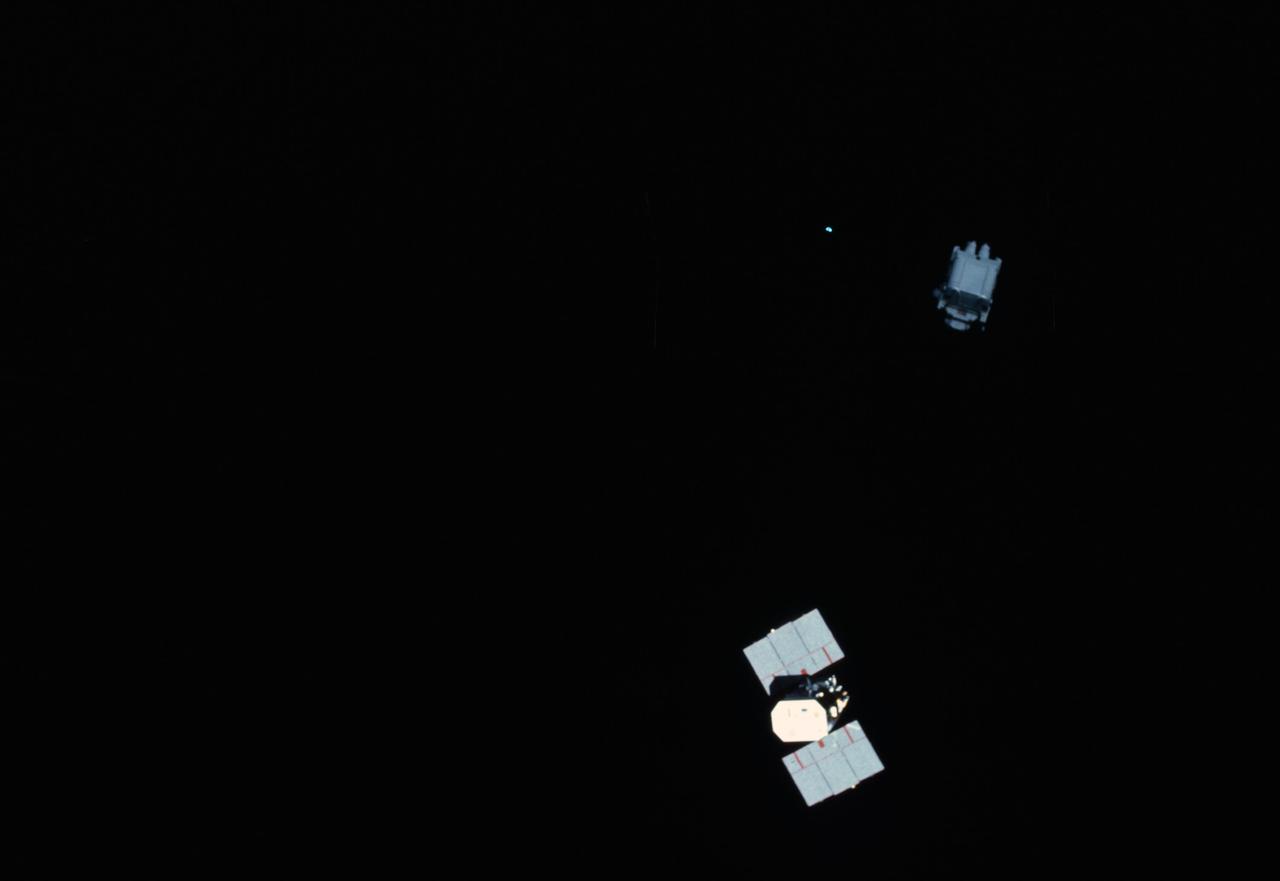
41C-22-885 (8 April 1984) --- The 35mm camera was used to photograph this scene of Astronaut George D. Nelson, STS-41C mission specialist, as he uses the manned maneuvering unit (MMU) to make an excursion to the plagued Solar Maximum, Mission Satellite (SMMS)._Astronaut James D. van Hoften remained in the Challenger's cargo bay during the April 8 extravehicular activity (EVA).
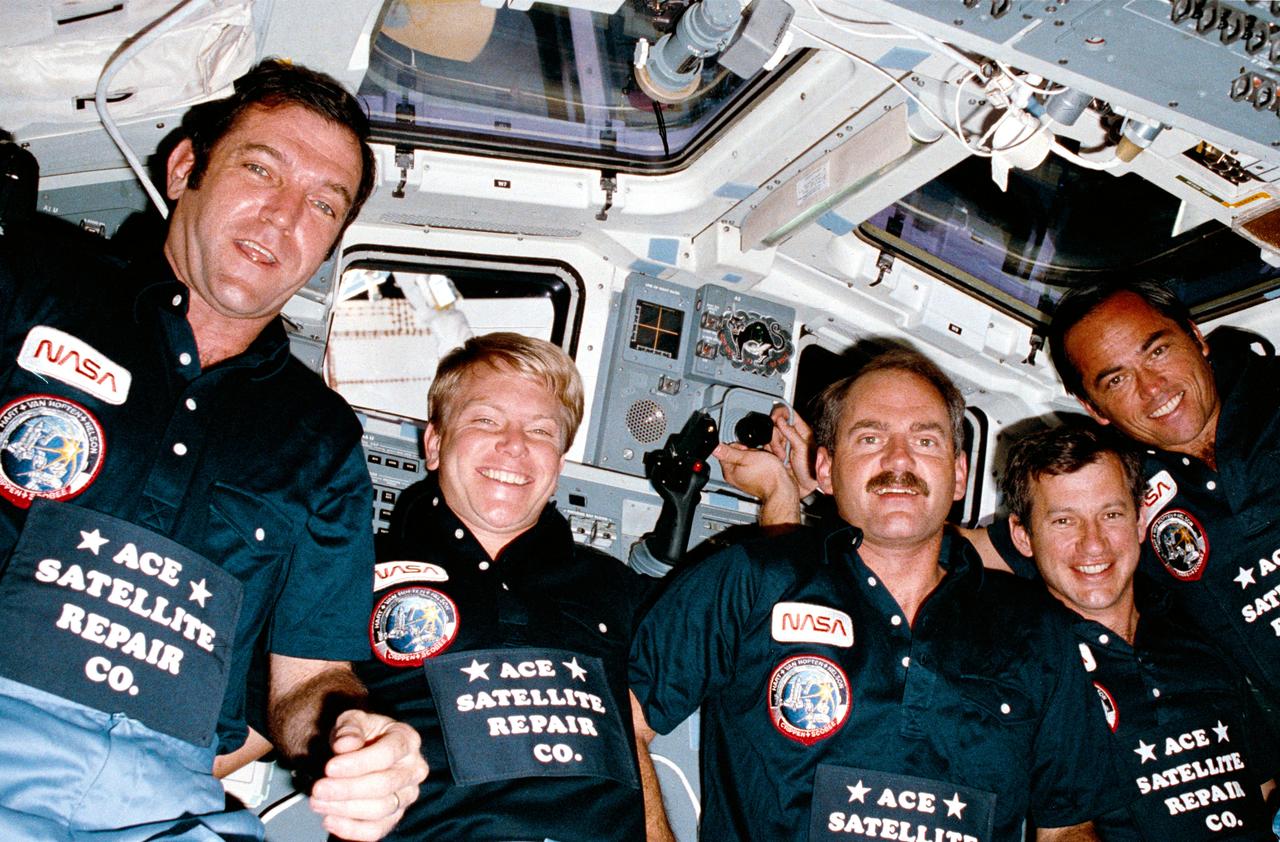
41C-07-262 (6-13 April 1984) --- Automatic exposure on a stationary 35mm camera recorded this "team" photograph of the 41-C astronauts at the aft flight deck of the Earth orbiting Challenger. Astronauts Robert L. Crippen, right, crew commander; and Francis R. (Dick) Scobee, left, pilot, flank the mission specialists--(l-r) George D. Nelson, James D. van Hoften and Terry J. Hart. This picture was among 20 frames of 41-C photography released by NASA on the weekend following the April 13 landing at Edwards Air Force Base and it was used as one of the visuals at the April 24 post-flight press conference. .
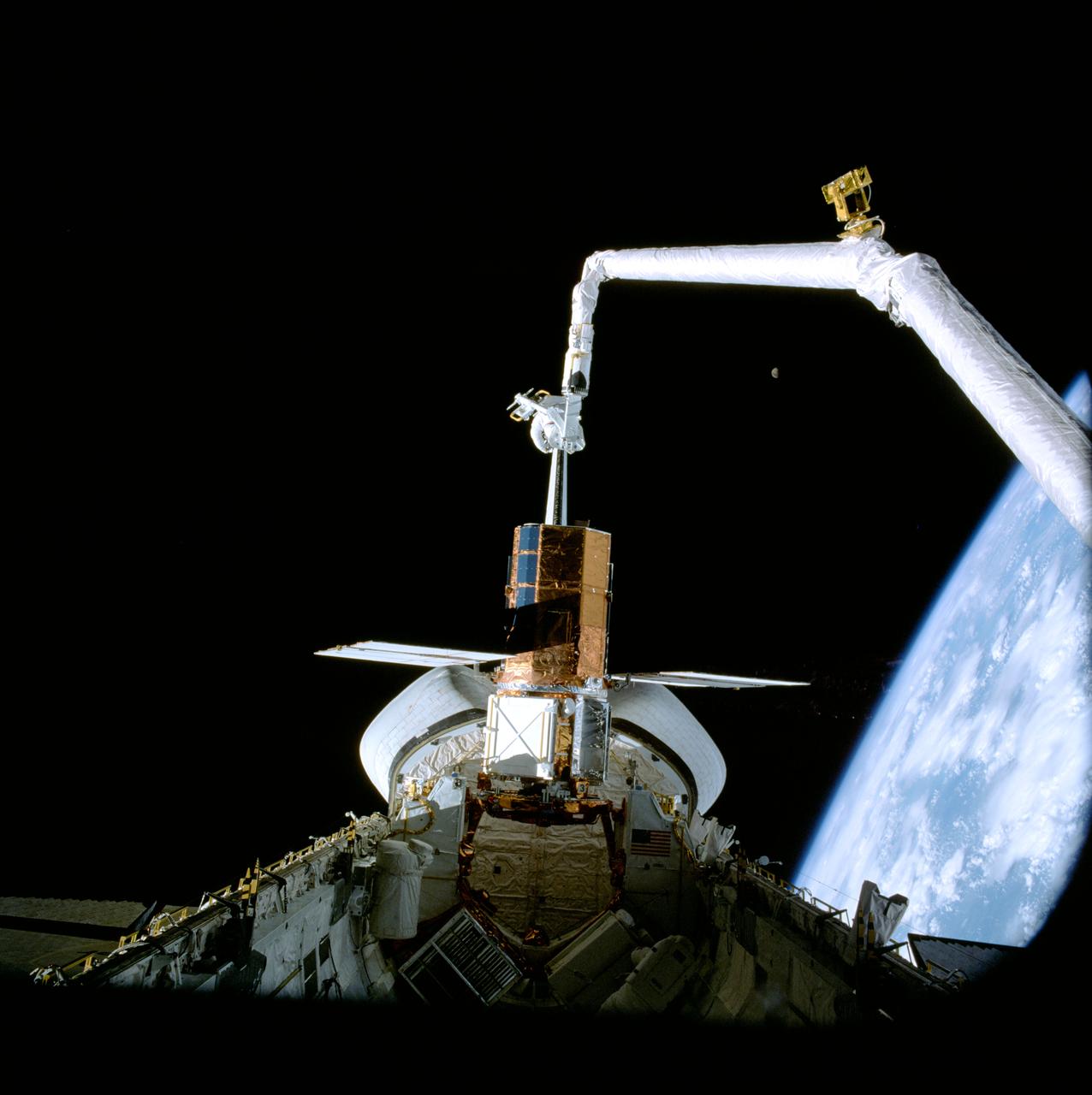
41C-37-1715 (11 April 1984) --- A scenic panorama is captured by an onboard 70mm handheld camera during the April 11, 1984, Solar Maximum Mission Satellite (SMMS) repair job aboard the Earth-orbiting Space Shuttle Challenger. The SMMS is temporarily docked at the Challenger's Flight Support System (FSS) so that astronauts George D. Nelson and James D. van Hoften could perform a series of repair tasks. The Remote Manipulator System (RMS) arm was used to move the astronauts into position for their series of chores. Note the gibbous Moon to the right of center and the horizon of the blue and white Earth in the lower right quadrant.
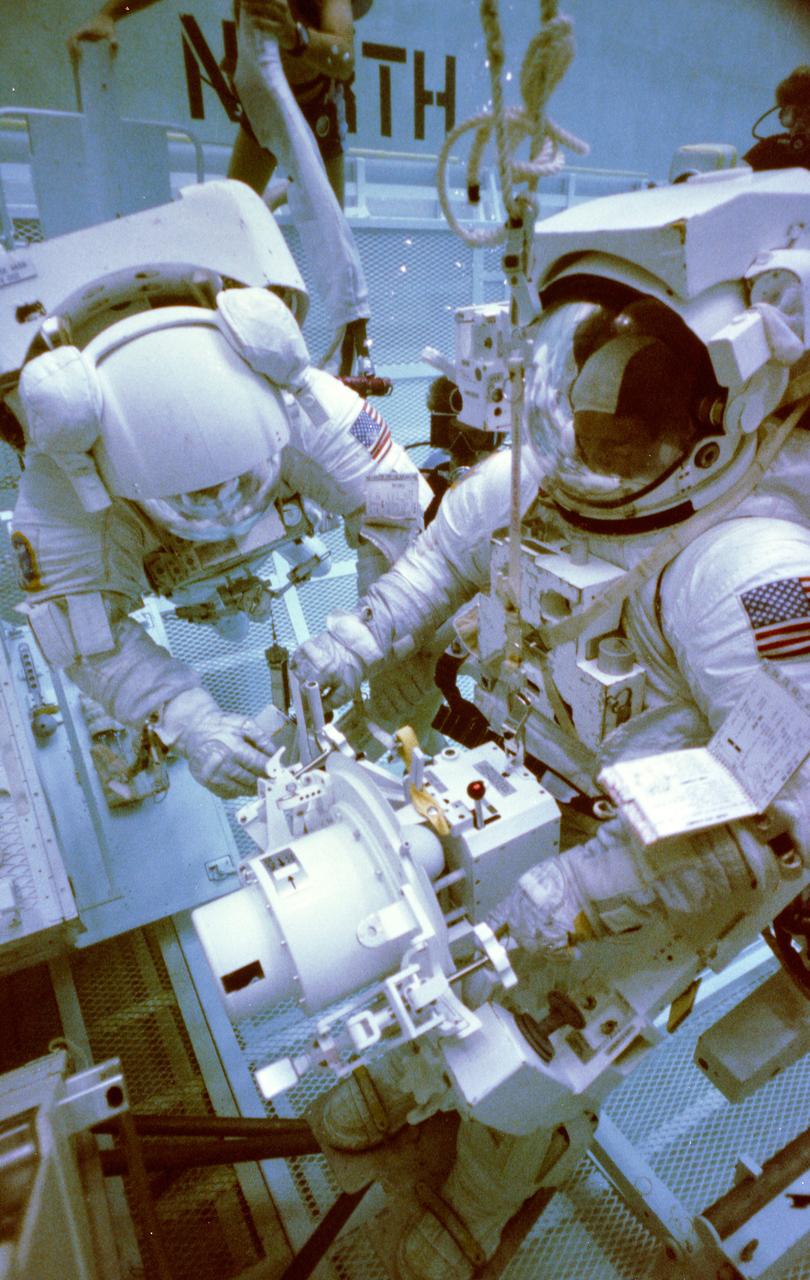
S83-42893 (19 Oct 1983) ---- Astronauts George D. Nelson and James D. van Hoften, two of three STS-41C mission specialists, share an extravehicular activity (EVA) task in this simulation of a Solar Maximum Satellite (SMS) repair visit. The two are making use of the Johnson Space Center's (JSC) weightless environment training facility (WET-F). Dr. Nelson is equipped with the manned maneuvering unit (MMU) trainer and he handles the trunion pin attachment device (TPAD), a major tool to be used on the mission. The photograph was taken by Otis Imboden.
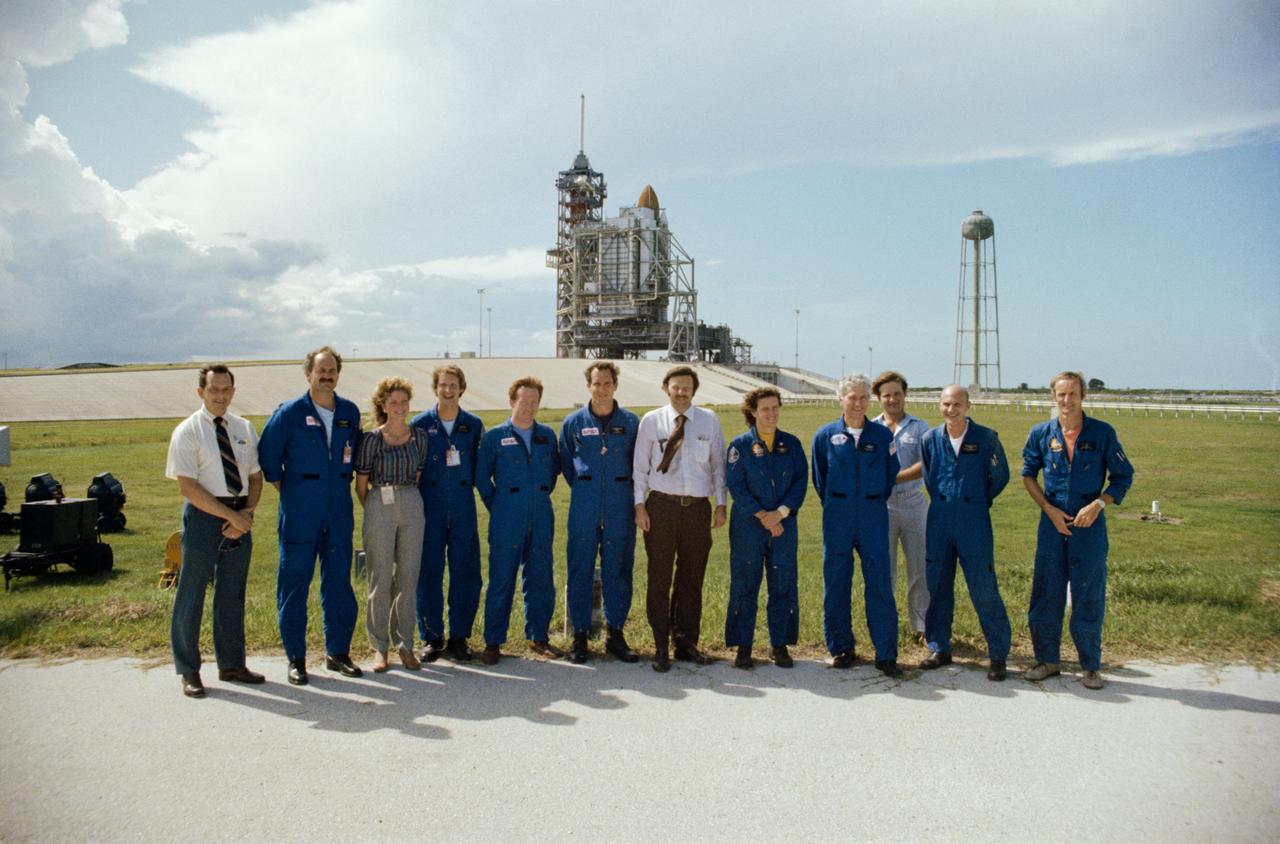
S82-32201 (29 May 1982) --- Members of the JSC astronaut corps, vehicle integration test team (VITT) and other personnel pose for a photograph at the completion of a countdown demonstration test (CDDT) at Launch Pad 39A, Kennedy Space Center (KSC). The participants are, from the left, Wilbur J. Etbauer, engineer with the VITT; mission specialist-astronaut James D. Van Hoften; Terri Stanford, engineer from JSC's flight operations directorate; mission specialist-astronaut Steven A. Hawley; astronaut Richard N. Richards; astronaut Michael J. Smith; Richard W. Nygren, head of the VITT; mission specialist-astronaut Kathryn D. Sullivan; astronaut Henry W. Hartsfield Jr., STS-4 pilot; Mark Haynes, a co-op student participating with the VITT; astronaut Thomas K. Mattingly II, STS-4 commander; and astronaut Donald E. Williams. Photo credit: NASA
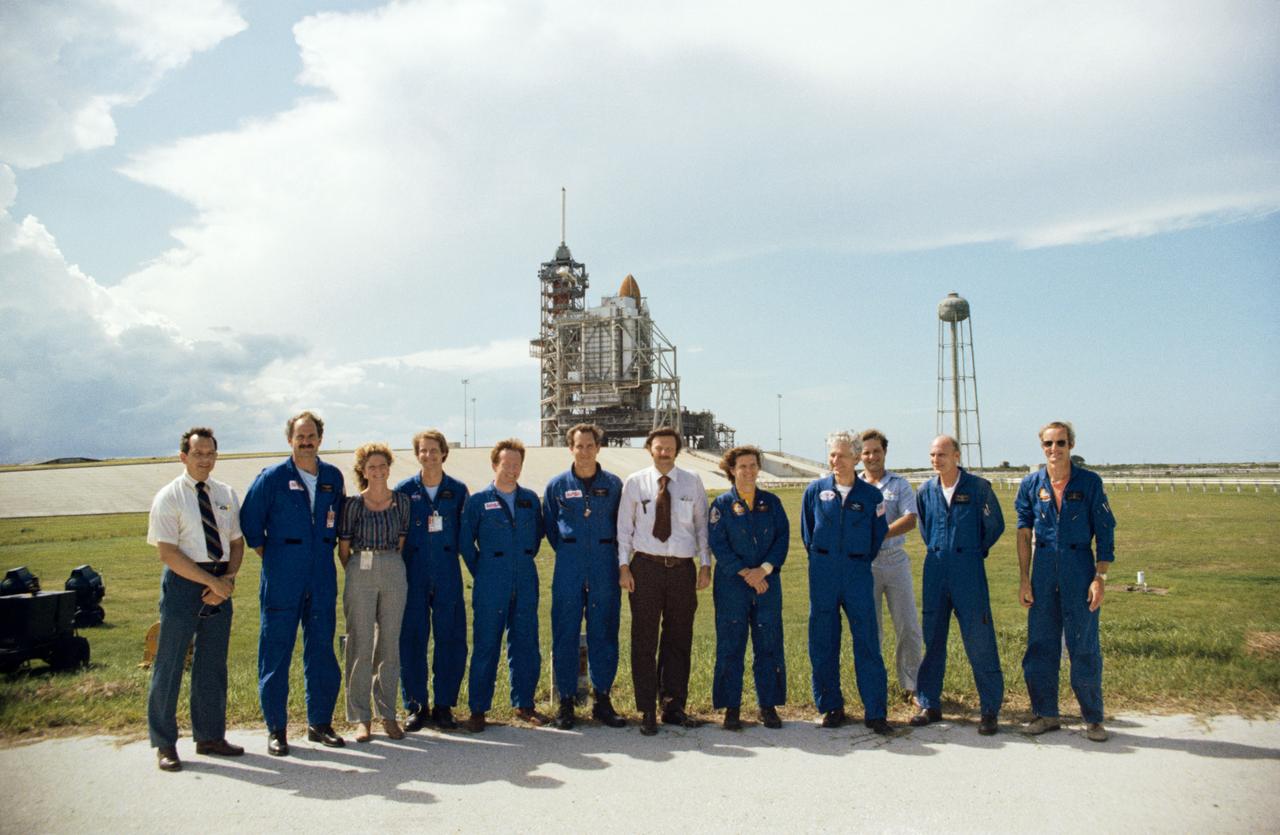
S82-32200 (29 May 1982) --- Members of the JSC astronaut corps, STS-4 vehicle integration test team (VITT) and other personnel pose for a photograph at the completion of a countdown demonstration test (CDDT) at Launch Pad 39A, Kennedy Space Center (KSC). The participants are, from the left, Wilbur J. Etbauer, engineer with the VITT; mission specialist-astronaut James D. van Hoften; Terry Stanford, engineer from JSC's flight operations directorate; mission specialist-astronaut Steven A. Hawley; astronaut Richard N. Richards; astronaut Michael J. Smith; Richard W. Nygren, head of the VITT; mission specialist-astronaut Kathryn D. Sullivan; astronaut Henry W. Hartsfield Jr.,STS-4 pilot; Mary Haynes, a co-op student participating with the VITT; astronaut Thomas K. Mattingly II, STS-4 commander; and astronaut Donald E. Williams. Photo credit: NASA
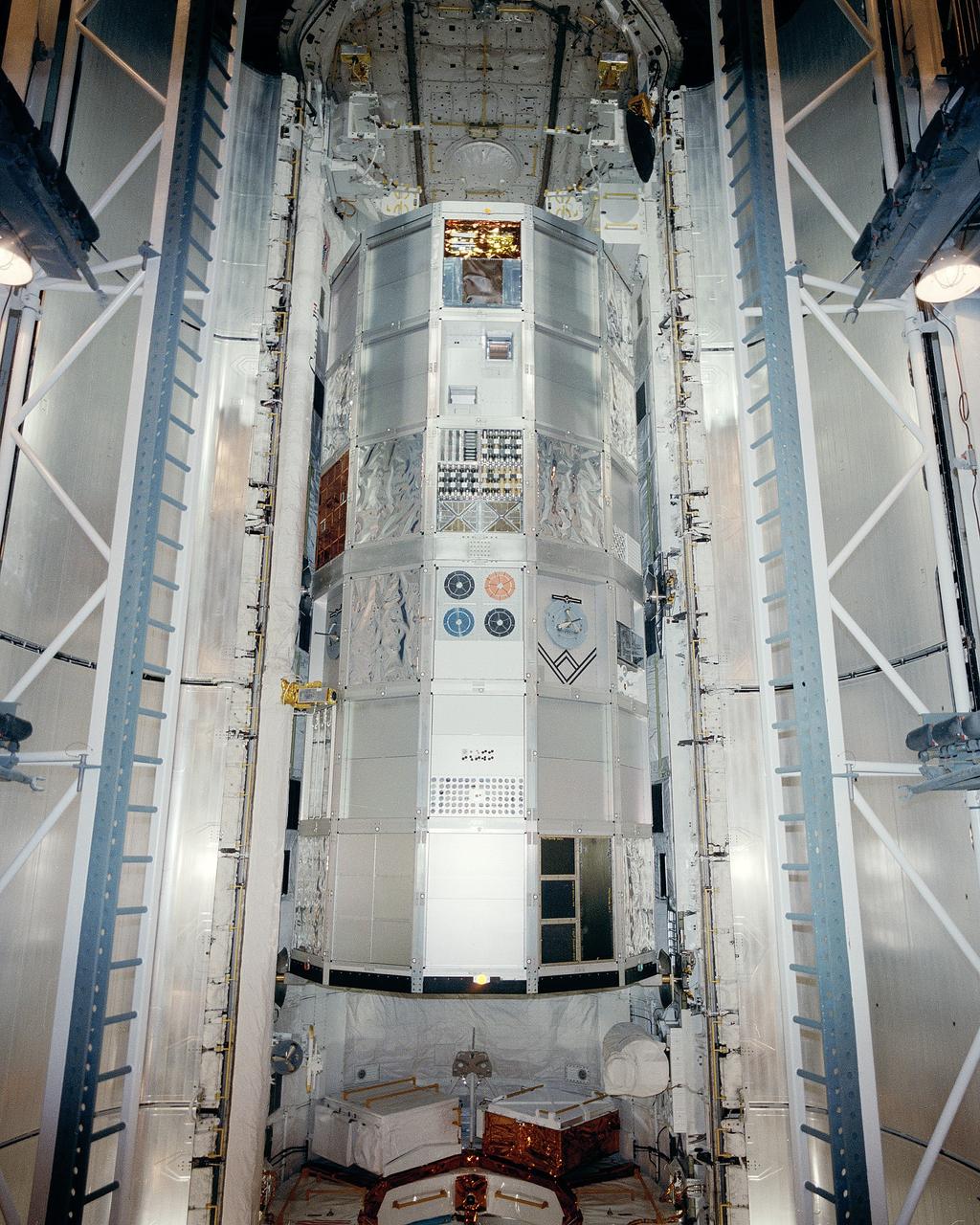
CAPE CANAVERAL, Fla. -- At NASA's Kennedy Space Center's Launch Pad 39-A, the school bus-sized Long Duration Exposure Facility LDEF containing 57 active and passive experiments from nine nations has been loaded into the payload bay of the space shuttle Challenger. The view from the Payload Change-out Room shows LDEF which will be deployed in orbit at an altitude of nearly 300 miles and retrieved after nearly a year so that the experimenters may analyze the effects of long term exposure to space on various substances and processes. The five-member STS-41C crew for this flight is headed by veteran astronaut Robert Crippen on his third space shuttle flight, and includes space rookies, pilot Dick Scobee and mission specialists Terry Hart, George Nelson and James van Hoften. Photo Credit: NASA

S78-26481 (January 1978) --- This is a montage of the individual portraits of the 35-member 1978 class of astronaut candidates. From left to right are Guion S. Bluford, Daniel C. Brandenstein, James F. Buchli, Michael L. Coats, Richard O. Covey, John O. Creighton, John M. Fabian, Anna L. Fisher, Dale A. Gardner, Robert L. Gibson, Frederick D. Gregory, S. David Griggs, Terry J. Hart, Frederick H. (Rick) Hauck, Steven A. Hawley, Jeffrey A. Hoffman, Shannon W. Lucid, Jon A. McBride, Ronald E. McNair, Richard M. (Mike) Mullane, Steven R. Nagel, George D. Nelson, Ellison S. Onizuka, Judith A. Resnik, Sally K. Ride, Francis R. (Dick) Scobee, Rhea Seddon, Brewster H. Shaw Jr., Loren J. Shriver, Robert L. Stewart, Kathryn D. Sullivan, Norman E. Thagard, James D. Van Hoften, David M. Walker and Donald E. Williams. Photo credit: NASA or National Aeronautics and Space Administration

CAPE CANAVERAL, Fla. -- A group from the first graduating class of astronauts after the Apollo program gathers at the Banana River viewing site at NASA's Kennedy Space Center before the launch of space shuttle Discovery on its STS-124 mission. In 1978 a new group of 35 astronauts was selected after nine years without new astronauts. The pilots were Daniel Brandenstein, Michael Coats, Richard Covey, John Creighton, Robert Gibson, Frederick D. Gregory, Frederick Hauck, Jon McBride, Francis "Dick" Scobee, Brewster Shaw, Loren Shriver, David Walker and Donald Williams. The mission specialists were Guion Bluford, James Buchli, John Fabian, Anna Fisher, Dale Gardner, S. David Griggs, Terry Hart, Steven Hawley, Jeffrey Hoffman, Shannon Lucid, Ronald McNair, Richard Mullane, Steven Nagel, George Nelson, Ellison Onizuka, Judith Resnik, Sally Ride, Rhea Seddon, Robert Stewart, Kathryn D. Sullivan, Norman Thagard and James van Hoften. Since then, a new group has been selected roughly every two years. Photo credit: NASA/Jim Grossmann
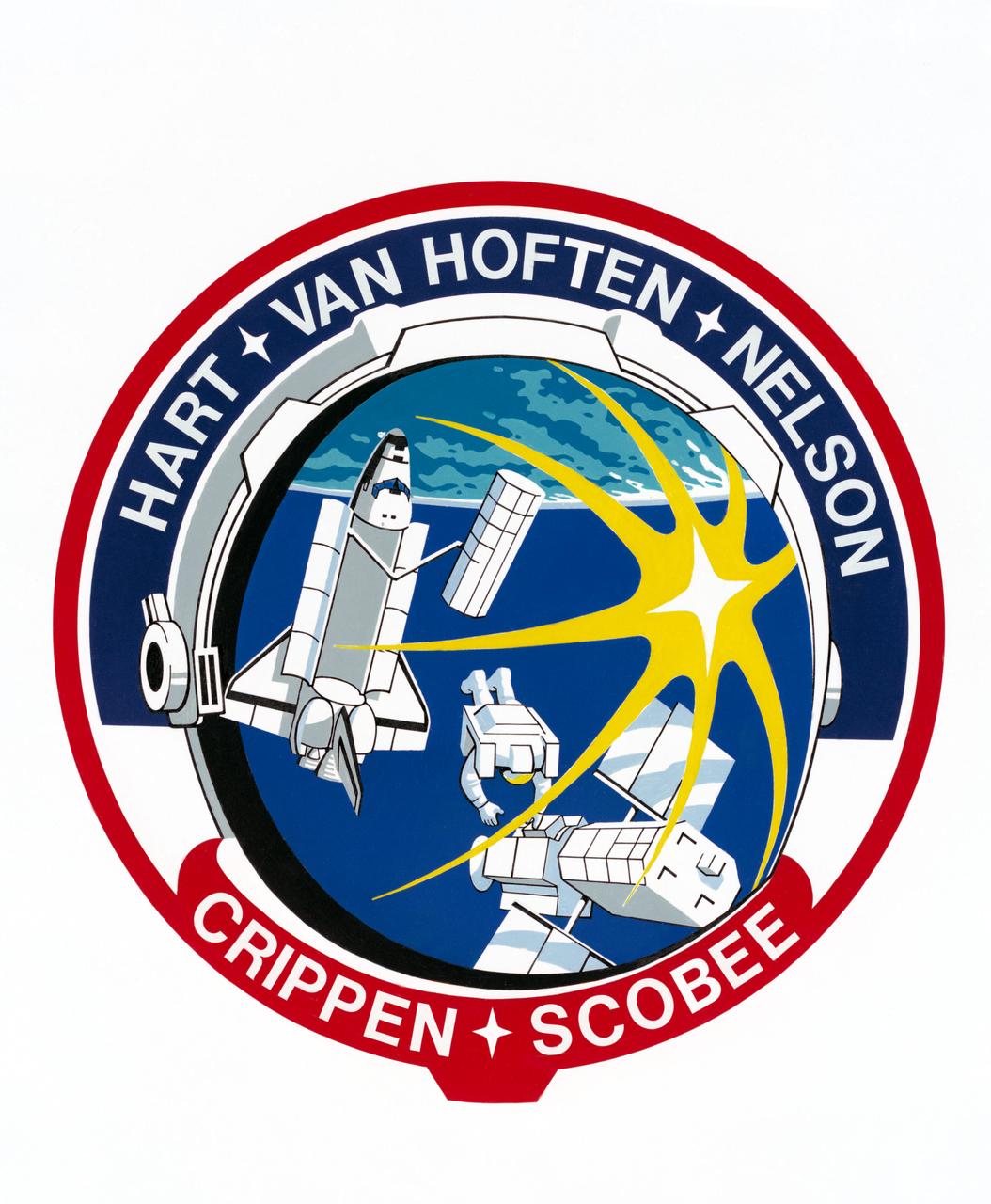
S84-25522 (15 Jan. 1984) --- The patch to be worn by the five members of NASA's STS-41C space mission tells the story of that flight. It features a helmet visor of an astronaut performing an extravehicular activity (EVA). In the visor are reflected the sun's rays, the space shuttle Challenger and its Remote Manipulator System (RMS) deploying the Long Duration Exposure Facility (LDEF), Earth and blue sky, and another astronaut working at the damaged Solar Maximum Satellite (SMS). The scene is encircled by the surnames of the crew members. They are astronauts Robert L. Crippen, commander; Francis R. (Dick) Scobee, pilot; and Terry J. Hart, James D. van Hoften and George D. Nelson, all mission specialists. The NASA insignia design for space shuttle flights is reserved for use by the astronauts and for other official use as the NASA Administrator may authorize. Public availability has been approved only in the forms of illustrations by the various news media. When and if there is any change in this policy, which is not anticipated, the change will be publicly announced. Photo credit: NASA
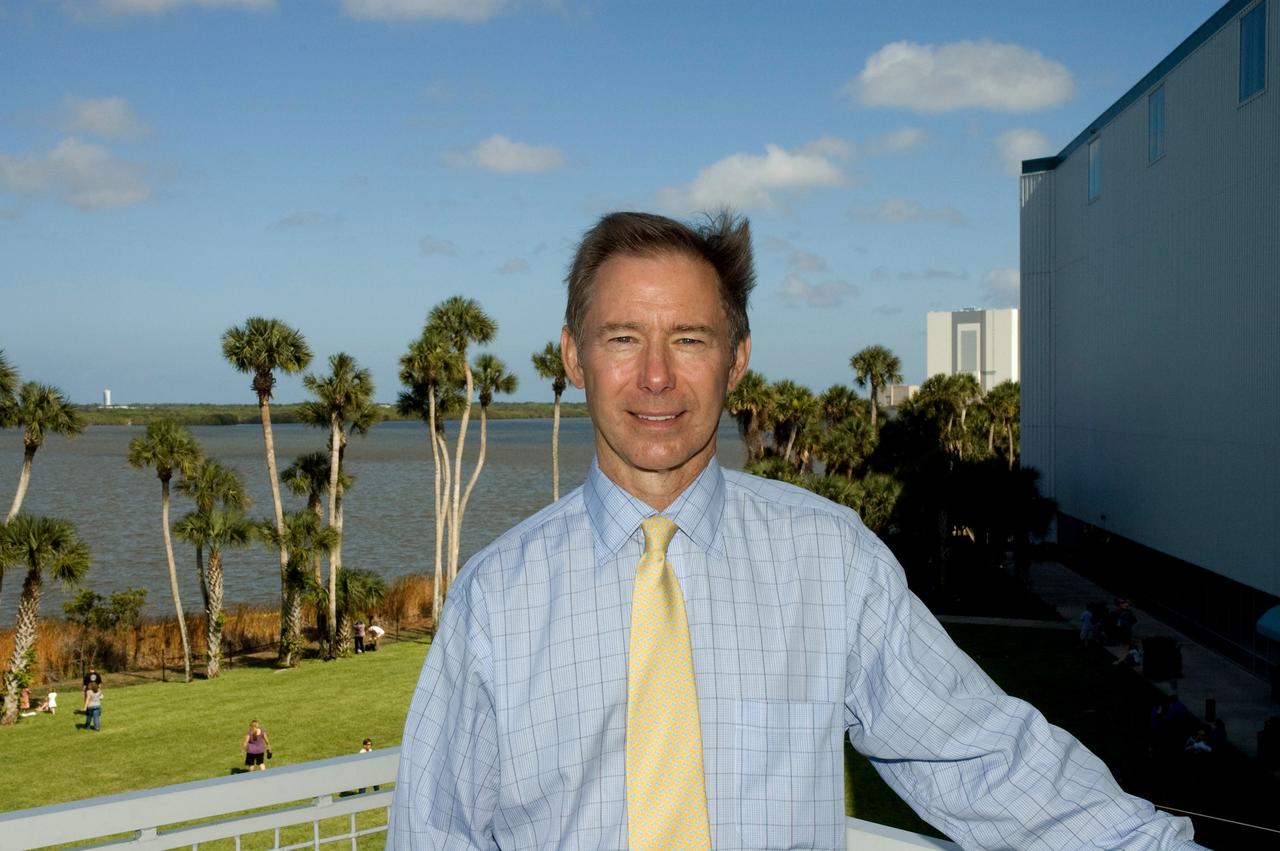
CAPE CANAVERAL, Fla. -- Brewster Shaw is a former astronaut from the first graduating class of astronauts after the Apollo program. He and others from the class were guests at NASA's Kennedy Space Center for the launch of space shuttle Discovery on its STS-124 mission. Shaw is Vice President and General Manager, Space Exploration, for Integrated Defense Systems, The Boeing Company. In 1978 a new group of 35 astronauts was selected after nine years without new astronauts. The pilots were Daniel Brandenstein, Michael Coats, Richard Covey, John Creighton, Robert Gibson, Frederick D. Gregory, Frederick Hauck, Jon McBride, Francis "Dick" Scobee, Brewster Shaw, Loren Shriver, David Walker and Donald Williams. The mission specialists were Guion Bluford, James Buchli, John Fabian, Anna Fisher, Dale Gardner, S. David Griggs, Terry Hart, Steven Hawley, Jeffrey Hoffman, Shannon Lucid, Ronald McNair, Richard Mullane, Steven Nagel, George Nelson, Ellison Onizuka, Judith Resnik, Sally Ride, Rhea Seddon, Robert Stewart, Kathryn D. Sullivan, Norman Thagard and James van Hoften. Since then, a new group has been selected roughly every two years. Photo credit: NASA/Jim Grossmann
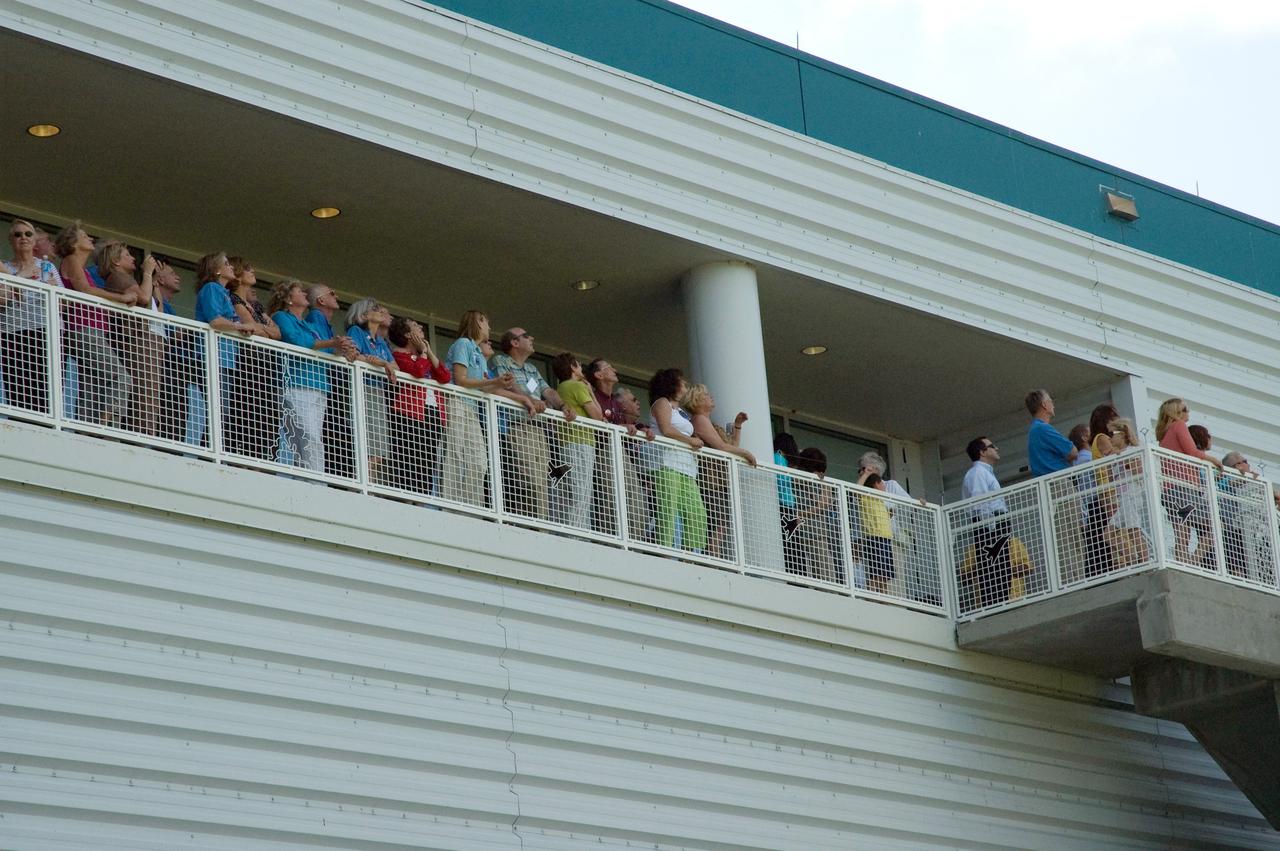
CAPE CANAVERAL, Fla. -- All eyes look skyward as space shuttle Discovery launches on its STS-124 mission. The group gathered here at the Banana River viewing site at NASA's Kennedy Space Center are members of the first graduating class of astronauts after the Apollo program. In 1978 a new group of 35 astronauts was selected after nine years without new astronauts. The pilots were Daniel Brandenstein, Michael Coats, Richard Covey, John Creighton, Robert Gibson, Frederick D. Gregory, Frederick Hauck, Jon McBride, Francis "Dick" Scobee, Brewster Shaw, Loren Shriver, David Walker and Donald Williams. The mission specialists were Guion Bluford, James Buchli, John Fabian, Anna Fisher, Dale Gardner, S. David Griggs, Terry Hart, Steven Hawley, Jeffrey Hoffman, Shannon Lucid, Ronald McNair, Richard Mullane, Steven Nagel, George Nelson, Ellison Onizuka, Judith Resnik, Sally Ride, Rhea Seddon, Robert Stewart, Kathryn D. Sullivan, Norman Thagard and James van Hoften. Since then, a new group has been selected roughly every two years. Photo credit: NASA/Jim Grossmann
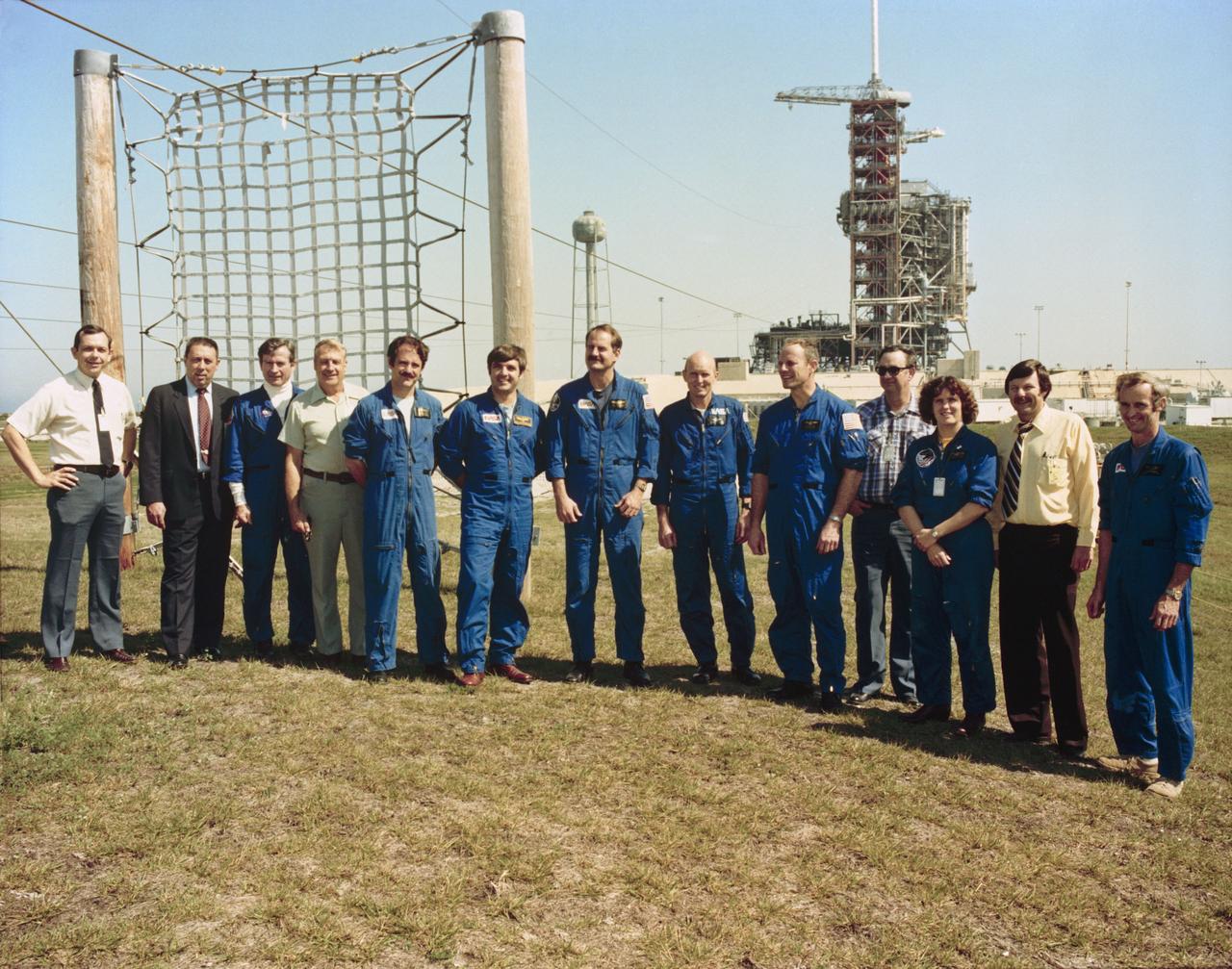
S82-28457 (19 Feb. 1982) --- Member of the JSC astronaut corps., STS-3 vehicle integration test (VIT) team and other personnel pose for a photograph at the completion of a countdown demonstration test (CDDT) and safety briefings at Launch Pad 39A, Kennedy Space Center (KSC). Participants are, from the left, Wilbur J. Etbauer, engineer with the VIT team; George W. S. Abbey, director of flight operations at JSC; astronaut John W. Young, chief of the astronaut office at JSC; Jack Fleming of Rockwell International; mission specialist-astronaut John M. Lounge; astronaut Daniel C. Brandenstein; mission specialist-astronaut James D. Van Hoften; astronauts C. Gordon Fullerton and Jack Lousma, prime crew for STS-3; Olan J. Bertrand, VIT team member; mission specialist-astronaut Kathryn D. Sullivan; Richard W. Nygren, head of the VIT team; and astronaut Donald E. Williams. The space shuttle Columbia is obscured by its service structure on Launch Pad 39A in the background. Part of slide-wire type emergency escape system is visible in the picture. Photo credit: NASA
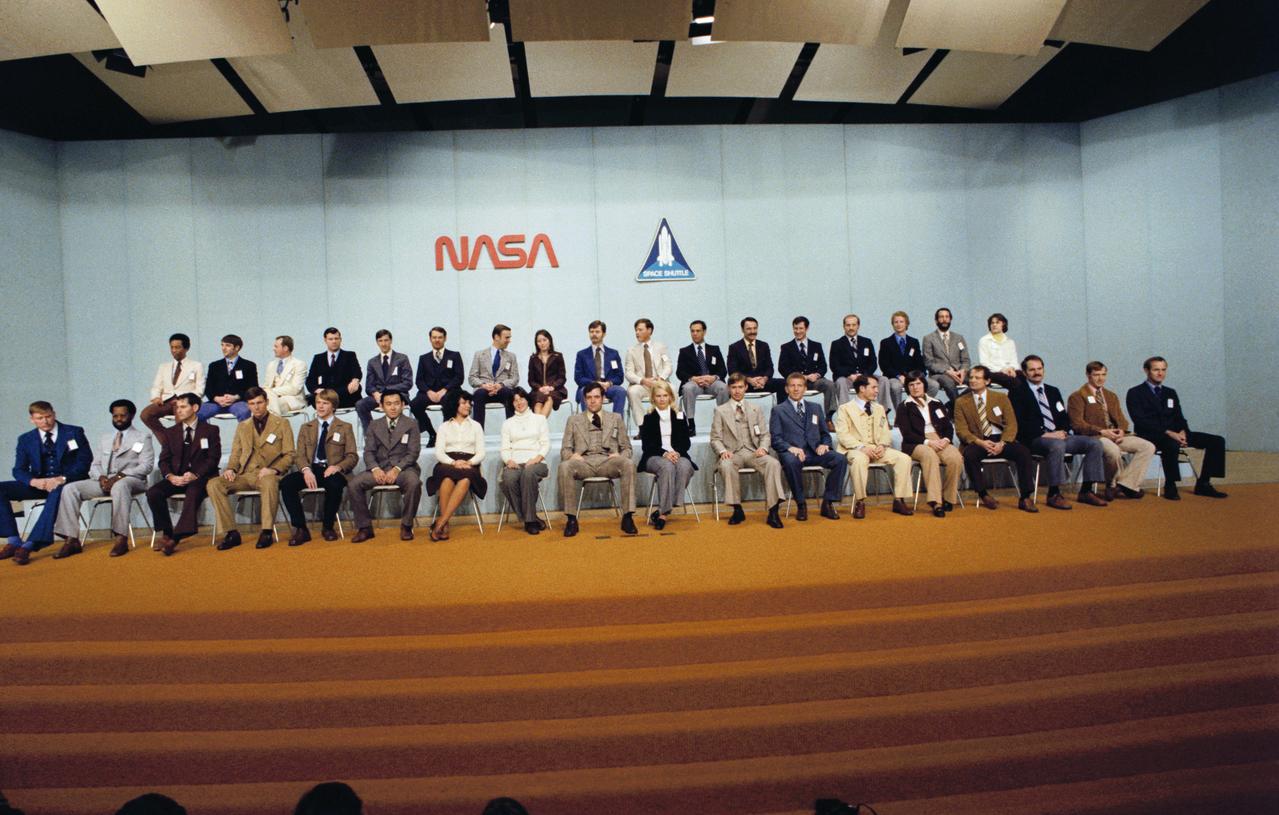
S78-26569 (31 Jan. 1978) --- The 35 new astronaut candidates, presented Jan. 31, 1978, in the Building 2 auditorium at NASA's Johnson Space Center, pose for photographers. They are arranged in alphabetical order with top left as beginning point and bottom right as stopping point. They are Guion S. Bluford, Daniel C. Brandenstein, James F. Buchli, Michael L. Coats, Richard O. Covey, John O. Creighton, John M. Fabian, Anna L. Fisher, Dale A. Gardner, Robert L. Gibson, Frederick D. Gregory, S. David Griggs, Terry J. Hart, Frederick H. (Rick) Hauck, Steven A. Hawley, Jeffrey A. Hoffman, Shannon W. Lucid, Jon A. McBride, Ronald E. McNair, Richard M. (Mike) Mullane, Steven R. Nagel, George D. Nelson, Ellison S. Onizuka, Judith A. Resnik, Sally K. Ride, Francis R. (Dick) Scobee, Rhea Seddon, Brewster H. Shaw Jr., Loren J. Shriver, Robert L. Stewart, Kathryn D. Sullivan, Norman E. Thagard, James D. van Hoften, David M. Walker and Donald E. Williams. Photo credit: NASA or National Aeronautics and Space Administration
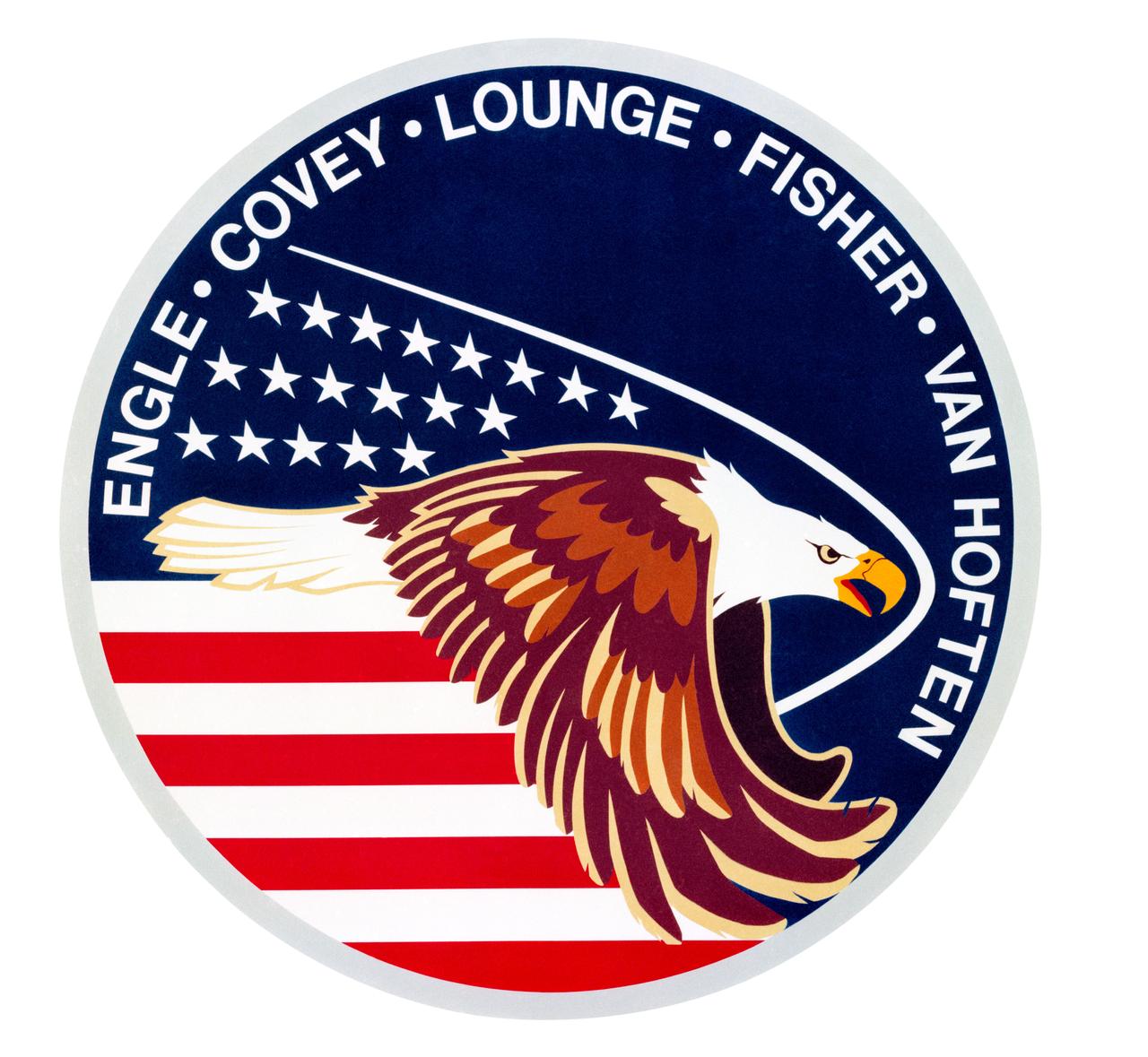
S85-25870 (August 1985) --- The crew emblem for STS-51I is based on a strong patriotic theme with the basic colors of red, white and blue suggesting the American flag and a dominant American bald eagle in aggressive flight. The 19 stars signify the numerical sequence of the flight. The shock wave represents that formed by the orbiter during the entry phase of the flight. Surnames of crew members surround the top part of the circular design. The five-member crew composed of astronauts Joe H. Engle, commander; Richard O. Covey, pilot; John Michael (Mike) Lounge, William F. Fisher and James D. van Hoften, all mission specialists. The NASA insignia design for space shuttle flights is reserved for use by the astronauts and for other official use as the NASA Administrator may authorize. Public availability has been approved only in the forms of illustrations by the various news media. When and if there is any change in this policy, which is not anticipated, the change will be publicly announced. Photo credit: NASA