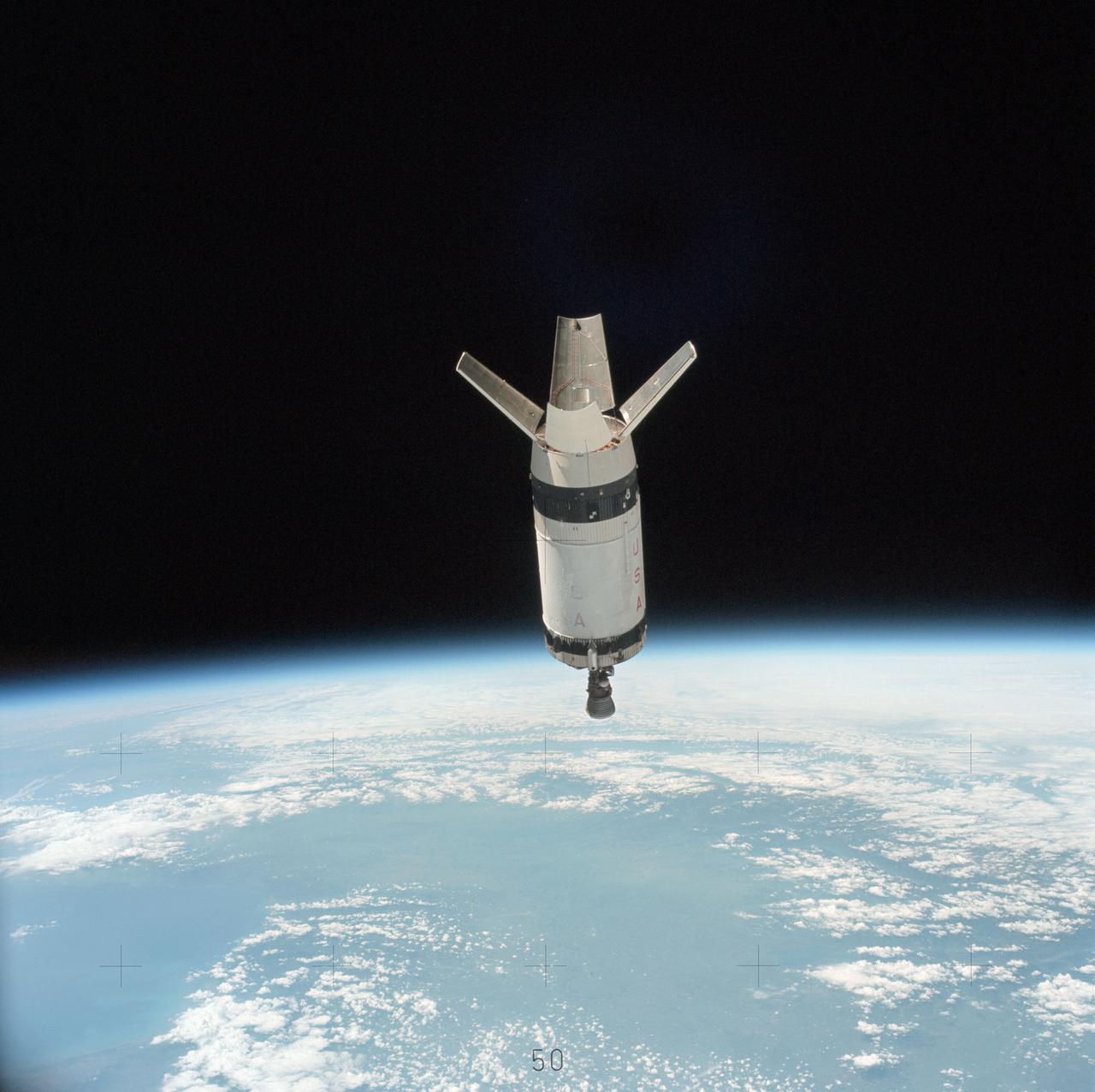
SL3-114-1625 (July-September 1973) --- An excellent view of the expended S-IVB second stage of the Skylab 3/Saturn 1B space vehicle is seen in this photograph taken from the Skylab 3 Command and Service Module (CSM) in Earth orbit. The land mass below is Italy and France, with part of the Mediterranean Sea visible. This photograph was taken with a handheld 70mm Hasselblad camera using a 100mm lens, and medium speed Ektachrome film. Photo credit: NASA
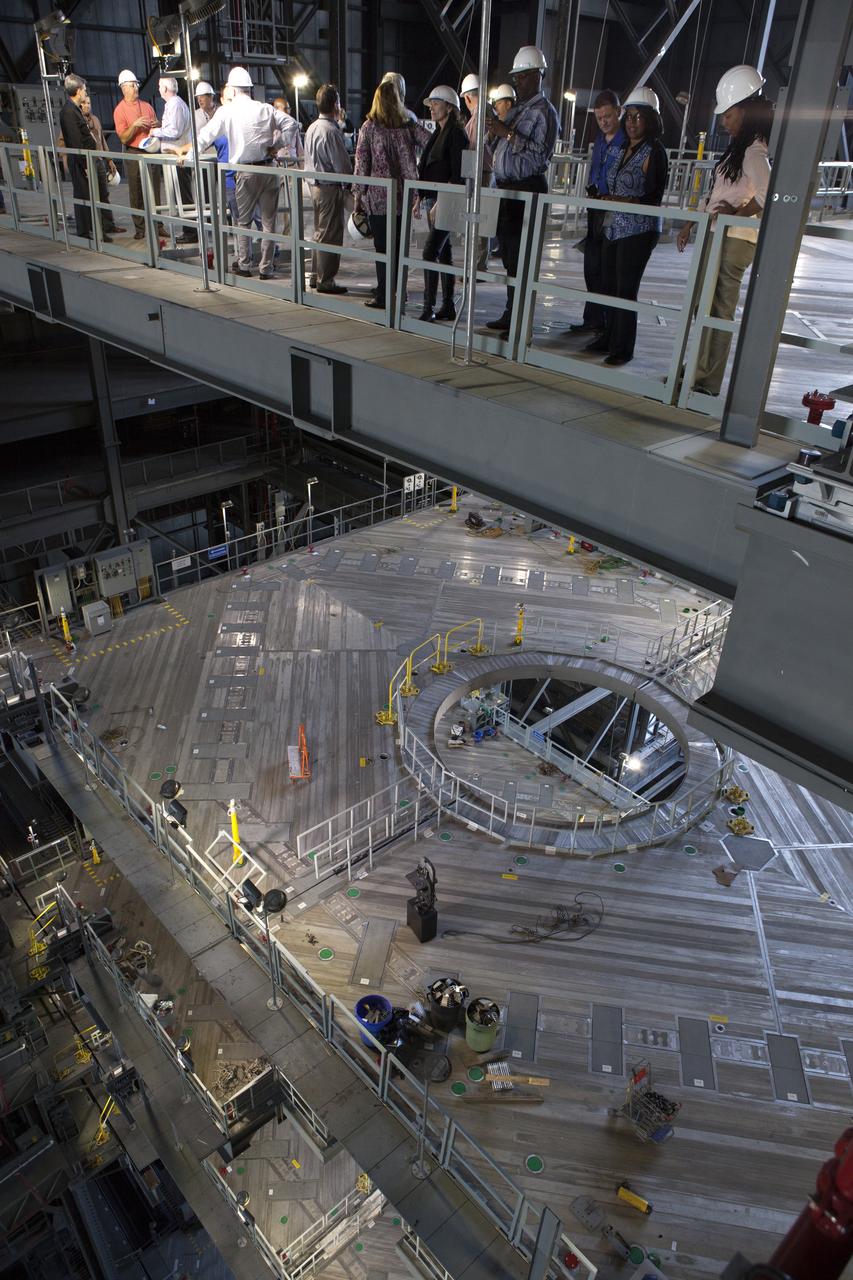
Members of NASA’s Engineering Management Board visit the Vehicle Assembly Building’s High Bay 3 at Kennedy Space Center in Florida. The platforms in High Bay 3, including the one on which the board members are standing, were designed to surround and provide access to NASA’s Space Launch System and Orion spacecraft. The Engineering Management Board toured integral areas of Kennedy to help the agencywide group reach its goal of unifying engineering work across NASA.

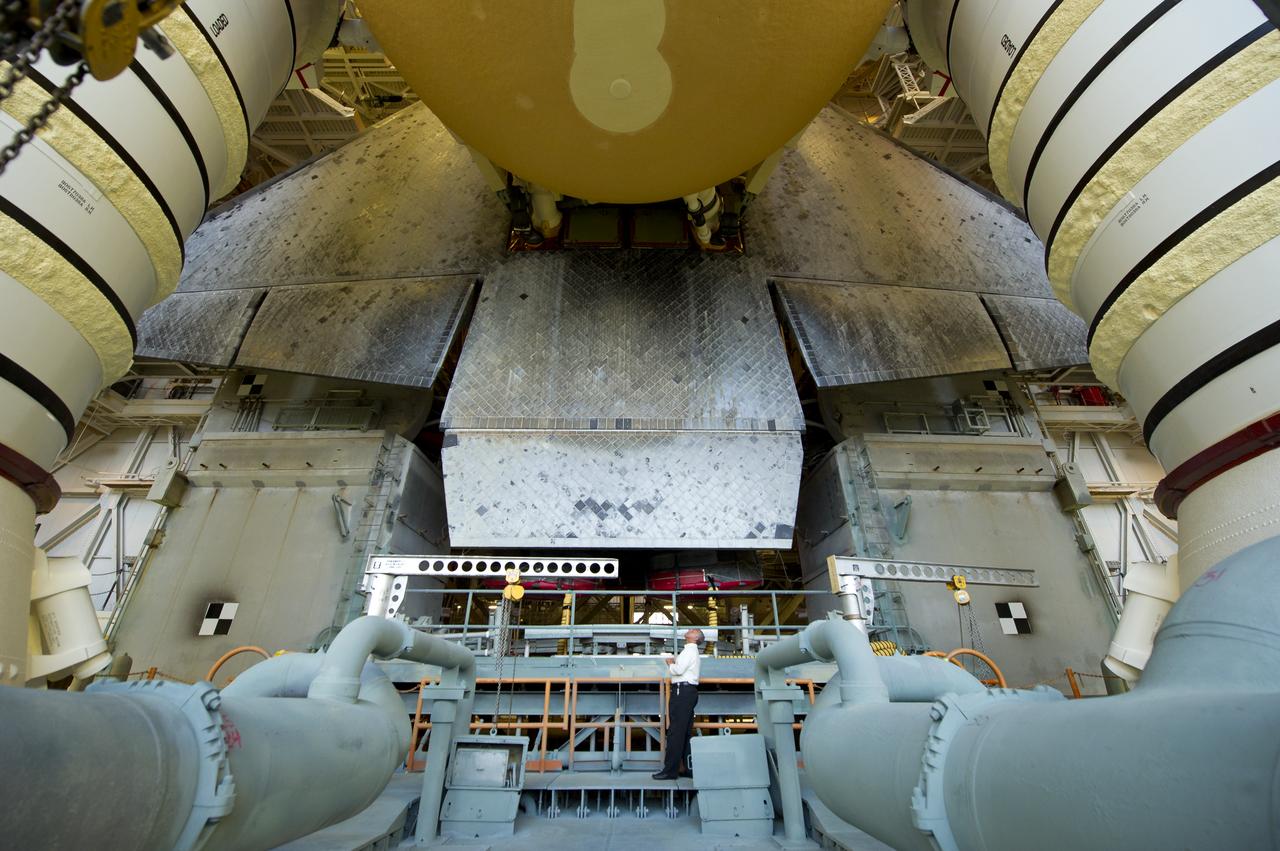
The view members of NASA’s Engineering Management Board had in looking up the Vehicle Assembly Building’s High Bay 3 at Kennedy Space Center in Florida. The platforms in High Bay 3, including the one on which the board members are standing, were designed to surround and provide access to NASA’s Space Launch System and Orion spacecraft. The Engineering Management Board toured integral areas of Kennedy to help the agencywide group reach its goal of unifying engineering work across NASA.

S73-32568 (20 July 1973) --- Floodlights illuminate this nighttime view of the Skylab 3/Saturn 1B space vehicle at Pad B, Launch Complex 39, Kennedy Space Center, Florida, during prelaunch preparations. The reflection is the water adds to the scene. In addition to the Command/Service Module and its launch escapte system, the Skylab 3 space vehicle consists of the Saturn 1B first (S-1B) stage and the Saturn 1B second (S-IVB) stage. The crew for the scheduled 59-day Skylab 3 mission in Earth orbit will be astronauts Alan L. Bean, Owen K. Garriott and Jack R. Lousma. Skylab 3 was launched on July 28, 1973. Photo credit: NASA
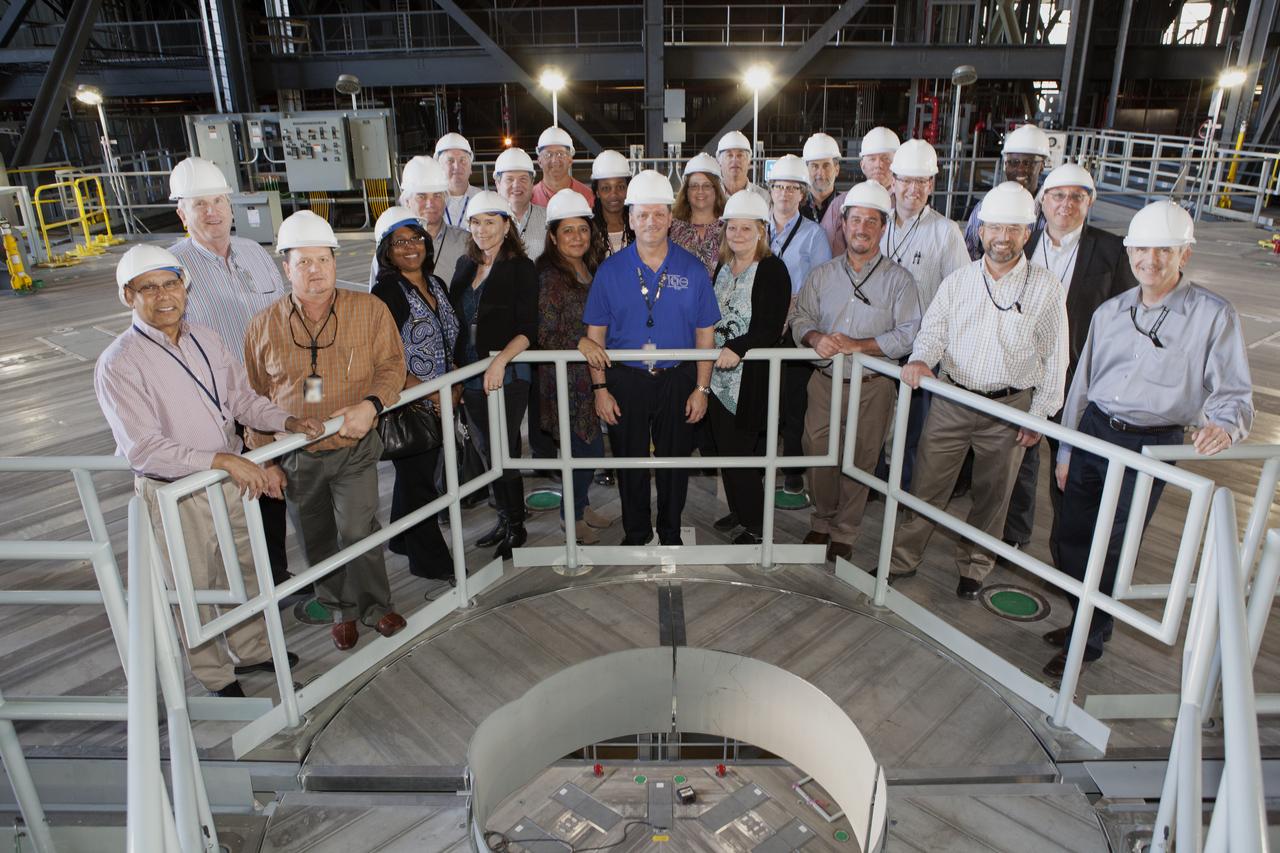
Members of NASA’s Engineering Management Board pause for a group photo during a tour of the Vehicle Assembly Building at Kennedy Space Center in Florida. The platforms in High Bay 3, including the one on which the board members are standing, were designed to surround and provide access to NASA’s Space Launch System and Orion spacecraft. The Engineering Management Board toured integral areas of Kennedy to help the agencywide group reach its goal of unifying engineering work across NASA.
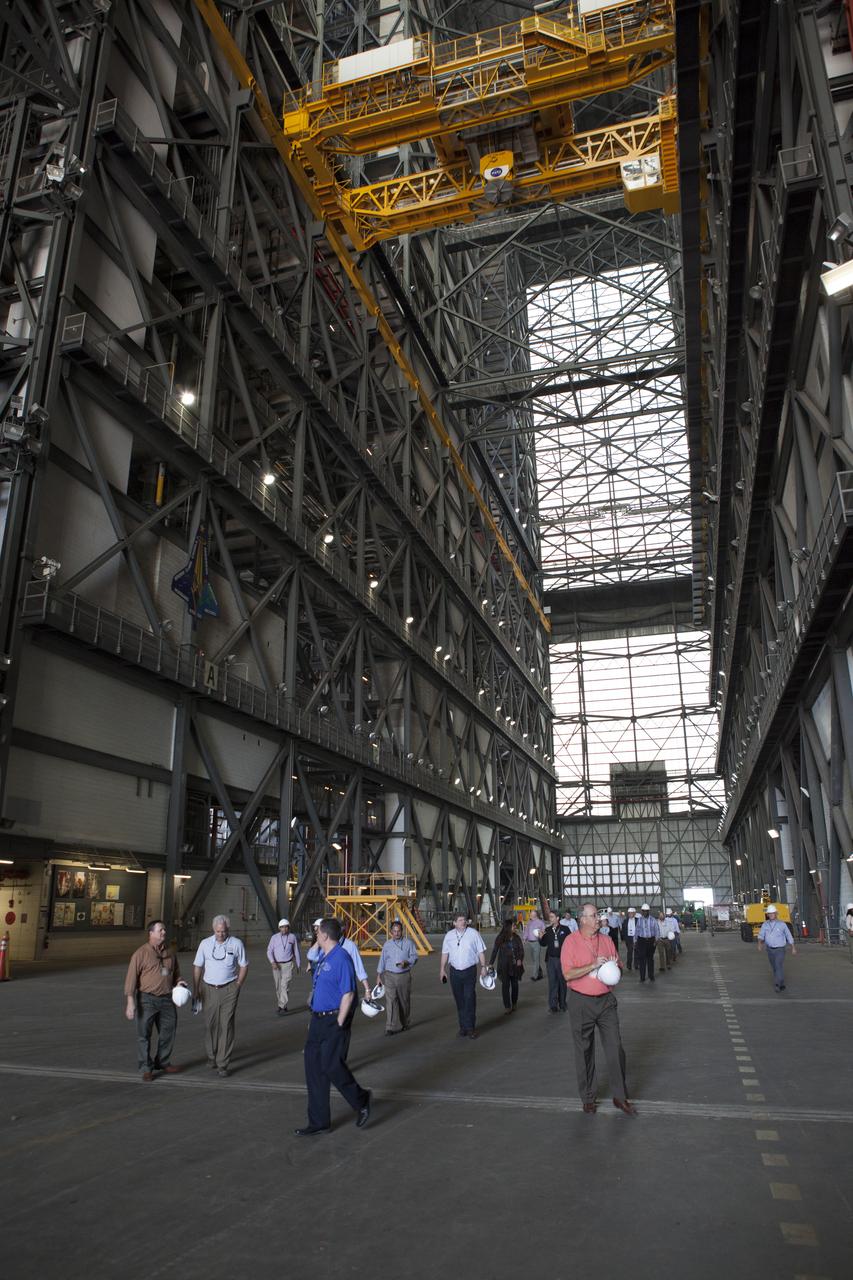
Members of NASA’s Engineering Management Board tour of the Vehicle Assembly Building at Kennedy Space Center in Florida. The platforms in High Bay 3, including the one on which the board members are standing, were designed to surround and provide access to NASA’s Space Launch System and Orion spacecraft. The Engineering Management Board toured integral areas of Kennedy to help the agencywide group reach its goal of unifying engineering work across NASA.
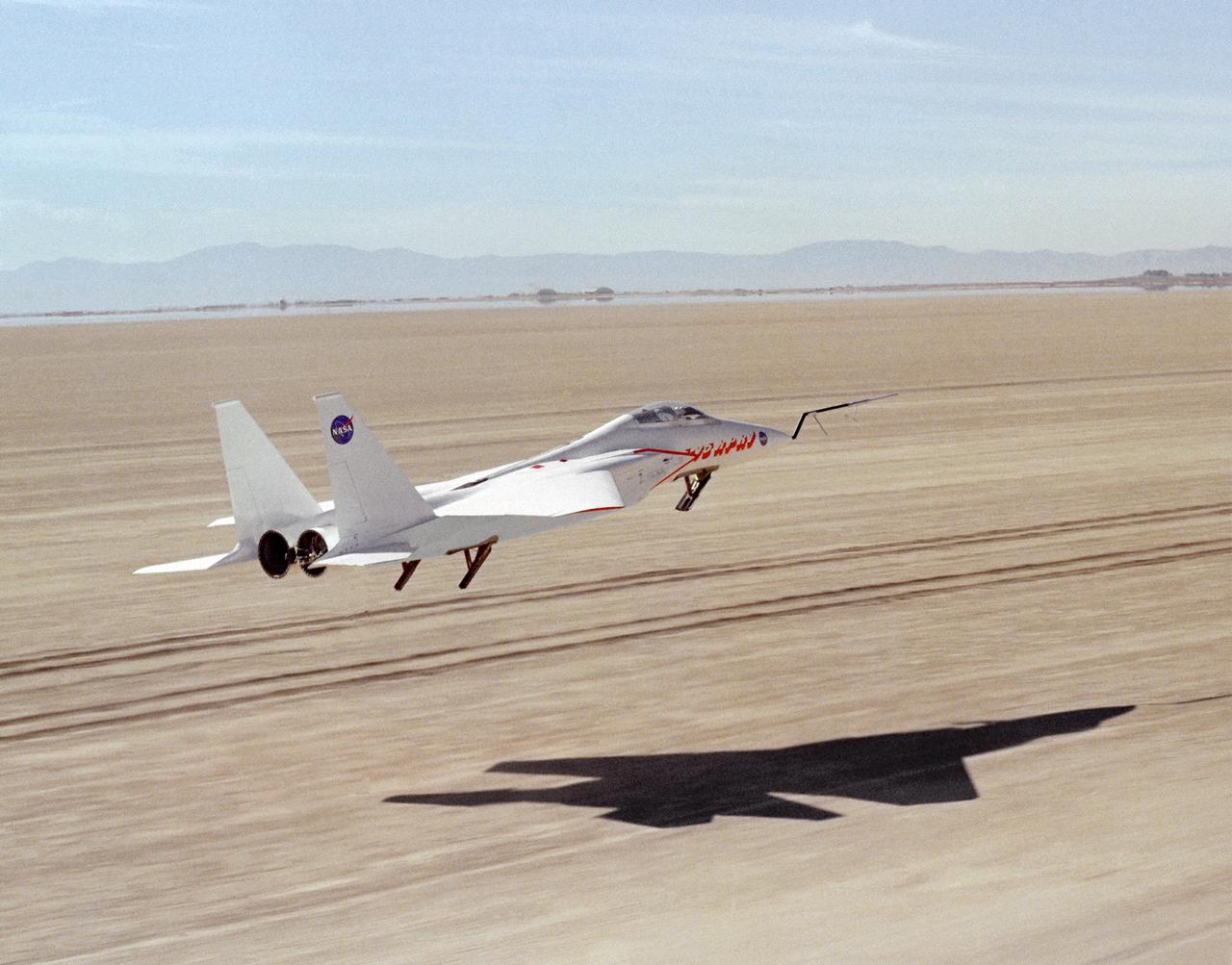
This photograph shows NASA's 3/8th-scale remotely piloted research vehicle landing on Rogers Dry Lakebed at Edwards Air Force Base, California, in 1975.
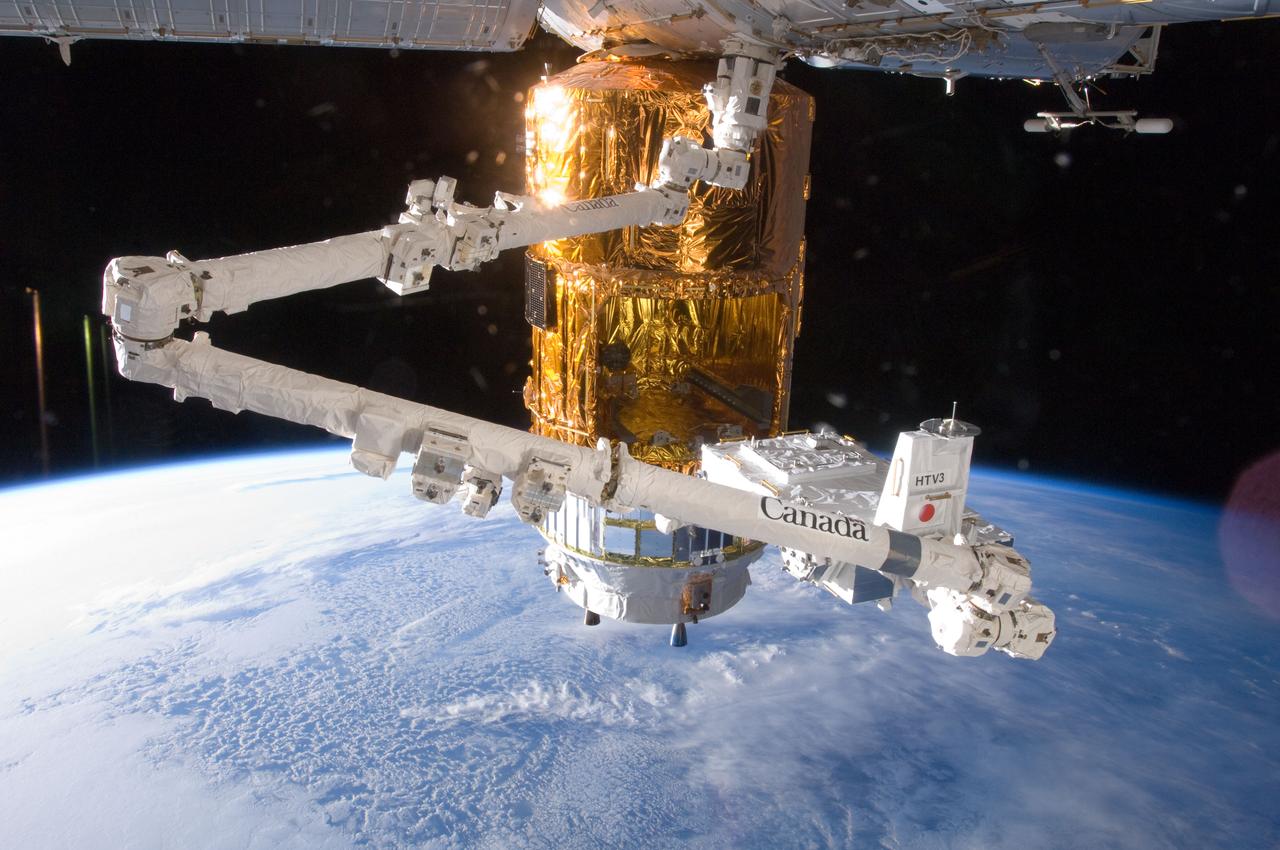
ISS032-E-016904 (10 Aug. 2012) --- In the grasp of the International Space Station?s robotic Canadarm2, the HTV-3 Exposed Pallet is moved for installation on the Japan Aerospace Exploration Agency (JAXA) H-II Transfer Vehicle (HTV-3) currently docked to the space station. Earth?s horizon and the blackness of space provide the backdrop for the scene.
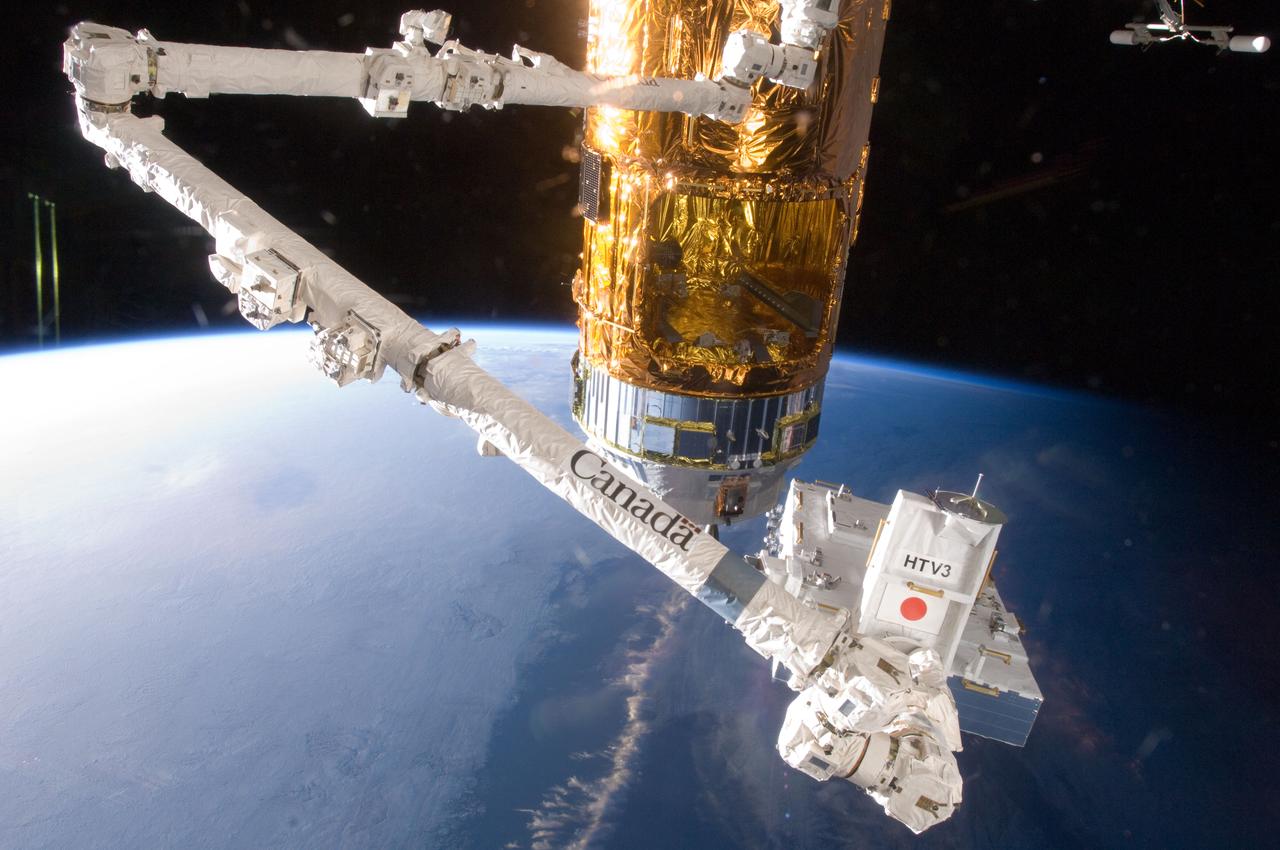
ISS032-E-016900 (10 Aug. 2012) --- In the grasp of the International Space Station?s robotic Canadarm2, the HTV-3 Exposed Pallet is moved for installation on the Japan Aerospace Exploration Agency (JAXA) H-II Transfer Vehicle (HTV-3) currently docked to the space station. Earth?s horizon and the blackness of space provide the backdrop for the scene.
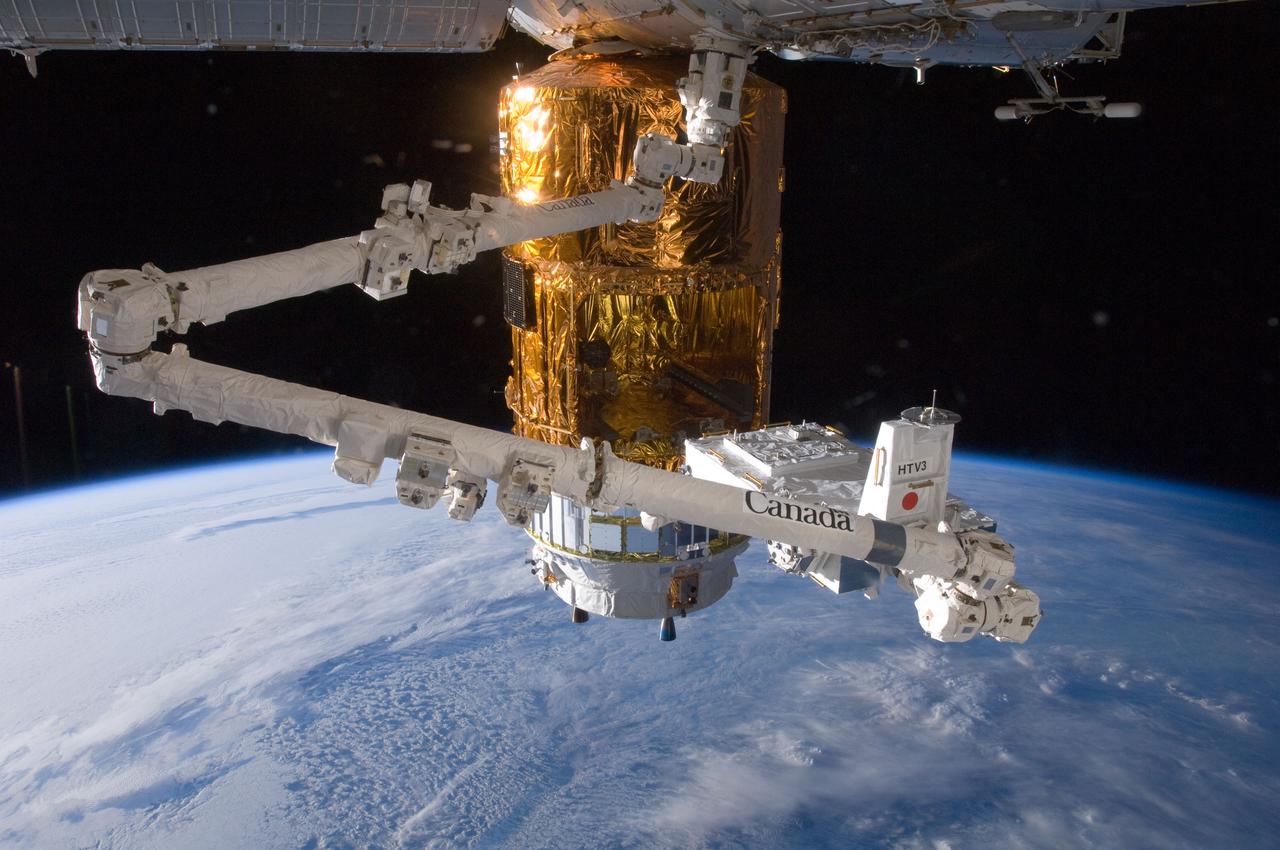
ISS032-E-016906 (10 Aug. 2012) --- In the grasp of the International Space Station?s robotic Canadarm2, the HTV-3 Exposed Pallet is moved for installation on the Japan Aerospace Exploration Agency (JAXA) H-II Transfer Vehicle (HTV-3) currently docked to the space station. Earth?s horizon and the blackness of space provide the backdrop for the scene.
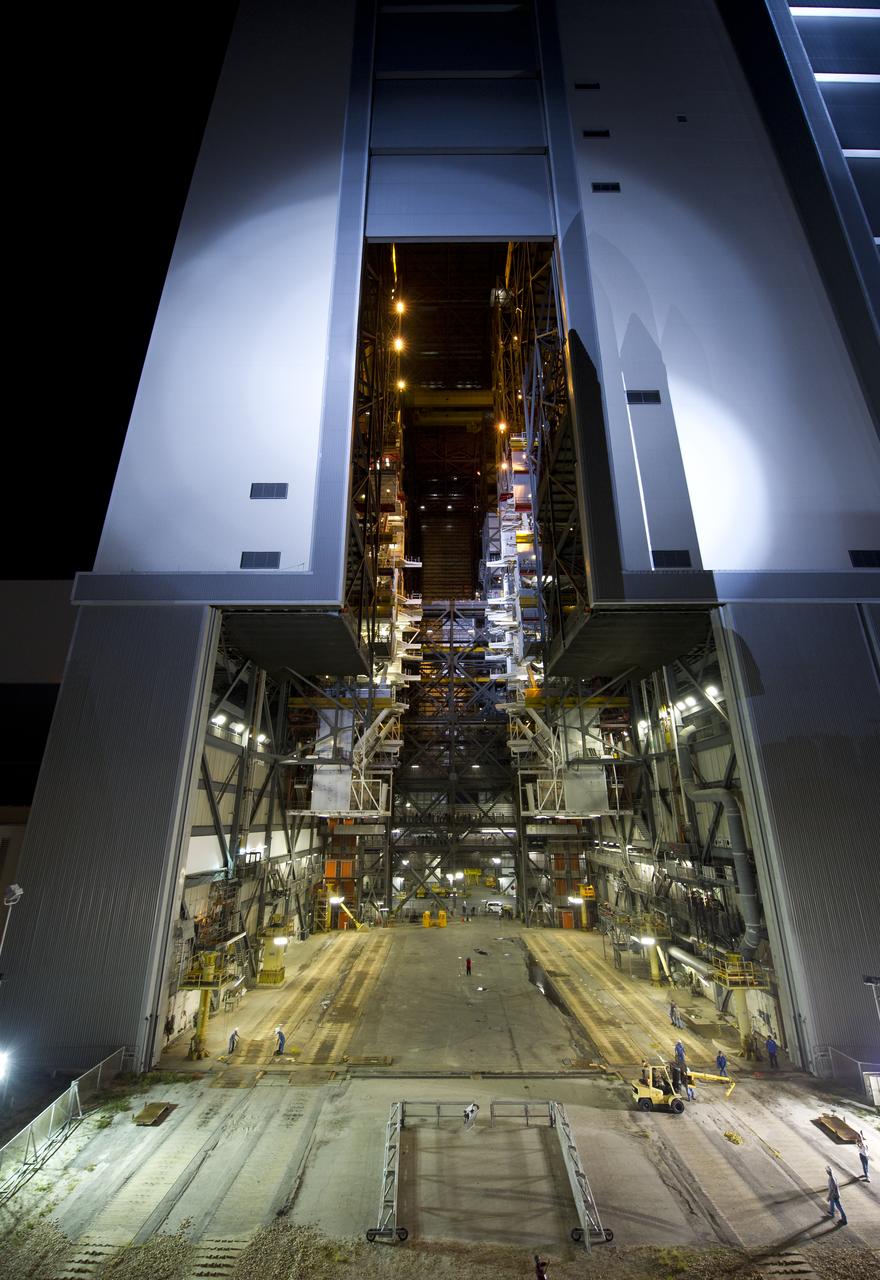
An empty High Bay 3 of the Vehicle Assembly Building is seen shortly after space shuttle Atlantis (STS-135) began its journey from the Vehicle Assembly Building to Launch Pad 39a for its final flight, Tuesday evening, May 31, 2011, at Kennedy Space Center in Cape Canaveral, Fla. The 3.4-mile trek, known as "rollout," will take about seven hours to complete. Atlantis will carry the Raffaello multipurpose logistics module to deliver supplies, logistics and spare parts to the International Space Station. The launch of STS-135 is targeted for July 8. Photo Credit: (NASA/Bill Ingalls)
A view looking at High Bay 3 in the Vehicle Assembly Building (VAB) at NASA's Kennedy Space Center in Florida. Ten levels of new work platforms have been installed in High Bay 3. They will surround and provide access for service and processing of NASA's Space Launch System rocket and Orion spacecraft. Exploration Ground Systems oversaw the upgrades and installation of the new work platforms to support the launch of the SLS and Orion on Exploration Mission-1 and deep space missions.
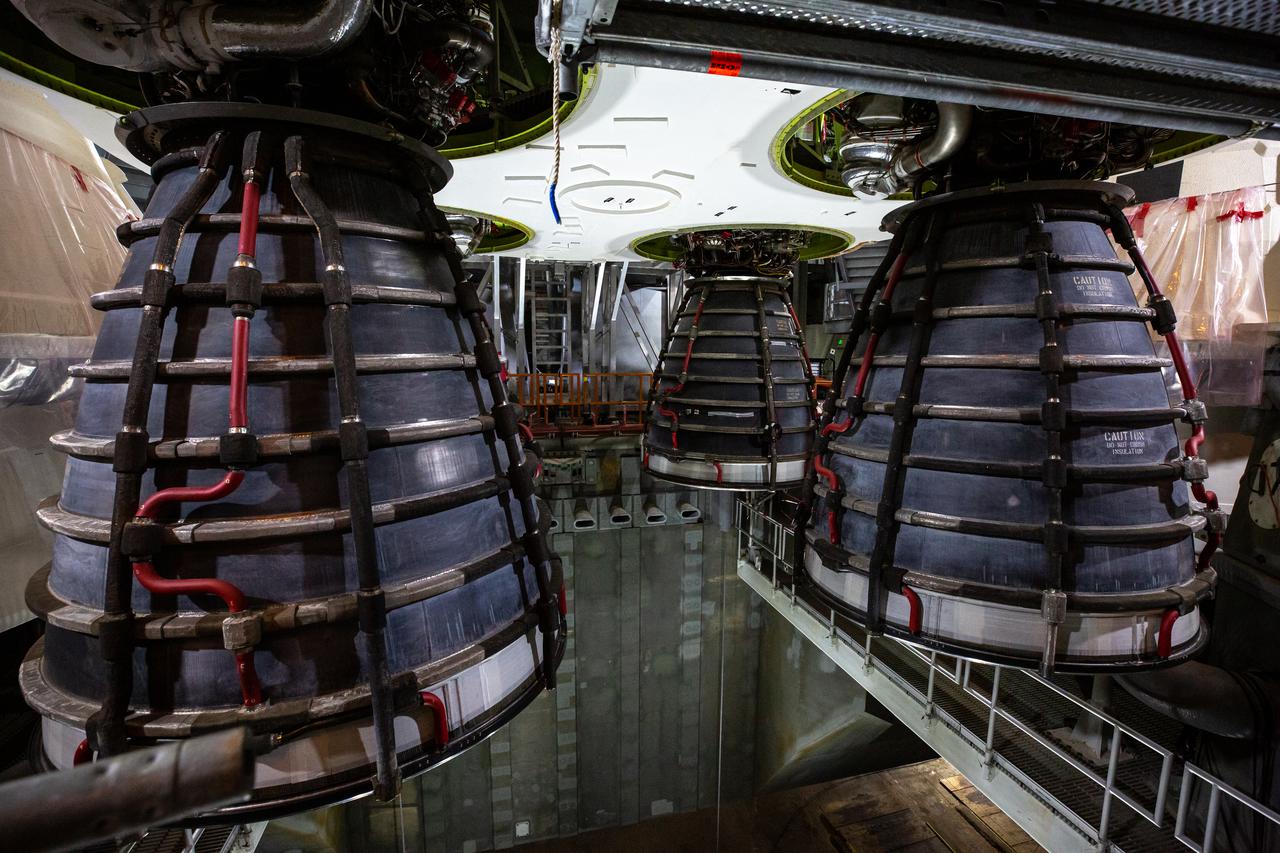
In view are Artemis I Space Launch System main engines in High Bay 3 of the Vehicle Assembly Building at NASA’s Kennedy Space Center in Florida on Jan. 10, 2022. The engines will be gimbled, or moved in unison in different directions, during processing and checkout. Artemis I will be the first integrated test of NASA’s deep space exploration systems: the Orion spacecraft, Space Launch System (SLS) rocket and the ground systems at Kennedy. In later missions, NASA will land the first woman and the first person of color on the surface of the Moon, paving the way for a long-term lunar presence and serving as a steppingstone on the way to Mars.
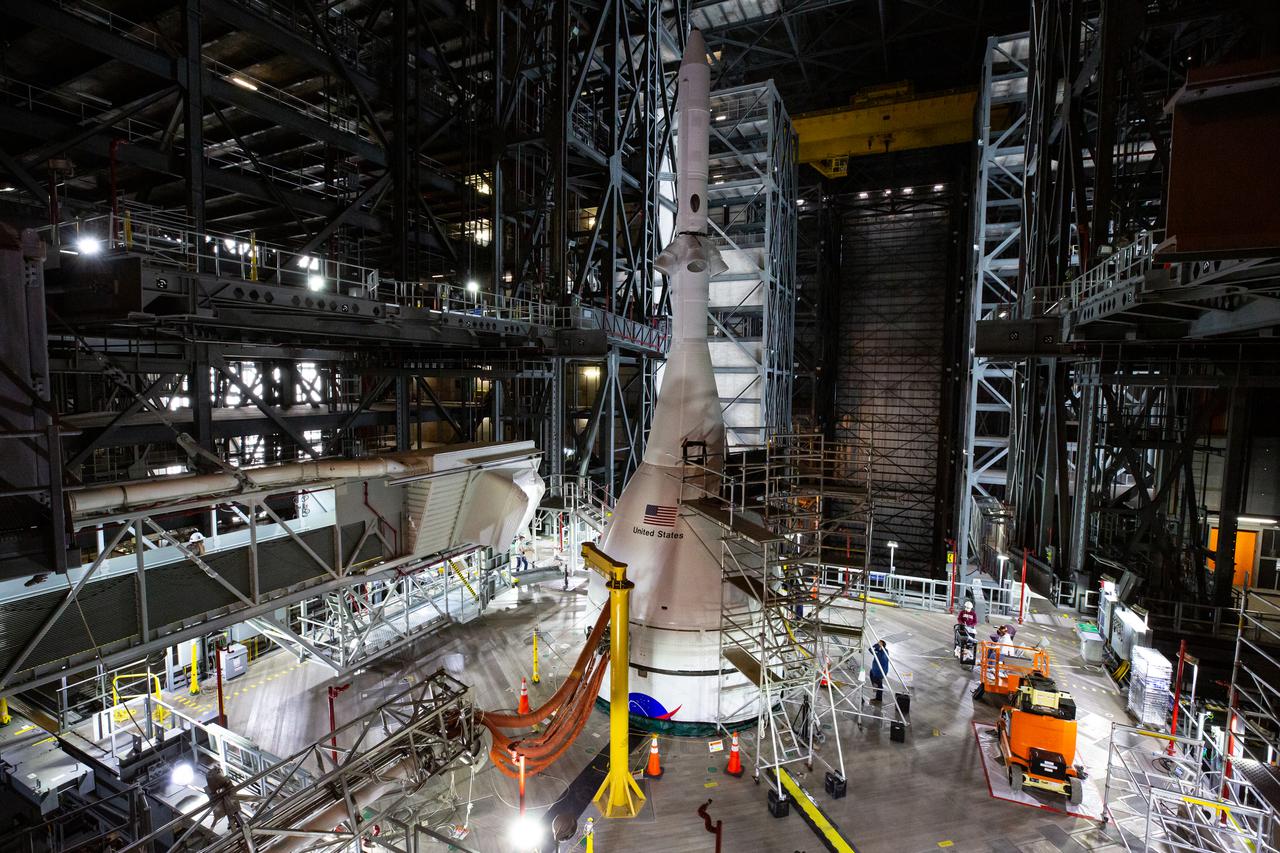
In view high up in High Bay 3 of the Vehicle Assembly Building at NASA’s Kennedy Space Center in Florida, is the Artemis I Orion spacecraft enclosed in its launch abort system atop the Space Launch System on Jan 10, 2022. A work platform has been extended around Orion. Artemis I will be the first integrated test of NASA’s deep space exploration systems: the Orion spacecraft, Space Launch System (SLS) rocket and the ground systems at Kennedy. In later missions, NASA will land the first woman and the first person of color on the surface of the Moon, paving the way for a long-term lunar presence and serving as a steppingstone on the way to Mars.
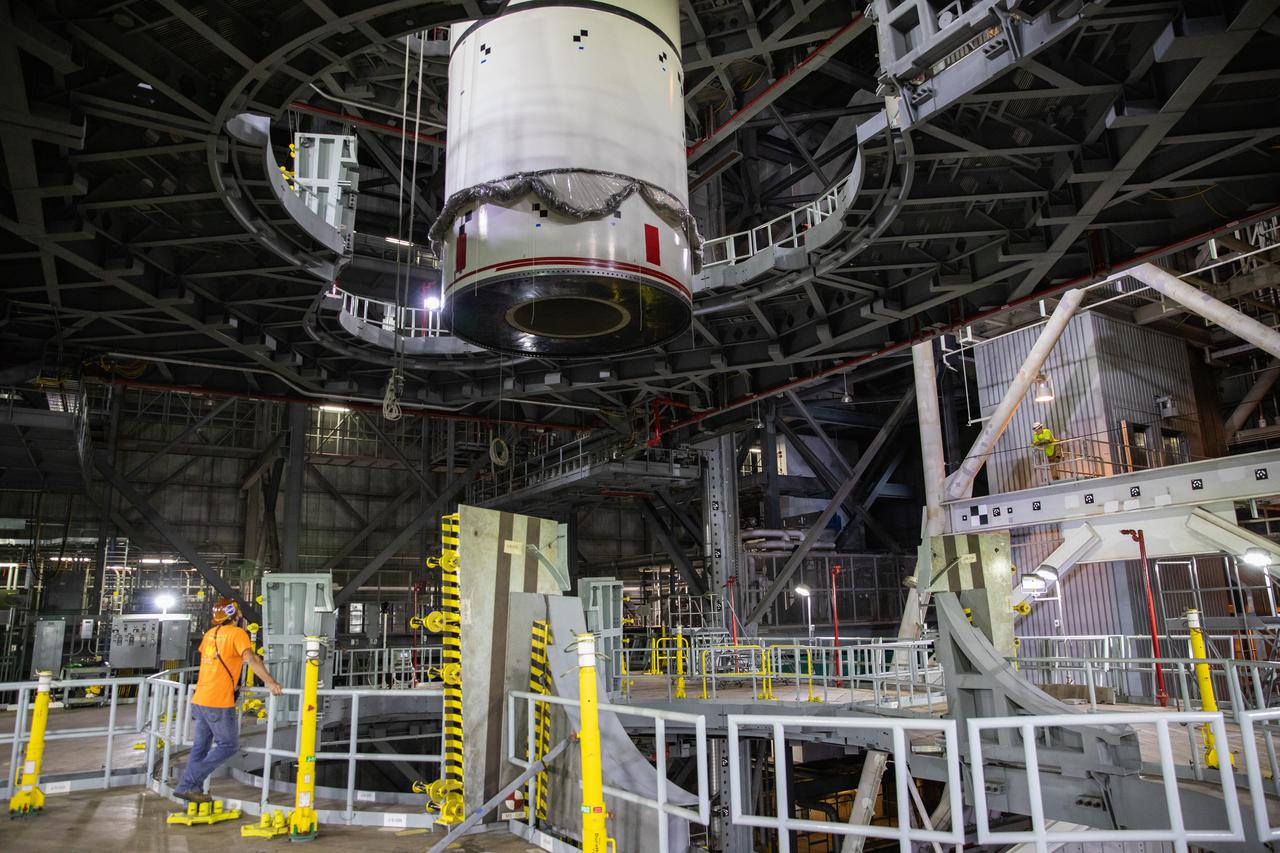
Technicians with NASA’s Exploration Ground Systems lower a mock-up, or pathfinder, of the Space Launch System’s (SLS) center booster segment onto an aft pathfinder segment inside the Vehicle Assembly Building (VAB) at the agency’s Kennedy Space Center in Florida on Sept. 14, 2020. Teams rehearsed stacking both pathfinder segments on top of the mobile launcher in High Bay 3 of the VAB in preparation for the Artemis I launch. Stacking of the actual SLS booster segments will occur later this year, when the rocket’s core stage arrives at Kennedy. Artemis I is the first in a series of increasingly complex missions that will test SLS and the Orion spacecraft as an integrated system prior to crewed flights to the Moon.
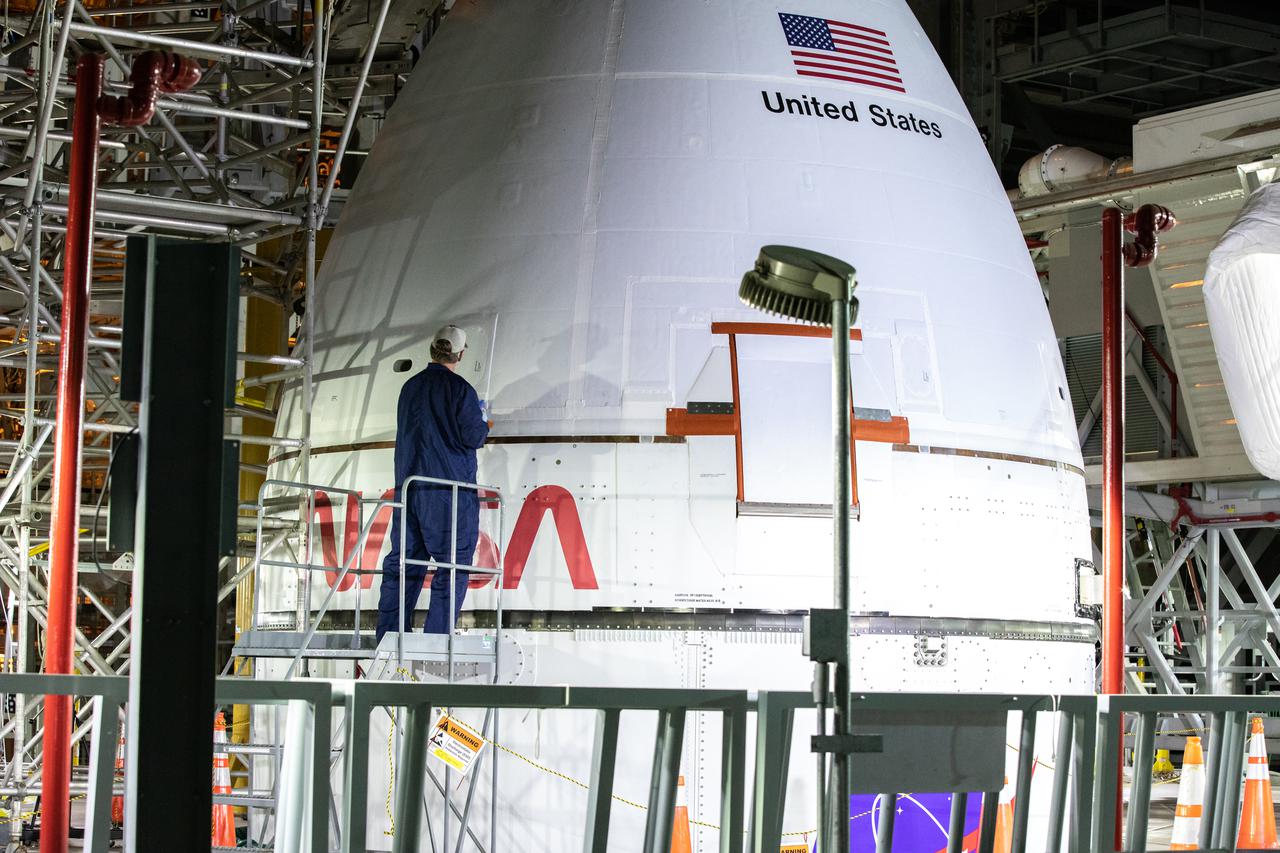
Inside High Bay 3 of the Vehicle Assembly Building at NASA’s Kennedy Space Center in Florida, a technician inspects a Space Launch System (SLS) booster cone for Artemis I on Jan. 10, 2022. The SLS and Orion spacecraft are stacked in the high bay. Artemis I will be the first integrated test of NASA’s deep space exploration systems: the Orion spacecraft, Space Launch System (SLS) rocket and the ground systems at Kennedy. In later missions, NASA will land the first woman and the first person of color on the surface of the Moon, paving the way for a long-term lunar presence and serving as a steppingstone on the way to Mars.
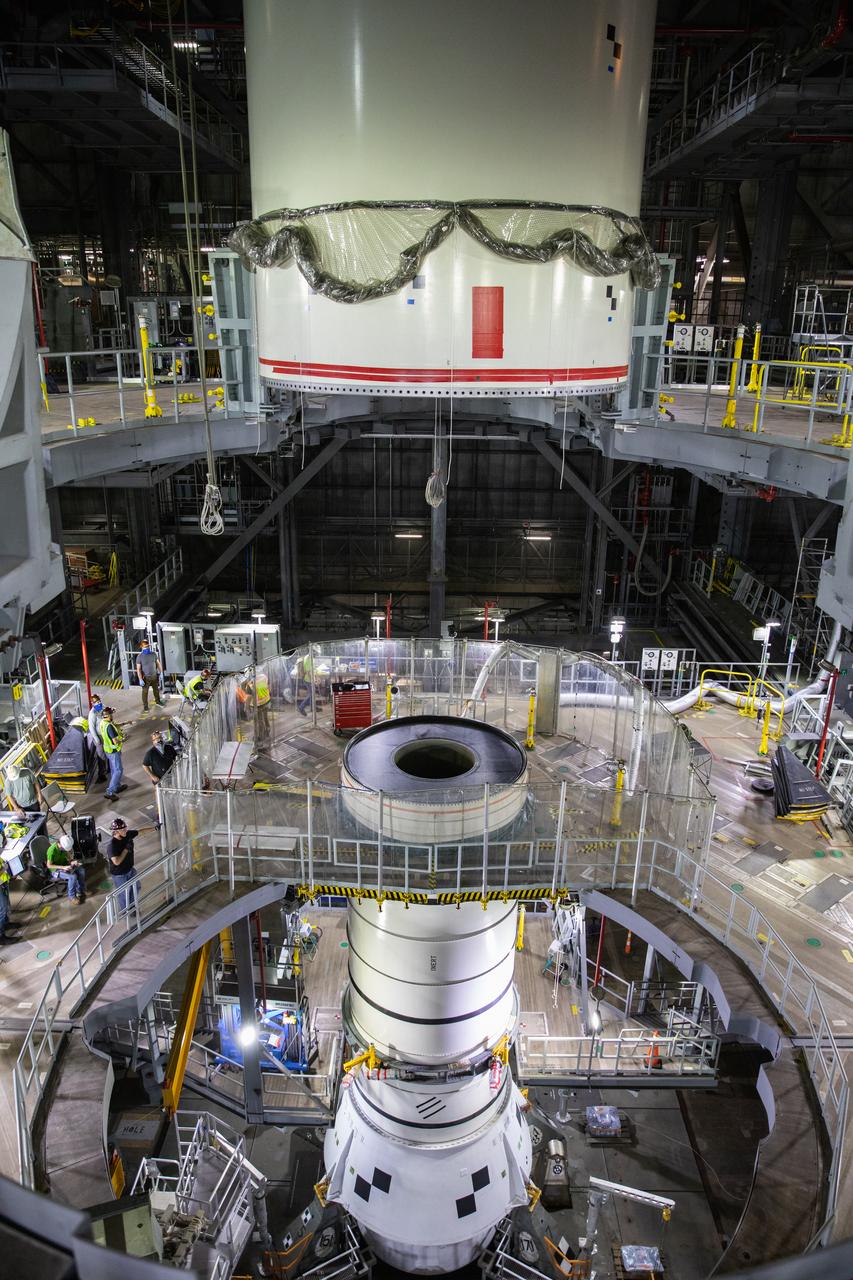
Technicians with NASA’s Exploration Ground Systems lower a mock-up, or pathfinder, of the Space Launch System’s (SLS) center booster segment onto an aft pathfinder segment inside the Vehicle Assembly Building (VAB) at the agency’s Kennedy Space Center in Florida on Sept. 14, 2020. Teams rehearsed stacking both pathfinder segments on top of the mobile launcher in High Bay 3 of the VAB in preparation for the Artemis I launch. Stacking of the actual SLS booster segments will occur later this year, when the rocket’s core stage arrives at Kennedy. Artemis I is the first in a series of increasingly complex missions that will test SLS and the Orion spacecraft as an integrated system prior to crewed flights to the Moon.

Technicians with NASA’s Exploration Ground Systems lower a mock-up, or pathfinder, of the Space Launch System’s (SLS) center booster segment onto an aft pathfinder segment inside the Vehicle Assembly Building (VAB) at the agency’s Kennedy Space Center in Florida on Sept. 14, 2020. Teams rehearsed stacking both pathfinder segments on top of the mobile launcher in High Bay 3 of the VAB in preparation for the Artemis I launch. Stacking of the actual SLS booster segments will occur later this year, when the rocket’s core stage arrives at Kennedy. Artemis I is the first in a series of increasingly complex missions that will test SLS and the Orion spacecraft as an integrated system prior to crewed flights to the Moon.
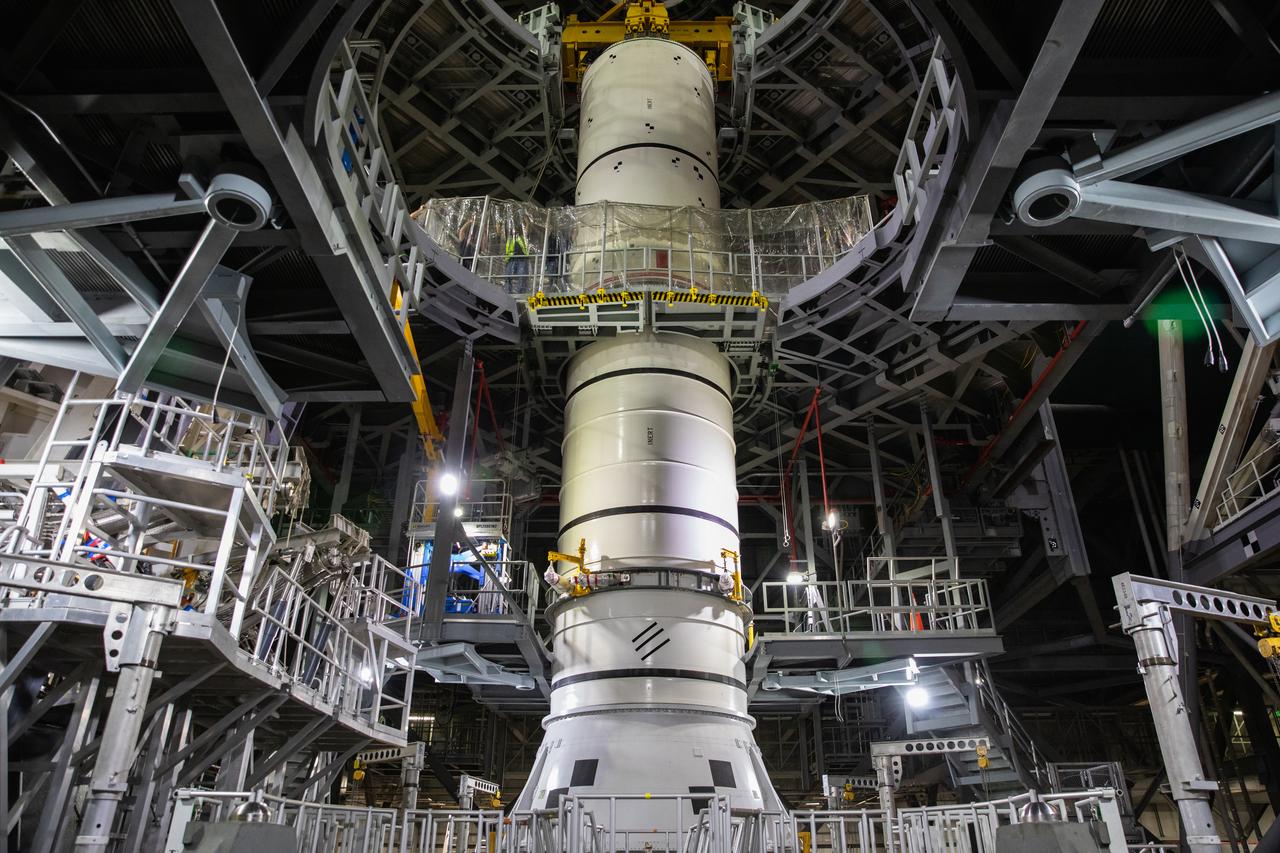
Technicians with NASA’s Exploration Ground Systems lower a mock-up, or pathfinder, of the Space Launch System’s (SLS) center booster segment onto an aft pathfinder segment inside the Vehicle Assembly Building (VAB) at the agency’s Kennedy Space Center in Florida on Sept. 14, 2020. Teams rehearsed stacking both pathfinder segments on top of the mobile launcher in High Bay 3 of the VAB in preparation for the Artemis I launch. Stacking of the actual SLS booster segments will occur later this year, when the rocket’s core stage arrives at Kennedy. Artemis I is the first in a series of increasingly complex missions that will test SLS and the Orion spacecraft as an integrated system prior to crewed flights to the Moon.
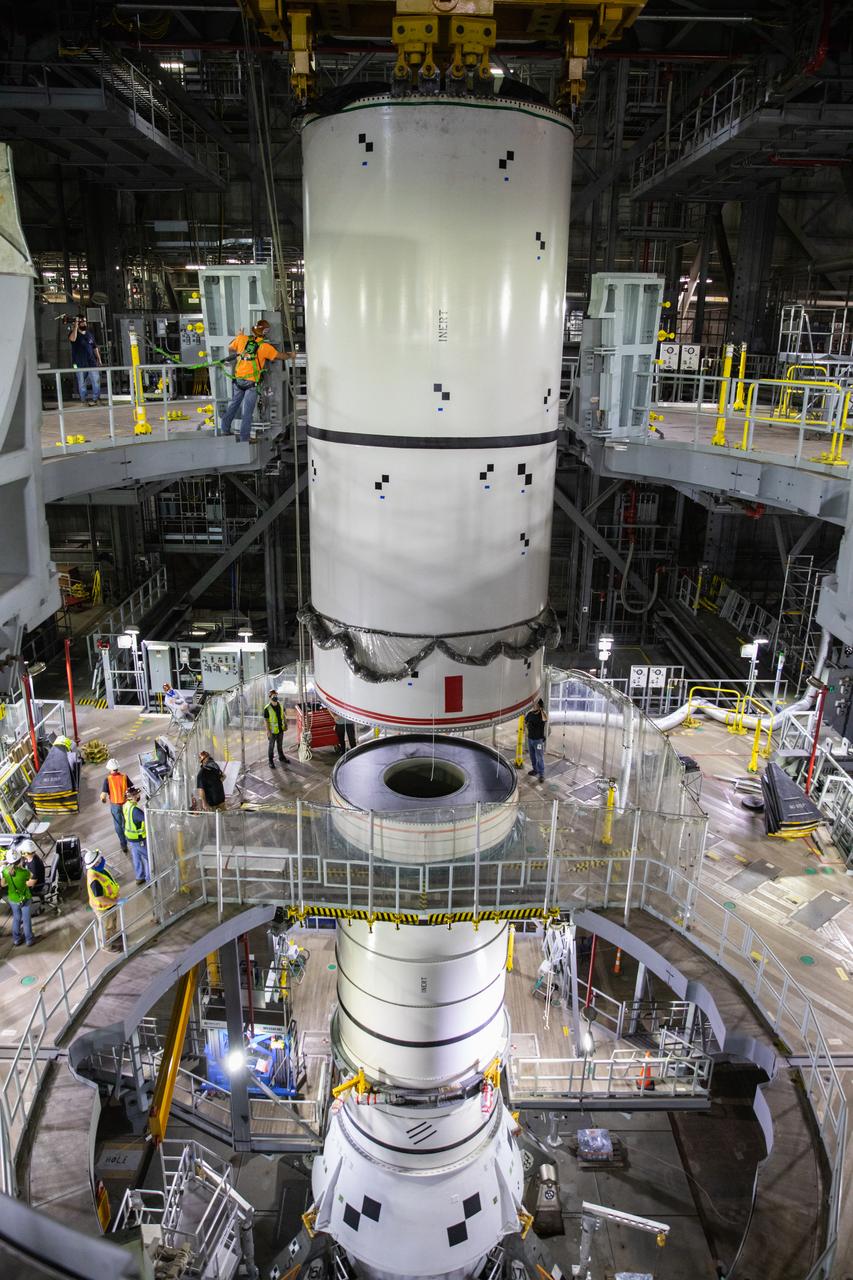
Technicians with NASA’s Exploration Ground Systems lower a mock-up, or pathfinder, of the Space Launch System’s (SLS) center booster segment onto an aft pathfinder segment inside the Vehicle Assembly Building (VAB) at the agency’s Kennedy Space Center in Florida on Sept. 14, 2020. Teams rehearsed stacking both pathfinder segments on top of the mobile launcher in High Bay 3 of the VAB in preparation for the Artemis I launch. Stacking of the actual SLS booster segments will occur later this year, when the rocket’s core stage arrives at Kennedy. Artemis I is the first in a series of increasingly complex missions that will test SLS and the Orion spacecraft as an integrated system prior to crewed flights to the Moon.
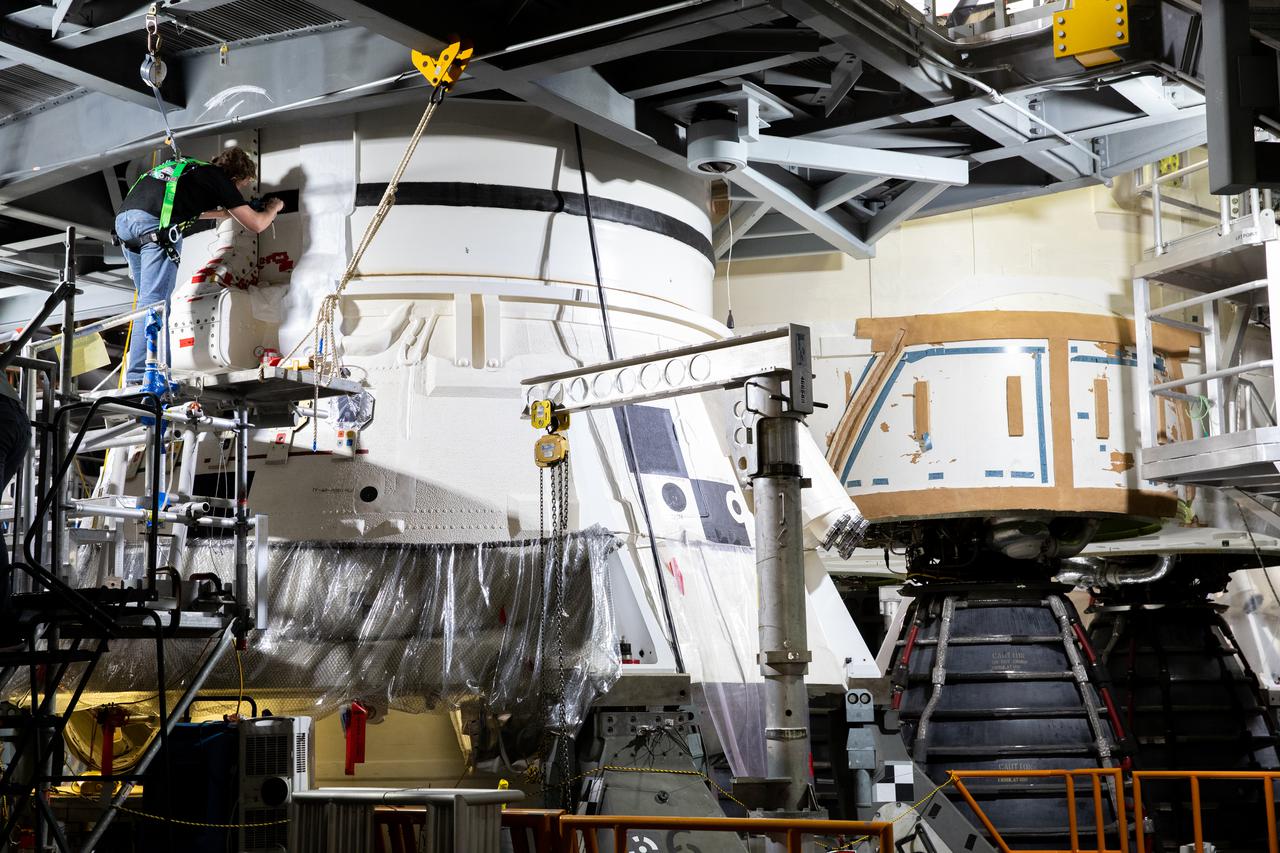
A close-up view of the aft segments of the twin solid rocket boosters for the Artemis I Space Launch System rocket inside High Bay 3 of the Vehicle Assembly Building at NASA’s Kennedy Space Center in Florida on Jan. 10, 2022. Artemis I will be the first integrated test of NASA’s deep space exploration systems: the Orion spacecraft, Space Launch System (SLS) rocket and the ground systems at Kennedy. In later missions, NASA will land the first woman and the first person of color on the surface of the Moon, paving the way for a long-term lunar presence and serving as a steppingstone on the way to Mars.
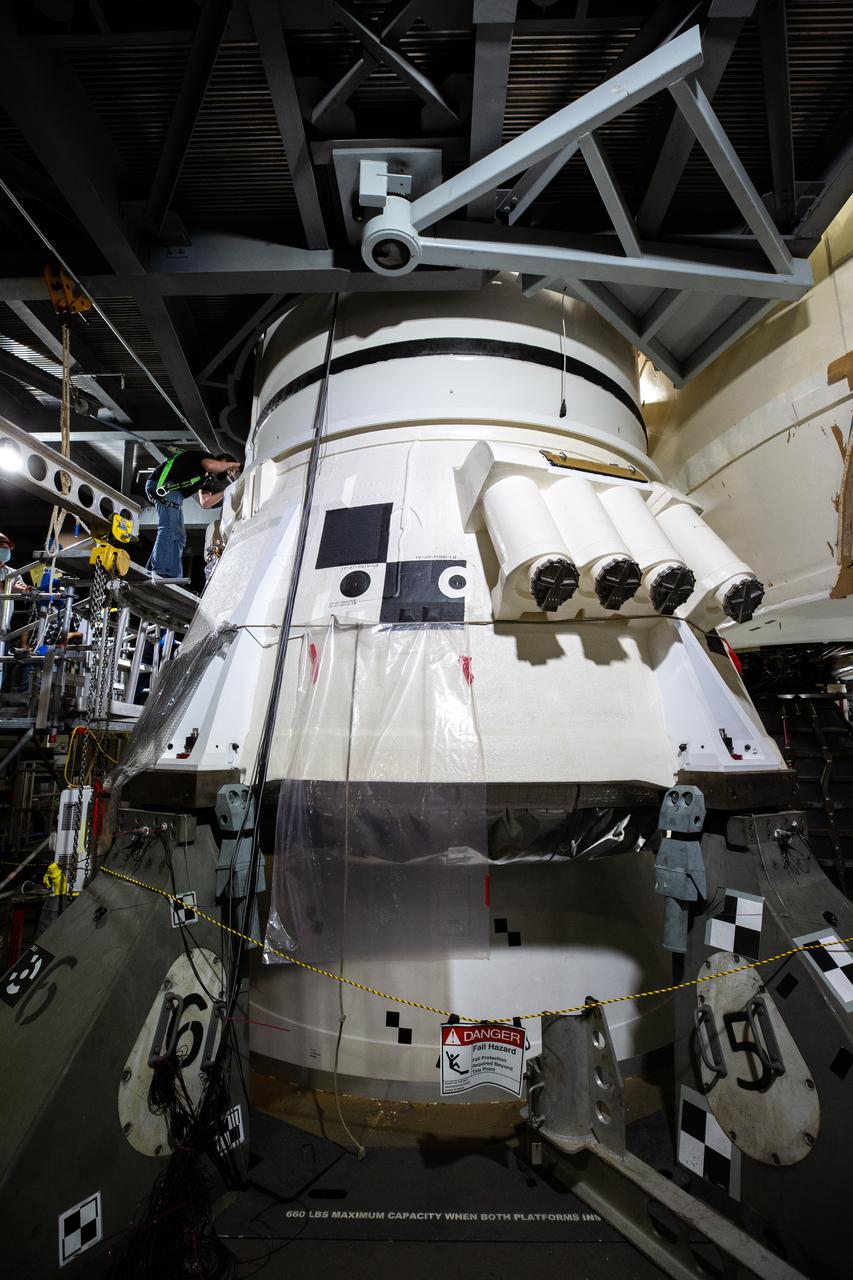
A close-up view of the aft segment of one of the boosters for the Artemis I Space Launch System rocket inside High Bay 3 of the Vehicle Assembly Building at NASA’s Kennedy Space Center in Florida on Jan. 10, 2022. Artemis I will be the first integrated test of NASA’s deep space exploration systems: the Orion spacecraft, Space Launch System (SLS) rocket and the ground systems at Kennedy.. In later missions, NASA will land the first woman and the first person of color on the surface of the Moon, paving the way for a long-term lunar presence and serving as a steppingstone on the way to Mars.
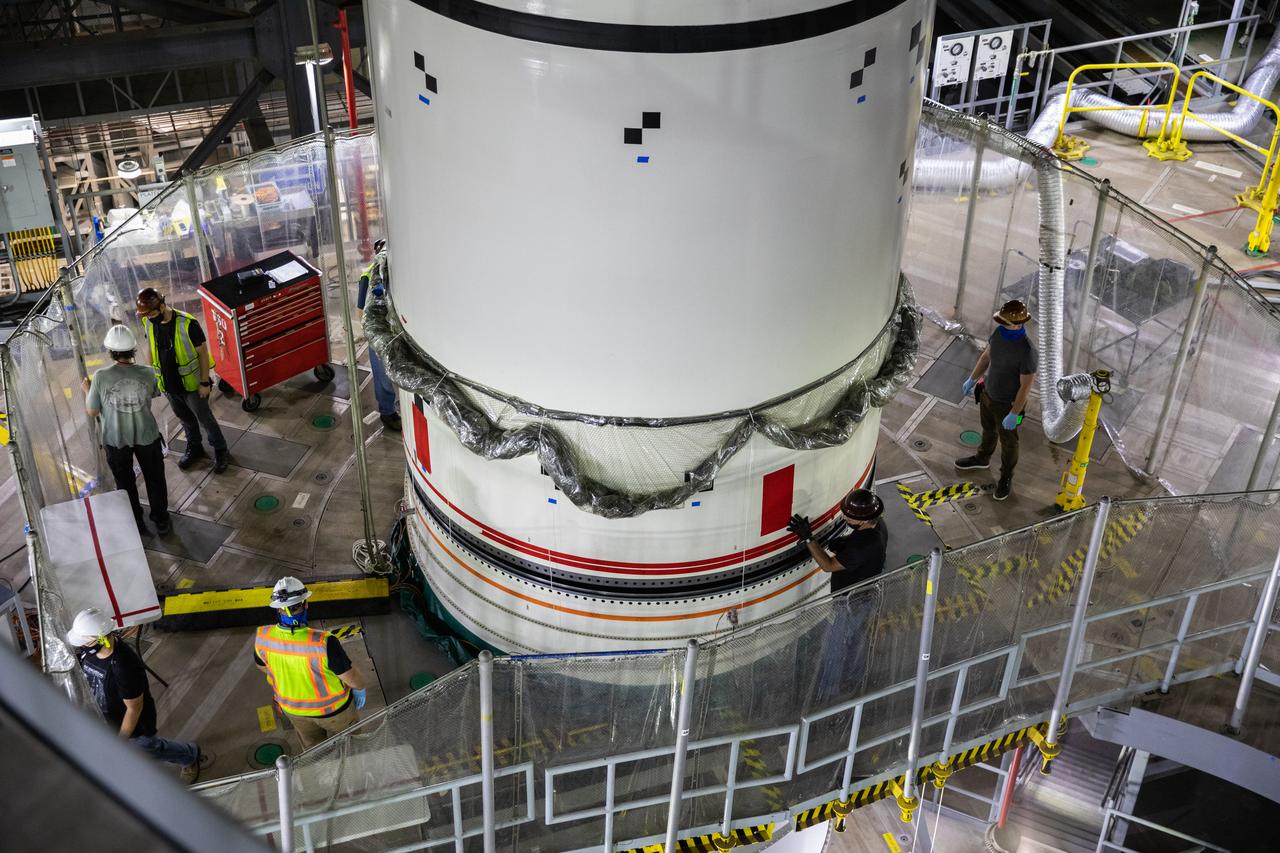
Technicians with NASA’s Exploration Ground Systems lower a mock-up, or pathfinder, of the Space Launch System’s (SLS) center booster segment onto an aft pathfinder segment inside the Vehicle Assembly Building (VAB) at the agency’s Kennedy Space Center in Florida on Sept. 14, 2020. Teams rehearsed stacking both pathfinder segments on top of the mobile launcher in High Bay 3 of the VAB in preparation for the Artemis I launch. Stacking of the actual SLS booster segments will occur later this year, when the rocket’s core stage arrives at Kennedy. Artemis I is the first in a series of increasingly complex missions that will test SLS and the Orion spacecraft as an integrated system prior to crewed flights to the Moon.
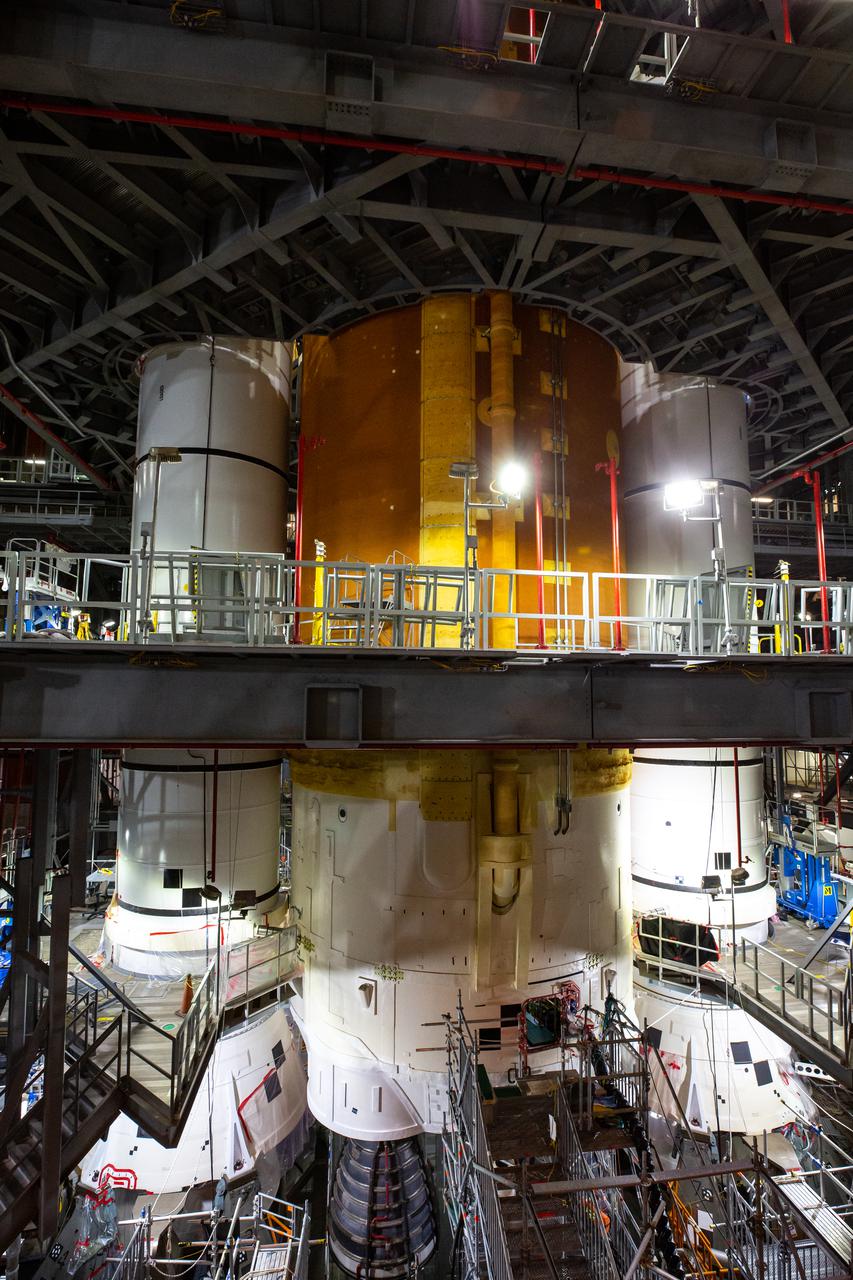
A close-up view of the Artemis I Space Launch System rocket inside High Bay 3 of the Vehicle Assembly Building at NASA’s Kennedy Space Center in Florida on Jan. 10, 2022. In view are the left and right boosters. Artemis I will be the first integrated test of NASA’s deep space exploration systems: the Orion spacecraft, Space Launch System (SLS) rocket and the ground systems at Kennedy.. In later missions, NASA will land the first woman and the first person of color on the surface of the Moon, paving the way for a long-term lunar presence and serving as a steppingstone on the way to Mars.
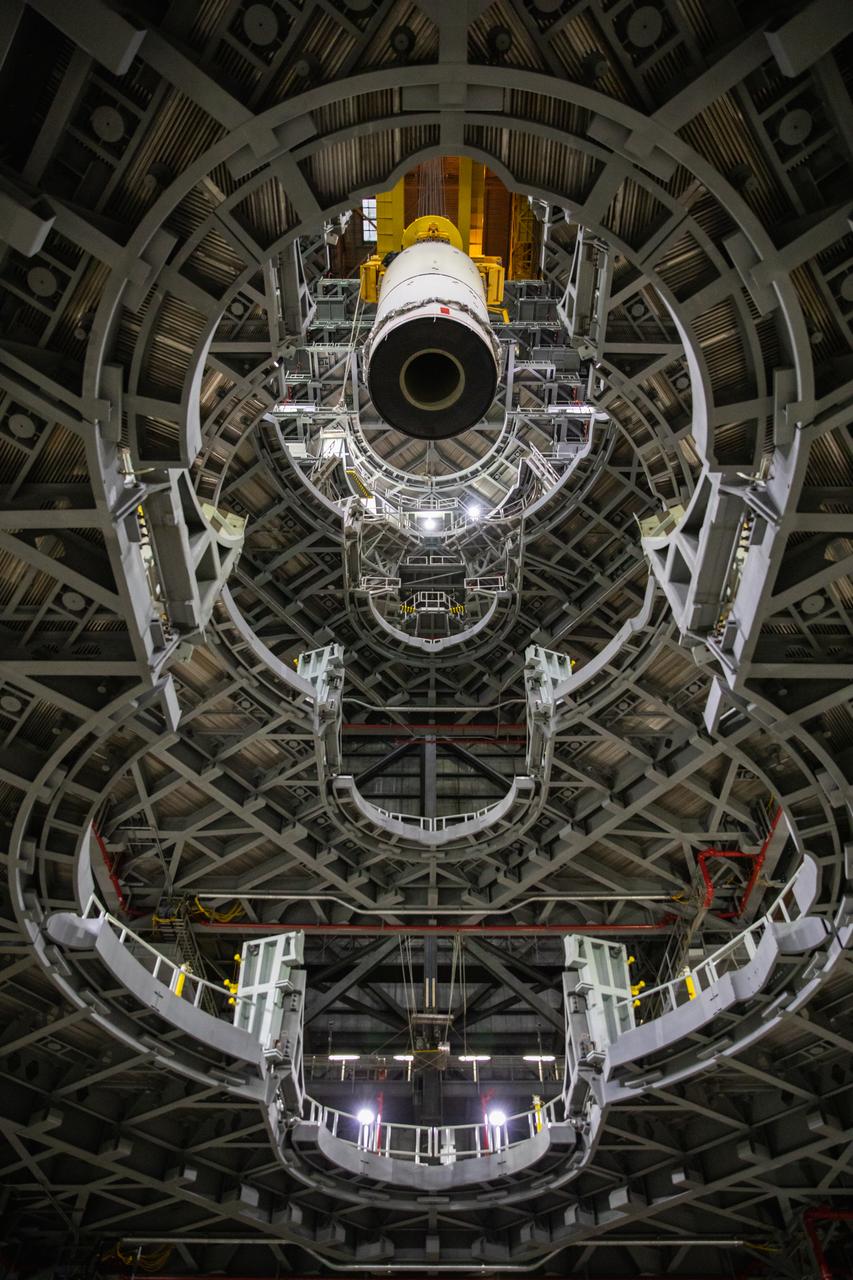
Technicians with NASA’s Exploration Ground Systems prepare to lower a mock-up, or pathfinder, of the Space Launch System’s (SLS) center booster segment onto an aft pathfinder segment inside the Vehicle Assembly Building (VAB) at the agency’s Kennedy Space Center in Florida on Sept. 14, 2020. Teams rehearsed stacking both pathfinder segments on top of the mobile launcher in High Bay 3 of the VAB in preparation for the Artemis I launch. Stacking of the actual SLS booster segments will occur later this year, when the rocket’s core stage arrives at Kennedy. Artemis I is the first in a series of increasingly complex missions that will test SLS and the Orion spacecraft as an integrated system prior to crewed flights to the Moon.
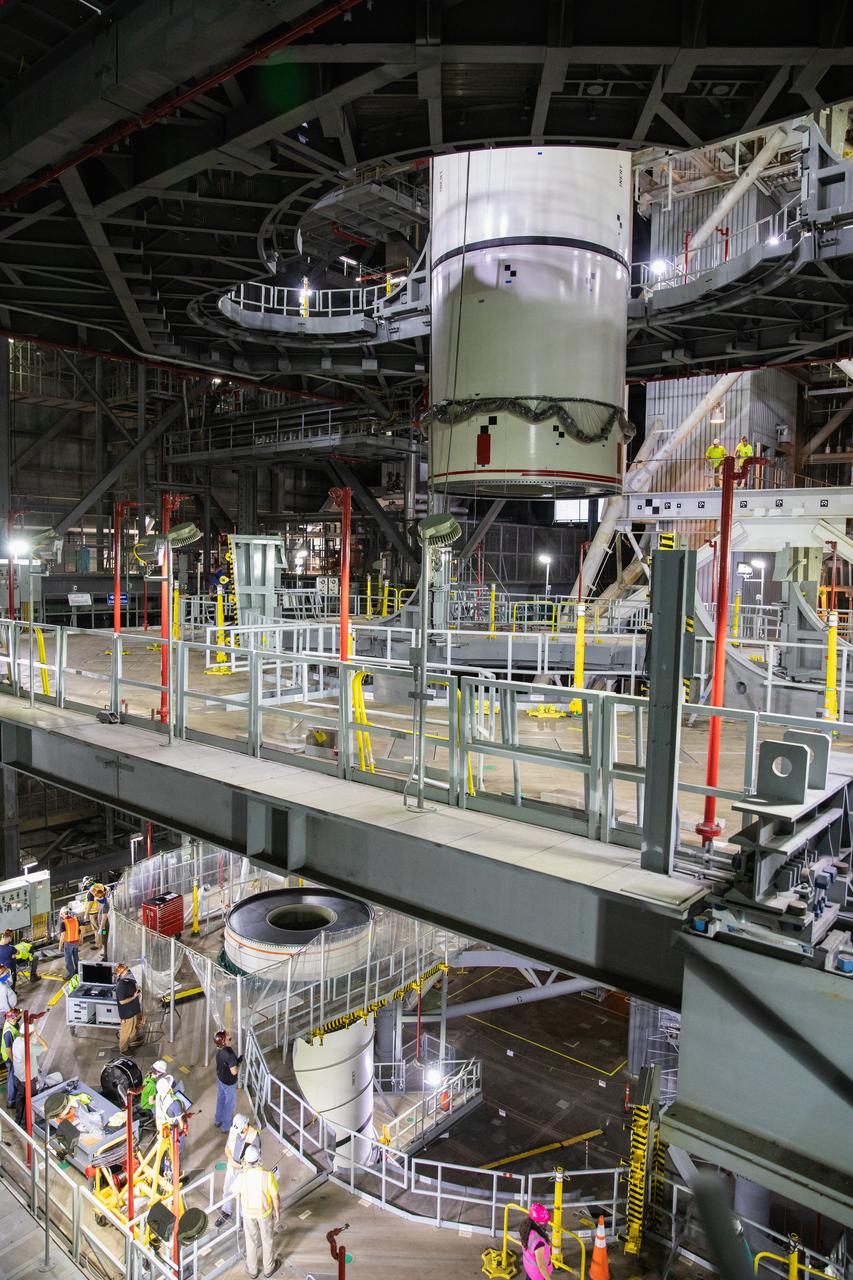
Technicians with NASA’s Exploration Ground Systems lower a mock-up, or pathfinder, of the Space Launch System’s (SLS) center booster segment onto an aft pathfinder segment inside the Vehicle Assembly Building (VAB) at the agency’s Kennedy Space Center in Florida on Sept. 14, 2020. Teams rehearsed stacking both pathfinder segments on top of the mobile launcher in High Bay 3 of the VAB in preparation for the Artemis I launch. Stacking of the actual SLS booster segments will occur later this year, when the rocket’s core stage arrives at Kennedy. Artemis I is the first in a series of increasingly complex missions that will test SLS and the Orion spacecraft as an integrated system prior to crewed flights to the Moon.
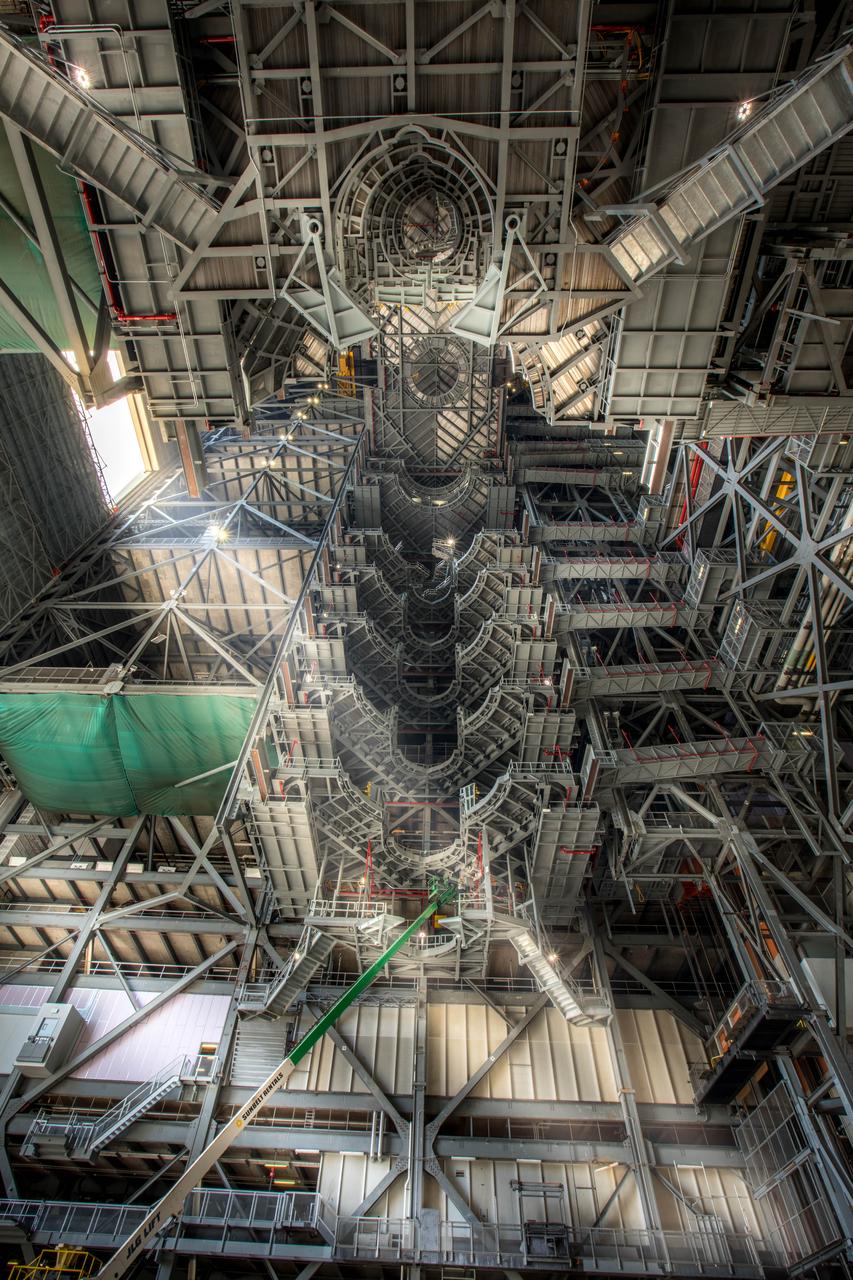
A view looking up at one side of the 10 levels of work platforms in High Bay 3 inside the Vehicle Assembly Building (VAB) at NASA's Kennedy Space Center in Florida. The work platforms will surround and provide access for service and processing of NASA's Space Launch System rocket and Orion spacecraft. Exploration Ground Systems oversaw the upgrades and installation of the new work platforms to support the launch of the SLS and Orion on Exploration Mission-1 and deep space missions.
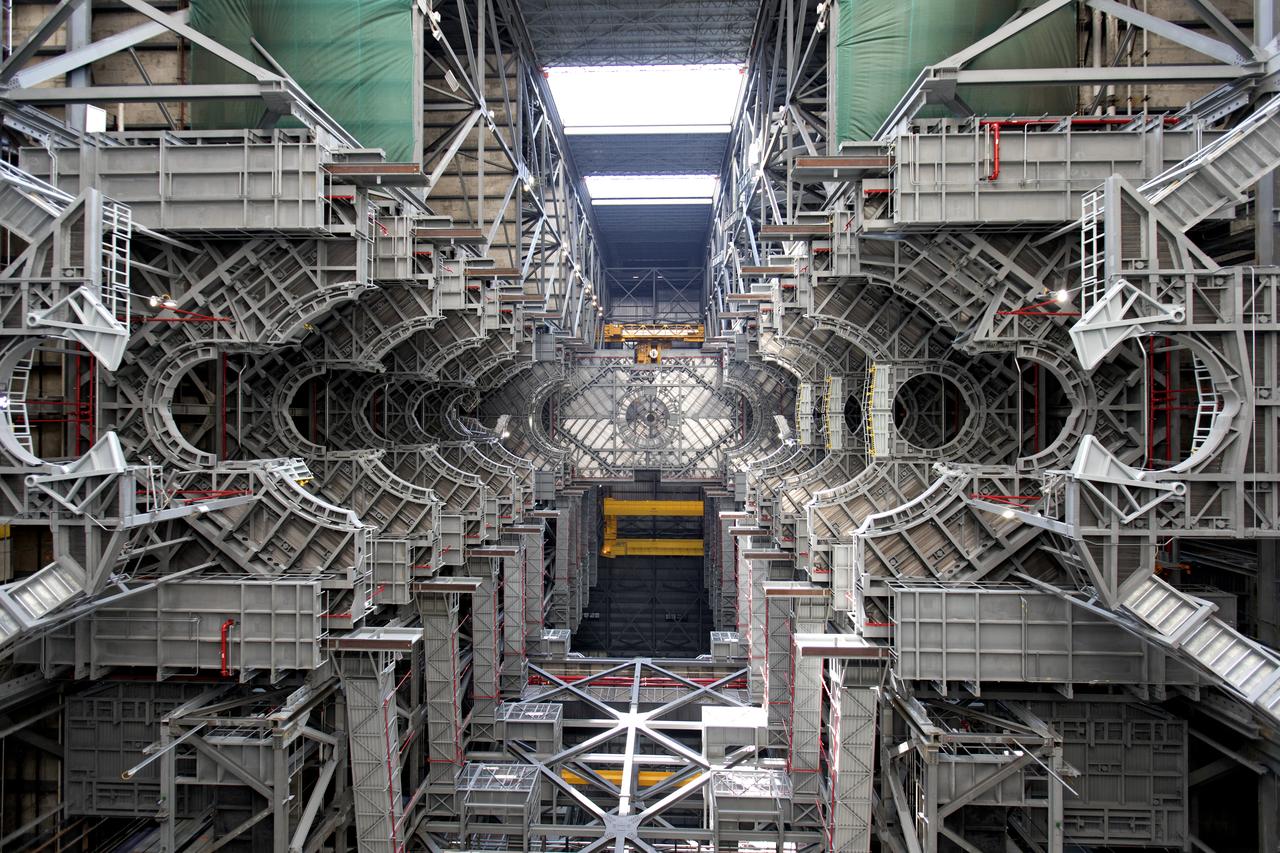
A view looking up at the 10 levels of work platforms in High Bay 3 inside the Vehicle Assembly Building (VAB) at NASA's Kennedy Space Center in Florida. The work platforms will surround and provide access for service and processing of NASA's Space Launch System rocket and Orion spacecraft. Exploration Ground Systems oversaw the upgrades and installation of the new work platforms to support the launch of the SLS and Orion on Exploration Mission-1 and deep space missions.
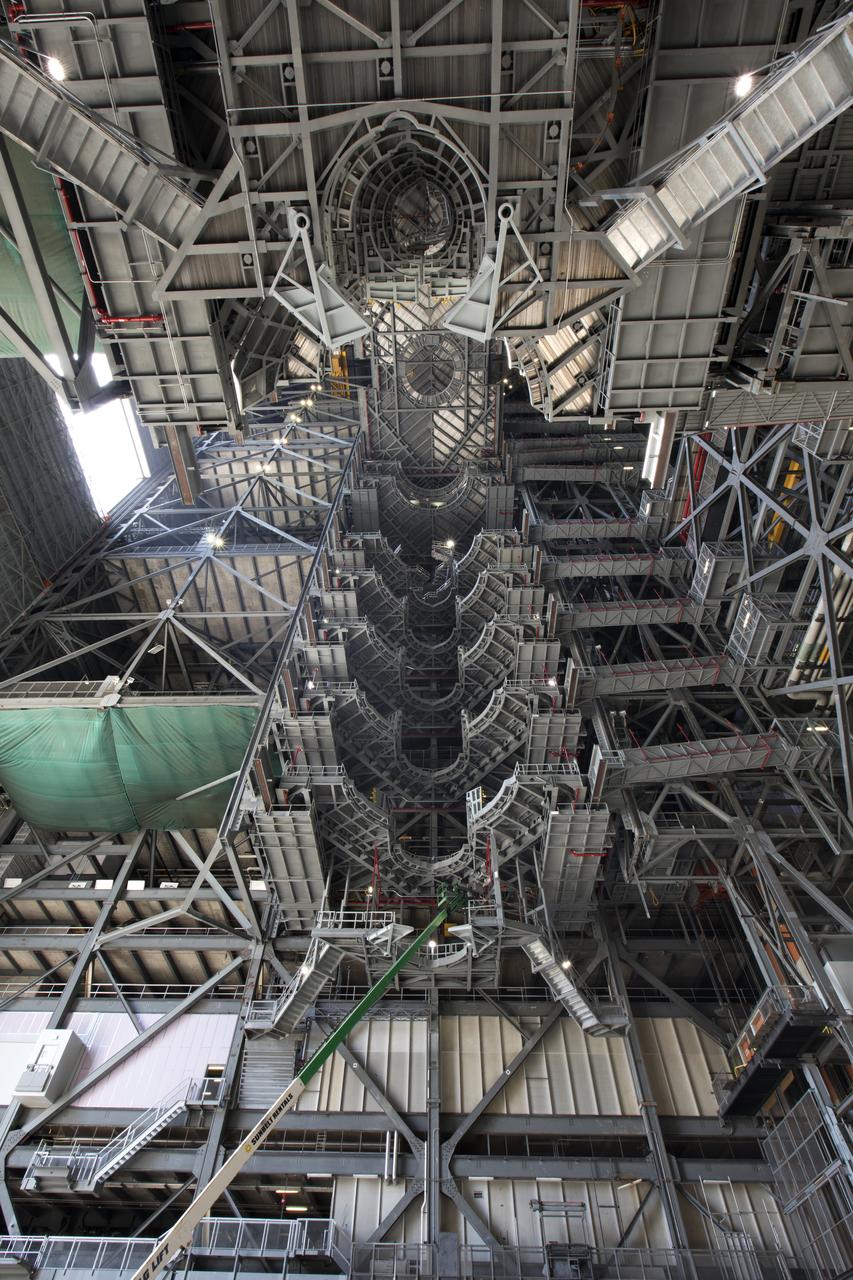
A view looking up at one side of the 10 levels of work platforms in High Bay 3 inside the Vehicle Assembly Building (VAB) at NASA's Kennedy Space Center in Florida. The work platforms will surround and provide access for service and processing of NASA's Space Launch System rocket and Orion spacecraft. Exploration Ground Systems oversaw the upgrades and installation of the new work platforms to support the launch of the SLS and Orion on Exploration Mission-1 and deep space missions.
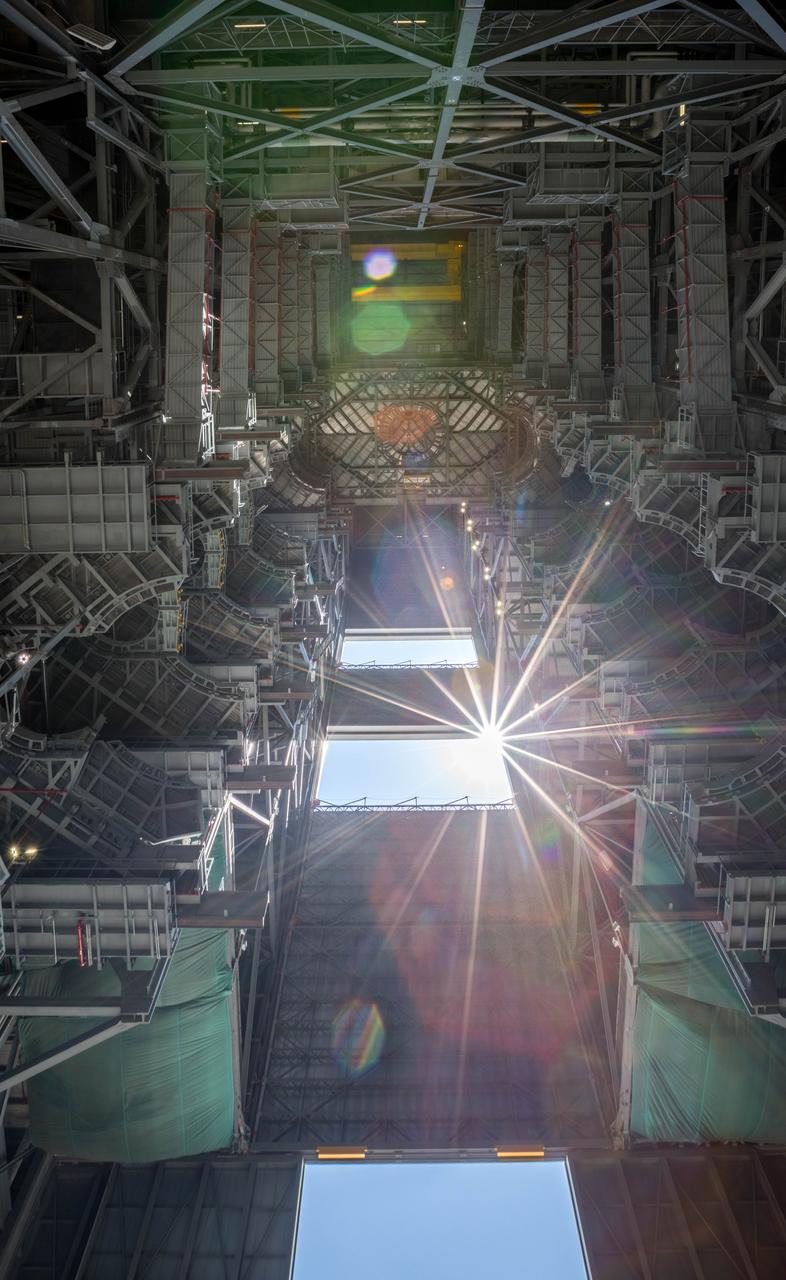
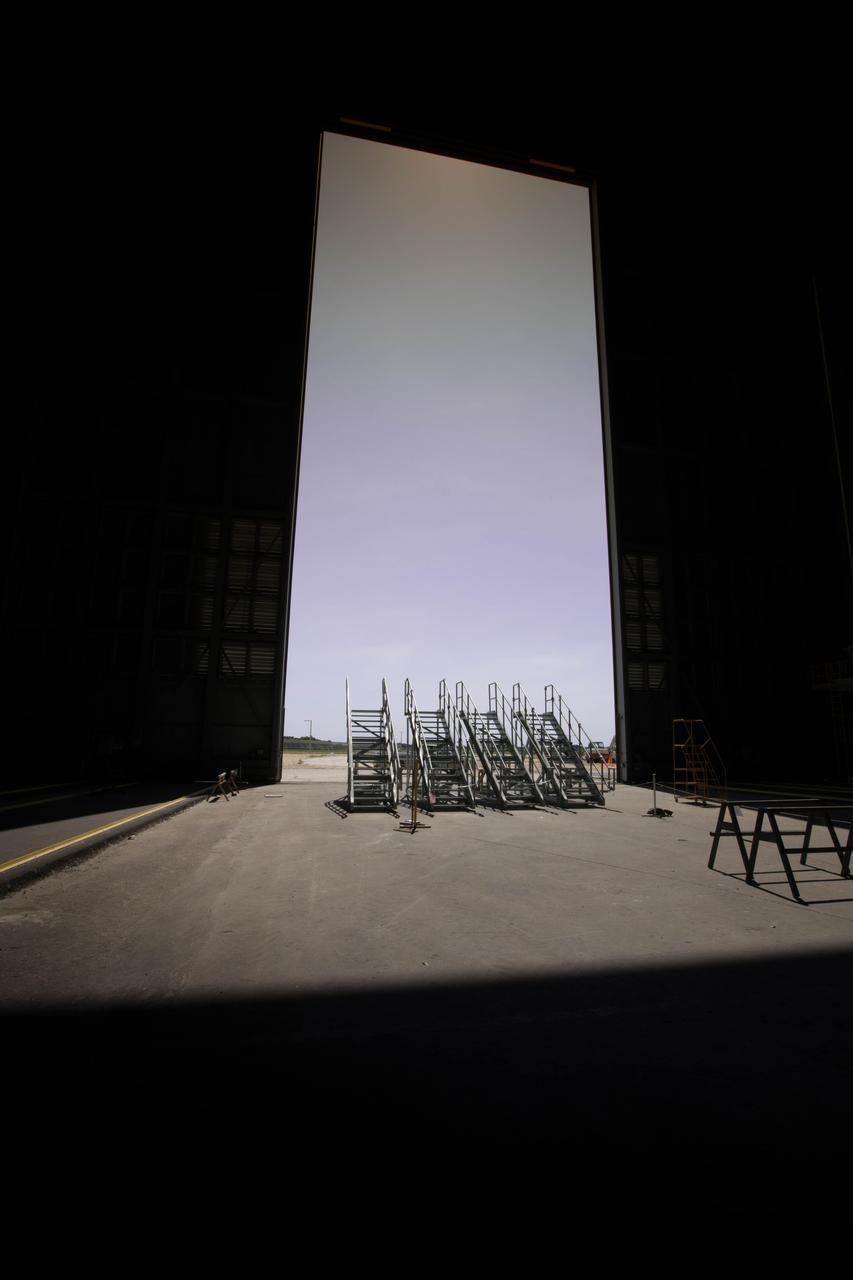
A brilliant sun shines through the doors of High Bay 3 in the Vehicle Assembly Building (VAB) at NASA's Kennedy Space Center in Florida. In view are ten levels of new work platforms that were installed in the high bay. They will surround and provide access for service and processing of NASA's Space Launch System rocket and Orion spacecraft. Exploration Ground Systems oversaw the upgrades and installation of the new work platforms to support the launch of the SLS and Orion on Exploration Mission-1 (EM-1) and deep space missions.

A view looking up at the 10 levels of work platforms in High Bay 3 inside the Vehicle Assembly Building (VAB) at NASA's Kennedy Space Center in Florida. The work platforms will surround and provide access for service and processing of NASA's Space Launch System rocket and Orion spacecraft. Exploration Ground Systems oversaw the upgrades and installation of the new work platforms to support the launch of the SLS and Orion on Exploration Mission-1 and deep space missions.
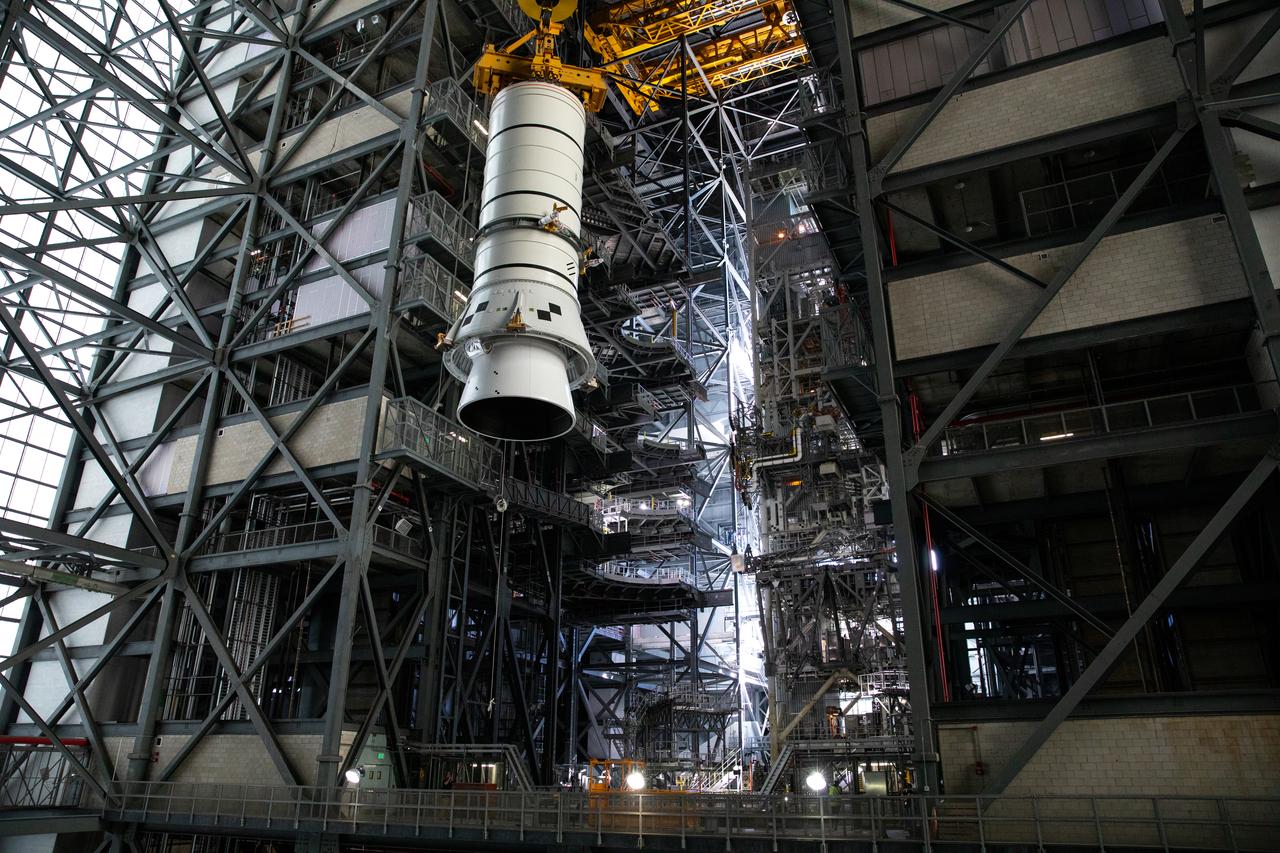
Technicians with NASA’s Exploration Ground Systems rehearse lifting operations using a mock-up of the Space Launch System (SLS) aft booster segment, referred to as a pathfinder, inside the Vehicle Assembly Building (VAB) at the agency’s Kennedy Space Center in Florida on Sept. 11, 2020, in preparation for Artemis I. The exercise involved preparing the aft pathfinder segment in High Bay 4 of the VAB and moving it over to High Bay 3, where it was placed on the mobile launcher. Stacking of the actual booster segments will occur later this year, before the SLS core stage arrives at Kennedy. Artemis I is the first in a series of increasingly complex missions that will test SLS and the Orion spacecraft as an integrated system prior to crewed flights to the Moon.
During a training exercise, technicians with NASA’s Exploration Ground Systems lower a mock-up of the Space Launch System (SLS) aft booster segment, referred to as a pathfinder, onto the mobile launcher in Kennedy Space Center’s Vehicle Assembly Building (VAB) on Sept. 11, 2020. The rehearsal involved teams preparing the aft pathfinder segment in High Bay 4 of the VAB, lifting and moving it over to High Bay 3, and placing it on the mobile launcher in preparation for Artemis I. Stacking of the actual booster segments will occur later this year, before the SLS core stage arrives at the Florida spaceport. Artemis I is the first in a series of increasingly complex missions that will test SLS and the Orion spacecraft as an integrated system prior to crewed flights to the Moon.

During a training exercise, technicians with NASA’s Exploration Ground Systems lower a mock-up of the Space Launch System (SLS) aft booster segment, referred to as a pathfinder, onto the mobile launcher in Kennedy Space Center’s Vehicle Assembly Building (VAB) on Sept. 11, 2020. The rehearsal involved teams preparing the aft pathfinder segment in High Bay 4 of the VAB, lifting and moving it over to High Bay 3, and placing it on the mobile launcher in preparation for Artemis I. Stacking of the actual booster segments will occur later this year, before the SLS core stage arrives at the Florida spaceport. Artemis I is the first in a series of increasingly complex missions that will test SLS and the Orion spacecraft as an integrated system prior to crewed flights to the Moon.
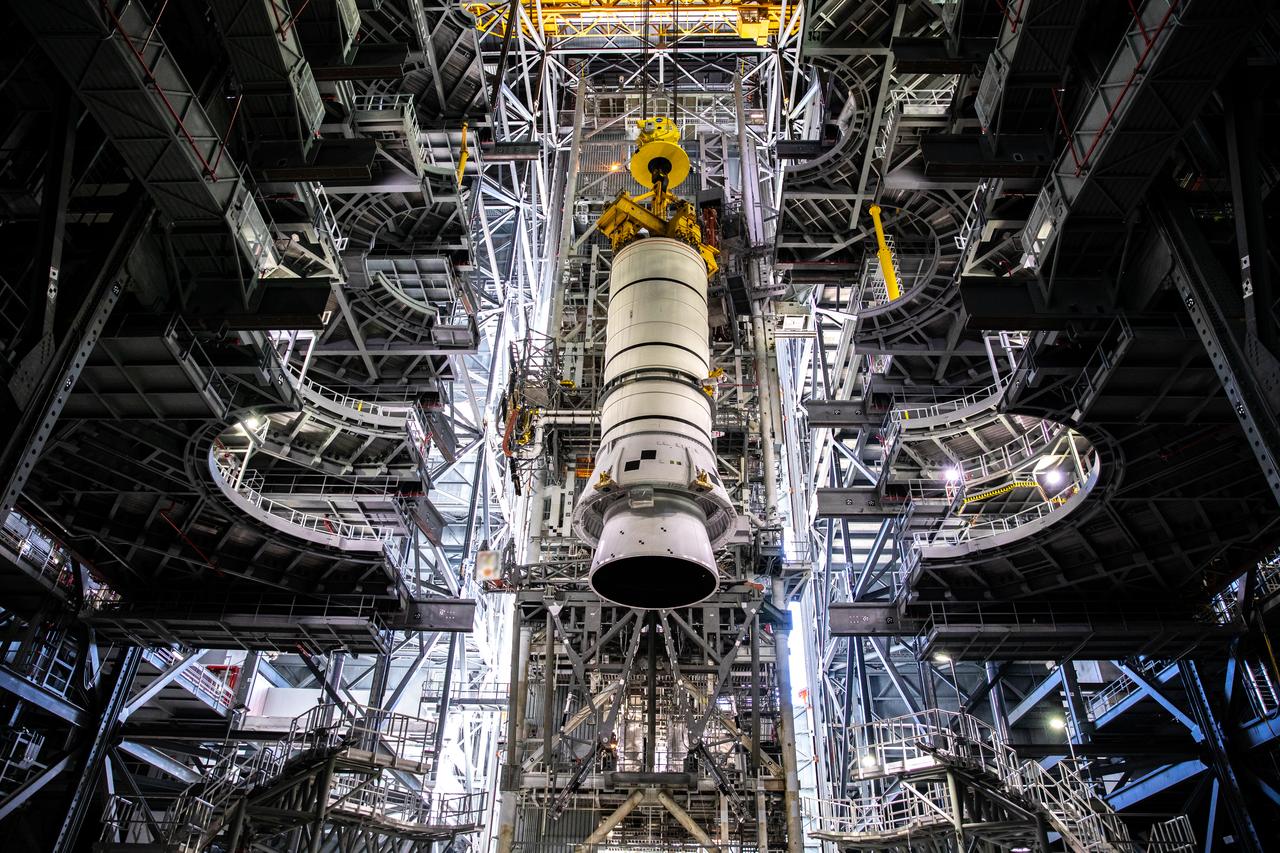
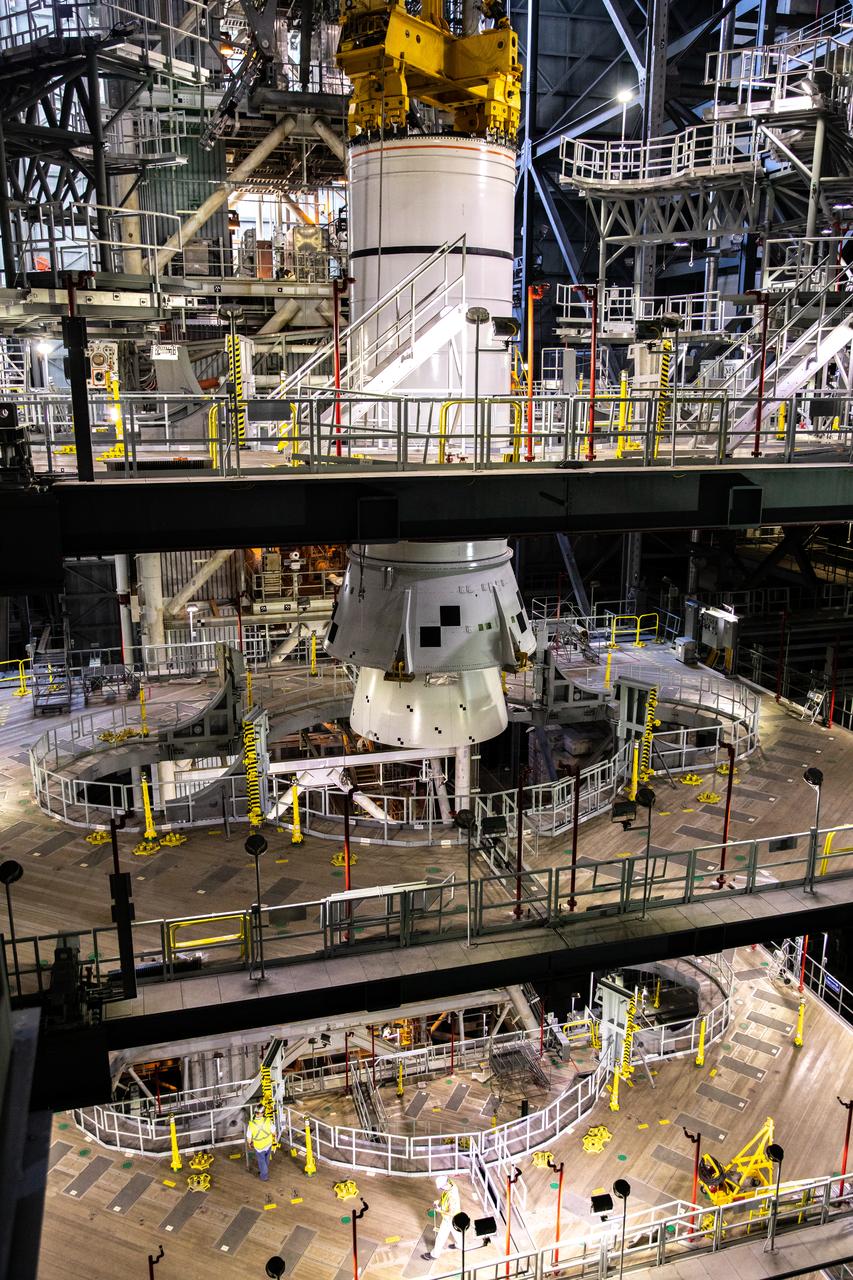
During a training exercise, technicians with NASA’s Exploration Ground Systems lower a mock-up of the Space Launch System (SLS) aft booster segment, referred to as a pathfinder, onto the mobile launcher in Kennedy Space Center’s Vehicle Assembly Building (VAB) on Sept. 11, 2020. The rehearsal involved teams preparing the aft pathfinder segment in High Bay 4 of the VAB, lifting and moving it over to High Bay 3, and placing it on the mobile launcher in preparation for Artemis I. Stacking of the actual booster segments will occur later this year, before the SLS core stage arrives at the Florida spaceport. Artemis I is the first in a series of increasingly complex missions that will test SLS and the Orion spacecraft as an integrated system prior to crewed flights to the Moon.
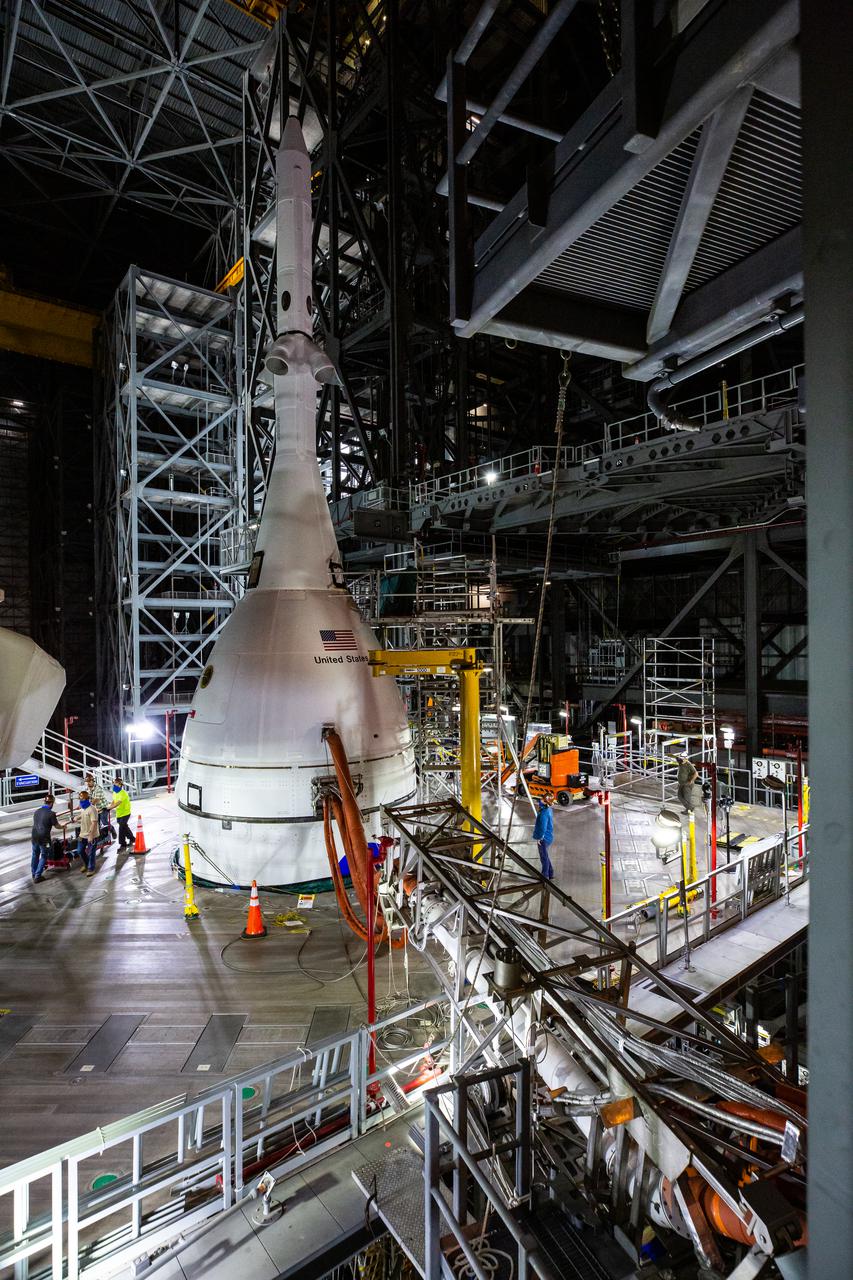
The Artemis I Orion spacecraft, secured on the Space Launch System (SLS) and enclosed in its launch abort system, is in view high up in High Bay 3 of the Vehicle Assembly Building at NASA’s Kennedy Space Center in Florida on Jan. 10, 2022. Work platforms are extended around Orion and scaffolding has been secured to allow access for inspection and processing work. Artemis I will be the first integrated test of NASA’s deep space exploration systems: the Orion spacecraft, Space Launch System (SLS) rocket and the ground systems at Kennedy. In later missions, NASA will land the first woman and the first person of color on the surface of the Moon, paving the way for a long-term lunar presence and serving as a steppingstone on the way to Mars.
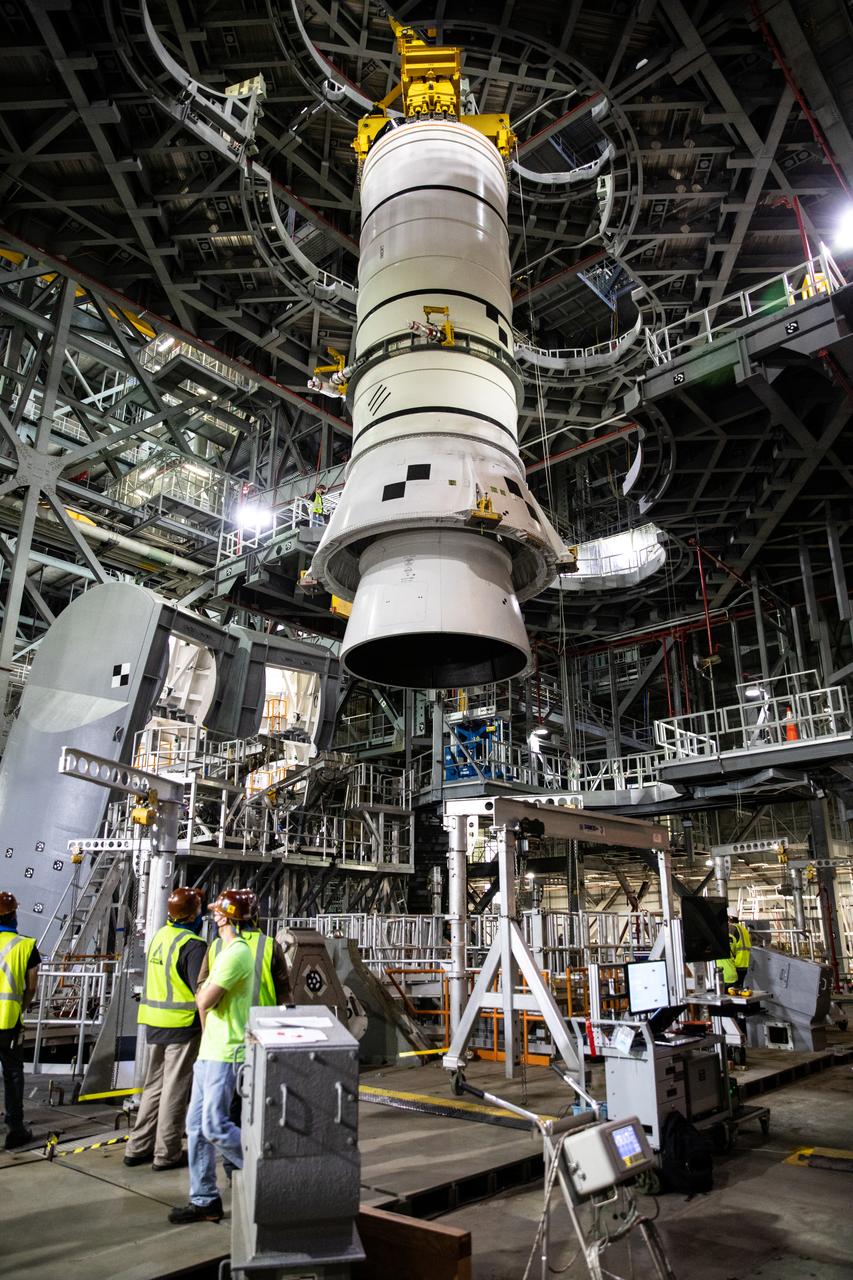
During a training exercise, technicians with NASA’s Exploration Ground Systems lower a mock-up of the Space Launch System (SLS) aft booster segment, referred to as a pathfinder, onto the mobile launcher in Kennedy Space Center’s Vehicle Assembly Building (VAB) on Sept. 11, 2020. The rehearsal involved teams preparing the aft pathfinder segment in High Bay 4 of the VAB, lifting and moving it over to High Bay 3, and placing it on the mobile launcher in preparation for Artemis I. Stacking of the actual booster segments will occur later this year, before the SLS core stage arrives at the Florida spaceport. Artemis I is the first in a series of increasingly complex missions that will test SLS and the Orion spacecraft as an integrated system prior to crewed flights to the Moon.
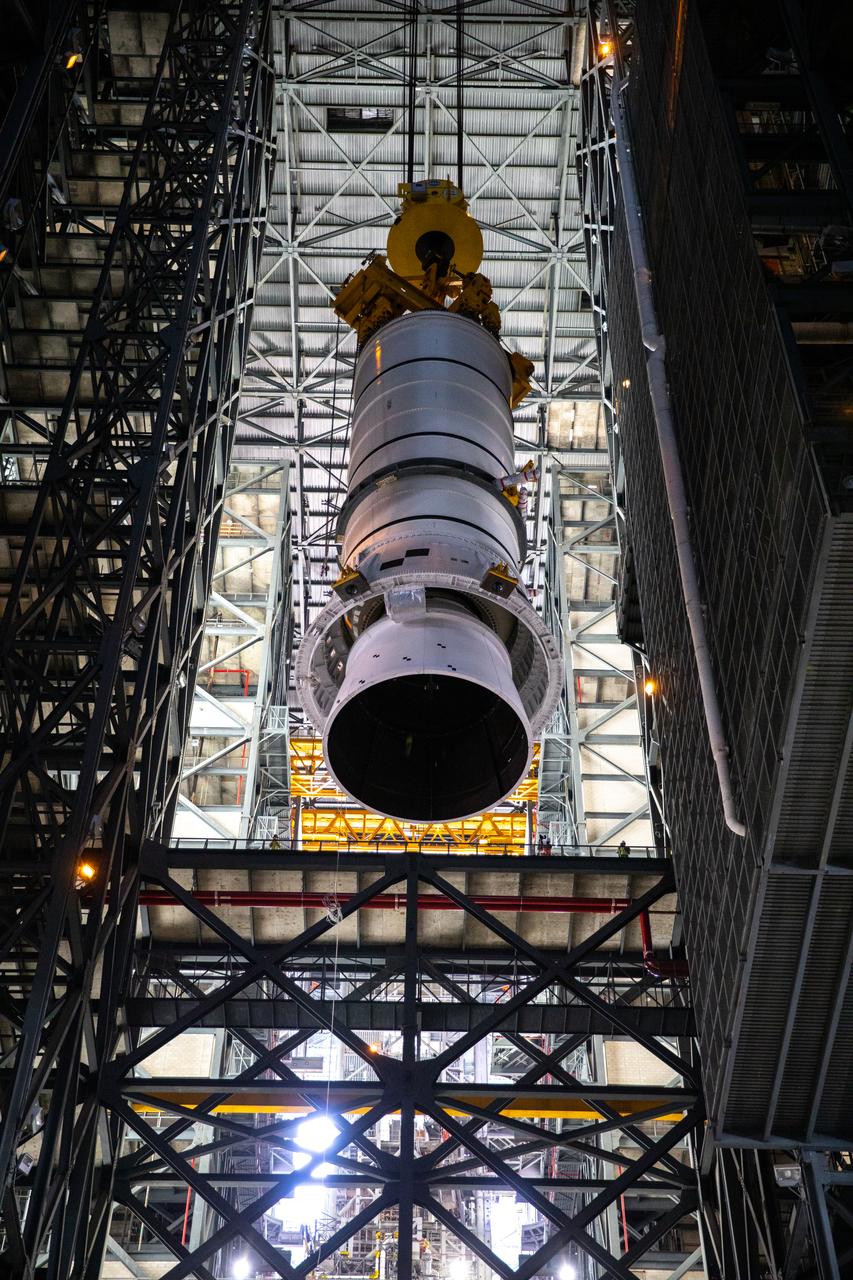
Technicians with NASA’s Exploration Ground Systems rehearse lifting operations using a mock-up of the Space Launch System (SLS) aft booster segment, referred to as a pathfinder, inside the Vehicle Assembly Building (VAB) at the agency’s Kennedy Space Center in Florida on Sept. 11, 2020, in preparation for Artemis I. The exercise involved preparing the aft pathfinder segment in High Bay 4 of the VAB and moving it over to High Bay 3, where it was placed on the mobile launcher. Stacking of the actual booster segments will occur later this year, before the SLS core stage arrives at Kennedy. Artemis I is the first in a series of increasingly complex missions that will test SLS and the Orion spacecraft as an integrated system prior to crewed flights to the Moon.
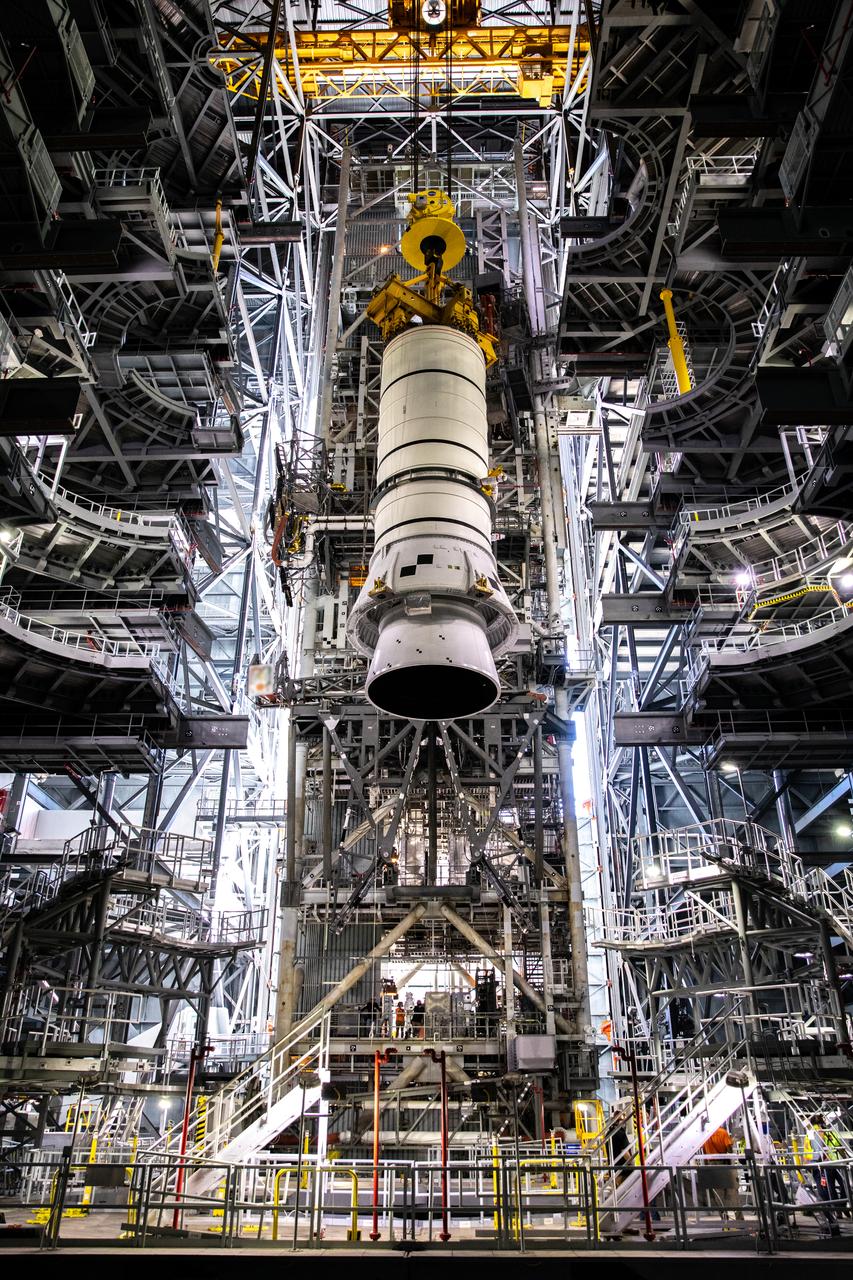
During a training exercise, technicians with NASA’s Exploration Ground Systems prepare to lower a mock-up of the Space Launch System (SLS) aft booster segment, referred to as a pathfinder, onto the mobile launcher in Kennedy Space Center’s Vehicle Assembly Building (VAB) on Sept. 11, 2020. The rehearsal involved teams preparing the aft pathfinder segment in High Bay 4 of the VAB, lifting and moving it over to High Bay 3, and placing it on the mobile launcher in preparation for Artemis I. Stacking of the actual booster segments will occur later this year, beforewhen the SLS core stage arrives at the Florida spaceport. Artemis I is the first in a series of increasingly complex missions that will test SLS and the Orion spacecraft as an integrated system prior to crewed flights to the Moon.
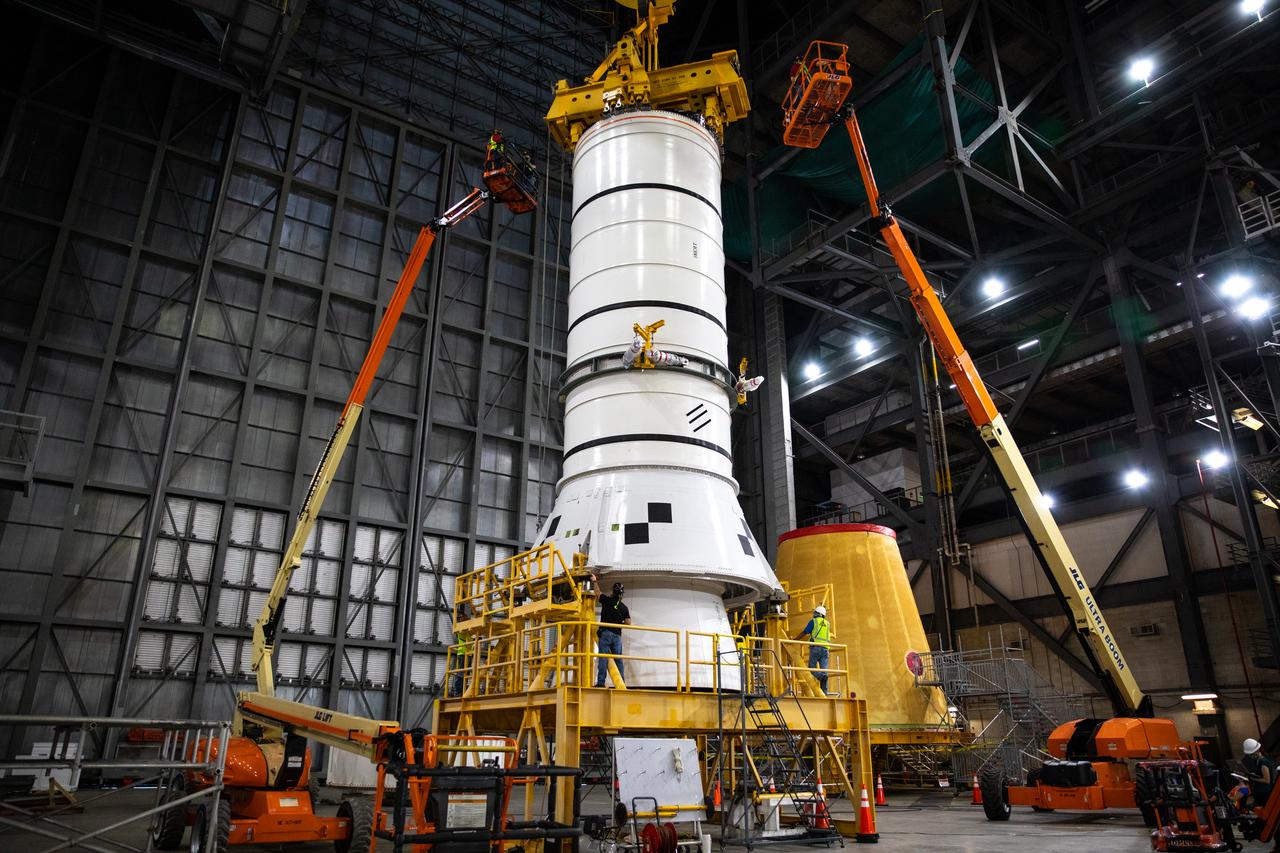
Technicians with NASA’s Exploration Ground Systems rehearse booster stacking operations inside the Vehicle Assembly Building (VAB) at the agency’s Kennedy Space Center in Florida on Sept. 11, 2020, in preparation for Artemis I. The exercise involved using booster segment mock-ups, referred to as pathfinders. During this rehearsal, an aft pathfinder segment was prepared in High Bay 4 of the VAB, after which a team of crane operators moved it over to High Bay 3, where it was placed on the mobile launcher. Stacking of the actual Space Launch System (SLS) booster segments will occur later this year, before the rocket’s core stage arrives at Kennedy. Artemis I is the first in a series of increasingly complex missions that will test SLS and the Orion spacecraft as an integrated system prior to crewed flights to the Moon.
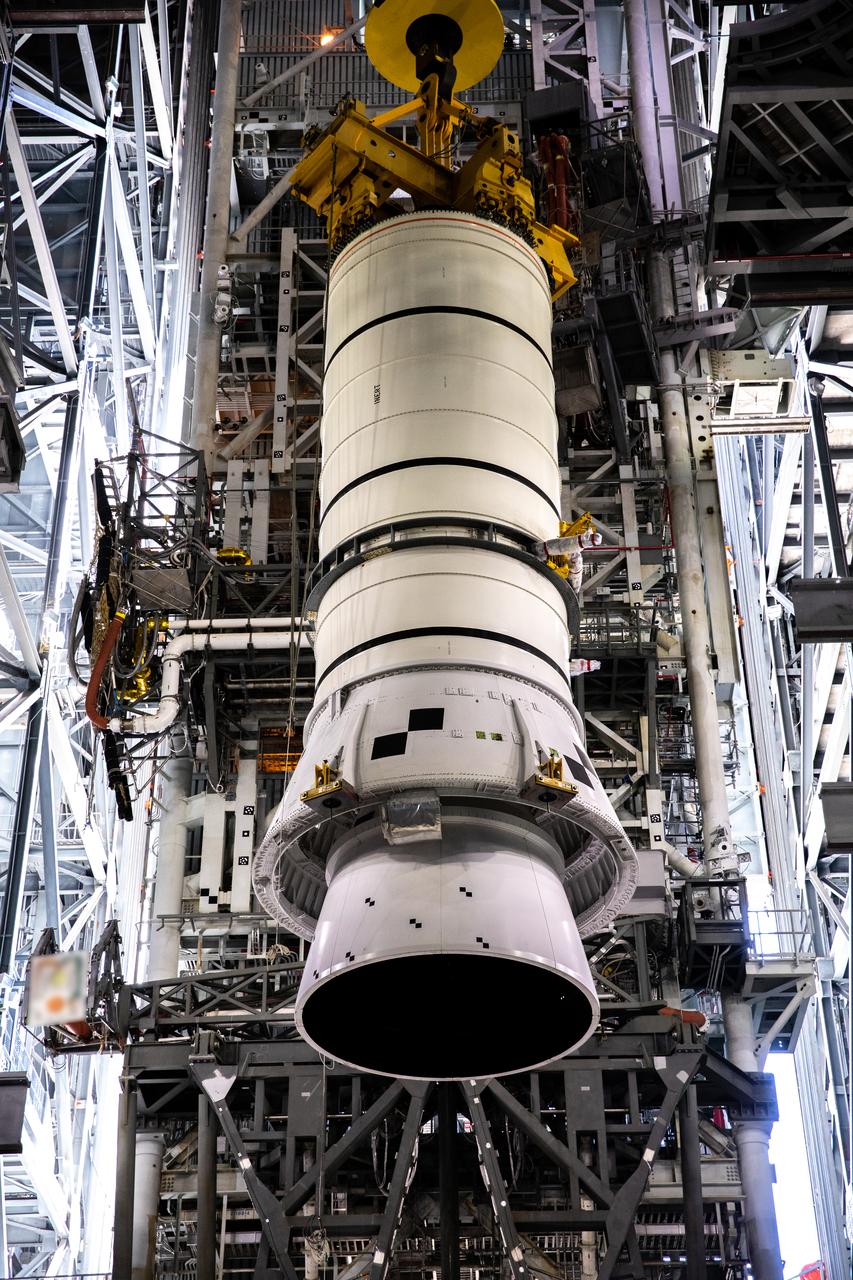
During a training exercise, technicians with NASA’s Exploration Ground Systems prepare to lower a mock-up of the Space Launch System (SLS) aft booster segment, referred to as a pathfinder, onto the mobile launcher in Kennedy Space Center’s Vehicle Assembly Building (VAB) on Sept. 11, 2020. The rehearsal involved teams preparing the aft pathfinder segment in High Bay 4 of the VAB, lifting and moving it over to High Bay 3, and placing it on the mobile launcher in preparation for Artemis I. Stacking of the actual booster segments will occur later this year, before the SLS core stage arrives at the Florida spaceport. Artemis I is the first in a series of increasingly complex missions that will test SLS and the Orion spacecraft as an integrated system prior to crewed flights to the Moon.
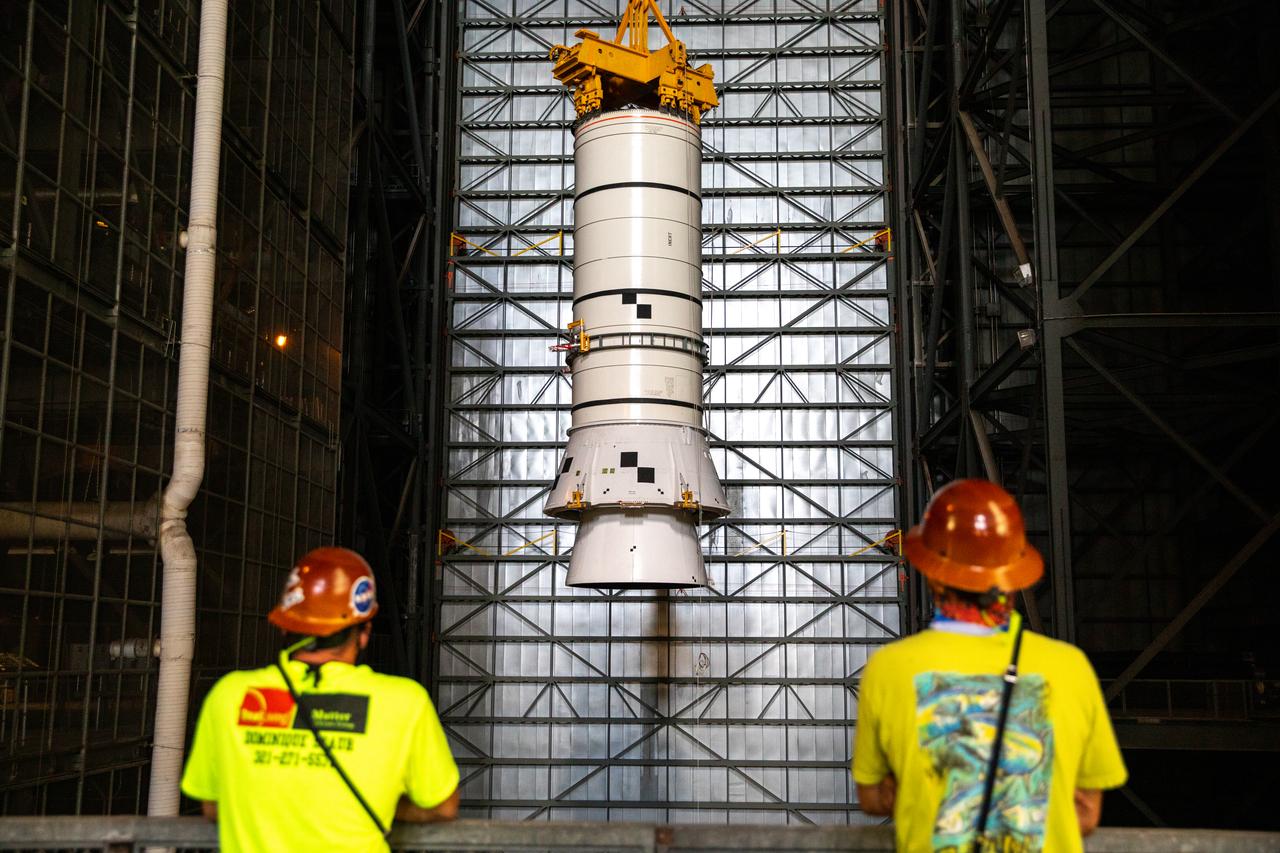
Technicians with NASA’s Exploration Ground Systems rehearse lifting operations using a mock-up of the Space Launch System (SLS) aft booster segment, referred to as a pathfinder, inside the Vehicle Assembly Building (VAB) at the agency’s Kennedy Space Center in Florida on Sept. 11, 2020, in preparation for Artemis I. The exercise involved preparing the aft pathfinder segment in High Bay 4 of the VAB and moving it over to High Bay 3, where it was placed on the mobile launcher. Stacking of the actual booster segments will occur later this year, before the SLS core stage arrives at Kennedy. Artemis I is the first in a series of increasingly complex missions that will test SLS and the Orion spacecraft as an integrated system prior to crewed flights to the Moon.
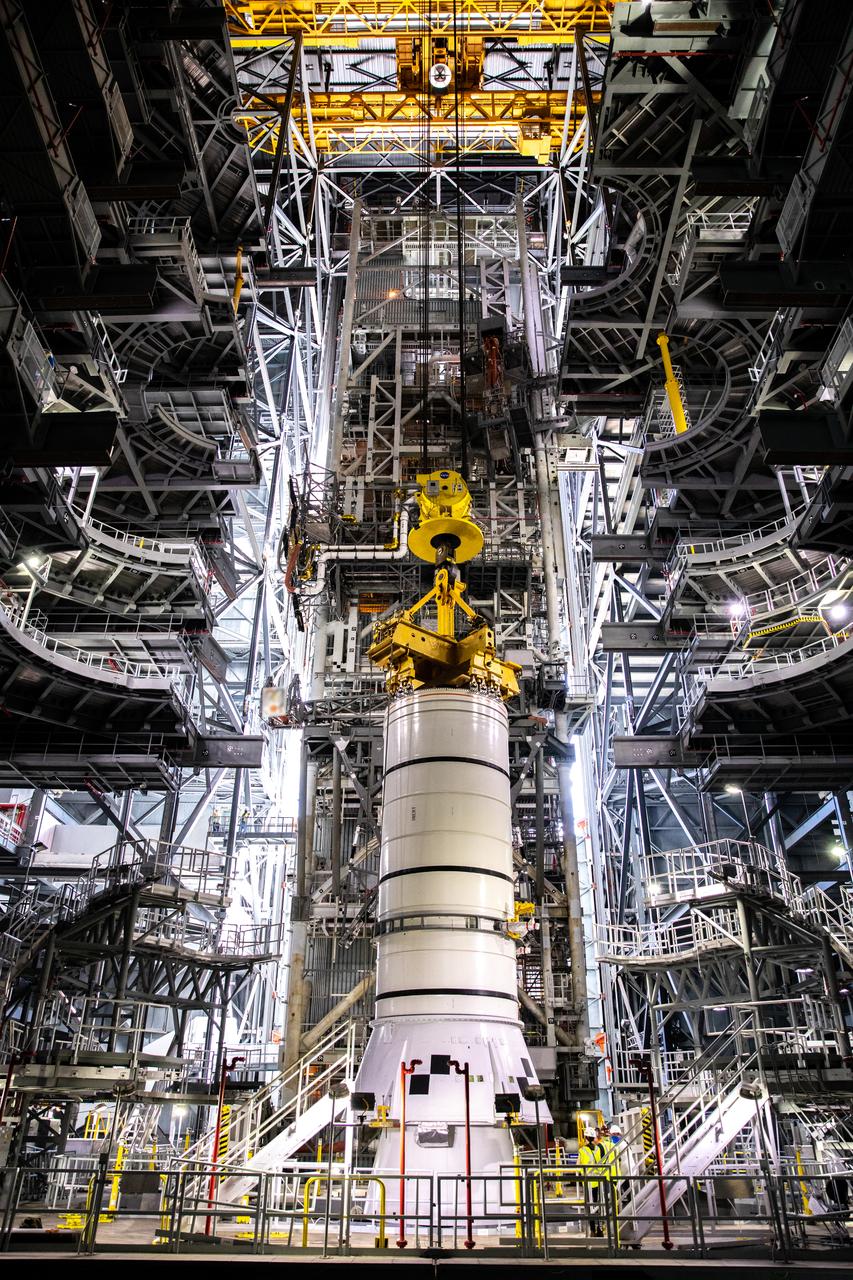
During a training exercise, technicians with NASA’s Exploration Ground Systems lower a mock-up of the Space Launch System (SLS) aft booster segment, referred to as a pathfinder, onto the mobile launcher in Kennedy Space Center’s Vehicle Assembly Building (VAB) on Sept. 11, 2020. The rehearsal involved teams preparing the aft pathfinder segment in High Bay 4 of the VAB, lifting and moving it over to High Bay 3, and placing it on the mobile launcher in preparation for Artemis I. Stacking of the actual booster segments will occur later this year, before the SLS core stage arrives at the Florida spaceport. Artemis I is the first in a series of increasingly complex missions that will test SLS and the Orion spacecraft as an integrated system prior to crewed flights to the Moon.
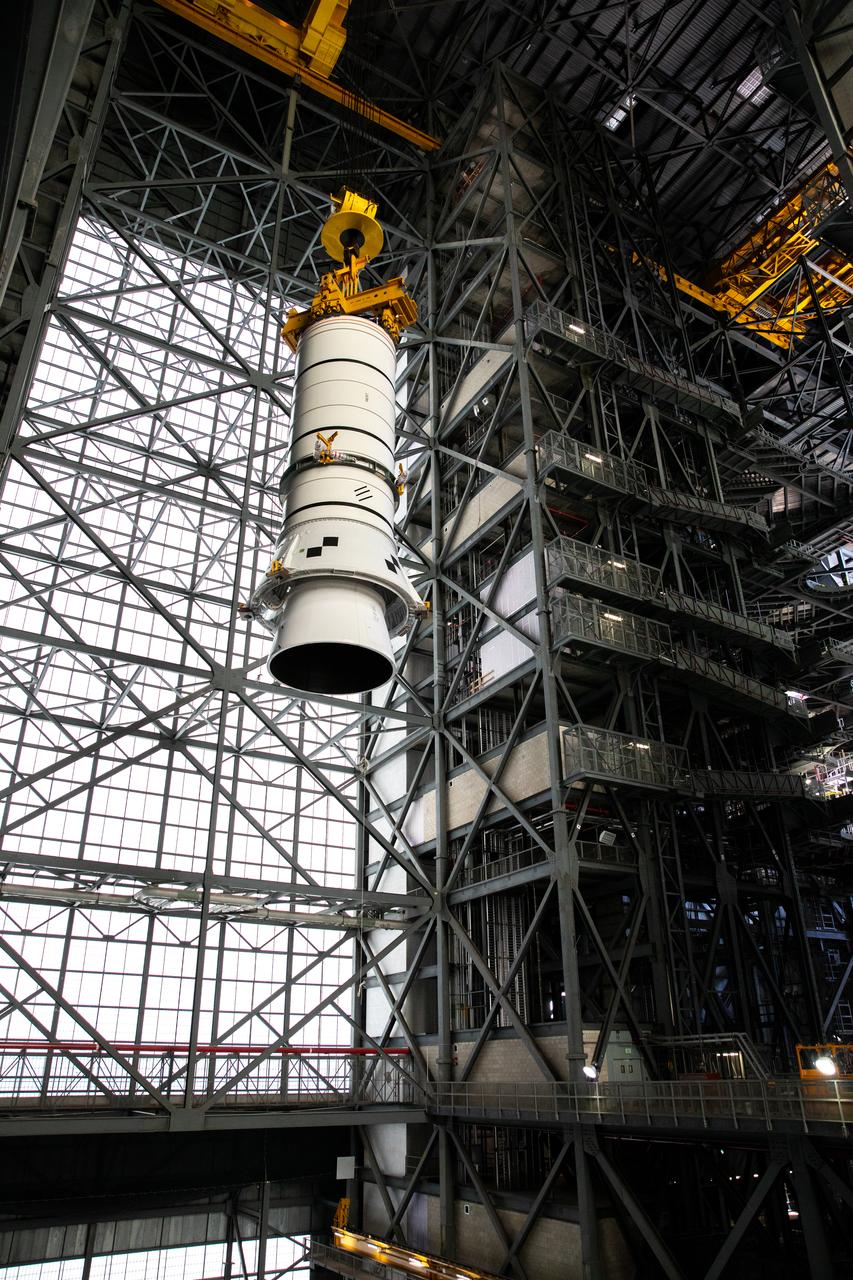
Technicians with NASA’s Exploration Ground Systems rehearse lifting operations using a mock-up of the Space Launch System (SLS) aft booster segment, referred to as a pathfinder, inside the Vehicle Assembly Building (VAB) at the agency’s Kennedy Space Center in Florida on Sept. 11, 2020, in preparation for Artemis I. The exercise involved preparing the aft pathfinder segment in High Bay 4 of the VAB and moving it over to High Bay 3, where it was placed on the mobile launcher. Stacking of the actual booster segments will occur later this year, before the SLS core stage arrives at Kennedy. Artemis I is the first in a series of increasingly complex missions that will test SLS and the Orion spacecraft as an integrated system prior to crewed flights to the Moon.

During a training exercise, technicians with NASA’s Exploration Ground Systems lower a mock-up of the Space Launch System (SLS) aft booster segment, referred to as a pathfinder, onto the mobile launcher in Kennedy Space Center’s Vehicle Assembly Building (VAB) on Sept. 11, 2020. The rehearsal involved teams preparing the aft pathfinder segment in High Bay 4 of the VAB, lifting and moving it over to High Bay 3, and placing it on the mobile launcher in preparation for Artemis I. Stacking of the actual booster segments will occur later this year, before the SLS core stage arrives at the Florida spaceport. Artemis I is the first in a series of increasingly complex missions that will test SLS and the Orion spacecraft as an integrated system prior to crewed flights to the Moon.
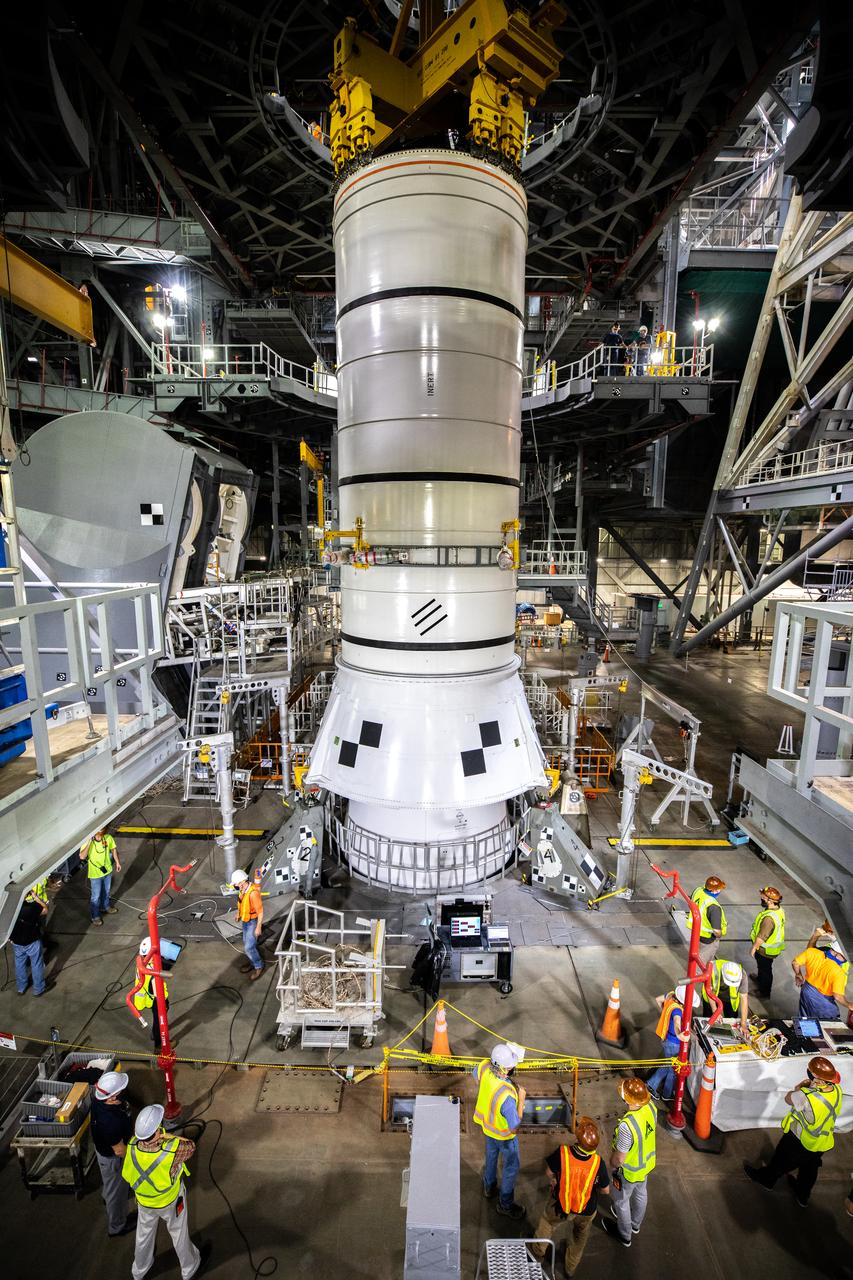
During a training exercise, technicians with NASA’s Exploration Ground Systems lower a mock-up of the Space Launch System (SLS) aft booster segment, referred to as a pathfinder, onto the mobile launcher in Kennedy Space Center’s Vehicle Assembly Building (VAB) on Sept. 11, 2020. The rehearsal involved teams preparing the aft pathfinder segment in High Bay 4 of the VAB, lifting and moving it over to High Bay 3, and placing it on the mobile launcher in preparation for Artemis I. Stacking of the actual booster segments will occur later this year, before the SLS core stage arrives at the Florida spaceport. Artemis I is the first in a series of increasingly complex missions that will test SLS and the Orion spacecraft as an integrated system prior to crewed flights to the Moon.
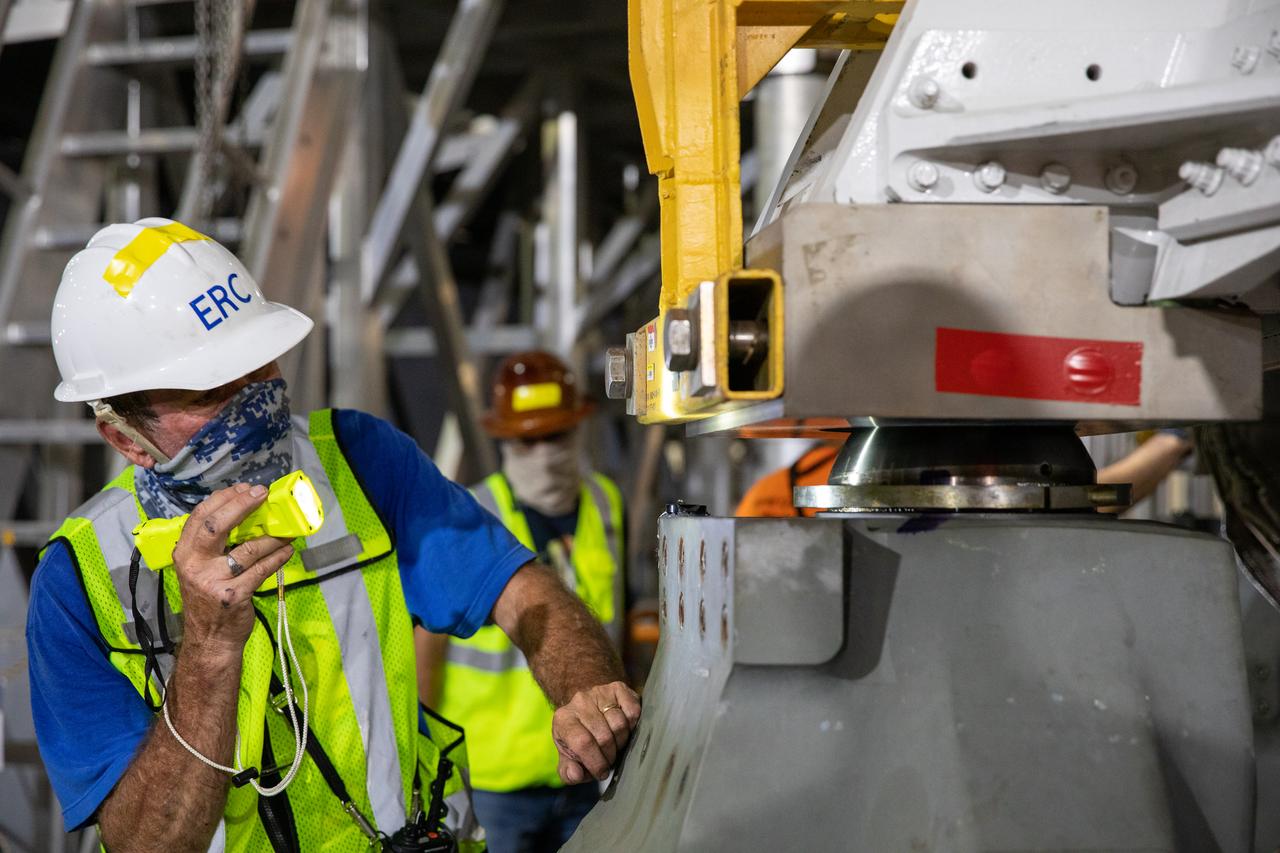
During a training exercise on Sept. 11, 2020, inside the Vehicle Assembly (VAB) at NASA’s Kennedy Space Center in Florida, a technician with the agency’s Exploration Ground Systems verifies a mock-up of the Space Launch System (SLS) aft booster segment, referred to as a pathfinder, was placed on the mobile launcher correctly. The rehearsal involved teams preparing the aft pathfinder segment in High Bay 4 of the VAB, lifting and moving it over to High Bay 3, and lowering it onto the mobile launcher in preparation for Artemis I. Stacking of the actual booster segments will occur later this year, before the SLS core stage arrives at the Florida spaceport. Artemis I is the first in a series of increasingly complex missions that will test SLS and the Orion spacecraft as an integrated system prior to crewed flights to the Moon.
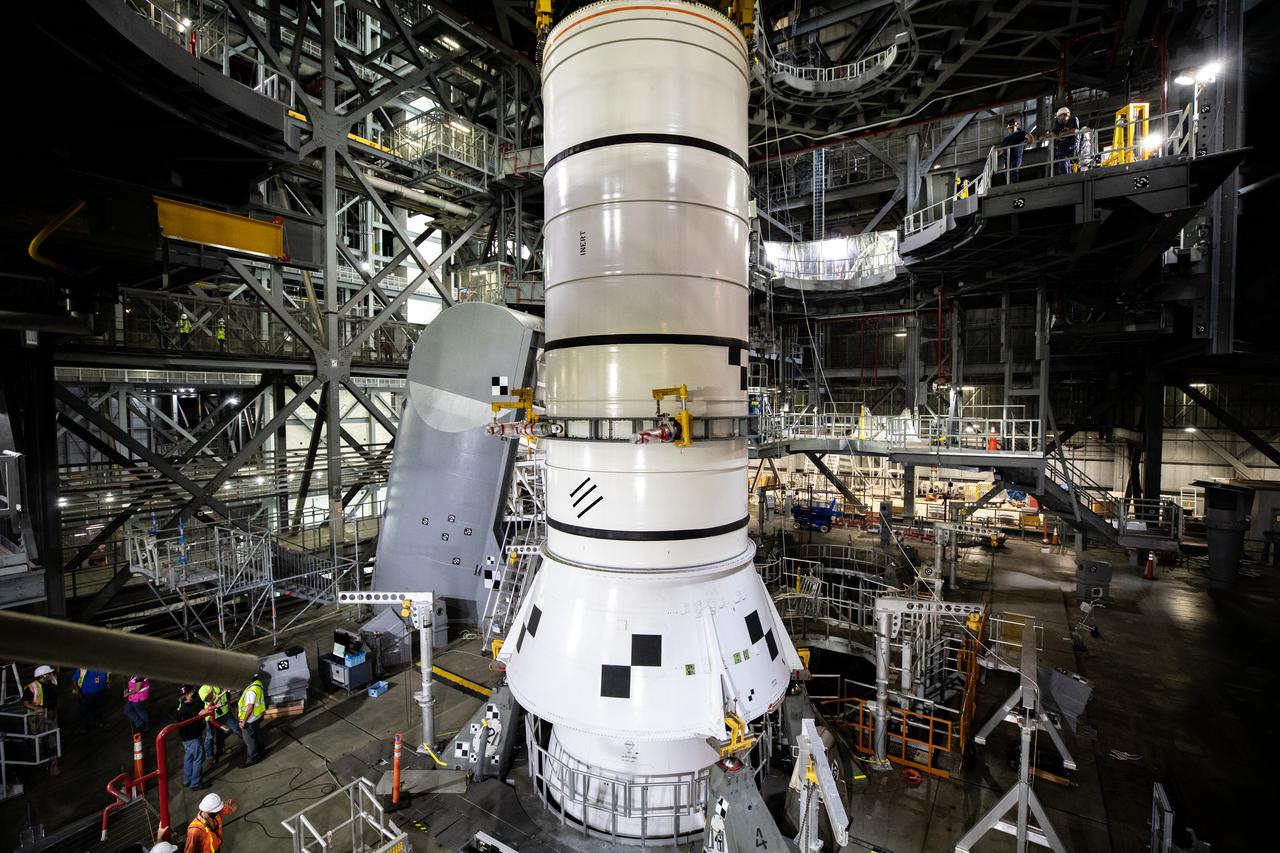
During a training exercise, technicians with NASA’s Exploration Ground Systems lower a mock-up of the Space Launch System (SLS) aft booster segment, referred to as a pathfinder, onto the mobile launcher in Kennedy Space Center’s Vehicle Assembly Building (VAB) on Sept. 11, 2020. The rehearsal involved teams preparing the aft pathfinder segment in High Bay 4 of the VAB, lifting and moving it over to High Bay 3, and placing it on the mobile launcher in preparation for Artemis I. Stacking of the actual booster segments will occur later this year, before the SLS core stage arrives at the Florida spaceport. Artemis I is the first in a series of increasingly complex missions that will test SLS and the Orion spacecraft as an integrated system prior to crewed flights to the Moon.
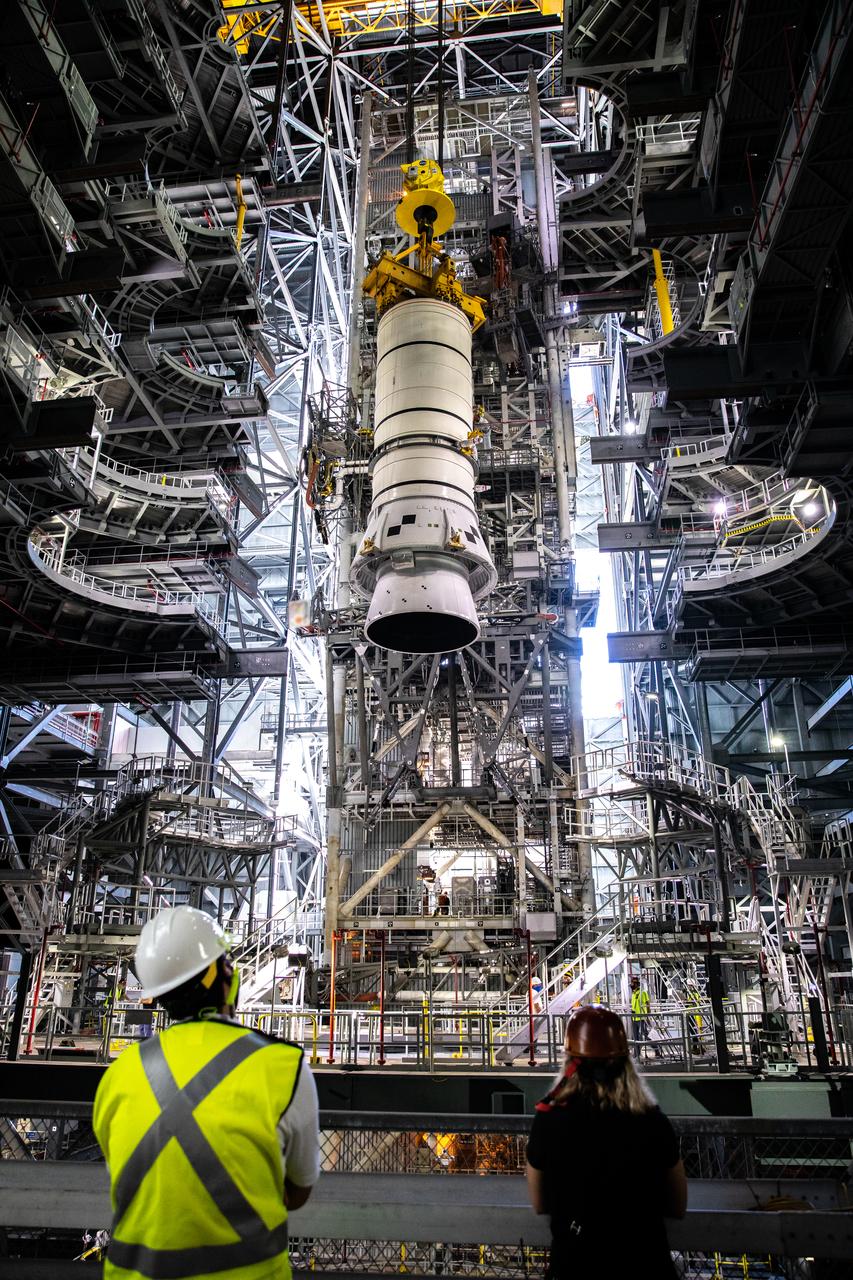
During a training exercise, technicians with NASA’s Exploration Ground Systems lower a mock-up of the Space Launch System (SLS) aft booster segment, referred to as a pathfinder, onto the mobile launcher in Kennedy Space Center’s Vehicle Assembly Building (VAB) on Sept. 11, 2020. The rehearsal involved teams preparing the aft pathfinder segment in High Bay 4 of the VAB, lifting and moving it over to High Bay 3, and placing it on the mobile launcher in preparation for Artemis I. Stacking of the actual booster segments will occur later this year, before the SLS core stage arrives at the Florida spaceport. Artemis I is the first in a series of increasingly complex missions that will test SLS and the Orion spacecraft as an integrated system prior to crewed flights to the Moon.
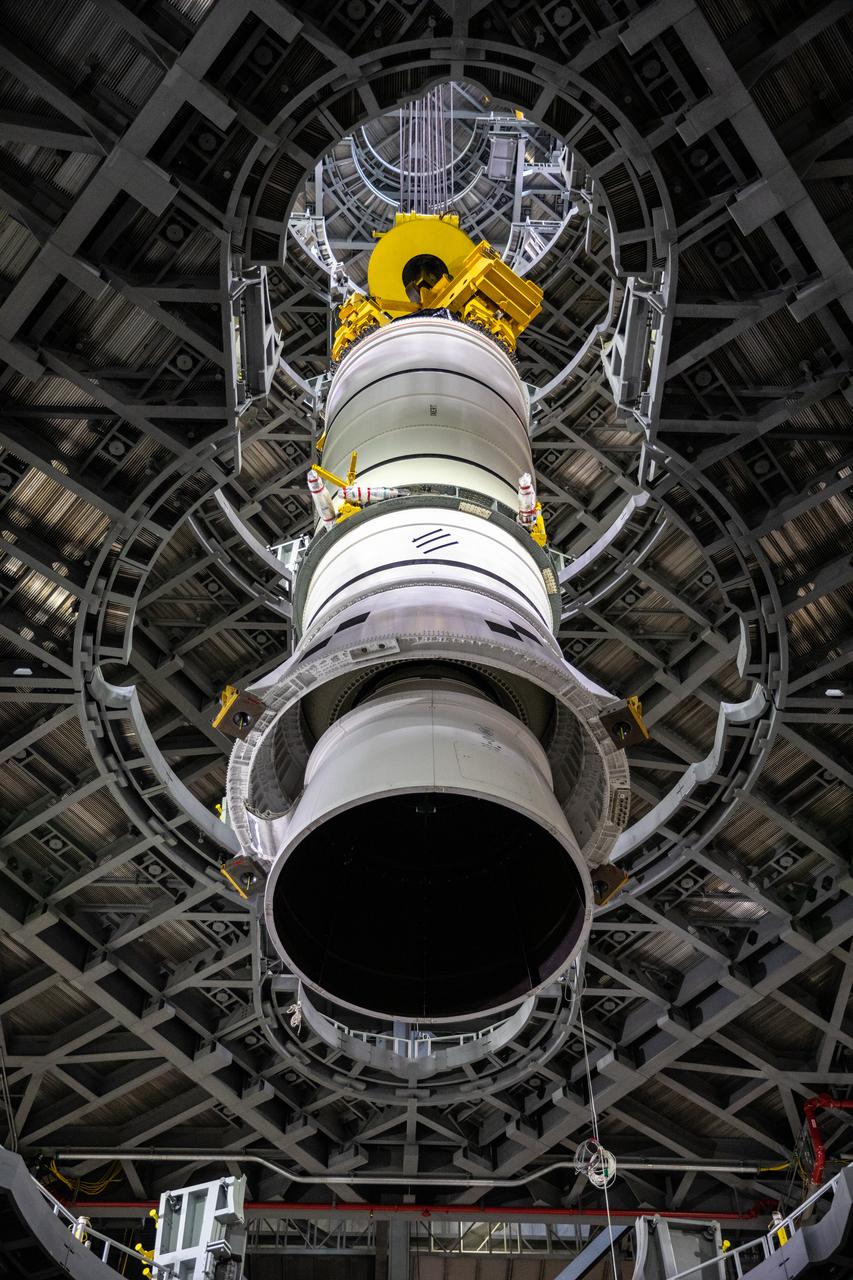
During a training exercise, technicians with NASA’s Exploration Ground Systems lower a mock-up of the Space Launch System (SLS) aft booster segment, referred to as a pathfinder, onto the mobile launcher in Kennedy Space Center’s Vehicle Assembly Building (VAB) on Sept. 11, 2020. The rehearsal involved teams preparing the aft pathfinder segment in High Bay 4 of the VAB, lifting and moving it over to High Bay 3, and placing it on the mobile launcher in preparation for Artemis I. Stacking of the actual booster segments will occur later this year, before the SLS core stage arrives at the Florida spaceport. Artemis I is the first in a series of increasingly complex missions that will test SLS and the Orion spacecraft as an integrated system prior to crewed flights to the Moon.
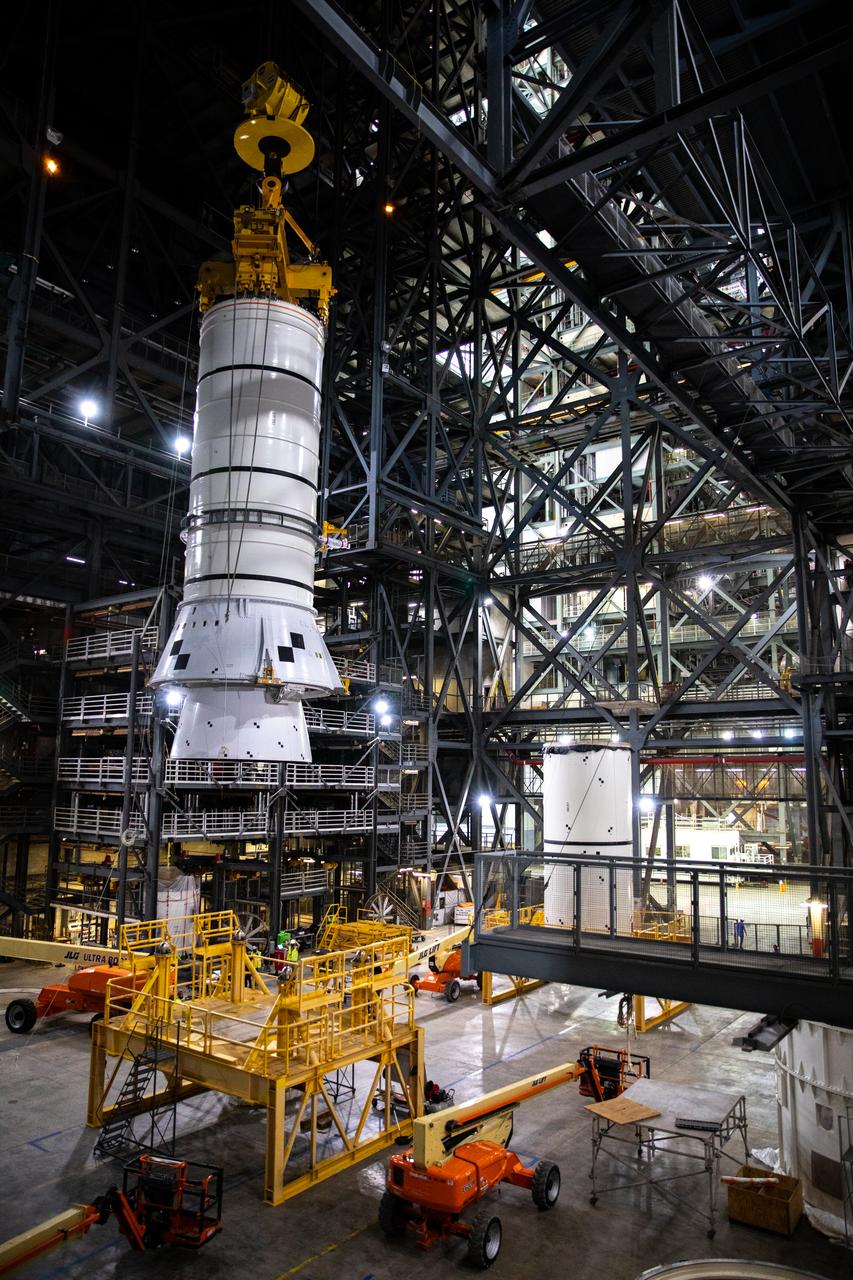
Technicians with NASA’s Exploration Ground Systems rehearse lifting operations using a mock-up of the Space Launch System (SLS) aft booster segment, referred to as a pathfinder, inside the Vehicle Assembly Building (VAB) at the agency’s Kennedy Space Center in Florida on Sept. 11, 2020, in preparation for Artemis I. The exercise involved preparing the aft pathfinder segment in High Bay 4 of the VAB and moving it over to High Bay 3, where it was placed on the mobile launcher. Stacking of the actual booster segments will occur later this year, before the SLS core stage arrives at Kennedy. Artemis I is the first in a series of increasingly complex missions that will test SLS and the Orion spacecraft as an integrated system prior to crewed flights to the Moon.
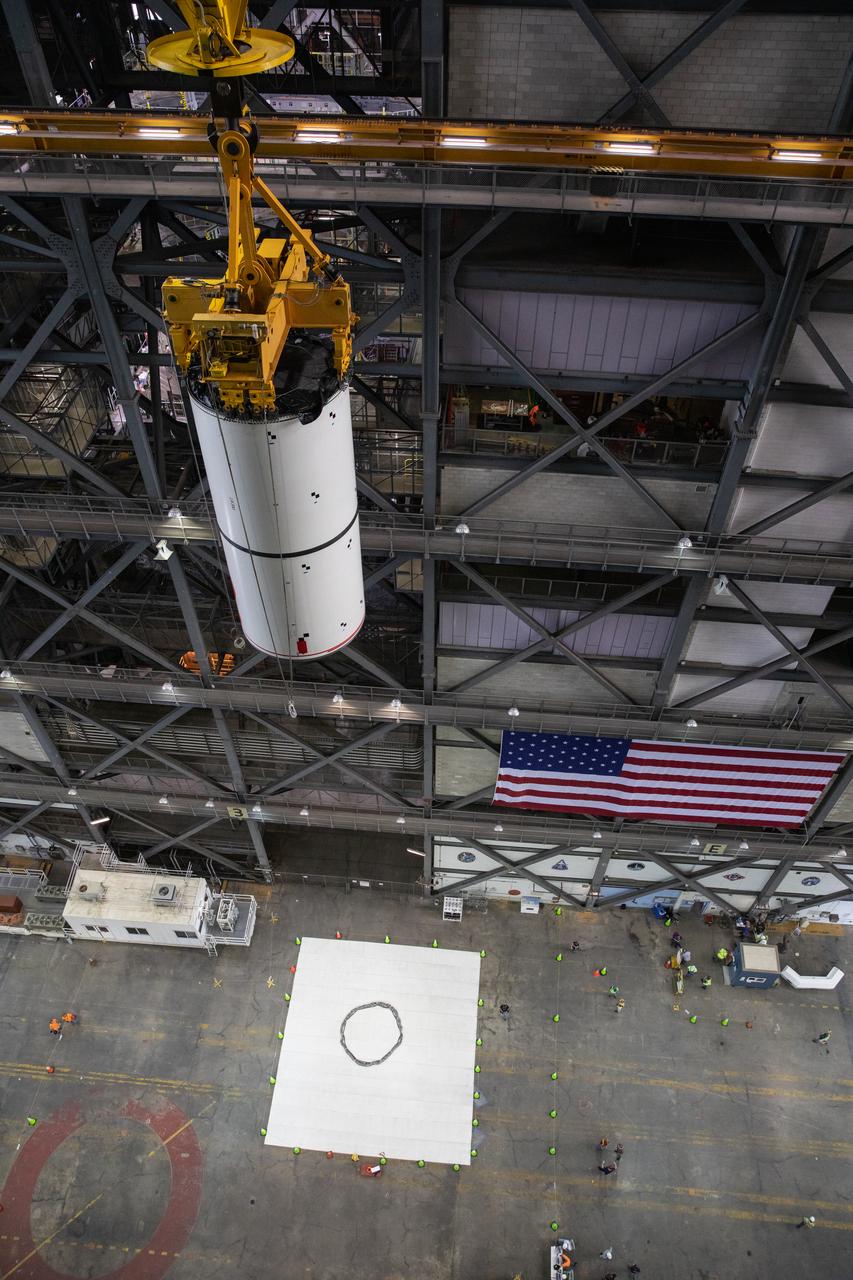
Technicians with NASA’s Exploration Ground Systems rehearse booster stacking operations inside the Vehicle Assembly Building (VAB) at the agency’s Kennedy Space Center in Florida on Sept. 14, 2020, in preparation for Artemis I. The exercise involved using booster segment mock-ups, referred to as pathfinders. During the rehearsal, an aft pathfinder segment was prepared in High Bay 4 of the VAB, after which a team of crane operators moved it over to High Bay 3, where it was placed on the mobile launcher. Careful measurements were then taken before the team added a center pathfinder to the stack. Stacking of the actual Space Launch System (SLS) booster segments will occur later this year, when the rocket’s core stage arrives at Kennedy. Artemis I is the first in a series of increasingly complex missions that will test SLS and the Orion spacecraft as an integrated system prior to crewed flights to the Moon.
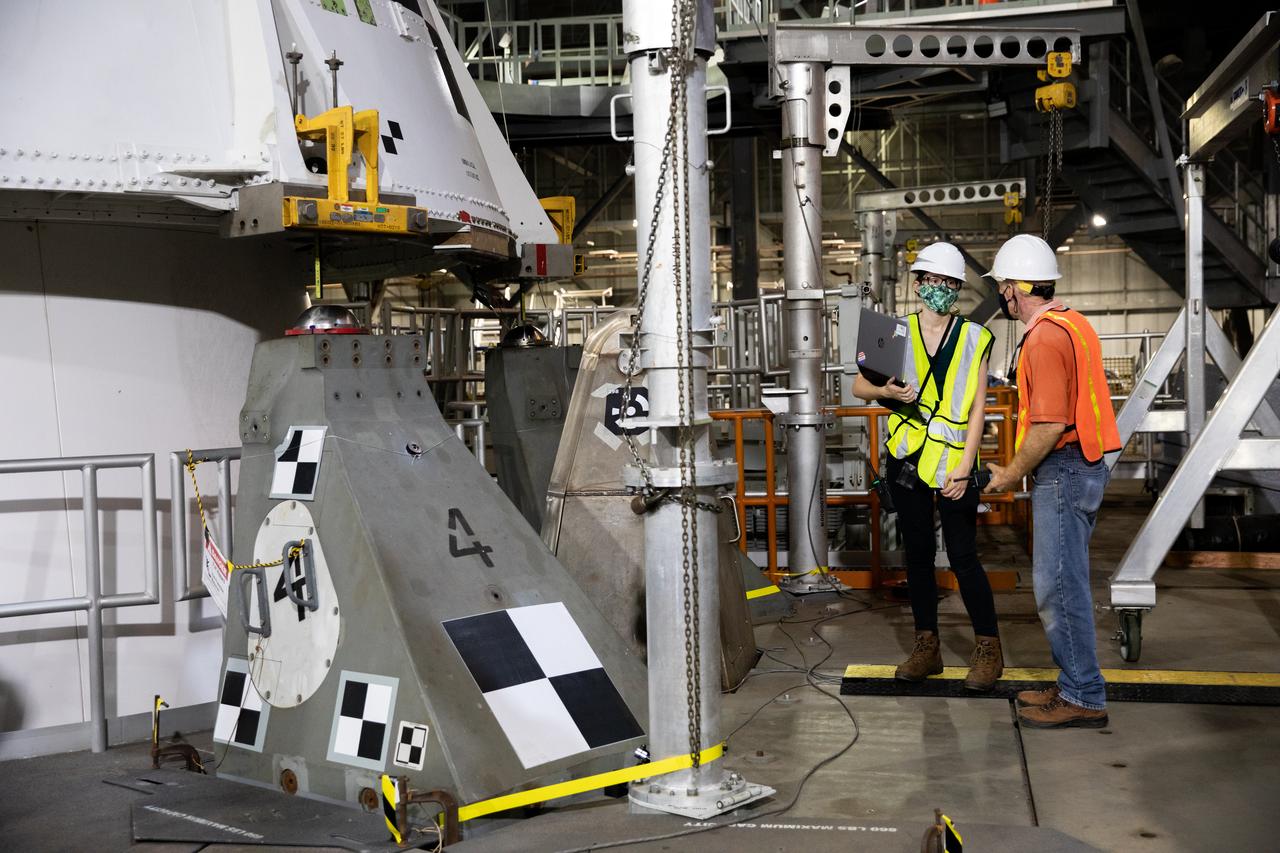
During a training exercise on Sept. 11, 2020, inside the Vehicle Assembly (VAB) at NASA’s Kennedy Space Center in Florida, technicians with the agency’s Exploration Ground Systems verify a mock-up of the Space Launch System (SLS) aft booster segment, referred to as a pathfinder, was placed on the mobile launcher correctly. The rehearsal involved teams preparing the aft pathfinder segment in High Bay 4 of the VAB, lifting and moving it over to High Bay 3, and lowering it onto the mobile launcher in preparation for Artemis I. Stacking of the actual booster segments will occur later this year, before the SLS core stage arrives at the Florida spaceport. Artemis I is the first in a series of increasingly complex missions that will test SLS and the Orion spacecraft as an integrated system prior to crewed flights to the Moon.
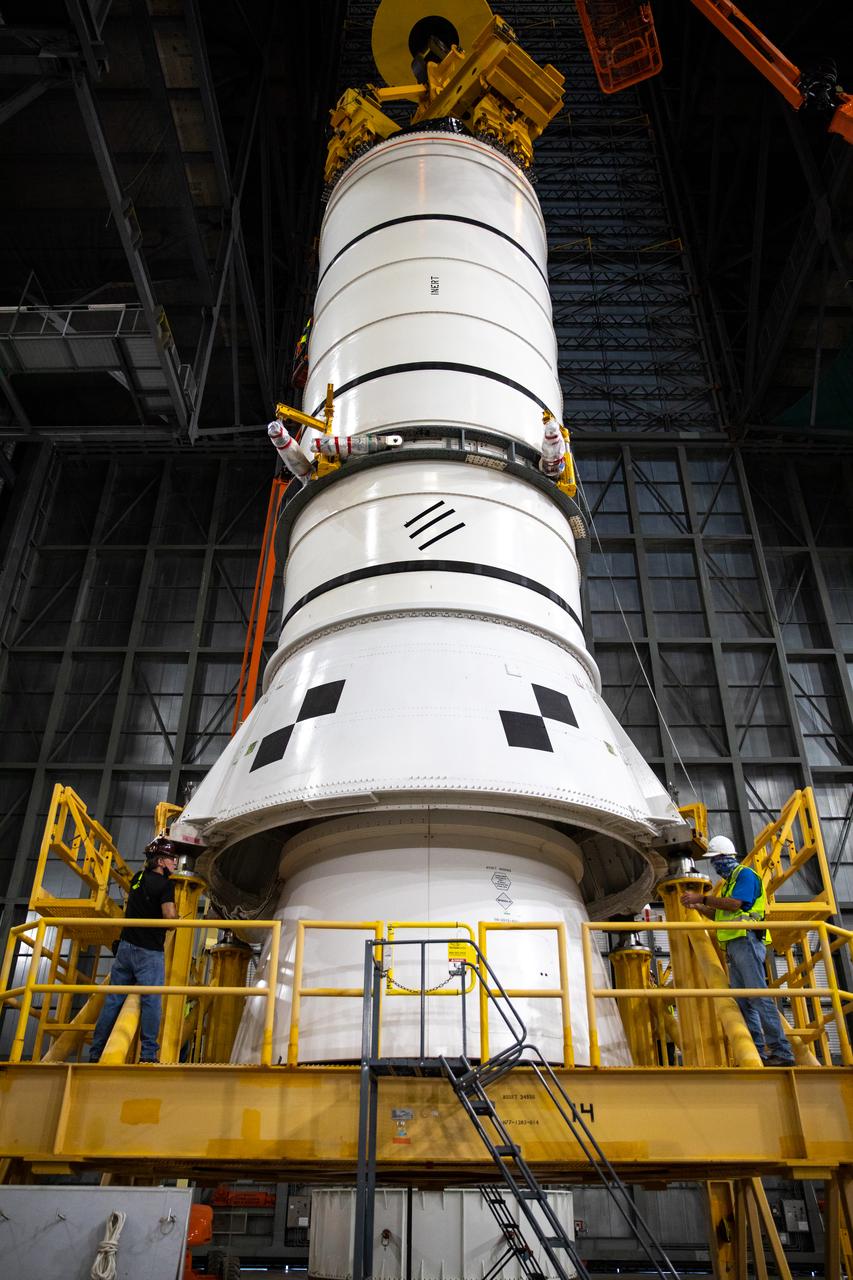
Technicians with NASA’s Exploration Ground Systems rehearse booster stacking operations inside the Vehicle Assembly Building (VAB) at the agency’s Kennedy Space Center in Florida on Sept. 11, 2020, in preparation for Artemis I. The exercise involved using booster segment mock-ups, referred to as pathfinders. During this rehearsal, an aft pathfinder segment was prepared in High Bay 4 of the VAB, after which a team of crane operators moved it over to High Bay 3, where it was placed on the mobile launcher. Stacking of the actual Space Launch System (SLS) booster segments will occur later this year, before the rocket’s core stage arrives at Kennedy. Artemis I is the first in a series of increasingly complex missions that will test SLS and the Orion spacecraft as an integrated system prior to crewed flights to the Moon.
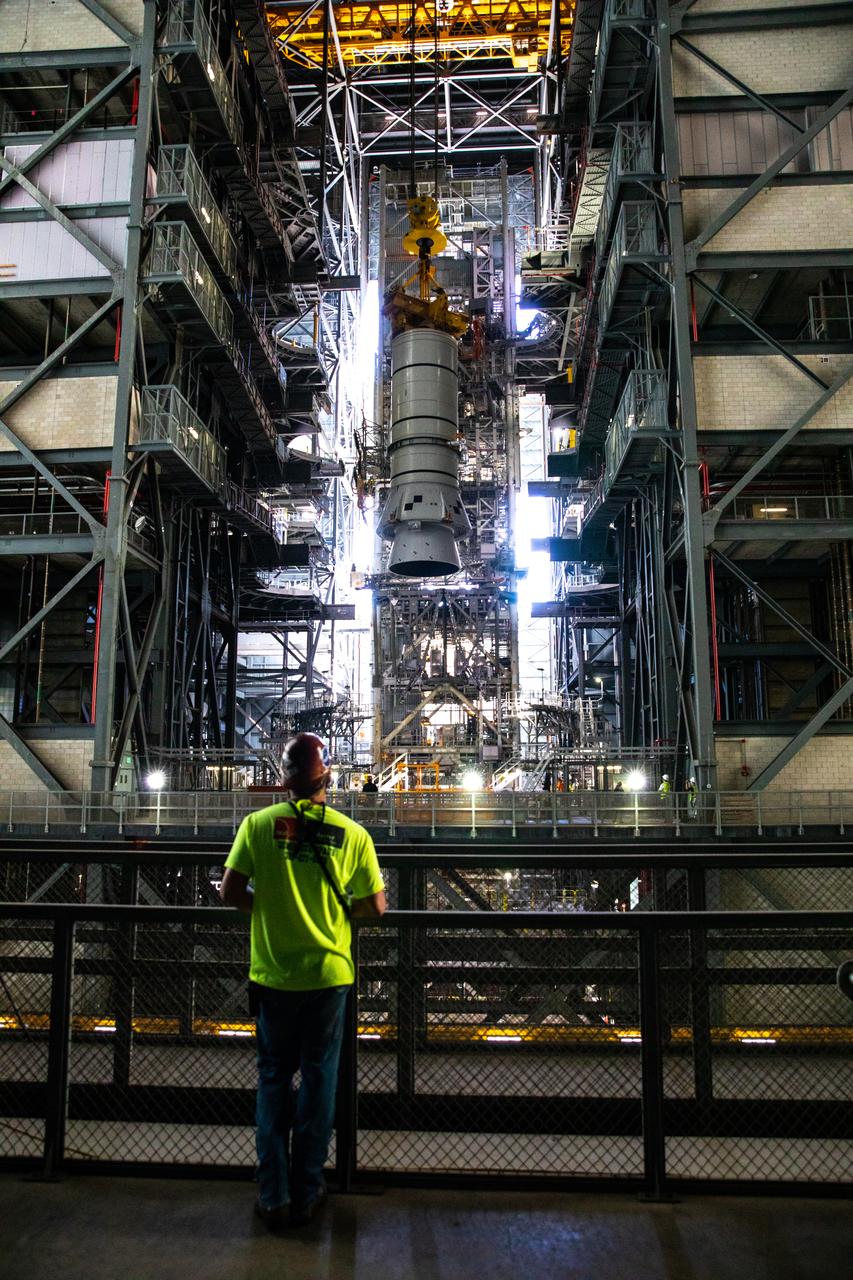
During a training exercise, technicians with NASA’s Exploration Ground Systems prepare to lower a mock-up of the Space Launch System (SLS) aft booster segment, referred to as a pathfinder, onto the mobile launcher in Kennedy Space Center’s Vehicle Assembly Building (VAB) on Sept. 11, 2020. The rehearsal involved teams preparing the aft pathfinder segment in High Bay 4 of the VAB, lifting and moving it over to High Bay 3, and placing it on the mobile launcher in preparation for Artemis I. Stacking of the actual booster segments will occur later this year, before the SLS core stage arrives at the Florida spaceport. Artemis I is the first in a series of increasingly complex missions that will test SLS and the Orion spacecraft as an integrated system prior to crewed flights to the Moon.
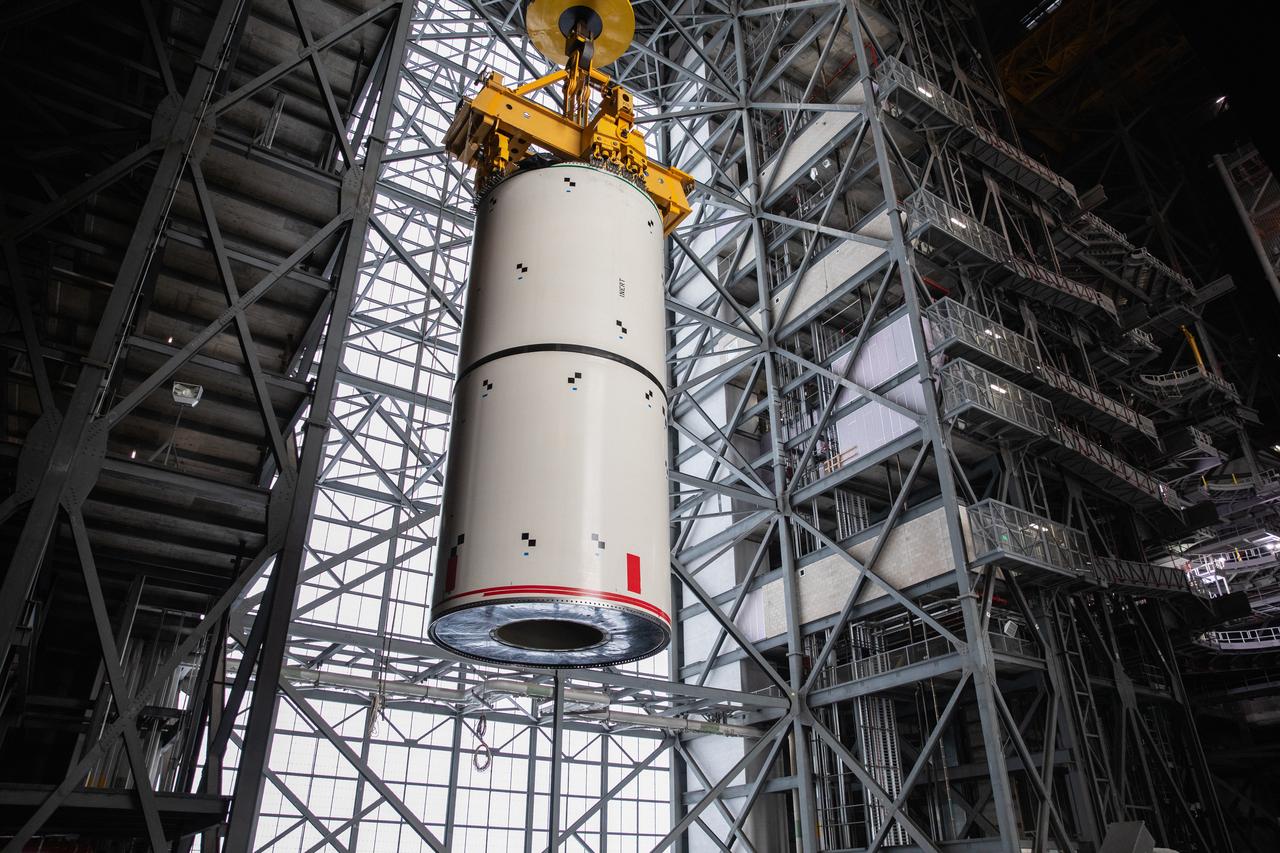
Technicians with NASA’s Exploration Ground Systems rehearse booster stacking operations inside the Vehicle Assembly Building (VAB) at the agency’s Kennedy Space Center in Florida on Sept. 14, 2020, in preparation for Artemis I. The exercise involved using booster segment mock-ups, referred to as pathfinders. During the rehearsal, an aft pathfinder segment was prepared in High Bay 4 of the VAB, after which a team of crane operators moved it over to High Bay 3, where it was placed on the mobile launcher. Careful measurements were then taken before the team added a center pathfinder to the stack. Stacking of the actual Space Launch System (SLS) booster segments will occur later this year, when the rocket’s core stage arrives at Kennedy. Artemis I is the first in a series of increasingly complex missions that will test SLS and the Orion spacecraft as an integrated system prior to crewed flights to the Moon.
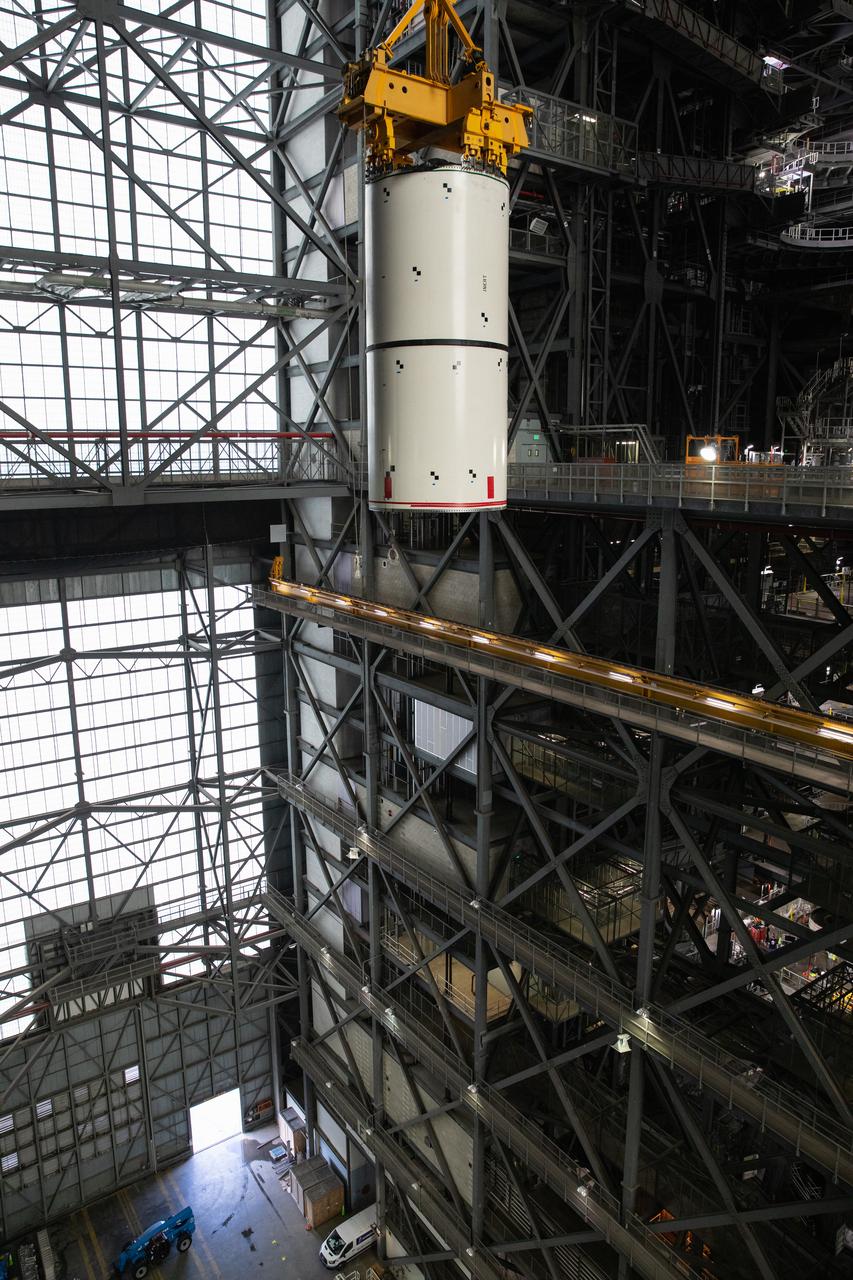
Technicians with NASA’s Exploration Ground Systems rehearse booster stacking operations inside the Vehicle Assembly Building (VAB) at the agency’s Kennedy Space Center in Florida on Sept. 14, 2020, in preparation for Artemis I. The exercise involved using booster segment mock-ups, referred to as pathfinders. During the rehearsal, an aft pathfinder segment was prepared in High Bay 4 of the VAB, after which a team of crane operators moved it over to High Bay 3, where it was placed on the mobile launcher. Careful measurements were then taken before the team added a center pathfinder to the stack. Stacking of the actual Space Launch System (SLS) booster segments will occur later this year, when the rocket’s core stage arrives at Kennedy. Artemis I is the first in a series of increasingly complex missions that will test SLS and the Orion spacecraft as an integrated system prior to crewed flights to the Moon.
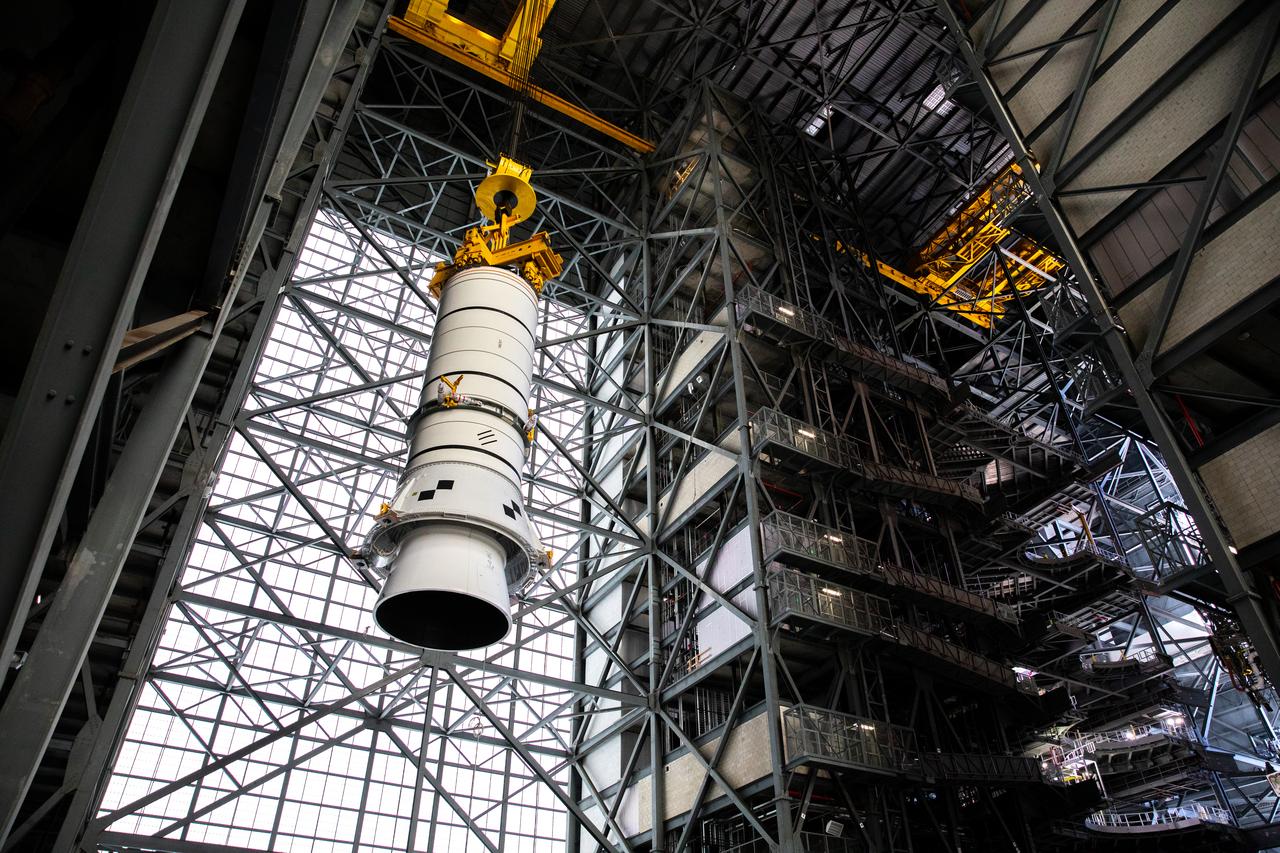
Technicians with NASA’s Exploration Ground Systems rehearse lifting operations using a mock-up of the Space Launch System (SLS) aft booster segment, referred to as a pathfinder, inside the Vehicle Assembly Building (VAB) at the agency’s Kennedy Space Center in Florida on Sept. 11, 2020, in preparation for Artemis I. The exercise involved preparing the aft pathfinder segment in High Bay 4 of the VAB and moving it over to High Bay 3, where it was placed on the mobile launcher. Stacking of the actual booster segments will occur later this year, before the SLS core stage arrives at Kennedy. Artemis I is the first in a series of increasingly complex missions that will test SLS and the Orion spacecraft as an integrated system prior to crewed flights to the Moon.
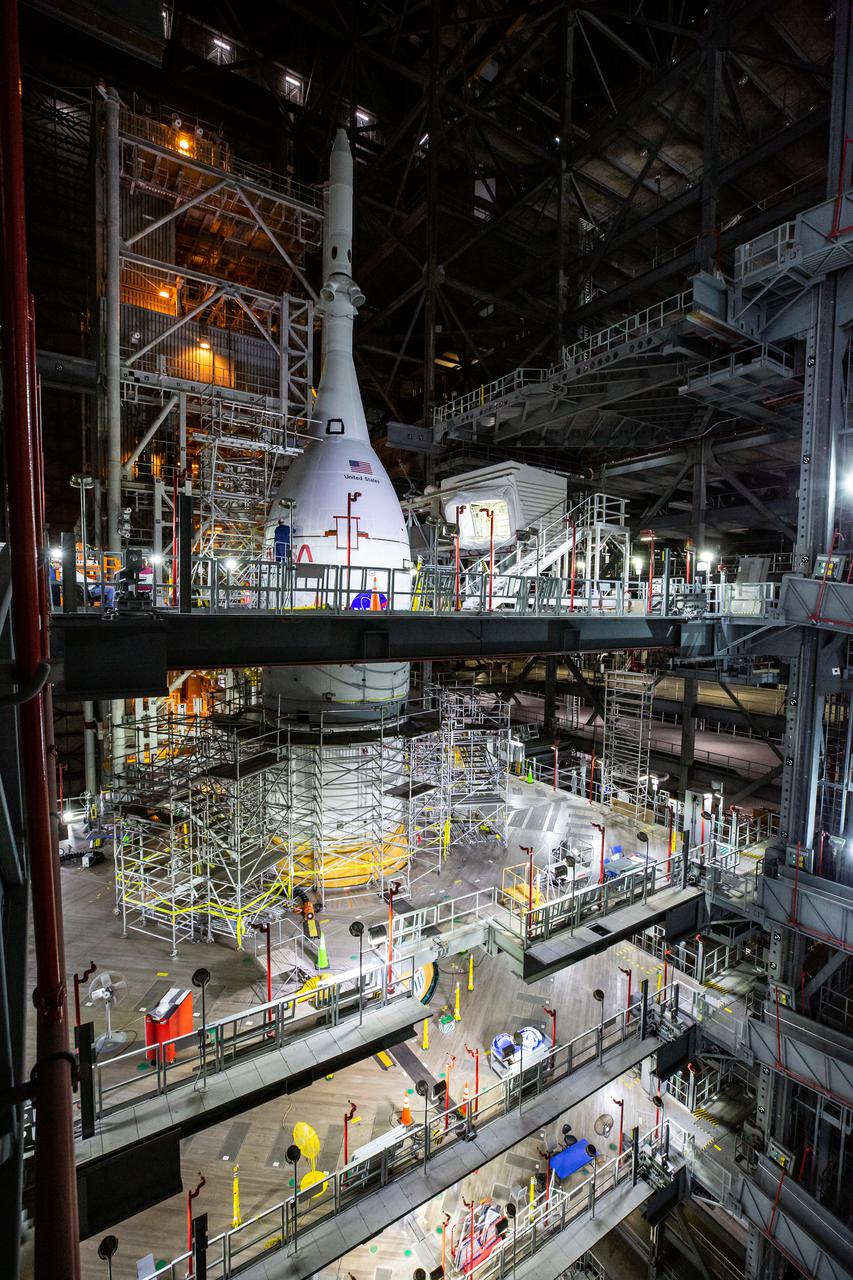
The Artemis I Orion spacecraft, secured on the Space Launch System (SLS) and enclosed in its launch abort system, is in view high up in High Bay 3 of the Vehicle Assembly Building at NASA’s Kennedy Space Center in Florida on Jan. 10, 2022. Work platforms are extended around Orion and scaffolding has been secured to allow access for inspection and processing work. Artemis I will be the first integrated test of NASA’s deep space exploration systems: the Orion spacecraft, Space Launch System (SLS) rocket and the ground systems at Kennedy. In later missions, NASA will land the first woman and the first person of color on the surface of the Moon, paving the way for a long-term lunar presence and serving as a steppingstone on the way to Mars.
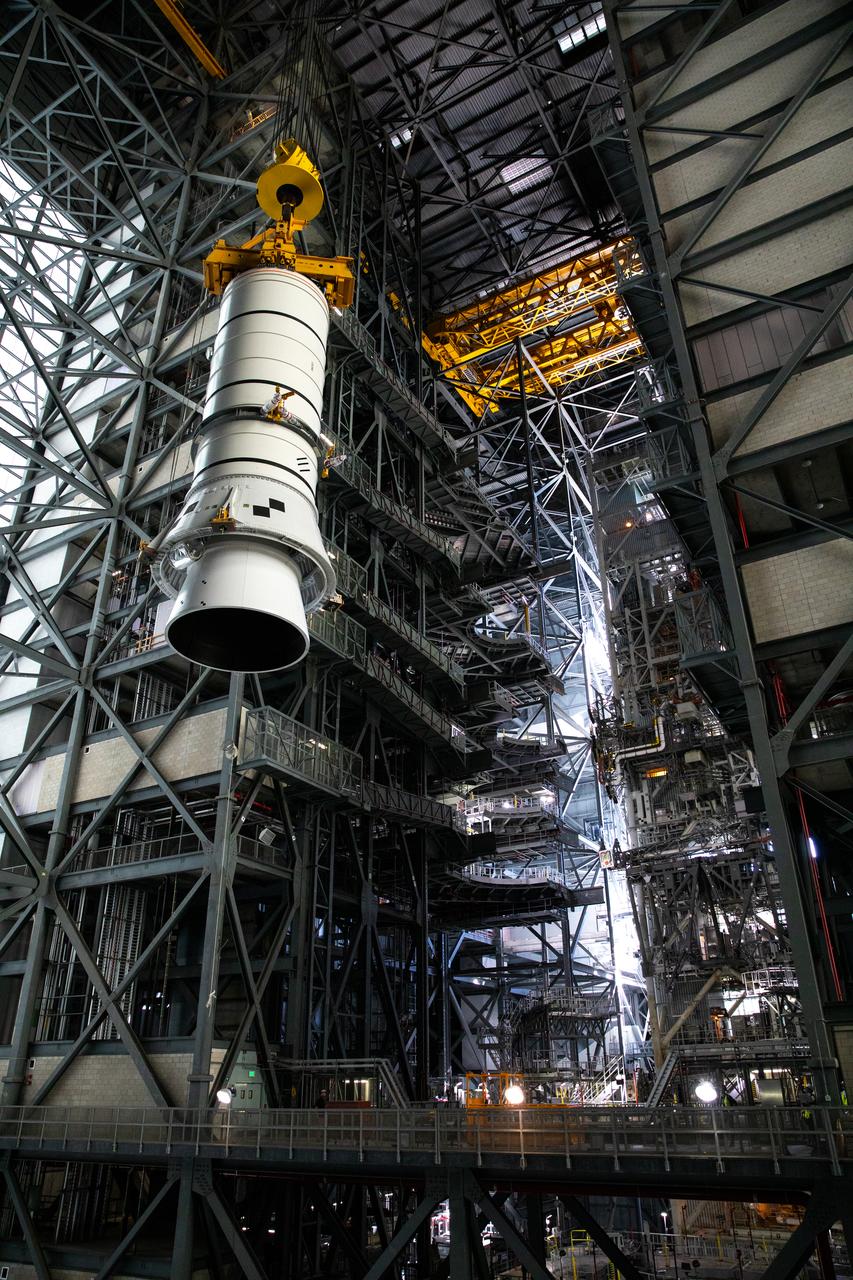
Technicians with NASA’s Exploration Ground Systems rehearse lifting operations using a mock-up of the Space Launch System (SLS) aft booster segment, referred to as a pathfinder, inside the Vehicle Assembly Building (VAB) at the agency’s Kennedy Space Center in Florida on Sept. 11, 2020, in preparation for Artemis I. The exercise involved preparing the aft pathfinder segment in High Bay 4 of the VAB and moving it over to High Bay 3, where it was placed on the mobile launcher. Stacking of the actual booster segments will occur later this year, before the SLS core stage arrives at Kennedy. Artemis I is the first in a series of increasingly complex missions that will test SLS and the Orion spacecraft as an integrated system prior to crewed flights to the Moon.
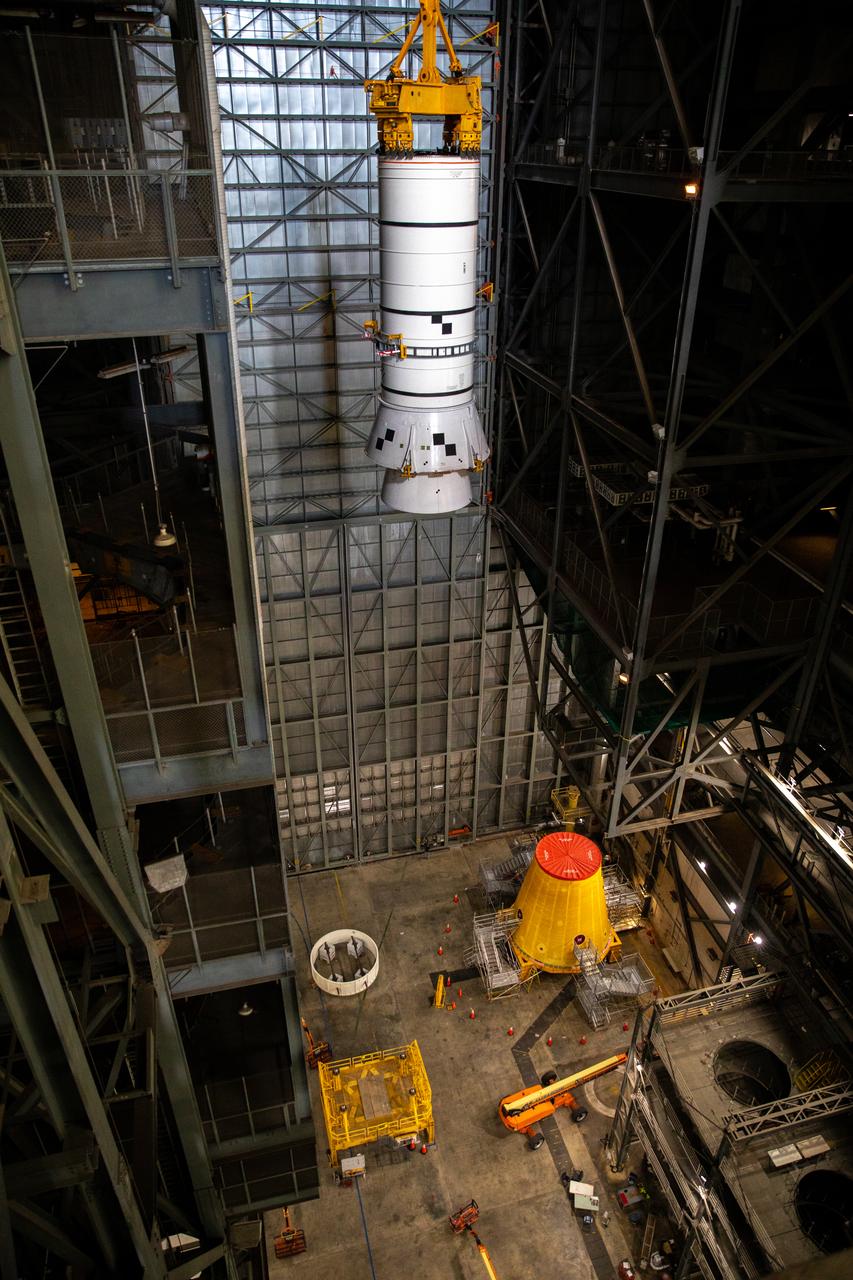
Technicians with NASA’s Exploration Ground Systems rehearse lifting operations using a mock-up of the Space Launch System (SLS) aft booster segment, referred to as a pathfinder, inside the Vehicle Assembly Building (VAB) at the agency’s Kennedy Space Center in Florida on Sept. 11, 2020, in preparation for Artemis I. The exercise involved preparing the aft pathfinder segment in High Bay 4 of the VAB and moving it over to High Bay 3, where it was placed on the mobile launcher. Stacking of the actual booster segments will occur later this year, before the SLS core stage arrives at Kennedy. Artemis I is the first in a series of increasingly complex missions that will test SLS and the Orion spacecraft as an integrated system prior to crewed flights to the Moon.
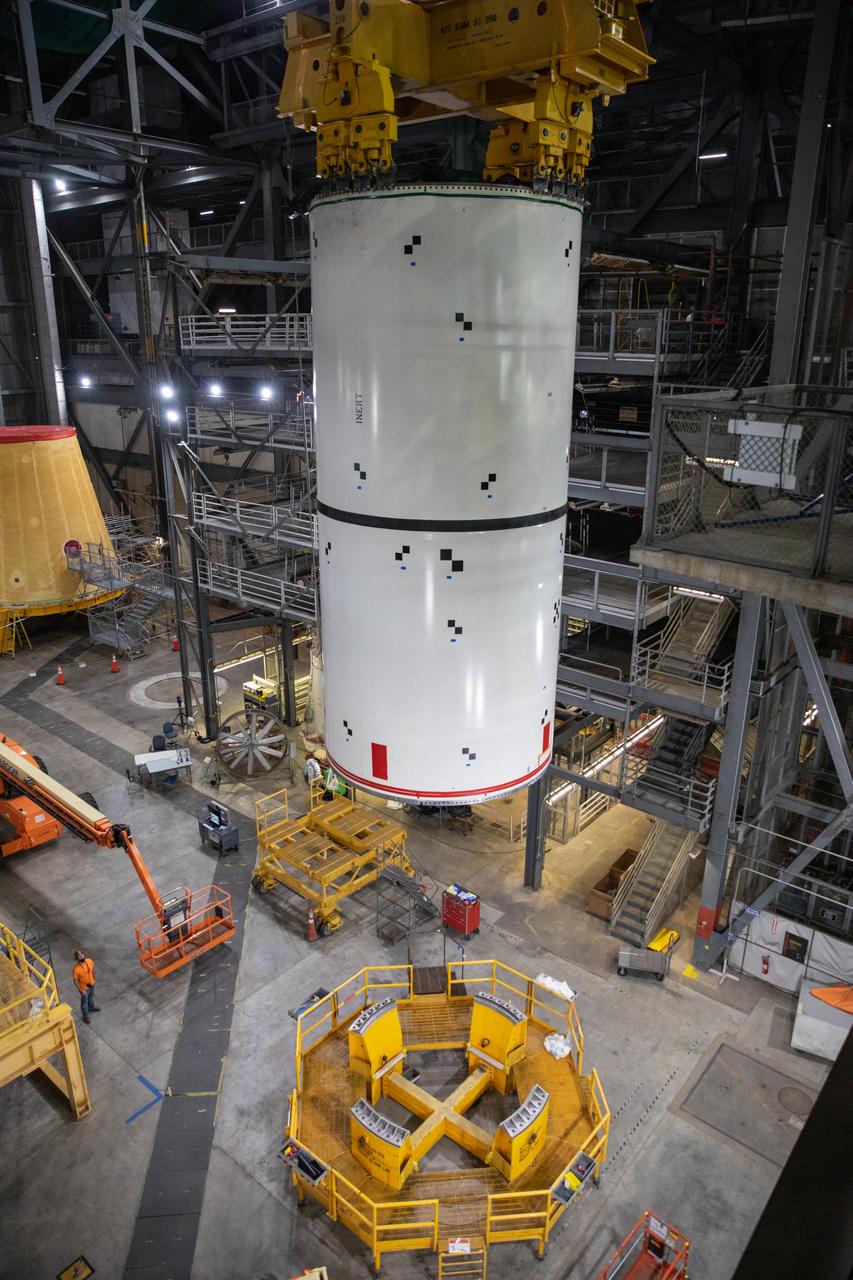
Technicians with NASA’s Exploration Ground Systems rehearse booster stacking operations inside the Vehicle Assembly Building (VAB) at the agency’s Kennedy Space Center in Florida on Sept. 14, 2020, in preparation for Artemis I. The exercise involved using booster segment mock-ups, referred to as pathfinders. During the rehearsal, an aft pathfinder segment was prepared in High Bay 4 of the VAB, after which a team of crane operators moved it over to High Bay 3, where it was placed on the mobile launcher. Careful measurements were then taken before the team added a center pathfinder to the stack. Stacking of the actual Space Launch System (SLS) booster segments will occur later this year, when the rocket’s core stage arrives at Kennedy. Artemis I is the first in a series of increasingly complex missions that will test SLS and the Orion spacecraft as an integrated system prior to crewed flights to the Moon.
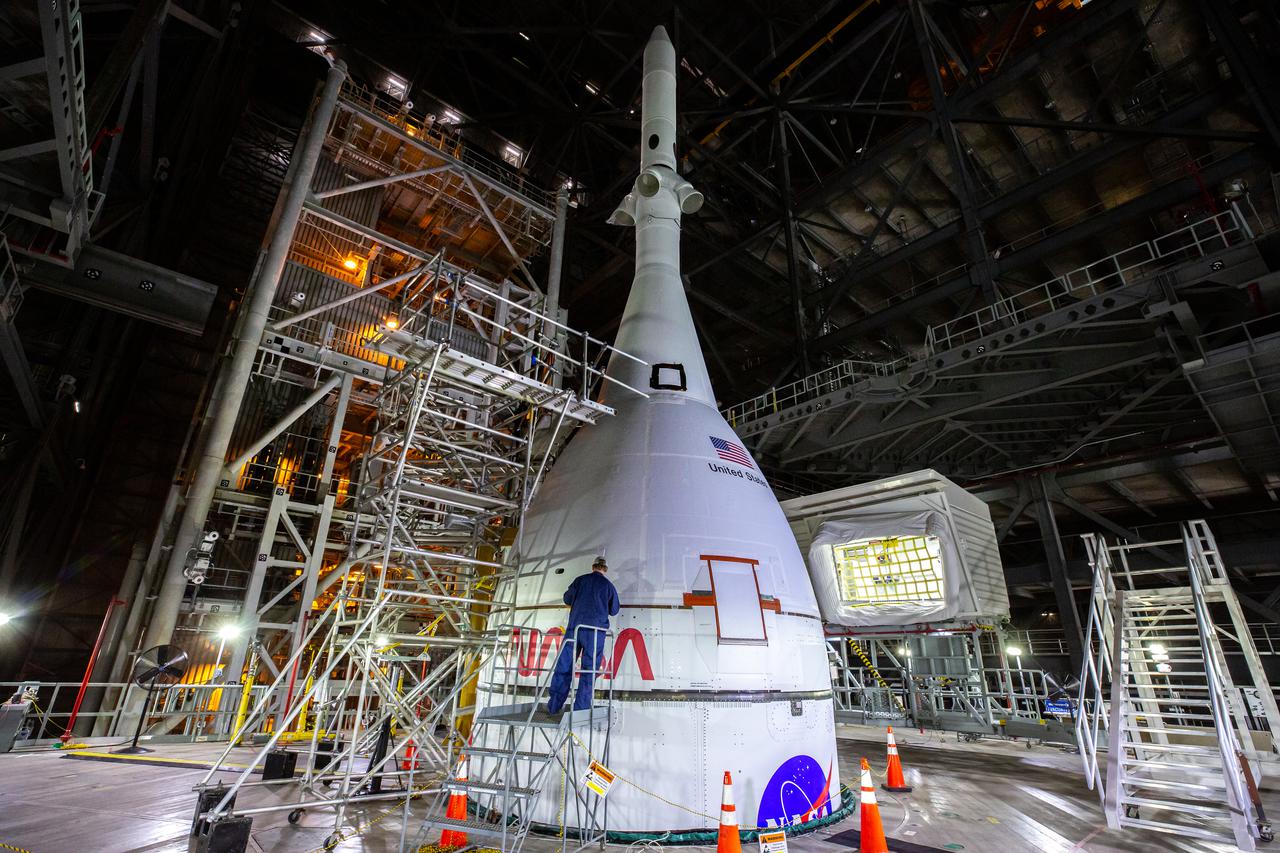
The Artemis I Orion spacecraft, secured on the Space Launch System (SLS) and enclosed in its launch abort system, is in view high up in High Bay 3 of the Vehicle Assembly Building at NASA’s Kennedy Space Center in Florida on Jan. 10, 2022. Work platforms are extended around Orion and scaffolding has been secured to allow access for inspection and processing work. Artemis I will be the first integrated test of NASA’s deep space exploration systems: the Orion spacecraft, Space Launch System (SLS) rocket and the ground systems at Kennedy. In later missions, NASA will land the first woman and the first person of color on the surface of the Moon, paving the way for a long-term lunar presence and serving as a steppingstone on the way to Mars.
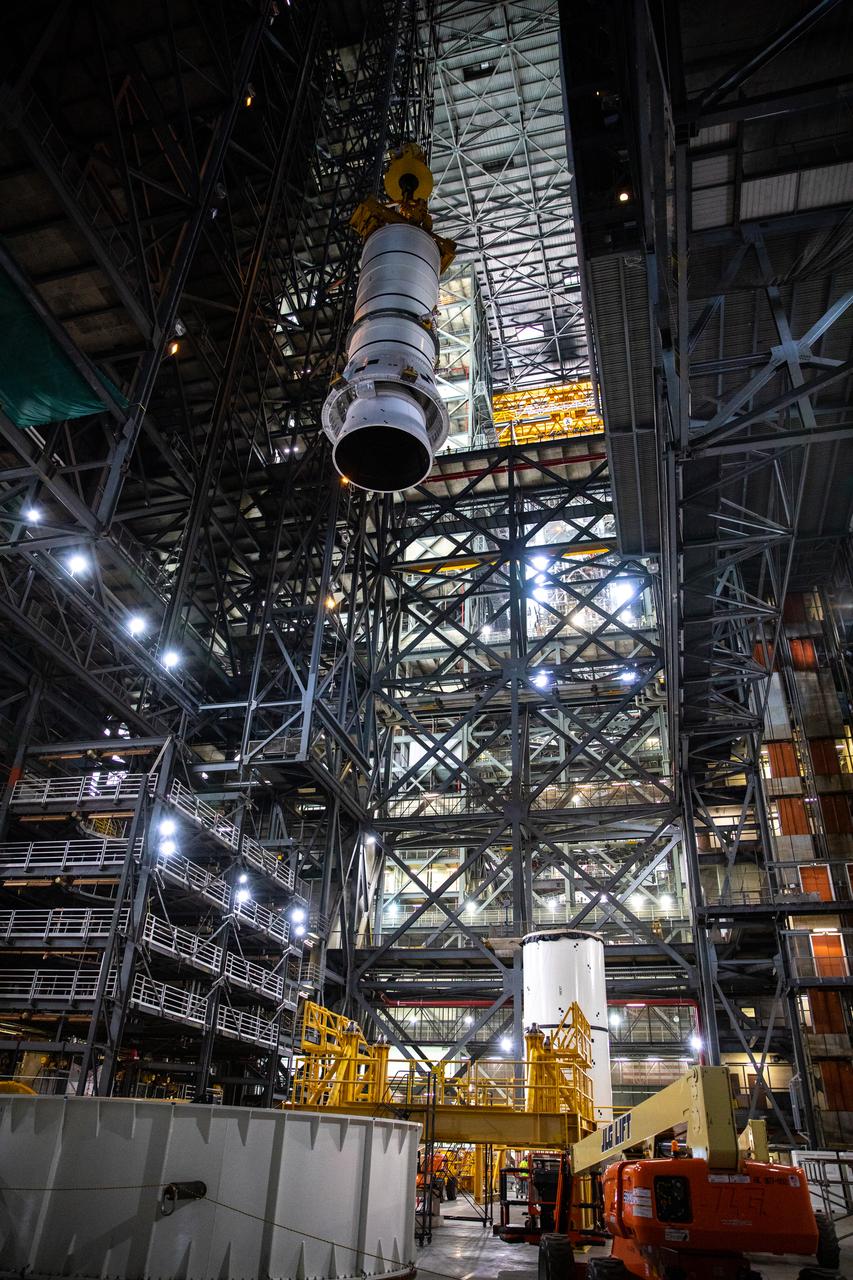
Technicians with NASA’s Exploration Ground Systems rehearse lifting operations using a mock-up of the Space Launch System (SLS) aft booster segment, referred to as a pathfinder, inside the Vehicle Assembly Building (VAB) at the agency’s Kennedy Space Center in Florida on Sept. 11, 2020, in preparation for Artemis I. The exercise involved preparing the aft pathfinder segment in High Bay 4 of the VAB and moving it over to High Bay 3, where it was placed on the mobile launcher. Stacking of the actual booster segments will occur later this year, before the SLS core stage arrives at Kennedy. Artemis I is the first in a series of increasingly complex missions that will test SLS and the Orion spacecraft as an integrated system prior to crewed flights to the Moon.
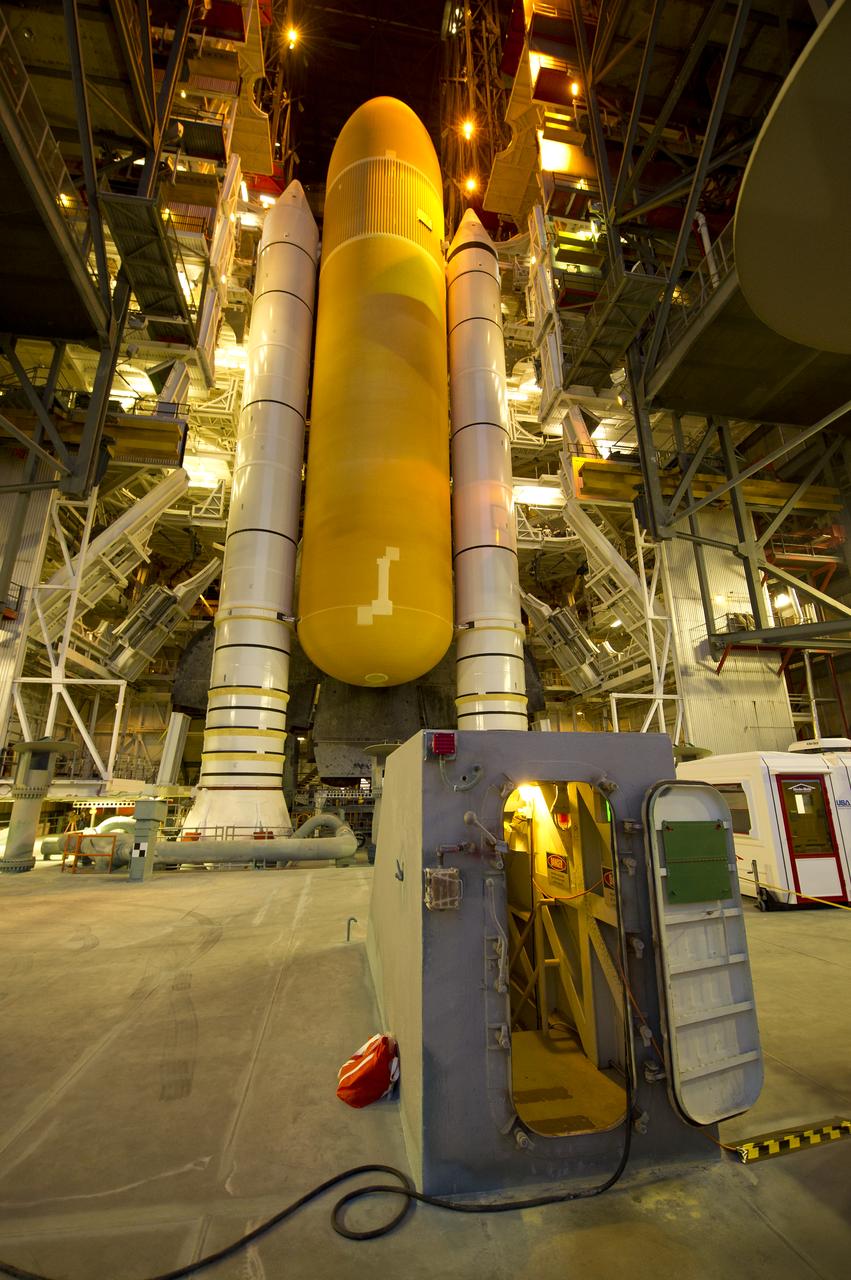
Space Shuttle Atlantis (STS-135) is seen atop a Mobile Launcher Platform (MLP) just prior to beginning its journey from High Bay 3 in the Vehicle Assembly Building to Launch Pad 39a for its final flight, Tuesday evening, May 31, 2011, at Kennedy Space Center in Cape Canaveral, Fla. The 3.4-mile trek, known as "rollout," will take about seven hours to complete. Atlantis will carry the Raffaello multipurpose logistics module to deliver supplies, logistics and spare parts to the International Space Station. The launch of STS-135 is targeted for July 8. Photo Credit: (NASA/Bill Ingalls)
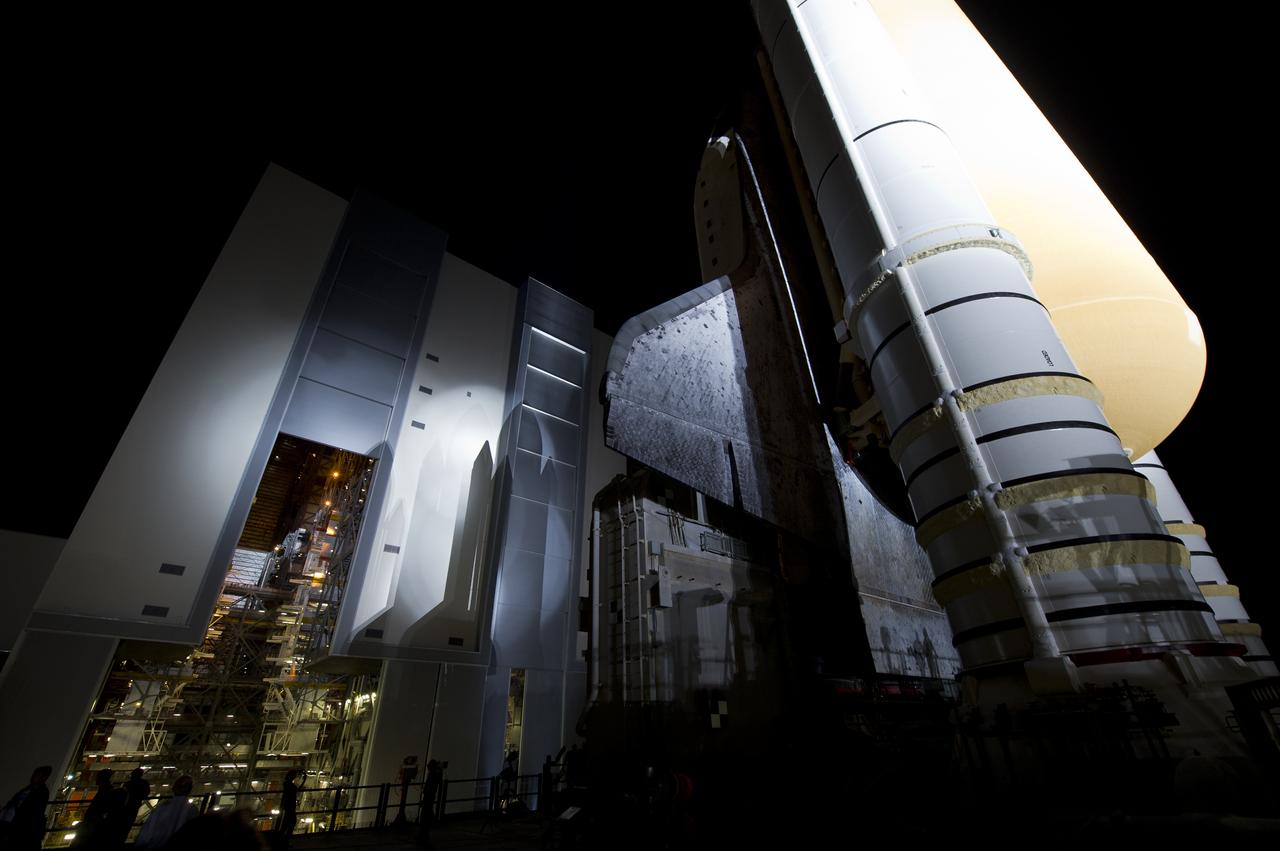
Space Shuttle Atlantis (STS-135) is seen atop the Mobile Launch Platform (MLP) as it begins its journey from High Bay 3 in the Vehicle Assembly Building to Launch Pad 39a for its final flight, Tuesday evening, May 31, 2011, at Kennedy Space Center in Cape Canaveral, Fla. The 3.4-mile trek, known as "rollout," will take about seven hours to complete. Atlantis will carry the Raffaello multipurpose logistics module to deliver supplies, logistics and spare parts to the International Space Station. The launch of STS-135 is targeted for July 8. Photo Credit: (NASA/Bill Ingalls)
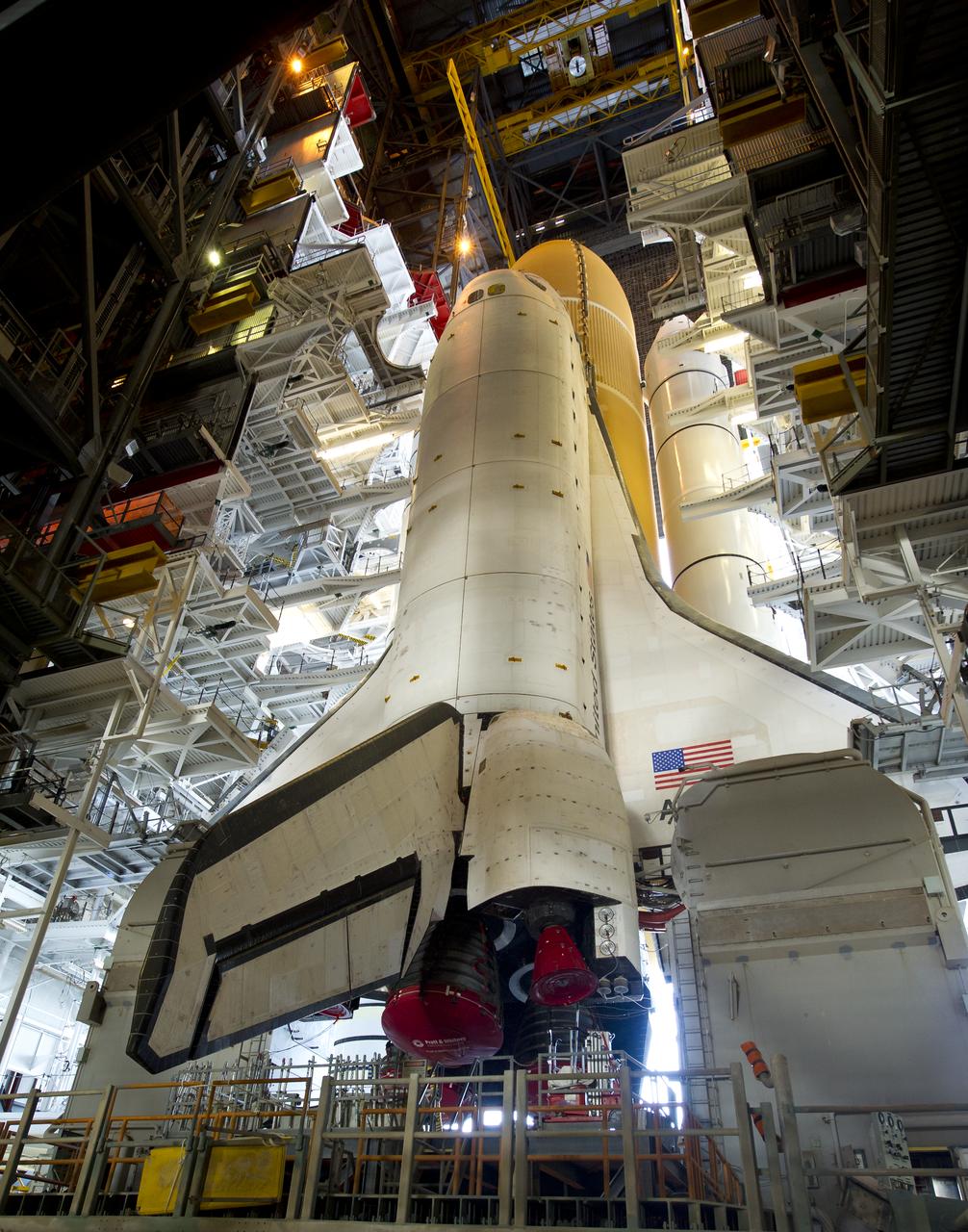
Space Shuttle Atlantis (STS-135) is seen atop a Mobile Launcher Platform (MLP) just prior to beginning its journey from High Bay 3 in the Vehicle Assembly Building to Launch Pad 39a for its final flight, Tuesday evening, May 31, 2011, at Kennedy Space Center in Cape Canaveral, Fla. The 3.4-mile trek, known as "rollout," will take about seven hours to complete. Atlantis will carry the Raffaello multipurpose logistics module to deliver supplies, logistics and spare parts to the International Space Station. The launch of STS-135 is targeted for July 8. Photo Credit: (NASA/Bill Ingalls)
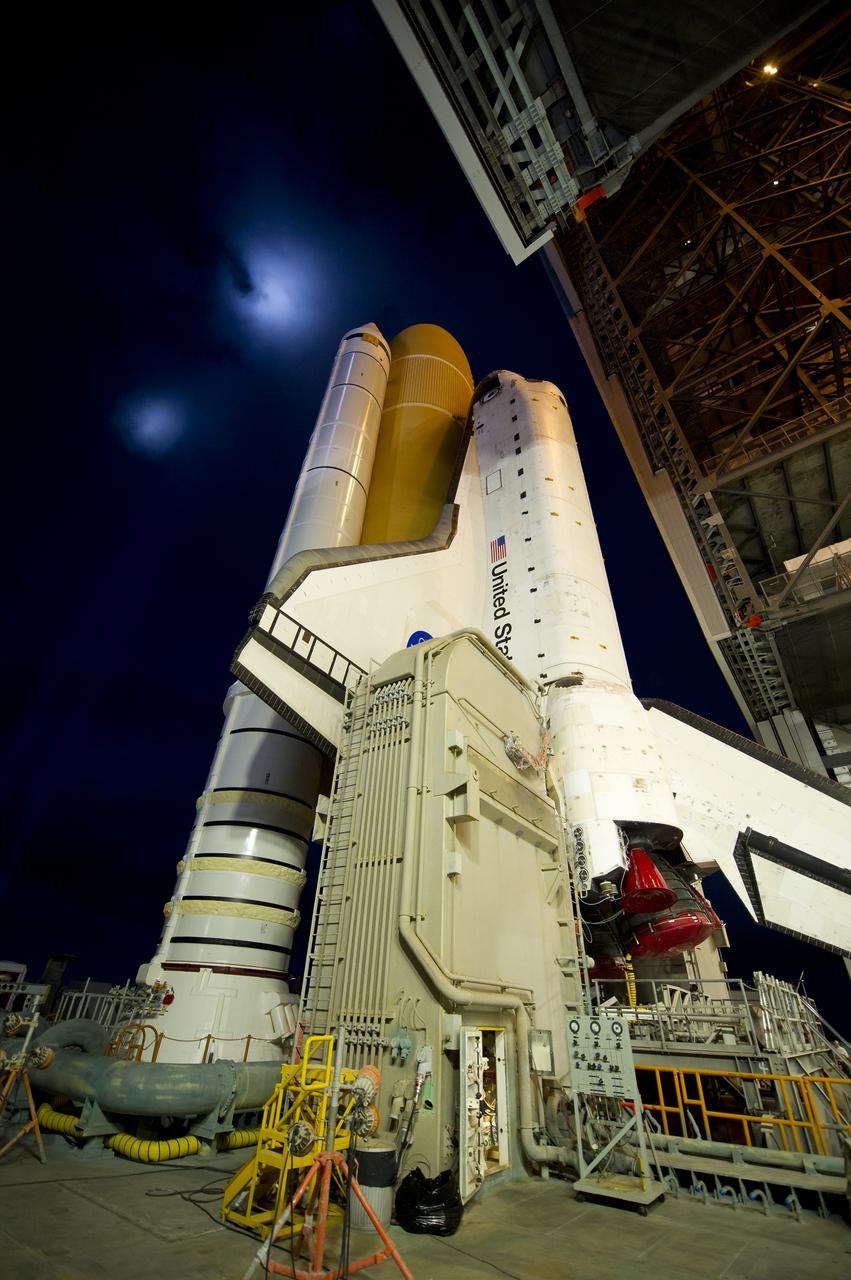
Space Shuttle Atlantis (STS-135) is seen atop the Mobile Launch Platform (MLP) as it begins its journey from High Bay 3 in the Vehicle Assembly Building to Launch Pad 39a for its final flight, Tuesday evening, May 31, 2011, at Kennedy Space Center in Cape Canaveral, Fla. The 3.4-mile trek, known as "rollout," will take about seven hours to complete. Atlantis will carry the Raffaello multipurpose logistics module to deliver supplies, logistics and spare parts to the International Space Station. The launch of STS-135 is targeted for July 8. Photo Credit: (NASA/Bill Ingalls)
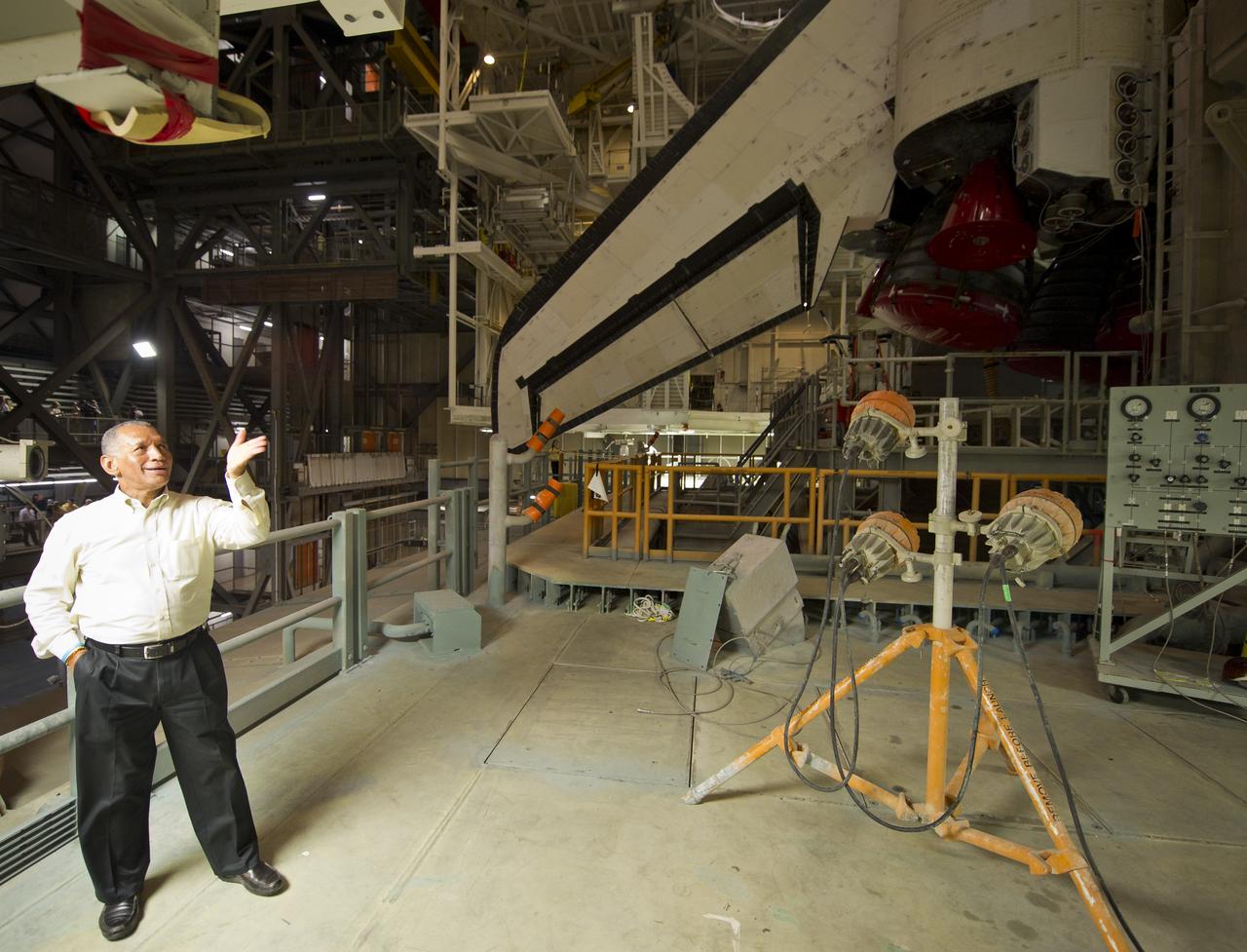
NASA Administrator Charles Bolden looks at the space shuttle Atlantis atop of the Mobile Launch Platform (MLP) just prior to rollout of Atlantis (STS-135) from High Bay 3 in the Vehicle Assembly Building to Launch Pad 39a for its final flight, Tuesday evening, May 31, 2011, at Kennedy Space Center in Cape Canaveral, Fla. The 3.4-mile trek, known as "rollout," will take about seven hours to complete. Atlantis will carry the Raffaello multipurpose logistics module to deliver supplies, logistics and spare parts to the International Space Station. The launch of STS-135 is targeted for July 8. Photo Credit: (NASA/Bill Ingalls)
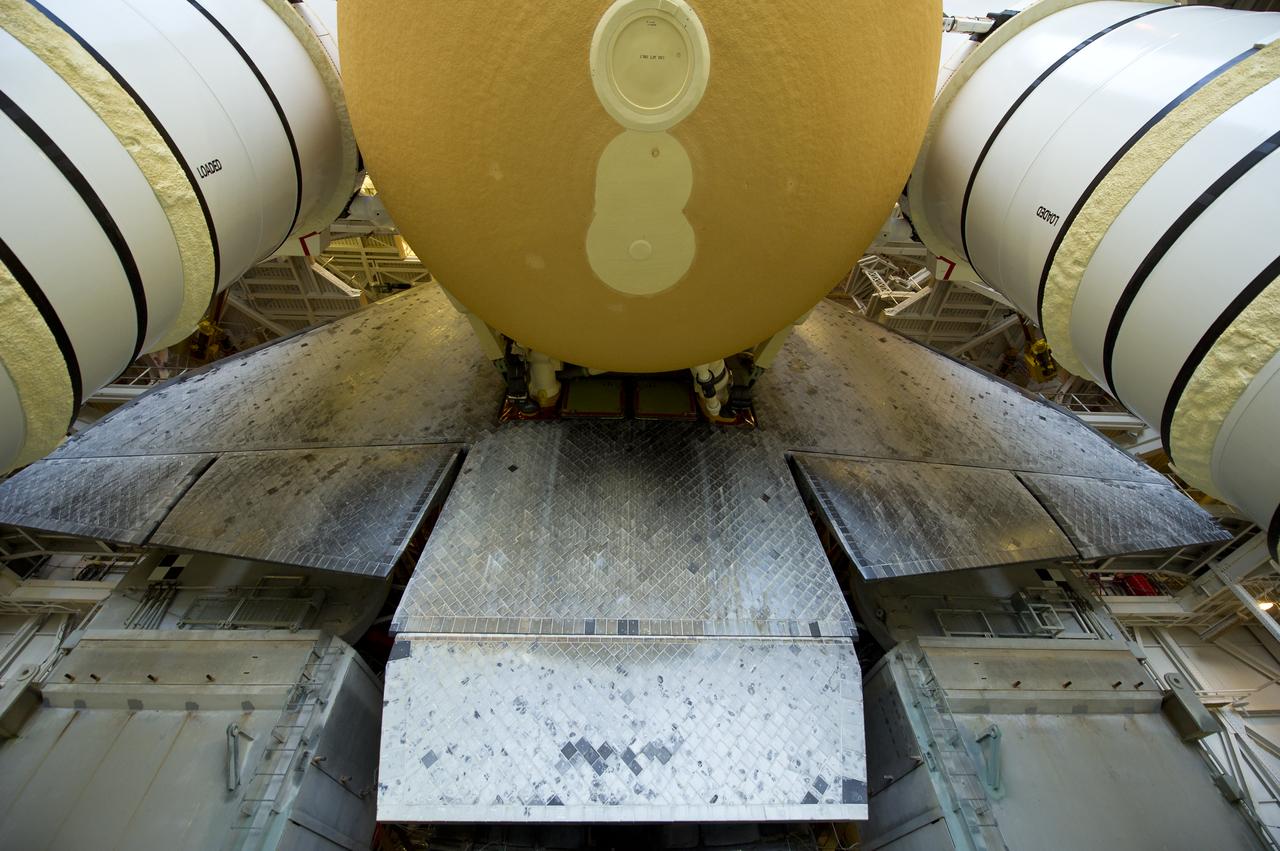
Space Shuttle Atlantis (STS-135) is seen atop a Mobile Launcher Platform (MLP) just prior to beginning its journey from High Bay 3 in the Vehicle Assembly Building to Launch Pad 39a for its final flight, Tuesday evening, May 31, 2011, at Kennedy Space Center in Cape Canaveral, Fla. The 3.4-mile trek, known as "rollout," will take about seven hours to complete. Atlantis will carry the Raffaello multipurpose logistics module to deliver supplies, logistics and spare parts to the International Space Station. The launch of STS-135 is targeted for July 8. Photo Credit: (NASA/Bill Ingalls)

Space Shuttle Atlantis (STS-135) is seen atop the Mobile Launch Platform (MLP) as it begins its journey from High Bay 3 in the Vehicle Assembly Building to Launch Pad 39a for its final flight, Tuesday evening, May 31, 2011, at Kennedy Space Center in Cape Canaveral, Fla. The 3.4-mile trek, known as "rollout," will take about seven hours to complete. Atlantis will carry the Raffaello multipurpose logistics module to deliver supplies, logistics and spare parts to the International Space Station. The launch of STS-135 is targeted for July 8. Photo Credit: (NASA/Bill Ingalls)
NASA Administrator Charles Bolden looks at the space shuttle Atlantis atop of the Mobile Launch Platform (MLP) just prior to rollout of Atlantis (STS-135) from High Bay 3 in the Vehicle Assembly Building to Launch Pad 39a for its final flight, Tuesday evening, May 31, 2011, at Kennedy Space Center in Cape Canaveral, Fla. The 3.4-mile trek, known as "rollout," will take about seven hours to complete. Atlantis will carry the Raffaello multipurpose logistics module to deliver supplies, logistics and spare parts to the International Space Station. The launch of STS-135 is targeted for July 8. Photo Credit: (NASA/Bill Ingalls)
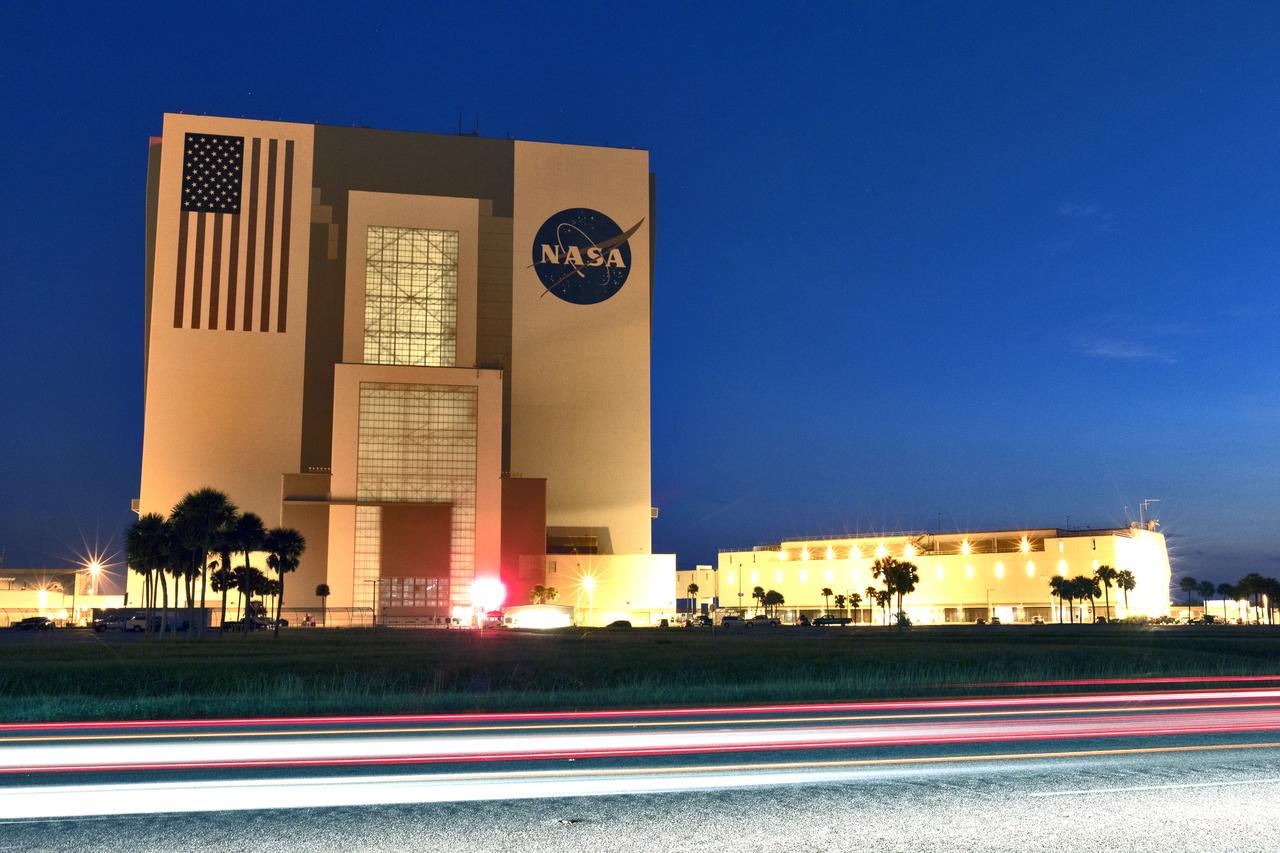
A sunrise time-lapse panoramic view of the iconic Vehicle Assembly Building (VAB) and Launch Control Center at NASA's Kennedy Space Center in Florida. Ten levels of work platforms have been installed in High Bay 3 of the VAB. They will surround and provide access for service and processing of NASA's Space Launch System (SLS) rocket and Orion spacecraft. Exploration Ground Systems oversaw the upgrades and installation of the new work platforms to support the launch of the SLS and Orion on Exploration Mission-1 and deep space missions.
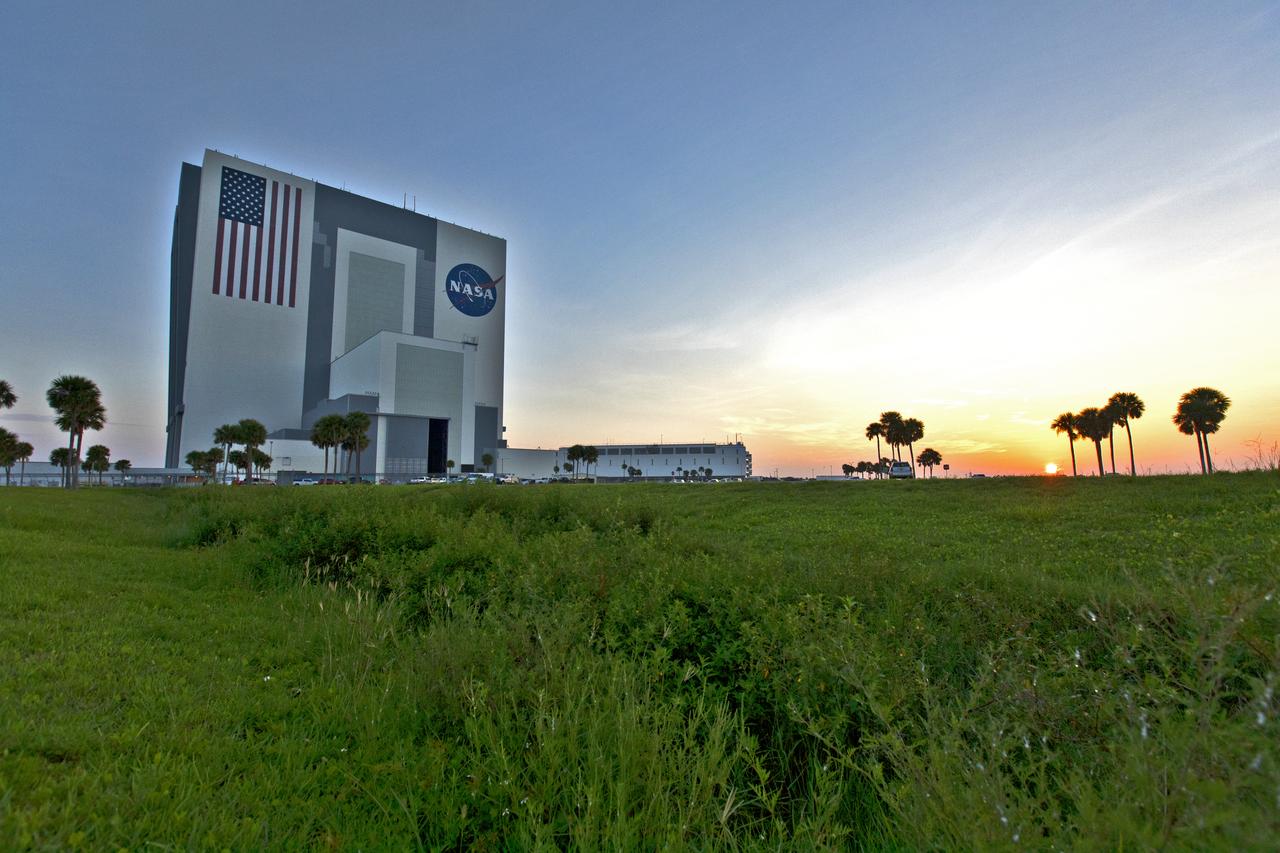
A sunrise panoramic view of the iconic Vehicle Assembly Building (VAB) and Launch Control Center at NASA's Kennedy Space Center in Florida. Ten levels of work platforms have been installed in High Bay 3 of the VAB. They will surround and provide access for service and processing of NASA's Space Launch System (SLS) rocket and Orion spacecraft. Exploration Ground Systems oversaw the upgrades and installation of the new work platforms to support the launch of the SLS and Orion on Exploration Mission-1 and deep space missions.
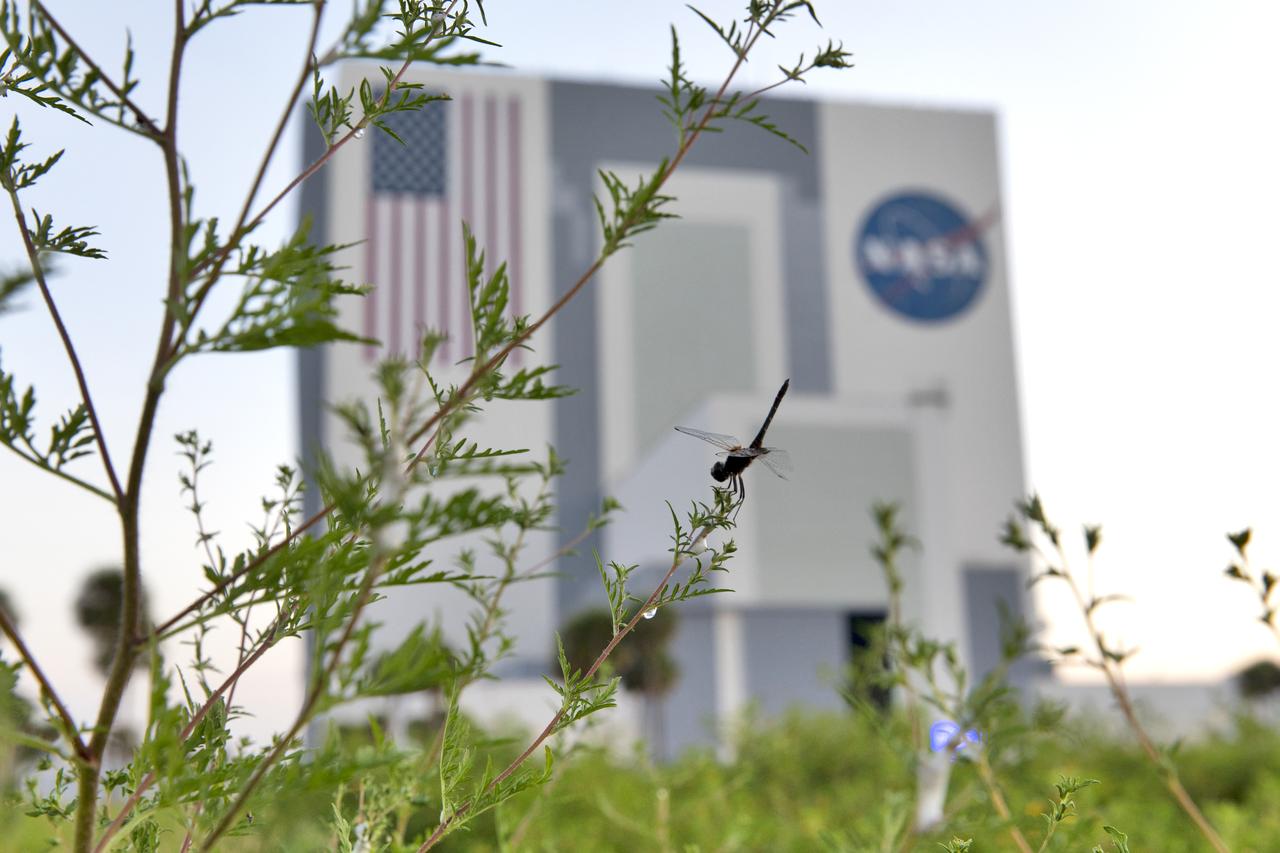
A dragonfly perches on a tree branch with the iconic Vehicle Assembly Building (VAB) in view in the background at NASA's Kennedy Space Center in Florida. Ten levels of new work platforms have been installed in VAB High Bay 3. They will surround and provide access for service and processing of NASA's Space Launch System (SLS) rocket and Orion spacecraft. Exploration Ground Systems oversaw the upgrades and installation of the new work platforms to support the launch of the SLS and Orion on Exploration Mission-1 and deep space missions.
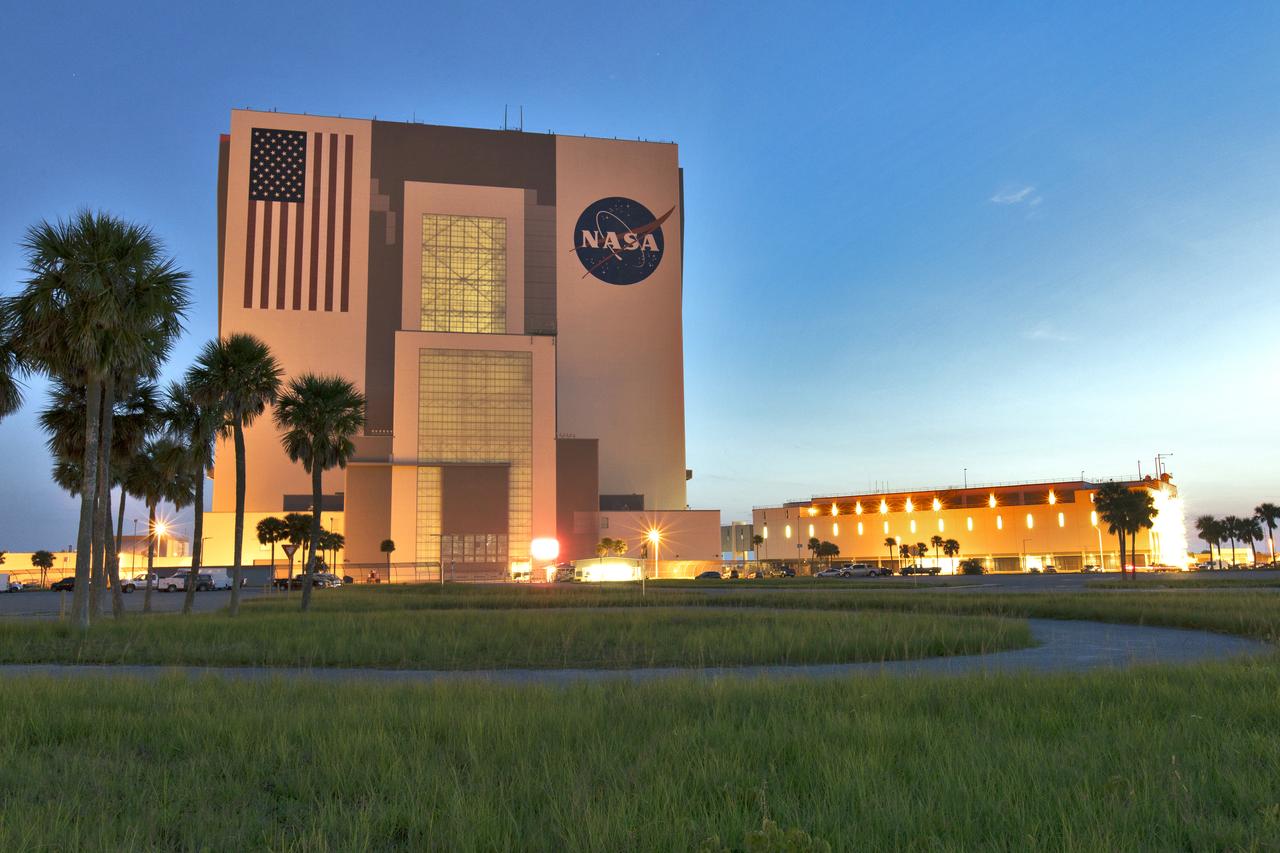
A sunrise panoramic view of the iconic Vehicle Assembly Building (VAB) and Launch Control Center at NASA's Kennedy Space Center in Florida. Ten levels of work platforms have been installed in High Bay 3 of the VAB. They will surround and provide access for service and processing of NASA's Space Launch System (SLS) rocket and Orion spacecraft. Exploration Ground Systems oversaw the upgrades and installation of the new work platforms to support the launch of the SLS and Orion on Exploration Mission-1 and deep space missions.
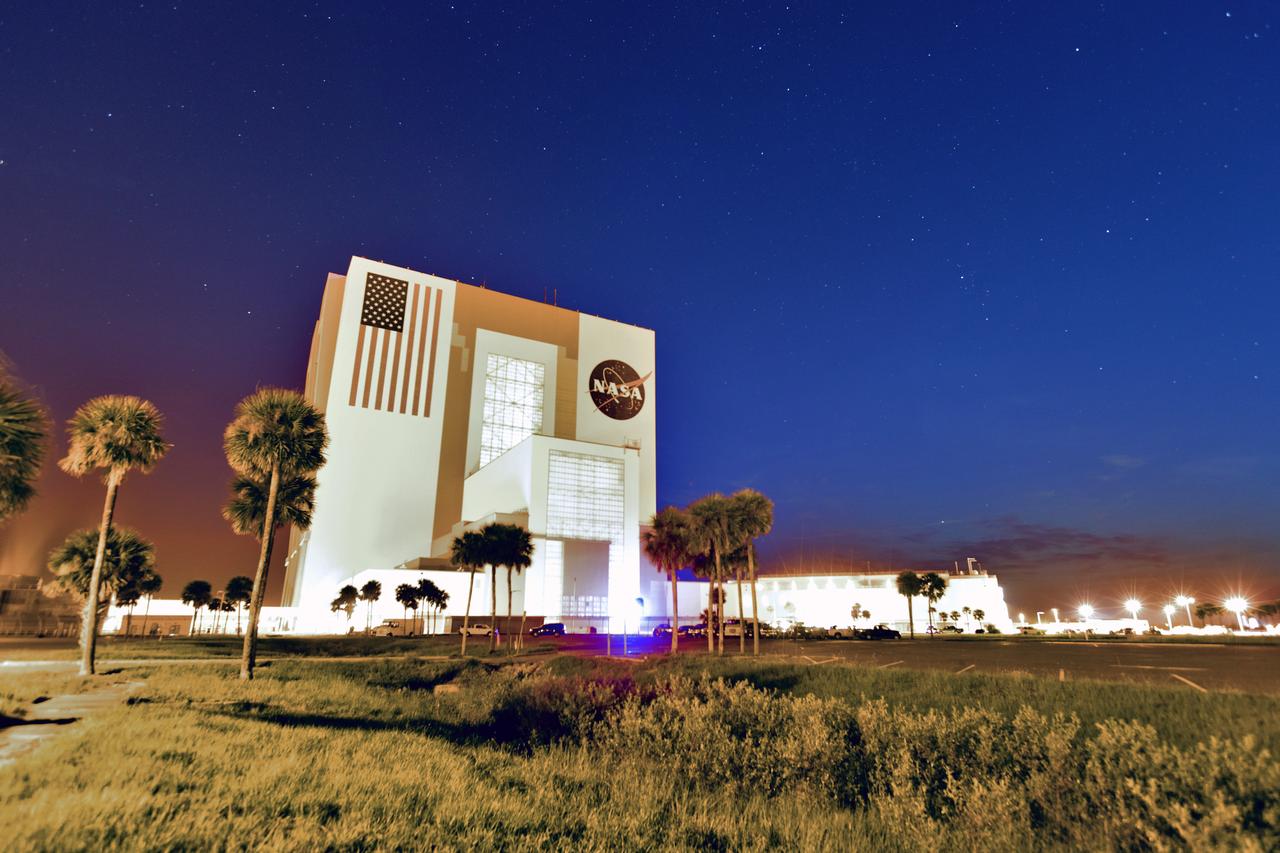
A sunrise creative view of the iconic Vehicle Assembly Building (VAB) and Launch Control Center at NASA's Kennedy Space Center in Florida. Ten levels of work platforms have been installed in High Bay 3 of the VAB. They will surround and provide access for service and processing of NASA's Space Launch System (SLS) rocket and Orion spacecraft. Exploration Ground Systems oversaw the upgrades and installation of the new work platforms to support the launch of the SLS and Orion on Exploration Mission-1 and deep space missions.
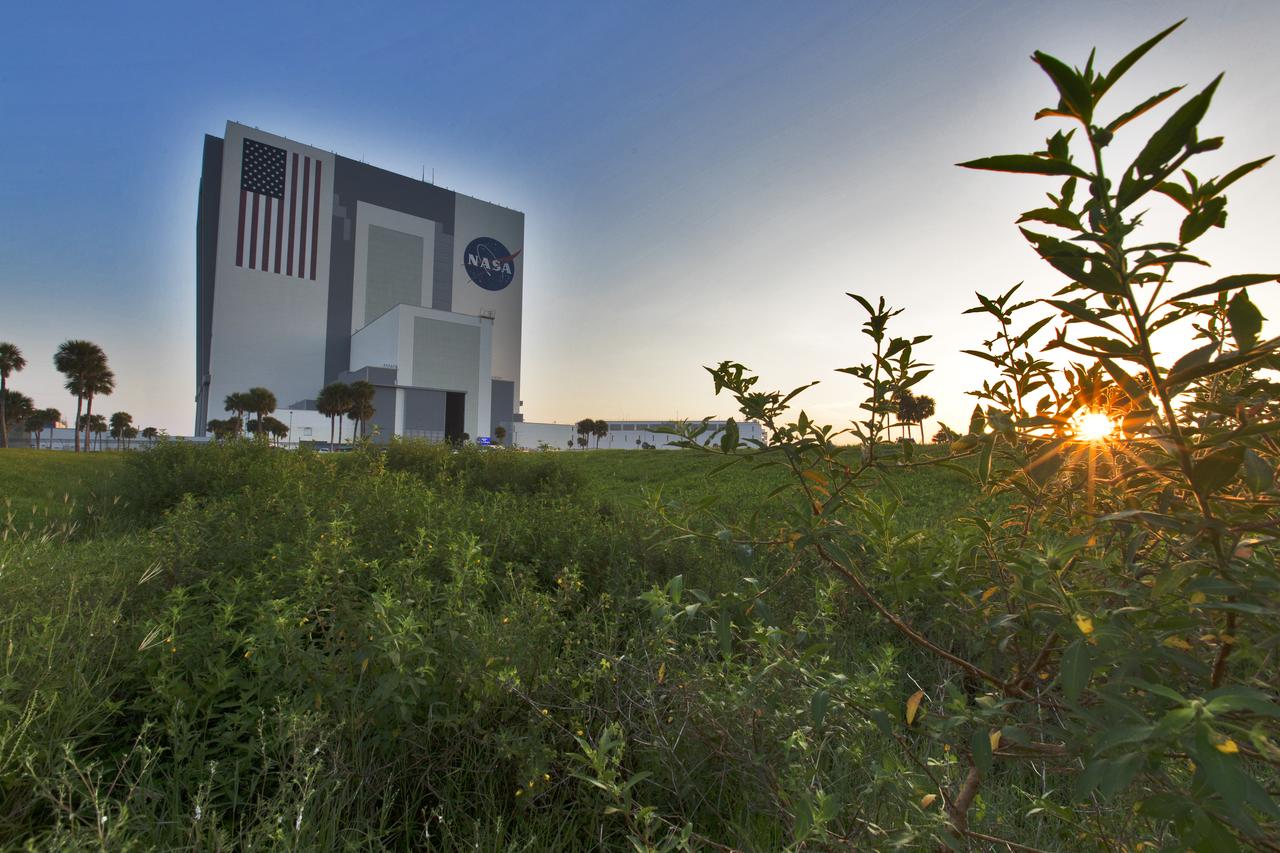
A sunrise panoramic view of the iconic Vehicle Assembly Building (VAB) at NASA's Kennedy Space Center in Florida. Ten levels of work platforms have been installed in High Bay 3 of the VAB. They will surround and provide access for service and processing of NASA's Space Launch System (SLS) rocket and Orion spacecraft. Exploration Ground Systems oversaw the upgrades and installation of the new work platforms to support the launch of the SLS and Orion on Exploration Mission-1 and deep space missions.
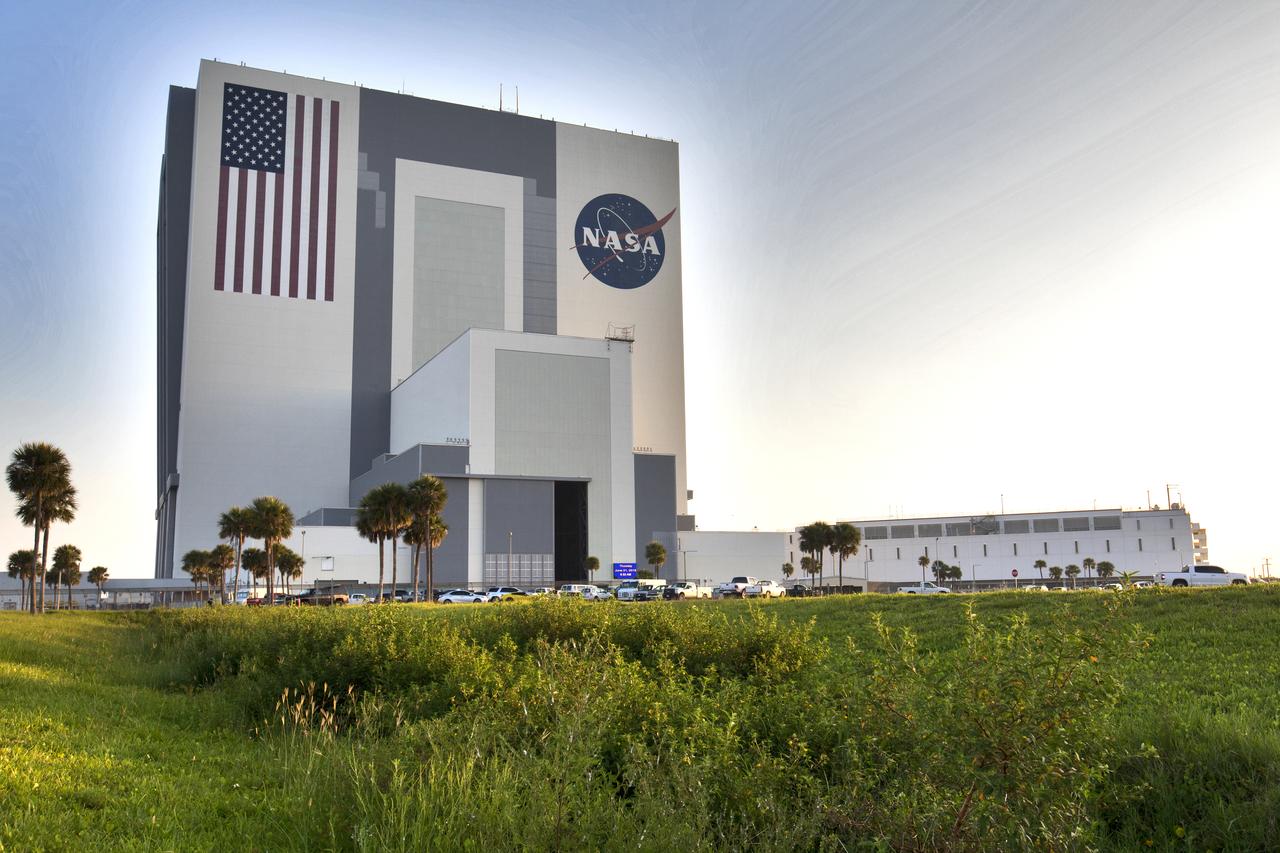
A brilliant blue sky forms the background for a panoramic view of the iconic Vehicle Assembly Building (VAB) and Launch Control Center at NASA's Kennedy Space Center in Florida. Ten levels of work platforms have been installed in High Bay 3 of the VAB. They will surround and provide access for service and processing of NASA's Space Launch System (SLS) rocket and Orion spacecraft. Exploration Ground Systems oversaw the upgrades and installation of the new work platforms to support the launch of the SLS and Orion on Exploration Mission-1 and deep space missions.
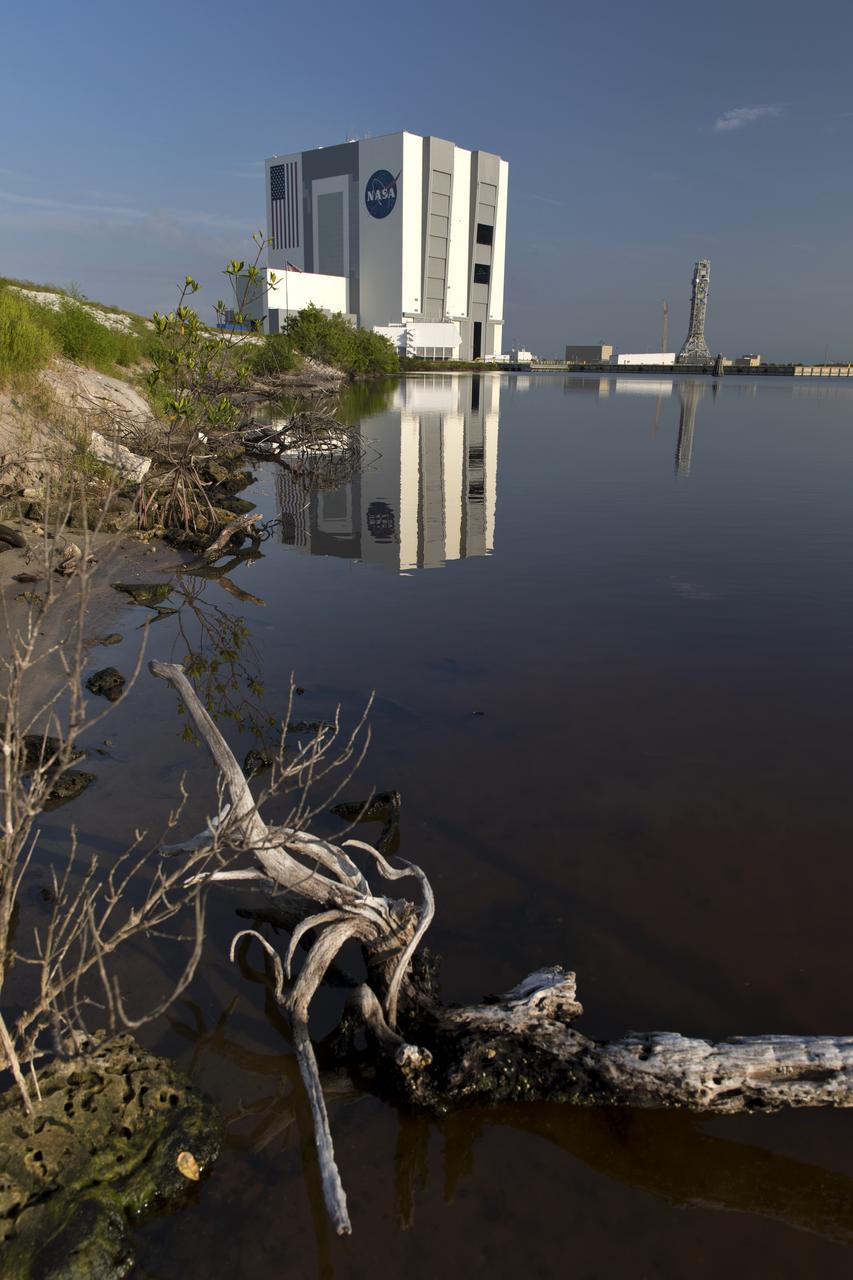
The iconic Vehicle Assembly Building (VAB) casts a reflection in a surrounding waterway at NASA's Kennedy Space Center in Florida. In view are the south and east sides of the building. Ten levels of new work platforms have been installed in VAB High Bay 3. They will surround and provide access for service and processing of NASA's Space Launch System (SLS) rocket and Orion spacecraft. Exploration Ground Systems oversaw the upgrades and installation of the new work platforms to support the launch of the SLS and Orion on Exploration Mission-1 and deep space missions.
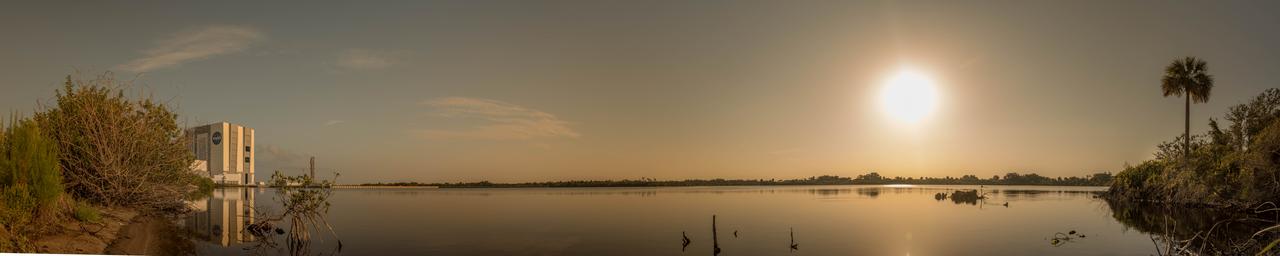
A sunrise panoramic view of the iconic Vehicle Assembly Building (VAB) and surrounding waterways at NASA's Kennedy Space Center in Florida. Ten levels of new work platforms have been installed in VAB High Bay 3. They will surround and provide access for service and processing of NASA's Space Launch System (SLS) rocket and Orion spacecraft. Exploration Ground Systems oversaw the upgrades and installation of the new work platforms to support the launch of the SLS and Orion on Exploration Mission-1 and deep space missions.
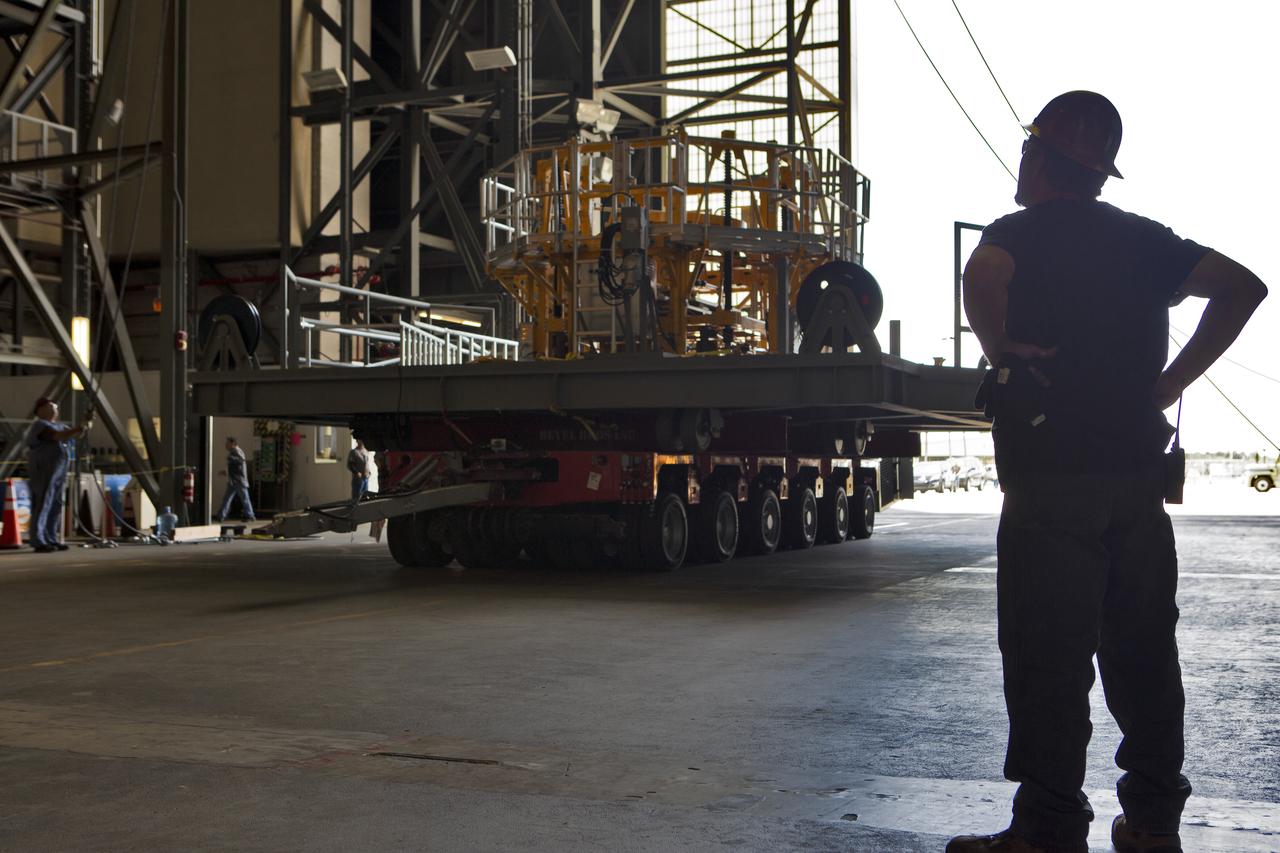
The engine vertical installer for NASA’s Space Launch System (SLS) is inside the Vehicle Assembly at NASA’s Kennedy Space Center in Florida on April 25, 2019. The engine installer will be lifted up by crane for transfer to High Bay 3. The engine installer arrived from the manufacturer, Precision Fabrication and Cleaning in Canaveral Groves, Florida. The new ground support equipment will be ready for preflight processing in the event one of the four RS-25 engines on the core stage of the SLS rocket needs to be replaced. During launch of the SLS and Orion spacecraft, the four core stage engines will provide the thrust needed to lift the rocket and Orion spacecraft off Launch Pad 39B at Kennedy for Exploration Mission-1. The uncrewed Orion will travel on a three-week test mission thousands of miles beyond the Moon and back to Earth for a splashdown in the Pacific Ocean.
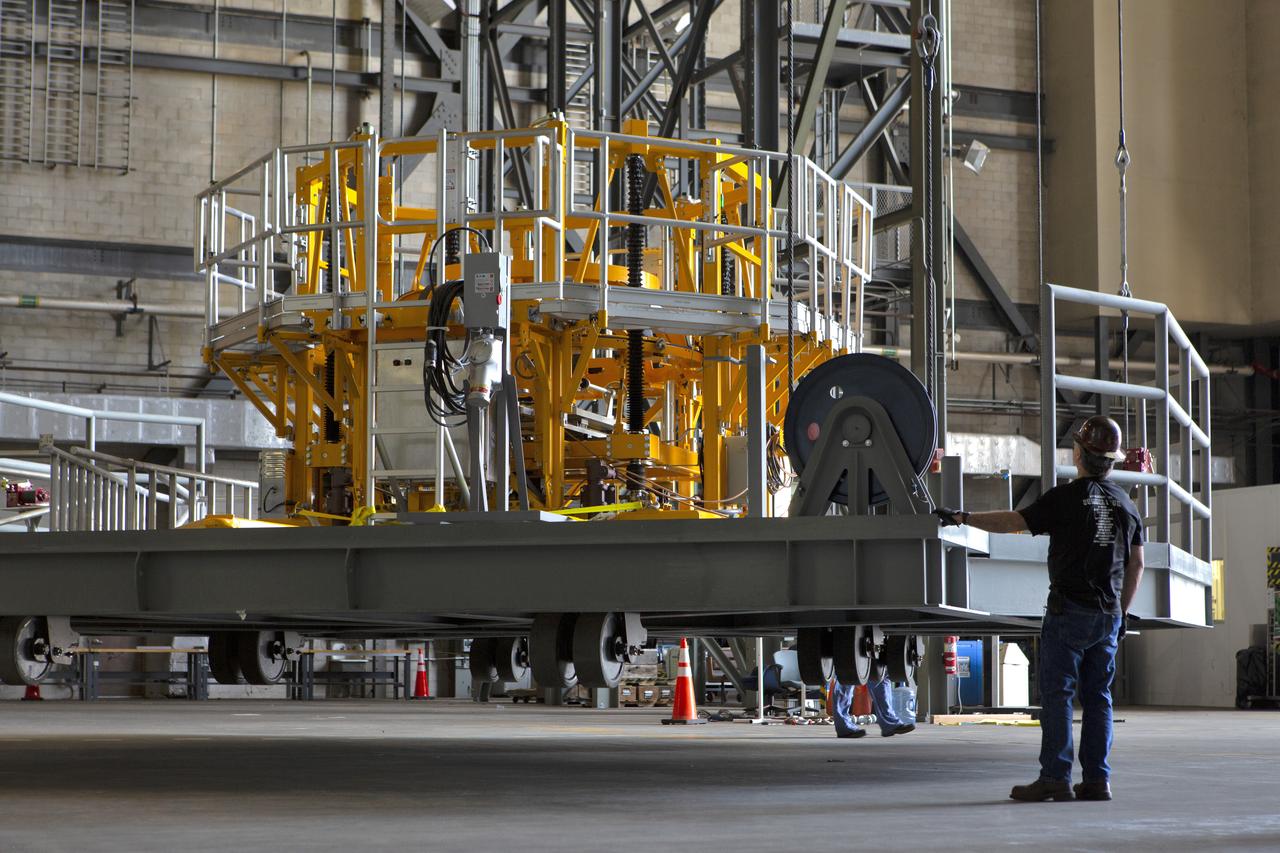
The engine vertical installer for NASA’s Space Launch System (SLS) is inside the Vehicle Assembly at NASA’s Kennedy Space Center in Florida on April 25, 2019. The engine installer is being lifted up by crane for transfer to High Bay 3. The engine installer arrived from the manufacturer, Precision Fabrication and Cleaning in Canaveral Groves, Florida. The new ground support equipment will be ready for preflight processing in the event one of the four RS-25 engines on the core stage of the SLS rocket needs to be replaced. During launch of the SLS and Orion spacecraft, the four core stage engines will provide the thrust needed to lift the rocket and Orion spacecraft off Launch Pad 39B at Kennedy for Exploration Mission-1. The uncrewed Orion will travel on a three-week test mission thousands of miles beyond the Moon and back to Earth for a splashdown in the Pacific Ocean.
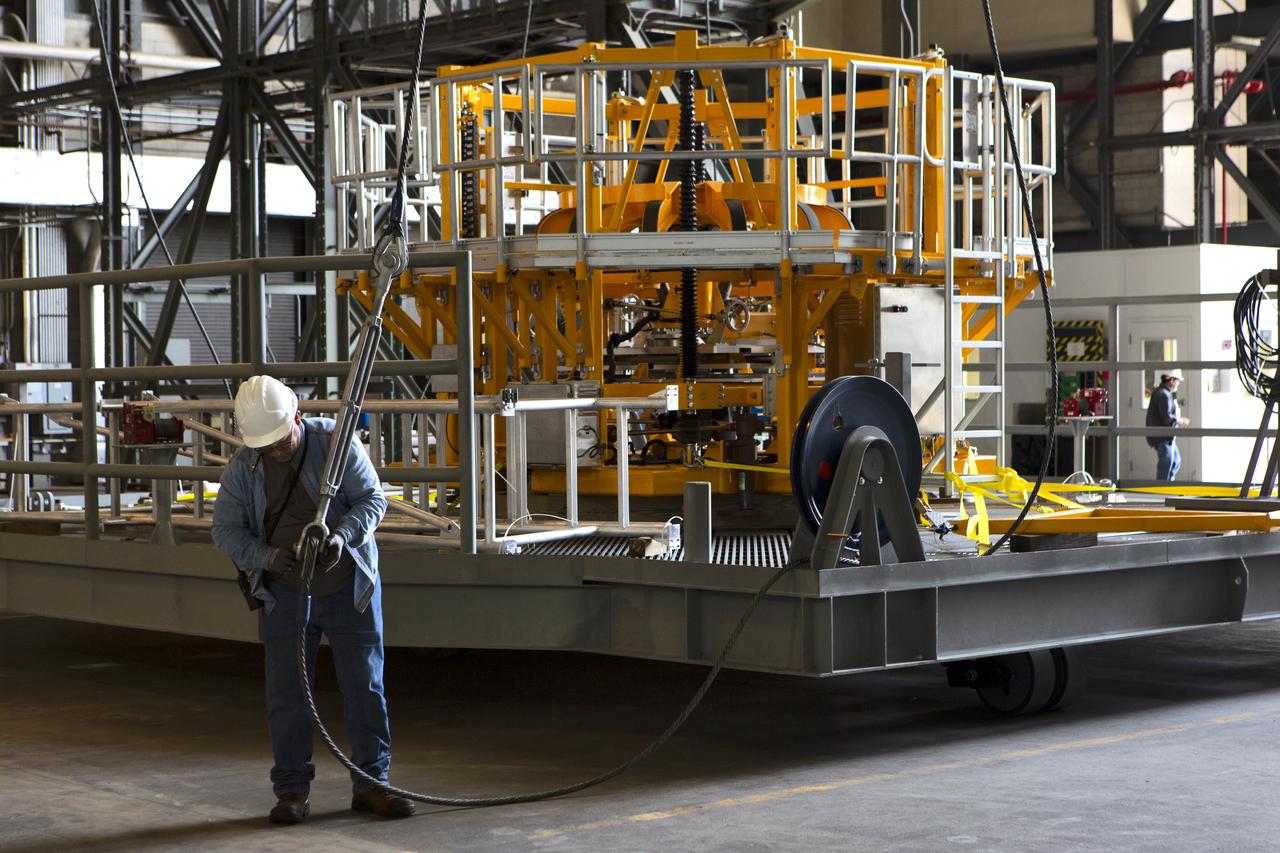
The engine vertical installer for NASA’s Space Launch System (SLS) is inside the Vehicle Assembly at NASA’s Kennedy Space Center in Florida on April 25, 2019. Preparations are underway to lift the engine installer up and into High Bay 3. The engine installer arrived from the manufacturer, Precision Fabrication and Cleaning in Canaveral Groves, Florida. The new ground support equipment will be ready for preflight processing in the event one of the four RS-25 engines on the core stage of the SLS rocket needs to be replaced. During launch of the SLS and Orion spacecraft, the four core stage engines will provide the thrust needed to lift the rocket and Orion spacecraft off Launch Pad 39B at Kennedy for Exploration Mission-1. The uncrewed Orion will travel on a three-week test mission thousands of miles beyond the Moon and back to Earth for a splashdown in the Pacific Ocean.
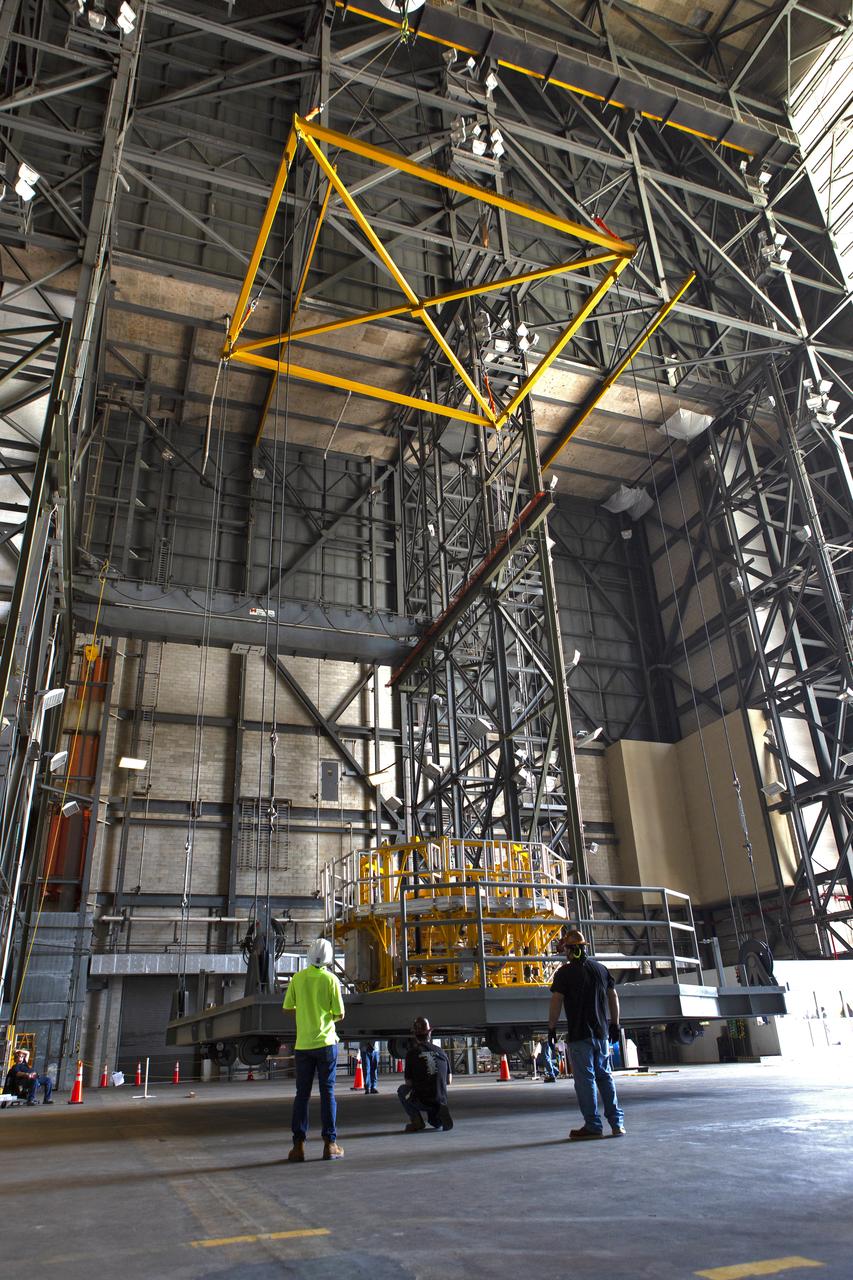
The engine vertical installer for NASA’s Space Launch System (SLS) is inside the Vehicle Assembly at NASA’s Kennedy Space Center in Florida on April 25, 2019. The engine installer is being lifted up by crane for transfer to High Bay 3. The engine installer arrived from the manufacturer, Precision Fabrication and Cleaning in Canaveral Groves, Florida. The new ground support equipment will be ready for preflight processing in the event one of the four RS-25 engines on the core stage of the SLS rocket needs to be replaced. During launch of the SLS and Orion spacecraft, the four core stage engines will provide the thrust needed to lift the rocket and Orion spacecraft off Launch Pad 39B at Kennedy for Exploration Mission-1. The uncrewed Orion will travel on a three-week test mission thousands of miles beyond the Moon and back to Earth for a splashdown in the Pacific Ocean.
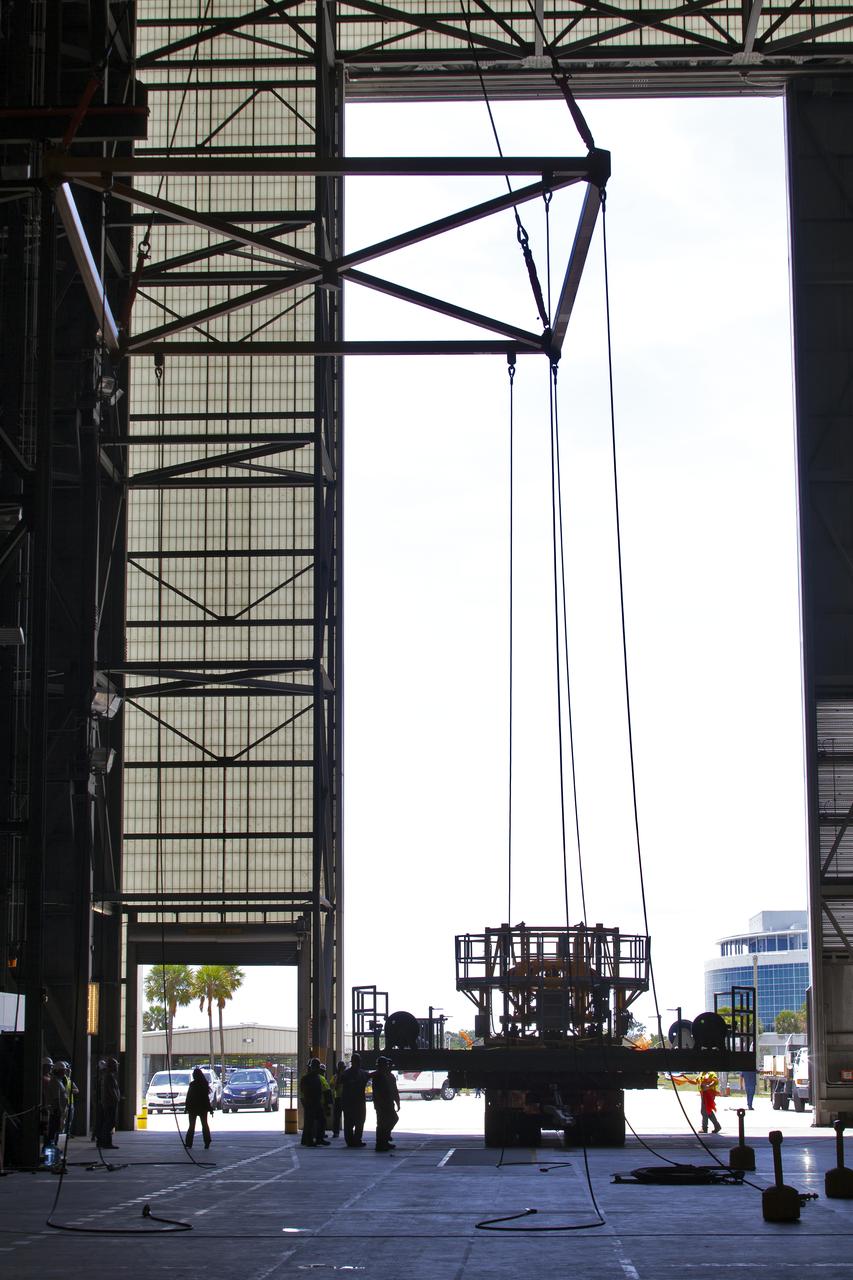
The engine vertical installer for NASA’s Space Launch System (SLS) is being lifted by crane in the Vehicle Assembly Building at NASA’s Kennedy Space Center in Florida on April 25, 2019. The engine installer arrived from the manufacturer, Precision Fabrication and Cleaning in Canaveral Groves, Florida. The new ground support equipment will be transferred into High Bay 3 where it will be ready for preflight processing in the event one of the four RS-25 engines on the core stage of the SLS rocket needs to be replaced. During launch of the SLS and Orion spacecraft, the four core stage engines will provide the thrust needed to lift the rocket and Orion spacecraft off Launch Pad 39B at Kennedy for Exploration Mission-1. The uncrewed Orion will travel on a three-week test mission thousands of miles beyond the Moon and back to Earth for a splashdown in the Pacific Ocean.
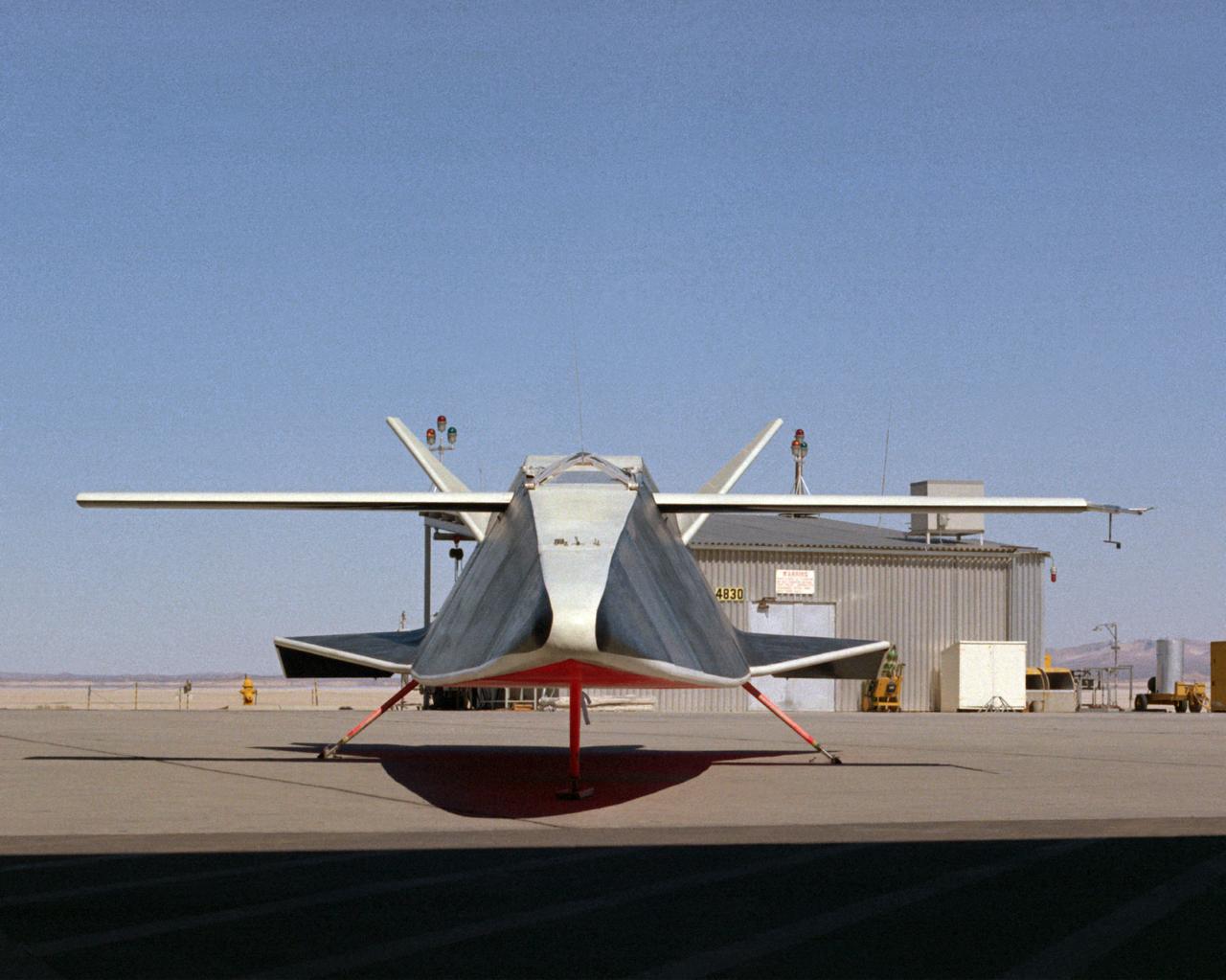
The Hyper III was a low-cost test vehicle for an advanced lifting-body shape. Like the earlier M2-F1, it was a "homebuilt" research aircraft, i.e., built at the Flight Research Center (FRC), later redesignated the Dryden Flight Research Center. It had a steel-tube frame covered with Dacron, a fiberglass nose, sheet aluminum fins, and a wing from an HP-11 sailplane. Construction was by volunteers at the FRC. Although the Hyper III was to be flown remotely in its initial tests, it was fitted with a cockpit for a pilot. On the Hyper III's only flight, it was towed aloft attached to a Navy SH-3 helicopter by a 400-foot cable. NASA research pilot Bruce Peterson flew the SH-3. After he released the Hyper III from the cable, NASA research pilot Milt Thompson flew the vehicle by radio control until the final approach when Dick Fischer took over control using a model-airplane radio-control box. The Hyper III flared, then landed and slid to a stop on Rogers Dry Lakebed.
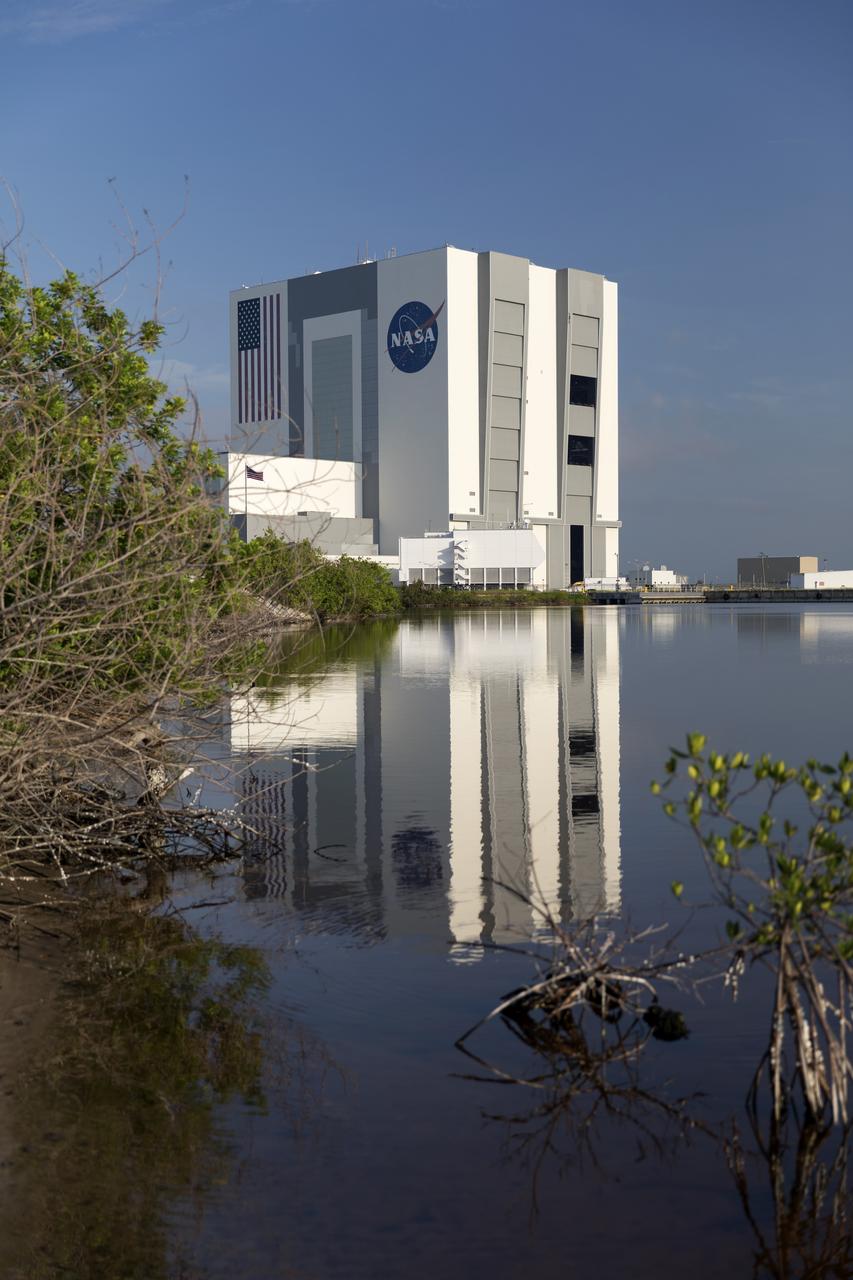
A brilliant blue sky forms the backdrop for a view of the south and east sides of the iconic Vehicle Assembly Building (VAB) at NASA's Kennedy Space Center in Florida. Exploration Ground Systems oversaw the upgrades. The building casts a reflection in a surrounding waterway. Ten levels of new work platforms have been installed in VAB High Bay 3. They will surround and provide access for service and processing of NASA's Space Launch System (SLS) rocket and Orion spacecraft. Exploration Ground Systems oversaw the upgrades and installation of the new work platforms to support the launch of the SLS and Orion on Exploration Mission-1 and deep space missions.
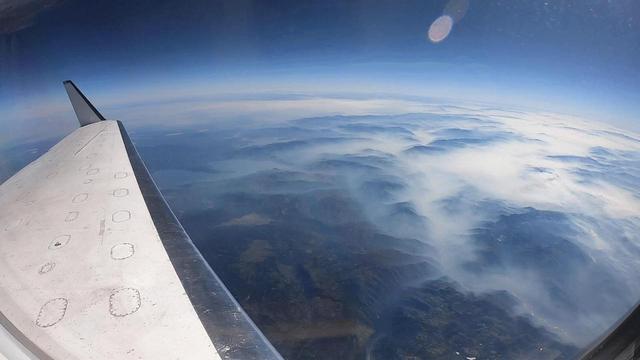
NASA flew an aircraft equipped with Uninhabited Aerial Vehicle Synthetic Aperture Radar (UAVSAR) flew above California fires on Sept. 3 and 10. The smoke-penetrating UAVSAR enables scientists to get a close-up view of how these fires have altered the landscape. Attached to the bottom of the aircraft, the radar is flown repeatedly over an area to measure tiny changes in surface height with extreme accuracy. The flight is part of the ongoing effort by NASA's Applied Sciences Disaster Program in the Earth Sciences Division, which generates maps and other data products that can be used by partner agencies on the ground to track fire hotspots, map the extent of the burn areas, and even measure the height of the smoke plumes that have drifted over California and neighboring states. Movie available at https://photojournal.jpl.nasa.gov/catalog/PIA24102
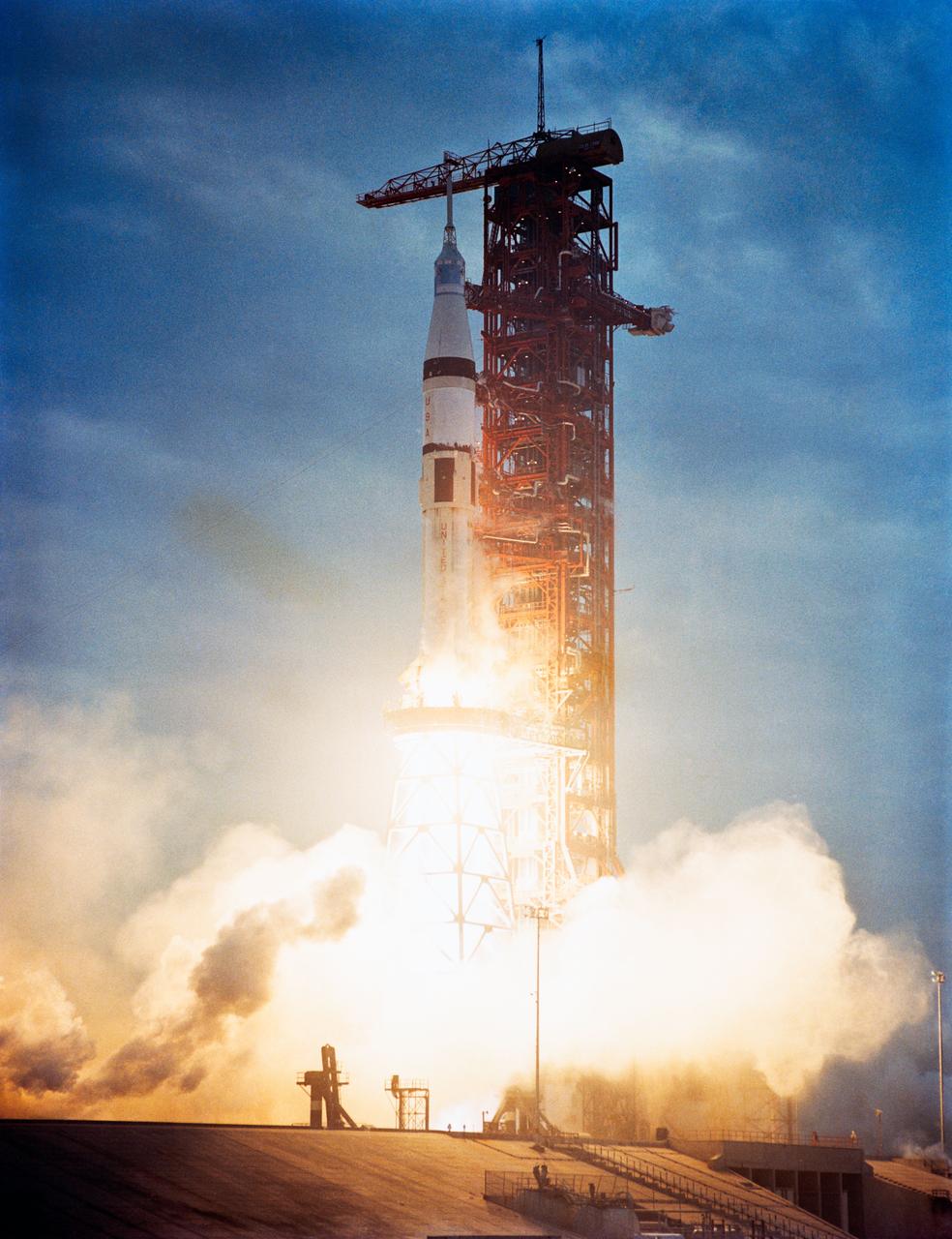
S73-32570 (28 July 1973) --- The Skylab 3/Saturn 1B space vehicle is launched from Pad B, Launch Complex 39, Kennedy Space Center, Florida, at 7:11 a.m. (EDT), Saturday, July 28, 1973. Skylab 3 is the second of three scheduled Skylab manned missions. Aboard the Skylab 3 Command/Service Module were astronauts Alan L. Bean, Owen K. Garriott and Jack R. Lousma. The Skylab 3 CSM later docked with the Skylab space station cluster in Earth orbit. In addition to the CSM and its launch escape system, the Skylab 3 space vehicle consisted of the Saturn 1B first (S-1B) stage and the Saturn 1B second (S-1VB) stage. (The Skylab 1/Saturn V space vehicle with the space station payload was launched from Pad A on May 14, 1973). Photo credit: NASA
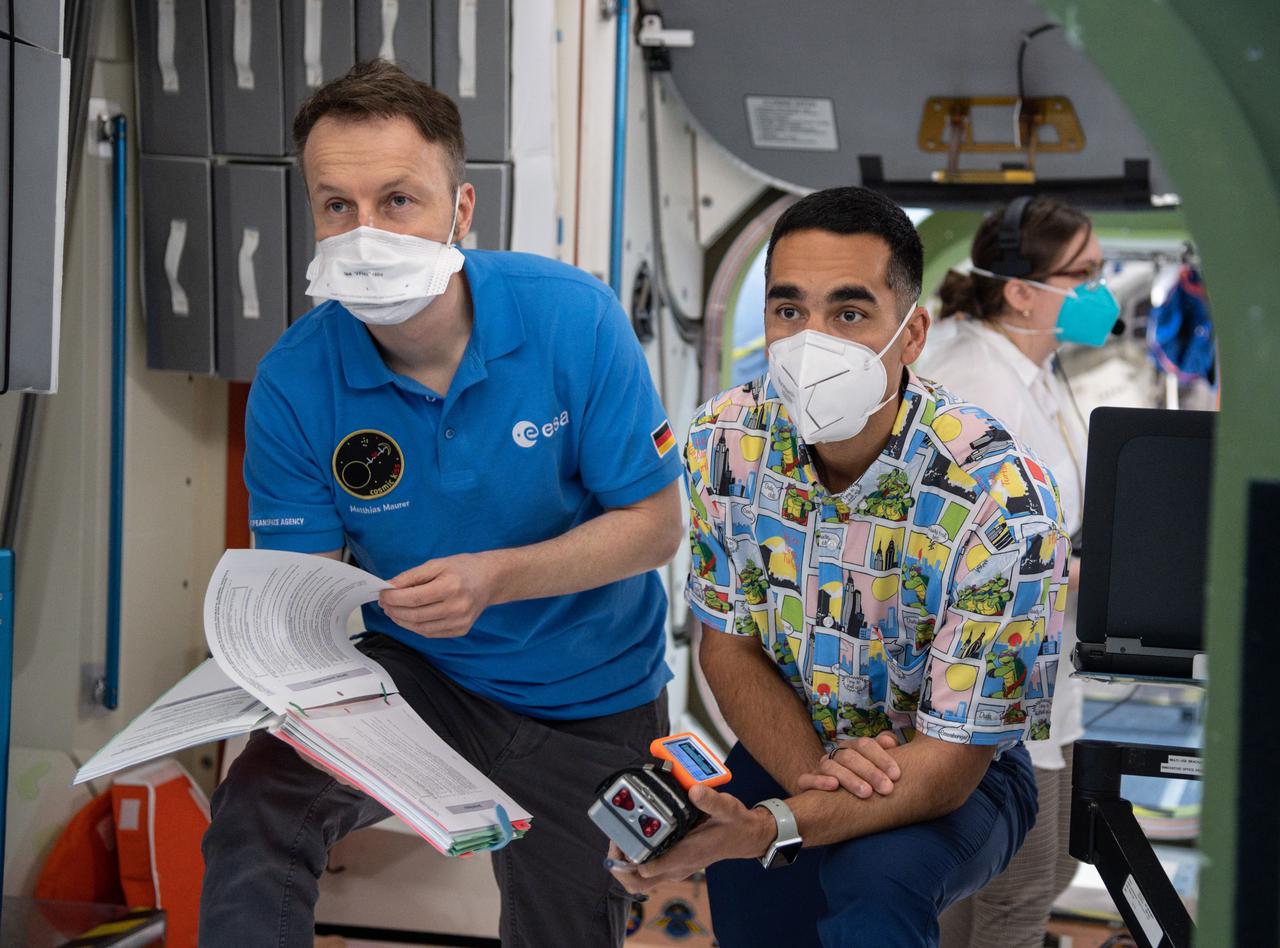
jsc2021e009539 (March 3, 2021) --- SpaceX Crew-3 astronauts (from left) Matthias Maurer and Raja Chari are pictured during a training session at the Space Vehicle Mockup Facility at NASA's Johnson Space Center in Houston, Texas.
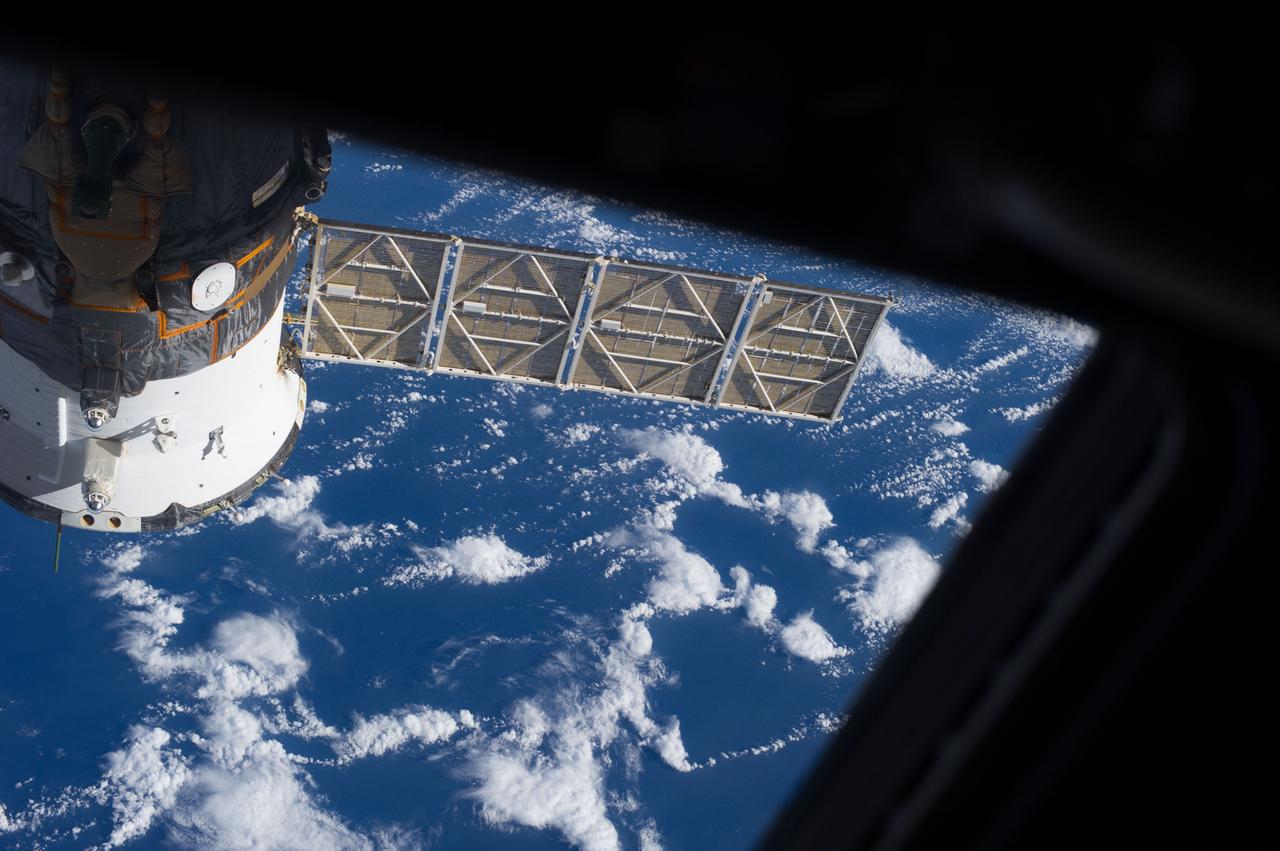
ISS037-E-005799 (3 Oct. 2013) --- One of the Expedition 37 crew members on Oct. 3 exposed this frame showing a Russian Soyuz vehicle docked to the International Space Station against a backdrop of a blue and white Earth.
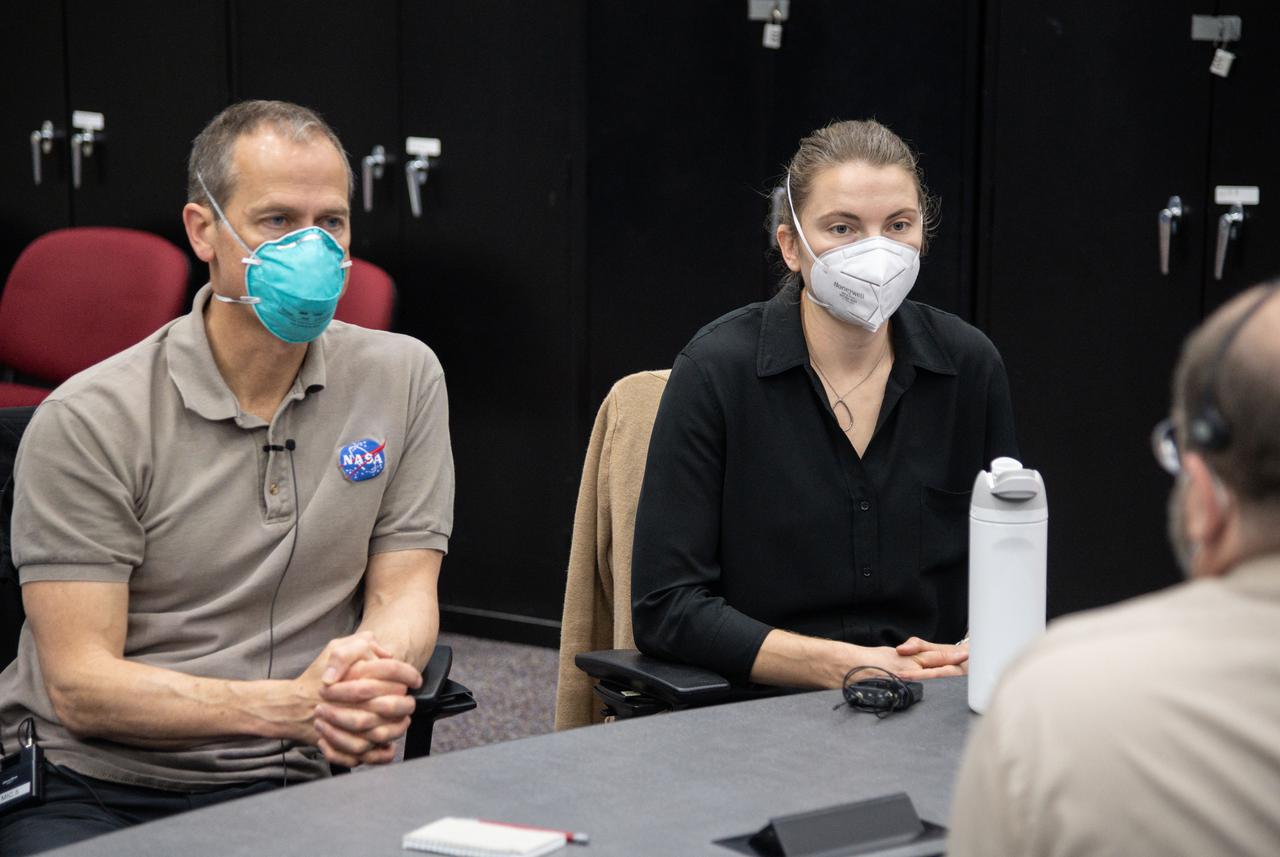
jsc2021e009510 (March 3, 2021) --- SpaceX Crew-3 astronauts (from left) Thomas Marshburn and Kayla Barron are pictured during a training session at the Space Vehicle Mockup Facility at NASA's Johnson Space Center in Houston, Texas.
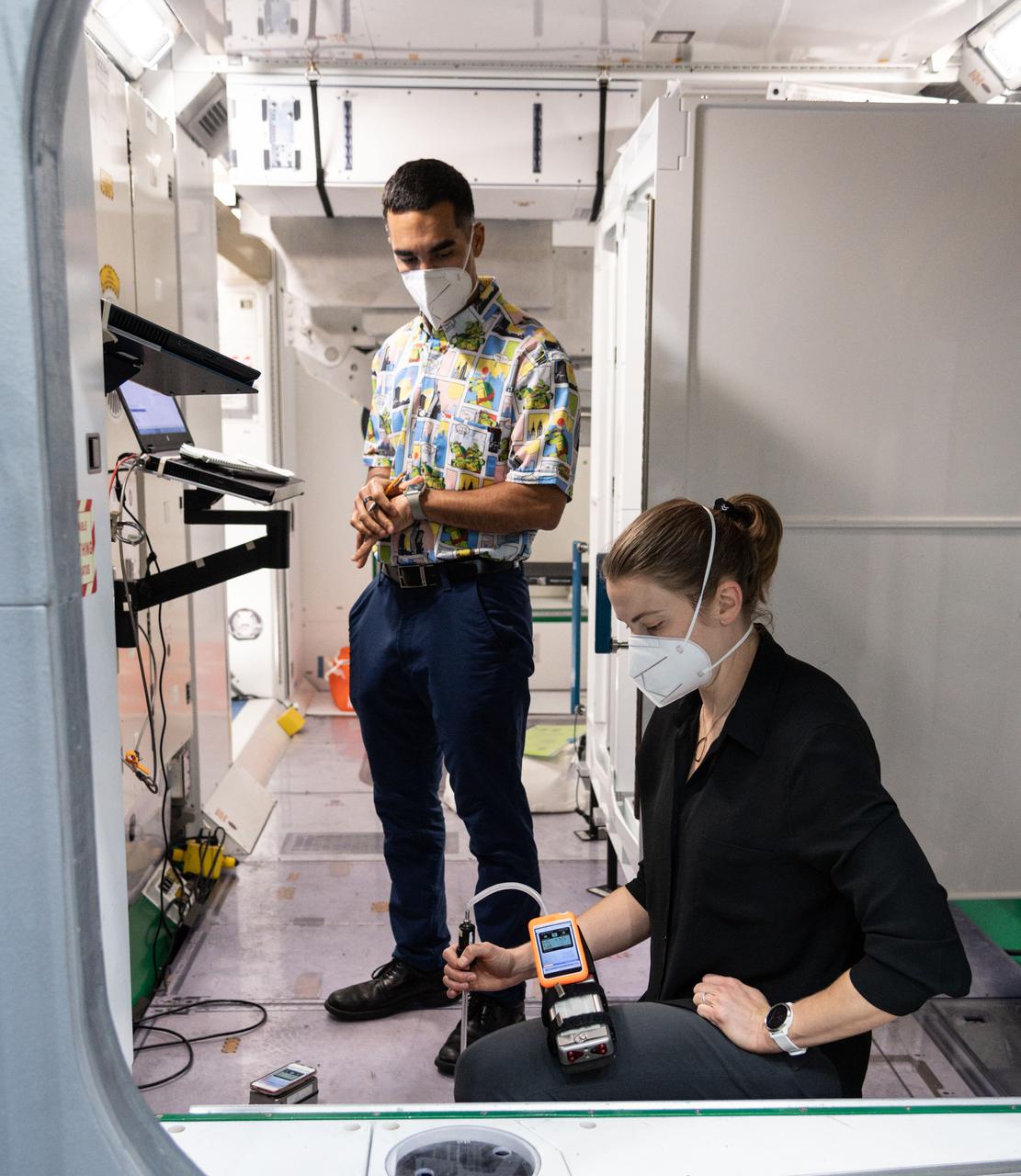
jsc2021e009505 (March 3, 2021) --- SpaceX Crew-3 astronauts (from left) Raja Chari and Kayla Barron are pictured during a training session at the Space Vehicle Mockup Facility at NASA's Johnson Space Center in Houston, Texas.
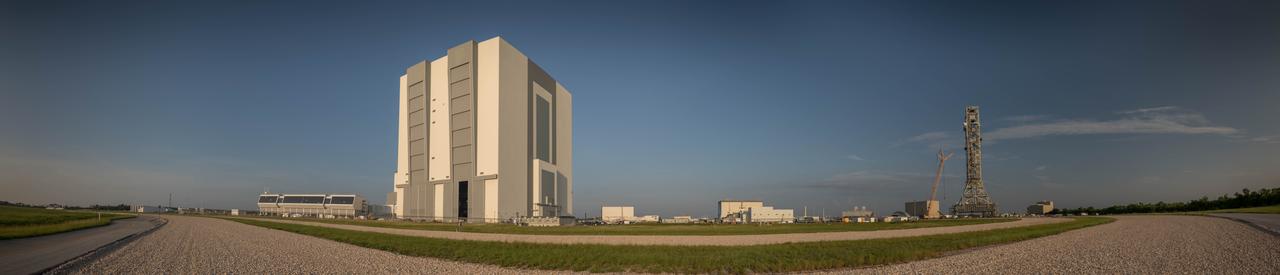
A brilliant blue sky forms the backdrop for a fish-eye panoramic view of the south side of the iconic Vehicle Assembly Building (VAB) and Launch Control Center at NASA's Kennedy Space Center in Florida. Ten levels of new work platforms have been installed in VAB High Bay 3. They will surround and provide access for service and processing of NASA's Space Launch System (SLS) rocket and Orion spacecraft. Exploration Ground Systems oversaw the upgrades and installation of the new work platforms to support the launch of the SLS and Orion on Exploration Mission-1 (EM-1) and deep space missions. At left is the Launch Control Center, where Firing Room 1 has been upgraded to support EM-1.
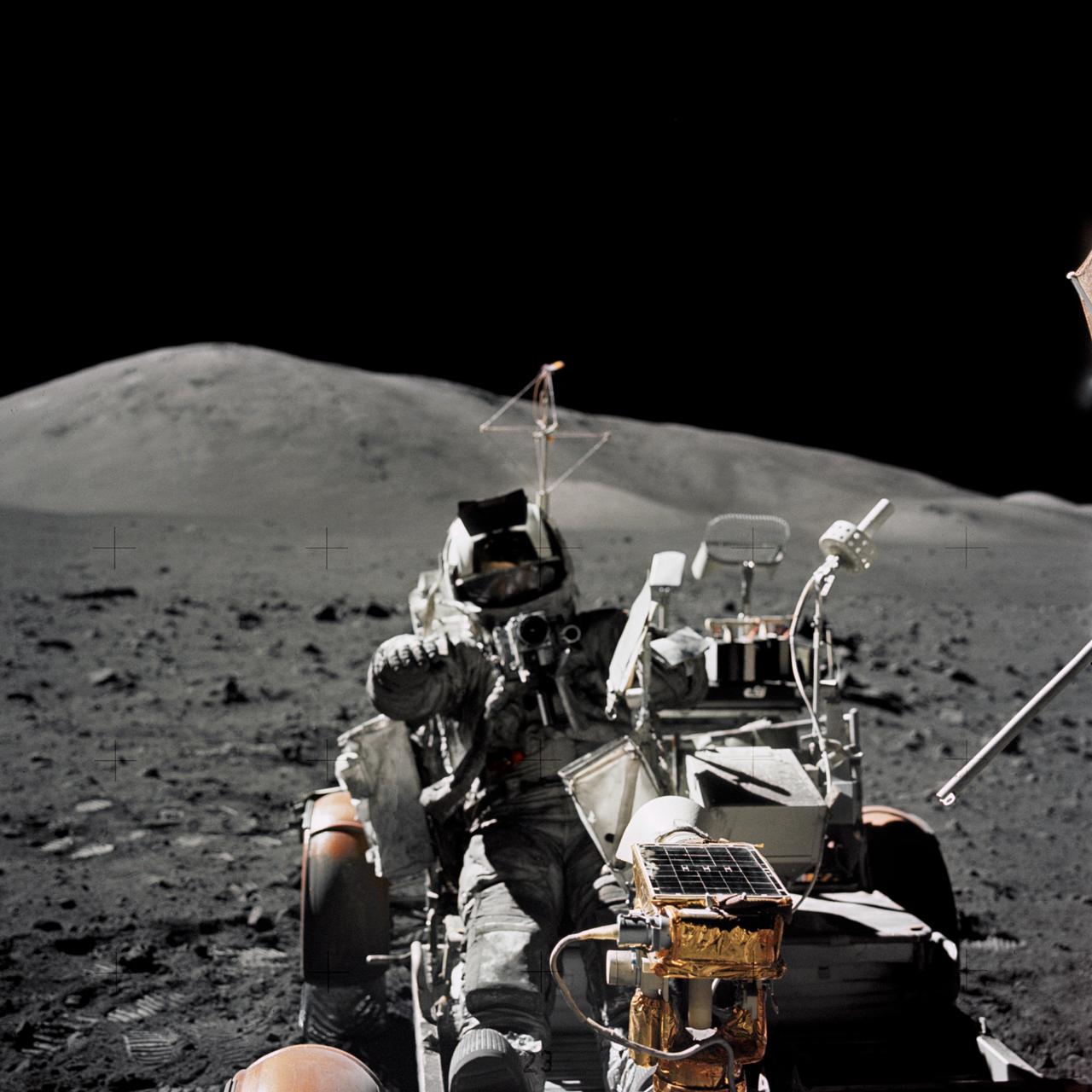
AS17-134-20454 (13 Dec. 1972) --- Scientist-astronaut Harrison H. Schmitt is photographed seated in the Lunar Roving Vehicle (LRV) at Station 9 (Van Serg Crater) during the third Apollo 17 extravehicular activity (EVA) at the Taurus-Littrow landing site. This photograph was taken by astronaut Eugene A. Cernan, commander. Schmitt, lunar module pilot, and Cernan explored the moon while astronaut Ronald E. Evans, command module pilot, remained with the Command and Service Modules in lunar orbit.
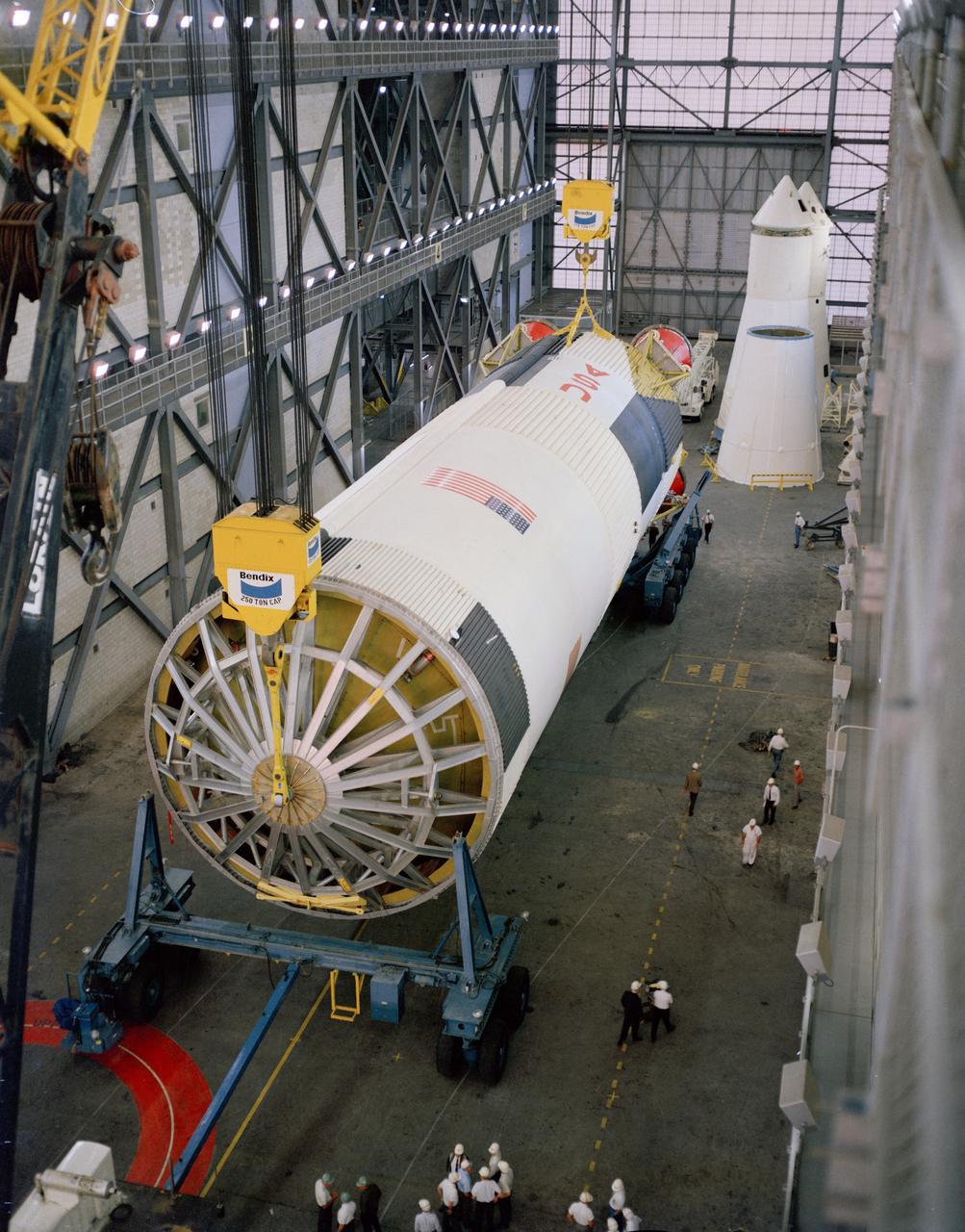
S68-55034 (3 Dec. 1968) --- The first (S-1C) stage of the Saturn 505 launch vehicle being prepared for erection in the high bay area of the Kennedy Space Center's (KSC) Vehicle Assembly Building (VAB). Saturn 505 is the launch vehicle for the Apollo 10 mission.
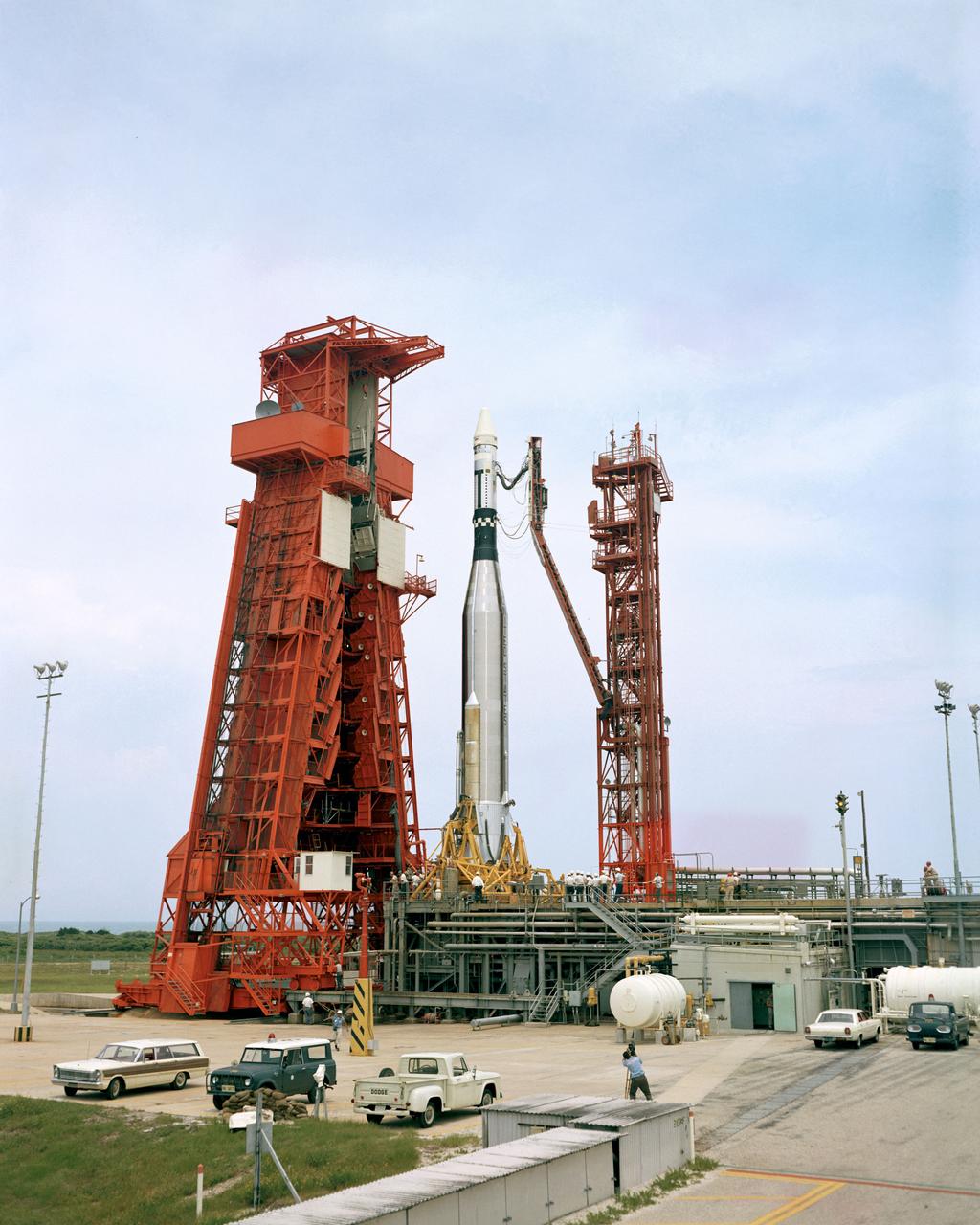
S66-42739 (18 July 1966) --- An Agena Target Docking Vehicle atop its Atlas launch vehicle during prelaunch preparations at Launch Complex 14. The Agena will be a rendezvous and docking vehicle for the Gemini-10 spaceflight. The Agena was launched on July 18, 1966, at 3:39 p.m. (EST). Photo credit: NASA
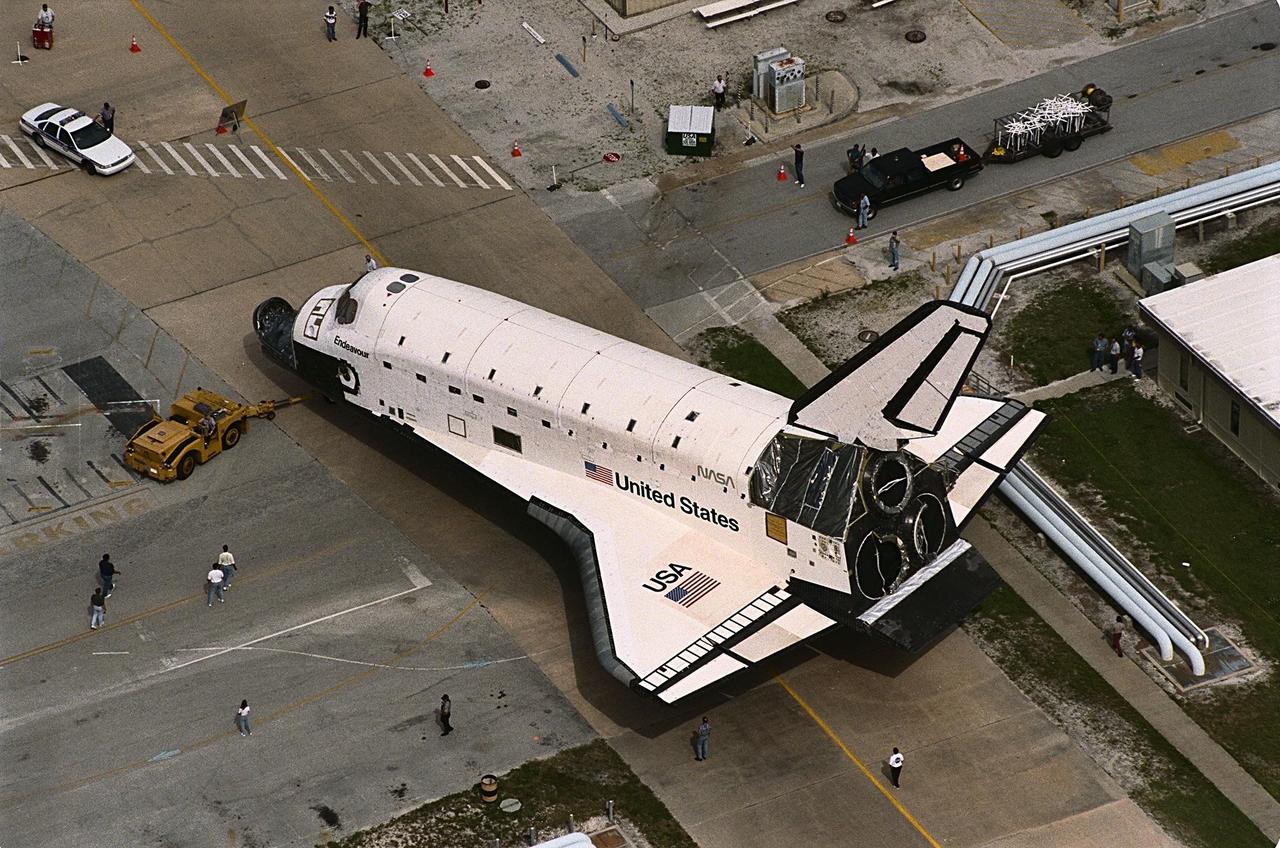
Endeavour moved from the Orbiter Processing Facility, bay 3, for temporary storage in the Vehicle Assembly Building to make room for the return of Atlantis on May 24, 1997
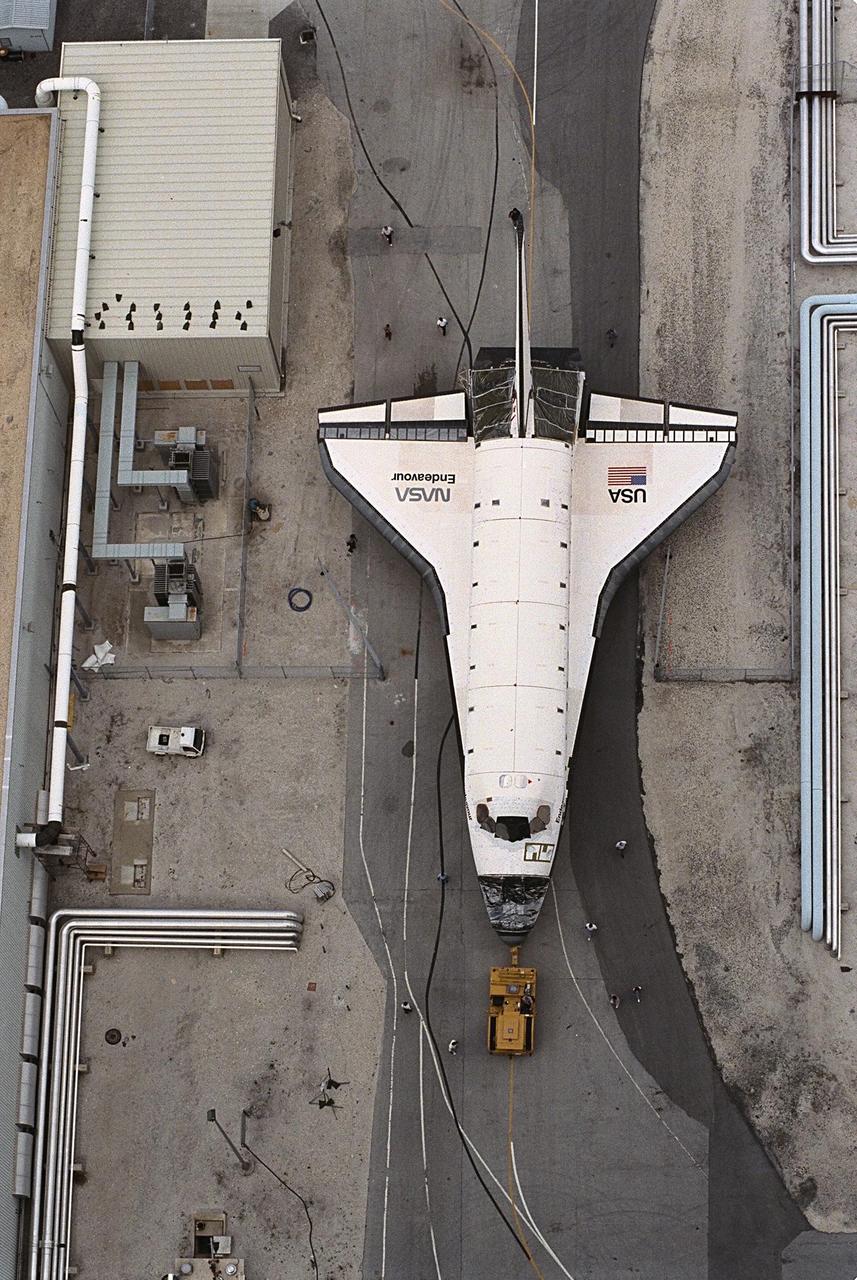
Endeavour moved from the Orbiter Processing Facility, bay 3, for temporary storage in the Vehicle Assembly Building to make room for the return of Atlantis on May 24, 1997