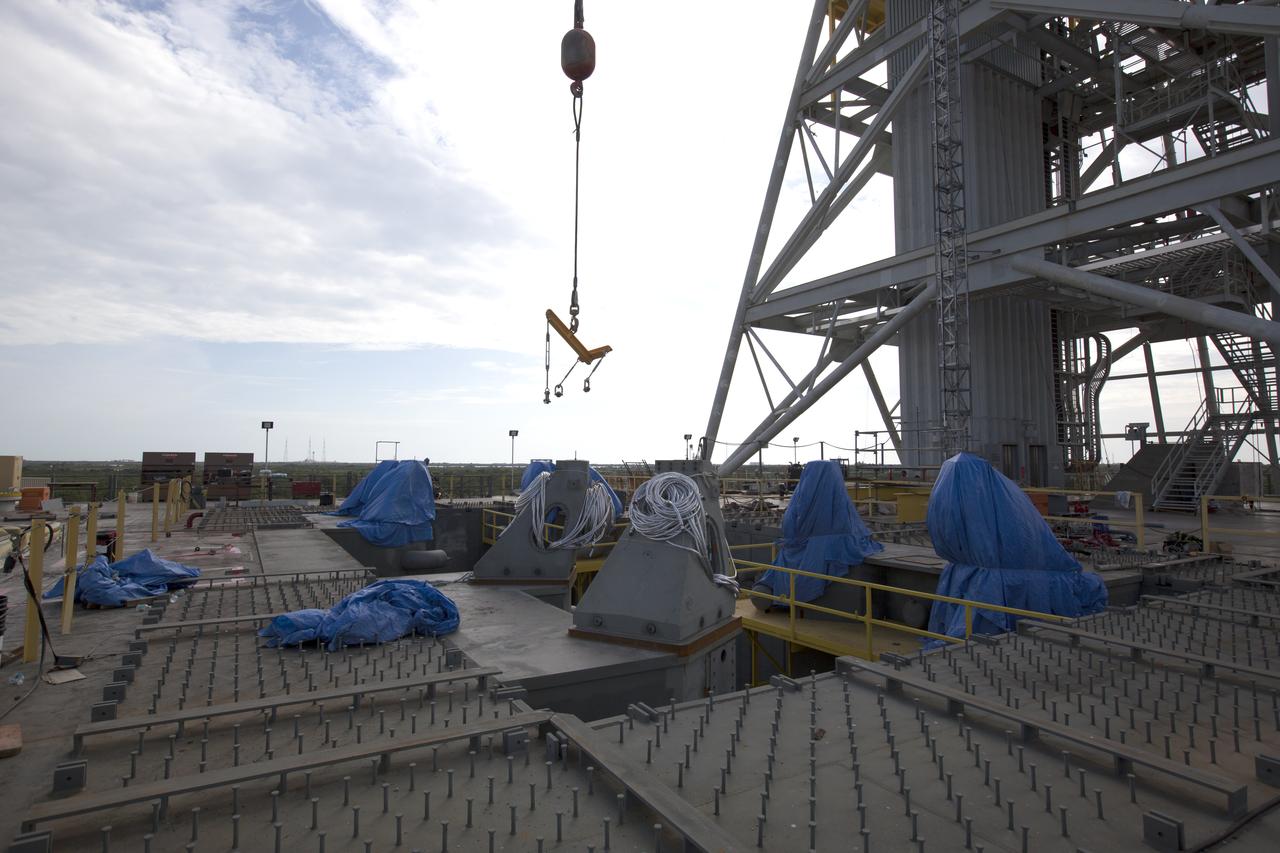
At NASA's Kennedy Space Center in Florida, the final four vehicle support posts are being installed on the deck of the mobile launcher. A total of eight support posts are being installed to support the load of the Space Launch System's (SLS) solid rocket boosters, with four posts for each of the boosters. The support posts are about five feet tall and each weigh about 10,000 pounds. The posts will structurally support the SLS rocket through T-0 and liftoff, and will drop down before vehicle liftoff to avoid contact with the flight hardware. The Ground Systems Development and Operations Program is overseeing installation of the support posts to prepare for the launch of the Orion spacecraft atop the SLS rocket.
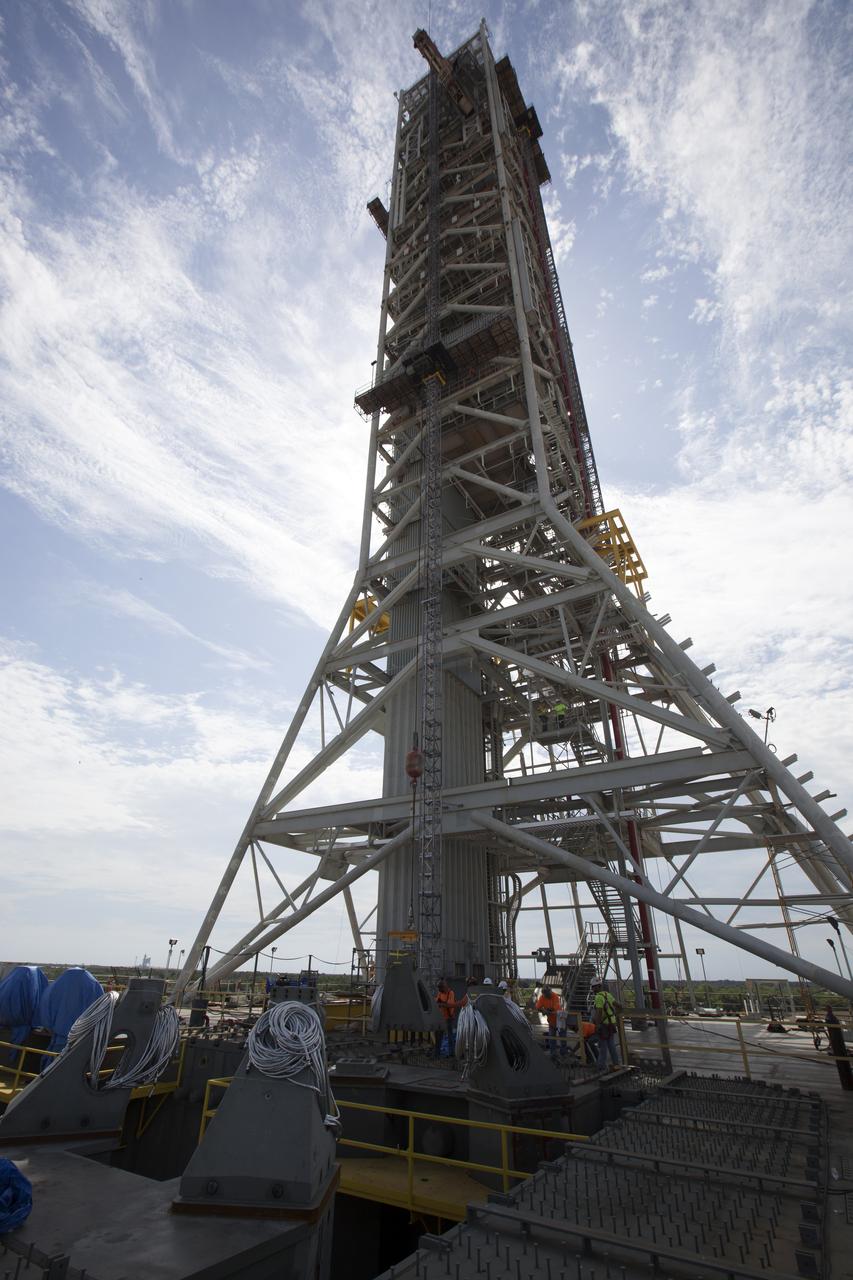
Construction workers on the deck of the mobile launcher at NASA's Kennedy Space Center in Florida, prepare to install a vehicle support post. A total of eight support posts are being installed to support the load of the Space Launch System's (SLS) solid rocket boosters, with four posts for each of the boosters. The support posts are about five feet tall and each weigh about 10,000 pounds. The posts will structurally support the SLS rocket through T-0 and liftoff, and will drop down before vehicle liftoff to avoid contact with the flight hardware. The Ground Systems Development and Operations Program is overseeing installation of the support posts to prepare for the launch of the Orion spacecraft atop the SLS rocket.
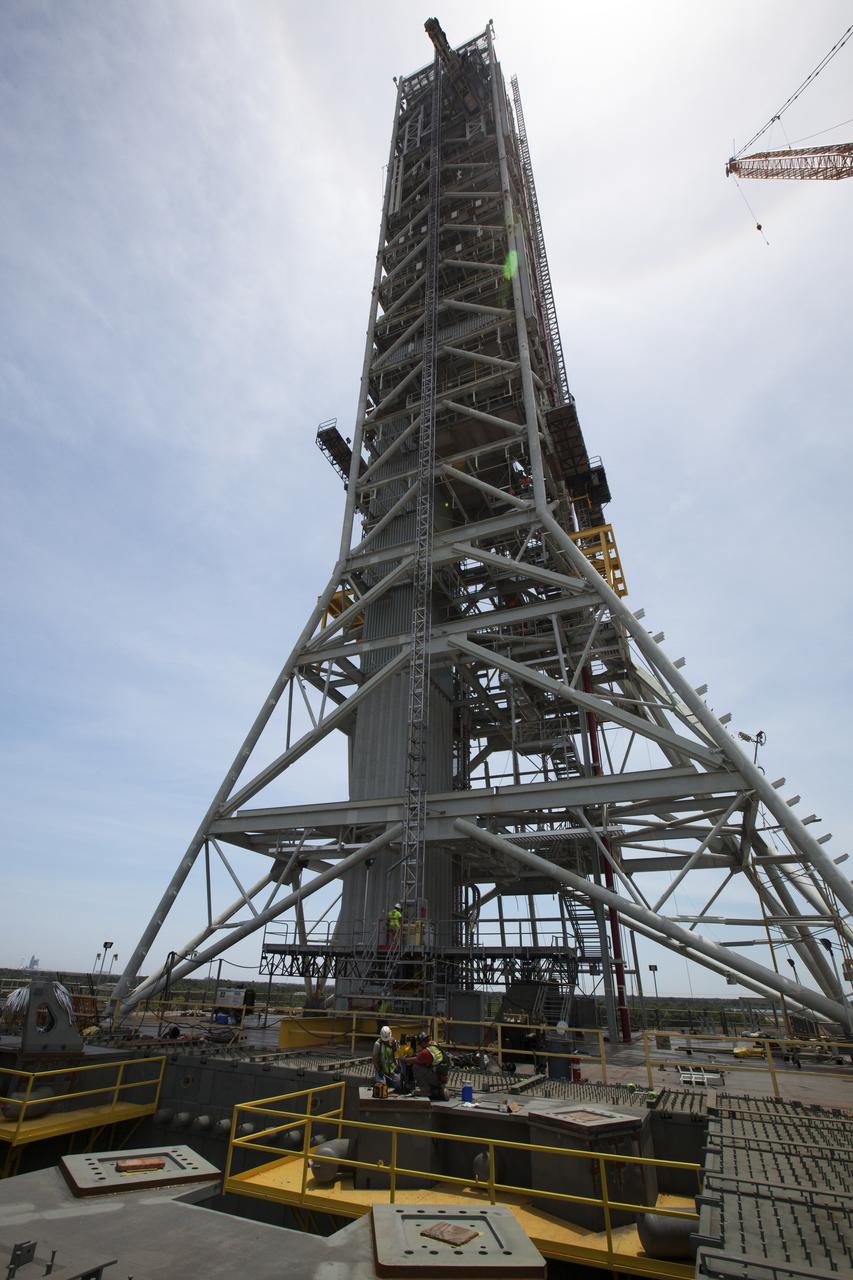
Construction workers on the deck of the mobile launcher at NASA's Kennedy Space Center in Florida, prepare a platform for installation of a vehicle support post. A total of eight support posts will be installed to support the load of the Space Launch System's (SLS) solid rocket boosters, with four posts for each of the boosters. The support posts are about five feet tall and each weigh about 10,000 pounds. The posts will structurally support the SLS rocket through T-0 and liftoff, and will drop down before vehicle liftoff to avoid contact with the flight hardware. The Ground Systems Development and Operations Program is overseeing installation of the support posts to prepare for the launch of the Orion spacecraft atop the SLS rocket.
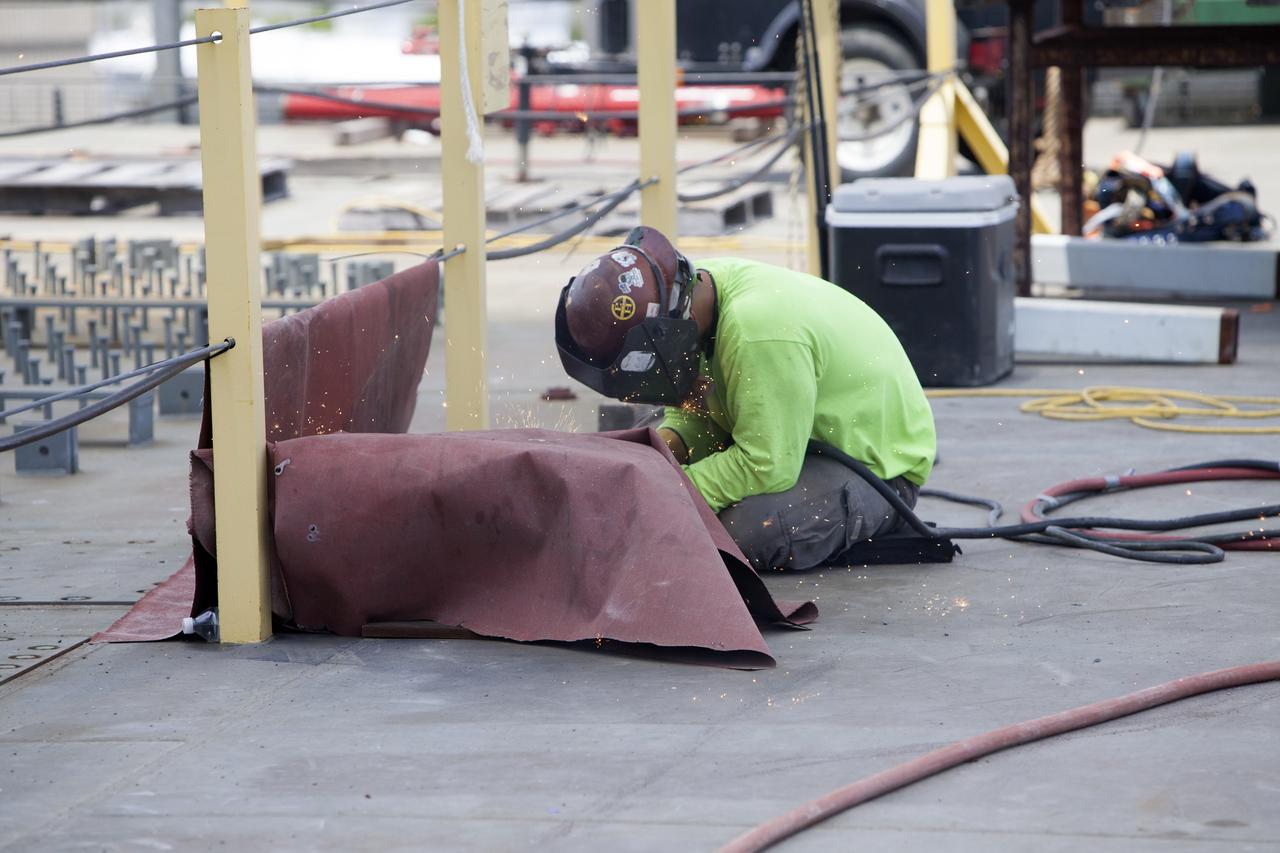
A construction worker on the deck of the mobile launcher welds a portion of a platform for installation of a vehicle support post at NASA's Kennedy Space Center in Florida. A total of eight support posts will be installed to support the load of the Space Launch System's (SLS) solid rocket boosters, with four posts for each of the boosters. The support posts are about five feet tall and each weigh about 10,000 pounds. The posts will structurally support the SLS rocket through T-0 and liftoff, and will drop down before vehicle liftoff to avoid contact with the flight hardware. The Ground Systems Development and Operations Program is overseeing installation of the support posts to prepare for the launch of the Orion spacecraft atop the SLS rocket.
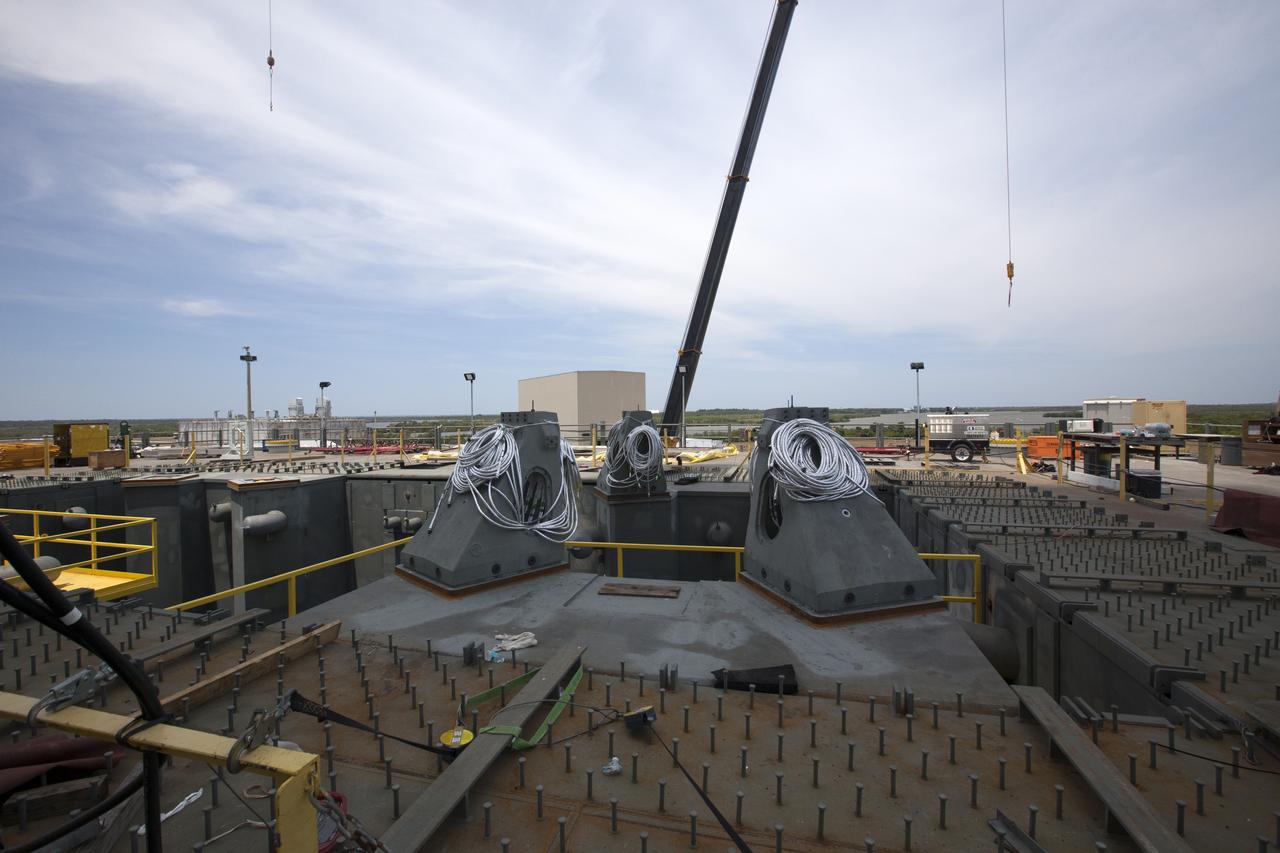
In view are three vehicle support posts installed on the deck of the mobile launcher at NASA's Kennedy Space Center in Florida. A total of eight support posts will be installed to support the load of the Space Launch System's (SLS) solid rocket boosters, with four posts for each of the boosters. The support posts are about five feet tall and each weigh about 10,000 pounds. The posts will structurally support the SLS rocket through T-0 and liftoff, and will drop down before vehicle liftoff to avoid contact with the flight hardware. The Ground Systems Development and Operations Program is overseeing installation of the support posts to prepare for the launch of the Orion spacecraft atop the SLS rocket.

Four vehicle support posts have been installed on the deck of the mobile launcher at NASA's Kennedy Space Center in Florida. A total of eight support posts will be installed to support the load of the Space Launch System's (SLS) solid rocket boosters, with four posts for each of the boosters. The support posts are about five feet tall and each weigh about 10,000 pounds. The posts will structurally support the SLS rocket through T-0 and liftoff, and will drop down before vehicle liftoff to avoid contact with the flight hardware. The Ground Systems Development and Operations Program is overseeing installation of the support posts to prepare for the launch of the Orion spacecraft atop the SLS rocket.
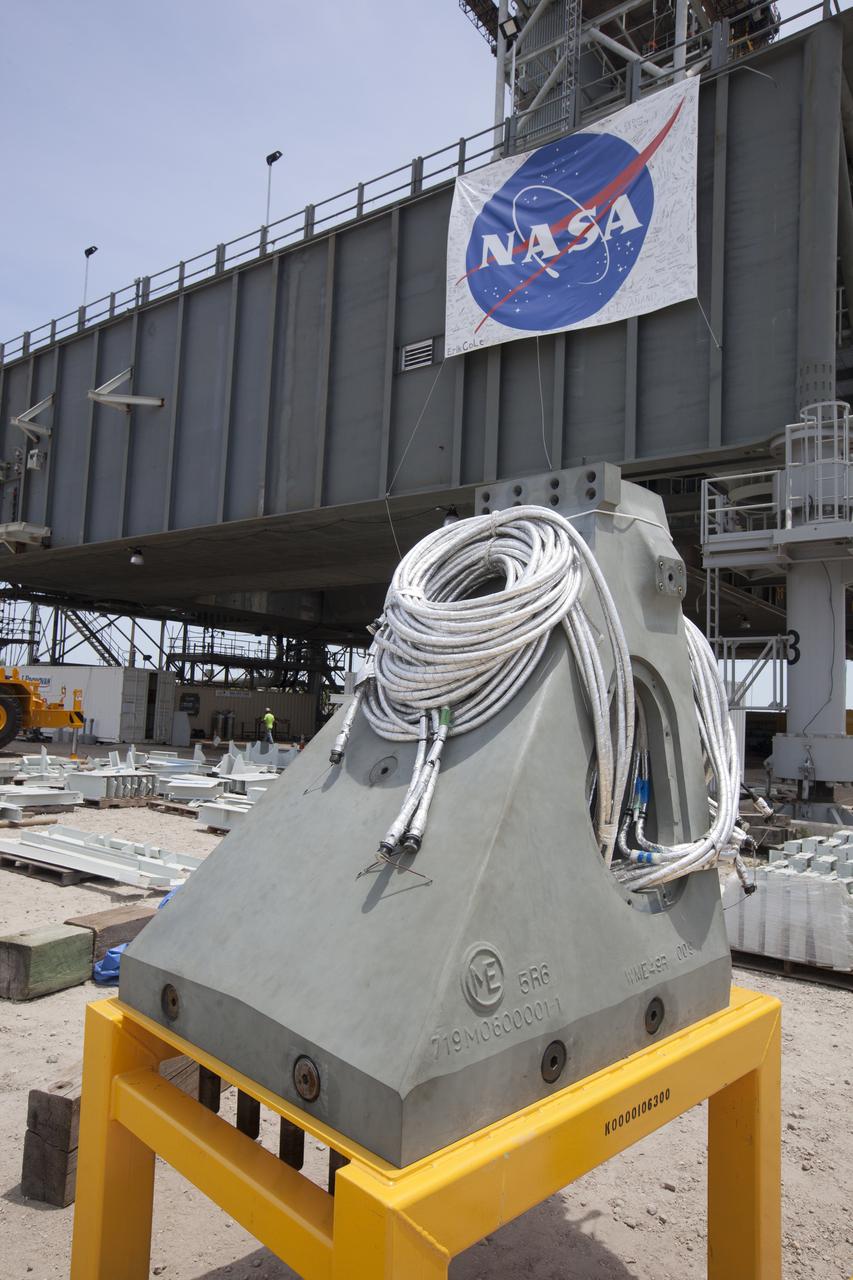
A vehicle support post will be lifted up by crane and lowered onto the deck of the mobile launcher at NASA's Kennedy Space Center in Florida. A total of eight support posts will be installed to support the load of the Space Launch System's (SLS) solid rocket boosters, with four posts for each of the boosters. The support posts are about five feet tall and each weigh about 10,000 pounds. The posts will structurally support the SLS rocket through T-0 and liftoff, and will drop down before vehicle liftoff to avoid contact with the flight hardware. The Ground Systems Development and Operations Program is overseeing installation of the support posts to prepare for the launch of the Orion spacecraft atop the SLS rocket.
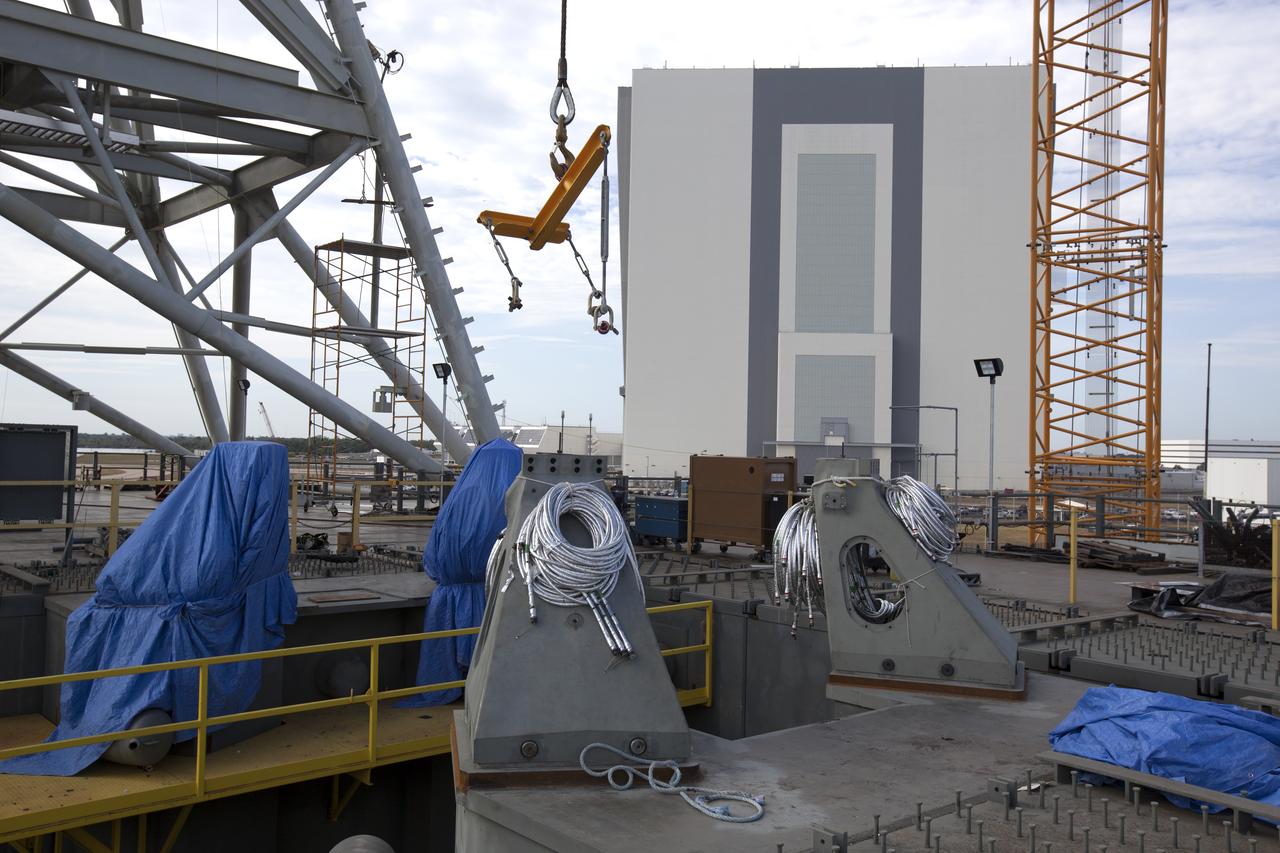
At NASA's Kennedy Space Center in Florida, the final four vehicle support posts are being installed on the deck of the mobile launcher. A total of eight support posts are being installed to support the load of the Space Launch System's (SLS) solid rocket boosters, with four posts for each of the boosters. The support posts are about five feet tall and each weigh about 10,000 pounds. The posts will structurally support the SLS rocket through T-0 and liftoff, and will drop down before vehicle liftoff to avoid contact with the flight hardware. The Ground Systems Development and Operations Program is overseeing installation of the support posts to prepare for the launch of the Orion spacecraft atop the SLS rocket.
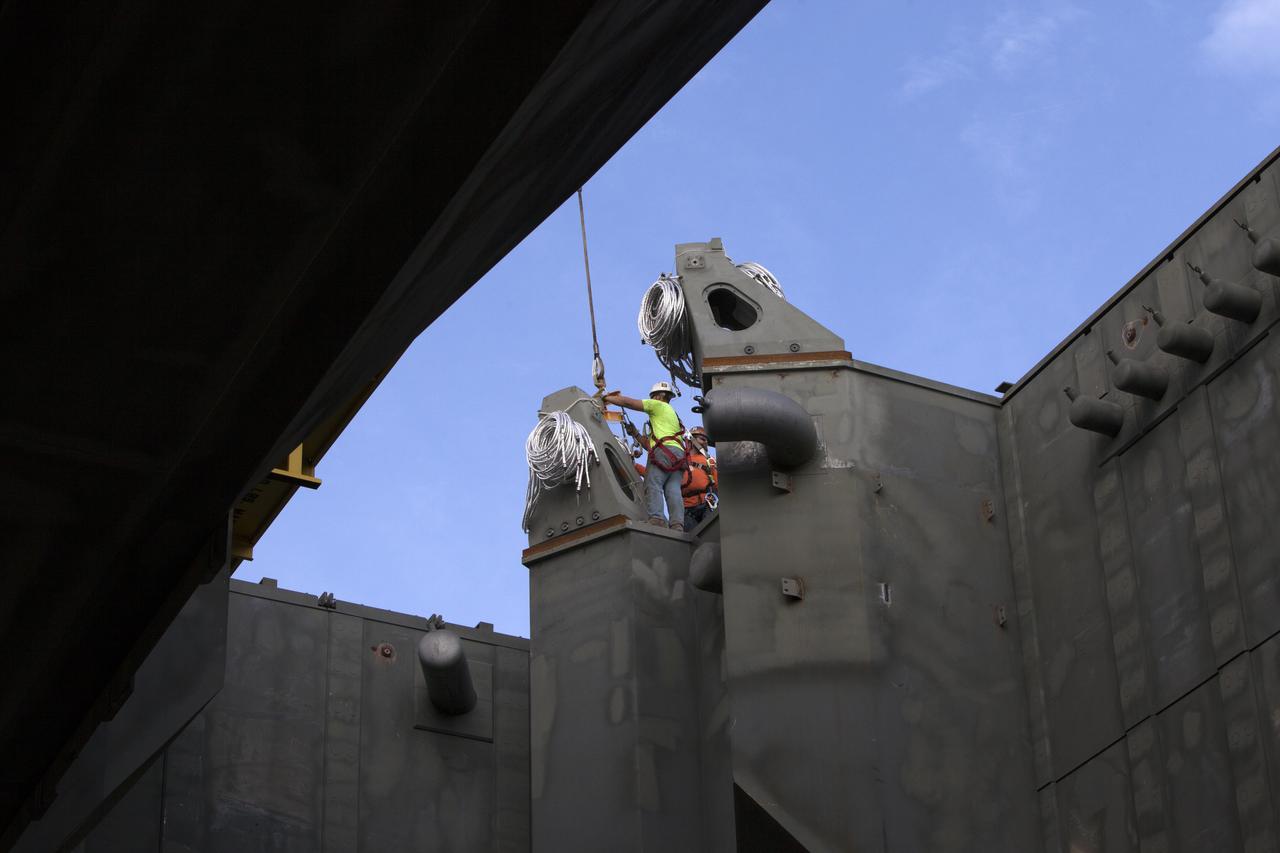
At NASA's Kennedy Space Center in Florida, construction workers on the deck of the mobile launcher install the final four vehicle support posts. A total of eight support posts are being installed to support the load of the Space Launch System's (SLS) solid rocket boosters, with four posts for each of the boosters. The support posts are about five feet tall and each weigh about 10,000 pounds. The posts will structurally support the SLS rocket through T-0 and liftoff, and will drop down before vehicle liftoff to avoid contact with the flight hardware. The Ground Systems Development and Operations Program is overseeing installation of the support posts to prepare for the launch of the Orion spacecraft atop the SLS rocket.
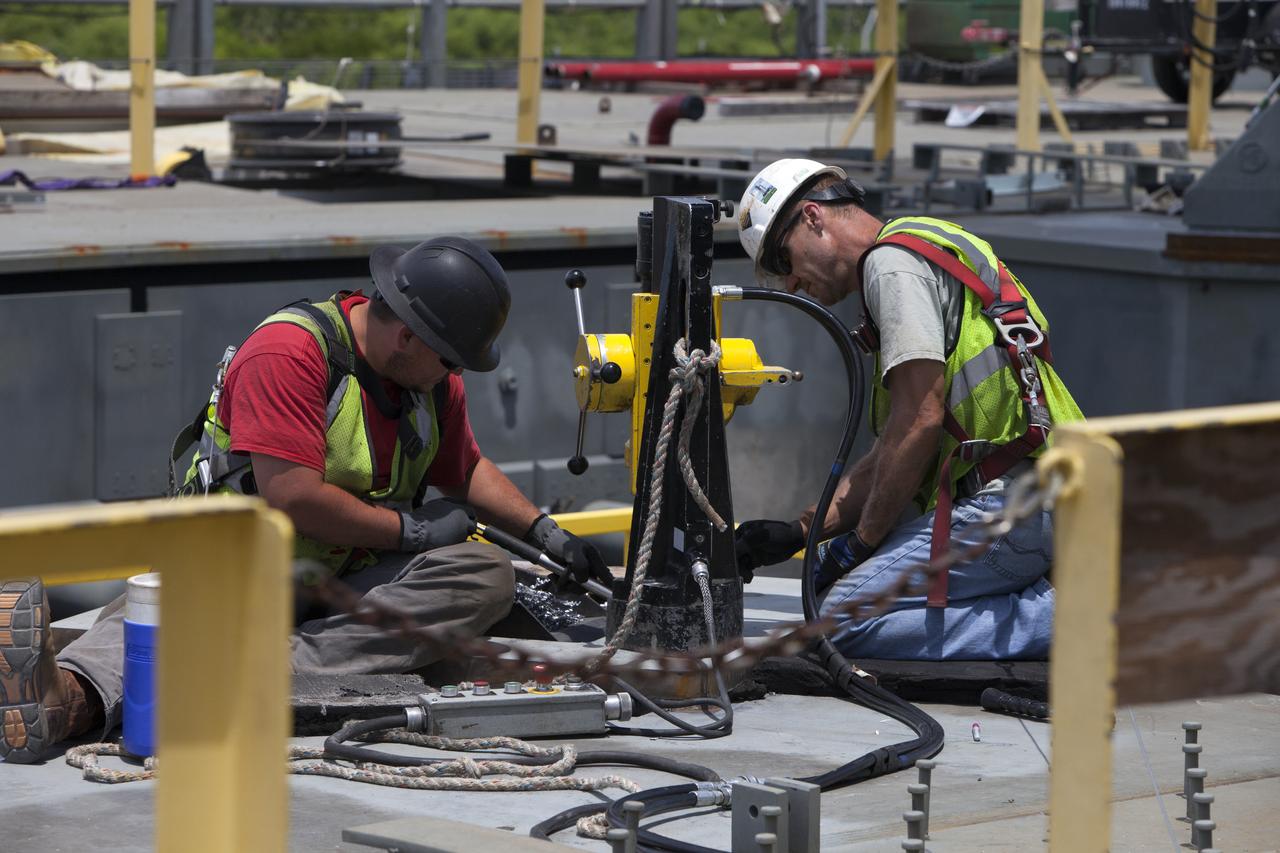
Construction workers on the deck of the mobile launcher at NASA's Kennedy Space Center in Florida, prepare a platform for installation of a vehicle support post. A total of eight support posts will be installed to support the load of the Space Launch System's (SLS) solid rocket boosters, with four posts for each of the boosters. The support posts are about five feet tall and each weigh about 10,000 pounds. The posts will structurally support the SLS rocket through T-0 and liftoff, and will drop down before vehicle liftoff to avoid contact with the flight hardware. The Ground Systems Development and Operations Program is overseeing installation of the support posts to prepare for the launch of the Orion spacecraft atop the SLS rocket.
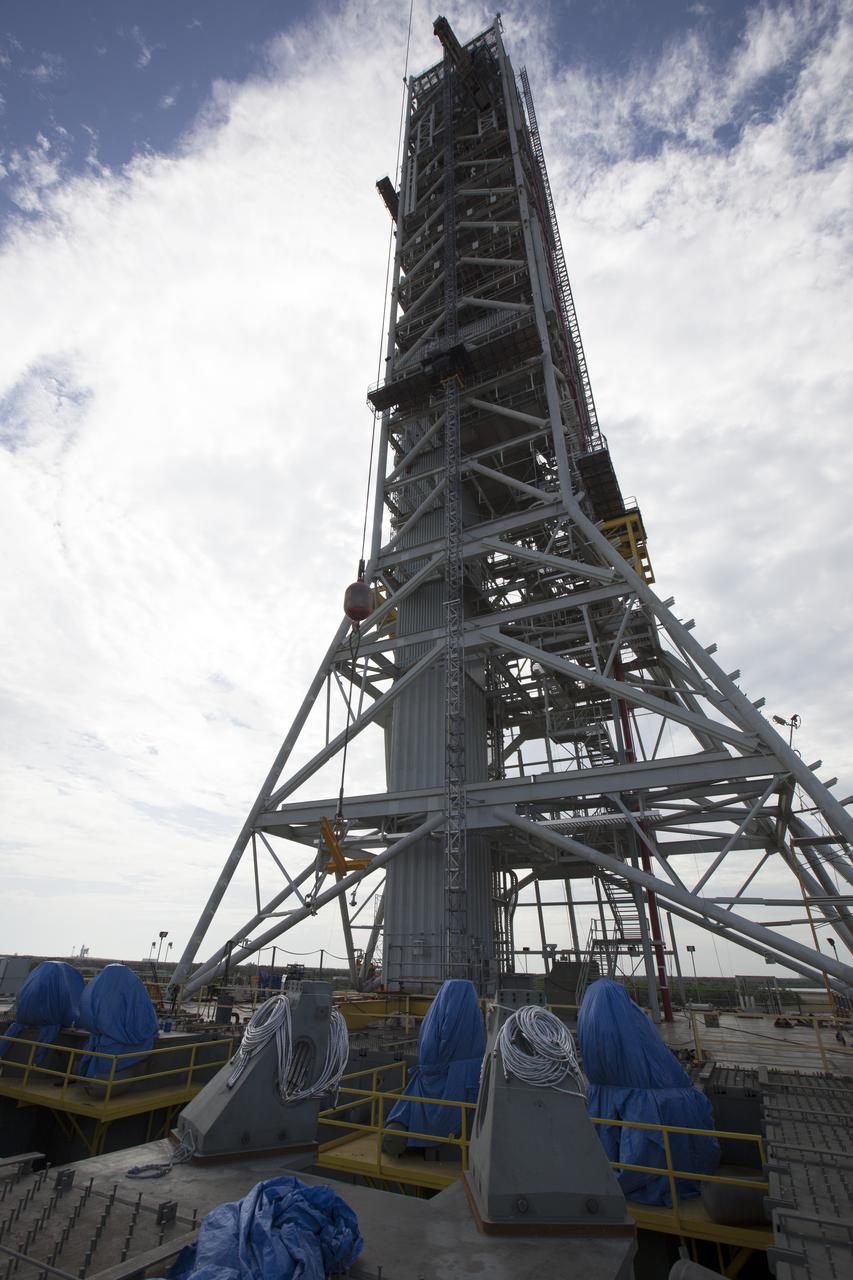
At NASA's Kennedy Space Center in Florida, the final four vehicle support posts are being installed on the deck of the mobile launcher. A total of eight support posts are being installed to support the load of the Space Launch System's (SLS) solid rocket boosters, with four posts for each of the boosters. The support posts are about five feet tall and each weigh about 10,000 pounds. The posts will structurally support the SLS rocket through T-0 and liftoff, and will drop down before vehicle liftoff to avoid contact with the flight hardware. The Ground Systems Development and Operations Program is overseeing installation of the support posts to prepare for the launch of the Orion spacecraft atop the SLS rocket.
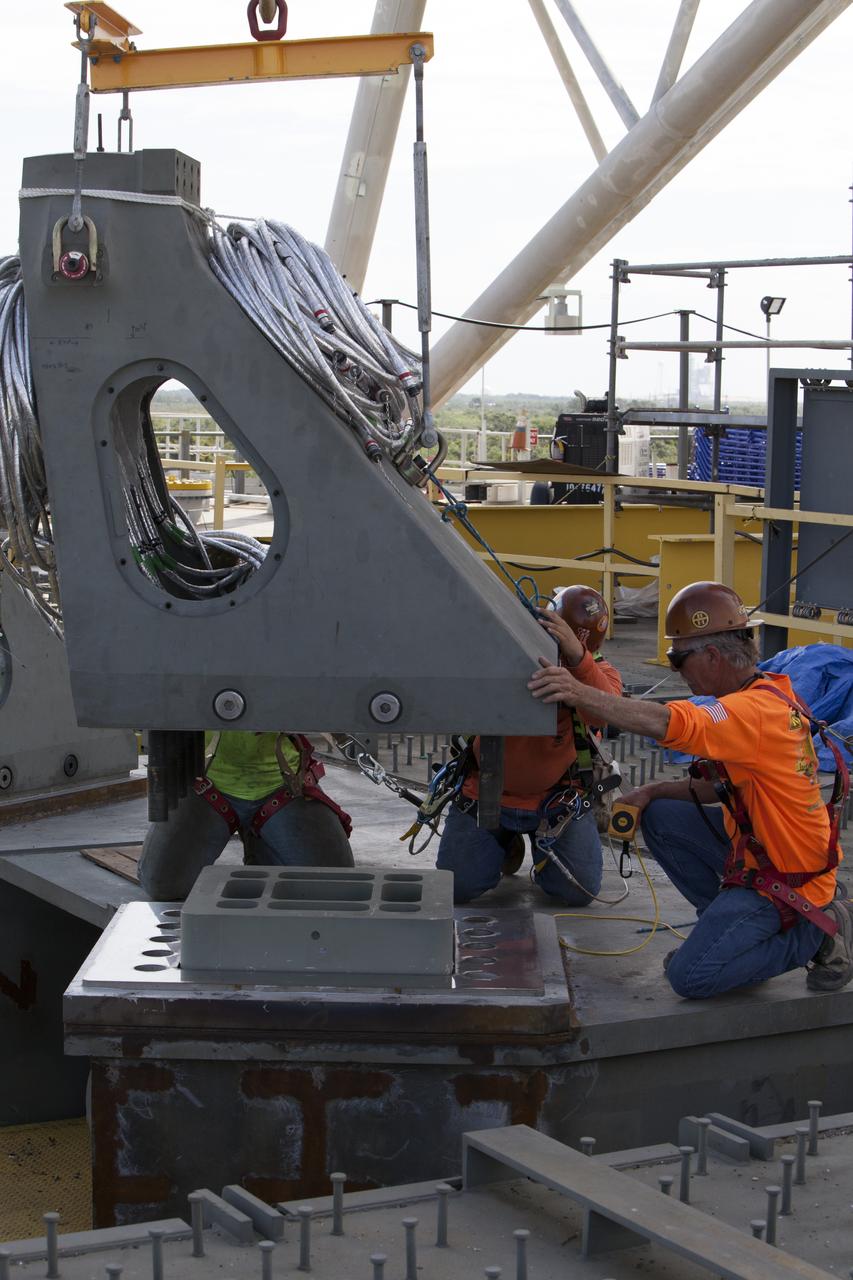
Construction workers on the deck of the mobile launcher at NASA's Kennedy Space Center in Florida, prepare to install a vehicle support post. A total of eight support posts are being installed to support the load of the Space Launch System's (SLS) solid rocket boosters, with four posts for each of the boosters. The support posts are about five feet tall and each weigh about 10,000 pounds. The posts will structurally support the SLS rocket through T-0 and liftoff, and will drop down before vehicle liftoff to avoid contact with the flight hardware. The Ground Systems Development and Operations Program is overseeing installation of the support posts to prepare for the launch of the Orion spacecraft atop the SLS rocket.
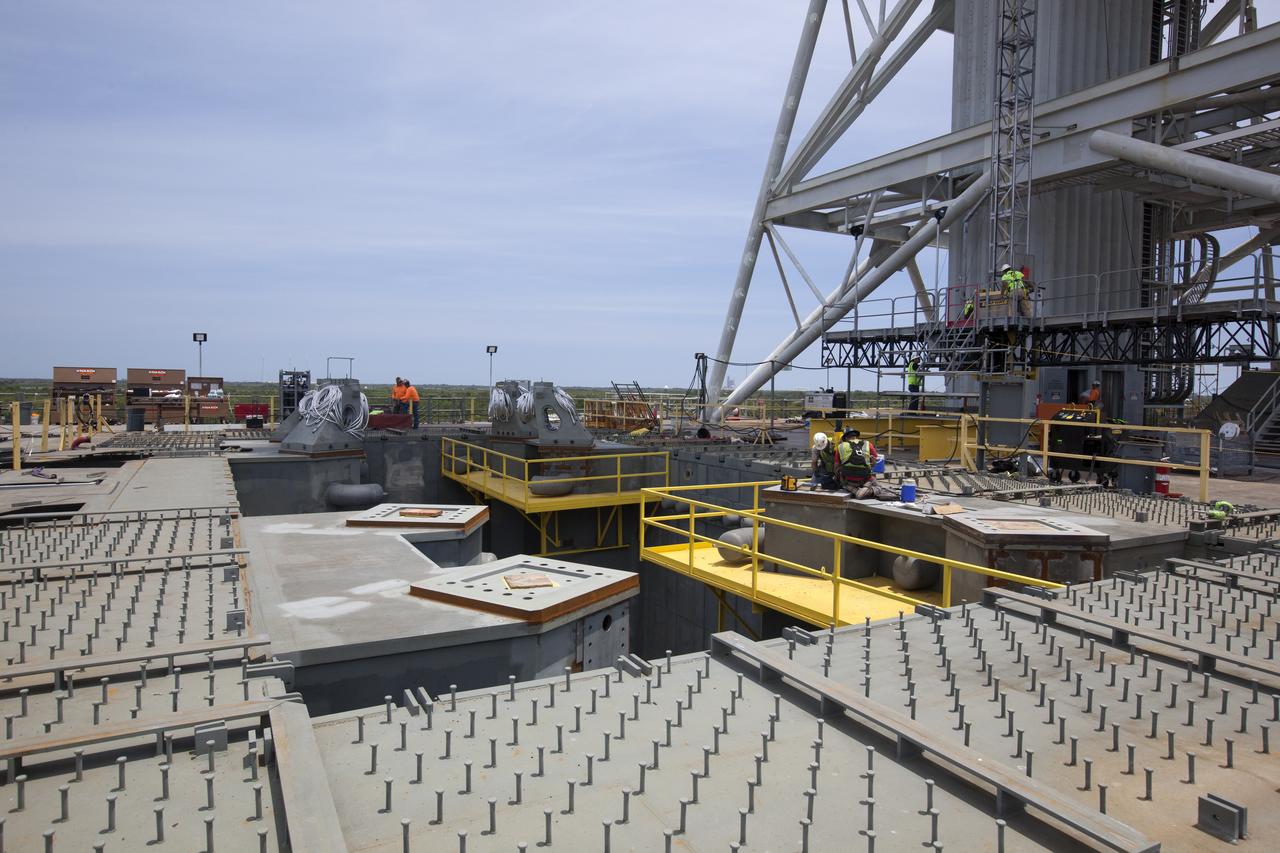
Construction workers on the deck of the mobile launcher prepare the platforms for installation of vehicle support posts at NASA's Kennedy Space Center in Florida. At left, four of the support posts are installed. A total of eight support posts will be installed to support the load of the Space Launch System's (SLS) solid rocket boosters, with four posts for each of the boosters. The support posts are about five feet tall and each weigh about 10,000 pounds. The posts will structurally support the SLS rocket through T-0 and liftoff, and will drop down before vehicle liftoff to avoid contact with the flight hardware. The Ground Systems Development and Operations Program is overseeing installation of the support posts to prepare for the launch of the Orion spacecraft atop the SLS rocket.
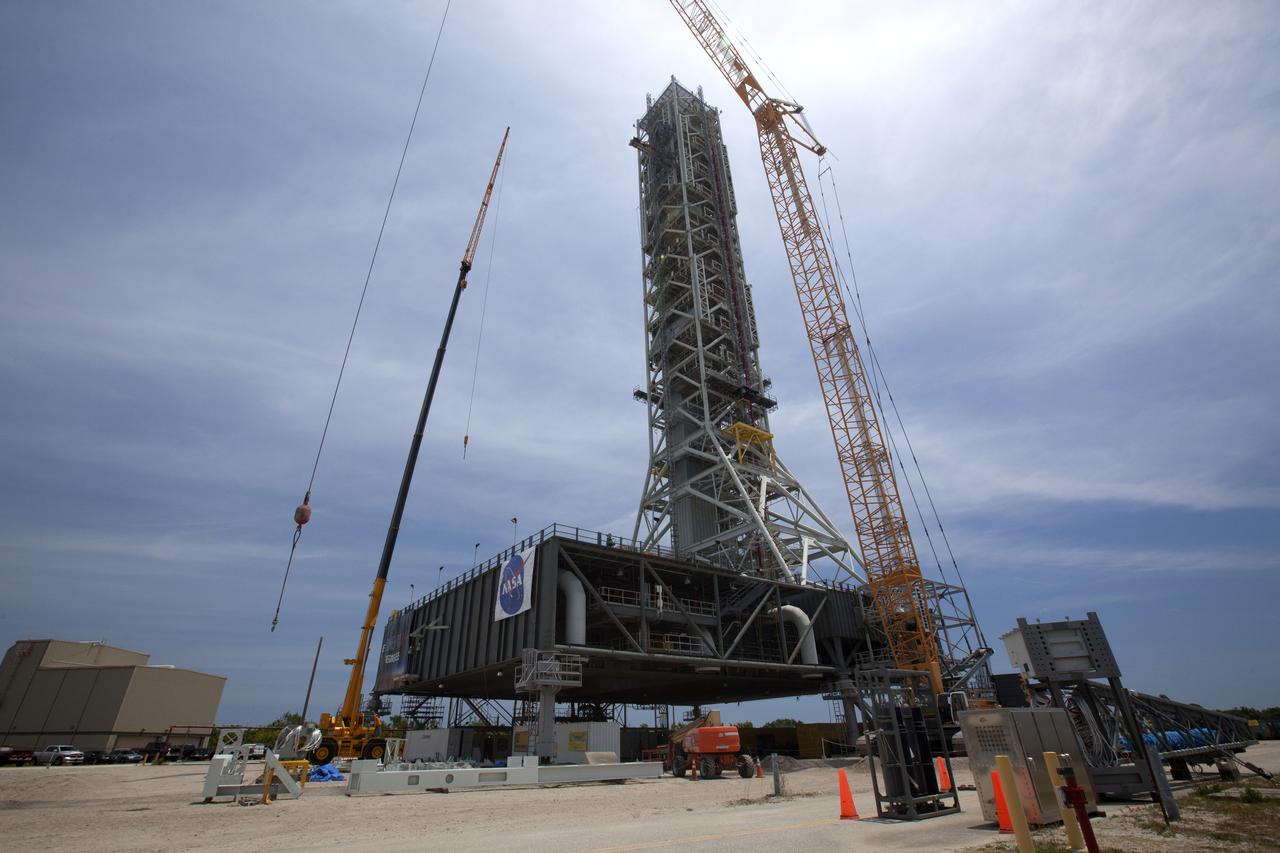
Several heavy lift cranes surround the mobile launcher at NASA's Kennedy Space Center in Florida. Preparations are underway to lift a vehicle support post up and onto the mobile launcher for installation on the deck. A total of eight support posts will be installed to support the load of the Space Launch System's (SLS) solid rocket boosters, with four posts for each of the boosters. The support posts are about five feet tall and each weigh about 10,000 pounds. The posts will structurally support the SLS rocket through T-0 and liftoff, and will drop down before vehicle liftoff to avoid contact with the flight hardware. The Ground Systems Development and Operations Program is overseeing installation of the support posts to prepare for the launch of the Orion spacecraft atop the SLS rocket.
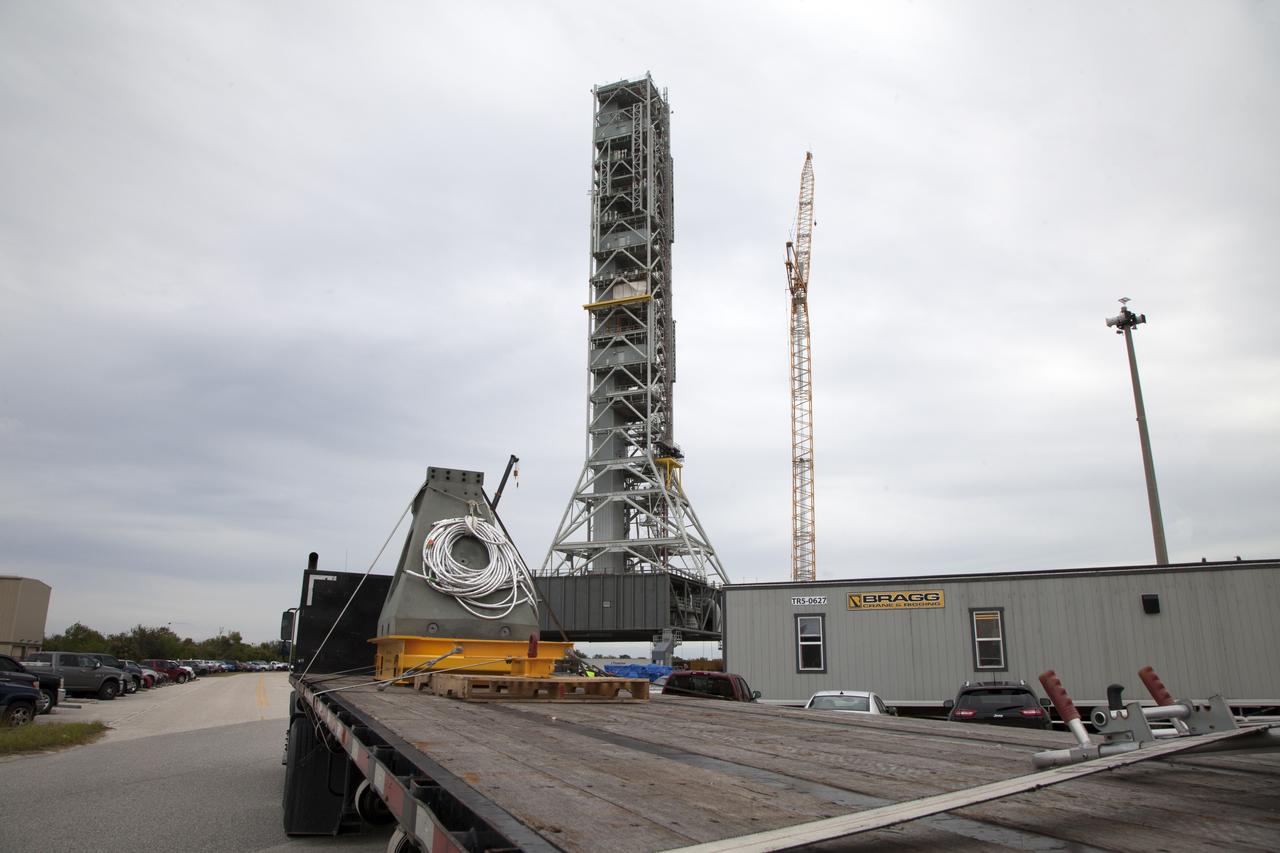
A flatbed truck carries a vertical support post (VSP) for NASA's Space Launch System (SLS) rocket to the Mobile Launcher Yard at NASA's Kennedy Space Center in Florida. The two aft skirt electrical umbilicals (ASEUs) and the first of the vehicle support posts underwent a series of tests to confirm they are functioning properly and ready to support the SLS for launch. The ASEUs will connect to the SLS rocket at the bottom outer edge of each booster and provide electrical power and data connections to the rocket until it lifts off from the launch pad. The eight VSPs will support the load of the solid rocket boosters, with four posts for each of the boosters. The center’s Engineering Directorate and the Ground Systems Development and Operations Program are overseeing processing and testing of the umbilicals.
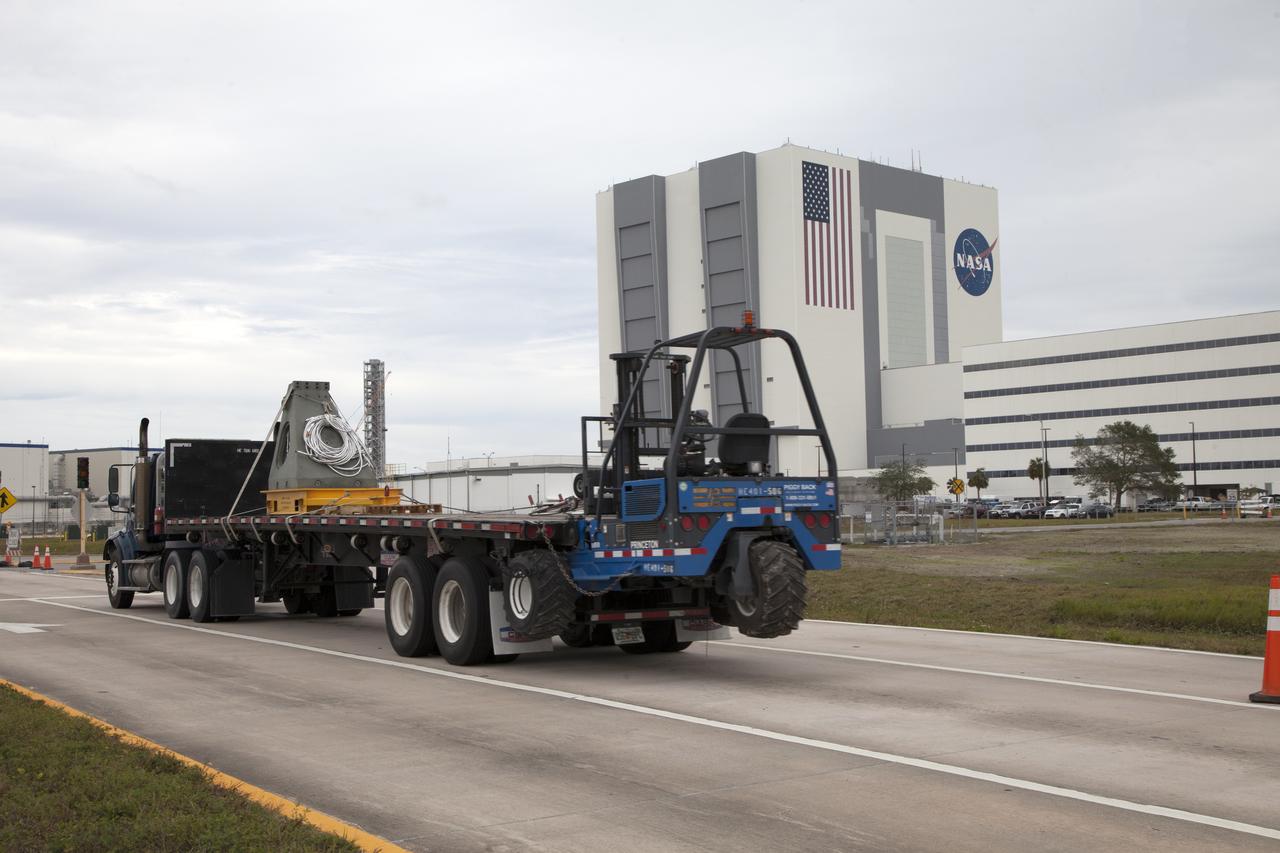
A flatbed truck carries a vertical support post (VSP) for NASA's Space Launch System (SLS) rocket to the Mobile Launcher Yard at NASA's Kennedy Space Center in Florida. The two aft skirt electrical umbilicals (ASEUs) and the first of the vehicle support posts underwent a series of tests to confirm they are functioning properly and ready to support the SLS for launch. The ASEUs will connect to the SLS rocket at the bottom outer edge of each booster and provide electrical power and data connections to the rocket until it lifts off from the launch pad. The eight VSPs will support the load of the solid rocket boosters, with four posts for each of the boosters. The center’s Engineering Directorate and the Ground Systems Development and Operations Program are overseeing processing and testing of the umbilicals.
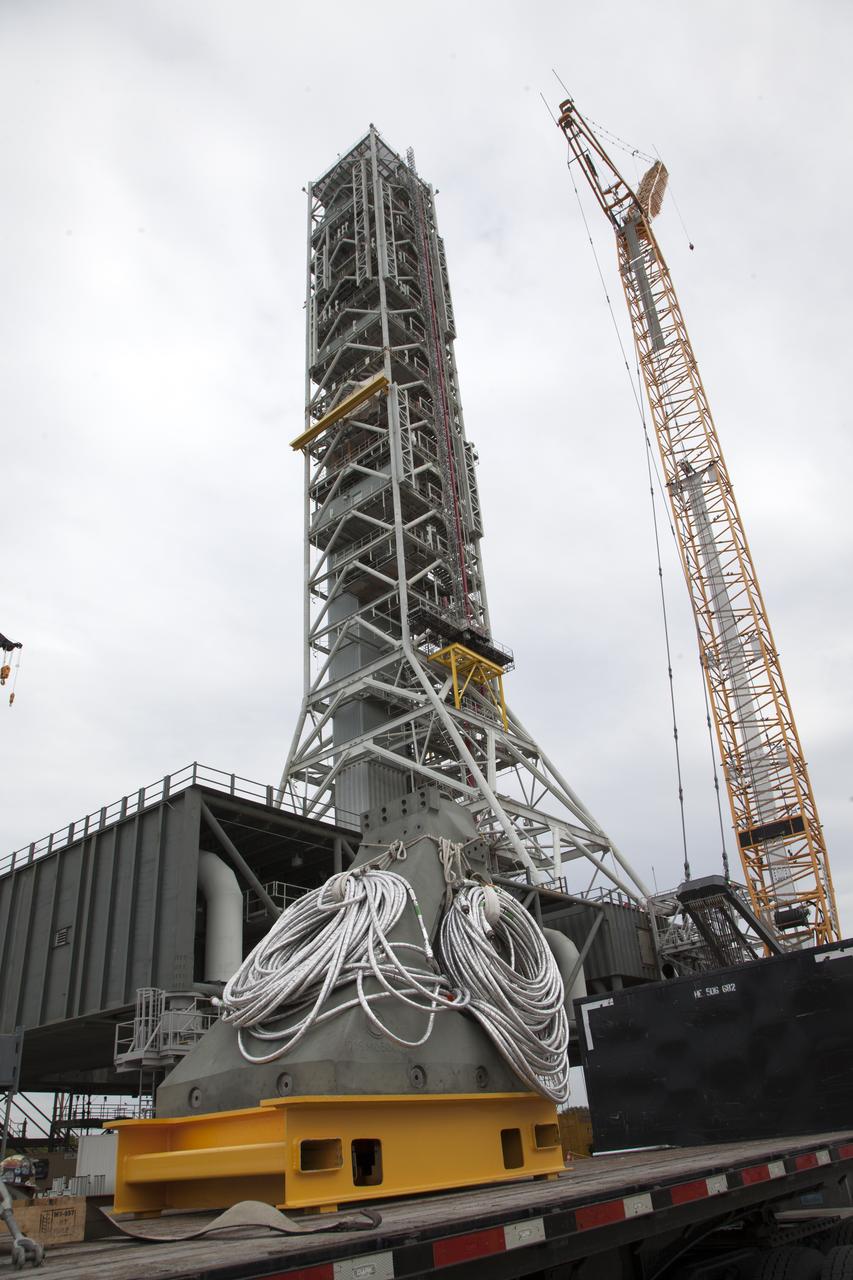
A flatbed truck carries a vertical support post (VSP) for NASA's Space Launch System (SLS) rocket to the Mobile Launcher Yard at NASA's Kennedy Space Center in Florida. In view is the mobile launcher. The two aft skirt electrical umbilicals (ASEUs) and the first of the vehicle support posts underwent a series of tests to confirm they are functioning properly and ready to support the SLS for launch. The ASEUs will connect to the SLS rocket at the bottom outer edge of each booster and provide electrical power and data connections to the rocket until it lifts off from the launch pad. The eight VSPs will support the load of the solid rocket boosters, with four posts for each of the boosters. The center’s Engineering Directorate and the Ground Systems Development and Operations Program are overseeing processing and testing of the umbilicals.
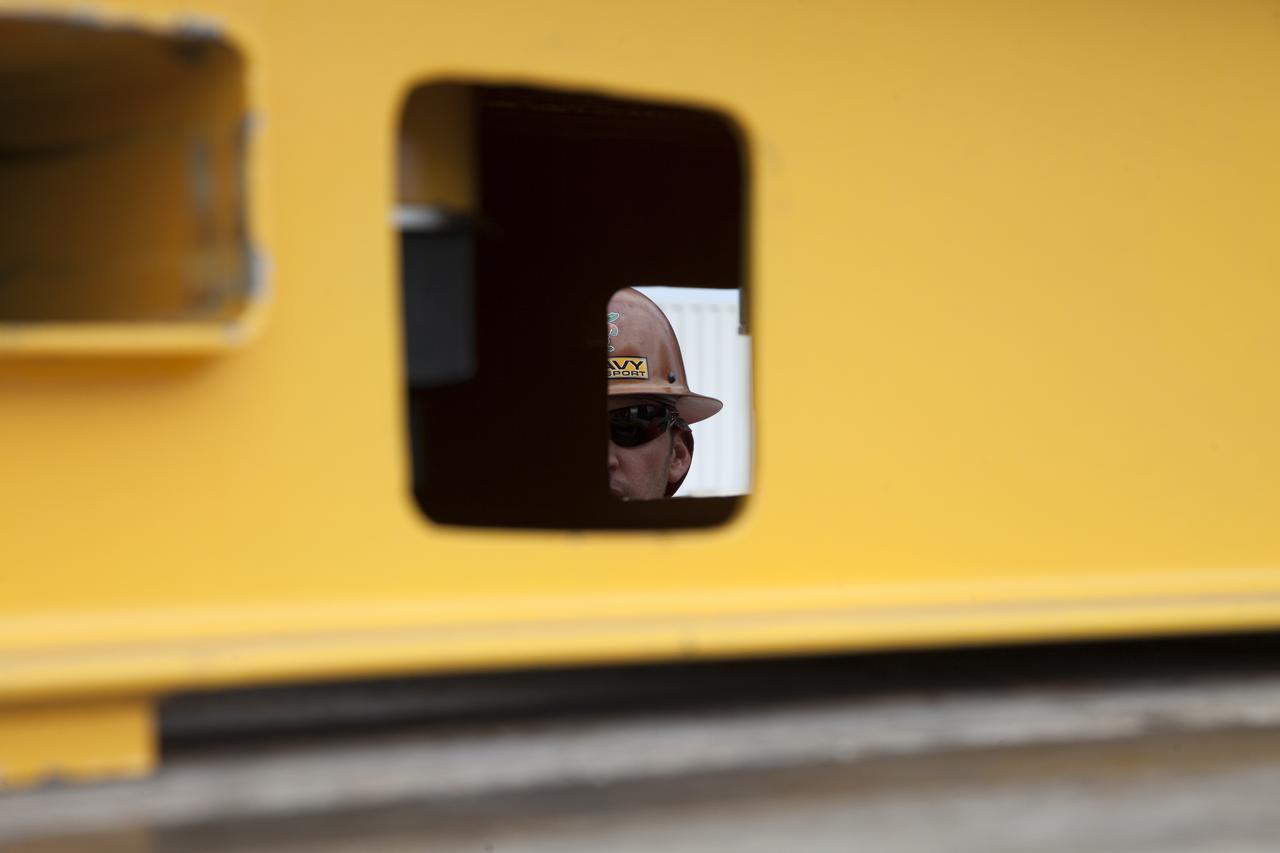
A construction worker is in view as a flatbed truck passes by carrying a vertical support post (VSP) for NASA's Space Launch System (SLS) rocket to the Mobile Launcher Yard at NASA's Kennedy Space Center in Florida. The two aft skirt electrical umbilicals (ASEUs) and the first of the vehicle support posts underwent a series of tests to confirm they are functioning properly and ready to support the SLS for launch. The ASEUs will connect to the SLS rocket at the bottom outer edge of each booster and provide electrical power and data connections to the rocket until it lifts off from the launch pad. The eight VSPs will support the load of the solid rocket boosters, with four posts for each of the boosters. The center’s Engineering Directorate and the Ground Systems Development and Operations Program are overseeing processing and testing of the umbilicals.
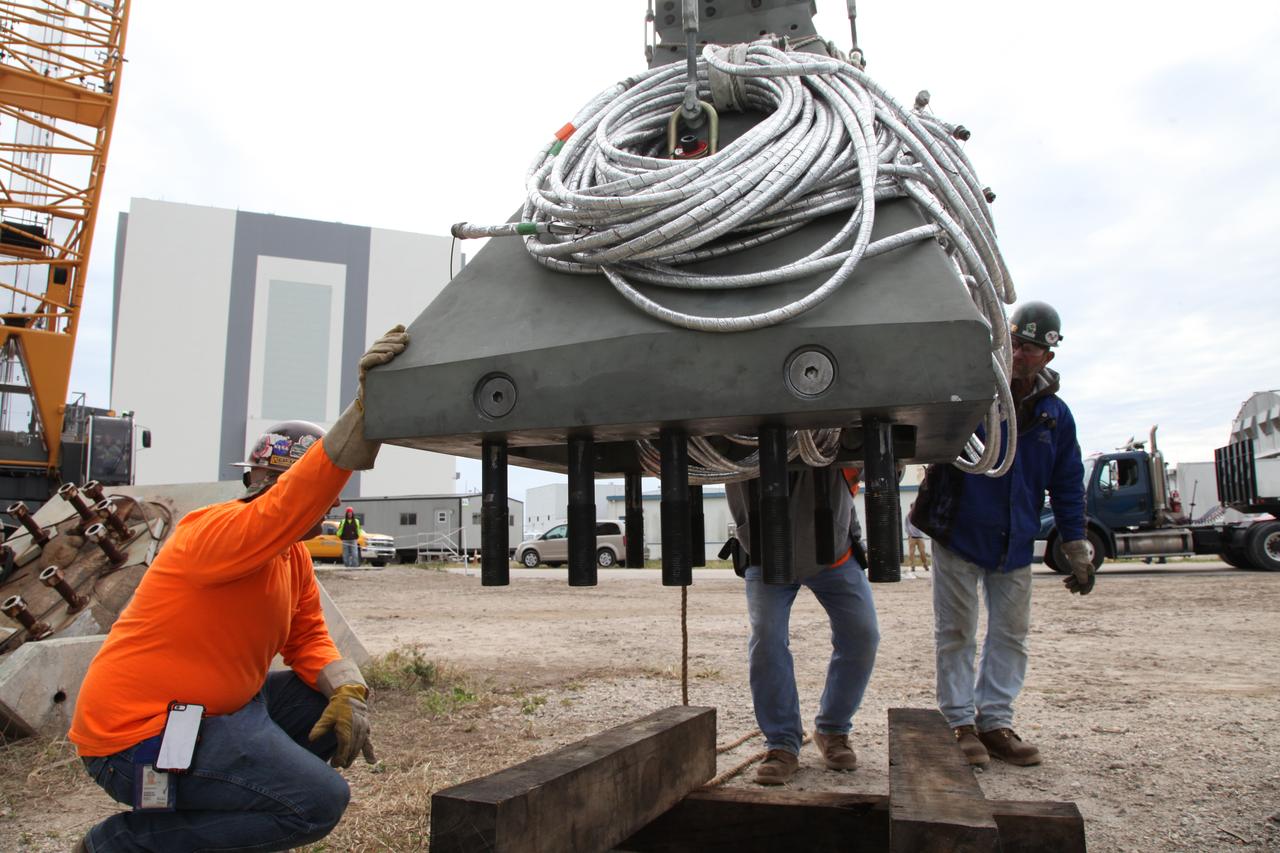
Construction workers assist as a crane is used to lower a vertical support post for NASA's Space Launch System (SLS) onto a platform at the Mobile Launcher Yard at NASA's Kennedy Space Center in Florida. Two ASEUs and the first of the vertical support posts underwent a series of tests at the Launch Equipment Test Facility to confirm they are functioning properly and ready to support the SLS for launch. The ASEUs will connect to the SLS rocket at the bottom outer edge of each booster and provide electrical power and data connections to the rocket until it lifts off from the launch pad. The eight VSPs will support the load of the solid rocket boosters, with four posts for each of the boosters. The center’s Engineering Directorate and the Ground Systems Development and Operations Program are overseeing processing and testing of the umbilicals.
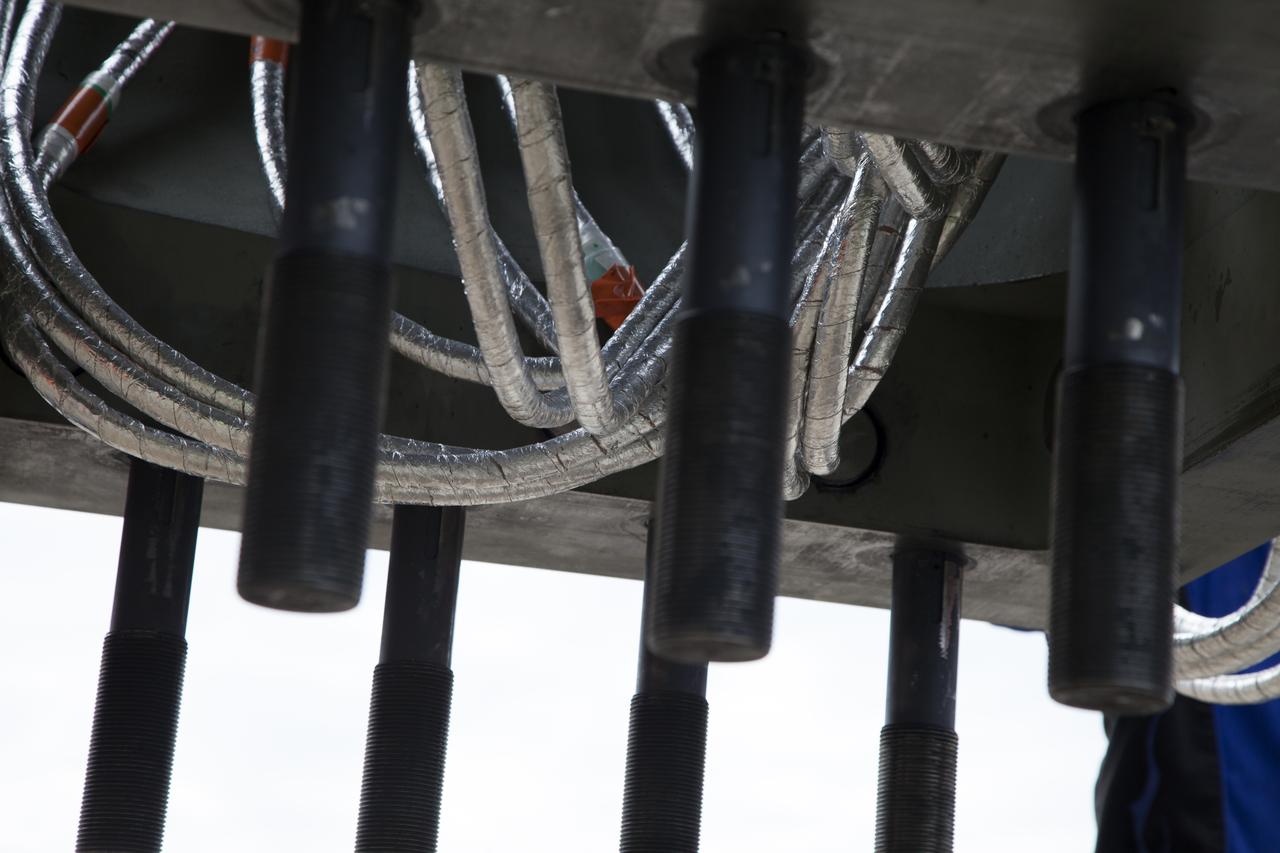
A view from underneath one of the vertical support posts for NASA's Space Launch System rocket. Two after skirt electrical umbilicals (ASEUs) and the first of the vertical support post were transported by flatbed truck from the Launch Equipment Test Facility to the Mobile Launcher Yard as NASA's Kennedy Space Center in Florida. The ASEUs and the VSP underwent a series of tests to confirm they are functioning properly and ready to support the SLS for launch. The ASEUs will connect to the SLS rocket at the bottom outer edge of each booster and provide electrical power and data connections to the rocket until it lifts off from the launch pad. The eight VSPs will support the load of the solid rocket boosters, with four posts for each of the boosters. The center’s Engineering Directorate and the Ground Systems Development and Operations Program are overseeing processing and testing of the umbilicals.
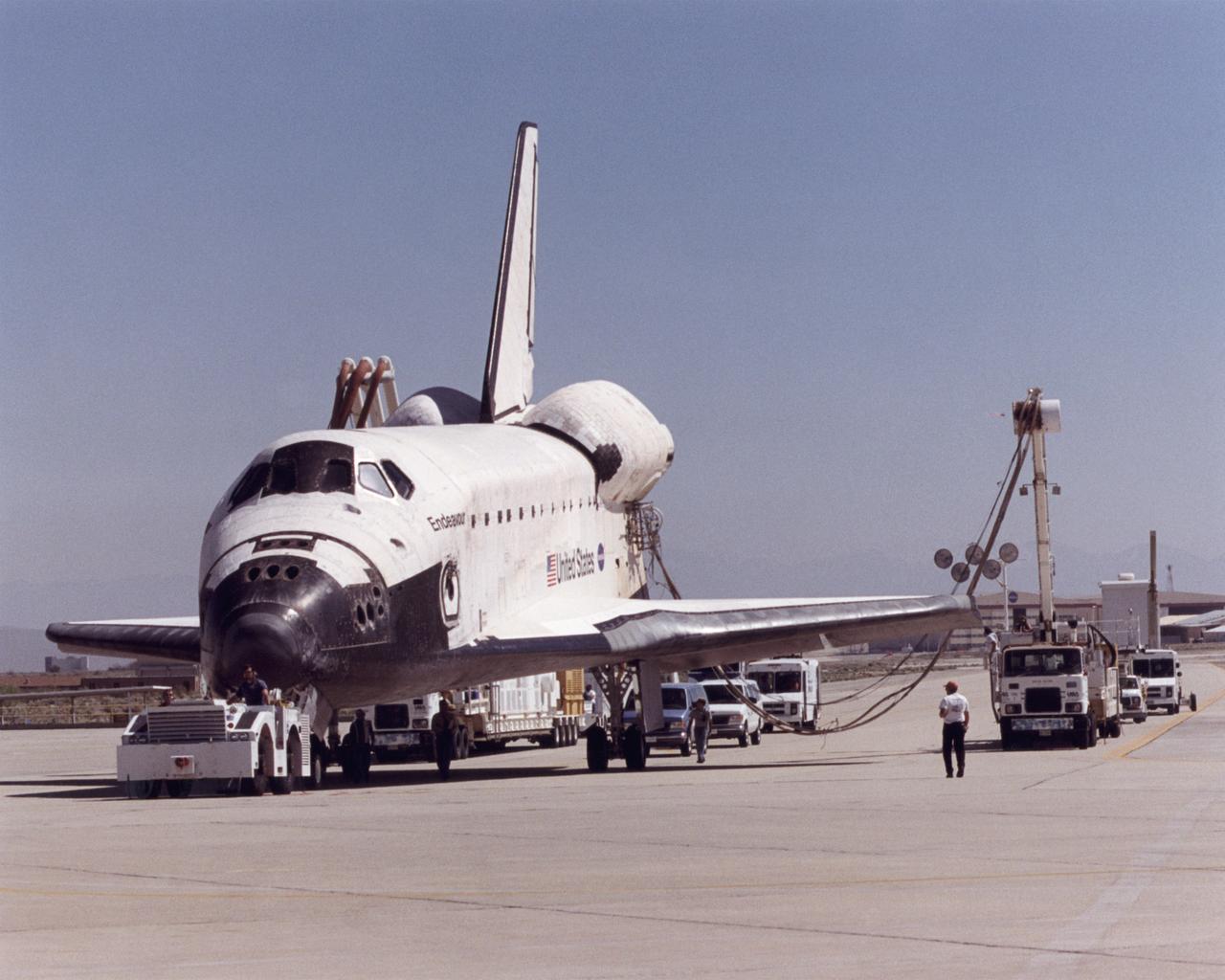
A convoy of specialized support vehicles follow the Space Shuttle Endeavour as it is towed up a taxiway at NASA's Dryden Flight Research Center on Edwards Air Force Base, California, after landing on May 1, 2001. The two largest vehicles trailing the shuttle provide electrical power and air conditioning to the shuttle's systems during post-flight recovery operations. The Endeavour had just completed mission STS-100, an almost 12-day mission to install the Canadarm 2 robotic arm and deliver some three tons of supplies and experiments to the International Space Station. The landing was the 48th shuttle landing at Edwards since shuttle flights began in 1981. After post-flight processing, the Endeavour was mounted atop one of NASA's modified Boeing 747 shuttle carrier aircraft and ferried back to the Kennedy Space Center in Florida on May 8, 2001.
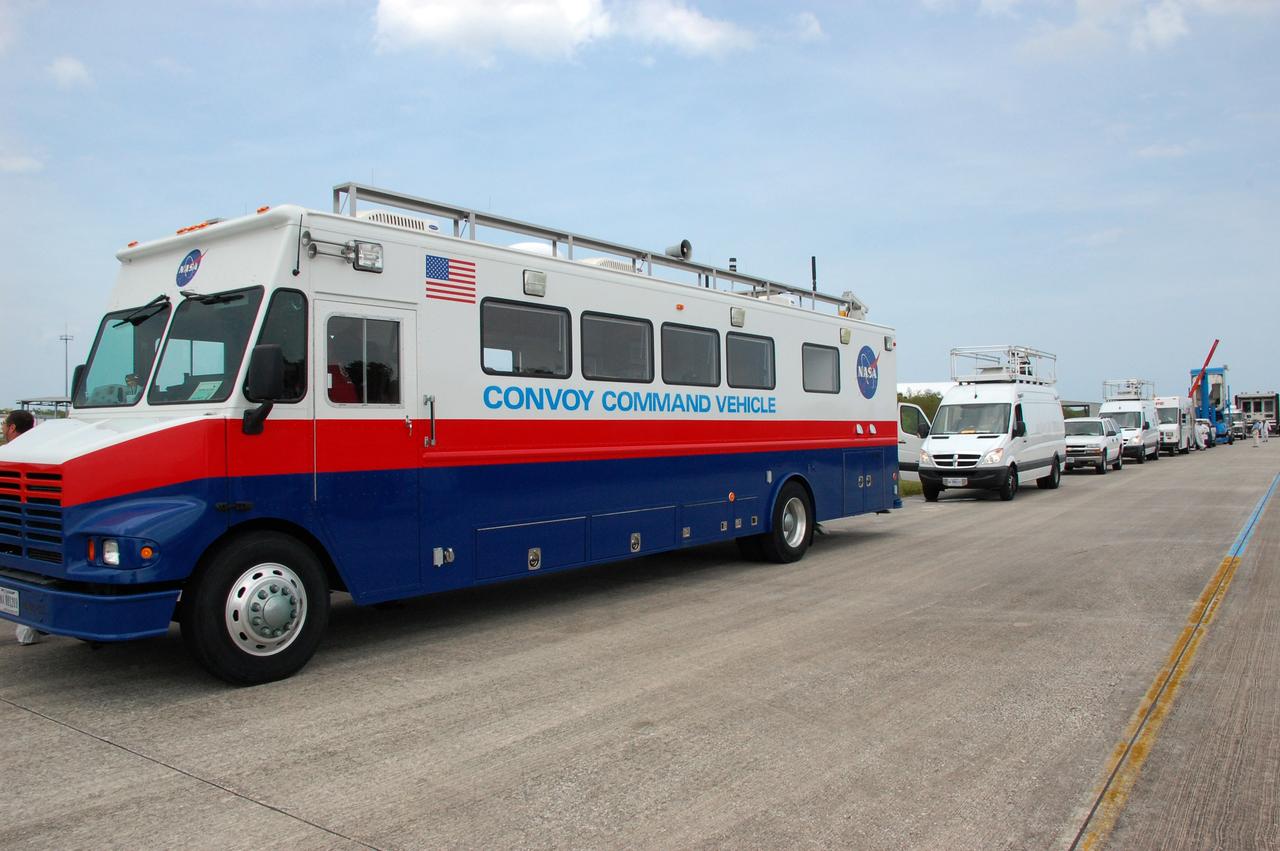
CAPE CANAVERAL, Fla. – The landing convoy is lined up on the Shuttle Landing Facility runway at NASA's Kennedy Space Center in Florida. The convoy awaits space shuttle Discovery's landing, after completing itsa 13-day journey of more than 5.3 million miles on the STS-119 mission. At left is the Convoy Command Vehicle which is the command post for the convoy commander. the convoy commander is in communication with the shuttle and all of the landing convoy vehicles during the post-landing operations. The landing convoy's purpose is to safe the vehicle and provide support for the disembarking crew and experiments. The STS-119 flight delivered the space station's fourth and final set of large solar array wings and the S6 truss segment, completing the station's truss, or backbone. The additional electricity provided by the arrays will fully power science experiments and help support six-person station operations in May. The mission was the 28th flight to the station, the 36th flight of Discovery and the 125th in the Space Shuttle Program, as well as the 70th landing at Kennedy. Photo credit: NASA/Ben Smegelsky
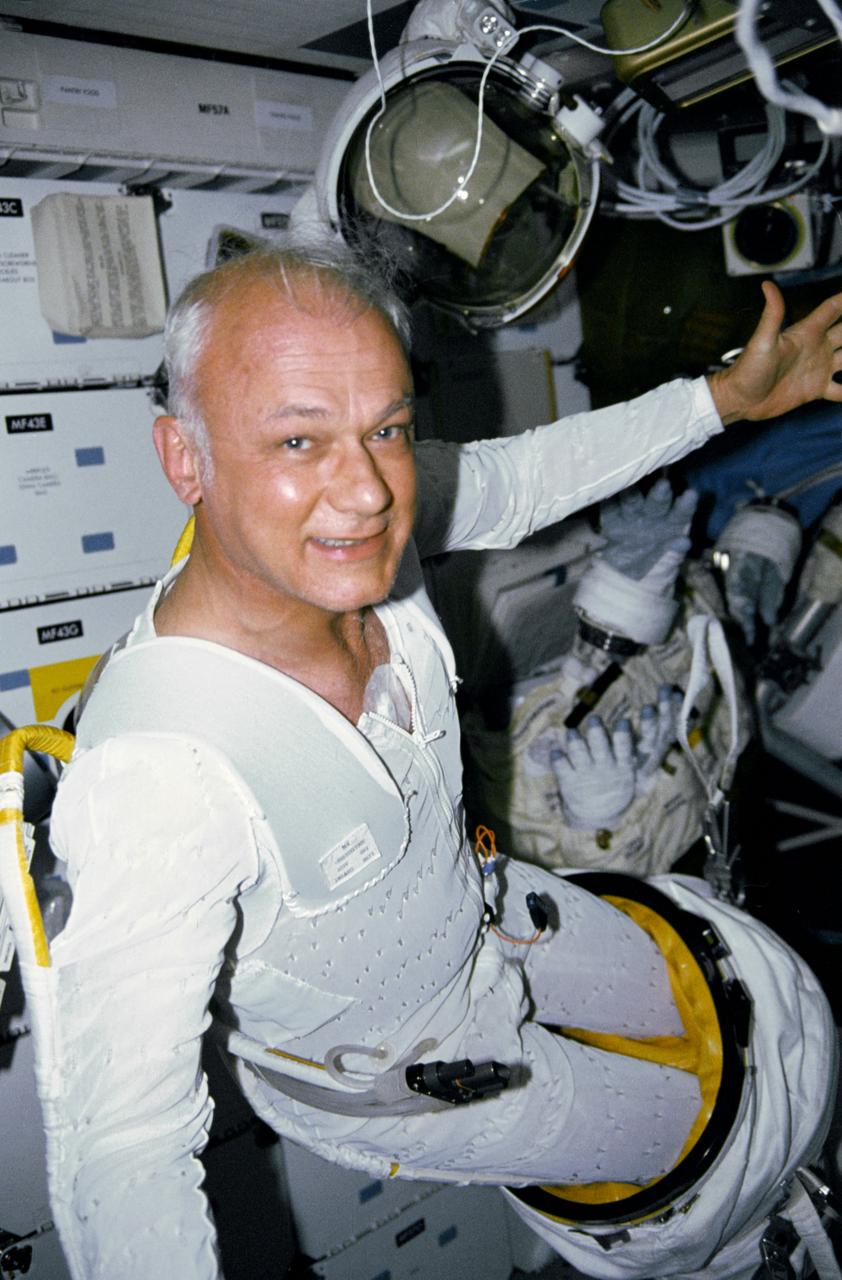
STS-31 Mission Specialist (MS) Bruce McCandless II, wearing liquid cooling and ventilation garment (LCVG), works his way out of the extravehicular mobility unit (EMU) lower torso on the middeck of Discovery, Orbiter Vehicle (OV) 103. McCandless was in a standby mode to perform extravehicular activity (EVA) if needed to support Hubble Space Telescope (HST) deployment and post- deployment tasks. None was needed. His helmet and gloves freefloat in the background.
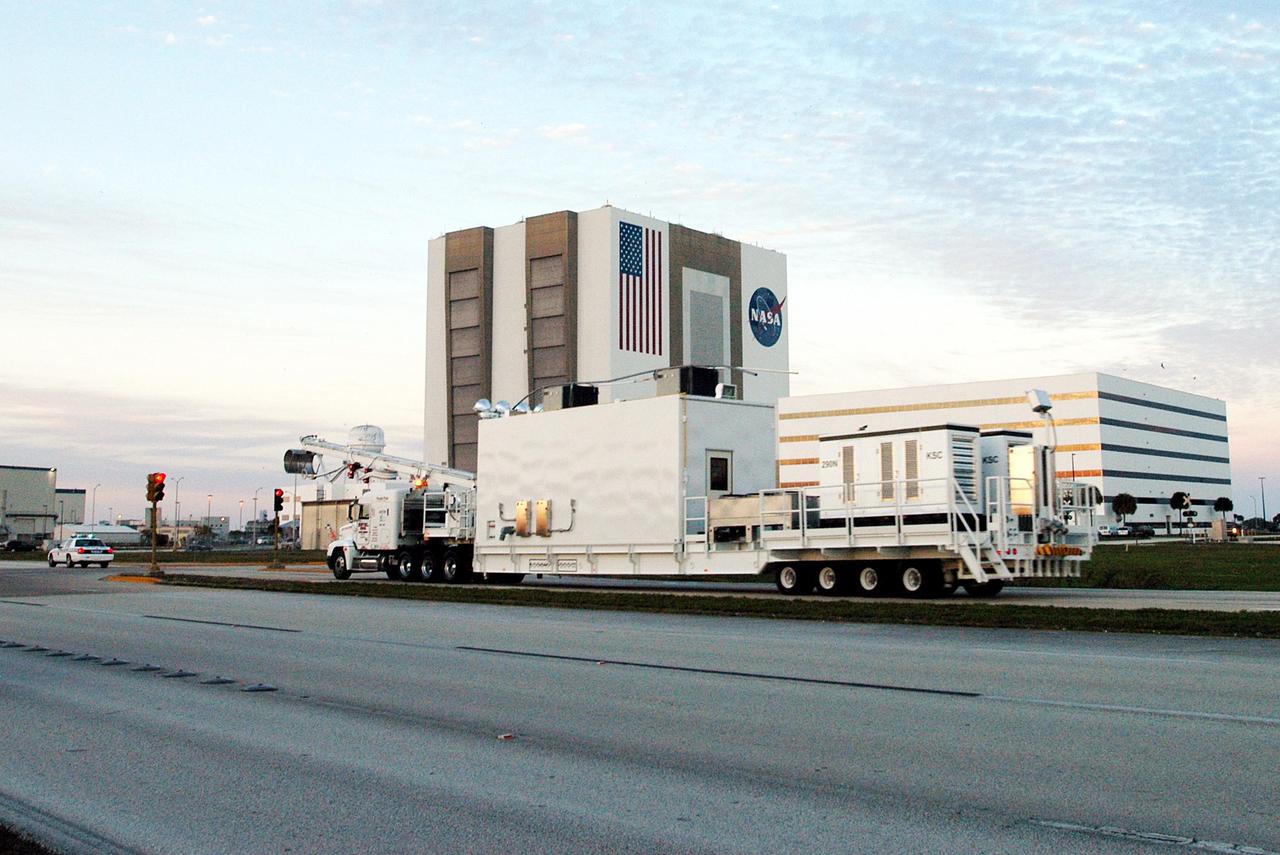
KENNEDY SPACE CENTER, FLA. - A Universal Coolant Transporter (UCT), manufactured in Sharpes, Fla., drives past the Vehicle Assembly Building (background, left) and Operations Support Building (background, right) on its way to the KSC Shuttle Landing Facility (SLF). Replacing the existing ground cooling unit, the UCT is designed to service payloads for the Space Shuttle and International Space Station, and may be capable of servicing space exploration vehicles of the future. It will provide ground cooling to the orbiter and returning payloads, such as science experiments requiring cold or freezing temperatures, during post-landing activities at the SLF and during transport of the payloads to other facilities.
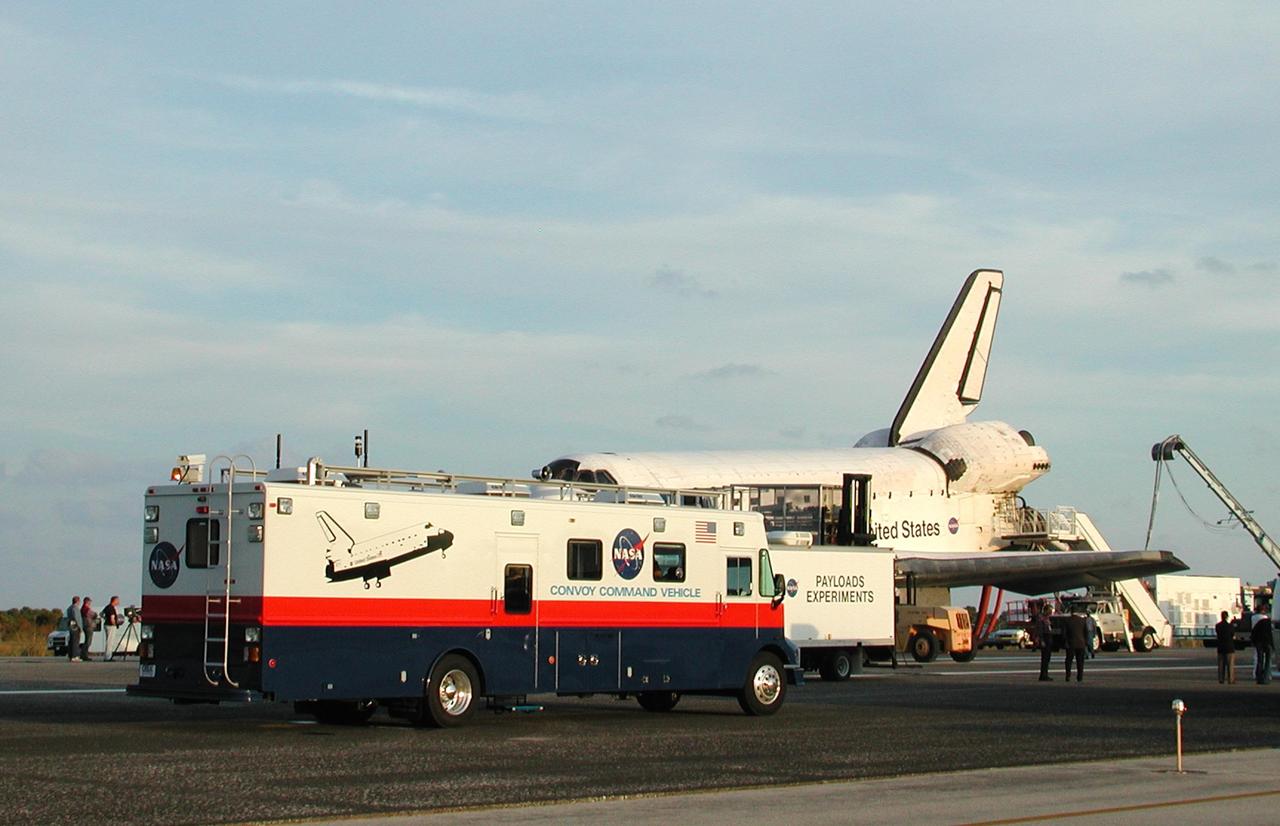
KENNEDY SPACE CENTER, FLA. - Space Shuttle Endeavour is surrounded by vehicles from the landing convoy on runway 33 at the Shuttle Landing Facility at the conclusion of the 13-day, 18-hour, 48-minute, 5.74-million mile STS-113 mission to the International Space Station. In the foreground is the Convoy Command Vehicle which is the command post for the Convoy Commander. The Convoy Commander is in communication with the orbiter and all of the landing convoy vehicles during the post-landing operations. The landing convoy's purpose is to safe the vehicle and provide support for the disembarking crew and experiments. Main gear touchdown was at 2:37:12 p.m. EST, nose gear touchdown was at 2:37:23 p.m., and wheel stop was at 2:38:25 p.m. Poor weather conditions thwarted landing opportunities until a fourth day, the first time in Shuttle program history that a landing has been waved off for three consecutive days. The vehicle carries the STS-113 crew, Commander James Wetherbee, Pilot Paul Lockhart and Mission Specialists Michael Lopez-Alegria and John Herrington, as well as the returning Expedition Five crew, Commander Valeri Korzun, ISS Science Officer Peggy Whitson and Flight Engineer Sergei Treschev. The installation of the P1 truss on the International Space Station was accomplished during the mission.
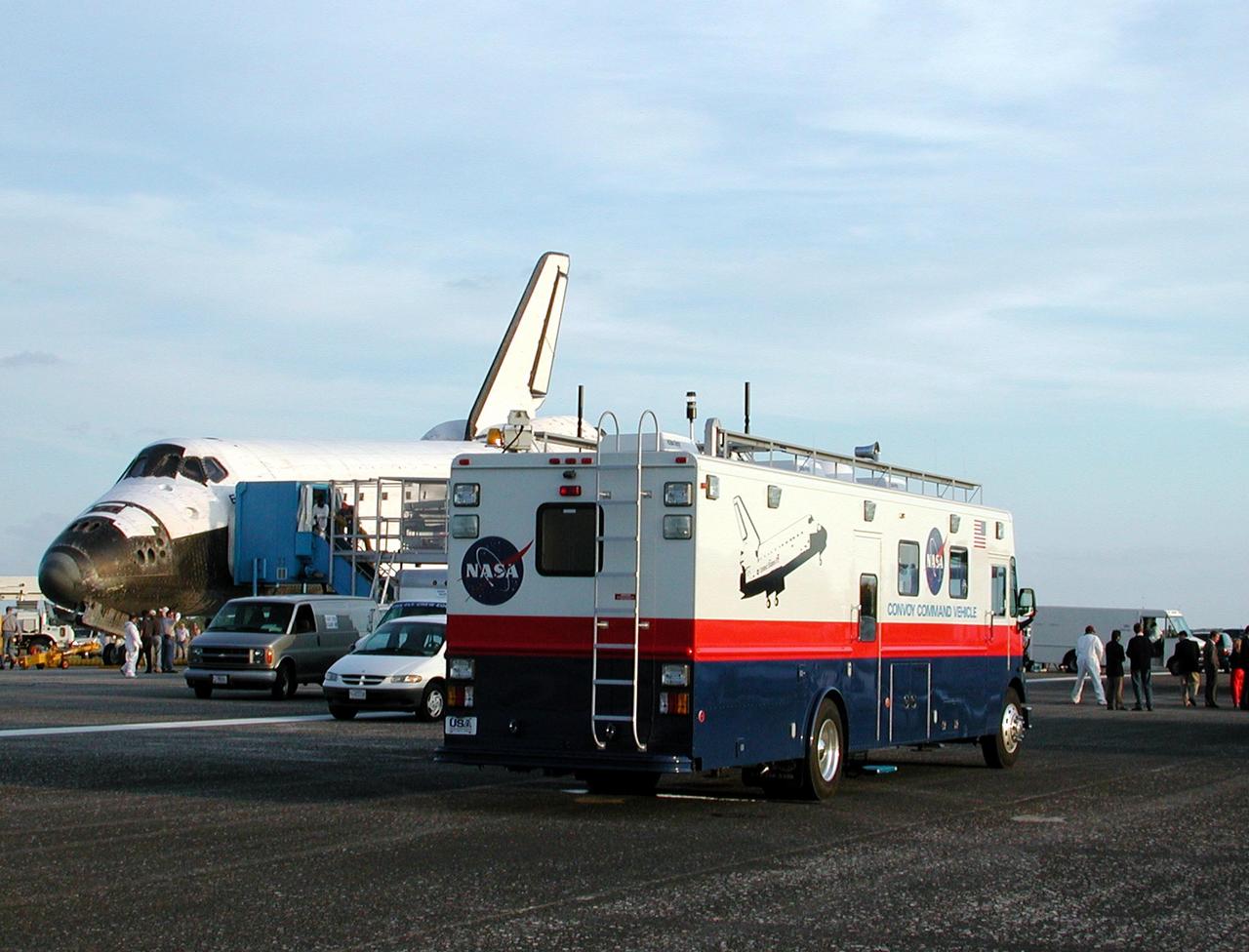
KENNEDY SPACE CENTER, FLA. - Space Shuttle Endeavour is surrounded by vehicles from the landing convoy on runway 33 at the Shuttle Landing Facility at the conclusion of the 13-day, 18-hour, 48-minute, 5.74-million mile STS-113 mission to the International Space Station. In the foreground is the Convoy Command Vehicle which is the command post for the Convoy Commander. The Convoy Commander is in communication with the orbiter and all of the landing convoy vehicles during the post-landing operations. The landing convoy's purpose is to safe the vehicle and provide support for the disembarking crew and experiments. Main gear touchdown was at 2:37:12 p.m. EST, nose gear touchdown was at 2:37:23 p.m., and wheel stop was at 2:38:25 p.m. Poor weather conditions thwarted landing opportunities until a fourth day, the first time in Shuttle program history that a landing has been waved off for three consecutive days. The vehicle carries the STS-113 crew, Commander James Wetherbee, Pilot Paul Lockhart and Mission Specialists Michael Lopez-Alegria and John Herrington, as well as the returning Expedition Five crew, Commander Valeri Korzun, ISS Science Officer Peggy Whitson and Flight Engineer Sergei Treschev. The installation of the P1 truss on the International Space Station was accomplished during the mission.
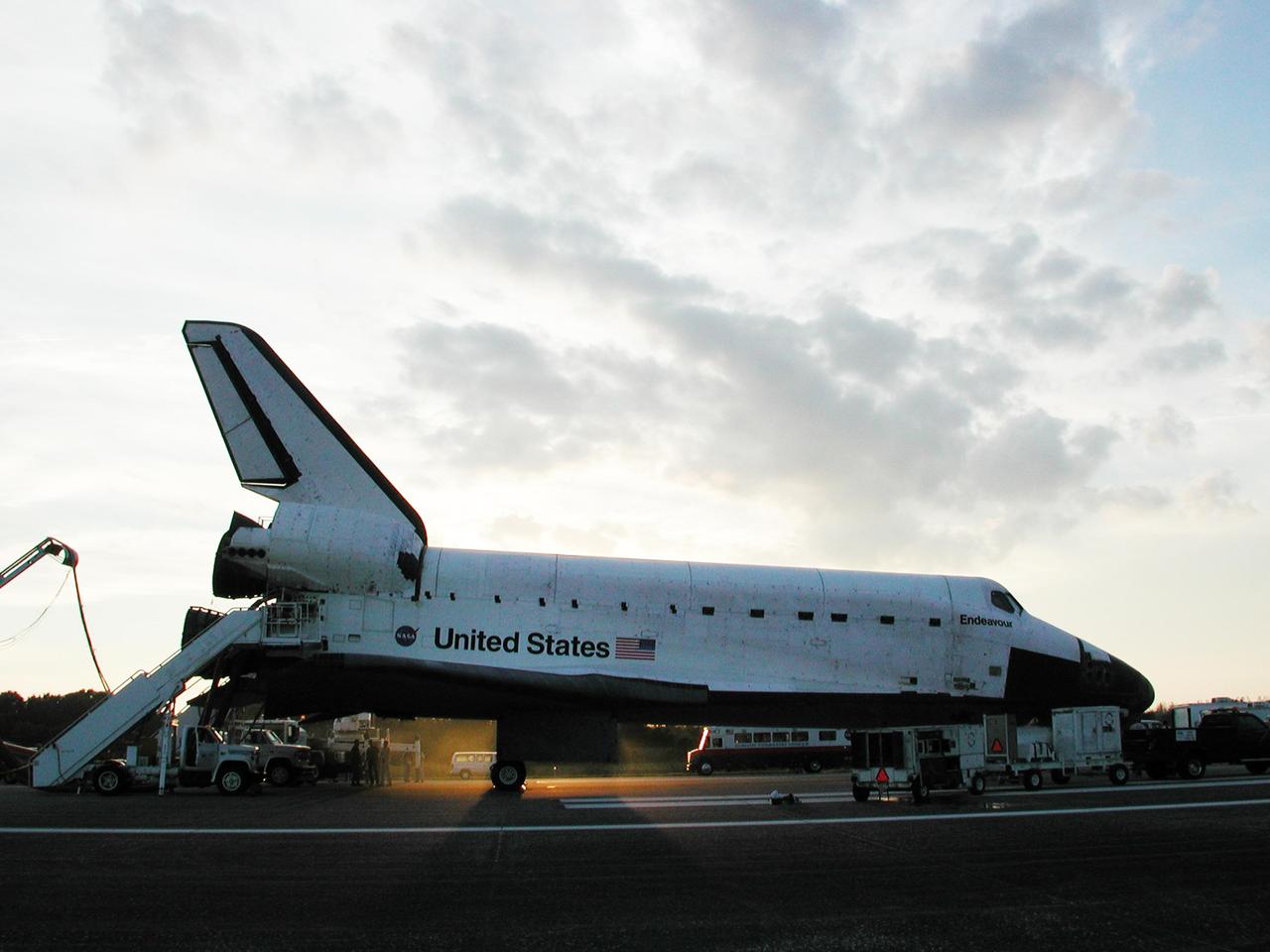
KENNEDY SPACE CENTER, FLA. - Space Shuttle Endeavour is surrounded by vehicles from the landing convoy, as the sun sets on runway 33 at the Shuttle Landing Facility at the conclusion of the 13-day, 18-hour, 48-minute, 5.74-million mile STS-113 mission to the International Space Station. Under the orbiter, the Convoy Command Vehicle, the command post for the Convoy Commander, can be seen on the far side of the runway. The Convoy Commander is in communication with the orbiter and all of the landing convoy vehicles during the post-landing operations. The landing convoy's purpose is to safe the vehicle and provide support for the disembarking crew and experiments. Main gear touchdown was at 2:37:12 p.m. EST, nose gear touchdown was at 2:37:23 p.m., and wheel stop was at 2:38:25 p.m. Poor weather conditions thwarted landing opportunities until a fourth day, the first time in Shuttle program history that a landing has been waved off for three consecutive days. The vehicle carries the STS-113 crew, Commander James Wetherbee, Pilot Paul Lockhart and Mission Specialists Michael Lopez-Alegria and John Herrington, as well as the returning Expedition Five crew, Commander Valeri Korzun, ISS Science Officer Peggy Whitson and Flight Engineer Sergei Treschev. The installation of the P1 truss on the International Space Station was accomplished during the mission.

KENNEDY SPACE CENTER, FLA. -- Astronaut Support team member Pamela A. Melroy (left) greets STS-94 Pilot Susan L. Still underneath the Space Shuttle orbiter Columbia after an end-of-mission landing on Runway 33 of KSC’s Shuttle Landing Facility July 17 to complete the Microgravity Science Laboratory-1 (MSL-1) mission. Six of the seven STS-94 crew members took the traditional post-landing walk around the orbiter, meeting with members of the orbiter recovery convoy team and inspecting the vehicle that carried them through space for nearly 17 days on a highly successful microgravity research mission
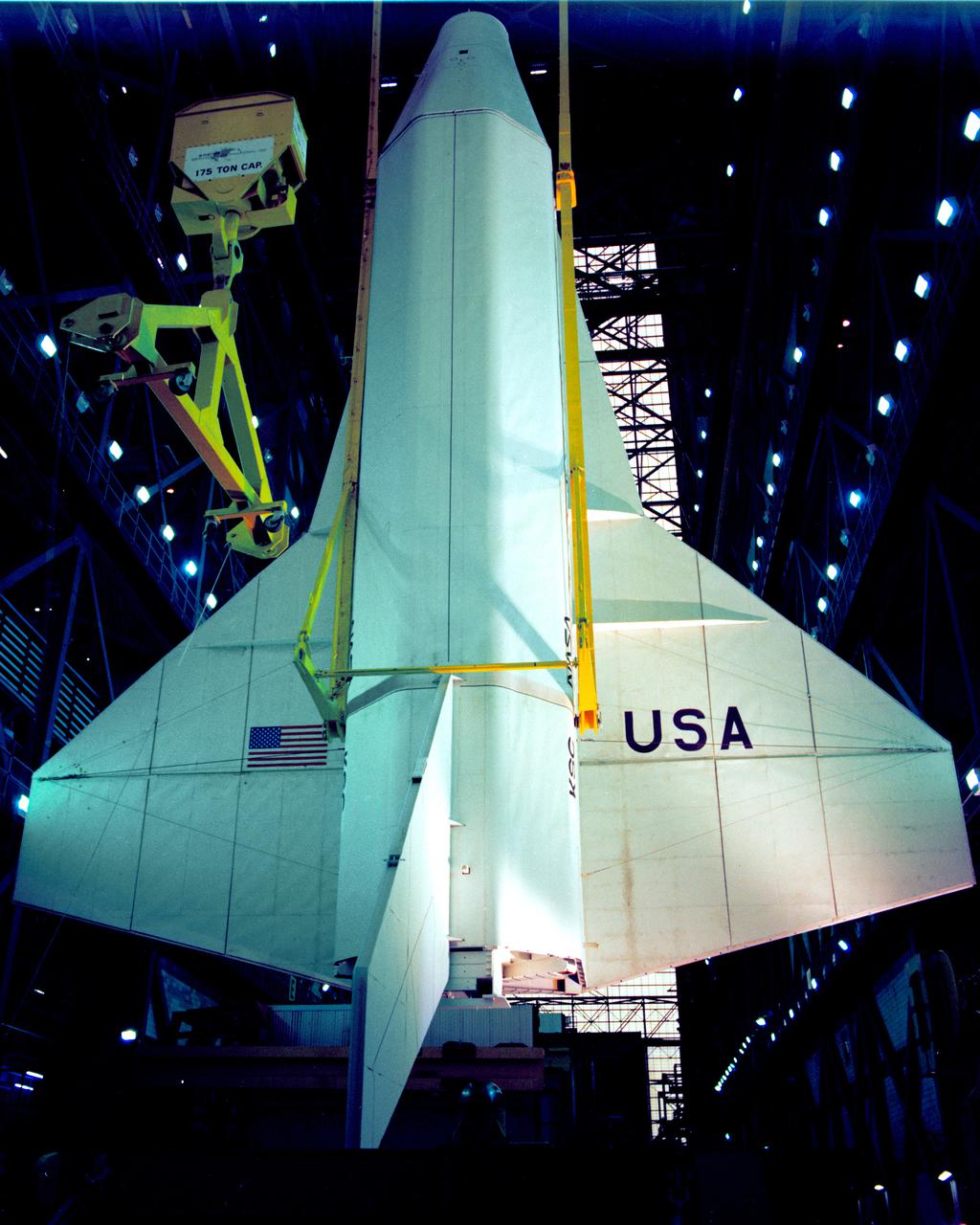
CAPE CANAVERAL, Fla. – At NASA's Kennedy Space Center in Florida, the space shuttle mock-up, dubbed Pathfinder, undergoes a lift test in the Vehicle Assembly Building on May 31, 1978. The mock-up, constructed at NASA's Marshall Space Flight Center in Huntsville, Ala., possessed the general dimensions, weight and balance of a real space shuttle. It was shipped to Kennedy by barge and then used to fit-check the work platforms of the Mate-Demate Device, orbiter processing facilities and Vehicle Assembly Building, as well as support ground crew training. It also was used to rehearse post-landing procedures at Kennedy's Shuttle Landing Facility. After being on display at the 'Great Space Shuttle Exposition' in Tokyo from June 1983 to August 1984, the mock-up returned to Marshall and now is on permanent display at the U.S. Space and Rocket Center near Huntsville. Photo credit: NASA
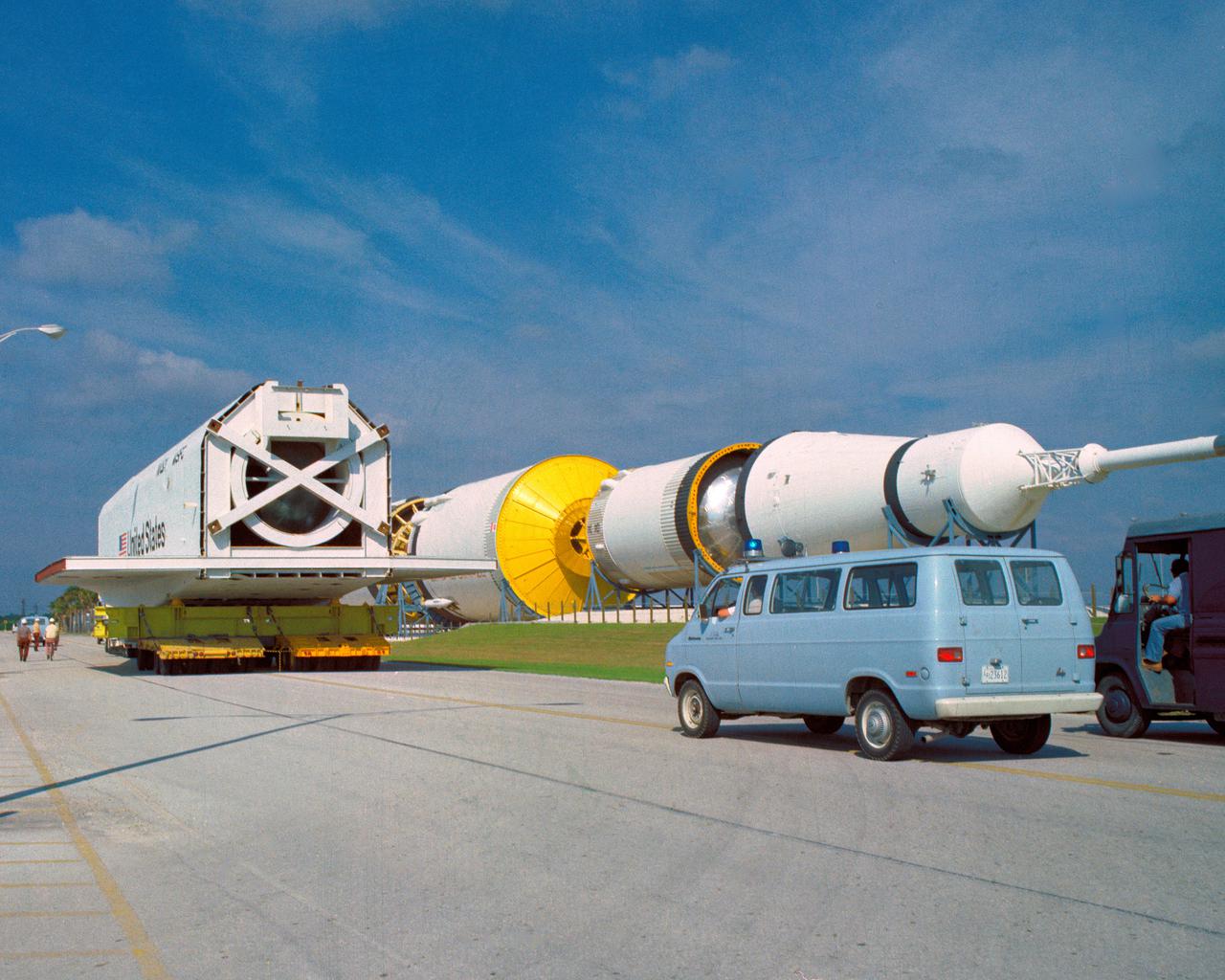
CAPE CANAVERAL, Fla. – At NASA's Kennedy Space Center in Florida, the space shuttle mock-up, dubbed Pathfinder, makes its trek from the turn basin to the Vehicle Assembly Building on April 5, 1978. The mock-up, constructed at NASA's Marshall Space Flight Center in Huntsville, Ala., possessed the general dimensions, weight and balance of a real space shuttle. It was shipped to Kennedy by barge and then used to fit-check the work platforms of the Mate-Demate Device, orbiter processing facilities and Vehicle Assembly Building, as well as support ground crew training. It also was used to rehearse post-landing procedures at Kennedy's Shuttle Landing Facility. After being on display at the 'Great Space Shuttle Exposition' in Tokyo from June 1983 to August 1984, the mock-up returned to Marshall and now is on permanent display at the U.S. Space and Rocket Center near Huntsville. Photo credit: NASA
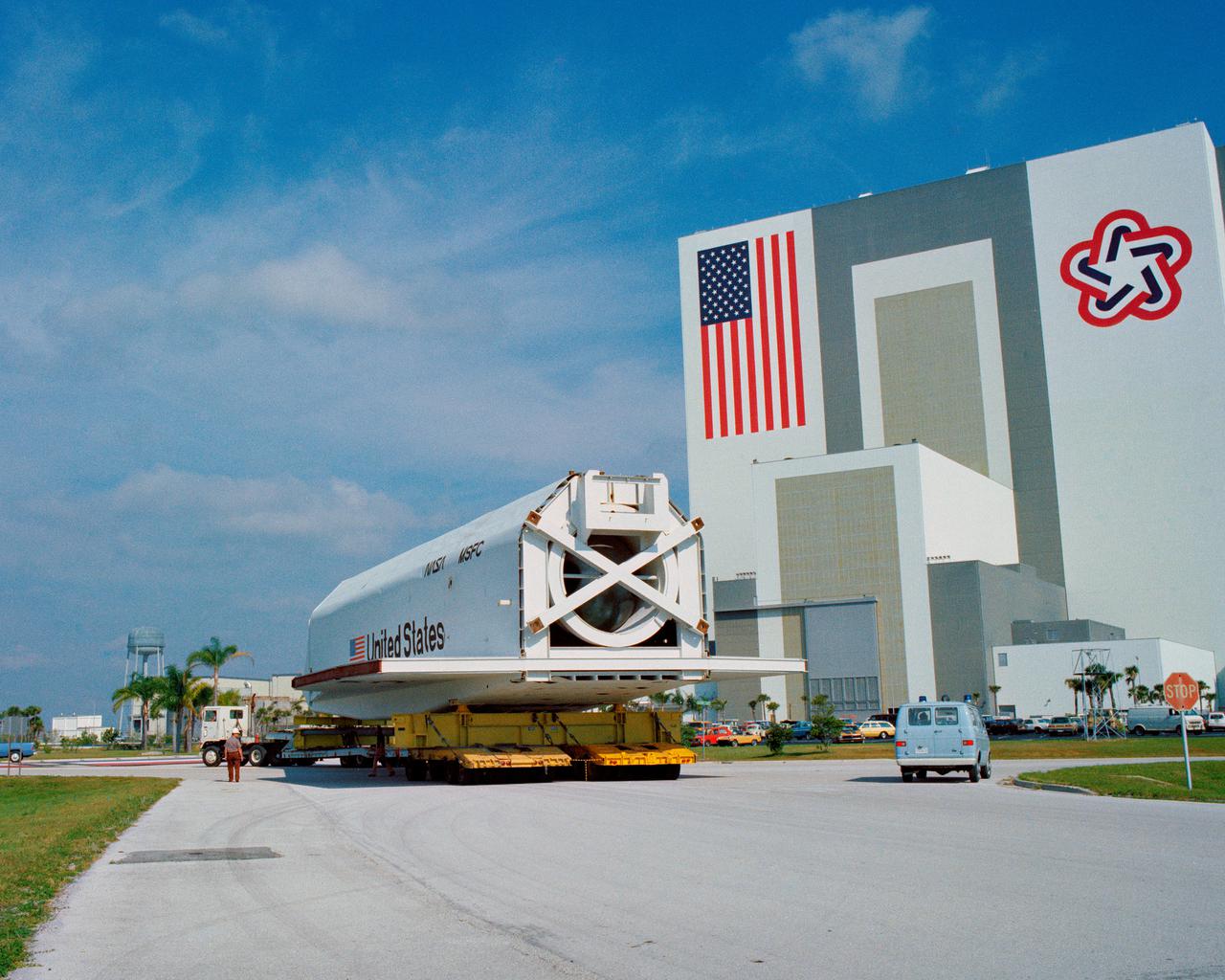
CAPE CANAVERAL, Fla. – At NASA's Kennedy Space Center in Florida, the space shuttle mock-up, dubbed Pathfinder, makes its trek from the turn basin to the Vehicle Assembly Building on April 5, 1978. The mock-up, constructed at NASA's Marshall Space Flight Center in Huntsville, Ala., possessed the general dimensions, weight and balance of a real space shuttle. It was shipped to Kennedy by barge and then used to fit-check the work platforms of the Mate-Demate Device, orbiter processing facilities and Vehicle Assembly Building, as well as support ground crew training. It also was used to rehearse post-landing procedures at Kennedy's Shuttle Landing Facility. After being on display at the 'Great Space Shuttle Exposition' in Tokyo from June 1983 to August 1984, the mock-up returned to Marshall and now is on permanent display at the U.S. Space and Rocket Center near Huntsville. Photo credit: NASA
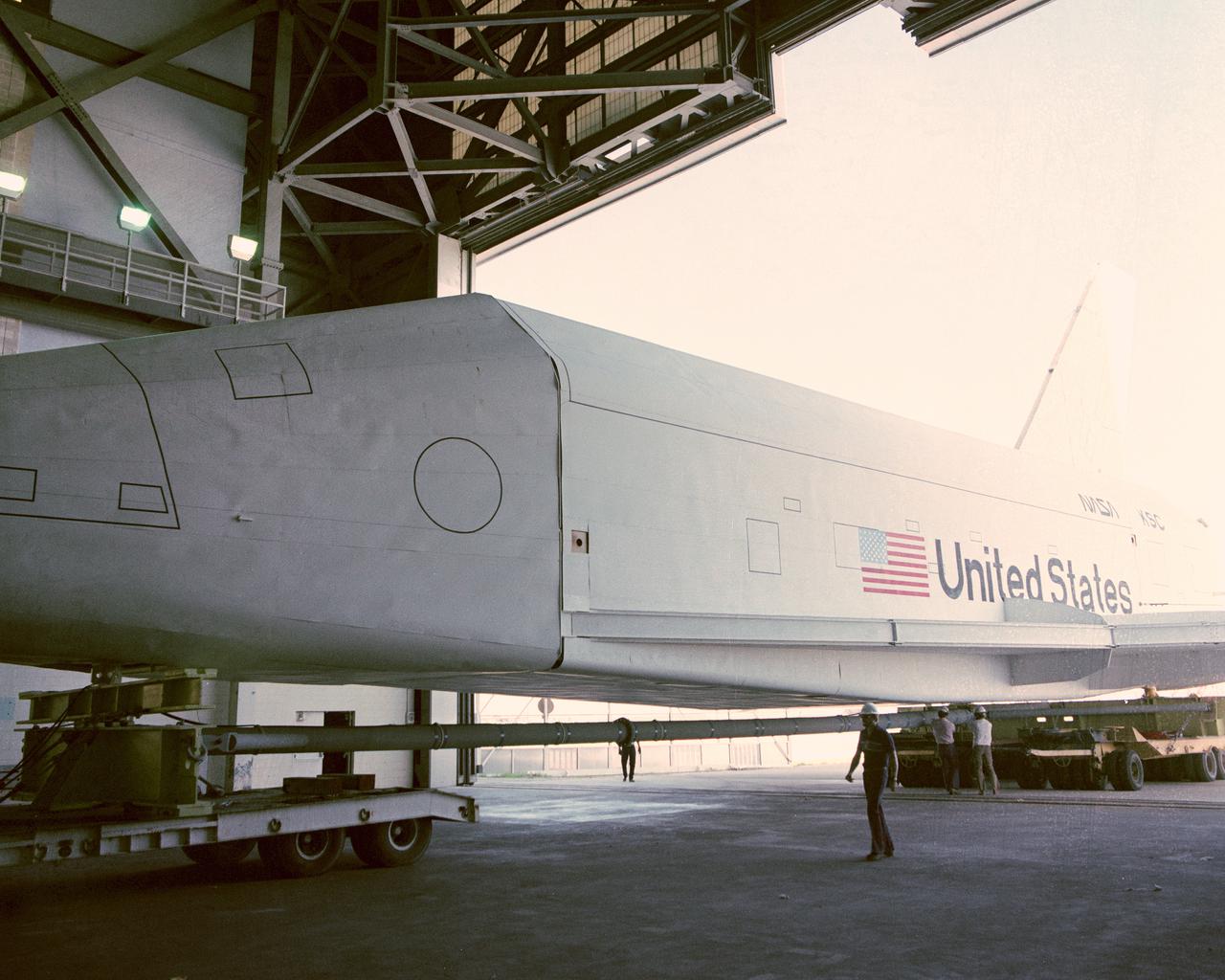
CAPE CANAVERAL, Fla. – At NASA's Kennedy Space Center in Florida, the space shuttle mock-up, dubbed Pathfinder, enters the Vehicle Assembly Building for a fit-check May 15, 1978. The mock-up, constructed at NASA's Marshall Space Flight Center in Huntsville, Ala., possessed the general dimensions, weight and balance of a real space shuttle. It was shipped to Kennedy by barge and then used to fit-check the work platforms of the Mate-Demate Device, orbiter processing facilities and Vehicle Assembly Building, as well as support ground crew training. It also was used to rehearse post-landing procedures at Kennedy's Shuttle Landing Facility. After being on display at the 'Great Space Shuttle Exposition' in Tokyo from June 1983 to August 1984, the mock-up returned to Marshall and now is on permanent display at the U.S. Space and Rocket Center near Huntsville. Photo credit: NASA
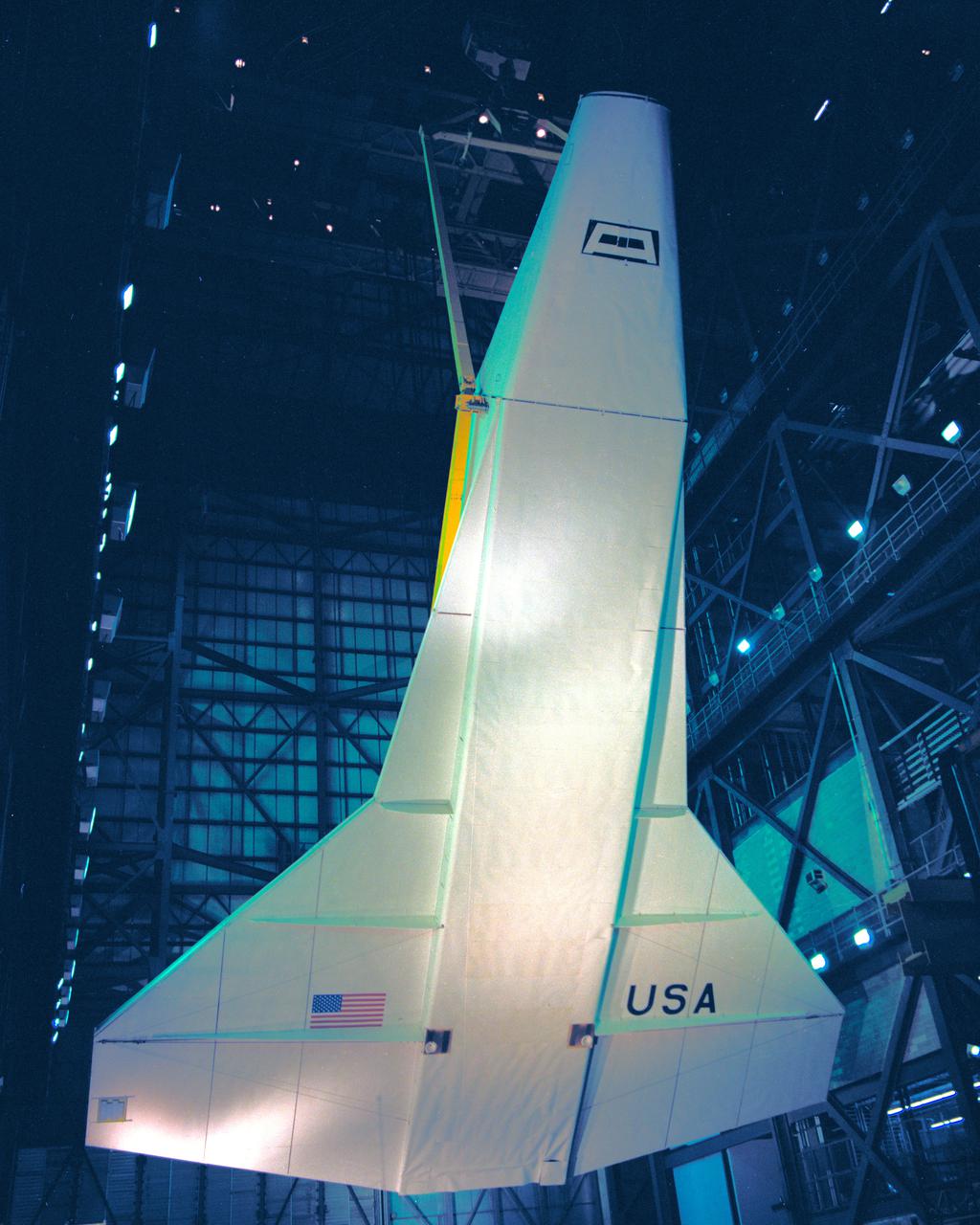
CAPE CANAVERAL, Fla. – At NASA's Kennedy Space Center in Florida, the space shuttle mock-up, dubbed Pathfinder, undergoes a lift test in the Vehicle Assembly Building on May 31, 1978. The mock-up, constructed at NASA's Marshall Space Flight Center in Huntsville, Ala., possessed the general dimensions, weight and balance of a real space shuttle. It was shipped to Kennedy by barge and then used to fit-check the work platforms of the Mate-Demate Device, orbiter processing facilities and Vehicle Assembly Building, as well as support ground crew training. It also was used to rehearse post-landing procedures at Kennedy's Shuttle Landing Facility. After being on display at the 'Great Space Shuttle Exposition' in Tokyo from June 1983 to August 1984, the mock-up returned to Marshall and now is on permanent display at the U.S. Space and Rocket Center near Huntsville. Photo credit: NASA
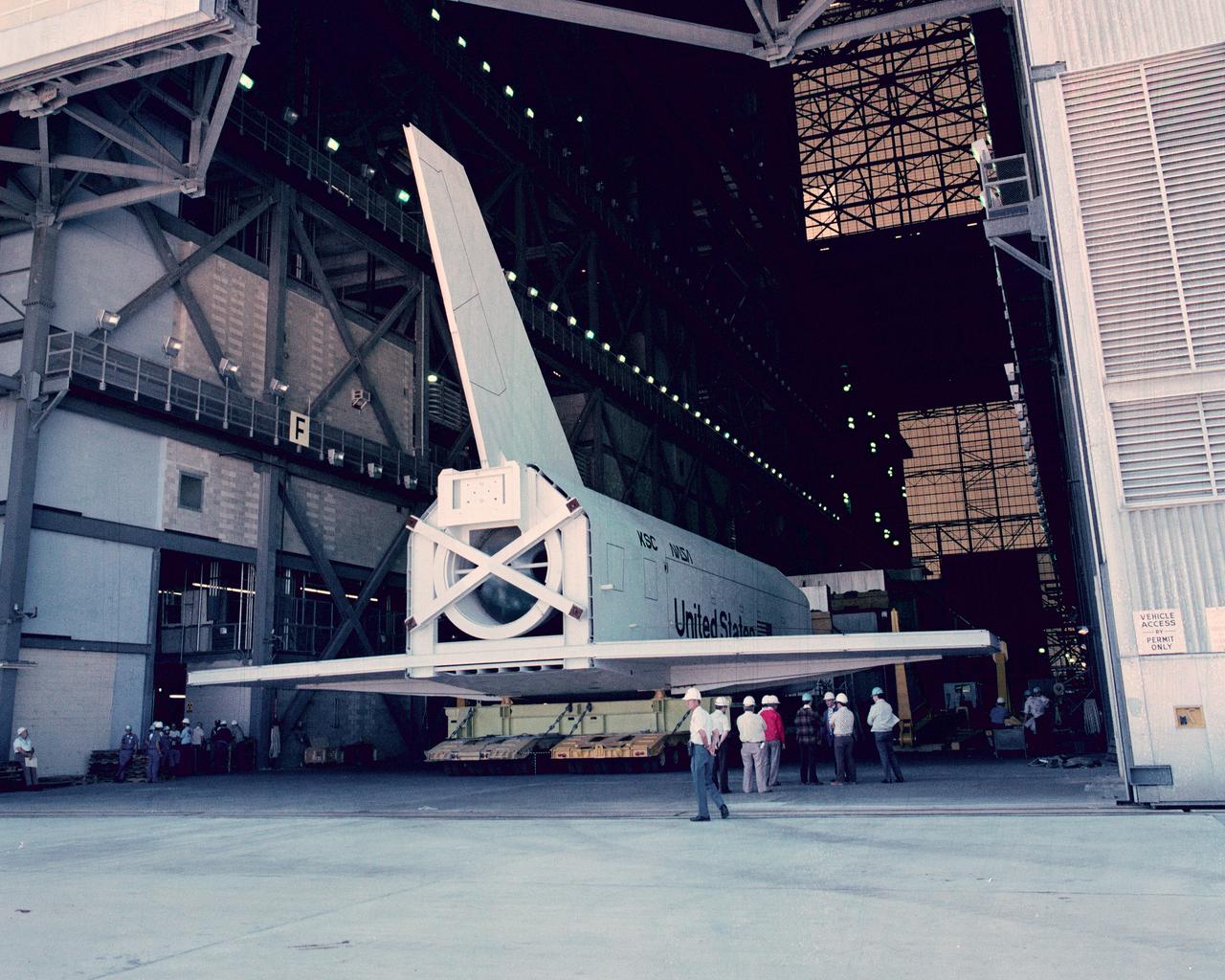
CAPE CANAVERAL, Fla. – At NASA's Kennedy Space Center in Florida, the space shuttle mock-up, dubbed Pathfinder, enters the Vehicle Assembly Building for a fit-check May 15, 1978. The mock-up, constructed at NASA's Marshall Space Flight Center in Huntsville, Ala., possessed the general dimensions, weight and balance of a real space shuttle. It was shipped to Kennedy by barge and then used to fit-check the work platforms of the Mate-Demate Device, orbiter processing facilities and Vehicle Assembly Building, as well as support ground crew training. It also was used to rehearse post-landing procedures at Kennedy's Shuttle Landing Facility. After being on display at the 'Great Space Shuttle Exposition' in Tokyo from June 1983 to August 1984, the mock-up returned to Marshall and now is on permanent display at the U.S. Space and Rocket Center near Huntsville. Photo credit: NASA
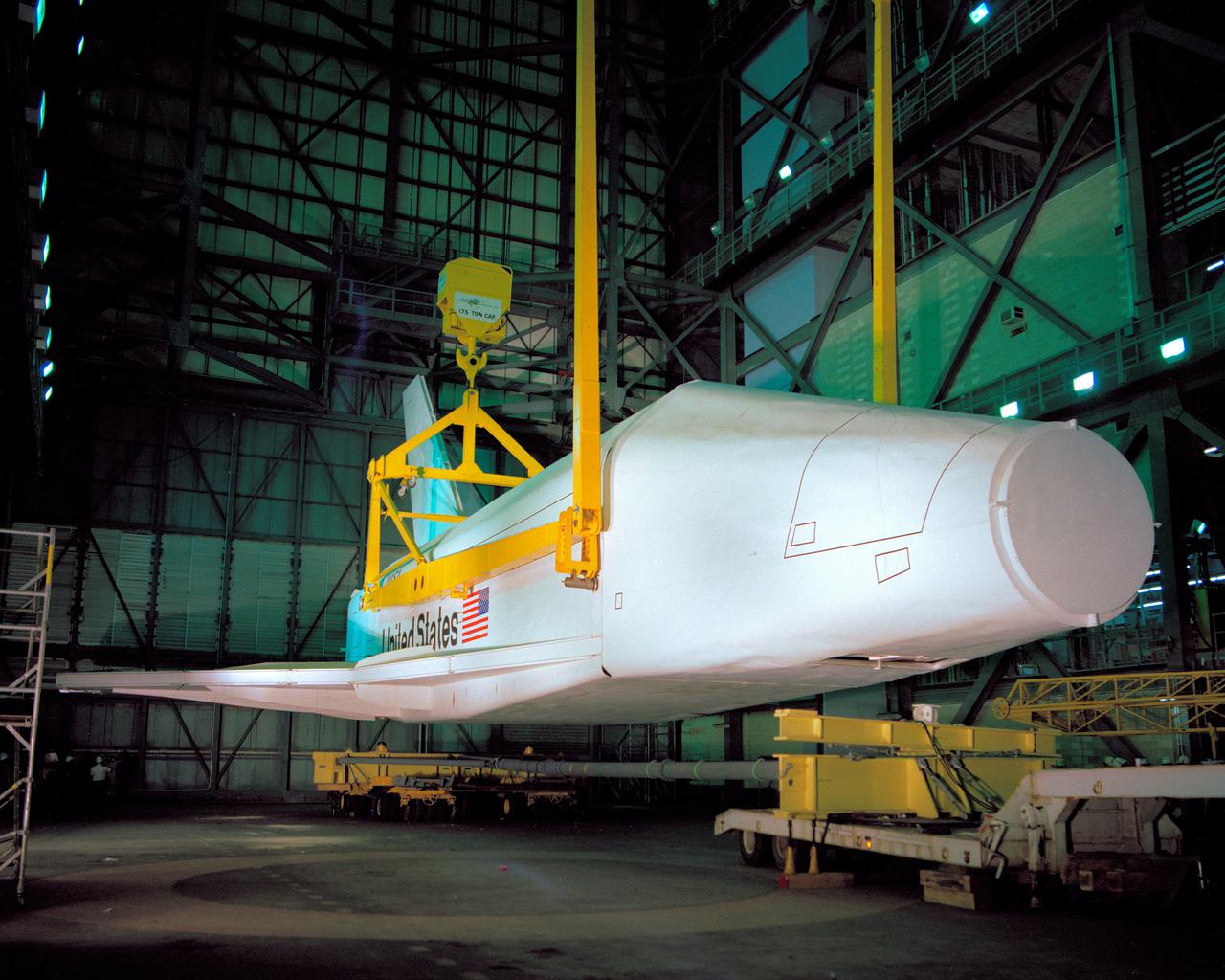
CAPE CANAVERAL, Fla. – At NASA's Kennedy Space Center in Florida, the space shuttle mock-up, dubbed Pathfinder, performs a lift test in the Vehicle Assembly Building on May 31, 1978. The mock-up, constructed at NASA's Marshall Space Flight Center in Huntsville, Ala., possessed the general dimensions, weight and balance of a real space shuttle. It was shipped to Kennedy by barge and then used to fit-check the work platforms of the Mate-Demate Device, orbiter processing facilities and Vehicle Assembly Building, as well as support ground crew training. It also was used to rehearse post-landing procedures at Kennedy's Shuttle Landing Facility. After being on display at the 'Great Space Shuttle Exposition' in Tokyo from June 1983 to August 1984, the mock-up returned to Marshall and now is on permanent display at the U.S. Space and Rocket Center near Huntsville. Photo credit: NASA
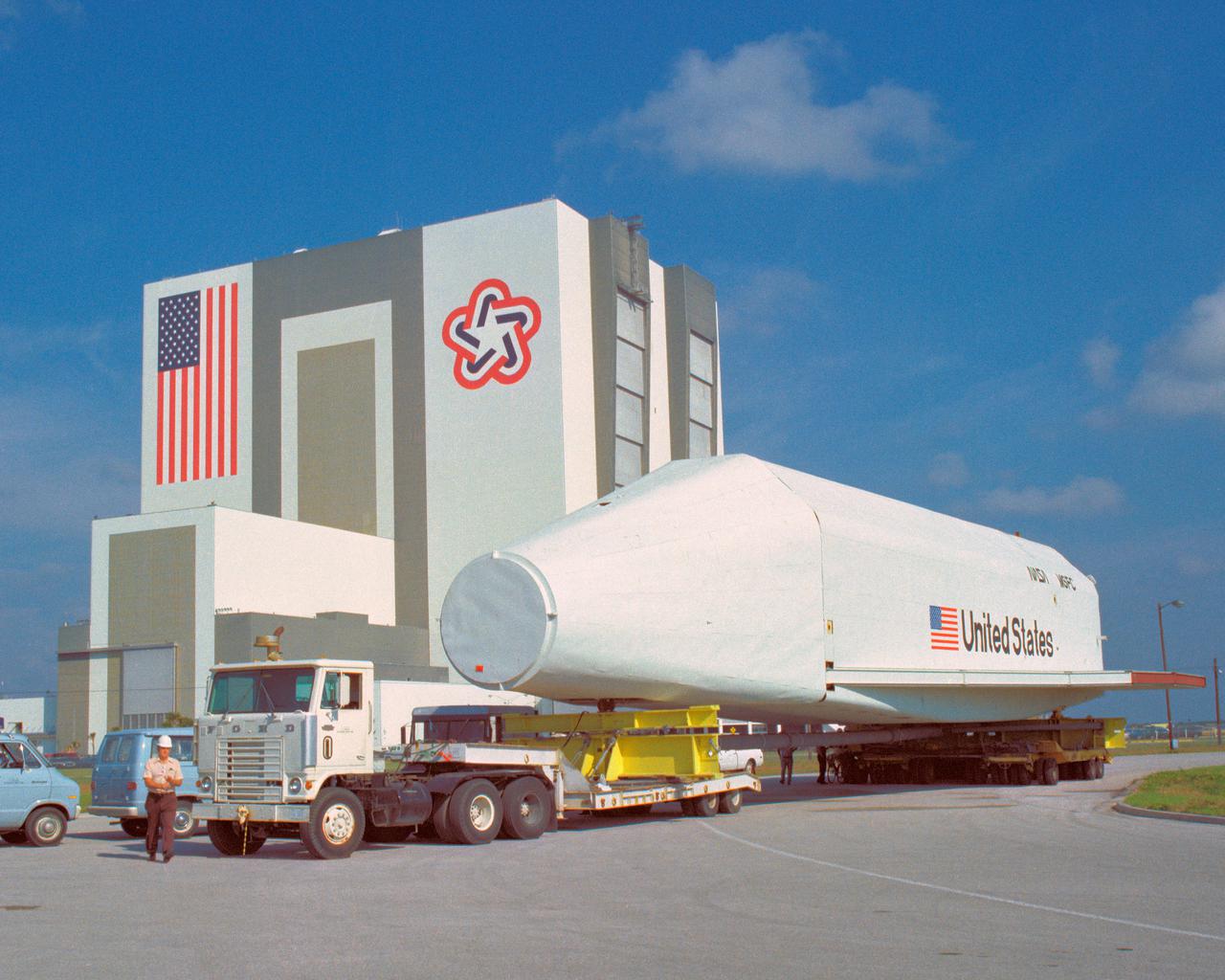
CAPE CANAVERAL, Fla. – At NASA's Kennedy Space Center in Florida, the space shuttle mock-up, dubbed Pathfinder, makes its trek from the turn basin to the Vehicle Assembly Building on April 5, 1978. The mock-up, constructed at NASA's Marshall Space Flight Center in Huntsville, Ala., possessed the general dimensions, weight and balance of a real space shuttle. It was shipped to Kennedy by barge and then used to fit-check the work platforms of the Mate-Demate Device, orbiter processing facilities and Vehicle Assembly Building, as well as support ground crew training. It also was used to rehearse post-landing procedures at Kennedy's Shuttle Landing Facility. After being on display at the 'Great Space Shuttle Exposition' in Tokyo from June 1983 to August 1984, the mock-up returned to Marshall and now is on permanent display at the U.S. Space and Rocket Center near Huntsville. Photo credit: NASA
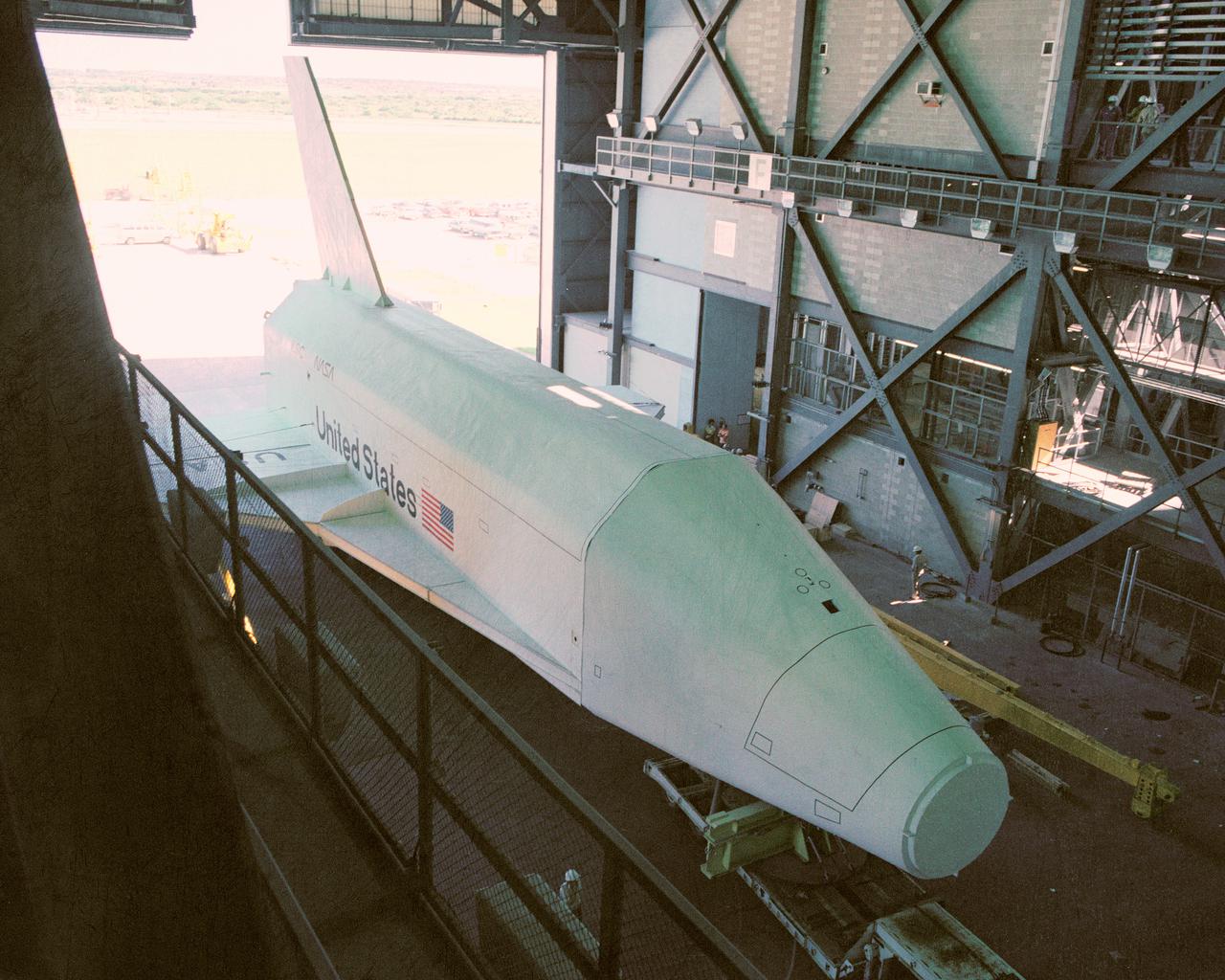
CAPE CANAVERAL, Fla. – At NASA's Kennedy Space Center in Florida, the space shuttle mock-up, dubbed Pathfinder, enters the Vehicle Assembly Building for a fit-check May 15, 1978. The mock-up, constructed at NASA's Marshall Space Flight Center in Huntsville, Ala., possessed the general dimensions, weight and balance of a real space shuttle. It was shipped to Kennedy by barge and then used to fit-check the work platforms of the Mate-Demate Device, orbiter processing facilities and Vehicle Assembly Building, as well as support ground crew training. It also was used to rehearse post-landing procedures at Kennedy's Shuttle Landing Facility. After being on display at the 'Great Space Shuttle Exposition' in Tokyo from June 1983 to August 1984, the mock-up returned to Marshall and now is on permanent display at the U.S. Space and Rocket Center near Huntsville. Photo credit: NASA
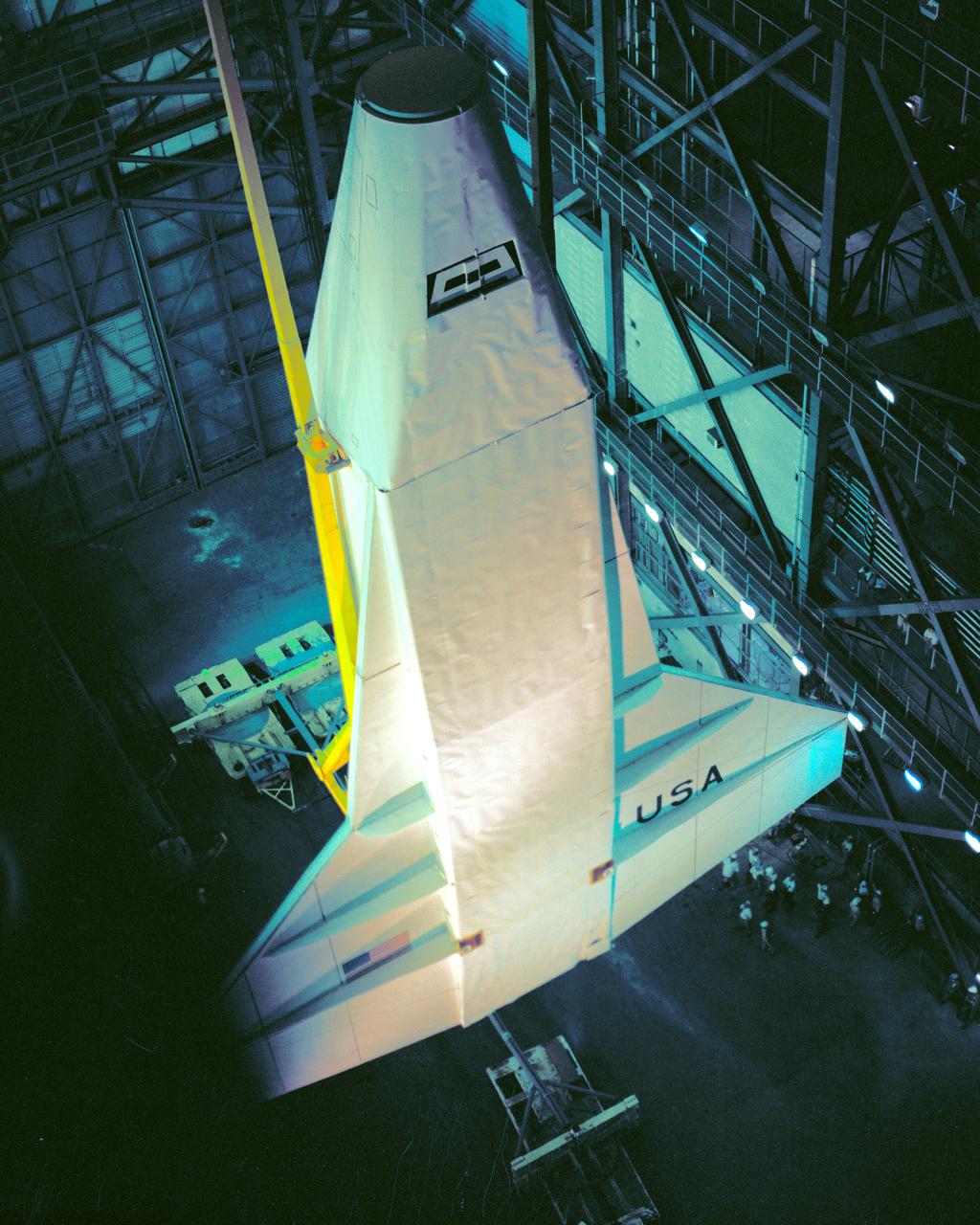
CAPE CANAVERAL, Fla. – At NASA's Kennedy Space Center in Florida, the space shuttle mock-up, dubbed Pathfinder, undergoes a lift test in the Vehicle Assembly Building on May 31, 1978. The mock-up, constructed at NASA's Marshall Space Flight Center in Huntsville, Ala., possessed the general dimensions, weight and balance of a real space shuttle. It was shipped to Kennedy by barge and then used to fit-check the work platforms of the Mate-Demate Device, orbiter processing facilities and Vehicle Assembly Building, as well as support ground crew training. It also was used to rehearse post-landing procedures at Kennedy's Shuttle Landing Facility. After being on display at the 'Great Space Shuttle Exposition' in Tokyo from June 1983 to August 1984, the mock-up returned to Marshall and now is on permanent display at the U.S. Space and Rocket Center near Huntsville. Photo credit: NASA
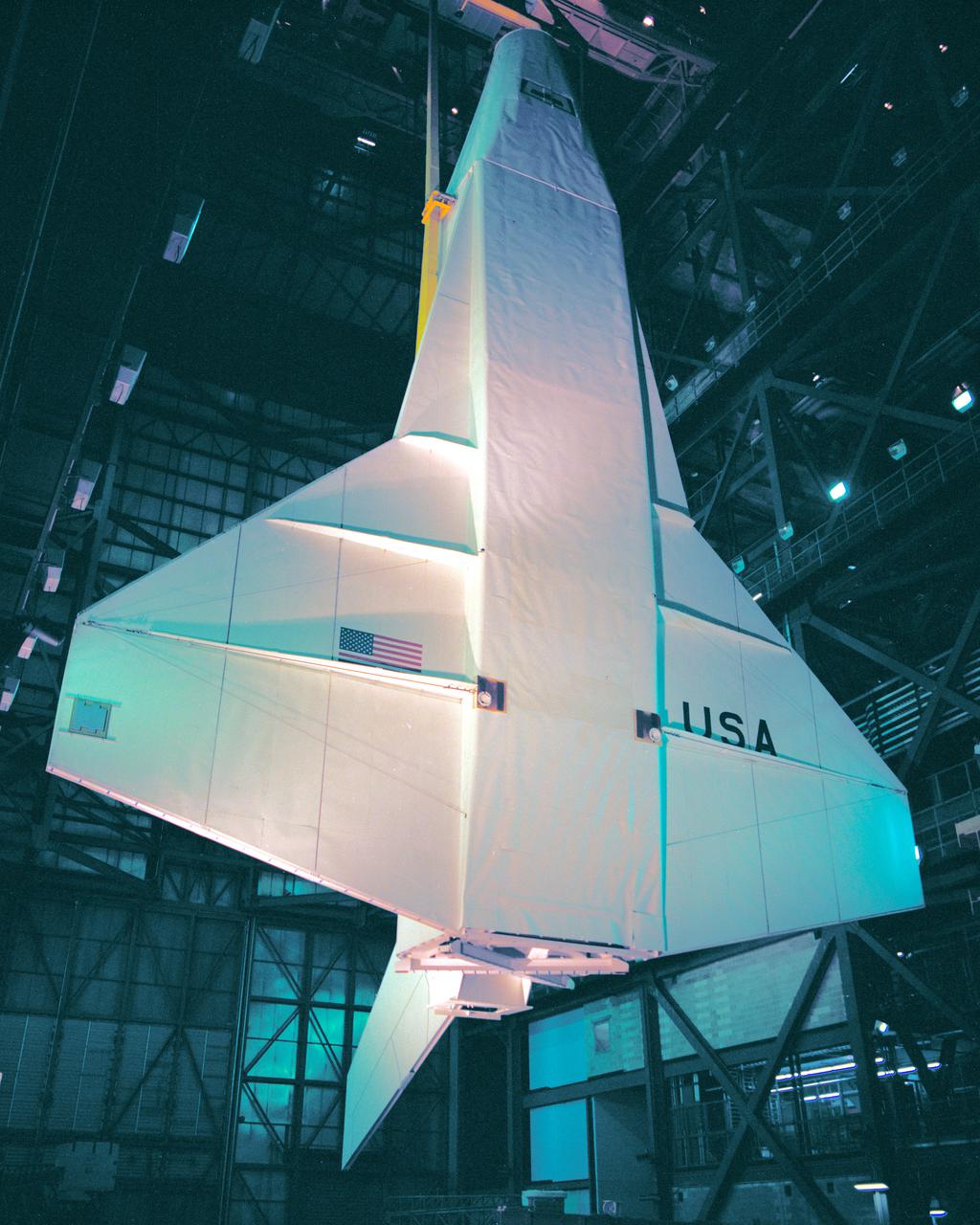
CAPE CANAVERAL, Fla. – At NASA's Kennedy Space Center in Florida, the space shuttle mock-up, dubbed Pathfinder, undergoes a lift test in the Vehicle Assembly Building on May 31, 1978. The mock-up, constructed at NASA's Marshall Space Flight Center in Huntsville, Ala., possessed the general dimensions, weight and balance of a real space shuttle. It was shipped to Kennedy by barge and then used to fit-check the work platforms of the Mate-Demate Device, orbiter processing facilities and Vehicle Assembly Building, as well as support ground crew training. It also was used to rehearse post-landing procedures at Kennedy's Shuttle Landing Facility. After being on display at the 'Great Space Shuttle Exposition' in Tokyo from June 1983 to August 1984, the mock-up returned to Marshall and now is on permanent display at the U.S. Space and Rocket Center near Huntsville. Photo credit: NASA
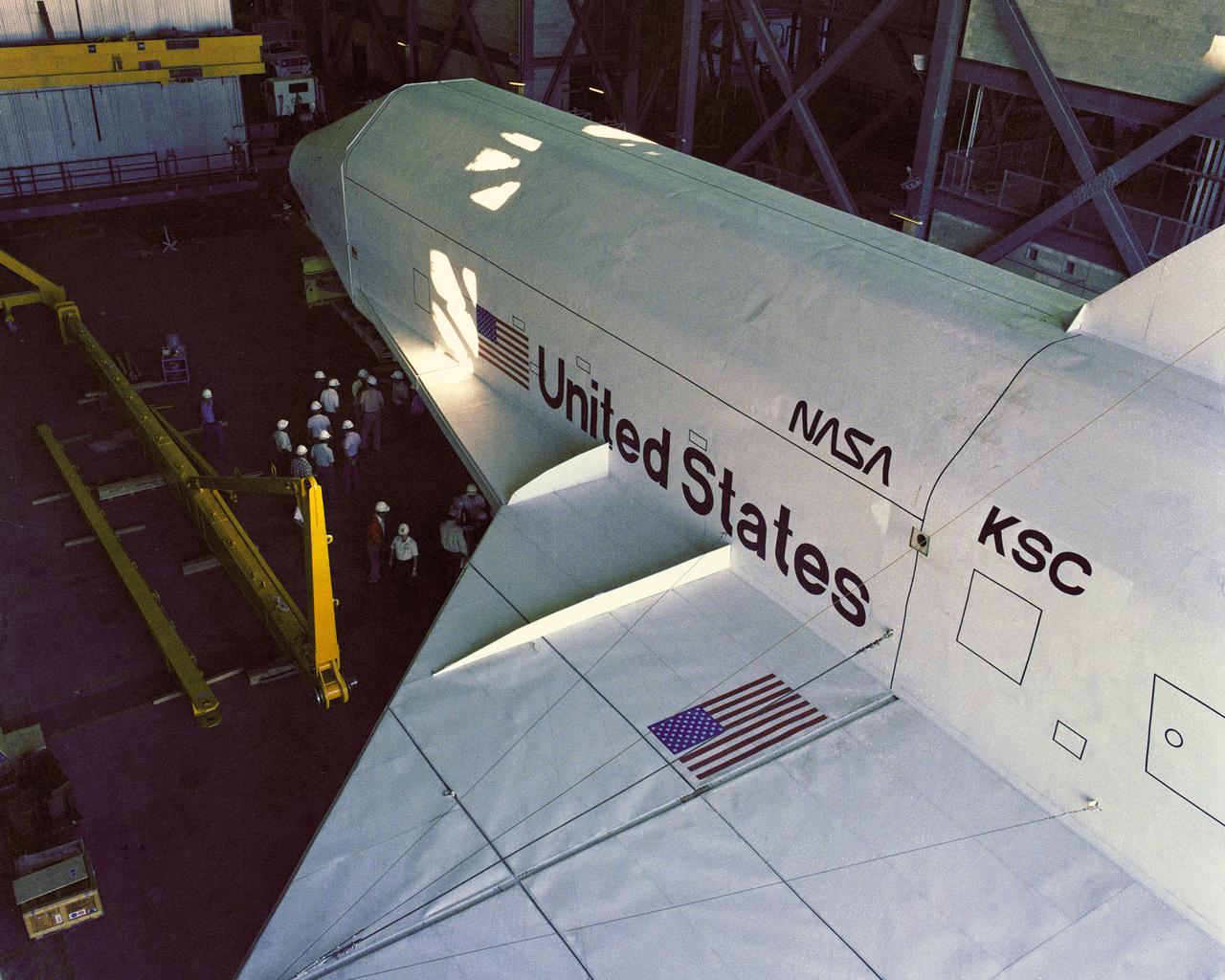
CAPE CANAVERAL, Fla. – At NASA's Kennedy Space Center in Florida, the space shuttle mock-up, dubbed Pathfinder, enters the Vehicle Assembly Building for a fit-check May 15, 1978. The mock-up, constructed at NASA's Marshall Space Flight Center in Huntsville, Ala., possessed the general dimensions, weight and balance of a real space shuttle. It was shipped to Kennedy by barge and then used to fit-check the work platforms of the Mate-Demate Device, orbiter processing facilities and Vehicle Assembly Building, as well as support ground crew training. It also was used to rehearse post-landing procedures at Kennedy's Shuttle Landing Facility. After being on display at the 'Great Space Shuttle Exposition' in Tokyo from June 1983 to August 1984, the mock-up returned to Marshall and now is on permanent display at the U.S. Space and Rocket Center near Huntsville. Photo credit: NASA
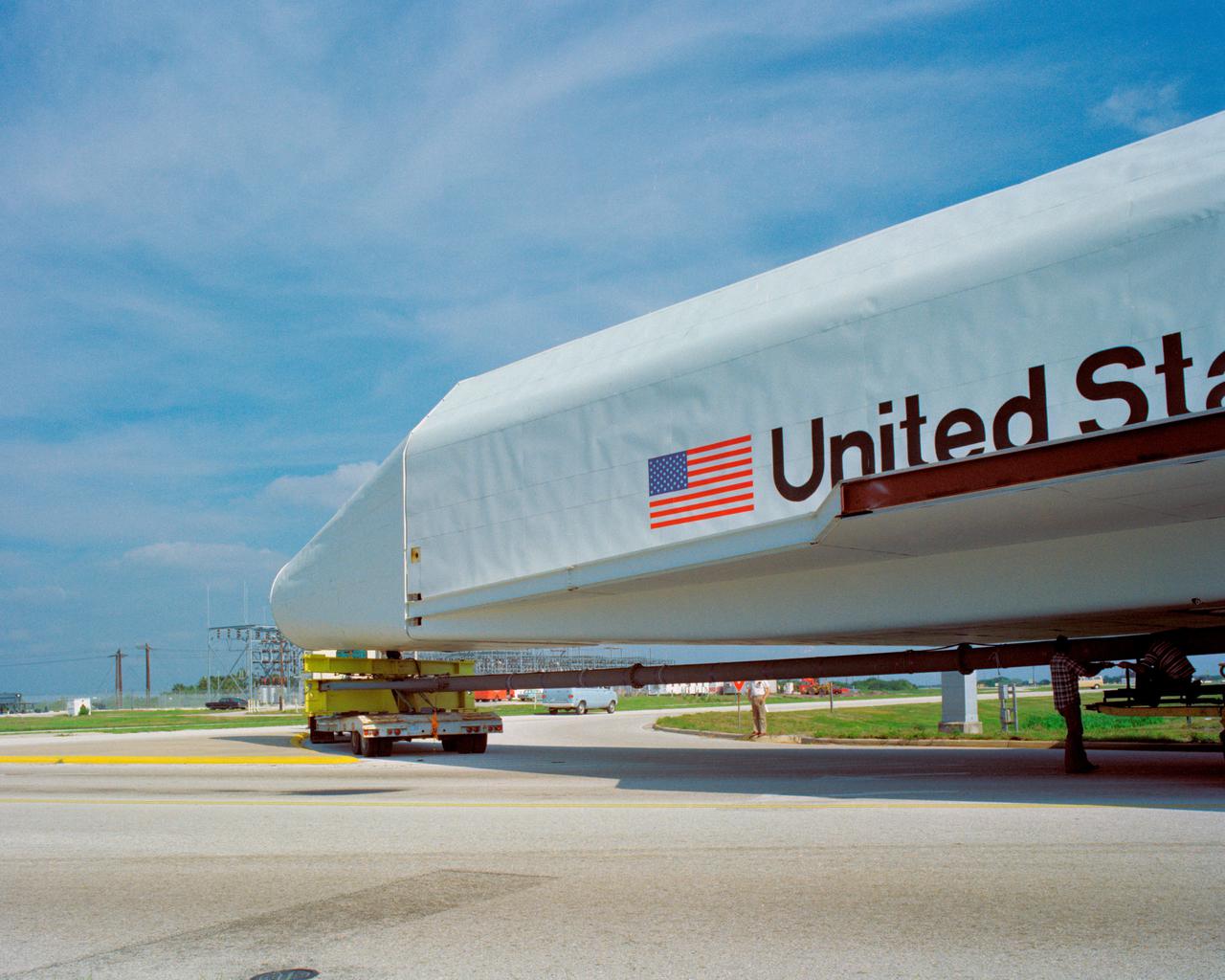
CAPE CANAVERAL, Fla. – At NASA's Kennedy Space Center in Florida, the space shuttle mock-up, dubbed Pathfinder, makes its trek from the turn basin to the Vehicle Assembly Building on April 5, 1978. The mock-up, constructed at NASA's Marshall Space Flight Center in Huntsville, Ala., possessed the general dimensions, weight and balance of a real space shuttle. It was shipped to Kennedy by barge and then used to fit-check the work platforms of the Mate-Demate Device, orbiter processing facilities and Vehicle Assembly Building, as well as support ground crew training. It also was used to rehearse post-landing procedures at Kennedy's Shuttle Landing Facility. After being on display at the 'Great Space Shuttle Exposition' in Tokyo from June 1983 to August 1984, the mock-up returned to Marshall and now is on permanent display at the U.S. Space and Rocket Center near Huntsville. Photo credit: NASA
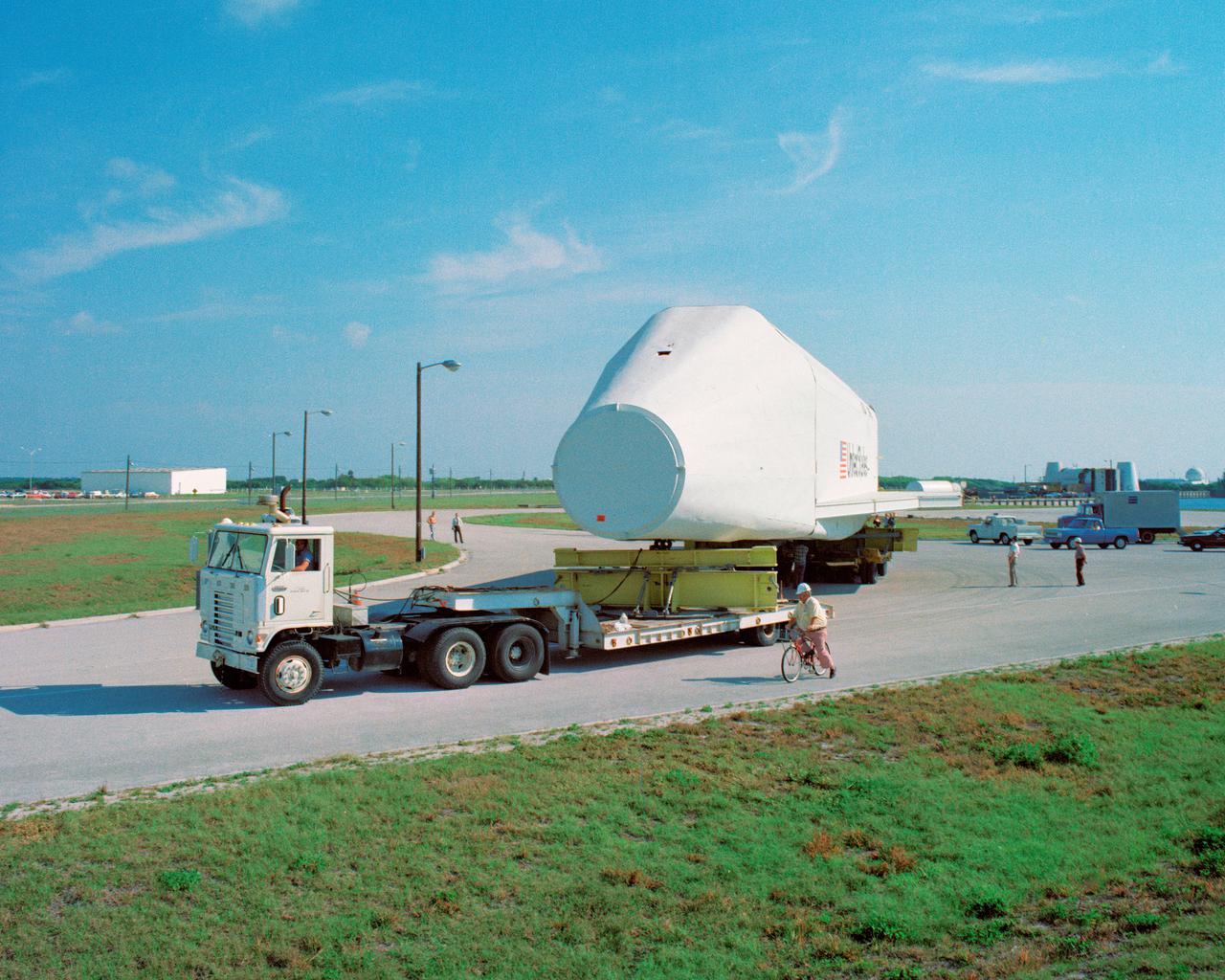
CAPE CANAVERAL, Fla. – At NASA's Kennedy Space Center in Florida, the space shuttle mock-up, dubbed Pathfinder, makes its trek from the turn basin to the Vehicle Assembly Building on April 5, 1978. The mock-up, constructed at NASA's Marshall Space Flight Center in Huntsville, Ala., possessed the general dimensions, weight and balance of a real space shuttle. It was shipped to Kennedy by barge and then used to fit-check the work platforms of the Mate-Demate Device, orbiter processing facilities and Vehicle Assembly Building, as well as support ground crew training. It also was used to rehearse post-landing procedures at Kennedy's Shuttle Landing Facility. After being on display at the 'Great Space Shuttle Exposition' in Tokyo from June 1983 to August 1984, the mock-up returned to Marshall and now is on permanent display at the U.S. Space and Rocket Center near Huntsville. Photo credit: NASA
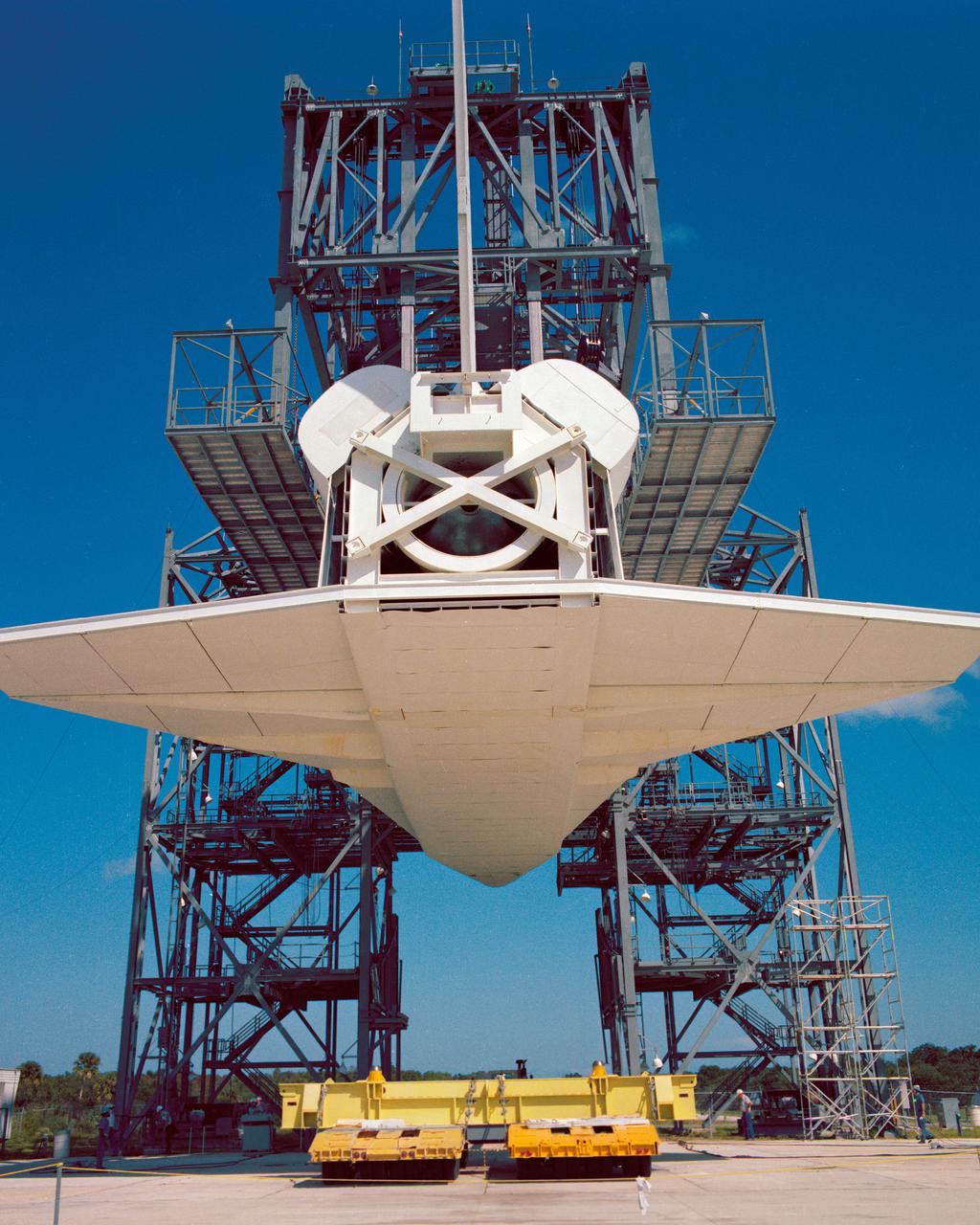
CAPE CANAVERAL, Fla. – At NASA's Kennedy Space Center in Florida, the space shuttle mock-up, dubbed Pathfinder, is attached to the Mate-Demate Device for at fit-check Oct. 19, 1978. The mock-up, constructed at NASA's Marshall Space Flight Center in Huntsville, Ala., possessed the general dimensions, weight and balance of a real space shuttle. It was shipped to Kennedy by barge and then used to fit-check the work platforms of the Mate-Demate Device, orbiter processing facilities and Vehicle Assembly Building, as well as support ground crew training. It also was used to rehearse post-landing procedures at Kennedy's Shuttle Landing Facility. After being on display at the 'Great Space Shuttle Exposition' in Tokyo from June 1983 to August 1984, the mock-up returned to Marshall and now is on permanent display at the U.S. Space and Rocket Center near Huntsville. Photo credit: NASA
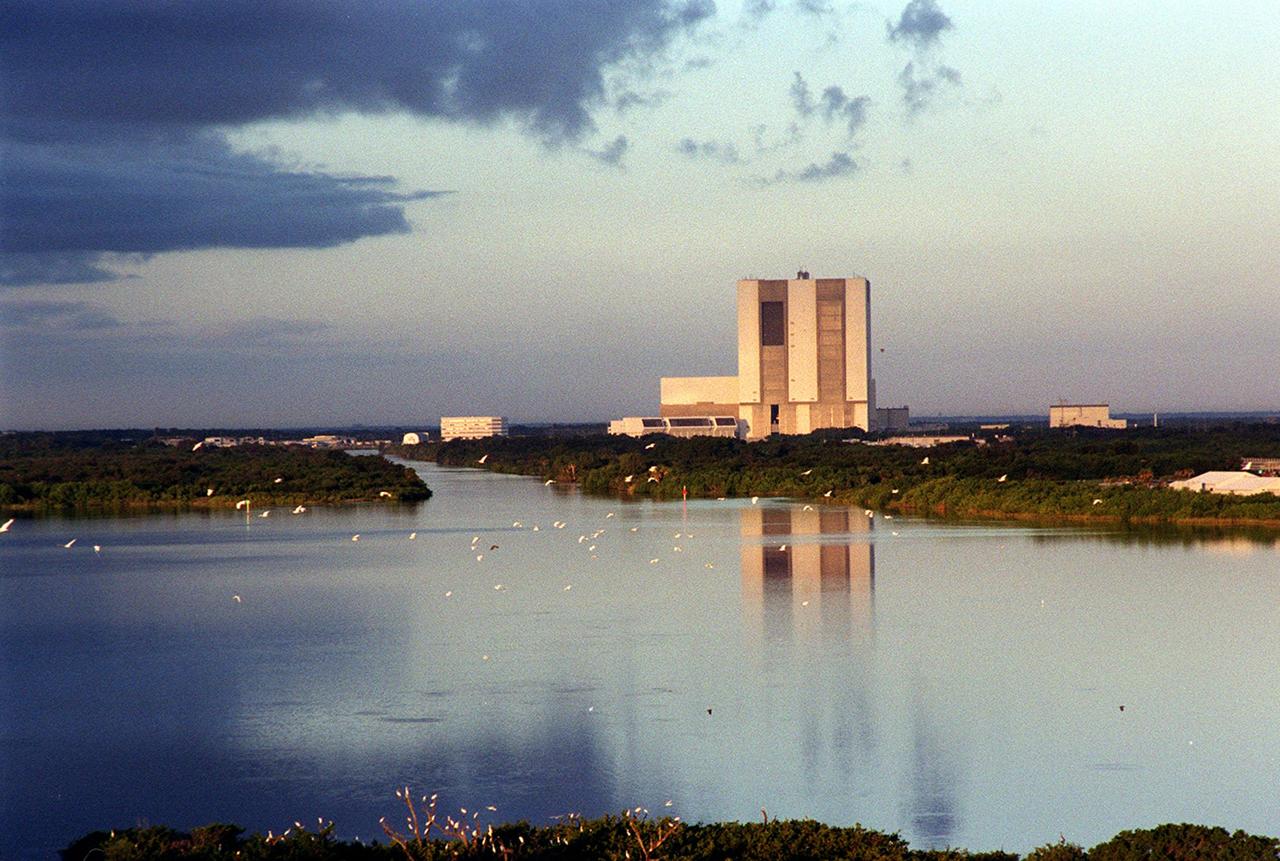
In the early morning, flocks of birds soar over the Banana River, whose waters reflect the Vehicle Assembly Building , bathed in a pink glow from post-dawn light. Next to the VAB, on the left, is the Launch Control Center. The rectangular building closer to the water at left is the Operations Support Building. At right is the Rotation/Processing Facility. The birds are a common sight at KSC since the Center shares a boundary with the Merritt Island National Wildlife Refuge. The Refuge encompasses 92,000 acres that are a habitat for more than 331 species of birds, 31 mammals, 117 fishes, and 65 amphibians and reptiles. The marshes and open water of the refuge provide wintering areas for 23 species of migratory waterfowl, as well as a year-round home for great blue herons, great egrets, wood storks, cormorants, brown pelicans and other species of marsh and shore birds, as well as a variety of insects.
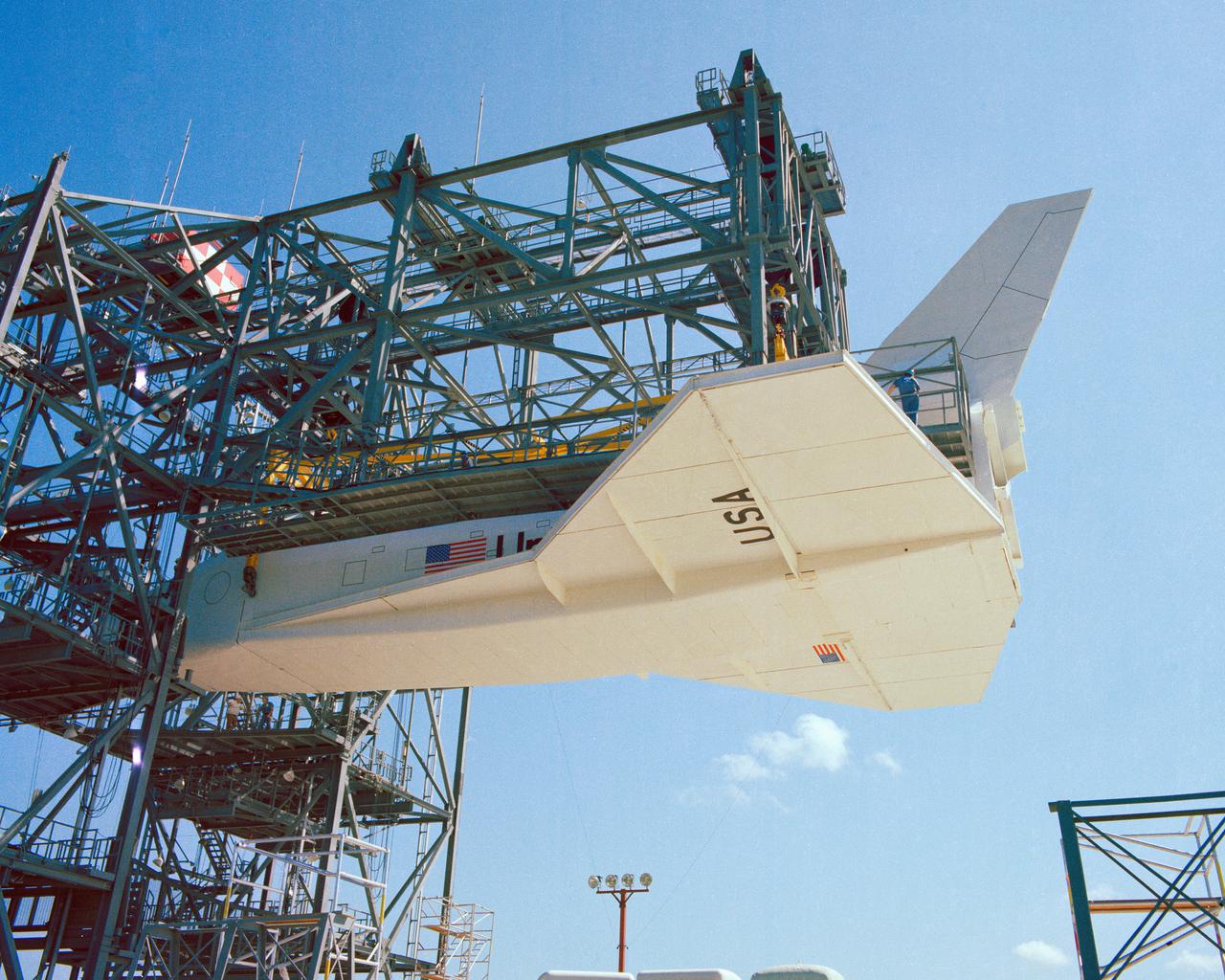
CAPE CANAVERAL, Fla. – At NASA's Kennedy Space Center in Florida, the space shuttle mock-up, dubbed Pathfinder, is attached to the Mate-Demate Device for at fit-check Oct. 19, 1978. The mock-up, constructed at NASA's Marshall Space Flight Center in Huntsville, Ala., possessed the general dimensions, weight and balance of a real space shuttle. It was shipped to Kennedy by barge and then used to fit-check the work platforms of the Mate-Demate Device, orbiter processing facilities and Vehicle Assembly Building, as well as support ground crew training. It also was used to rehearse post-landing procedures at Kennedy's Shuttle Landing Facility. After being on display at the 'Great Space Shuttle Exposition' in Tokyo from June 1983 to August 1984, the mock-up returned to Marshall and now is on permanent display at the U.S. Space and Rocket Center near Huntsville. Photo credit: NASA
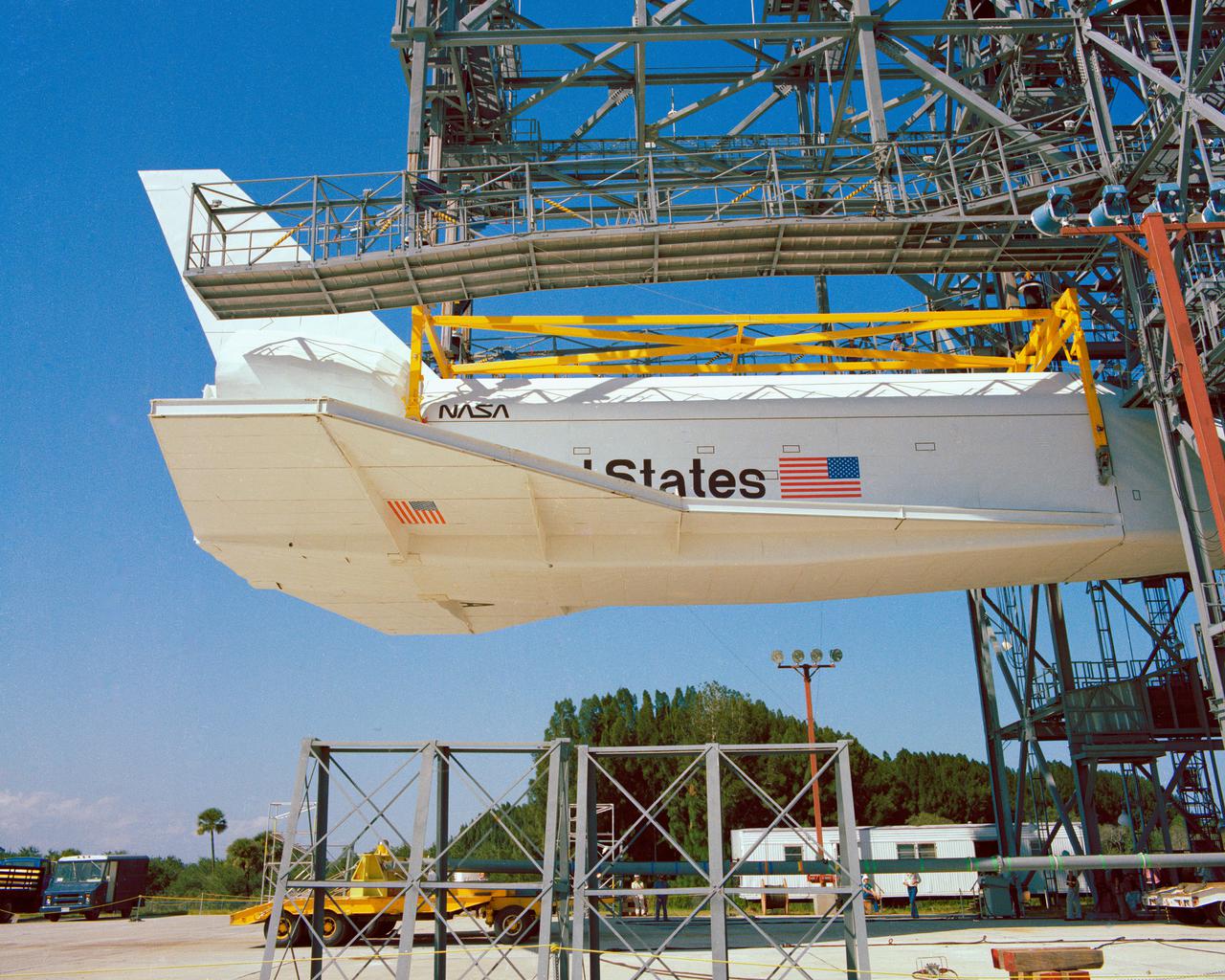
CAPE CANAVERAL, Fla. – At NASA's Kennedy Space Center in Florida, the space shuttle mock-up, dubbed Pathfinder, is attached to the Mate-Demate Device for at fit-check Oct. 19, 1978. The mock-up, constructed at NASA's Marshall Space Flight Center in Huntsville, Ala., possessed the general dimensions, weight and balance of a real space shuttle. It was shipped to Kennedy by barge and then used to fit-check the work platforms of the Mate-Demate Device, orbiter processing facilities and Vehicle Assembly Building, as well as support ground crew training. It also was used to rehearse post-landing procedures at Kennedy's Shuttle Landing Facility. After being on display at the 'Great Space Shuttle Exposition' in Tokyo from June 1983 to August 1984, the mock-up returned to Marshall and now is on permanent display at the U.S. Space and Rocket Center near Huntsville. Photo credit: NASA
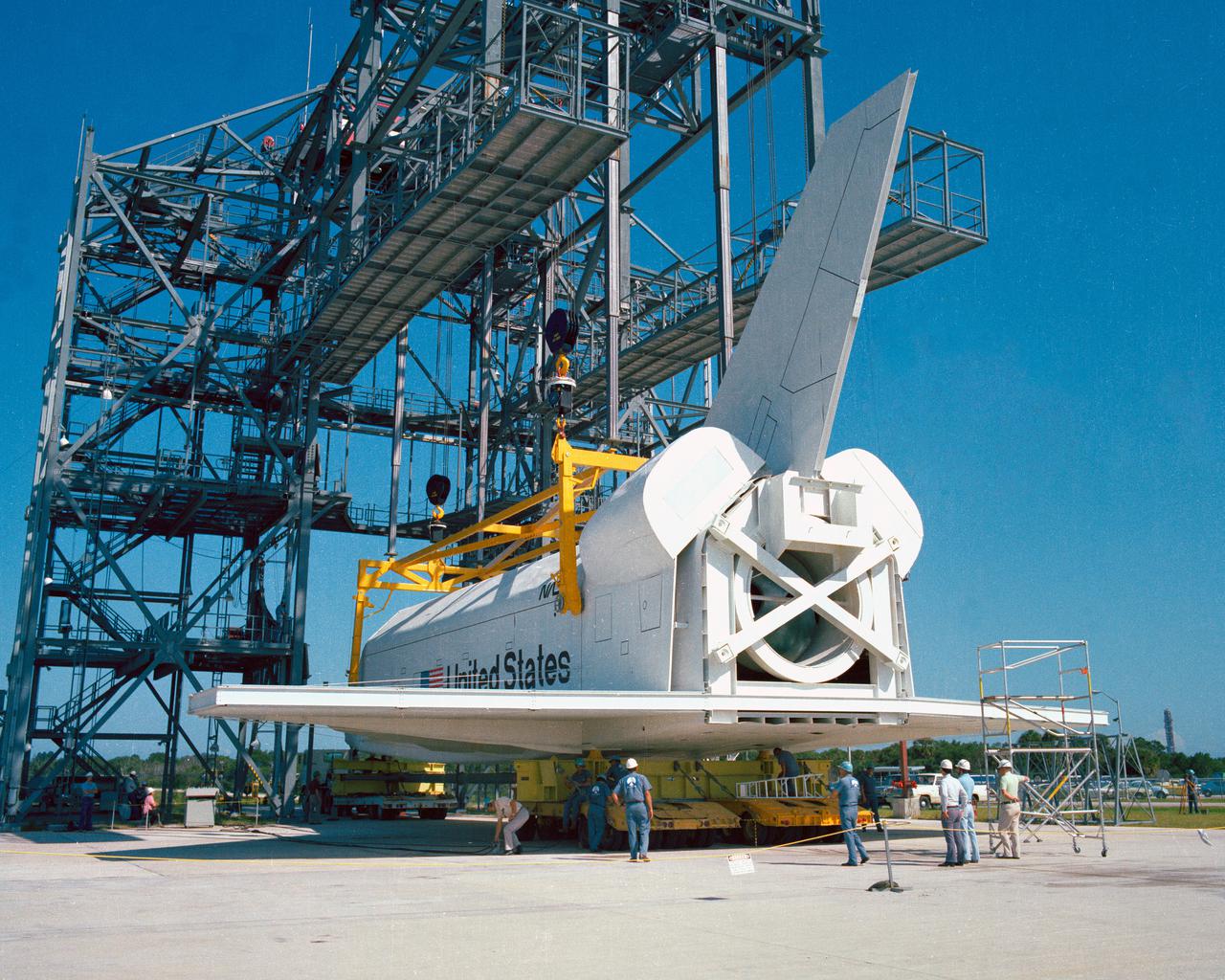
CAPE CANAVERAL, Fla. – At NASA's Kennedy Space Center in Florida, the space shuttle mock-up, dubbed Pathfinder, is attached to the Mate-Demate Device for at fit-check Oct. 19, 1978. The mock-up, constructed at NASA's Marshall Space Flight Center in Huntsville, Ala., possessed the general dimensions, weight and balance of a real space shuttle. It was shipped to Kennedy by barge and then used to fit-check the work platforms of the Mate-Demate Device, orbiter processing facilities and Vehicle Assembly Building, as well as support ground crew training. It also was used to rehearse post-landing procedures at Kennedy's Shuttle Landing Facility. After being on display at the 'Great Space Shuttle Exposition' in Tokyo from June 1983 to August 1984, the mock-up returned to Marshall and now is on permanent display at the U.S. Space and Rocket Center near Huntsville. Photo credit: NASA
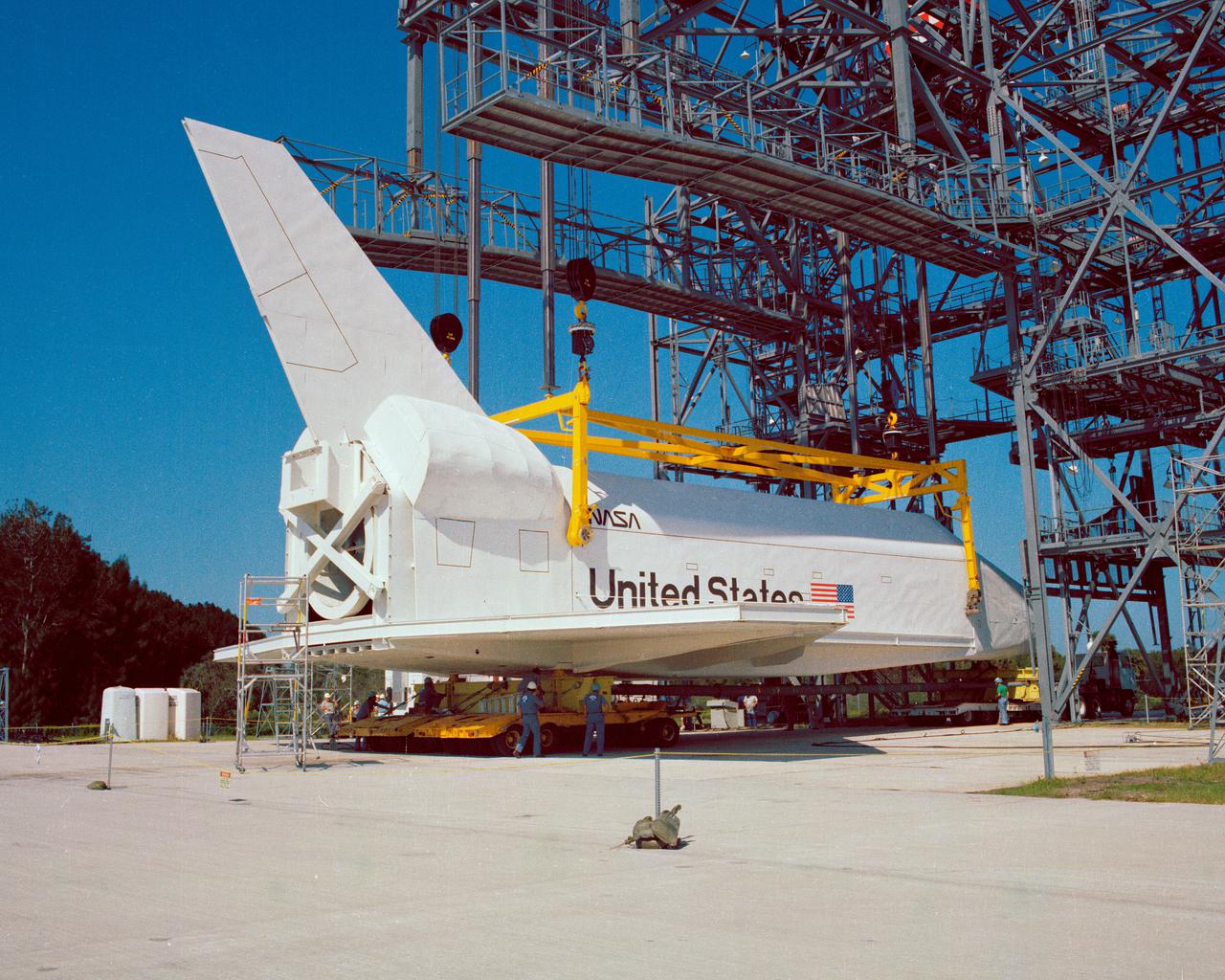
CAPE CANAVERAL, Fla. – At NASA's Kennedy Space Center in Florida, the space shuttle mock-up, dubbed Pathfinder, is attached to the Mate-Demate Device for at fit-check Oct. 19, 1978. The mock-up, constructed at NASA's Marshall Space Flight Center in Huntsville, Ala., possessed the general dimensions, weight and balance of a real space shuttle. It was shipped to Kennedy by barge and then used to fit-check the work platforms of the Mate-Demate Device, orbiter processing facilities and Vehicle Assembly Building, as well as support ground crew training. It also was used to rehearse post-landing procedures at Kennedy's Shuttle Landing Facility. After being on display at the 'Great Space Shuttle Exposition' in Tokyo from June 1983 to August 1984, the mock-up returned to Marshall and now is on permanent display at the U.S. Space and Rocket Center near Huntsville. Photo credit: NASA
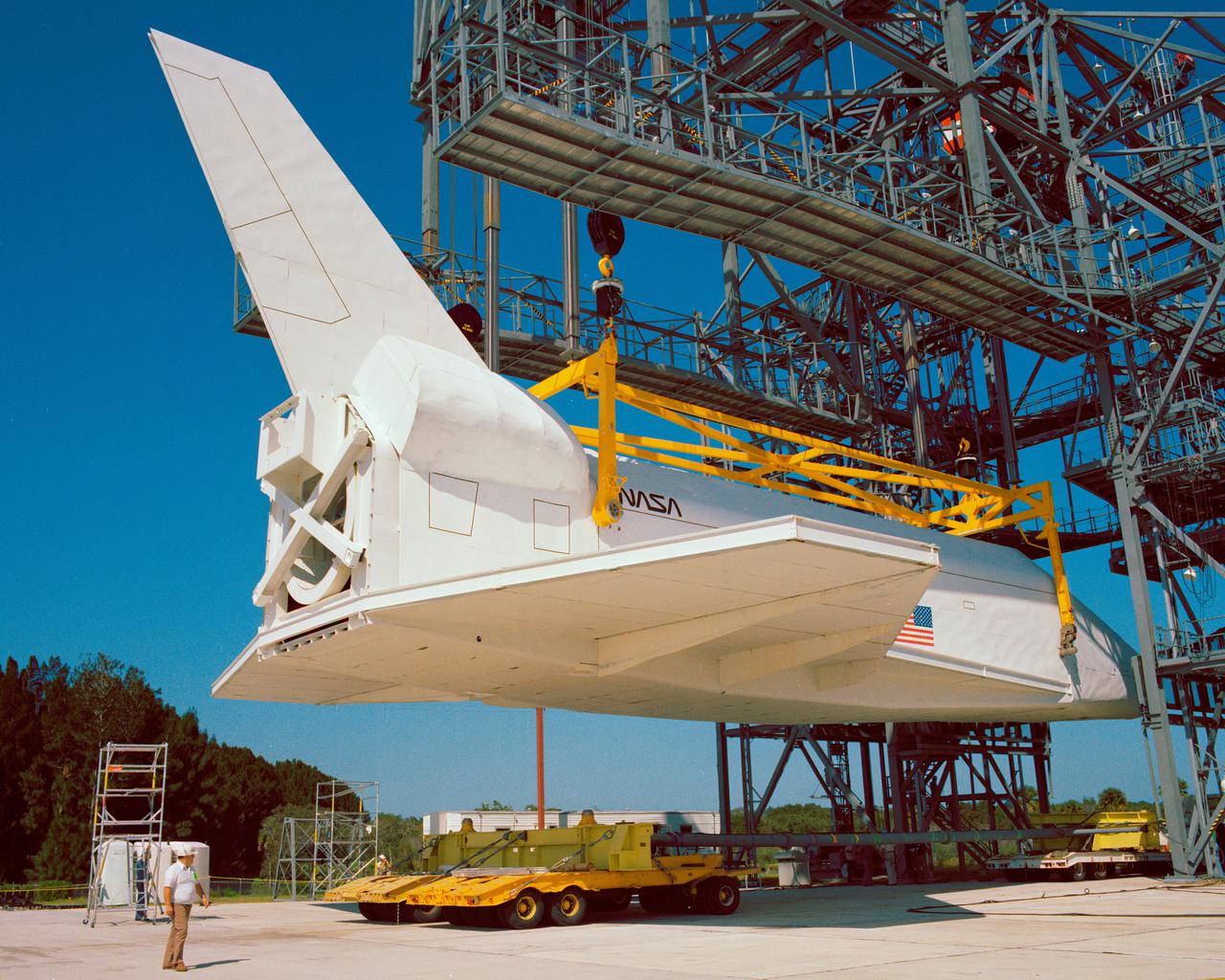
CAPE CANAVERAL, Fla. – At NASA's Kennedy Space Center in Florida, the space shuttle mock-up, dubbed Pathfinder, is attached to the Mate-Demate Device for at fit-check Oct. 19, 1978. The mock-up, constructed at NASA's Marshall Space Flight Center in Huntsville, Ala., possessed the general dimensions, weight and balance of a real space shuttle. It was shipped to Kennedy by barge and then used to fit-check the work platforms of the Mate-Demate Device, orbiter processing facilities and Vehicle Assembly Building, as well as support ground crew training. It also was used to rehearse post-landing procedures at Kennedy's Shuttle Landing Facility. After being on display at the 'Great Space Shuttle Exposition' in Tokyo from June 1983 to August 1984, the mock-up returned to Marshall and now is on permanent display at the U.S. Space and Rocket Center near Huntsville. Photo credit: NASA