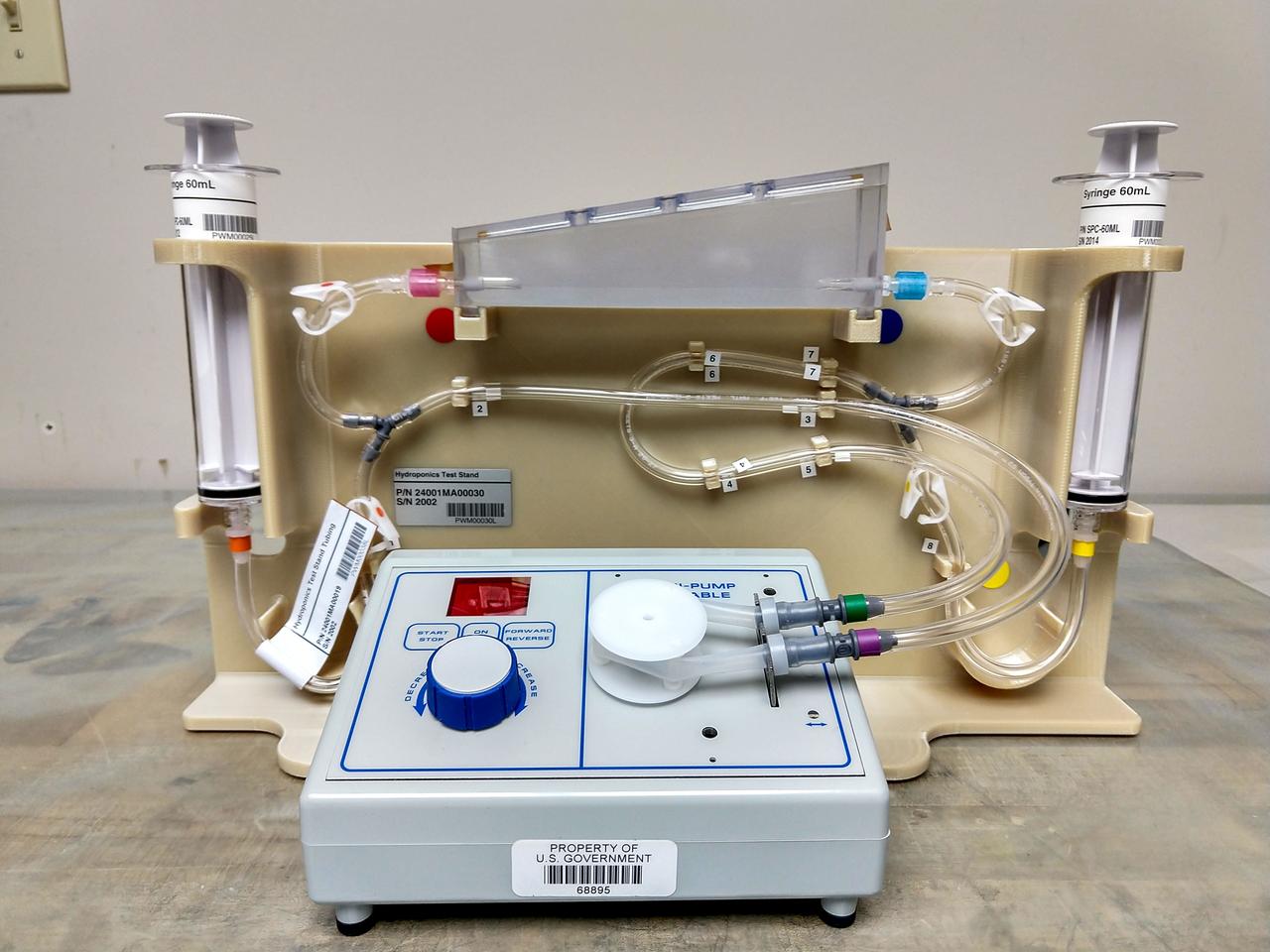
jsc2019e041774 (5/10/2019) --- Preflight imagery of a Plant Water Management (PWM) Harness and Hydroponics Test Article. Plant Water Management demonstrates a hydroponic method for ensuring adequate hydration and aeration to the root zone in order to sustain plants from germination through harvest. Low-gravity capillary fluidics deliver water in single and multiple plant production chambers, and researchers compare growth of individual plants in microgravity and normal gravity.
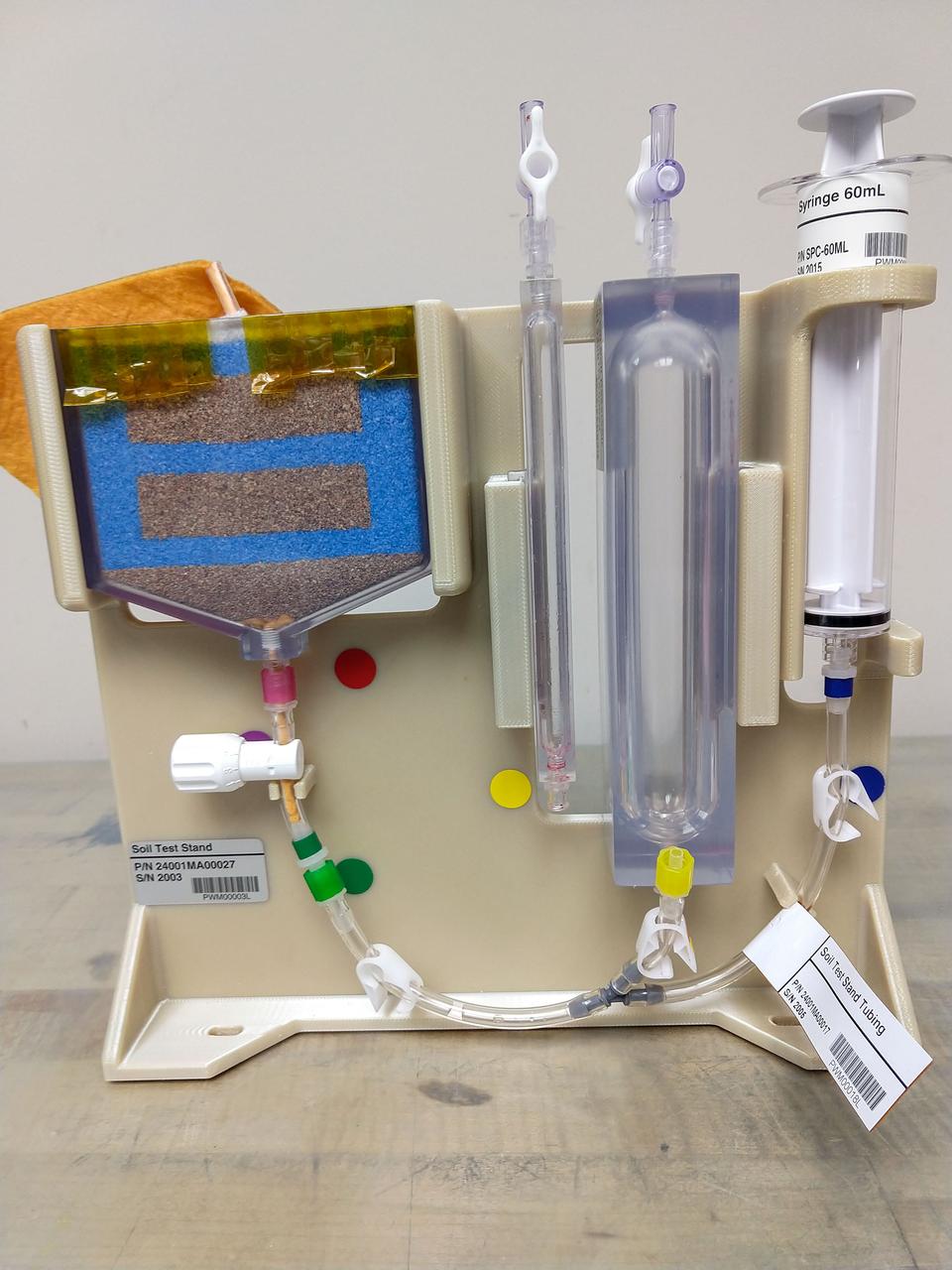
jsc2019e041775 (5/10/2019) --- Preflight imagery of a Plant Water Management (PWM) Harness and Soil Test Article. Plant Water Management demonstrates a hydroponic method for ensuring adequate hydration and aeration to the root zone in order to sustain plants from germination through harvest. Low-gravity capillary fluidics deliver water in single and multiple plant production chambers, and researchers compare growth of individual plants in microgravity and normal gravity.
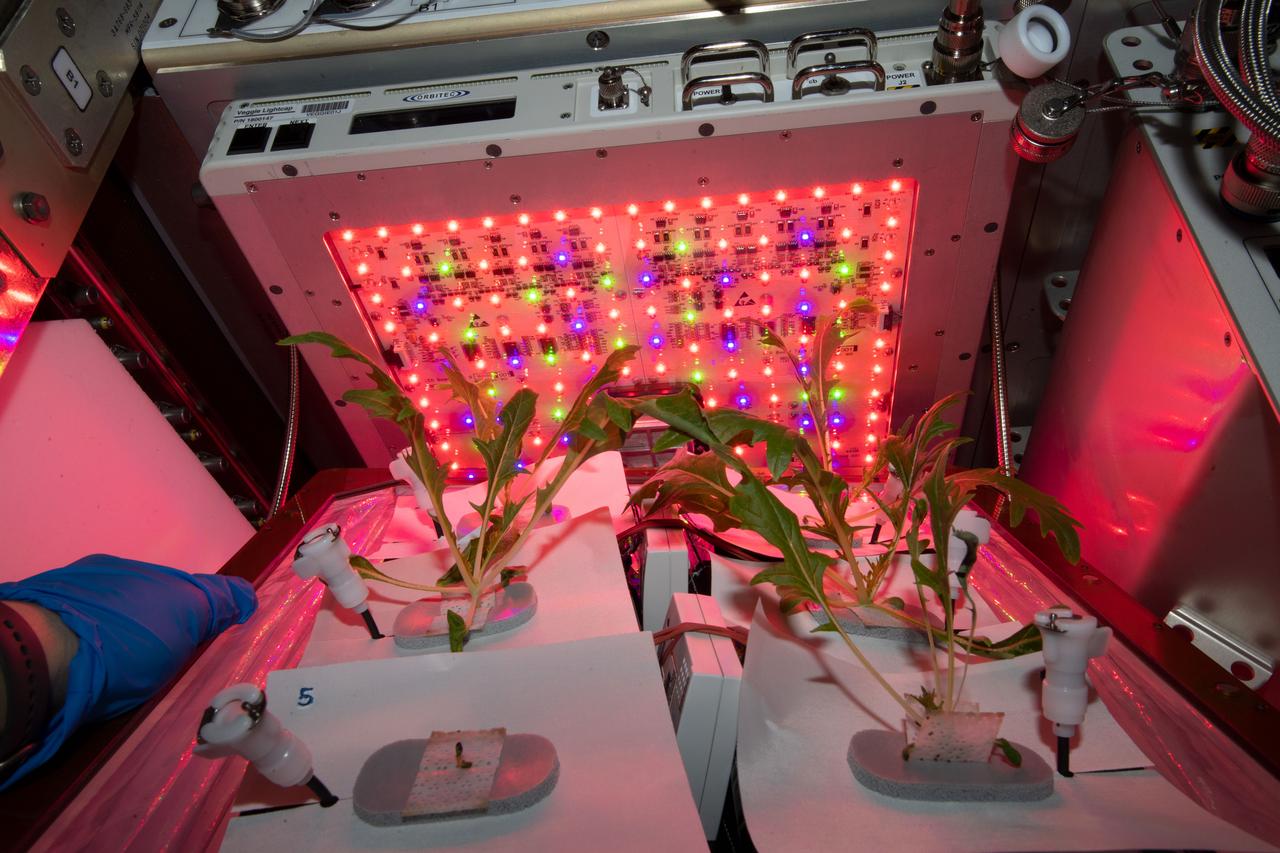
iss059e117376 (6/22/2019) --- Photo documentation taken during VEG-04 Water Check and Mass Measurement Device Operations aboard the International Space Station (ISS). The crew checks plants for water and waters if needed then if there are any leafs that have been broken off. The research of Veg-04A focuses on the impact of light quality and fertilizer on leafy crop growth for a 28-day grow-out.
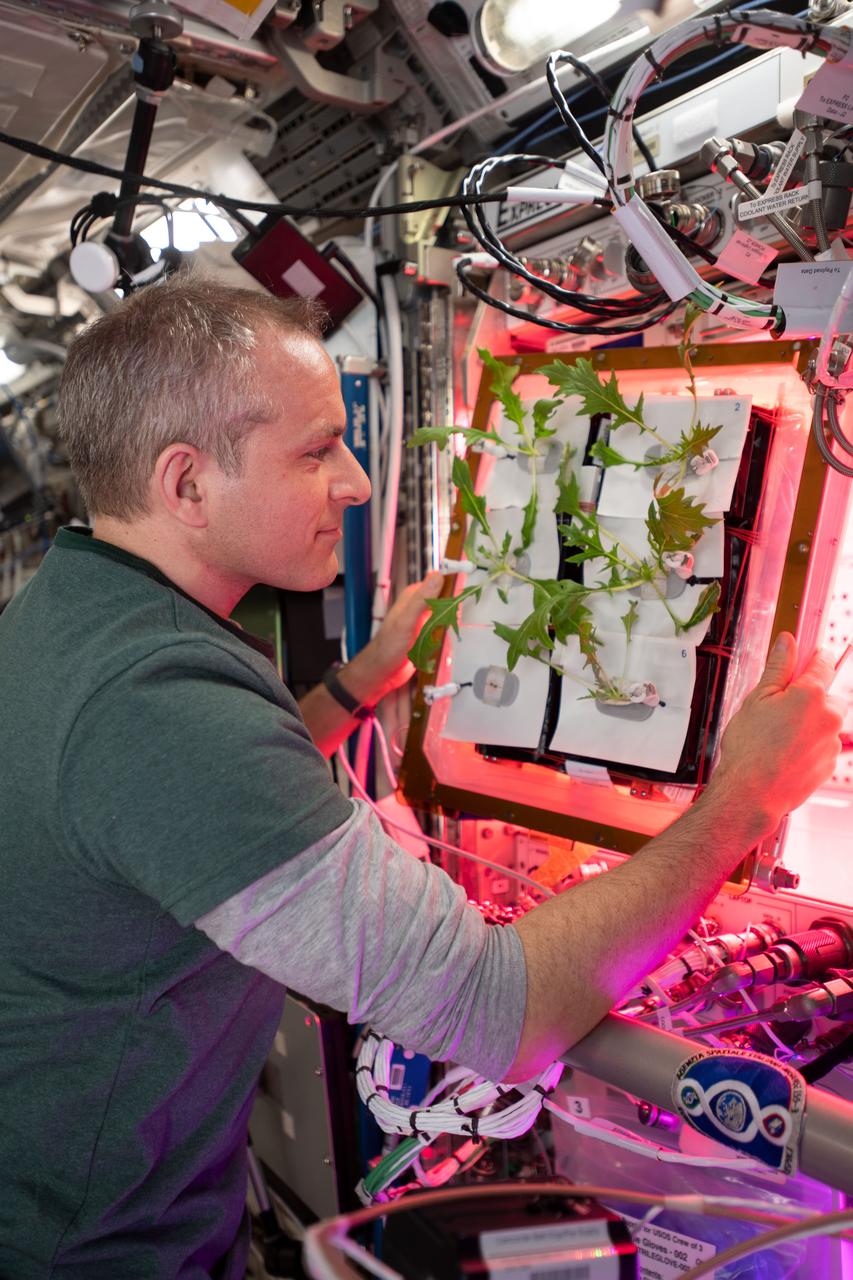
iss059e117393 (6/23/2019) --- Canadian Space Agency (CSA) astronaut David Saint-Jacques is photographed during VEG-04 Water Check and Mass Measurement Device Operations. Saint-Jacques is watering the plants if needed and looking for any leaves that have broken off. The research of Veg-04A focuses on the impact of light quality and fertilizer on leafy crop growth for a 28-day grow-out.
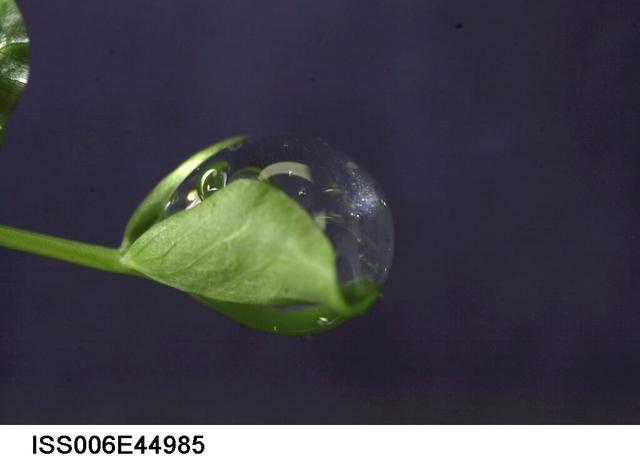
ISS006-E-44985 (10 March 2003) --- A close up view of a water droplet on a leaf on the Russian BIO-5 Rasteniya-2/Lada-2 (Plants-2) plant growth experiment, which is located in the Zvezda Service Module on the International Space Station (ISS).
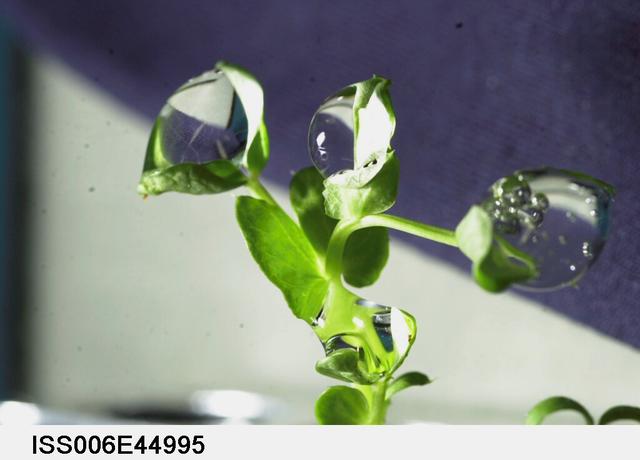
ISS006-E-44995 (10 March 2003) --- A close up view of water droplets on leaves on the Russian BIO-5 Rasteniya-2/Lada-2 (Plants-2) plant growth experiment, which is located in the Zvezda Service Module on the International Space Station (ISS).
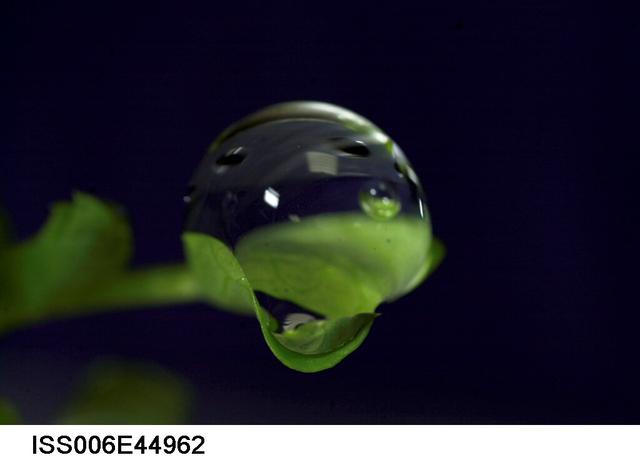
ISS006-E-44962 (9 March 2003) --- A close up view of a water droplet on a leaf on the Russian BIO-5 Rasteniya-2/Lada-2 (Plants-2) plant growth experiment, which is located in the Zvezda Service Module on the International Space Station (ISS).
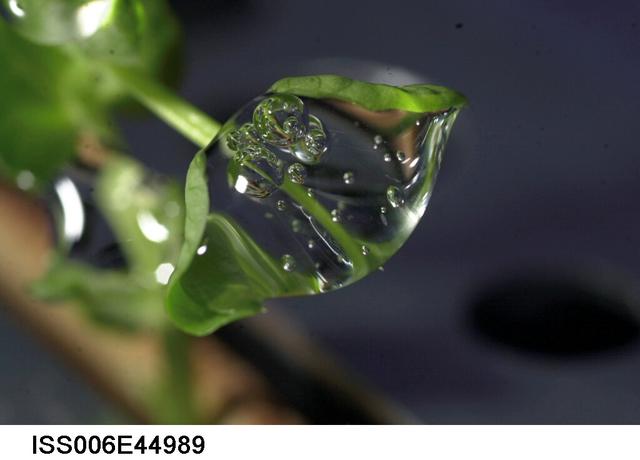
ISS006-E-44989 (10 March 2003) --- A close up view of a water droplet on a leaf on the Russian BIO-5 Rasteniya-2/Lada-2 (Plants-2) plant growth experiment, which is located in the Zvezda Service Module on the International Space Station (ISS).
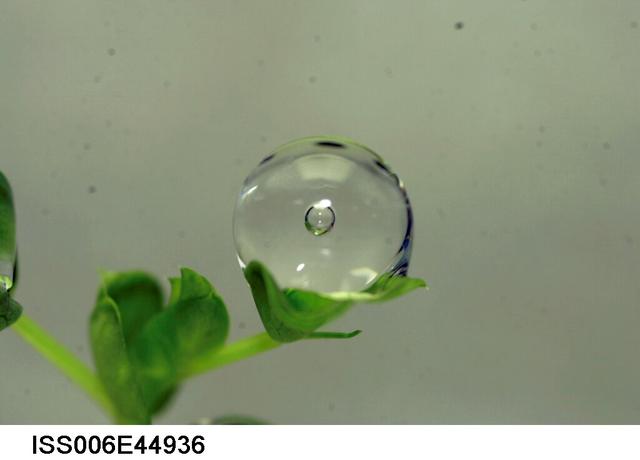
ISS006-E-44936 (9 March 2003) --- A close up view of a water droplet on a leaf on the Russian BIO-5 Rasteniya-2/Lada-2 (Plants-2) plant growth experiment, which is located in the Zvezda Service Module on the International Space Station (ISS).

ISS006-E-44929 (9 March 2003) --- A close up view of water droplets on leaves on the Russian BIO-5 Rasteniya-2/Lada-2 (Plants-2) plant growth experiment, which is located in the Zvezda Service Module on the International Space Station (ISS).
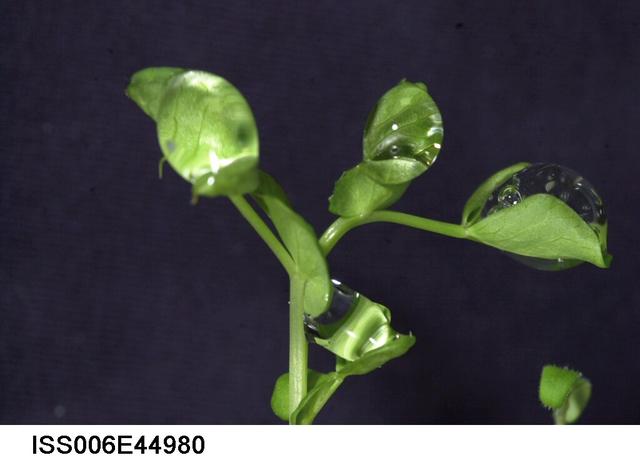
ISS006-E-44980 (10 March 2003) --- A close up view of water droplets on leaves on the Russian BIO-5 Rasteniya-2/Lada-2 (Plants-2) plant growth experiment, which is located in the Zvezda Service Module on the International Space Station (ISS).
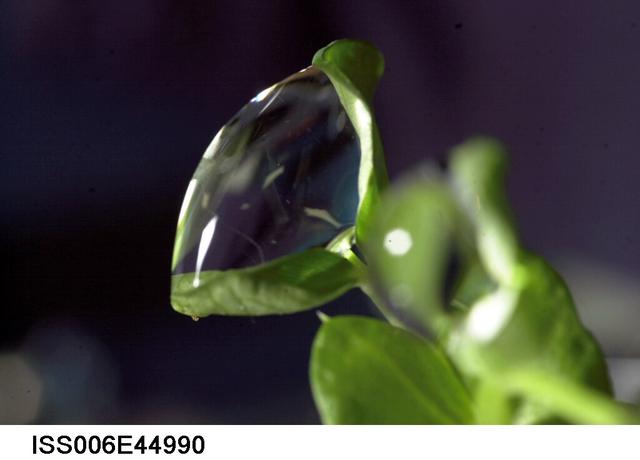
ISS006-E-44990 (10 March 2003) --- A close up view of a water droplet on a leaf on the Russian BIO-5 Rasteniya-2/Lada-2 (Plants-2) plant growth experiment, which is located in the Zvezda Service Module on the International Space Station (ISS).
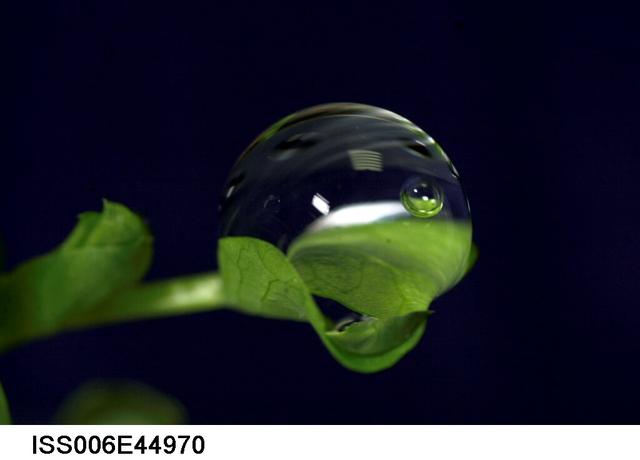
ISS006-E-44970 (9 March 2003) --- A close up view of a water droplet on a leaf on the Russian BIO-5 Rasteniya-2/Lada-2 (Plants-2) plant growth experiment, which is located in the Zvezda Service Module on the International Space Station (ISS).
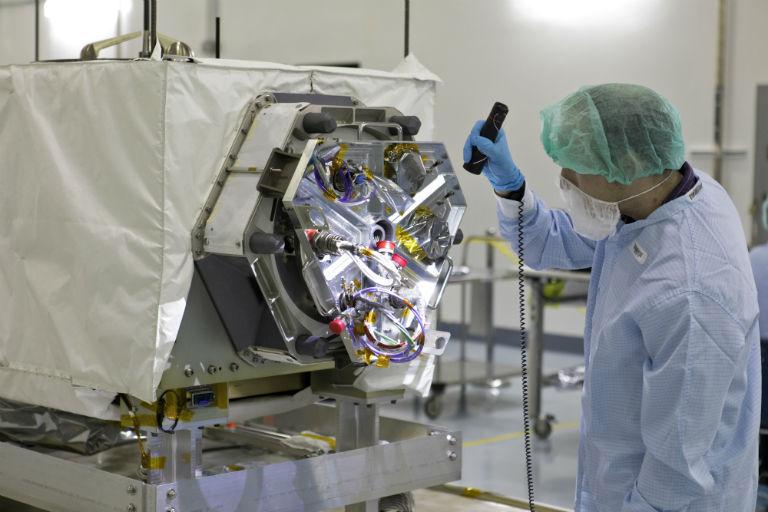
A technician inspects NASA's ECOSTRESS instrument in a clean room at Kennedy Space Center in Florida. ECOSTRESS measures the temperature of plants, which shows how they are regulating their water use in response to heat stress. https://photojournal.jpl.nasa.gov/catalog/PIA22509
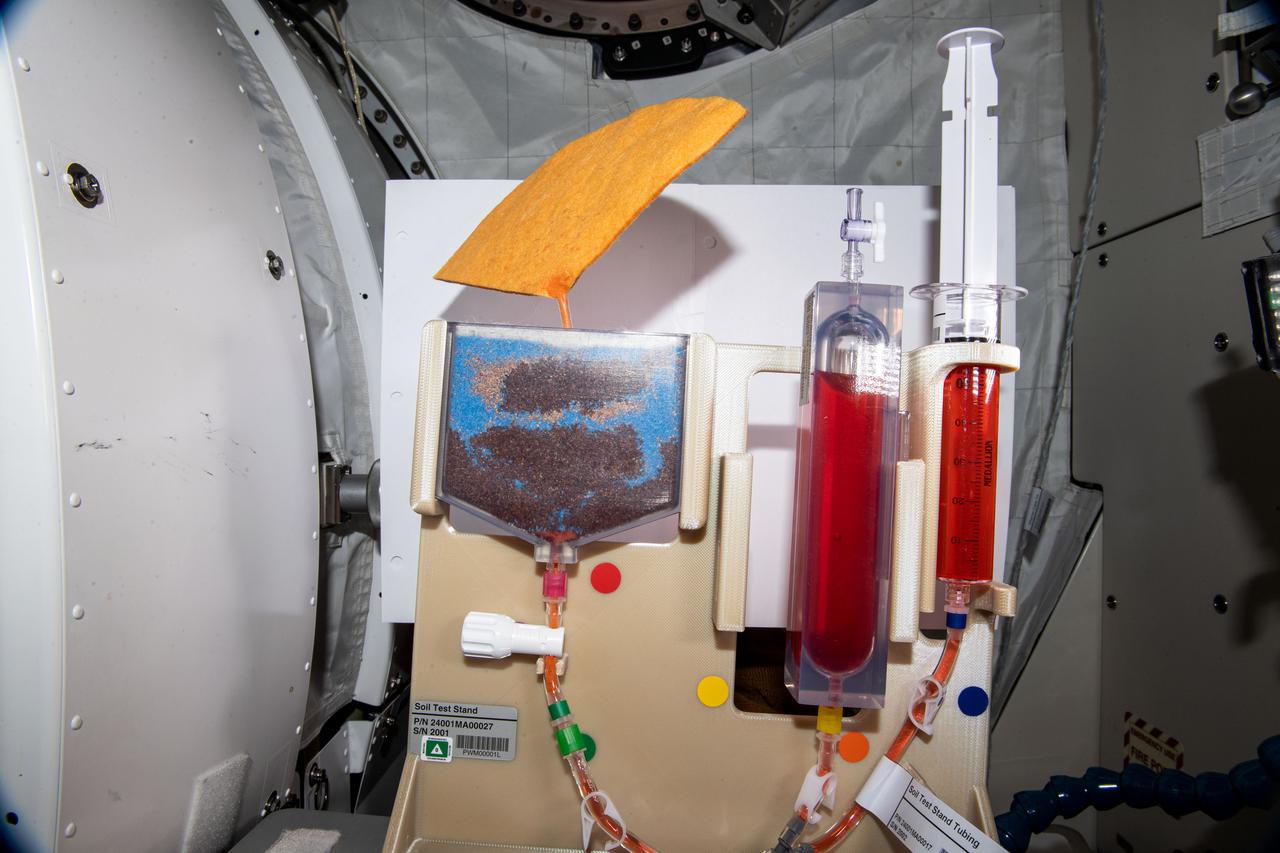
iss064e030235 (2/8/2021) --- A view of the Plant Water Management (PWM) investigation aboard the International space Station (ISS). Plant Water Management demonstrates a hydroponic method for ensuring adequate hydration and aeration to the root zone in order to sustain plants from germination through harvest. Low-gravity capillary fluidics deliver water in single and multiple plant production chambers, and researchers compare growth of individual plants in microgravity and normal gravity.
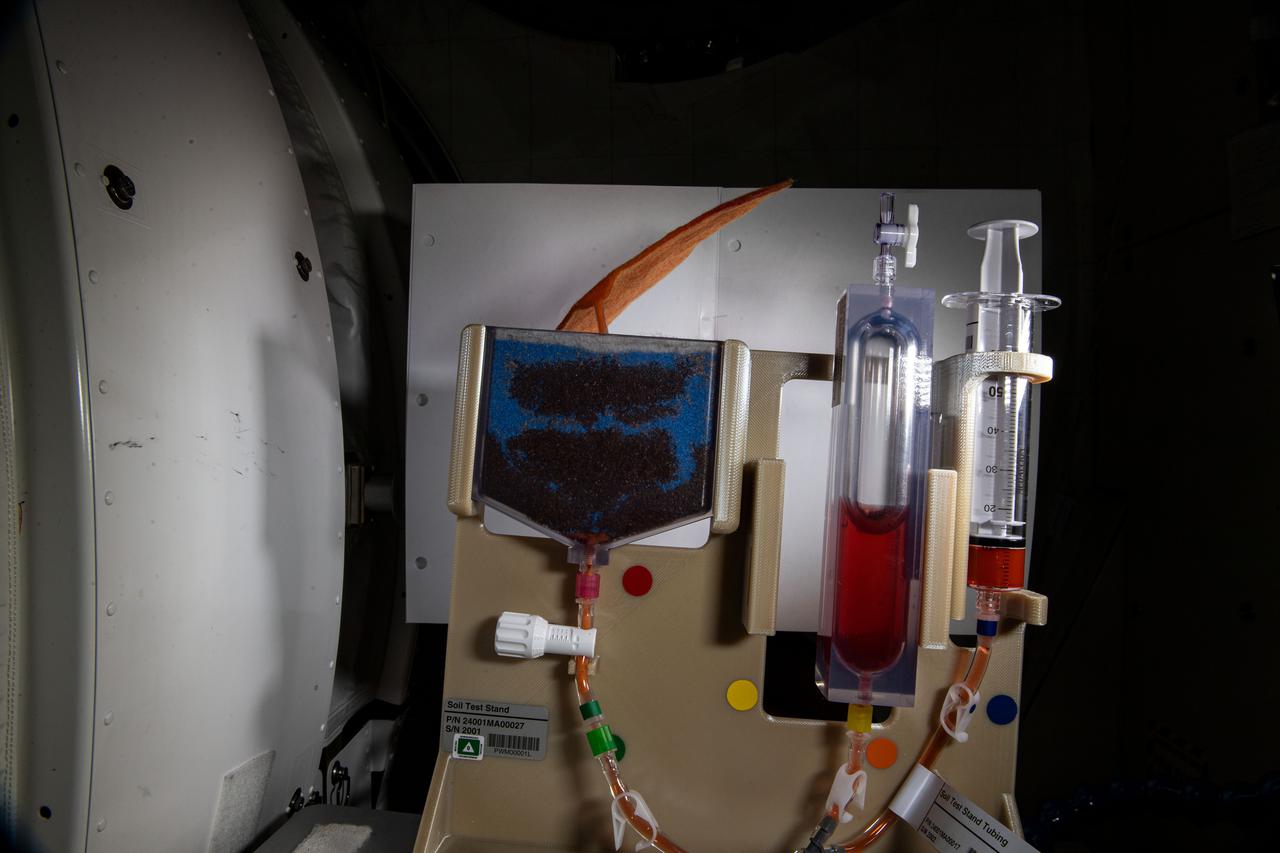
iss064e030517 (2/9/2021) --- A view of the Plant Water Management (PWM) investigation aboard the International space Station (ISS). Plant Water Management demonstrates a hydroponic method for ensuring adequate hydration and aeration to the root zone in order to sustain plants from germination through harvest. Low-gravity capillary fluidics deliver water in single and multiple plant production chambers, and researchers compare growth of individual plants in microgravity and normal gravity.

iss064e030275 (2/8/2021) --- A view of the Plant Water Management (PWM) investigation aboard the International space Station (ISS). Plant Water Management demonstrates a hydroponic method for ensuring adequate hydration and aeration to the root zone in order to sustain plants from germination through harvest. Low-gravity capillary fluidics deliver water in single and multiple plant production chambers, and researchers compare growth of individual plants in microgravity and normal gravity.
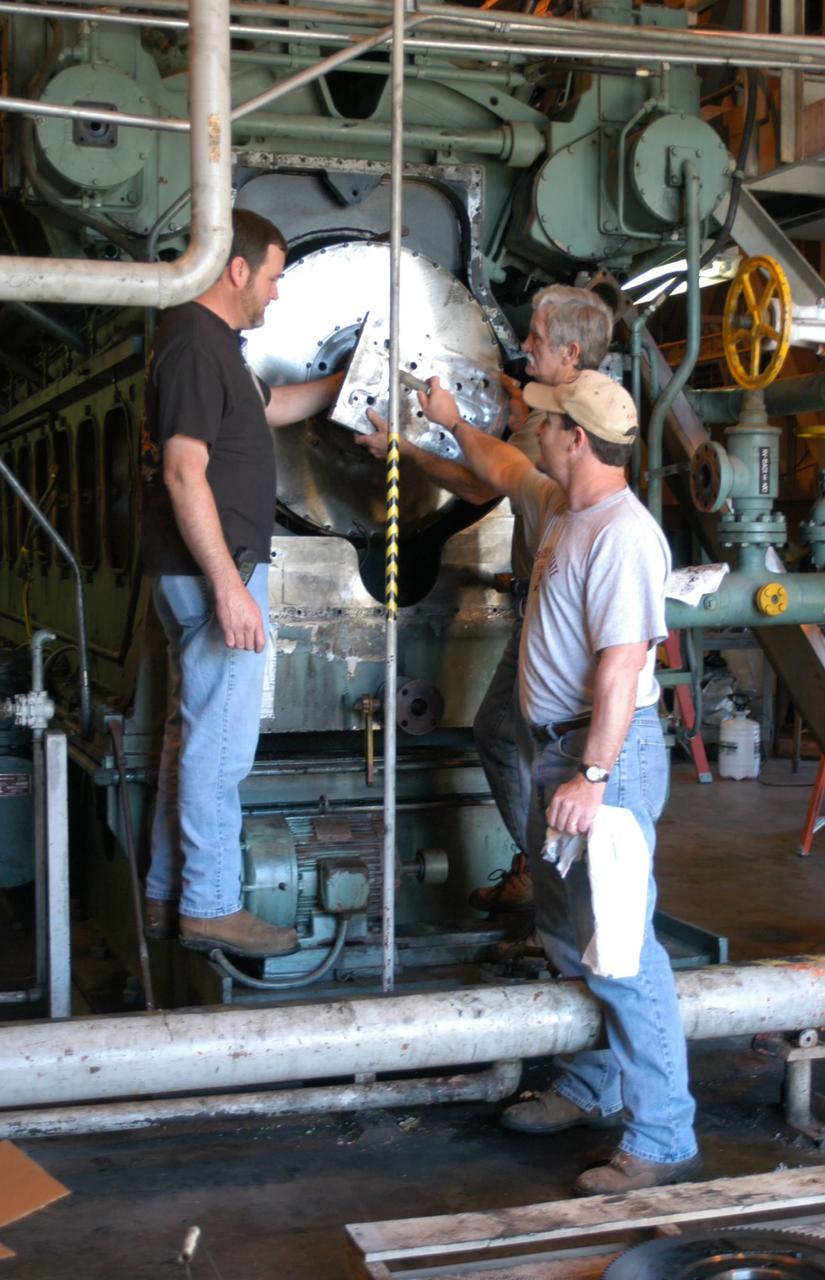
NASA Test Operations Group employees, from left, Todd Pearson, Tim Delcuze and Rodney Wilkinson maintain a water pump in Stennis Space Center's high-pressure water facility. The three were part of a group of employees who rode out Hurricane Katrina at the facility and helped protect NASA's rocket engine test complex.
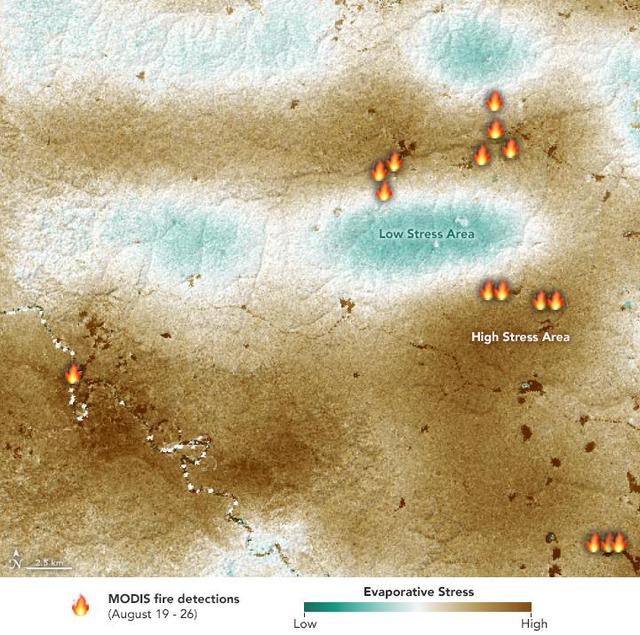
NASA's ECOsystem Spaceborne Thermal Radiometer Experiment on Space Station (ECOSTRESS) sensor measured the water-stress levels of plants when it passed over the Peruvian Amazon rainforest on Aug. 7, 2019, before the fires there began. The map shows areas of plants in distress (brown) and areas of less stress (blue). Water-stressed plants released measurably less water vapor into the air at the time of the summer fires. The fire icons represent fires imaged by NASA's Terra satellite between Aug. 19 and 26. The burn pattern reveals that the fires were concentrated in areas of highly water-stressed plants, pointing to how water-stressed plants can impact the spread of fires. The data may one day help NASA's Earth-observing missions predict the path of future forest or brush fires. https://photojournal.jpl.nasa.gov/catalog/PIA23432
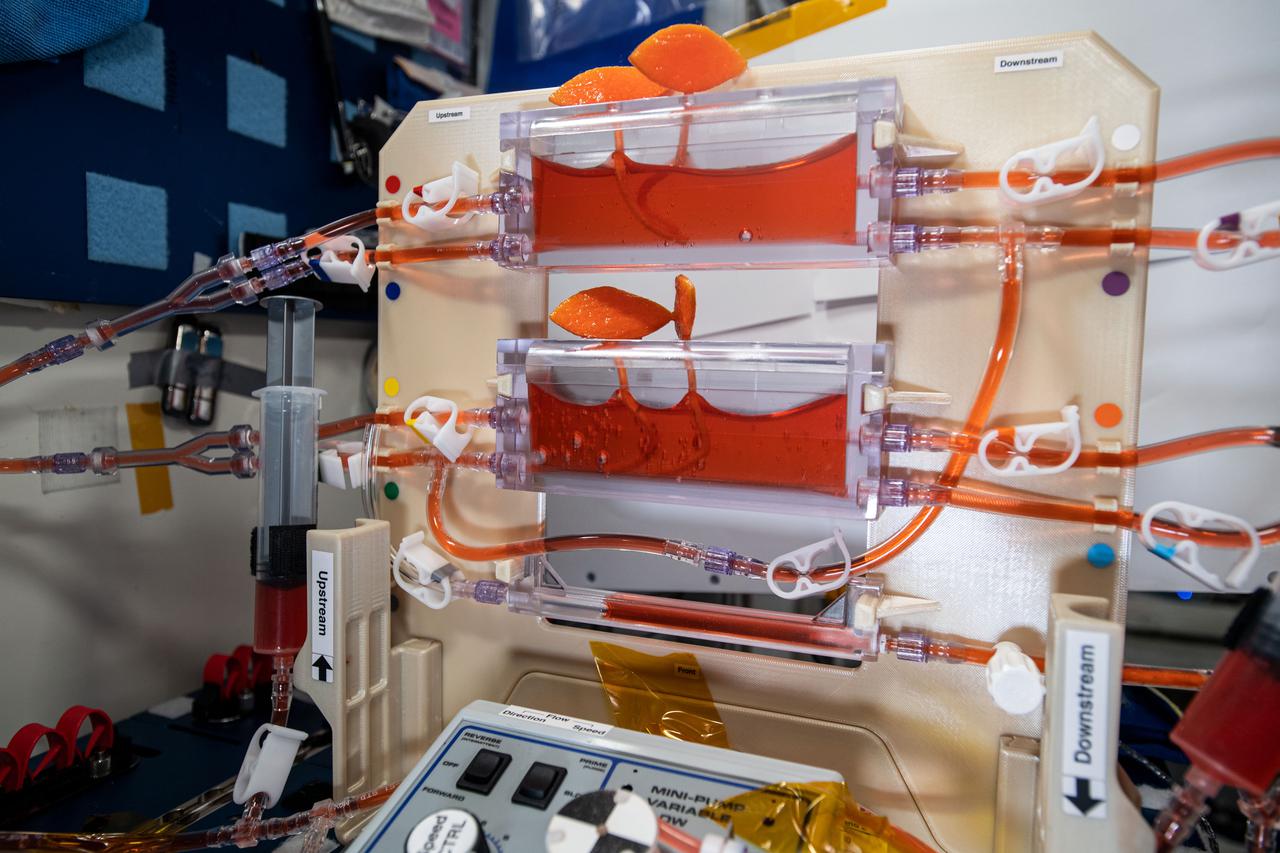
iss064e049289 (3/30/2021) --- A view of the Plant Water Management 3 and 4 investigation aboard the International space Station (ISS). The Plant Water Management 3 and 4 investigation demonstrates passive measures for controlling fluid delivery and uptake in plant growth systems. Reduced gravity creates challenges in providing adequate fluid and nutrition for plant growth. This investigation examines using other physical properties such as surface tension, wetting and system geometry to replace the role of gravity.
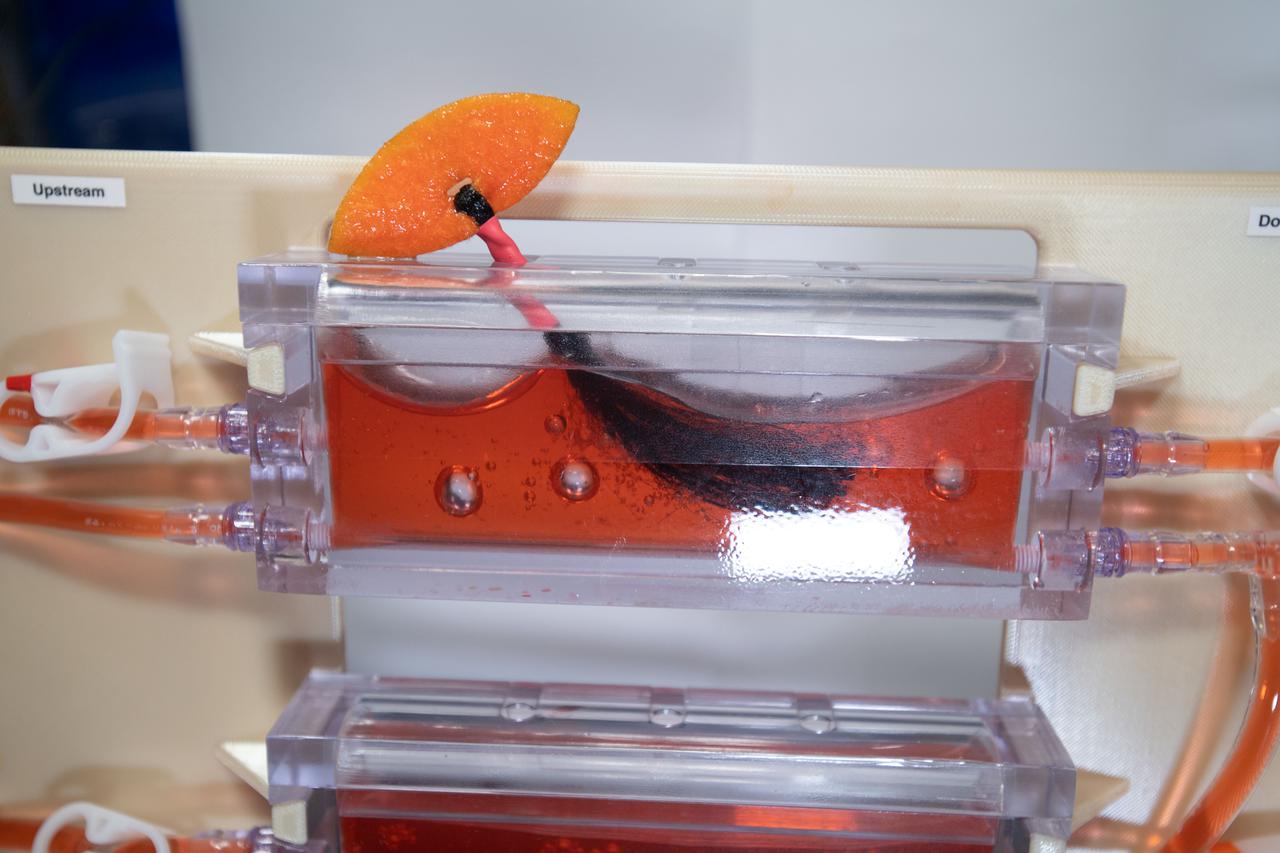
iss064e049400 (3/31/2021) --- A view of the Plant Water Management 3 and 4 investigation aboard the International space Station (ISS). The Plant Water Management 3 and 4 investigation demonstrates passive measures for controlling fluid delivery and uptake in plant growth systems. Reduced gravity creates challenges in providing adequate fluid and nutrition for plant growth. This investigation examines using other physical properties such as surface tension, wetting and system geometry to replace the role of gravity.
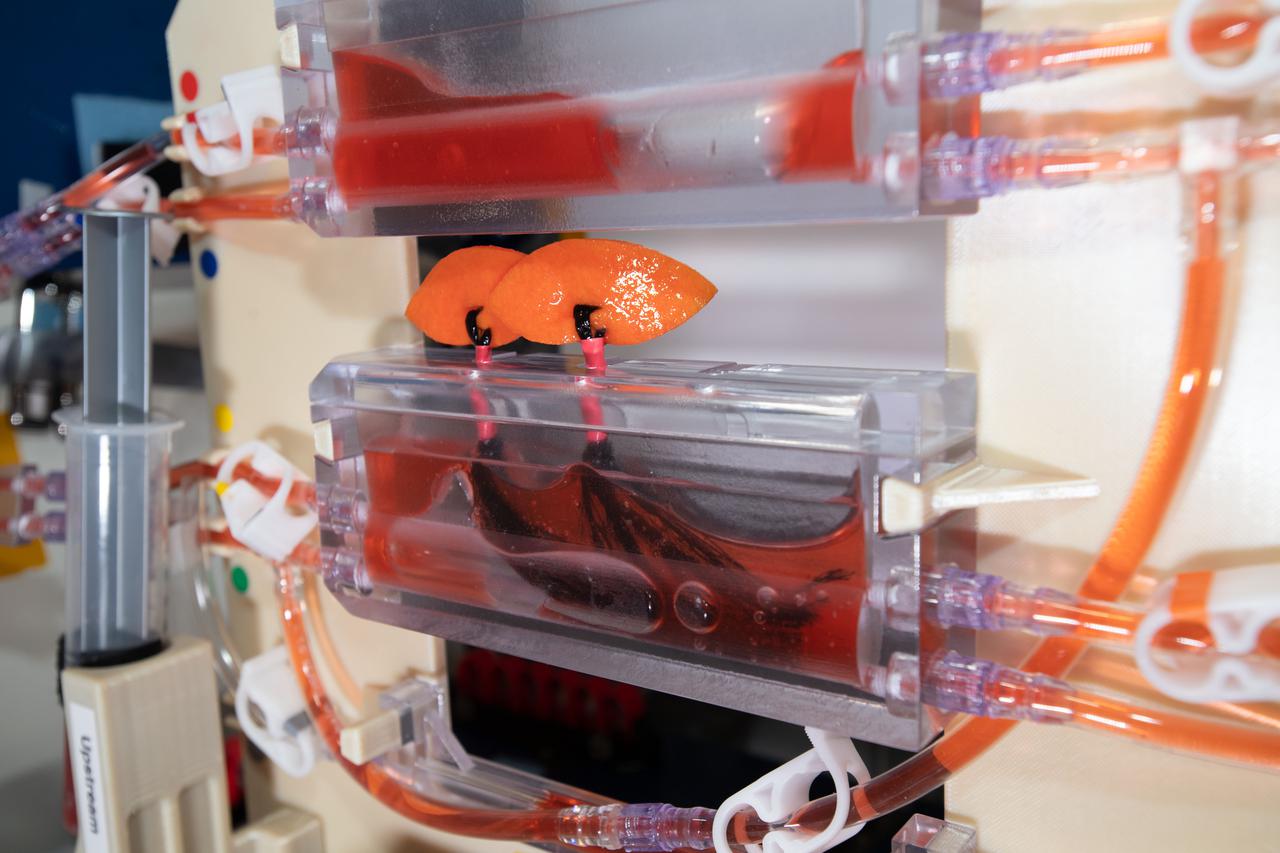
iss064e049484 (3/31/2021) --- A view of the Plant Water Management 3 and 4 investigation aboard the International space Station (ISS). The Plant Water Management 3 and 4 investigation demonstrates passive measures for controlling fluid delivery and uptake in plant growth systems. Reduced gravity creates challenges in providing adequate fluid and nutrition for plant growth. This investigation examines using other physical properties such as surface tension, wetting and system geometry to replace the role of gravity.
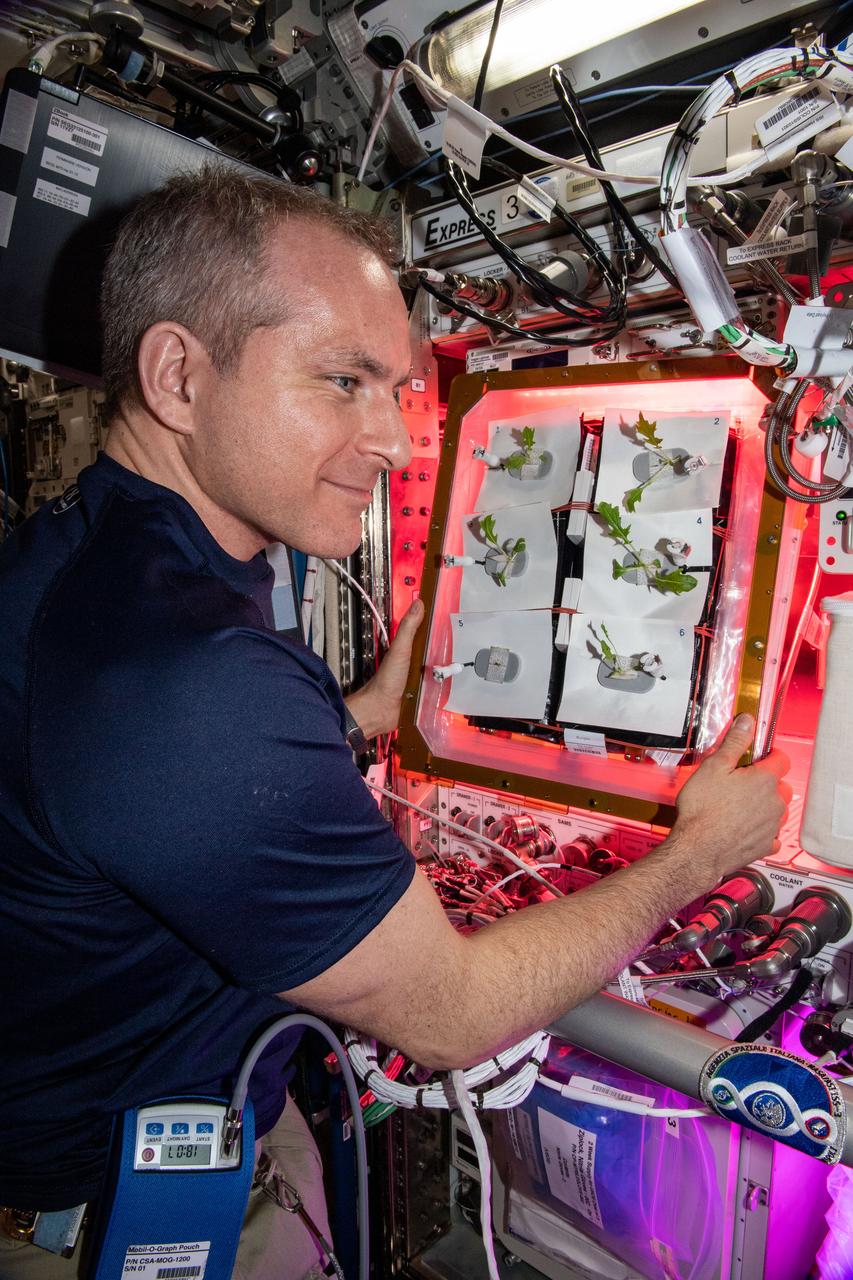
iss059e113779 (June 18, 2019) --- Canadian Space Agency astronaut David Saint-Jacques checks plants being grown for the Veg-04A space botany experiment taking place inside the International Space Station's Columbus laboratory module from the European Space Agency. The study focuses on the impact of light quality and fertilizer on leafy crop growth for a 28-day grow-out, microbial food safety, nutritional value, taste acceptability by the crew, and the overall behavioral health benefits of having plants and fresh food in space.
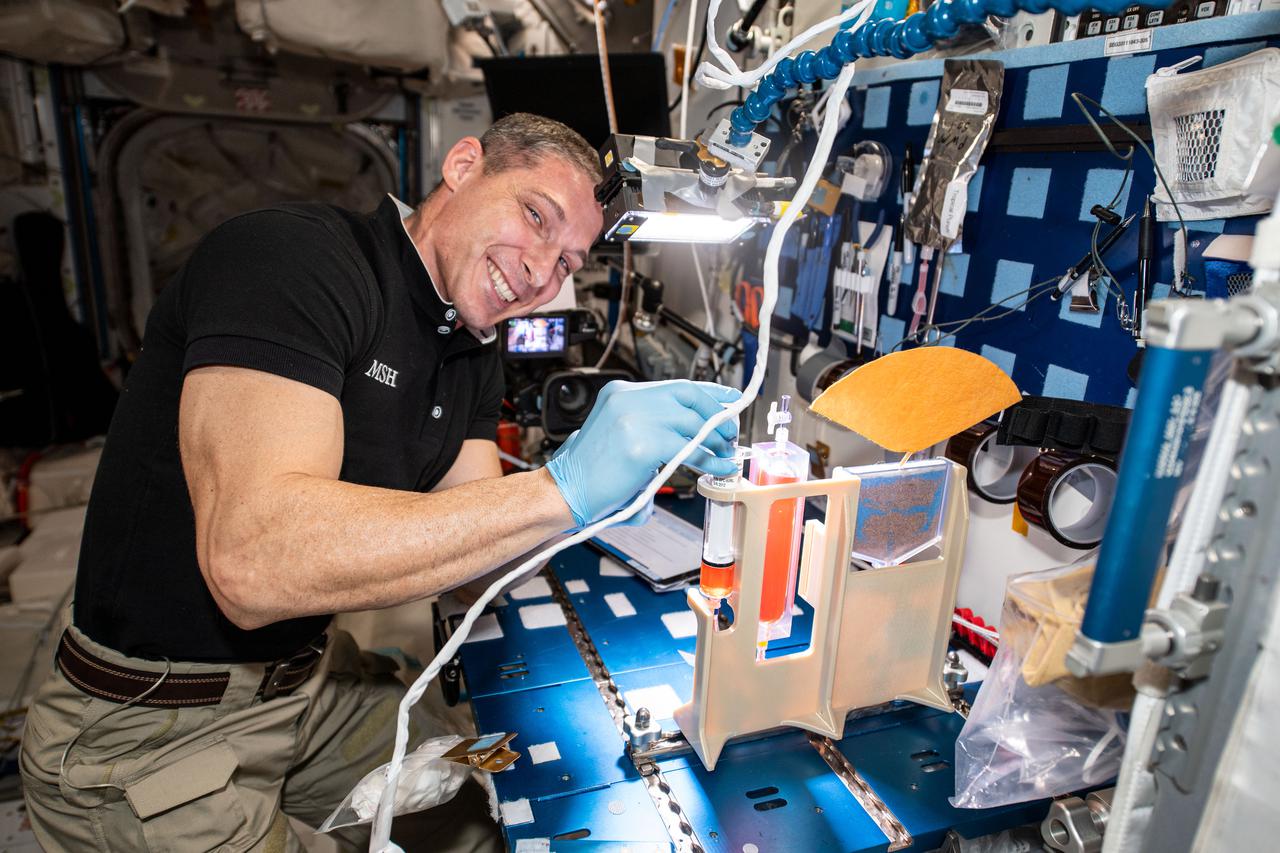
iss064e030009 (Feb. 8, 2021) --- NASA astronaut and Expedition 64 Flight Engineer Michael Hopkins works on hydroponics components for the Plant Water Management study that is exploring ways to sustain plants in microgravity from germination through harvest.
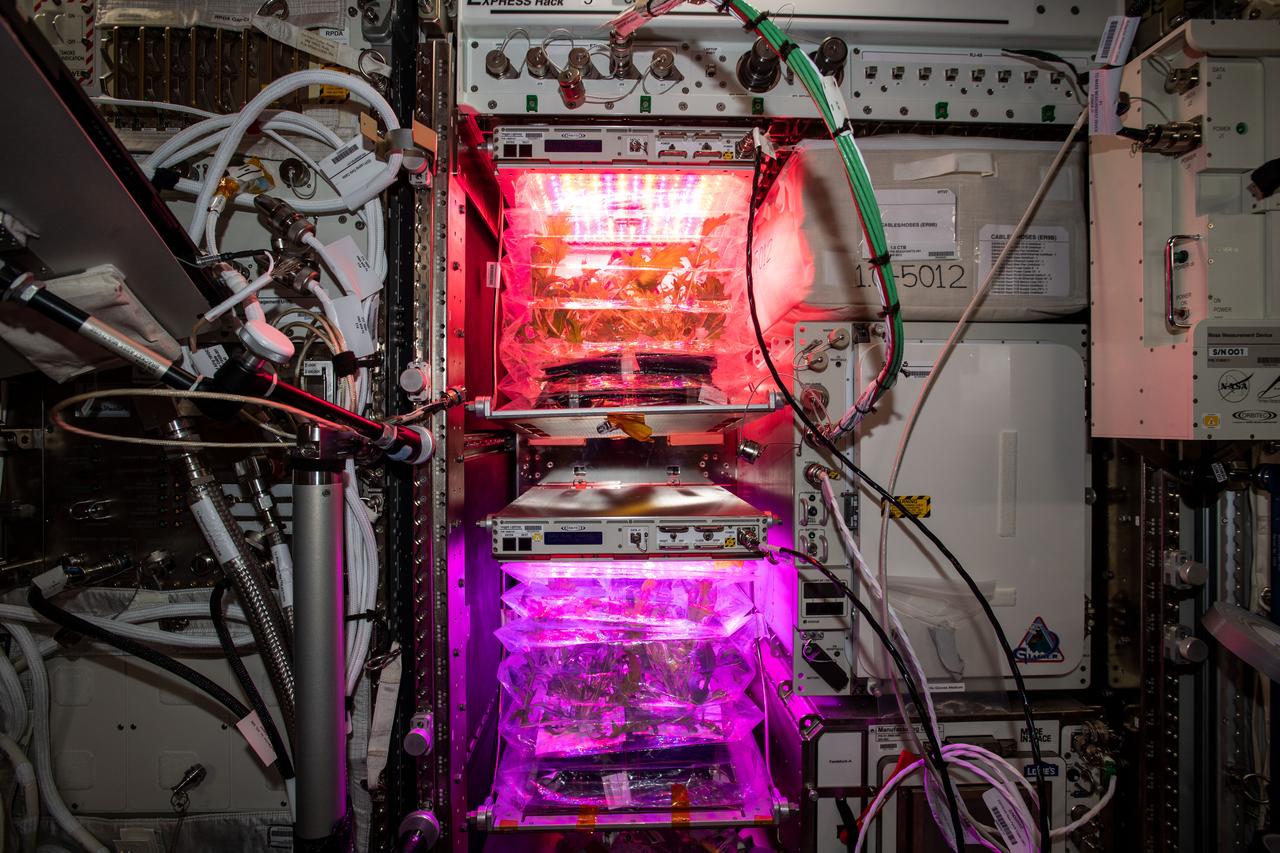
Documentation (overall view) of the Vegetable Production System (Veggie) taken during Pillow watering operations (OPS) for the Veg-04B experiment. Plant Pillows contain Mizuna mustard plants.
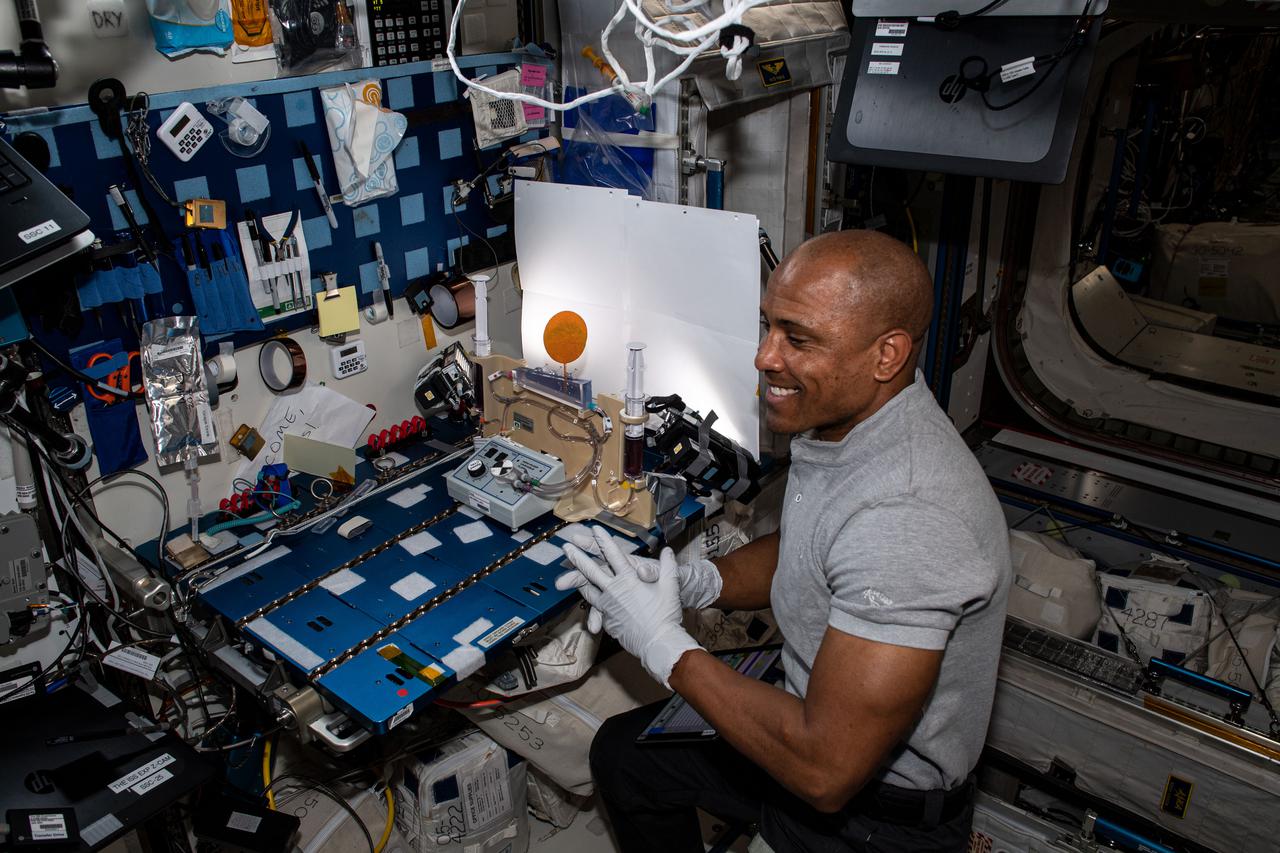
iss064e031991 (Feb. 12, 2021) --- NASA astronaut and Expedition 64 Flight Engineer Victor Glover works on the Plant Water Management experiment that is exploring hydroponics as a way to sustain plants in microgravity from germination through harvest.
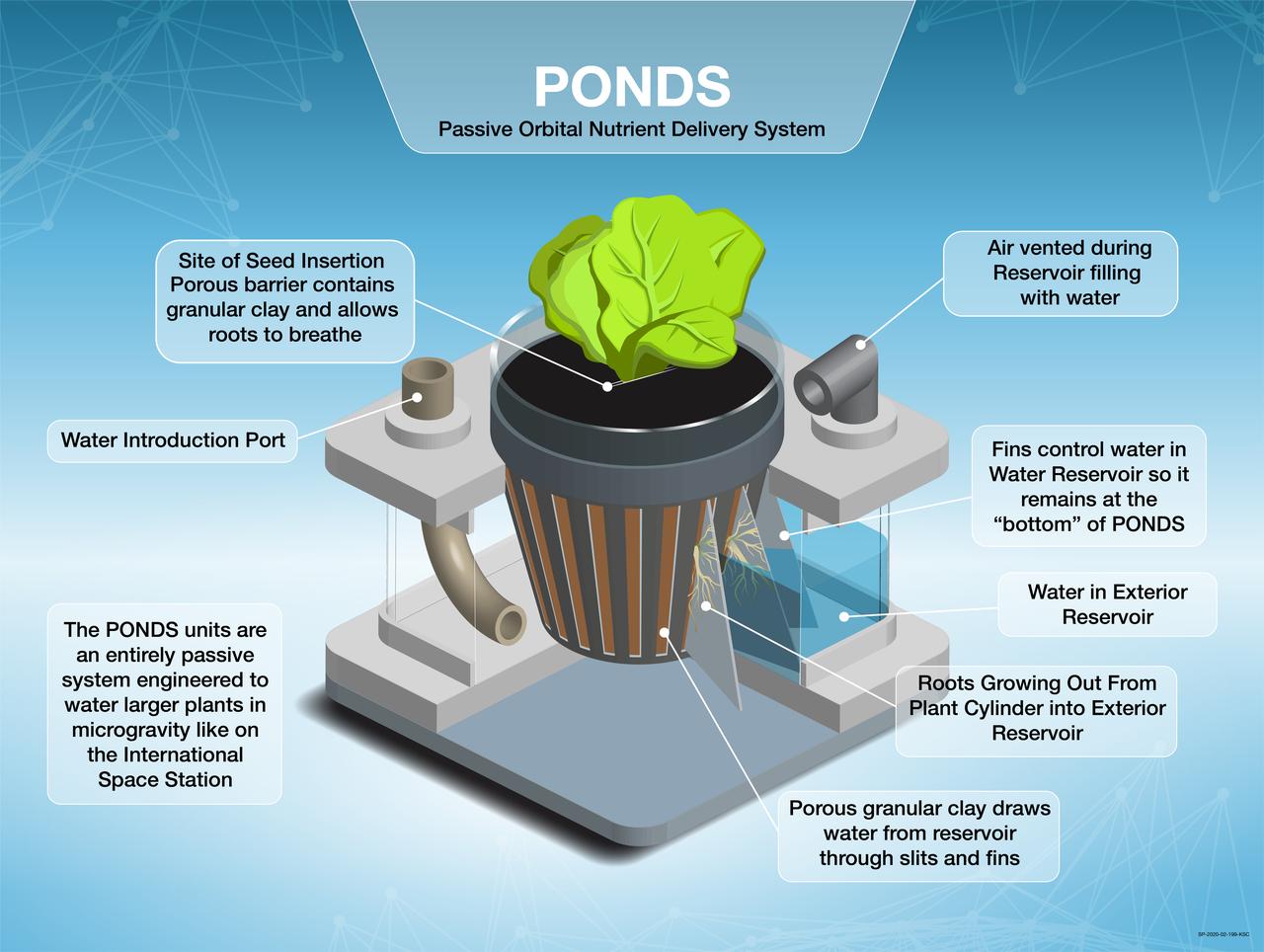
Infographic illustrating the Passive Orbital Nutrient Delivery System (PONDS) plant growth unit. The PONDS units are an entirely passive system – meaning no electricity, no pumps and no moving parts – and the basic concept involves using a free-standing reservoir of water that plants can draw from when needed, cutting down on time astronauts would spend watering plants during the growth interval.

Water and nutrients are being added to plants in the Veggie hardware in NASA Kennedy Space Center's ISS environment simulator chamber. Mizuna mustard, Outredgeous lettuce and Waldmann's green lettuce are growing in Veggie. Growth in the chamber mimics the growth of plant experiments in the Veggie plant growth system on the International Space Station.
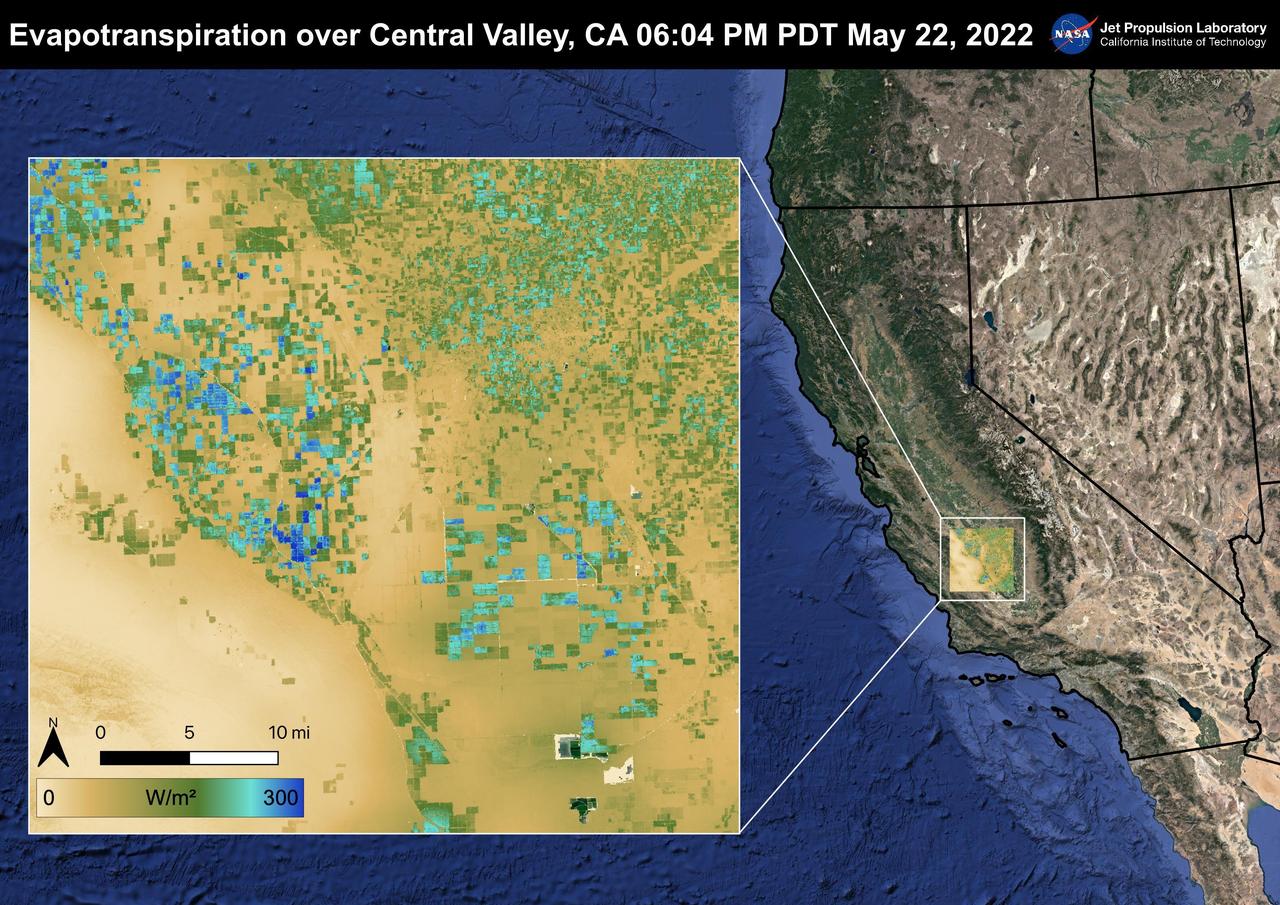
The Central Valley, CA is one of the most productive agricultural regions in the United States and the world. As California is in a continuing drought, it is important to monitor agricultural plant life to ensure maximized productivity. ECOSTRESS has the ability to monitor Evapotranspiration over agricultural fields. This Evapotranspiration image was captured by ECOSTRESS on May 22, 2022 at 06:04 PM PDT. Blue indicates high water use while brown indicates dry conditions. ECOSTRESS is a thermal instrument on the International Space Station that measures the temperature of the ground, which is hotter than the air temperature during the day. It was launched to the space station in 2018. Its primary mission is to identify critical thresholds of water use and water stress in plants and to detect the timing, location, and predictive factors leading to plant water uptake decline and/or cessation. The nature of the high-resolution data provided by ECOSTRESS allows it to record heat related phenomena such as heat waves and wildfires. https://photojournal.jpl.nasa.gov/catalog/PIA25488
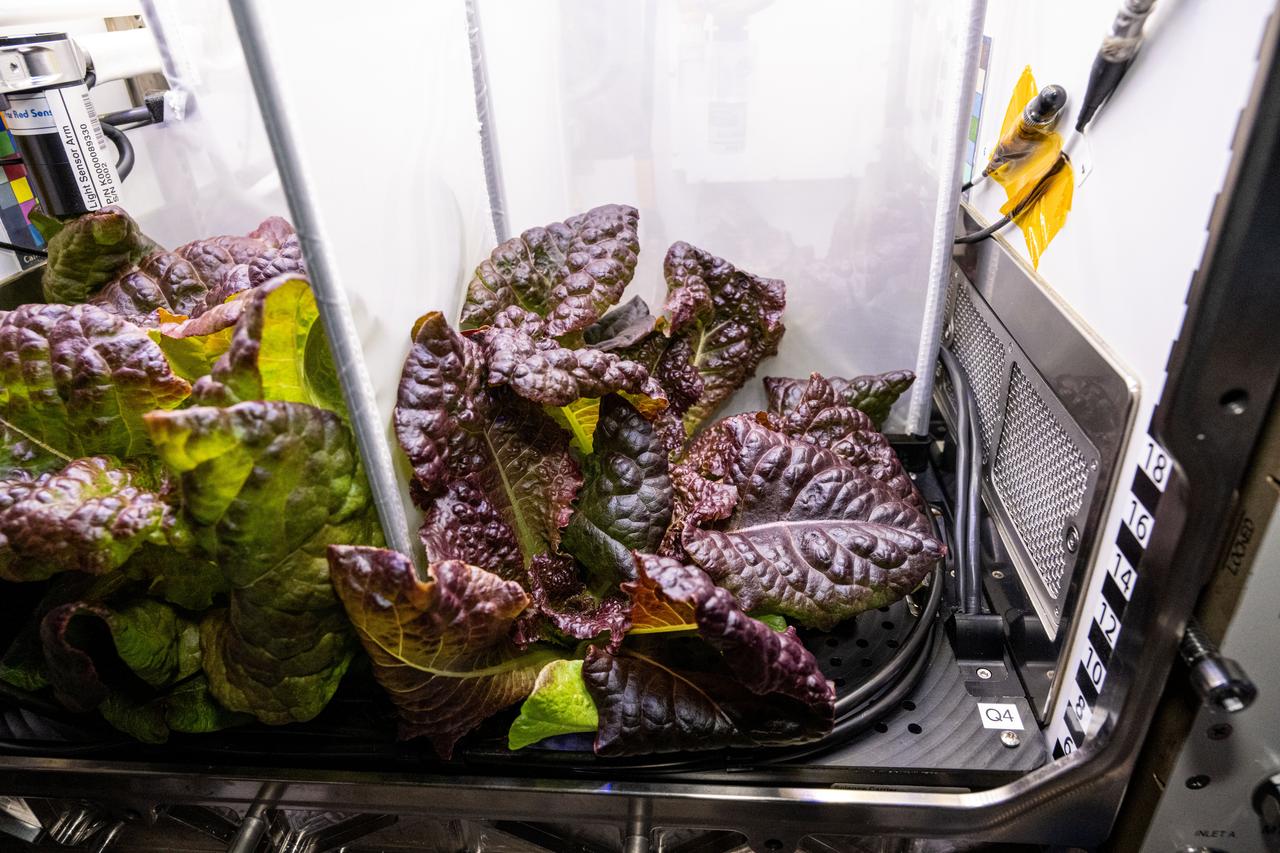
iss072e404269 (Dec. 27, 2024) --- Red Romaine lettuce is pictured growing inside the Kibo laboratory module's Advanced Plant Habitat aboard the International Space Station. The lettuce was being grown for the Plant Habitat-07 space botany investigation that is exploring how plants and their associated communities of microorganisms respond to different levels of water in microgravity. Results could support plant growth and the creation of systems that produce safe and nutritious food for crew members on future space missions.
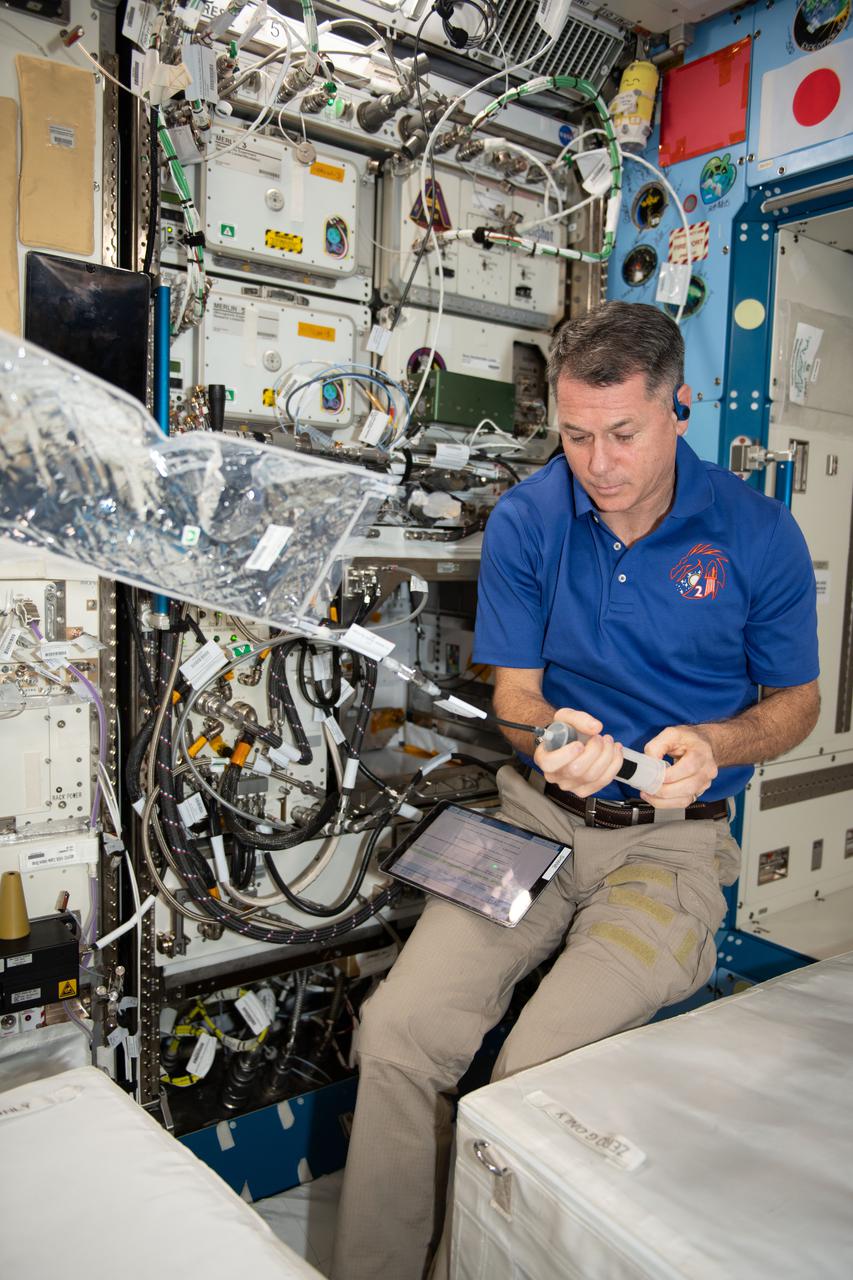
iss065e163206 (June 9, 2021) --- NASA astronaut and Expedition 65 Flight Engineer Shane Kimbrough configures the Advanced Plant Habitat and fills it with water to support the Plant Habitat-04 space botany experiment. The study is demonstrating growing peppers, which are an excellent source of vitamin C, in space for the first time.
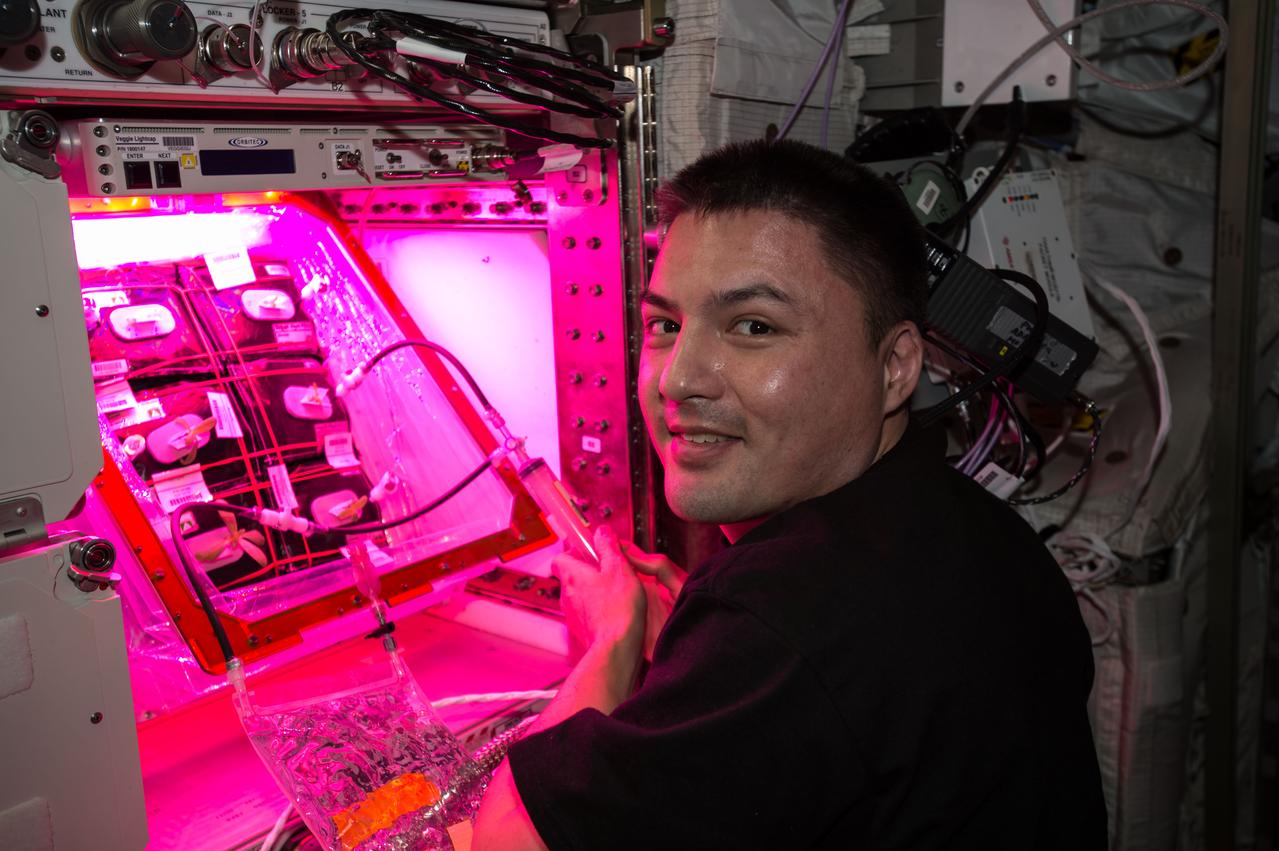
Flight engineer Kjell Lindgren poses with zinnia plants in the Veggie facility during Plant Pillow water refill operations. Image was taken in the Columbus European Laboratory and released by Lindgren on social media. "Our zinnias are looking good! #SpaceGardener"
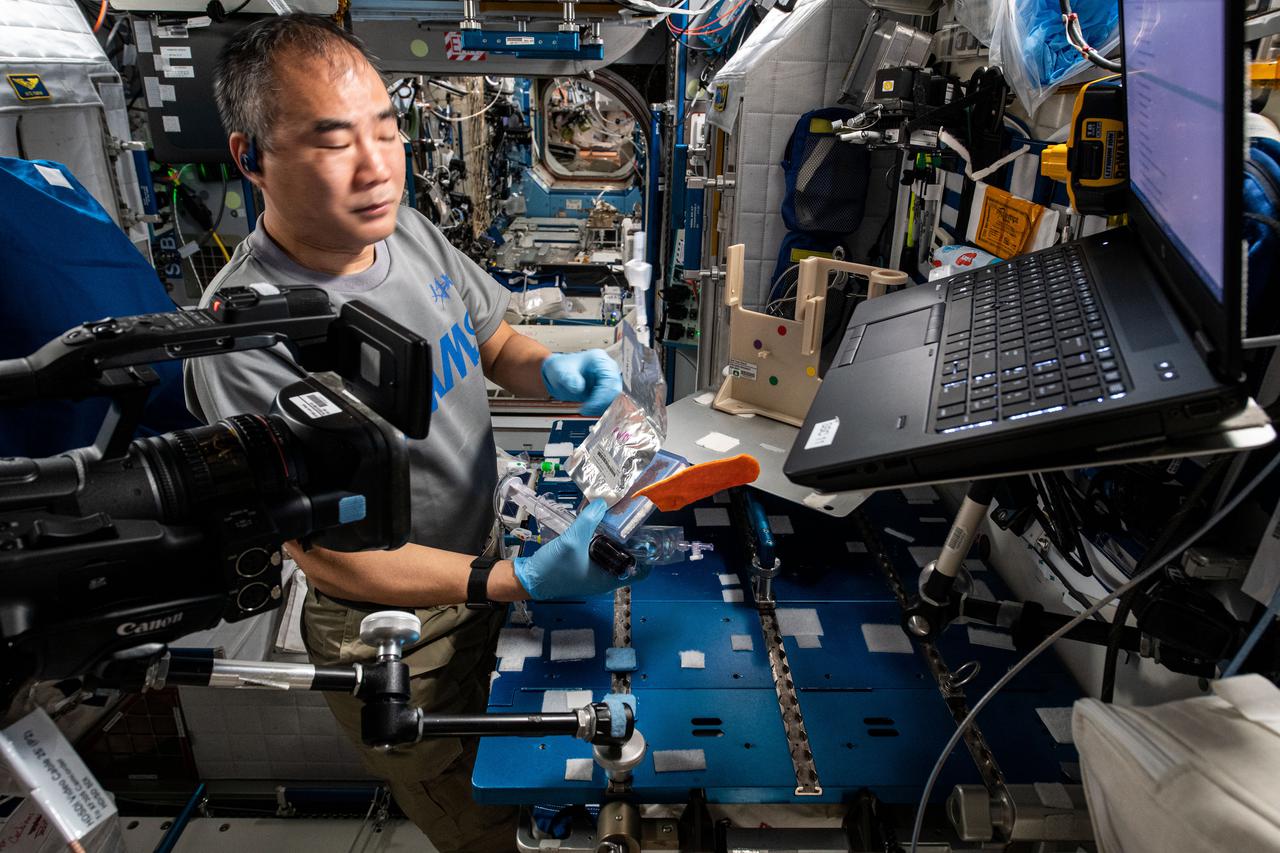
iss064e033912 (Feb. 17, 2021) --- JAXA (Japan Aerospace Exploration Agency) astronaut and Expedition 64 Flight Engineer Soichi Noguchi stows hardware used during the Plant Water Management experiment. The botany study demonstrated hydroponics as a way to sustain plants in microgravity from germination through harvest.

iss072e035666 (Oct. 11, 2024) --- NASA astronauts Matthew Dominick and Jeanette Epps (rear center), both Expedition 72 Flight Engineers, are pictured during a variety of activities aboard the International Space Station. Dominick is pedaling on the Cycle Ergometer with Vibration Isolation and Stabilization (CEVIS), an exercise cycle providing aerobic and cardiovascular conditioning inside the Destiny laboratory module. Epps is in the Harmony module exploring how to water plants in the microgravity environment for the Plant Water Management 5 space botany investigation.
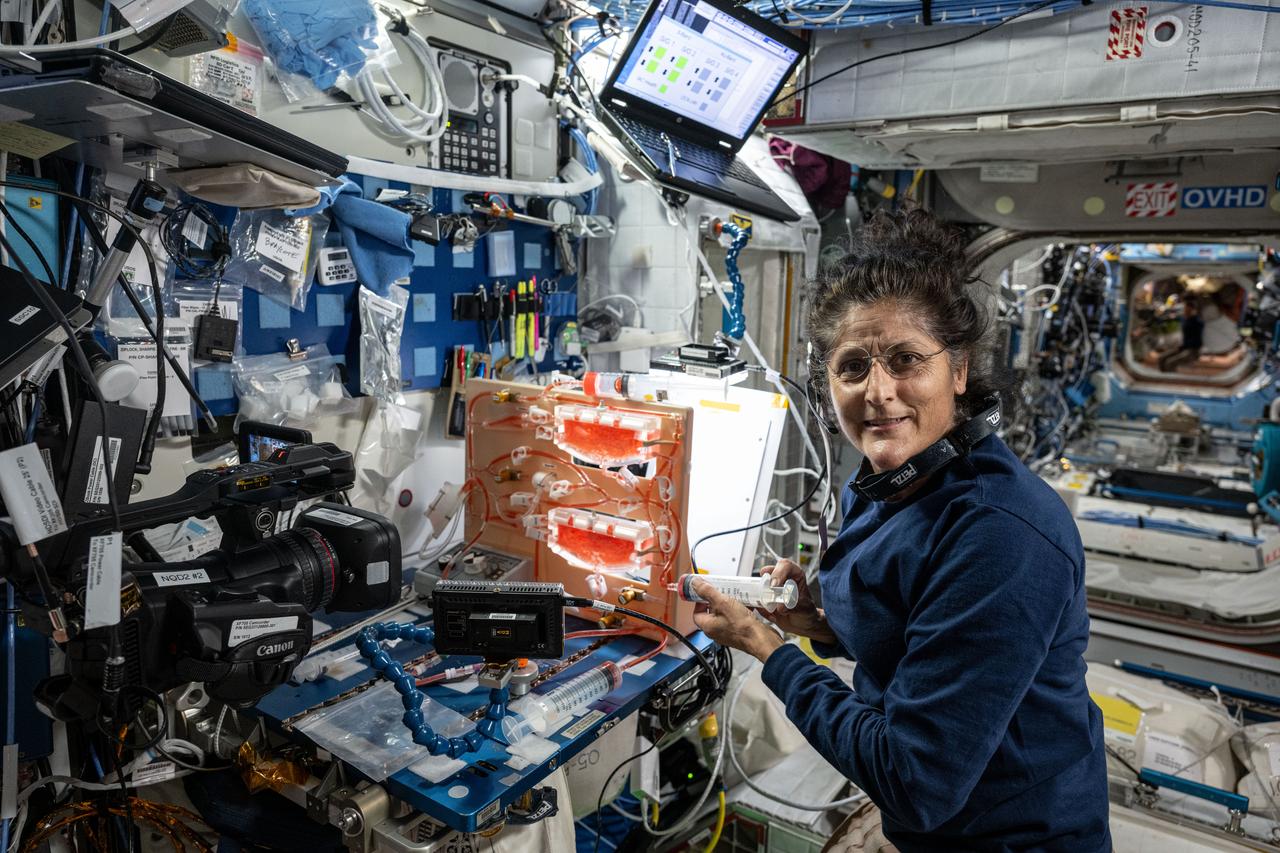
iss071e356678 (July 16, 2024) --- NASA astronaut and Boeing Crew Flight Test Pilot Suni Williams investigates using fluid physics techniques such as surface tension, as well as hydroponics and air circulation, to overcome the lack of gravity when watering and nourishing plants grown in space. The Plant Water Management investigation uses facilities in the International Space Station's Harmony module to promote space agricultural activities on spacecraft and space habitats.
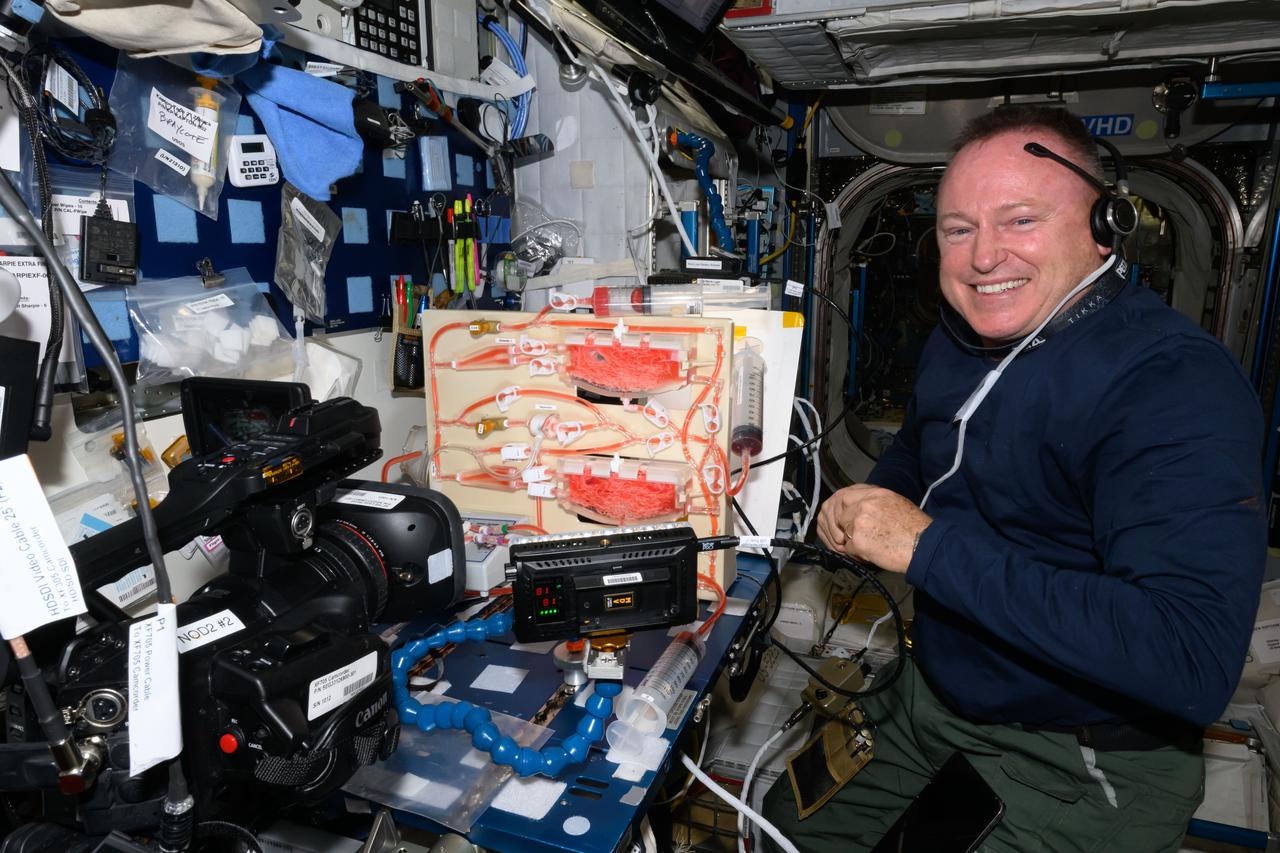
iss071e364248 (July 16, 2024) --- NASA astronaut and Boeing Crew Flight Test Commander Butch Wilmore investigates using fluid physics techniques such as surface tension, as well as hydroponics and air circulation, to overcome the lack of gravity when watering and nourishing plants grown in space. The Plant Water Management investigation uses facilities in the International Space Station's Harmony module to promote space agricultural activities on spacecraft and space habitats.
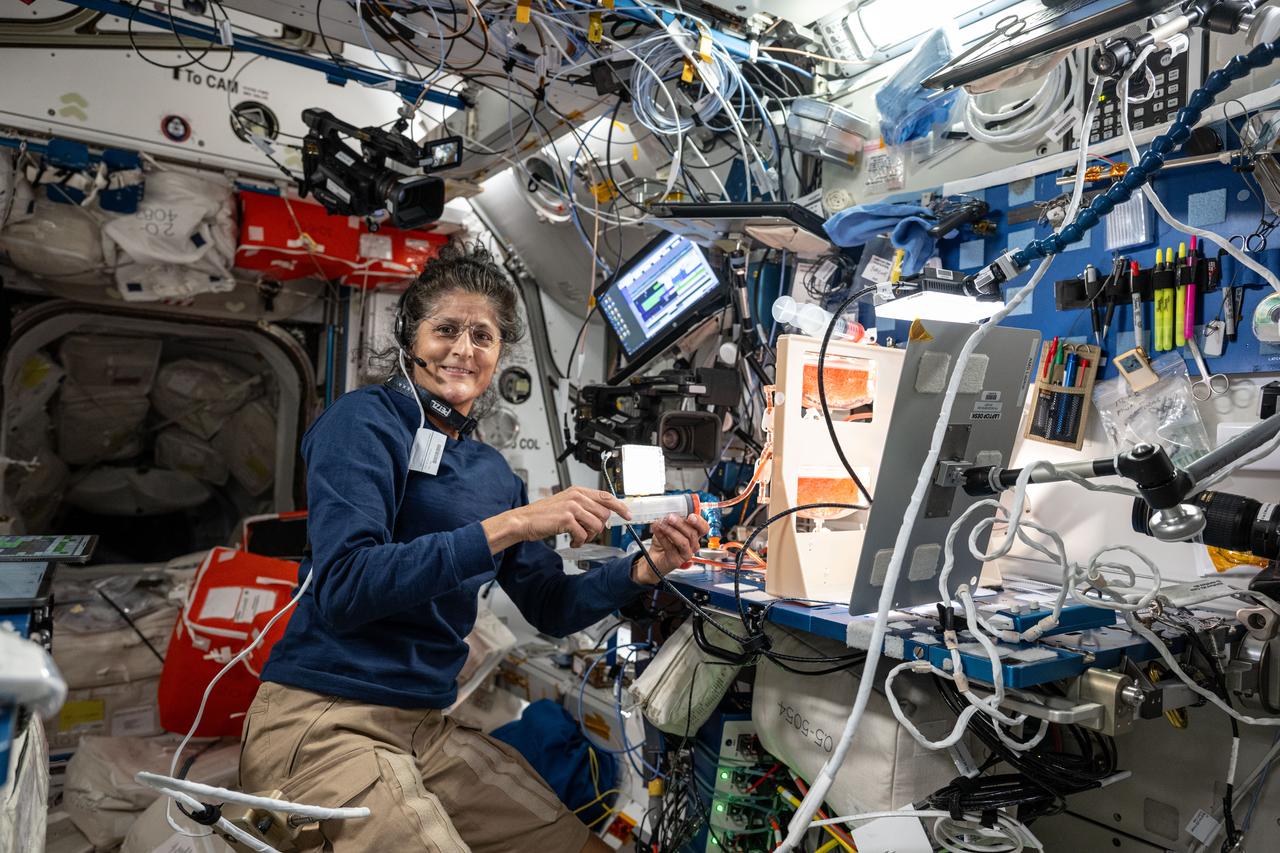
iss071e356675 (July 16, 2024) --- NASA astronaut and Boeing Crew Flight Test Pilot Suni Williams investigates using fluid physics techniques such as surface tension, as well as hydroponics and air circulation, to overcome the lack of gravity when watering and nourishing plants grown in space. The Plant Water Management investigation uses facilities in the International Space Station's Harmony module to promote space agricultural activities on spacecraft and space habitats.
iss071e356675 (July 16, 2024) --- NASA astronaut and Boeing Crew Flight Test Pilot Suni Williams investigates using fluid physics techniques such as surface tension, as well as hydroponics and air circulation, to overcome the lack of gravity when watering and nourishing plants grown in space. The Plant Water Management investigation uses facilities in the International Space Station's Harmony module to promote space agricultural activities on spacecraft and space habitats.
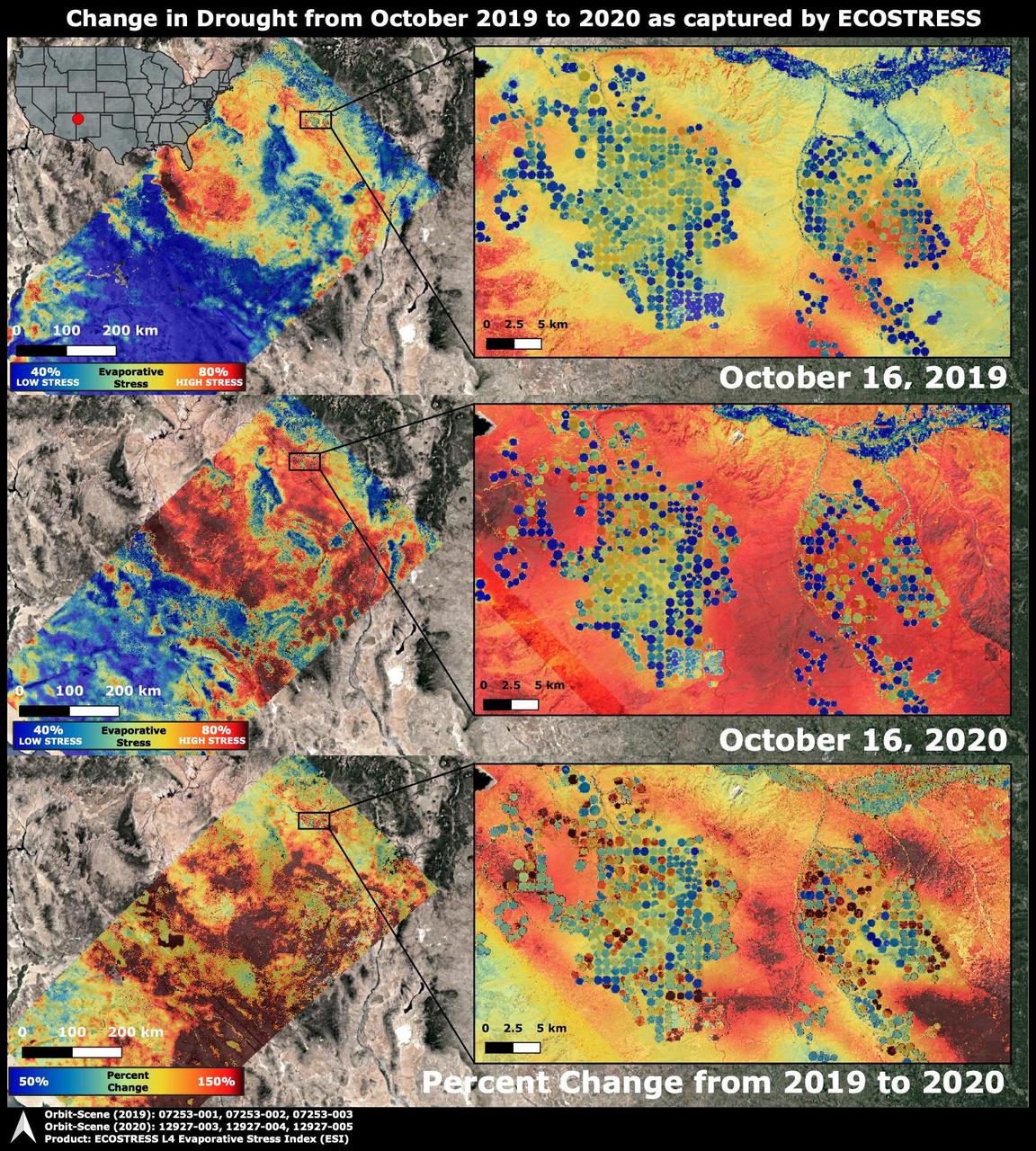
The Western United States has been entrenched in an Extreme and Exceptional drought that has extended from the summer and into the fall of 2020. NASA's ECOsystem Spaceborne Thermal Radiometer Experiment on Space Station (ECOSTRESS) imaged the drought on Oct. 16, 2020, and compared the same area to an image from ECOSTRESS taken a year earlier on Oct. 16, 2019. The bottom image shows the percentage change in plant water stress from 2019 to 2020. The images at left zoom into the Arizona and New Mexico border and Navajo Nation Territory area, featuring the ECOSTRESS Evaporative Stress Index (ESI), which shows plant water stress. The inset images on the right zoom further into the region, showing circular agricultural fields that have been irrigated. Blue colors represent low stress and high water use, whereas red colors represent high stress and low water use. Irrigation is able to alleviate plant water stress in many of the fields while the surrounding landscape suffers from the drought, though numerous agricultural fields are shut down in the drought image. The primary mission of ECOSTRESS, which launched to the International Space Station in June 2018, is to provide insight into plants' health, especially in a drought, by taking their temperature. Plants regulate their temperature by releasing water through tiny pores on their leaves. With sufficient water, they can maintain their temperature. When they lack water, their temperatures rise; ECOSTRESS can measure this change. https://photojournal.jpl.nasa.gov/catalog/PIA24132
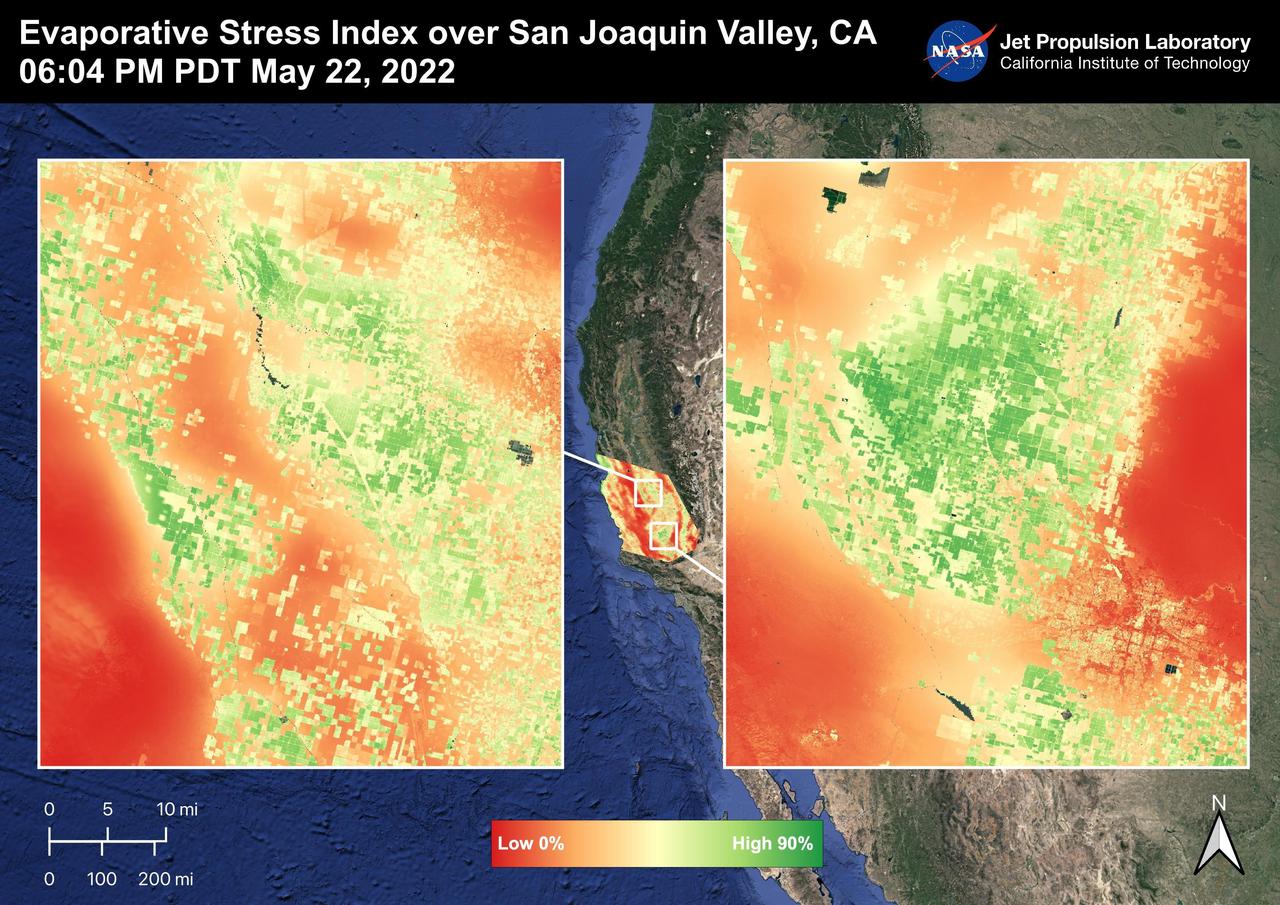
The San Joaquin Valley, CA is one of the most productive agricultural regions in the United States and the world. The image shows the Evaporative Stress Index over the San Joaquin Valley on May 22, 2022 at 06:04 PM PDT where many fields show high ESI values that indicate low plant stress whereas low ESI values indicate high plant stress. ECOSTRESS's ability to detect Evaporative Stress over the agricultural fields can help farmers and decision makers in their choices. As California is in a continuing drought, it is important to monitor that agricultural plant life. ECOSTRESS is a thermal instrument on the International Space Station that measures the temperature of the ground, which is hotter than the air temperature during the day. It was launched to the space station in 2018. Its primary mission is to identify critical thresholds of water use and water stress in plants and to detect the timing, location, and predictive factors leading to plant water uptake decline and/or cessation. The nature of the high-resolution data provided by ECOSTRESS allows it to record heat related phenomena such as heat waves and wildfires. https://photojournal.jpl.nasa.gov/catalog/PIA25487
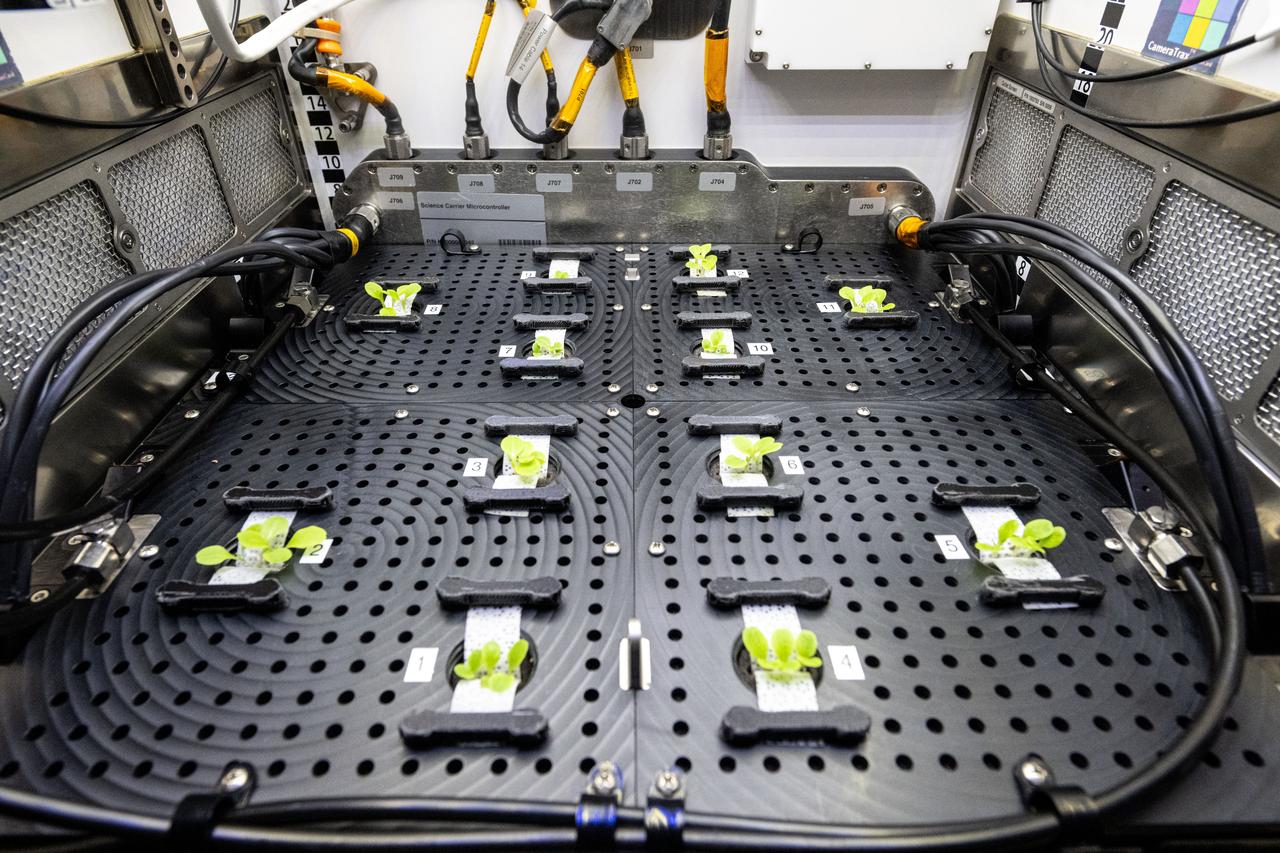
iss072e350731 (12/6/2024) --- The Spaceflight Microbiome of a Food Crop Grown Using Different Substrate Moisture Levels (Plant Habitat-07) investigation grows ‘Outredgeous’ red romaine lettuce aboard the International Space Station’s Advanced Plant Habitat to assess different substrate moisture treatments and their effects on the microbial communities in the plants, roots, and water. This preflight ground image shows ‘Outredgeous’ red romaine lettuce seedlings after thinning on Day 7.

NASA interns Jessica Scotten, left, and Ayla Grandpre water plants in the Veggie hardware in NASA Kennedy Space Center's ISS environment simulator chamber. Mizuna mustard, Outredgeous lettuce and Waldmann's green lettuce are growing in Veggie. Growth in the chamber mimics the growth of plant experiments in the Veggie plant growth system on the International Space Station.
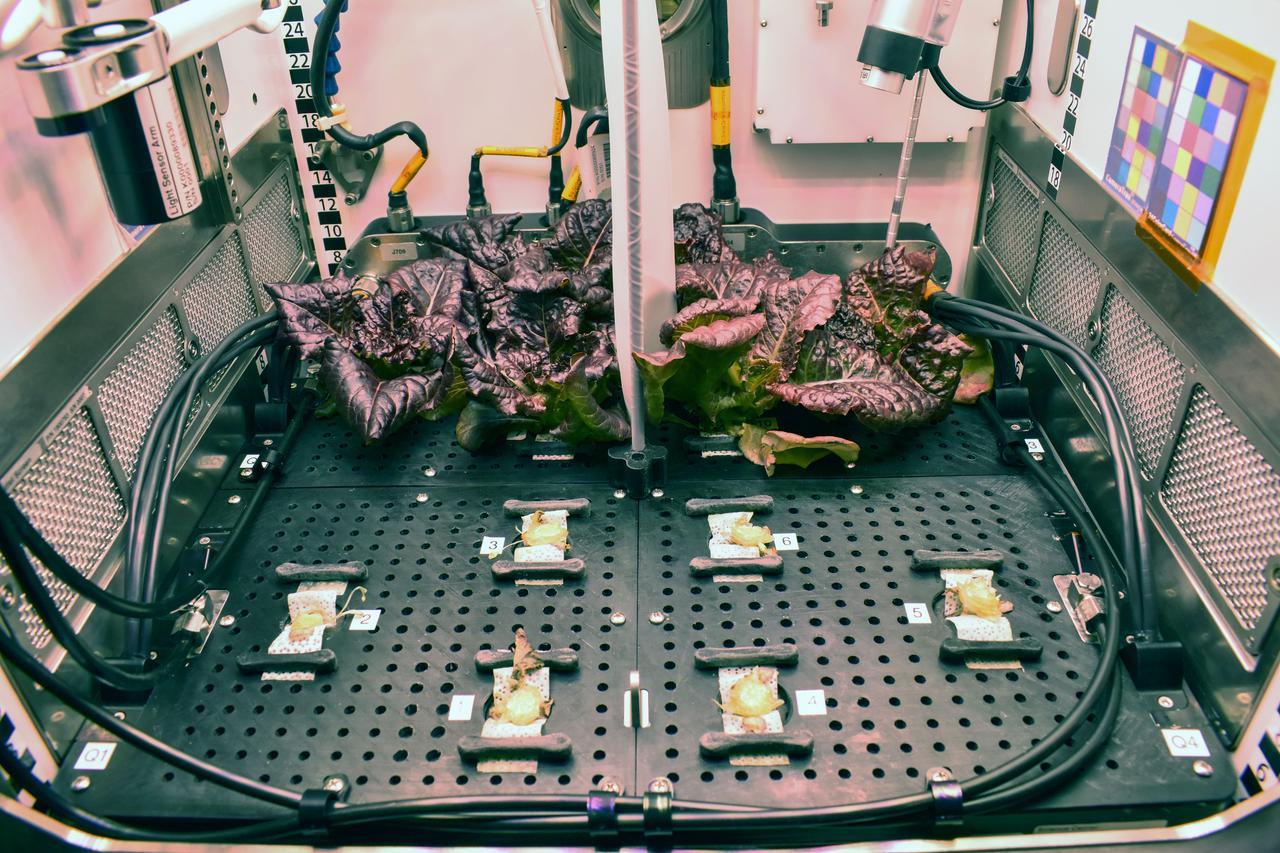
jsc2025e047410 (2/27/2024) --- Lettuce grown with the drought (left) and wilt (right) moisture treatments halfway through the harvest procedure on day 28 of a ground experiment for Spaceflight Microbiome of a Food Crop Grown Using Different Substrate Moisture Levels (Plant Habitat-07). Plant Habitat-07 investigates how plants and their communities of microorganisms respond to different levels of water. Results could support development of systems for growing food crops on future missions. Image courtesy of the PH-07 team.
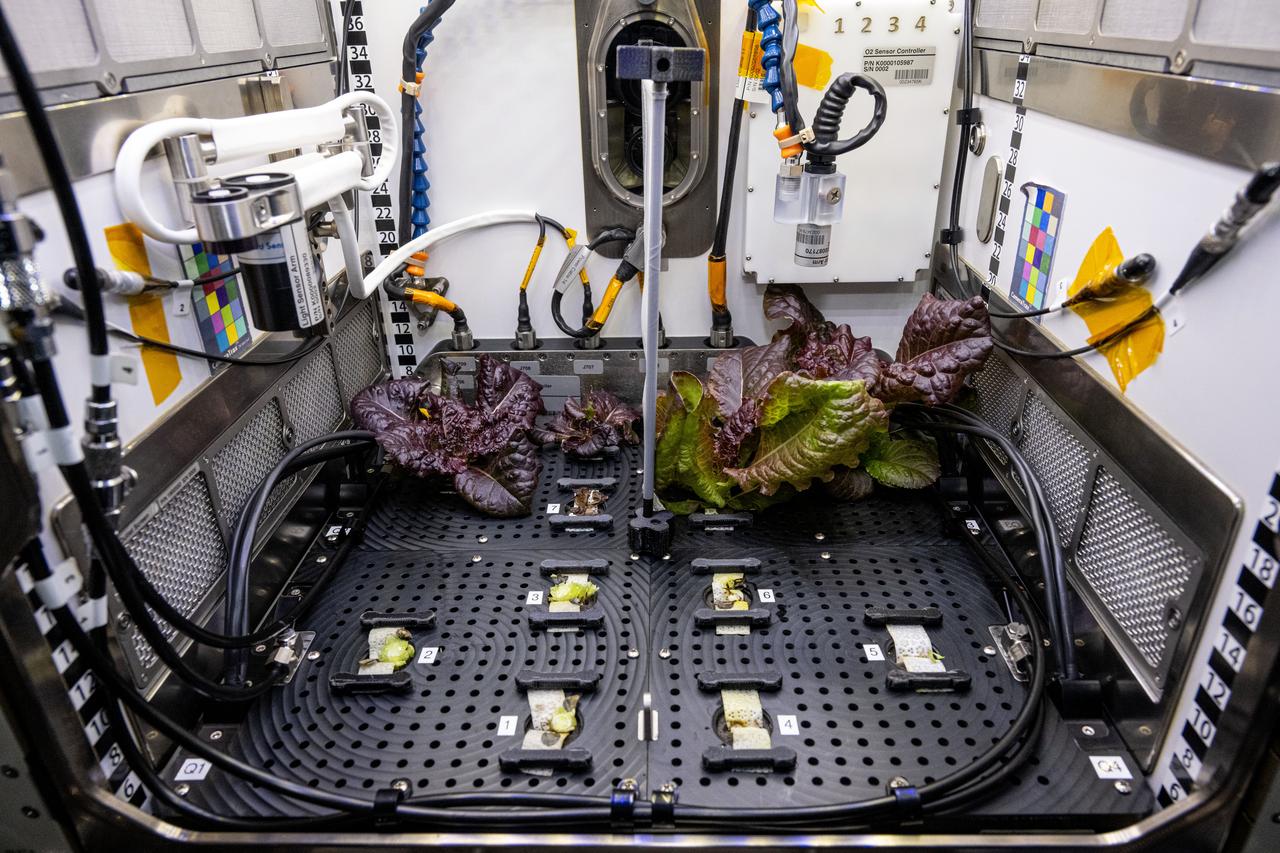
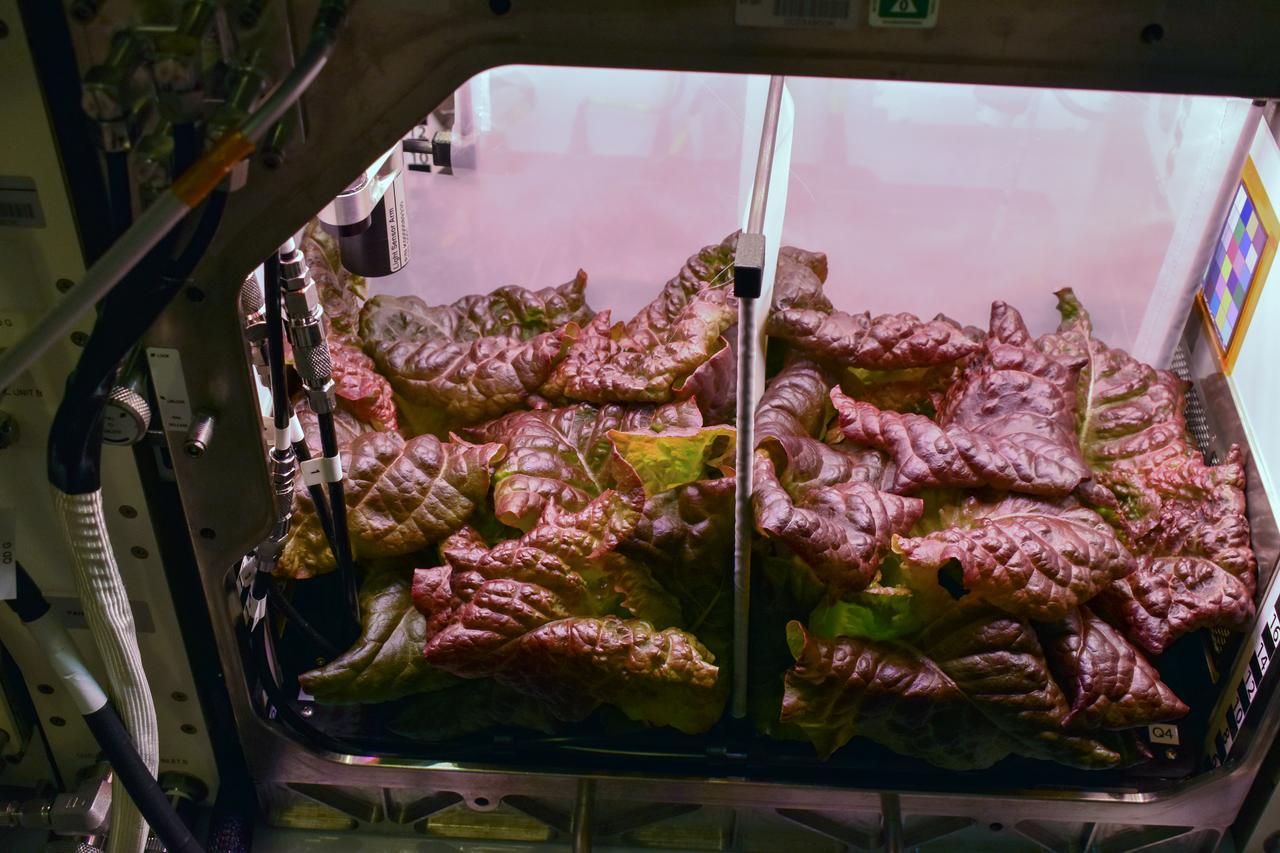
iss072e404277 (12/27/2024) --- The Plant Habitat-07 investigation grows ‘Outredgeous’ Red Romaine Lettuce aboard the Advanced Plant Habitat to assess different substrate moisture treatments and their effects on the microbial communities in the plants, roots, and water. This image shows lettuce grown with the control (left) and flood (right) moisture treatments prior to harvest on Day 28.
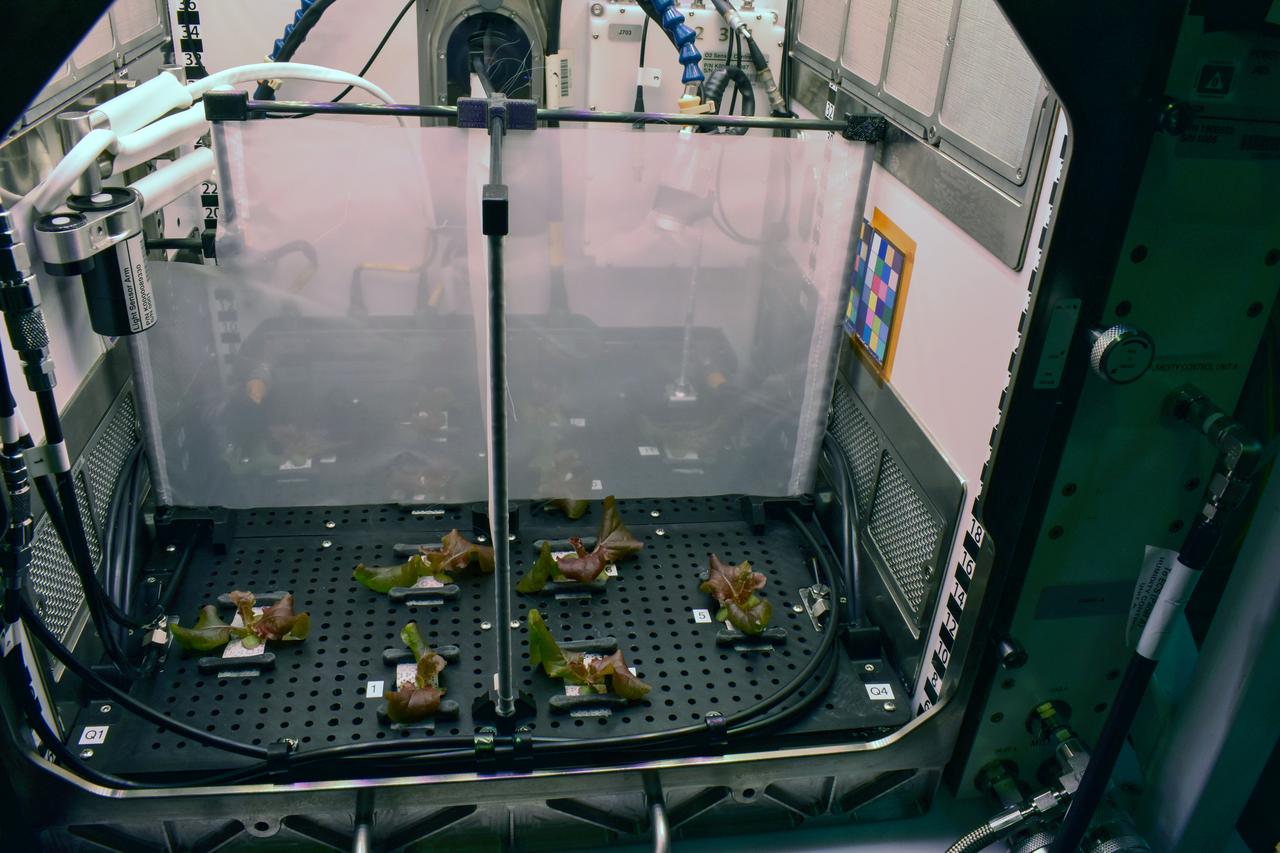
jsc2025e047408 (2/13/2024) --- Dividers installed on day 14 to separate the canopies and microbiomes of lettuce plants grown with different moisture treatments as part of a ground experiment for The Spaceflight Microbiome of a Food Crop Grown Using Different Substrate Moisture Levels (Plant Habitat-07). This investigation studies how plants, and their communities of microorganisms respond to different levels of water. Results could support development of systems for growing food crops on future missions. Image courtesy of the PH-07 Team.
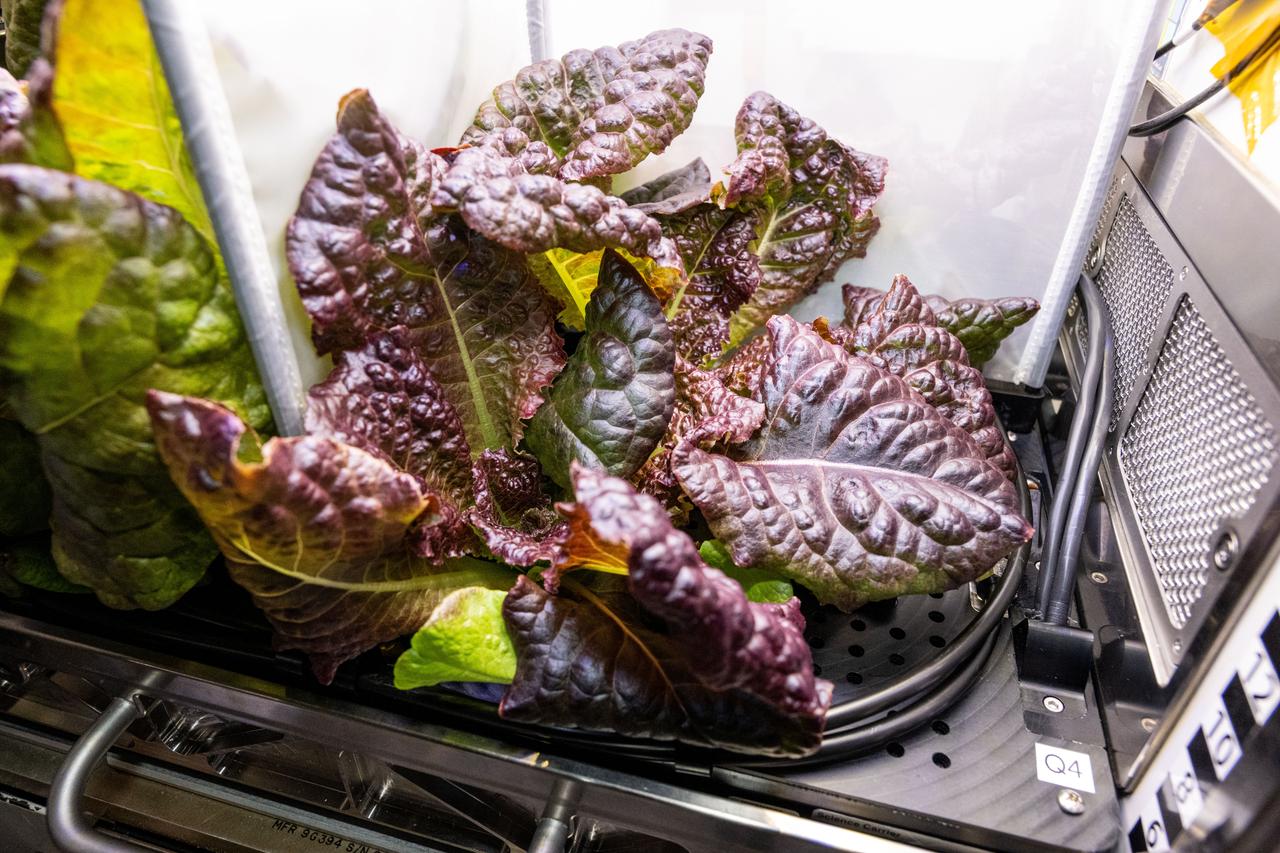
iss072e404275 (12/27/2024) --- The Spaceflight Microbiome of a Food Crop Grown Using Different Substrate Moisture Levels (Plant Habitat-07) investigation grows ‘Outredgeous’ red romaine lettuce aboard the International Space Station’s Advanced Plant Habitat to assess different substrate moisture treatments and their effects on the microbial communities in the plants, roots, and water. This image shows lettuce grown with wilt moisture treatments halfway through the harvest procedure on Day 28.
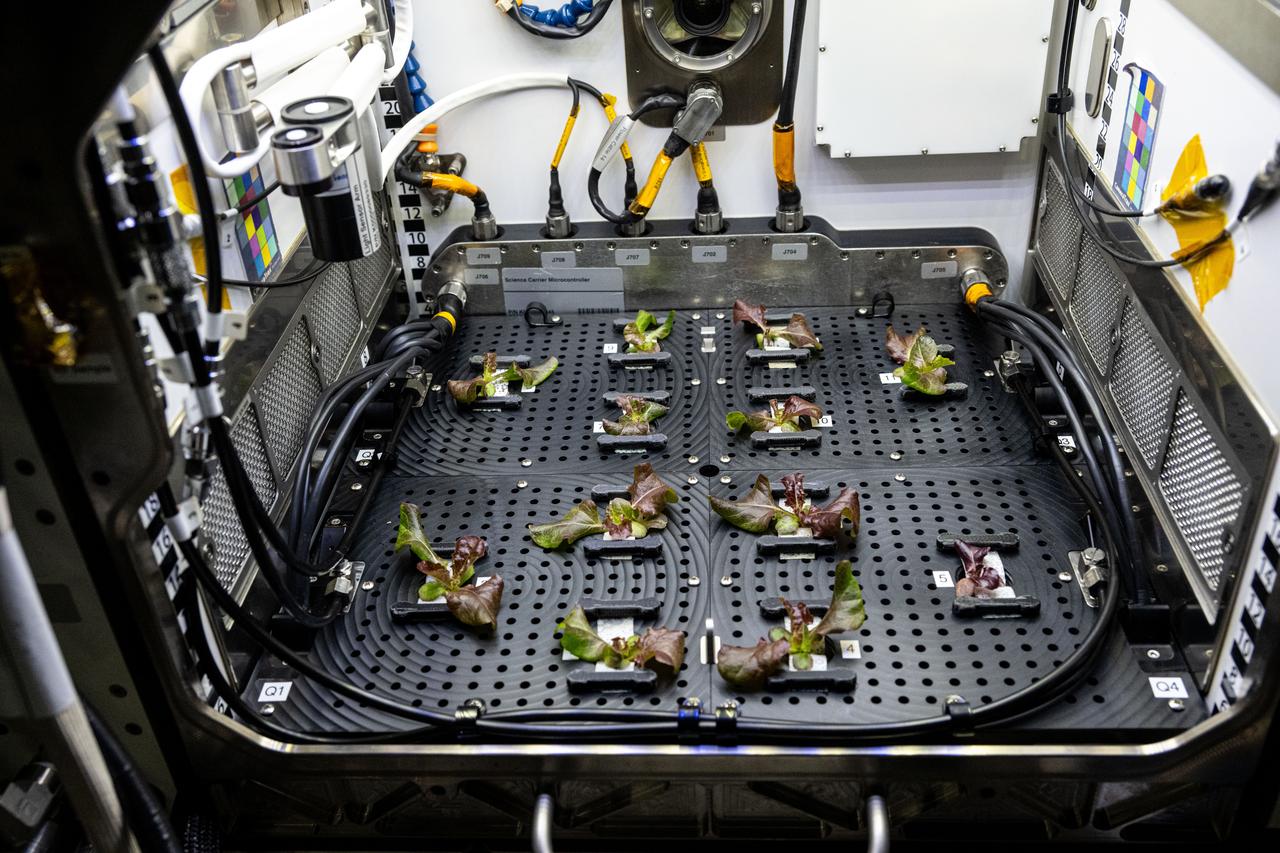
iss072e363510 (12/13/2024) --- The Spaceflight Microbiome of a Food Crop Grown Using Different Substrate Moisture Levels (Plant Habitat-07) investigation grows ‘Outredgeous’ red romaine lettuce aboard the International Space Station’s Advanced Plant Habitat to assess different substrate moisture treatments and their effects on the microbial communities in the plants, roots, and water.

iss068e045014 (Feb. 1, 2023) --- NASA astronaut and Expedition 68 Flight Engineer Josh Cassada uses a watering syringe to water tomato plants growing inside the EXPRESS rack's Veggie space botany facility located inside the Columbus laboratory module aboard the International Space Station.
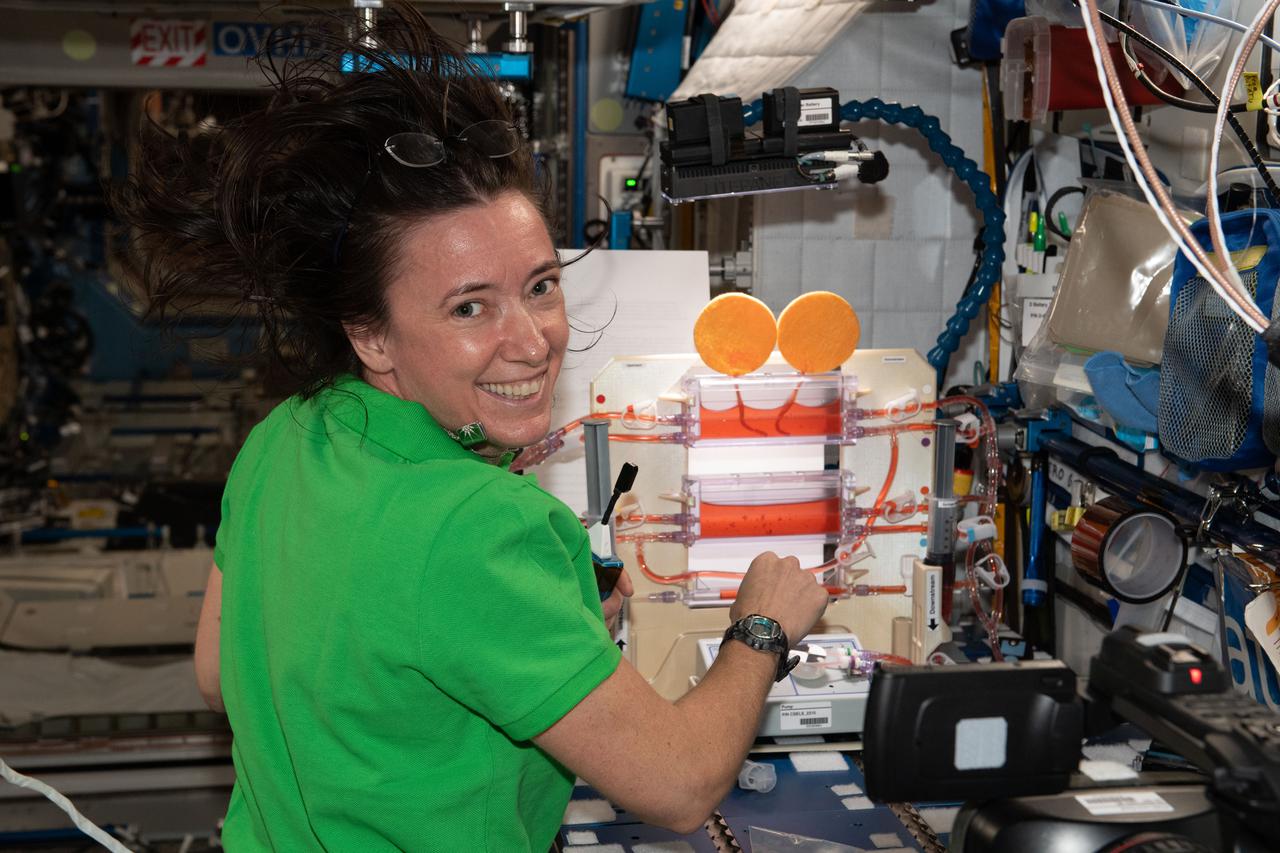
iss065e206774 (July 27, 2021) --- NASA astronaut and Expedition 65 Flight Engineer Megan McArthur works on the Plant Water Management space botany study that explores operating hydroponics in microgravity and may also improve watering systems on Earth.
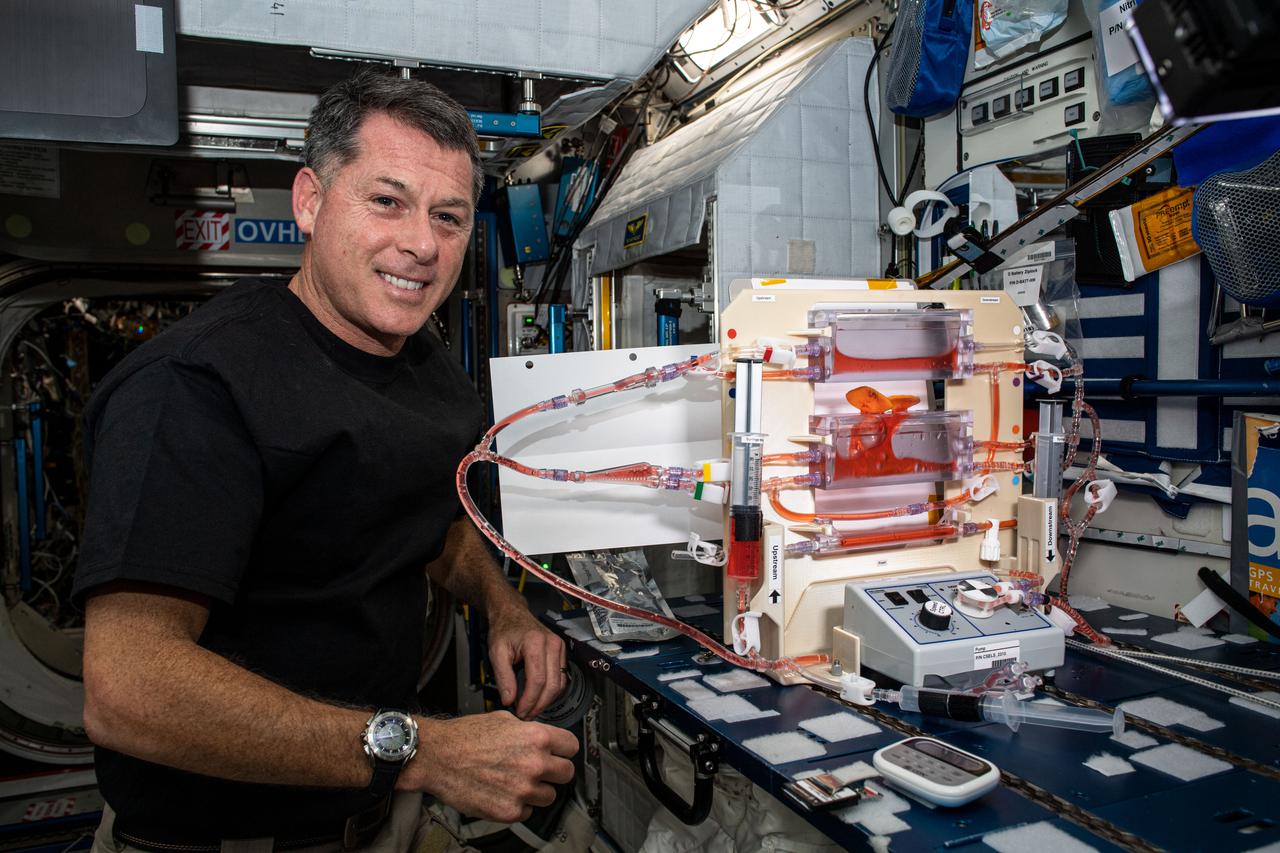
iss065e074538 (May 27, 2021) --- NASA astronaut and Expedition 65 Flight Engineer Shane Kimbrough conducts cylinder test operations for the Plant Water Management experiment. The space botany study explores hydroponics in microgravity and may also improve watering systems on Earth.
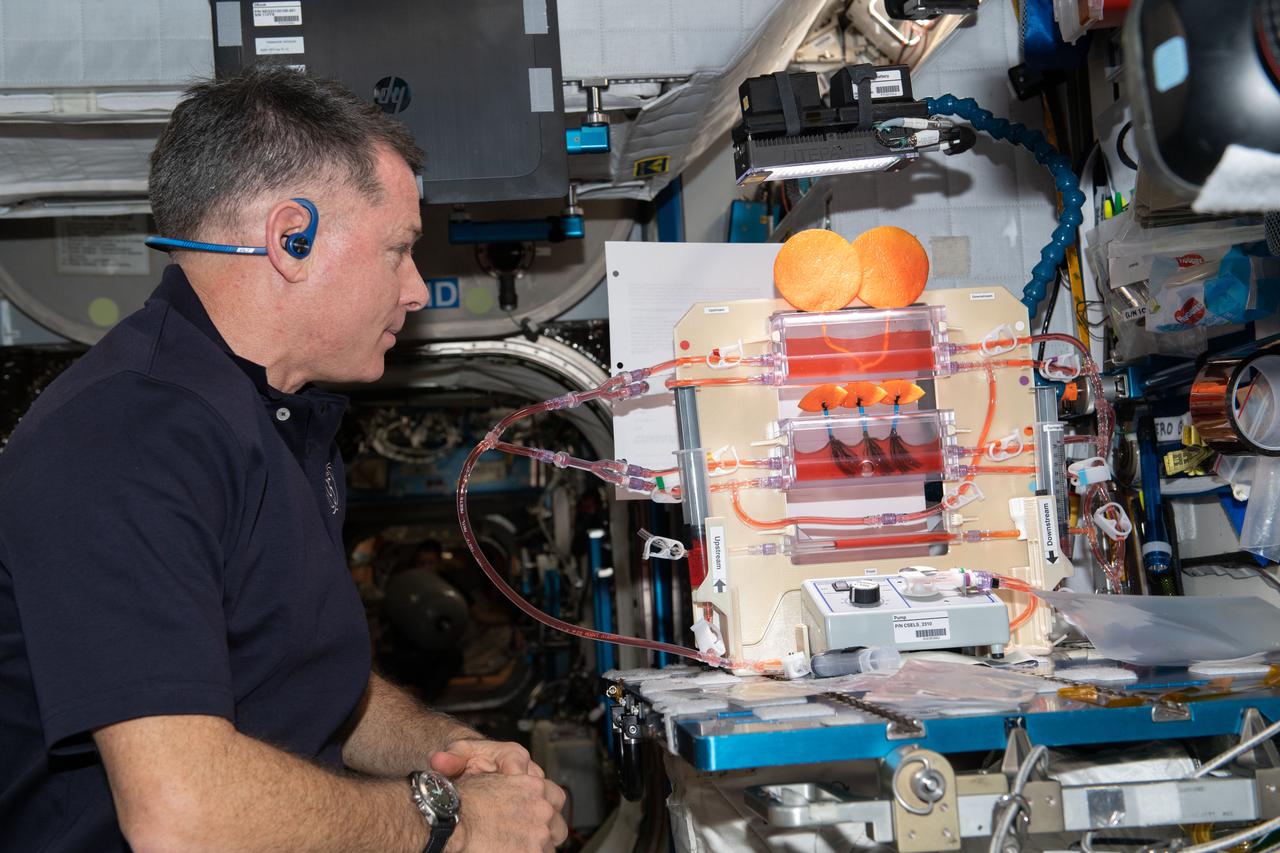
iss065e208539 (July 28, 2021) --- NASA astronaut and Expedition 65 Flight Engineer Shane Kimbrough works on the Plant Water Management space botany study that explores operating hydroponics in microgravity and may also improve watering systems on Earth.
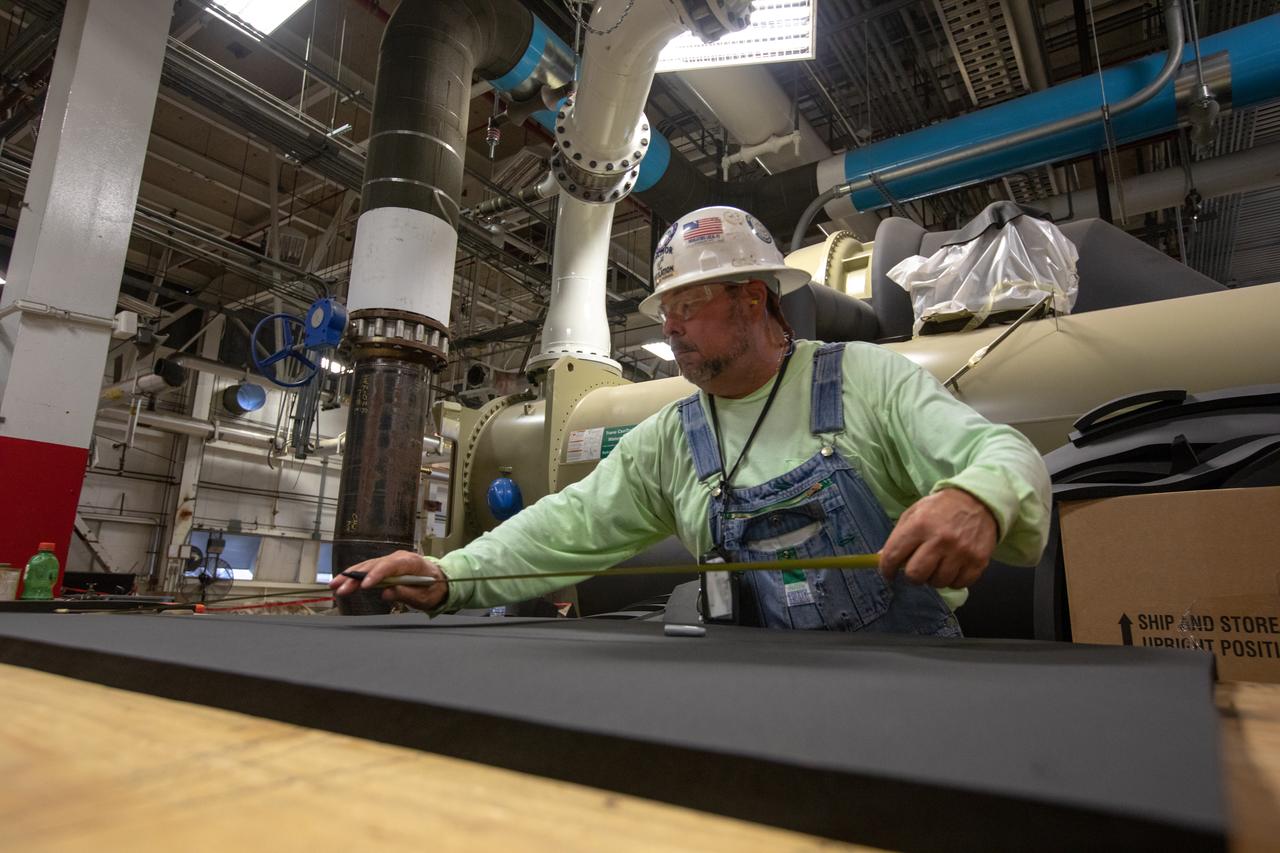
A technician measures foam insulation inside the Utility Annex near the Vehicle Assembly (VAB) Building at NASA’s Kennedy Space Center in Florida on July 24, 2019. The Utility Annex, which provides 8,000 gallons of chilled water per minute to the VAB and other facilities in the Launch Complex 39 area, is being upgraded and repaired. The facility also contains boilers necessary to provide hot water to the VAB. The center’s Engineering Directorate is making the repairs and upgrades to the facility to prepare for the agency’s Artemis missions to the Moon and on to Mars.
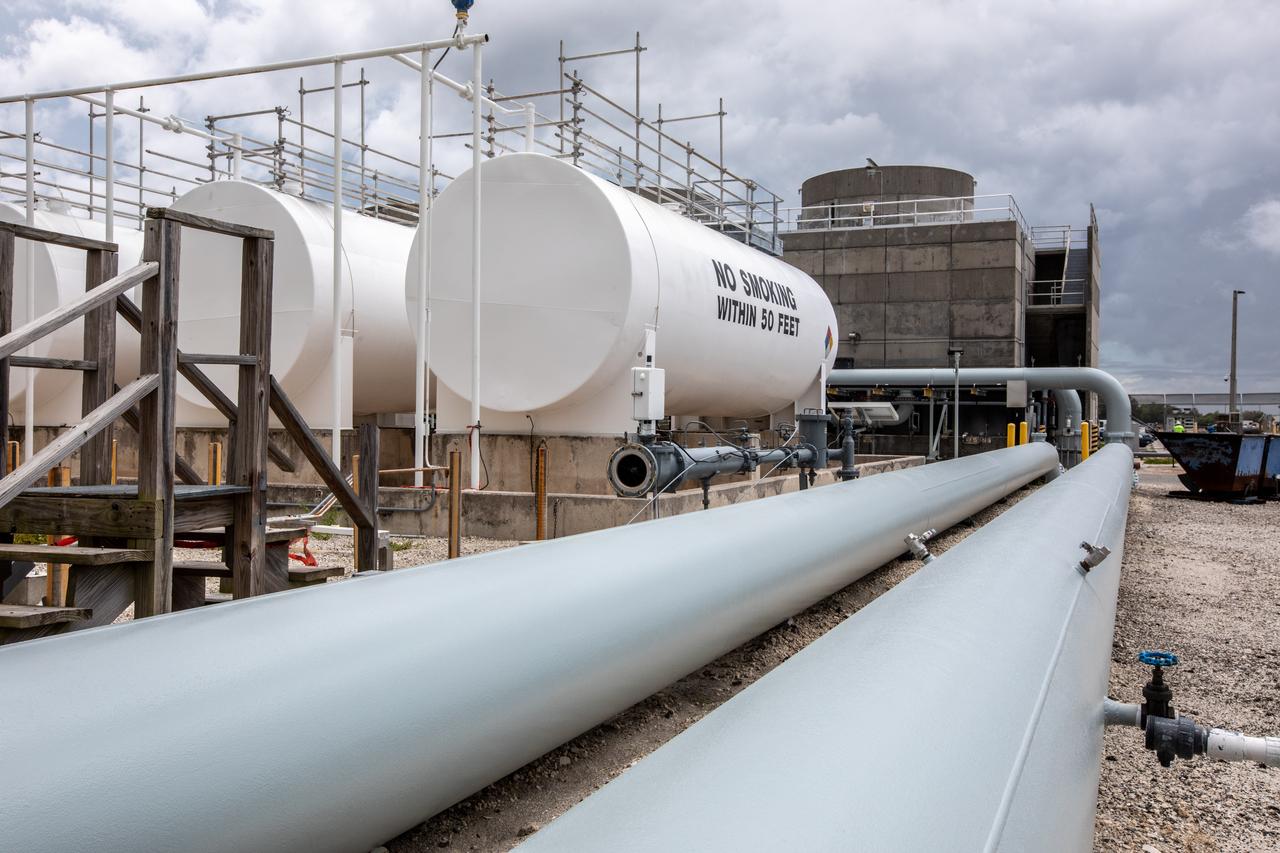
A photograph taken July 24, 2019, shows new tanks and piping were installed outside of the Utility Annex near the Vehicle Assembly (VAB) Building at NASA’s Kennedy Space Center in Florida. The Utility Annex, which provides 8,000 gallons of chilled water per minute to the VAB and other facilities in the Launch Complex 39 area, is being upgraded and repaired. The facility also contains boilers necessary to provide hot water to the VAB. The center’s Engineering Directorate is making the repairs and upgrades to the facility to prepare for the agency’s Artemis missions to the Moon and on to Mars.
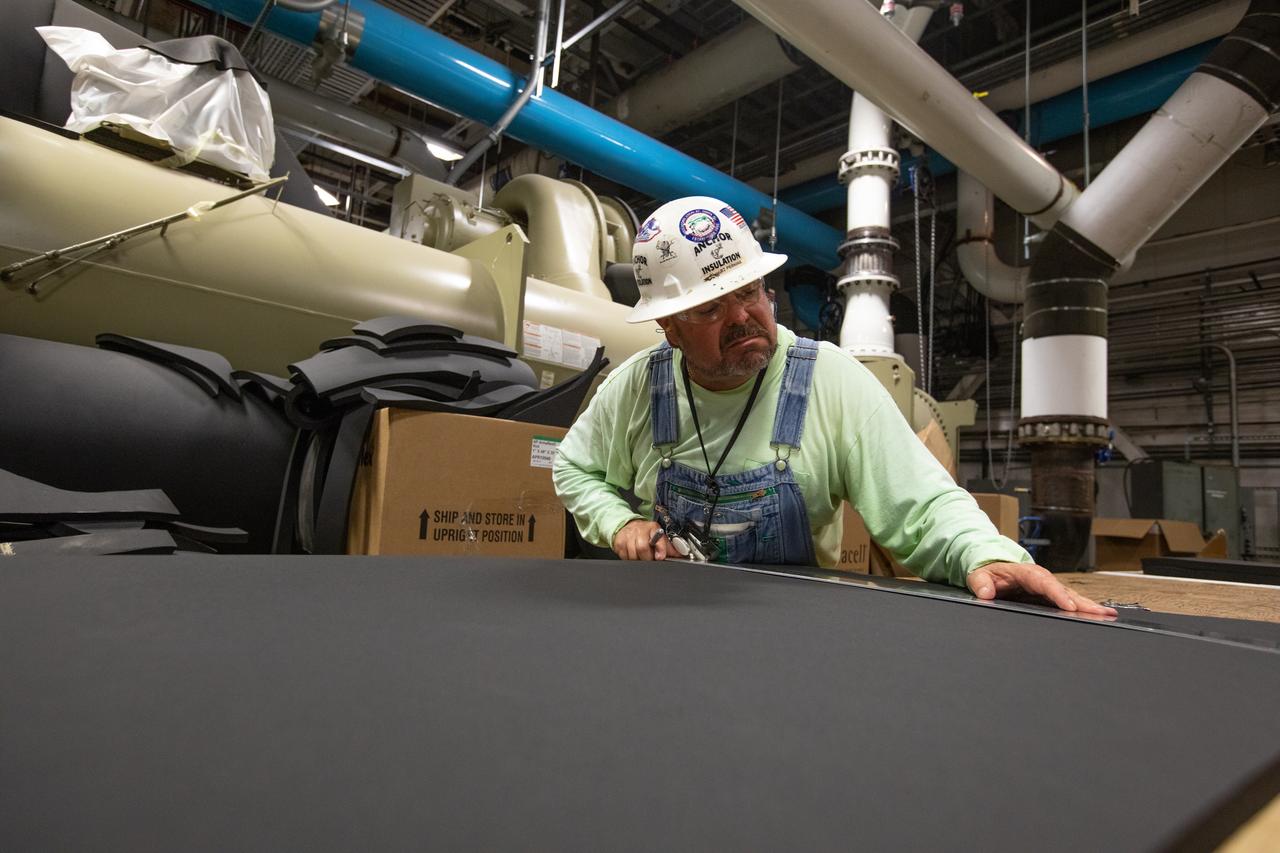
A technician measures foam insulation inside the Utility Annex near the Vehicle Assembly (VAB) Building at NASA’s Kennedy Space Center in Florida on July 24, 2019. The Utility Annex, which provides 8,000 gallons of chilled water per minute to the VAB and other facilities in the Launch Complex 39 area, is being upgraded and repaired. The facility also contains boilers necessary to provide hot water to the VAB. The center’s Engineering Directorate is making the repairs and upgrades to the facility to prepare for the agency’s Artemis missions to the Moon and on to Mars.
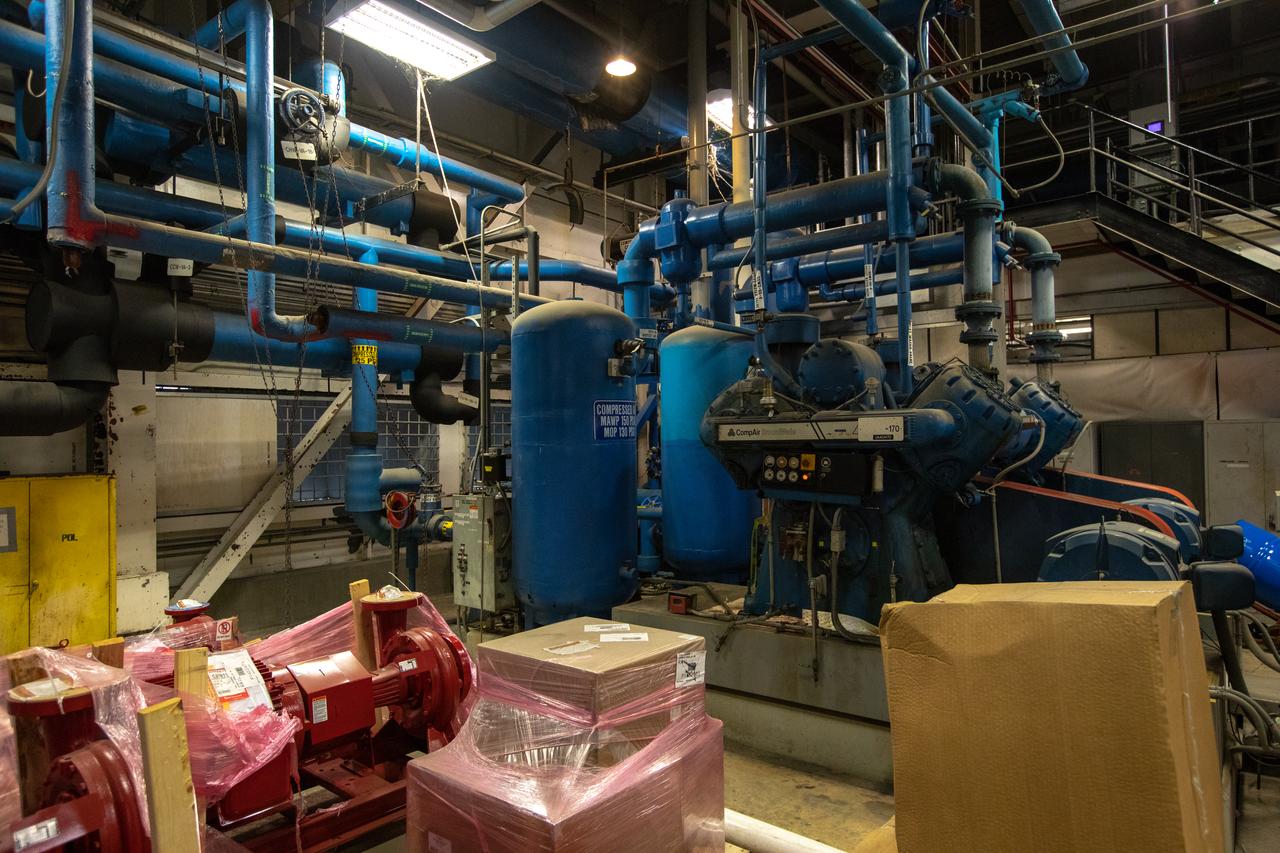
A view of the inside of the Utility Annex near the Vehicle Assembly (VAB) Building at NASA’s Kennedy Space Center in Florida on July 24, 2019. The Utility Annex, which provides 8,000 gallons of chilled water per minute to the VAB and other facilities in the Launch Complex 39 area, is being upgraded and repaired. The facility also contains boilers necessary to provide hot water to the VAB. The center’s Engineering Directorate is making the repairs and upgrades to the facility to prepare for the agency’s Artemis missions to the Moon and on to Mars.

A technician measures foam insulation inside the Utility Annex near the Vehicle Assembly (VAB) Building at NASA’s Kennedy Space Center in Florida on July 24, 2019. The Utility Annex, which provides 8,000 gallons of chilled water per minute to the VAB and other facilities in the Launch Complex 39 area, is being upgraded and repaired. The facility also contains boilers necessary to provide hot water to the VAB. The center’s Engineering Directorate is making the repairs and upgrades to the facility to prepare for the agency’s Artemis missions to the Moon and on to Mars.
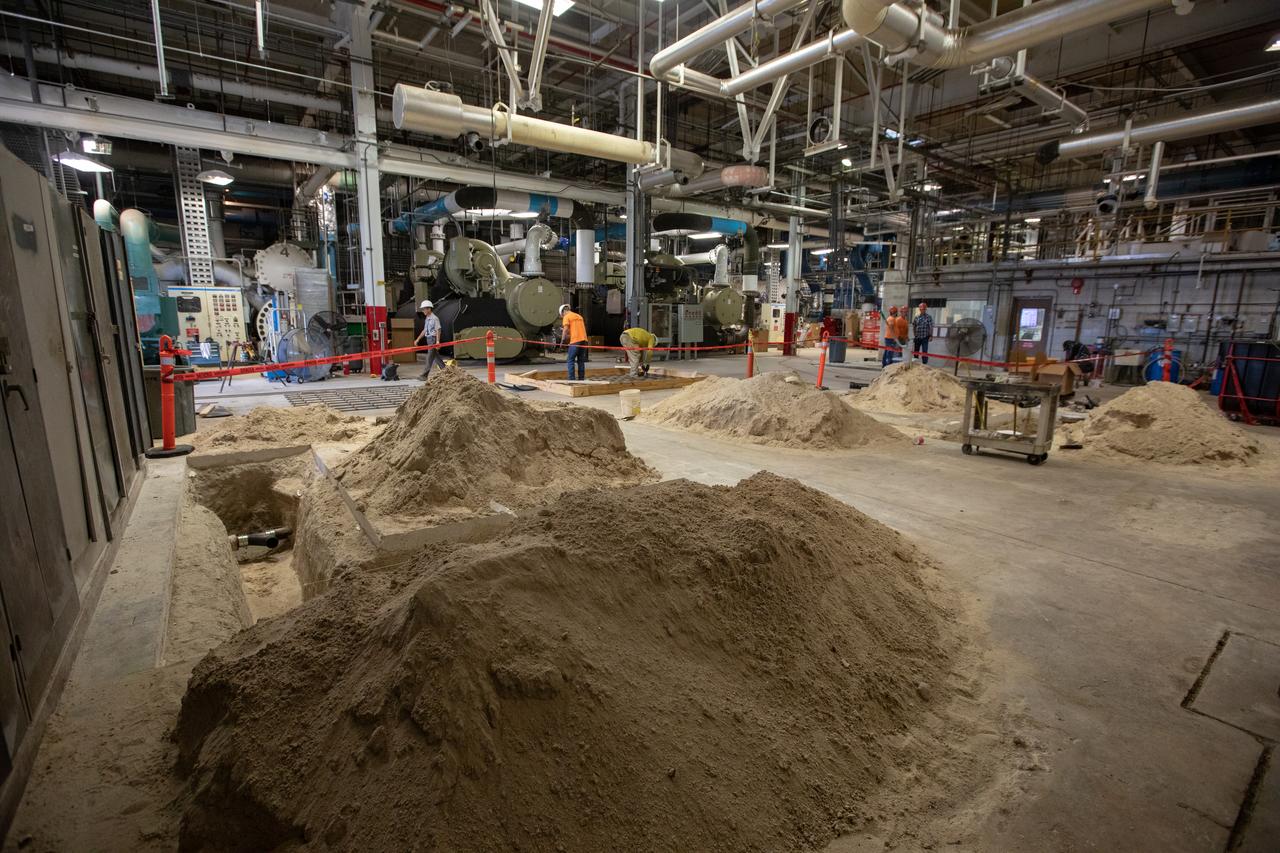
Upgrades are in progress inside the Utility Annex near the Vehicle Assembly (VAB) Building at NASA’s Kennedy Space Center in Florida on July 24, 2019. The Utility Annex, which provides 8,000 gallons of chilled water per minute to the VAB and other facilities in the Launch Complex 39 area, is being upgraded and repaired. The facility also contains boilers necessary to provide hot water to the VAB. The center’s Engineering Directorate is making the repairs and upgrades to the facility to prepare for the agency’s Artemis missions to the Moon and on to Mars.
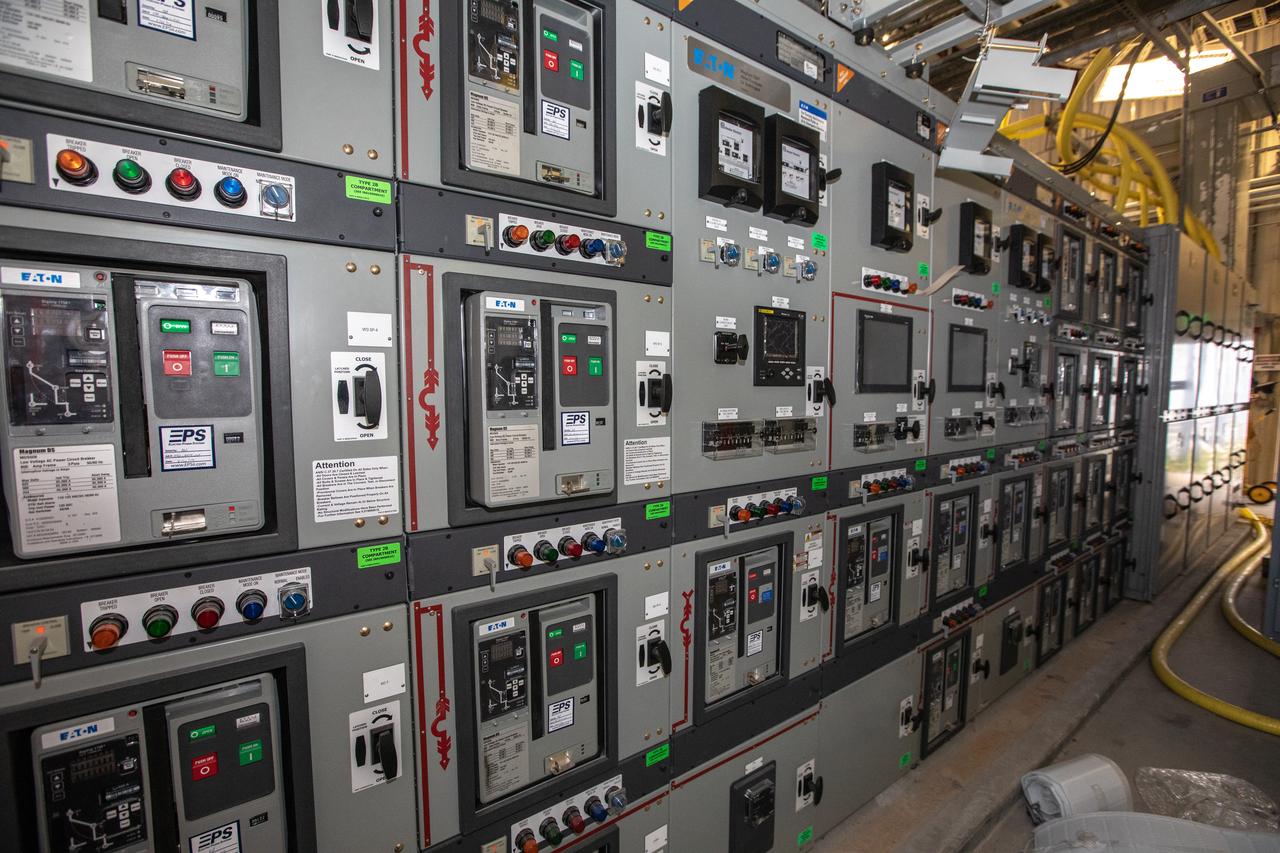
Control panels are in view inside the Utility Annex near the Vehicle Assembly (VAB) Building at NASA’s Kennedy Space Center in Florida on July 24, 2019. The Utility Annex, which provides 8,000 gallons of chilled water per minute to the VAB and other facilities in the Launch Complex 39 area, is being upgraded and repaired. The facility also contains boilers necessary to provide hot water to the VAB. The center’s Engineering Directorate is making the repairs and upgrades to the facility to prepare for the agency’s Artemis missions to the Moon and on to Mars.
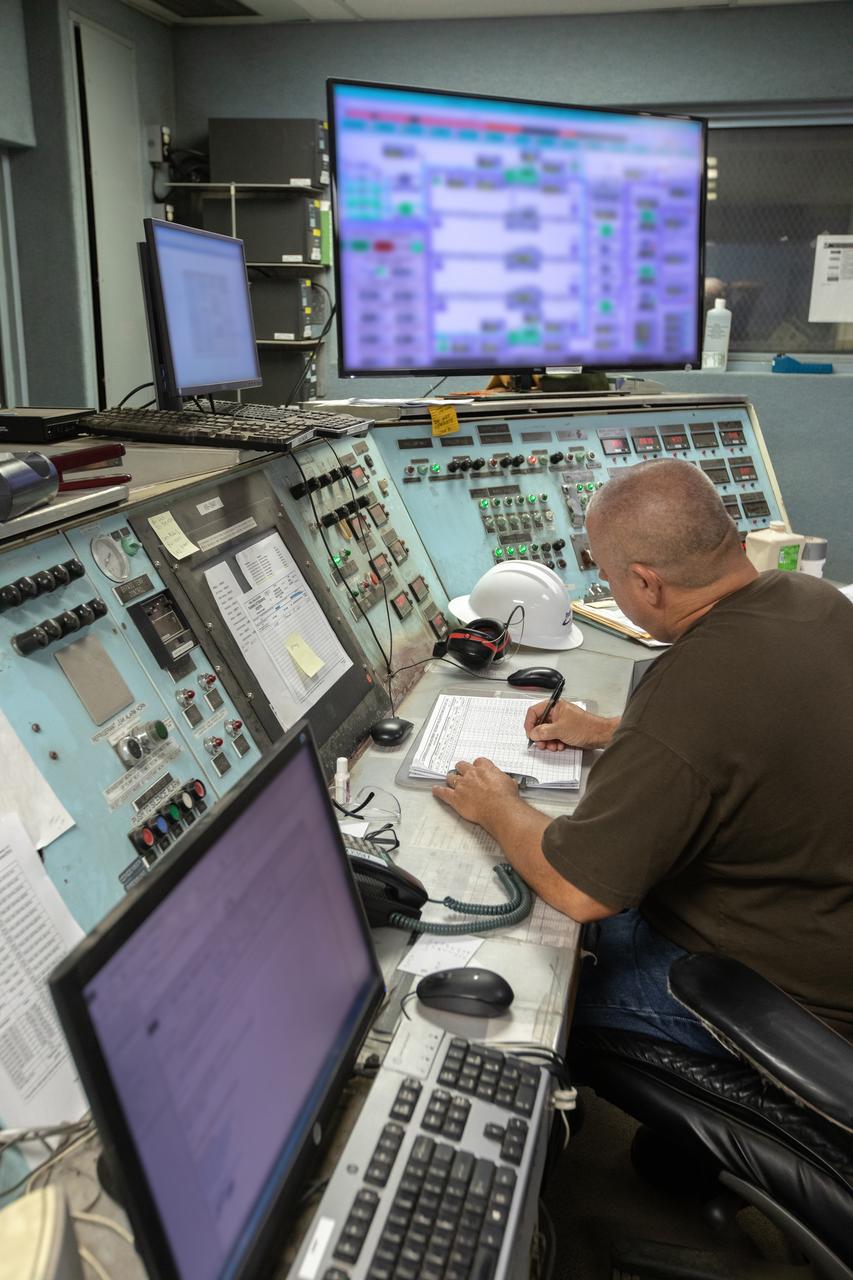
A technician monitors conditions in a control room inside the Utility Annex near the Vehicle Assembly (VAB) Building at NASA’s Kennedy Space Center in Florida on July 24, 2019. The Utility Annex, which provides 8,000 gallons of chilled water per minute to the VAB and other facilities in the Launch Complex 39 area, is being upgraded and repaired. The facility also contains boilers necessary to provide hot water to the VAB. The center’s Engineering Directorate is making the repairs and upgrades to the facility to prepare for the agency’s Artemis missions to the Moon and on to Mars.
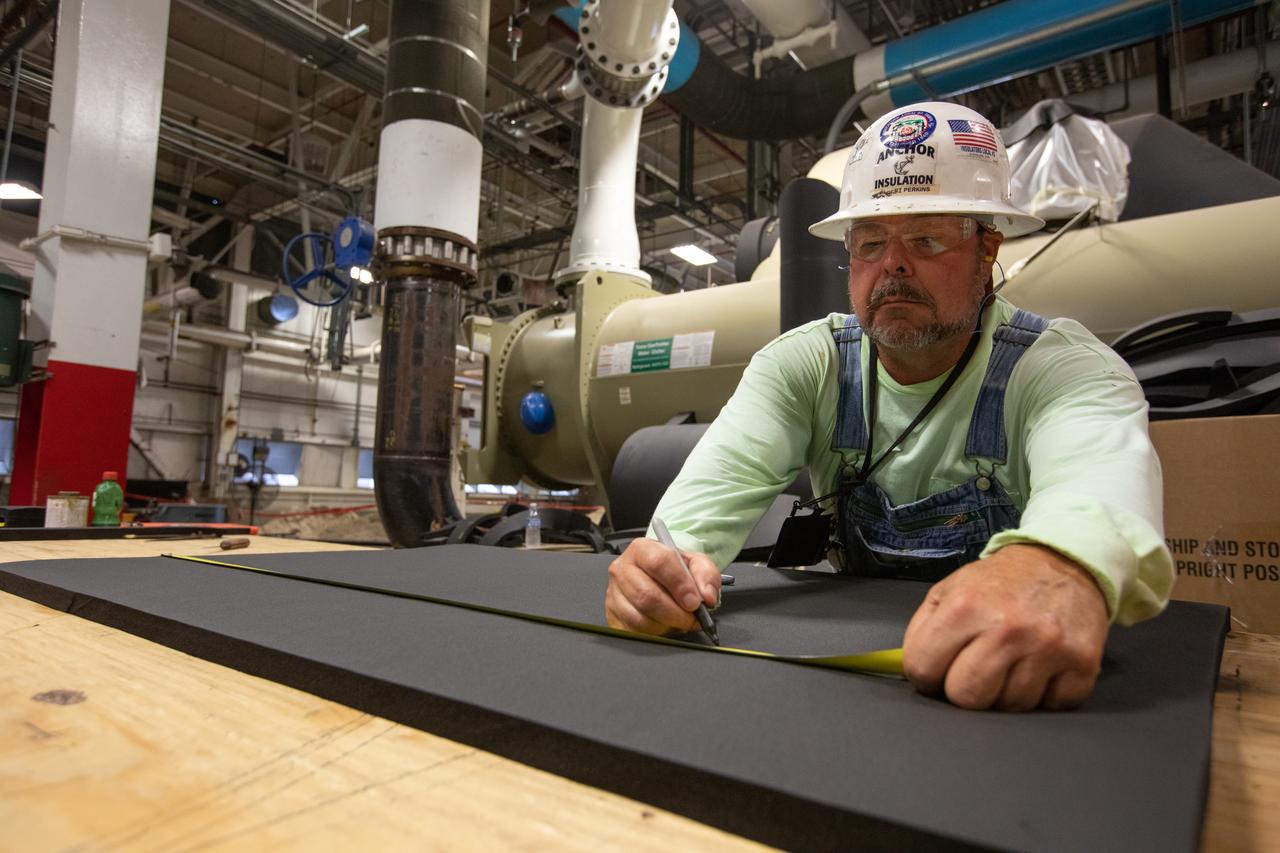
A technician measures foam insulation inside the Utility Annex near the Vehicle Assembly (VAB) Building at NASA’s Kennedy Space Center in Florida on July 24, 2019. The Utility Annex, which provides 8,000 gallons of chilled water per minute to the VAB and other facilities in the Launch Complex 39 area, is being upgraded and repaired. The facility also contains boilers necessary to provide hot water to the VAB. The center’s Engineering Directorate is making the repairs and upgrades to the facility to prepare for the agency’s Artemis missions to the Moon and on to Mars.
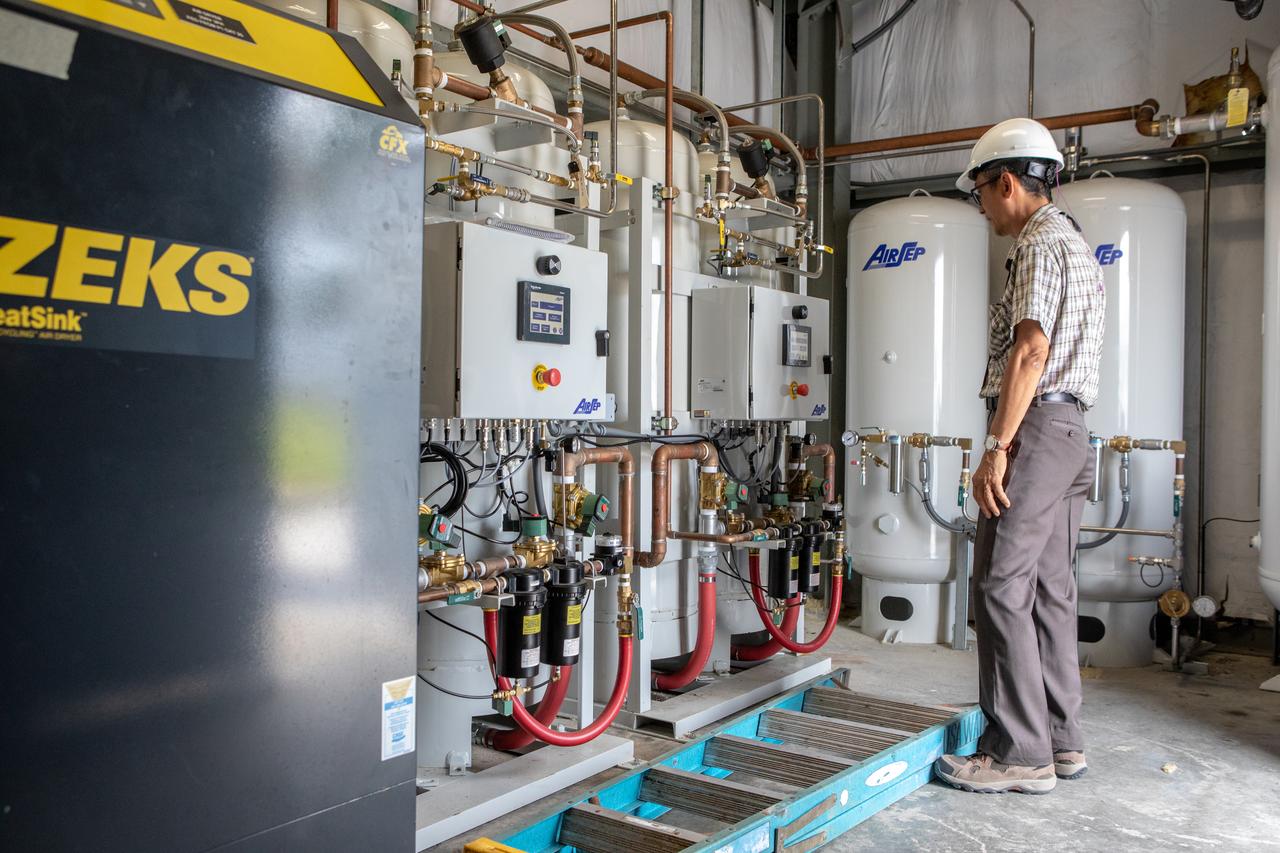
A photograph taken July 24, 2019, shows new air tanks, piping and control panels were installed in the Utility Annex near the Vehicle Assembly (VAB) Building at NASA’s Kennedy Space Center in Florida. The Utility Annex, which provides 8,000 gallons of chilled water per minute to the VAB and other facilities in the Launch Complex 39 area, is being upgraded and repaired. The facility also contains boilers necessary to provide hot water to the VAB. The center’s Engineering Directorate is making the repairs and upgrades to the facility to prepare for the agency’s Artemis missions to the Moon and on to Mars.
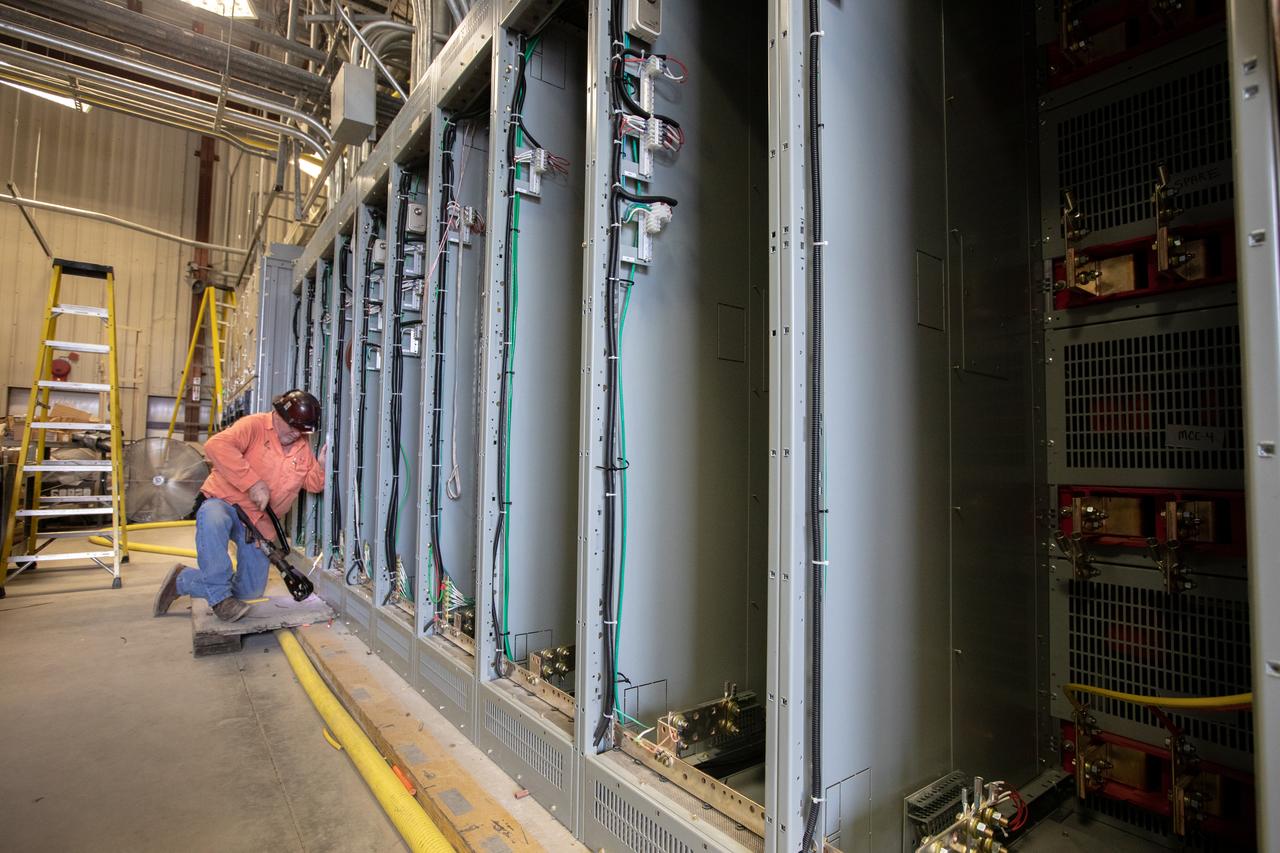
A construction worker installs new wiring inside the Utility Annex near the Vehicle Assembly (VAB) Building at NASA’s Kennedy Space Center in Florida on July 24, 2019. The Utility Annex, which provides 8,000 gallons of chilled water per minute to the VAB and other facilities in the Launch Complex 39 area, is being upgraded and repaired. The facility also contains boilers necessary to provide hot water to the VAB. The center’s Engineering Directorate is making the repairs and upgrades to the facility to prepare for the agency’s Artemis missions to the Moon and on to Mars.
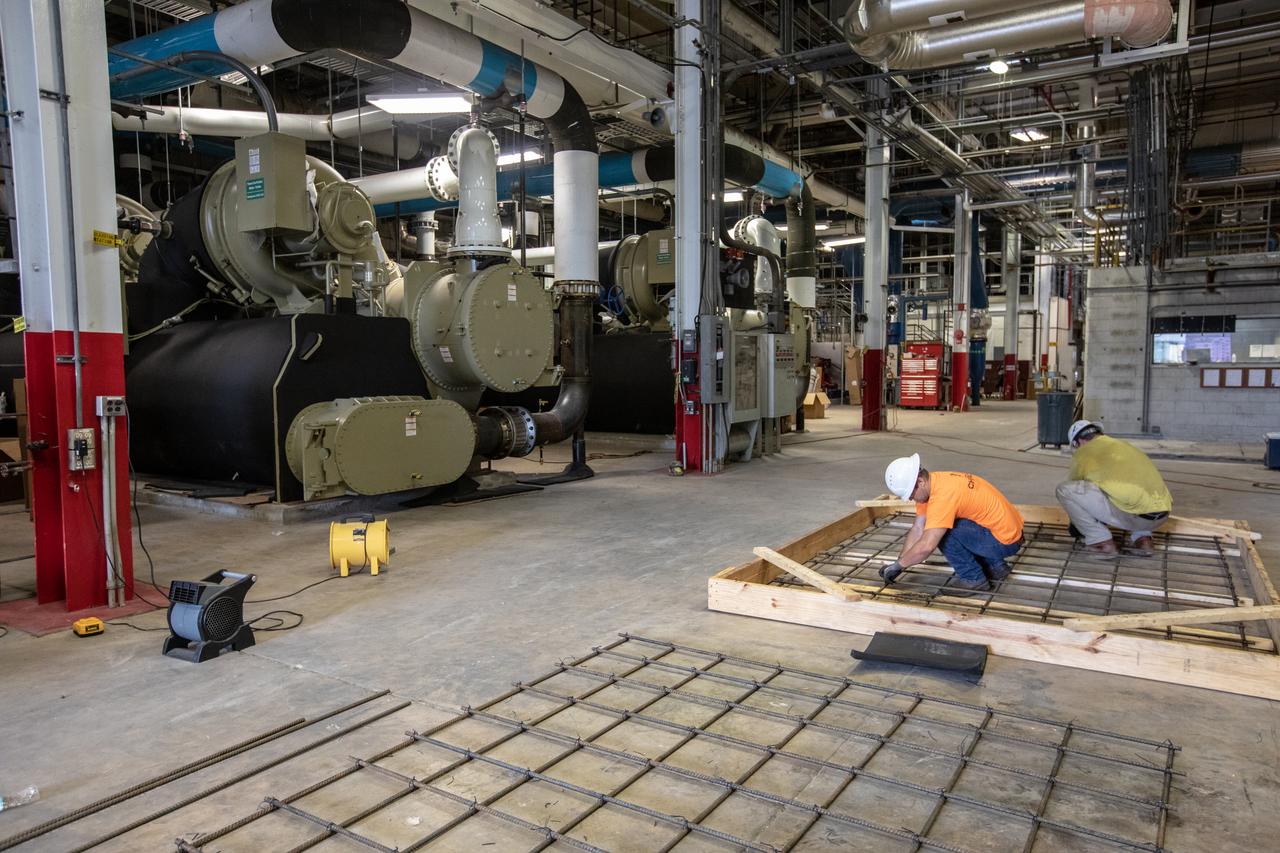
Upgrades are in progress inside the Utility Annex near the Vehicle Assembly (VAB) Building at NASA’s Kennedy Space Center in Florida on July 24, 2019. The Utility Annex, which provides 8,000 gallons of chilled water per minute to the VAB and other facilities in the Launch Complex 39 area, is being upgraded and repaired. The facility also contains boilers necessary to provide hot water to the VAB. The center’s Engineering Directorate is making the repairs and upgrades to the facility to prepare for the agency’s Artemis missions to the Moon and on to Mars.
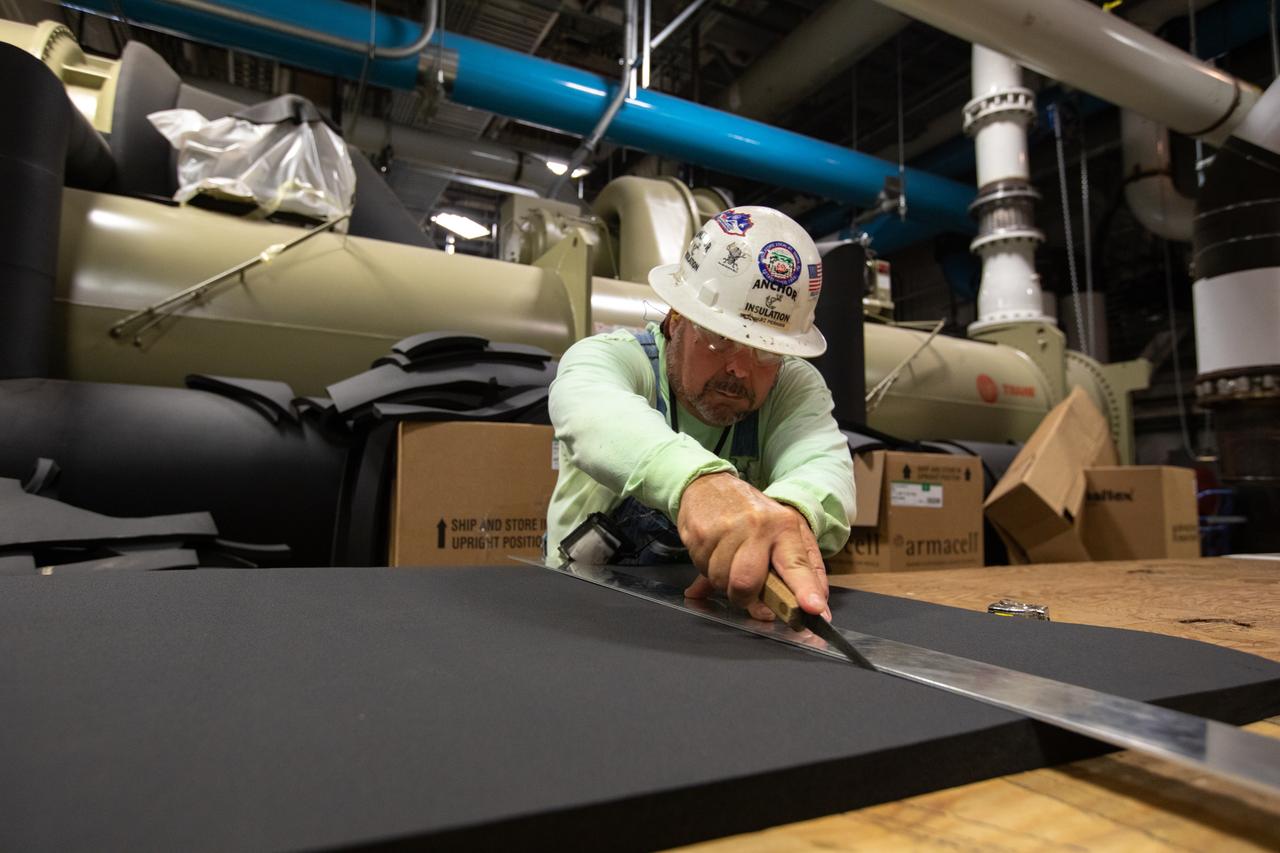
A technician cuts a section of foam insulation inside the Utility Annex near the Vehicle Assembly (VAB) Building at NASA’s Kennedy Space Center in Florida on July 24, 2019. The Utility Annex, which provides 8,000 gallons of chilled water per minute to the VAB and other facilities in the Launch Complex 39 area, is being upgraded and repaired. The facility also contains boilers necessary to provide hot water to the VAB. The center’s Engineering Directorate is making the repairs and upgrades to the facility to prepare for the agency’s Artemis missions to the Moon and on to Mars.
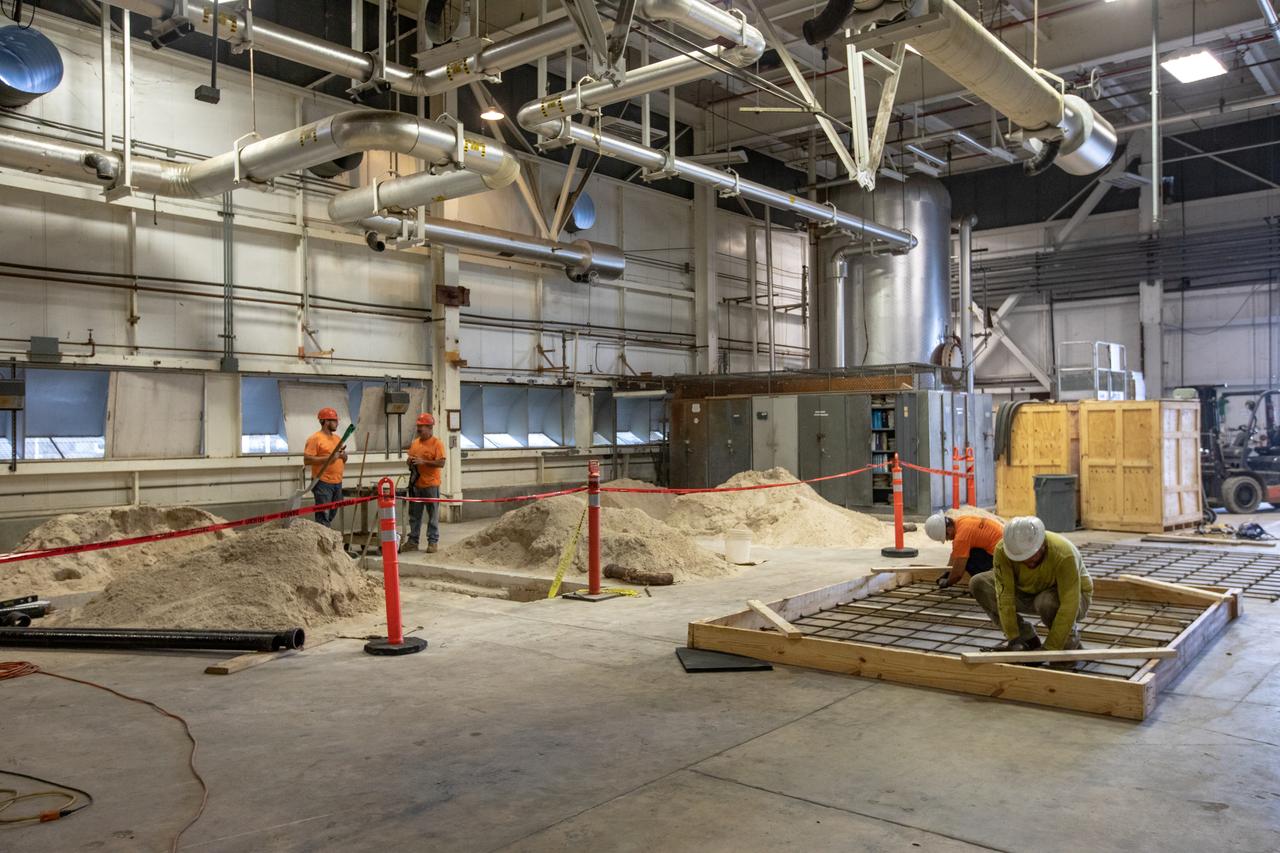
Upgrades are in progress inside the Utility Annex near the Vehicle Assembly (VAB) Building at NASA’s Kennedy Space Center in Florida on July 24, 2019. The Utility Annex, which provides 8,000 gallons of chilled water per minute to the VAB and other facilities in the Launch Complex 39 area, is being upgraded and repaired. The facility also contains boilers necessary to provide hot water to the VAB. The center’s Engineering Directorate is making the repairs and upgrades to the facility to prepare for the agency’s Artemis missions to the Moon and on to Mars.
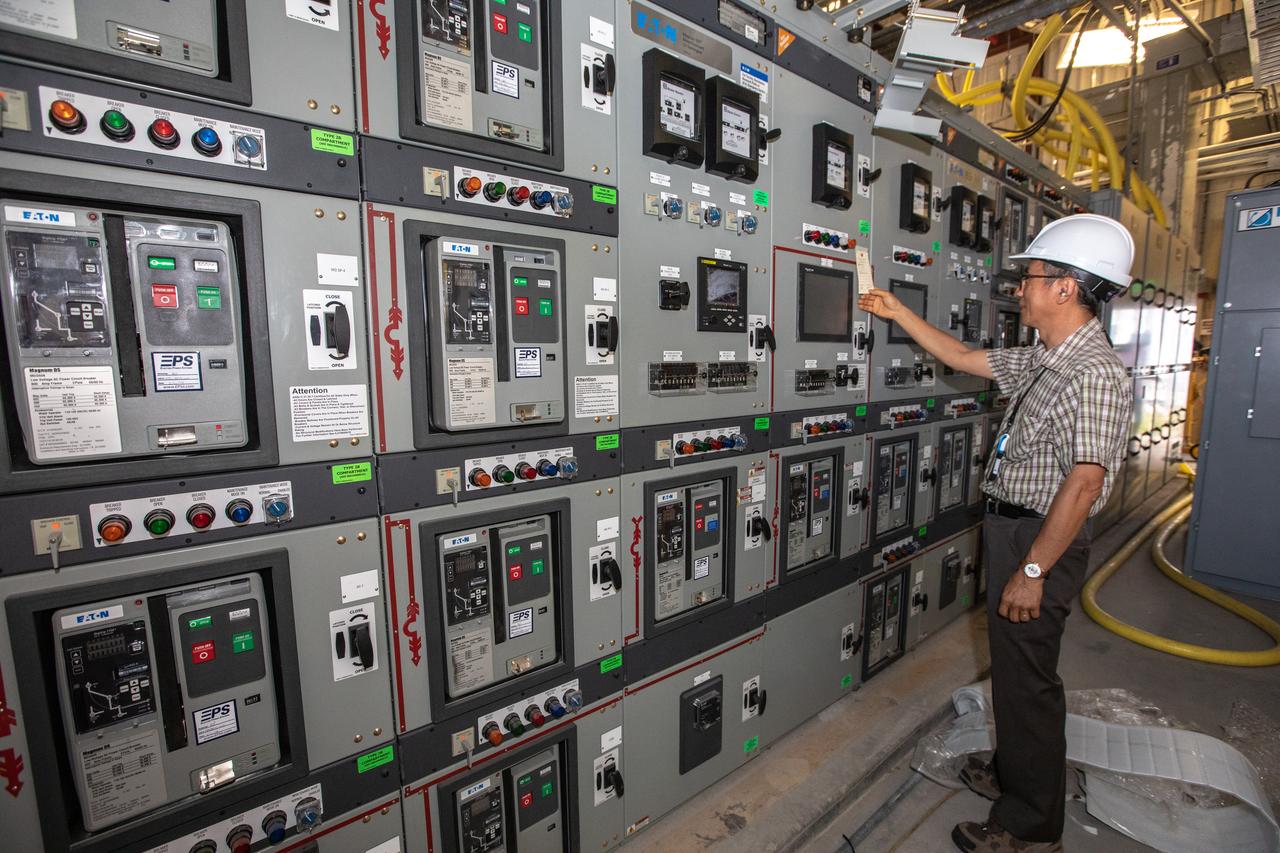
Control panels are in view inside the Utility Annex near the Vehicle Assembly (VAB) Building at NASA’s Kennedy Space Center in Florida on July 24, 2019. The Utility Annex, which provides 8,000 gallons of chilled water per minute to the VAB and other facilities in the Launch Complex 39 area, is being upgraded and repaired. The facility also contains boilers necessary to provide hot water to the VAB. The center’s Engineering Directorate is making the repairs and upgrades to the facility to prepare for the agency’s Artemis missions to the Moon and on to Mars.
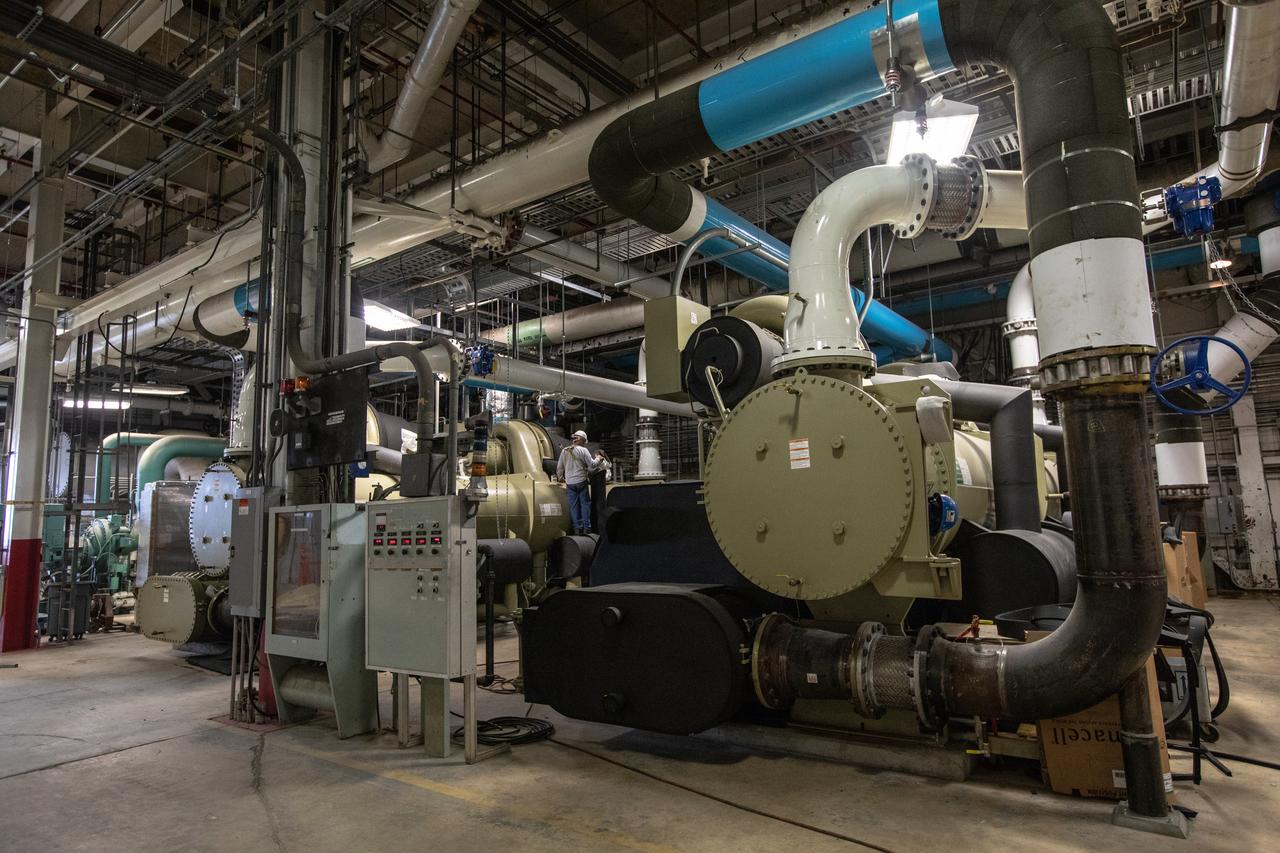
A view of the inside of the Utility Annex near the Vehicle Assembly (VAB) Building at NASA’s Kennedy Space Center in Florida on July 24, 2019. The Utility Annex, which provides 8,000 gallons of chilled water per minute to the VAB and other facilities in the Launch Complex 39 area, is being upgraded and repaired. The facility also contains boilers necessary to provide hot water to the VAB. The center’s Engineering Directorate is making the repairs and upgrades to the facility to prepare for the agency’s Artemis missions to the Moon and on to Mars.
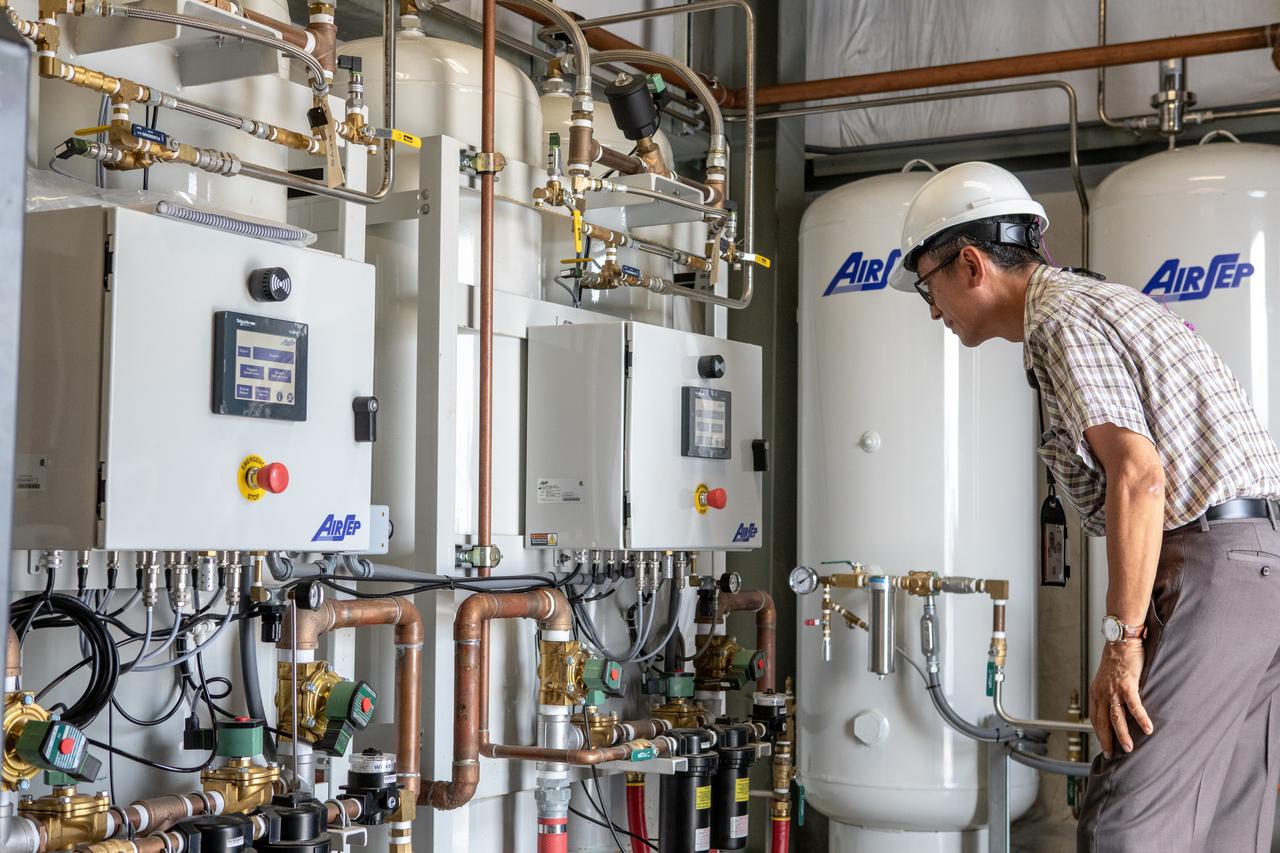
A photograph taken July 24, 2019, shows new air tanks, piping and control panels were installed in the Utility Annex near the Vehicle Assembly (VAB) Building at NASA’s Kennedy Space Center in Florida. The Utility Annex, which provides 8,000 gallons of chilled water per minute to the VAB and other facilities in the Launch Complex 39 area, is being upgraded and repaired. The facility also contains boilers necessary to provide hot water to the VAB. The center’s Engineering Directorate is making the repairs and upgrades to the facility to prepare for the agency’s Artemis missions to the Moon and on to Mars.
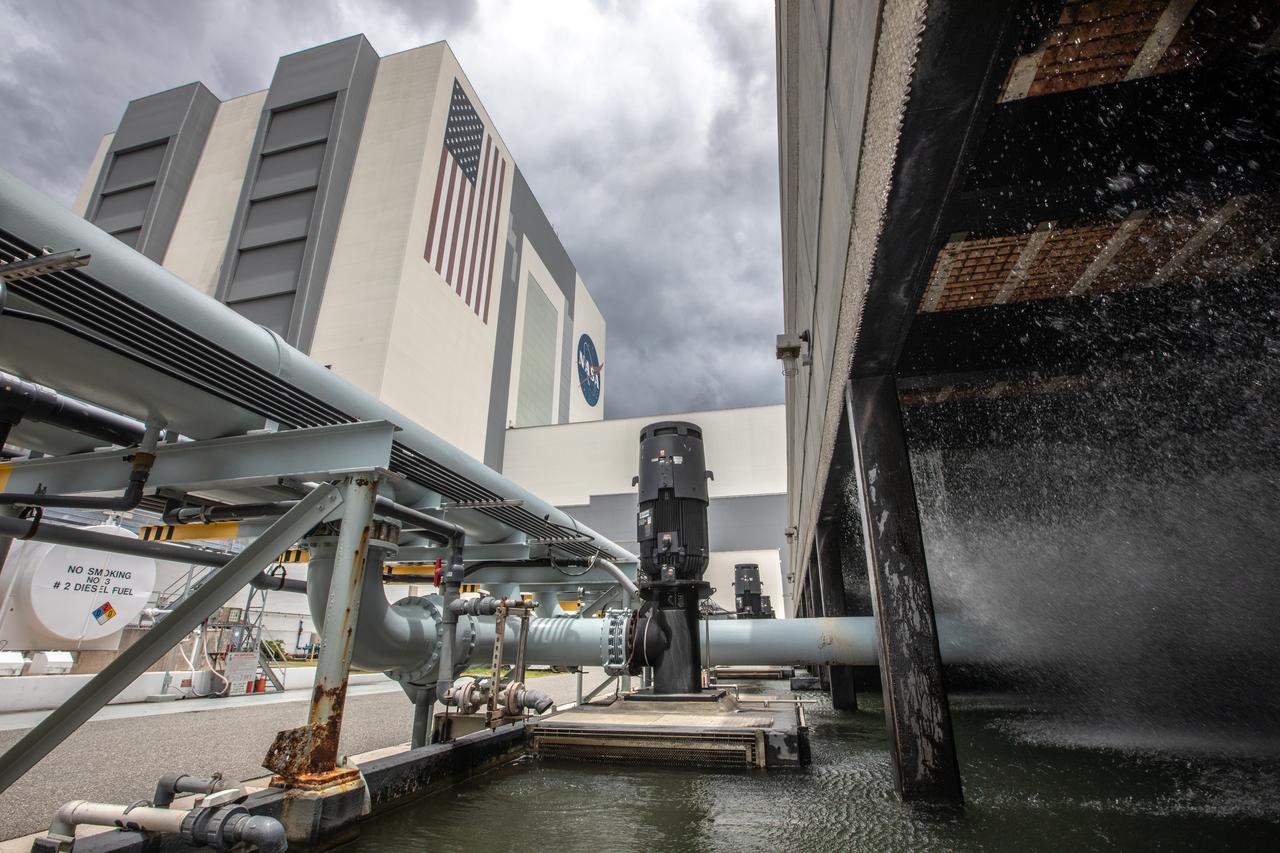
A photograph taken July 24, 2019, shows new tanks and piping were installed outside of the Utility Annex near the Vehicle Assembly (VAB) Building at NASA’s Kennedy Space Center in Florida. The Utility Annex, which provides 8,000 gallons of chilled water per minute to the VAB and other facilities in the Launch Complex 39 area, is being upgraded and repaired. The facility also contains boilers necessary to provide hot water to the VAB. The center’s Engineering Directorate is making the repairs and upgrades to the facility to prepare for the agency’s Artemis missions to the Moon and on to Mars.
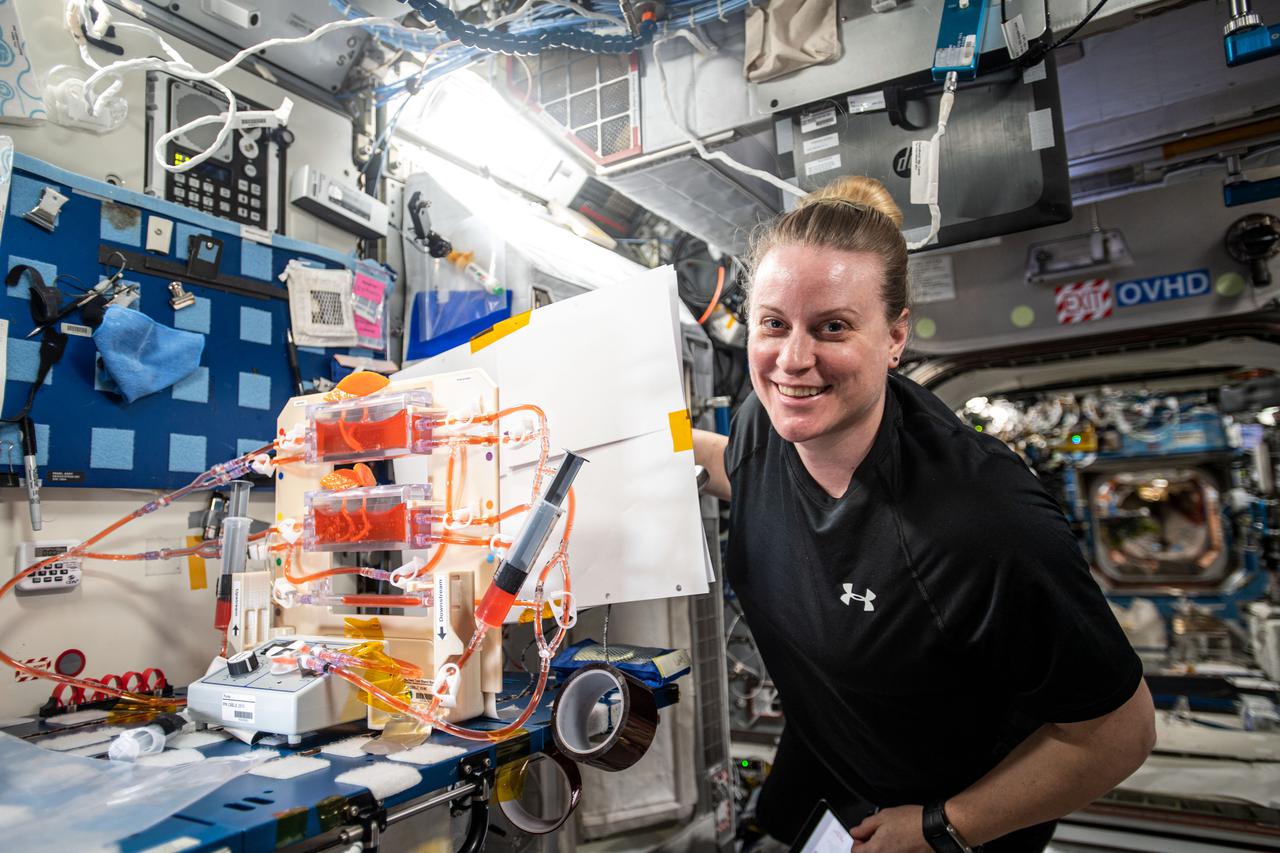
iss064e049288 (March 30, 2021) --- NASA astronaut and Expedition 64 Flight Engineer Kate Rubins works botany research for the Plant Water Management experiment that is testing hydroponics as a way to support space agriculture.
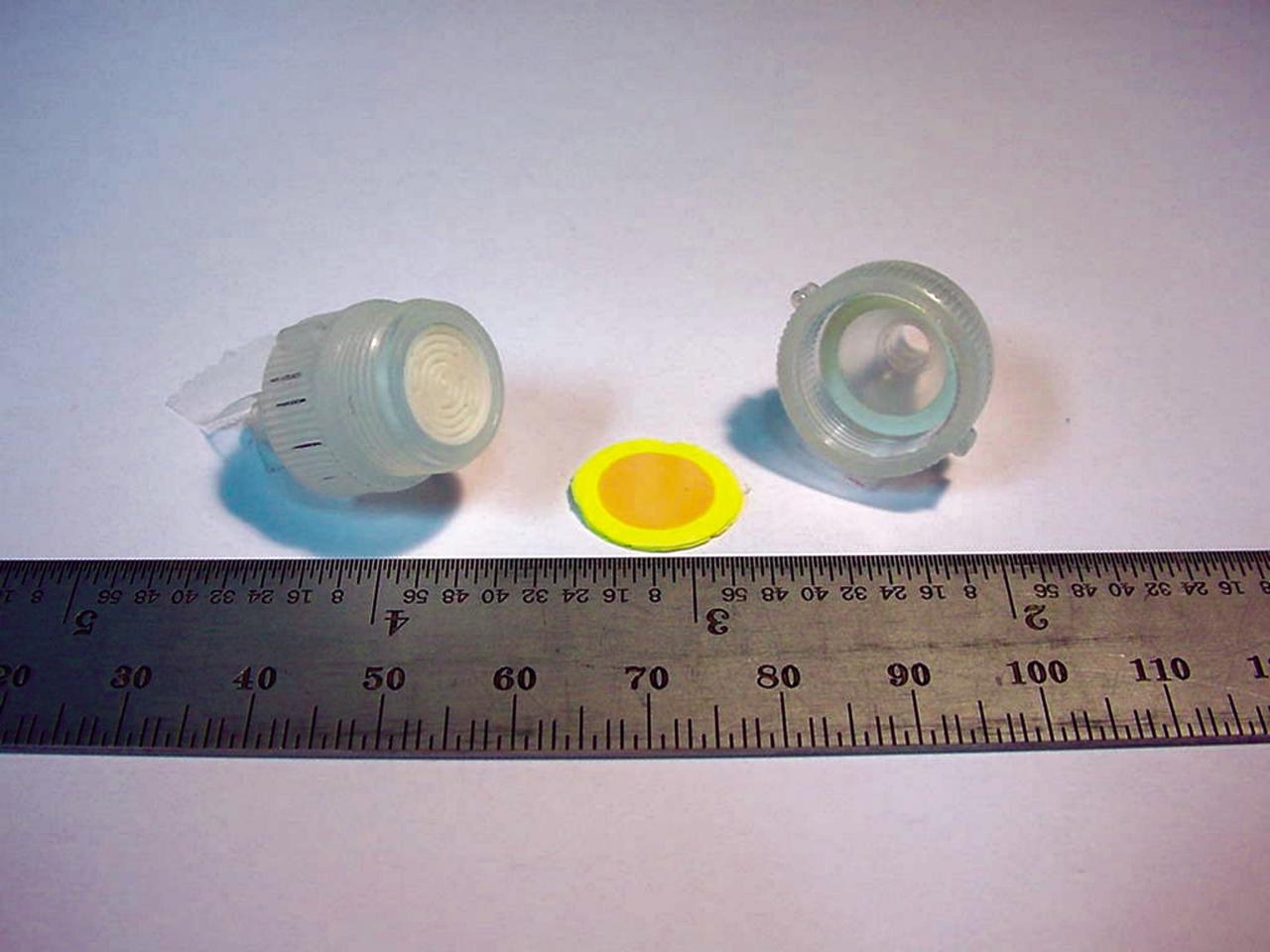
The heart of a colorimetric solid phase extractor (CSPE) test kit quickly measures the concentration of the biocides silver or iodine in astronauts’ drinking water to determine whether concentrations are safe. When 10 milliliters (ml) of water is drawn through the disk, the disk will turn color (yellow in this picture for iodine) indicating the presence of the biocides. The device could someday be used to test water safety at reservoirs and water treatment plants on Earth. (photo credit: Microanalytical Instrumentation Center, Iowa State University).
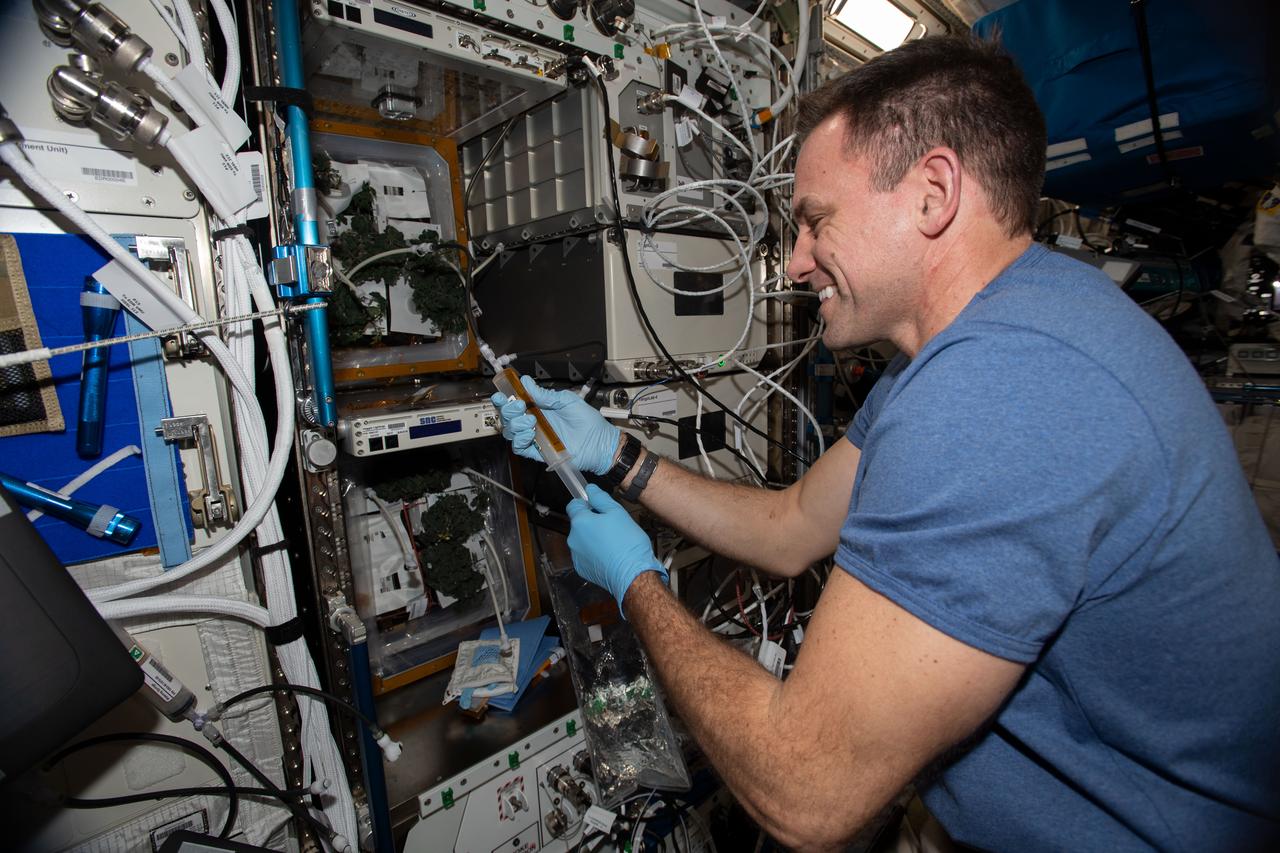
iss068e045013 (Feb. 2, 2023) --- NASA astronaut and Expedition 68 Flight Engineer Josh Cassada uses a watering syringe to water tomato plants for the the Veg-05 experiment, the next step in efforts to address the need for a continuous fresh-food production system in space. The experiment uses the space station’s Veggie facility to grow dwarf tomatoes, seen in its early growing stages on station in the bottom photo. The experiment examines the effect of light quality and fertilizer on fruit production, microbial food safety, nutritional value, and taste acceptability. Growing plants can also enhance the overall living experience for crew members.
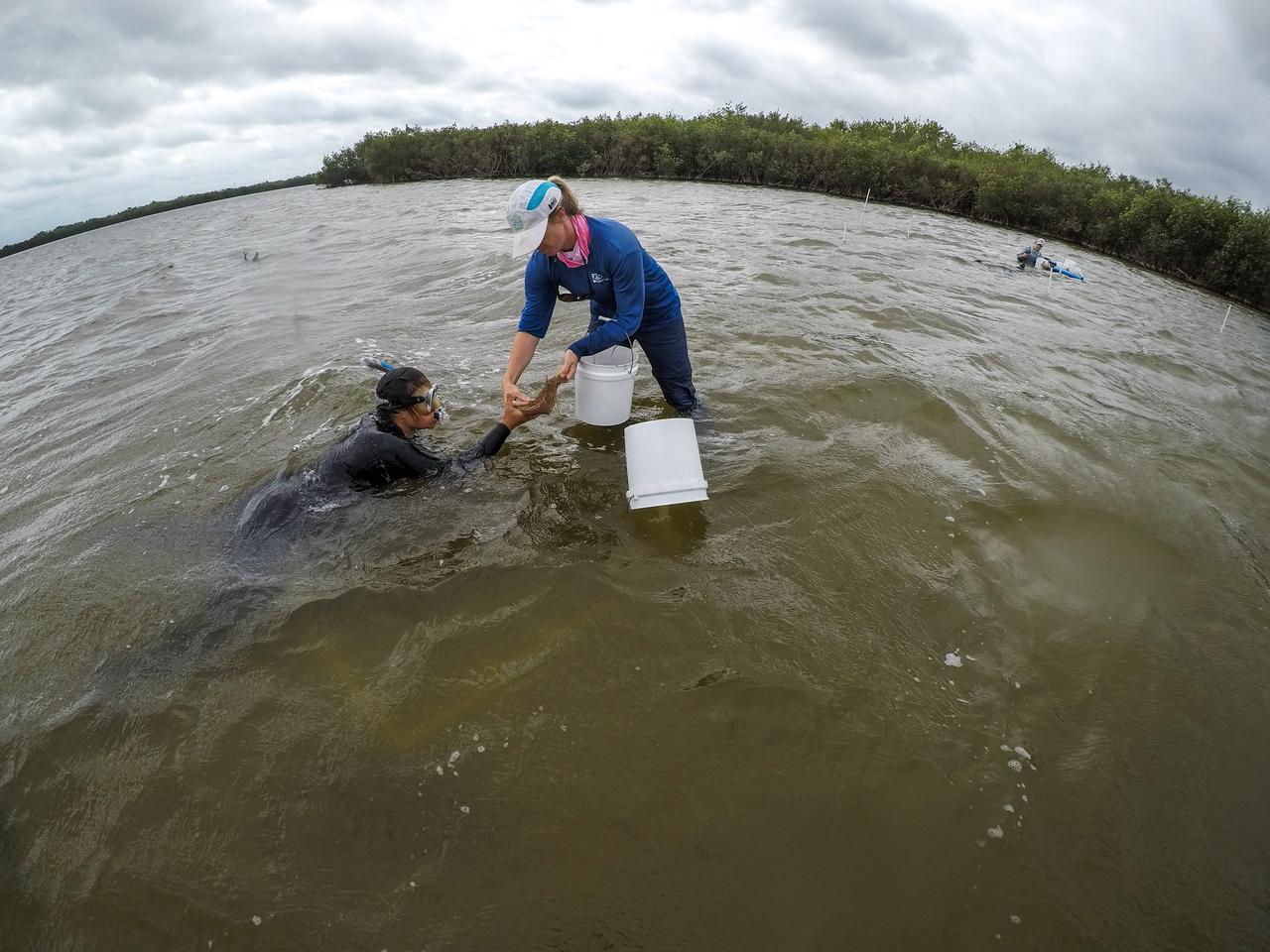
Members of the Florida Oceanographic Society plant seagrass in the Banana River – one of three bodies of water that make up the Indian River Lagoon (IRL) – at NASA’s Kennedy Space Center in Florida on March 29, 2023. Kennedy’s Environmental Management Branch is working to plant a minimum of 28,000 shoots of seagrass divided into 18 sites across three areas at the Florida spaceport as part of a pilot project for seagrass restoration efforts. The project will look at the feasibility of replanting seagrass in Kennedy waters and, if successful, could lead to the spaceport becoming a donor site where shoots of grass can be broken off and relocated to other areas within Kennedy or along the IRL to promote growth.
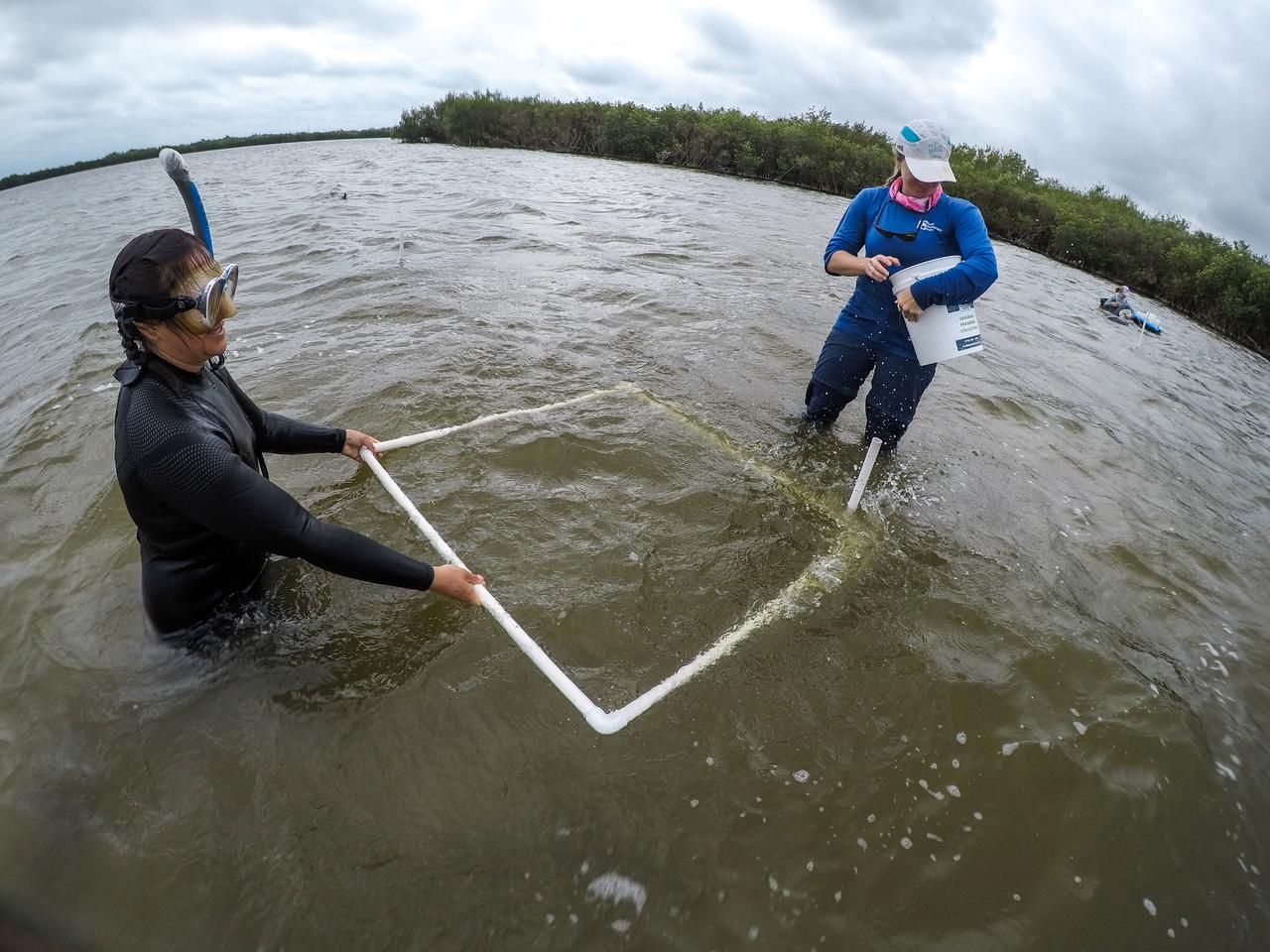
Members of the Florida Oceanographic Society prepare to plant seagrass in the Banana River – one of three bodies of water that make up the Indian River Lagoon (IRL) – at NASA’s Kennedy Space Center in Florida on March 29, 2023. Kennedy’s Environmental Management Branch is working to plant a minimum of 28,000 shoots of seagrass divided into 18 sites across three areas at the Florida spaceport as part of a pilot project for seagrass restoration efforts. The project will look at the feasibility of replanting seagrass in Kennedy waters and, if successful, could lead to the spaceport becoming a donor site where shoots of grass can be broken off and relocated to other areas within Kennedy or along the IRL to promote growth.
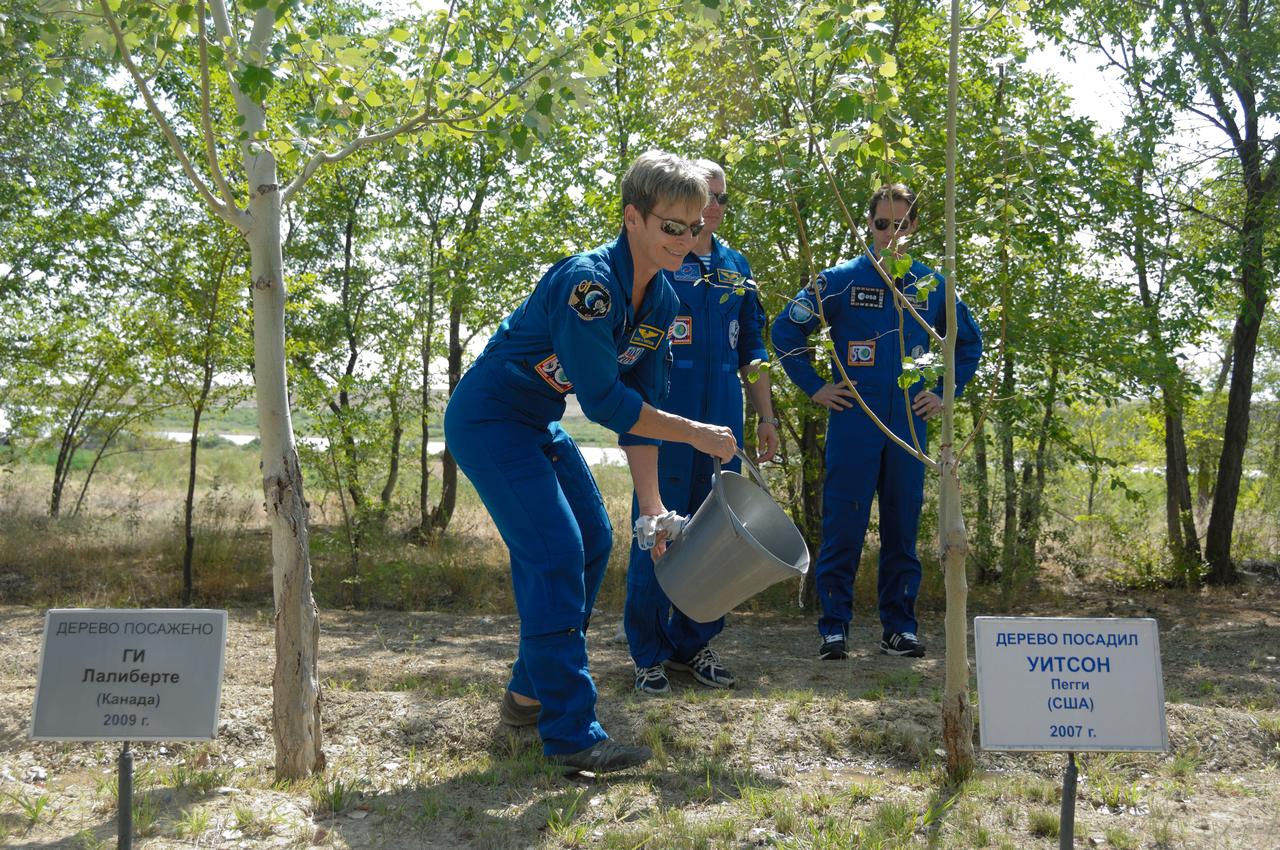
At the Cosmonaut Hotel in Baikonur, Kazakhstan, Expedition 48-49 backup crewmember Peggy Whitson of NASA waters a tree in her name first planted in 2007 during traditional pre-launch activities June 30. Whitson is one of three backups to the prime crewmembers, Kate Rubins of NASA, Anatoly Ivanishin of Roscosmos and Takuya Onishi of the Japan Aerospace Exploration Agency, who will launch July 7, Baikonur time, on the Soyuz MS-01 spacecraft for a planned four-month mission on the International Space Station. NASA/Alexander Vysotsky
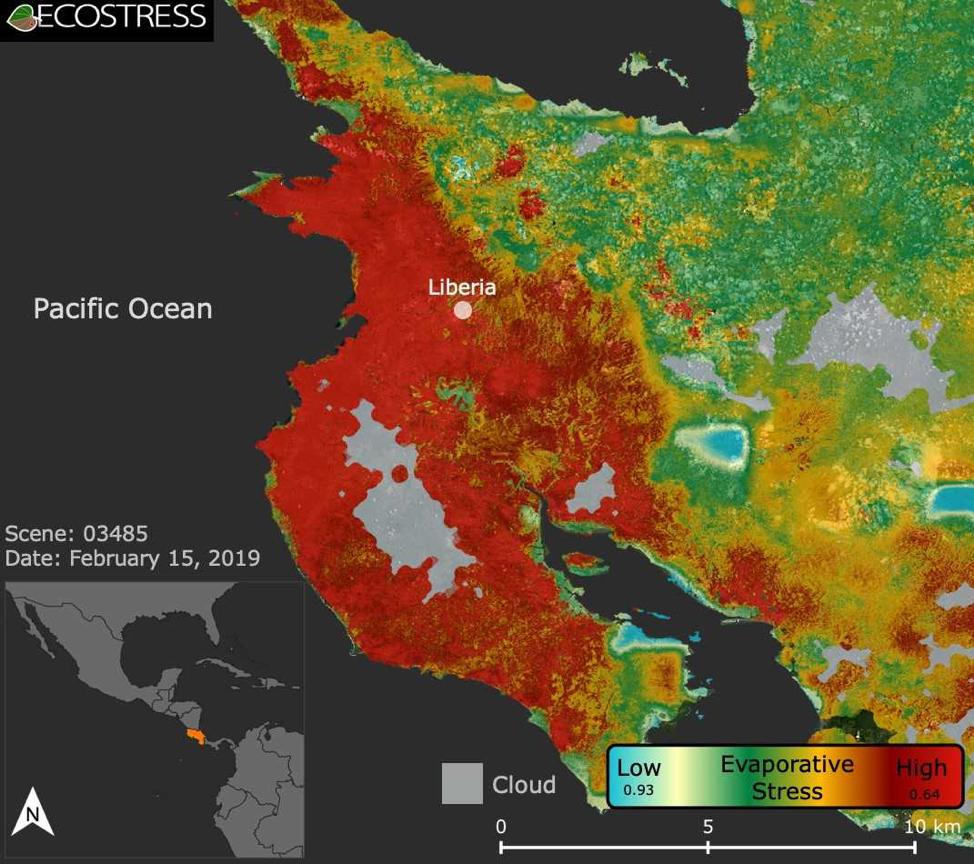
This image shows the ECOSTRESS evaporative stress index for the Guanacaste region of Costa Rica (in red on inset map, left) a few months after the onset of a major Central American drought. Red indicates high plant water stress, yellow is moderate stress and greens/blues are low stress. Light gray is cloud cover. The index measures how much water plants are using relative to how much they would use under optimal conditions; low numbers correlate with high stress. ECOSTRESS launched on June 29, 2018, as part of a SpaceX commercial resupply mission to the International Space Station. Its primary mission is to detect plant health by monitoring Earth's surface temperature. However, surface temperature data are also useful in detecting other heat-related phenomena — like heat waves, volcanoes and fires. https://photojournal.jpl.nasa.gov/catalog/PIA22839
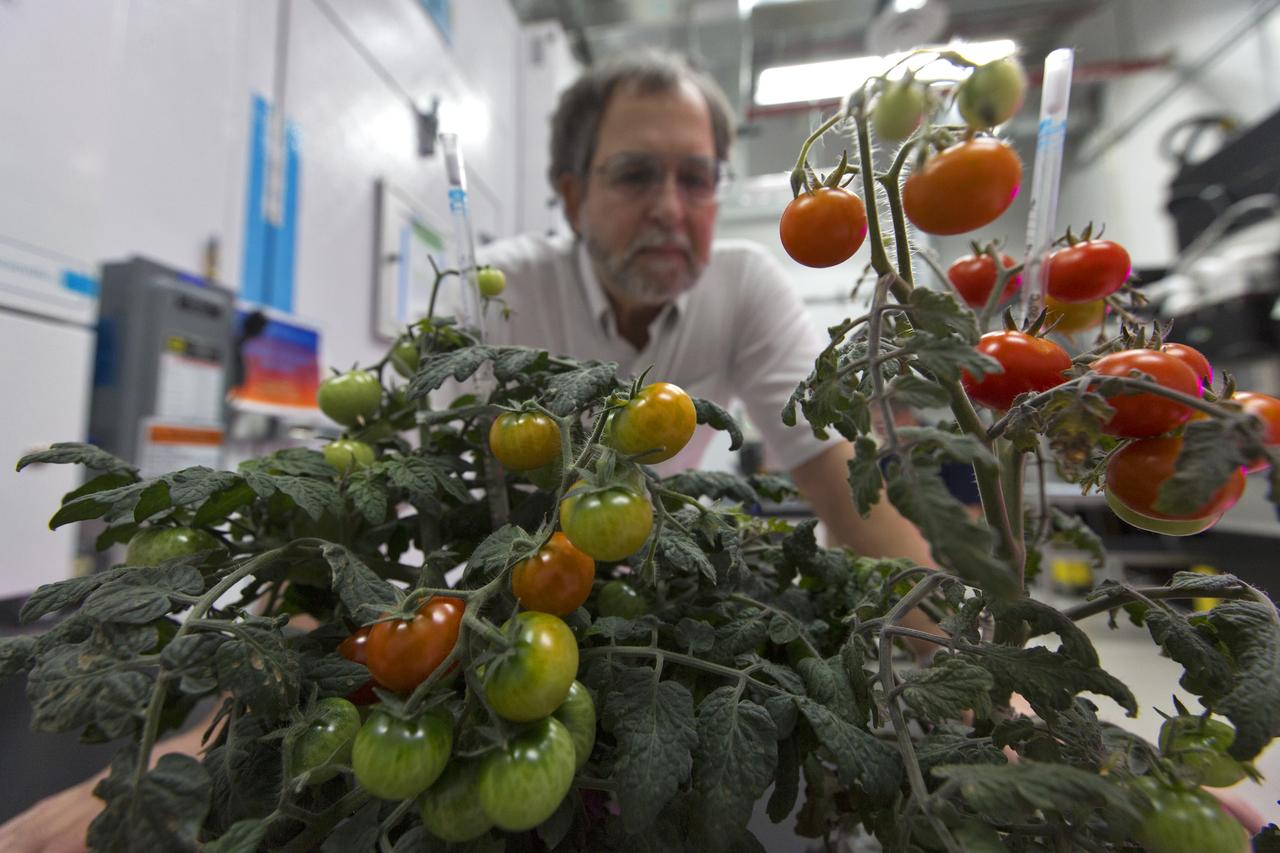
Howard Levine, Ph.D., a research scientist at NASA's Kennedy Space Center in Florida, reviews the growth of several tomato plants in a laboratory in the Space Station Processing Facility. The tomato plants are growing in the Veggie Passive Orbital Nutrient Delivery System (PONDS). Veggie PONDS is a direct follow-on to the Veg-01 and Veg-03 hardware and plant growth validation tests. The primary goal of this newly developed plant growing system, Veggie PONDS, is to demonstrate uniform plant growth. PONDS units have features that are designed to mitigate microgravity effects on water distribution, increase oxygen exchange and provide sufficient room for root zone growth. PONDS is planned for use during Veg-04 and Veg-05 on the International Space Station after the Veggie PONDS Validation flights on SpaceX-14 and OA-9.
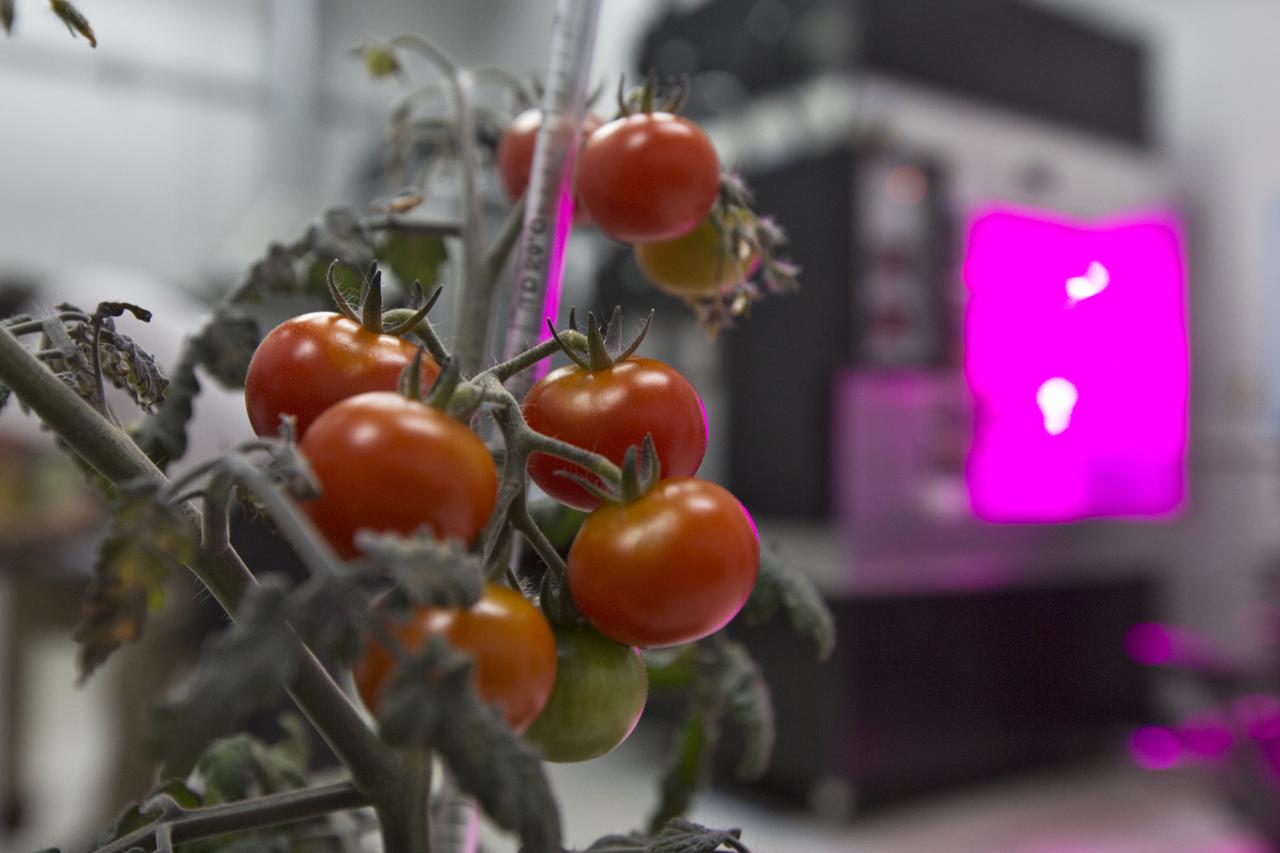
Tomato plants are growing inside a laboratory at the Space Station Processing Facility at NASA’s Kennedy Space Center in Florida. The plant growth is being tested in the Veggie Passive Orbital Nutrient Delivery System (PONDS). Veggie PONDS is a direct follow-on to the Veg-01 and Veg-03 hardware and plant growth validation tests. The primary goal of this newly developed plant growing system, Veggie PONDS, is to demonstrate uniform plant growth. PONDS units have features that are designed to mitigate microgravity effects on water distribution, increase oxygen exchange and provide sufficient room for root zone growth. PONDS is planned for use during Veg-04 and Veg-05 on the International Space Station after the Veggie PONDS Validation flights on SpaceX-14 and OA-9.
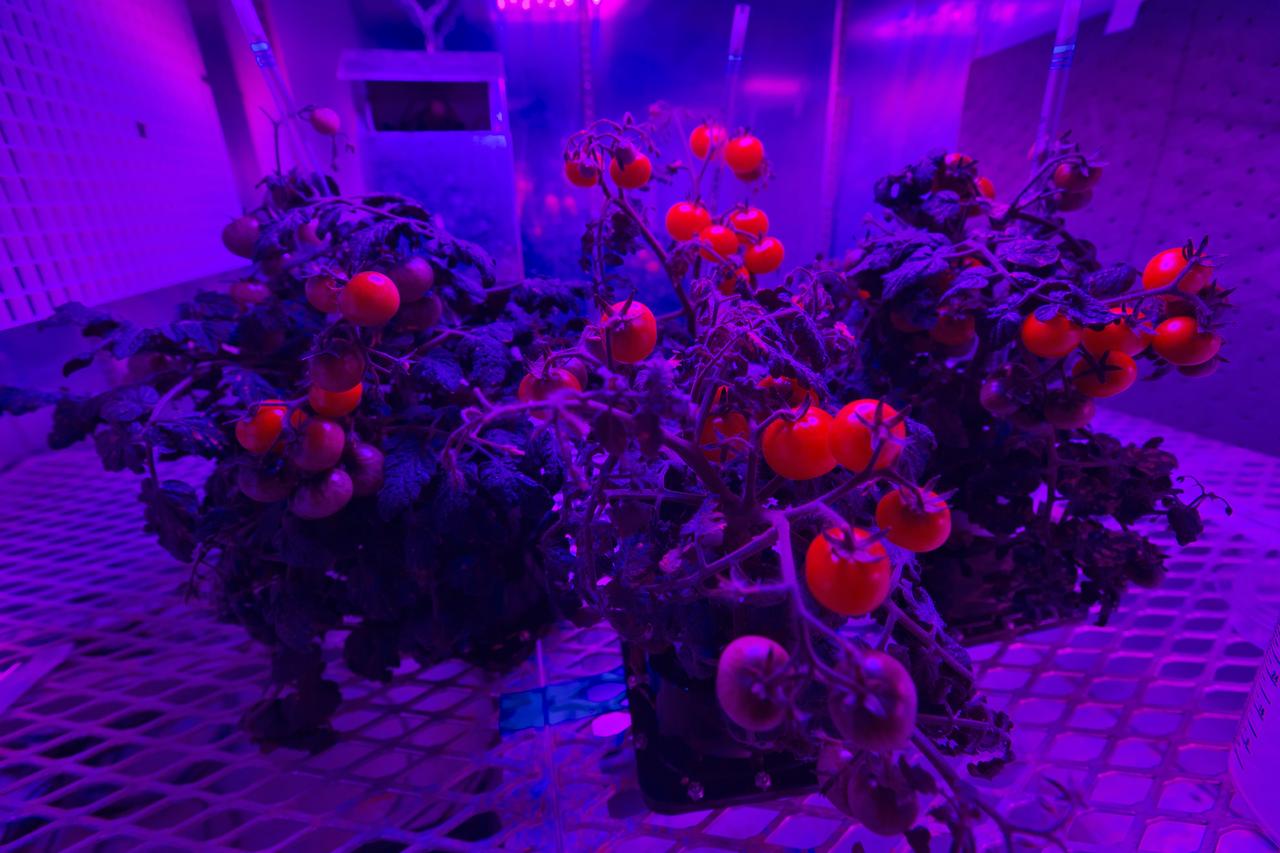
Tomato plants are growing under red and blue LED lights in a growth chamber inside a laboratory at the Space Station Processing Facility at NASA’s Kennedy Space Center in Florida. The plant growth is being tested in the Veggie Passive Orbital Nutrient Delivery System (PONDS). Veggie PONDS is a direct follow-on to the Veg-01 and Veg-03 hardware and plant growth validation tests. The primary goal of this newly developed plant growing system, Veggie PONDS, is to demonstrate uniform plant growth. PONDS units have features that are designed to mitigate microgravity effects on water distribution, increase oxygen exchange and provide sufficient room for root zone growth. PONDS is planned for use during Veg-04 and Veg-05 on the International Space Station after the Veggie PONDS Validation flights on SpaceX-14 and OA-9.
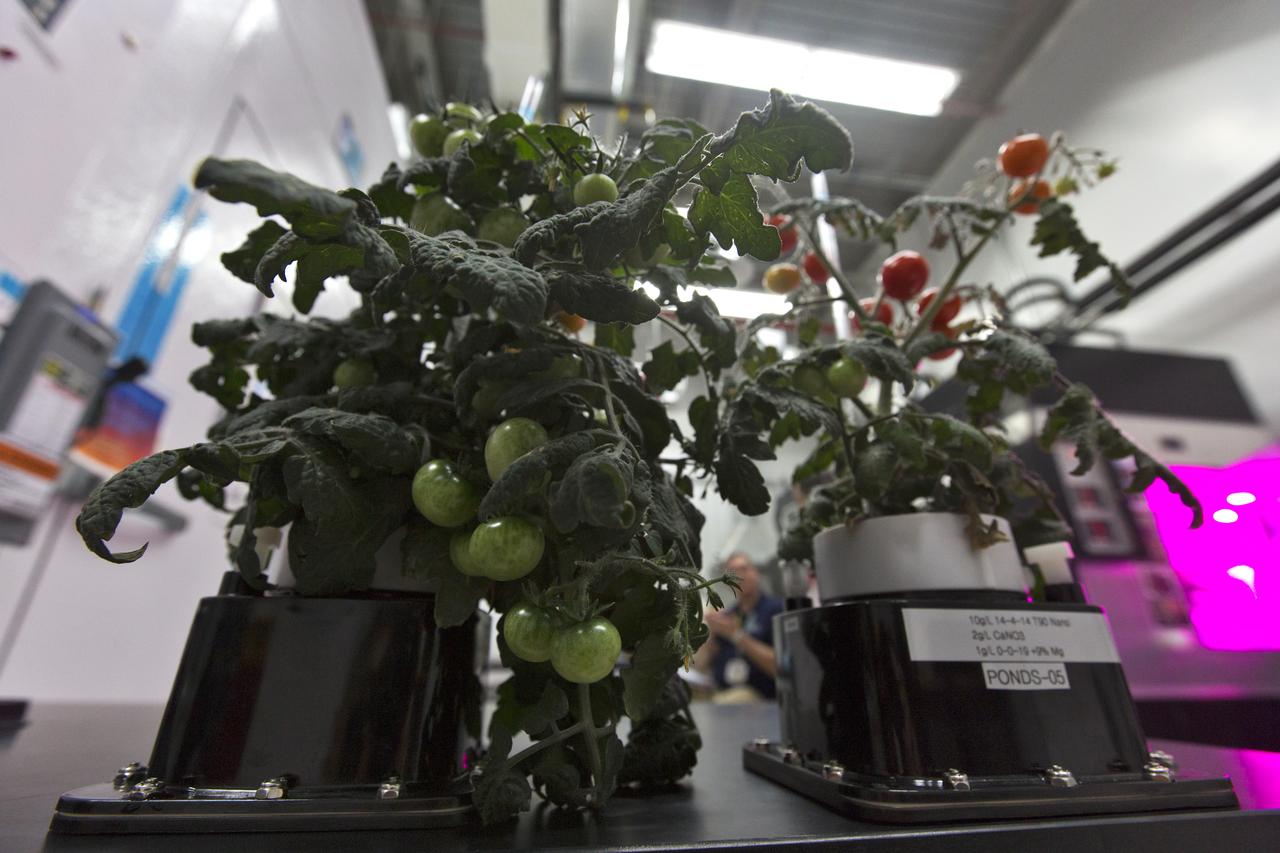
Tomato plants are growing inside a laboratory at the Space Station Processing Facility at NASA’s Kennedy Space Center in Florida. The plant growth is being tested in the Veggie Passive Orbital Nutrient Delivery System (PONDS). Veggie PONDS is a direct follow-on to the Veg-01 and Veg-03 hardware and plant growth validation tests. The primary goal of this newly developed plant growing system, Veggie PONDS, is to demonstrate uniform plant growth. PONDS units have features that are designed to mitigate microgravity effects on water distribution, increase oxygen exchange and provide sufficient room for root zone growth. PONDS is planned for use during Veg-04 and Veg-05 on the International Space Station after the Veggie PONDS Validation flights on SpaceX-14 and OA-9.
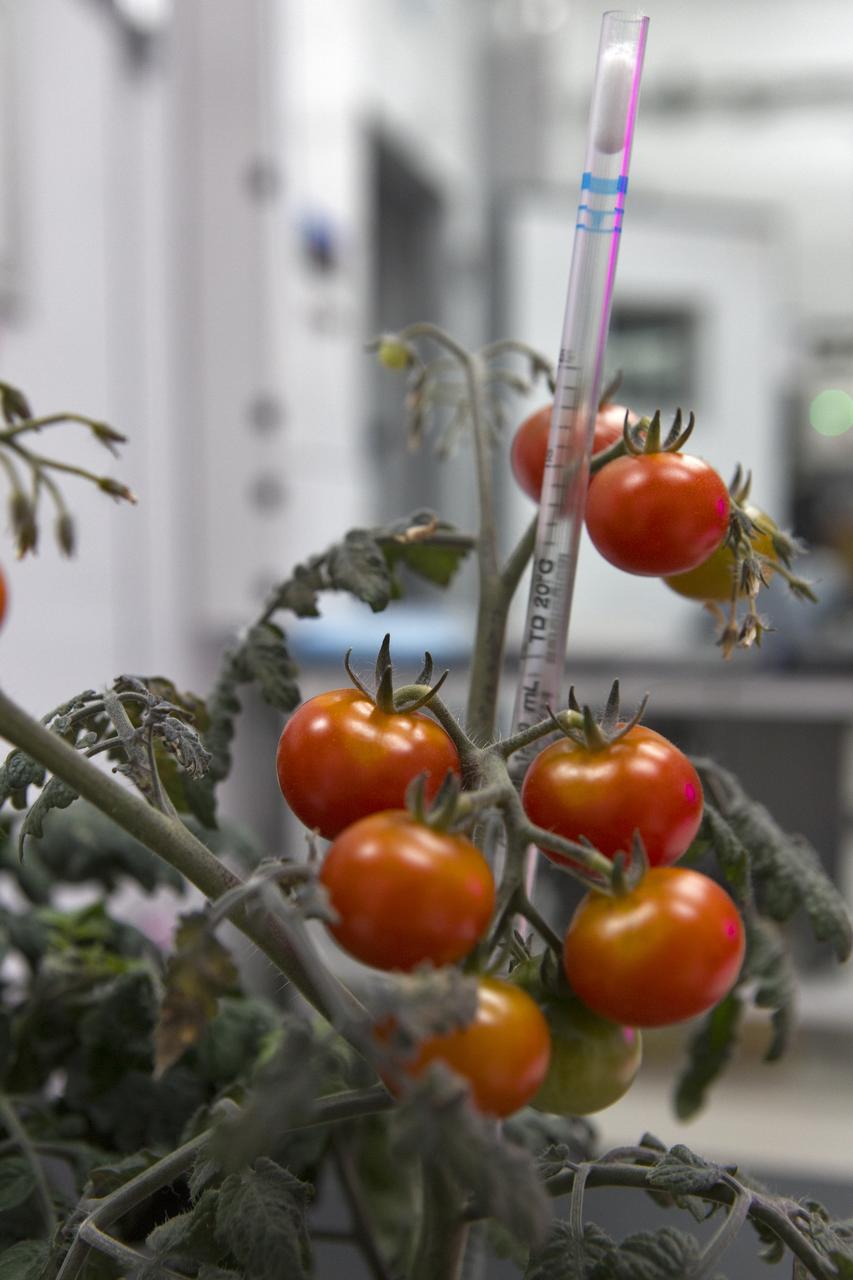
Tomato plants are growing inside a laboratory at the Space Station Processing Facility at NASA’s Kennedy Space Center in Florida. The plant growth is being tested in the Veggie Passive Orbital Nutrient Delivery System (PONDS). Veggie PONDS is a direct follow-on to the Veg-01 and Veg-03 hardware and plant growth validation tests. The primary goal of this newly developed plant growing system, Veggie PONDS, is to demonstrate uniform plant growth. PONDS units have features that are designed to mitigate microgravity effects on water distribution, increase oxygen exchange and provide sufficient room for root zone growth. PONDS is planned for use during Veg-04 and Veg-05 on the International Space Station after the Veggie PONDS Validation flights on SpaceX-14 and OA-9.
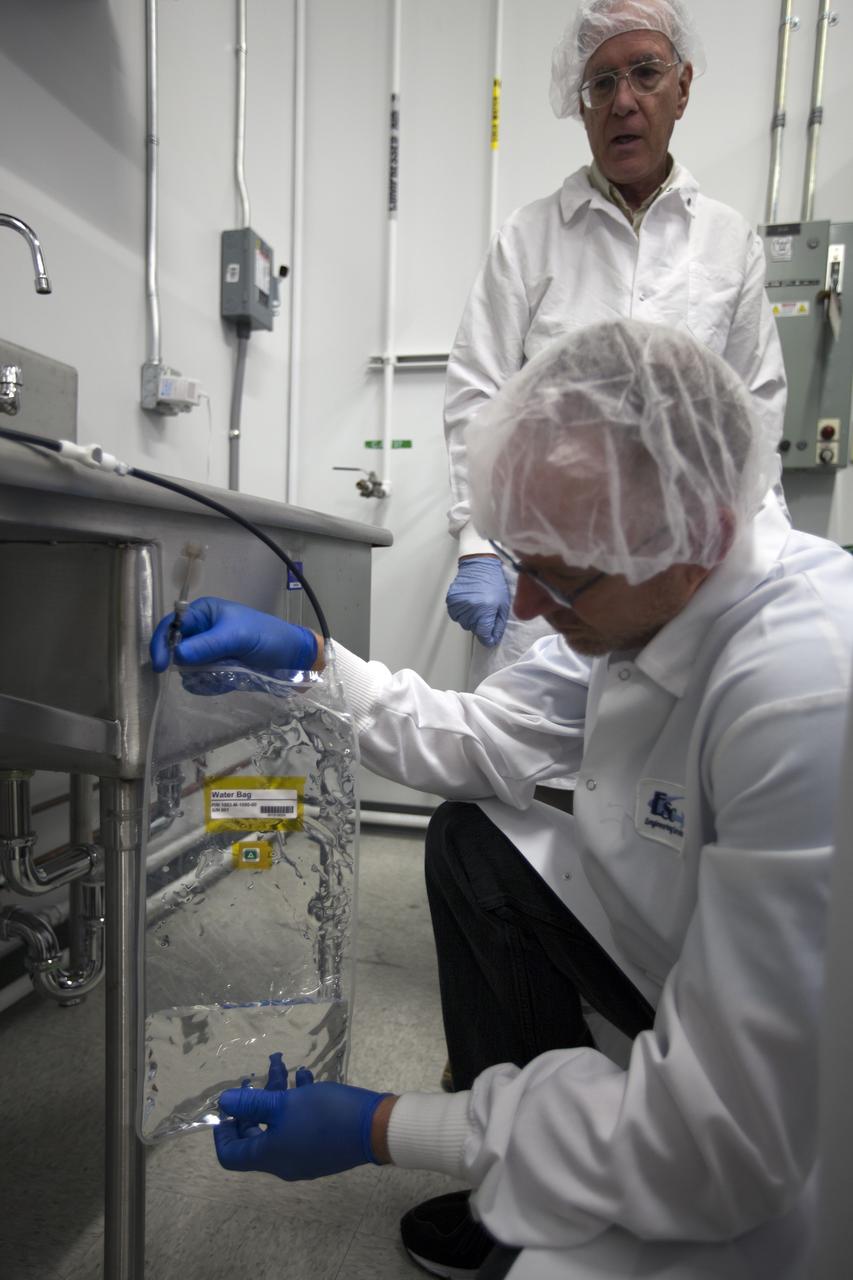
CAPE CANAVERAL, Fla. – Researchers fill a water bag with ionized water for the Veggie plant growth system inside a control chamber at the Space Station Processing Facility at NASA's Kennedy Space Center in Florida. In front is Jim Smodell, a technician with SGT. Standing behind him is Chuck Spern, lead project engineer with QinetiQ North America. The growth chamber will be used as a control unit and procedures will be followed identical to those being performed on Veggie and the Veg-01 experiment on the International Space Station by Expedition 39 flight engineer and NASA astronaut Steve Swanson. Veggie and Veg-01 were delivered to the space station aboard the SpaceX-3 mission. Veggie is the first fresh food production system delivered to the station. Six plant pillows, each containing outredgeous red romaine lettuce seeds and a root mat were inserted into Veggie. The plant chamber's red, blue and green LED lights were activated. The plant growth will be monitored for 28 days. At the end of the cycle, the plants will be carefully harvested, frozen and stored for return to Earth. Photo credit: NASA/Dimitri Gerondidakis
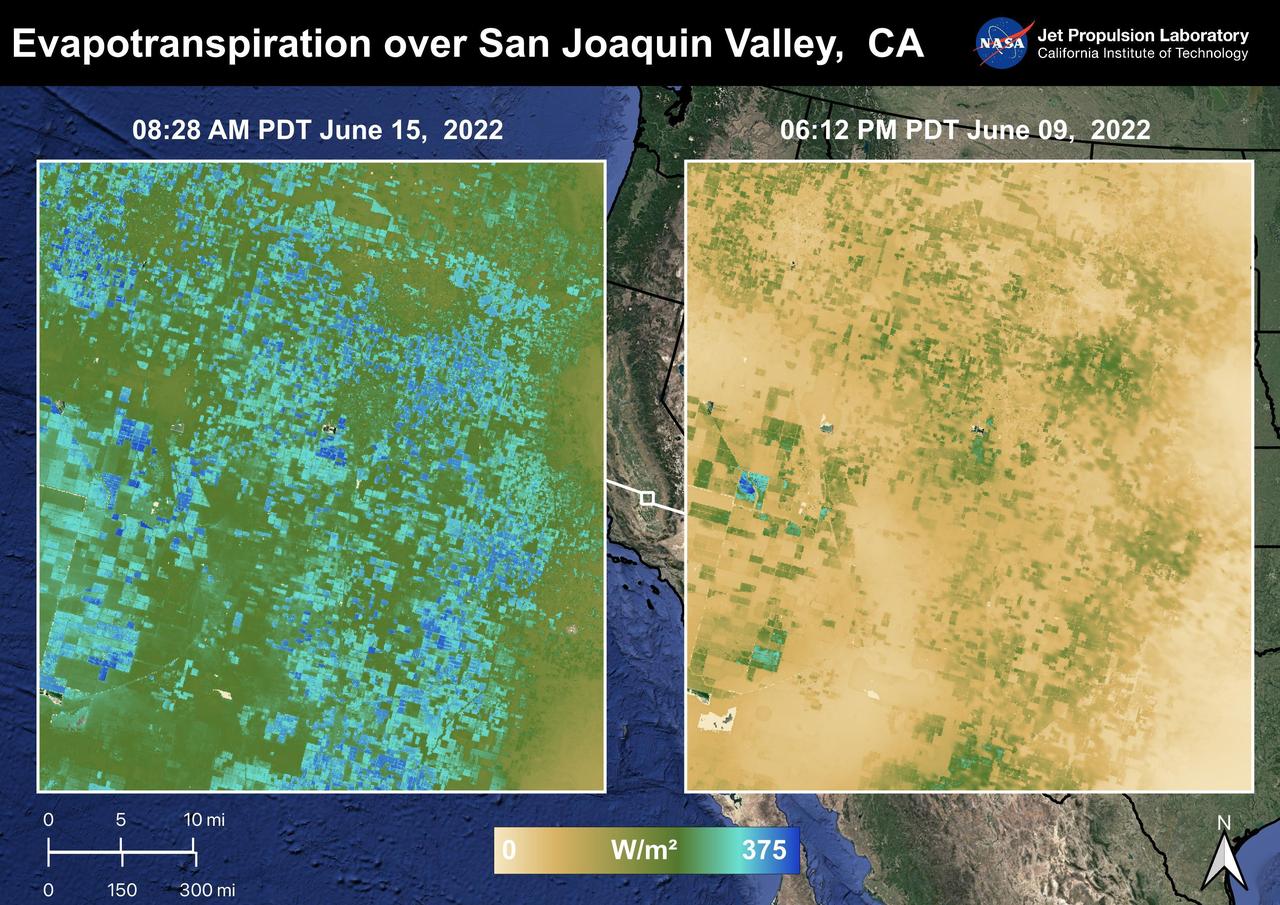
The Central Valley, CA is one of the most productive agricultural regions in the United States and the world. As California is in a continuing drought, it is important to monitor agricultural plant life to ensure maximized productivity. ECOSTRESS has the ability to monitor Evapotranspiration over agricultural fields. This Evapotranspiration image on the right was captured on June 09, 2022 at 06:12 PM PDT. The image on the left was captured by ECOSTRESS on June 15, 2022 at 08:27 AM PDT. Blue indicates high water use while brown indicates dry conditions. ECOSTRESS is a thermal instrument on the International Space Station that measures the temperature of the ground, which is hotter than the air temperature during the day. It was launched to the space station in 2018. Its primary mission is to identify critical thresholds of water use and water stress in plants and to detect the timing, location, and predictive factors leading to plant water uptake decline and/or cessation. The nature of the high-resolution data provided by ECOSTRESS allows it to record heat related phenomena such as heat waves and wildfires. https://photojournal.jpl.nasa.gov/catalog/PIA25486
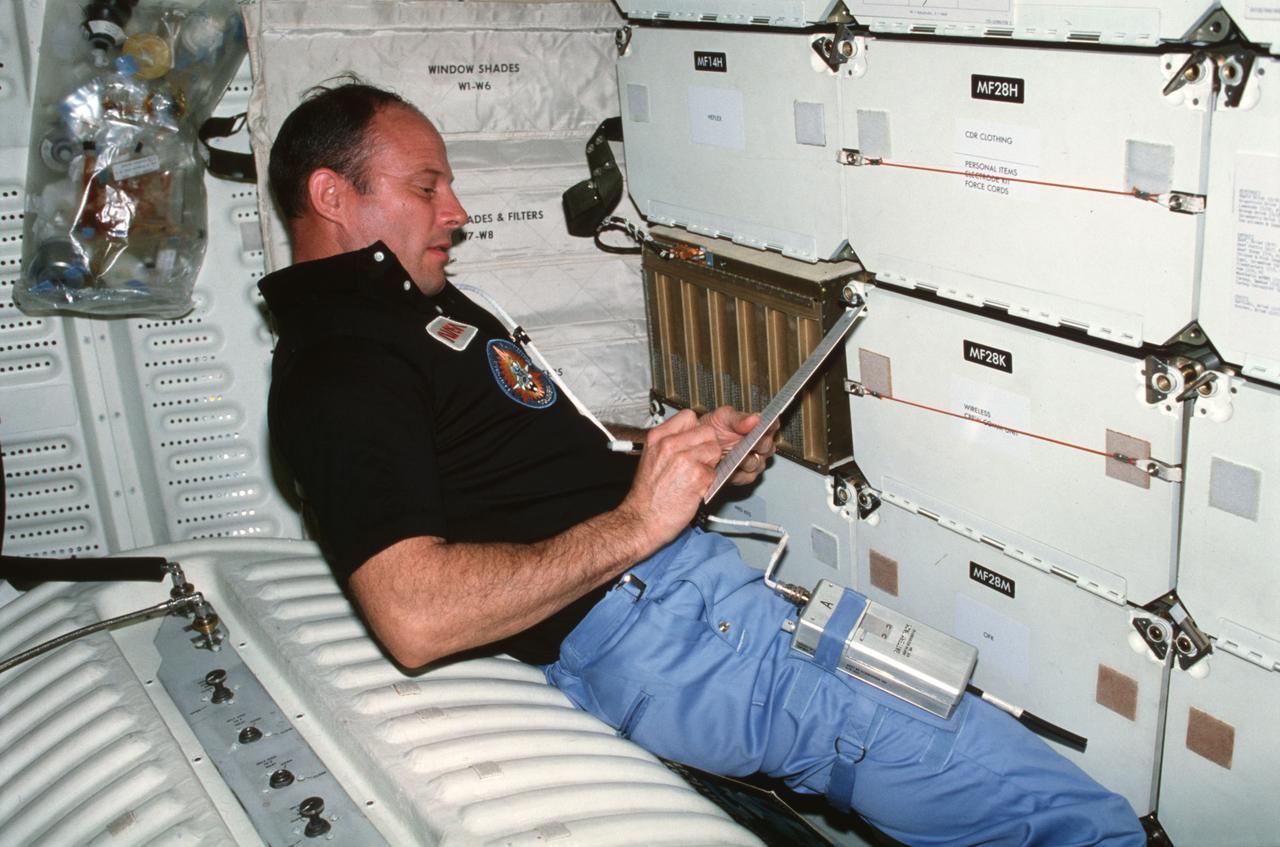
STS003-22-122 (30 March 1982) --- STS-3 Commander Lousma, wearing communications kit assembly (ASSY) mini-headset (HDST), records Plant Growth Unit (PGU) data for the Influence of Weightlessness on Plant Lignification Experiment at forward middeck locker MF14K. The experiment is designed to demonstrate the effect of weightlessness on the quantity and rate of lignin formation in different plant species during early stages of development. Port side bulkhead with window shade and filter kit appears behind Lousma and potable water tank below him. Trash bag also appears in view. Photo credit: NASA
jsc2025e047409 (2/27/2024) --- Lettuce grown as a ground experiment with the control (left) and flood (right) moisture treatments prior to harvest on day 28. The Spaceflight Microbiome of a Food Crop Grown Using Different Substrate Moisture Levels (Plant Habitat-07) investigates how plants, and their communities of microorganisms respond to different levels of water. Results could support development of systems for growing food crops on future missions. Image courtesy of the PH-07 Team.
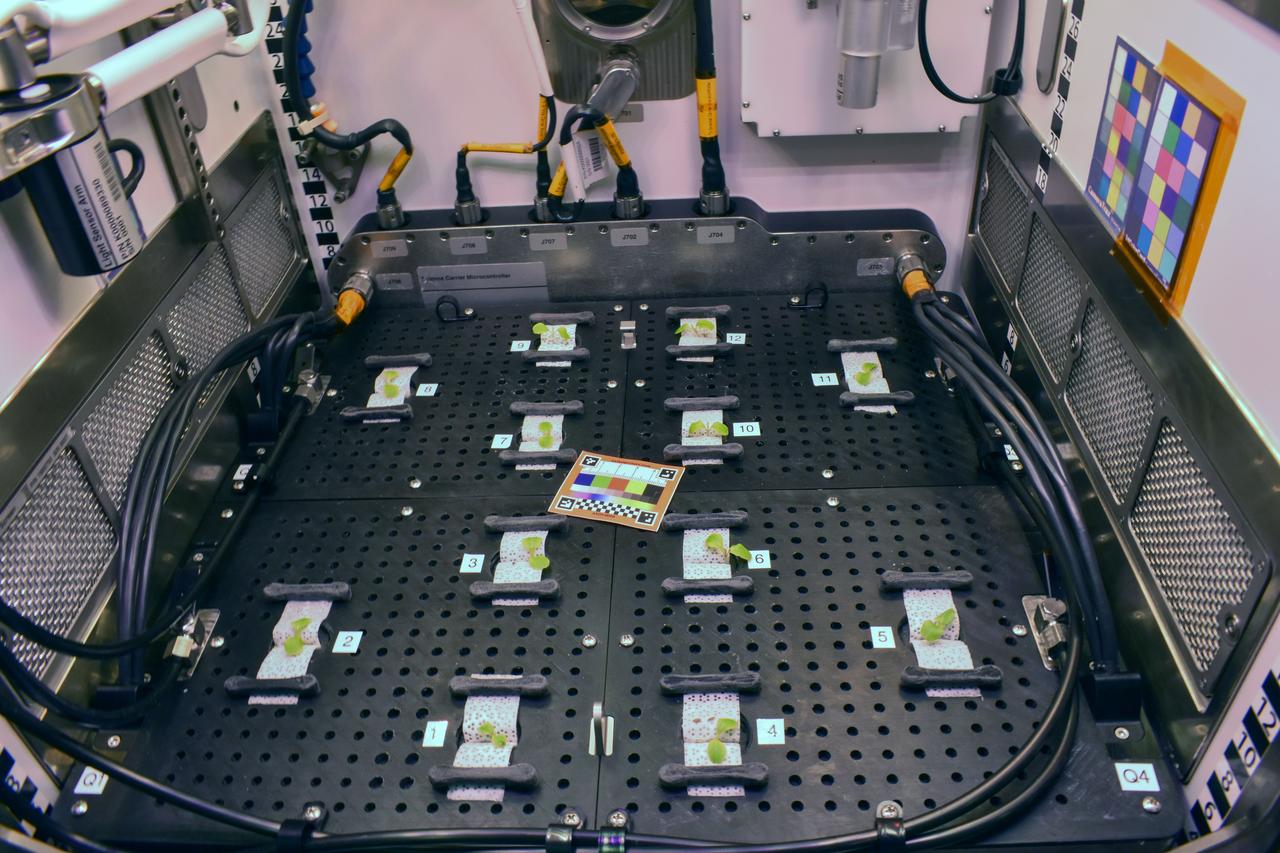
jsc2025e047407 (2/6/2024) --- ‘Outredgeous’ red romaine lettuce seedlings after thinning on Day 7 as part of a ground experiment for Spaceflight Microbiome of a Food Crop Grown Using Different Substrate Moisture Levels (Plant Habitat-07). This investigation studies how plants, and their communities of microorganisms respond to different levels of water. Results could support development of systems for growing food crops on future missions. Image courtesy of the PH-07 Team.
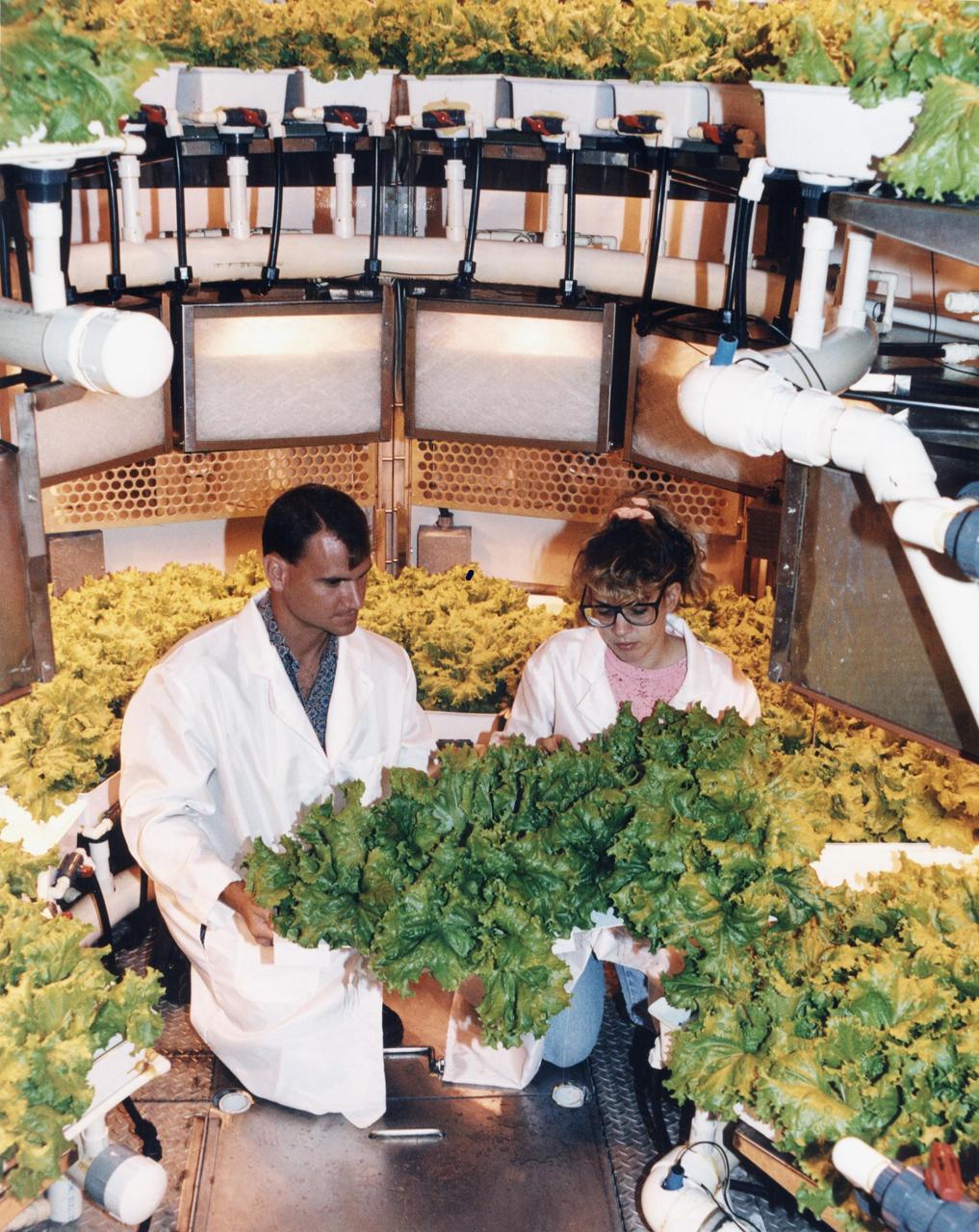
Original photo and caption dated October 8, 1991: "Plant researchers Neil Yorio and Lisa Ruffe prepare to harvest a crop of Waldann's Green Lettuce from KSC's Biomass Production Chamber (BPC). KSC researchers have grown several different crops in the BPC to determine which plants will better produce food, water and oxygen on long-duration space missions."
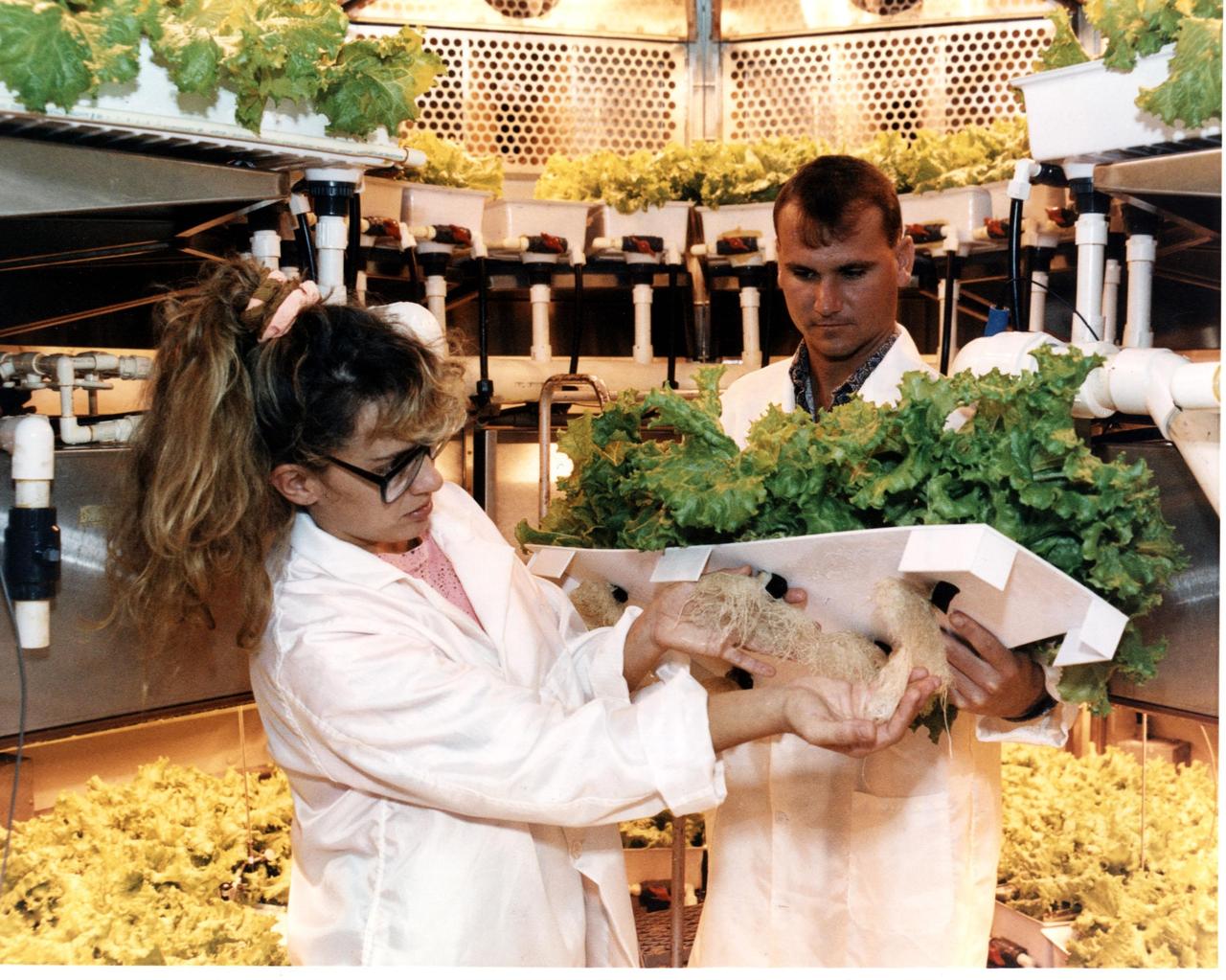
Original photo and caption dated October 8, 1991: <i>"Plant researchers Lisa Ruffe and Neil Yorio prepare to harvest a crop of Waldann's Green Lettuce from KSC's Biomass Production Chamber (BPC). KSC researchers have grown several different crops in the BPC to determine which plants will better produce food, water and oxygen on long-duration space missions."</i
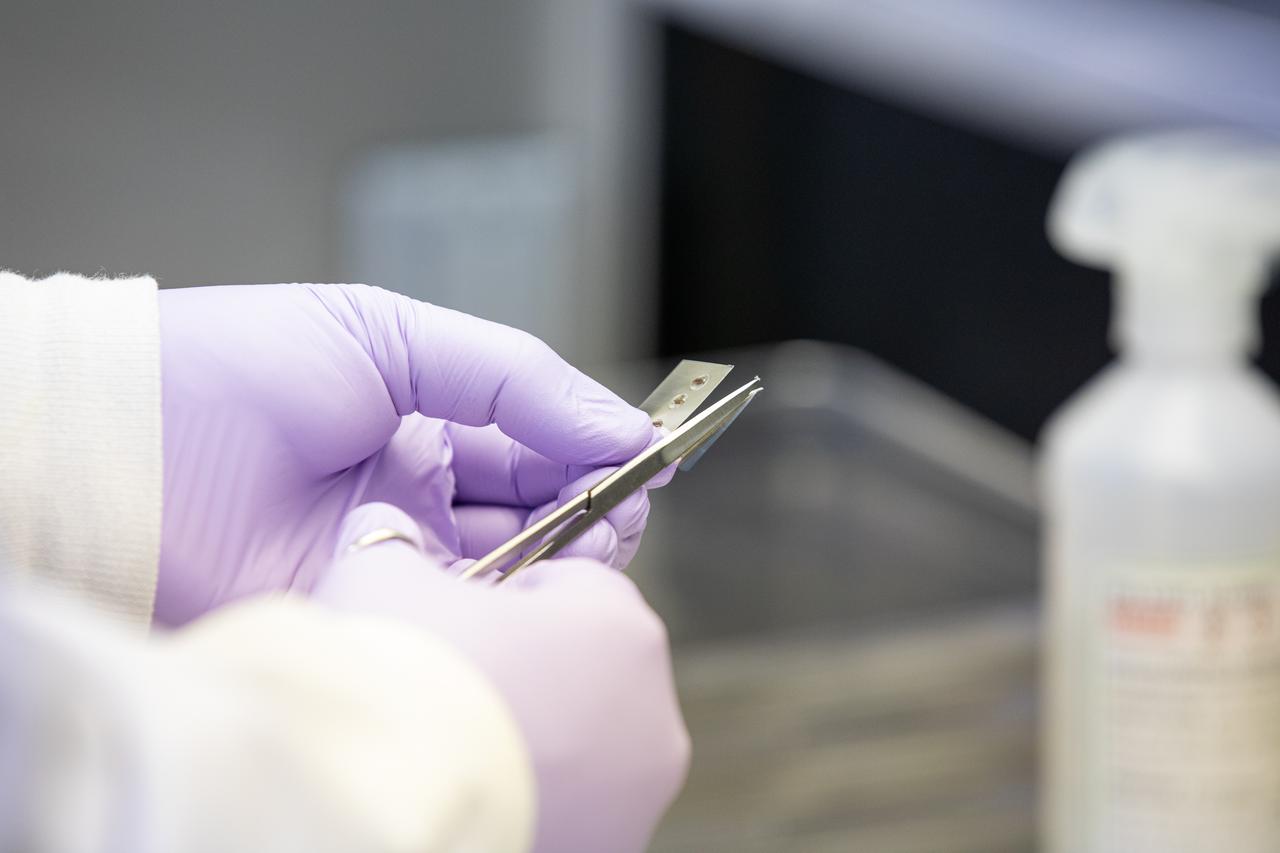
A research scientist at NASA’s Kennedy Space Center in Florida cuts strips of seed film – a new seed handling material containing red romaine lettuce seeds – inside the Space Station Processing Facility on Jan. 16, 2020. The seed film is being prepared for the VEG-03 J experiment that will fly to the International Space Station on Northrop Grumman’s 13th resupply services (NG-13) mission. This seed film experiment involves crew aboard the orbiting laboratory planting the seeds into plant pillows – a common method used to grow plants in space – themselves for the first time ever. The water-soluble, dissolving film addresses the challenge of handling seeds in a microgravity environment and also can be used to deliver fertilizers and other beneficial substances that help plants grow. NG-13 is scheduled to launch from the agency’s Wallops Flight Facility in Virginia on Feb. 9, 2020, at 5:39 p.m. EST.
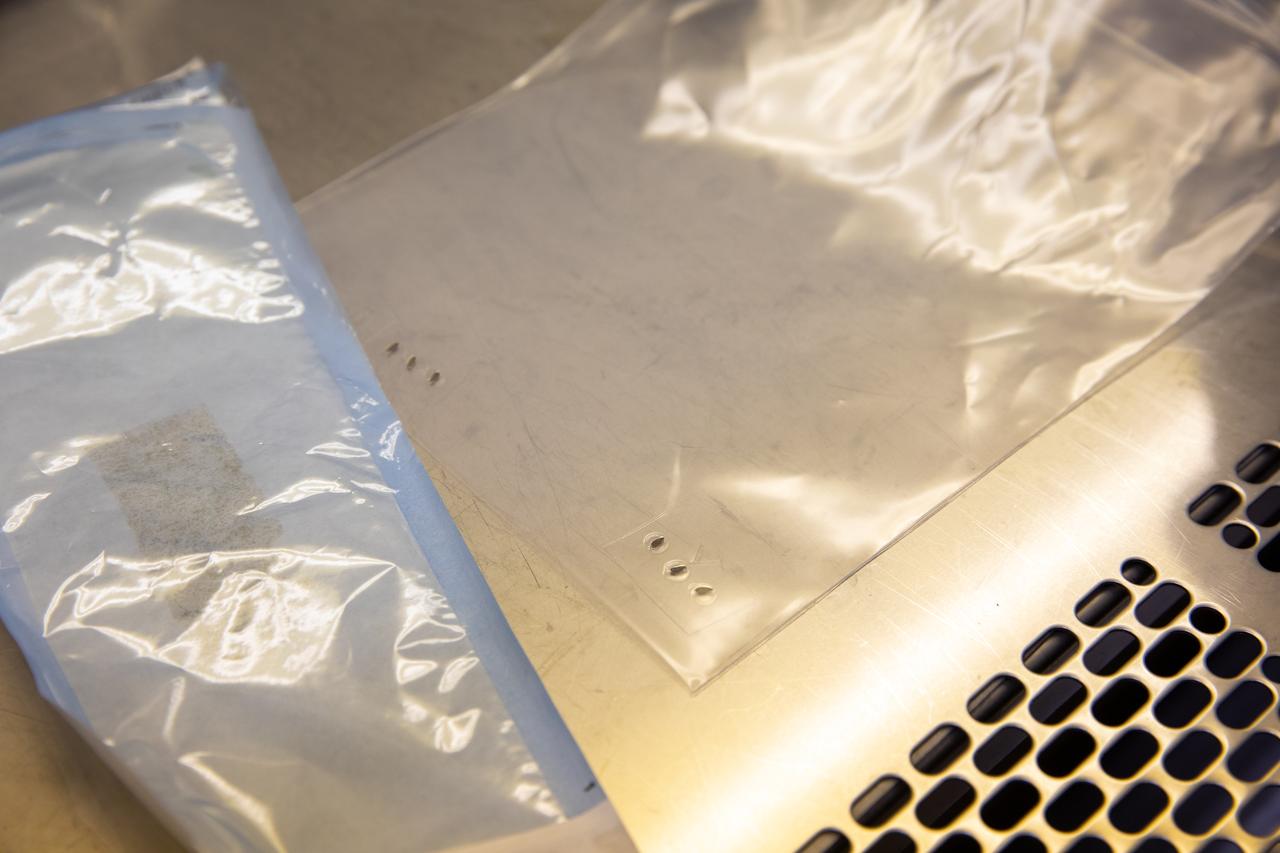
Strips of seed film – a new seed handling material containing red romaine lettuce seeds – are photographed inside the Space Station Processing Facility at NASA’s Kennedy Space Center in Florida on Jan. 16, 2020. The seed film is being prepared for the VEG-03 J experiment that will fly to the International Space Station on Northrop Grumman’s 13th resupply services (NG-13) mission. This seed film experiment involves crew aboard the orbiting laboratory planting the seeds into plant pillows – a common method used to grow plants in space – themselves for the first time ever. The water-soluble, dissolving film addresses the challenge of handling seeds in a microgravity environment and also can be used to deliver fertilizers and other beneficial substances that help plants grow. NG-13 is scheduled to launch from the agency’s Wallops Flight Facility in Virginia on Feb. 9, 2020, at 5:39 p.m. EST.

Inside the Space Station Processing Facility at NASA’s Kennedy Space Center in Florida, a research scientist glues red romaine lettuce seeds to a sheet of seed film – a new seed handling material – on Jan. 15, 2020. The seed film is being prepared for the VEG-03 J experiment that will fly to the International Space Station on Northrop Grumman’s 13th resupply services (NG-13) mission. This seed film experiment involves crew aboard the orbiting laboratory planting the seeds into plant pillows – a common method used to grow plants in space – themselves for the first time ever. The water-soluble, dissolving film addresses the challenge of handling seeds in a microgravity environment and also can be used to deliver fertilizers and other beneficial substances that help plants grow. NG-13 is scheduled to launch from the agency’s Wallops Flight Facility in Virginia on Feb. 9, 2020, at 5:39 p.m. EST.
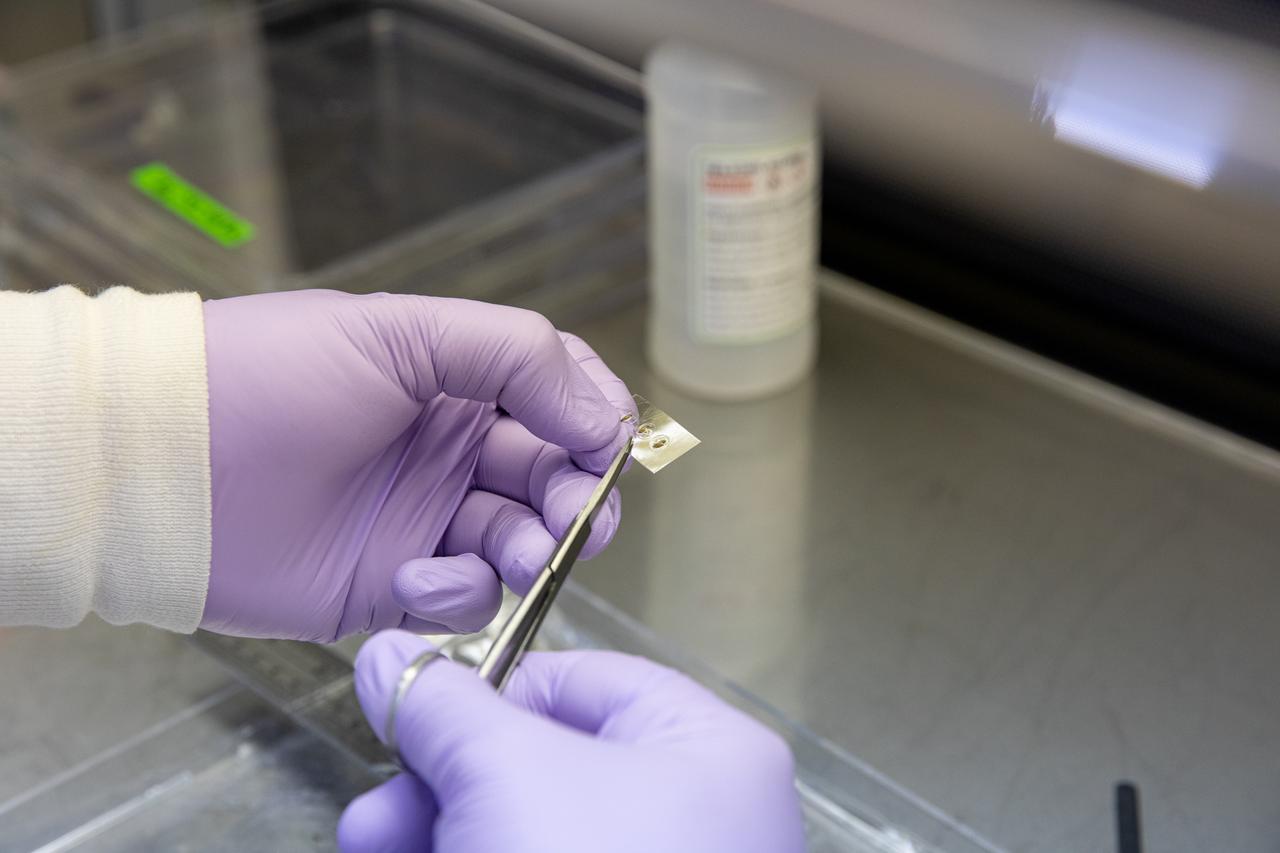
A research scientist at NASA’s Kennedy Space Center in Florida cuts strips of seed film – a new seed handling material containing red romaine lettuce seeds – inside the Space Station Processing Facility on Jan. 16, 2020. The seed film is being prepared for the VEG-03 J experiment that will fly to the International Space Station on Northrop Grumman’s 13th resupply services (NG-13) mission. This seed film experiment involves crew aboard the orbiting laboratory planting the seeds into plant pillows – a common method used to grow plants in space – themselves for the first time ever. The water-soluble, dissolving film addresses the challenge of handling seeds in a microgravity environment and also can be used to deliver fertilizers and other beneficial substances that help plants grow. NG-13 is scheduled to launch from the agency’s Wallops Flight Facility in Virginia on Feb. 9, 2020, at 5:39 p.m. EST.
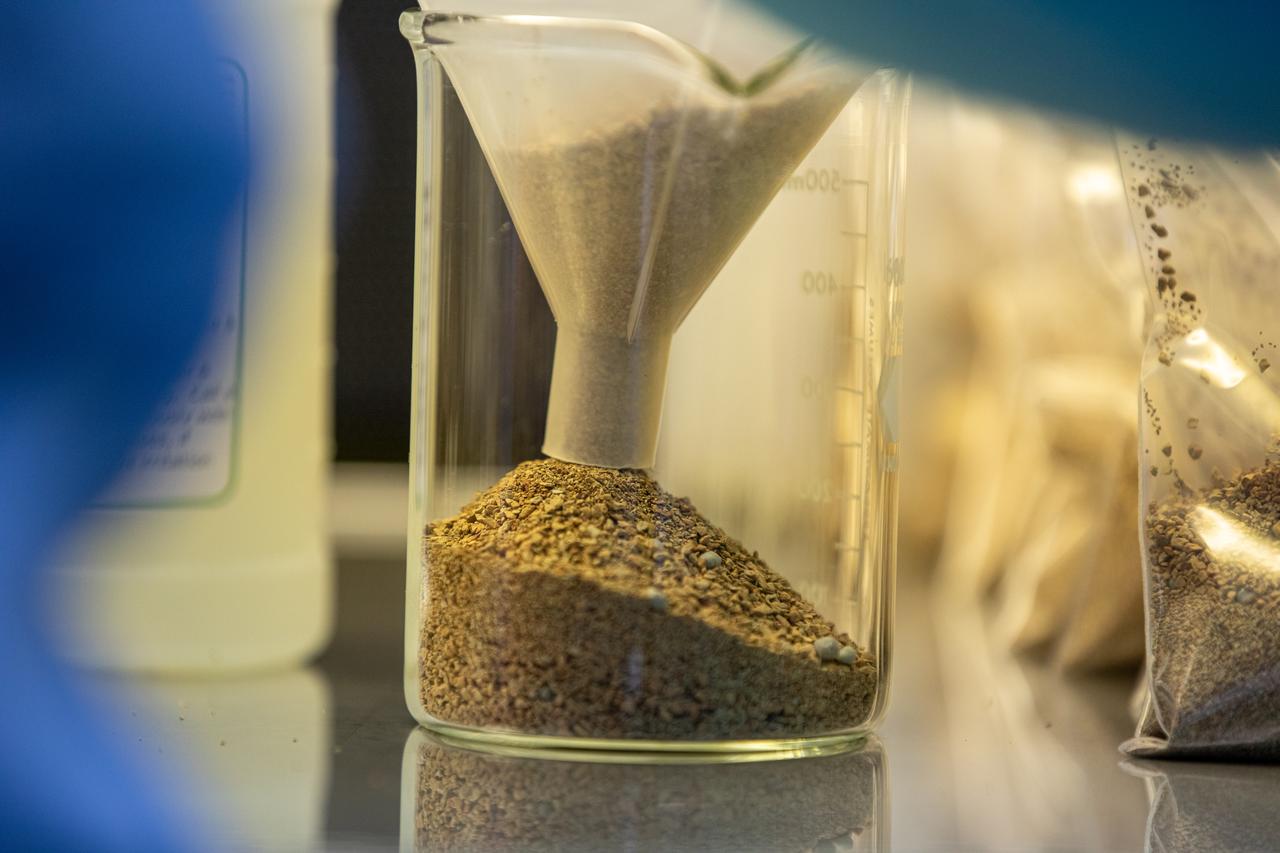
Inside the Space Station Processing Facility at NASA’s Kennedy Space Center in Florida, a researcher measures out the calcined clay that will be used to assemble plant pillows on Jan. 16, 2019. Often used to condition baseball infields, the clay’s size and roughness traps air and absorbs water to provide both to plant roots in microgravity. The pillows are small containers used to grow plants in space aboard the International Space Station. These pillows are for a series of plant experiments called VEG-03 J/K/L that will monitor the growth of three types of leafy greens and test a new way of handling seeds. The experiments will be launched to the orbiting laboratory aboard a Northrop Grumman Antares rocket and Cygnus spacecraft on the company’s 13th resupply services mission. Liftoff is scheduled for Feb. 9, 2020, at 5:39 p.m. EST from the agency’s Wallops Flight Facility in Virginia.
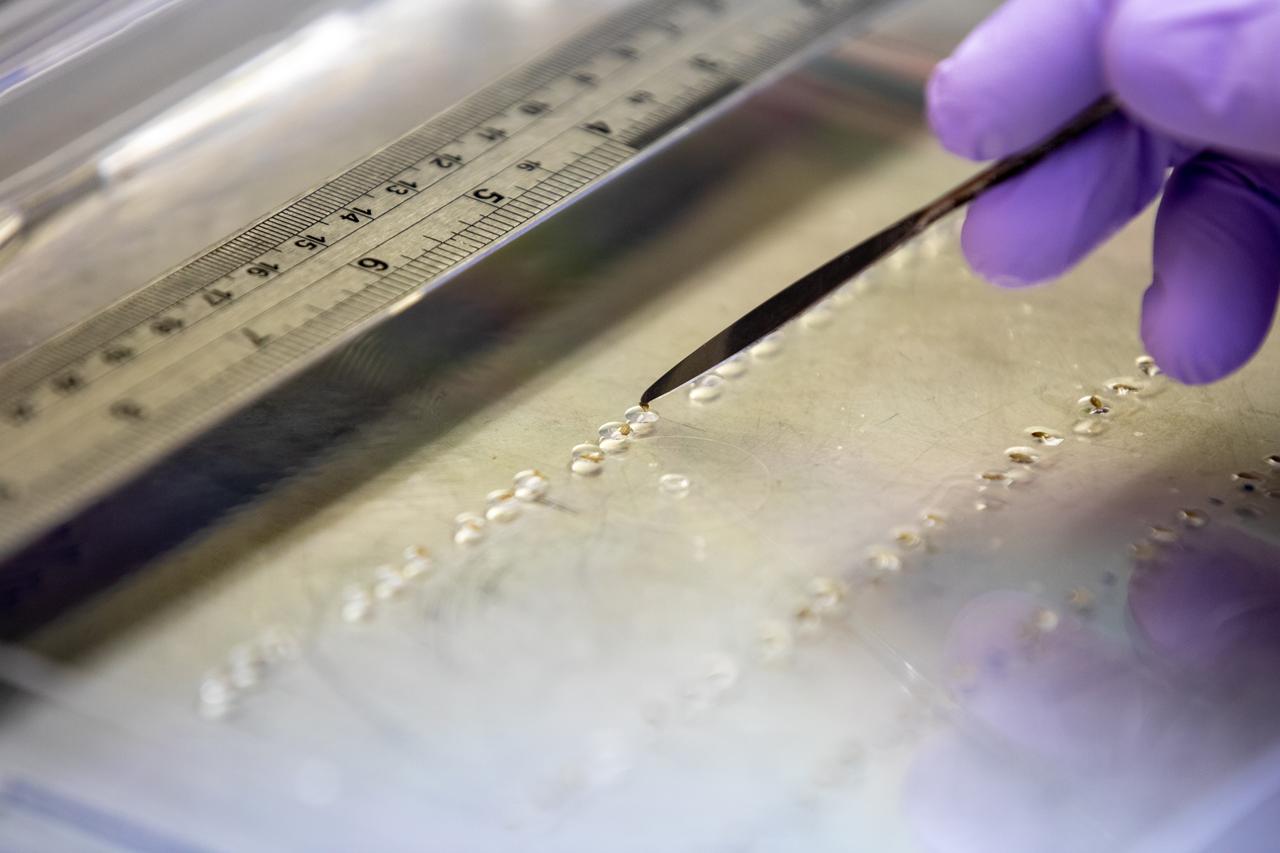
Inside the Space Station Processing Facility at NASA’s Kennedy Space Center in Florida, red romaine lettuce seeds are affixed to seed film – a new seed handling material – on Jan. 15, 2020. The seed film is being prepared for the VEG-03 J experiment that will fly to the International Space Station on Northrop Grumman’s 13th resupply services (NG-13) mission. This seed film experiment involves crew aboard the orbiting laboratory planting the seeds into plant pillows – a common method used to grow plants in space – themselves for the first time ever. The water-soluble, dissolving film addresses the challenge of handling seeds in a microgravity environment and also can be used to deliver fertilizers and other beneficial substances that help plants grow. NG-13 is scheduled to launch from the agency’s Wallops Flight Facility in Virginia on Feb. 9, 2020, at 5:39 p.m. EST.
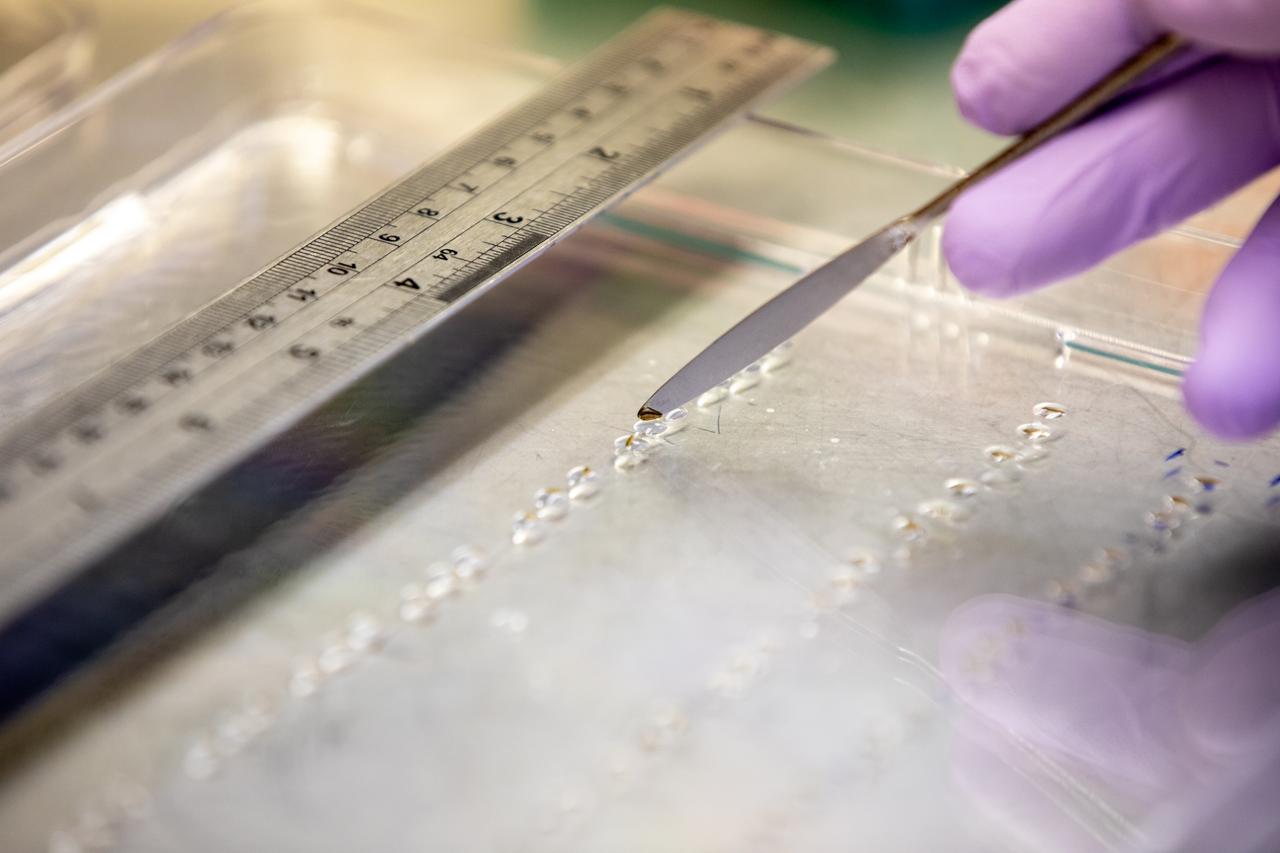
Inside the Space Station Processing Facility at NASA’s Kennedy Space Center in Florida, red romaine lettuce seeds are affixed to seed film – a new seed handling material – on Jan. 15, 2020. The seed film is being prepared for the VEG-03 J experiment that will fly to the International Space Station on Northrop Grumman’s 13th resupply services (NG-13) mission. This seed film experiment involves crew aboard the orbiting laboratory planting the seeds into plant pillows – a common method used to grow plants in space – themselves for the first time ever. The water-soluble, dissolving film addresses the challenge of handling seeds in a microgravity environment and also can be used to deliver fertilizers and other beneficial substances that help plants grow. NG-13 is scheduled to launch from the agency’s Wallops Flight Facility in Virginia on Feb. 9, 2020, at 5:39 p.m. EST.
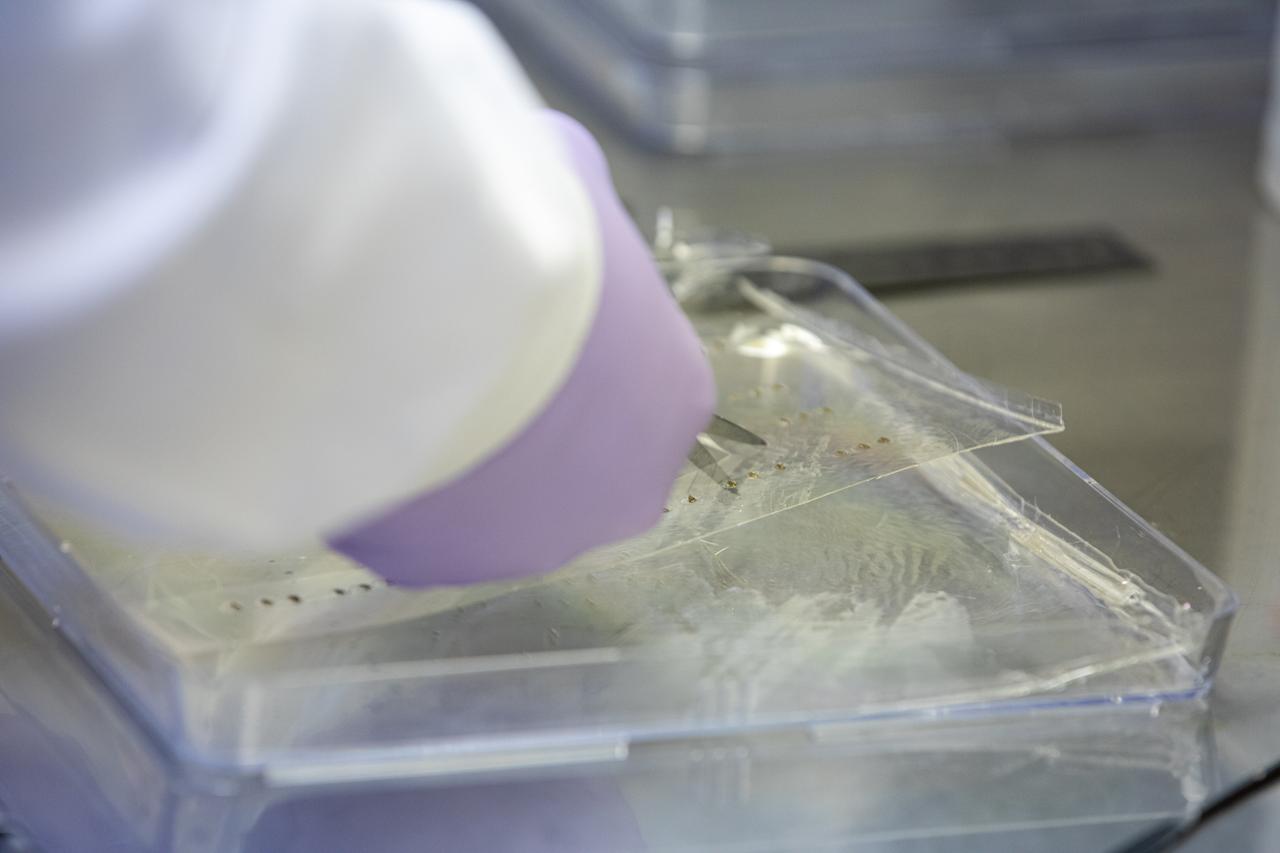
A research scientist at NASA’s Kennedy Space Center in Florida cuts strips of seed film – a new seed handling material containing red romaine lettuce seeds – inside the Space Station Processing Facility on Jan. 16, 2020. The seed film is being prepared for the VEG-03 J experiment that will fly to the International Space Station on Northrop Grumman’s 13th resupply services (NG-13) mission. This seed film experiment involves crew aboard the orbiting laboratory planting the seeds into plant pillows – a common method used to grow plants in space – themselves for the first time ever. The water-soluble, dissolving film addresses the challenge of handling seeds in a microgravity environment and also can be used to deliver fertilizers and other beneficial substances that help plants grow. NG-13 is scheduled to launch from the agency’s Wallops Flight Facility in Virginia on Feb. 9, 2020, at 5:39 p.m. EST.
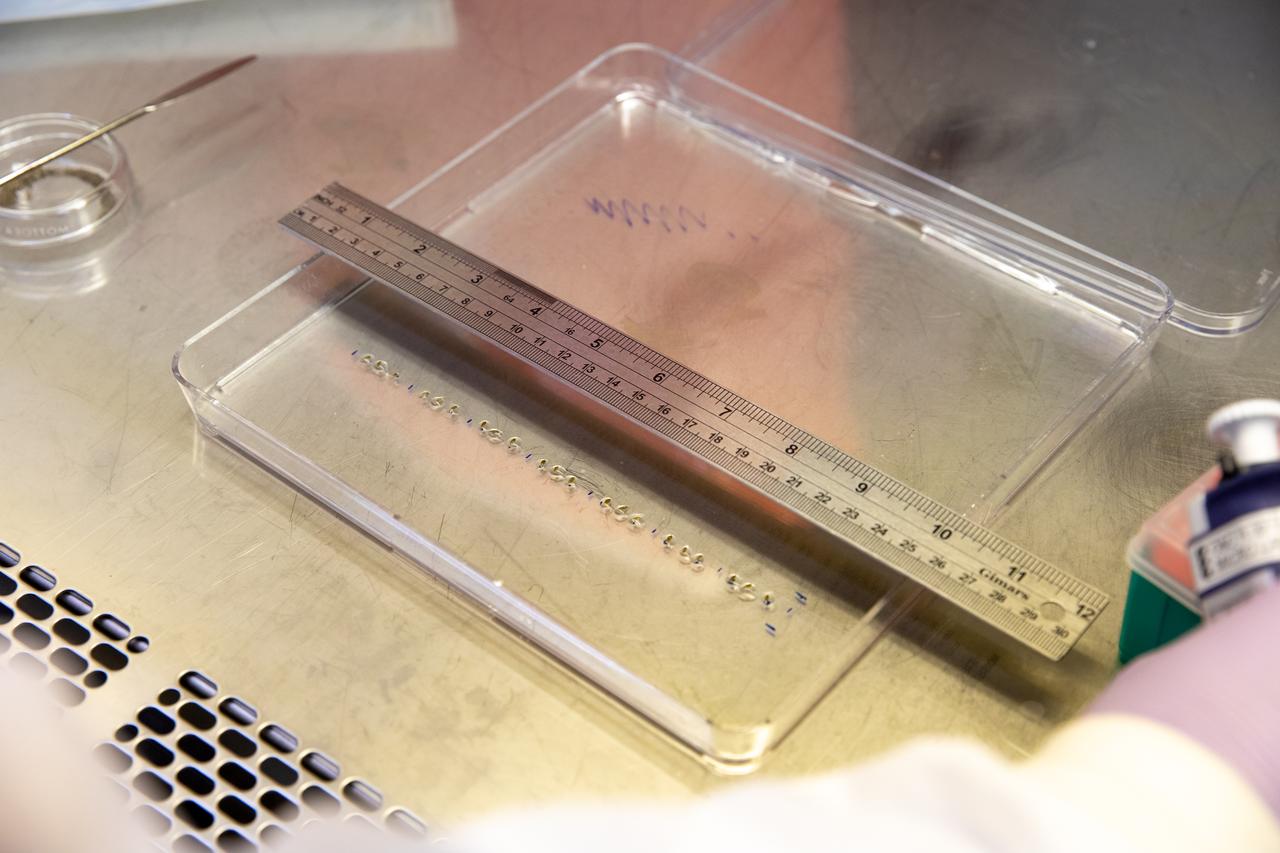
Inside the Space Station Processing Facility at NASA’s Kennedy Space Center in Florida, red romaine lettuce seeds are measured before being placed in seed film – a new seed handling material – on Jan. 15, 2020. The seed film is being prepared for the VEG-03 J experiment that will fly to the International Space Station on Northrop Grumman’s 13th resupply services (NG-13) mission. This seed film experiment involves crew aboard the orbiting laboratory planting the seeds into plant pillows – a common method used to grow plants in space – themselves for the first time ever. The water-soluble, dissolving film addresses the challenge of handling seeds in a microgravity environment and also can be used to deliver fertilizers and other beneficial substances that help plants grow. NG-13 is scheduled to launch from the agency’s Wallops Flight Facility in Virginia on Feb. 9, 2020, at 5:39 p.m. EST.
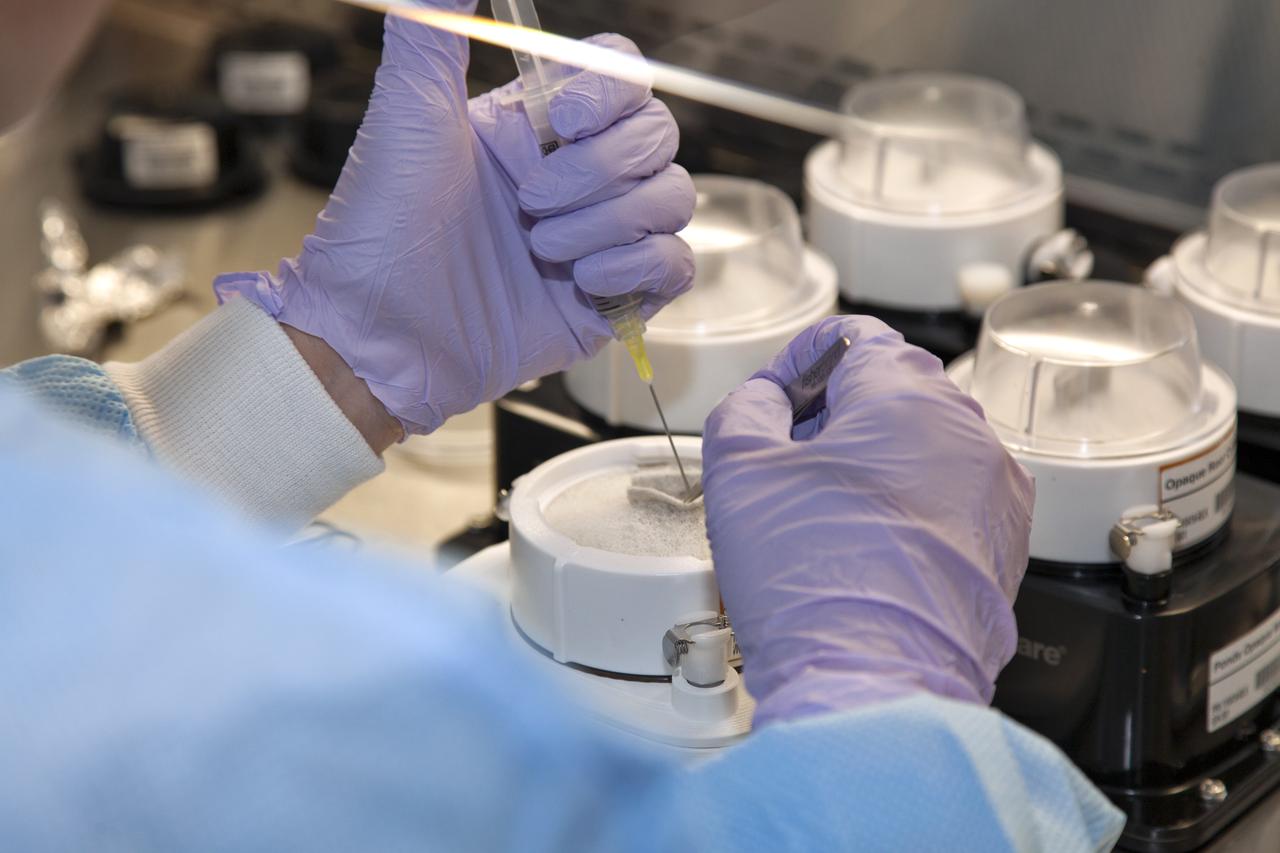
Seeds are being planted in Veggie Passive Orbital Nutrient Delivery System (PONDS) units inside a laboratory at the Space Station Processing Facility at NASA’s Kennedy Space Center in Florida. Veggie PONDS is a direct follow-on to the Veg-01 and Veg-03 hardware and plant growth validation tests. The primary goal of this newly developed plant growing system, Veggie PONDS, is to demonstrate uniform plant growth. PONDS units have features that are designed to mitigate microgravity effects on water distribution, increase oxygen exchange and provide sufficient room for root zone growth. PONDS is planned for use during Veg-04 and Veg-05 on the International Space Station after the Veggie PONDS Validation flights on SpaceX-14 and OA-9.
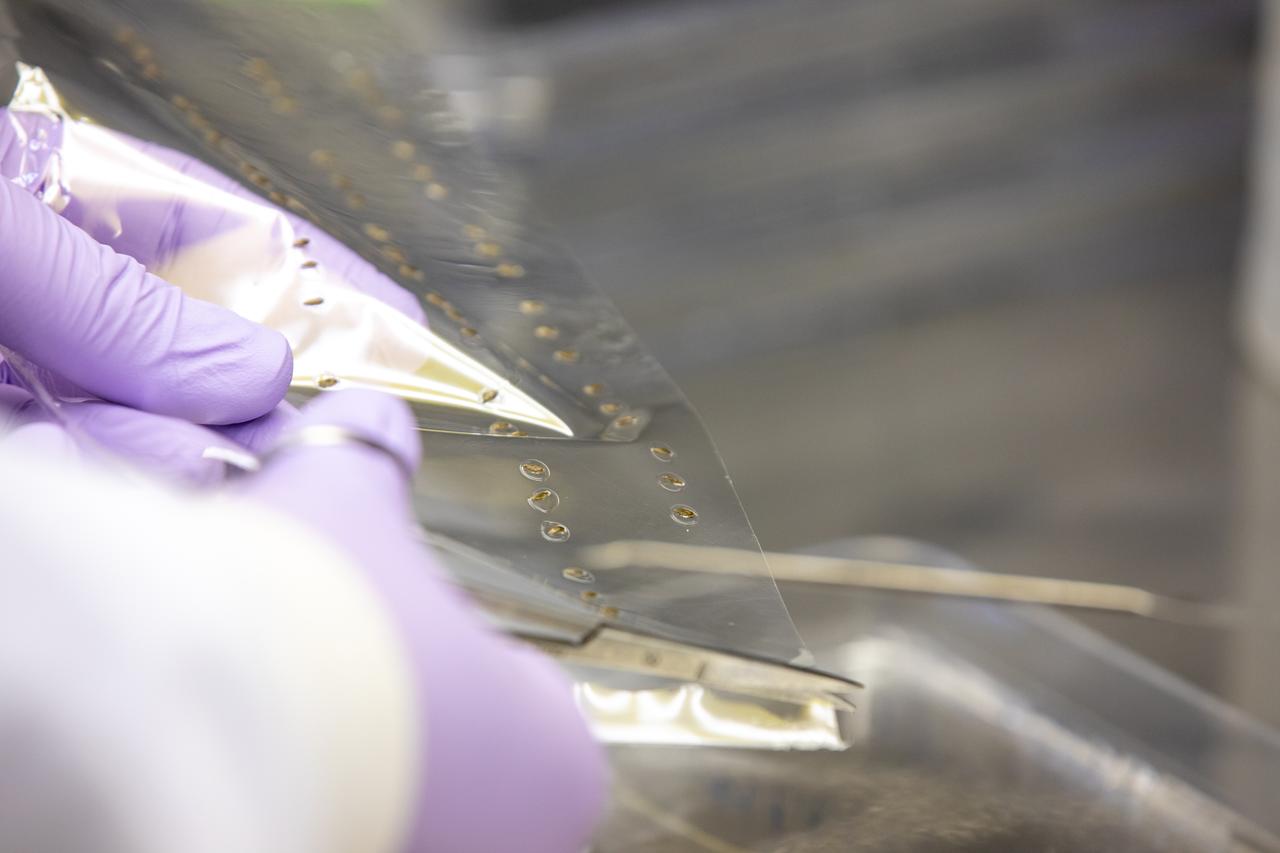
A research scientist at NASA’s Kennedy Space Center in Florida cuts strips of seed film – a new seed handling material containing red romaine lettuce seeds – inside the Space Station Processing Facility on Jan. 16, 2020. The seed film is being prepared for the VEG-03 J experiment that will fly to the International Space Station on Northrop Grumman’s 13th resupply services (NG-13) mission. This seed film experiment involves crew aboard the orbiting laboratory planting the seeds into plant pillows – a common method used to grow plants in space – themselves for the first time ever. The water-soluble, dissolving film addresses the challenge of handling seeds in a microgravity environment and also can be used to deliver fertilizers and other beneficial substances that help plants grow. NG-13 is scheduled to launch from the agency’s Wallops Flight Facility in Virginia on Feb. 9, 2020, at 5:39 p.m. EST.
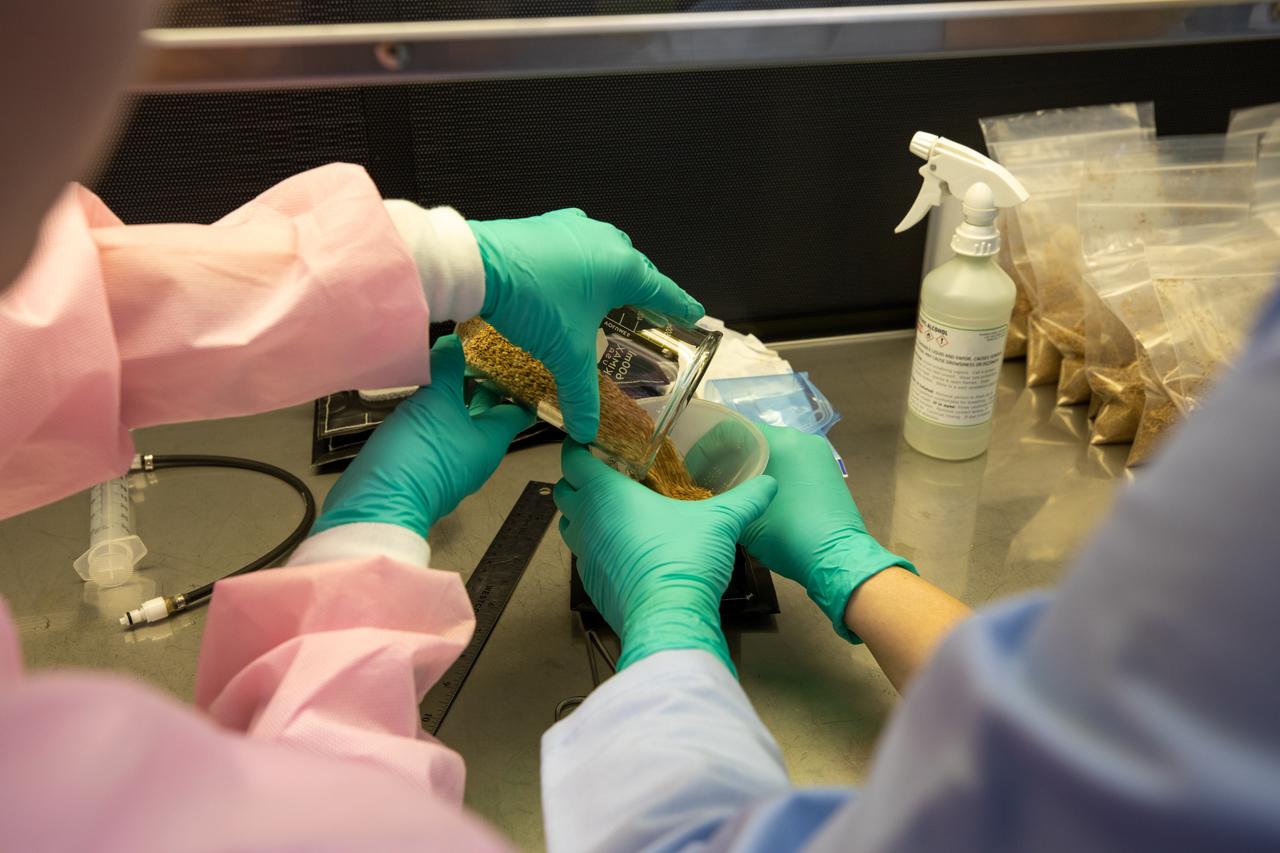
Inside the Space Station Processing Facility at NASA’s Kennedy Space Center in Florida, a researcher measures out the calcined clay that will be used to assemble plant pillows on Jan. 16, 2019. Often used to condition baseball infields, the clay’s size and roughness traps air and absorbs water to provide both to plant roots in microgravity. The pillows are small containers used to grow plants in space aboard the International Space Station. The pillows are for a series of plant experiments called VEG-03 J/K/L that will monitor the growth of three types of leafy greens and test a new way of handling seeds. The experiments will be launched to the orbiting laboratory aboard a Northrop Grumman Antares rocket and Cygnus spacecraft on the company’s 13th resupply services mission. Liftoff is scheduled for Feb. 9, 2020, at 5:39 p.m. EST from the agency’s Wallops Flight Facility in Virginia.