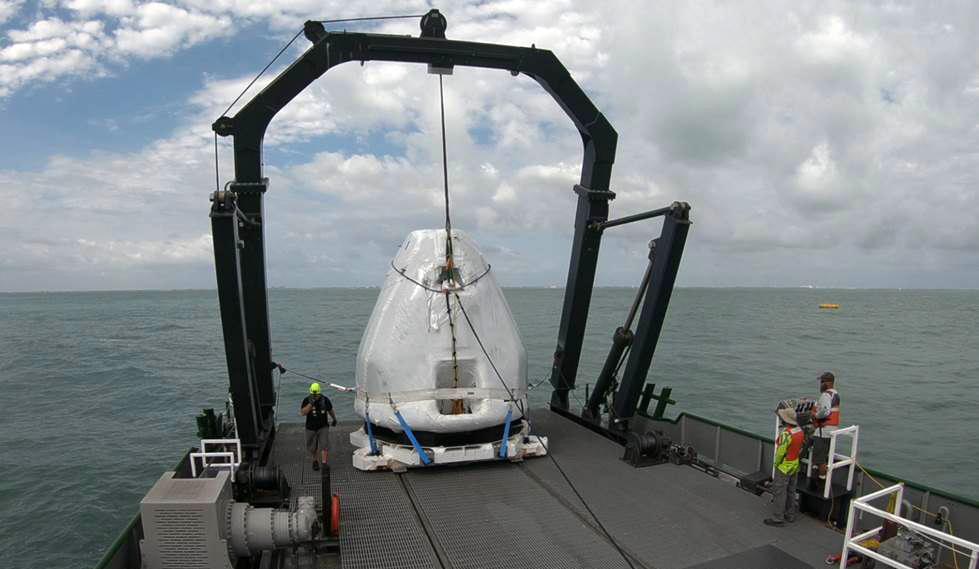
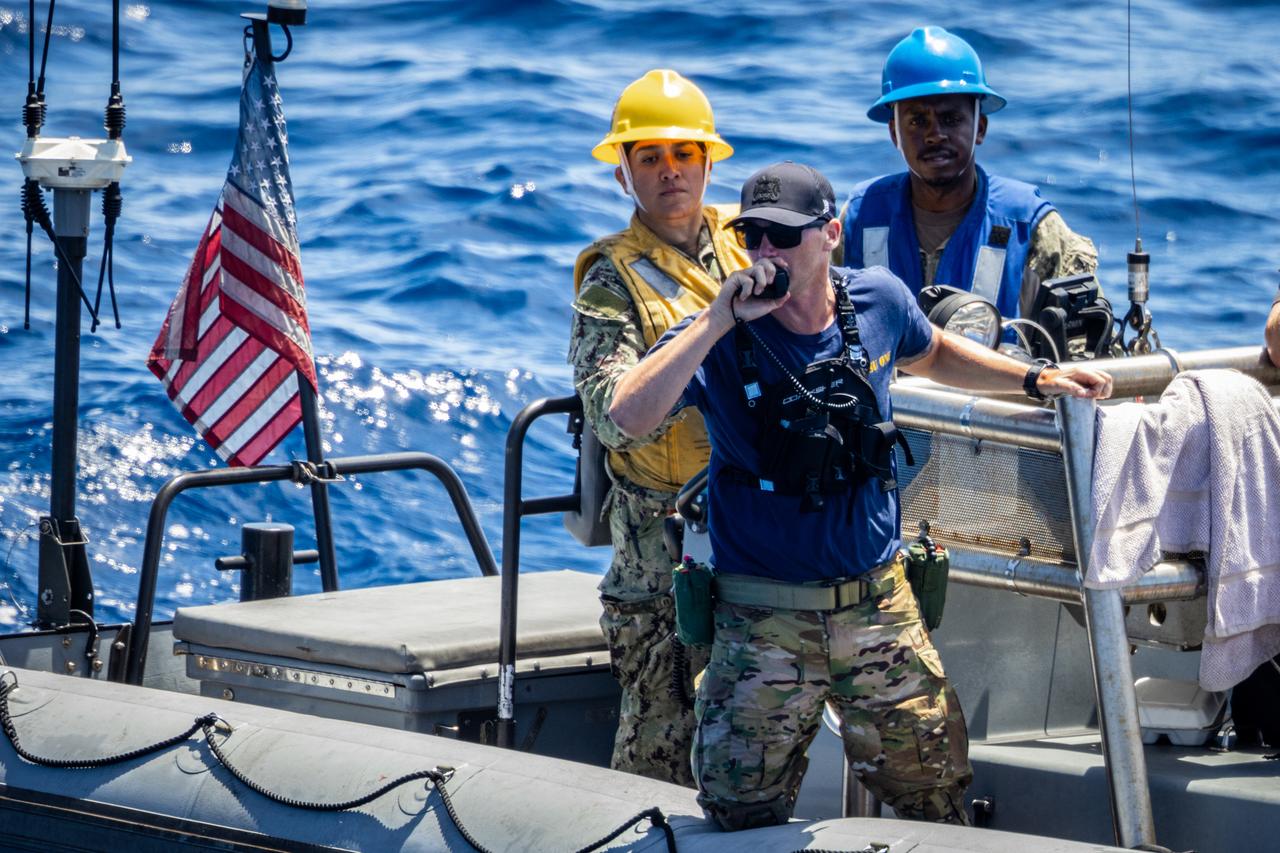
On February 28, SpaceX completed a demonstration of their ability to recover the crew and capsule after a nominal water splashdown. This marks an important recovery milestone and joint test. The timeline requirement from splashdown to crew egress onboard the ship is one hour, and the recovery team demonstrated that they can accomplish this operation under worst-case conditions in under 45 minutes. Further improvements are planned to shorten the recovery time even more as the team works to build a process that is safe, repeatable, and efficient.
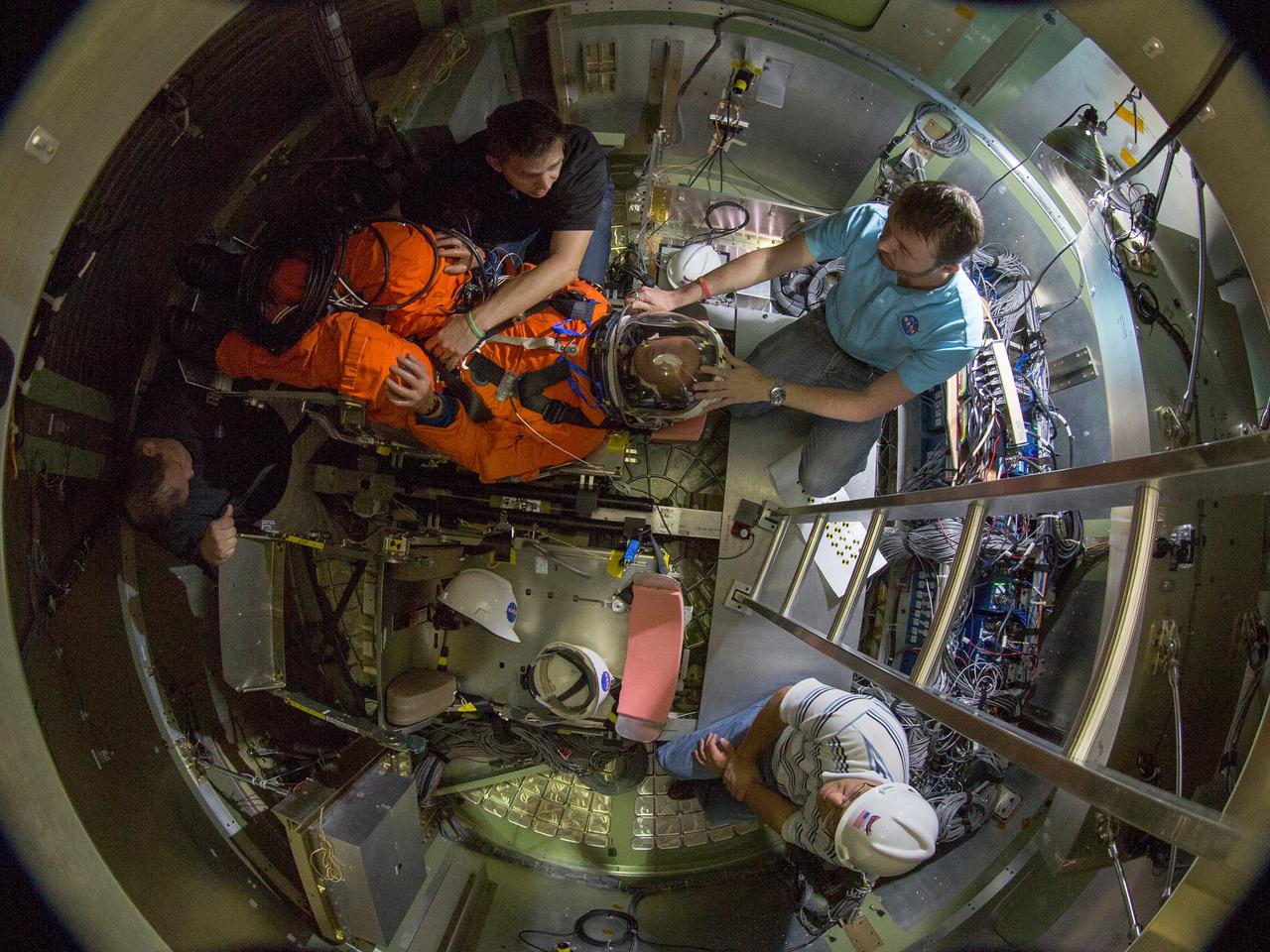
Orion's 2016 water drop test series included heavily instrumented test dummies, shown here on May 6, 2016, to assess the impact future crews will experience in Orion splashdown scenarios.
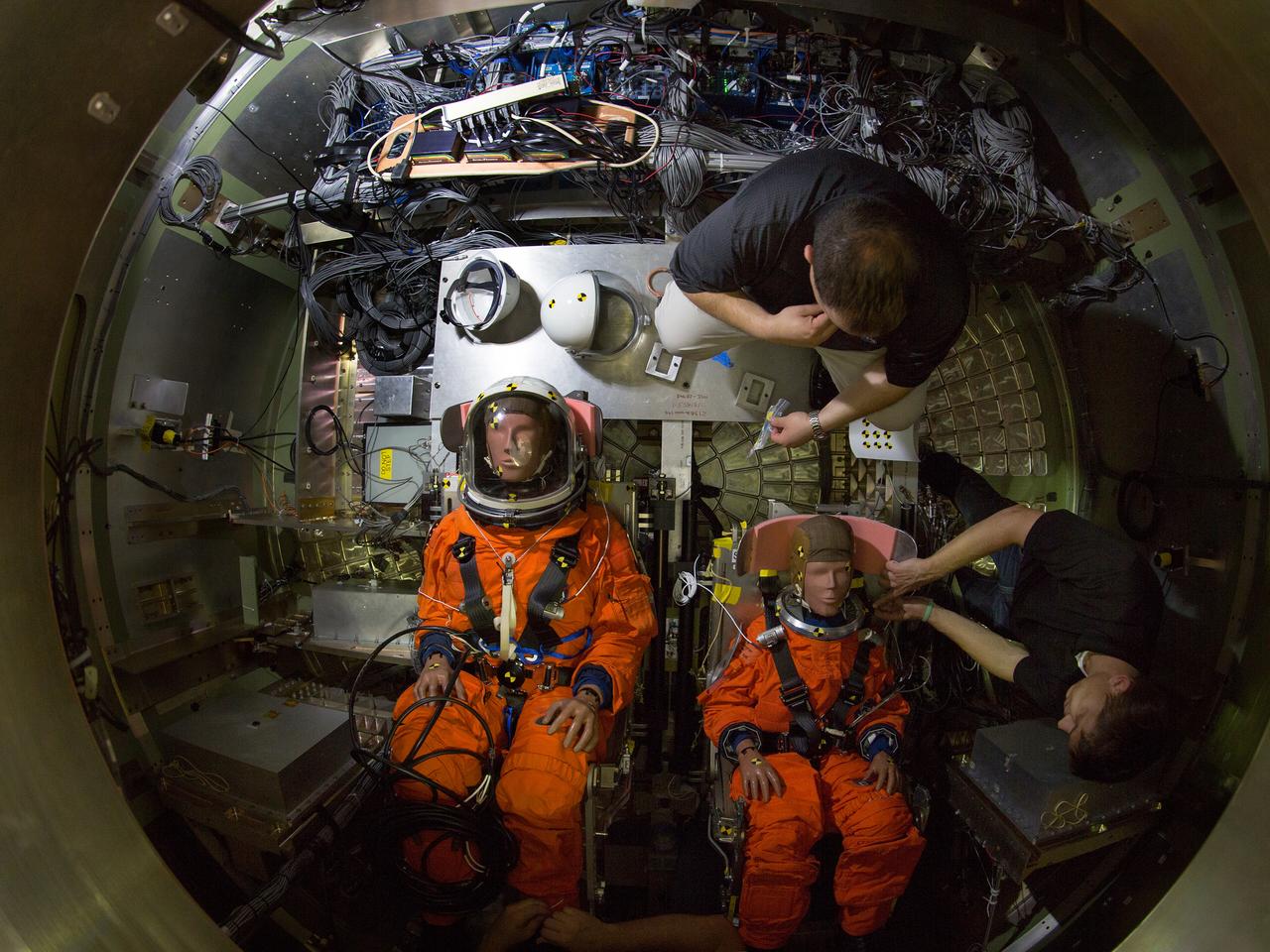
Orion's 2016 water drop test series included heavily instrumented test dummies, shown here on May 6, 2016, to assess the impact future crews will experience in Orion splashdown scenarios.
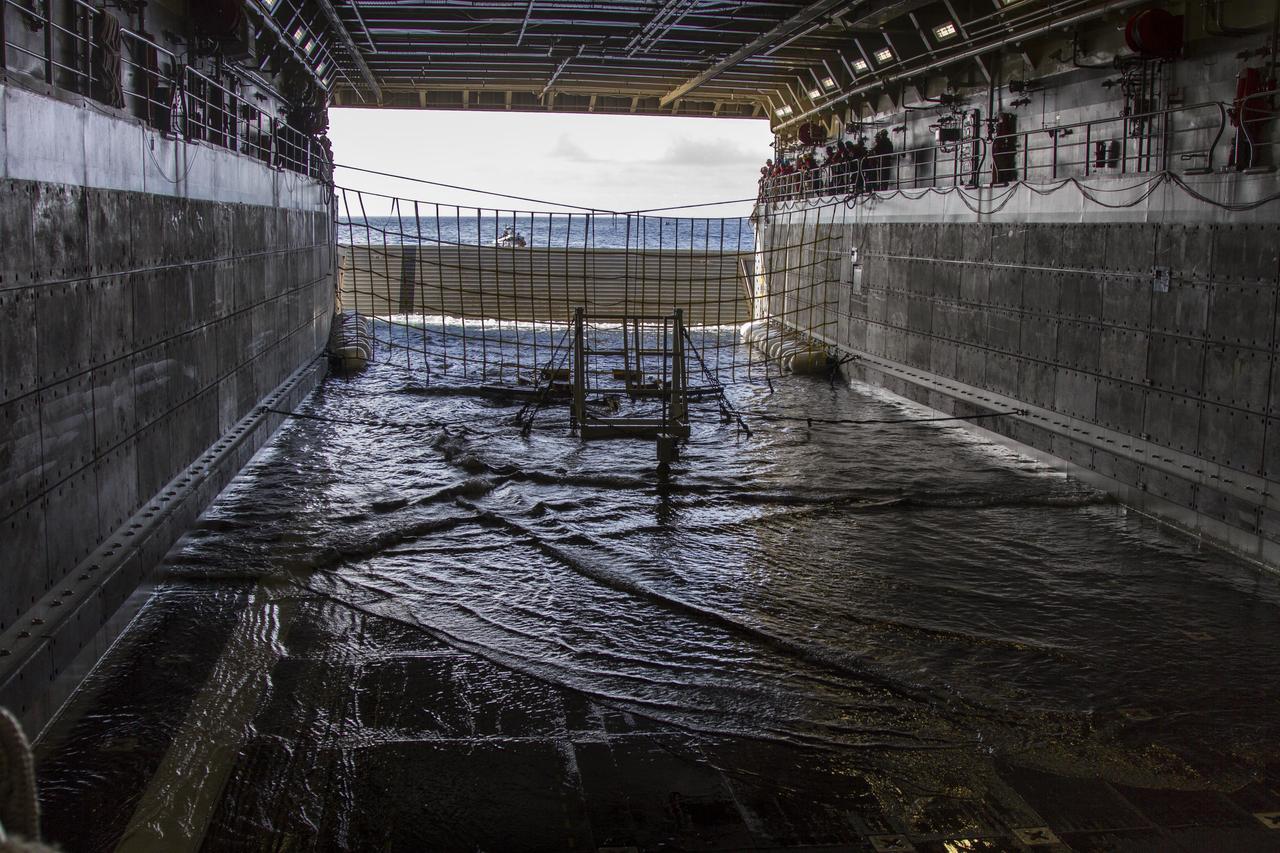
On the third day of preparations for recovery of Orion after its splashdown in the Pacific Ocean, the well deck of the USS Anchorage has been filled with water and recovery hardware is in place. The ship is about 600 miles off the coast of Baja, California. NASA, Lockheed Martin and U.S. Navy personnel are preparing for recovery of the crew module, forward bay cover and parachutes on its return from space and splashdown in the Pacific Ocean. The Ground Systems Development and Operations Program is leading the recovery efforts.
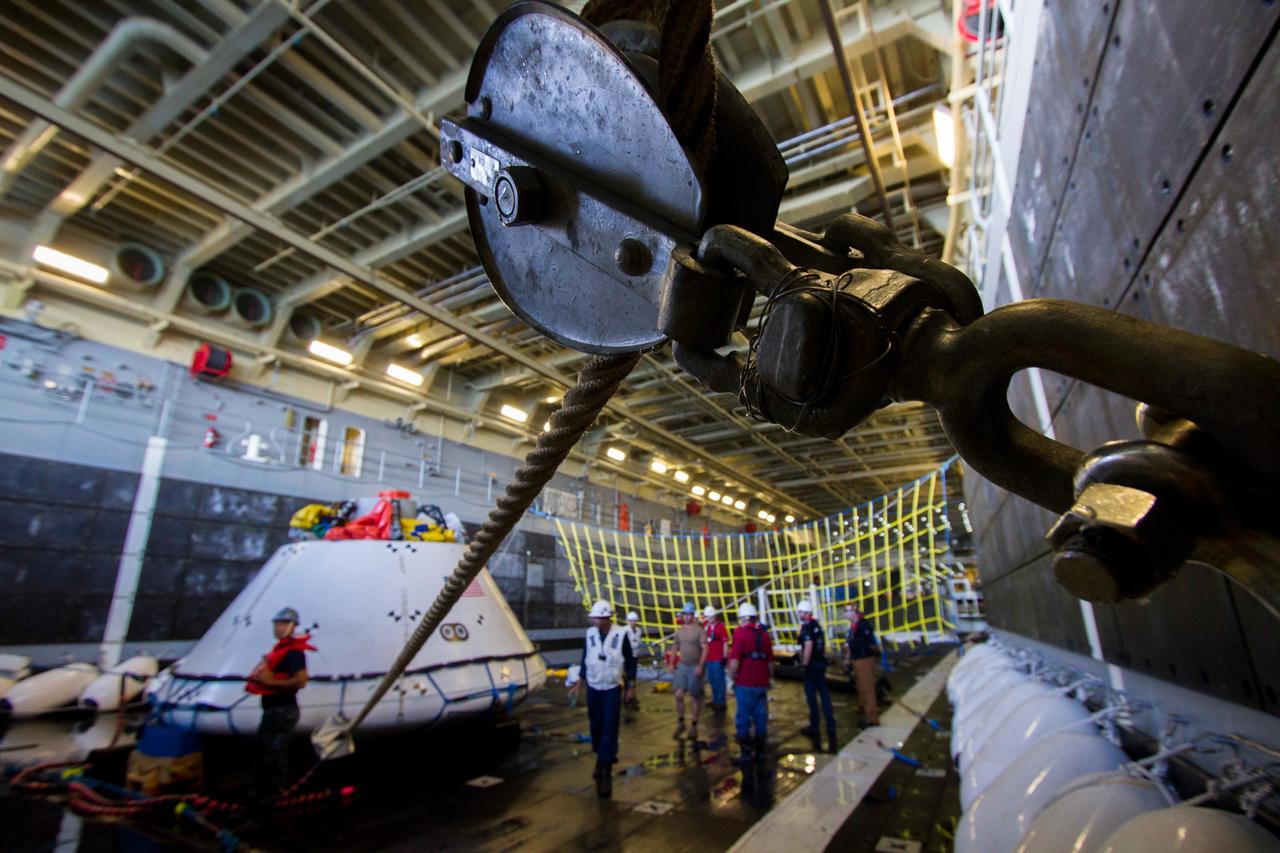
Lines secure a test version of Orion inside of the USS Anchorage's well deck during recovery tests off the coast of California on Sept. 15, 2014. The well deck can be flooded with water to allow Orion to float in following its splashdown when it returns from space. Part of Batch image transfer from Flickr.
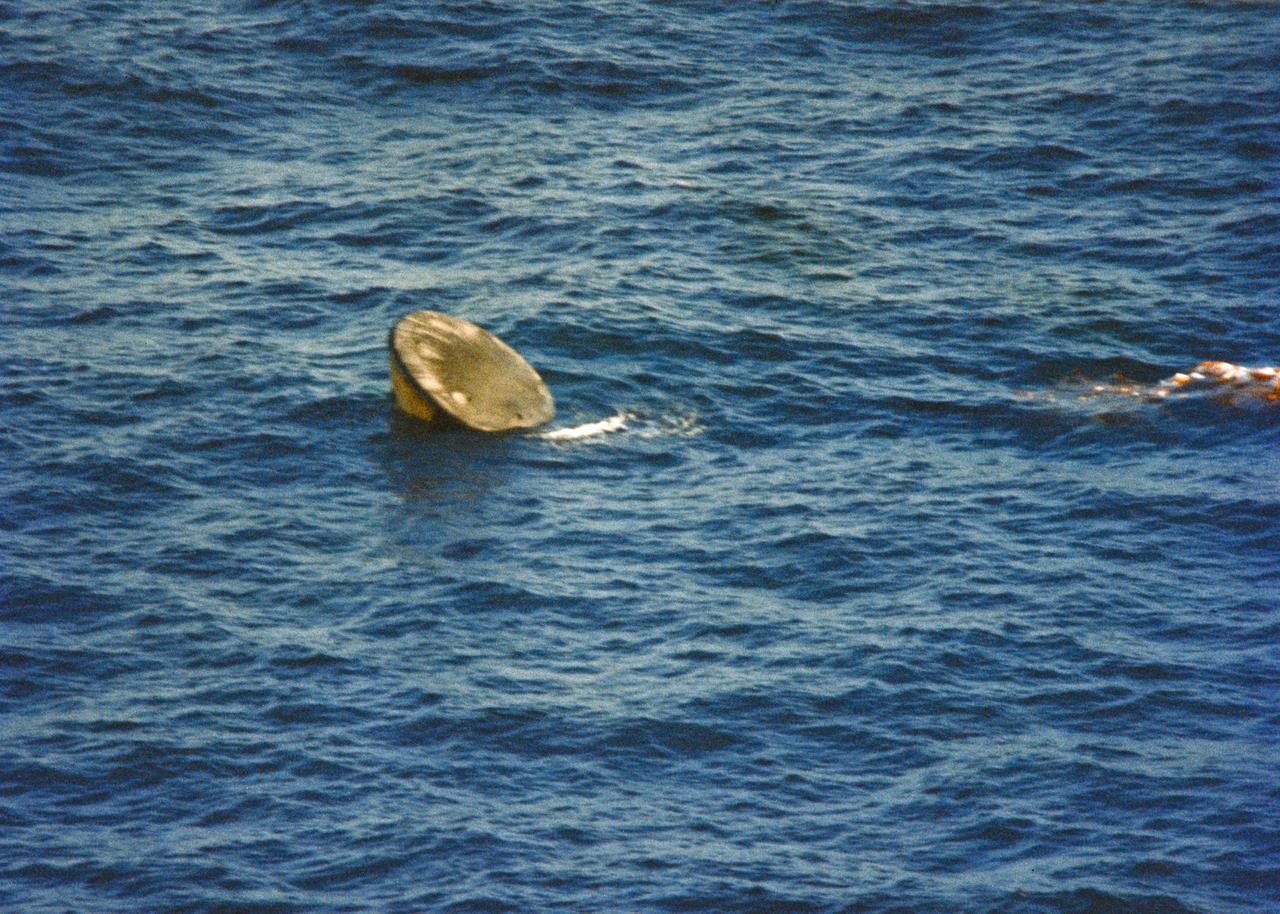
S74-17742 (8 Feb. 1974) --- The Skylab 4 Command Module bobs in an apex-down configuration (stable two) in the calm water of the Pacific Ocean 176 miles southwest of San Diego, California, following a successful splashdown and 84-day mission in Earth orbit. Photo credit: NASA
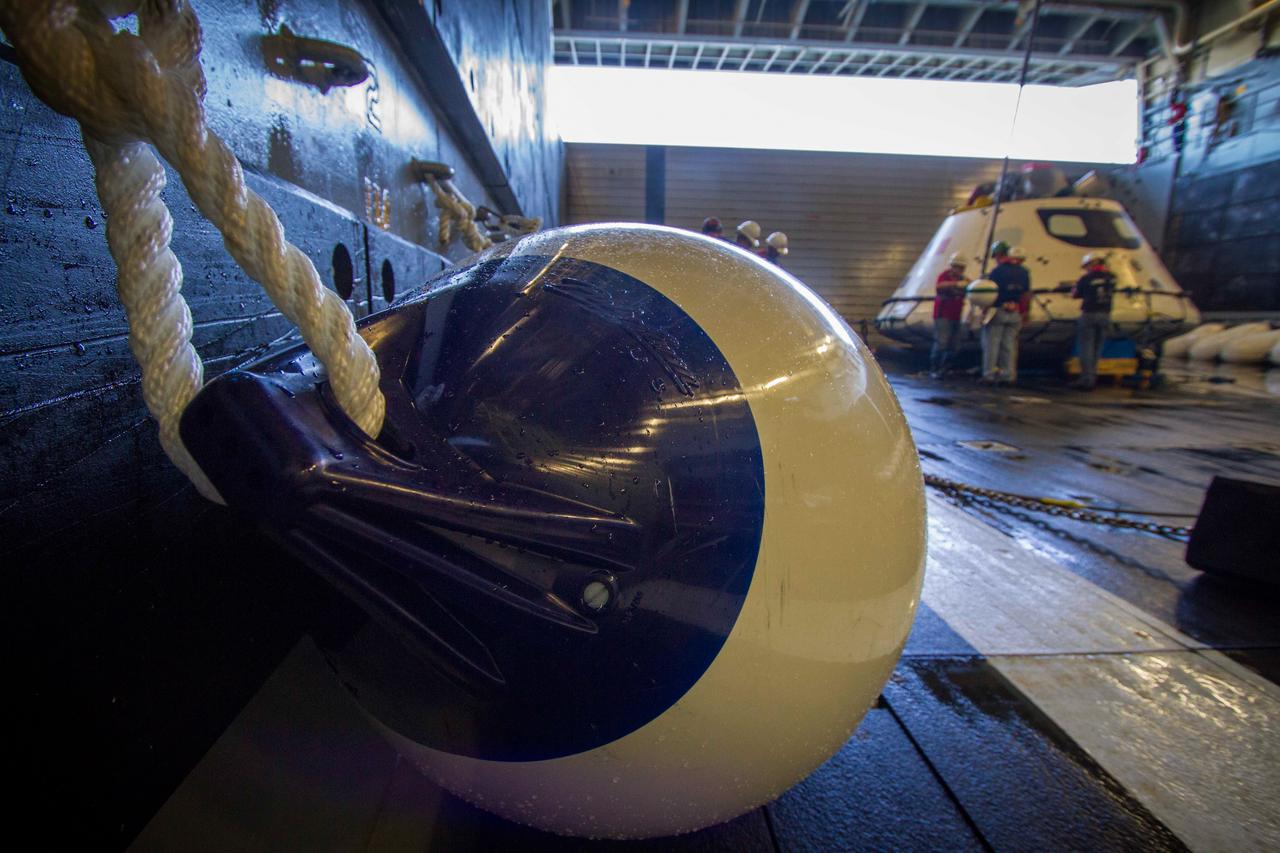
The well deck of the USS Anchorage, which NASA and the Navy use for Orion recovery tests on Sept. 15, 2014, can be flooded with water to allow Orion to float in following its splashdown when it returns from space. Part of Batch image transfer from Flickr.

S72-56147 (19 Dec. 1972) --- A water-level view of the Apollo 17 Command Module (CM) floating in the Pacific Ocean following splashdown and prior to recovery. The prime recovery ship, the USS Ticonderoga, is in the background. When this picture was taken, the three-man crew of astronauts Eugene A. Cernan, Ronald E. Evans and Harrison H. Schmitt, had already been picked up by helicopter and flown to the deck of the recovery ship. The spacecraft was later hoisted aboard the USS Ticonderoga. A United States Navy UDT swimmer stands on the flotation collar. Apollo 17 splashdown occurred at 1:24:59 p.m. (CST), Dec. 19, 1972, about 350 nautical miles southeast of Samoa.
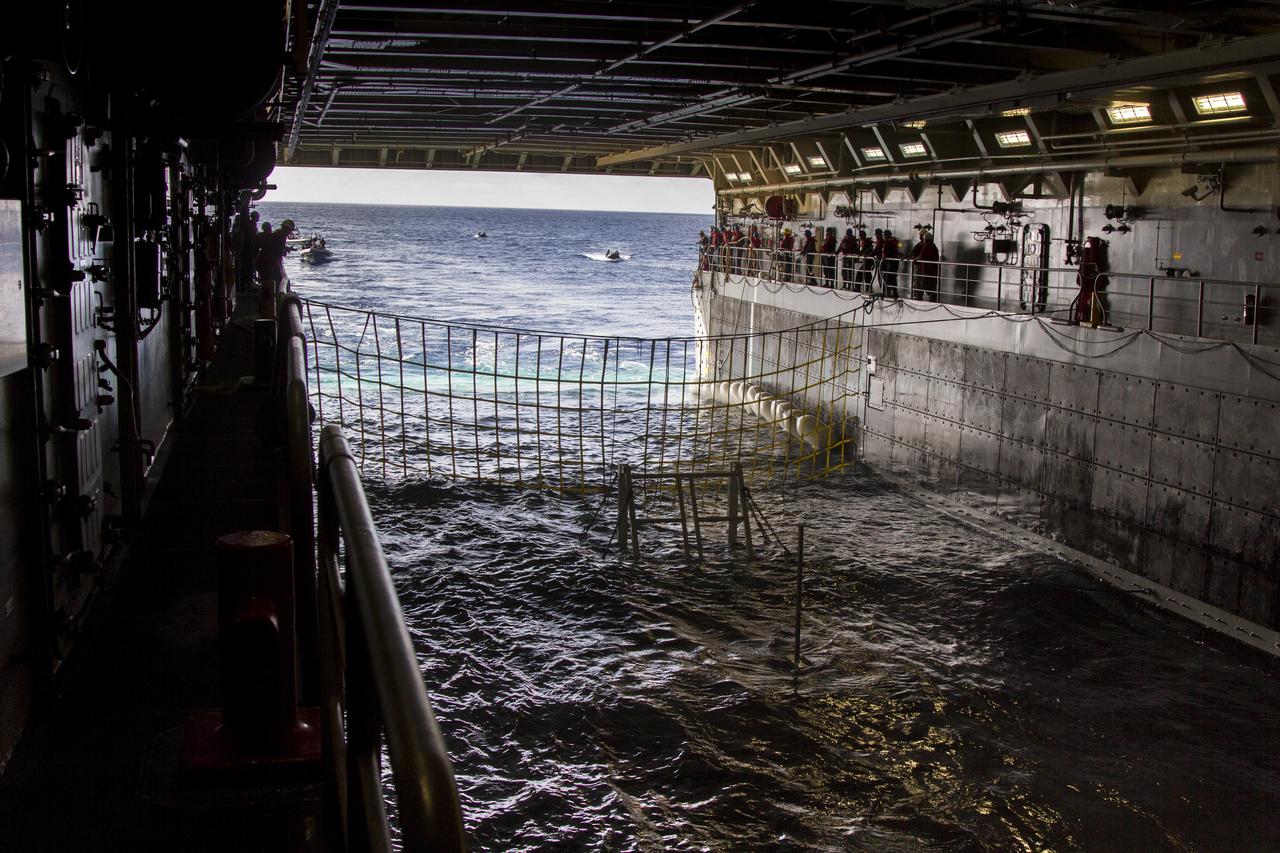
On the third day of preparations for recovery of Orion after its splashdown in the Pacific Ocean, the well deck of the USS Anchorage has been filled with water and recovery hardware is in place. U.S. Navy divers have embarked from ship to practice recovery procedures in rigid hull inflatable boats and Zodiac boats. NASA, Lockheed Martin and U.S. Navy personnel are preparing for recovery of the crew module, forward bay cover and parachutes on its return from space and splashdown in the Pacific Ocean. The Ground Systems Development and Operations Program is leading the recovery efforts.
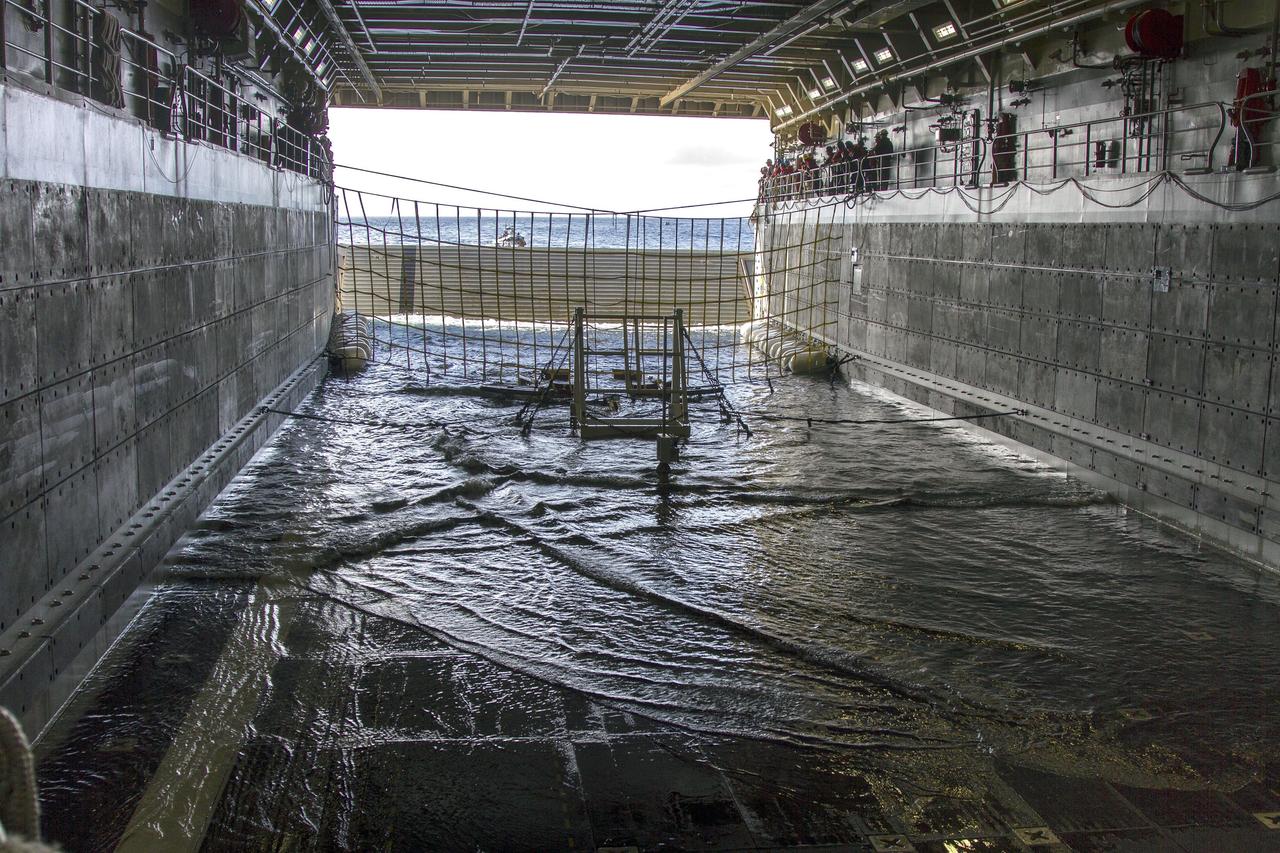
SAN DIEGO, Calif. – On the third day of preparations for recovery of Orion after its splashdown in the Pacific Ocean, the well deck of the USS Anchorage has been filled with water and recovery hardware is in place. The ship is about 600 miles off the coast of Baja, California. NASA, Lockheed Martin and U.S. Navy personnel are preparing for recovery of the crew module, forward bay cover and parachutes on its return from space and splashdown in the Pacific Ocean. The Ground Systems Development and Operations Program is leading the recovery efforts. The first unpiloted flight test of Orion is scheduled to launch Dec. 4 atop a United Launch Alliance Delta IV Heavy rocket. During its two-orbit, 4.5-hour flight, Orion will venture 3,600 miles in altitude and travel nearly 60,000 miles before returning to Earth for a splashdown in the Pacific Ocean. For more information, visit http://www.nasa.gov/orion. Photo credit: NASA/Cory Huston
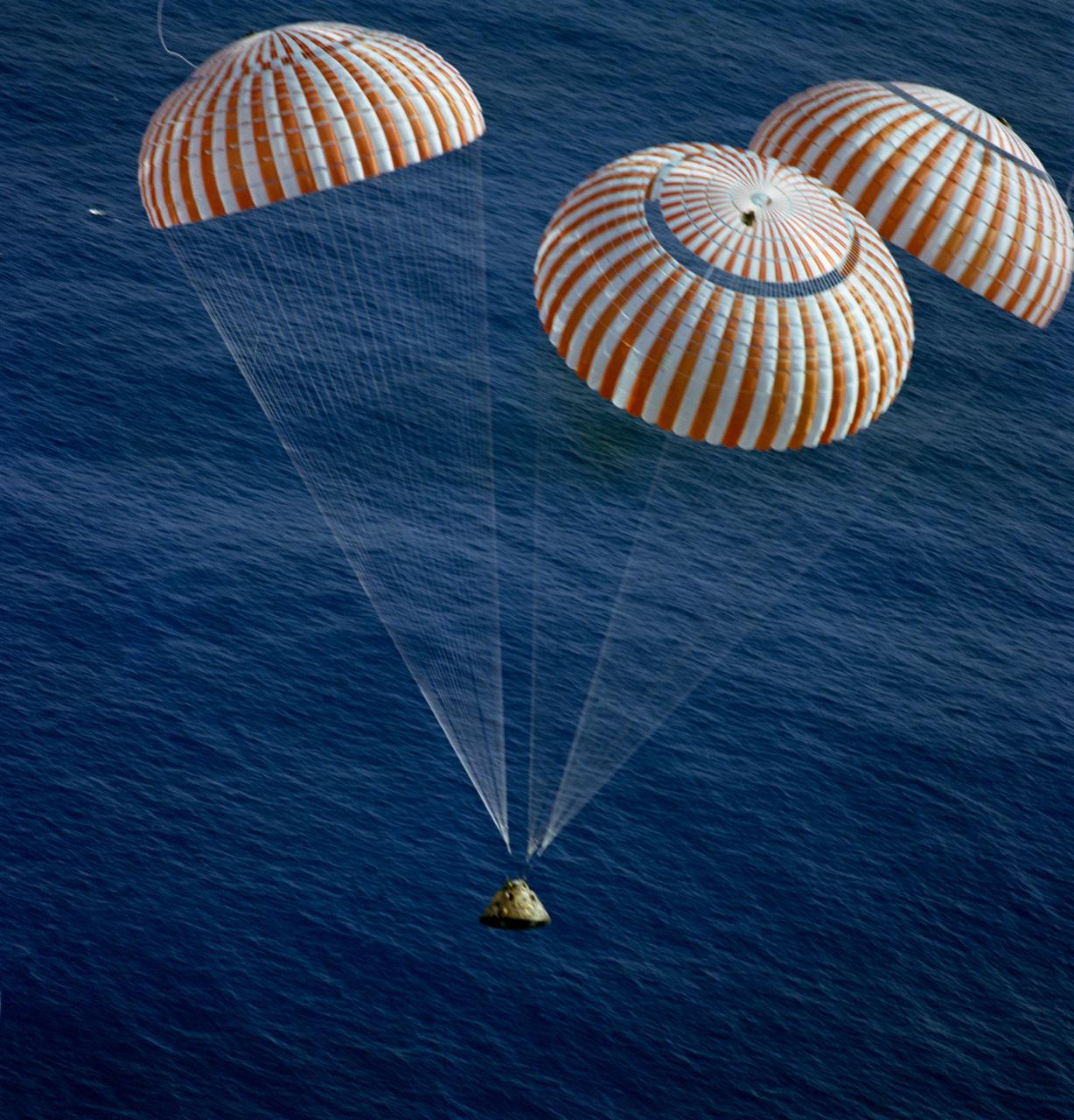
S72-55834 (19 Dec. 1972) --- The Apollo 17 Command Module (CM), with astronauts Eugene A. Cernan, Ronald E. Evans and Harrison H. Schmitt aboard, nears splashdown in the South Pacific Ocean to successfully concludes the final lunar landing mission in NASA's Apollo program. This overhead view was taken from a recovery aircraft seconds before the spacecraft hit the water. The splashdown occurred at 304:31:59 ground elapsed time, 1:24:59 p.m. (CST) Dec. 19, 1972, at coordinates of 166 degrees 8 minutes west longitude and 27 degrees 53 minutes south latitude, about 350 nautical miles southeast of the Samoan Islands. The splashdown was only .8 miles from the target point. Later, the three crewmen were picked up by a helicopter from the prime recovery ship, USS Ticonderoga.
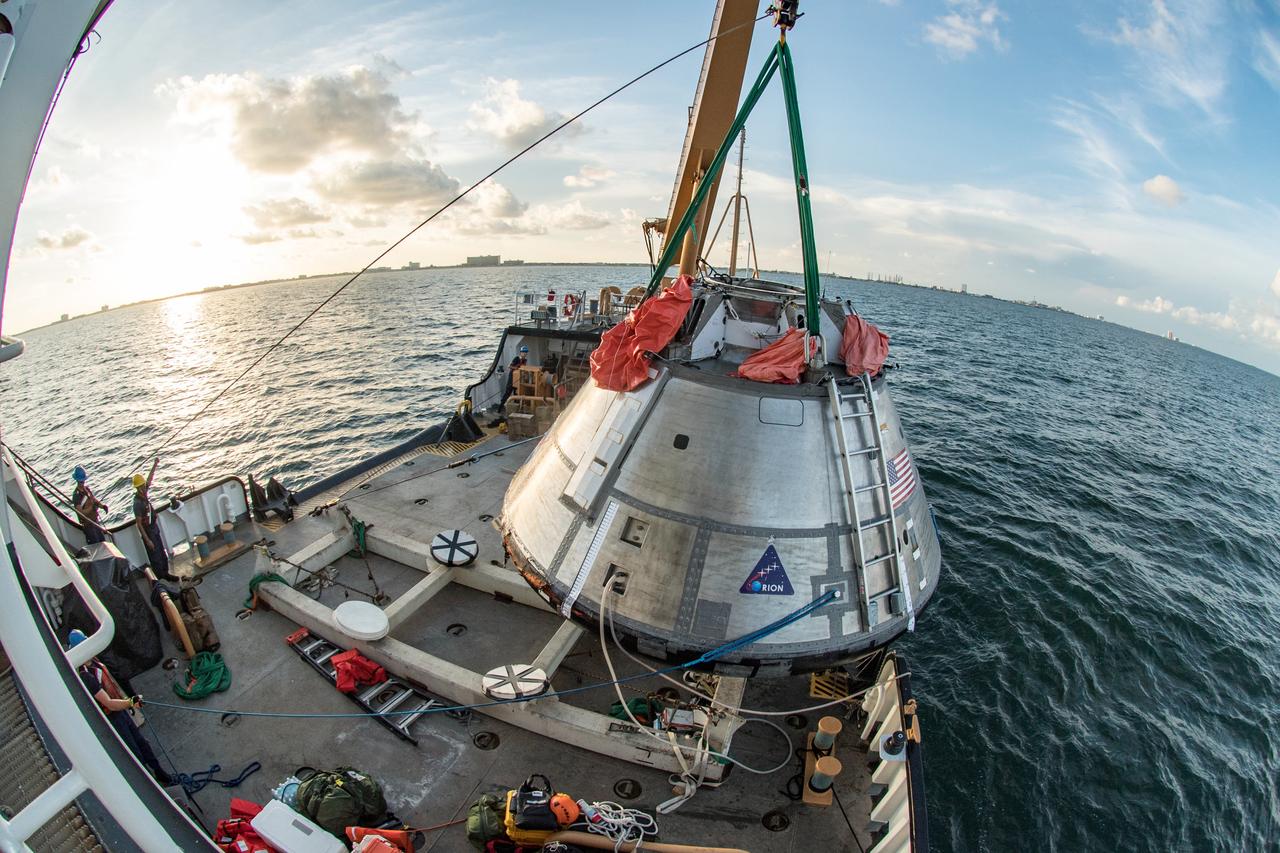
When astronauts return to Earth from destinations beyond the Moon in NASA’s Orion spacecraft and splashdown in the Pacific Ocean, they’ll still need to safely get out of the spacecraft and back on dry land. Using the waters off the coast of Galveston, Texas, a NASA and Department of Defense team test Orion exit procedures in a variety of scenarios on July 11, 2017. Part of Batch images transfer from Flickr.
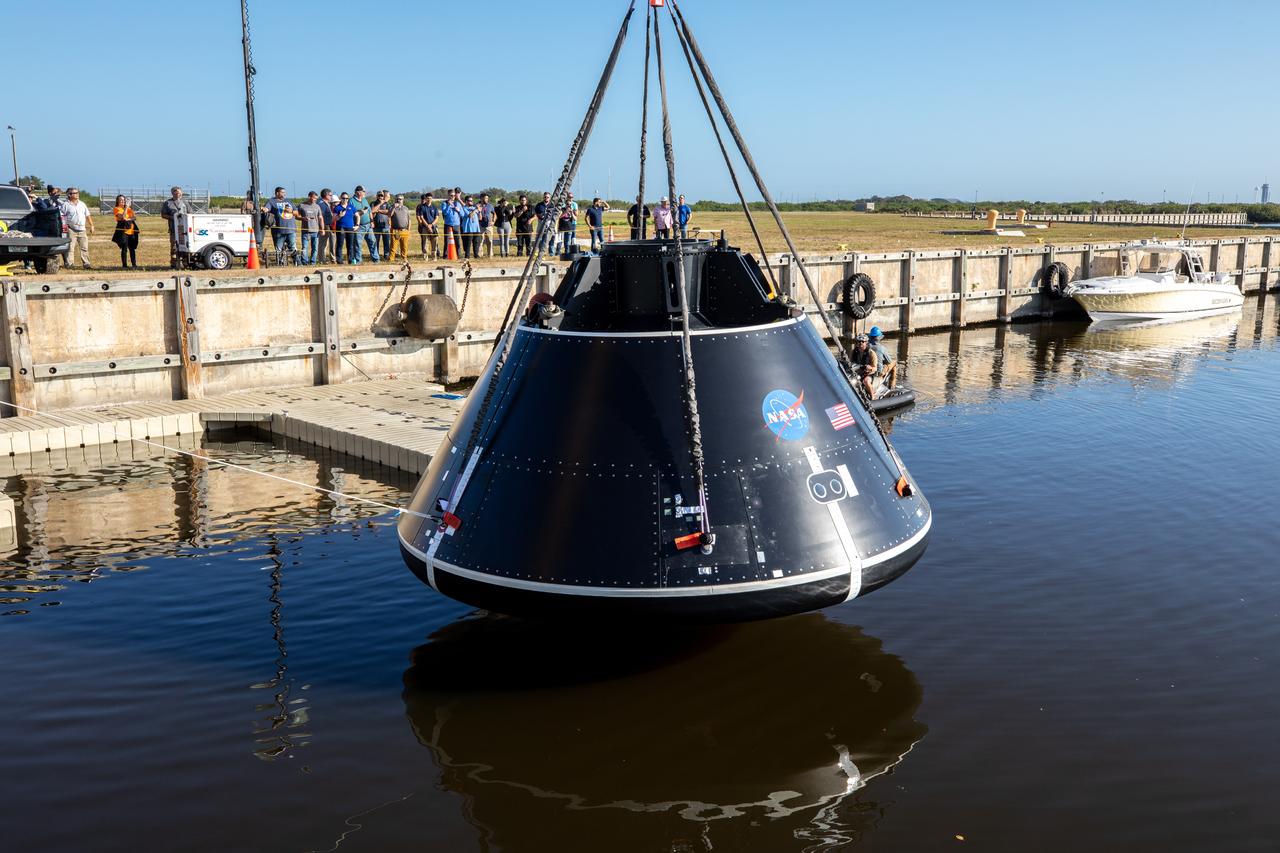
A crane lowers the Crew Module Test Article (CMTA) into water at the turn basin in the Launch Complex 39 area at NASA’s Kennedy Space Center in Florida on Jan. 30, 2023. The CMTA is being used to practice recovery after splashdown of the Orion spacecraft to prepare for the Artemis II crewed mission. Exploration Ground Systems leads recovery efforts.
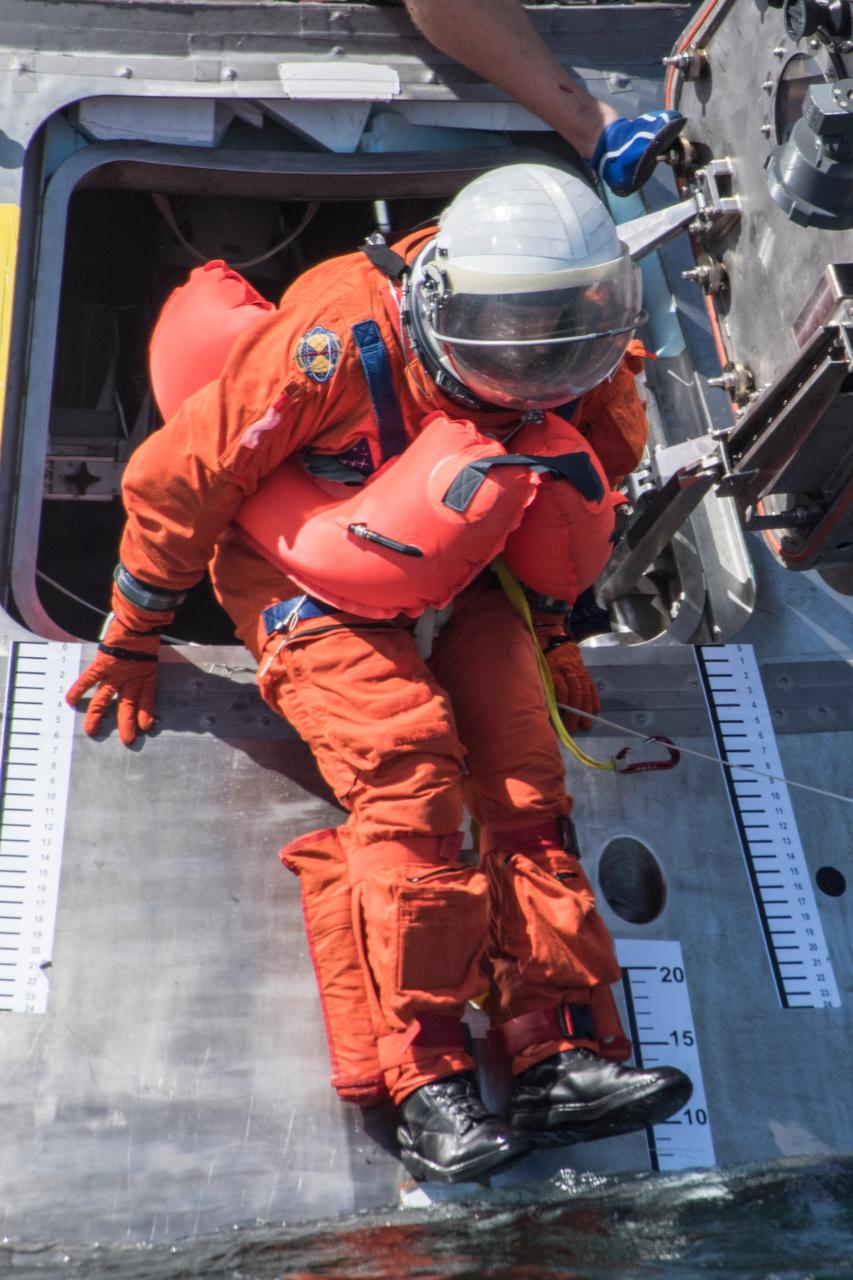
When astronauts return to Earth from destinations beyond the Moon in NASA’s Orion spacecraft and splashdown in the Pacific Ocean, they’ll still need to safely get out of the spacecraft and back on dry land. Using the waters off the coast of Galveston, Texas, a NASA and Department of Defense team test Orion exit procedures in a variety of scenarios on July 11, 2017. Part of Batch images transfer from Flickr.
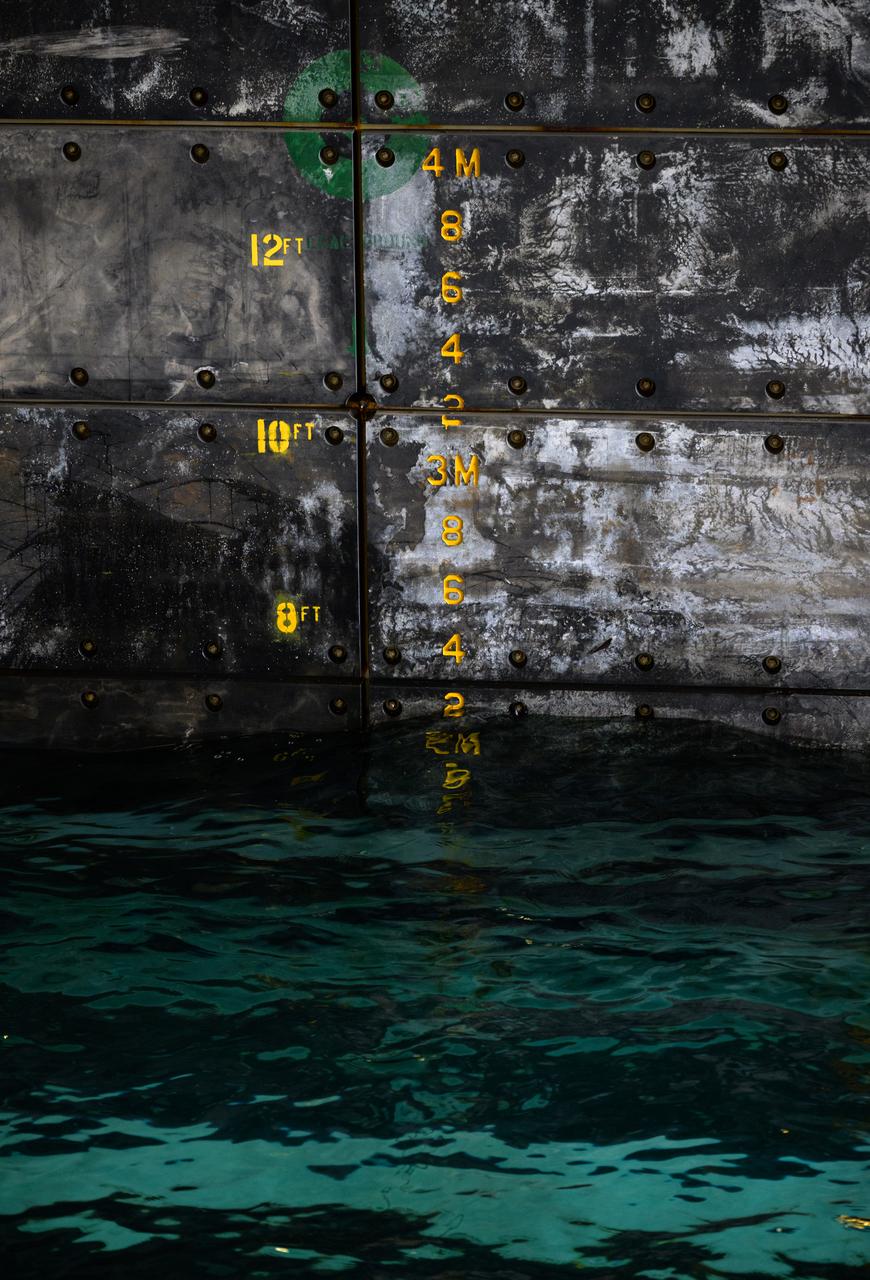
Indicators showing the water level in the well deck of USS Somerset are seen as teams deploy the Crew Module Test Article (CMTA), a full scale mockup of the Orion spacecraft, during Underway Recovery Test-12 off the coast of California, Wednesday, March 26, 2025. During the test, NASA and Department of Defense teams are practicing to ensure recovery procedures are validated as NASA plans to send Artemis II astronauts around the Moon and splashdown in the Pacific Ocean. Photo Credit: (NASA/Bill Ingalls)
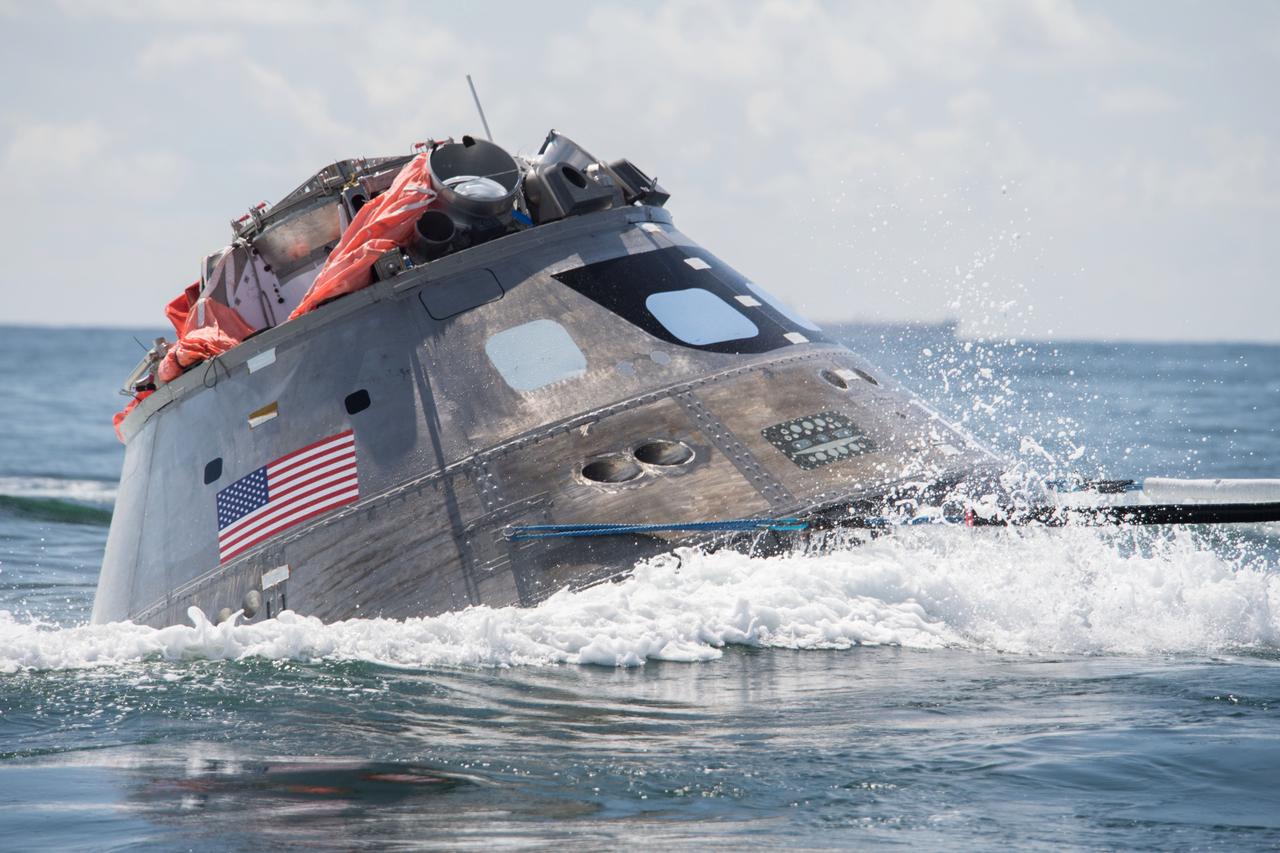
When astronauts return to Earth from destinations beyond the Moon in NASA’s Orion spacecraft and splashdown in the Pacific Ocean, they’ll still need to safely get out of the spacecraft and back on dry land. Using the waters off the coast of Galveston, Texas, a NASA and Department of Defense team test Orion exit procedures in a variety of scenarios on July 11, 2017. Part of Batch images transfer from Flickr.
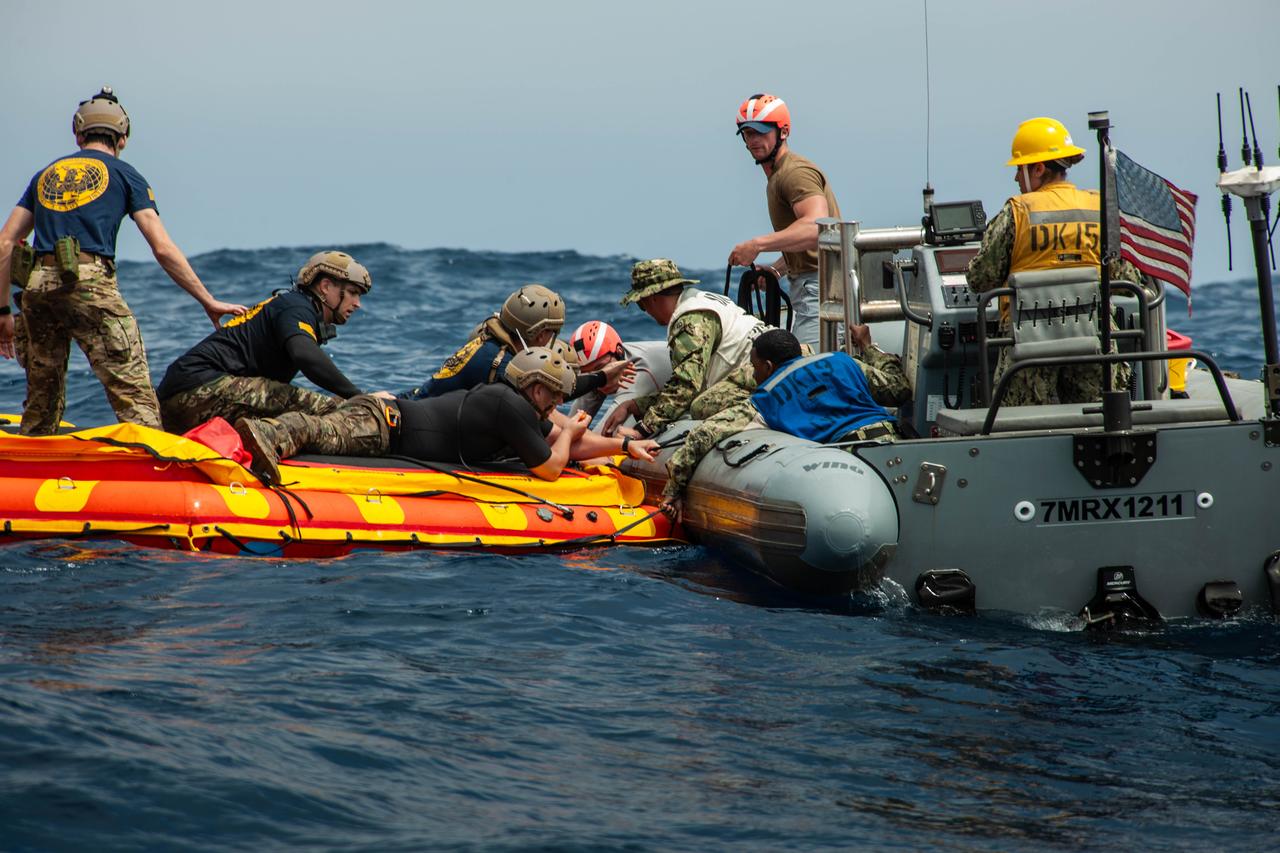
Navy divers from Explosive Ordnance Disposal (EOD) Expeditionary Support Unit 1 work to secure the Orion Crew Module Test Article (CMTA) in the Pacific Ocean as part of NASA’s Underway Recovery Test 10 (URT-10). The divers are trained in open water and small boat procedures and will be the team to help Artemis astronauts exit the Orion spacecraft and make it safely to the recovery ship after splashdown in addition to preparing the spacecraft to be transported back inside the recovery ship.
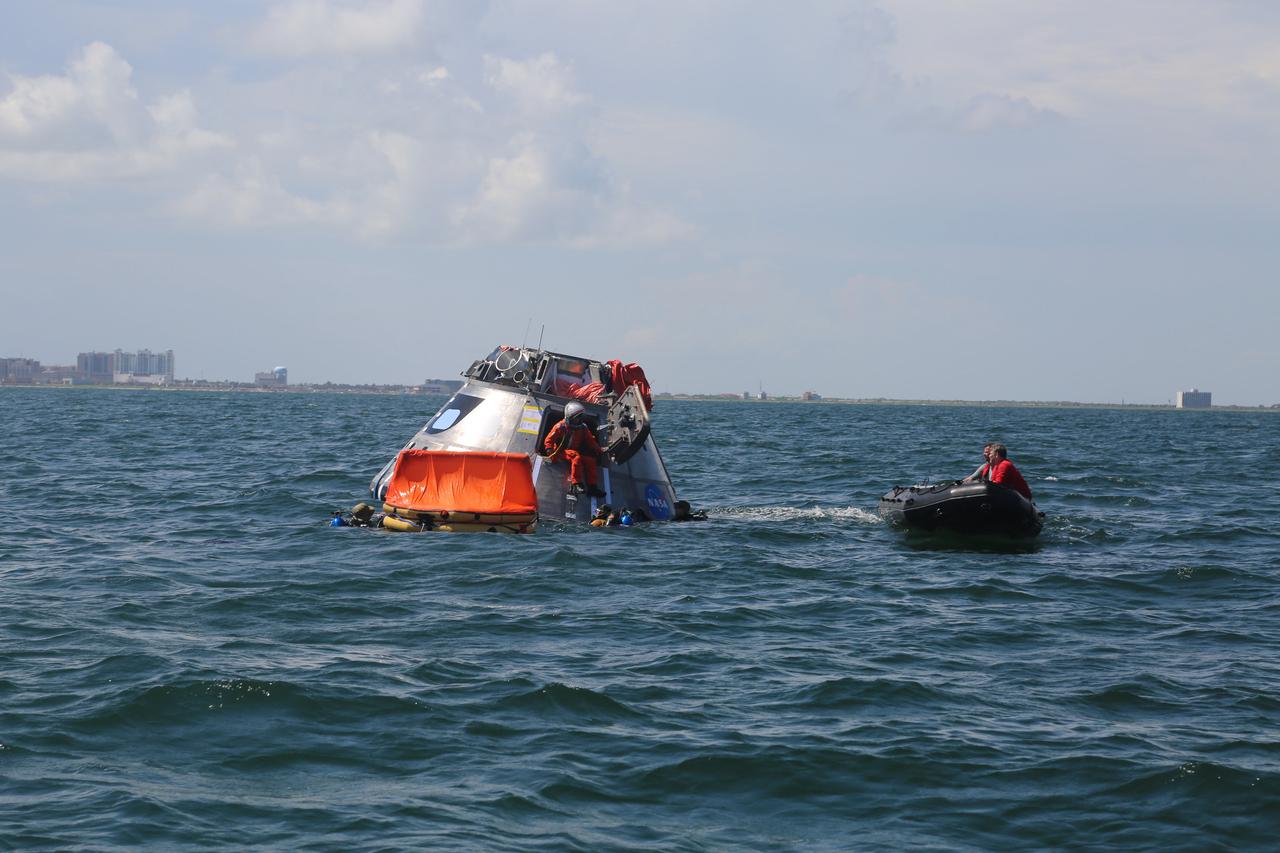
When astronauts return to Earth from destinations beyond the Moon in NASA’s Orion spacecraft and splashdown in the Pacific Ocean, they’ll still need to safely get out of the spacecraft and back on dry land. Using the waters off the coast of Galveston, Texas, a NASA and Department of Defense team test Orion exit procedures in a variety of scenarios on July 11, 2017. Part of Batch images transfer from Flickr.
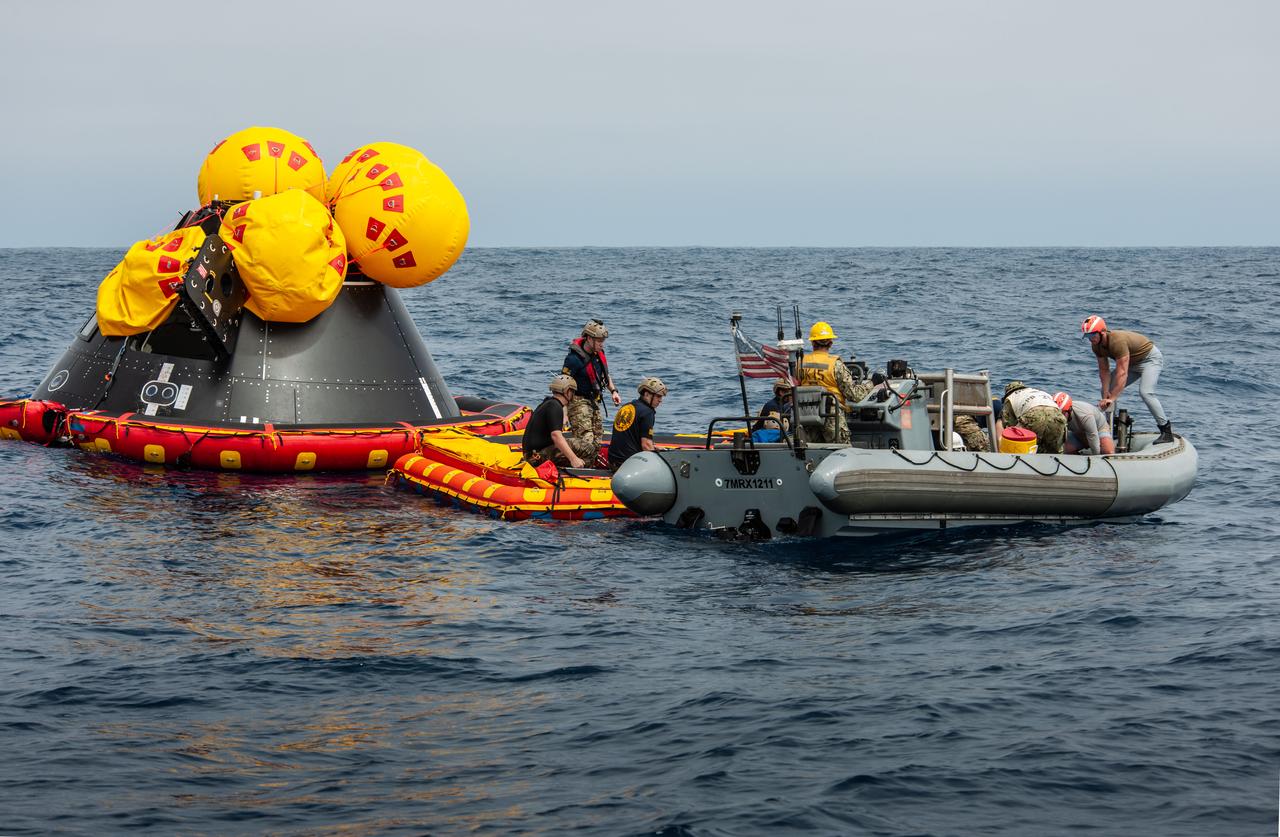
Navy divers from Explosive Ordnance Disposal (EOD) Expeditionary Support Unit 1 work to secure the Orion Crew Module Test Article (CMTA) in the Pacific Ocean as part of NASA’s Underway Recovery Test 10 (URT-10). The divers are trained in open water and small boat procedures and will be the team to help Artemis astronauts exit the Orion spacecraft and make it safely to the recovery ship after splashdown in addition to preparing the spacecraft to be transported back inside the recovery ship.
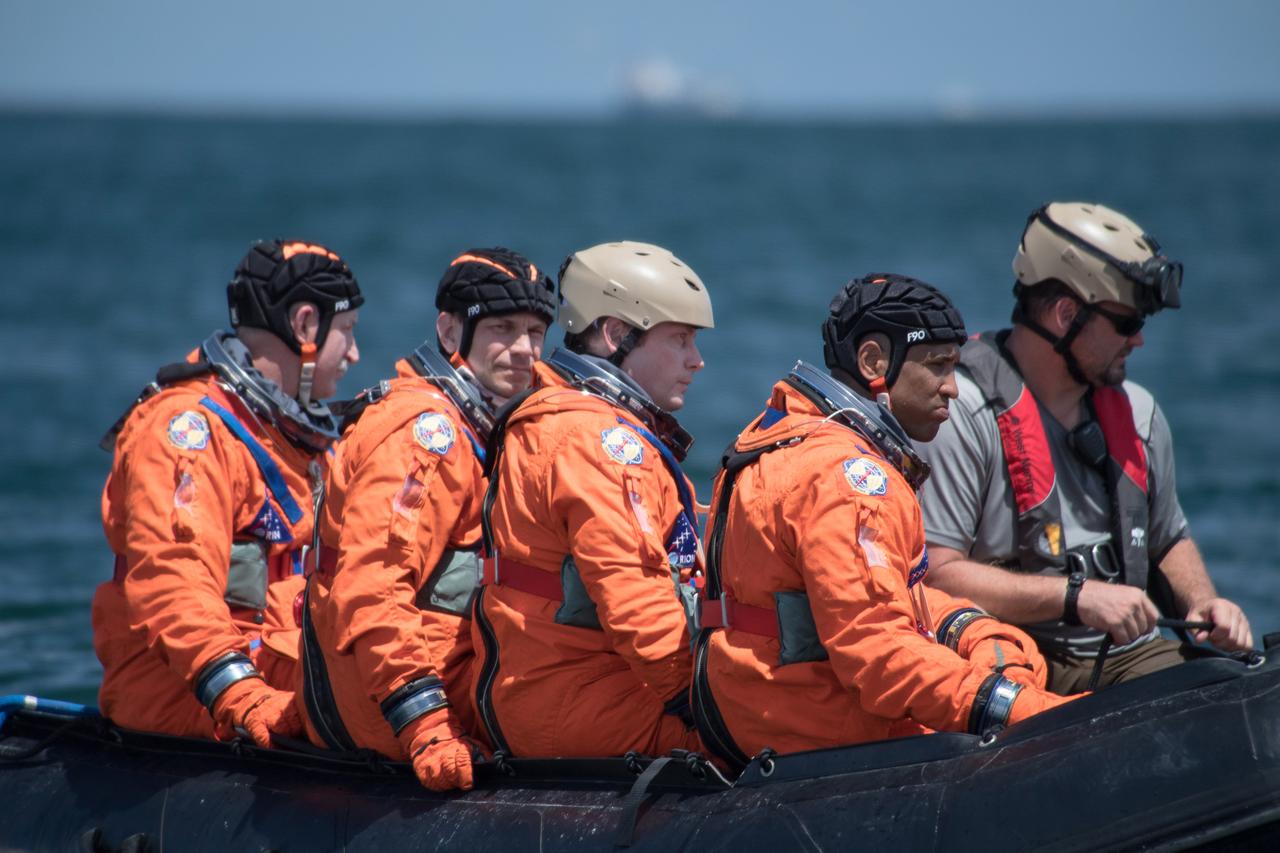
When astronauts return to Earth from destinations beyond the Moon in NASA’s Orion spacecraft and splashdown in the Pacific Ocean, they’ll still need to safely get out of the spacecraft and back on dry land. Using the waters off the coast of Galveston, Texas, a NASA and Department of Defense team test Orion exit procedures in a variety of scenarios on July 11, 2017. Part of Batch images transfer from Flickr.
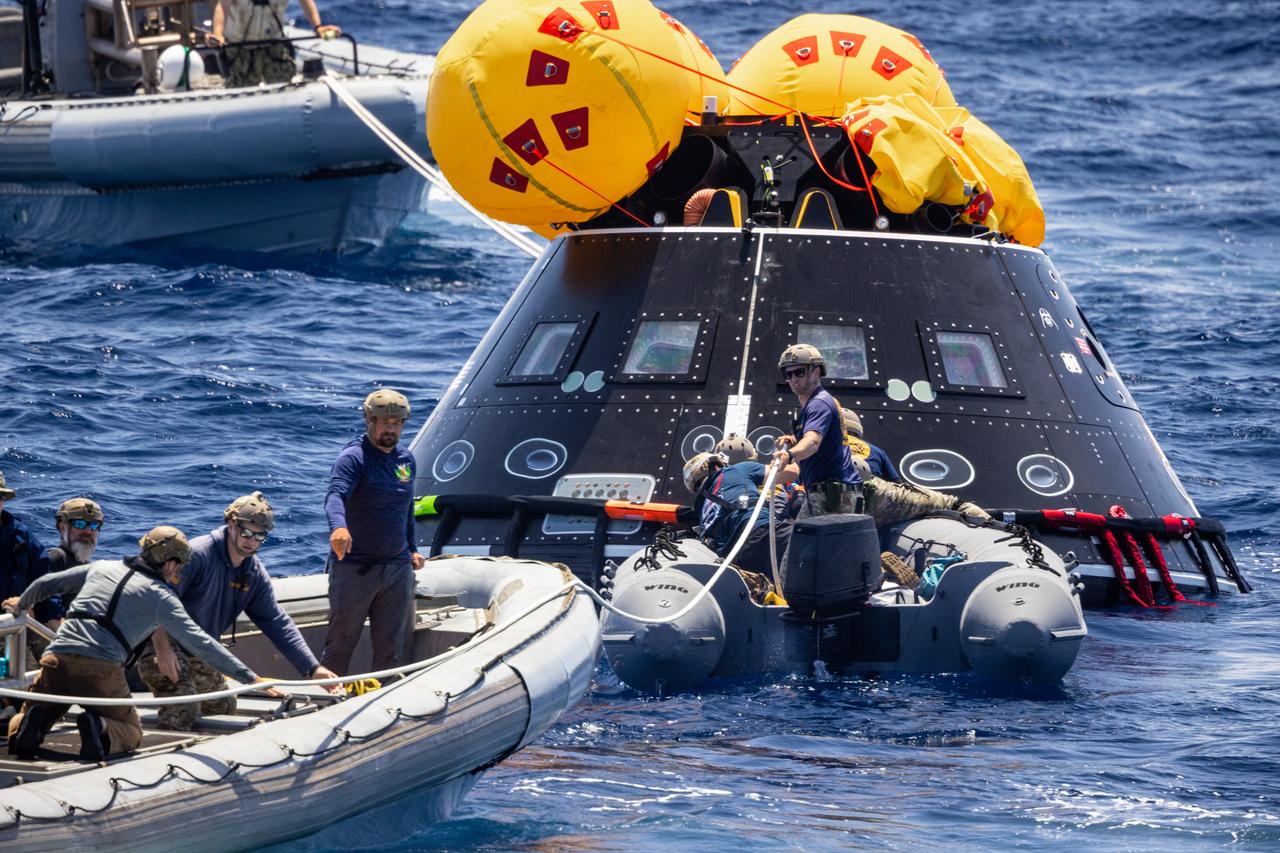
Navy divers from Explosive Ordnance Disposal (EOD) Expeditionary Support Unit 1 work to secure the Orion Crew Module Test Article (CMTA) in the Pacific Ocean as part of NASA’s Underway Recovery Test 10 (URT-10). The divers are trained in open water and small boat procedures and will be the team to help Artemis astronauts exit the Orion spacecraft and make it safely to the recovery ship after splashdown in addition to preparing the spacecraft to be transported back inside the recovery ship.
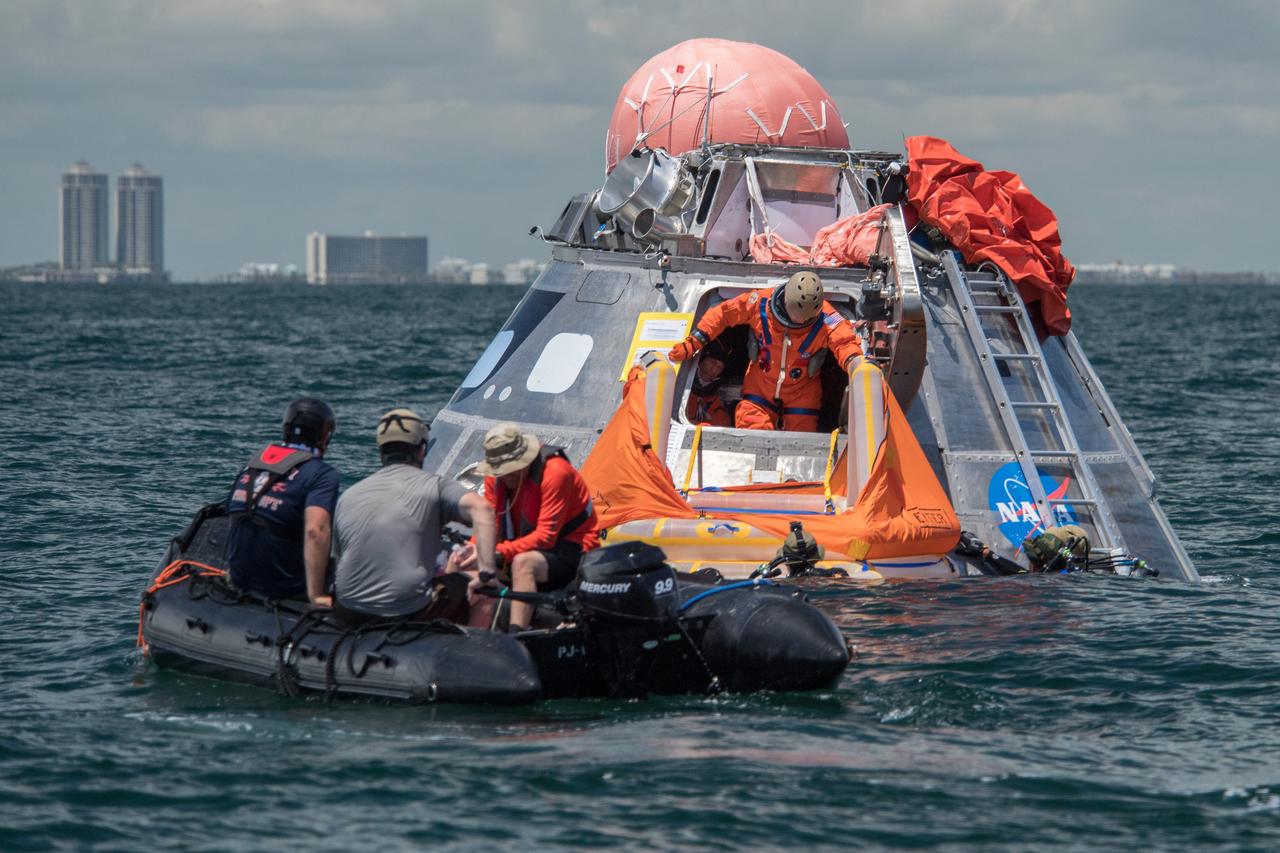
When astronauts return to Earth from destinations beyond the Moon in NASA’s Orion spacecraft and splashdown in the Pacific Ocean, they’ll still need to safely get out of the spacecraft and back on dry land. Using the waters off the coast of Galveston, Texas, a NASA and Department of Defense team test Orion exit procedures in a variety of scenarios on July 11, 2017. Part of Batch images transfer from Flickr.
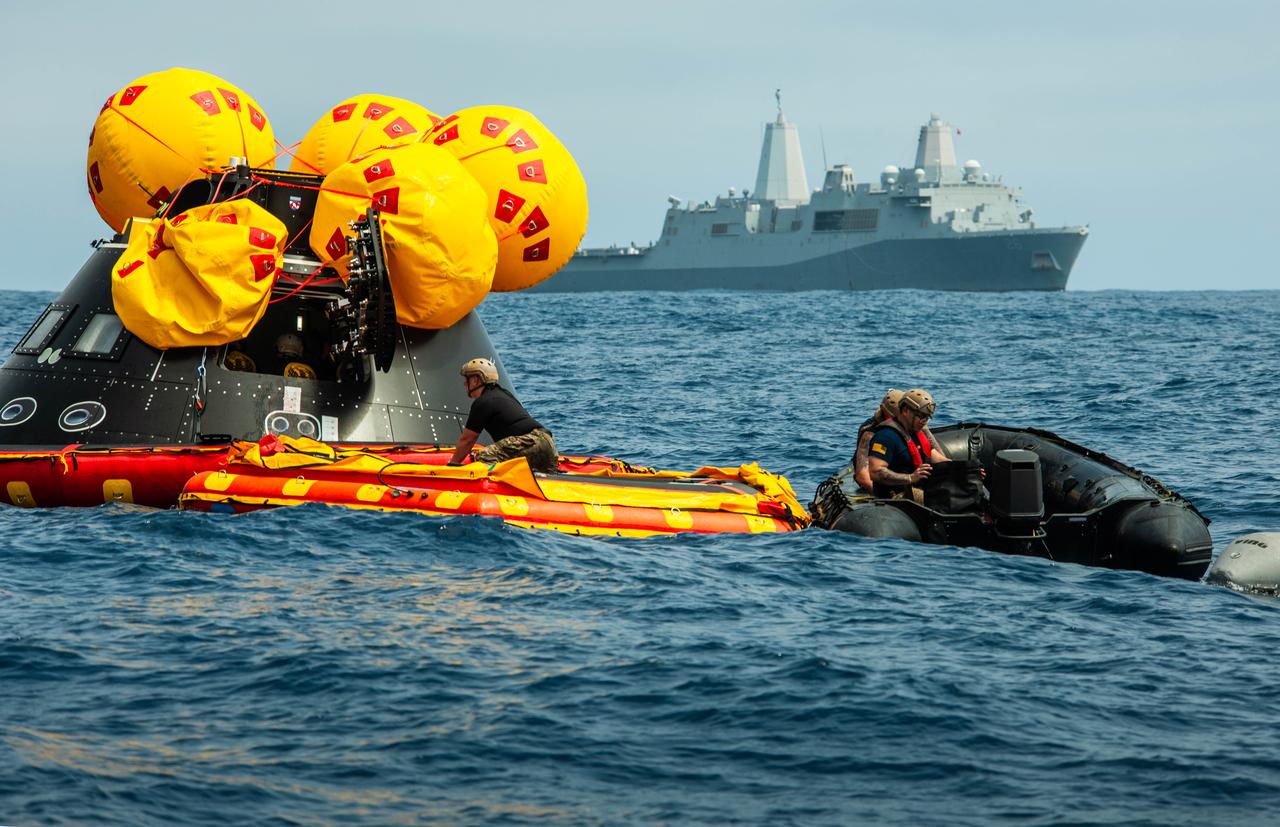
Navy divers from Explosive Ordnance Disposal (EOD) Expeditionary Support Unit 1 work to secure the Orion Crew Module Test Article (CMTA) in the Pacific Ocean as part of NASA’s Underway Recovery Test 10 (URT-10). The divers are trained in open water and small boat procedures and will be the team to help Artemis astronauts exit the Orion spacecraft and make it safely to the recovery ship after splashdown in addition to preparing the spacecraft to be transported back inside the recovery ship.
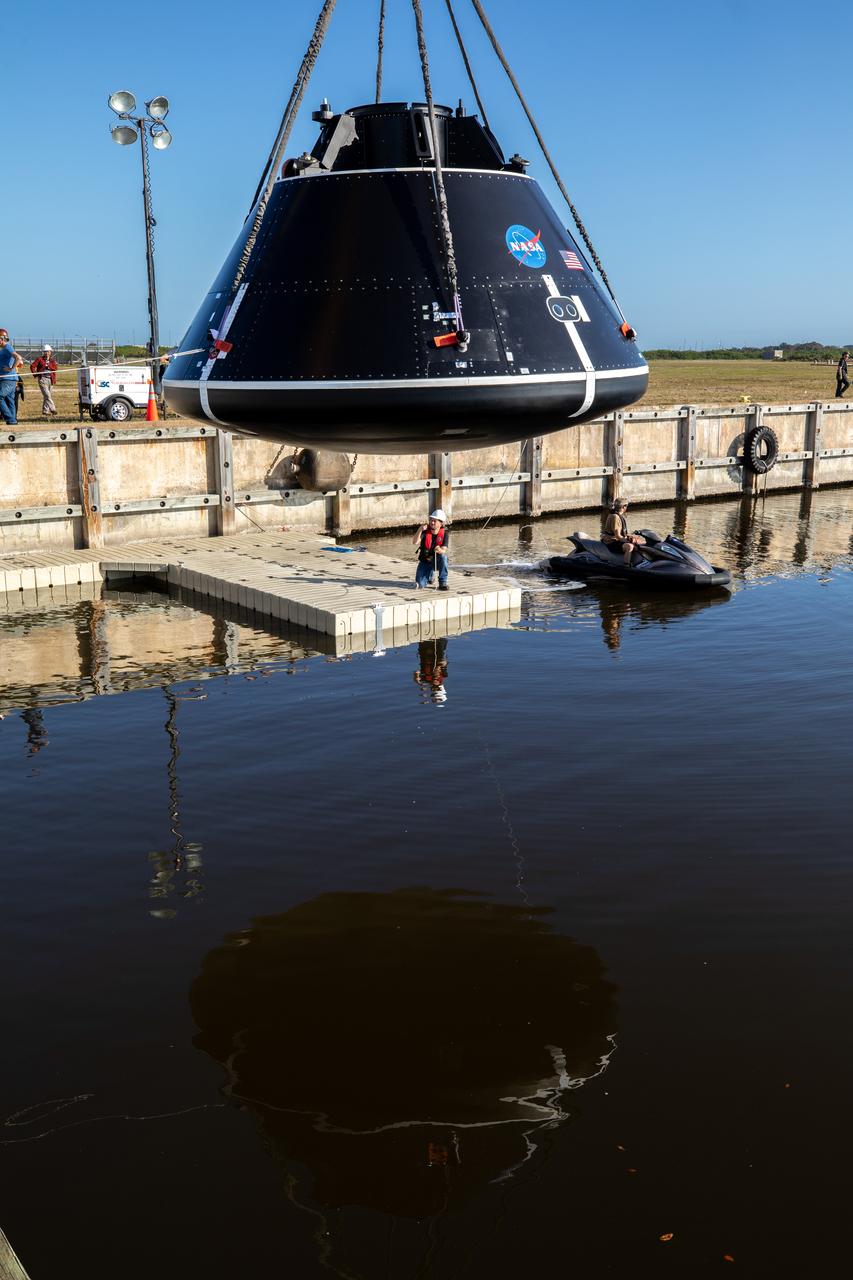
A crane is used to hold the Crew Module Test Article (CMTA) above the water at the turn basin in the Launch Complex 39 area at NASA’s Kennedy Space Center in Florida on Jan. 30, 2023. The CMTA is being used to practice recovery after splashdown of the Orion spacecraft to prepare for the Artemis II crewed mission. Exploration Ground Systems leads recovery efforts.
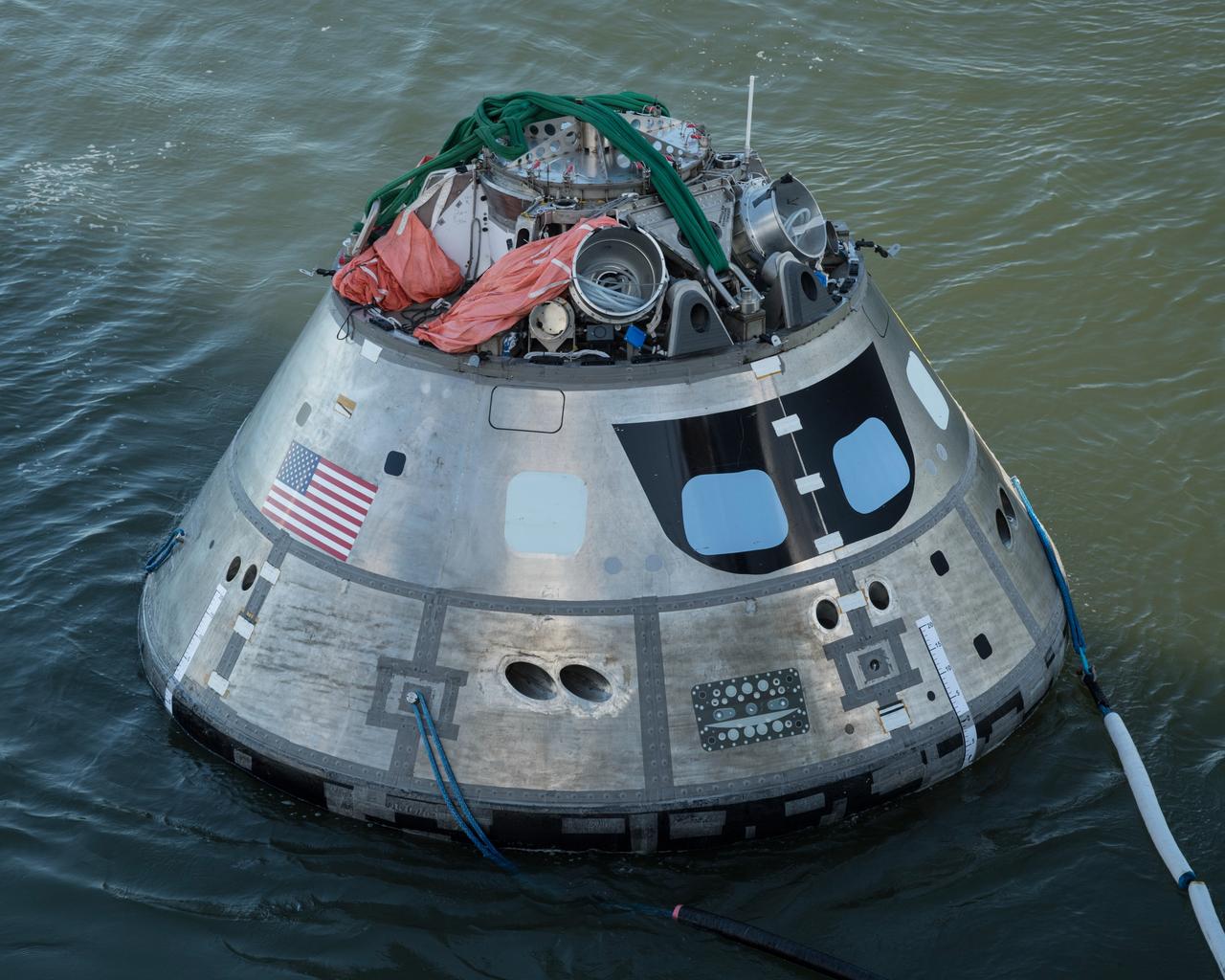
When astronauts return to Earth from destinations beyond the Moon in NASA’s Orion spacecraft and splashdown in the Pacific Ocean, they’ll still need to safely get out of the spacecraft and back on dry land. Using the waters off the coast of Galveston, Texas, a NASA and Department of Defense team test Orion exit procedures in a variety of scenarios on July 11, 2017. Part of Batch images transfer from Flickr.
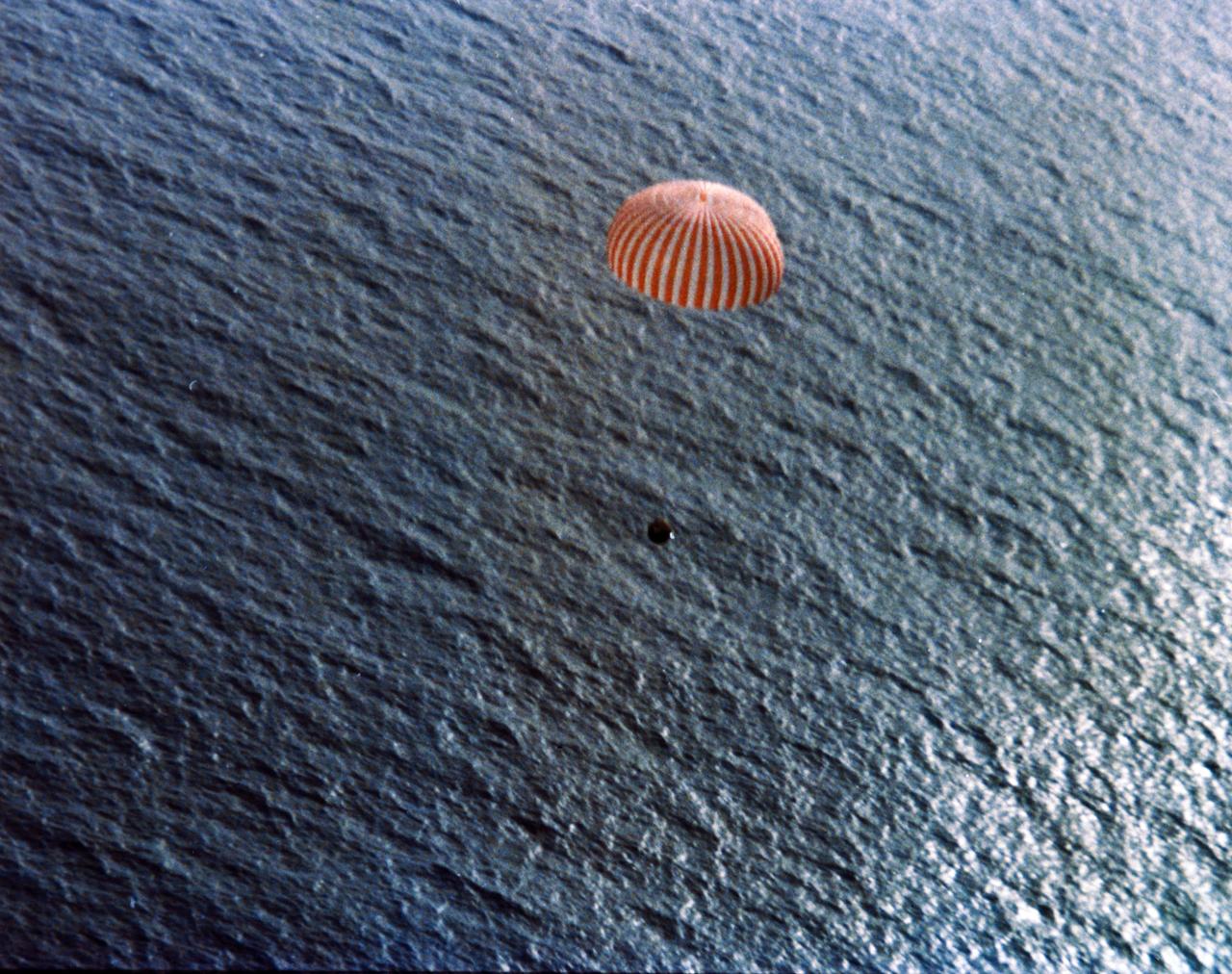
S66-15802 (18 Dec. 1965) --- A camera on a recovery helicopter captured this scene as the Gemini-7 spacecraft slowly descends to the surface of the Atlantic Ocean to conclude a record-breaking 14-day mission in space. Aboard the spacecraft were astronauts Frank Borman, command pilot, and James A. Lovell Jr., pilot. Splashdown was at 9:05 a.m. (EST), Dec. 18, 1965. The two astronauts were hoisted from the water by a helicopter crew and flown to the aircraft carrier. Photo credit: NASA
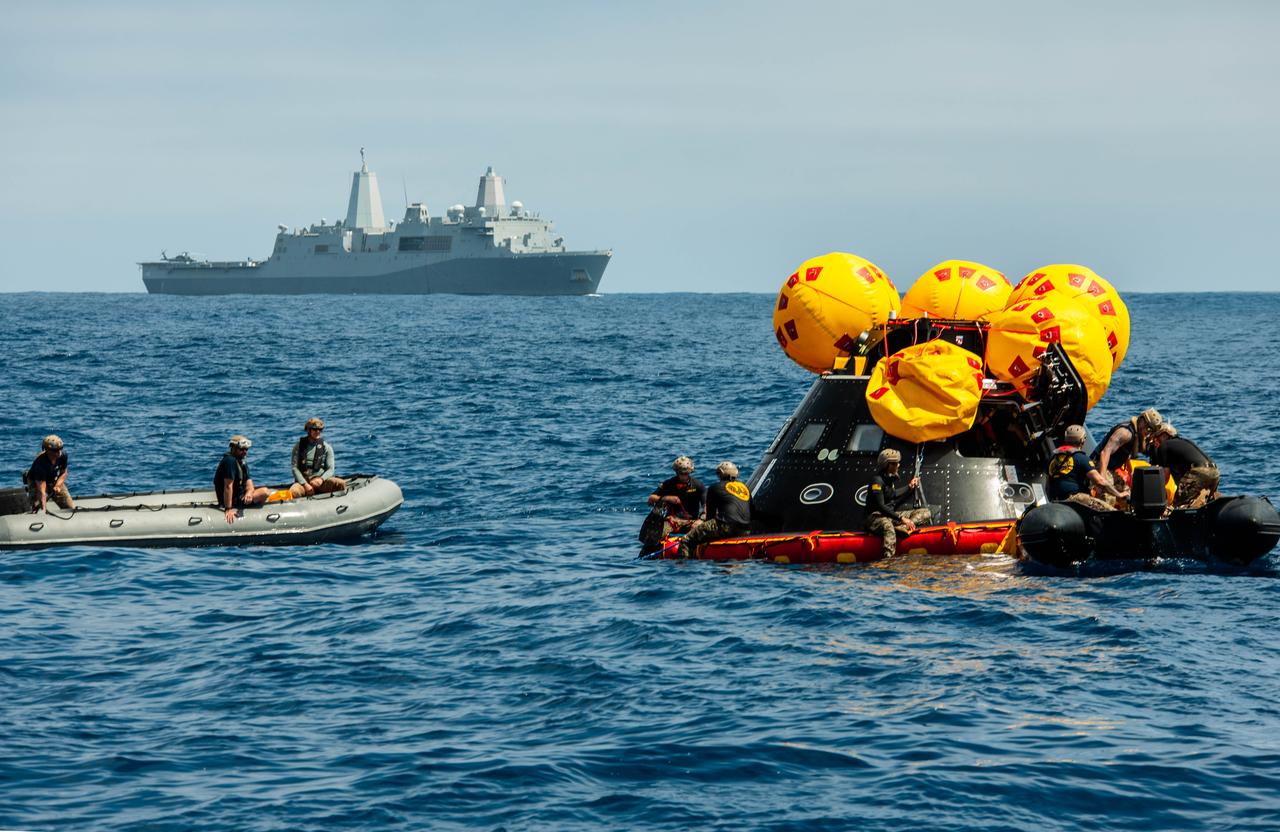
Navy divers from Explosive Ordnance Disposal (EOD) Expeditionary Support Unit 1 work to secure the Orion Crew Module Test Article (CMTA) in the Pacific Ocean as part of NASA’s Underway Recovery Test 10 (URT-10). The divers are trained in open water and small boat procedures and will be the team to help Artemis astronauts exit the Orion spacecraft and make it safely to the recovery ship after splashdown in addition to preparing the spacecraft to be transported back inside the recovery ship.
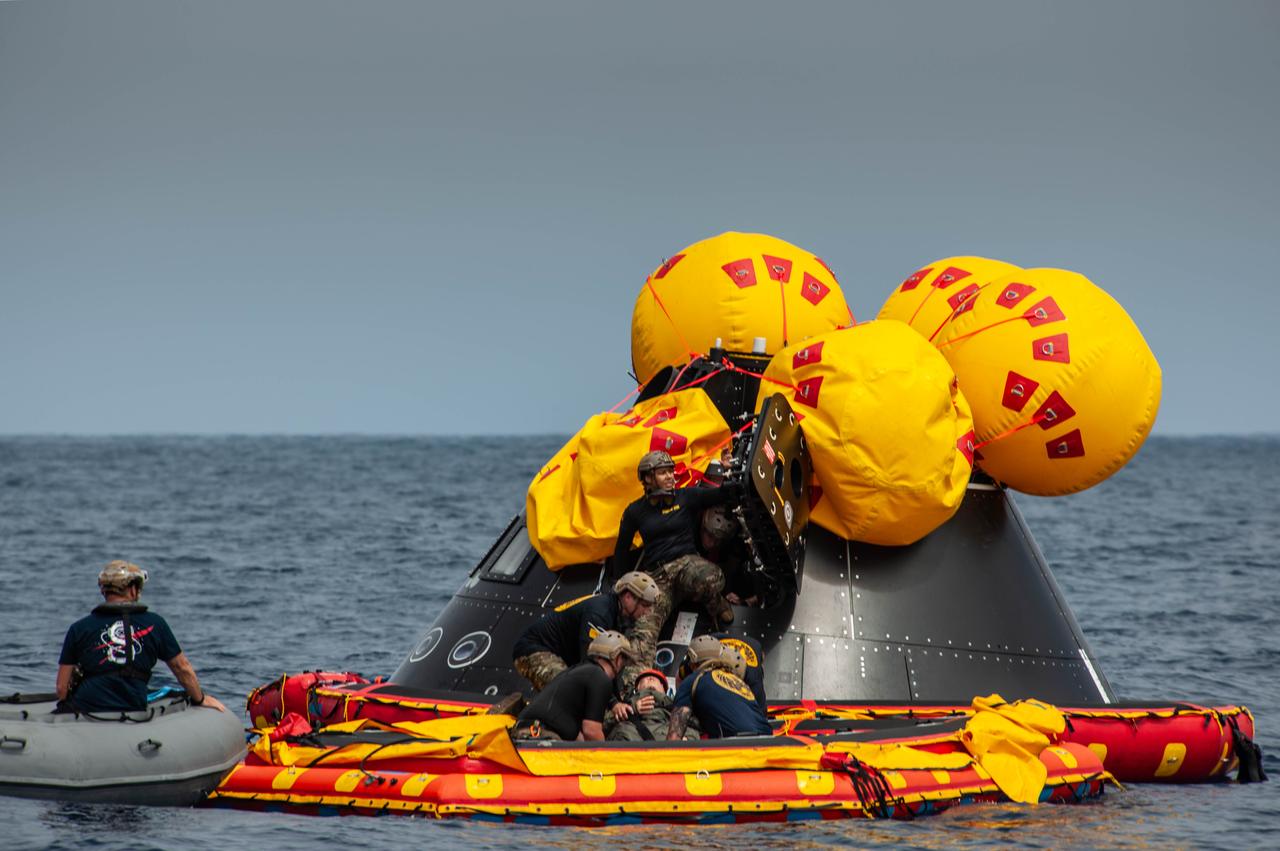
Navy divers from Explosive Ordnance Disposal (EOD) Expeditionary Support Unit 1 practice contingency recovery procedures with a manikin and the Orion Crew Module Test Article (CMTA) in the Pacific Ocean as part of NASA’s Underway Recovery Test 10 (URT-10). The divers are trained in open water and small boat procedures and will be the team to help Artemis astronauts exit the Orion spacecraft and make it safely to the recovery ship after splashdown in addition to preparing the spacecraft to be transported back inside the recovery ship.
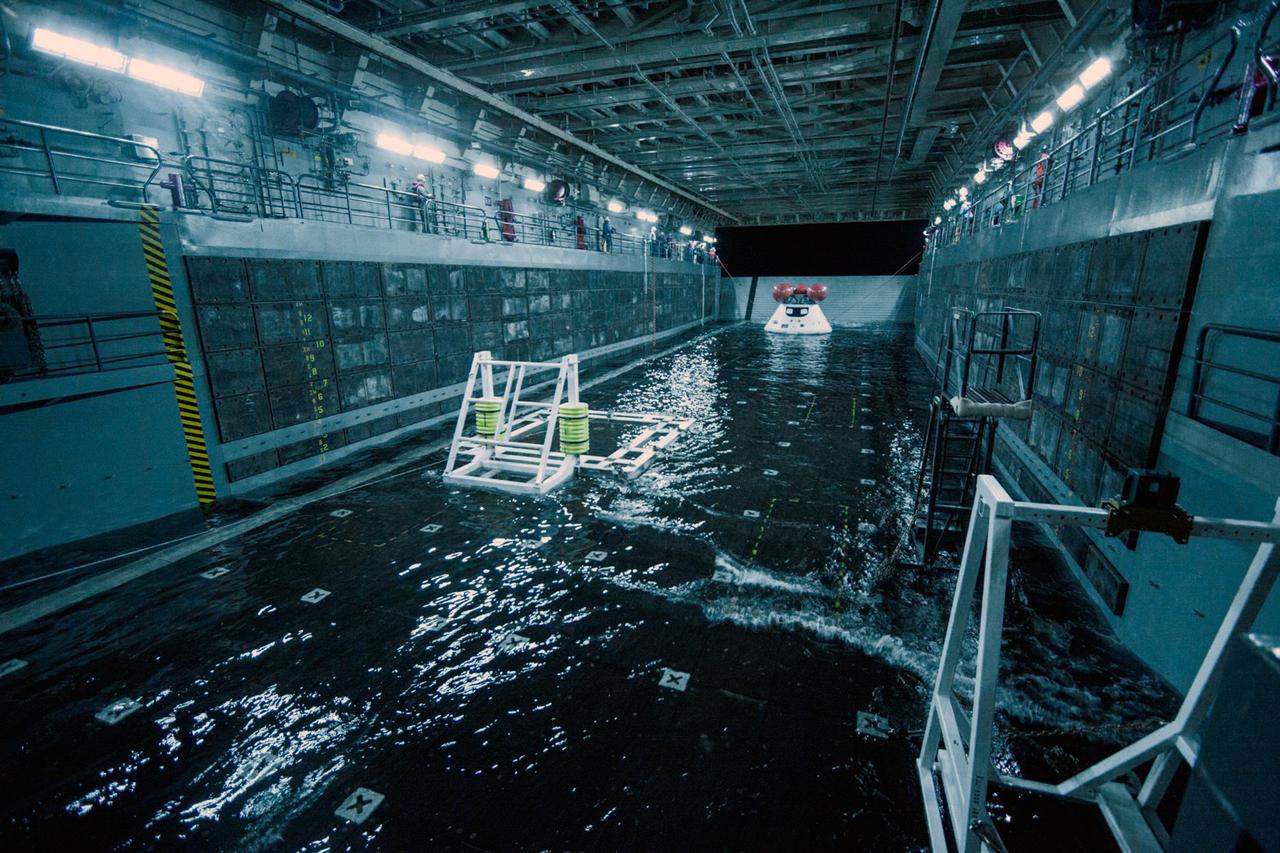
A test version of the Orion spacecraft is tethered inside the well deck of the USS San Diego on Feb. 18, 2014, prior to tests that will allow NASA and the Navy to practice the procedures they'll use to recover Orion from the Pacific Ocean on Exploration Flight Test-1 (EFT-1). To safely bring Orion home after splashdown, it will be towed into the flooded well deck and secured in a specially-designed cradle before the water is drained. Part of Batch image transfer from Flickr.
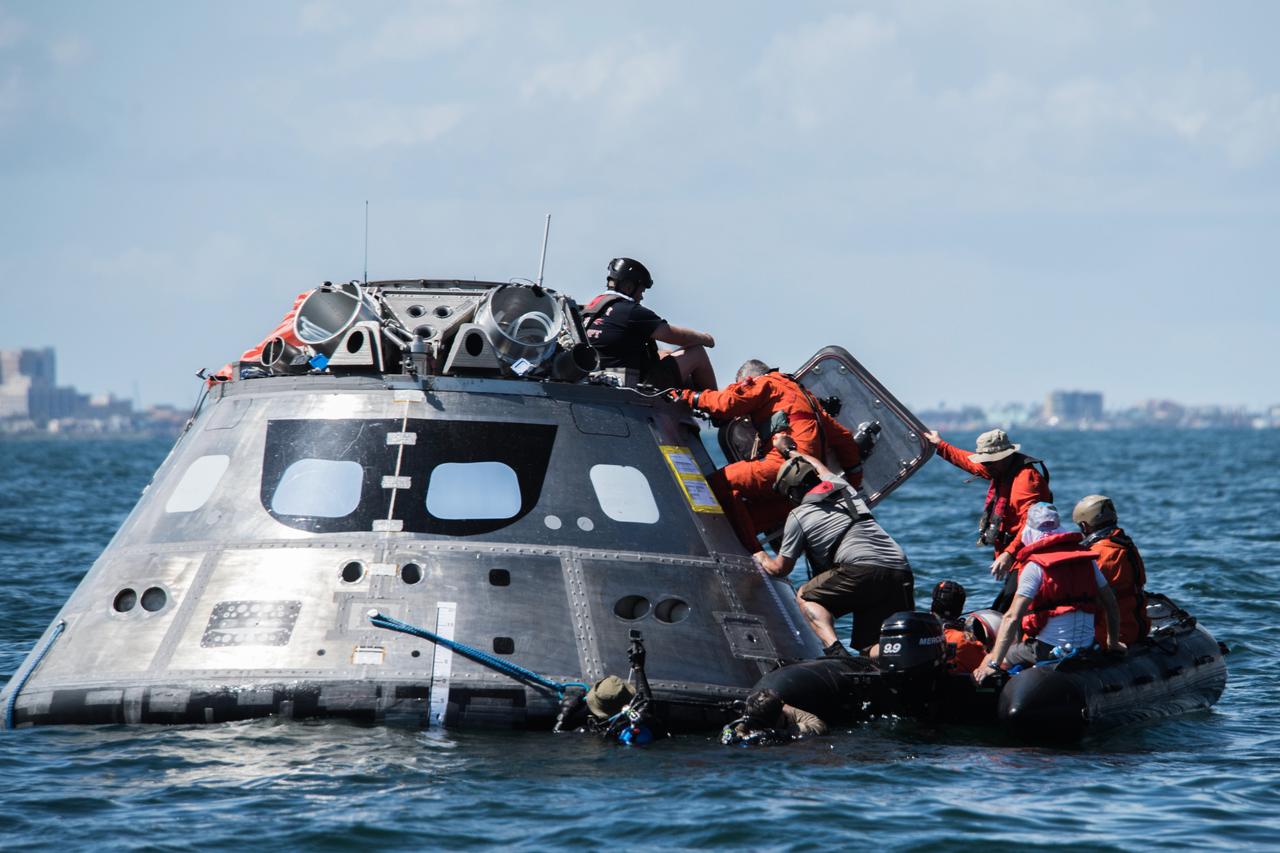
When astronauts return to Earth from destinations beyond the Moon in NASA’s Orion spacecraft and splashdown in the Pacific Ocean, they’ll still need to safely get out of the spacecraft and back on dry land. Using the waters off the coast of Galveston, Texas, a NASA and Department of Defense team test Orion exit procedures in a variety of scenarios on July 11, 2017. Part of Batch images transfer from Flickr.
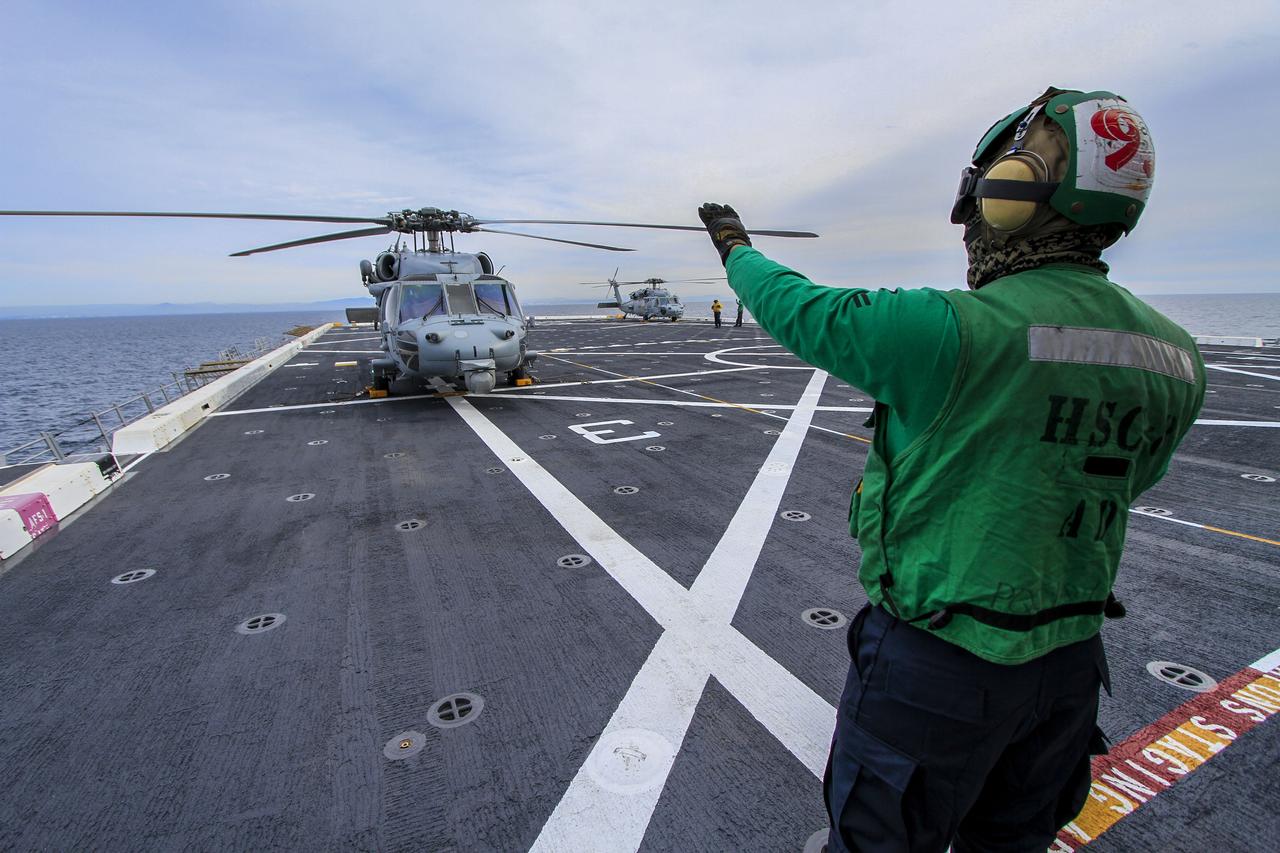
A member of the Helicopter Sea Combat Squadron 8 signals to the pilot in an H60-S Seahawk helicopter on the deck of the USS Anchorage as the ship departs Naval Base San Diego in California for the open waters of the Pacific Ocean. NASA and the U.S. Navy are making preparations ahead of Orion's flight test for recovery of the crew module, forward bay cover and parachutes on its return from space and splashdown in the Pacific Ocean. The Ground Systems Development and Operations Program is leading the recovery efforts.
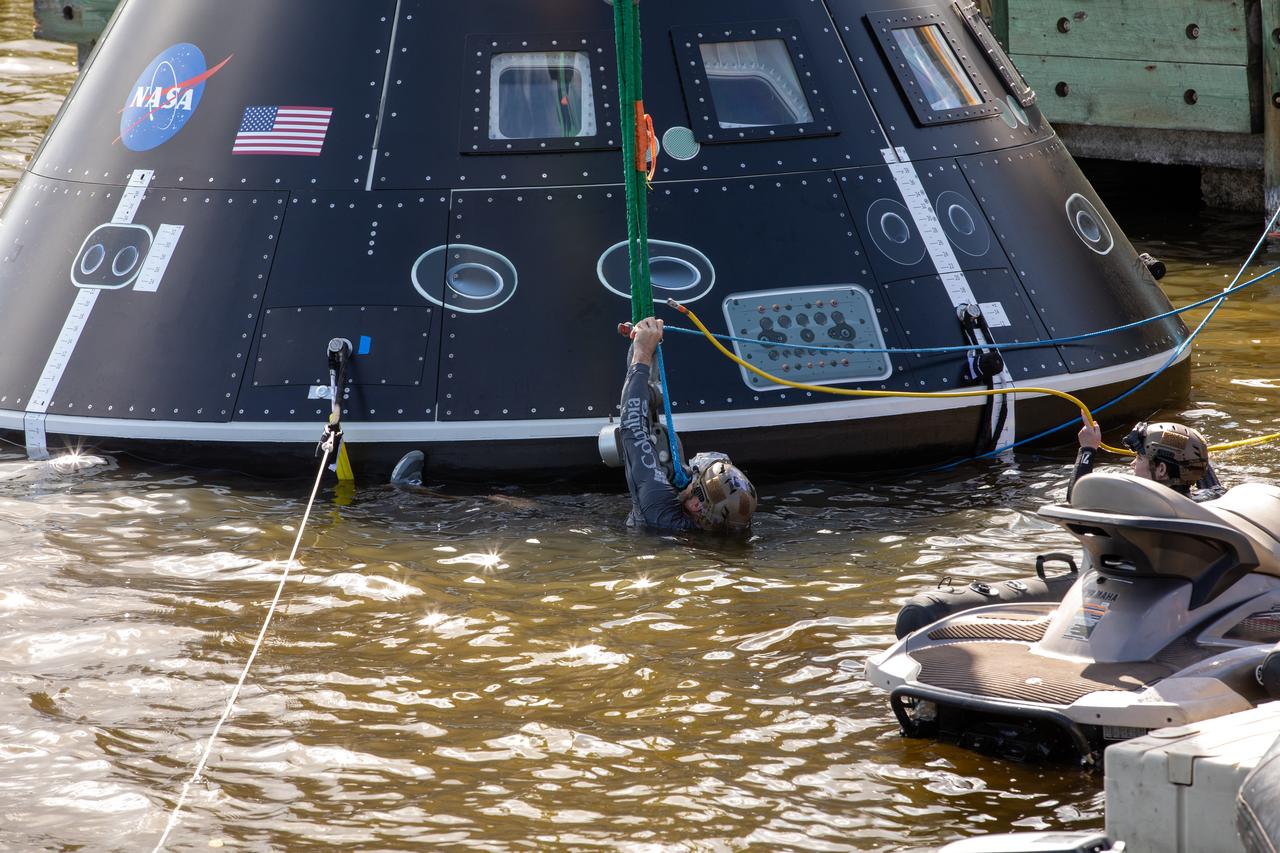
Landing and recovery team members secure the Crew Module Test Article (CMTA) in the water at the turn basin in the Launch Complex 39 area at NASA’s Kennedy Space Center in Florida on Jan. 30, 2023. The CMTA is being used to practice recovery after splashdown of the Orion spacecraft to prepare for the Artemis II crewed mission. Exploration Ground Systems leads recovery efforts.
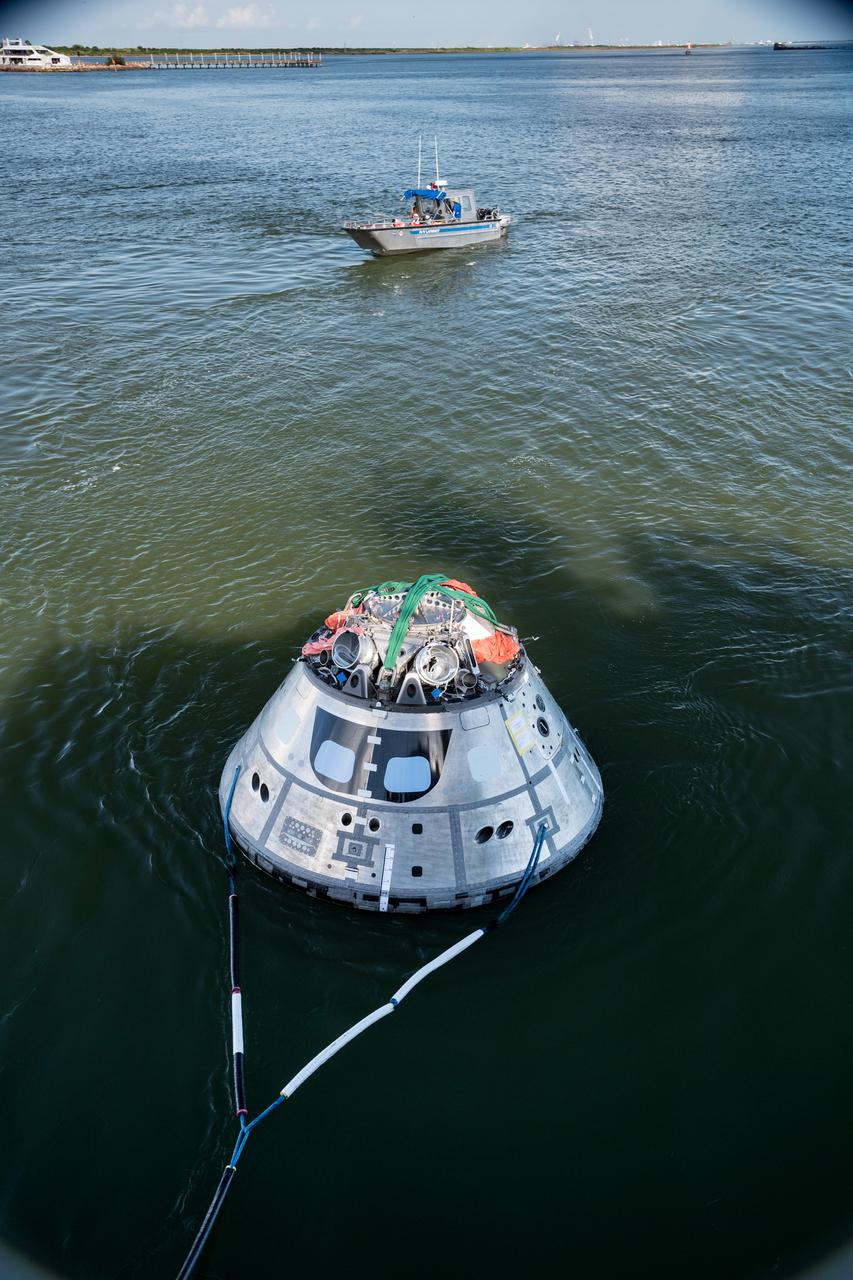
When astronauts return to Earth from destinations beyond the Moon in NASA’s Orion spacecraft and splashdown in the Pacific Ocean, they’ll still need to safely get out of the spacecraft and back on dry land. Using the waters off the coast of Galveston, Texas, a NASA and Department of Defense team test Orion exit procedures in a variety of scenarios on July 11, 2017. Part of Batch images transfer from Flickr.
Navy divers from Explosive Ordnance Disposal (EOD) Expeditionary Support Unit 1 work to secure the Orion Crew Module Test Article (CMTA) in the Pacific Ocean as part of NASA’s Underway Recovery Test 10 (URT-10). The divers are trained in open water and small boat procedures and will be the team to help Artemis astronauts exit the Orion spacecraft and make it safely to the recovery ship after splashdown in addition to preparing the spacecraft to be transported back inside the recovery ship.
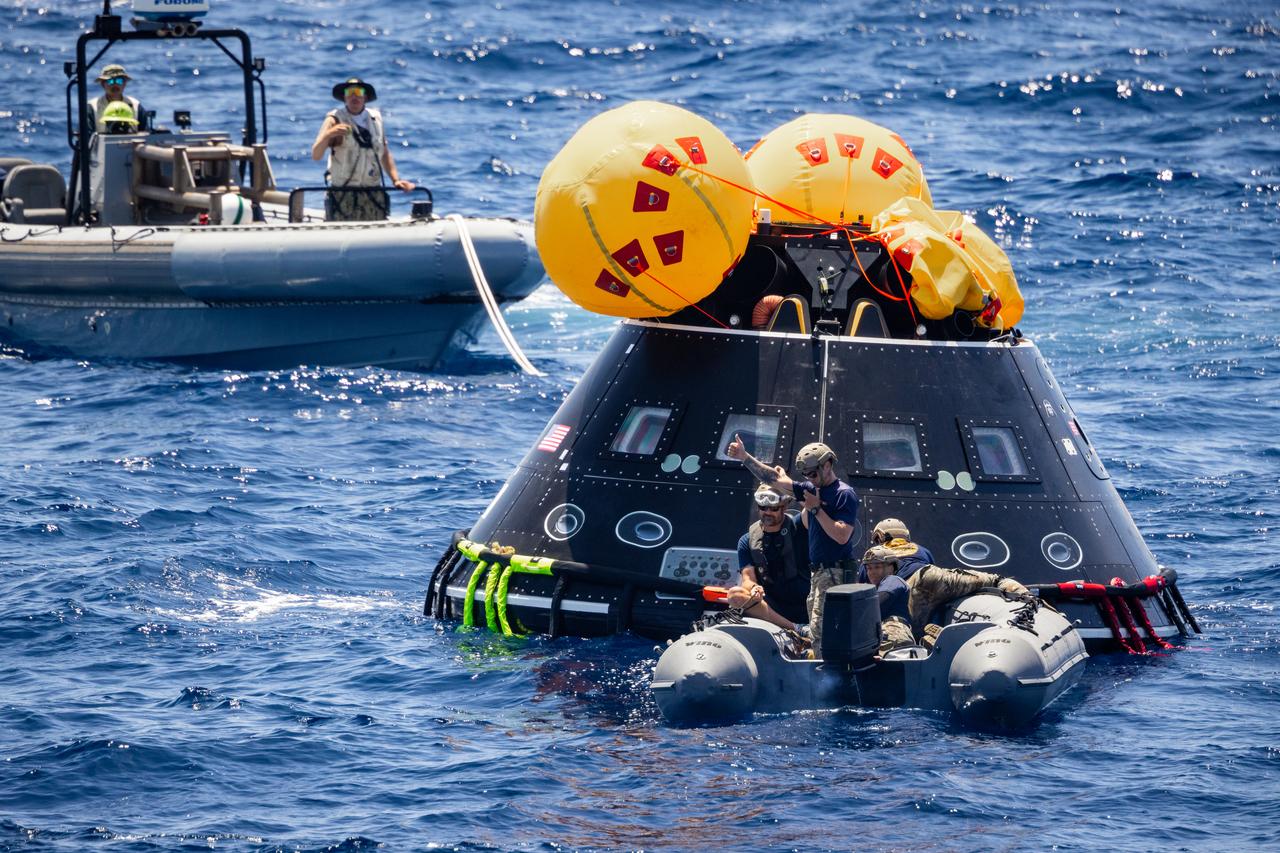
Navy divers from Explosive Ordnance Disposal (EOD) Expeditionary Support Unit 1 work to secure the Orion Crew Module Test Article (CMTA) in the Pacific Ocean as part of NASA’s Underway Recovery Test 10 (URT-10). The divers are trained in open water and small boat procedures and will be the team to help Artemis astronauts exit the Orion spacecraft and make it safely to the recovery ship after splashdown in addition to preparing the spacecraft to be transported back inside the recovery ship.
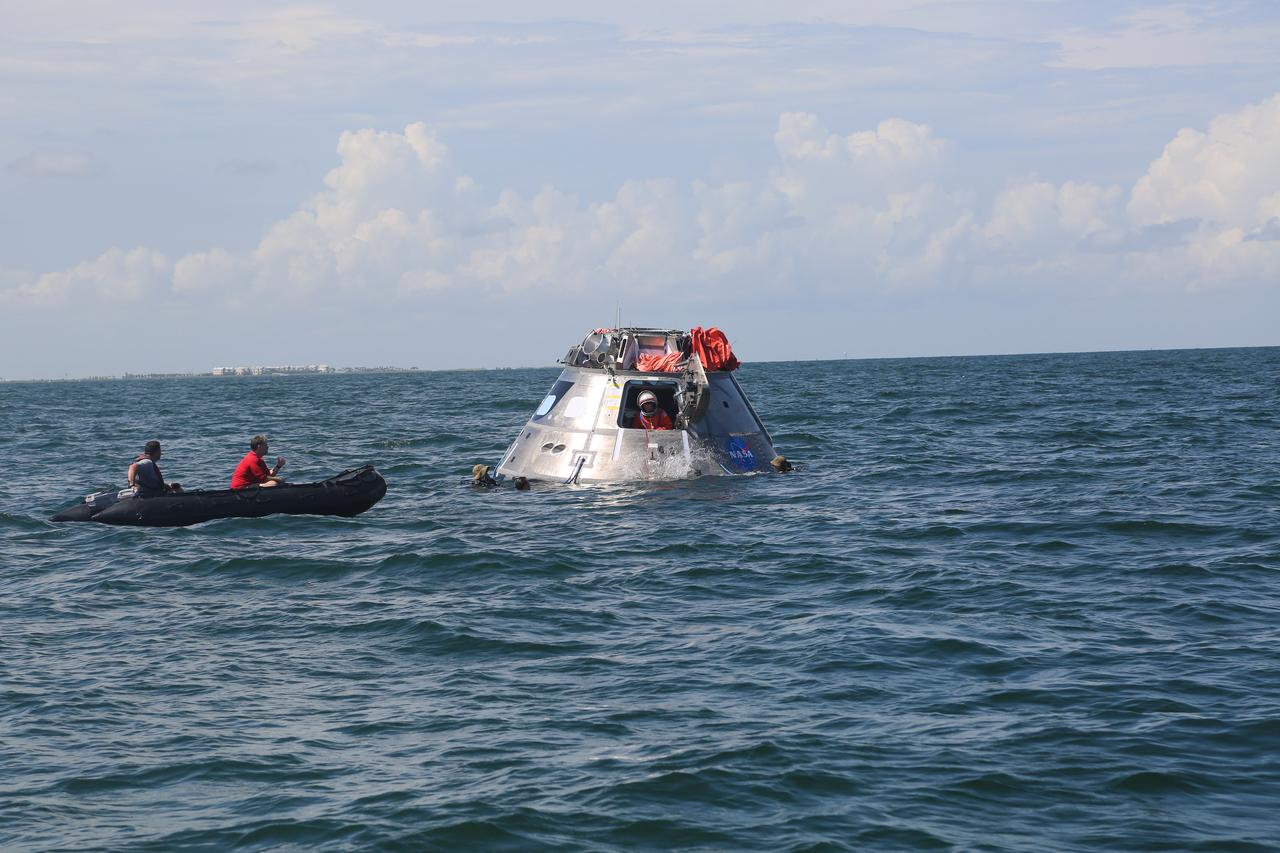
When astronauts return to Earth from destinations beyond the Moon in NASA’s Orion spacecraft and splashdown in the Pacific Ocean, they’ll still need to safely get out of the spacecraft and back on dry land. Using the waters off the coast of Galveston, Texas, a NASA and Department of Defense team test Orion exit procedures in a variety of scenarios on July 11, 2017. Part of Batch images transfer from Flickr.
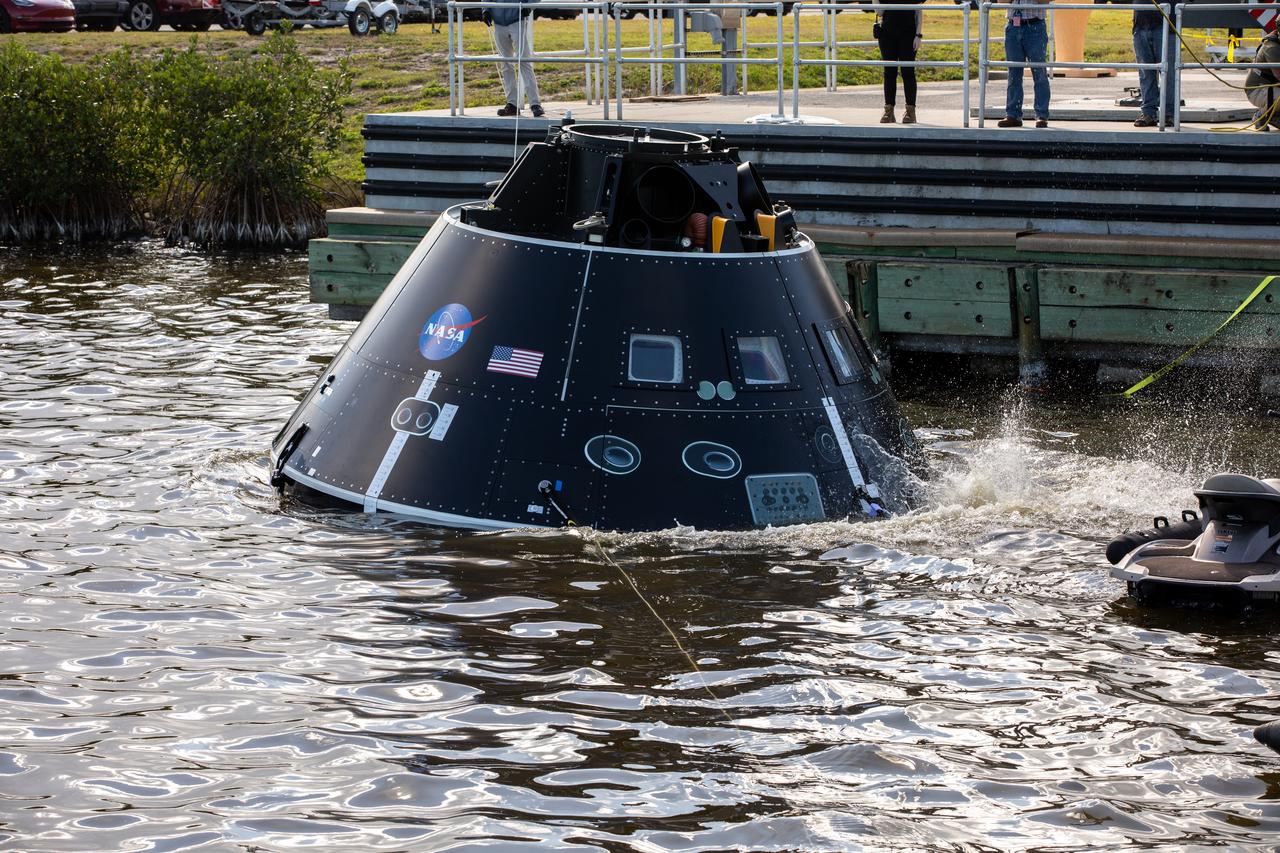
The Crew Module Test Article (CMTA) floats in the water in the turn basin in the Launch Complex 39 area at NASA’s Kennedy Space Center in Florida on Jan. 30, 2023. The CMTA is being used to practice recovery after splashdown of the Orion spacecraft to prepare for the Artemis II crewed mission. Exploration Ground Systems leads recovery efforts.
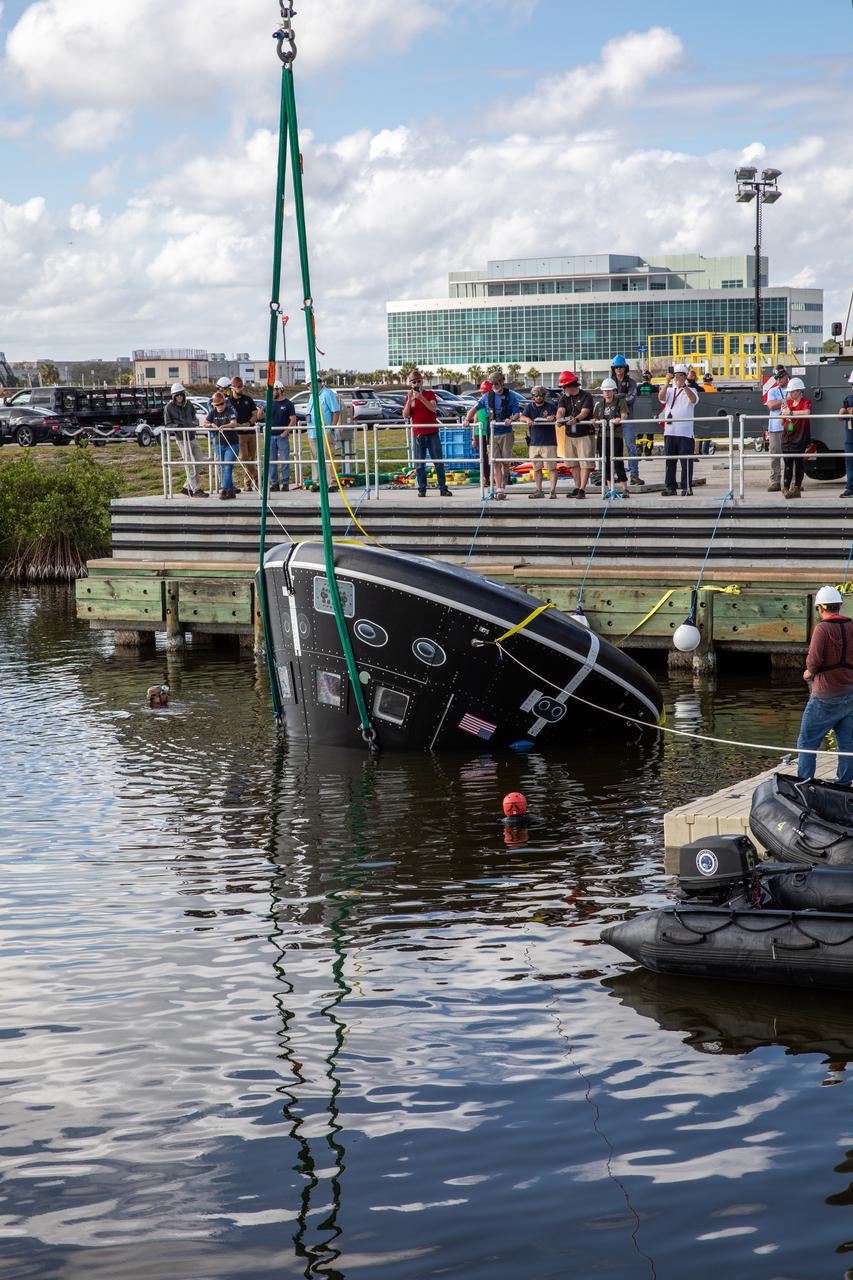
A crane is used to turn the Crew Module Test Article (CMTA) upside down in the water at the turn basin in the Launch Complex 39 area at NASA’s Kennedy Space Center in Florida on Jan. 31, 2023. The CMTA is being certified for use to practice recovery after splashdown of the Orion spacecraft to prepare for the Artemis II crewed mission. Exploration Ground Systems leads recovery efforts.
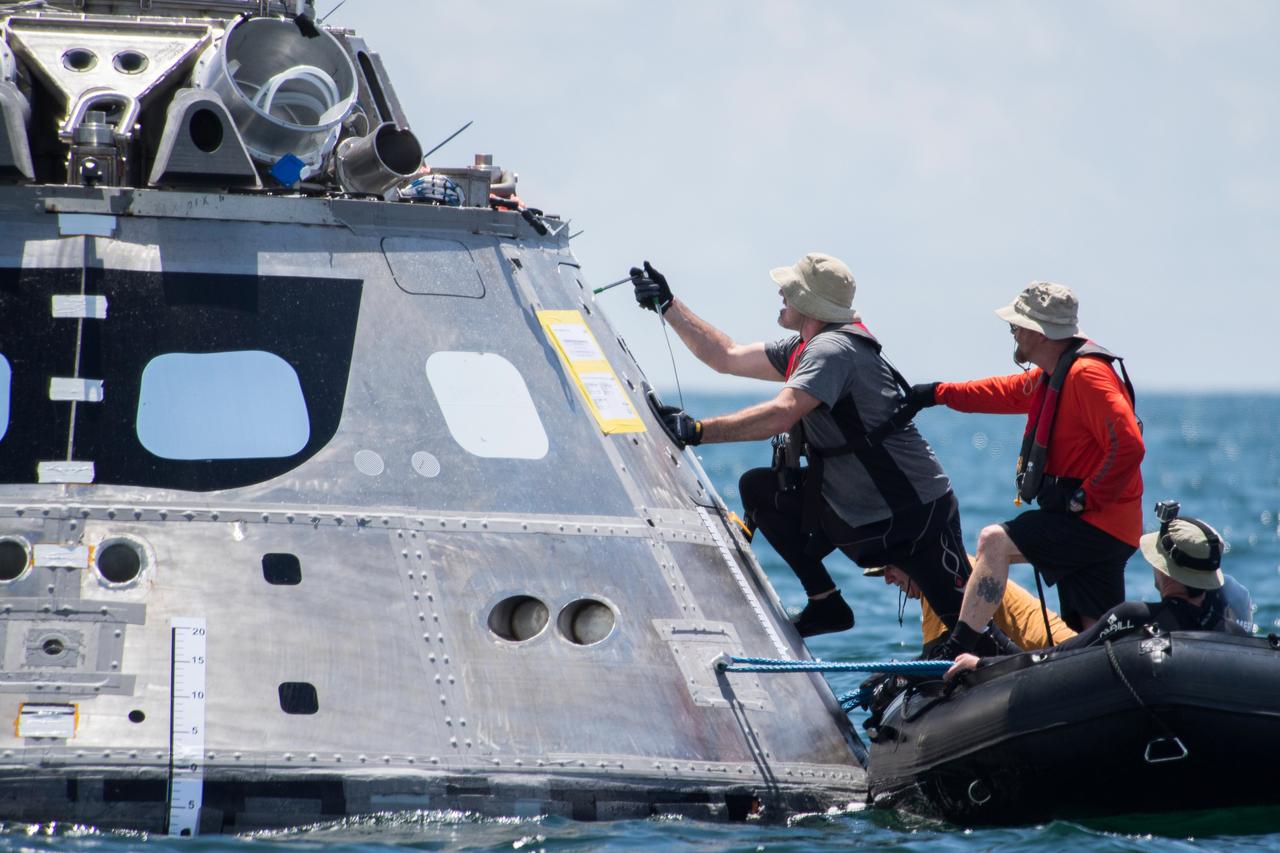
When astronauts return to Earth from destinations beyond the Moon in NASA’s Orion spacecraft and splashdown in the Pacific Ocean, they’ll still need to safely get out of the spacecraft and back on dry land. Using the waters off the coast of Galveston, Texas, a NASA and Department of Defense team test Orion exit procedures in a variety of scenarios on July 11, 2017. Part of Batch images transfer from Flickr.
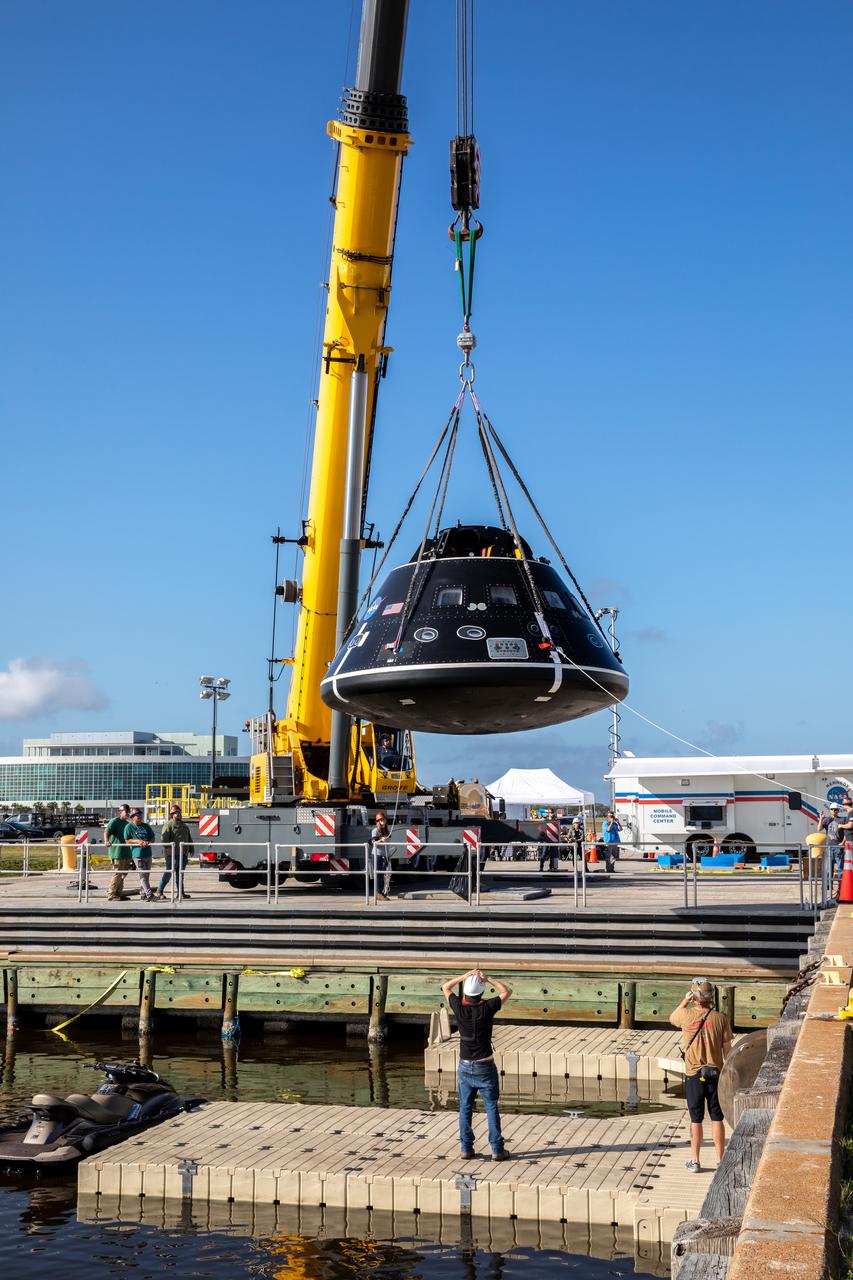
A crane is used to move the Crew Module Test Article (CMTA) above the water at the turn basin in the Launch Complex 39 area at NASA’s Kennedy Space Center in Florida on Jan. 30, 2023. The CMTA is being used to practice recovery after splashdown of the Orion spacecraft to prepare for the Artemis II crewed mission. Exploration Ground Systems leads recovery efforts.
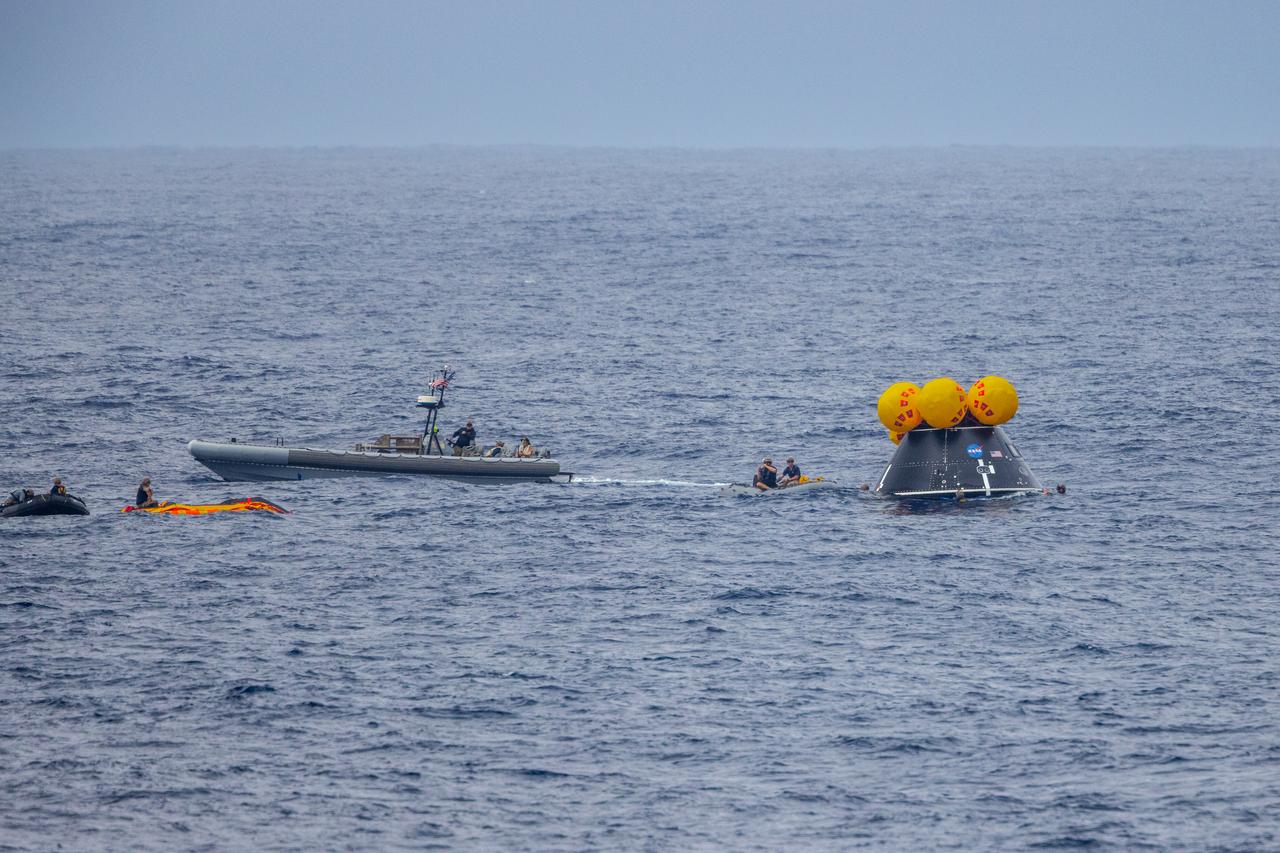
Navy divers from Explosive Ordnance Disposal (EOD) Expeditionary Support Unit 1 work to secure the Orion Crew Module Test Article (CMTA) in the Pacific Ocean as part of NASA’s Underway Recovery Test 10 (URT-10). The divers are trained in open water and small boat procedures and will be the team to help Artemis astronauts exit the Orion spacecraft and make it safely to the recovery ship after splashdown in addition to preparing the spacecraft to be transported back inside the recovery ship.
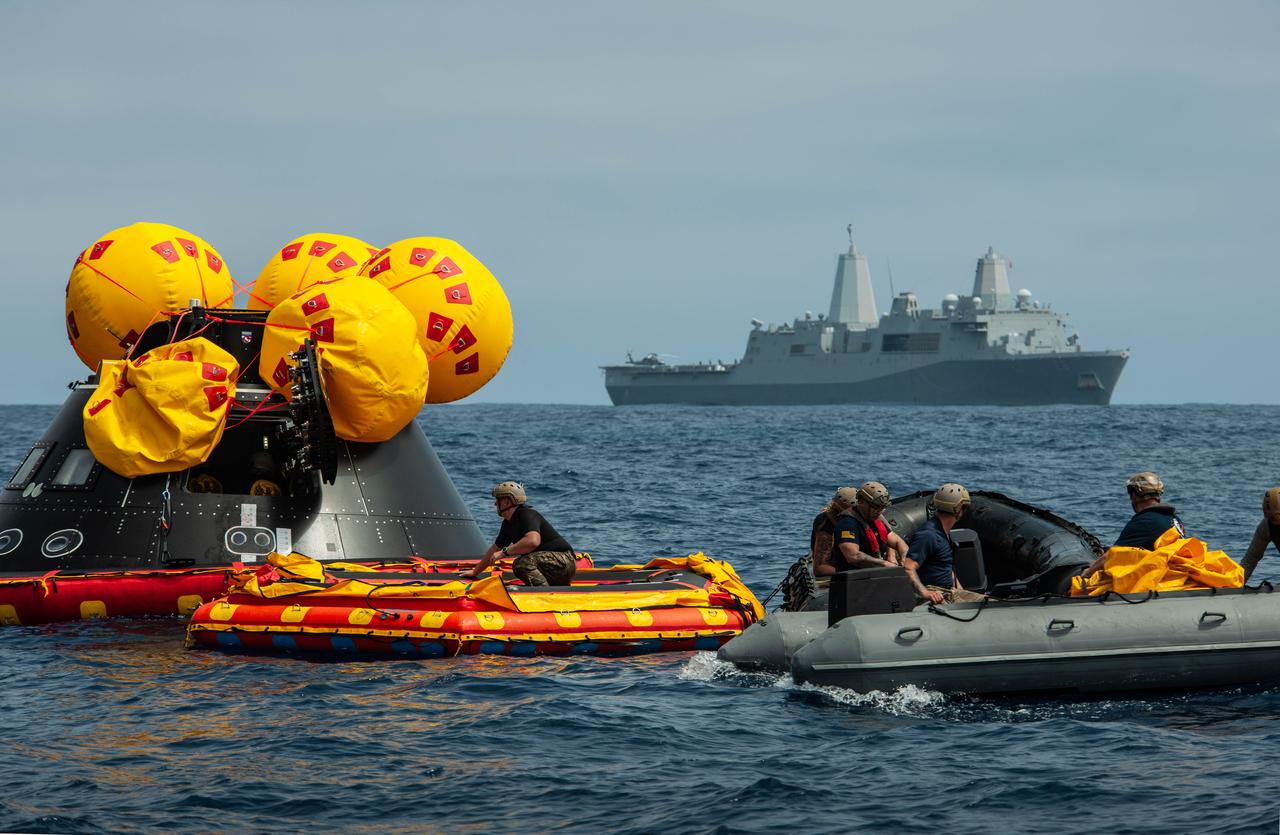
Navy divers from Explosive Ordnance Disposal (EOD) Expeditionary Support Unit 1 work to secure the Orion Crew Module Test Article (CMTA) in the Pacific Ocean as part of NASA’s Underway Recovery Test 10 (URT-10). The divers are trained in open water and small boat procedures and will be the team to help Artemis astronauts exit the Orion spacecraft and make it safely to the recovery ship after splashdown in addition to preparing the spacecraft to be transported back inside the recovery ship.
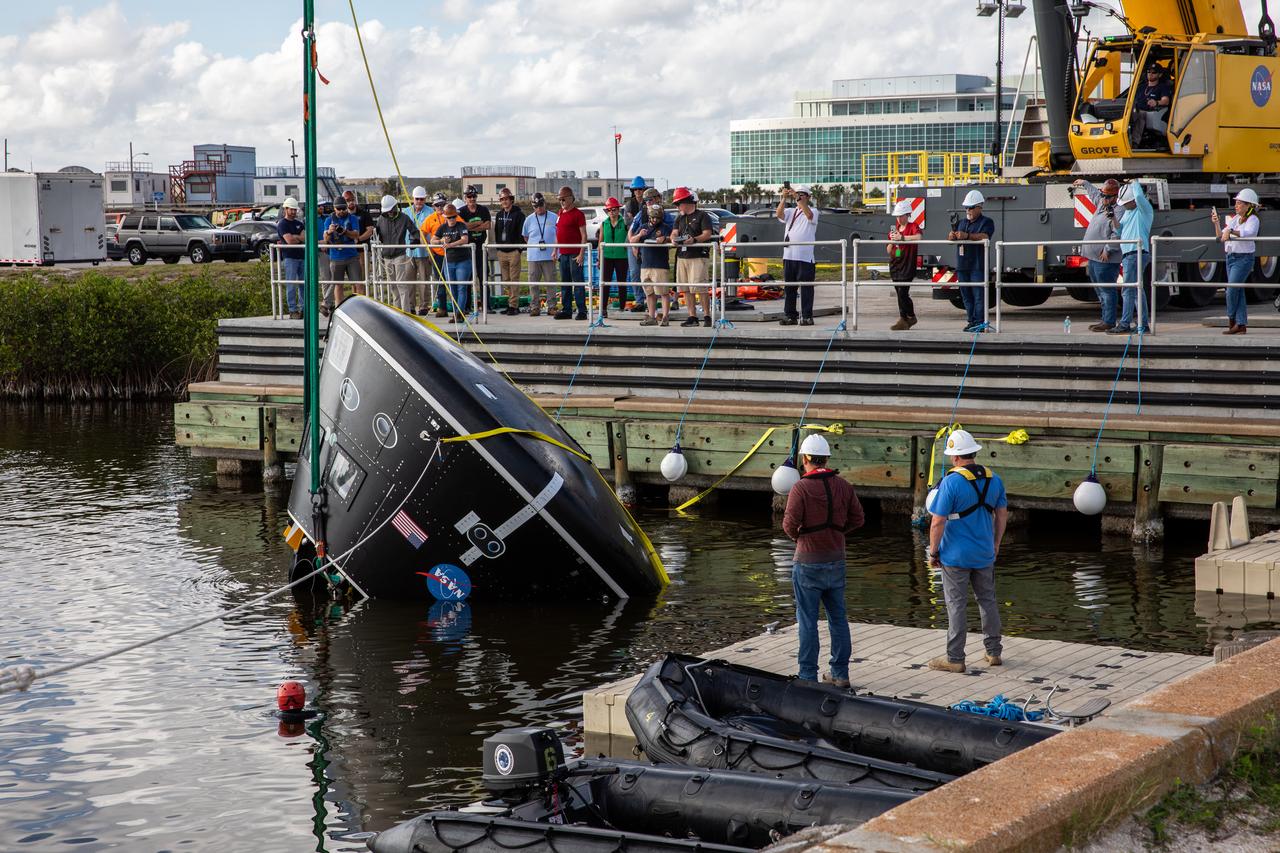
A crane is used to rotate the Crew Module Test Article (CMTA) in the water at the turn basin in the Launch Complex 39 area at NASA’s Kennedy Space Center in Florida on Jan. 31, 2023. The CMTA is being certified for use to practice recovery after splashdown of the Orion spacecraft to prepare for the Artemis II crewed mission. Exploration Ground Systems leads recovery efforts.
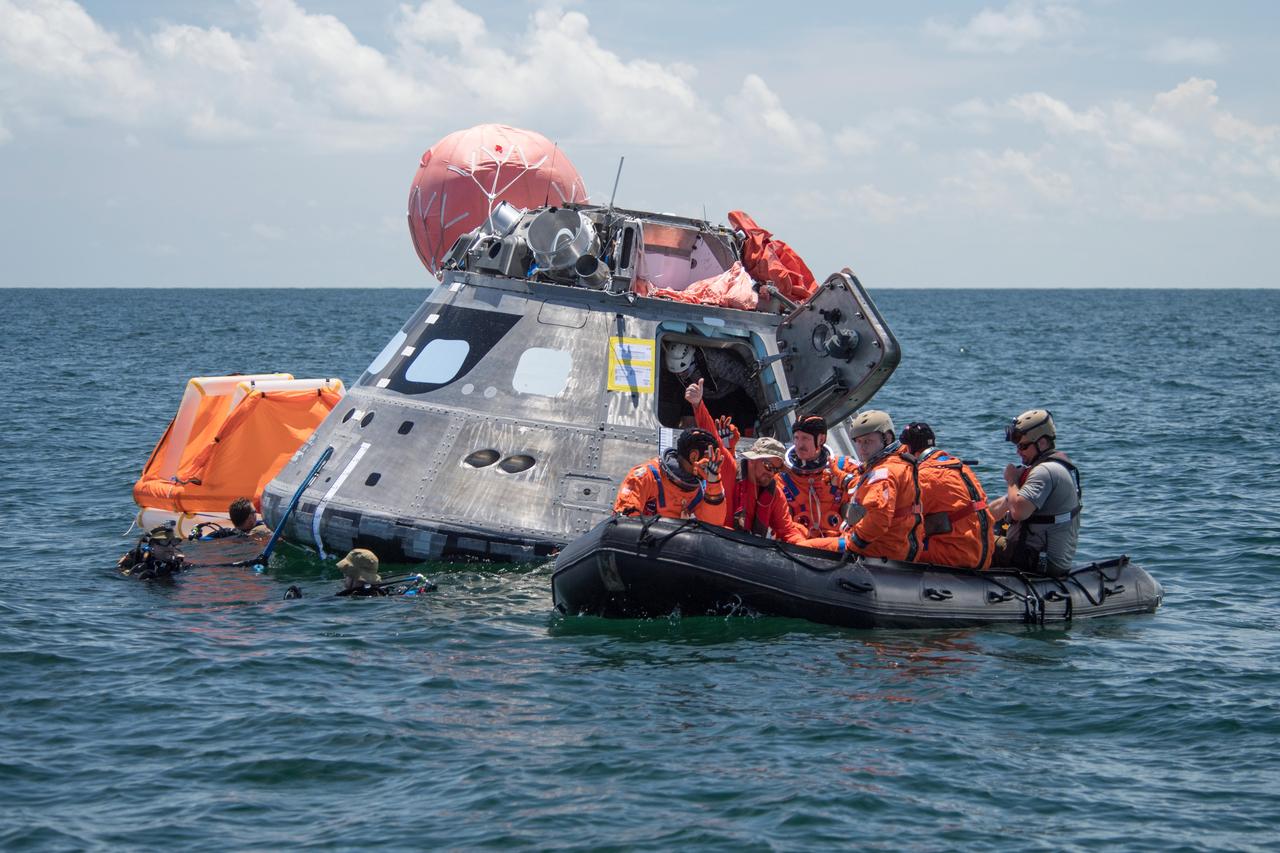
When astronauts return to Earth from destinations beyond the Moon in NASA’s Orion spacecraft and splashdown in the Pacific Ocean, they’ll still need to safely get out of the spacecraft and back on dry land. Using the waters off the coast of Galveston, Texas, a NASA and Department of Defense team test Orion exit procedures in a variety of scenarios on July 11, 2017. Part of Batch images transfer from Flickr.
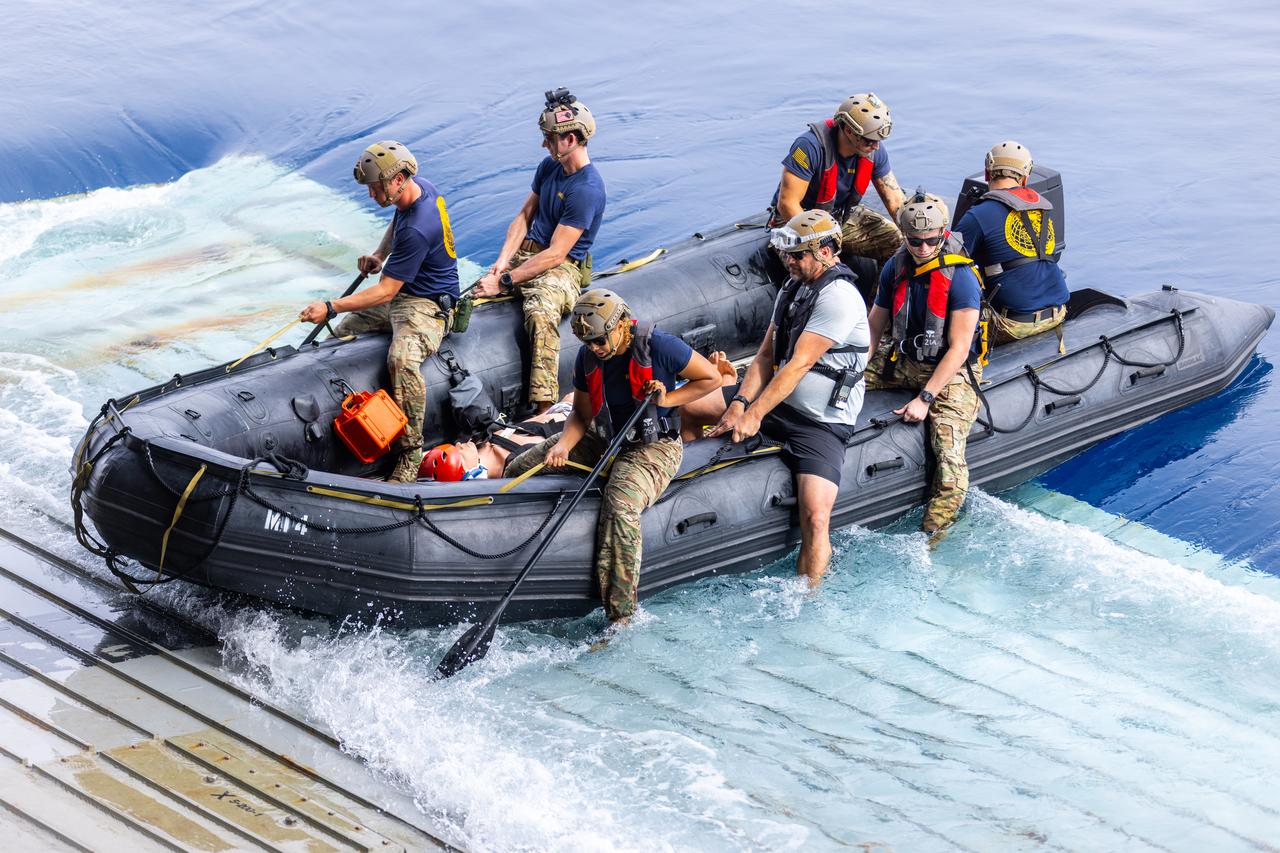
Navy divers from Explosive Ordnance Disposal (EOD) Expeditionary Support Unit 1 prepare to enter the Pacific Ocean from the well deck of USS John P Murtha as part of NASA’s Underway Recovery Test 10 (URT-10). The divers are trained in open water and small boat procedures and will be the team to help Artemis astronauts exit the Orion spacecraft and make it safely to the recovery ship after splashdown.
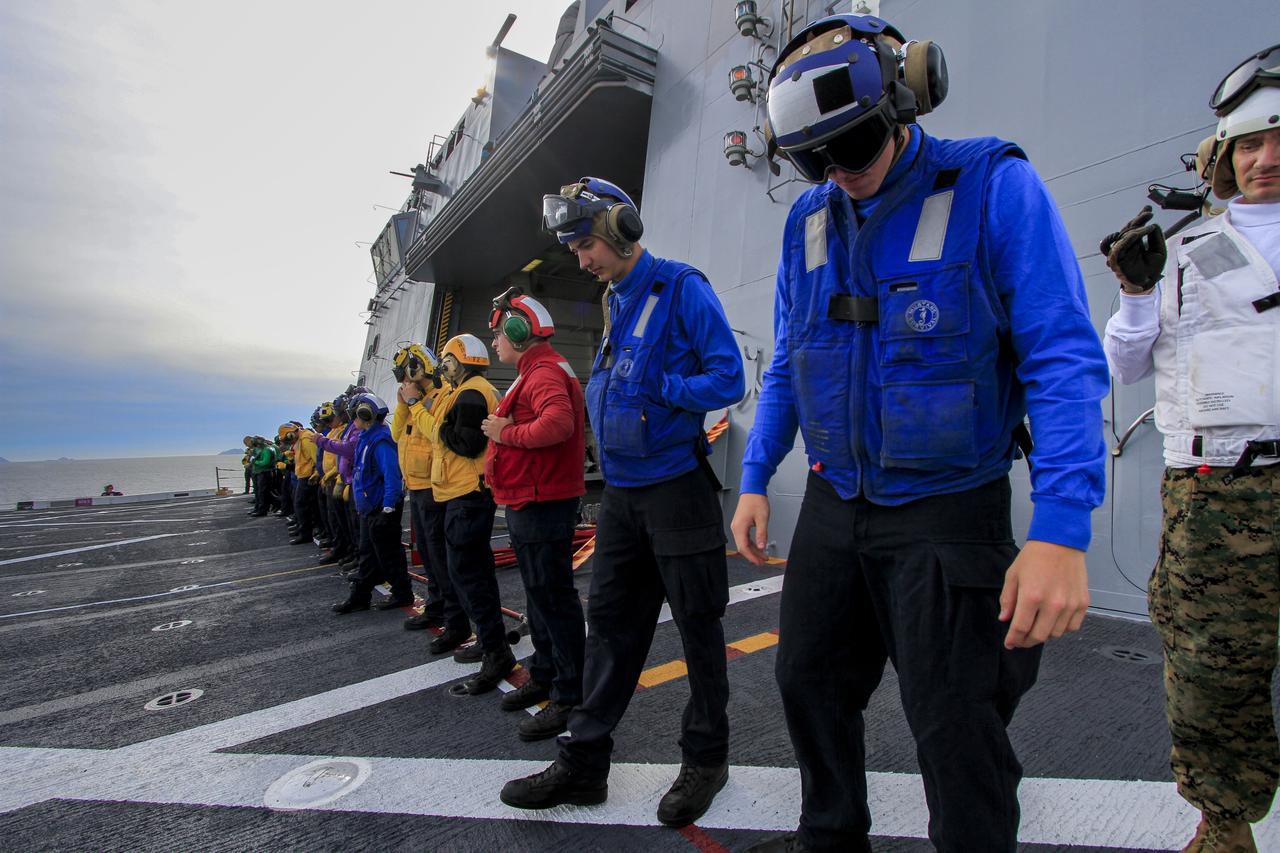
Helicopter Sea Combat Squadron 8 personnel review procedures on the deck of the USS Anchorage as the ship departs Naval Base San Diego in California for the open waters of the Pacific Ocean. NASA and the U.S. Navy are making preparations ahead of Orion's flight test for recovery of the crew module, forward bay cover and parachutes on its return from space and splashdown in the Pacific Ocean. The Ground Systems Development and Operations Program is leading the recovery efforts.
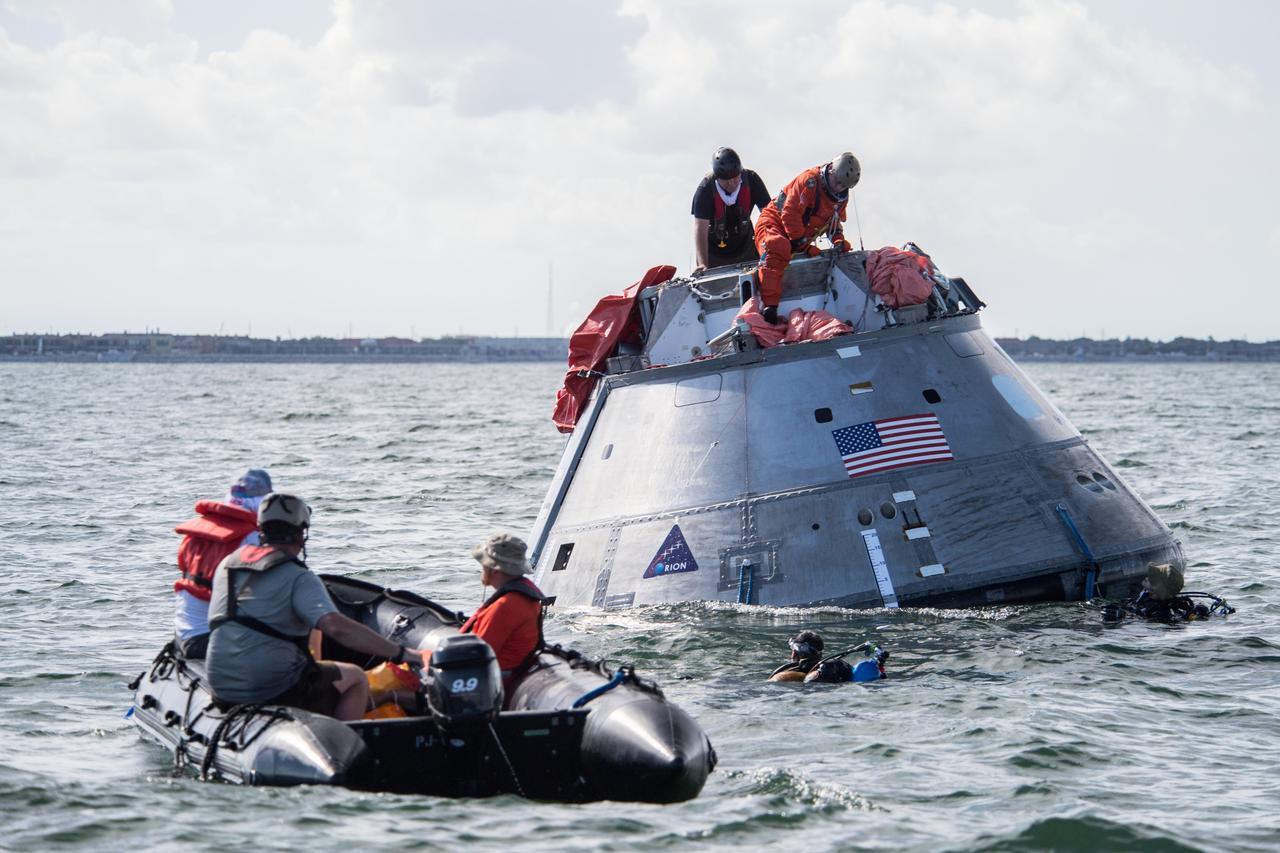
When astronauts return to Earth from destinations beyond the Moon in NASA’s Orion spacecraft and splashdown in the Pacific Ocean, they’ll still need to safely get out of the spacecraft and back on dry land. Using the waters off the coast of Galveston, Texas, a NASA and Department of Defense team test Orion exit procedures in a variety of scenarios on July 11, 2017. Part of Batch images transfer from Flickr.
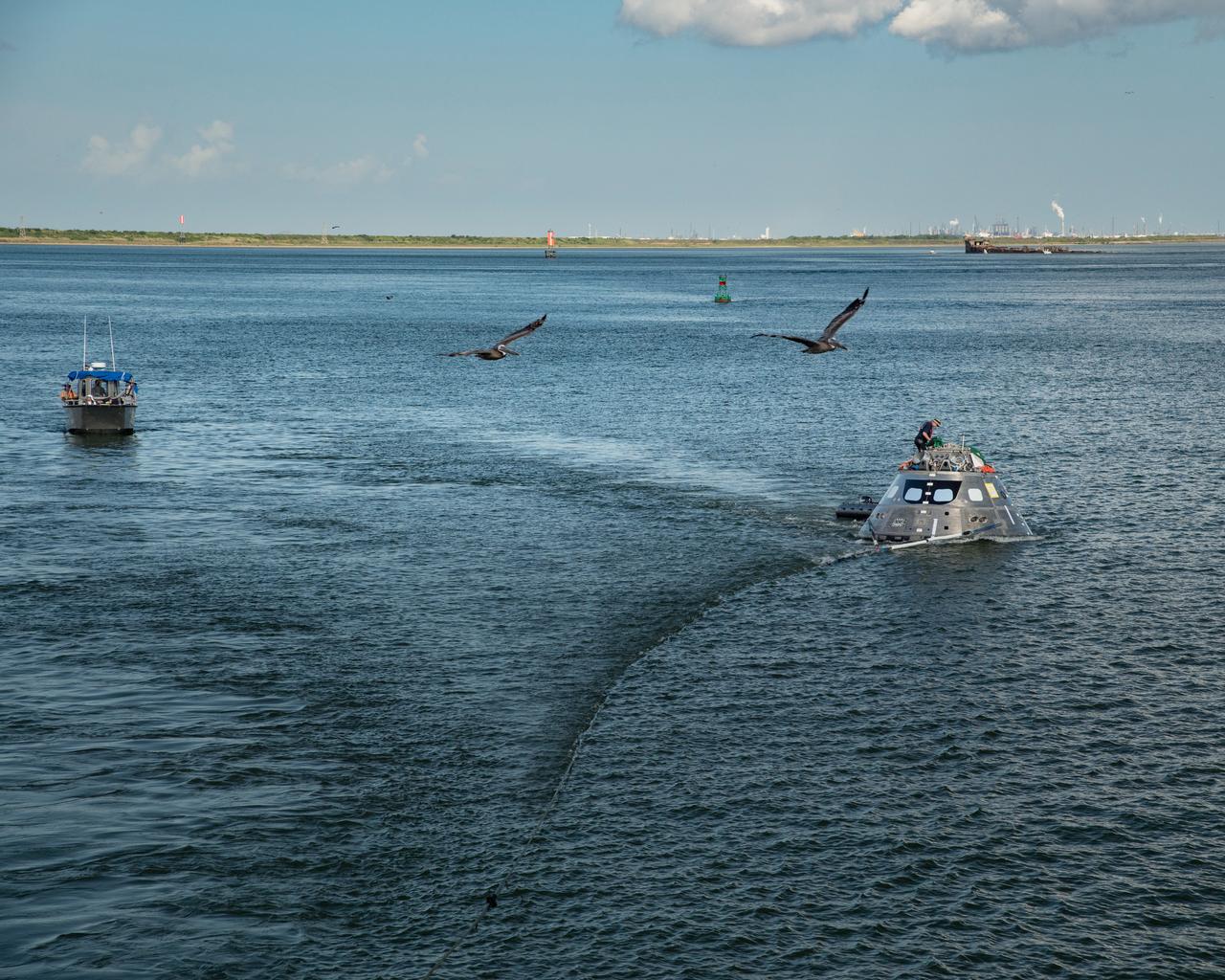
When astronauts return to Earth from destinations beyond the Moon in NASA’s Orion spacecraft and splashdown in the Pacific Ocean, they’ll still need to safely get out of the spacecraft and back on dry land. Using the waters off the coast of Galveston, Texas, a NASA and Department of Defense team test Orion exit procedures in a variety of scenarios on July 11, 2017. Part of Batch images transfer from Flickr.
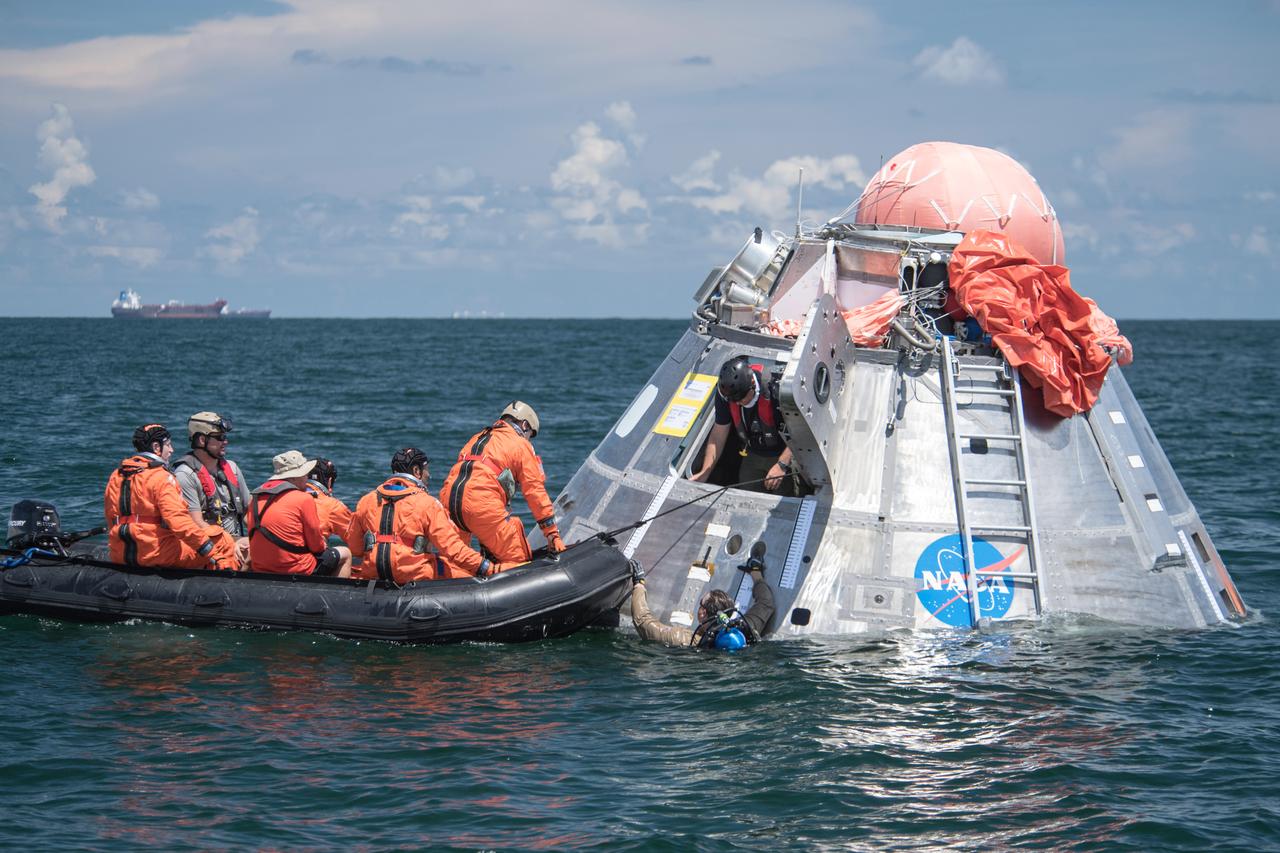
When astronauts return to Earth from destinations beyond the Moon in NASA’s Orion spacecraft and splashdown in the Pacific Ocean, they’ll still need to safely get out of the spacecraft and back on dry land. Using the waters off the coast of Galveston, Texas, a NASA and Department of Defense team test Orion exit procedures in a variety of scenarios on July 11, 2017. Part of Batch images transfer from Flickr.
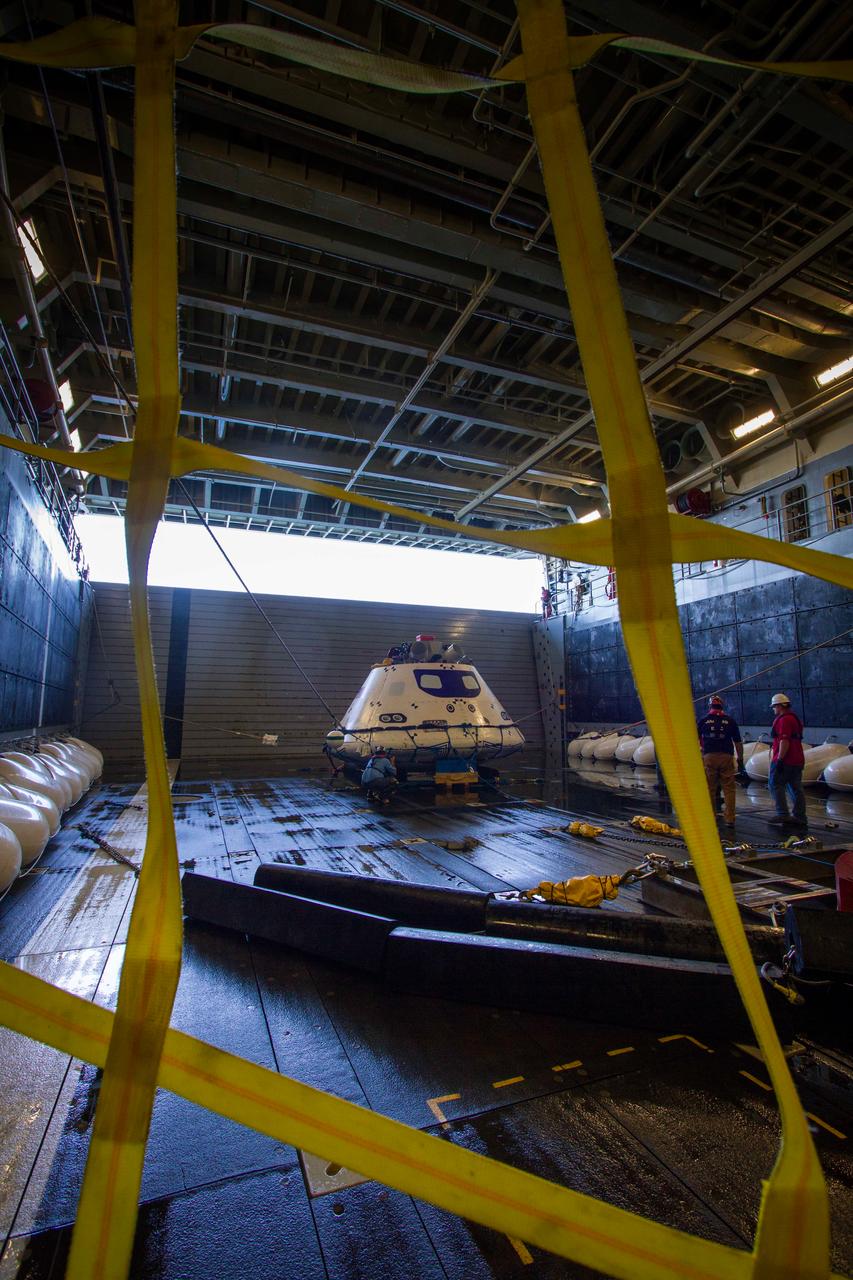
A test version of Orion awaits the next round of recovery tests inside of the USS Anchorage's well deck as the ship travels off the coast of California on Sept. 15, 2014. The well deck can be flooded with water to allow Orion to float in following its splashdown when it returns from space. Part of Batch image transfer from Flickr.
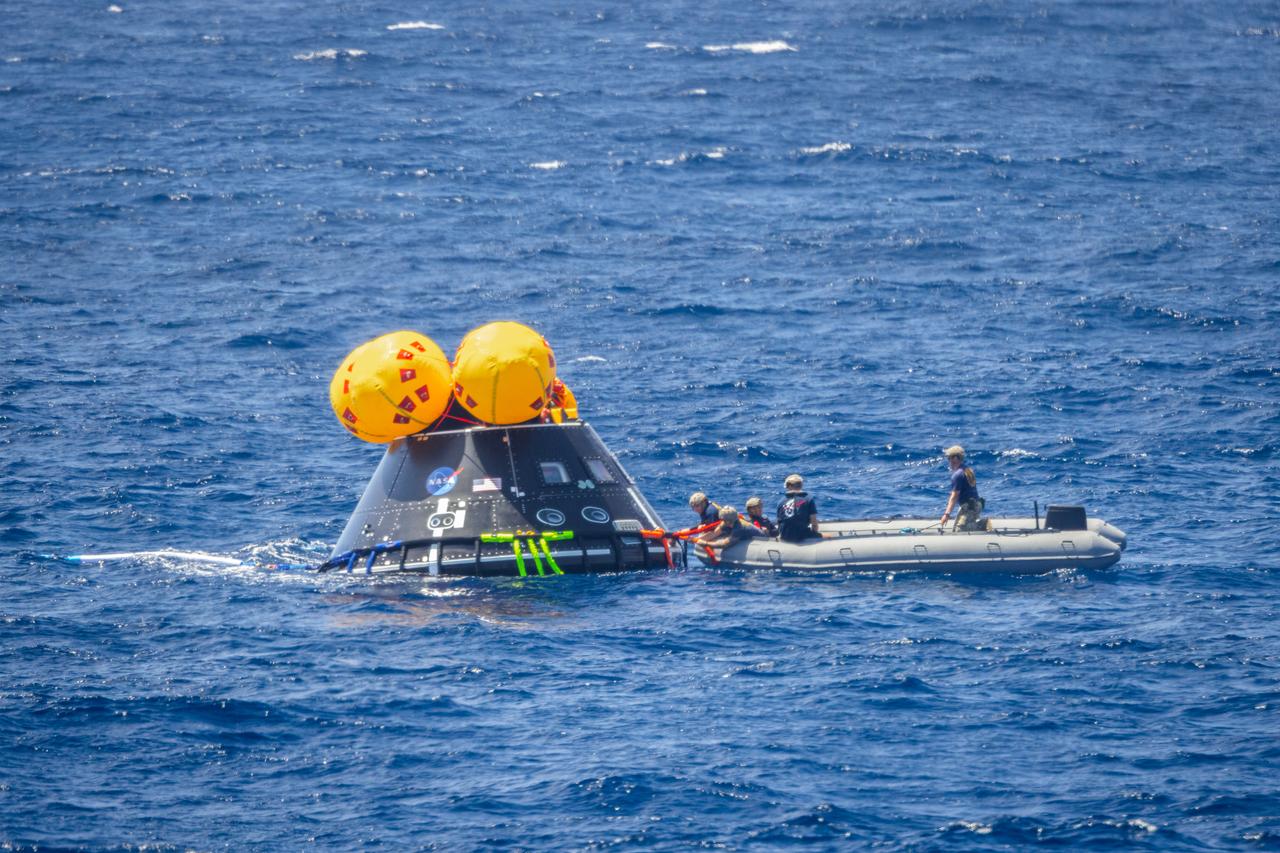
Navy divers from Explosive Ordnance Disposal (EOD) Expeditionary Support Unit 1 work to secure the Orion Crew Module Test Article (CMTA) in the Pacific Ocean as part of NASA’s Underway Recovery Test 10 (URT-10). The divers are trained in open water and small boat procedures and will be the team to help Artemis astronauts exit the Orion spacecraft and make it safely to the recovery ship after splashdown in addition to preparing the spacecraft to be transported back inside the recovery ship.
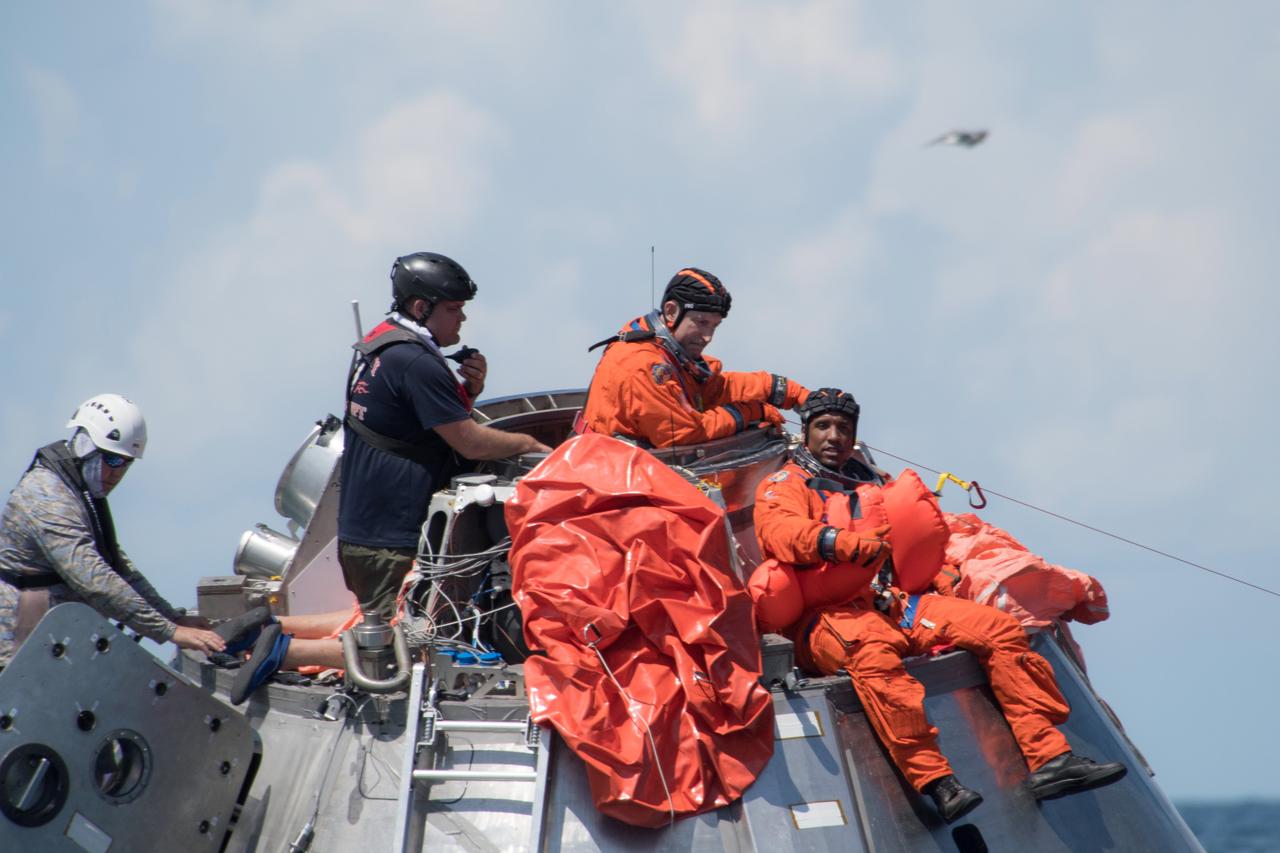
When astronauts return to Earth from destinations beyond the Moon in NASA’s Orion spacecraft and splashdown in the Pacific Ocean, they’ll still need to safely get out of the spacecraft and back on dry land. Using the waters off the coast of Galveston, Texas, a NASA and Department of Defense team test Orion exit procedures in a variety of scenarios on July 11, 2017. Part of Batch images transfer from Flickr.
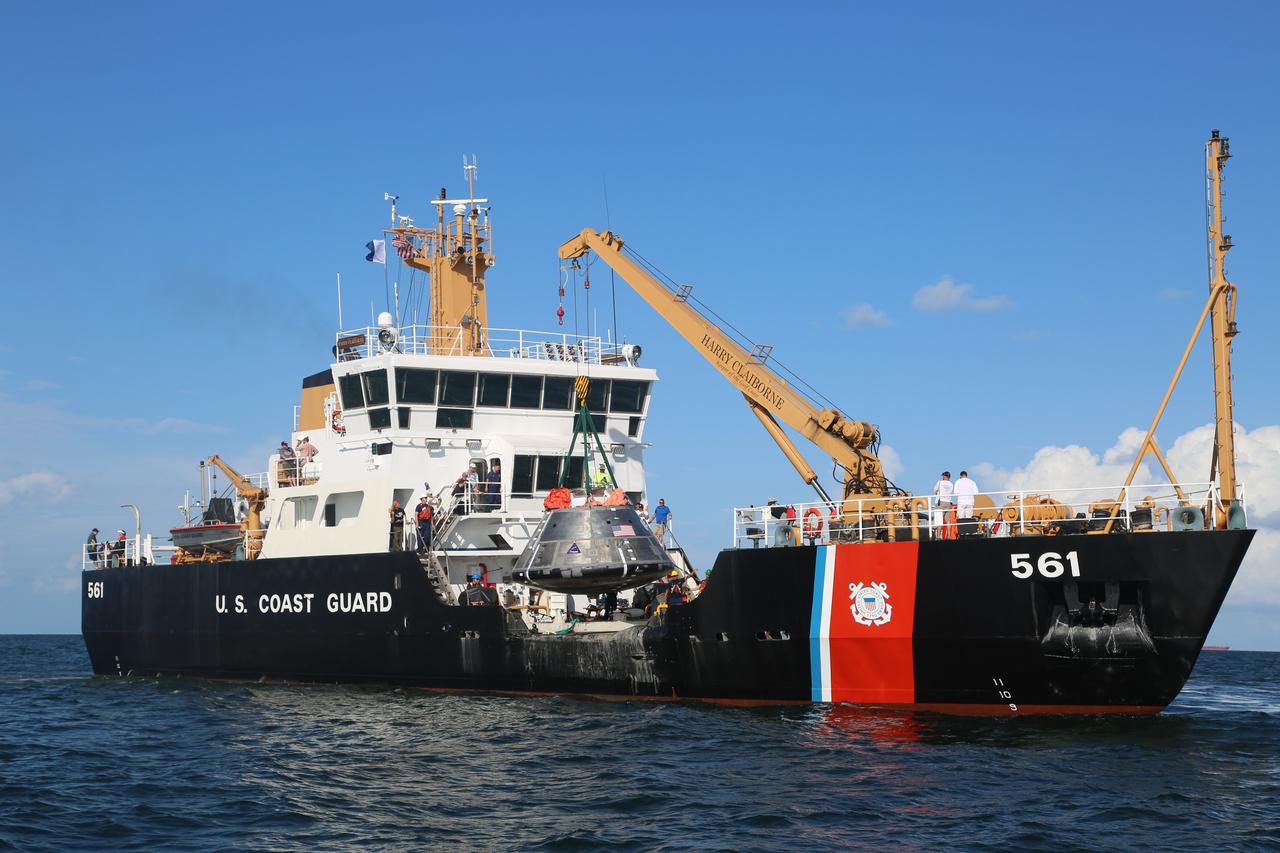
When astronauts return to Earth from destinations beyond the Moon in NASA’s Orion spacecraft and splashdown in the Pacific Ocean, they’ll still need to safely get out of the spacecraft and back on dry land. Using the waters off the coast of Galveston, Texas, a NASA and Department of Defense team test Orion exit procedures in a variety of scenarios on July 11, 2017. Part of Batch images transfer from Flickr.
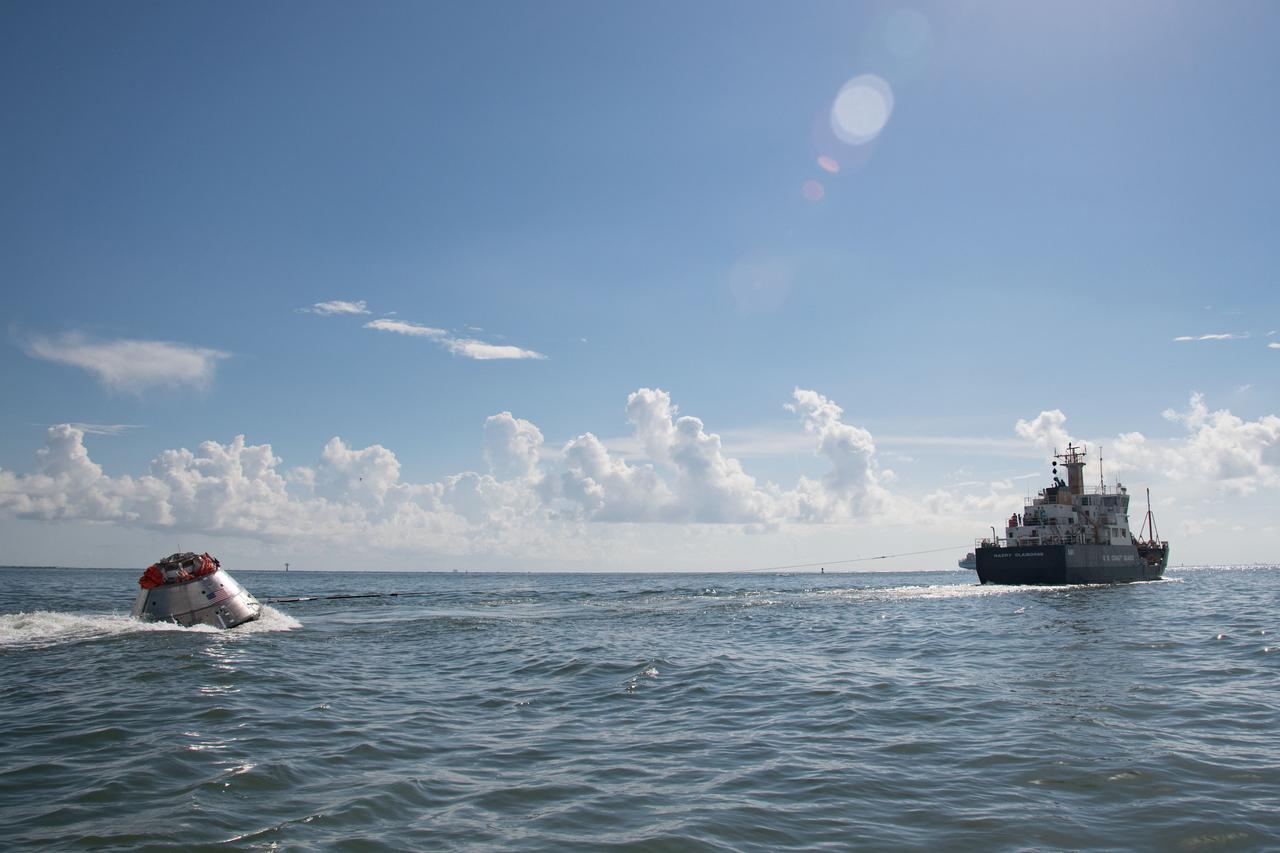
When astronauts return to Earth from destinations beyond the Moon in NASA’s Orion spacecraft and splashdown in the Pacific Ocean, they’ll still need to safely get out of the spacecraft and back on dry land. Using the waters off the coast of Galveston, Texas, a NASA and Department of Defense team test Orion exit procedures in a variety of scenarios on July 11, 2017. Part of Batch images transfer from Flickr.
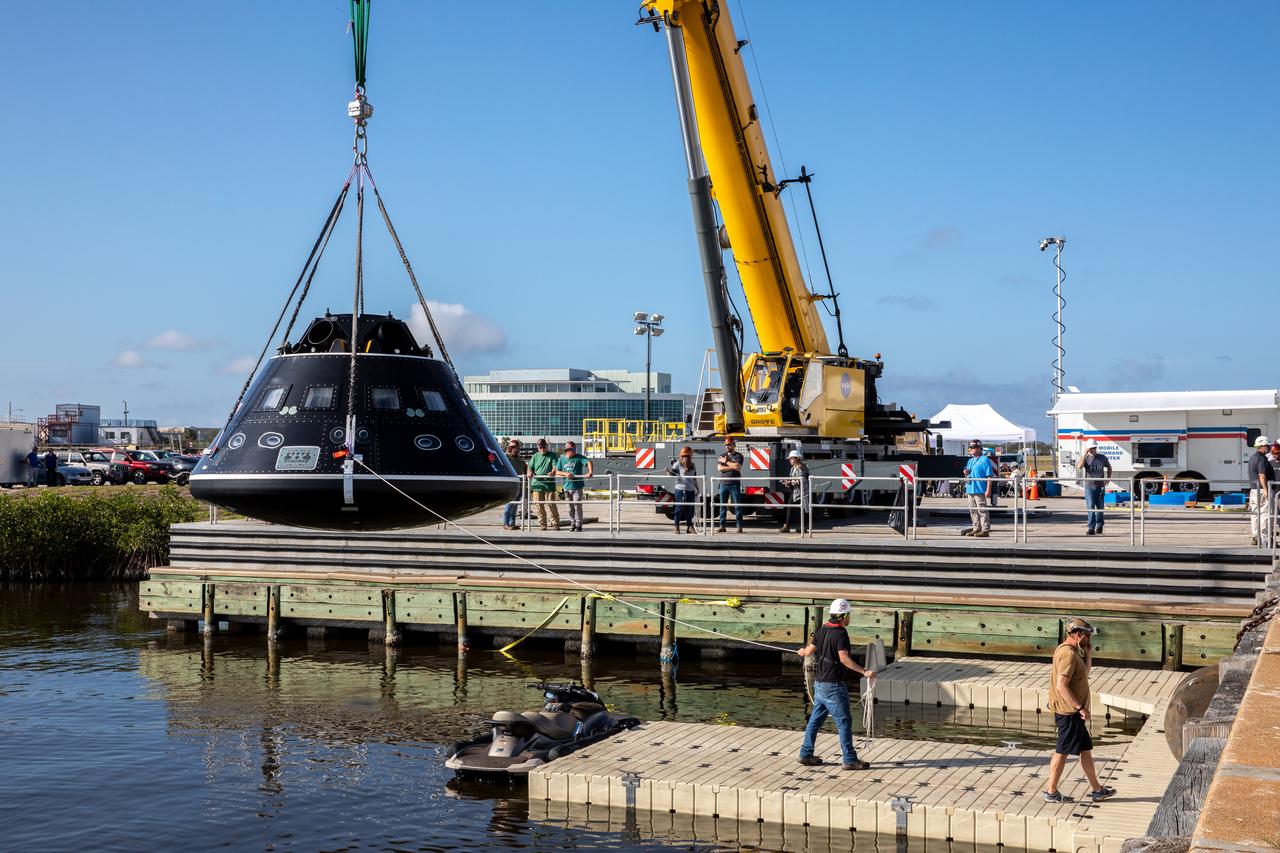
A crane is used to hold the Crew Module Test Article (CMTA) above the water at the turn basin in the Launch Complex 39 area at NASA’s Kennedy Space Center in Florida on Jan. 30, 2023. The CMTA is being used to practice recovery after splashdown of the Orion spacecraft to prepare for the Artemis II crewed mission. Exploration Ground Systems leads recovery efforts.
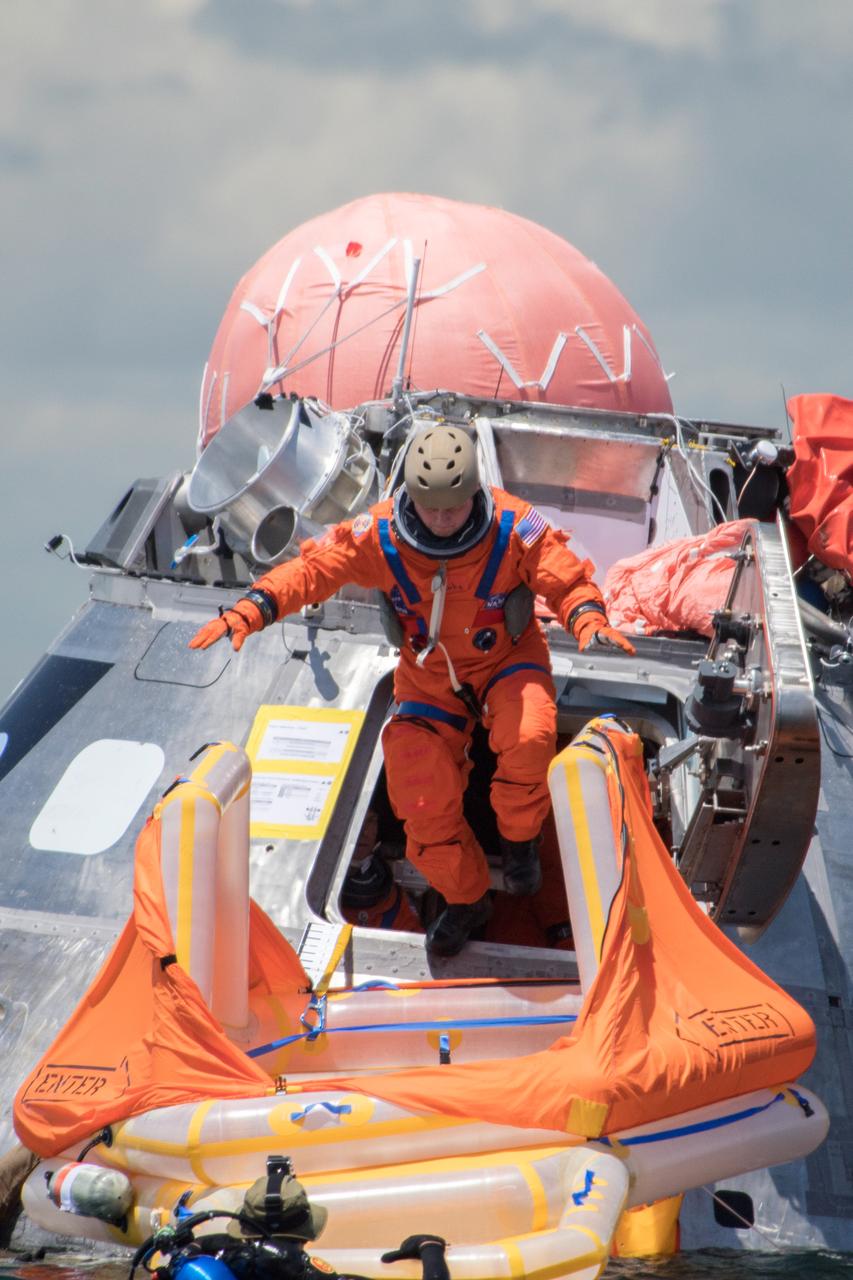
When astronauts return to Earth from destinations beyond the Moon in NASA’s Orion spacecraft and splashdown in the Pacific Ocean, they’ll still need to safely get out of the spacecraft and back on dry land. Using the waters off the coast of Galveston, Texas, a NASA and Department of Defense team test Orion exit procedures in a variety of scenarios on July 11, 2017. Part of Batch images transfer from Flickr.
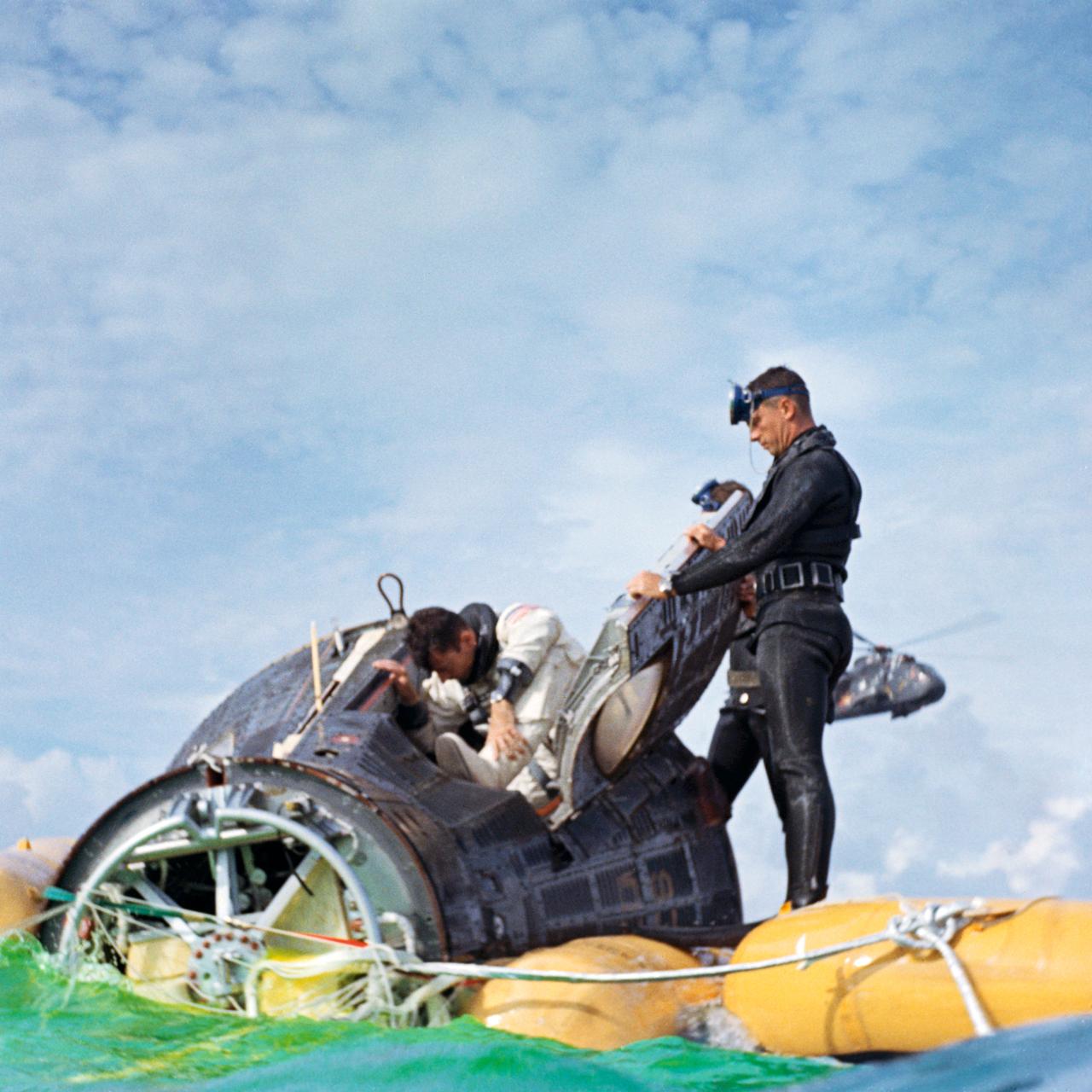
S66-42772 (21 July 1966) --- A U.S. Navy frogman assist the Gemini-10 crew following splashdown at 4:07 p.m. (EST), July 21, 1966, about four miles from the recovery ship, USS Guadalcanal. Astronaut John W. Young (climbing from spacecraft), command pilot, and Michael Collins (in spacecraft), pilot, were later hoisted from the water by a recovery helicopter and flown to the Guadalcanal. Photo credit: NASA
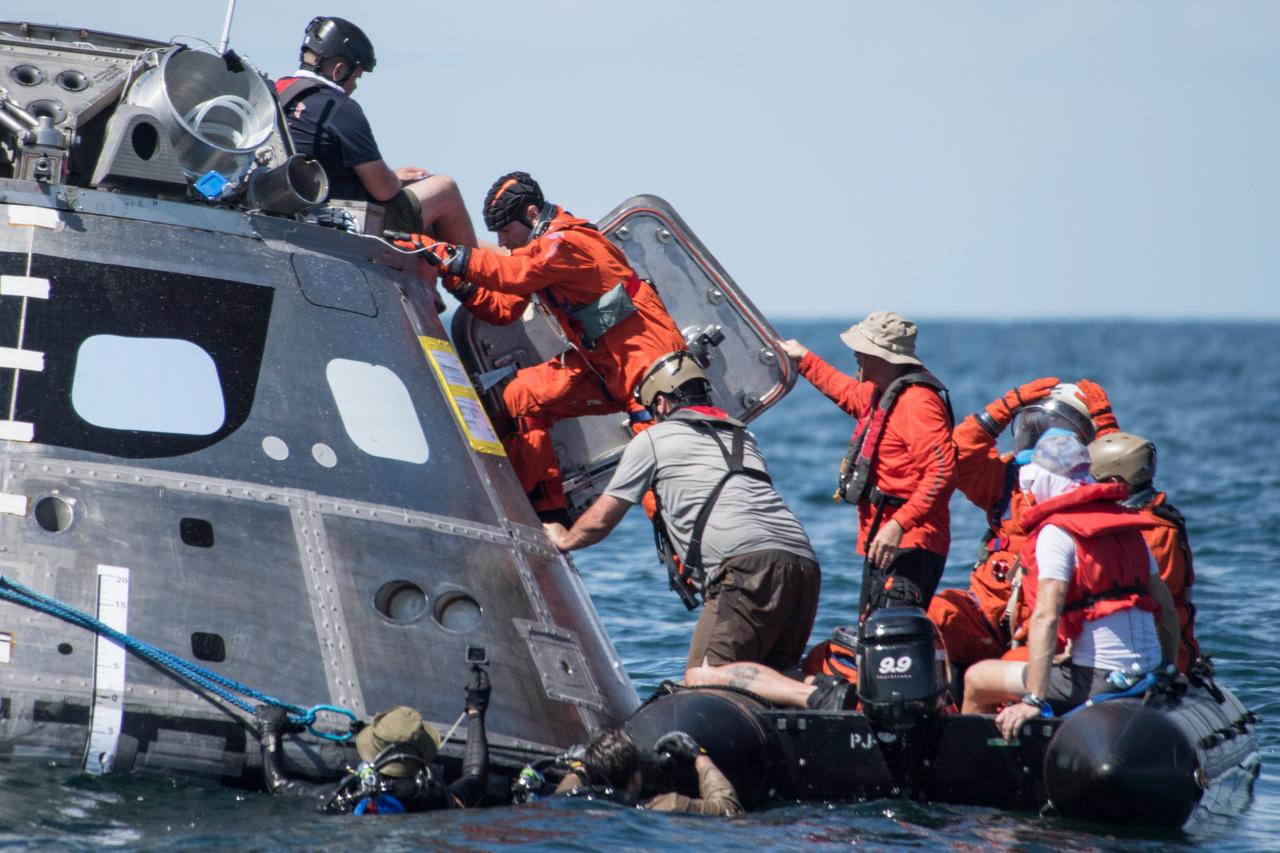
When astronauts return to Earth from destinations beyond the Moon in NASA’s Orion spacecraft and splashdown in the Pacific Ocean, they’ll still need to safely get out of the spacecraft and back on dry land. Using the waters off the coast of Galveston, Texas, a NASA and Department of Defense team test Orion exit procedures in a variety of scenarios on July 11, 2017. Part of Batch images transfer from Flickr.
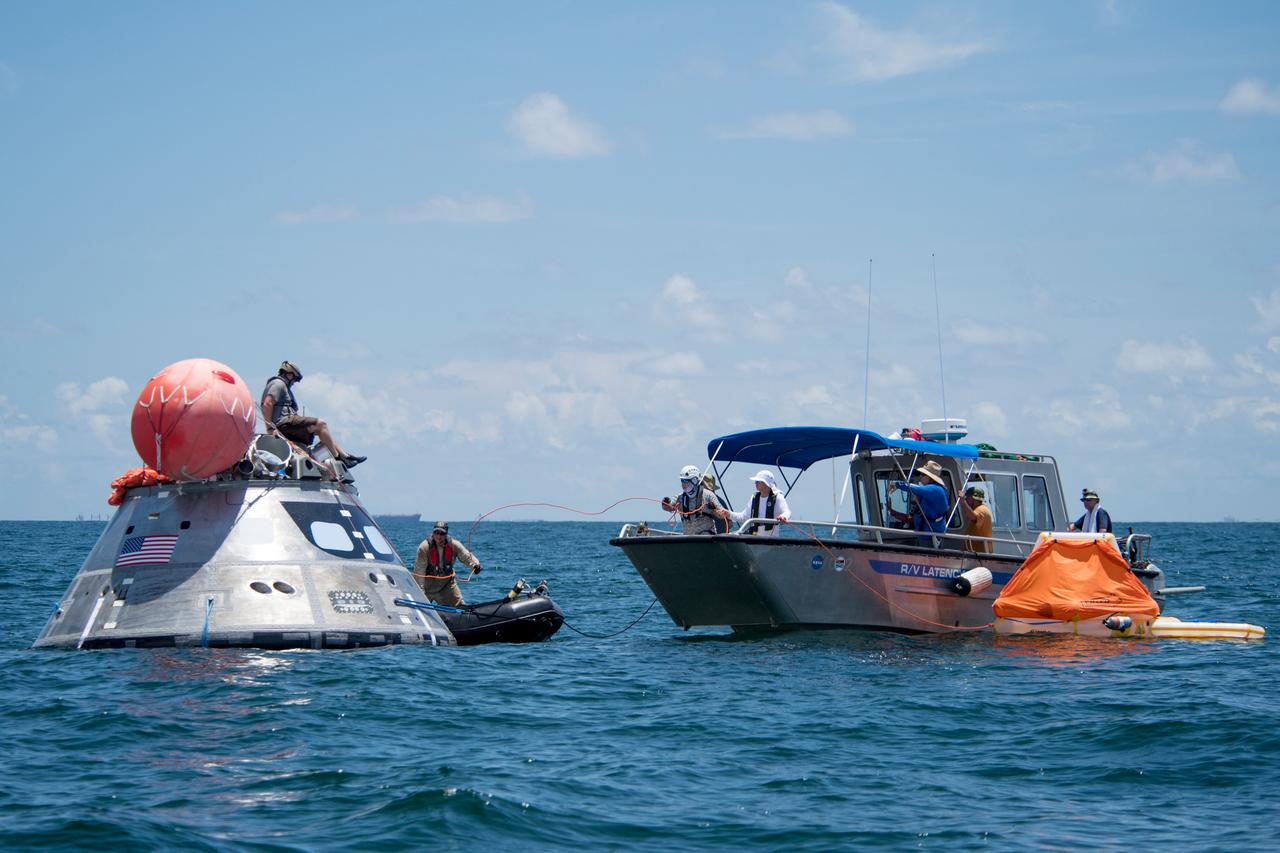
When astronauts return to Earth from destinations beyond the Moon in NASA’s Orion spacecraft and splashdown in the Pacific Ocean, they’ll still need to safely get out of the spacecraft and back on dry land. Using the waters off the coast of Galveston, Texas, a NASA and Department of Defense team test Orion exit procedures in a variety of scenarios on July 11, 2017. Part of Batch images transfer from Flickr.
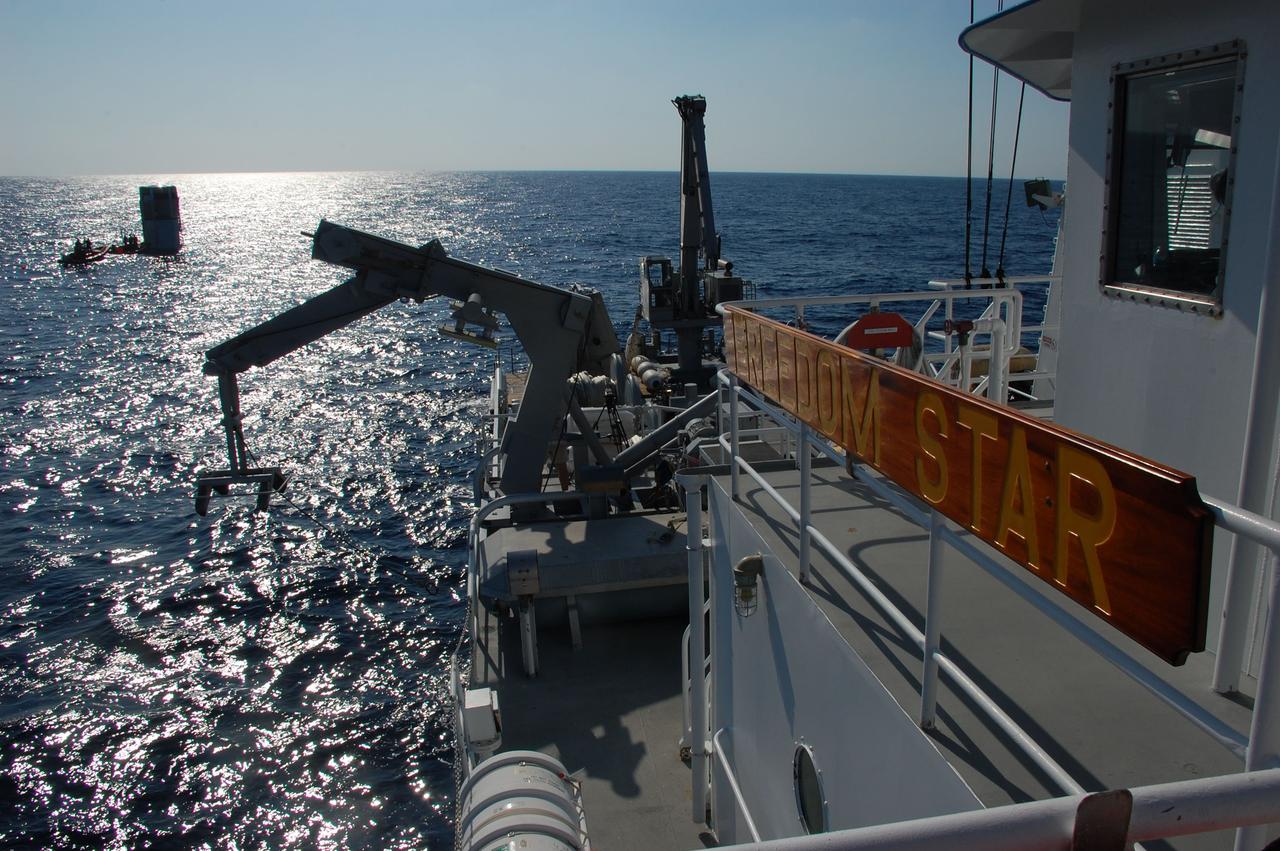
CAPE CANAVERAL, Fla. -- A crane is prepared to pluck the returning skiffs out of the water after crew members from Freedom Star, one of NASA's solid rocket booster retrieval ships, attached a hose between the left spent booster and the vessel that will facilitate debris and water clearing and the pumping in of air into the booster so it can float horizontally on the water's surface for towing back to Port Canaveral in Florida. The shuttle’s two solid rocket booster casings and associated flight hardware are recovered in the Atlantic Ocean after every launch by Liberty Star and Freedom Star. The boosters impact the Atlantic about seven minutes after liftoff and the retrieval ships are stationed about 10 miles from the impact area at the time of splashdown. After the spent segments are processed, they will be transported to Utah, where they will be refurbished and stored, if needed. Photo credit: NASA/Ben Smegelsky
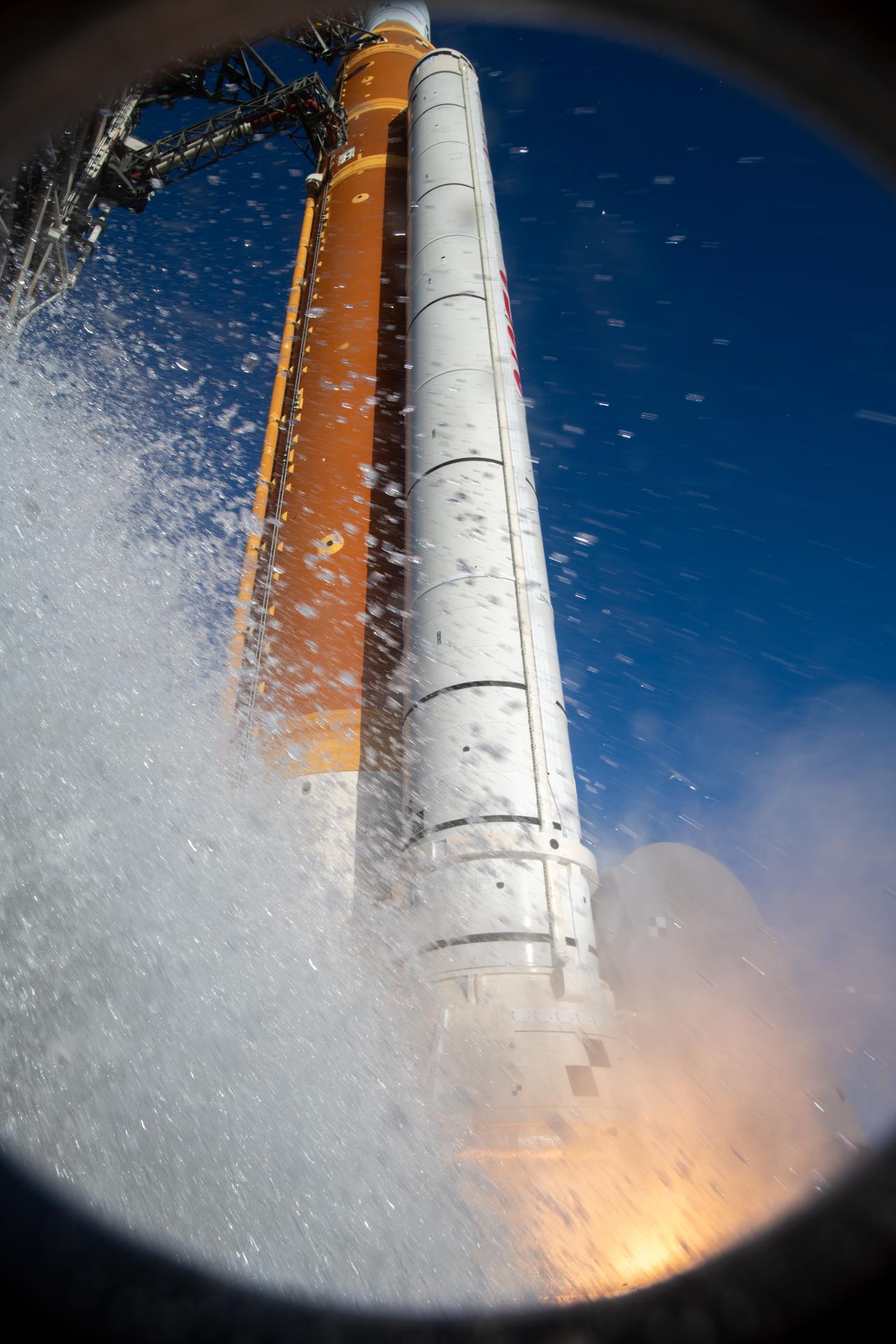
The Ignition Overpressure Protection and Sound Suppression water deluge system activates during launch of NASA’s Artemis II test flight at Launch Complex 39B at NASA’s Kennedy Space Center in Florida at 6:35 p.m. EDT on Wednesday, April 1, 2026. The water deluge system releases about 450,000 gallons of water across the mobile launcher and flame deflector to reduce the extreme heat and energy generated by the rocket during ignition and liftoff. Artemis II Commander Reid Wiseman, Pilot Victor Glover, and Mission Specialist Christina Koch from NASA, along with Mission Specialist Jeremy Hansen from the CSA (Canadian Space Agency), are on a 10-day journey around the Moon and back with splashdown in the Pacific Ocean off the coast of San Diego, California on Friday, April 10.
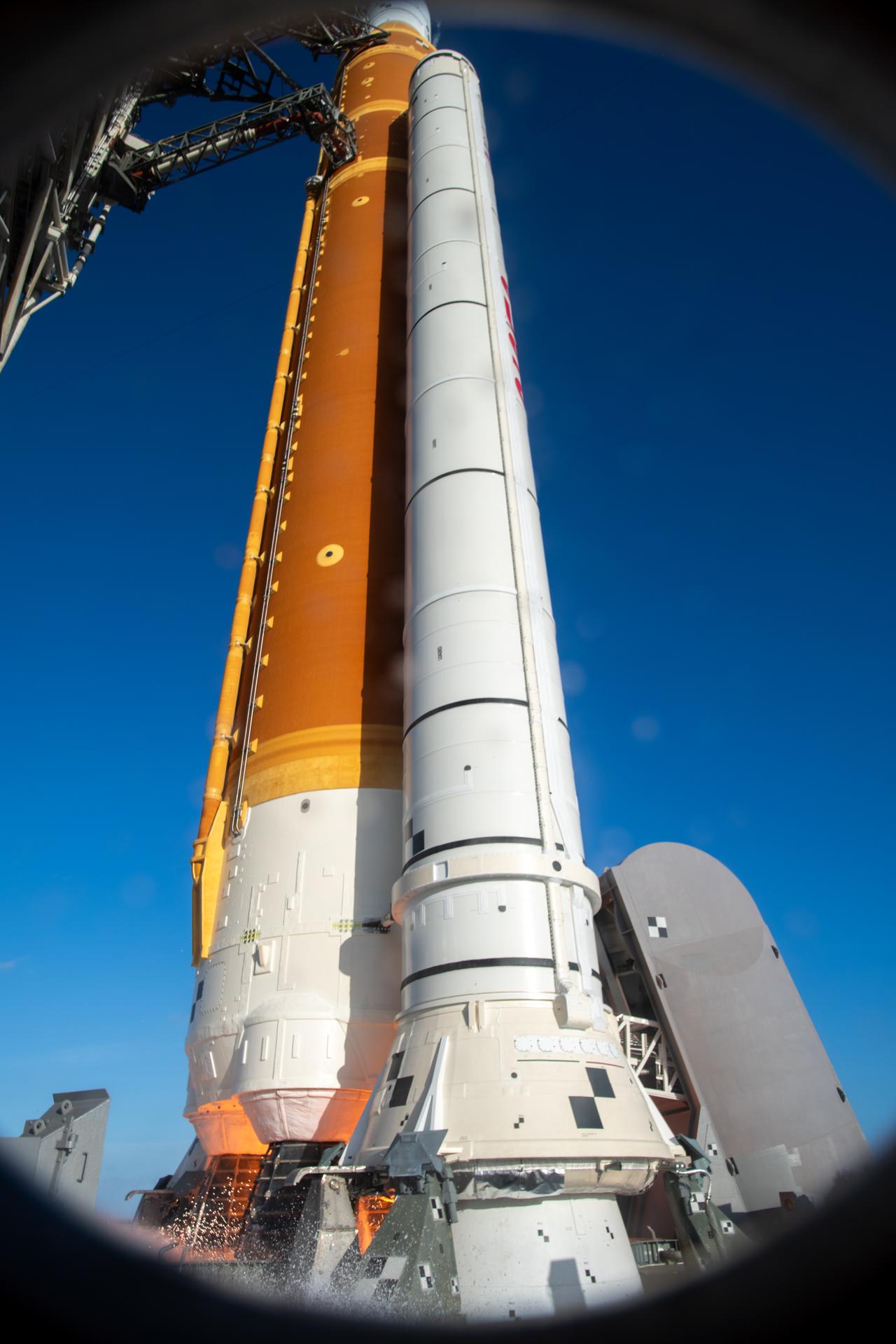
The Ignition Overpressure Protection and Sound Suppression water deluge system activates during launch of NASA’s Artemis II test flight at Launch Complex 39B at NASA’s Kennedy Space Center in Florida at 6:35 p.m. EDT on Wednesday, April 1, 2026. The water deluge system releases about 450,000 gallons of water across the mobile launcher and flame deflector to reduce the extreme heat and energy generated by the rocket during ignition and liftoff. Artemis II Commander Reid Wiseman, Pilot Victor Glover, and Mission Specialist Christina Koch from NASA, along with Mission Specialist Jeremy Hansen from the CSA (Canadian Space Agency), are on a 10-day journey around the Moon and back with splashdown in the Pacific Ocean off the coast of San Diego, California on Friday, April 10.
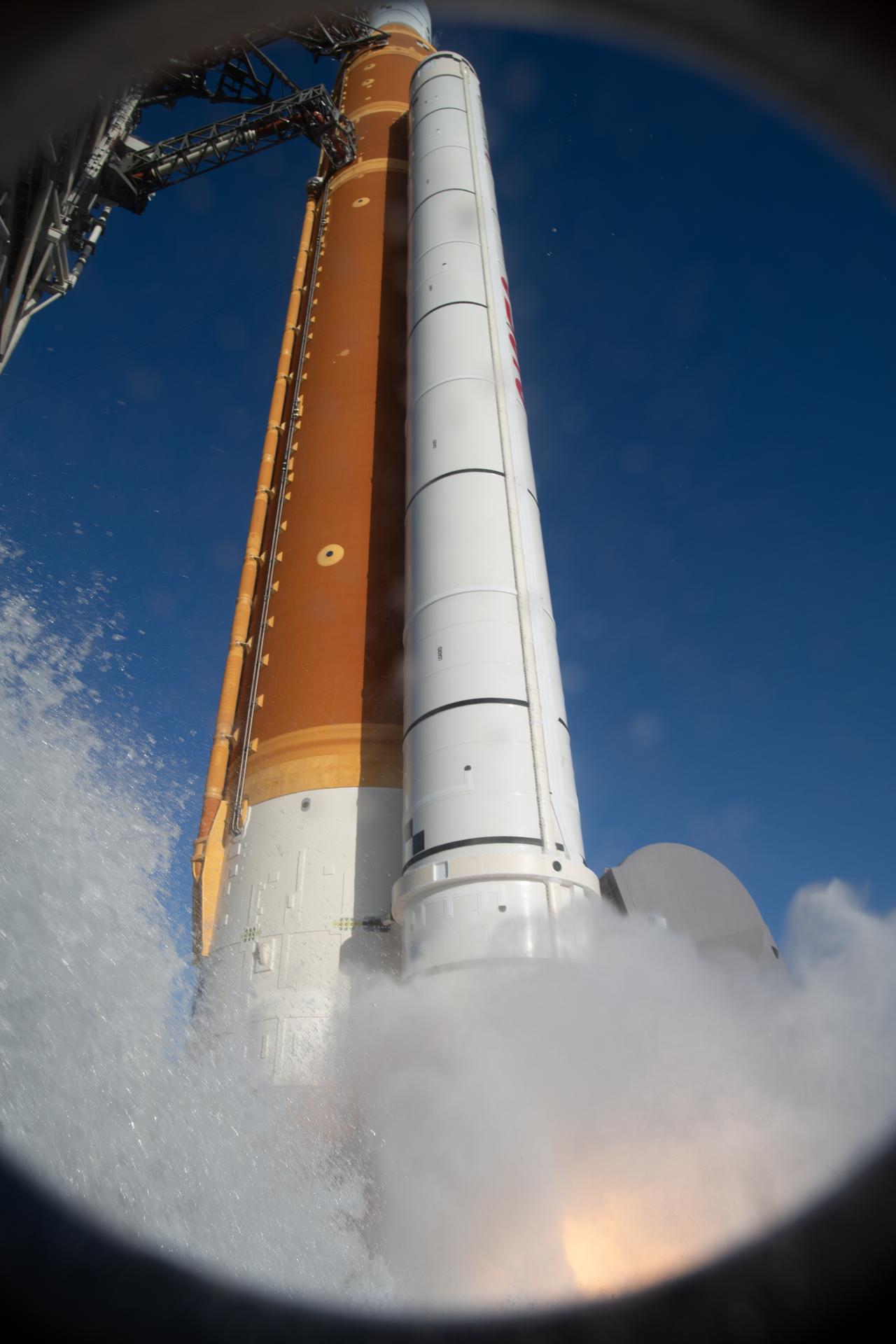
The Ignition Overpressure Protection and Sound Suppression water deluge system activates during launch of NASA’s Artemis II test flight at Launch Complex 39B at NASA’s Kennedy Space Center in Florida at 6:35 p.m. EDT on Wednesday, April 1, 2026. The water deluge system releases about 450,000 gallons of water across the mobile launcher and flame deflector to reduce the extreme heat and energy generated by the rocket during ignition and liftoff. Artemis II Commander Reid Wiseman, Pilot Victor Glover, and Mission Specialist Christina Koch from NASA, along with Mission Specialist Jeremy Hansen from the CSA (Canadian Space Agency), are on a 10-day journey around the Moon and back with splashdown in the Pacific Ocean off the coast of San Diego, California on Friday, April 10.
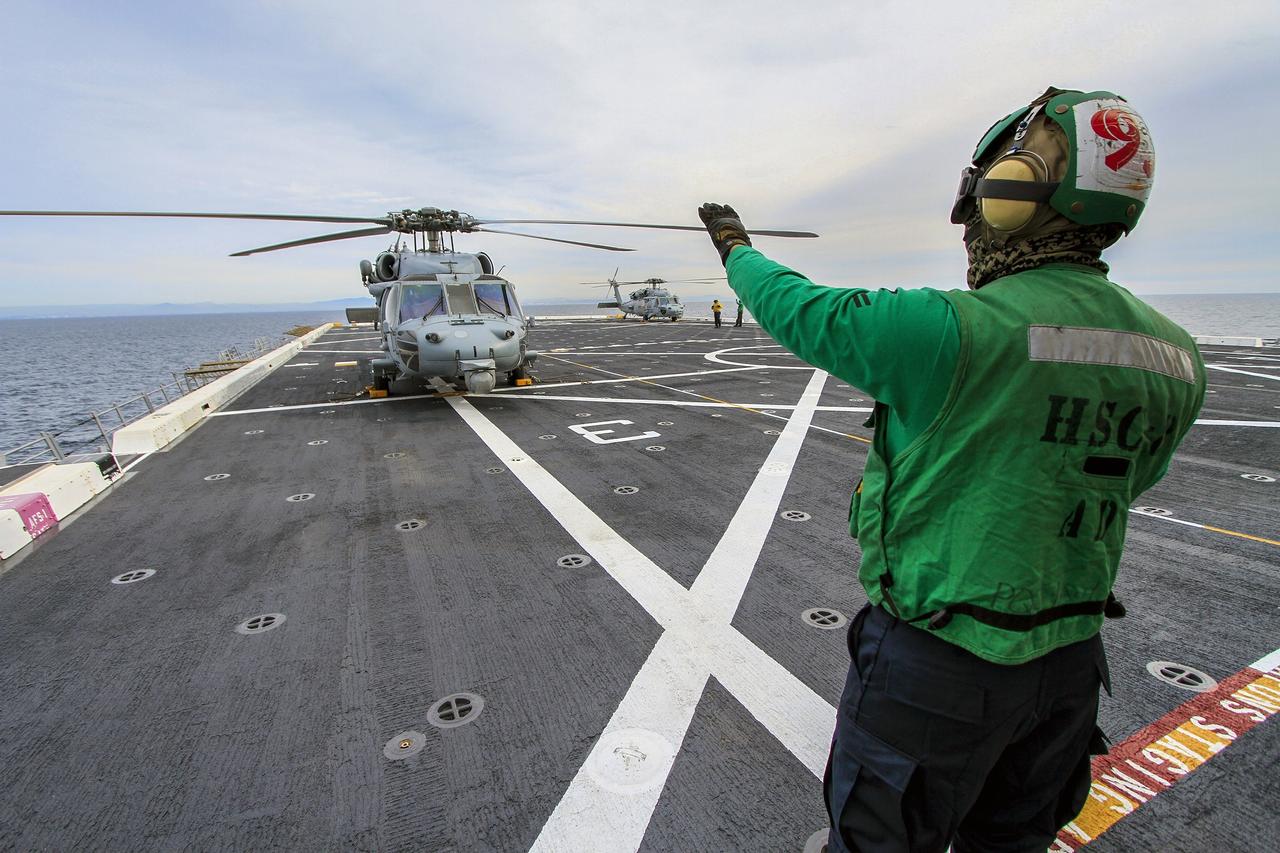
SAN DIEGO, Calif. – A member of the Helicopter Sea Combat Squadron 8 signals to the pilot in an H60-S Seahawk helicopter on the deck of the USS Anchorage as the ship departs Naval Base San Diego in California for the open waters of the Pacific Ocean. NASA and the U.S. Navy are making preparations ahead of Orion's flight test for recovery of the crew module, forward bay cover and parachutes on its return from space and splashdown in the Pacific Ocean. The Ground Systems Development and Operations Program is leading the recovery efforts. The first unpiloted flight test of Orion is scheduled to launch this week atop a United Launch Alliance Delta IV Heavy rocket. During its two-orbit, 4.5-hour flight, Orion will venture 3,600 miles in altitude and travel nearly 60,000 miles before returning to Earth for a splashdown in the Pacific Ocean. For more information, visit http://www.nasa.gov/orion. Photo credit: NASA/Cory Huston
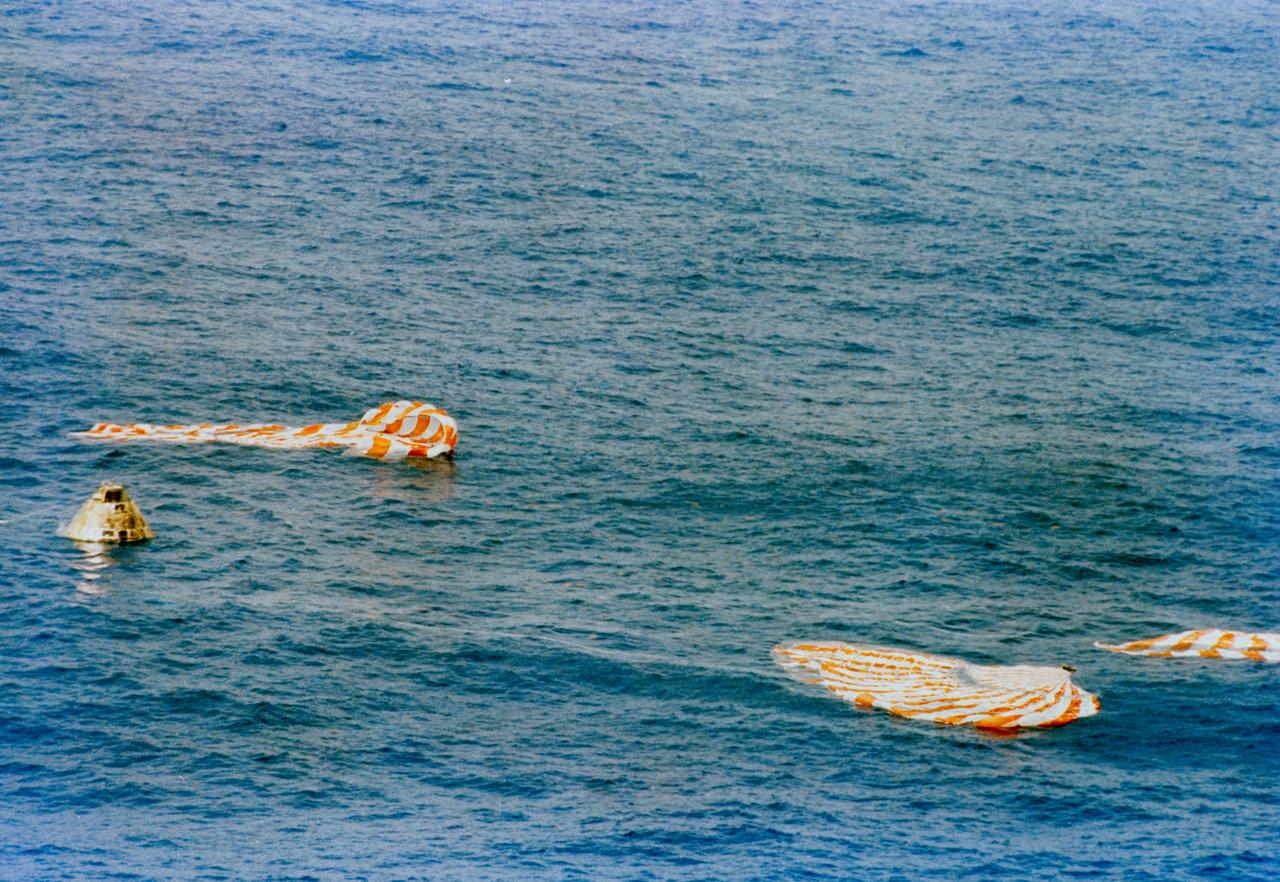
S69-27925 (13 March 1969) --- The Apollo 9 spacecraft, with astronauts James A. McDivitt, David R. Scott, and Russell L. Schweickart aboard, floats in the Atlantic immediately after splashdown. Moments later the three crewmen were picked up by a helicopter and flown to the deck of the USS Guadalcanal, prime recovery ship for the Apollo 9 10-day Earth-orbital space mission. Splashdown occurred at 12:00:53 p.m. (EST), March 13, 1969, only 4.5 nautical miles from the USS Guadalcanal. Just after this picture was taken U.S. Navy underwater demolition team swimmers were dropped into the water to assist in the recovery operations, including attaching a flotation collar to the spacecraft.
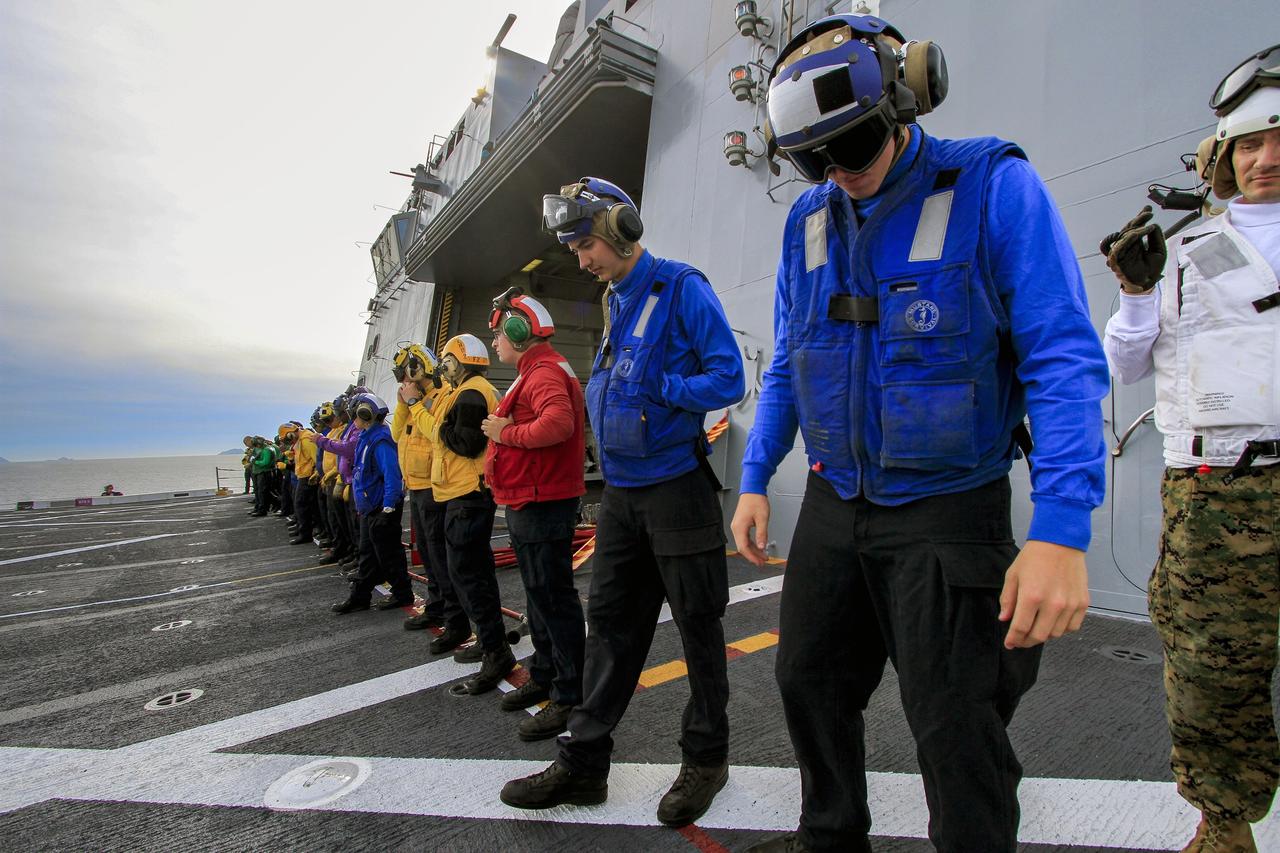
SAN DIEGO, Calif. – Helicopter Sea Combat Squadron 8 personnel review procedures on the deck of the USS Anchorage as the ship departs Naval Base San Diego in California for the open waters of the Pacific Ocean. NASA and the U.S. Navy are making preparations ahead of Orion's flight test for recovery of the crew module, forward bay cover and parachutes on its return from space and splashdown in the Pacific Ocean. The Ground Systems Development and Operations Program is leading the recovery efforts. The first unpiloted flight test of Orion is scheduled to launch this week atop a United Launch Alliance Delta IV Heavy rocket. During its two-orbit, 4.5-hour flight, Orion will venture 3,600 miles in altitude and travel nearly 60,000 miles before returning to Earth for a splashdown in the Pacific Ocean. For more information, visit http://www.nasa.gov/orion. Photo credit: NASA/Cory Huston
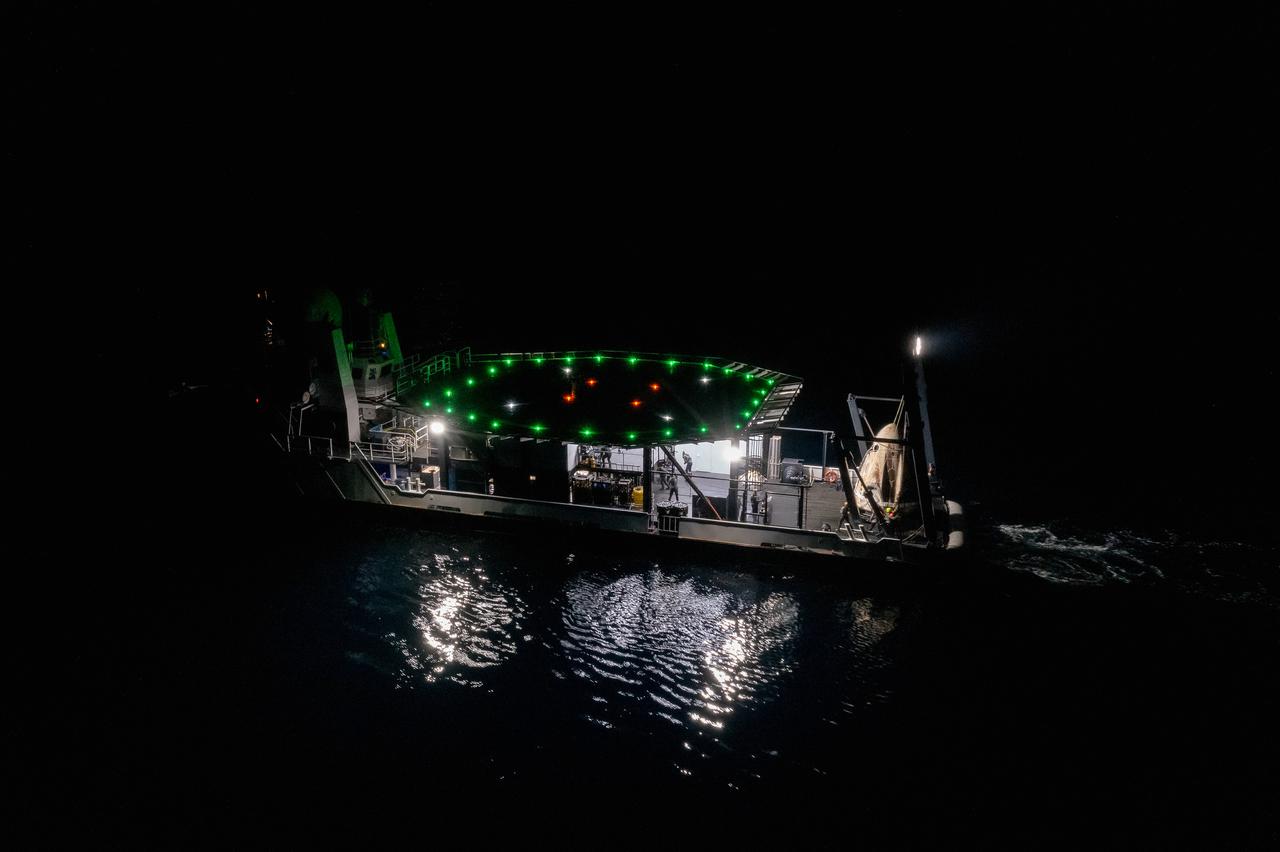
The SpaceX Crew Dragon Resilience splashed down in the Gulf of Mexico off the coast of Panama City, in Florida, at 2:56 a.m. EDT on May 2, 2021. Astronauts Michael Hopkins, Victor Glover, and Shannon Walker of NASA, and Soichi Noguchi of JAXA (Japan Aerospace Exploration Agency) completed Crew-1, the first crew rotation mission to the International Space Station in partnership with NASA as part of the agency’s Commercial Crew Program. Teams on the Go Navigator recovery ship, including two fast boats, work to secure and hoist Crew Dragon onto the main deck of the recovery ship with the astronauts inside.
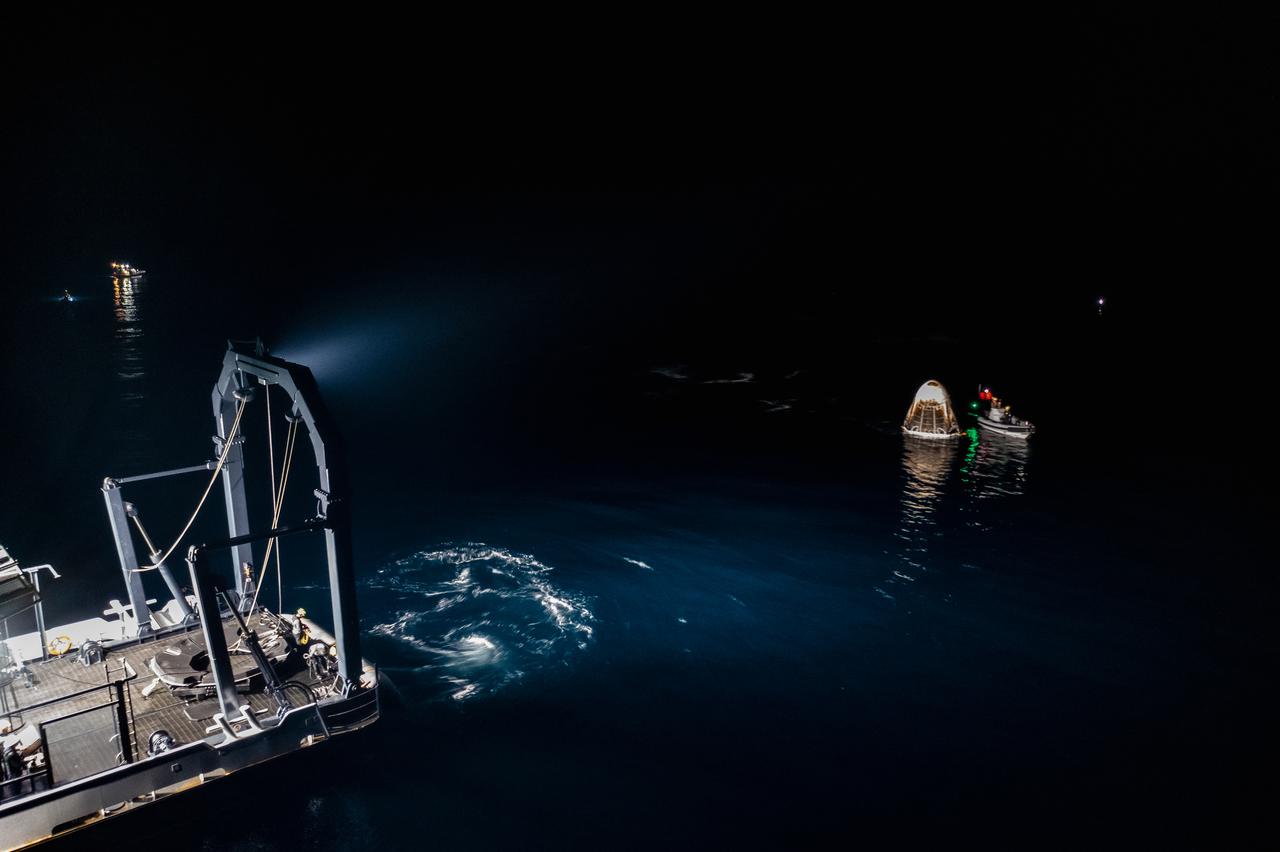
The SpaceX Crew Dragon Resilience splashes down in the Gulf of Mexico off the coast of Panama City, in Florida, at 2:56 a.m. EDT on May 2, 2021. Astronauts Michael Hopkins, Victor Glover, and Shannon Walker of NASA, and Soichi Noguchi of JAXA (Japan Aerospace Exploration Agency) completed Crew-1, the first crew rotation mission to the International Space Station in partnership with NASA as part of the agency’s Commercial Crew Program. At left is SpaceX’s Go Navigator recovery ship. Crew Dragon will be secured and then hoisted onto the main deck of the recovery ship with the astronauts inside.
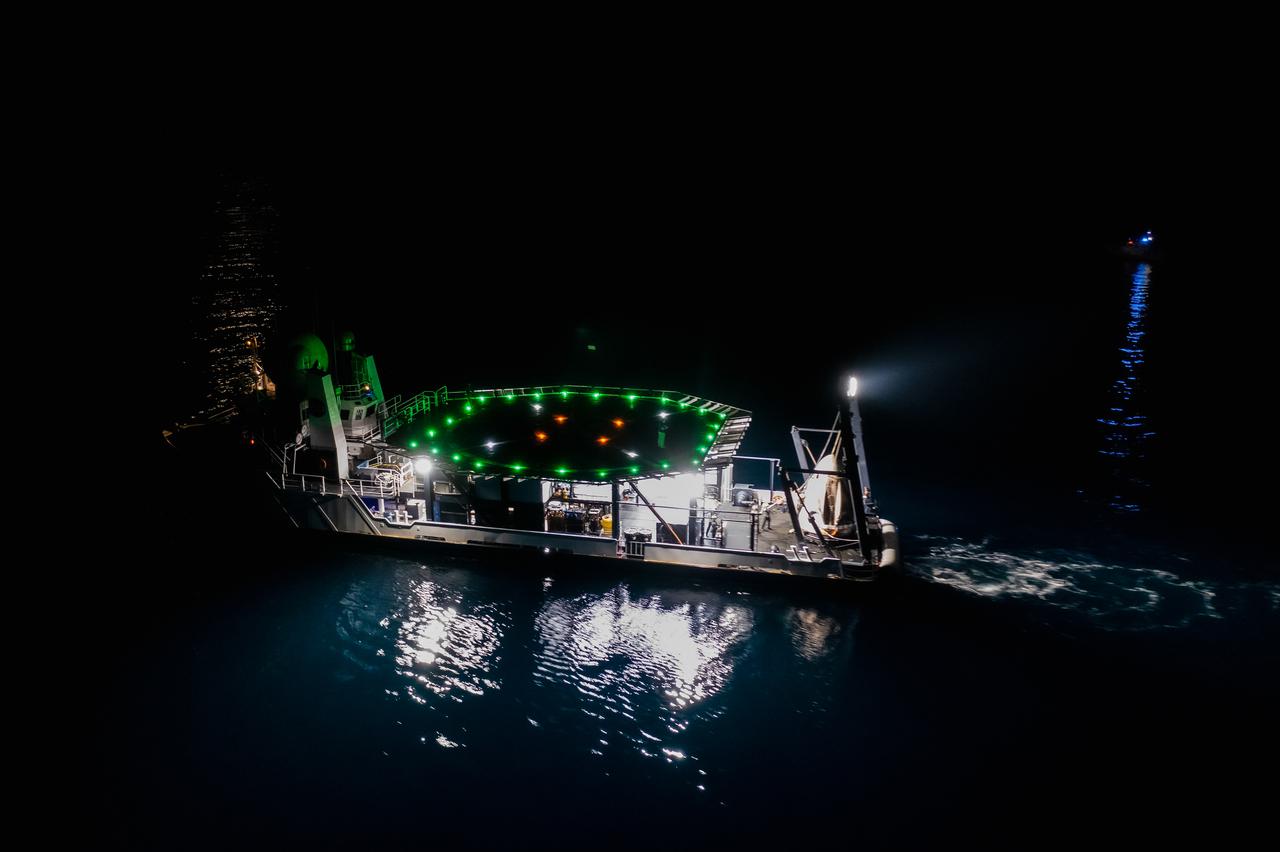
The SpaceX Crew Dragon Resilience splashed down in the Gulf of Mexico off the coast of Panama City, in Florida, at 2:56 a.m. EDT on May 2, 2021. Astronauts Michael Hopkins, Victor Glover, and Shannon Walker of NASA, and Soichi Noguchi of JAXA (Japan Aerospace Exploration Agency) completed Crew-1, the first crew rotation mission to the International Space Station in partnership with NASA as part of the agency’s Commercial Crew Program. Teams on the Go Navigator recovery ship, including two fast boats, work to secure and hoist Crew Dragon onto the main deck of the recovery ship with the astronauts inside.
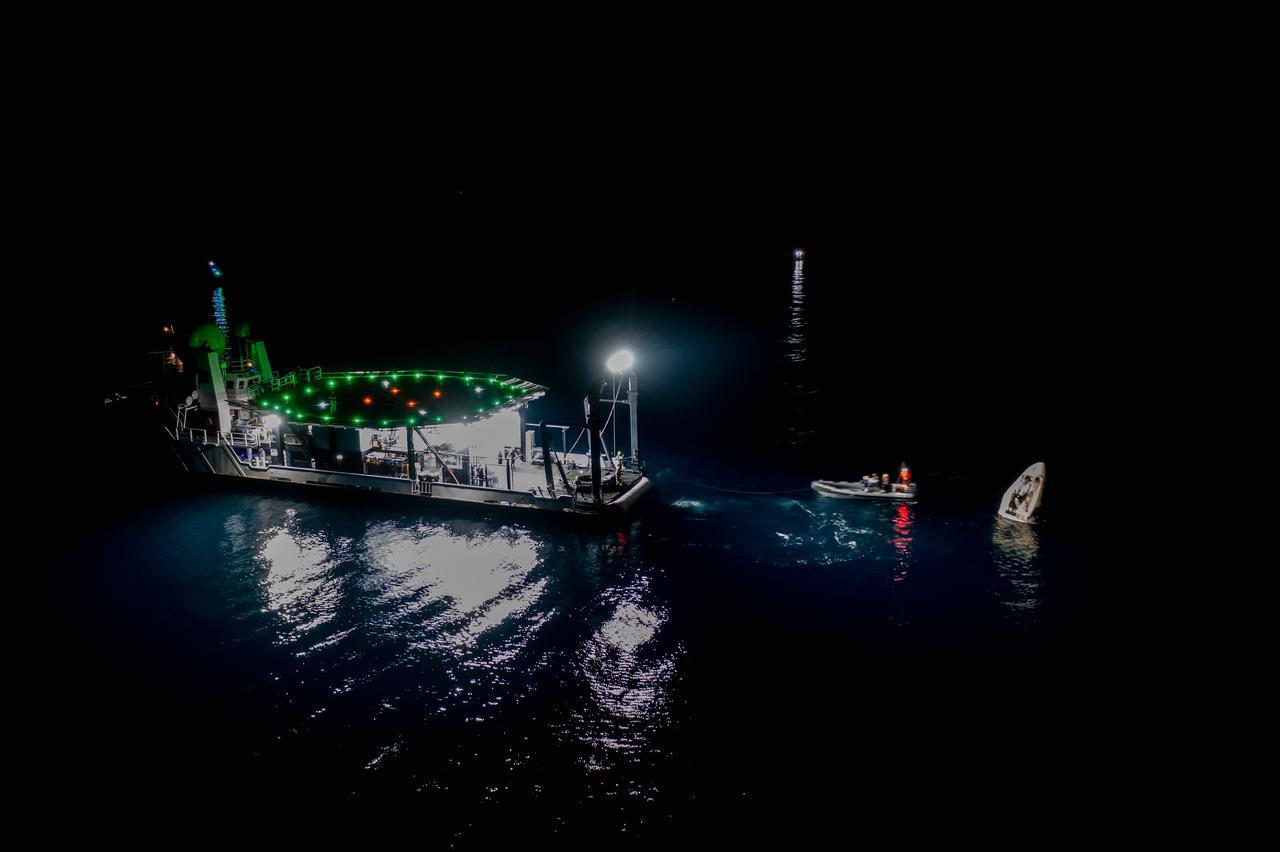
The SpaceX Crew Dragon Resilience splashes down in the Gulf of Mexico off the coast of Panama City, in Florida, at 2:56 a.m. EDT on May 2, 2021. Astronauts Michael Hopkins, Victor Glover, and Shannon Walker of NASA, and Soichi Noguchi of JAXA (Japan Aerospace Exploration Agency) completed Crew-1, the first crew rotation mission to the International Space Station in partnership with NASA as part of the agency’s Commercial Crew Program. At left is SpaceX’s Go Navigator recovery ship. Teams on two fast boats and Go Navigator will secure Crew Dragon to be hoisted onto the main deck of the recovery ship with the astronauts inside.
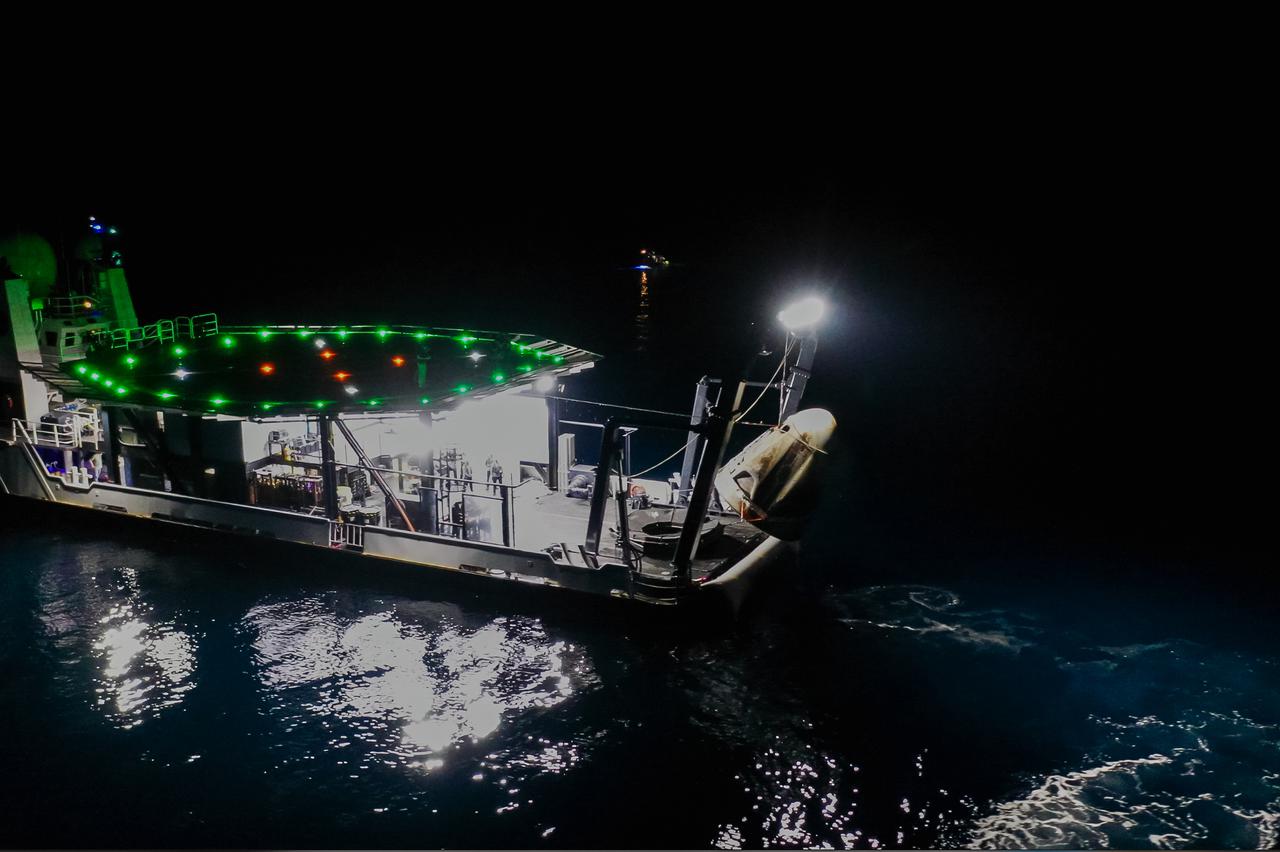
The SpaceX Crew Dragon Resilience splashed down in the Gulf of Mexico off the coast of Panama City, in Florida, at 2:56 a.m. EDT on May 2, 2021. Astronauts Michael Hopkins, Victor Glover, and Shannon Walker of NASA, and Soichi Noguchi of JAXA (Japan Aerospace Exploration Agency) completed Crew-1, the first crew rotation mission to the International Space Station in partnership with NASA as part of the agency’s Commercial Crew Program. Teams on the Go Navigator recovery ship, including two fast boats, work to secure and hoist Crew Dragon onto the main deck of the recovery ship with the astronauts inside.
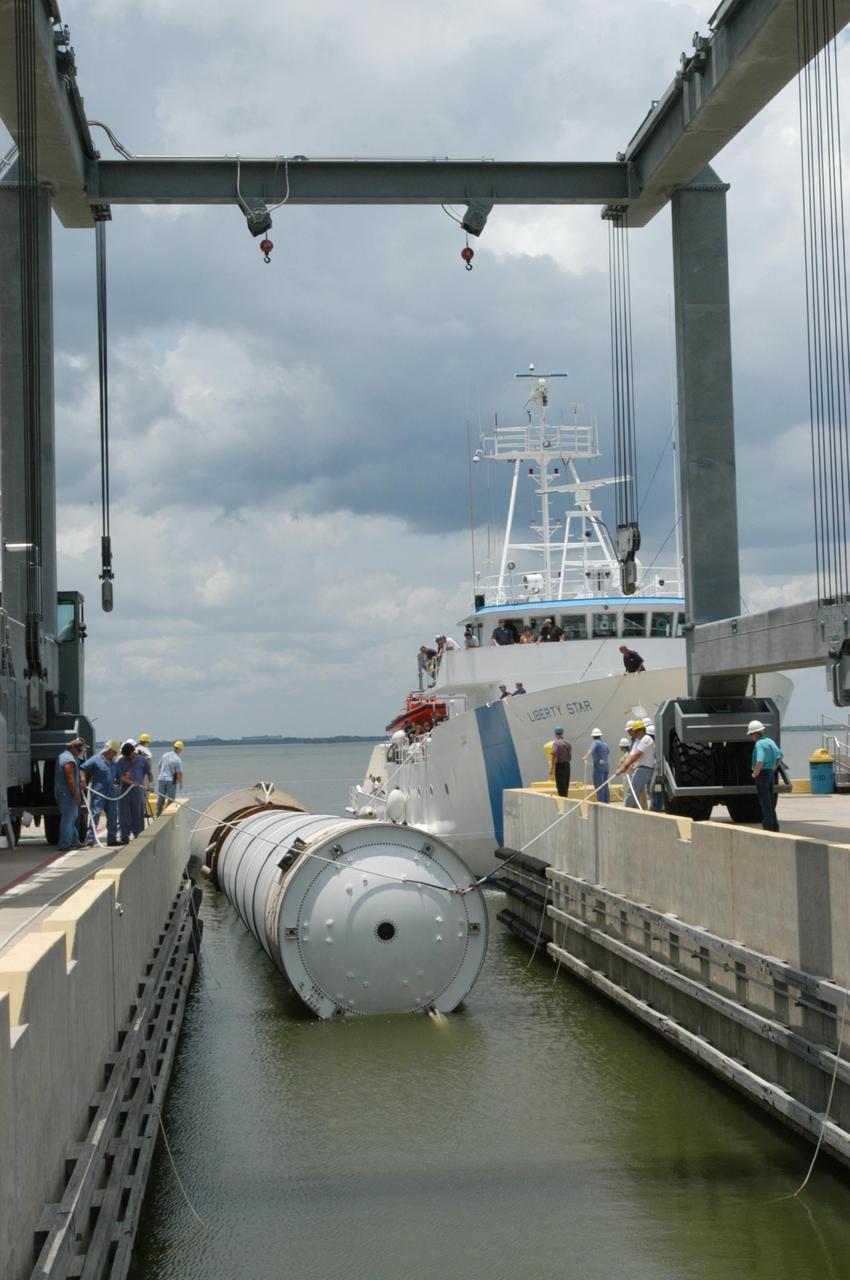
KENNEDY SPACE CENTER, FLA. - At the dock at Hangar AF, Cape Canaveral Air Force Station, workers move the spent solid rocket booster away from the SRB Retrieval Ship Liberty Star to an area beneath the straddle crane that will lift it out of the water. The booster is from Space Shuttle Discovery, which launched on July 4. The space shuttle’s solid rocket booster casings and associated flight hardware are recovered at sea. The boosters impact the Atlantic Ocean approximately seven minutes after liftoff. The splashdown area is a square of about 6 by 9 nautical miles located about 140 nautical miles downrange from the launch pad. The retrieval ships are stationed approximately 8 to 10 nautical miles from the impact area at the time of splashdown. As soon as the boosters enter the water, the ships accelerate to a speed of 15 knots and quickly close on the boosters. The pilot chutes and main parachutes are the first items to be brought on board. With the chutes and frustum recovered, attention turns to the boosters. The ship’s tow line is connected and the booster is returned to the Port and ,after transfer to a position alongside the ship, to Hangar AF at Cape Canaveral Air Force Station. There, the expended boosters are disassembled, refurbished and reloaded with solid propellant for reuse. Photo credit: NASA/George Shelton
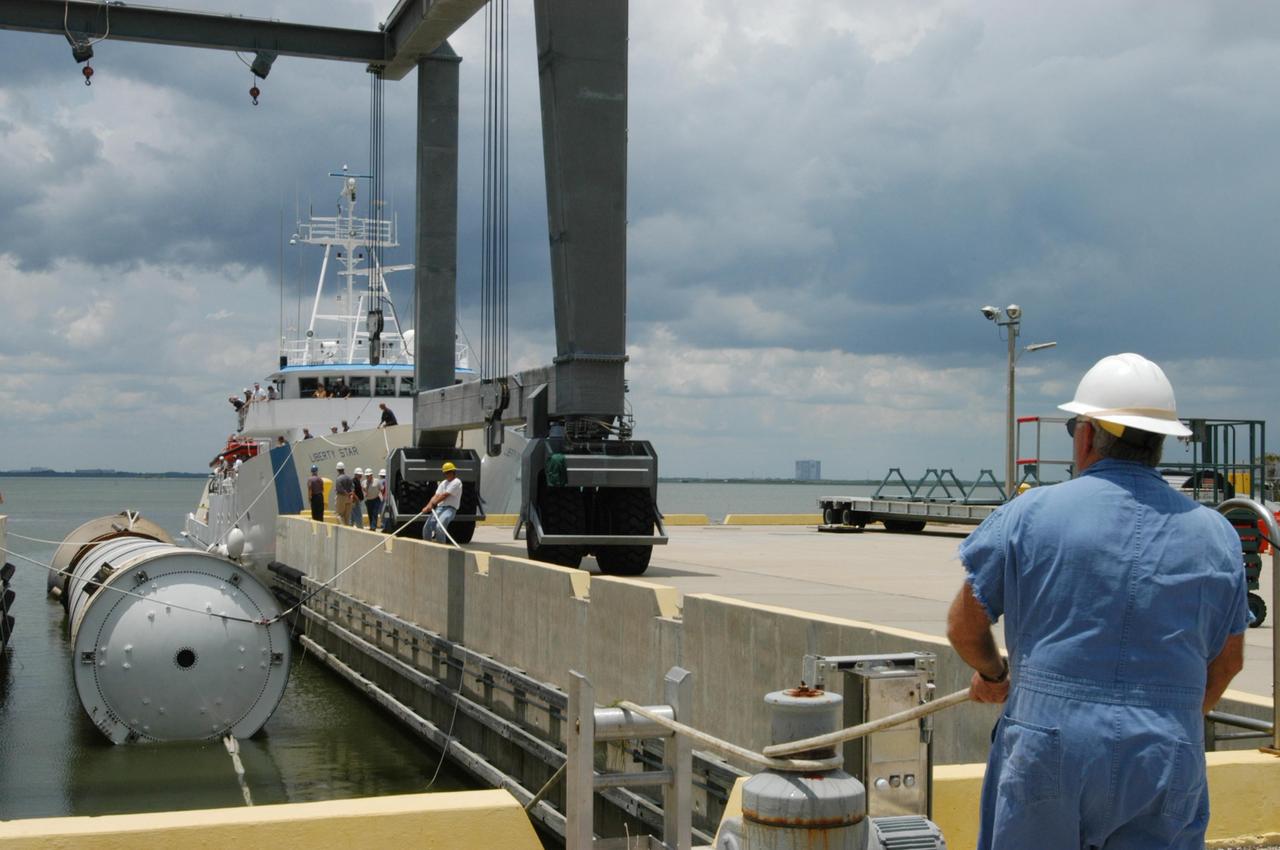
KENNEDY SPACE CENTER, FLA. - At the dock at Hangar AF, Cape Canaveral Air Force Station, workers move the spent solid rocket booster underneath the straddle crane that will lift it out of the water. The booster is from Space Shuttle Discovery, which launched on July 4. The space shuttle’s solid rocket booster casings and associated flight hardware are recovered at sea. The boosters impact the Atlantic Ocean approximately seven minutes after liftoff. The splashdown area is a square of about 6 by 9 nautical miles located about 140 nautical miles downrange from the launch pad. The retrieval ships are stationed approximately 8 to 10 nautical miles from the impact area at the time of splashdown. As soon as the boosters enter the water, the ships accelerate to a speed of 15 knots and quickly close on the boosters. The pilot chutes and main parachutes are the first items to be brought on board. With the chutes and frustum recovered, attention turns to the boosters. The ship’s tow line is connected and the booster is returned to the Port and ,after transfer to a position alongside the ship, to Hangar AF at Cape Canaveral Air Force Station. There, the expended boosters are disassembled, refurbished and reloaded with solid propellant for reuse. Photo credit: NASA/George Shelton
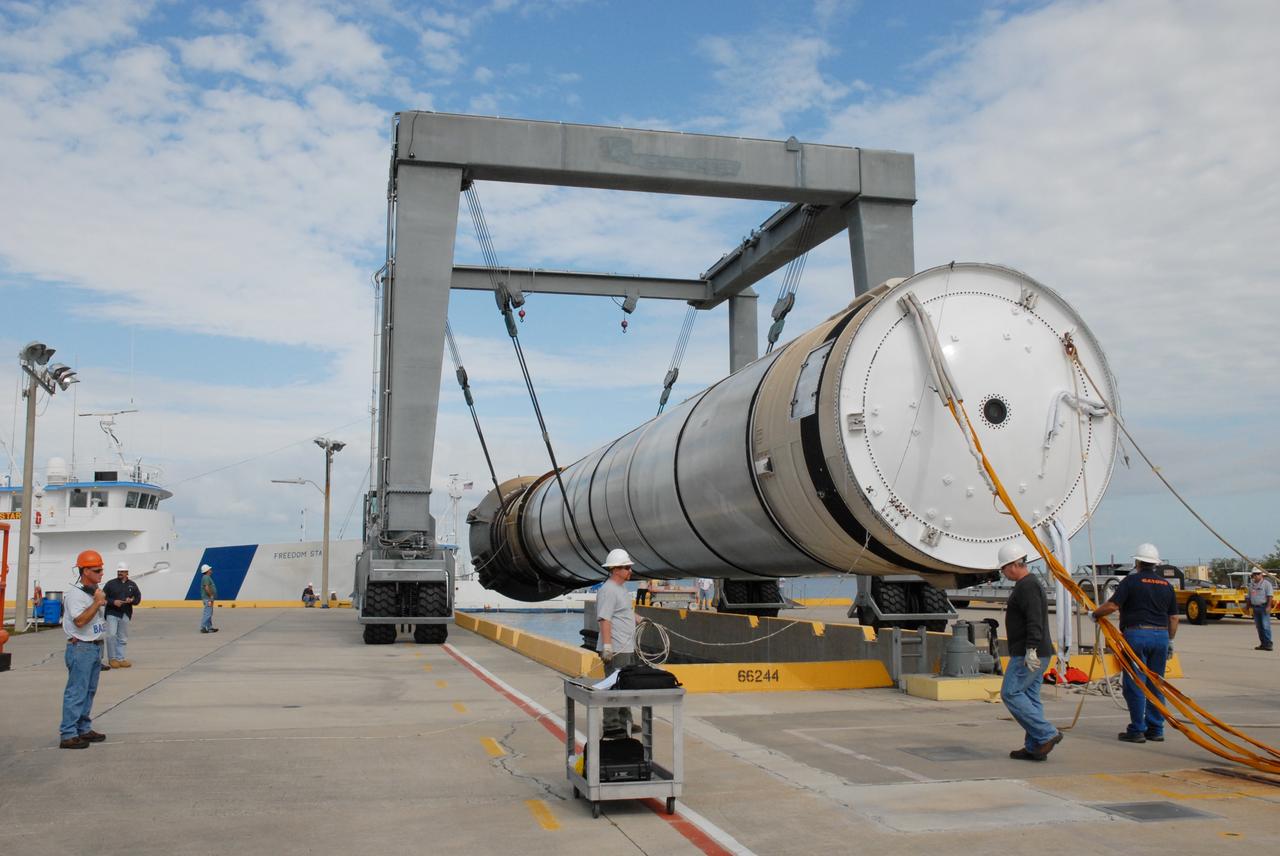
CAPE CANAVERAL, Fla. – At the dock at Hangar AF at Cape Canaveral Air Force Station in Florida, the solid rocket booster is lifted out of the water by the straddle crane. The booster, used during space shuttle Discovery's launch from NASA's Kennedy Space Center in Florida March 15 on mission STS-119, will be placed on a transporter. The space shuttle’s solid rocket booster casings and associated flight hardware are recovered at sea after a launch. The spent rockets were recovered by NASA's Solid Rocket Booster Retrieval Ships Freedom Star and Liberty Star. The boosters impact the Atlantic Ocean approximately seven minutes after liftoff. The splashdown area is a square of about six by nine nautical miles located about 140 nautical miles downrange from the launch pad. The retrieval ships are stationed approximately 8 to 10 nautical miles from the impact area at the time of splashdown. As soon as the boosters enter the water, the ships accelerate to a speed of 15 knots and quickly close on the boosters. The pilot chutes and main parachutes are the first items to be brought on board. With the chutes and frustum recovered, attention turns to the boosters. The ship’s tow line is connected and the booster is returned to the Port and, after transfer to a position alongside the ship, to Hangar AF. There, the expended boosters are disassembled, refurbished and reloaded with solid propellant for reuse. Photo credit: NASA/Jack Pfaller
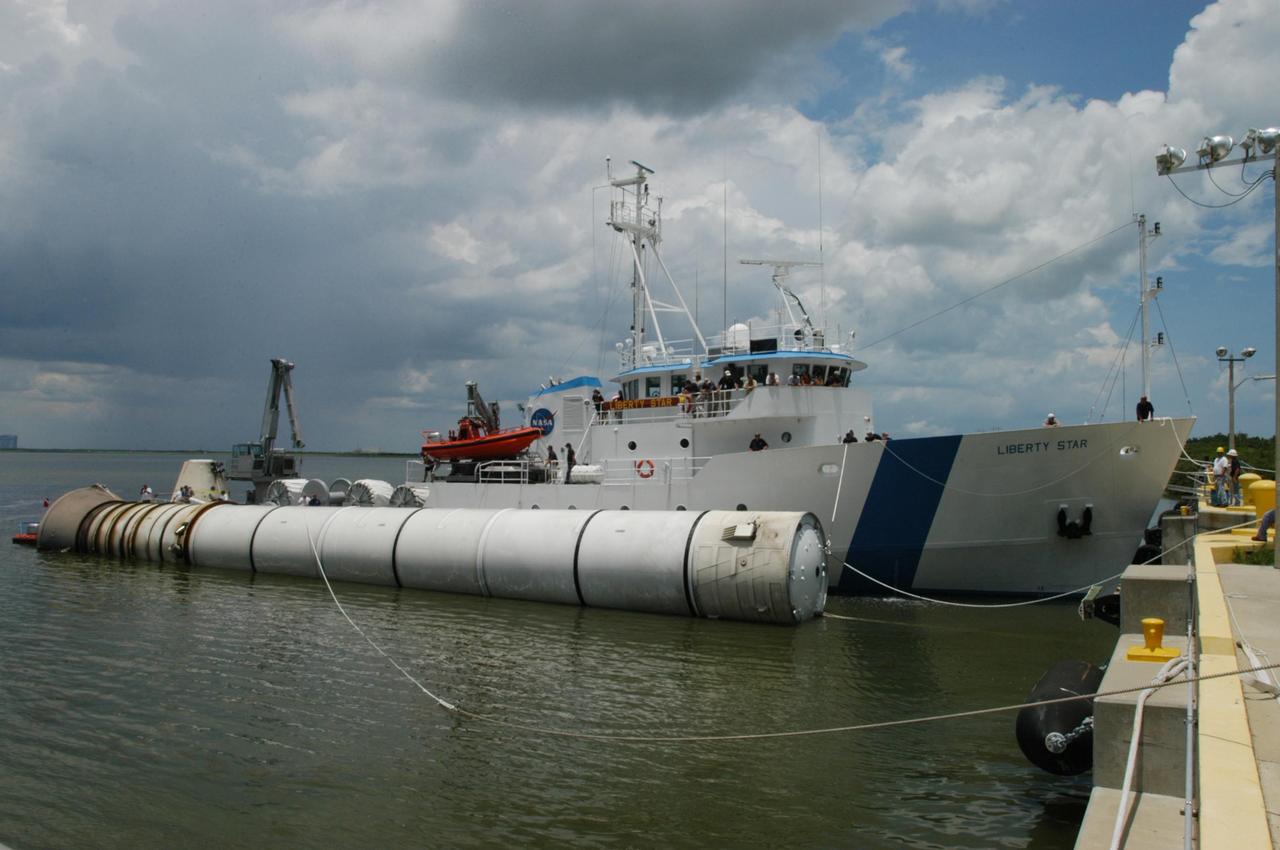
KENNEDY SPACE CENTER, FLA. - At the dock at Hangar AF, Cape Canaveral Air Force Station, the SRB Retrieval Ship Liberty Star gets ready to transfer the spent solid rocket booster to a straddle crane that will lift it out of the water. The booster is from Space Shuttle Discovery, which launched on July 4. The space shuttle’s solid rocket booster casings and associated flight hardware are recovered at sea. The boosters impact the Atlantic Ocean approximately seven minutes after liftoff. The splashdown area is a square of about 6 by 9 nautical miles located about 140 nautical miles downrange from the launch pad. The retrieval ships are stationed approximately 8 to 10 nautical miles from the impact area at the time of splashdown. As soon as the boosters enter the water, the ships accelerate to a speed of 15 knots and quickly close on the boosters. The pilot chutes and main parachutes are the first items to be brought on board. With the chutes and frustum recovered, attention turns to the boosters. The ship’s tow line is connected and the booster is returned to the Port and ,after transfer to a position alongside the ship, to Hangar AF at Cape Canaveral Air Force Station. There, the expended boosters are disassembled, refurbished and reloaded with solid propellant for reuse. Photo credit: NASA/George Shelton
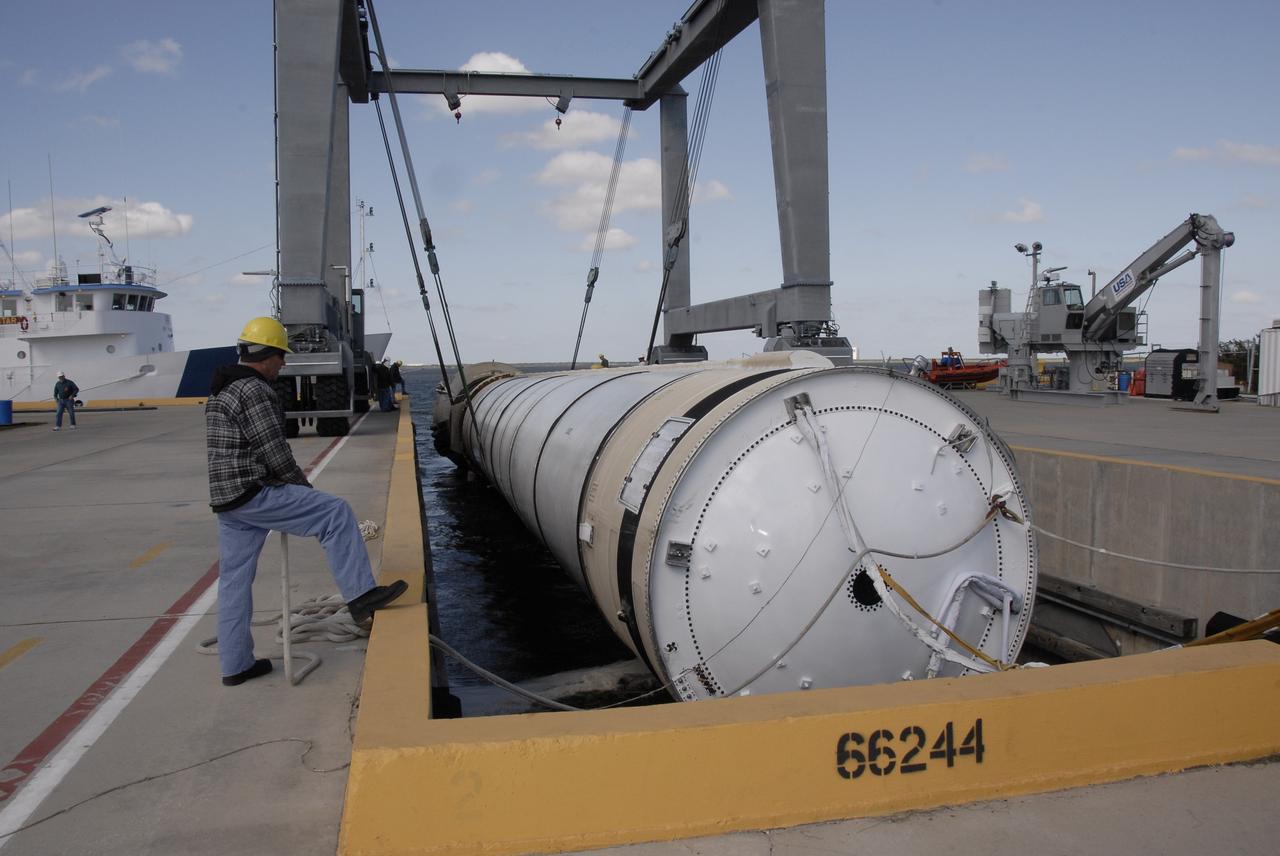
CAPE CANAVERAL, Fla. – At the dock at Hangar AF at Cape Canaveral Air Force Station in Florida, workers move the spent solid rocket booster to an area beneath the straddle crane that will lift it out of the water. The booster is from space shuttle Endeavour, which launched Nov. 14 on the STS-126 mission. The space shuttle’s solid rocket booster casings and associated flight hardware are recovered at sea. The spent rocket was recovered by NASA's Solid Rocket Booster Retrieval Ship Freedom Star. The boosters impact the Atlantic Ocean approximately seven minutes after liftoff. The splashdown area is a square of about six by nine nautical miles located about 140 nautical miles downrange from the launch pad. The retrieval ships are stationed approximately 8 to 10 nautical miles from the impact area at the time of splashdown. As soon as the boosters enter the water, the ships accelerate to a speed of 15 knots and quickly close on the boosters. The pilot chutes and main parachutes are the first items to be brought on board. With the chutes and frustum recovered, attention turns to the boosters. The ship’s tow line is connected and the booster is returned to the Port and, after transfer to a position alongside the ship, to Hangar AF. There, the expended boosters are disassembled, refurbished and reloaded with solid propellant for reuse. Photo credit: NASA/Kim Shiflett
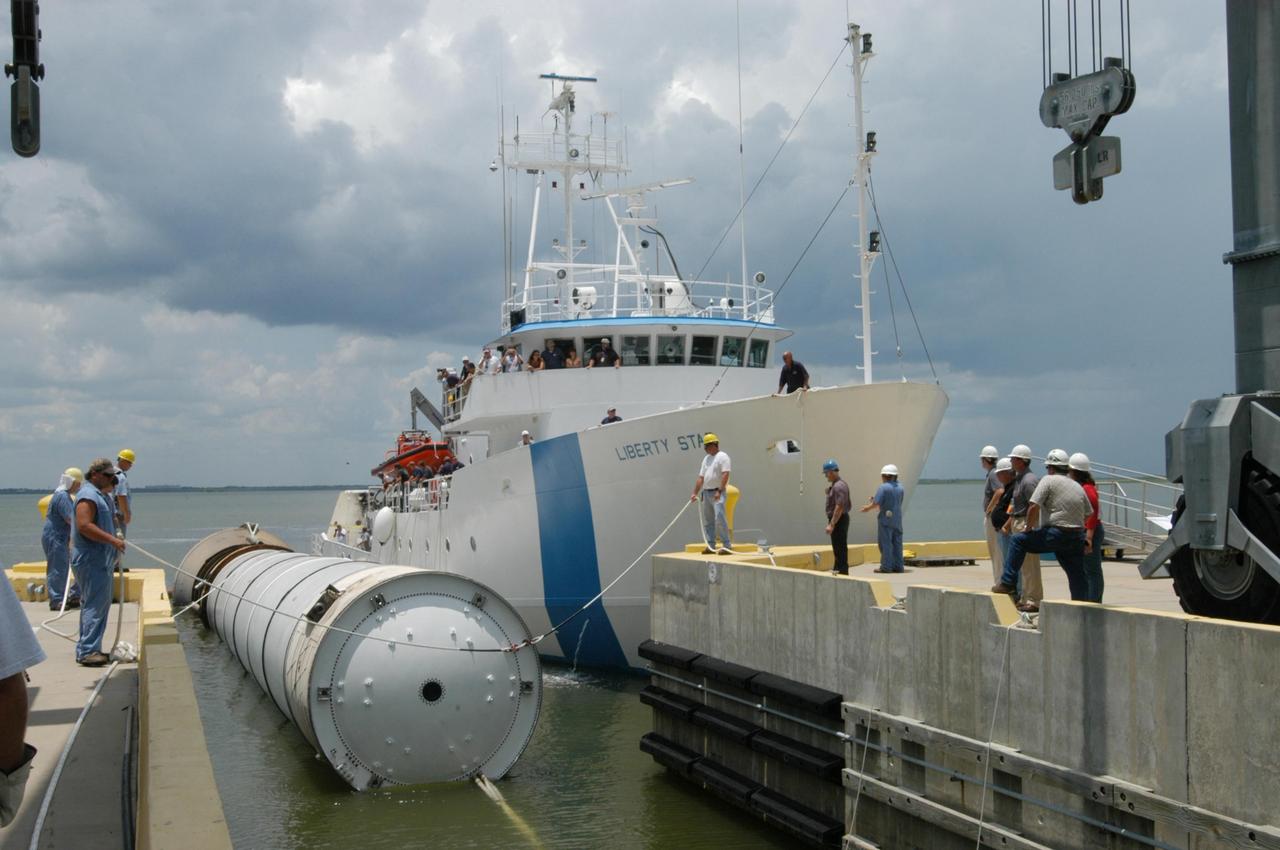
KENNEDY SPACE CENTER, FLA. - At the dock at Hangar AF, Cape Canaveral Air Force Station, workers move the spent solid rocket booster away from the SRB Retrieval Ship Liberty Star to an area beneath the straddle crane that will lift it out of the water. The booster is from Space Shuttle Discovery, which launched on July 4. The space shuttle’s solid rocket booster casings and associated flight hardware are recovered at sea. The boosters impact the Atlantic Ocean approximately seven minutes after liftoff. The splashdown area is a square of about 6 by 9 nautical miles located about 140 nautical miles downrange from the launch pad. The retrieval ships are stationed approximately 8 to 10 nautical miles from the impact area at the time of splashdown. As soon as the boosters enter the water, the ships accelerate to a speed of 15 knots and quickly close on the boosters. The pilot chutes and main parachutes are the first items to be brought on board. With the chutes and frustum recovered, attention turns to the boosters. The ship’s tow line is connected and the booster is returned to the Port and ,after transfer to a position alongside the ship, to Hangar AF at Cape Canaveral Air Force Station. There, the expended boosters are disassembled, refurbished and reloaded with solid propellant for reuse. Photo credit: NASA/George Shelton
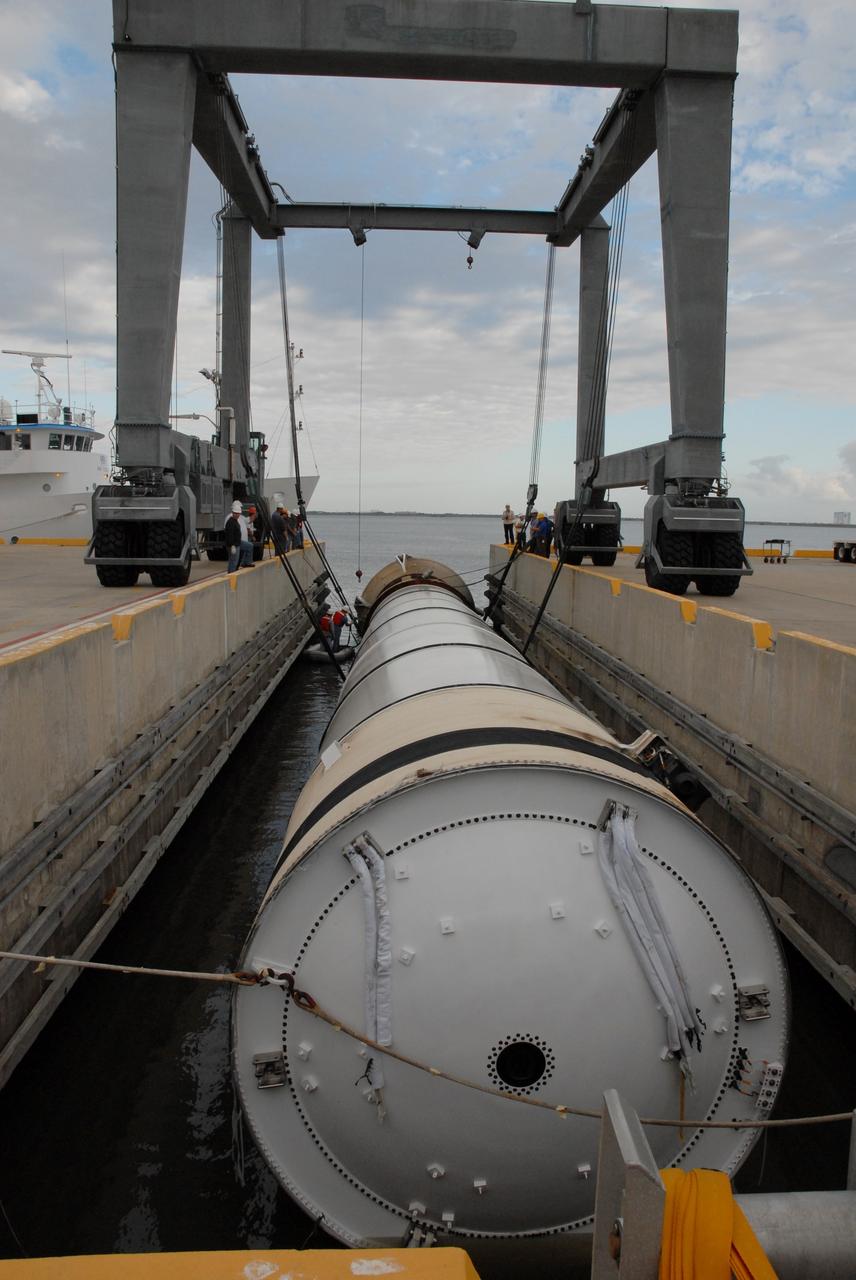
CAPE CANAVERAL, Fla. – At the dock at Hangar AF at Cape Canaveral Air Force Station in Florida, one of the solid rocket boosters used during space shuttle Discovery's launch March 15 on mission STS-119 is moved to an area beneath the straddle crane that will lift it out of the water. The space shuttle’s solid rocket booster casings and associated flight hardware are recovered at sea after a launch. The spent rockets were recovered by NASA's Solid Rocket Booster Retrieval Ships Freedom Star and Liberty Star. The boosters impact the Atlantic Ocean approximately seven minutes after liftoff. The splashdown area is a square of about six by nine nautical miles located about 140 nautical miles downrange from the launch pad. The retrieval ships are stationed approximately 8 to 10 nautical miles from the impact area at the time of splashdown. As soon as the boosters enter the water, the ships accelerate to a speed of 15 knots and quickly close on the boosters. The pilot chutes and main parachutes are the first items to be brought on board. With the chutes and frustum recovered, attention turns to the boosters. The ship’s tow line is connected and the booster is returned to the Port and, after transfer to a position alongside the ship, to Hangar AF. There, the expended boosters are disassembled, refurbished and reloaded with solid propellant for reuse. Photo credit: NASA/Jack Pfaller
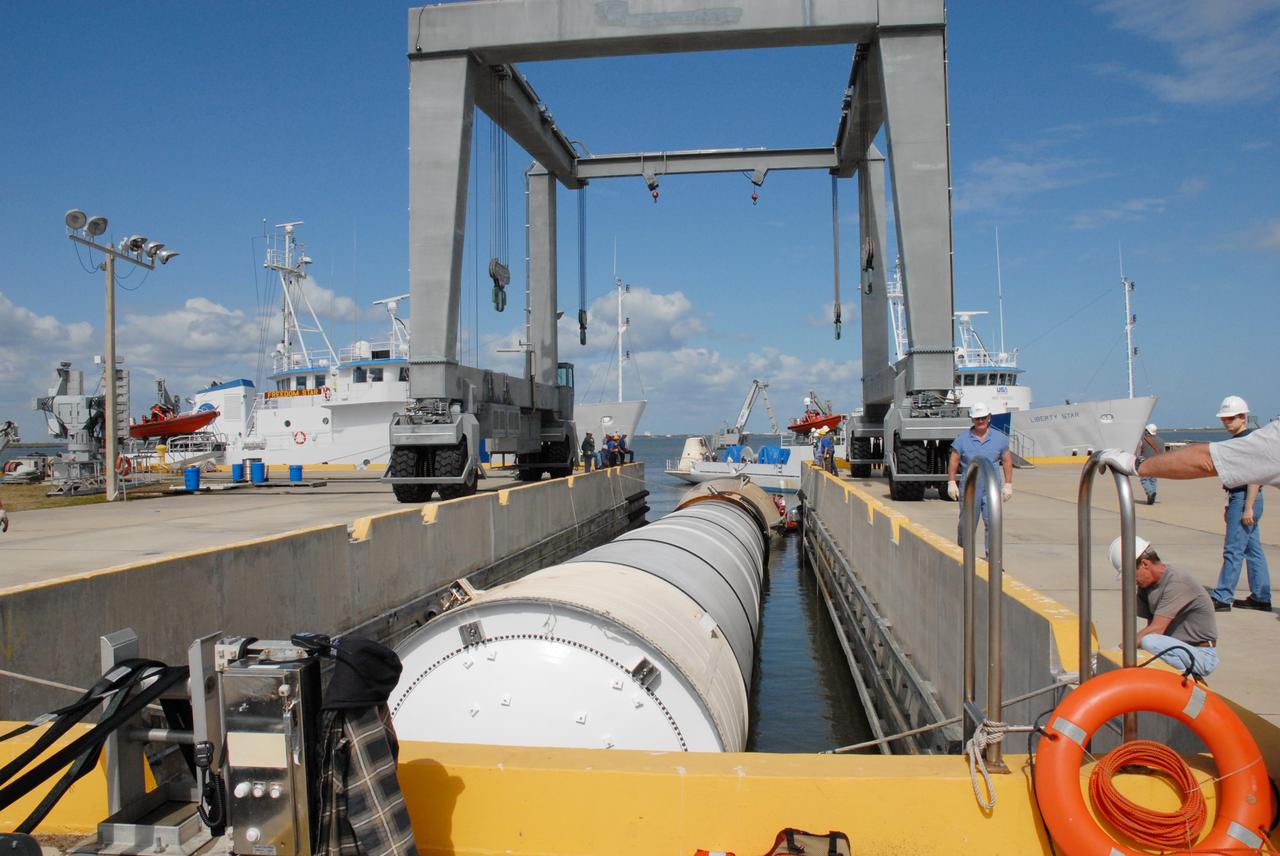
CAPE CANAVERAL, Fla. – At the dock at Hangar AF at Cape Canaveral Air Force Station in Florida, a solid rocket boosters used during space shuttle Discovery's launch from NASA's Kennedy Space Center in Florida March 15 on mission STS-119 waits in an area beneath the straddle crane that will lift it out of the water. The space shuttle’s solid rocket booster casings and associated flight hardware are recovered at sea after a launch. The spent rockets were recovered by NASA's Solid Rocket Booster Retrieval Ships Freedom Star and Liberty Star. The boosters impact the Atlantic Ocean approximately seven minutes after liftoff. The splashdown area is a square of about six by nine nautical miles located about 140 nautical miles downrange from the launch pad. The retrieval ships are stationed approximately 8 to 10 nautical miles from the impact area at the time of splashdown. As soon as the boosters enter the water, the ships accelerate to a speed of 15 knots and quickly close on the boosters. The pilot chutes and main parachutes are the first items to be brought on board. With the chutes and frustum recovered, attention turns to the boosters. The ship’s tow line is connected and the booster is returned to the Port and, after transfer to a position alongside the ship, to Hangar AF. There, the expended boosters are disassembled, refurbished and reloaded with solid propellant for reuse. Photo credit: NASA/Jack Pfaller
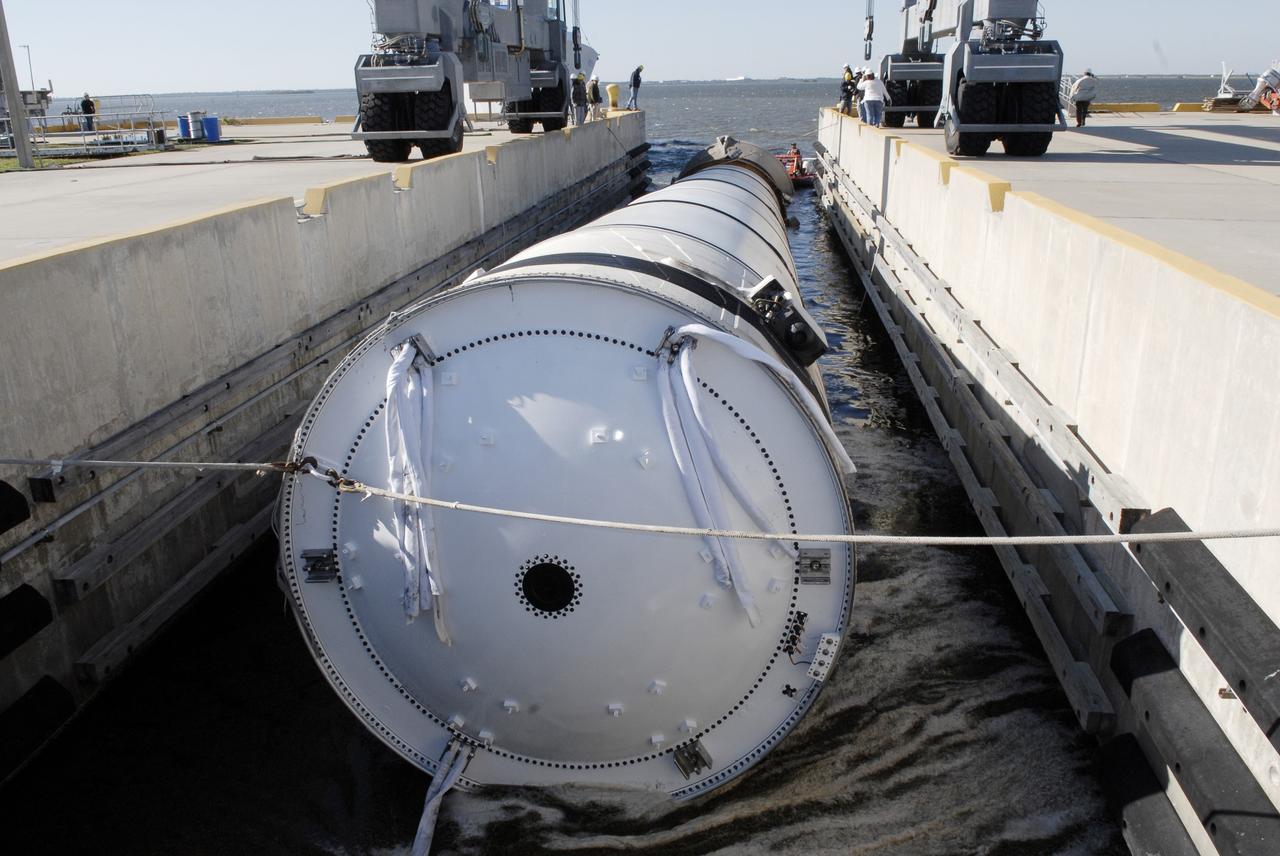
CAPE CANAVERAL, Fla. – At the dock at Hangar AF at Cape Canaveral Air Force Station in Florida, the spent solid rocket booster from space shuttle Endeavour's launch Nov. 14 on mission STS-126 is moved to an area beneath the straddle crane that will lift it out of the water. The space shuttle’s solid rocket booster casings and associated flight hardware are recovered at sea. The spent rocket was recovered by NASA's Solid Rocket Booster Retrieval Ship Freedom Star. The boosters impact the Atlantic Ocean approximately seven minutes after liftoff. The splashdown area is a square of about six by nine nautical miles located about 140 nautical miles downrange from the launch pad. The retrieval ships are stationed approximately 8 to 10 nautical miles from the impact area at the time of splashdown. As soon as the boosters enter the water, the ships accelerate to a speed of 15 knots and quickly close on the boosters. The pilot chutes and main parachutes are the first items to be brought on board. With the chutes and frustum recovered, attention turns to the boosters. The ship’s tow line is connected and the booster is returned to the Port and, after transfer to a position alongside the ship, to Hangar AF. There, the expended boosters are disassembled, refurbished and reloaded with solid propellant for reuse. Photo credit: NASA/Kim Shiflett
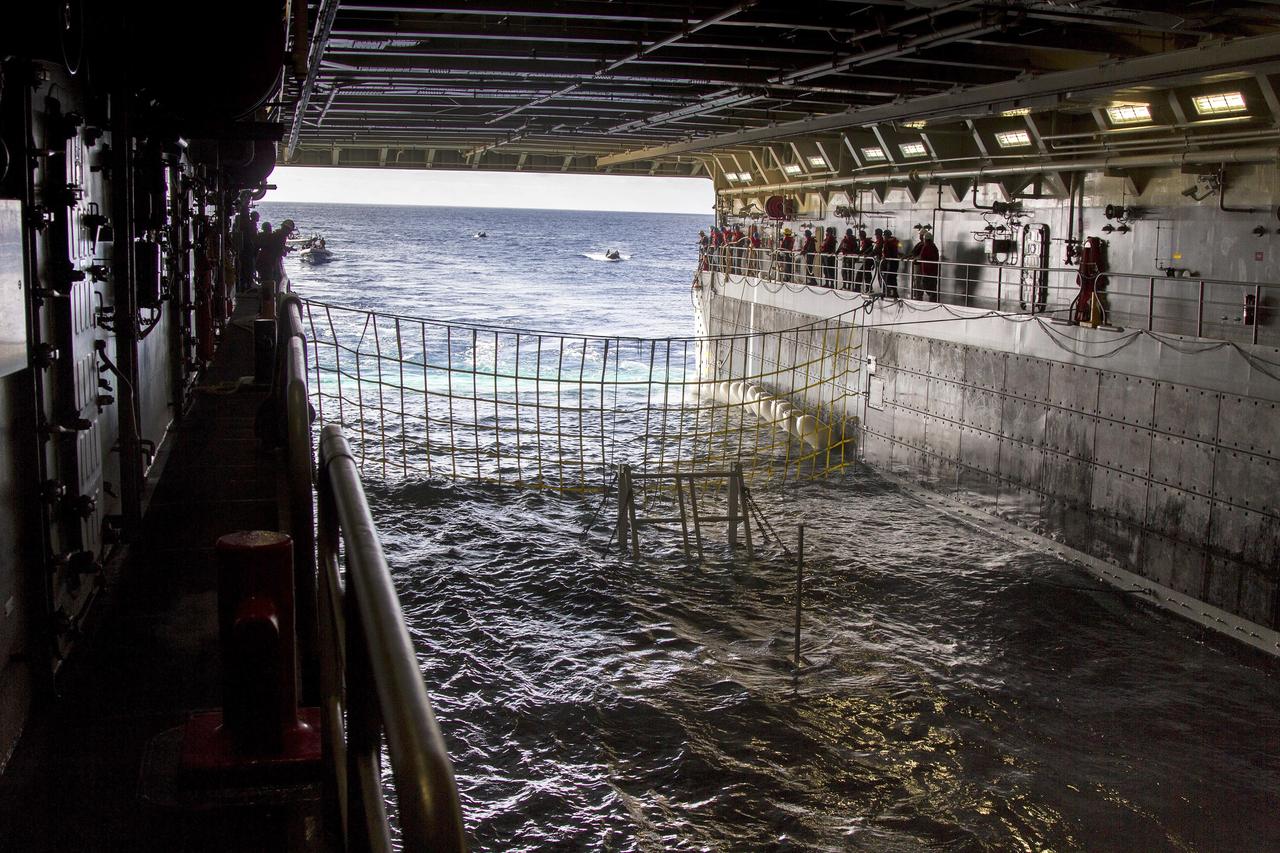
SAN DIEGO, Calif. – On the third day of preparations for recovery of Orion after its splashdown in the Pacific Ocean, the well deck of the USS Anchorage has been filled with water and recovery hardware is in place. U.S. Navy divers have embarked from ship to practice recovery procedures in rigid hull inflatable boats and Zodiac boats. NASA, Lockheed Martin and U.S. Navy personnel are preparing for recovery of the crew module, forward bay cover and parachutes on its return from space and splashdown in the Pacific Ocean. The Ground Systems Development and Operations Program is leading the recovery efforts. The first unpiloted flight test of Orion is scheduled to launch Dec. 4 atop a United Launch Alliance Delta IV Heavy rocket. During its two-orbit, 4.5-hour flight, Orion will venture 3,600 miles in altitude and travel nearly 60,000 miles before returning to Earth for a splashdown in the Pacific Ocean. For more information, visit http://www.nasa.gov/orion. Photo credit: NASA/Cory Huston
CAPE CANAVERAL, Fla. -- Freedom Star, one of NASA's solid rocket booster retrieval ships, waits for crew members near the left spent booster bobbing in the Atlantic Ocean to attach a hose between it and the vessel that will facilitate debris and water clearing and the pumping in of air so the booster can float horizontally on the water's surface for towing back to Port Canaveral in Florida. The shuttle’s two solid rocket booster casings and associated flight hardware are recovered in the Atlantic Ocean after every launch by Liberty Star and Freedom Star. The boosters impact the Atlantic about seven minutes after liftoff and the retrieval ships are stationed about 10 miles from the impact area at the time of splashdown. After the spent segments are processed, they will be transported to Utah, where they will be refurbished and stored, if needed. Photo credit: NASA/Ben Smegelsky
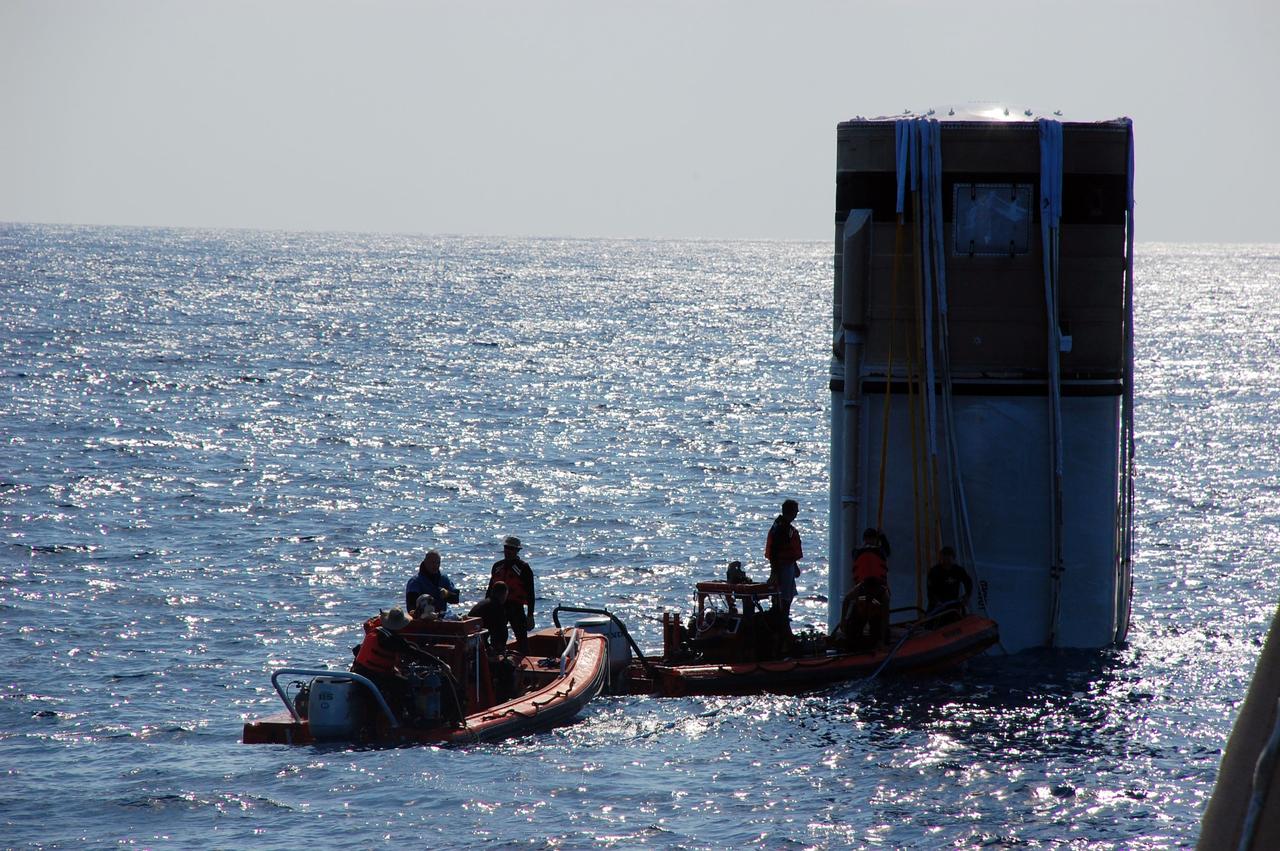
CAPE CANAVERAL, Fla. -- Crew members from Freedom Star, one of NASA's solid rocket booster retrieval ships, approach the left spent booster bobbing in the Atlantic Ocean to attach a hose that will facilitate debris and water clearing and the pumping in of air so the booster can float horizontally on the water's surface for towing back to Port Canaveral in Florida. The shuttle’s two solid rocket booster casings and associated flight hardware are recovered in the Atlantic Ocean after every launch by Liberty Star and Freedom Star. The boosters impact the Atlantic about seven minutes after liftoff and the retrieval ships are stationed about 10 miles from the impact area at the time of splashdown. After the spent segments are processed, they will be transported to Utah, where they will be refurbished and stored, if needed. Photo credit: NASA/Ben Smegelsky
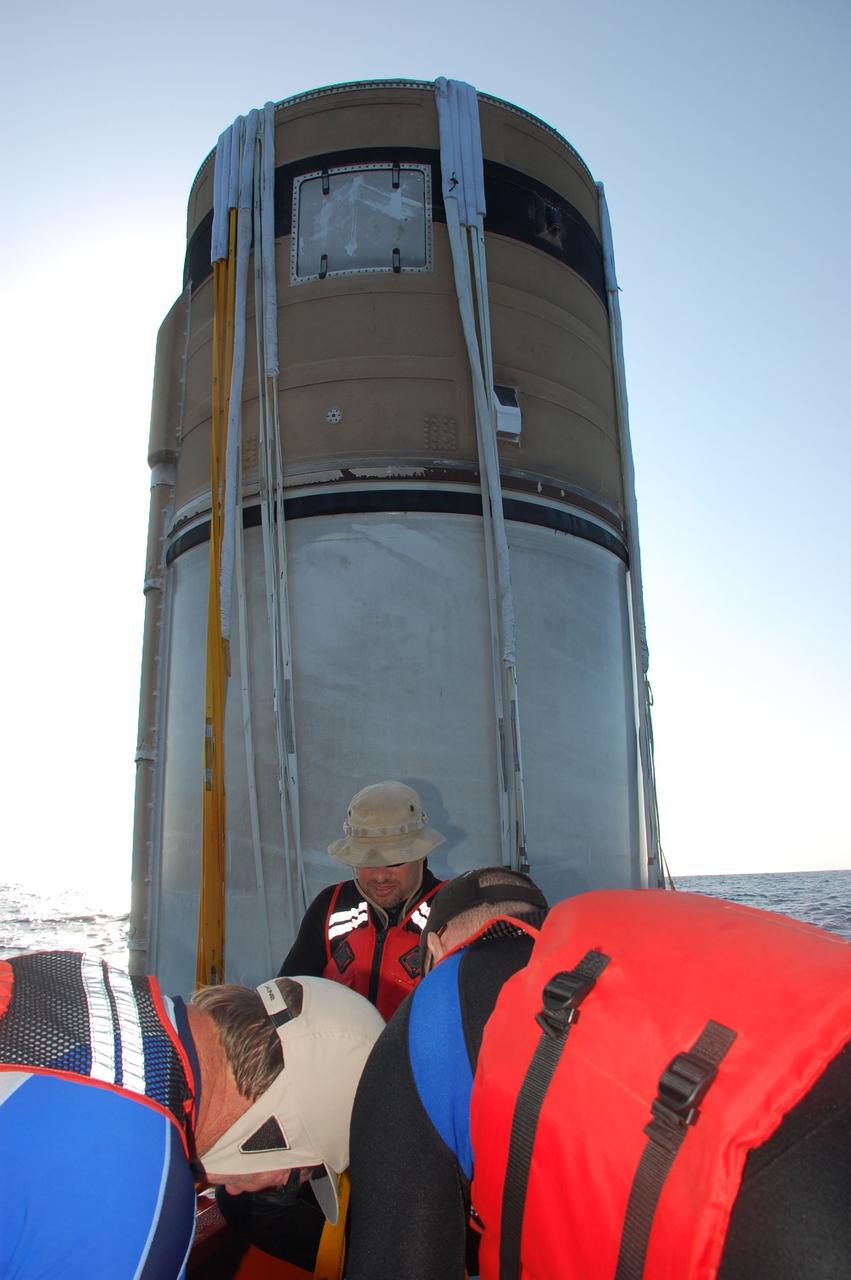
CAPE CANAVERAL, Fla. -- Crew members in a skiff from Freedom Star, one of NASA's solid rocket booster retrieval ships, attach a hose between the left spent booster and the vessel that will facilitate debris and water clearing and the pumping in of air in so the booster can float horizontally on the water's surface for towing back to Port Canaveral in Florida. The shuttle’s two solid rocket booster casings and associated flight hardware are recovered in the Atlantic Ocean after every launch by Liberty Star and Freedom Star. The boosters impact the Atlantic about seven minutes after liftoff and the retrieval ships are stationed about 10 miles from the impact area at the time of splashdown. After the spent segments are processed, they will be transported to Utah, where they will be refurbished and stored, if needed. Photo credit: NASA/Ben Smegelsky
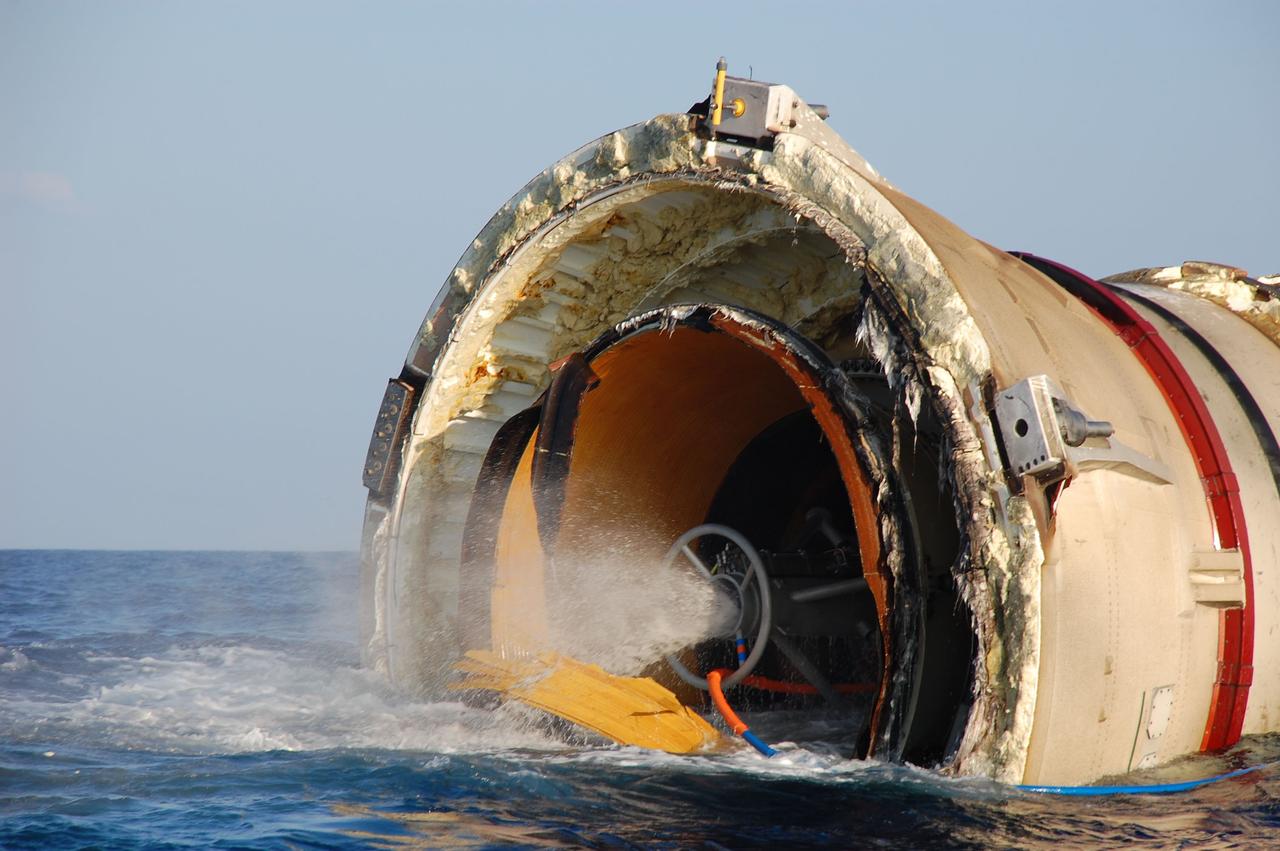
CAPE CANAVERAL, Fla. -- The left spent booster from space shuttle Discovery's final launch is seen floating on the water's surface while pumps on Freedom Star, one of NASA's solid rocket booster retrieval ships, push debris and water out of the booster, replacing with air to facilitate floating for its return to Port Canaveral in Florida. The shuttle’s two solid rocket booster casings and associated flight hardware are recovered in the Atlantic Ocean after every launch by Liberty Star and Freedom Star. The boosters impact the Atlantic about seven minutes after liftoff and the retrieval ships are stationed about 10 miles from the impact area at the time of splashdown. After the spent segments are processed, they will be transported to Utah, where they will be refurbished and stored, if needed. Photo credit: NASA/Ben Smegelsky
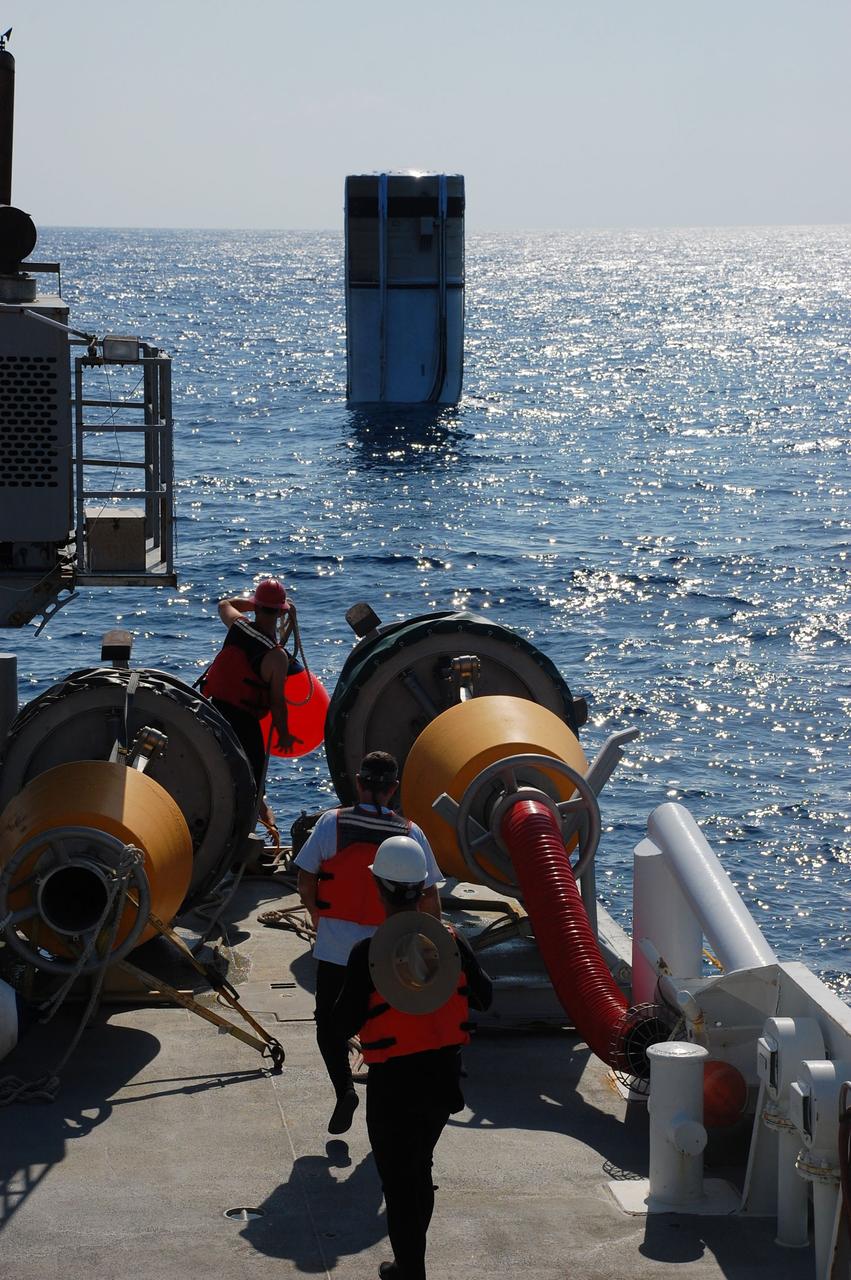
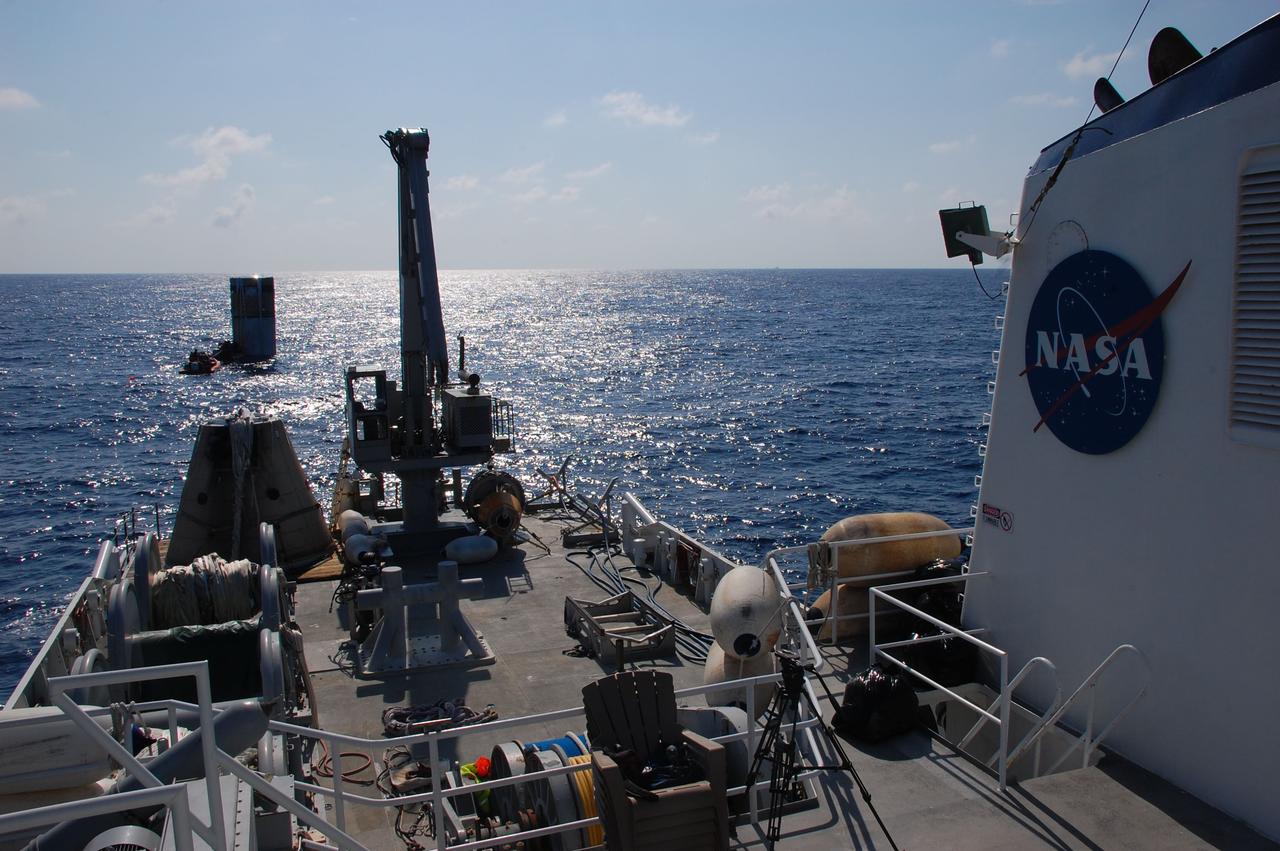
CAPE CANAVERAL, Fla. -- Freedom Star, one of NASA's solid rocket booster retrieval ships, and its crew are preparing to recover the left spent booster from the Atlantic Ocean. The round objects on deck are large pumping machines that will be attached to the booster by a hose that will blow out debris and water and then pump in air so the booster can float horizontally on the water's surface for towing back to Port Canaveral in Florida. The shuttle’s two solid rocket booster casings and associated flight hardware are recovered in the Atlantic Ocean after every launch by Liberty Star and Freedom Star. The boosters impact the Atlantic about seven minutes after liftoff and the retrieval ships are stationed about 10 miles from the impact area at the time of splashdown. After the spent segments are processed, they will be transported to Utah, where they will be refurbished and stored, if needed. Photo credit: NASA/Ben Smegelsky
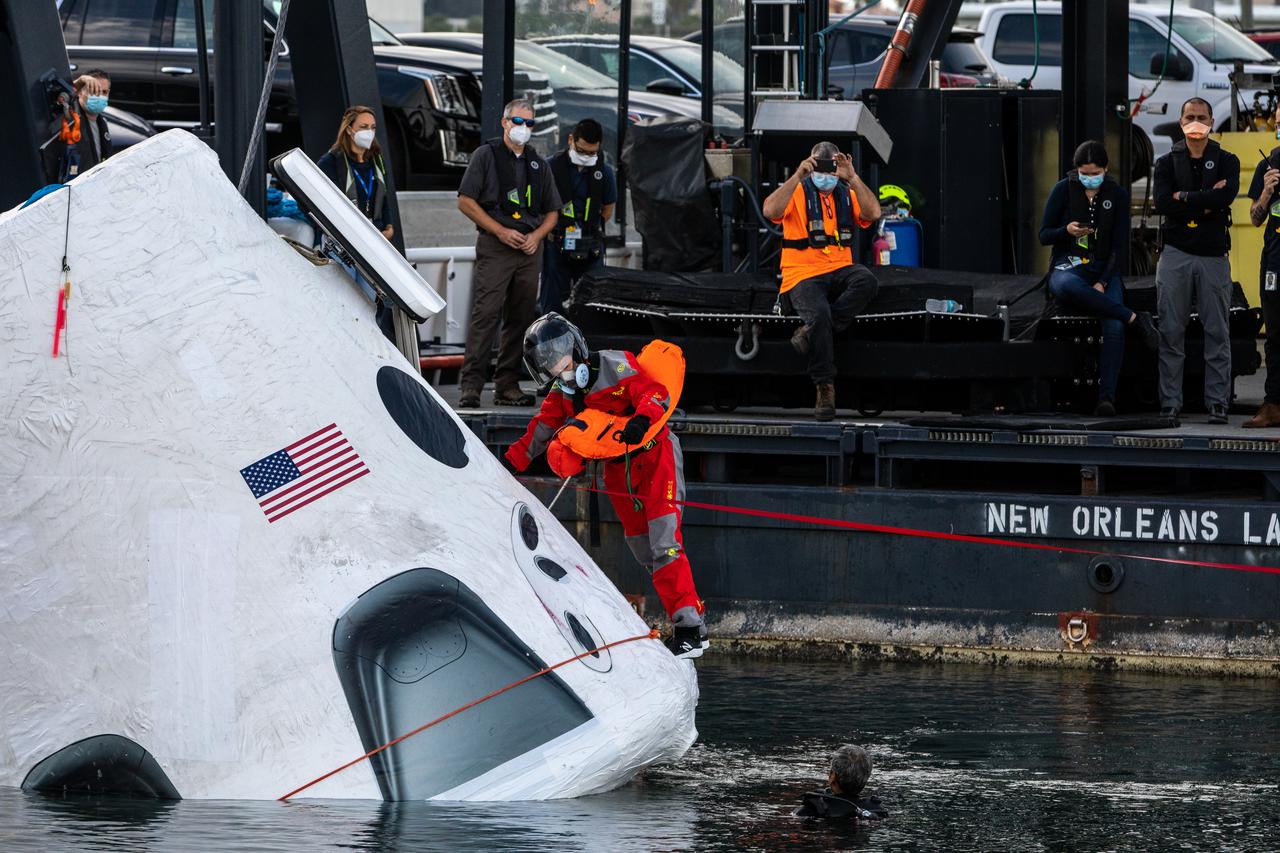
NASA astronauts Shane Kimbrough and Megan McArthur, Japan Aerospace Exploration Agency astronaut Akihiko Hoshide, and European Space Agency astronaut Thomas Pesquet participate in an egress training exercise in Port Canaveral, Florida, on Oct. 1, 2020, in preparation for NASA’s SpaceX Crew-2 mission as part of the agency’s Commercial Crew Program. The exercise involved simulating an emergency situation after splashdown of the Crew Dragon spacecraft. Using a mock-up of the Crew Dragon, the crew practiced exiting the capsule and jumping into the water. Crew-2 is targeted to launch from Kennedy Space Center’s Launch Complex 39A in spring 2021.
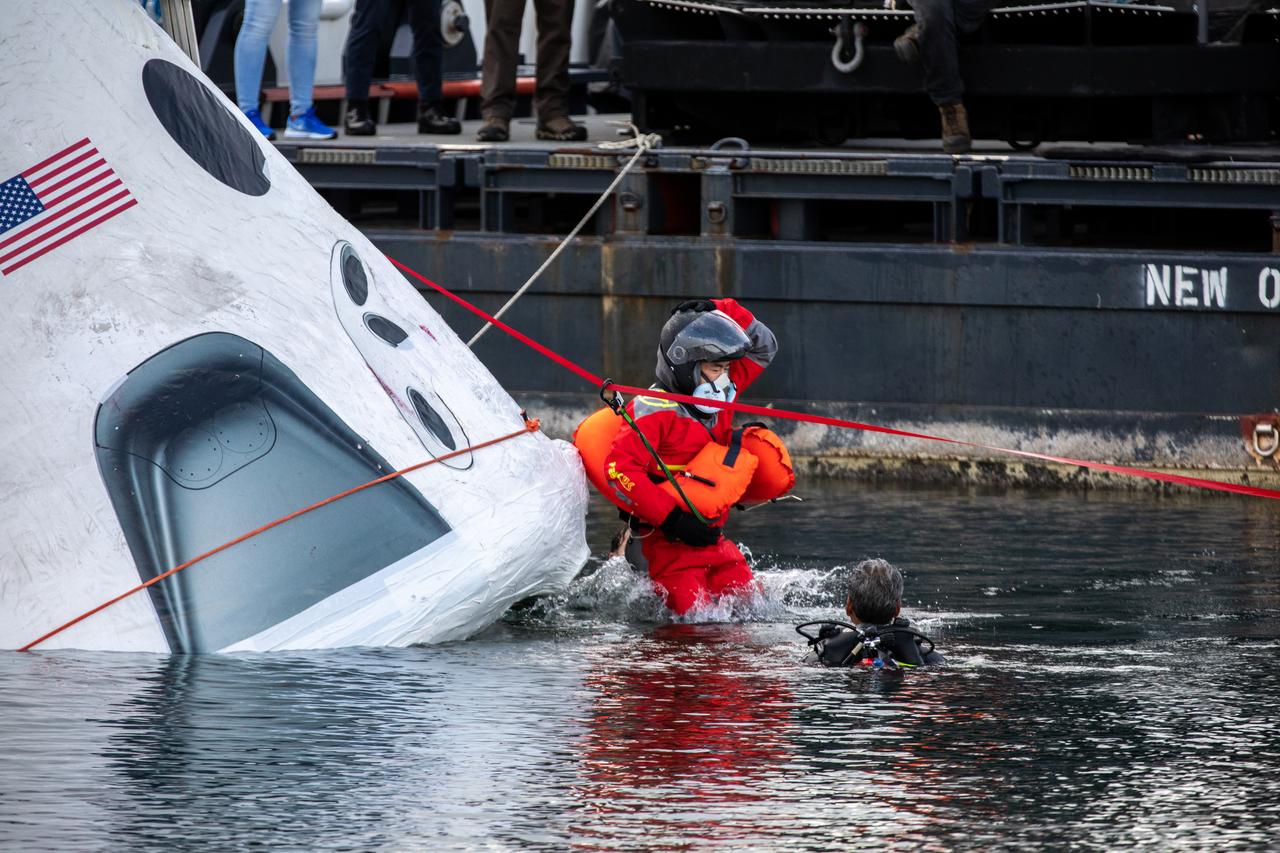
NASA astronauts Shane Kimbrough and Megan McArthur, Japan Aerospace Exploration Agency astronaut Akihiko Hoshide, and European Space Agency astronaut Thomas Pesquet participate in an egress training exercise in Port Canaveral, Florida, on Oct. 1, 2020, in preparation for NASA’s SpaceX Crew-2 mission as part of the agency’s Commercial Crew Program. The exercise involved simulating an emergency situation after splashdown of the Crew Dragon spacecraft. Using a mock-up of the Crew Dragon, the crew practiced exiting the capsule and jumping into the water. Crew-2 is targeted to launch from Kennedy Space Center’s Launch Complex 39A in spring 2021.
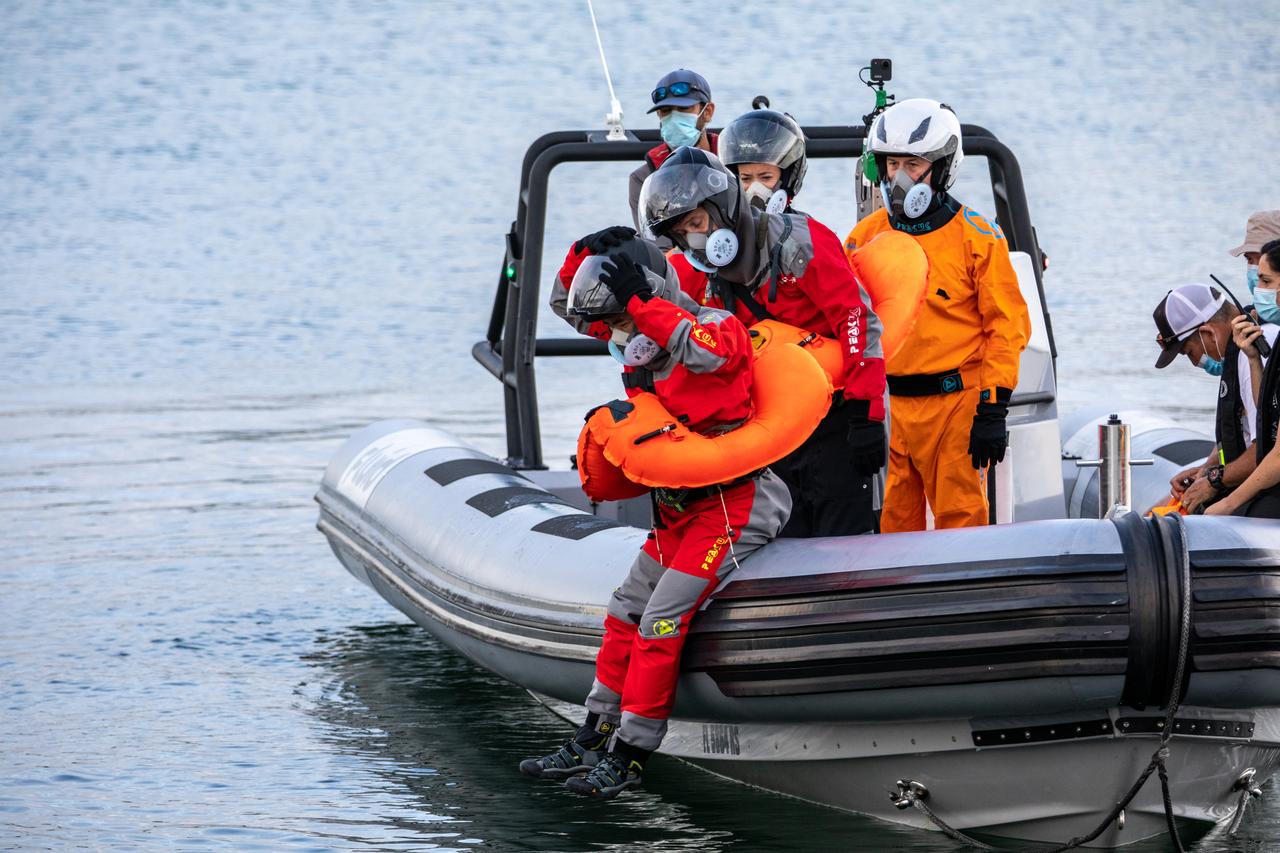
NASA astronauts Shane Kimbrough and Megan McArthur, Japan Aerospace Exploration Agency astronaut Akihiko Hoshide, and European Space Agency astronaut Thomas Pesquet participate in an egress training exercise in Port Canaveral, Florida, on Oct. 1, 2020, in preparation for NASA’s SpaceX Crew-2 mission as part of the agency’s Commercial Crew Program. The exercise involved simulating an emergency situation after splashdown of the Crew Dragon spacecraft. Using a mock-up of the Crew Dragon, the crew practiced exiting the capsule and jumping into the water. Crew-2 is targeted to launch from Kennedy Space Center’s Launch Complex 39A in spring 2021.
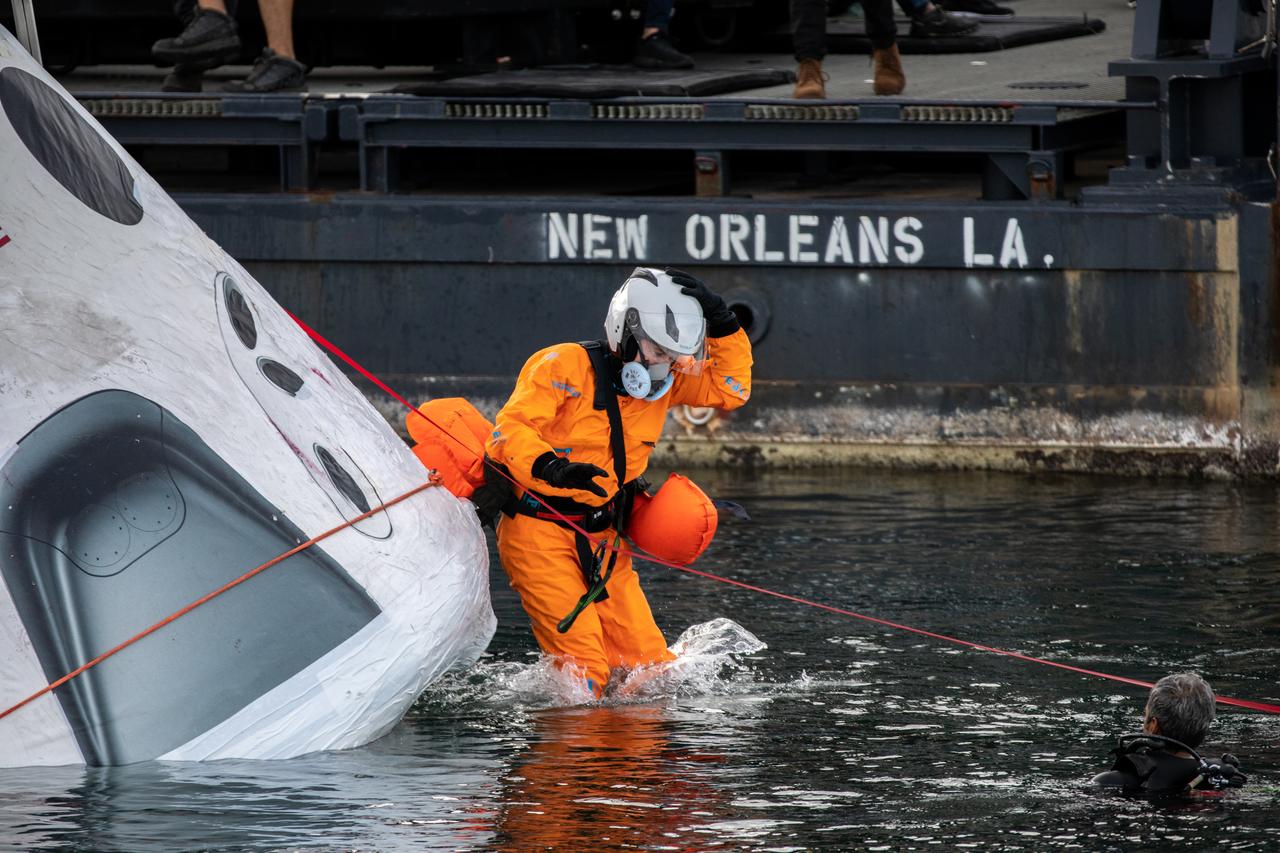
NASA astronauts Shane Kimbrough and Megan McArthur, Japan Aerospace Exploration Agency astronaut Akihiko Hoshide, and European Space Agency astronaut Thomas Pesquet participate in an egress training exercise in Port Canaveral, Florida, on Oct. 1, 2020, in preparation for NASA’s SpaceX Crew-2 mission as part of the agency’s Commercial Crew Program. The exercise involved simulating an emergency situation after splashdown of the Crew Dragon spacecraft. Using a mock-up of the Crew Dragon, the crew practiced exiting the capsule and jumping into the water. Crew-2 is targeted to launch from Kennedy Space Center’s Launch Complex 39A in spring 2021.
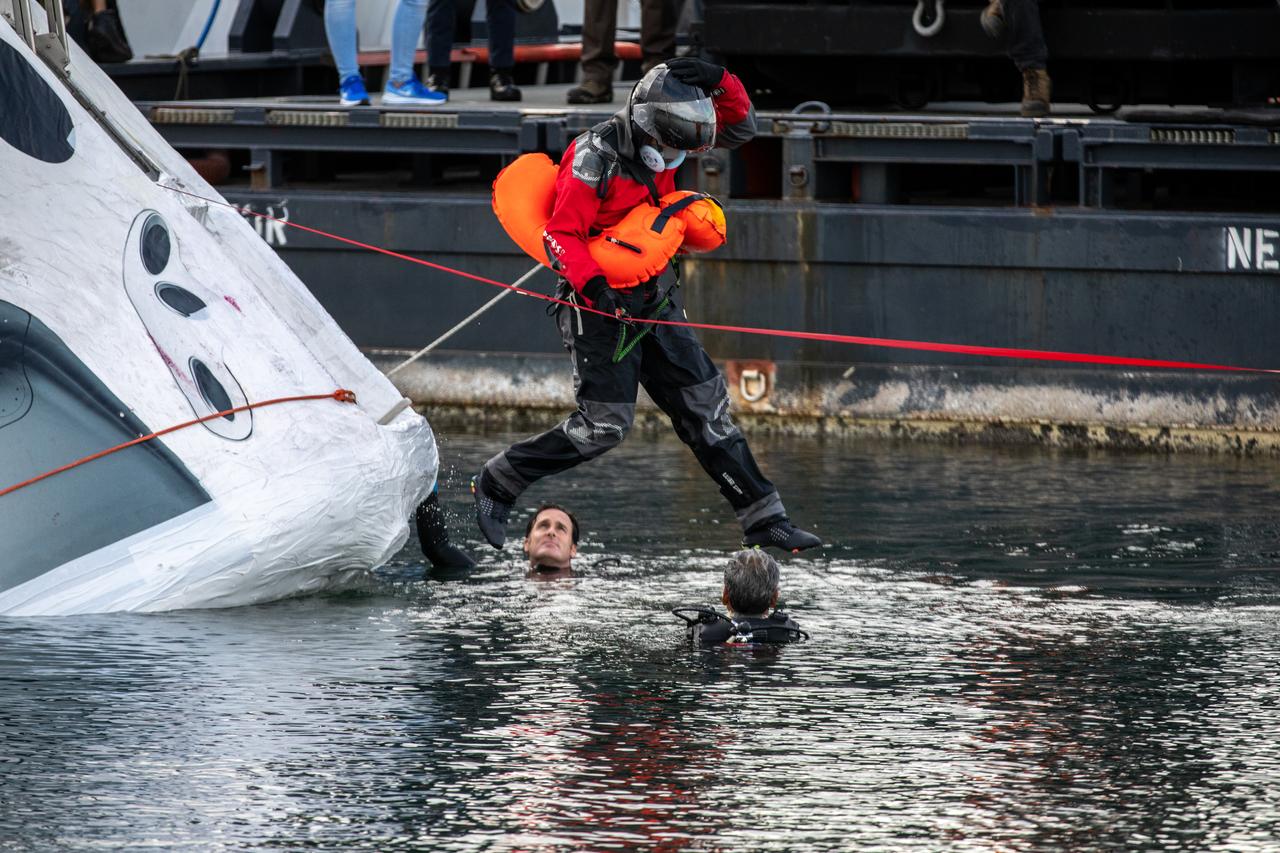
NASA astronauts Shane Kimbrough and Megan McArthur, Japan Aerospace Exploration Agency astronaut Akihiko Hoshide, and European Space Agency astronaut Thomas Pesquet participate in an egress training exercise in Port Canaveral, Florida, on Oct. 1, 2020, in preparation for NASA’s SpaceX Crew-2 mission as part of the agency’s Commercial Crew Program. The exercise involved simulating an emergency situation after splashdown of the Crew Dragon spacecraft. Using a mock-up of the Crew Dragon, the crew practiced exiting the capsule and jumping into the water. Crew-2 is targeted to launch from Kennedy Space Center’s Launch Complex 39A in spring 2021.
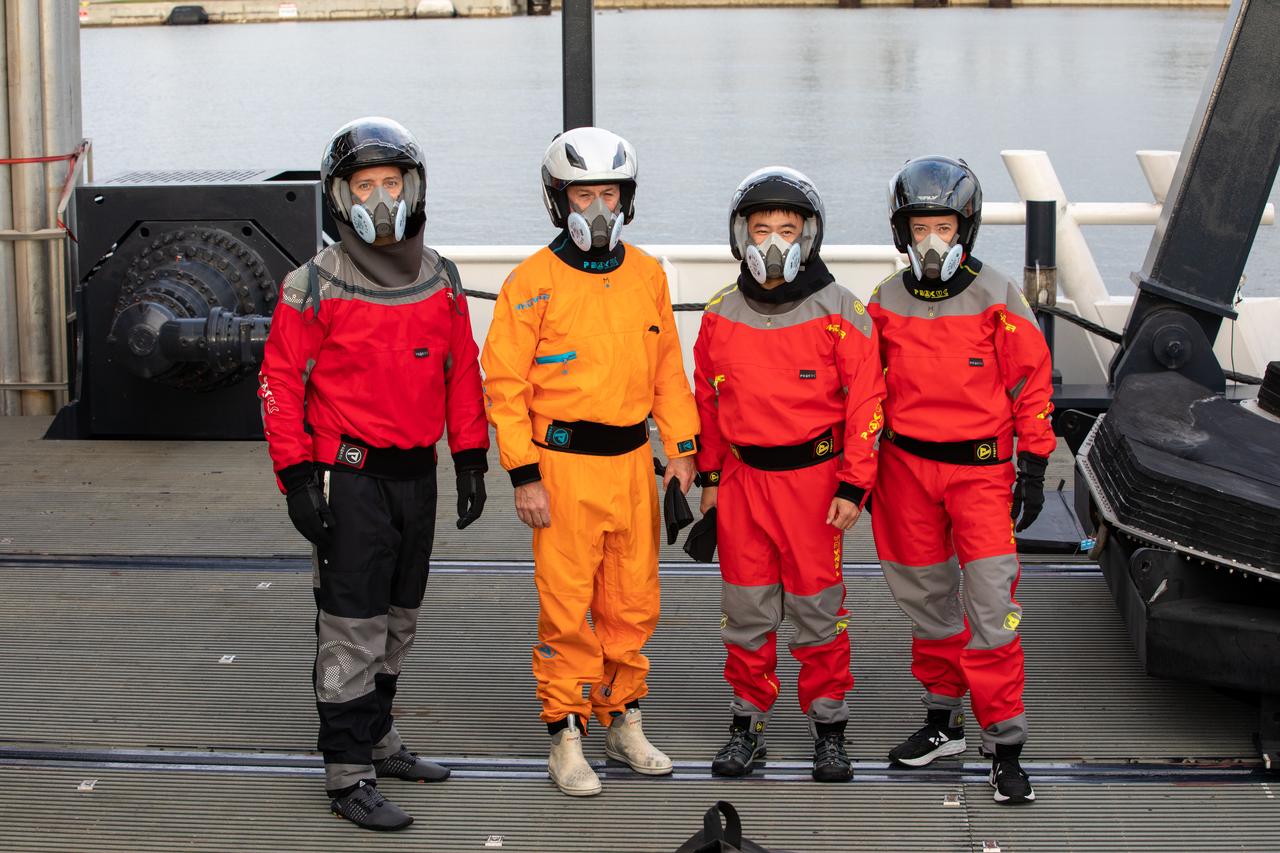
NASA astronauts Shane Kimbrough and Megan McArthur, Japan Aerospace Exploration Agency astronaut Akihiko Hoshide, and European Space Agency astronaut Thomas Pesquet participate in an egress training exercise in Port Canaveral, Florida, on Oct. 1, 2020, in preparation for NASA’s SpaceX Crew-2 mission as part of the agency’s Commercial Crew Program. The exercise involved simulating an emergency situation after splashdown of the Crew Dragon spacecraft. Using a mock-up of the Crew Dragon, the crew practiced exiting the capsule and jumping into the water. Crew-2 is targeted to launch from Kennedy Space Center’s Launch Complex 39A in spring 2021.
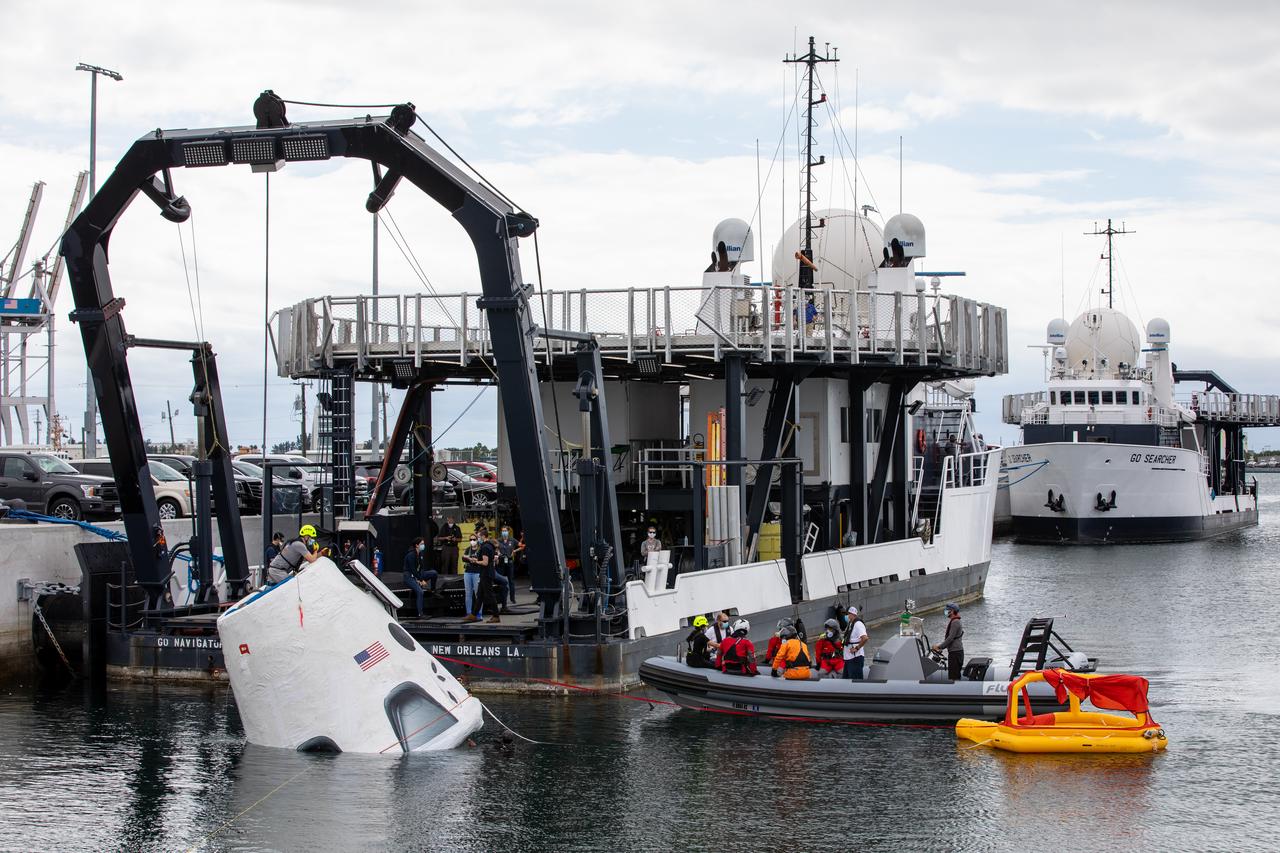
NASA astronauts Shane Kimbrough and Megan McArthur, Japan Aerospace Exploration Agency astronaut Akihiko Hoshide, and European Space Agency astronaut Thomas Pesquet participate in an egress training exercise in Port Canaveral, Florida, on Oct. 1, 2020, in preparation for NASA’s SpaceX Crew-2 mission as part of the agency’s Commercial Crew Program. The exercise involved simulating an emergency situation after splashdown of the Crew Dragon spacecraft. Using a mock-up of the Crew Dragon, the crew practiced exiting the capsule and jumping into the water. Crew-2 is targeted to launch from Kennedy Space Center’s Launch Complex 39A in spring 2021.
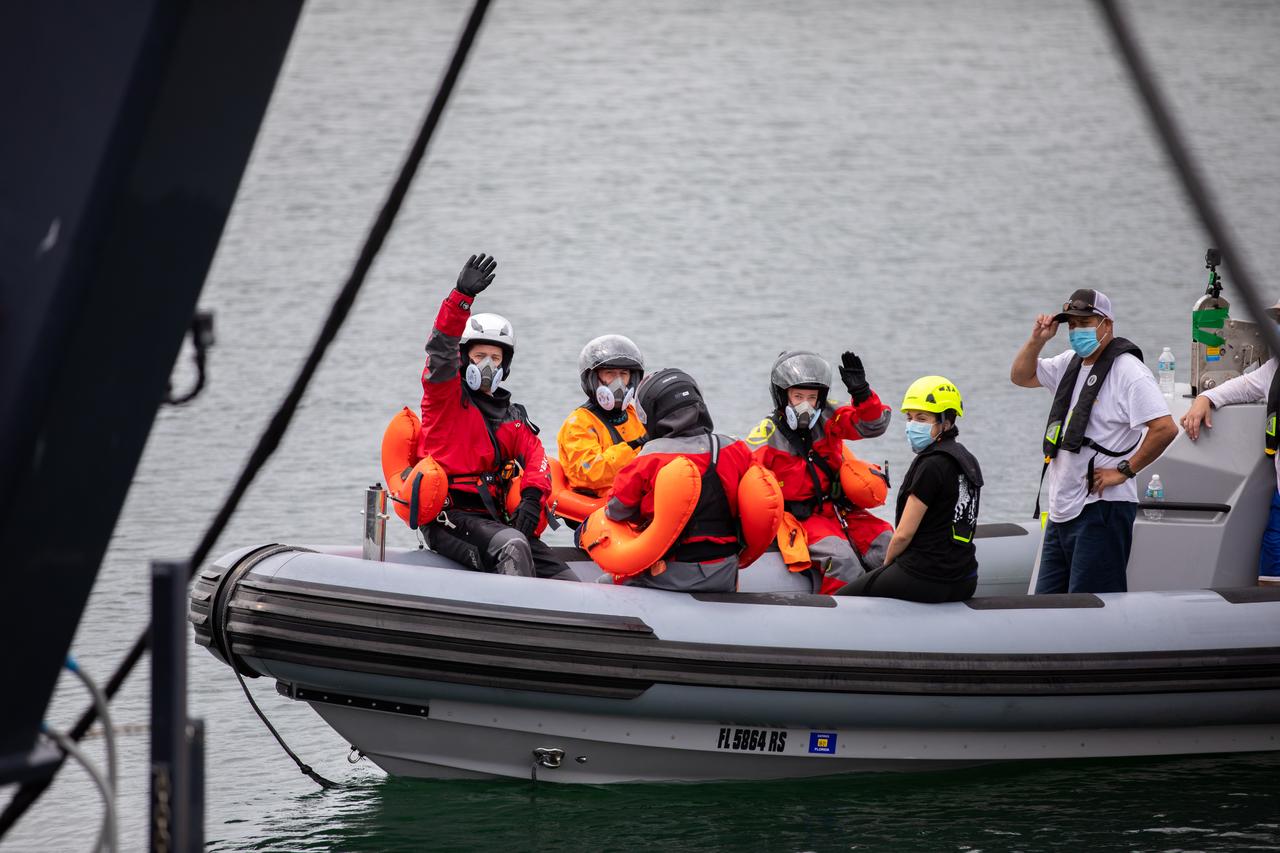
NASA astronauts Shane Kimbrough and Megan McArthur, Japan Aerospace Exploration Agency astronaut Akihiko Hoshide, and European Space Agency astronaut Thomas Pesquet participate in an egress training exercise in Port Canaveral, Florida, on Oct. 1, 2020, in preparation for NASA’s SpaceX Crew-2 mission as part of the agency’s Commercial Crew Program. The exercise involved simulating an emergency situation after splashdown of the Crew Dragon spacecraft. Using a mock-up of the Crew Dragon, the crew practiced exiting the capsule and jumping into the water. Crew-2 is targeted to launch from Kennedy Space Center’s Launch Complex 39A in spring 2021.
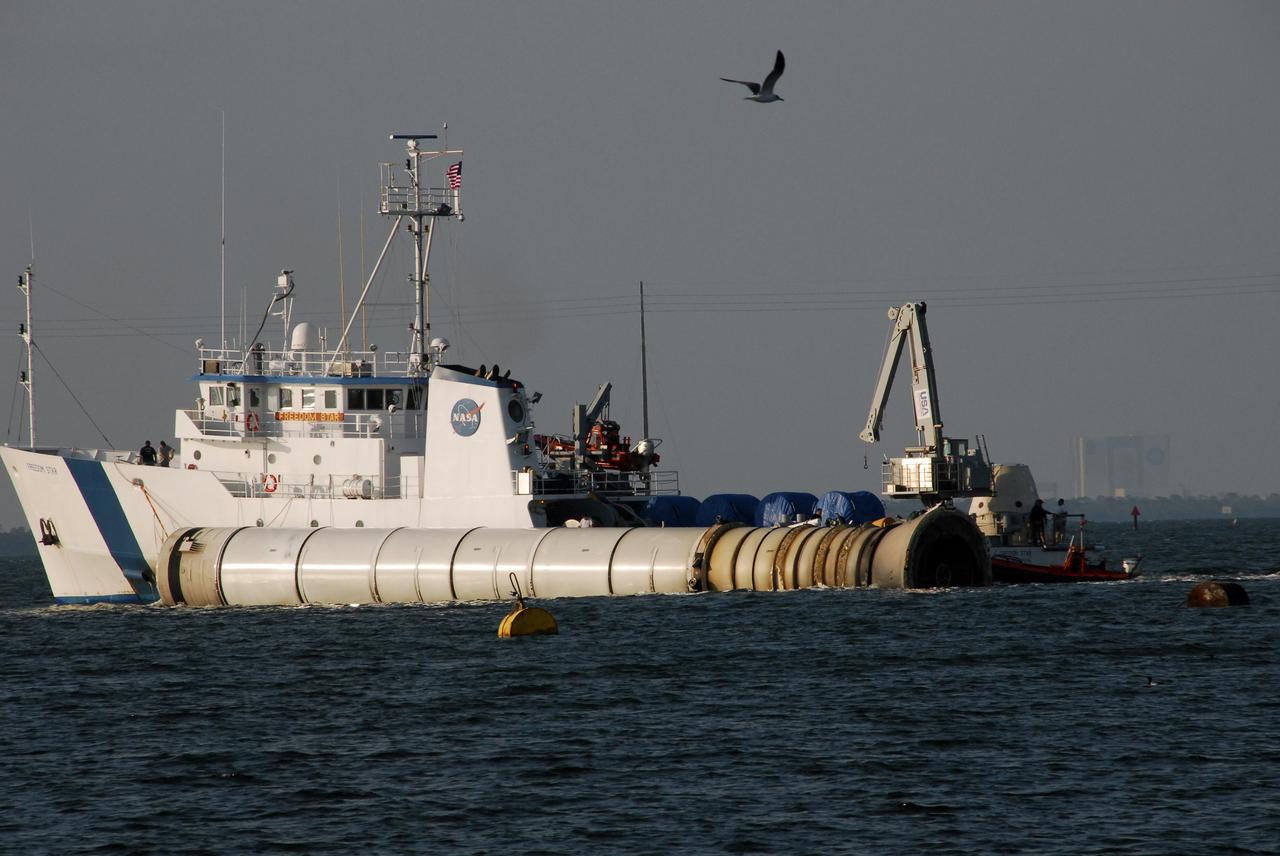
KENNEDY SPACE CENTER, FLA. -- The Freedom Star, one of NASA's solid rocket booster retrieval ships, tows a solid rocket booster alongside, heading for Hangar AF at Cape Canaveral Air Force Station. Barely visible in the background at right is the Vehicle Assembly Building at NASA's Kennedy Space Center. The booster is from space shuttle Endeavour, which launched the STS-123 mission on March 11. The space shuttle’s solid rocket booster casings and associated flight hardware are recovered at sea. The boosters impact the Atlantic Ocean approximately seven minutes after liftoff. The splashdown area is a square of about 6 by 9 nautical miles located about 140 nautical miles downrange from the launch pad. The retrieval ships are stationed approximately 8 to 10 nautical miles from the impact area at the time of splashdown. As soon as the boosters enter the water, the ships accelerate to a speed of 15 knots and quickly close on the boosters, which they tow back to port. After transfer to a position alongside the ship, the booster will be towed to Hangar AF at Cape Canaveral Air Force Station. There, the expended boosters are disassembled, refurbished and reloaded with solid propellant for reuse. Photo credit: NASA/Jack Pfaller
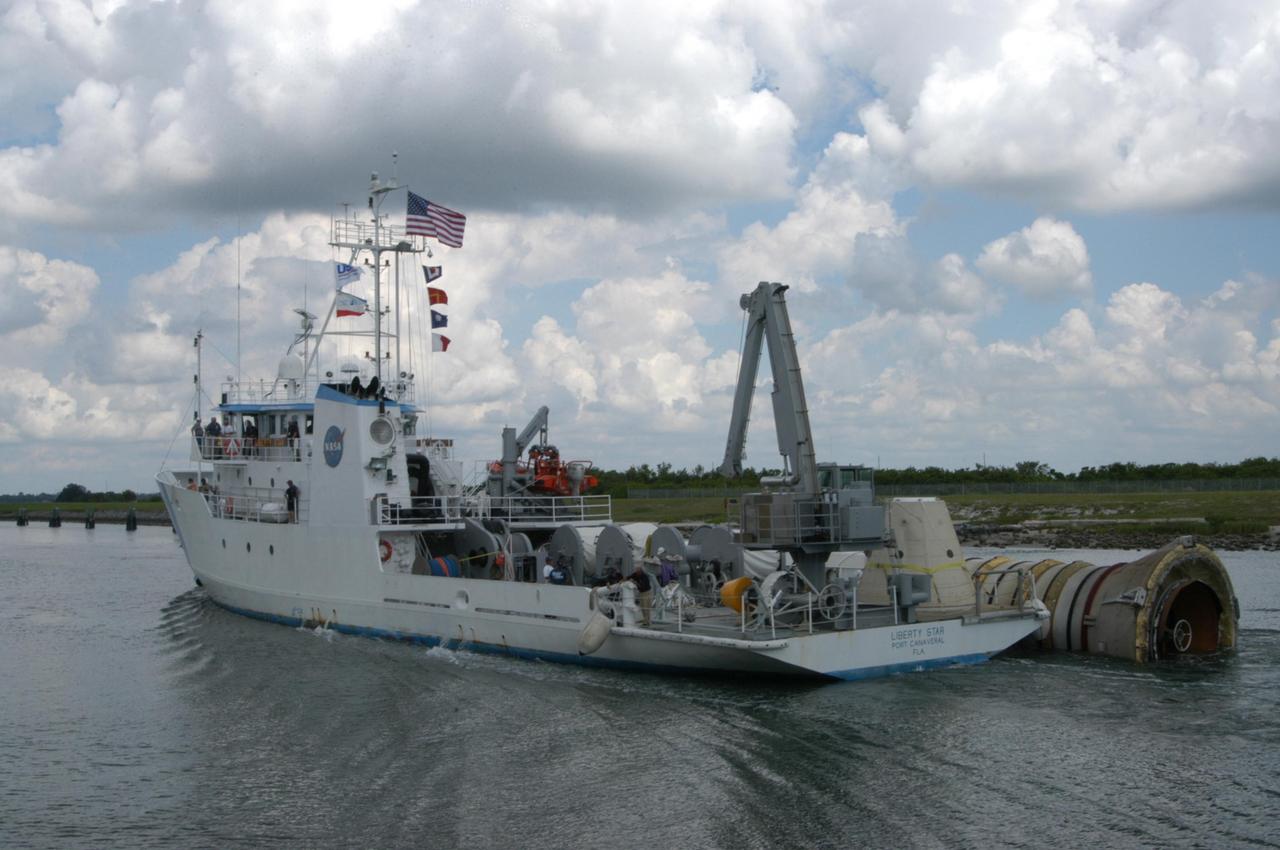
KENNEDY SPACE CENTER, FLA. - The SRB Retrieval Ship Liberty Star heads up the Banana River to Cape Canaveral Air Force Station with a spent solid rocket booster alongside. The booster is from Space Shuttle Discovery, which launched on July 4. The space shuttle’s solid rocket booster casings and associated flight hardware are recovered at sea. The boosters impact the Atlantic Ocean approximately seven minutes after liftoff. The splashdown area is a square of about 6 by 9 nautical miles located about 140 nautical miles downrange from the launch pad. The retrieval ships are stationed approximately 8 to 10 nautical miles from the impact area at the time of splashdown. As soon as the boosters enter the water, the ships accelerate to a speed of 15 knots and quickly close on the boosters. The pilot chutes and main parachutes are the first items to be brought on board. With the chutes and frustum recovered, attention turns to the boosters. The ship’s tow line is connected and the booster is returned to the Port and ,after transfer to a position alongside the ship, to Hangar AF at Cape Canaveral Air Force Station. There, the expended boosters are disassembled, refurbished and reloaded with solid propellant for reuse. Photo credit: NASA/George Shelton
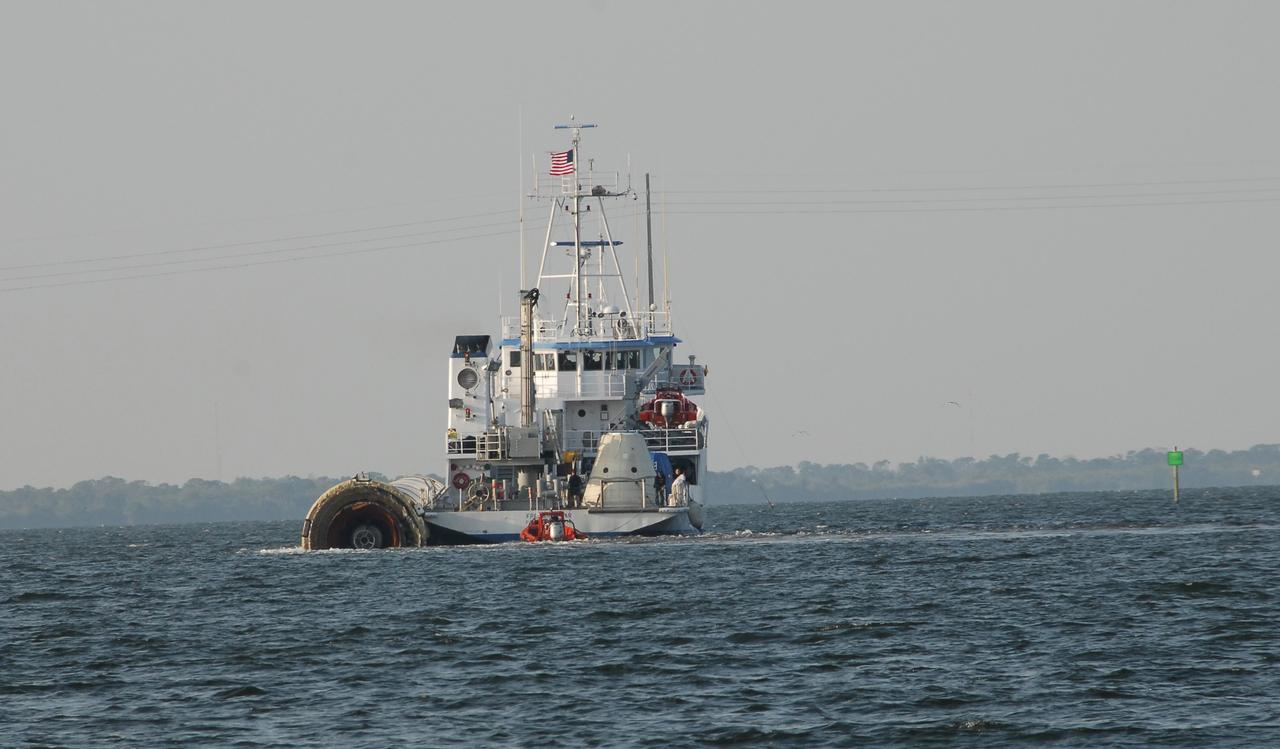
KENNEDY SPACE CENTER, FLA. -- The Freedom Star, one of NASA's solid rocket booster retrieval ships, tows a solid rocket booster alongside, heading for Hangar AF at Cape Canaveral Air Force Station. The booster is from space shuttle Endeavour, which launched the STS-123 mission on March 11. The space shuttle’s solid rocket booster casings and associated flight hardware are recovered at sea. The boosters impact the Atlantic Ocean approximately seven minutes after liftoff. The splashdown area is a square of about 6 by 9 nautical miles located about 140 nautical miles downrange from the launch pad. The retrieval ships are stationed approximately 8 to 10 nautical miles from the impact area at the time of splashdown. As soon as the boosters enter the water, the ships accelerate to a speed of 15 knots and quickly close on the boosters, which they tow back to port. After transfer to a position alongside the ship, the booster will be towed to Hangar AF at Cape Canaveral Air Force Station. There, the expended boosters are disassembled, refurbished and reloaded with solid propellant for reuse. Photo credit: NASA/Jack Pfaller
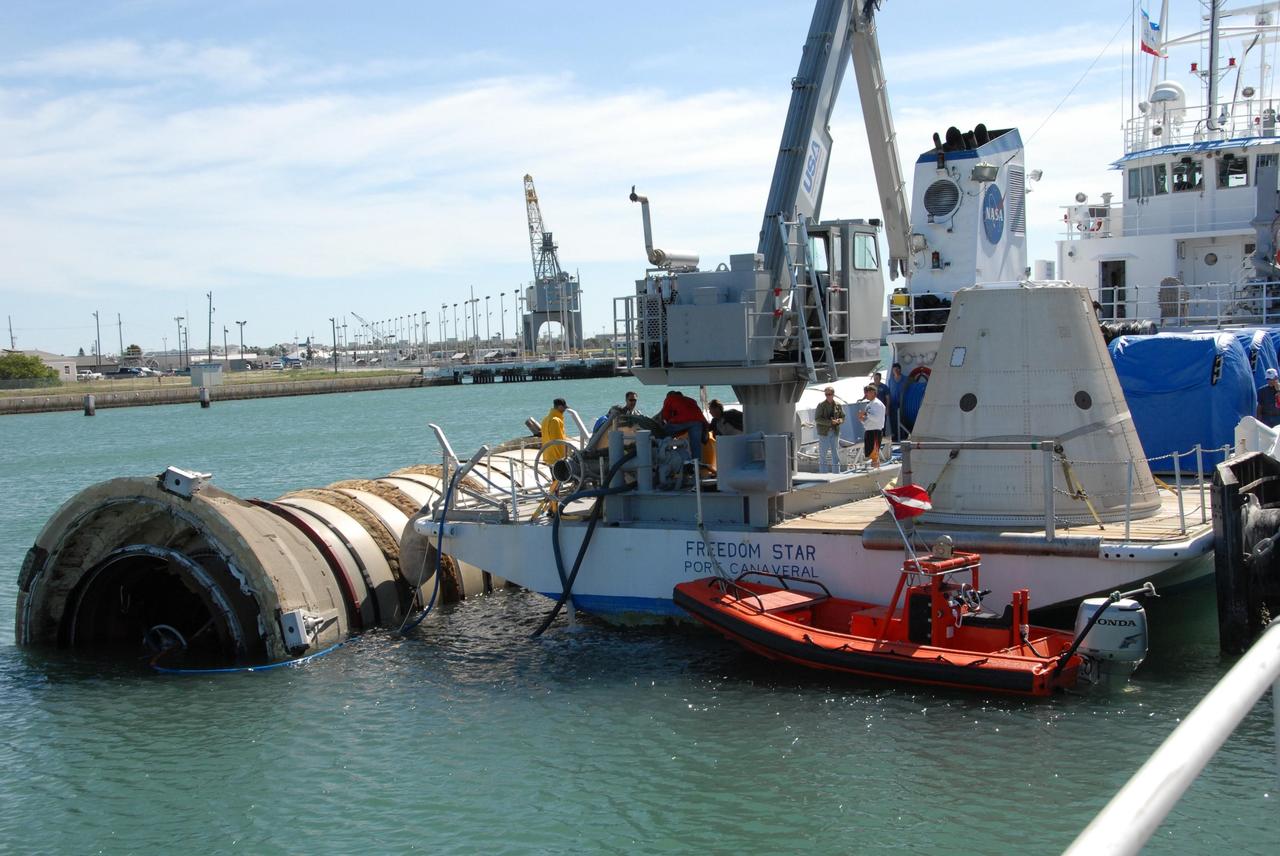
KENNEDY SPACE CENTER, FLA. -- The solid rocket booster retrieval ship Freedom Star is temporarily docked at Port Canaveral while the booster it was towing is moved alongside for the remainder of the trip upriver to Cape Canaveral Air Force Station. Freedom Star retrieved the booster after the launch of space shuttle Atlantis' STS-122 mission. The space shuttle's solid rocket booster casings and associated flight hardware are recovered at sea. The boosters impact the Atlantic Ocean approximately seven minutes after liftoff. The splashdown area is a square of about 6 by 9 nautical miles located about 140 nautical miles downrange from the launch pad. The retrieval ships are stationed approximately 8 to 10 nautical miles from the impact area at the time of splashdown. As soon as the boosters enter the water, the ships accelerate to a speed of 15 knots and quickly close on the boosters. The pilot chutes and main parachutes are the first items to be brought on board. With the chutes and frustum recovered, attention turns to the boosters. The ship's tow line is connected and the booster is returned to the Port and, after transfer to a position alongside the ship, to Hangar AF at Cape Canaveral Air Force Station. There, the expended boosters are disassembled, refurbished and reloaded with solid propellant for reuse. Photo credit: NASA/Jack Pfaller
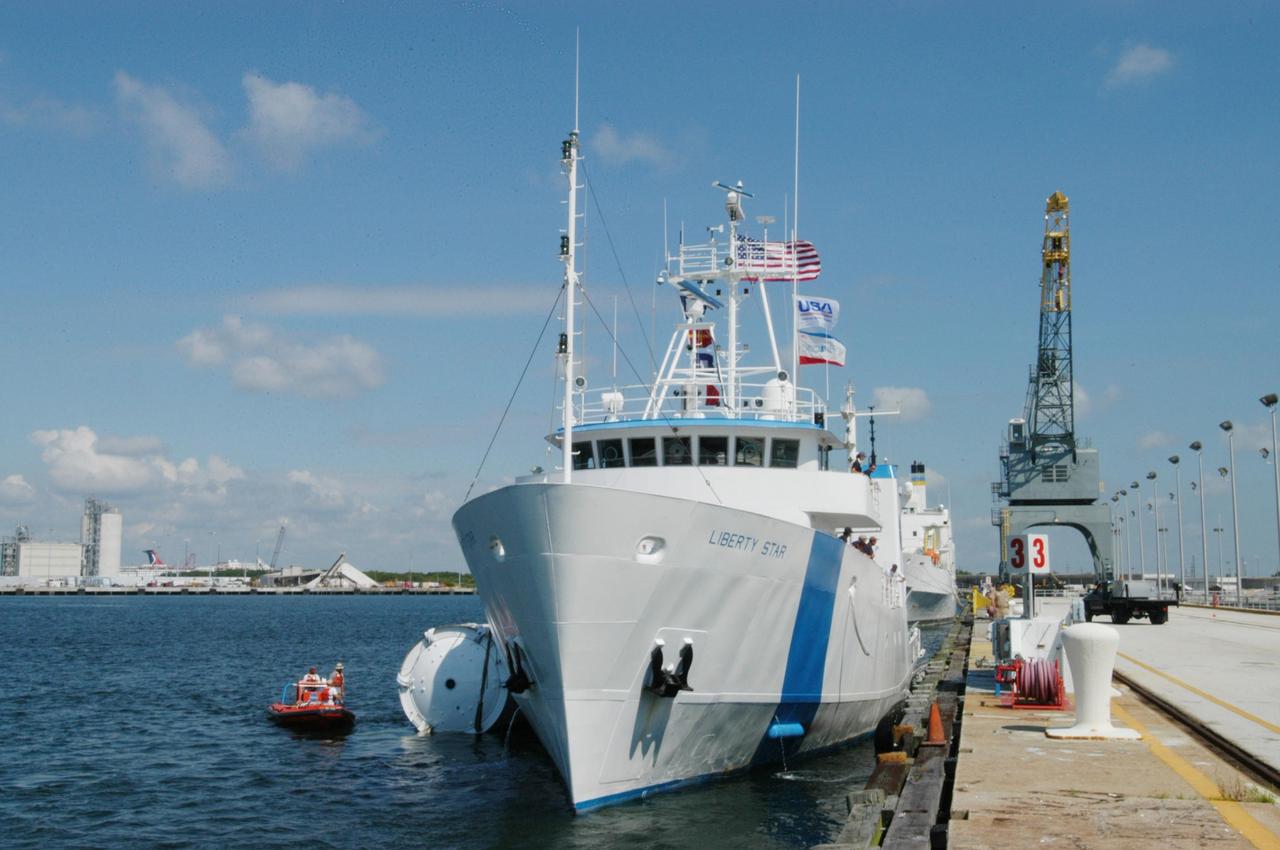
KENNEDY SPACE CENTER, FLA. - At a dock in Port Canaveral, the SRB Retrieval Ship Liberty Star transfers its tow cargo, a spent solid rocket booster, to a starboard position for the balance of its journey to Cape Canaveral Air Force Station. The booster is from Space Shuttle Discovery, which launched on July 4. The space shuttle’s solid rocket booster casings and associated flight hardware are recovered at sea. The boosters impact the Atlantic Ocean approximately seven minutes after liftoff. The splashdown area is a square of about 6 by 9 nautical miles located about 140 nautical miles downrange from the launch pad. The retrieval ships are stationed approximately 8 to 10 nautical miles from the impact area at the time of splashdown. As soon as the boosters enter the water, the ships accelerate to a speed of 15 knots and quickly close on the boosters. The pilot chutes and main parachutes are the first items to be brought on board. With the chutes and frustum recovered, attention turns to the boosters. The ship’s tow line is connected and the booster is returned to the Port and ,after transfer to a position alongside the ship, to Hangar AF at Cape Canaveral Air Force Station. There, the expended boosters are disassembled, refurbished and reloaded with solid propellant for reuse. Photo credit: NASA/George Shelton
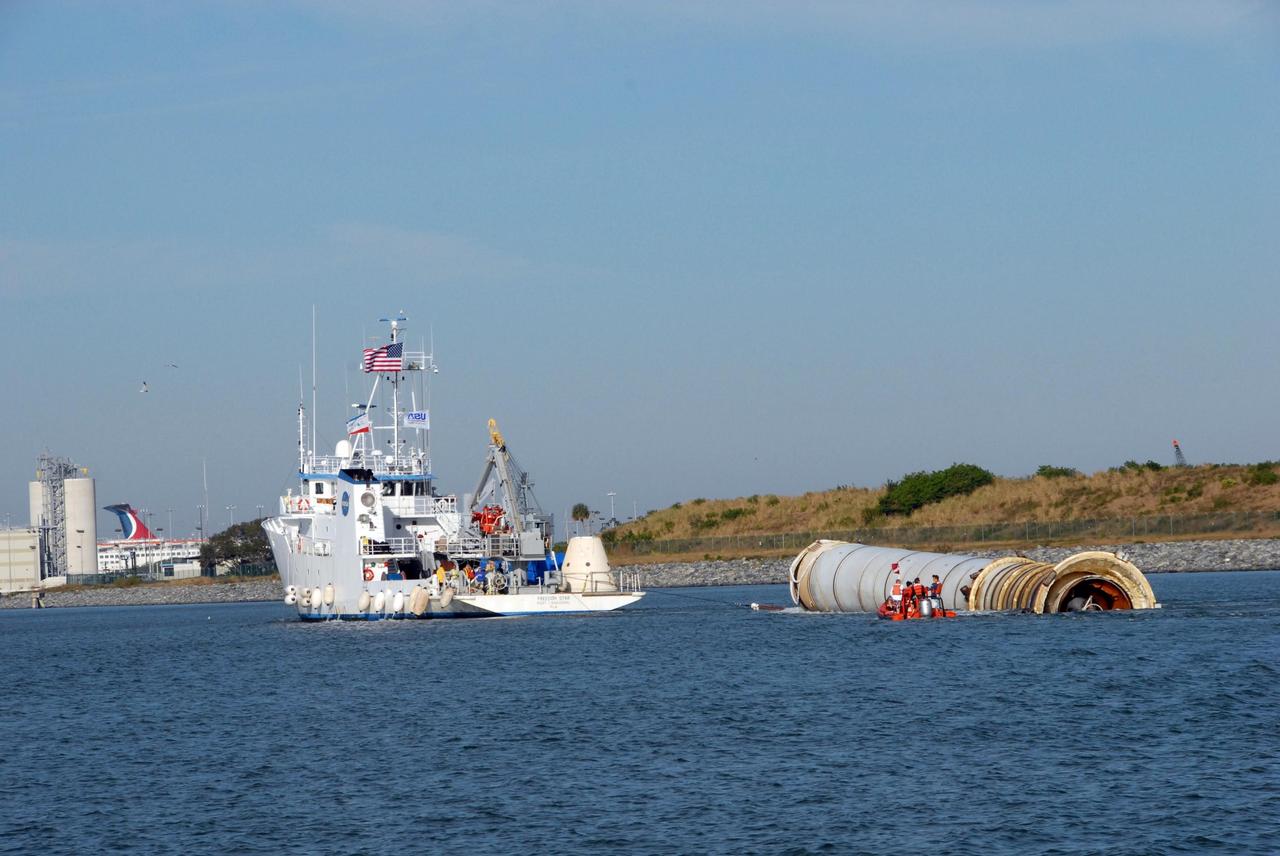
KENNEDY SPACE CENTER, FLA. -- The solid rocket booster retrieval ship Freedom Star tows toward Port Canaveral one of the boosters, retrieved after the launch of space shuttle Atlantis' STS-122 mission, toward Port Canaveral. The space shuttle's solid rocket booster casings and associated flight hardware are recovered at sea. The boosters impact the Atlantic Ocean approximately seven minutes after liftoff. The splashdown area is a square of about 6 by 9 nautical miles located about 140 nautical miles downrange from the launch pad. The retrieval ships are stationed approximately 8 to 10 nautical miles from the impact area at the time of splashdown. As soon as the boosters enter the water, the ships accelerate to a speed of 15 knots and quickly close on the boosters. The pilot chutes and main parachutes are the first items to be brought on board. With the chutes and frustum recovered, attention turns to the boosters. The ship's tow line is connected and the booster is returned to the Port and, after transfer to a position alongside the ship, to Hangar AF at Cape Canaveral Air Force Station. There, the expended boosters are disassembled, refurbished and reloaded with solid propellant for reuse. Photo credit: NASA/Jack Pfaller