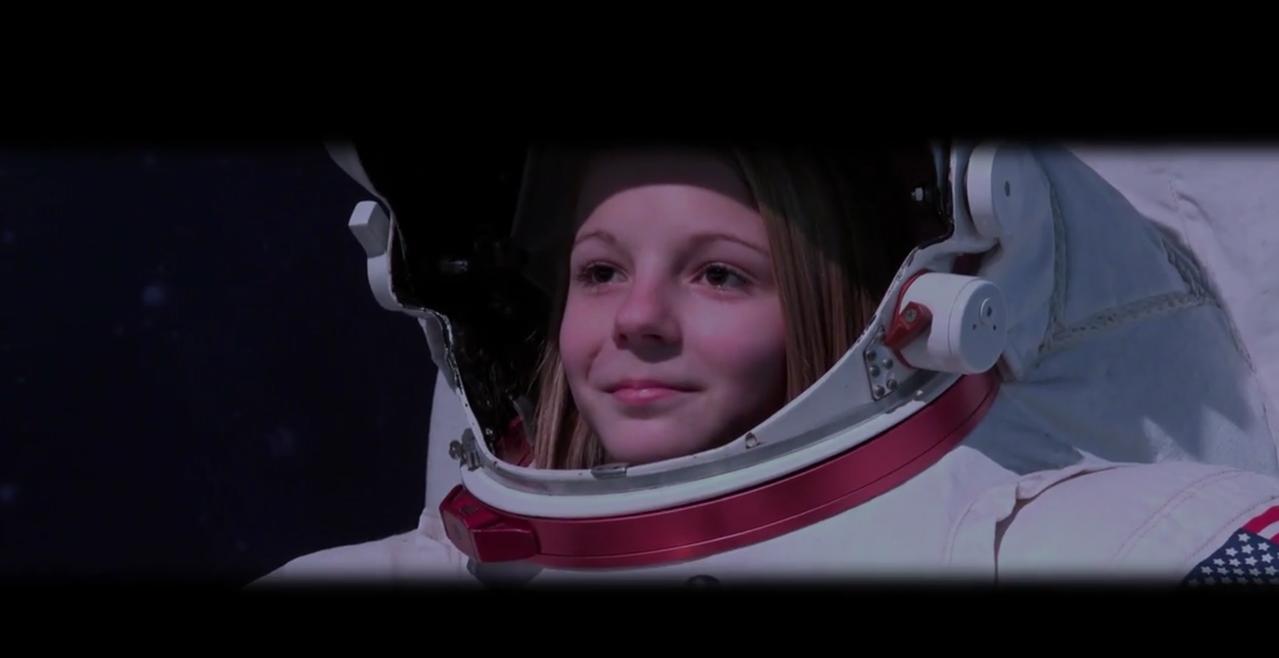
Young girl in astronaut suit, looking out into space.

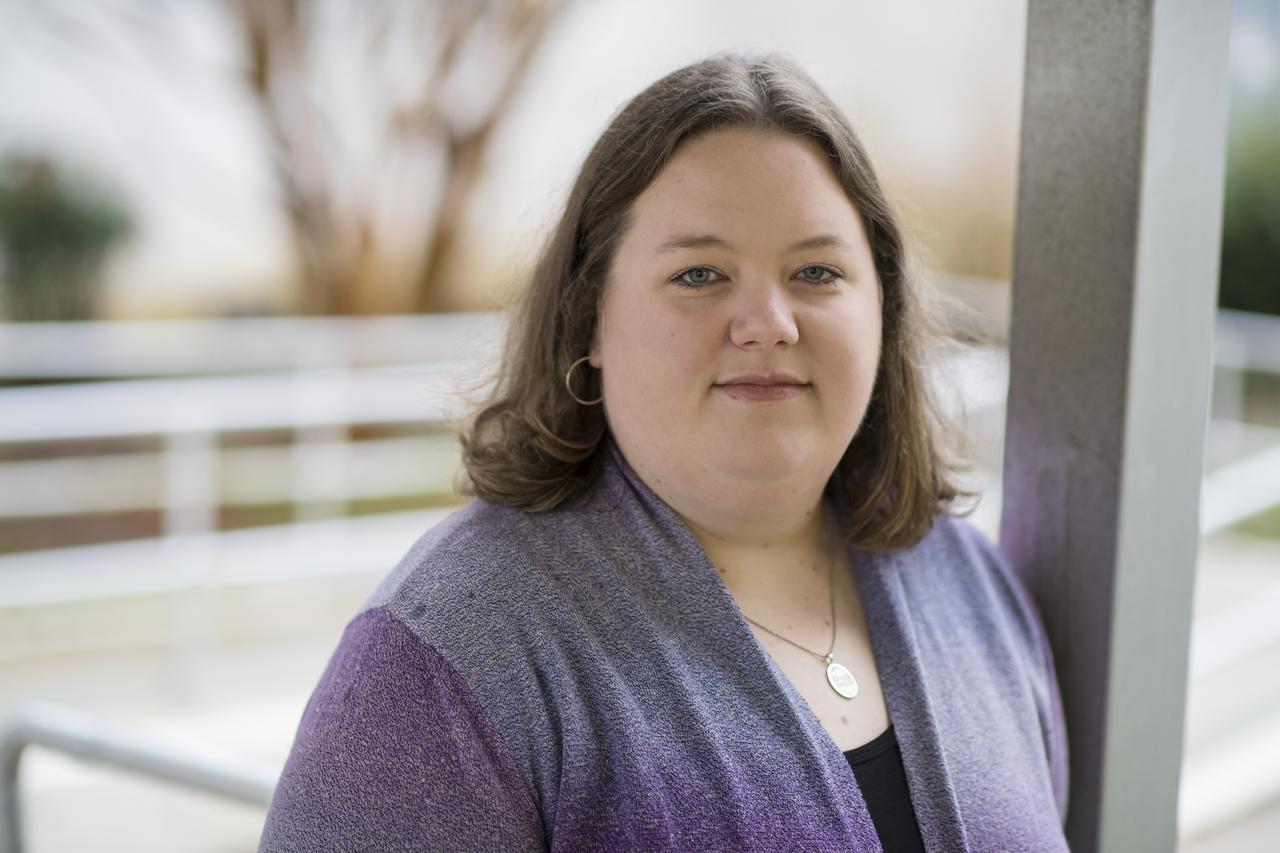
“The day after the Columbia tragedy I knew exactly what I wanted to do with my life. I go to my physics class and tell a friend, ‘I want to go work for NASA.’ My physics teacher walks by and overhears the conversation. She starts the class and says ‘I want to go around the classroom and hear about what everybody wants to do with their life.’ She gets to me. I was super excited. ‘I’m going to work for NASA, I’m going to be an engineer, I’m going to make sure everybody flies safe.’ And she bursts out laughing. And everyone else starts laughing. I’m like, ‘what is the joke?’ And she says to me, ‘If you ever get the opportunity to work for NASA, you make sure you come take me out to lunch.’ And that ended up being the joke of the day at my entire high school. “I think we have a very long way to go. I think that there are not enough educational resources. There are not enough pipeline opportunities. I come from a single-parent family. We weren’t rich. We lived in a New Jersey suburb in a very small town where the idea of a girl going to NASA — it just seemed impossible. I think that we have long way to go to reach out to some of those smaller, under-serving communities where individuals may not have the resources. Where teachers can’t even motivate kids to do something big because they don’t even believe it themselves. I do believe there are strides happening — but I don’t think we’re there yet.” — Brittani Sims, Flight Systems Engineer, Kennedy Space Center Interviewer: NASA / Thalia Patrinos

With Artemis, NASA is going back to the Moon. And we want you to come along!..You Are Going, illustrated by former NASA intern Shane Tolentino, shares a glimpse into future Artemis missions. Learn all about the elements that will help make Artemis possible: the powerful Space Launch System rocket, the Orion spacecraft, the Gateway, and so much more.
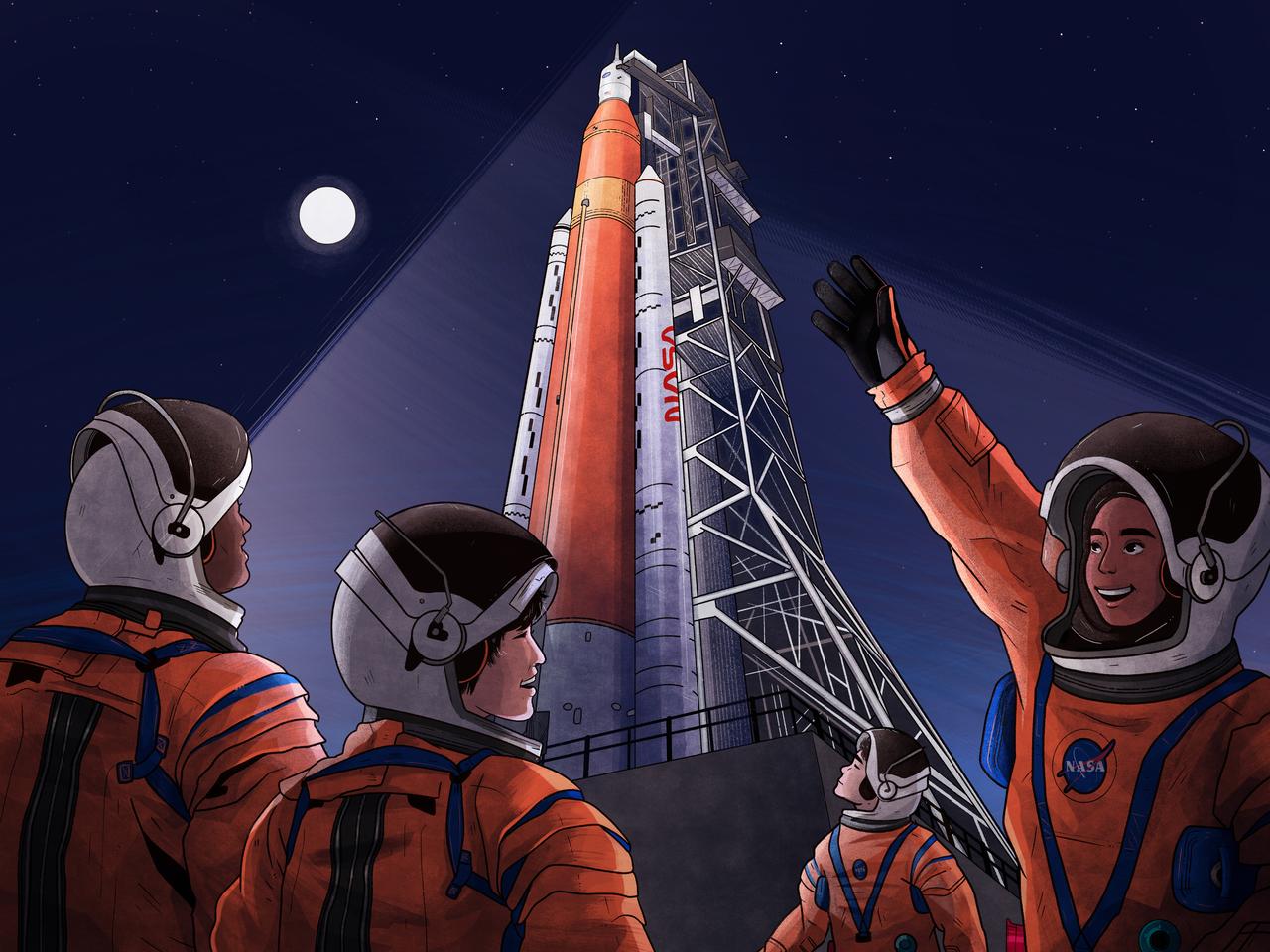
With Artemis, NASA is going back to the Moon. And we want you to come along!..You Are Going, illustrated by former NASA intern Shane Tolentino, shares a glimpse into future Artemis missions. Learn all about the elements that will help make Artemis possible: the powerful Space Launch System rocket, the Orion spacecraft, the Gateway, and so much more.
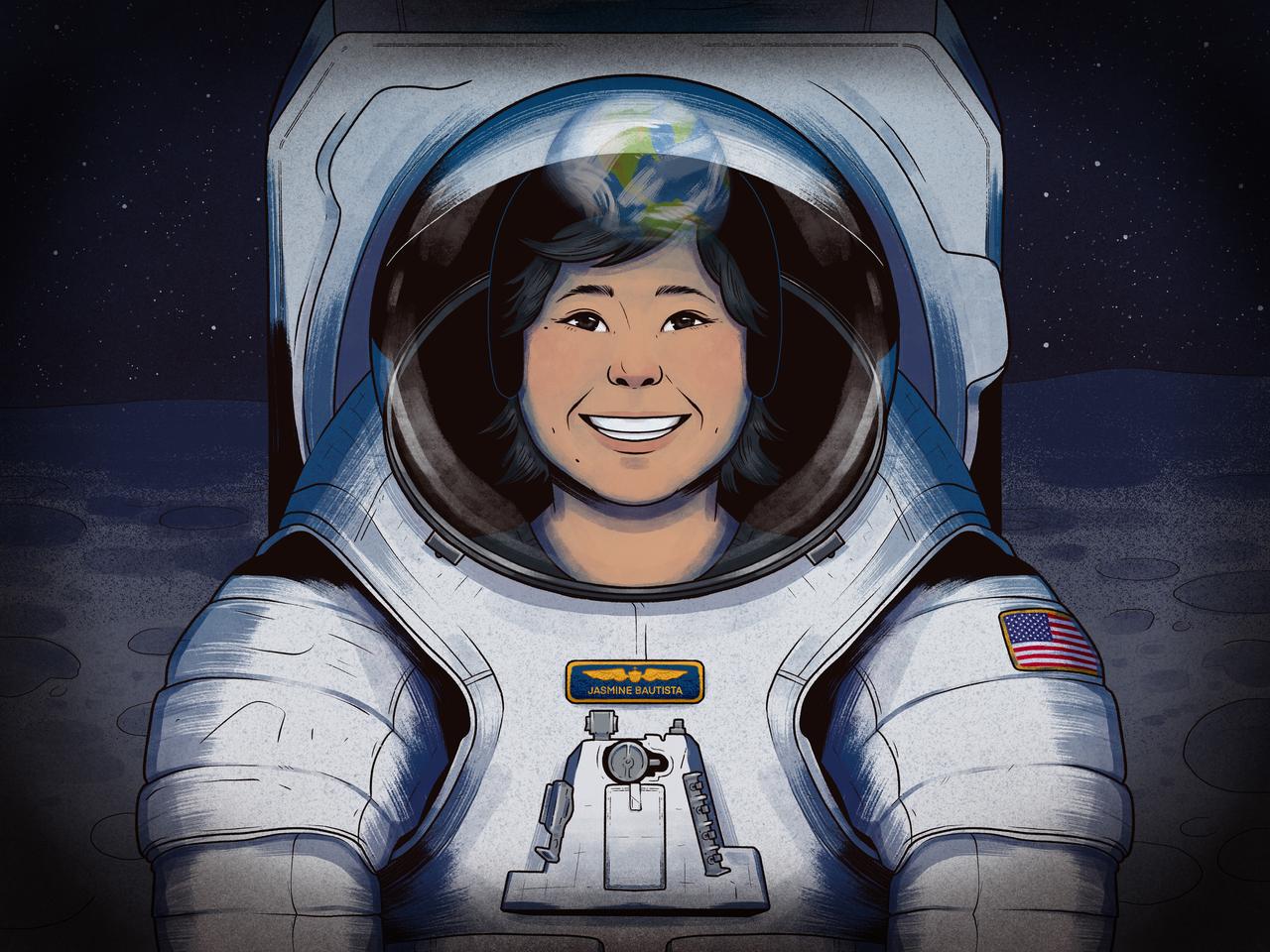
With Artemis, NASA is going back to the Moon. And we want you to come along!..You Are Going, illustrated by former NASA intern Shane Tolentino, shares a glimpse into future Artemis missions. Learn all about the elements that will help make Artemis possible: the powerful Space Launch System rocket, the Orion spacecraft, the Gateway, and so much more.

With Artemis, NASA is going back to the Moon. And we want you to come along!..You Are Going, illustrated by former NASA intern Shane Tolentino, shares a glimpse into future Artemis missions. Learn all about the elements that will help make Artemis possible: the powerful Space Launch System rocket, the Orion spacecraft, the Gateway, and so much more.
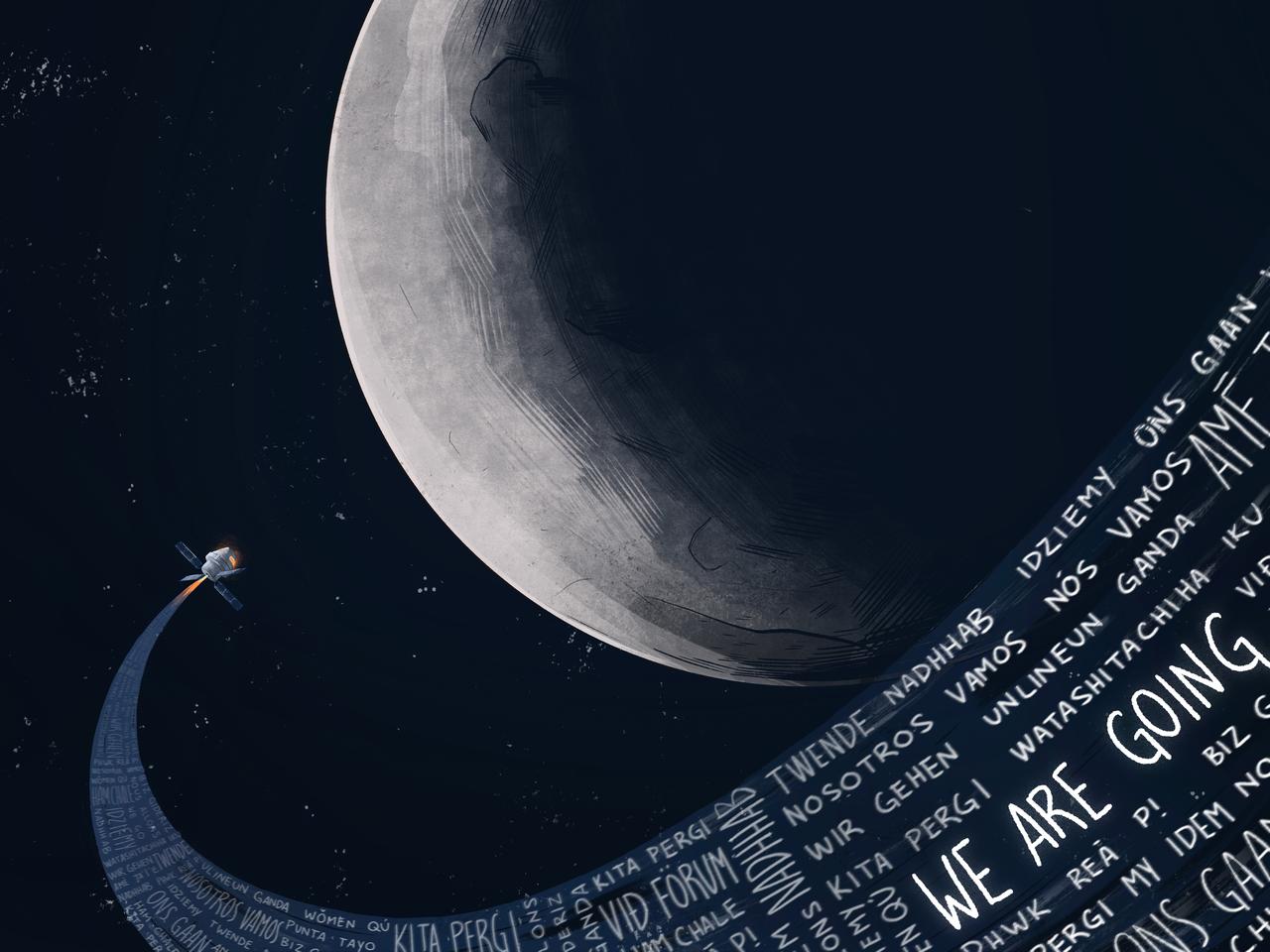
With Artemis, NASA is going back to the Moon. And we want you to come along!..You Are Going, illustrated by former NASA intern Shane Tolentino, shares a glimpse into future Artemis missions. Learn all about the elements that will help make Artemis possible: the powerful Space Launch System rocket, the Orion spacecraft, the Gateway, and so much more.
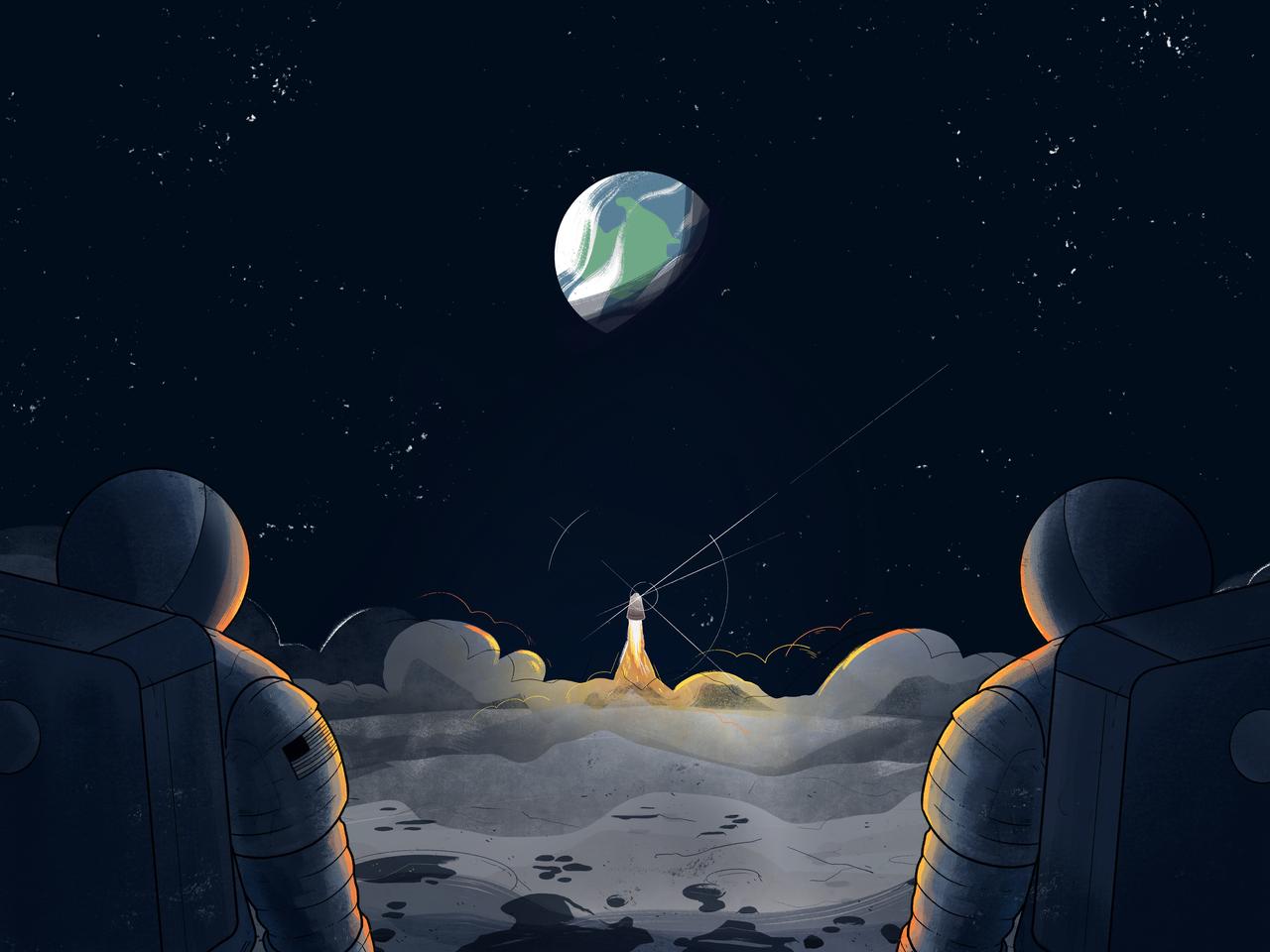
With Artemis, NASA is going back to the Moon. And we want you to come along!..You Are Going, illustrated by former NASA intern Shane Tolentino, shares a glimpse into future Artemis missions. Learn all about the elements that will help make Artemis possible: the powerful Space Launch System rocket, the Orion spacecraft, the Gateway, and so much more.

With Artemis, NASA is going back to the Moon. And we want you to come along!..You Are Going, illustrated by former NASA intern Shane Tolentino, shares a glimpse into future Artemis missions. Learn all about the elements that will help make Artemis possible: the powerful Space Launch System rocket, the Orion spacecraft, the Gateway, and so much more.
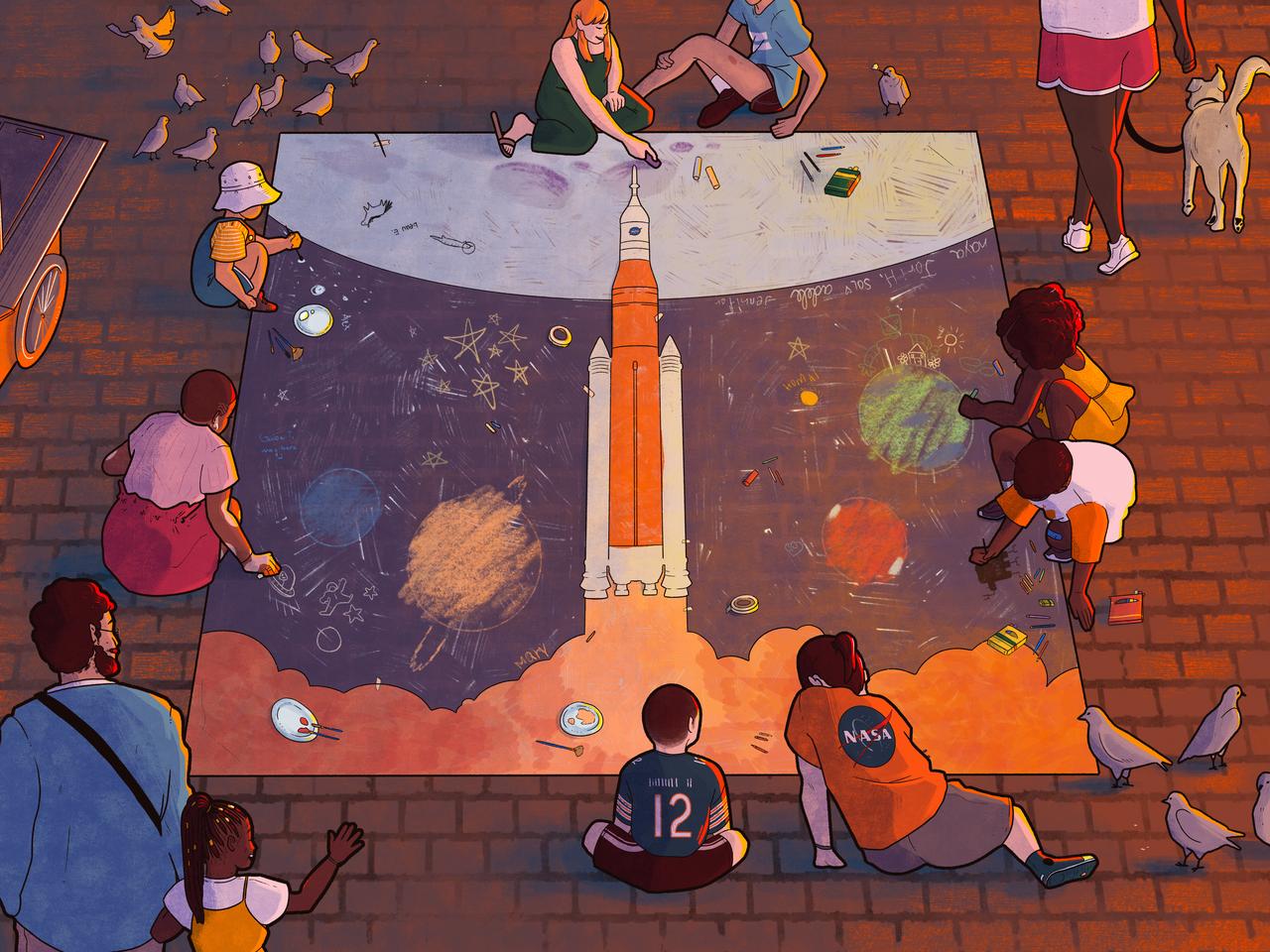
With Artemis, NASA is going back to the Moon. And we want you to come along!..You Are Going, illustrated by former NASA intern Shane Tolentino, shares a glimpse into future Artemis missions. Learn all about the elements that will help make Artemis possible: the powerful Space Launch System rocket, the Orion spacecraft, the Gateway, and so much more.
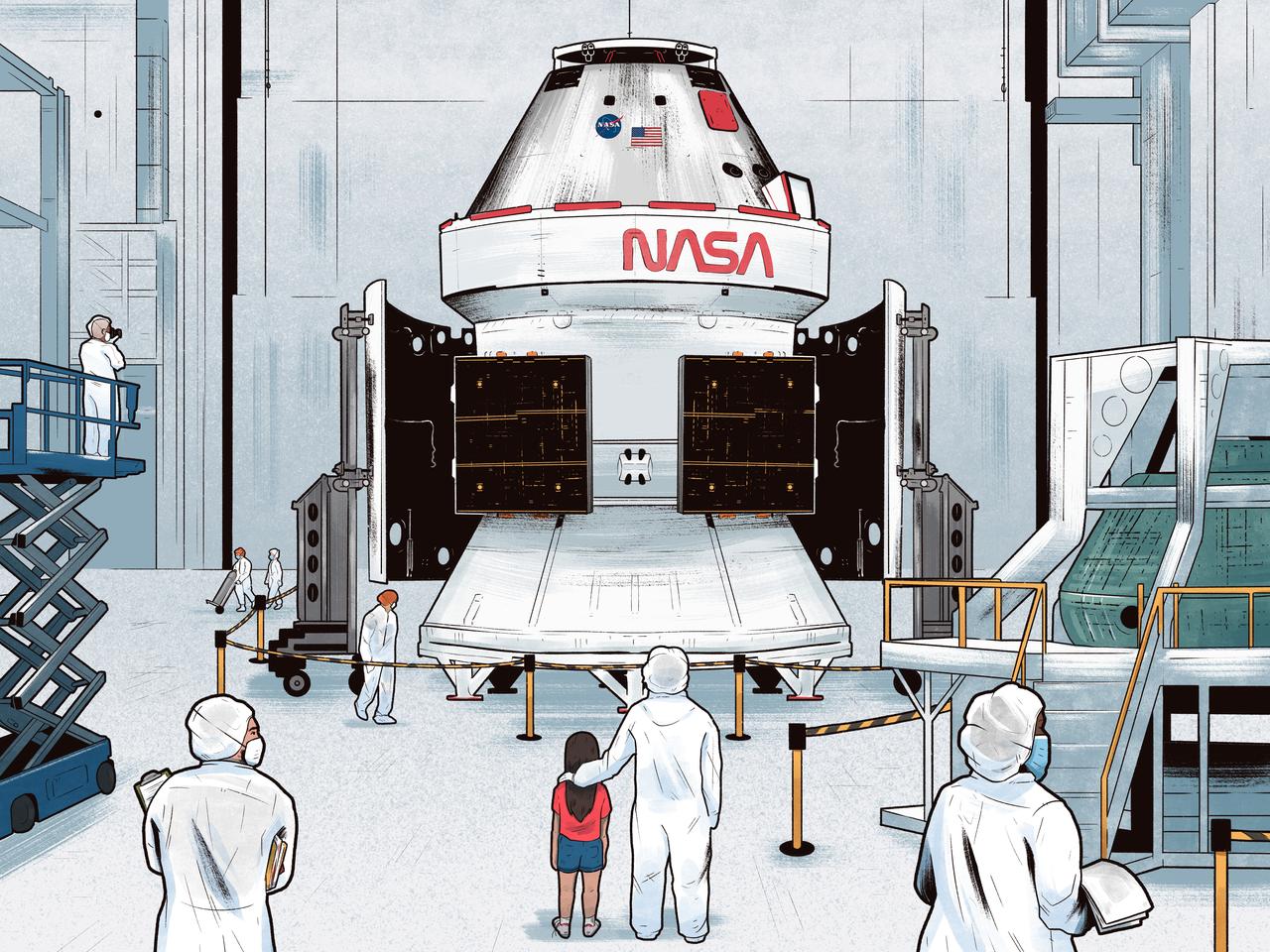
With Artemis, NASA is going back to the Moon. And we want you to come along!..You Are Going, illustrated by former NASA intern Shane Tolentino, shares a glimpse into future Artemis missions. Learn all about the elements that will help make Artemis possible: the powerful Space Launch System rocket, the Orion spacecraft, the Gateway, and so much more.

With Artemis, NASA is going back to the Moon. And we want you to come along!..You Are Going, illustrated by former NASA intern Shane Tolentino, shares a glimpse into future Artemis missions. Learn all about the elements that will help make Artemis possible: the powerful Space Launch System rocket, the Orion spacecraft, the Gateway, and so much more.

With Artemis, NASA is going back to the Moon. And we want you to come along!..You Are Going, illustrated by former NASA intern Shane Tolentino, shares a glimpse into future Artemis missions. Learn all about the elements that will help make Artemis possible: the powerful Space Launch System rocket, the Orion spacecraft, the Gateway, and so much more.
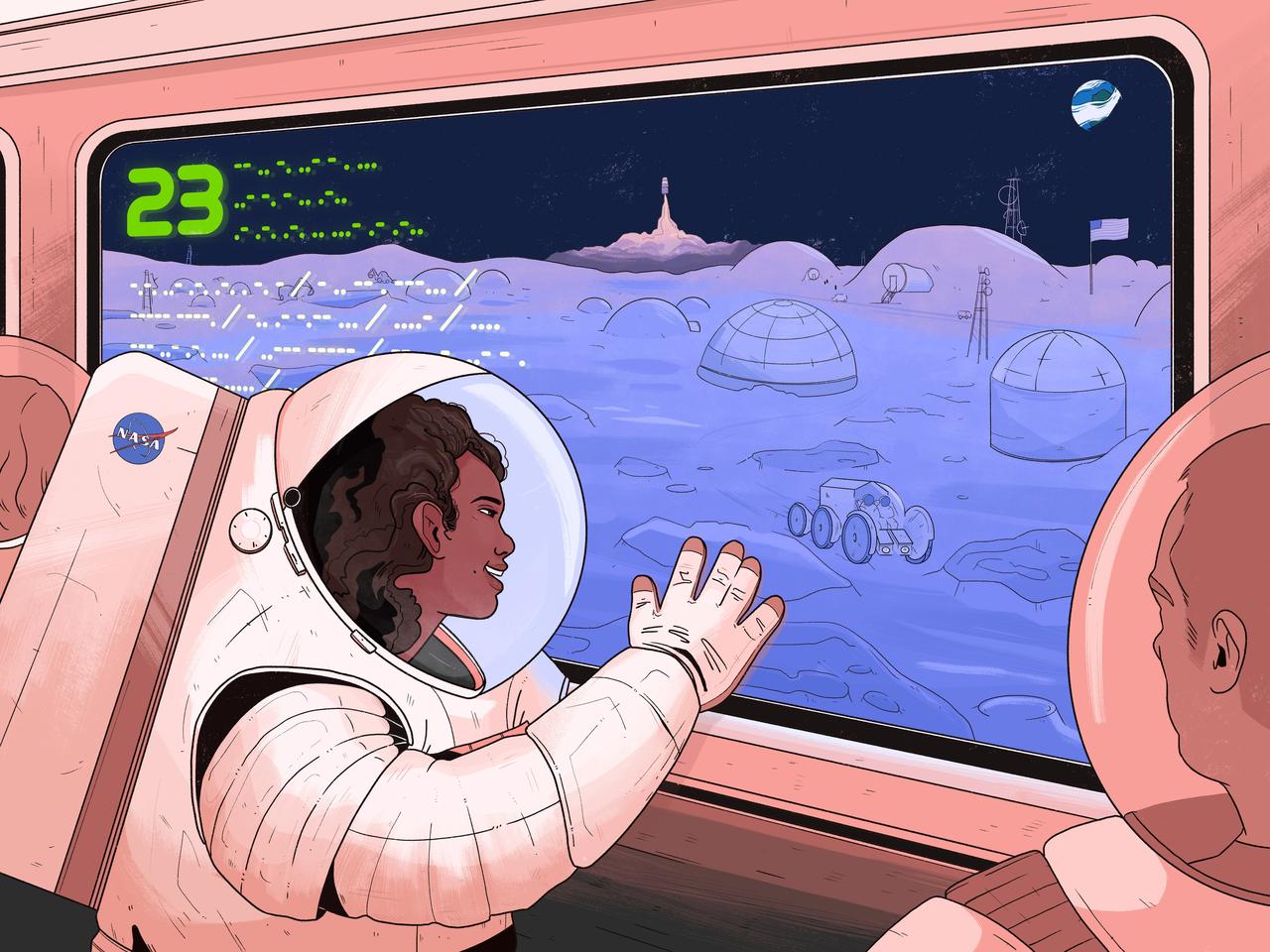
With Artemis, NASA is going back to the Moon. And we want you to come along!..You Are Going, illustrated by former NASA intern Shane Tolentino, shares a glimpse into future Artemis missions. Learn all about the elements that will help make Artemis possible: the powerful Space Launch System rocket, the Orion spacecraft, the Gateway, and so much more.
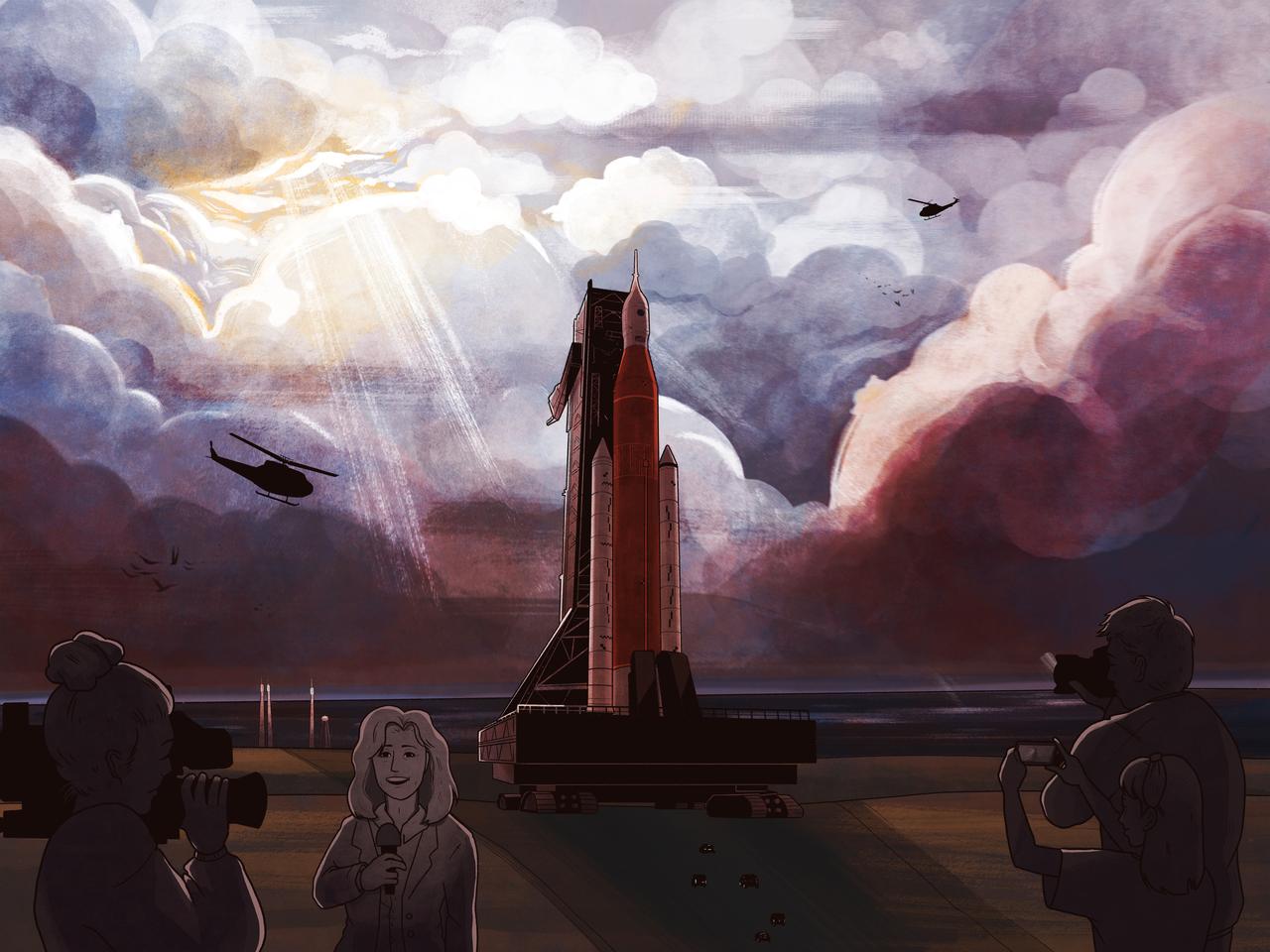
With Artemis, NASA is going back to the Moon. And we want you to come along!..You Are Going, illustrated by former NASA intern Shane Tolentino, shares a glimpse into future Artemis missions. Learn all about the elements that will help make Artemis possible: the powerful Space Launch System rocket, the Orion spacecraft, the Gateway, and so much more.
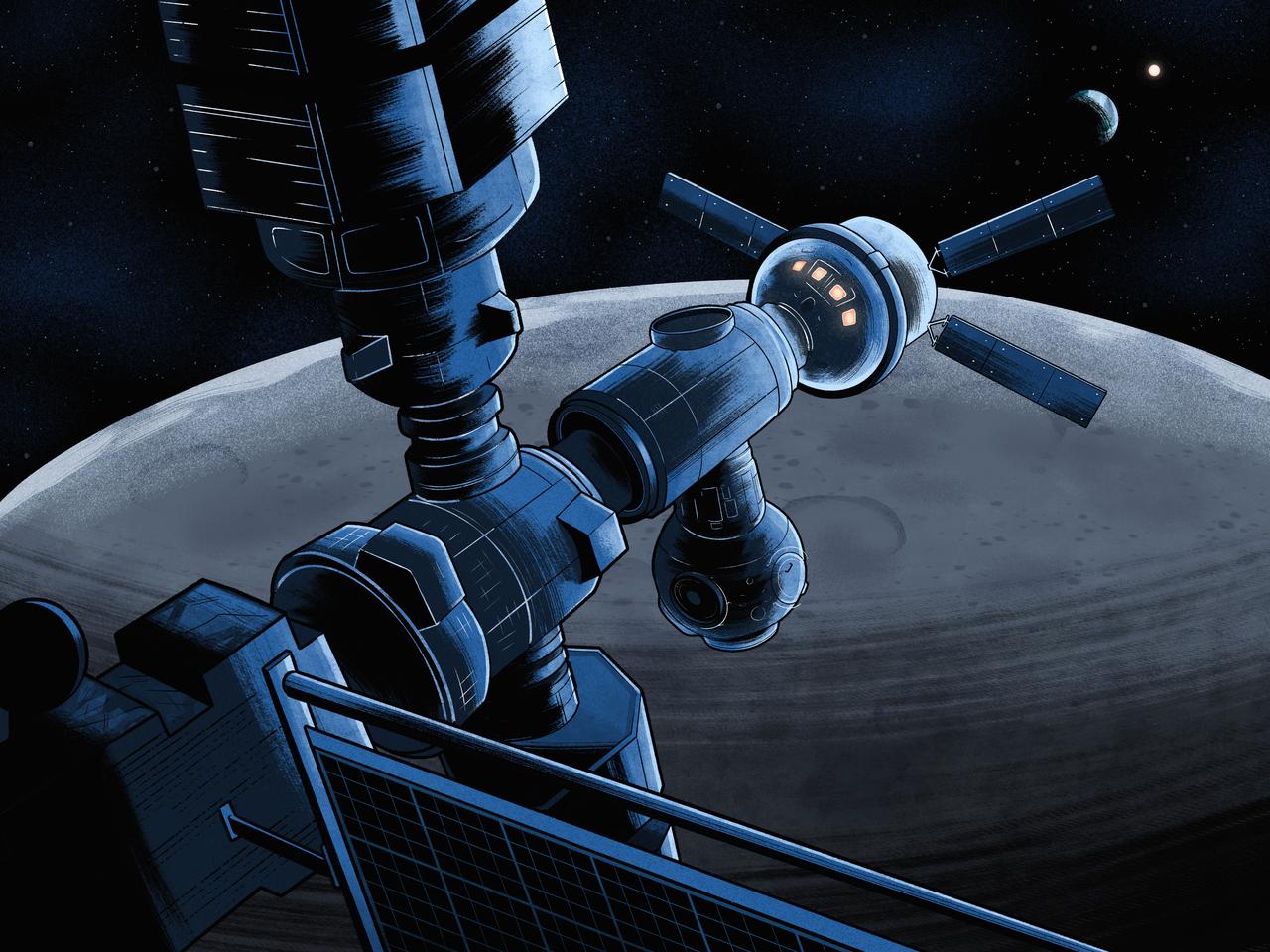
With Artemis, NASA is going back to the Moon. And we want you to come along!..You Are Going, illustrated by former NASA intern Shane Tolentino, shares a glimpse into future Artemis missions. Learn all about the elements that will help make Artemis possible: the powerful Space Launch System rocket, the Orion spacecraft, the Gateway, and so much more.

With Artemis, NASA is going back to the Moon. And we want you to come along!..You Are Going, illustrated by former NASA intern Shane Tolentino, shares a glimpse into future Artemis missions. Learn all about the elements that will help make Artemis possible: the powerful Space Launch System rocket, the Orion spacecraft, the Gateway, and so much more.

With Artemis, NASA is going back to the Moon. And we want you to come along!..You Are Going, illustrated by former NASA intern Shane Tolentino, shares a glimpse into future Artemis missions. Learn all about the elements that will help make Artemis possible: the powerful Space Launch System rocket, the Orion spacecraft, the Gateway, and so much more.

Dr. Stephen Hawking, a professor of mathematics at the University of Cambridge, delivers a speech entitled "Why we should go into space" during a lecture that is part of a series honoring NASA's 50th Anniversary, Monday, April 21, 2008, at George Washington University's Morton Auditorium in Washington. Photo Credit: (NASA/Paul. E. Alers)

Dr. Stephen Hawking, a professor of mathematics at the University of Cambridge, delivers a speech entitled "Why we should go into space" during a lecture that is part of a series honoring NASA's 50th Anniversary, Monday, April 21, 2008, at George Washington University's Morton Auditorium in Washington. Photo Credit: (NASA/Paul. E. Alers)

Dr. Stephen Hawking, a professor of mathematics at the University of Cambridge, delivers a speech entitled "Why we should go into space" during a lecture that is part of a series honoring NASA's 50th Anniversary, Monday, April 21, 2008, at George Washington University's Morton Auditorium in Washington. Photo Credit: (NASA/Paul. E. Alers)

Dr. Stephen Hawking, a professor of mathematics at the University of Cambridge, delivers a speech entitled "Why we should go into space" during a lecture that is part of a series honoring NASA's 50th Anniversary, Monday, April 21, 2008, at George Washington University's Morton Auditorium in Washington. Photo Credit: (NASA/Paul. E. Alers)

Dr. Stephen Hawking, a professor of mathematics at the University of Cambridge, delivers a speech entitled "Why we should go into space" during a lecture that is part of a series honoring NASA's 50th Anniversary, Monday, April 21, 2008, at George Washington University's Morton Auditorium in Washington. Photo Credit: (NASA/Paul. E. Alers)

Dr. Stephen Hawking, a professor of mathematics at the University of Cambridge, delivers a speech entitled "Why we should go into space" during a lecture that is part of a series honoring NASA's 50th Anniversary, Monday, April 21, 2008, at George Washington University's Morton Auditorium in Washington. Photo Credit: (NASA/Paul. E. Alers)

Dr. Stephen Hawking, a professor of mathematics at the University of Cambridge, delivers a speech entitled "Why we should go into space" during a lecture that is part of a series honoring NASA's 50th Anniversary, Monday, April 21, 2008, at George Washington University's Morton Auditorium in Washington. Photo Credit: (NASA/Paul. E. Alers)
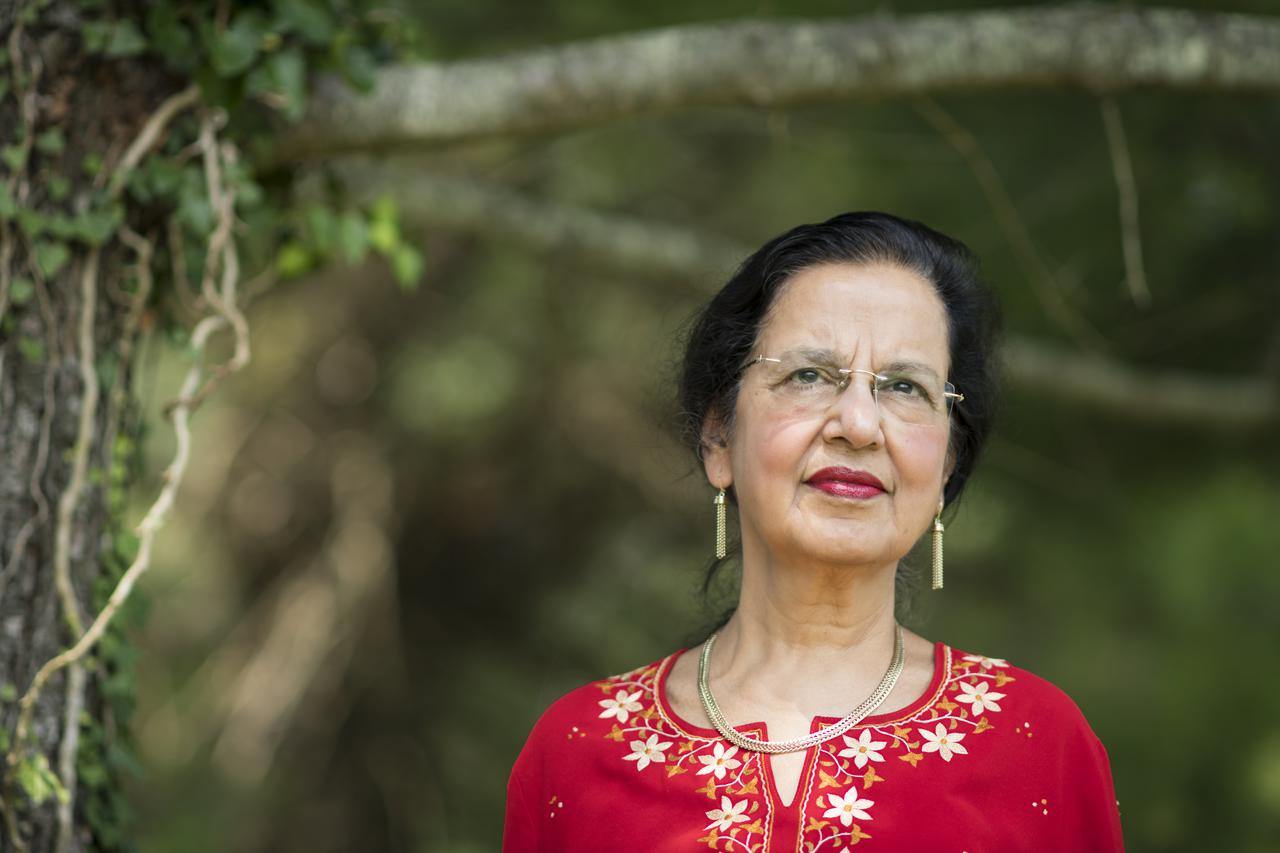
“I was born in India soon after we got independence from the British. So we were just beginning to get access to education. My mother was very keen that her daughters get an education. She was a big motivating force behind my interest in science. Since I was really little, she would say, ‘This daughter of mine is going to be a scientist.’ “And I loved nature. In those days, the monsoon would make India come to life with flowers and creepy-crawlies and all kinds of little creatures. I would just go out, eagerly looking for new forms of life. I was always curious. And I remember the night sky — just trying to count all the stars. We didn’t have electricity so it was very dark. You could see the Milky Way, it was so clear. “When Sputnik was launched, it came out in the newspaper that you would be able to see it pass overhead at 5 in the morning. And my grandmother woke up everyone — the entire household — to see it. There was a big crowd in the backyard to watch Sputnik go by. "Then, Yuri Gagarin made a tour of India. He came to our city — Lucknow — and there was a reception for him. My mother got invitations for all of us to see the cosmonaut. We were just little kids. We ran right to the stage — there was no security then — and said hello to him. He gave us little booklets and autographs. It was a big inspiration for me. I remember just staring at that booklet he gave me. I kept it for years.” NASA Program Scientist, Dr. Hashima Hasan, poses for a portrait in her backyard, while working from home during the COVID-19 pandemic, Monday, July 6, 2020 in Maryland. Hasan currently works at NASA Headquarters as a program scientist on the agency’s Nuclear Spectroscopic Telescope Array (NuSTAR) spacecraft, the Keck Observatory, and the NASA Astrophysics Archives, and is the deputy program scientist for NASA’s James Webb Space Telescope. Photo Credit: (NASA/Aubrey Gemignani)
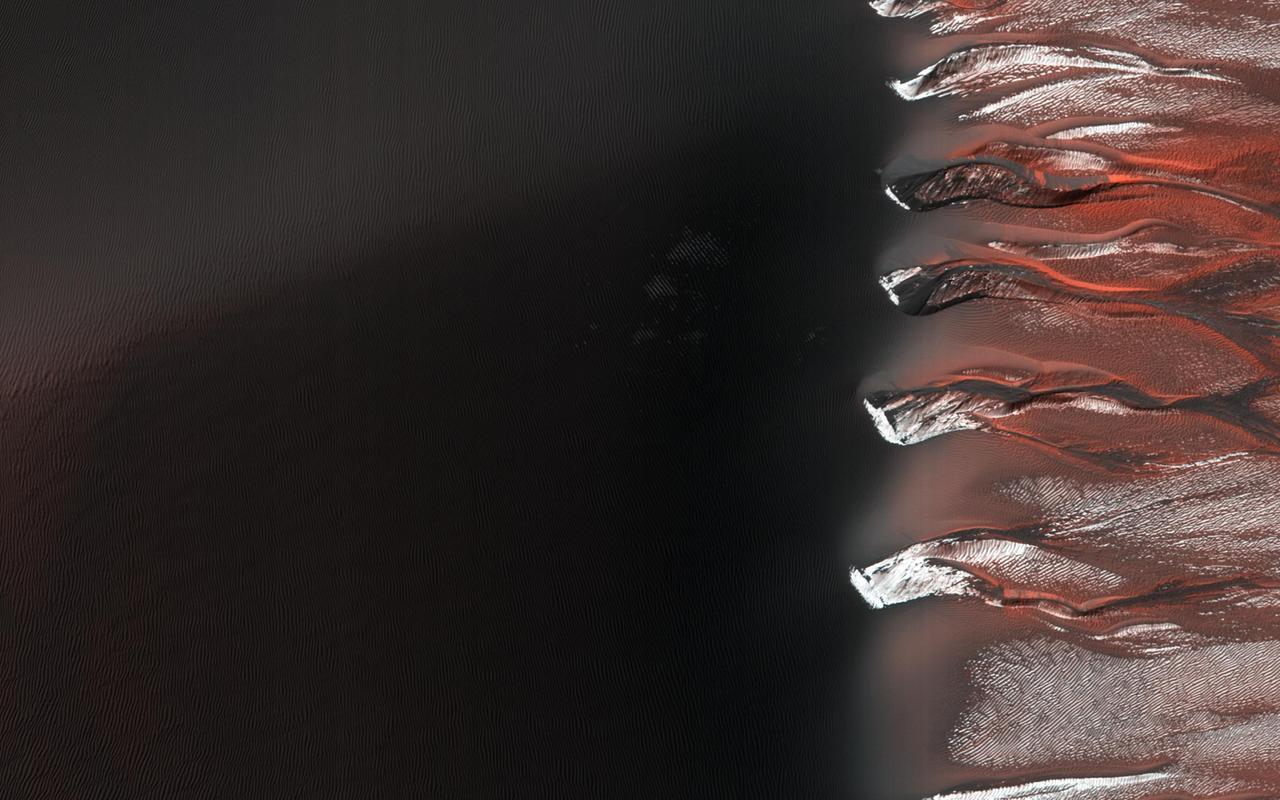
Kaiser Crater hosts a large field of sand dunes. Every winter the dunes are covered with a layer of seasonal carbon dioxide ice (dry ice). In early spring the ice begins to sublimate (going directly from solid ice to gas). In this image, the dunes are partially free of seasonal ice, with the contrast making it easy to see the ripples. Deep alcoves have been carved at the crest of the dune. We hypothesize that this is the result of the gas coming from the dry ice, destabilizing the sand at the crest. As blocks of ice protected in the cold shadows of the alcove break off they slide downslope, carving the channels we see. http://photojournal.jpl.nasa.gov/catalog/PIA21038
!["I was on console as a part of the primary launch team [for Artemis I]. I was the Orion system specialist for Guidance, Navigation, and Control. … In a few missions, we're sending astronauts to the Moon again, so being a part of the very, very first mission [was memorable]. … I wasn't here in 2017 when they first began discussions, but [I can’t even explain how it felt] that within just the four-year journey, I could see how far we had come: from when we were talking about getting the hardware here, to the hardware arriving, and then [to realize] ‘Oh, it's going today, we’re going!’ “… From a personal standpoint, I'm a person of faith, so for me, it was like: We launched at night — it was in the darkest part of the [night]. … Once the rocket launched, [I saw] how it illuminated such a dark space. So even when you're in a dark space, you can let your light shine. And it won't just shine for you and those that are immediately around you, but even people that you don't know will notice it, even people that you will never see will notice your light shining and be inspired.” — Ales-cia Winsley, Guidance, Navigation, and Flight Control Engineer, Kennedy Space Center Interviewer: NASA / Michelle Zajac](https://images-assets.nasa.gov/image/KSC-20231128-PH-CSH01_0003/KSC-20231128-PH-CSH01_0003~medium.jpg)
"I was on console as a part of the primary launch team [for Artemis I]. I was the Orion system specialist for Guidance, Navigation, and Control. … In a few missions, we're sending astronauts to the Moon again, so being a part of the very, very first mission [was memorable]. … I wasn't here in 2017 when they first began discussions, but [I can’t even explain how it felt] that within just the four-year journey, I could see how far we had come: from when we were talking about getting the hardware here, to the hardware arriving, and then [to realize] ‘Oh, it's going today, we’re going!’ “… From a personal standpoint, I'm a person of faith, so for me, it was like: We launched at night — it was in the darkest part of the [night]. … Once the rocket launched, [I saw] how it illuminated such a dark space. So even when you're in a dark space, you can let your light shine. And it won't just shine for you and those that are immediately around you, but even people that you don't know will notice it, even people that you will never see will notice your light shining and be inspired.” — Ales-cia Winsley, Guidance, Navigation, and Flight Control Engineer, Kennedy Space Center Interviewer: NASA / Michelle Zajac
!["I was on console as a part of the primary launch team [for Artemis I]. I was the Orion system specialist for Guidance, Navigation, and Control. … In a few missions, we're sending astronauts to the Moon again, so being a part of the very, very first mission [was memorable]. … I wasn't here in 2017 when they first began discussions, but [I can’t even explain how it felt] that within just the four-year journey, I could see how far we had come: from when we were talking about getting the hardware here, to the hardware arriving, and then [to realize] ‘Oh, it's going today, we’re going!’ “… From a personal standpoint, I'm a person of faith, so for me, it was like: We launched at night — it was in the darkest part of the [night]. … Once the rocket launched, [I saw] how it illuminated such a dark space. So even when you're in a dark space, you can let your light shine. And it won't just shine for you and those that are immediately around you, but even people that you don't know will notice it, even people that you will never see will notice your light shining and be inspired.” — Ales-cia Winsley, Guidance, Navigation, and Flight Control Engineer, Kennedy Space Center Interviewer: NASA / Michelle Zajac](https://images-assets.nasa.gov/image/KSC-20231128-PH-CSH01_0004/KSC-20231128-PH-CSH01_0004~medium.jpg)
"I was on console as a part of the primary launch team [for Artemis I]. I was the Orion system specialist for Guidance, Navigation, and Control. … In a few missions, we're sending astronauts to the Moon again, so being a part of the very, very first mission [was memorable]. … I wasn't here in 2017 when they first began discussions, but [I can’t even explain how it felt] that within just the four-year journey, I could see how far we had come: from when we were talking about getting the hardware here, to the hardware arriving, and then [to realize] ‘Oh, it's going today, we’re going!’ “… From a personal standpoint, I'm a person of faith, so for me, it was like: We launched at night — it was in the darkest part of the [night]. … Once the rocket launched, [I saw] how it illuminated such a dark space. So even when you're in a dark space, you can let your light shine. And it won't just shine for you and those that are immediately around you, but even people that you don't know will notice it, even people that you will never see will notice your light shining and be inspired.” — Ales-cia Winsley, Guidance, Navigation, and Flight Control Engineer, Kennedy Space Center Interviewer: NASA / Michelle Zajac
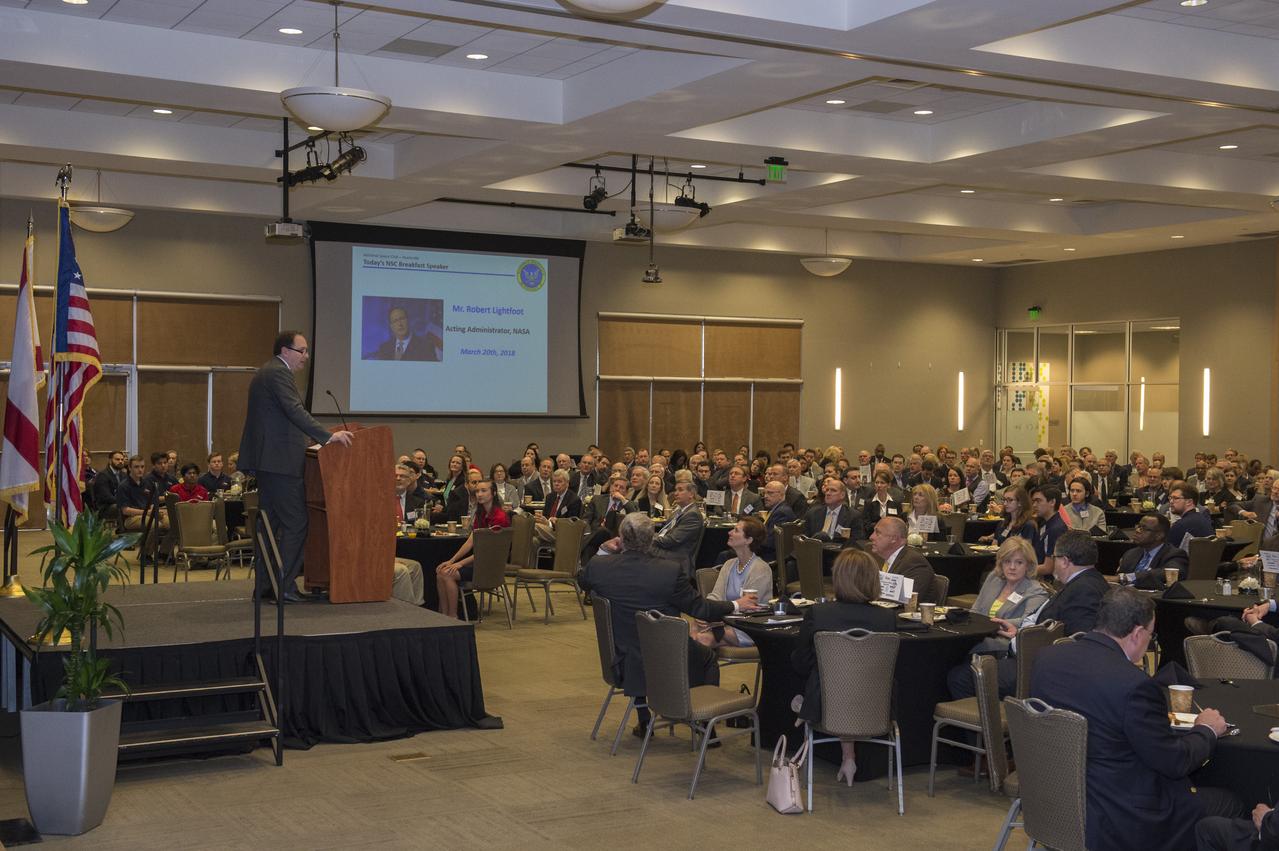
NASA Acting Administrator Robert Lightfoot addresses a standing room-only crowd at the March 20 National Space Club Huntsville breakfast. Lightfoot, who recently announced he will be retiring from the agency on April 30, praised NASA's Marshall Space Flight Center and spoke about where the agency is headed over the next two decades. “I get to be nostalgic now, as I leave the Agency. This work was going on before I got here, and it’s going to keep going on after I leave,” said Lightfoot. “In this nation where we hear a lot about what we can't do, NASA is a demonstration of what this nation can do. The Space Launch System rocket is taking shape right here at Marshall. The passion our team has on our exploration journey is second to none and there seems to be a sense of urgency to get to that first launch. Exploration gives us hope for the future, and brings today's generation on board to forge its own path to the next great milestones for humanity.” National Space Club Huntsville's mission is to promote the awareness of civilian and military applications for rocketry and astronautics. Participation in its events helps raise money for scholarships and STEM engagement in the community.
![“I remember crying on the floor of my living room. In the nineties, three-day forecasts were about as good as five-day forecasts are today. [Hurricane Brett] was within three days, but it wasn’t completely clear whether it was going to hit my hometown or not. It ended up hitting south of us and we didn’t even get rain out of it. But I remember being fearful for that whole day and night. But then I turned that fear into fascination. In 2003, my hometown got hit by hurricane Claudette. I wasn’t as fearful then. I was a little bit older at that time. And then a year and a half later, we had a snowstorm in south Texas. We had 12 inches overnight. And it was so incredibly weird. I had seen a forecast on TV, and it was this outlandish forecast from ten days out that said it was going to snow. I was a kid and I believed it. I bet my dad ten dollars that it was going to happen, and he said, ‘there’s no way.’ And I ended up winning ten dollars. And to me that was like, ‘oh my gosh! I stole somebody else’s forecast and I won ten dollars.’ I think people try to take their fears and understand and dissect them. This goes not only for the physical sciences but also for the life sciences. So many people who have been impacted by cancer in their family go into cancer research. It gives them a sense of closure. It gives them a sense of understanding. They want to be part of the solution. For example, my brother is autistic, low-functioning. My backup plan would have been researching neurodivergence. It’s all about the feeling of wanting to understand.” NASA Deputy Program Scientist, Earth Science Division, Dr. Aaron Piña, poses for a portrait, Monday, June 13, 2022, at the Mary W. Jackson NASA Headquarters building in Washington. Photo Credit: (NASA/Aubrey Gemignani)](https://images-assets.nasa.gov/image/NHQ202206130001/NHQ202206130001~medium.jpg)
“I remember crying on the floor of my living room. In the nineties, three-day forecasts were about as good as five-day forecasts are today. [Hurricane Brett] was within three days, but it wasn’t completely clear whether it was going to hit my hometown or not. It ended up hitting south of us and we didn’t even get rain out of it. But I remember being fearful for that whole day and night. But then I turned that fear into fascination. In 2003, my hometown got hit by hurricane Claudette. I wasn’t as fearful then. I was a little bit older at that time. And then a year and a half later, we had a snowstorm in south Texas. We had 12 inches overnight. And it was so incredibly weird. I had seen a forecast on TV, and it was this outlandish forecast from ten days out that said it was going to snow. I was a kid and I believed it. I bet my dad ten dollars that it was going to happen, and he said, ‘there’s no way.’ And I ended up winning ten dollars. And to me that was like, ‘oh my gosh! I stole somebody else’s forecast and I won ten dollars.’ I think people try to take their fears and understand and dissect them. This goes not only for the physical sciences but also for the life sciences. So many people who have been impacted by cancer in their family go into cancer research. It gives them a sense of closure. It gives them a sense of understanding. They want to be part of the solution. For example, my brother is autistic, low-functioning. My backup plan would have been researching neurodivergence. It’s all about the feeling of wanting to understand.” NASA Deputy Program Scientist, Earth Science Division, Dr. Aaron Piña, poses for a portrait, Monday, June 13, 2022, at the Mary W. Jackson NASA Headquarters building in Washington. Photo Credit: (NASA/Aubrey Gemignani)
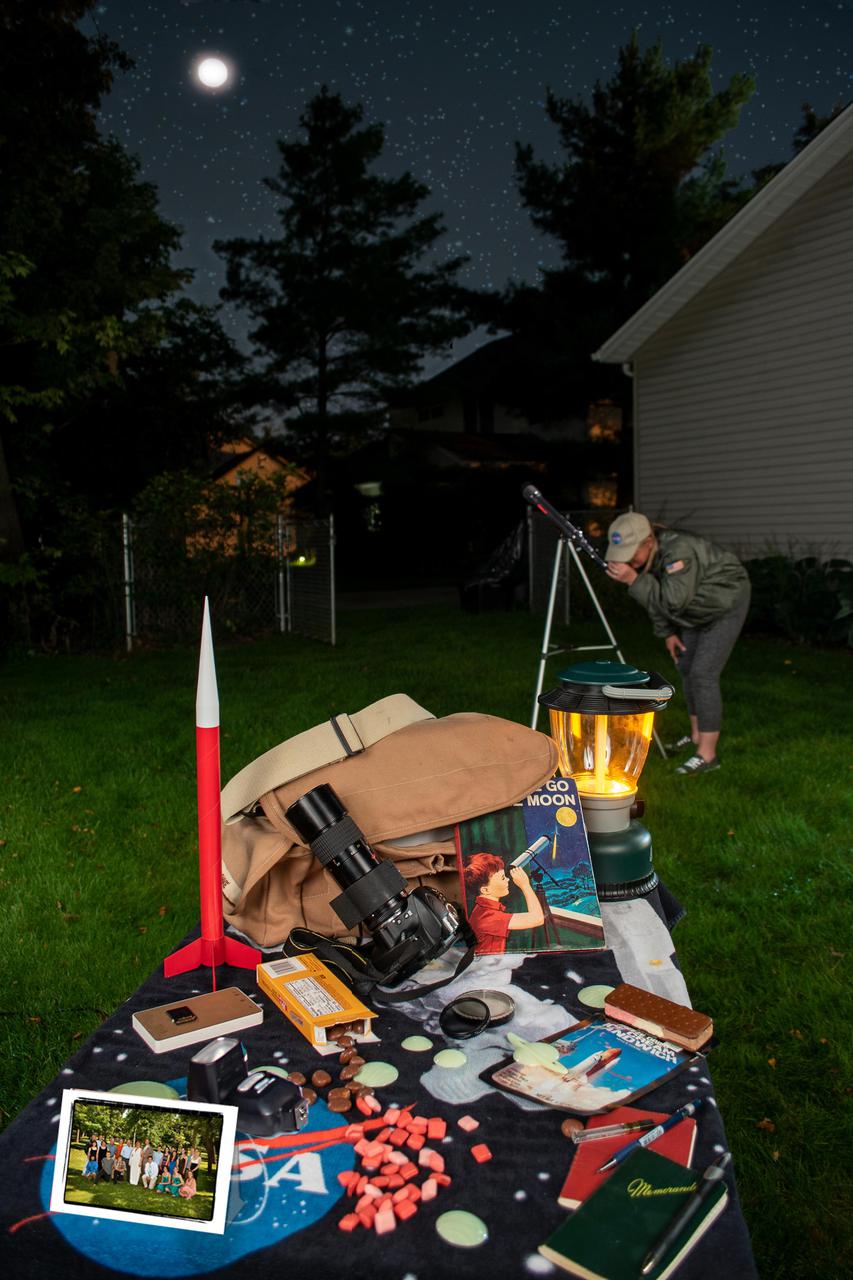
NASA Moon Kit of things I would take to the moon, The first thing I thought of for my Moon Kit was the first book I ever read when I was learning to read. It is titled, You Will Go To The Moon. I really liked that book and read it many times, looking at the illustrations and wondering about if I would ever actually go to the moon. Of the many belongings that I have lost through the years from moving, etc. that book has stayed with me and so it would of course go to the moon with me. Photography has always interested me and so a family photo was second to get packed. We always had photos taken and volumes of old family photos in the house and so photography has played an important role in my life and so my camera gear is third to get packed. As a kid I spend a lot of time and money building rockets and flying them. I bet my rocket would go very high on the moon. I also like a little candy wherever I go.
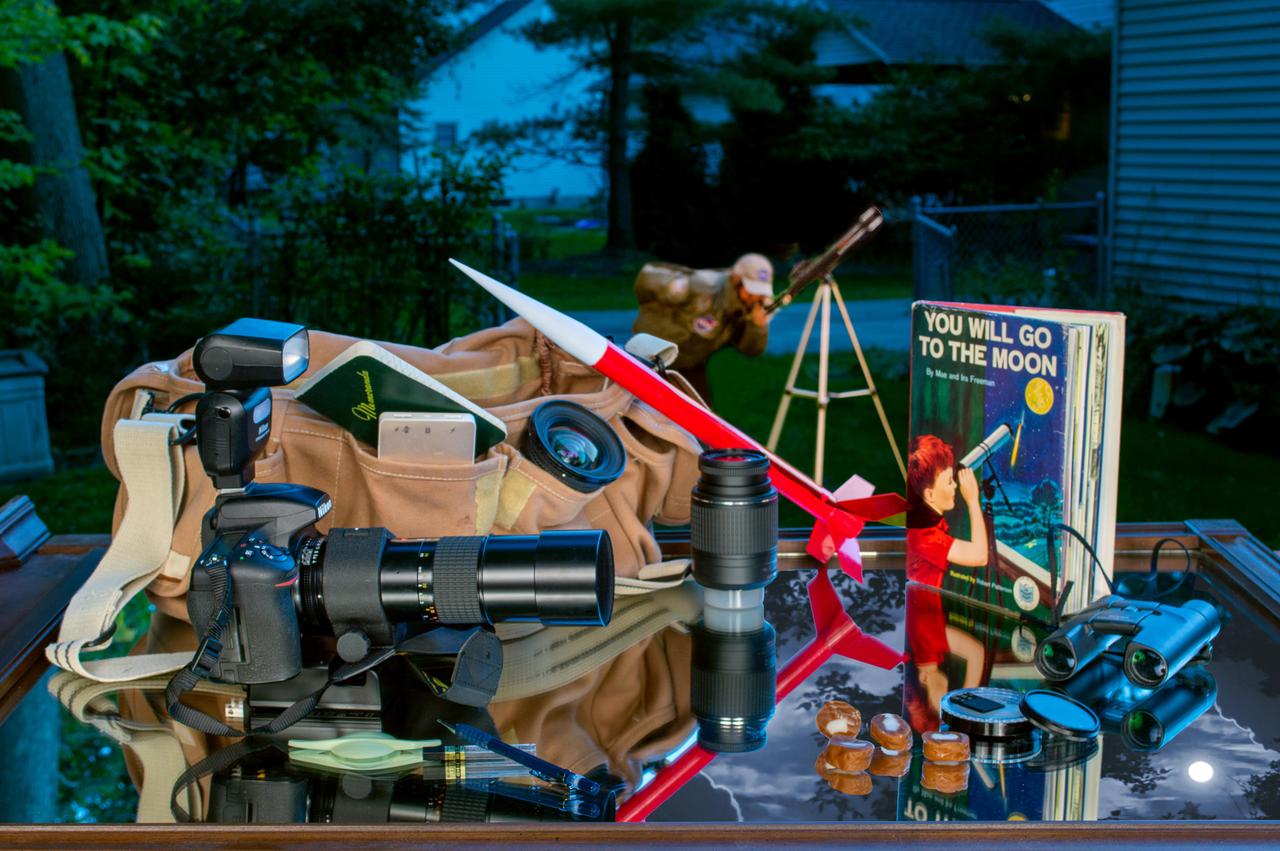
NASA Moon Kit of things I would take to the moon with me, The first thing I thought of for my Moon Kit was the first book I ever read when I was learning to read. It is titled, You Will Go To The Moon. I really liked that book and read it many times, looking at the illustrations and wondering about if I would ever actually go to the moon. Of the many belongings that I have lost through the years from moving, etc. that book has stayed with me and so it would of course go to the moon with me. Photography has always interested me and so a family photo was second to get packed. We always had photos taken and volumes of old family photos in the house and so photography has played an important role in my life and so my camera gear is third to get packed. As a kid I spend a lot of time and money building rockets and flying them. I bet my rocket would go very high on the moon. I also like a little candy wherever I go.
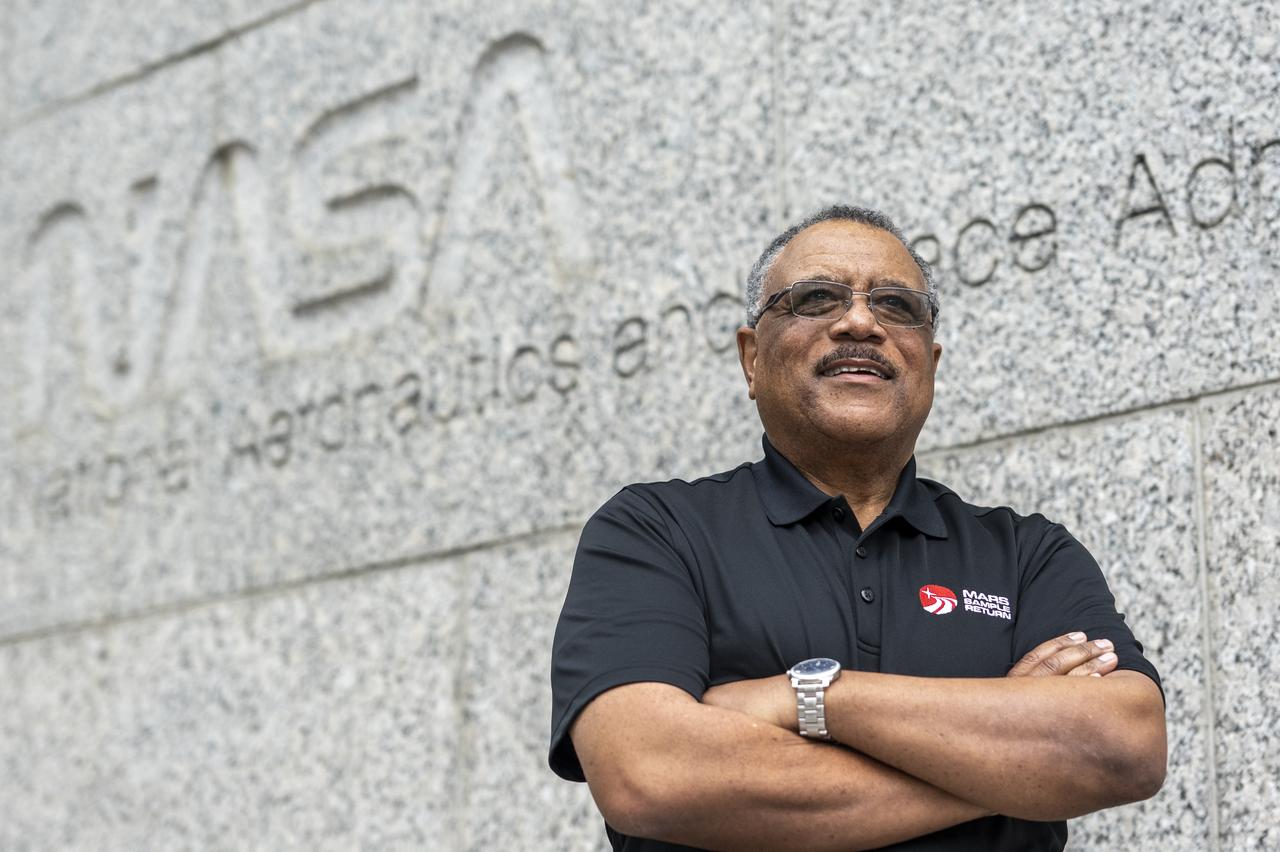
ÒIf you just invest a little time and a little effort in people, you will get so much more back. Not only will you feel good about it and get satisfaction above and beyond anything you can imagine, but the task or the mission you are trying to accomplish will also benefit tremendously. IÕve seen this happen many times when I have given someone an assignment. I am careful not to restrict their creativity. Often, theyÕre able to accomplish the task or mission better than I expected. ÒMy brotherÕs a professional artist, and I learned that from him. If you tell an artist what to paint, they will paint it. But, if you tell them what youÕre looking for, theyÕll paint that Ð and thereÕs a difference. People appreciate that, the openness to be able to create. Another big one is that thereÕs no such thing as a perfect person. So, the day you start thinking everythingÕs going to be perfect, you are in trouble. ÒI remember when I went on my first visit to NASAÕs Jet Propulsion Laboratory to talk about the Mars Sample Return campaign. I sat down with the communications team and said, ÔLook, if you are thinking we are going to do this perfectly and everythingÕs going to go as smoothly as it can, I want to change that mindset right now. We are going to have our challenges. But it is our job to work through those challenges, that is how we succeed. ÒI believe that whenever I am in a leadership position it is my call, my responsibility to create an environment in which all who work around me can be at their most efficient. I have been in situations before in which coworkers have said, ÔThat could not have turned out any better.Õ I believe you have to create the environment in which people can thrive and be their best. ThatÕs a big deal to me and I want people to treat me that way too. IÕve always felt from before I was a teenager that if I do something good, it will go to the next person and the next person, and before you know it, it goes around the world and comes back to me. I have truly believed that all my life, and I still think that today.Ó Dewayne Washington, Mars Sample Return Senior Communications Manager, poses for a portrait, Wednesday, Jan. 25, 2023, at the Mary W. Jackson NASA Headquarters building in Washington. Photo Credit: (NASA/Keegan Barber)

Dr. Stephen Hawking, a professor of mathematics at the University of Cambridge, left, and his daughter Lucy Hawking talk about their co-authored children's book "George's Secret Key to the Universe" Monday, April 21, 2008, at George Washington University's Morton Auditorium in Washington. Stephen Hawking also delivered a speech entitled "Why we should go into space" during a lecture that is part of a series honoring NASA's 50th Anniversary, Photo Credit: (NASA/Paul. E. Alers)

"About 10 years ago, I started taking improv comedy classes when I lived back in Atlanta. It really teaches you how to go with the flow, to be present in a situation, to be ready for things to go wrong, and to be able to jump in and save a conversation or help somebody who is struggling to find the right words. These are things we do in our everyday lives that we can also do on stage, and I love that aspect of it. "I started using the tools of comedy to rewrite popular songs – such as from the musical Hamilton – to be about space. I love making people laugh and smile and think there’s something really special about finding things funny or amusing in a respectful way. It is a different level of connection than, ‘Oh, that's interesting.’ It ignites a different emotional response in you, and I think there’s a place for that in science communication as well. "Often in popular culture, there’s a bit of a stigma around people who enjoy learning about space and science; that it’s only for nerds. But if you insert it into a genre that you wouldn't normally find it in, like music or comedy, then suddenly you’re connecting with people on a different level. They might not go out and read a textbook, but they might come away from a song or a comedy show thinking, ‘Huh, I thought I was just going to this event for entertainment, but I actually learned something.’ That’s cool! It’s like you’re seasoning it or putting a little sugar in it. "Something improv comedy taught me is: When you start to let go and not take yourself too seriously and embrace the spontaneity of a situation, that’s really freeing, and people respond well to that." Elizabeth Landau, Senior Communications Specialist for NASA’s Science Mission Directorate, poses for a portrait, Friday, July 30, 2021, in Washington. Photo Credit: (NASA/Bill Ingalls)
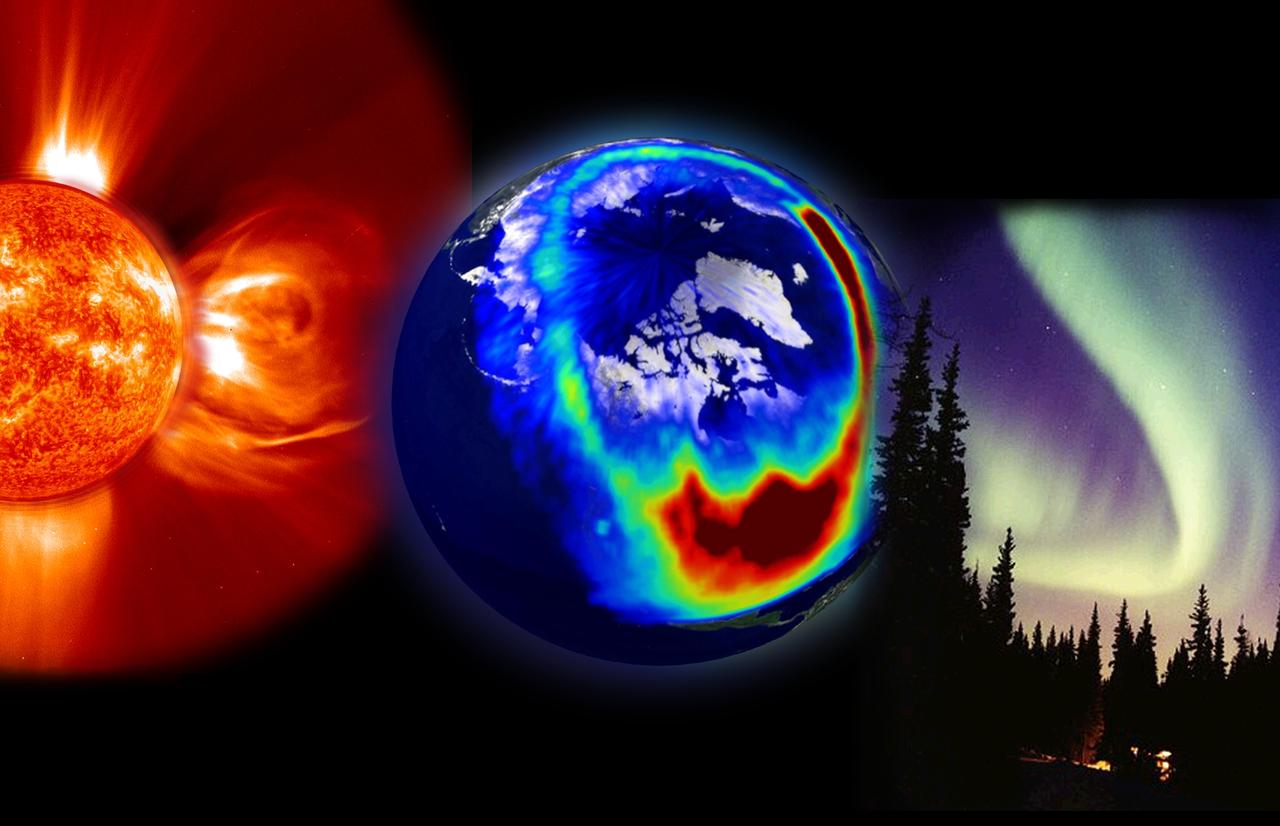
This composite image presents the three most visible elements of space weather: a storm from the Sun, aurora as seen from space, and aurora as seen from the Earth. The solar storm is a corona mass ejection (CME) composite from EIT 304Å superimposed on a LASCO C2 image, both from SOHO. The middle image from Polar’s VIS imager shows charged particles as they spread down across the U.S. during a large solar storm event on July 14, 2000. Lastly, Jan Curtis took this image of an aurora display in Alaska, the visible evidence of space weather that we see here on Earth. Credit: NASA/GSFC/SOHO/ESA To learn more go to the SOHO website: <a href="http://sohowww.nascom.nasa.gov/home.html" rel="nofollow">sohowww.nascom.nasa.gov/home.html</a> To learn more about NASA's Sun Earth Day go here: <a href="http://sunearthday.nasa.gov/2010/index.php" rel="nofollow">sunearthday.nasa.gov/2010/index.php</a>

“When I first joined Twitter in 2009, one of the first accounts I followed was NASA. I knew they were doing NASA ‘Tweetups’ (now called Socials) where members of the public could apply, go behind the scenes of a NASA facility and potentially attend a launch. “I was selected for the STS-135 Tweetup — the final launch of the Space Shuttle, July 2011. The Tweetup gave me access that I never in my life thought I’d be able to experience. Being inside the Vehicle Assembly Building, where Saturn rockets were assembled, where the Space Shuttle was stacked and now where the SLS is going to be stacked… that for me, was incredible. “We got to Kennedy for the launch on July 7. There were severe thunderstorms and lightning all around. The weather was not looking good for the next day. “The next morning, we get to the press site, and the weather continues to look like it’s going to prevent the launch. There was a 30% chance. I didn’t think it was going to happen. “And then, there was a break in the clouds. And at 11:28 am, the Shuttle launches. It was such a physical, emotional experience. I remember feeling the sound waves. I was just so excited, so thrilled, so overcome by seeing all these people put in so many hours on something that was bigger than themselves, working toward making this mission a success. And that was the culmination of it: 5 million pounds of thrust lifting this vehicle 250 miles off the planet. “I thought, ‘wow, Atlantis took off with just a 30% chance.’ So, I try to take that with me whenever I face a challenging situation. And that’s kind of why I was teetering on not applying for my first NASA internship in 2013. But I thought to myself, ‘well, that vehicle took off in not-so-ideal conditions. Things aren’t impossible.’ That’s what led me to pursue this career at NASA.” Portrait, Andres Almeida, Thursday, September 19, 2019 at NASA Headquarters in Washington. Photo Credit: (NASA/Aubrey Gemignani)
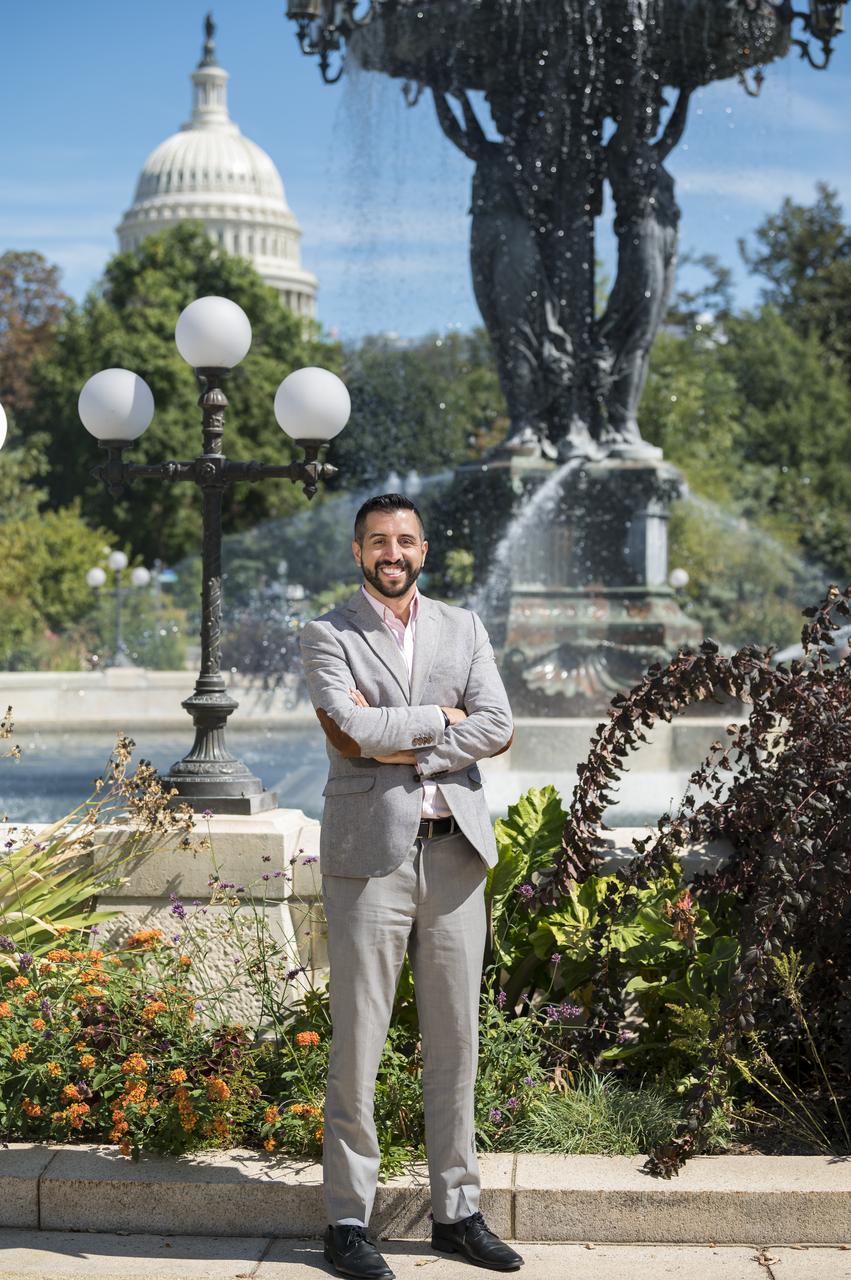
“When I first joined Twitter in 2009, one of the first accounts I followed was NASA. I knew they were doing NASA ‘Tweetups’ (now called Socials) where members of the public could apply, go behind the scenes of a NASA facility and potentially attend a launch. “I was selected for the STS-135 Tweetup — the final launch of the Space Shuttle, July 2011. The Tweetup gave me access that I never in my life thought I’d be able to experience. Being inside the Vehicle Assembly Building, where Saturn rockets were assembled, where the Space Shuttle was stacked and now where the SLS is going to be stacked… that for me, was incredible. “We got to Kennedy for the launch on July 7. There were severe thunderstorms and lightning all around. The weather was not looking good for the next day. “The next morning, we get to the press site, and the weather continues to look like it’s going to prevent the launch. There was a 30% chance. I didn’t think it was going to happen. “And then, there was a break in the clouds. And at 11:28 am, the Shuttle launches. It was such a physical, emotional experience. I remember feeling the sound waves. I was just so excited, so thrilled, so overcome by seeing all these people put in so many hours on something that was bigger than themselves, working toward making this mission a success. And that was the culmination of it: 5 million pounds of thrust lifting this vehicle 250 miles off the planet. “I thought, ‘wow, Atlantis took off with just a 30% chance.’ So, I try to take that with me whenever I face a challenging situation. And that’s kind of why I was teetering on not applying for my first NASA internship in 2013. But I thought to myself, ‘well, that vehicle took off in not-so-ideal conditions. Things aren’t impossible.’ That’s what led me to pursue this career at NASA.” Portrait, Andres Almeida, Thursday, September 19, 2019 at NASA Headquarters in Washington. Photo Credit: (NASA/Aubrey Gemignani)
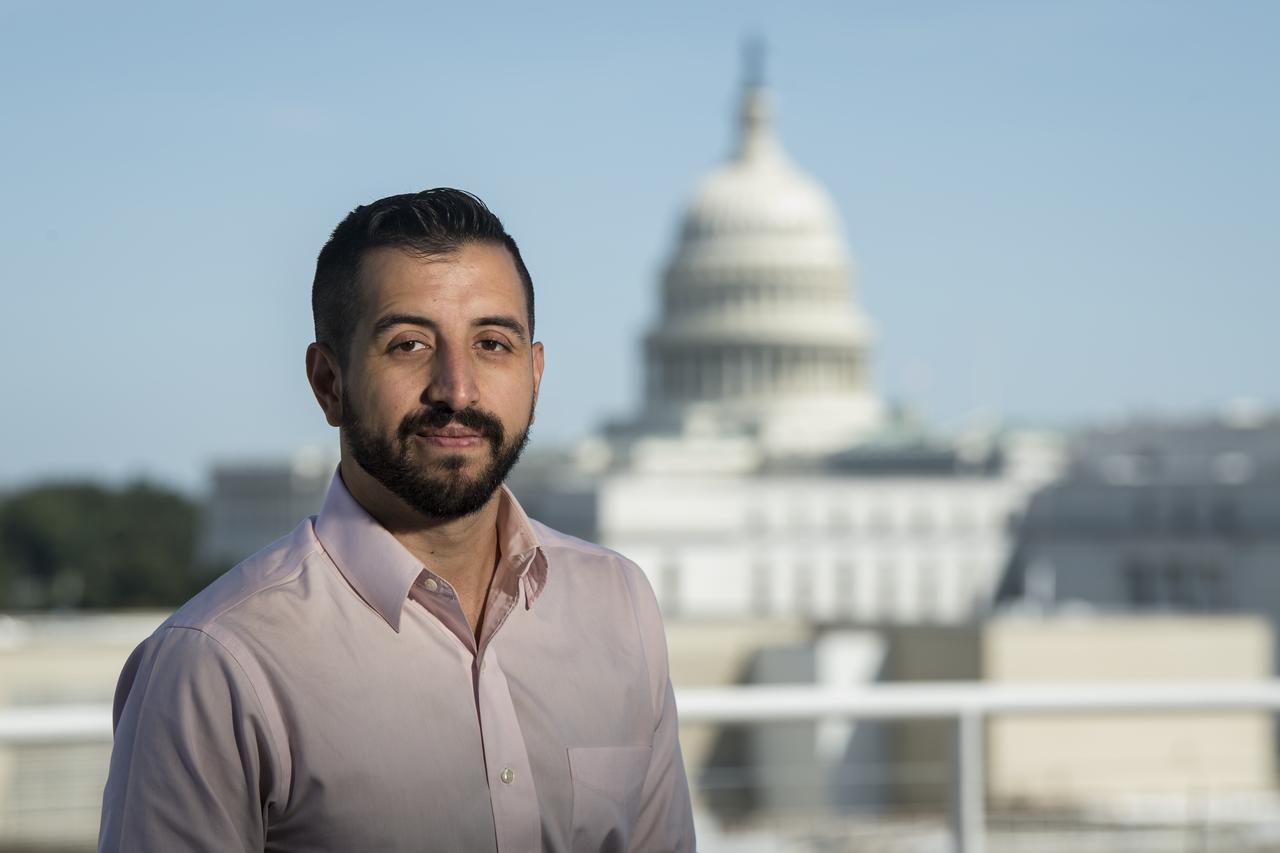
“When I first joined Twitter in 2009, one of the first accounts I followed was NASA. I knew they were doing NASA ‘Tweetups’ (now called Socials) where members of the public could apply, go behind the scenes of a NASA facility and potentially attend a launch. “I was selected for the STS-135 Tweetup — the final launch of the Space Shuttle, July 2011. The Tweetup gave me access that I never in my life thought I’d be able to experience. Being inside the Vehicle Assembly Building, where Saturn rockets were assembled, where the Space Shuttle was stacked and now where the SLS is going to be stacked… that for me, was incredible. “We got to Kennedy for the launch on July 7. There were severe thunderstorms and lightning all around. The weather was not looking good for the next day. “The next morning, we get to the press site, and the weather continues to look like it’s going to prevent the launch. There was a 30% chance. I didn’t think it was going to happen. “And then, there was a break in the clouds. And at 11:28 am, the Shuttle launches. It was such a physical, emotional experience. I remember feeling the sound waves. I was just so excited, so thrilled, so overcome by seeing all these people put in so many hours on something that was bigger than themselves, working toward making this mission a success. And that was the culmination of it: 5 million pounds of thrust lifting this vehicle 250 miles off the planet. “I thought, ‘wow, Atlantis took off with just a 30% chance.’ So, I try to take that with me whenever I face a challenging situation. And that’s kind of why I was teetering on not applying for my first NASA internship in 2013. But I thought to myself, ‘well, that vehicle took off in not-so-ideal conditions. Things aren’t impossible.’ That’s what led me to pursue this career at NASA.” Portrait, Andres Almeida, Thursday, September 19, 2019 at NASA Headquarters in Washington. Photo Credit: (NASA/Aubrey Gemignani)
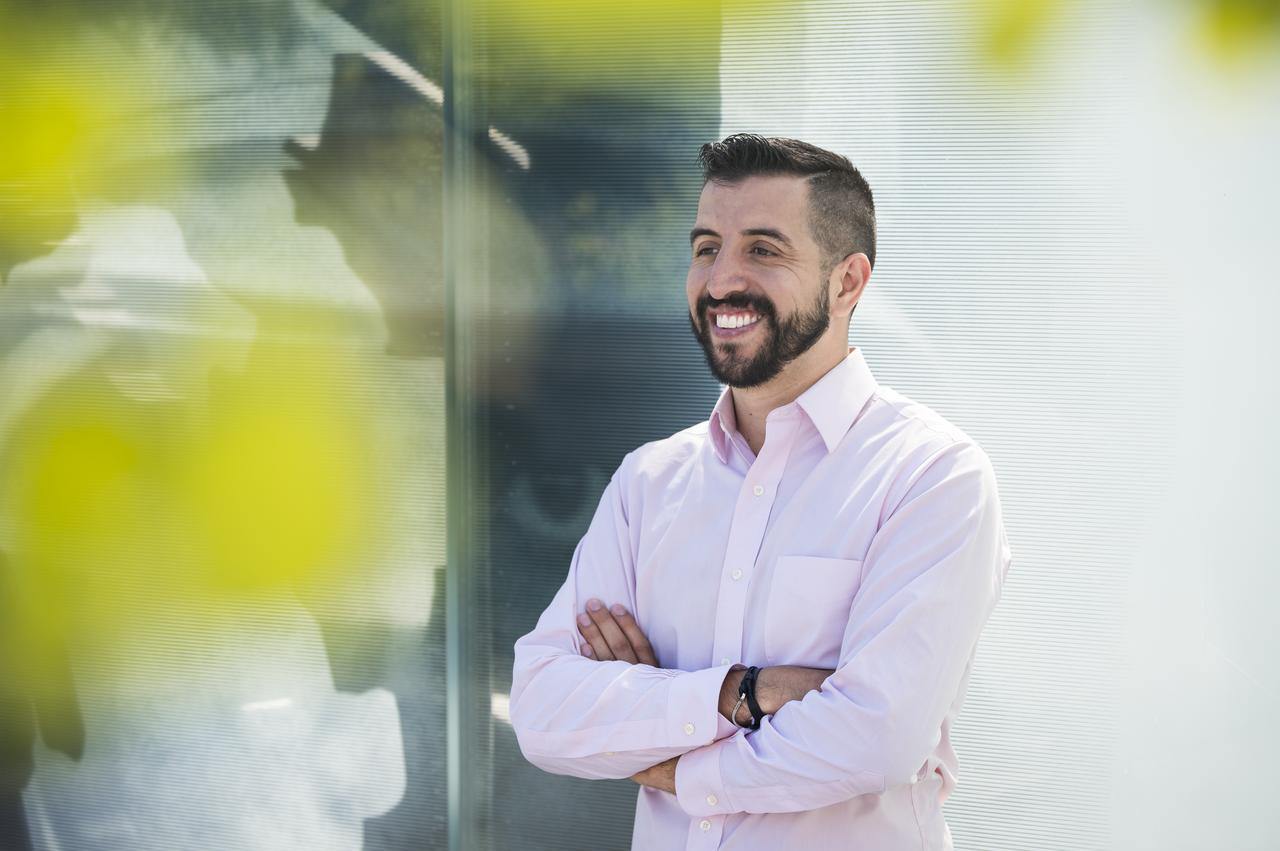
“When I first joined Twitter in 2009, one of the first accounts I followed was NASA. I knew they were doing NASA ‘Tweetups’ (now called Socials) where members of the public could apply, go behind the scenes of a NASA facility and potentially attend a launch. “I was selected for the STS-135 Tweetup — the final launch of the Space Shuttle, July 2011. The Tweetup gave me access that I never in my life thought I’d be able to experience. Being inside the Vehicle Assembly Building, where Saturn rockets were assembled, where the Space Shuttle was stacked and now where the SLS is going to be stacked… that for me, was incredible. “We got to Kennedy for the launch on July 7. There were severe thunderstorms and lightning all around. The weather was not looking good for the next day. “The next morning, we get to the press site, and the weather continues to look like it’s going to prevent the launch. There was a 30% chance. I didn’t think it was going to happen. “And then, there was a break in the clouds. And at 11:28 am, the Shuttle launches. It was such a physical, emotional experience. I remember feeling the sound waves. I was just so excited, so thrilled, so overcome by seeing all these people put in so many hours on something that was bigger than themselves, working toward making this mission a success. And that was the culmination of it: 5 million pounds of thrust lifting this vehicle 250 miles off the planet. “I thought, ‘wow, Atlantis took off with just a 30% chance.’ So, I try to take that with me whenever I face a challenging situation. And that’s kind of why I was teetering on not applying for my first NASA internship in 2013. But I thought to myself, ‘well, that vehicle took off in not-so-ideal conditions. Things aren’t impossible.’ That’s what led me to pursue this career at NASA.” Portrait, Andres Almeida, Thursday, September 19, 2019 at NASA Headquarters in Washington. Photo Credit: (NASA/Aubrey Gemignani)
NASA Wallops Flight Facility Public Affairs Specialist, Rebecca Hudson, Thursday, Feb. 6, 2020 at Wallops Flight Facility in Virginia. “What I really think stands out the most is when you go to a launch and you see people who have never seen one before. Some people get so emotional, they cry. It’s so energizing to see people get that excited. For me, every single time we launch a rocket —whether it be a sounding rocket or something as big as an Antares rocket or anything in between — all the hard work and long hours, all that leading up to it… you kind of forget it as soon as you see that emotion that people are experiencing. I always think about that as I drive home at night: “Do you know how many people we made happy today?” And so I think that is important — no matter what we do here, whether it’s my job or the test director’s or the administrator’s or all points in between — everybody’s got something to contribute. You ask little kids what their big dream is, and it’s not uncommon to hear “astronaut.” It’s not uncommon to hear they want to fly in a spaceship. That’s not uncommon. But we’re doing that. We’re making dreams for people.” Photo Credit: (NASA/Aubrey Gemignani)

It's hard to see in the dark. Most HiRISE images are are taken when the sun is at least 15 degrees above the horizon. (If you hold your hand at arm's length with fingers together, it's about five degrees wide on average.) However, to see what's going on in winter, we need to look at times and places where the Sun is just barely over the horizon. This image was taken to look at seasonal frost in gullies during southern winter on Mars, with the Sun only about two degrees over the horizon (just before sunset). To make things more difficult, the gullies are on a steep slope facing away from the sun, so they are in deep shadow. Under these conditions, HiRISE takes what are called "bin 4" images. This means that the image shows less detail, but by adding up the light from 16 pixels (a 4x4 square) we can see details in shadows. Even with the reduced resolution, we can see plenty of detail in the gullies, and learn about the seasonal frost. http://photojournal.jpl.nasa.gov/catalog/PIA20480
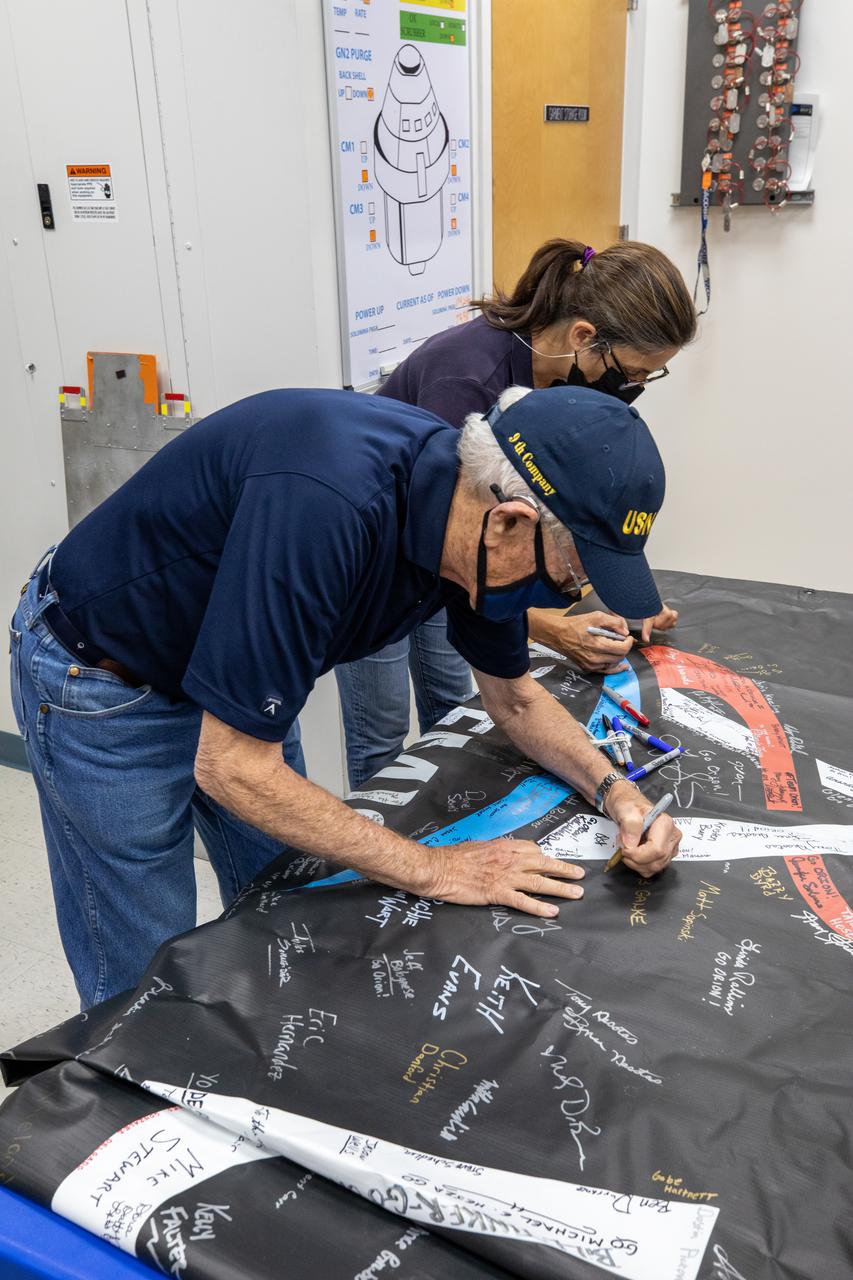
Charlie Duke, NASA Astronaut (former), and Nicole Stott, NASA Astronaut (former), add their signatures to the Artemis “We Are Going” banner inside the Multi-Payload Processing Facility (MPPF) during a visit to NASA’s Kennedy Space Center in Florida on May 10, 2021. During their time at Kennedy, they also had the opportunity to view the Orion spacecraft and Interim Cryogenic Propulsion Stage currently being serviced inside the MPPF ahead of the Artemis I launch. The first in a series of increasingly complex missions, Artemis I will test Orion and the Space Launch System rocket as an integrated system prior to crewed flights to the Moon.
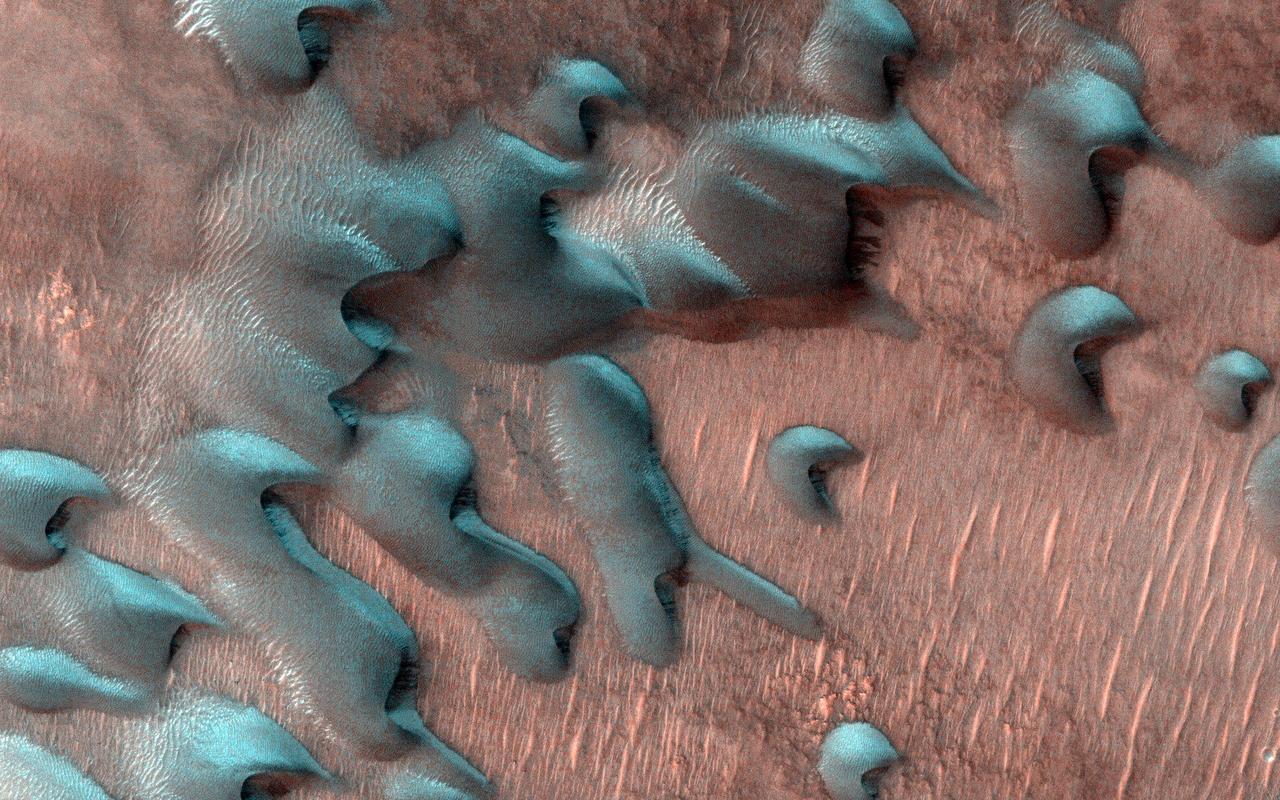
Usually, HiRISE takes pictures of well-illuminated terrain where there is plenty of light to produce clear images. Sometimes though, we would like to know what's going on in the dim wintertime areas. This picture was taken far north of the equator just two days after the winter solstice when the Sun was just a few degrees above the horizon. Sand dunes are moving across this landscape from top left to bottom right. Winter frost covers the colder, north-facing half of each dune (but not the warmer south-facing half). The frost here is a mixture of carbon dioxide ice and water ice and will disappear in a few months when spring arrives. https://photojournal.jpl.nasa.gov/catalog/PIA25552
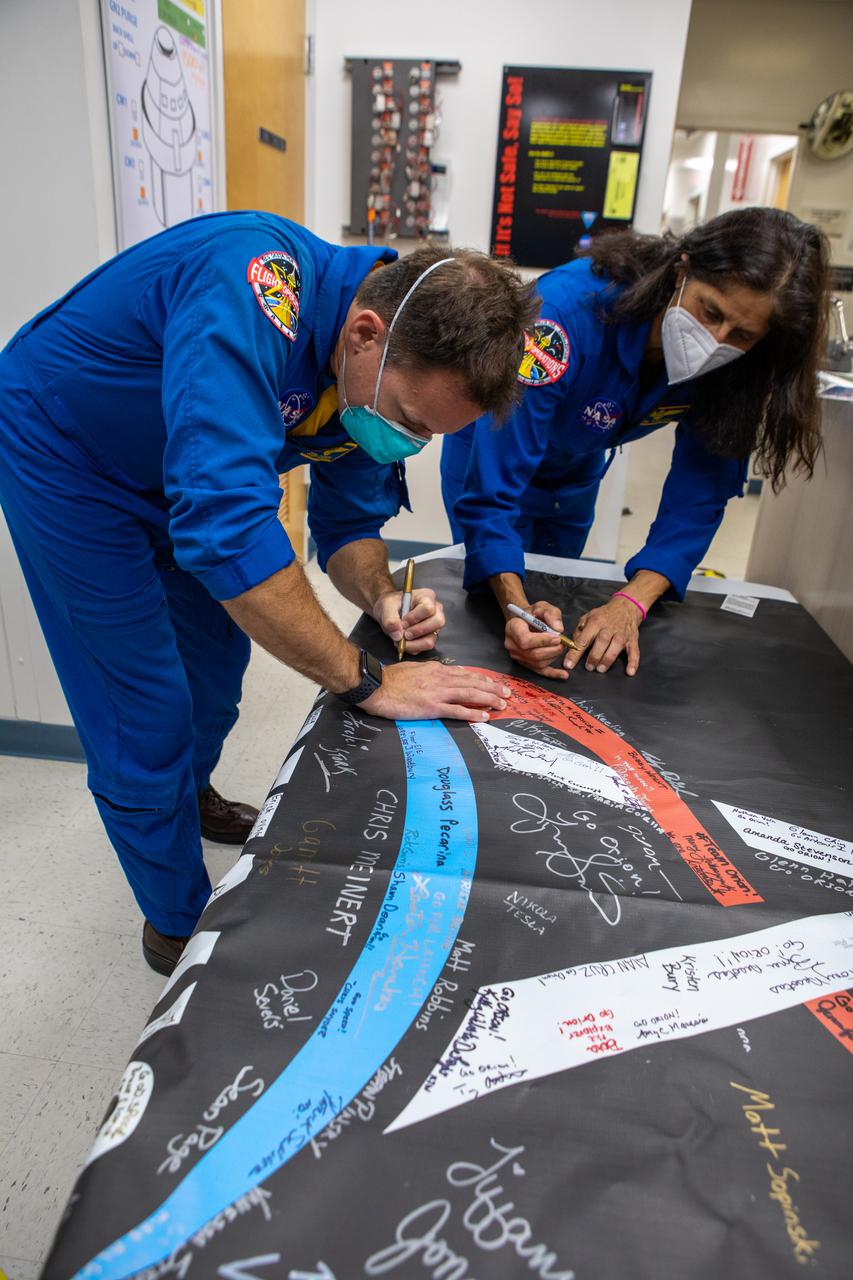
NASA astronauts Josh Cassada, left, and Sunita “Suni” Williams add their signatures to an Artemis “We Are Going” banner inside the Multi-Payload Processing Facility (MPPF) during a visit to NASA’s Kennedy Space Center in Florida on April 6, 2021. During their time at Kennedy, they also had the opportunity to view the Orion spacecraft and Space Launch System’s (SLS) Interim Cryogenic Propulsion Stage – both being serviced inside the MPPF ahead of the Artemis I launch. The first in a series of increasingly complex missions, Artemis I will test Orion and SLS as an integrated system prior to crewed flights to the Moon.

Oddly enough, an elongated coronal hole (the darker area near the center) seems to shape itself into a single, recognizable question mark over the period of one day (Dec. 21-22, 2017). Coronal holes are areas of open magnetic field that appear darker in extreme ultraviolet light, as is seen here. These holes are the source of streaming plasma that we call solar wind. While this exercise is akin to seeing shapes in clouds, it is fun to consider what the sun might be asking? Perhaps what the new year will bring? Guess what I am going to do next? Movies are available at https://photojournal.jpl.nasa.gov/catalog/PIA22197
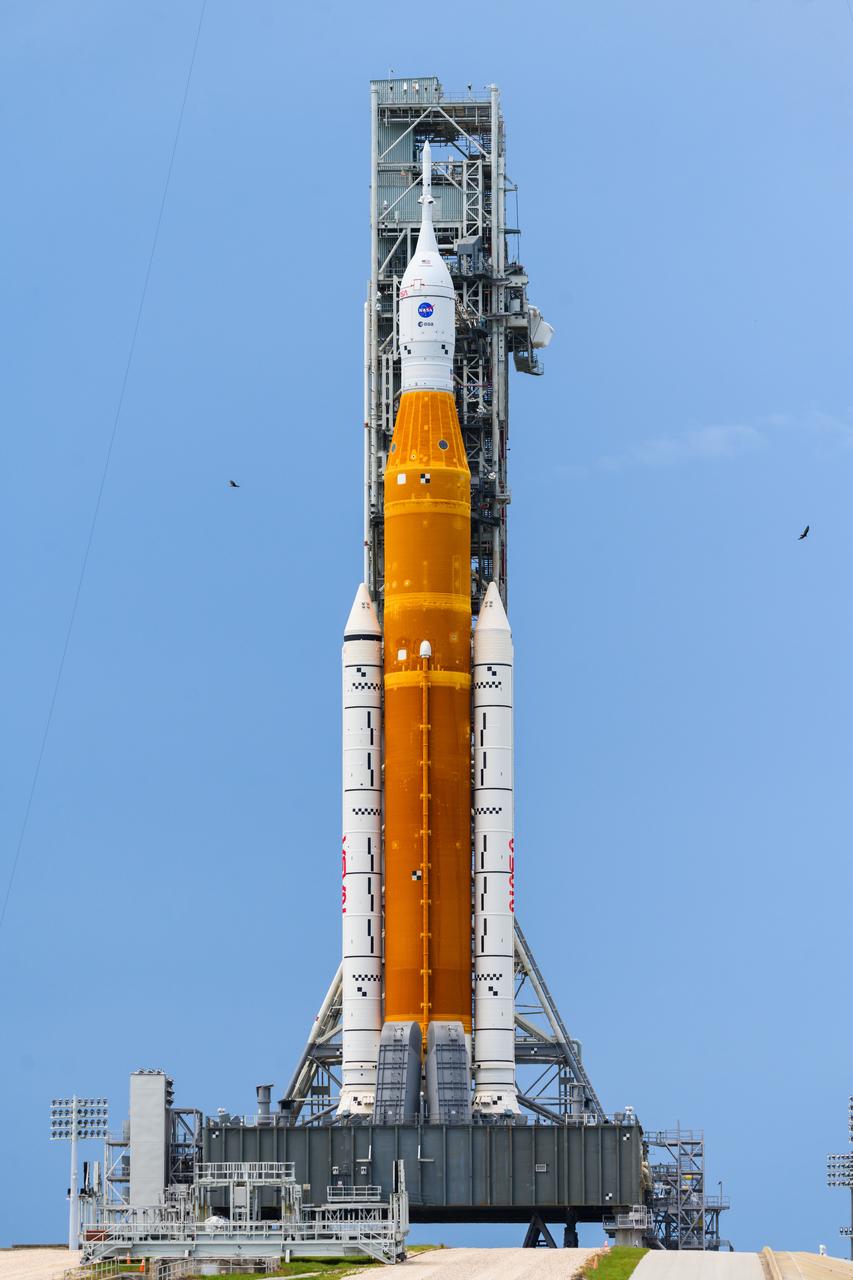
NASA’s Space Launch System (SLS) rocket with the Orion spacecraft aboard is seen atop the mobile launcher at Launch 39B at NASA’s Kennedy Space Center in Florida. Artemis I mission is the first integrated test of the agency’s deep space exploration systems: the Space Launch System rocket, Orion spacecraft, and supporting ground systems. The mission is the first in a series of increasingly complex missions to the Moon. Launch of the uncrewed flight test is targeted for no earlier than Aug. 29 at 8:33 a.m. ET. With Artemis missions, NASA will land the first woman and first person of color on the Moon, using innovative technologies to explore more of the lunar surface than ever before.
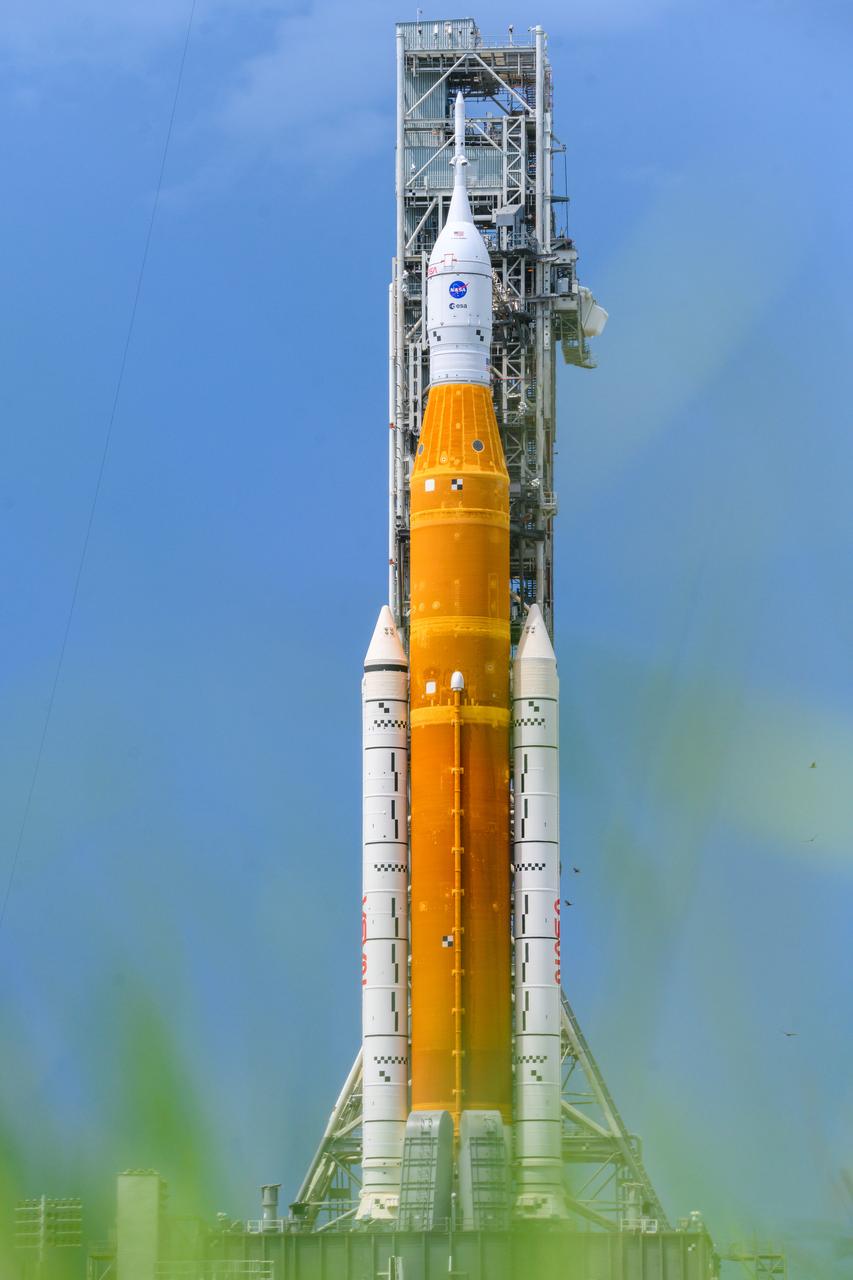
NASA’s Space Launch System (SLS) rocket with the Orion spacecraft aboard is seen atop the mobile launcher at Launch 39B at NASA’s Kennedy Space Center in Florida. Artemis I mission is the first integrated test of the agency’s deep space exploration systems: the Space Launch System rocket, Orion spacecraft, and supporting ground systems. The mission is the first in a series of increasingly complex missions to the Moon. Launch of the uncrewed flight test is targeted for no earlier than Aug. 29 at 8:33 a.m. ET. With Artemis missions, NASA will land the first woman and first person of color on the Moon, using innovative technologies to explore more of the lunar surface than ever before.
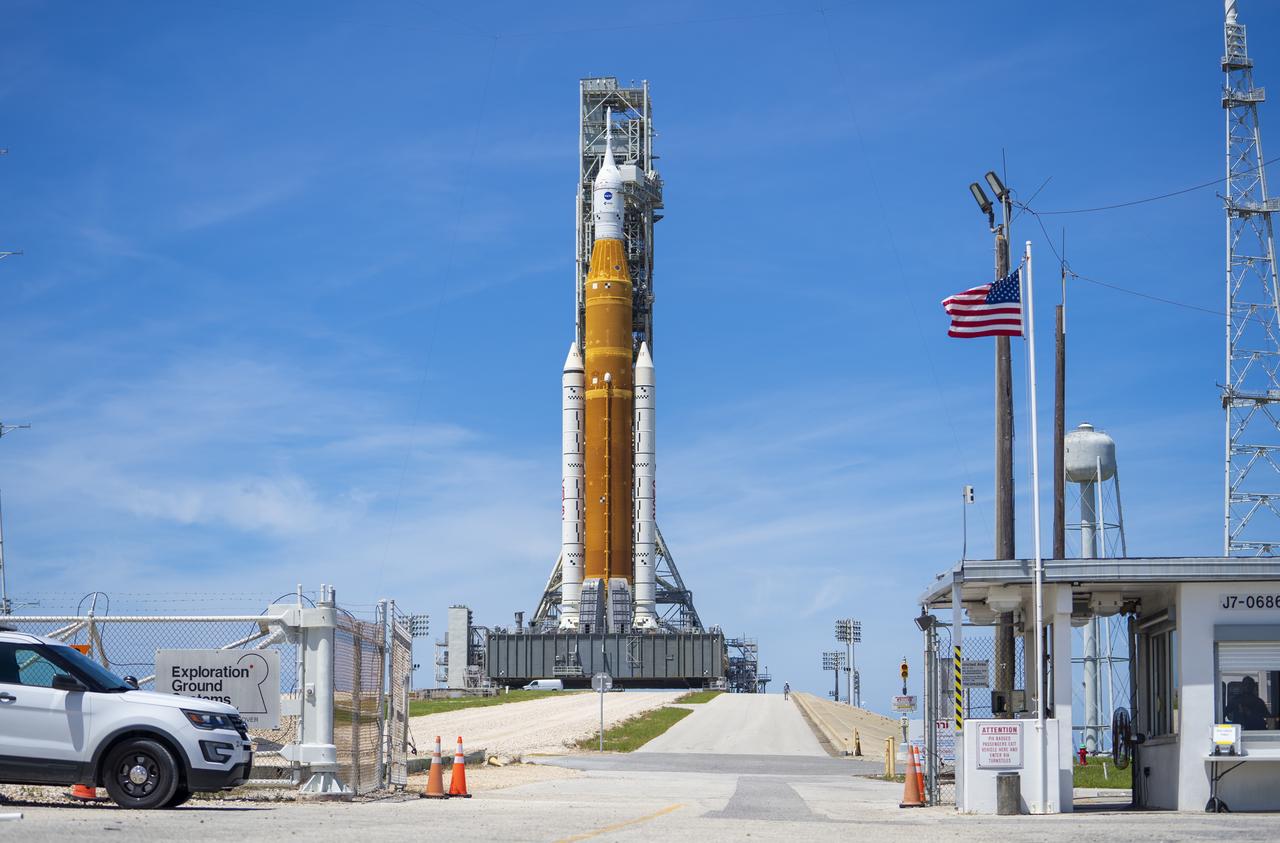
NASA’s Space Launch System (SLS) rocket with the Orion spacecraft aboard is seen atop the mobile launcher at Launch 39B at NASA’s Kennedy Space Center in Florida. Artemis I mission is the first integrated test of the agency’s deep space exploration systems: the Space Launch System rocket, Orion spacecraft, and supporting ground systems. The mission is the first in a series of increasingly complex missions to the Moon. Launch of the uncrewed flight test is targeted for no earlier than Aug. 29 at 8:33 a.m. ET. With Artemis missions, NASA will land the first woman and first person of color on the Moon, using innovative technologies to explore more of the lunar surface than ever before.

NASA’s Space Launch System (SLS) rocket with the Orion spacecraft aboard is seen atop the mobile launcher at Launch 39B at NASA’s Kennedy Space Center in Florida. Artemis I mission is the first integrated test of the agency’s deep space exploration systems: the Space Launch System rocket, Orion spacecraft, and supporting ground systems. The mission is the first in a series of increasingly complex missions to the Moon. Launch of the uncrewed flight test is targeted for no earlier than Aug. 29 at 8:33 a.m. ET. With Artemis missions, NASA will land the first woman and first person of color on the Moon, using innovative technologies to explore more of the lunar surface than ever before.

NASA’s Space Launch System (SLS) rocket with the Orion spacecraft aboard is seen atop the mobile launcher at Launch 39B at NASA’s Kennedy Space Center in Florida. Artemis I mission is the first integrated test of the agency’s deep space exploration systems: the Space Launch System rocket, Orion spacecraft, and supporting ground systems. The mission is the first in a series of increasingly complex missions to the Moon. Launch of the uncrewed flight test is targeted for no earlier than Aug. 29 at 8:33 a.m. ET. With Artemis missions, NASA will land the first woman and first person of color on the Moon, using innovative technologies to explore more of the lunar surface than ever before.

NASA’s Space Launch System (SLS) rocket with the Orion spacecraft aboard is seen atop the mobile launcher at Launch 39B at NASA’s Kennedy Space Center in Florida. Artemis I mission is the first integrated test of the agency’s deep space exploration systems: the Space Launch System rocket, Orion spacecraft, and supporting ground systems. The mission is the first in a series of increasingly complex missions to the Moon. Launch of the uncrewed flight test is targeted for no earlier than Aug. 29 at 8:33 a.m. ET. With Artemis missions, NASA will land the first woman and first person of color on the Moon, using innovative technologies to explore more of the lunar surface than ever before.
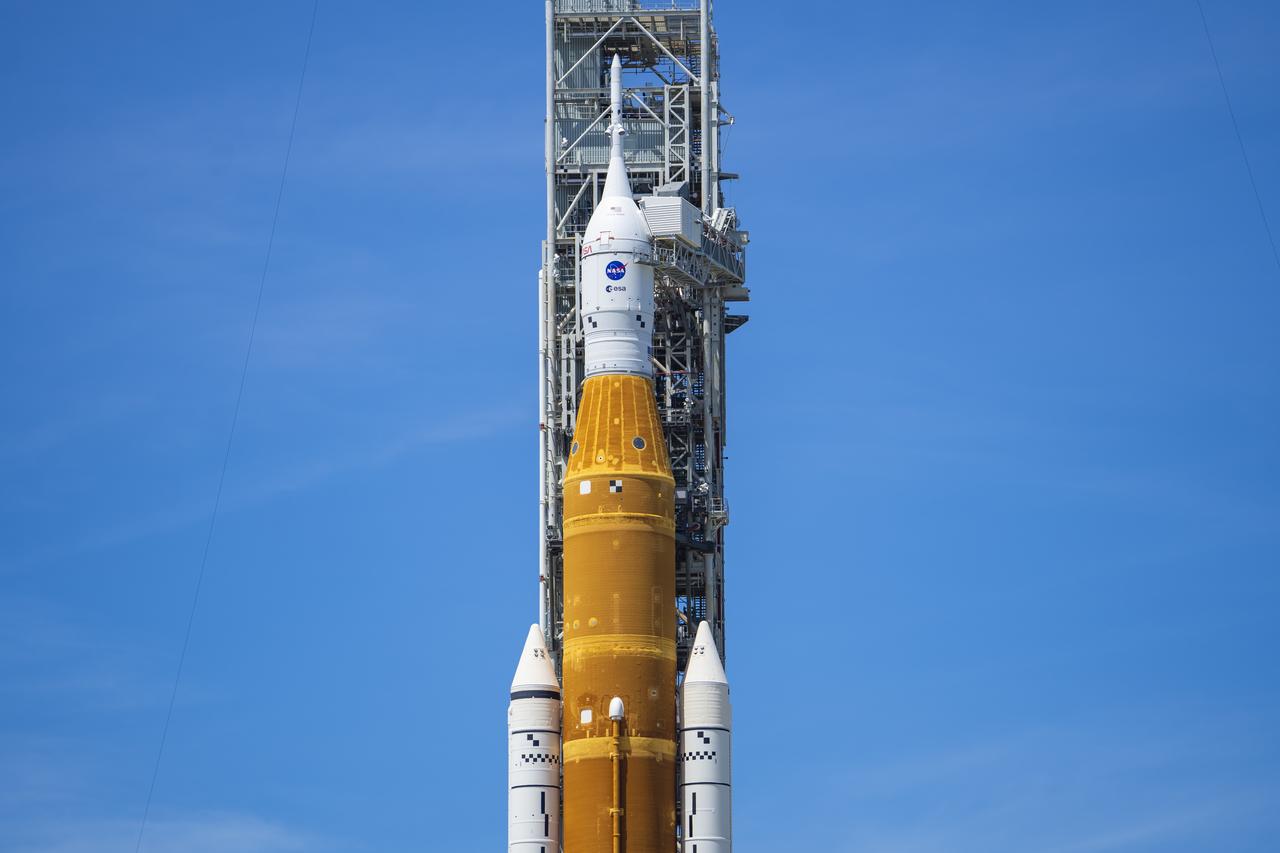
NASA’s Space Launch System (SLS) rocket with the Orion spacecraft aboard is seen atop the mobile launcher at Launch 39B at NASA’s Kennedy Space Center in Florida. Artemis I mission is the first integrated test of the agency’s deep space exploration systems: the Space Launch System rocket, Orion spacecraft, and supporting ground systems. The mission is the first in a series of increasingly complex missions to the Moon. Launch of the uncrewed flight test is targeted for no earlier than Aug. 29 at 8:33 a.m. ET. With Artemis missions, NASA will land the first woman and first person of color on the Moon, using innovative technologies to explore more of the lunar surface than ever before.
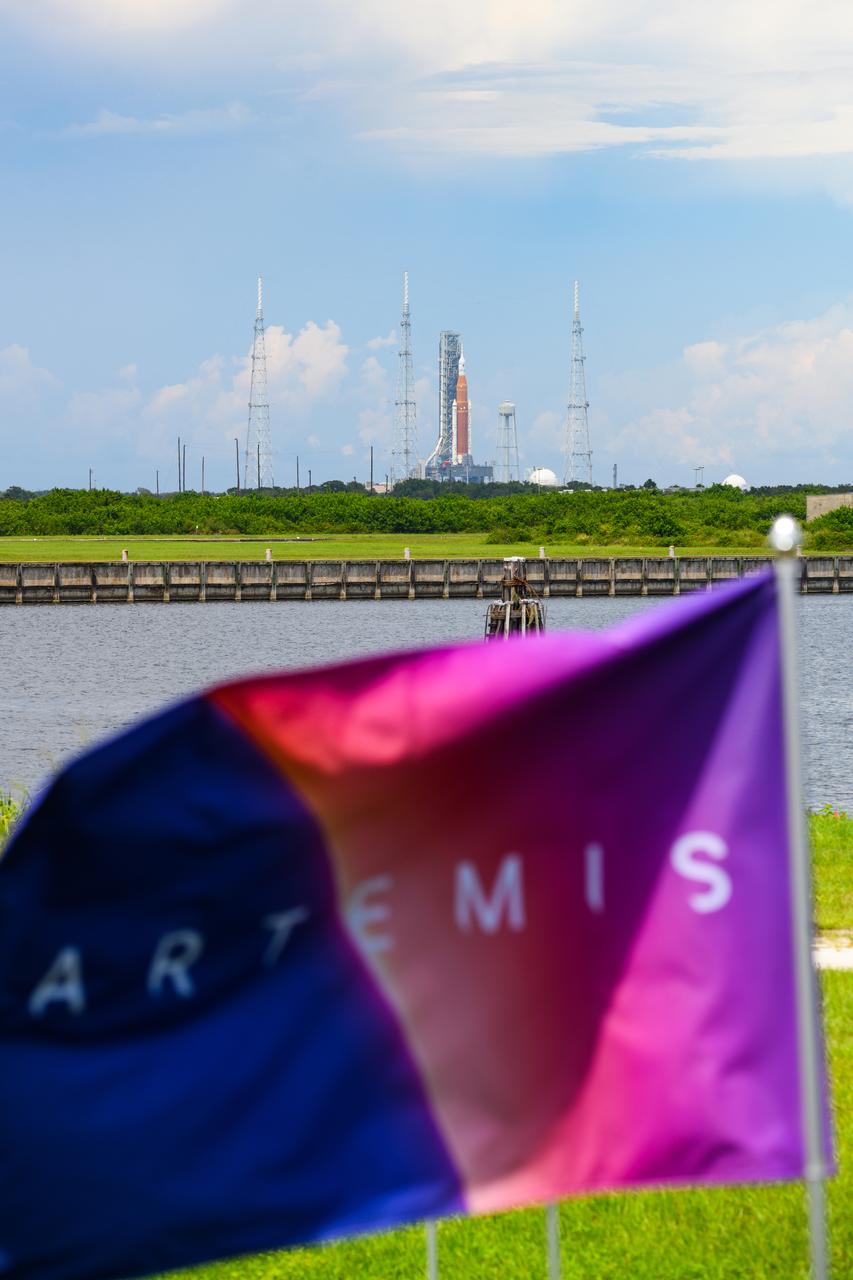
NASA’s Space Launch System (SLS) rocket with the Orion spacecraft aboard is seen atop the mobile launcher at Launch 39B at NASA’s Kennedy Space Center in Florida. Artemis I mission is the first integrated test of the agency’s deep space exploration systems: the Space Launch System rocket, Orion spacecraft, and supporting ground systems. The mission is the first in a series of increasingly complex missions to the Moon. Launch of the uncrewed flight test is targeted for no earlier than Aug. 29 at 8:33 a.m. ET. With Artemis missions, NASA will land the first woman and first person of color on the Moon, using innovative technologies to explore more of the lunar surface than ever before.

NASA’s Space Launch System (SLS) rocket with the Orion spacecraft aboard is seen atop the mobile launcher at Launch 39B at NASA’s Kennedy Space Center in Florida. Artemis I mission is the first integrated test of the agency’s deep space exploration systems: the Space Launch System rocket, Orion spacecraft, and supporting ground systems. The mission is the first in a series of increasingly complex missions to the Moon. Launch of the uncrewed flight test is targeted for no earlier than Aug. 29 at 8:33 a.m. ET. With Artemis missions, NASA will land the first woman and first person of color on the Moon, using innovative technologies to explore more of the lunar surface than ever before.
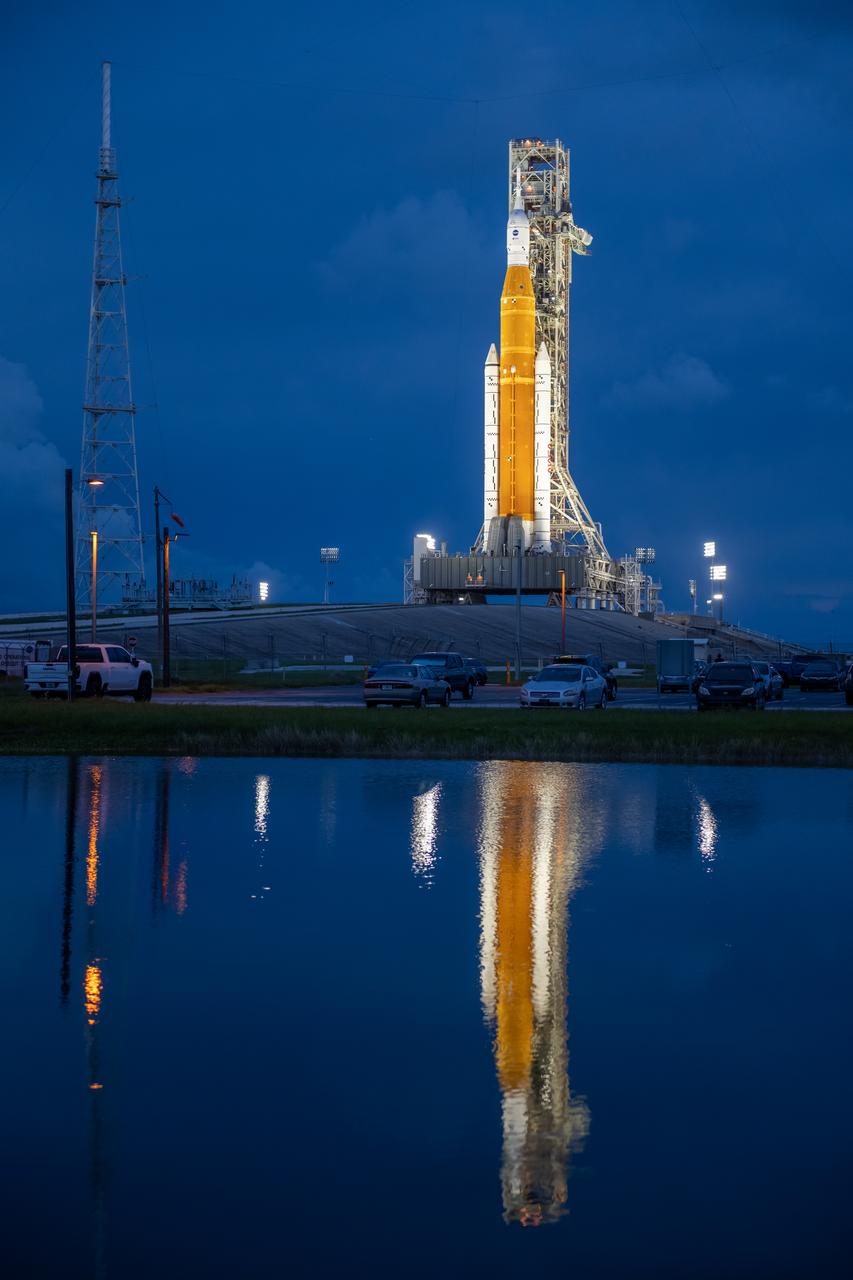
NASA’s Space Launch System (SLS) rocket with the Orion spacecraft aboard is seen atop the mobile launcher at Launch 39B at NASA’s Kennedy Space Center in Florida. Artemis I mission is the first integrated test of the agency’s deep space exploration systems: the Space Launch System rocket, Orion spacecraft, and supporting ground systems. The mission is the first in a series of increasingly complex missions to the Moon. Launch of the uncrewed flight test is targeted for no earlier than Sept. 3 at 2:17 p.m. ET. With Artemis missions, NASA will land the first woman and first person of color on the Moon, using innovative technologies to explore more of the lunar surface than ever before.

NASA’s Space Launch System (SLS) rocket with the Orion spacecraft aboard is seen atop the mobile launcher at Launch 39B at NASA’s Kennedy Space Center in Florida. Artemis I mission is the first integrated test of the agency’s deep space exploration systems: the Space Launch System rocket, Orion spacecraft, and supporting ground systems. The mission is the first in a series of increasingly complex missions to the Moon. Launch of the uncrewed flight test is targeted for no earlier than Aug. 29 at 8:33 a.m. ET. With Artemis missions, NASA will land the first woman and first person of color on the Moon, using innovative technologies to explore more of the lunar surface than ever before.

NASA’s Space Launch System (SLS) rocket with the Orion spacecraft aboard is seen atop the mobile launcher at Launch 39B at NASA’s Kennedy Space Center in Florida. Artemis I mission is the first integrated test of the agency’s deep space exploration systems: the Space Launch System rocket, Orion spacecraft, and supporting ground systems. The mission is the first in a series of increasingly complex missions to the Moon. Launch of the uncrewed flight test is targeted for no earlier than Aug. 29 at 8:33 a.m. ET. With Artemis missions, NASA will land the first woman and first person of color on the Moon, using innovative technologies to explore more of the lunar surface than ever before.
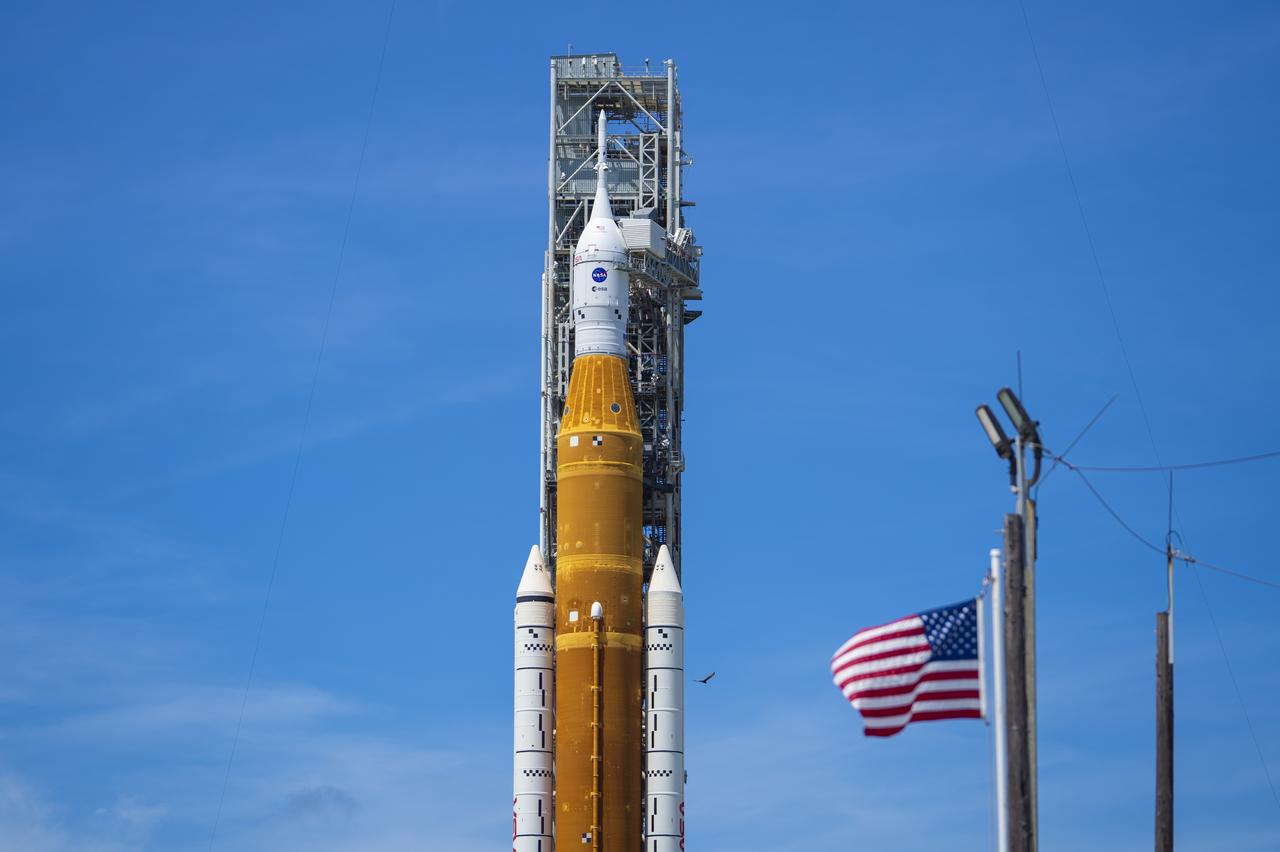
NASA’s Space Launch System (SLS) rocket with the Orion spacecraft aboard is seen atop the mobile launcher at Launch 39B at NASA’s Kennedy Space Center in Florida. Artemis I mission is the first integrated test of the agency’s deep space exploration systems: the Space Launch System rocket, Orion spacecraft, and supporting ground systems. The mission is the first in a series of increasingly complex missions to the Moon. Launch of the uncrewed flight test is targeted for no earlier than Aug. 29 at 8:33 a.m. ET. With Artemis missions, NASA will land the first woman and first person of color on the Moon, using innovative technologies to explore more of the lunar surface than ever before.

NASA’s Space Launch System (SLS) rocket with the Orion spacecraft aboard is seen atop the mobile launcher at Launch 39B at NASA’s Kennedy Space Center in Florida. Artemis I mission is the first integrated test of the agency’s deep space exploration systems: the Space Launch System rocket, Orion spacecraft, and supporting ground systems. The mission is the first in a series of increasingly complex missions to the Moon. Launch of the uncrewed flight test is targeted for no earlier than Aug. 29 at 8:33 a.m. ET. With Artemis missions, NASA will land the first woman and first person of color on the Moon, using innovative technologies to explore more of the lunar surface than ever before.

NASA’s Space Launch System (SLS) rocket with the Orion spacecraft aboard is seen atop the mobile launcher at Launch 39B at NASA’s Kennedy Space Center in Florida. Artemis I mission is the first integrated test of the agency’s deep space exploration systems: the Space Launch System rocket, Orion spacecraft, and supporting ground systems. The mission is the first in a series of increasingly complex missions to the Moon. Launch of the uncrewed flight test is targeted for no earlier than Aug. 29 at 8:33 a.m. ET. With Artemis missions, NASA will land the first woman and first person of color on the Moon, using innovative technologies to explore more of the lunar surface than ever before.
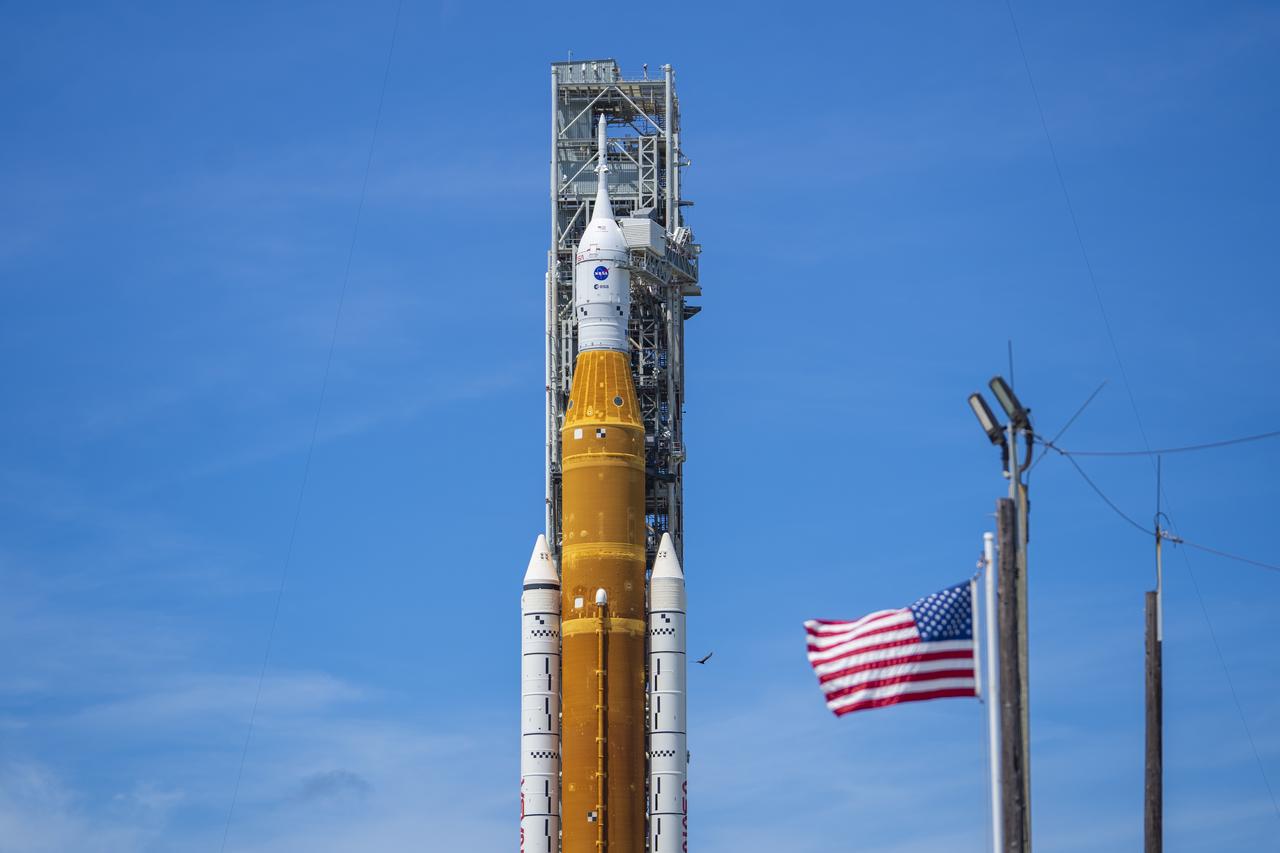
NASA’s Space Launch System (SLS) rocket with the Orion spacecraft aboard is seen atop the mobile launcher at Launch 39B at NASA’s Kennedy Space Center in Florida. Artemis I mission is the first integrated test of the agency’s deep space exploration systems: the Space Launch System rocket, Orion spacecraft, and supporting ground systems. The mission is the first in a series of increasingly complex missions to the Moon. Launch of the uncrewed flight test is targeted for no earlier than Aug. 29 at 8:33 a.m. ET. With Artemis missions, NASA will land the first woman and first person of color on the Moon, using innovative technologies to explore more of the lunar surface than ever before.
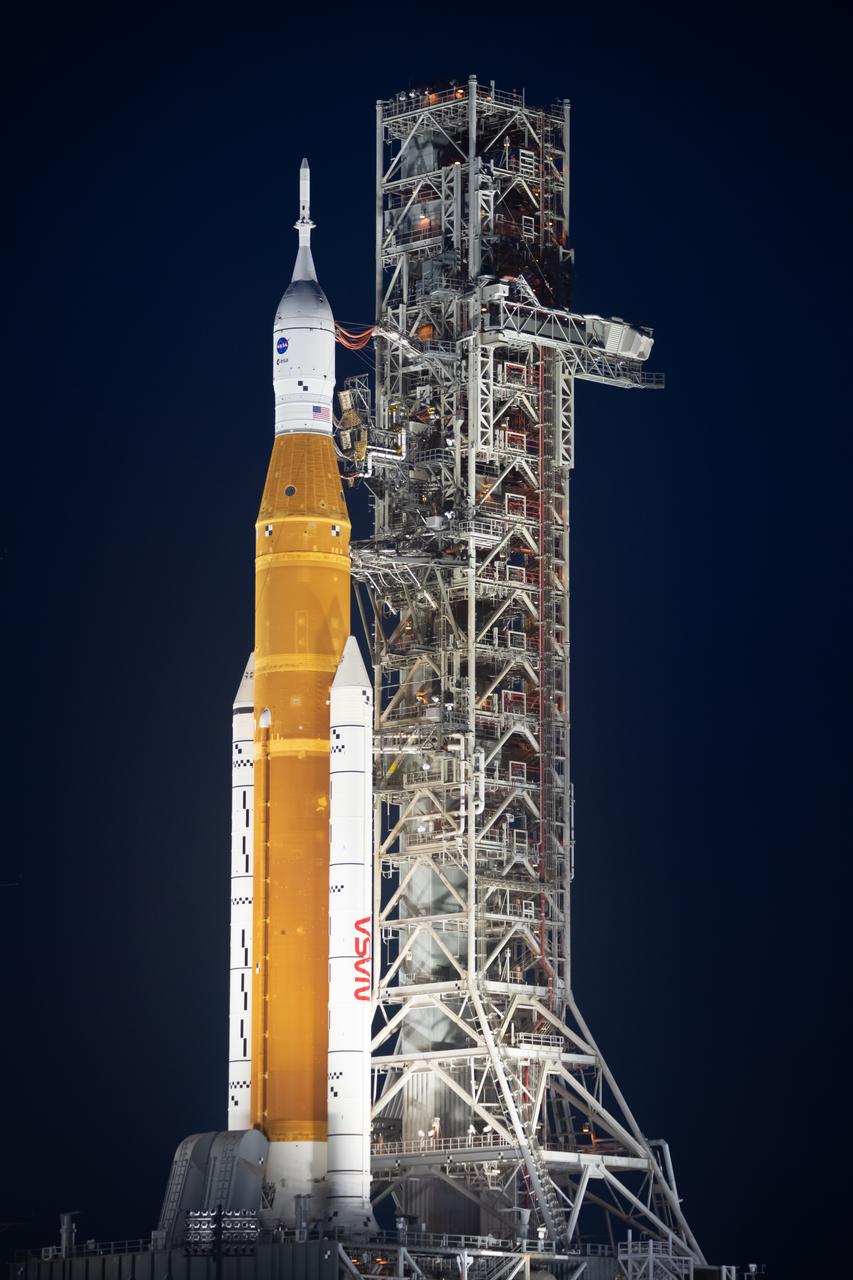
NASA’s Space Launch System (SLS) rocket with the Orion spacecraft aboard is seen atop the mobile launcher at Launch 39B at NASA’s Kennedy Space Center in Florida. Artemis I mission is the first integrated test of the agency’s deep space exploration systems: the Space Launch System rocket, Orion spacecraft, and supporting ground systems. The mission is the first in a series of increasingly complex missions to the Moon. Launch of the uncrewed flight test is targeted for no earlier than Sept. 3 at 2:17 p.m. ET. With Artemis missions, NASA will land the first woman and first person of color on the Moon, using innovative technologies to explore more of the lunar surface than ever before.
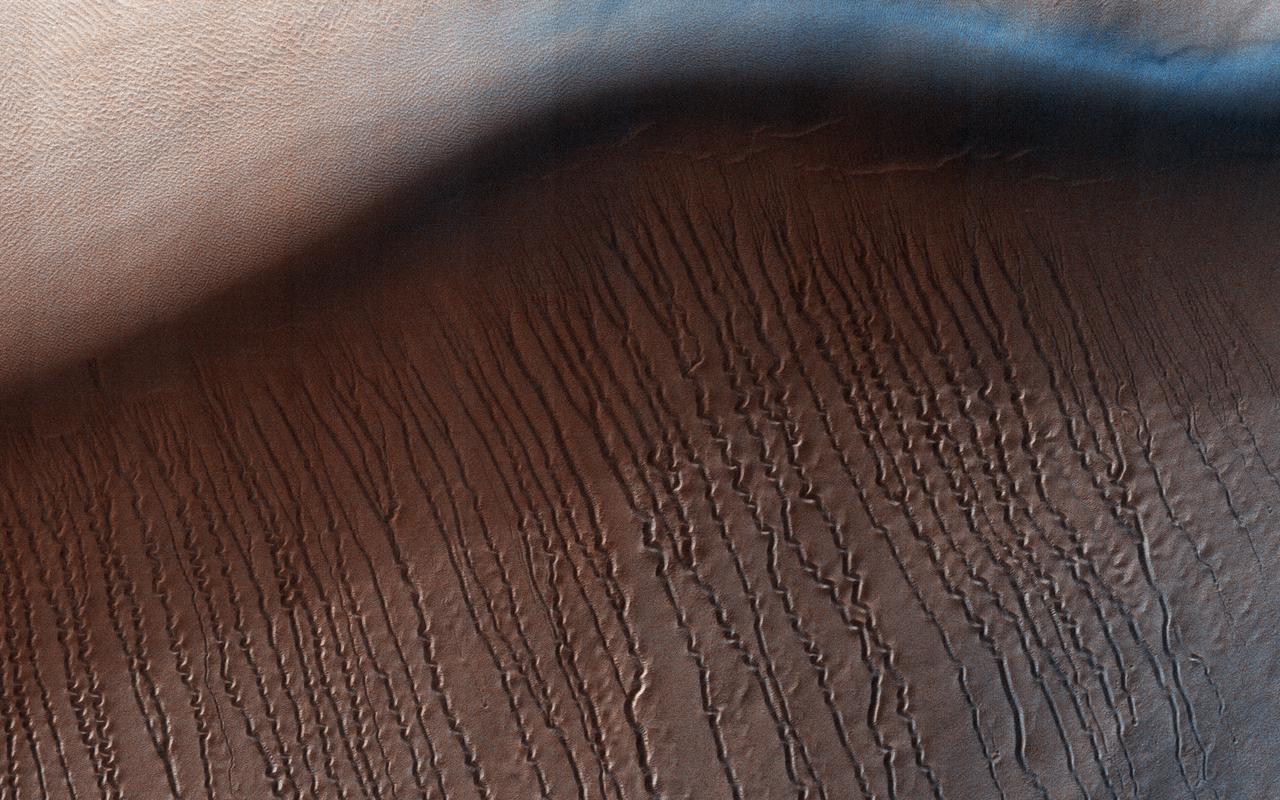
At around 2,200 kilometers in diameter, Hellas Planitia is the largest visible impact basin in the Solar System, and hosts the lowest elevations on Mars' surface as well as a variety of landscapes. This image from NASA's Mars Reconnaisance Orbiter (MRO) covers a small central portion of the basin and shows a dune field with lots of dust devil trails. In the middle, we see what appears to be long and straight "scratch marks" running down the southeast (bottom-right) facing dune slopes. If we look closer, we can see these scratch marks actually squiggle back and forth on their way down the dune. These scratch marks are linear gullies. Just like on Earth, high-latitude regions on Mars are covered with frost in the winter. However, the winter frost on Mars is made of carbon dioxide ice (dry ice) instead of water ice. We believe linear gullies are the result of this dry ice breaking apart into blocks, which then slide or roll down warmer sandy slopes, sublimating and carving as they go. The linear gullies exhibit exceptional sinuosity (the squiggle pattern) and we believe this to be the result of repeated movement of dry ice blocks in the same path, possibly in combination with different hardness or flow resistance of the sand within the dune slopes. Determining the specific process that causes the formation and evolution of sinuosity in linear gullies is a question scientists are still trying to answer. What do you think causes the squiggles? https://photojournal.jpl.nasa.gov/catalog/PIA22052

“My background and experience have been unique. I didn't grow up in space. I didn't grow up in a family of people who watched the Moon landing. I came to discover space at a much later age. That and the fact that I come from the cultural background I come from (being born and raised in Puerto Rico), has always made me question some of the assumptions about why we do what we do in space and how we go about it. “In my experience and in my career that has proven effective because people want the challenge, and they want to engage everyone and make sure that the best of the best are participating. I have found myself in settings where my point of view has been valued because I was asking some of the questions that some folks took for granted. “I think it’s also that I came at a good time when we are having these important discussions about diversity and inclusion, and people do want these different kinds of views. Space is so international now that this diversity is such an important aspect of it too. Even as an adult starting to learn about these topics, it was natural for me to be having these discussions with other colleagues from Latin America and South Africa and Australia. It’s a key feature of my own experience but also, I think, the time that we’re living right now, which is really exciting.” Laura M. Delgado López, Policy Analyst for NASA’s Science Mission Directorate, poses for a portrait on Monday, Sept. 21, 2020 in Virginia. Photo Credit: (NASA/Joel Kowsky)

“The big thing is trying to figure out the best way to communicate. And to interact and engage. Being virtual is great, but there’s nothing like being able to sit down and talk to a parent or a senior who just wants to reflect on what it was like seeing Apollo. Or talking to someone who says, ‘I could never work for NASA,’ and telling them, ‘Yes, you can — I’m not from a science background. I graduated with a business marketing degree.’ We have to have communications — social media specialists, graphic designers, things like that. I think it’s very fulfilling, from my perspective, when we go out and engage with the public to show what NASA is really about. It takes twenty thousand people to run NASA — and we’re not all astronauts and scientists and engineers. I try to bring that perspective.” Derek Wang, Director of Communications for NASA’s Space Technology Mission Directorate, poses for a portrait, Thursday, Aug. 27, 2020 in Virginia. Photo Credit: (NASA/Joel Kowsky)
![“I feel that my larger purpose at NASA, which I've felt since I came on as an intern, is to leave NASA a better place than I found it. I know there are so many people who are just like myself, who have had this big, huge dream of being at NASA from some sort of spark in their childhood. I have a privilege as a well-spoken, affable, femme, white woman and I’m compelled to use this privilege for good — to advocate for others. I feel like this dream should be achievable for anyone who has the merit to be here without wondering 'Are my needs going [to] be met?' Or, 'If I'm a part of a particular community, will I be faced with any sort of backlash because of the culture?' As an Agency, we're trying to do incredibly hard things moving forward. And going forward, I choose to use the privilege of being at HQ and being very close to leadership as a vessel for progress to help ensure we get closer to everybody having the right to achieve their dream here." NASA Management and Program Analyst Mallory Carbon, poses for a portrait, Wednesday, May 29, 2024, outside the NASA Headquarters Mary W. Jackson Building in Washington. Photo Credit: (NASA/Bill Ingalls)](https://images-assets.nasa.gov/image/NHQ202405290001/NHQ202405290001~medium.jpg)
“I feel that my larger purpose at NASA, which I've felt since I came on as an intern, is to leave NASA a better place than I found it. I know there are so many people who are just like myself, who have had this big, huge dream of being at NASA from some sort of spark in their childhood. I have a privilege as a well-spoken, affable, femme, white woman and I’m compelled to use this privilege for good — to advocate for others. I feel like this dream should be achievable for anyone who has the merit to be here without wondering 'Are my needs going [to] be met?' Or, 'If I'm a part of a particular community, will I be faced with any sort of backlash because of the culture?' As an Agency, we're trying to do incredibly hard things moving forward. And going forward, I choose to use the privilege of being at HQ and being very close to leadership as a vessel for progress to help ensure we get closer to everybody having the right to achieve their dream here." NASA Management and Program Analyst Mallory Carbon, poses for a portrait, Wednesday, May 29, 2024, outside the NASA Headquarters Mary W. Jackson Building in Washington. Photo Credit: (NASA/Bill Ingalls)
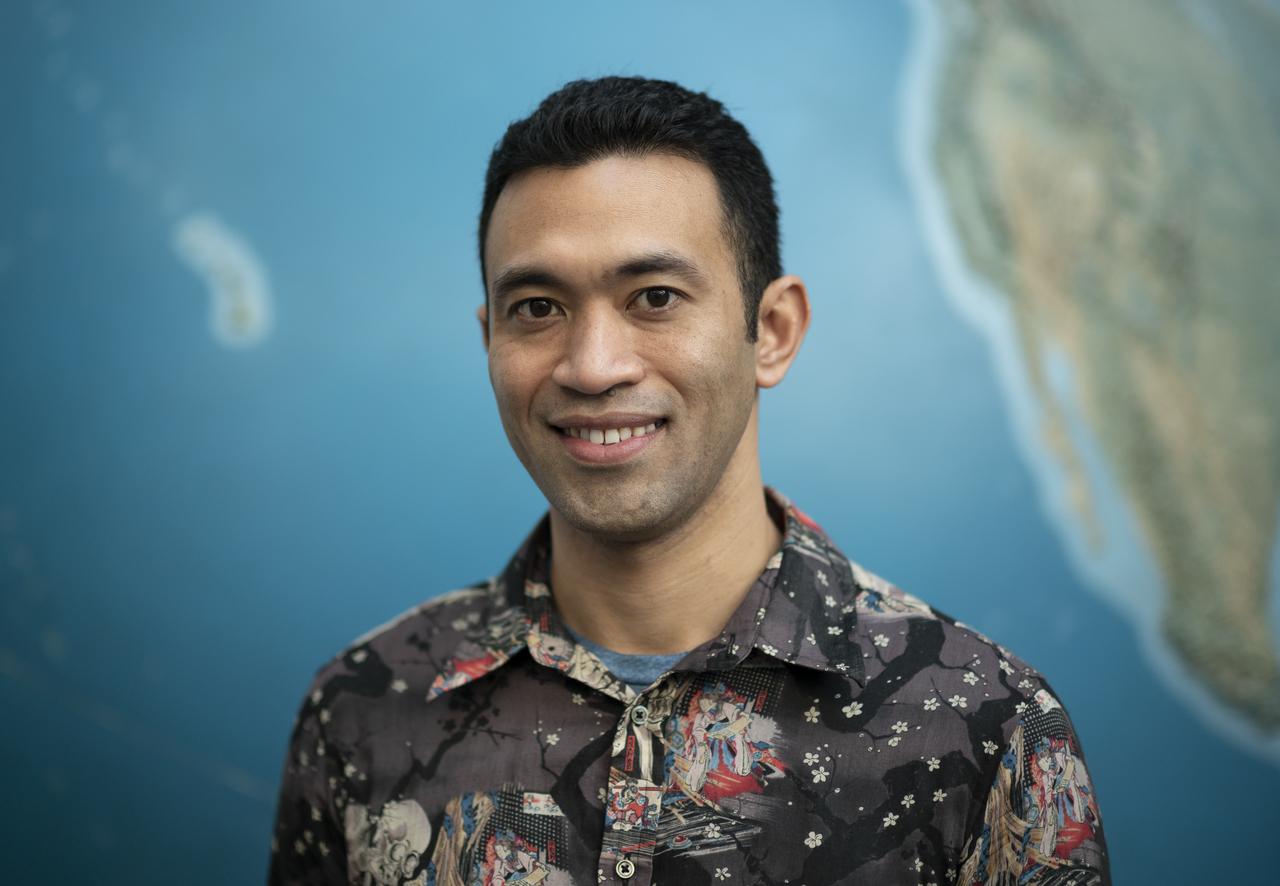
“Back home there’s a place called Mākua beach. It’s where I spent so much of my childhood. My grandfather had a little beachside camp area, and every day after school my dad and I would drive to the camp and visit my grandfather, and we’d go out fishing either on a rubber tube or a small fishing boat. There are so many memories of being with my dad and my grandfather and all of my calabash uncles there. My grandmother and my grandfather were both strongly connected to the beach. They actually both passed away on the beach, so that place has a special place in my heart. It’s a beautiful, beautiful quiet little pocket of sand and water, and every time I go back, I think of them and all of those memories. “The Hawaiians have been there for a thousand-plus years. And I have written documents that show my grandfather’s great-grandfather had an association with the area. It was a letter he wrote to a commission voicing his support for Native Hawaiian land rights in the valley. I love to go back every time I go home. Sometimes when it’s low tide, you can even find petroglyphs engraved on the rocks. There’s always something new to discover. “I know fishing is not as plentiful as it was before because of overfishing and likely other factors. Climate change is impacting a lot of coastal areas not just in Hawaii but also around the world, from erosion to coral bleaching. It’s powerful that we continue to learn how everyone and everything on Earth is interconnected. It’s what Native Hawaiians have long understood through our cosmology and approach to resource management. “That’s what makes communicating Earth science meaningful for me—knowing that indigenous Hawaiian wisdom and NASA research both point to the responsible management of and respect for the environment.” Samson Reiny, editor and senior outreach coordinator at NASA Earth Science News, Friday, Feb. 21, 2020, at NASA's Goddard Space Flight Center in Greenbelt, Md. Photo Credit: (NASA/Joel Kowsky)
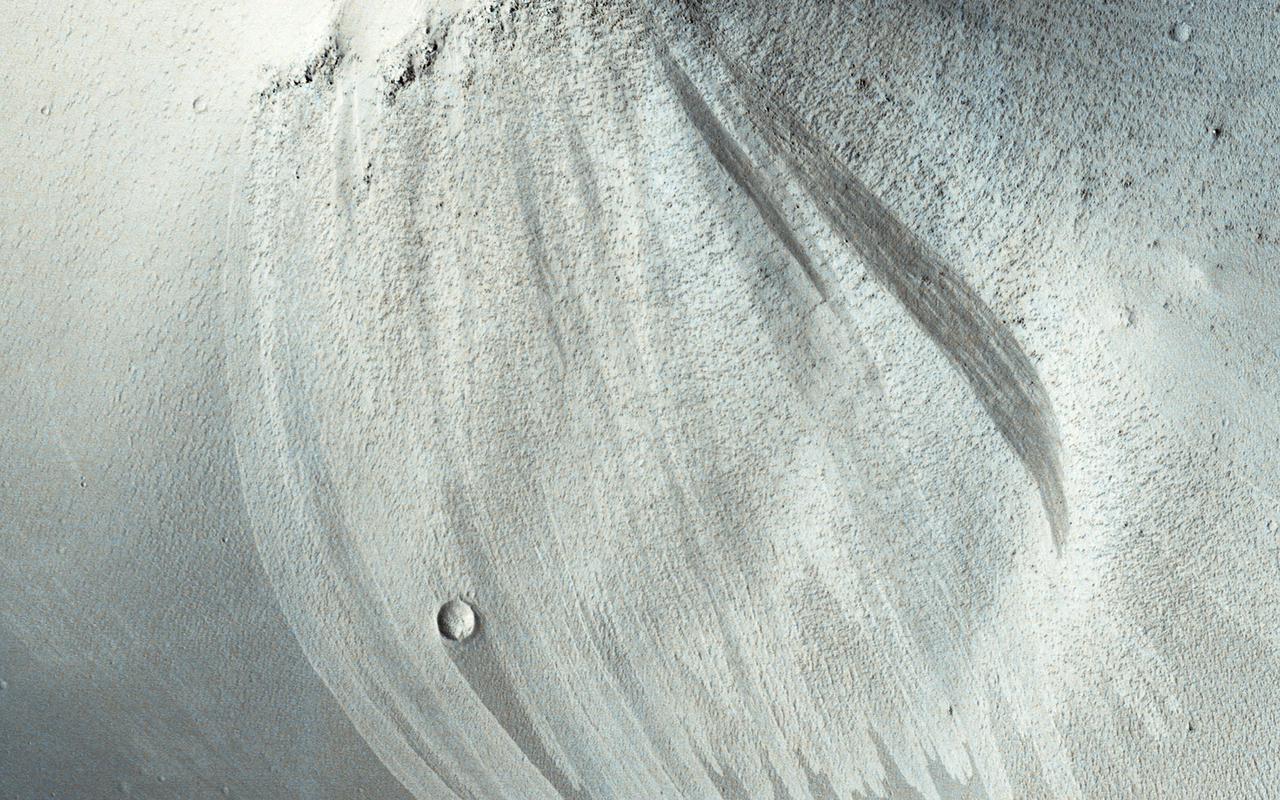
Slope streaks are common in the tropics of Mars. Once thought to be caused by flowing water, most scientists now believe that they are avalanches of dust. They are typically darker than their surroundings and often fan outwards downslope. This suggests that the dust sediment is sticky, so that the avalanche broadens as it flows downhill. Slope streaks are known to fade over time, but the slope streaks at this monitoring site in Arabia Terra go beyond that. Here, old slope streaks appear to be brighter than the surrounding terrain. A comparison between HiRISE images taken in 2008 and in 2019 shows very few changes in the dark and bright streaks. We can see three new dark streaks in our more recent image. These were the only changes spotted among the hundreds of streaks observed in the monitoring site, suggesting that new streak formation and fading take place on time scales of at least decades. https://photojournal.jpl.nasa.gov/catalog/PIA24912
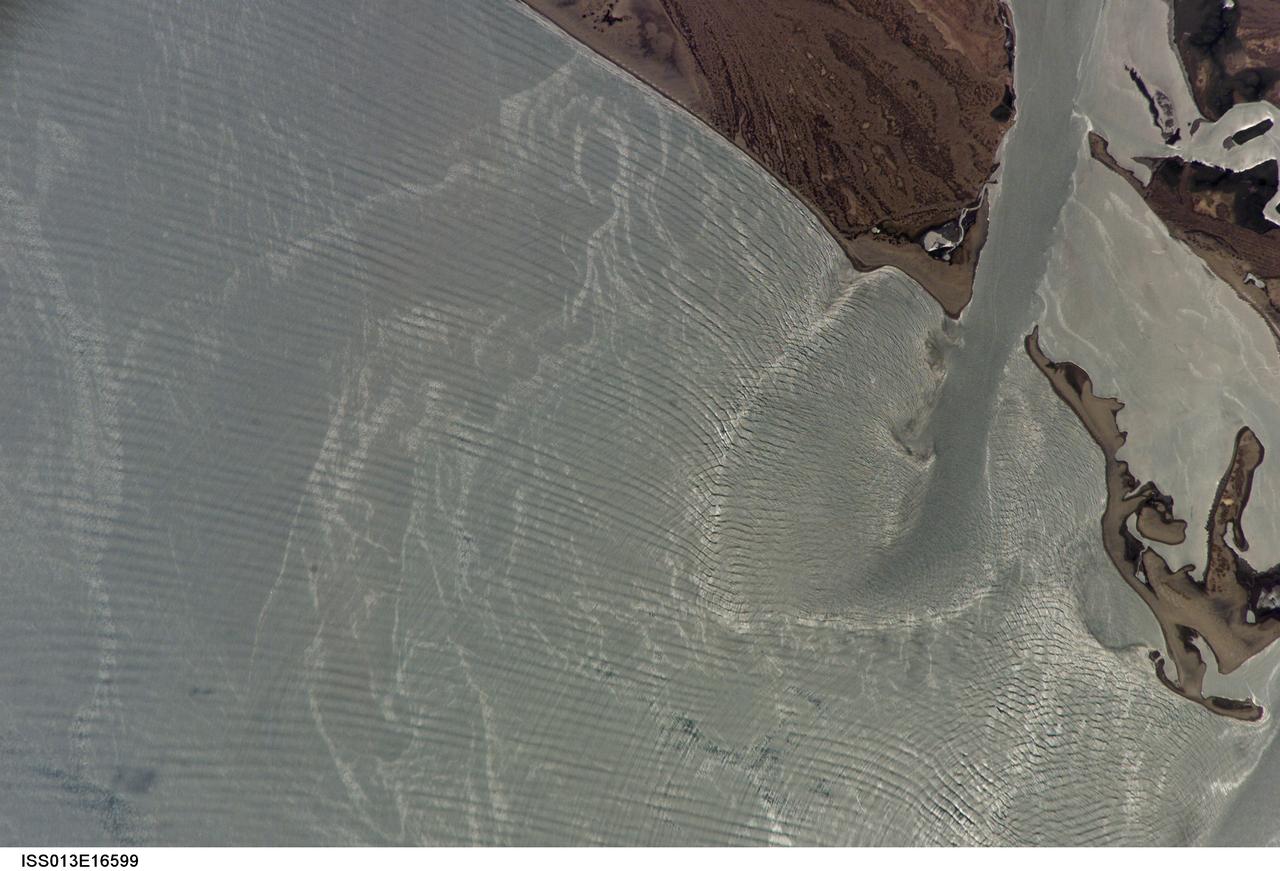
ISS013-E-16599 (9 May 2006) --- Wave sets and tidal currents in the Gulf of California are featured in this image photographed by an Expedition 13 crewmember on the International Space Station. In this image, sunglint off the Gulf of California gives the water a silver-gray appearance rather than the usual azure blue color. The sunglint allows us to see several active features which would not be visible otherwise. In this view of Punta Perihuete, Mexico we can see three major features: biological or man-made oils floating on the surface; the out-going tidal current; and complex wave patterns. The oils on the surface are recognizable as light grey, curved and variable-width streamers shaped by the local winds and currents. Plankton, fish, natural oil seeps and boats dumping bilges are all potential sources for these oils.

This composite image of the moon using Clementine data from 1994 is the view we are most likely to see when the moon is full. Credit: NASA To learn about NASA's LRO project go to: <a href="http://www.nasa.gov/mission_pages/LRO/main/index.html" rel="nofollow">www.nasa.gov/mission_pages/LRO/main/index.html</a> <b><a href="http://www.nasa.gov/centers/goddard/home/index.html" rel="nofollow">NASA Goddard Space Flight Center</a></b> contributes to NASA’s mission through four scientific endeavors: Earth Science, Heliophysics, Solar System Exploration, and Astrophysics. Goddard plays a leading role in NASA’s endeavors by providing compelling scientific knowledge to advance the Agency’s mission. <b>Follow us on <a href="http://twitter.com/NASA_GoddardPix" rel="nofollow">Twitter</a></b> <b>Join us on <a href="http://www.facebook.com/pages/Greenbelt-MD/NASA-Goddard/395013845897?ref=tsd" rel="nofollow">Facebook</a></b>
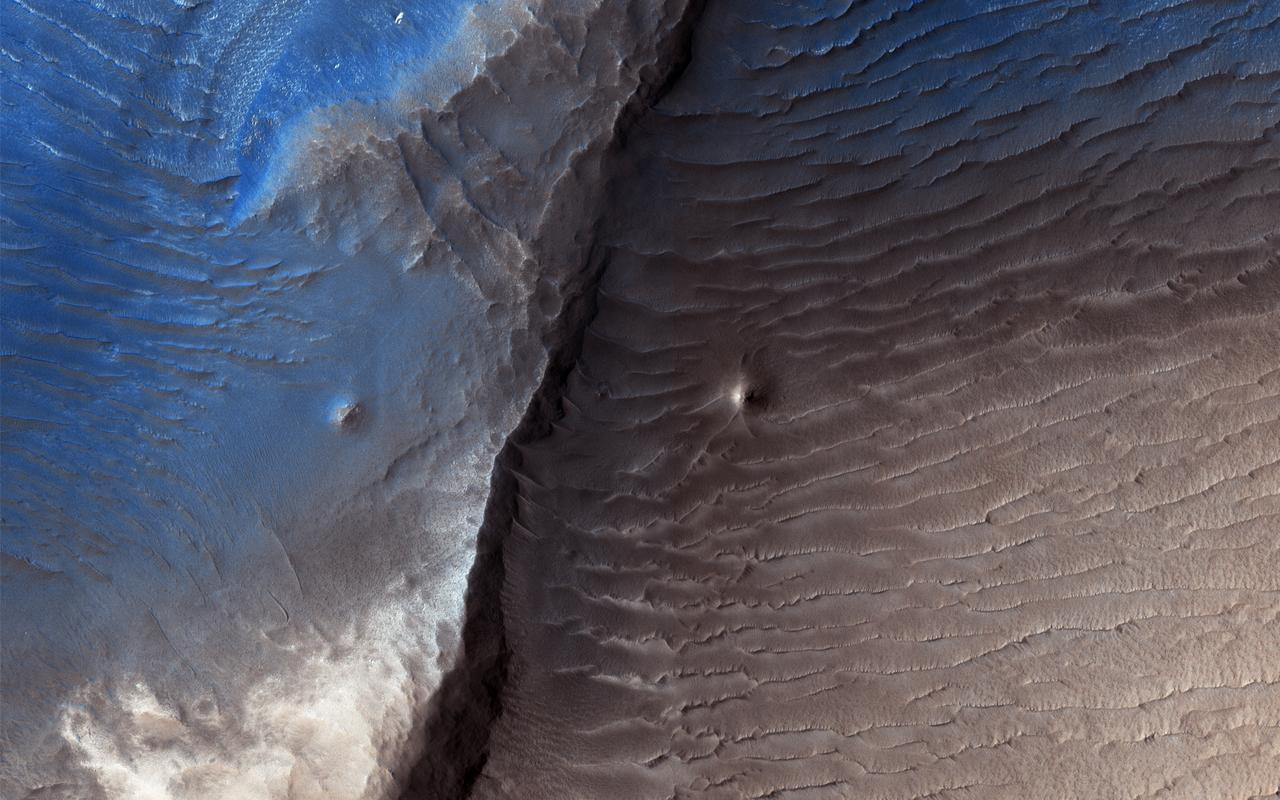
Geologists aren't quite sure what to make of the dark splotch in the middle of this image from NASA's Mars Reconnaisance Orbiter (MRO) -- one of several similar dark splotches that extend east and west for over 100 kilometers. From measurements made in infrared, this and other dark splotches have what we call "high thermal inertia," meaning that it heats up and cools down slowly. Scientists use thermal inertia to assess how rocky, sandy, or dusty a place is. A higher thermal inertia than the surrounding area means it's less dusty. Wavy, banded patterns in the dark splotch (possibly due to cross bedding from sand dunes that once occupied the area) were lithified into sandstone, and then eroded away. These clues could help geologists figure out what's going on there. https://photojournal.jpl.nasa.gov/catalog/PIA22042
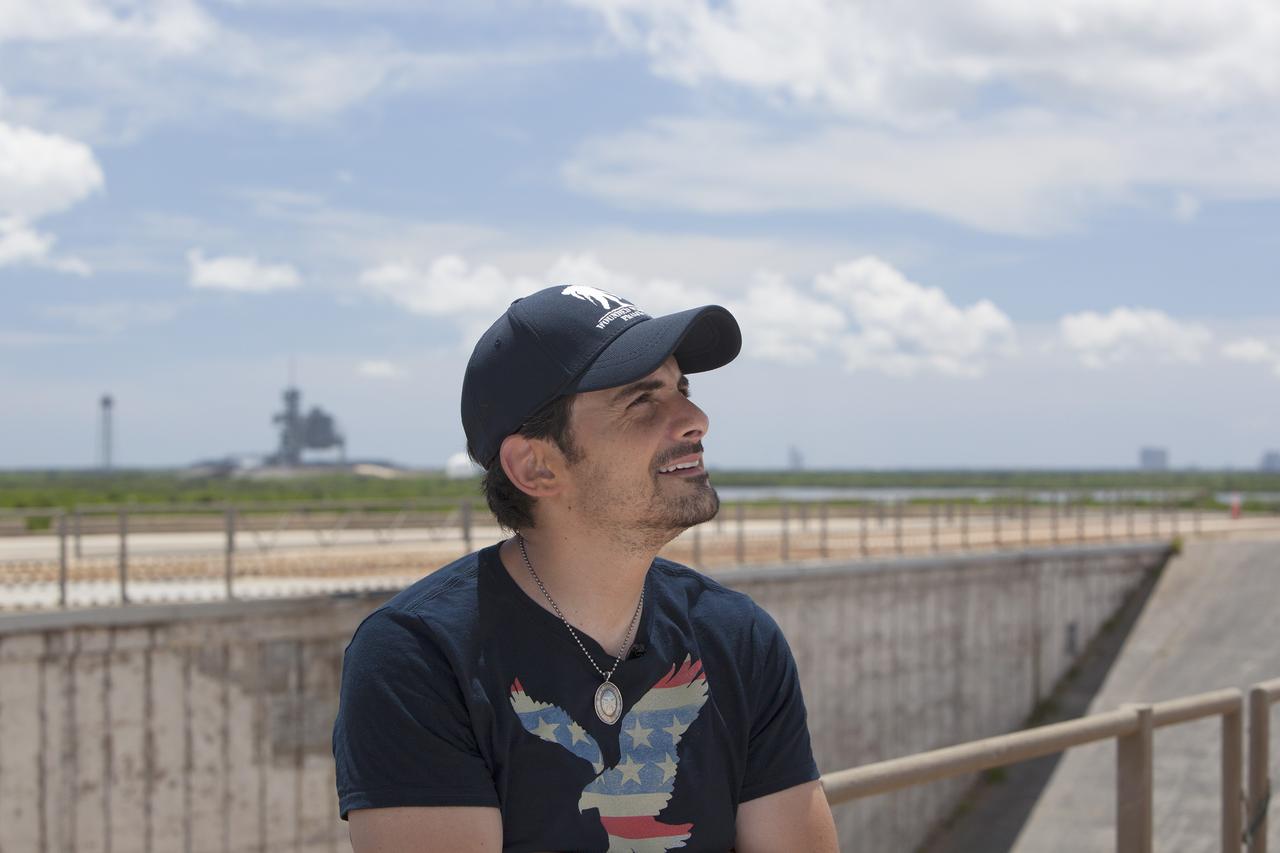
CAPE CANAVERAL, Fla. – Singer-songwriter Brad Paisley announces the release of a new song titled "American Flag on the Moon" from Launch Pad 39B at NASA’s Kennedy Space Center in Florida. In the background is Launch Pad 39A from which the Apollo moon landing missions were launched. Upon seeing Paisley's Twitter post that he was at NASA's Apollo launch pad leaking his new song, astronaut Reid Wiseman responded, "Hold on @BradPaisley, we don't usually like leaks at the launch pad." Wiseman is a member of the Expedition 40 crew currently in Earth orbit on the International Space Station. For more on Kennedy Space Center, visit http://www.nasa.gov/kennedy. To read more of Wiseman's Twitter posts from the station, go to https://twitter.com/astro_reid. Photo credit: NASA/Daniel Casper
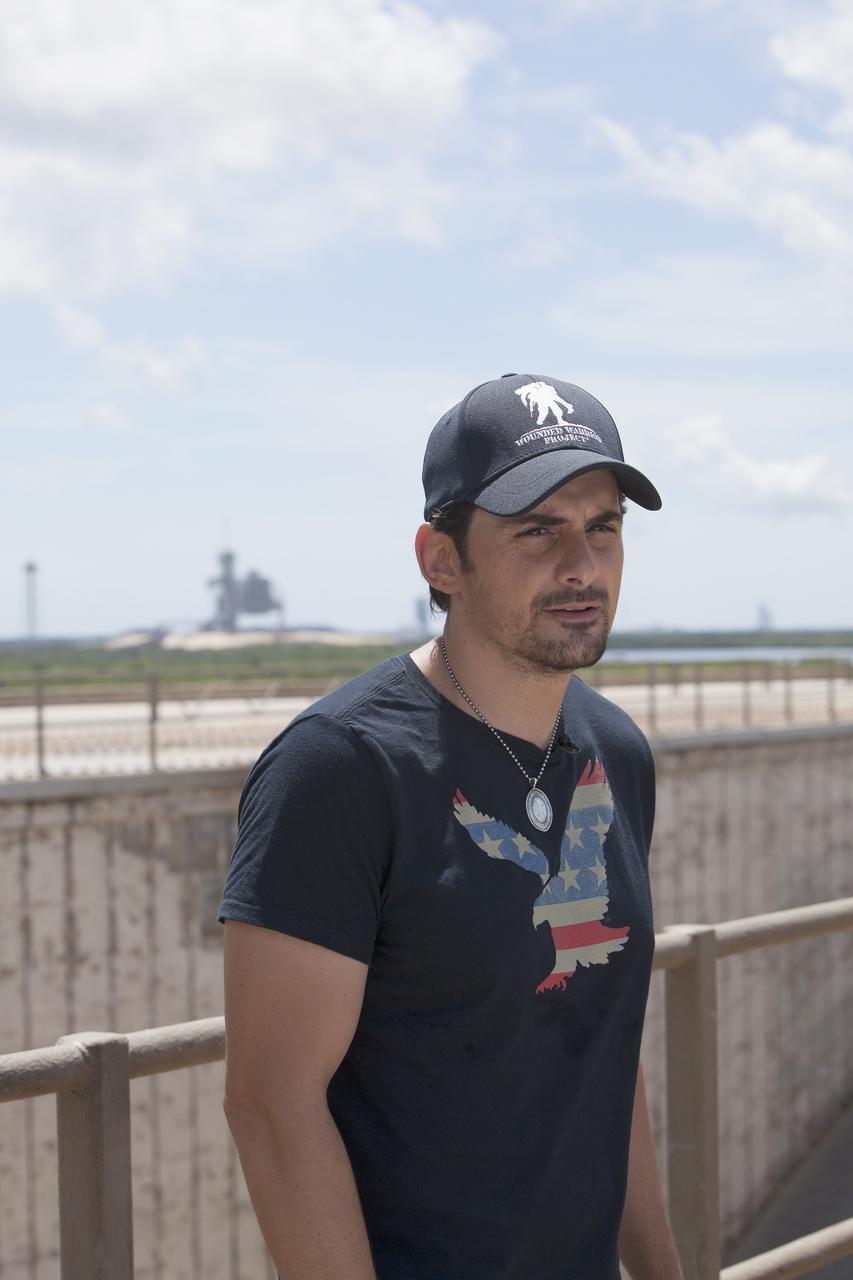
CAPE CANAVERAL, Fla. – Singer-songwriter Brad Paisley announces the release of a new song titled "American Flag on the Moon" from Launch Pad 39B at NASA’s Kennedy Space Center in Florida. In the background is Launch Pad 39A from which the Apollo moon landing missions were launched. Upon seeing Paisley's Twitter post that he was at NASA's Apollo launch pad leaking his new song, astronaut Reid Wiseman responded, "Hold on @BradPaisley, we don't usually like leaks at the launch pad." Wiseman is a member of the Expedition 40 crew currently in Earth orbit on the International Space Station. For more on Kennedy Space Center, visit http://www.nasa.gov/kennedy. To read more of Wiseman's Twitter posts from the station, go to https://twitter.com/astro_reid. Photo credit: NASA/Daniel Casper
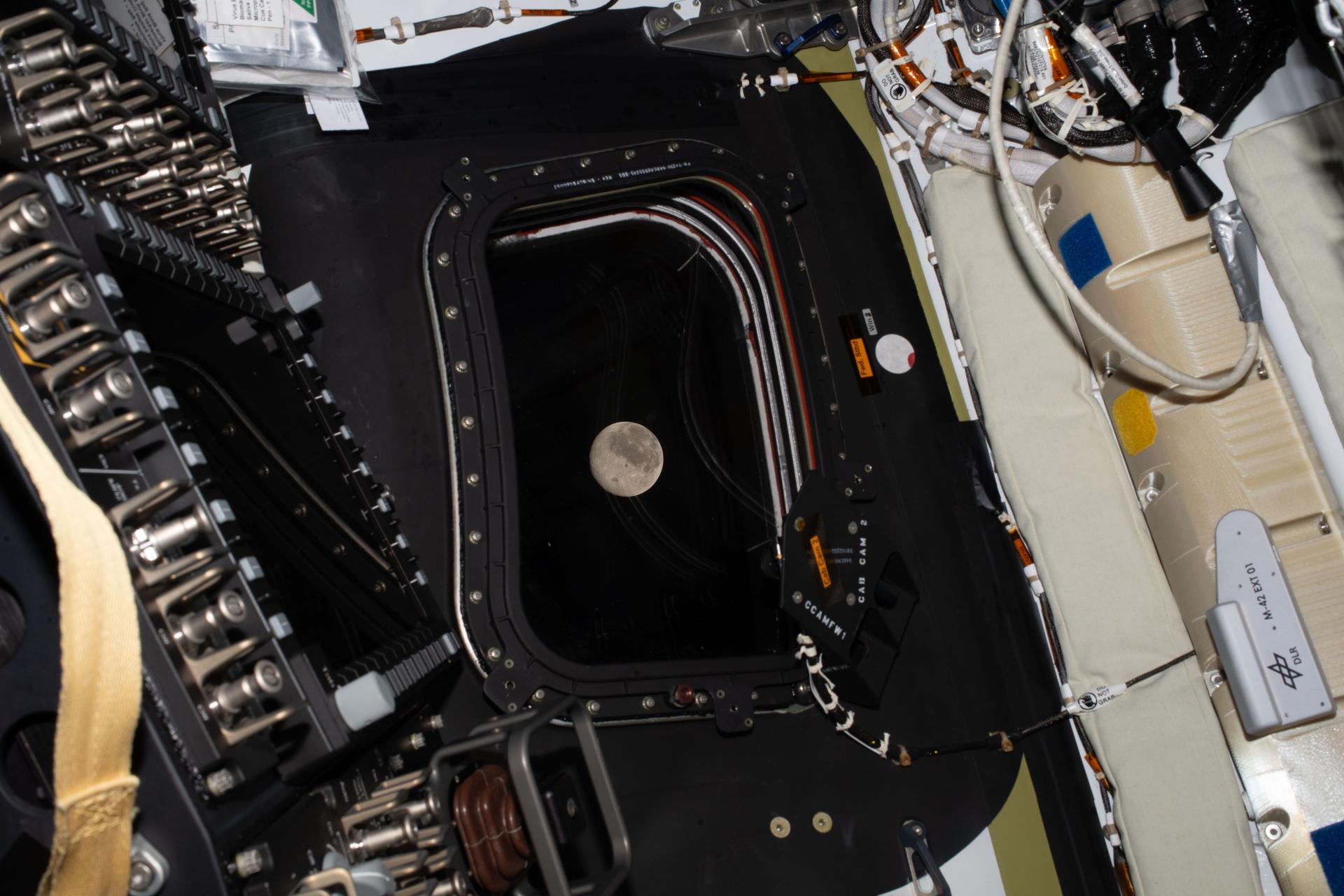
art002e009210 (April 6, 2026) - Before going to sleep on flight day 5, the Artemis II crew snapped one more photo of the Moon, as it drew close in the window of the Orion spacecraft. Orion and the four humans aboard entered the lunar sphere of influence at 12:37 a.m. EDT on April 6, at the tail end of the fifth day of their mission. That marked the point at which the Moon's gravity had a stronger pull on the spacecraft than the Earth's. Artemis II's closet approach to the Moon will come on flight day 6, as they swing around the far side before beginning their journey back to Earth. About an hour after entering the lunar sphere of influence, Artemis II Mission Specialist Christina Koch said, "We are now falling to the Moon rather than rising away from Earth. It is an amazing milestone!"
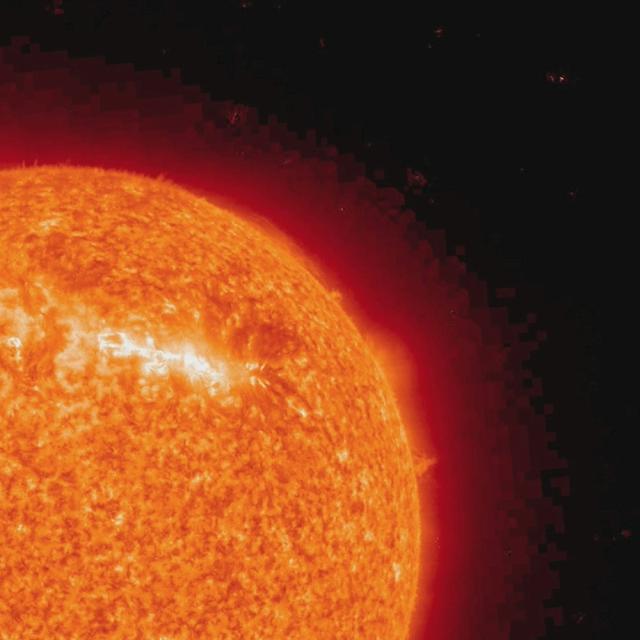
STEREO (Ahead) caught the action as one edge of a single active region spurted out more than a dozen surges of plasma in less than two days (Feb. 15-16, 2010). As seen in extreme UV light, the surges were narrow and directional outbursts driven by intense magnetic activity in the active region. While these kinds of outbursts have been observed numerous times, it was the frequency of so many surges in a short span of time that caught our attention. In this wavelength of UV light we are seeing singly ionized Helium at about 60,000 degrees C. For more information: <a href="http://stereo.gsfc.nasa.gov/" rel="nofollow">stereo.gsfc.nasa.gov/</a> Credit: NASA/GSFC/STEREO To learn more about NASA's Sun Earth Day go here: <a href="http://sunearthday.nasa.gov/2010/index.php" rel="nofollow">sunearthday.nasa.gov/2010/index.php</a>
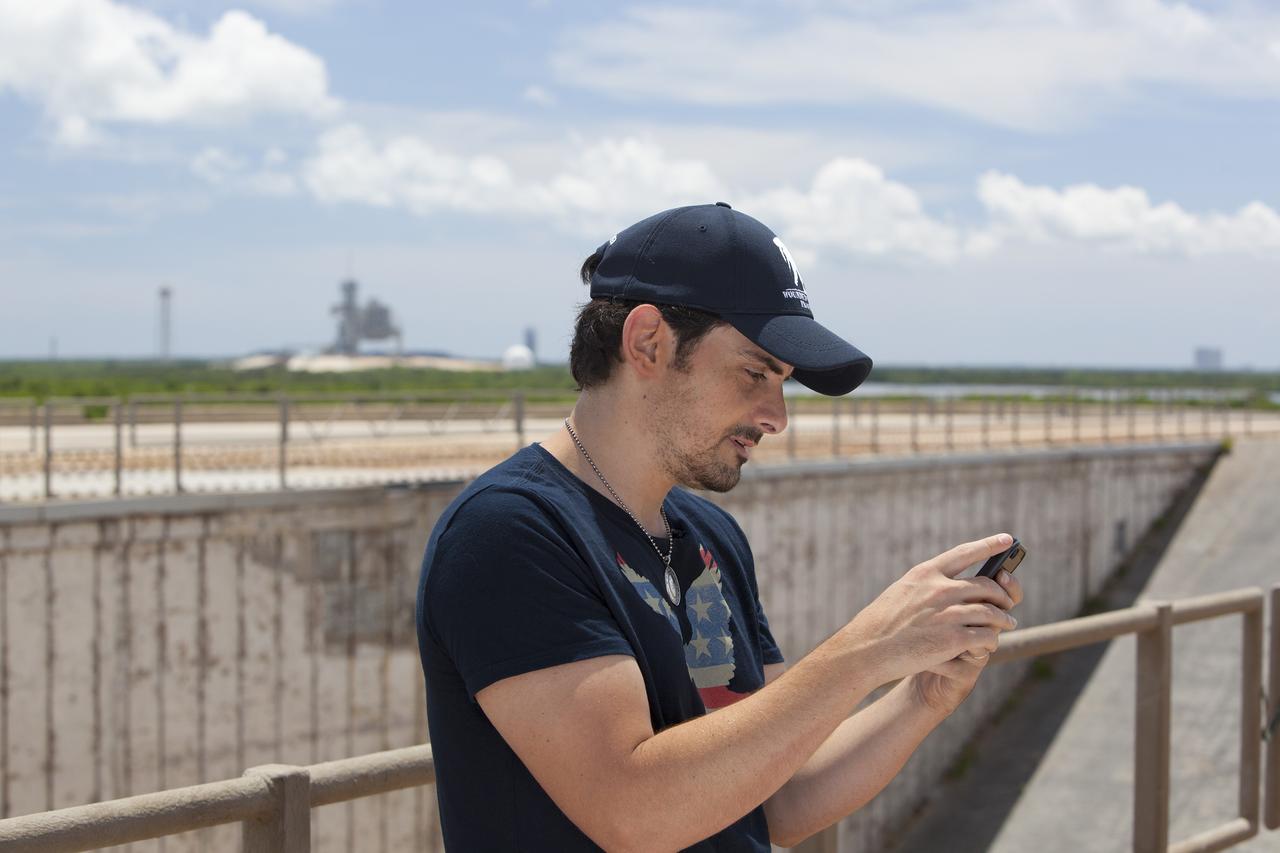
CAPE CANAVERAL, Fla. – At Launch Pad 39B at NASA’s Kennedy Space Center in Florida, singer-songwriter Brad Paisley receives a response from astronaut Reid Wiseman, an Expedition 40 crew member in Earth orbit on the International Space Station, after Paisley announced through social media the release of a new song titled "American Flag on the Moon." Wiseman responded, "Hold on @BradPaisley, we don't usually like leaks at the launch pad." In the background is Launch Pad 39A from which the Apollo moon landing missions were launched. For more on Kennedy Space Center, visit http://www.nasa.gov/kennedy. To read more of Wiseman's Twitter posts from the station, go to https://twitter.com/astro_reid. Photo credit: NASA/Daniel Casper
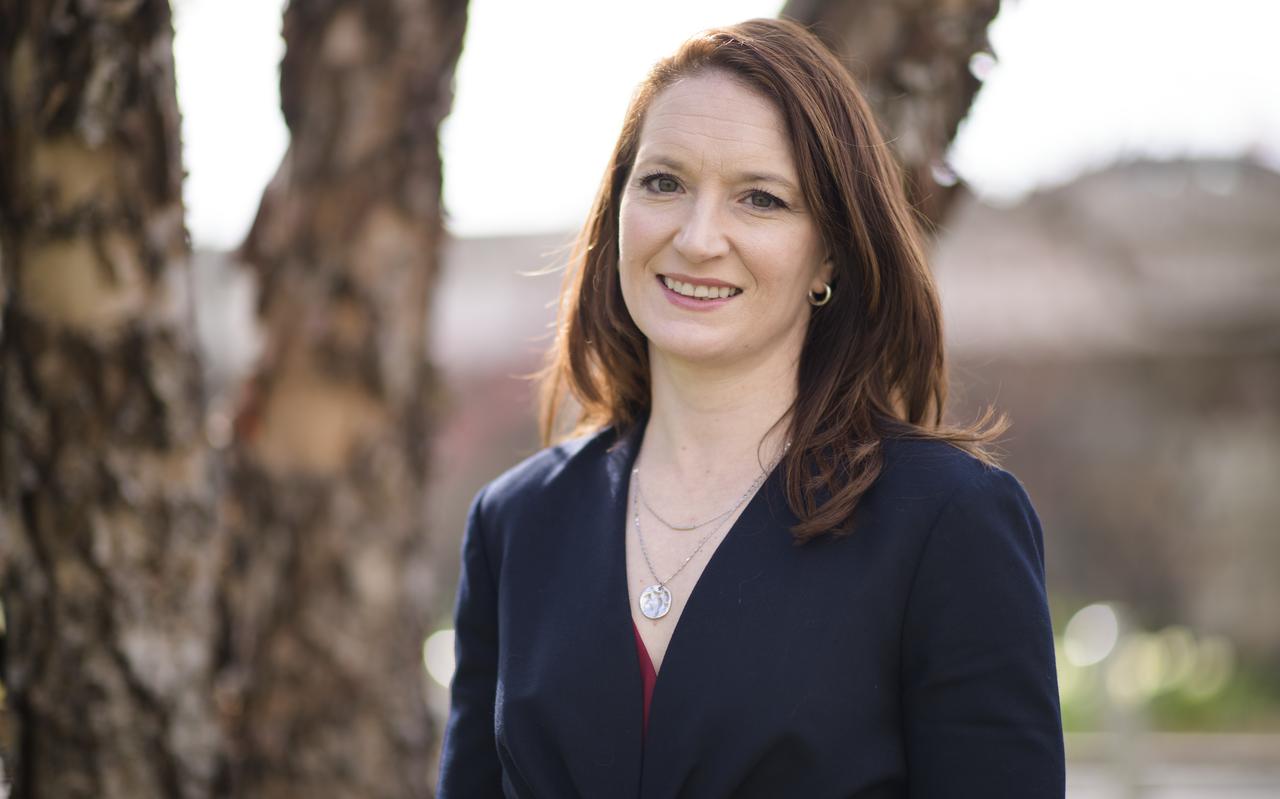
“We did science fair projects in eighth grade. So my dad and I designed an experiment to look at what cooking oil is best for cooking popcorn. Now you go to science fairs and you see this experiment everywhere. But in 1989, it was like, ‘wow, a kid who knows the scientific method!’ “I made a lot of popcorn. My poor brothers had to eat it all. I measured volume popped and how many kernels were left unpopped. But I also measured the taste factor. For example, cooking popcorn in peanut oil actually has good yield but it doesn’t taste good. “In high school, I had this chemistry teacher named Carol Palmer. I’ll never forget her. The science fairs were really important to her. She had partnerships with laboratories in town, and through this program, I got to go to a stainless steel foundry. “Do you know what paper machines are like? Picture giant rolls, like the size of an 18-wheeler truckbed. This place made those things. This was the early 90s, so we were just starting to recycle paper. But the machines had begun falling apart because of all the corrosive chemicals added to the mix to remove ink. I was simulating that process in the laboratory through different experiments. And I won two years in a row at the state-level science fair: I won first prize in electrochemistry and I won first prize in chemistry. “It was all because of this teacher. And to be honest, I wouldn’t have known that materials science was a thing or that I should study it if I hadn’t had that opportunity. It really put me on course.” Kathleen Boggs, Systems and Technology Demonstration Manager in the International Space Station Division of the Human Exploration and Operations Mission Directorate, Thursday, March 5, 2020, at NASA Headquarters in Washington, DC. Photo Credit: (NASA/Joel Kowsky)
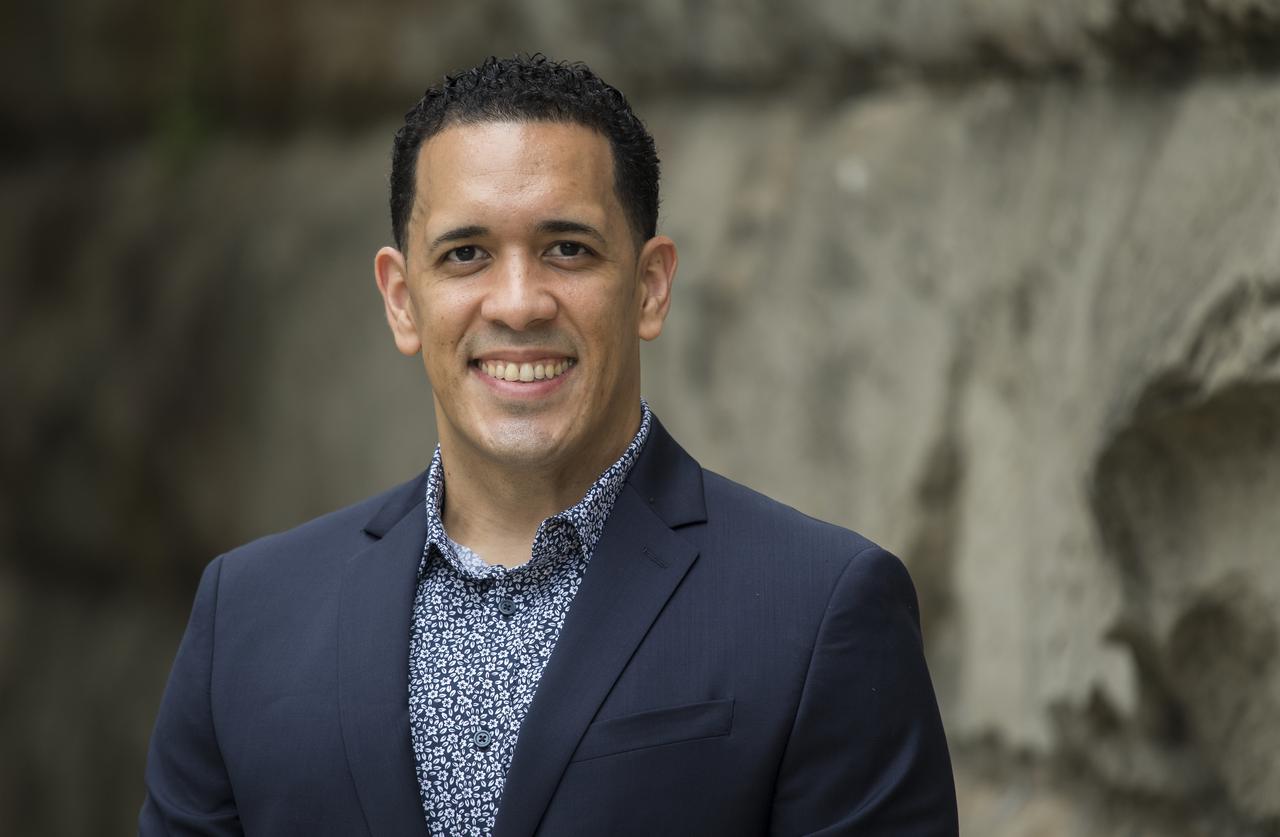
“Since I was 13, I’ve had maybe two or three jobs. Right now, I feel like I have four jobs. I have the NASA job, the Navy job. I’m also the chair for the Hispanic Outreach and Leadership Alliance, and I’m a new dad. It’s a lot. They say that the more you do, the more you can do. That’s a motto we have in the military. It’s true. The more you do, the more you can do, and unless you try to do something, you won’t know if you can. I have this philosophy in life that you’re only ever going to do things related to four categories: fitness and health, social and family time, your career, or faith and spirituality. You’re never, ever going to get those things perfectly in balance because nobody’s perfect. But I think the goal is to try to maintain balance. You’re going to have periods in your life where you may have a lot of work assignments and you’re spending a lot of time on the career side of things, but you need to also remember that you owe some time to your family and your friends. Are you taking time off for your health? Recognize when you’re a little bit off-balanced on one end. Success is in the journey of trying to work your way back to balanced.” Magdiel Santana, Senior Program Analyst at NASA Headquarters, poses for a portrait, Tuesday, Sept. 1, 2020, near NASA Headquarters in Washington, DC. Photo Credit: (NASA/Joel Kowsky)
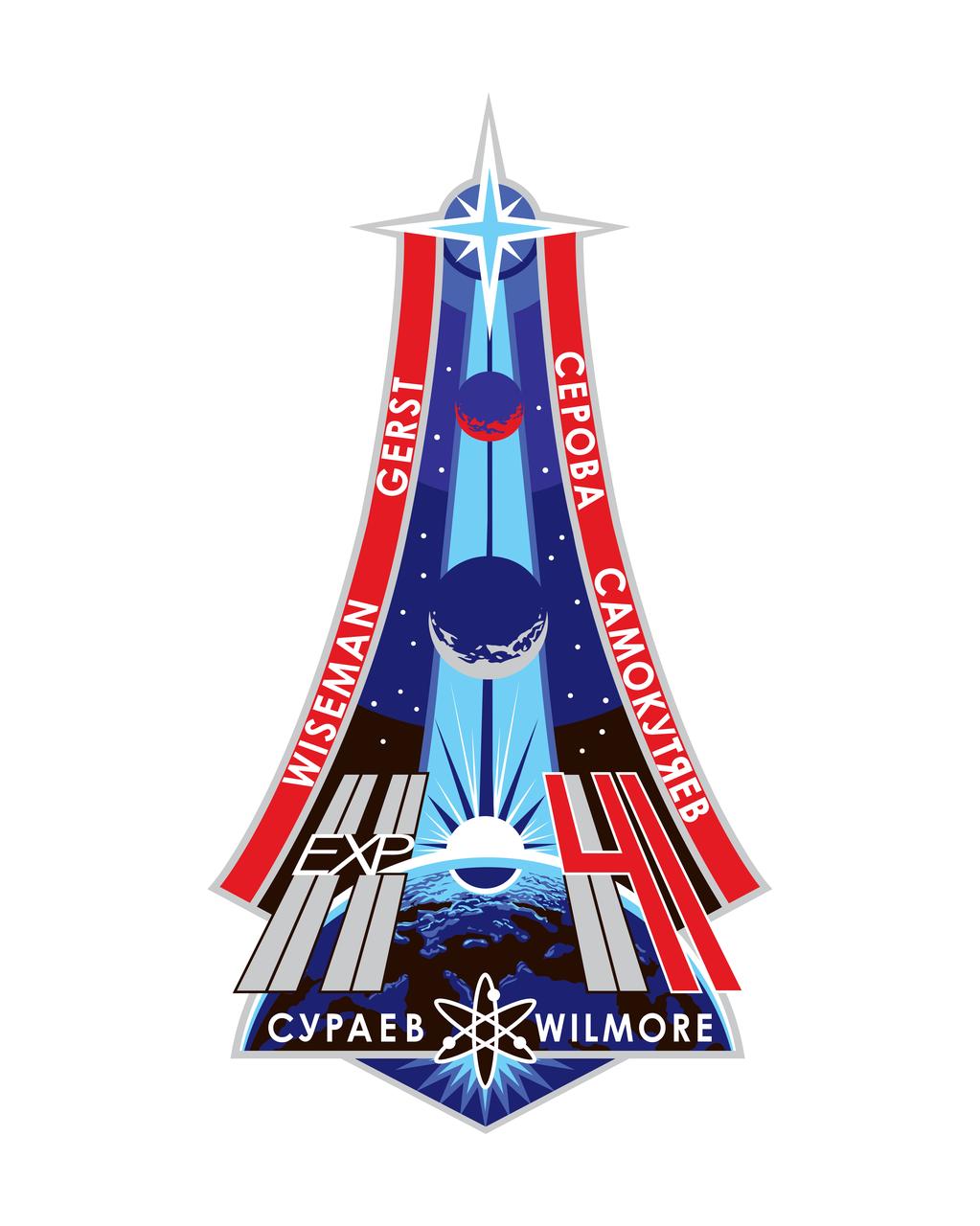
ISS041-S-001 (July 2013) --- The Expedition 41 crew members have released their patch and have written some text to go along with it: ?Portraying the road of human exploration into our vastly unknown universe, all elements of the Expedition 41 patch build from the foundation, our Earth, to the stars beyond our solar system. The focus of our six-month expedition to the International Space Station (ISS) is Earth and its inhabitants as well as a scientific look out into our universe. The distinguishing ISS solar arrays reach onward and serve as the central element, with the icon of an atom underneath representing the multitude of research onboard that will bring new discoveries for the benefit of humanity. The sun is rising over Earth?s horizon, spreading its light along the road of human exploration. Equipped with the knowledge and inspiration gained from ISS, our successful multinational cooperation will lead human space exploration to the moon, Mars, and ultimately, the stars. We are Expedition 41. Join us for the adventure.? Photo credit: NASA Note: The NASA insignia design for shuttle and space station flights is reserved for use by the astronauts and for other official use as the NASA Administrator may authorize. Public availability has been approved only in the form of illustrations by the various news media. When and if there is any change in this policy, which is not anticipated, it will be publicly announced.
![The broader scene for this image is the fluidized ejecta from Bakhuysen Crater to the southwest, but there's something very interesting going on here on a much smaller scale. A small impact crater, about 25 meters in diameter, with a gouged-out trench extends to the south. The ejecta (rocky material ejected from the crater) mostly extends to the east and west of the crater. This "butterfly" ejecta is very common for craters formed at low impact angles. Taken together, these observations suggest that the crater-forming impactor came in at a low angle from the north, hit the ground and ejected material to the sides. The top of the impactor may have sheared off ("decapitating" the impactor) and continued downrange, forming the trench. We can't prove that's what happened, but this explanation is consistent with the observations. Regardless of how it formed, it's quite an interesting-looking "dragonfly" crater. The map is projected here at a scale of 50 centimeters (19.69 inches) per pixel. [The original image scale is 55.7 centimeters (21.92 inches) per pixel (with 2 x 2 binning); objects on the order of 167 centimeters (65.7 inches) across are resolved.] North is up. http://photojournal.jpl.nasa.gov/catalog/PIA21454](https://images-assets.nasa.gov/image/PIA21454/PIA21454~medium.jpg)
The broader scene for this image is the fluidized ejecta from Bakhuysen Crater to the southwest, but there's something very interesting going on here on a much smaller scale. A small impact crater, about 25 meters in diameter, with a gouged-out trench extends to the south. The ejecta (rocky material ejected from the crater) mostly extends to the east and west of the crater. This "butterfly" ejecta is very common for craters formed at low impact angles. Taken together, these observations suggest that the crater-forming impactor came in at a low angle from the north, hit the ground and ejected material to the sides. The top of the impactor may have sheared off ("decapitating" the impactor) and continued downrange, forming the trench. We can't prove that's what happened, but this explanation is consistent with the observations. Regardless of how it formed, it's quite an interesting-looking "dragonfly" crater. The map is projected here at a scale of 50 centimeters (19.69 inches) per pixel. [The original image scale is 55.7 centimeters (21.92 inches) per pixel (with 2 x 2 binning); objects on the order of 167 centimeters (65.7 inches) across are resolved.] North is up. http://photojournal.jpl.nasa.gov/catalog/PIA21454

At a Sept. 26 all-hands meeting, NASA Marshall Space Flight Center Director Todd May highlights some of the key moments from Vice President Mike Pence's visit to Marshall Sept. 25. "I'd like to thank all the people that prepared for the vice president's visit. I think it was a great day for the center," said May. "We were able to talk to him about NASA's Space Launch System as well as some other projects. As the chairman of the U.S. Space Council, he is going to be very influential in space policy and I think this was a great opportunity for us." May also commented on the nomination of U.S. Rep. Jim Bridenstine, President Donald Trump's selection for NASA Administrator, and spoke about continuing to advance Marshall's Plan to Thrive – a strategic management agenda that focuses on human capital, organizational efficiency and bi-modal operations. Marshall Deputy Director Jody Singer updated the workforce on the results of the recent employee viewpoint survey. Singer also provided an overview of NASA's outreach during the Aug. 21 total solar eclipse, mentoring opportunities and the activities associated with the ongoing Safety Week 2017.
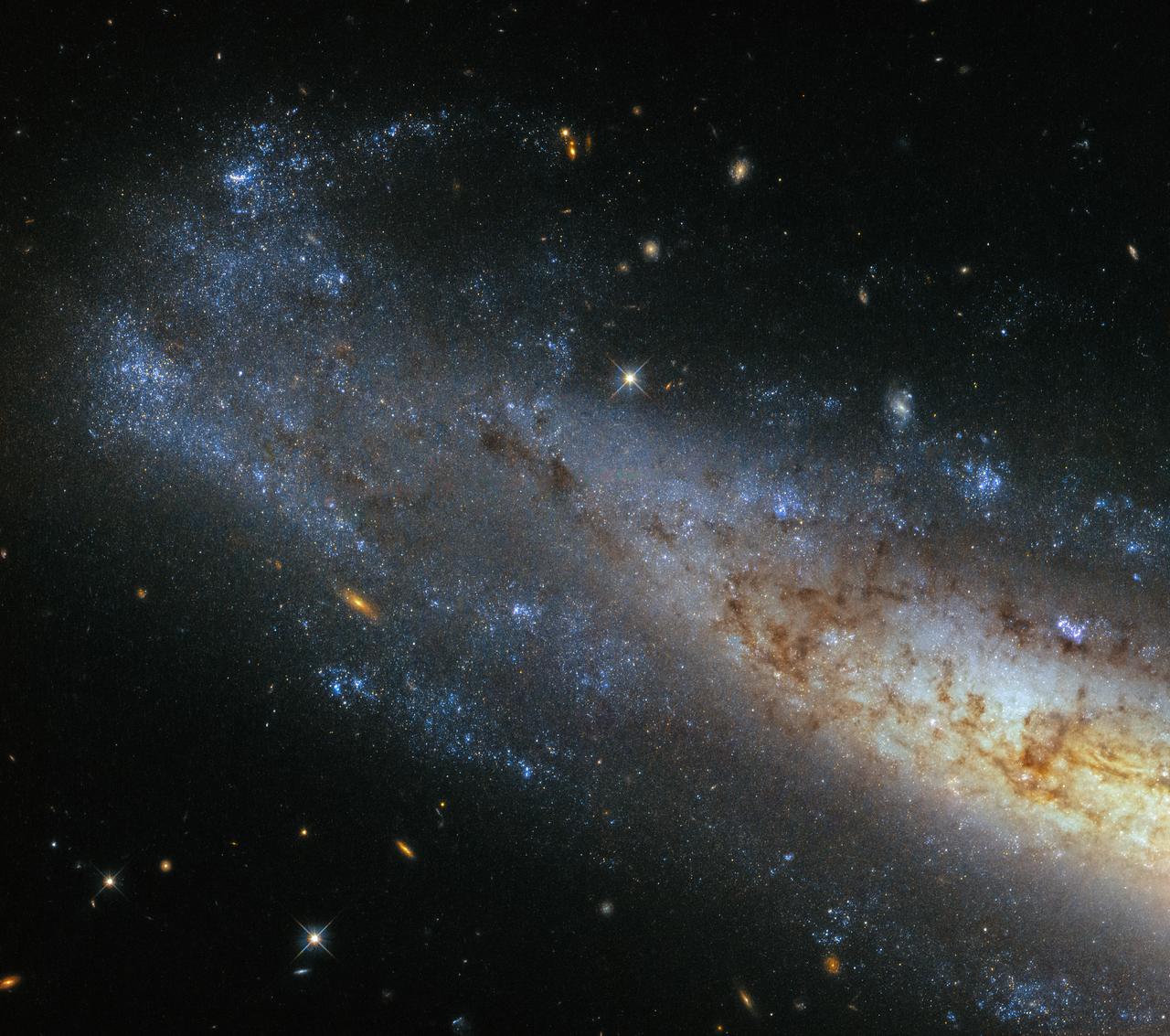
This image from Hubble’s Wide Field Camera 3 (WFC3) shows a section of NGC 1448, a spiral galaxy located about 50 million light-years from Earth in the little-known constellation of Horologium (The Pendulum Clock). We tend to think of spiral galaxies as massive and roughly circular celestial bodies, so this glittering oval does not immediately appear to fit the visual bill. What’s going on? Imagine a spiral galaxy as a circular frisbee spinning gently in space. When we see it face on, our observations reveal a spectacular amount of detail and structure — a great example from Hubble is the telescope’s view of Messier 51, otherwise known as the Whirlpool Galaxy. However, the NGC 1448 frisbee is very nearly edge-on with respect to Earth, giving it an appearance that is more oval than circular. The spiral arms, which curve out from NGC 1448’s dense core, can just about be seen. Although spiral galaxies might appear static with their picturesque shapes frozen in space, this is very far from the truth. The stars in these dramatic spiral configurations are constantly moving as they orbit around the galaxy’s core, with those on the inside making the orbit faster than those sitting further out. This makes the formation and continued existence of a spiral galaxy’s arms something of a cosmic puzzle, because the arms wrapped around the spinning core should become wound tighter and tighter as time goes on — but this is not what we see. This is known as the winding problem. Credit: ESA/Hubble & NASA #nasagoddard #space #science #Hubble #star <b><a href="http://www.nasa.gov/audience/formedia/features/MP_Photo_Guidelines.html" rel="nofollow">NASA image use policy.</a></b> <b><a href="http://www.nasa.gov/centers/goddard/home/index.html" rel="nofollow">NASA Goddard Space Flight Center</a></b> enables NASA’s mission through four scientific endeavors: Earth Science, Heliophysics, Solar System Exploration, and Astrophysics. Goddard plays a leading role in NASA’s accomplishments by contributing compelling scientific knowledge to advance the Agency’s mission. <b>Follow us on <a href="http://twitter.com/NASAGoddardPix" rel="nofollow">Twitter</a></b> <b>Like us on <a href="http://www.facebook.com/pages/Greenbelt-MD/NASA-Goddard/395013845897?ref=tsd" rel="nofollow">Facebook</a></b> <b>Find us on <a href="http://instagrid.me/nasagoddard/?vm=grid" rel="nofollow">Instagram</a></b>
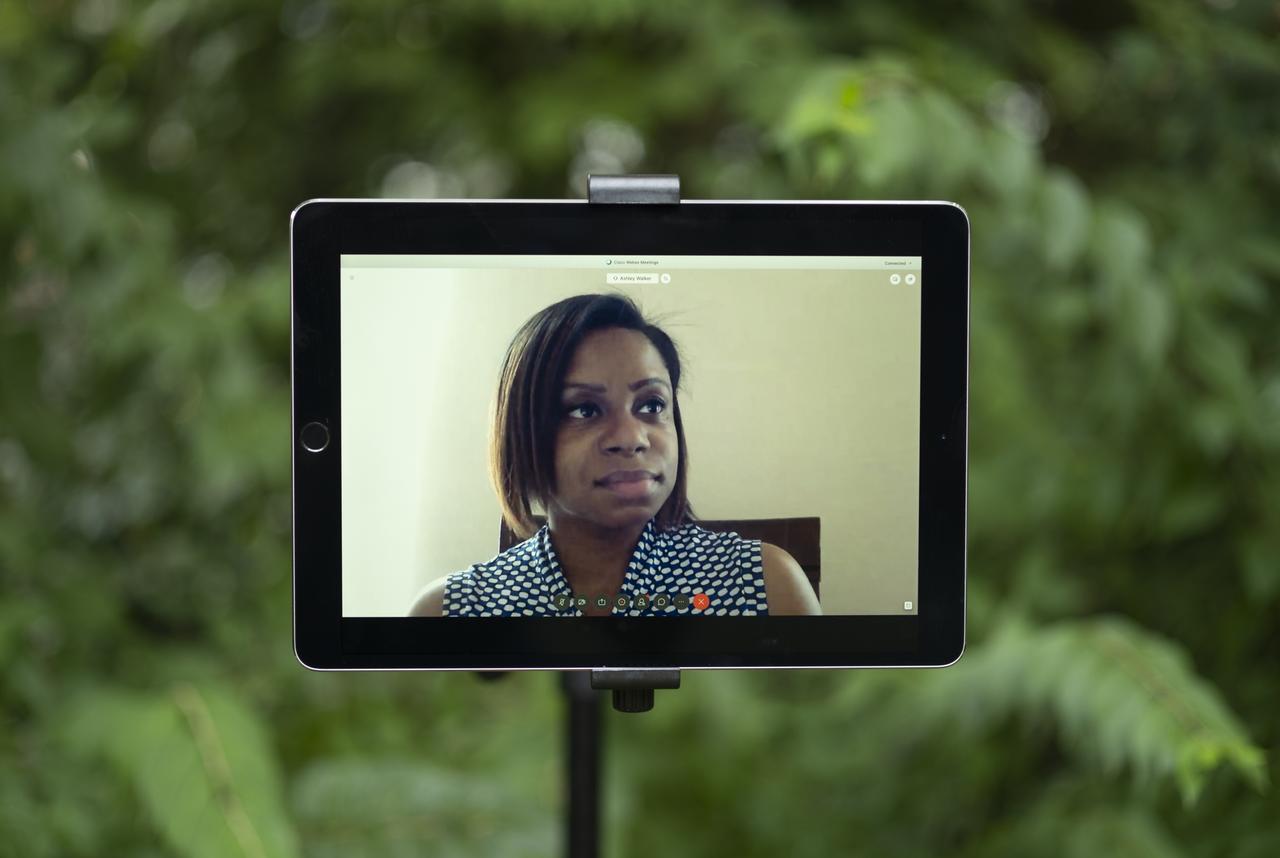
“I’m a big community person. I’m a person who will be like, ‘I think I know someone for you.’ And then I’ll put everyone together. So I’m a big person on lending a helping hand. My platform is for highlighting folks. I’ve highlighted over 50 black junior astronomers for Black History Month, which I will continuously do. I founded the #BlackInAstro Week, which was very successful. I had no clue it was even trending until other people told me. I didn’t even realize until it was the middle of the week, and people were saying, ‘congratulations!’ And I was like, ‘wait, what? Okay, thanks!’ I didn’t realize it was that big. “Community for me and using my platform to promote others — it’s something that really makes me happy. It’s very important to lift others up because for me, I don’t see people who look like me. You never know who’s watching, or who will get inspired. The next generation of scientists will be amazing. This generation of scientists is outstanding — but the next generation will be amazing, so on and so forth. We’re just going to keep lifting each other up and making sure that we all have each other’s backs, because right now is a critical time in our lives. We need each other more than anything.” Ashley Walker, Intern in the Undergraduate Research Associates in Astrobiology program at NASA’s Goddard Space Flight Center, is photographed in her home in Chicago, Ill. via video conference, Saturday, July 25, 2020 in Alexandria, Va. Photo Credit: (NASA/Joel Kowsky)

This close-up image from NASA's Mars Reconnaissance Orbiter gives the impression of looking like bacterial cells and their internal structures which travel and split in the process of life. These features are fractal in nature: the same image is preserved through different scales, with the pattern repeating eternally. The reality is, we are looking at one of Mars' polar regions; the South Polar residual cap to be precise, and, as with many things in Martian planetary science, there is a precise reasoning behind the name. With the coming and going of the seasons, this is an area on Mars where ice remains even after the peak of summer arrives. The texture is very alien, bearing more of a resemblance to the universe of the very small, rather than the universe far, far away. But if this is a polar cap, then why does it not look like the polar caps on Earth? Indeed, there is no equivalent terrain observed here on Earth. The so-called "Swiss cheese terrain, referencing the numerous holes of the region, is a product of seasonal exchange between the surface and the Martian atmosphere. With a predominantly carbon dioxide content at 98 percent, the colder temperatures condense the gas out of the atmosphere to produce dry ice. The prevalence of water is more concentrated in the north, leaving the South polar region more carbon dioxide rich, and it's this difference in composition that generates the unusual texture of the Swiss cheese terrain. The Red Planet is one of the chief candidates in the search for life elsewhere in the Solar System; however, a quick glance at this image virtually gives the impression we have already found it. NB: The cutout image has been rotated so that north is approximately up. https://photojournal.jpl.nasa.gov/catalog/PIA21880
![“I had the privilege of being the very first project manager for [the] Near Space Network (NSN), and in my current role as deputy program manager for [the] Exploration and Space Communications Division, it is still in my portfolio. NSN is one of the [agency’s two] communication and navigation networks. When we see the volume and the variety of NASA, other agency, and commercial missions supported by the network, and the science being achieved, and the exploration being enabled — when you leave for the day, you feel accomplished that you contributed [to the] agency’s goal. You contributed toward [the] nation’s priorities, such as cislunar [exploration], and then you helped humankind by enabling the science and exploration. Without communication, every satellite in this space is a black box. So, just knowing that every single day we are flowing terabytes of data through relay and direct-to-earth services directly to our [missions], enabling the exploration and achieving the science — is a great sense of accomplishment. ... Whatever role you are in, as long as you find a way to understand what mission, what goal, what objective you are contributing to, there is no bigger motivator than that. As a software programmer, normally you think that your job is to come in and write some code and solve some discrepancy reports and do the testing — and then you go home. But in the end, when you see that the program you are writing or fixing is something that controls the satellite that’s observing the sea levels and the sea temperatures or [controls] a capsule that is carrying astronauts, now you know you're actually contributing to a bigger purpose, a bigger objective. I say that to my team, whenever I have an opportunity. I share with my team that they are enabling science and exploration for dozens of missions being supported by NSN. Initially it just seems like words, but once they start realizing [their contributions] are real, I can tell you t](https://images-assets.nasa.gov/image/NHQ202402070014/NHQ202402070014~medium.jpg)
“I had the privilege of being the very first project manager for [the] Near Space Network (NSN), and in my current role as deputy program manager for [the] Exploration and Space Communications Division, it is still in my portfolio. NSN is one of the [agency’s two] communication and navigation networks. When we see the volume and the variety of NASA, other agency, and commercial missions supported by the network, and the science being achieved, and the exploration being enabled — when you leave for the day, you feel accomplished that you contributed [to the] agency’s goal. You contributed toward [the] nation’s priorities, such as cislunar [exploration], and then you helped humankind by enabling the science and exploration. Without communication, every satellite in this space is a black box. So, just knowing that every single day we are flowing terabytes of data through relay and direct-to-earth services directly to our [missions], enabling the exploration and achieving the science — is a great sense of accomplishment. ... Whatever role you are in, as long as you find a way to understand what mission, what goal, what objective you are contributing to, there is no bigger motivator than that. As a software programmer, normally you think that your job is to come in and write some code and solve some discrepancy reports and do the testing — and then you go home. But in the end, when you see that the program you are writing or fixing is something that controls the satellite that’s observing the sea levels and the sea temperatures or [controls] a capsule that is carrying astronauts, now you know you're actually contributing to a bigger purpose, a bigger objective. I say that to my team, whenever I have an opportunity. I share with my team that they are enabling science and exploration for dozens of missions being supported by NSN. Initially it just seems like words, but once they start realizing [their contributions] are real, I can tell you t
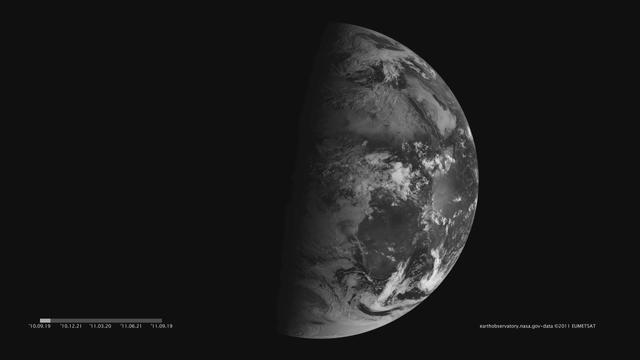
Images acquired December 21, 2010 - September 20, 2011. To download the high res and learn more go to: <a href="http://earthobservatory.nasa.gov/IOTD/view.php?id=52248" rel="nofollow">earthobservatory.nasa.gov/IOTD/view.php?id=52248</a> One of the most frequently misunderstood concepts in science is the reason for Earth’s seasons. As we experience the September equinox today—anyone try to balance an egg yet?—we thought we’d offer a space-based view of what’s going on. Around 6 a.m. local time each day, the Sun, Earth, and any geosynchronous satellite form a right angle, affording a nadir (straight down) view of the terminator, where the shadows of nightfall meet the sunlight of dusk and dawn. The shape of this line between night and day varies with the seasons, which means different lengths of days and differing amounts of warming sunshine. (The line is actually a curve because the Earth is round, but satellite images only show it in two-dimensions.) The Spinning Enhanced Visible and Infrared Imager (SEVIRI) on EUMETSAT's Meteosat-9 captured these four views of the day-night terminator on December 21, 2010, and March 20, June 21, and September 20, 2011. Each image was taken at 6:12 a.m. local time. On March 20 and September 20, the terminator is a straight north-south line, and the Sun is said to sit directly above the equator. On December 21, the Sun resides directly over the Tropic of Capricorn when viewed from the ground, and sunlight spreads over more of the Southern Hemisphere. On June 21, the Sun sits above the Tropic of Cancer, spreading more sunlight in the north and turning the tables on the south. The bulge of our spherical Earth blocks sunlight from the far hemisphere at the solstices; that same curvature allows the Sun’s rays to spread over more area near the top and bottom of the globe. Of course, it is not the Sun that is moving north or south through the seasons, but a change in the orientation and angles between the Earth and its nearest star. The axis of the Earth is tilted 23.5 degrees relative to the Sun and the ecliptic plane. The axis is tilted away from the Sun at the December solstice and toward the Sun at the June solstice, spreading more and less light on each hemisphere. At the equinoxes, the tilt is at a right angle to the Sun and the light is spread evenly. The equinox and changing of the seasons occurs on September 23, 2011 at 9:05 a.m. Universal Time. (Our September image above is a few days early.) Equinox means "equal night" in Latin, capturing the idea that daytime and nighttime are equal lengths everywhere on the planet. That is true of the Sun's presence above the horizon, though it does not account for twilight, when the Sun's rays extend from beyond the horizon to illuminate our gas-filled atmosphere. <b>NASA images and animation by Robert Simmon, using data ©2010 EUMETSAT. Caption by Mike Carlowicz.</b> Instrument: Meteosat Credit: <b><a href="http://www.earthobservatory.nasa.gov/" rel="nofollow"> NASA Earth Observatory</a></b> <b><a href="http://www.nasa.gov/audience/formedia/features/MP_Photo_Guidelines.html" rel="nofollow">NASA image use policy.</a></b> <b><a href="http://www.nasa.gov/centers/goddard/home/index.html" rel="nofollow">NASA Goddard Space Flight Center</a></b> enables NASA’s mission through four scientific endeavors: Earth Science, Heliophysics, Solar System Exploration, and Astrophysics. Goddard plays a leading role in NASA’s accomplishments by contributing compelling scientific knowledge to advance the Agency’s mission. <b>Follow us on <a href="http://twitter.com/NASAGoddardPix" rel="nofollow">Twitter</a></b> <b>Like us on <a href="http://www.facebook.com/pages/Greenbelt-MD/NASA-Goddard/395013845897?ref=tsd" rel="nofollow">Facebook</a></b> <b>Find us on <a href="http://instagrid.me/nasagoddard/?vm=grid" rel="nofollow">Instagram</a></b>

NASA release July 27, 2011 These jets, known as spicules, were captured in an SDO image on April 25, 2010. Combined with the energy from ripples in the magnetic field, they may contain enough energy to power the solar wind that streams from the sun toward Earth at 1.5 million miles per hour. Credit: NASA/SDO/AIA Like giant strands of seaweed some 32,000 miles high, material shooting up from the sun sways back and forth with the atmosphere. In the ocean, it's moving water that pulls the seaweed along for a ride; in the sun's corona, magnetic field ripples called Alfvén waves cause the swaying. For years these waves were too difficult to detect directly, but NASA's Solar Dynamics Observatory (SDO) is now able to track the movements of this solar "seaweed" and measure how much energy is carried by the Alfvén waves. The research shows that the waves carry more energy than previously thought, and possibly enough to drive two solar phenomena whose causes remain points of debate: the intense heating of the corona to some 20 times hotter than the sun's surface and solar winds that blast up to 1.5 million miles per hour. "SDO has amazing resolution so you can actually see individual waves," says Scott McIntosh at the National Center for Atmospheric Research in Boulder, Colo. "Now we can see that instead of these waves having about 1000th the energy needed as we previously thought, it has the equivalent of about 1100W light bulb for every 11 square feet of the sun's surface, which is enough to heat the sun's atmosphere and drive the solar wind." To read more go to: <a href="http://www.nasa.gov/mission_pages/sdo/news/alfven-waves.html" rel="nofollow">www.nasa.gov/mission_pages/sdo/news/alfven-waves.html</a> <b><a href="http://www.nasa.gov/centers/goddard/home/index.html" rel="nofollow">NASA Goddard Space Flight Center</a></b> enables NASA’s mission through four scientific endeavors: Earth Science, Heliophysics, Solar System Exploration, and Astrophysics. Goddard plays a leading role in NASA’s accomplishments by contributing compelling scientific knowledge to advance the Agency’s mission. <b>Follow us on <a href="http://twitter.com/NASA_GoddardPix" rel="nofollow">Twitter</a></b> <b>Like us on <a href="http://www.facebook.com/pages/Greenbelt-MD/NASA-Goddard/395013845897?ref=tsd" rel="nofollow">Facebook</a></b> <b>Find us on <a href="http://web.stagram.com/n/nasagoddard/?vm=grid" rel="nofollow">Instagram</a></b>
!["There are a lot of things I can do that other people who are 'able-bodied' can't. For example, I was at Costco, and they hadn't opened the doors yet, so we were all waiting outside (Costco customers, gotta love them. Every day is Black Friday). Anyway, I'm sitting there at the door waiting to go in. The security guard was trying to separate these two flatbed carts, and I asked him, and I was sincere when I said this, I go, 'Do you want help?' [He says] ‘Oh, hahaha no, no.’ And that really makes me mad. “Nine out of ten times when I offer my help, that's the response. Number one, people think I'm joking. Number two, how could I ever be helpful? Somebody in my position, 'my position,' right? "So, he gave up, and I took my chair and quickly hit the carts at the right spot. Because of my chair being heavy, I was able to separate them. Did that teach him a lesson not to do that ever again? Probably not. But the truth is, I was able to do that, and he wasn't. And he would never guess I could do something he can't do. “I wish people would look at us and say, wow, I wonder what she can do that is really cool, because that's how I look at my community. I don't look at the fact that they can't walk. I look and wonder what they could do. I would like to see [more of] that, so I'll keep offering my help. People need to realize not to make assumptions. Be open and curious about the abilities of everybody. “They say if you live long enough, there's a good chance you'll join this community. And just remember, if that were to happen, don't give up because with the right resources, you can have a great life. I know people who have become disabled who tell me their life didn't begin until they became part of the community because it's given them this whole new perspective and value to people, to the human spirit. “And that's what I like to impart to everybody; don't feel sorry for me because, with the right help, it's great." NASA Headquarters External Informa](https://images-assets.nasa.gov/image/NHQ202303020039/NHQ202303020039~medium.jpg)
"There are a lot of things I can do that other people who are 'able-bodied' can't. For example, I was at Costco, and they hadn't opened the doors yet, so we were all waiting outside (Costco customers, gotta love them. Every day is Black Friday). Anyway, I'm sitting there at the door waiting to go in. The security guard was trying to separate these two flatbed carts, and I asked him, and I was sincere when I said this, I go, 'Do you want help?' [He says] ‘Oh, hahaha no, no.’ And that really makes me mad. “Nine out of ten times when I offer my help, that's the response. Number one, people think I'm joking. Number two, how could I ever be helpful? Somebody in my position, 'my position,' right? "So, he gave up, and I took my chair and quickly hit the carts at the right spot. Because of my chair being heavy, I was able to separate them. Did that teach him a lesson not to do that ever again? Probably not. But the truth is, I was able to do that, and he wasn't. And he would never guess I could do something he can't do. “I wish people would look at us and say, wow, I wonder what she can do that is really cool, because that's how I look at my community. I don't look at the fact that they can't walk. I look and wonder what they could do. I would like to see [more of] that, so I'll keep offering my help. People need to realize not to make assumptions. Be open and curious about the abilities of everybody. “They say if you live long enough, there's a good chance you'll join this community. And just remember, if that were to happen, don't give up because with the right resources, you can have a great life. I know people who have become disabled who tell me their life didn't begin until they became part of the community because it's given them this whole new perspective and value to people, to the human spirit. “And that's what I like to impart to everybody; don't feel sorry for me because, with the right help, it's great." NASA Headquarters External Informa

Images acquired December 21, 2010 - September 20, 2011. To view a HD animation of this go to: <a href="http://www.flickr.com/photos/gsfc/6175313242/in/photostream/">www.flickr.com/photos/gsfc/6175313242/in/photostream/</a> To download the high res and learn more go to: <a href="http://earthobservatory.nasa.gov/IOTD/view.php?id=52248" rel="nofollow">earthobservatory.nasa.gov/IOTD/view.php?id=52248</a> One of the most frequently misunderstood concepts in science is the reason for Earth’s seasons. As we experience the September equinox today—anyone try to balance an egg yet?—we thought we’d offer a space-based view of what’s going on. Around 6 a.m. local time each day, the Sun, Earth, and any geosynchronous satellite form a right angle, affording a nadir (straight down) view of the terminator, where the shadows of nightfall meet the sunlight of dusk and dawn. The shape of this line between night and day varies with the seasons, which means different lengths of days and differing amounts of warming sunshine. (The line is actually a curve because the Earth is round, but satellite images only show it in two-dimensions.) The Spinning Enhanced Visible and Infrared Imager (SEVIRI) on EUMETSAT's Meteosat-9 captured these four views of the day-night terminator on December 21, 2010, and March 20, June 21, and September 20, 2011. Each image was taken at 6:12 a.m. local time. On March 20 and September 20, the terminator is a straight north-south line, and the Sun is said to sit directly above the equator. On December 21, the Sun resides directly over the Tropic of Capricorn when viewed from the ground, and sunlight spreads over more of the Southern Hemisphere. On June 21, the Sun sits above the Tropic of Cancer, spreading more sunlight in the north and turning the tables on the south. The bulge of our spherical Earth blocks sunlight from the far hemisphere at the solstices; that same curvature allows the Sun’s rays to spread over more area near the top and bottom of the globe. Of course, it is not the Sun that is moving north or south through the seasons, but a change in the orientation and angles between the Earth and its nearest star. The axis of the Earth is tilted 23.5 degrees relative to the Sun and the ecliptic plane. The axis is tilted away from the Sun at the December solstice and toward the Sun at the June solstice, spreading more and less light on each hemisphere. At the equinoxes, the tilt is at a right angle to the Sun and the light is spread evenly. The equinox and changing of the seasons occurs on September 23, 2011 at 9:05 a.m. Universal Time. (Our September image above is a few days early.) Equinox means "equal night" in Latin, capturing the idea that daytime and nighttime are equal lengths everywhere on the planet. That is true of the Sun's presence above the horizon, though it does not account for twilight, when the Sun's rays extend from beyond the horizon to illuminate our gas-filled atmosphere. NASA images and animation by Robert Simmon, using data ©2010 EUMETSAT. Caption by Mike Carlowicz. Instrument: Meteosat Credit: <b><a href="http://www.earthobservatory.nasa.gov/" rel="nofollow"> NASA Earth Observatory</a></b> <b><a href="http://www.nasa.gov/audience/formedia/features/MP_Photo_Guidelines.html" rel="nofollow">NASA image use policy.</a></b> <b><a href="http://www.nasa.gov/centers/goddard/home/index.html" rel="nofollow">NASA Goddard Space Flight Center</a></b> enables NASA’s mission through four scientific endeavors: Earth Science, Heliophysics, Solar System Exploration, and Astrophysics. Goddard plays a leading role in NASA’s accomplishments by contributing compelling scientific knowledge to advance the Agency’s mission. <b>Follow us on <a href="http://twitter.com/NASAGoddardPix" rel="nofollow">Twitter</a></b> <b>Like us on <a href="http://www.facebook.com/pages/Greenbelt-MD/NASA-Goddard/395013845897?ref=tsd" rel="nofollow">Facebook</a></b> <b>Find us on <a href="http://instagrid.me/nasagoddard/?vm=grid" rel="nofollow">Instagram</a></b>
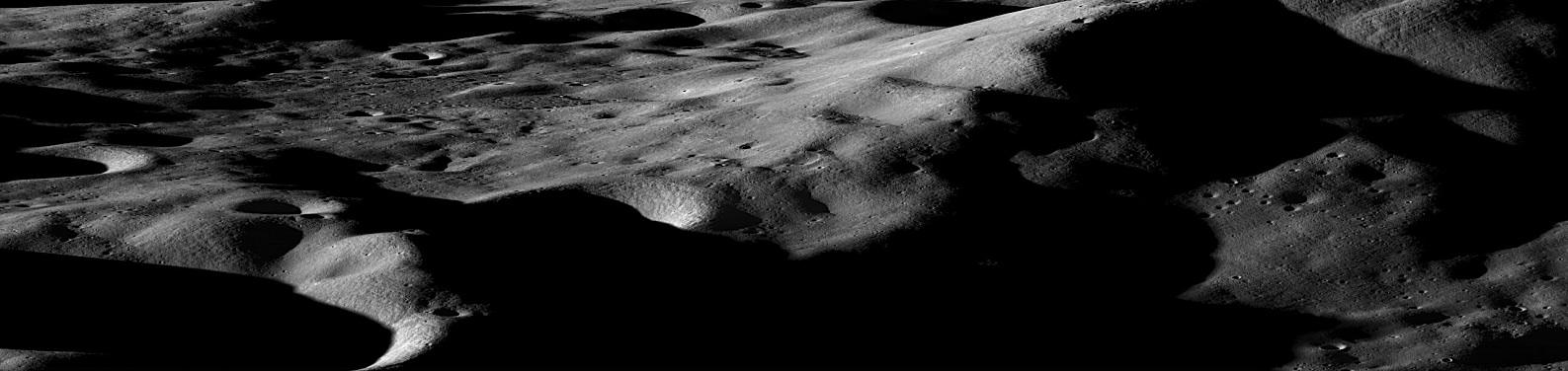
Mountains on the Moon On the Earth, we are taught that mountains form over millions of years, the result of gradual shifting and colliding plates. On the moon however, the situation is quite different. Even the largest lunar mountains were formed in minutes or less as asteroids and comets slammed into the surface at tremendous velocities, displacing and uplifting enough crust to create peaks that easily rival those found on Earth. On a few occasions in the past year, NASA has tilted the angle of LRO to do calibrations and other tests. In such cases the camera has the opportunity to gather oblique images of the lunar surface like the one featured here of Cabeus Crater providing a dramatic view of the moon's mountainous terrain. Cabeus Crater is located near the lunar south pole and contains the site of the LCROSS mission's impact. Early measurements by several instruments on LRO were used to guide the decision to send LCROSS to Cabeus. During the LCROSS impact LRO was carefully positioned to observe both the gas cloud generated in the impact, as well as the heating at the impact site. Credit: NASA/Goddard/Arizona State University To see the other nine images go to: <a href="http://www.nasa.gov/mission_pages/LRO/news/first-year.html" rel="nofollow">www.nasa.gov/mission_pages/LRO/news/first-year.html</a> <b><a href="http://www.nasa.gov/centers/goddard/home/index.html" rel="nofollow">NASA Goddard Space Flight Center</a></b> is home to the nation's largest organization of combined scientists, engineers and technologists that build spacecraft, instruments and new technology to study the Earth, the sun, our solar system, and the universe.
![Floating at the center of this new Hubble image is a lidless purple eye, staring back at us through space. This ethereal object, known officially as [SBW2007] 1 but sometimes nicknamed SBW1, is a nebula with a giant star at its center. The star was originally twenty times more massive than our sun, and is now encased in a swirling ring of purple gas, the remains of the distant era when it cast off its outer layers via violent pulsations and winds. But the star is not just any star; scientists say that it is destined to go supernova. Twenty-six years ago, another star with striking similarities went supernova — SN 1987A. Early Hubble images of SN 1987A show eerie similarities to SBW1. Both stars had identical rings of the same size and age, which were travelling at similar speeds; both were located in similar HII regions; and they had the same brightness. In this way SBW1 is a snapshot of SN1987a's appearance before it exploded, and unsurprisingly, astronomers love studying them together. At a distance of more than 20 000 light-years it will be safe to watch when the supernova goes off. If we are very lucky it may happen in our own lifetimes. Credit: ESA/NASA, acknowledgement: Nick Rose <b><a href="http://www.nasa.gov/audience/formedia/features/MP_Photo_Guidelines.html" rel="nofollow">NASA image use policy.</a></b> <b><a href="http://www.nasa.gov/centers/goddard/home/index.html" rel="nofollow">NASA Goddard Space Flight Center</a></b> enables NASA’s mission through four scientific endeavors: Earth Science, Heliophysics, Solar System Exploration, and Astrophysics. Goddard plays a leading role in NASA’s accomplishments by contributing compelling scientific knowledge to advance the Agency’s mission. <b>Follow us on <a href="http://twitter.com/NASA_GoddardPix" rel="nofollow">Twitter</a></b> <b>Like us on <a href="http://www.facebook.com/pages/Greenbelt-MD/NASA-Goddard/395013845897?ref=tsd" rel="nofollow">Facebook</a></b> <b>Find us on <a href="http://instagram.com/nasagoddard?vm=grid" rel="nofollow">Instagram</a></b>](https://images-assets.nasa.gov/image/GSFC_20171208_Archive_e001260/GSFC_20171208_Archive_e001260~small.jpg)
Floating at the center of this new Hubble image is a lidless purple eye, staring back at us through space. This ethereal object, known officially as [SBW2007] 1 but sometimes nicknamed SBW1, is a nebula with a giant star at its center. The star was originally twenty times more massive than our sun, and is now encased in a swirling ring of purple gas, the remains of the distant era when it cast off its outer layers via violent pulsations and winds. But the star is not just any star; scientists say that it is destined to go supernova. Twenty-six years ago, another star with striking similarities went supernova — SN 1987A. Early Hubble images of SN 1987A show eerie similarities to SBW1. Both stars had identical rings of the same size and age, which were travelling at similar speeds; both were located in similar HII regions; and they had the same brightness. In this way SBW1 is a snapshot of SN1987a's appearance before it exploded, and unsurprisingly, astronomers love studying them together. At a distance of more than 20 000 light-years it will be safe to watch when the supernova goes off. If we are very lucky it may happen in our own lifetimes. Credit: ESA/NASA, acknowledgement: Nick Rose <b><a href="http://www.nasa.gov/audience/formedia/features/MP_Photo_Guidelines.html" rel="nofollow">NASA image use policy.</a></b> <b><a href="http://www.nasa.gov/centers/goddard/home/index.html" rel="nofollow">NASA Goddard Space Flight Center</a></b> enables NASA’s mission through four scientific endeavors: Earth Science, Heliophysics, Solar System Exploration, and Astrophysics. Goddard plays a leading role in NASA’s accomplishments by contributing compelling scientific knowledge to advance the Agency’s mission. <b>Follow us on <a href="http://twitter.com/NASA_GoddardPix" rel="nofollow">Twitter</a></b> <b>Like us on <a href="http://www.facebook.com/pages/Greenbelt-MD/NASA-Goddard/395013845897?ref=tsd" rel="nofollow">Facebook</a></b> <b>Find us on <a href="http://instagram.com/nasagoddard?vm=grid" rel="nofollow">Instagram</a></b>
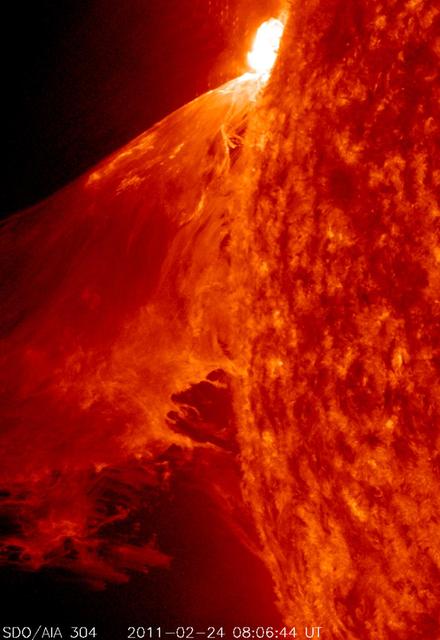
NASA image captured Feb. 24, 2011 To see an image showing the size of the prominence in comparison to the <b><a href="http://www.flickr.com/photos/gsfc/5492781335/">size of earth click here.</a></b> To view a video of this event go to: <a href="http://www.flickr.com/photos/gsfc/5483193591">www.flickr.com/photos/gsfc/5483193591</a> When a rather large-sized (M 3.6 class) flare occurred near the edge of the Sun, it blew out a gorgeous, waving mass of erupting plasma that swirled and twisted over a 90-minute period (Feb. 24, 2011). This event was captured in extreme ultraviolet light by NASA's Solar Dynamics Observatory spacecraft . Some of the material blew out into space and other portions fell back to the surface. Because SDO images are super-HD, we can zoom in on the action and still see exquisite details. And using a cadence of a frame taken every 24 seconds, the sense of motion is, by all appearances, seamless. Sit back and enjoy the jaw-dropping solar show. Credit: NASA/GSFC/SDO <b><a href="http://www.nasa.gov/centers/goddard/home/index.html" rel="nofollow">NASA Goddard Space Flight Center</a></b> enables NASA’s mission through four scientific endeavors: Earth Science, Heliophysics, Solar System Exploration, and Astrophysics. Goddard plays a leading role in NASA’s accomplishments by contributing compelling scientific knowledge to advance the Agency’s mission. <b>Follow us on <a href="http://twitter.com/NASA_GoddardPix" rel="nofollow">Twitter</a></b> <b>Join us on <a href="http://www.facebook.com/pages/Greenbelt-MD/NASA-Goddard/395013845897?ref=tsd" rel="nofollow">Facebook</a></b>
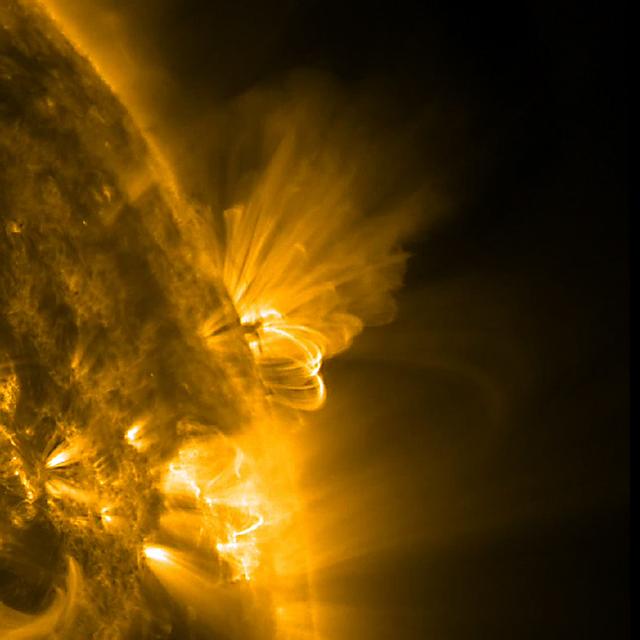
This close-up image of the sun presents an active region in profile as it rotated out of view. We can observe both the bright arching field lines and smaller pieces of darker matter in their midst being pulled back and forth just above the Sun's surface over about 36 hours (July 20-22, 2011). Both of these physical responses were caused by strong, tangled magnetic forces that are constantly evolving and reorganizing within the active region. Other active regions can be seen in the foreground as well. The image and movie were taken in extreme ultraviolet light of ionized iron heated to one million degrees. To view a hd video of this event go here: <a href="http://www.flickr.com/photos/gsfc/6006013038">www.flickr.com/photos/gsfc/6006013038</a> Credit: NASA/GSFC/SDO <b><a href="http://www.nasa.gov/centers/goddard/home/index.html" rel="nofollow">NASA Goddard Space Flight Center</a></b> enables NASA’s mission through four scientific endeavors: Earth Science, Heliophysics, Solar System Exploration, and Astrophysics. Goddard plays a leading role in NASA’s accomplishments by contributing compelling scientific knowledge to advance the Agency’s mission. <b>Follow us on <a href="http://twitter.com/NASA_GoddardPix" rel="nofollow">Twitter</a></b> <b>Like us on <a href="http://www.facebook.com/pages/Greenbelt-MD/NASA-Goddard/395013845897?ref=tsd" rel="nofollow">Facebook</a></b> <b>Find us on <a href="http://web.stagram.com/n/nasagoddard/?vm=grid" rel="nofollow">Instagram</a></b>

JOHNSON SPACE CENTER, HOUSTON, TEXAS - STS-111 INSIGNIA -- The STS-111 patch symbolizes the hardware, people, and partner nations that contribute to the flight. The Space Shuttle rises on the plume of the Astronaut Office symbol, carrying the Canadian Mobile Base System (MBS) for installation while docked to the International Space Station (ISS). The mission is named UF-2 for ISS Utilization Flight number two. The ISS orbit completes the Astronaut Office symbol and is colored red, white, and blue to represent the flags of the United States, Russia, France, and Costa Rica. The Earth background shows Italy, which contributes the Multi Purpose Logistics Module (MPLM) used on this flight to re-supply ISS. The ten stars in the sky represent the ten astronauts and cosmonauts on orbit during the flight, and the star at the top of the patch represents the Johnson Space Center, in the state of Texas, from which the flight is managed. The names of the STS-111 crew border the upper part of the patch, and the Expedition Five (going up) and Expedition Four (coming down) crews' names form the bottom of the patch. The NASA insignia design for Shuttle flights is reserved for use by the astronauts and for other official use as the NASA Administrator may authorize. Public availability has been approved only in the forms of illustrations by the various news media. When and if there is any change in this policy, which is not anticipated, the change will be publicly announced. The NASA insignia design for Space Shuttle flights is reserved for use by the astronauts and for other official use as the NASA Administrator may authorize. Public availability has been approved only in the form of illustrations by the various news media. When and if there is any change in this policy, which we do not anticipate, it will be publicly announced
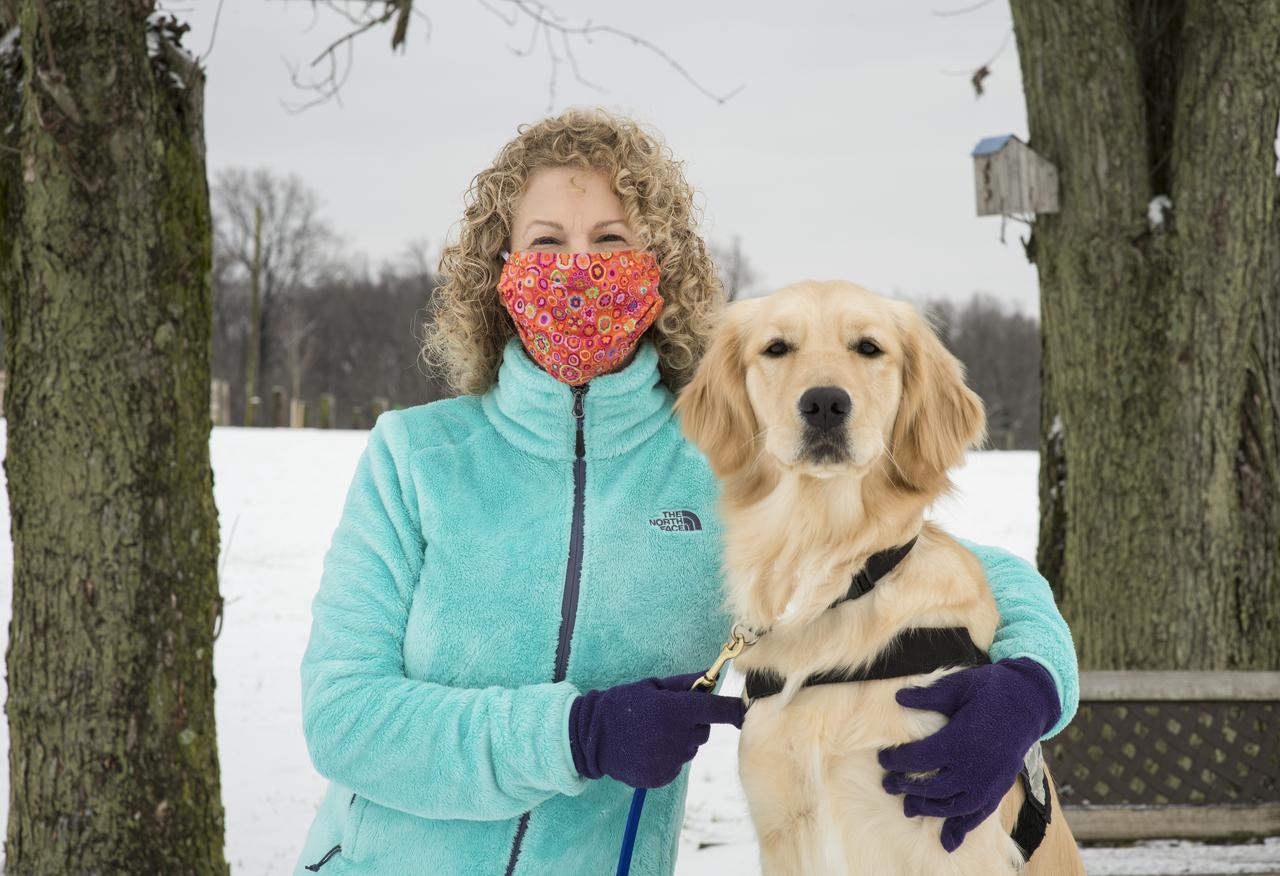
“It was part of my career, but then it was also personal. I was doing it on a volunteer basis, but it was part of my work because I was bringing my service dog in training everywhere with me, which meant to work every day and to meetings at NOAA (National Oceanic and Atmospheric Administration). And I was taking the dog across the country to meetings over at Ball Aerospace; that was all part of the training of a service dog. That was an incredible time. I really enjoyed it. “The fact that I was able to do the two combined, that to me was just such an accomplishment. To some people, it could be they got permission to do it and then that’s all they focused on was the dog, but no. I had my job I had to do. I’ve always gotten a distinguished rating in my performances my entire career, and it didn't change when I was training this service dog. “It was a challenge for sure. “After I had to turn back over the service dog I trained, it was really very difficult because the dog was with me for two years, even though I knew it was for a wonderful cause. I ended up going out and getting my own dog who I’ve trained to be a therapy dog, so now we do therapy visits with veterans, elderly, and others. ” Jean Wolfe, Program Executive for the Geostationary Operational Environmental Satellite (GOES)-R Series Program at NASA Headquarters, poses for a portrait with Bonnie, who was named for U.S. Air Force Reserve Major Bonnie Carroll, Ret., Friday, Dec. 18, 2020 at the Warrior Canine Connection in Boyds, MD. “Warrior Canine Connection enlists service members and veterans with combat stress in the critical mission of training service dogs for fellow Wounded Warriors.” Photo Credit: (NASA/Aubrey Gemignani)
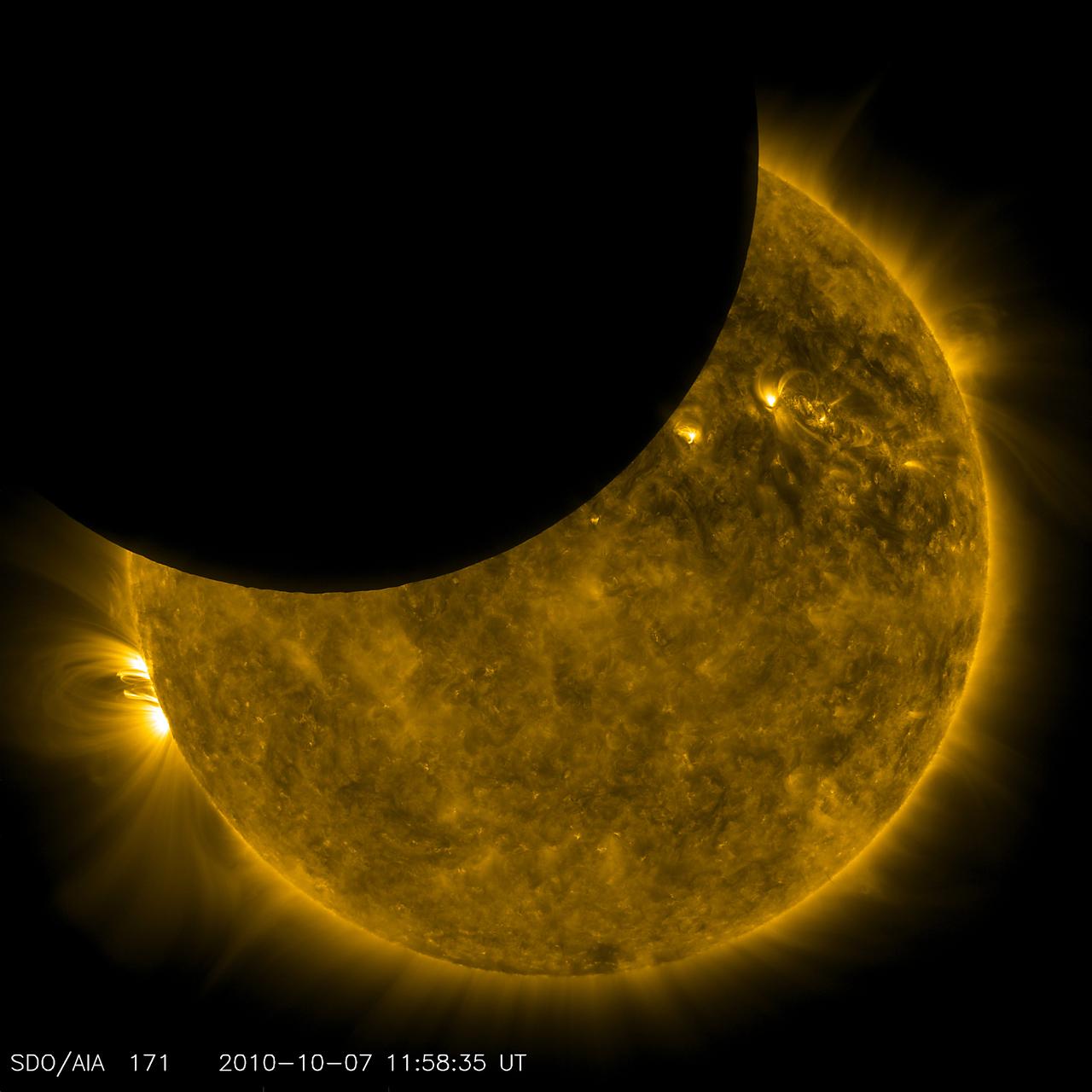
NASA image captured October 7, 2010 View a video of this event here: <a href="http://www.flickr.com/photos/gsfc/5099028189">www.flickr.com/photos/gsfc/5099028189</a> This was a first for SDO and it was visually engaging too. On October 7, 2010, SDO observed its first lunar transit when the new Moon passed directly between the spacecraft (in its geosynchronous orbit) and the Sun. With SDO watching the Sun in a wavelength of extreme ultraviolet light, the dark Moon created a partial eclipse of the Sun. These images, while unusual and cool to see, have practical value to the SDO science team. Karel Schrijver of Lockheed-Martin's Solar and Astrophysics Lab explains: "The very sharp edge of the lunar limb allows us to measure the in-orbit characteristics of the telescope e.g., light diffraction on optics and filter support grids. Once these are characterized, we can use that information to correct our data for instrumental effects and sharpen up the images to even more detail." To learn more about SDO go to: <a href="http://sdo.gsfc.nasa.gov/" rel="nofollow">sdo.gsfc.nasa.gov/</a> Credit: NASA/SDO <b><a href="http://www.nasa.gov/centers/goddard/home/index.html" rel="nofollow">NASA Goddard Space Flight Center</a></b> enables NASA’s mission through four scientific endeavors: Earth Science, Heliophysics, Solar System Exploration, and Astrophysics. Goddard plays a leading role in NASA’s accomplishments by contributing compelling scientific knowledge to advance the Agency’s mission. <b>Follow us on <a href="http://twitter.com/NASA_GoddardPix" rel="nofollow">Twitter</a></b> <b>Join us on <a href="http://www.facebook.com/pages/Greenbelt-MD/NASA-Goddard/395013845897?ref=tsd" rel="nofollow">Facebook</a></b>

This VIS image of Kaiser Crater shows individual dunes and where the dunes have coalesced into longer dune forms. The addition of sand makes the dunes larger and the intra-dune areas go from sand-free to complete coverage of the hard surface of the crater floor. With a continued influx of sand the region will transition from individual dunes to a sand sheet with surface dune forms. Kaiser Crater is located in the southern hemisphere in the Noachis region west of Hellas Planitia. Kaiser Crater is just one of several large craters with extensive dune fields on the crater floor. Other nearby dune filled craters are Proctor, Russell, and Rabe. Kaiser Crater is 207 km (129 miles) in diameter. The dunes are located in the southern part of the crater floor. The Odyssey spacecraft has spent over 15 years in orbit around Mars, circling the planet more than 69000 times. It holds the record for longest working spacecraft at Mars. THEMIS, the IR/VIS camera system, has collected data for the entire mission and provides images covering all seasons and lighting conditions. Over the years many features of interest have received repeated imaging, building up a suite of images covering the entire feature. From the deepest chasma to the tallest volcano, individual dunes inside craters and dune fields that encircle the north pole, channels carved by water and lava, and a variety of other feature, THEMIS has imaged them all. For the next several months the image of the day will focus on the Tharsis volcanoes, the various chasmata of Valles Marineris, and the major dunes fields. We hope you enjoy these images! Orbit Number: 1423 Latitude: -46.9573 Longitude: 18.6192 Instrument: VIS Captured: 2002-04-10 16:44 https://photojournal.jpl.nasa.gov/catalog/PIA22173
![“On my Twitter page it says: rocket scientist, football coach. “There have been schools where I have coached and kids would ask, ‘you’re an engineer, coach?’ and they seemed so shocked that I'm an engineer. It’s funny! I have two kids on my team this year who are seniors, and they’re going to major in engineering in college. I'm sure there are others that would say, ‘Wow, if Coach Johnson can do it, so can I.’ I’ve brought guys out [to Kennedy Space Center] during Bring Your Child to Work Day. The kids are always wondering, when is a launch? I'm sure they’re all paying more attention to it because I'm around. “[My job also] sparked a conversation with fellow coaches. The American Football Coaches Association did a profile on me last year about how NASA has helped me become a better football coach. For one, the foundations of flight control — those values of being competent at your job, having confidence, being vigilant — translate directly to the football field and then vice versa [when] dealing with adversity. In football, you can be down, you can play hurt, and you learn to fight through adversity. Sometimes, fighting through engineering problems can be tough to solve, but you learn how to persevere, and you find a solution to the problem you’re working on. “As far as similarities, in football, you have a lot of people from different backgrounds and different abilities, and you have to get together to achieve a goal. That’s no different from what we do around here.” — Yusef Johnson, Flight Design Engineer, Kennedy Space Center](https://images-assets.nasa.gov/image/KSC-20210209-PH-KLS01_0045/KSC-20210209-PH-KLS01_0045~medium.jpg)
“On my Twitter page it says: rocket scientist, football coach. “There have been schools where I have coached and kids would ask, ‘you’re an engineer, coach?’ and they seemed so shocked that I'm an engineer. It’s funny! I have two kids on my team this year who are seniors, and they’re going to major in engineering in college. I'm sure there are others that would say, ‘Wow, if Coach Johnson can do it, so can I.’ I’ve brought guys out [to Kennedy Space Center] during Bring Your Child to Work Day. The kids are always wondering, when is a launch? I'm sure they’re all paying more attention to it because I'm around. “[My job also] sparked a conversation with fellow coaches. The American Football Coaches Association did a profile on me last year about how NASA has helped me become a better football coach. For one, the foundations of flight control — those values of being competent at your job, having confidence, being vigilant — translate directly to the football field and then vice versa [when] dealing with adversity. In football, you can be down, you can play hurt, and you learn to fight through adversity. Sometimes, fighting through engineering problems can be tough to solve, but you learn how to persevere, and you find a solution to the problem you’re working on. “As far as similarities, in football, you have a lot of people from different backgrounds and different abilities, and you have to get together to achieve a goal. That’s no different from what we do around here.” — Yusef Johnson, Flight Design Engineer, Kennedy Space Center