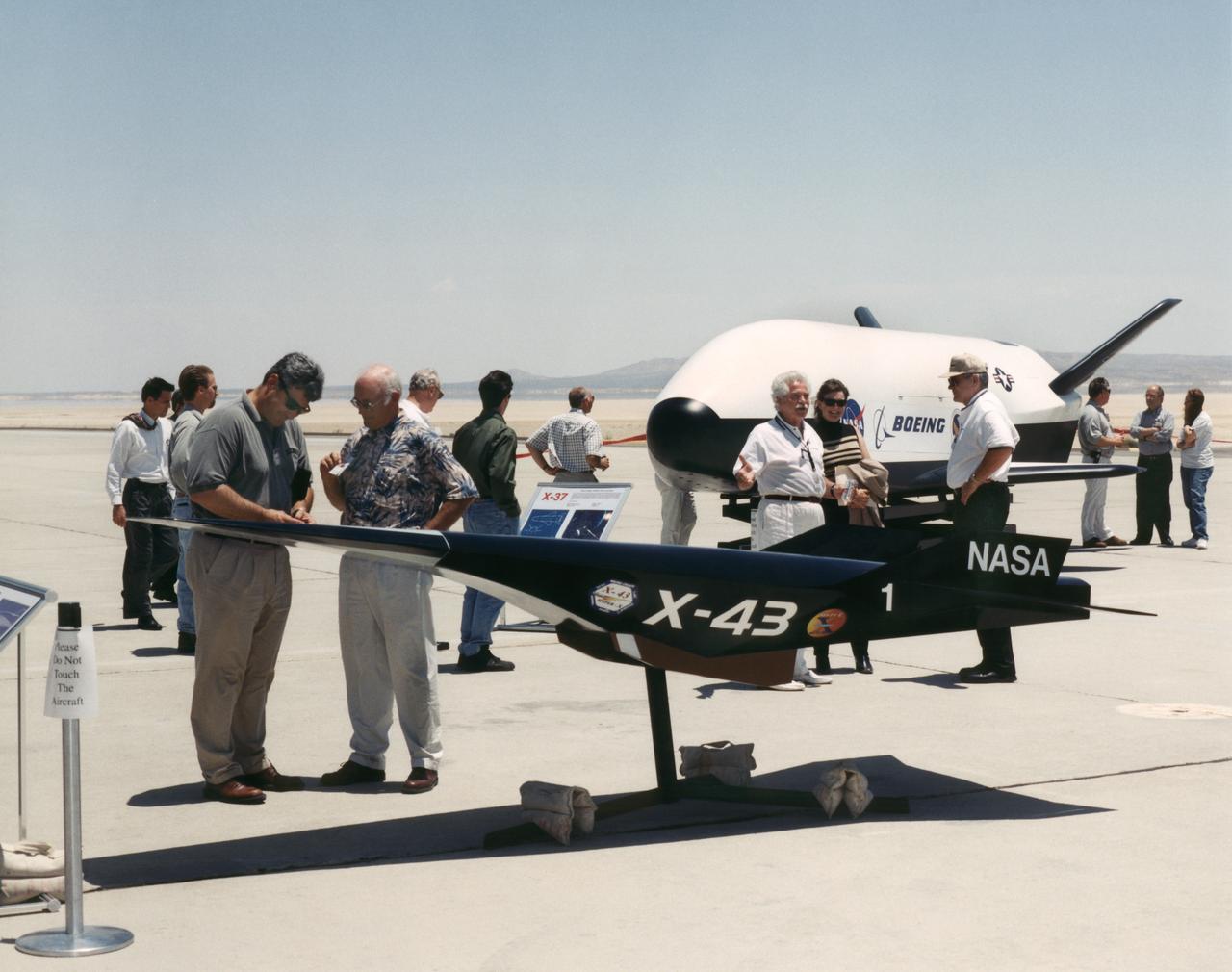
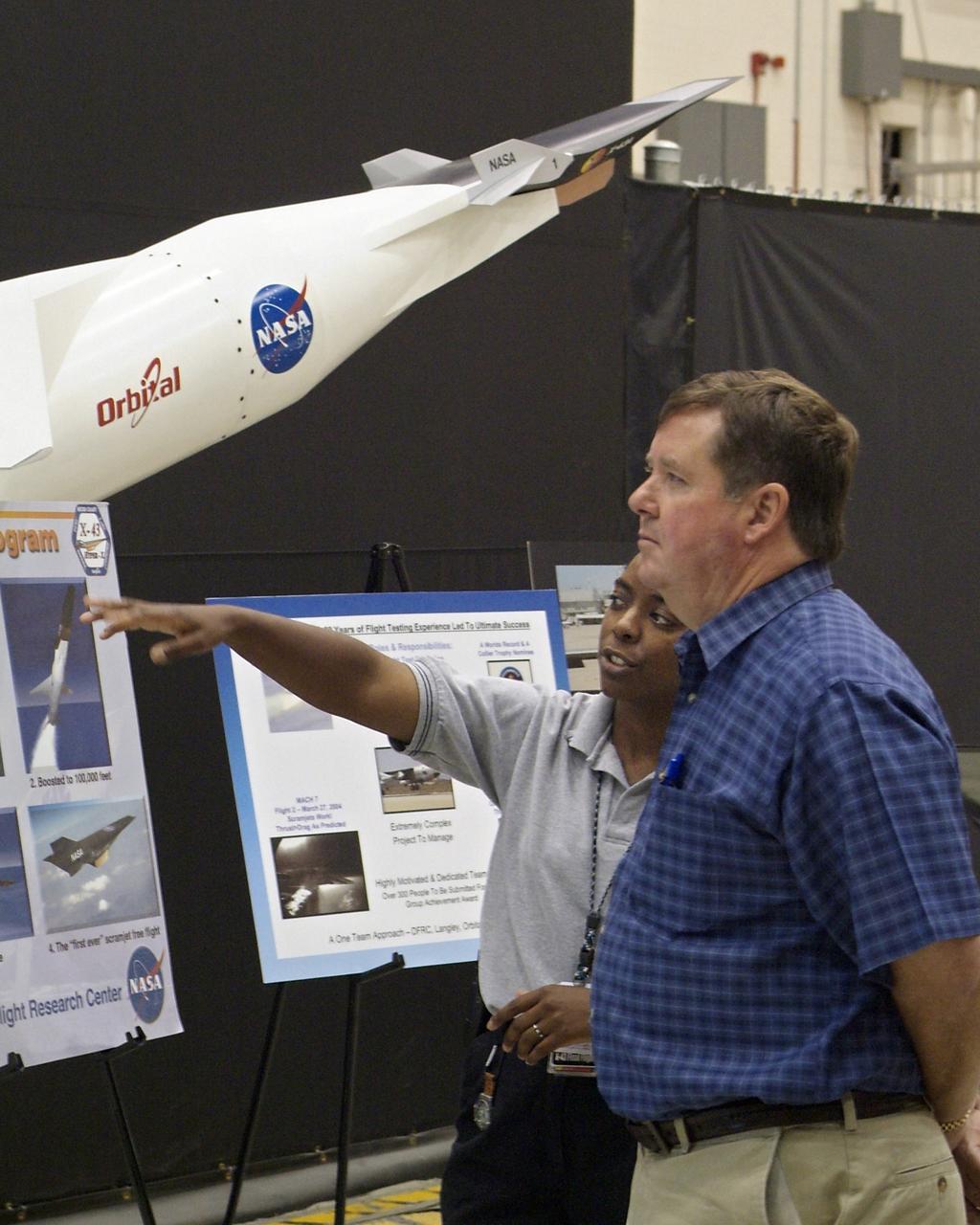
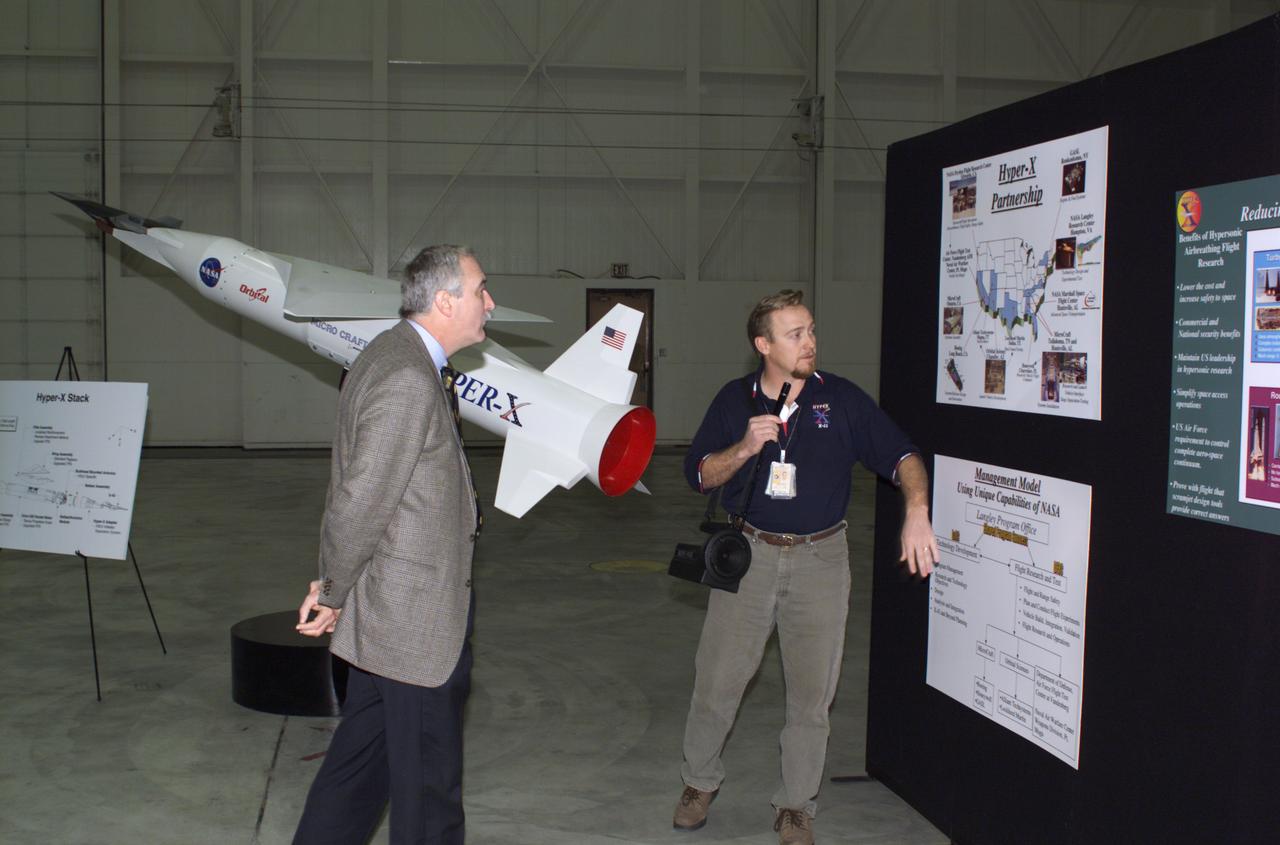
NASA Administrator Sean O'Keefe left, learned about the Mach 10 X-43 research vehicle from manager, Joel Sitz during O'Keefe's visit to the NASA Dryden Flight Research Center, Edwards, California, January 31, 2002.
NASA Administrator Sean O'Keefe, left, learned about the Mach 10 X-43 research vehicle from manager Joel Sitz during a visit to the NASA Dryden Flight Research Center, Edwards, California, January 31, 2002
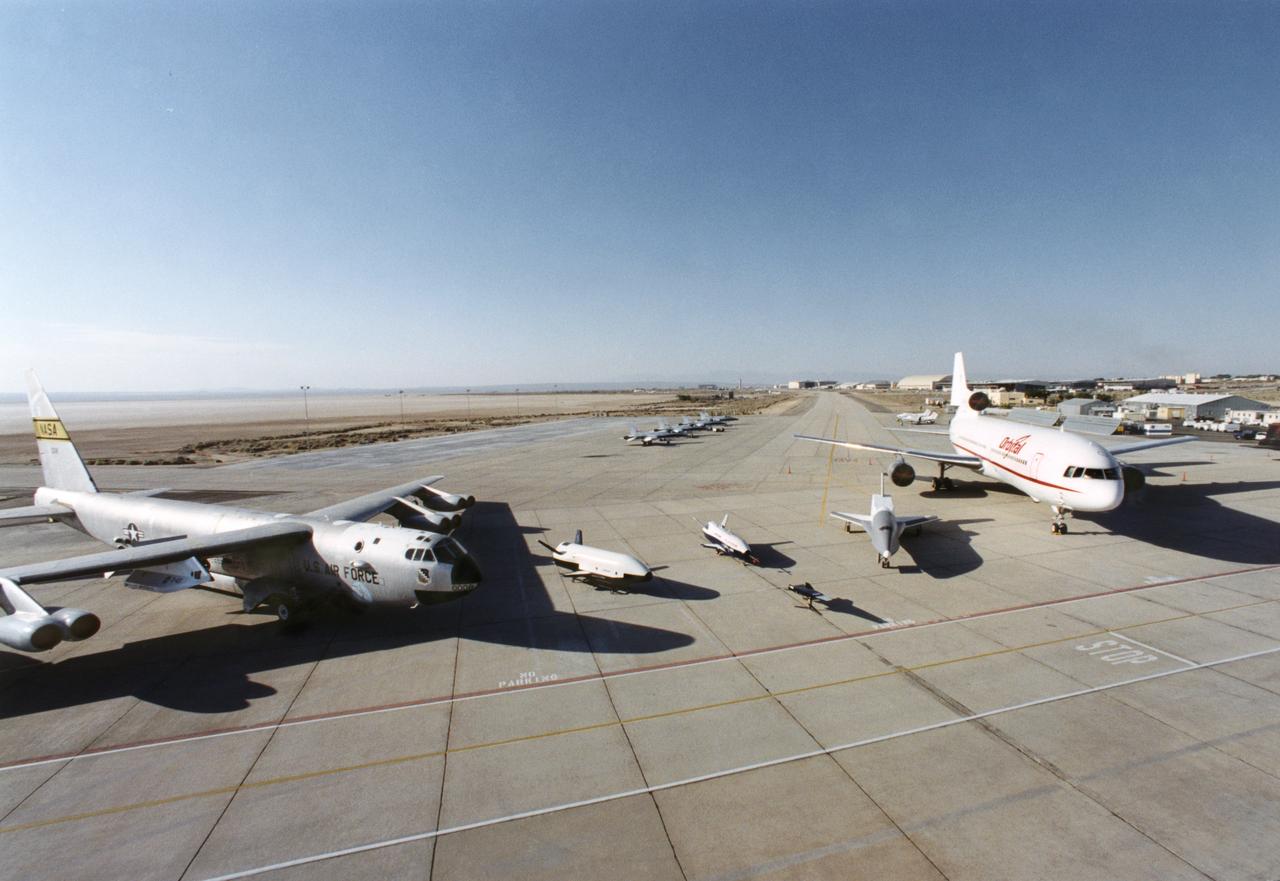
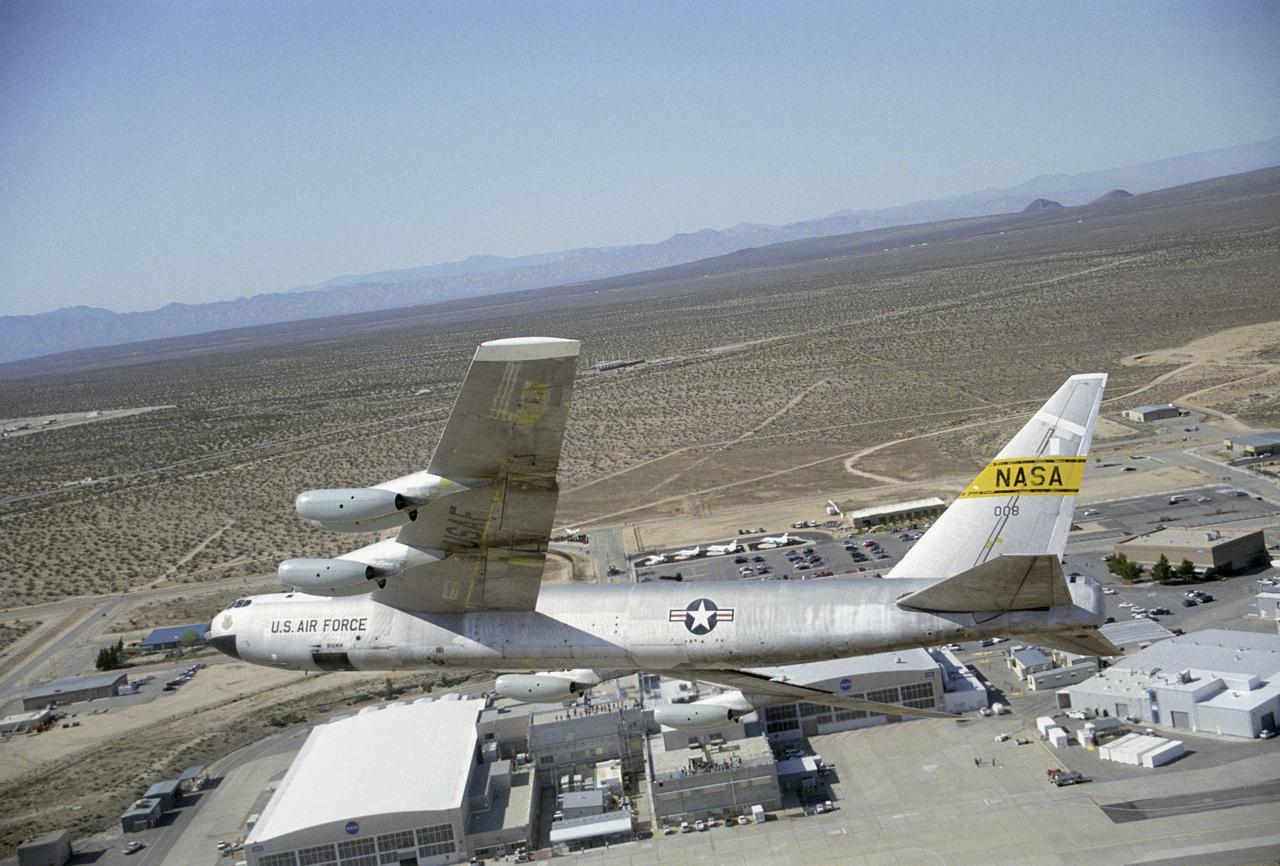
Aerospace industry representatives view actual and mock-up versions of 'X-Planes' intended to enhance access to space during a technical exposition on June 22, 2000 at Dryden Flight Research Center, Edwards, California. From left to right: NASA's B-52 launch aircraft, in service with NASA from 1959 to 2004; a neutral-buoyancy model of the Boeing's X-37; the Boeing X-40A behind the MicroCraft X-43 mock-up; Orbital Science's X-34 and the modified Lockheed L-1011 airliner that was intended to launch the X-34.  These X-vehicles are part of NASA's Access to Space plan intended to bring new technologies to bear in an effort to dramatically lower the cost of putting payloads in space, and near-space environments. The June 22, 2000 NASA Reusable Launch Vehicle (RLV) Technology Exposition included presentations on the history, present, and future of NASA's RLV program. Special Sessions for industry representatives highlighted the X-37 project and its related technologies. The X-37 project is managed by NASA's Marshall Space Flight Center, Huntsville, Alabama.
EC00-0198-2
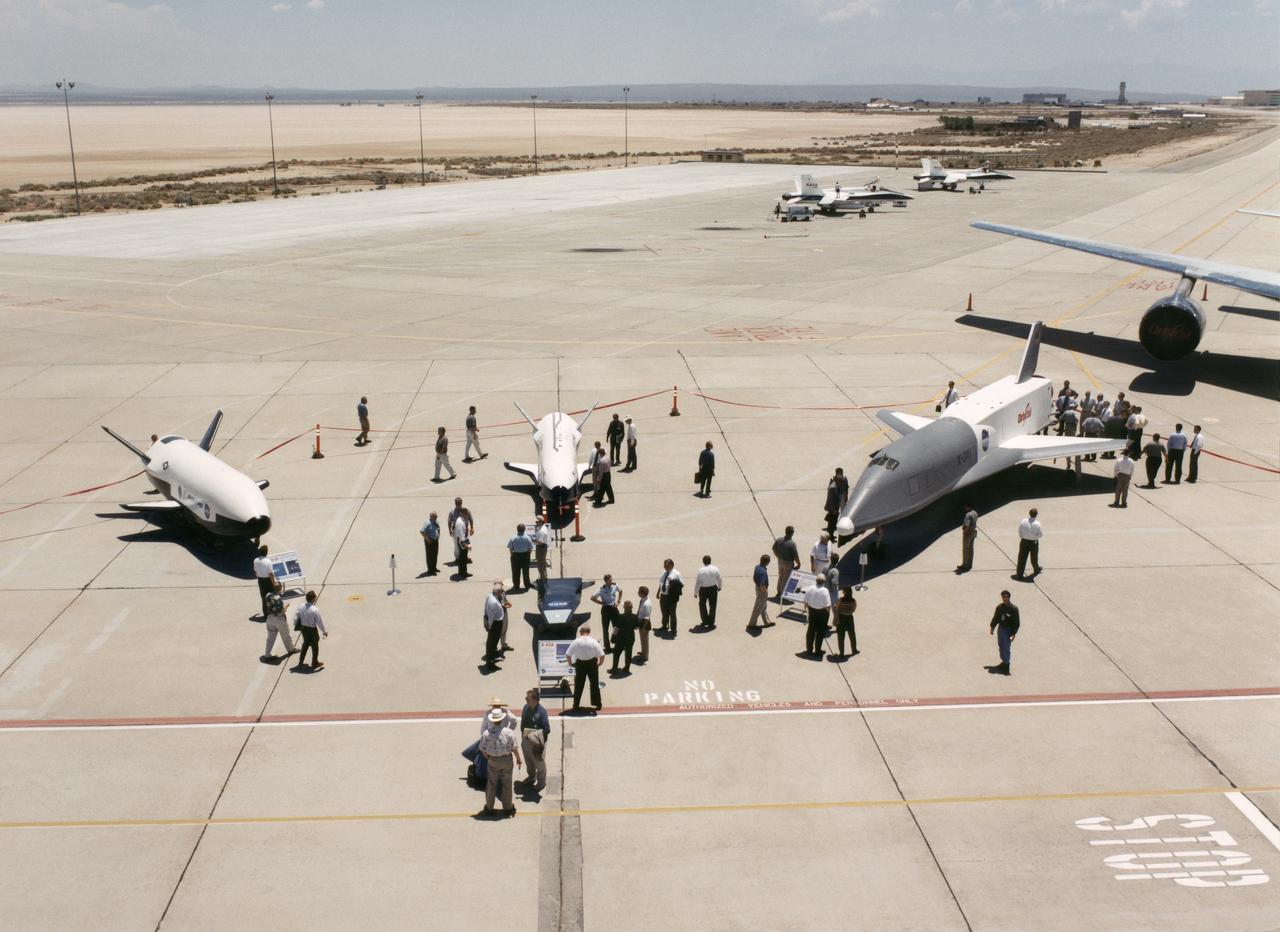
Aerospace industry representatives view actual and mock-up versions of 'X-Planes' intended to enhance access to space during a technical exposition on June 22, 2000 at Dryden Flight Research Center, Edwards, California. From left to right: NASA's B-52 launch aircraft, in service with NASA since 1959; a neutral-buoyancy model of the Boeing's X-37; the Boeing X-40A behind the MicroCraft X-43 mock-up; Orbital Science's X-34 and the modified Lockheed L-1011 airliner that was intended to launch the X-34. These X-vehicles are part of NASA's Access to Space plan intended to bring new technologies to bear in an effort to dramatically lower the cost of putting payloads in space, and near-space environments. The June 22, 2000 NASA Reusable Launch Vehicle (RLV) Technology Exposition included presentations on the history, present, and future of NASA's RLV program. Special Sessions for industry representatives highlighted the X-37 project and its related technologies. The X-37 project is managed by NASA's Marshall Space Flight Center, Huntsville, Alabama.
EC00-0198-85
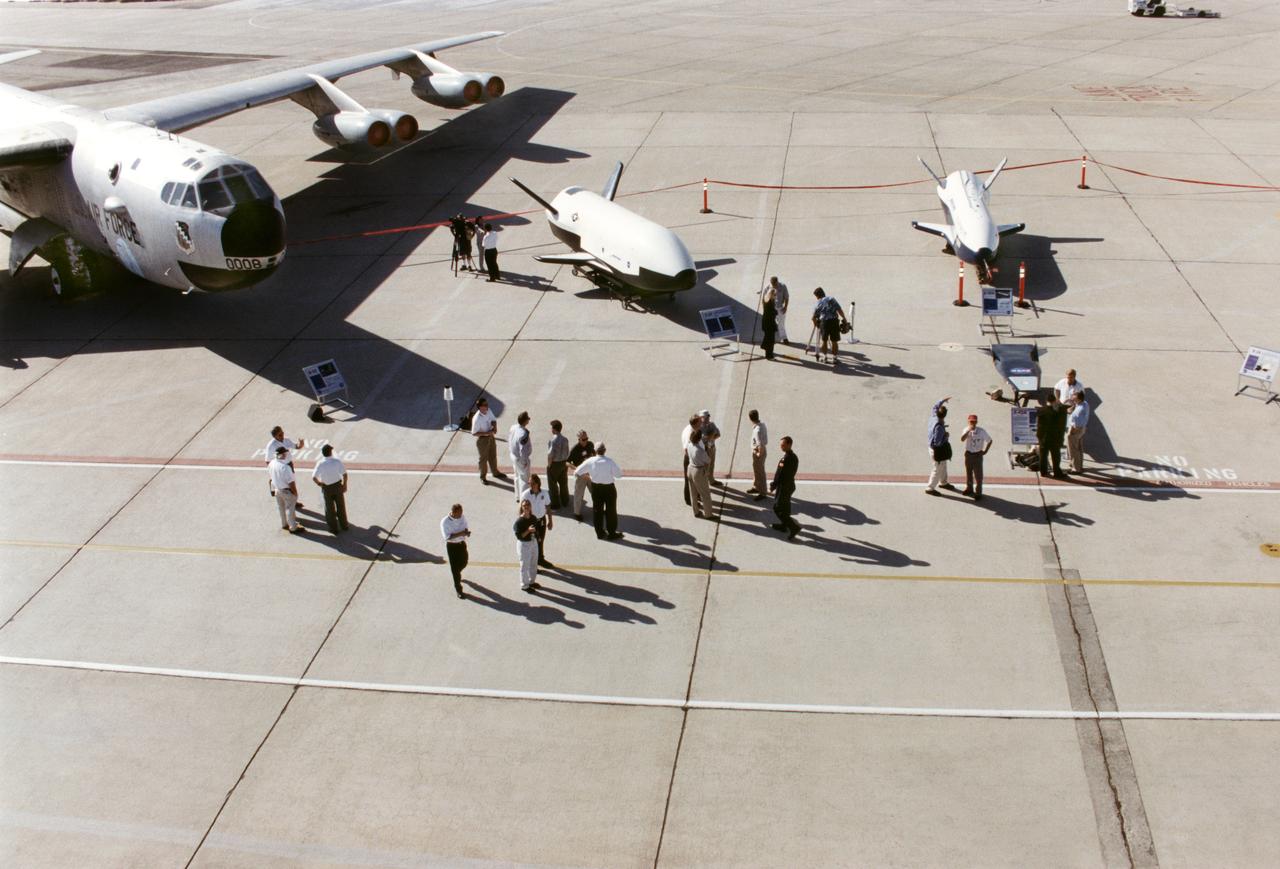
Aerospace industry representatives view actual and mock-up versions of 'X-Planes' intended to enhance access to space during a technical exposition on June 22, 2000 at Dryden Flight Research Center, Edwards, California. From left to right: NASA's B-52 launch aircraft, in service with NASA from 1959 to 2004; a neutral-buoyancy model of the Boeing's X-37; the Boeing X-40A behind the MicroCraft X-43 mock-up; Orbital Science's X-34 and the modified Lockheed L-1011 airliner that was intended to launch the X-34.  These X-vehicles are part of NASA's Access to Space plan intended to bring new technologies to bear in an effort to dramatically lower the cost of putting payloads in space, and near-space environments. The June 22, 2000 NASA Reusable Launch Vehicle (RLV) Technology Exposition included presentations on the history, present, and future of NASA's RLV program. Special Sessions for industry representatives highlighted the X-37 project and its related technologies. The X-37 project is managed by NASA's Marshall Space Flight Center, Huntsville, Alabama.
EC00-0198-1
Aerospace industry representatives view actual and mock-up versions of 'X-Planes' intended to enhance access to space during a technical exposition on June 22, 2000 at Dryden Flight Research Center, Edwards, California. From left to right: NASA's B-52 launch aircraft, in service with NASA since 1959; a neutral-buoyancy model of the Boeing's X-37; the Boeing X-40A behind the MicroCraft X-43 mock-up; Orbital Science's X-34 and the modified Lockheed L-1011 airliner that was intended to launch the X-34.  These X-vehicles are part of NASA's Access to Space plan intended to bring new technologies to bear in an effort to dramatically lower the cost of putting payloads in space, and near-space environments. The June 22, 2000 NASA Reusable Launch Vehicle (RLV) Technology Exposition included presentations on the history, present, and future of NASA's RLV program. Special Sessions for industry representatives highlighted the X-37 project and its related technologies. The X-37 project is managed by NASA's Marshall Space Flight Center, Huntsville, Alabama.
EC00-0198-102
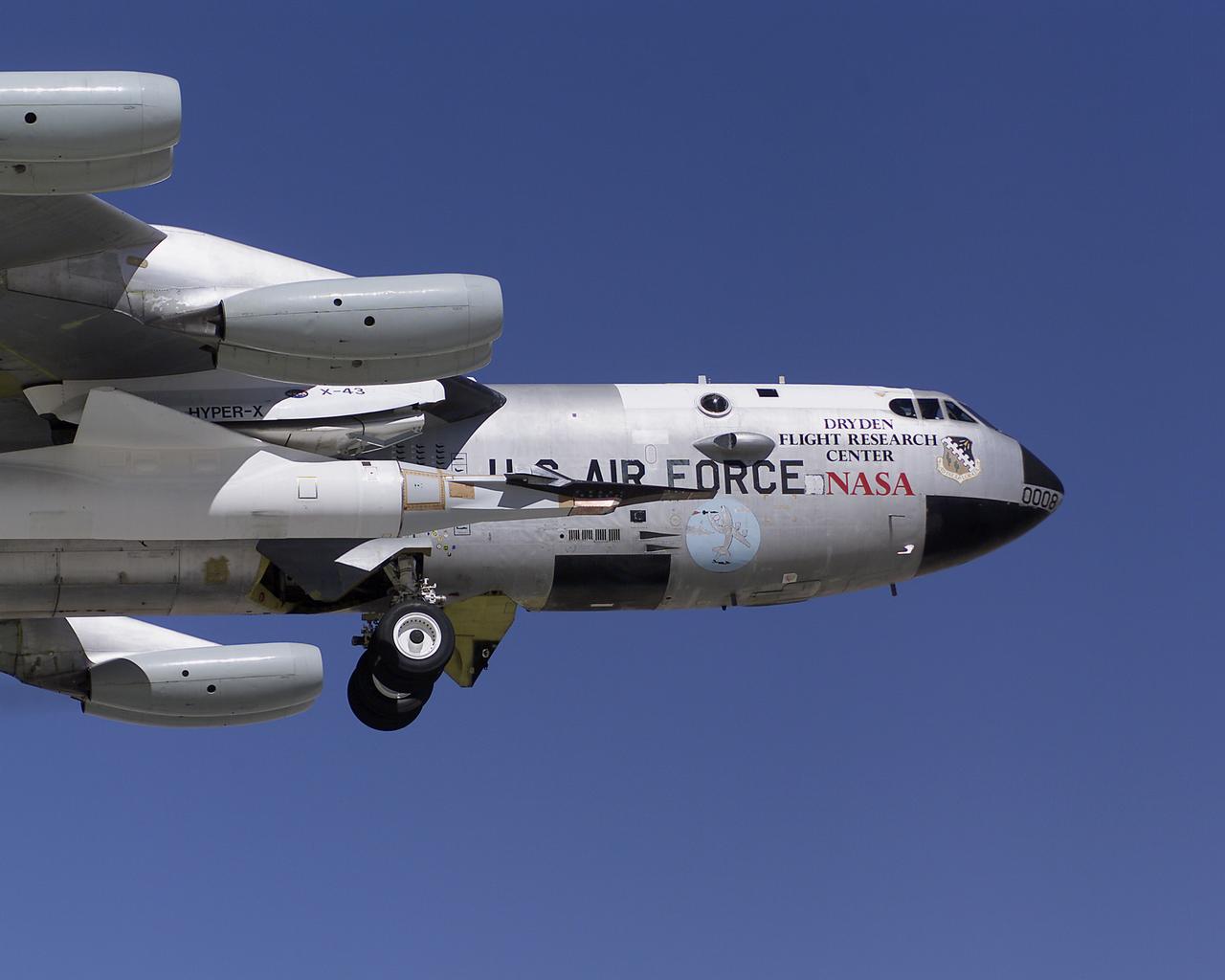
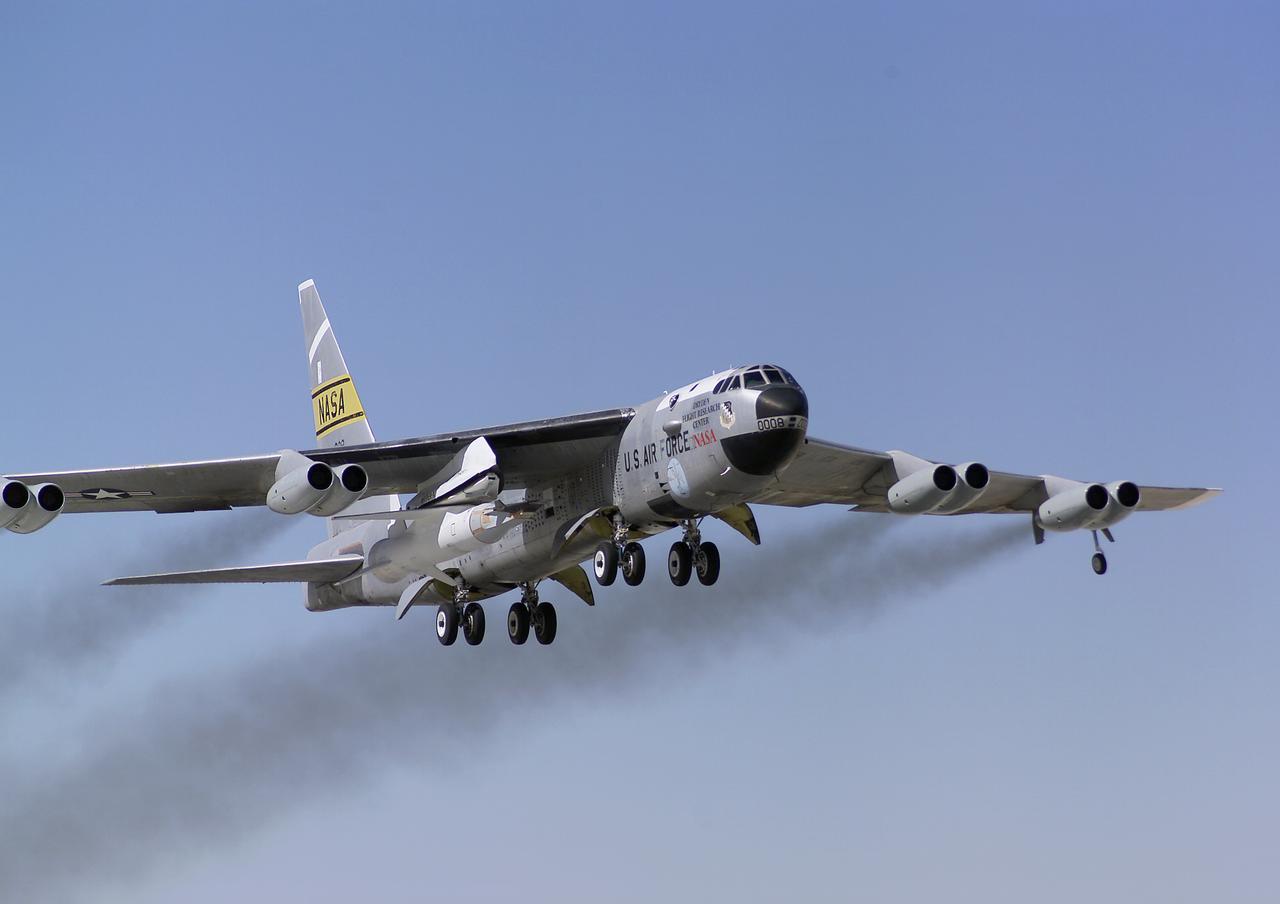
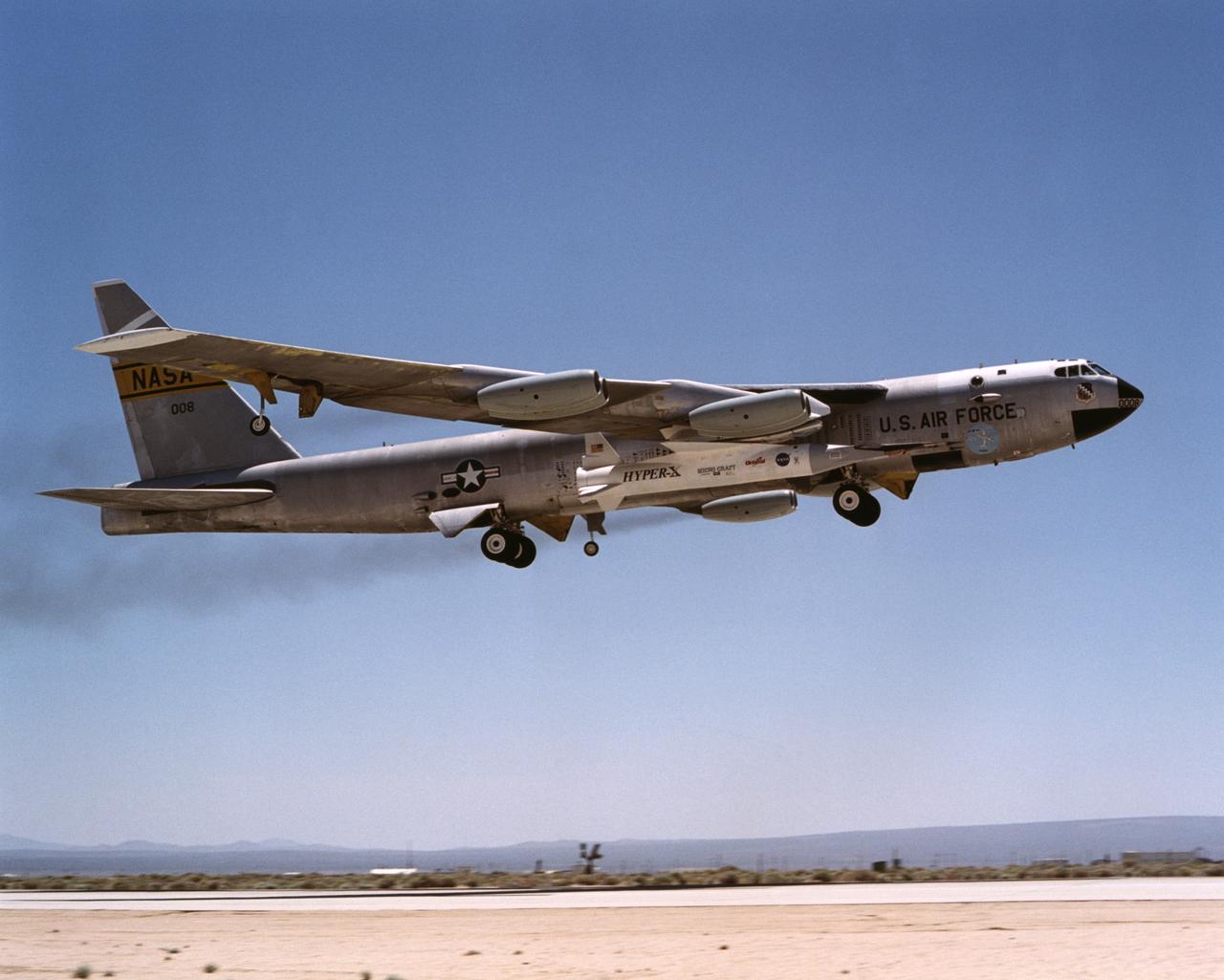
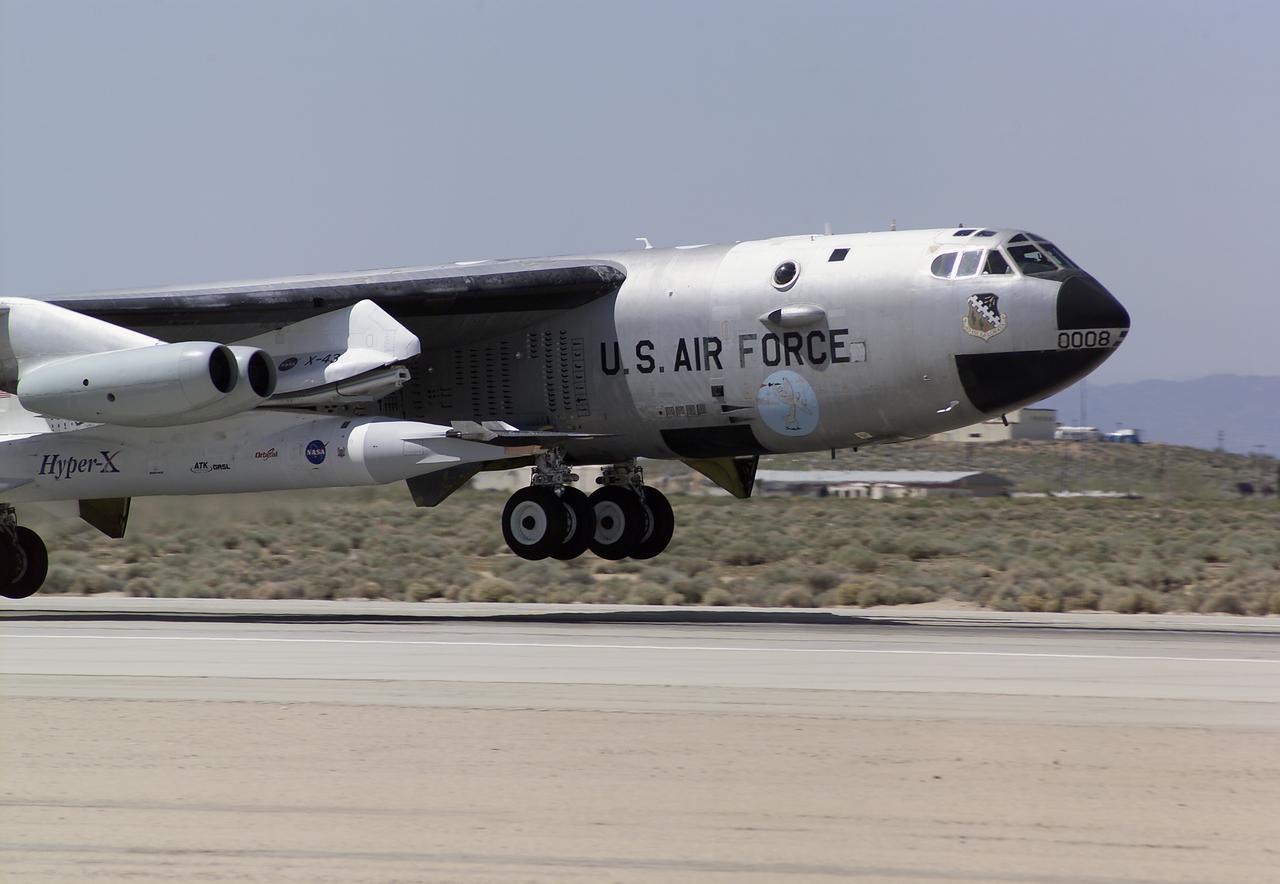
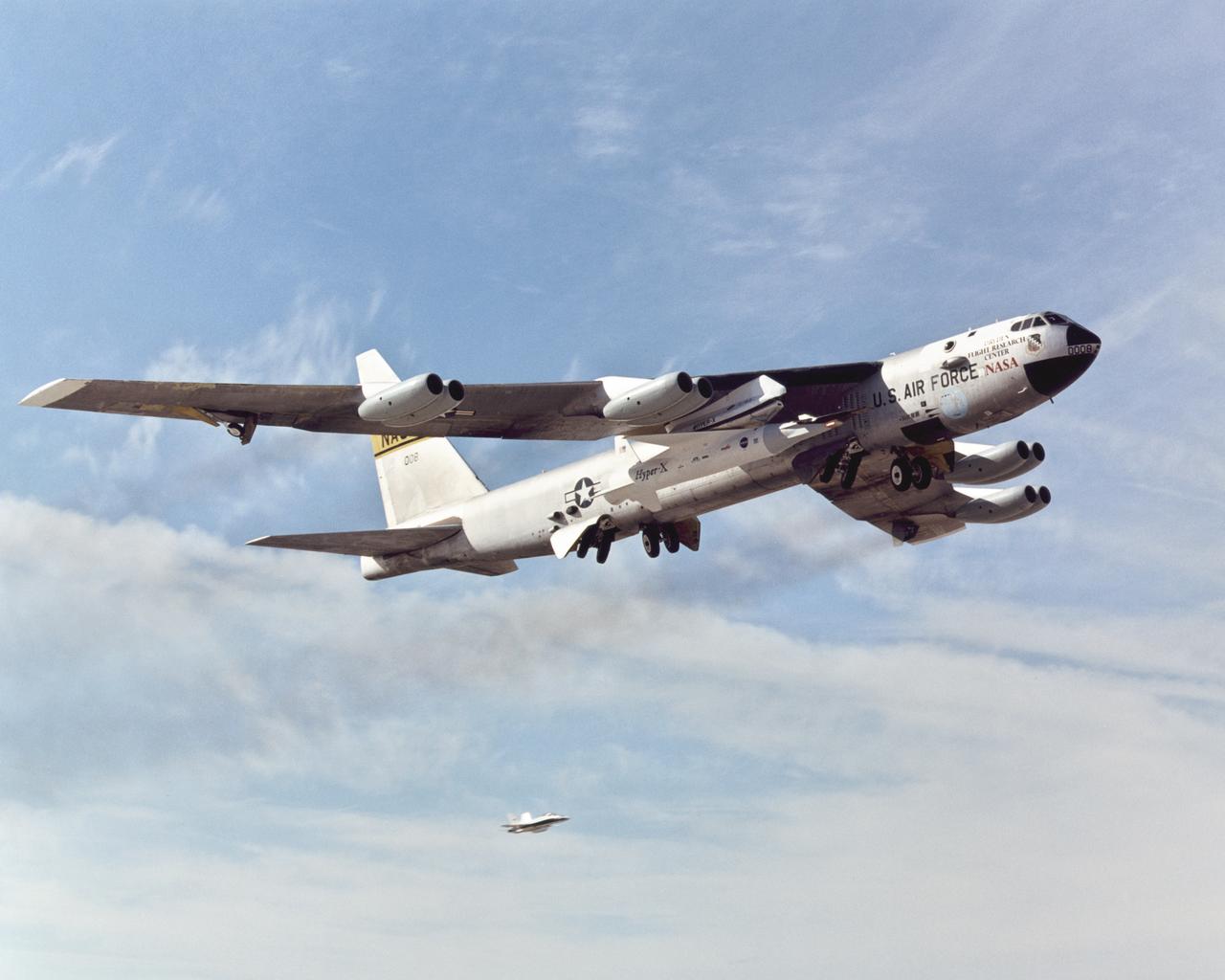
Attached to the same B-52B mothership that once launched X-15 research aircraft in the 1960s, NASA's third X-43A performed a captive carry evaluation flight from Edwards Air Force Base, California on September 27, 2004. The X-43 remained mated to the B-52 throughout this mission, intended to check its readiness for launch scheduled later in the fall.
NASA's B-52B launch aircraft takes off carrying the third X-43A hypersonic research vehicle on a captive carry evaluation flight September 27, 2004
Attached to the same B-52B mothership that once launched X-15 research aircraft in the 1960s, NASA's third X-43A performed a captive carry evaluation flight from Edwards Air Force Base, California on September 27, 2004. The X-43 remained mated to the B-52 throughout this mission, intended to check its readiness for launch scheduled later in the fall.
NASA's B-52B launch aircraft takes off carrying the third X-43A hypersonic research vehicle on a captive carry evaluation flight September 27, 2004
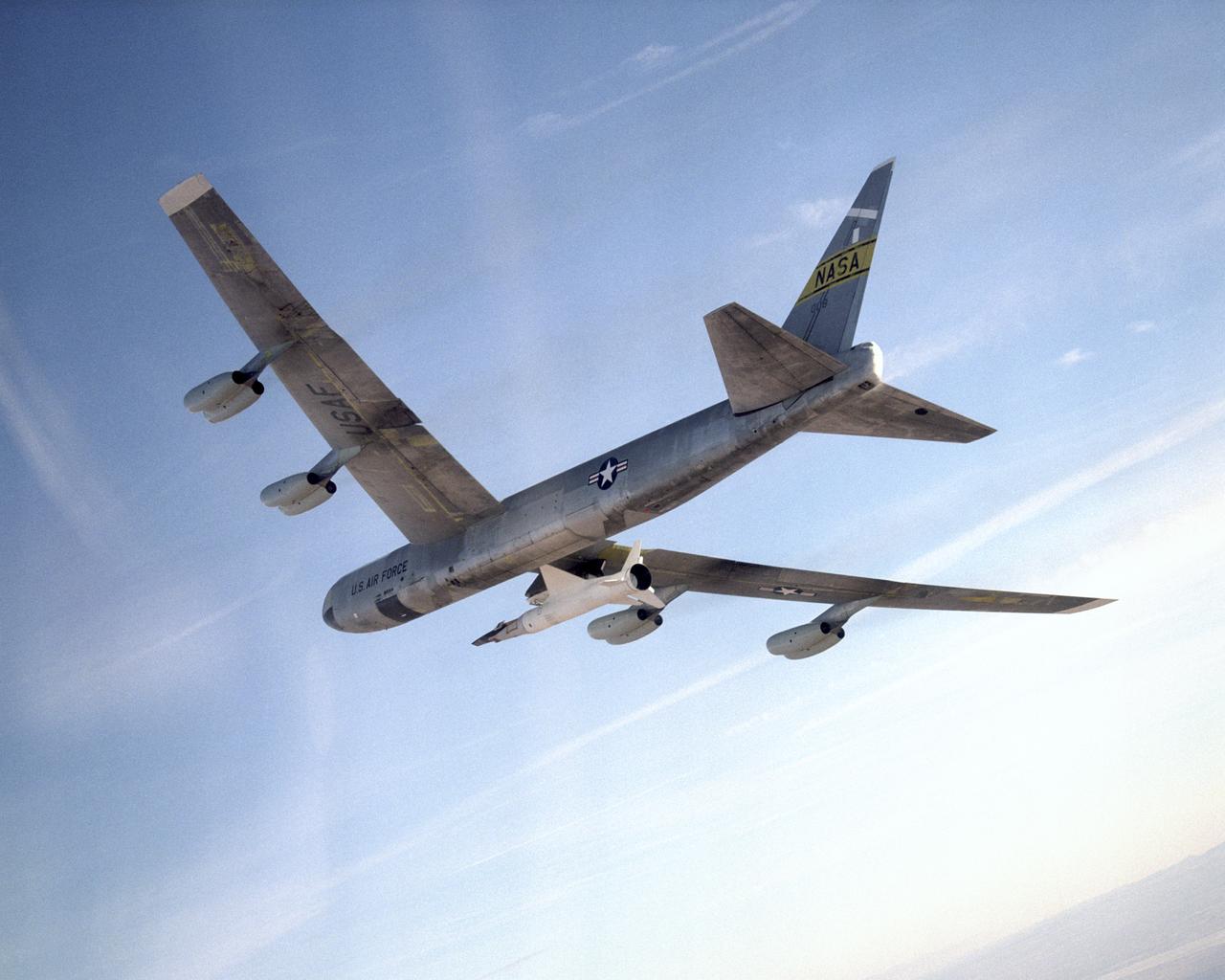
Hitching a ride on the same B-52 mother ship that once launched X-15 research aircraft in the 1960s, NASA's X-43A scramjet and it's Pegasus booster rocket performed a captive carry evaluation flight from Edwards Air Force Base, California, January 26, 2004. The X-43 and it's booster remained mated to the B-52 throughout this mission, intended to check its readiness for launch. The hydrogen-fueled aircraft is autonomous and has a wingspan of approximately 5 feet, measures 12 feet long and weighs about 2,800 pounds.
Hitching a ride on NASA's B-52 mother ship, the X-43A scramjet performed a captive carry evaluation flight from Edwards Air Force Base, California, January 26, 2004
Hitching a ride on the same B-52 mother ship that once launched X-15 research aircraft in the 1960s, NASA's X-43A scramjet and it's Pegasus booster rocket performed a captive carry evaluation flight from Edwards Air Force Base, California, January 26, 2004. The X-43 and it's booster remained mated to the B-52 throughout this mission, intended to check its readiness for launch. The hydrogen-fueled aircraft is autonomous and has a wingspan of approximately 5 feet, measures 12 feet long and weighs about 2,800 pounds.
Hitching a ride on NASA's B-52 mother ship, the X-43A scramjet performed a captive carry evaluation flight from Edwards Air Force Base, California, January 26, 2004
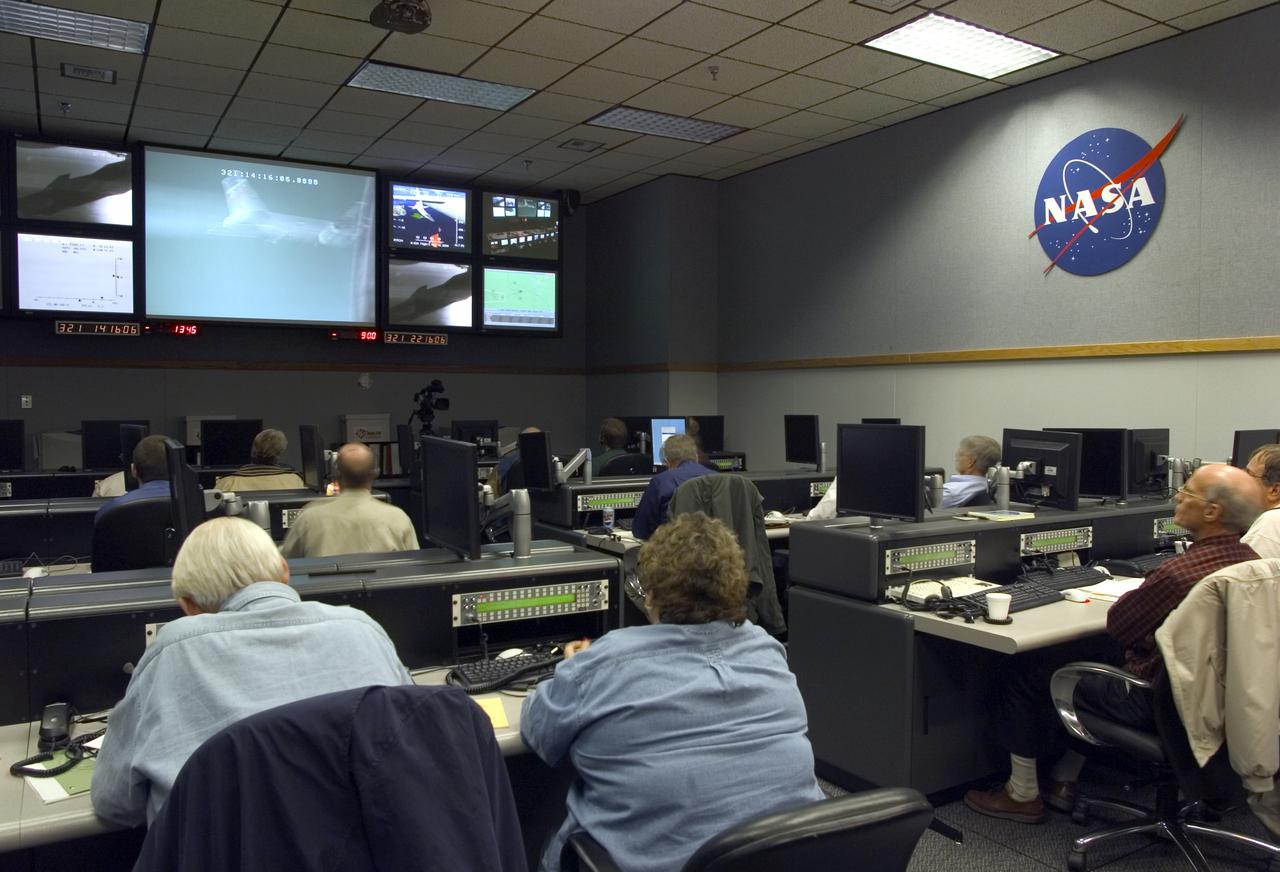
Engineers and technicians in the control room at the Dryden Flight Research Center must constantly monitor critical operations and checks during research projects like NASA's hypersonic X-43A. Visible in the photo, taken two days before the X-43's captive carry flight in January 2004, are [foreground to background]; Tony Kawano (Range Safety Officer), Brad Neal (Mission Controller), and Griffin Corpening (Test Conductor).
Engineers and technicians in the control room at the Dryden Flight Research Center must constantly monitor critical operations and checks during research projects like NASA's hypersonic X-43A
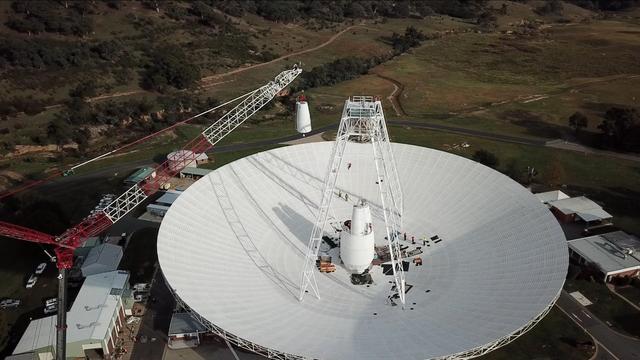
In a delicate operation, a 400-ton crane lifts the new X-band cone into the 70-meter (230-foot) Deep Space Network's Deep Space Station 43 (DSS-43) dish in Canberra, Australia. The new cone houses upgraded receiver and transmitter equipment for the 48-year-old antenna. One of several antennas located at the Canberra site, DSS-43 is the largest and responsible for transmitting commands to NASA's Voyager spacecraft. Since early March 2020, DSS43 has been offline for upgrades, which are expected to continue until January 2021.  https://photojournal.jpl.nasa.gov/catalog/PIA23796
Swinging the Cone Into Place
The first X-43A hypersonic research aircraft and its modified Pegasus booster rocket were carried aloft by NASA's NB-52B carrier aircraft from Dryden Flight Research Center at Edwards Air Force Base, Calif., on June 2, 2001 for the first of three high-speed free flight attempts. About an hour and 15 minutes later the Pegasus booster was released from the B-52 to accelerate the X-43A to its intended speed of Mach 7. Before this could be achieved, the combined Pegasus and X-43A "stack" lost control about eight seconds after ignition of the Pegasus rocket motor. The mission was terminated and explosive charges ensured the Pegasus and X-43A fell into the Pacific Ocean in a cleared Navy range area. A NASA investigation board is being assembled to determine the cause of the incident. Work continues on two other X-43A vehicles, the first of which could fly by late 2001. Central to the X-43A program is its integration of an air-breathing "scramjet" engine that could enable a variety of high-speed aerospace craft, and promote cost-effective access to space. The 12-foot, unpiloted research vehicle was developed and built for NASA by MicroCraft Inc., Tullahoma, Tenn. The booster was built by Orbital Sciences Corp. at Chandler, Ariz.
Moments after release from NASA's B-52 carrier aircraft, the X-43A/Pegasus "stack" is seen before ignition of the Pegasus rocket motor on
The first X-43A hypersonic research aircraft and its modified Pegasus booster rocket were carried aloft by NASA's NB-52B carrier aircraft from Dryden Flight Research Center at Edwards Air Force Base, Calif., on June 2, 2001 for the first of three high-speed free flight attempts. About an hour and 15 minutes later the Pegasus booster was released from the B-52 to accelerate the X-43A to its intended speed of Mach 7. Before this could be achieved, the combined Pegasus and X-43A "stack" lost control about eight seconds after ignition of the Pegasus rocket motor. The mission was terminated and explosive charges ensured the Pegasus and X-43A fell into the Pacific Ocean in a cleared Navy range area. A NASA investigation board is being assembled to determine the cause of the incident. Work continues on two other X-43A vehicles, the first of which could fly by late 2001. Central to the X-43A program is its integration of an air-breathing "scramjet" engine that could enable a variety of high-speed aerospace craft, and promote cost-effective access to space. The 12-foot, unpiloted research vehicle was developed and built for NASA by MicroCraft Inc., Tullahoma, Tenn. The booster was built by Orbital Sciences Corp. at Chandler, Ariz.
X-43A departs NASA Dryden Flight Research Center for first free-flight attempt
The first X-43A hypersonic research aircraft and its modified Pegasus booster rocket were carried aloft by NASA's NB-52B carrier aircraft from Dryden Flight Research Center at Edwards Air Force Base, Calif., on June 2, 2001 for the first of three high-speed free flight attempts. About an hour and 15 minutes later the Pegasus booster was released from the B-52 to accelerate the X-43A to its intended speed of Mach 7. Before this could be achieved, the combined Pegasus and X-43A "stack" lost control about eight seconds after ignition of the Pegasus rocket motor. The mission was terminated and explosive charges ensured the Pegasus and X-43A fell into the Pacific Ocean in a cleared Navy range area. A NASA investigation board is being assembled to determine the cause of the incident. Work continues on two other X-43A vehicles, the first of which could fly by late 2001. Central to the X-43A program is its integration of an air-breathing "scramjet" engine that could enable a variety of high-speed aerospace craft, and promote cost-effective access to space. The 12-foot, unpiloted research vehicle was developed and built for NASA by MicroCraft Inc., Tullahoma, Tenn. The booster was built by Orbital Sciences Corp. at Chandler, Ariz.
Ignition of the Pegasus rocket moments after release from the B-52 signaled acceleration of the X-43A/Pegasus combination over the Pacific Ocean
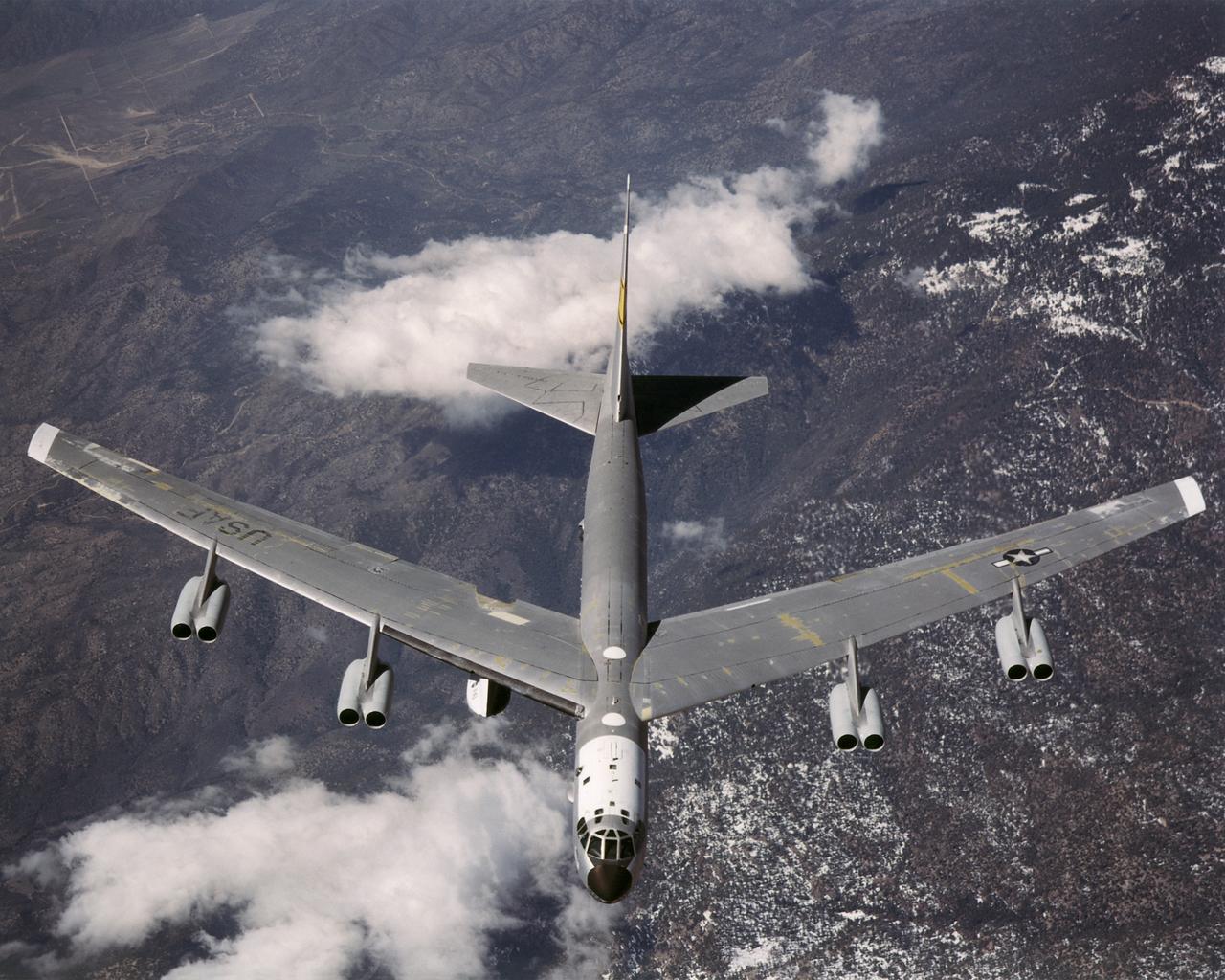
NASA's historic B-52 mothership carried the X-43A and its Pegasus booster rocket on a captive carry flight from Edwards Air Force Base.
NASA's historic B-52 mothership carried the X-43A and its Pegasus booster rocket on a captive carry flight from Edwards Air Force Base
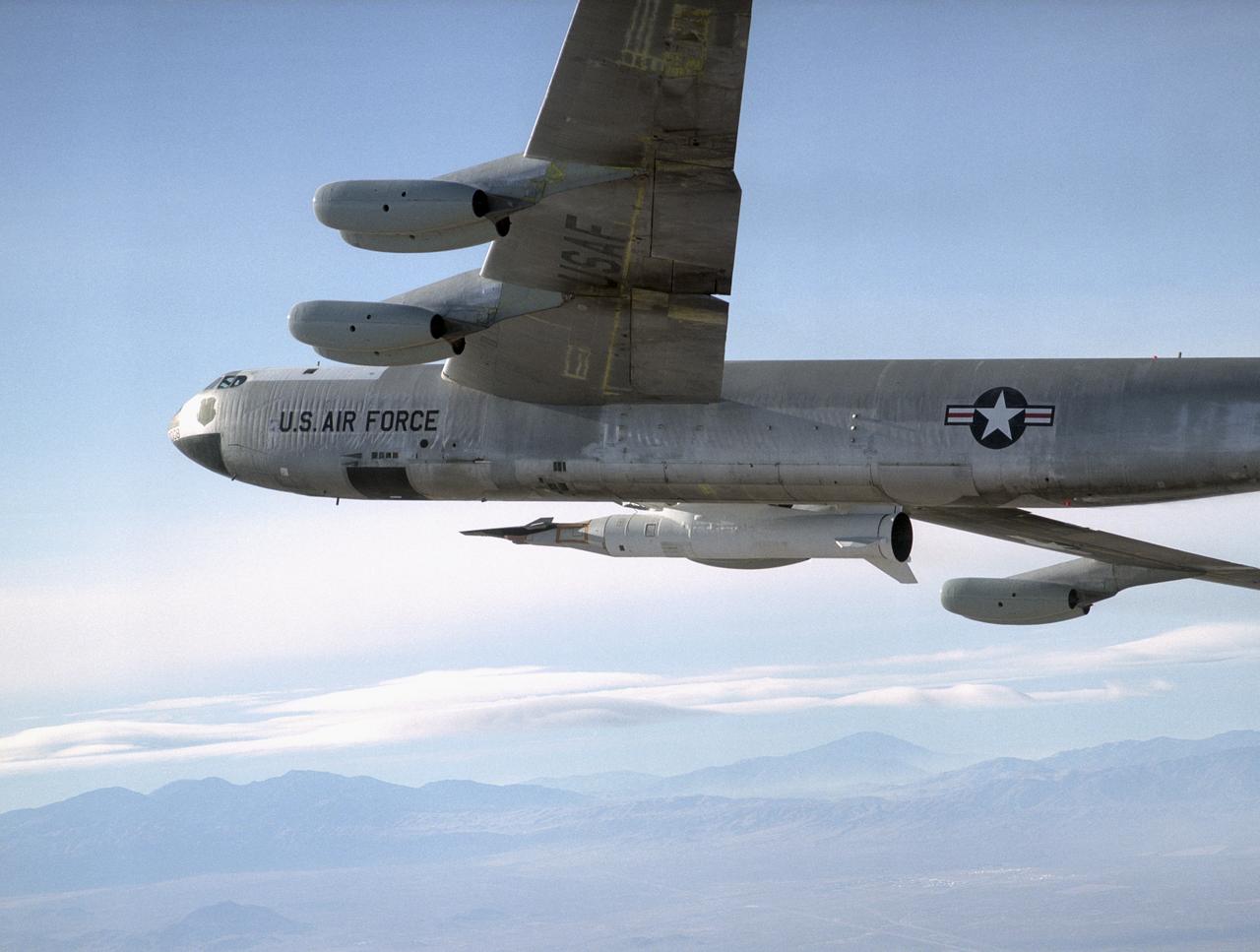
NASA's historic B-52 mother ship carried the X-43A and its Pegasus booster rocket on a captive carry flight from Edwards Air Force Base Jan. 26, 2004. The X-43A and its booster remained mated to the B-52 throughout the two-hour flight, intended to check its readiness for launch. The hydrogen-fueled aircraft is autonomous and has a wingspan of approximately 5 feet, measures 12 feet long and weighs about 2,800 pounds.
NASA's B-52 mother ship carries the X-43A and its booster rocket on a captive carry flight Jan. 26, 2004
NASA's historic B-52 mother ship carried the X-43A and its Pegasus booster rocket on a captive carry flight from Edwards Air Force Base Jan. 26, 2004. The X-43A and its booster remained mated to the B-52 throughout the two-hour flight, intended to check its readiness for launch. The hydrogen-fueled aircraft is autonomous and has a wingspan of approximately 5 feet, measures 12 feet long and weighs about 2,800 pounds.
NASA's B-52 mother ship carries the X-43A and its booster rocket on a captive carry flight Jan. 26, 2004
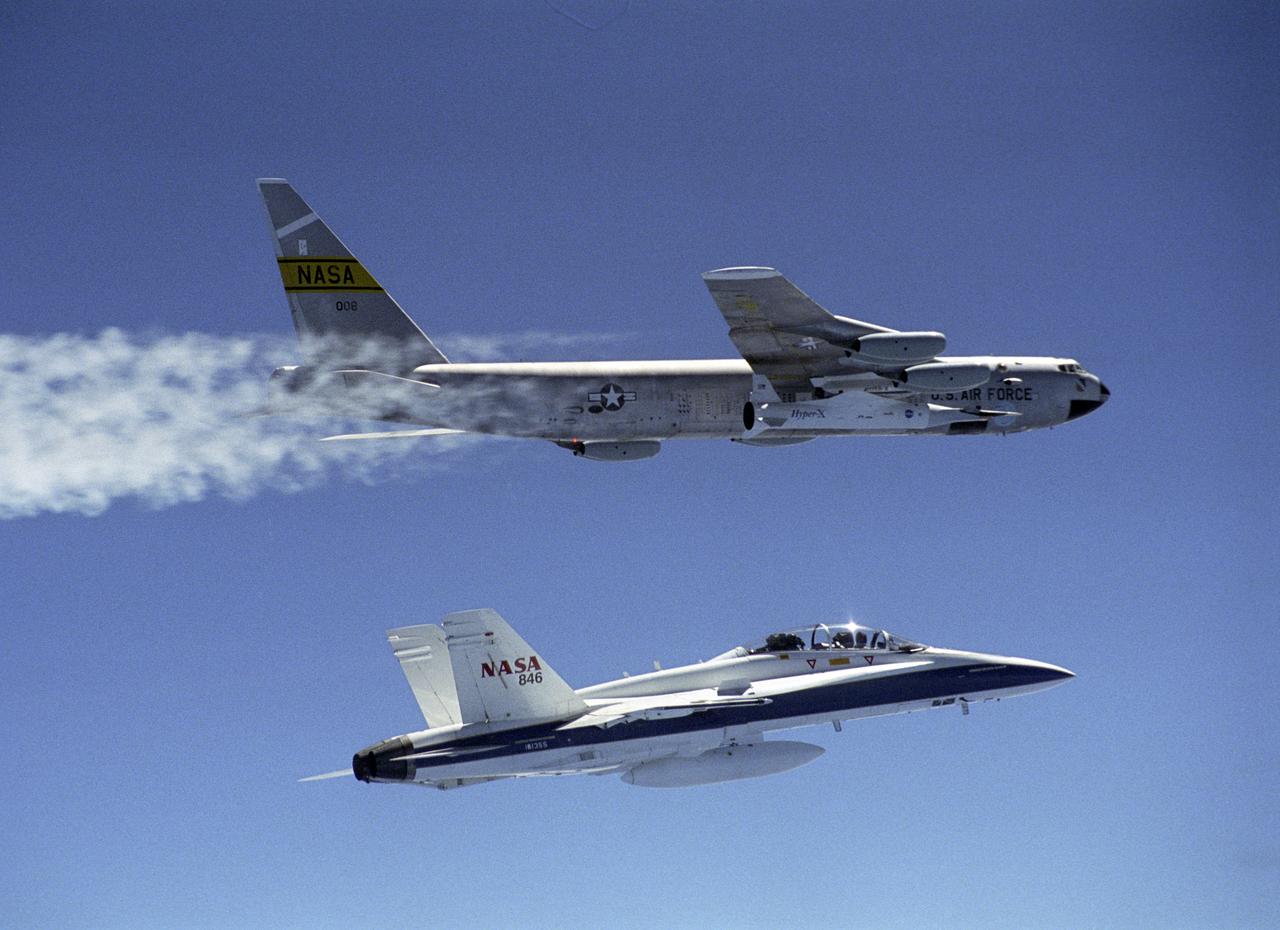
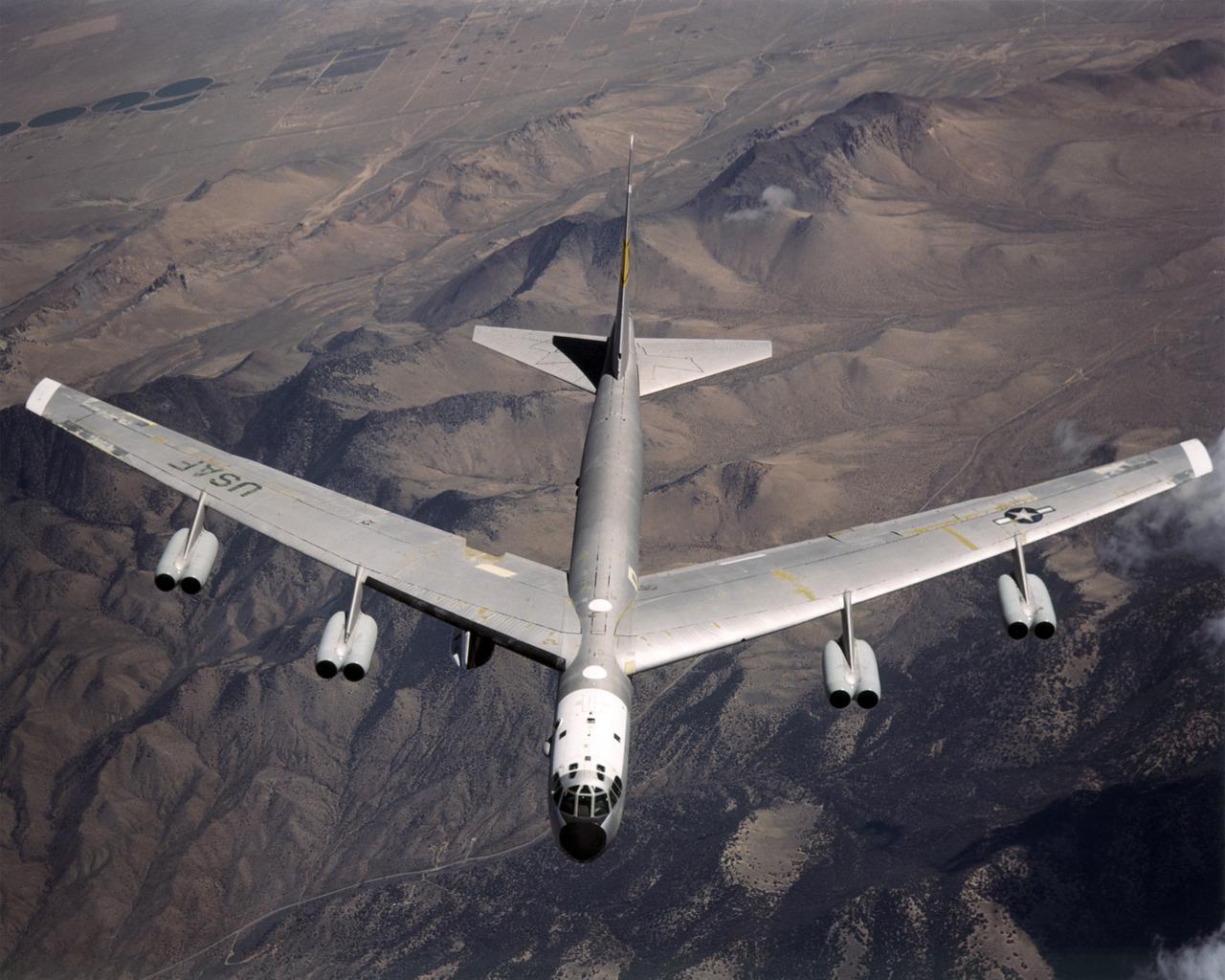
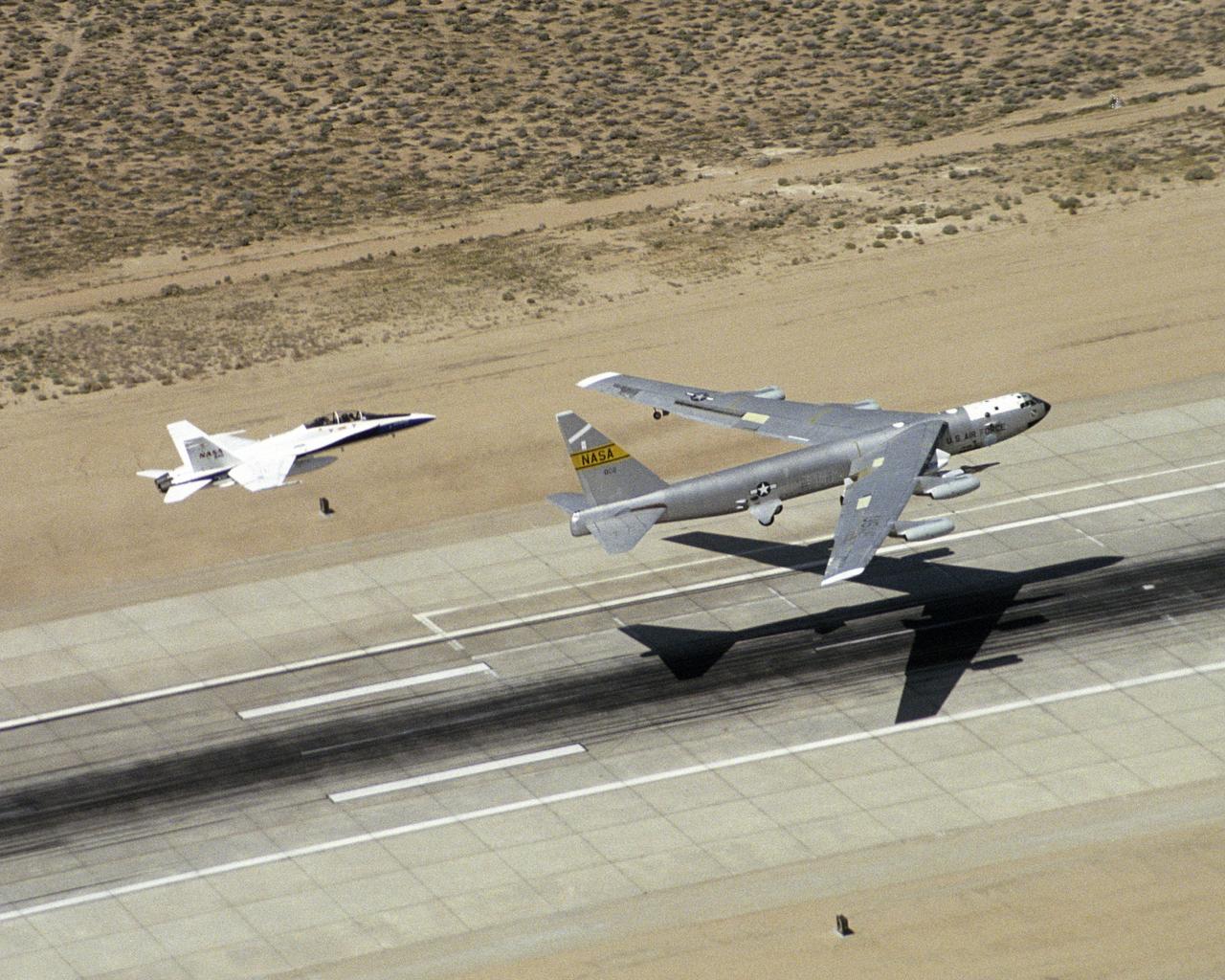
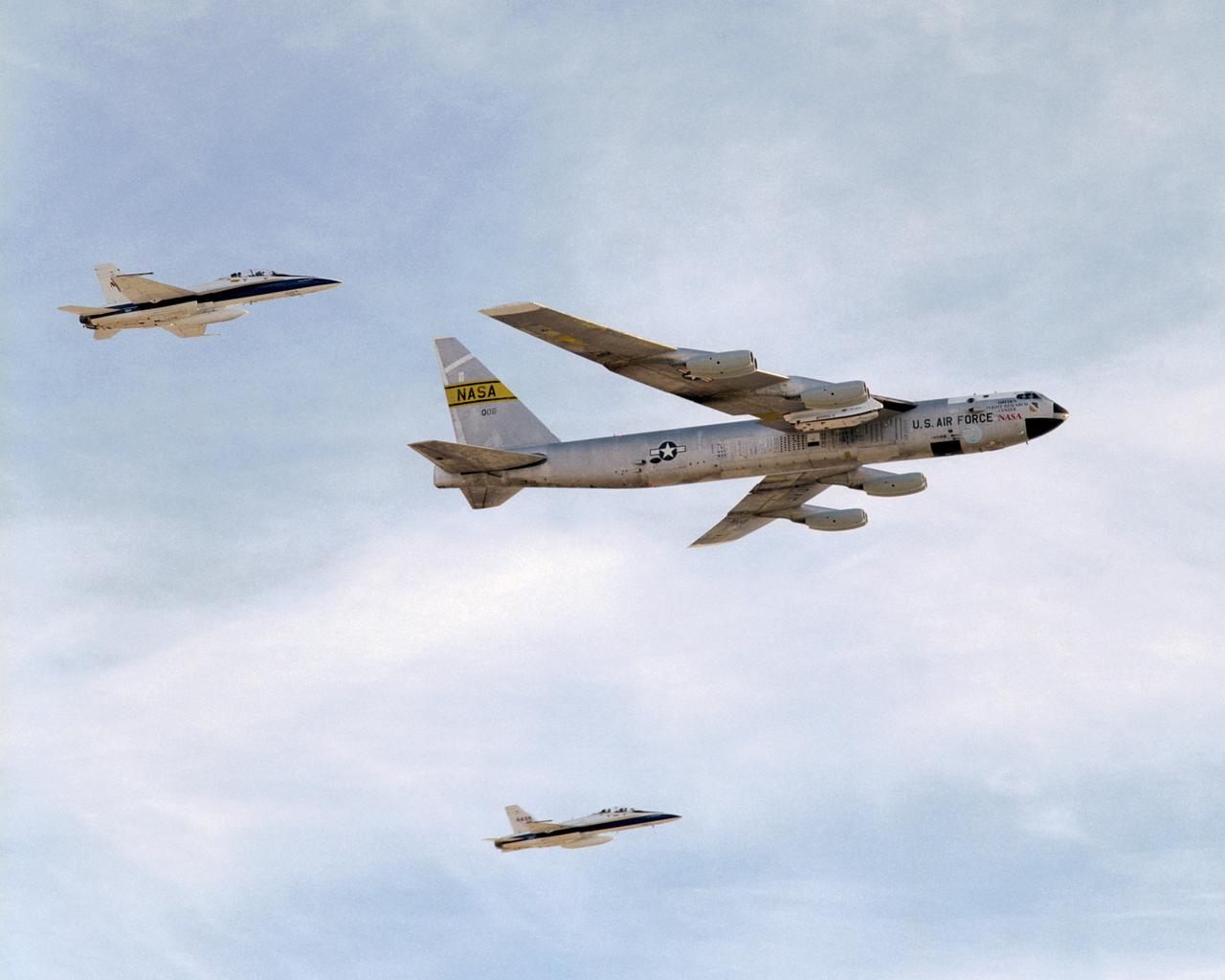
Shadowed by two F/A-18s, NASA Dryden's venerable NB-52B is saluted by employees as it makes its final flyover after the last X-43A launch in November 2004.
EC04-0327-39
NASA's historic B-52 mother ship carried the X-43A and its Pegasus booster rocket on a captive carry flight from Edwards Air Force Base Jan. 26, 2004. The X-43A and its booster remained mated to the B-52 throughout the two-hour flight, intended to check its readiness for launch. The hydrogen-fueled aircraft is autonomous and has a wingspan of approximately 5 feet, measures 12 feet long and weighs about 2,800 pounds.
NASA's B-52 mother ship carries the X-43A and its booster rocket on a captive carry flight Jan. 26, 2004
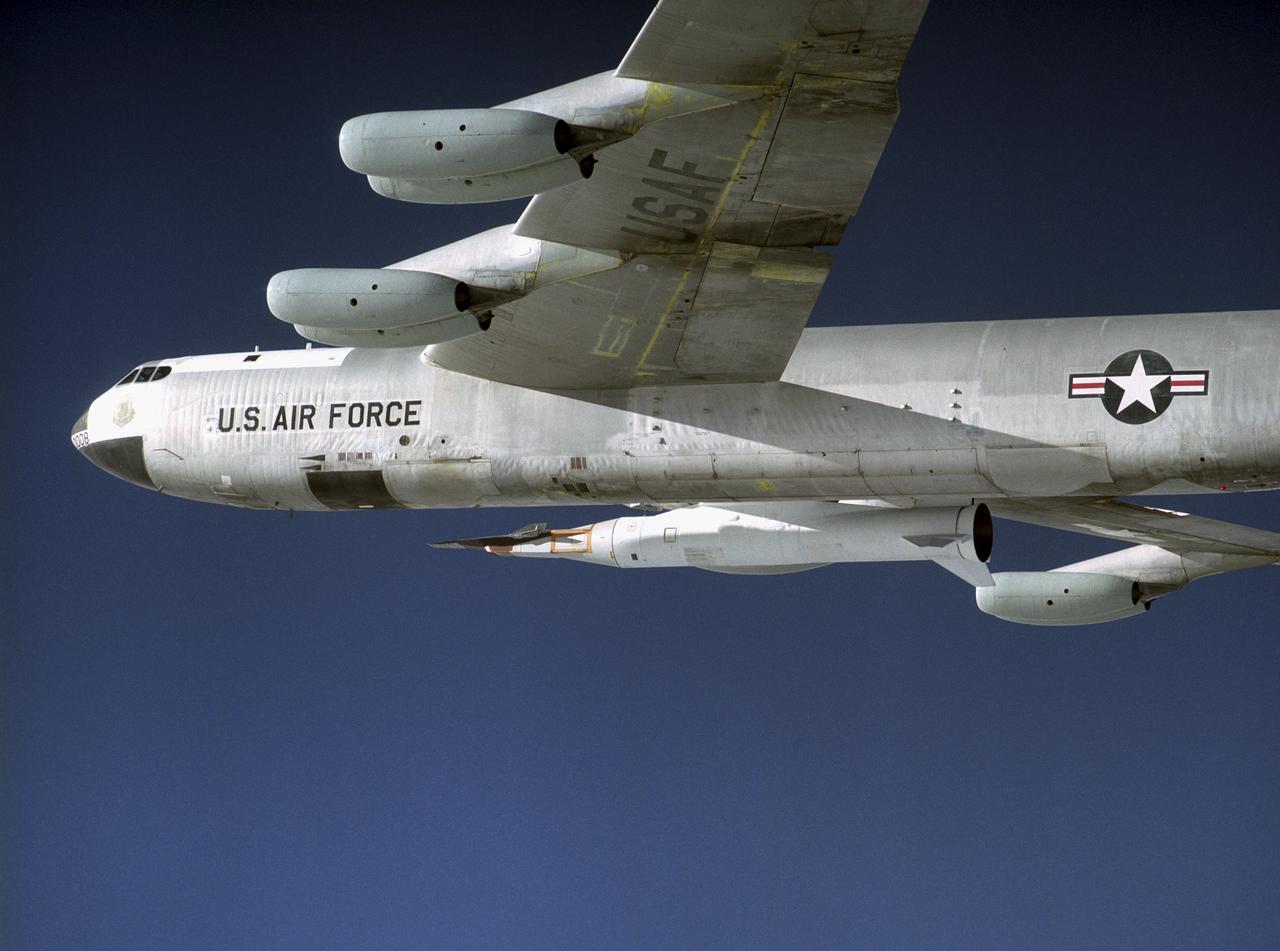
The black X-43A rides on the front of a modified Pegasus booster rocket hung from the special pylon under the wing of NASA's B-52B mother ship. The photo was taken during a captive carry flight Jan. 26, 2004 to verify systems before an upcoming launch.
The black X-43A rides on the front of a modified Pegasus booster rocket hung from the special pylon under the wing of NASA's B-52B mother ship. The photo was taken during a captive carry flight Jan. 26, 2004 to verify systems before an upcoming launch
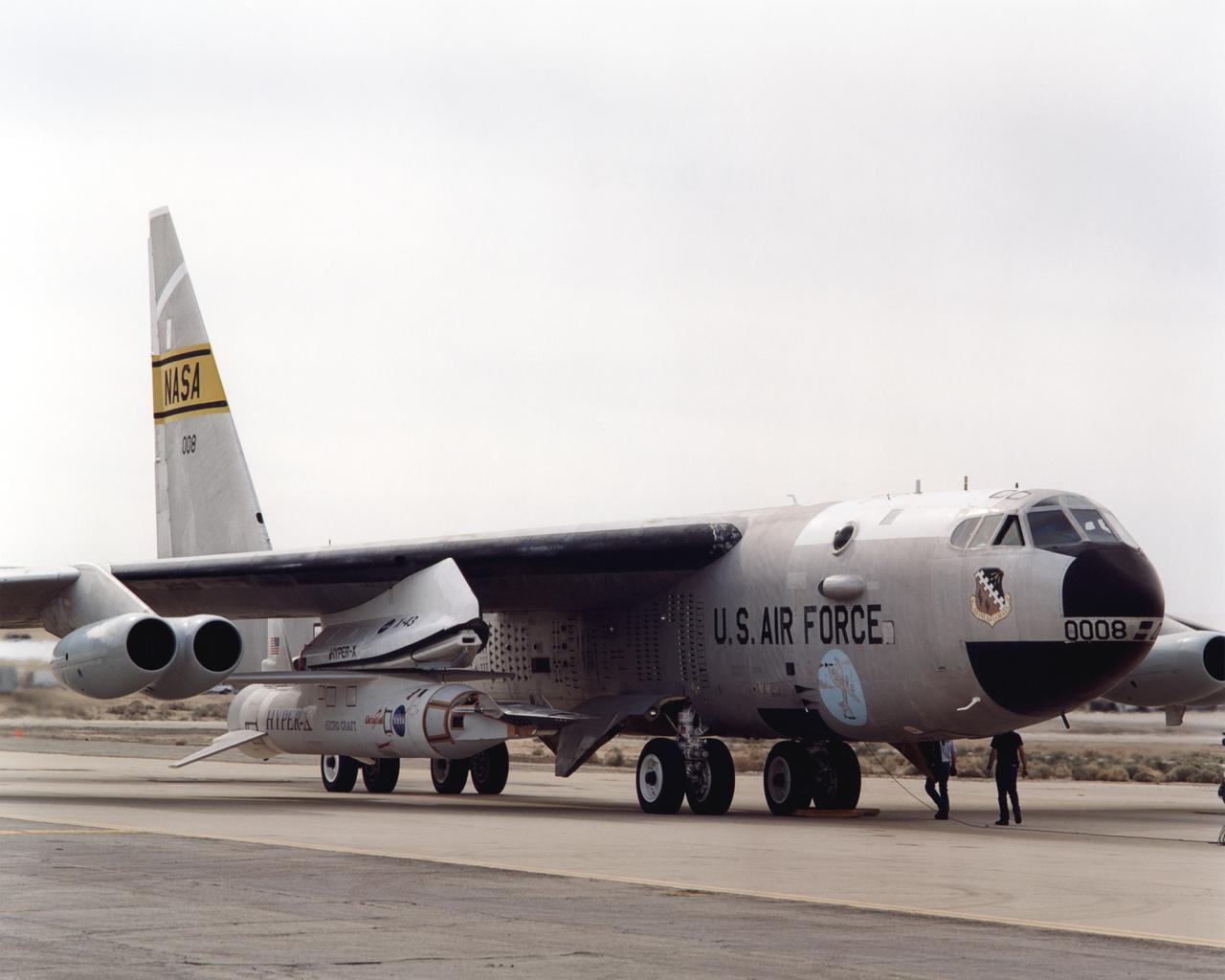
The first of three X-43A hypersonic research aircraft and its modified Pegasus® booster rocket recently underwent combined systems testing while mounted to NASA's NB-52B carrier aircraft at the Dryden Flight Research Center, Edwards, Calif. The combined systems test was one of the last major milestones in the Hyper-X research program before the first X-43A flight. The X-43A flights will be the first actual flight tests of an aircraft powered by a revolutionary supersonic-combustion ramjet ("scramjet") engine capable of operating at hypersonic speeds (above Mach 5, or five times the speed of sound). The 12-foot, unpiloted research vehicle was developed and built by MicroCraft Inc., Tullahoma, Tenn., under NASA contract. The booster was built by Orbital Sciences Corp., Dulles, Va.,After being air-launched from NASA's venerable NB-52 mothership, the booster will accelerate the X-43A to test speed and altitude. The X-43A will then separate from the rocket and fly a pre-programmed trajectory, conducting aerodynamic and propulsion experiments until it descends into the Pacific Ocean. Three research flights are planned, two at Mach 7 and one at Mach 10.
The X-43A hypersonic research aircraft and its modified Pegasus® booster rocket recently underwent combined systems testing while mounted to NASA's NB-52B carrier aircraft
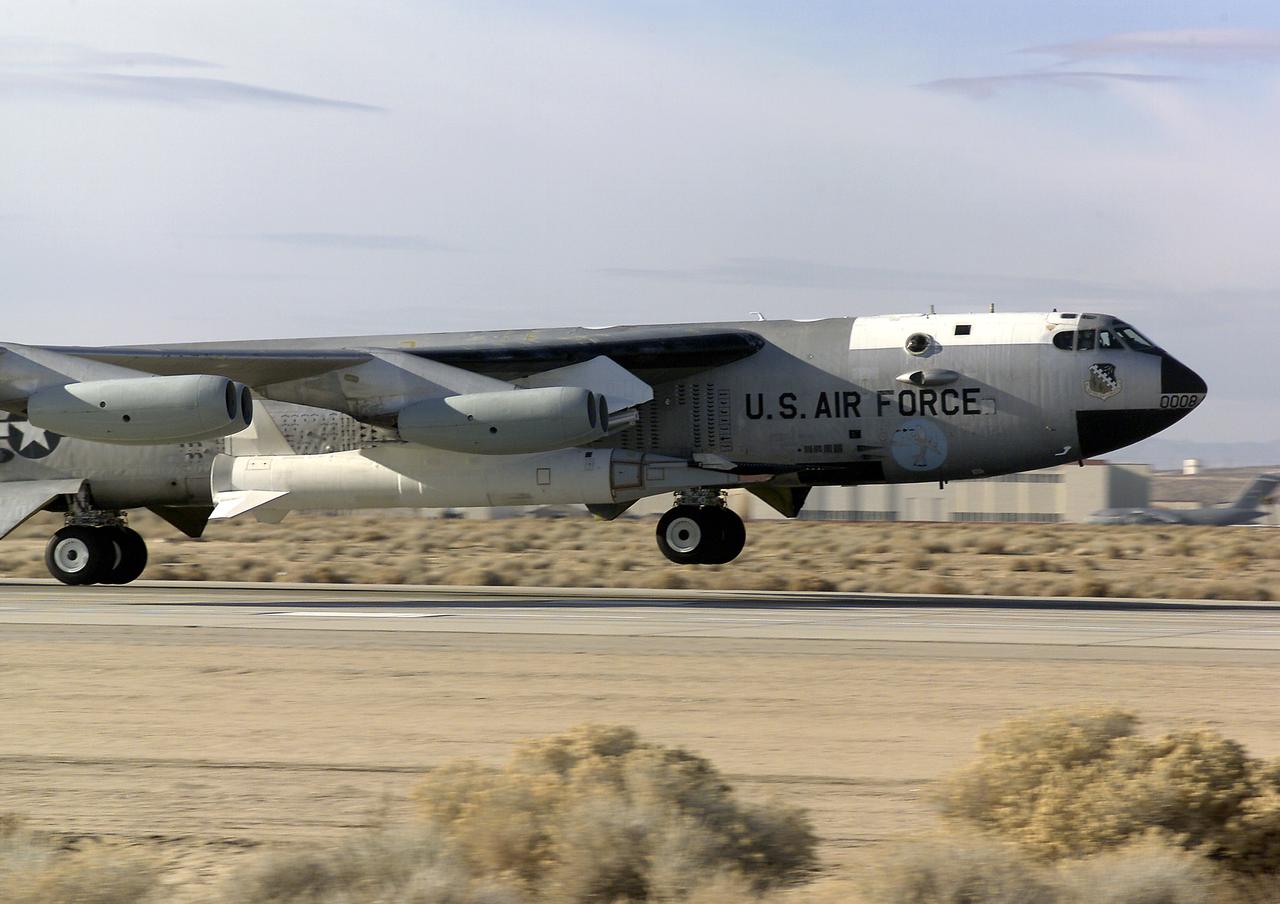
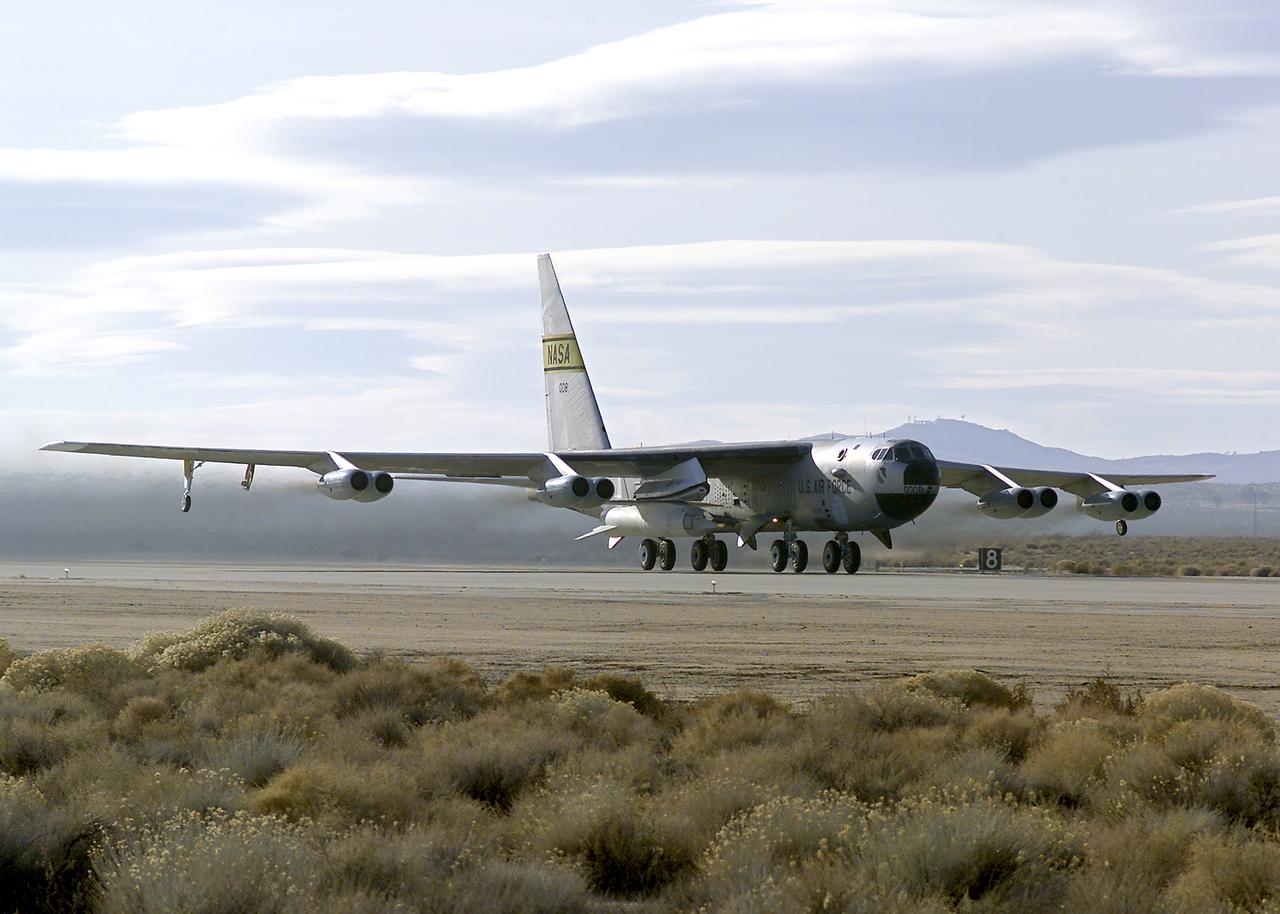
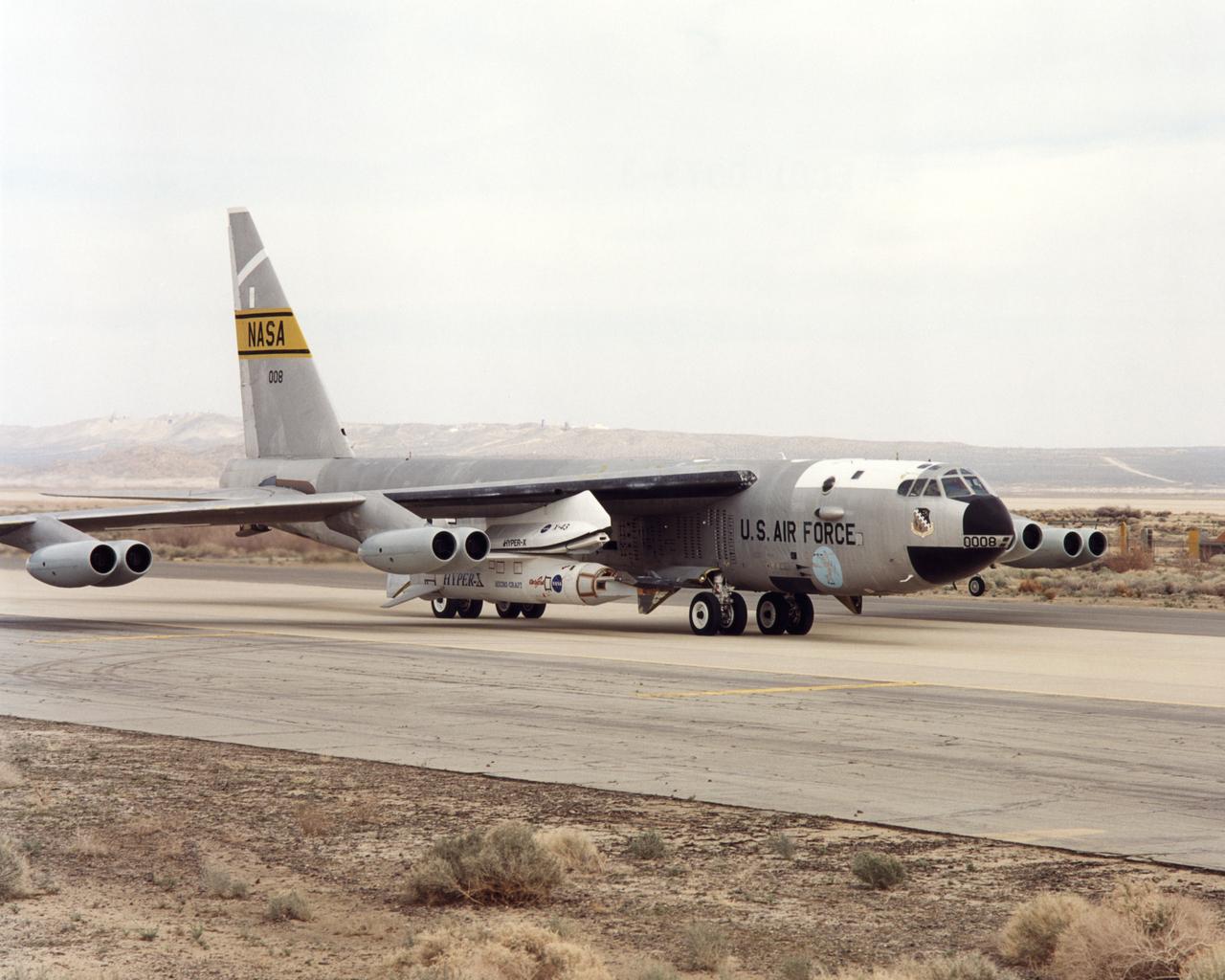
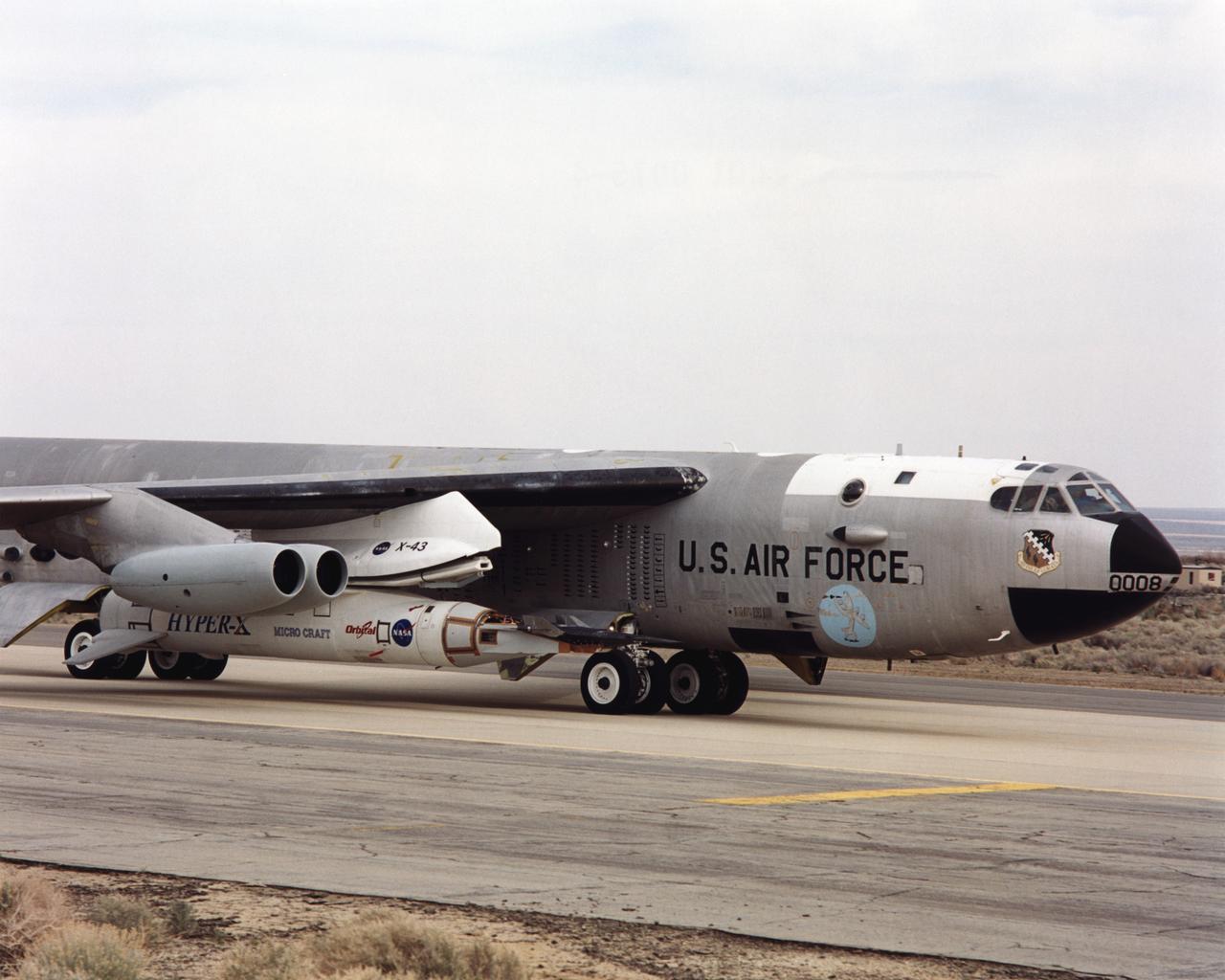
NASA's NB-52B carrier aircraft rolls down a taxiway at Edwards Air Force Base with the X-43A hypersonic research aircraft and its modified Pegasus® booster rocket slung from a pylon under its right wing. Part of a combined systems test conducted by NASA's Dryden Flight Research Center at Edwards, the taxi test was one of the last major milestones in the Hyper-X research program before the first X-43A flight. The X-43A flights will be the first actual flight tests of an aircraft powered by a revolutionary supersonic-combustion ramjet ("scramjet") engine capable of operating at hypersonic speeds (above Mach 5, or five times the speed of sound). The 12-foot, unpiloted research vehicle was developed and built by MicroCraft Inc., Tullahoma, Tenn., under NASA contract. The booster was built by Orbital Sciences Corp., Dulles, Va.,After being air-launched from NASA's venerable NB-52 mothership, the booster will accelerate the X-43A to test speed and altitude. The X-43A will then separate from the rocket and fly a pre-programmed trajectory, conducting aerodynamic and propulsion experiments until it descends into the Pacific Ocean. Three research flights are planned, two at Mach 7 and one at Mach 10, with the first tentatively scheduled for late spring to early summer, 2001.
NASA's NB-52B carrier aircraft rolls down a taxiway with the X-43A hypersonic research aircraft and its modified Pegasus® booster rocket slung from a pylon under its right wing
NASA's Hyper-x Program Manager, Vince Rausch talks about the upcoming launch of the X43A vehicle over the Pacific Ocean later this month from his office at NASA Langley Research Center in Hampton, VA.  Hyper X is a high risk, high payoff program.  The flight of the X43 A will demonstrated in flight for the first time, air breathing hypersonic propulsion technology. (Photo by Jeff Caplan)
X43 Hyper-X
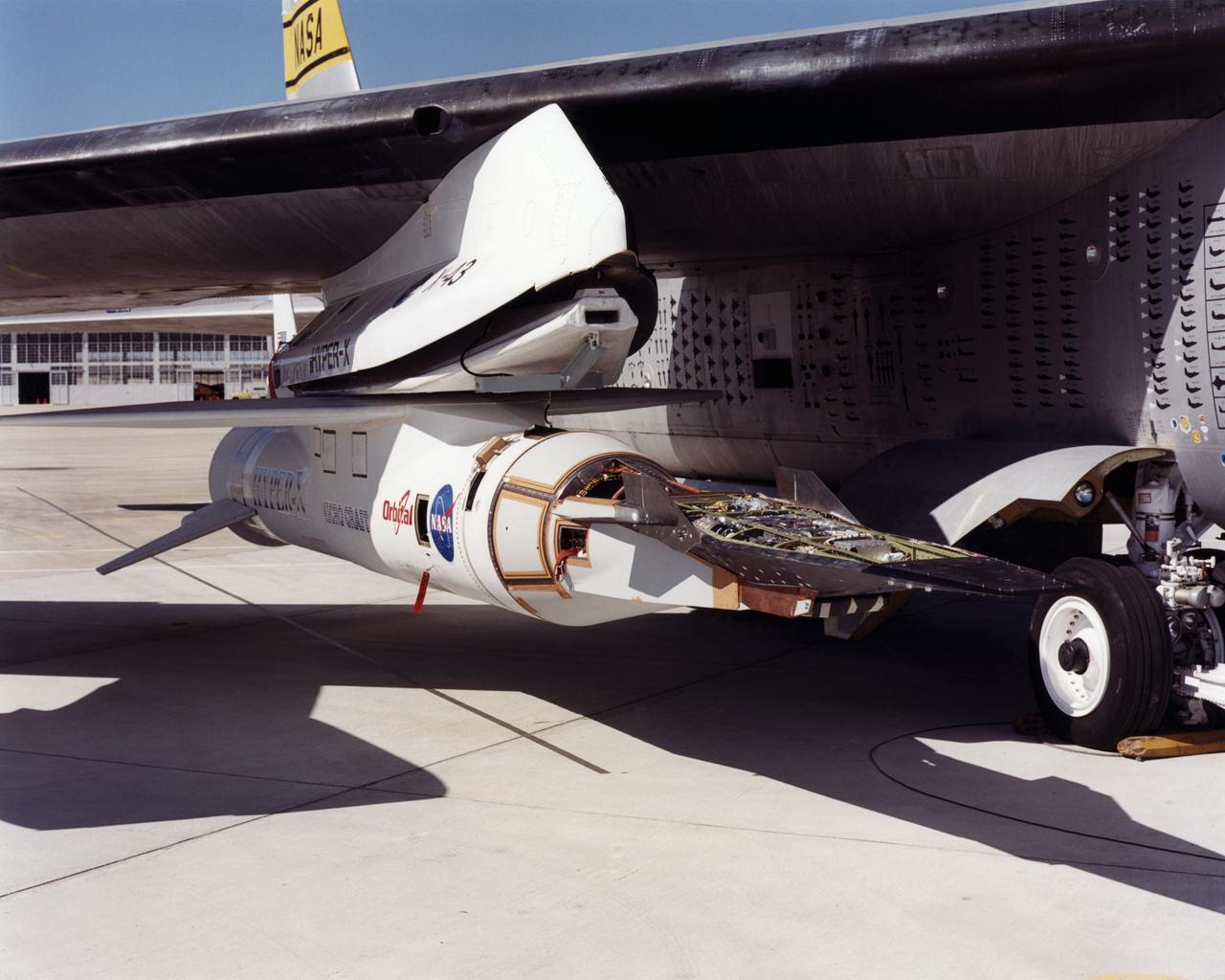
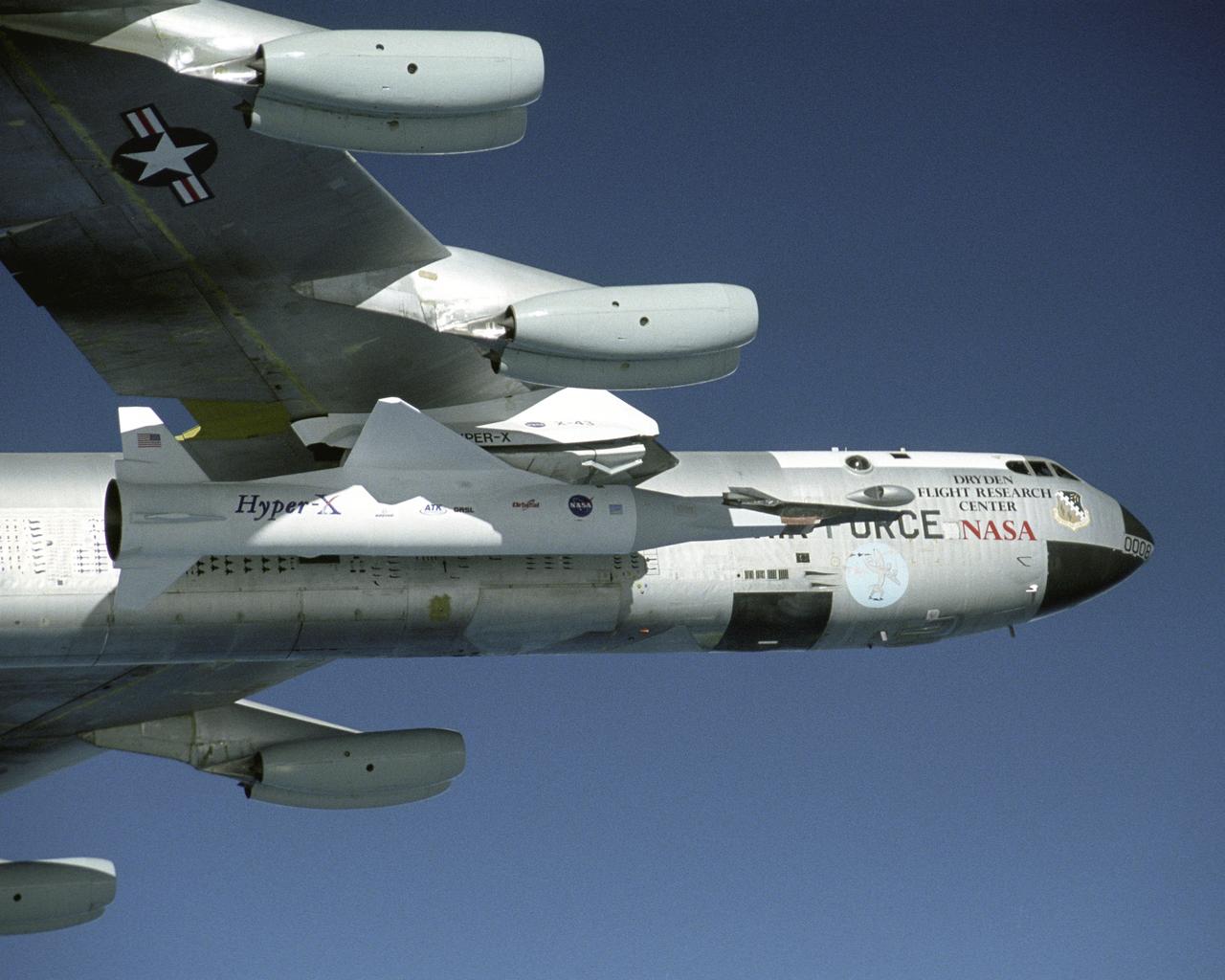
The X-43A hypersonic research aircraft and its modified Pegasus® booster rocket are nestled under the wing of NASA's NB-52B carrier aircraft during pre-flight systems testing at the Dryden Flight Research Center, Edwards, Calif. The combined systems test was one of the last major milestones in the Hyper-X research program before the first X-43A flight. The X-43A flights will be the first actual flight tests of an aircraft powered by a revolutionary supersonic-combustion ramjet ("scramjet") engine capable of operating at hypersonic speeds (above Mach 5, or five times the speed of sound). The 12-foot, unpiloted research vehicle was developed and built by MicroCraft Inc., Tullahoma, Tenn., under NASA contract. The booster was built by Orbital Sciences Corp., Dulles, Va. After being air-launched from NASA's venerable NB-52 mothership, the booster will accelerate the X-43A to test speed and altitude. The X-43A will then separate from the rocket and fly a pre-programmed trajectory, conducting aerodynamic and propulsion experiments until it descends into the Pacific Ocean. Three research flights are planned, two at Mach 7 and one at Mach 10.
The X-43A hypersonic research aircraft and its modified Pegasus® booster rocket nestled under the wing of NASA's NB-52B carrier aircraft during pre-flight systems testing
As part of a combined systems test conducted by NASA Dryden Flight Research Center, NASA's NB-52B carrier aircraft rolls down a taxiway at Edwards Air Force Base with the X-43A hypersonic research aircraft and its modified Pegasus® booster rocket attached to a pylon under its right wing. The taxi test was one of the last major milestones in the Hyper-X research program before the first X-43A flight. The X-43A flights will be the first actual flight tests of an aircraft powered by a revolutionary supersonic-combustion ramjet ("scramjet") engine capable of operating at hypersonic speeds (above Mach 5, or five times the speed of sound). The 12-foot, unpiloted research vehicle was developed and built by MicroCraft Inc., Tullahoma, Tenn., under NASA contract. The booster was built by Orbital Sciences Corp., Dulles, Va. After being air-launched from NASA's venerable NB-52 mothership, the booster will accelerate the X-43A to test speed and altitude. The X-43A will then separate from the rocket and fly a pre-programmed trajectory, conducting aerodynamic and propulsion experiments until it descends into the Pacific Ocean. Three research flights are planned, two at Mach 7 and one at Mach 10.
NASA's NB-52B carrier aircraft rolls down a taxiway with the X-43A hypersonic research aircraft and its modified Pegasus® booster rocket attached to a pylon under its right wing.
The first of three X-43A hypersonic research aircraft and its modified Pegasus® booster rocket recently underwent combined systems testing while mounted to NASA's NB-52B carrier aircraft at the Dryden Flight Research Center, Edwards, California. The combined systems test was one of the last major milestones in the Hyper-X research program before the first X-43A flight. One of the major goals of the Hyper-X program is flight validation of airframe-integrated, air-breathing propulsion system, which so far have only been tested in ground facilities, such as wind tunnels. The X-43A flights will be the first actual flight tests of an aircraft powered by a revolutionary supersonic-combustion ramjet ("scramjet") engine capable of operating at hypersonic speeds above Mach 5 (five times the speed of sound). The X-43A design uses the underbody of the aircraft to form critical elements of the engine. The forebody shape helps compress the intake airflow, while the aft section acts as a nozzle to direct thrust. The 12-foot, unpiloted research vehicle was developed and built by MicroCraft Inc., Tullahoma, Tenn., under NASA contract. The booster, built by Orbital Sciences Corp., Dulles, Va., will accelerate the X-43A after the X-43A/booster "stack" is air-launched from NASA's venerable NB-52 mothership. The X-43A will separate from the rocket at a predetermined altitude and speed and fly a pre-programmed trajectory, conducting aerodynamic and propulsion experiments until it descends into the Pacific Ocean. Three research flights are planned, two at Mach 7 and one at Mach 10.
The X-43A hypersonic research aircraft and its modified Pegasus® booster rocket mounted to NASA's NB-52B carrier aircraft at the Dryden Flight Research Center, Edwards, California
Rep. Ken Calvert, (R-Calif.), chairman of the House Subcommittee on Space and Aeronautics, received an update on the mission of NASA's Dryden Flight Research Center during a visit on June 2, 2005. Rep. Calvert, accompanied by several staff members, was briefed by center management on the Dryden's role as a flight research institution, and then reviewed some of the center's recent, current and upcoming flight research projects during a tour of the facility. During the afternoon, Rep. Calvert received similar briefings on a variety of projects at several aerospace development firms at the Civilian Flight Test Center in Mojave. Rep. Calvert's tour of NASA Dryden was the second in a series of visits to all 10 NASA field centers to better acquaint him with the roles and responsibilities of each center.
Rep. Ken Calvert, R-Calif., chairman of the House Subcommittee on Space and Aeronautics, was briefed by X-43A engineer Laurie Grindle during his tour of Dryden
The second X-43A hypersonic research aircraft, attached to a modified Pegasus booster rocket and followed by a chase F-18, was taken to launch altitude by NASA's B-52B launch aircraft from the NASA Dryden Flight Research Center at Edwards Air Force Base, Calif., on March 27, 2004. About an hour later the Pegasus booster was released from the B-52 to accelerate the X-43A to its intended speed of Mach 7. In a combined research effort involving Dryden, Langley, and several industry partners, NASA demonstrated the value of its X-43A hypersonic research aircraft, as it became the first air-breathing, unpiloted, scramjet-powered plane to fly freely by itself. The March 27 flight, originating from NASA's Dryden Flight Research Center, began with the Agency's B-52B launch aircraft carrying the X-43A out to the test range over the Pacific Ocean off the California coast. The X-43A was boosted up to its test altitude of about 95,000 feet, where it separated from its modified Pegasus booster and flew freely under its own power.  Two very significant aviation milestones occurred during this test flight: first, controlled accelerating flight at Mach 7 under scramjet power, and second, the successful stage separation at high dynamic pressure of two non-axisymmetric vehicles. To top it all off, the flight resulted in the setting of a new aeronautical speed record. The X-43A reached a speed of over Mach 7, or about 5,000 miles per hour faster than any known aircraft powered by an air-breathing engine has ever flown.
NASA's B-52B launch aircraft cruises to a test range over the Pacific Ocean carrying the second X-43A vehicle attached to a Pegasus rocket on March 27, 2004
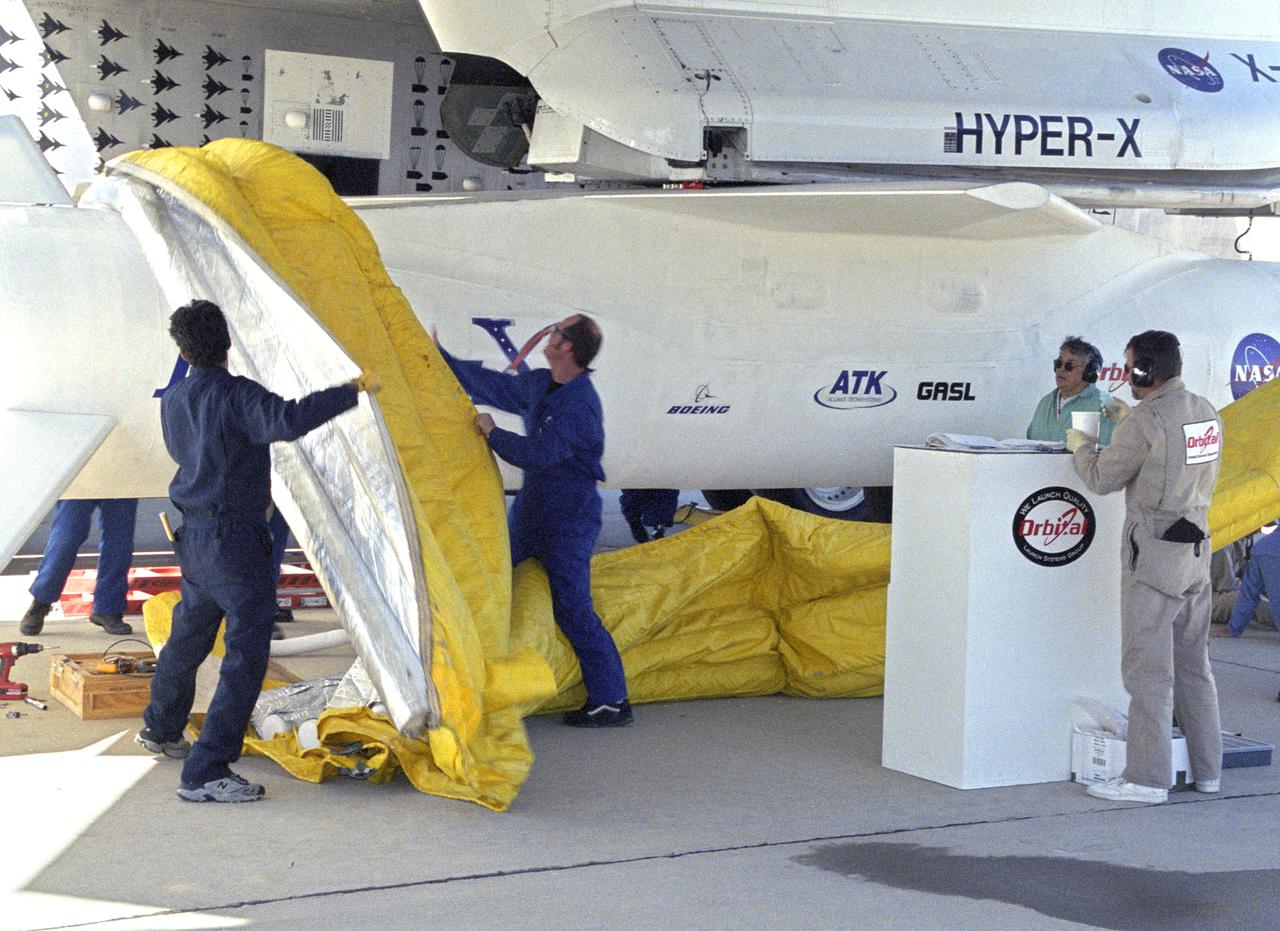
Orbital Sciences Corp. technicians remove protective shrouds from the modified Pegasus booster before takeoff on the X-43A's Mach 9.6 record scramjet flight.
Orbital Sciences Corp. technicians remove protective shrouds from the modified Pegasus booster before takeoff on the X-43A's Mach 9.6 record scramjet flight
B-52 Launch Aircraft in Flight
EC01-0084-9
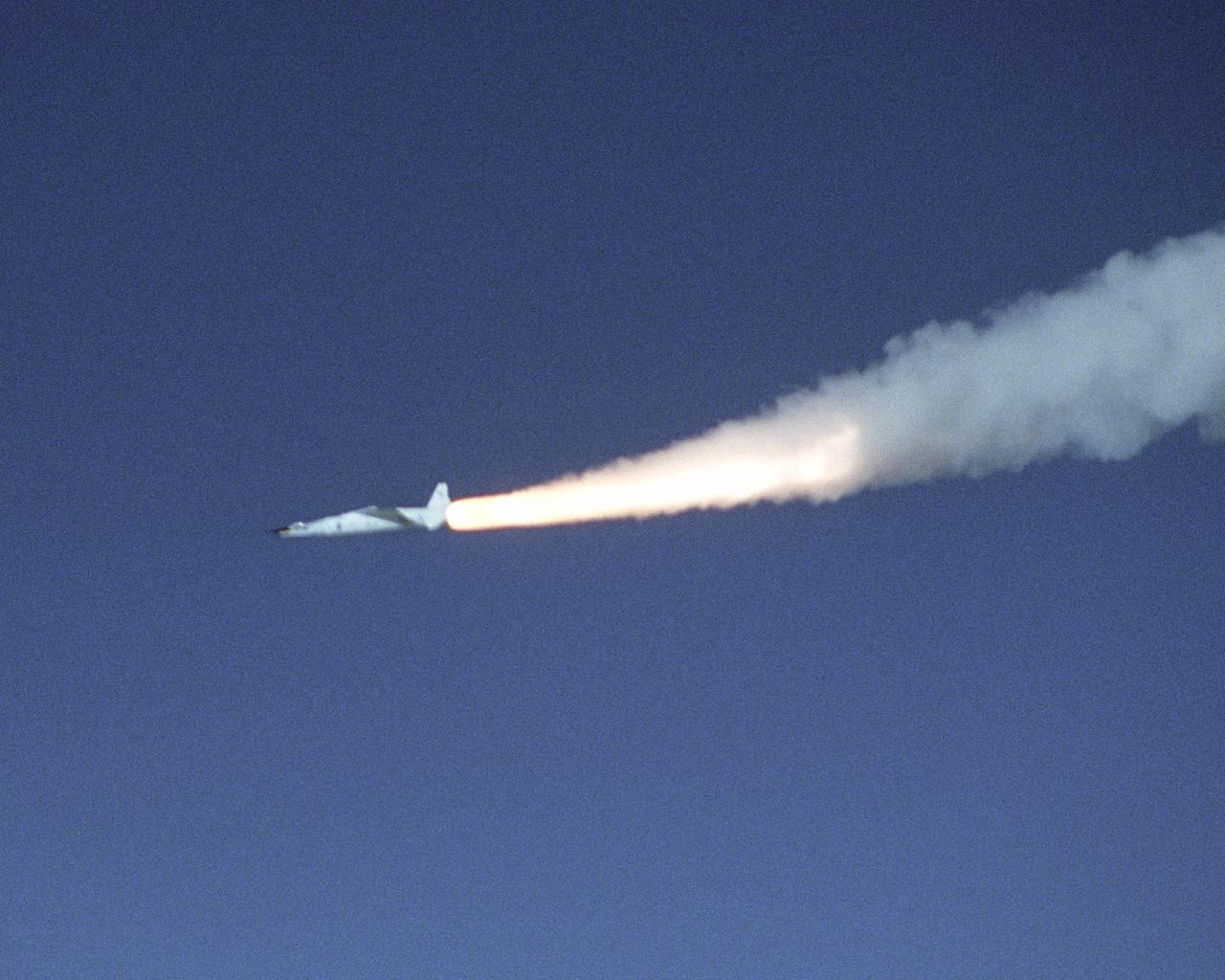
The second X-43A hypersonic research aircraft and its modified Pegasus booster rocket accelerate after launch from NASA's B-52B launch aircraft over the Pacific Ocean on March 27, 2004. The mission originated from the NASA Dryden Flight Research Center at Edwards Air Force Base, Calif. Minutes later the X-43A separated from the Pegasus booster and accelerated to its intended speed of Mach 7. In a combined research effort involving Dryden, Langley, and several industry partners, NASA demonstrated the value of its X-43A hypersonic research aircraft, as it became the first air-breathing, unpiloted, scramjet-powered plane to fly freely by itself. The March 27 flight, originating from NASA's Dryden Flight Research Center, began with the Agency's B-52B launch aircraft carrying the X-43A out to the test range over the Pacific Ocean off the California coast. The X-43A was boosted up to its test altitude of about 95,000 feet, where it separated from its modified Pegasus booster and flew freely under its own power.  Two very significant aviation milestones occurred during this test flight: first, controlled accelerating flight at Mach 7 under scramjet power, and second, the successful stage separation at high dynamic pressure of two non-axisymmetric vehicles. To top it all off, the flight resulted in the setting of a new aeronautical speed record. The X-43A reached a speed of over Mach 7, or about 5,000 miles per hour faster than any known aircraft powered by an air-breathing engine has ever flown.
A modified Pegasus rocket ignites moments after release from the B-52B, beginning the acceleration of the X-43A over the Pacific Ocean on March 27, 2004
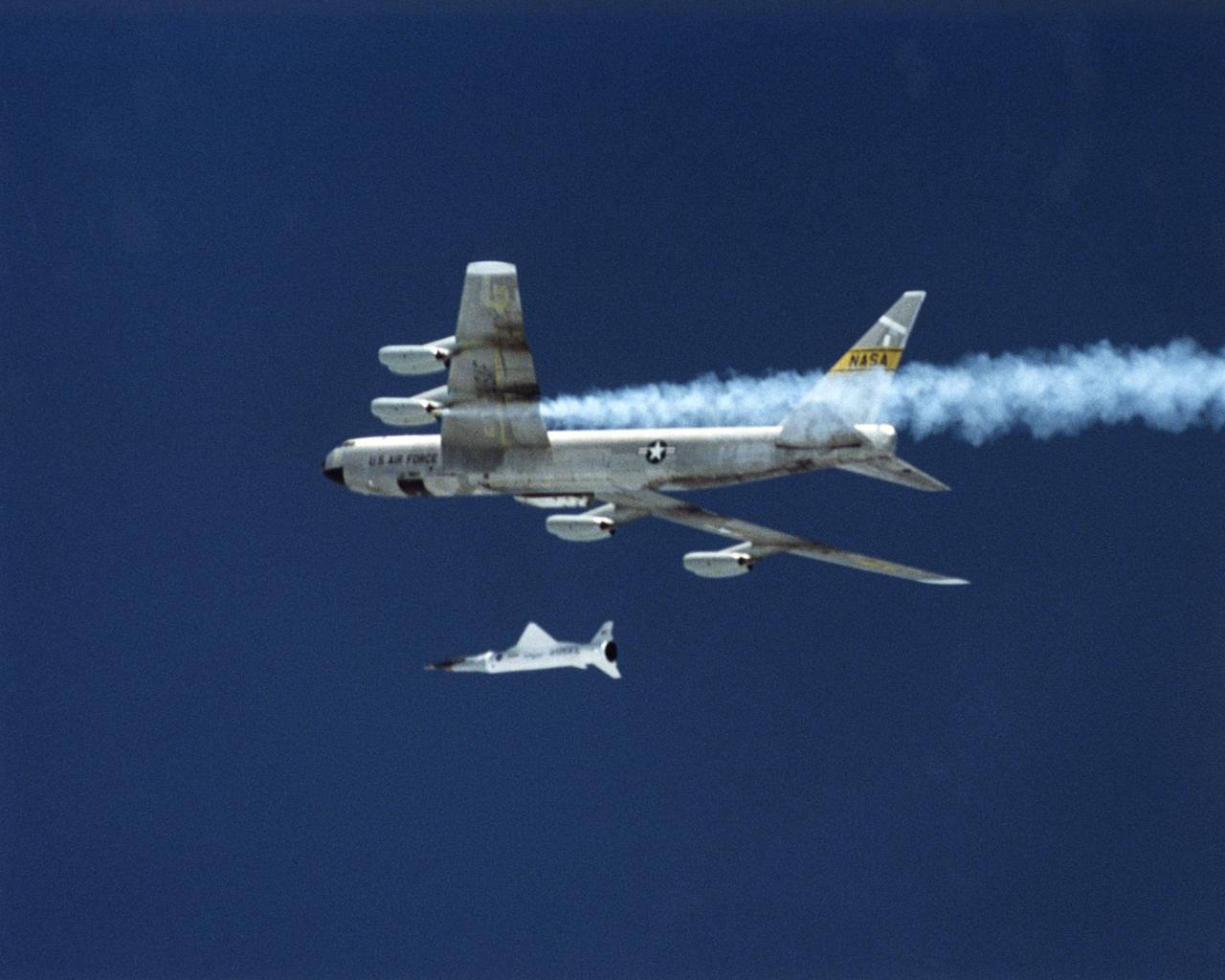
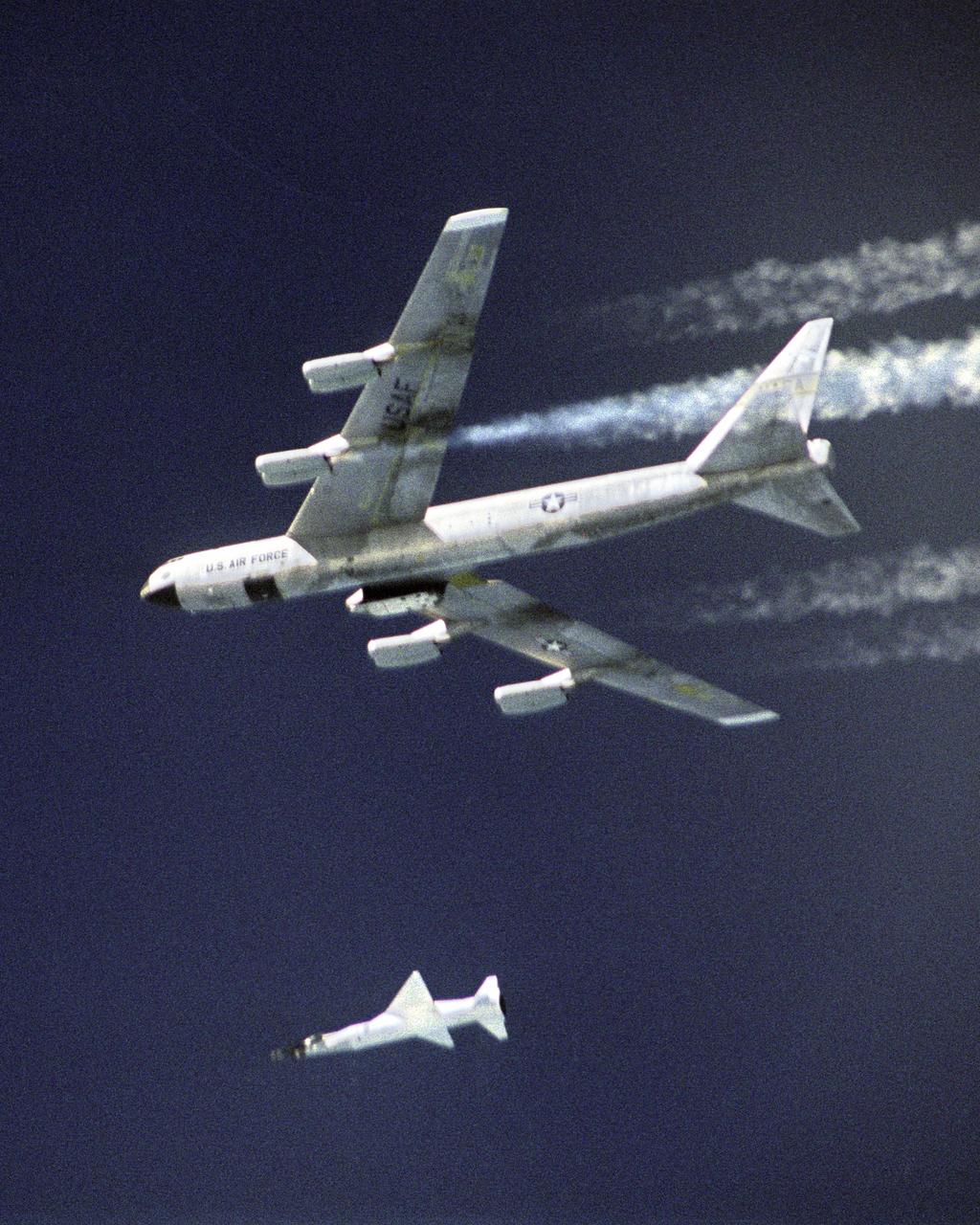
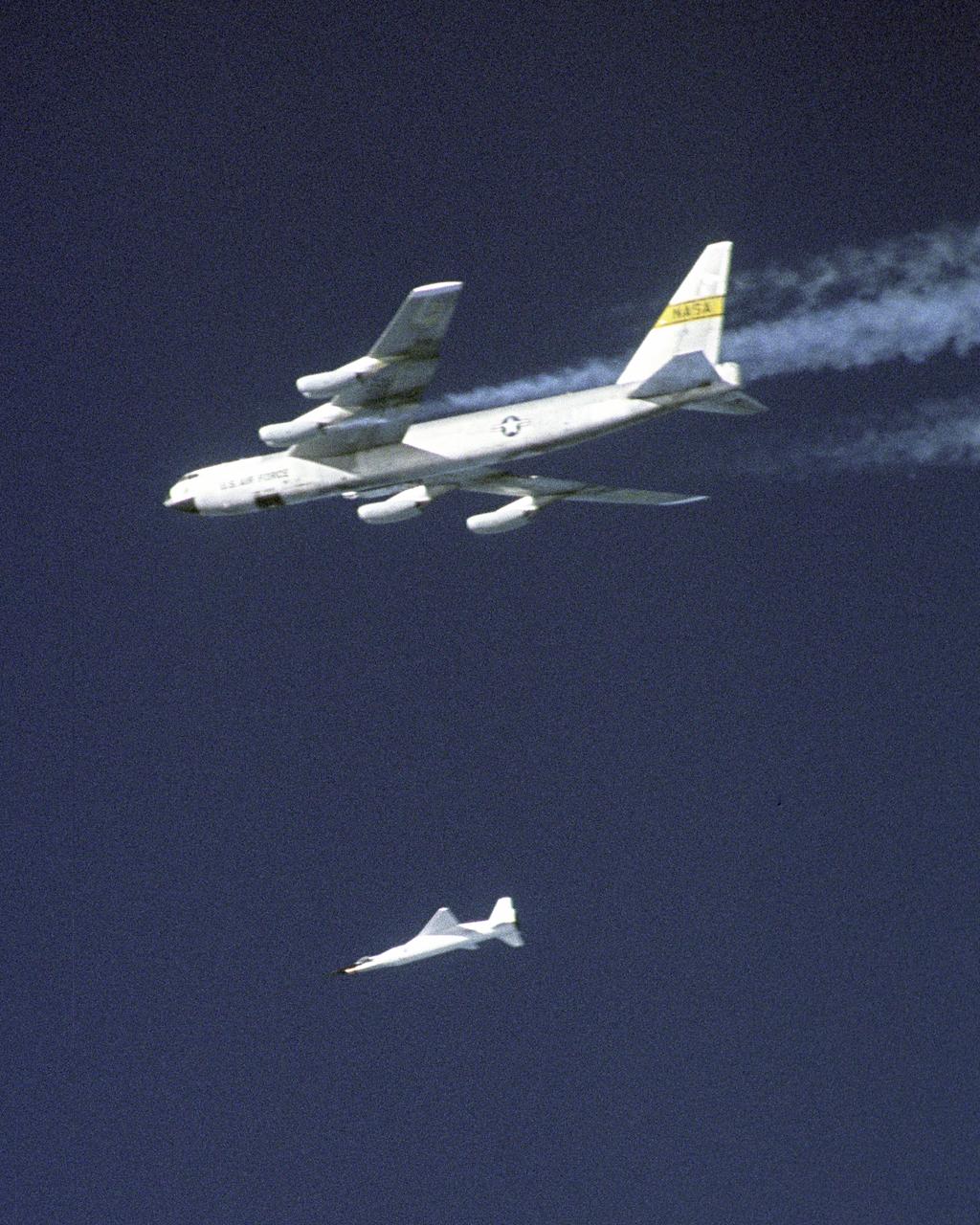
The second X-43A hypersonic research aircraft and its modified Pegasus booster rocket drop away from NASA's B-52B launch aircraft over the Pacific Ocean on March 27, 2004. The mission originated from the NASA Dryden Flight Research Center at Edwards Air Force Base, Calif. Moments later the Pegasus booster ignited to accelerate the X-43A to its intended speed of Mach 7.
A modified Pegasus rocket drops steadily away after release from NASA's B-52B, before accelerating the X-43A over the Pacific Ocean on March 27, 2004
Employees atop NASA Dryden's main building celebrate the return flyby of the B-52B aircraft after it launched the second X-43A aircraft on its successful flight.
Employees atop DFRC's main building celebrate the return flyby of the B-52B aircraft after it launched the second X-43A aircraft on its successful flight
NASA's B-52B aircraft over the Dryden Flight Research Center after the successful launch of the second X-43A hypersonic research vehicle.
NASA's B-52B aircraft over the Dryden Flight Research Center after the successful launch of the second X-43A hypersonic research vehicle
The third X-43A hypersonic research aircraft and its modified Pegasus booster rocket accelerate after launch from NASA's B-52B launch aircraft over the Pacific Ocean on November 16, 2004. The mission originated from the NASA Dryden Flight Research Center at Edwards Air Force Base, California. Minutes later the X-43A separated from the Pegasus booster and accelerated to its intended speed of Mach 10.
A modified Pegasus rocket ignites moments after release from the B-52B, beginning the acceleration of the X-43A over the Pacific Ocean on Nov. 16, 2004
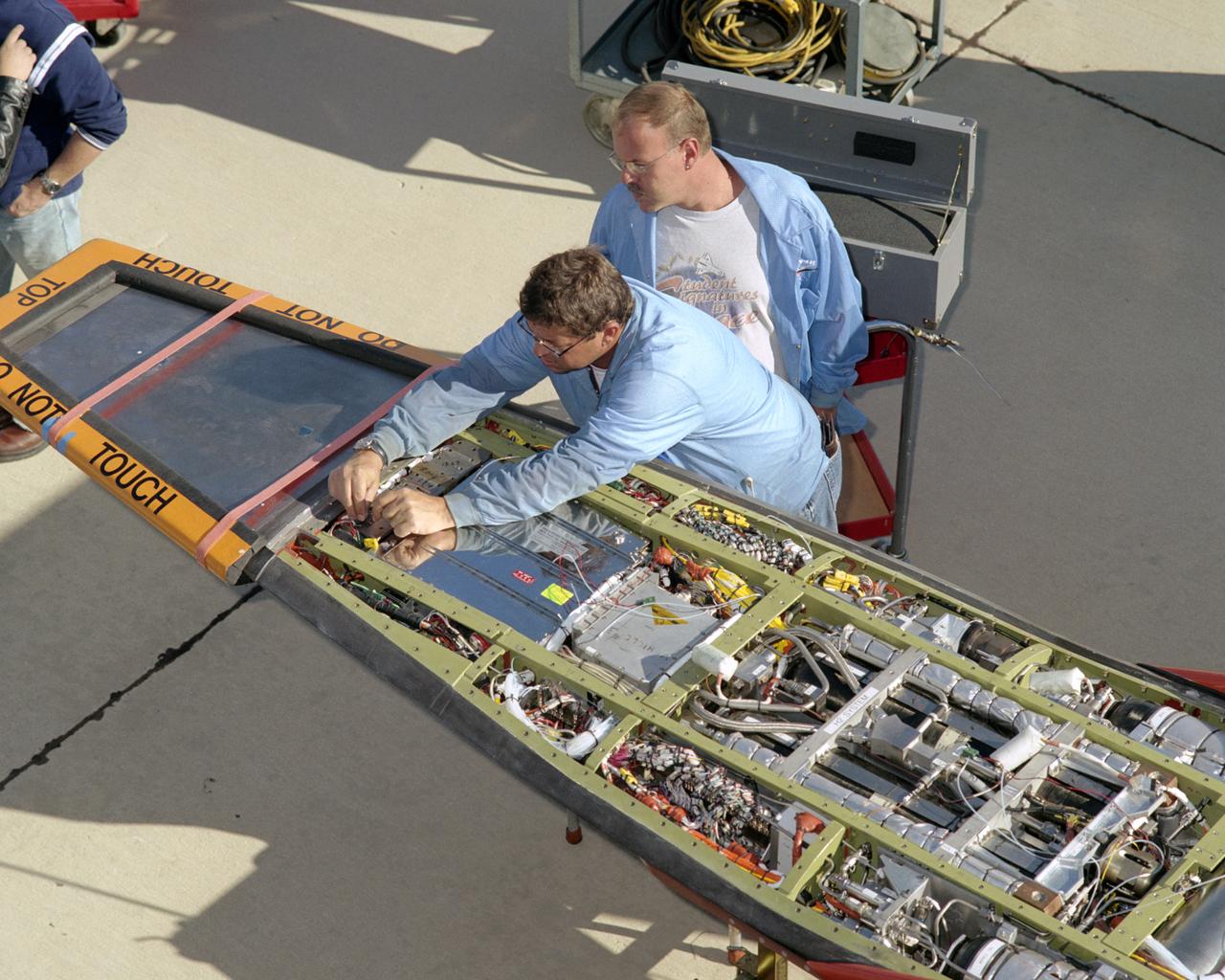
NASA avionics technicians Randy Wagner and Terry Bishop make final adjustments on the scramjet-powered X-43A before its record Mach 9.6 flight.
NASA avionics technicians Randy Wagner and Terry Bishop make final adjustments on the scramjet-powered X-43A before its record Mach 9.6 flight
The third X-43A hypersonic research aircraft and its modified Pegasus booster rocket drop away from NASA's B-52B launch aircraft over the Pacific Ocean on November 16, 2004. The mission originated from the NASA Dryden Flight Research Center at Edwards Air Force Base, California. Moments later the Pegasus booster ignited to accelerate the X-43A to its intended speed of Mach 10.
A modified Pegasus rocket drops away after release from NASA's B-52B before accelerating the X-43A over a Pacific Ocean test range on Nov. 16, 2004
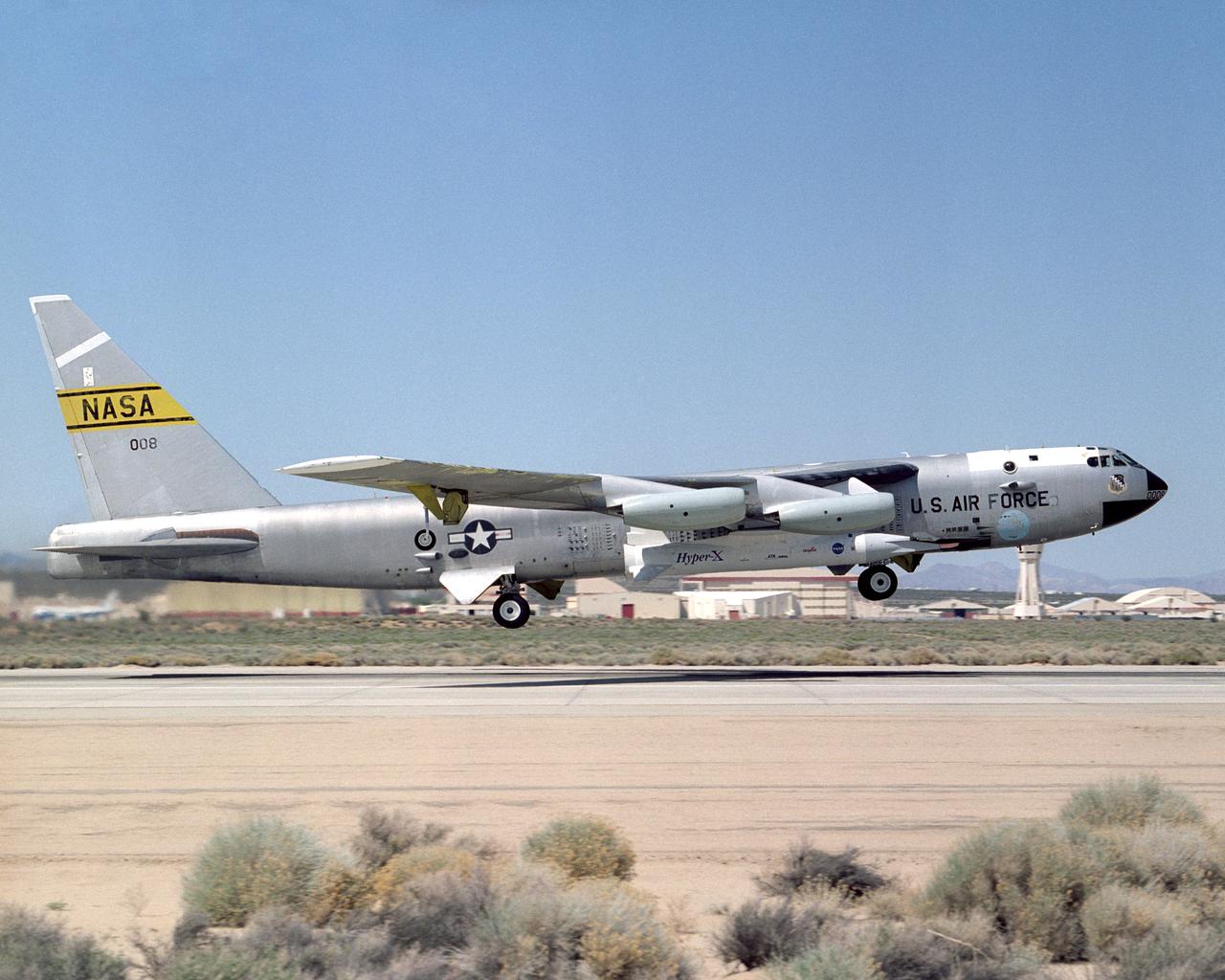
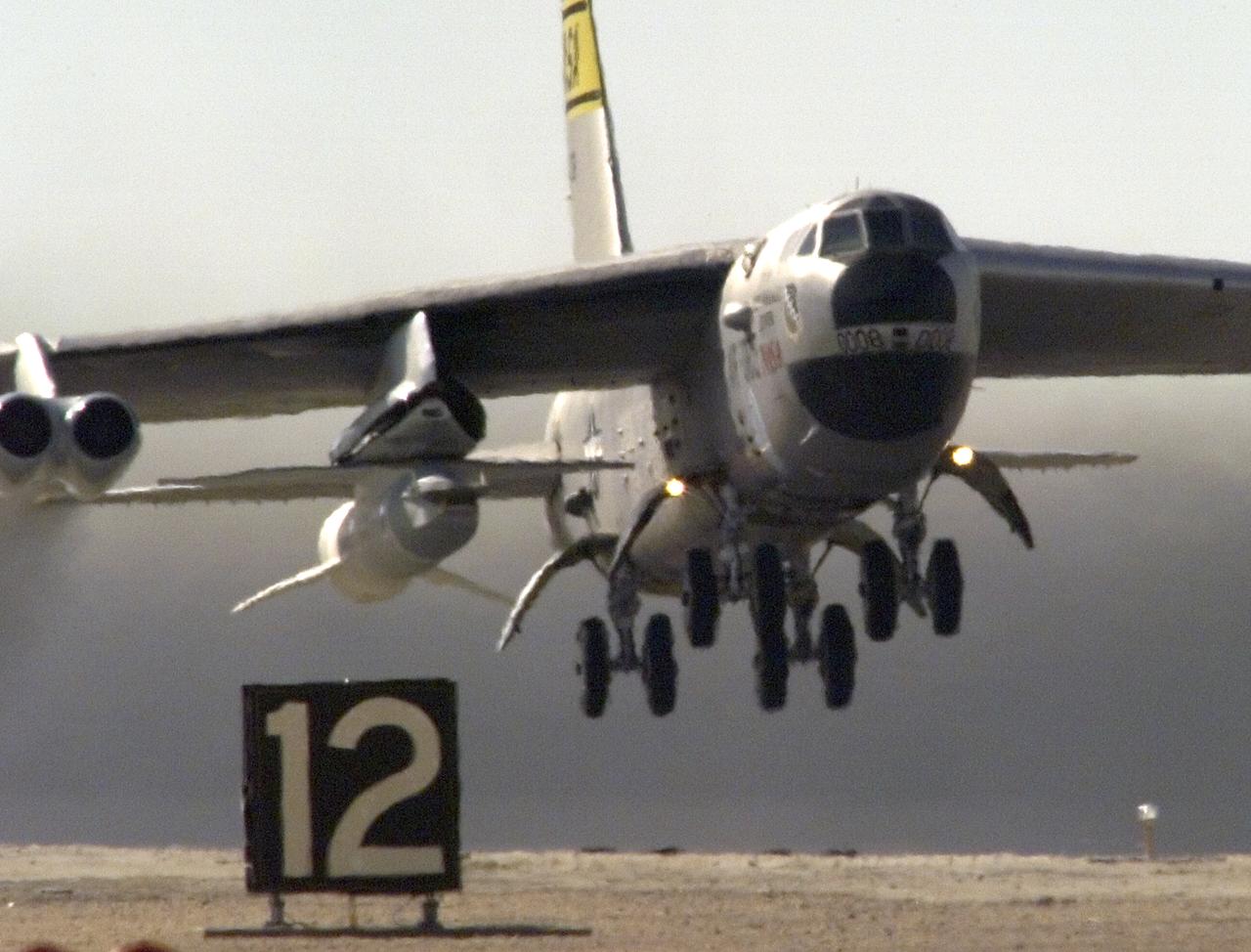
The second X-43A hypersonic research aircraft and its modified Pegasus booster rocket left the runway, carried aloft by NASA's B-52B launch aircraft from the NASA Dryden Flight Research Center at Edwards Air Force Base, Calif., on March 27, 2004. About an hour later the Pegasus booster was launched from the B-52 to accelerate the X-43A to its intended speed of Mach 7.
NASA's B-52B launch aircraft takes off carrying the second X-43A hypersonic research vehicle attached to a modified Pegasus rocket, on March 27, 2004
B-52 Launch Aircraft in Flight
EC01-0084-5
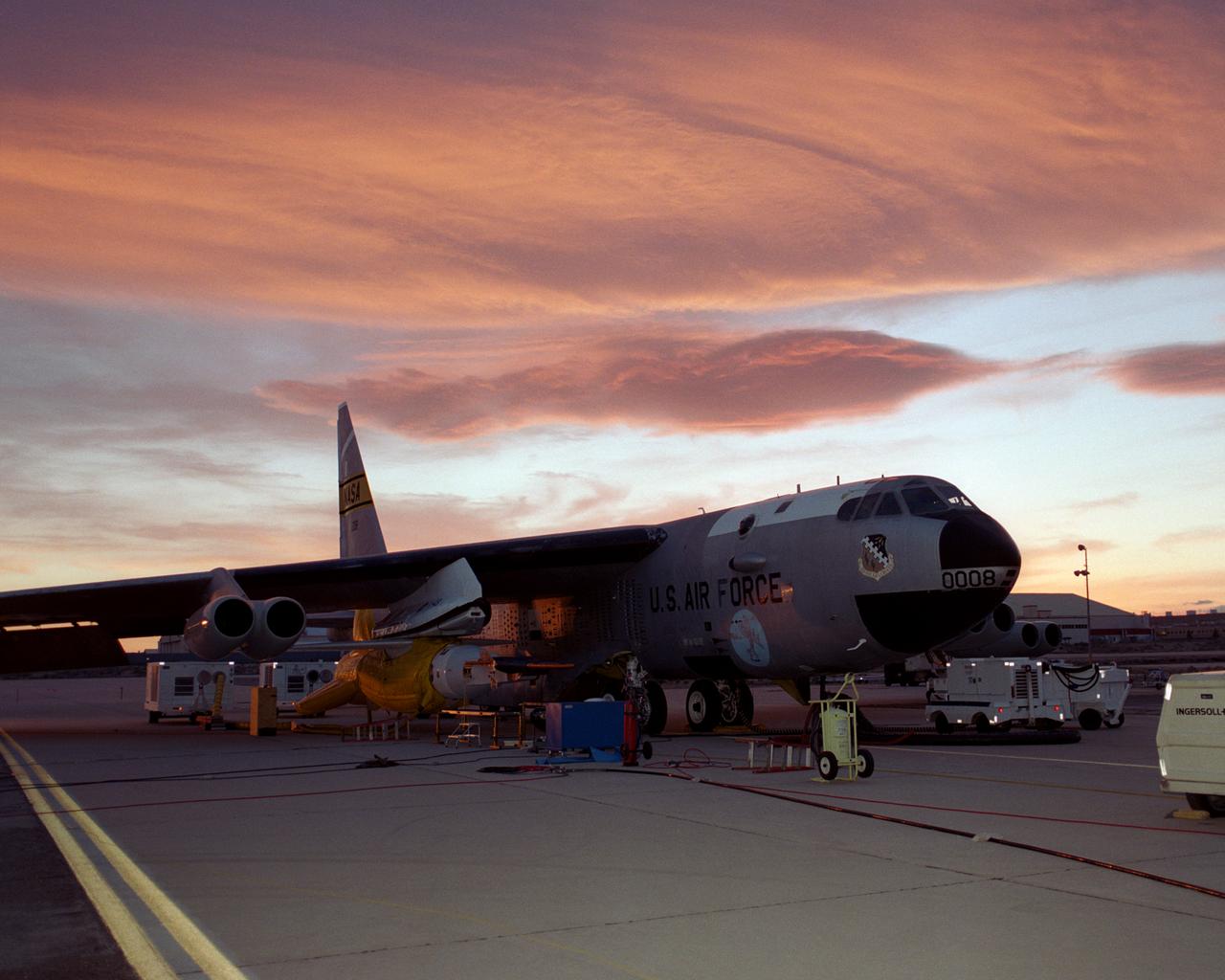
NASA's B-52B launch aircraft at sunset with the second X-43A hypersonic research vehicle attached to a modified Pegasus rocket under its right wing.
NASA's B-52B launch aircraft at sunset with the second X-43A hypersonic research vehicle attached to a modified Pegasus rocket under its right wing
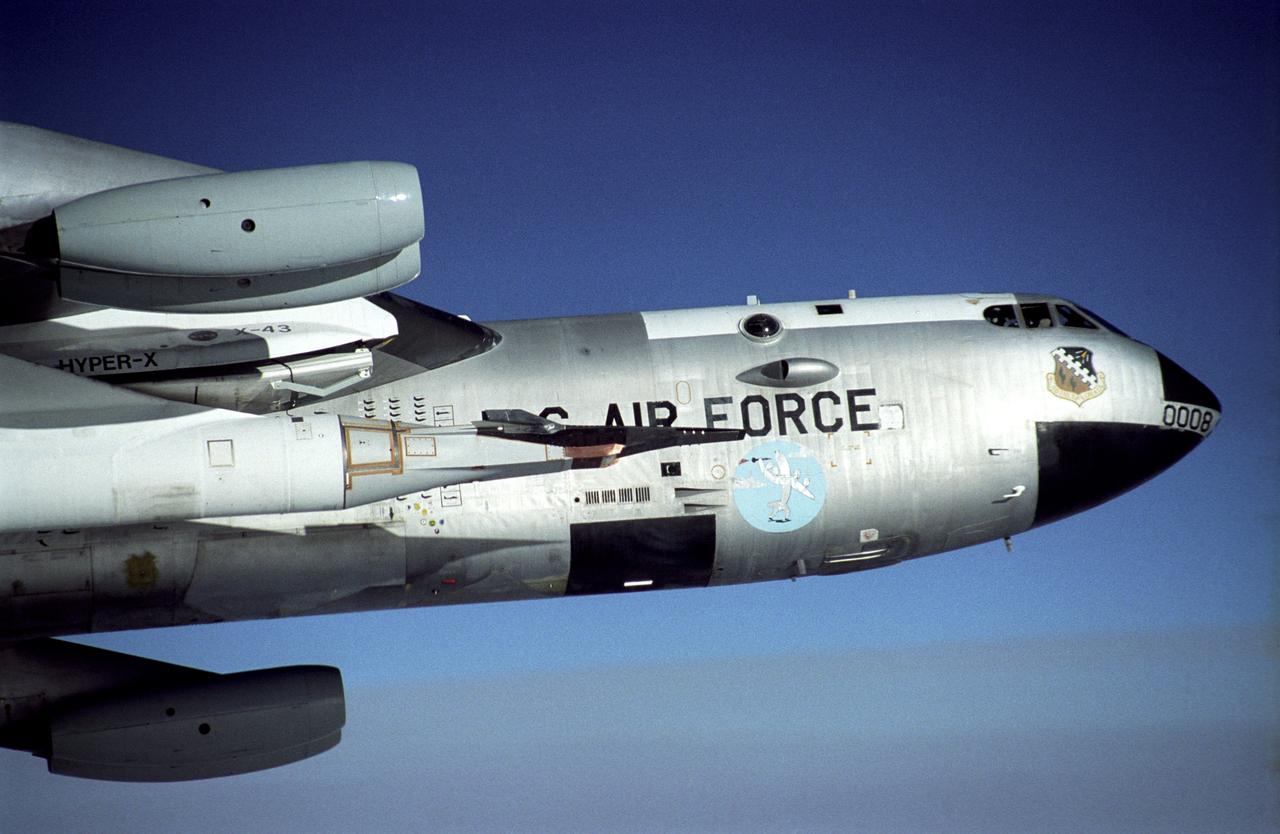
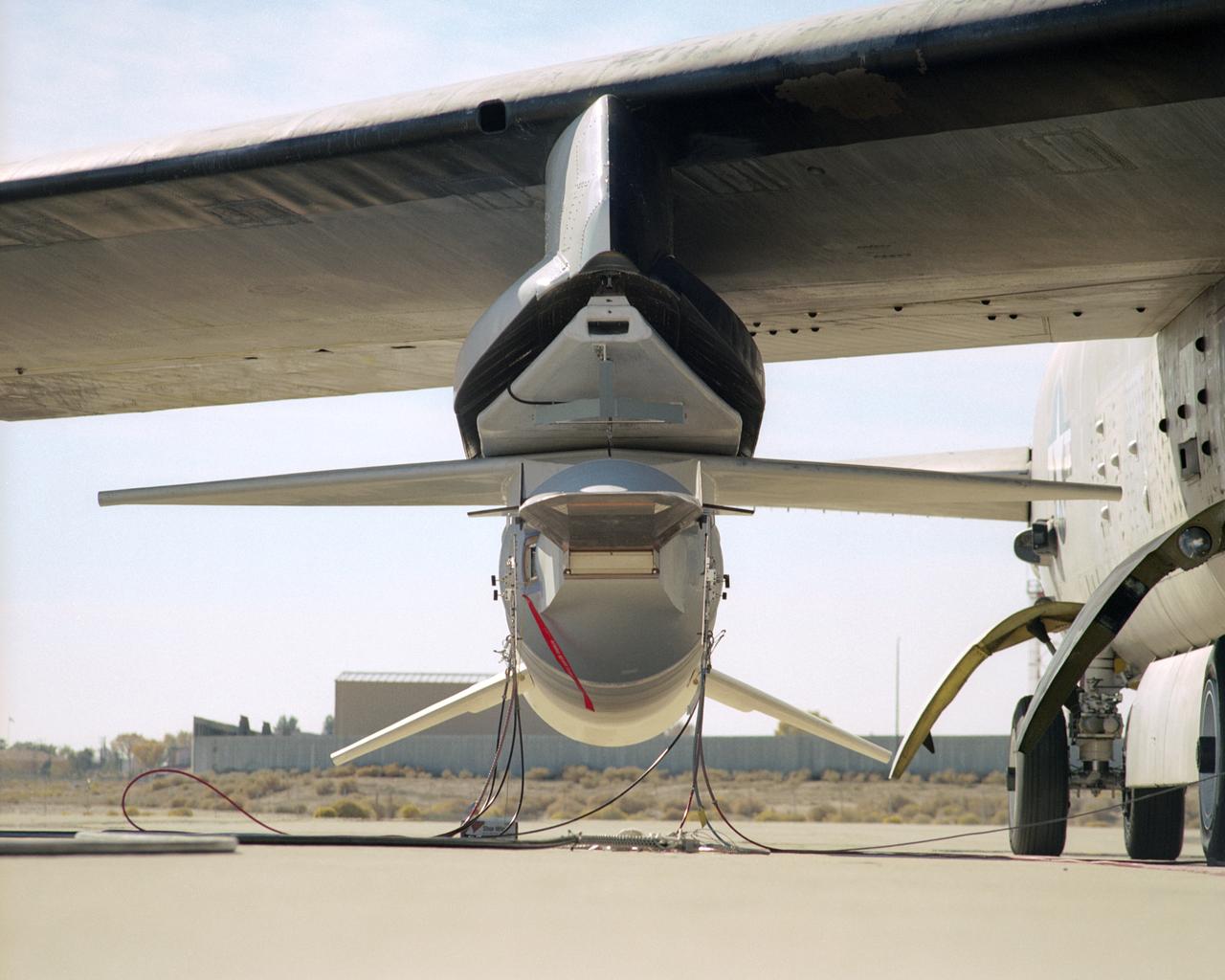
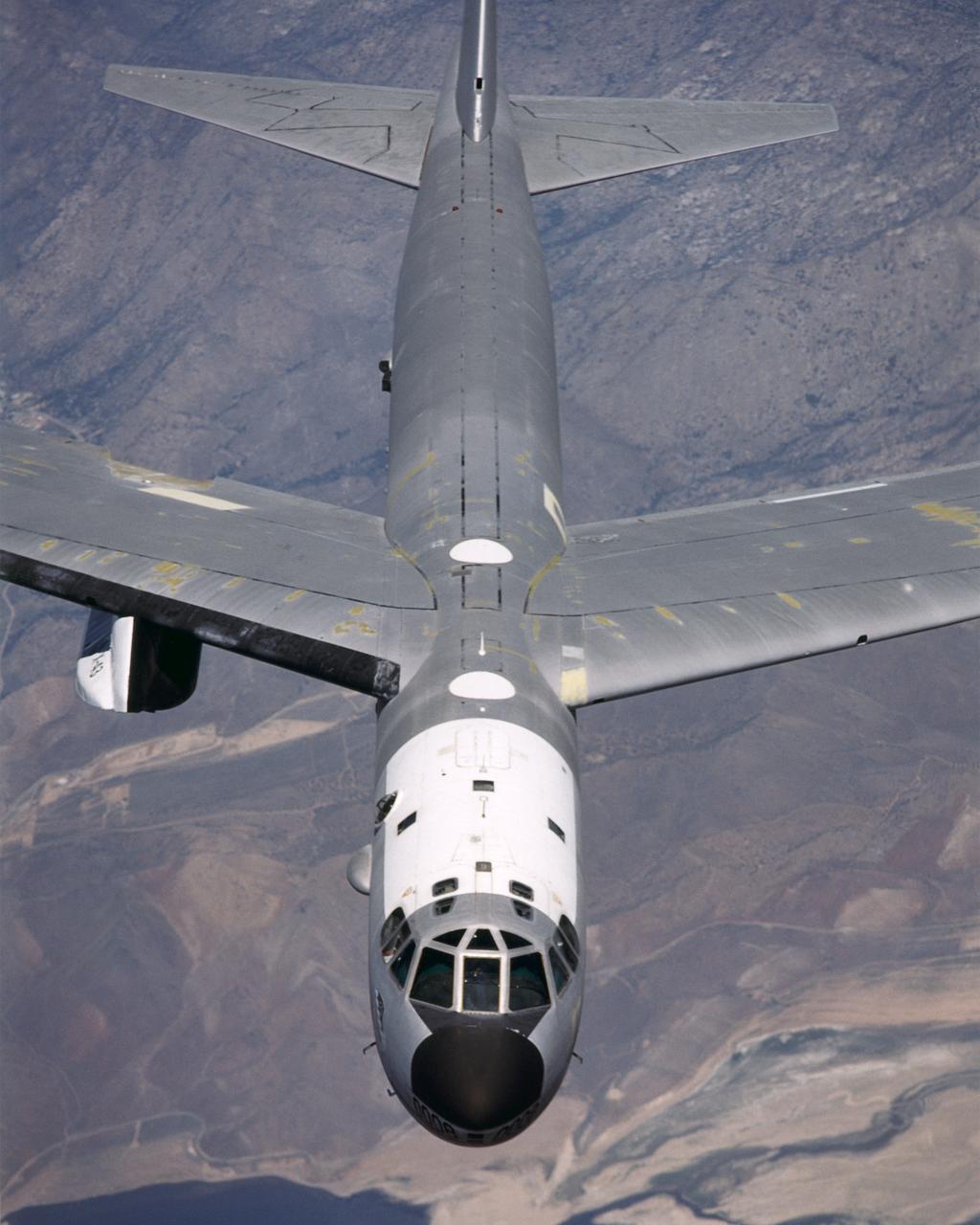
The small size of the X-43A scramjet is evident in this nose-on view while mounted to its modified Pegasus booster under the wing of NASA's B-52B mothership.
The small size of the X-43A scramjet is evident in this nose-on view while mounted to its modified Pegasus booster under the wing of NASA's B-52B mothership
The second X-43A hypersonic research aircraft and its modified Pegasus booster rocket accelerate after launch from NASA's B-52B launch aircraft over the Pacific Ocean on March 27, 2004. The mission originated from the NASA Dryden Flight Research Center at Edwards Air Force Base, Calif. Minutes later the X-43A separated from the Pegasus booster and accelerated to its intended speed of Mach 7.
he second X-43A and its modified Pegasus booster rocket accelerate after launch from NASA's B-52B launch aircraft over the Pacific Ocean
B-52 Launch Aircraft in Flight
EC01-0084-2
The second X-43A hypersonic research aircraft and its modified Pegasus booster rocket left the runway, carried aloft by NASA's B-52B launch aircraft from the NASA Dryden Flight Research Center at Edwards Air Force Base, Calif., on March 27, 2004. About an hour later the Pegasus booster was launched from the B-52 to accelerate the X-43A to its intended speed of Mach 7.
NASA's B-52B launch aircraft takes off carrying the second X-43A hypersonic research vehicle attached to a modified Pegasus rocket, on March 27, 2004
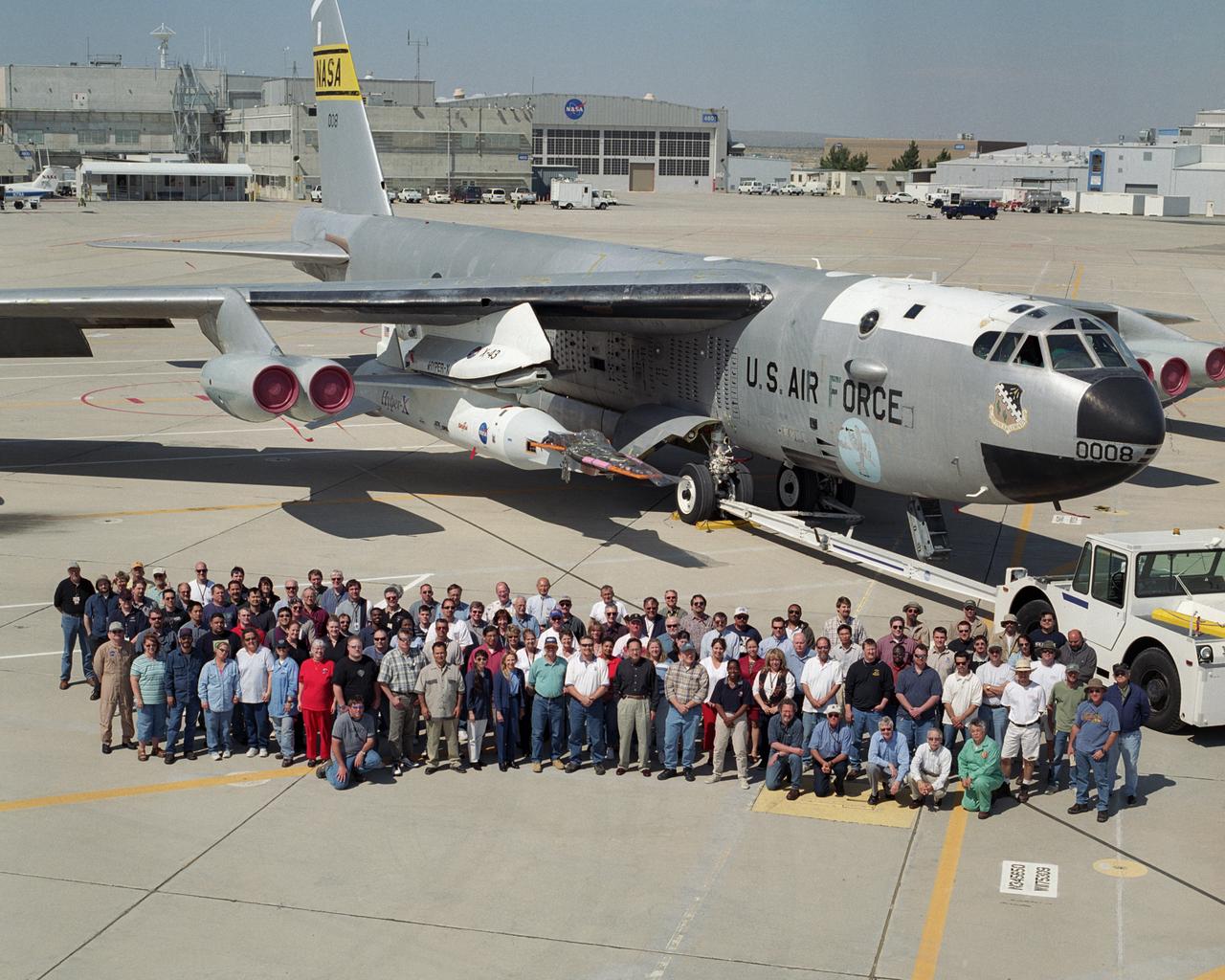
The Hyper-X X-43A project team in front of NASA's B-52B launch aircraft with the Pegasus booster and X-43A vehicle attached.
The Hyper-X X-43A project team
The second X-43A hypersonic research aircraft and its modified Pegasus booster rocket left the runway, carried aloft by NASA's B-52B launch aircraft from the NASA Dryden Flight Research Center at Edwards Air Force Base, Calif., on March 27, 2004. About an hour later the Pegasus booster was launched from the B-52 to accelerate the X-43A to its intended speed of Mach 7.
NASA's B-52B launch aircraft takes off carrying the second X-43A hypersonic research vehicle attached to a modified Pegasus rocket, on March 27, 2004
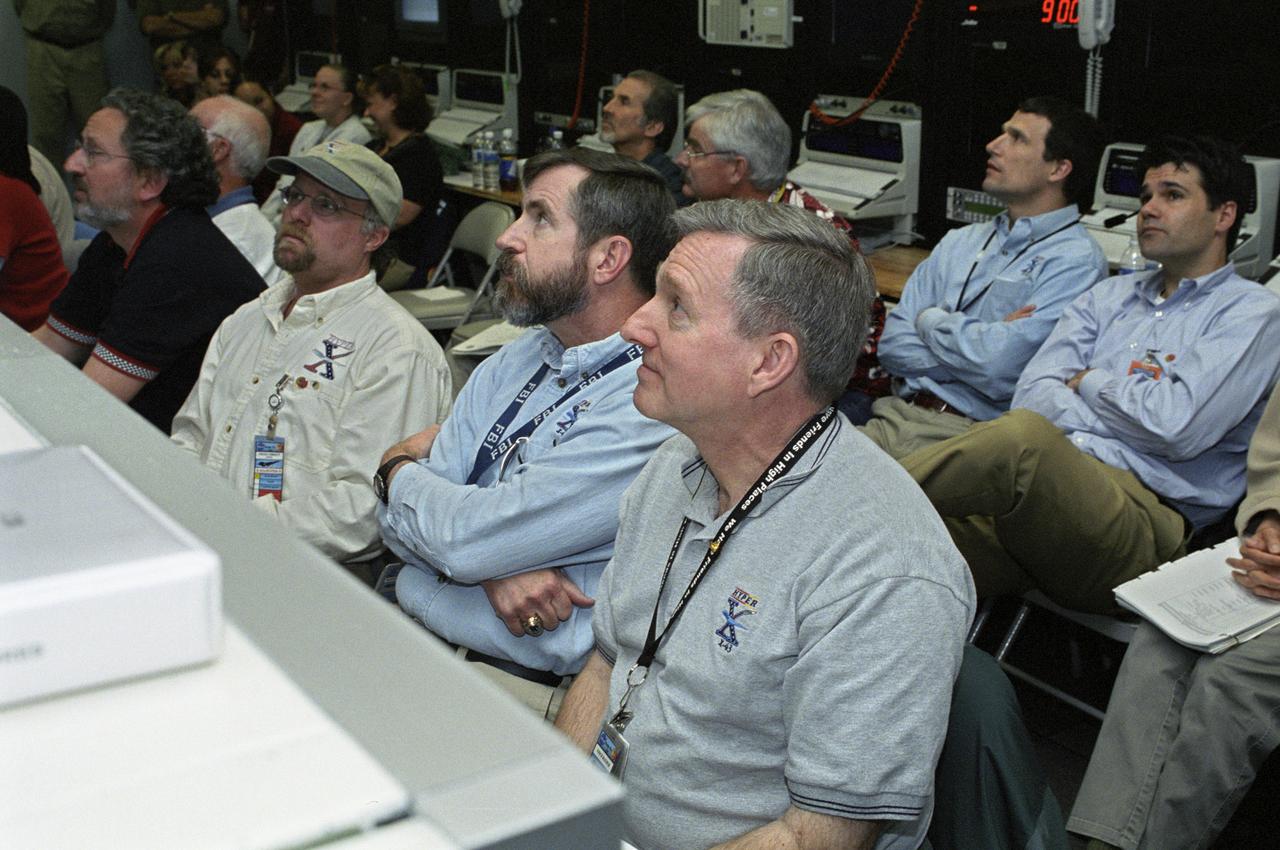
NASA personnel in a control room during the successful second flight of the X-43A aircraft. front row, left to right: Randy Voland, LaRC Propulsion; Craig Christy, Boeing Systems; Dave Reubush, NASA Hyper-X Deputy Program Manager; and Vince Rausch, NASA Hyper-X Program Manager. back row, left to right: Bill Talley, DCI/consultant; Pat Stoliker, DFRC Director (Acting) of Research Engineering; John Martin, LaRC G&C; and Dave Bose, AMA/Controls.
NASA personnel in a control room during the successful second flight of the X-43A aircraft
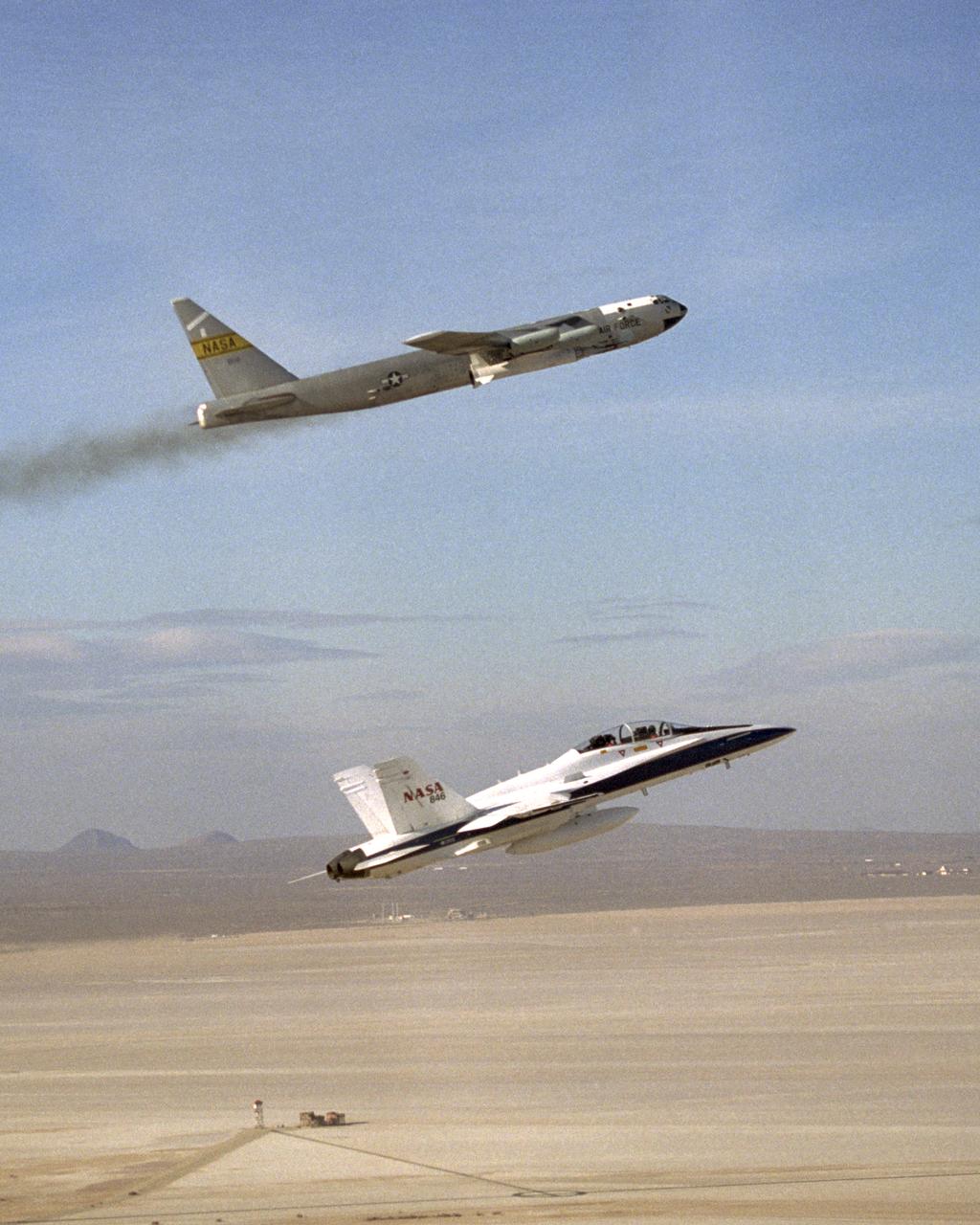
With the X-43A and its booster rocket tucked under its right wing, NASA's venerable B-52B mothership climbs out after takeoff on its final research mission.
With the X-43A and its booster rocket tucked under its right wing, NASA's venerable B-52B mothership climbs out after takeoff on its final research mission
The third X-43A hypersonic research aircraft and its modified Pegasus booster rocket left the runway, carried aloft by NASA's B-52B launch aircraft from the NASA Dryden Flight Research Center at Edwards Air Force Base, California, on November 16, 2004. About an hour later the Pegasus booster was launched from the B-52 to accelerate the X-43A to its intended speed of Mach 10.
NASA's B-52B launch aircraft takes off carrying the third X-43A hypersonic research vehicle attached to a modified Pegasus rocket, on November 16, 2004
NASA engineers monitor mission progress from a Dryden control room prior to launch of the X-43A scramjet and its booster from NASA's B-52B mothership.
NASA engineers monitor mission progress from a Dryden control room prior to launch of the X-43A scramjet and its booster from NASA's B-52B mothership
The third X-43A hypersonic research aircraft, attached to a modified Pegasus booster rocket, was taken to launch altitude by NASA's B-52B launch aircraft from the NASA Dryden Flight Research Center at Edwards Air Force Base, California, on November 16, 2004. About an hour later the Pegasus booster was released from the B-52 to accelerate the X-43A to its intended speed of Mach 10.
NASA's B-52B launch aircraft cruises to a test range over the Pacific Ocean carrying the third X-43A vehicle attached to a Pegasus rocket on November 16, 2004
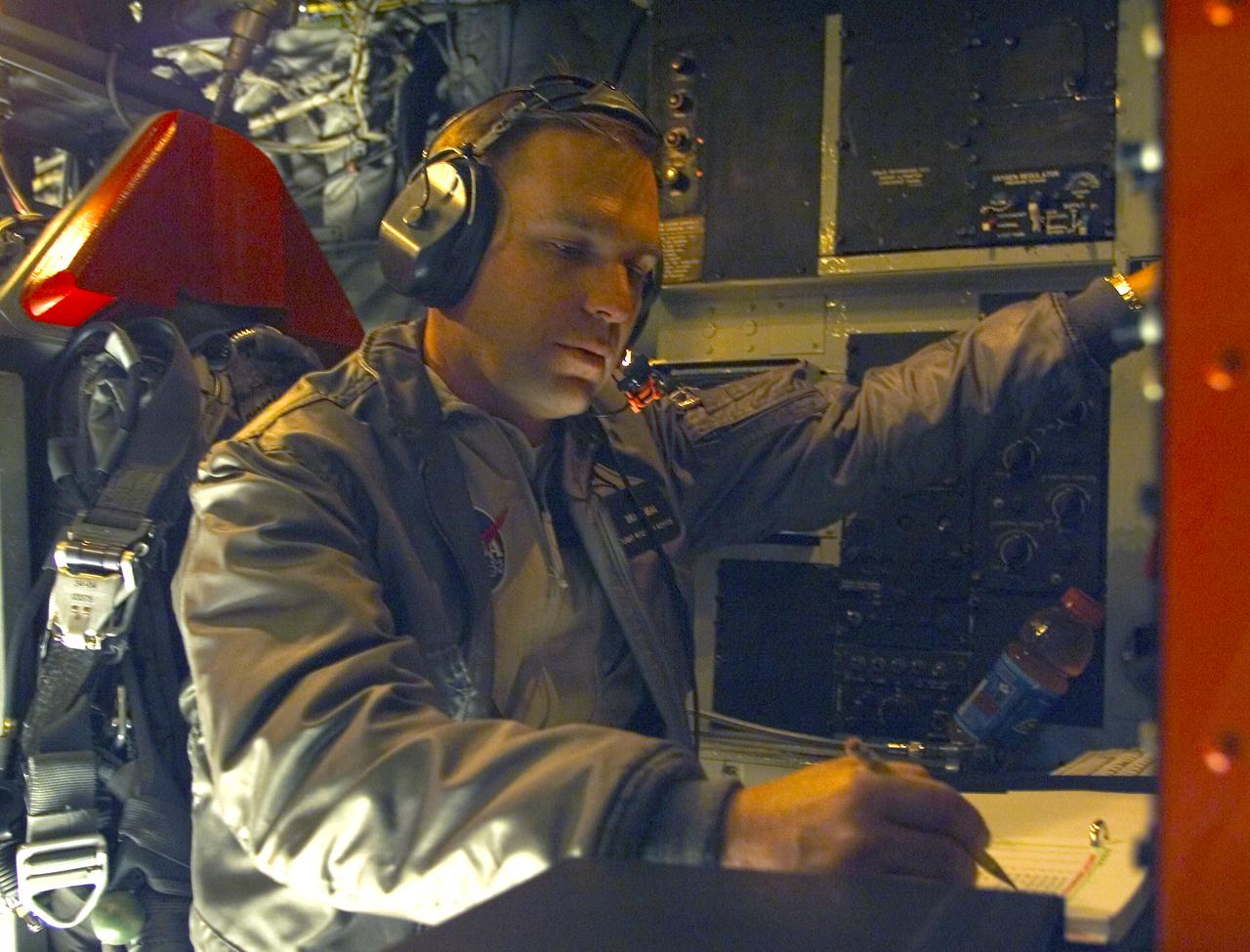
NASA X-43A Monitor Station Operator Brad Neal performs final checks and pre-flight preparations aboard the B-52 for the third X-43A research vehicle Mach 10 flight on November 16, 2004. Takeoff of the B-52B mothership carrying the X-43A took place at 1 p.m., PST, with launch of the booster rocket/X-43A approximately an hour later.
NASA's Brad Neal, X-43A Monitor Station Operator aboard NASA's B-52B mothership, performing pre-flight checks on November 16, 2004
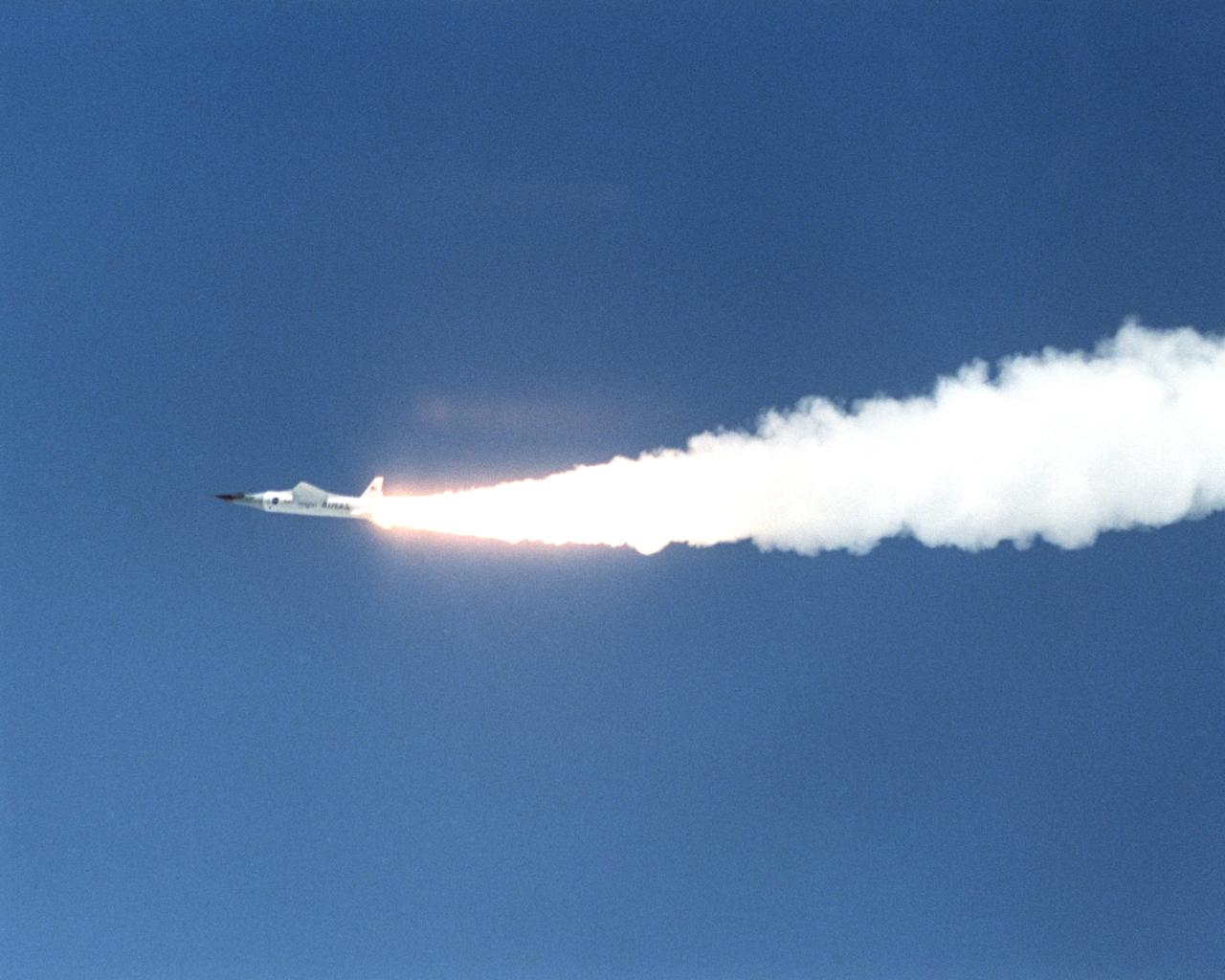
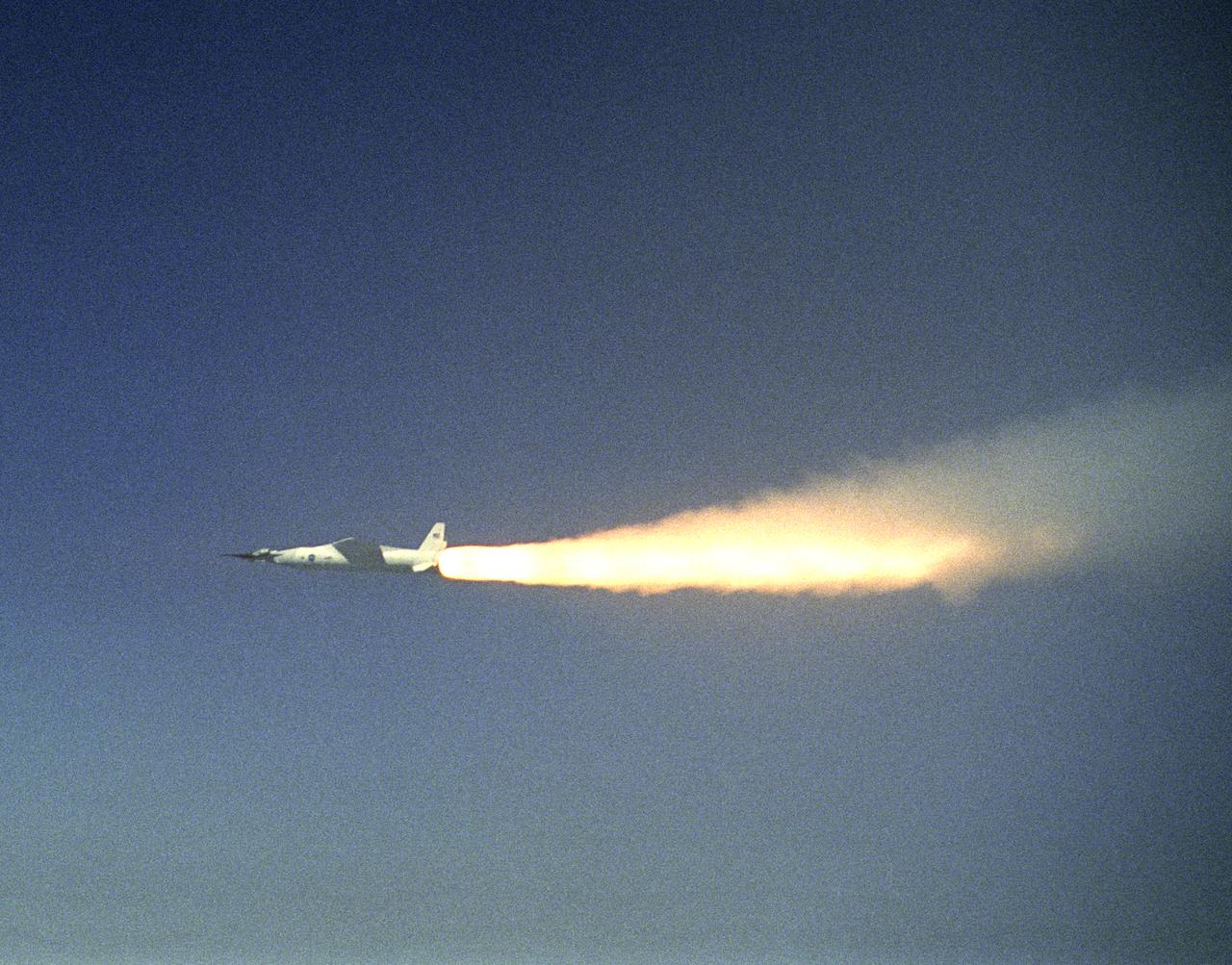
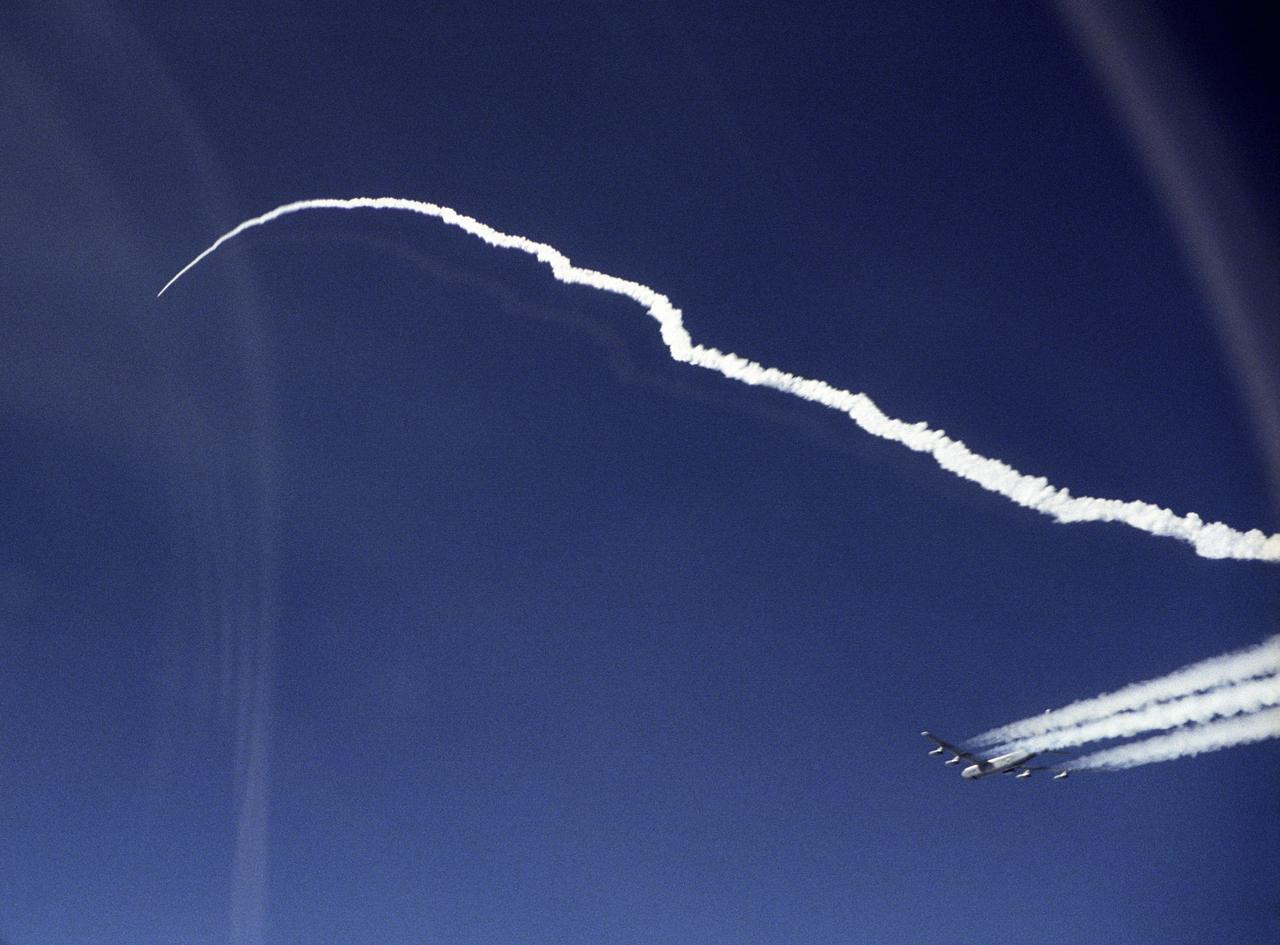
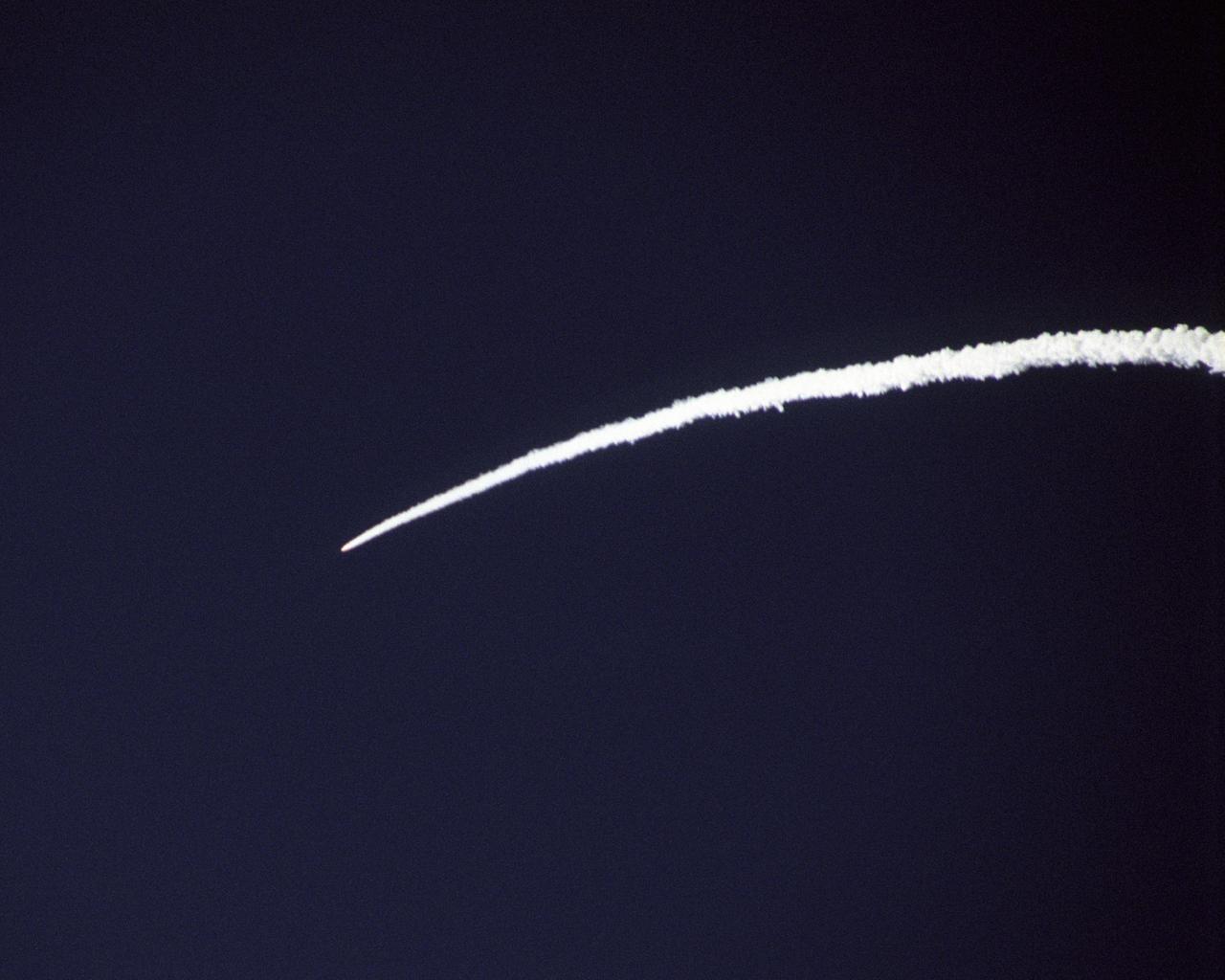
The Pegasus rocket that powered NASA's X-43A scramjet to almost Mach 10 test conditions leaves a bright arc in the Pacific sky during the boost phase.
The Pegasus rocket that powered NASA's X-43A scramjet to almost Mach 10 test conditions leaves a bright arc in the Pacific sky during the boost phase
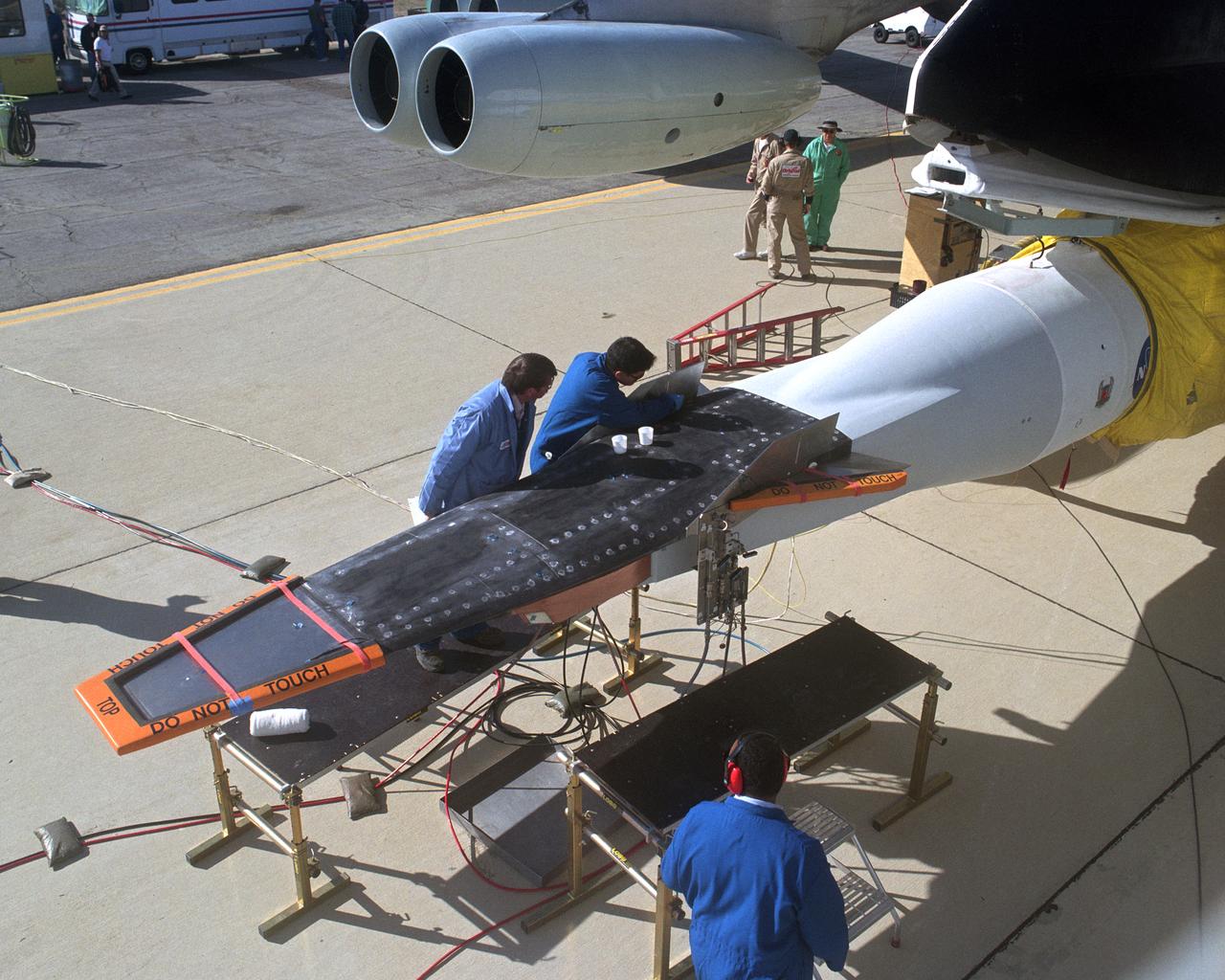
The second X-43A hypersonic research vehicle, mounted under the right wing of the B-52B launch aircraft, viewed from the B-52 cockpit. The crew is working on closing out the research vehicle, preparing it for flight.
The second X-43A hypersonic research vehicle, mounted under the right wing of the B-52B launch aircraft, viewed from the B-52 cockpit
NASA's B-52B mothership, escorted by two F-18s, makes a final flyover after its last research mission that launched the X-43A on its record Mach 9.6 flight.
NASA's B-52B mothership, escorted by two F-18s, makes a final flyover after its last research mission that launched the X-43A on its record Mach 9.6 flight
The second X-43A hypersonic research aircraft and its modified Pegasus booster rocket left the runway, carried aloft by NASA's B-52B launch aircraft from the NASA Dryden Flight Research Center at Edwards Air Force Base, Calif., on March 27, 2004. About an hour later the Pegasus booster was launched from the B-52 to accelerate the X-43A to its intended speed of Mach 7.
NASA's B-52B launch aircraft takes off carrying the second X-43A hypersonic research vehicle attached to a modified Pegasus rocket, on March 27, 2004
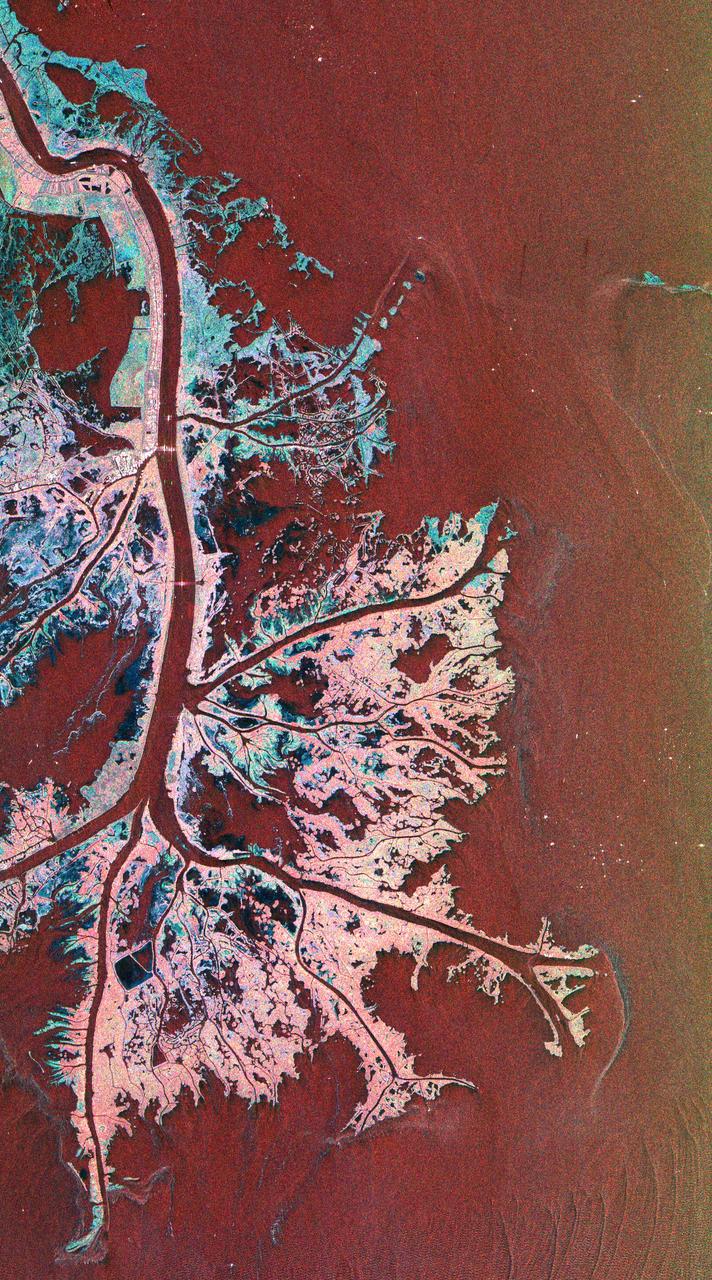
This is a radar image of the Mississippi River Delta where the river enters into the Gulf of Mexico along the coast of Louisiana. This multi-frequency image demonstrates the capability of the radar to distinguish different types of wetlands surfaces in river deltas. This image was acquired by the Spaceborne Imaging Radar-C/X-Band Synthetic Aperture Radar (SIR-C/X-SAR) aboard the space shuttle Endeavour on October 2, 1995. The image is centered on latitude 29.3 degrees North latitude and 89.28 degrees West longitude. The area shown is approximately 63 kilometers by 43 kilometers (39 miles by 26 miles). North is towards the upper right of the image.  As the river enters the Gulf of Mexico, it loses energy and dumps its load of sediment that it has carried on its journey through the mid-continent. This pile of sediment, or mud, accumulates over the years building up the delta front. As one part of the delta becomes clogged with sediment, the delta front will migrate in search of new areas to grow. The area shown on this image is the currently active delta front of the Mississippi. The migratory nature of the delta forms natural traps for oil and the numerous bright spots along the outside of the delta are drilling platforms. Most of the land in the image consists of mud flats and marsh lands. There is little human settlement in this area due to the instability of the sediments. The main shipping channel of the Mississippi River is the broad red stripe running northwest to southeast down the left side of the image. The bright spots within the channel are ships. The colors in the image are assigned to different frequencies and polarizations of the radar as follows: red is L-band vertically transmitted, vertically received; green is C-band vertically transmitted, vertically received; blue is X-band vertically transmitted, vertically received.  http://photojournal.jpl.nasa.gov/catalog/PIA01784
Space Radar Image of Mississippi Delta
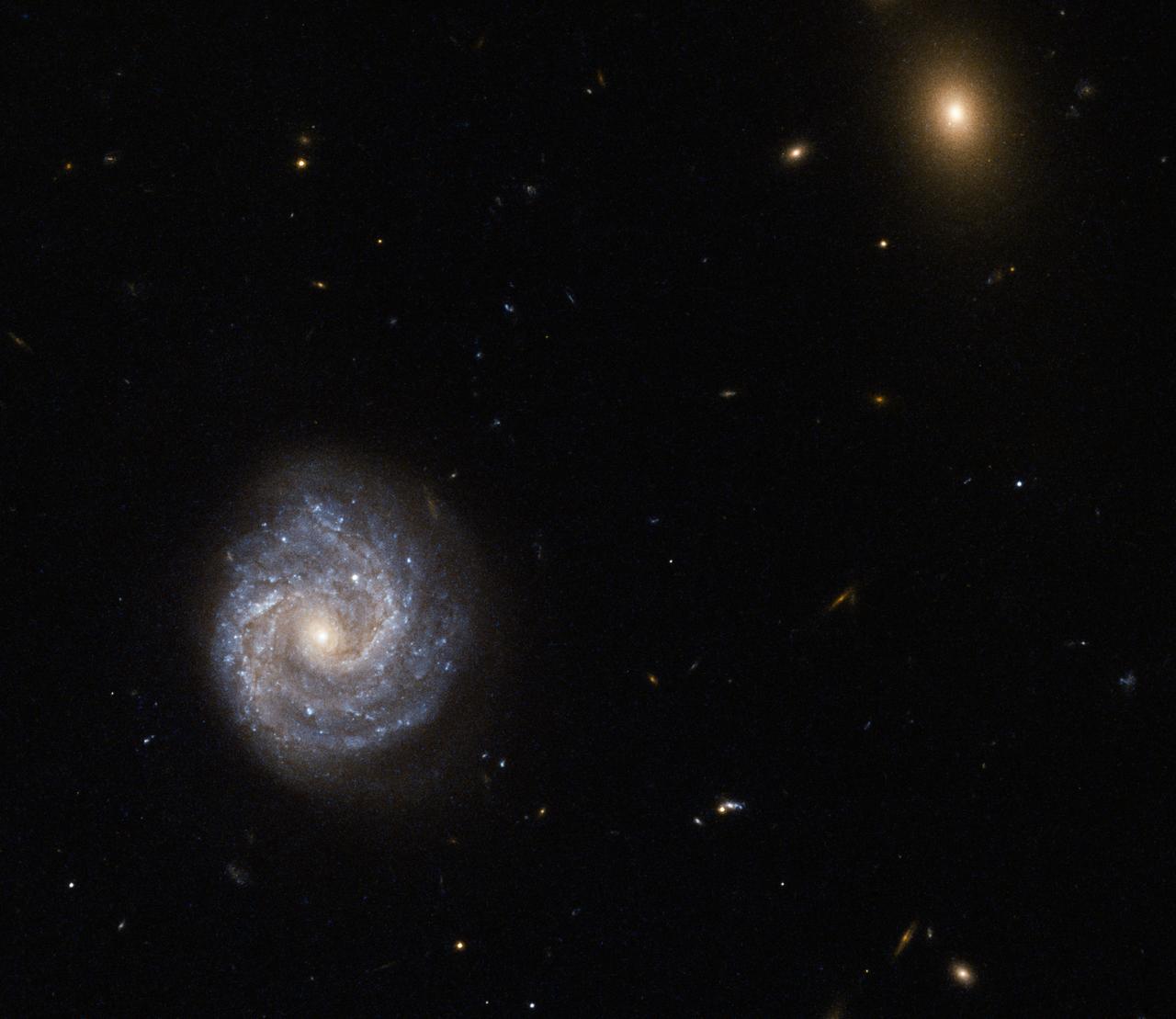
Not all galaxies have the luxury of possessing a simple moniker or quirky nickname.   This impressive galaxy imaged by the NASA/ESA Hubble Space Telescope is one of the unlucky ones, and goes by a name that looks more like a password for a computer:  2XMM J143450.5+033843.  Such a name may seem like a random jumble of numbers and letters, but like all galactic epithets it has a distinct meaning. This galaxy, for example, was detected and observed as part of the second X-ray sky survey performed by ESA’s XMM-Newton Observatory. Its celestial coordinates form the rest of the bulky name, following the “J”: a right ascension value of 14h (hours) 34m (minutes) 50.5s (seconds). This can be likened to terrestrial longitude. It also has a declination of +03d (degrees) 38m (minutes) 43s (seconds). Declination can be likened to terrestrial latitude. The other fuzzy object in the frame was named in the same way — it is a bright galaxy named 2XMM J143448.3+033749.  2XMM J143450.5+033843 lies nearly 400 million light-years away from Earth. It is a Seyfert galaxy that is dominated by something known as an Active Galactic Nucleus — its core is thought to contain a supermassive black hole that is emitting huge amounts of radiation, pouring energetic X-rays out into the Universe.  Photo credit: ESA/Hubble &amp; NASA  <b><a href="http://www.nasa.gov/audience/formedia/features/MP_Photo_Guidelines.html" rel="nofollow">NASA image use policy.</a></b>  <b><a href="http://www.nasa.gov/centers/goddard/home/index.html" rel="nofollow">NASA Goddard Space Flight Center</a></b> enables NASA’s mission through four scientific endeavors: Earth Science, Heliophysics, Solar System Exploration, and Astrophysics. Goddard plays a leading role in NASA’s accomplishments by contributing compelling scientific knowledge to advance the Agency’s mission.  <b>Follow us on <a href="http://twitter.com/NASAGoddardPix" rel="nofollow">Twitter</a></b>  <b>Like us on <a href="http://www.facebook.com/pages/Greenbelt-MD/NASA-Goddard/395013845897?ref=tsd" rel="nofollow">Facebook</a></b>  <b>Find us on <a href="http://instagrid.me/nasagoddard/?vm=grid" rel="nofollow">Instagram</a></b>
Hubble Eyes a Powerful Galaxy
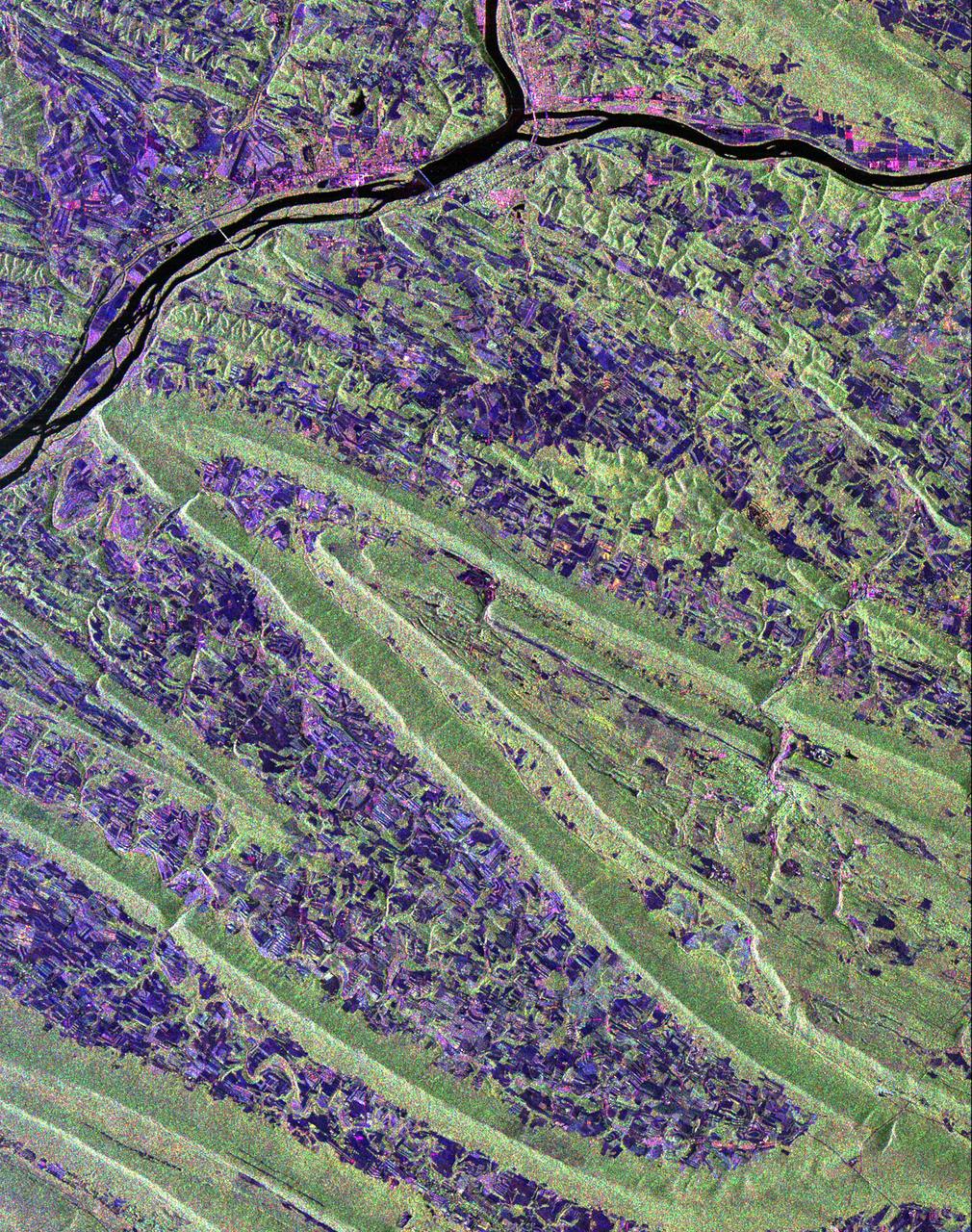
Scientists are using this radar image of the area surrounding Sunbury, Pennsylvania to study the geologic structure and land use patterns in the Appalachian Valley and Ridge province. This image was collected on October 6, 1994 by the Spaceborne Imaging Radar-C/ X-Band Synthetic Aperture Radar (SIR-C/X-SAR) on orbit 102 of the space shuttle Endeavour. The image is centered on latitude 40.85 degrees North latitude and 76.79 degrees West longitude. The area shown is approximately 30.5 km by 38 km. (19 miles by 24 miles). North is towards the upper right of the image. The Valley and Ridge province occurs in the north-central Appalachians, primarily in Pennsylvania, Maryland, and Virginia. It is an area of adjacent valleys and ridges that formed when the Appalachian mountain were created some 370 to 390 million years ago. During the continental collision that formed the Appalachians, the rocks in this area were pushed from the side and buckled much like a rug when pushed from one end. Subsequent erosion has produced the landscape we see in this image. The more resistant rocks, such as sandstone, form the tops of the ridges which appear as forested greenish areas on this image. The less resistant rocks, such as limestone, form the lower valleys which are cleared land and farm fields and are purple in this image. Smaller rivers and streams in the area flow along the valleys and in places cut across the ridges in "water gaps." In addition to defining the geography of this region, the Valley and Ridge province also provides this area with natural resources. The valleys provide fertile farmland and the folded mountains form natural traps for oil and gas accumulation; coal deposits are also found in the mountains. The colors in the image are assigned to different frequencies and polarizations of the SIR-C radar as follows: red is L-band horizontally transmitted, horizontally received; green is L-band horizontally transmitted, vertically received; blue is C-band horizontally transmitted, horizontally received. The river junction near the top of the image is where the West Branch River flows into the Susquehanna River, which then flows to the south-southwest past the state capitol of Harrisburg, 70 km (43 miles) to the south and not visible in this image. The town of Sunbury is shown along the Susquehanna on the east just to the southeast of the junction with West Branch. Three structures that cross the Susquehanna; the northern and southern of these structures are bridges and middle structure is the Shamokin Dam which confines the Susquehanna just south of the junction with West Branch. The prominent S-shaped mountain ridge in the center of the image is, from north to south, Little Mountain (the top of the S), Line Mountain (the middle of the S), and Mahantango Mountain (the bottom of the S).   http://photojournal.jpl.nasa.gov/catalog/PIA01306
Space Radar Image of Sunbury, Pennsylvania
SDO AIA image of the X3.1 flare in 131 angstrom light from 21:43 UT on October 24, 2014.  Credit:NASA/SDO  More info: The sun emitted a significant solar flare, peaking at 5:40 p.m. EDT on Oct. 24, 2014. NASA's Solar Dynamics Observatory, which watches the sun constantly, captured images of the event. Solar flares are powerful bursts of radiation. Harmful radiation from a flare cannot pass through Earth's atmosphere to physically affect humans on the ground, however -- when intense enough -- they can disturb the atmosphere in the layer where GPS and communications signals travel.  This flare is classified as an X3.1-class flare.  X-class denotes the most intense flares, while the number provides more information about its strength. An X2 is twice as intense as an X1, an X3 is three times as intense, etc.  The flare erupted from a particularly large active region -- labeled AR 12192 -- on the sun that is the largest in 24 years. This is the fourth substantial flare from this active region since Oct. 19.  Credit: NASA's Goddard Space Flight Center  <b><a href="http://www.nasa.gov/audience/formedia/features/MP_Photo_Guidelines.html" rel="nofollow">NASA image use policy.</a></b>  <b><a href="http://www.nasa.gov/centers/goddard/home/index.html" rel="nofollow">NASA Goddard Space Flight Center</a></b> enables NASA’s mission through four scientific endeavors: Earth Science, Heliophysics, Solar System Exploration, and Astrophysics. Goddard plays a leading role in NASA’s accomplishments by contributing compelling scientific knowledge to advance the Agency’s mission.  <b>Follow us on <a href="http://twitter.com/NASAGoddardPix" rel="nofollow">Twitter</a></b>  <b>Like us on <a href="http://www.facebook.com/pages/Greenbelt-MD/NASA-Goddard/395013845897?ref=tsd" rel="nofollow">Facebook</a></b>  <b>Find us on <a href="http://instagrid.me/nasagoddard/?vm=grid" rel="nofollow">Instagram</a></b>
Giant Sunspot Erupts on October 24, 2014