
NASA’s Imaging X-Ray Polarimetry Explorer (IXPE) spacecraft – the agency’s first mission dedicated to measuring X-ray polarization – arrives at the Cape Canaveral Space Force Station in Florida on Nov. 5, 2021. IXPE is scheduled to launch aboard a SpaceX Falcon 9 vehicle from Kennedy’s Launch Complex 39A on Dec. 9, 2021. The launch is managed by NASA’s Launch Services Program, based at Kennedy. IXPE will study the polarization of X-rays coming to us from some of the universe’s most extreme sources, including black holes and dead stars known as pulsars.

NASA’s Imaging X-Ray Polarimetry Explorer (IXPE) spacecraft – the agency’s first mission dedicated to measuring X-ray polarization – arrives at the Cape Canaveral Space Force Station in Florida on Nov. 5, 2021. IXPE is scheduled to launch aboard a SpaceX Falcon 9 vehicle from Kennedy’s Launch Complex 39A on Dec. 9, 2021. The launch is managed by NASA’s Launch Services Program, based at Kennedy. IXPE will study the polarization of X-rays coming to us from some of the universe’s most extreme sources, including black holes and dead stars known as pulsars.

NASA’s Imaging X-Ray Polarimetry Explorer (IXPE) spacecraft – the agency’s first mission dedicated to measuring X-ray polarization – arrives at the Cape Canaveral Space Force Station in Florida on Nov. 5, 2021. IXPE is scheduled to launch aboard a SpaceX Falcon 9 vehicle from Kennedy’s Launch Complex 39A on Dec. 9, 2021. The launch is managed by NASA’s Launch Services Program, based at Kennedy. IXPE will study the polarization of X-rays coming to us from some of the universe’s most extreme sources, including black holes and dead stars known as pulsars.

NASA’s Imaging X-Ray Polarimetry Explorer (IXPE) spacecraft – the agency’s first mission dedicated to measuring X-ray polarization – arrives at the Cape Canaveral Space Force Station in Florida on Nov. 5, 2021. IXPE is scheduled to launch aboard a SpaceX Falcon 9 vehicle from Kennedy’s Launch Complex 39A on Dec. 9, 2021. The launch is managed by NASA’s Launch Services Program, based at Kennedy. IXPE will study the polarization of X-rays coming to us from some of the universe’s most extreme sources, including black holes and dead stars known as pulsars.

NASA’s Imaging X-Ray Polarimetry Explorer (IXPE) spacecraft – the agency’s first mission dedicated to measuring X-ray polarization – arrives at the Cape Canaveral Space Force Station in Florida on Nov. 5, 2021. IXPE is scheduled to launch aboard a SpaceX Falcon 9 vehicle from Kennedy’s Launch Complex 39A on Dec. 9, 2021. The launch is managed by NASA’s Launch Services Program, based at Kennedy. IXPE will study the polarization of X-rays coming to us from some of the universe’s most extreme sources, including black holes and dead stars known as pulsars.

NASA’s Imaging X-Ray Polarimetry Explorer (IXPE) spacecraft – the agency’s first mission dedicated to measuring X-ray polarization – arrives at the Cape Canaveral Space Force Station in Florida on Nov. 5, 2021. IXPE is scheduled to launch aboard a SpaceX Falcon 9 vehicle from Kennedy’s Launch Complex 39A on Dec. 9, 2021. The launch is managed by NASA’s Launch Services Program, based at Kennedy. IXPE will study the polarization of X-rays coming to us from some of the universe’s most extreme sources, including black holes and dead stars known as pulsars.

NASA’s Imaging X-Ray Polarimetry Explorer (IXPE) spacecraft – the agency’s first mission dedicated to measuring X-ray polarization – arrives at the Cape Canaveral Space Force Station in Florida on Nov. 5, 2021. IXPE is scheduled to launch aboard a SpaceX Falcon 9 vehicle from Kennedy’s Launch Complex 39A on Dec. 9, 2021. The launch is managed by NASA’s Launch Services Program, based at Kennedy. IXPE will study the polarization of X-rays coming to us from some of the universe’s most extreme sources, including black holes and dead stars known as pulsars.

NASA’s Imaging X-Ray Polarimetry Explorer (IXPE) spacecraft – the agency’s first mission dedicated to measuring X-ray polarization – arrives at the Cape Canaveral Space Force Station in Florida on Nov. 5, 2021. IXPE is scheduled to launch aboard a SpaceX Falcon 9 vehicle from Kennedy’s Launch Complex 39A on Dec. 9, 2021. The launch is managed by NASA’s Launch Services Program, based at Kennedy. IXPE will study the polarization of X-rays coming to us from some of the universe’s most extreme sources, including black holes and dead stars known as pulsars.

NASA’s Imaging X-Ray Polarimetry Explorer (IXPE) spacecraft – the agency’s first mission dedicated to measuring X-ray polarization – arrives at the Cape Canaveral Space Force Station in Florida on Nov. 5, 2021. IXPE is scheduled to launch aboard a SpaceX Falcon 9 vehicle from Kennedy’s Launch Complex 39A on Dec. 9, 2021. The launch is managed by NASA’s Launch Services Program, based at Kennedy. IXPE will study the polarization of X-rays coming to us from some of the universe’s most extreme sources, including black holes and dead stars known as pulsars.

NASA’s Imaging X-Ray Polarimetry Explorer (IXPE) spacecraft – the agency’s first mission dedicated to measuring X-ray polarization – arrives at the Cape Canaveral Space Force Station in Florida on Nov. 5, 2021. IXPE is scheduled to launch aboard a SpaceX Falcon 9 vehicle from Kennedy’s Launch Complex 39A on Dec. 9, 2021. The launch is managed by NASA’s Launch Services Program, based at Kennedy. IXPE will study the polarization of X-rays coming to us from some of the universe’s most extreme sources, including black holes and dead stars known as pulsars.

NASA’s Imaging X-Ray Polarimetry Explorer (IXPE) spacecraft – the agency’s first mission dedicated to measuring X-ray polarization – arrives at the Cape Canaveral Space Force Station in Florida on Nov. 5, 2021. IXPE is scheduled to launch aboard a SpaceX Falcon 9 vehicle from Kennedy’s Launch Complex 39A on Dec. 9, 2021. The launch is managed by NASA’s Launch Services Program, based at Kennedy. IXPE will study the polarization of X-rays coming to us from some of the universe’s most extreme sources, including black holes and dead stars known as pulsars.

NASA’s Imaging X-Ray Polarimetry Explorer (IXPE) spacecraft – the agency’s first mission dedicated to measuring X-ray polarization – arrives at the Cape Canaveral Space Force Station in Florida on Nov. 5, 2021. IXPE is scheduled to launch aboard a SpaceX Falcon 9 vehicle from Kennedy’s Launch Complex 39A on Dec. 9, 2021. The launch is managed by NASA’s Launch Services Program, based at Kennedy. IXPE will study the polarization of X-rays coming to us from some of the universe’s most extreme sources, including black holes and dead stars known as pulsars.
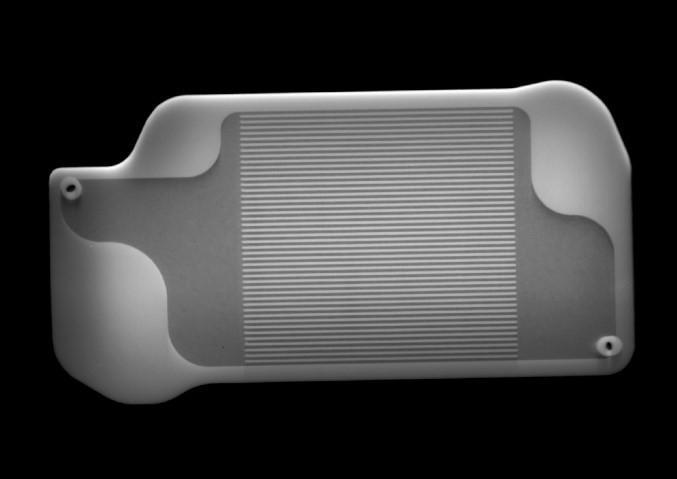
This X-ray image shows the interior of a palm-size 3D-printed heat exchanger inside Perseverance's Mars Oxygen In-situ Resource Utilization Experiment (MOXIE) instrument. Martian air will be carried into the tiny channels visible in the center of this part, where they'll be preheated. MOXIE will convert Martian air, which is mostly composed of carbon dioxide, into oxygen, which will be needed in industrial quantities as rocket propellant for launching astronauts back to Earth. X-ray images like these are used to check for defects inside of parts; in this case, engineers checked to make sure the channels were free of the powder that the 3D printer melts in successive layers in order to produce the part. https://photojournal.jpl.nasa.gov/catalog/PIA24100
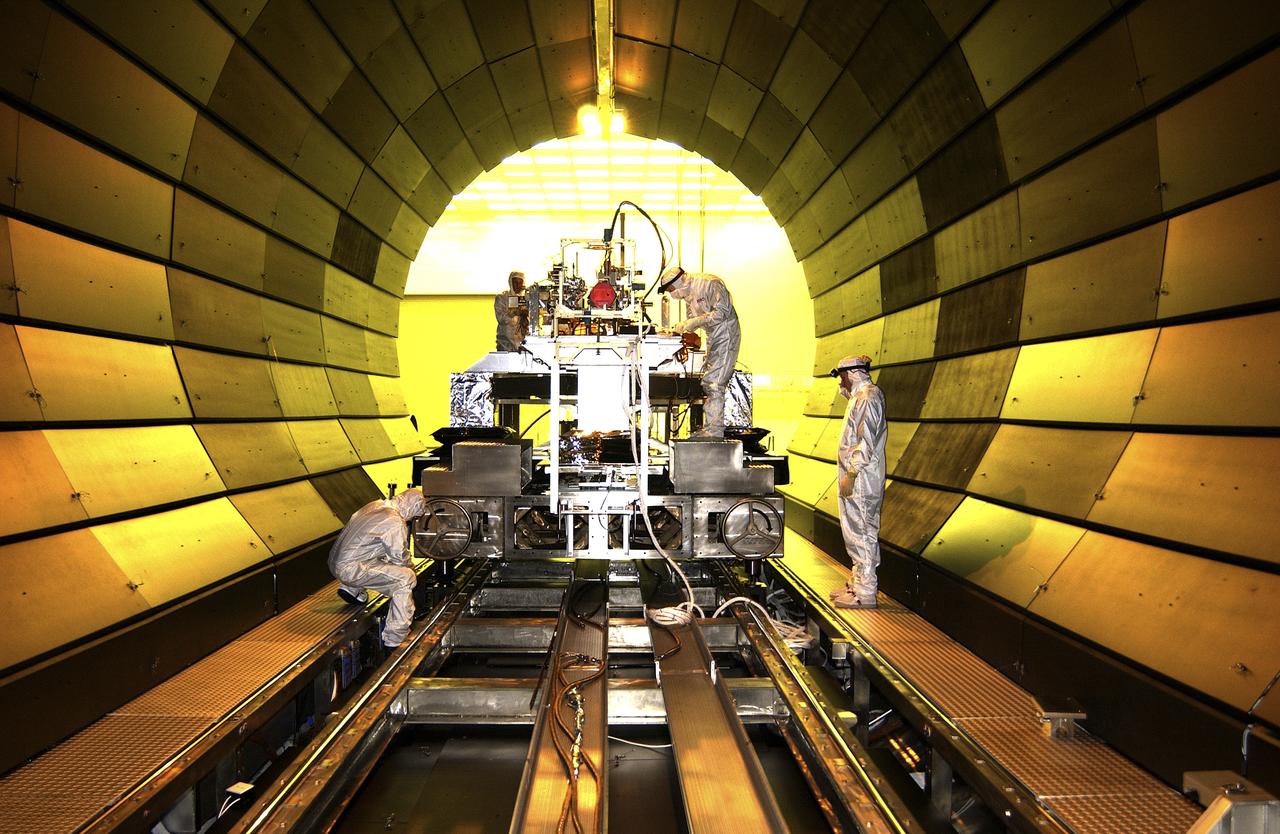
This photograph depicts the Solar X-Ray Imager (SXI) being installed in the X-Ray Calibration Facility (XRCF) vacuum chamber for testing at the Marshall Space Flight Center (MSFC). The XRCF vacuum chamber simulates a space environment with low temperature and pressure. The x-ray images from SXI on the Geostationary Operational Environmental Satellite-12 (GOES-12) will be used by the National Oceanic and Atmospheric Administration (NOAA) and U.S. Air Force to forecast the intensity and speed of solar disturbances that could destroy satellite electronics or disrupt long-distance radio communications. The SXI will observe solar flares, coronal mass ejections, coronal holes, and active regions in the x-ray region of the electromagnetic spectrum. These features are the dominant sources of disturbances in space weather. The imager instrument consists of a telescope assembly with a 6.3-inch (16-centimeter) diameter grazing incidence mirror and a detector system. The imager was developed, tested, and calibrated by MSFC, in conjunction with the NASA Goddard Space Flight Center and U.S. Air Force.
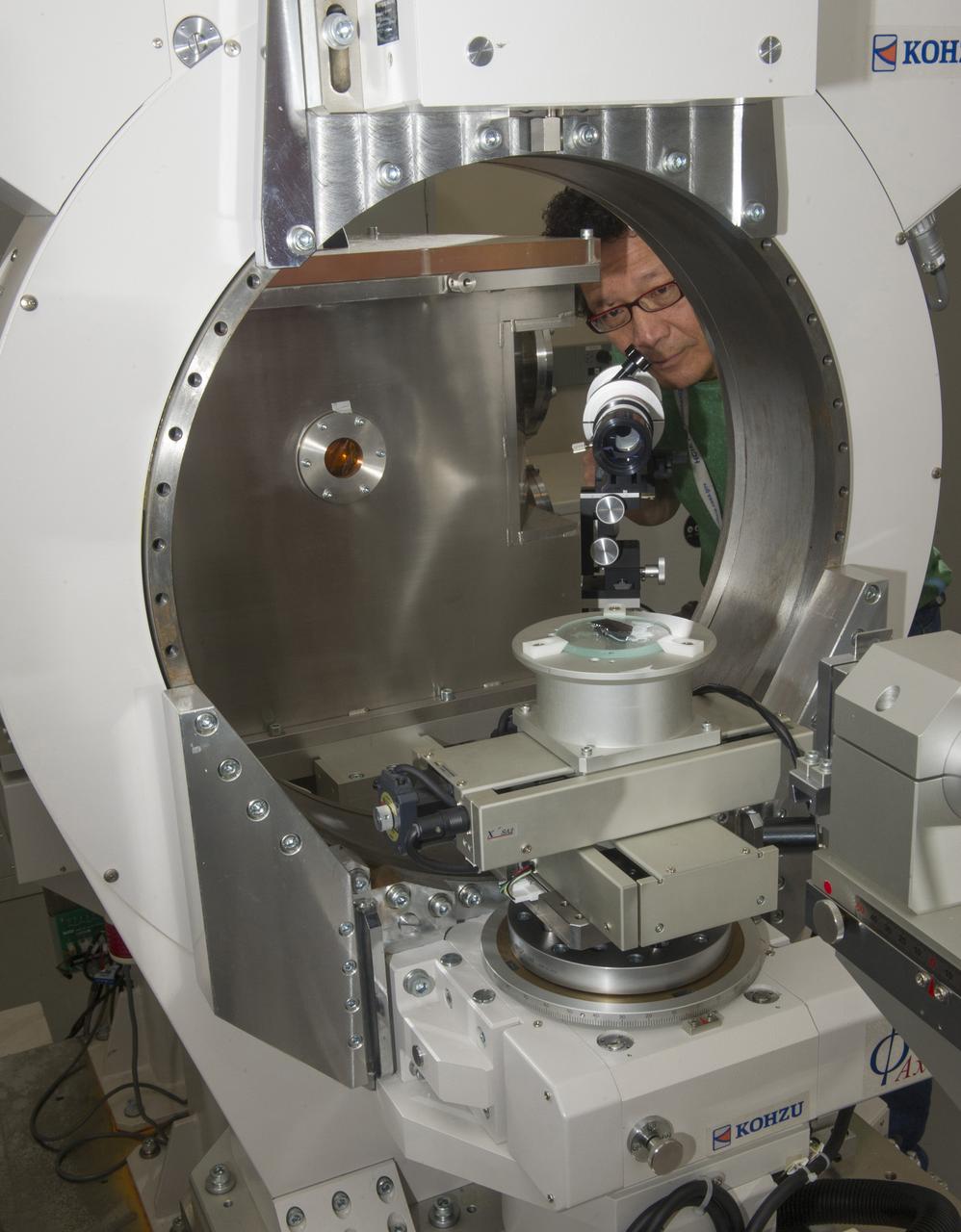
DR. CHING-HUA SU, MATERIALS RESEARCHER, AT IN-SITU X-RAY DIFFRACTION IMAGING AND SCATTERING FACILITY, BLDG.. 4602
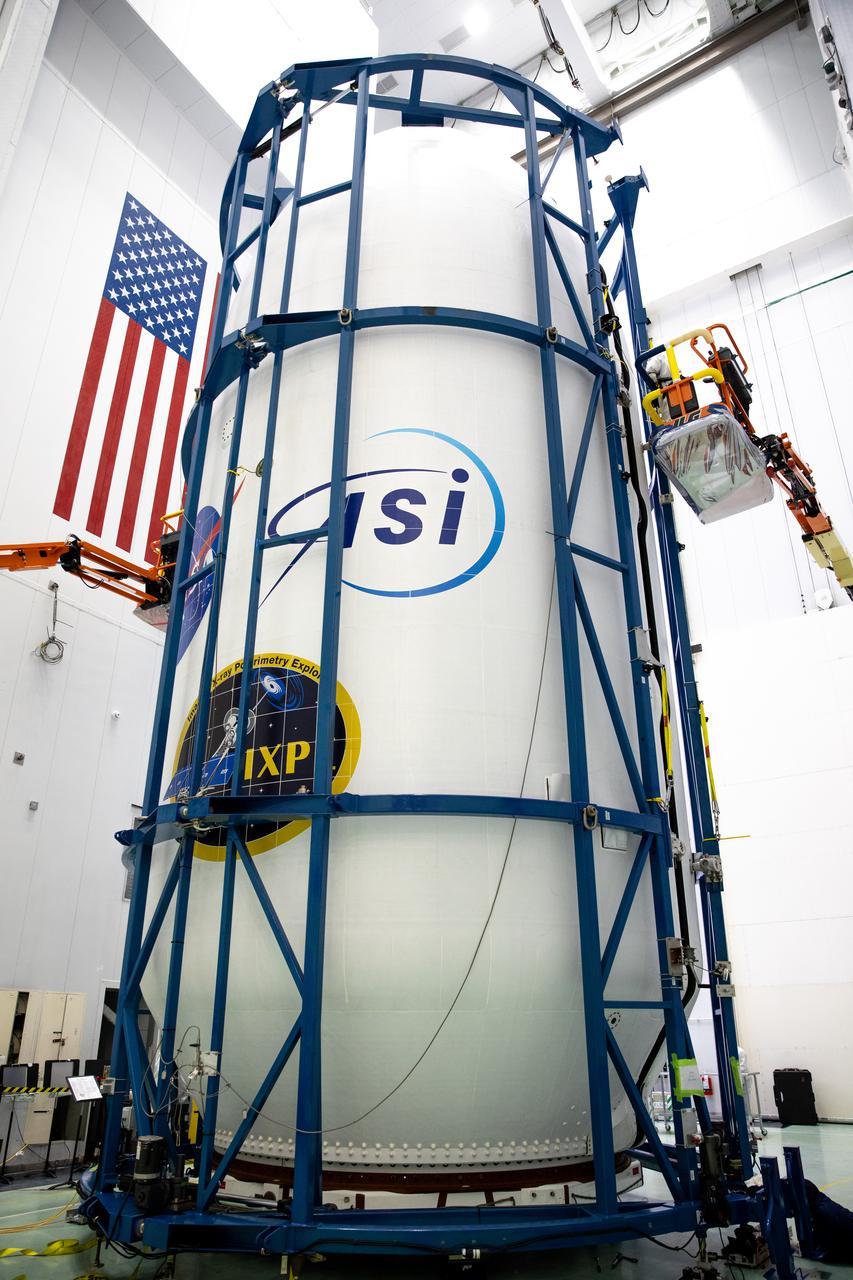
NASA’s Imaging X-Ray Polarimetry Explorer (IXPE) spacecraft and nose fairing are brought together for encapsulation inside SpaceX’s Payload Processing Facility at Kennedy Space Center in Florida on Dec. 2, 2021. The mission is scheduled to launch no earlier than Thursday, Dec. 9, at 1 a.m. EST, on a SpaceX Falcon 9 rocket from Launch Complex 39A at NASA’s Kennedy Space Center in Florida. IXPE is the first satellite dedicated to measuring the polarization of X-rays from a variety of cosmic sources, such as black holes and neutron stars.
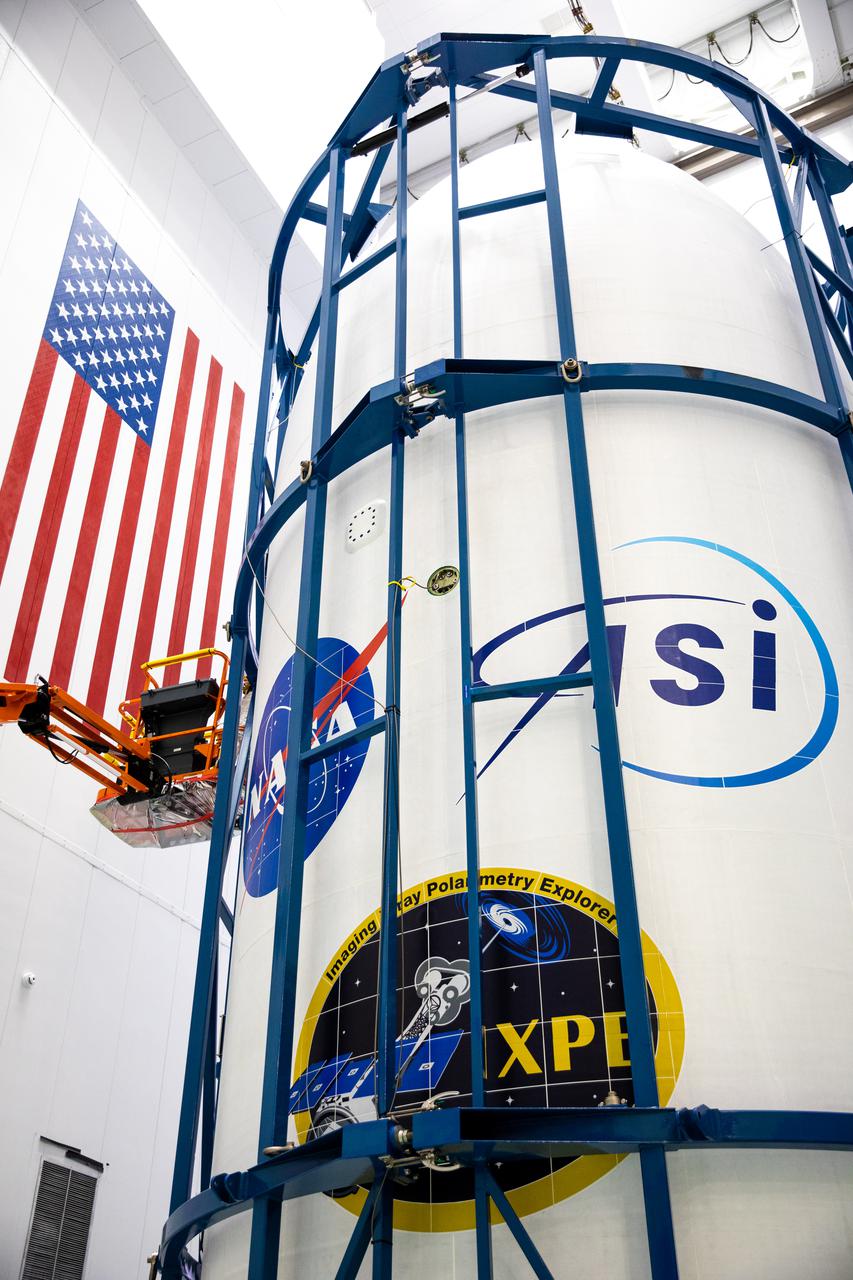
NASA’s Imaging X-Ray Polarimetry Explorer (IXPE) spacecraft and nose fairing are brought together for encapsulation inside SpaceX’s Payload Processing Facility at Kennedy Space Center in Florida on Dec. 2, 2021. The mission is scheduled to launch no earlier than Thursday, Dec. 9, at 1 a.m. EST, on a SpaceX Falcon 9 rocket from Launch Complex 39A at NASA’s Kennedy Space Center in Florida. IXPE is the first satellite dedicated to measuring the polarization of X-rays from a variety of cosmic sources, such as black holes and neutron stars.
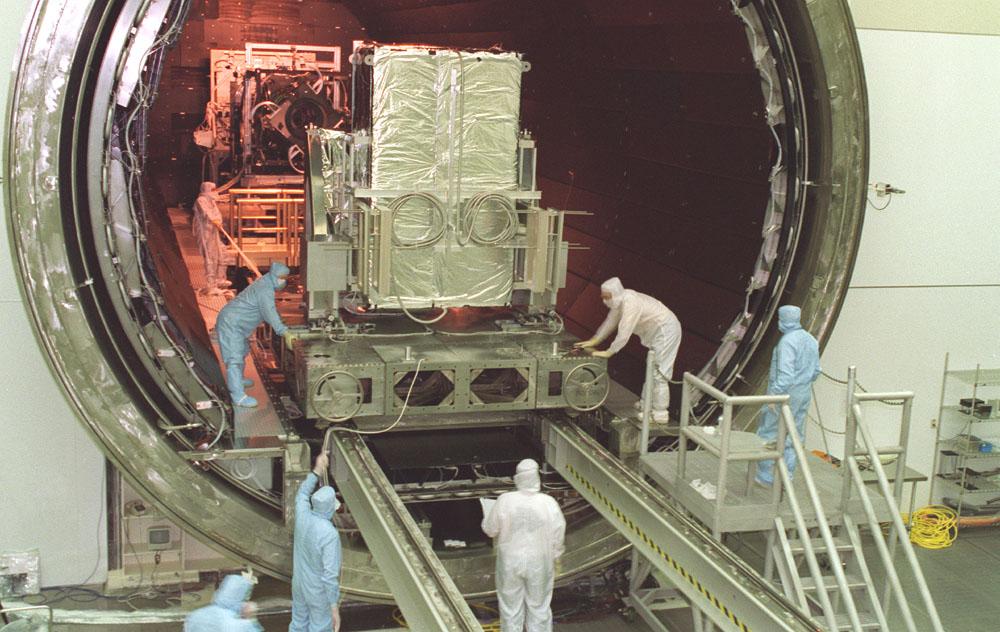
This photograph captures the installation of the Chandra X-Ray Observatory, formerly Advanced X-Ray Astrophysics Facility (AXAF), Advanced Charged-Coupled Device (CCD) Imaging Spectrometer (ACIS) into the Vacuum Chamber at the X-Ray Calibration Facility (XRCF) at Marshall Space Flight Center (MSFC). The AXAF was renamed Chandra X-Ray Observatory (CXO) in 1999. The CXO is the most sophisticated and the world's most powerful x-ray telescope ever built. It observes x-rays from high-energy regions of the universe, such as hot gas in the remnants of exploded stars. The ACIS is one of two focal plane instruments. As the name suggests, this instrument is an array of CCDs similar to those used in a camcorder. This instrument will be especially useful because it can make x-ray images and measure the energies of incoming x-rays. It is the instrument of choice for studying the temperature variation across x-ray sources, such as vast clouds of hot-gas intergalactic space. MSFC's XRCF is the world's largest, most advanced laboratory for simulating x-ray emissions from distant celestial objects. It produces a space-like environment in which components related to x-ray telescope imaging are tested and the quality of their performances in space is predicted. TRW, Inc. was the prime contractor for the development of the CXO and NASA's MSFC was responsible for its project management. The Smithsonian Astrophysical Observatory controls science and flight operations of the CXO for NASA from Cambridge, Massachusetts. The CXO was launched July 22, 1999 aboard the Space Shuttle Columbia (STS-93).
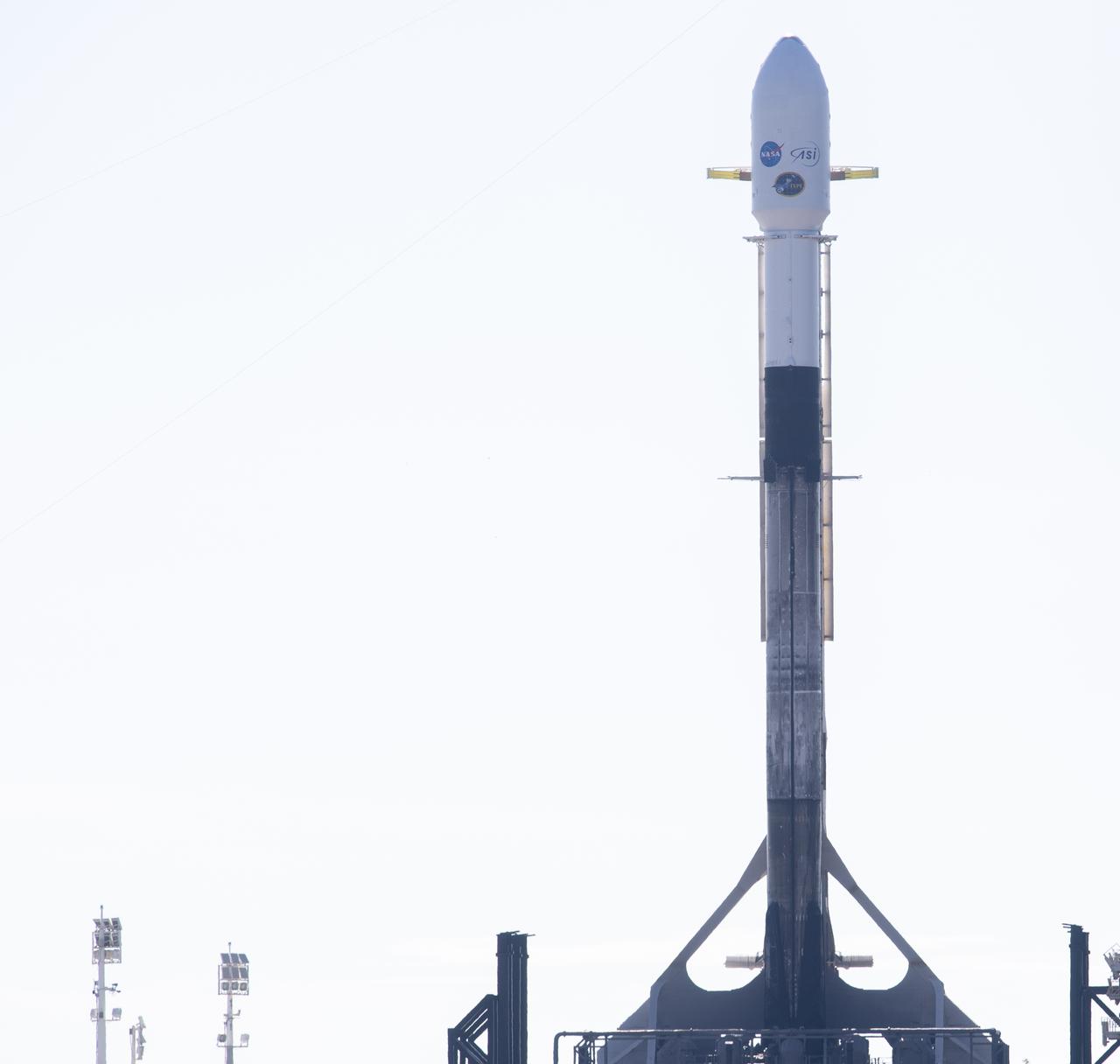
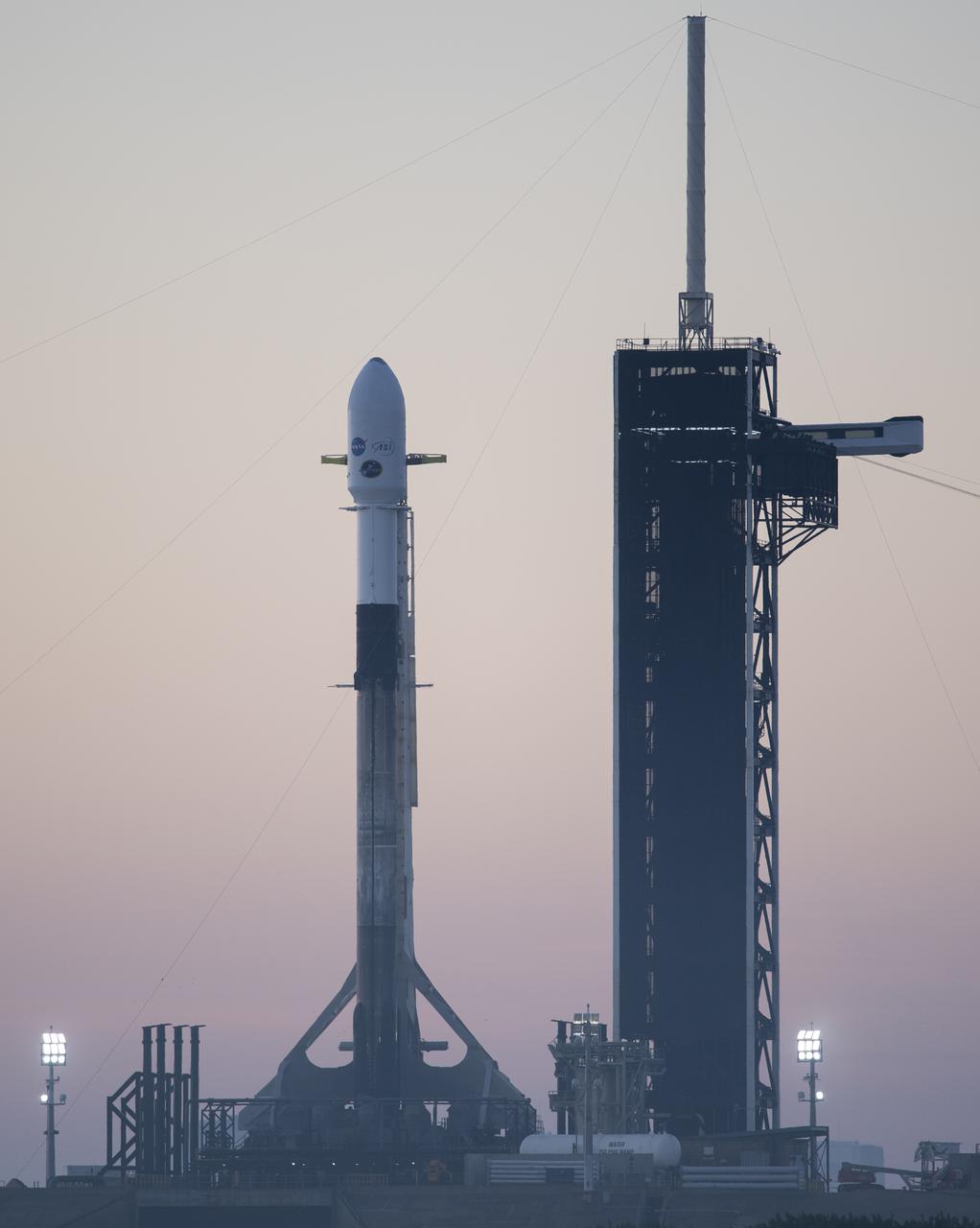
A SpaceX Falcon 9 rocket carrying NASA’s Imaging X-ray Polarimetry Explorer (IXPE) spacecraft is seen on the launch pad at Launch Complex 39A, Wednesday, Dec. 8, 2021, at NASA’s Kennedy Space Center in Florida. The IXPE spacecraft is the first satellite dedicated to measuring the polarization of X-rays from a variety of cosmic sources, such as black holes and neutron stars. Photo Credit: (NASA/Joel Kowsky)

A SpaceX Falcon 9 rocket carrying NASA’s Imaging X-ray Polarimetry Explorer (IXPE) spacecraft is seen on the launch pad at Launch Complex 39A, Wednesday, Dec. 8, 2021, at NASA’s Kennedy Space Center in Florida. The IXPE spacecraft is the first satellite dedicated to measuring the polarization of X-rays from a variety of cosmic sources, such as black holes and neutron stars. Photo Credit: (NASA/Joel Kowsky)

A SpaceX Falcon 9 rocket carrying NASA’s Imaging X-ray Polarimetry Explorer (IXPE) spacecraft is seen on the launch pad at Launch Complex 39A, Wednesday, Dec. 8, 2021, at NASA’s Kennedy Space Center in Florida. The IXPE spacecraft is the first satellite dedicated to measuring the polarization of X-rays from a variety of cosmic sources, such as black holes and neutron stars. Photo Credit: (NASA/Joel Kowsky)
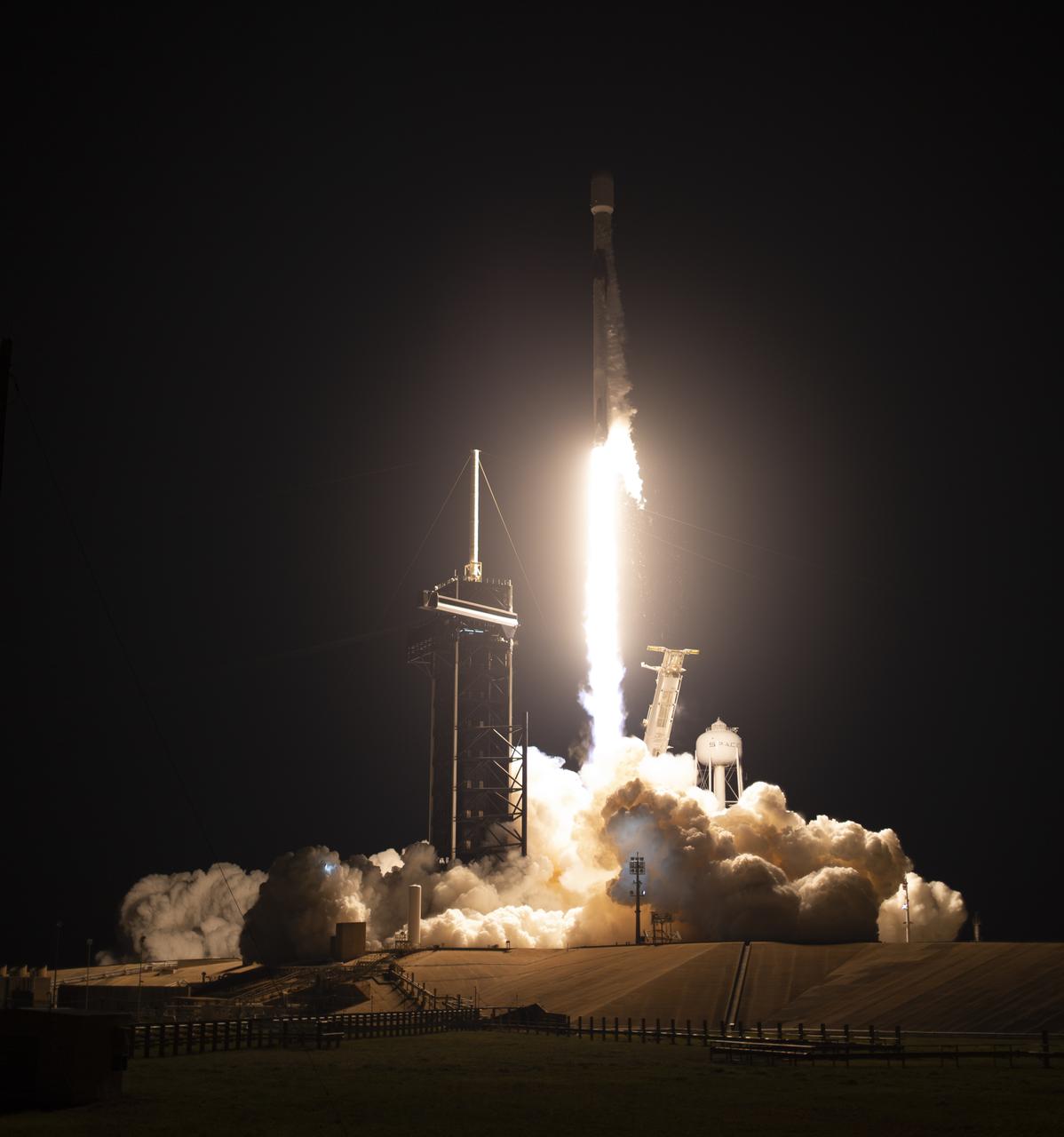
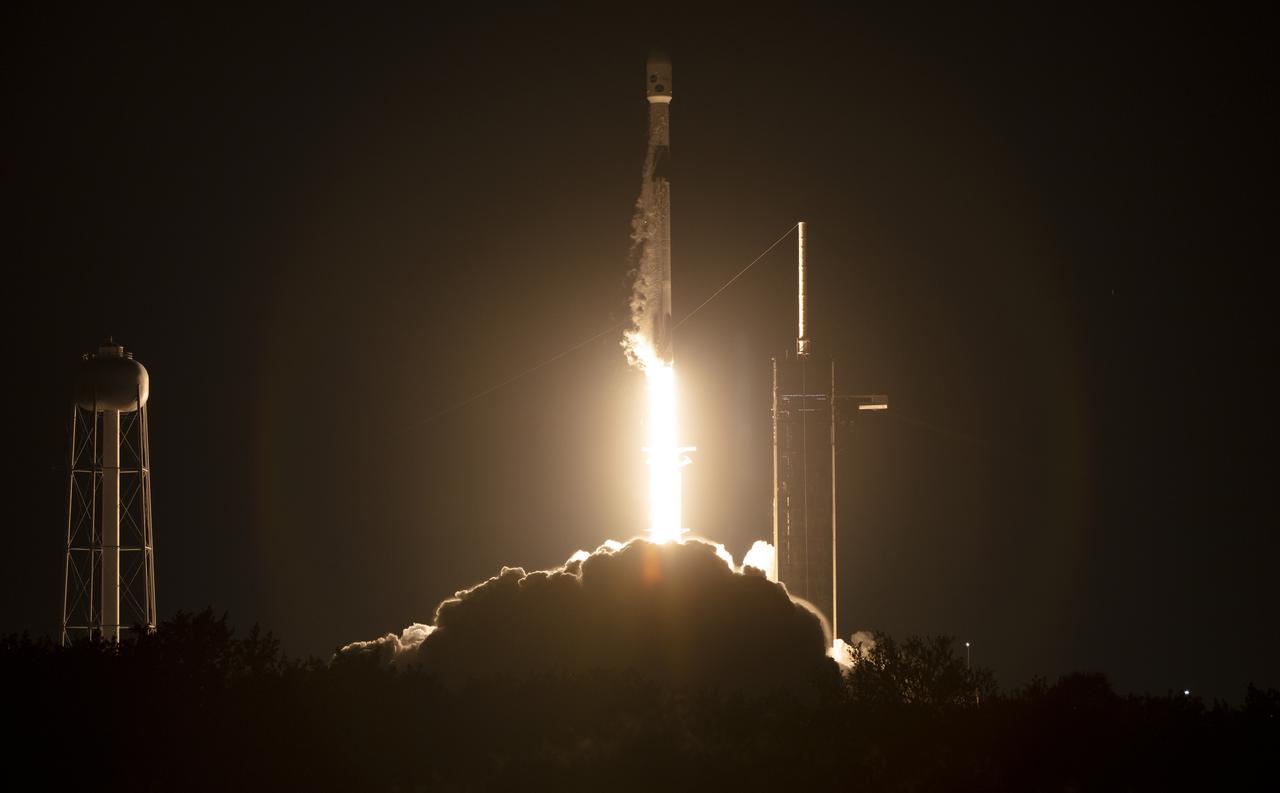
A SpaceX Falcon 9 rocket launches with NASA’s Imaging X-ray Polarimetry Explorer (IXPE) spacecraft onboard from Launch Complex 39A, Thursday, Dec. 9, 2021, at NASA’s Kennedy Space Center in Florida. The IXPE spacecraft is the first satellite dedicated to measuring the polarization of X-rays from a variety of cosmic sources, such as black holes and neutron stars. Launch occurred at 1:00 a.m. EST. Photo Credit: (NASA/Joel Kowsky)
A SpaceX Falcon 9 rocket launches with NASA’s Imaging X-ray Polarimetry Explorer (IXPE) spacecraft onboard from Launch Complex 39A, Thursday, Dec. 9, 2021, at NASA’s Kennedy Space Center in Florida. The IXPE spacecraft is the first satellite dedicated to measuring the polarization of X-rays from a variety of cosmic sources, such as black holes and neutron stars. Launch occurred at 1:00 a.m. EST. Photo Credit: (NASA/Joel Kowsky)
A SpaceX Falcon 9 rocket carrying NASA’s Imaging X-ray Polarimetry Explorer (IXPE) spacecraft is seen on the launch pad at Launch Complex 39A, Wednesday, Dec. 8, 2021, at NASA’s Kennedy Space Center in Florida. The IXPE spacecraft is the first satellite dedicated to measuring the polarization of X-rays from a variety of cosmic sources, such as black holes and neutron stars. Photo Credit: (NASA/Joel Kowsky)

A SpaceX Falcon 9 rocket launches with NASA’s Imaging X-ray Polarimetry Explorer (IXPE) spacecraft onboard from Launch Complex 39A, Thursday, Dec. 9, 2021, at NASA’s Kennedy Space Center in Florida. The IXPE spacecraft is the first satellite dedicated to measuring the polarization of X-rays from a variety of cosmic sources, such as black holes and neutron stars. Launch occurred at 1:00 a.m. EST. Photo Credit: (NASA/Joel Kowsky)
A SpaceX Falcon 9 rocket launches with NASA’s Imaging X-ray Polarimetry Explorer (IXPE) spacecraft onboard from Launch Complex 39A, Thursday, Dec. 9, 2021, at NASA’s Kennedy Space Center in Florida. The IXPE spacecraft is the first satellite dedicated to measuring the polarization of X-rays from a variety of cosmic sources, such as black holes and neutron stars. Launch occurred at 1:00 a.m. EST. Photo Credit: (NASA/Joel Kowsky)
A SpaceX Falcon 9 rocket launches with NASA’s Imaging X-ray Polarimetry Explorer (IXPE) spacecraft onboard from Launch Complex 39A, Thursday, Dec. 9, 2021, at NASA’s Kennedy Space Center in Florida. The IXPE spacecraft is the first satellite dedicated to measuring the polarization of X-rays from a variety of cosmic sources, such as black holes and neutron stars. Launch occurred at 1:00 a.m. EST. Photo Credit: (NASA/Joel Kowsky)
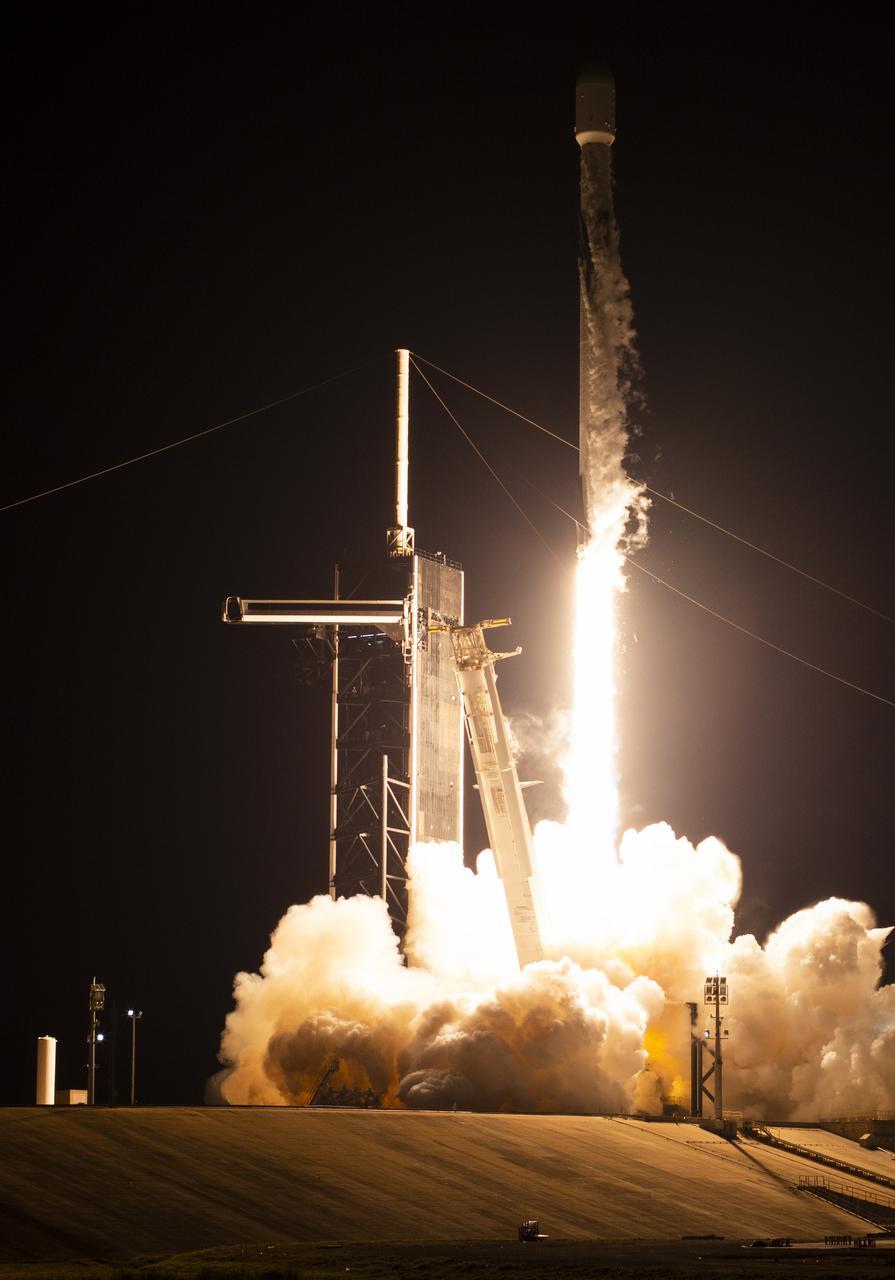
A SpaceX Falcon 9 rocket launches with NASA’s Imaging X-ray Polarimetry Explorer (IXPE) spacecraft onboard from Launch Complex 39A, Thursday, Dec. 9, 2021, at NASA’s Kennedy Space Center in Florida. The IXPE spacecraft is the first satellite dedicated to measuring the polarization of X-rays from a variety of cosmic sources, such as black holes and neutron stars. Launch occurred at 1:00 a.m. EST. Photo Credit: (NASA/Joel Kowsky)
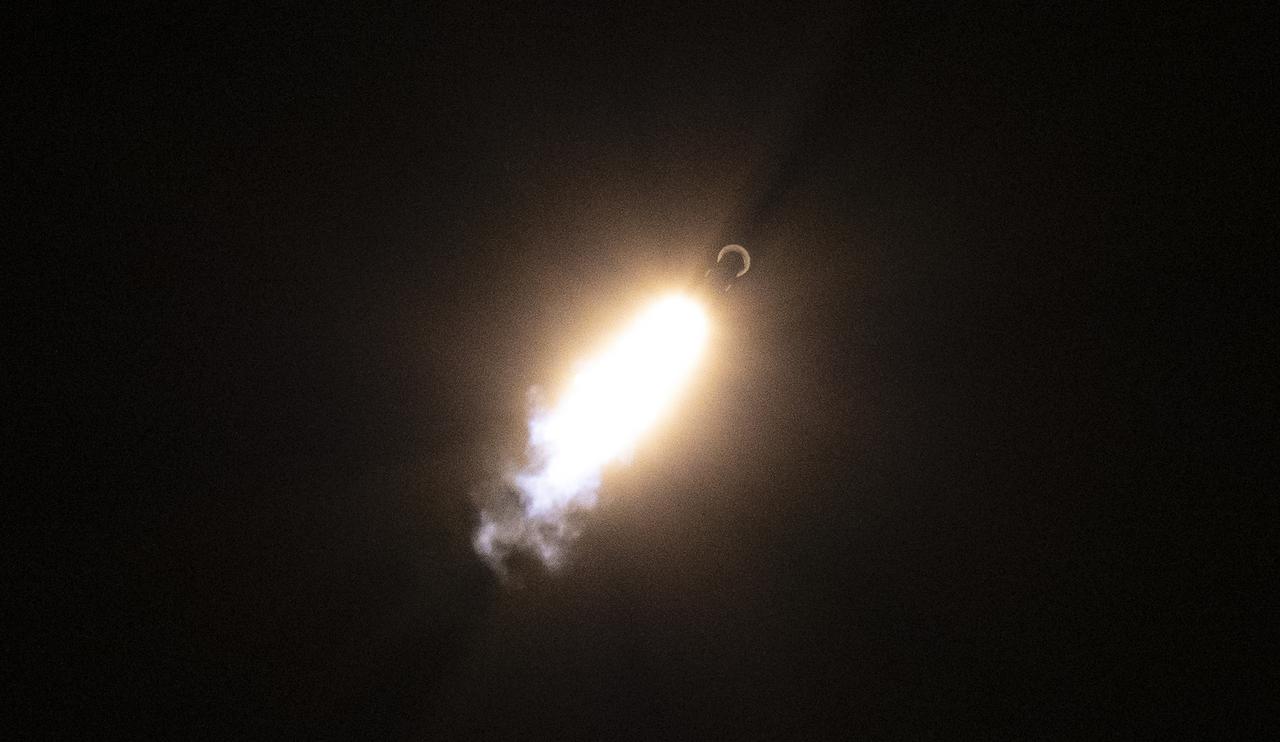
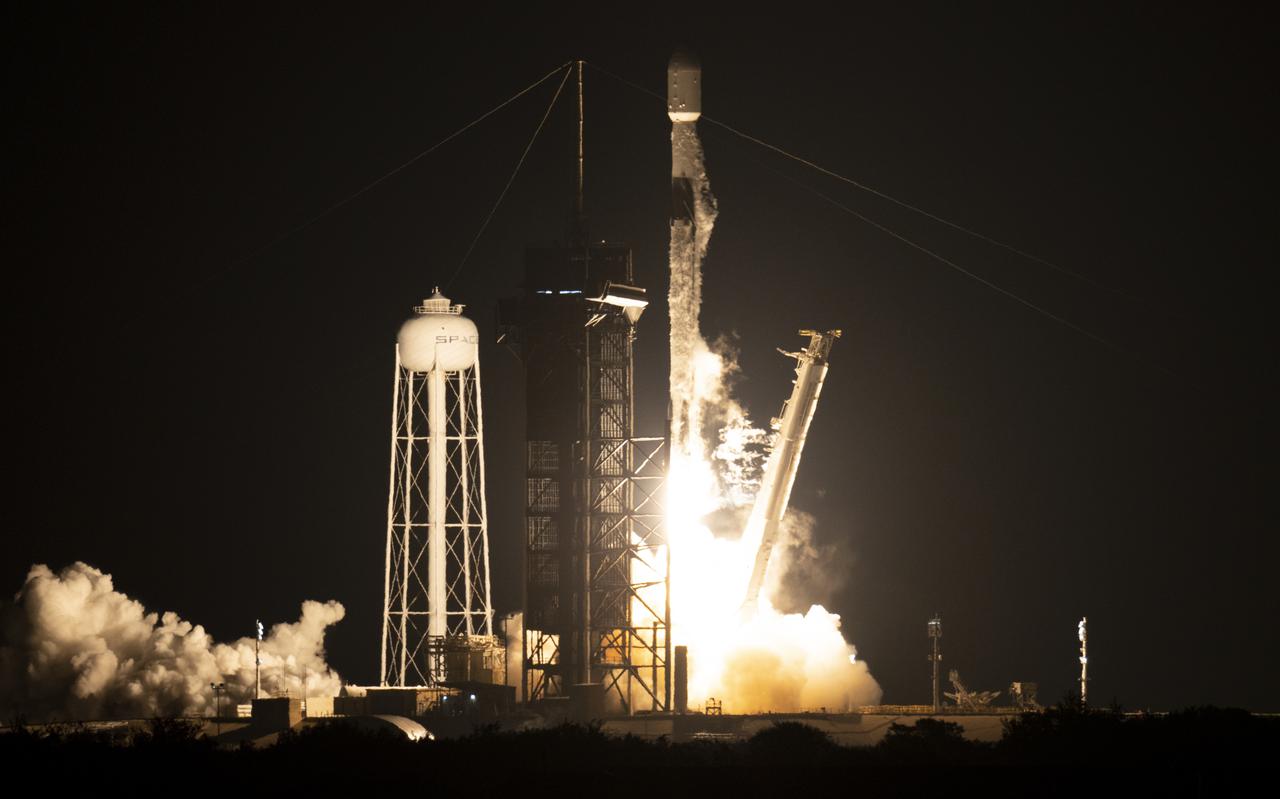
A SpaceX Falcon 9 rocket launches with NASA’s Imaging X-ray Polarimetry Explorer (IXPE) spacecraft onboard from Launch Complex 39A, Thursday, Dec. 9, 2021, at NASA’s Kennedy Space Center in Florida. The IXPE spacecraft is the first satellite dedicated to measuring the polarization of X-rays from a variety of cosmic sources, such as black holes and neutron stars. Launch occurred at 1:00 a.m. EST. Photo Credit: (NASA/Joel Kowsky)
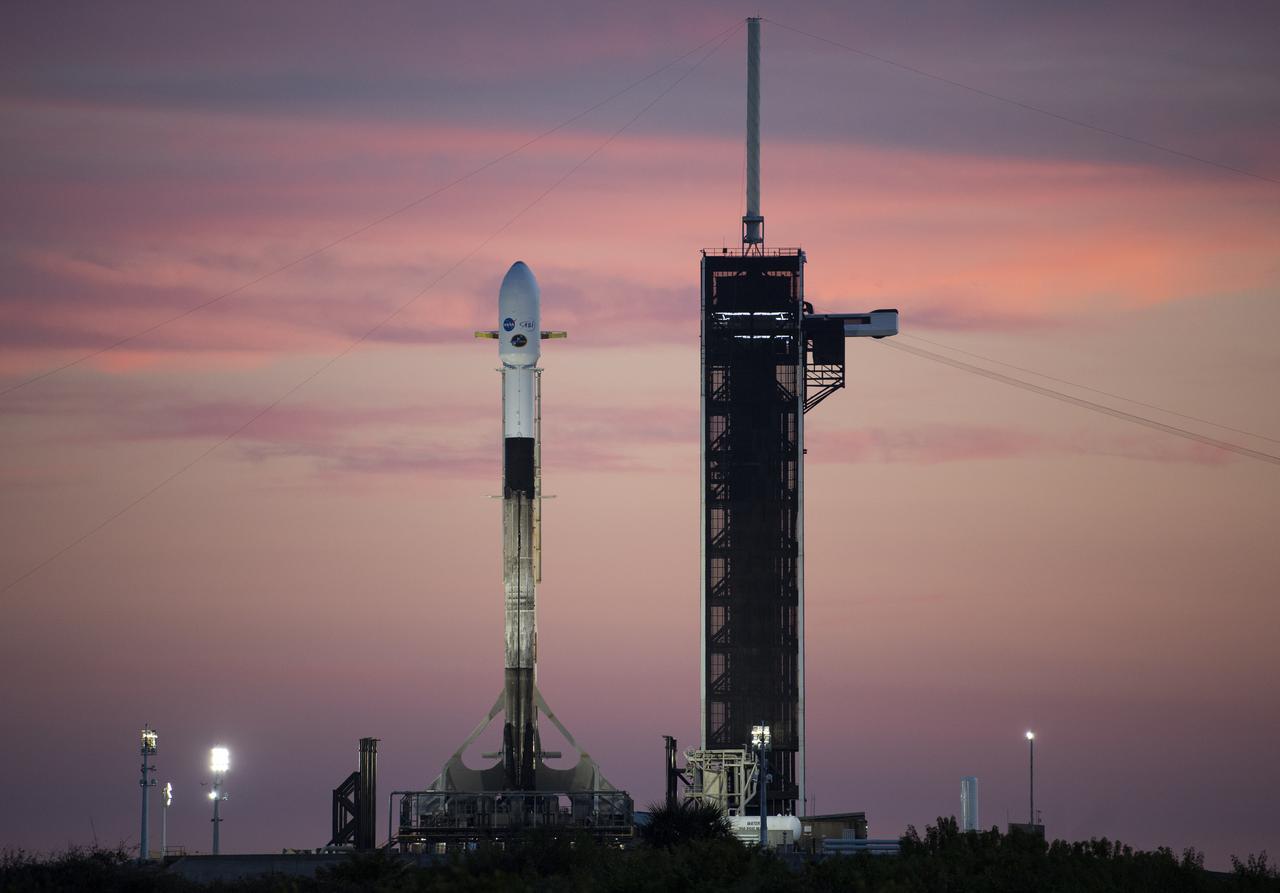
A SpaceX Falcon 9 rocket carrying NASA’s Imaging X-ray Polarimetry Explorer (IXPE) spacecraft is seen at sunset on the launch pad at Launch Complex 39A, Wednesday, Dec. 8, 2021, at NASA’s Kennedy Space Center in Florida. The IXPE spacecraft is the first satellite dedicated to measuring the polarization of X-rays from a variety of cosmic sources, such as black holes and neutron stars. Photo Credit: (NASA/Joel Kowsky)
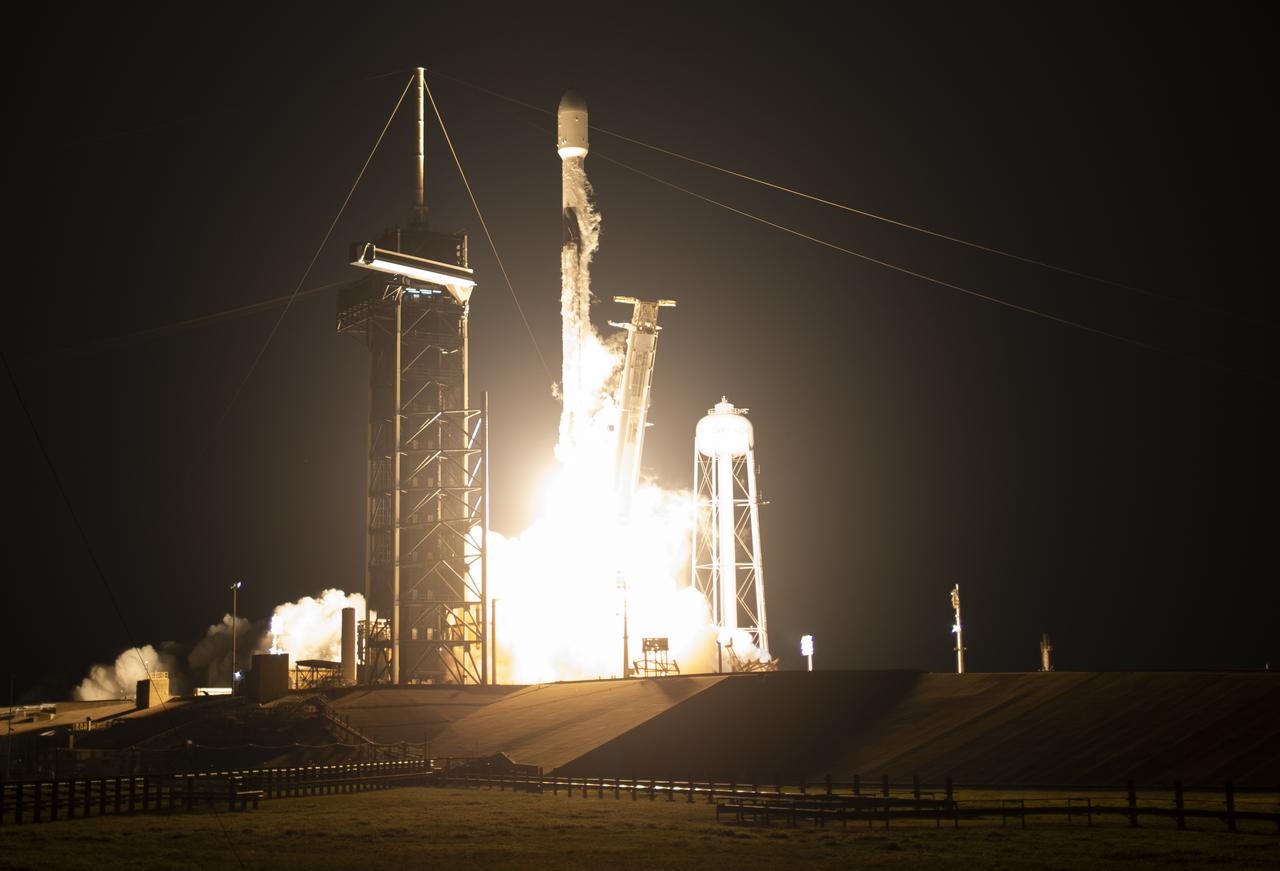
A SpaceX Falcon 9 rocket launches with NASA’s Imaging X-ray Polarimetry Explorer (IXPE) spacecraft onboard from Launch Complex 39A, Thursday, Dec. 9, 2021, at NASA’s Kennedy Space Center in Florida. The IXPE spacecraft is the first satellite dedicated to measuring the polarization of X-rays from a variety of cosmic sources, such as black holes and neutron stars. Launch occurred at 1:00 a.m. EST. Photo Credit: (NASA/Joel Kowsky)

A SpaceX Falcon 9 rocket carrying NASA’s Imaging X-ray Polarimetry Explorer (IXPE) spacecraft is seen on the launch pad at Launch Complex 39A, Wednesday, Dec. 8, 2021, at NASA’s Kennedy Space Center in Florida. The IXPE spacecraft is the first satellite dedicated to measuring the polarization of X-rays from a variety of cosmic sources, such as black holes and neutron stars. Photo Credit: (NASA/Joel Kowsky)
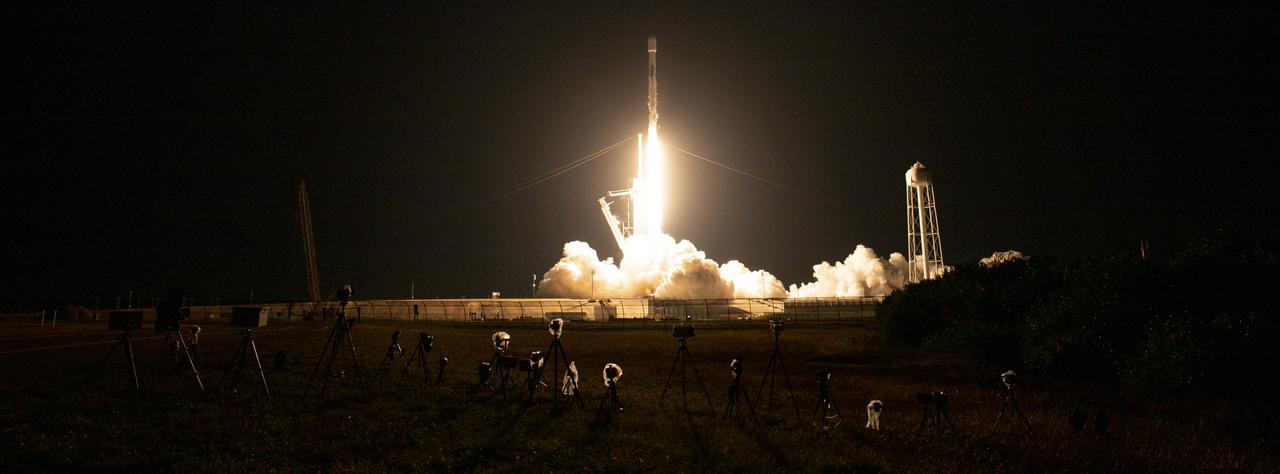
A SpaceX Falcon 9 rocket launches with NASA’s Imaging X-ray Polarimetry Explorer (IXPE) spacecraft onboard from Launch Complex 39A, Thursday, Dec. 9, 2021, at NASA’s Kennedy Space Center in Florida. The IXPE spacecraft is the first satellite dedicated to measuring the polarization of X-rays from a variety of cosmic sources, such as black holes and neutron stars. Launch occurred at 1:00 a.m. EST. Photo Credit: (NASA/Joel Kowsky)
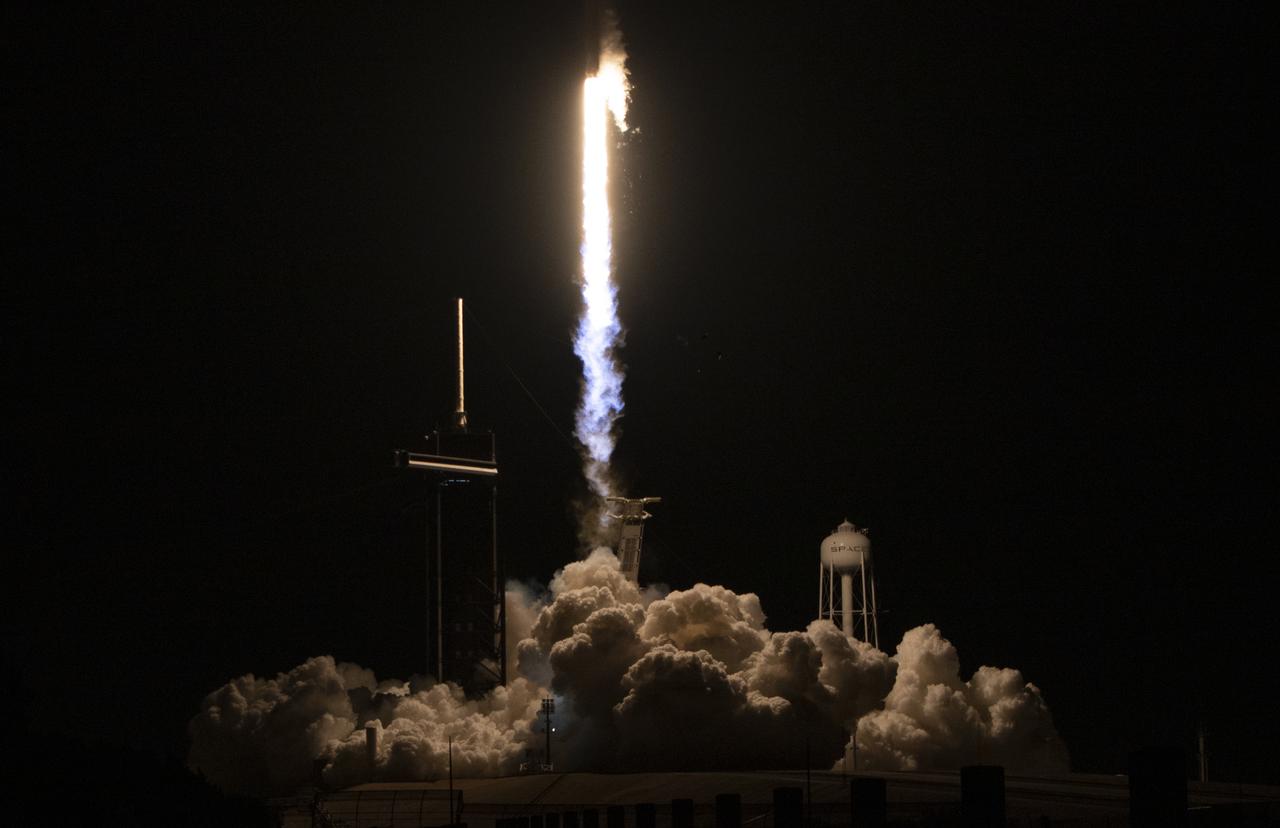
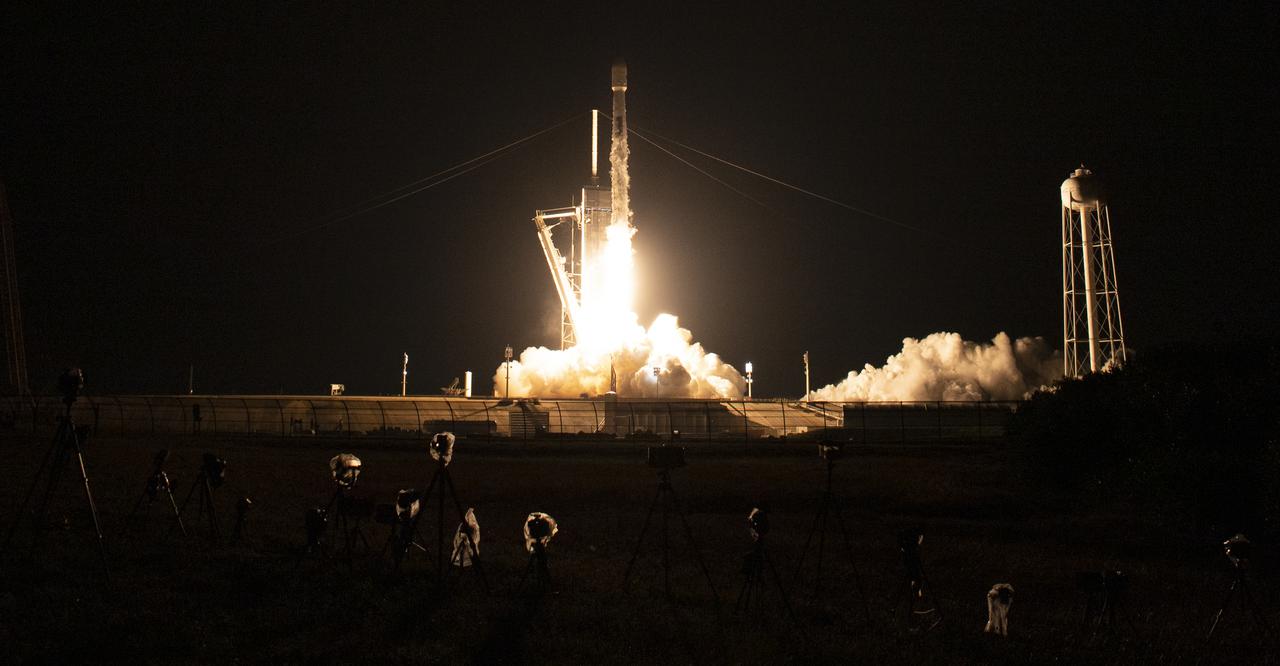
A SpaceX Falcon 9 rocket launches with NASA’s Imaging X-ray Polarimetry Explorer (IXPE) spacecraft onboard from Launch Complex 39A, Thursday, Dec. 9, 2021, at NASA’s Kennedy Space Center in Florida. The IXPE spacecraft is the first satellite dedicated to measuring the polarization of X-rays from a variety of cosmic sources, such as black holes and neutron stars. Launch occurred at 1:00 a.m. EST. Photo Credit: (NASA/Joel Kowsky)
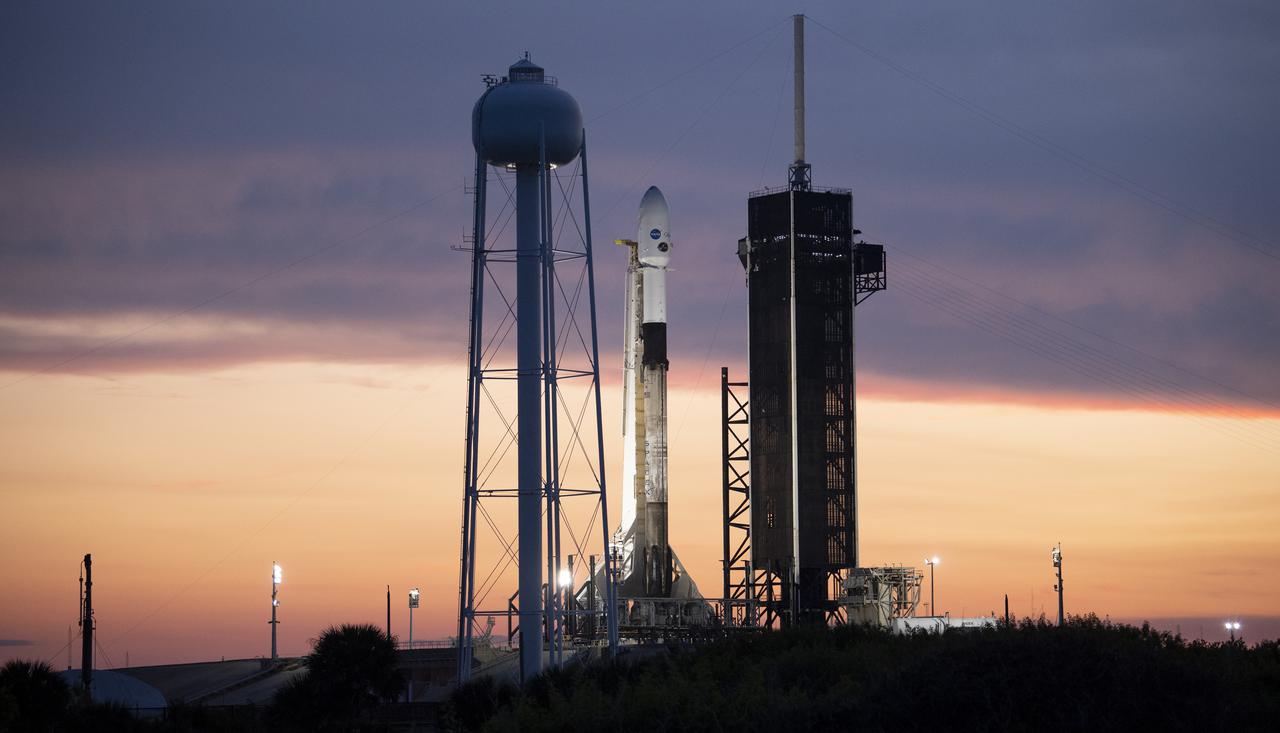
A SpaceX Falcon 9 rocket carrying NASA’s Imaging X-ray Polarimetry Explorer (IXPE) spacecraft is seen at sunset on the launch pad at Launch Complex 39A, Wednesday, Dec. 8, 2021, at NASA’s Kennedy Space Center in Florida. The IXPE spacecraft is the first satellite dedicated to measuring the polarization of X-rays from a variety of cosmic sources, such as black holes and neutron stars. Photo Credit: (NASA/Joel Kowsky)
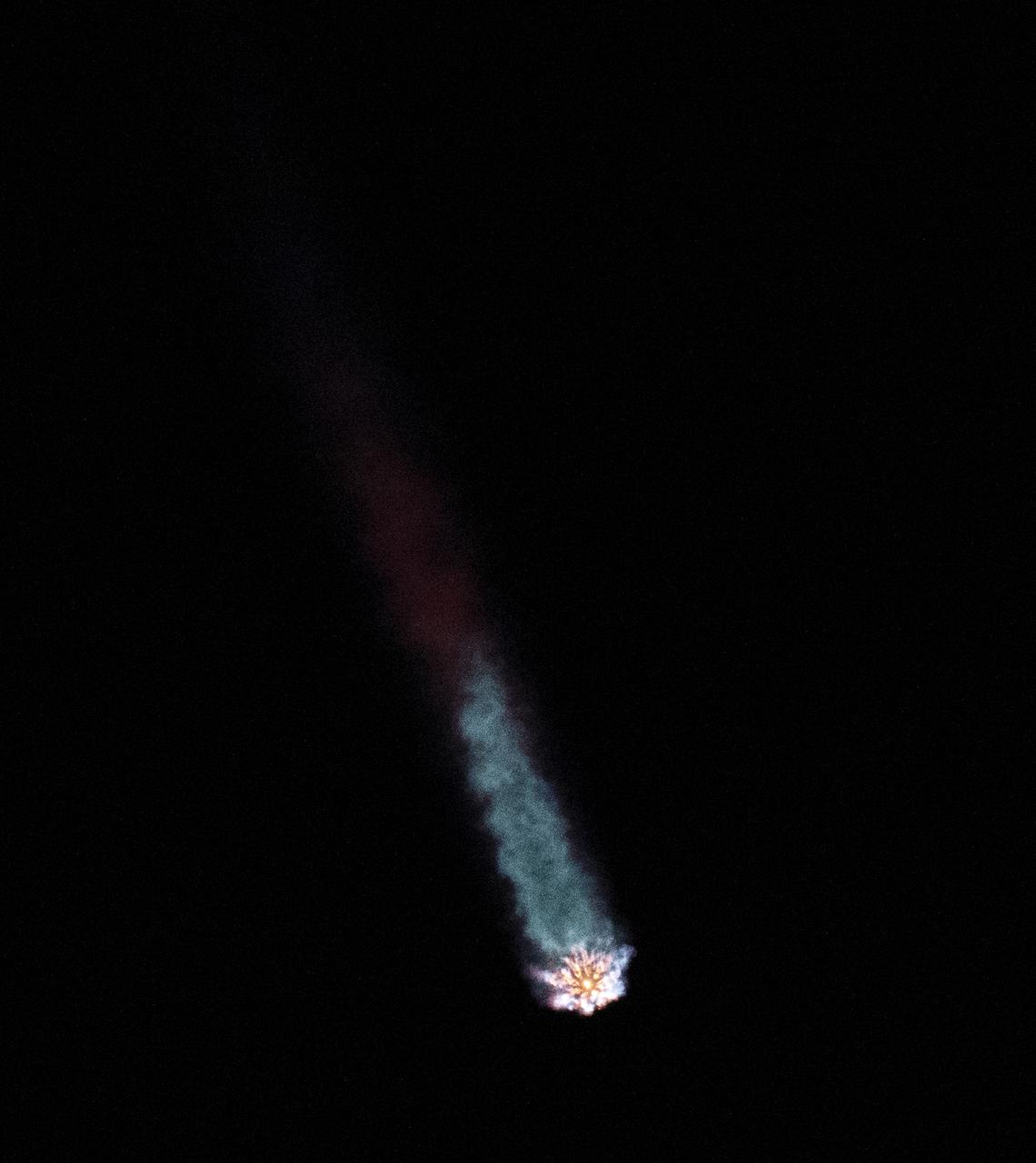
A SpaceX Falcon 9 rocket launches with NASA’s Imaging X-ray Polarimetry Explorer (IXPE) spacecraft onboard from Launch Complex 39A, Thursday, Dec. 9, 2021, at NASA’s Kennedy Space Center in Florida. The IXPE spacecraft is the first satellite dedicated to measuring the polarization of X-rays from a variety of cosmic sources, such as black holes and neutron stars. Launch occurred at 1:00 a.m. EST. Photo Credit: (NASA/Joel Kowsky)
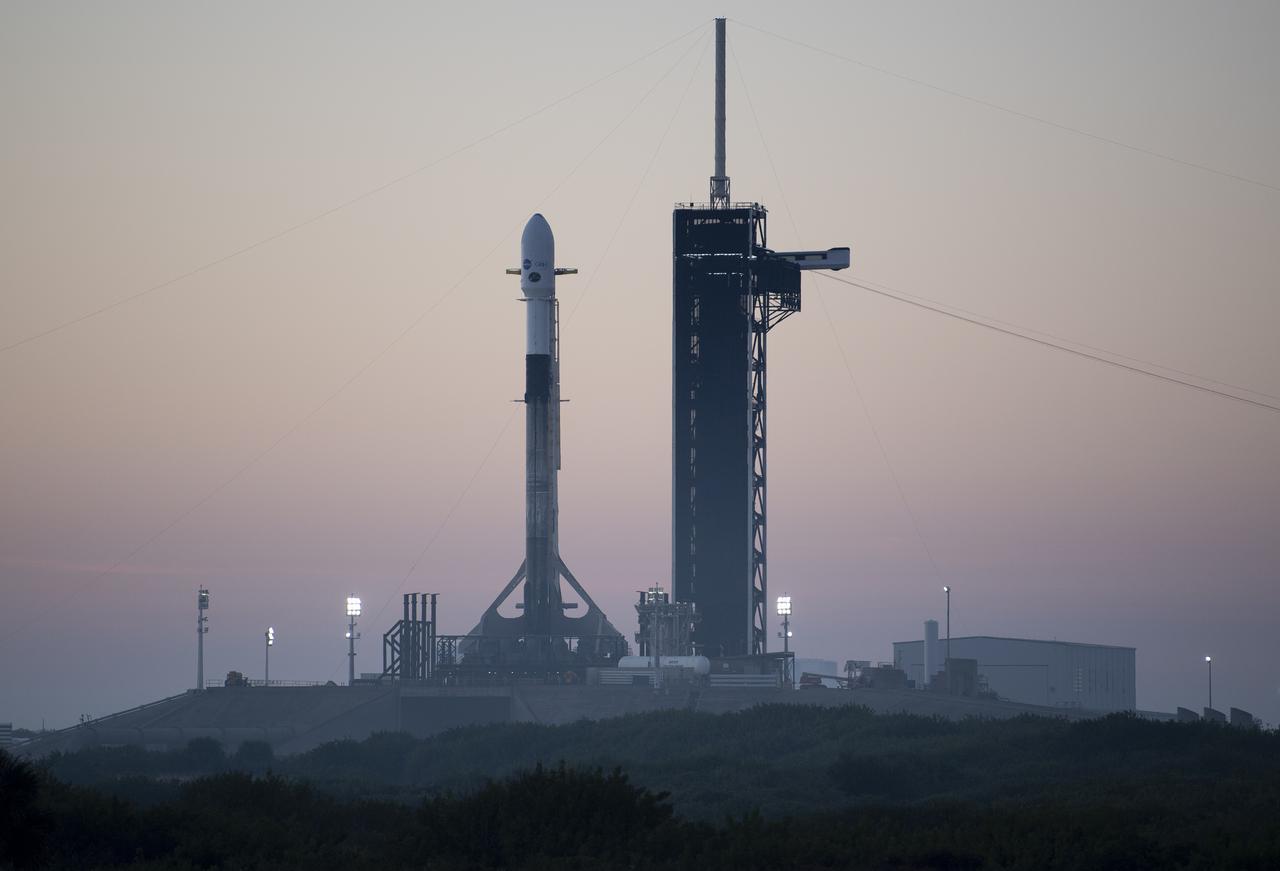
A SpaceX Falcon 9 rocket carrying NASA’s Imaging X-ray Polarimetry Explorer (IXPE) spacecraft is seen on the launch pad at Launch Complex 39A, Wednesday, Dec. 8, 2021, at NASA’s Kennedy Space Center in Florida. The IXPE spacecraft is the first satellite dedicated to measuring the polarization of X-rays from a variety of cosmic sources, such as black holes and neutron stars. Photo Credit: (NASA/Joel Kowsky)
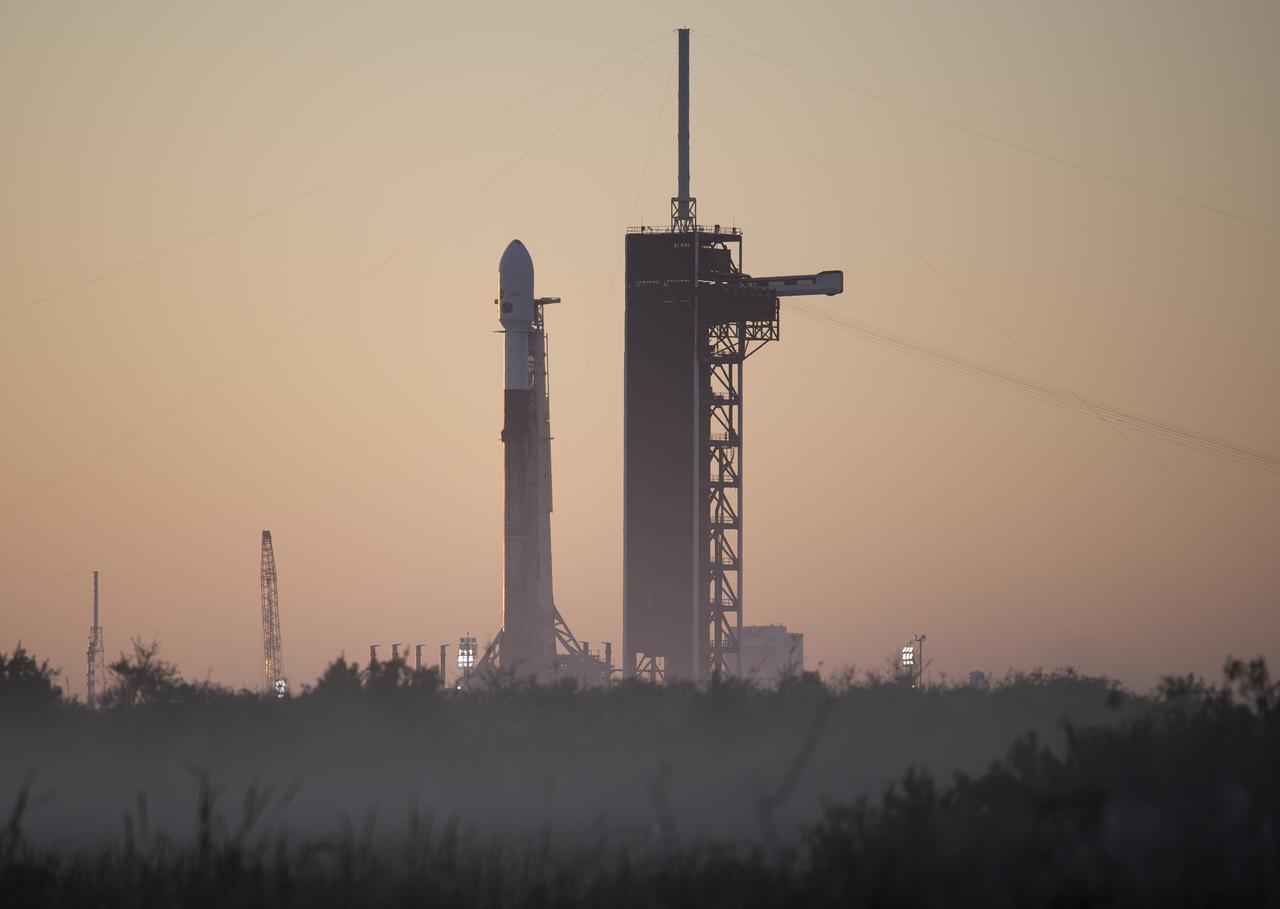
A SpaceX Falcon 9 rocket carrying NASA’s Imaging X-ray Polarimetry Explorer (IXPE) spacecraft is seen on the launch pad at Launch Complex 39A, Wednesday, Dec. 8, 2021, at NASA’s Kennedy Space Center in Florida. The IXPE spacecraft is the first satellite dedicated to measuring the polarization of X-rays from a variety of cosmic sources, such as black holes and neutron stars. Photo Credit: (NASA/Joel Kowsky)
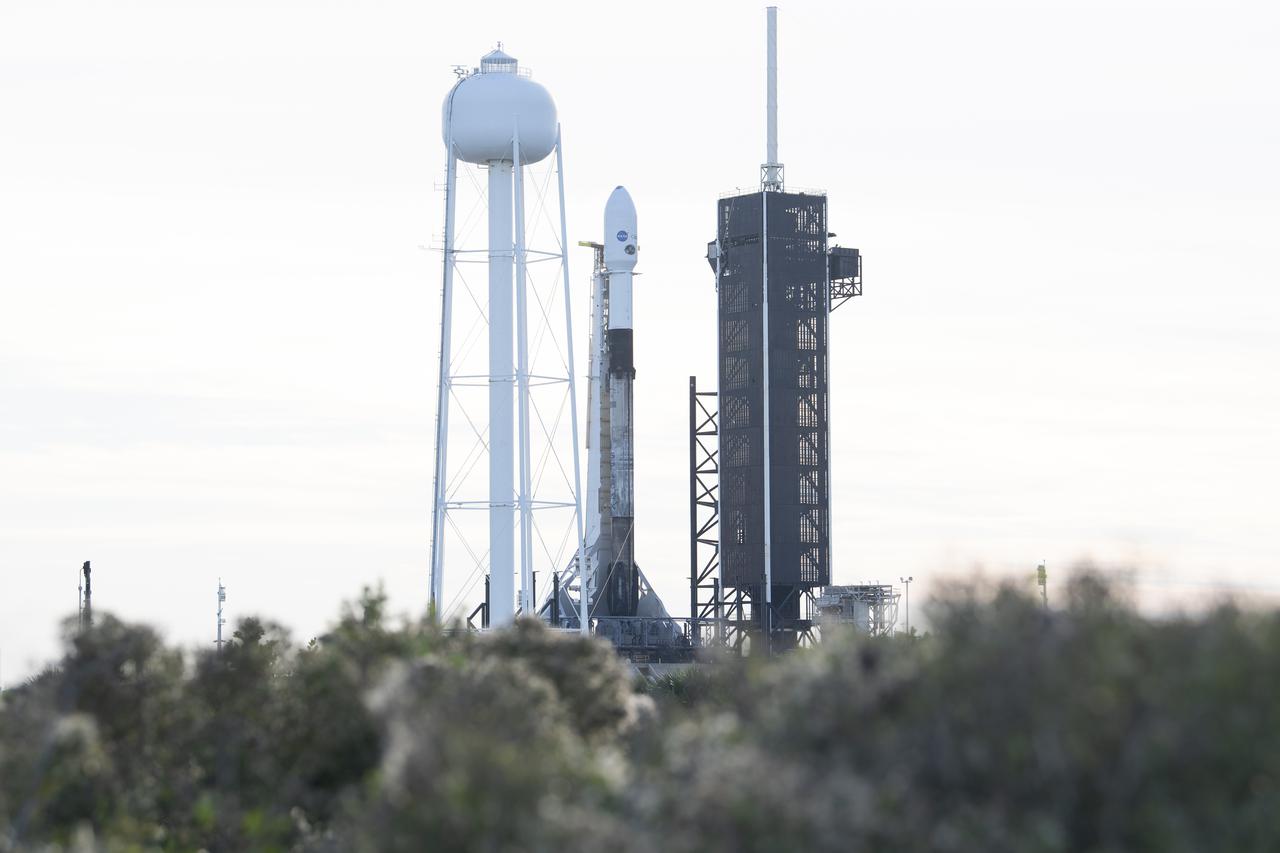
A SpaceX Falcon 9 rocket carrying NASA’s Imaging X-ray Polarimetry Explorer (IXPE) spacecraft is seen on the launch pad at Launch Complex 39A, Wednesday, Dec. 8, 2021, at NASA’s Kennedy Space Center in Florida. The IXPE spacecraft is the first satellite dedicated to measuring the polarization of X-rays from a variety of cosmic sources, such as black holes and neutron stars. Photo Credit: (NASA/Joel Kowsky)
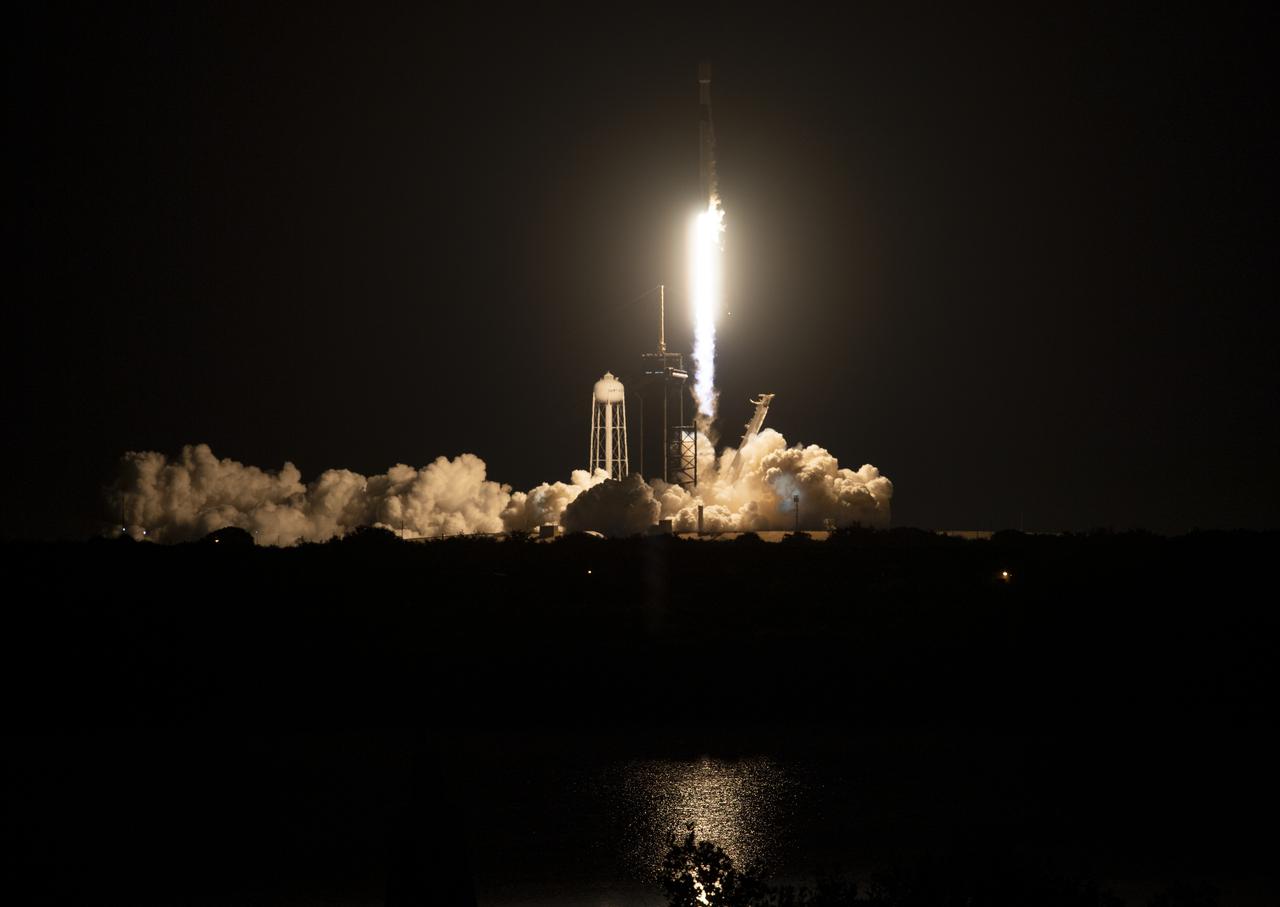
A SpaceX Falcon 9 rocket launches with NASA’s Imaging X-ray Polarimetry Explorer (IXPE) spacecraft onboard from Launch Complex 39A, Thursday, Dec. 9, 2021, at NASA’s Kennedy Space Center in Florida. The IXPE spacecraft is the first satellite dedicated to measuring the polarization of X-rays from a variety of cosmic sources, such as black holes and neutron stars. Launch occurred at 1:00 a.m. EST. Photo Credit: (NASA/Joel Kowsky)

A SpaceX Falcon 9 rocket carrying NASA’s Imaging X-ray Polarimetry Explorer (IXPE) spacecraft is seen on the launch pad at Launch Complex 39A, Wednesday, Dec. 8, 2021, at NASA’s Kennedy Space Center in Florida. The IXPE spacecraft is the first satellite dedicated to measuring the polarization of X-rays from a variety of cosmic sources, such as black holes and neutron stars. Photo Credit: (NASA/Joel Kowsky)
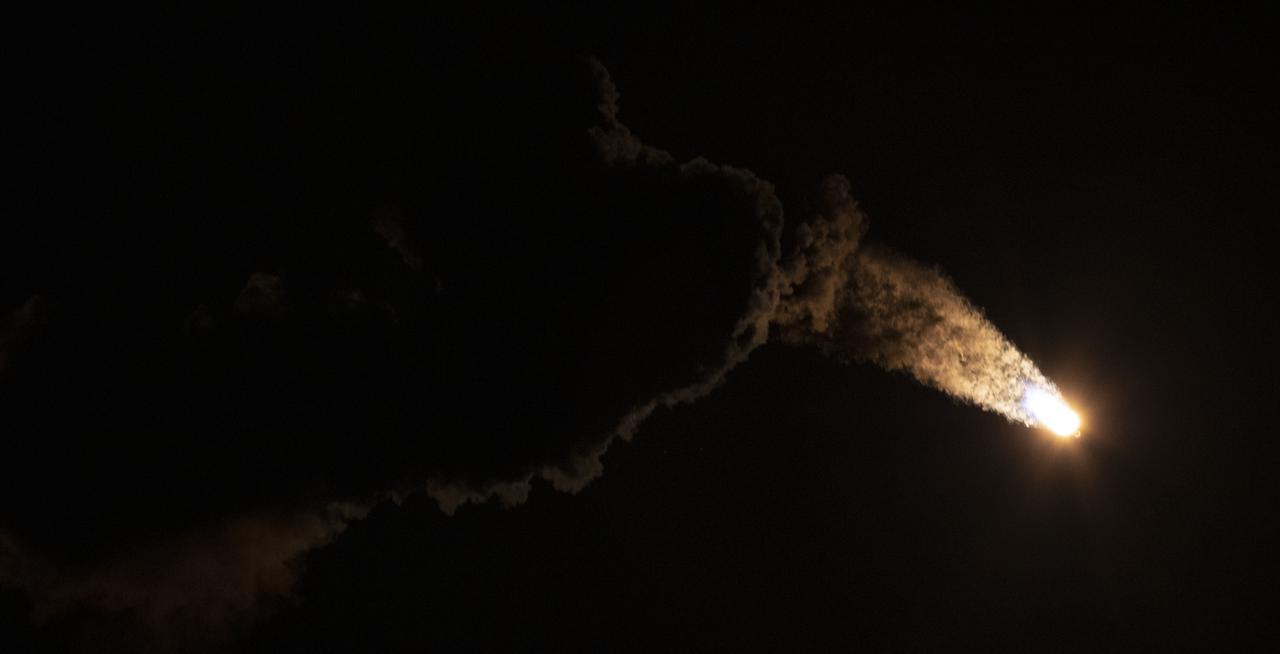
A SpaceX Falcon 9 rocket launches with NASA’s Imaging X-ray Polarimetry Explorer (IXPE) spacecraft onboard from Launch Complex 39A, Thursday, Dec. 9, 2021, at NASA’s Kennedy Space Center in Florida. The IXPE spacecraft is the first satellite dedicated to measuring the polarization of X-rays from a variety of cosmic sources, such as black holes and neutron stars. Launch occurred at 1:00 a.m. EST. Photo Credit: (NASA/Joel Kowsky)

A SpaceX Falcon 9 rocket launches with NASA’s Imaging X-ray Polarimetry Explorer (IXPE) spacecraft onboard from Launch Complex 39A, Thursday, Dec. 9, 2021, at NASA’s Kennedy Space Center in Florida. The IXPE spacecraft is the first satellite dedicated to measuring the polarization of X-rays from a variety of cosmic sources, such as black holes and neutron stars. Launch occurred at 1:00 a.m. EST. Photo Credit: (NASA/Joel Kowsky)
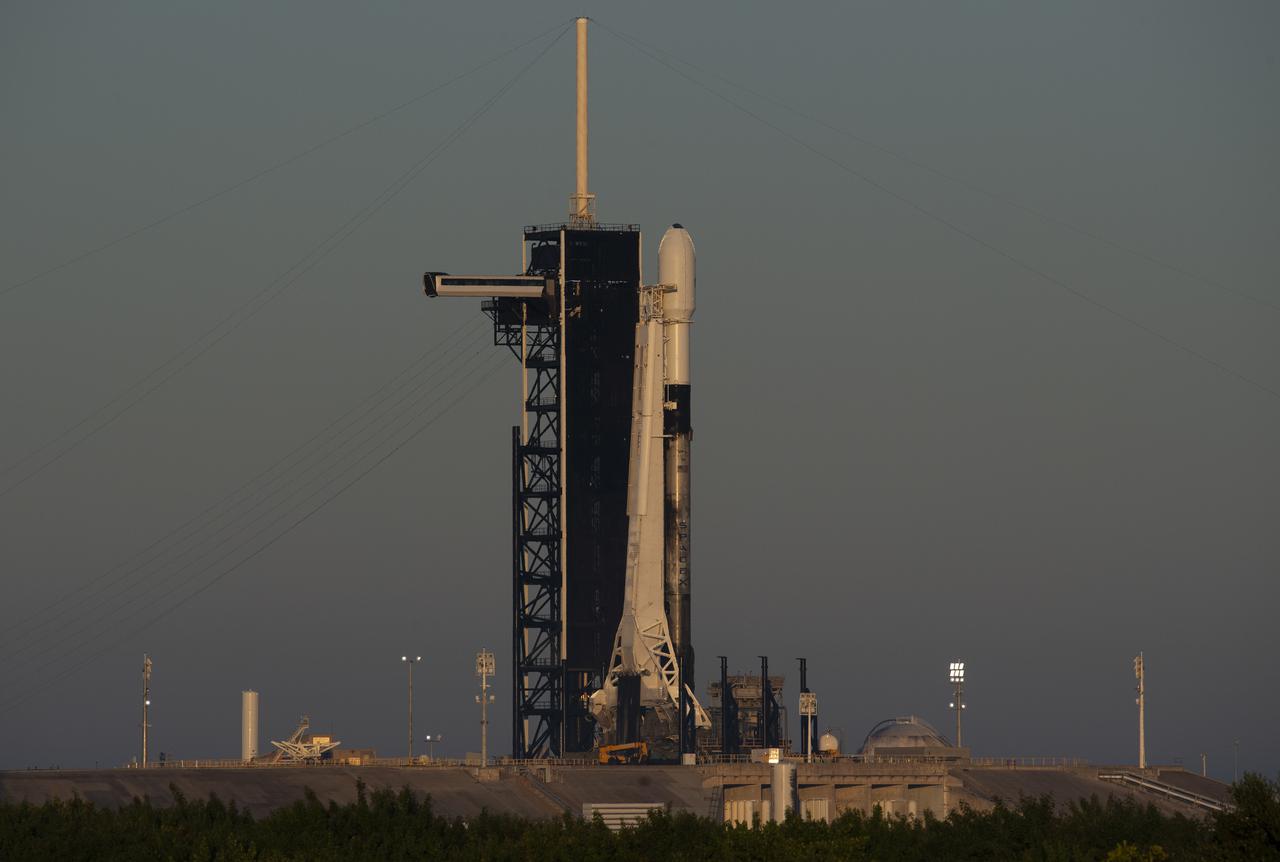
A SpaceX Falcon 9 rocket carrying NASA’s Imaging X-ray Polarimetry Explorer (IXPE) spacecraft is seen on the launch pad at Launch Complex 39A, Wednesday, Dec. 8, 2021, at NASA’s Kennedy Space Center in Florida. The IXPE spacecraft is the first satellite dedicated to measuring the polarization of X-rays from a variety of cosmic sources, such as black holes and neutron stars. Photo Credit: (NASA/Joel Kowsky)
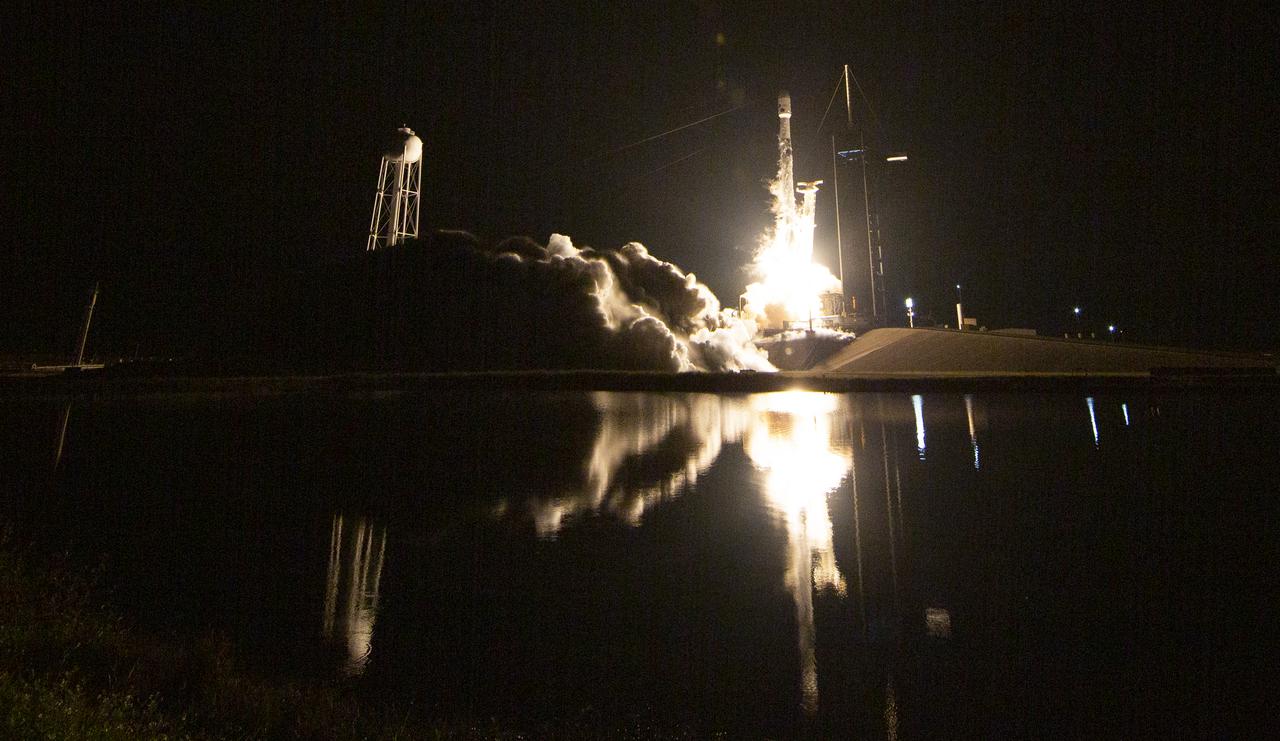
A SpaceX Falcon 9 rocket launches with NASA’s Imaging X-ray Polarimetry Explorer (IXPE) spacecraft onboard from Launch Complex 39A, Thursday, Dec. 9, 2021, at NASA’s Kennedy Space Center in Florida. The IXPE spacecraft is the first satellite dedicated to measuring the polarization of X-rays from a variety of cosmic sources, such as black holes and neutron stars. Launch occurred at 1:00 a.m. EST. Photo Credit: (NASA/Joel Kowsky)
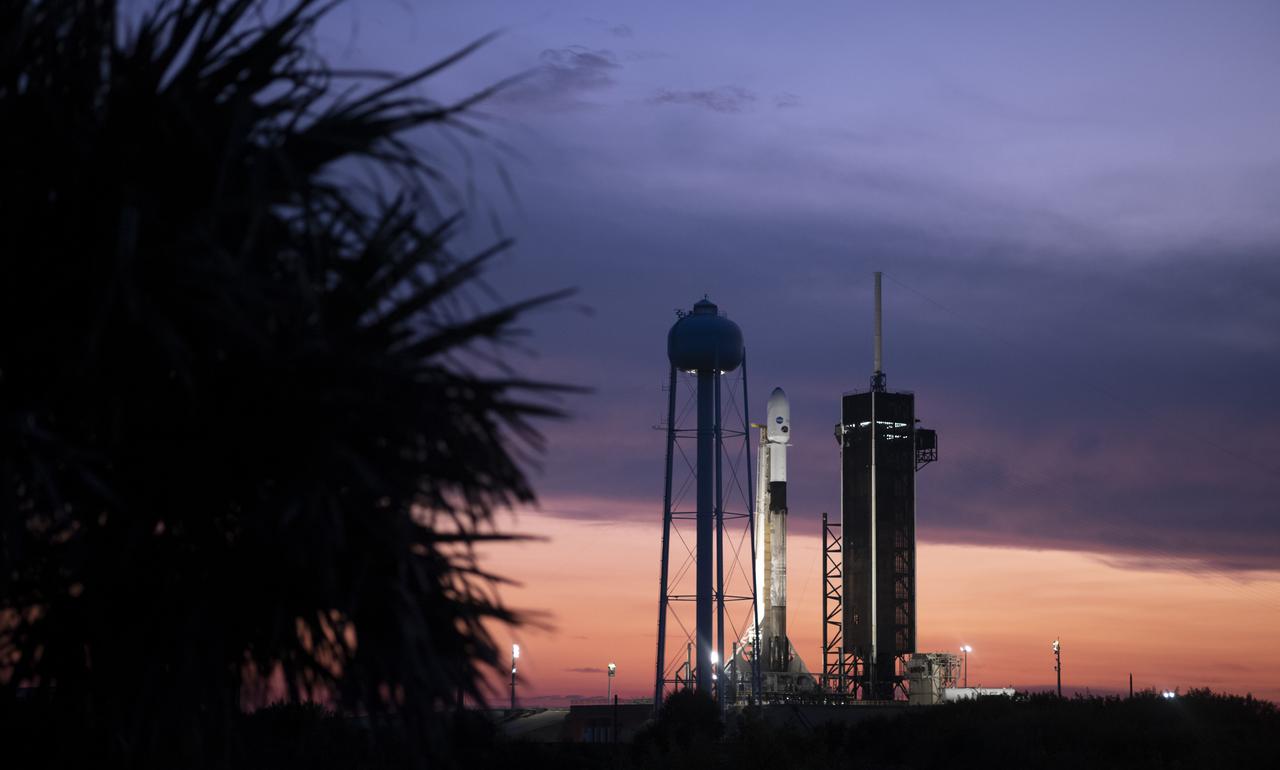
A SpaceX Falcon 9 rocket carrying NASA’s Imaging X-ray Polarimetry Explorer (IXPE) spacecraft is seen at sunset on the launch pad at Launch Complex 39A, Wednesday, Dec. 8, 2021, at NASA’s Kennedy Space Center in Florida. The IXPE spacecraft is the first satellite dedicated to measuring the polarization of X-rays from a variety of cosmic sources, such as black holes and neutron stars. Photo Credit: (NASA/Joel Kowsky)

A SpaceX Falcon 9 rocket launches with NASA’s Imaging X-ray Polarimetry Explorer (IXPE) spacecraft onboard from Launch Complex 39A, Thursday, Dec. 9, 2021, at NASA’s Kennedy Space Center in Florida. The IXPE spacecraft is the first satellite dedicated to measuring the polarization of X-rays from a variety of cosmic sources, such as black holes and neutron stars. Launch occurred at 1:00 a.m. EST. Photo Credit: (NASA/Joel Kowsky)
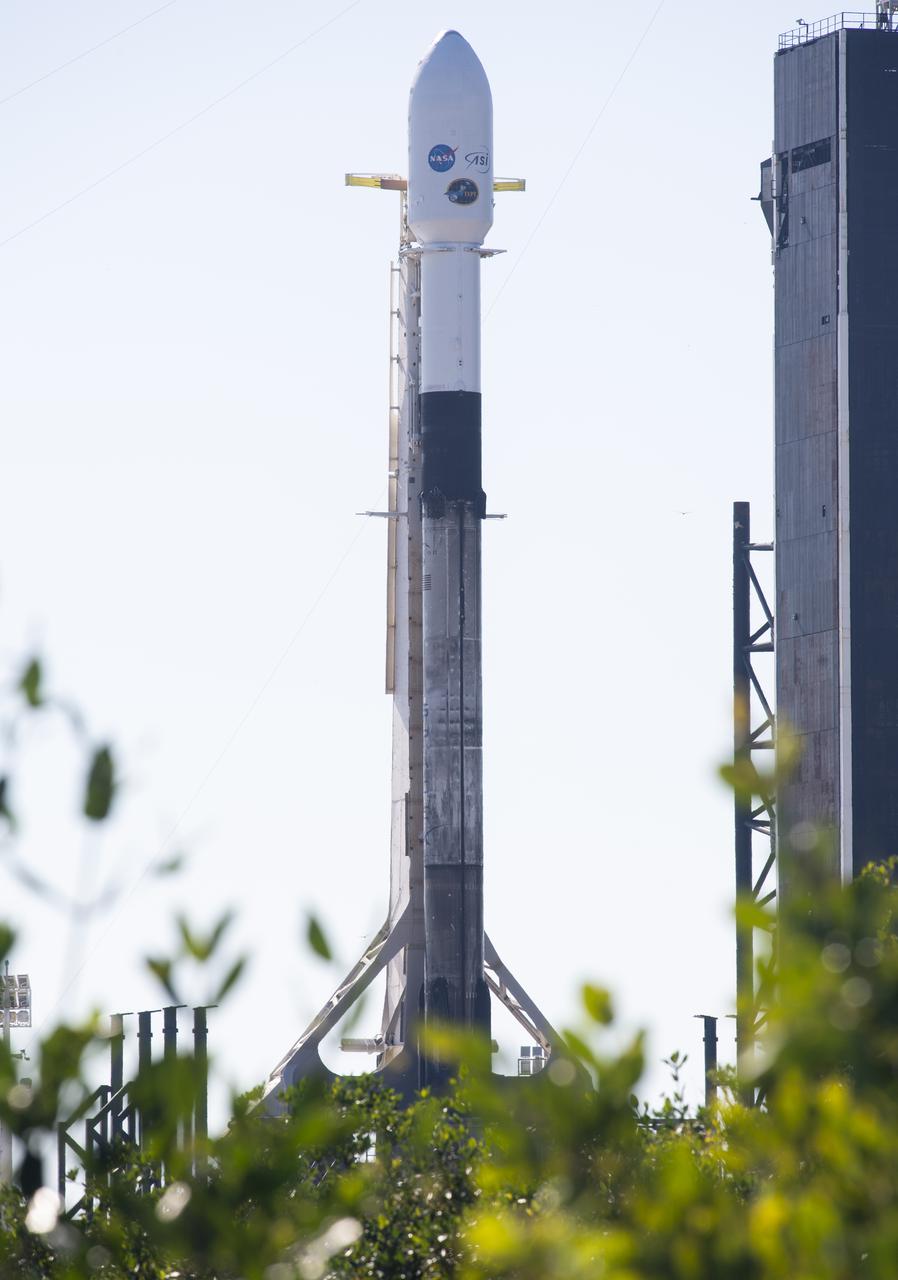
A SpaceX Falcon 9 rocket carrying NASA’s Imaging X-ray Polarimetry Explorer (IXPE) spacecraft is seen on the launch pad at Launch Complex 39A, Wednesday, Dec. 8, 2021, at NASA’s Kennedy Space Center in Florida. The IXPE spacecraft is the first satellite dedicated to measuring the polarization of X-rays from a variety of cosmic sources, such as black holes and neutron stars. Photo Credit: (NASA/Joel Kowsky)
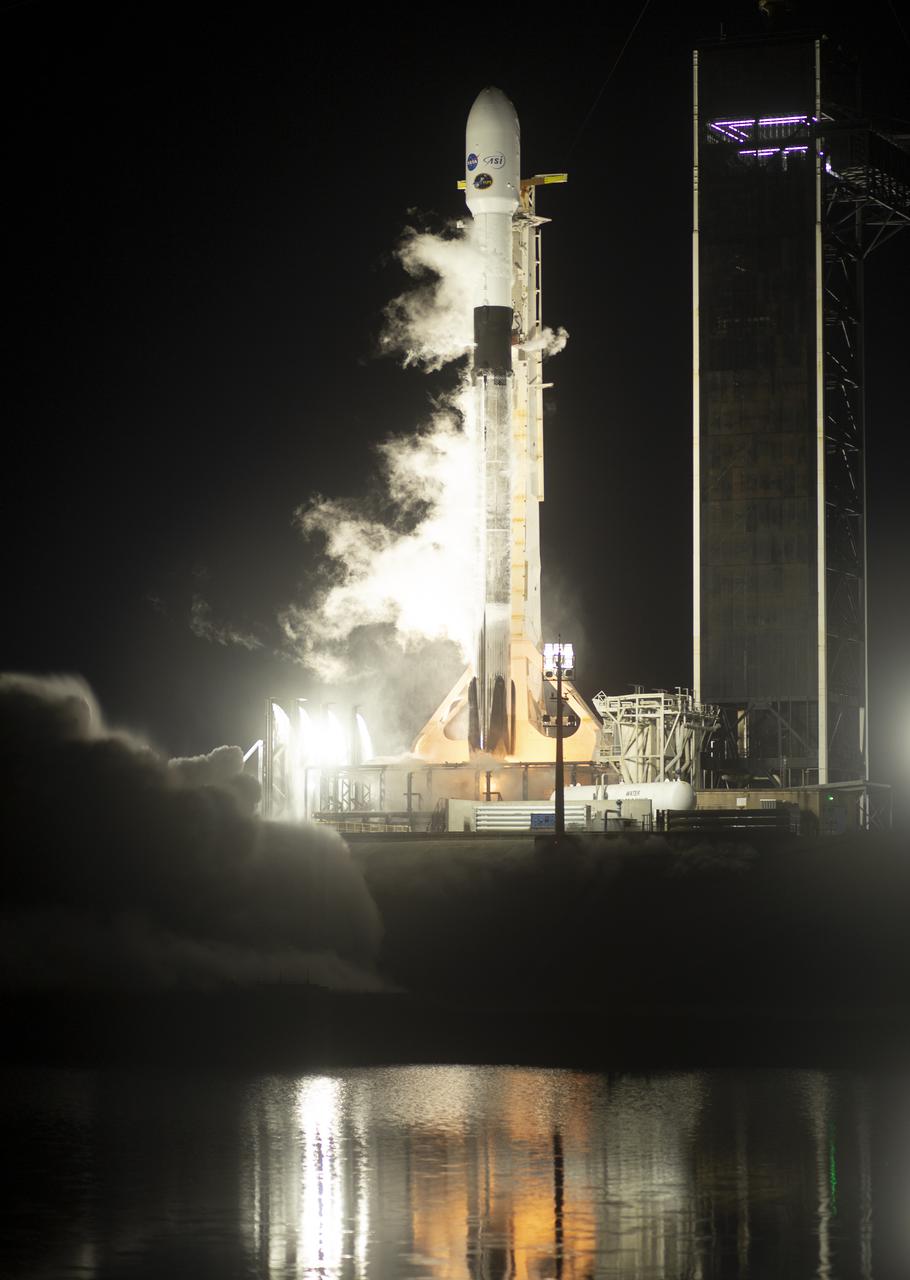
A SpaceX Falcon 9 rocket launches with NASA’s Imaging X-ray Polarimetry Explorer (IXPE) spacecraft onboard from Launch Complex 39A, Thursday, Dec. 9, 2021, at NASA’s Kennedy Space Center in Florida. The IXPE spacecraft is the first satellite dedicated to measuring the polarization of X-rays from a variety of cosmic sources, such as black holes and neutron stars. Launch occurred at 1:00 a.m. EST. Photo Credit: (NASA/Joel Kowsky)

A SpaceX Falcon 9 rocket launches with NASA’s Imaging X-ray Polarimetry Explorer (IXPE) spacecraft onboard from Launch Complex 39A, Thursday, Dec. 9, 2021, at NASA’s Kennedy Space Center in Florida. The IXPE spacecraft is the first satellite dedicated to measuring the polarization of X-rays from a variety of cosmic sources, such as black holes and neutron stars. Launch occurred at 1:00 a.m. EST. Photo Credit: (NASA/Joel Kowsky)
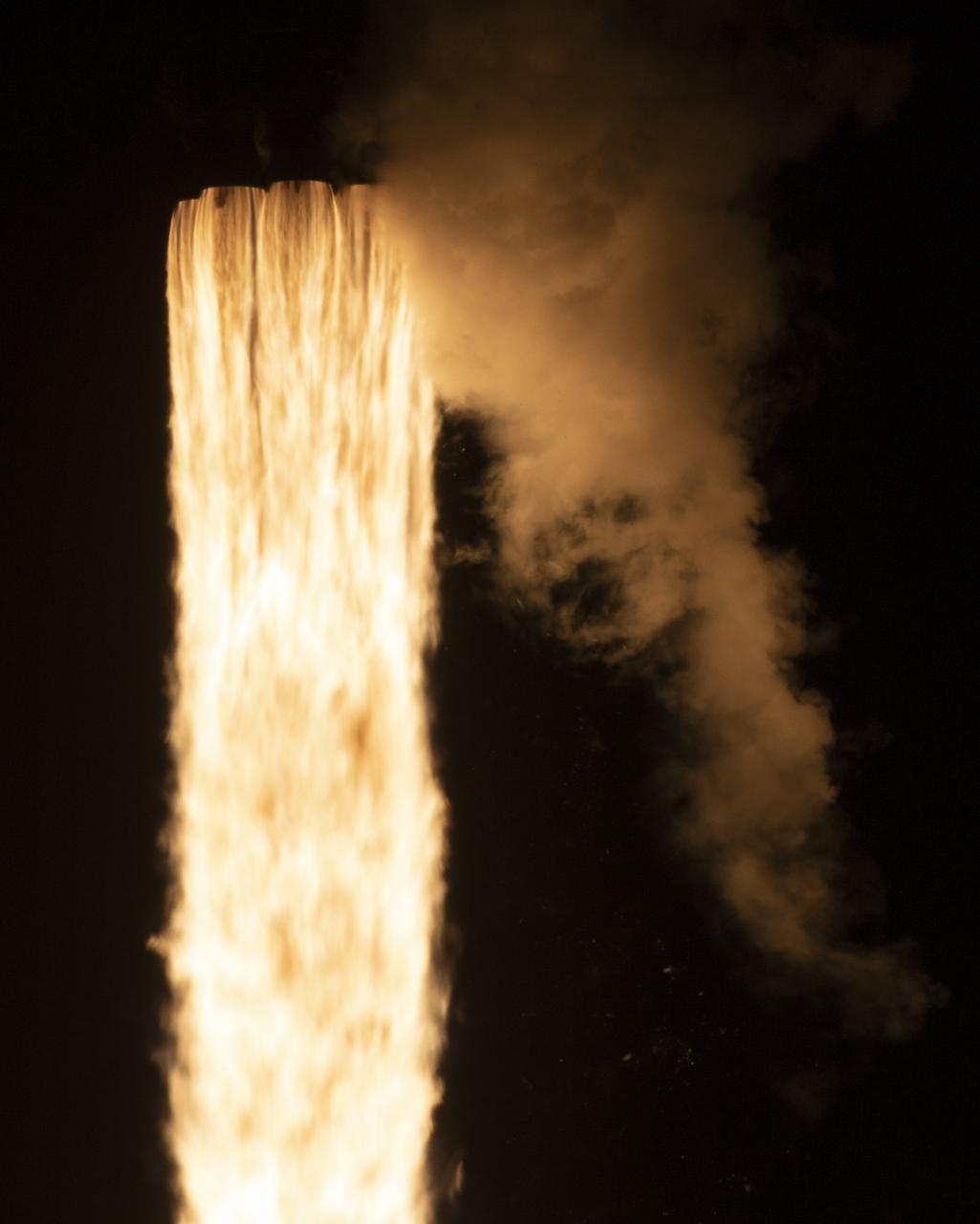
A SpaceX Falcon 9 rocket launches with NASA’s Imaging X-ray Polarimetry Explorer (IXPE) spacecraft onboard from Launch Complex 39A, Thursday, Dec. 9, 2021, at NASA’s Kennedy Space Center in Florida. The IXPE spacecraft is the first satellite dedicated to measuring the polarization of X-rays from a variety of cosmic sources, such as black holes and neutron stars. Launch occurred at 1:00 a.m. EST. Photo Credit: (NASA/Joel Kowsky)
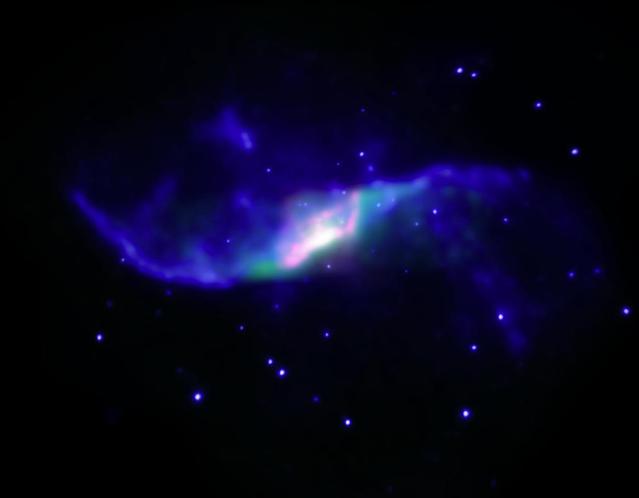
A composite image of the spiral galaxy NGC 4258 showing X-ray emission observed with NASA Chandra X-ray Observatory blue and infrared emission observed with NASA Spitzer Space Telescope red and green.
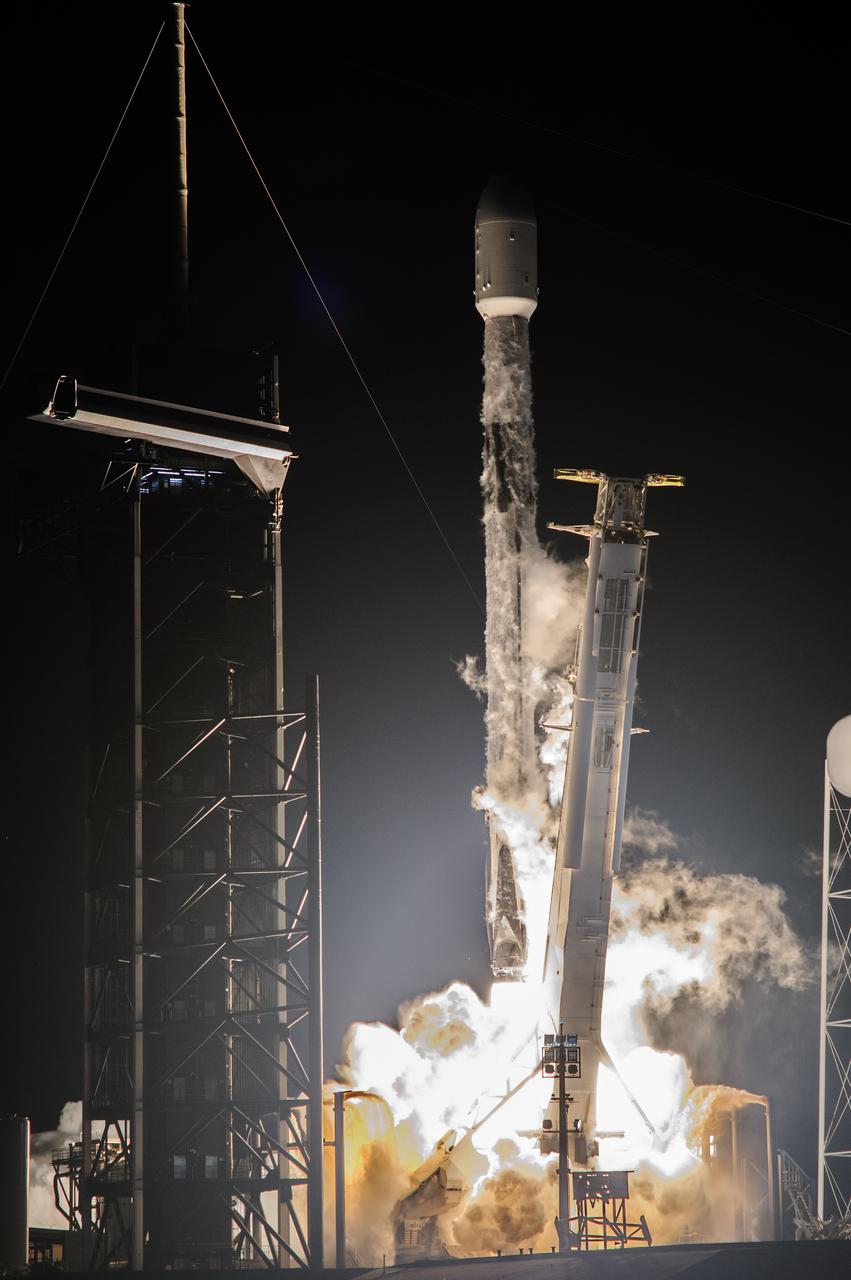
A SpaceX Falcon 9 rocket roars off the launch pad at Launch Complex 39A at NASA’s Kennedy Space Center in Florida at 1 a.m. EST on Thursday, Dec. 9, 2021, carrying NASA’s Imaging X-ray Polarimetry Explorer (IXPE) spacecraft. NASA’s Launch Services Program managed this launch. NASA’s Marshall Space Flight Center in Huntsville, Alabama, manages the IXPE mission. Ball Aerospace, headquartered in Broomfield, Colorado, manages spacecraft operations with support from the University of Colorado at Boulder. NASA’s Goddard Space Flight Center in Greenbelt, Maryland, manages the Explorers Program for the agency’s Science Mission Directorate in Washington. The IXPE spacecraft includes three space telescopes with sensitive detectors capable of measuring the polarization of cosmic X-rays, allowing scientists to answer fundamental questions about extremely complex environments in space where gravitational, electric, and magnetic fields are at their limits. The project is a collaboration between NASA and the Italian Space Agency.
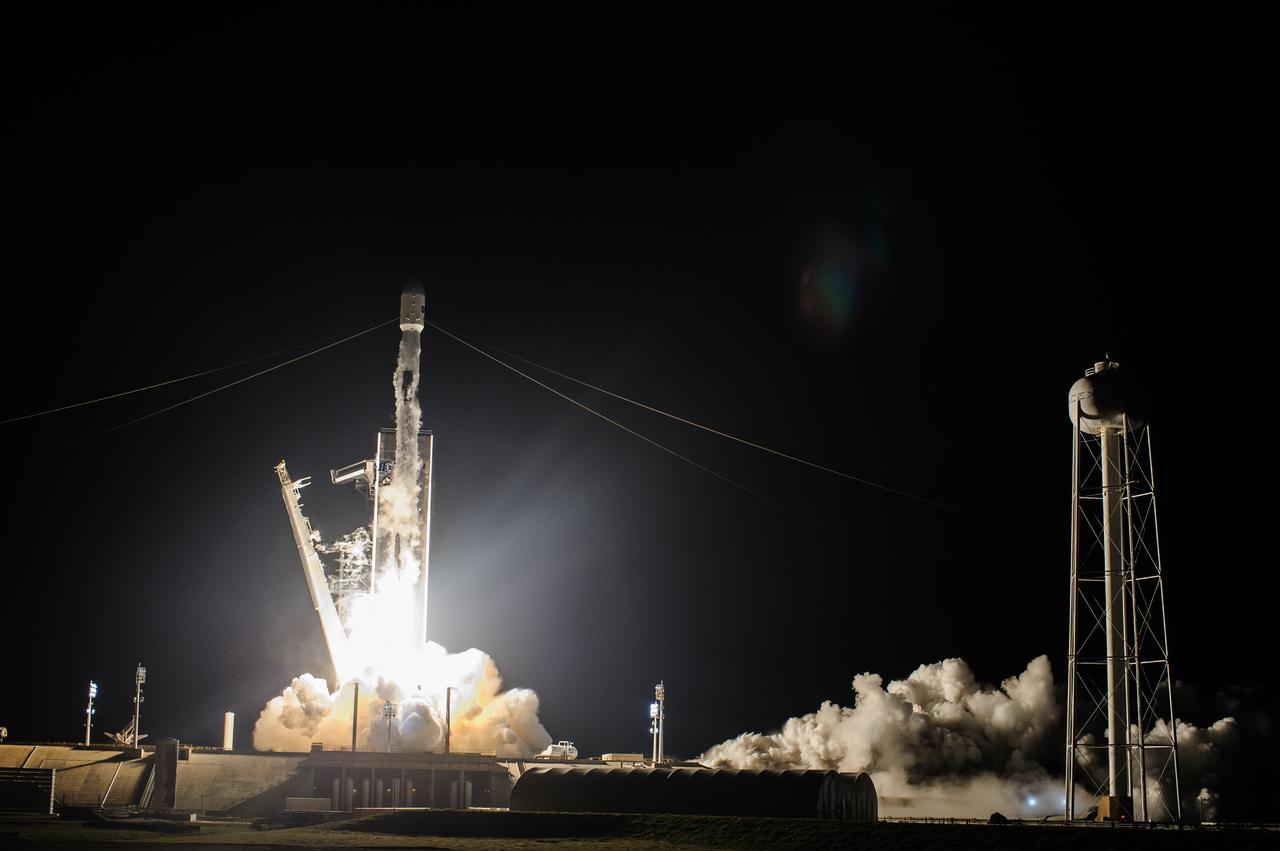
A SpaceX Falcon 9 rocket roars off the launch pad at Launch Complex 39A at NASA’s Kennedy Space Center in Florida at 1 a.m. EST on Thursday, Dec. 9, 2021, carrying NASA’s Imaging X-ray Polarimetry Explorer (IXPE) spacecraft. NASA’s Launch Services Program managed this launch. NASA’s Marshall Space Flight Center in Huntsville, Alabama, manages the IXPE mission. Ball Aerospace, headquartered in Broomfield, Colorado, manages spacecraft operations with support from the University of Colorado at Boulder. NASA’s Goddard Space Flight Center in Greenbelt, Maryland, manages the Explorers Program for the agency’s Science Mission Directorate in Washington. The IXPE spacecraft includes three space telescopes with sensitive detectors capable of measuring the polarization of cosmic X-rays, allowing scientists to answer fundamental questions about extremely complex environments in space where gravitational, electric, and magnetic fields are at their limits. The project is a collaboration between NASA and the Italian Space Agency.
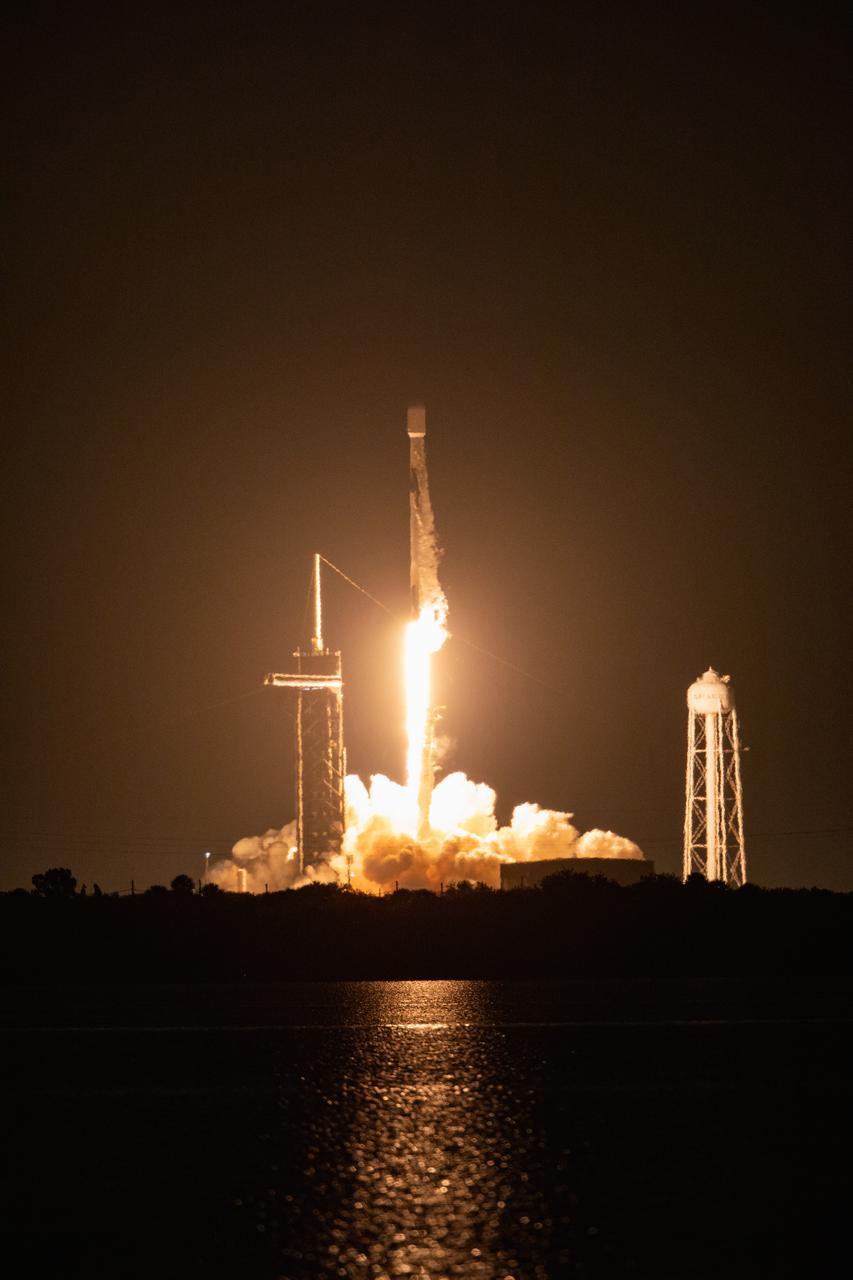
A SpaceX Falcon 9 rocket roars off the launch pad at Launch Complex 39A at NASA’s Kennedy Space Center in Florida at 1 a.m. EST on Thursday, Dec. 9, 2021, carrying NASA’s Imaging X-ray Polarimetry Explorer (IXPE) spacecraft. NASA’s Launch Services Program managed this launch. NASA’s Marshall Space Flight Center in Huntsville, Alabama, manages the IXPE mission. Ball Aerospace, headquartered in Broomfield, Colorado, manages spacecraft operations with support from the University of Colorado at Boulder. NASA’s Goddard Space Flight Center in Greenbelt, Maryland, manages the Explorers Program for the agency’s Science Mission Directorate in Washington. The IXPE spacecraft includes three space telescopes with sensitive detectors capable of measuring the polarization of cosmic X-rays, allowing scientists to answer fundamental questions about extremely complex environments in space where gravitational, electric, and magnetic fields are at their limits. The project is a collaboration between NASA and the Italian Space Agency.
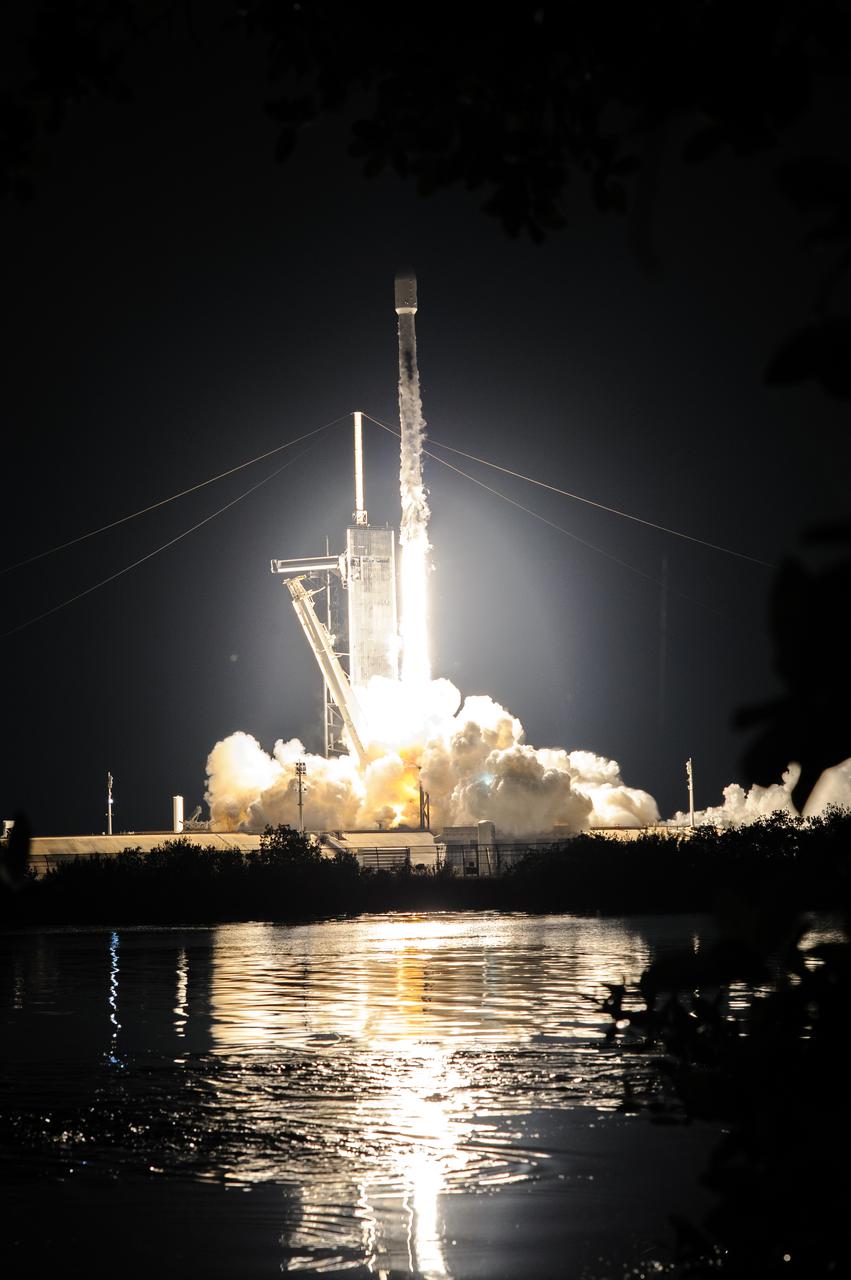
A SpaceX Falcon 9 rocket roars off the launch pad at Launch Complex 39A at NASA’s Kennedy Space Center in Florida at 1 a.m. EST on Thursday, Dec. 9, 2021, carrying NASA’s Imaging X-ray Polarimetry Explorer (IXPE) spacecraft. NASA’s Launch Services Program managed this launch. NASA’s Marshall Space Flight Center in Huntsville, Alabama, manages the IXPE mission. Ball Aerospace, headquartered in Broomfield, Colorado, manages spacecraft operations with support from the University of Colorado at Boulder. NASA’s Goddard Space Flight Center in Greenbelt, Maryland, manages the Explorers Program for the agency’s Science Mission Directorate in Washington. The IXPE spacecraft includes three space telescopes with sensitive detectors capable of measuring the polarization of cosmic X-rays, allowing scientists to answer fundamental questions about extremely complex environments in space where gravitational, electric, and magnetic fields are at their limits. The project is a collaboration between NASA and the Italian Space Agency.
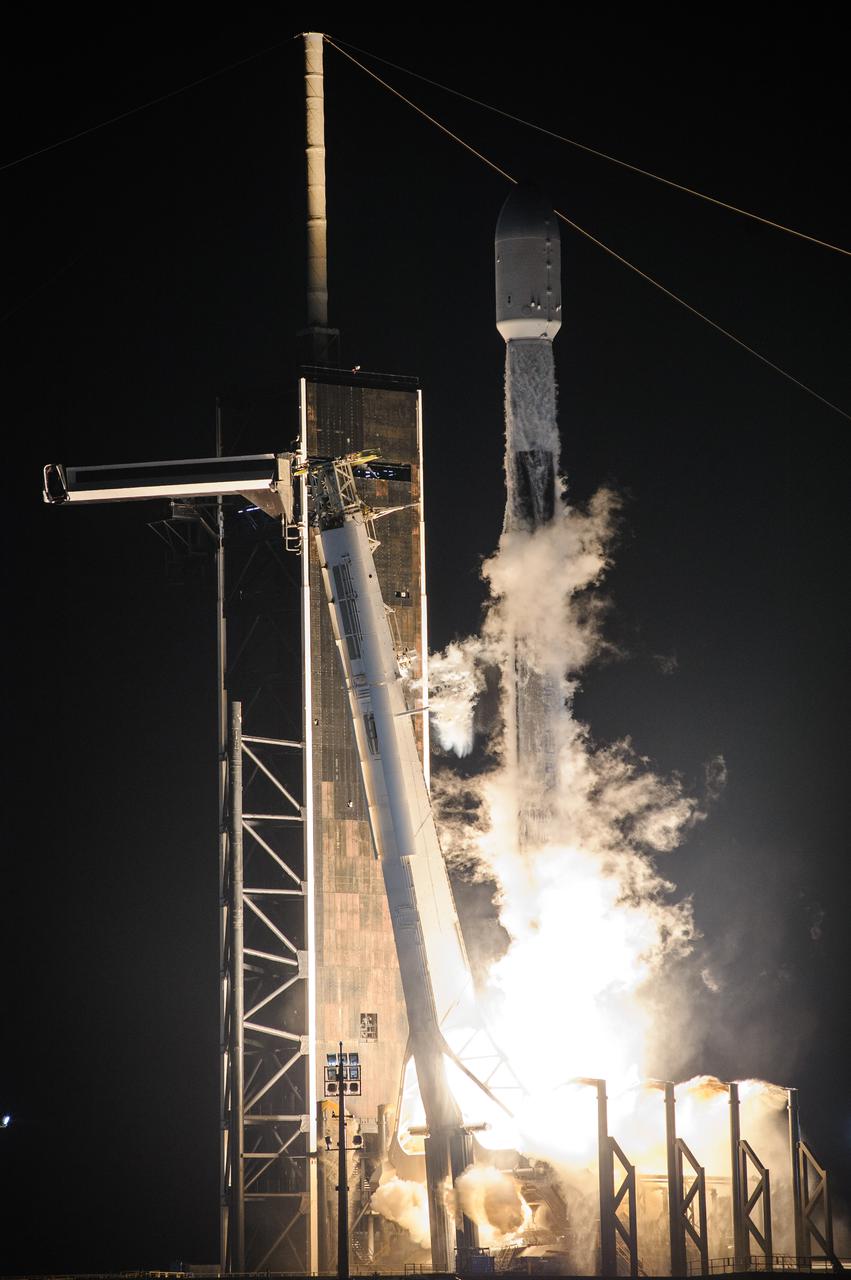
A SpaceX Falcon 9 rocket roars off the launch pad at Launch Complex 39A at NASA’s Kennedy Space Center in Florida at 1 a.m. EST on Thursday, Dec. 9, 2021, carrying NASA’s Imaging X-ray Polarimetry Explorer (IXPE) spacecraft. NASA’s Launch Services Program managed this launch. NASA’s Marshall Space Flight Center in Huntsville, Alabama, manages the IXPE mission. Ball Aerospace, headquartered in Broomfield, Colorado, manages spacecraft operations with support from the University of Colorado at Boulder. NASA’s Goddard Space Flight Center in Greenbelt, Maryland, manages the Explorers Program for the agency’s Science Mission Directorate in Washington. The IXPE spacecraft includes three space telescopes with sensitive detectors capable of measuring the polarization of cosmic X-rays, allowing scientists to answer fundamental questions about extremely complex environments in space where gravitational, electric, and magnetic fields are at their limits. The project is a collaboration between NASA and the Italian Space Agency.
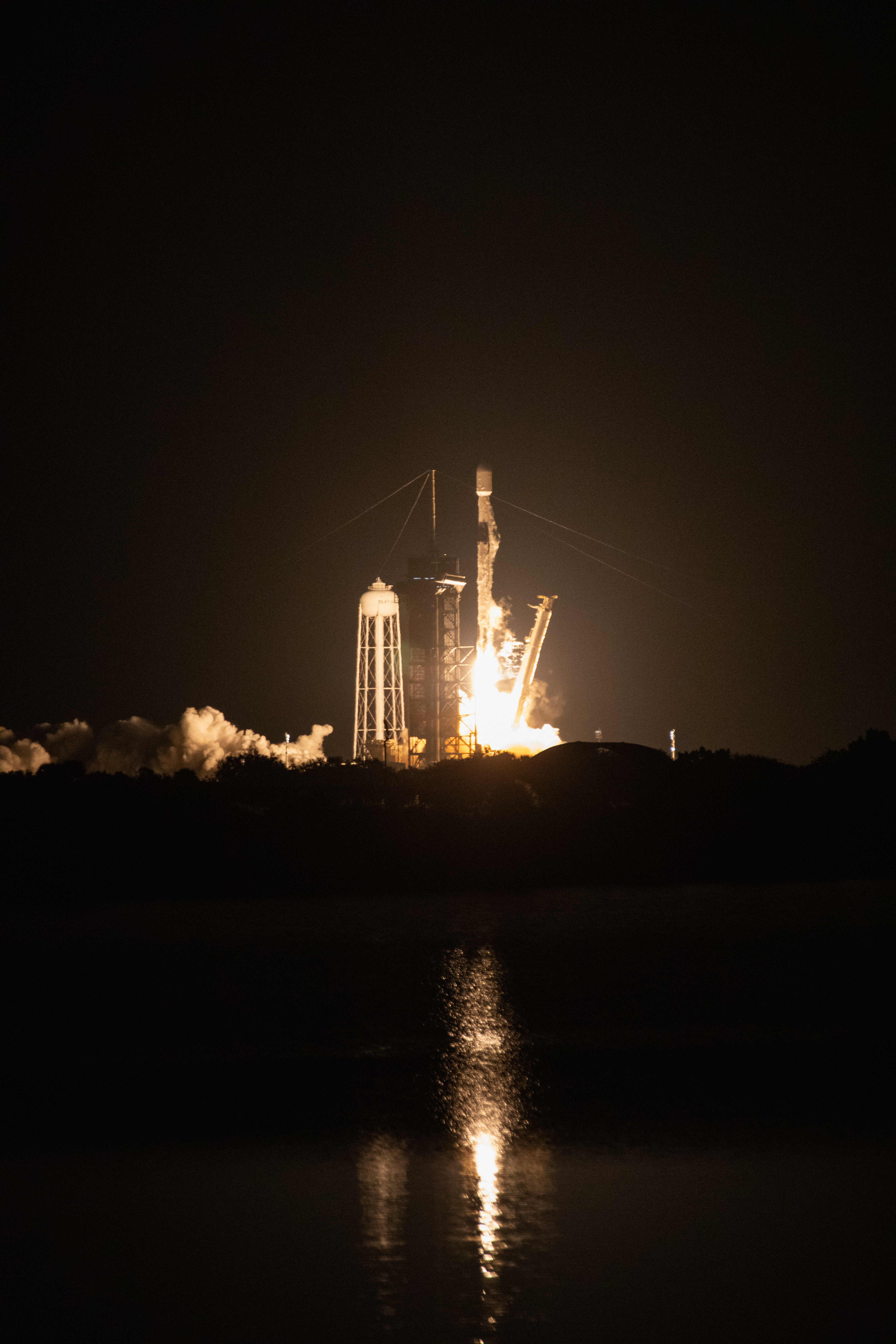
A SpaceX Falcon 9 rocket roars off the launch pad at Launch Complex 39A at NASA’s Kennedy Space Center in Florida at 1 a.m. EST on Thursday, Dec. 9, 2021, carrying NASA’s Imaging X-ray Polarimetry Explorer (IXPE) spacecraft. NASA’s Launch Services Program managed this launch. NASA’s Marshall Space Flight Center in Huntsville, Alabama, manages the IXPE mission. Ball Aerospace, headquartered in Broomfield, Colorado, manages spacecraft operations with support from the University of Colorado at Boulder. NASA’s Goddard Space Flight Center in Greenbelt, Maryland, manages the Explorers Program for the agency’s Science Mission Directorate in Washington. The IXPE spacecraft includes three space telescopes with sensitive detectors capable of measuring the polarization of cosmic X-rays, allowing scientists to answer fundamental questions about extremely complex environments in space where gravitational, electric, and magnetic fields are at their limits. The project is a collaboration between NASA and the Italian Space Agency.
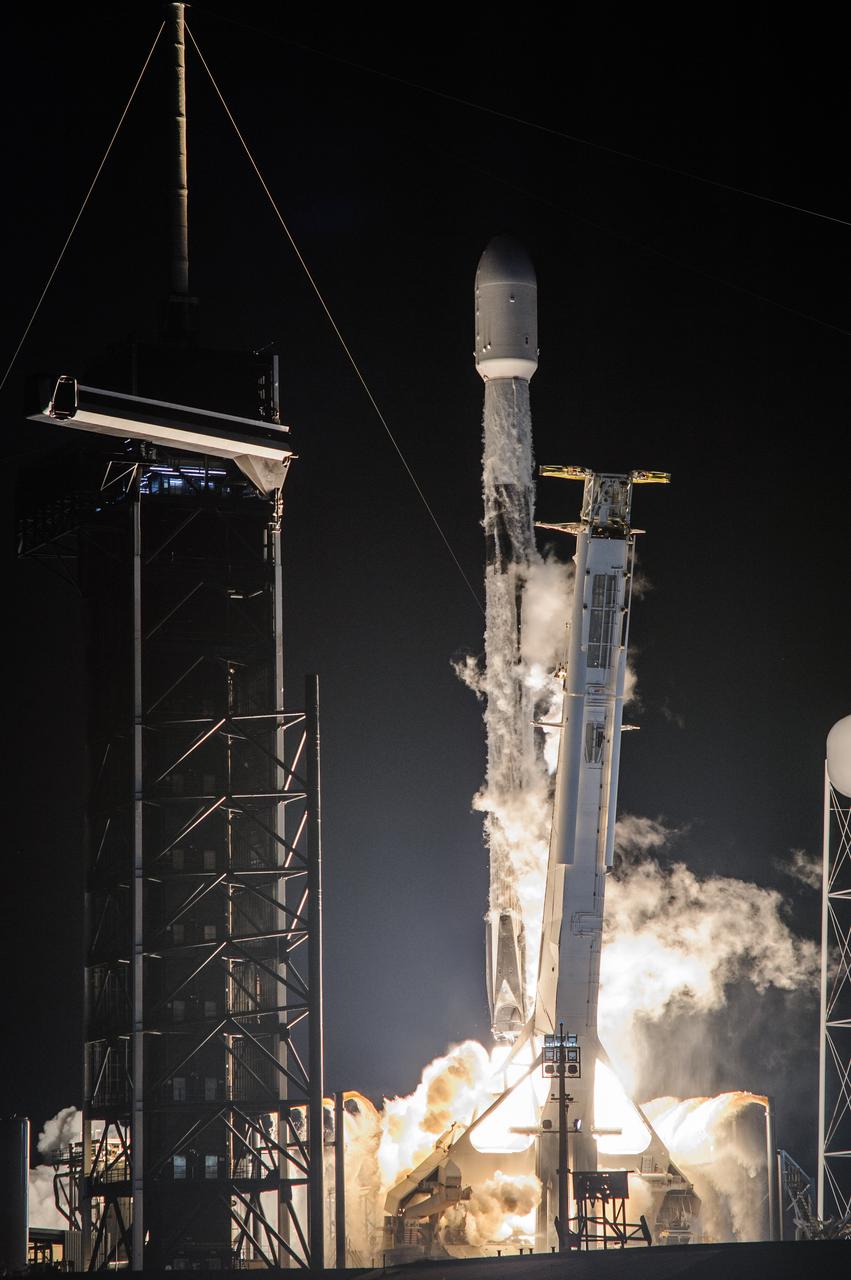
A SpaceX Falcon 9 rocket roars off the launch pad at Launch Complex 39A at NASA’s Kennedy Space Center in Florida at 1 a.m. EST on Thursday, Dec. 9, 2021, carrying NASA’s Imaging X-ray Polarimetry Explorer (IXPE) spacecraft. NASA’s Launch Services Program managed this launch. NASA’s Marshall Space Flight Center in Huntsville, Alabama, manages the IXPE mission. Ball Aerospace, headquartered in Broomfield, Colorado, manages spacecraft operations with support from the University of Colorado at Boulder. NASA’s Goddard Space Flight Center in Greenbelt, Maryland, manages the Explorers Program for the agency’s Science Mission Directorate in Washington. The IXPE spacecraft includes three space telescopes with sensitive detectors capable of measuring the polarization of cosmic X-rays, allowing scientists to answer fundamental questions about extremely complex environments in space where gravitational, electric, and magnetic fields are at their limits. The project is a collaboration between NASA and the Italian Space Agency.
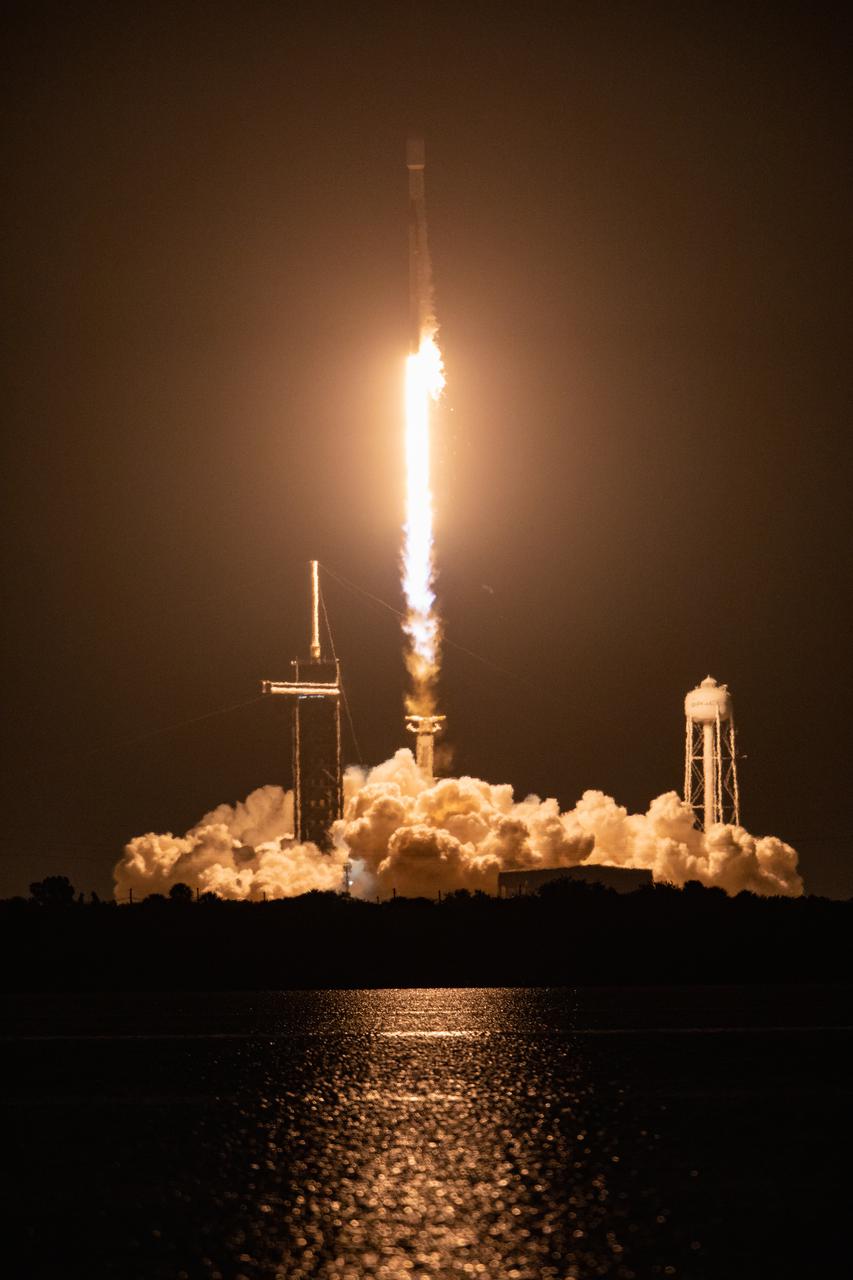
A SpaceX Falcon 9 rocket roars off the launch pad at Launch Complex 39A at NASA’s Kennedy Space Center in Florida at 1 a.m. EST on Thursday, Dec. 9, 2021, carrying NASA’s Imaging X-ray Polarimetry Explorer (IXPE) spacecraft. NASA’s Launch Services Program managed this launch. NASA’s Marshall Space Flight Center in Huntsville, Alabama, manages the IXPE mission. Ball Aerospace, headquartered in Broomfield, Colorado, manages spacecraft operations with support from the University of Colorado at Boulder. NASA’s Goddard Space Flight Center in Greenbelt, Maryland, manages the Explorers Program for the agency’s Science Mission Directorate in Washington. The IXPE spacecraft includes three space telescopes with sensitive detectors capable of measuring the polarization of cosmic X-rays, allowing scientists to answer fundamental questions about extremely complex environments in space where gravitational, electric, and magnetic fields are at their limits. The project is a collaboration between NASA and the Italian Space Agency.
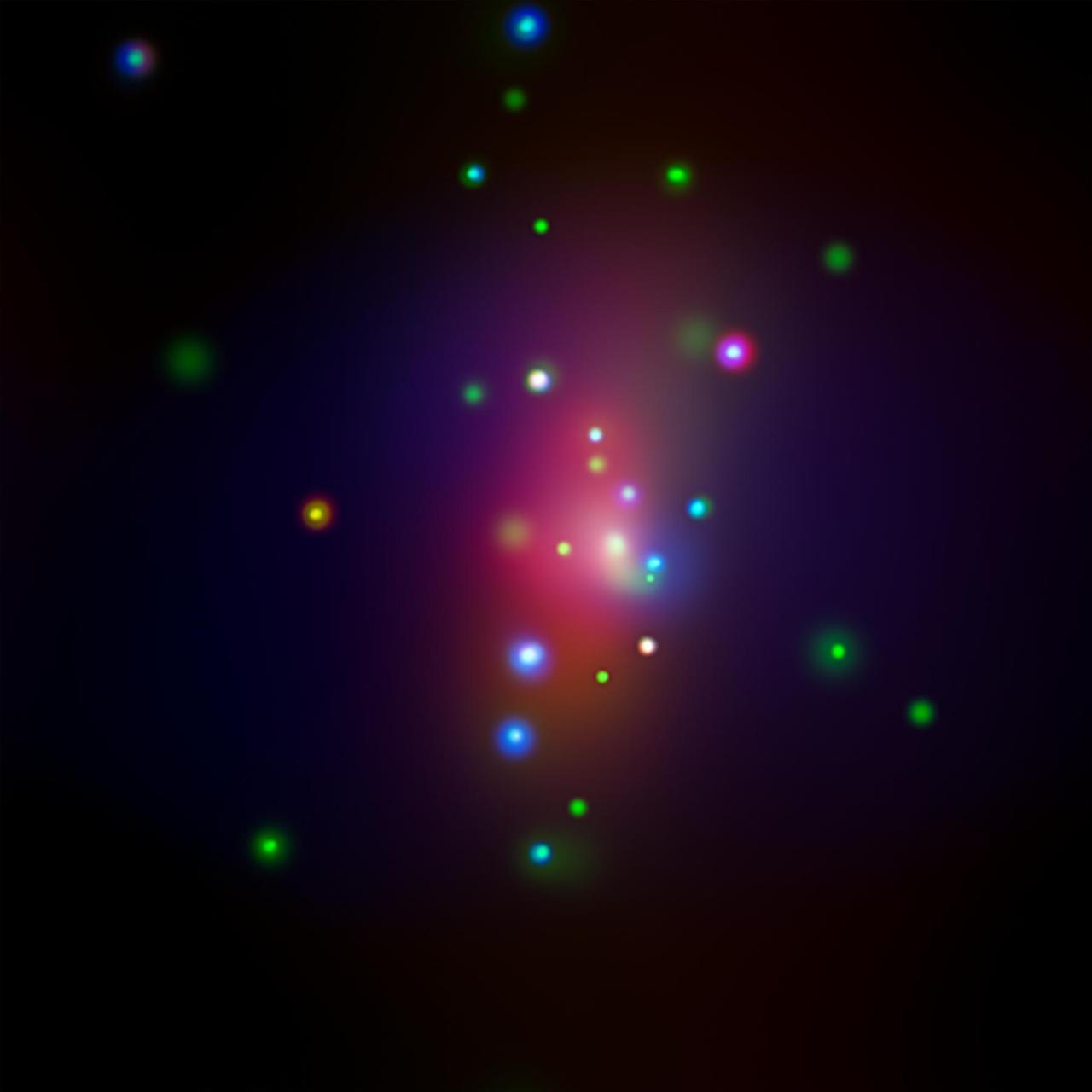
This image from NASA's Chandra X-ray Observatory shows spiral galaxy NGC 7331, center, in a three-color X-ray image. Red, green and blue colors are used for low, medium and high-energy X-rays, respectively. An unusual supernova called SN 2014C has been spotted in this galaxy. http://photojournal.jpl.nasa.gov/catalog/PIA21089
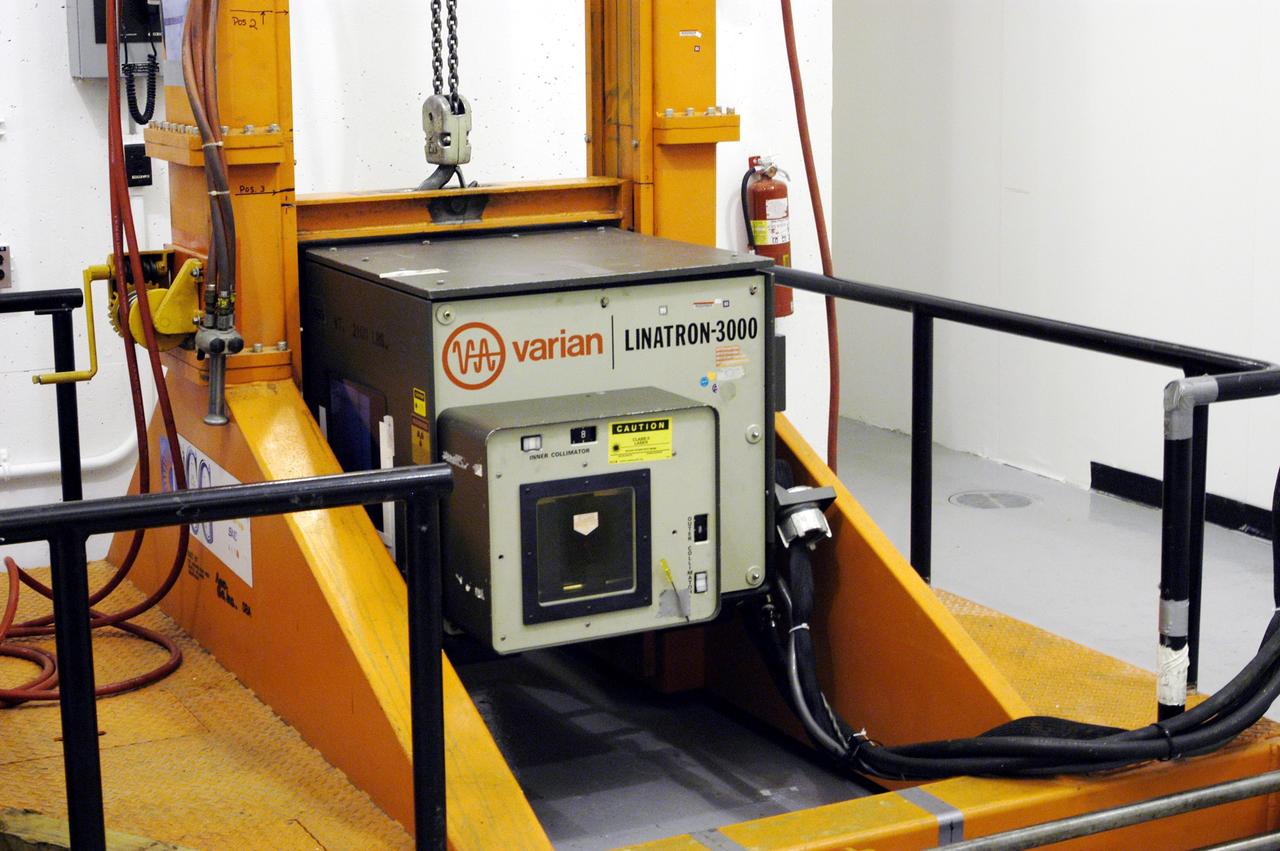
KENNEDY SPACE CENTER, FLA. - An X-ray machine is in place to take images of four rudder speed brake actuators to be installed on the orbiter Discovery. The actuators are being X-rayed at the Cape Canaveral Air Force Station’s Radiographic High-Energy X-ray Facility to determine if the gears were installed correctly. Discovery has been assigned to the first Return to Flight mission, STS-114, a logistics flight to the International Space Station.
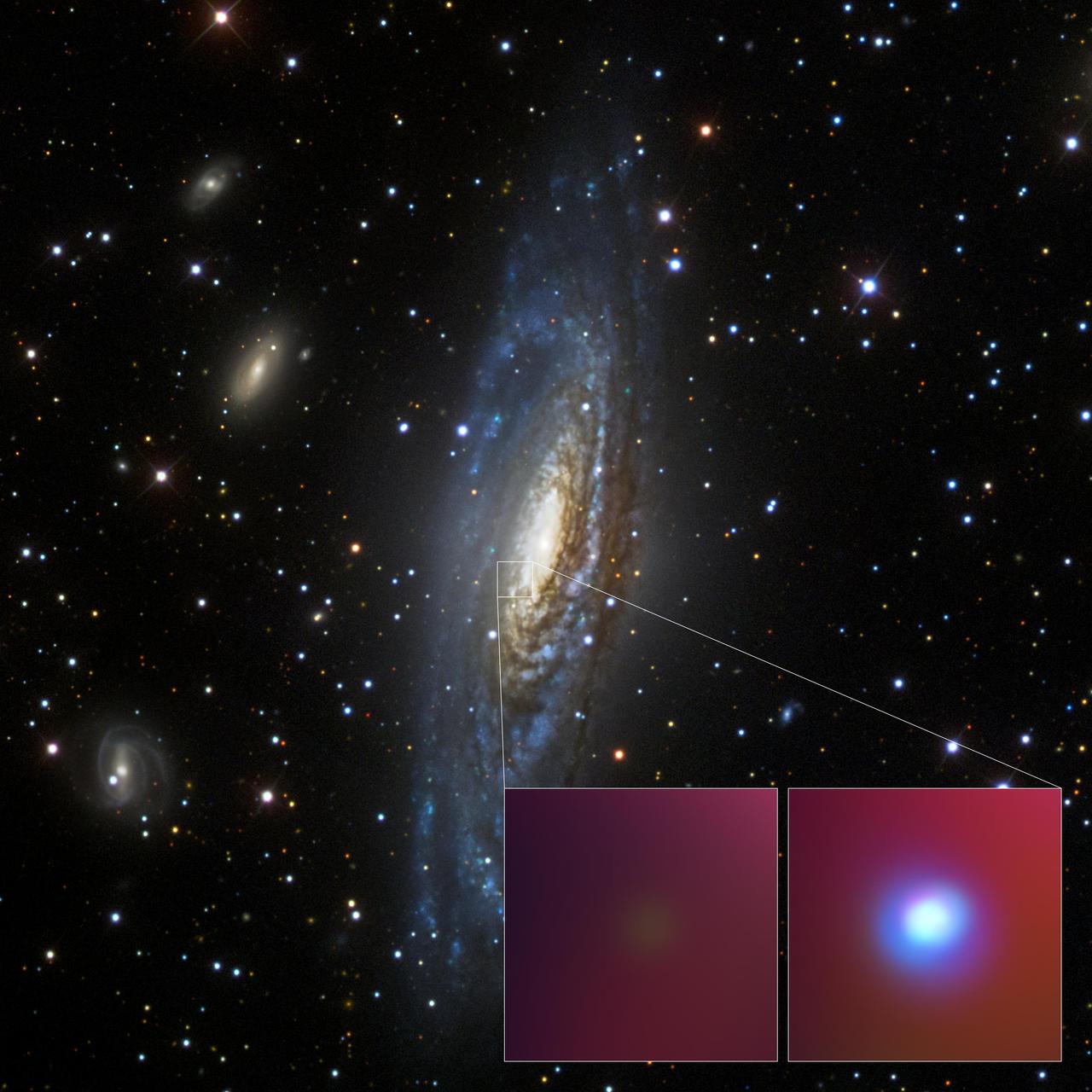
This visible-light image from the Sloan Digital Sky Survey shows spiral galaxy NGC 7331, center, where astronomers observed the unusual supernova SN 2014C . The inset images are from NASA's Chandra X-ray Observatory, showing a small region of the galaxy before the supernova explosion (left) and after it (right). Red, green and blue colors are used for low, medium and high-energy X-rays, respectively. http://photojournal.jpl.nasa.gov/catalog/PIA21088
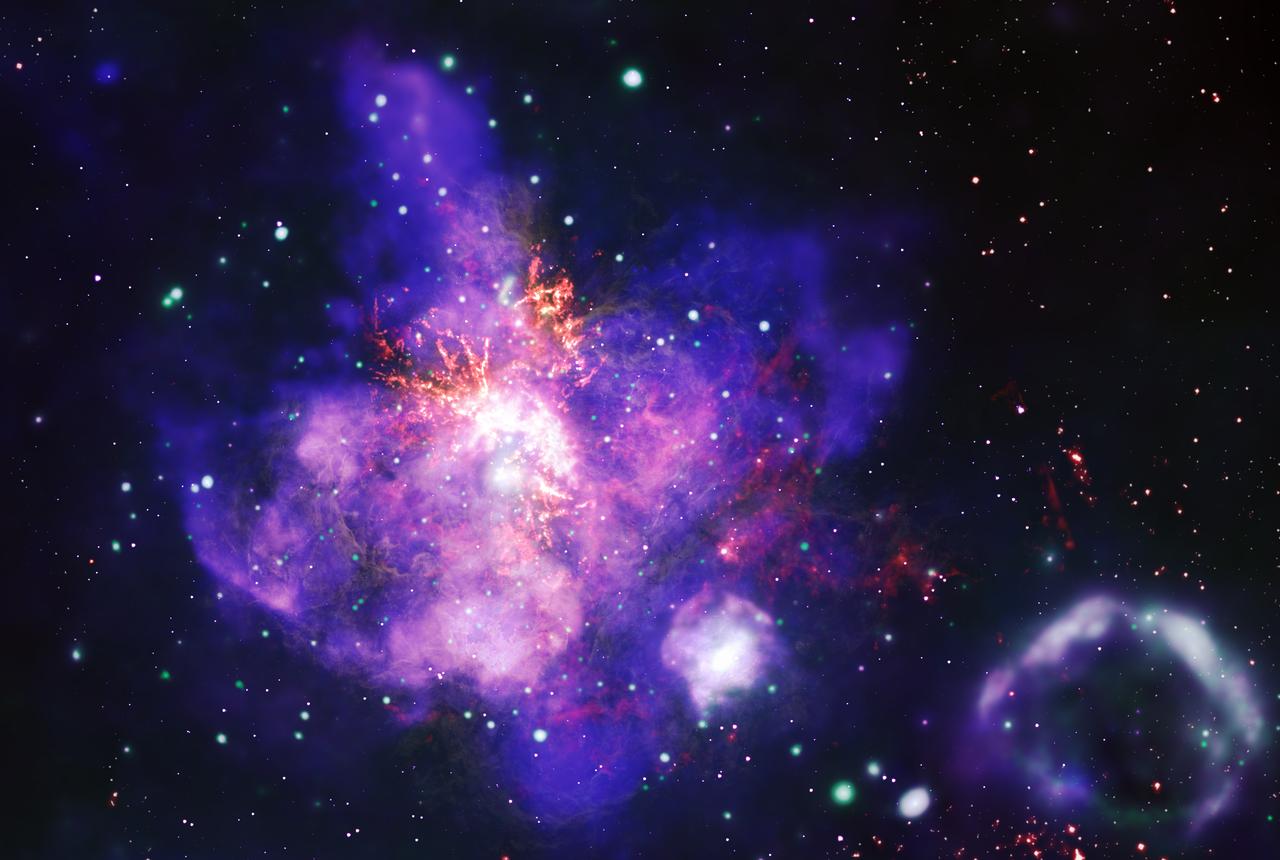
This composite image contains the deepest X-ray image ever made of the spectacular star forming region called 30 Doradus. By combining X-ray data from NASA’s Chandra X-ray Observatory (blue and green) with optical data from NASA’s Hubble Space Telescope (yellow) and radio data from the Atacama Large Millimeter/submillimeter Array (orange), this stellar arrangement comes alive.
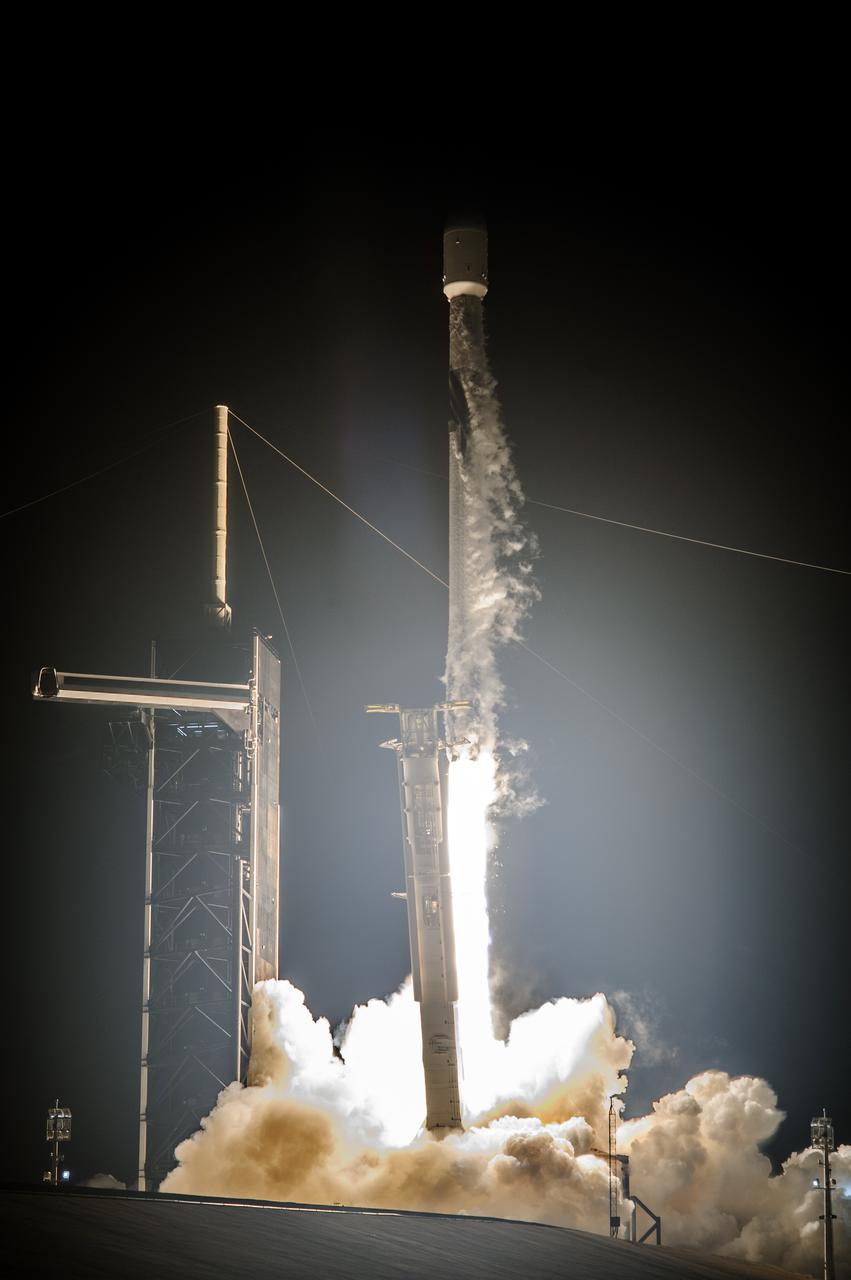
A SpaceX Falcon 9 rocket soars upward after liftoff from the launch pad at Launch Complex 39A at NASA’s Kennedy Space Center in Florida at 1 a.m. EST on Thursday, Dec. 9, 2021. The Falcon 9 carries NASA’s Imaging X-ray Polarimetry Explorer (IXPE) spacecraft. NASA’s Launch Services Program managed this launch. NASA’s Marshall Space Flight Center in Huntsville, Alabama, manages the IXPE mission. Ball Aerospace, headquartered in Broomfield, Colorado, manages spacecraft operations with support from the University of Colorado at Boulder. NASA’s Goddard Space Flight Center in Greenbelt, Maryland, manages the Explorers Program for the agency’s Science Mission Directorate in Washington. The IXPE spacecraft includes three space telescopes with sensitive detectors capable of measuring the polarization of cosmic X-rays, allowing scientists to answer fundamental questions about extremely complex environments in space where gravitational, electric, and magnetic fields are at their limits. The project is a collaboration between NASA and the Italian Space Agency.
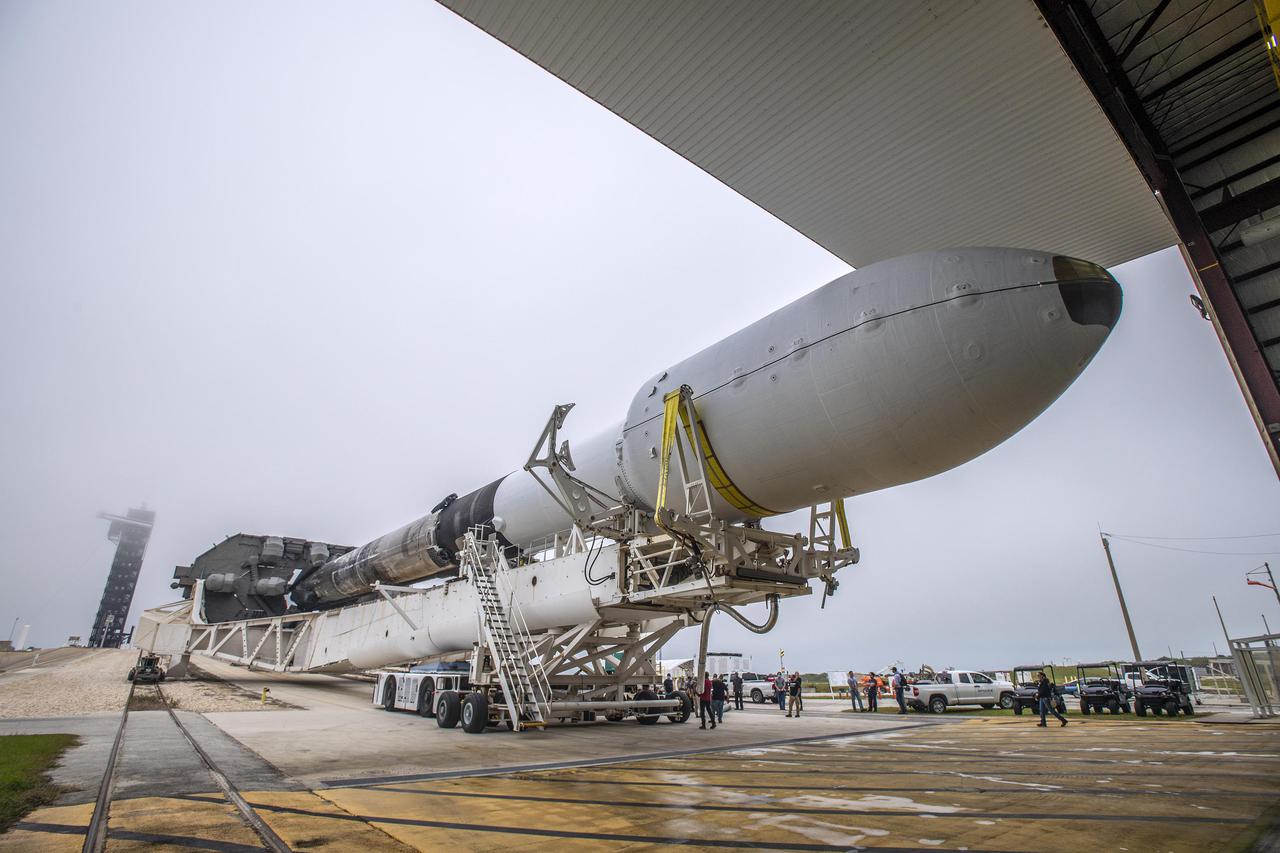
A SpaceX Falcon 9 rocket with NASA’s Imaging X-ray Polarimetry Explorer (IXPE) spacecraft, rolls out to Launch Complex 39A at NASA’s Kennedy Space Center in Florida on Dec. 7, 2021. IXPE is scheduled to launch no earlier than 1 a.m. EST Thursday, Dec. 9. NASA’s Launch Services Program is managing this launch. NASA’s Marshall Space Flight Center in Huntsville, Alabama, manages the IXPE mission. Ball Aerospace, headquartered in Broomfield, Colorado, manages spacecraft operations with support from the University of Colorado at Boulder. NASA’s Goddard Space Flight Center in Greenbelt, Maryland, manages the Explorers Program for the agency’s Science Mission Directorate in Washington. The U.S. Space Force’s Space Launch Delta 45 provides range support for this launch. SpaceX is providing the launch vehicle for this mission. The IXPE spacecraft includes three space telescopes with sensitive detectors capable of measuring the polarization of cosmic X-rays, allowing scientists to answer fundamental questions about extremely complex environments in space where gravitational, electric, and magnetic fields are at their limits. The project is a collaboration between NASA and the Italian Space Agency.
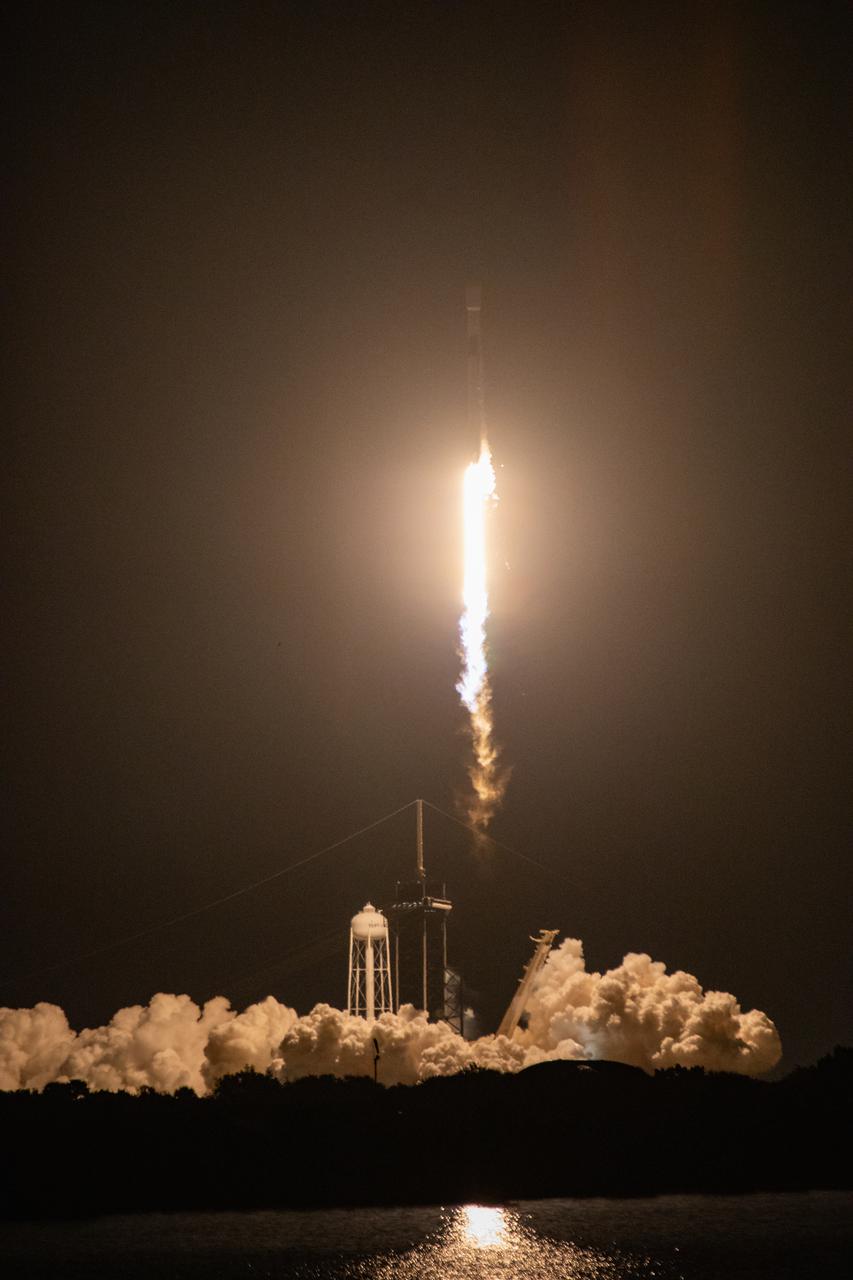
A SpaceX Falcon 9 rocket soars upward after liftoff from the launch pad at Launch Complex 39A at NASA’s Kennedy Space Center in Florida at 1 a.m. EST on Thursday, Dec. 9, 2021. The Falcon 9 carries NASA’s Imaging X-ray Polarimetry Explorer (IXPE) spacecraft. NASA’s Launch Services Program managed this launch. NASA’s Marshall Space Flight Center in Huntsville, Alabama, manages the IXPE mission. Ball Aerospace, headquartered in Broomfield, Colorado, manages spacecraft operations with support from the University of Colorado at Boulder. NASA’s Goddard Space Flight Center in Greenbelt, Maryland, manages the Explorers Program for the agency’s Science Mission Directorate in Washington. The IXPE spacecraft includes three space telescopes with sensitive detectors capable of measuring the polarization of cosmic X-rays, allowing scientists to answer fundamental questions about extremely complex environments in space where gravitational, electric, and magnetic fields are at their limits. The project is a collaboration between NASA and the Italian Space Agency.
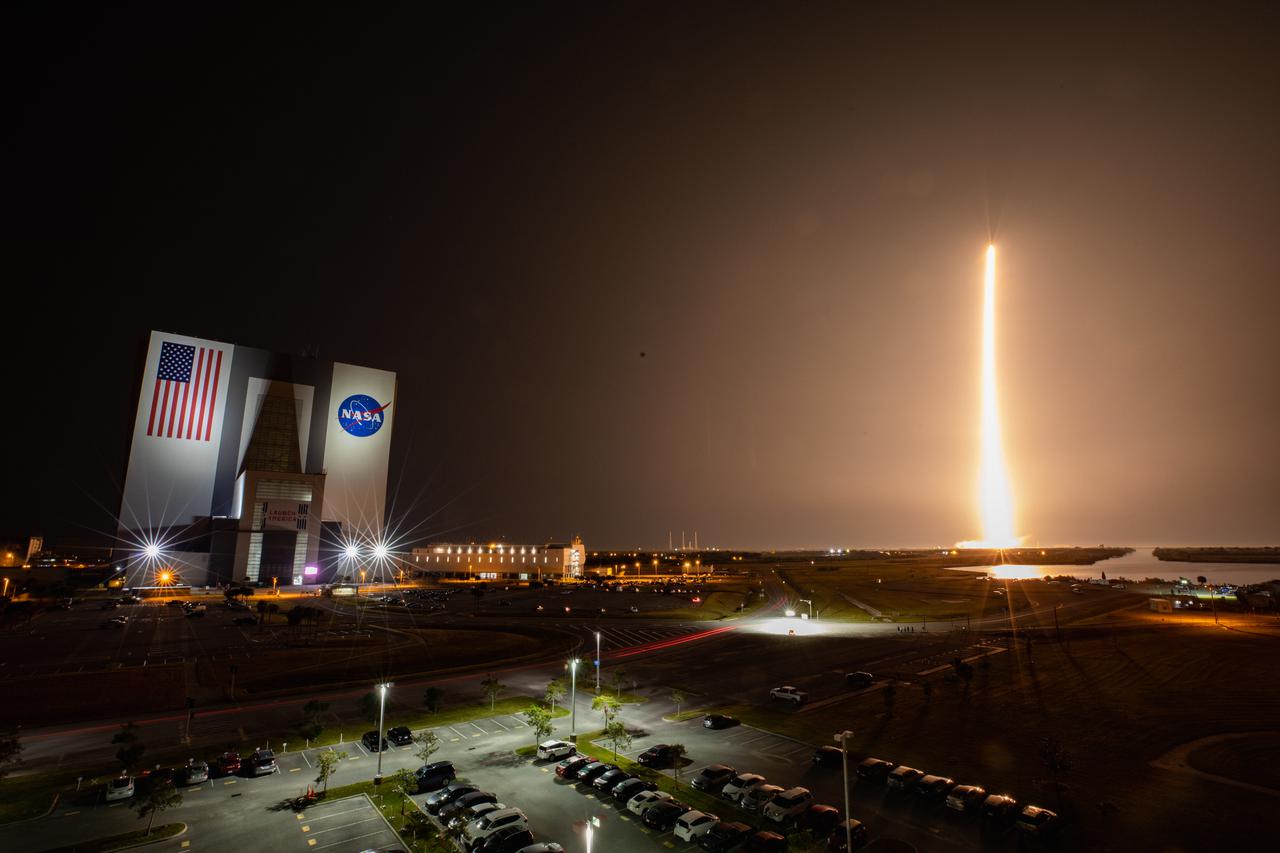
A SpaceX Falcon 9 rocket soars upward after liftoff from the launch pad at Launch Complex 39A at NASA’s Kennedy Space Center in Florida at 1 a.m. EST on Thursday, Dec. 9, 2021. The Falcon 9 carries NASA’s Imaging X-ray Polarimetry Explorer (IXPE) spacecraft. NASA’s Launch Services Program managed this launch. NASA’s Marshall Space Flight Center in Huntsville, Alabama, manages the IXPE mission. Ball Aerospace, headquartered in Broomfield, Colorado, manages spacecraft operations with support from the University of Colorado at Boulder. NASA’s Goddard Space Flight Center in Greenbelt, Maryland, manages the Explorers Program for the agency’s Science Mission Directorate in Washington. The IXPE spacecraft includes three space telescopes with sensitive detectors capable of measuring the polarization of cosmic X-rays, allowing scientists to answer fundamental questions about extremely complex environments in space where gravitational, electric, and magnetic fields are at their limits. The project is a collaboration between NASA and the Italian Space Agency.
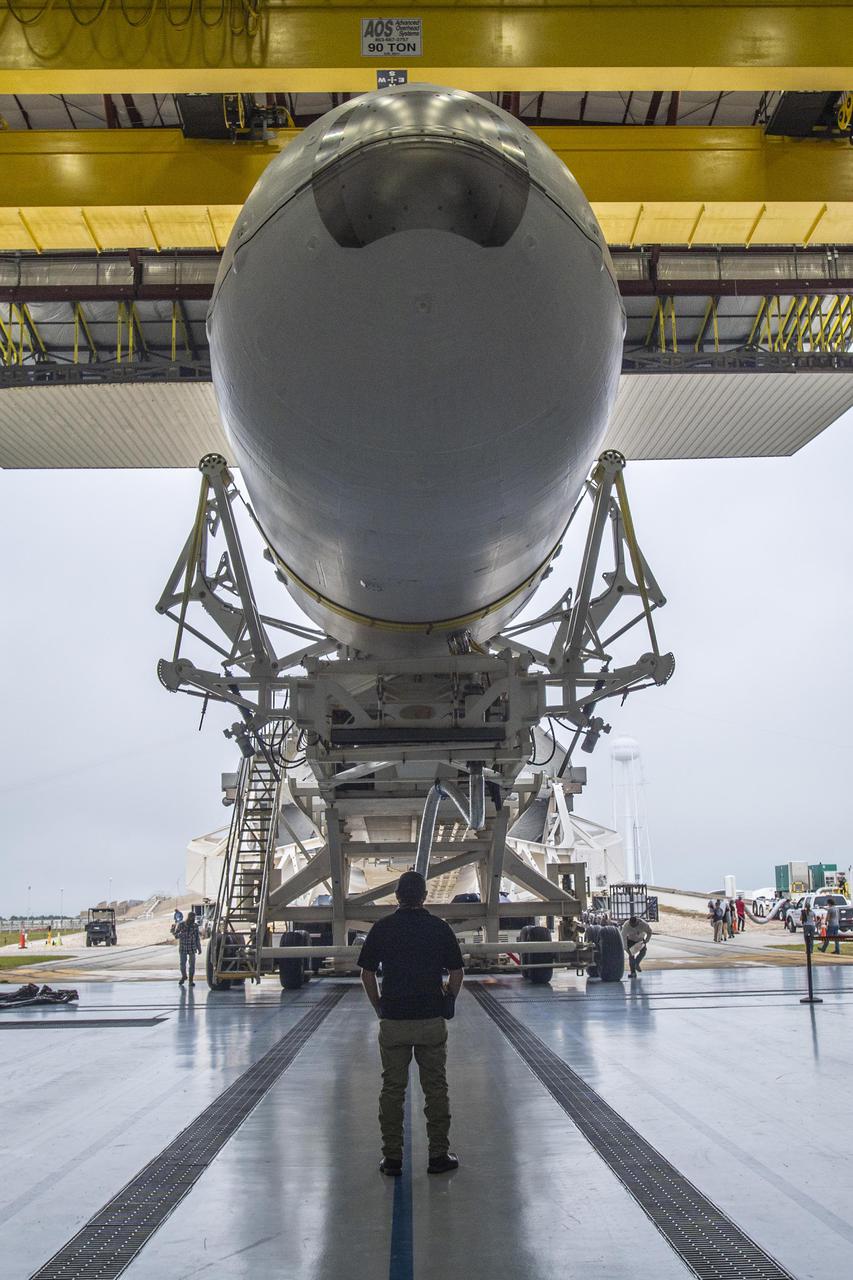
A SpaceX Falcon 9 rocket with NASA’s Imaging X-ray Polarimetry Explorer (IXPE) spacecraft, begins rollout to Launch Complex 39A at NASA’s Kennedy Space Center in Florida on Dec. 7, 2021. IXPE is scheduled to launch no earlier than 1 a.m. EST Thursday, Dec. 9. NASA’s Launch Services Program is managing this launch. NASA’s Marshall Space Flight Center in Huntsville, Alabama, manages the IXPE mission. Ball Aerospace, headquartered in Broomfield, Colorado, manages spacecraft operations with support from the University of Colorado at Boulder. NASA’s Goddard Space Flight Center in Greenbelt, Maryland, manages the Explorers Program for the agency’s Science Mission Directorate in Washington. The U.S. Space Force’s Space Launch Delta 45 provides range support for this launch. SpaceX is providing the launch vehicle for this mission. The IXPE spacecraft includes three space telescopes with sensitive detectors capable of measuring the polarization of cosmic X-rays, allowing scientists to answer fundamental questions about extremely complex environments in space where gravitational, electric, and magnetic fields are at their limits. The project is a collaboration between NASA and the Italian Space Agency.
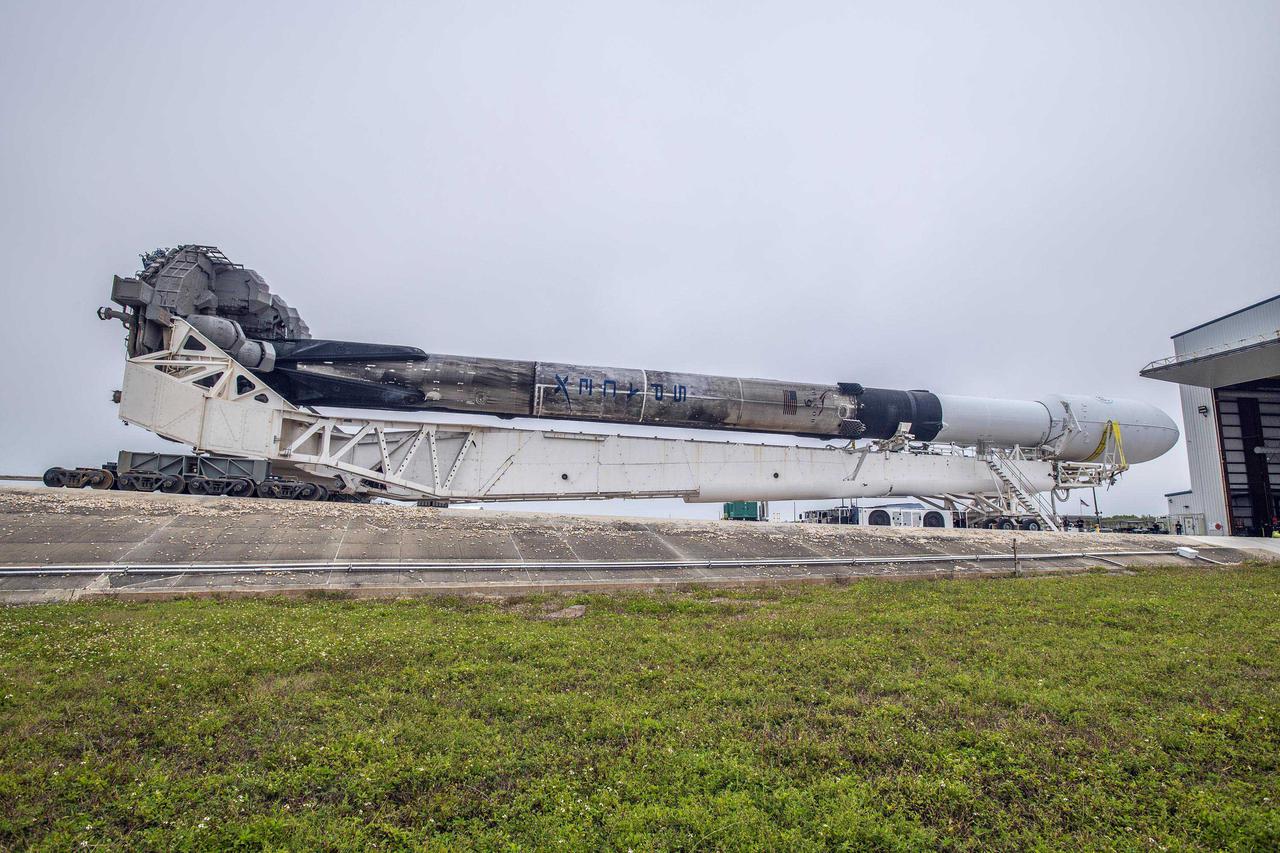
A SpaceX Falcon 9 rocket with NASA’s Imaging X-ray Polarimetry Explorer (IXPE) spacecraft, rolls out to Launch Complex 39A at NASA’s Kennedy Space Center in Florida on Dec. 7, 2021. IXPE is scheduled to launch no earlier than 1 a.m. EST Thursday, Dec. 9. NASA’s Launch Services Program is managing this launch. NASA’s Marshall Space Flight Center in Huntsville, Alabama, manages the IXPE mission. Ball Aerospace, headquartered in Broomfield, Colorado, manages spacecraft operations with support from the University of Colorado at Boulder. NASA’s Goddard Space Flight Center in Greenbelt, Maryland, manages the Explorers Program for the agency’s Science Mission Directorate in Washington. The U.S. Space Force’s Space Launch Delta 45 provides range support for this launch. SpaceX is providing the launch vehicle for this mission. The IXPE spacecraft includes three space telescopes with sensitive detectors capable of measuring the polarization of cosmic X-rays, allowing scientists to answer fundamental questions about extremely complex environments in space where gravitational, electric, and magnetic fields are at their limits. The project is a collaboration between NASA and the Italian Space Agency.

A SpaceX Falcon 9 rocket with NASA’s Imaging X-ray Polarimetry Explorer (IXPE) spacecraft, begins rollout to Launch Complex 39A at NASA’s Kennedy Space Center in Florida on Dec. 7, 2021. IXPE is scheduled to launch no earlier than 1 a.m. EST Thursday, Dec. 9. NASA’s Launch Services Program is managing this launch. NASA’s Marshall Space Flight Center in Huntsville, Alabama, manages the IXPE mission. Ball Aerospace, headquartered in Broomfield, Colorado, manages spacecraft operations with support from the University of Colorado at Boulder. NASA’s Goddard Space Flight Center in Greenbelt, Maryland, manages the Explorers Program for the agency’s Science Mission Directorate in Washington. The U.S. Space Force’s Space Launch Delta 45 provides range support for this launch. SpaceX is providing the launch vehicle for this mission. The IXPE spacecraft includes three space telescopes with sensitive detectors capable of measuring the polarization of cosmic X-rays, allowing scientists to answer fundamental questions about extremely complex environments in space where gravitational, electric, and magnetic fields are at their limits. The project is a collaboration between NASA and the Italian Space Agency.
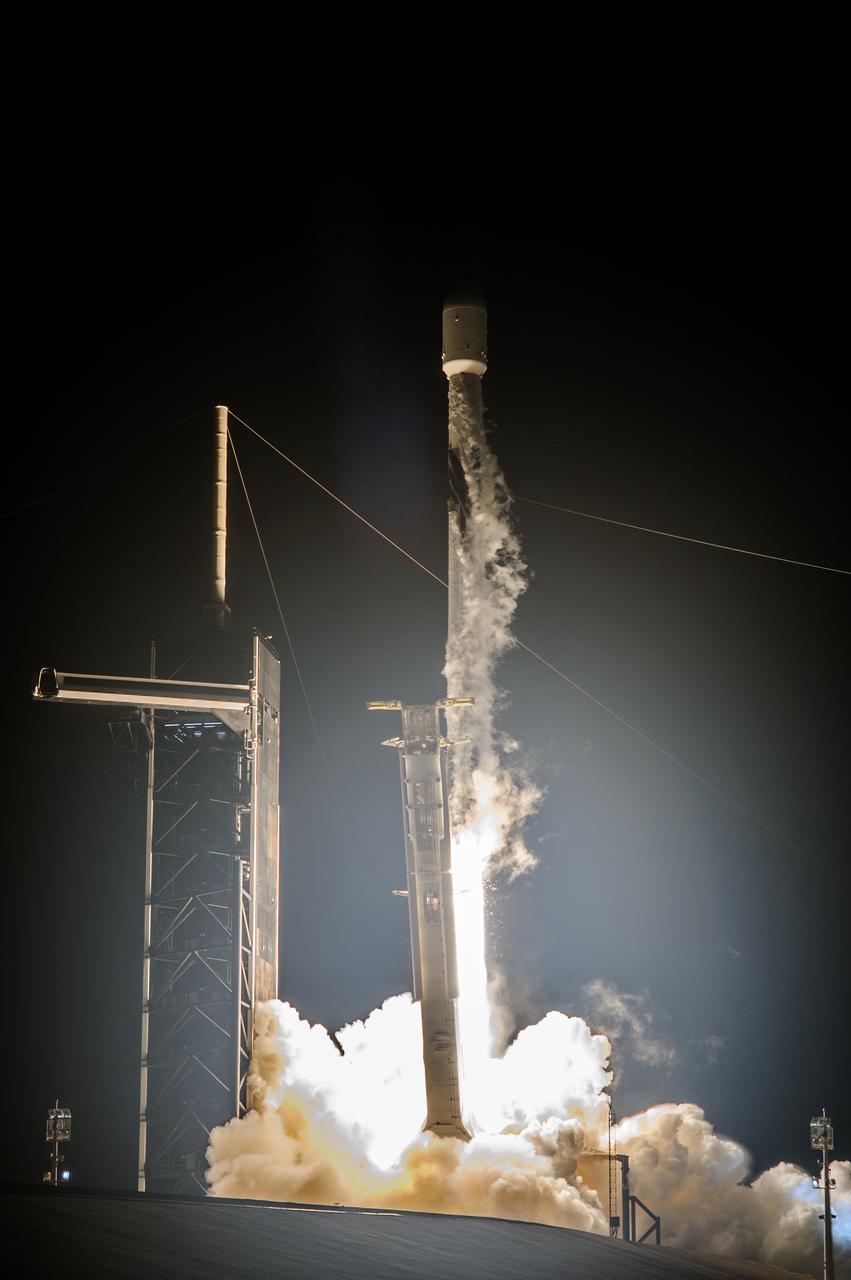
A SpaceX Falcon 9 rocket soars upward after liftoff from the launch pad at Launch Complex 39A at NASA’s Kennedy Space Center in Florida at 1 a.m. EST on Thursday, Dec. 9, 2021. The Falcon 9 carries NASA’s Imaging X-ray Polarimetry Explorer (IXPE) spacecraft. NASA’s Launch Services Program managed this launch. NASA’s Marshall Space Flight Center in Huntsville, Alabama, manages the IXPE mission. Ball Aerospace, headquartered in Broomfield, Colorado, manages spacecraft operations with support from the University of Colorado at Boulder. NASA’s Goddard Space Flight Center in Greenbelt, Maryland, manages the Explorers Program for the agency’s Science Mission Directorate in Washington. The IXPE spacecraft includes three space telescopes with sensitive detectors capable of measuring the polarization of cosmic X-rays, allowing scientists to answer fundamental questions about extremely complex environments in space where gravitational, electric, and magnetic fields are at their limits. The project is a collaboration between NASA and the Italian Space Agency.
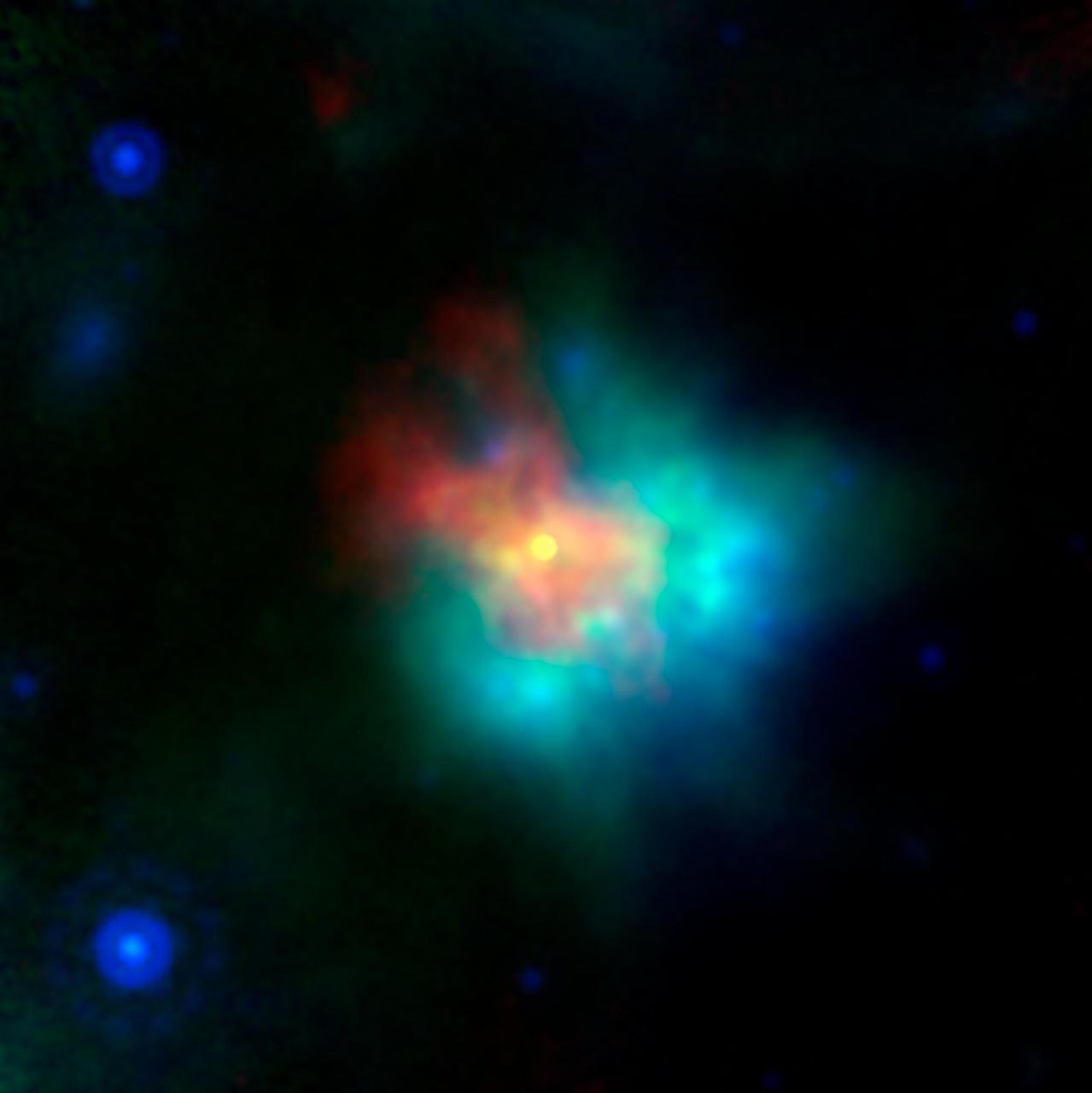
This image of supernova remnant G54.1+0.3 includes radio, infrared and X-ray light. The saturated yellow point at the center of the image indicates strong X-ray source at the center of the supernova remnant. This is an incredibly dense object called a neutron star, which can form as a star runs out of fuel to keep it inflated, and the unsupported material collapses down on to the star's core. G54.1+0.3 contains a special type of neutron star called a pulsar, which emits particularly bright radio and X-ray emissions. The blue and green emissions show the presence of dust, including silica. The red hues correspond to radio data from the Karl G. Jansky Very Large Array; green corresponds to 70 µm wavelength infrared light from the European Space Agency's Herschel Space Observatory; blue corresponds to 24 µm wavelength infrared light from the Multiband Imaging Photometer (MIPS) instrument on NASA's Spitzer Space Telescope; yellow corresponds to X-ray data from the Chandra X-ray Observatory. https://photojournal.jpl.nasa.gov/catalog/PIA22569
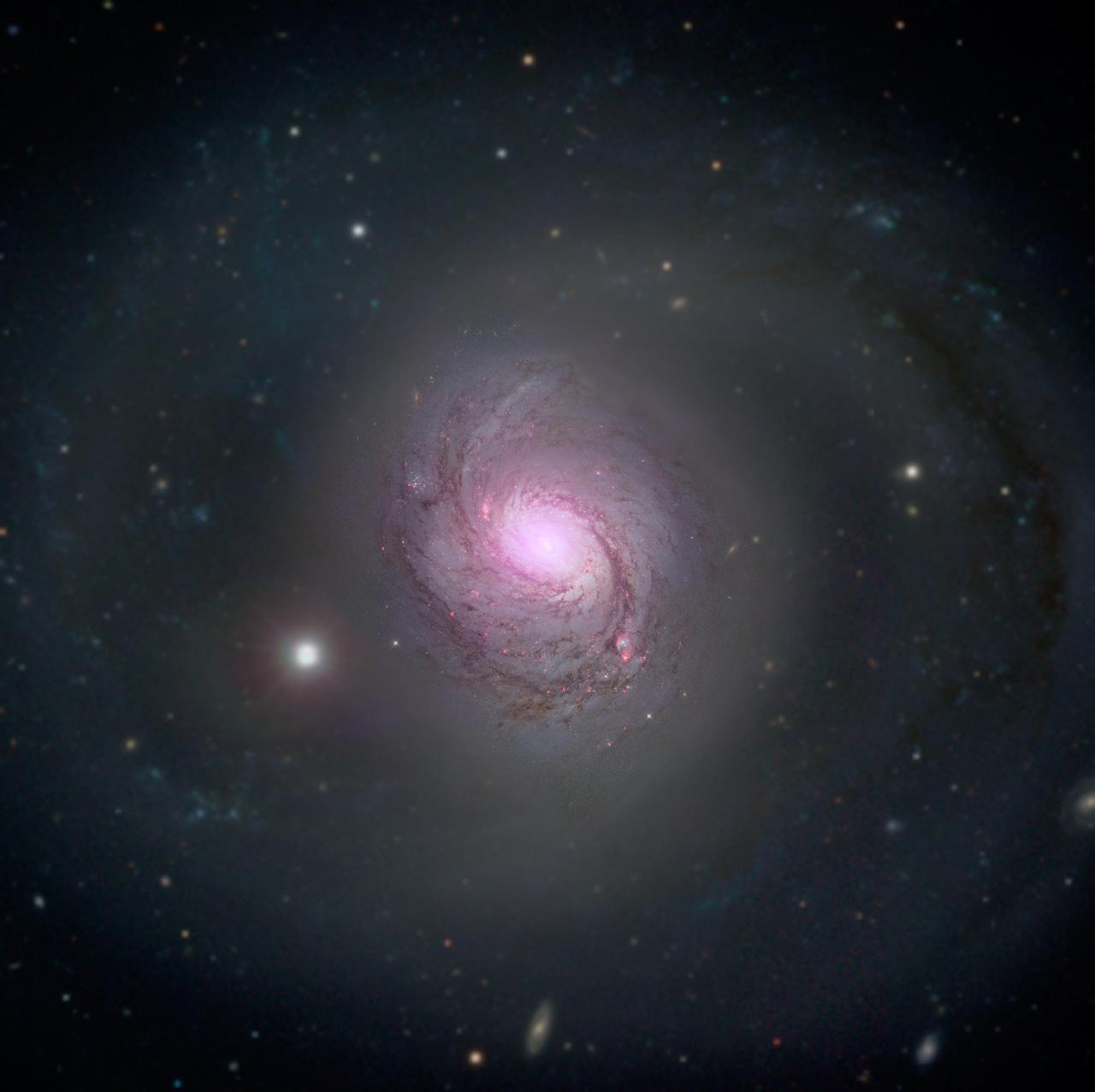
Galaxy NGC 1068 is shown in visible light and X-rays in this composite image. High-energy X-rays (magenta) captured by NASA's Nuclear Spectroscopic Telescope Array, or NuSTAR, are overlaid on visible-light images from both NASA's Hubble Space Telescope and the Sloan Digital Sky Survey. The X-ray light is coming from an active supermassive black hole, also known as a quasar, in the center of the galaxy. This supermassive black hole has been extensively studied due to its relatively close proximity to our galaxy. NGC 1068 is about 47 million light-years away in the constellation Cetus. The supermassive black hole is also one of the most obscured known, blanketed by thick clouds of gas and dust. NuSTAR's high-energy X-ray view is the first to penetrate the walls of this black hole's hidden lair. http://photojournal.jpl.nasa.gov/catalog/PIA20057
An optical color image of galaxies is seen here overlaid with X-ray data magenta from NASA Nuclear Spectroscopic Telescope Array NuSTAR. Both magenta blobs show X-rays from massive black holes buried at the hearts of galaxies.

This charged couple device CCD is part of the CheMin instrument on NASA Curiosity rover. When CheMin directs X-rays at a sample of soil, this imager, which is the size of a postage stamp, detects both the position and energy of each X-ray photon.

This composite image of the Tycho supernova remnant combines infrared and X-ray observations obtained with NASA Spitzer and Chandra space observatories, respectively,
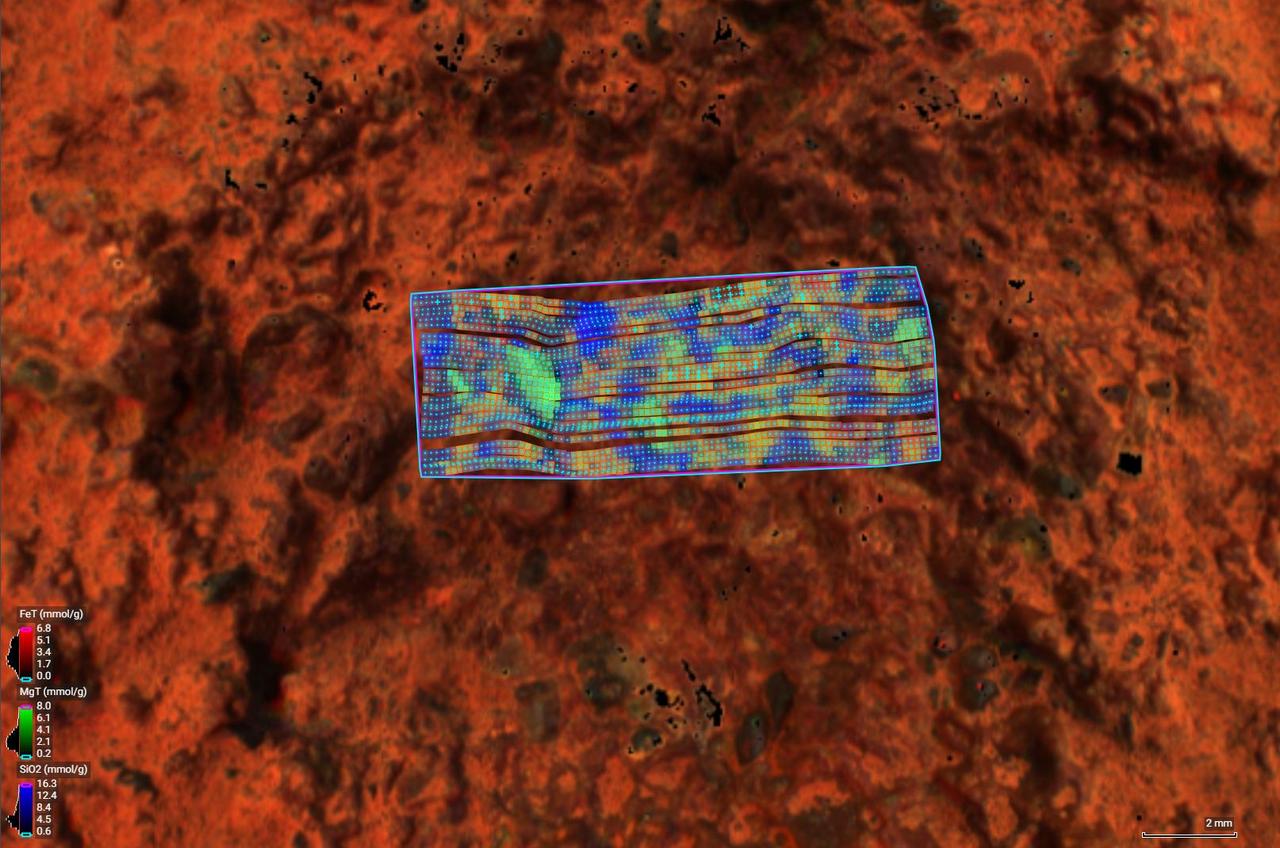
This image of a rock target nicknamed "Thunderbolt Peak" was created by NASA's Perseverance Mars rover using the Planetary Instrument for X-ray Lithochemistry (PIXL) – an instrument on the end of the rover's robotic arm that determines chemistry and mineral composition by zapping a rock with X-rays. Each blue dot in the image represents a spot where an X-ray hit. By measuring the interaction of the X-rays with the rock, scientists can map which minerals are present in a rock's surface and how much of them, plus the size, shape, and crystallinity of the rock grains. In the case of Thunderbolt Peak, three elements were especially abundant: iron, magnesium, and silica. The image and data were collected on July 8, 2024, the 1,202nd Martian day, or sol, of Perseverance's mission. https://photojournal.jpl.nasa.gov/catalog/PIA26365

This photograph was taken during the integration of the Astro-1 mission payloads at the Kennedy Space Center on March 20, 1990, showing the Broad Band X-Ray Telescope (BBXRT) at the left, as three telescopes for the Astro-1 Observatory are settled into the Orbiter Columbia payload bay. Above Earth's atmospheric interference, Astro-1 would make precise measurements of objects such as planets, stars, and galaxies in relatively small fields of view and would observe and measure ultraviolet radiation from celestial objects. The Astro-1 used a Spacelab pallet system with an instrument pointing system and a cruciform structure for bearing the three ultraviolet instruments mounted in a parallel configuration. The three instruments were: The Hopkins Ultraviolet Telescope (HUT), which was designed to obtain far-ultraviolet spectroscopic data from white dwarfs, emission nebulae, active galaxies, and quasars; the Wisconsin Ultraviolet Photo-Polarimeter Experiment (WUPPE) which was to study polarized ultraviolet light from magnetic white dwarfs, binary stars, reflection nebulae, and active galaxies; and the Ultraviolet Imaging Telescope (UIT), which was to record photographic images in ultraviolet light of galaxies, star clusters, and nebulae. The star trackers that supported the instrument pointing system, were also mounted on the cruciform. Also in the payload bay was the Broad Band X-Ray Telescope (BBXRT), which was designed to obtain high-resolution x-ray spectra from stellar corona, x-ray binary stars, active galactic nuclei, and galaxy clusters. Managed by the Marshall Space Flight Center, the Astro-1 observatory was launched aboard the Space Shuttle Orbiter Columbia (STS-35) on December 2, 1990.

Hinode (Sunrise), formerly known as Solar-B before reaching orbit, was launched from the Uchinoura Space Center in Japan on September 23, 2006. Hinode was designed to probe into the Sun’s magnetic field to better understand the origin of solar disturbances which interfere with satellite communications, electrical power transmission grids, and the safety of astronauts traveling beyond the Earth’s magnetic field. Hinode is circling Earth in a polar orbit that places the instruments in continuous sunlight for nine months each year and allows data dumps to a high latitude European Space Agency (ESA) ground station every orbit. NASA and other science teams will support instrument operations and data collection from the spacecraft’s operation center at the Japanese Aerospace Exploration Agency’s (JAXA’s) Institute of Space and Aeronautical Science facility located in Tokyo. The Hinode spacecraft is a collaboration among space agencies of Japan, the United States, the United Kingdom, and Europe. The Marshall Space Flight Center (MSFC) managed development of three instruments comprising the spacecraft; the Solar Optical Telescope (SOT); the X-Ray Telescope (XRT); and the Extreme Ultraviolet (EUV) Imaging Spectrometer (EIS). This image of a sunspot, taken by Hinode, is a prime example of what the spacecraft can offer.
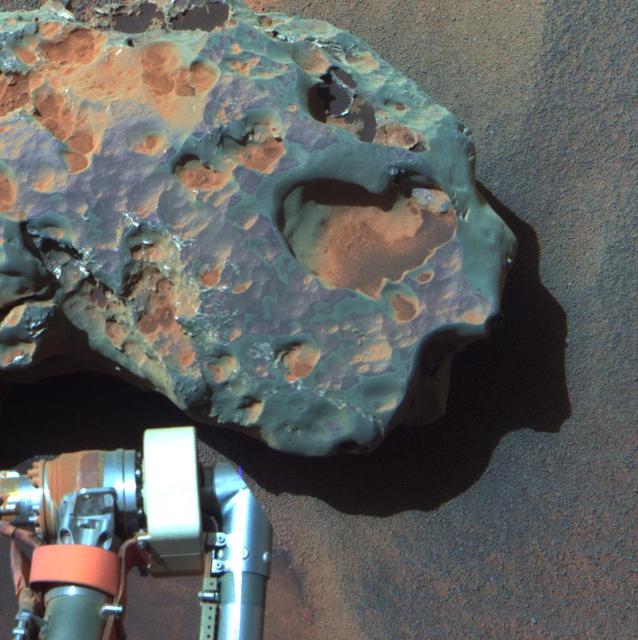
NASA Mars Exploration Rover Opportunity found this image of a meteorite. The science team used two tools on Opportunity arm, the microscopic imager and the alpha particle X-ray spectrometer, to inspect the rock texture and composition.

This is a composite image of N49, the brightest supernova remnant in optical light in the Large Magellanic Cloud; the image combines data from the Chandra X-ray Telescope blue and NASA Spitzer Space Telescope red.
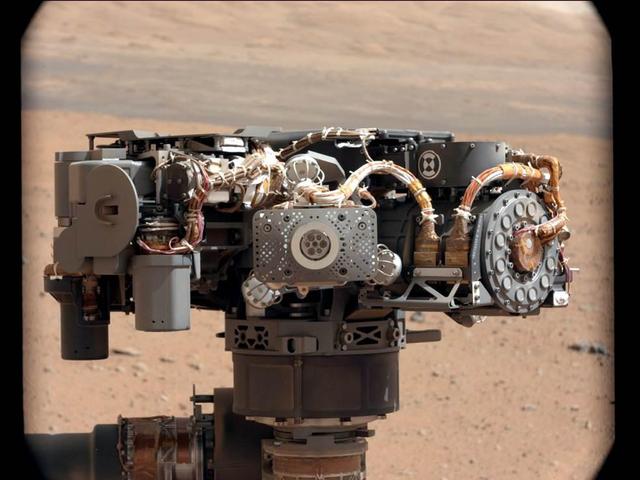
This image shows the Alpha Particle X-Ray Spectrometer APXS on NASA Curiosity rover, with the Martian landscape in the background. This image let researchers know that the APXS instrument had not become caked with dust during Curiosity landing.
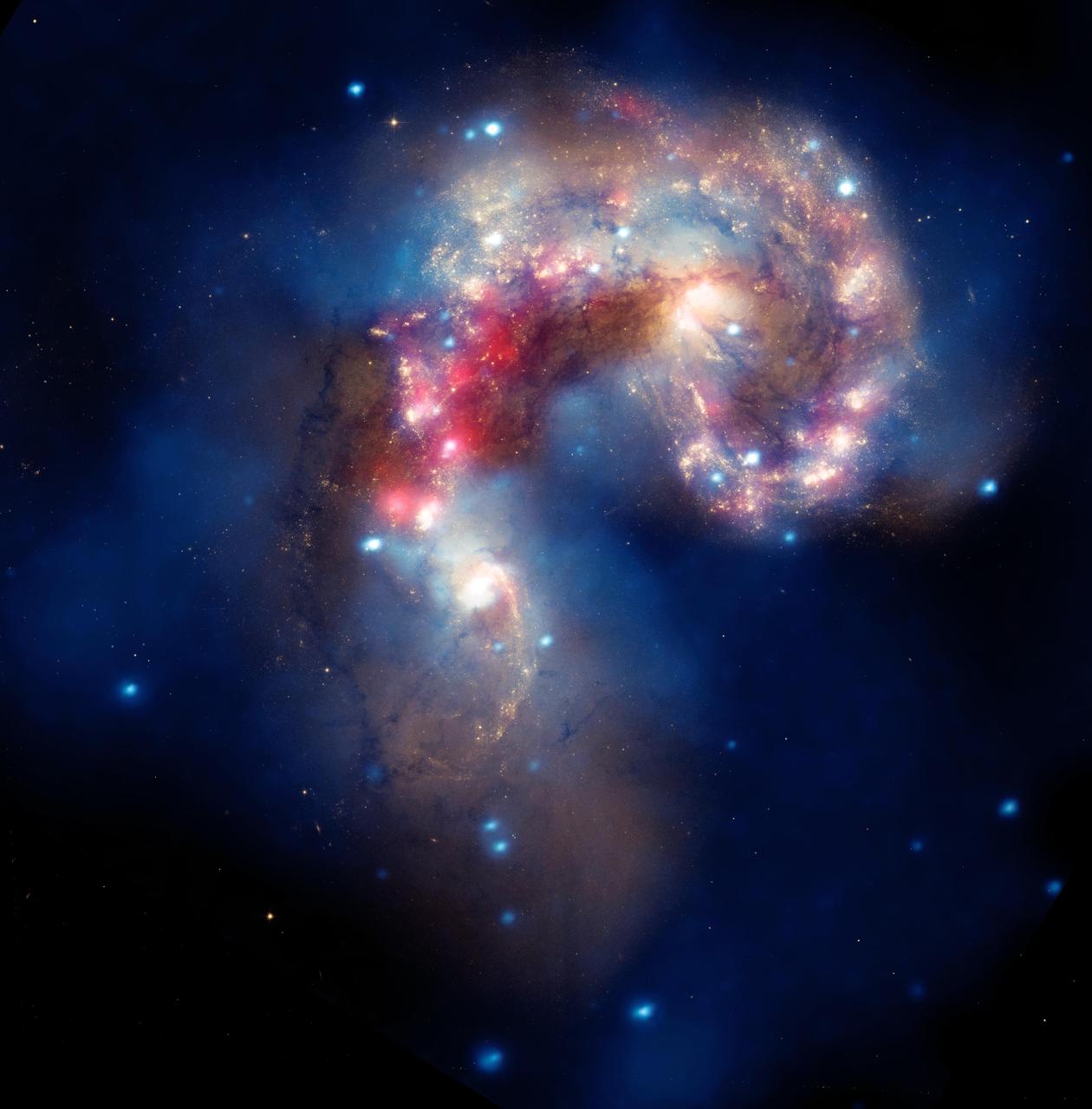
This image of two tangled galaxies has been released by NASA Great Observatories. The Antennae galaxies are shown in this composite image from the Chandra X-ray Observatory, the Hubble Space Telescope, and the Spitzer Space Telescope.
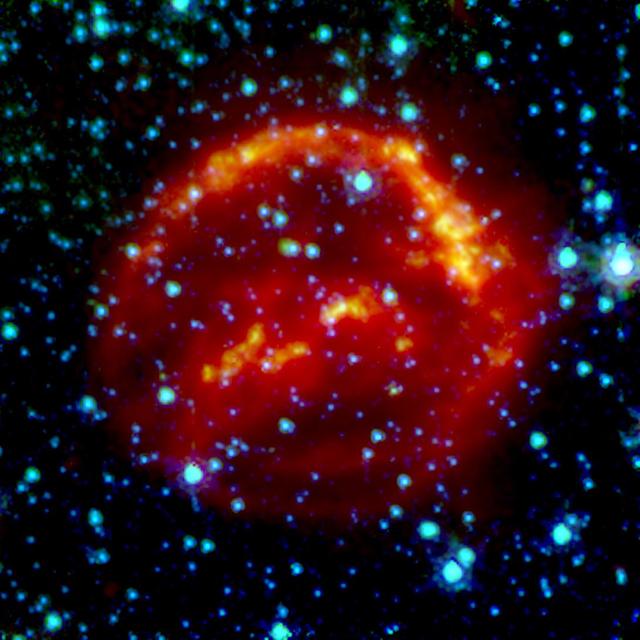
This Spitzer false-color image is a composite of data from the 24 micron channel of Spitzer's multiband imaging photometer (red), and three channels of its infrared array camera: 8 micron (yellow), 5.6 micron (blue), and 4.8 micron (green). Stars are most prominent in the two shorter wavelengths, causing them to show up as turquoise. The supernova remnant is most prominent at 24 microns, arising from dust that has been heated by the supernova shock wave, and re-radiated in the infrared. The 8 micron data shows infrared emission from regions closely associated with the optically emitting regions. These are the densest regions being encountered by the shock wave, and probably arose from condensations in the surrounding material that was lost by the supernova star before it exploded. The composite above (PIA06908, PIA06909, and PIA06910) represent views of Kepler's supernova remnant taken in X-rays, visible light, and infrared radiation. Each top panel in the composite above shows the entire remnant. Each color in the composite represents a different region of the electromagnetic spectrum, from X-rays to infrared light. The X-ray and infrared data cannot be seen with the human eye. Astronomers have color-coded those data so they can be seen in these images. http://photojournal.jpl.nasa.gov/catalog/PIA06910
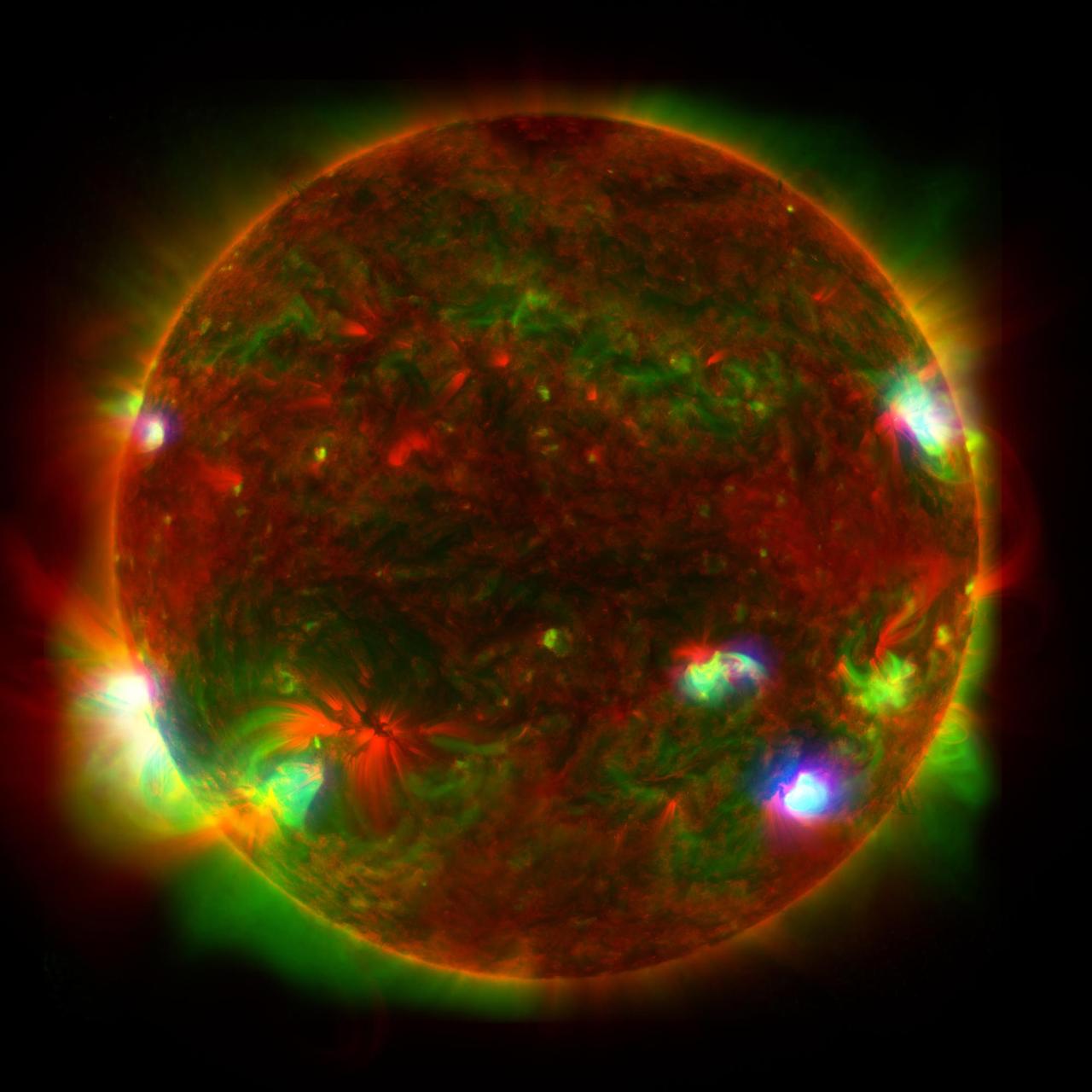
This composite image of the Sun includes high-energy X-ray data from NASA's Nuclear Spectroscopic Telescope Array (NuSTAR) shown in blue; lower energy X-ray data from the X-ray Telescope (XRT) on the Japanese Aerospace Exploration Agency's Hinode mission shown in green; and ultraviolet light detected by the Atmospheric Imaging Assembly (AIA) on NASA's Solar Dynamics Observatory (SDO) shown in red. NuSTAR's relatively small field of view means it can't see the entire Sun from its position in Earth orbit, so Figure A is a composite of 25 images, which were taken by the observatory in June 2022. NuSTAR sees high-energy X-rays that appear at only a few locations, where the hottest material is present in the Sun's atmopshere. By contrast, Hinode's XRT and SDO's AIA detect detect wavelengths emitted across the entire face of the Sun. The hotspots observed by NuSTAR might be caused by collections of nanoflares, or small outbursts of heat, light, and particles from the Sun's surface that subsequently heat the atmosphere. Individual nanoflares are too faint to directly observe amid the Sun's blazing light. https://photojournal.jpl.nasa.gov/catalog/PIA25628
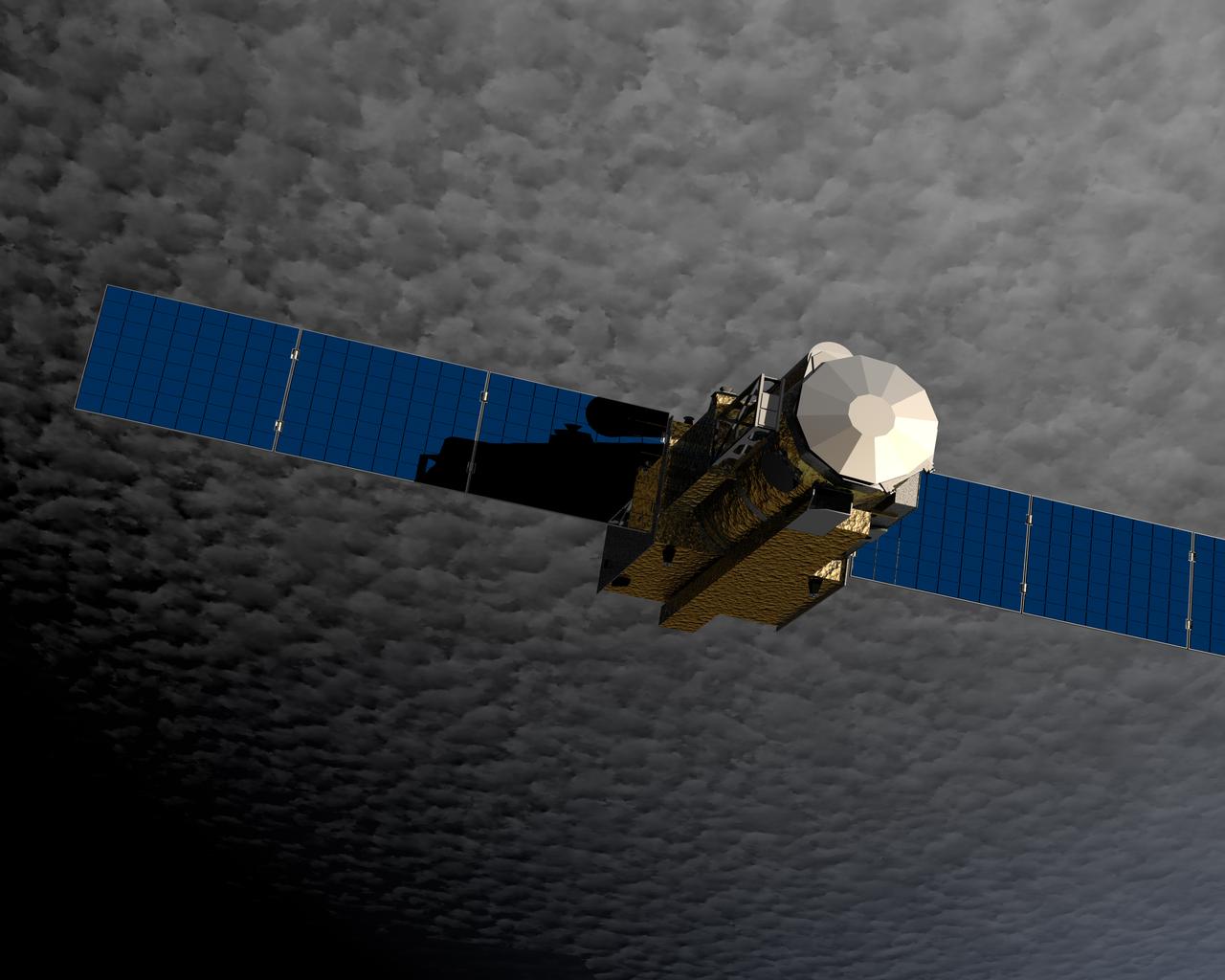
Hinode (Sunrise), formerly known as Solar-B before reaching orbit, was launched from the Uchinoura Space Center in Japan on September 23, 2006. Hinode was designed to probe into the Sun’s magnetic field to better understand the origin of solar disturbances which interfere with satellite communications, electrical power transmission grids, and the safety of astronauts traveling beyond the Earth’s magnetic field. Hinode is circling Earth in a polar orbit that places the instruments in continuous sunlight for nine months each year and allows data dumps to a high latitude European Space Agency (ESA) ground station every orbit. NASA and other science teams will support instrument operations and data collection from the spacecraft’s operation center at the Japanese Aerospace Exploration Agency’s (JAXA’s) Institute of Space and Aeronautical Science facility located in Tokyo. The Hinode spacecraft is a collaboration among space agencies of Japan, the United States, the United Kingdom, and Europe. The Marshall Space Flight Center (MSFC) managed development of three instruments comprising the spacecraft; the Solar Optical Telescope (SOT); the X-Ray Telescope (XRT); and the Extreme Ultraviolet (EUV) Imaging Spectrometer (EIS). Provided by the Multimedia support group at MSFC, this rendering illustrates the Solar-B Spacecraft in earth orbit with its solar panels completely extended.
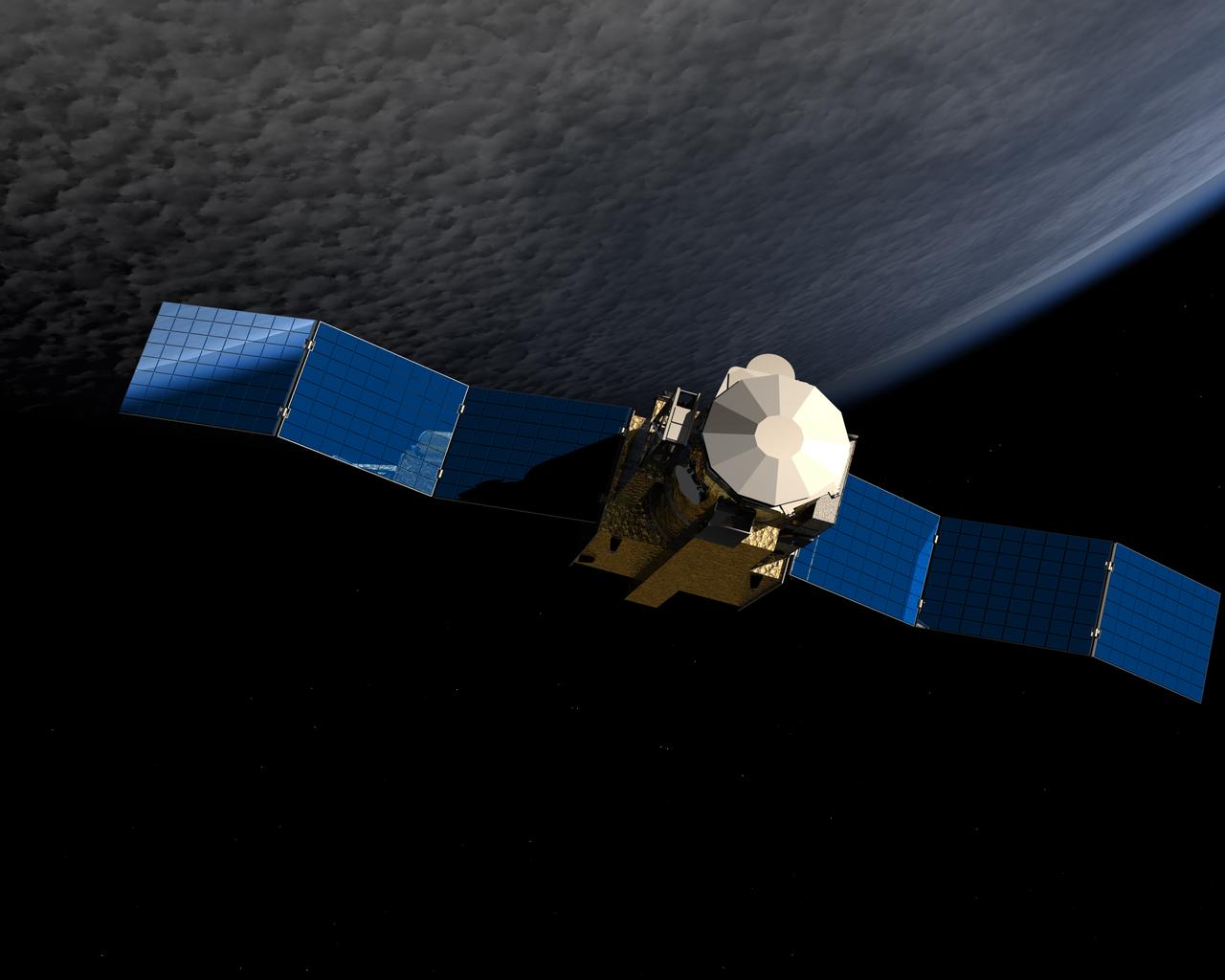
Hinode (Sunrise), formerly known as Solar-B before reaching orbit, was launched from the Uchinoura Space Center in Japan on September 23, 2006. Hinode was designed to probe into the Sun’s magnetic field to better understand the origin of solar disturbances which interfere with satellite communications, electrical power transmission grids, and the safety of astronauts traveling beyond the Earth’s magnetic field. Hinode is circling Earth in a polar orbit that places the instruments in continuous sunlight for nine months each year and allows data dumps to a high latitude European Space Agency (ESA) ground station every orbit. NASA and other science teams will support instrument operations and data collection from the spacecraft’s operation center at the Japanese Aerospace Exploration Agency’s (JAXA’s) Institute of Space and Aeronautical Science facility located in Tokyo. The Hinode spacecraft is a collaboration among space agencies of Japan, the United States, the United Kingdom, and Europe. The Marshall Space Flight Center (MSFC) managed development of three instruments comprising the spacecraft; the Solar Optical Telescope (SOT); the X-Ray Telescope (XRT); and the Extreme Ultraviolet (EUV) Imaging Spectrometer (EIS). Provided by the Multimedia support group at MSFC, this rendering illustrates the Solar-B Spacecraft in earth orbit with its solar panels partially extended.

In 1986, NASA introduced a Shuttle-borne ultraviolet observatory called Astro. The Astro Observatory was designed to explore the universe by observing and measuring the ultraviolet radiation from celestial objects. Astronomical targets of observation selected for Astro missions included planets, stars, star clusters, galaxies, clusters of galaxies, quasars, remnants of exploded stars (supernovae), clouds of gas and dust (nebulae), and the interstellar medium. Astro-1 used a Spacelab pallet system with an instrument pointing system and a cruciform structure for bearing the three ultraviolet instruments mounted in a parallel configuration. The three instruments were: The Hopkins Ultraviolet Telescope (HUT), which was designed to obtain far-ultraviolet spectroscopic data from white dwarfs, emission nebulae, active galaxies, and quasars; the Wisconsin Ultraviolet Photo-Polarimeter Experiment (WUPPE) which was to study polarized ultraviolet light from magnetic white dwarfs, binary stars, reflection nebulae, and active galaxies; and the Ultraviolet Imaging Telescope (UIT) which was to record photographic images in ultraviolet light of galaxies, star clusters, and nebulae. The star trackers that supported the instrument pointing system were also mounted on the cruciform. Also in the payload bay was the Broad Band X-Ray Telescope (BBXRT), which was designed to obtain high-resolution x-ray spectra from stellar corona, x-ray binary stars, active galactic nuclei, and galaxy clusters. Managed by the Marshall Space Flight Center, the Astro-1 observatory was launched aboard the Space Shuttle Orbiter Columbia (STS-35) on December 2, 1990.
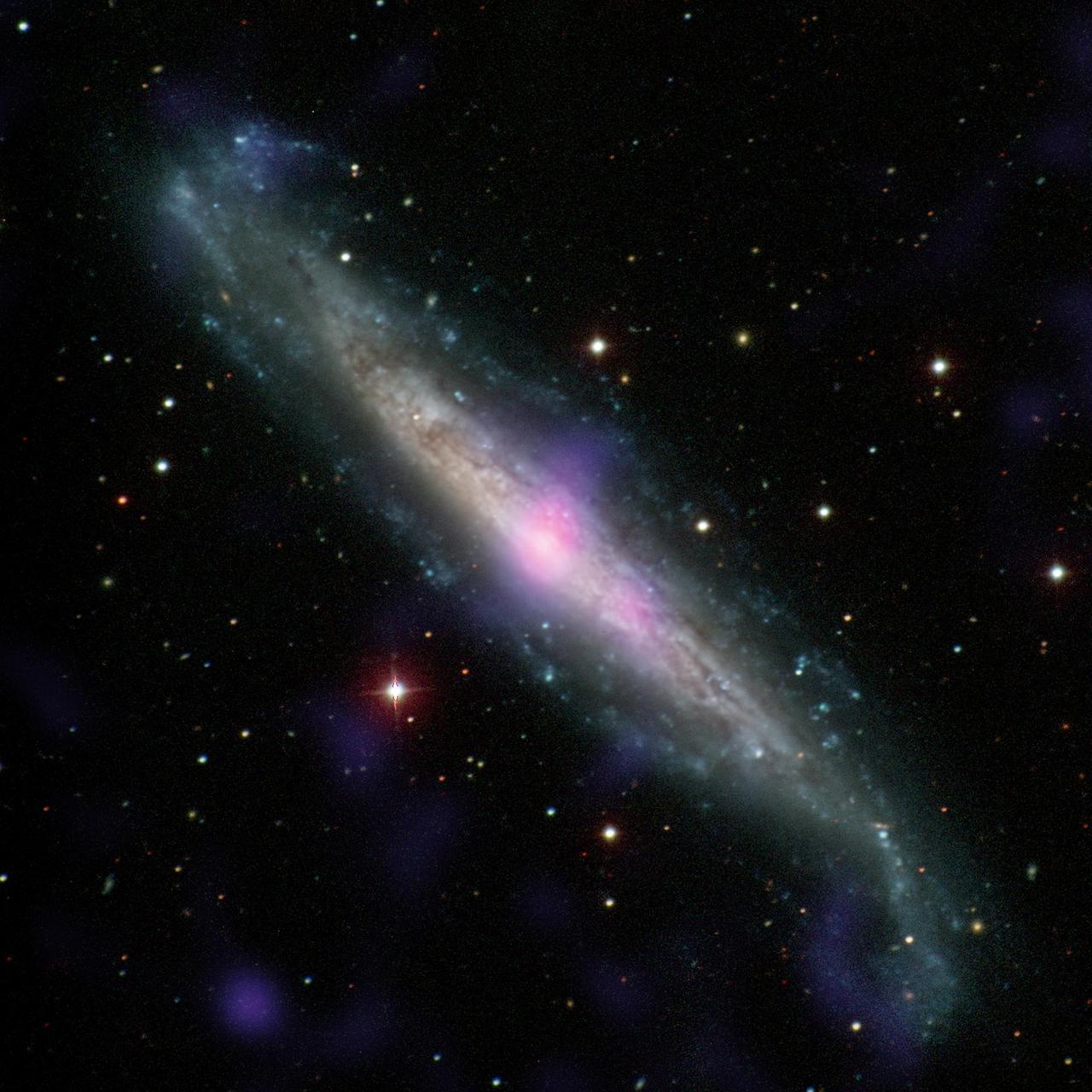
NGC 1448, a galaxy with an active galactic nucleus, is seen in this image combining data from the Carnegie-Irvine Galaxy Survey in the optical range and NuSTAR in the X-ray range. This galaxy contains an example of a supermassive black hole hidden by gas and dust. X-ray emissions from NGC 1448, as seen by NuSTAR and Chandra, suggests for the first time that, like IC 3639 in PIA21087, there must be a thick layer of gas and dust hiding the active black hole in this galaxy from our line of sight. http://photojournal.jpl.nasa.gov/catalog/PIA21086
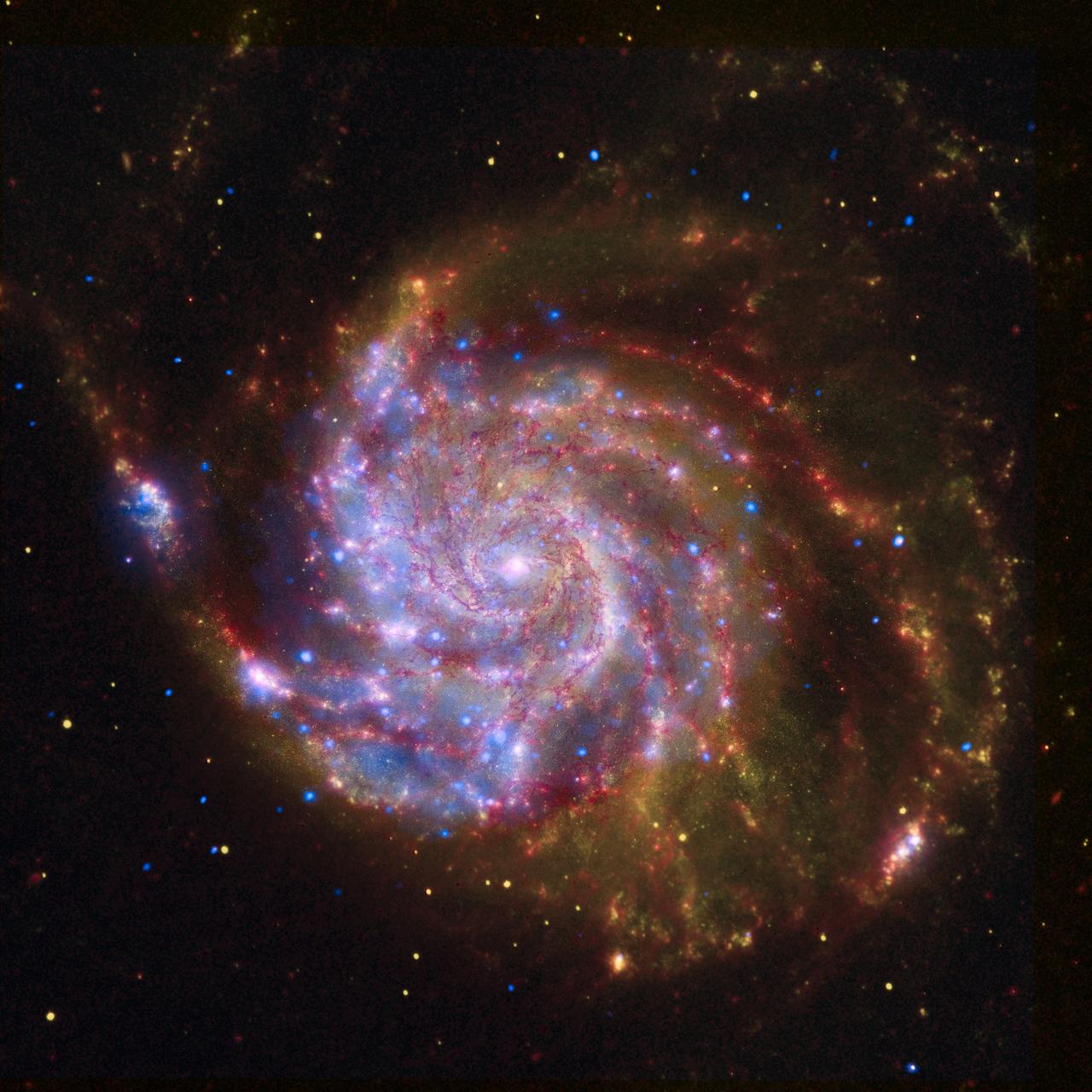
NASA Great Observatories continue Galileo legacy with stunning images and breakthrough science from the Hubble Space Telescope, the Spitzer Space Telescope, and the Chandra X-ray Observatory.
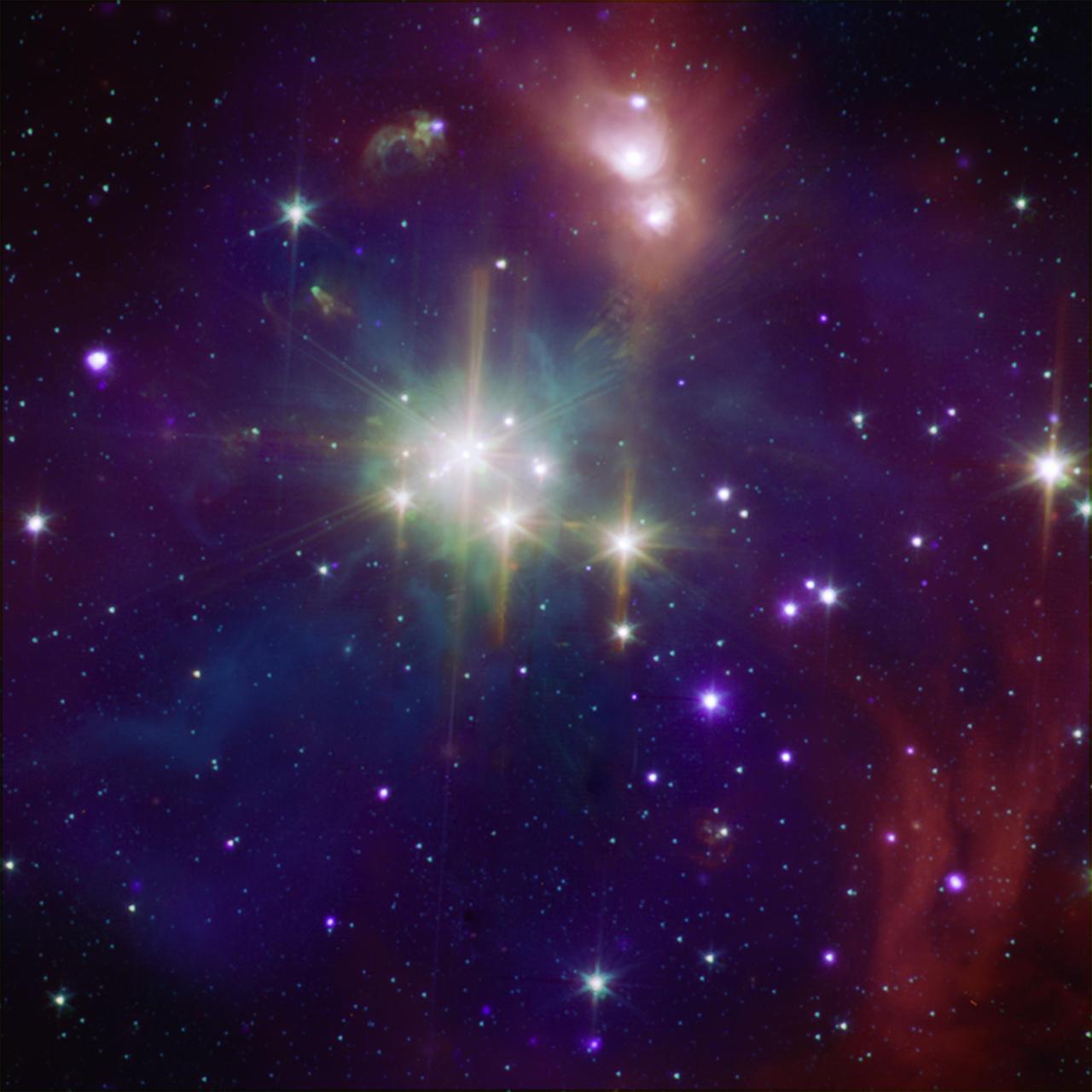
This composite image shows the Coronet in X-rays from Chandra and infrared from NASA Spitzer Space Telescope orange, green, and cyan. The Spitzer data show young stars plus diffuse emission from dust.

A range of supermassive black holes lights up this new image from NASA NuSTAR. All of the dots are active black holes tucked inside the hearts of galaxies, with colors representing different energies of X-ray light.
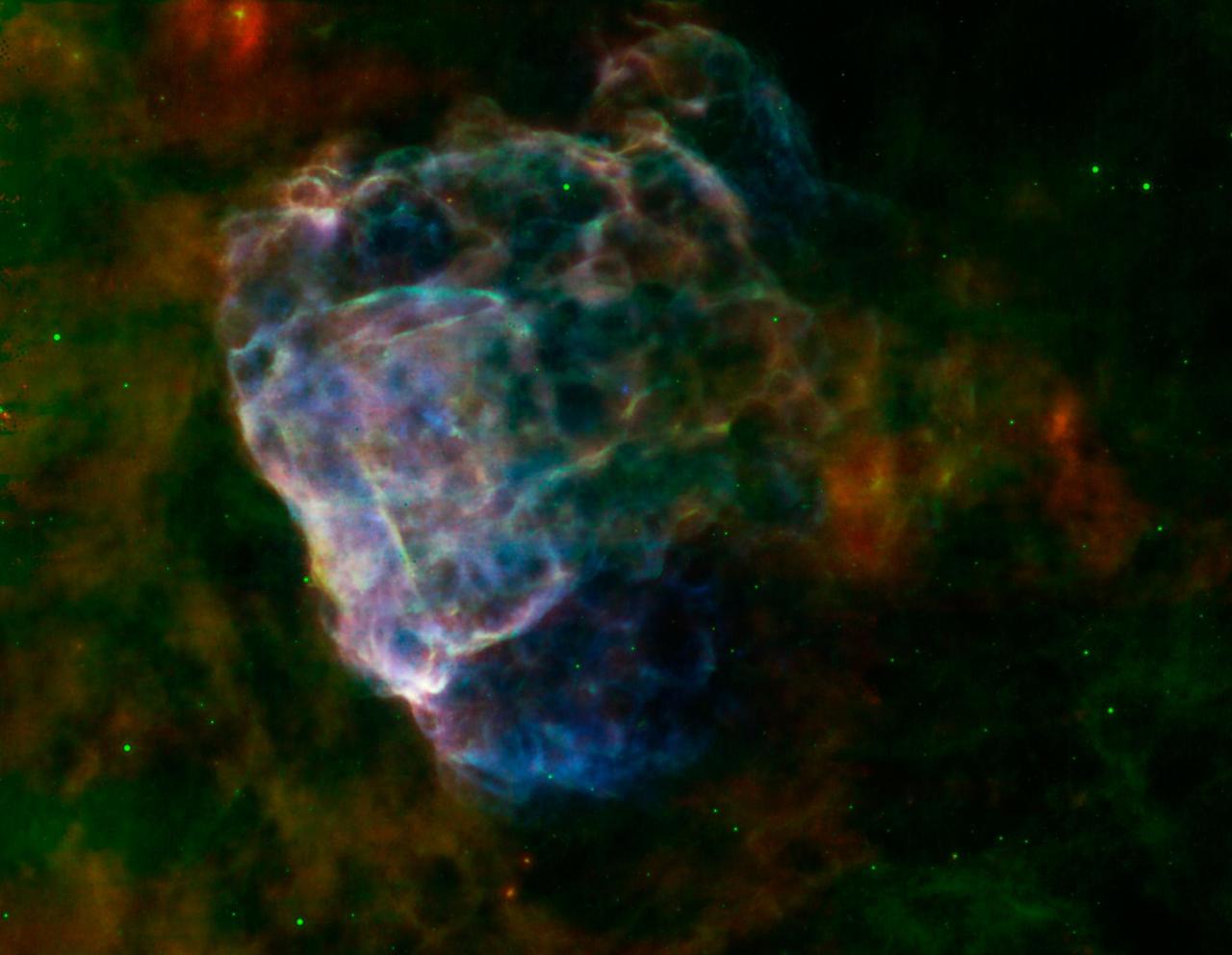
Puppis A, around 7,000 light-years away, is seen in this image from NASA Spitzer Space Telescope and Chandra X-Ray Observatory, and the European Space Agency XMM-Newton.
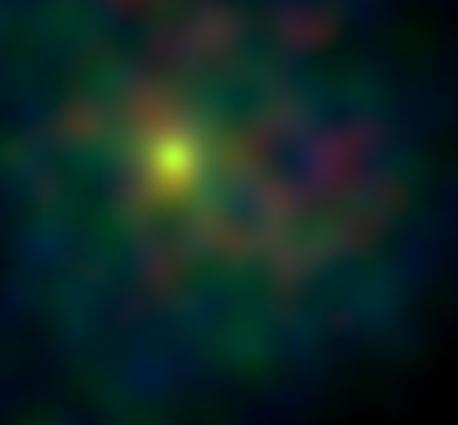
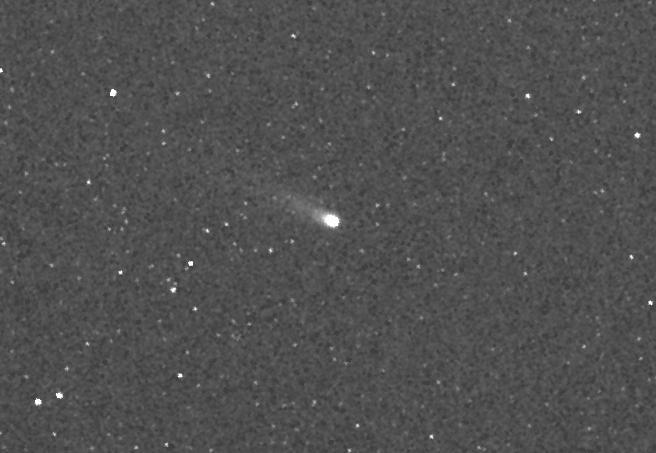
This false-color image shows comet Tempel 1 as seen by NASA Chandra X-ray Observatory on June 30, 2005, Universal Time. The comet was bright and condensed.
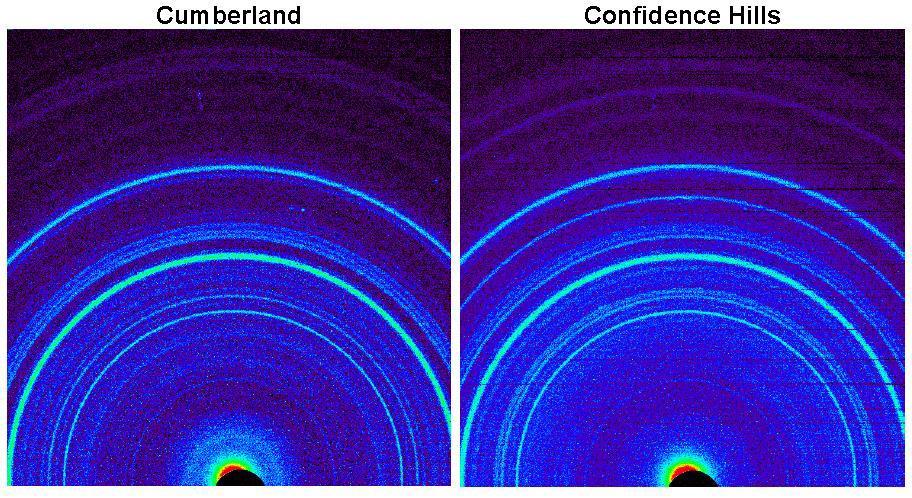
This side-by-side comparison shows the X-ray diffraction patterns of two different samples collected from rocks on Mars by NASA Curiosity rover. The images present data obtained by Curiosity Chemistry and Mineralogy instrument CheMin.
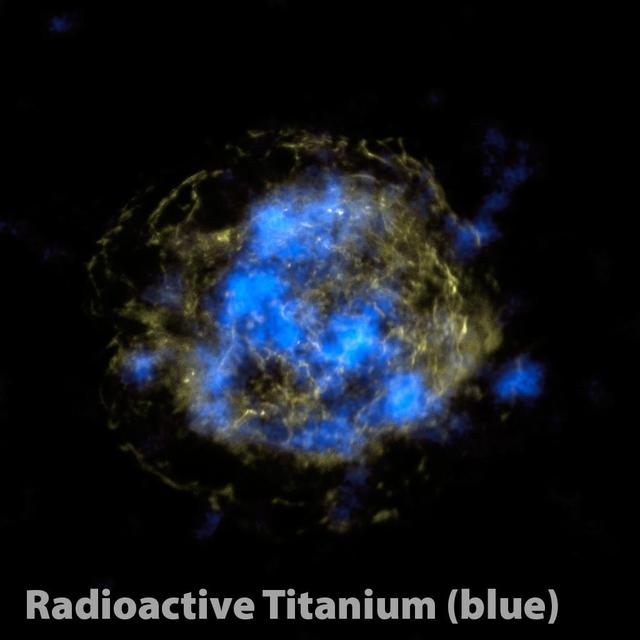
NASA NuSTAR has, for the first time, imaged the radioactive guts of a supernova remnant, the leftover remains of a star that exploded. The NuSTAR data are blue, and show high-energy X-rays.
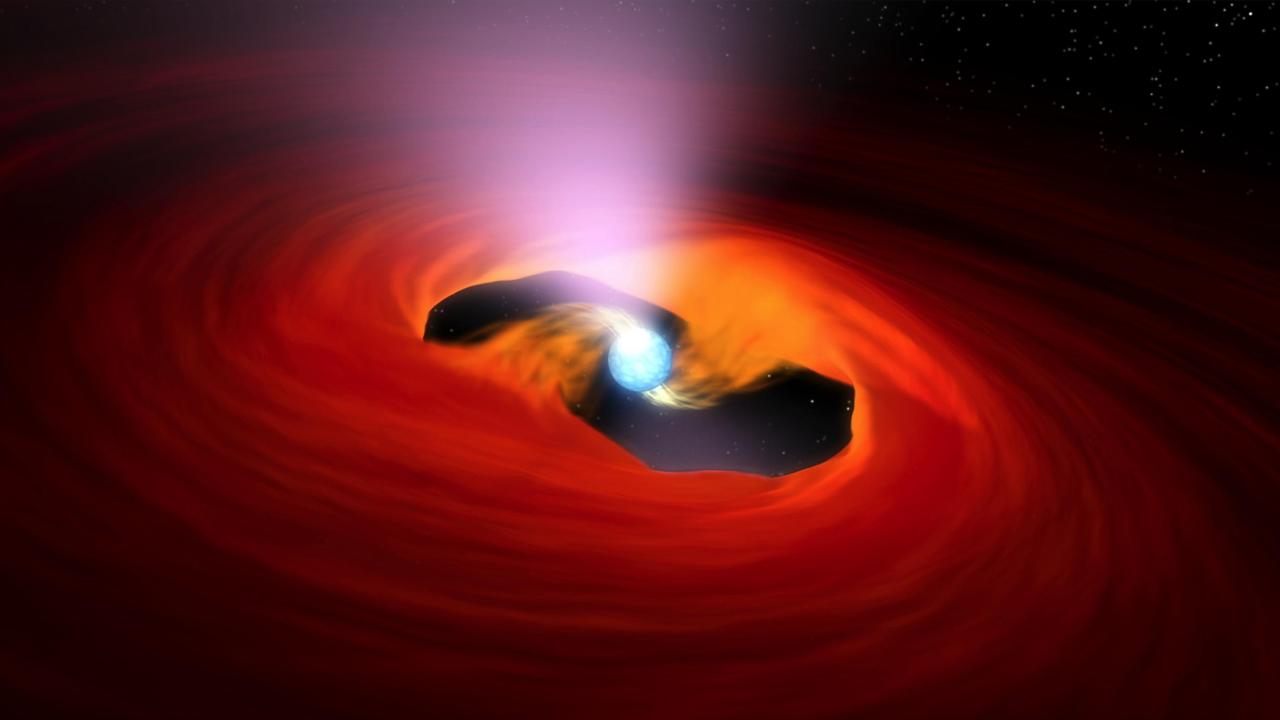
This image shows a neutron star -- the core of a star that exploded in a massive supernova. This particular neutron star is known as a pulsar because it sends out rotating beams of X-rays that sweep past Earth like lighthouse beacons.
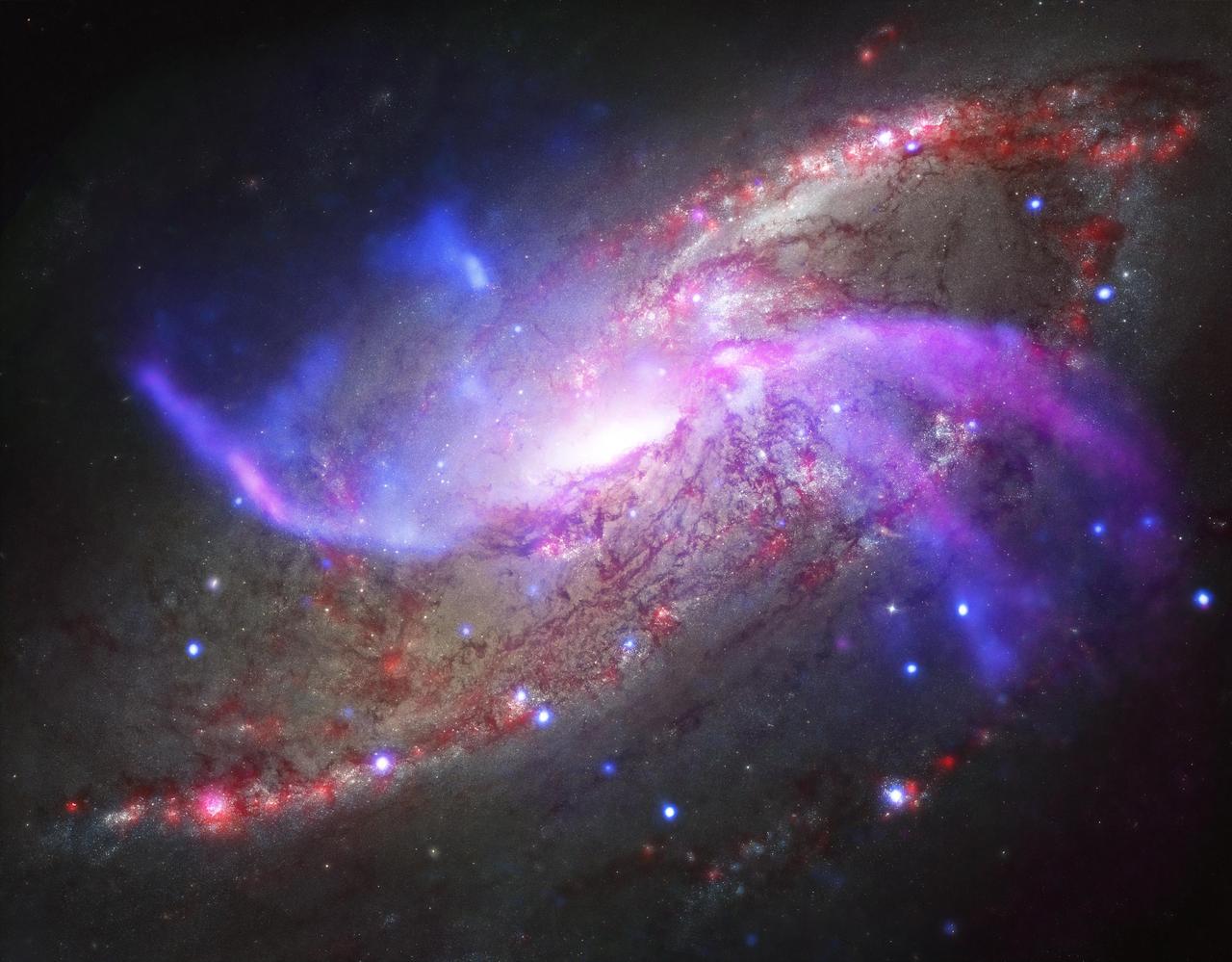
Anomalous arms are seen in this composite image of NGC 4258 from NASA Chandra X-ray Observator, NSF Karl Jansky Very Large Array, NASA Hubble Space Telescope and Spitzer Space Telescope.
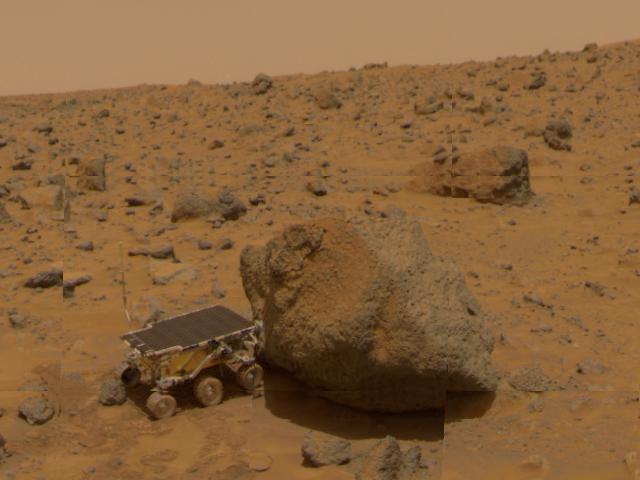
This 1997 image from NASA Mars Pathfinder shows a close up of Sojourner as it placed its Alpha Proton X-Ray Spectrometer APXS upon the surface of the rock Yogi.