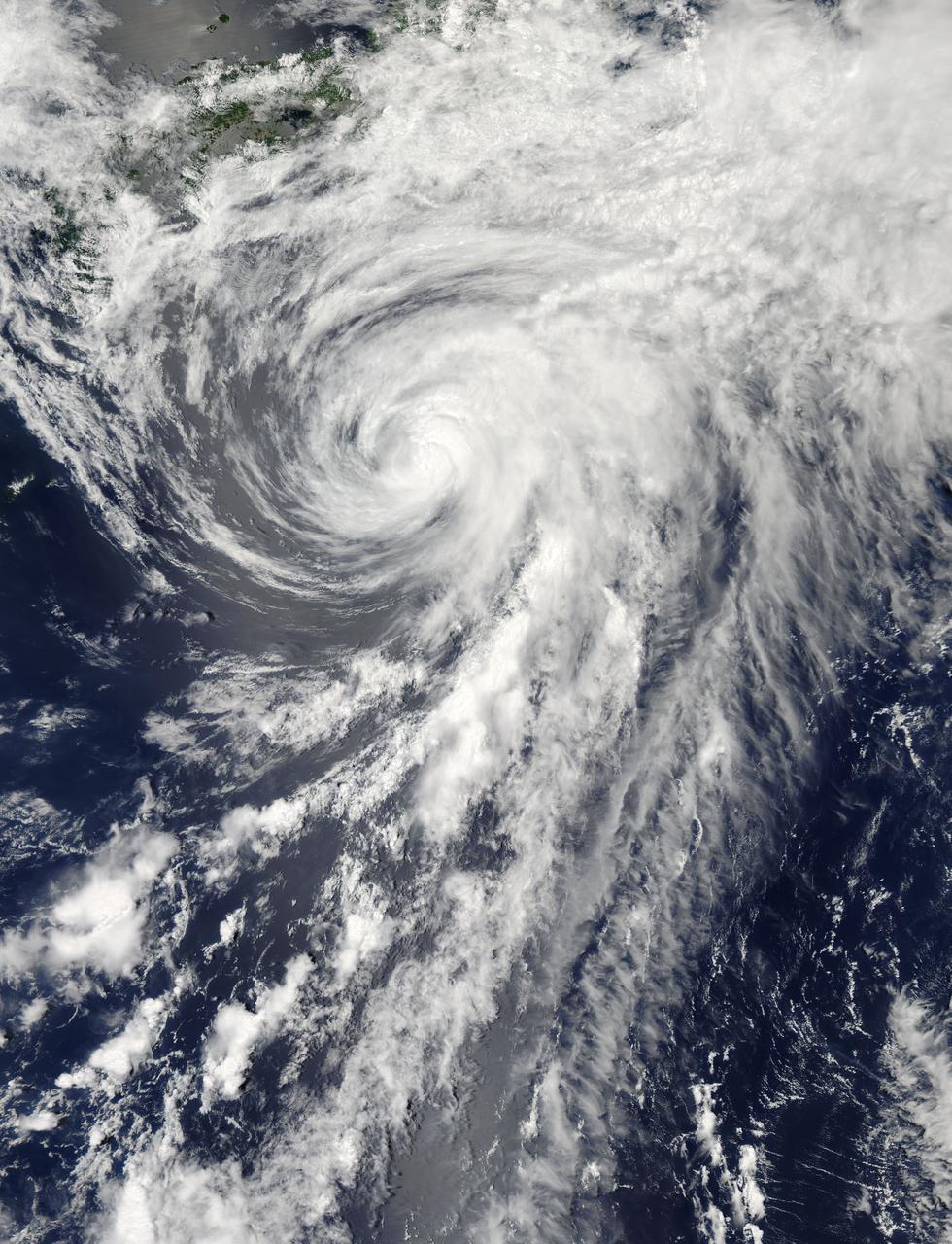
On Tuesday, June 11, 2013 Tropical Storm Yagi spun in the North Pacific Ocean just south of Japan. The Moderate Resolution Imaging Spectroradiometer (MODIS) aboard NASA’s Aqua satellite captured this beautiful true-color image of the storm on that same date at 4:10 UTC (1:10 p.m. Japan local time). The image shows a clear apostrophe-shaped cyclone, with a closed eye and somewhat elliptical shape. The clouds associated with the northern fringes of the storm draped over southeastern coastal Japan, and a long “tail” (or band) of thunderstorms fed into the center from the south. Multispectral imagery also showed tight bands of thunderstorms wrapping into the center of the storm, although the building of thunderstorms was weakening around the center. Near the same time as the image was captured, the Joint Typhoon Warning Center announced that vertical wind shear was starting to take a toll on Yagi. Northwesterly wind shear had caused the system to tilt slightly with the upper-level center displaced about 20 nautical miles east of the low-level center. Tropical Storm Yagi developed from Tropical Depression 03W in the Western North Pacific Ocean on June 6, and intensified the weekend of June 8-9, when it reached Tropical Storm status and was given the name Yagi. Also known as Dante, the storm reached the maximum wind speeds on June 10 and 11, after which it began to weaken as it moved into cooler waters. On June 14, Yagi’s remnants passed about 200 miles south of Tokyo, and brought soaking rains to the coastline of Japan’s Honshu Island. Credit: NASA/GSFC/Jeff Schmaltz/MODIS Land Rapid Response Team <b><a href="http://www.nasa.gov/audience/formedia/features/MP_Photo_Guidelines.html" rel="nofollow">NASA image use policy.</a></b> <b><a href="http://www.nasa.gov/centers/goddard/home/index.html" rel="nofollow">NASA Goddard Space Flight Center</a></b> enables NASA’s mission through four scientific endeavors: Earth Science, Heliophysics, Solar System Exploration, and Astrophysics. Goddard plays a leading role in NASA’s accomplishments by contributing compelling scientific knowledge to advance the Agency’s mission. <b>Follow us on <a href="http://twitter.com/NASA_GoddardPix" rel="nofollow">Twitter</a></b> <b>Like us on <a href="http://www.facebook.com/pages/Greenbelt-MD/NASA-Goddard/395013845897?ref=tsd" rel="nofollow">Facebook</a></b> <b>Find us on <a href="http://instagram.com/nasagoddard?vm=grid" rel="nofollow">Instagram</a></b>
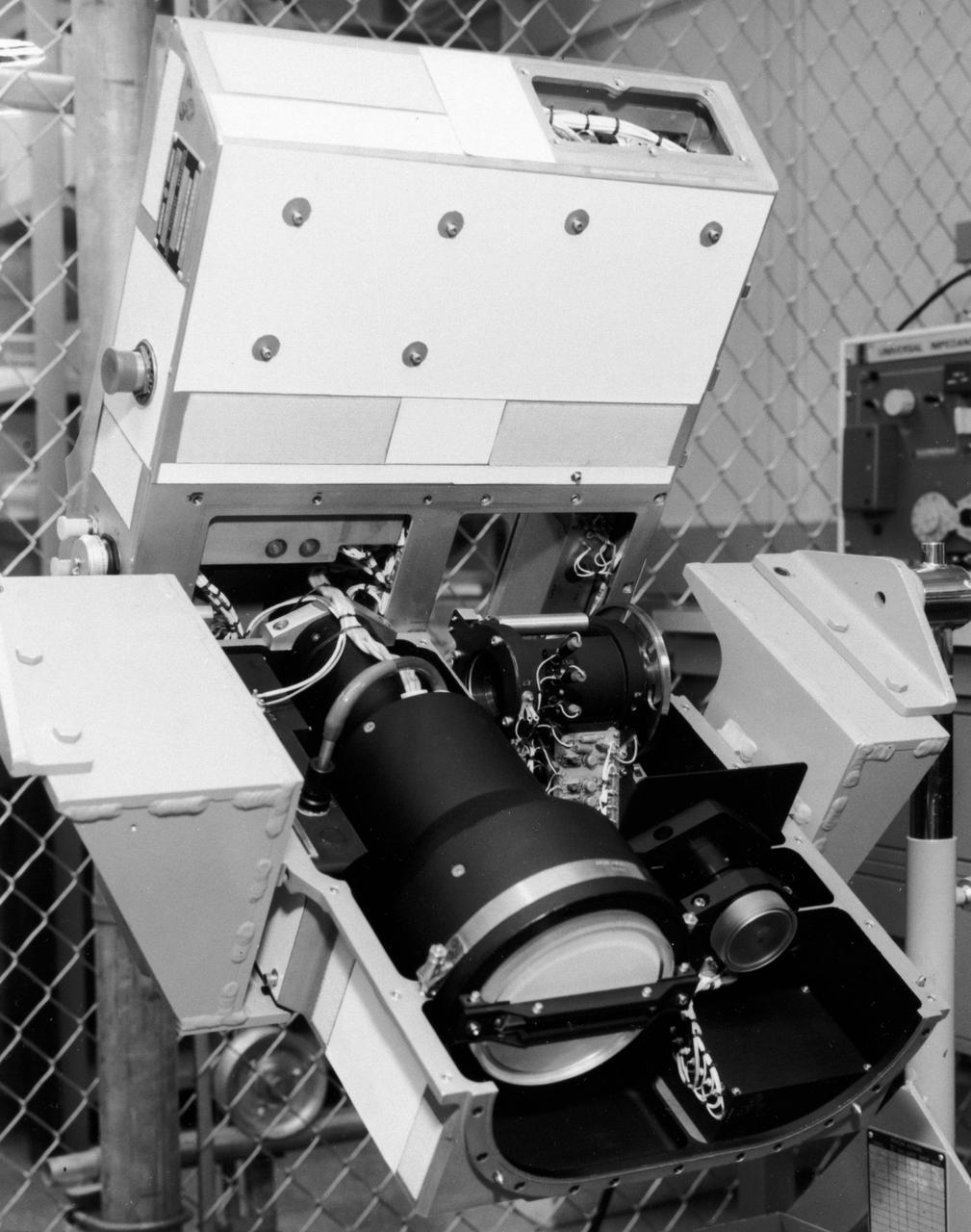
S72-49482 (November 1972) --- The Optical Recorder of the Lunar Sounder Experiment (S-209) which will be mounted in the SIM bay of the Apollo 17 Service Module. The three functional parts of the Lunar Sounder are the optical recorder, the coherent synthetic aperture radar, and the antennas, a retractable dipole for HF and a yagi for VHF. The Lunar Sounder will probe three-quarters of a mile below the moon's surface from the orbiting Apollo 17 spacecraft. Electronic data recorded on film will be retrieved by the crew during trans-Earth EVA. Geologic information on the lunar interior obtained by the sounder will permit scientific investigation of underground rock layers, lava flow patterns, rille (canyon) structures, mascon properties, and any areas containing water. A prototype lunar sounder has been flight tested in aircraft over selected Earth sites to confirm the equipment design and develop scientific analysis techniques. The Lunar Sounder Experiment was developed by North American Rockwell's (NR) Space Division for NASA's Manned Spacecraft Center to provide data for a scientific investigation team with representatives from the Jet Propulsion Laboratory, University of Utah, University of Michigan, U.S. Geological Survey, and NASA Ames Research Center.
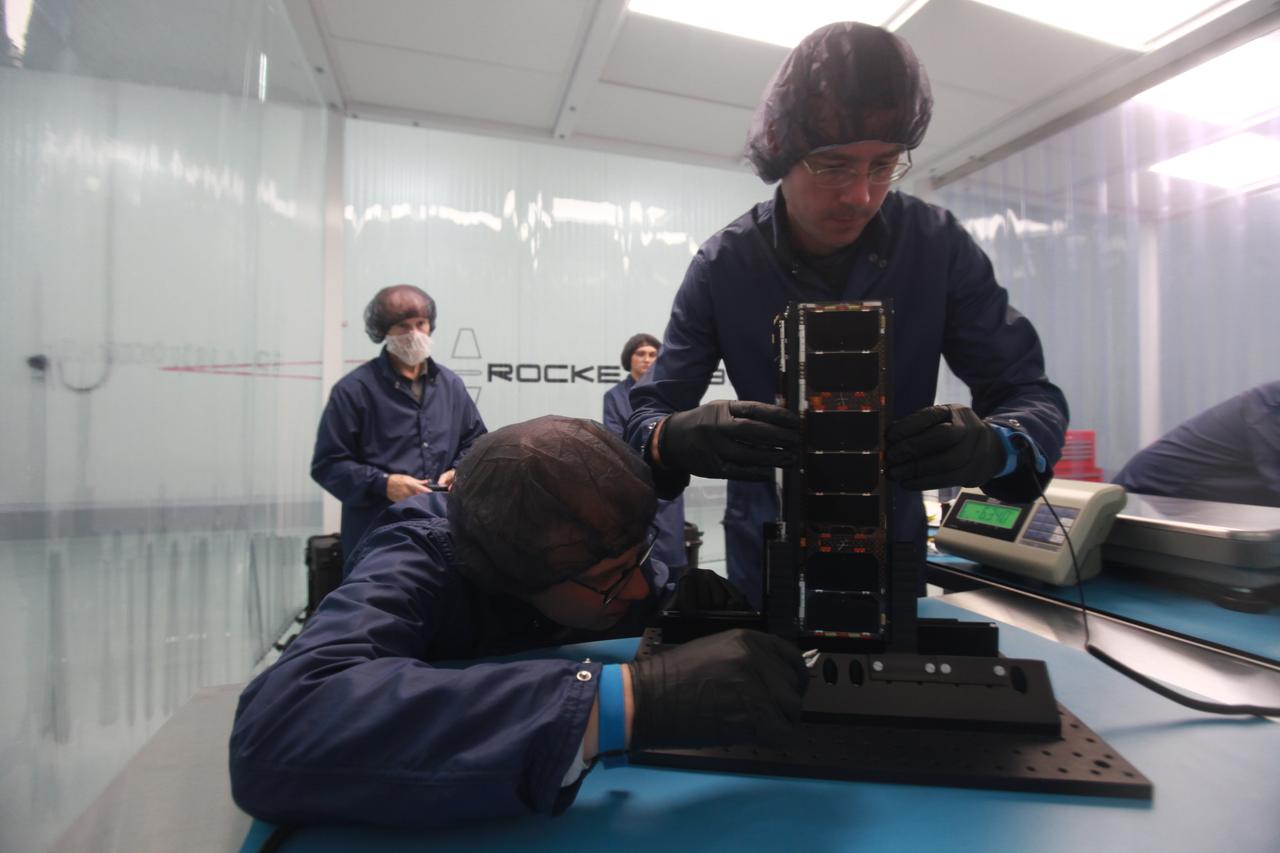
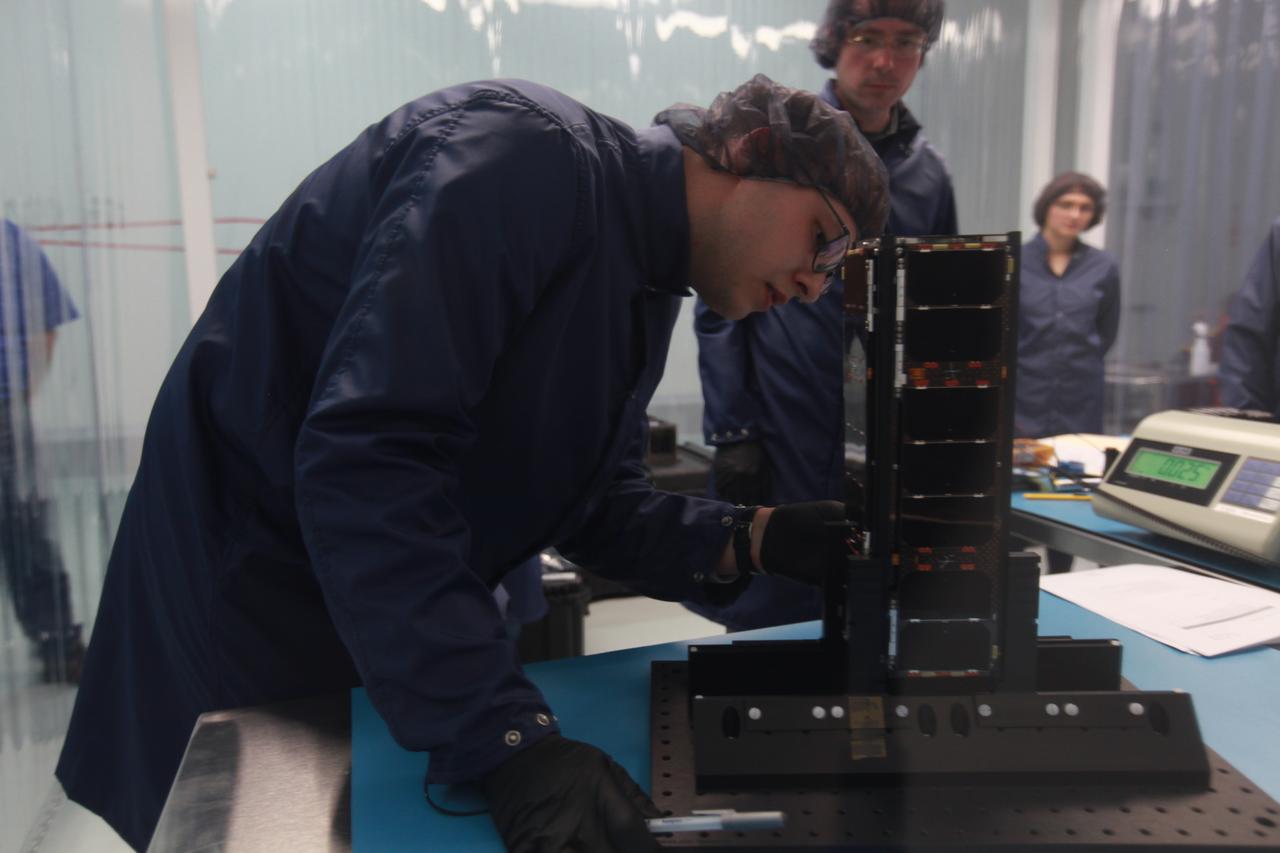
Project DaVinci is a student-led team at North Idaho STEM Charter Academy. Their spacecraft, the DaVinci satellite, has been constructed with the intent to connect with students worldwide to help reignite a passion for space. When launched, the DaVinci satellite will begin broadcasting messages across the globe using amateur radio uplink and downlink frequencies. Students in nearly every country will be able to receive these messages using a USB receiver dongle, open source software, and a yagi antenna in locations where the signal may be weaker. All messages will be education-related, and messages received will be in Morse Code requiring students to download a translating app or to translate it themselves. The DaVinci satellite will use the internet as a redundancy communication channel while in orbit. It is one of the few CubeSat to have a GlobalStar modem onboard, and will allow team members to upload digital messages to internet through the satellite. DaVinci satellite has an onboard Arducam as well, and will provide photos of Earth from its position in orbit. These pictures can be retrieved by the team using the GlobalStar modem and its corresponding server. To Learn more about the DaVinci satellite, visit www.projectdavincicubesat.org/
Project DaVinci is a student-led team at North Idaho STEM Charter Academy. Their spacecraft, the DaVinci satellite, has been constructed with the intent to connect with students worldwide to help reignite a passion for space. When launched, the DaVinci satellite will begin broadcasting messages across the globe using amateur radio uplink and downlink frequencies. Students in nearly every country will be able to receive these messages using a USB receiver dongle, open source software, and a yagi antenna in locations where the signal may be weaker. All messages will be education-related, and messages received will be in Morse Code requiring students to download a translating app or to translate it themselves. The DaVinci satellite will use the internet as a redundancy communication channel while in orbit. It is one of the few CubeSat to have a GlobalStar modem onboard, and will allow team members to upload digital messages to internet through the satellite. DaVinci satellite has an onboard Arducam as well, and will provide photos of Earth from its position in orbit. These pictures can be retrieved by the team using the GlobalStar modem and its corresponding server. To Learn more about the DaVinci satellite, visit www.projectdavincicubesat.org/
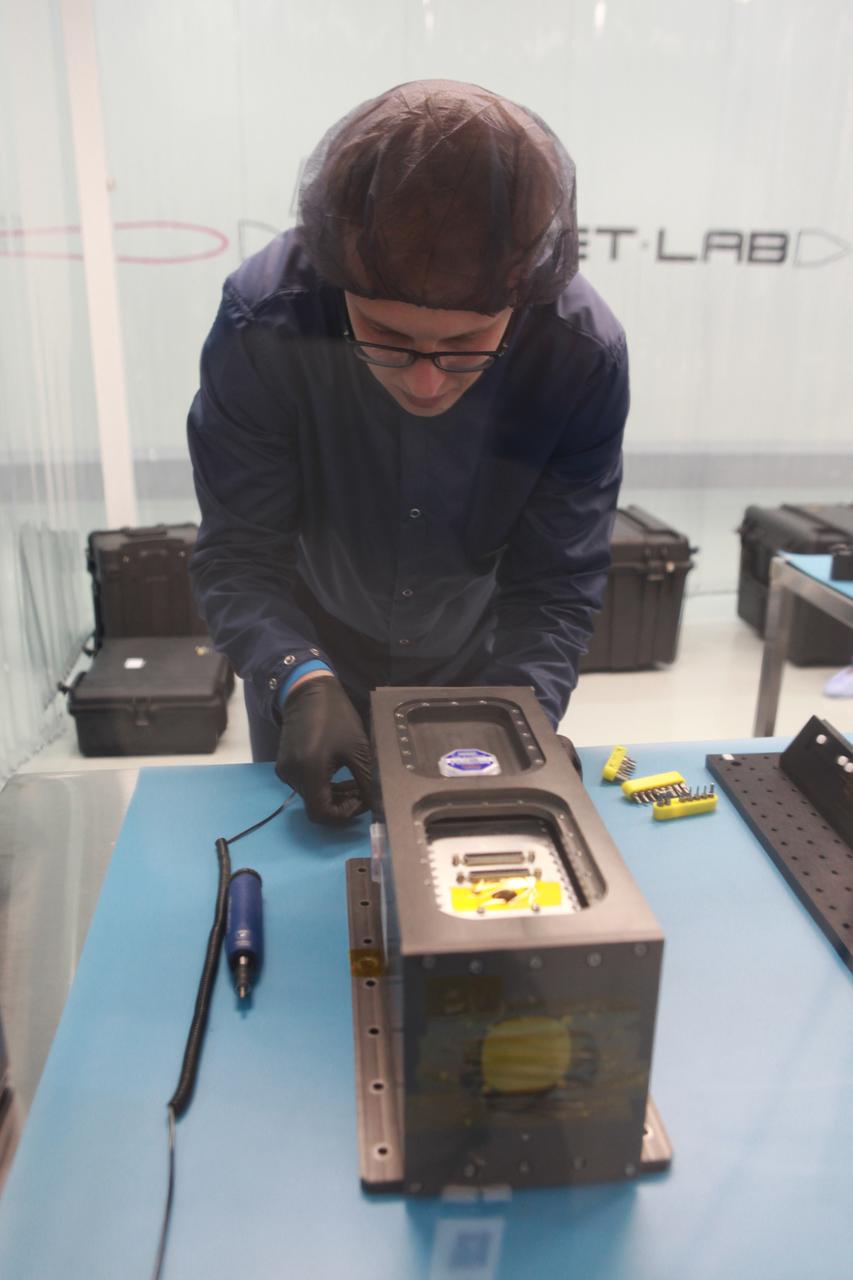
Project DaVinci is a student-led team at North Idaho STEM Charter Academy. Their spacecraft, the DaVinci satellite, has been constructed with the intent to connect with students worldwide to help reignite a passion for space. When launched, the DaVinci satellite will begin broadcasting messages across the globe using amateur radio uplink and downlink frequencies. Students in nearly every country will be able to receive these messages using a USB receiver dongle, open source software, and a yagi antenna in locations where the signal may be weaker. All messages will be education-related, and messages received will be in Morse Code requiring students to download a translating app or to translate it themselves. The DaVinci satellite will use the internet as a redundancy communication channel while in orbit. It is one of the few CubeSat to have a GlobalStar modem onboard, and will allow team members to upload digital messages to internet through the satellite. DaVinci satellite has an onboard Arducam as well, and will provide photos of Earth from its position in orbit. These pictures can be retrieved by the team using the GlobalStar modem and its corresponding server. To Learn more about the DaVinci satellite, visit www.projectdavincicubesat.org/