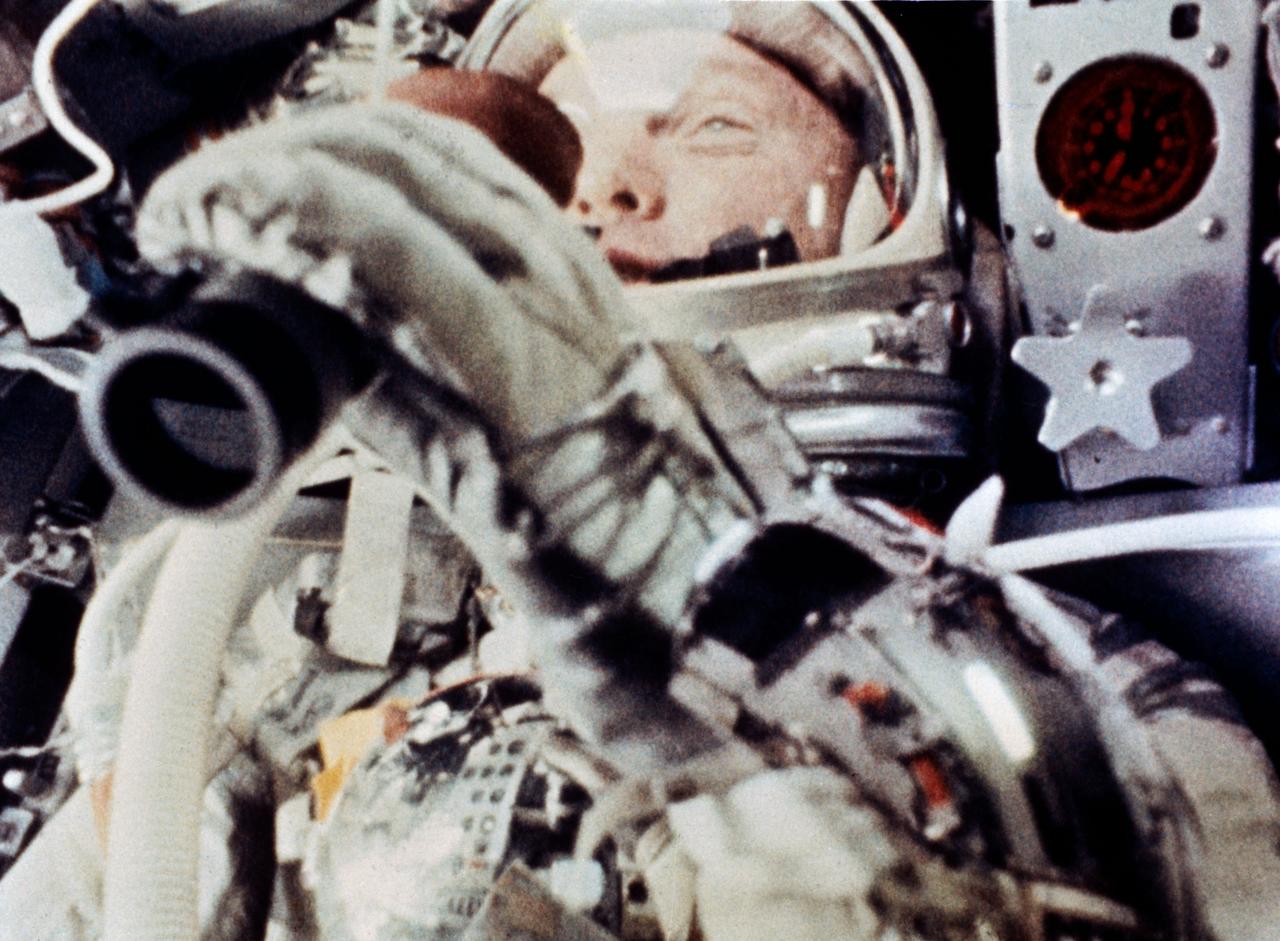
S62-00304 (20 Feb. 1962) --- Astronaut John H. Glenn Jr. is pictured aboard the Mercury-Atlas (MA-6) Friendship 7 capsule during the U.S.'s initial orbital flight. Photo credit: NASA
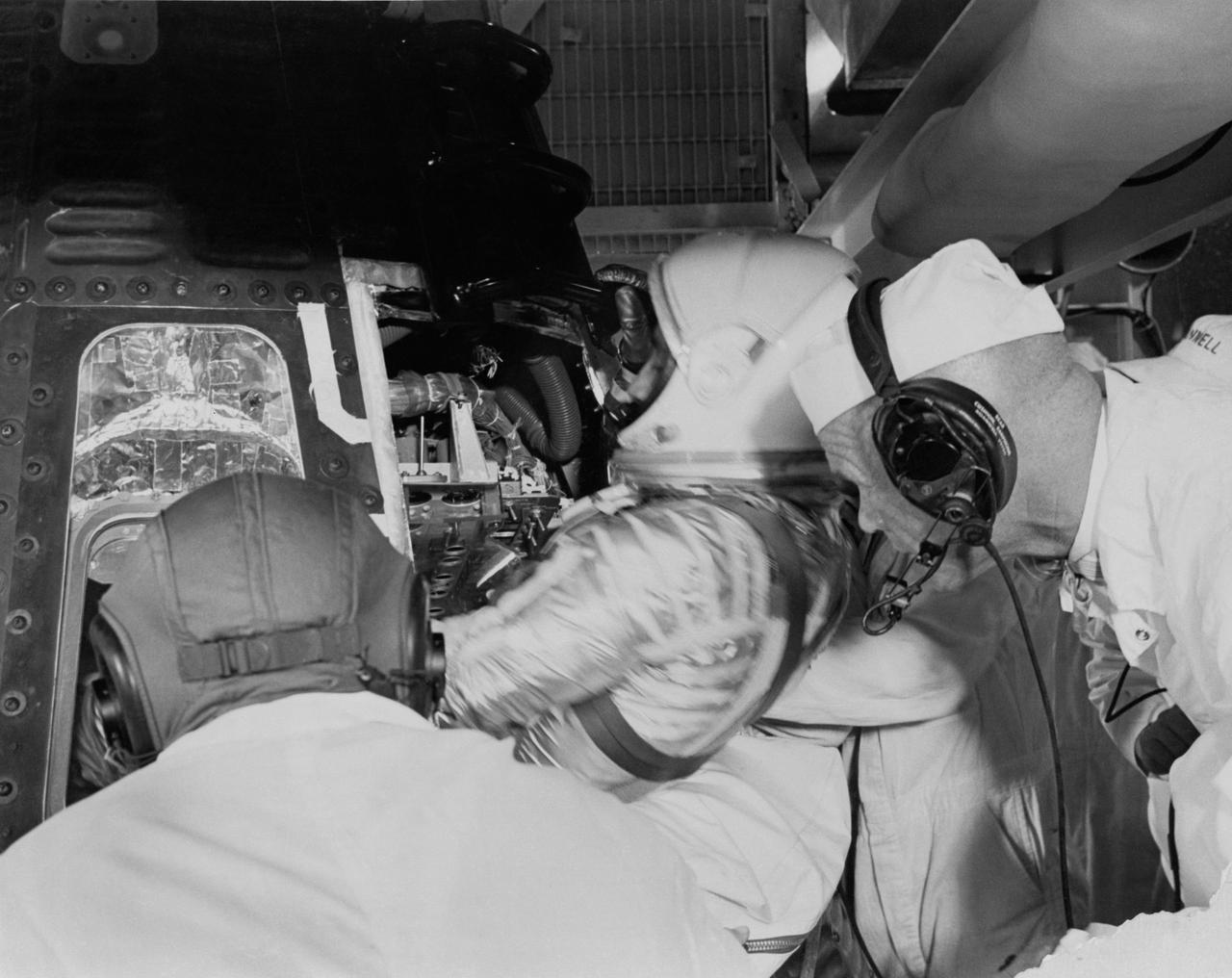
S61-02881 (1961) --- Astronaut Virgil I. (Gus) Grissom, suited up in a newly designed pressure suit, is assisted as he climbs into Liberty Bell 7 spacecraft. Behind him backup pilot John Glenn watches the insertion. The Mercury-Redstone 4 (MR-4) mission was scrubbed a few hours later due to unfavorable weather over the launch pad. Photo credit: NASA
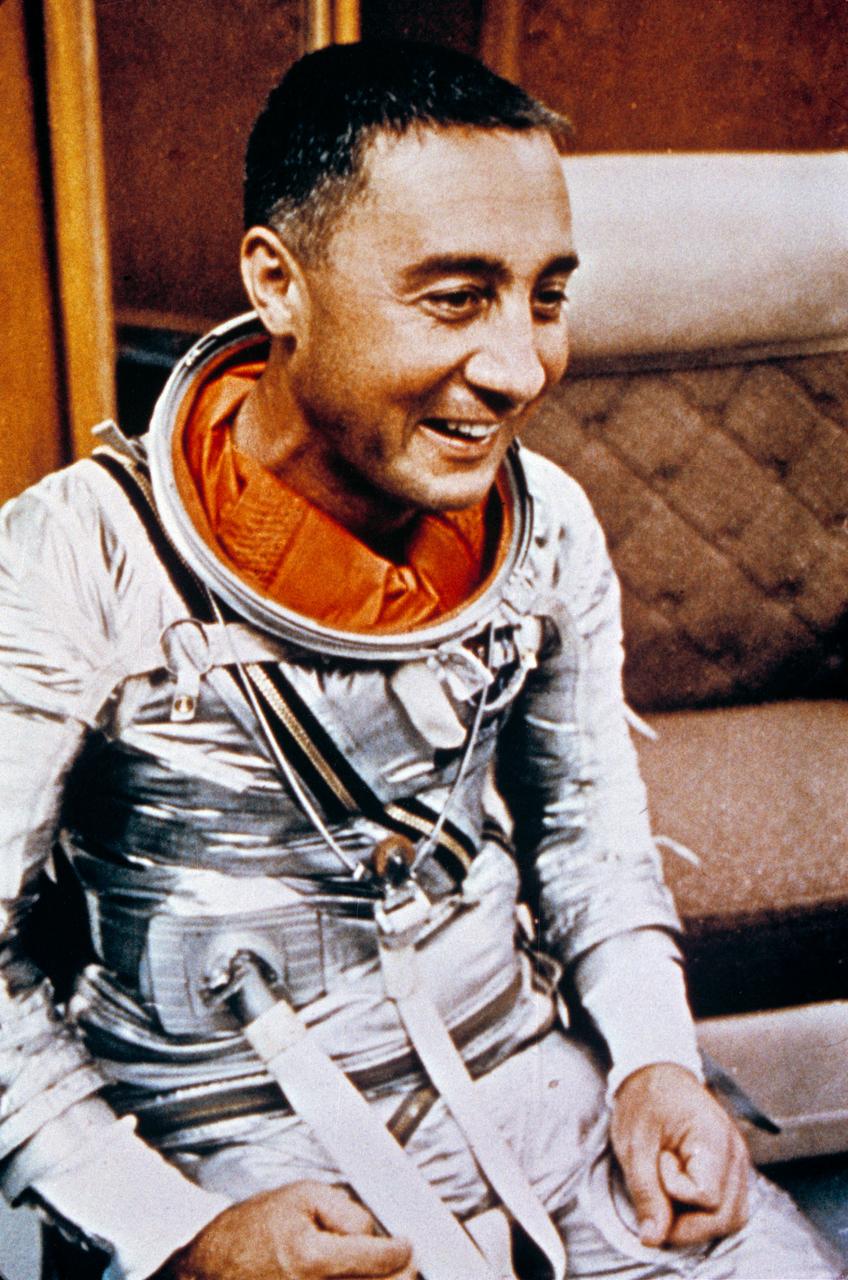
S64-36909 (1961) --- Astronaut Virgil I. (Gus) Grissom, pilot of the Mercury-Redstone 4 (MR-4) spaceflight, wearing Mercury pressure suit, poses for picture during training activities at the Florida Space Center. Photo credit: NASA
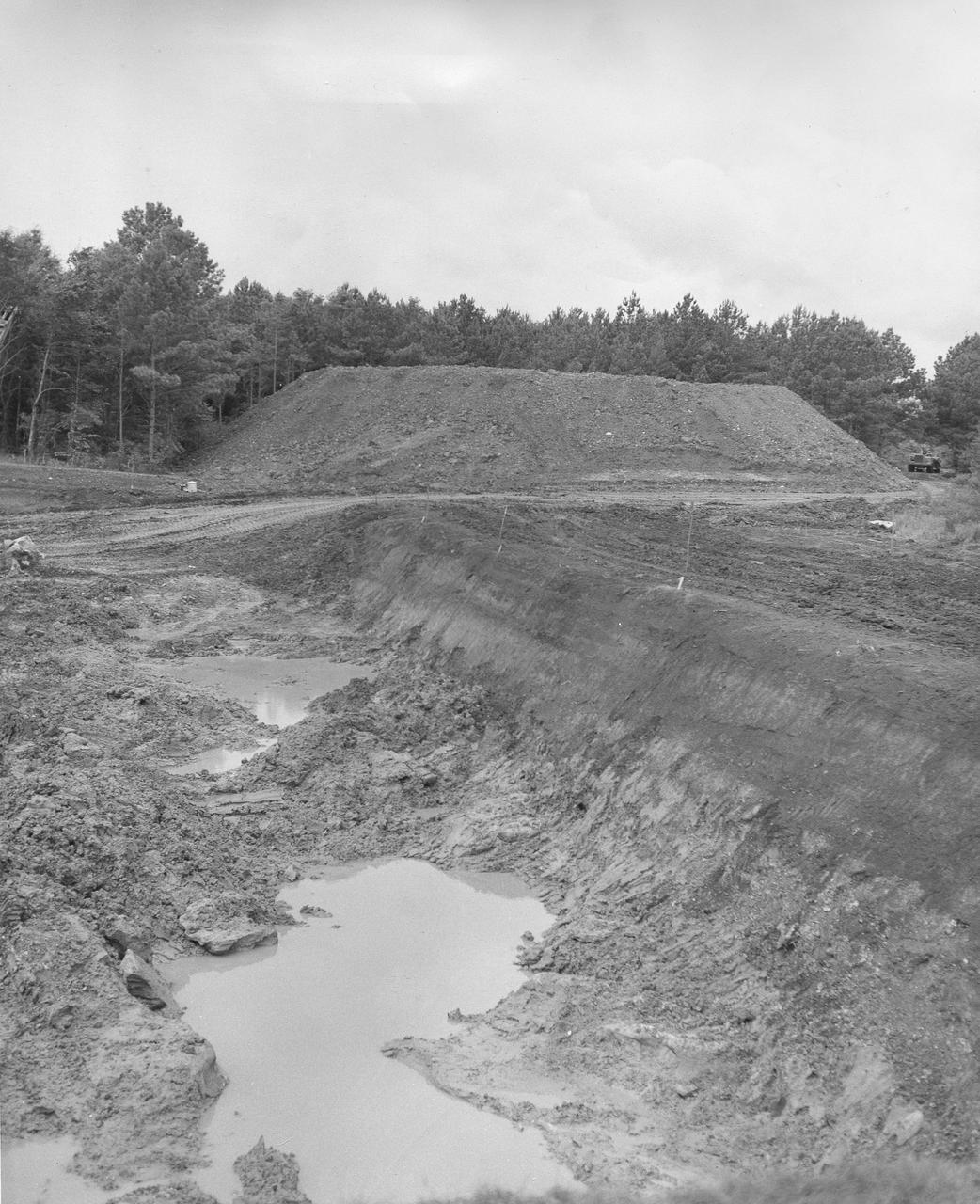
At its founding, the Marshall Space Flight Center (MSFC) inherited the Army’s Jupiter and Redstone test stands, but much larger facilities were needed for the giant stages of the Saturn V. From 1960 to 1964, the existing stands were remodeled and a sizable new test area was developed. The new comprehensive test complex for propulsion and structural dynamics was unique within the nation and the free world, and they remain so today because they were constructed with foresight to meet the future as well as on going needs. Construction of the S-IC Static test stand complex began in 1961 in the west test area of MSFC, and was completed in 1964. The S-IC static test stand was designed to develop and test the 138-ft long and 33-ft diameter Saturn V S-IC first stage, or booster stage, weighing in at 280,000 pounds. Required to hold down the brute force of a 7,500,000-pound thrust produced by 5 F-1 engines, the S-IC static test stand was designed and constructed with the strength of hundreds of tons of steel and 12,000,000 pounds of cement, planted down to bedrock 40 feet below ground level. The foundation walls, constructed with concrete and steel, are 4 feet thick. The base structure consists of four towers with 40-foot-thick walls extending upward 144 feet above ground level. The structure was topped by a crane with a 135-foot boom. With the boom in the upright position, the stand was given an overall height of 405 feet, placing it among the highest structures in Alabama at the time. In this photo, taken July 13, 1961, progress is being made with the excavation of the S-IC test stand site. During the digging, a natural spring was disturbed which caused a constant flooding problem. Pumps were used to remove the water all through the construction process and the site is still pumped today.

S88-31388 (8 May 1961) --- Astronaut Alan B. Shepard Jr. (center), along with wife Louise, waves to a crowd outside the U.S. Capitol building. Shepard, Mercury-Redstone 3 astronaut, had earlier briefed Congress on the first U.S. manned spaceflight -- a 15-minute suborbital mission on May 5, 1961, aboard the Freedom 7 capsule. (NASA Hq. Photo No., MR3-49) Photo credit: NASA or National Aeronautics and Space Administration
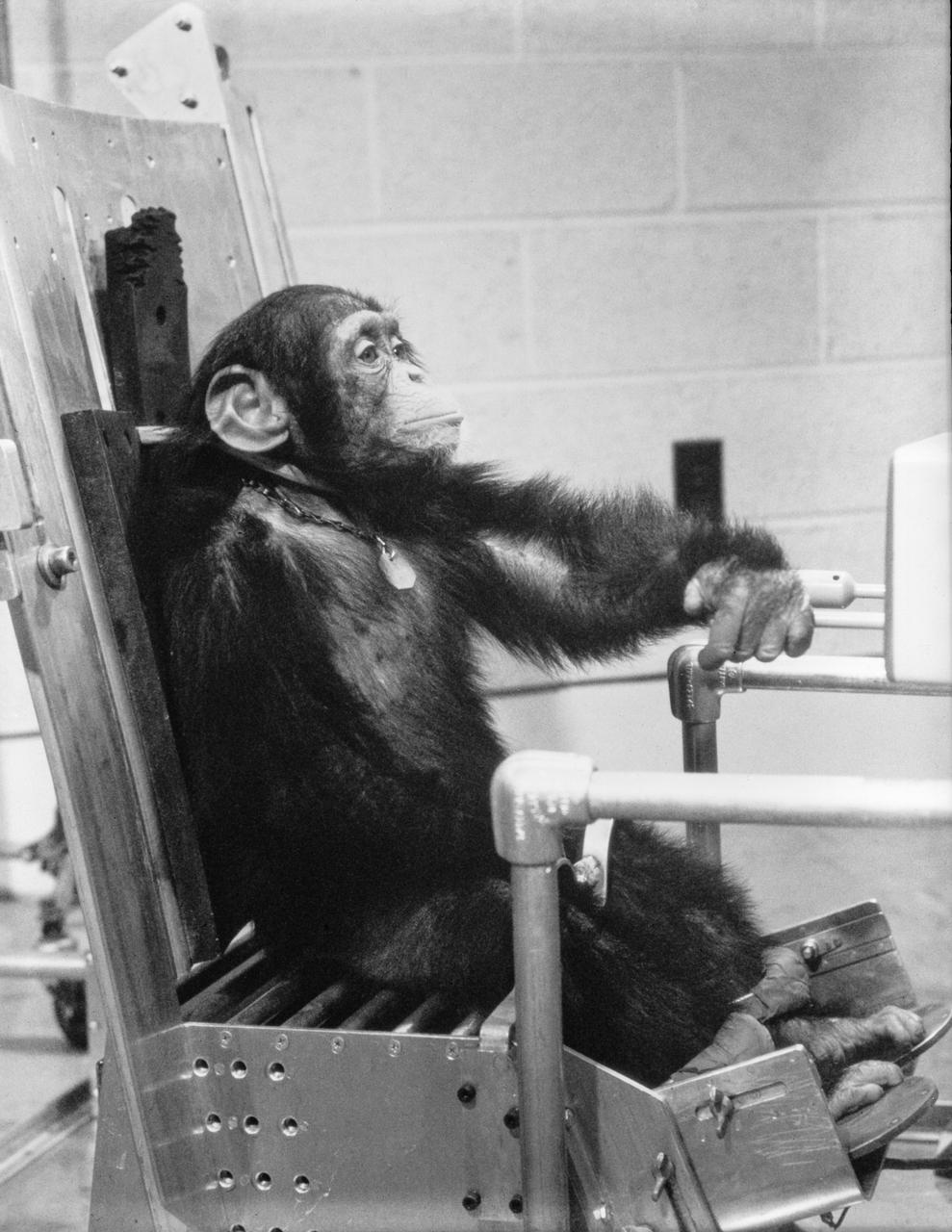
G61-00337 (31 Jan. 1961) --- Chimpanzee "Ham" during preflight activity with one of his handlers prior to the Mercury-Redstone 2 (MR-2) test flight which was conducted on Jan. 31, 1961. Photo credit: NASA

AUGUST 23, 1961 LAUNCH OF NASA AGENA RANGER 1 FROM PAD 12.
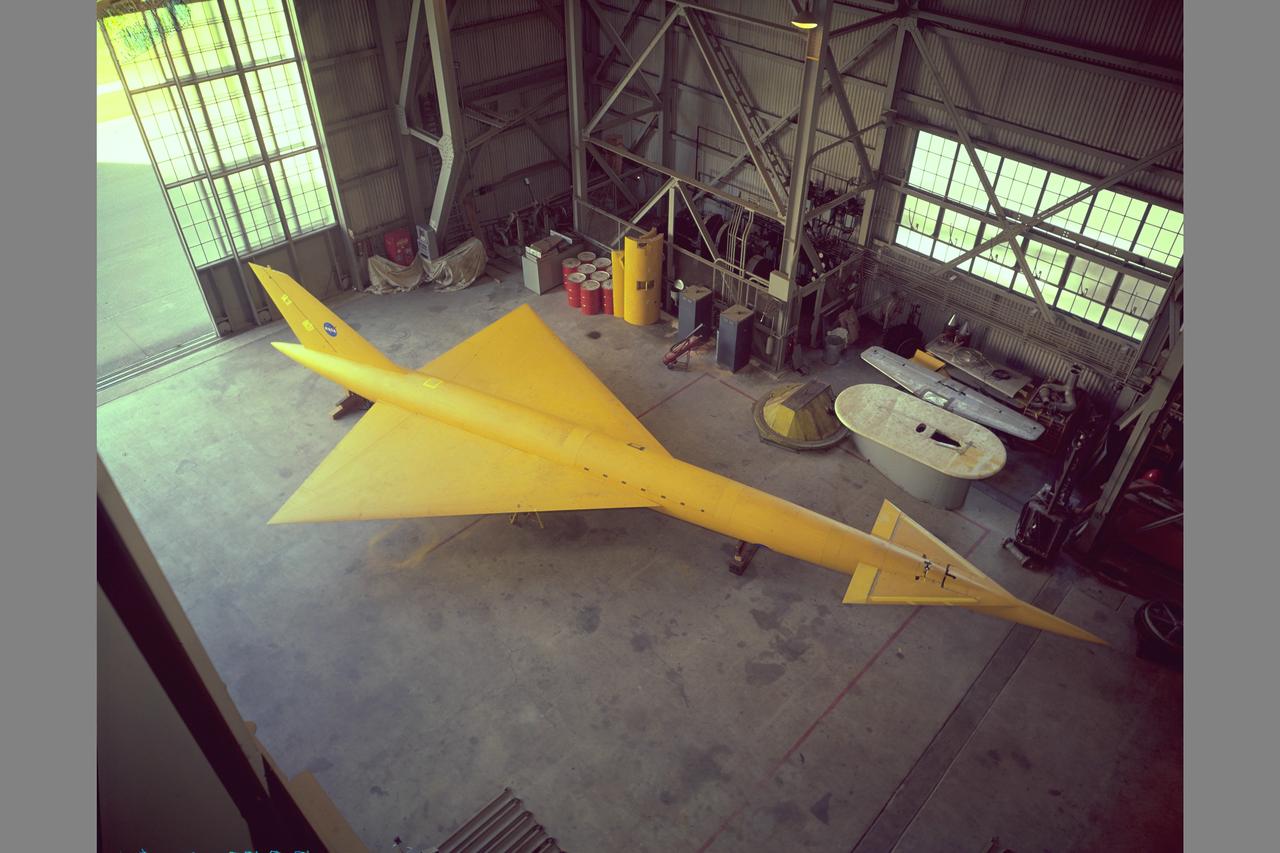
Supersonic Transport being installed in 40x80ft w.t.
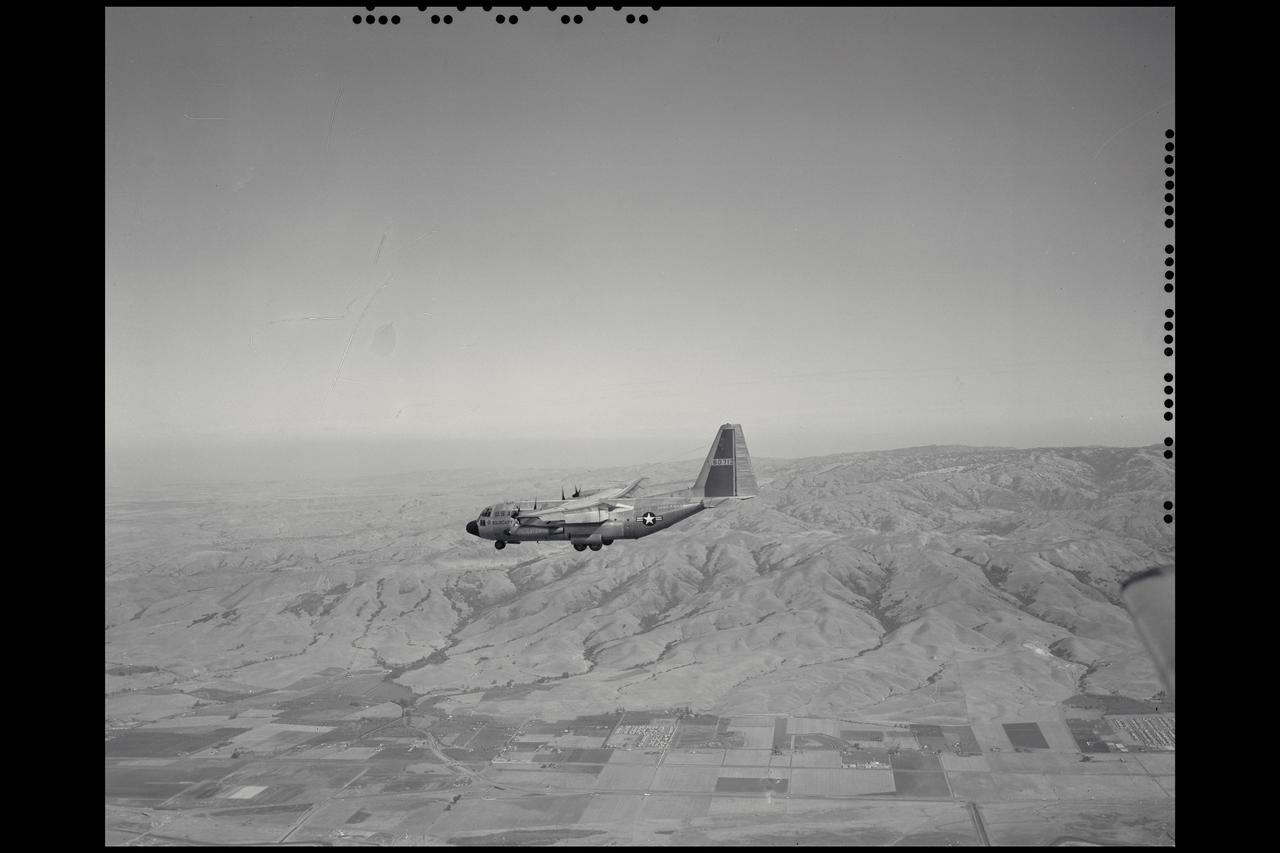
Lockheed NC-130B aircraft in flight over Santa Clara Valley, CA
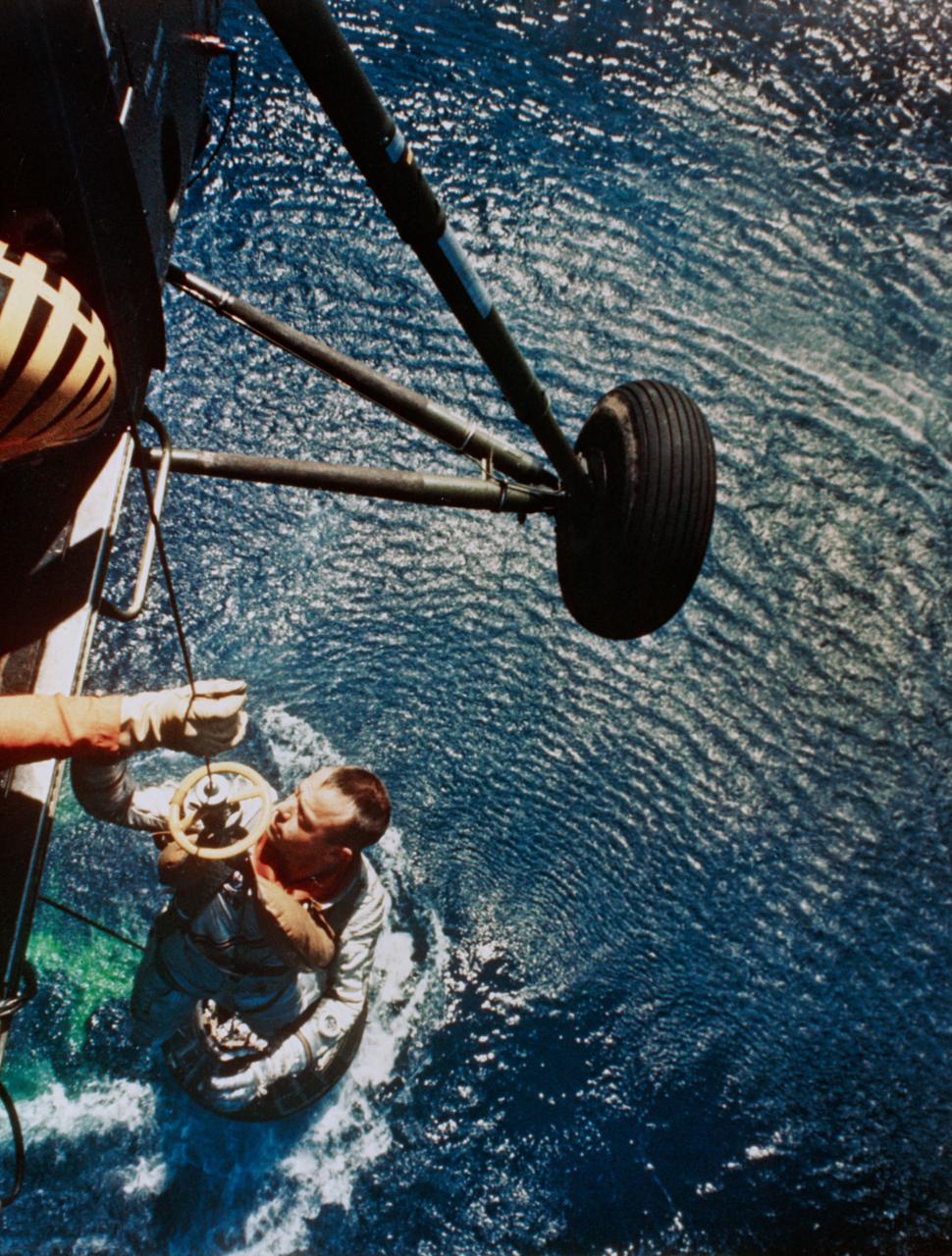
S88-31377 (5 May 1961) --- Astronaut Alan B. Shepard Jr. is rescued by a U. S. Marine helicopter at the termination of his sub-orbital flight May 5, 196l, down range from the Florida eastern coast.
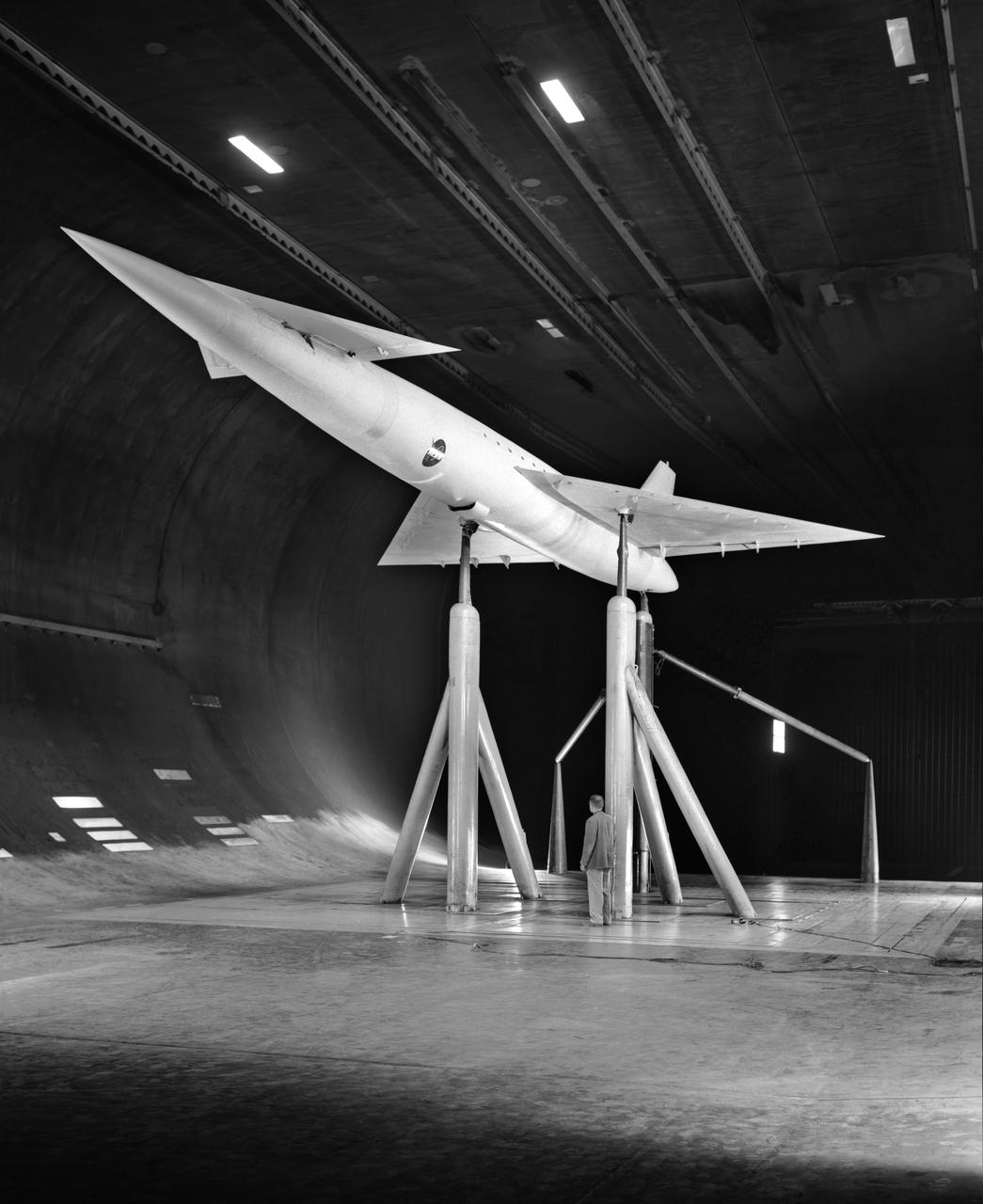
Low Speed investigation of a supersonic transport model in the 40x80 Wind Tunnel. 03/01/1961 R 975 T Zero angel of attack. Supersonic transport with delta wing and delta conard. 3/4 front view.
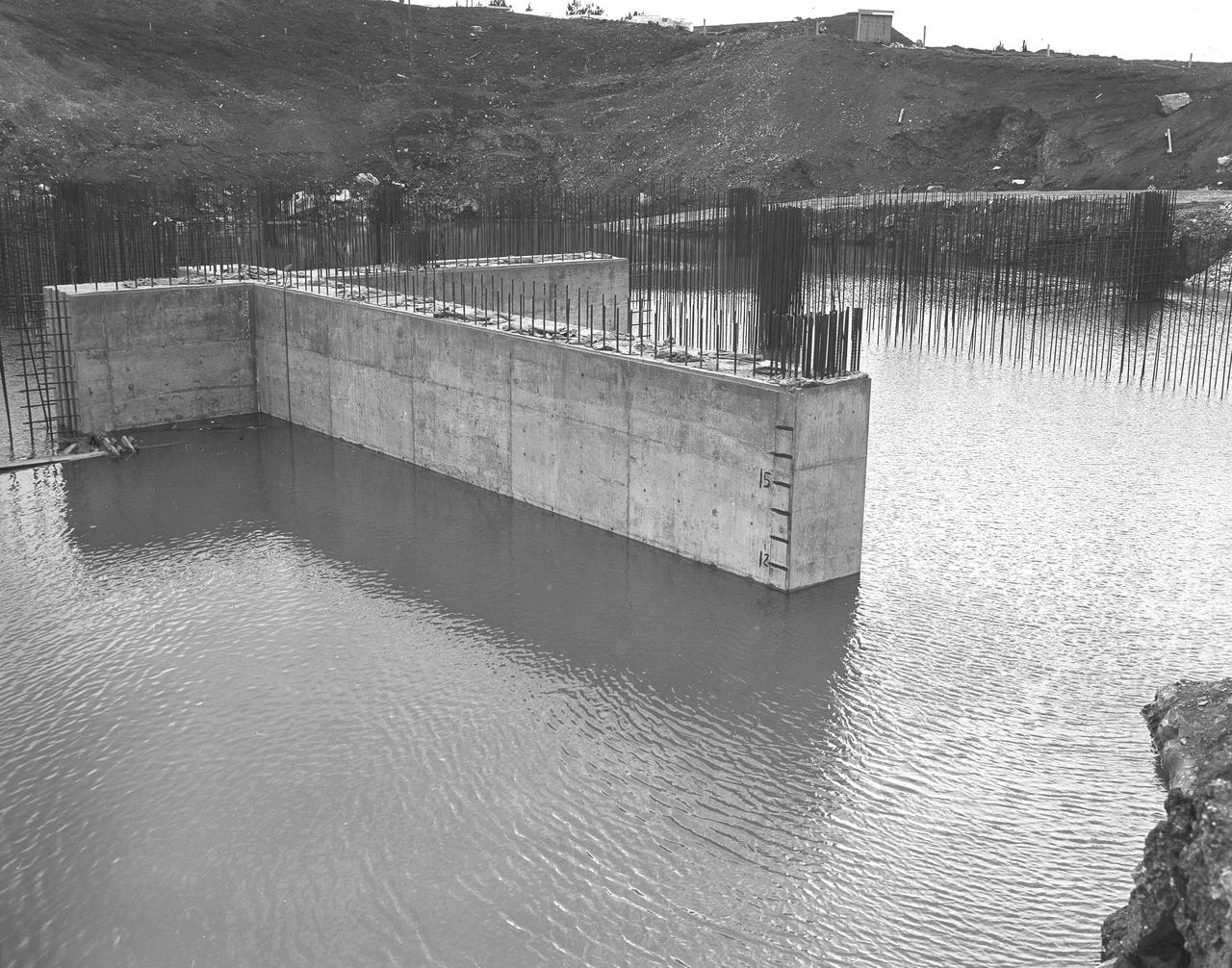
At its founding, the Marshall Space Flight Center (MSFC) inherited the Army’s Jupiter and Redstone test stands, but much larger facilities were needed for the giant stages of the Saturn V. From 1960 to 1964, the existing stands were remodeled and a sizable new test area was developed. The new comprehensive test complex for propulsion and structural dynamics was unique within the nation and the free world, and they remain so today because they were constructed with foresight to meet the future as well as on going needs. Construction of the S-IC Static test stand complex began in 1961 in the west test area of MSFC, and was completed in 1964. The S-IC static test stand was designed to develop and test the 138-ft long and 33-ft diameter Saturn V S-IC first stage, or booster stage, weighing in at 280,000 pounds. Required to hold down the brute force of a 7,500,000-pound thrust produced by 5 F-1 engines, the S-IC static test stand was designed and constructed with the strength of hundreds of tons of steel and 12,000,000 pounds of cement, planted down to bedrock 40 feet below ground level. The foundation walls, constructed with concrete and steel, are 4 feet thick. The base structure consists of four towers with 40-foot-thick walls extending upward 144 feet above ground level. The structure was topped by a crane with a 135-foot boom. With the boom in the upright position, the stand was given an overall height of 405 feet, placing it among the highest structures in Alabama at the time. Construction of the S-IC test stand came to a halt at the end of September as the determination was made that the Saturn booster size had to be increased. As a result, the stand would have to be modified. With construction delayed, and pumps turned off, this photo, taken December 4, 1961, shows the abandoned site with floods at the 11 ft mark. The flooding was caused by the disturbance of a natural spring months prior during the excavation of the site.
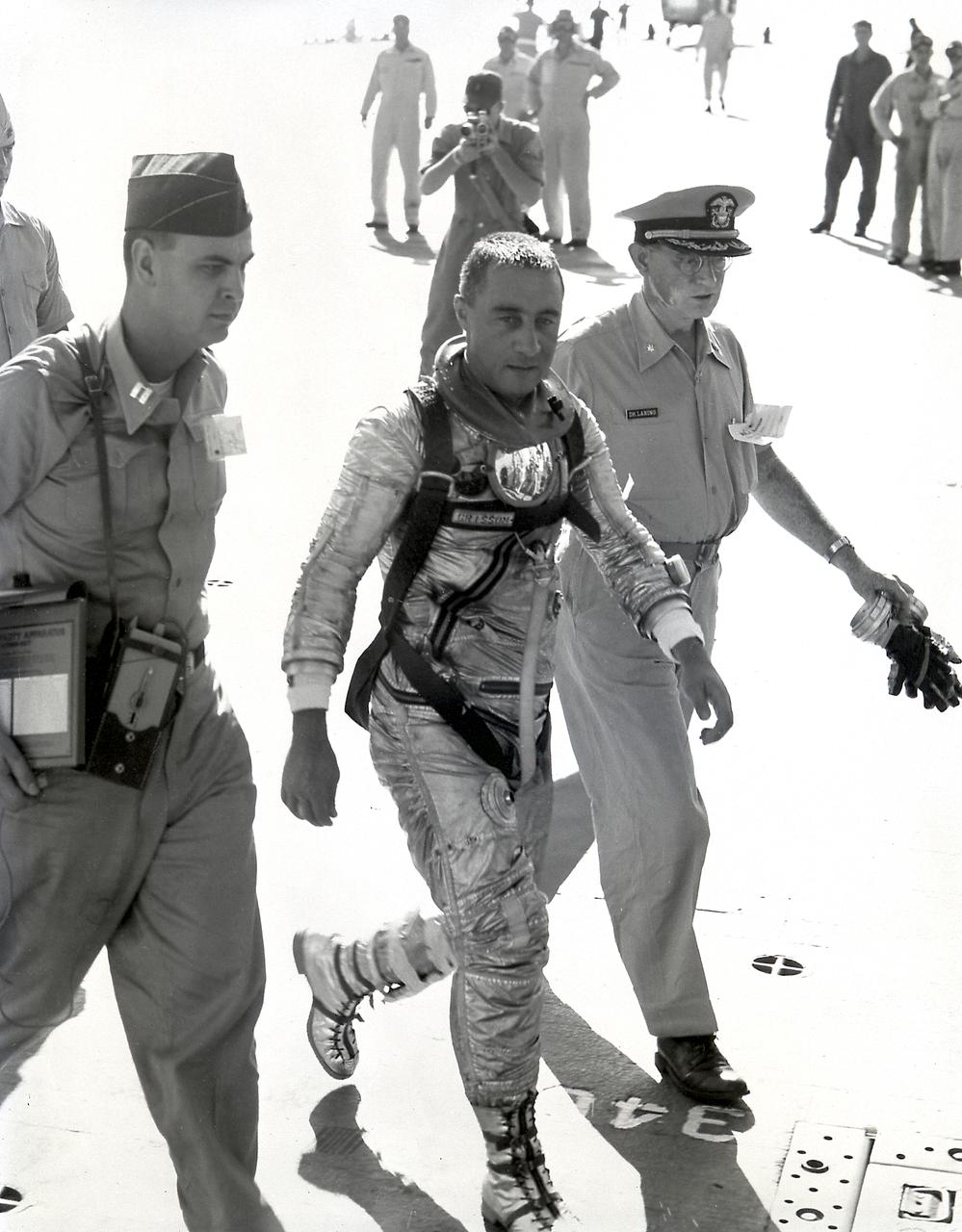
Astronaut Virgil Grissom walks on the recovery ship after completing the 15-1/2-minute suborbital MR-4 mission.
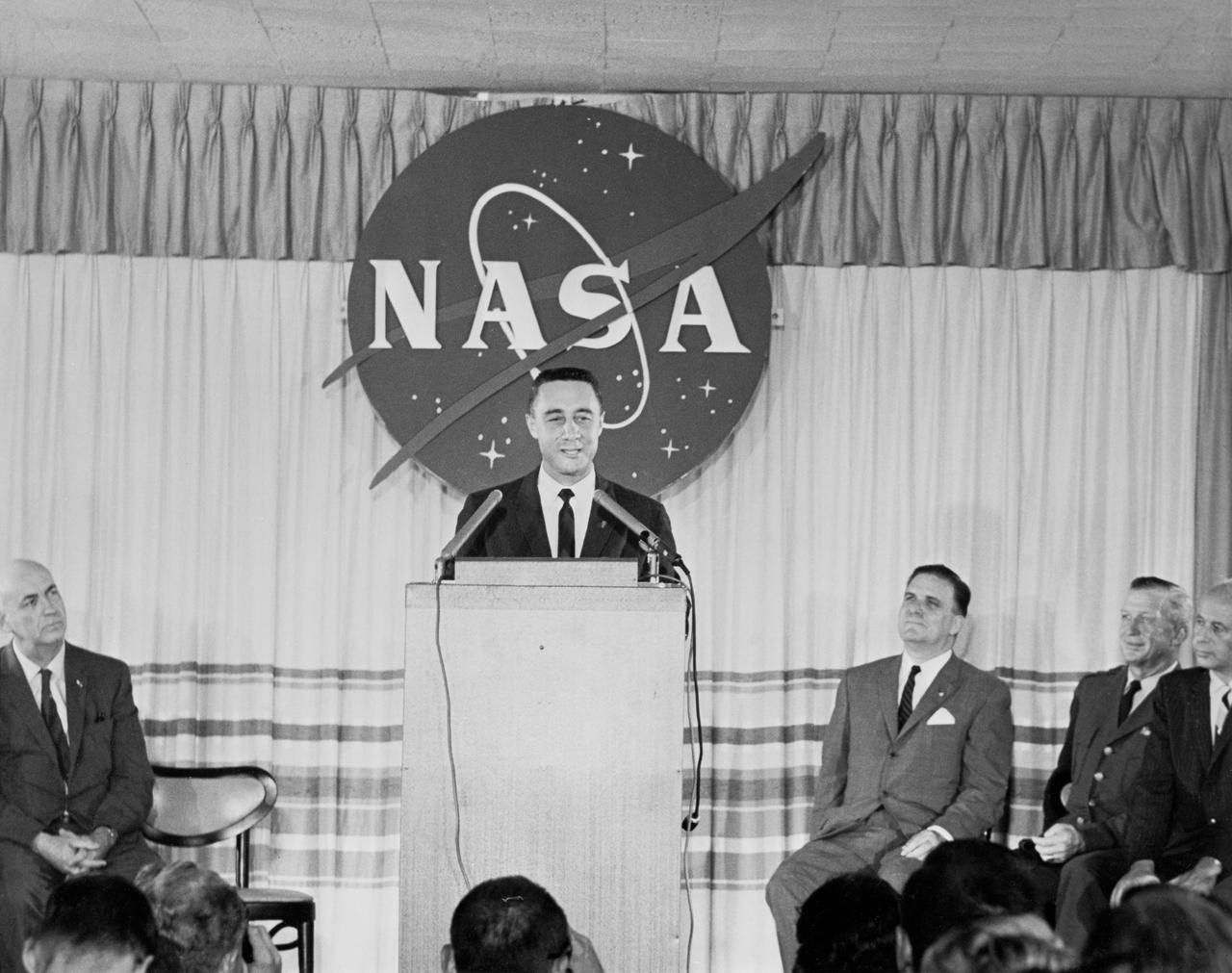
S61-03676 (23 July 1961) --- Astronaut Virgil I. (Gus) Grissom speaks at a press conference on July 23, 1961 held at the Starlight motel. Behind him is a large representation of the NASA logo. Photo credit: NASA
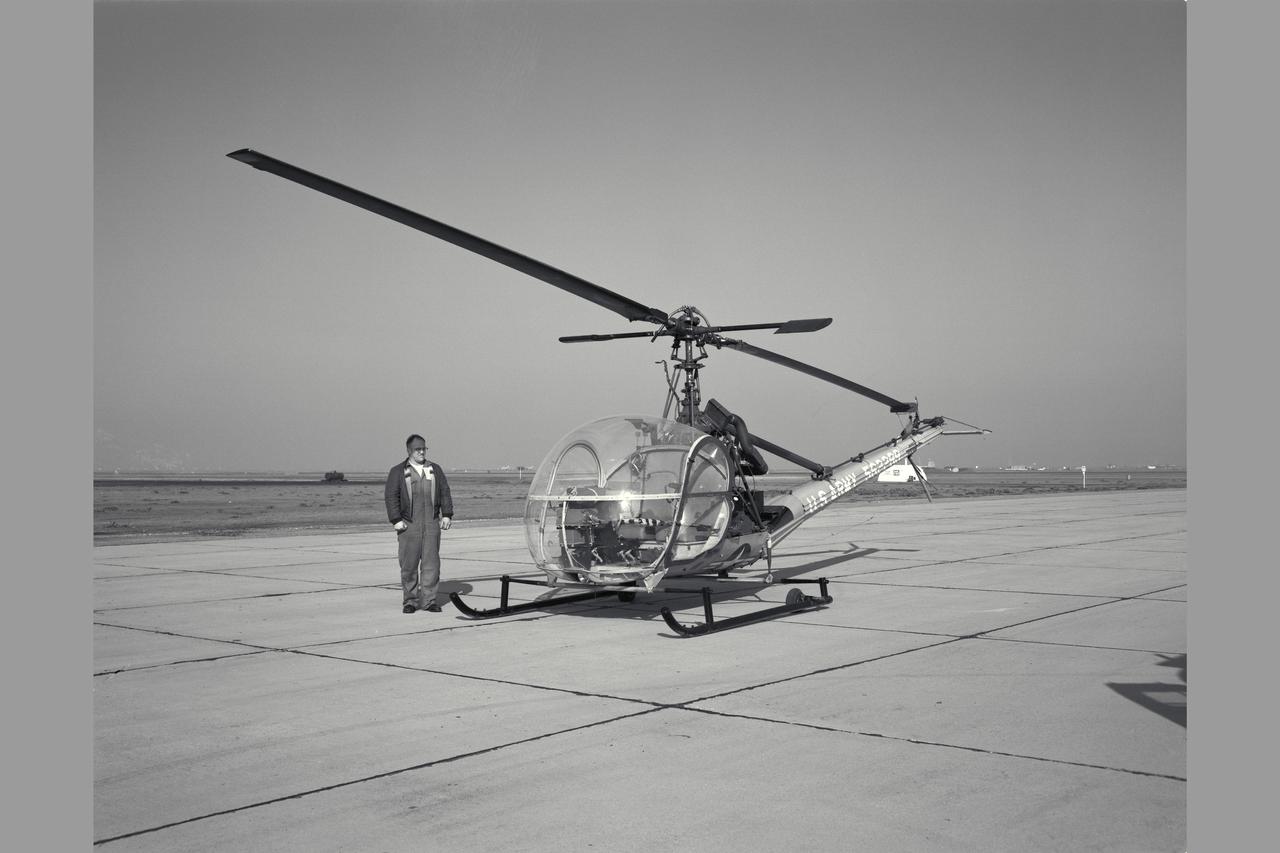
3/4 FRONT VIEW OF HILLER H-23C (USA 56-2288). USE OF THE HILLER H-23 HELICOPTER AS AN AID IN ESTABLISHING SATISFACTORY FLYING QUALITIES & REQUIREMENTS FOR VTOL AIRCRAFT. Rotocraft Research. NASA SP Flight Research at Ames: 57 Years of Development and Validation of Aeronautical Technology
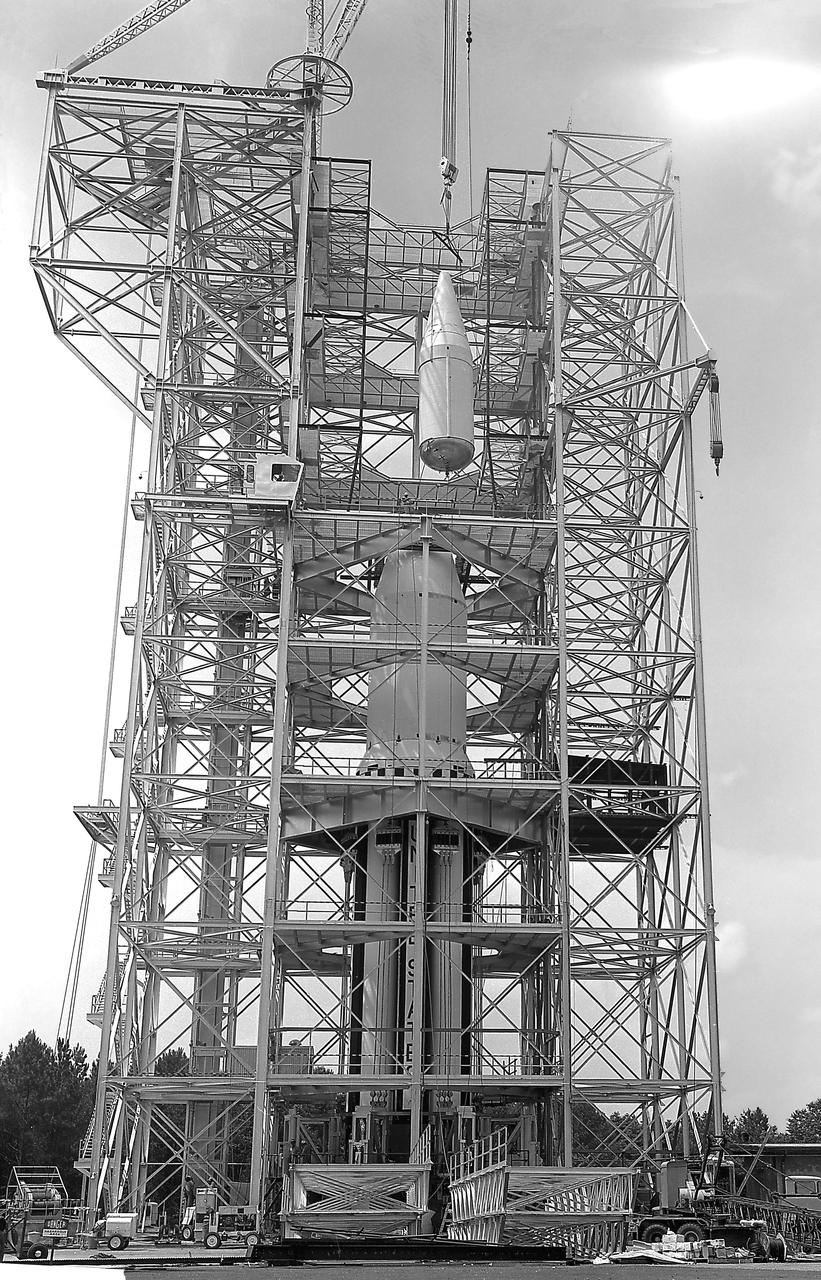
This image depicts the Saturn I launch vehicle placed in the dynamic test stand at the Marshall Space Flight Center (MSFC). A dummy booster was moved to the dynamic test stand early in June, and, for the first time, vertically mated with dummy S-I and S-IV stages. The assembled vehicle was readied for dynamic testing to investigate the integrity of the support structure.
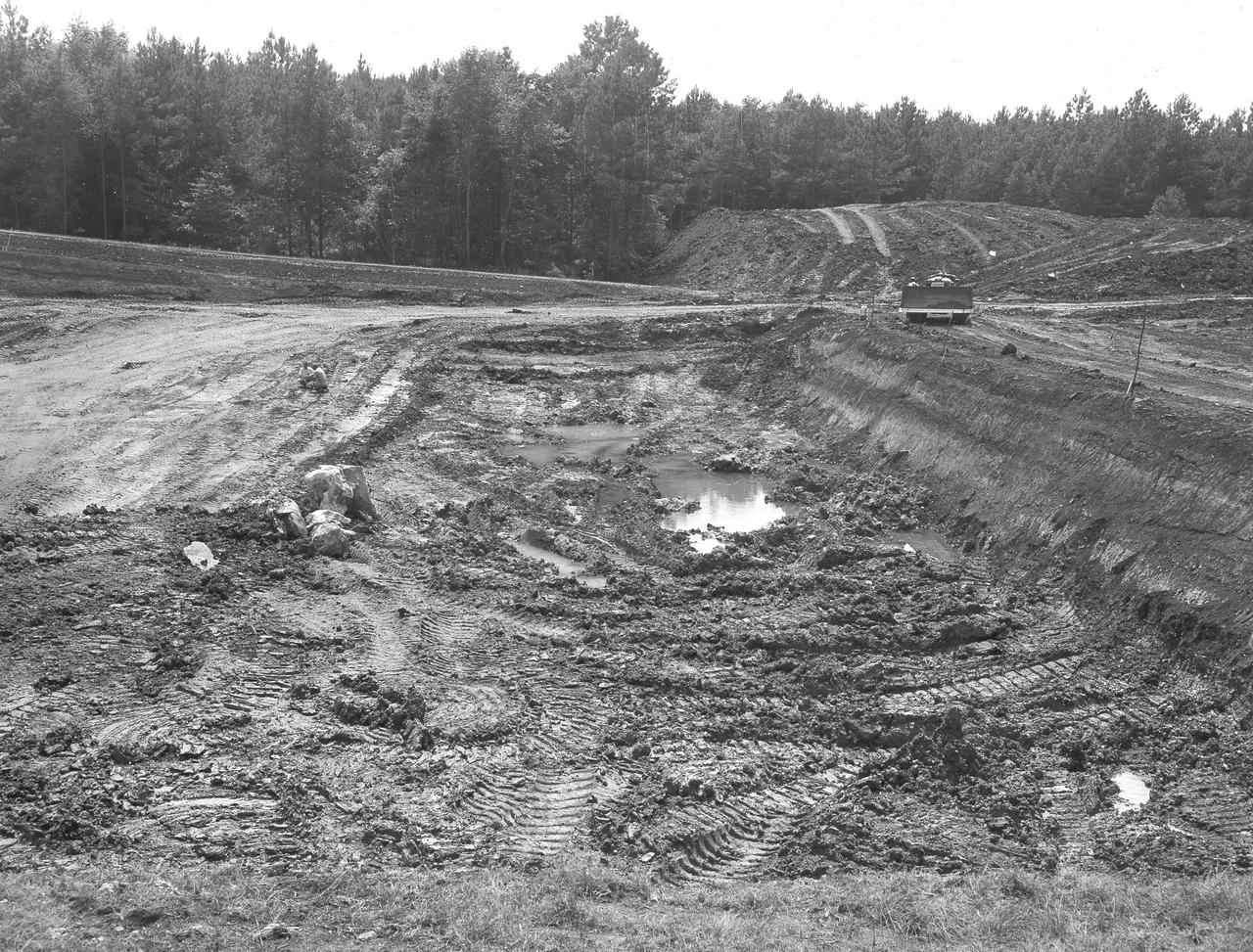
At its founding, the Marshall Space Flight Center (MSFC) inherited the Army’s Jupiter and Redstone test stands, but much larger facilities were needed for the giant stages of the Saturn V. From 1960 to 1964, the existing stands were remodeled and a sizable new test area was developed. The new comprehensive test complex for propulsion and structural dynamics was unique within the nation and the free world, and they remain so today because they were constructed with foresight to meet the future as well as on going needs. Construction of the S-IC Static test stand complex began in 1961 in the west test area of MSFC, and was completed in 1964. The S-IC static test stand was designed to develop and test the 138-ft long and 33-ft diameter Saturn V S-IC first stage, or booster stage, weighing in at 280,000 pounds. Required to hold down the brute force of a 7,500,000-pound thrust produced by 5 F-1 engines, the S-IC static test stand was designed and constructed with the strength of hundreds of tons of steel and 12,000,000 pounds of cement, planted down to bedrock 40 feet below ground level. The foundation walls, constructed with concrete and steel, are 4 feet thick. The base structure consists of four towers with 40-foot-thick walls extending upward 144 feet above ground level. The structure was topped by a crane with a 135-foot boom. With the boom in the upright position, the stand was given an overall height of 405 feet, placing it among the highest structures in Alabama at the time. In this photo, taken July 10, 1961, actual ground breaking has occurred for the S-IC test stand site.
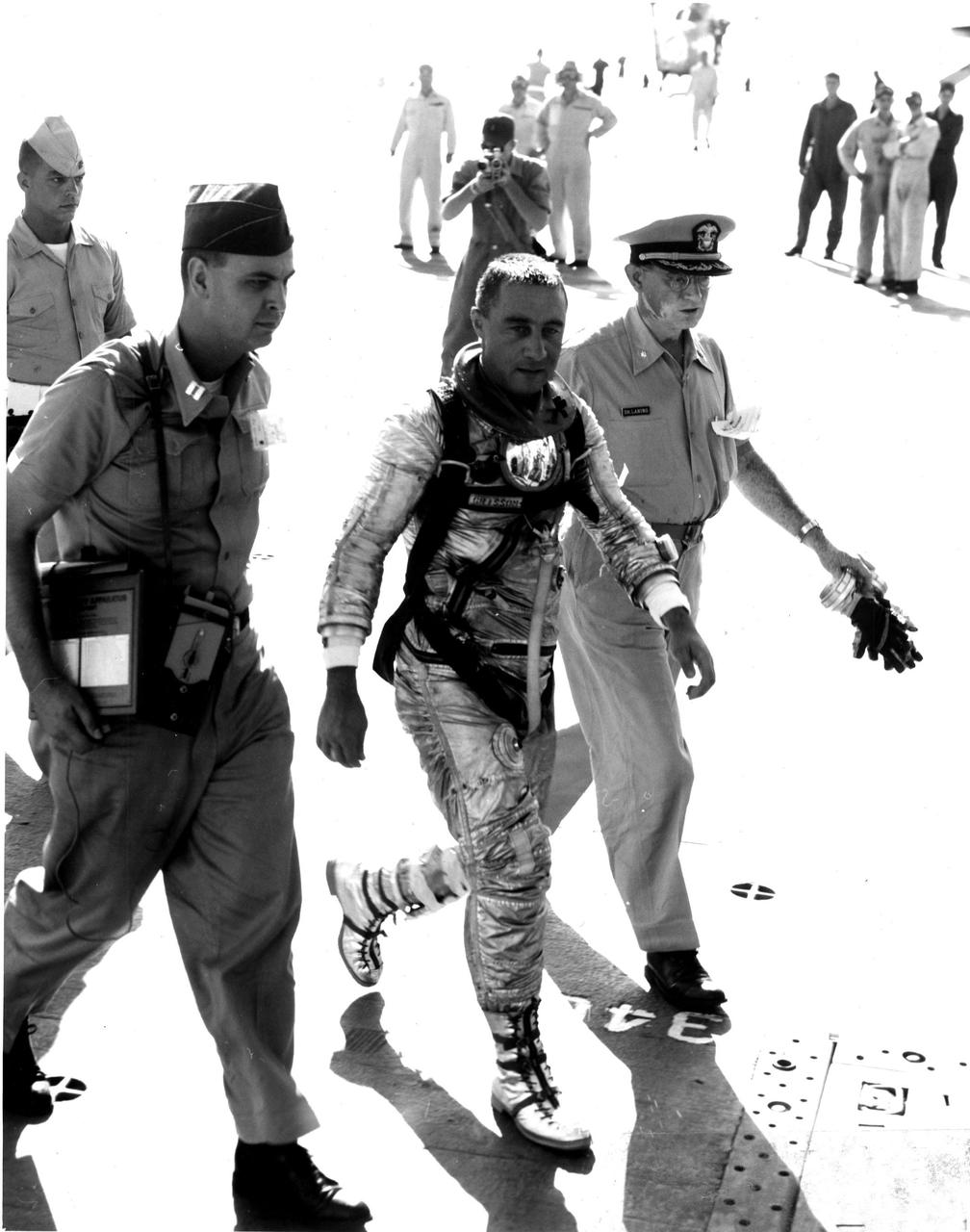
KENNEDY SPACE CENTER, FLA. -- Astronaut Virgil I. Grissom walks across the deck of the U.S.S. Randolph after being airlifted by helicopter from the Liberty Bell 7 impact area. 'Gus' Grissom was the second U.S. man in space. (NASA Photo)
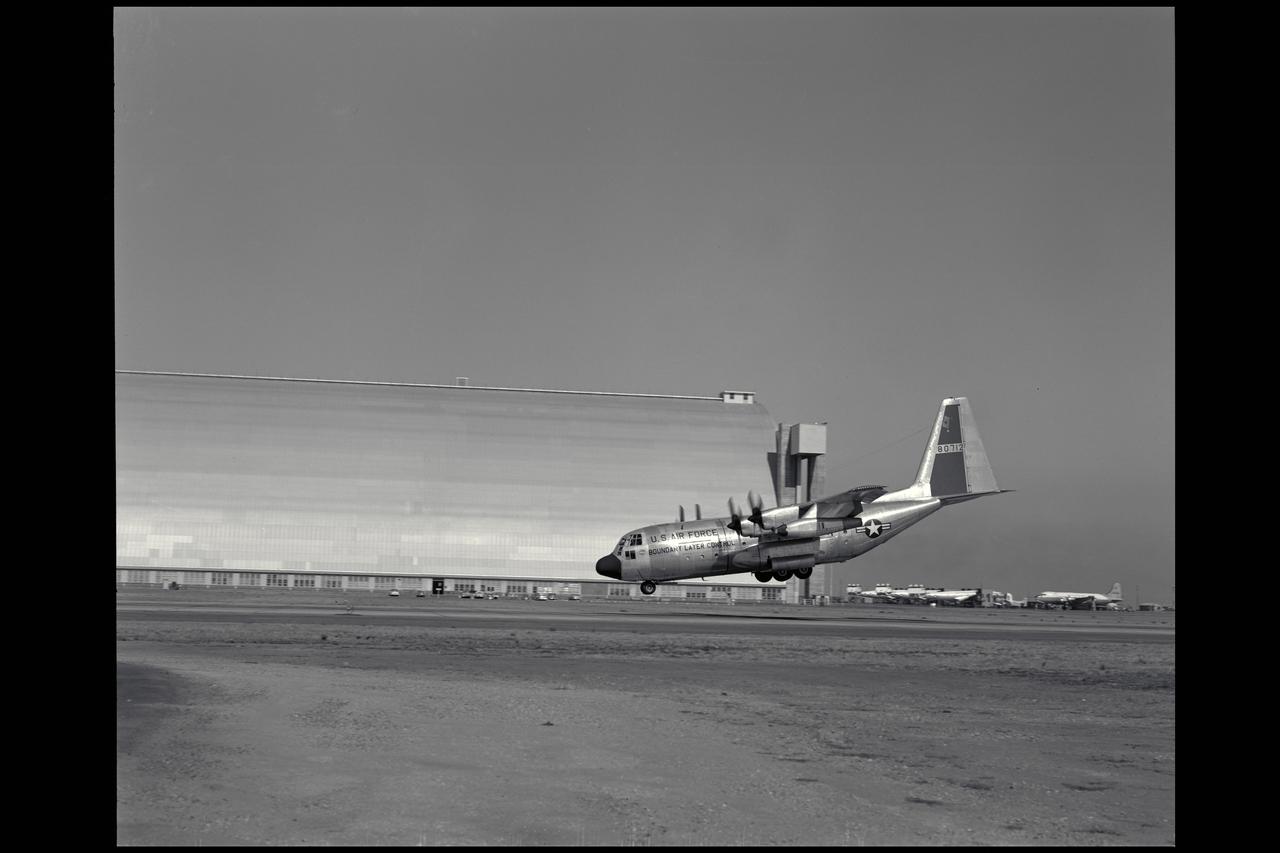
Lockheed NC-130B (AF58-712) Aircraft. A Study of STOL Operational Techniques; landing approach. Nose-low pitch attitude of the aircraft was required in wave-off (or go-around) at 85 knots with flaps 70 degrees. An increase in stall-speed margin could be required to produce a more positive climb angle. (Nov 1962) Note: Used in publication in Flight Research at Ames; 57 Years of Development and Validation of Aeronautical Technology NASA SP-1998-3300 fig. 104; 60yrs at Ames, Atmosphere of Freedom NASA SP-2000-4314
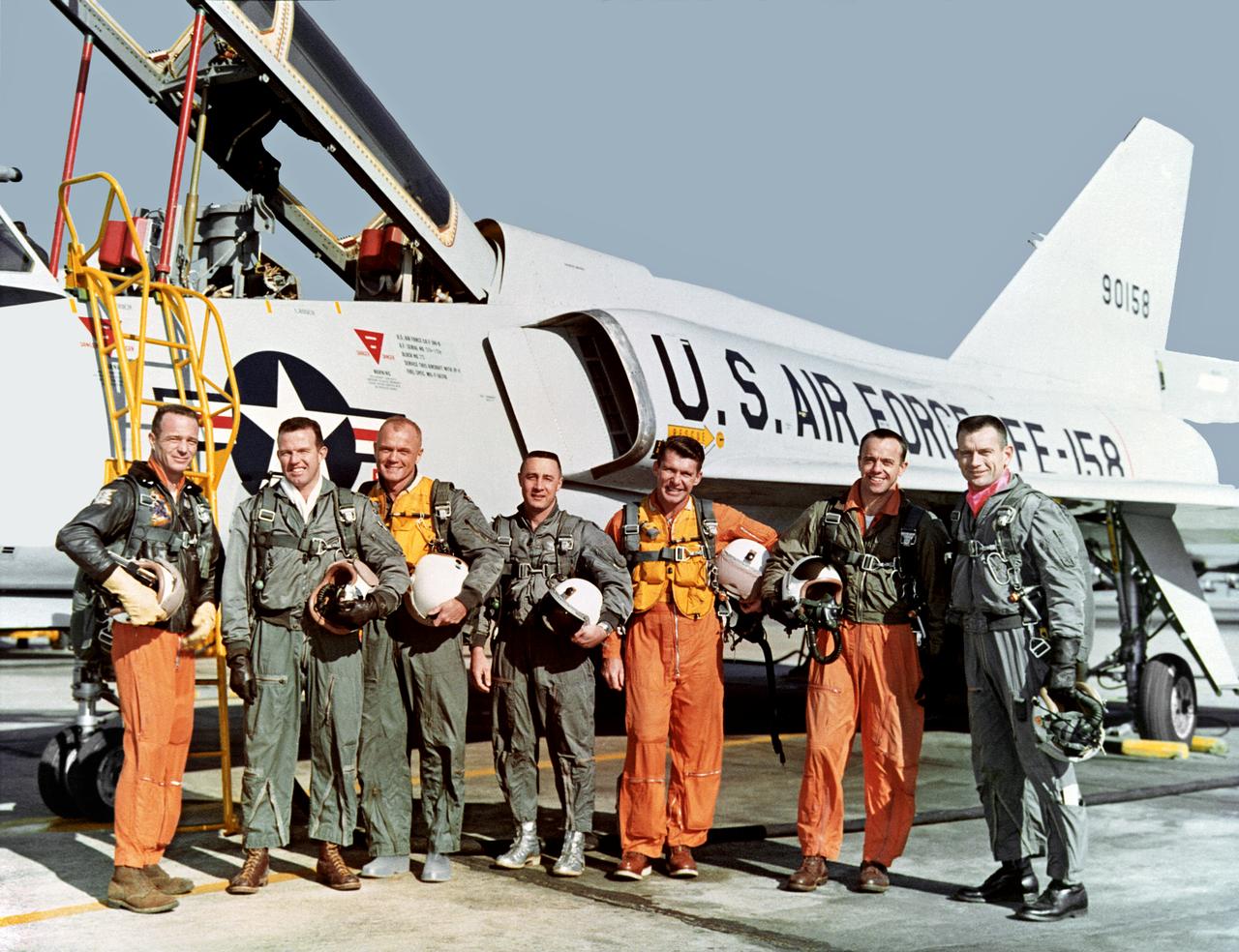
The original seven Mercury astronauts during training at NASA Langley Research Center Project Mercury. The original seven astronauts trained at NASA Langley Research Center. Chosen from among hundreds of applicants, the seven men were all test pilots. Standing in front of the U.S. Air Force Convair F-106B aircraft, the astronauts are, from left, Lt. M. Scott Carpenter, Capt. Gordon Cooper, Col. John H. Glenn Jr., Capt. Virgil "Gus" Grissom, Lt. Comdr. Walter Schirra, Lt. Comdr. Alan B. Shepard Jr. and Capt. Donald K. "Deke" Slayton. While familiarizing the astronauts with the Mercury set-up, Langley employees helped them to specialize in the technical areas crucial to the overall success of Project Mercury. Langley people also guided and monitored the astronauts activities through the many spaceflight simulators and other training devices built at the Center expressly for the manned space program. In less than three years, Project Mercury proved that men could be sent into space and returned safely to Earth, setting the stage for the longer duration Gemini flights and the Apollo lunar landings. This photograph was originally taken on 01/20/1961 and is published in Spaceflight Revolution NASA Langley Research Center from Sputnik to Apollo, NASA SP-4308, by James R. Hansen, 1995, page 40.
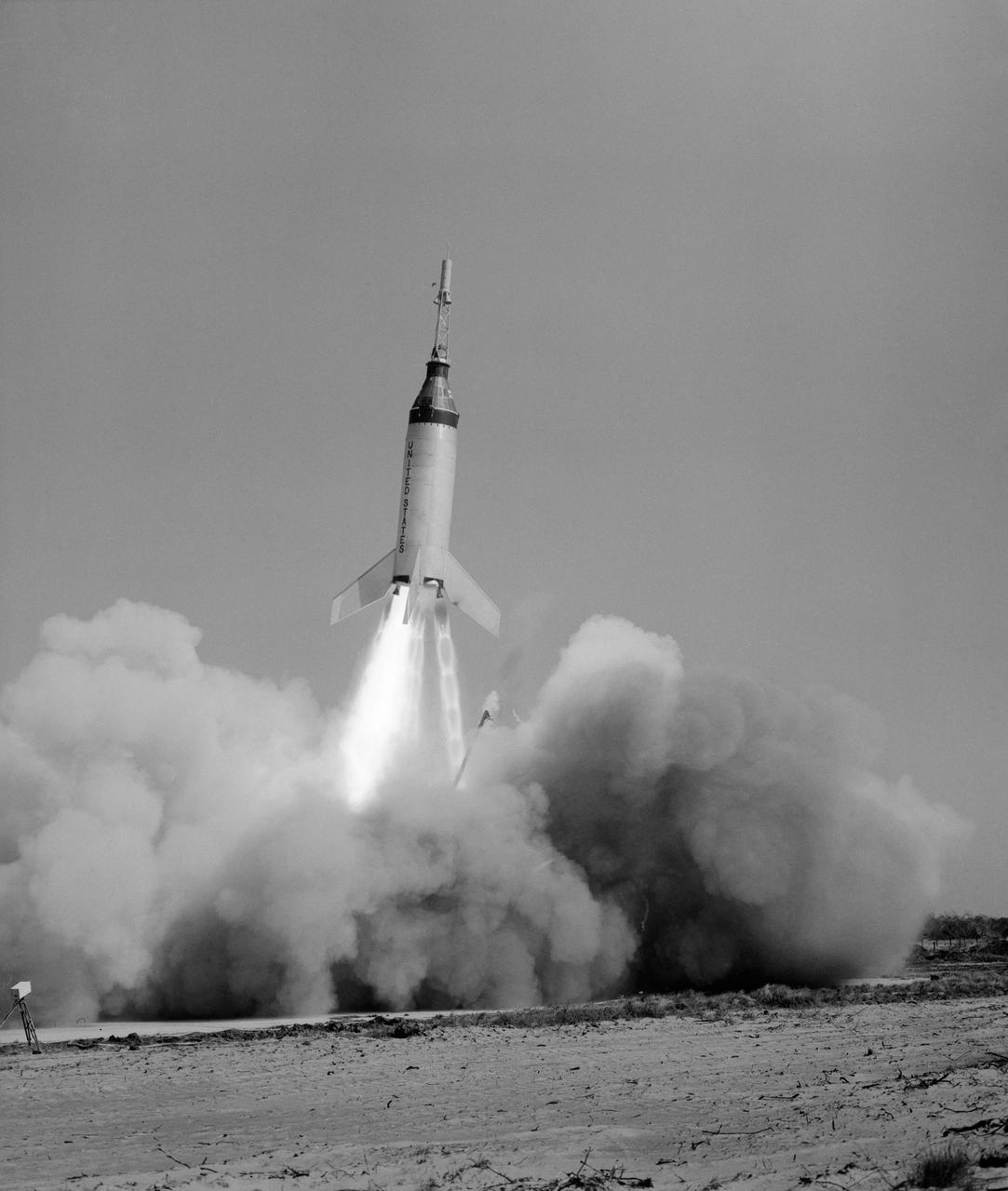
S61-01690 (28 April 1961) --- View of the launch of the Little Joe-5B spacecraft from Wallops Island on April 28, 1961. Photo credit: NASA
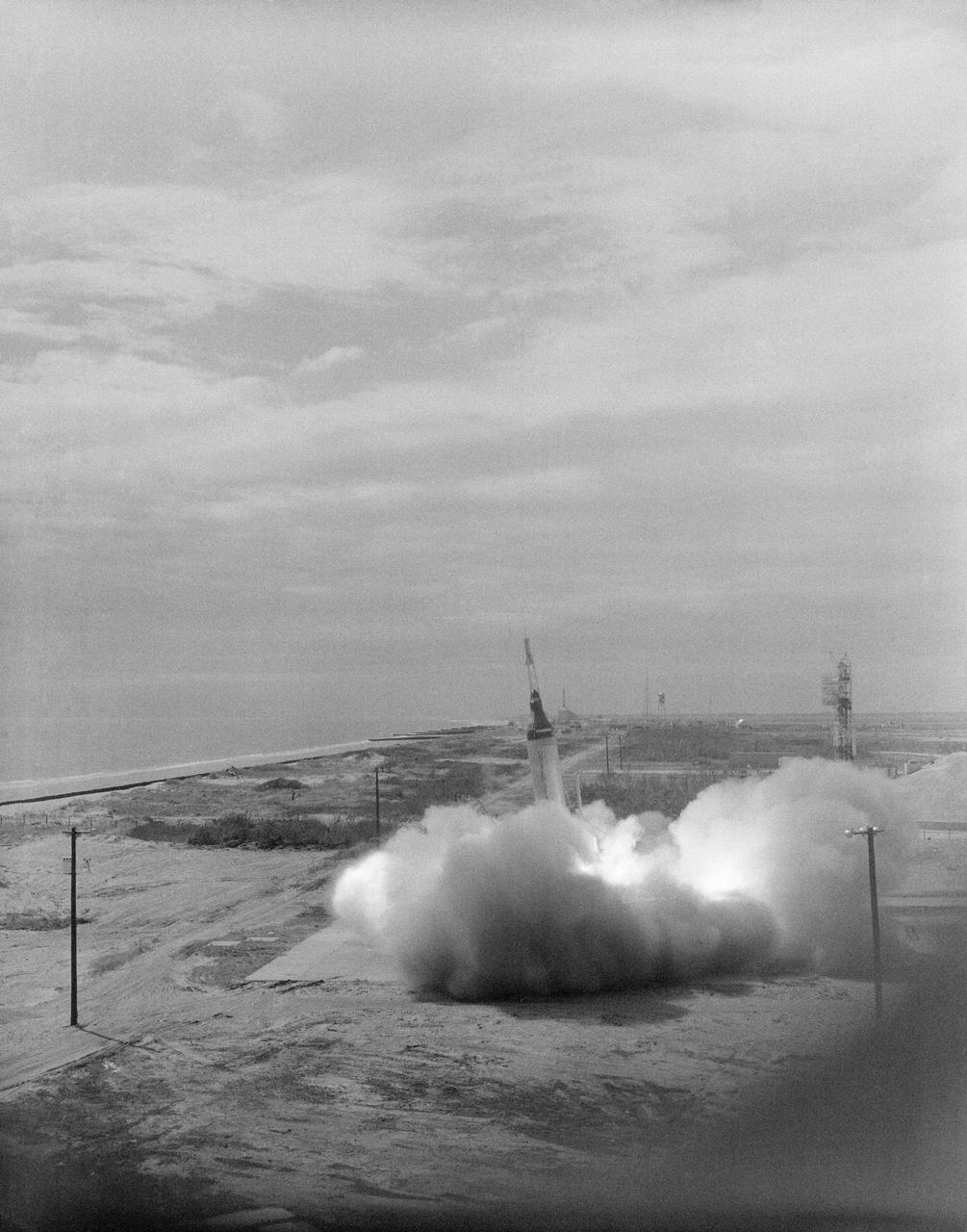
S61-01372 (21 Feb. 1961) --- Launch of the unmanned Mercury-Atlas 2 (MA-2) vehicle for a suborbital test flight of the Mercury capsule. The upper part of Atlas is stengthened by an eight-inch wide stainless steel band. The capsule was recovered less than one hour after launch. The altitude was 108 miles. Speed was 13,000 mph. Recovered 1,425 miles downrange. Photo credit: NASA
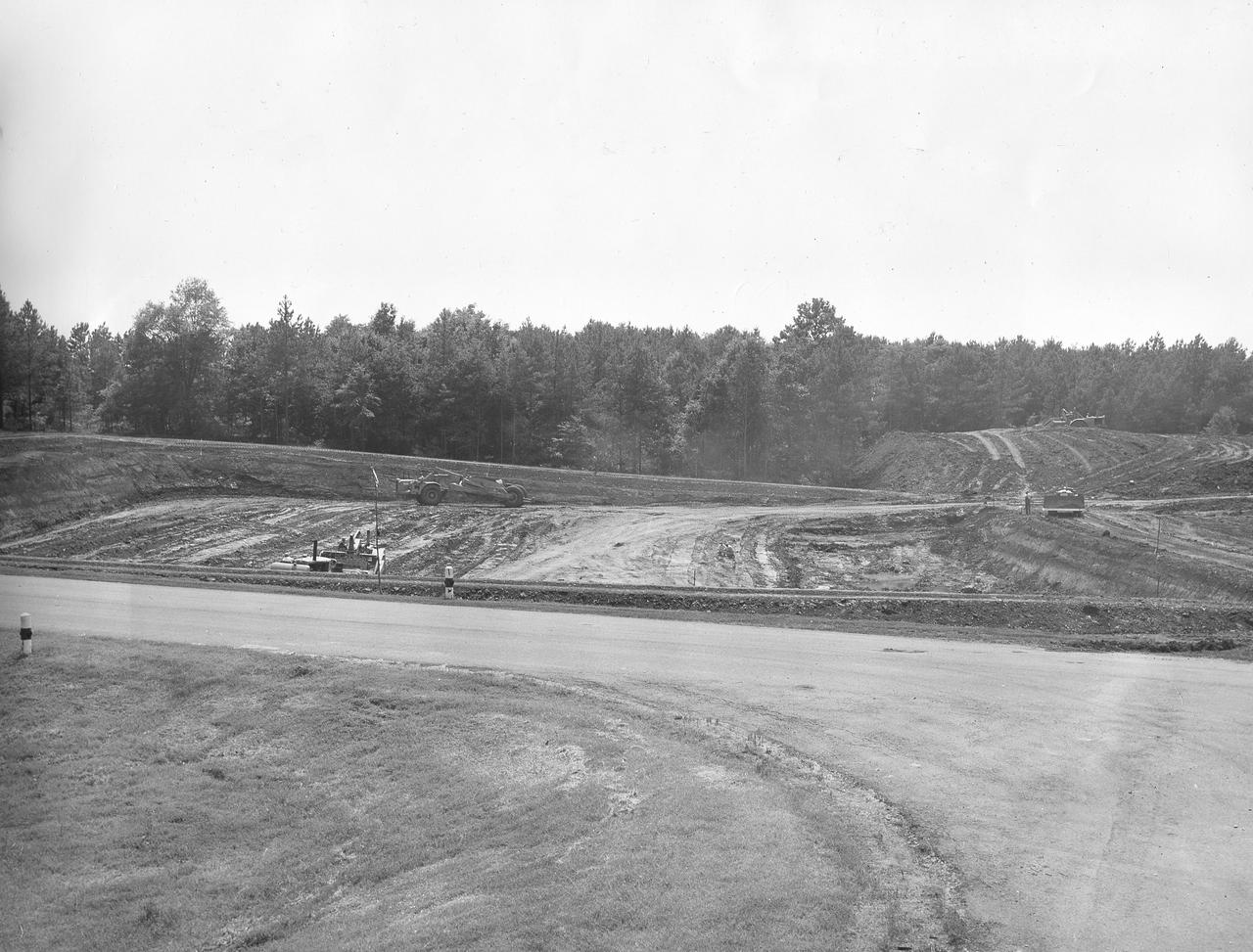
At its founding, the Marshall Space Flight Center (MSFC) inherited the Army’s Jupiter and Redstone test stands, but much larger facilities were needed for the giant stages of the Saturn V. From 1960 to 1964, the existing stands were remodeled and a sizable new test area was developed. The new comprehensive test complex for propulsion and structural dynamics was unique within the nation and the free world, and they remain so today because they were constructed with foresight to meet the future as well as on going needs. Construction of the S-IC Static test stand complex began in 1961 in the west test area of MSFC, and was completed in 1964. The S-IC static test stand was designed to develop and test the 138-ft long and 33-ft diameter Saturn V S-IC first stage, or booster stage, weighing in at 280,000 pounds. Required to hold down the brute force of a 7,500,000-pound thrust produced by 5 F-1 engines, the S-IC static test stand was designed and constructed with the strength of hundreds of tons of steel and 12,000,000 pounds of cement, planted down to bedrock 40 feet below ground level. The foundation walls, constructed with concrete and steel, are 4 feet thick. The base structure consists of four towers with 40-foot-thick walls extending upward 144 feet above ground level. The structure was topped by a crane with a 135-foot boom. With the boom in the upright position, the stand was given an overall height of 405 feet, placing it among the highest structures in Alabama at the time. In this photo, taken July 10, 1961, actual ground breaking has occurred for the S-IC test stand site.
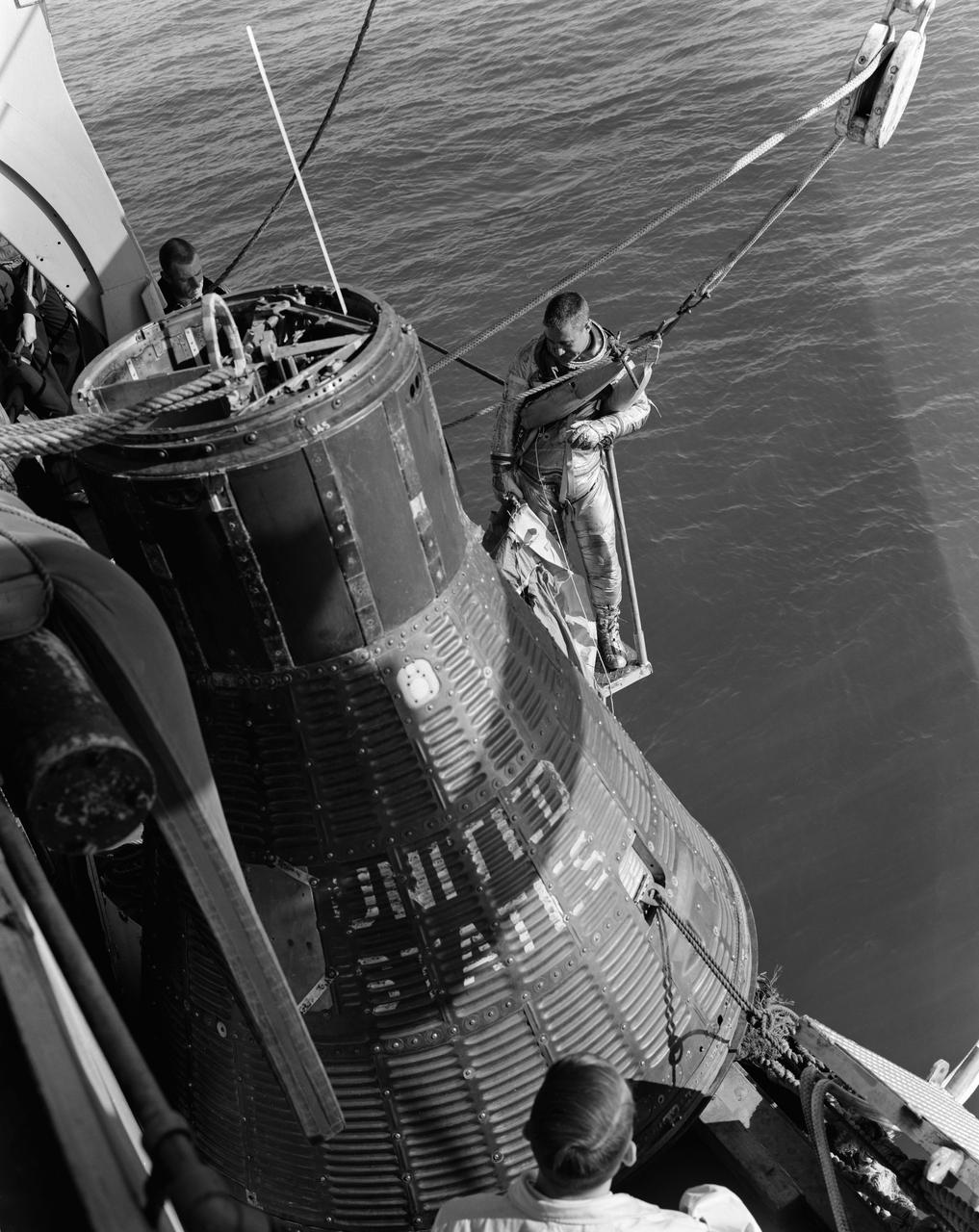
S61-03885 (26 April 1961) --- Astronaut Virgil I. (Gus) Grissom, wearing the new Mercury spacesuit, stands outside of a mock-up of the Mercury capsule on the deck of a ship taking him to emergency water egress training activities. Photo credit: NASA
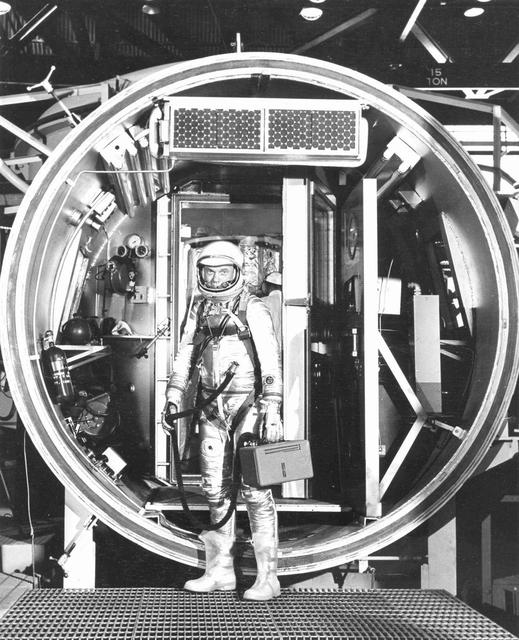
View of O&C Building Altitude Chambers
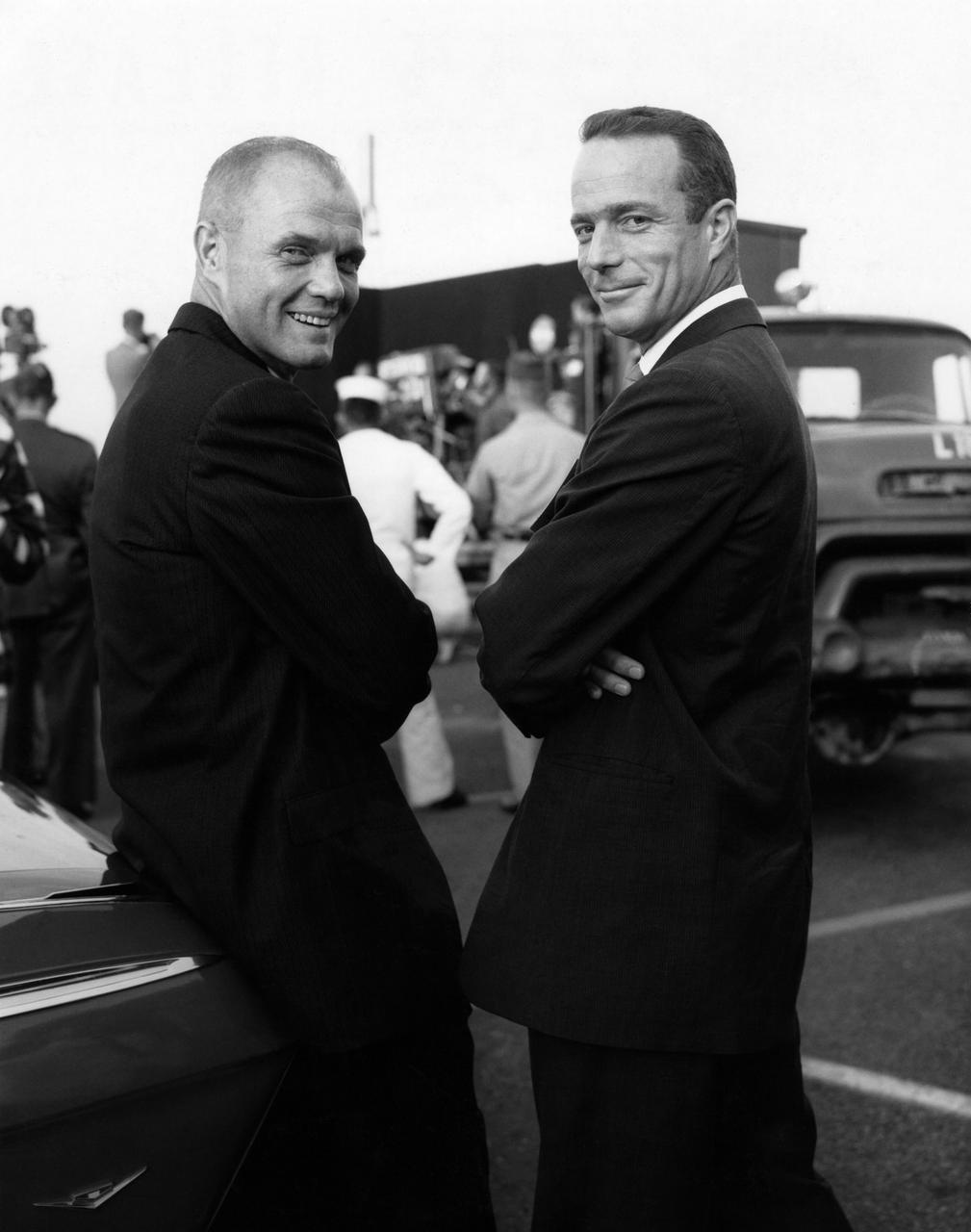
CAPE CANAVERAL, Fla. -- John Glenn and Scott Carpenter, designated the prime pilot and backup respectively for the first U.S. manned orbital spaceflight. Photo credit: NASA
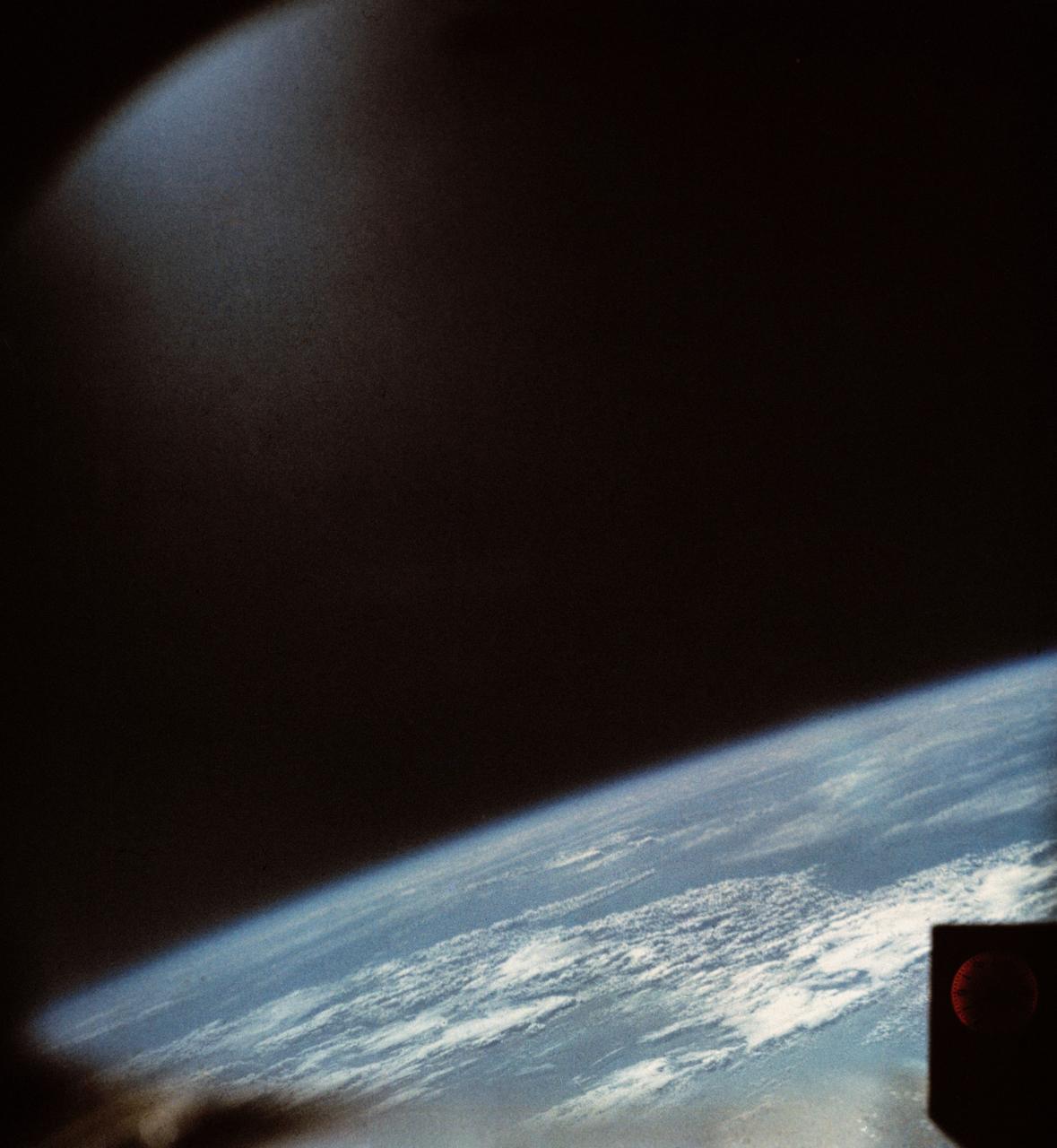
S61-04692 (31 Jan. 1961) --- Earth view from the Mercury Redstone 2 (MR-2) spacecraft. Photo credit: NASA
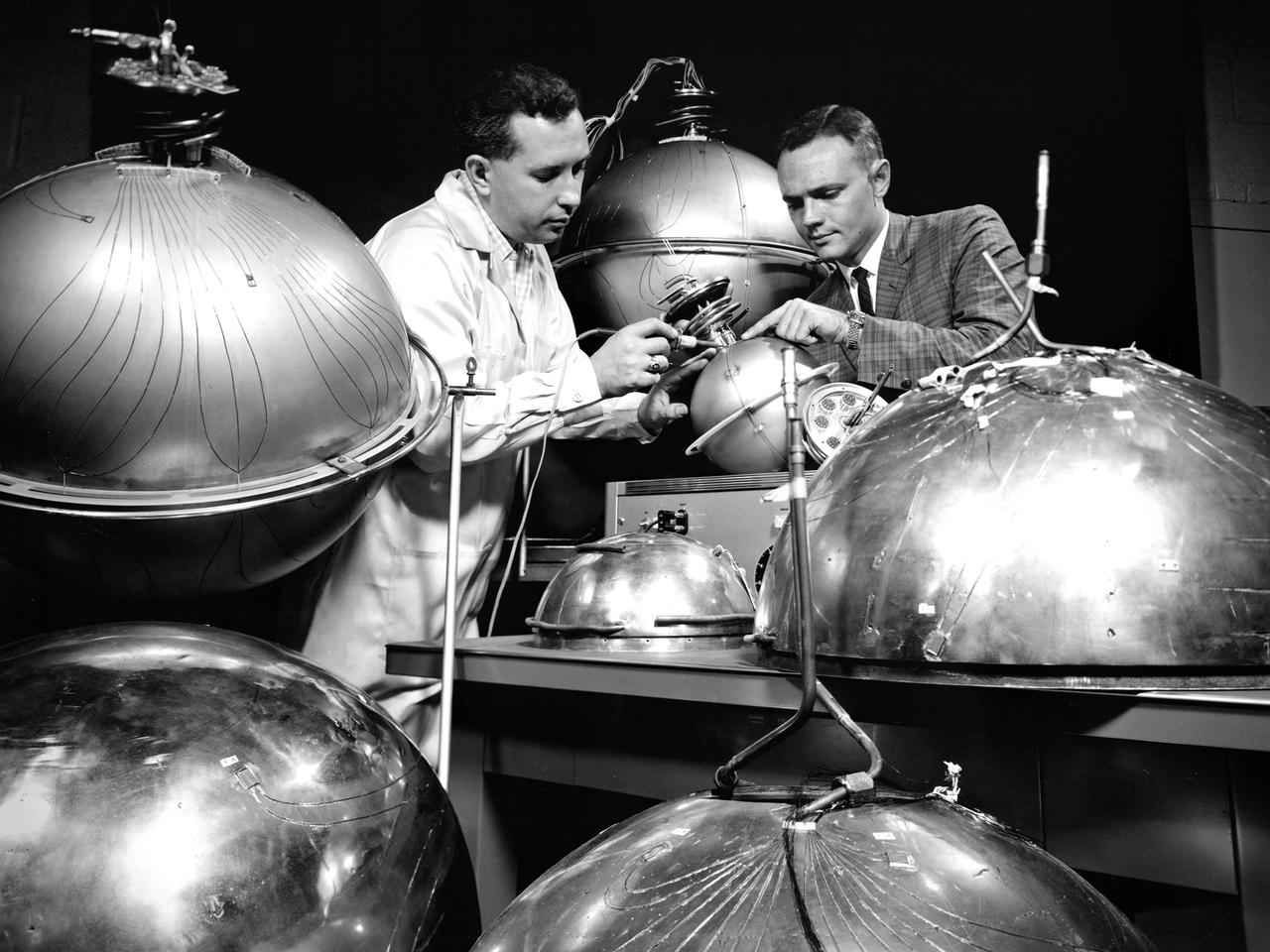
An engineer and technician at the National Aeronautics and Space Administration (NASA) Lewis Research Center install the instrumentation on spherical fuel tanks for an investigation of the behavior of liquids in microgravity. Lewis researchers were undertaking a broad effort to study the heat transfer properties of high energy propellants such as liquid hydrogen in microgravity. In the center’s 2.2-Second Drop Tower they investigated the wetting characteristics of liquid and the liquid-vapor configurations, and predicted the equilibrium state in microgravity conditions. Lewis was also conducting a series microgravity investigations which launched 9-inch diameter spherical dewars, seen here, on an Aerobee sounding rocket. A camera inside the rocket filmed the liquid hydrogen’s behavior during its 4 to 7 minutes of freefall. The researchers concluded, however, that they needed to extend the weightlessness period to obtain better results. So they designed an experiment to be launched on an Atlas missile that would provide 21 minutes of weightlessness. The experiment was flight qualified at Lewis. The 36-percent full liquid hydrogen stainless steel dewar was launched on the Atlas on February 25, 1964. The instrumentation measured temperature, pressure, vacuum, and liquid level. Temperature instrumentation indicated wall drying during the freefall. The resultant pressure-rise characteristics were similar to those used for the normal-gravity test.
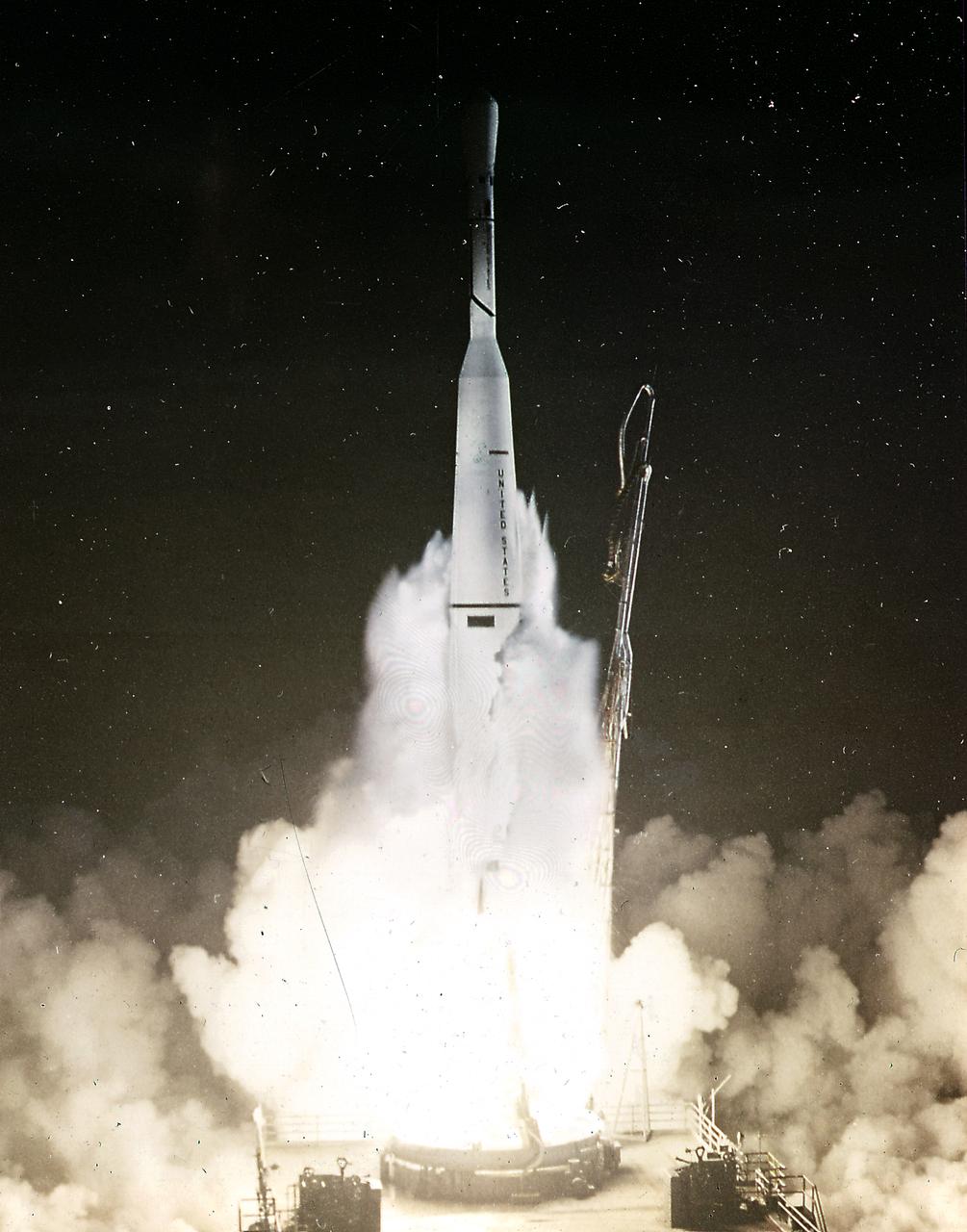
The Thor-Delta-5 launched an Earth observation satellite, TIROS III (Television Infrared Observation Satellite), on July 12, 1961.
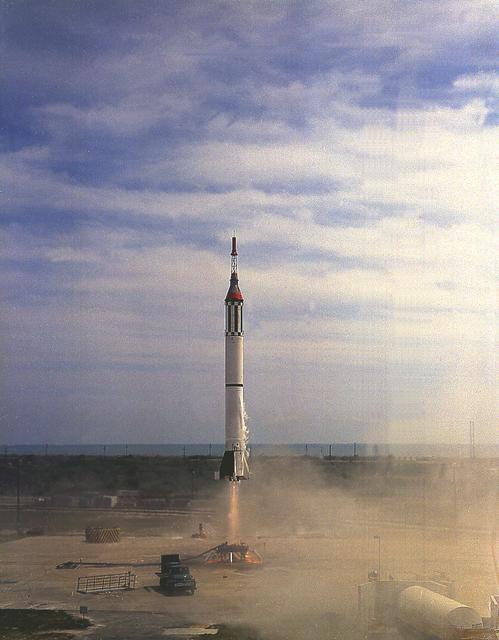
The Mercury-Redstone Booster Development vehicle (MR-BD) lifts off from Cape Canaveral March 24, 1961. This test flight evaluated changes incorporated in the booster designed to reduce vehicle oscillations and vibrations. The Mercury-Redstone launch vehicle was developed by Dr. Wernher von Braun and the rocket team in Huntsville, Alabama.
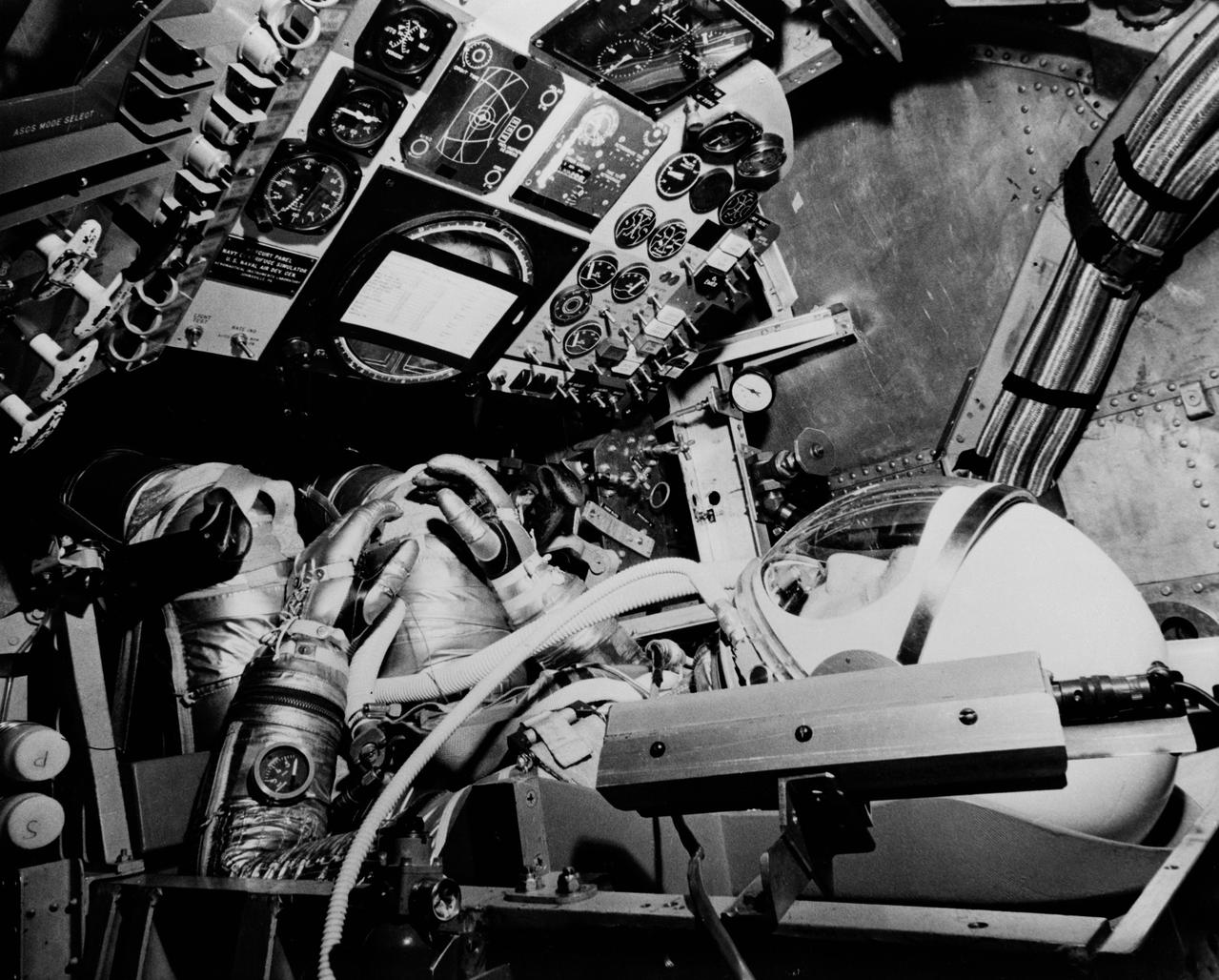
S61-03506 (1961) --- Project Mercury astronaut M. Scott Carpenter, prime pilot for the United States second manned orbital flight, undergoes a simulated mission in the procedures trainer at Langley Air Force Base, Virginia, headquarters for the National Aeronautics and Space Administration?s Manned Spacecraft Center. Photo credit: NASA
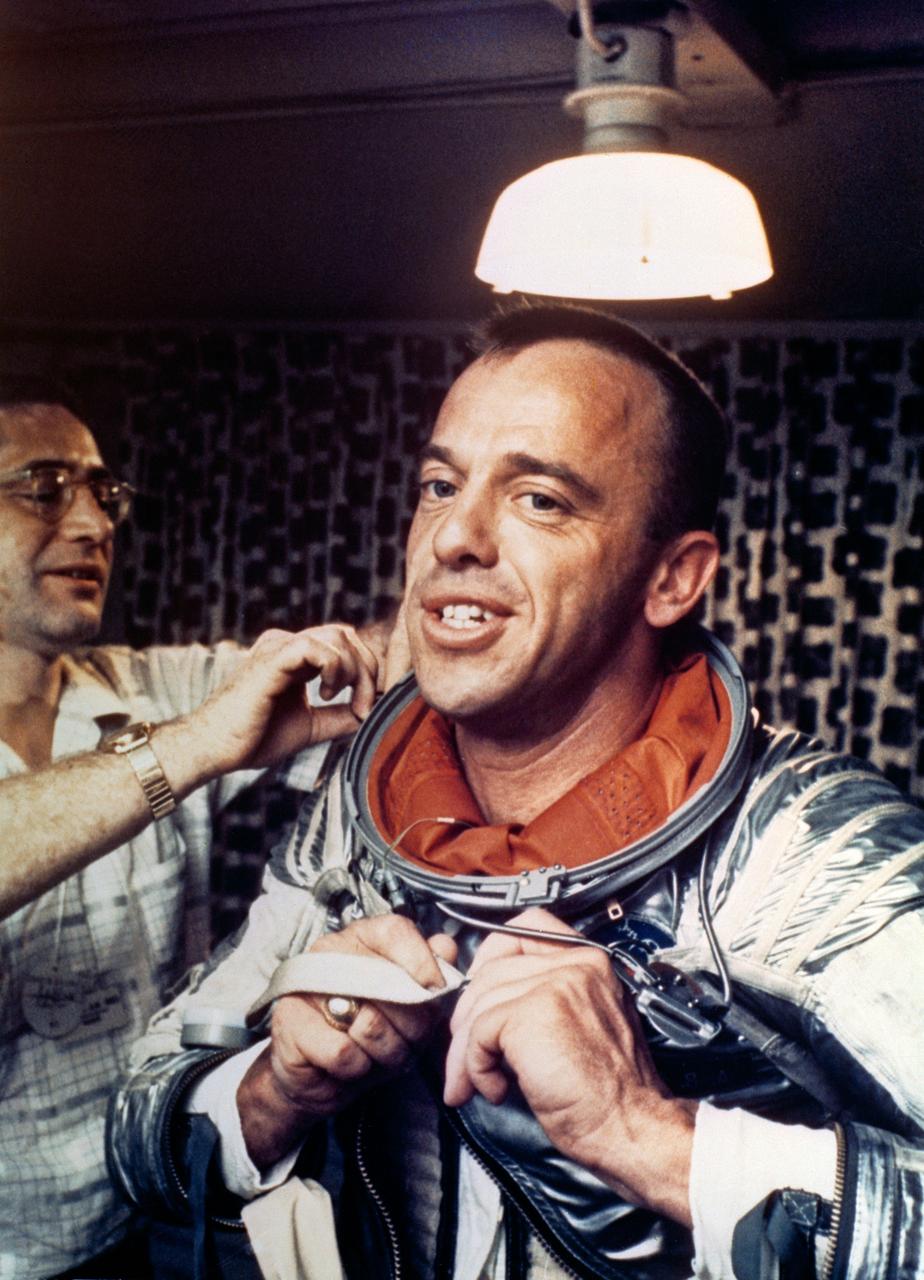
S88-31382 (5 May 1961) --- Astronaut Alan B. Shepard receives assistance in removing his spacesuit while on the U.S. Champlain after the recovery of his Mercury capsule. Photo credit: NASA or National Aeronautics and Space Administration
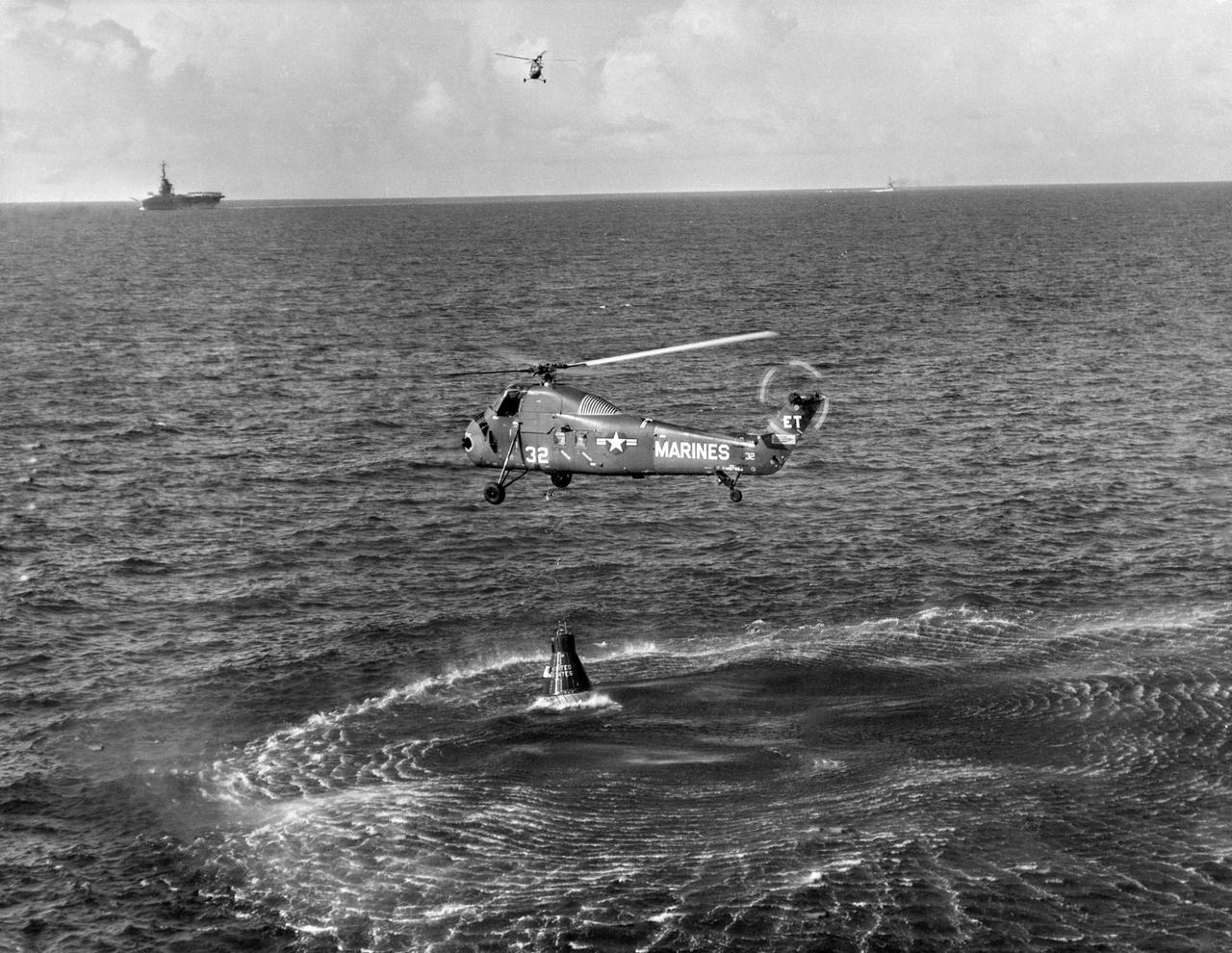
S61-02821 (21 July 1961) --- Attempted recovery of Mercury spacecraft at end of the Mercury-Redstone 4 (MR-4) mission. View shows the Marine helicopter dropping a recovery line to the capsule. In the upper left corner of the view, the recovery ship and another helicopter can be seen. Photo credit: NASA
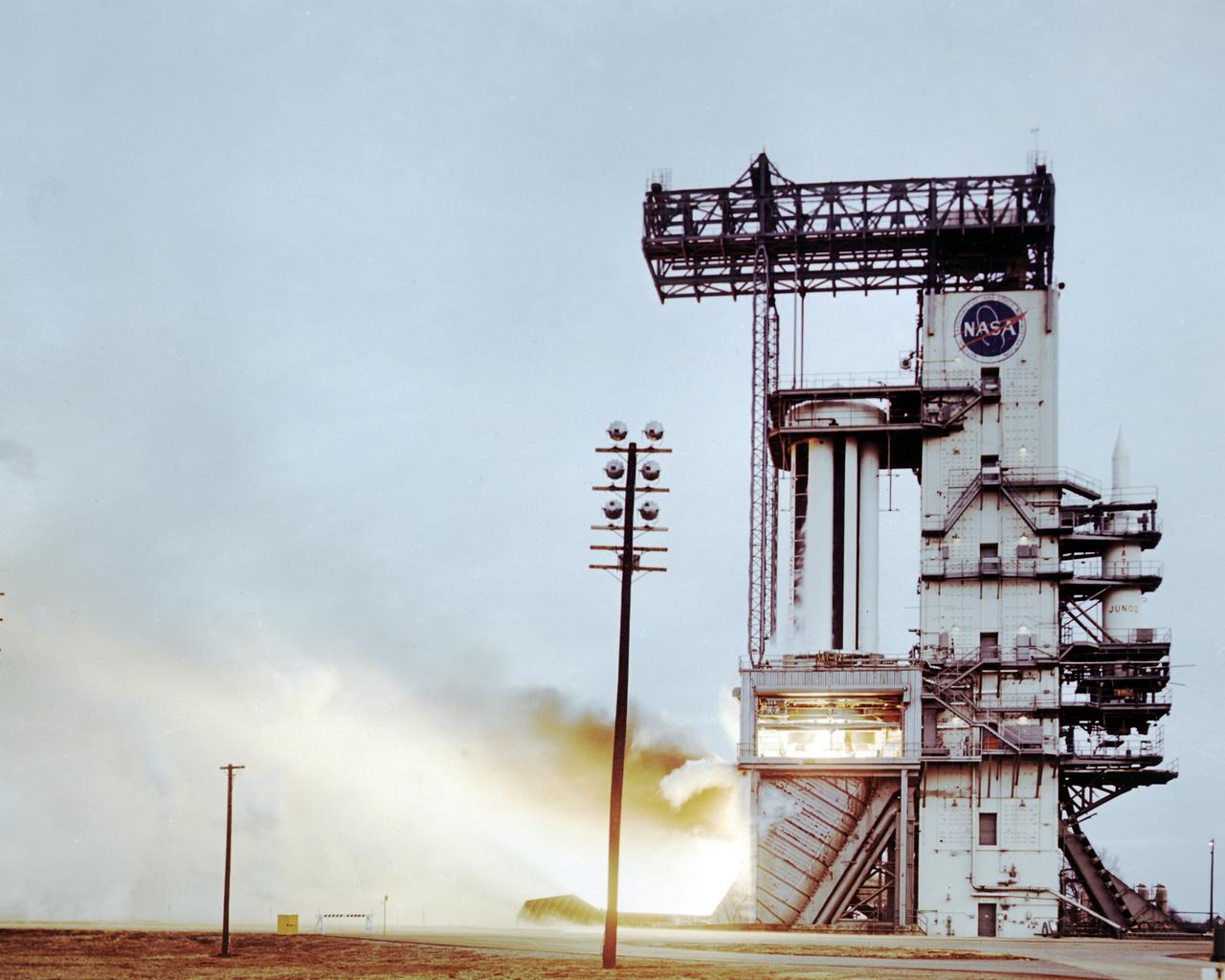
The Saturn project was approved on January 18, 1960 as a program of the highest national priority. The formal test program to prove out the clustered-booster concept was well underway. A series of static tests of the Saturn I booster (S-I stage) began June 3, 1960 at the Marshall Space Flight Center (MSFC). This photograph depicts the Saturn I S-I stage equipped with eight H-1 engines, being successfully test-fired on February 4, 1961. A Juno rocket is visible on the right side of the test stand.
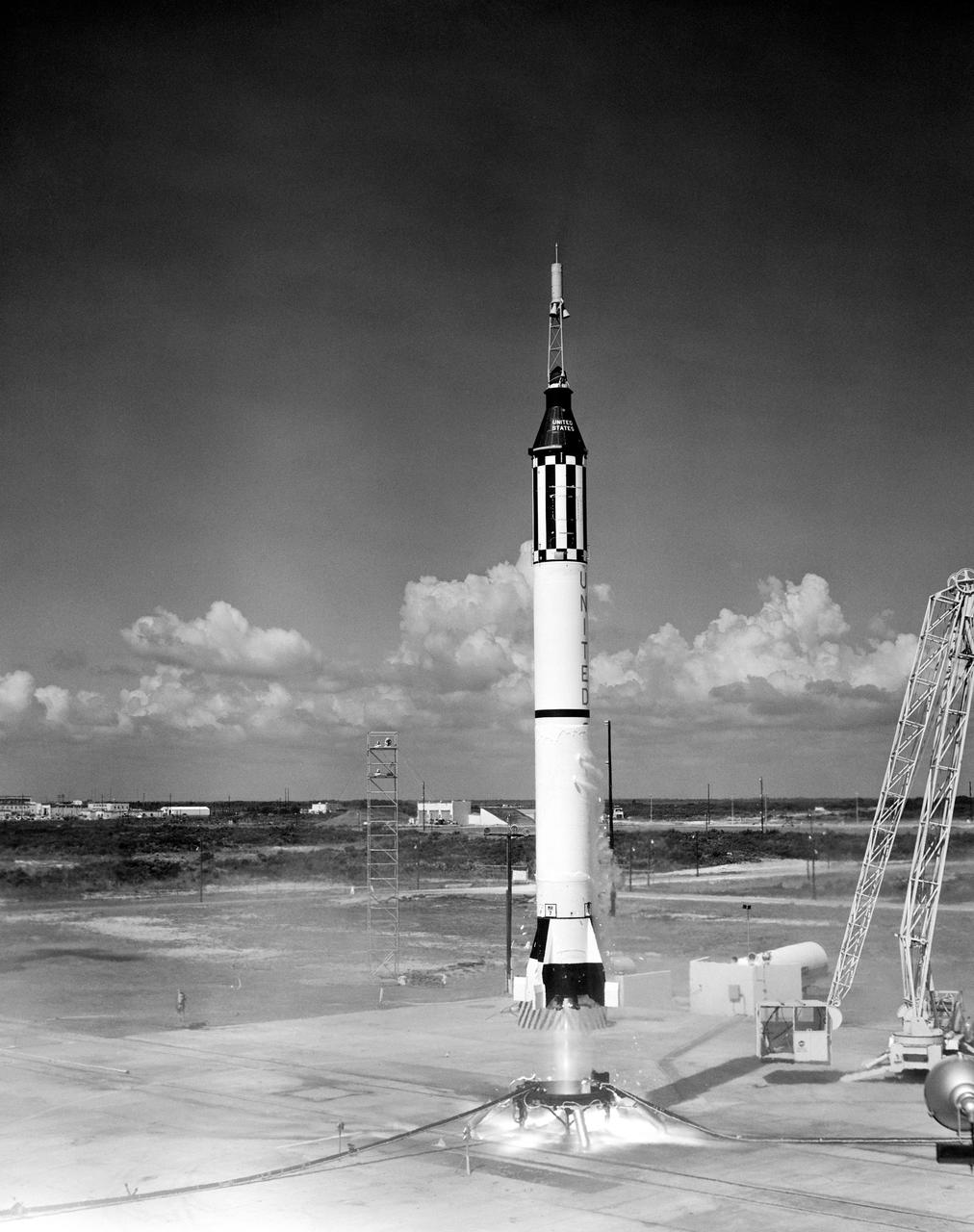
S61-02408 (5 May 1961) --- Launching of the Mercury-Redstone 3 (MR-3) rocket from Cape Canaveral on astronaut Alan B. Shepard?s suborbital mission. Photo credit: NASA or National Aeronautics and Space Administration
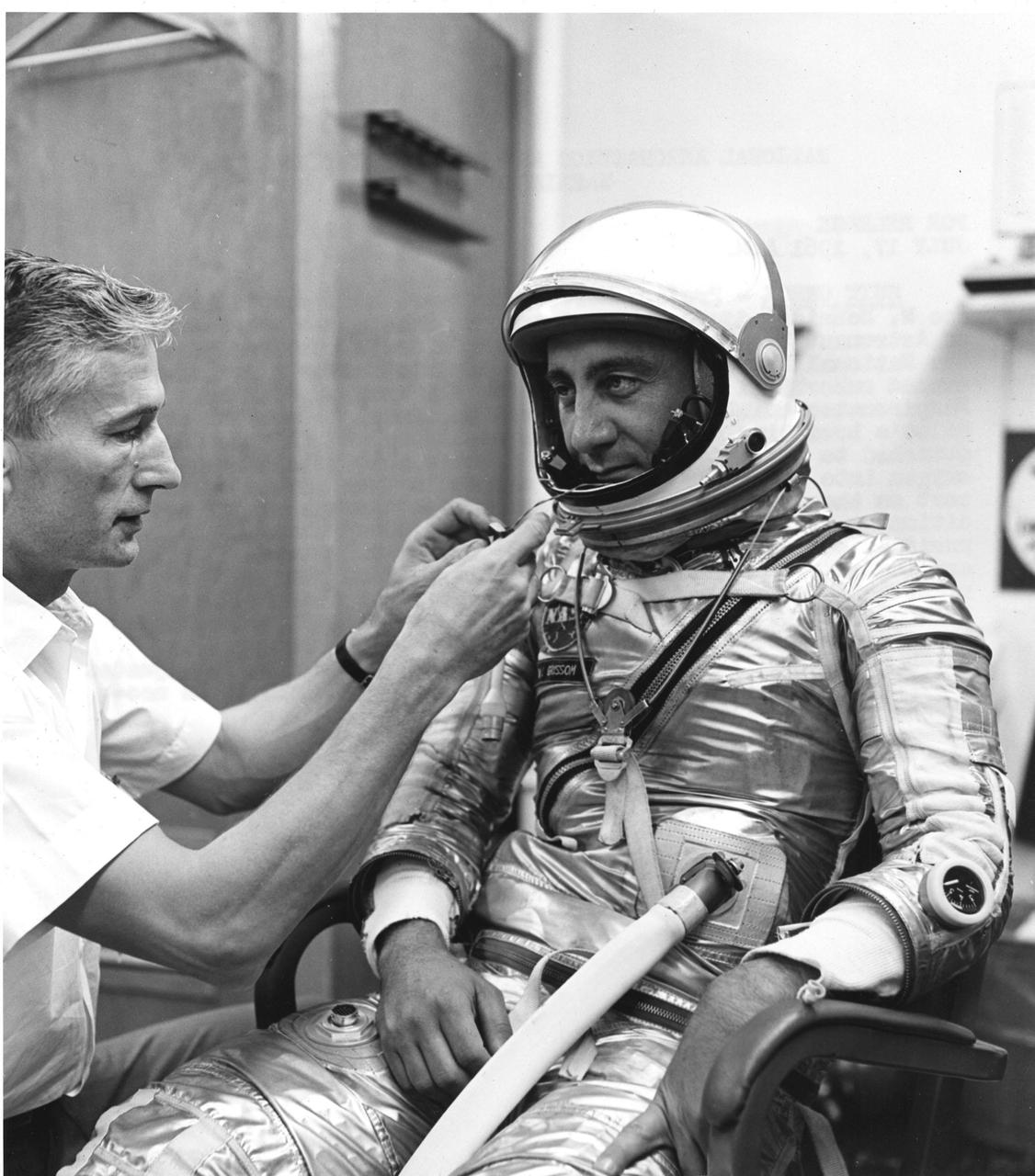
KENNEDY SPACE CENTER, FLA. -- SUIT CHECK - Project Mercury pressure suit specialist Joe. W. Schidt adjusts a respirometer attached to the helmet of astronaut Virgil I. Grissom during a dress rehearsal for the National Aeronautics and Space Administration's second manned suborbital flight, dubbed Liberty Bell 7, planned for the week of July 16. Respirometer enables ground medical personnel to monitor the pilot's breathing rate during the countdown and flight. Hose attached to the left side of the pilot's suit brings breathing oxygen into the suit. Expelled oxygen is then vented out a port on the side of the helmet and passed through an air conditioning system beneath the astronaut's couch where it is purified before being recycled into the suit. Gauge on left arm indicates pressure within the suit. Canon plug on the right thigh brings medical information out of the suit for telemetering to ground stations. Suit is not inflated during the mission unless there is a failure in cabin pressure, in which event the 'V' shaped cable around the neck ring is adjusted prior to flight to prevent helmet from rising should it be necessary to pressurize the suit
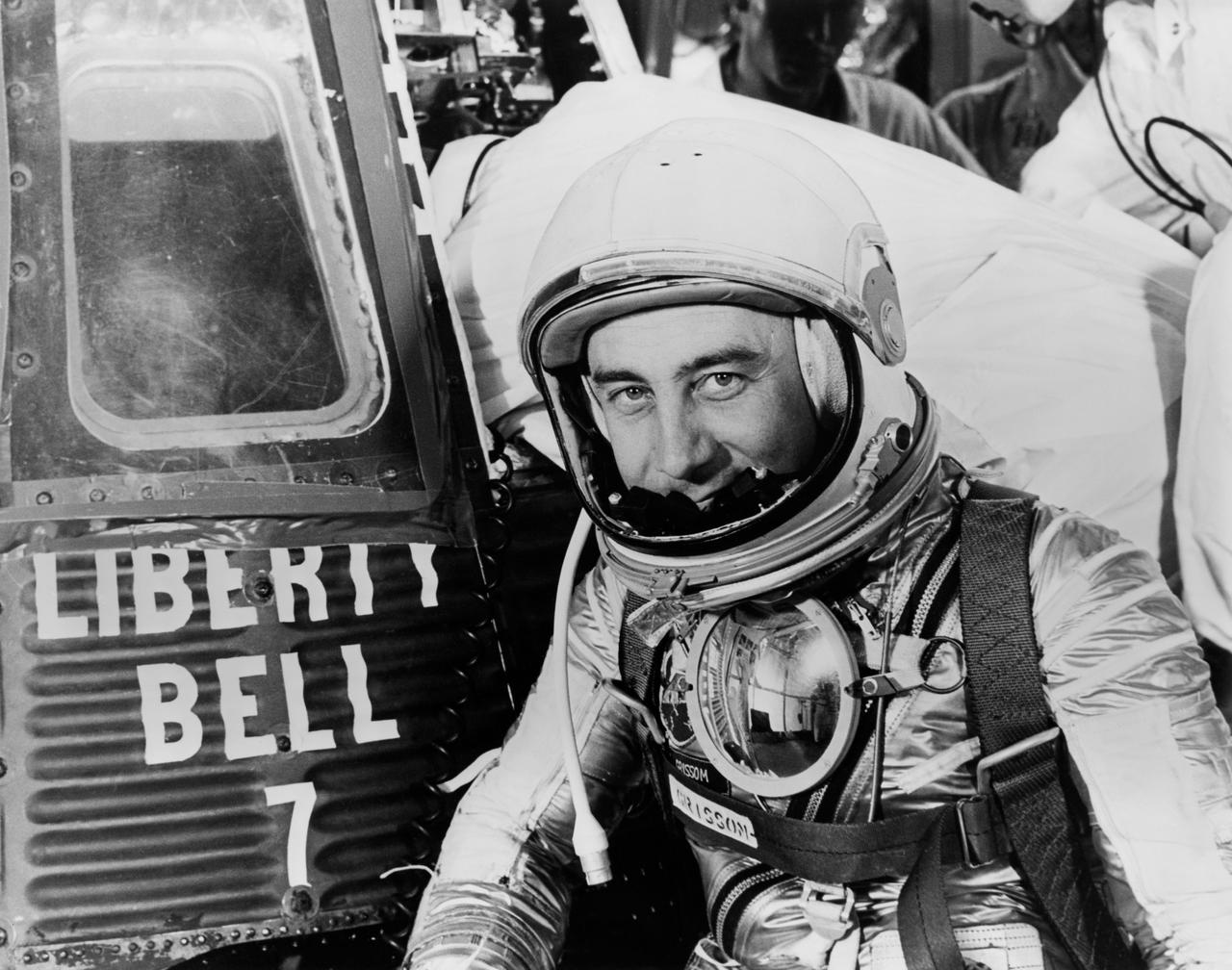
S61-03698 (1961) --- Astronaut Virgil I. (Gus) Grissom, suited up and ready to climb into Liberty Bell 7 spacecraft, sits in front of his capsule for a picture. Behind him technicians work inside the capsule. The Mercury-Redstone 4 (MR-4) mission was scrubbed a few hours later due to unfavorable weather over the launch pad. Photo credit: NASA
![KENNEDY SPACE CENTER, FLA. -- Astronaut Virgil I. Grissom prepares to enter the Liberty Bell 7 spacecraft prior to his successful 5,310 mph space ride. He reached an altitude of 118 statute miles. This was the second man-in-space [flight] for the U.S. in its series of suborbital flights by the National Aeronautics and Space Administration. (NASA Photo)](https://images-assets.nasa.gov/image/61-mr4-76/61-mr4-76~medium.jpg)
KENNEDY SPACE CENTER, FLA. -- Astronaut Virgil I. Grissom prepares to enter the Liberty Bell 7 spacecraft prior to his successful 5,310 mph space ride. He reached an altitude of 118 statute miles. This was the second man-in-space [flight] for the U.S. in its series of suborbital flights by the National Aeronautics and Space Administration. (NASA Photo)
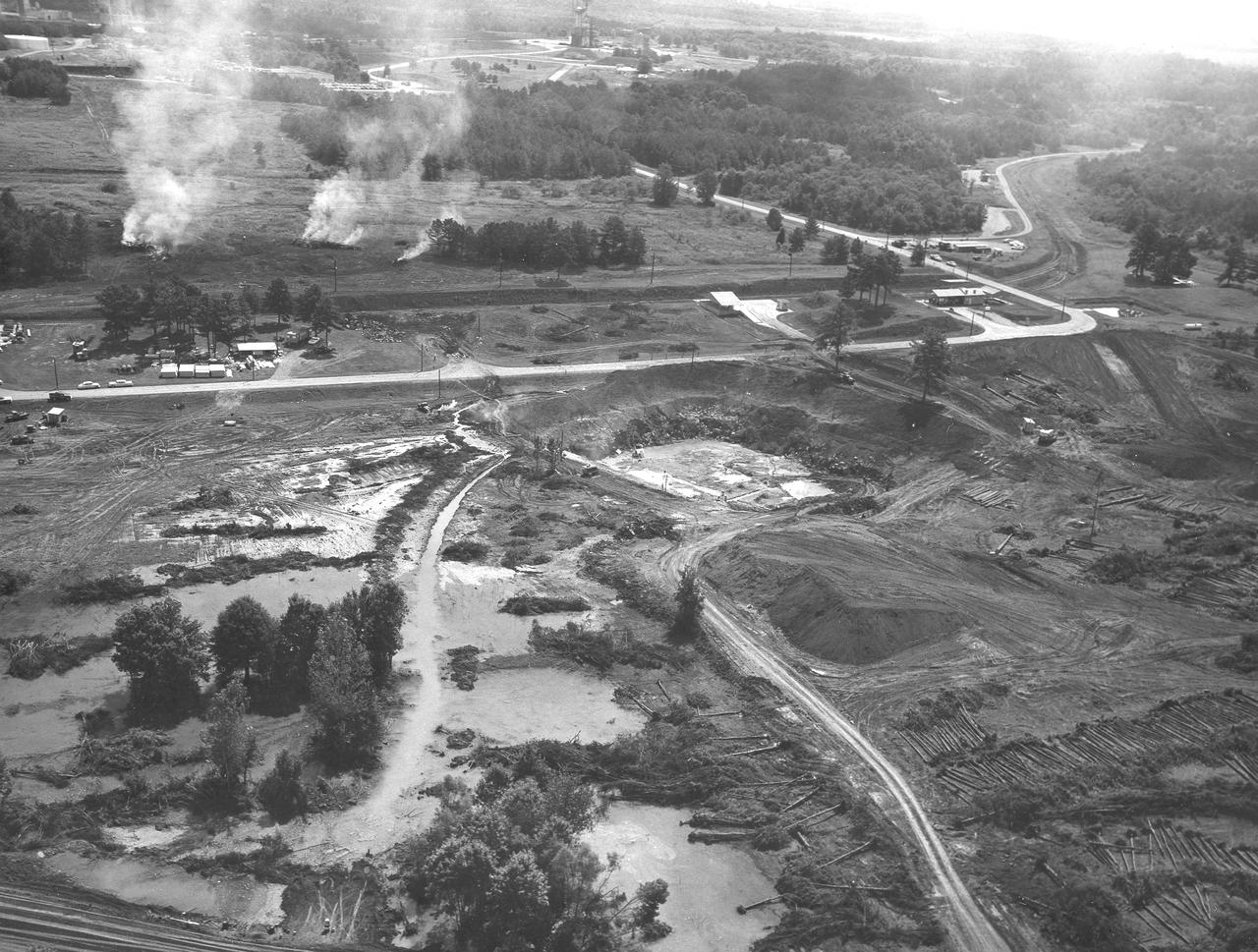
At its founding, the Marshall Space Flight Center (MSFC) inherited the Army’s Jupiter and Redstone test stands, but much larger facilities were needed for the giant stages of the Saturn V. From 1960 to 1964, the existing stands were remodeled and a sizable new test area was developed. The new comprehensive test complex for propulsion and structural dynamics was unique within the nation and the free world, and they remain so today because they were constructed with foresight to meet the future as well as on going needs. Construction of the S-IC Static test stand complex began in 1961 in the west test area of MSFC, and was completed in 1964. The S-IC static test stand was designed to develop and test the 138-ft long and 33-ft diameter Saturn V S-IC first stage, or booster stage, weighing in at 280,000 pounds. Required to hold down the brute force of a 7,500,000-pound thrust produced by 5 F-1 engines, the S-IC static test stand was designed and constructed with the strength of hundreds of tons of steel and 12,000,000 pounds of cement, planted down to bedrock 40 feet below ground level. The foundation walls, constructed with concrete and steel, are 4 feet thick. The base structure consists of four towers with 40-foot-thick walls extending upward 144 feet above ground level. The structure was topped by a crane with a 135-foot boom. With the boom in the upright position, the stand was given an overall height of 405 feet, placing it among the highest structures in Alabama at the time. This aerial shot gives a birds eye view of the test stand construction site in its entirety as of August 25, 1961.
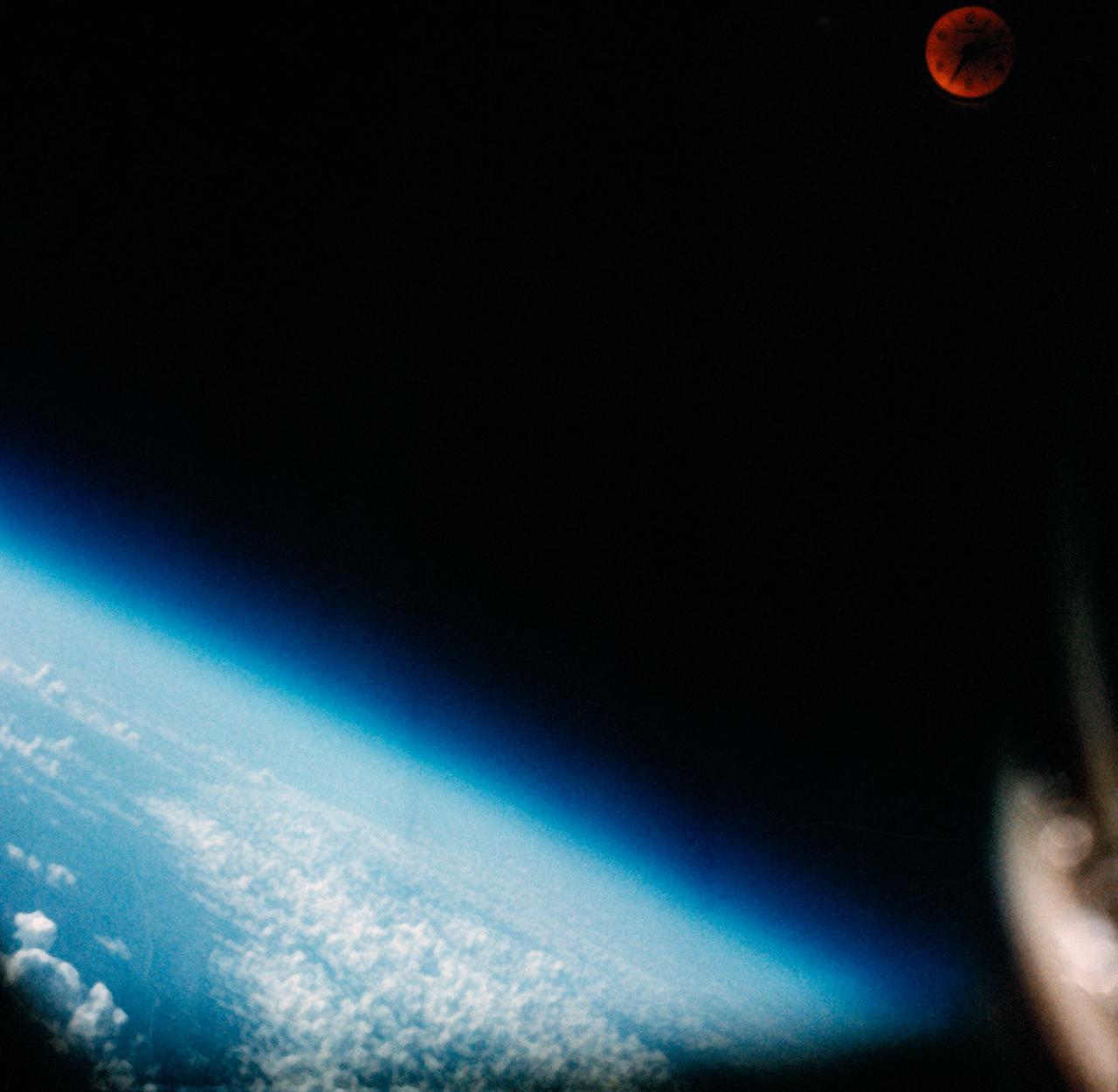
S61-01914 (5 May 1961) --- Mercury-Redstone 3 (MR-3) spaceflight Earth observations of a cloudy Earth surface. There is a gleam from the light reflected off the capsule window in the lower right side of the frame. Photo credit: NASA or National Aeronautics and Space Administration
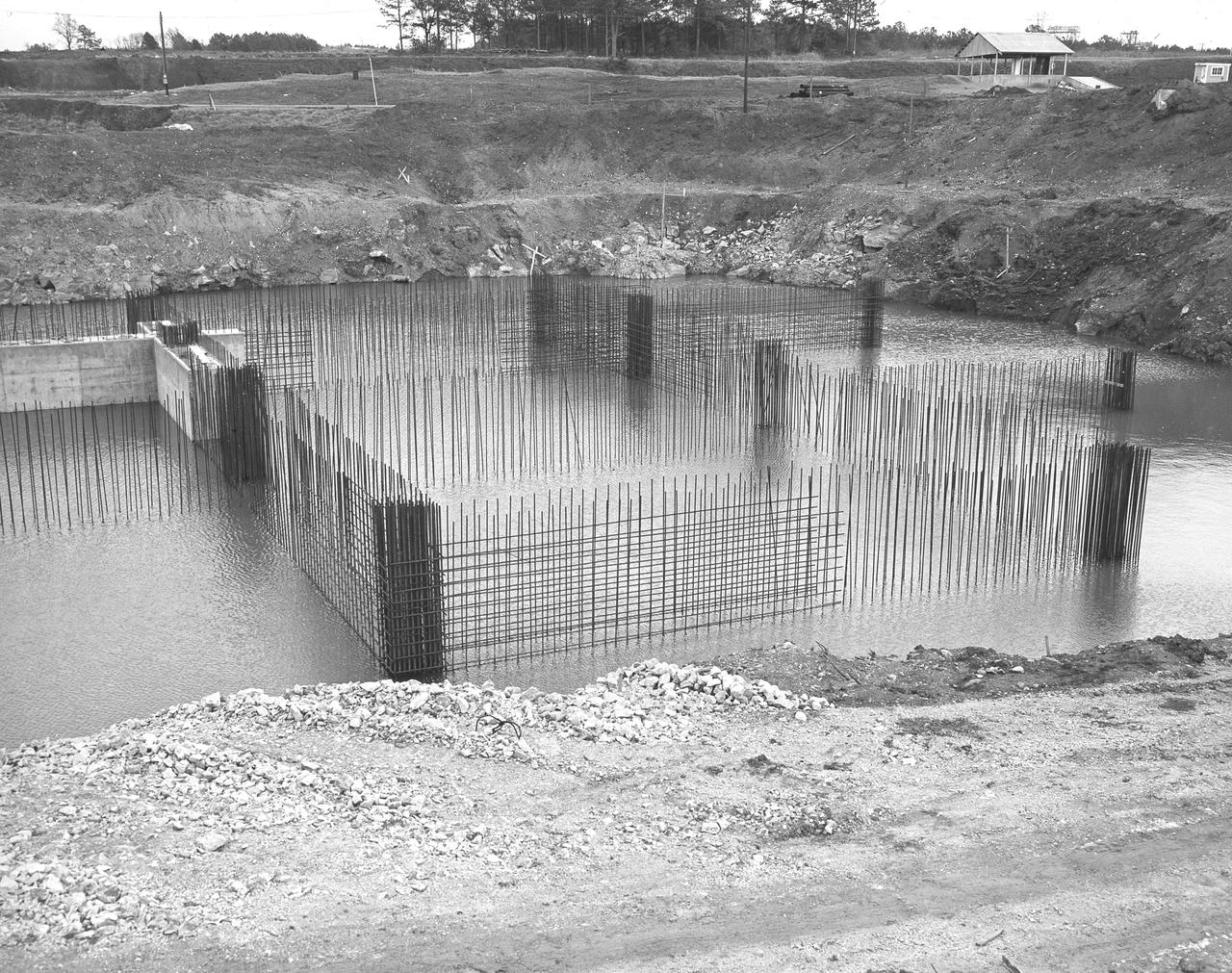
At its founding, the Marshall Space Flight Center (MSFC) inherited the Army’s Jupiter and Redstone test stands, but much larger facilities were needed for the giant stages of the Saturn V. From 1960 to 1964, the existing stands were remodeled and a sizable new test area was developed. The new comprehensive test complex for propulsion and structural dynamics was unique within the nation and the free world, and they remain so today because they were constructed with foresight to meet the future as well as on going needs. Construction of the S-IC Static test stand complex began in 1961 in the west test area of MSFC, and was completed in 1964. The S-IC static test stand was designed to develop and test the 138-ft long and 33-ft diameter Saturn V S-IC first stage, or booster stage, weighing in at 280,000 pounds. Required to hold down the brute force of a 7,500,000-pound thrust produced by 5 F-1 engines, the S-IC static test stand was designed and constructed with the strength of hundreds of tons of steel and 12,000,000 pounds of cement, planted down to bedrock 40 feet below ground level. The foundation walls, constructed with concrete and steel, are 4 feet thick. The base structure consists of four towers with 40-foot-thick walls extending upward 144 feet above ground level. The structure was topped by a crane with a 135-foot boom. With the boom in the upright position, the stand was given an overall height of 405 feet, placing it among the highest structures in Alabama at the time. Construction of the S-IC test stand came to a halt at the end of September as the determination was made that the Saturn booster size had to be increased. As a result, the stand had to be modified. With construction delayed, and pumps turned off, this photo, taken December 4, 1961, shows the abandoned site with floods at the 11 ft mark. The flooding was caused by the disturbance of a natural spring months prior during the excavation of the site.
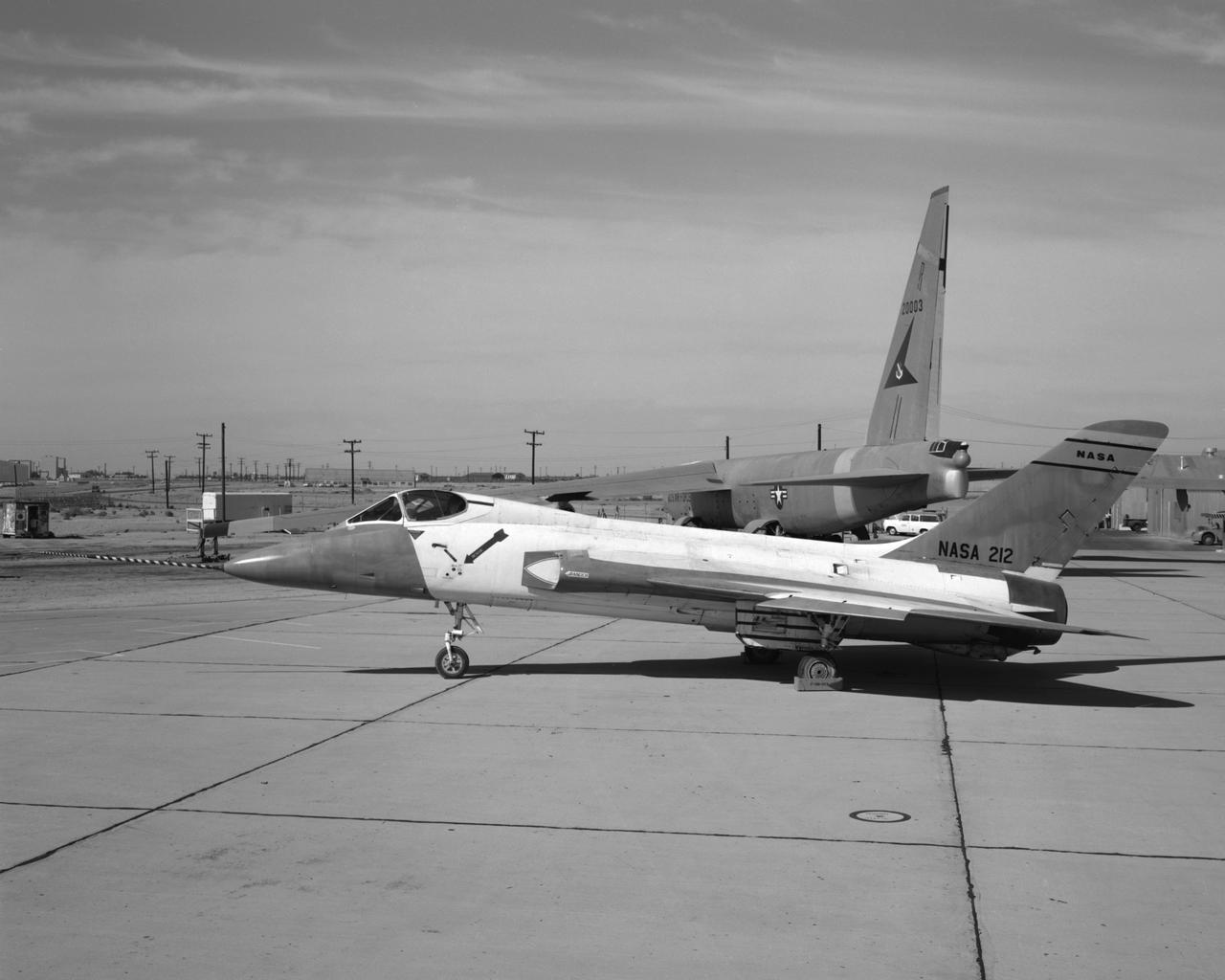
F5D Skylancer NASA 212 modified as the X-20 Dyna-Soar vision field simulator.
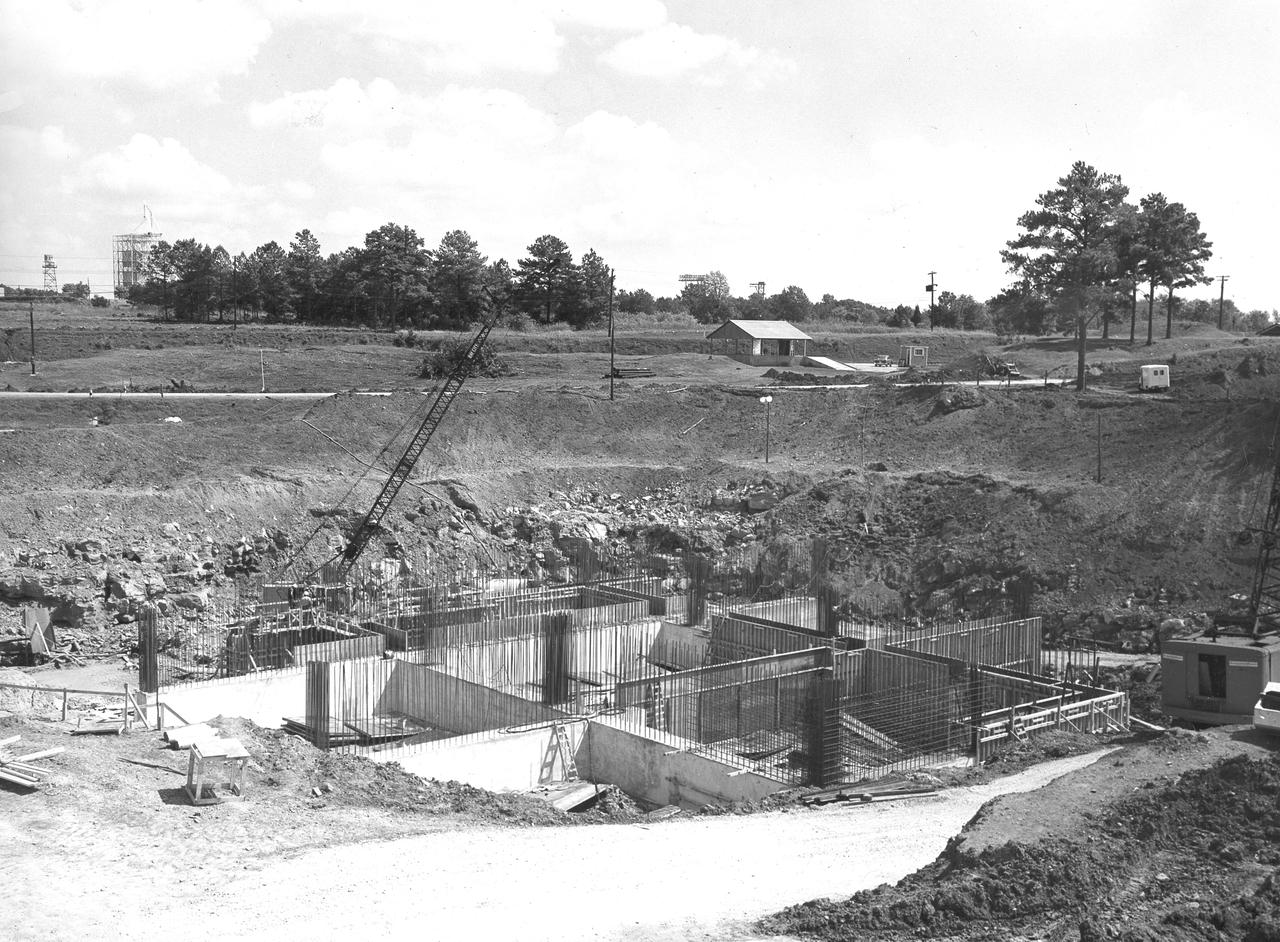
At its founding, the Marshall Space Flight Center (MSFC) inherited the Army’s Jupiter and Redstone test stands, but much larger facilities were needed for the giant stages of the Saturn V. From 1960 to 1964, the existing stands were remodeled and a sizable new test area was developed. The new comprehensive test complex for propulsion and structural dynamics was unique within the nation and the free world, and they remain so today because they were constructed with foresight to meet the future as well as on going needs. Construction of the S-IC Static test stand complex began in 1961 in the west test area of MSFC, and was completed in 1964. The S-IC static test stand was designed to develop and test the 138-ft long and 33-ft diameter Saturn V S-IC first stage, or booster stage, weighing in at 280,000 pounds. Required to hold down the brute force of a 7,500,000-pound thrust produced by 5 F-1 engines, the S-IC static test stand was designed and constructed with the strength of hundreds of tons of steel and 12,000,000 pounds of cement, planted down to bedrock 40 feet below ground level. The foundation walls, constructed with concrete and steel, are 4 feet thick. The base structure consists of four towers with 40-foot-thick walls extending upward 144 feet above ground level. The structure was topped by a crane with a 135-foot boom. With the boom in the upright position, the stand was given an overall height of 405 feet, placing it among the highest structures in Alabama at the time. This photo, taken September 22, 1961, shows the progress of the concrete walls for the stand’s foundation. Some of the walls have been poured and some of the concrete forms have been removed.
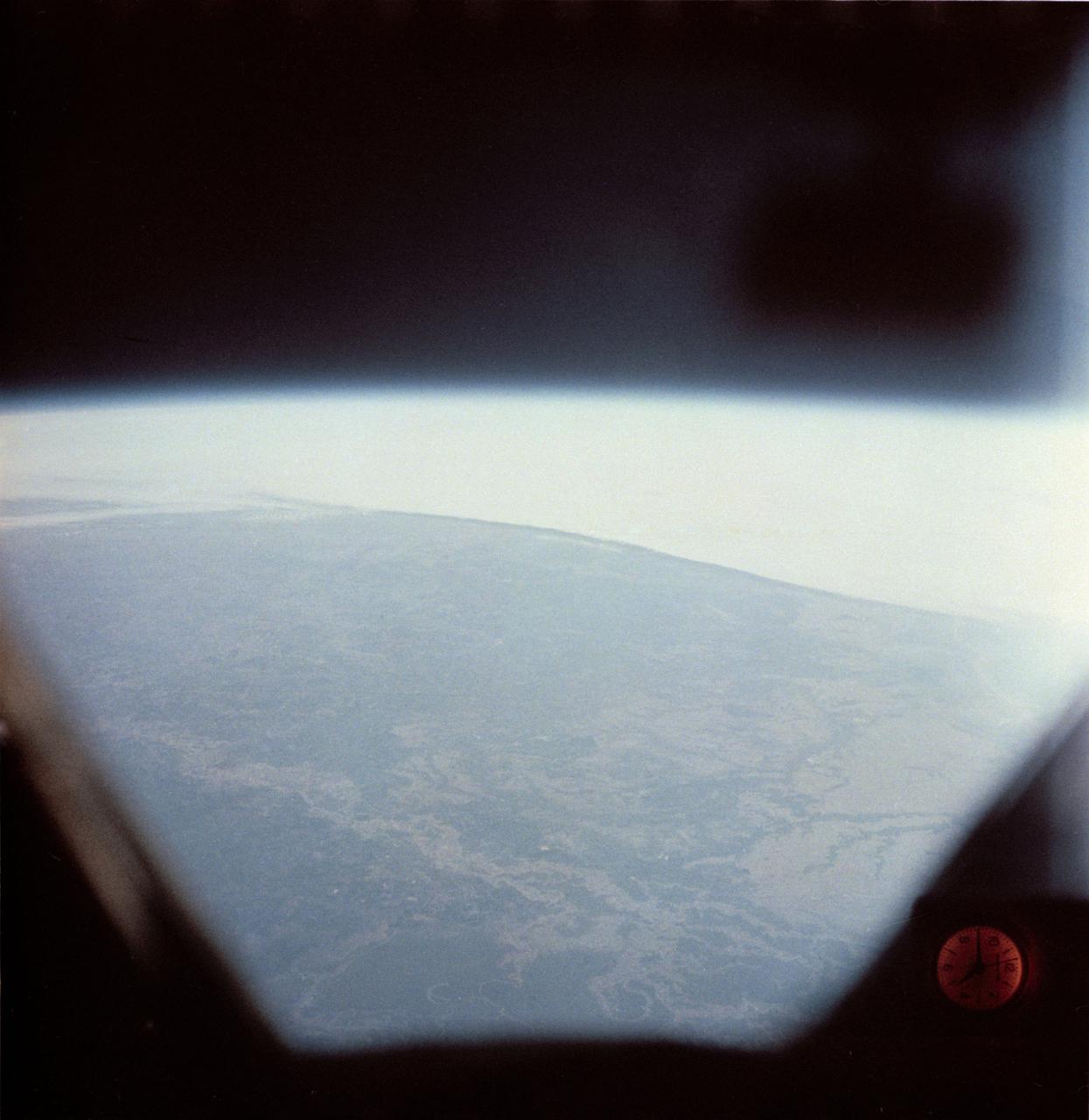
S62-01287 (21 July 1961) --- Earth observation take during the Mercury-Redstone 4 (MR-4) spaceflight. Photo credit: NASA
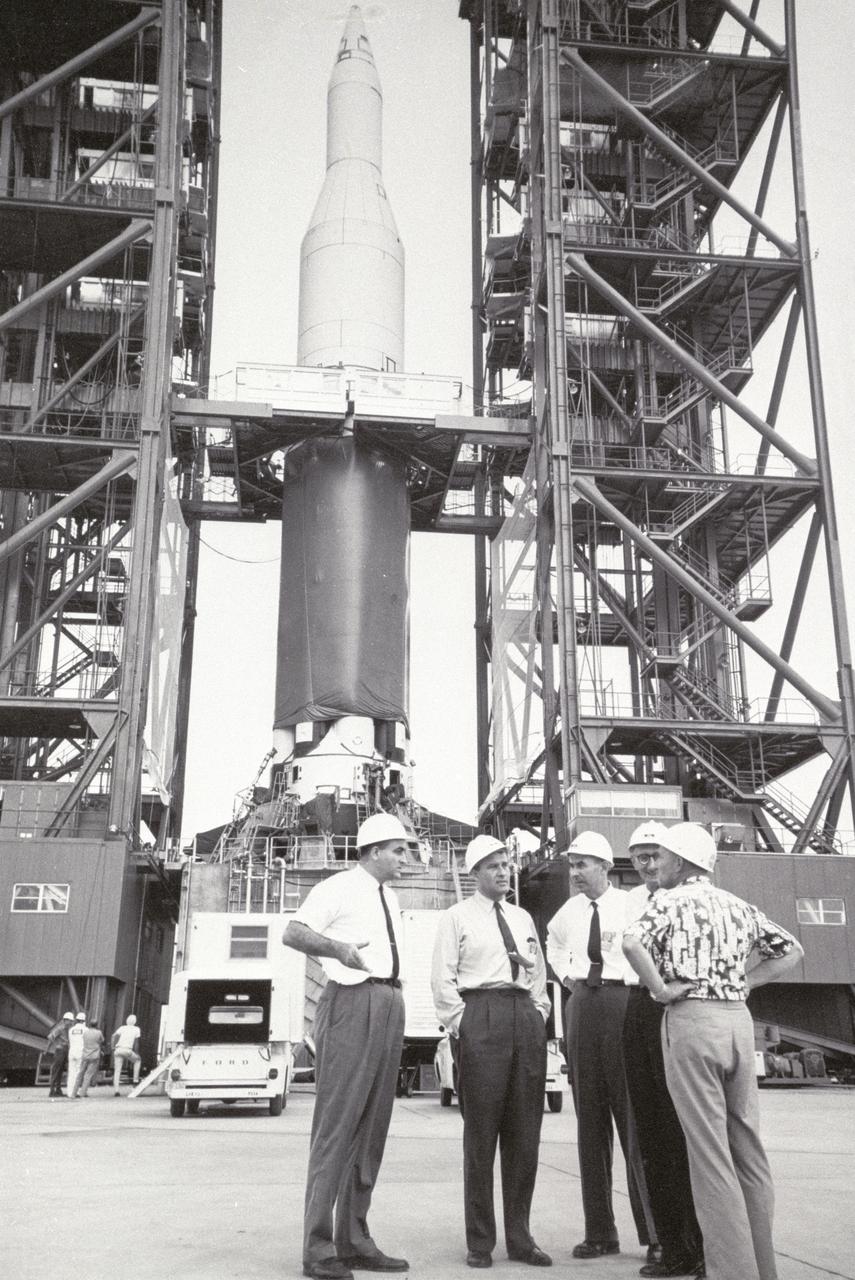
Pictured in front of the Saturn 1 launch vehicle are (L to R): Dr. Rocco Petrone, Director of Launch Operations at Kennedy Space Center; Dr. Werher von Braun, Director of Marshall Space Flight Center; Dr. Oswald Lange, Director of the Saturn Systems Office; Mr. Hans. H. Maus, Director of Fabrication and Assembly Engineering Division; and Dr. Hans Gruene, Deputy Director of Launch Operations Directorate. Maus and Gruene were original members of von Braun's rocket team.
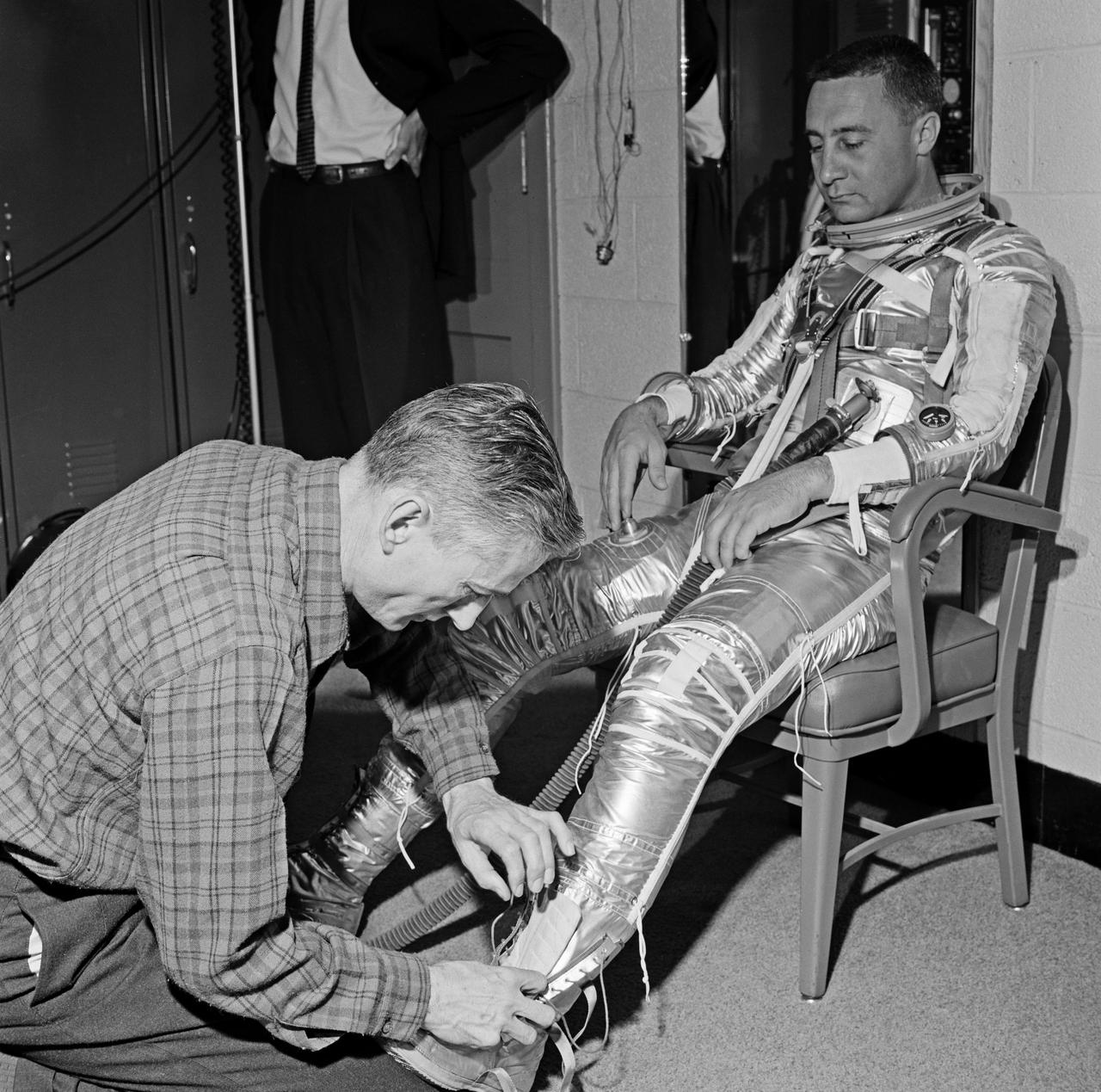
Gus Grissom trying on a Spacesuit; Seated with assistant; Seated with assistant putting on boots; Standing by mirror, name tag visible; Outside in suit, name tag visible. Mercury Project photo, 1961. Original negatives sent to Johnson Space Center when astronauts moved to that center. Photograph take on 03/27/1961.
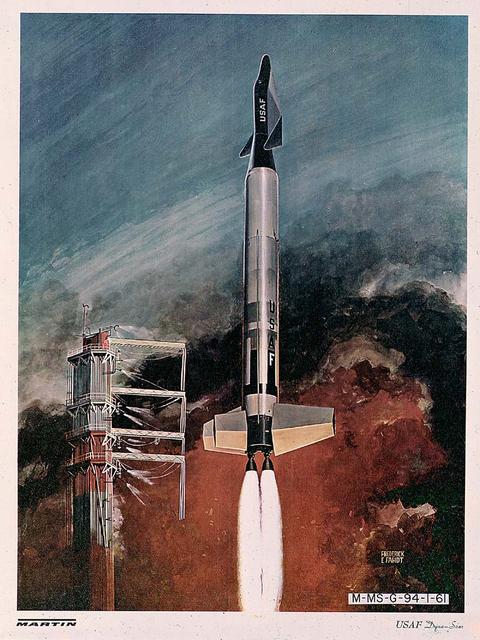
A Dyna-Soar (Dynamic Soaring) vehicle clears the launch tower atop an Air Force Titan II launch vehicle in this 1961 artist's concept. Originally conceived by the U.S. Air Force in 1957 as a marned, rocket-propelled glider in a delta-winged configuration, the Dyna-Soar was considered by Marshall Space Flight Center planners as an upper stage for the Saturn C-2 launch vehicle.
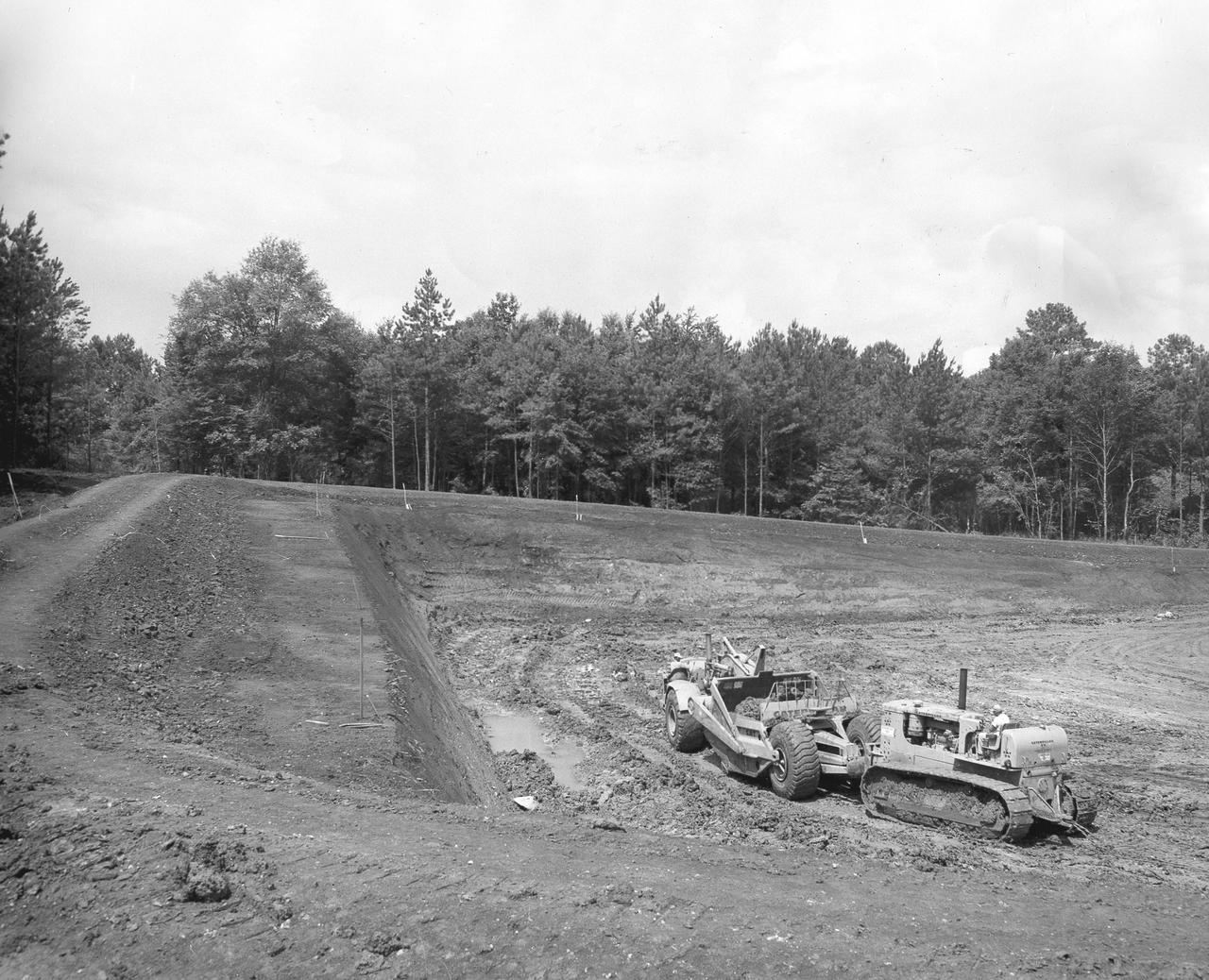
At its founding, the Marshall Space Flight Center (MSFC) inherited the Army’s Jupiter and Redstone test stands, but much larger facilities were needed for the giant stages of the Saturn V. From 1960 to 1964, the existing stands were remodeled and a sizable new test area was developed. The new comprehensive test complex for propulsion and structural dynamics was unique within the nation and the free world, and they remain so today because they were constructed with foresight to meet the future as well as on going needs. Construction of the S-IC Static test stand complex began in 1961 in the west test area of MSFC, and was completed in 1964. The S-IC static test stand was designed to develop and test the 138-ft long and 33-ft diameter Saturn V S-IC first stage, or booster stage, weighing in at 280,000 pounds. Required to hold down the brute force of a 7,500,000-pound thrust produced by 5 F-1 engines, the S-IC static test stand was designed and constructed with the strength of hundreds of tons of steel and 12,000,000 pounds of cement, planted down to bedrock 40 feet below ground level. The foundation walls, constructed with concrete and steel, are 4 feet thick. The base structure consists of four towers with 40-foot-thick walls extending upward 144 feet above ground level. The structure was topped by a crane with a 135-foot boom. With the boom in the upright position, the stand was given an overall height of 405 feet, placing it among the highest structures in Alabama at the time. In this photo, taken July 13, 1961, progress is made with the excavation and preparation of the S-IC test stand site.
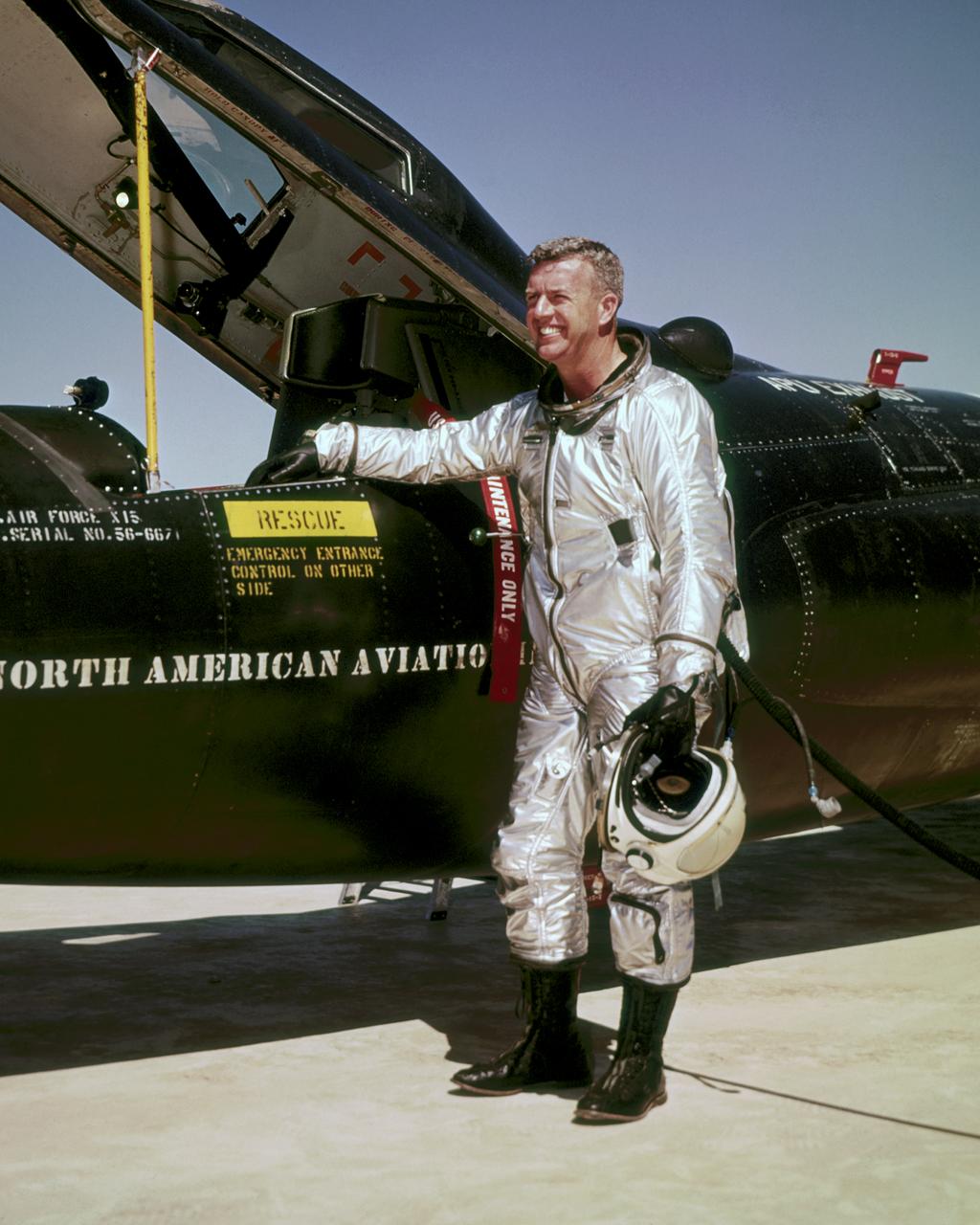
Joseph A. Walker was a Chief Research Pilot at the NASA Dryden Flight Research Center during the mid-1960s. He joined the NACA in March 1945, and served as project pilot at the Edwards flight research facility on such pioneering research projects as the D-558-1, D-558-2, X-1, X-3, X-4, X-5, and the X-15. He also flew programs involving the F-100, F-101, F-102, F-104, and the B-47. Walker made the first NASA X-15 flight on March 25, 1960. He flew the research aircraft 24 times and achieved its fastest speed and highest altitude. He attained a speed of 4,104 mph (Mach 5.92) during a flight on June 27, 1962, and reached an altitude of 354,300 feet on August 22, 1963 (his last X-15 flight). He was the first man to pilot the Lunar Landing Research Vehicle (LLRV) that was used to develop piloting and operational techniques for lunar landings. Walker was born February 20, 1921, in Washington, Pa. He lived there until graduating from Washington and Jefferson College in 1942, with a B.A. degree in Physics. During World War II he flew P-38 fighters for the Air Force, earning the Distinguished Flying Cross and the Air Medal with Seven Oak Clusters. Walker was the recipient of many awards during his 21 years as a research pilot. These include the 1961 Robert J. Collier Trophy, 1961 Harmon International Trophy for Aviators, the 1961 Kincheloe Award and 1961 Octave Chanute Award. He received an honorary Doctor of Aeronautical Sciences degree from his alma mater in June of 1962. Walker was named Pilot of the Year in 1963 by the National Pilots Association. He was a charter member of the Society of Experimental Test Pilots, and one of the first to be designated a Fellow. He was fatally injured on June 8, 1966, in a mid-air collision between an F-104 he was piloting and the XB-70.
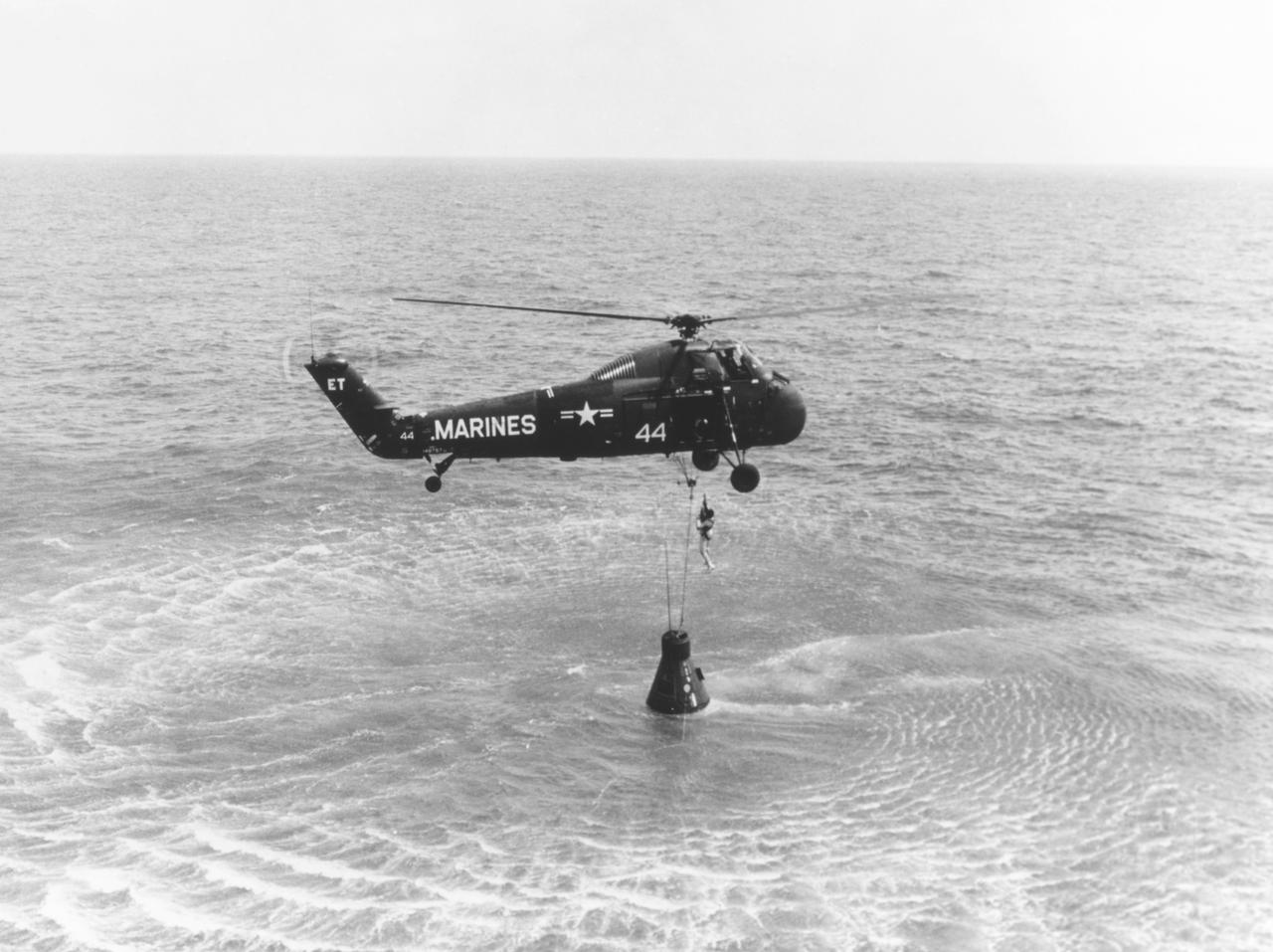
JSC2007-E-046478 (5 May 1961) --- Astronaut Alan B. Shepard Jr. is rescued by a U.S. Marine helicopter at the termination of his suborbital flight May 5, 1961, down range from the Florida eastern coast. Original photo number was 61-MR3-76A. Photo credit: NASA or National Aeronautics and Space Administration
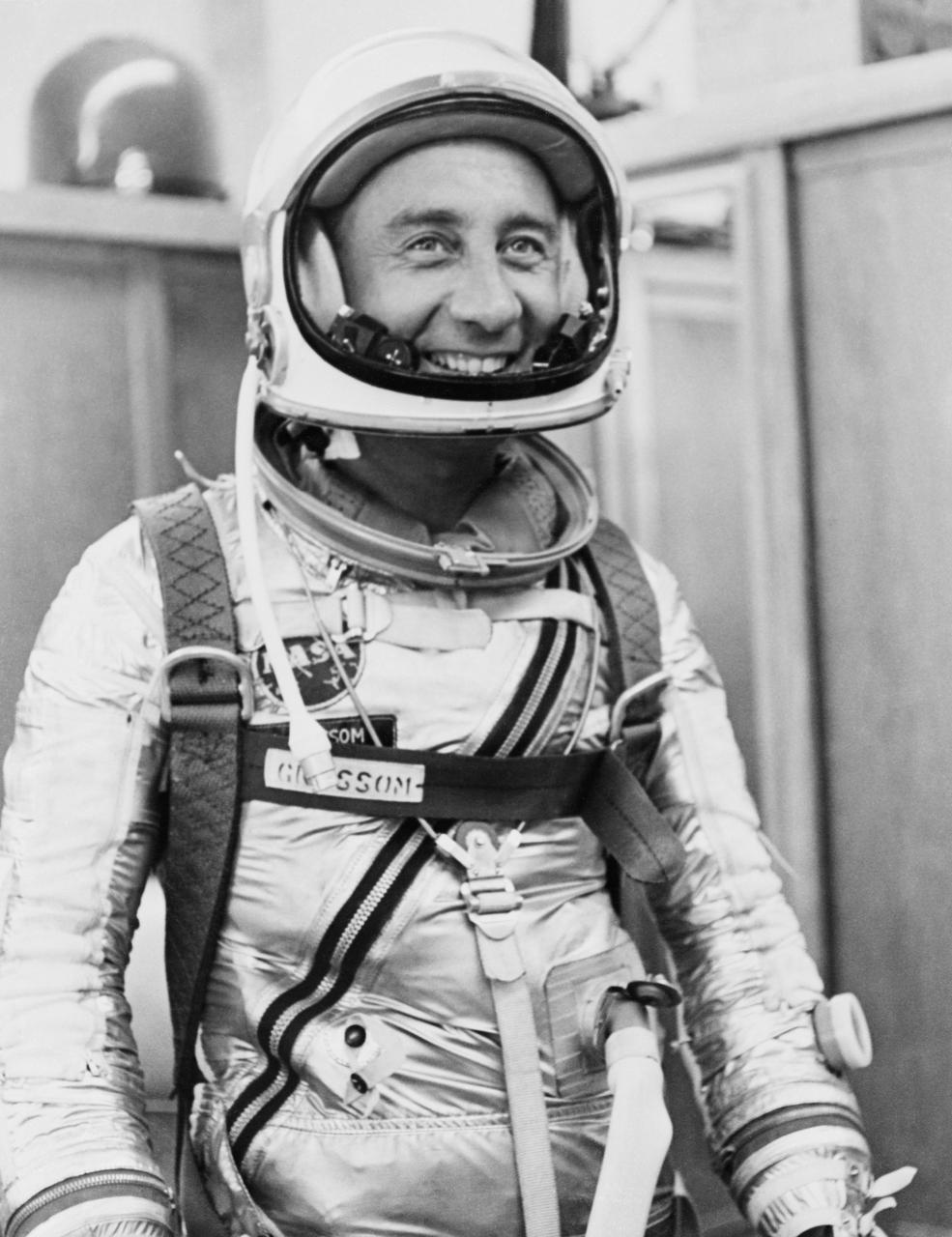
S61-02845 (1961) --- Portrait of astronaut Virgil I. (Gus) Grissom in his pressure suit and wearing his helmet in Hangar S at Cape Canaveral, Florida before the Mercury-Redstone 4 mission. Photo credit: NASA
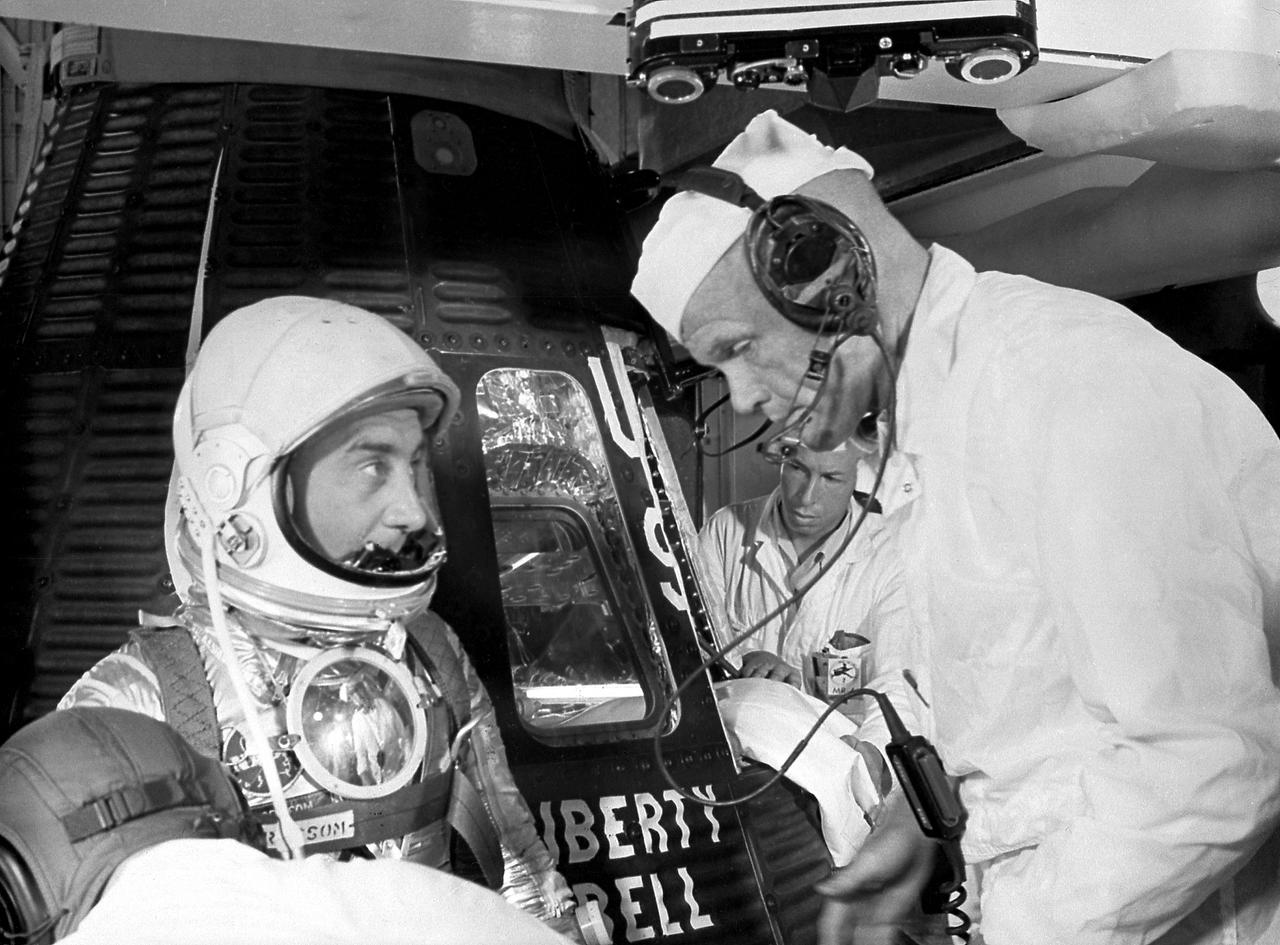
Astronaut Virgil Grissom chats with Astronaut John Glenn prior to entering the Liberty Bell 7 capsule for the MR-4 Mission. The MR-4 mission was the second manned suborbital flight using the Mercury-Redstone booster, which was developed by the Marshall Space Flight Center.
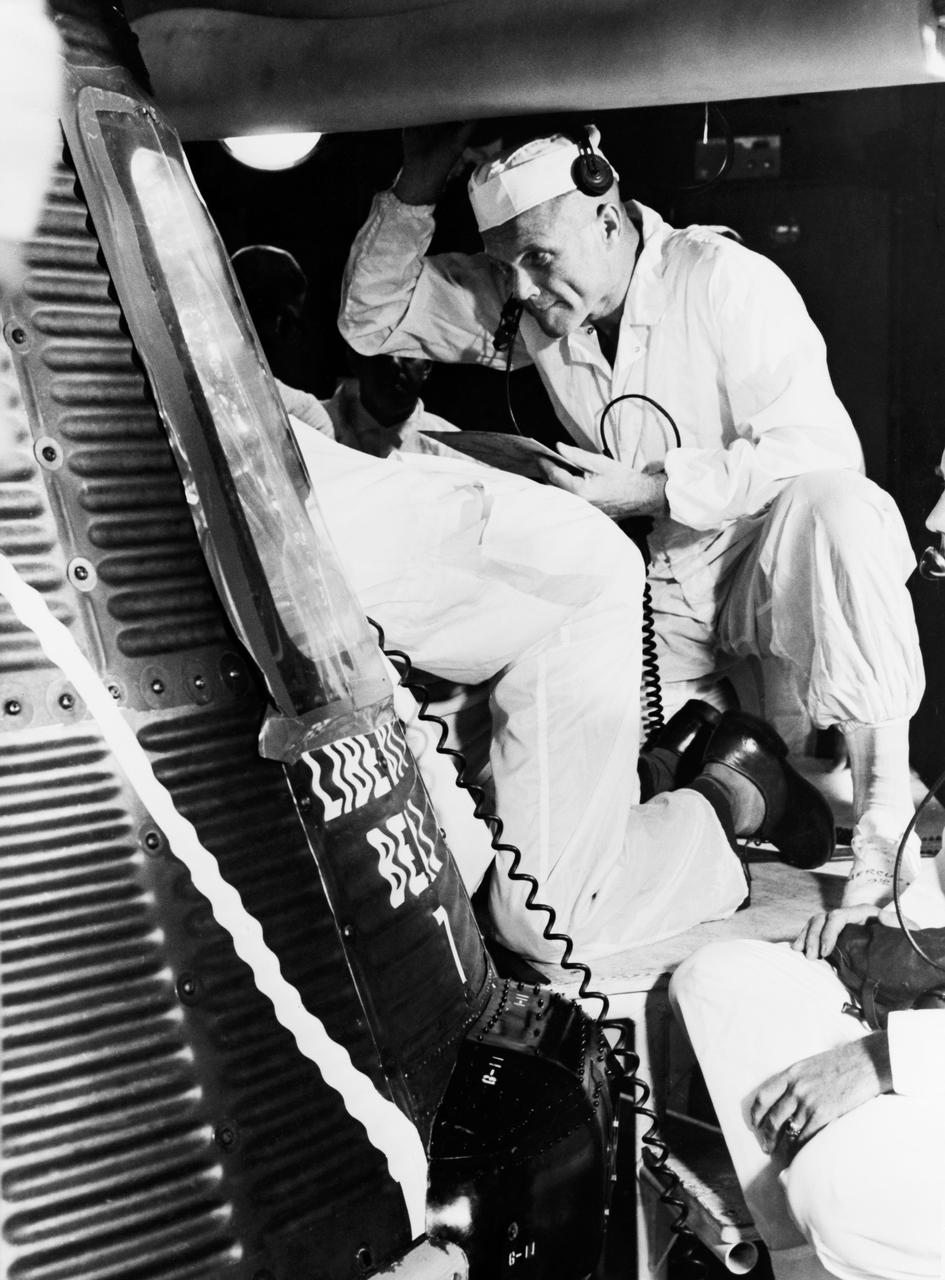
S61-03740 (20 July 1961) --- Astronaut John H. Glenn Jr. and a technician examine the interior of the Liberty Bell 7, the capsule flown a few days later during the Mercury-Redstone 4 mission with astronaut Virgil I. (Gus) Grissom. Photo credit: NASA
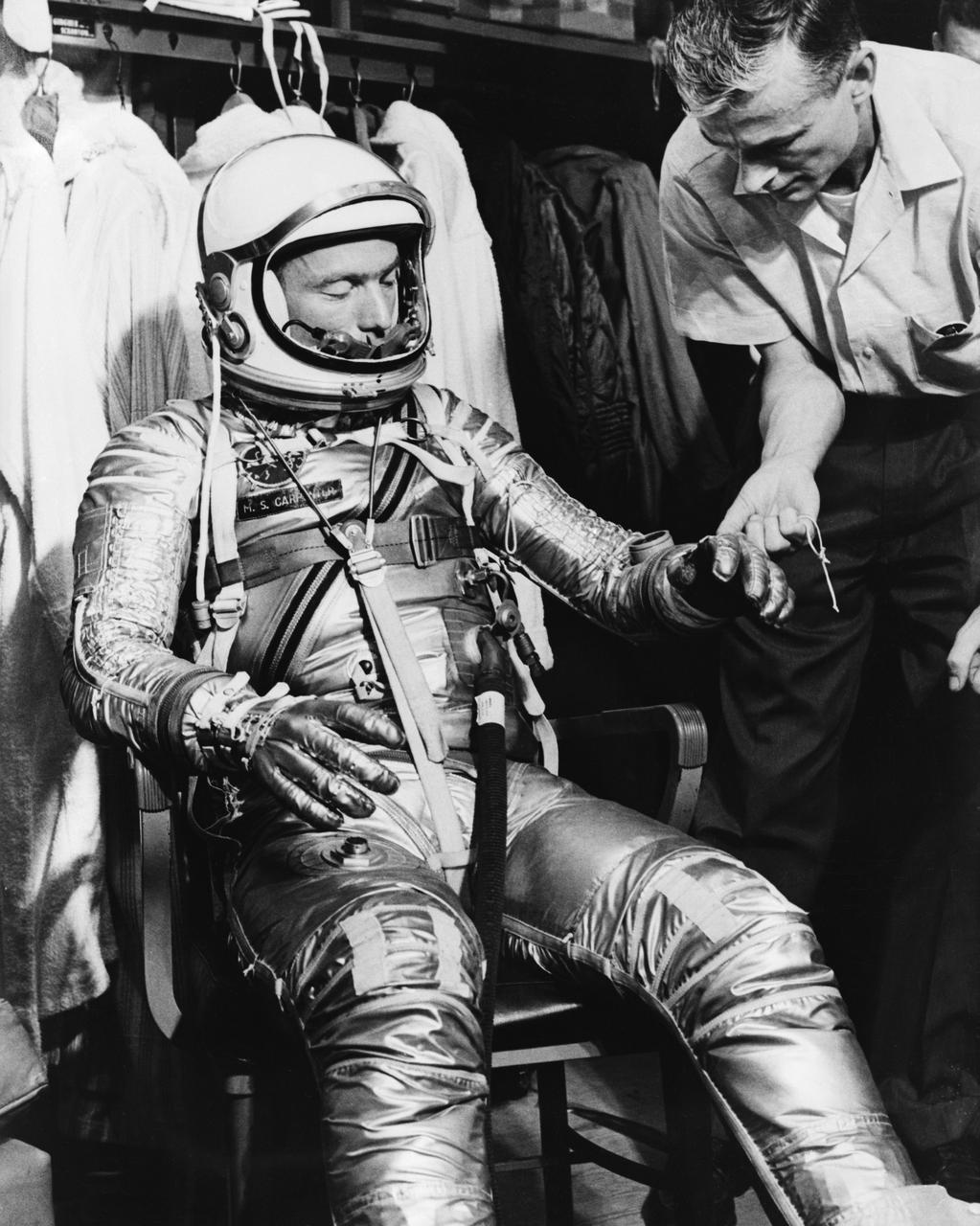
S61-03522 (1961) --- Mercury astronaut M. Scott Carpenter, prime pilot for the Mercury-Atlas 7 (MA-7) spaceflight, and Crew Equipment Specialist Joe Schmitt are pictured during a suiting exercise. Schmidt is seen checking the gloves on Carpenter's pressure suit. Photo credit: NASA
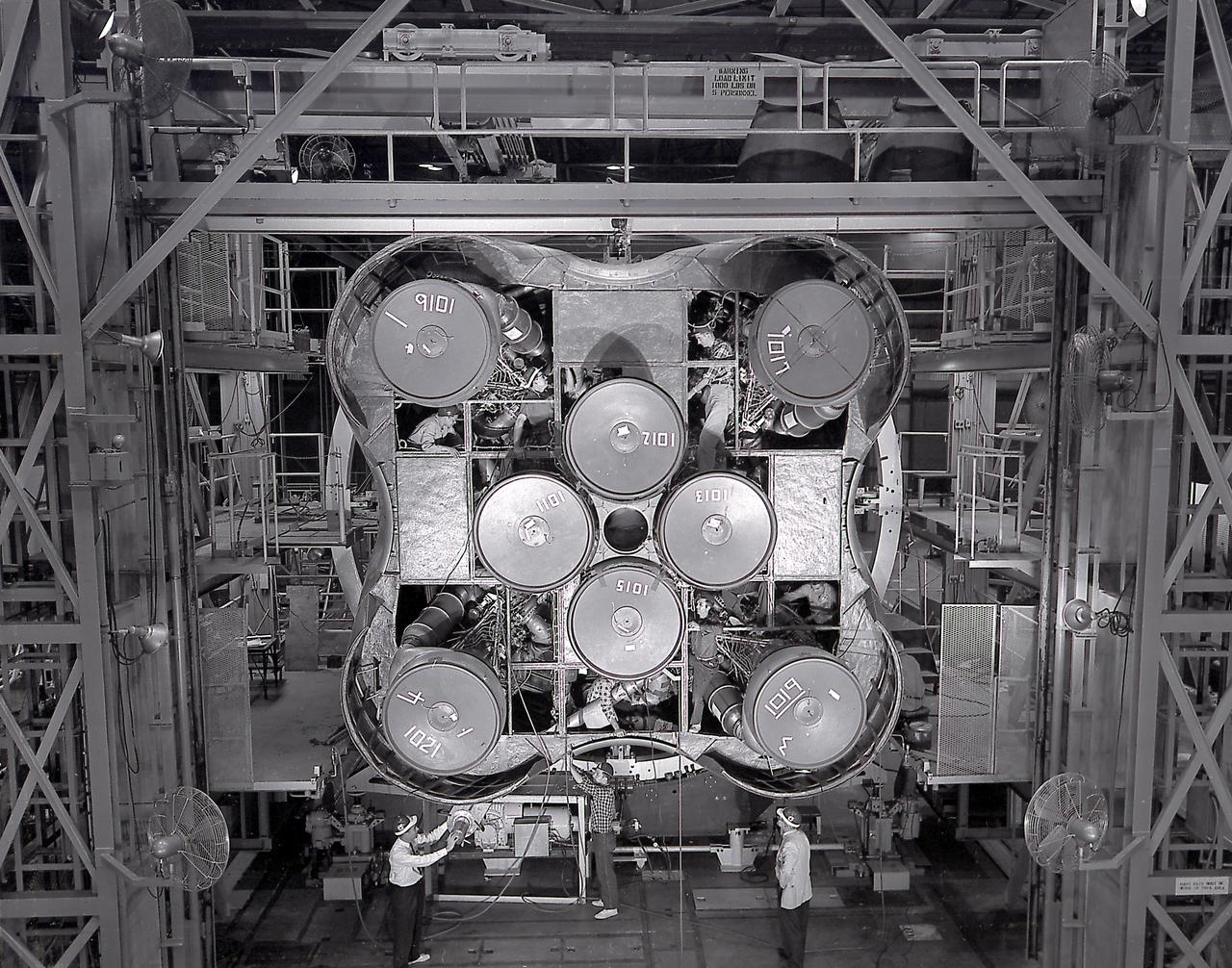
The Saturn I S-I stage with eight H-1 engines, located in Marshall Space Flight Center building 4705, showing the positioning of eight H-1 engines. The Saturn I S-I stage had eight H-1 engines clustered, using liquid oxygen/kerosene-1 (LOX/RP-1) propellants capable of producing a total of 1,500,000 pounds of thrust.
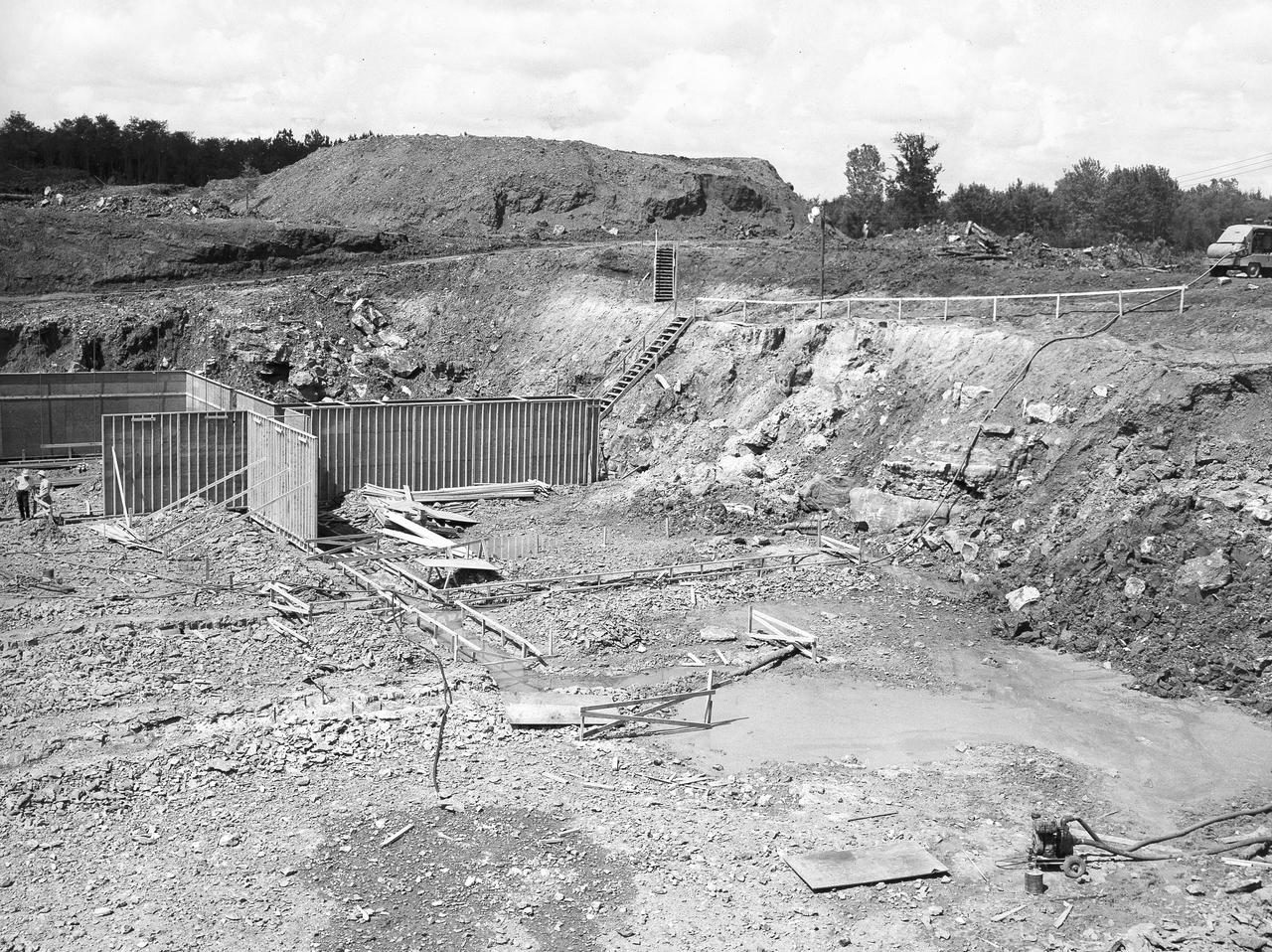
At its founding, the Marshall Space Flight Center (MSFC) inherited the Army’s Jupiter and Redstone test stands, but much larger facilities were needed for the giant stages of the Saturn V. From 1960 to 1964, the existing stands were remodeled and a sizable new test area was developed. The new comprehensive test complex for propulsion and structural dynamics was unique within the nation and the free world, and they remain so today because they were constructed with foresight to meet the future as well as on going needs. Construction of the S-IC Static test stand complex began in 1961 in the west test area of MSFC, and was completed in 1964. The S-IC static test stand was designed to develop and test the 138-ft long and 33-ft diameter Saturn V S-IC first stage, or booster stage, weighing in at 280,000 pounds. Required to hold down the brute force of a 7,500,000-pound thrust produced by 5 F-1 engines, the S-IC static test stand was designed and constructed with the strength of hundreds of tons of steel and 12,000,000 pounds of cement, planted down to bedrock 40 feet below ground level. The foundation walls, constructed with concrete and steel, are 4 feet thick. The base structure consists of four towers with 40-foot-thick walls extending upward 144 feet above ground level. The structure was topped by a crane with a 135-foot boom. With the boom in the upright position, the stand was given an overall height of 405 feet, placing it among the highest structures in Alabama at the time. This photo, taken September 5, 1961, shows the construction of forms which became the concrete foundation for the massive stand. The lower right hand corner reveals a pump used for extracting water emerging from a disturbed natural spring that occurred during excavation of the site. The pumping became a daily ritual and the site is still pumped today.
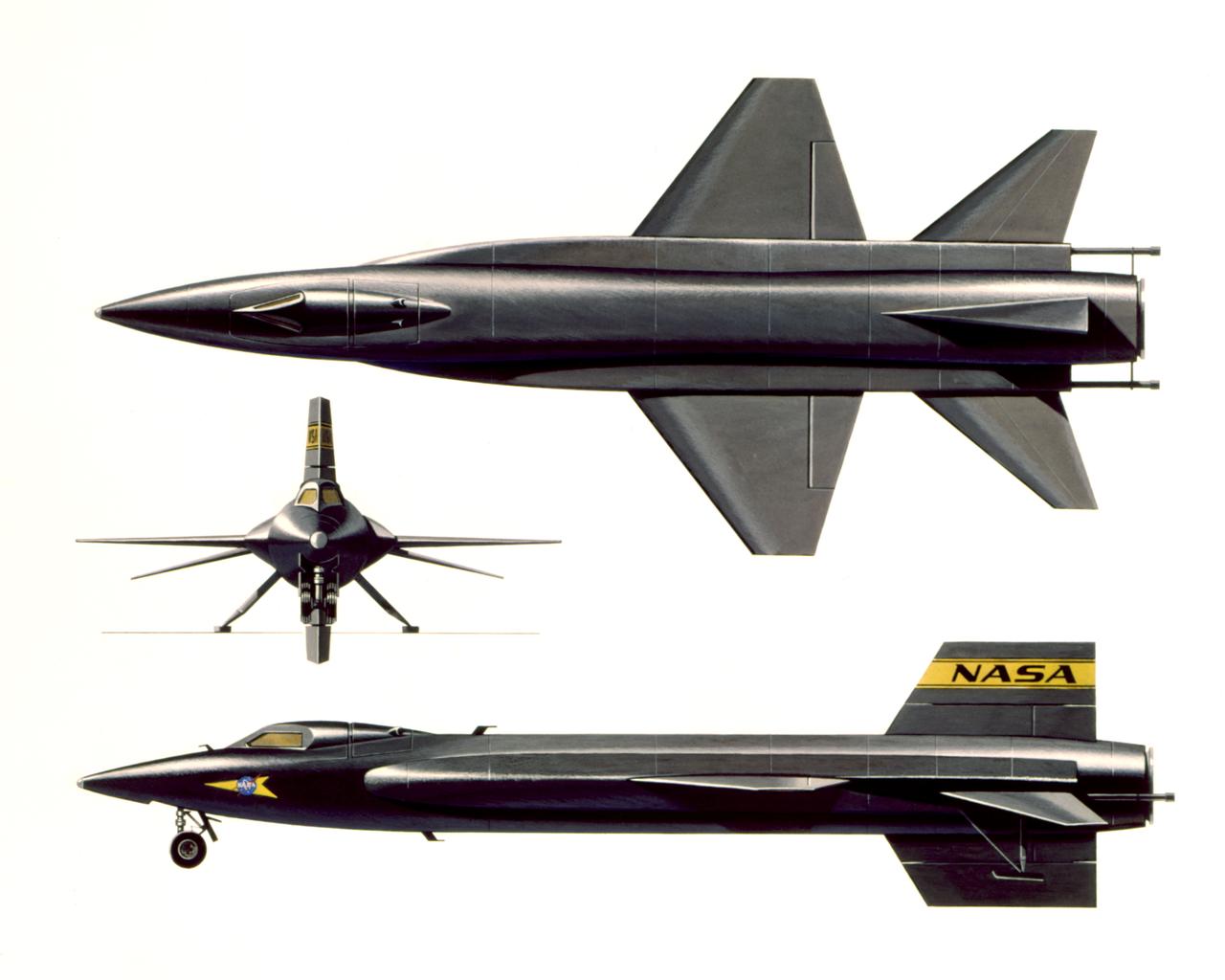
Three view art of the North American X-15.
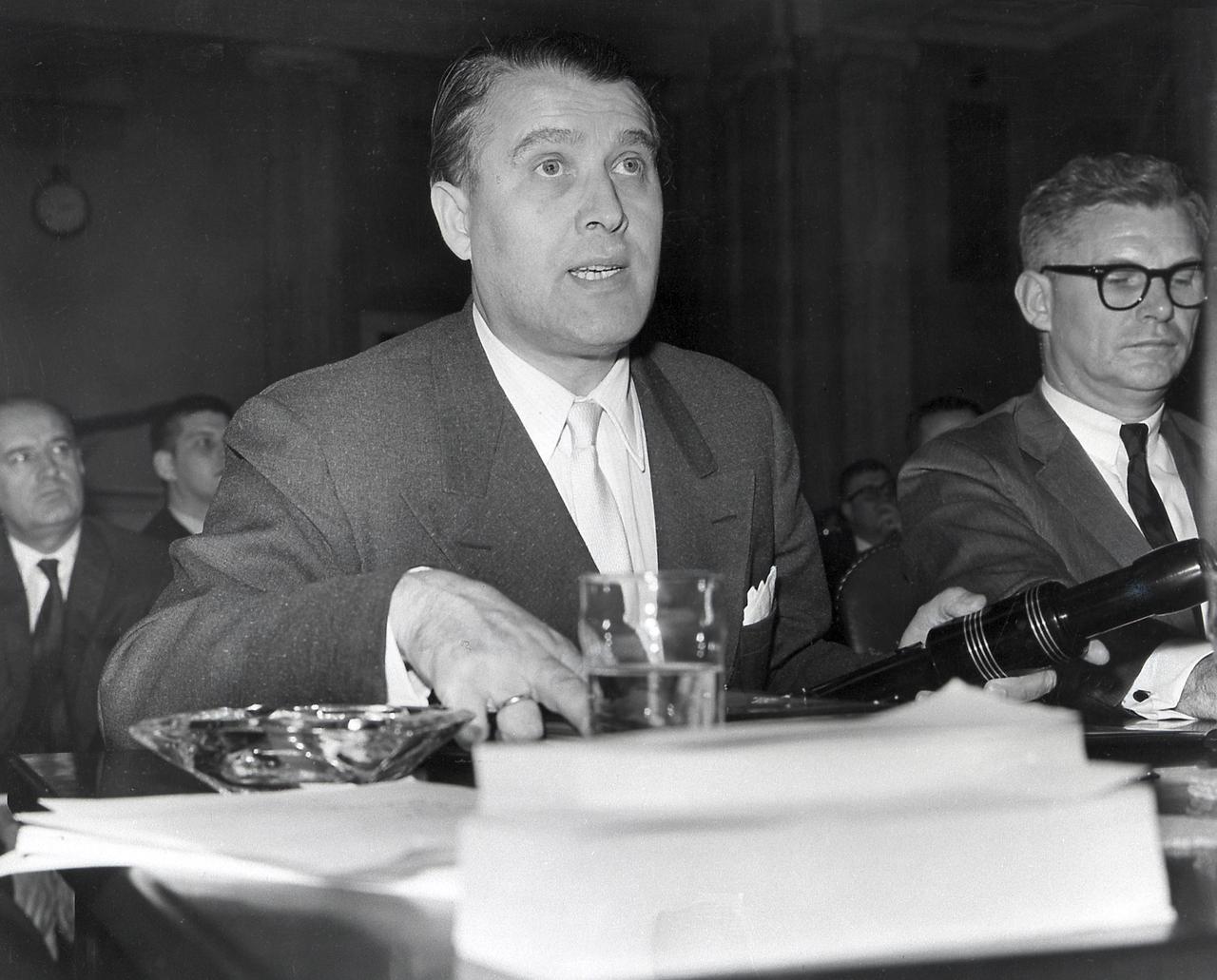
Dr. von Braun, Director of the Marshall Space Flight Center, spoke of the progress in the Saturn Program during his appearance before the Senate Committee on Aeronautical and Space Sciences. He was accompanied by Dr. Robert C. Seamans, Jr., Associate Administrator of the National Aeronautics and Space Administration (NASA).
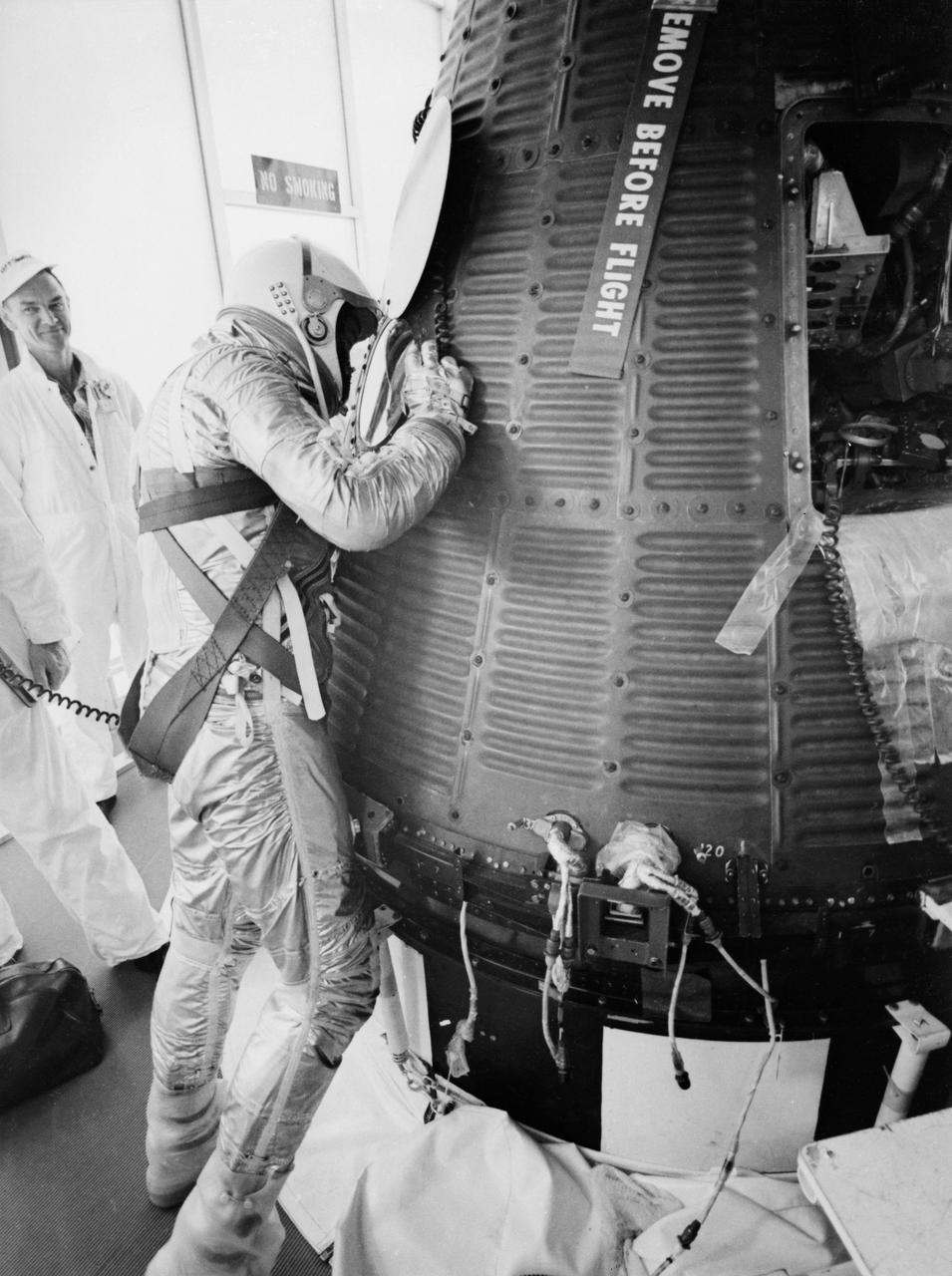
S61-02547 (5 May 1961) --- Astronaut Alan B. Shepard Jr., in his pressure suit and helmet, looks into the Freedom 7 capsule in preparation for ingress before the Mercury-Redstone 3 (MR-3) mission. Photo credit: NASA or National Aeronautics and Space Administration
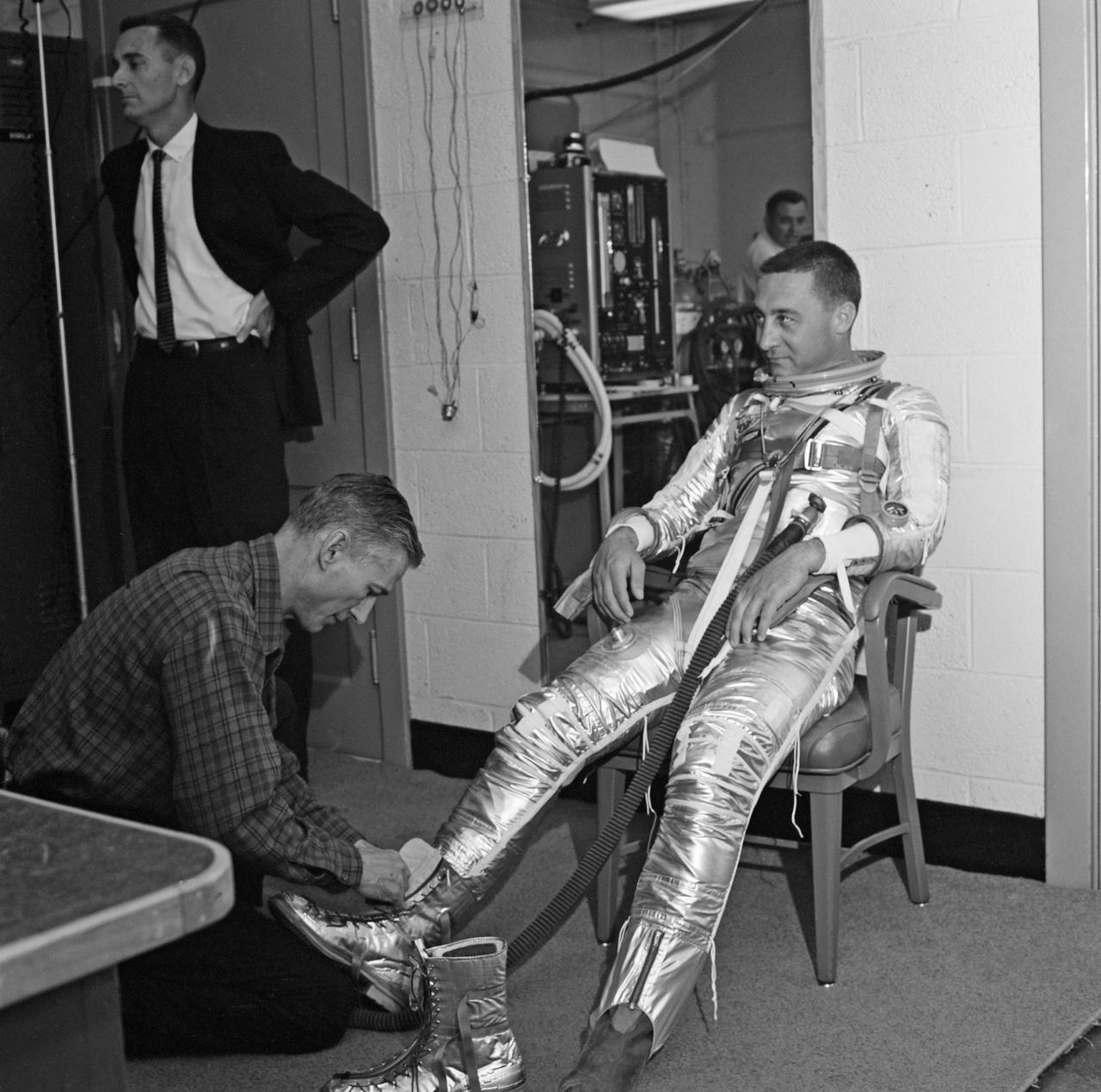
Gus Grissom trying on a Spacesuit; Seated with assistant; Seated with assistant putting on boots; Standing by mirror, name tag visible; Outside in suit, name tag visible. Mercury Project photo, 1961. Original negatives sent to Johnson Space Center when astronauts moved to that center. Photograph take on 03/27/1961.
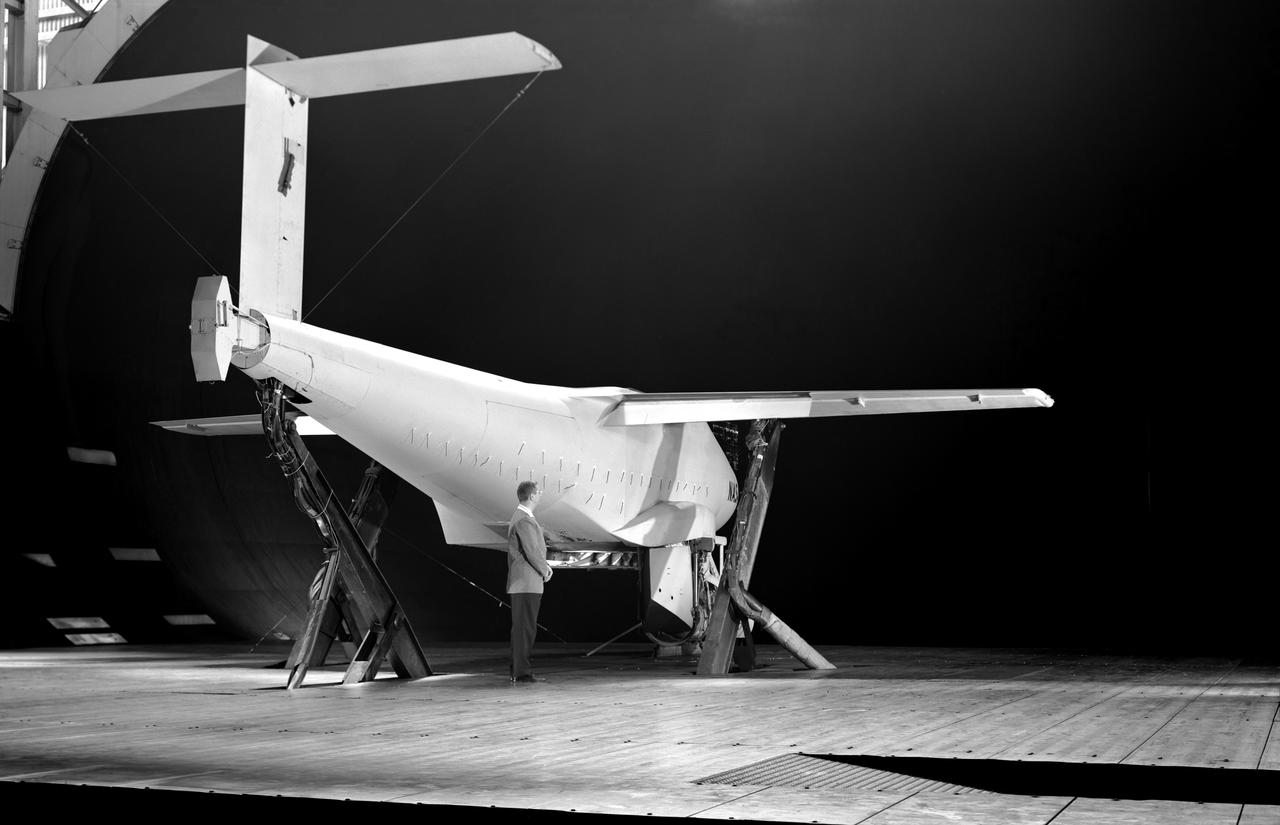
G.E. Fan-in-fuselage model (lifting). 3/4 rear view of fan at low G.P. position. Lift fan on variable height strut for ground effects studies with reaction control. T-Tail.
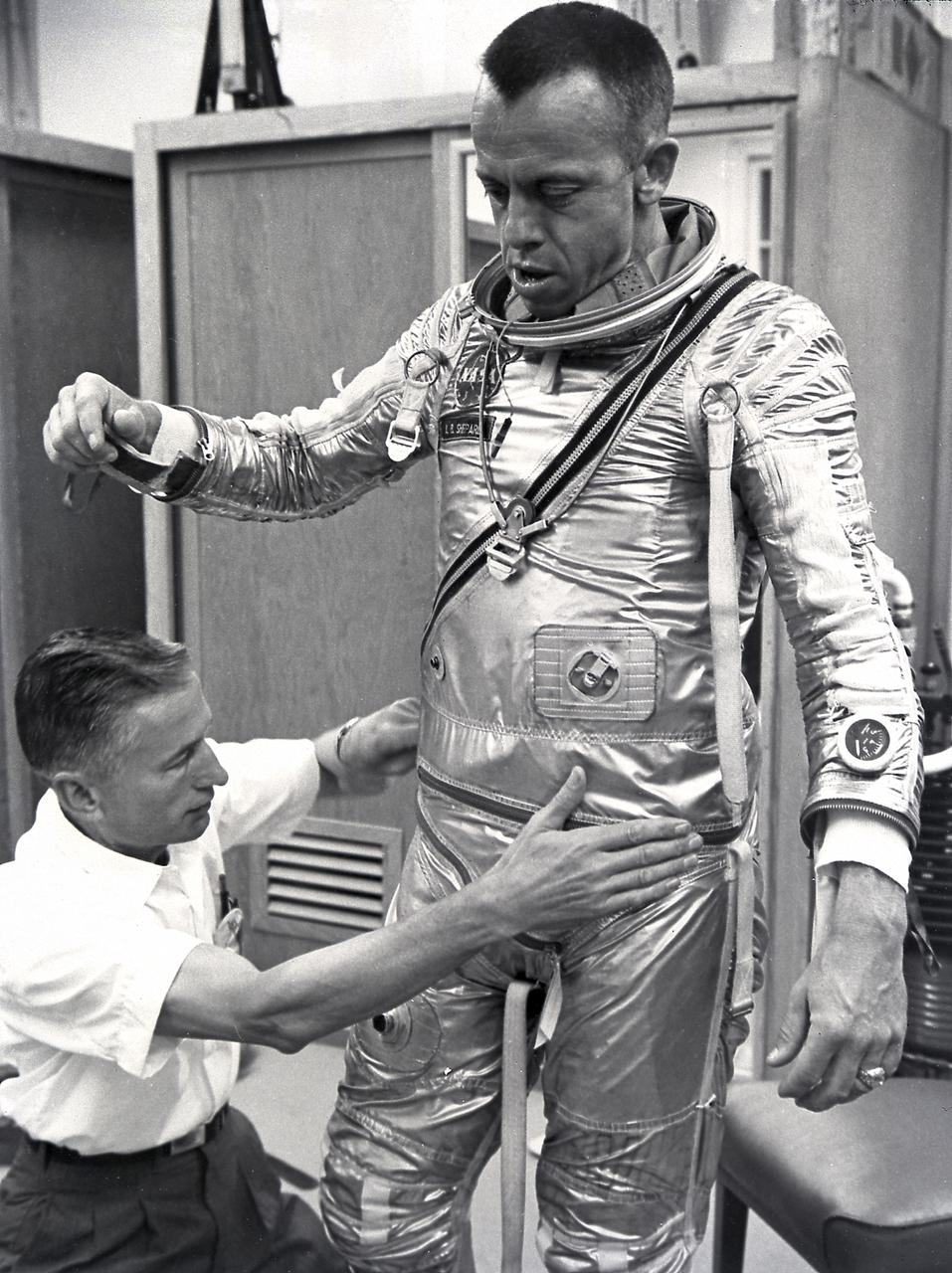
Astronaut Alan Shepard fitted with space suit prior to the first marned suborbital flight. Freedom 7, carrying Astronaut Alan Shepard, boosted by the Mercury-Redstone launch vehicle, lifted off on May 5, 1961. Astronaut Shepard became the first American in space.
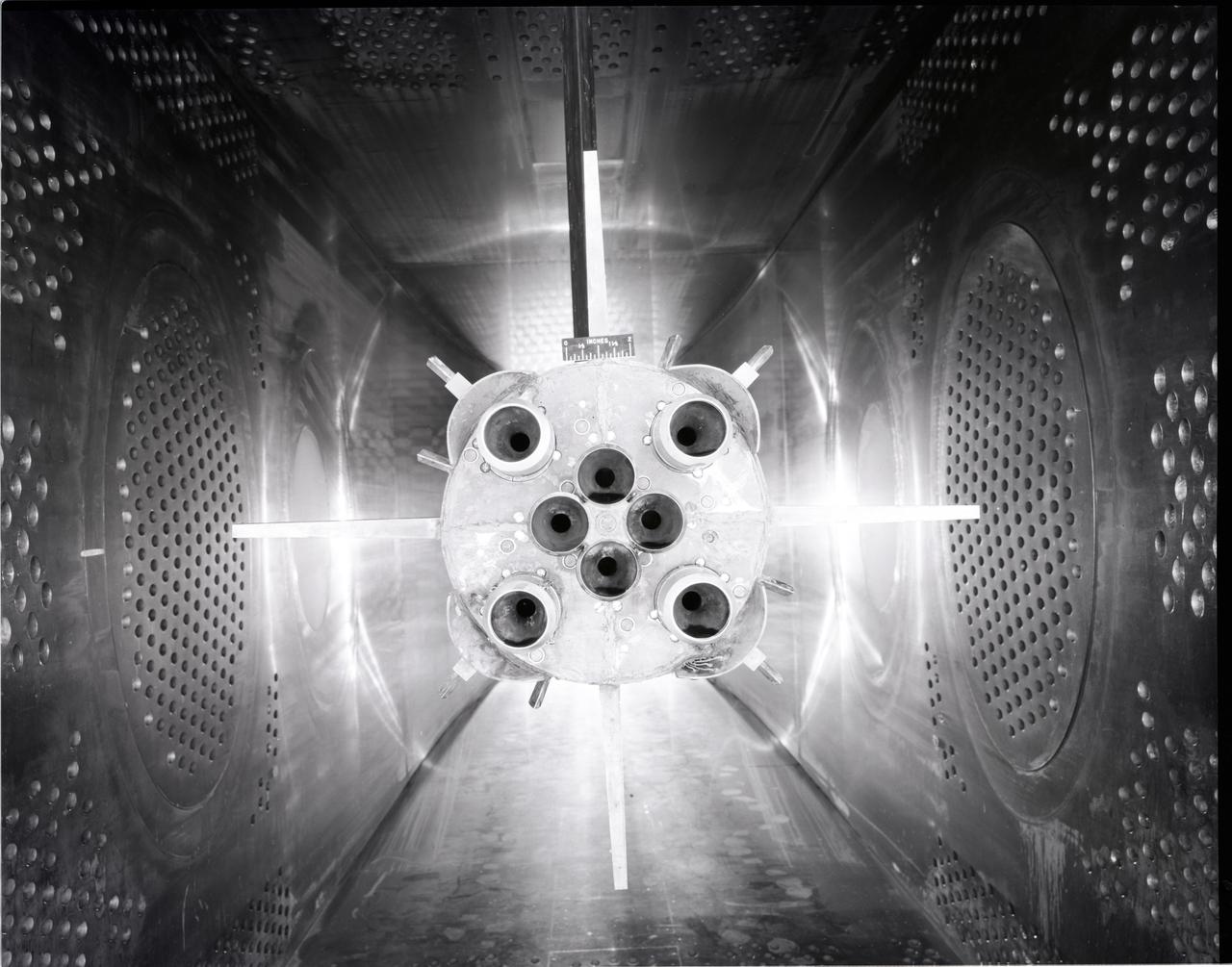
APOLLO CONFIGURATION OF SATURN MODEL IN THE 8X6-FOOT SUPERSONIC WIND TUNNEL
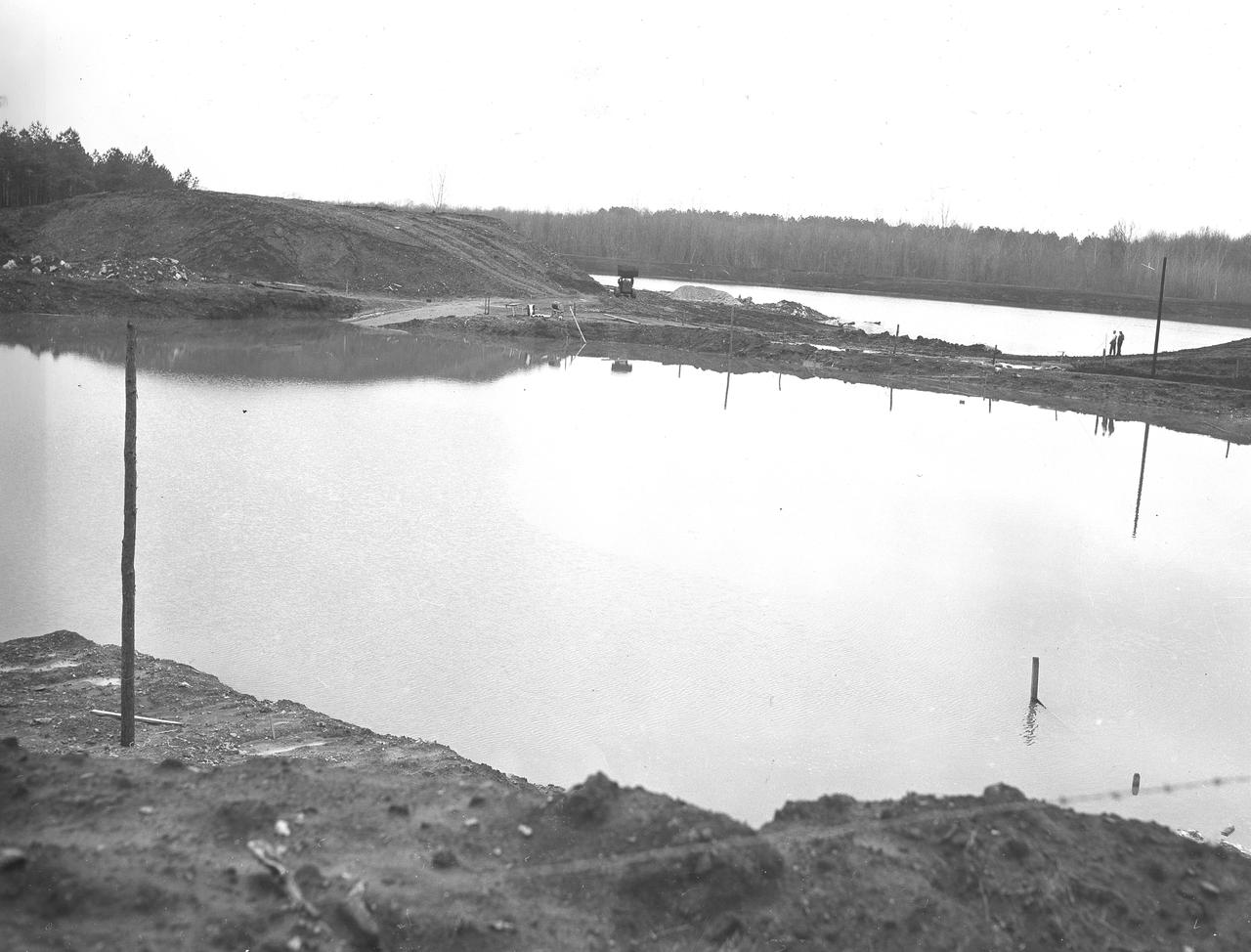
At its founding, the Marshall Space Flight Center (MSFC) inherited the Army’s Jupiter and Redstone test stands, but much larger facilities were needed for the giant stages of the Saturn V. From 1960 to 1964, the existing stands were remodeled and a sizable new test area was developed. The new comprehensive test complex for propulsion and structural dynamics was unique within the nation and the free world, and they remain so today because they were constructed with foresight to meet the future as well as on going needs. Construction of the S-IC Static test stand complex began in 1961 in the west test area of MSFC, and was completed in 1964. The S-IC static test stand was designed to develop and test the 138-ft long and 33-ft diameter Saturn V S-IC first stage, or booster stage, weighing in at 280,000 pounds. Required to hold down the brute force of a 7,500,000-pound thrust produced by 5 F-1 engines, the S-IC static test stand was designed and constructed with the strength of hundreds of tons of steel and 12,000,000 pounds of cement, planted down to bedrock 40 feet below ground level. The foundation walls, constructed with concrete and steel, are 4 feet thick. The base structure consists of four towers with 40-foot-thick walls extending upward 144 feet above ground level. The structure was topped by a crane with a 135-foot boom. With the boom in the upright position, the stand was given an overall height of 405 feet, placing it among the highest structures in Alabama at the time. Construction of the S-IC test stand came to a halt at the end of September as the determination was made that the Saturn booster size had to be increased. As a result, the stand had to be modified. With construction delayed, and pumps turned off, this photo, taken December 18, 1961, shows the abandoned site entirely flooded. The flooding was caused by the disturbance of a natural spring months prior during the excavation of the site.
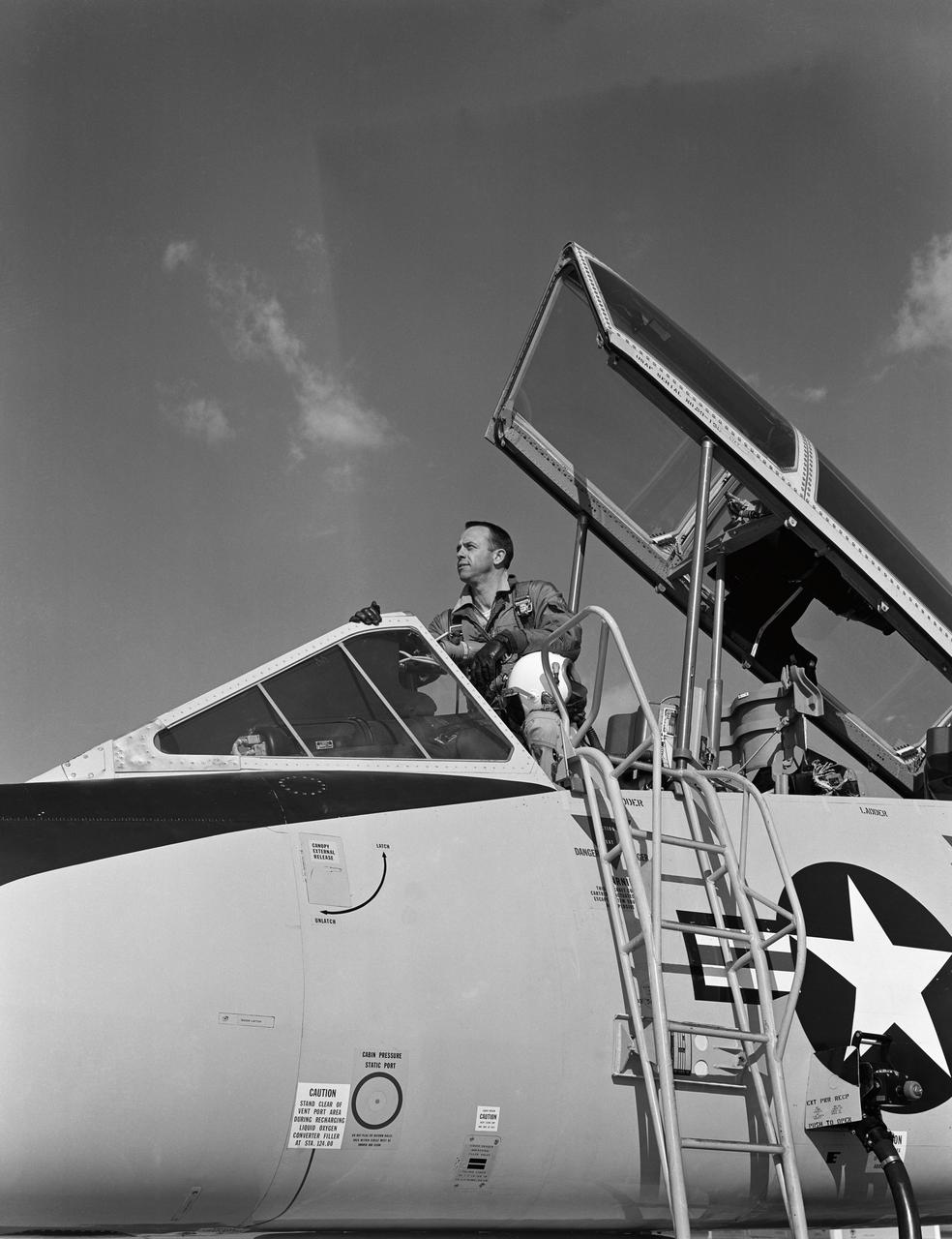
M61-00012 (20 Jan. 1961) --- Astronaut Alan B. Shepard Jr. pictured on the flight line climbing aboard a F-106 aircraft. Photo credit: NASA or National Aeronautics and Space Administration
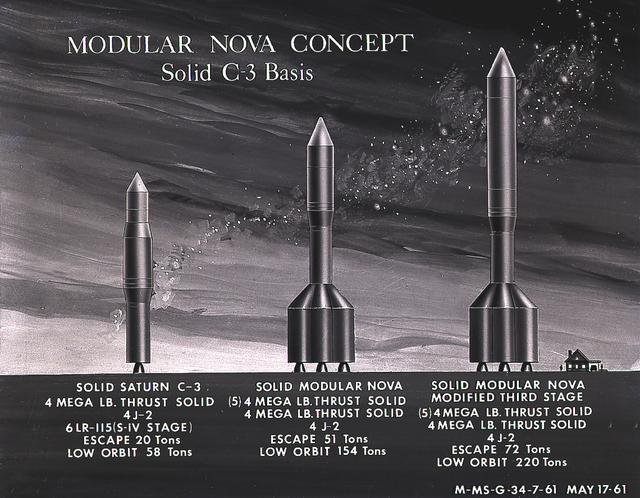
This artist's concept illustrates the Module Nova concept - Solid C-3 Basis. From 1960 to 1962, the Marshall Space Flight Center considered the Nova launch vehicle as a means to achieve a marned lunar landing with a direct flight to the Moon. Various configurations of the vehicle were examined. The latest configuration was a five-stage vehicle using eight F-1 engines in the first stage. Although the program was canceled after NASA planners selected the lunar/orbital rendezvous mode, the proposed F-1 engine would eventually be used in the Apollo Program to propel the first stage of the Saturn V launch vehicle.
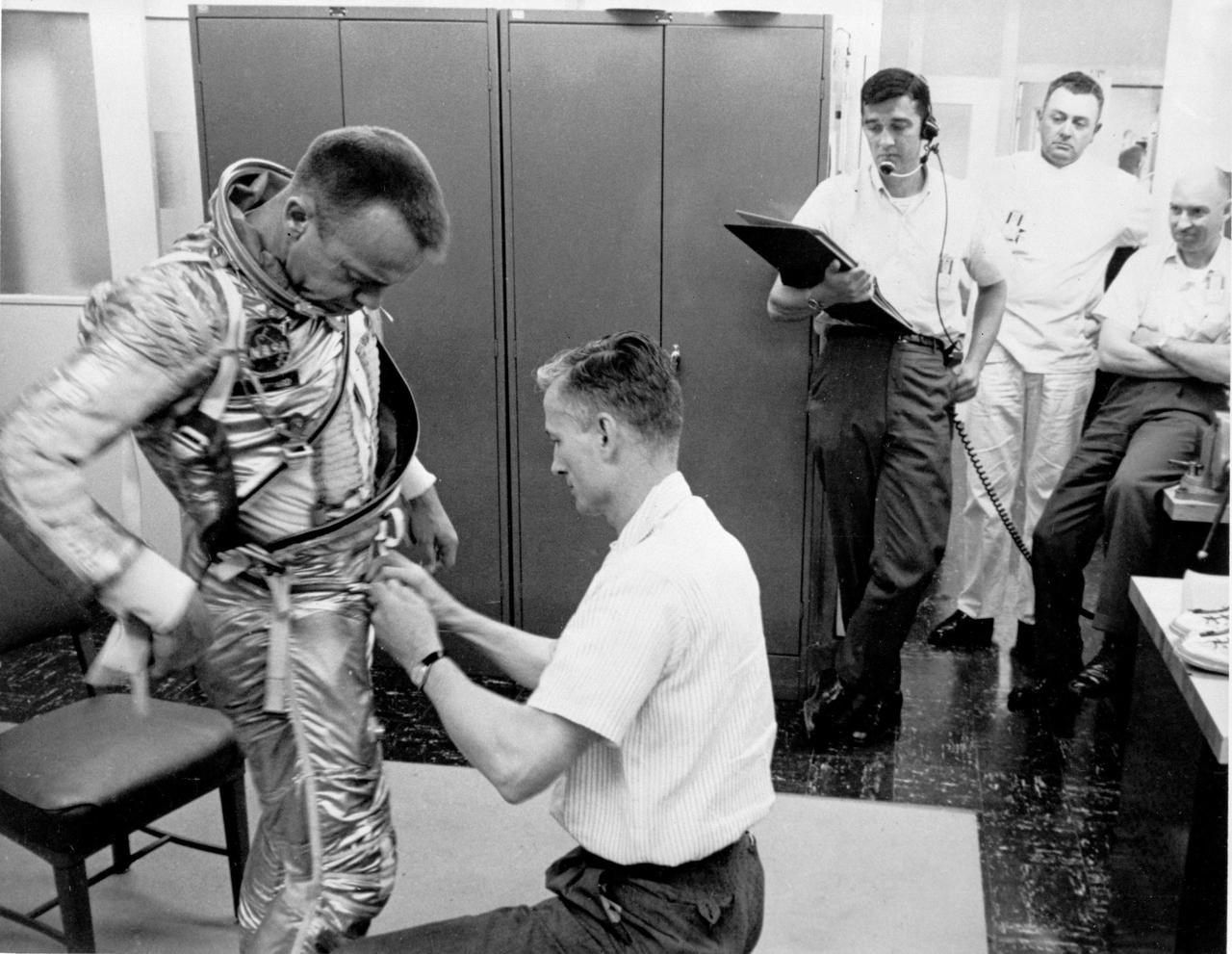
KENNEDY SPACE CENTER, FLA. - Astronaut Alan B. Shepard is being assisted by a technician in getting into his space suit at 2:45 a.m. this morning, beginning the long countdown of the scheduled launch of the Mercury Redstone. After Astronaut Shepard is suited up, he will travel by van to the Redstone Gantry on Pad 5 and be placed into the Mercury Capsule, called Freedom 7, on top of the Redstone booster rocket. Astronaut Shepard will pilot the first U.S. manned sub-orbital space flight of the Manned Mercury Program.
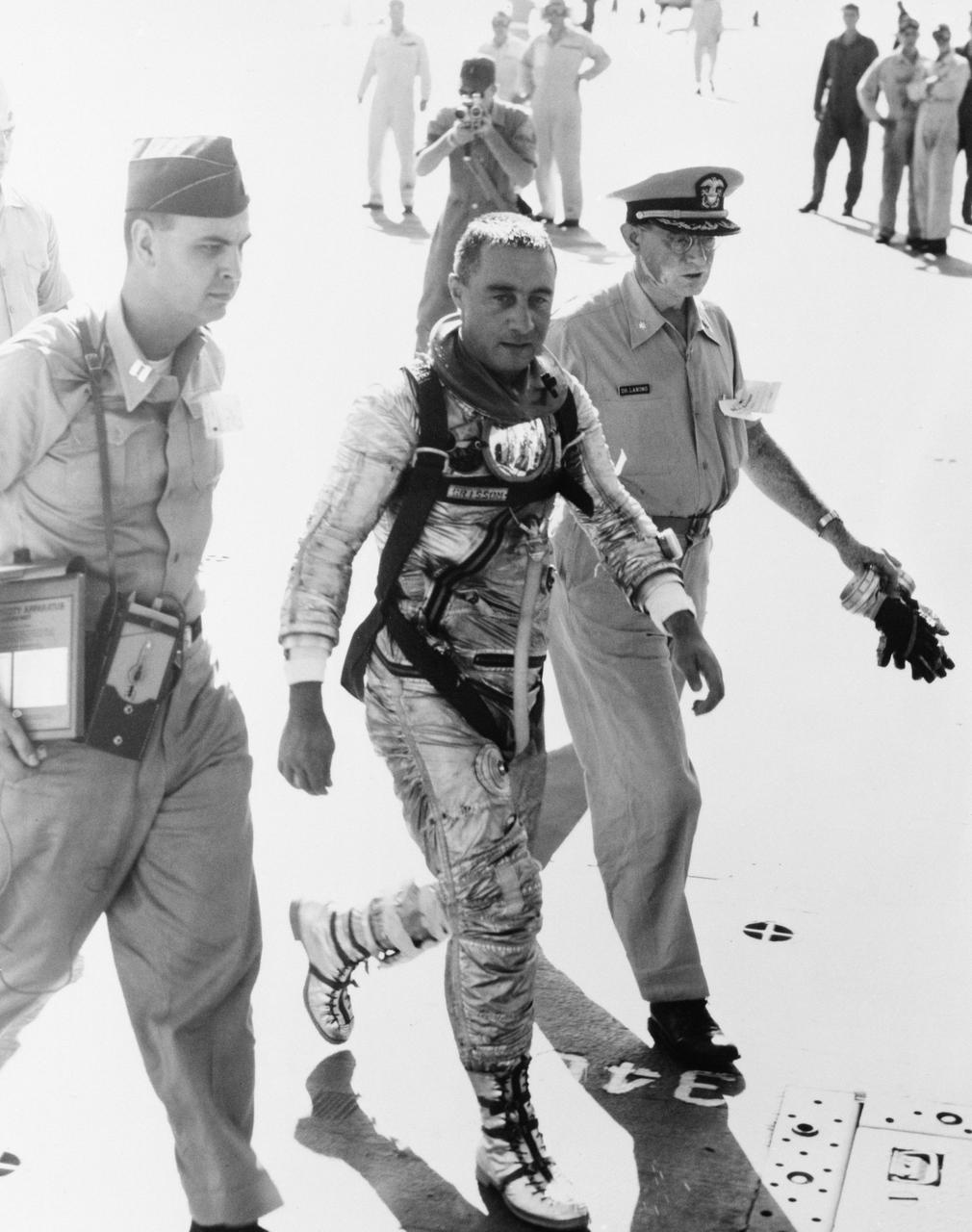
S61-02894 (21 July 1961) --- Astronaut Virgil I. (Gus) Grissom, pilot of the Mercury-Redstone 4 (MR-4) “Liberty Bell 7” spaceflight, arrives aboard the recovery ship, USS Randolph, following his 15-minute, 37-second suborbital space mission. He is flanked by military medical officers. Photo credit: NASA
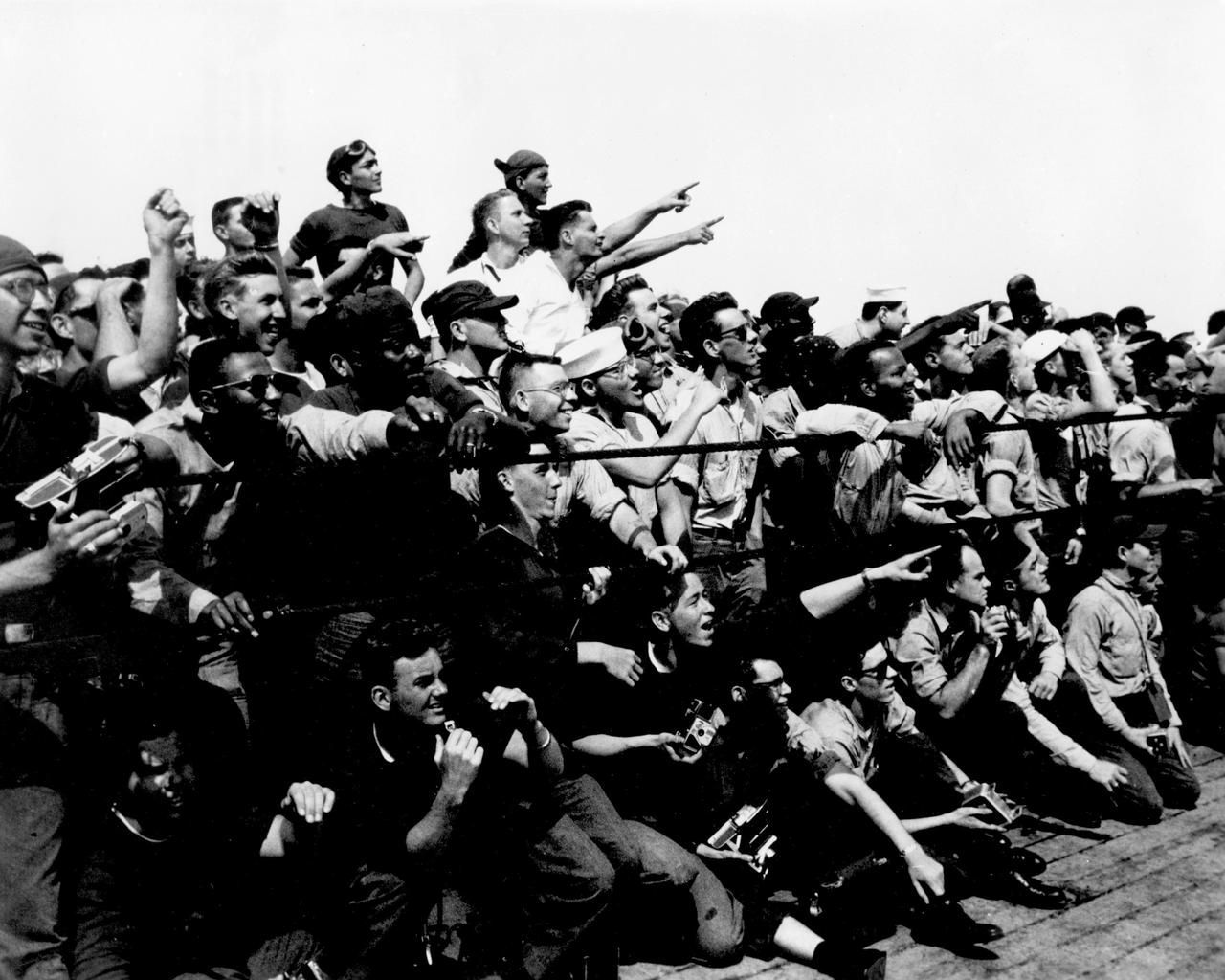
JSC2007-E-046479 (5 May 1961) --- Crew members of the U.S. Navy Carrier Champlain cheer and take pictures of the arrival of the first Project Mercury pilot to fly a suborbital flight, astronaut Alan B. Shepard Jr. Original photo number was 61-MR3-106. Photo credit: NASA
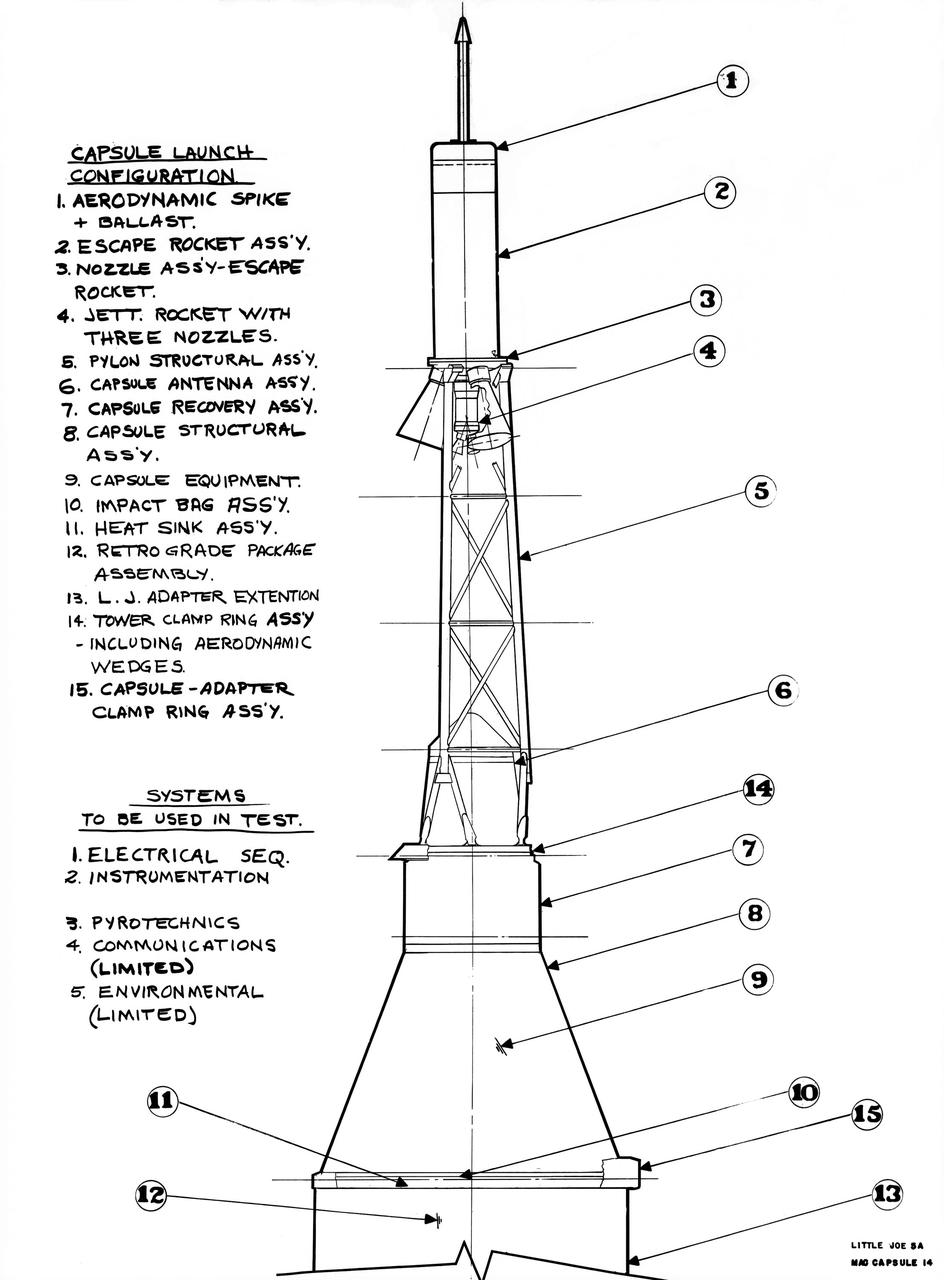
S61-01600 (11 March 1961) --- This is the G2498 Little Joe 5A mission preparedness chart. Photo credit: NASA
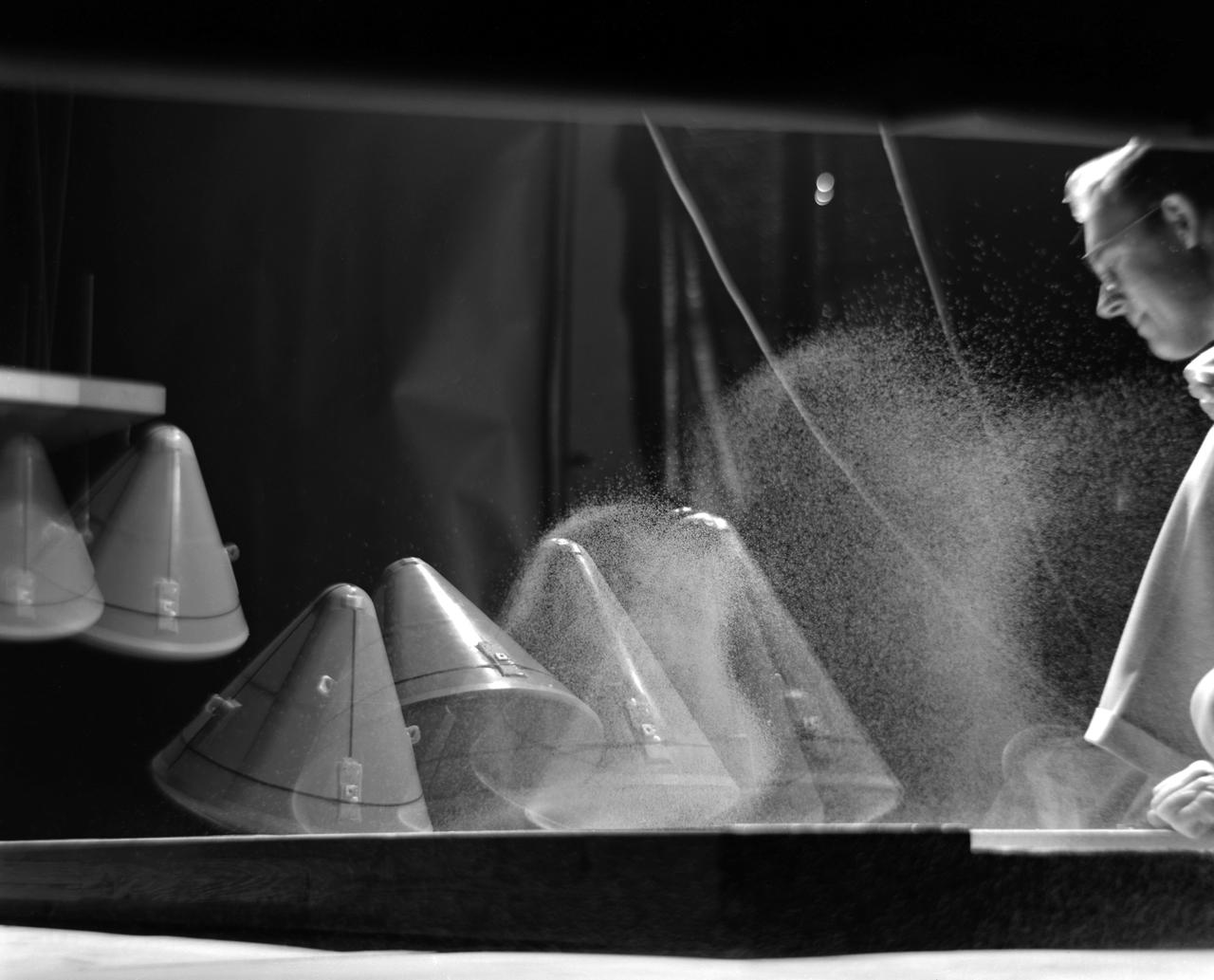
Image L61-8036 is available as an electronic file from the photo lab. See URL. -- Photographed on 12/05/1961. -- Multiple exposure of an impact test of the Apollo command module. In this test the Apollo capsule was tested making a sand landing. -- Published in James R. Hansen, Spaceflight Revolution: NASA Langley Research Center From Sputnik to Apollo, (Washington: NASA, 1995), pp. 361-366.

At its founding, the Marshall Space Flight Center (MSFC) inherited the Army’s Jupiter and Redstone test stands, but much larger facilities were needed for the giant stages of the Saturn V. From 1960 to 1964, the existing stands were remodeled and a sizable new test area was developed. The new comprehensive test complex for propulsion and structural dynamics was unique within the nation and the free world, and they remain so today because they were constructed with foresight to meet the future as well as on going needs. Construction of the S-IC Static test stand complex began in 1961 in the west test area of MSFC, and was completed in 1964. The S-IC static test stand was designed to develop and test the 138-ft long and 33-ft diameter Saturn V S-IC first stage, or booster stage, weighing in at 280,000 pounds. Required to hold down the brute force of a 7,500,000-pound thrust produced by 5 F-1 engines, the S-IC static test stand was designed and constructed with the strength of hundreds of tons of steel and 12,000,000 pounds of cement, planted down to bedrock 40 feet below ground level. The foundation walls, constructed with concrete and steel, are 4 feet thick. The base structure consists of four towers with 40-foot-thick walls extending upward 144 feet above ground level. The structure was topped by a crane with a 135-foot boom. With the boom in the upright position, the stand was given an overall height of 405 feet, placing it among the highest structures in Alabama at the time. In this early construction photo, taken June 30, 1961, workers are are involved in the survey and site preparation of the test stand.
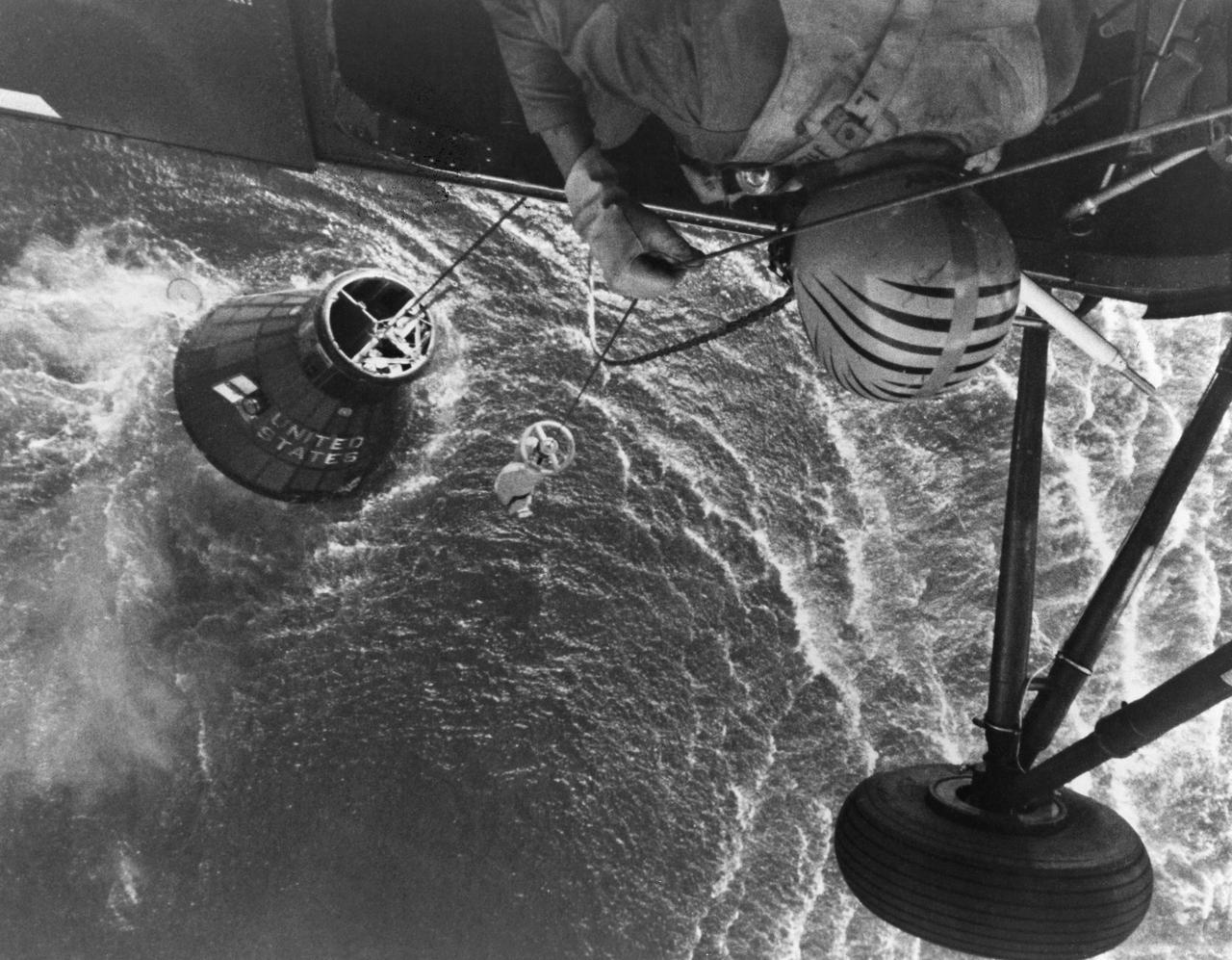
S61-02824 (21 July 1961) --- A U.S. Marine Corps helicopter attempts an unsuccessful recovery of the Mercury-Redstone 4 "Liberty Bell 7" spacecraft. The spacecraft hatch opened prematurely, and astronaut Virgil I. Grissom, pilot, escaped into the water. The helicopter hooked onto the spacecraft but could not retrieve it. Grissom was recovered by another helicopter and flown to the recovery ship, USS Randolph. The Mercury spacecraft sank to the bottom of the ocean. Photo credit: NASA
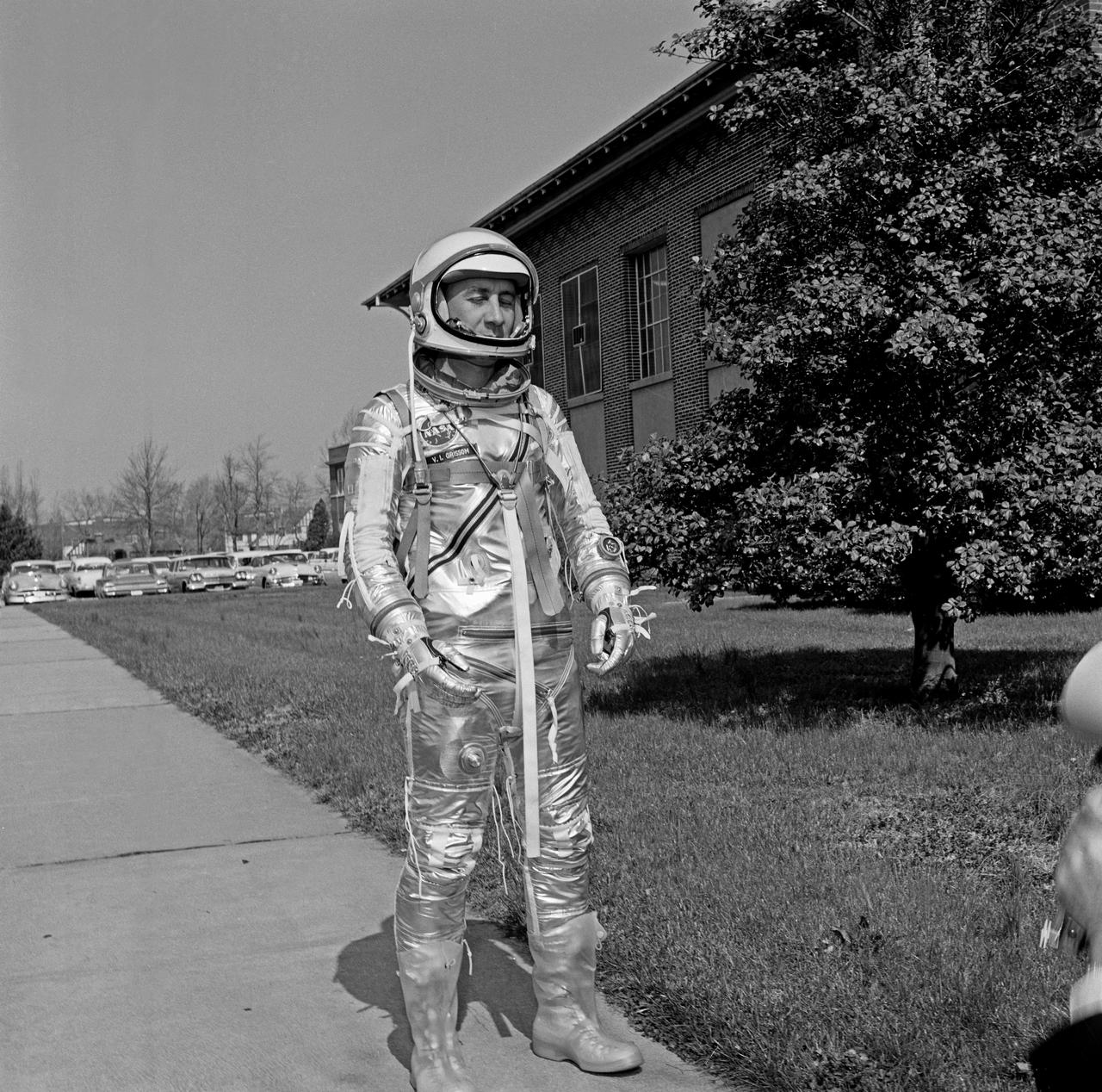
Gus Grissom trying on a Spacesuit; Seated with assistant; Seated with assistant putting on boots; Standing by mirror, name tag visible; Outside in suit, name tag visible. Mercury Project photo, 1961. Original negatives sent to Johnson Space Center when astronauts moved to that center. Photograph take on 03/27/1961.

S61-04623 (1961) --- Astronaut John H. Glenn Jr. looks into a Celestial Training Device (globe) during training in the Aeromedical Laboratory at Cape Canaveral, Florida. Photo credit: NASA
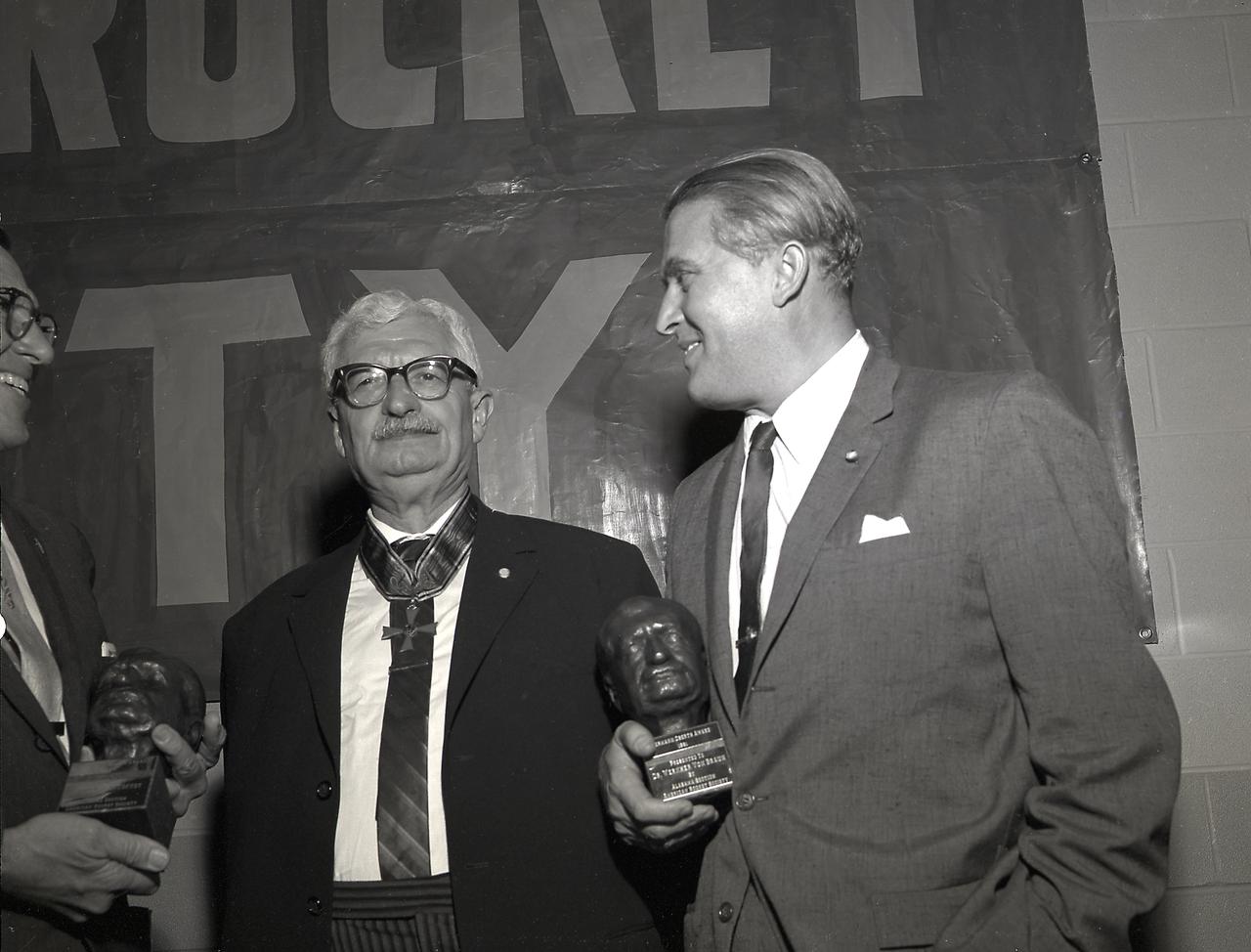
Dr. Wernher von Braun holds the coveted Hermarn Oberth award presented to him by Professor Oberth during the banquet hosted by the Alabama Section of the American Rocket Society (ARS), on October 19, 1961. The Oberth award was given for outstanding technical contributions to the field of astronautics or for the promotion and advancement of astronautical sciences.
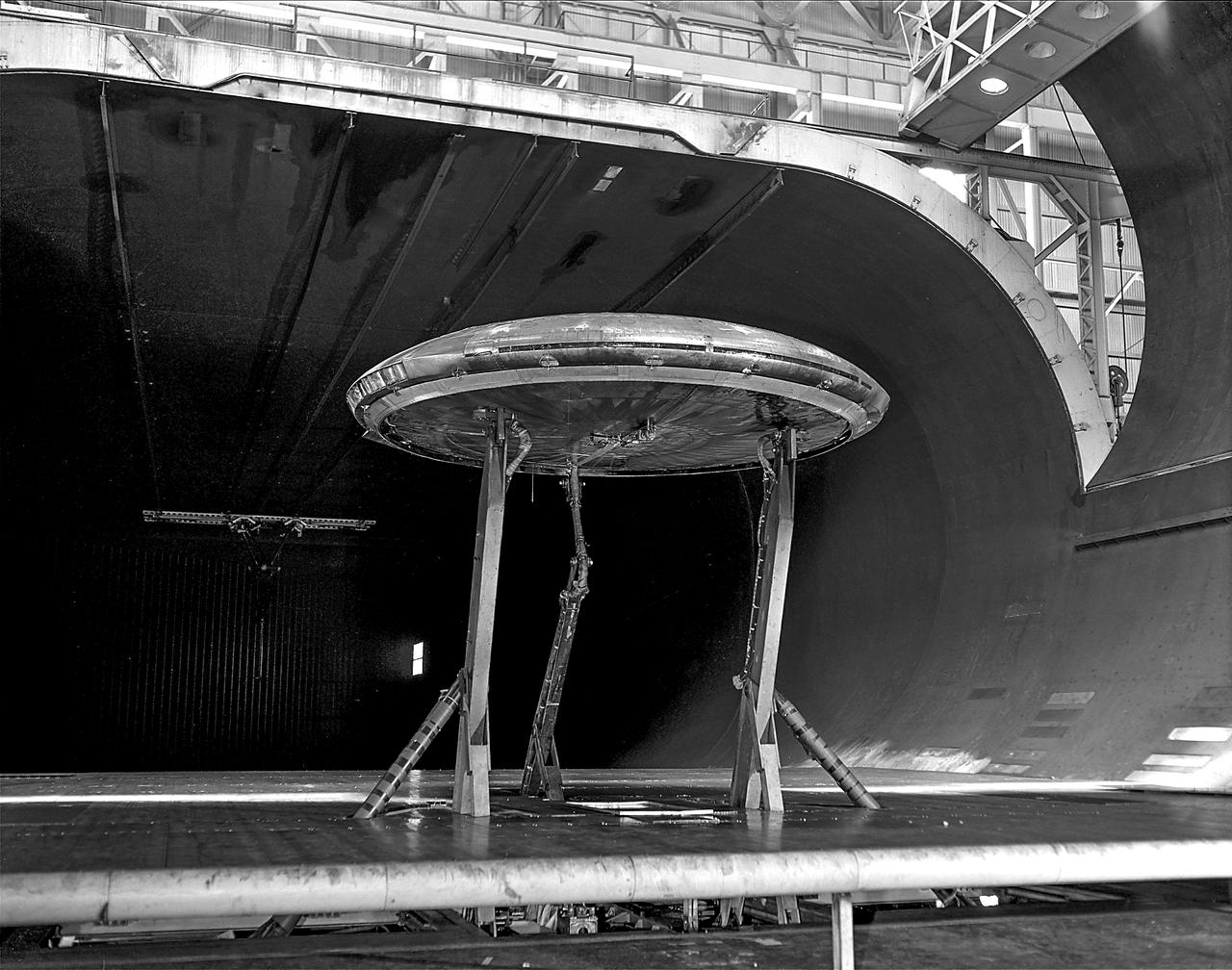
Rear view of the Avrocar with tail, mounted on variable height struts. Overhead doors of the wind tunnel test section open. The first Avrocar, S/N 58-7055 (marked AV-7055), after tethered testing, became the "wind tunnel" test model at NASA Ames, where it remained in storage from 1961 until 1966, when it was donated to the National Air and Space Museum, in Suitland, Maryland.
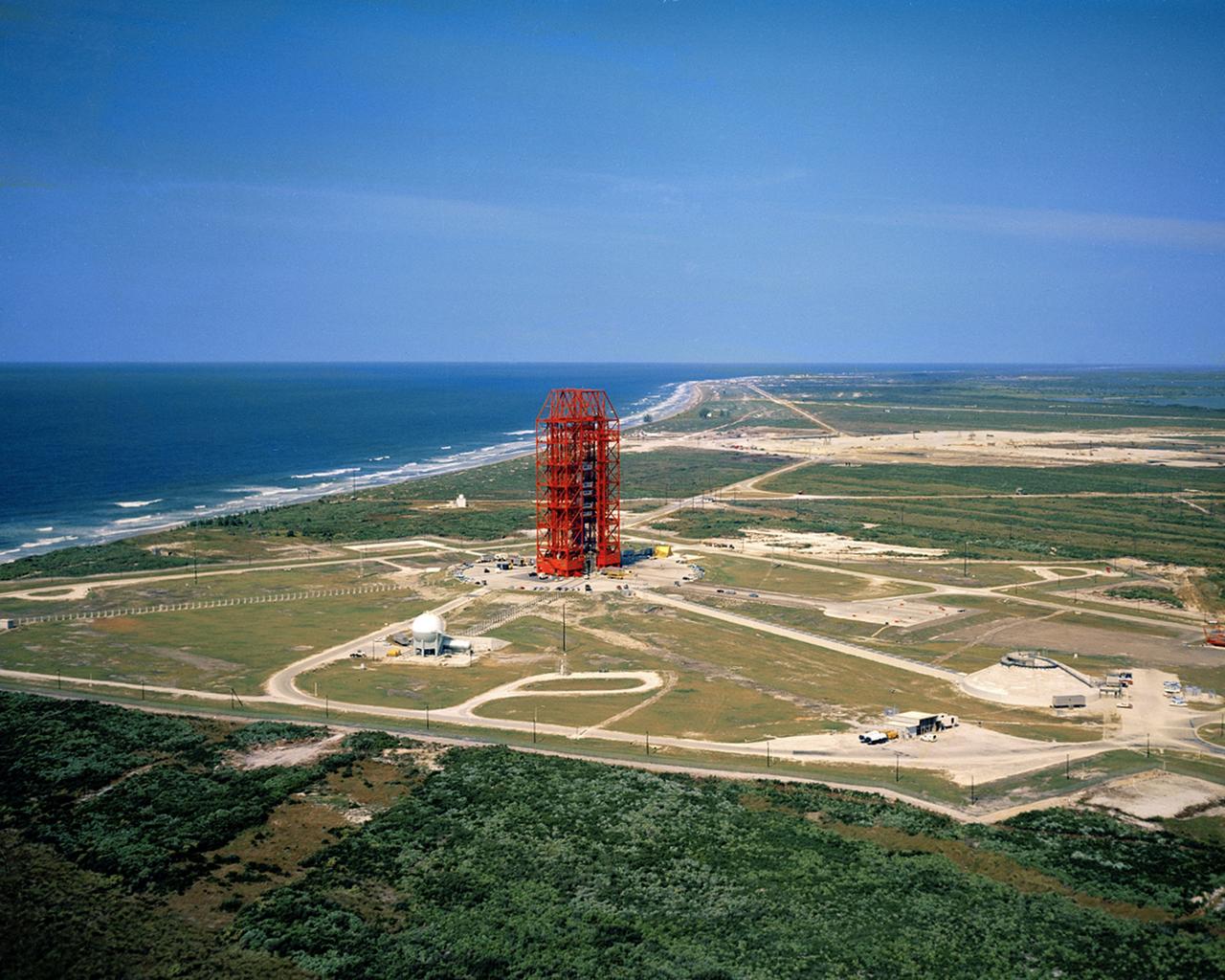
CAPE CANAVERAL, Fla. – Aerial photo, Pad 34 overall, low-level from south. CCMTA, NASA-LOD. Photo credit: NASA
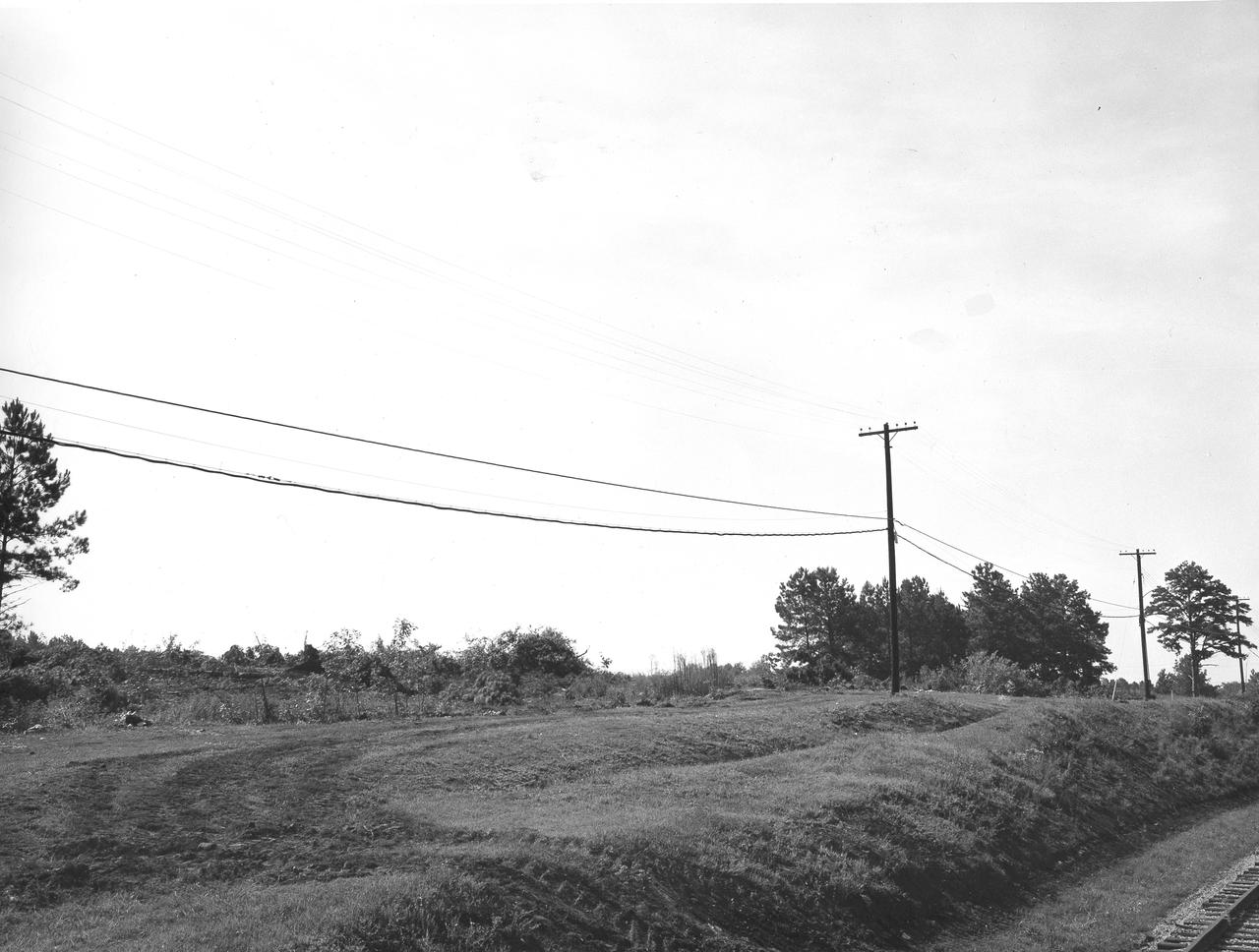
At its founding, the Marshall Space Flight Center (MSFC) inherited the Army’s Jupiter and Redstone test stands, but much larger facilities were needed for the giant stages of the Saturn V. From 1960 to 1964, the existing stands were remodeled and a sizable new test area was developed. The new comprehensive test complex for propulsion and structural dynamics was unique within the nation and the free world, and they remain so today because they were constructed with foresight to meet the future as well as on going needs. Construction of the S-IC Static test stand complex began in 1961 in the west test area of MSFC, and was completed in 1964. The S-IC static test stand was designed to develop and test the 138-ft long and 33-ft diameter Saturn V S-IC first stage, or booster stage, weighing in at 280,000 pounds. Required to hold down the brute force of a 7,500,000-pound thrust produced by 5 F-1 engines, the S-IC static test stand was designed and constructed with the strength of hundreds of tons of steel and 12,000,000 pounds of cement, planted down to bedrock 40 feet below ground level. The foundation walls, constructed with concrete and steel, are 4 feet thick. The base structure consists of four towers with 40-foot-thick walls extending upward 144 feet above ground level. The structure was topped by a crane with a 135-foot boom. With the boom in the upright position, the stand was given an overall height of 405 feet, placing it among the highest structures in Alabama at the time. This photo shows the construction progress of the test stand as of August 11, 1961.
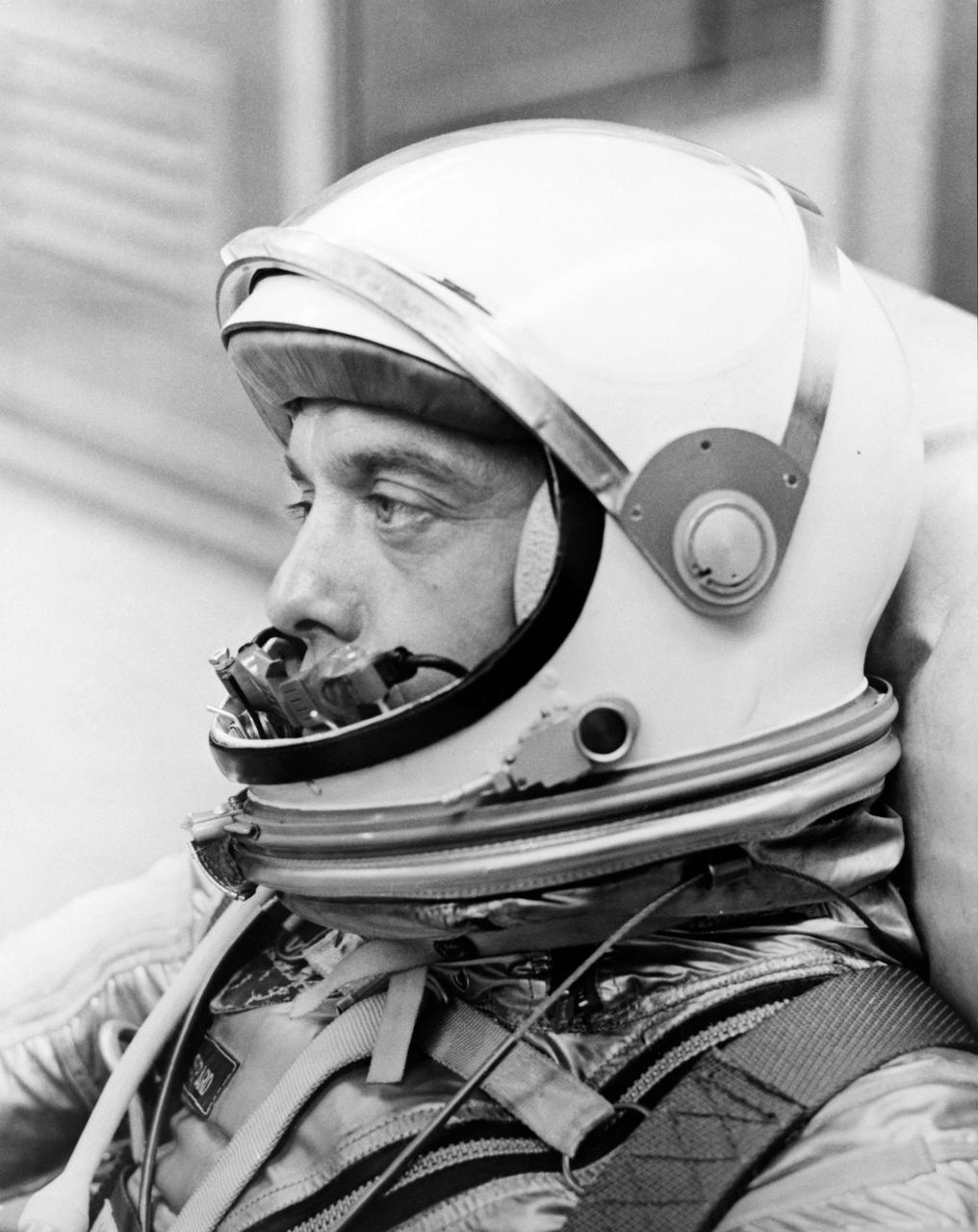
S61-02775 (5 May 1961) --- Close-up view of astronaut Alan B. Shepard Jr. in his pressure suit, with helmet opened, for the Mercury-Redstone 3 (MR-3) flight, the first American manned spaceflight. Photo credit: NASA or National Aeronautics and Space Administration
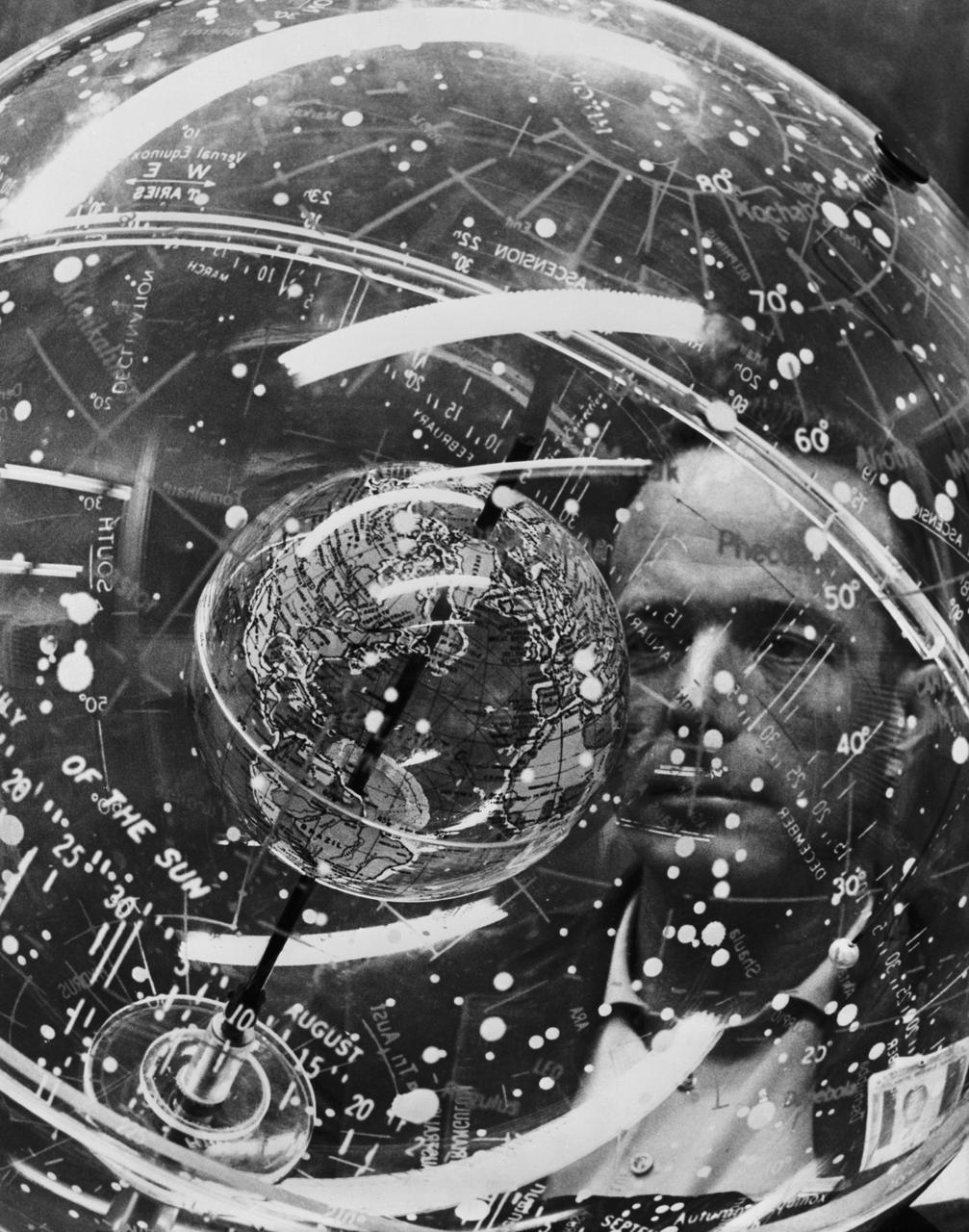
S61-04621 (1961) --- Astronaut M. Scott Carpenter looks into a Celestial Training Device (globe) during training in the Aeromedical Laboratory at Cape Canaveral, Florida. Photo credit: NASA
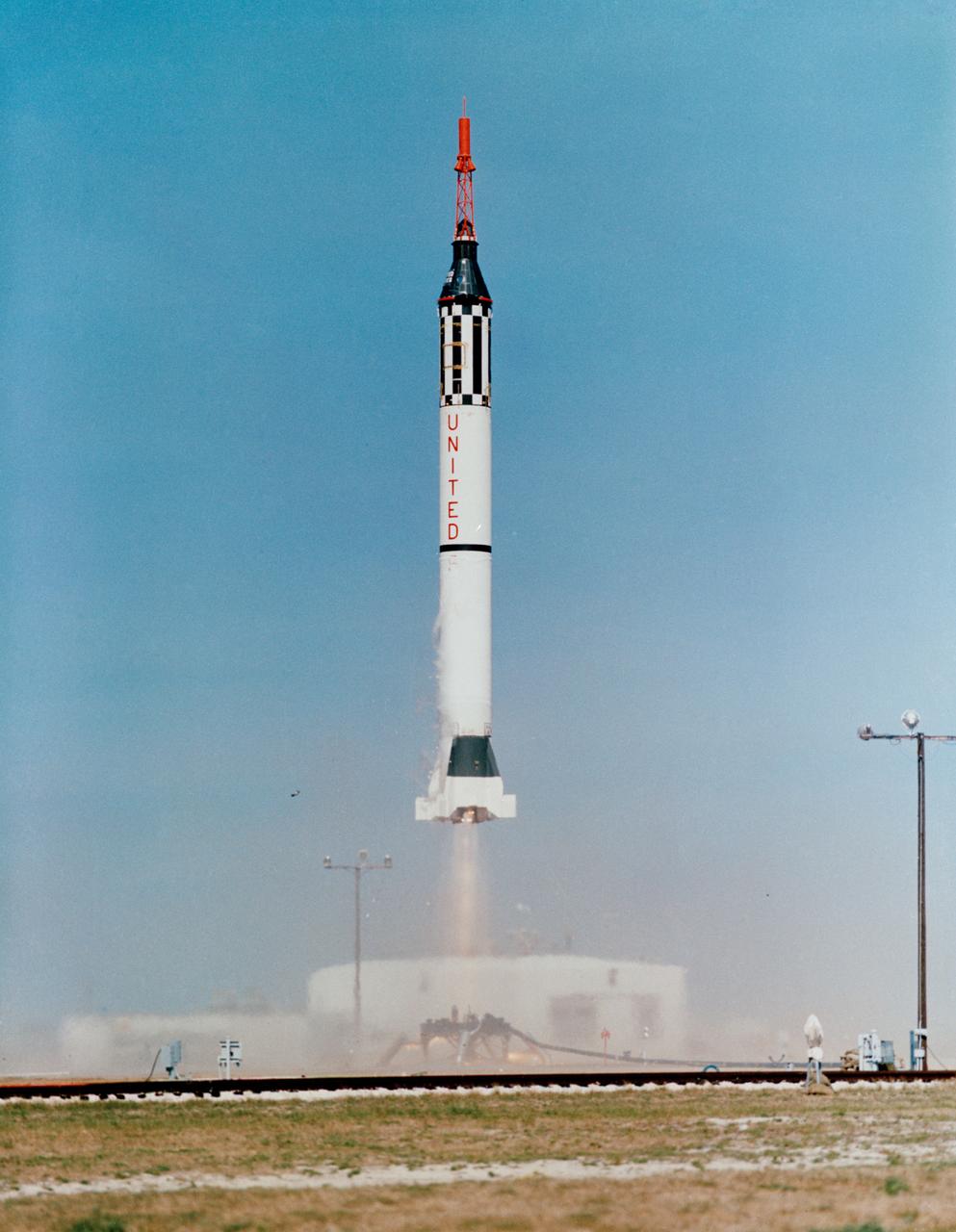
S61-01942 (31 Jan. 1961) --- Launch of the Mercury-Redstone 2 (MR-2) vehicle on Jan. 31, 1961. The 16-minute suborbital flight carried biomedical test subject chimpanzee (Ham) aboard. Photo credit: NASA
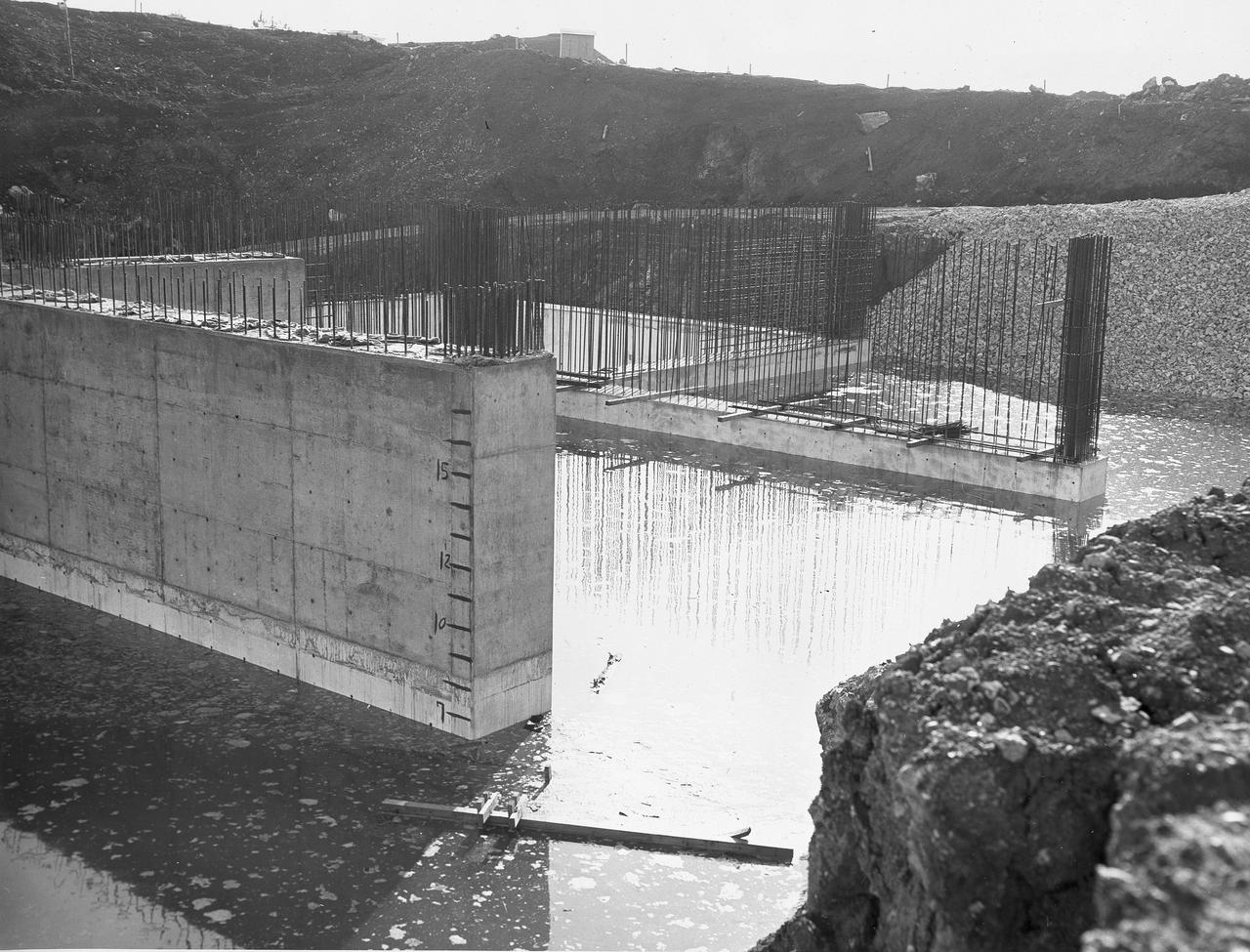
At its founding, the Marshall Space Flight Center (MSFC) inherited the Army’s Jupiter and Redstone test stands, but much larger facilities were needed for the giant stages of the Saturn V. From 1960 to 1964, the existing stands were remodeled and a sizable new test area was developed. The new comprehensive test complex for propulsion and structural dynamics was unique within the nation and the free world, and they remain so today because they were constructed with foresight to meet the future as well as on going needs. Construction of the S-IC Static test stand complex began in 1961 in the west test area of MSFC, and was completed in 1964. The S-IC static test stand was designed to develop and test the 138-ft long and 33-ft diameter Saturn V S-IC first stage, or booster stage, weighing in at 280,000 pounds. Required to hold down the brute force of a 7,500,000-pound thrust produced by 5 F-1 engines, the S-IC static test stand was designed and constructed with the strength of hundreds of tons of steel and 12,000,000 pounds of cement, planted down to bedrock 40 feet below ground level. The foundation walls, constructed with concrete and steel, are 4 feet thick. The base structure consists of four towers with 40-foot-thick walls extending upward 144 feet above ground level. The structure was topped by a crane with a 135-foot boom. With the boom in the upright position, the stand was given an overall height of 405 feet, placing it among the highest structures in Alabama at the time. Construction of the S-IC test stand came to a halt at the end of September as the determination was made that the Saturn booster size had to be increased. As a result, the stand had to be modified. With construction delayed, and pumps turned off, this photo, taken December 1, 1961, shows the abandoned site with floods at the 6 ft mark. The flooding was caused by the disturbance of a natural spring months prior during the excavation of the site.
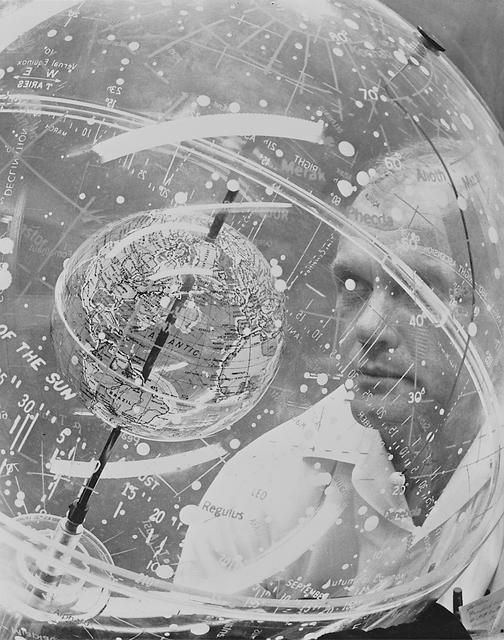
S61-04622 (1961) --- Mercury astronaut John H. Glenn Jr. looks into a Celestial Training Device (globe) during training in the Aeromedical Laboratory at Cape Canaveral, Florida. Photo credit: NASA
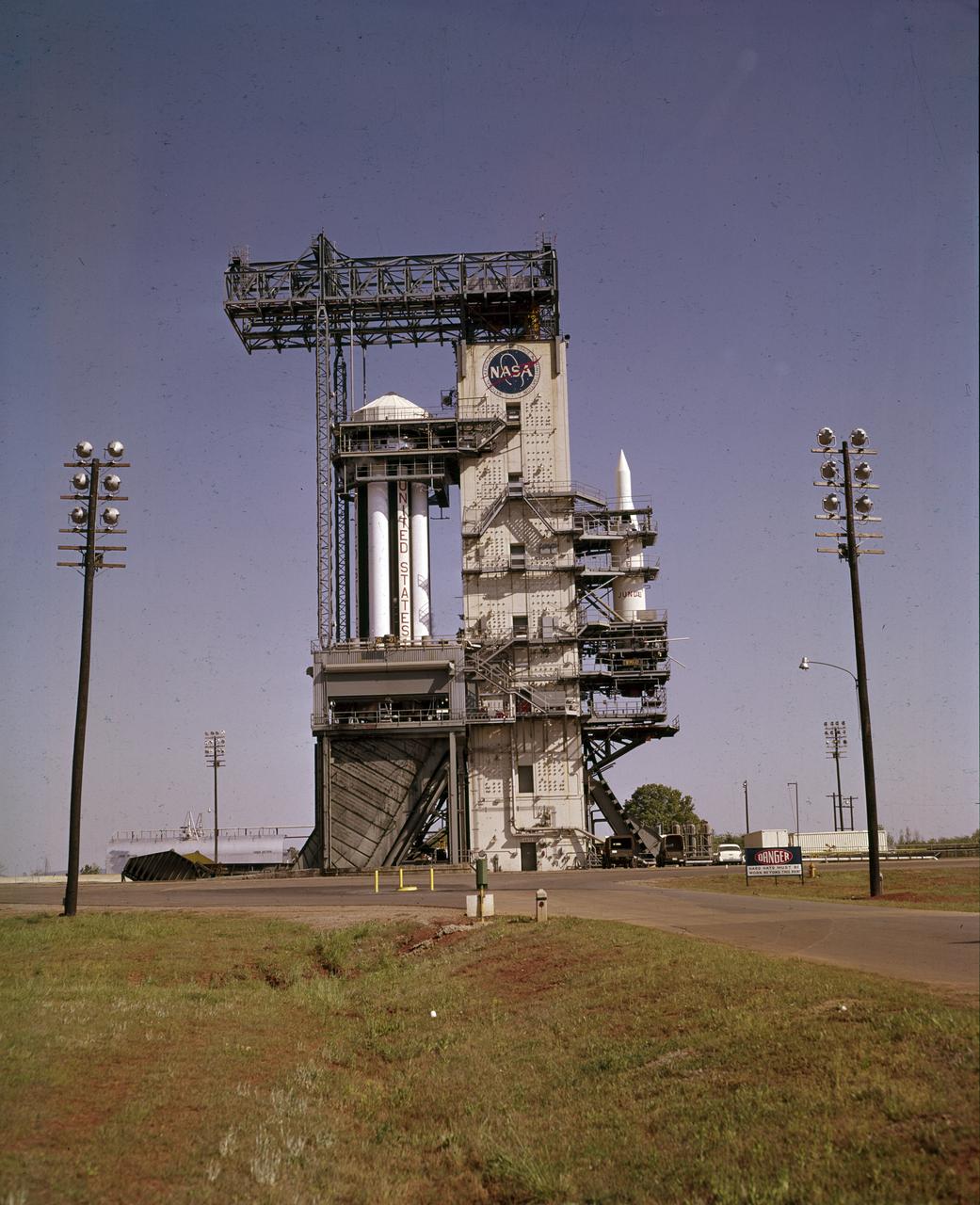
On October 27, 1961, the Marshall Space Flight Center (MSFC) and the Nation marked a high point in the 3-year-old Saturn development program when the first Saturn vehicle flew a flawless 215-mile ballistic trajectory from Cape Canaveral, Florida. SA-1 is pictured here, five months before launch, in the MSFC test stand on May 16, 1961. Developed and tested at MSFC under the direction of Dr. Wernher von Braun, SA-1 incorporated a Saturn I, Block I engine. The typical height of a Block I vehicle was approximately 163 feet. and had only one live stage. It consisted of eight tanks, each 70 inches in diameter, clustered around a central tank, 105 inches in diameter. Four of the external tanks were fuel tanks for the RP-1 (kerosene) fuel. The other four, spaced alternately with the fuel tanks, were liquid oxygen tanks, as was the large center tank. All fuel tanks and liquid oxygen tanks drained at the same rates respectively. The thrust for the stage came from eight H-1 engines, each producing a thrust of 165,000 pounds, for a total thrust of over 1,300,000 pounds. The engines were arranged in a double pattern. Four engines, located inboard, were fixed in a square pattern around the stage axis and canted outward slightly, while the remaining four engines were located outboard in a larger square pattern offset 40 degrees from the inner pattern. Unlike the inner engines, each outer engine was gimbaled. That is, each could be swung through an arc. They were gimbaled as a means of steering the rocket, by letting the instrumentation of the rocket correct any deviations of its powered trajectory. The block I required engine gimabling as the only method of guiding and stabilizing the rocket through the lower atmosphere. The upper stages of the Block I rocket reflected the three-stage configuration of the Saturn I vehicle.
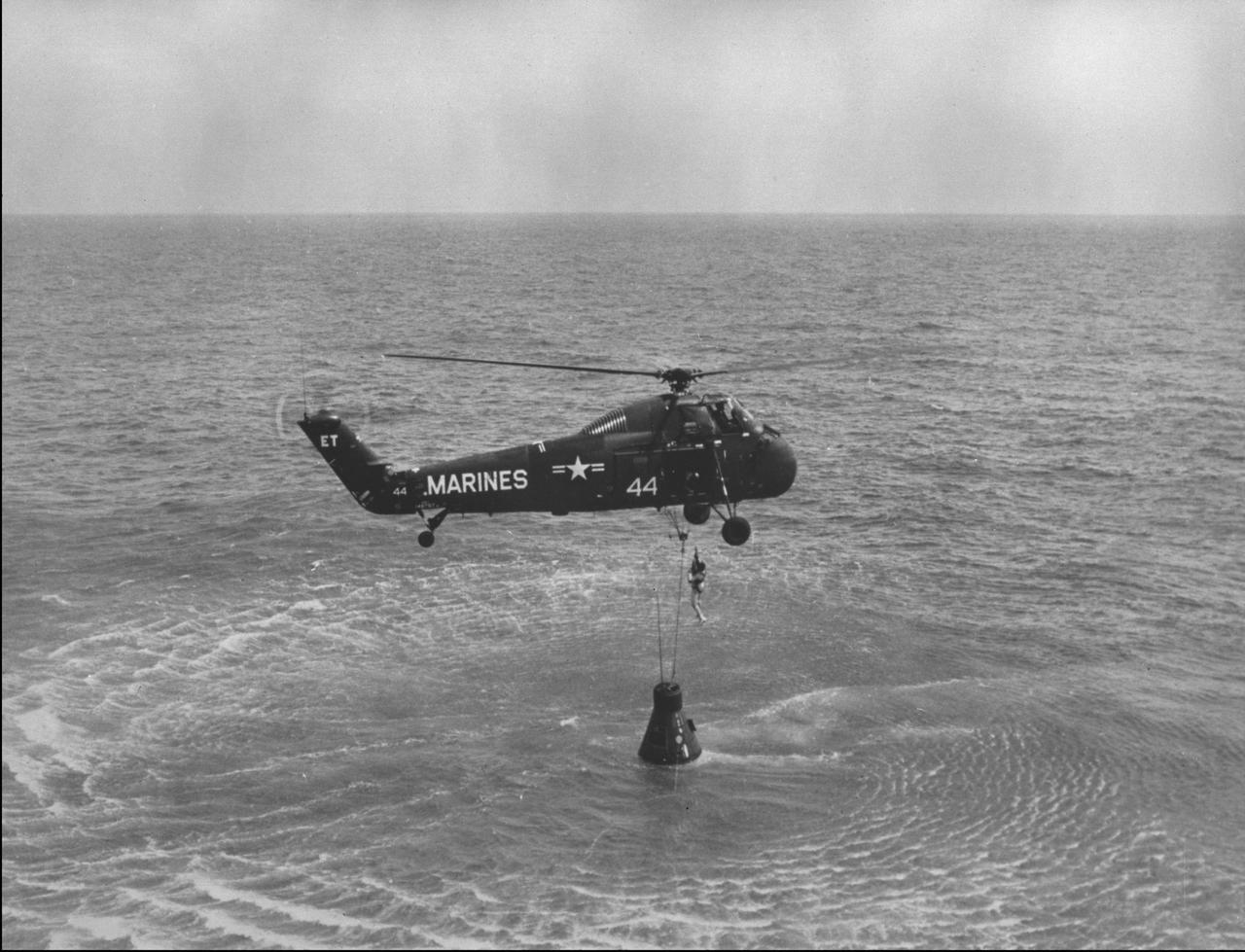
KENNEDY SPACE CENTER, FLA. -- NASA Astronaut Alan B. Shepard Jr. is hoisted up in a body harness by a U.S. Marine helicopter recovery team following the first Project Mercury suborbital space flight. Astronaut Shepard, along with his spacecraft, was then taken to the U.S. Navy Carrier Chaplain.
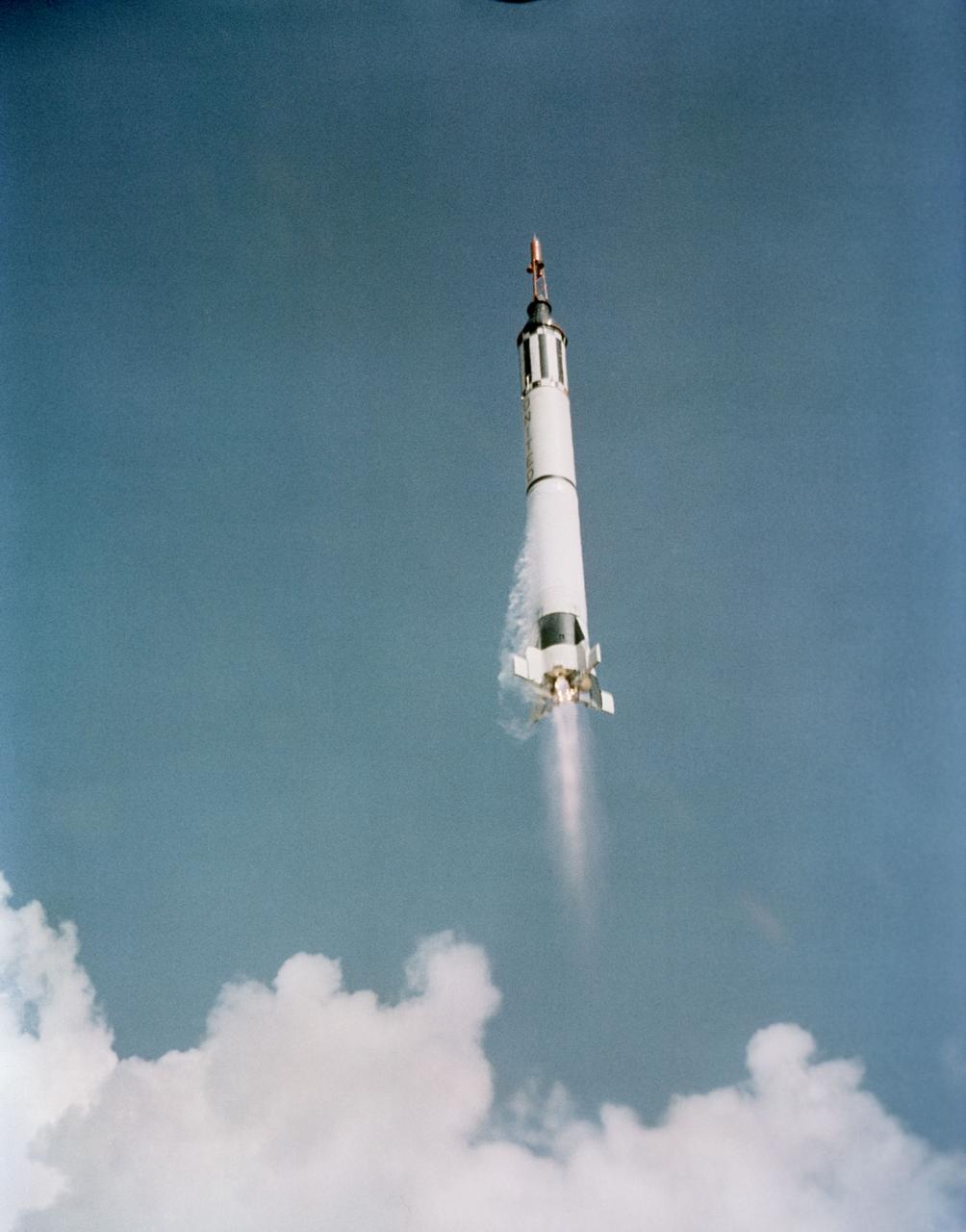
S61-01908 (5 May 1961) --- This is the launch of the Mercury-Redstone 3 (MR-3) spacecraft from Cape Canaveral on a suborbital mission -- the first U.S. manned spaceflight. The spacecraft is already headed towards its suborbital mission. Photo credit: NASA or National Aeronautics and Space Administration
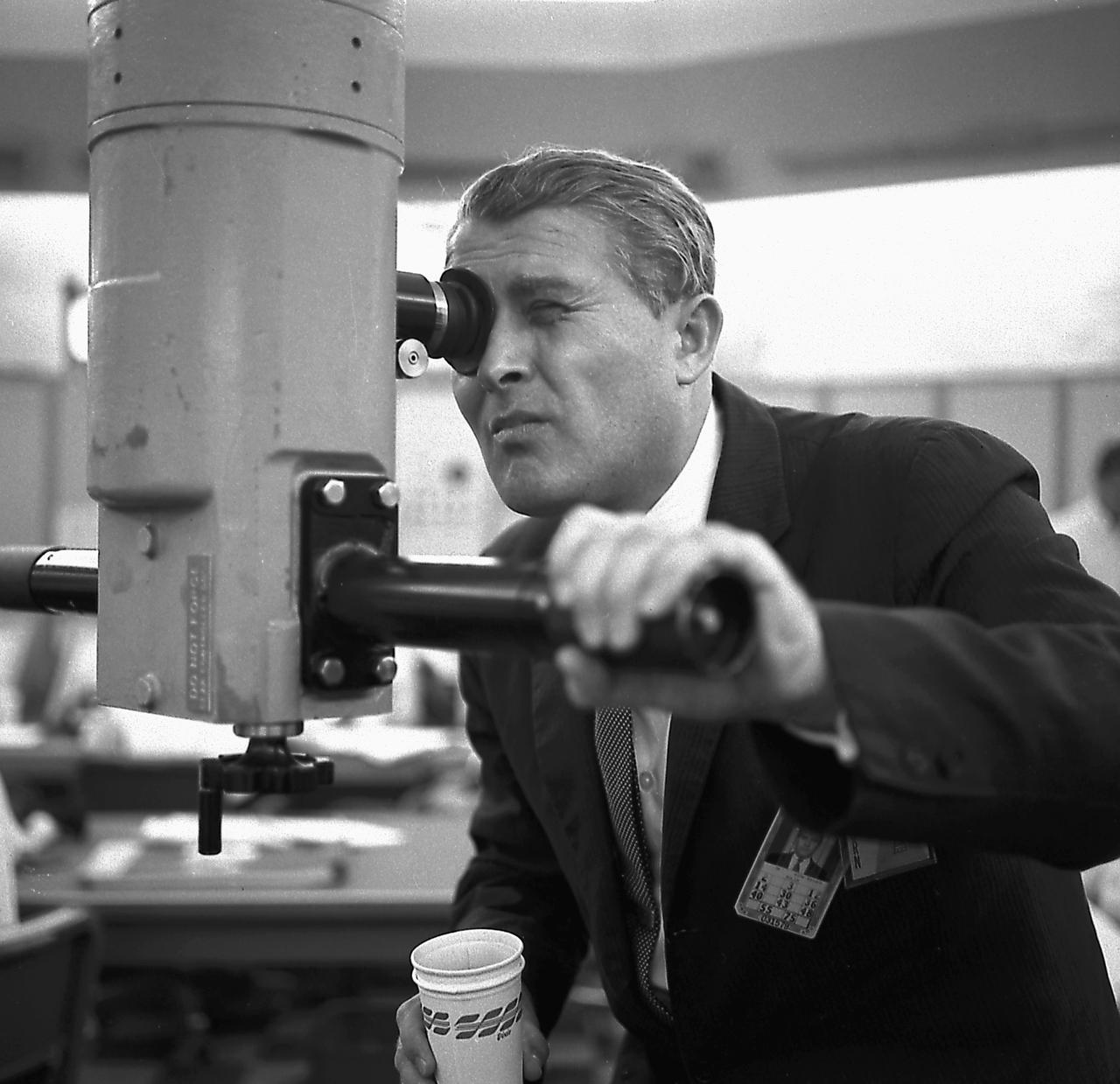
Dr. von Braun watches the Saturn 1 (SA-1) launch through a scope from the blockhouse 34 on October 27, 1961. The SA-1 was the first launch of Saturn launch vehicles developed at the Marshall Space Flight Center (MSFC) under the direction of Dr. von Braun. The flight demonstrated the validity of the clustered engine concept and launched dummy upper stages.
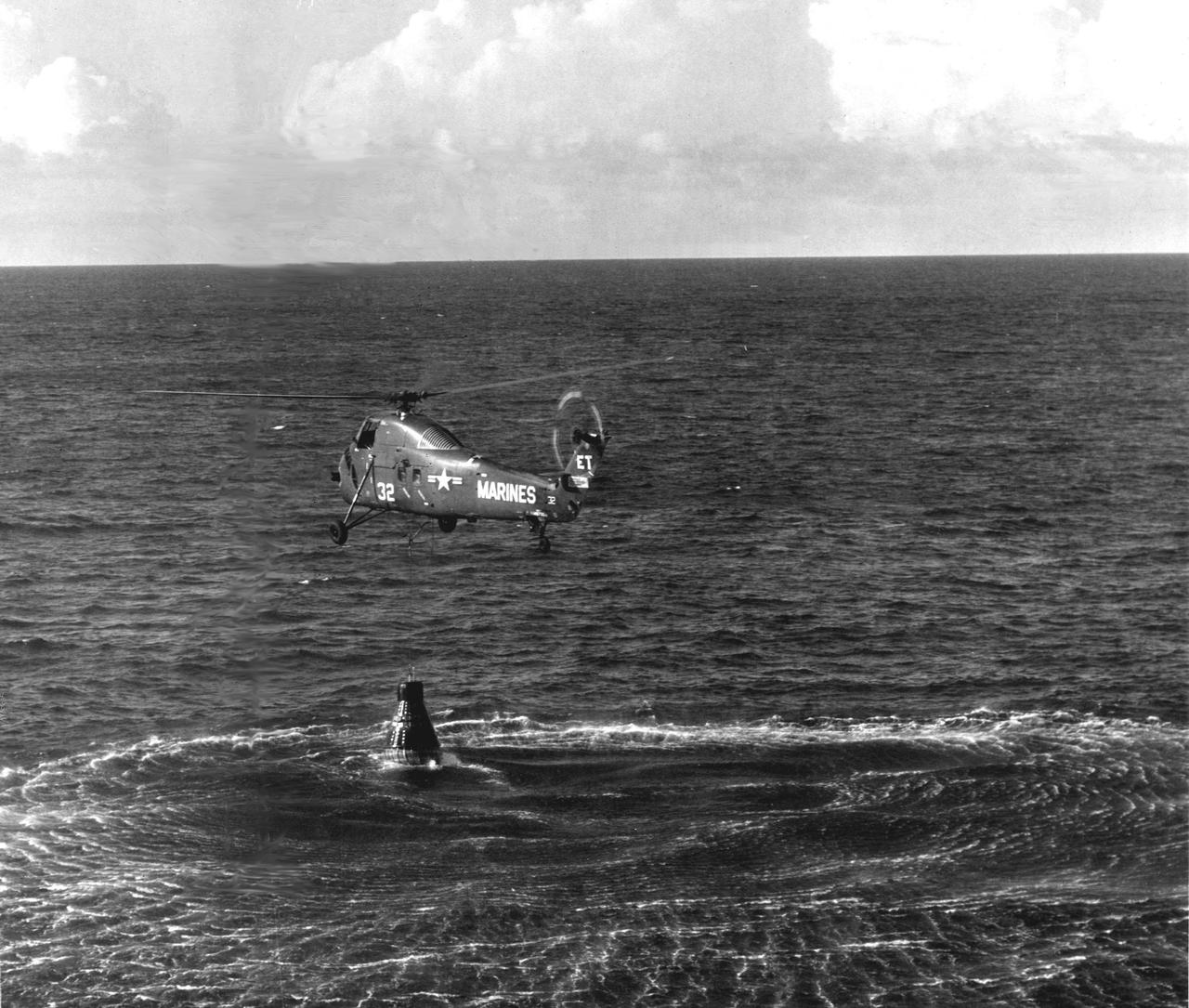
KENNEDY SPACE CENTER, FLA. -- Marine helicopter appears to have Liberty Bell 7 in tow after Virgil I. Grissom's successful flight of 305 miles down the Atlantic Missile Range. Minutes after 'Gus' Grissom got out of the spacecraft, it sank. (NASA Photo
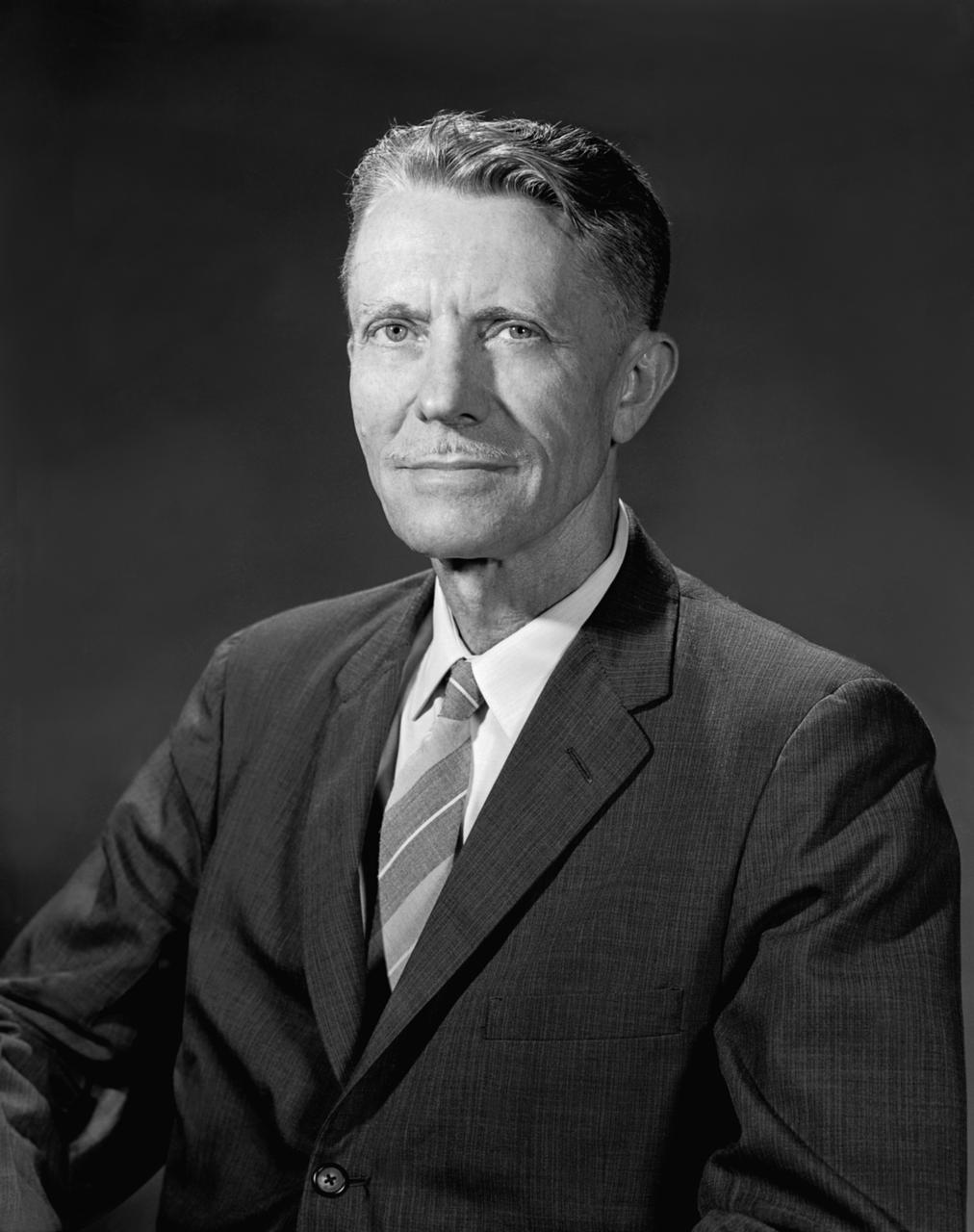
Portrait of Floyd L. Thompson NASA Langley Center Director
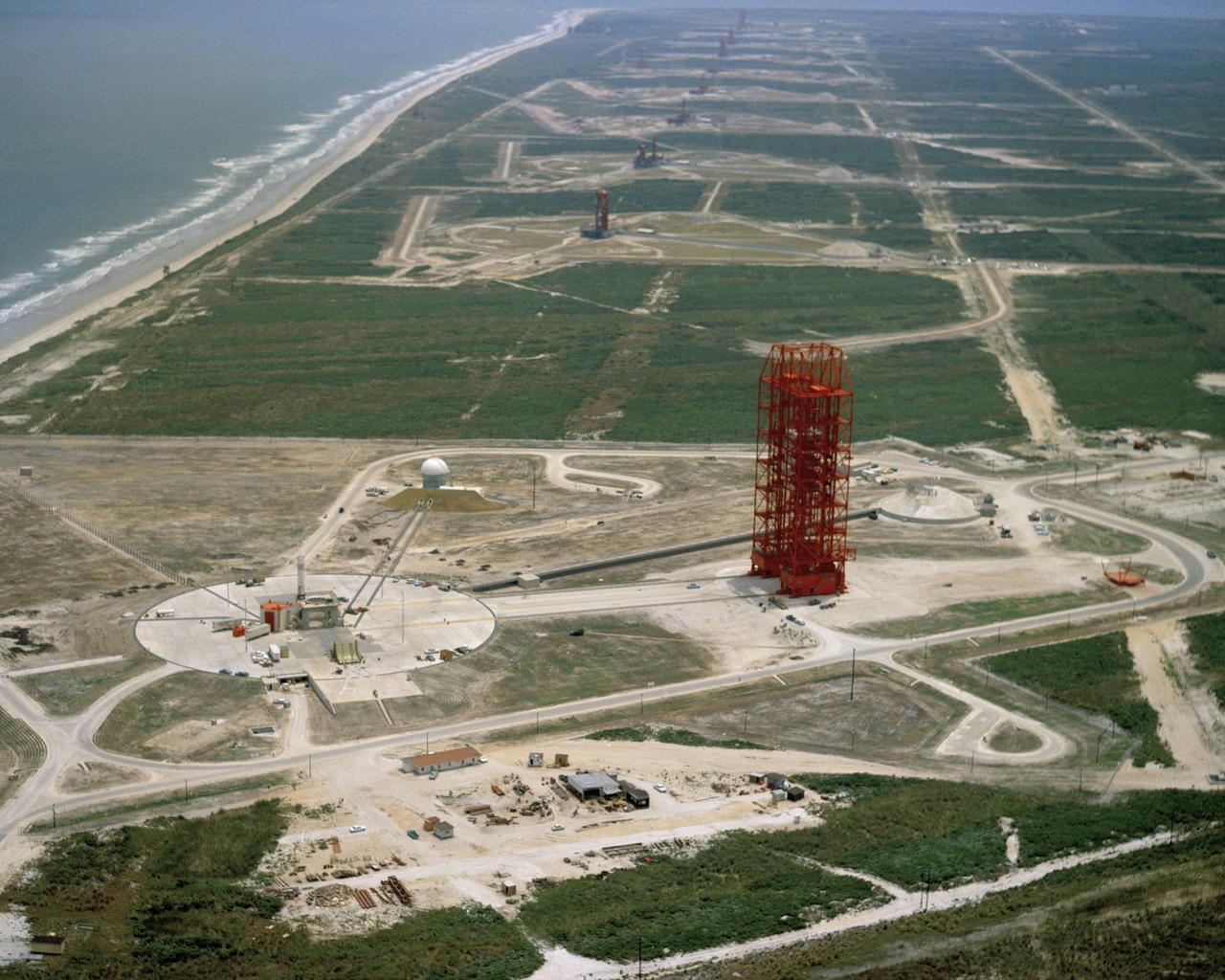
AERIAL PHOTO SHOWING COMPLEX 34 AND OTHER LAUNCH PADS IN BACKGROUND CCMTA NASA-LOD
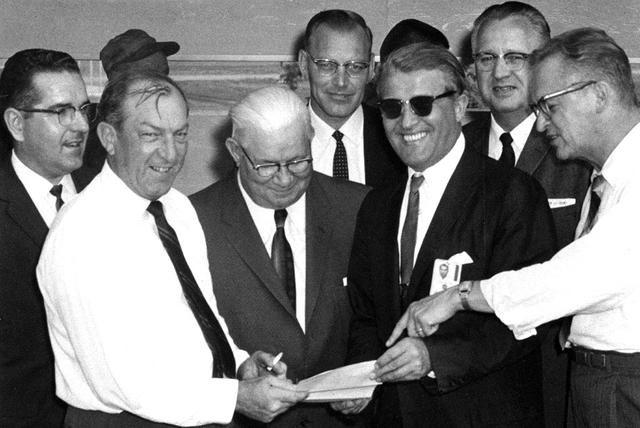
This is a photograph of a group of government officials touring the Marshall Space Flight Center in July 1961 with Dr. von Braun. Second from left is Alabama Congressman Robert Jones.
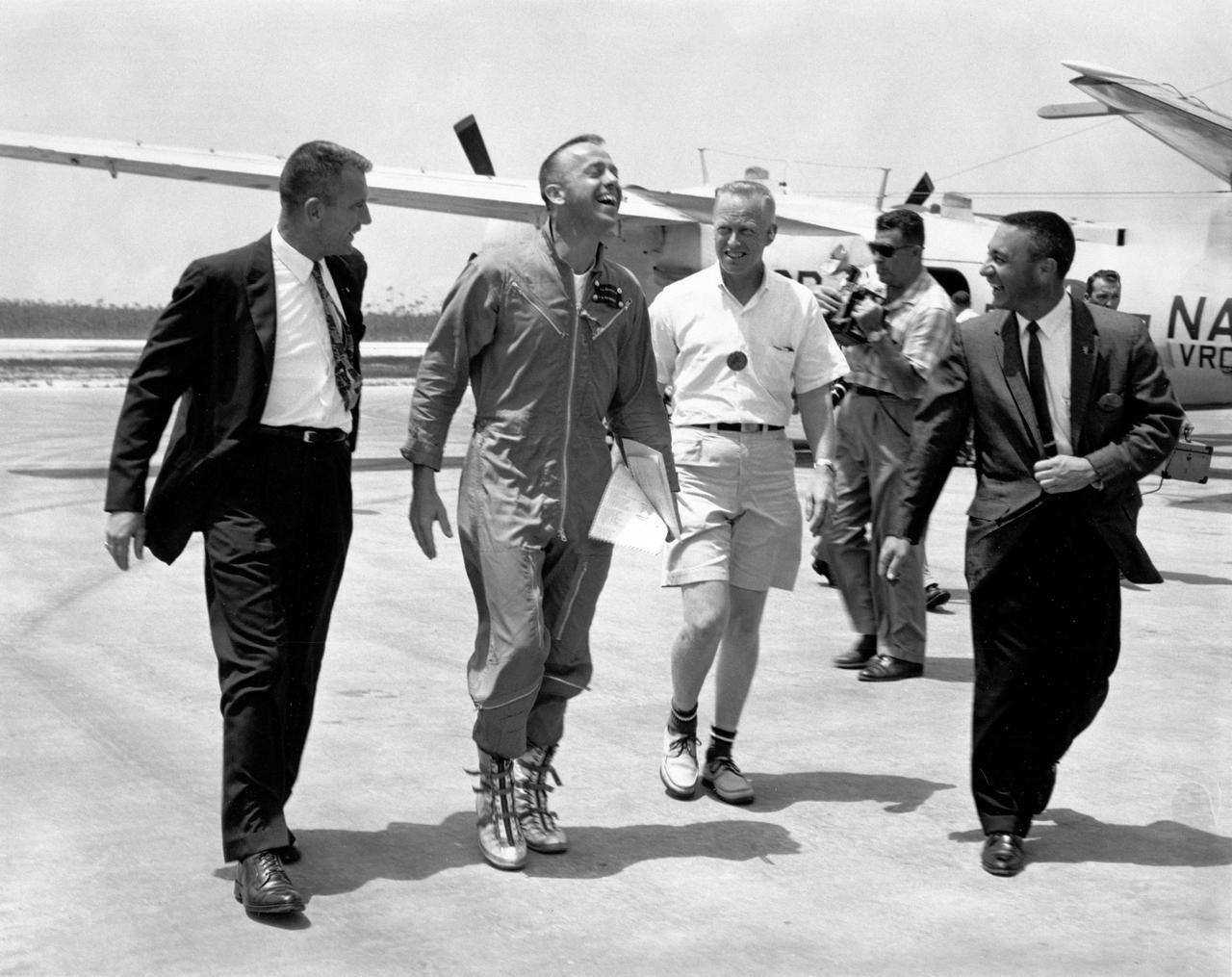
KENNEDY SPACE CENTER, FLA. - Astronauts Deke Slayton, far left, and Virgil Grissom, far right, were on hand to greet Astronaut Alan B. Shepard at Grand Bahama Island after his historic first U.S. manned suborbital flight. Just behind Astronaut Shepard is Dr. Keith Lyndell.
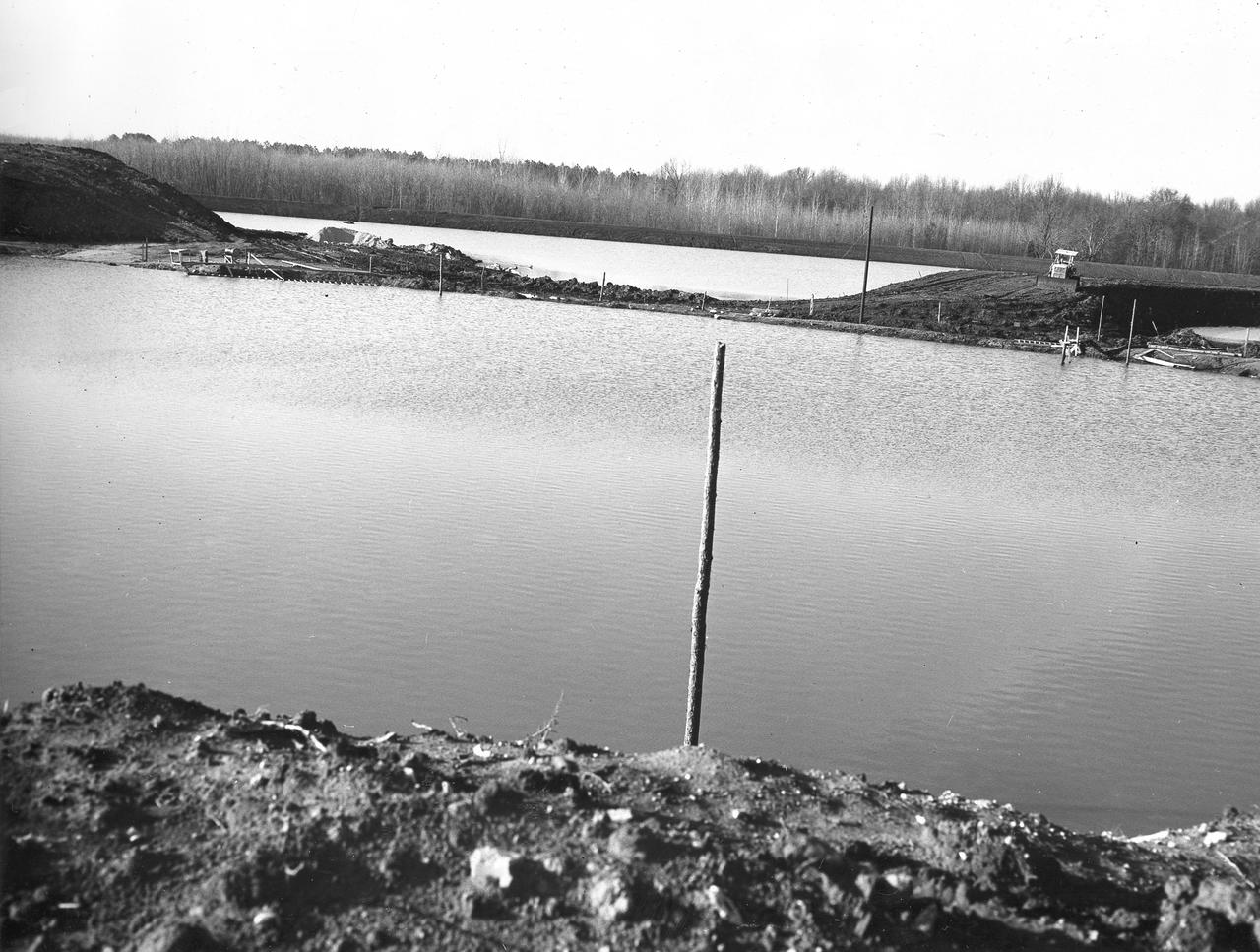
At its founding, the Marshall Space Flight Center (MSFC) inherited the Army’s Jupiter and Redstone test stands, but much larger facilities were needed for the giant stages of the Saturn V. From 1960 to 1964, the existing stands were remodeled and a sizable new test area was developed. The new comprehensive test complex for propulsion and structural dynamics was unique within the nation and the free world, and they remain so today because they were constructed with foresight to meet the future as well as on going needs. Construction of the S-IC Static test stand complex began in 1961 in the west test area of MSFC, and was completed in 1964. The S-IC static test stand was designed to develop and test the 138-ft long and 33-ft diameter Saturn V S-IC first stage, or booster stage, weighing in at 280,000 pounds. Required to hold down the brute force of a 7,500,000-pound thrust produced by 5 F-1 engines, the S-IC static test stand was designed and constructed with the strength of hundreds of tons of steel and 12,000,000 pounds of cement, planted down to bedrock 40 feet below ground level. The foundation walls, constructed with concrete and steel, are 4 feet thick. The base structure consists of four towers with 40-foot-thick walls extending upward 144 feet above ground level. The structure was topped by a crane with a 135-foot boom. With the boom in the upright position, the stand was given an overall height of 405 feet, placing it among the highest structures in Alabama at the time. Construction of the S-IC test stand came to a halt at the end of September as the determination was made that the Saturn booster size had to be increased. As a result, the stand had to be modified. With construction delayed, and pumps turned off, this photo, taken December 22, 1961, shows danger signs posted around the abandoned site with floods nearing the top. The flooding was caused by the disturbance of a natural spring months prior during the excavation of the site.
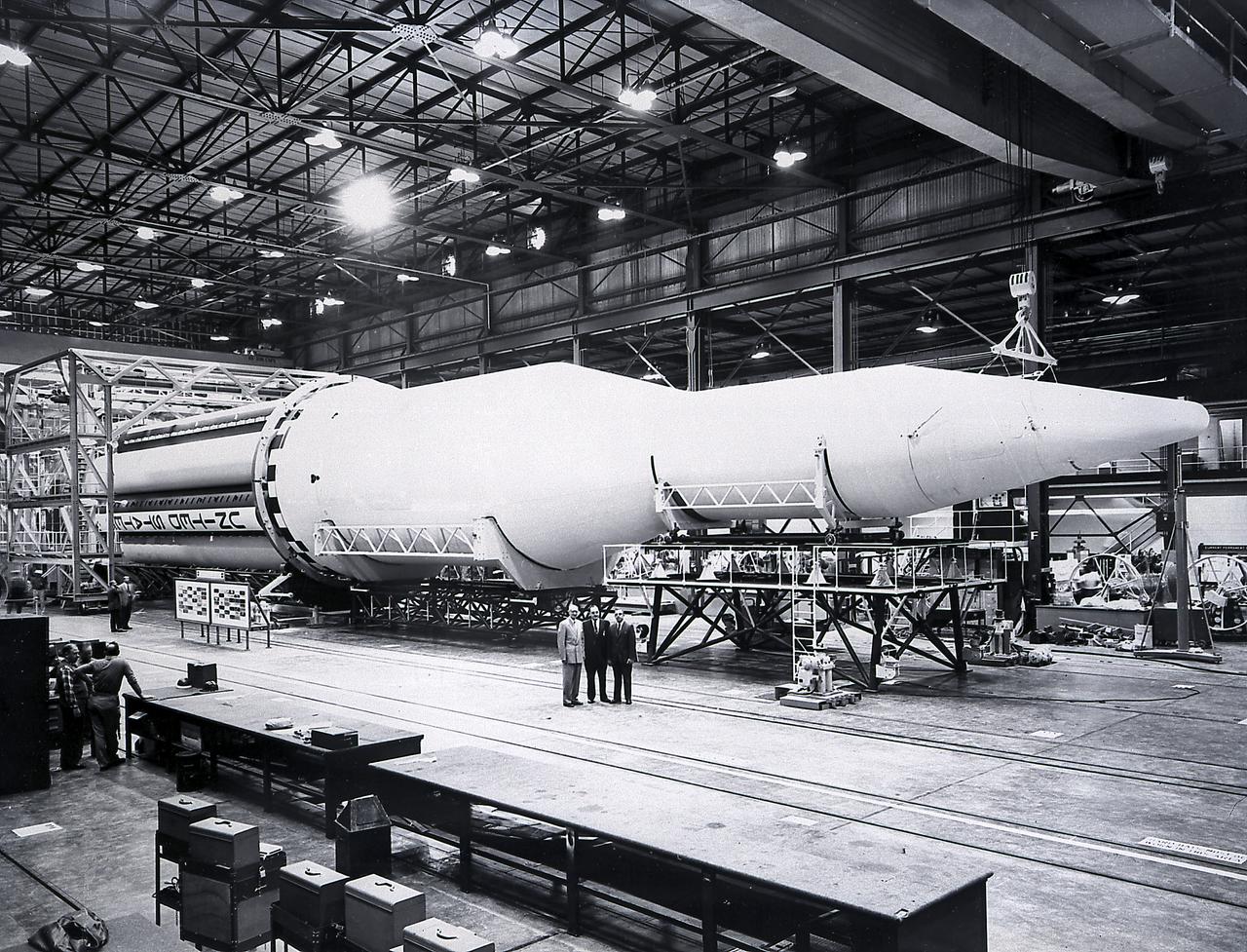
A completed Saturn I launch vehicle in the Fabrication and Assembly Engineering Division at the Marshall Space Flight Center. The Saturn I launch vehicle is composed of an S-I first stage or booster (rear), powered by eight H-1 engines having a thrust of 1,500,000 pounds, followed by a dummy S-IV second stage with six RL-10 engine, with a total thrust of 90,000 pounds.
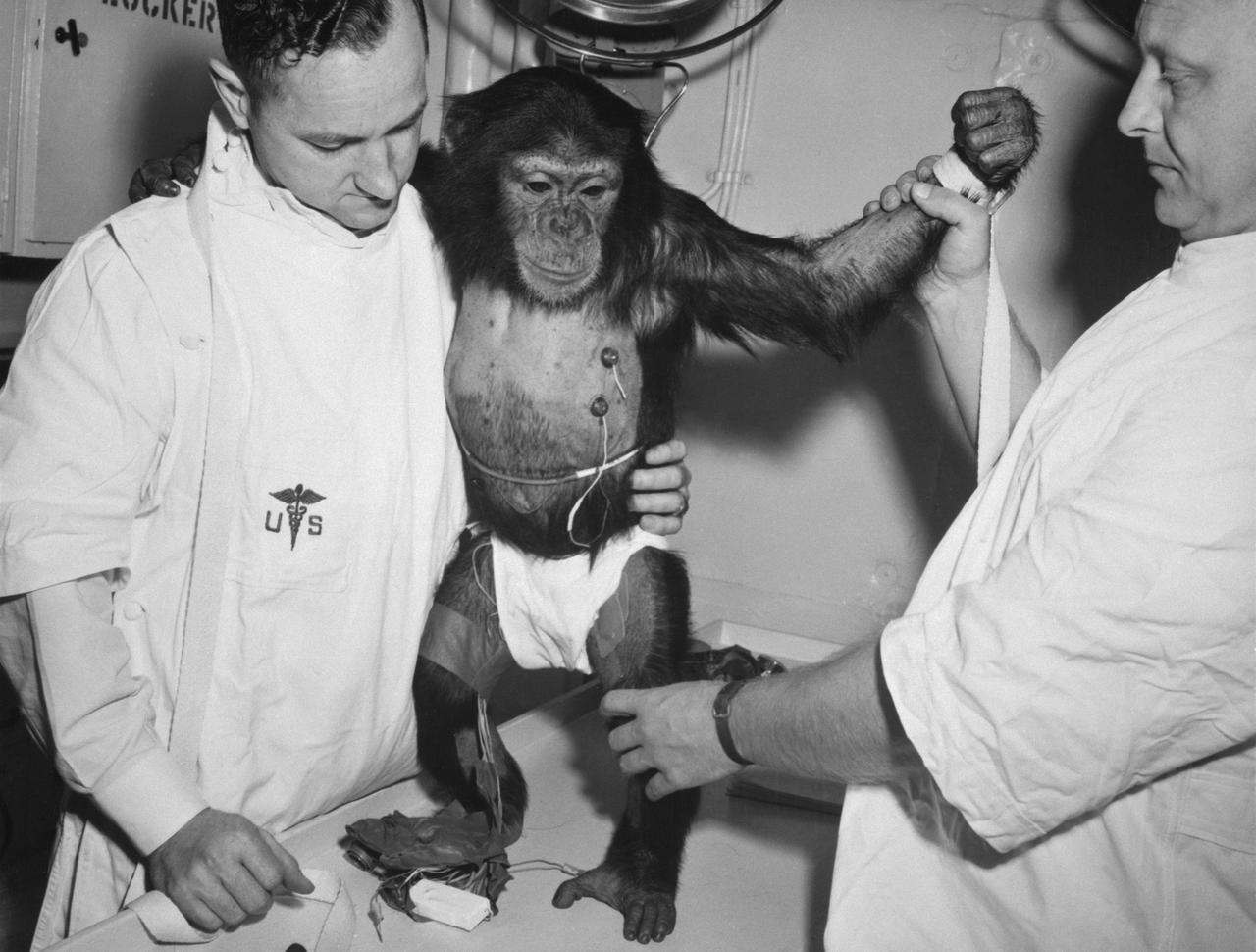
S61-00203 (31 Jan. 1961) --- Chimpanzee "Ham" with bio-sensors attached to his body is readied by handlers for his trip in the Mercury-Redstone 2 (MR-2) spacecraft. Photo credit: NASA

S61-02455 (19 June 1961) --- Astronaut Alan B. Shepard Jr. met and talked with Boy Scouts from Franklin, Virginia on June 19, 1961. They are photographed in front of the NASA Space Task Group building at Langley Space Flight Center. Photo credit: NASA or National Aeronautics and Space Administration
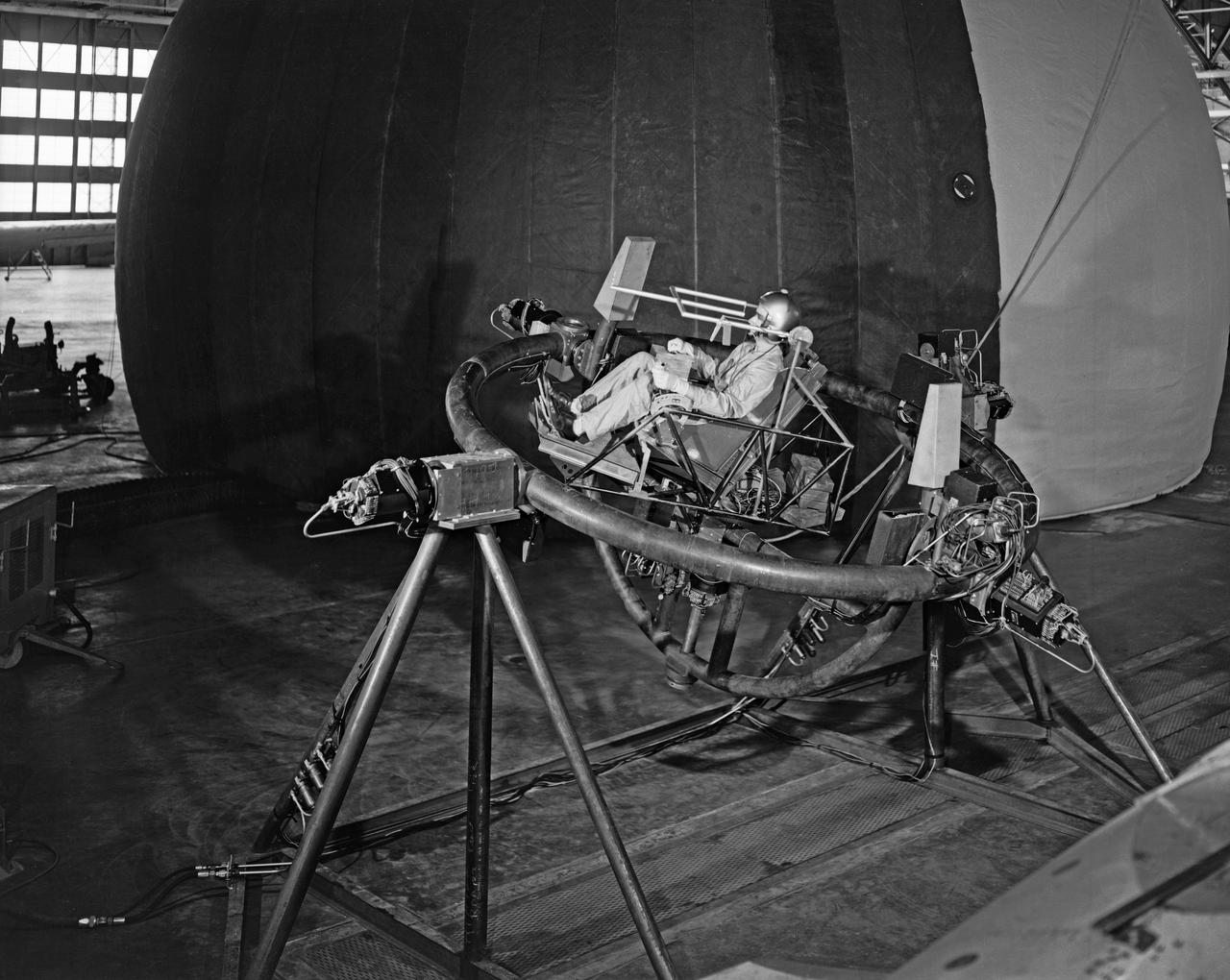
Lunar Take Off Simulator: This simulator is used by scientists at the Langley Research Center ... to help determine human ability to control a lunar launch vehicle in vertical alignment during takeoff from the moon for rendezvous with a lunar satellite vehicle on the return trip to earth. The three-axis chair, a concept which allows the pilot to sit upright during launch, gives the navigator angular motion (pitch, role, and yaw) cues as he operates the vehicle through a sidearm control system. The sight apparatus in front of the pilot's face enables him to align the vehicle on a course toward a chosen star, which will be followed as a guidance reference during the lunar launch. The pilot's right hand controls angular motions, while his left hand manipulates the thrust lever. The simulator is designed for operation inside an artificial planetarium, where a star field will be projected against the ceiling during "flights". The tests are part of an extensive NASA program at Langley in the study of problems relating to a manned lunar mission. (From a NASA Langley, photo release caption.)
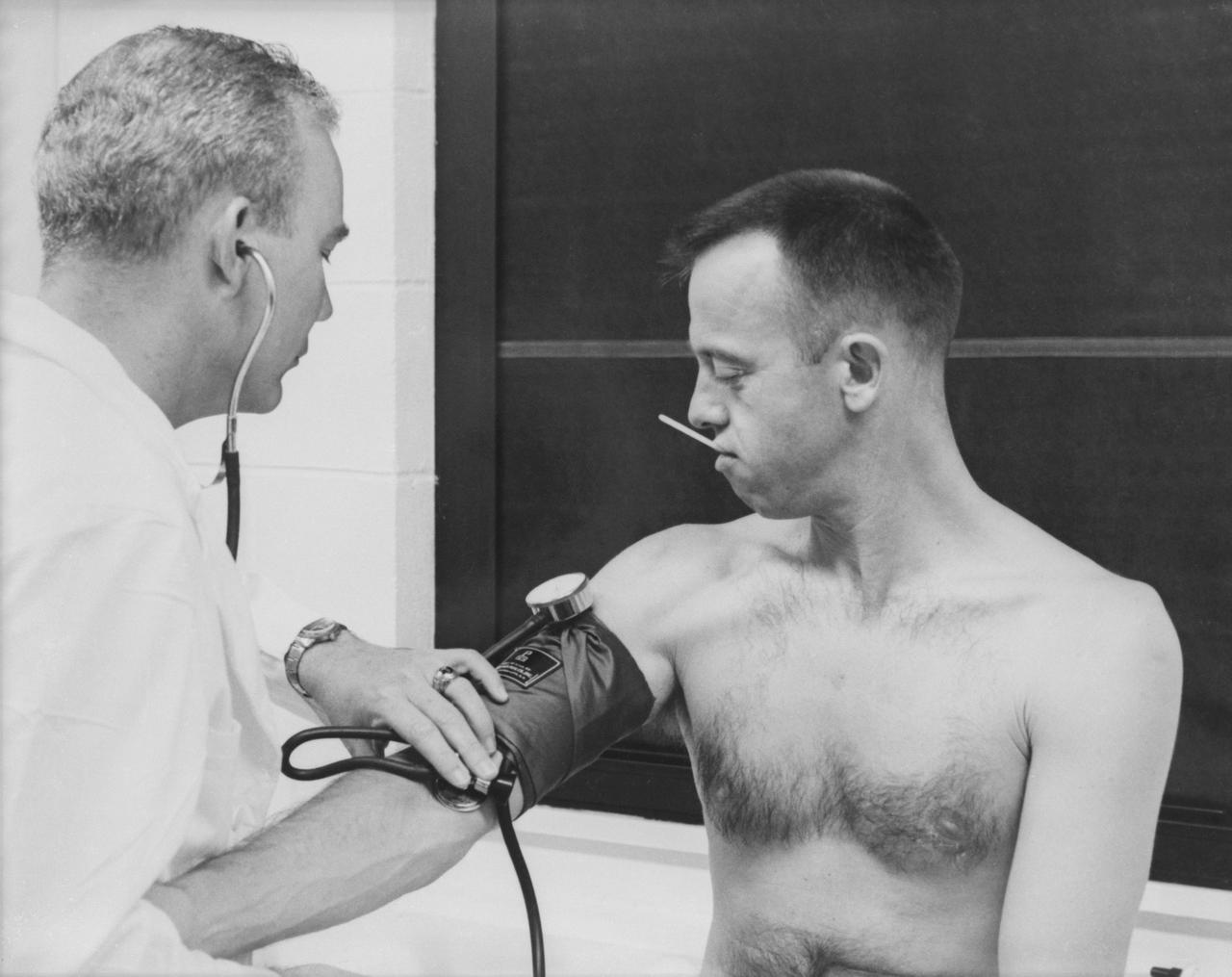
S61-02749 (5 May 1961) --- Astronaut Alan B. Shepard Jr. has his blood pressure and temperature checked prior to his Mercury-Redstone 3 (MR-3) mission, the first American manned spaceflight. The attending physician is Dr. William K. Douglas. Photo credit: NASA or National Aeronautics and Space Administration
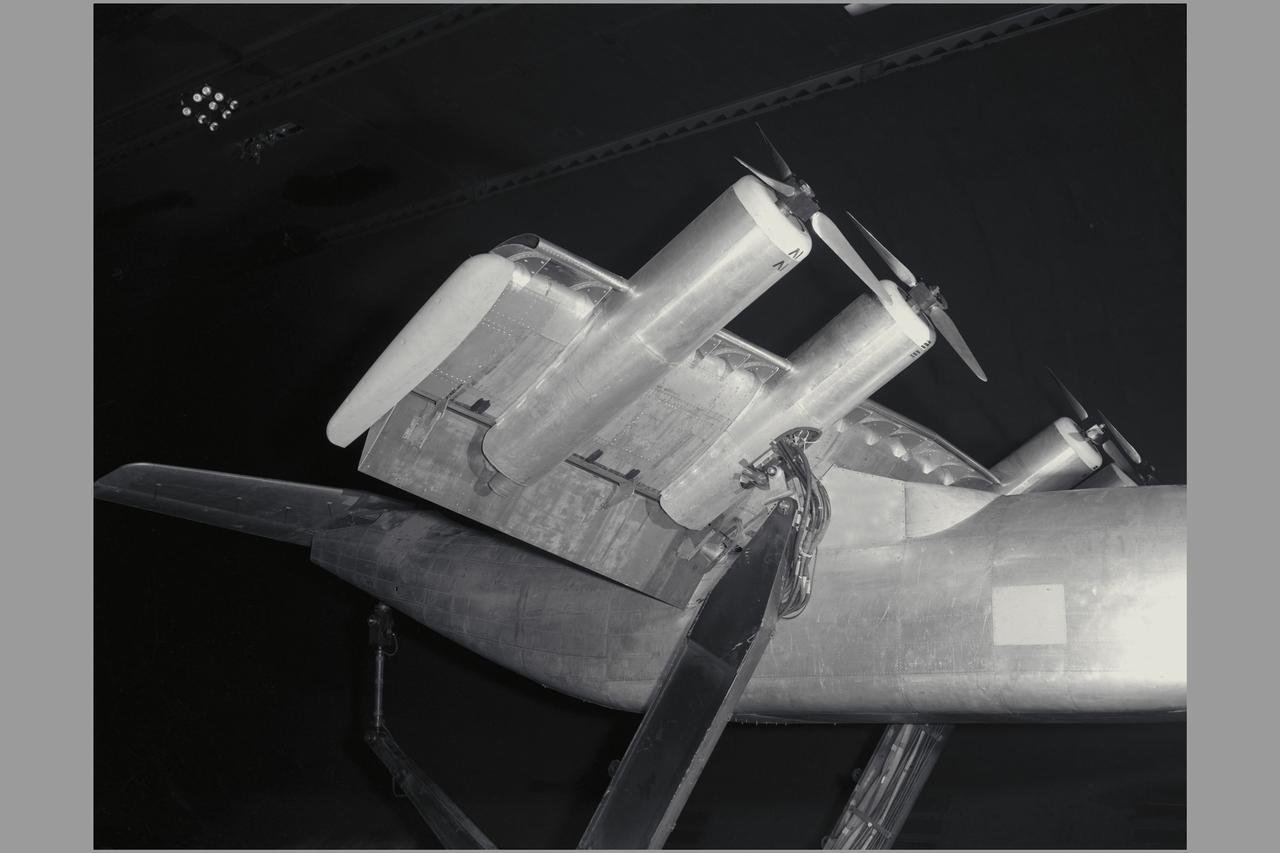
Tilt-Wing Propeller model with blowing flaps in 40x80ft w.t.