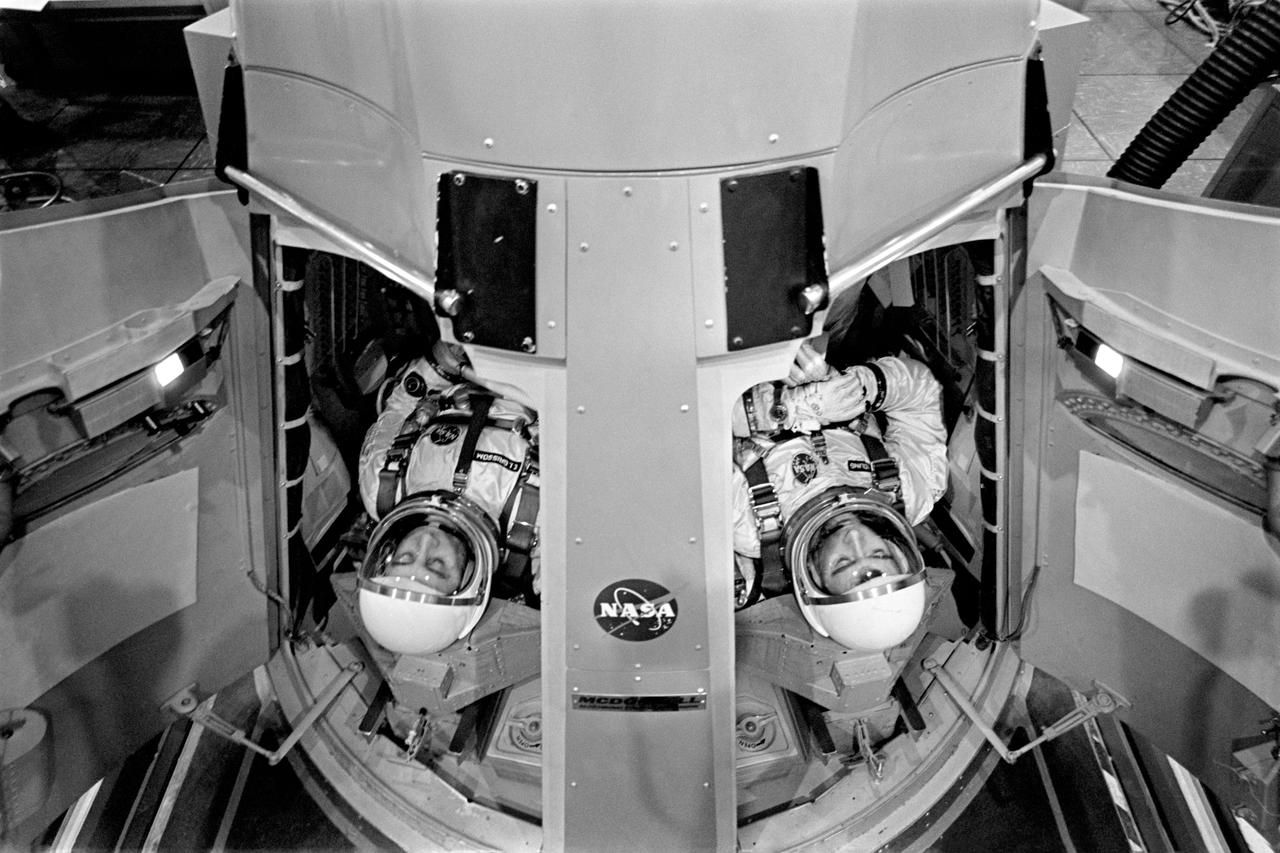
S65-21864 (19 March 1965) --- Astronauts Virgil I. Grissom (left), command pilot; and John W. Young, pilot, prepare to run Gemini-Titan 3 simulations in the Gemini mission simulator at Cape Kennedy, Florida. The NASA GT-3 flight was scheduled for March 23, 1965.
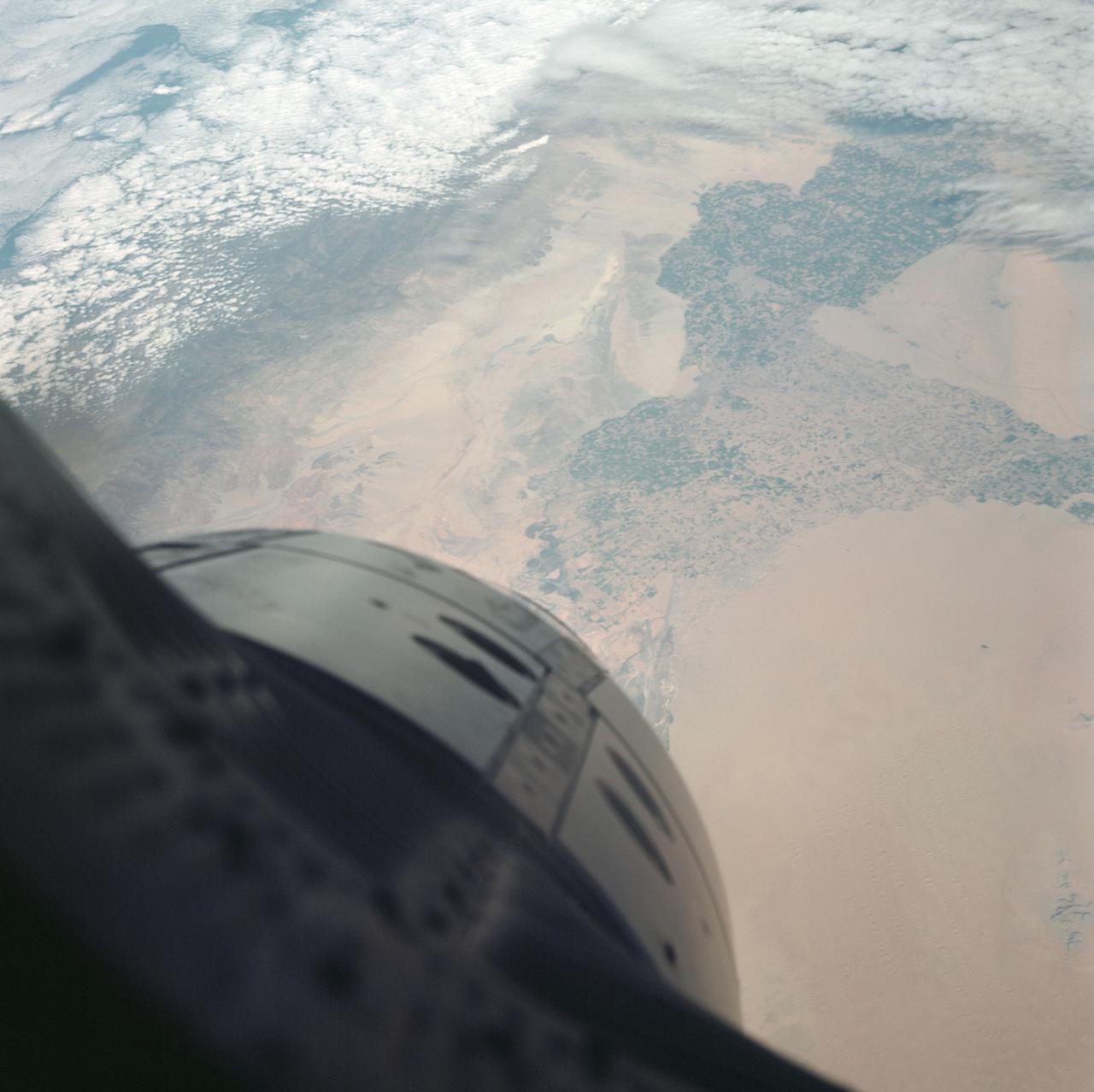
S65-18740 (23 March 1965) --- Astronaut John W. Young took this picture during the second orbit of the Gemini-Titan 3 three-orbit mission as the spacecraft "Molly Brown" passed over Northern Mexico at an altitude of 90 miles. The light-brown circular area at the lower right is the Sonoran Desert. The lower portion of the picture is Mexico, and the upper part is California. Young used a hand-held modified 70mm Hasselblad camera with color film. The lens setting was 250th of a second at f/11.
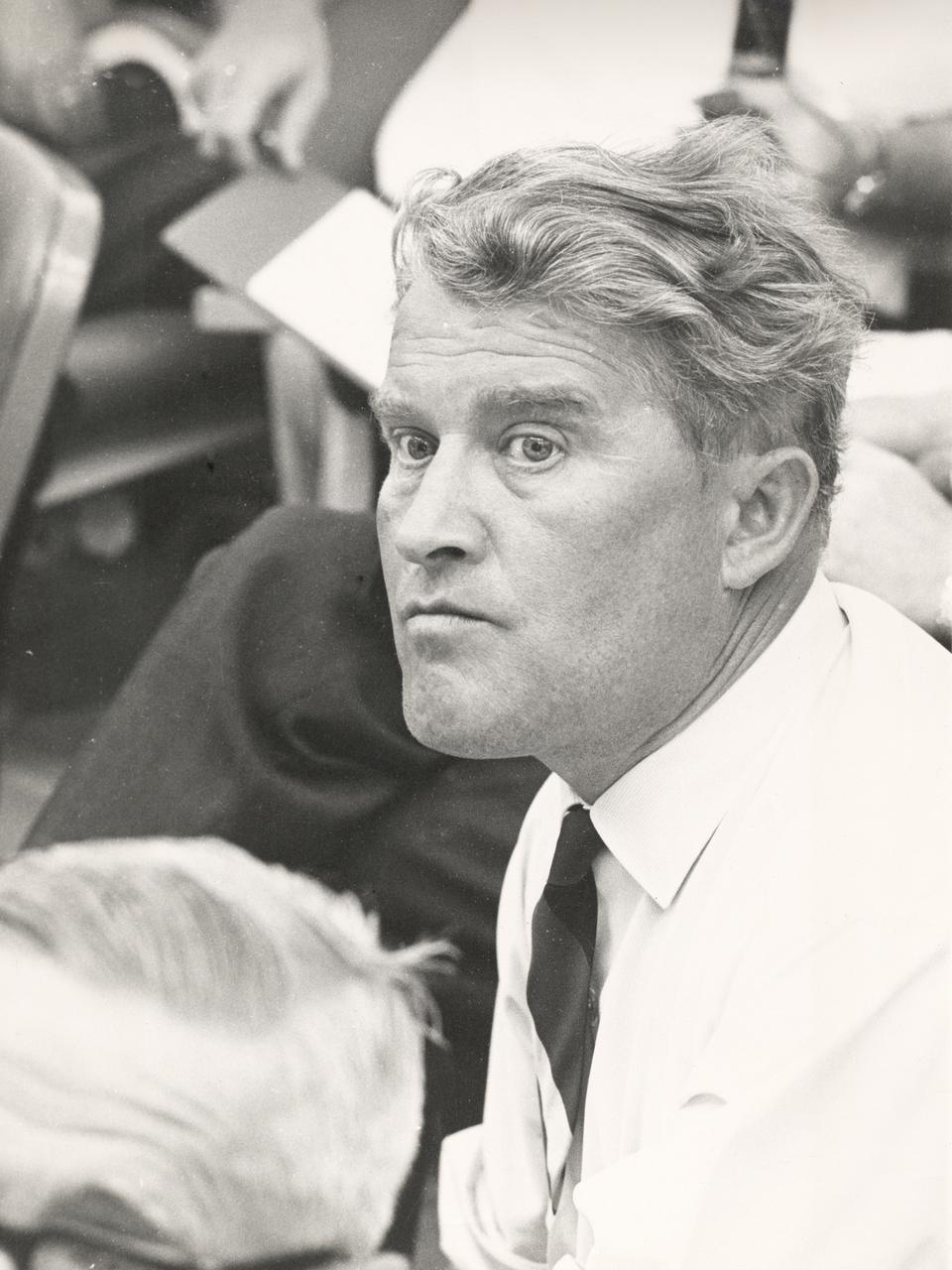
In this photo, Dr. von Braun anxiously awaits the launch of the Saturn I vehicle (SA-8) in the Launch Complex Control Center at the Kennedy Space Center in Florida on May 25, 1965. The SA-8 mission made the first night launch and deployed the Pegasus II micro meteoroid detection satellite.
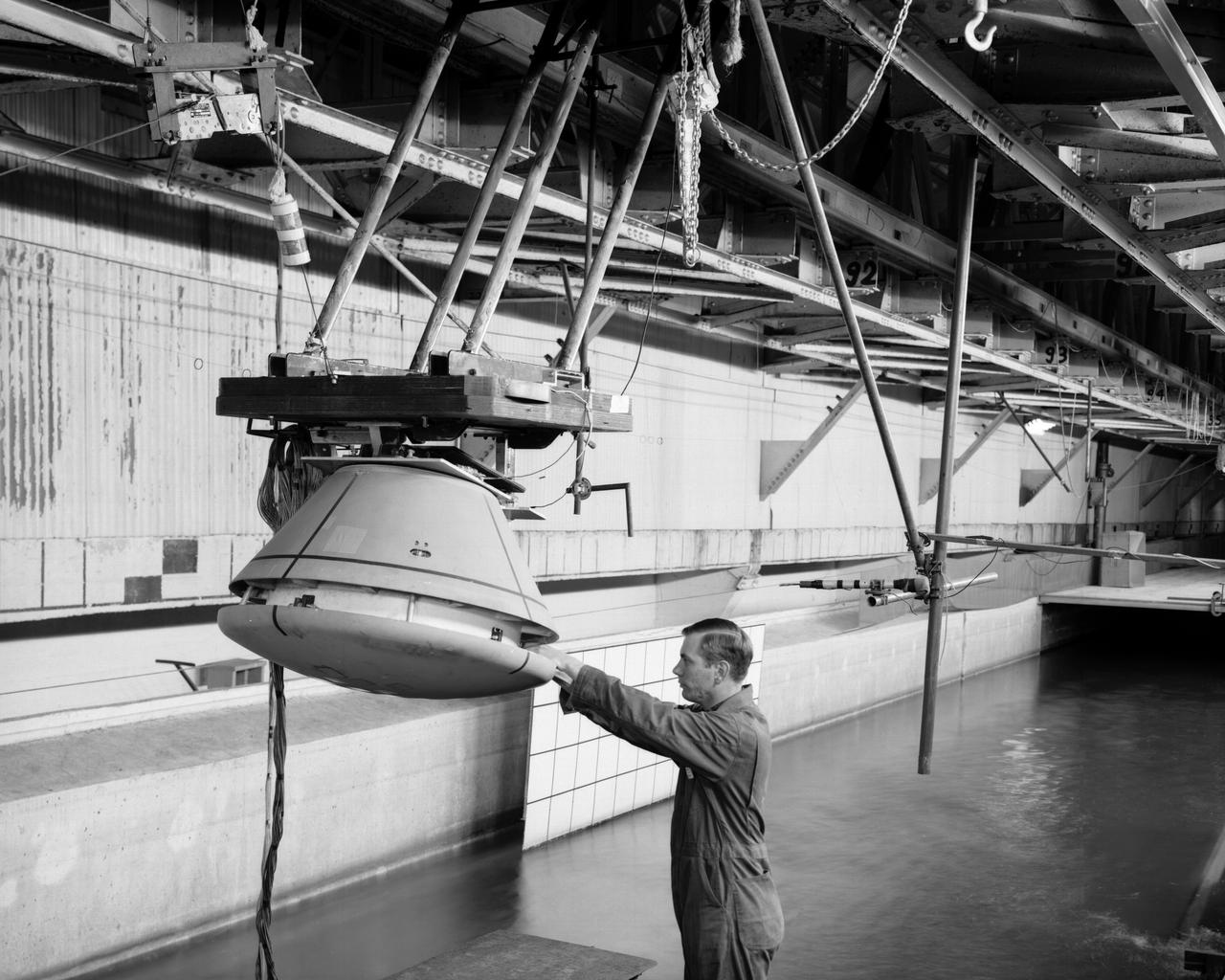
1/4th Scale Model of Apollo - Impact Structures Facility Launched from an overhead pendulum device, this Apollo spacecraft was tested in the Impact Structures Facility to determine water-landing characteristics. -- Photograph published in Winds of Change, 75th Anniversary NASA publication (page 91), by James Schultz.
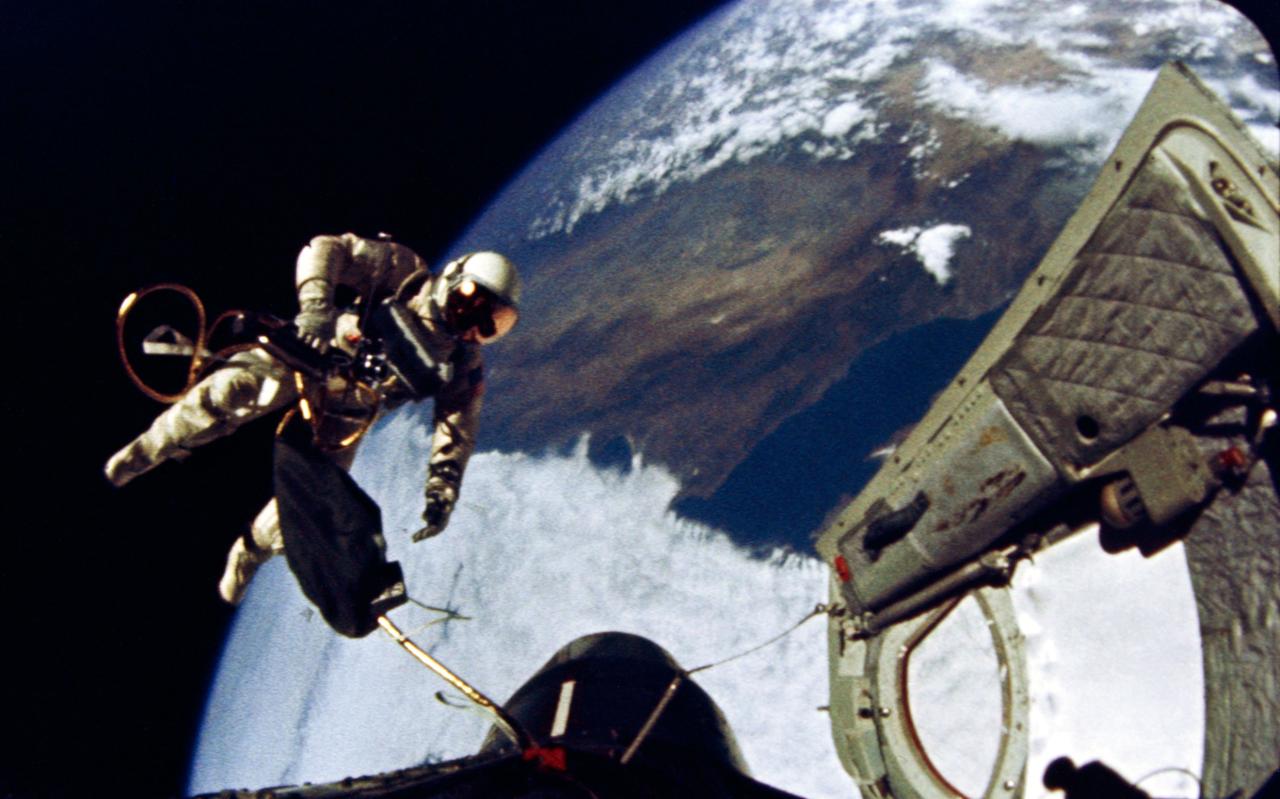
S65-29730 (3 June 1965) --- Astronaut Edward H. White II, pilot for the Gemini-Titan 4 (GT-4) spaceflight, floats in the zero-gravity of space during the third revolution of the GT-4 spacecraft. White wears a specially designed spacesuit. His face is shaded by a gold-plated visor to protect him from unfiltered rays of the sun. In his right hand he carries a Hand-Held Self-Maneuvering Unit (HHSMU) that gives him control over his movements in space. White also wears an emergency oxygen chest pack; and he carries a camera mounted on the HHSMU for taking pictures of the sky, Earth and the GT-4 spacecraft. He is secured to the spacecraft by a 25-feet umbilical line and a 23-feet tether line. Both lines are wrapped together in gold tape to form one cord. Astronaut James A. McDivitt, command pilot, remained inside the spacecraft during the extravehicular activity (EVA). Photo credit: NASA EDITOR'S NOTE: Astronaut Edward H. White II died in the Apollo/Saturn 204 fire at Cape Kennedy on Jan. 27, 1967.
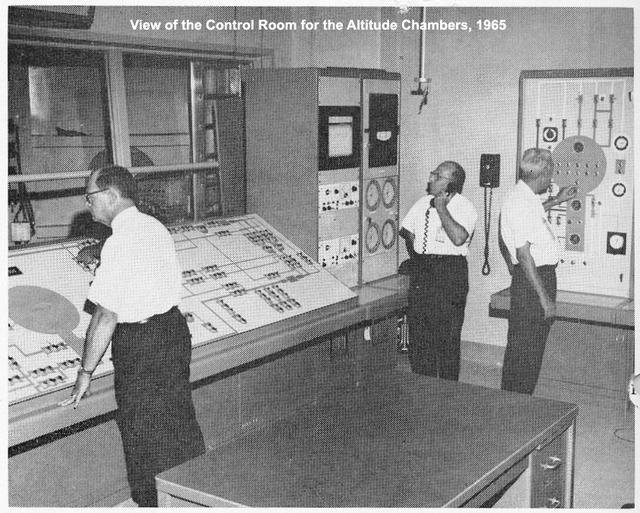
View of O&C Building Altitude Chambers
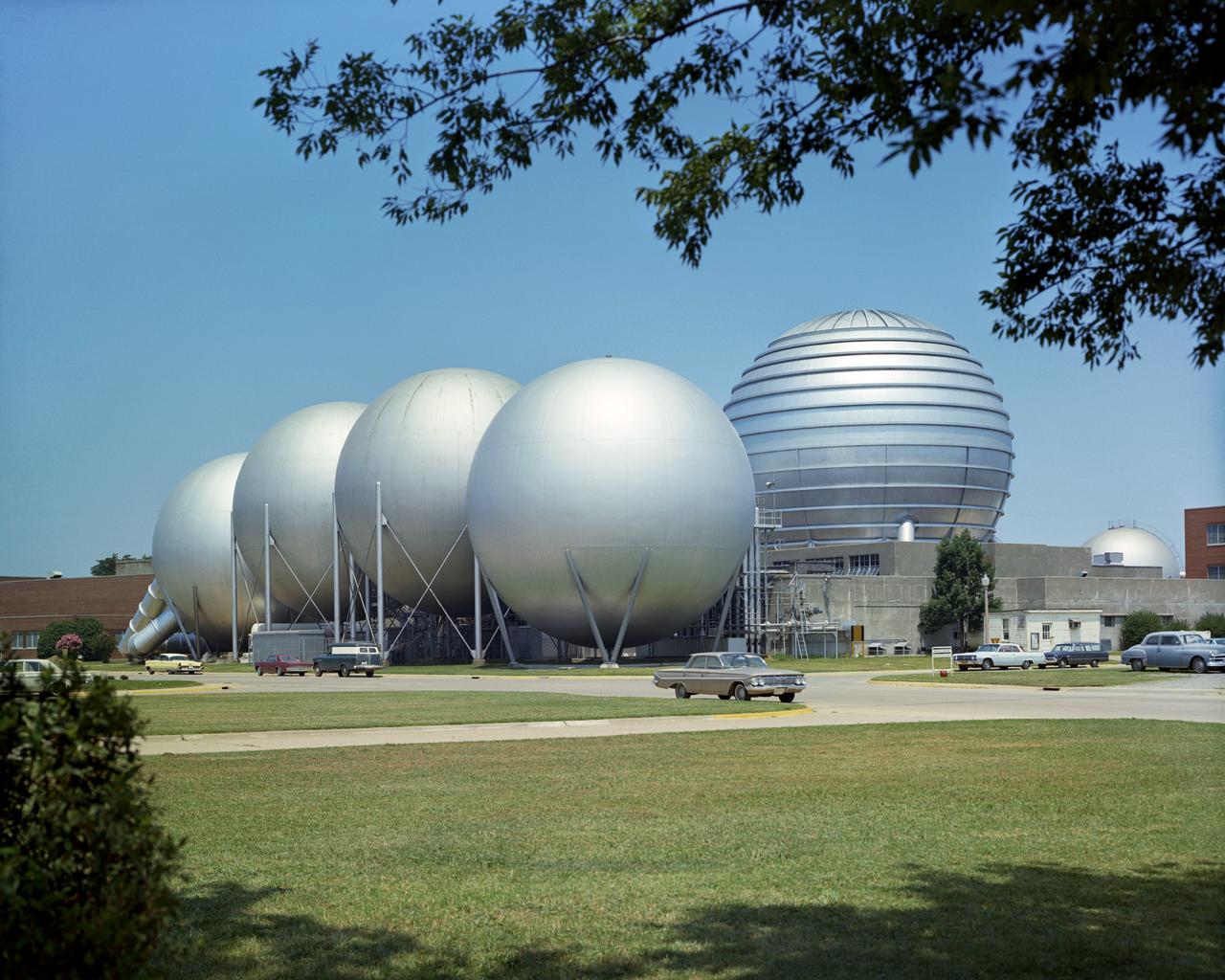
L65-5505 In the Gas Dynamics Laboratory, completed in 1951, researchers explored basic aerodynamic, heating and fluid-mechanical problems in the speed range from Mach 1.5 to Mach 8.0. Photograph published in Engineer in Charge: A History of the Langley Aeronautical Laboratory, 1917-1958 by James R. Hansen. Page 348.
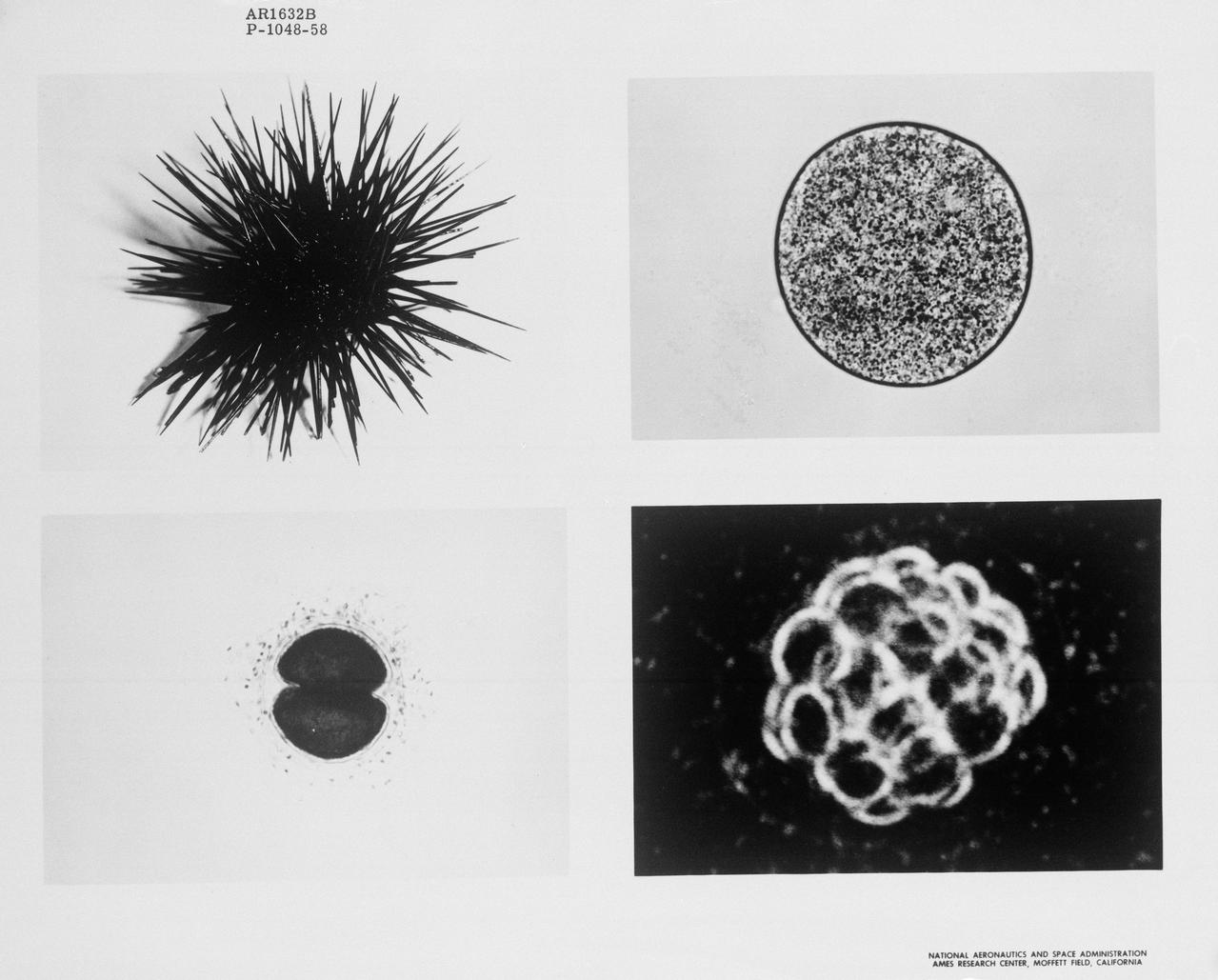
S65-18762 (March 1965) --- Effects of the weightless environment on cell division, the basic growth process for living tissue, will be studied during the Gemini-Titan 3 flight scheduled for March 23, 1965. A spiny black sea urchin (upper left) is stimulated by mild electric shock or potassium chloride. As a result it sheds many thousands of eggs. When fertilized, these eggs become actively dividing cells very similar in basic processes to cells of other animals, including humans. These pictures show stages of cell division. At upper right is a single cell; at lower right cell divisions have produced many cells. Cell photos are magnified about 700 times, and all cells shown are too small to be seen by the naked eye. (Photos at upper right and lower left are of sea urchin eggs. Group of cells at lower right are from a sand dollar, which like the sea urchin, is an Echinoderm. Its eggs are virtually identical and are used interchangeably with those of the sea urchin in NASA Ames Center weightlessness experiments.) The Gemini experiment will involve cell division like that shown here. This will take place during several hours of weightlessness aboard the Gemini spacecraft. The experiment will be flown back to laboratories at Cape Kennedy after spacecraft recovery. It has been designed so that any abnormal cell division found by postflight analysis should suggest that the weightless environment has effects on individual cells. This might mean hazards for prolonged periods of manned spaceflight.

S65-61766 (6 Dec. 1965) --- Astronauts Walter M. Schirra (center) and Thomas P. Stafford (right) discuss the pad damage caused by the launch of the Gemini-7 spacecraft and its effect on the planned launch of the Gemini-6 mission. The NASA Headquarters alternative photo number is 65-H-1902. Photo credit: NASA or National Aeronautics and Space Administration
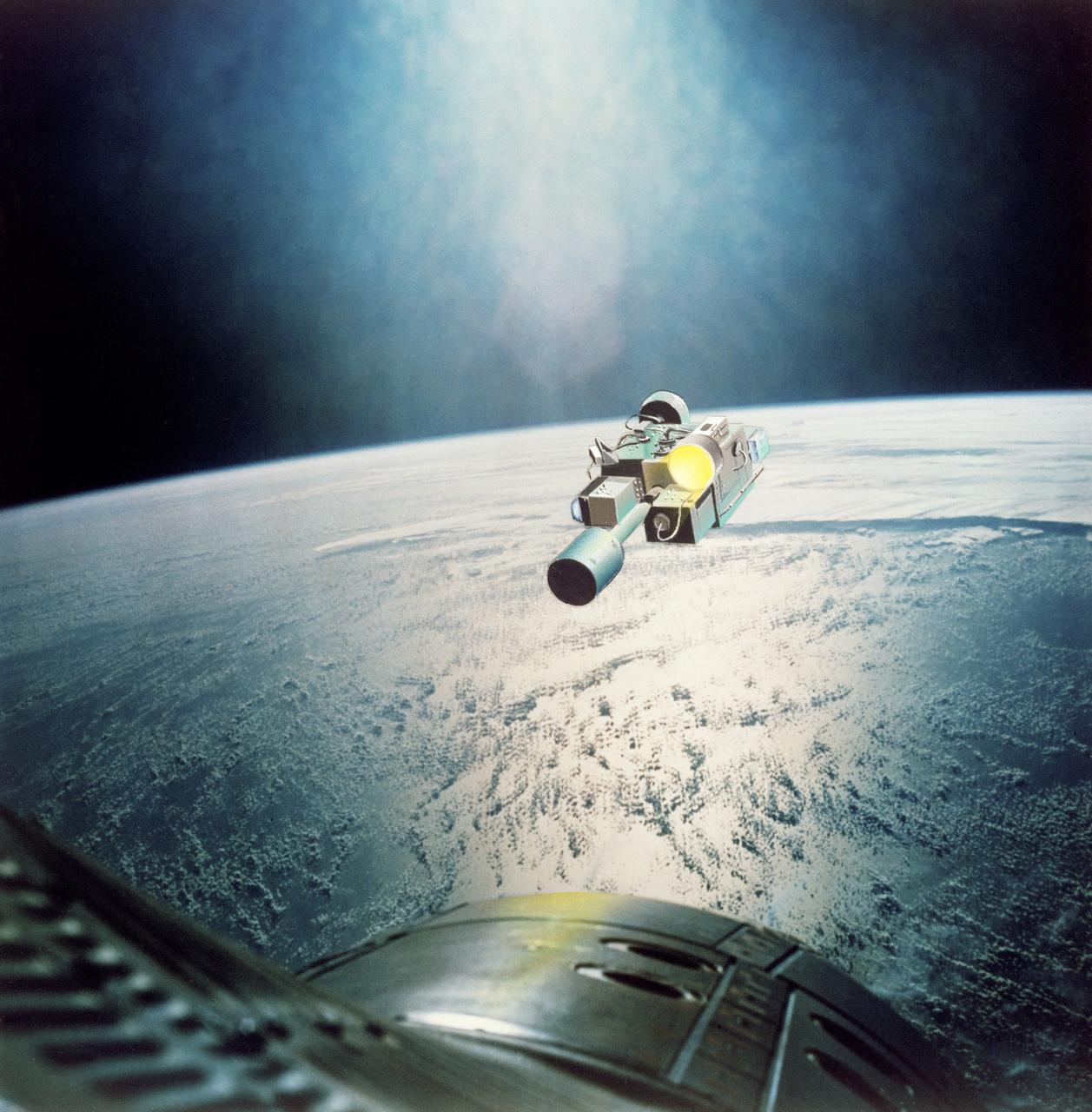
S65-28653 (August 1965) --- Rendezvous Evaluation Pod (REP) in orbit is approached by Gemini spacecraft as seen in this artist's concept using an actual photograph taken on the Gemini-4 mission. The REP is superimposed over a Gemini-4 Earth-sky picture of cloud formations over an ocean. The REP will be used by the crew of the Gemini-5 spacecraft to practice rendezvous techniques.
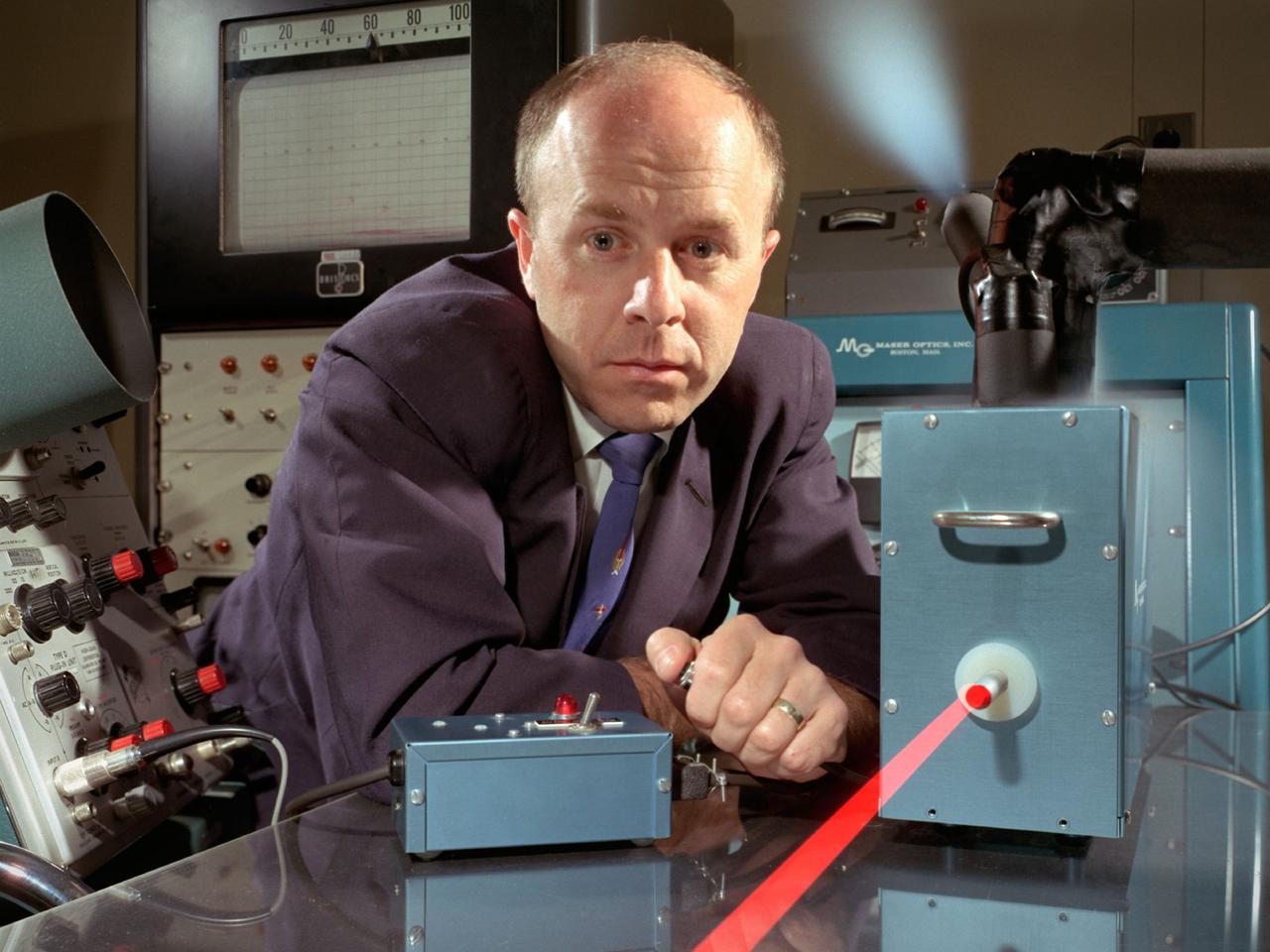
National Aeronautics and Space Administration (NASA) Lewis Research Center researcher Americo Forestieri aims a ruby laser beam at a crystal to determine the effects of its radiation. Forestieri was a researcher in the Electric Component Experiment Section of the Space Power System Division. Lewis was in the midst of a long-term effort to develop methods of delivering electrical power to spacecraft using nuclear, solar, or electrochemical technologies. Ruby lasers contain a ruby crystal with mirrors on either side. The laser action is created when a high-intensity lamp shines around the ruby and excites the electrons in the ruby’s chromium atoms. After the excitation, the electrons emit their ruby-red light. The mirrors reflect some of this red light back and forth inside the ruby which causes other excited chromium atoms to produce additional red light. This continues until the light pulse reaches high power levels and consumes all of the energy stored in the crystal. Forestieri used optical absorption and electron paramagnetic resonance techniques to study the extent and manner in which the radiation interacted with the samples. He determined that individual bands were assigned to specific electronic transitions. He also studied the atomic changes in the ruby crystals after irradiation. He found that complex interactions depend on the crystal pretreatment, purity, and irradiation dose.
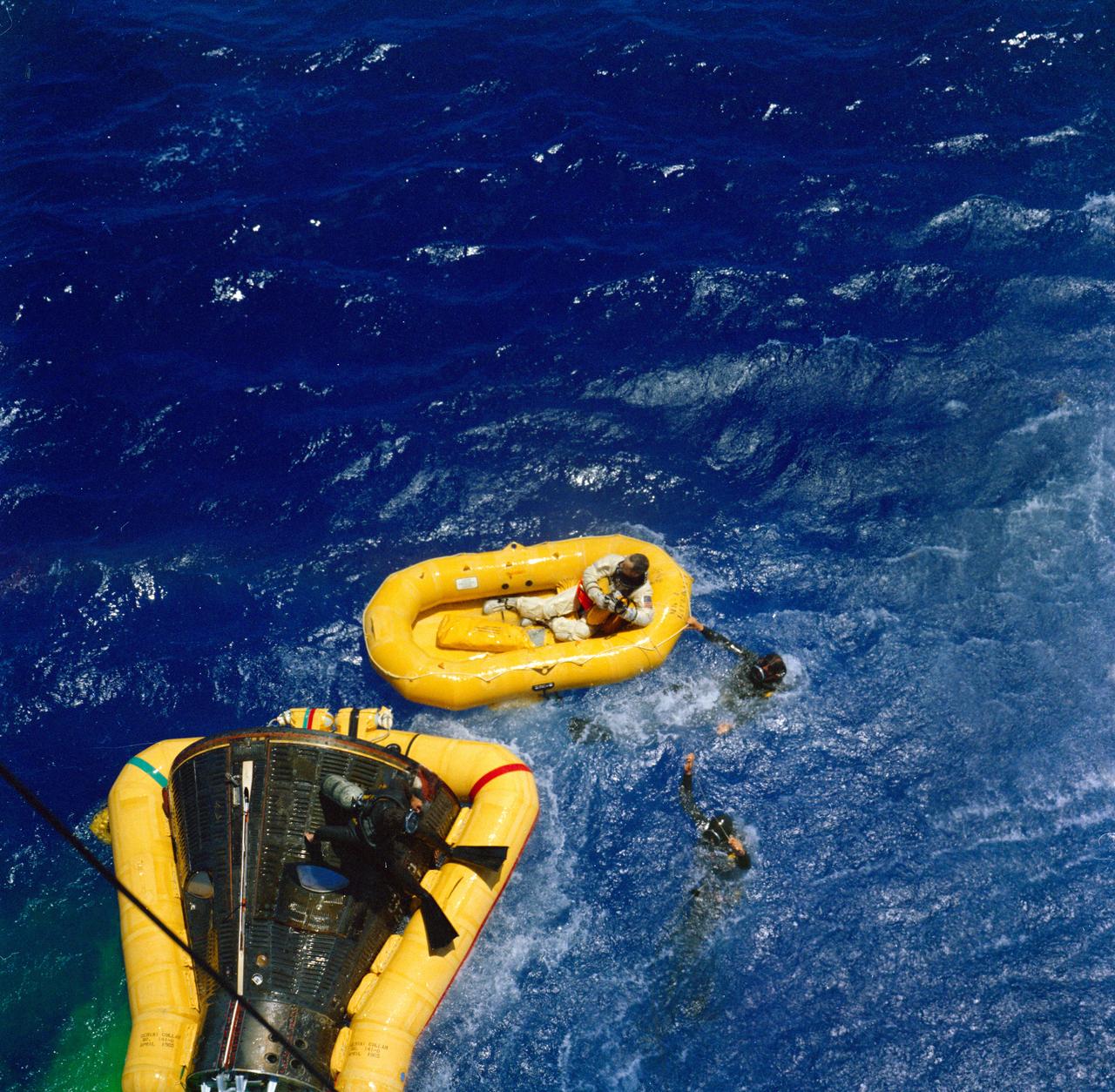
S65-33490 (7 June 1965) --- A United States Navy frogman team participates in the recovery of the Gemini-Titan 4 (GT-4) spacecraft. The USS Wasp was the prime recovery ship for the Gemini-4 mission. The crew of the Gemini-4 spaceflight was astronauts James A. McDivitt, command pilot, and Edward H. White II, pilot.
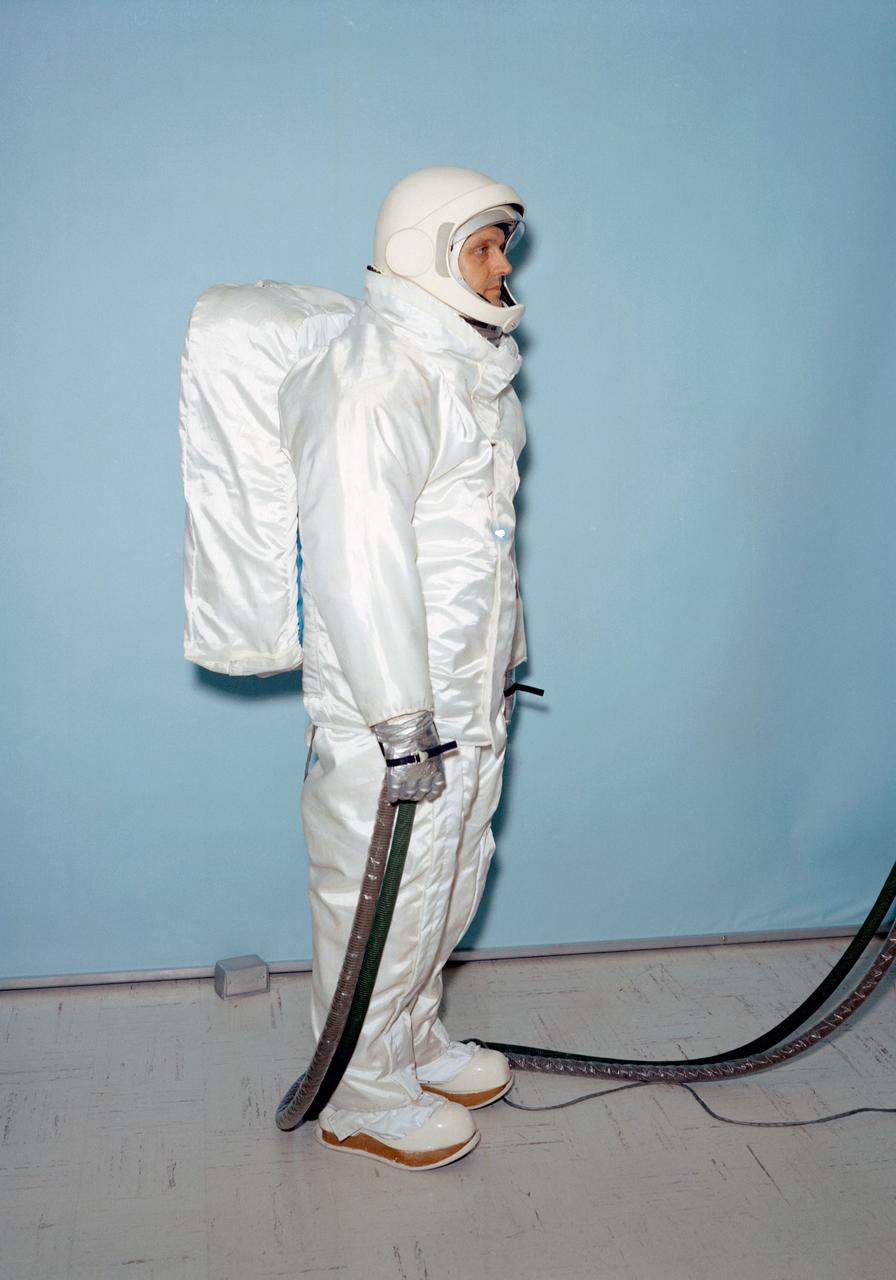
Test subject wears Apollo overgarment designed specially for use by astronauts on lunar surface missions. The overgarment is worn over the Apollo space suit.
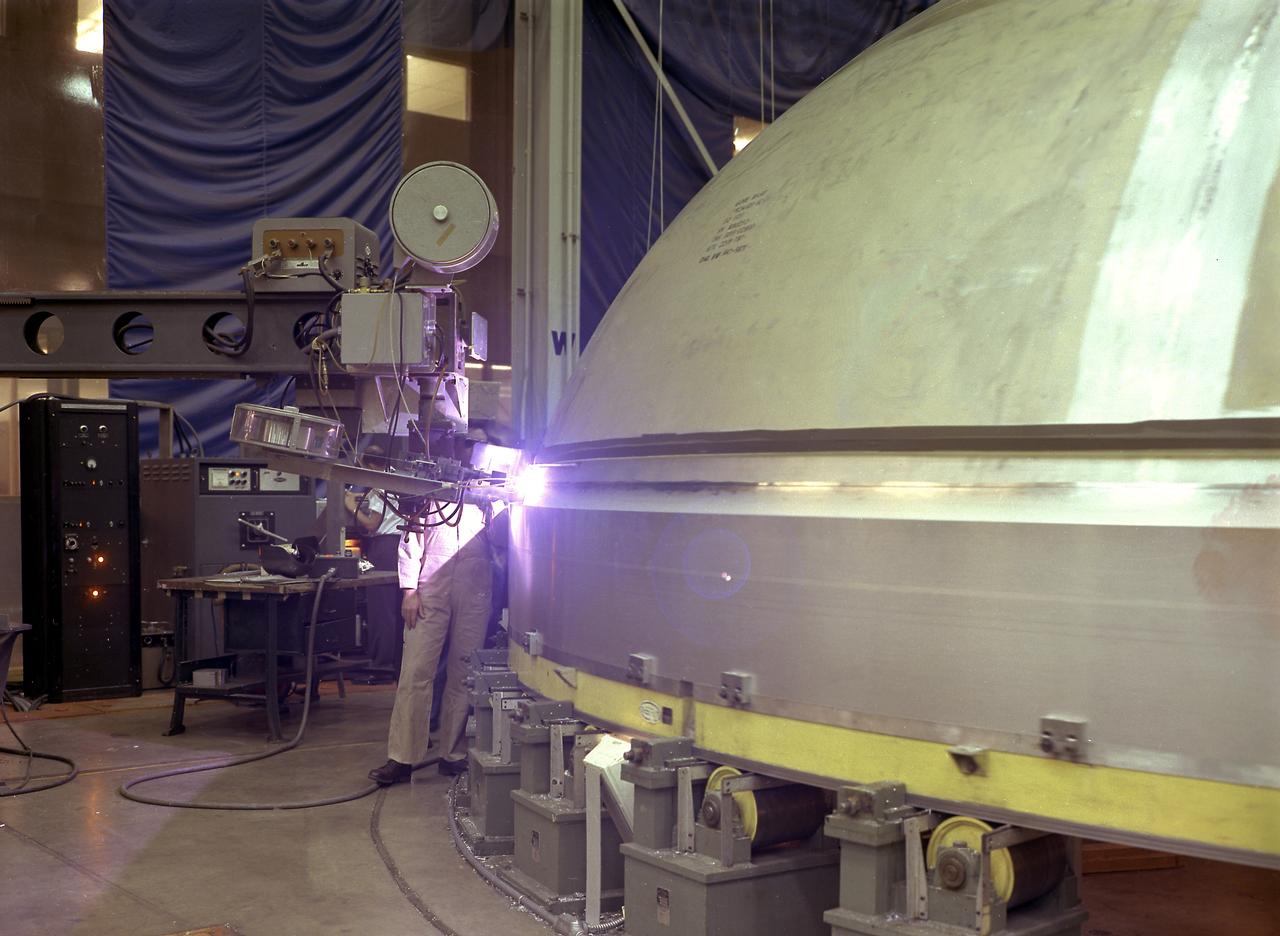
A technician is pictured at the Marshall Space Flight Center welding the Y-ring to the S-IC stage bulkhead and the fuel tank for the Saturn V SA-502 launch vehicle (Apollo 6 mission) in building 4705. The size of the S-IC required a special rig known as the Y-ring to join the tank wall cylinders and domes together. The Y-ring was designed to eliminate lap joints where the tank domes, wall, and adjoining structure (such as the intertank segment) came together.

View of O&C Building Altitude Chambers
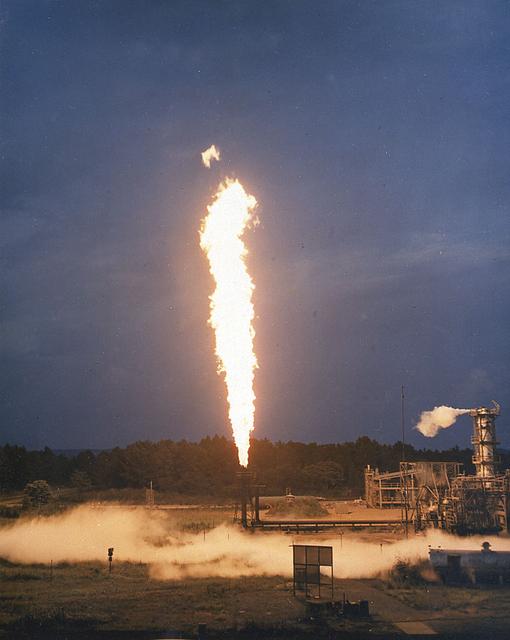
Marshall Space Flight Center's rocket development has always included component testing. Pictured here is a Cell 114-B burn stack. The C114-B is part of the gas generators used to test heat exchanges for the F-1 engine. On the initial firing of the C114-B the spark ignition would not light. The rocket propellant mixed with the liquid oxygen gelled creating a bomb. After several attempts at ignition, the spark ignited and blew up the stand. Subsequent testings were completed on newly constructed stands and no further mishaps were reported.
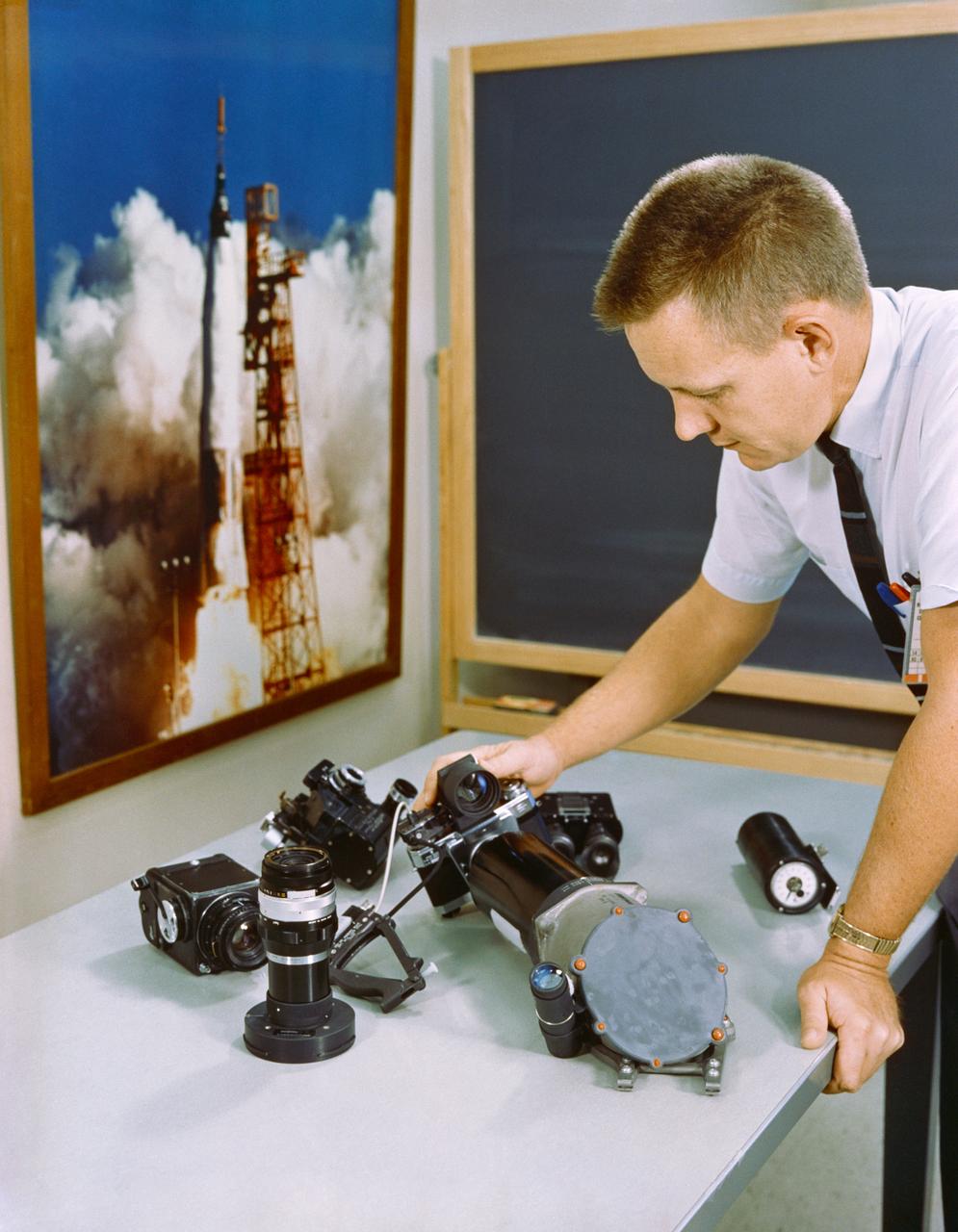
S65-43482 (20 Aug. 1965) --- Table-top view of several of the optical and photographic pieces of equipment planned for use on the Gemini-5 spacecraft before installation in the spacecraft.
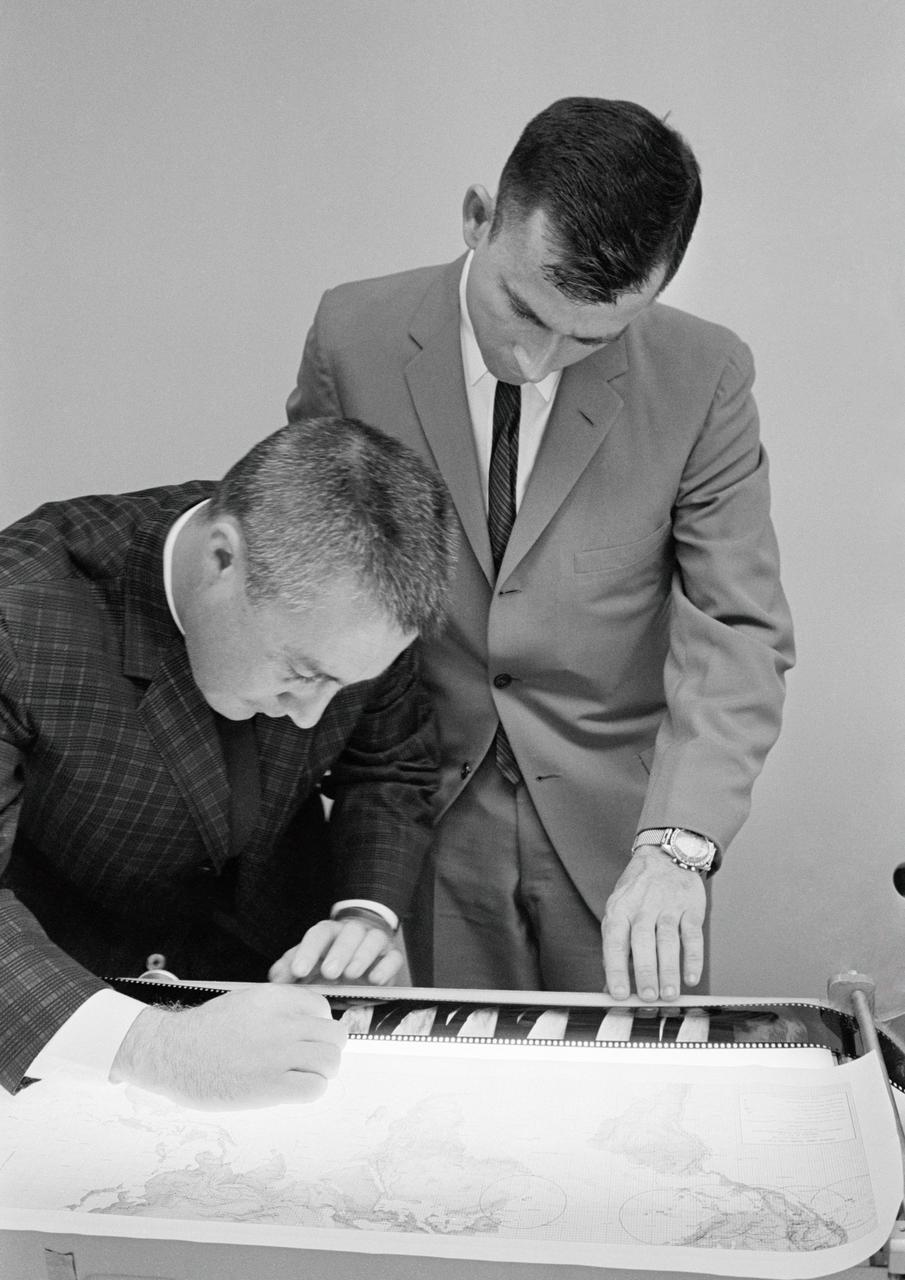
S65-20624 (25 March 1965) --- Gemini-Titan 3 astronauts Virgil I. Grissom (left) and John W. Young examine some of the negatives of photographs taken on their three-orbit flight on March 23, 1965.
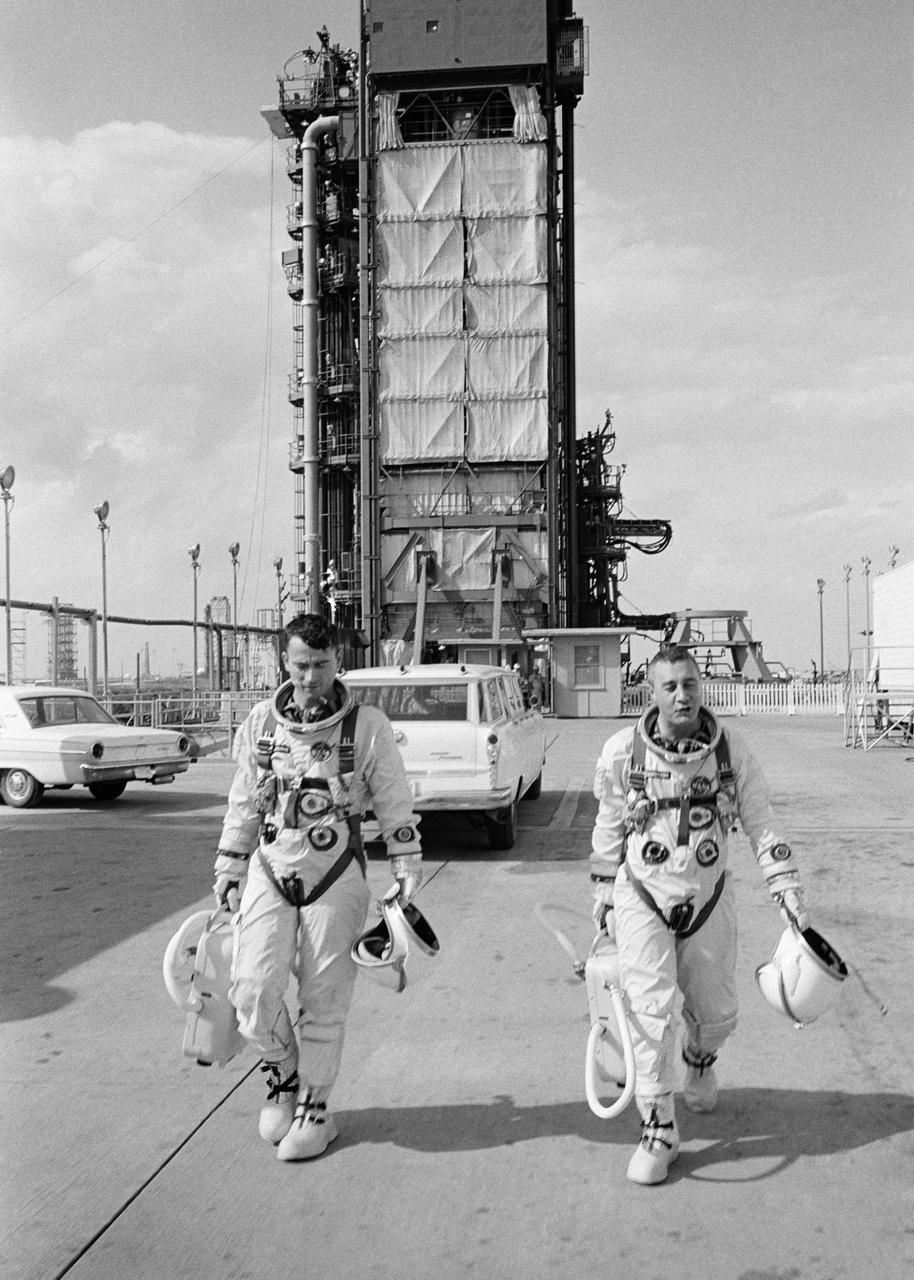
S65-20641 (1965) --- Astronauts John W. Young (left), pilot, and Virgil I. Grissom, command pilot, for the Gemini-Titan 3 flight, are shown leaving the launch pad after simulations in the Gemini-3 spacecraft.
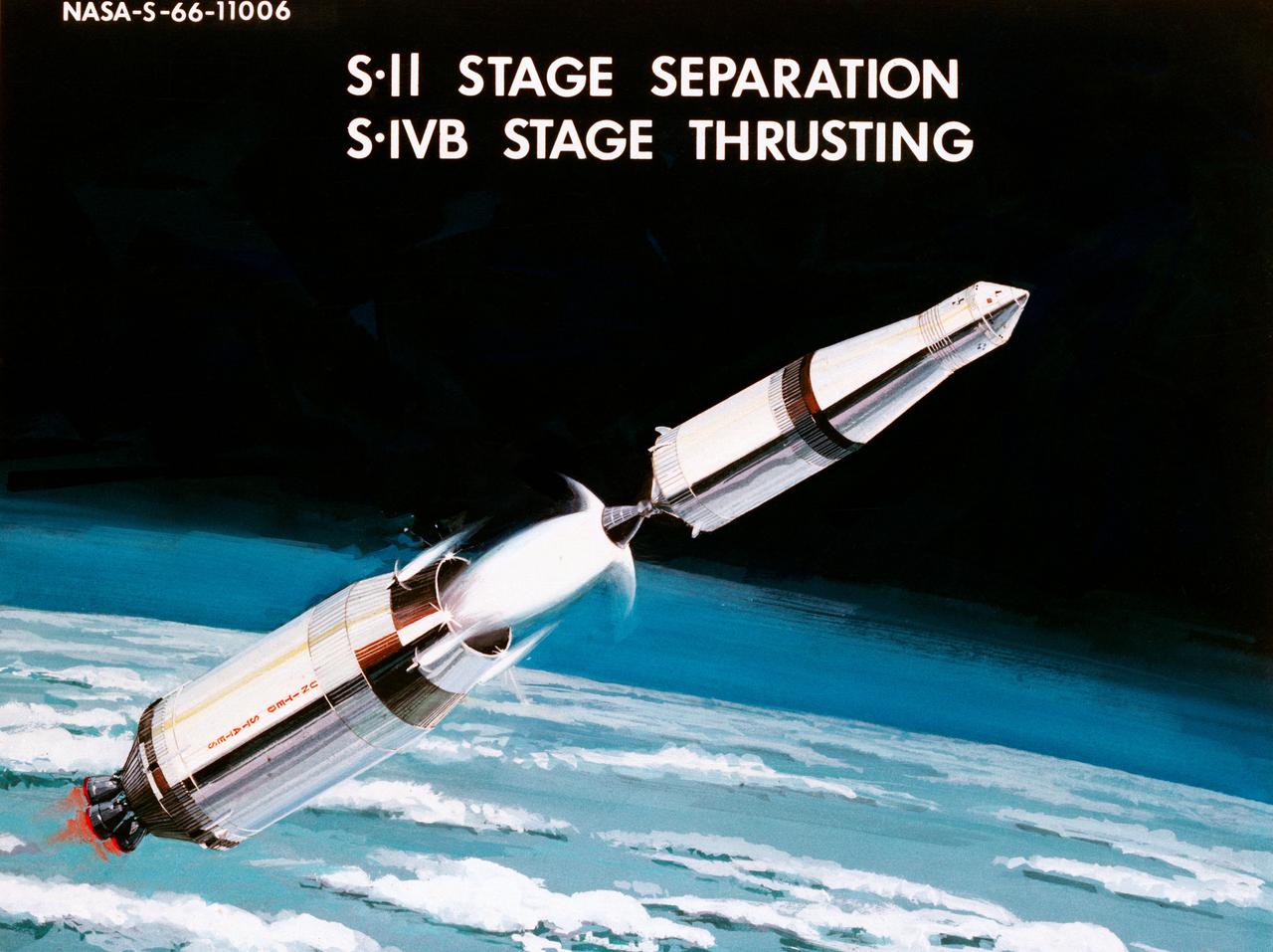
Artist Concepts, Apollo Mission: S66-10983: Ascent Stage Liftoff (S66-05094) S66-10984: Orientation During Ascent Phase (S66-05098) S66-10985: Midcourse Coast (S66-05113) S66-10986: Survey of Landing Site (S66-05117) S66-10987: Lunar Module (LM) Jettison (S66-05089) S66-10988: Trans-Earth Injection (S66-05090) S66-10989: Exploration on Lunar Surface Apollo Surface Lunar Exploration Experiment (ASLEP) S66-10990: Liftoff (S66-05125) S66-10991: Command Module (CM)-Service Module (SM) Separation (S66-05101 N/F) S66-10992: Touchdown on Lunar Surface (S66-05115) S66-10993: Transfer Orbit Insertion (S66-05111) S66-10994: Drogue Parachute Deployment S66-10995: S-IC Stage Separation S-II Stage Thrusting (S66-05099) S66-10996: Jettison Launch Escape System (S66-05114) S66-10997: Main Parachute Deployment (S66-05091) S66-10998: Mid-course correction (S66-05088) S66-10999: Lunar Orbit Insertion (S66-05086) S66-11000: Command Service Module (CSM)-LM Docked in LM Adapter-S-IVB (S66-06526) S66-11001: Docking and Separation of spacecraft from S-IVB (S66-05107) S66-11002: Final Descent (S66-05096) S66-11003: Entry into Earth Atmosphere (S66-05096) S66-11004: Deploy S/C LM Adapter-Separate CSM from LM-S-IVB (S66-06525 & 05105) S66-11005: Turnaround of CSM (S66-05104) S66-11006: S-II Stage Separation S-IVB Stage Thrusting (S66-05102) S66-11007: LM Ascent CSM Docked (S66-05100) S66-11008: Midcourse Correction SPS Mode (S66-05106) S66-11009: Earth Orbit Insertion of S-IVB & S/C (S66-05092) S66-11010: Trans-lunar Injection (S66-05116) S66-11011: LM Descent (S66-05110) S66-11012: S-IVB Stage Operations (S66-05112 N/F) S66-11013: Spacecraft Recovery (S66-05126) S66-11014: Lunar Orbit (S66-05103) S66-11015: CSM-LM Docking (S66-05095) S66-11016: Entry CM (S66-5109) S66-11017: Midcourse Corrections to Lunar Landing (S66-08486) S66-11018: Midcourse Corrections to Lunar Landing w/Overlay (S66-05083) S66-11019: Earth Launch Phase w/Overlay (S66-08485 & 05119) S66-11020: Earth Launch Phase (S66-08487 & S66-05084) S66-11022: Apollo Vehicles (S66-05127) S66-11024: Transfer to LM (S66-05082) S66-11025: Lunar Launch Phase S66-11027: Trans-earth Separation of C/M from S/M-C/M return to Earth (S66-05097) S66-11028: CSM-LM Separation, LM Descent to Moon (S66-05108) MSC, Houston, TX Also available in B&W 12/1965 - 06/1966
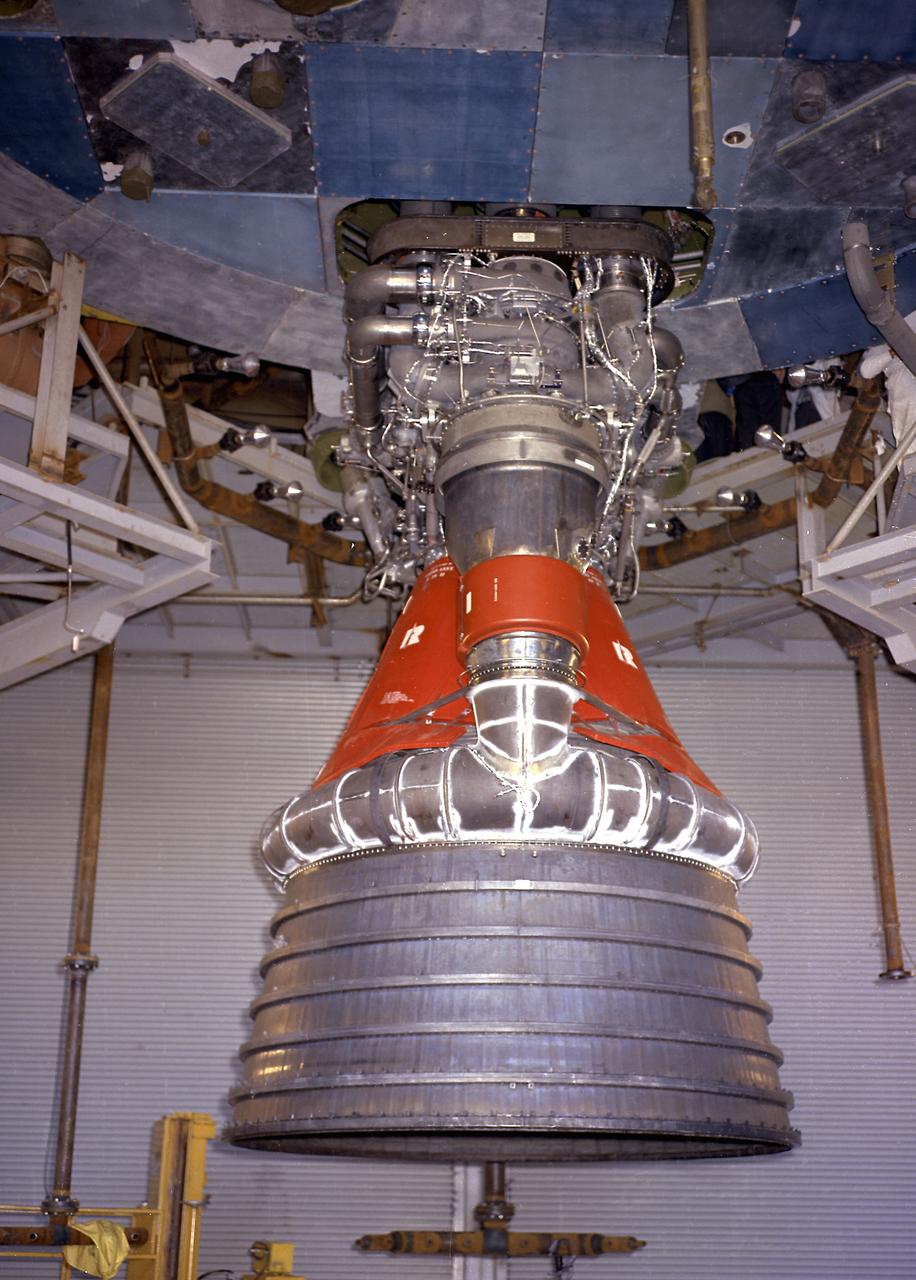
Engineers at the Marshall Space Flight Center install the F-1 engines on the S-IC stage thrust structure at the S-IC static test stand. Engines are installed on the stage after it has been placed in the test stand. This image shows a close-up of an F-1 engine. Five F-1 engines, each weighing 10 tons, gave the booster a total thrust of 7,500,000 pounds, roughly equivalent to 160 million horsepower.
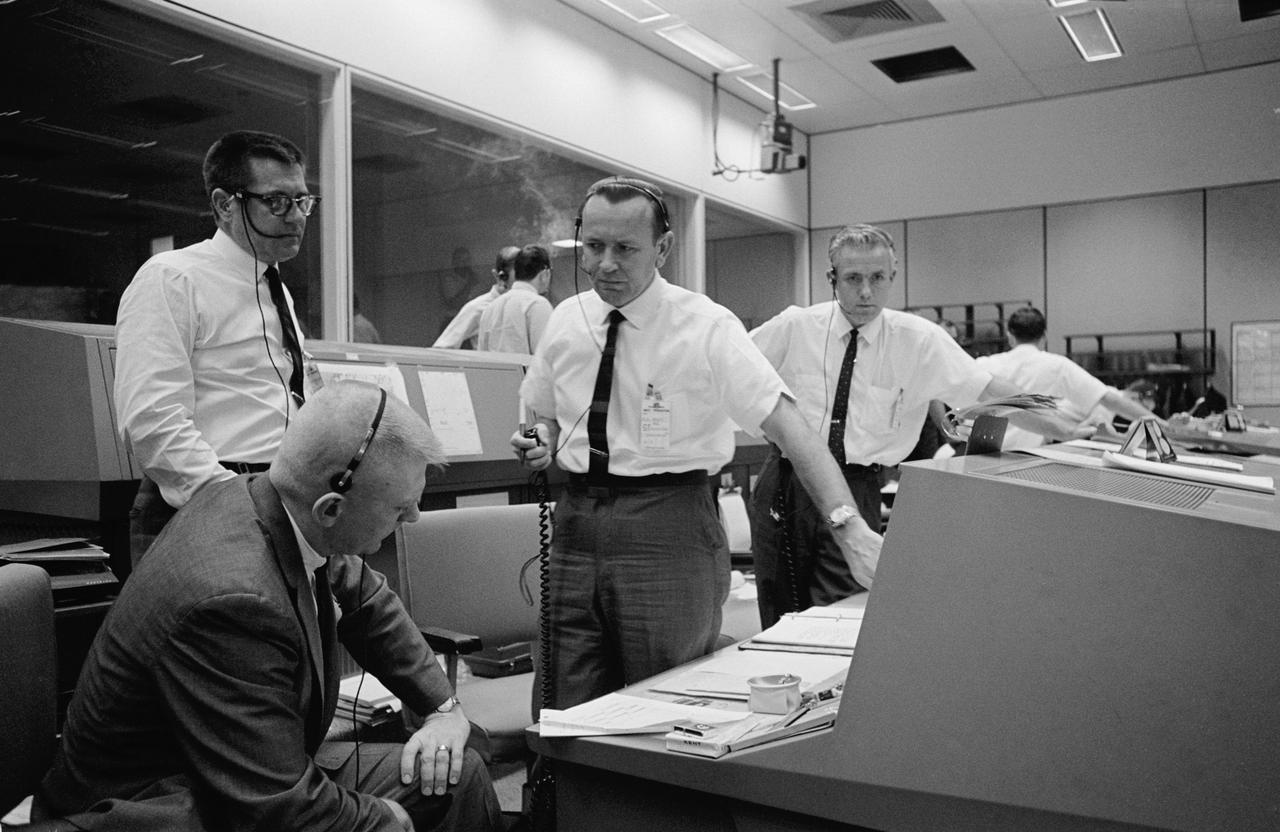
S65-62062 (12 Dec. 1965) --- Discussing the scrubbing of the planned National Aeronautics and Space Administration?s Gemini-6 spaceflight are (from left) William C. Schneider (standing), deputy director, Gemini Program Office of Manned Spaceflight, NASA Headquarters, Washington, D.C.; Eugene F. Kranz (seated), white team flight director; Christopher C. Kraft Jr., red team flight director; and John D. Hodge, blue team flight director. The Gemini-6 mission has been rescheduled for Dec. 15, 1965. Photo credit: NASA or National Aeronautics and Space Administration
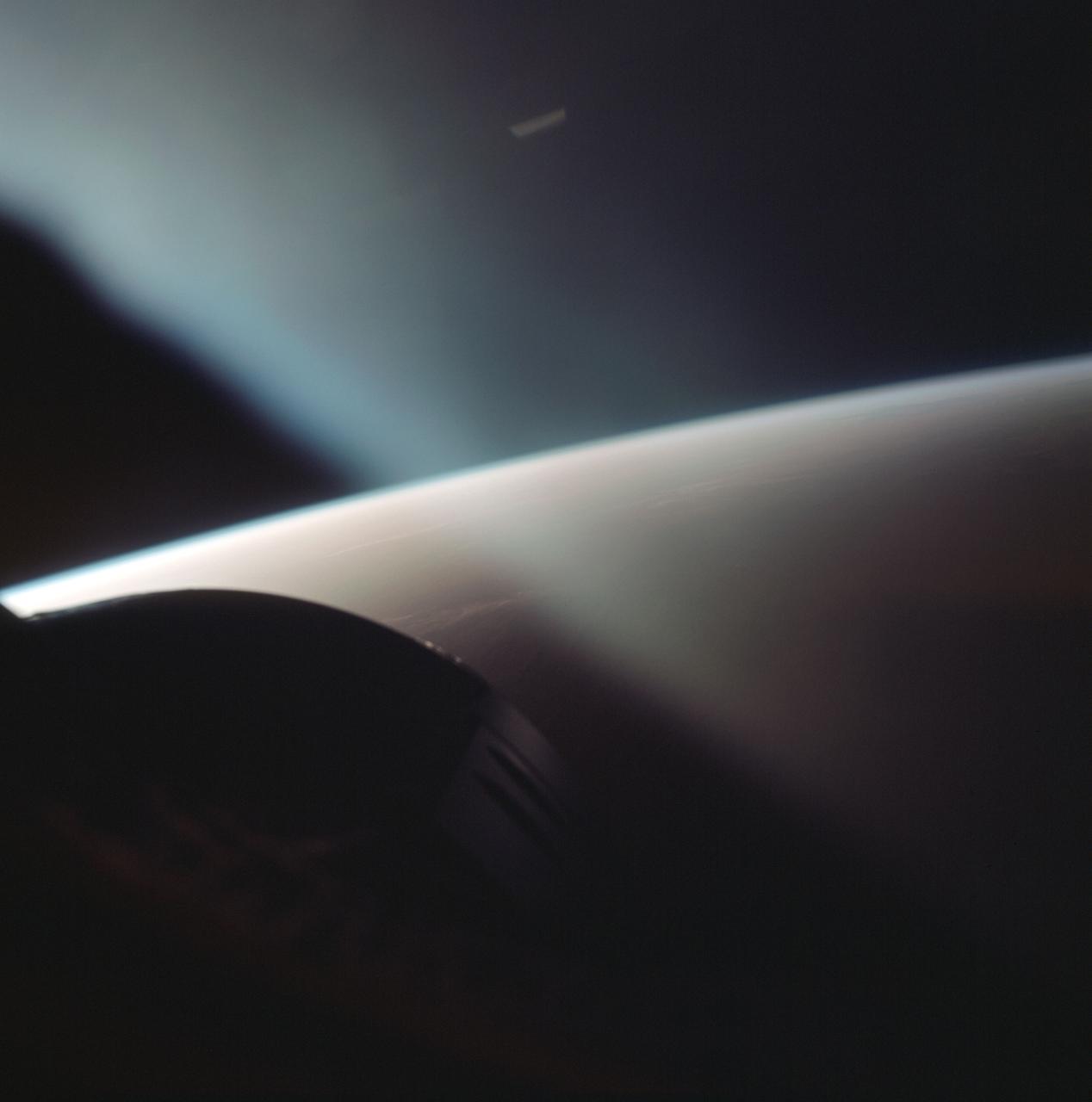
S65-18759 (23 March 1965) --- Astronaut John W. Young took this picture of clouds over the Indian Ocean during the Gemini-Titan 3 three-orbit mission on March 23, 1965. Young used a hand-held modified 70mm Hasselblad camera with color film. The lens setting was 250th of a second at f/11.
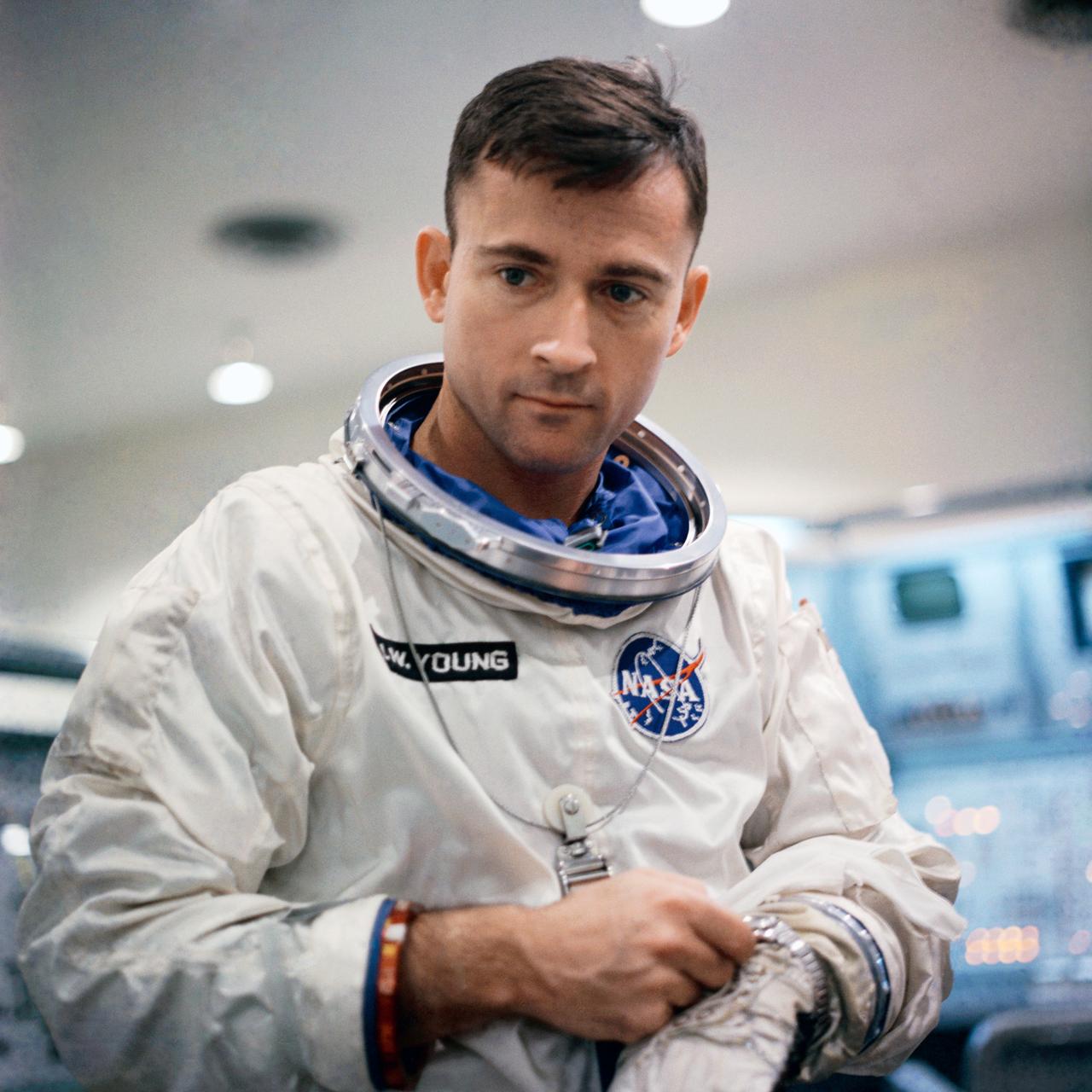
S65-22670 (8 March 1965) --- Astronaut John W. Young, the pilot of the Gemini-Titan 3 prime crew, is shown suited up for GT-3 prelaunch test exercises.
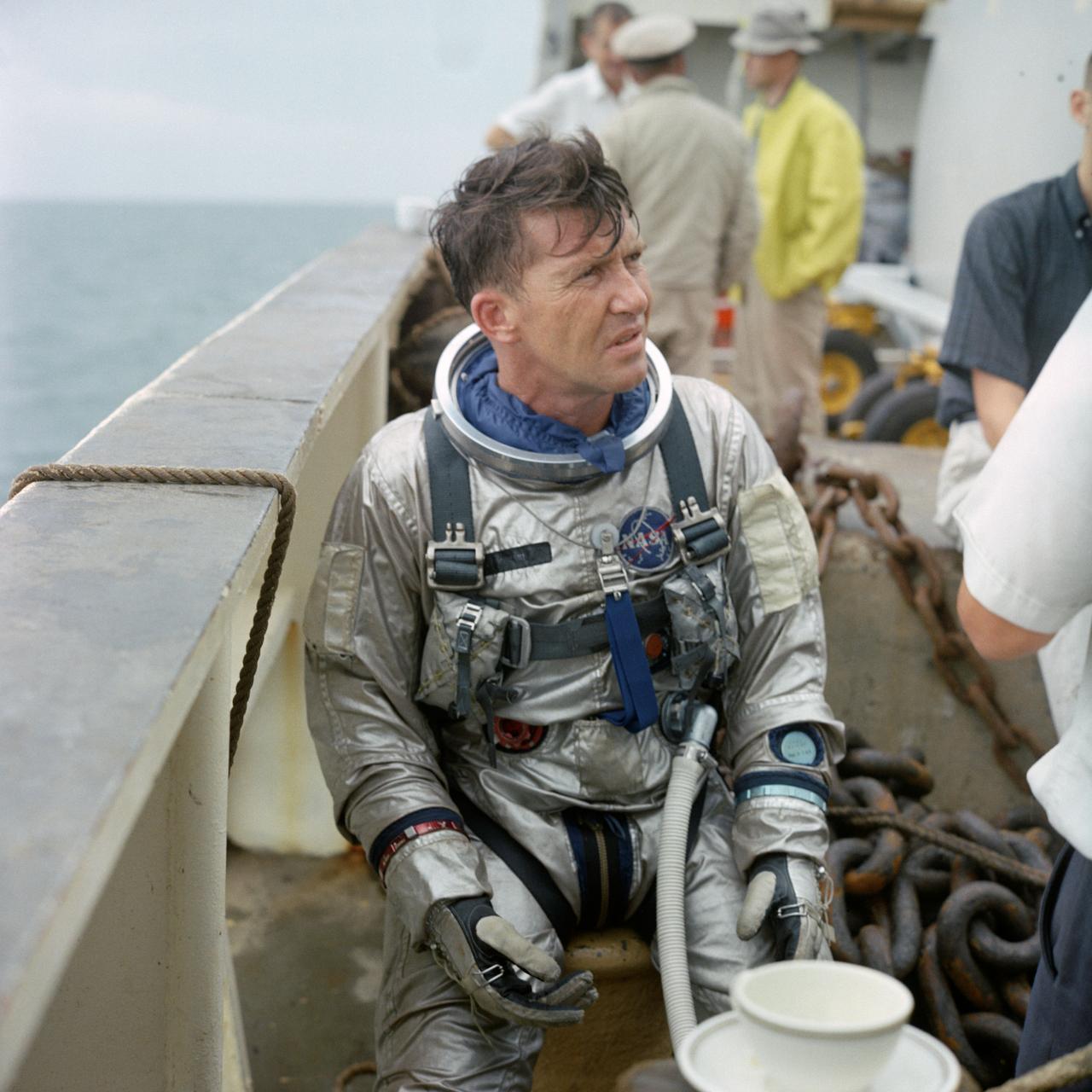
S65-43967 (23 Aug. 1965) --- Astronaut Walter M. Schirra Jr., Gemini-6 prime crew command pilot, is pictured onboard the NASA Motor Vessel Retriever during water egress training in the Gulf of Mexico. Astronaut Thomas P. Stafford (out of frame), Gemini-6 prime crew pilot, also took part in the training.
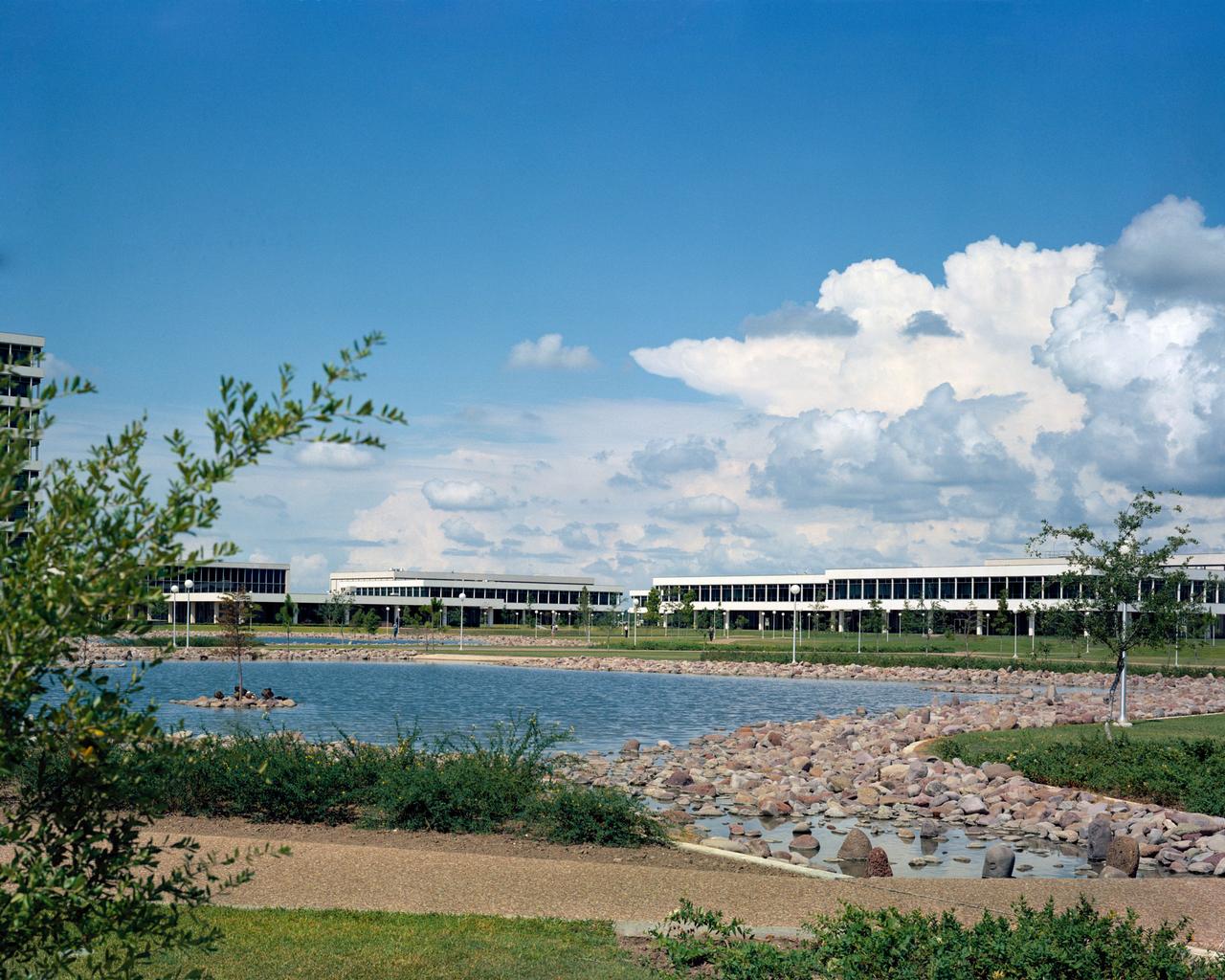
S65-41769 (1965) --- View of facilities at the Manned Spacecraft Center, Houston, Texas. Photo is taken from across the fish pond. NOTE: The Manned Spacecraft Center was named Lyndon B. Johnson Space Center in memory of the late President following his death.
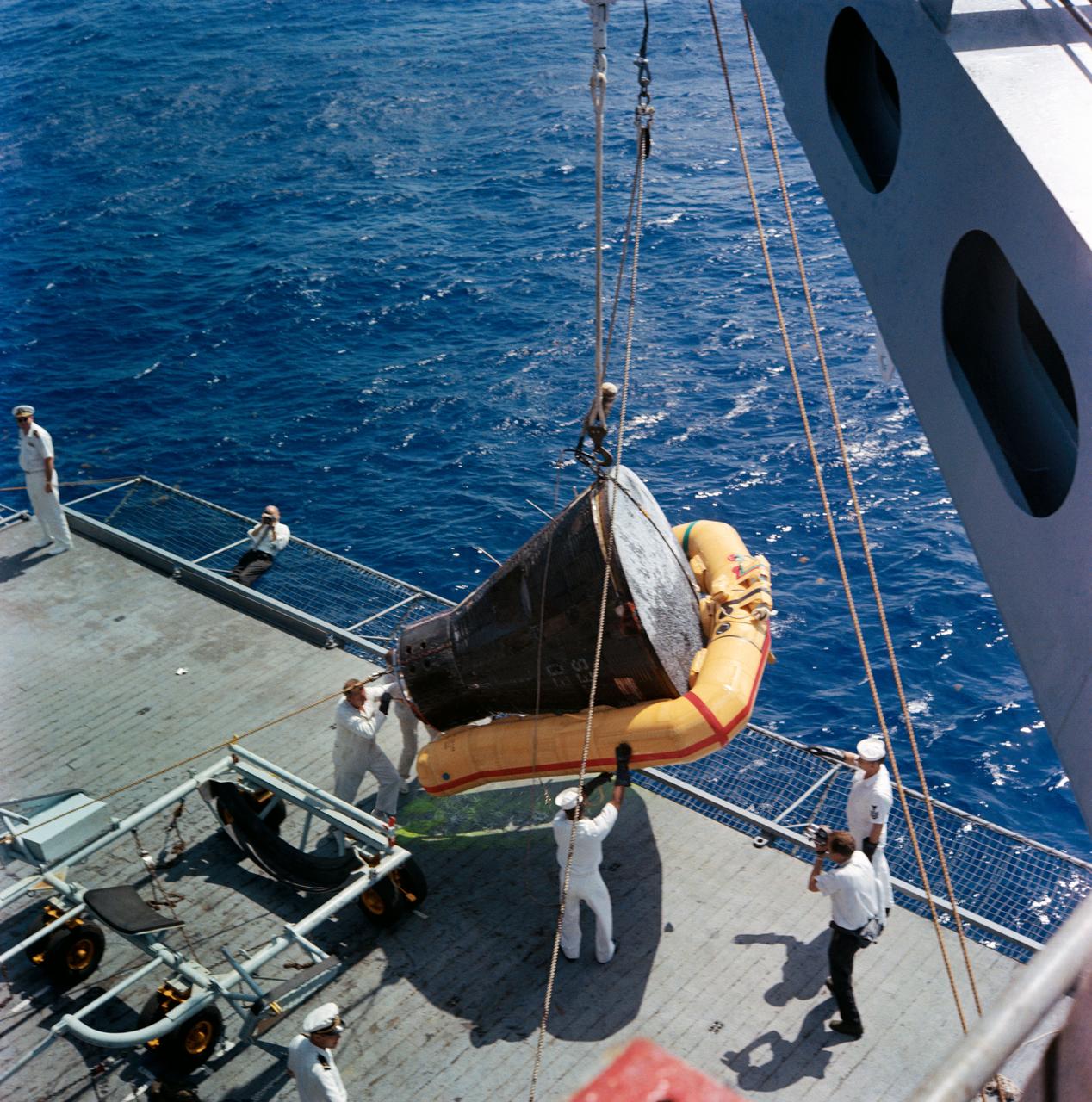
S65-32962 (7 June 1965) --- The Gemini-4 (GT-4) spacecraft is hoisted aboard the recovery ship USS Wasp during recovery operations following the successful four-day mission.
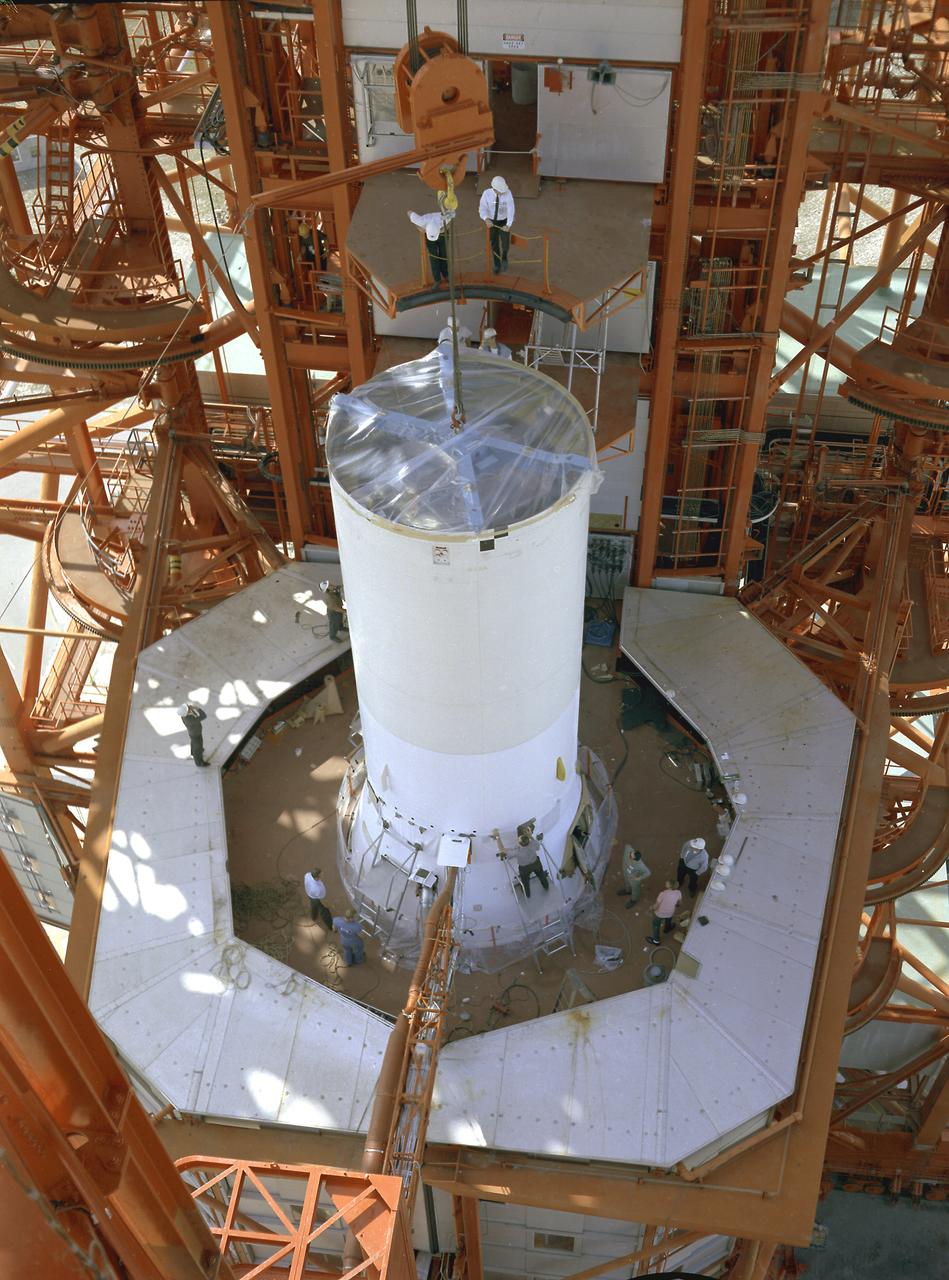
Pegasus-1, meteoroid detection satellite, installed on Saturn I (SA-9 mission) S-IV stage, January 13, 1965. The satellite was used to obtain data on frequency and penetration of the potentially hazardous micrometeoroids in low Earth orbits and to relay the information back to Earth. SA-9 was launched on February 16, 1965 and the Pegasus-1 satellite was the first operational payload for Saturn I.

S65-34635 (3 June 1965) --- Astronaut Edward H. White II, pilot on the Gemini-Titan 4 spaceflight, is shown during his egress from the spacecraft. His face is covered by a shaded visor to protect him from the unfiltered rays of the sun. White became the first American astronaut to walk in space. He remained outside the spacecraft for 21 minutes during the third revolution of the Gemini-4 mission. He wears a specially designed spacesuit for the extravehicular activity (EVA). In his right hand, he carries a Hand-Held Self-Maneuvering Unit (HHSMU) with which he controlled his movements while in space. He was attached to the spacecraft by a 25-feet umbilical line and a 23-feet tether line, both wrapped together with gold tape to form one cord. He wears an emergency oxygen supply chest pack. Astronaut James A. McDivitt is command pilot for the Gemini-4 mission. EDITOR'S NOTE: Astronaut Edward H. White II died in the Apollo/Saturn 204 fire at Cape Kennedy on Jan. 27, 1967.
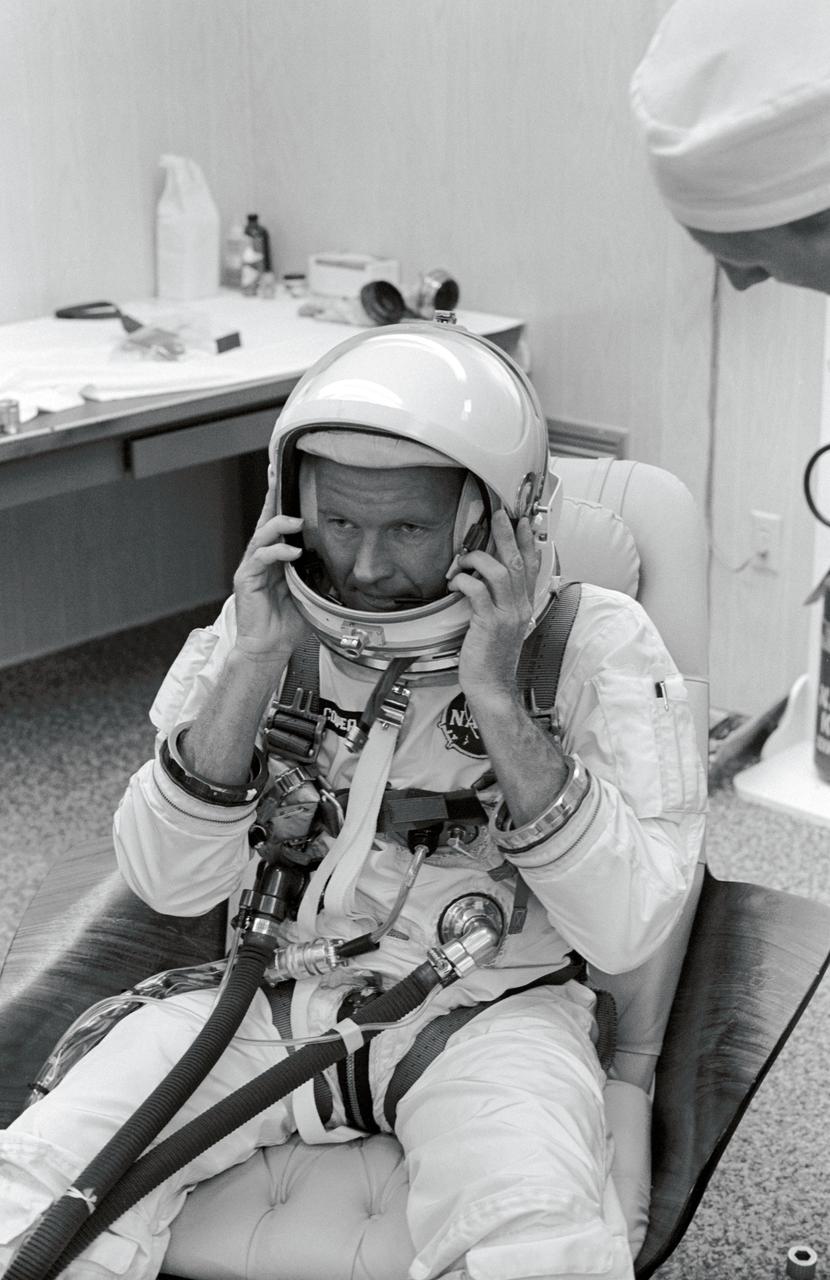
S65-41886 (22 July 1965) --- Astronaut L. Gordon Cooper Jr. makes adjustments to his helmet during suiting up exercise at Pad 16, Cape Kennedy, Florida. He is preparing for the Gemini-5 spaceflight. Photo credit: NASA
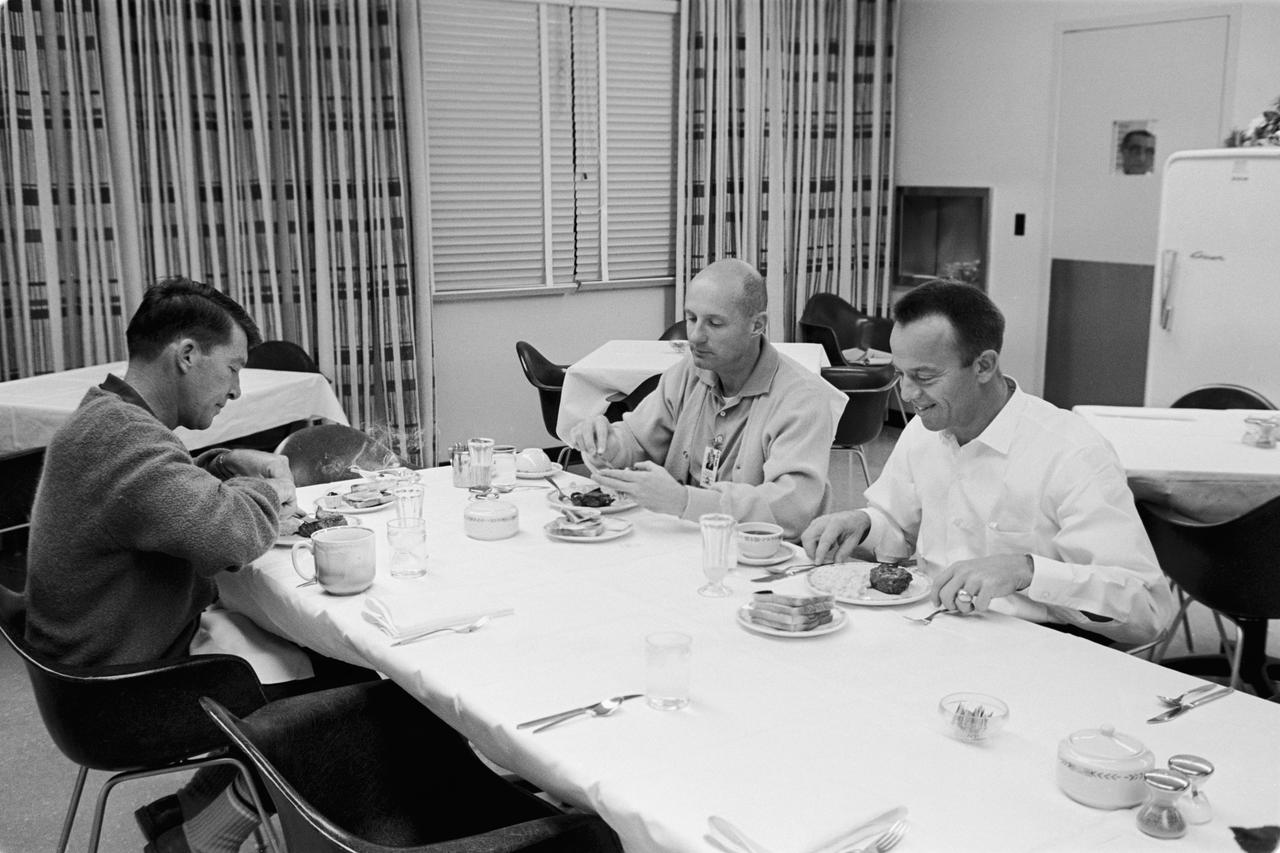
S65-61880 (15 Dec. 1965) --- Astronauts Walter M. Schirra Jr. (left), command pilot; and Thomas P. Stafford (center), pilot, enjoy a breakfast of steak and eggs in the Manned Spacecraft Operations Building, Merritt Island, during the Gemini-6 prelaunch countdown. Seated at right is astronaut Alan B. Shepard Jr., chief, Astronaut Office, Manned Spacecraft Center, Houston, Texas. Gemini-6 was successfully launched from Pad 19 at 8:37 a.m. (EST), Dec. 15, 1965. Photo credit: NASA or National Aeronautics and Space Administration
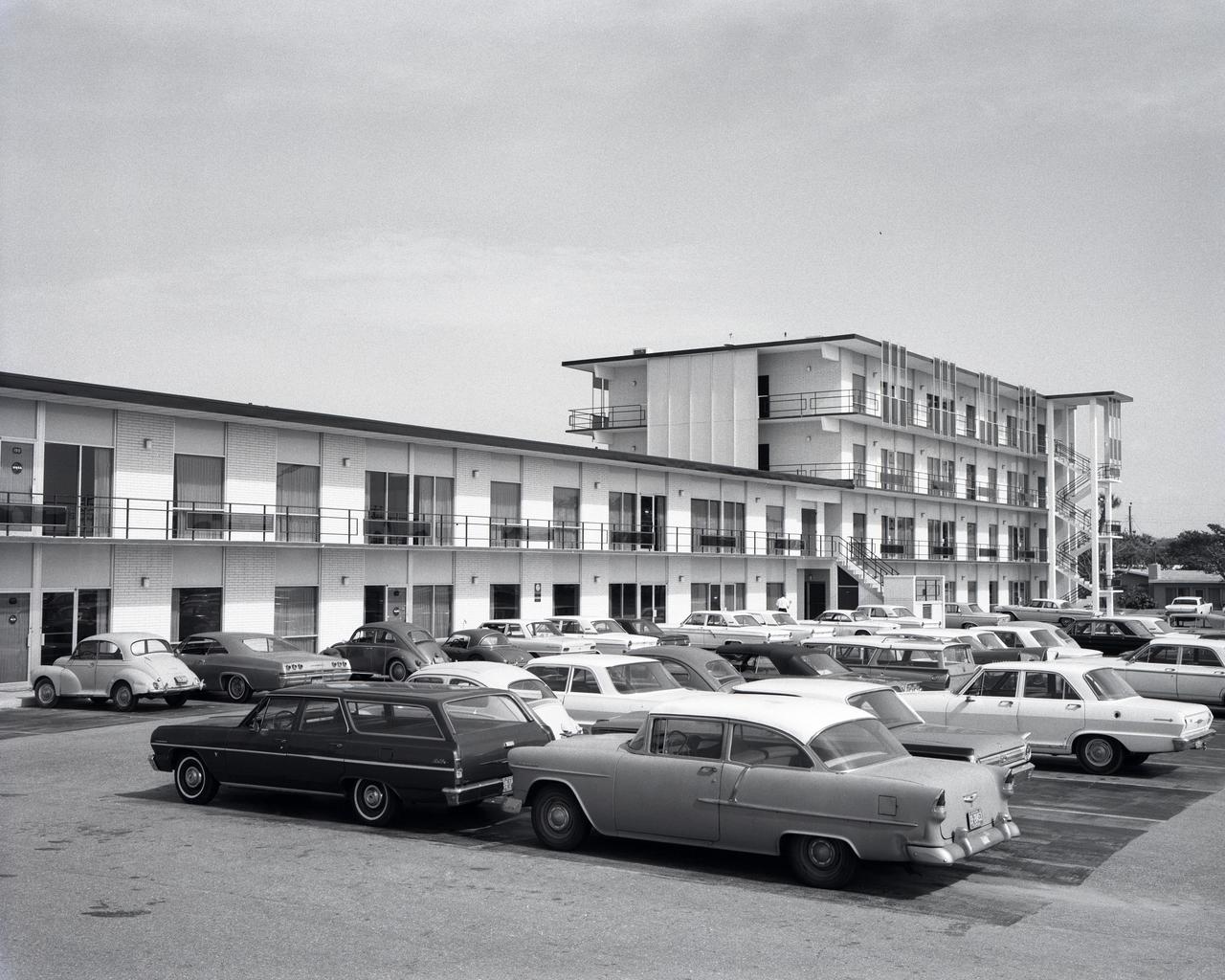
CAPE CANAVERAL, Fla. -- Holiday Office Center, Cocoa Beach, location of many NASA sub-contractors offices. A PIO photo. Photo credit: NASA
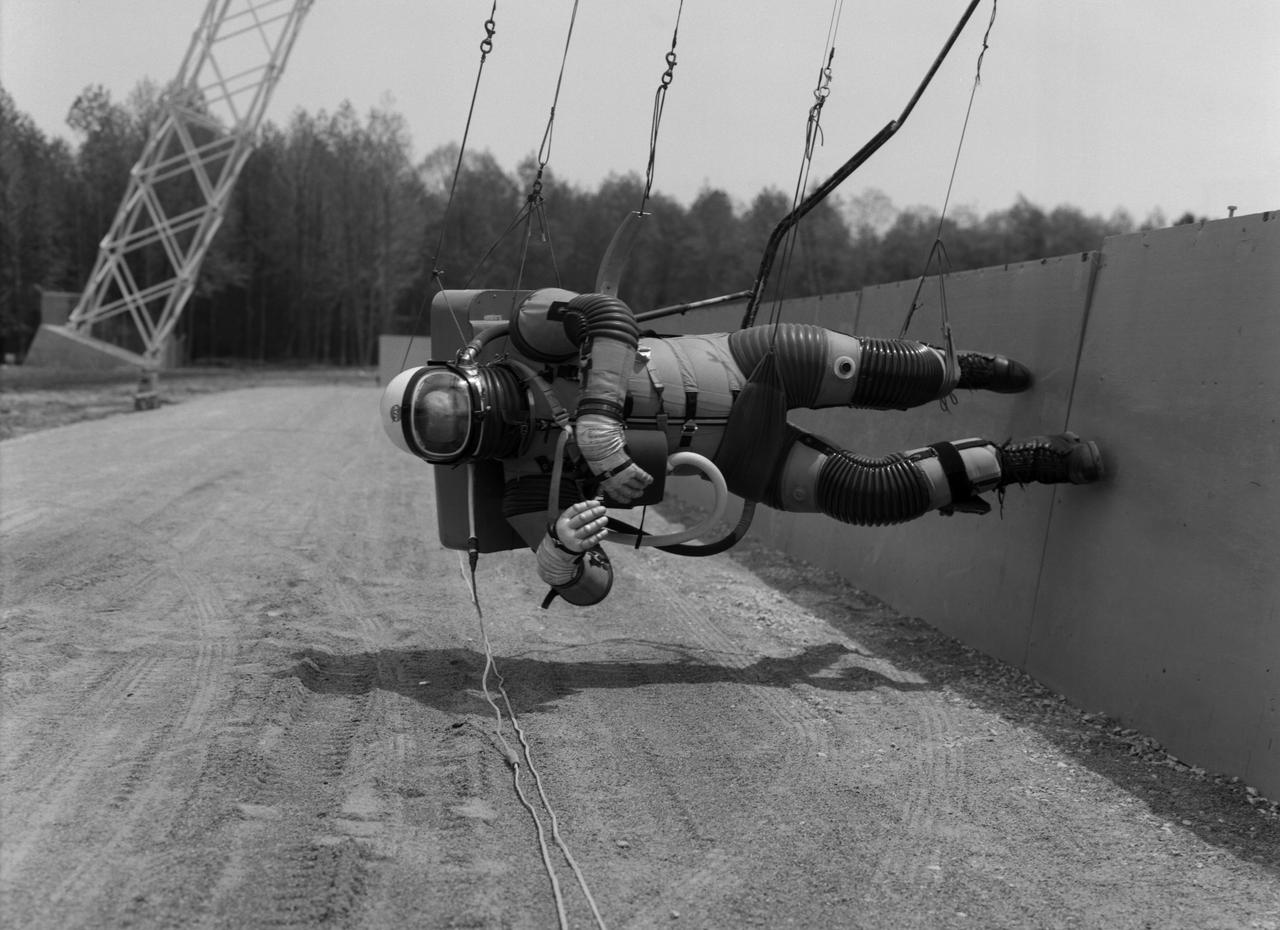
Test subject wearing the pressurized "space" suit for the Reduced Gravity Walking Simulator located at the Lunar Landing Facility. The purpose of this simulator was to study the subject while walking, jumping or running. Researchers conducted studies of various factors such as fatigue limit, energy expenditure, and speed of locomotion. A.W. Vigil described the purpose of the simulator in his paper "Discussion of Existing and Planned Simulators for Space Research," "When the astronauts land on the moon they will be in an unfamiliar environment involving, particularly, a gravitational field only one-sixth as strong as on earth. A novel method of simulating lunar gravity has been developed and is supported by a puppet-type suspension system at the end of a long pendulum. A floor is provided at the proper angle so that one-sixth of the subject's weight is supported by the floor with the remainder being supported by the suspension system. This simulator allows almost complete freedom in vertical translation and pitch and is considered to be a very realistic simulation of the lunar walking problem. For this problem this simulator suffers only slightly from the restrictions in lateral movement it puts on the test subject. This is not considered a strong disadvantage for ordinary walking problems since most of the motions do, in fact, occur in the vertical plane. However, this simulation technique would be severely restrictive if applied to the study of the extra-vehicular locomotion problem, for example, because in this situation complete six degrees of freedom are rather necessary. This technique, in effect, automatically introduces a two-axis attitude stabilization system into the problem. The technique could, however, be used in preliminary studies of extra-vehicular locomotion where, for example, it might be assumed that one axis of the attitude control system on the astronaut maneuvering unit may have failed." -- Published in James R. Hansen, Spaceflight Revolution: NASA Langley Research Center From Sputnik to Apollo, (Washington: NASA, 1995), p. 377; A.W. Vigil, "Discussion of Existing and Planned Simulators for Space Research," Paper presented at Conference on the Role of Simulation in Space Technology," Blacksburg, VA, August 17-21, 1964.

S65-28694 (21 Aug. 1965) --- The National Aeronautics and Space Administration launched the Gemini-5 spacecraft from Pad 19 at 9 a.m. (EST) Aug. 21, 1965, on a planned eight-day orbital mission. Astronaut L. Gordon Cooper Jr. was the command pilot and astronaut Charles Conrad Jr. was the pilot. A full duration mission will achieve the longest manned spaceflight to date.
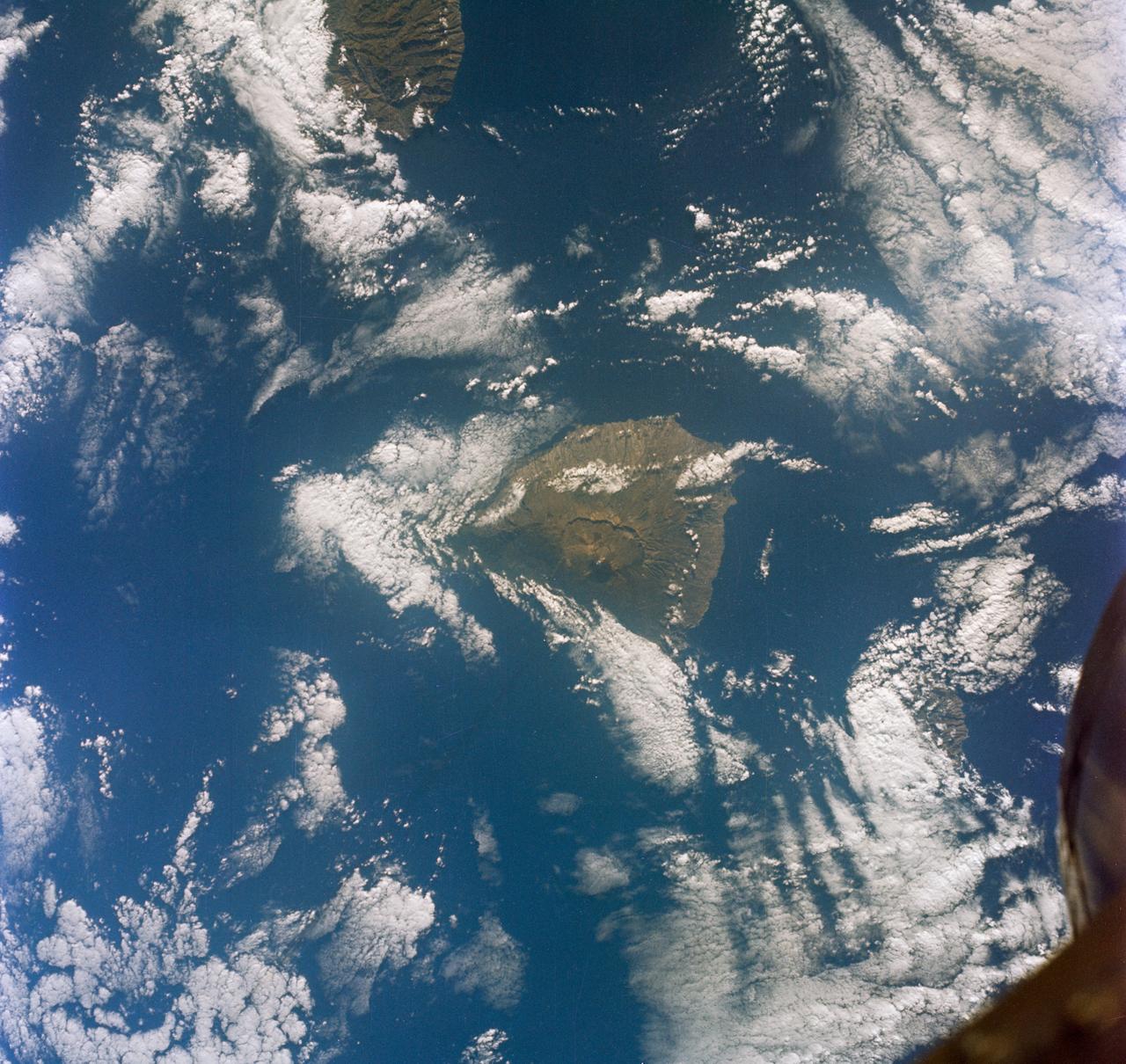
S65-63150 (16 Dec. 1965) --- Eddies in stratocumulus clouds over the Canary Islands as seen from the Gemini-6 spacecraft during its 14th revolution of Earth. Photo credit: NASA or National Aeronautics and Space Administration
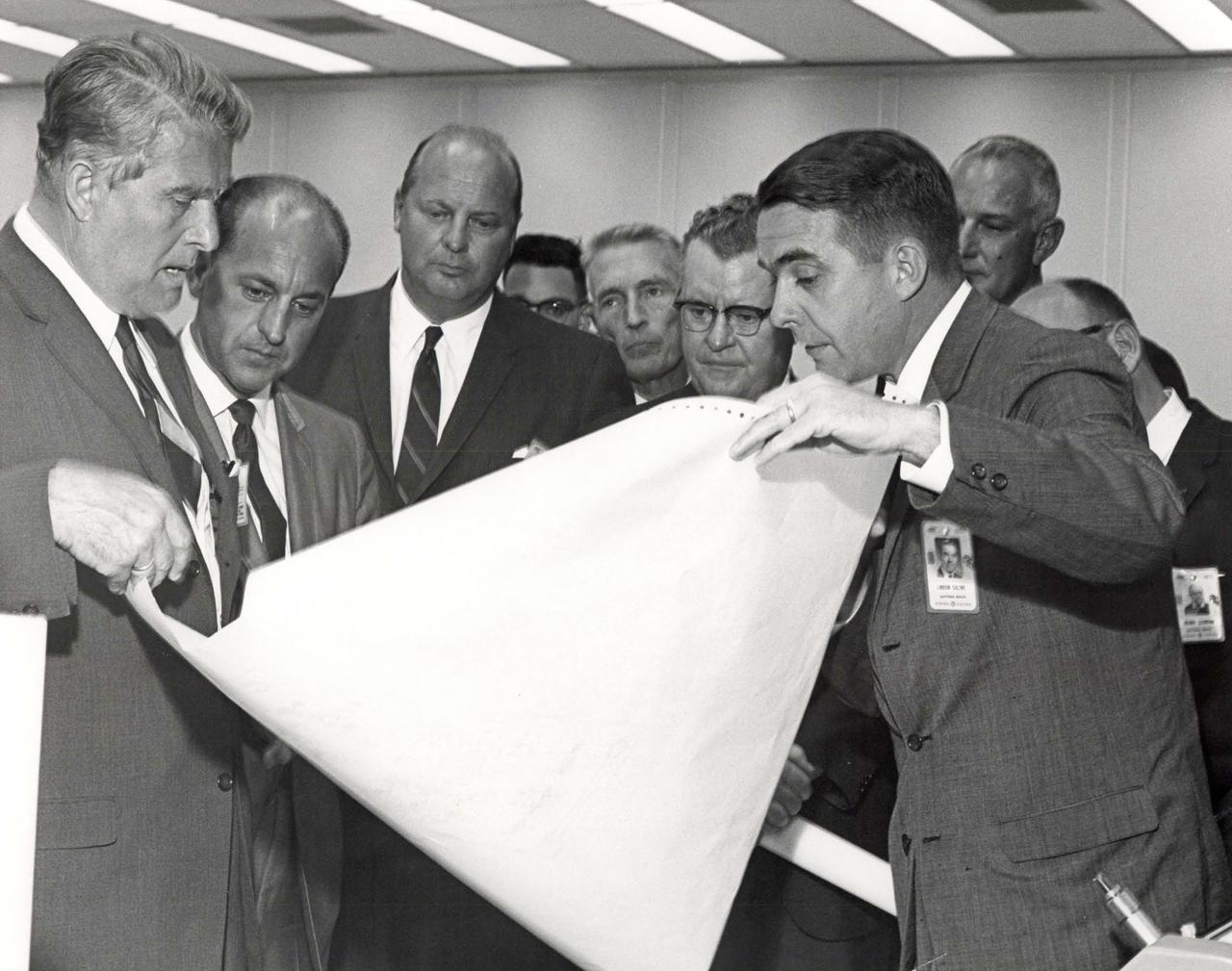
Dr. Wernher Von Braun photographed during his visit to Wagner College, Staten Island, N.Y. for commencement exercises.
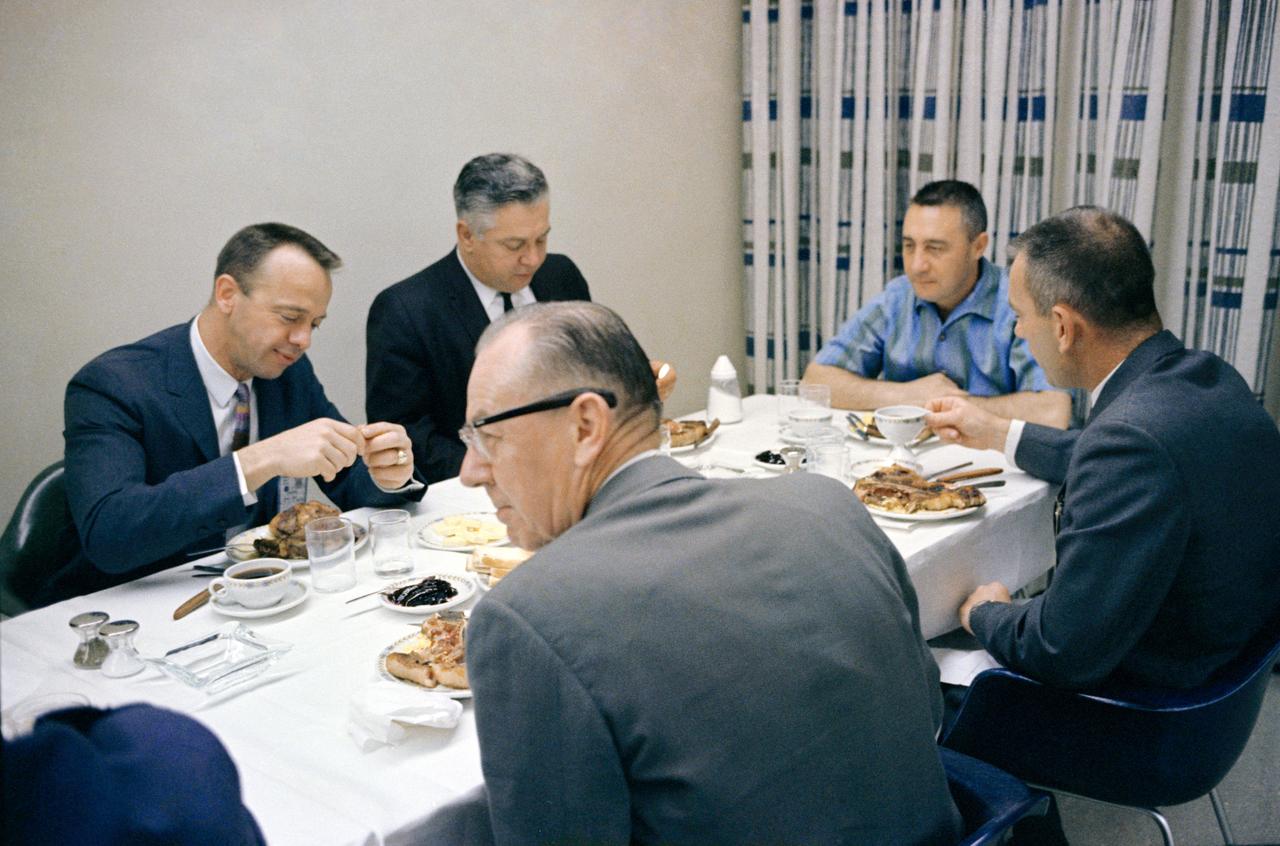
S65-21093 (23 March 1965) --- Astronaut Virgil I. Grissom (facing camera at right), command pilot of the Gemini-Titan 3 flight, is shown during a steak breakfast which he was served about two hours prior to the 9:24 a.m. (EST) GT-3 launch on March 23, 1965. Pictured in the foreground are Donald K. Slayton (right), assistant director for Flight Crew Operations; and Walter Burke, general manager of McDonnell Aircraft Corporation Spacecraft and Missiles. Pictured in the background are astronaut Alan B. Shepard Jr. (left) and Walter C. Williams, former deputy director of the Manned Spacecraft Center, now with a private aerospace firm.
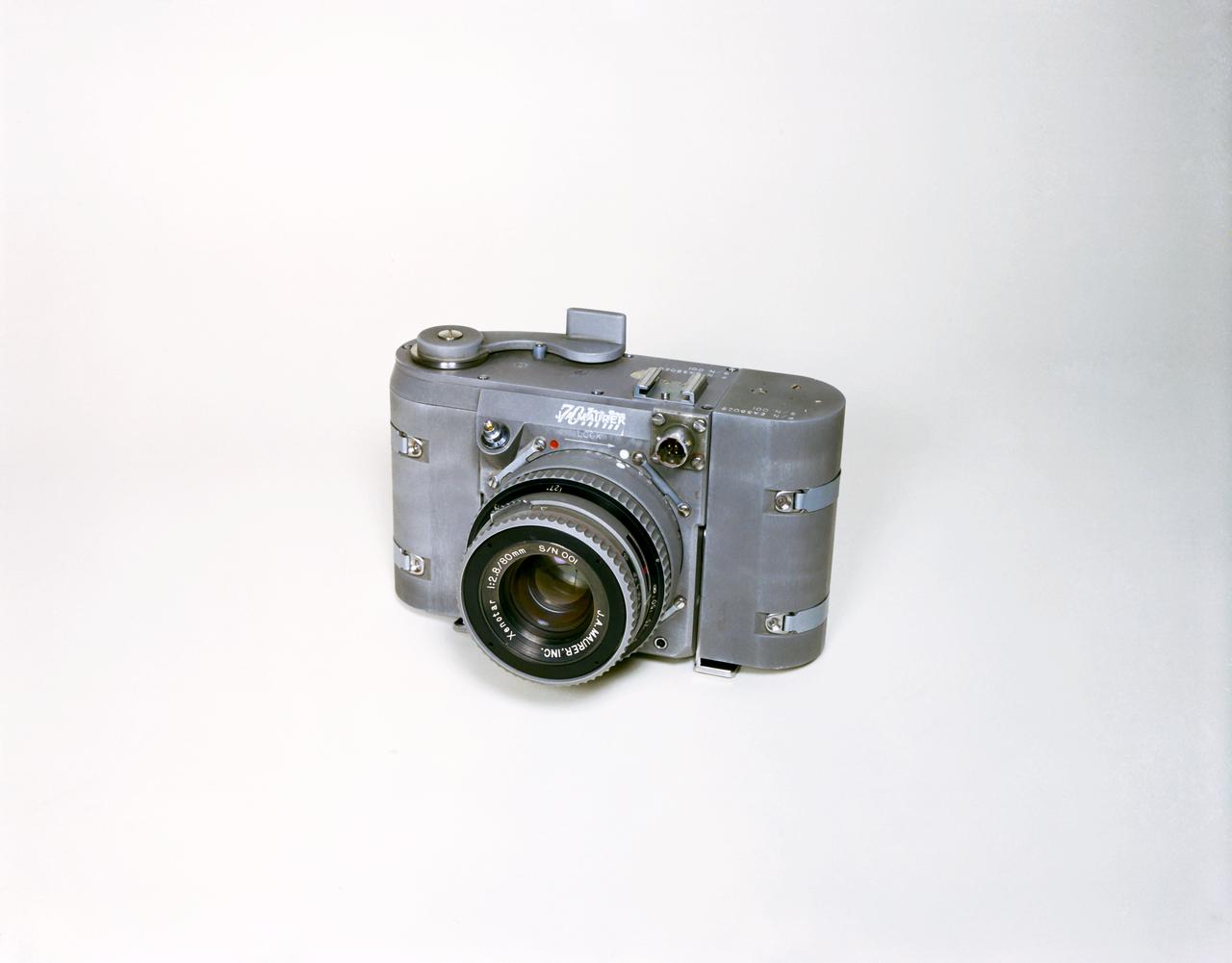
S65-23639 (28 April 1965) --- A bench view of a 70mm camera expected to be used by the Gemini-4 astronauts.
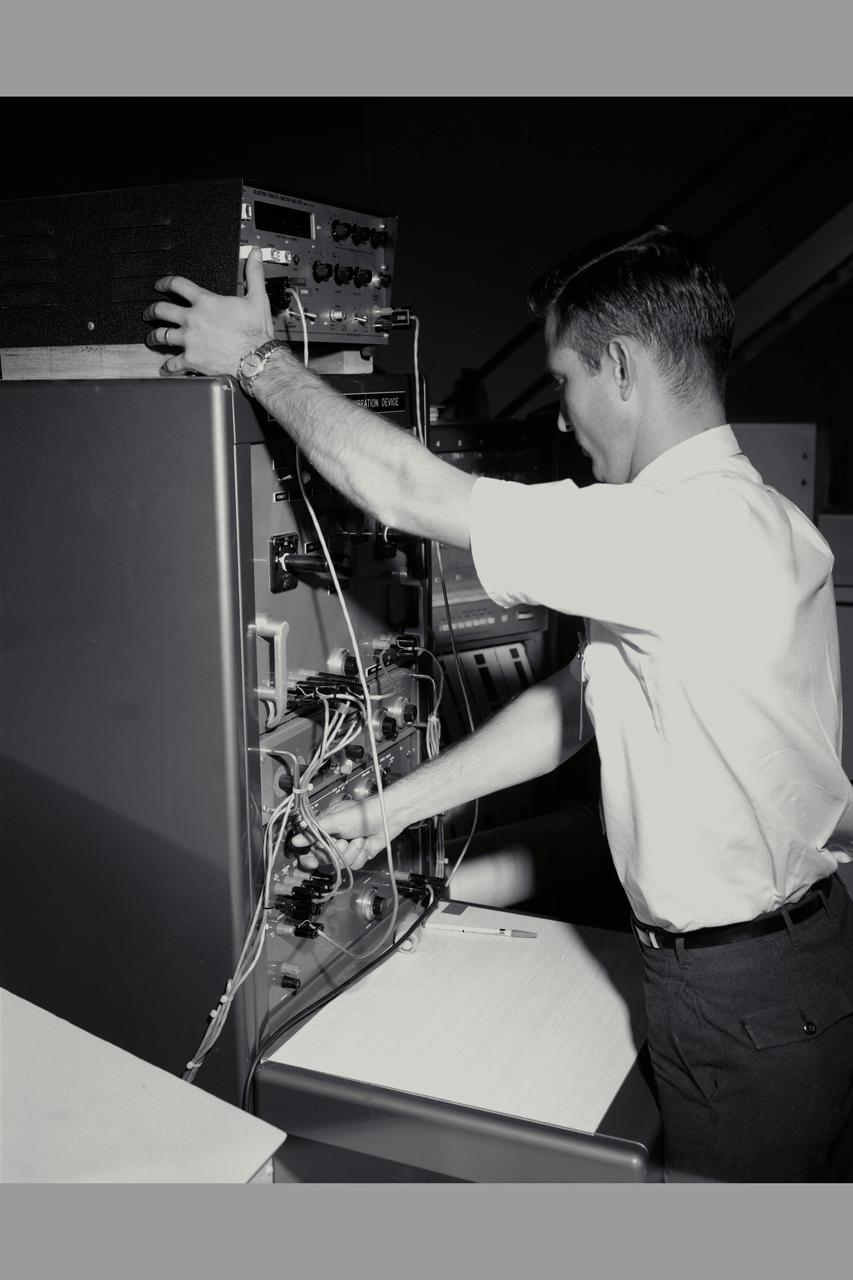
Vibration effects on Humans in a Biased Acceleration Field with Hubert C Vykukal at console
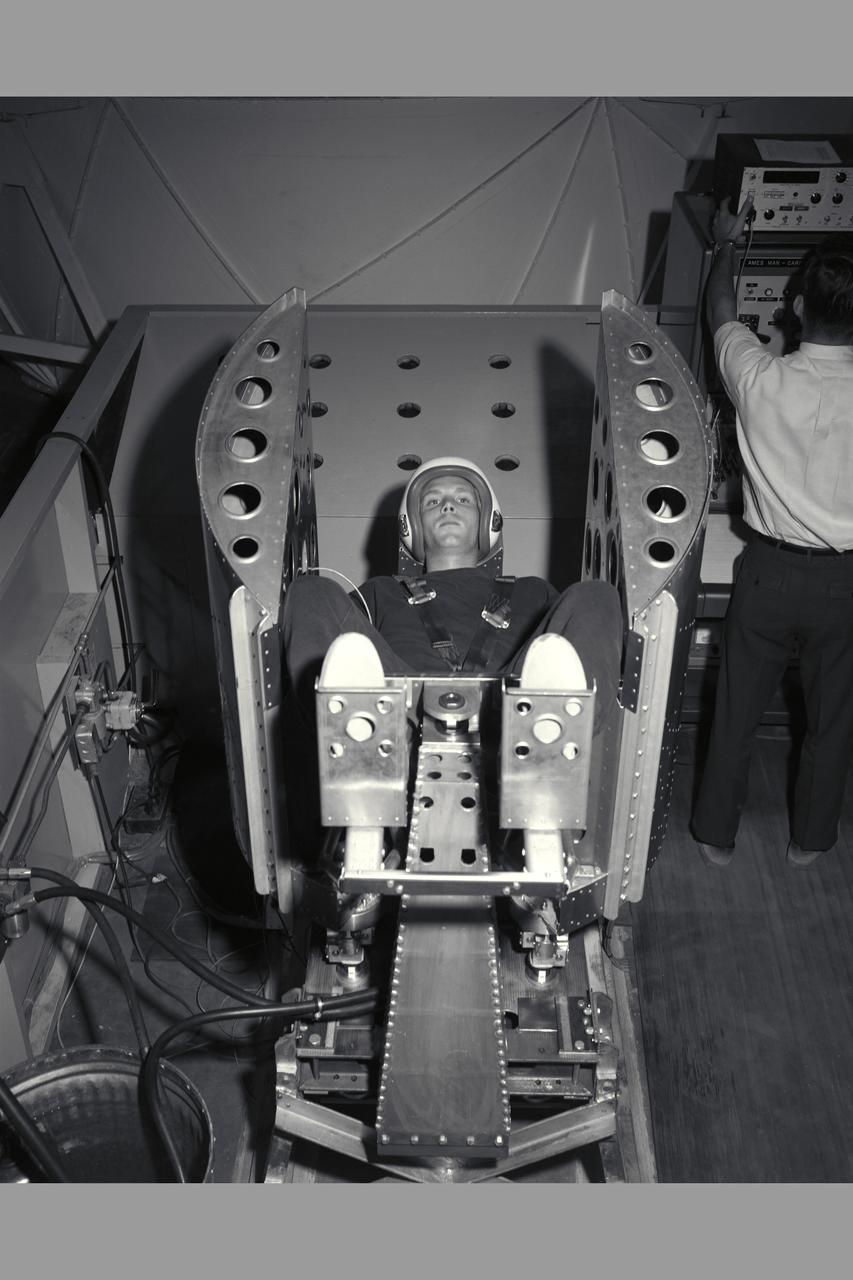
Vibration effects on Humans in a Biased Acceleration Field with David Millengurg in chair
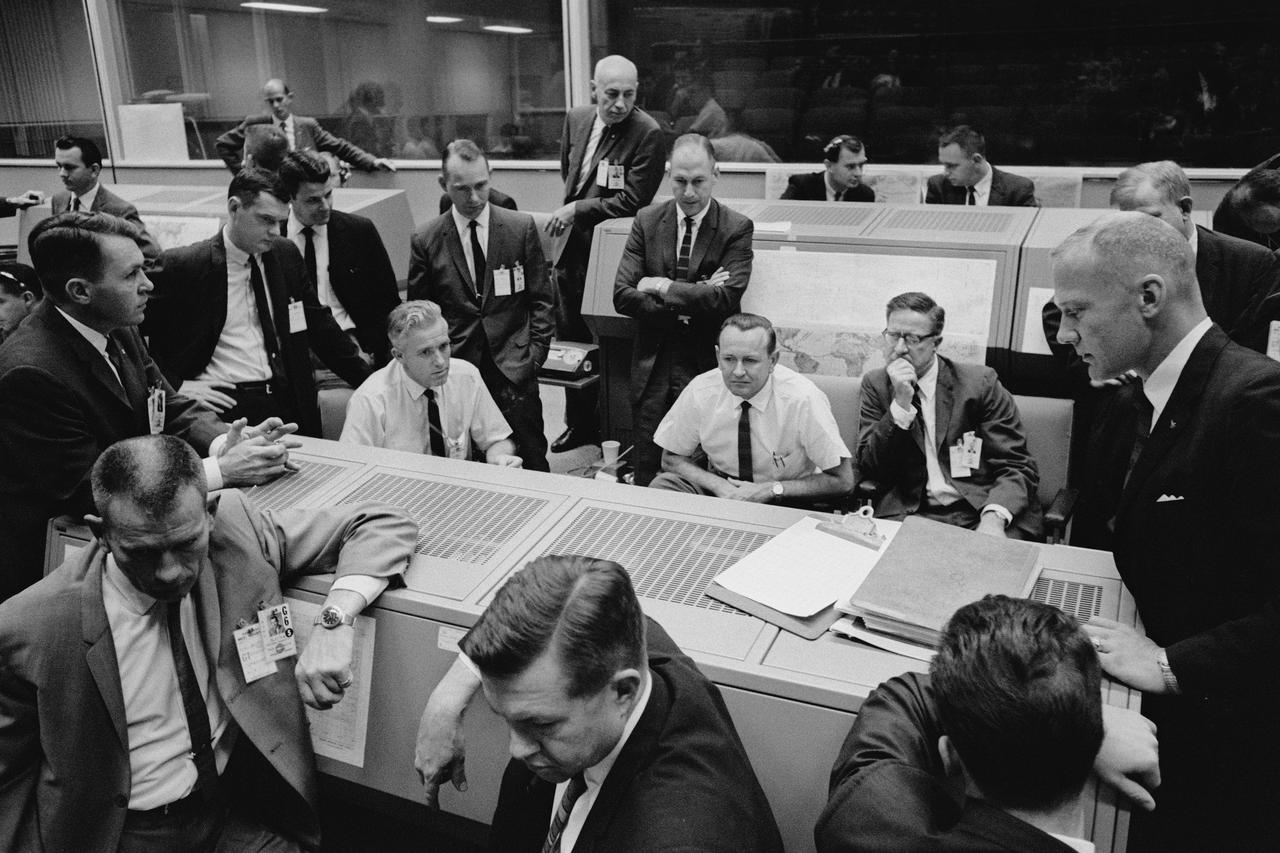
S65-44401 (1965) --- A group of National Aeronautics and Space Administration (NASA) and Manned Spacecraft Center (MSC) officials and personnel watch a Cape Kennedy press conference being telecast in the Mission Control Center (MCC) after the Gemini-6 mission was scrubbed due to the apparent failure of the Agena Target Vehicle to attain orbit.
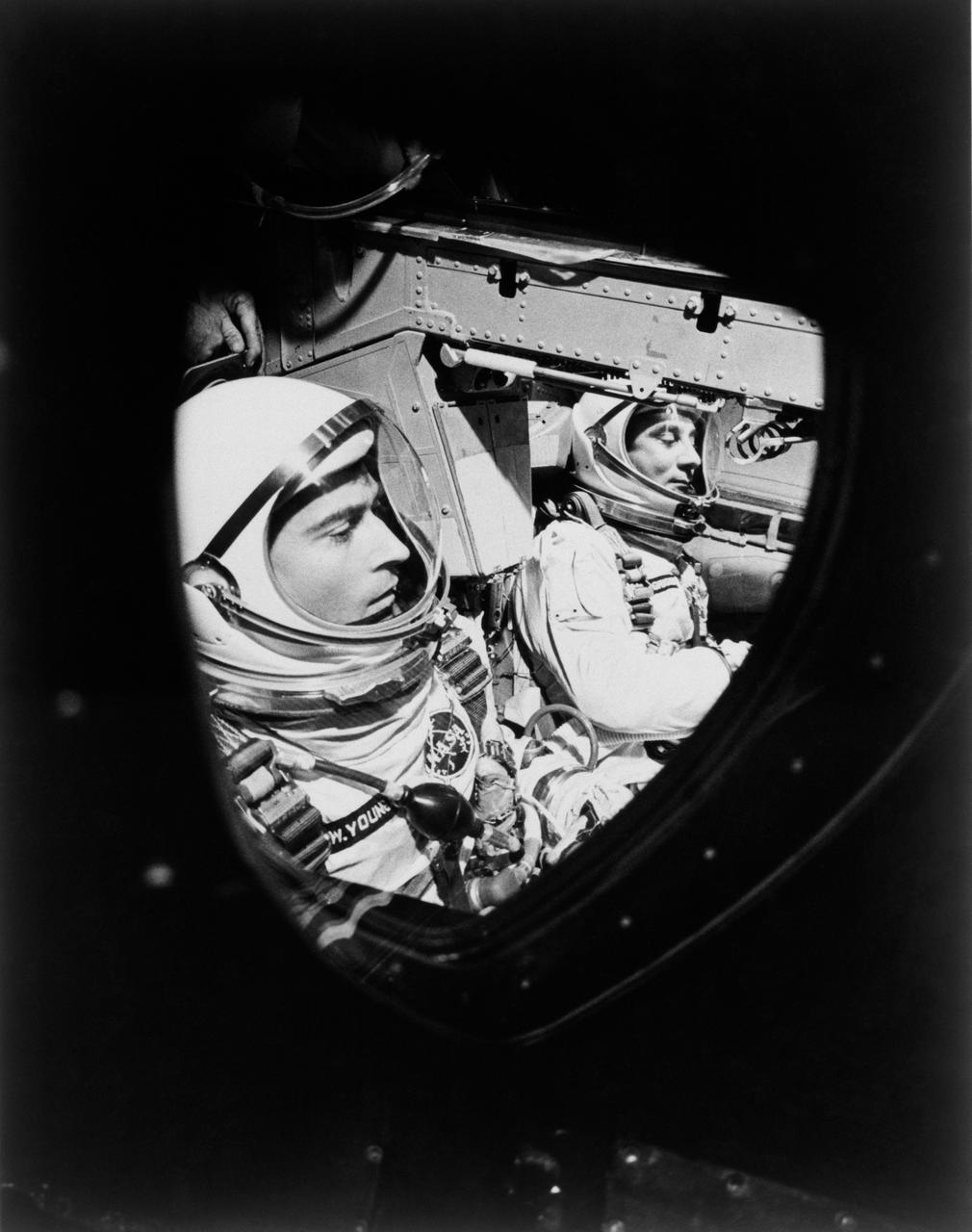
S65-19225 (23 March 1965) --- This view of astronauts John W. Young (left), pilot, and Virgil I. Grissom, command pilot, was taken through the window of the open hatch on Young's side of the Gemini-Titan 3 spacecraft just before the hatches were closed in readiness for their three-orbit flight.
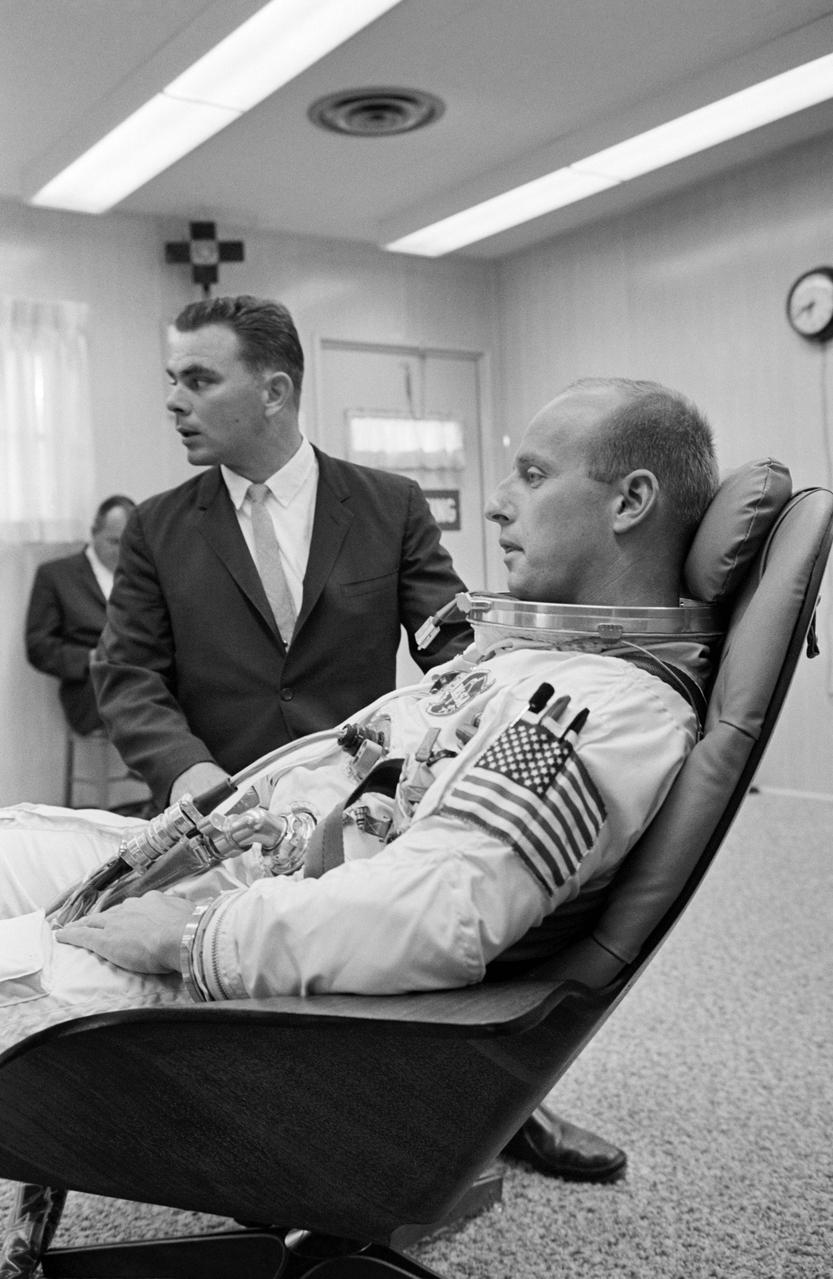
S65-46374 (21 Aug. 1965) --- Astronaut Charles Conrad Jr., Gemini-5 pilot, is pictured during suiting up operations on the morning of the flight of Gemini-5. With him is Dr. Eugene Tubbs, a member of the medical team at Cape Kennedy. The mission was originally set for Aug. 19, 1965, but was scrubbed and reset for Aug. 21. Command pilot for the flight is astronaut L. Gordon Cooper Jr.
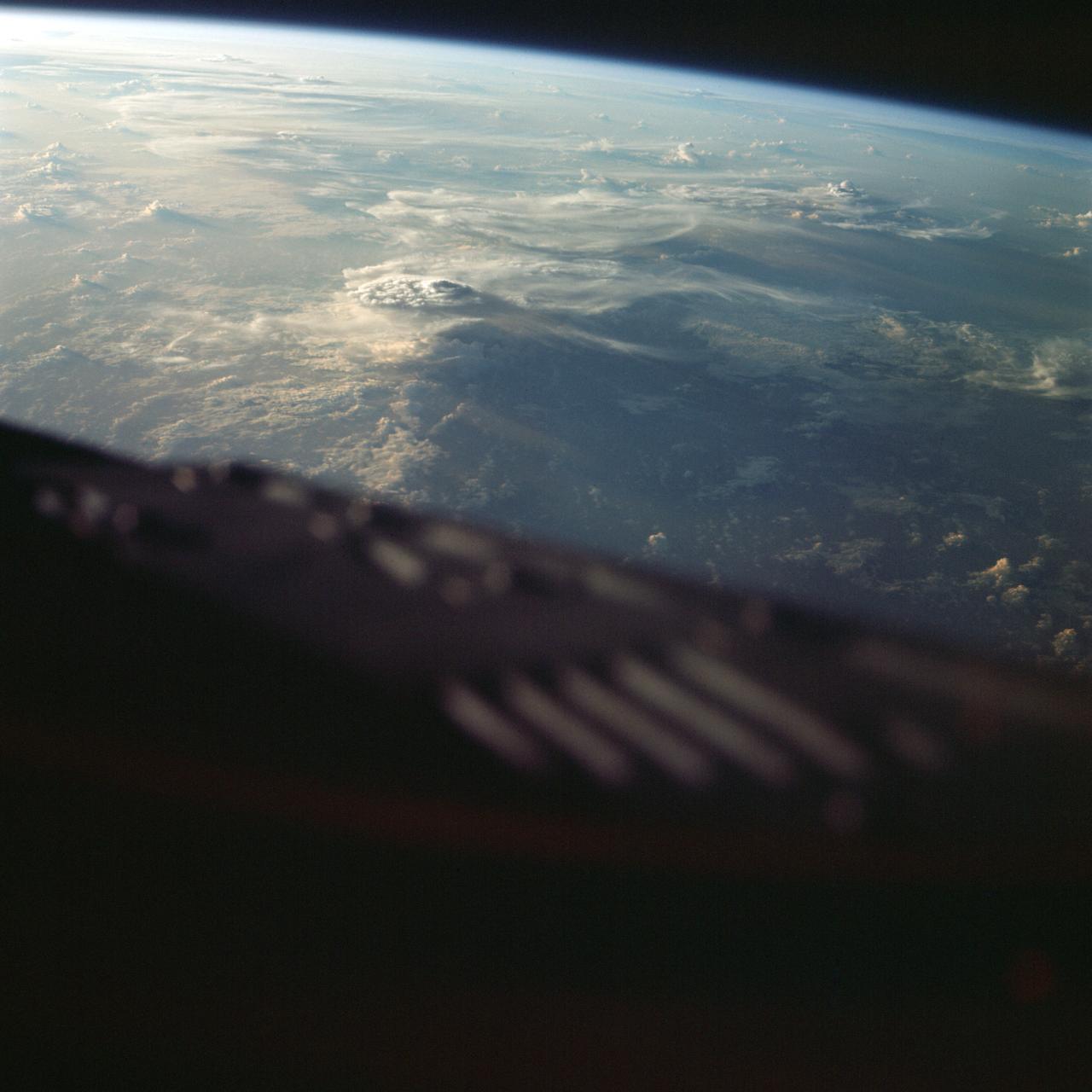
S65-18752 (23 March 1965) --- View of a cloudy part of Earth as seen from the Gemini-3 spacecraft while in orbit.
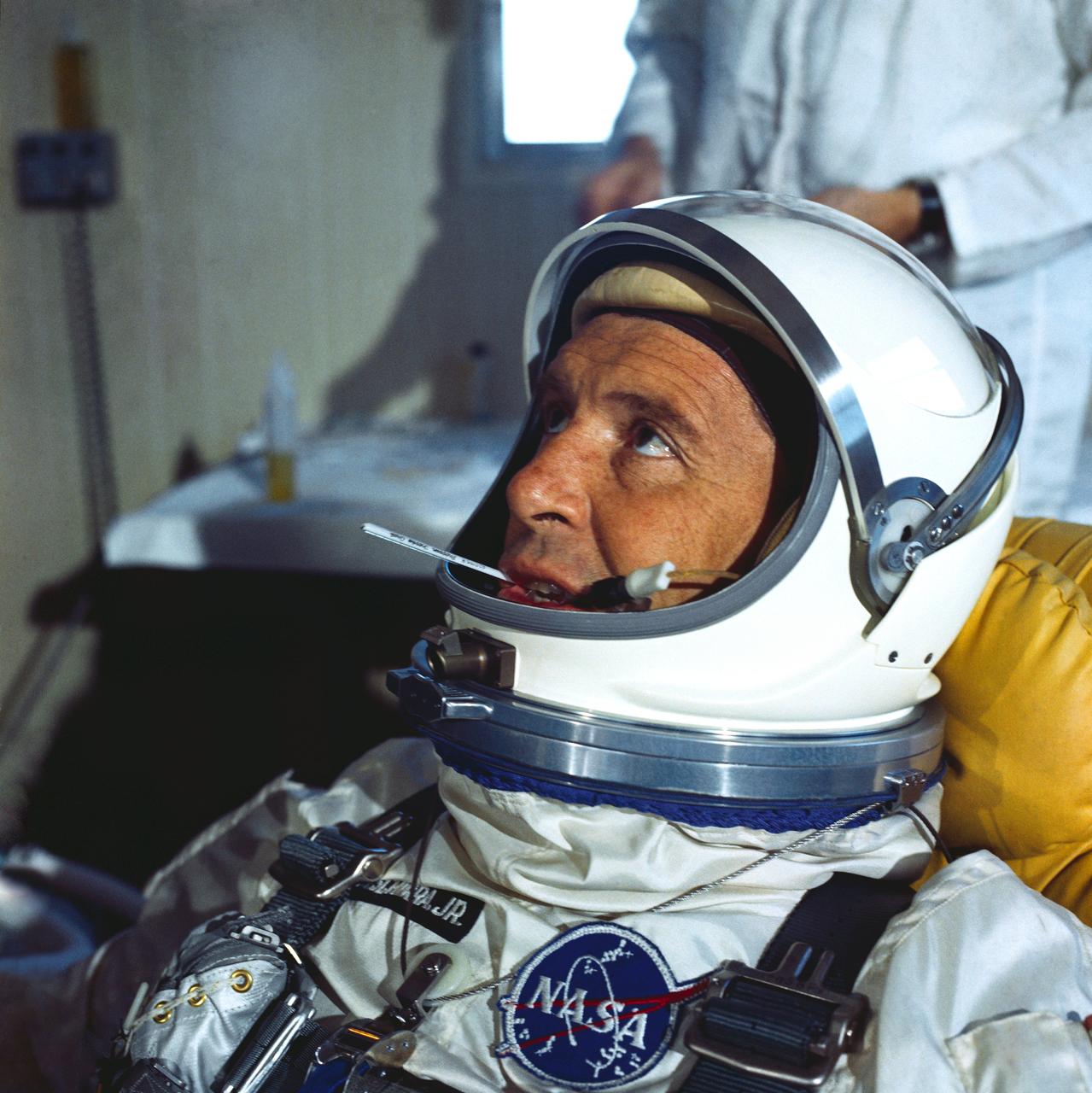
S65-22666 (8 March 1965) --- Astronaut Walter M. Schirra Jr., the command pilot of the GT-3 backup crew, is shown suited up for prelaunch tests. He is shown with his helmet visor up and a thermometer in his mouth.
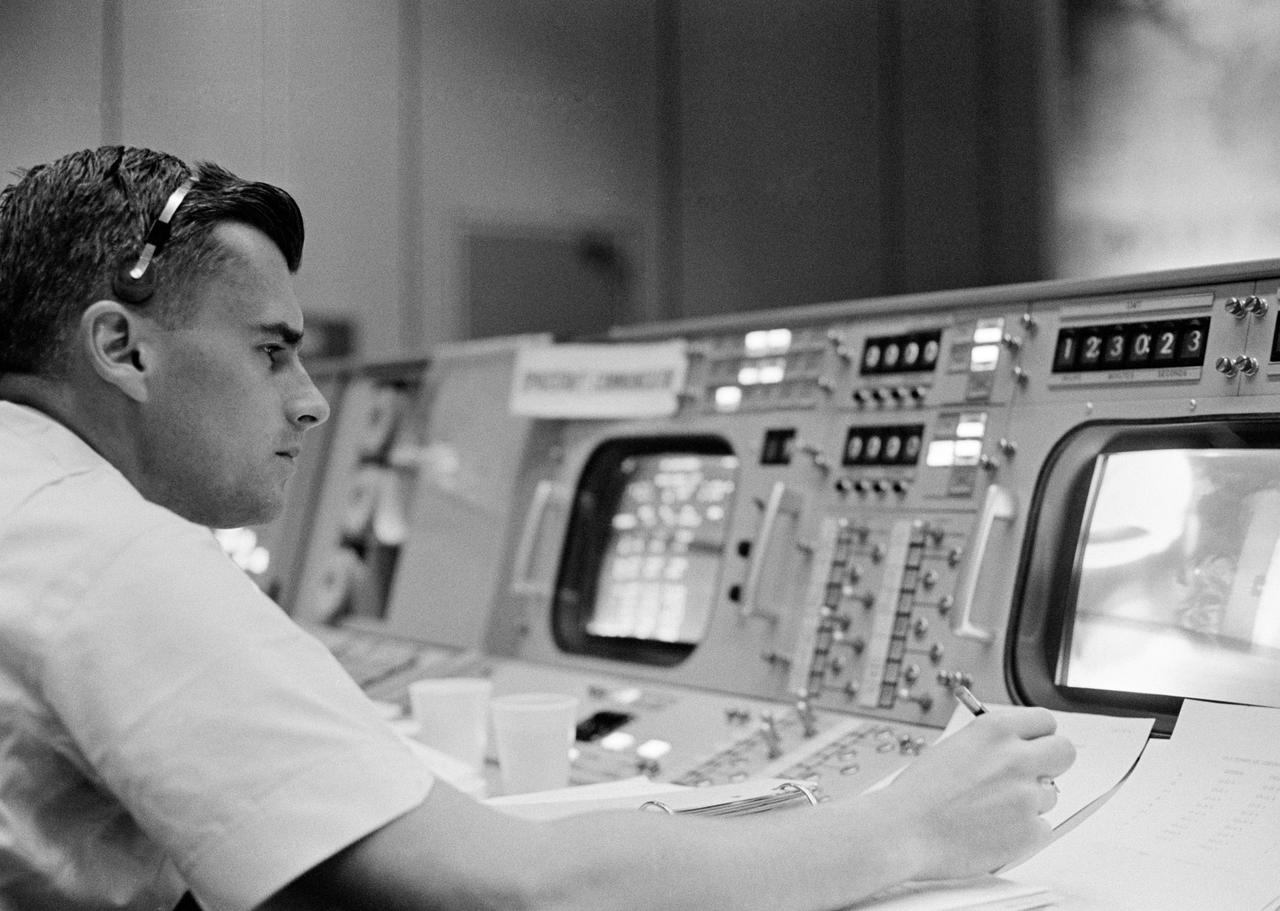
S65-18058 (23 March 1965) --- Astronaut Roger B. Chaffee is shown at console in the Mission Control Center, Houston, Texas during the Gemini-Titan 3 flight.
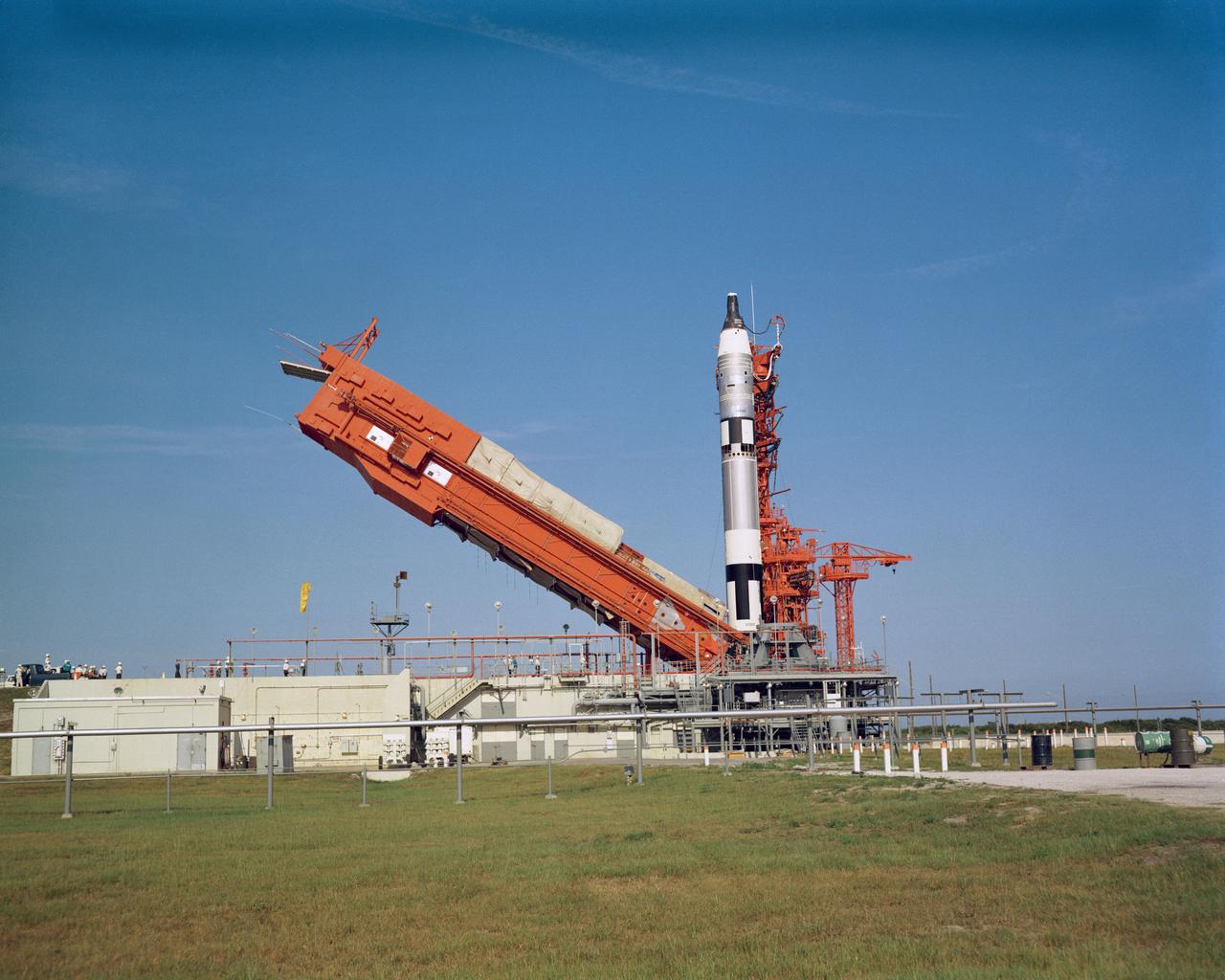
S65-49568 (21 Aug. 1965) --- The erector at Pad 19 is lowered in preparation for the launch of the Gemini-5 spacecraft. Astronauts L. Gordon Cooper Jr., command pilot; and Charles Conrad Jr., pilot, are crew members for the planned eight-day mission in space.
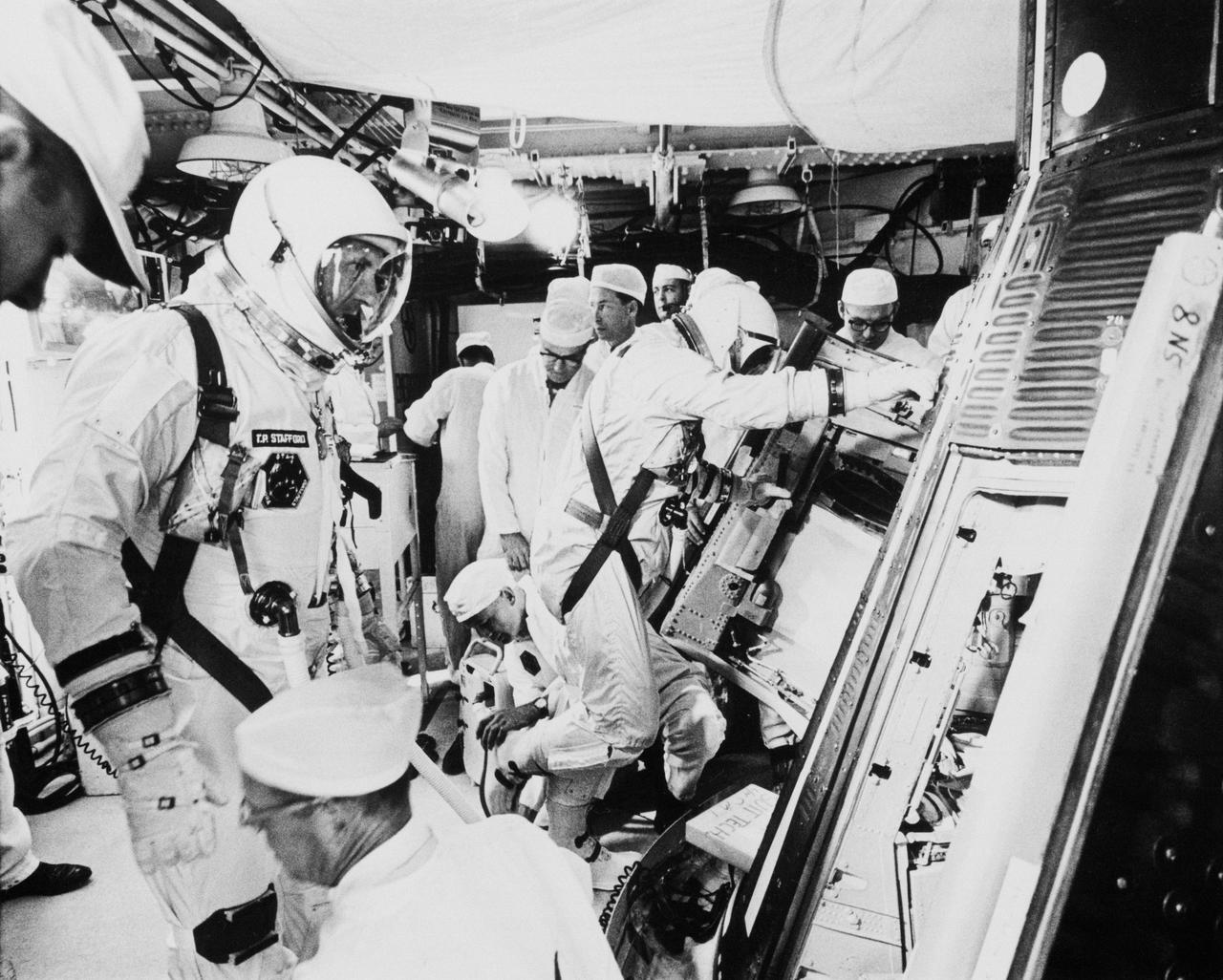
S65-56155 (15 Dec. 1965) --- Astronauts Thomas P. Stafford, pilot; and Walter M. Schirra Jr., command pilot, are readied for insertion into the Gemini-6 spacecraft in the White Room at Pad 19, Cape Canaveral, Florida. Photo credit: NASA or National Aeronautics and Space Administration
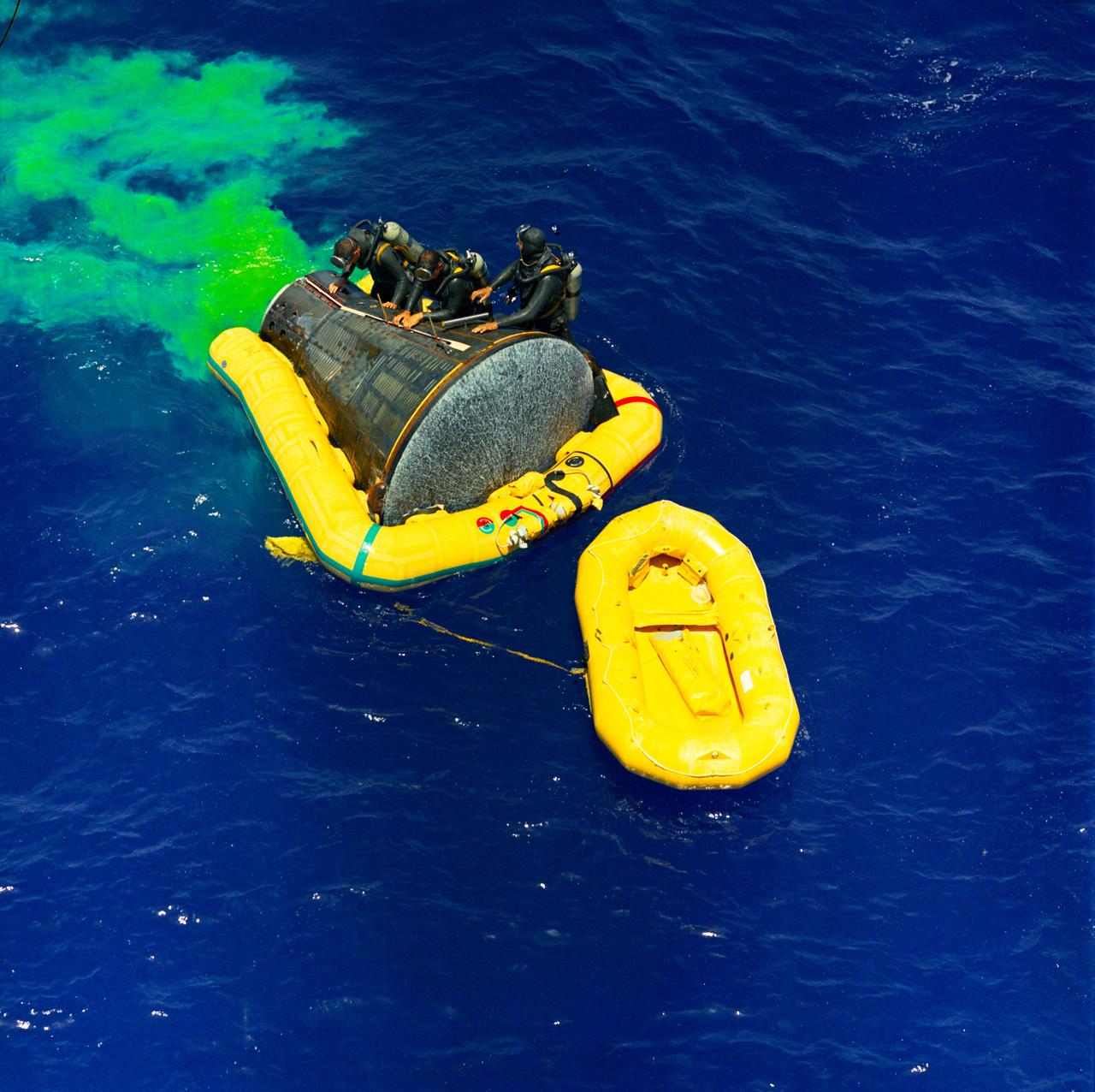
S65-33491 (7 June 1965) --- A United States Navy frogman team participates in the recovery of the Gemini-Titan 4 (GT-4) spacecraft. The USS Wasp was the prime recovery ship for the Gemini-4 mission. The crew of the Gemini-4 spaceflight was astronauts James A. McDivitt, command pilot, and Edward H. White II, pilot.
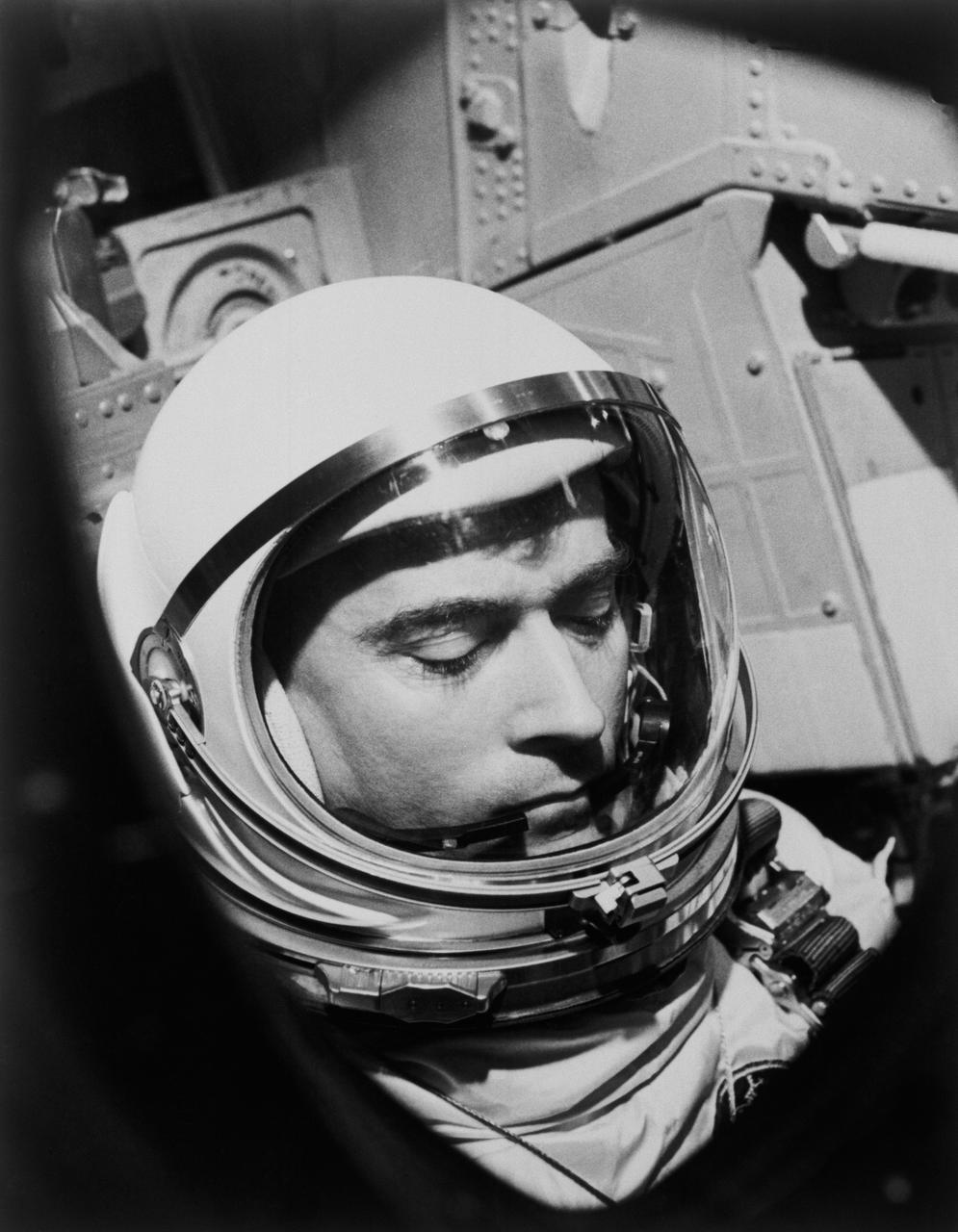
S65-19228 (23 March 1965) --- Astronaut John W. Young, the pilot of the Gemini-Titan 3 mission, is shown going through last minute checks before the hatch is closed on the spacecraft. The window frames Young just before the launch.
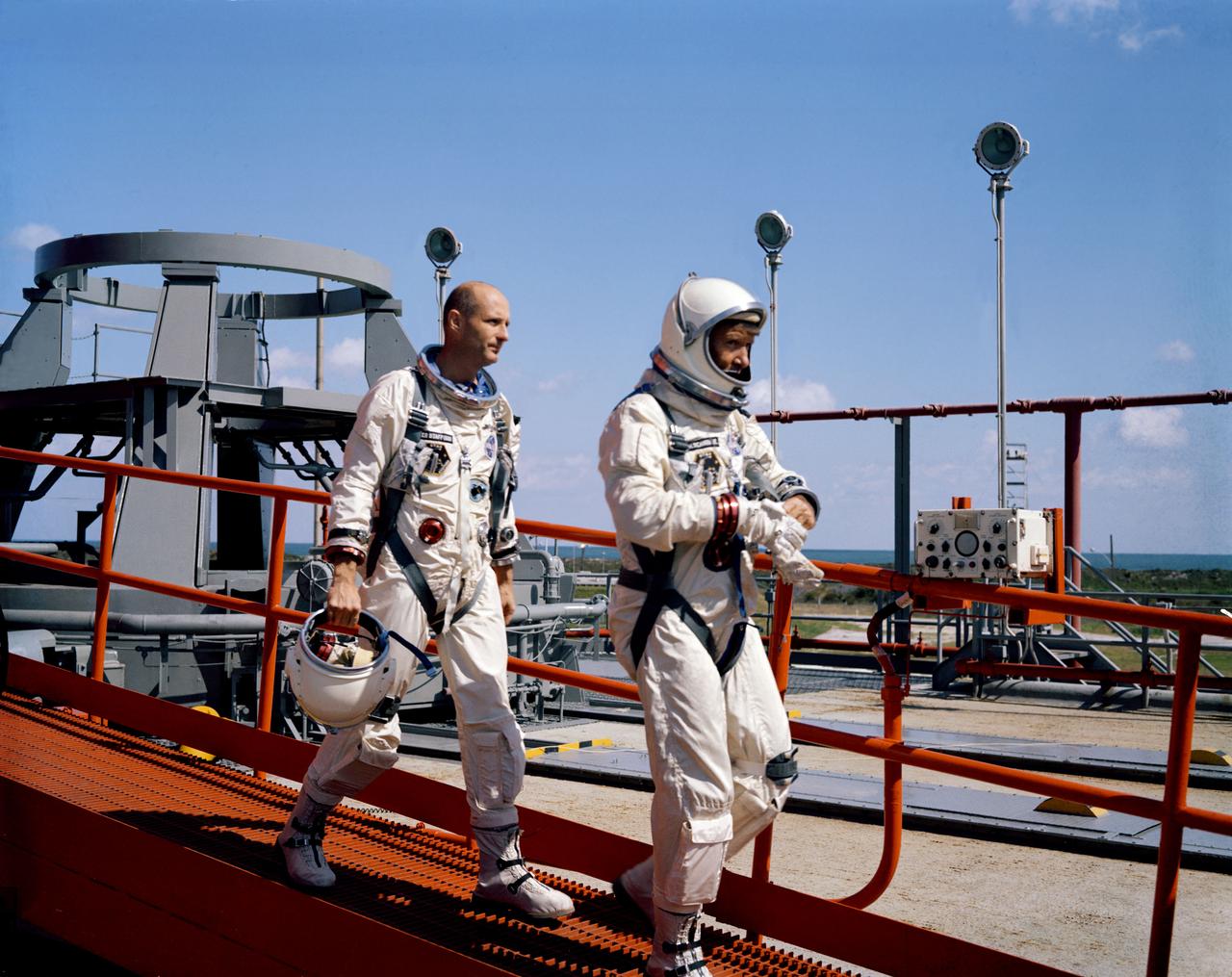
S65-57964 (25 Oct. 1965) --- The prime crew of the Gemini-6 spaceflight walk down the ramp at Pad 19 after leaving the Gemini-6 spacecraft. Astronaut Walter M. Schirra Jr. (leading) is command pilot; and astronaut Thomas P. Stafford is pilot. The Oct. 25 Gemini-6 launch was scrubbed because the Agena, intended as a rendezvous target vehicle in the mission, failed to achieve orbit. Photo credit: NASA or National Aeronautics and Space Administratio
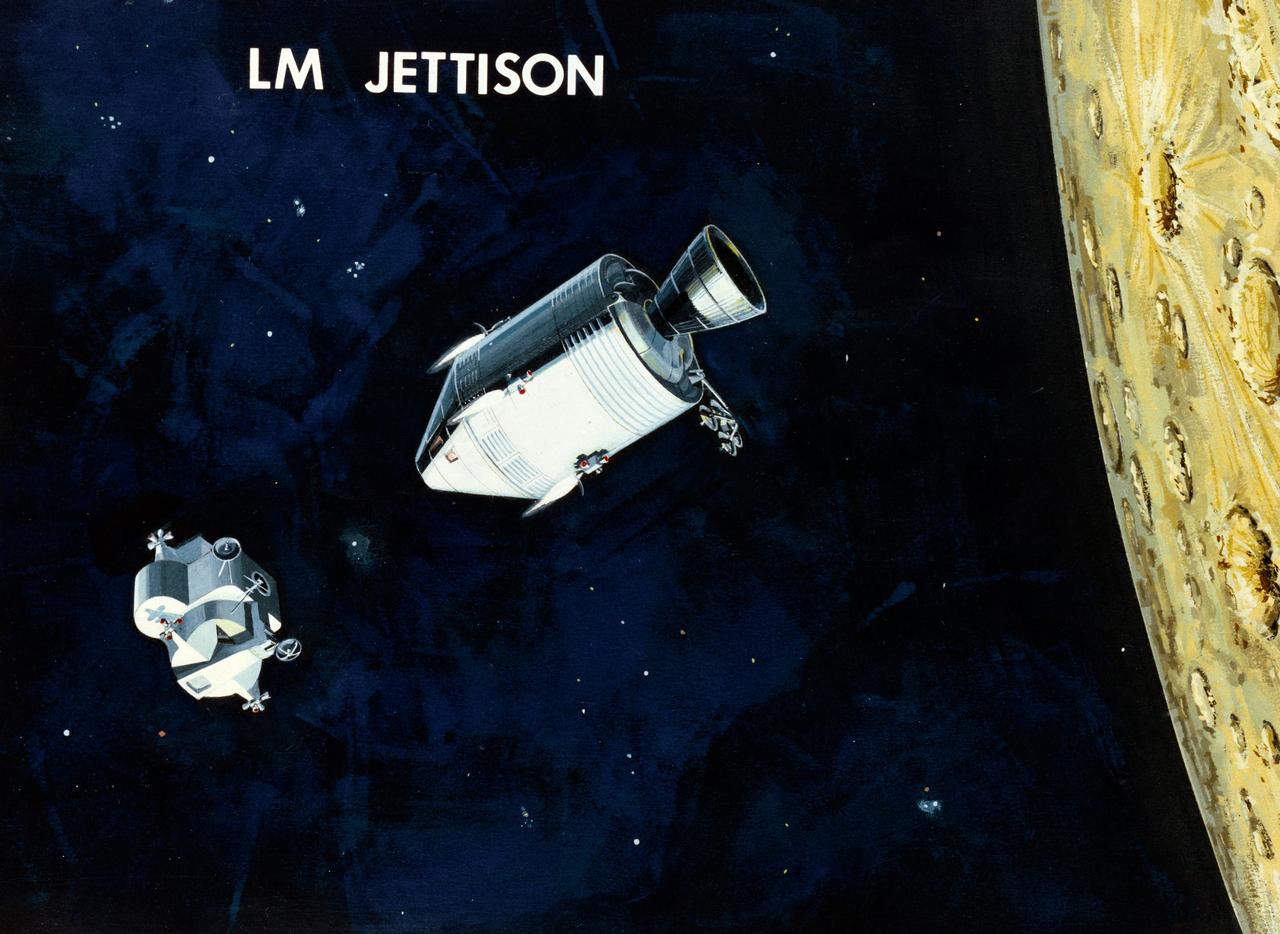
Artist Concepts, Apollo Mission: S66-10983: Ascent Stage Liftoff (S66-05094) S66-10984: Orientation During Ascent Phase (S66-05098) S66-10985: Midcourse Coast (S66-05113) S66-10986: Survey of Landing Site (S66-05117) S66-10987: Lunar Module (LM) Jettison (S66-05089) S66-10988: Trans-Earth Injection (S66-05090) S66-10989: Exploration on Lunar Surface Apollo Surface Lunar Exploration Experiment (ASLEP) S66-10990: Liftoff (S66-05125) S66-10991: Command Module (CM)-Service Module (SM) Separation (S66-05101 N/F) S66-10992: Touchdown on Lunar Surface (S66-05115) S66-10993: Transfer Orbit Insertion (S66-05111) S66-10994: Drogue Parachute Deployment S66-10995: S-IC Stage Separation S-II Stage Thrusting (S66-05099) S66-10996: Jettison Launch Escape System (S66-05114) S66-10997: Main Parachute Deployment (S66-05091) S66-10998: Mid-course correction (S66-05088) S66-10999: Lunar Orbit Insertion (S66-05086) S66-11000: Command Service Module (CSM)-LM Docked in LM Adapter-S-IVB (S66-06526) S66-11001: Docking and Separation of spacecraft from S-IVB (S66-05107) S66-11002: Final Descent (S66-05096) S66-11003: Entry into Earth Atmosphere (S66-05096) S66-11004: Deploy S/C LM Adapter-Separate CSM from LM-S-IVB (S66-06525 & 05105) S66-11005: Turnaround of CSM (S66-05104) S66-11006: S-II Stage Separation S-IVB Stage Thrusting (S66-05102) S66-11007: LM Ascent CSM Docked (S66-05100) S66-11008: Midcourse Correction SPS Mode (S66-05106) S66-11009: Earth Orbit Insertion of S-IVB & S/C (S66-05092) S66-11010: Trans-lunar Injection (S66-05116) S66-11011: LM Descent (S66-05110) S66-11012: S-IVB Stage Operations (S66-05112 N/F) S66-11013: Spacecraft Recovery (S66-05126) S66-11014: Lunar Orbit (S66-05103) S66-11015: CSM-LM Docking (S66-05095) S66-11016: Entry CM (S66-5109) S66-11017: Midcourse Corrections to Lunar Landing (S66-08486) S66-11018: Midcourse Corrections to Lunar Landing w/Overlay (S66-05083) S66-11019: Earth Launch Phase w/Overlay (S66-08485 & 05119) S66-11020: Earth Launch Phase (S66-08487 & S66-05084) S66-11022: Apollo Vehicles (S66-05127) S66-11024: Transfer to LM (S66-05082) S66-11025: Lunar Launch Phase S66-11027: Trans-earth Separation of C/M from S/M-C/M return to Earth (S66-05097) S66-11028: CSM-LM Separation, LM Descent to Moon (S66-05108) MSC, Houston, TX Also available in B&W 12/1965 - 06/1966
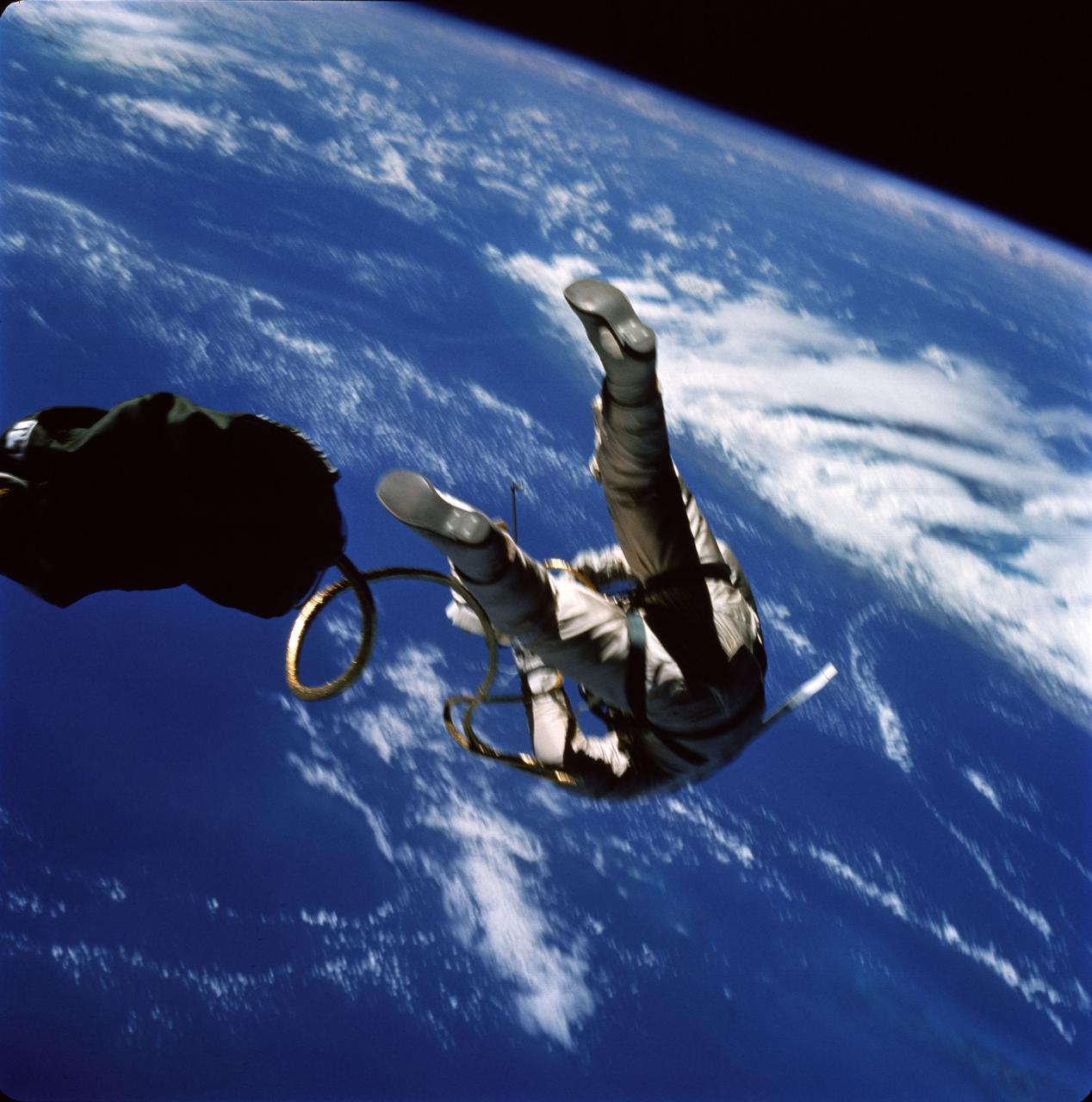
View of Astronaut Edward H. White II, pilot for the Gemini-Titan 4 space flight, as he floats in zero gravity of space. The extravehicular activity was performed during the third revolution of the Gemini 4 spacecraft. White is attached to the spacecraft by a 25-ft. umbilical line and a 23-ft. tether line,both wrapped in gold tape to form one cord. In his right hand White carries a Hand-Held Self-Maneuvering Unit (HHSMU). The visor of his helmet is gold plated to protect him from the unfiltered rays of the sun. Photo was taken on June 3,1965. G.E.T. time was 4:45 / GMT time was 20:00. Original magazine number was GEM04-16-34642, taken with a Hasselblad camera and a 70mm lens. Film type was Kodak Ektachrome MS (S.O. -217). The original photo was a color negative. It's image number is S65-34642.
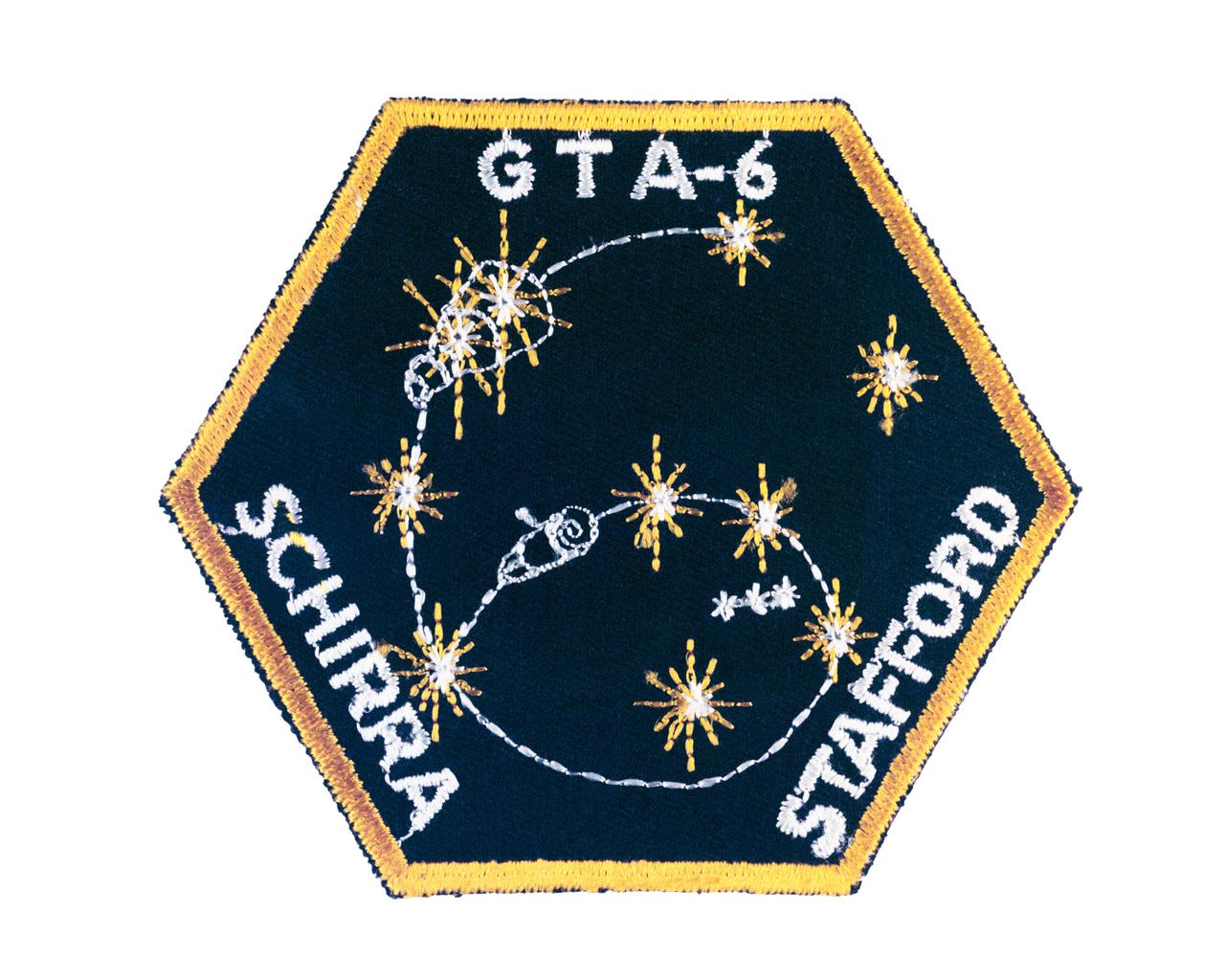
S65-55983 (8 Dec. 1965) --- This hexagonal-shaped insignia is the emblem of the Gemini-6 spaceflight. Astronauts Walter M. Schirra Jr., command pilot; and Thomas P. Stafford, pilot, are the prime crew. The National Aeronautics and Space Administration (NASA) has scheduled Gemini-6 as a two-day mission. Photo credit: NASA or National Aeronautics and Space Administration
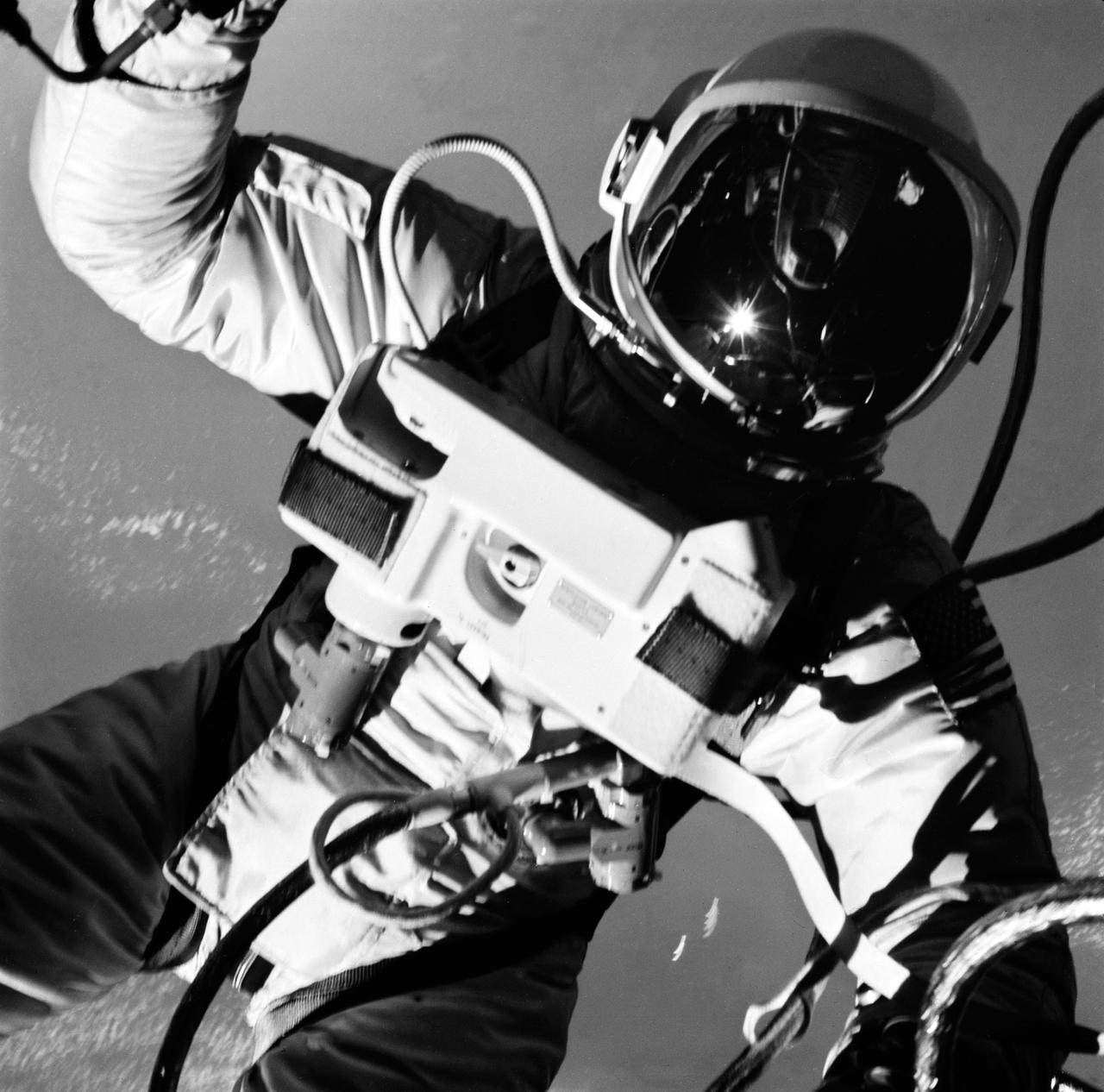
S65-30271 (3 June 1965) --- Astronaut Edward H. White II, pilot on the Gemini-Titan IV (GT-4) spaceflight, floats in the zero gravity of space outside the Gemini IV spacecraft. His face is covered by a shaded visor to protect him from the unfiltered rays of the sun. White became the first American astronaut to walk in space. He remained outside the spacecraft for 21 minutes during the third revolution of the Gemini IV mission. He wears a specially designed spacesuit for the EVA. His right hand (out of frame) is holding the Hand-Held Self-Maneuvering Unit (HHSMU), with which he controlled his movements while in space, and a camera is attached to the HHSMU. He was attached to the spacecraft by a 25-feet umbilical line and a 23-feet tether line, both wrapped together with gold tape to form one cord. He wears an emergency oxygen supply check pack. Astronaut James A. McDivitt is command pilot for the GT-4 mission. The mission was a four-day, 62-revolution flight, during which McDivitt and White performed a series of scientific and engineering experiments. (This image is black and white) Photo credit: NASA EDITOR?S NOTE: Astronaut Edward H. White II died in the Apollo/Saturn 204 fire at Cape Kennedy, Florida, on Jan. 27, 1967.
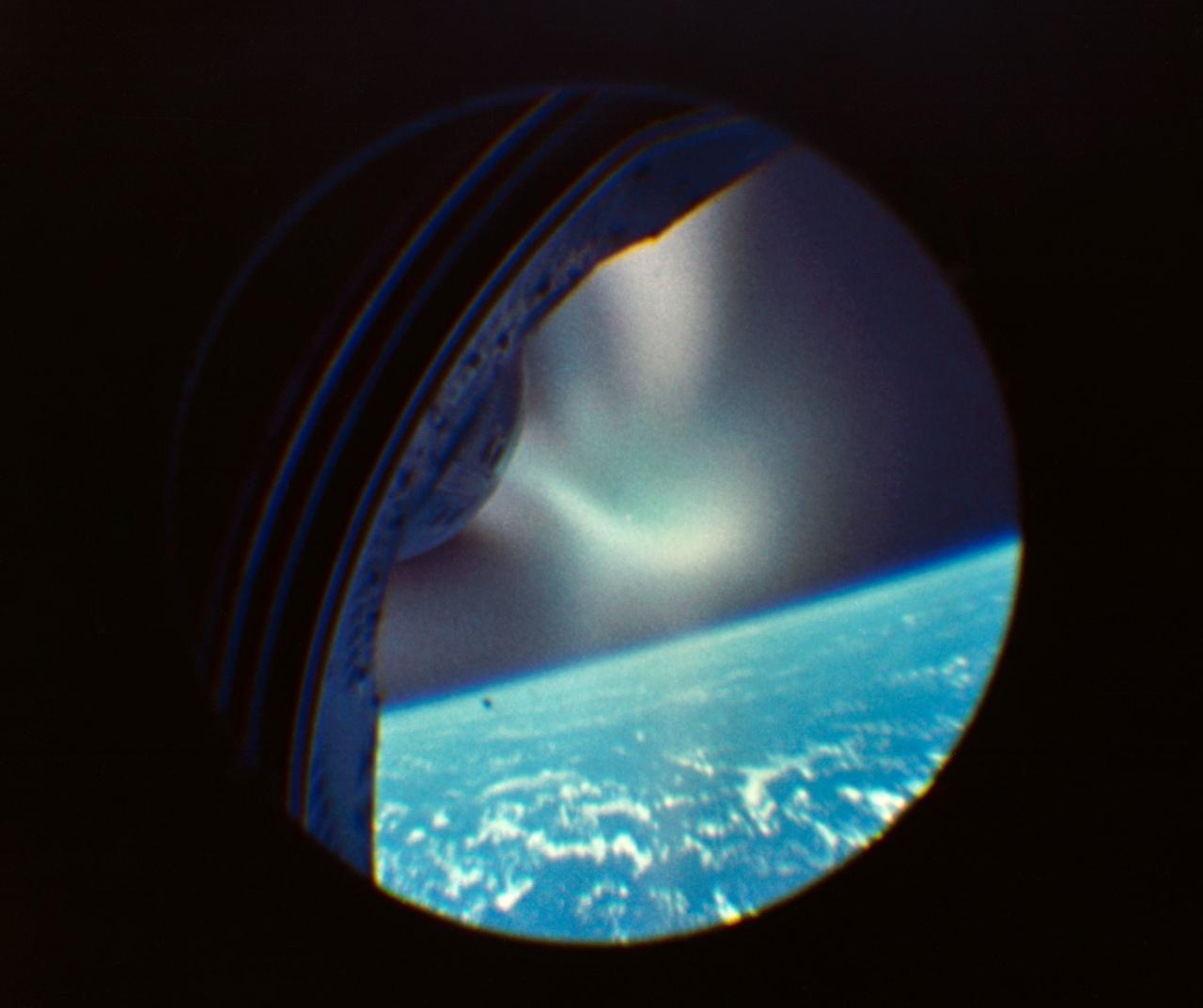
This photograph is an enlargement of a frame from a 16mm motion picture film which was mounted within the spacecraft to take film through the hatch window. CAPE KENNEDY, FL CN
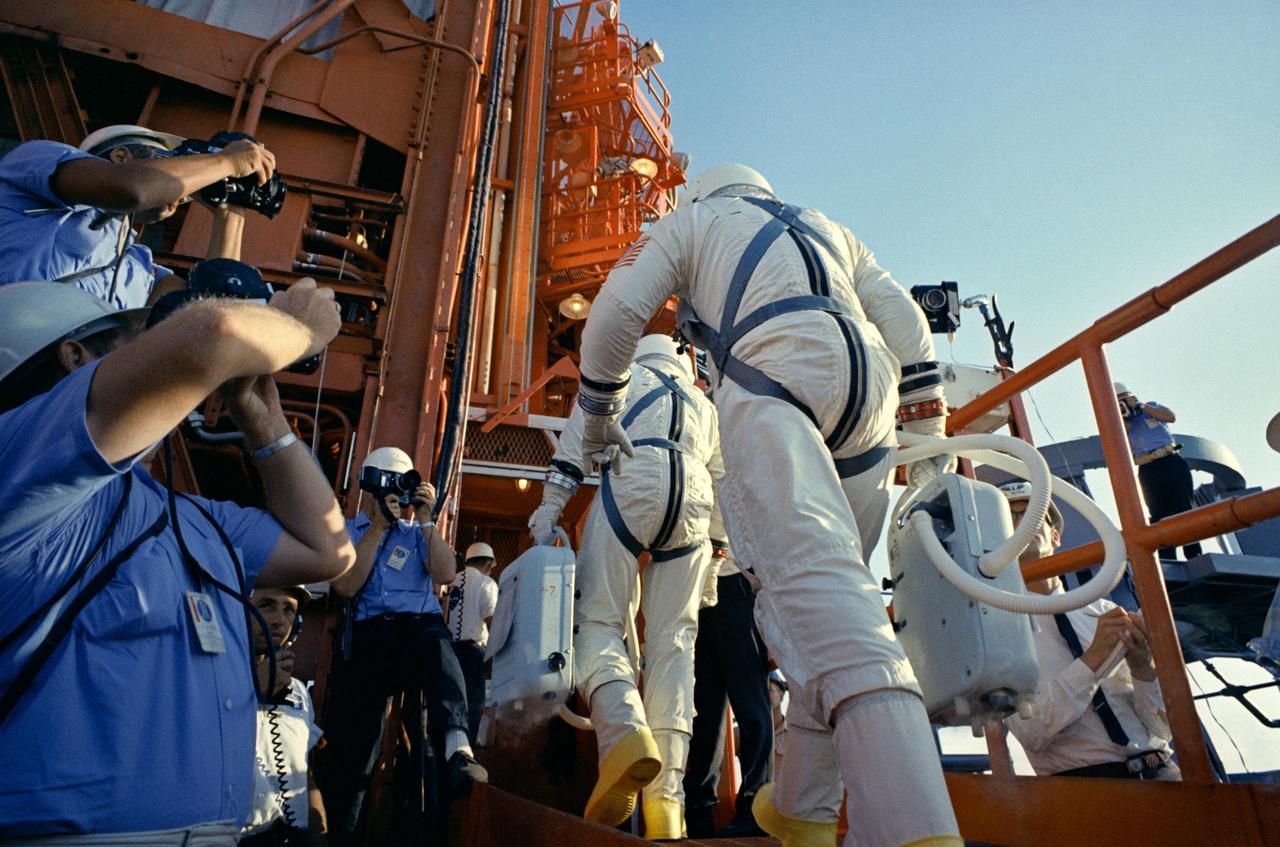
S65-28739 (21 Aug. 1965) --- Back view of astronauts L. Gordon Cooper Jr. (foreground) and Charles Conrad Jr. walking up gantry ramp after arriving at Pad 19 during Gemini-5 countdown at Cape Kennedy, Florida.
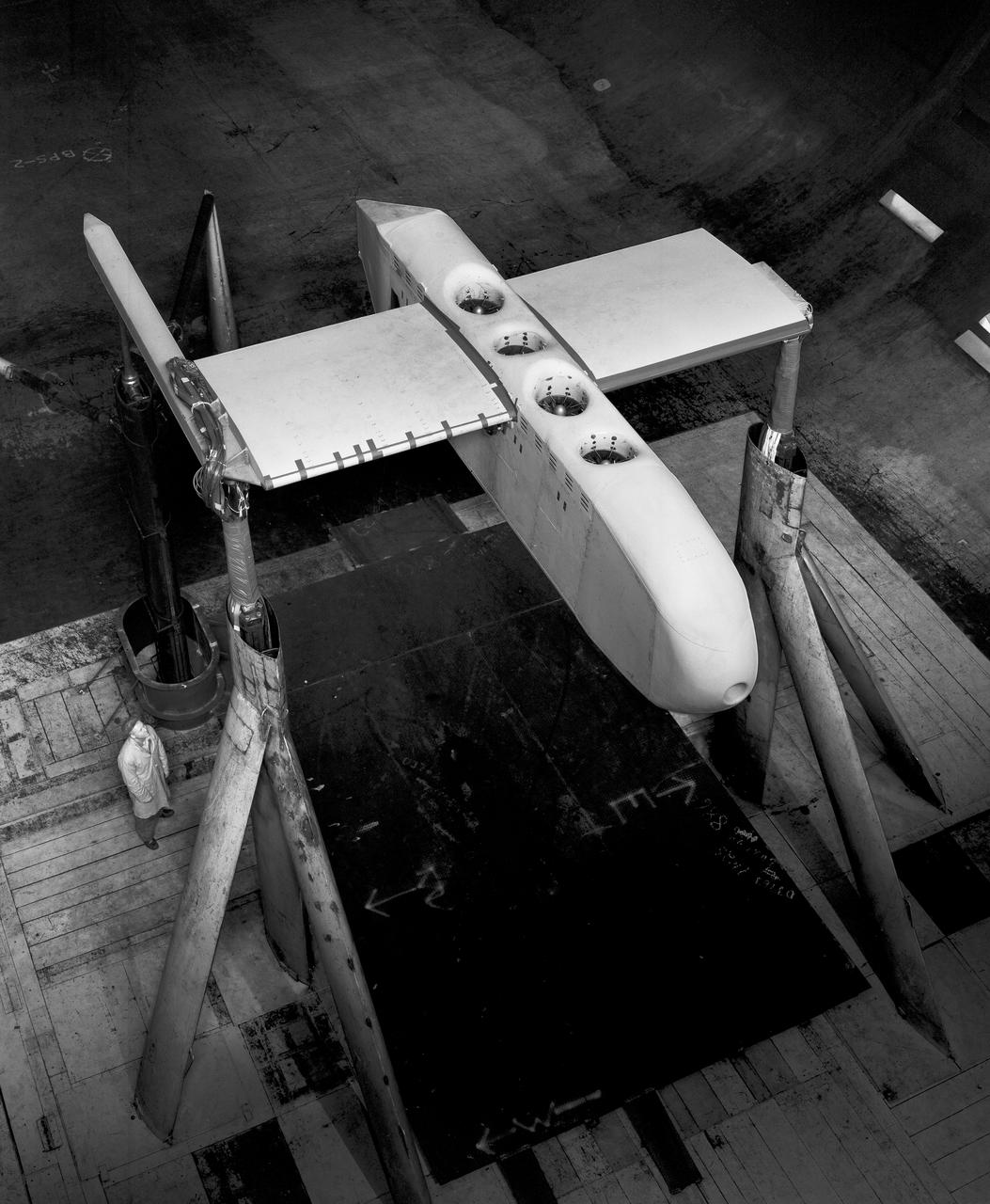
3/4 front, top view of Noriar Lift Engine Pod installation in Ames 40x80 foot wind tunnel
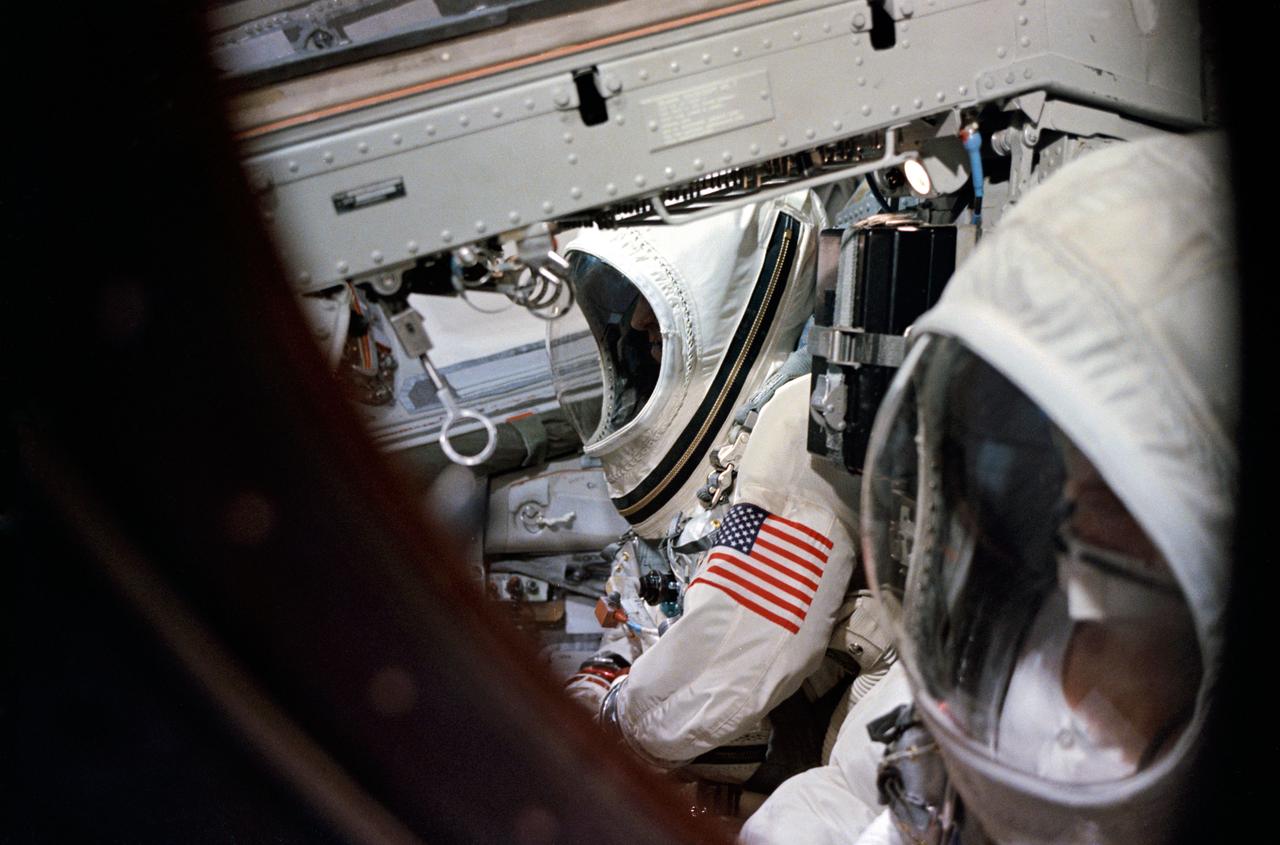
S65-59925 (4 Dec. 1965) --- Astronauts Frank Borman (foreground), command pilot, and James Lovell Jr., pilot, are sealed into their spacecraft 75 minutes prior to the launch of Gemini-7 from the National Aeronautics and Space Administration's John F. Kennedy Space Center on Dec. 4, 1965. Gemini-7 is scheduled for a 14-day mission. Photo credit: NASA
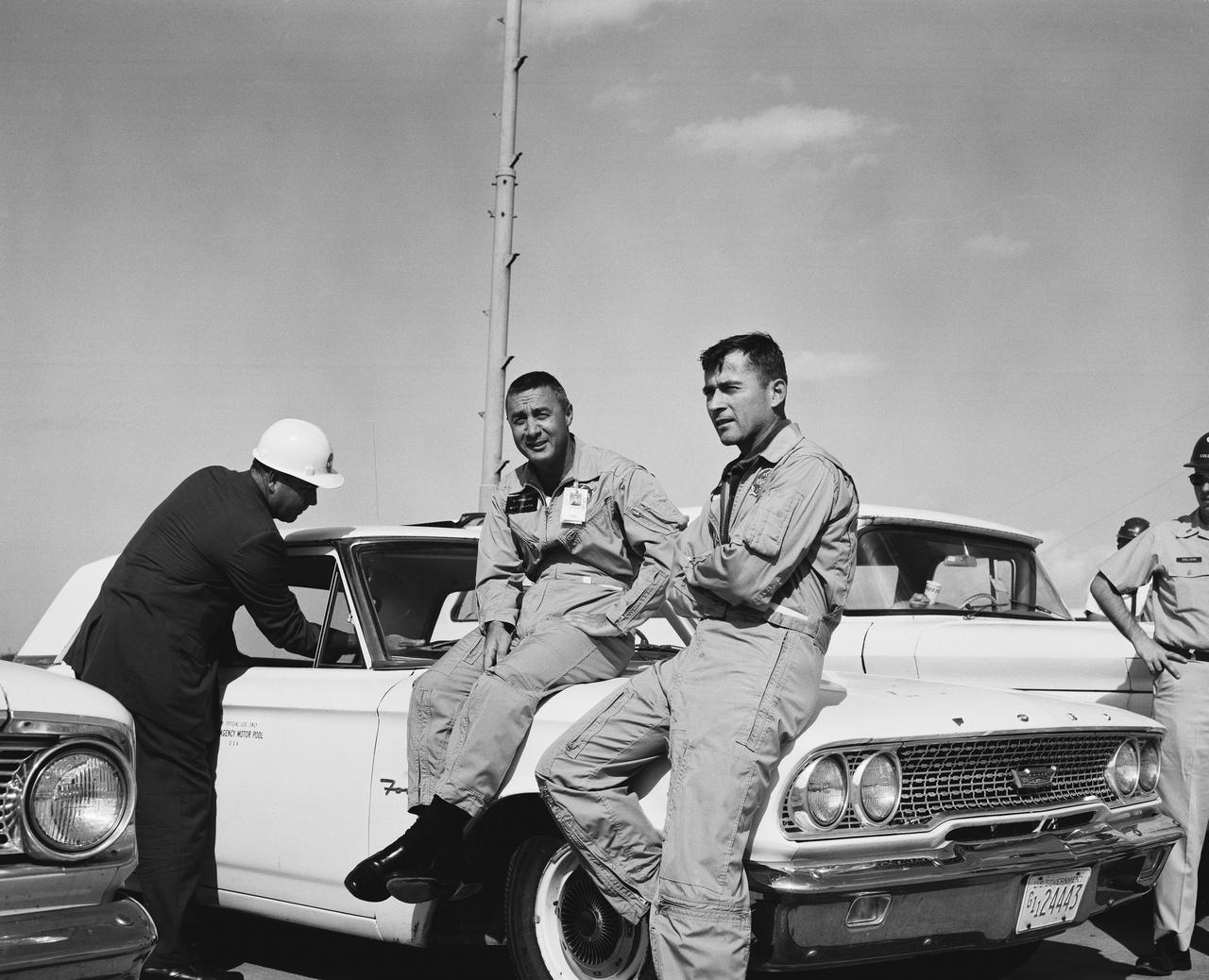
Astronauts Young and Virgil I. Grissom relax on the day of the proposed Gemini 6 Mission. CAPE KENNEDY, FL
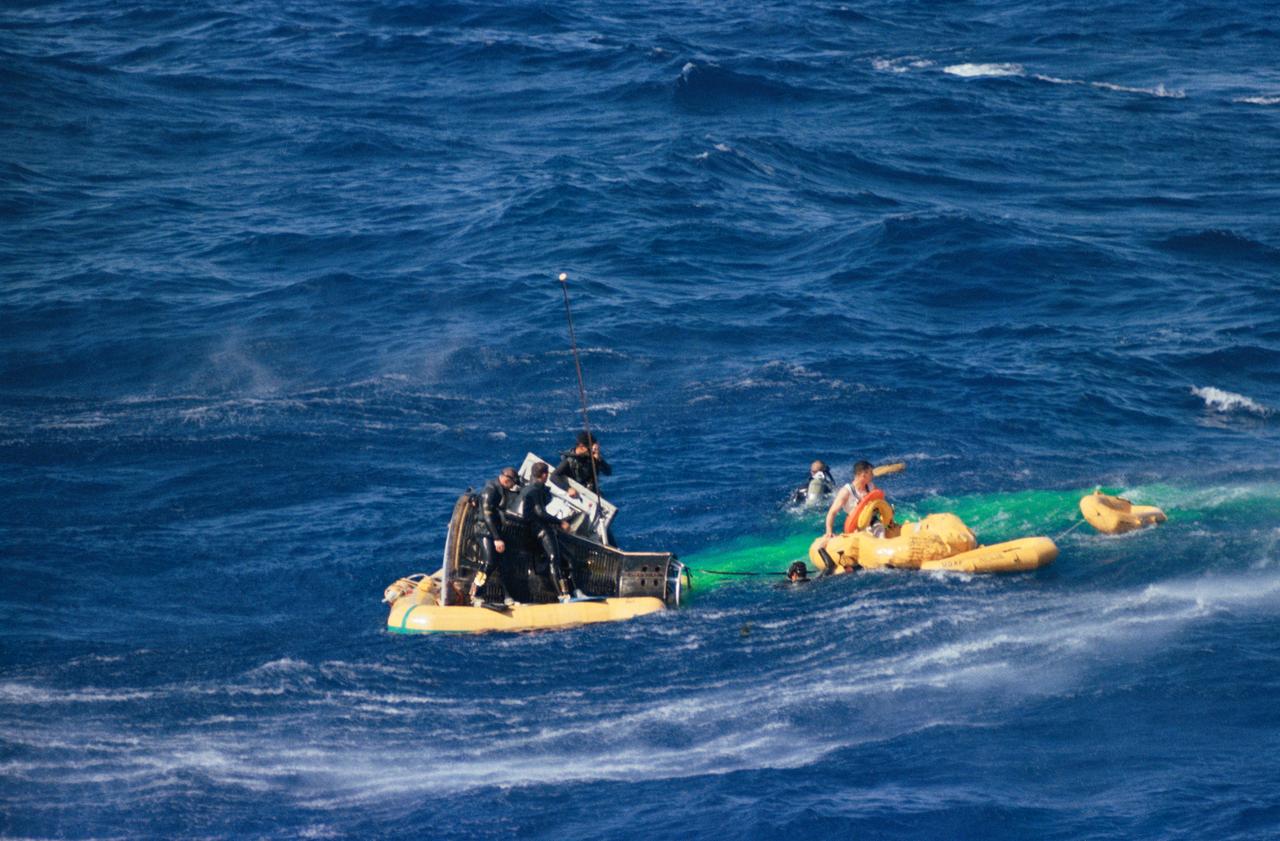
S65-22893 (23 March 1965) --- Astronaut John W. Young, the pilot of the Gemini-Titan III (GT-3) flight, waits in a life raft to be picked up by a helicopter during recovery operations following the successful three-orbit mission. Young and astronaut Virgil I. Grissom, command pilot, were flown by helicopter to the nearby recovery vessel, the USS Intrepid. The recovery ship later came alongside and retrieved the GT-3 spacecraft. United States Navy swimmers assisted in the GT-3 recovery operations.
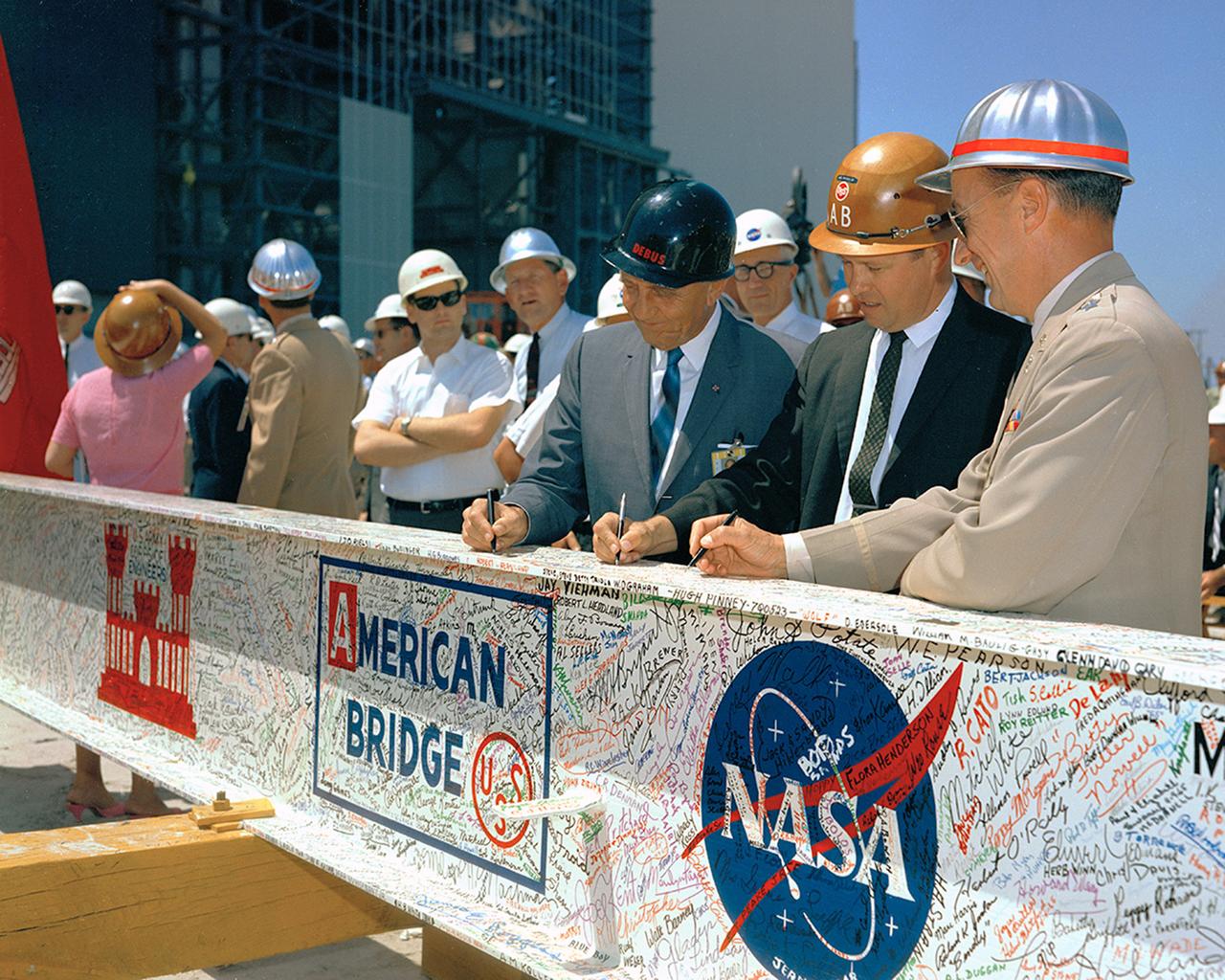
Dr. Kurt Debus (Director, NASA-KSC) signs the last major beam autographed by construction workers, NASA, and Corps of Engineers employees to be installed during the VAB Topping-Off Ceremony. MILA.
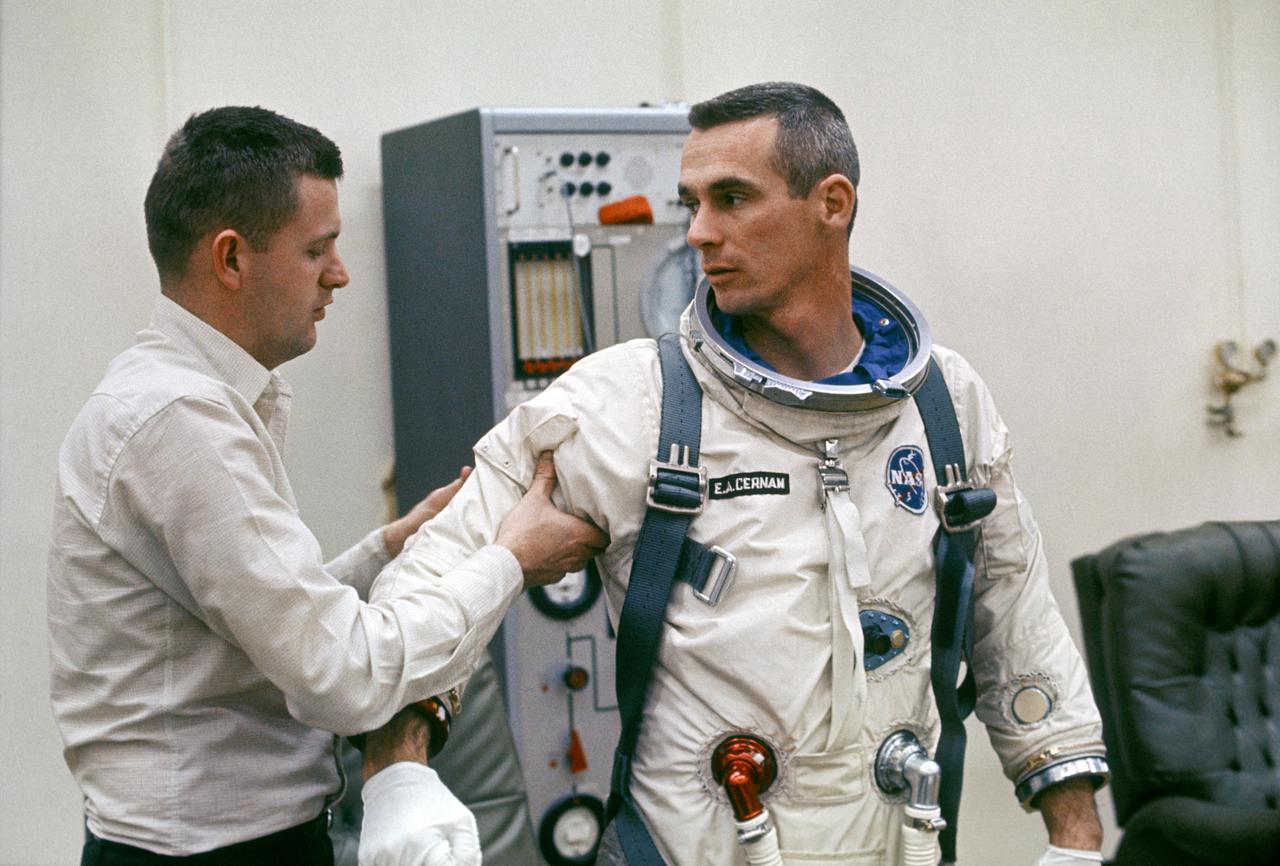
S66-27375 (19 Feb. 1966) --- Astronaut Eugene A. Cernan, pilot of the Gemini-9 spaceflight, has his suit adjusted by NASA suit technician Al Rochford during preparations for tests with the Astronaut Maneuvering Unit (AMU). The tests were conducted in Chamber B, Environmental Test Laboratory, Building 32. The AMU, which consists of a chest pack and backpack, will be used for extravehicular activity (EVA) on the Gemini-9 mission. Photo credit: NASA
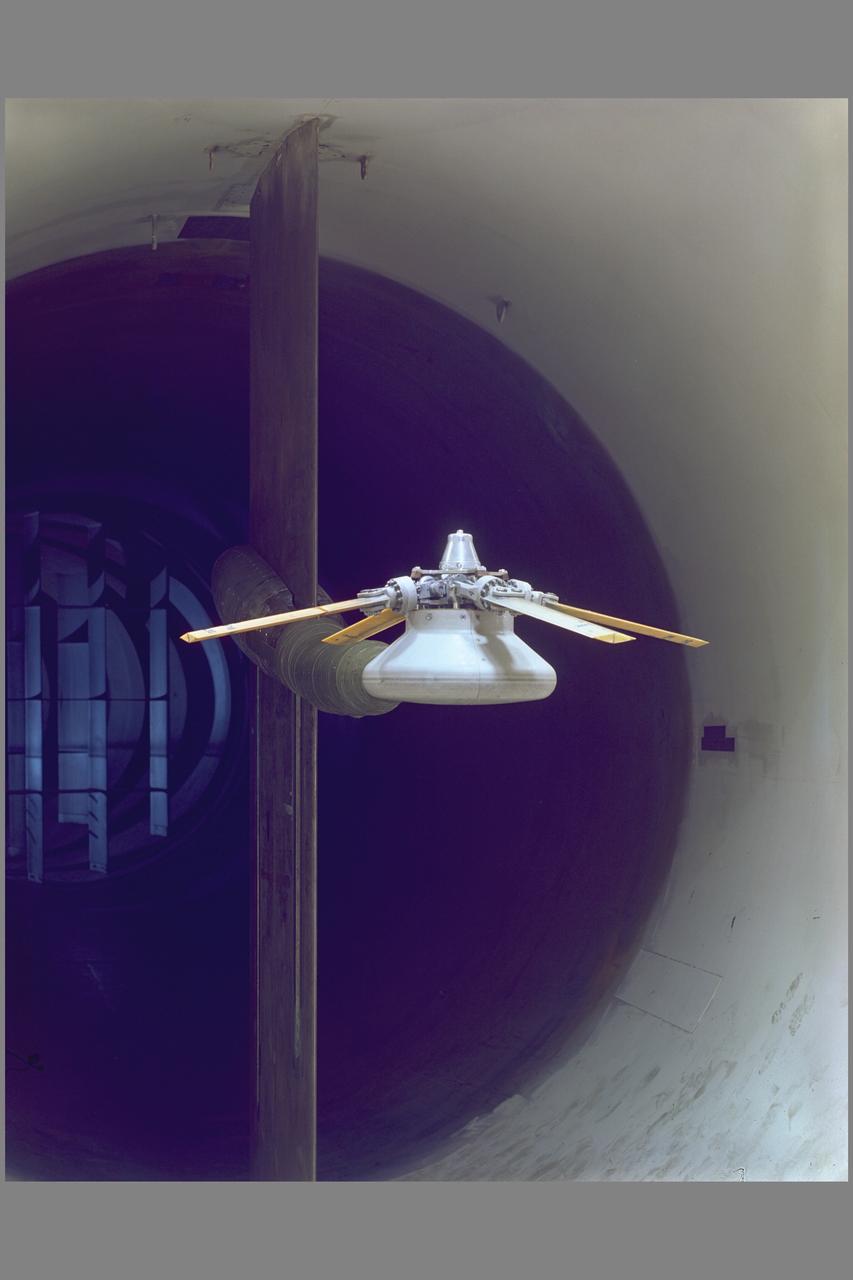
Rotor Entry Vehicle 12ft w.t.
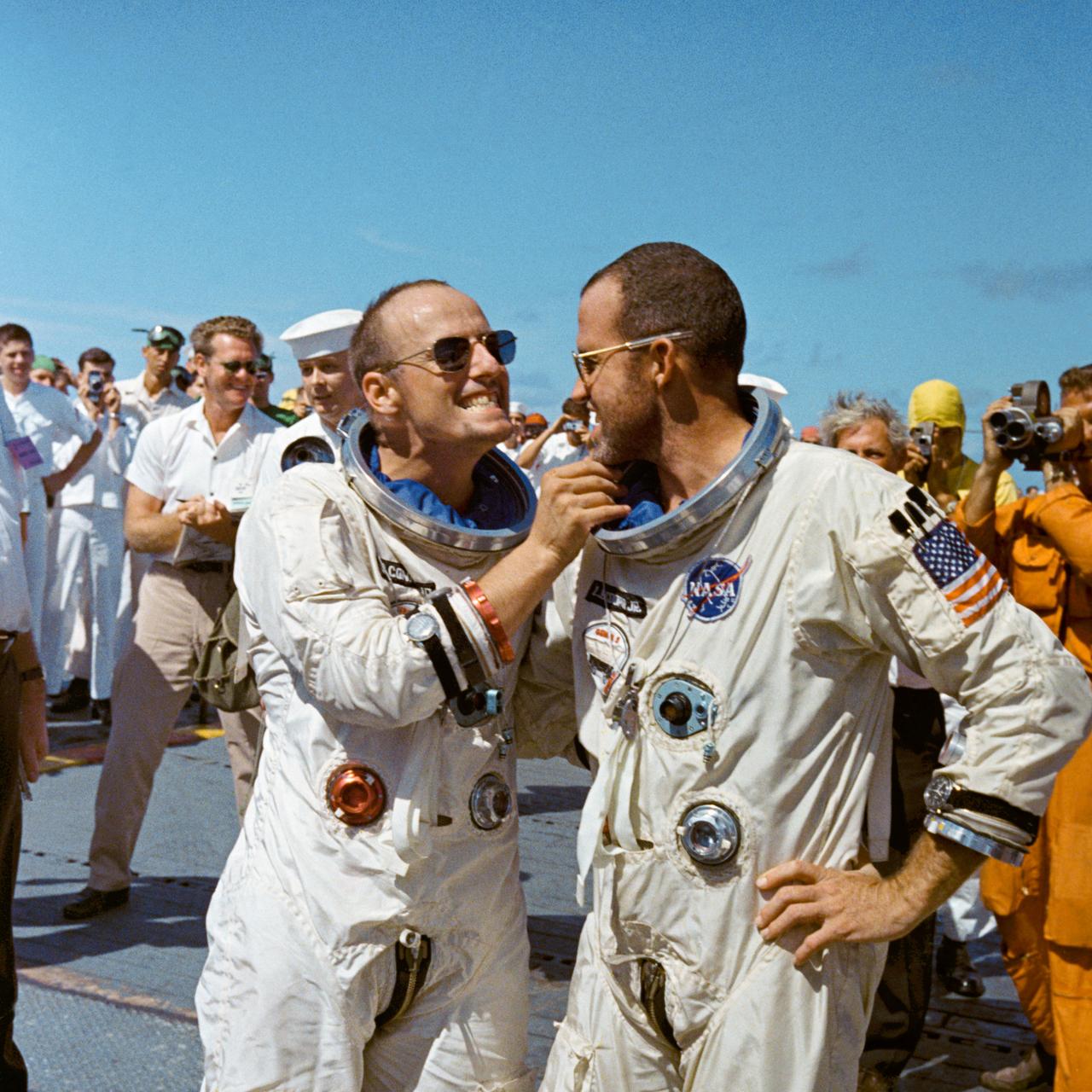
S65-46638 (29 Aug. 1965) --- Astronaut Charles Conrad Jr. tweaks astronaut L. Gordon Cooper's eight-day growth of beard for the cameramen while onboard the prime recovery vessel after their Gemini-5 flight.
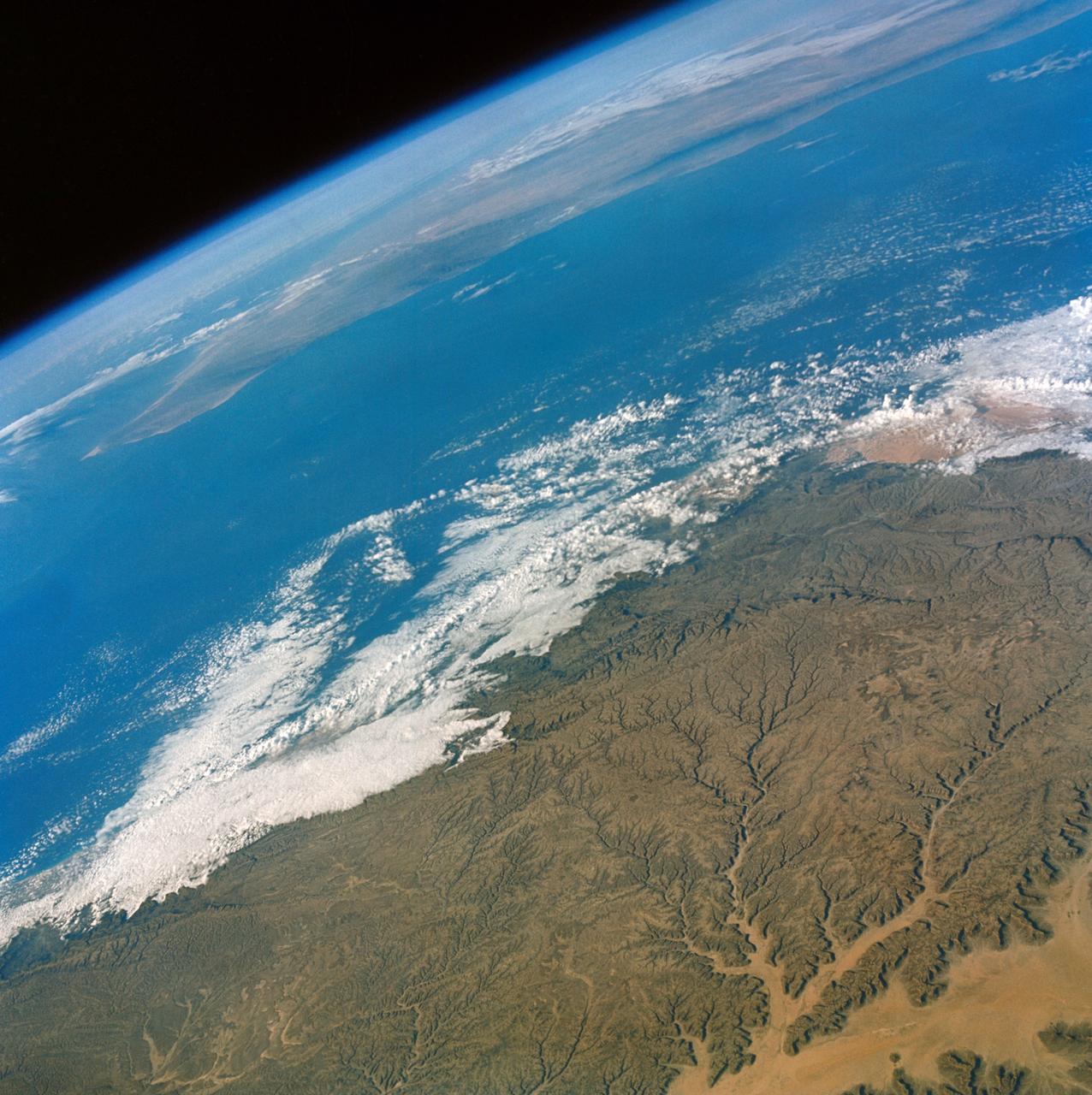
S65-34659 (3-7 June 1965) --- Among the many photographs taken from the Gemini-4 spacecraft during its orbital flight around Earth was this view of the Hahramaut Plateau on the southern portion of the Arabian Peninsula. The Wadi Hahramaut is in the foreground; with the Gulf of Aden (dark blue). This photograph was made with a modified 70mm Hasselblad camera, using Eastman color film, ASA 64, at a lens setting of 250th of a second at f/11.
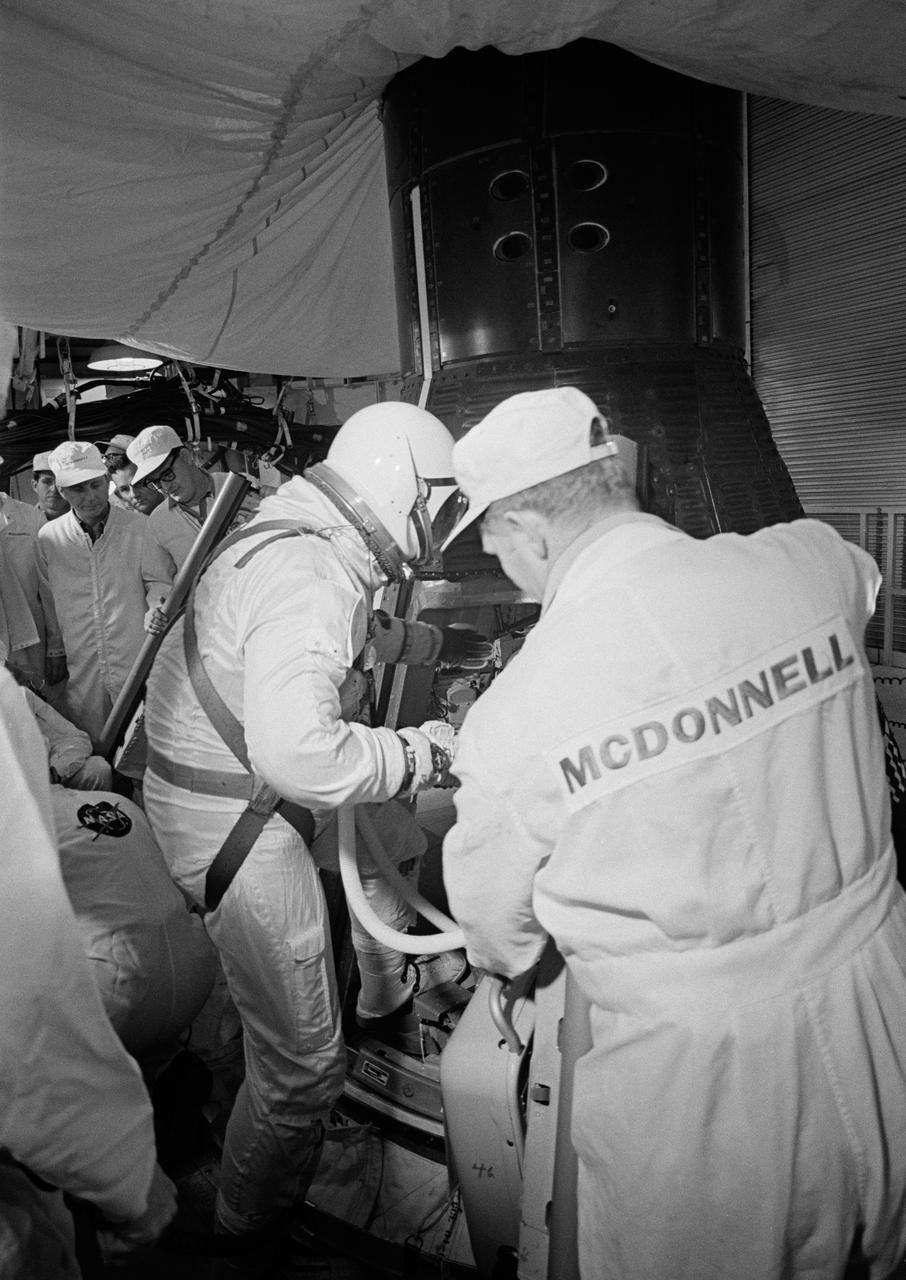
S65-20604 (23 March 1965) --- Astronaut John W. Young, the pilot of the Gemini-Titan 3 three-orbit mission, is assisted by a McDonnell Aircraft Corp. engineer as he enters the Gemini spacecraft in the white room atop the Gemini launch vehicle.
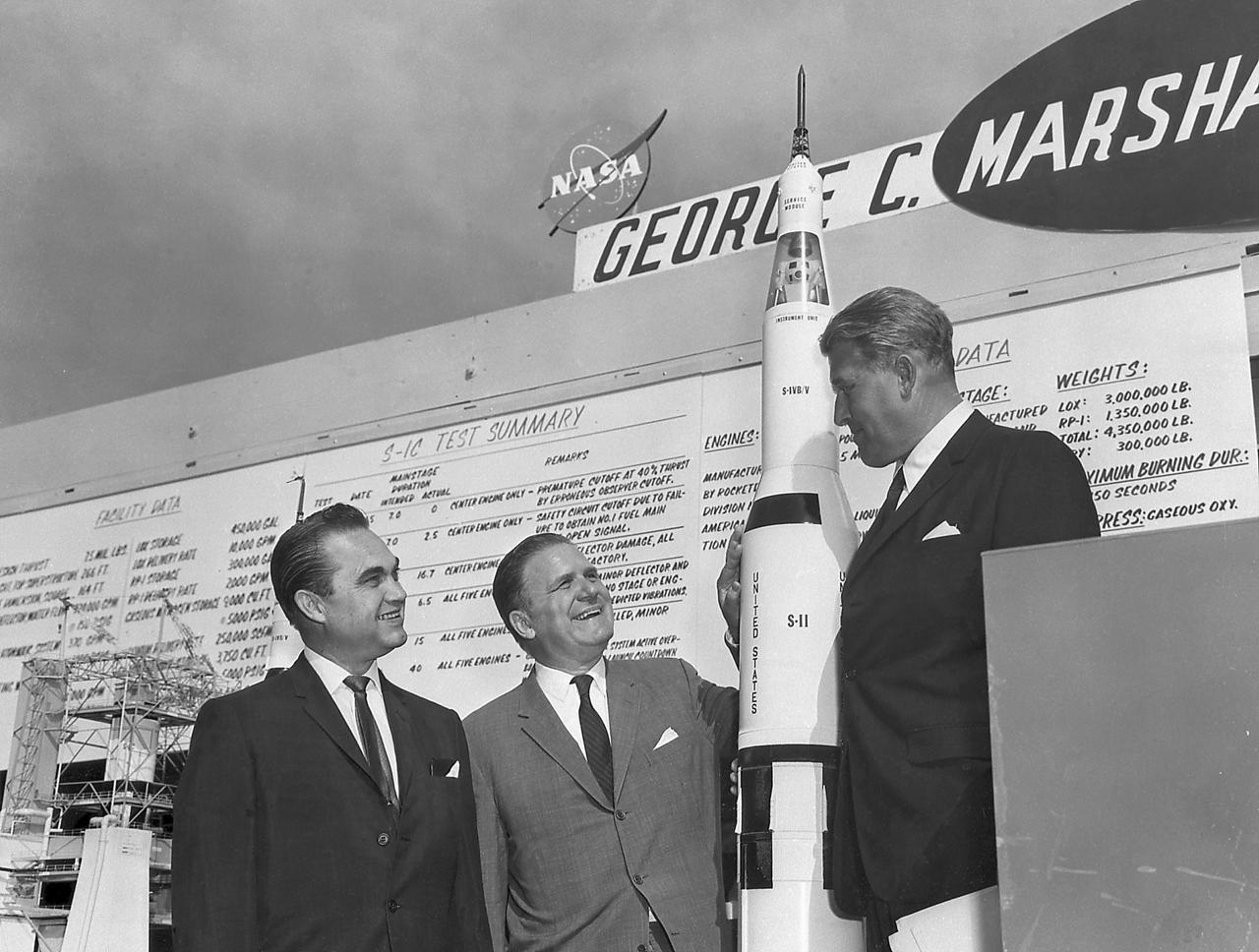
Governor of Alabama George Wallace (left), NASA Administrator James Webb and Marshall Space Flight Center (MSFC) Director Dr. von Braun during a tour of MSFC on June 8, 1965. Governor Wallace and Dr. Webb were at MSFC to witness the first test firing of a Saturn V Booster, along with members of the Alabama legislature and press reporters.
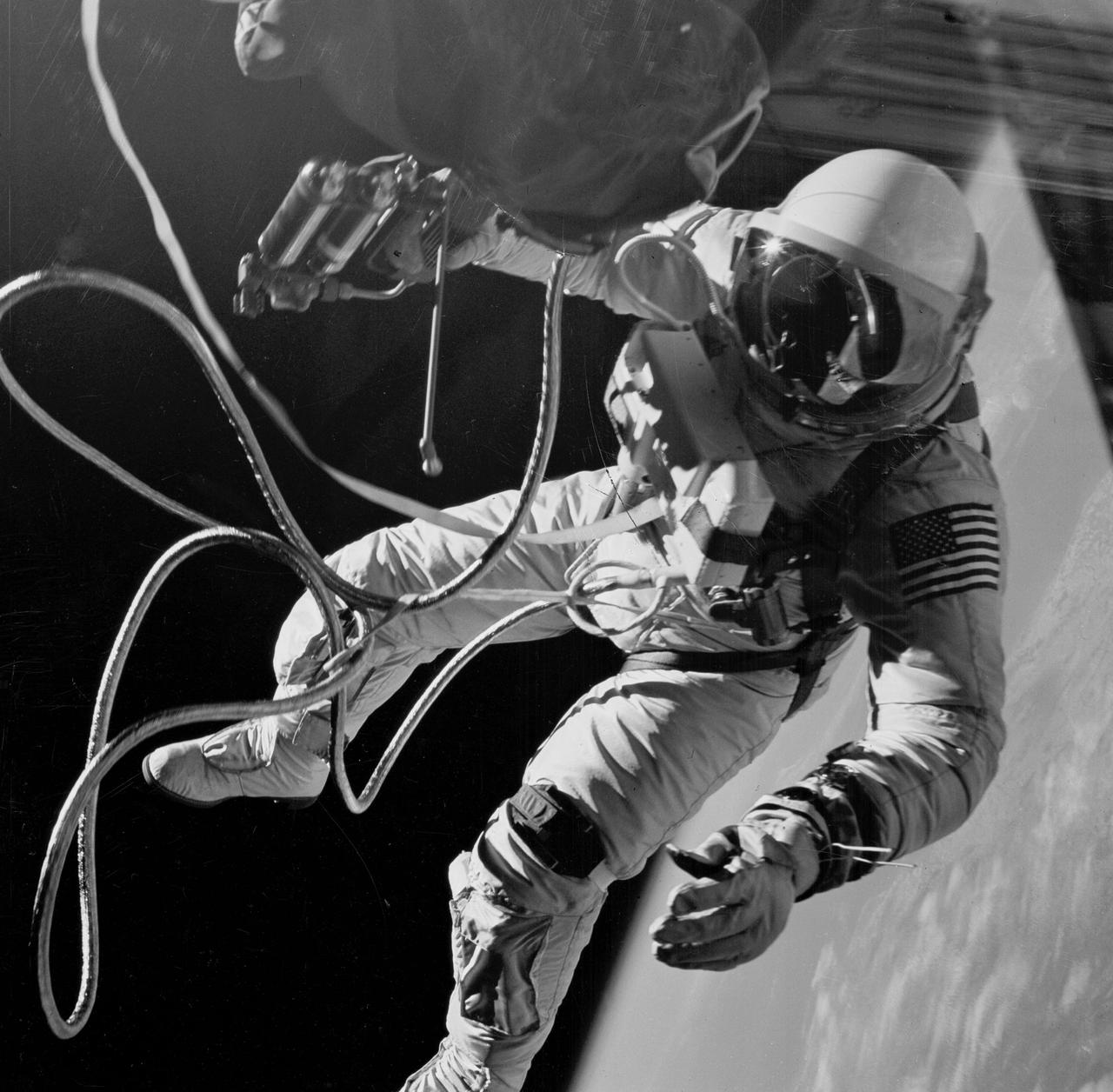
S65-32924 (3 June 1965) --- Astronaut Edward H. White II, pilot of the Gemini IV four-day Earth-orbital mission, floats in the zero gravity of space outside the Gemini IV spacecraft. White wears a specially designed spacesuit; and the visor of the helmet is gold plated to protect him against the unfiltered rays of the sun. He wears an emergency oxygen pack, also. He is secured to the spacecraft by a 25-feet umbilical line and a 23-feet tether line, both wrapped in gold tape to form one cord. In his right hand is a Hand-Held Self-Maneuvering Unit (HHSMU) with which he controls his movements in space. Astronaut James A. McDivitt, command pilot of the mission, remained inside the spacecraft. (This image is black and white) Photo credit: NASA EDITOR'S NOTE: Astronaut White died in the Apollo/Saturn 204 fire at Cape Kennedy on Jan. 27, 1967.
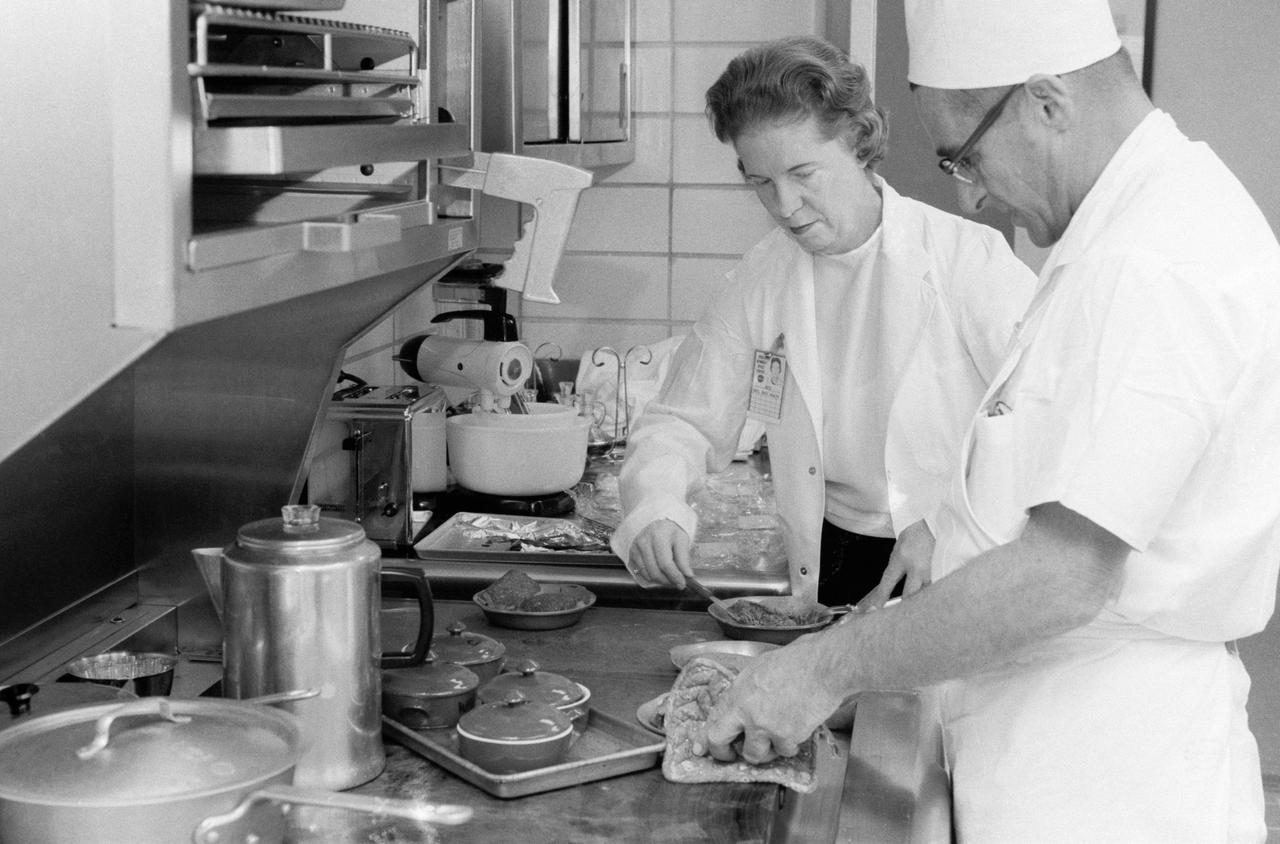
S65-56311 (2 Dec. 1965) --- Kennedy Space Center food specialists prepare an Earth-bound meal for Gemini-7 astronauts. Astronauts' diet is strictly controlled before and during spaceflights to avoid interfering with planned medical experiments. Photo credit: NASA
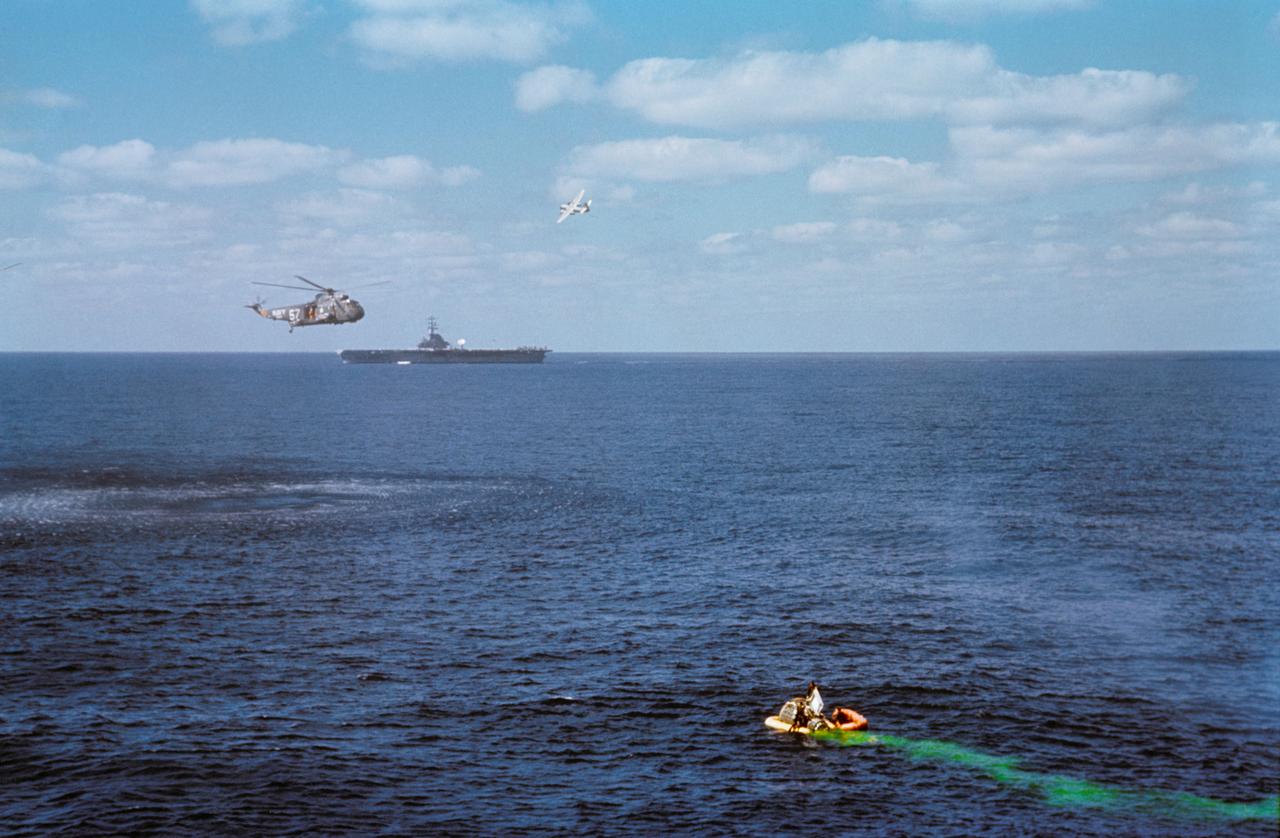
S65-61824 (16 Dec. 1965) --- A helicopter hovers over the Gemini-6 spacecraft after it splashed down 12 miles from the aircraft carrier USS Wasp in the western Atlantic recovery area at 10:29 a.m. Dec. 16, 1965. Photo credit: NASA or National Aeronautics and Space Administration
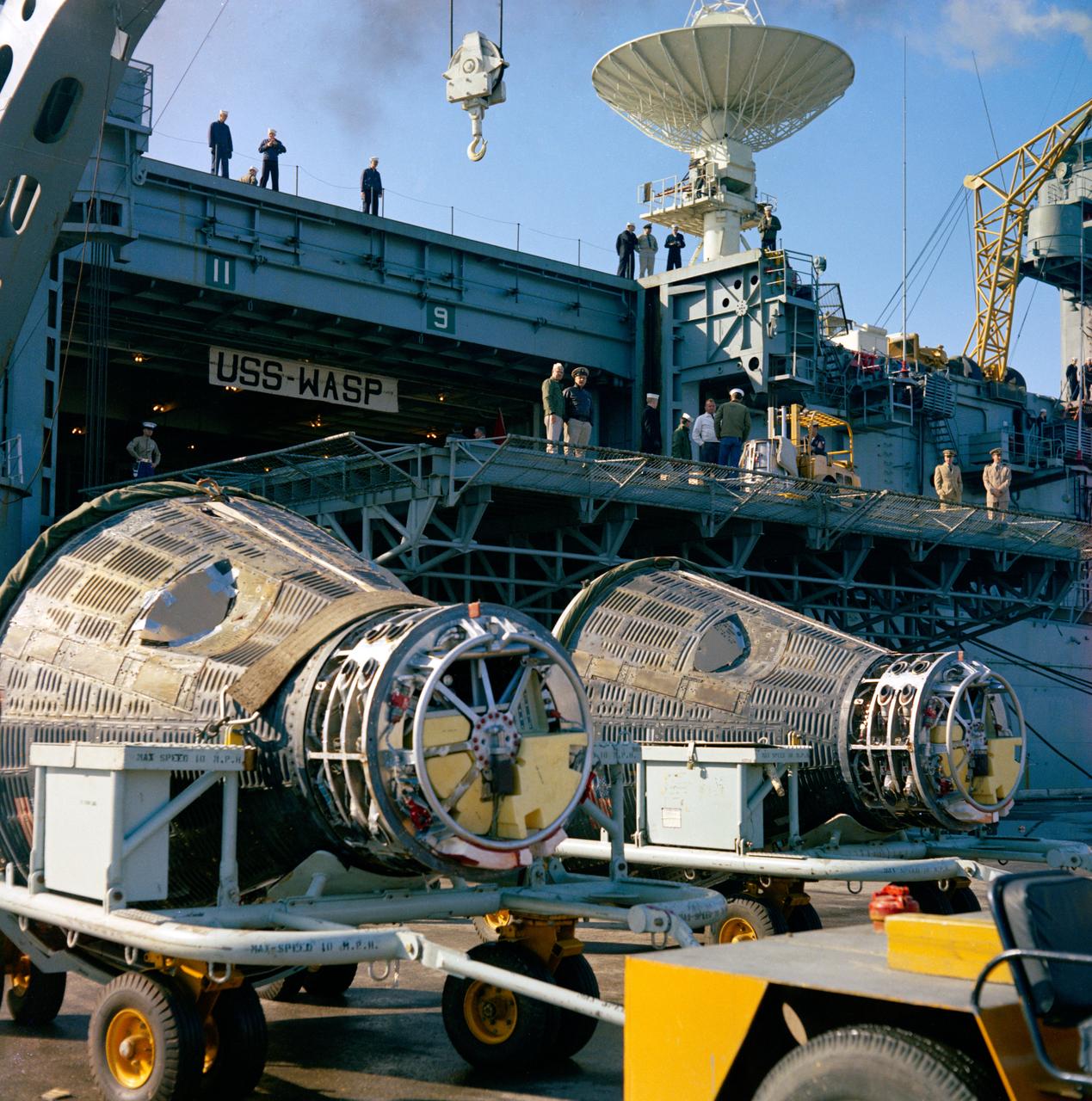
S65-65948 (20 Dec. 1965) --- Gemini-7 (left) and Gemini-6 spacecraft meet up once again, this time at Mayport Naval Station near Jacksonville (Fla.) after unloading Dec. 20, 1965, from the carrier USS Wasp. The two spacecraft accomplished a rendezvous and station keeping exercise in space on Dec. 15. Photo credit: NASA
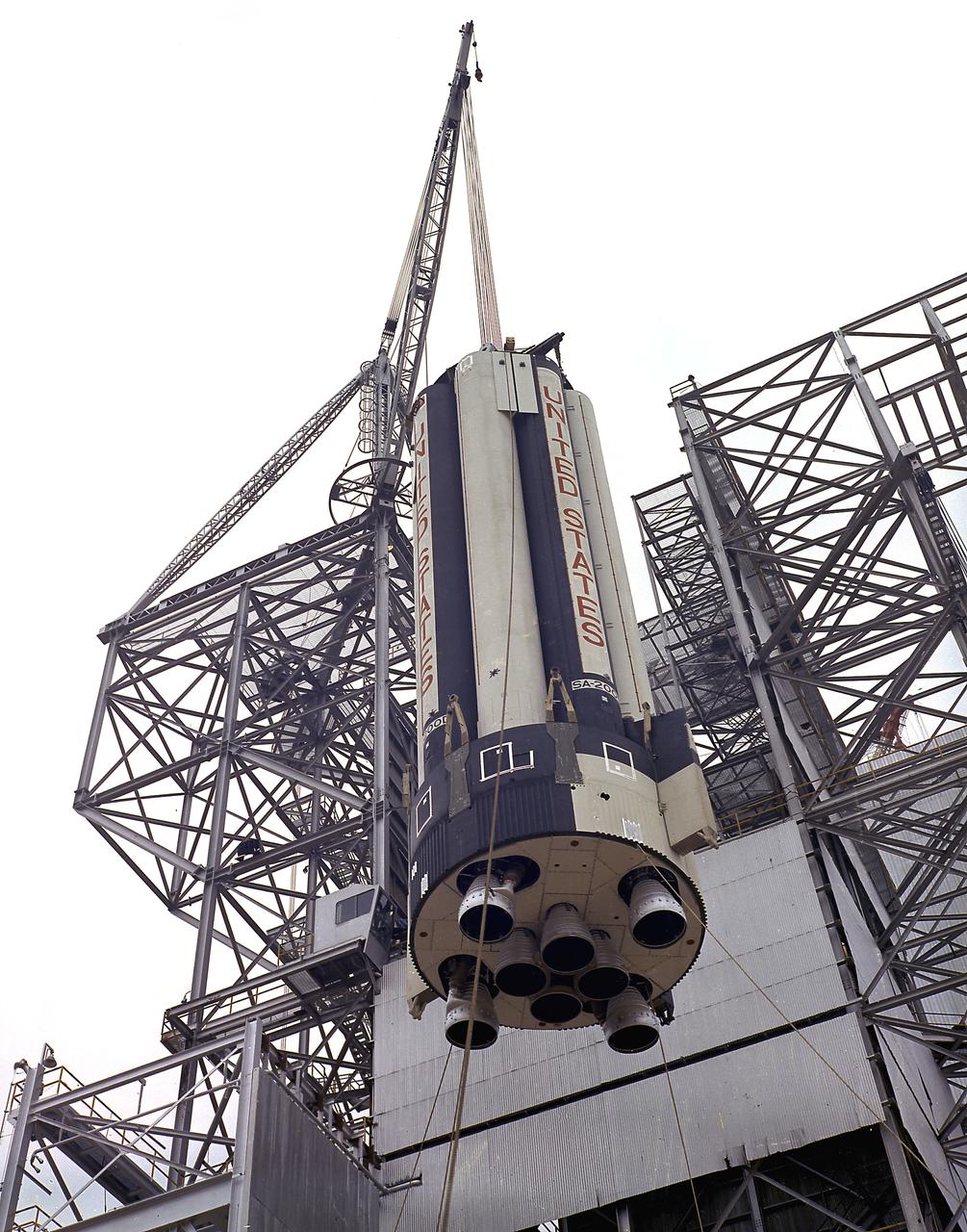
Workers at the Marshall Space Flight Center's (MSFC) Dynamic Test Stand install S-IB-200D, a dynamic test version of the Saturn IB launch vehicle's first stage, on January 11, 1965. MSFC Test Laboratory persornel assembled a complete Saturn IB to test the launch vehicle's structural soundness. Developed by the MSFC as an interim vehicle in MSFC's "building block" approach to the Saturn rocket development, the Saturn IB utilized Saturn I technology to further develop and refine the larger boosters and the Apollo spacecraft capabilities required for the manned lunar missions.
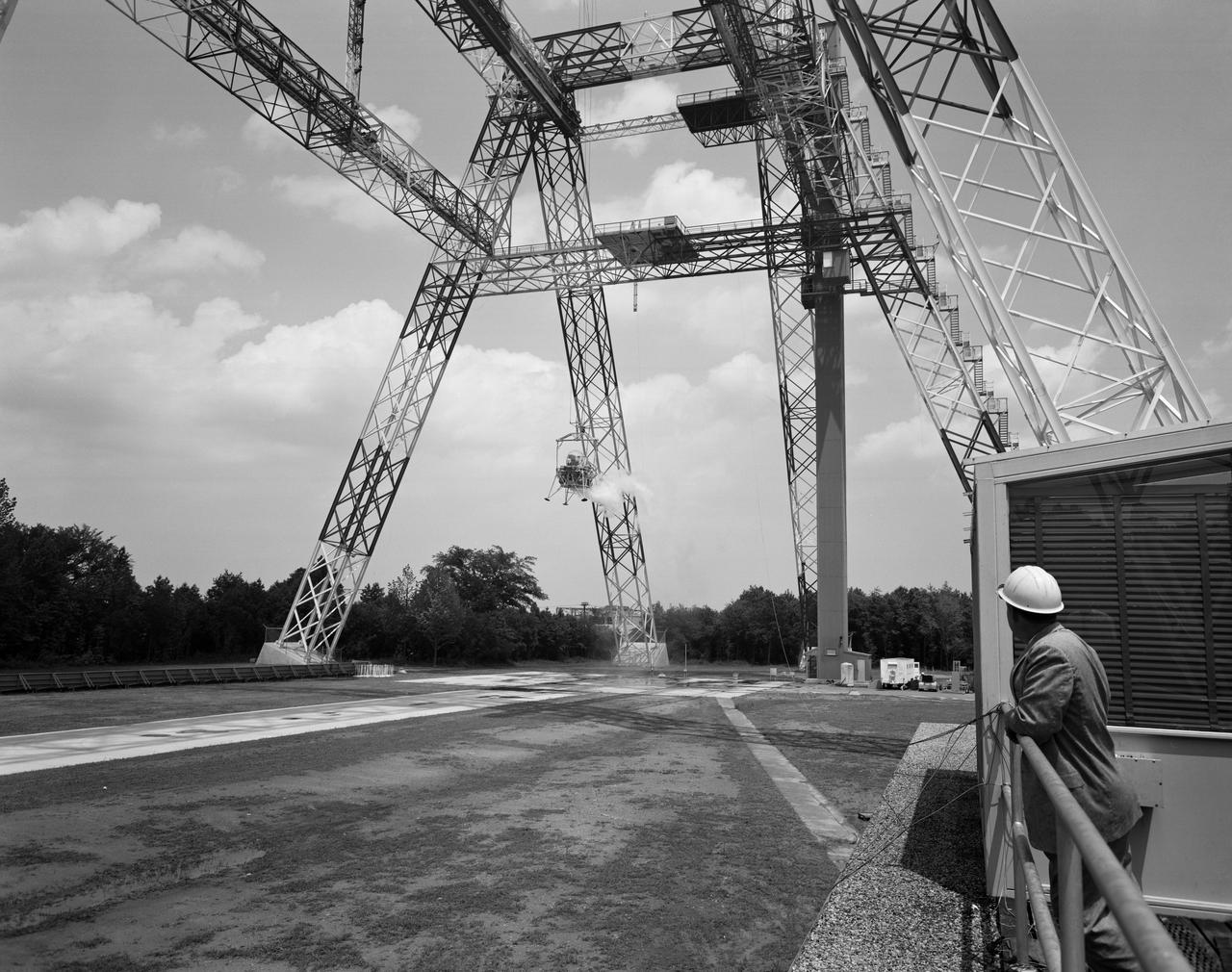
Lunar Landing Testing at NASA Langley. Lunar Landing Testing at NASA Langley. A simulated environment that contributed in a significant way to the success of Apollo project was the Lunar Landing Research Facility, an imposing 250 foot high, 400 foot long gantry structure that became operational in 1965. Published in the book "Space Flight Revolution" NASA SP-4308 pg. 376
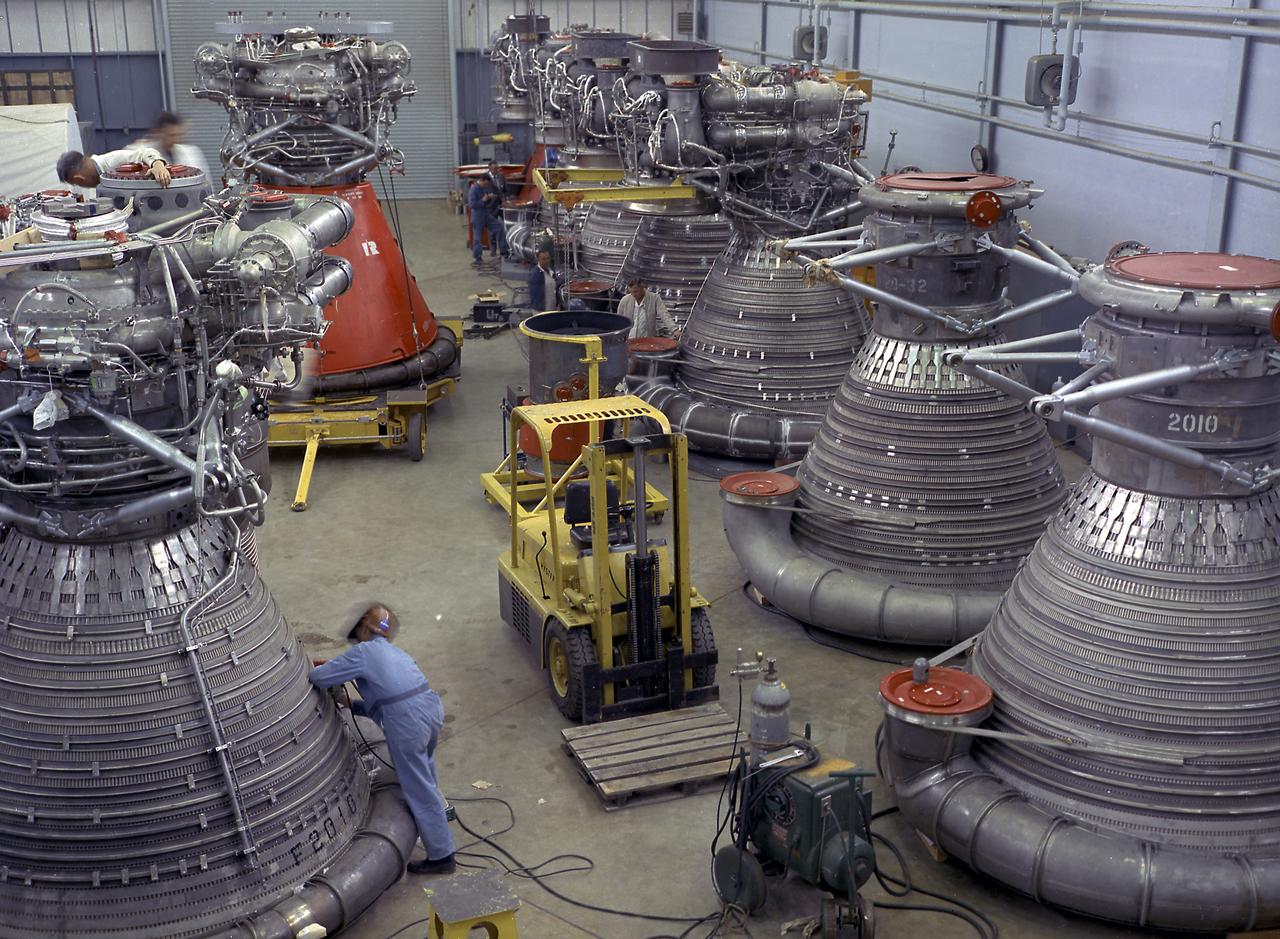
This photograph shows F-1 engines being stored in the F-1 Engine Preparation Shop, building 4666, at the Marshall Space Flight Center. Each F-1 engine produced a thrust of 1,500,000 pounds. A cluster of five engines was mounted on the thrust structure of the S-IC stage of a 364-foot long Saturn V launch vehicle that ultimately took astronauts to the Moon.
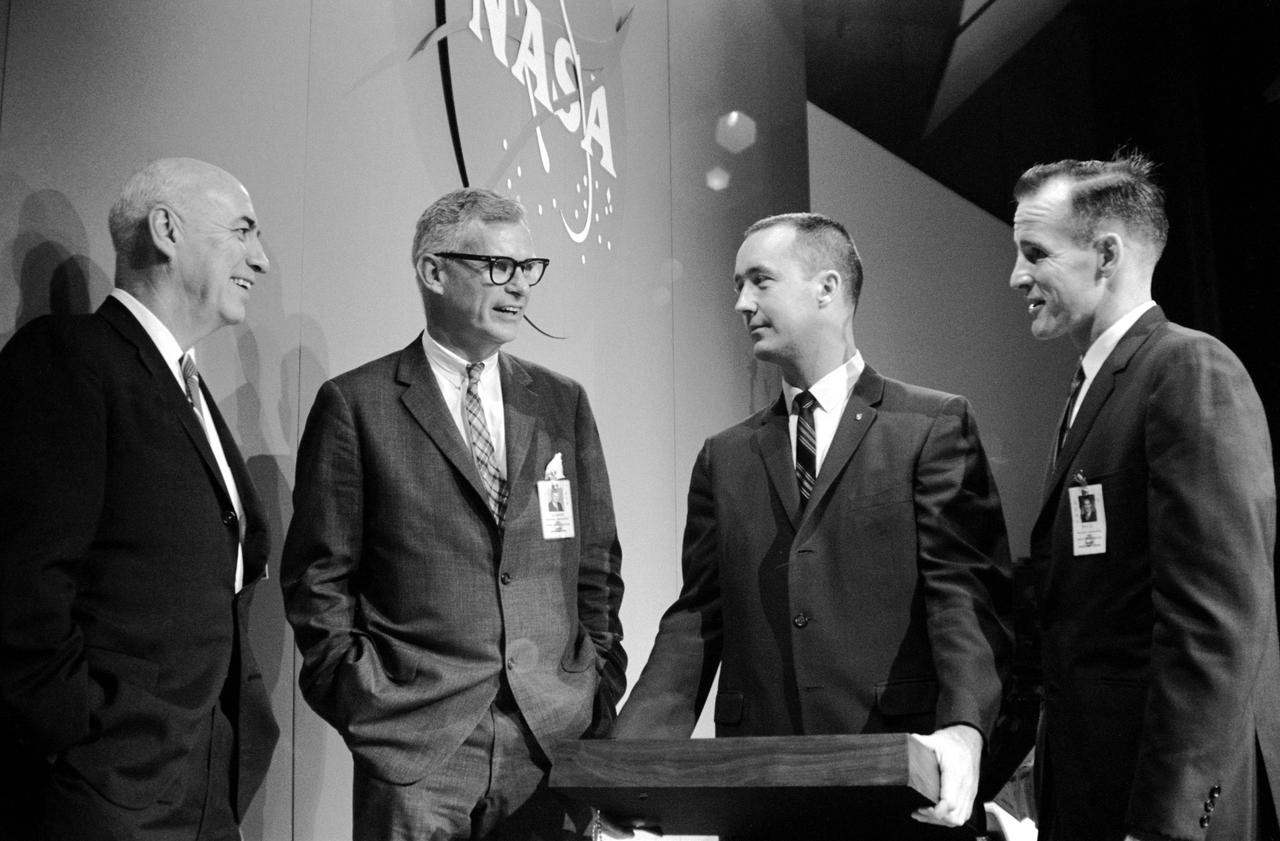
S65-33352 (11 June 1965) --- The Gemini-4 prime crew pose with two NASA officials after a press conference in the MSC auditorium. Left to right, are Dr. Robert R. Gilruth, MSC director; Dr. Robert C. Seamans Jr., associate administrator, National Aeronautics and Space Administration; astronaut James A. McDivitt, command pilot of the Gemini-4 flight; and astronaut Edward H. White II, pilot of the mission. The two astronauts had just returned to Houston following their debriefings at Cape Kennedy. The Gt-4 liftoff was at 10:16 a.m. (EST) on June 3, 1965. Time of splashdown ending the four-day, 62-revolution mission was at 12:12 p.m. on June 7, 1965.
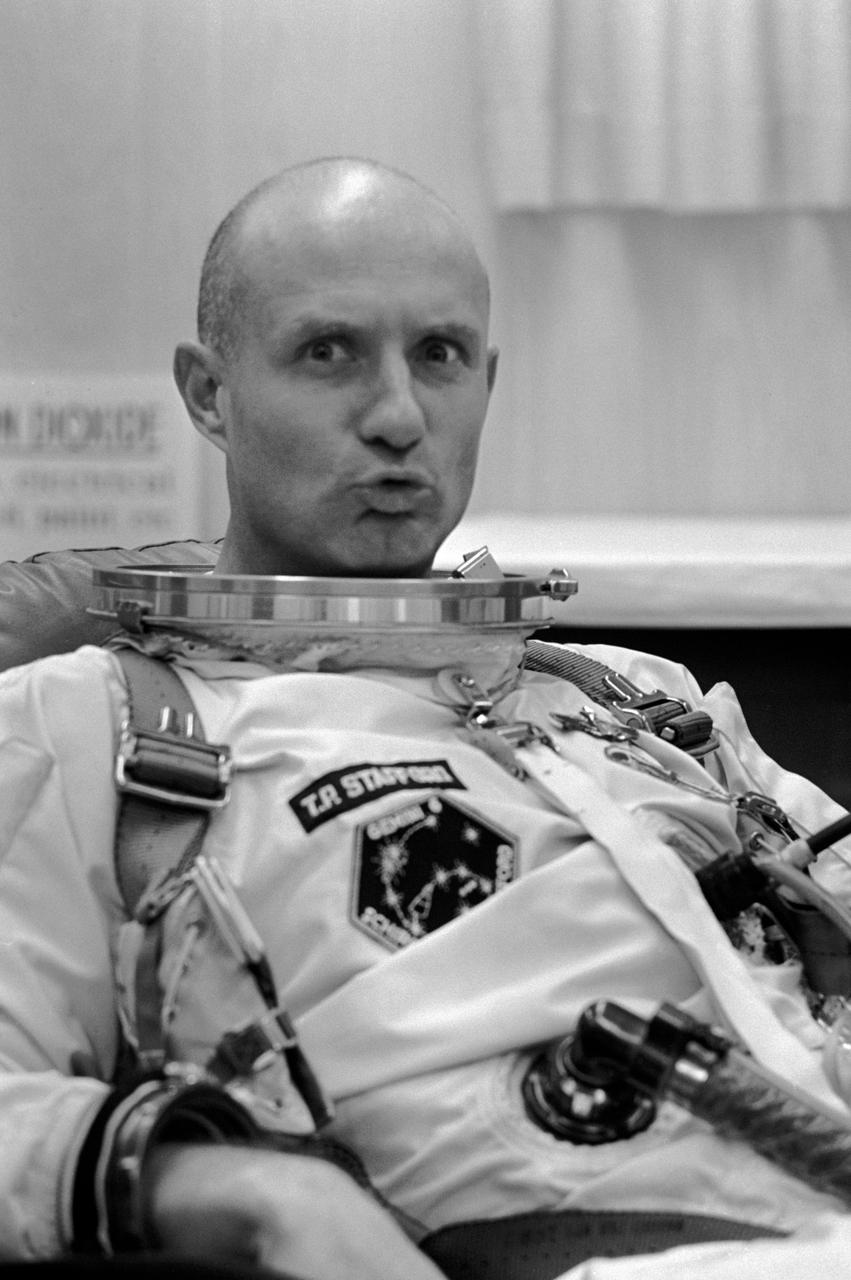
S65-61913 (12 Dec. 1965) --- Astronaut Thomas P. Stafford, pilot, makes a facial gesture at the camera while suiting up in Launch Complex 16 trailer during Gemini-6 prelaunch countdown. NASA has planned a two-day mission in space for astronauts Stafford and Walter M. Schirra Jr. (out of frame), command pilot. An attempt was made to launch Gemini-6 from Pad 19 at 9:54 a.m. (EST) on Dec. 12, 1965. However, seconds after ignition, the first stage engine of the Gemini-6 launch vehicle shutdown due to a faulty release of a liftoff umbilical plug. Photo credit: NASA or National Aeronautics and Space Administration
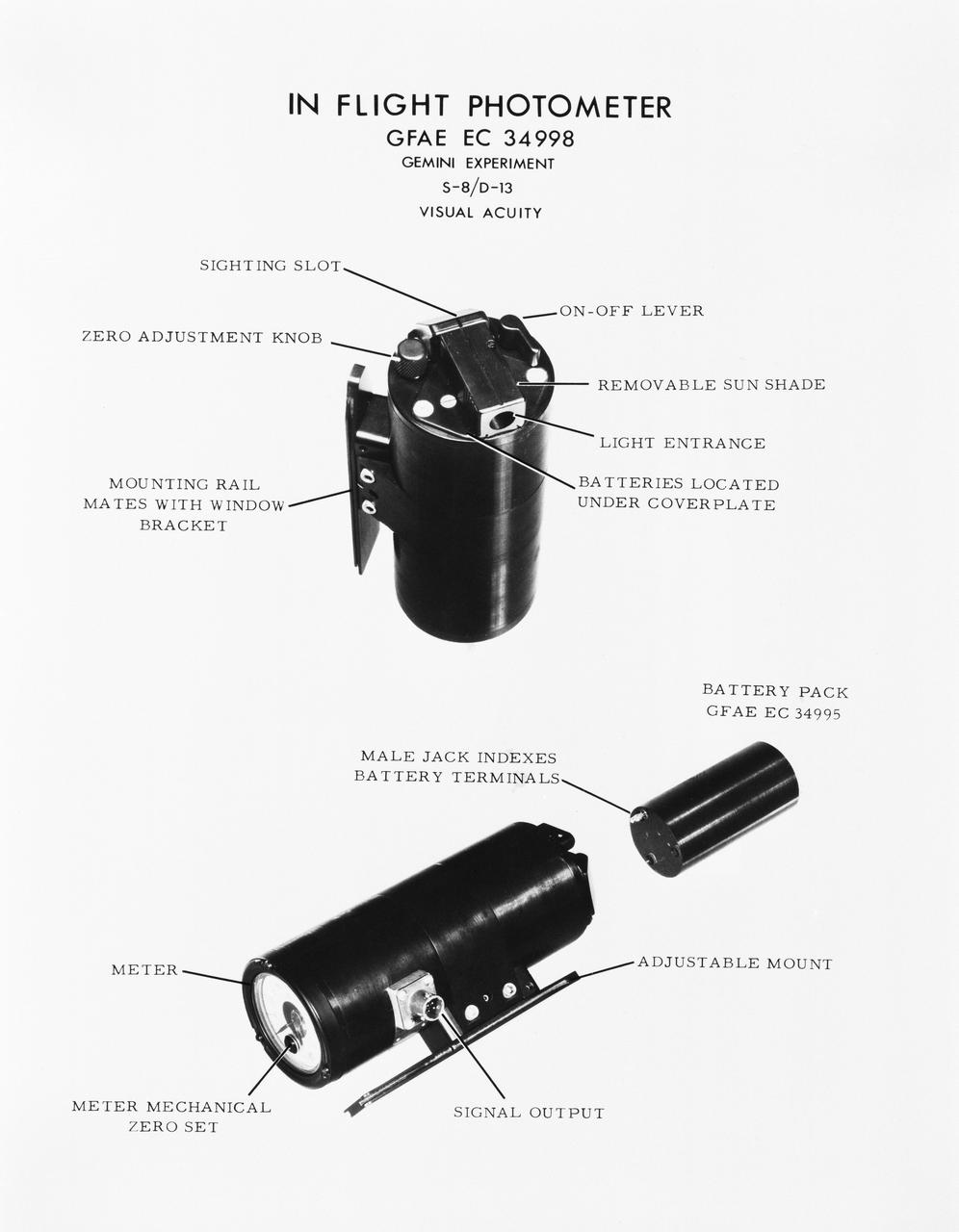
S65-28645 (June 1965) --- Photograph showing the component parts of the Gemini experiment In-flight Photometer.
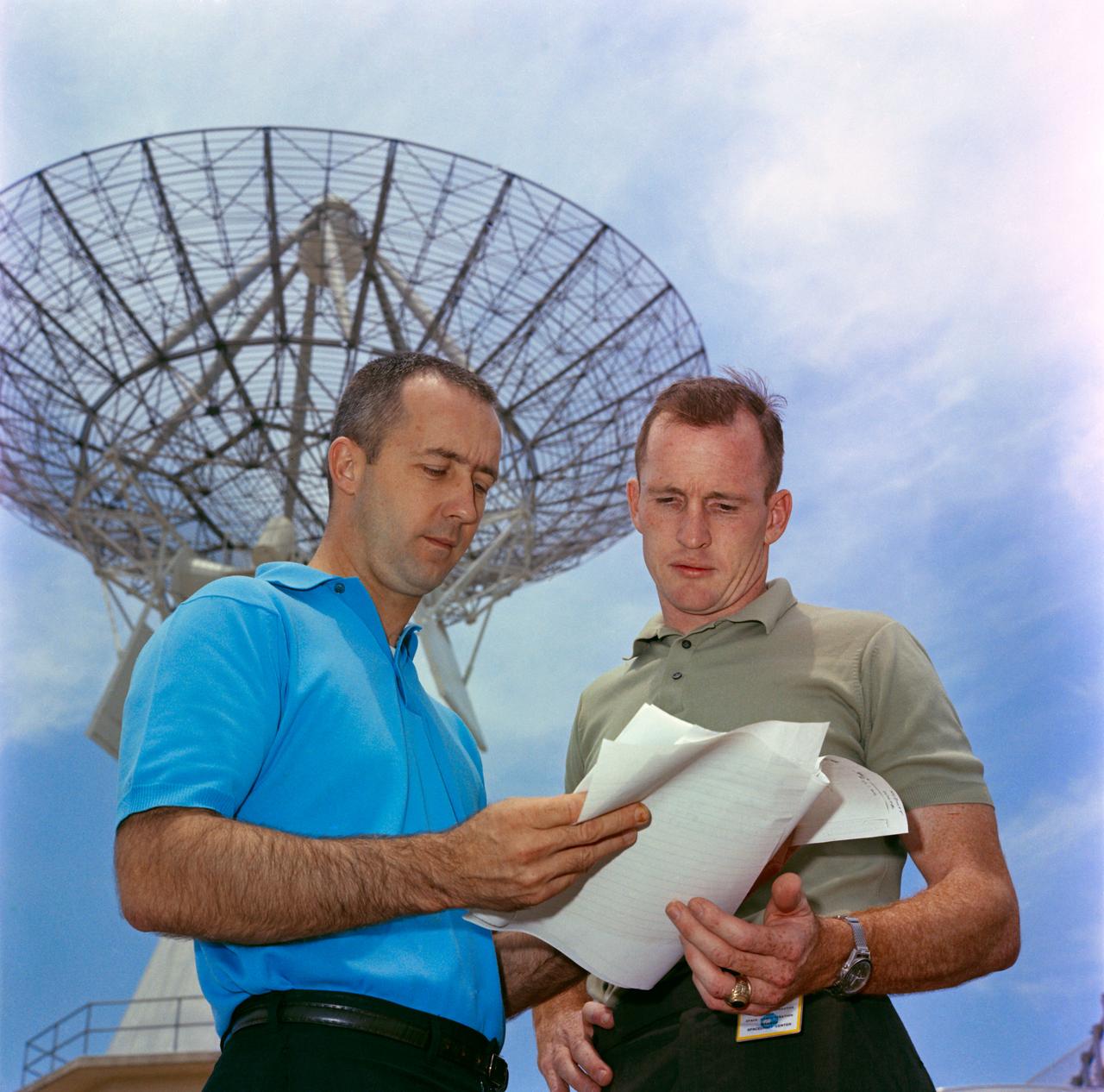
S65-29655 (7 May 1965) --- Astronauts James A. McDivitt (left) and Edward H. White II, Gemini-4 prime crew, are shown looking over training plans at Cape Kennedy during prelaunch preparations. The NASA Headquarters alternative photo number is 65-H-275.
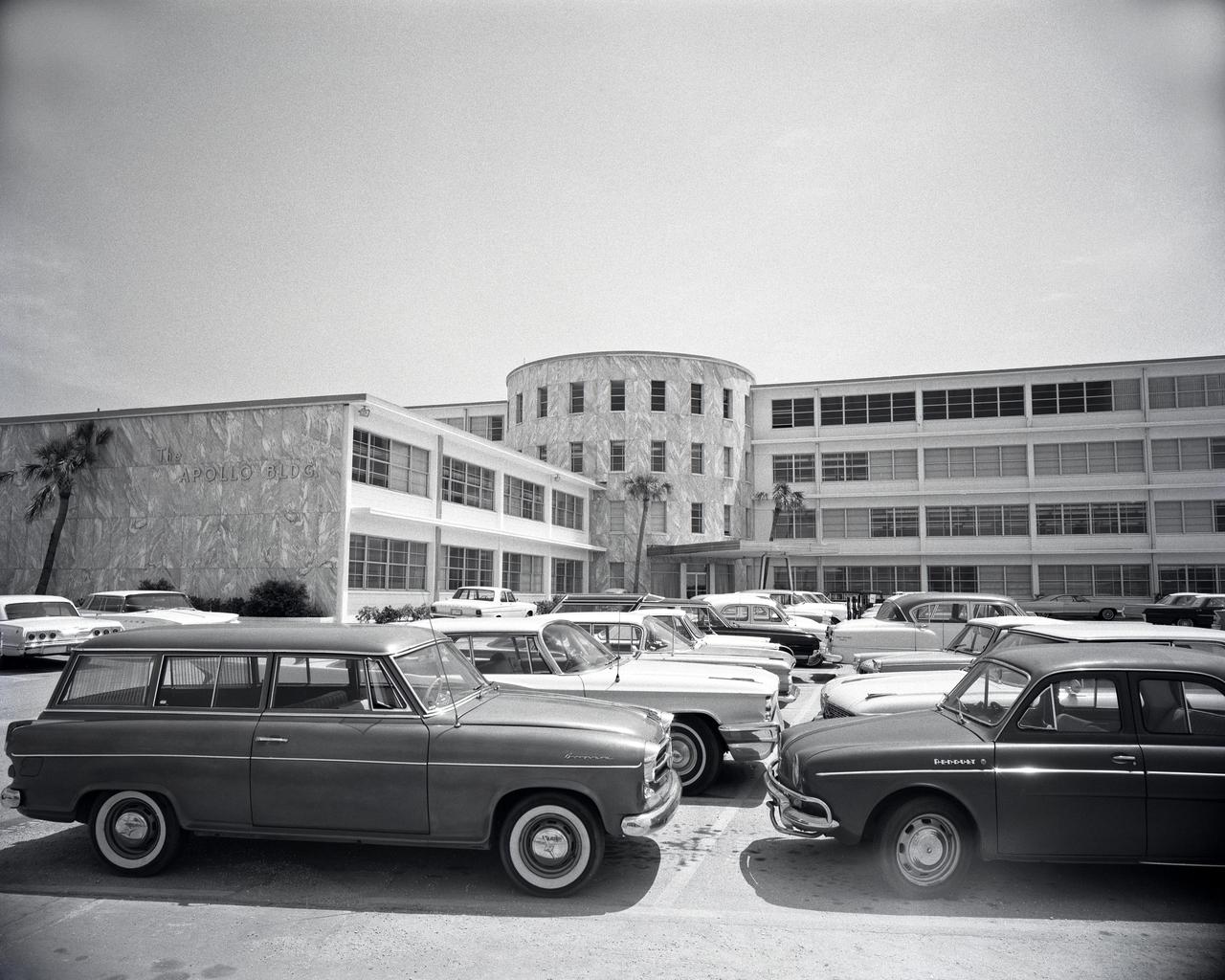
CAPE CANAVERAL, Fla. -- Apollo Office Building, Cocoa Beach, FL. NASA PIO photo. Photo credit: NASA
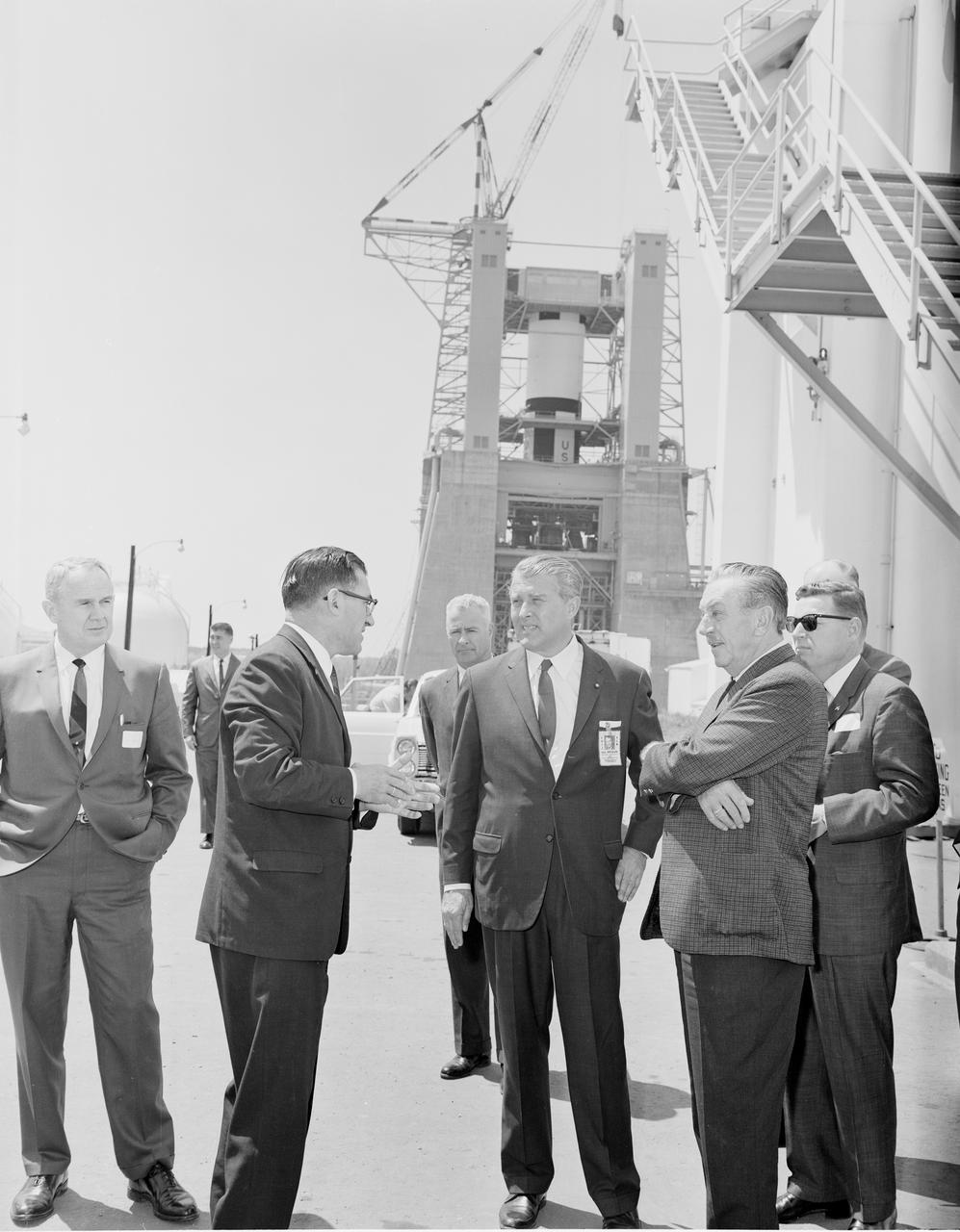
Walt Disney toured the West Test Area during his visit to the Marshall Space Flight Center on April 13, 1965. The three in center foreground are Karl Heimburg, Director, Test Division; Dr. von Braun, Director, MSFC; and Walt Disney. The Dynamic Test Stand with the S-1C stage being installed is in the background.
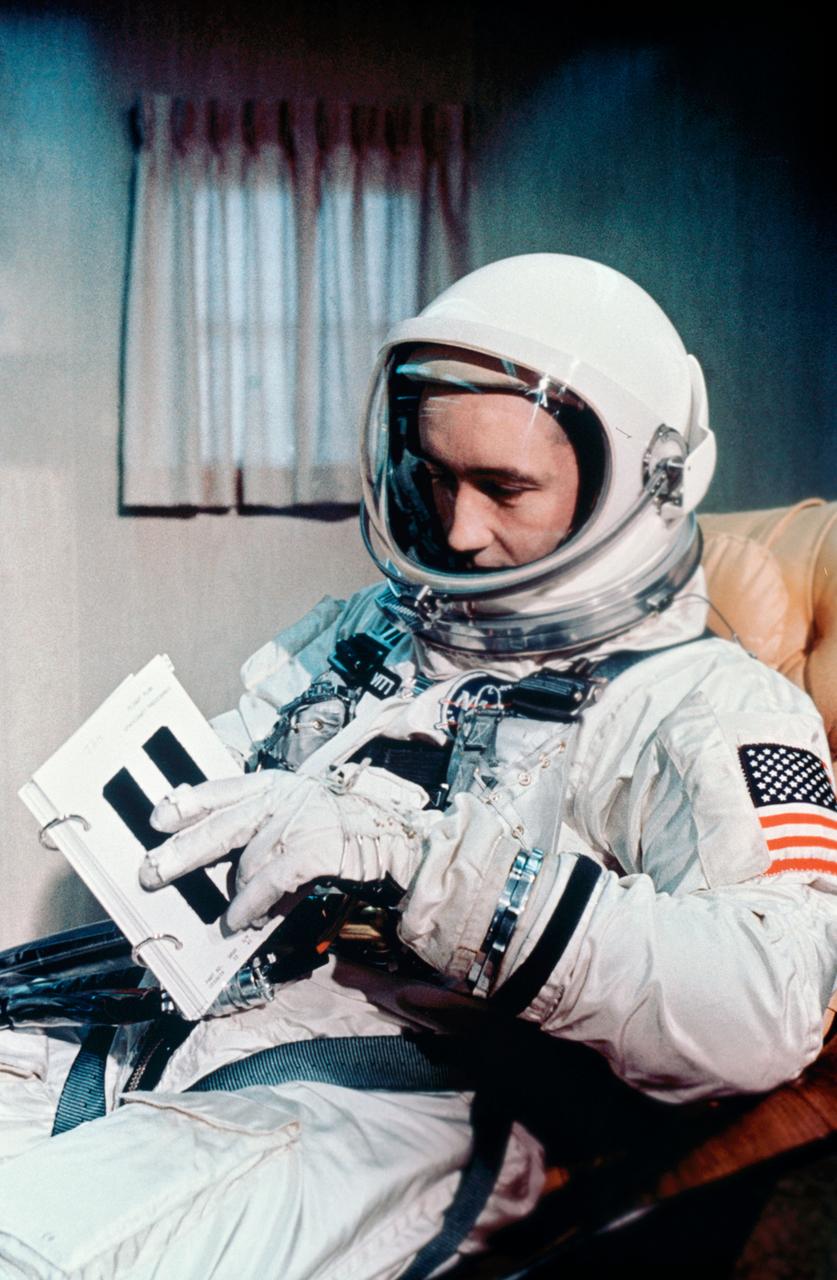
S65-29643 (3 June 1965) --- Astronaut James A. McDivitt, Gemini-4 command pilot, is shown in full spacesuit in the suit trailer prior to launch. He is reviewing a crew procedures flip book.
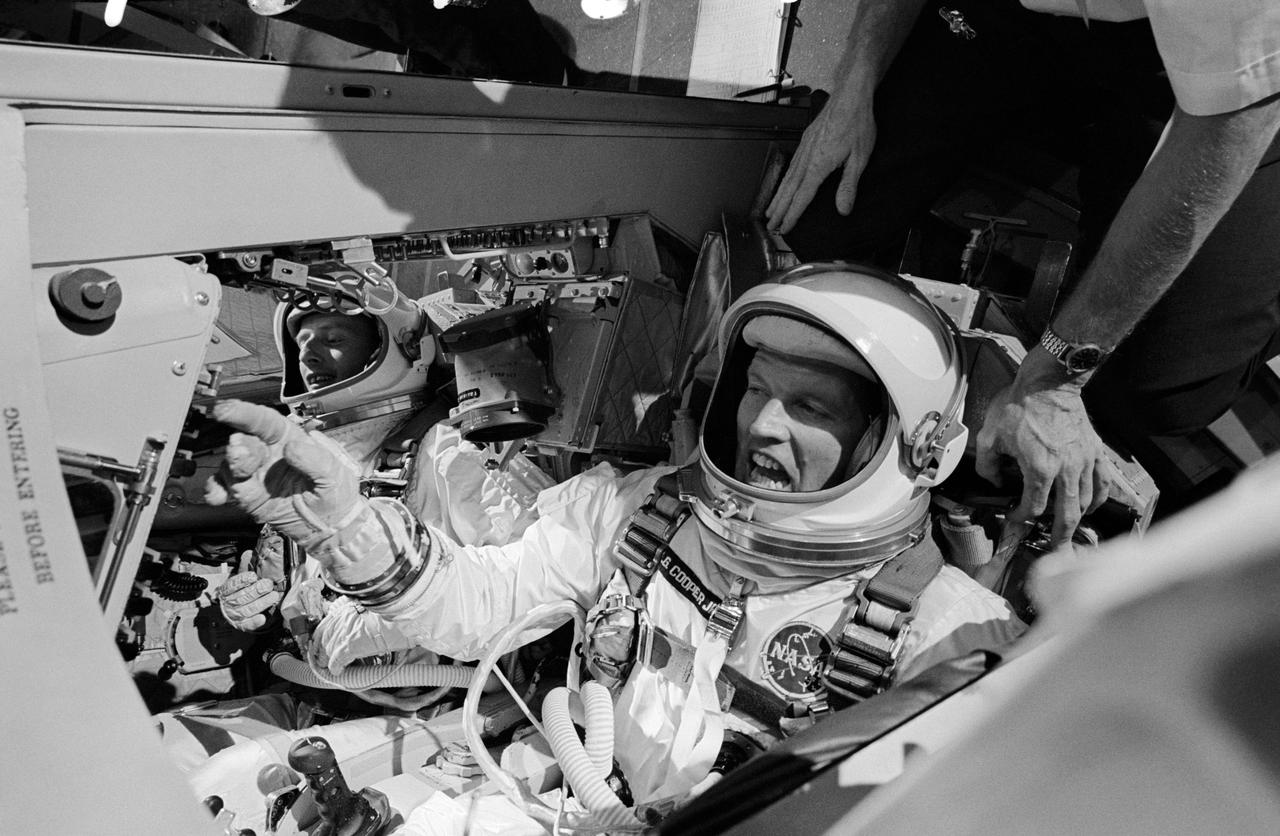
S65-48989 (21 Aug. 1965) --- Astronauts L. Gordon Cooper Jr. (foreground), command pilot, and Charles Conrad Jr., pilot, in the Gemini-5 spacecraft in the white room atop Pad 19 moments prior to the closing of the hatches during the final minutes of the Gemini-5 prelaunch countdown.
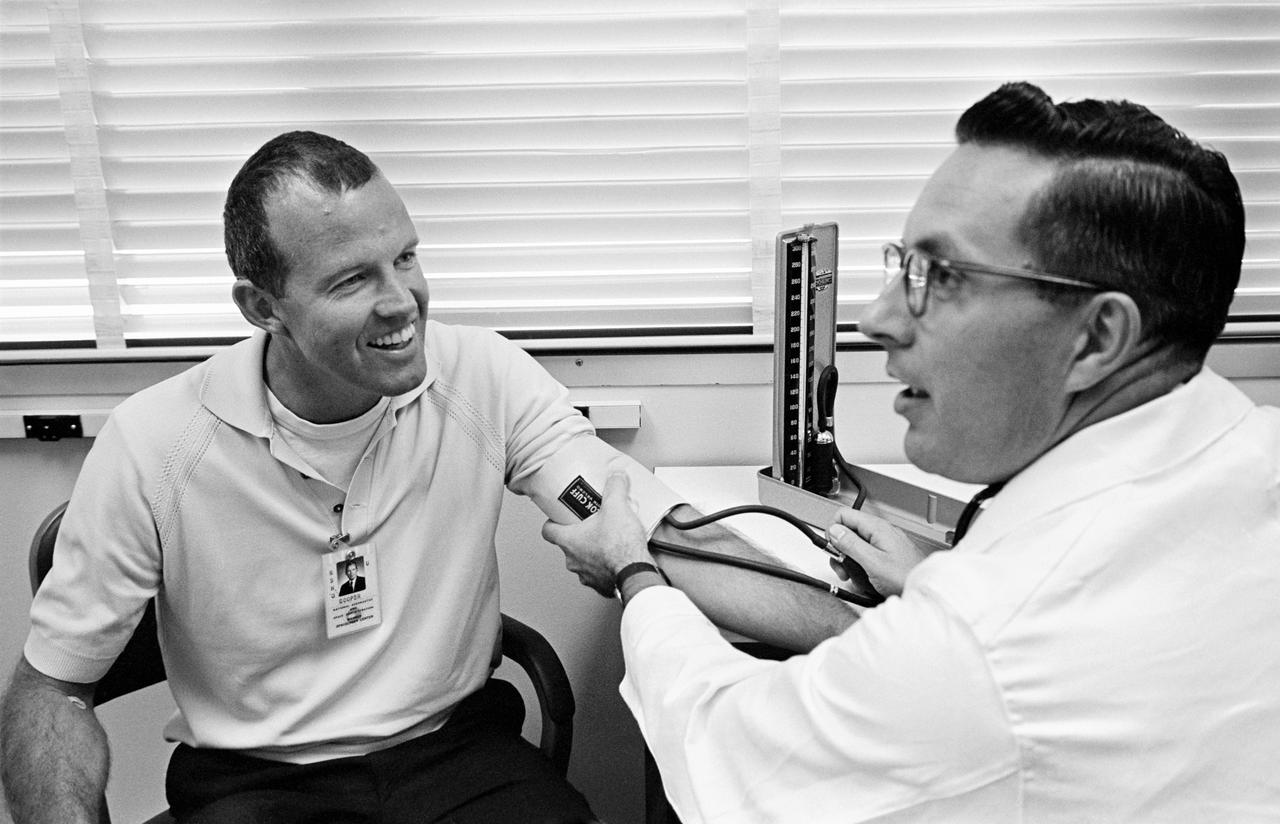
S65-28710 (17 Aug. 1965) --- Astronaut L. Gordon Cooper Jr., command pilot for the Gemini-5 spaceflight, has his blood pressure checked by Dr. Charles A. Berry, chief, Center Medical Programs, Manned Spacecraft Center, during a preflight physical examination.
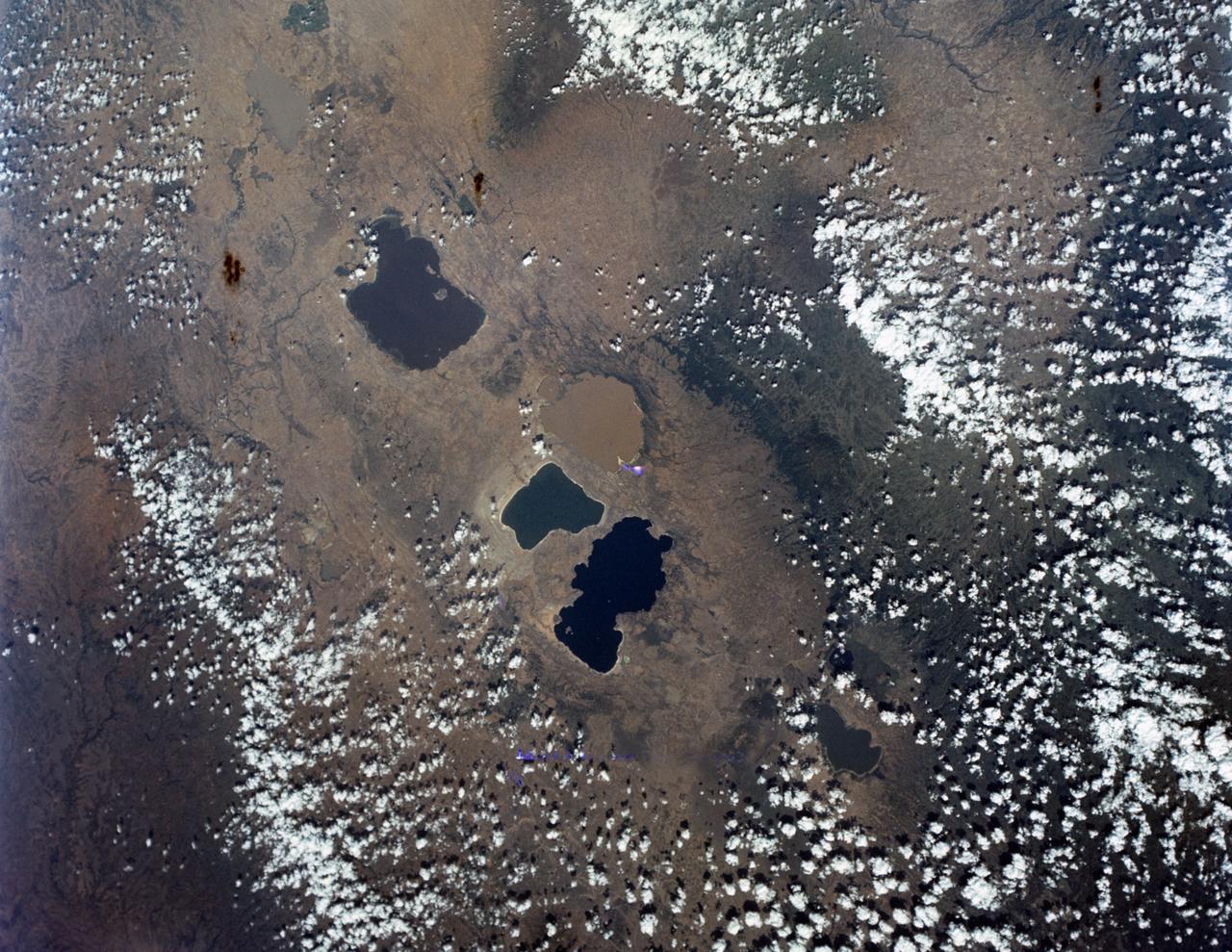
S65-63162 (16 Dec. 1965) --- Central area of Ethiopia, south of Addis Ababa, showing Lakes Zwai, Langana, and Shala, as seen from the Gemini-6 spacecraft during its 14th revolution of Earth. Photo credit: NASA or National Aeronautics and Space Administration
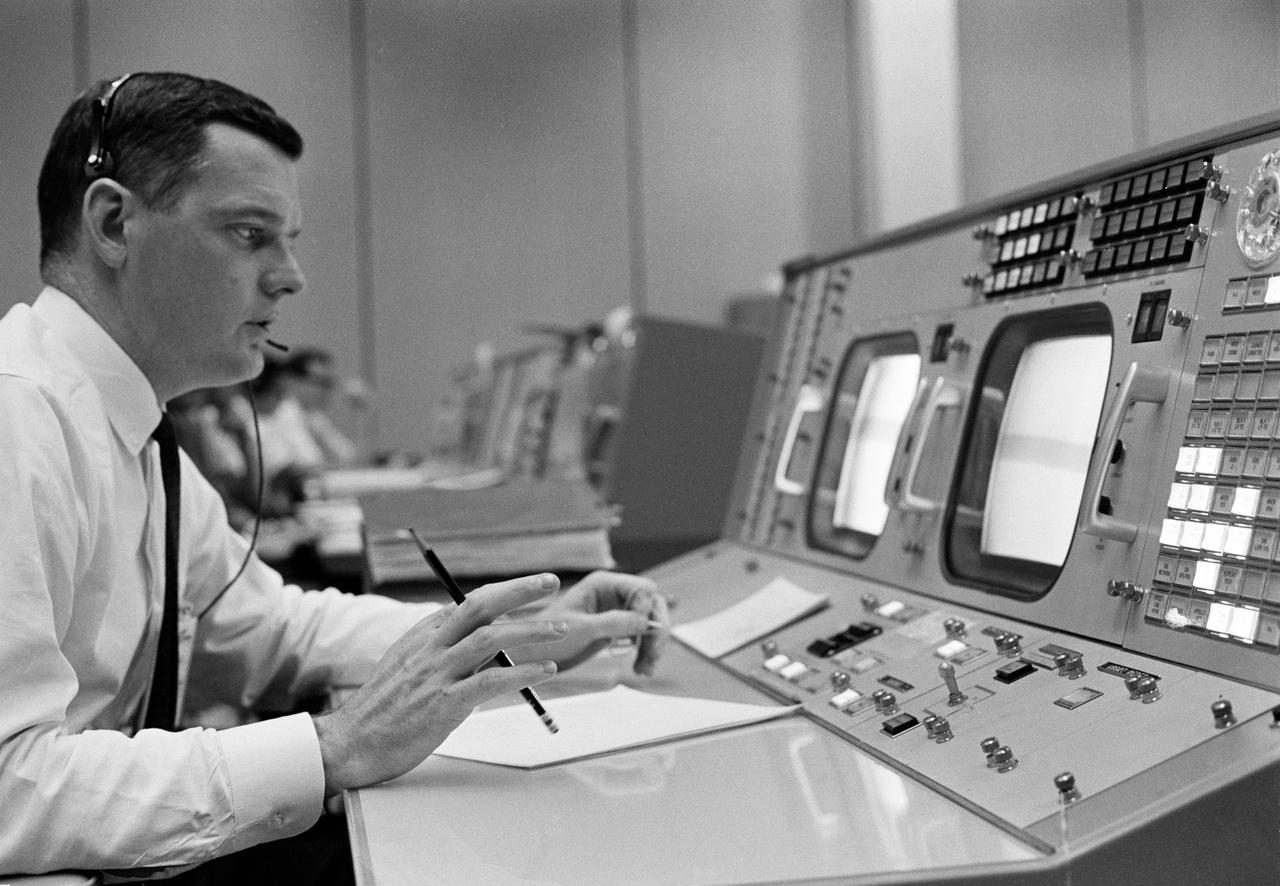
Glynn S. Lunney at his console in the MCC during an Apollo simulation exercise. MSC, Houston, TX
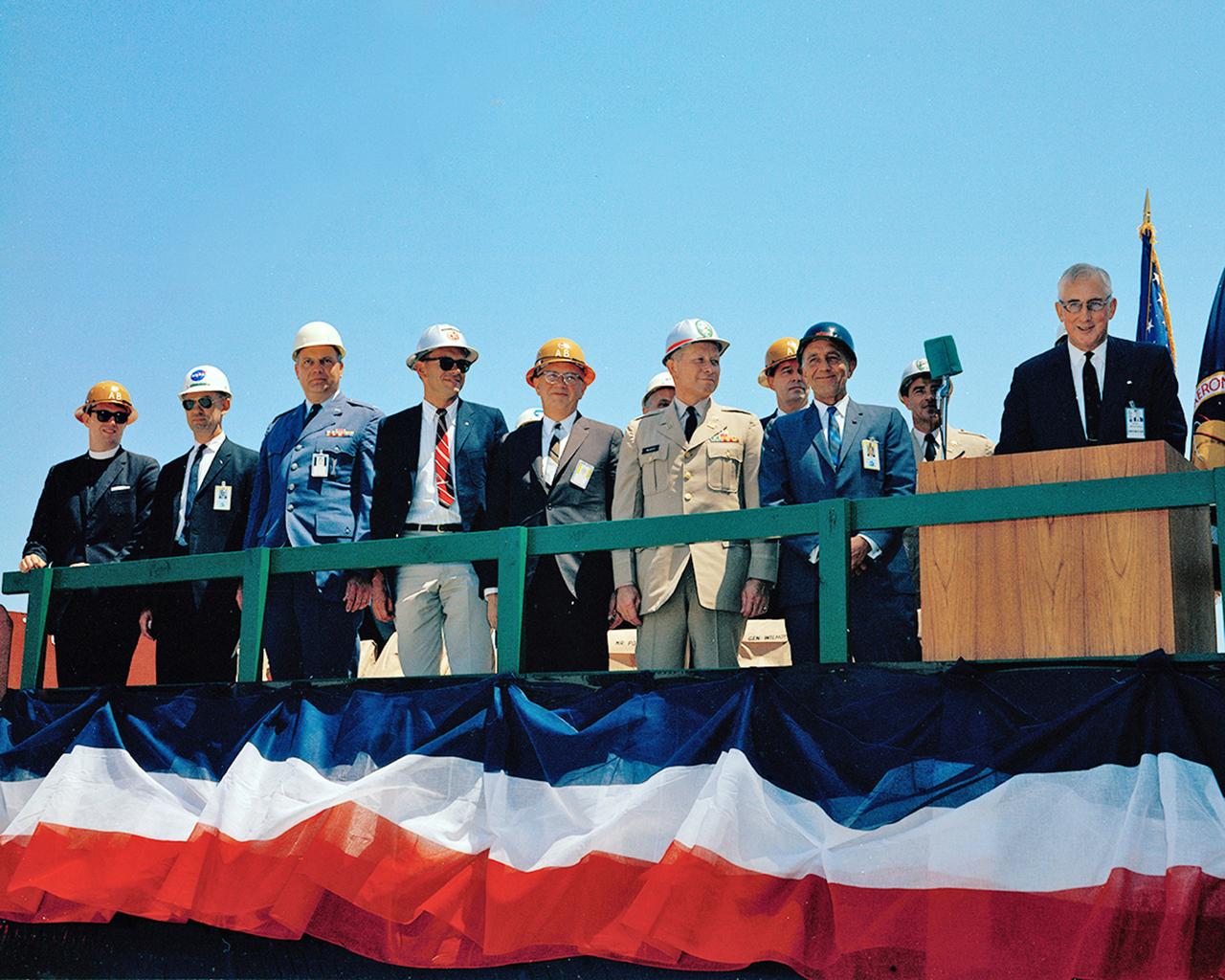
Dignataries (KSC Director Dr. Kurt Debus is second from right, NASA Administrator James C. Fletcher speaking), at the Last Major Beam Installation, attending the VAB Topping-Off Ceremony. MILA.
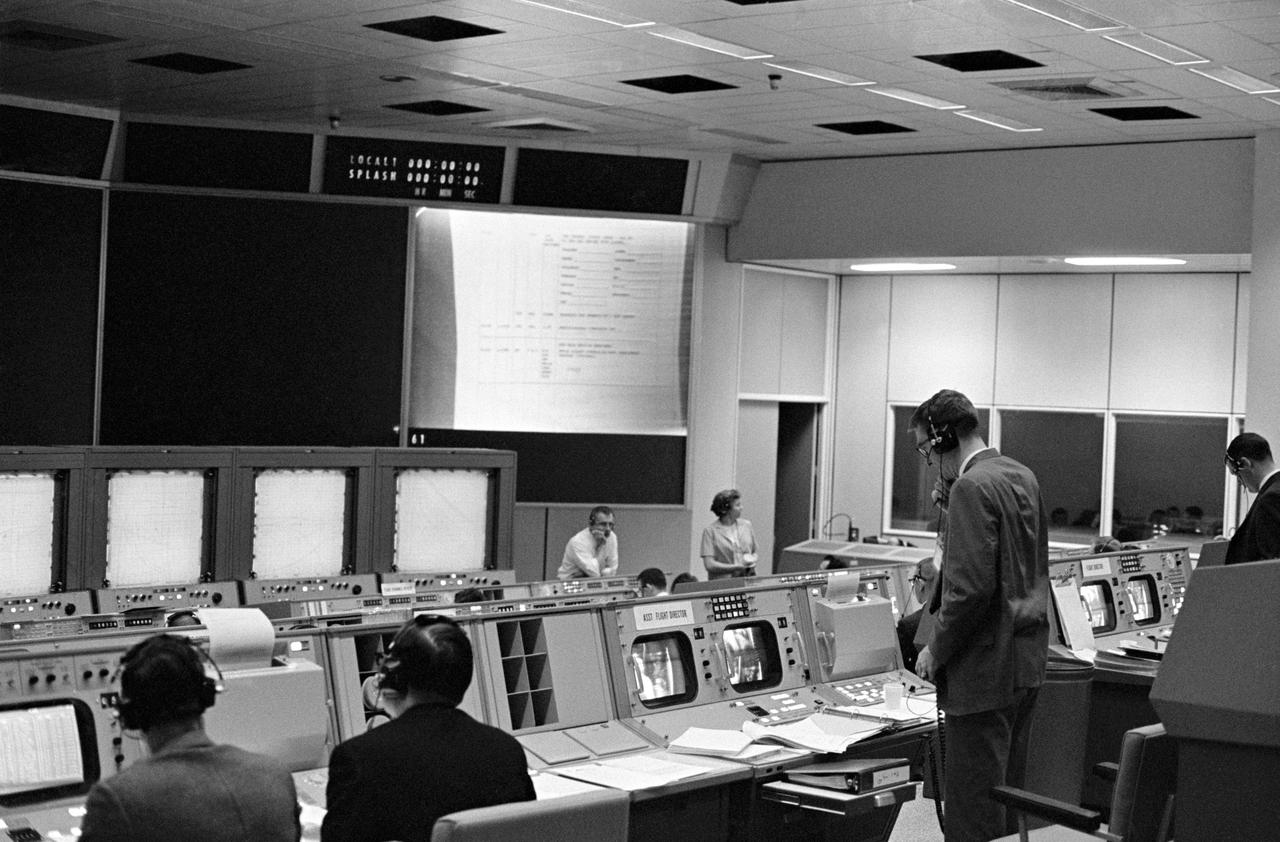
S65-18200 (23 March 1965) --- Overall view of the Mission Control Center at the Manned Spacecraft Center in Houston, Texas during the Gemini-Titan 3 flight.
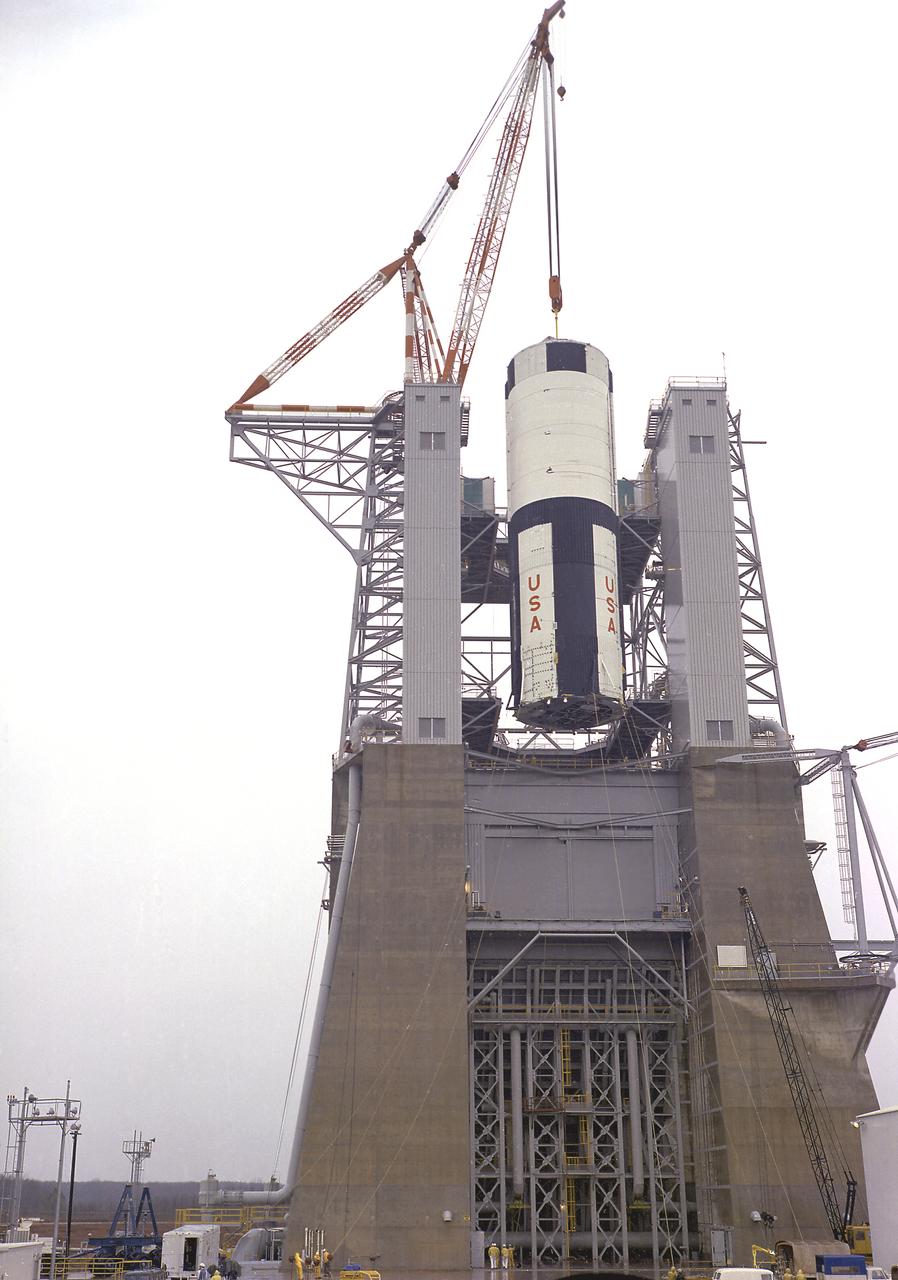
The S-IC-T stage is hoisted into the S-IC static test stand at the Marshall Space Flight Center. The S-IC-T stage is a static test vehicle not intended for flight. It was ground tested repeatedly over a period of many months proving the vehicle's propulsion system. The 280,000-pound stage, 138 feet long and 33 feet in diameter, houses the fuel and liquid oxygen tanks that hold a total of 4,400,000 pounds of liquid oxygen and kerosene. The two tanks are cornected by a 26-foot-long intertank section. Other parts of the booster included the forward skirt and the thrust structure, on which the engines were to be mounted. Five F-1 engines, each weighing 10 tons, gave the booster a total thrust of 7,500,000 pounds, roughly equivalent to 160 million horsepower.
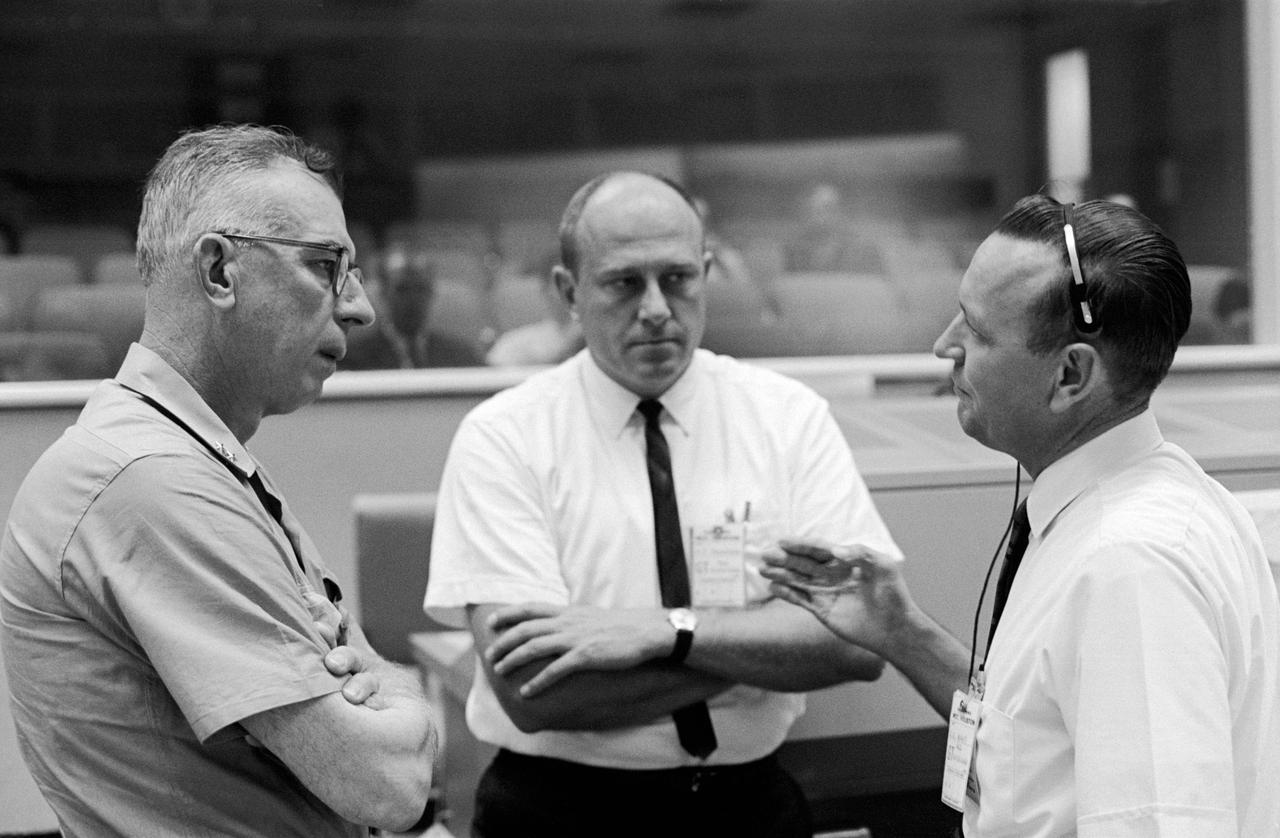
S65-28734 (24 Aug. 1965) --- Rear Admiral W.C. Abhau (left), who will take over command of Task Force 140 for Gemini-6, is shown in the Mission Control Center being briefed on recovery operations for Gemini by Robert F. Thompson (center), NASA recovery coordinator; and Christopher C. Kraft Jr., flight director for Gemini-5.
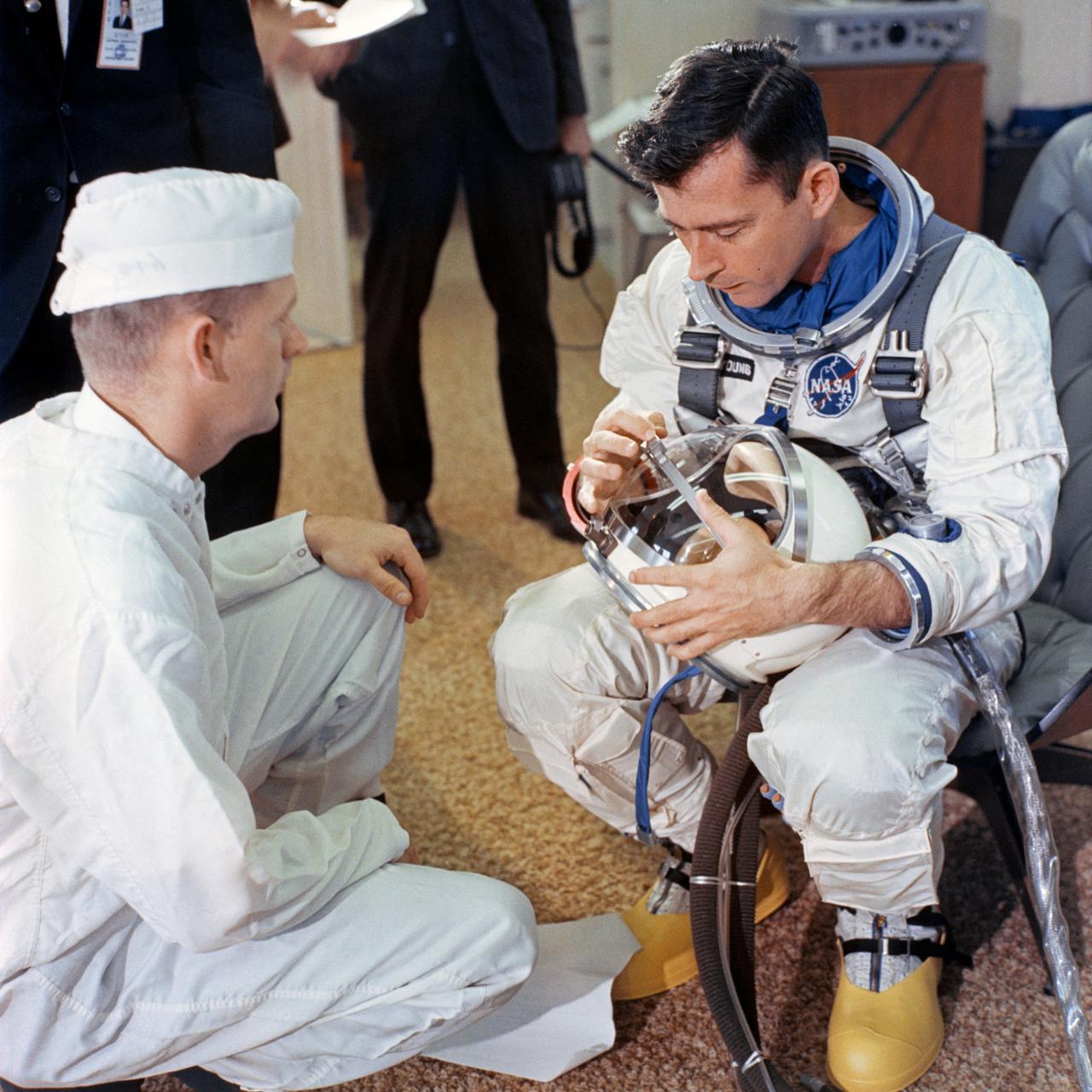
S65-23488 (23 March 1965) --- Astronaut John W. Young, pilot of the Gemini-Titan 3 space flight, checks over his helmet during suiting operations in the suiting trailer at Pad 16 prior to flight.
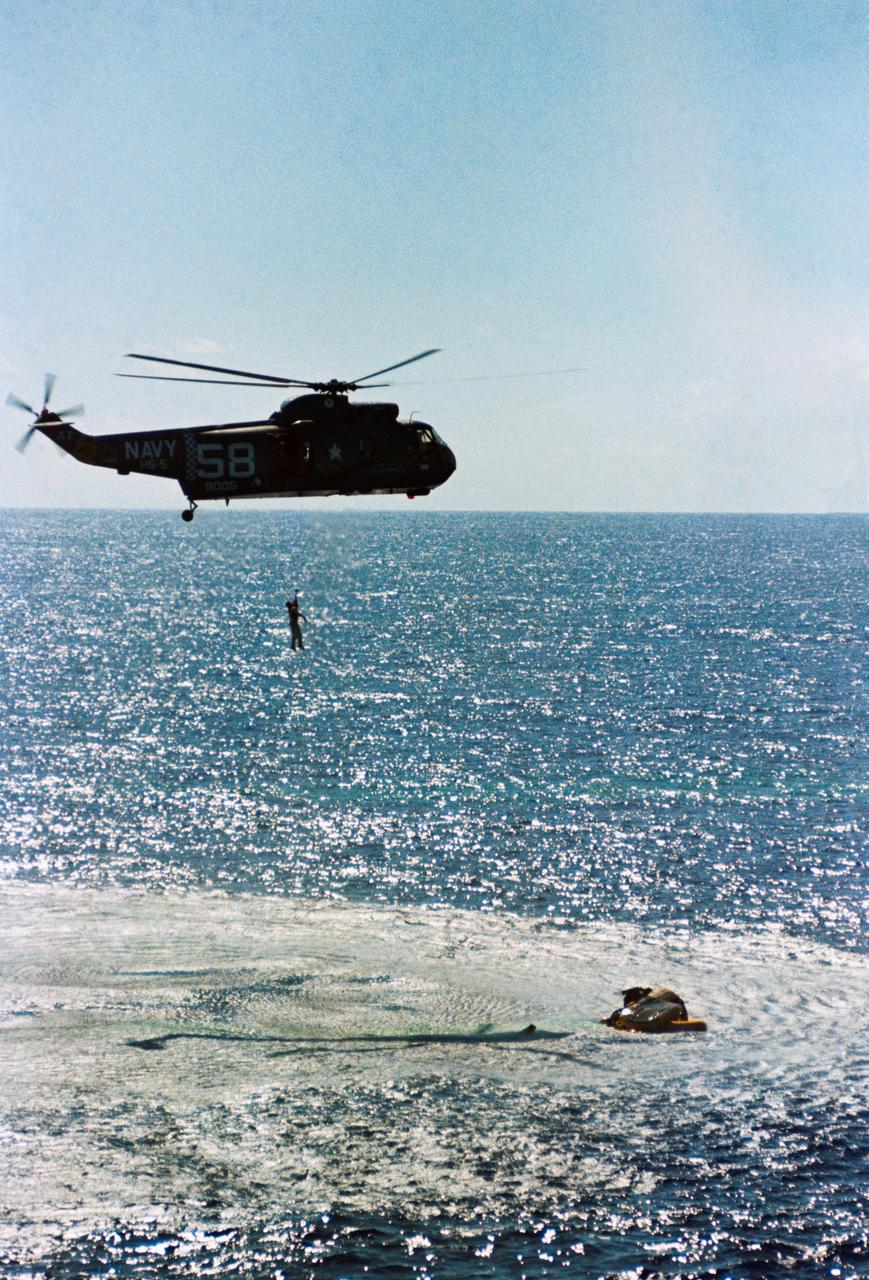
S65-51654 (29 Aug. 1965) --- Long range view of astronaut L. Gordon Cooper Jr. being hoisted up to a Navy helicopter during recovery operations in the Atlantic Ocean of the Gemini-5 spacecraft.
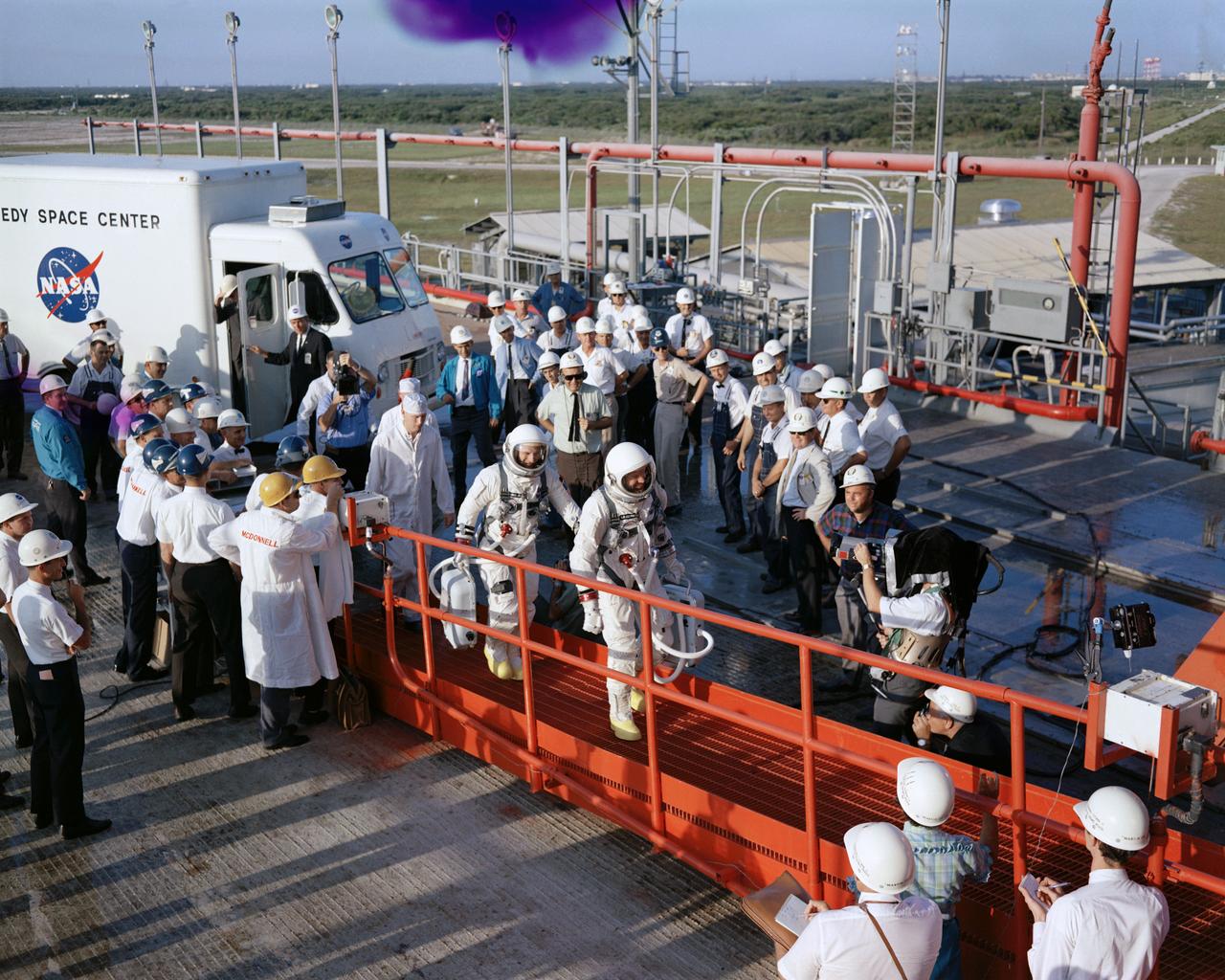
S65-28737 (21 Aug. 1965) --- Astronauts L. Gordon Cooper Jr. (foreground) and Charles Conrad Jr. walk up gantry ramp after arriving at Pad 19 during Gemini-5 countdown at Cape Kennedy, Florida.
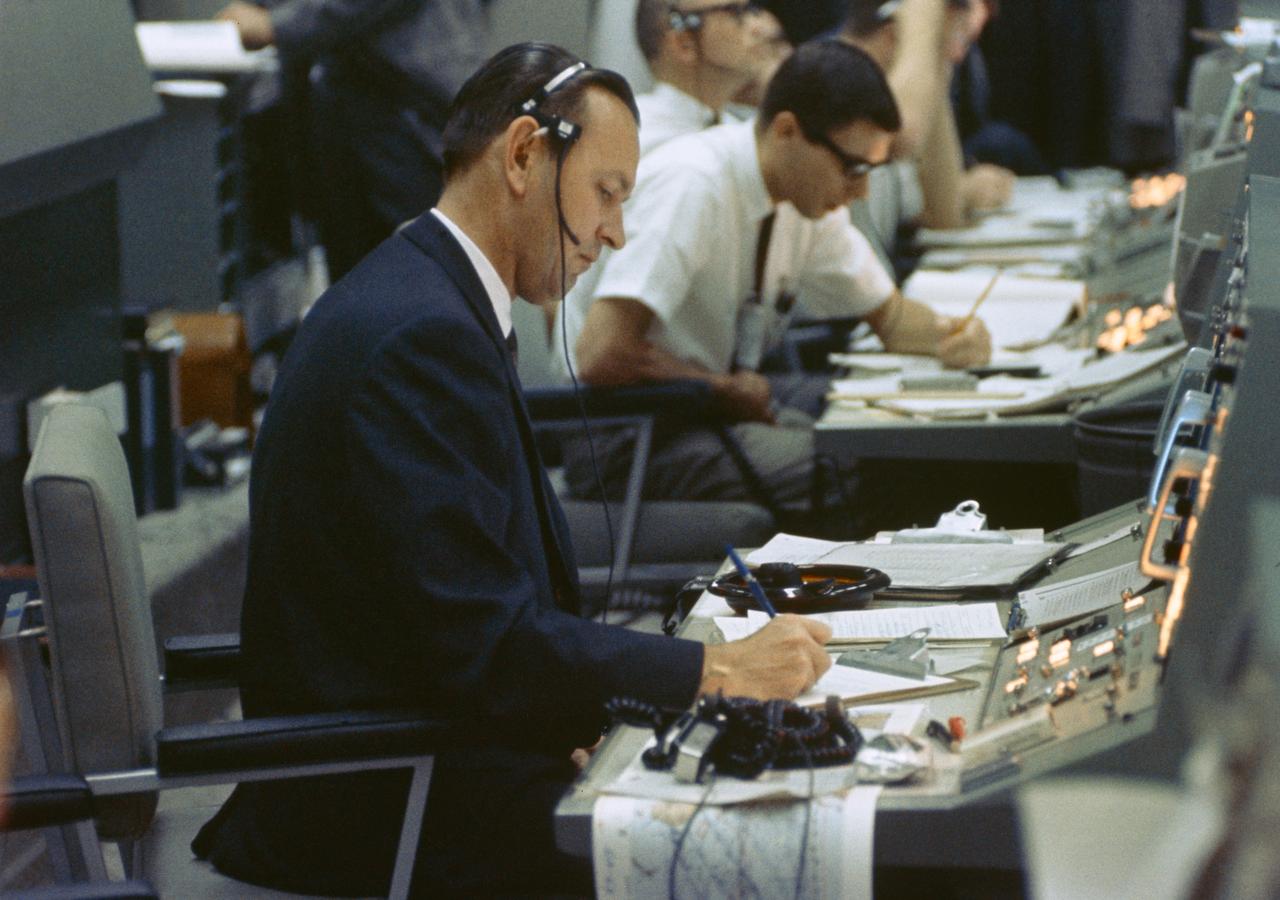
S65-28462 (3-7 June 1965) --- Christopher C. Kraft Jr., assistant director for Flight Operations, at his console in the Mission Control Center during Gemini-4 spaceflight. He served as mission director and as a flight director.
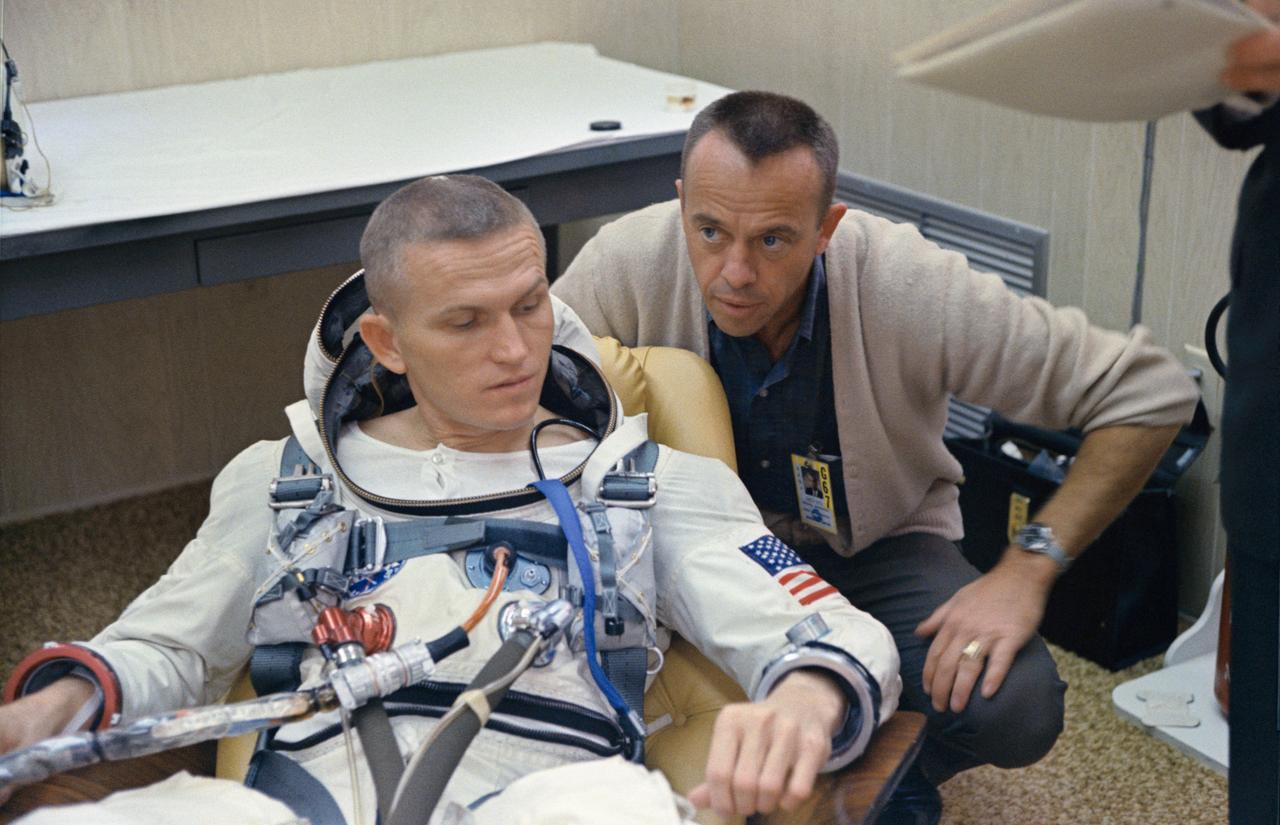
S65-61755 (4 Dec. 1965) --- Astronaut Frank Borman, command pilot of the National Aeronautics and Space Administration's Gemini-7 spaceflight, talks with astronaut Alan Shepard, chief, MSC Astronaut Office, in the suiting up trailer at Launch Complex 16, during the Gemini-7 prelaunch countdown. A 14-day mission in space is scheduled for astronaut Borman and James A. Lovell Jr., pilot. The Gemini-7 liftoff occurred at 2:30 p.m. (EST) on Dec. 4, 1965. Photo credit: NASA
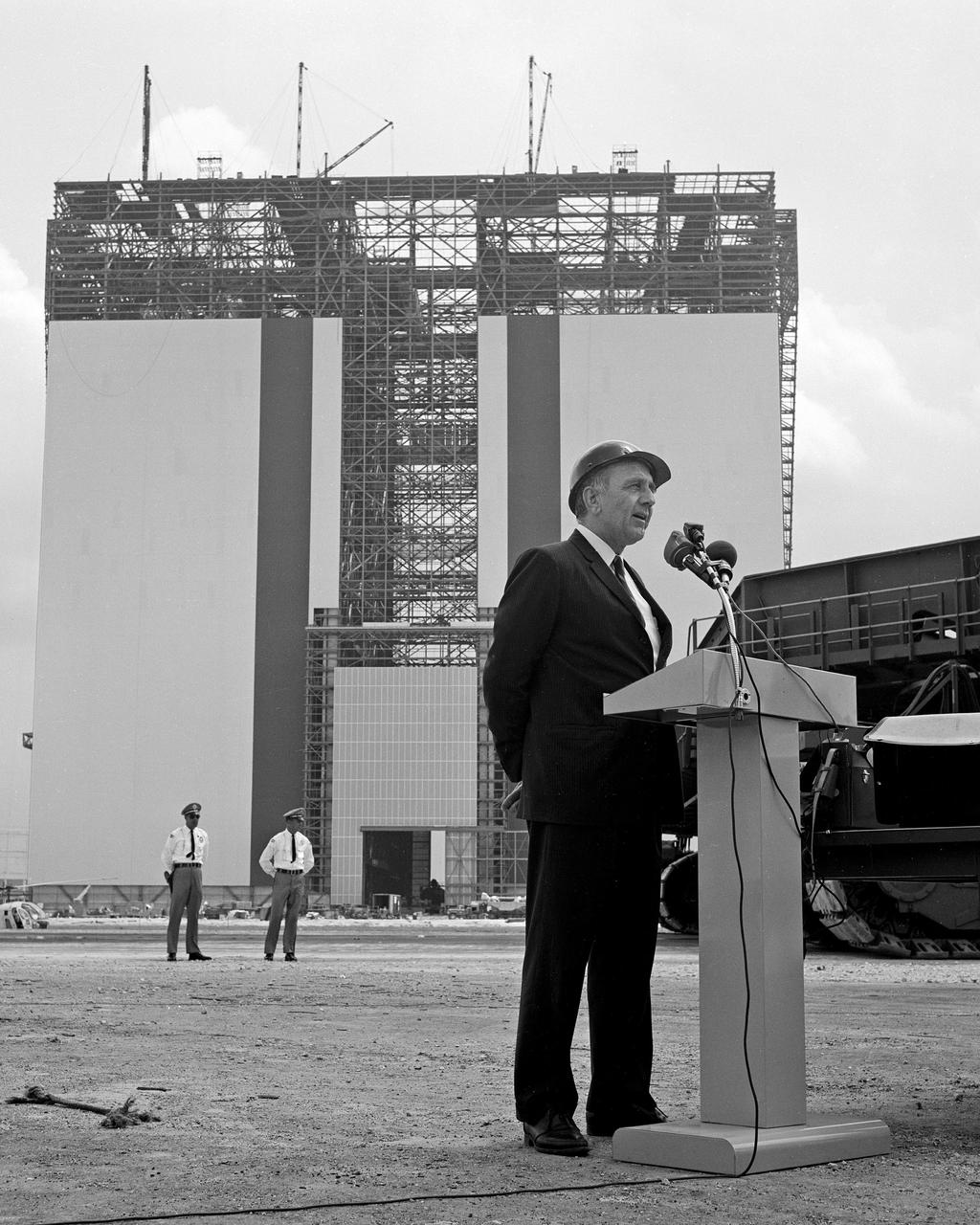
CAPE KENNEDY, Fla. -- At the Kennedy Space Center in Florida, Dr. Kurt H. Debus, center director, speaks at the "topping off" ceremonies for the Vehicle Assembly Building. A crawler-transporter is seen at the right. One of the largest buildings in the world, the 129 million cubic foot structure will be used to prepare the Apollo Saturn V launch vehicles for missions to land astronauts on the moon. Photo Credit: NASA
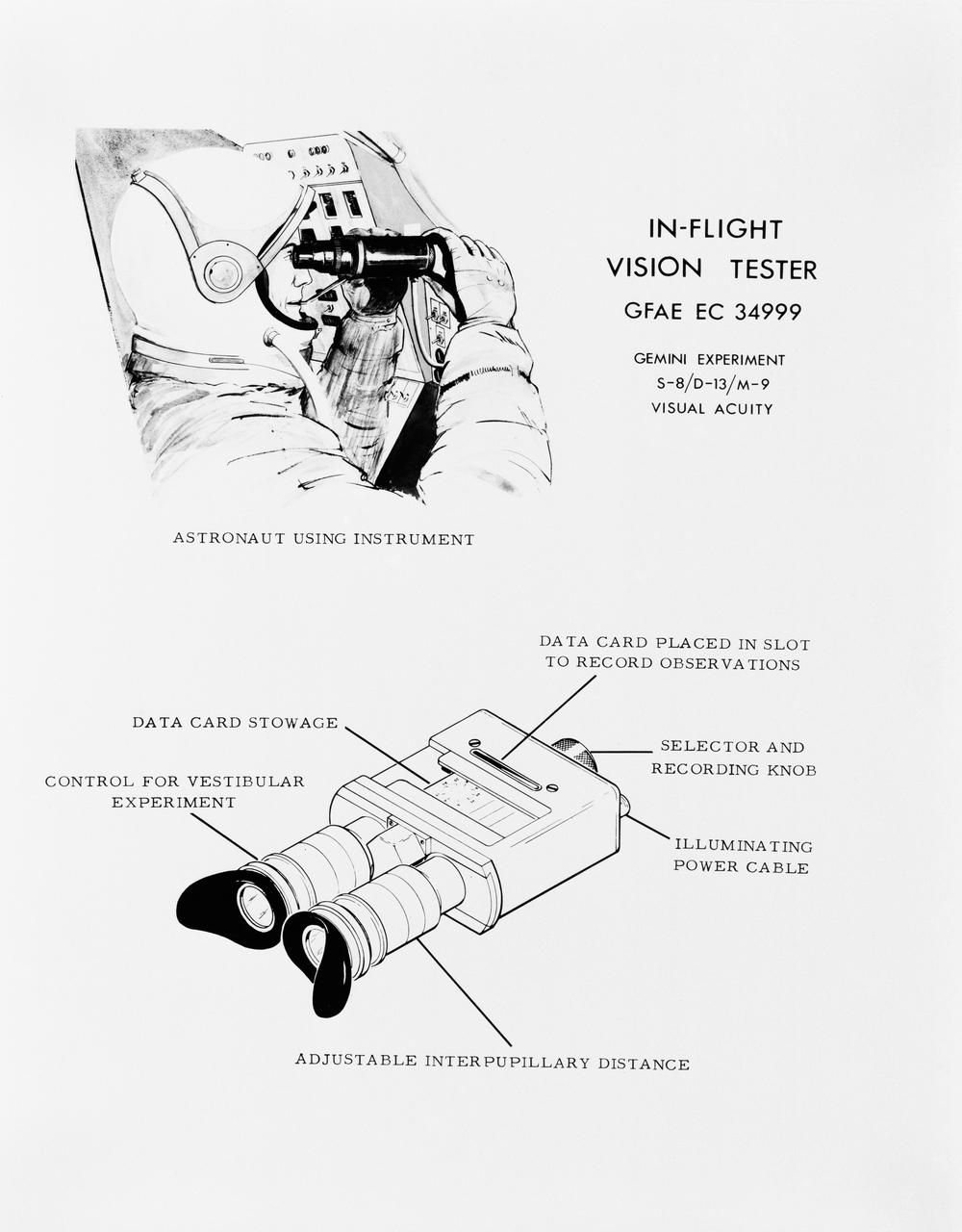
S65-28642 (June 1965) --- Drawing illustrating Gemini experiment In-Flight Vision Tester.

S65-34673 (3-7 June 1965) --- This photograph shows the north end of the Gulf of California at the mouth of the Colorado River as it was seen from the Gemini-4 spacecraft during orbital flight June 3-7, 1965. This picture was part of the Synoptic Terrain Photography experiments conducted during the flight to obtain high quality photographs of large land areas already mapped by aerial photography. In charge of these experiments was Dr. Paul D. Lowman Jr., NASA geologist from Goddard Space Flight Center, Greenbelt, Md. This picture was taken with a modified 70mm Hasselblad camera using Eastman color film, ASA 64 at a lens setting of 250th of a second at f/11.
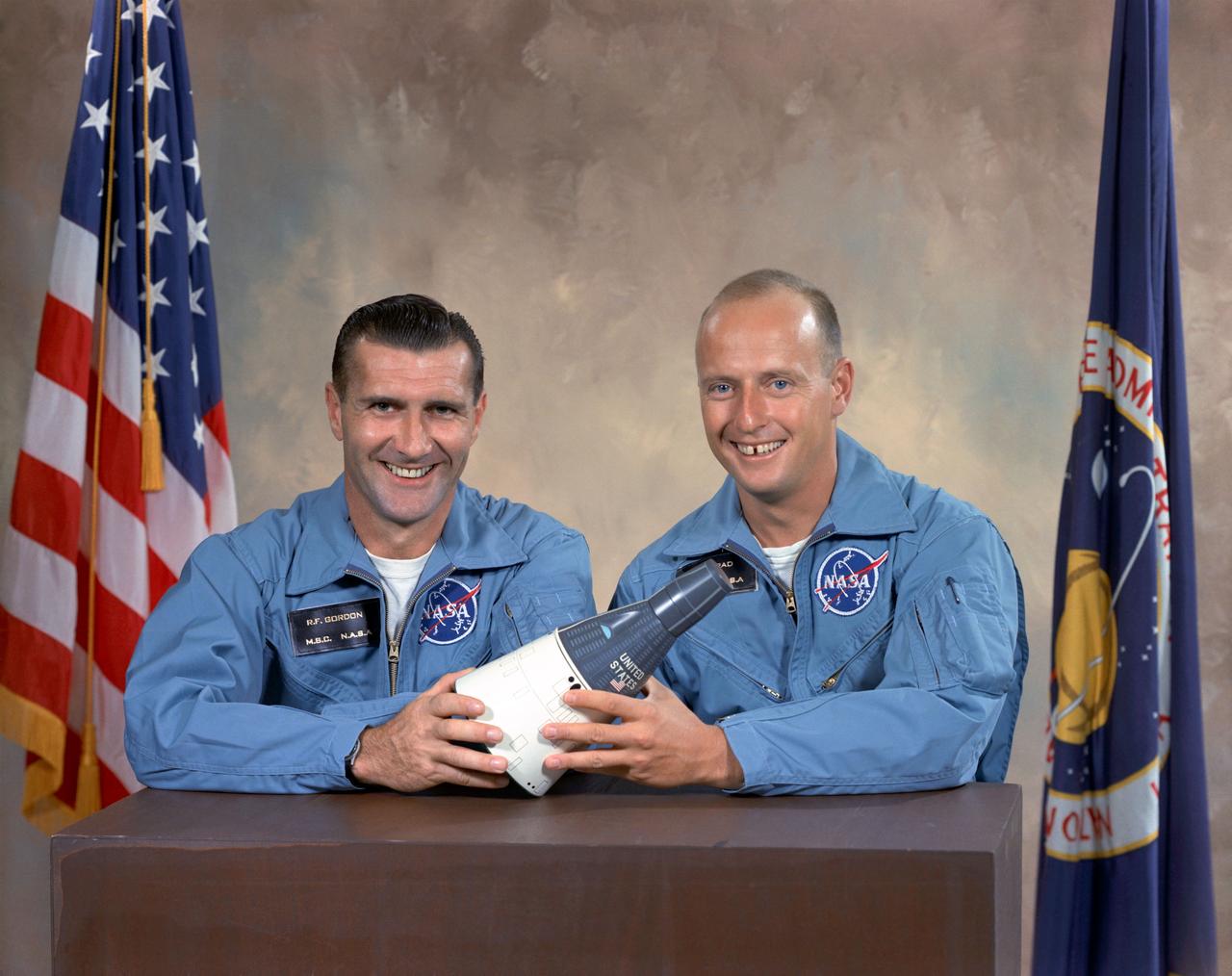
S65-58504 (4 Nov. 1965) --- Astronauts Charles Conrad Jr., (right) prime crew command pilot, and Richard F. Gordon Jr., prime crew pilot, for the Gemini-Titan XI (GT-11) Earth-orbital mission. Photo credit: NASA
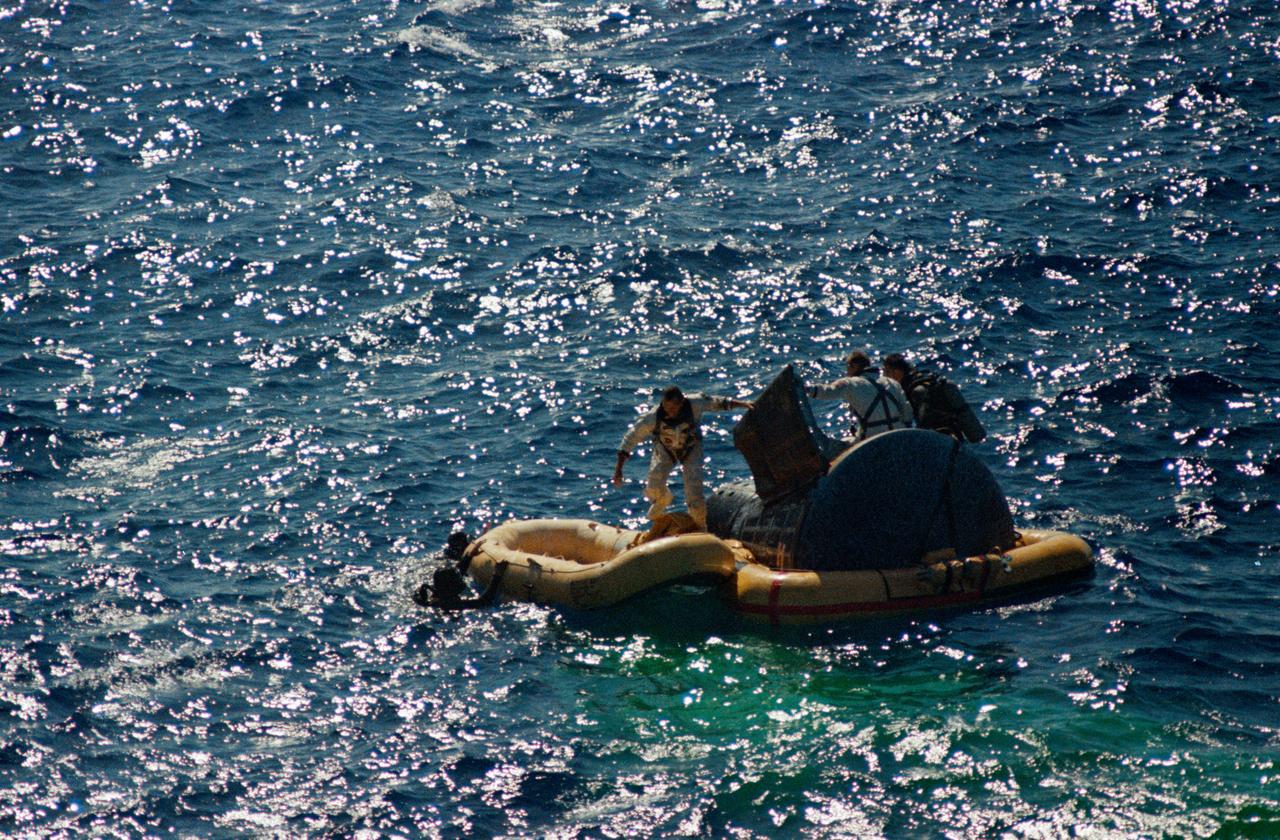
S65-51653 (29 Aug. 1965) --- Astronauts L. Gordon Cooper Jr. and Charles Conrad Jr. exit their spacecraft after splashdown of the Gemini-5 spacecraft. They are photographed boarding a life raft with the help of Navy divers.