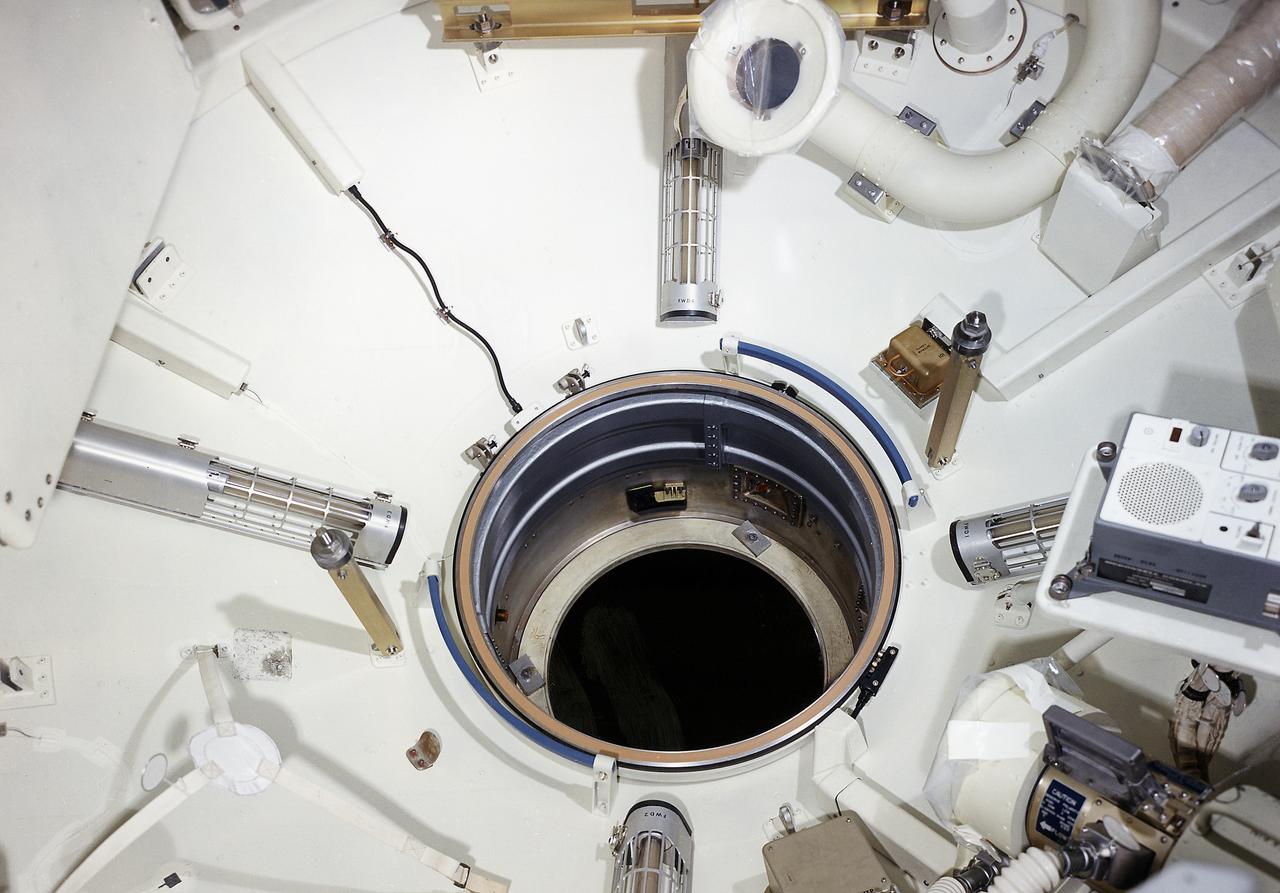
This August 1971 interior photograph of Skylab's Multiple Docking Adapter (MDA) flight article, undergoing outfitting at the Martin-Marietta Corporation's Space Center facility in Denver, Colorado, shows the forward cone area and docking tunnel (center) that attached to the Apollo Command Module. Designed and manufactured by the Marshall Space Flight Center, the MDA housed the control units for the Apollo Telescope Mount, Earth Resources Experiment Package, and Zero-Gravity Materials Processing Facility and provided a docking port for the Apollo Command Module.
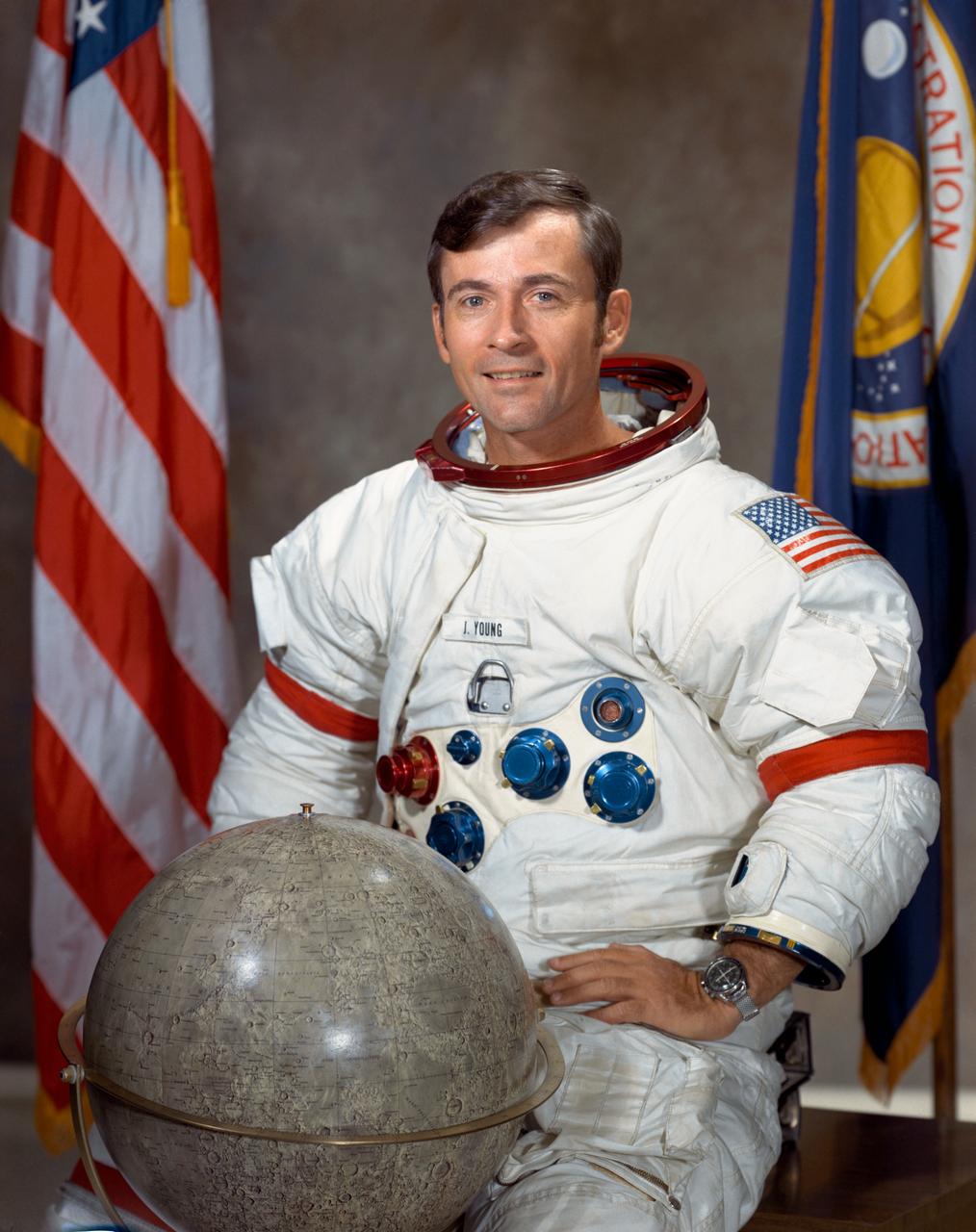
S71-51261 (October 1971) --- Astronaut John W. Young
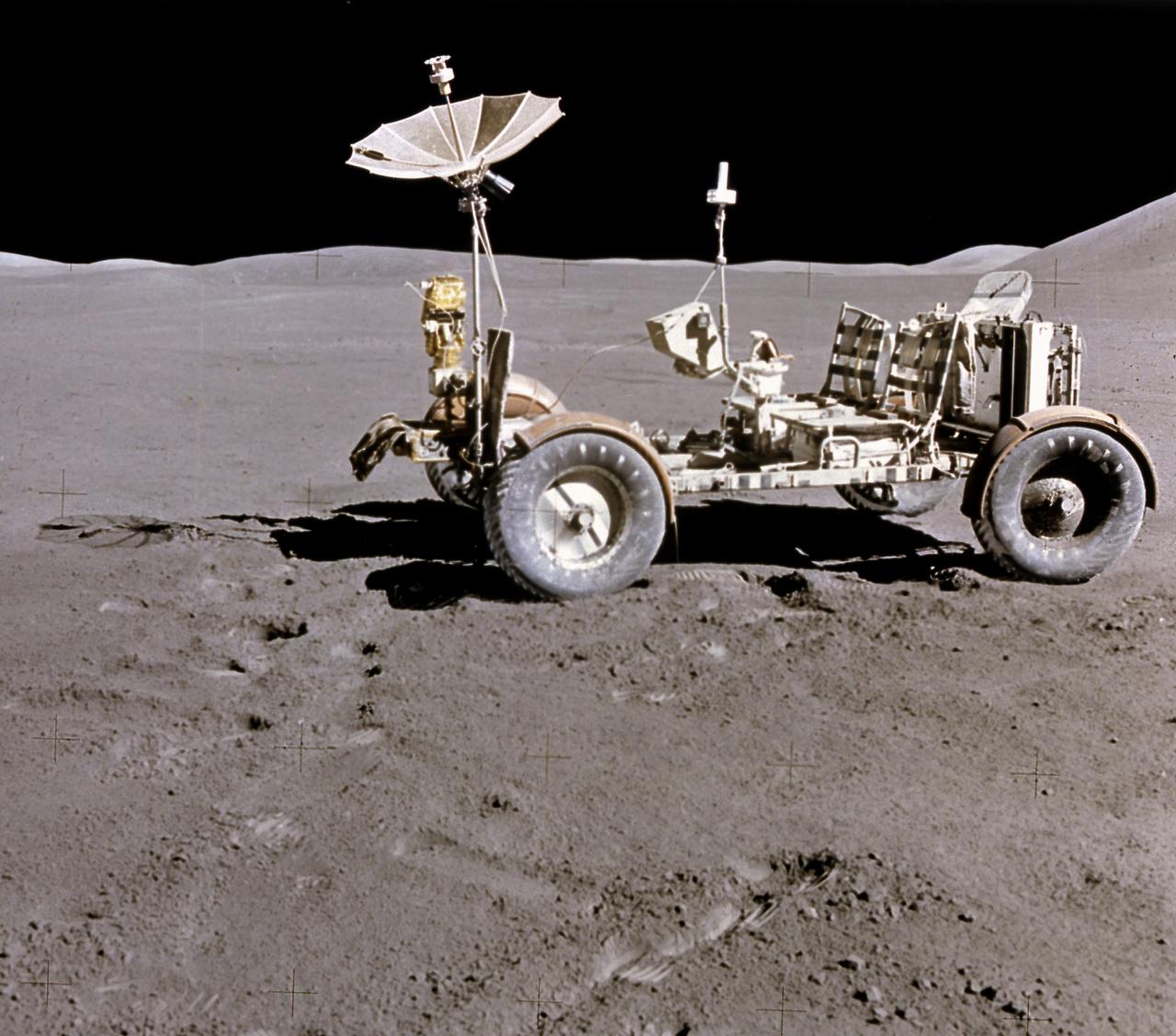
This photograph of the Lunar Roving Vehicle (LRV) was taken during the Apollo 15 mission. Powered by battery, the lightweight electric car greatly increased the range of mobility and productivity on the scientific traverses for astronauts. It weighed 462 pounds (77 pounds on the Moon) and could carry two suited astronauts, their gear and cameras, and several hundred pounds of bagged samples. The LRV's mobility was quite high. It could climb and descend slopes of about 25 degrees. The LRV was designed and developed by the Marshall Space Flight Center and built by the Boeing Company.
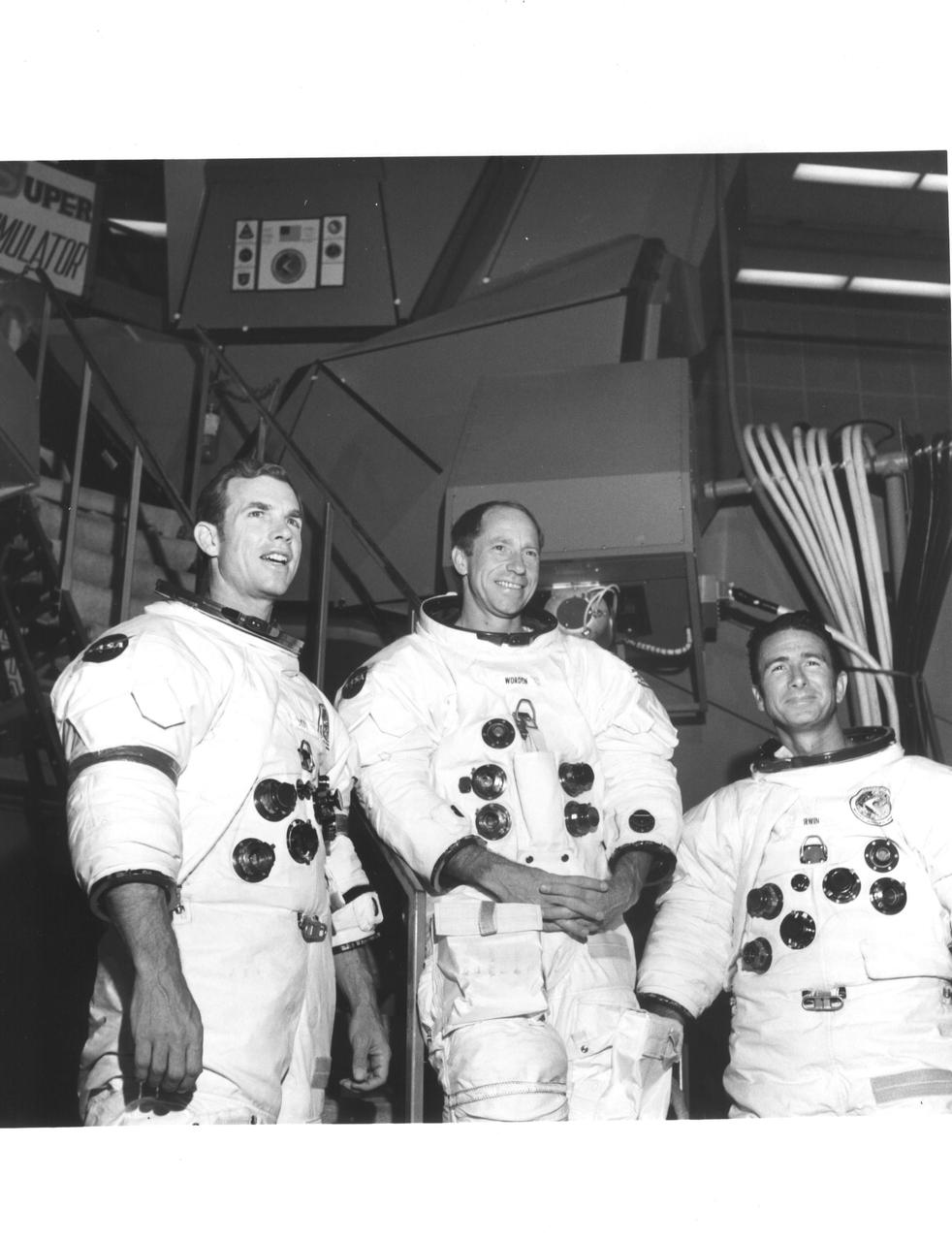
KENNEDY SPACE CENTER, FLA. -- The Apollo 15 astronauts pause in front of a mission simulator during a training exercise at the Kennedy Space Center. The trio will be launched to the Moon no earlier than July 26, 1971. They are, left to right, David R. Scott, commander; Alfred N. Worden, command module pilot; and James B. Irwin, lunar module pilot.

AS15-85-11471 (31 July 1971) --- Astronaut David R. Scott, commander, is seated in the Lunar Roving Vehicle (LRV) during the first Apollo 15 lunar surface extravehicular activity (EVA) at the Hadley-Apennine landing site. This photograph was taken by astronaut James B. Irwin, lunar module pilot. While astronauts Scott and Irwin descended in the Lunar Module (LM) "Falcon" to explore the Hadley-Apennine area of the moon, astronaut Alfred M. Worden, command module pilot, remained with the Command and Service Modules (CSM) in lunar orbit.
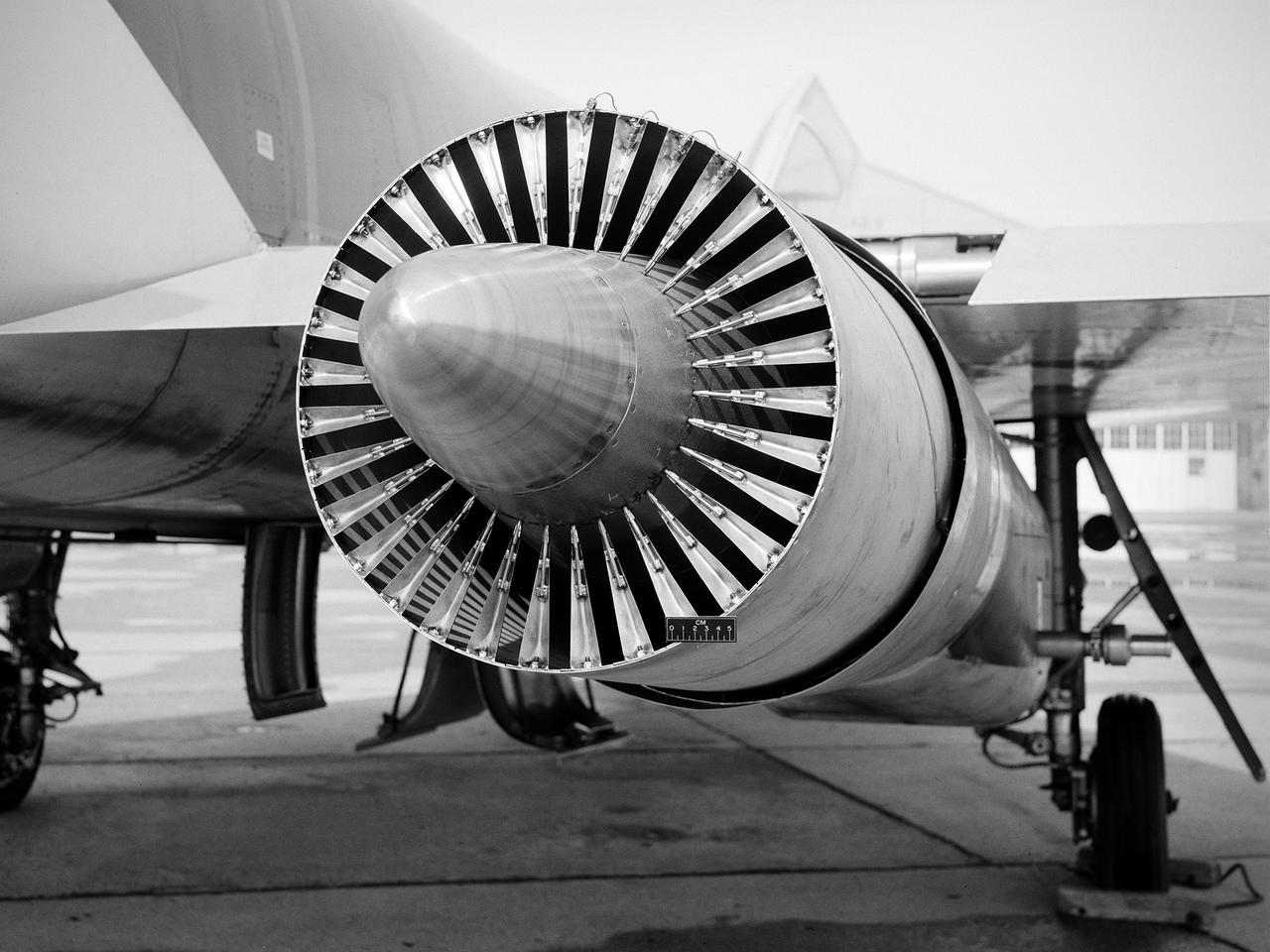
National Aeronautics and Space Administration (NASA) Convair F-106B Delta Dart with a 32-spoke nozzle installed on its General Electric J85 test engine. Lewis acquired a Delta Dart fighter in 1966 to study the components for propulsion systems that could be applied to supersonic transport aircraft at transonic speeds. The F-106B was modified with two General Electric J85-13 engines under its wings to study these components. The original test plan was expanded to include the study of boattail drag, noise reduction, and inlets. From February to July 1971 the modified F-106B was used to study different ejector nozzles. Researchers conducted both acoustic and aerodynamic tests on the ground and in flight. Several models were created to test different suppression methods. NASA Lewis’ conical nozzle was used as the baseline configuration. Flightline and sideline microphones were set up on the ground. The F-106B would idle its own engine and buzz the recording station from an altitude of 300 feet at Mach 0.4 with the test engines firing. Researchers found that the suppression of the perceived noise level was usually lower during flight than the researchers had statistically predicted. The 64 and 32-spoke nozzles performed well in actual flight, but the others nozzles tended to negatively affect the engine’s performance. Different speeds or angles- -of-attack sometimes changed the noise levels. In the end, no general conclusions could be applied to all the nozzles.
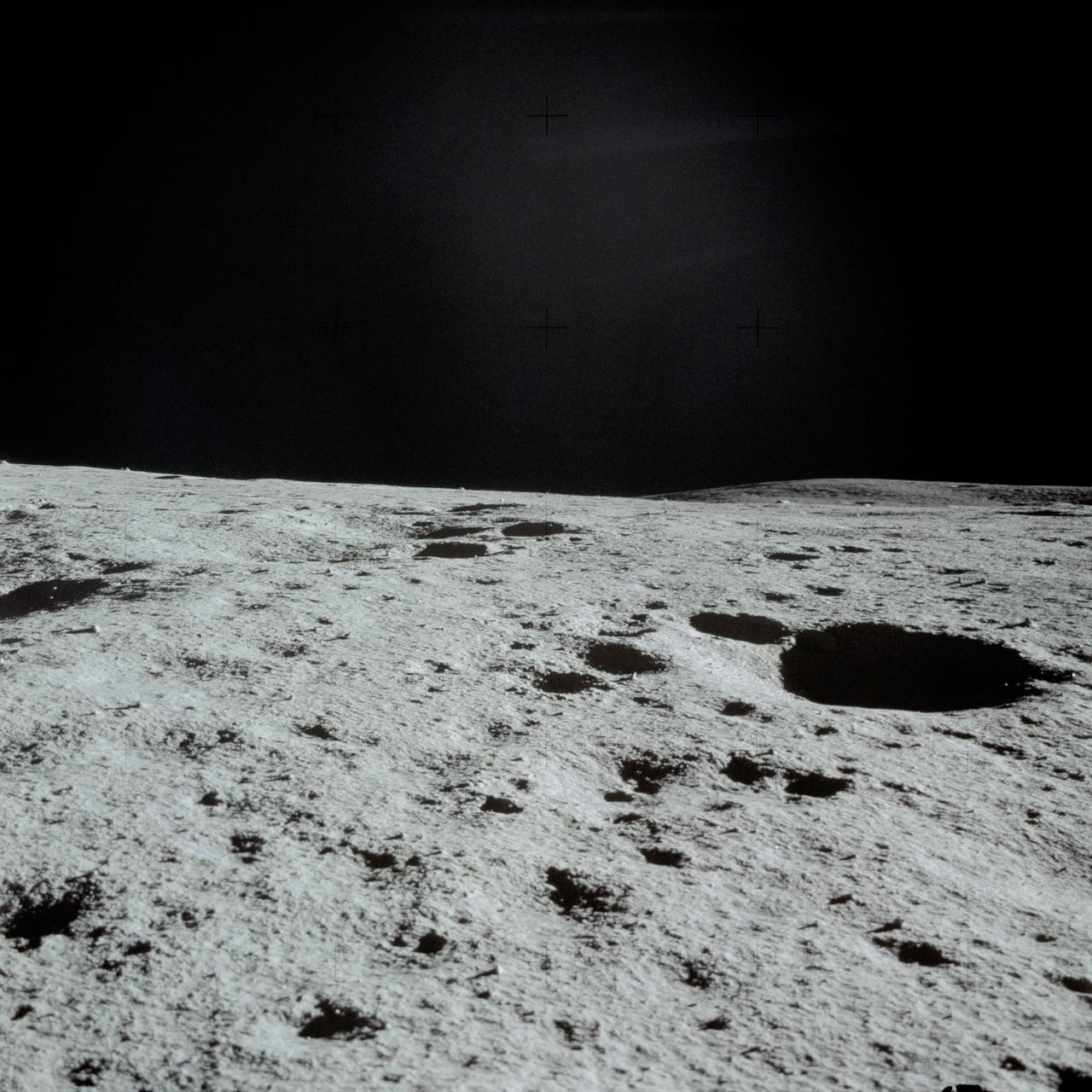
AS14-66-9244 (5-6 Feb. 1971) --- An excellent view of the lunar terrain looking through the right window of the Lunar Module (LM), photographed by one of the Apollo 14 astronauts during their stay on the lunar surface. Pothole-sized craters can be seen in the foreground. While astronauts Alan B. Shepard Jr., commander, and Edgar D. Mitchell, lunar module pilot, descended in the LM to explore the moon, astronaut Stuart A. Roosa, command module pilot, remained with the Command and Service Modules (CSM) in lunar orbit.
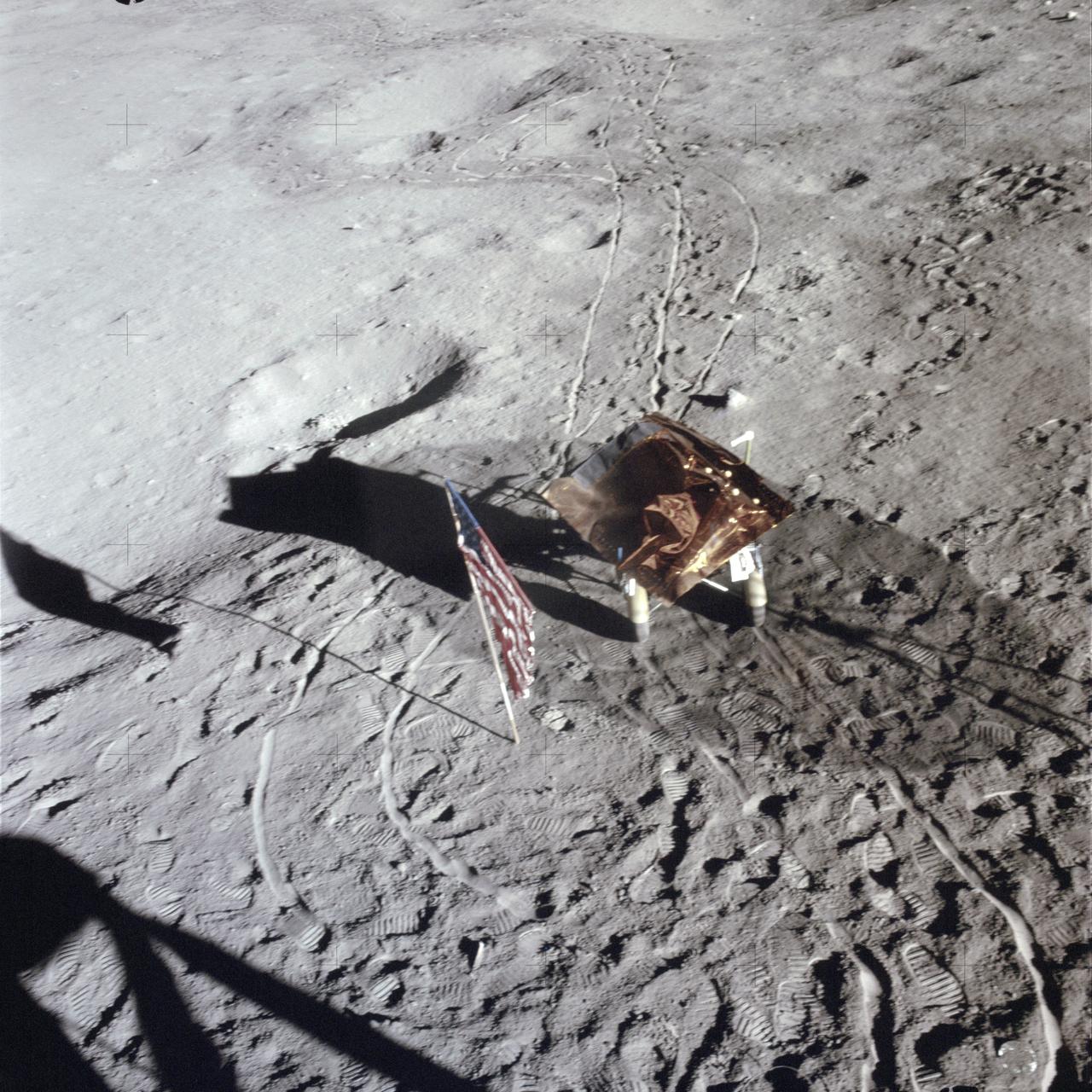
AS14-66-9325 (5 Feb. 1971) --- The third United States flag to be deployed on the lunar surface, footprints, wheel tracks and the "Rickshaw"-type portable workbench, as seen by the two moon-exploring astronauts from inside the Lunar Module (LM), give evidence of a busy first extravehicular activity (EVA) period. The two-wheeled cart is the Apollo modularized equipment transporter (MET), covered with a sheet of foil material to protect the cameras and rock box between EVAs. While astronauts Alan B. Shepard Jr., commander, and Edgar D. Mitchell, lunar module pilot, descended in the LM, astronaut Stuart A. Roosa, command module pilot, remained with the Command and Service Modules (CSM) in lunar orbit.
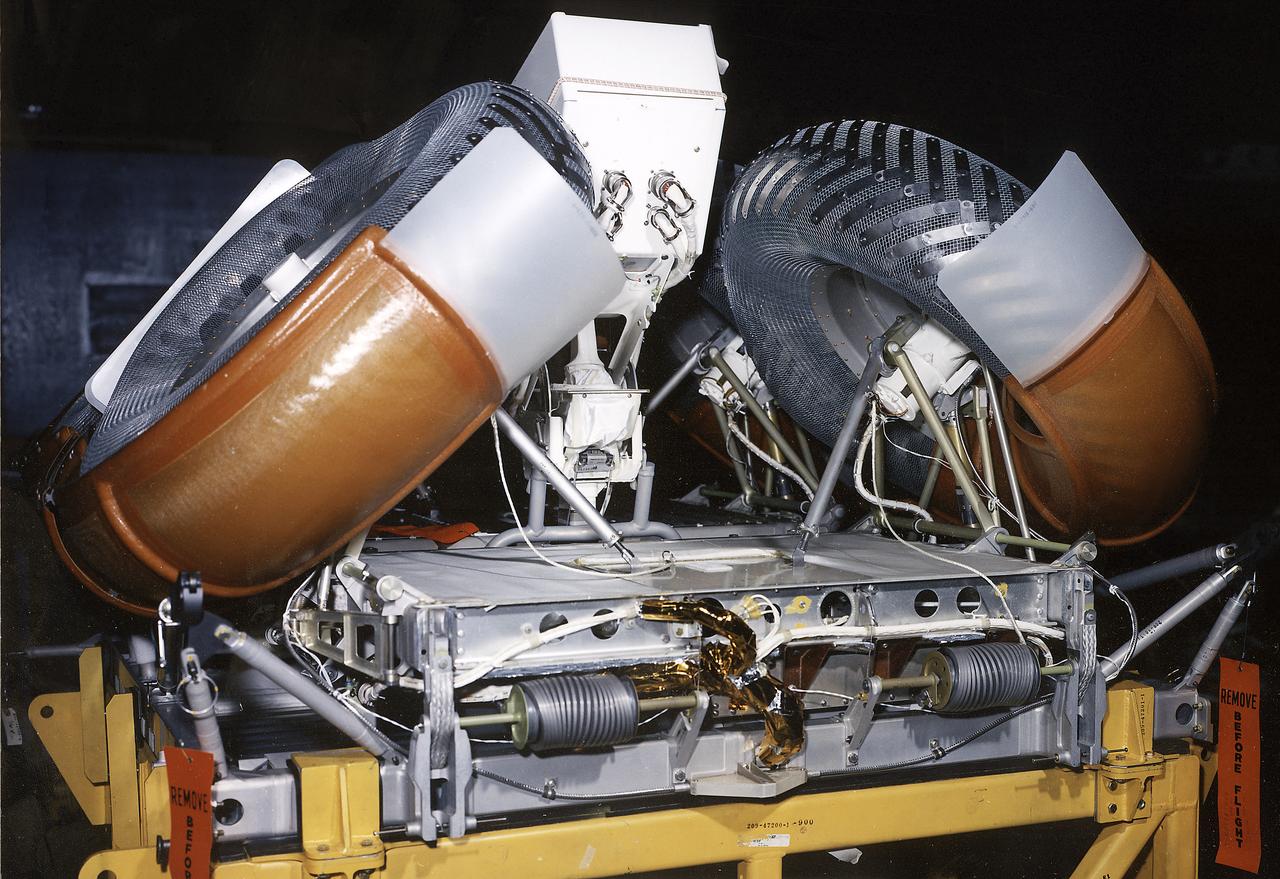
This photograph shows a front view of a folded configuration of the Lunar Roving Vehicle (LRV) No. 2. The LRV was built to give Apollo astronauts a greater range of mobility during lunar exploration. It was an open-space and collapsible vehicle about 10 feet long with large mesh wheels, anterna, appendages, tool caddies, and camera. An LRV was used on each of the last three Apollo missions; Apollo 15, Apollo 16, and Apollo 17. It was built by the Boeing Company under the direction of the Marshall Space Flight Center.

AS14-66-9278 (5 Feb. 1971) --- An excellent view of the Apollo 14 Lunar Module (LM) on the moon, as photographed during the first Apollo 14 extravehicular activity (EVA) on the lunar surface. While astronauts Alan B. Shepard Jr., commander, and Edgar D. Mitchell, lunar module pilot, descended in the LM to explore the moon, astronaut Stuart A. Roosa, command module pilot, remained with the Command and Service Modules (CSM) in lunar orbit.
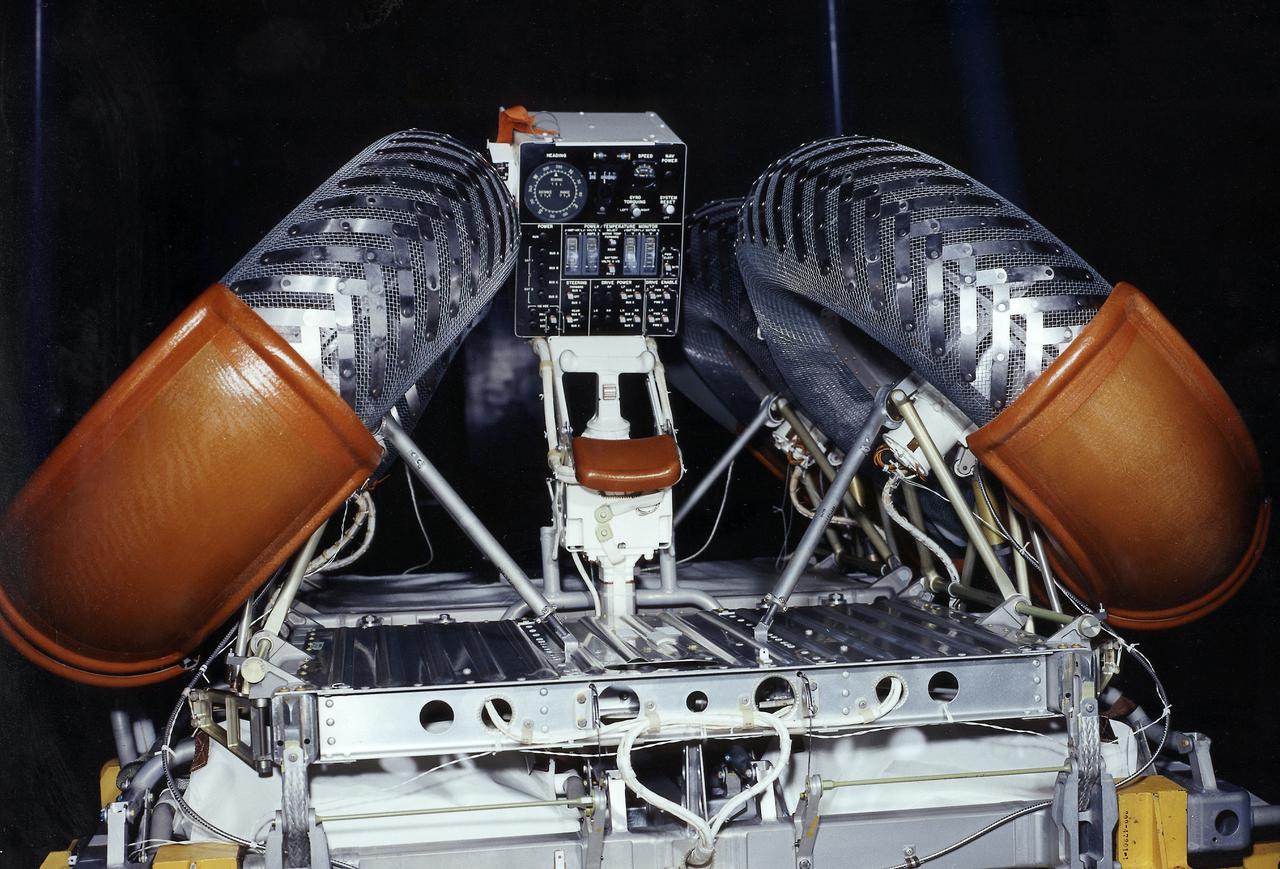
This photograph shows a rear view of a folded configuration of the Lunar Roving Vehicle (LRV) No. 2. The LRV was built to give Apollo astronauts a greater range of mobility during lunar exploration. It was an open-space and collapsible vehicle about 10 feet long with large mesh wheels, anterna, appendages, tool caddies, and camera. An LRV was used on each of the last three Apollo missions; Apollo 15, Apollo 16, and Apollo 17. It was built by the Boeing Company under the direction of the Marshall Space Flight Center.
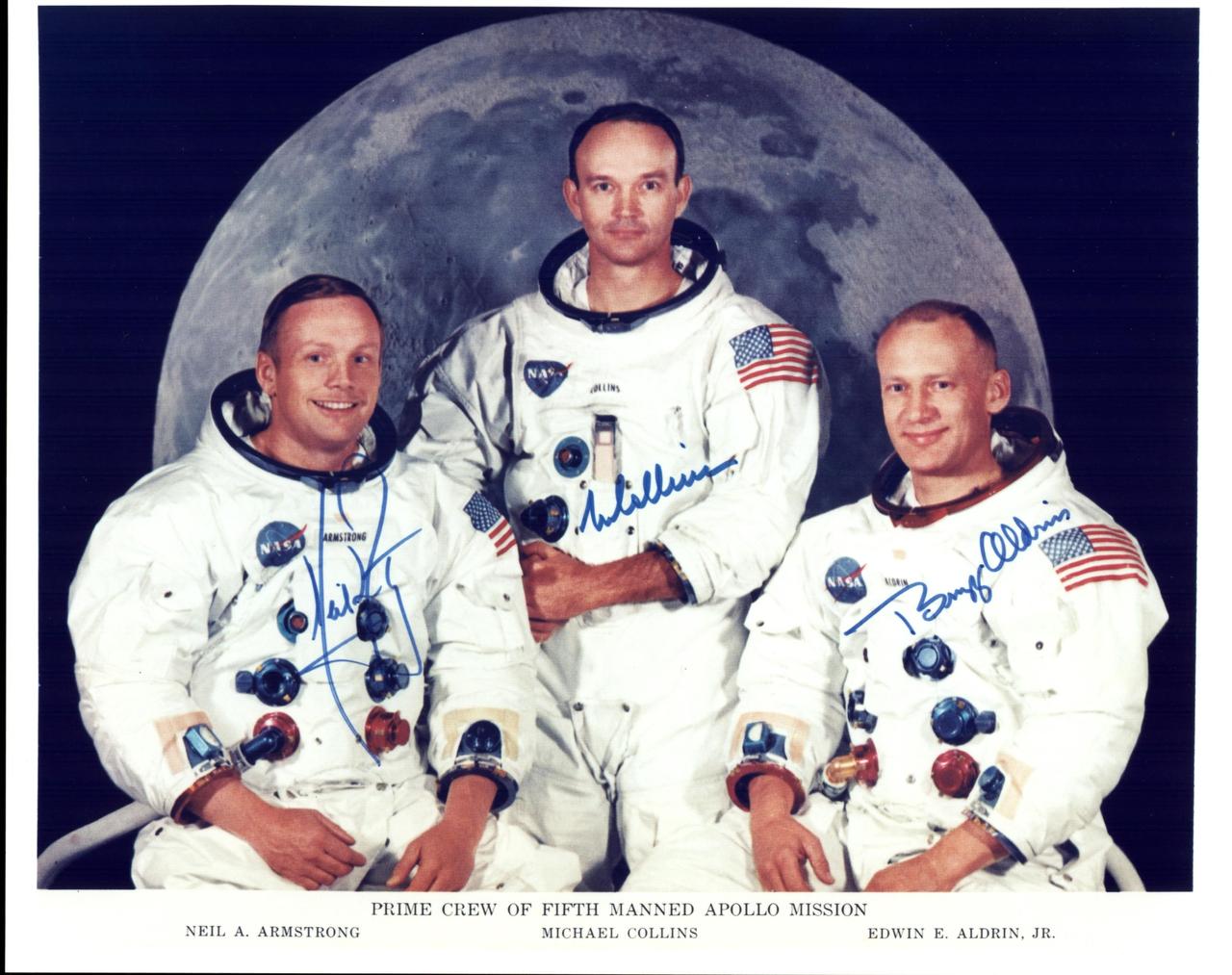
KENNEDY SPACE CENTER, FLA. - The Official Crew photo of the Apollow 11 Prime Crew. From left to right are astronauts Neil A. Armstrong, Commander; Michael Collins, Command Module Pilot; and Edwin E. Aldrin Jr., Lunar Module Pilot.
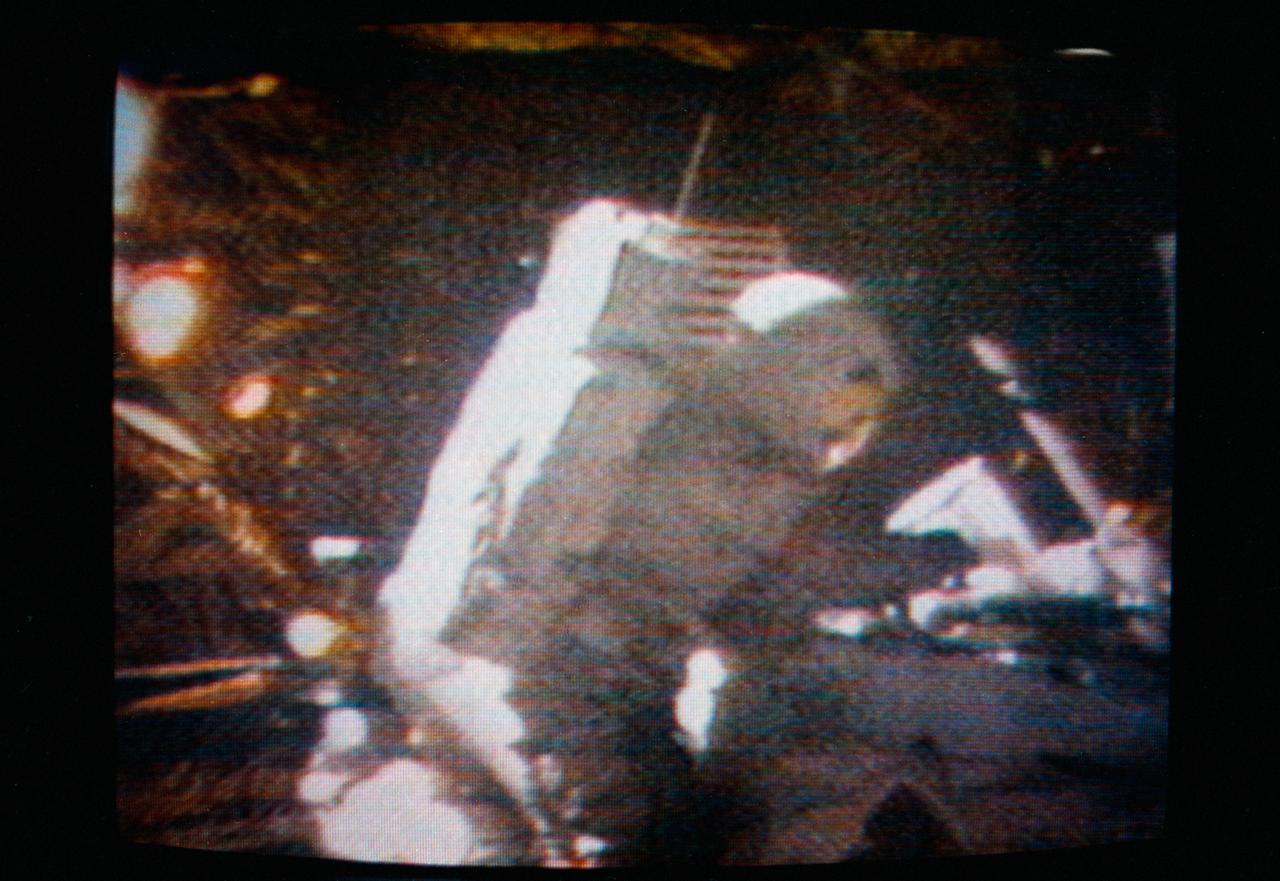
S71-43785 (2 Aug. 1971) --- Astronaut David R. Scott, Apollo 15 commander, performs the act of cancelling the first Apollo 15 commemorative postage stamp on the moon, as seen in this color reproduction taken from a transmission made by the RCA color television camera mounted on the Lunar Roving Vehicle. Scott holds a stamp cancellation device in his right hand. The new commemorative postage stamp heralds: "United States in Space -- A Decade of Achievement." The U.S. Postal Service chose artist Robert McCall of Paradise Valley, Arizona, to design the new U.S. eight-cent stamp. The stamp cancellation occurred toward the end of the third and final lunar surface extravehicular activity by astronauts Scott and James B. Irwin, lunar module pilot.
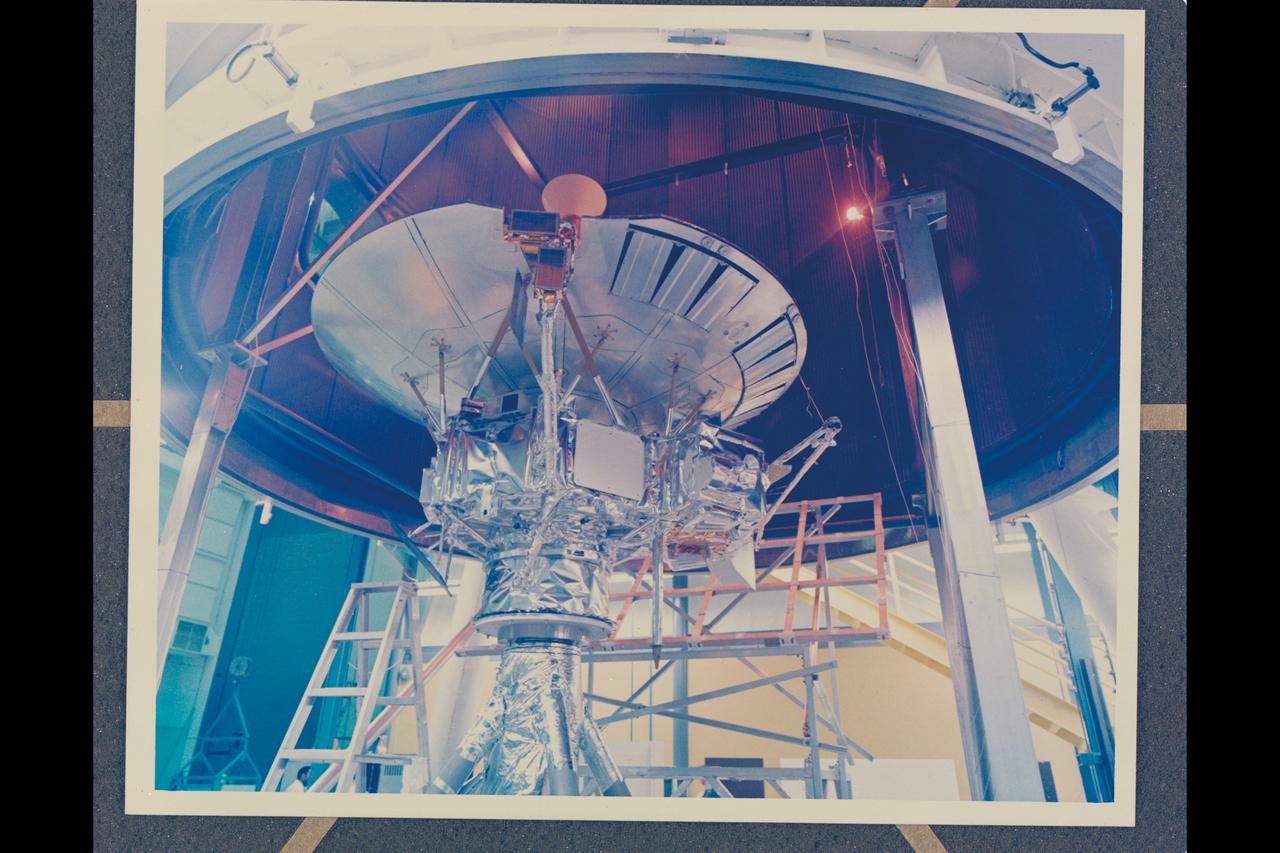
Pioneer F/G spacecraft thermal model
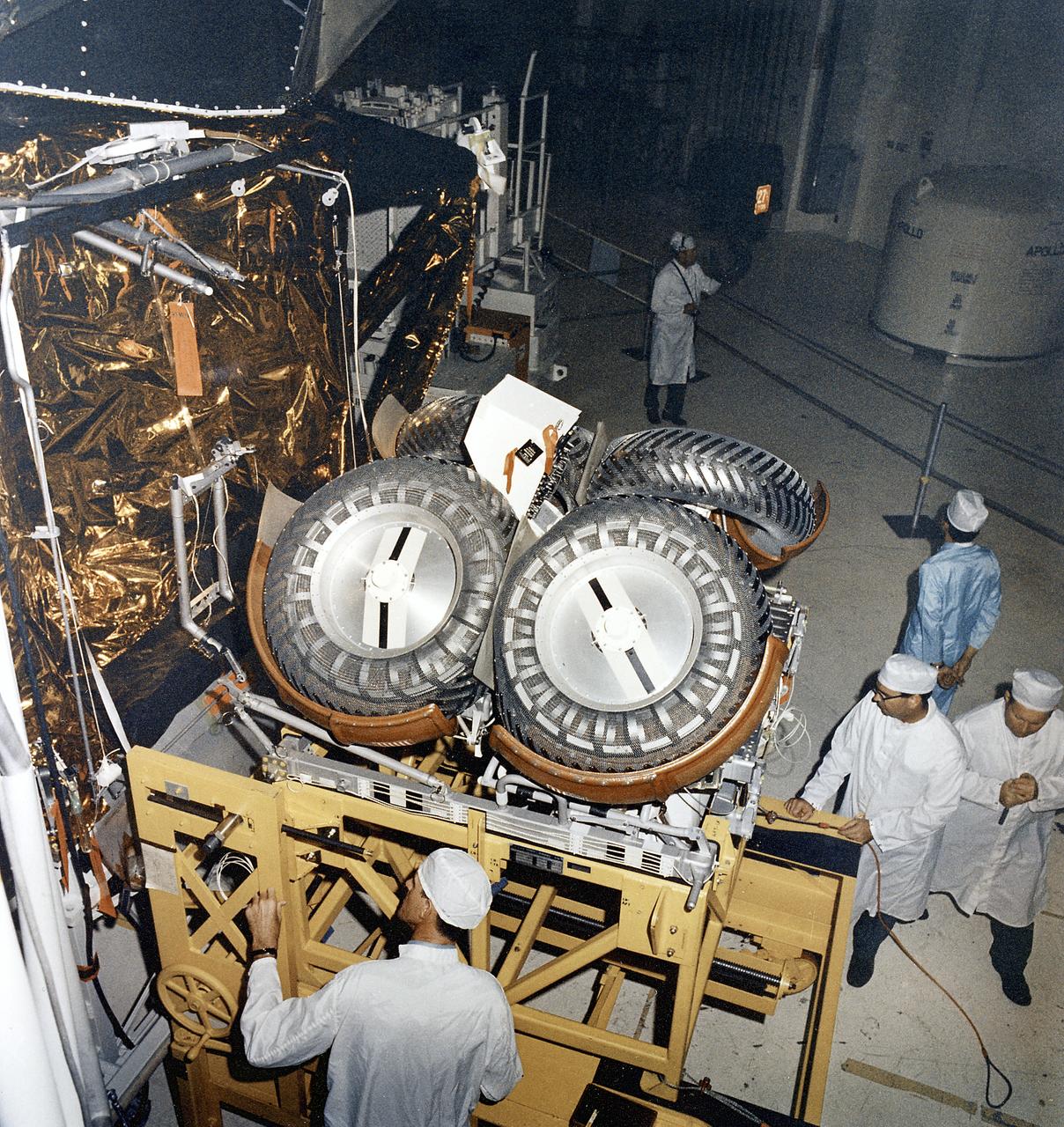
This photograph was taken during the installation of the Lunar Roving Vehicle (LRV) in the Lunar Module at the Kennedy Space Center. The LRV was built to give Apollo astronauts a greater range of mobility during the last three lunar exploration missions; Apollo 15, Apollo 16, and Apollo 17. It was designed and developed by the Marshall Space Flight Center and built by the Boeing Company.
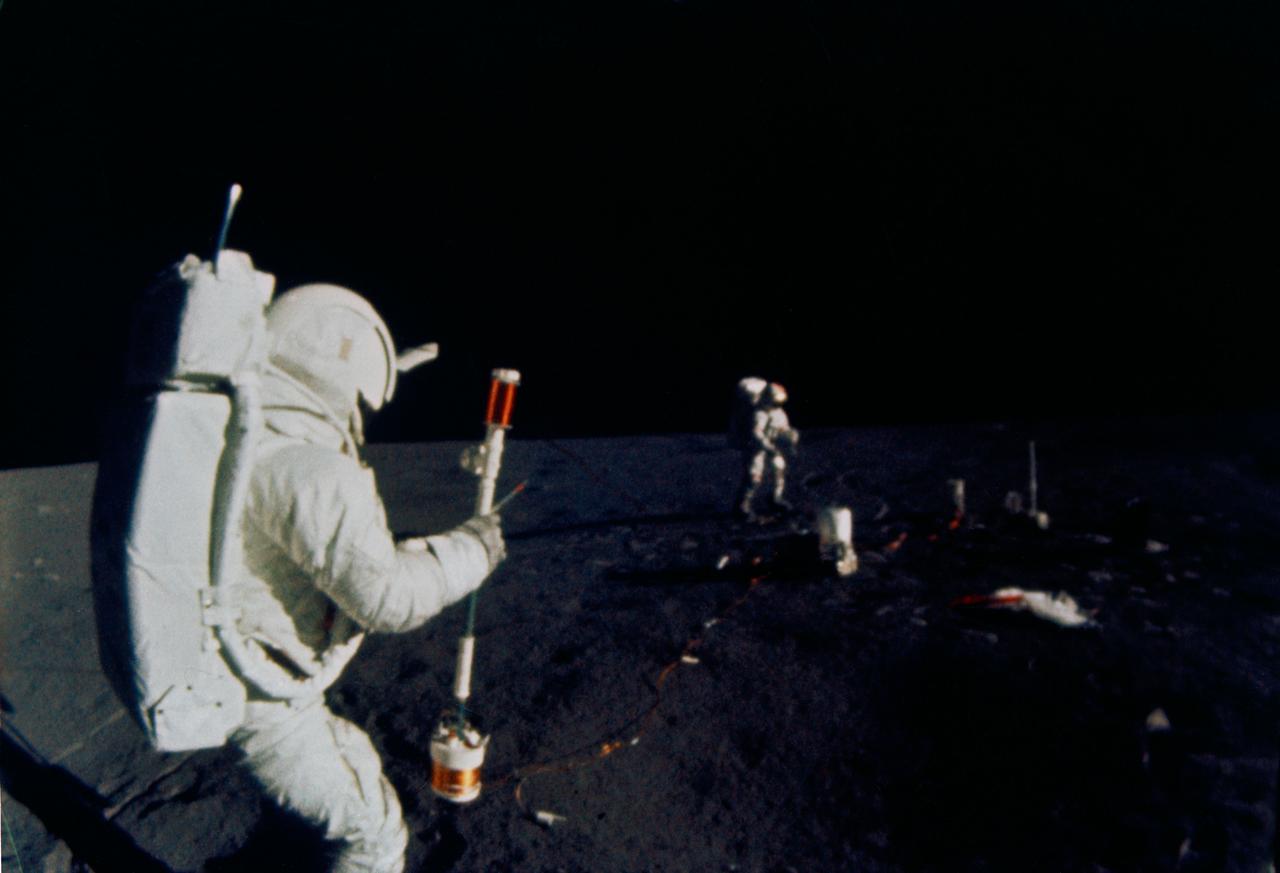
S71-19509 (5 Feb. 1971) --- Astronaut Edgar D. Mitchell, lunar module pilot, operates the Active Seismic Experiment's (ASE) thumper during the first Apollo 14 extravehicular activity (EVA) on the moon. Astronaut Alan B. Shepard Jr., commander, walks near deployed components of the Apollo Lunar Surface Experiments Package (ALSEP) in the background. This photograph was taken by an automatic 16mm camera mounted on the Apollo lunar hand tool carrier aboard the Modularized Equipment Transporter (MET). While astronauts Shepard and Mitchell descended in the LM to explore the moon, astronaut Stuart A. Roosa, command module pilot, remained with the Command and Service Modules (CSM) in lunar orbit.
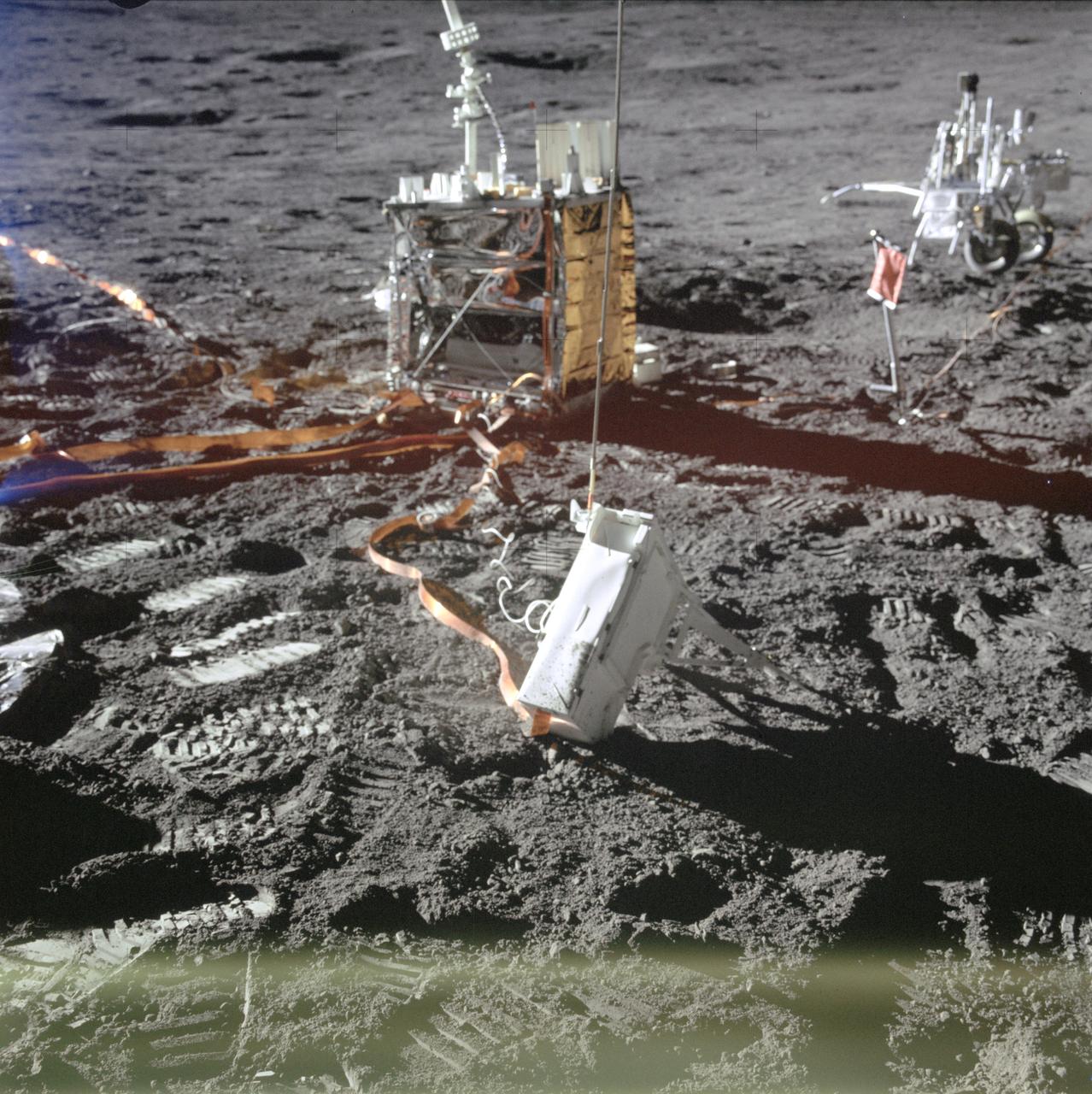
AS14-67-9361 (5 Feb. 1971) --- A close-up view of two components of the Apollo lunar surface experiments package (ALSEP) which the Apollo 14 astronauts deployed on the moon during their first extravehicular activity (EVA). In the center background is the ALSEP's central station (CS); and in the foreground is the mortar package assembly of the ALSEP's active seismic experiment (ASE). The modularized equipment transporter (MET) can be seen in the right background. While astronauts Alan B. Shepard Jr., commander, and Edgar D. Mitchell, lunar module pilot, descended in the Lunar Module (LM) to explore the moon, astronaut Stuart A. Roosa, command module pilot, remained with the Command and Service Modules (CSM) in lunar orbit.
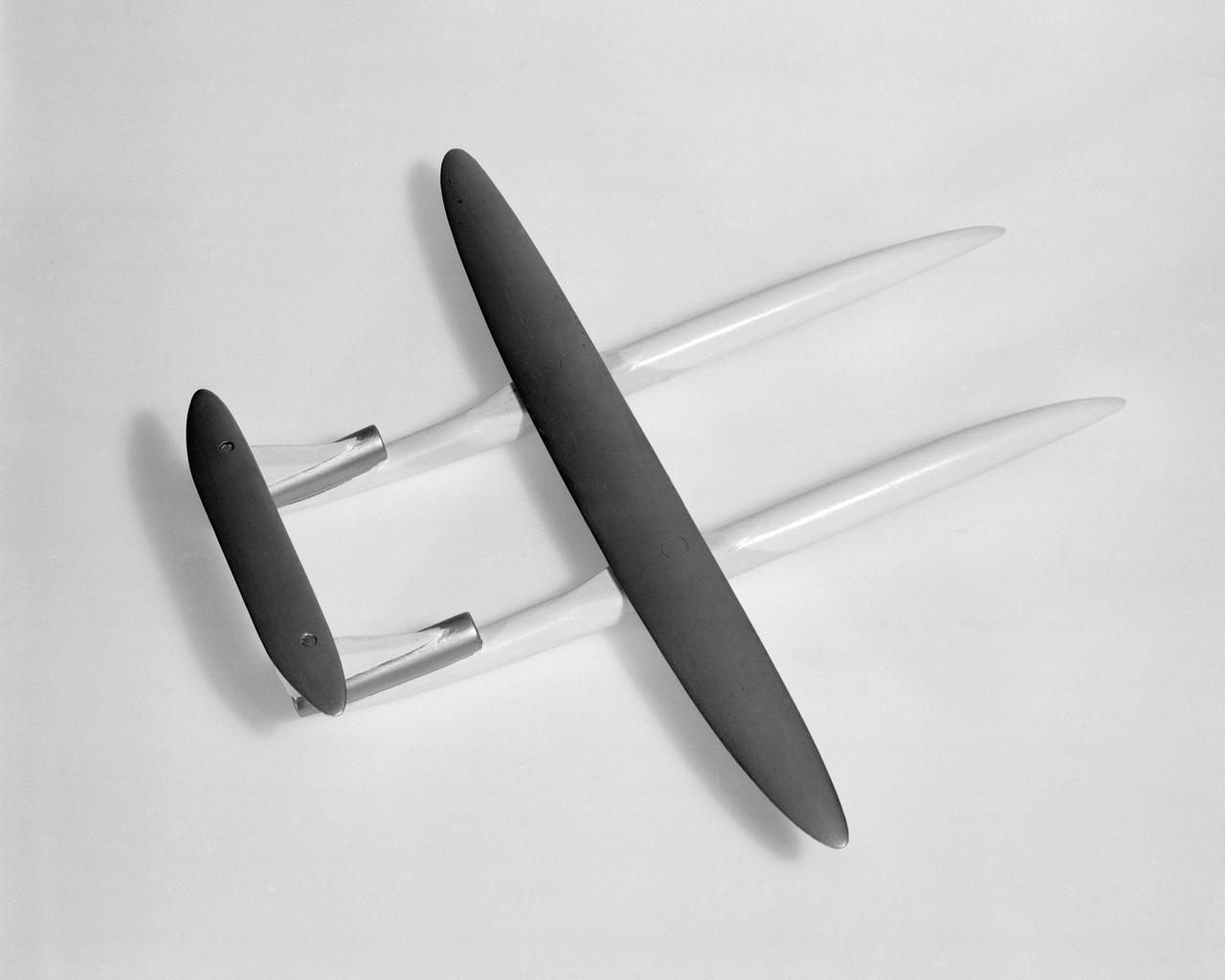
OBLIQUE WING TRANSONIC TRANSPORT MODEL (2-BODY FUSELAGE) DR. R.T. JONES' CONCEPT
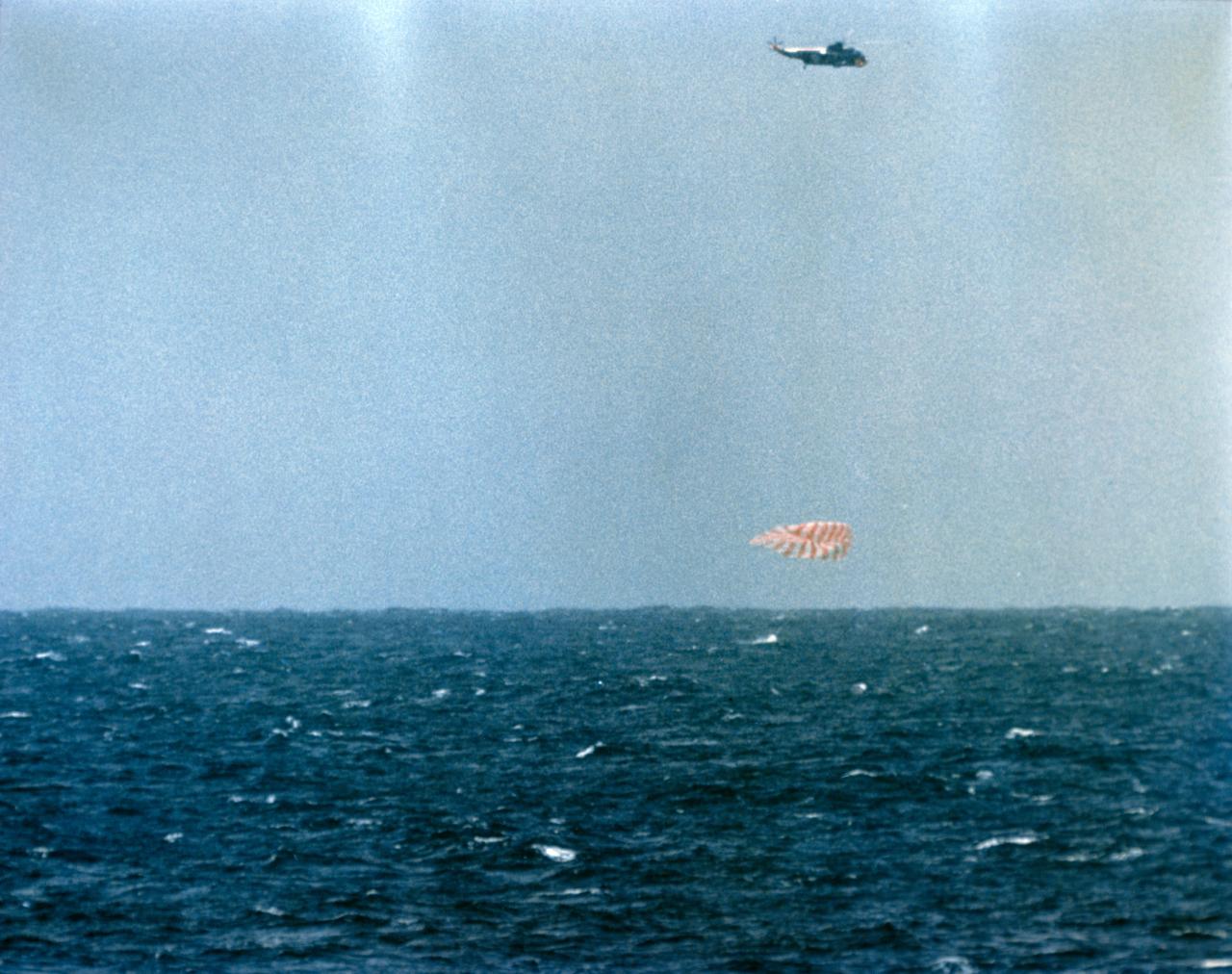
S71-24944 (16 May 1963) --- The Mercury-Atlas 9 "Faith 7" spacecraft, with astronaut L. Gordon Cooper Jr. aboard, splashes down in the Pacific Ocean to conclude a 22-orbit mission lasting 34 hours and 20.5 minutes. The capsule's parachute is fully deployed in this view. A rescue helicopter hovers overhead. Photo credit: NASA
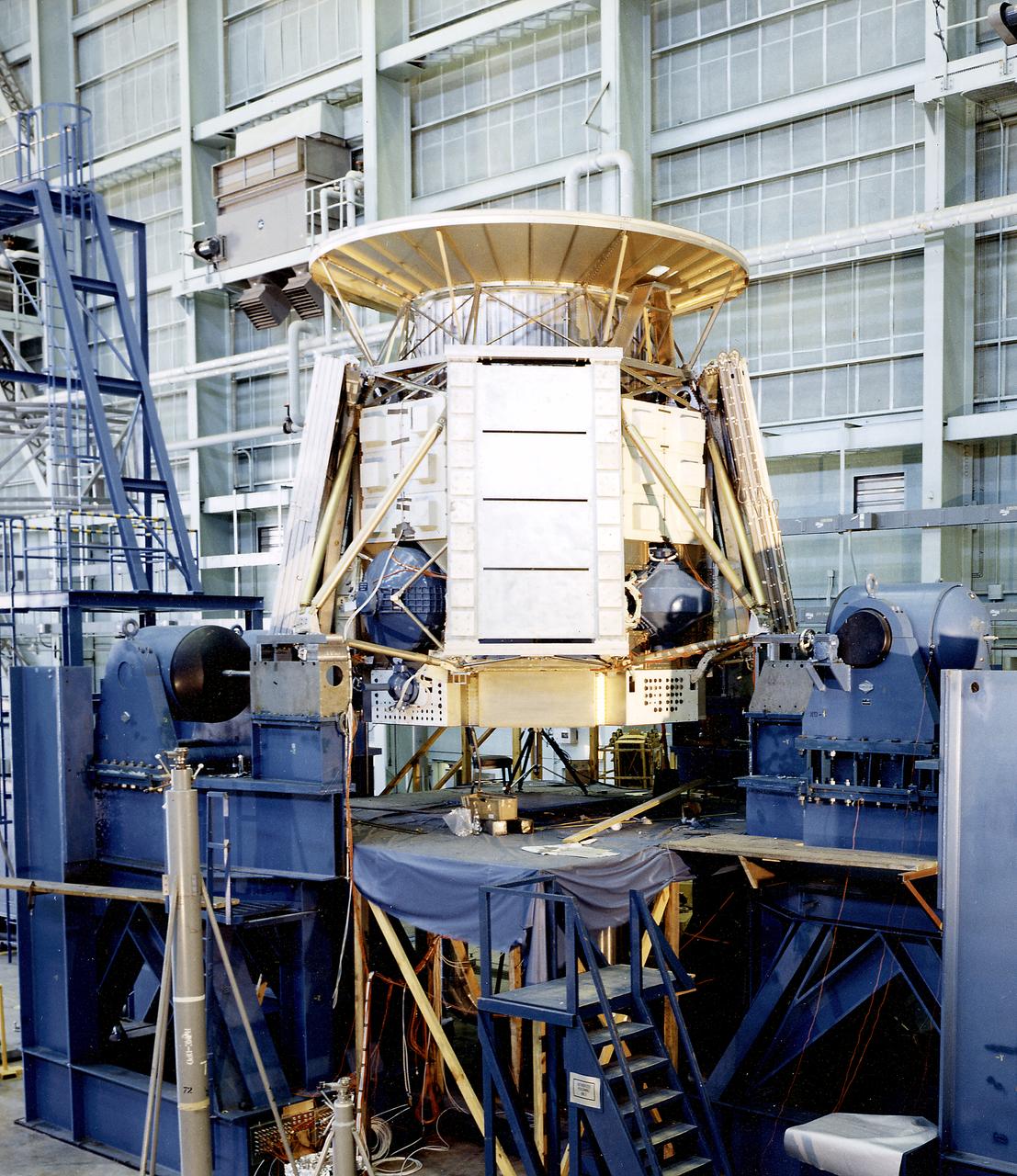
The Apollo Telescope Mount (ATM), one of four major components comprising the Skylab, was designed and developed by the Marshall Space Flight Center. In this image, the ATM is shown undergoing horizontal vibration testing in a vibration test unit.
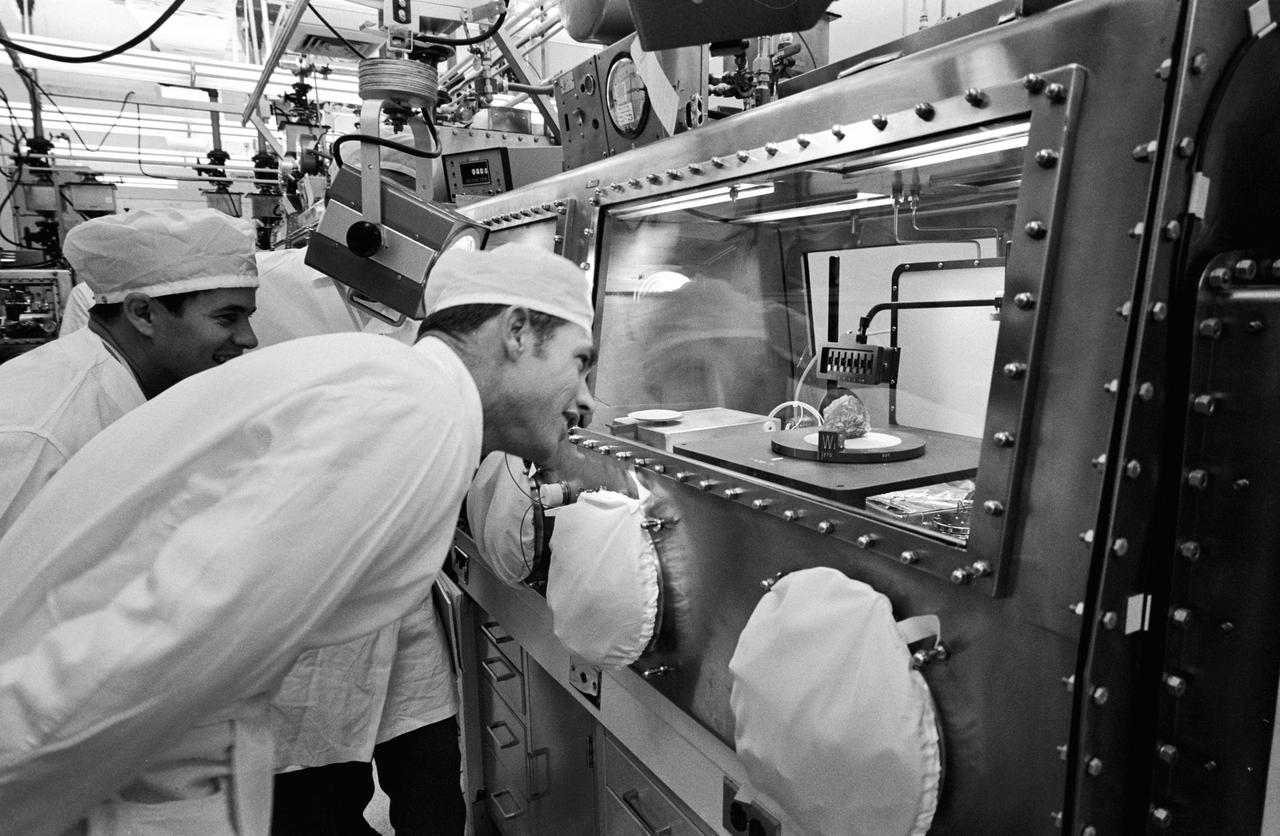
S71-43477 (12 Aug. 1971) --- Astronaut David R. Scott, right, commander of the Apollo 15 mission, gets a close look at the sample referred to as "Genesis rock" in the Non-Sterile Nitrogen Processing Line (NNPL) in the Lunar Receiving Laboratory (LRL) at the Manned Spacecraft Center (MSC). Scientist-astronaut Joseph P. Allen IV, left, an Apollo 15 spacecraft communicator, looks on with interest. The white-colored rock has been given the permanent identification of 15415.

Astronaut John W. Young, Apollo 16 prime crew commander (right), takes a drive in the One-G Lunar Roving Vehicle (LRV) trainer in the Lunar Topgraphic Simulation area at the Manned Spacecraft Center (MSC). He is accompanied by John Omstead, with General Electric, MSC.
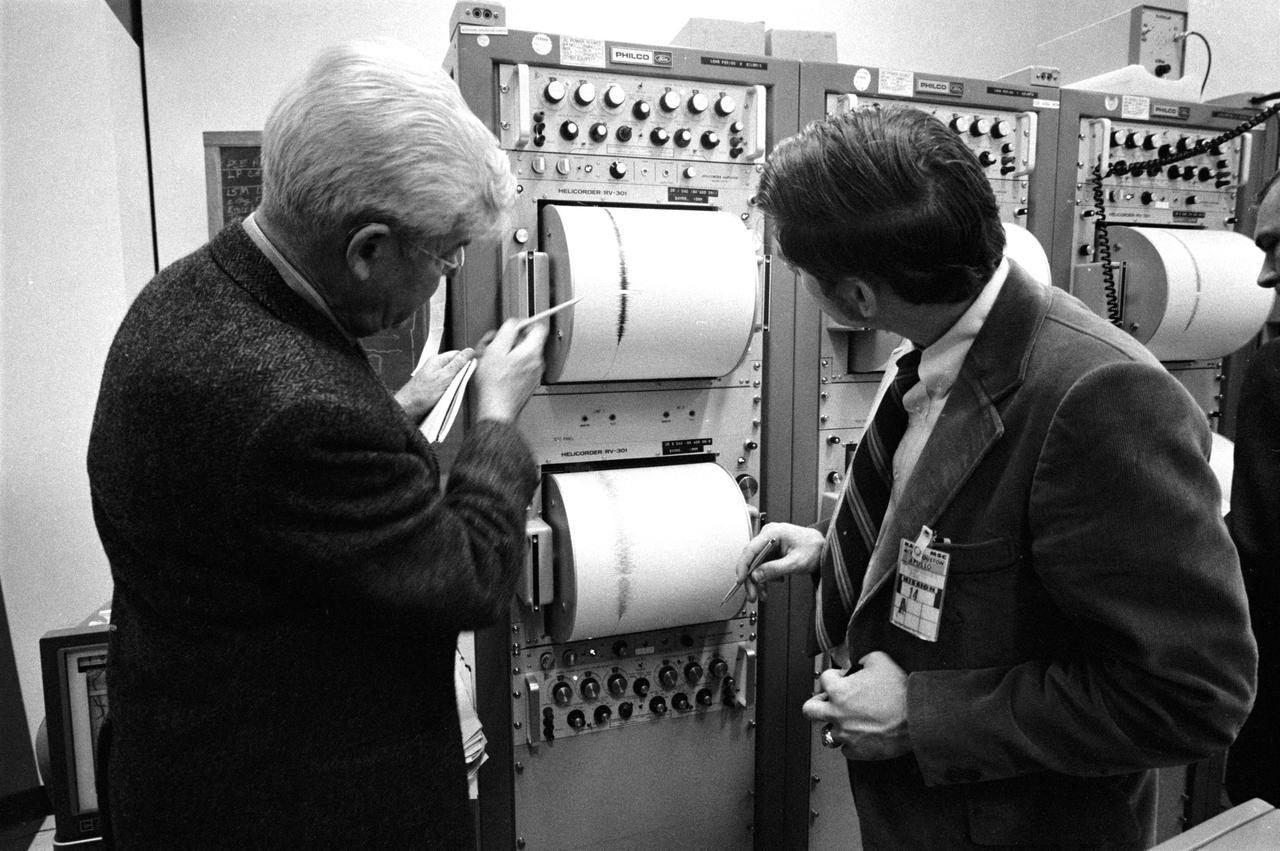
S71-17609 (4 Feb. 1971) --- These two individuals are examining a seismic reading in the Mission Control Center's ALSEP Room during the Apollo 14 S-IVB impact on the moon. Dr. Maurice Ewing (left) is the director of the Lamont-Doherty Geological Observatory at Columbia University. David Lammlein, a Columbia graduate student, is on the right. The Apollo 14 Saturn IVB stage impacted on the lunar surface at 1:40:54 a.m. (CST), Feb. 4, 1971, about 90 nautical miles south-southwest of the Apollo 12 passive seismometer. The energy release was comparable to 11 tons of TNT. Dr. Gary Latham of the Lamont-Doherty Geological Observatory is the principal investigator for the Passive Seismic Experiment, a component of the Apollo Lunar Surface Experiments Package.
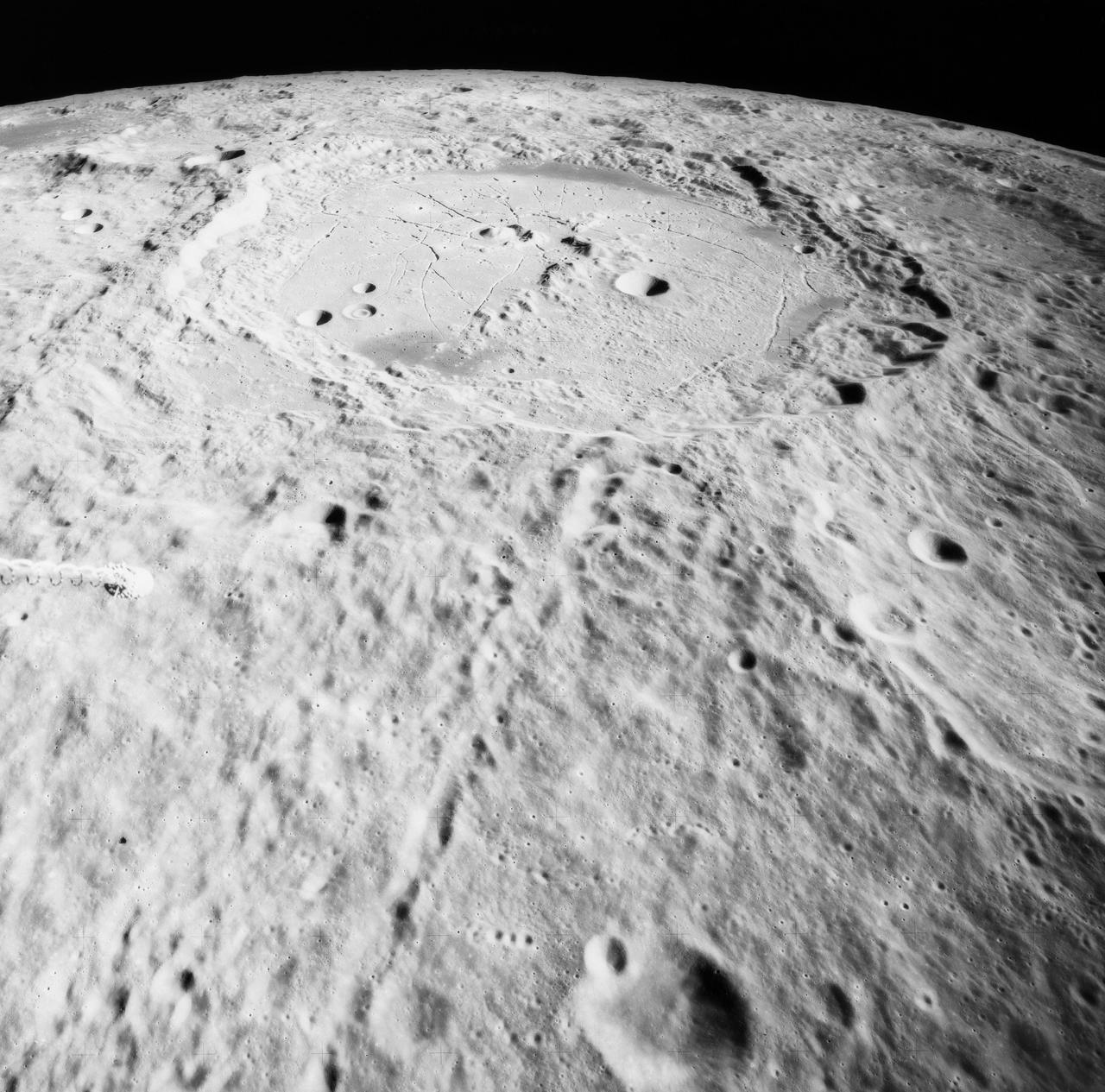
S71-44668 (31 July-2 Aug. 1971) --- An oblique view of the crater Humboldt, as photographed by the Fairchild metric camera in the Scientific Instrument Module (SIM) bay of the Apollo 15 Command and Service Modules (CSM) in lunar orbit. This view is looking southerly. Humboldt, which is 200 kilometers (124 statute miles) in diameter, is located at 81 degrees east longitude and 27 degrees south latitude. The three-inch mapping camera was one of eight lunar orbital science experiments located in the SIM bay.
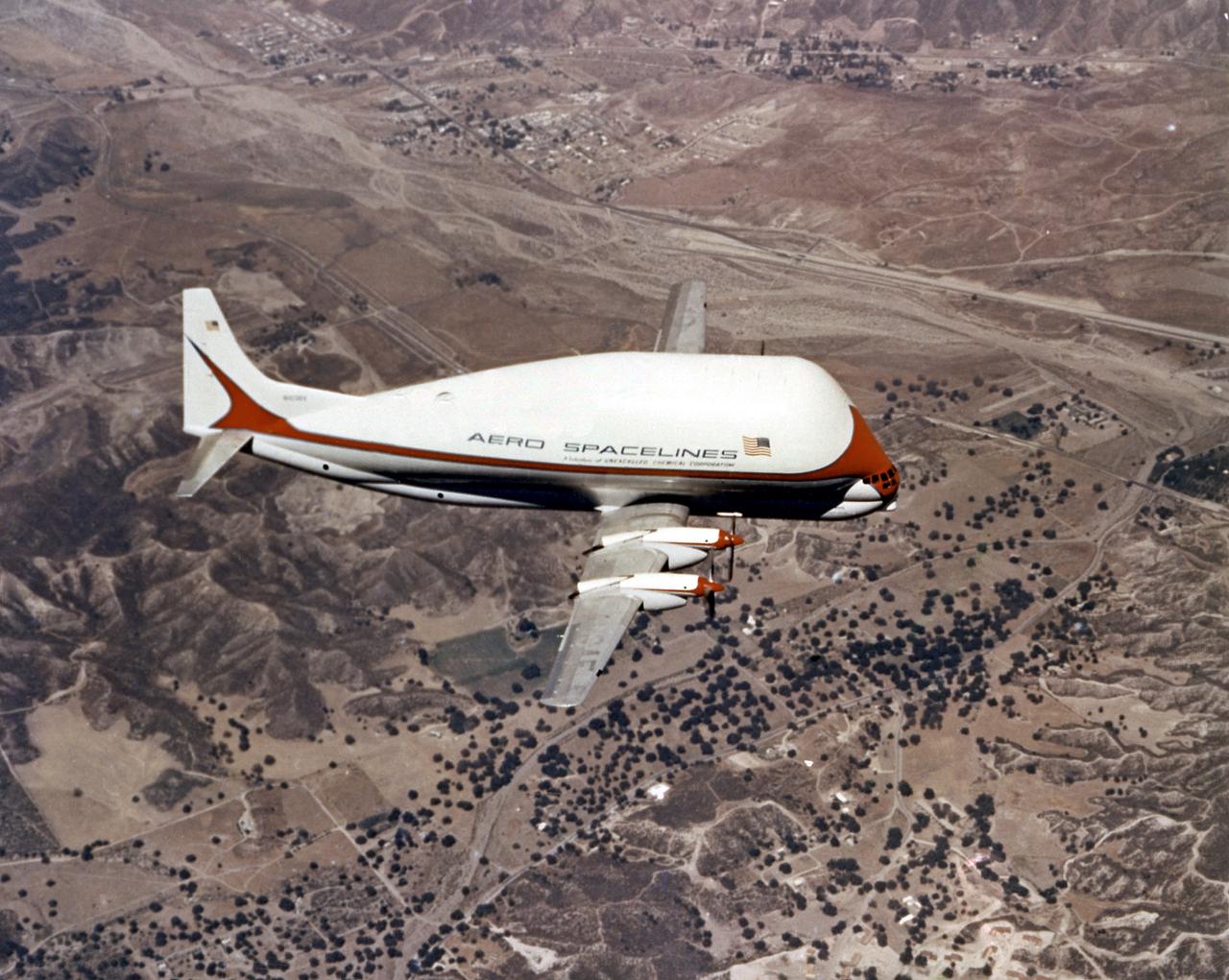
Super Guppy, bigger sister of the aptly named Pregnant Guppy, was the only airplane in the world capable of carrying a complete S-IVB stage. This aircraft was built by John M. Conroy of Aero Spaceliners, Incorporated, who started with the fuselages of a surplus Boeing C-97 Stratocruiser, ballooned out the upper decks enormously, and hinged the front sections so that they could be folded back 110 degrees. The Super Guppy flew smoothly at a 250-mph cruising speed, and its cargo deck provided a 25-foot clear diameter.
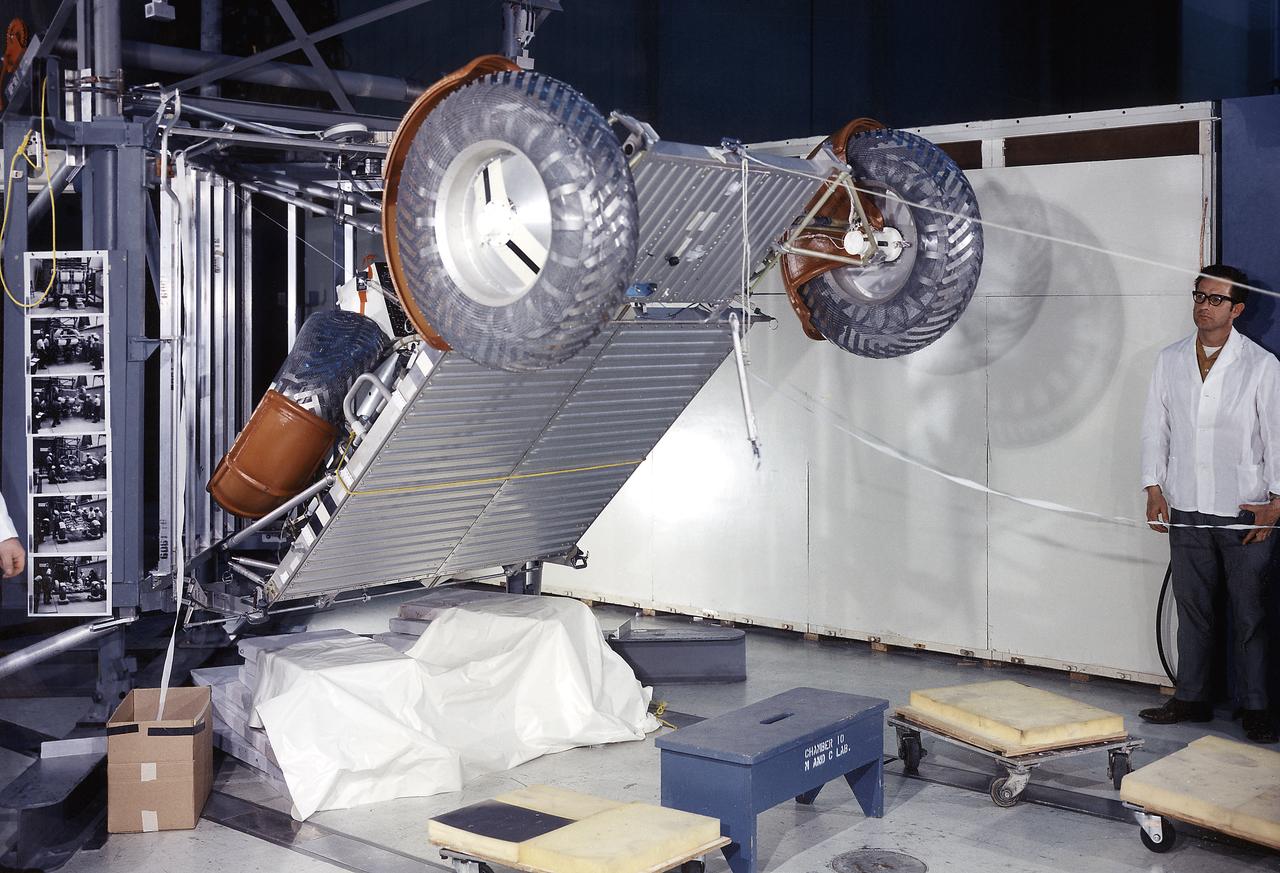
This photograph was taken during a deployment simulation of the Lunar Roving Vehicle (LRV). The LRV was built to give Apollo astronauts a greater range of mobility during the last three lunar exploration missions; Apollo 15, Apollo 16, and Apollo 17. It was designed and developed by the Marshall Space Flight Center and built by the Boeing Company.
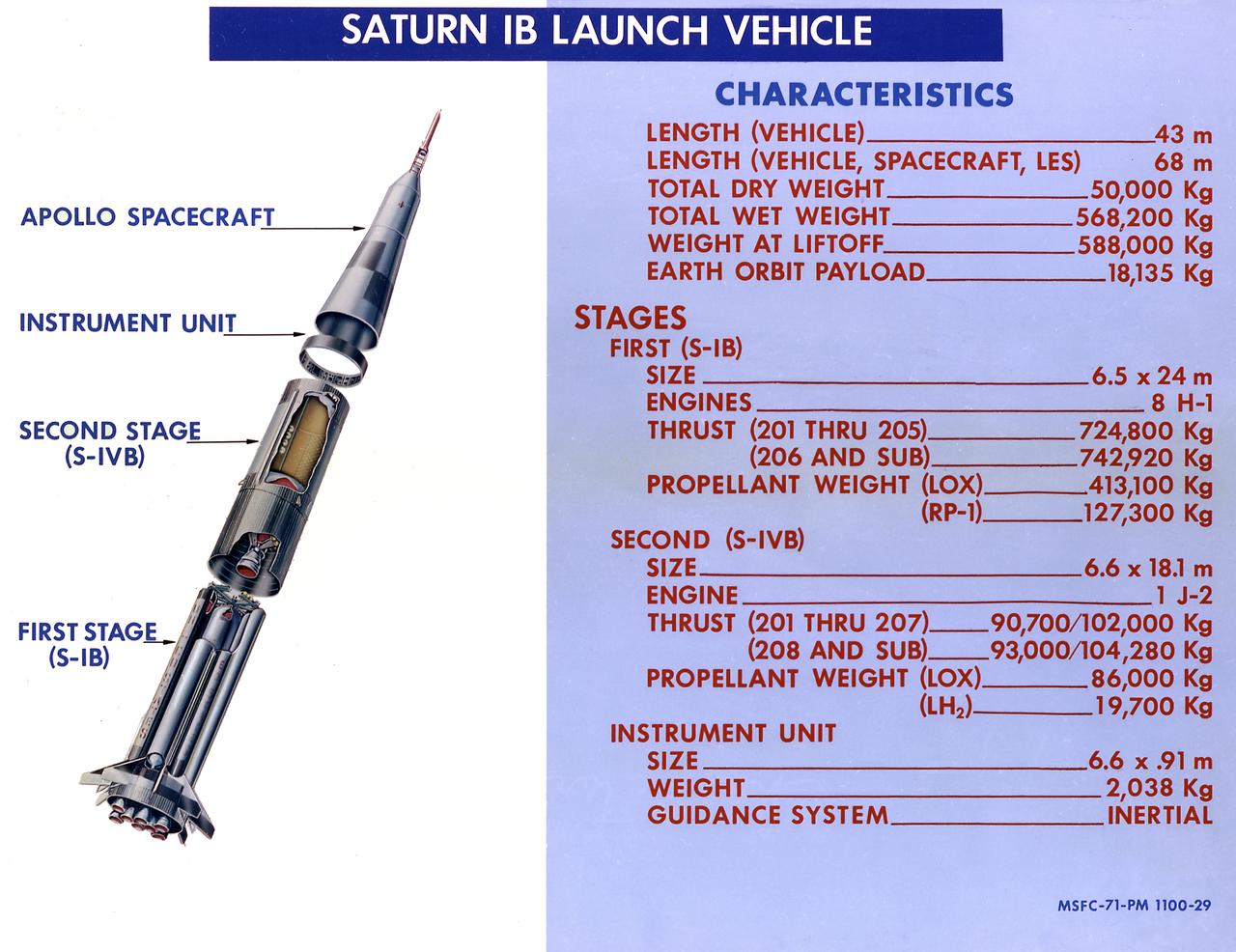
This 1968 cutaway drawing illustrates the Saturn IB launch vehicle with its two booster stages, the S-IB (first stage) and S-IVB (second stage), and provides the vital statistics in metric units. Developed by the Marshall Space Flight Center (MSFC) as an interim vehicle in MSFC's "building block" approach to the Saturn rocket development, the Saturn IB utilized Saturn I technology to further develop and refine the larger boosters and the Apollo spacecraft capabilities required for the marned lunar missions.
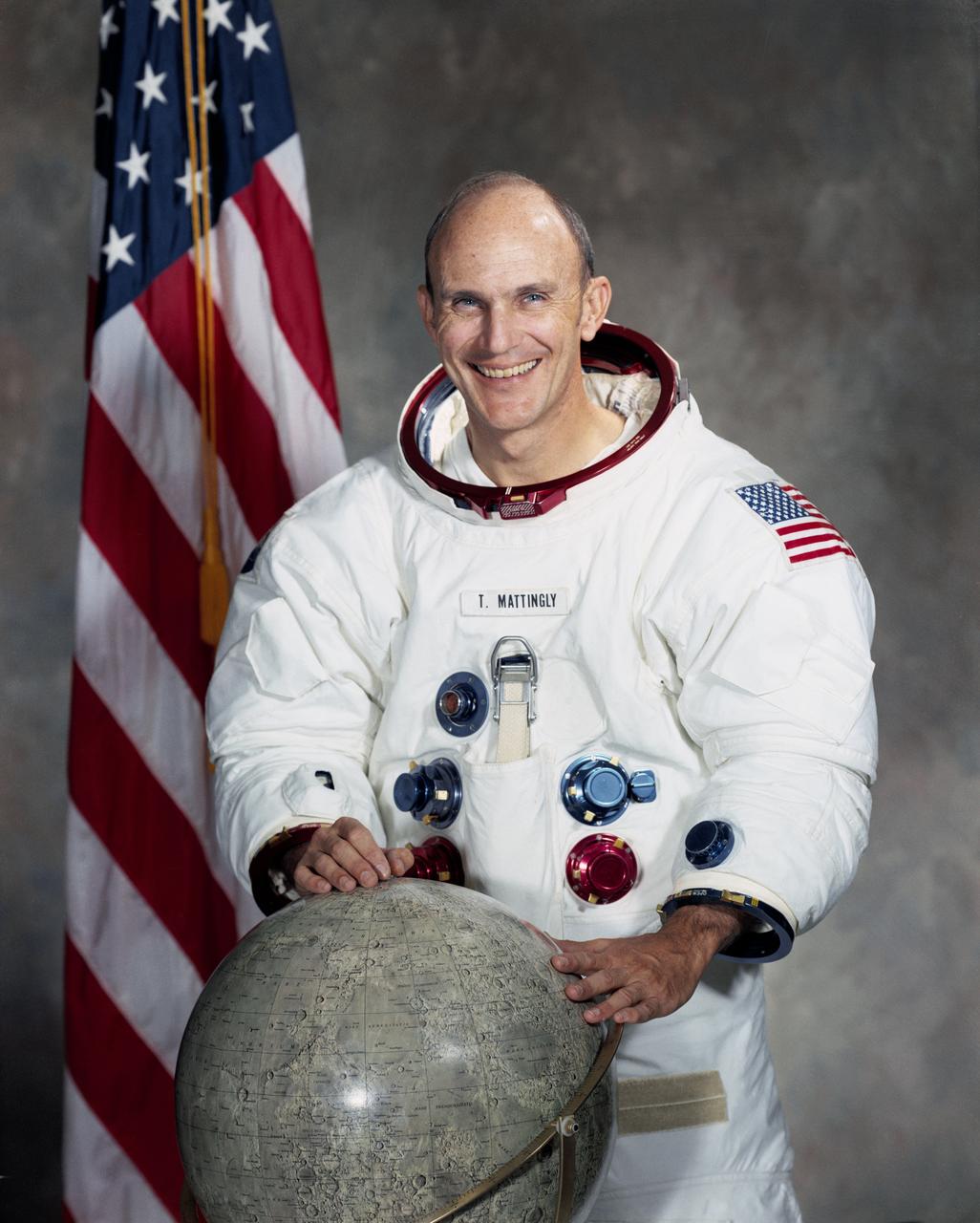
S71-51295 (21 Sept. 1971) --- Astronaut Thomas K. Mattingly II
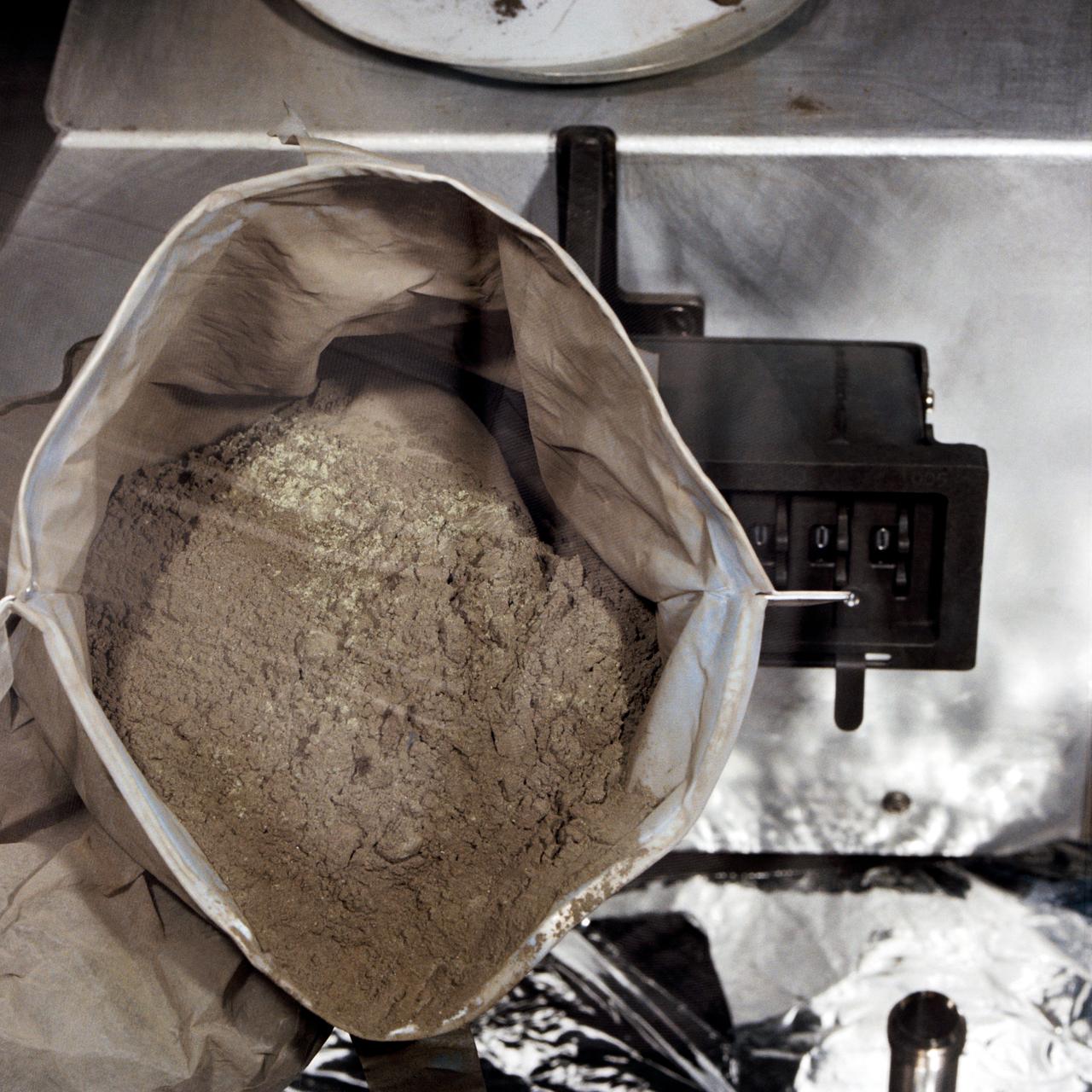
S71-43052 (August 1971) --- A close-up view of a container full of green-colored lunar soil in the Non-Sterile Nitrogen Processing Line (NNPL) in the Lunar Receiving Laboratory (LRL) at the Manned Spacecraft Center (MSC). This sample, broken down into six separate samples after this photo was made, was made up of comprehensive fines from near Spur Crater on the Apennine Front. The numbers assigned to the sample include numbers 15300 through 15305. Astronauts David R. Scott and James B. Irwin took the sample during their second extravehicular activity (EVA) at a ground elapsed time (GET) of 146:05 to 146:06.

AS14-68-9448 (6 Feb. 1971) --- A close-up view of a large multi-colored boulder in the boulder field located on the rim of Cone Crater, as photographed by the moon-exploring crew members of the Apollo 14 lunar landing mission. This view is looking west by southwest. The Lunar Module (LM) can be seen in the background. While astronauts Alan B. Shepard Jr., commander, and Edgar D. Mitchell, lunar module pilot, were exploring the moon, after descending in the LM, astronaut Stuart A. Roosa, command module pilot, remained with the Command and Service Modules (CSM) in lunar orbit.
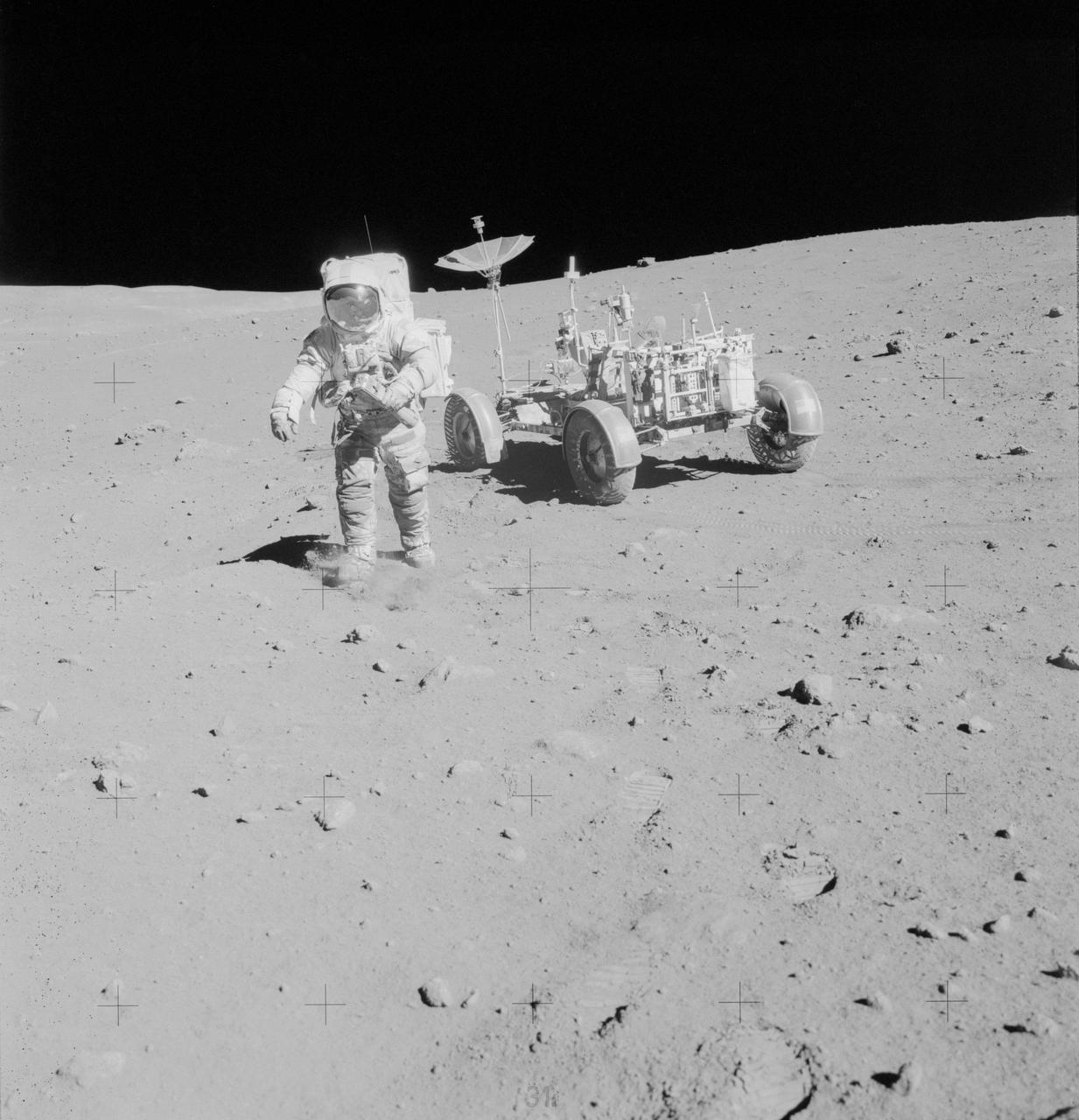
AS15-82-11168 (2 Aug. 1971) --- Astronaut James B. Irwin, lunar module pilot, walks away from the Lunar Roving Vehicle (LRV) during the third Apollo 15 lunar surface extravehicular activity (EVA) at the Hadley-Apennine landing site. The LRV is parked a short distance from the rim of Hadley Rille. The far wall of the rille is in the distance at extreme upper left. Irwin is holding the 500mm Hasselblad camera in his left hand. This photograph was taken by astronaut David R. Scott, commander. While astronauts Scott and Irwin descended in the Lunar Module (LM) to explore the moon, astronaut Alfred M. Worden, command module pilot, remained with the Command and Service Modules (CSM) in lunar orbit.
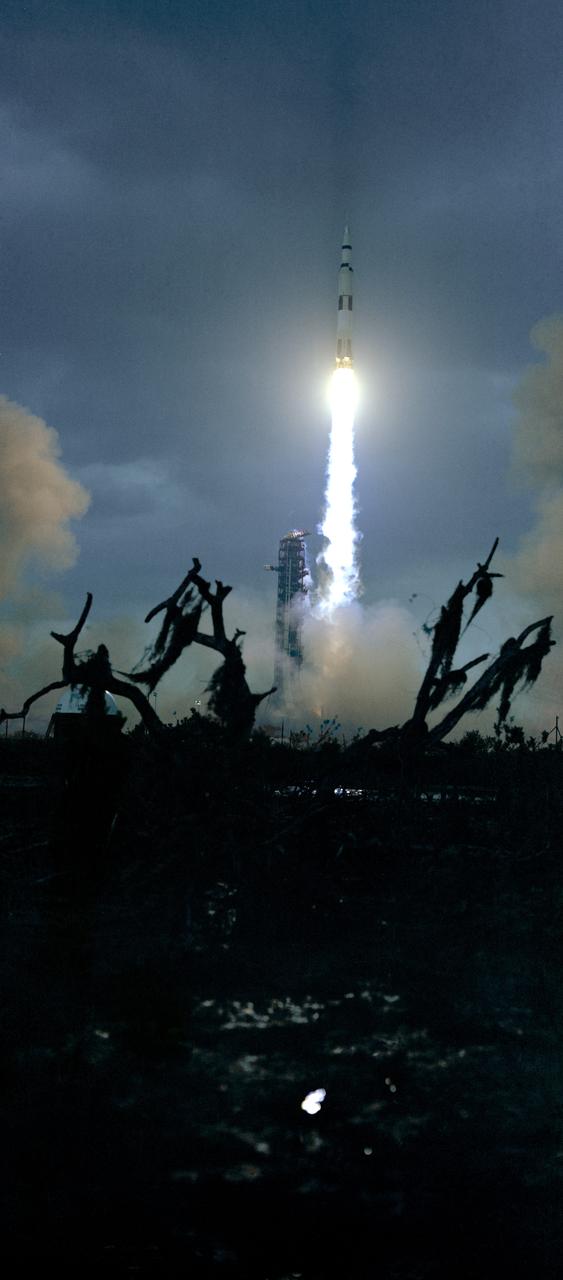
S71-18398 (31 Jan. 1971) --- The huge, 363-feet tall Apollo 14 (Spacecraft 110/Lunar Module 8/Saturn 509) space vehicle is launched from Pad A, Launch Complex 39, Kennedy Space Center (KSC), Florida at 4:03:02 p.m. (EST), Jan. 31, 1971, on a lunar landing mission. This view is framed by moss-covered dead trees in the dark foreground. Aboard the Apollo 14 spacecraft were astronauts Alan B. Shepard Jr., commander; Stuart A. Roosa, command module pilot; and Edgar D. Mitchell, lunar module pilot.
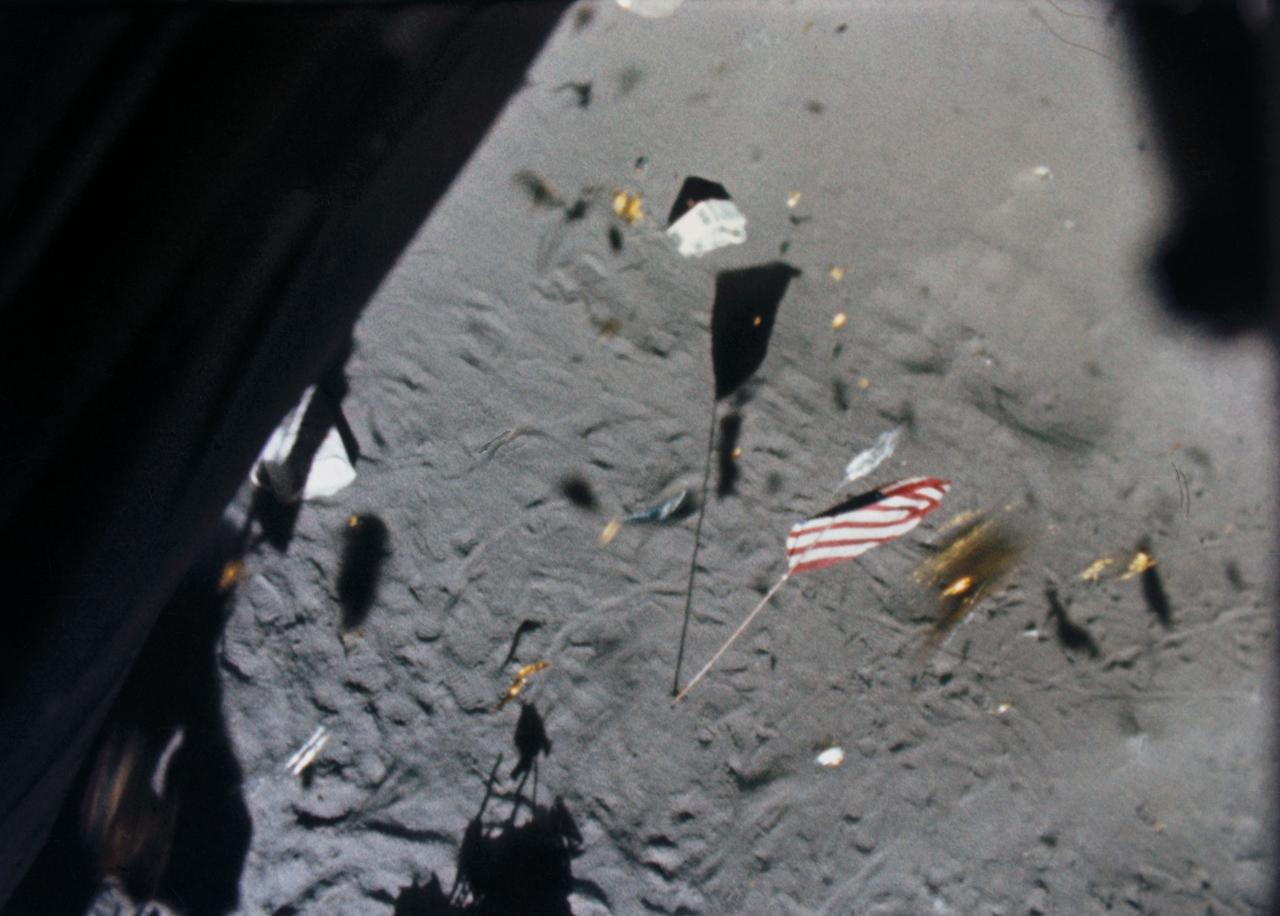
S71-19500 (6 Feb. 1971) --- The Apollo 14 Lunar Module (LM) ascent stage lifts off the lunar surface and the powerful LM engine causes a brief force of wind which scatters gold-colored foil, covering the LM, and disturbs the U.S. flag. This picture was taken from film exposed by the 16mm data acquisition camera - which was mounted inside the LM.
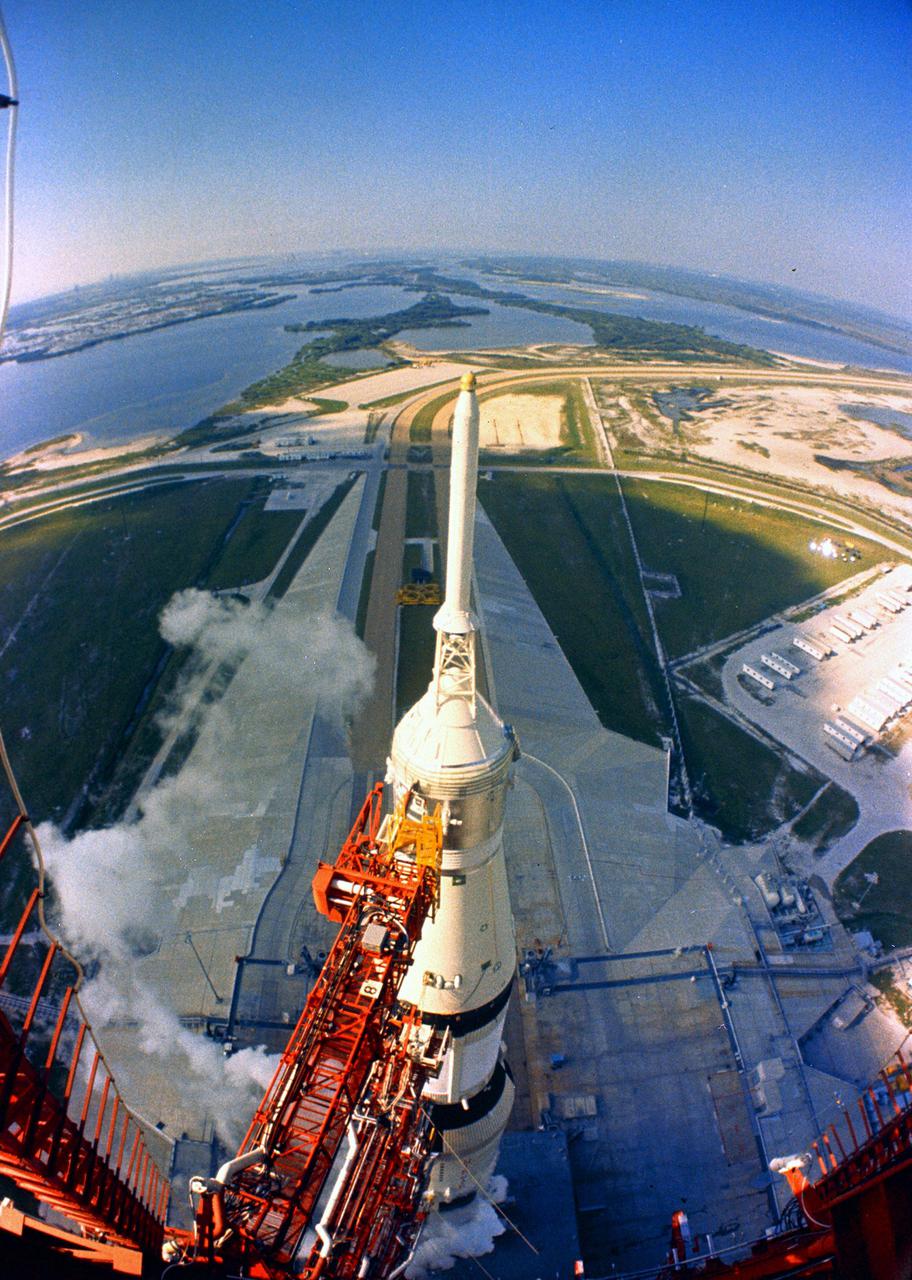
KENNEDY SPACE CENTER, FLA. - The Apollo 15 Saturn V Space Vehicle is seen from a camera located at the mobile launcher's 360-foot level at Launch Pad 39A during venting of the liquid oxygen during the 'wet' portion of the Countdown Demonstration Test today. Astronauts David R. Scott, Commander; James B. Irwin, Lunar Module Pilot; and Alfred M. Worden, Jr., Command Module Pilot, will participate tomorrow in the 'dry' portion of the Countdown Demonstration Test (CDDT), as a final dress rehearsal for the launch to the Moon, scheduled for no earlier than July 26, 1971.
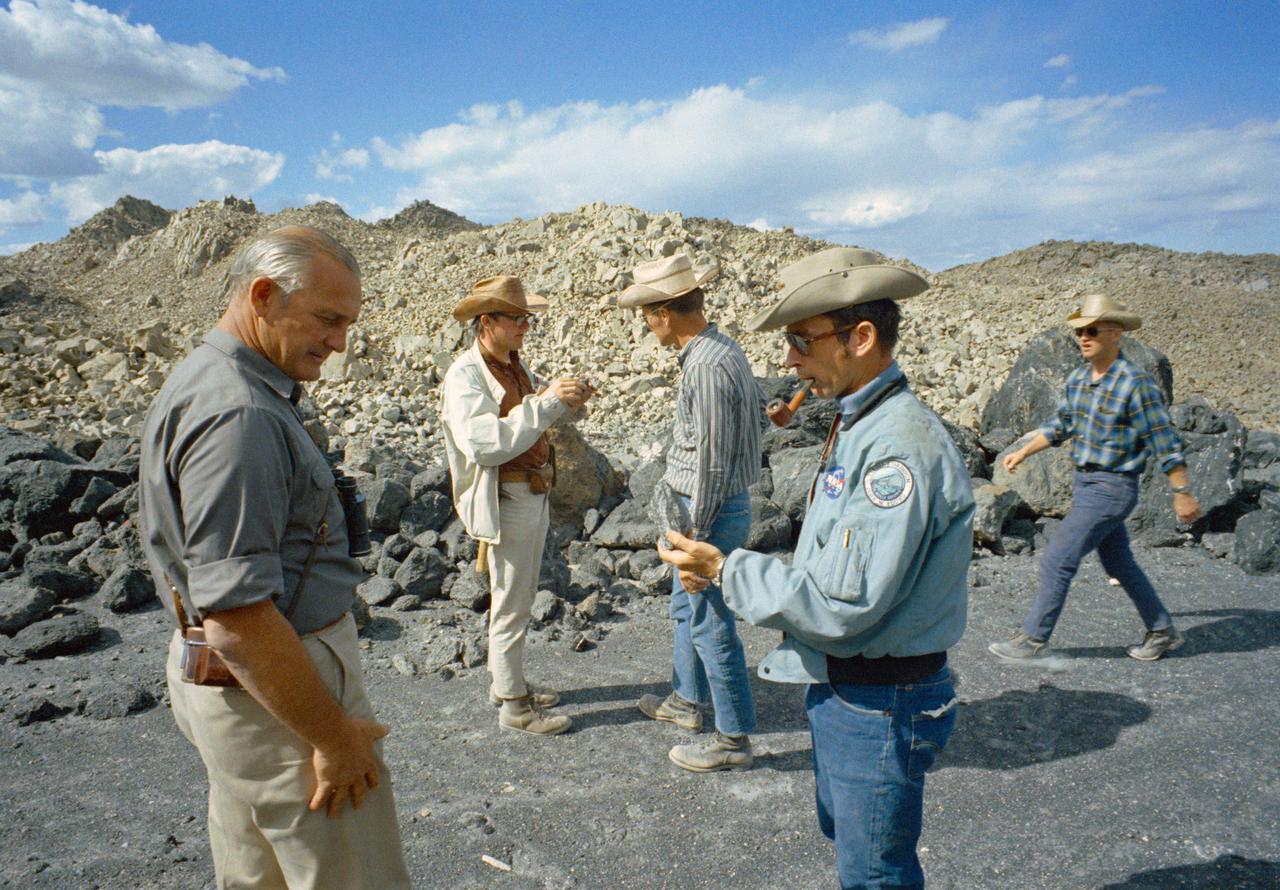
S71-36874 (10 June 1971) --- University of Texas geologist/professor William R. Muelhberger (left) talks with astronaut John W. Young, Apollo 16 commander, during an Apollo 16 geology field trip to Mono Crater, Calif. Astronaut Charles Duke, lunar module pilot, is seen at frame center, talking to geologist David Wones (second left). Astronaut Anthony England, Apollo 16 spacecraft communicator (CAPCOM), is at right. Photo credit: NASA
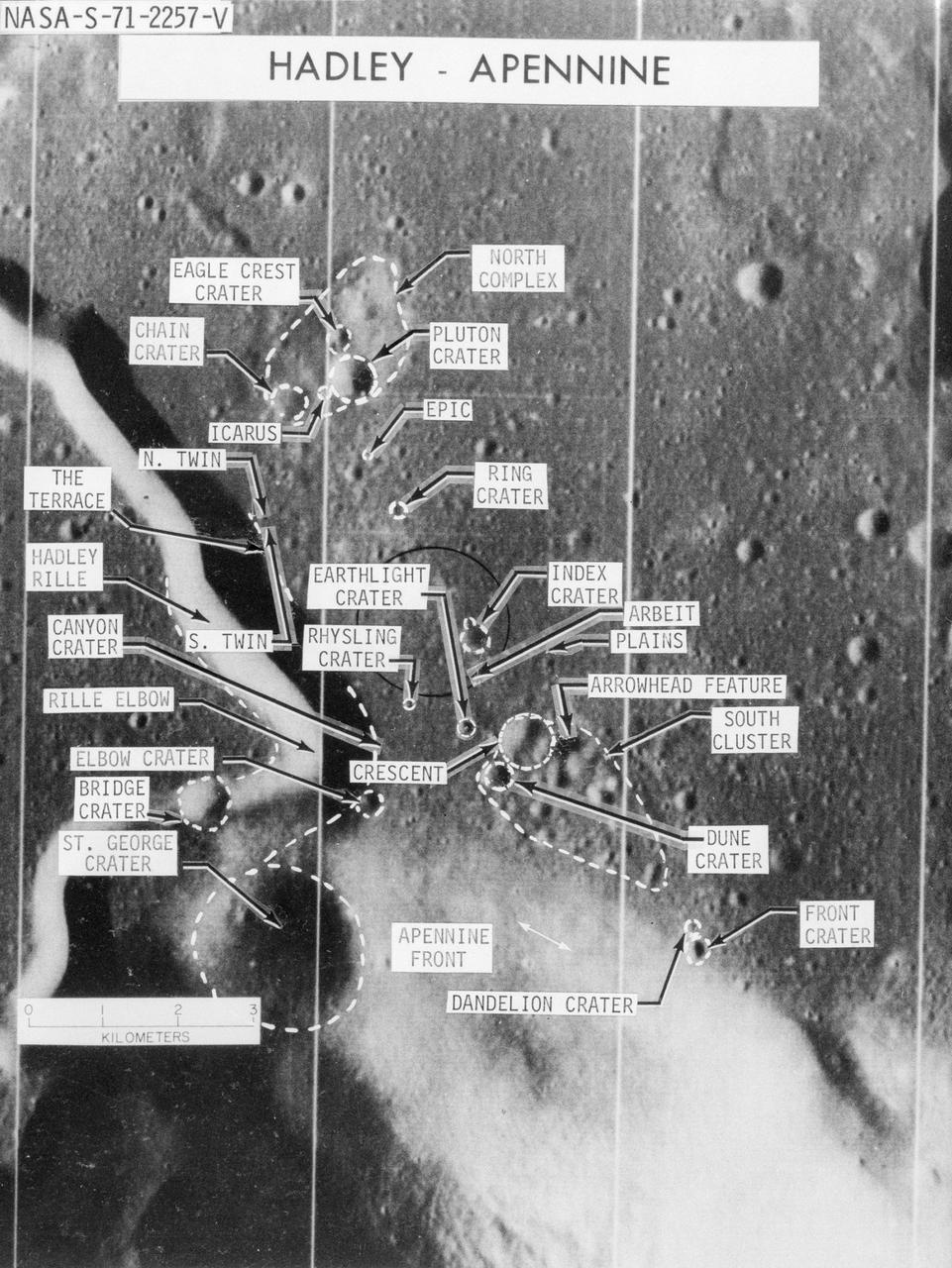
S71-02257 (June 1971) --- An enlarged Lunar Orbiter photograph showing the Apollo 15 landing area in the Hadley-Apennine region on the lunar nearside. The overlay identifies numerous lunar features in the area.
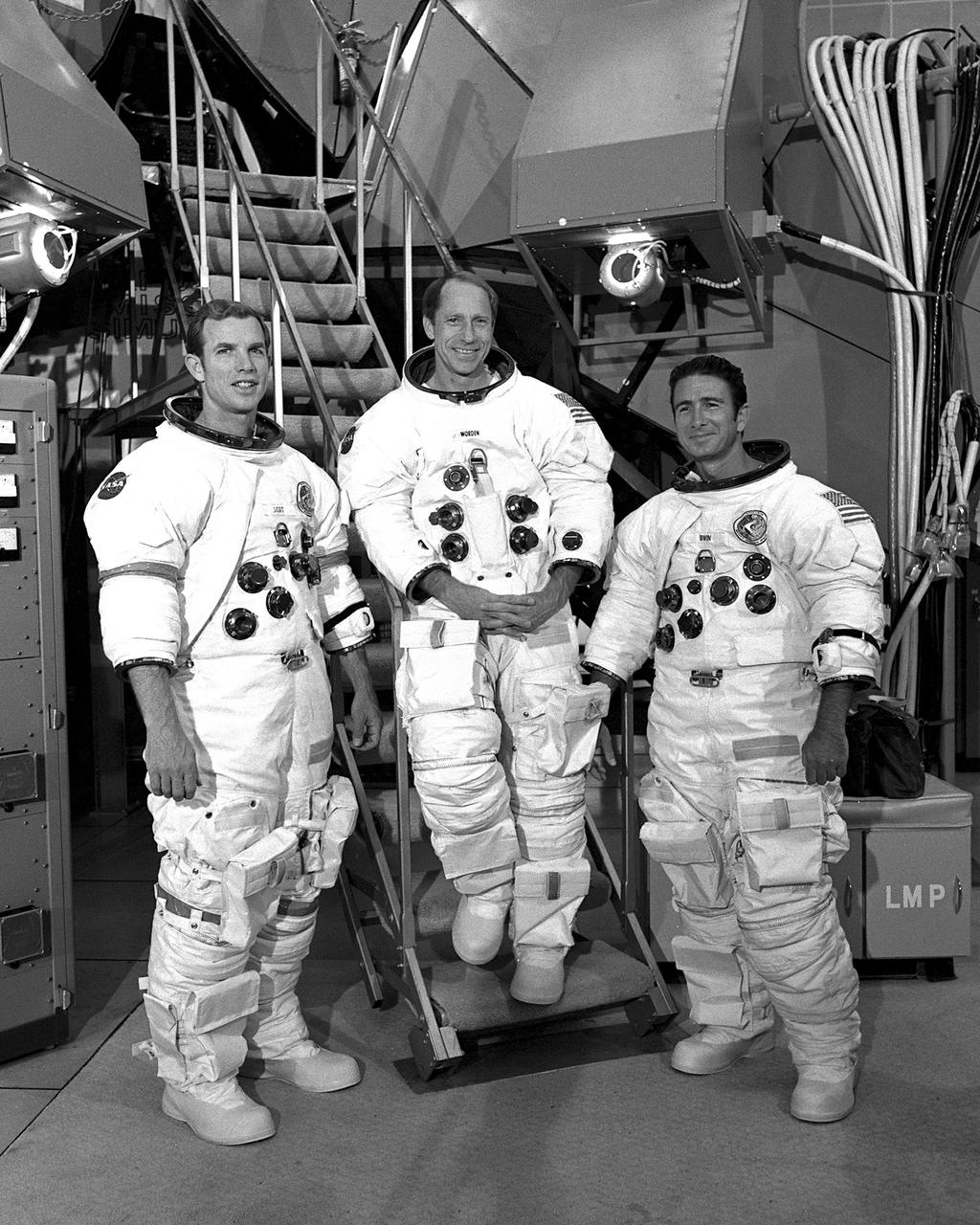
KENNEDY SPACE CENTER, FLA. - The Apollo 15 flight crew, Commander David R. Scott, Lunar Module Pilot James B. Irwin, and Command Module Pilot Alfred M. Worden, Jr., participate in a mission simulation in the Command Module and the Lunar Module.
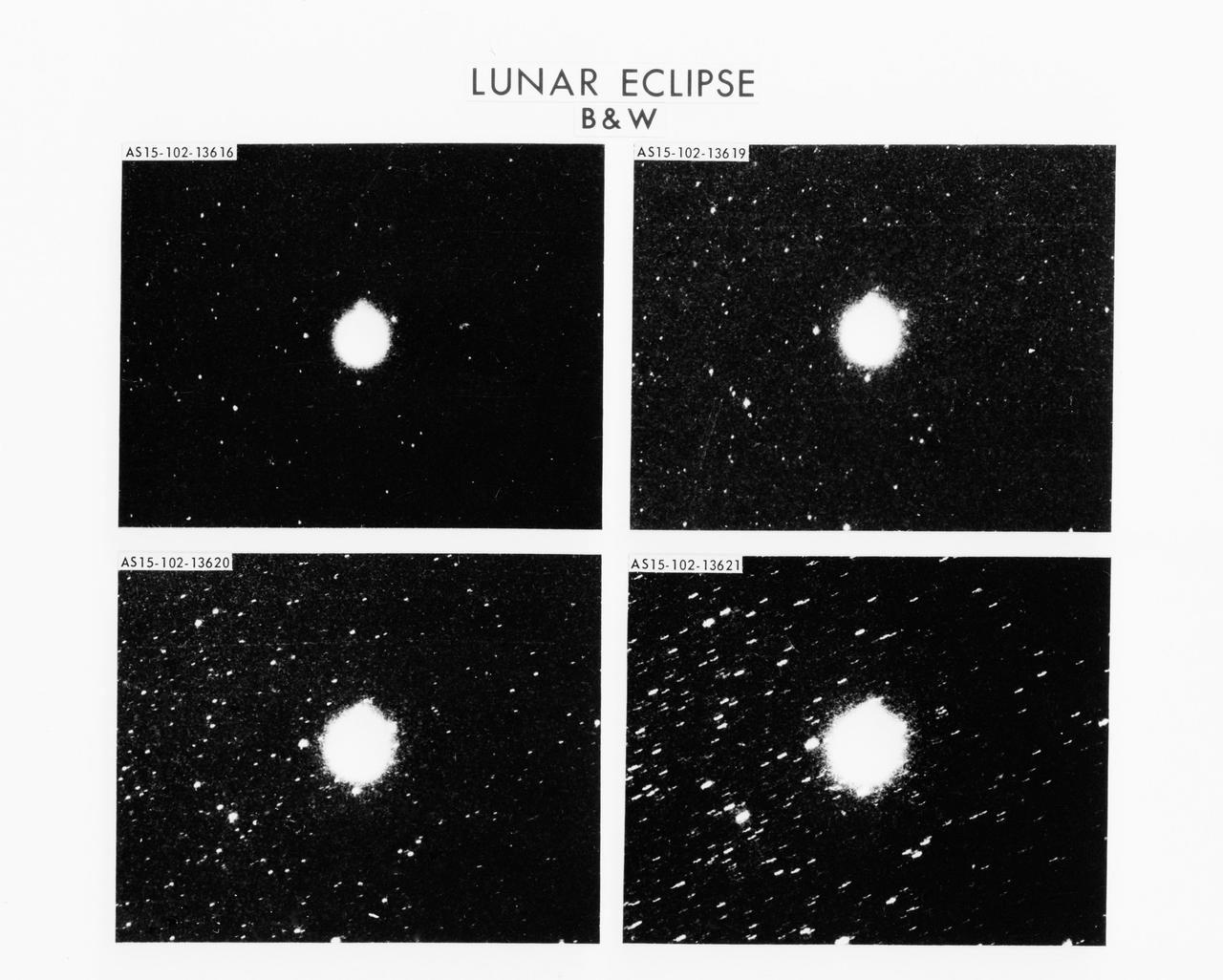
S71-58222 (31 July-2 Aug. 1971) --- During the lunar eclipse that occurred during the Apollo 15 lunar landing mission, astronaut Alfred M. Worden, command module pilot, used a 35mm Nikon camera to obtain a series of 15 photographs while the moon was entering and exiting Earth's umbra. Although it might seem that there should be no light on the moon when it is in Earth's shadow, sunlight is scattered into this region by Earth's atmosphere. This task was an attempt to measure by photographic photometry the amount of scattered light reaching the moon. The four views from upper left to lower right were selected to show the moon as it entered Earth's umbra. The first is a four-second exposure which was taken at the moment when the moon had just entered umbra; the second is a 15-second exposure taken two minutes after entry; the third, a 30-second exposure three minutes after entry; and the fourth is a 60-second exposure four minutes after entry. In all cases the light reaching the moon was so bright on the very high speed film (Eastman Kodak type 2485 emulsion) that the halation obscures the lunar image, which should be about one-third as big as the circle of light. The background star field is clearly evident, and this is very important for these studies. The spacecraft was in full sunlight when these photographs were taken, and it was pointed almost directly away from the sun so that the windows and a close-in portion of the camera's line-of-sight were in shadow. The environment around the vehicle at this time appears to be very "clean" with no light scattering particles noticeable.

Hovercraft surface evvect vehicle No.03 model SK-5 (S/N015)
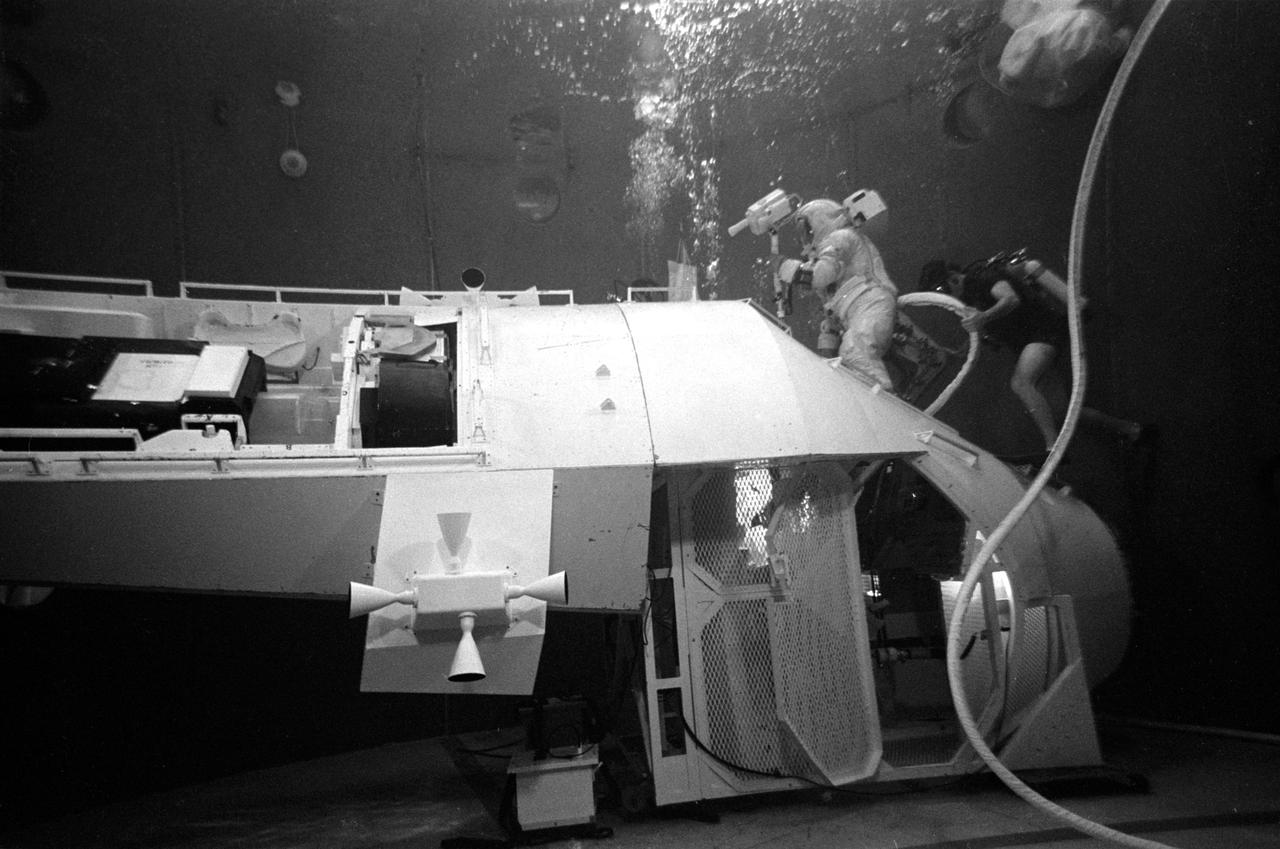
S71-58148 (1 Dec. 1971) --- Astronaut Thomas K. Mattingly II, command module pilot of the planned Apollo 16 lunar landing mission, participates in extravehicular activity (EVA) simulations in the water facility tank in Building 5 at the Manned Spacecraft Center (MSC), Houston, Texas, during training preparations for the forthcoming mission. Mattingly is scheduled to perform EVA during the trans-Earth journey of the Apollo 16 mission.
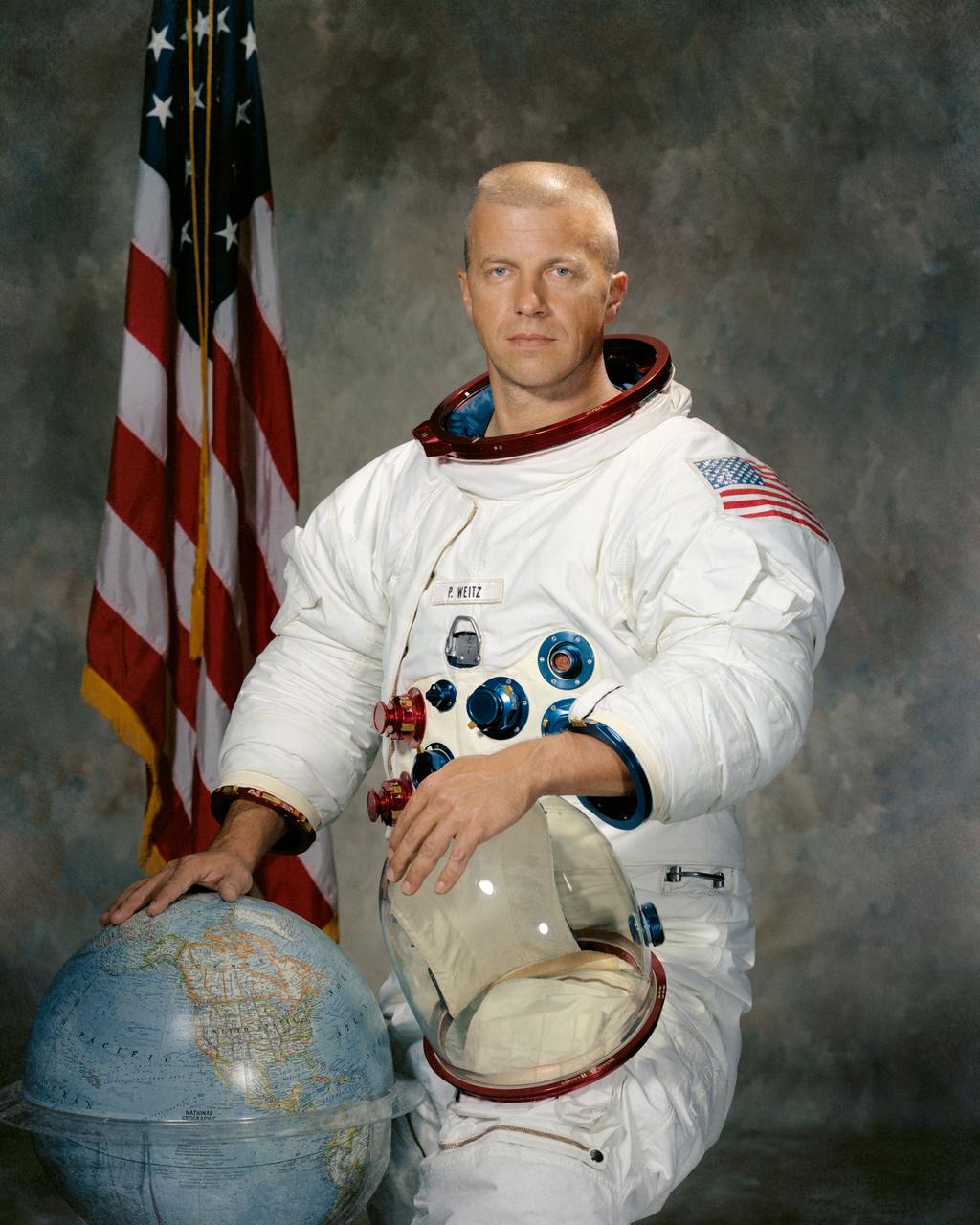
S71-51307 (21 Sept. 1971) --- Astronaut Paul J. Weitz. Photo credit: NASA
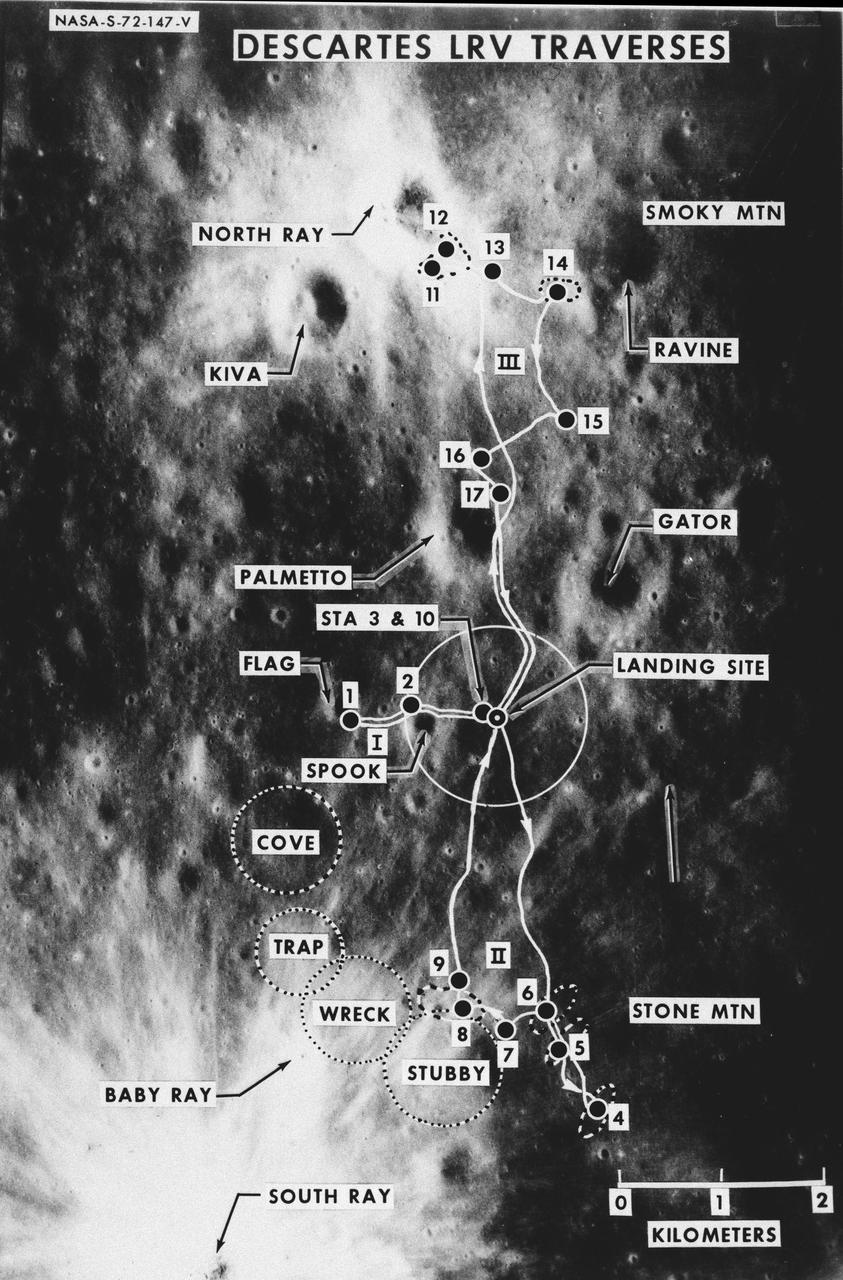
S72-00147 (January 1972) --- An almost vertical view of the Apollo 16 Descartes landing area, as photographed from the Apollo 14 spacecraft. Overlays are provided to point out extravehicular activity (EVA) Lunar Roving Vehicle (LRV) traverse routes and the nicknames of features. Hold picture with South Ray Crater in lower left corner. North will then be at the top. The Roman numerals indicate EVA numbers and the Arabic numbers point out stations or traverse stops.
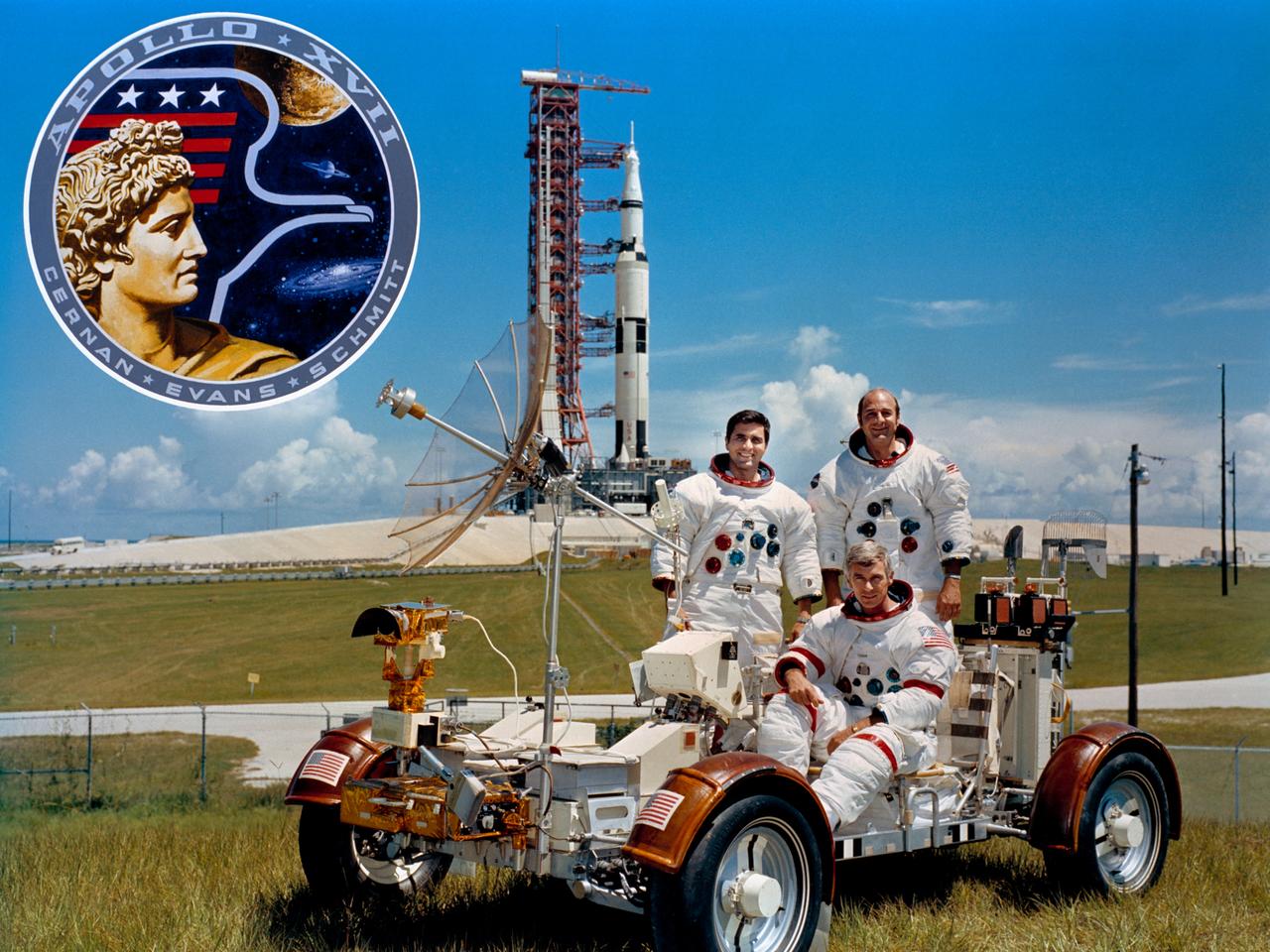
S72-50438 (September 1972) --- These three astronauts are the prime crew members of the Apollo 17 lunar landing mission. They are Eugene A. Cernan (seated), commander; Ronald E. Evans (standing on right), command module pilot; and Harrison H. Schmitt, lunar module pilot. They are photographed with a Lunar Roving Vehicle (LRV) trainer. Cernan and Schmitt will use an LRV during their exploration of the Taurus-Littrow landing site. The Apollo 17 Saturn V space vehicle is in the background. This picture was taken at Pad A, Launch Complex 39, Kennedy Space Center (KSC), Florida. The Apollo 17 insignia is in the photo insert at upper left. The insignia, designed by artist Robert T. McCall in collaboration with the crewmen, is dominated by the image of Apollo, the Greek sun god.
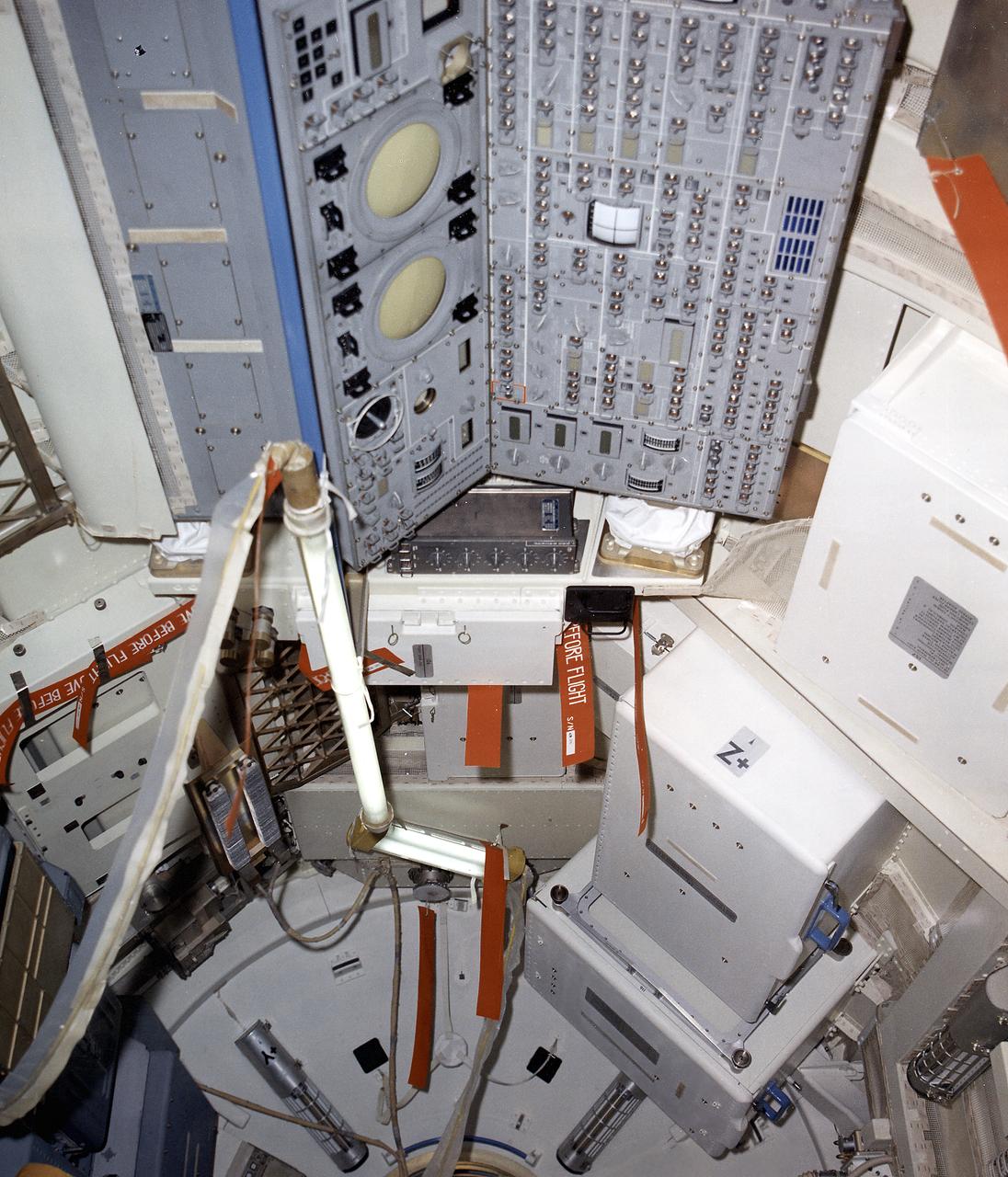
This December 1971 photograph shows the internal configuration of Skylab's Multiple Docking Adapter (MDA) as it appeared during the Crew Compartment and Function Review at the Martin-Marietta Corporation's Space Center facility in Denver, Colorado. At left is the control and display console for the Apollo Telescope Mount. Designed and manufactured by the Marshall Space Flight Center, the MDA housed a number of experiment control and stowage units and provided a docking port for the Apollo Command Module.
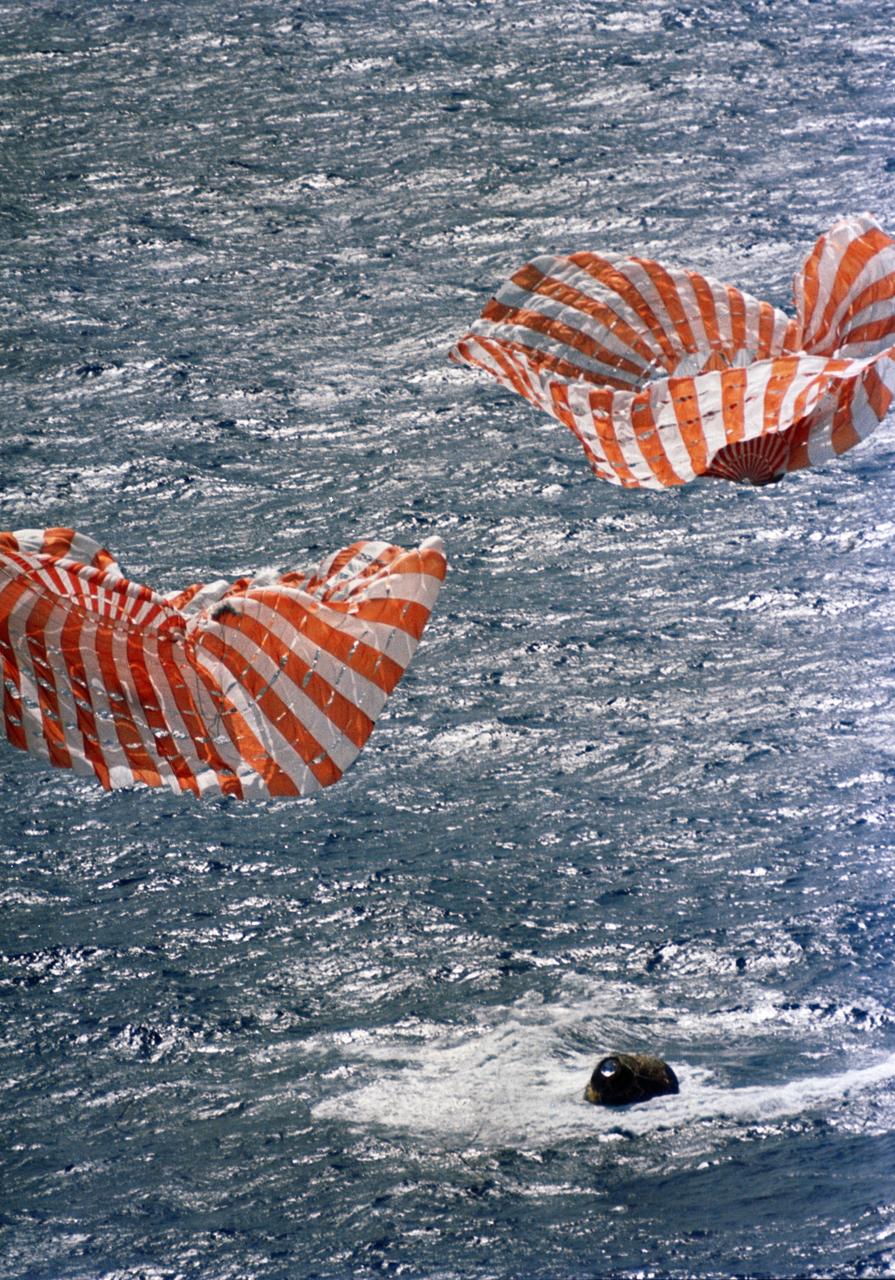
S71-19472 (9 Feb. 1971) --- The Apollo 14 Command Module (CM) splashes down and two of its three main parachutes can be seen collapsing, as the 10-day mission comes to a safe and successful end. The Apollo 14 spacecraft, with astronauts Alan B. Shepard Jr., commander; Stuart A. Roosa, command module pilot; and Edgar D. Mitchell, lunar module pilot, aboard, splashed down at 3:04:39 p.m. (CST) approximately 765 nautical miles southeast of American Samoa.
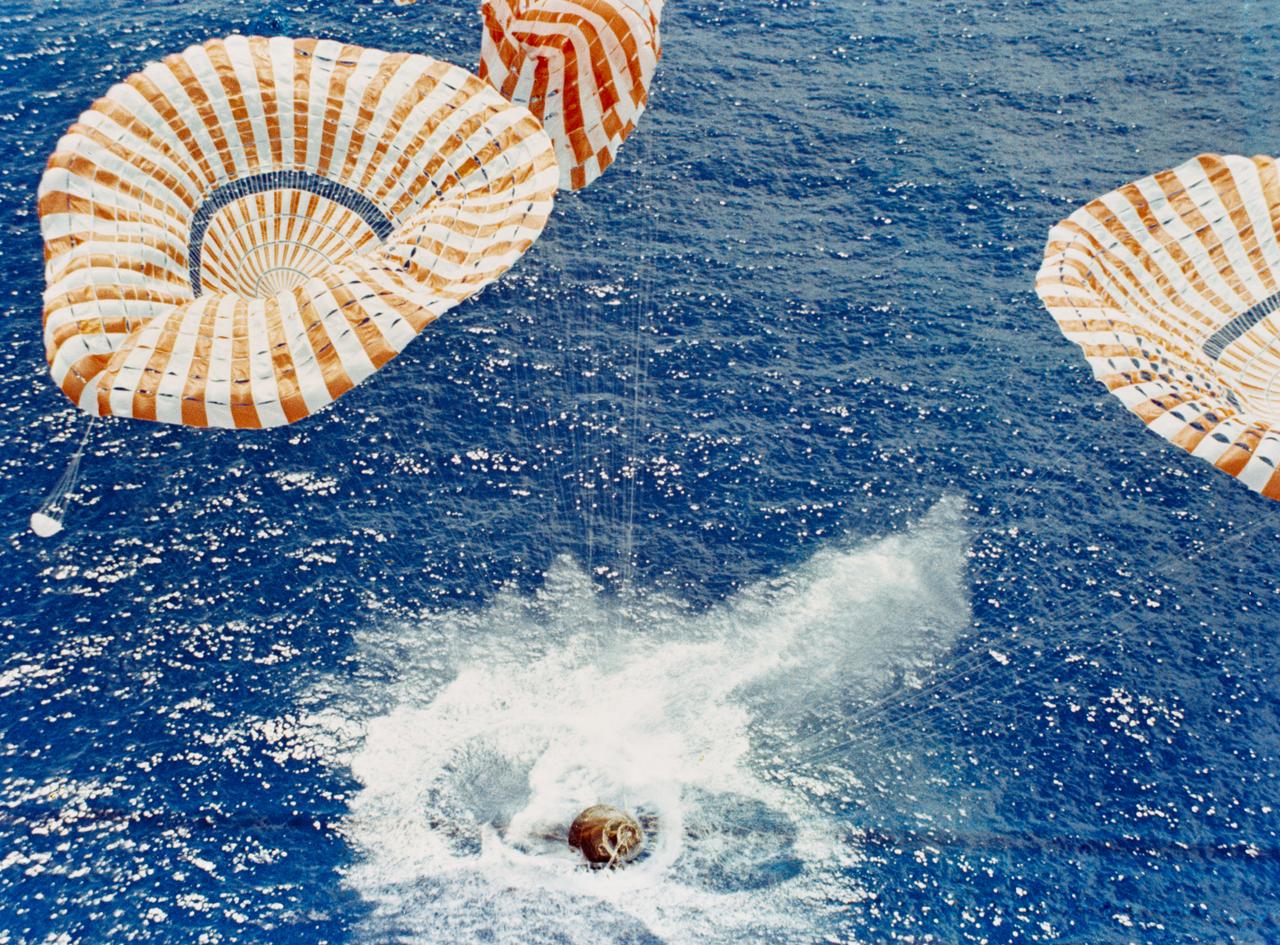
S71-43542 (7 Aug. 1971) --- The Apollo 15 Command Module (CM), with astronauts David R. Scott, commander; Alfred M. Worden, command module pilot; and James B. Irwin, lunar module pilot, aboard safely touches down in the mid-Pacific Ocean to conclude a highly successful lunar landing mission. Although causing no harm to the crew men, one of the three main parachutes failed to function properly. The splashdown occurred at 3:45:53 p.m. (CDT), Aug. 7, 1971, some 330 miles north of Honolulu, Hawaii. The three astronauts were picked up by helicopter and flown to the prime recovery ship, USS Okinawa, which was only 6 1/2 miles away.
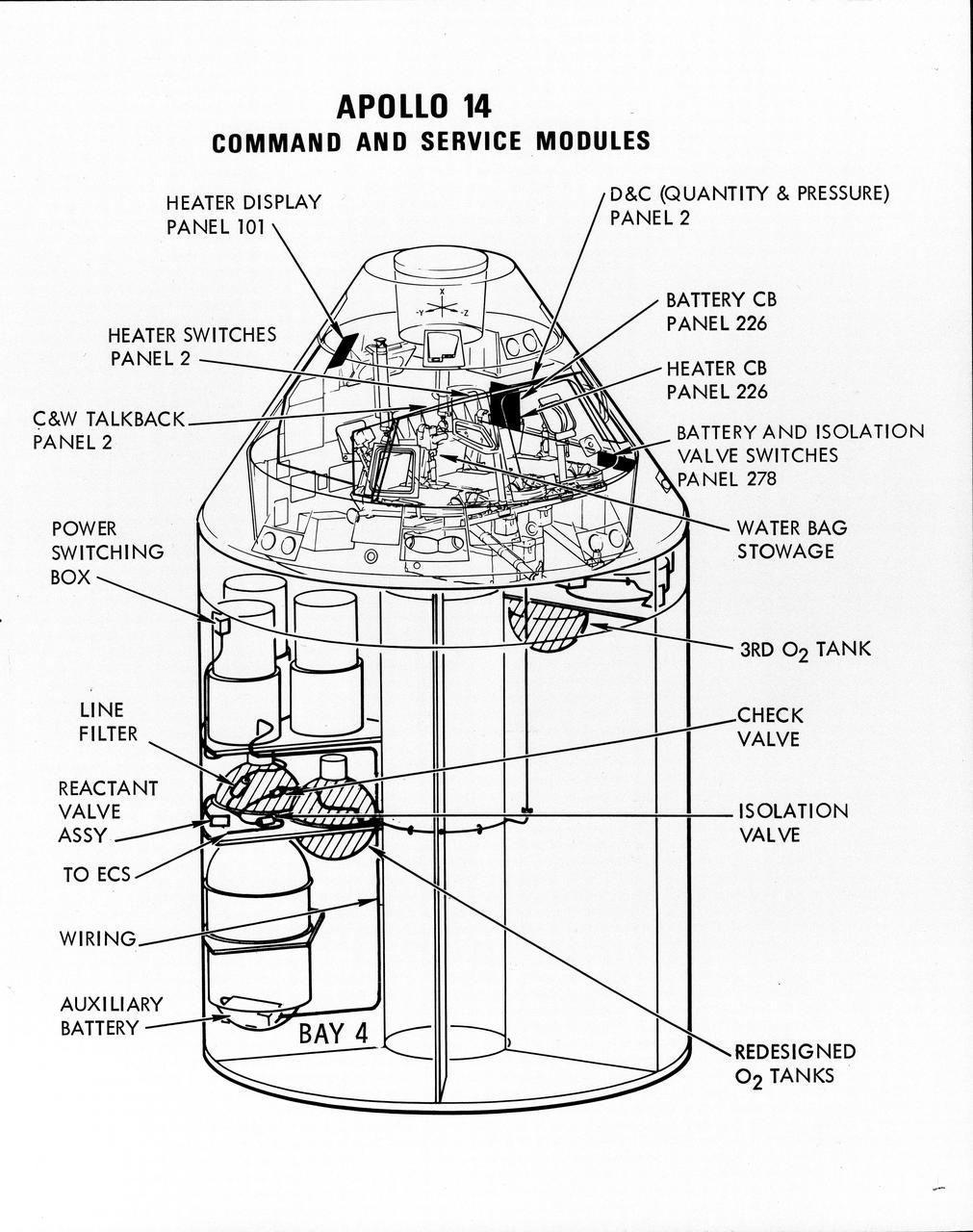
S71-16823 (January 1971) --- A line drawing illustrating a cutaway view of the Apollo 14 Command and Service Modules, showing the engineering changes in the CSM which were recommended by the Apollo 13 Review Board. (The Apollo 13 abort was caused by a short circuit and wiring overheating in one of the SM cryogenic oxygen tanks.) The major changes to the Apollo 14 CSM include adding a third cryogenic oxygen tank installed in a heretofore empty bay (in sector one) of the SM, addition of an auxiliary battery in the SM as a backup in case of fuel cell failure, and removal of destratification fans in the cryogenic oxygen tanks and removal of thermostat switches from the oxygen tank heater circuits. Provision for stowage of an emergency five-gallon supply of drinking water has been added to the CM.
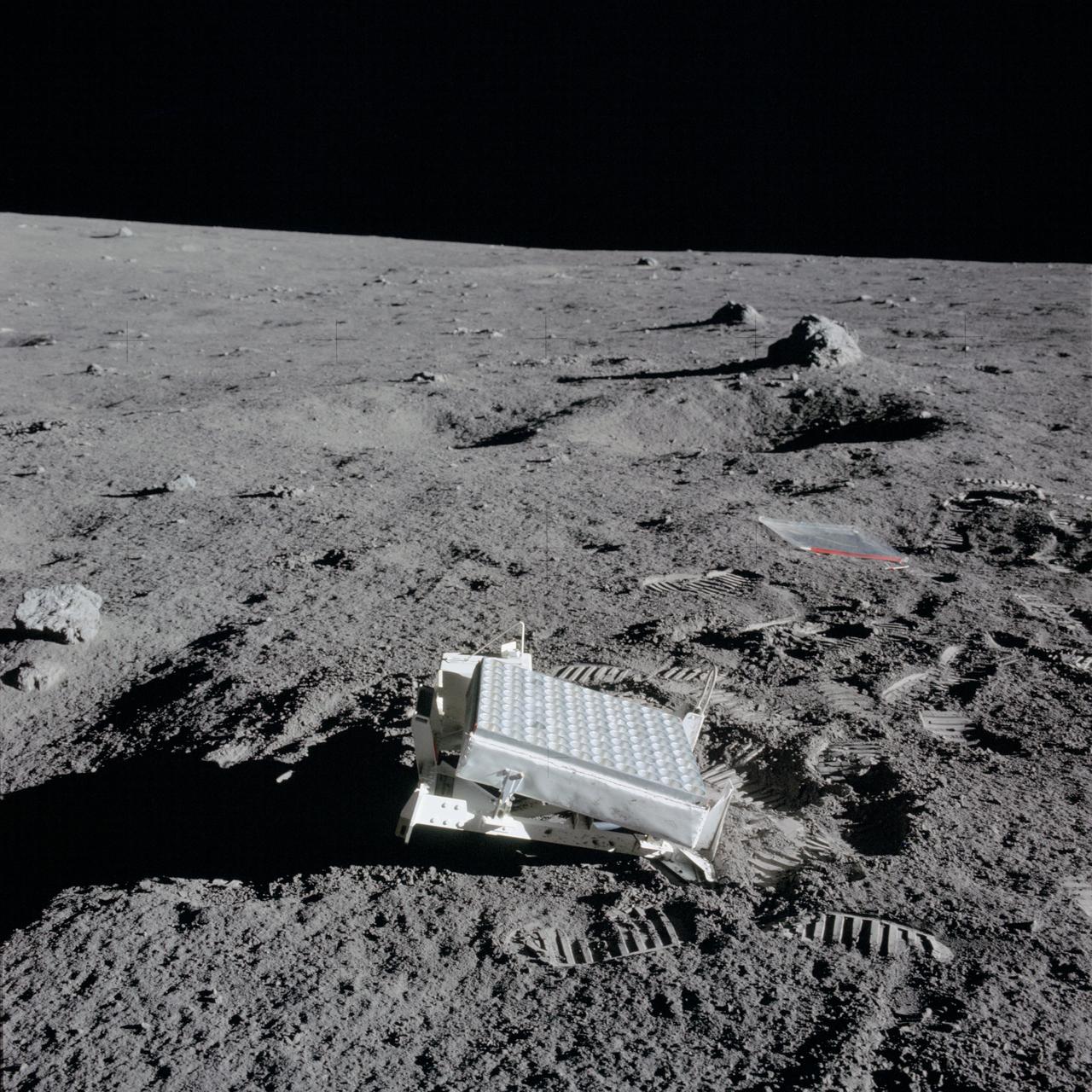
AS14-67-9386 (5 Feb. 1971) --- A close-up view of the laser ranging retro reflector (LR3) which the Apollo 14 astronauts deployed on the moon during their lunar surface extravehicular activity (EVA). While astronauts Alan B. Shepard Jr., commander, and Edgar D. Mitchell, lunar module pilot, descended in the Lunar Module (LM) to explore the moon, astronaut Stuart A. Roosa, command module pilot, remained with the Command and Service Modules (CSM) in lunar orbit.

S71-44671 (30 July 1971) --- A near vertical view of the Hadley-Apennine area, as photographed by the Fairchild metric camera in the Scientific Instrumentation Module (SIM) bay of the Apollo 15 Command and Service Modules (CSM) in lunar orbit. This picture was taken shortly after the Lunar Module (LM) touched down on the moon. Hadley Rille meanders through the lower center of the picture. The Apennine Mountains dominate the picture. The LM landing site is on the east side of the rille's "chicken beak" in the center of the picture. The crater Hadley C is near the center of the photograph at the west edge of the rille. North will be at the top if the photo is held with the dark mare are on the left. The smooth, dark area is the Marsh of Decay. The three-inch mapping camera was one of eight lunar orbital science experiments mounted in the SIM bay.
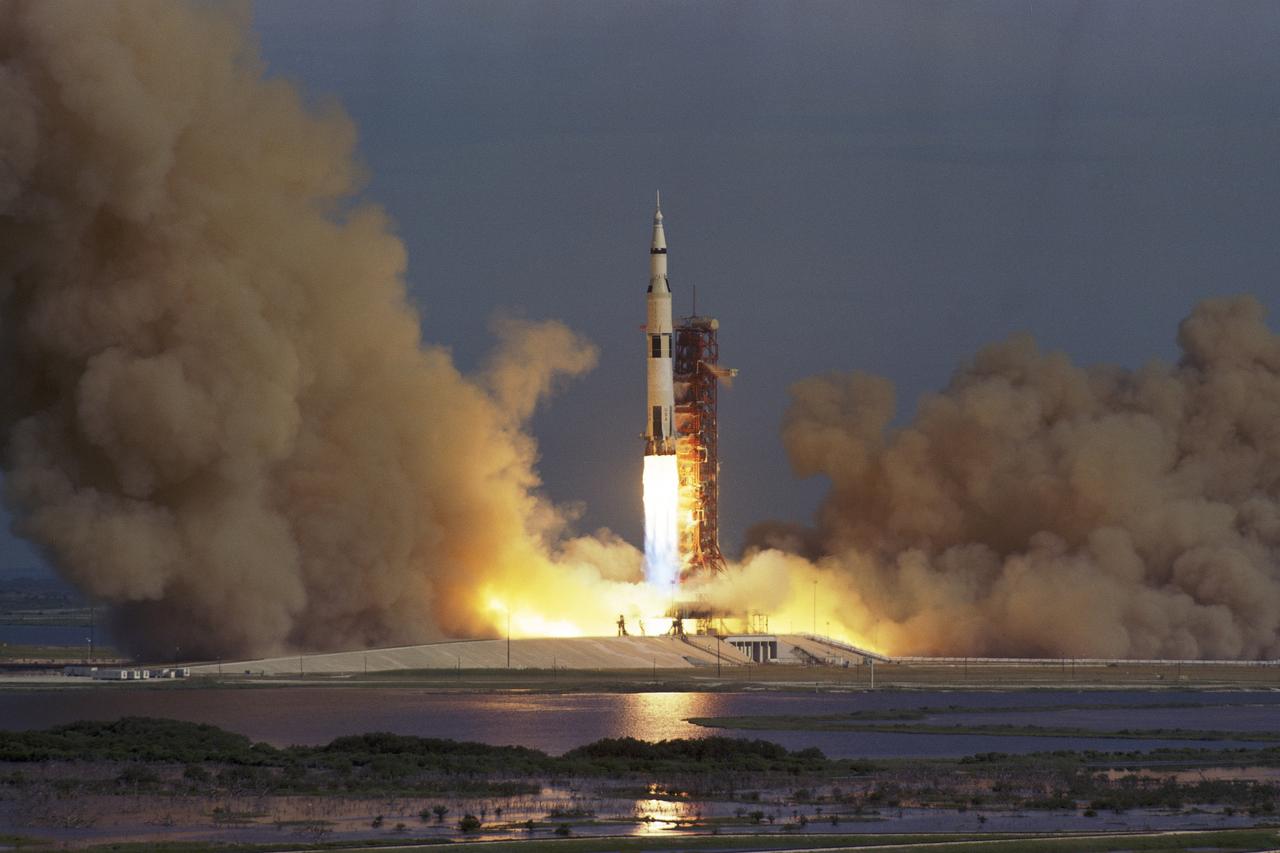
CAPE CANAVERAL, Fla. - At NASA's Kennedy Space Center in Florida, Apollo 15's Saturn V rocket lifts off from Launch Pad 39A at 9:34 a.m., EDT, July 26, 1971, on a lunar landing mission. Aboard the Apollo 15 spacecraft are astronauts David R. Scott, commander, Alfred M. Worden, command module pilot, and James B. Irwin, lunar module pilot. While Apollo 15 astronauts Scott and Irwin will descend in the lunar module to explore the moon's Hadley-Apennine region, astronaut Worden will remain in lunar orbit with the command module. For more information, visit http://www-pao.ksc.nasa.gov/history/apollo/apollo-15/apollo-15.htm Photo credit: NASA
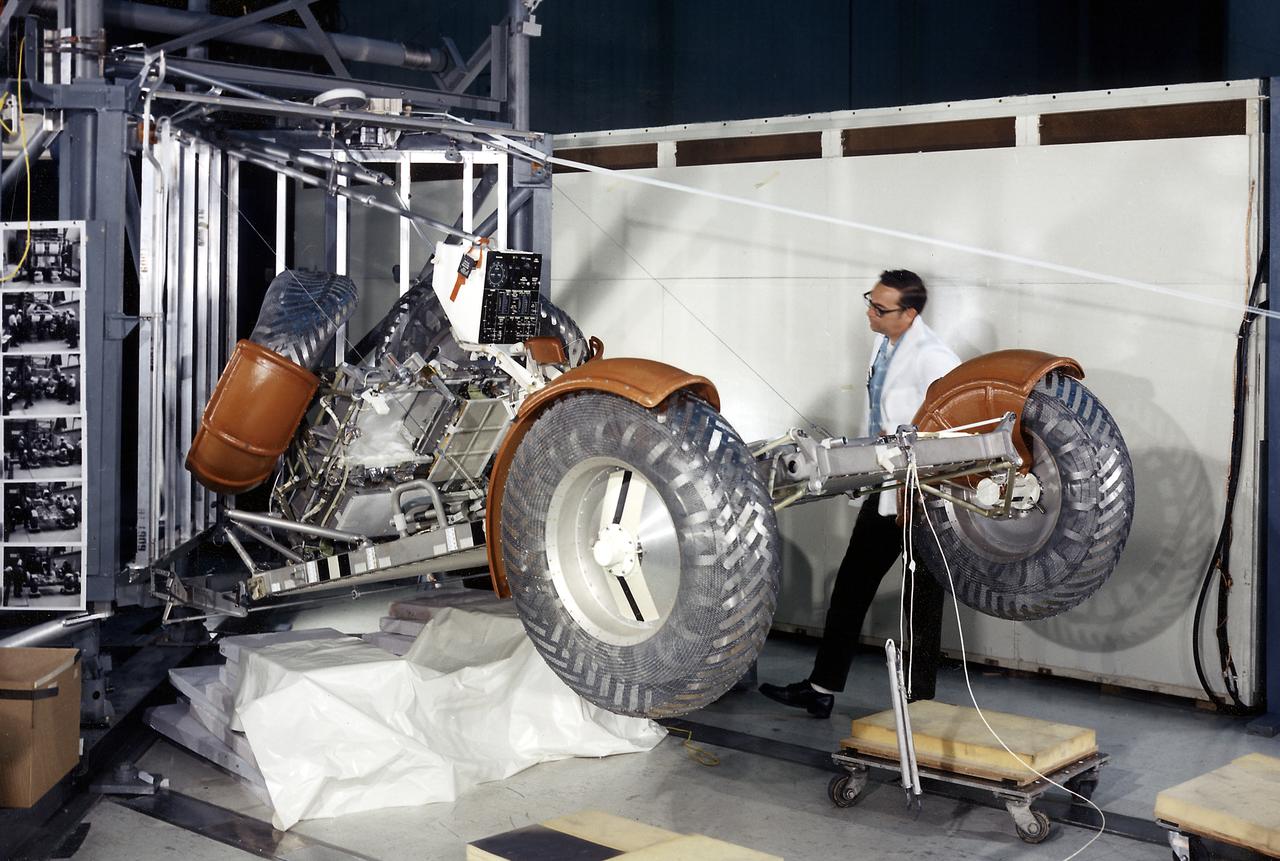
This photograph was taken during a deployment simulation of the Lunar Roving Vehicle (LRV). The LRV was built to give Apollo astronauts a greater range of mobility during the last three lunar exploration missions; Apollo 15, Apollo 16, and Apollo 17. It was designed and developed by the Marshall Space Flight Center and built by the Boeing Company.
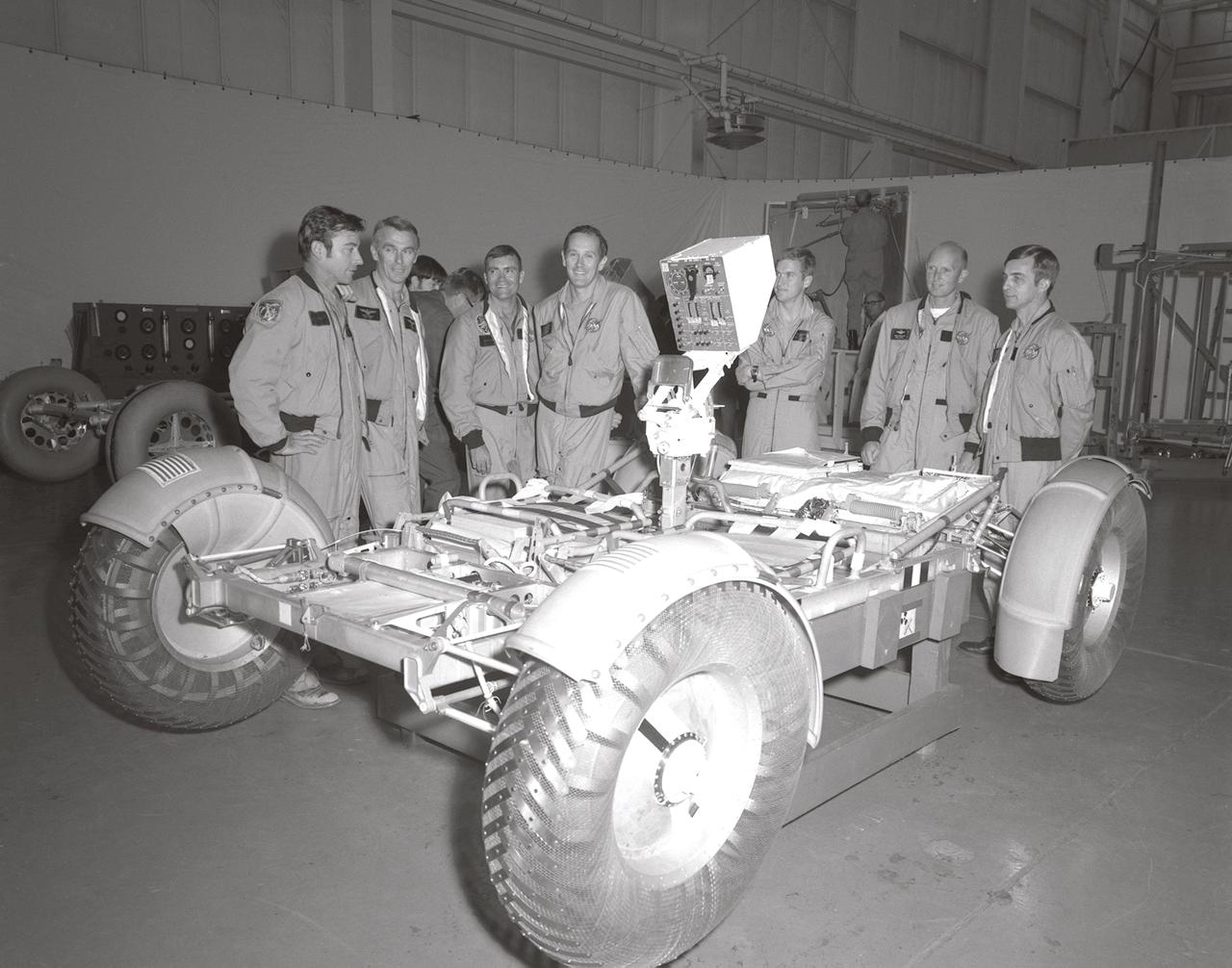
In this November 1971 photograph, (from left to right) Astronauts John Young, Eugene Cernan, Charles Duke, Fred Haise, Anthony England, Charles Fullerton, and Donald Peterson await deployment tests of the Lunar Roving Vehicle (LRV) qualification test unit in building 4649 at the Marshall Space Flight Center (MSFC). The LRV, developed under the direction of the MSFC, was designed to allow Apollo astronauts a greater range of mobility on the lunar surface during the last three lunar exploration missions; Apollo 15, Apollo 16, and Apollo 17.
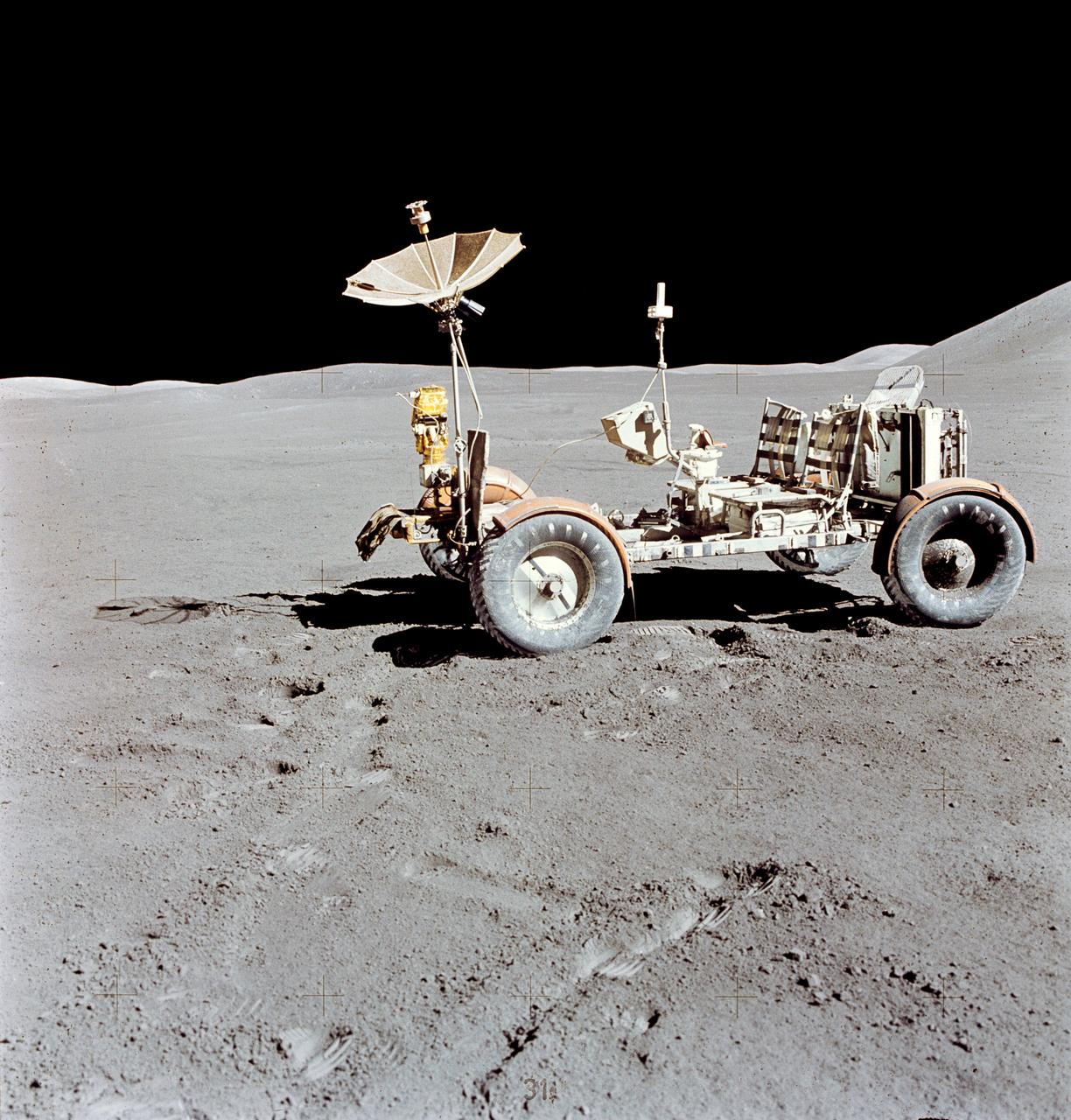
AS15-88-11901 (31 July-2 Aug. 1971) --- The Lunar Roving Vehicle (LRV) is photographed alone against the desolate lunar background during the third Apollo 15 lunar surface extravehicular activity (EVA) at the Hadley-Apennine landing site. This view is looking north. The west edge of Mount Hadley is at the upper right edge of the picture. Mount Hadley rises approximately 4,500 meters (about 4,765 feet) above the plain. The most distant lunar feature visible is approximately 25 kilometers (about 15.5 statute miles) away. While astronauts David R. Scott, commander; and James B. Irwin, lunar module pilot, descended in the Lunar Module (LM) "Falcon" to explore the moon, astronaut Alfred M. Worden, command module pilot, remained with the Command and Service Modules (CSM) in lunar orbit.
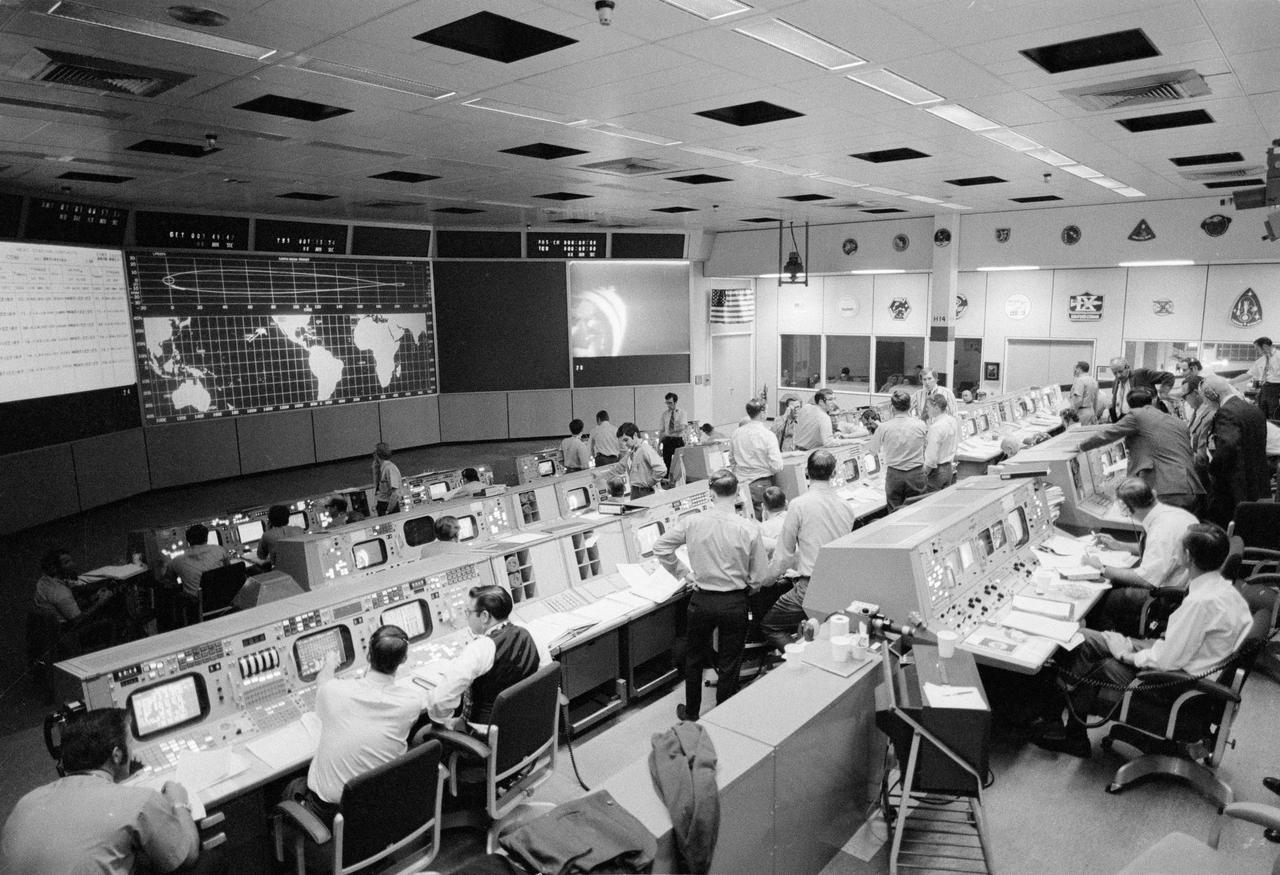
S71-16879 (31 Jan. 1971) --- Overall view of activity in the Mission Operations Control Room in the Mission Control Center during the Apollo 14 transposition and docking maneuvers. The Apollo 14 Lunar Module, still attached to the Saturn IVB stage, can be seen on the large television monitor. Due to difficulty with the docking mechanism six attempts were made before a successful "hard dock" of the Command Module with the Lunar Module was accomplished. Aboard the Command Module were astronauts Alan B. Shepard Jr., Stuart A. Roosa, and Edgar D. Mitchell.
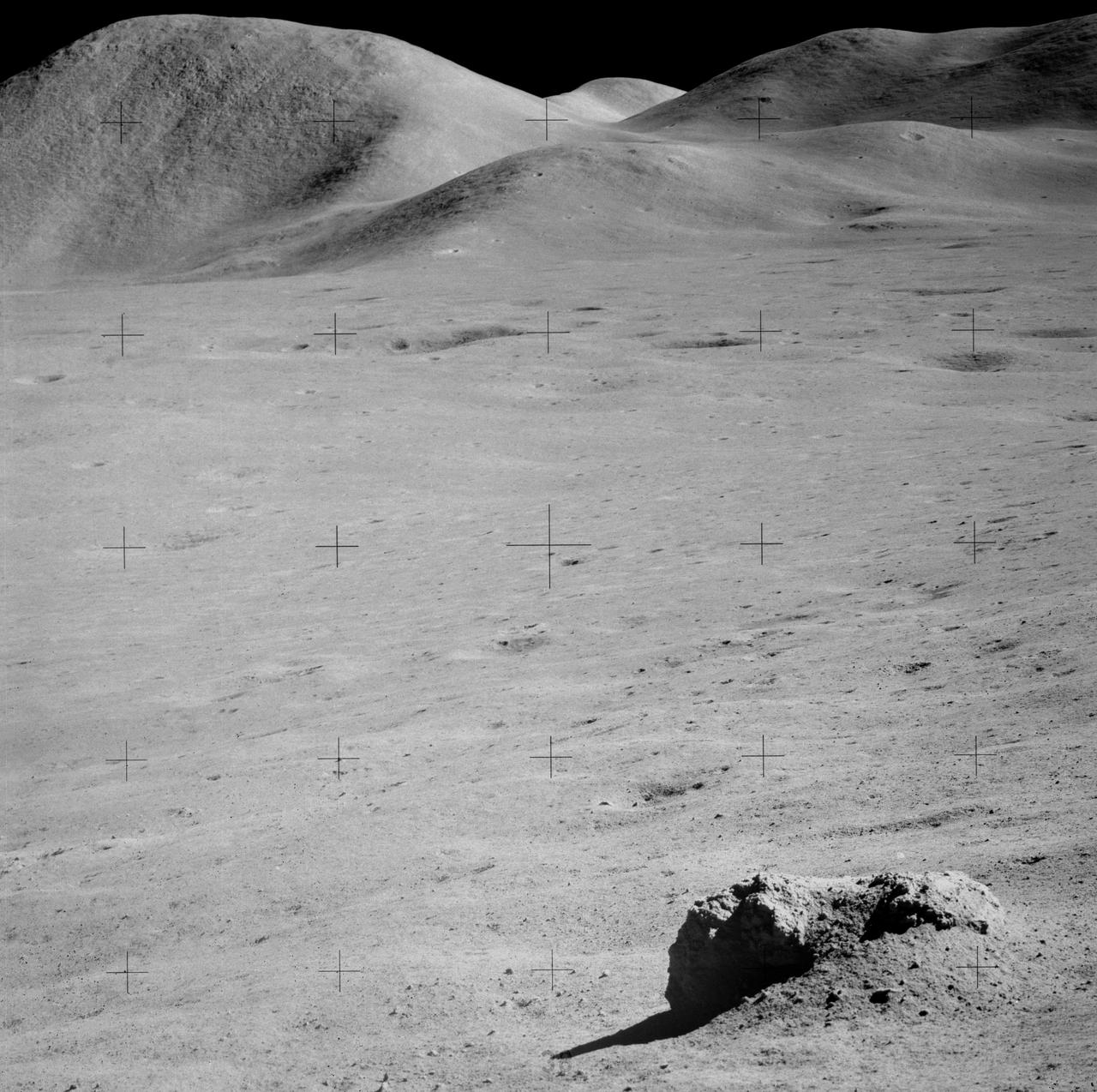
AS15-90-12187 (31 July-2 Aug. 1971) --- This view, looking generally north, shows the tall Mount Hadley in the left background. The photograph was taken from the slope of Hadley Delta during Apollo 15 extravehicular activity (EVA). The crewmen of Apollo 15 noted the visible layering feature of the mountain. Note boulder in foreground. Mount Hadley rises approximately 14,765 feet (about 4,500 meters) above the plain.

AS14-66-9305 (5 Feb. 1971) --- A front view of the Apollo 14 Lunar Module (LM), which reflects a circular flare caused by the brilliant sun, as seen by the two moon-exploring crew men (out of frame) of the Apollo 14 lunar landing mission during their first extravehicular activity (EVA). The unusual ball of light was said by the astronauts to have a jewel-like appearance. In the left background Cone Crater can be seen. In the left foreground are the erectable S-Band antenna and the United States flag. Astronauts Alan B. Shepard Jr., commander, and Edgar D. Mitchell, lunar module pilot, descended in the LM, while astronaut Stuart A. Roosa, command module pilot, remained with the Command and Service Modules (CSM) in lunar orbit.
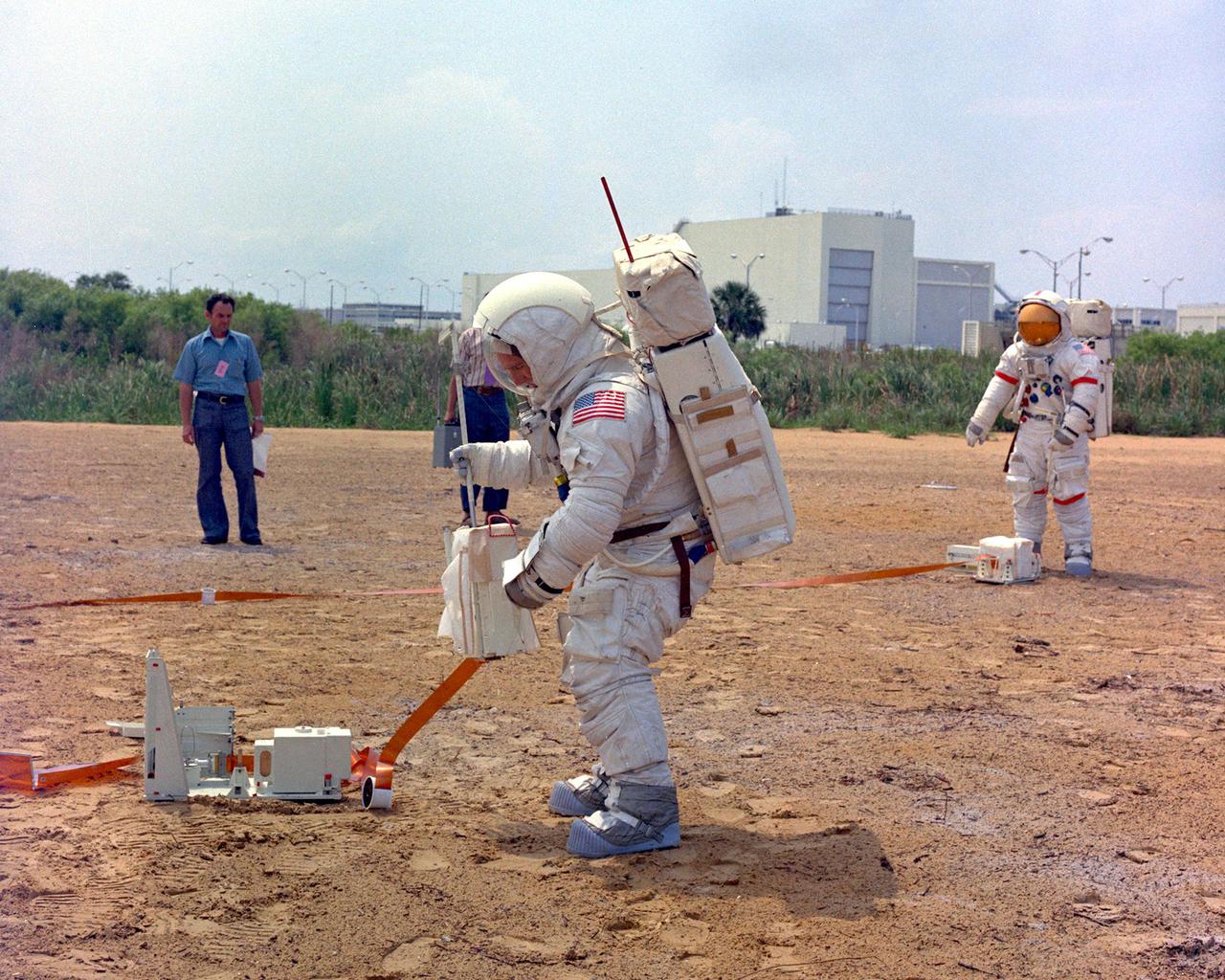
KENNEDY SPACE CENTER, FLA. - Apollo 15 Lunar Module Pilot James B. Irwin deploys the Suprathermal Ion Detector Experiment during a training exercise at the Kennedy Space Center. Mission Commander David R. Scott is working in the background on the simulated lunar surface, a replica of the Moon's Hadley-Apennine region. They will be launched to the Moon no earlier than July 26, 1971, along with Command Module Pilot Alfred M. Worden.
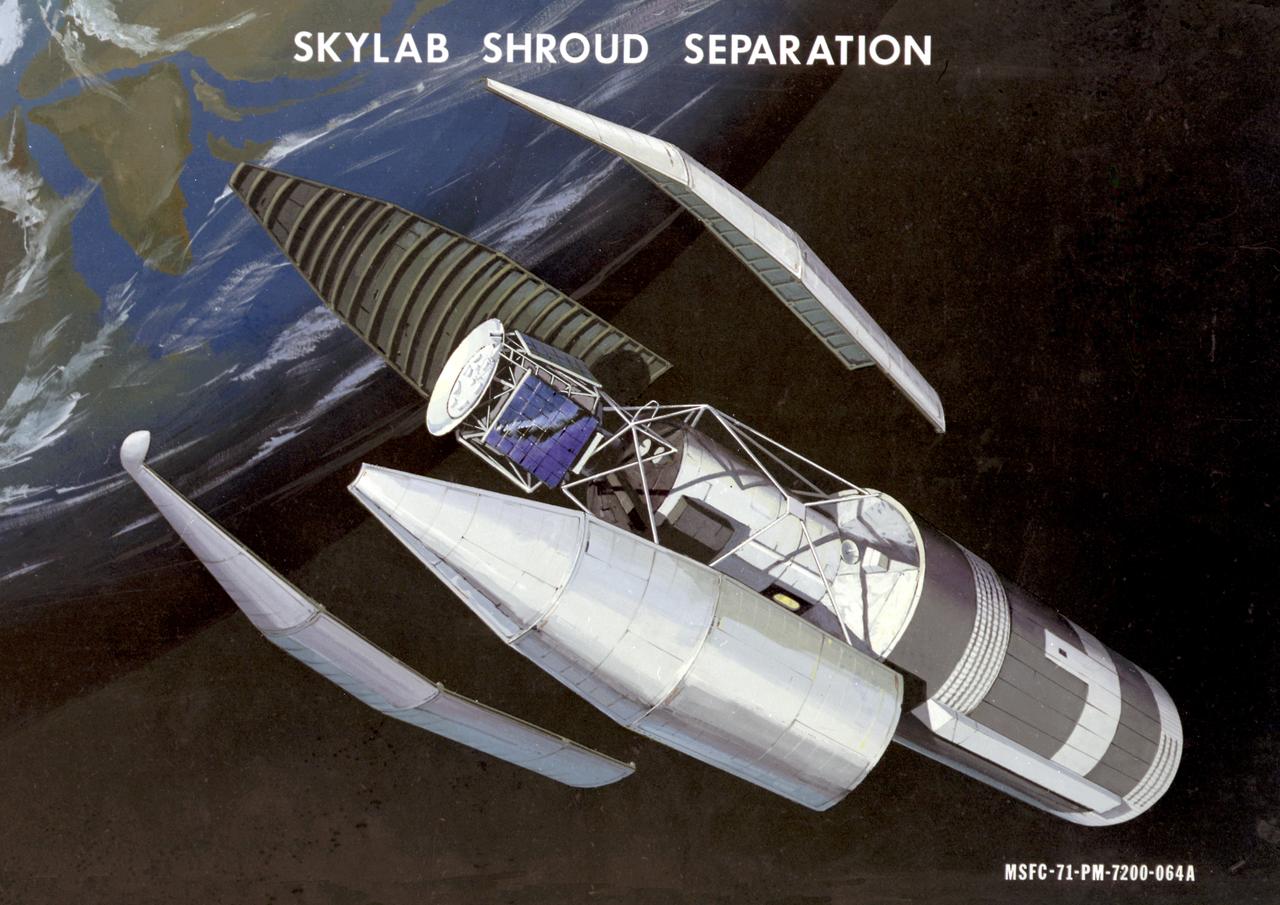
This artist's concept depicts the separation of the Skylab payload shroud. The payload shroud was both an environmental shield and an aerodynamic fairing. Attached to the forward end of the fixed airlock shroud, it protected the airlock, the docking adapter, and the solar observatory before and during launch. It also provided structural support for the solar observatory in the launch configuration. The payload shroud was jettisoned once Skylab reached orbit after separation of the S-II second stage of the Saturn V vehicle. Five major assemblies clustered together made up the orbiting space station called Skylab. The largest of these was the orbital workshop, that housed the crew quarters and a major experiment area. The airlock module, attached to the forward end of the workshop, enabled crewmembers to make excursions outside Skylab. The docking adapter, attached to the forward end of the airlock module, provided the docking port for the Apollo command and service module. The Apollo Telescope Mount was the first marned astronomical observatory designed for solar research from Earth orbit.
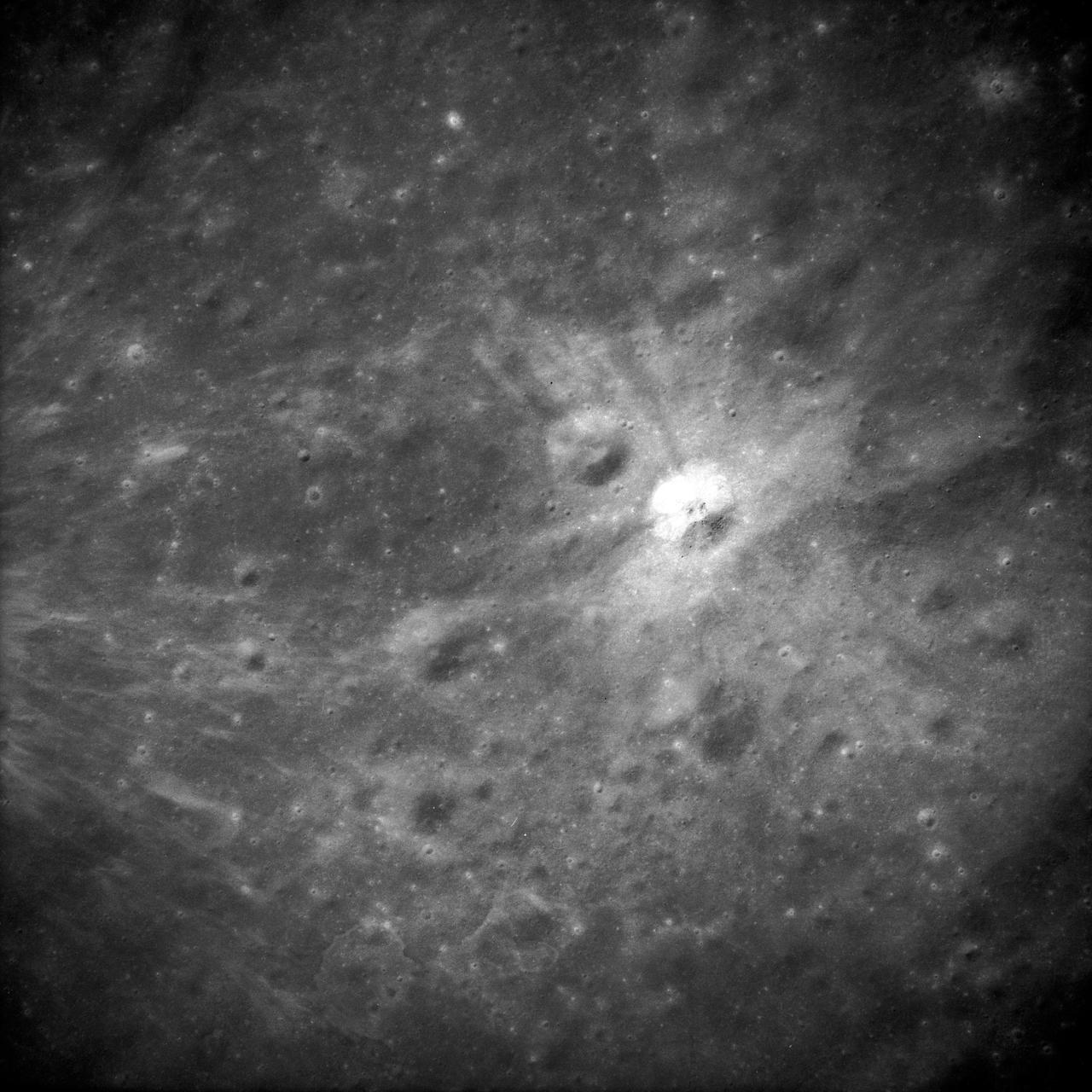
AS14-69-9560 (February 1971) --- This 500mm vertical frame taken from the Apollo 14 spacecraft is of the Apollo 16 proposed landing site "Descartes". The actual location of the target area is near the upper left. This photograph was taken with a 56 degree sun angle. The large bright crater is approximately one kilometer in diameter and has a distinctive ray pattern which serves as an excellent landmark.
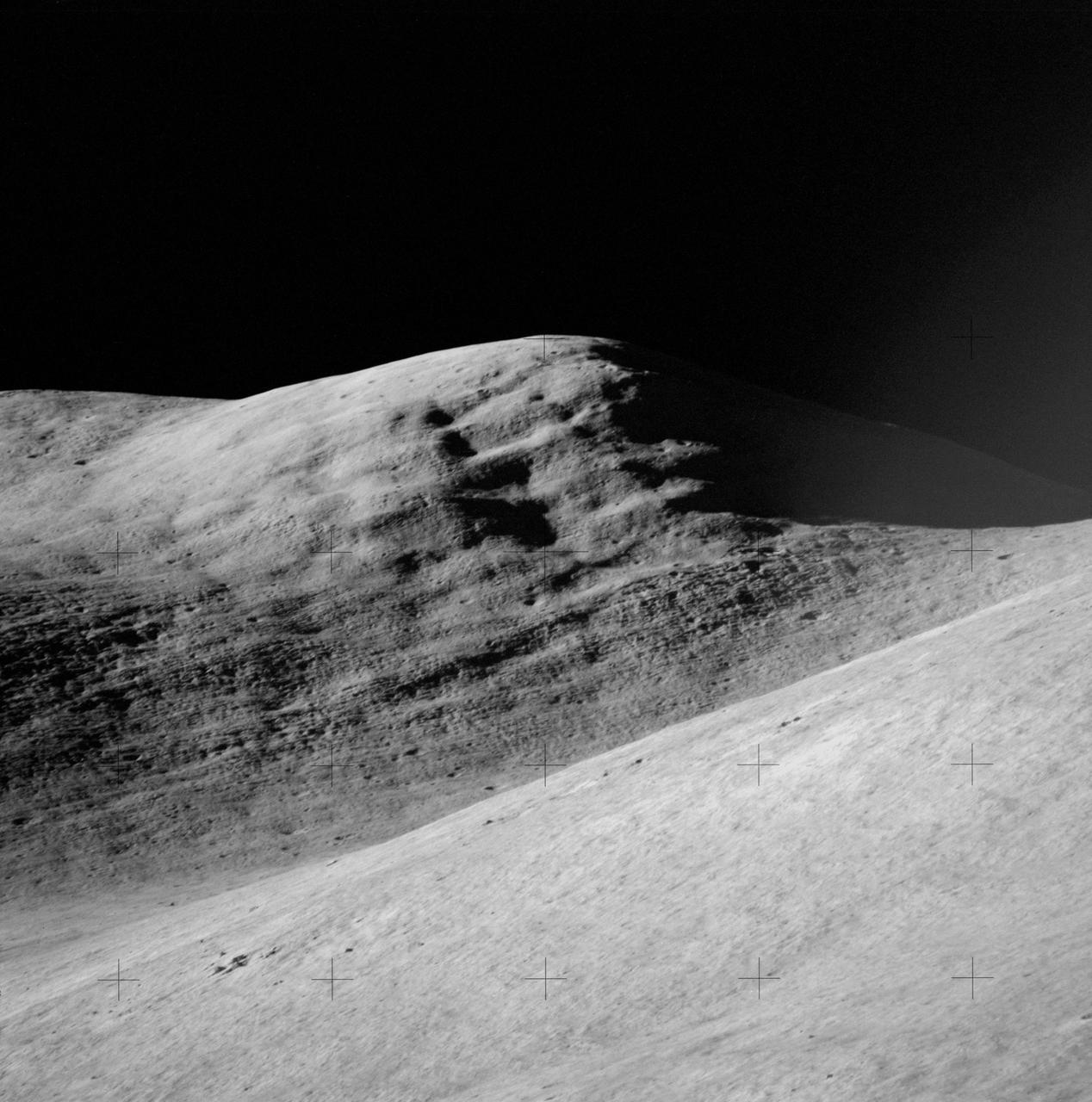
AS15-84-11250 (31 July-2 Aug. 1971) --- A telephoto lens view of the prominent feature called Silver Spur in the Hadley Delta region, photographed during the Apollo 15 lunar surface extravehicular activity (EVA) at the Hadley-Apennine landing site. The distance from the camera to the spur is about 10 miles. The field of view across the bottom is about one mile. Structural formations in the mountain are clearly visible. There are two major units. The upper unit is characterized by massive subunits, each one of which is approximately 200 feet deep. The lower major unit is characterized by thinner bedding and cross bedding.
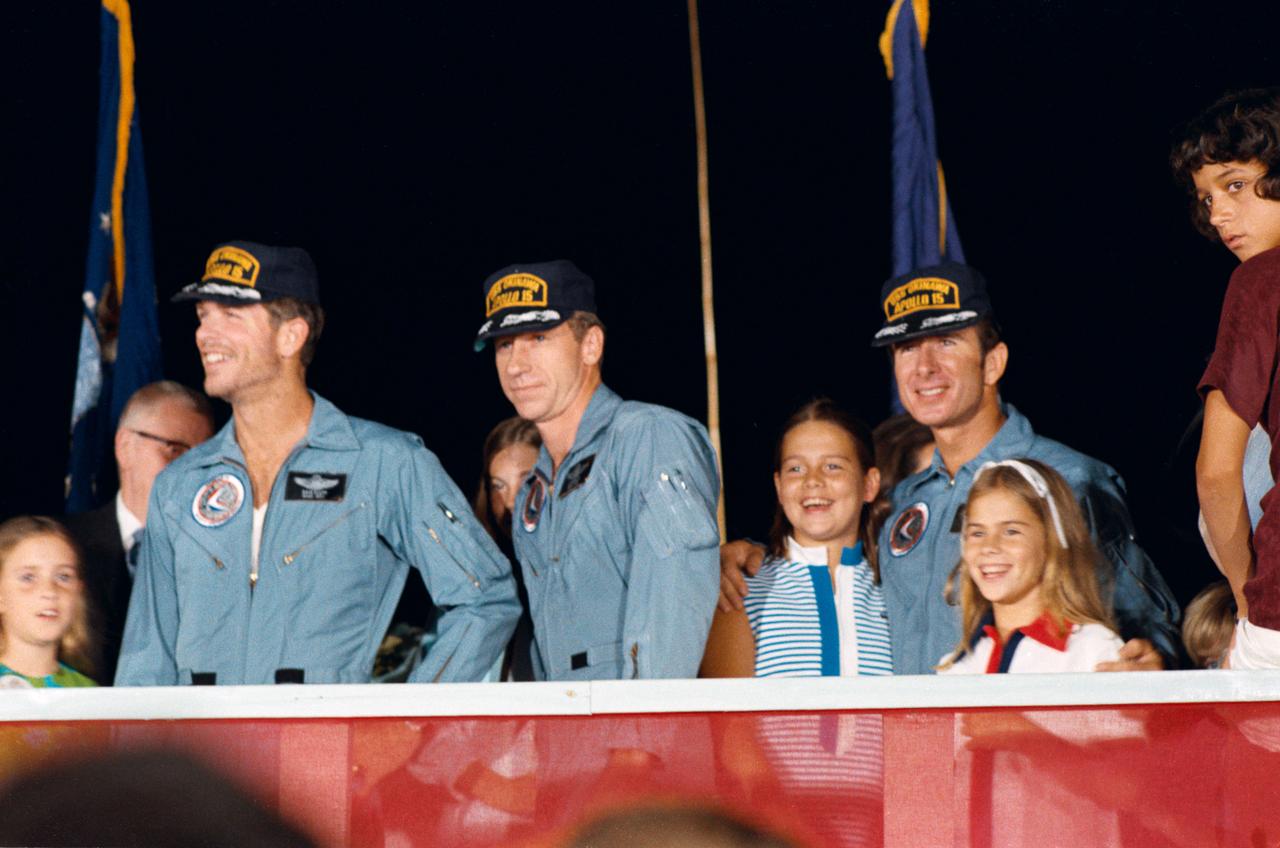
S71-43428 (8 Aug. 1971) --- The three crew men, of the highly successful Apollo 15 lunar landing mission, receive a warm welcome home at Ellington Air Force Base (EAFB), Houston, after an eight hour flight aboard a U.S. Air Force C-141 jet aircraft from Hawaii. Left to right, are astronauts David R. Scott, commander; Alfred M. Worden, command module pilot; and James B. Irwin, lunar module pilot. Apollo 15 splashdown in the mid-Pacific at 3:45 p.m. (CDT), Aug. 7, 1971, some 330 miles north of Honolulu. The C-141 landed at EAFB at 9 p.m. (CDT), Sunday, Aug. 8, 1971. Members of the astronauts' families identifiable in the picture are, left to right, Scott's daughter, Tracy; Worden's father, Merrill Worden; Worden's daughter, Merrill; and Irwin's two daughters, Joy and Jill.
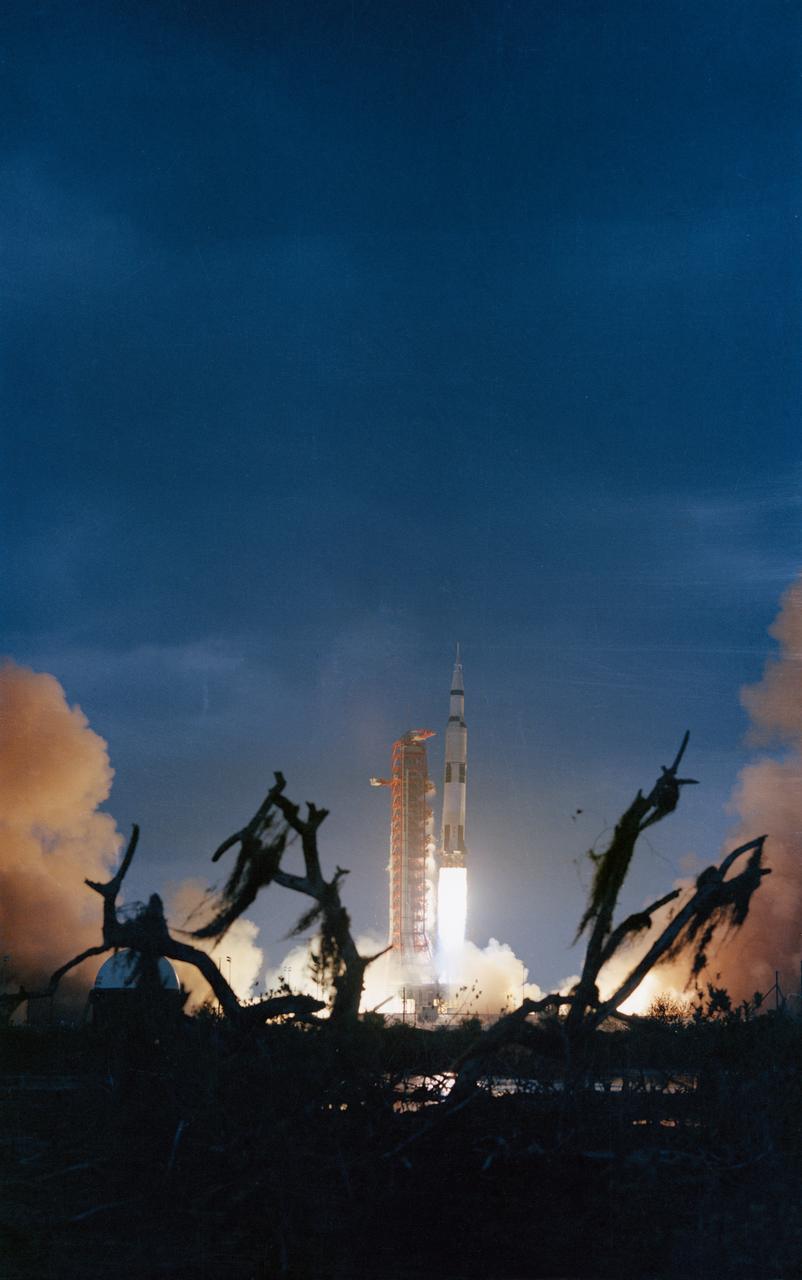
S71-18399 (31 Jan. 1971) --- The huge, 363-feet tall Apollo 14 (Spacecraft 110/Lunar Module 8/Saturn 509) space vehicle is launched from Pad A, Launch Complex 39, Kennedy Space Center (KSC), Florida at 4:03:02 p.m. (EST), Jan. 31, 1971, on a lunar landing mission. This view is framed by moss-covered dead trees in the dark foreground. Aboard the Apollo 14 spacecraft were astronauts Alan B. Shepard Jr., commander; Stuart A. Roosa, command module pilot; and Edgar D. Mitchell, lunar module pilot.
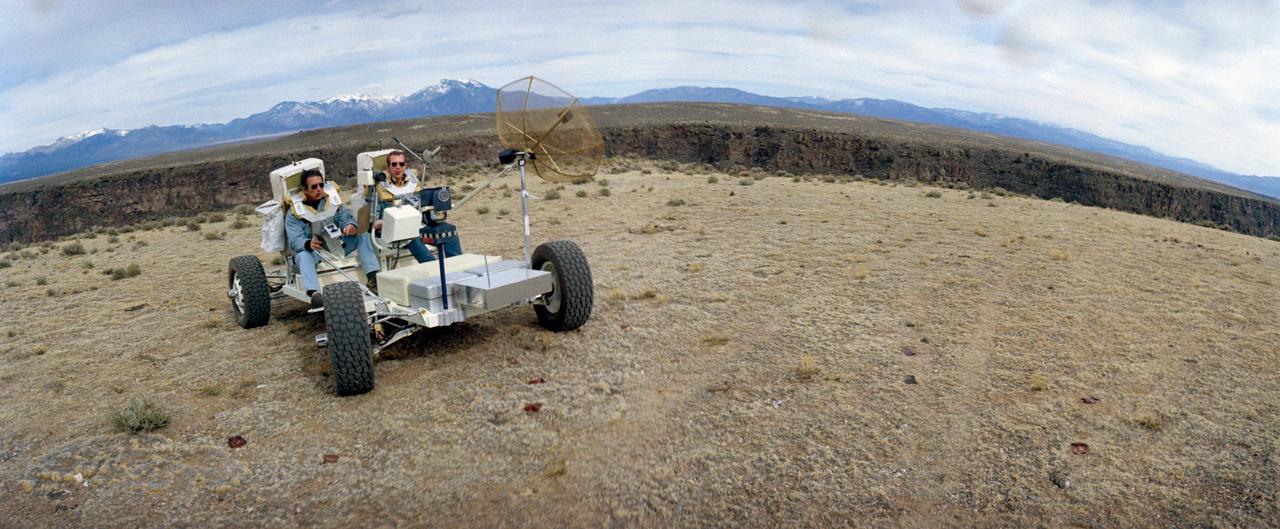
S71-23774 (11-12 March 1971) --- A wide-angle view showing two members of the prime crew of the Apollo 15 lunar landing mission riding in a Lunar Roving Vehicle trainer called "Grover" during a simulation of lunar surface extravehicular activity in the Taos, New Mexico area. They are astronauts David R. Scott (riding in left side seat), commander; and James B. Irwin, lunar module pilot. Apollo 15 will be the first mission to the moon to carry a Lunar Roving Vehicle, which will permit the astronauts to cover a larger area for exploration and sample collecting than on previous missions.
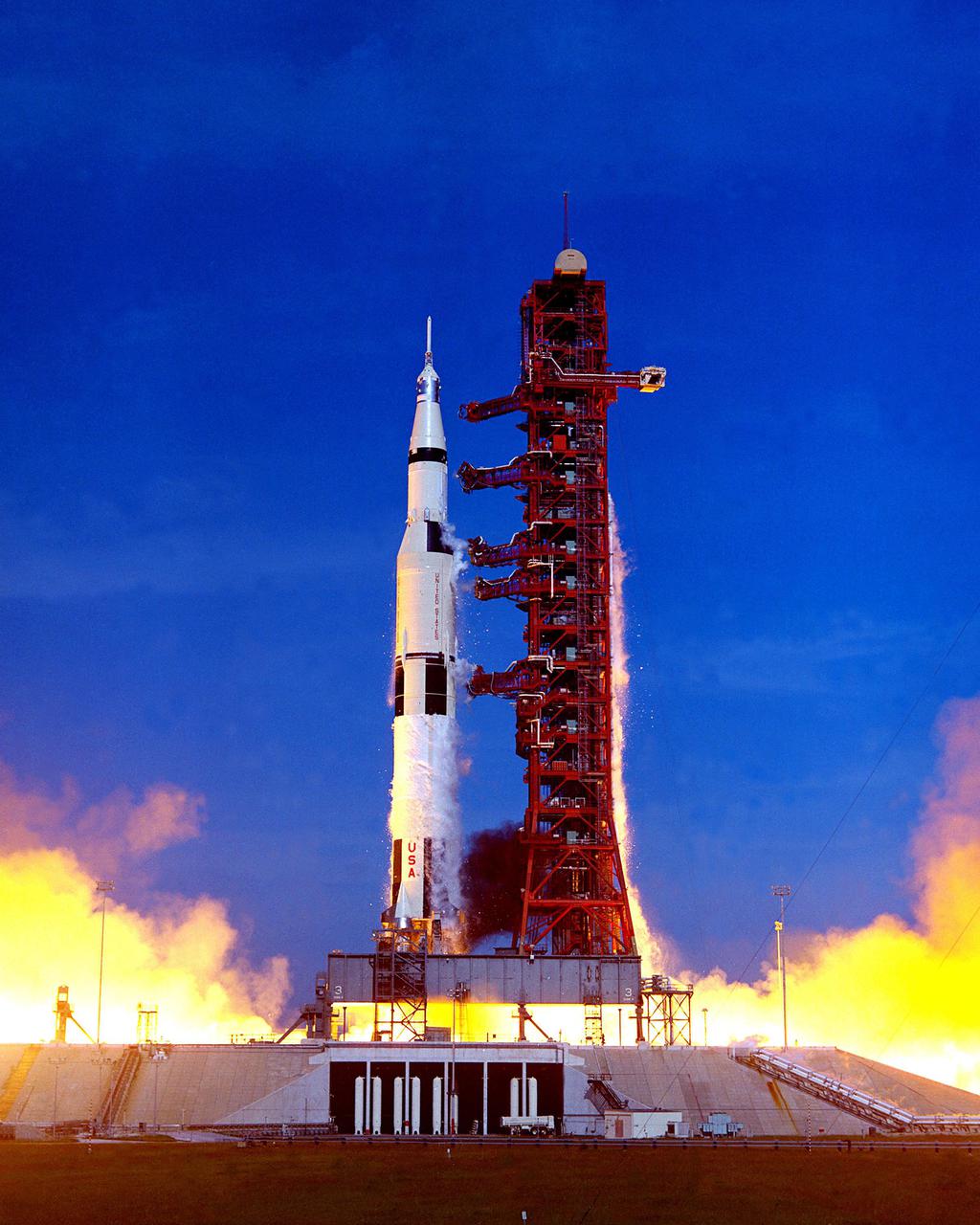
KENNEDY SPACE CENTER, FLA. -- The Apollo 15 Saturn V Space Vehicle soars into the skies after liftoff at Launch Pad 39A marking the beginning of NASA's fourth Manned Lunar Landing Mission. The astronauts aboard are David R. Scott, commander; James B. Irwin, Lunar Module pilot; and Alfred M. Worden Jr., Command Module pilot. The landing site for the Lunar Module is the Hadley-Apennine area of the Moon, about 465 miles north of the Lunar Equator. The Lunar Roving Vehicle (LRV) will be used for the first time.
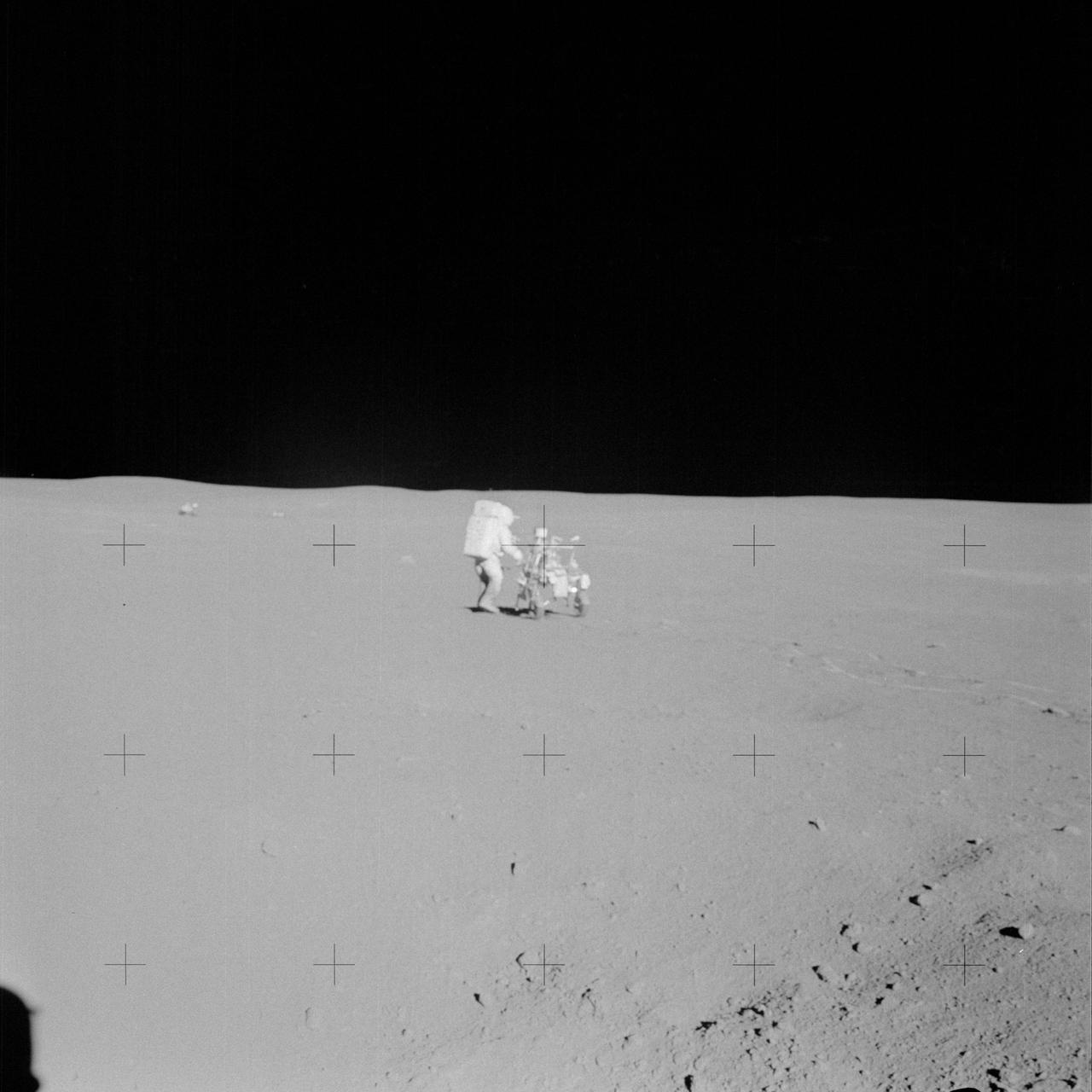
AS14-64-9140 (6 Feb. 1971) --- Astronaut Edgar D. Mitchell, lunar module pilot, participates in the mission's second extravehicular activity (EVA). He is standing near the modularized equipment transporter (MET). While astronauts Alan B. Shepard Jr., commander, and Mitchell descended in the Apollo 14 LM to explore the moon, astronaut Stuart A. Roosa, command module pilot, remained with the Command and Service Modules (CSM) in lunar orbit.
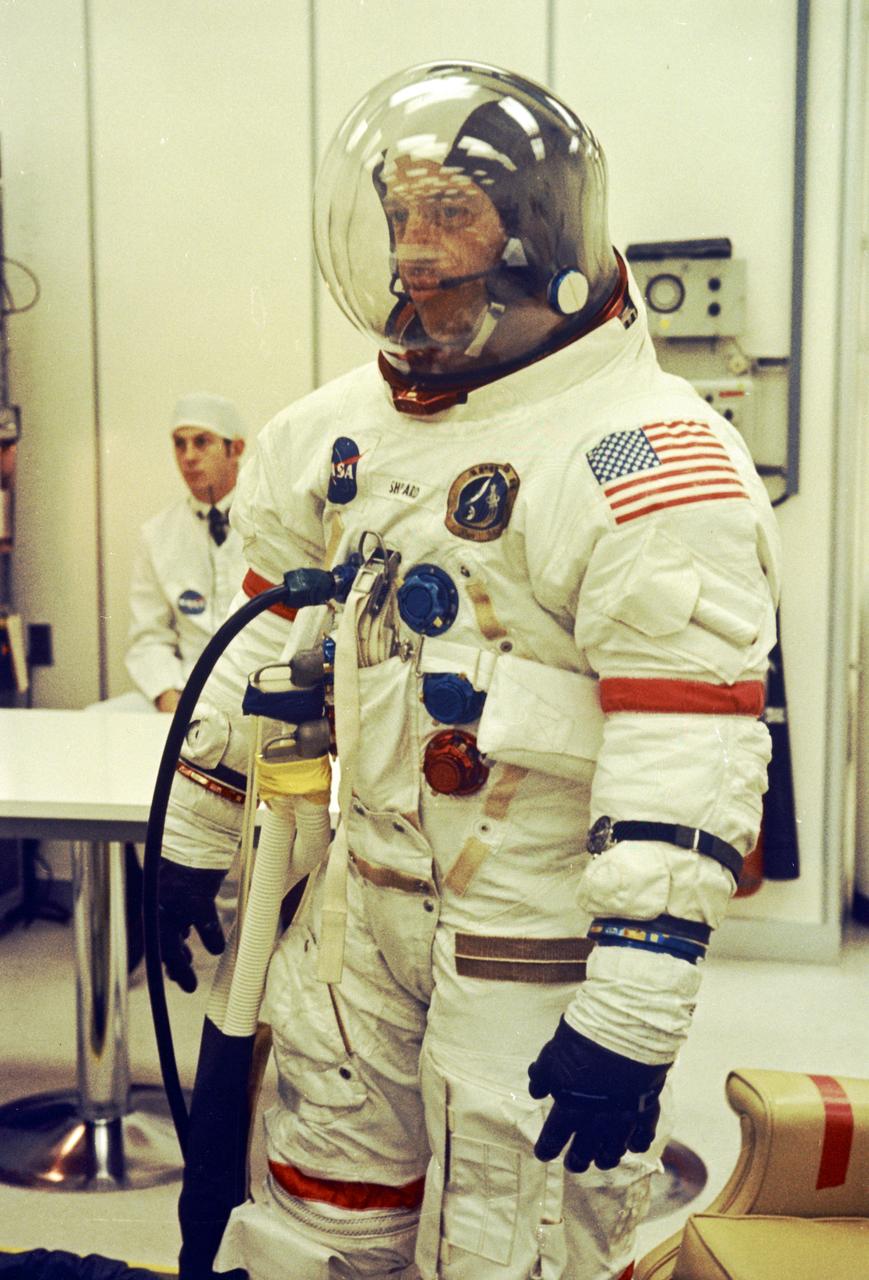
Alan B. Shepard, Jr., Apollo 14 mission commander, watches a technician conduct space suit checks during a demonstration test prior to countdown. The Apollo 14, carrying a crew of three astronauts: Shepard; Command Module pilot Stuart A. Roosa, and Lunar Module pilot Edgar D. Mitchell, lifted off from launch complex 39A at KSC on January 31, 1971. It was the third manned lunar landing, the first manned landing in exploration of the lunar highlands, and it demonstrated pinpoint landing capability. The major goal of Apollo 14 was the scientific exploration of the Moon in the foothills of the rugged Fra Mauro region. The extravehicular activities (EVA) of astronauts Shepard and Mitchell included setting up an automated scientific laboratory called Apollo Lunar Scientific Experiments Package (ALSEP), and collecting a total of about 95 pounds (43 kilograms) of Moon rock and soil for a geological investigation back on the Earth. Apollo 14 safely returned to Earth on February 9, 1971.
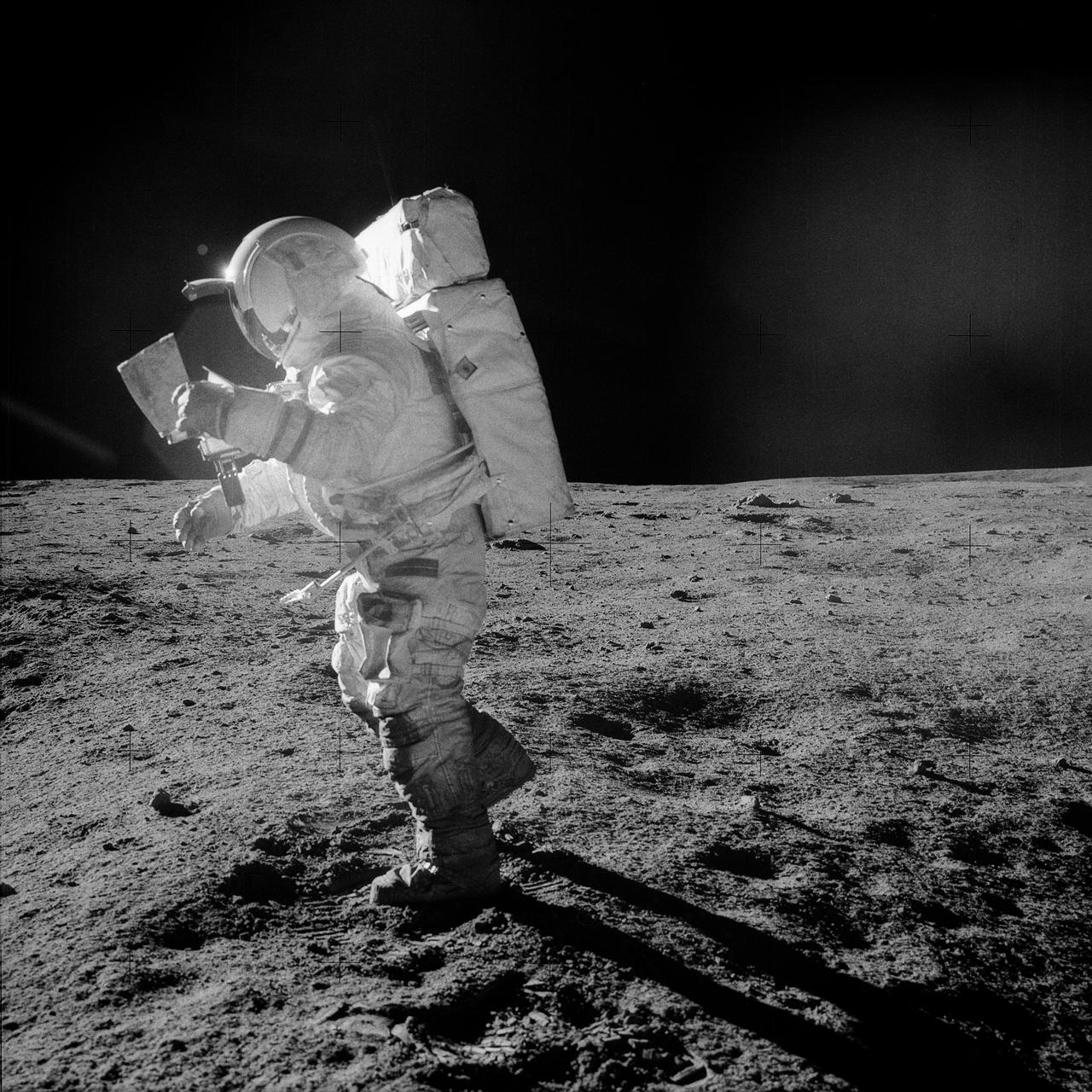
AS14-64-9089 (5-6 Feb. 1971) --- Astronaut Edgar D. Mitchell, lunar module pilot, moves across the lunar surface as he looks over a traverse map during an extravehicular activity (EVA). Lunar dust can be seen clinging to the boots and legs of the space suit. Astronauts Alan B. Shepard Jr., commander, and Mitchell explored the lunar surface while astronaut Stuart A. Roosa, command module pilot, orbited the moon in the Command and Service Modules (CSM).
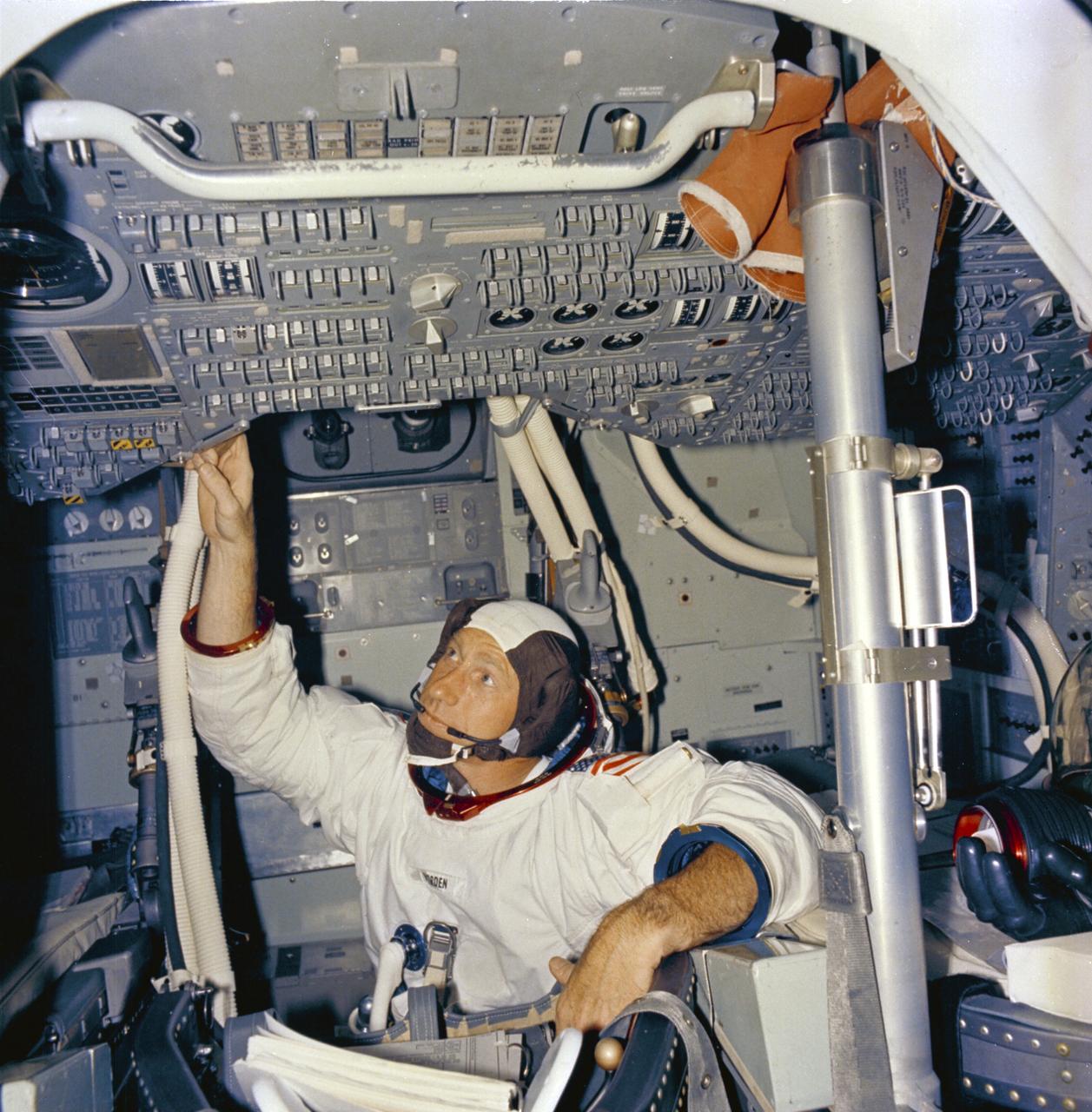
Apollo 15 Command Module Pilot Alfred M. Worden practices alone in a mission simulator at the Kennedy Space Center in preparation for his upcoming launch to the Moon with Mission Commander David R. Scott and Lunar Module Pilot James B. Irwin. Worden will maintain the command module in lunar orbit while the other two crewmen remain on the surface for as long as 67 hours. Launch to the moon is scheduled for no earlier than July 26, 1971.
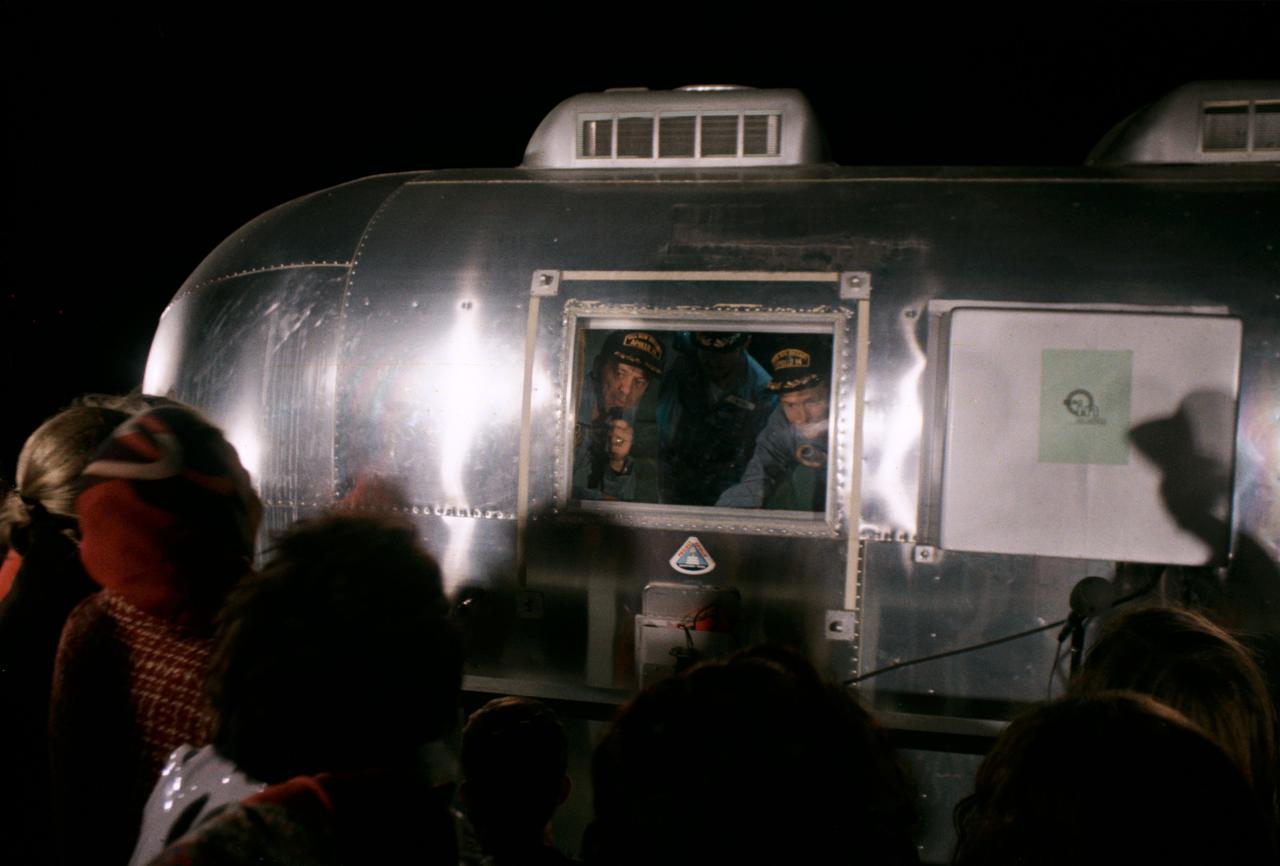
S71-19508 (12 Feb. 1971) --- Separated by aluminum and glass of their Mobile Quarantine Facility (MQF), the Apollo 14 crew members visit with their families and friends upon arriving at Ellington Air Force Base in the early morning hours of Feb. 12, 1971. Looking through the MQF window are astronauts Alan B. Shepard Jr. (left), commander; Stuart A. Roosa (right), command module pilot; and Edgar D. Mitchell, lunar module pilot. The crew men were brought to Houston aboard a C-141 transport plane from Pago Pago, American Samoa. The USS New Orleans had transported the crew to American Samoa from the recovery site in the South Pacific.
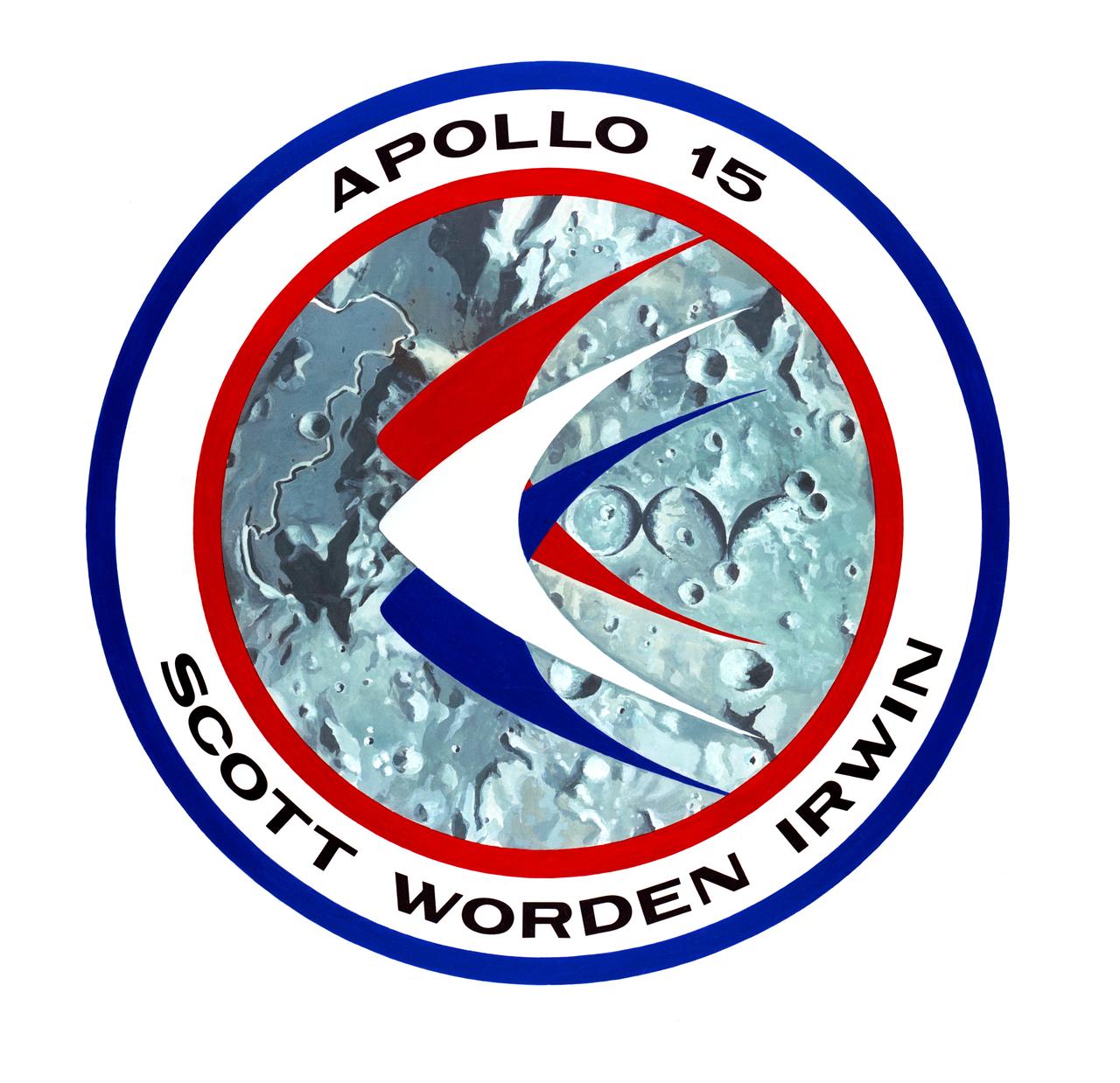
S71-30463 (May 1971) --- This is the insignia designed for the Apollo 15 lunar landing mission. The circular design features the colors red, white and blue. On the outer portion of the patch a narrow band of blue and a narrow band of red encircle a wider band of white. The large disc in the center of the emblem has red, white and blue symbols of flight, superimposed over an artist's concept of the Apollo 15 Hadley-Apennine landing site of gray tone. The surnames of the three names are centered in the white band at the bottom of the insignia. The Apollo 15 prime crew men are David R. Scott, commander; Alfred M. Worden, command module pilot; and James B. Irwin, lunar module pilot. This is the official Apollo 15 emblem, property of the government of the United States. It has been authorized only for use by the astronauts. Its production in any form other than in news, information and education media is not authorized without approval. Unauthorized use of the photograph is subject to the provisions of Title 18, U.S. Code, Section 701.
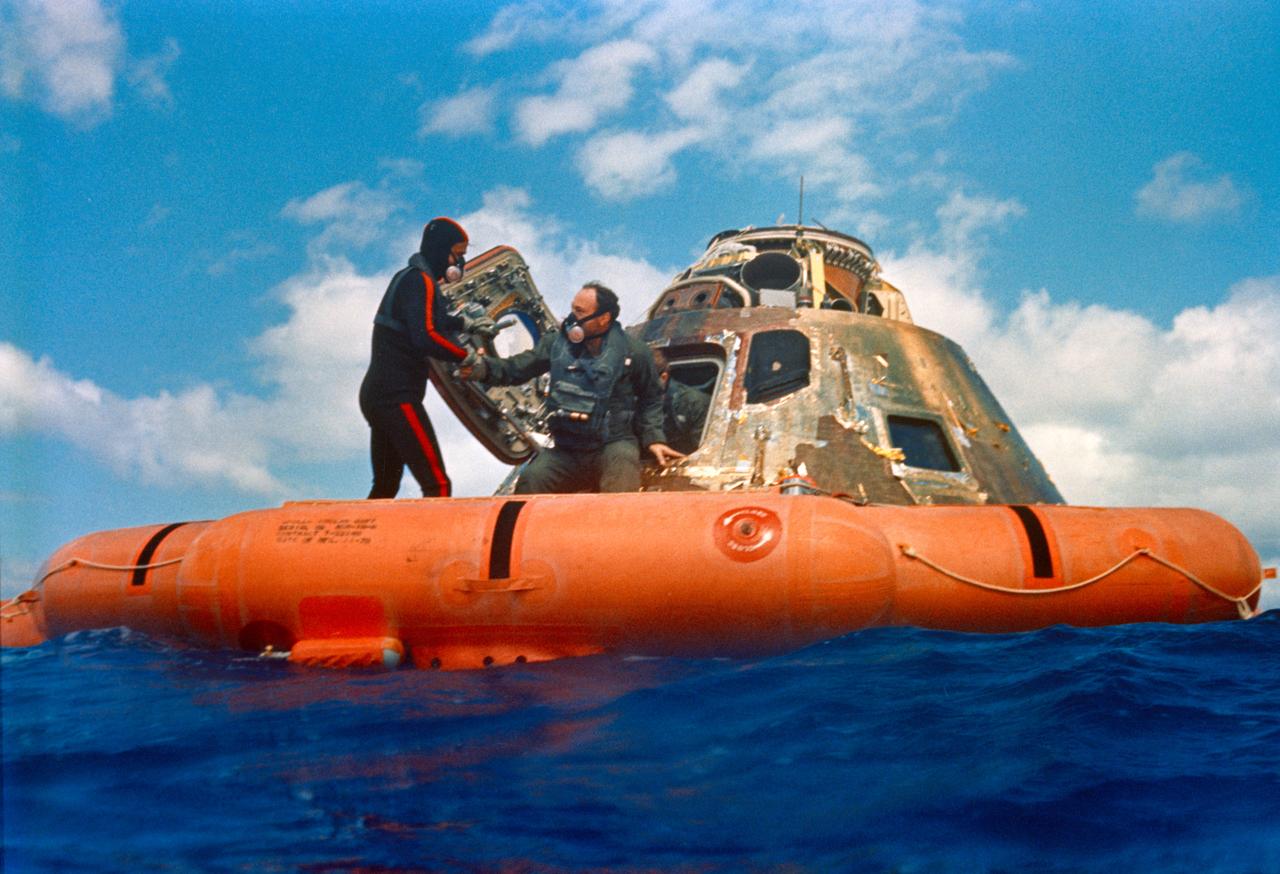
S71-19474 (9 Feb. 1971) --- Astronaut Edgar D. Mitchell, lunar module pilot, is assisted out of the Command Module (CM) by a U.S. Navy underwater demolition team swimmer during the Apollo 14 recovery operations in the South Pacific Ocean. Mitchell was followed out of the spacecraft by astronauts Alan B. Shepard Jr., commander; and Stuart A. Roosa, command module pilot. Roosa is partially visible behind Mitchell. The Apollo 14 splashdown occurred at 3:04:39 p.m. (CST), Feb. 9, 1971, in the South Pacific Ocean, approximately 765 nautical miles from American Samoa. They were transported by U.S. Navy helicopter to the USS New Orleans, prime recovery vessel.
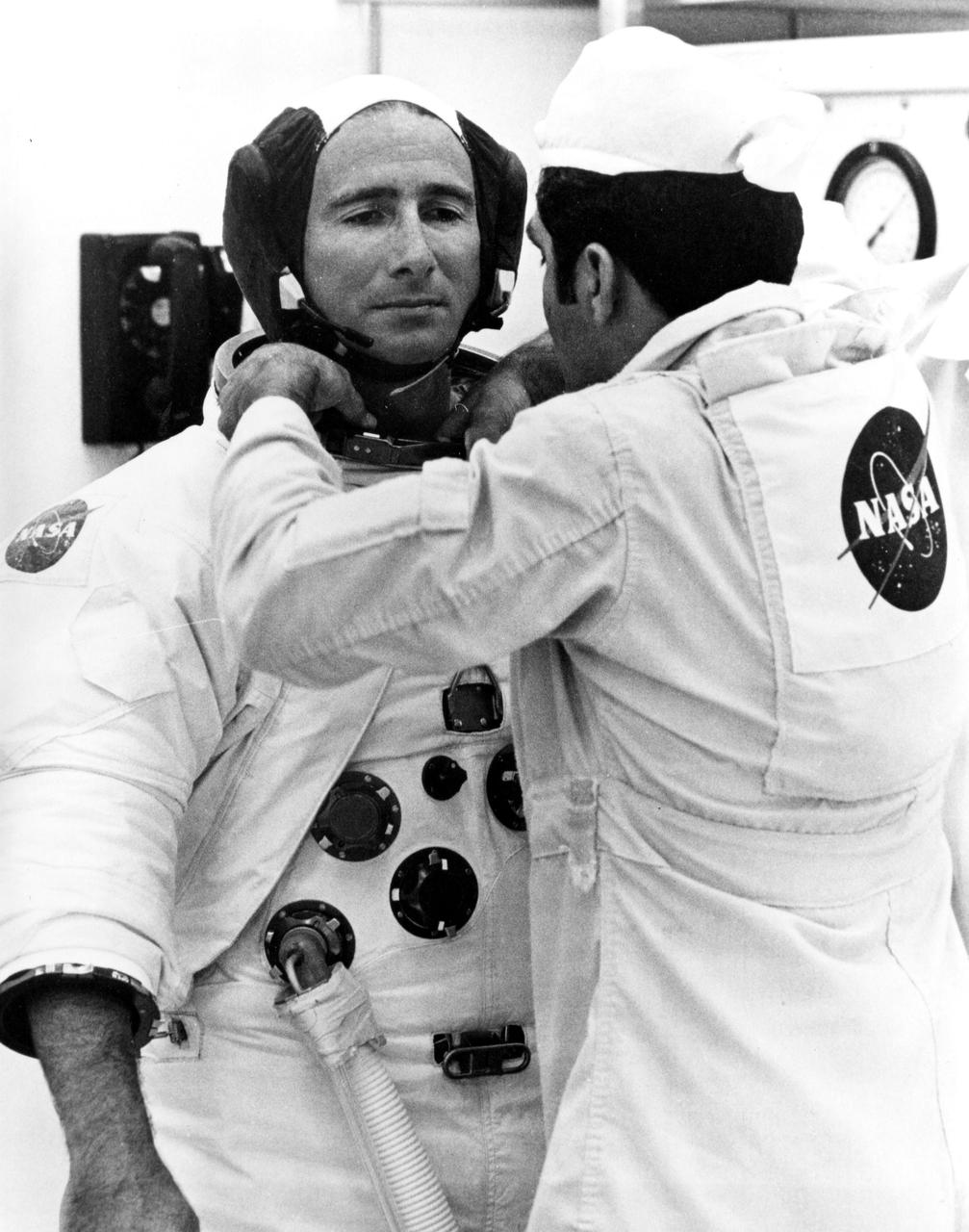
KENNEDY SPACE CENTER, FLA. -- A technician adjusts the spacesuit of Apollo 15 Lunar Module Pilot James B. Irwin prior to his launch to the Moon today with astronauts David R. Scott and Alfred N. Worden. The National Aeronautics and Space Administration directs the Apollo program.
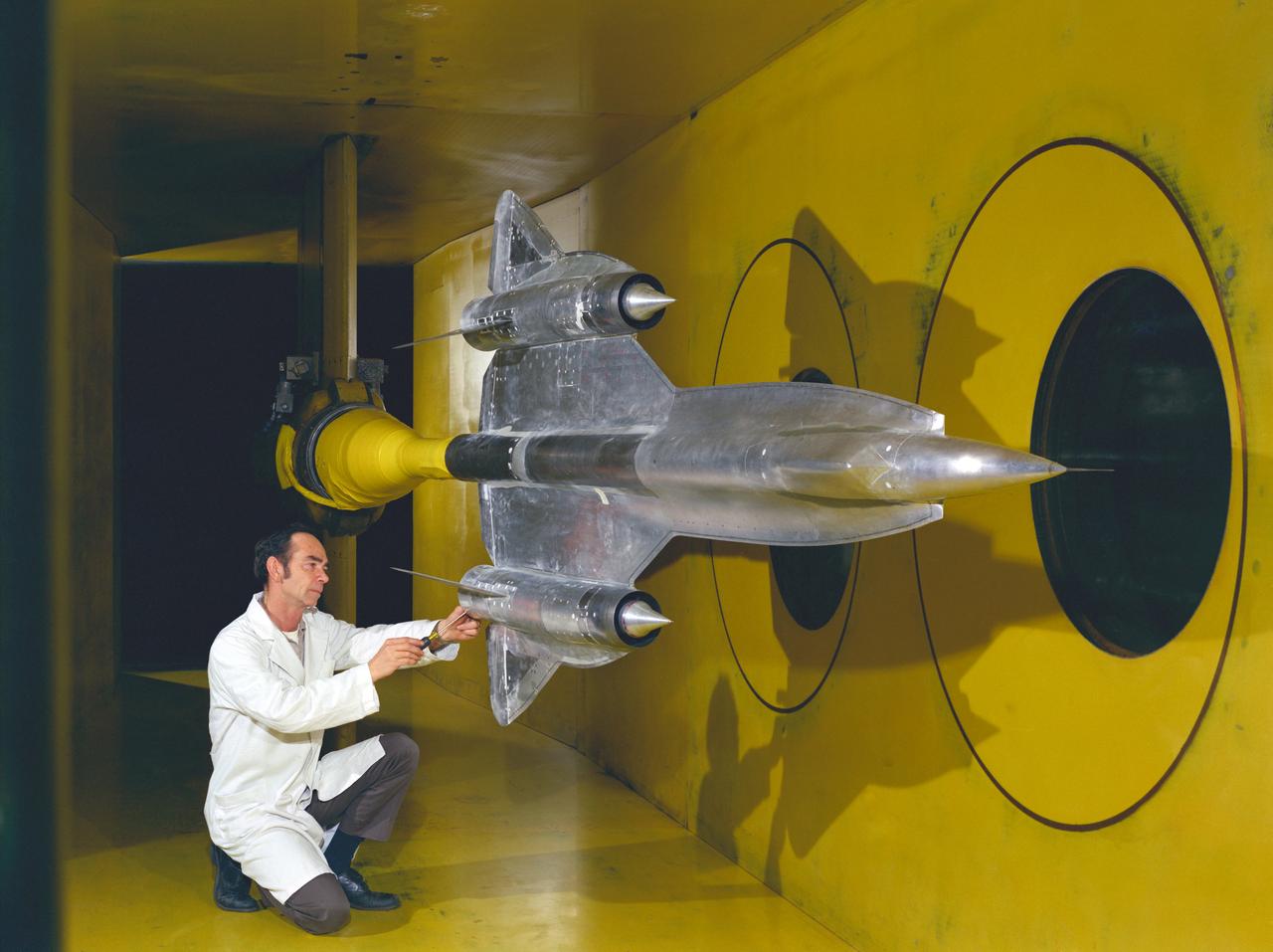
YF-12 inlet airframe interaction test in Ames 8X7ft supersonic wind tunnel
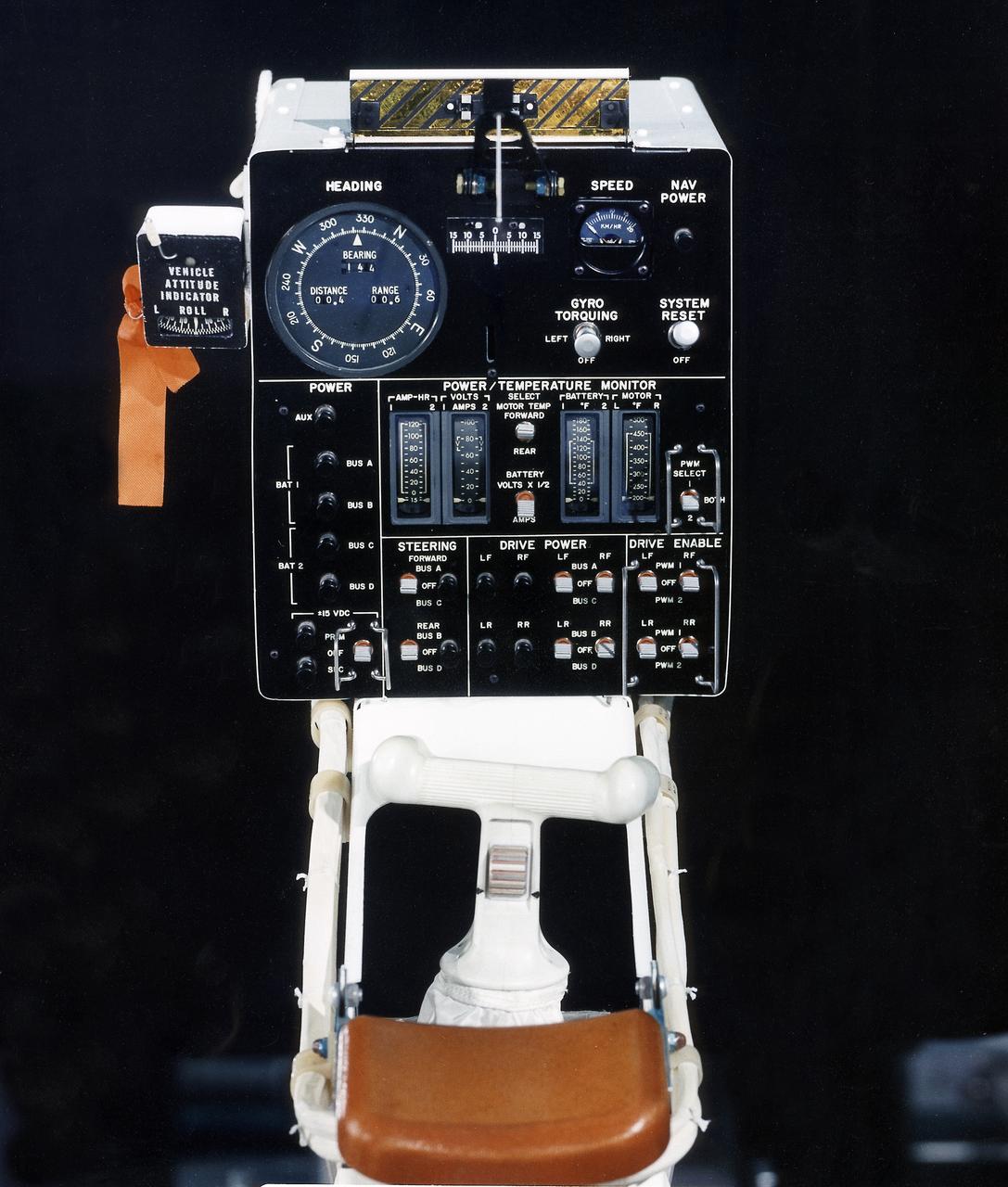
This photograph is a view of a display, control console, and hand controller for the Lunar Roving Vehicle (LRV) No. 2. The LRV was built to give Apollo astronauts a greater range of mobility during lunar exploration. It was an open-space and collapsible vehicle about 10 feet long with large mesh wheels, anterna, appendages, tool caddies, and camera. An LRV was used on each of the last three Apollo missions; Apollo 15, Apollo 16, and Apollo 17. It was built by the Boeing Company under the direction of the Marshall Space Flight Center.
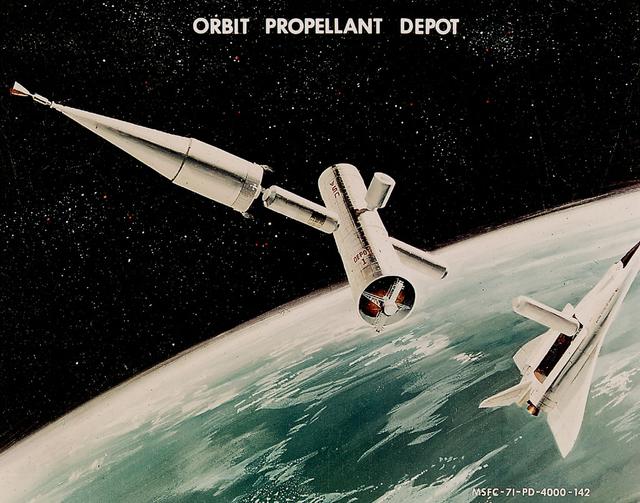
This 1971 artist's concept shows a Nuclear Shuttle and an early Space Shuttle docked with an Orbital Propellant Depot. As envisioned by Marshall Space Flight Center Program Development persornel, an orbital modular propellant storage depot, supplied periodically by the Space Shuttle or Earth-to-orbit fuel tankers, would be critical in making available large amounts of fuel to various orbital vehicles and spacecraft.
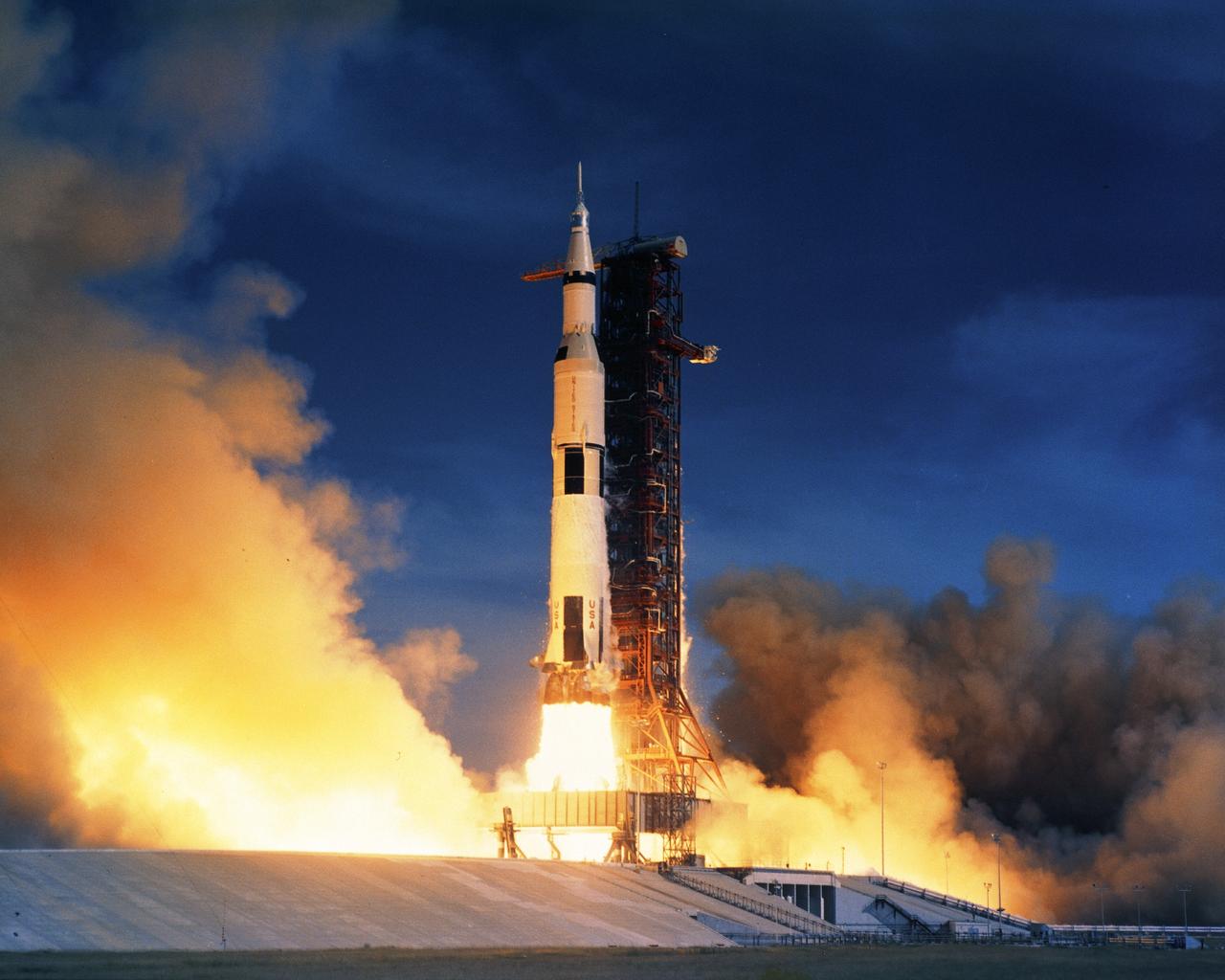
CAPE CANAVERAL, Fla. - At NASA's Kennedy Space Center in Florida, Apollo 15's Saturn V rocket lifts off from Launch Pad 39A at 9:34 a.m., EDT, July 26, 1971, on a lunar landing mission. Aboard the Apollo 15 spacecraft are astronauts David R. Scott, commander, Alfred M. Worden, command module pilot, and James B. Irwin, lunar module pilot. While Apollo 15 astronauts Scott and Irwin will descend in the lunar module to explore the moon's Hadley-Apennine region, astronaut Worden will remain in lunar orbit with the command module. For more information, visit http://www-pao.ksc.nasa.gov/history/apollo/apollo-15/apollo-15.htm Photo credit: NASA
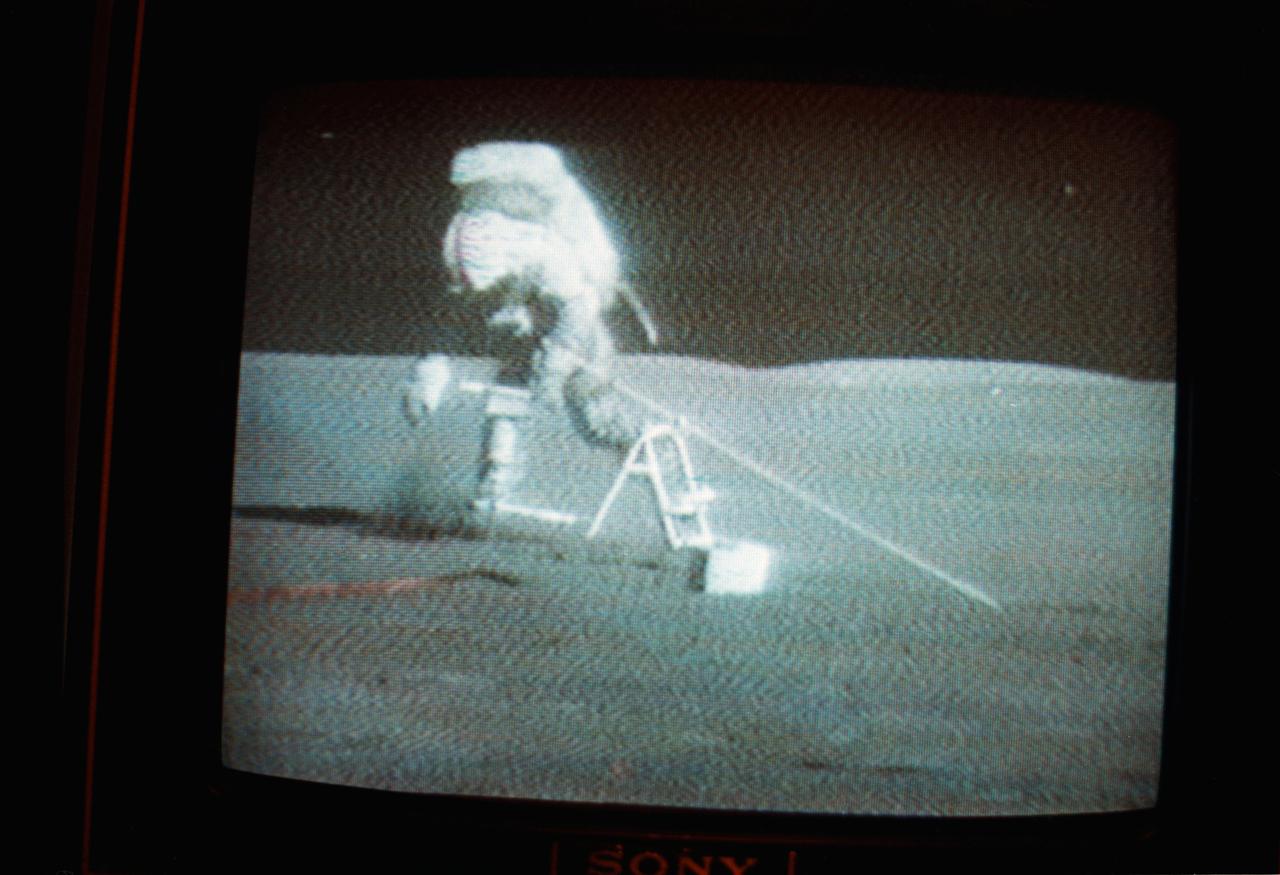
S71-41501 (1 Aug. 1971) --- Astronaut David R. Scott, Apollo 15 commander, is seen carrying the Apollo Lunar Surface Drill (ALSD) during the second lunar surface extravehicular activity (EVA) in this black and white reproduction taken from a color transmission made by the RCA color television camera mounted on the Lunar Roving Vehicle (LRV). This transmission was the fourth made during the mission.
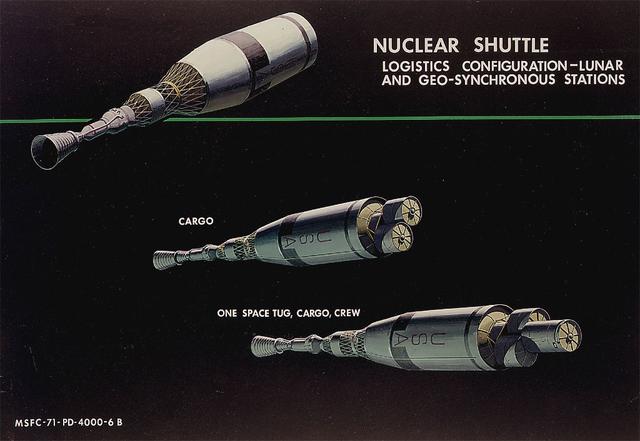
This 1971 artist's concept shows the Nuclear Shuttle in both its lunar logistics configuraton and geosynchronous station configuration. As envisioned by Marshall Space Flight Center Program Development persornel, the Nuclear Shuttle would deliver payloads to lunar orbits or other destinations then return to Earth orbit for refueling and additional missions.
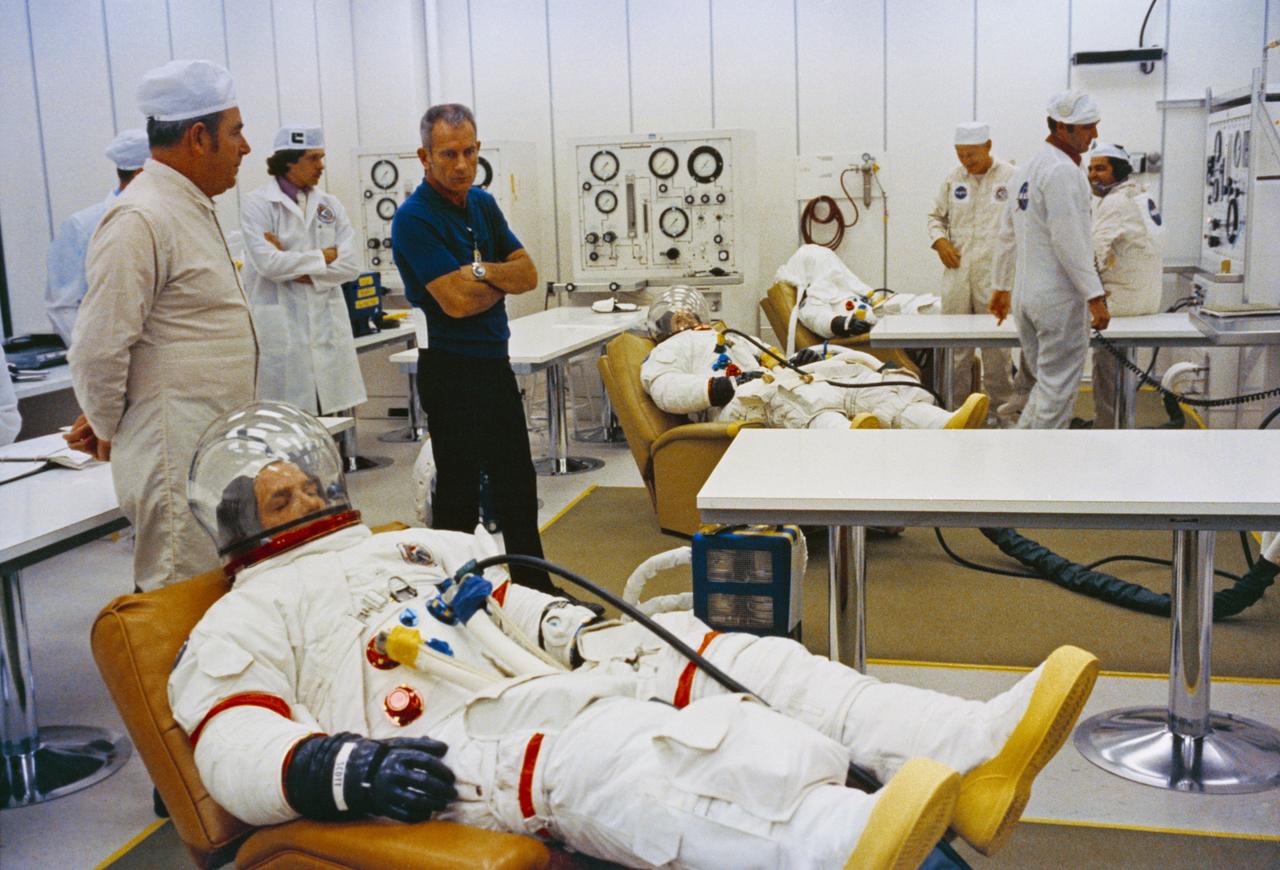
S71-41408 (26 July 1971) --- The three Apollo 15 astronauts go through suiting up operations in the Kennedy Space Center's (KSC) Manned Spacecraft Operations Building (MSOB) during the Apollo 15 prelaunch countdown. They are David R. Scott (foreground), commander; Alfred M. Worden (center), command module pilot; and James B. Irwin (background), lunar module pilot. Minutes later the crew rode a special transport van over to Pad A, Launch Complex 39, where their spacecraft awaited them. With the crew was Dr. Donald (Deke) K. Slayton (wearing dark blue sport shirt), director of Flight Crew Operations, Manned Spacecraft Center (MSC). The Apollo 15 space vehicle was launched at 9:34:00:79 a.m. (EDT), July 26, 1971, on a lunar landing mission.
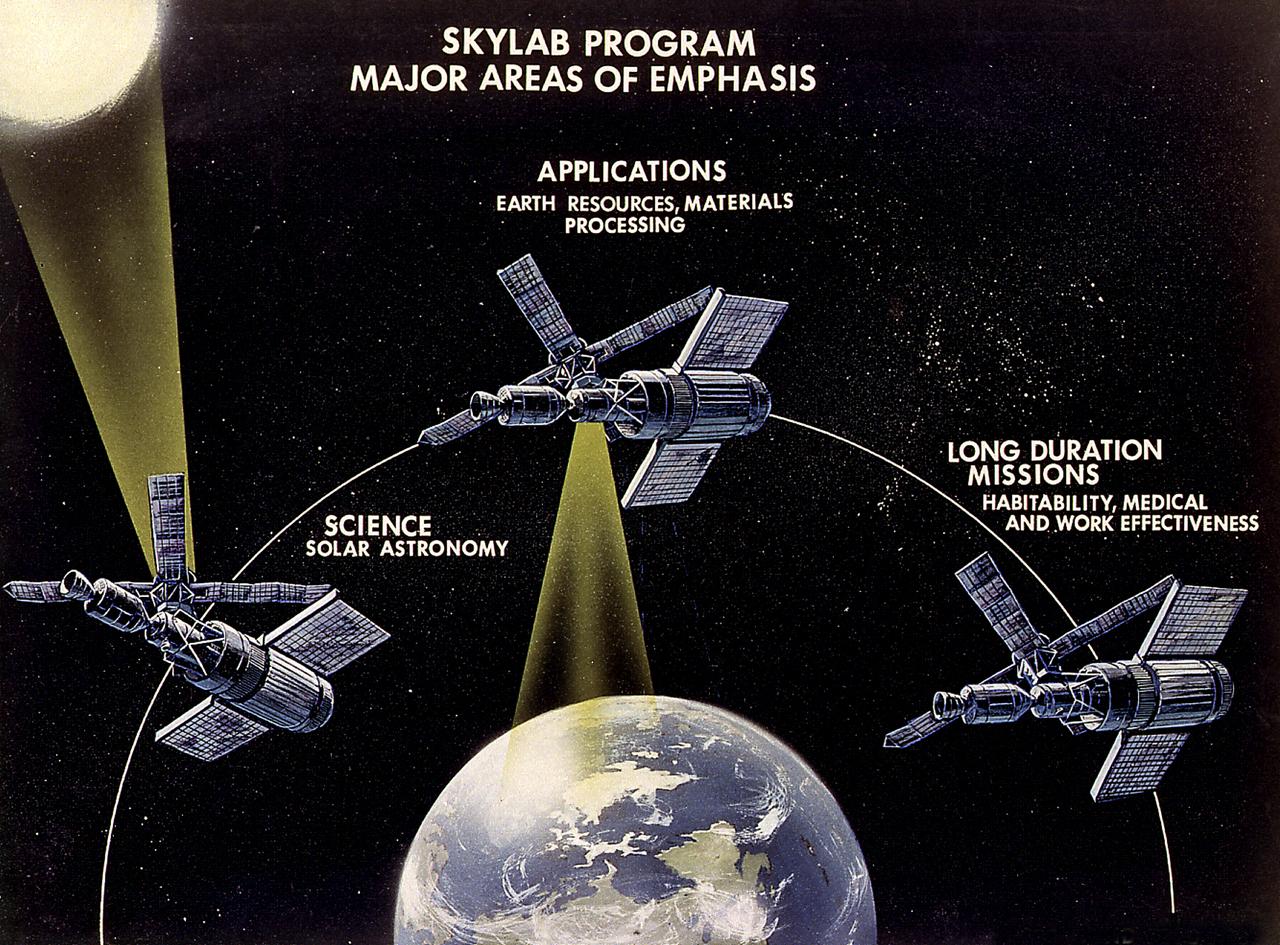
This image illustrates major areas of emphasis of the Skylab Program. In an early effort to extend the use of Apollo for further applications, NASA established the Apollo Applications Program (AAP) in August of 1965. The AAP was to include long duration Earth orbital missions during which astronauts would carry out scientific, technological, and engineering experiments in space by utilizing modified Saturn launch vehicles and the Apollo spacecraft. Established in 1970, the Skylab Program was the forerurner of the AAP. The goals of the Skylab were to enrich our scientific knowledge of the Earth, the Sun, the stars, and cosmic space; to study the effects of weightlessness on living organisms, including man; to study the effects of the processing and manufacturing of materials utilizing the absence of gravity; and to conduct Earth resource observations. The Skylab also conducted 19 selected experiments submitted by high school students. Skylab's 3 different 3-man crews spent up to 84 days in Earth orbit. The Marshall Space Flight Center (MSFC) had responsibility for developing and integrating most of the major components of the Skylab: the Orbital Workshop (OWS), Airlock Module (AM), Multiple Docking Adapter (MDA), Apollo Telescope Mount (ATM), Payload Shroud (PS), and most of the experiments. MSFC was also responsible for providing the Saturn IB launch vehicles for three Apollo spacecraft and crews and a Saturn V launch vehicle for the Skylab.
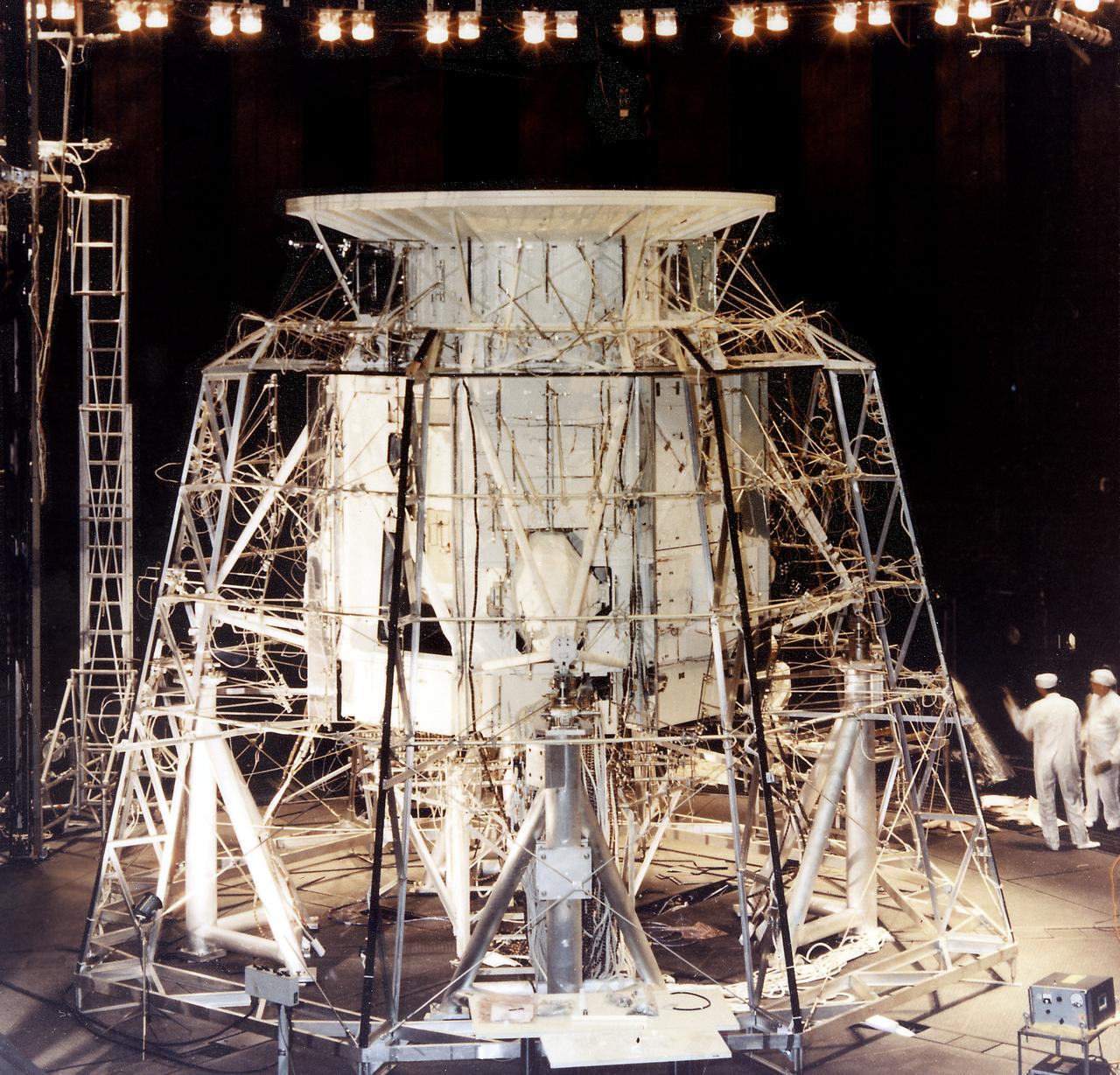
The Apollo Telescope Mount (ATM), designed and developed by the Marshall Space Flight Center, was one of four major components comprising the Skylab (1973-1979). The ATM housed the first manned scientific telescope in space. This photograph is of the ATM thermal systems unit undergoing testing in the Space Environment Simulation Laboratory of the Manned Spacecraft Center (MSC). The ATM thermal systems unit was used to control the temperatures of space instrument's subsystems during a mission. The MSC was renamed the Johnson Space Center (JSC) in early 1973.
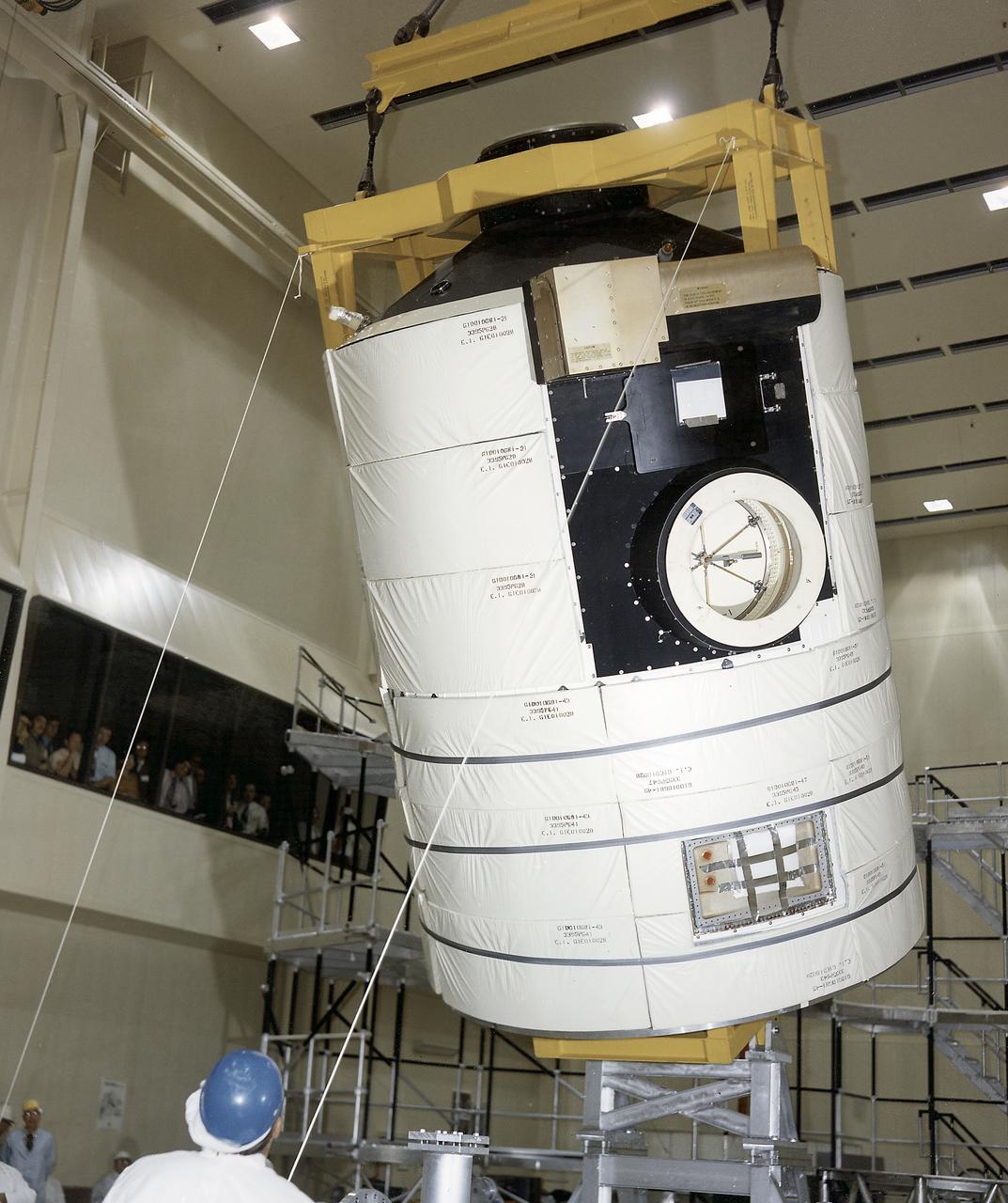
Workmen at the Martin Marietta Corporation's Space Center facility in Denver, Colorado, lower the Skylab Multiple Docking Adapter (MDA) flight article into the horizontal rotation fixture in preparation for the crew compartment and function review. Designed and manufactured by the Marshall Space Flight Center and outfitted by Martin Marietta, the MDA housed a number of experiment control and stowage units and provided a docking port for the Apollo Command Module.
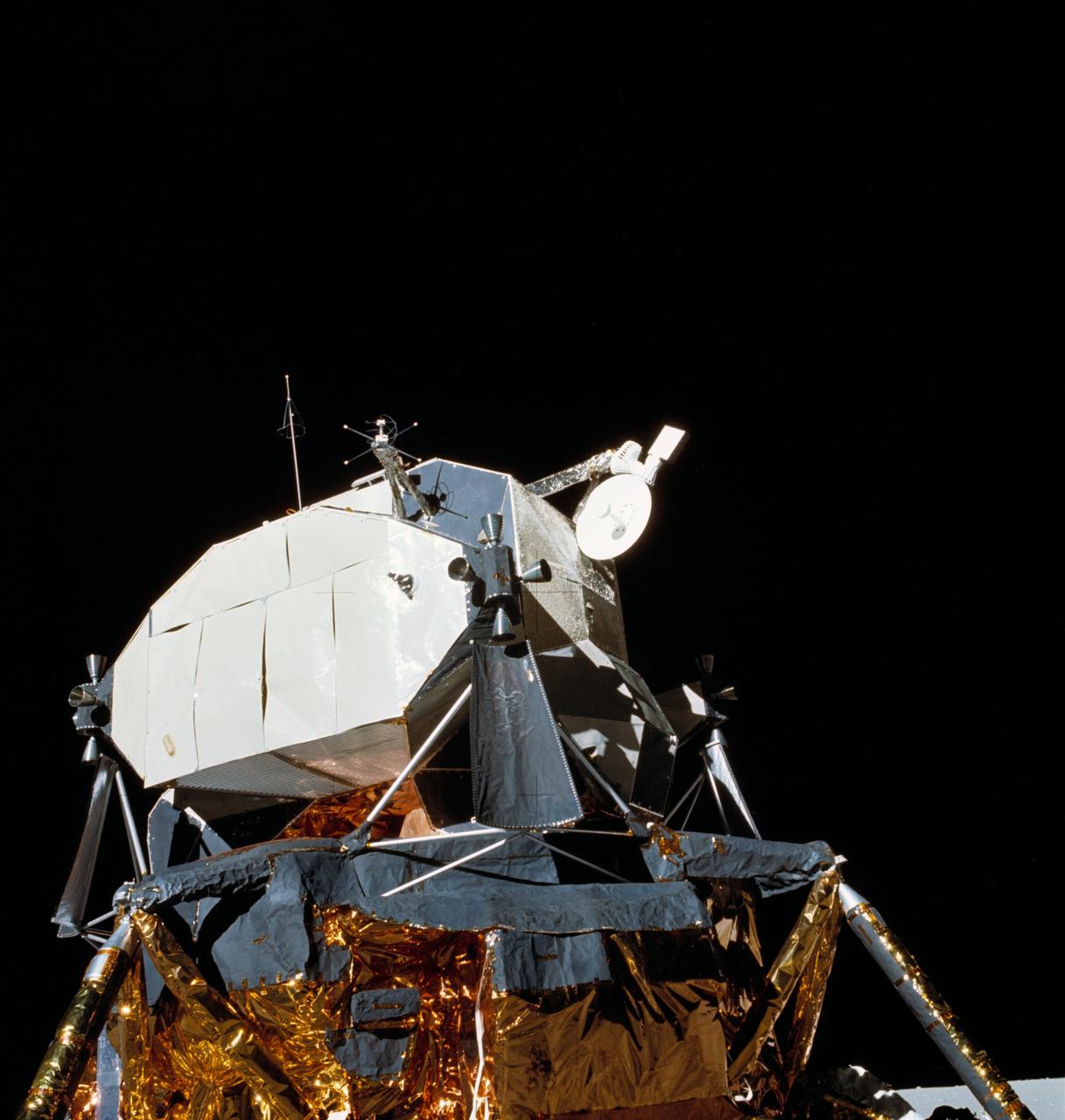
AS16-113-18334 (21 April 1972) --- View of the Lunar Module (LM) "Orion" parked on the lunar surface. During their post mission press conference, the Apollo 16 crewmembers called attention to the steerable S-band antenna, which was "frozen" in a yaw axis during much of the flight. This view of the LM was photographed by astronaut Charles M. Duke Jr., the lunar module pilot, during the mission's first extravehicular activity (EVA). Astronauts John W. Young, commander, and Duke had earlier descended in the LM to explore the Descartes region of the moon, while astronaut Thomas K. Mattingly II, command module pilot, remained with the Command and Service Modules (CSM) "Casper" in lunar orbit.
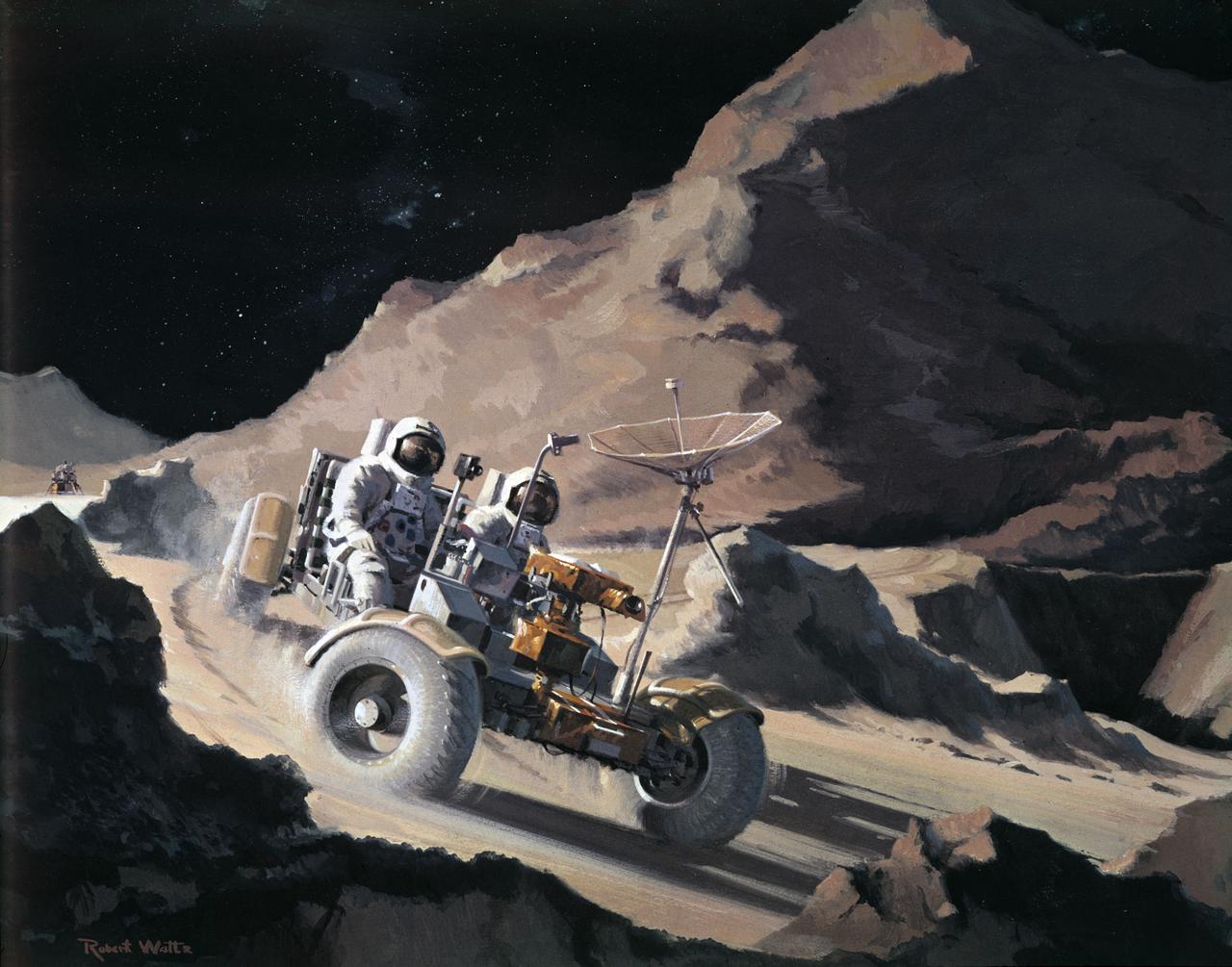
S71-39868 (July 1971) --- An artist's concept of the Apollo 15 Hadley-Apennine landing area showing the two moon-exploring crewmen on a traverse in their Lunar Roving Vehicle (LRV). The two figures represent astronauts David R. Scott, commander, and James B. Irwin, lunar module pilot. The artwork is by Teledyne Ryan.
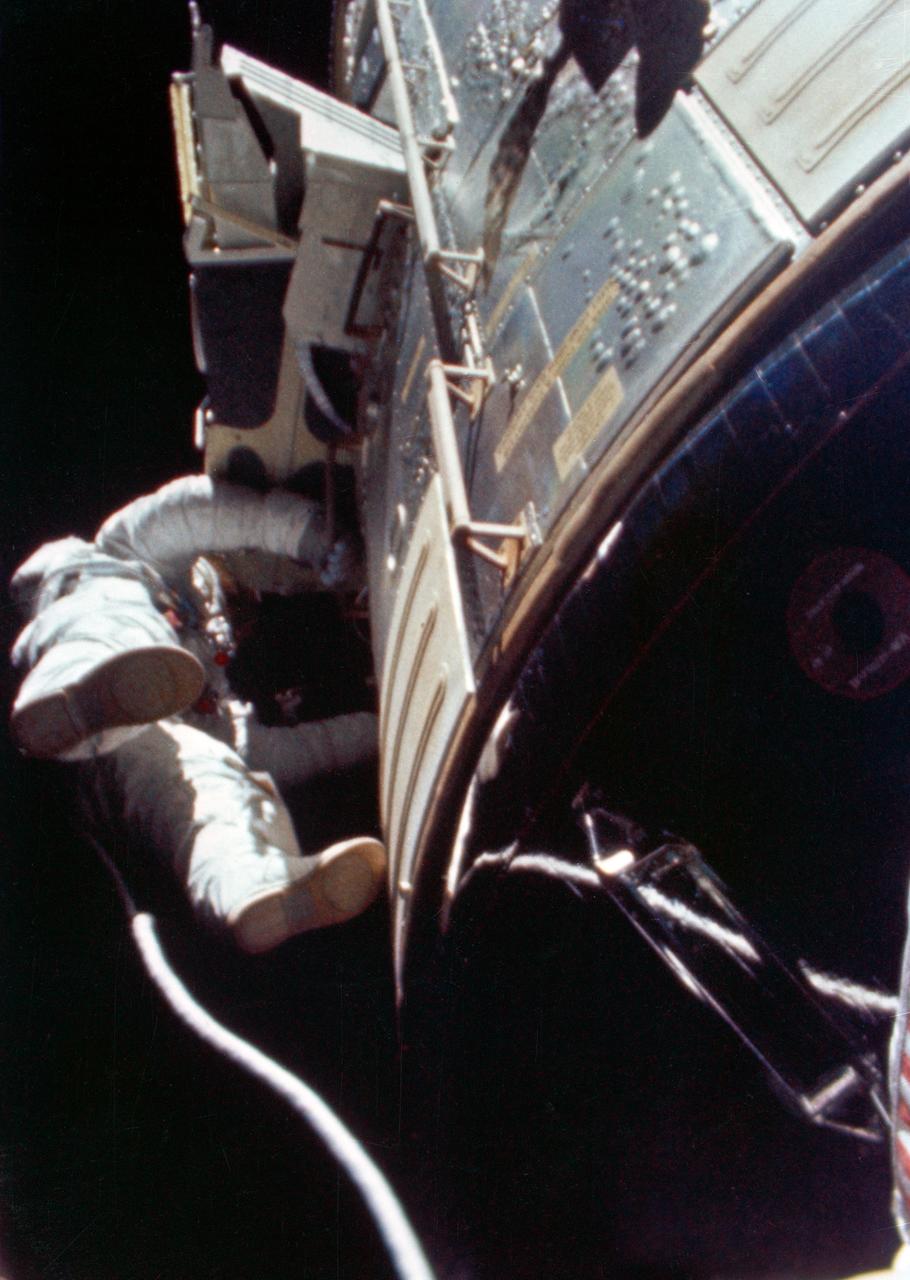
S71-43202 (5 Aug. 1971) --- Astronaut Alfred M. Worden, command module pilot of the Apollo 15 lunar landing mission, floats in space outside the spacecraft during his trans-Earth extravehicular activity (EVA). This photograph was taken from a frame of motion picture film exposed by the 16mm Maurer camera mounted in the hatch of the Command Module (CM). During his EVA, Worden made an inspection of the Service Module's (SM) Scientific Instrument Module (SIM) bay and retrieved the film cassettes from the Panoramic Camera and the Mapping Camera. The SIM bay holds eight orbital science experiments. The EVA occurred when the spacecraft was homeward bound approximately 171,000 nautical miles from Earth.

S71-51318 (1 Oct. 1971) --- A close view of germ free plants -- lettuce (left), tomato (right center and left center) and citrus (right). This type of testing is a unique effort at the Manned Spacecraft Center (MSC) to grow germ-free plants. By study of the germ-free plants, NASA and the U.S. Department of Agriculture Forest Service hope to establish clearly the exact mineral needs of the plants alone. Previous nutrition studies have measured the needs of a complex of soil:micro-organisms:plants. Results from studies where the role of microbes is not known or defined are difficult to interpret and do not lead to the accumulation of exacting facts on plant nutrition.
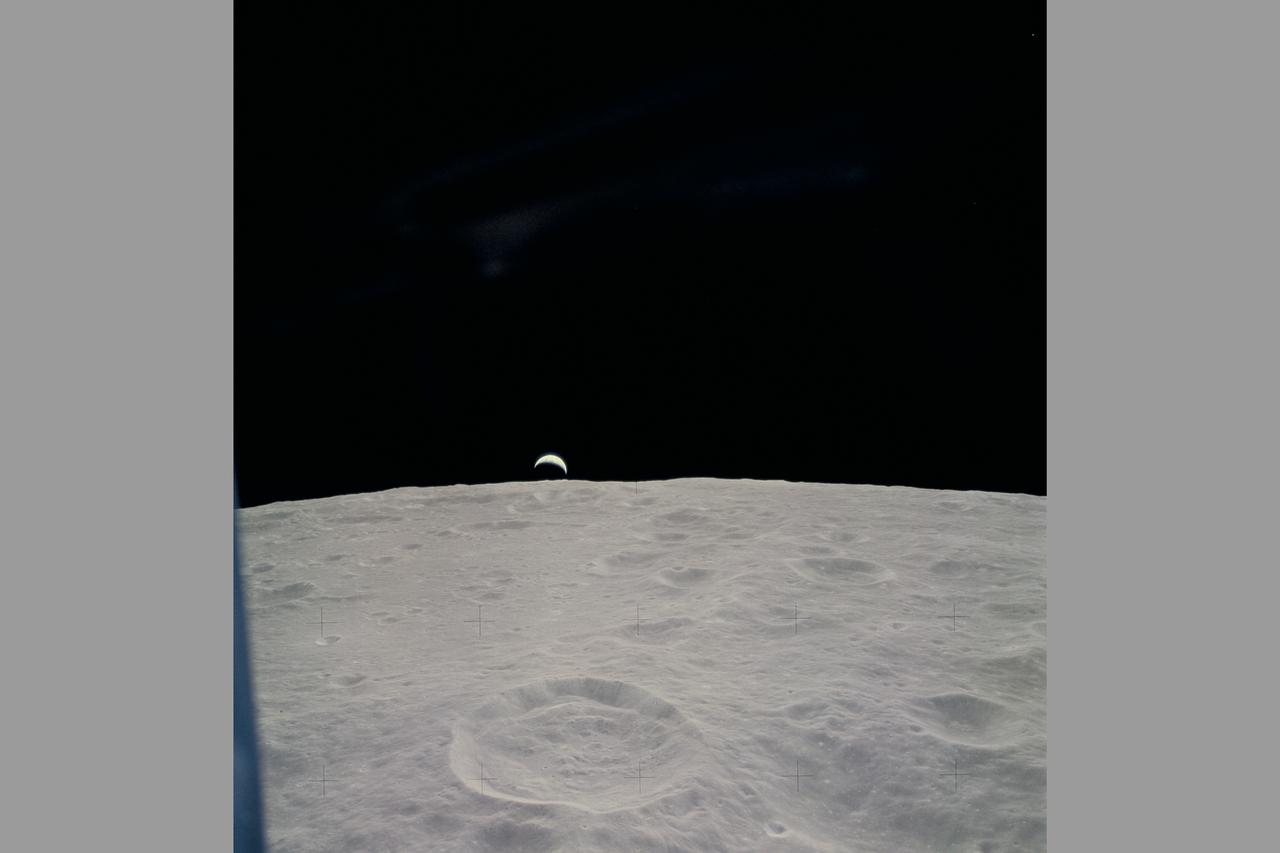
Photo by Apollo Crew The Apollo 14 crew catch a cresent view of the Earth as it raises above the lunar horizon during one moon orbit
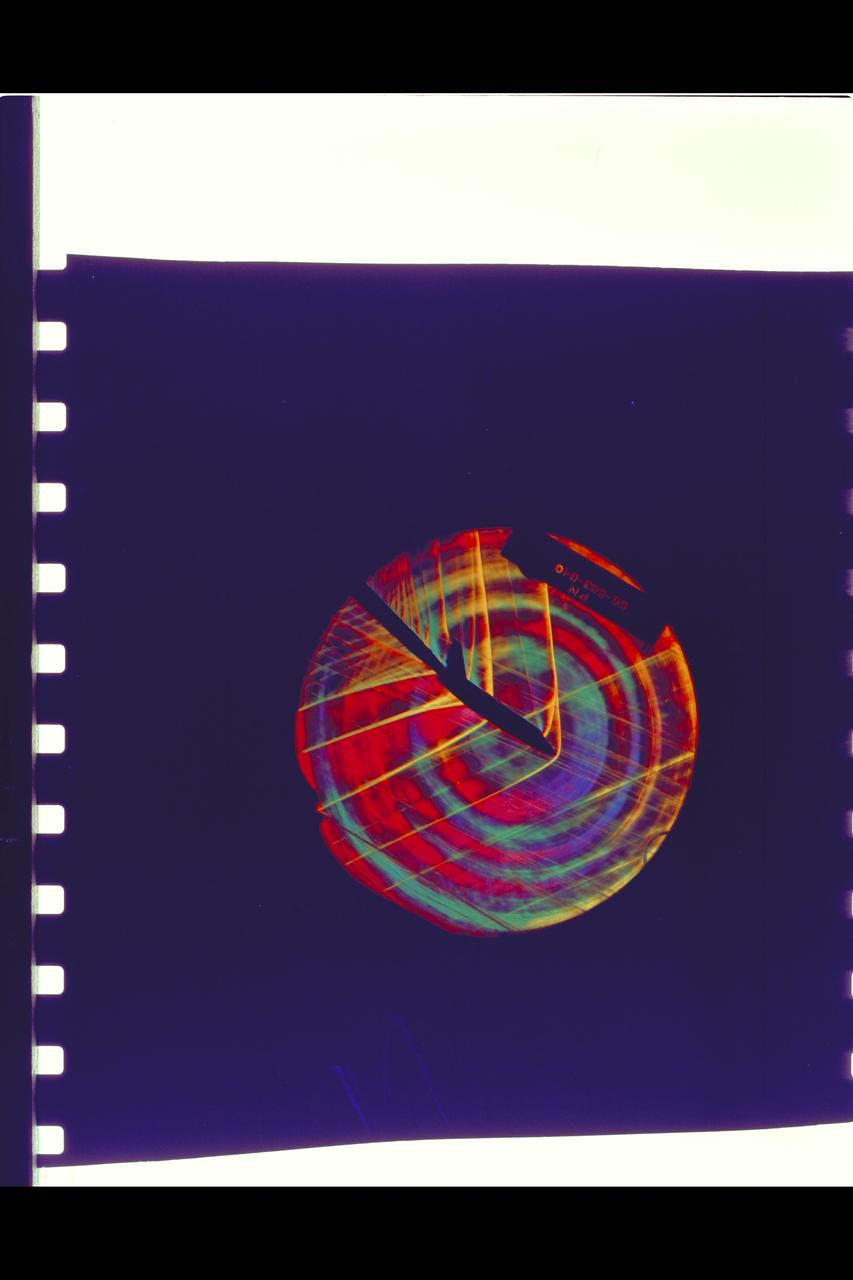
MSC Space Shuttle Stability and Control Characteristics. Schlieren of North American Rockwell Straight Wing orbiter approximate Mach .95 6ft w.t. Test-66-503
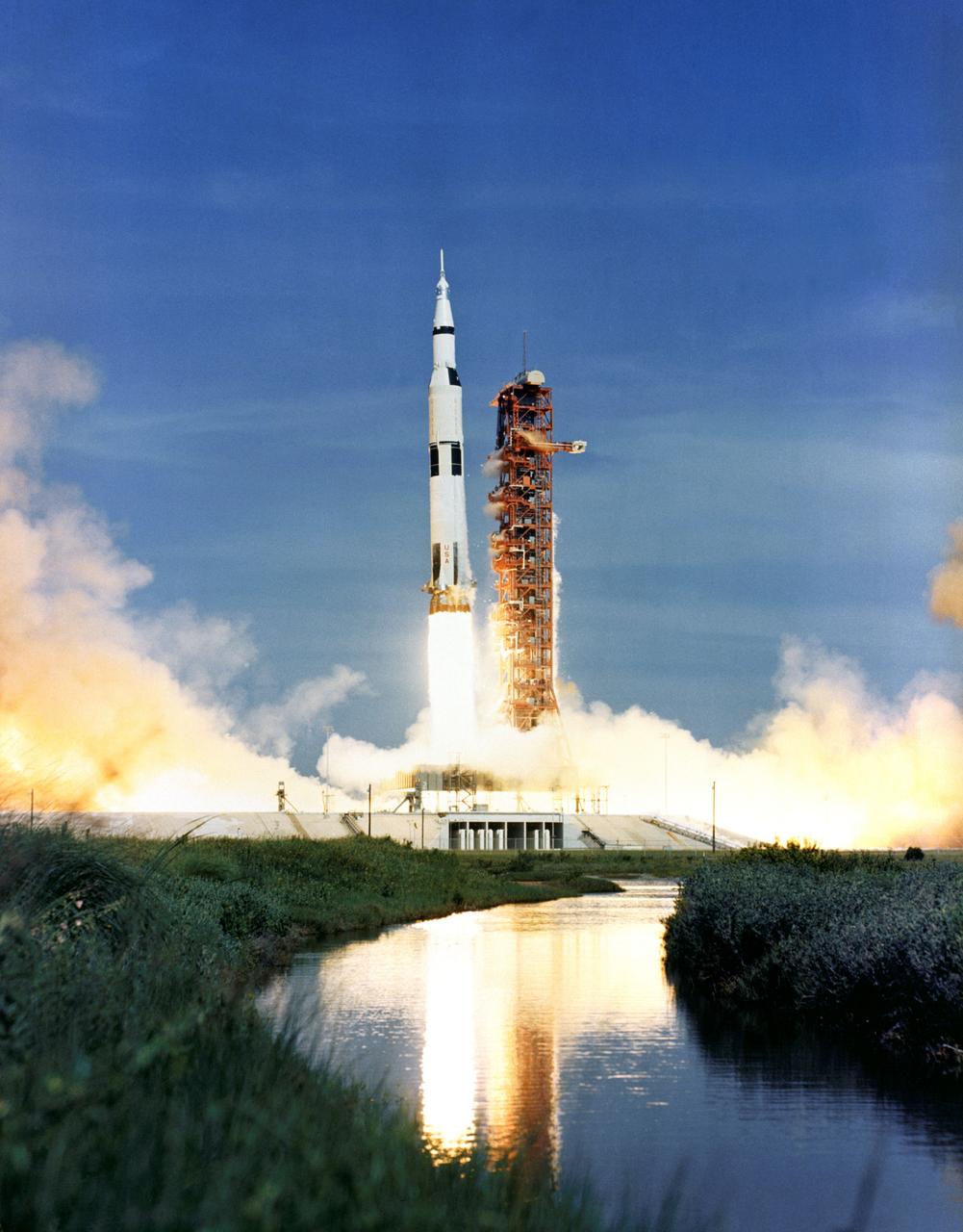
S71-41810 (26 July 1971) --- The 363-feet tall Apollo 15 (Spacecraft 112/Lunar Module 10/Saturn 510) space vehicle is launched from Pad A, Launch Complex 39, Kennedy Space Center, Florida, at 9:34:00.79 a.m., July 26, 1971, on a lunar landing mission. Aboard the Apollo 15 spacecraft were astronauts David R. Scott, commander; Alfred M. Worden, commander module pilot; and James B. Irwin, lunar module pilot. Apollo 15 is the National Aeronautics and Space Administration's (NASA) fourth manned lunar landing mission.
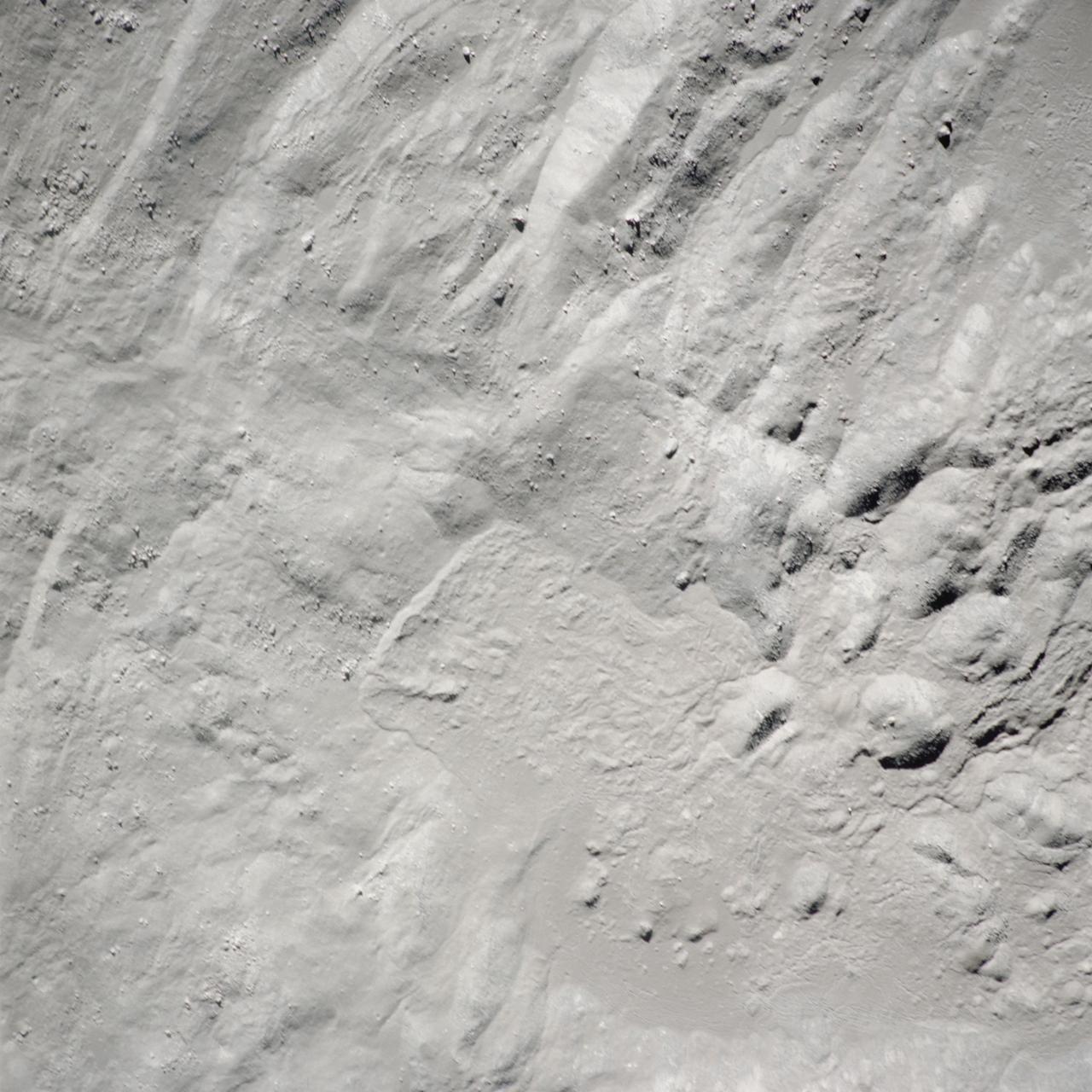
AS14-72-9975 (February 1971) --- A near vertical view of the inner wall of King Crater located on the lunar farside, as photographed from the Apollo 14 spacecraft in lunar orbit. The coordinates of the center of King Crater are 120.7 degrees east longitude and 14.3 degrees north latitude.
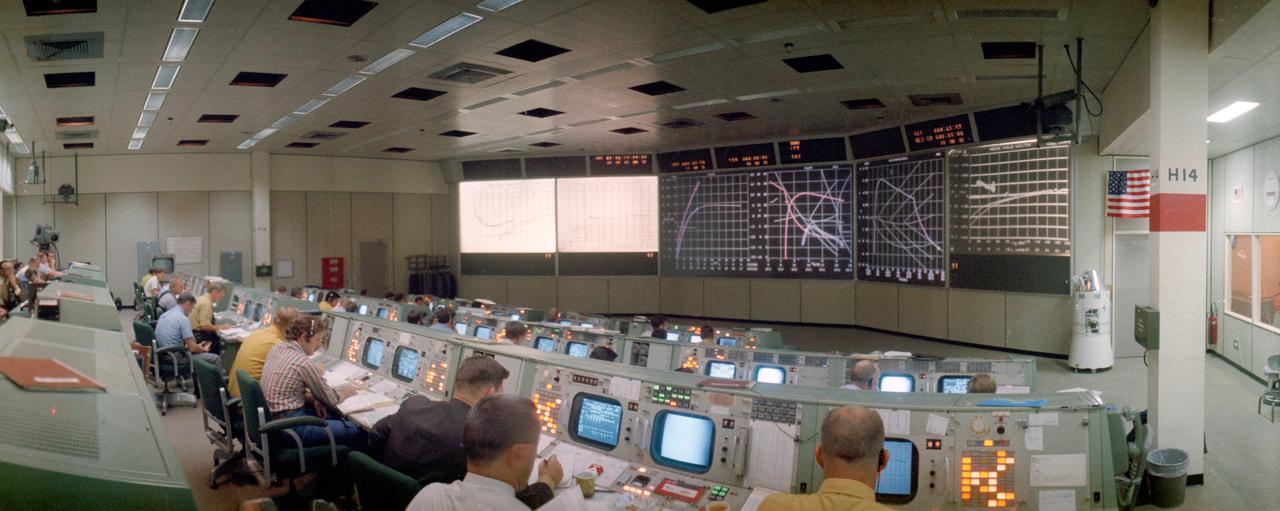
S71-41357 (26 July 1971) --- An overall, wide-angle lens view of activity in the Mission Operations Control Room in the Mission Control Center minutes after the launch of the Apollo 15 lunar landing mission. Ground elapsed time was 45 minutes and 42 seconds when this photograph was taken.
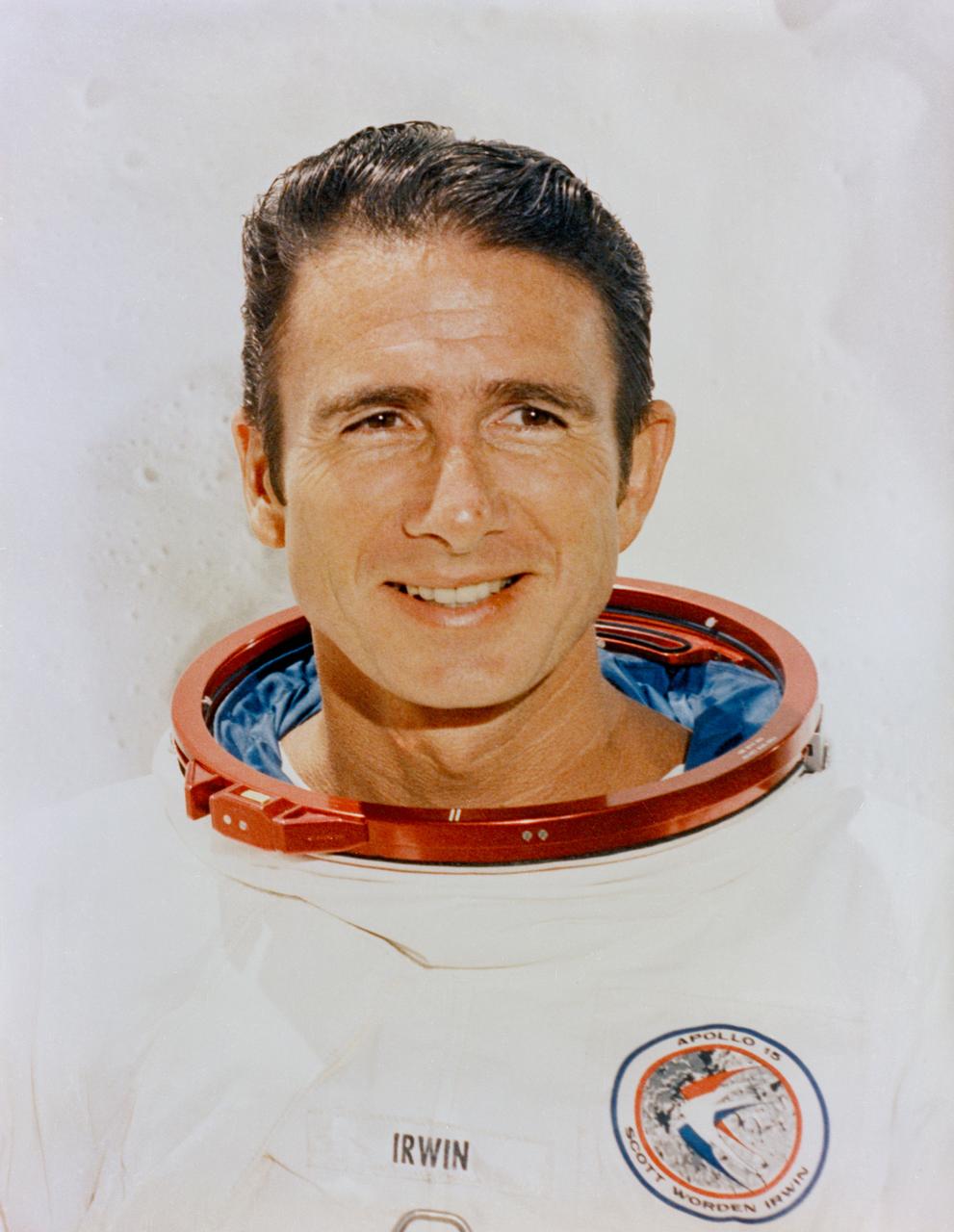
S71-39485 (July 1971) --- Astronaut James B. Irwin
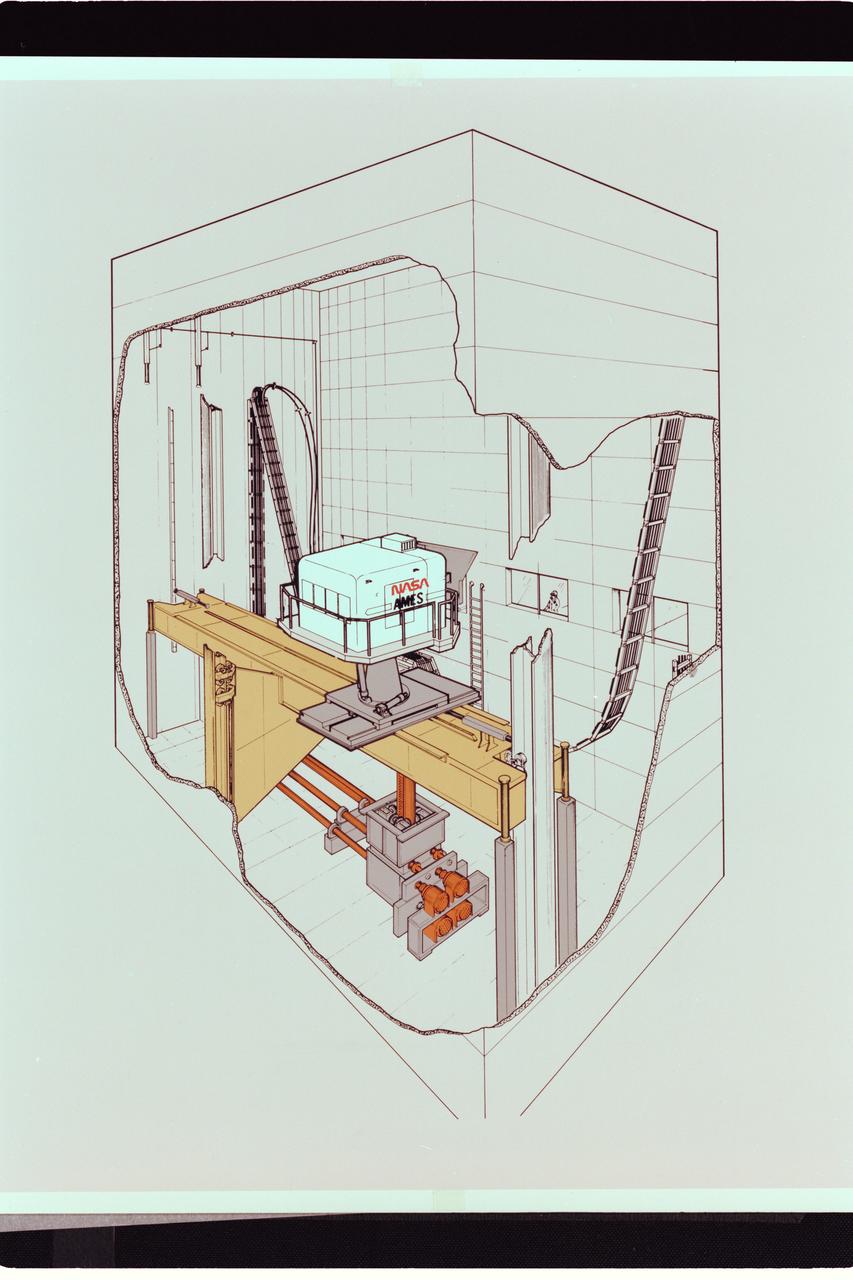
N-221 40x80ft wind tunnel control room
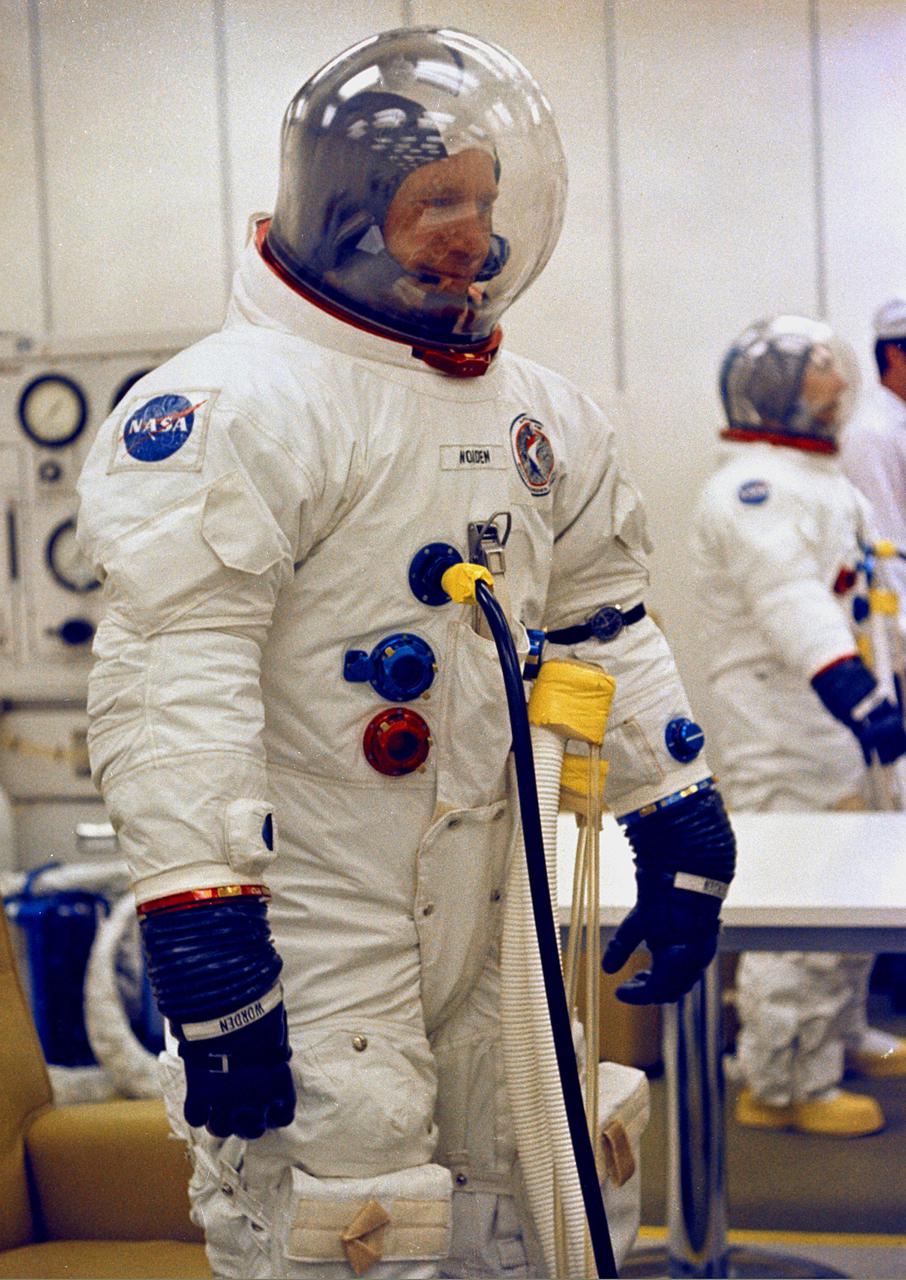
KENNEDY SPACE CENTER, FLA. - Apollo 15 Command Module Pilot Alfred M. Worden undergoes spacesuit pressure checks prior to participating in the space vehicle Countdown Demonstration Test. Lunar Module Pilot James B. Irwin is visible in the rear while David R. Scott, the Commander for Apollo 15, is not shown. The test is a rehearsal in preparation for the scheduled Moon mission, scheduled no earlier than July 26, 1971.
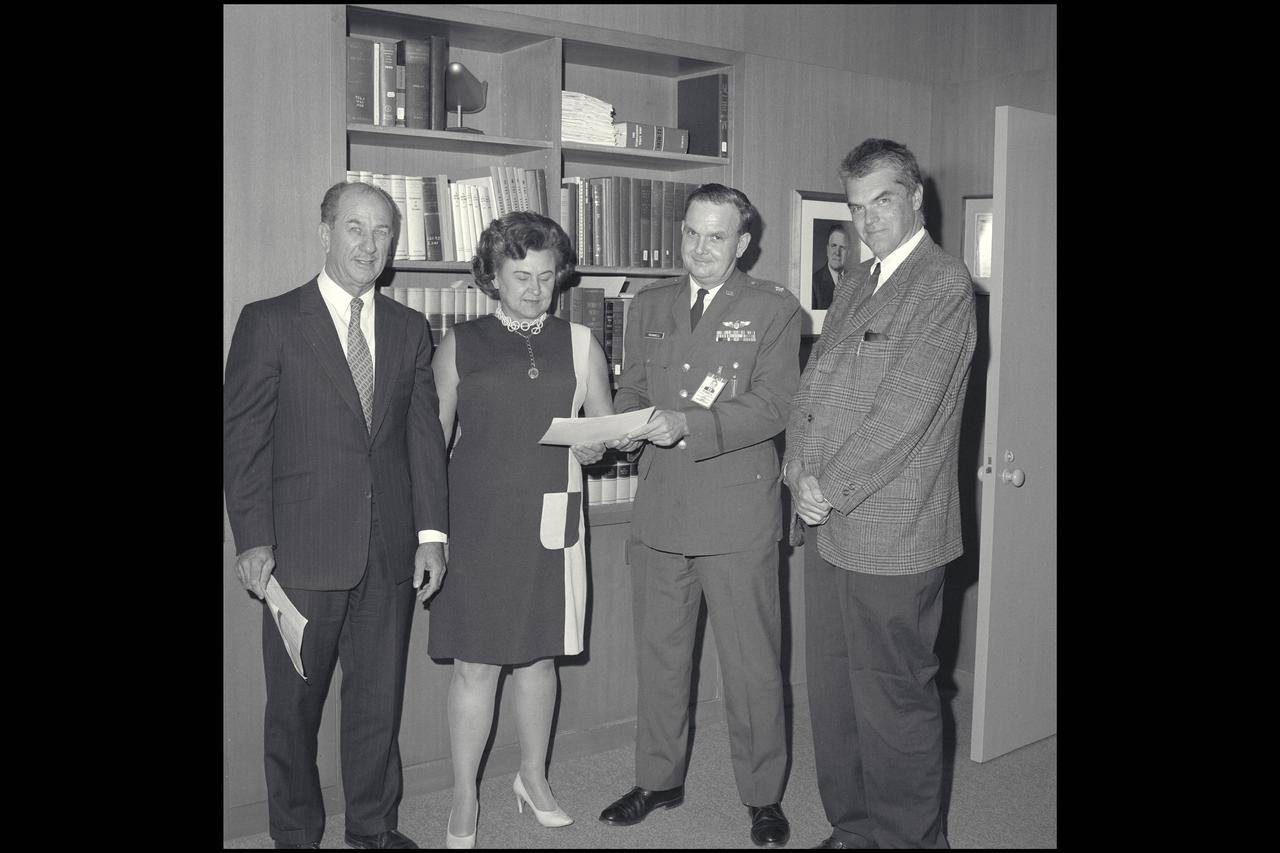
Air Force office personnel (L-R) Tusch, Davis, Trammell with Dr. Hans Mark, Ames Director
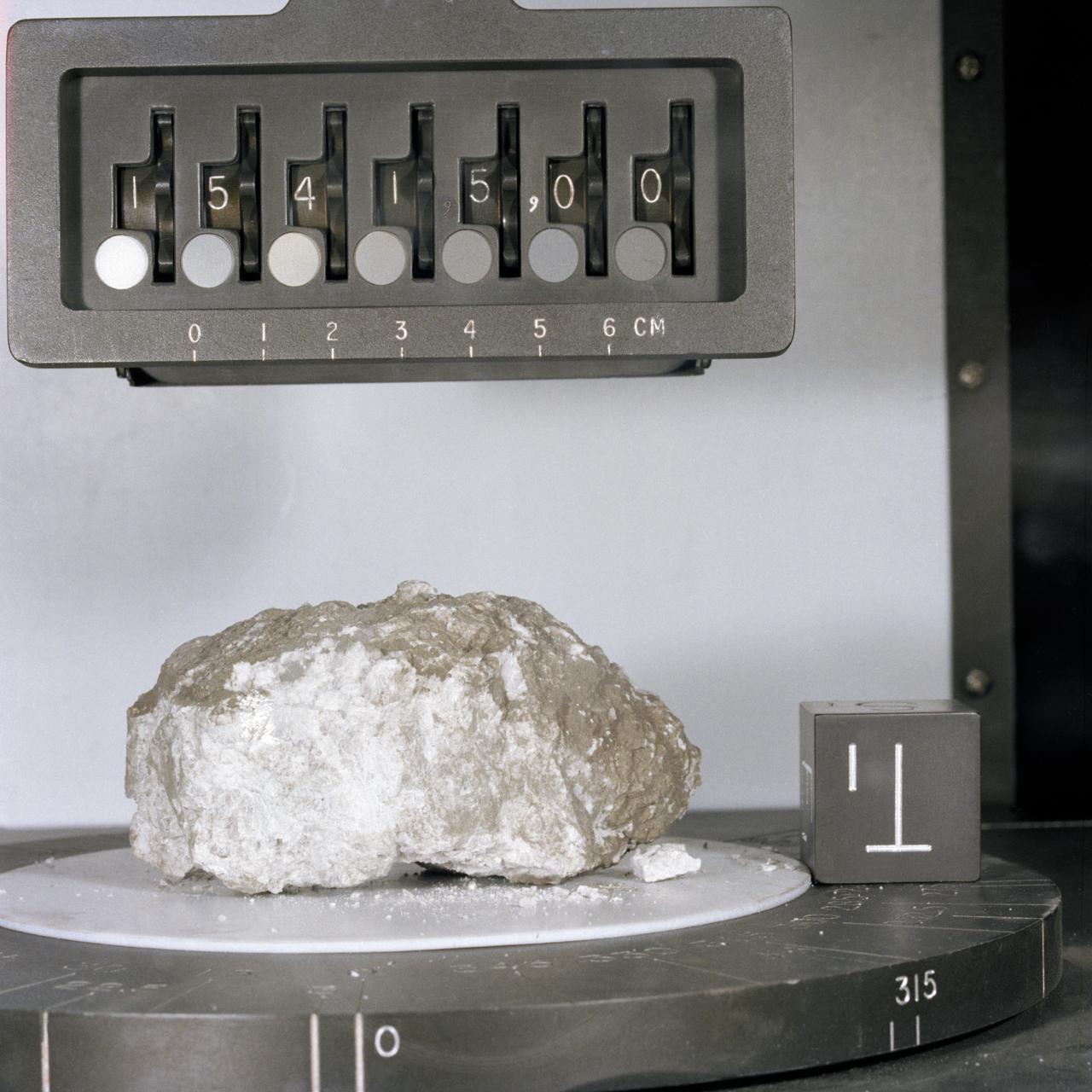
S71-42955 (August 1971) --- A close-up view of Apollo 15 lunar sample no. 15415 in the Non-Sterile Nitrogen Processing Line (NNPL) in the Lunar Receiving Laboratory (LRL) at the Manned Spacecraft Center (MSC). This sample is the white anorthositic rock (Genesis Rock) collected by astronauts David R. Scott and James B. Irwin in container no. 196 at Site no. 7 at a Ground Elapsed Time of 145 hours and 42 minutes, on the mission's second extravehicular activity (EVA).
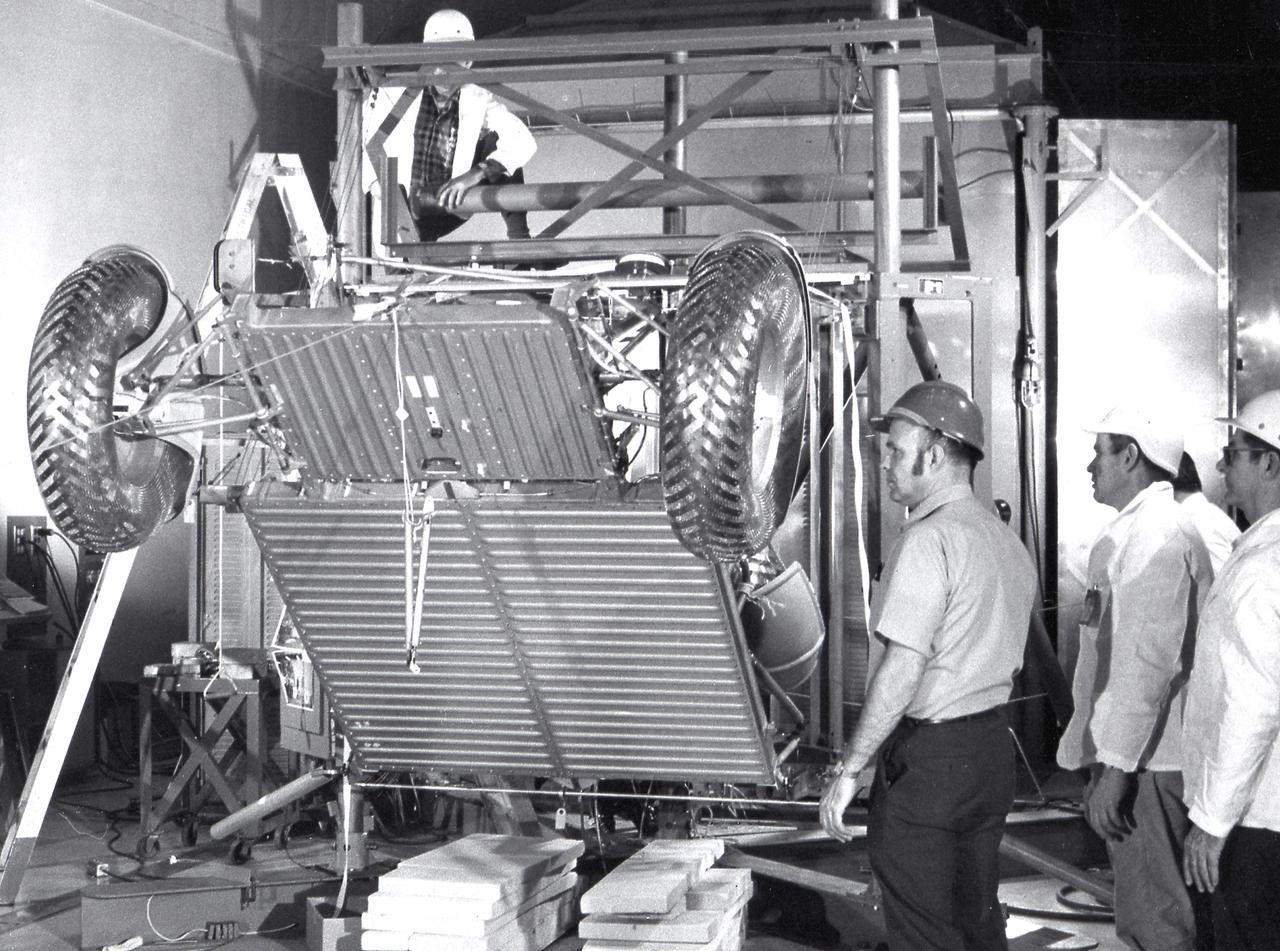
This photograph shows workmen at the Boeing plant in Kent, Washington, performing deployment tests on the Lunar Roving Vehicle (LRV). The LRV, developed under the direction of the Marshall Space Flight Center, was designed to allow Apollo astronauts a greater range of mobility on the lunar surface during the last three lunar exploration missions; Apollo 15, Apollo 16, and Apollo 17.
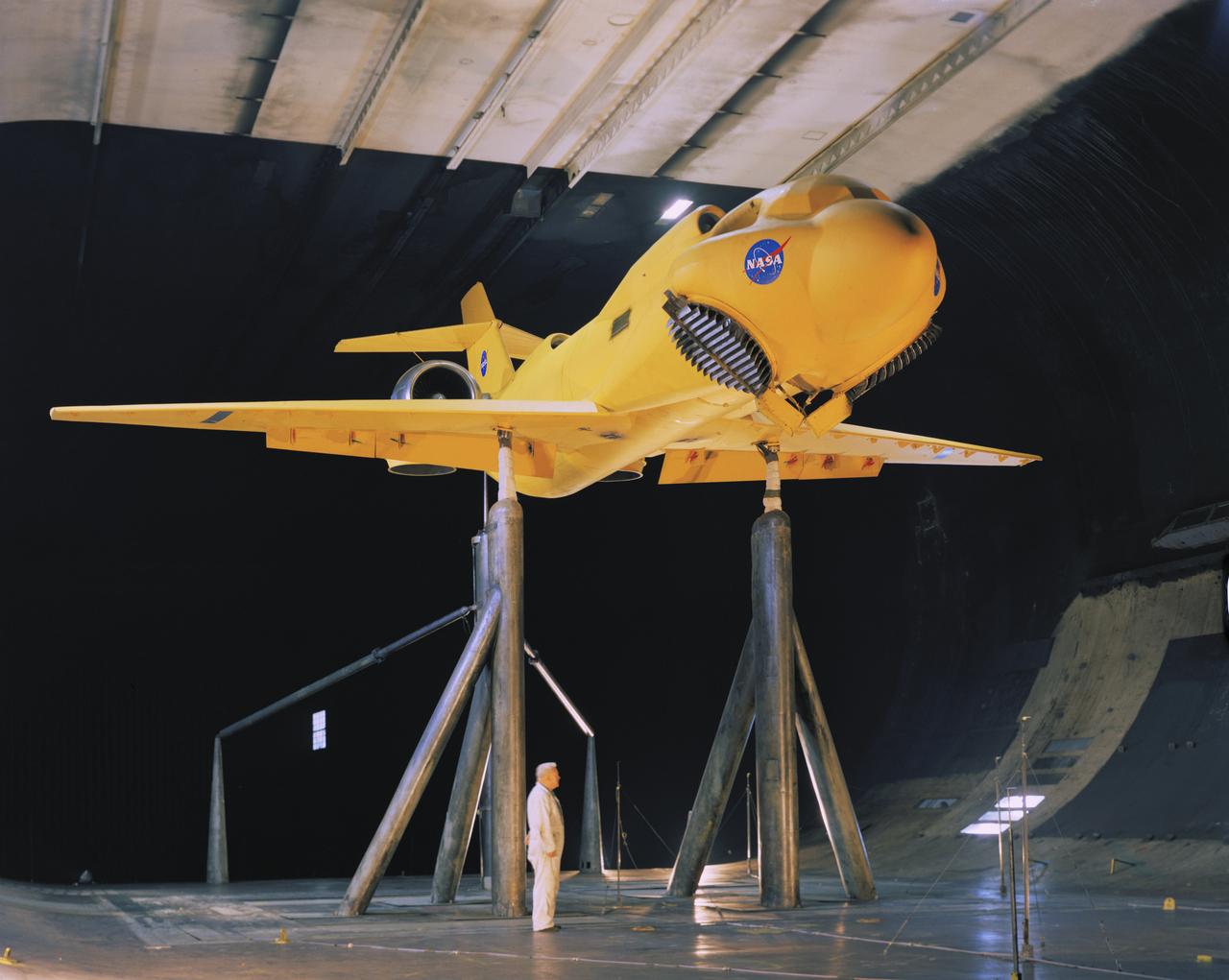
3/4 front view of McDonnell-Douglas Large-Scale lift fan, vertical and/or short take-off and landing (V/STOL), transport model. Francis Malerick in photograph. The McDonnell Douglas DC-9 (initially known as the Douglas DC-9) is a twin-engine, single-aisle jet airliner.
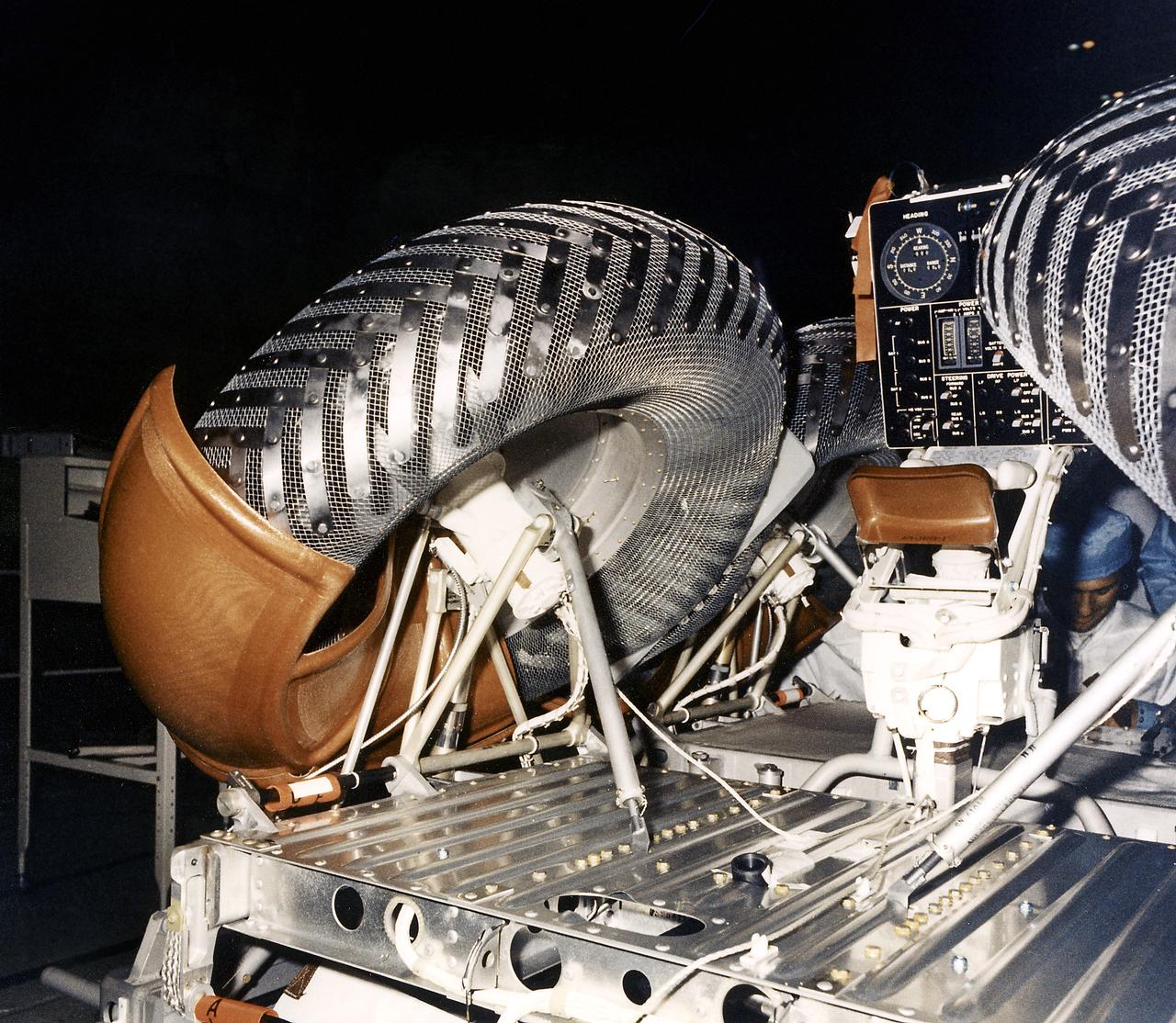
This is a close-up view of a right rear wheel strut of the Lunar Roving Vehicle (LRV) No. 1. The LRV was built to give Apollo astronauts a greater range of mobility during lunar exploration. It was an open-space and collapsible vehicle about 10 feet long with large mesh wheels, anterna, appendages, tool caddies, and camera. An LRV was used on each of the last three Apollo missions; Apollo 15, Apollo 16, and Apollo 17. It was built by the Boeing Company under the direction of the Marshall Space Flight Center.
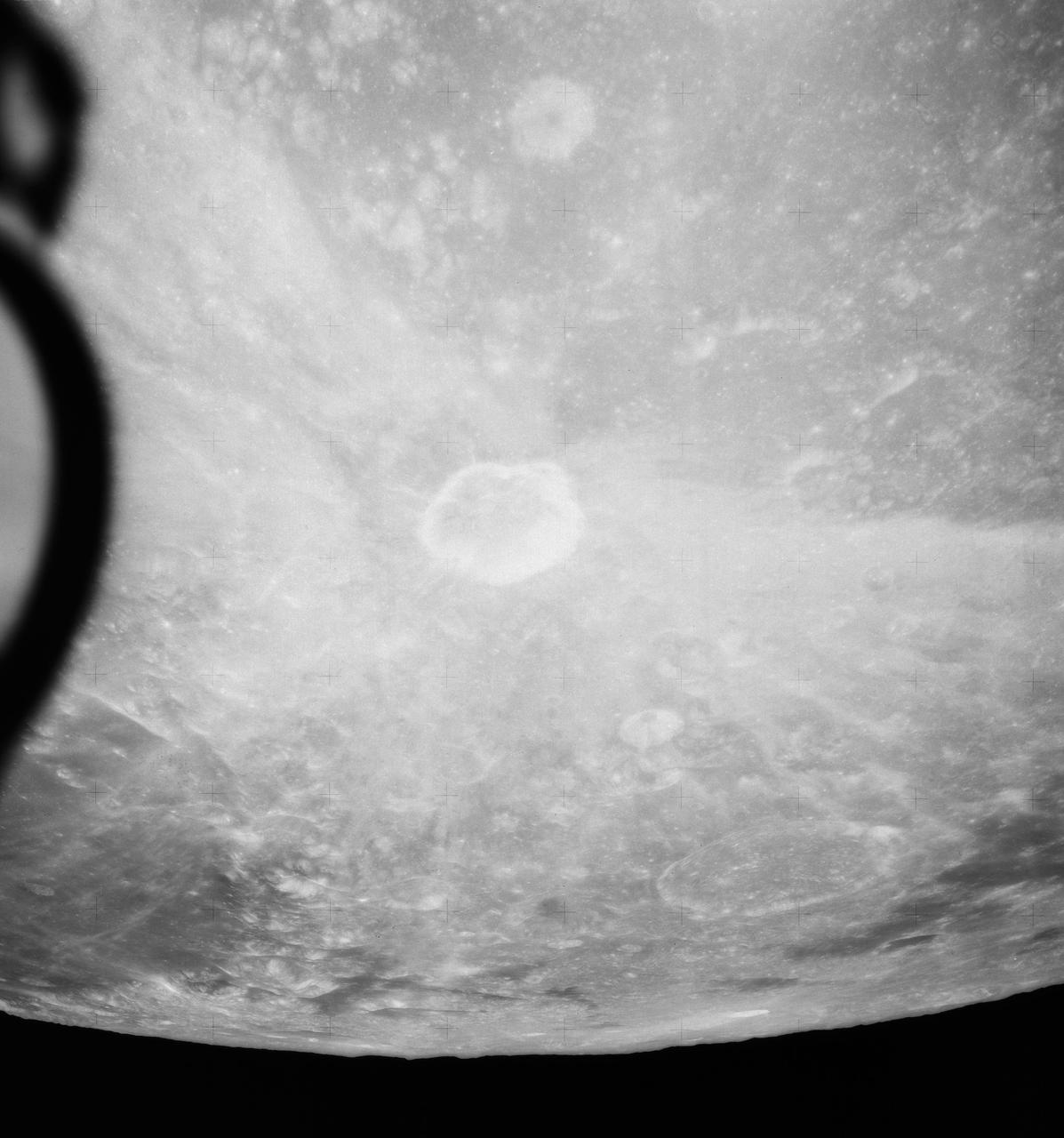
S71-44669 (31 July-2 Aug. 1971) --- An oblique view of the rayed crater Proclus on the lunar nearside, as photographed by the Fairchild metric camera in the SIM bay of the Apollo 15 Command and Service Modules (CSM) in lunar orbit. This view is looking north. The Sea of Crisis is at upper right. Proclus, which is 28 kilometers (16.58 statute miles) in diameter, is located at 47 degrees east longitude and 16 degrees north latitude. The Marsh of Sleep is at lower left. A small portion of the Sea of Tranquility can be seen at upper left. The crater Macrobius is located at upper left. The three-inch mapping camera was one of eight lunar orbital science experiments mounted in the SIM bay.