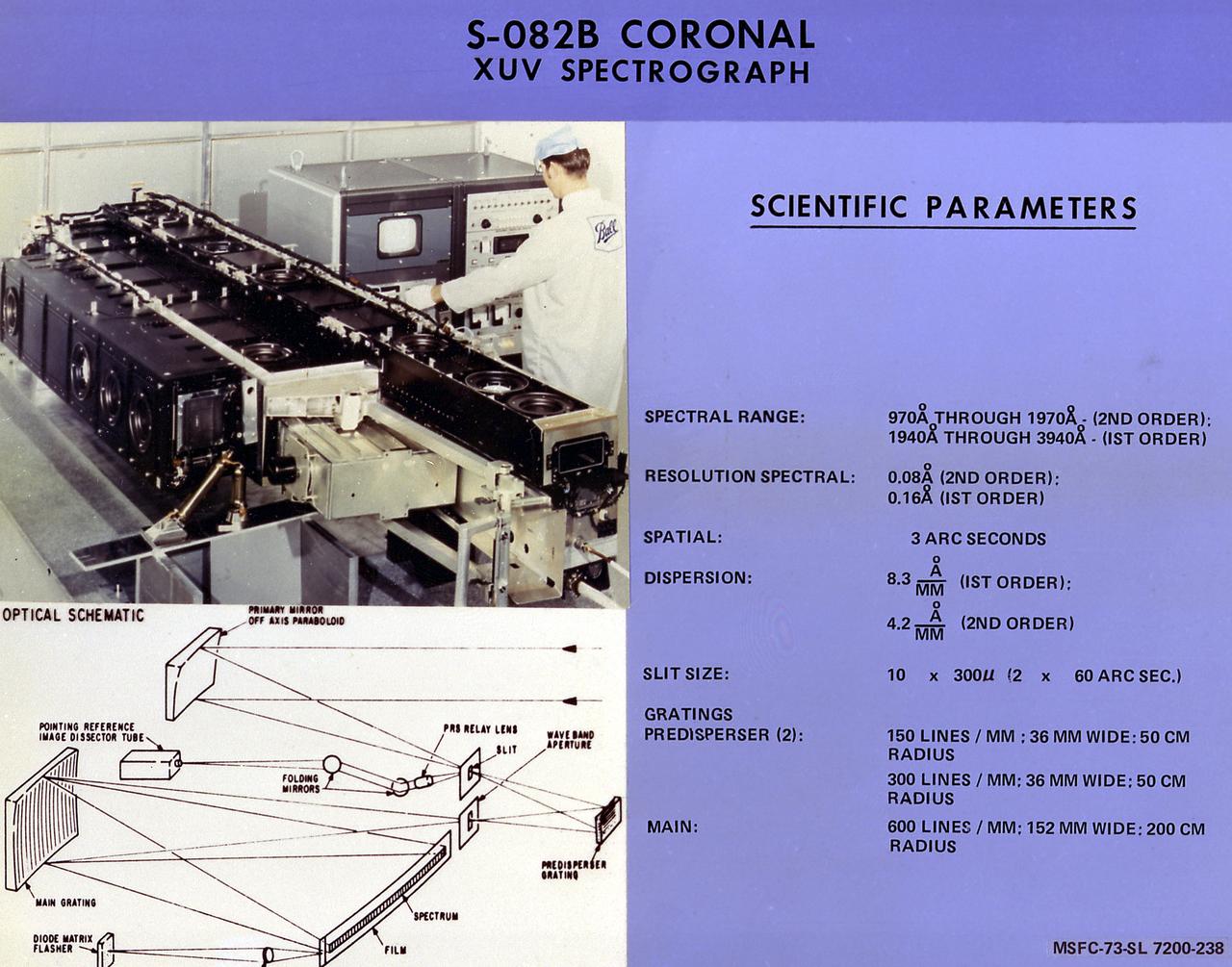
This 1973 chart details Skylab's Ultraviolet (UV) Spectrograph, an Apollo Telescope Mount instrument. Its telescope, with camera and TV capability, photographed the Sun in selected ultraviolet wavelengths. The spectrograph was used to record the spectrum of UV emissions, such as flares or filaments, from a small individual feature on the solar disc. Real-time TV was used by the crew to monitor performance of the telescope, transmit to the ground and record. The exposed films were retrieved by astronaut extravehicular activities. The Marshall Space Flight Center had program management responsibility for the development of the Skylab hardware and experiments.
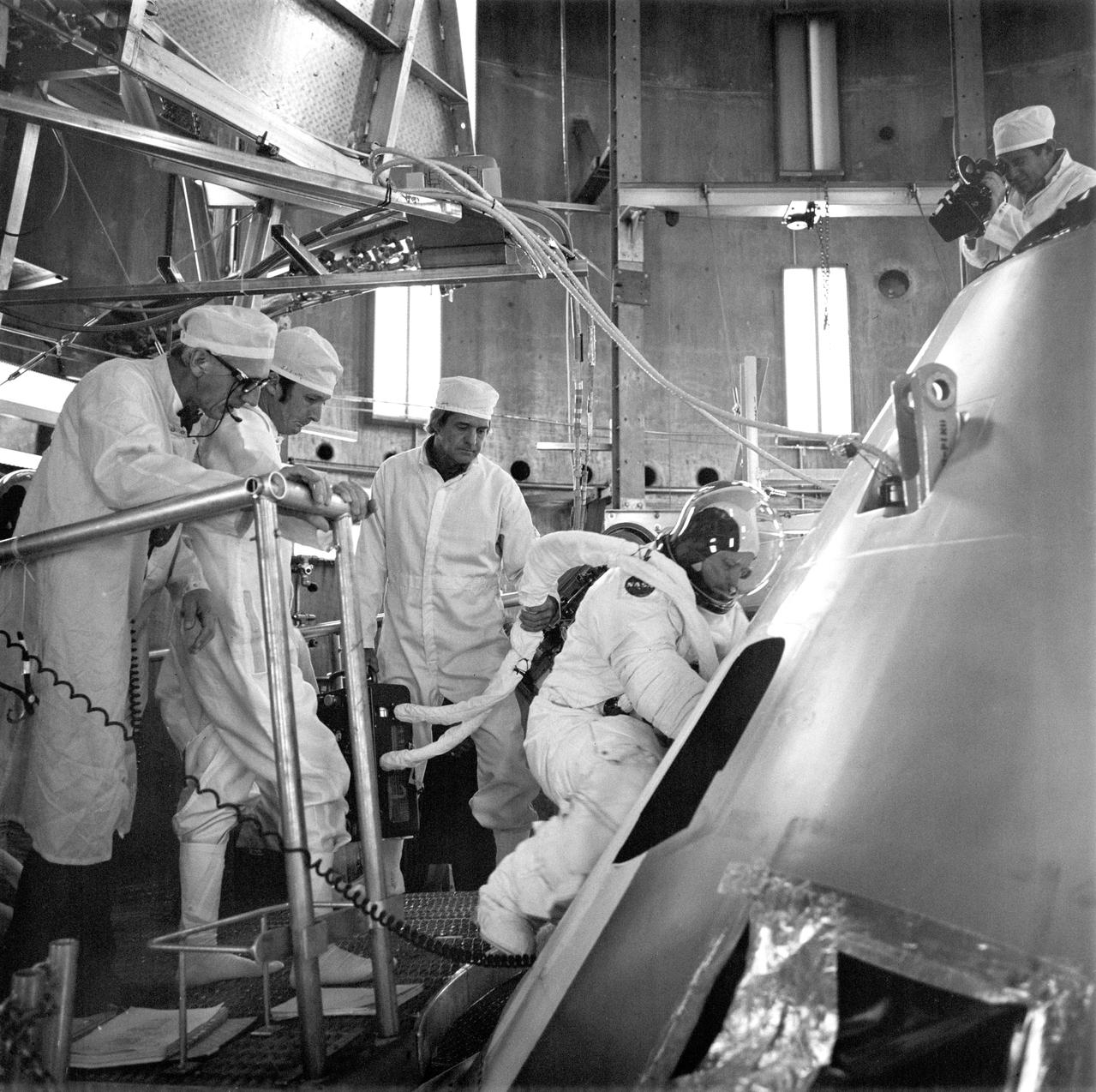
S73-34093 (6 Aug. 1973) --- Astronaut Gerald P. Carr, fully suited, Skylab 4 commander, prepares to enter spacecraft 118 (the Skylab 4 vehicle) at the start of a high altitude chamber test at the Kennedy Space Center (KSC). Also participating in the test were scientist-astronaut Edward G. Gibson, science pilot, and astronaut William R. Pogue, pilot. The Skylab 4 spacecraft is to be moved to the Vehicle Assembly Building (VAB) on Aug. 12, where it will be mated with the launch vehicle as a possible rescue craft for the Skylab 3 crewmen if needed. Photo credit: NASA
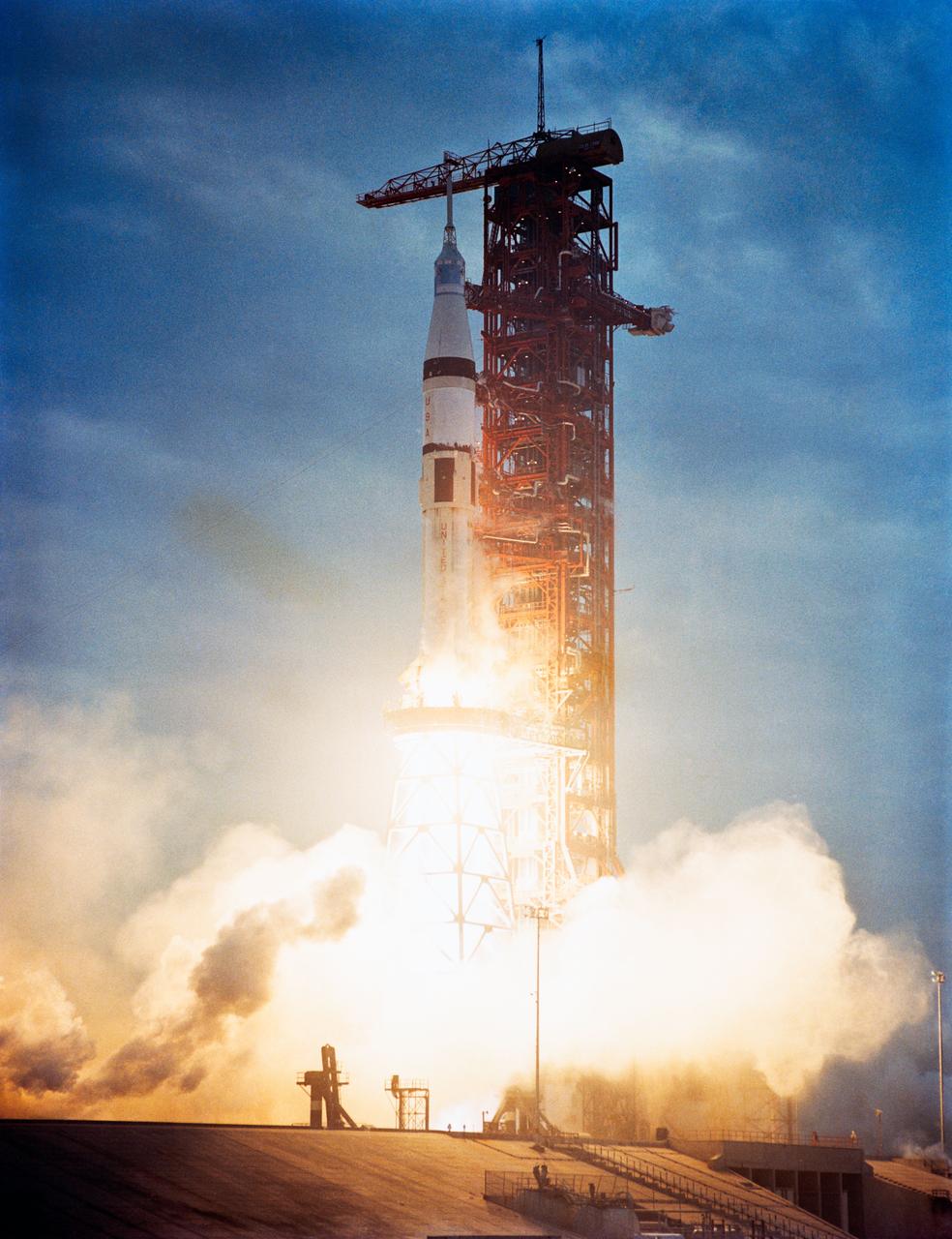
S73-32570 (28 July 1973) --- The Skylab 3/Saturn 1B space vehicle is launched from Pad B, Launch Complex 39, Kennedy Space Center, Florida, at 7:11 a.m. (EDT), Saturday, July 28, 1973. Skylab 3 is the second of three scheduled Skylab manned missions. Aboard the Skylab 3 Command/Service Module were astronauts Alan L. Bean, Owen K. Garriott and Jack R. Lousma. The Skylab 3 CSM later docked with the Skylab space station cluster in Earth orbit. In addition to the CSM and its launch escape system, the Skylab 3 space vehicle consisted of the Saturn 1B first (S-1B) stage and the Saturn 1B second (S-1VB) stage. (The Skylab 1/Saturn V space vehicle with the space station payload was launched from Pad A on May 14, 1973). Photo credit: NASA

SL3-122-2609 (6 Aug. 1973) --- Scientist-astronaut Owen K. Garriott, Skylab 3 science pilot, looks at the camera as he participates in the Aug. 6, 1973 extravehicular activity (EVA) during which he and astronaut Jack R. Lousma, pilot, deployed the twin pole solar shield to help shade the Orbital Workshop (OWS). Photo credit: NASA
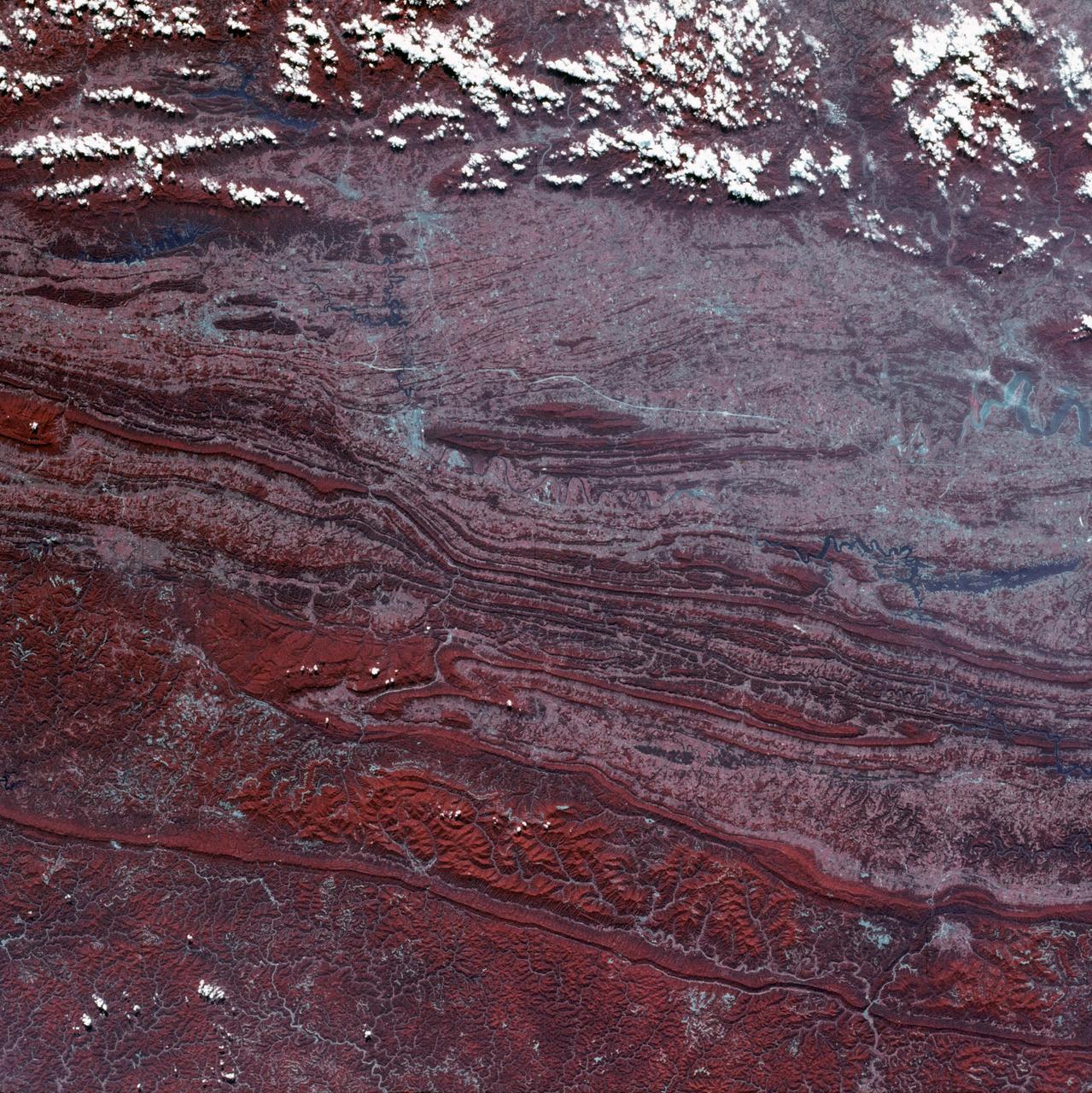
SL3-45-020 (July-September 1973) --- A vertical view of the Virginia-Tennessee-Kentucky border area as photographed from Earth orbit by one of the six lenses of the Itek-furnished S190-A Multispectral Photographic Facility Experiment aboard the Skylab space station. This picture was taken with type 2443 infrared color film. The S190-A experiment is part of the Skylab Earth Resources Experiments Package. The long, narrow ridge is Pine Mountain; and it is crossed by U.S. 25E at Pineville near its southernmost end. Some 25 miles south of Pineville U.S. 25E passes through the famed Cumberland Gap which at 1,600 feet elevation crosses Cumberland Mountain. Kingsport, Tennessee is located east of Cumberland Gap near the center of the picture. Bristol, Tennessee-Virginia is further east. Greenville and Elizabethton, Tennessee can also be seen in this photograph. The clouds across the southeast edge of the picture are over the Blue Ridge Mountains. Federal agencies participating with NASA on the EREP project are the Departments of Agriculture, Commerce, Interior, the Environmental Protection Agency and the Corps of Engineers. All EREP photography is available to the public through the Department of Interior?s Earth Resources Observations Systems Data Center, Sioux Falls, 57198. Photo credit: NASA
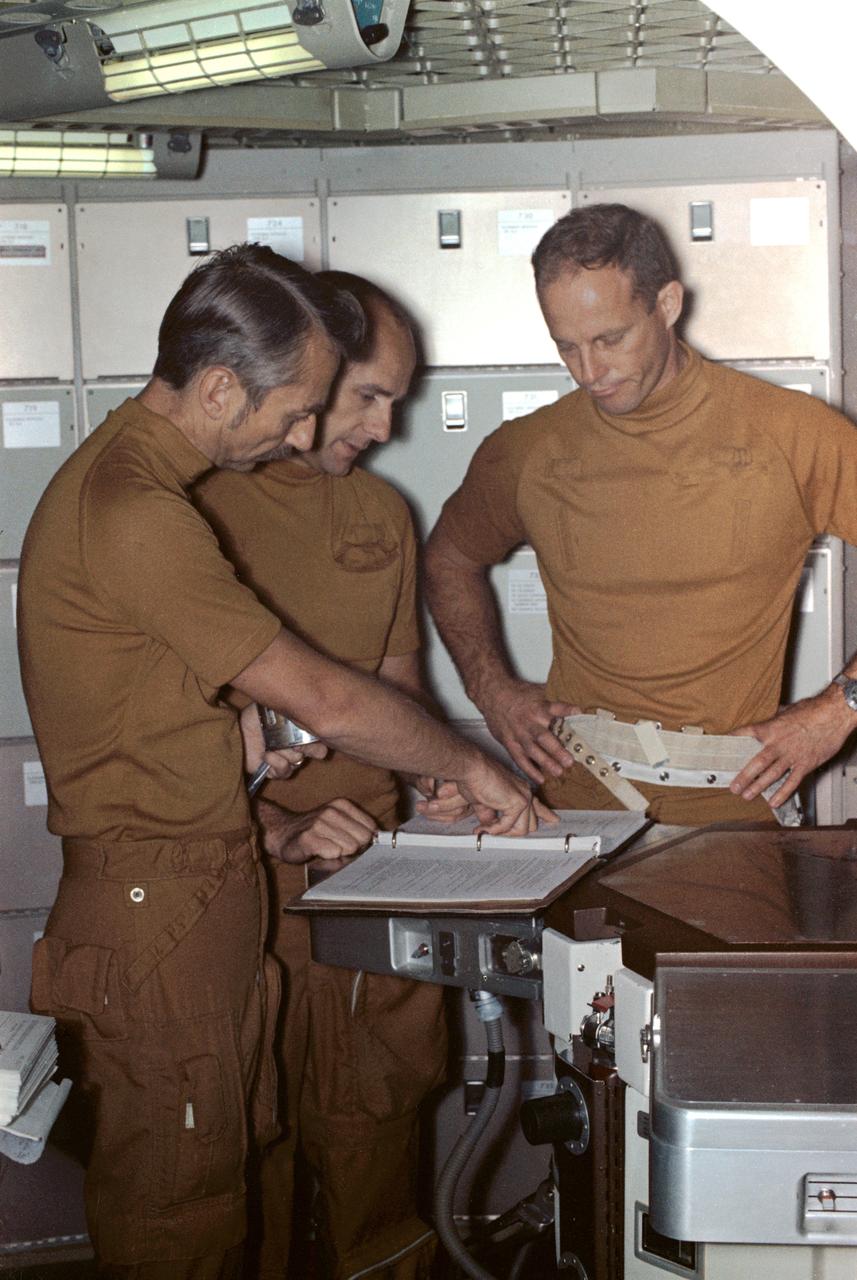
S73-28793 (16 July 1973) --- The three crewmen of the second manned Skylab mission (Skylab 3) go over a checklist during preflight training at the Johnson Space Center. They are, left to right, scientist-astronaut Owen K. Garriott, science pilot; astronaut Alan L. Bean, commander; and astronaut Jack R. Lousma, pilot. They are in the crew quarters of the Orbital Workshop trainer in the Mission Training and Simulation Facility, Building 5, at JSC. Skylab 3 is scheduled as a 59-day mission in Earth orbit. Photo credit: NASA
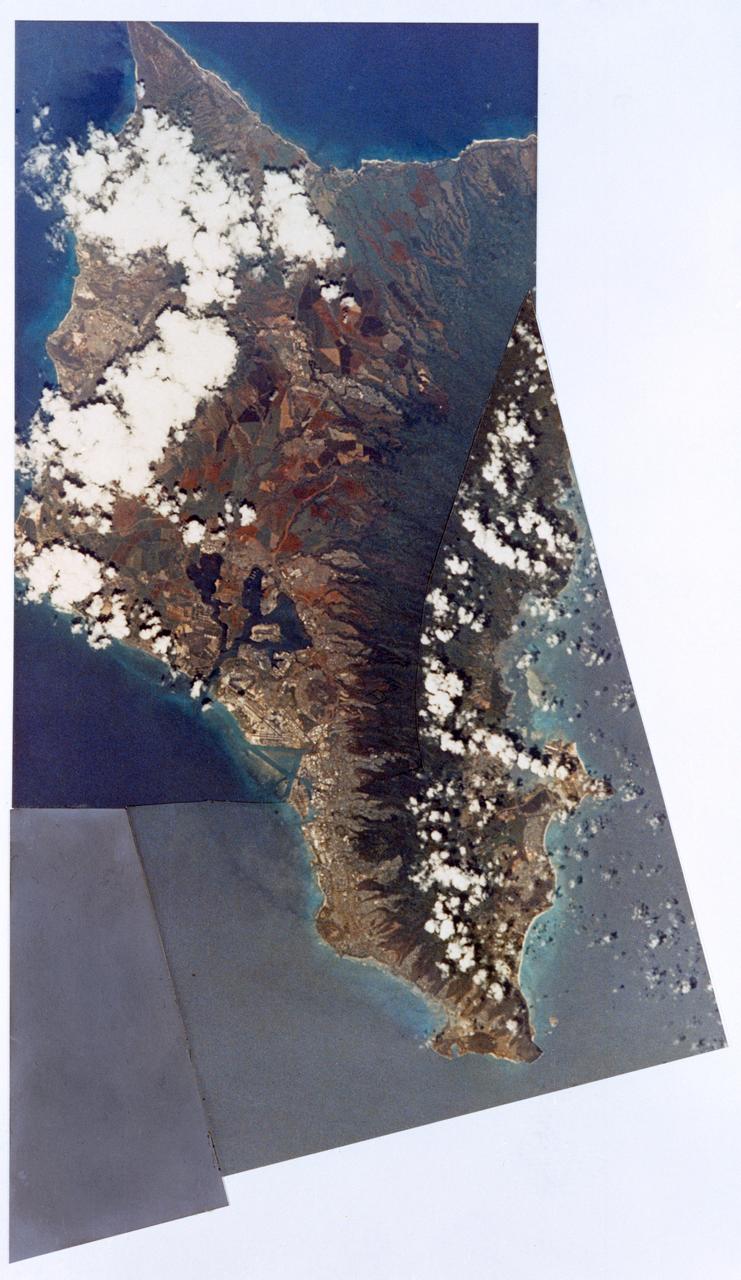
S73-34857 (July-September 1973) --- A composite of two photographs of the Island of Oahu, County of Honolulu, State of Hawaii, taken by one of the Skylab 3 crewmen from the Skylab space station in Earth orbit. The two pictures (SL3-128-3009 and SL3-128-3010) were taken with a hand-held 35mm Nikon camera, a 55/300mm lens and so-368 medium-speed Ektacrome film. Pearl Harbor is clearly visible. The city of Honolulu is located next to the triangle-shaped seaplane runway. Photo credit: NASA
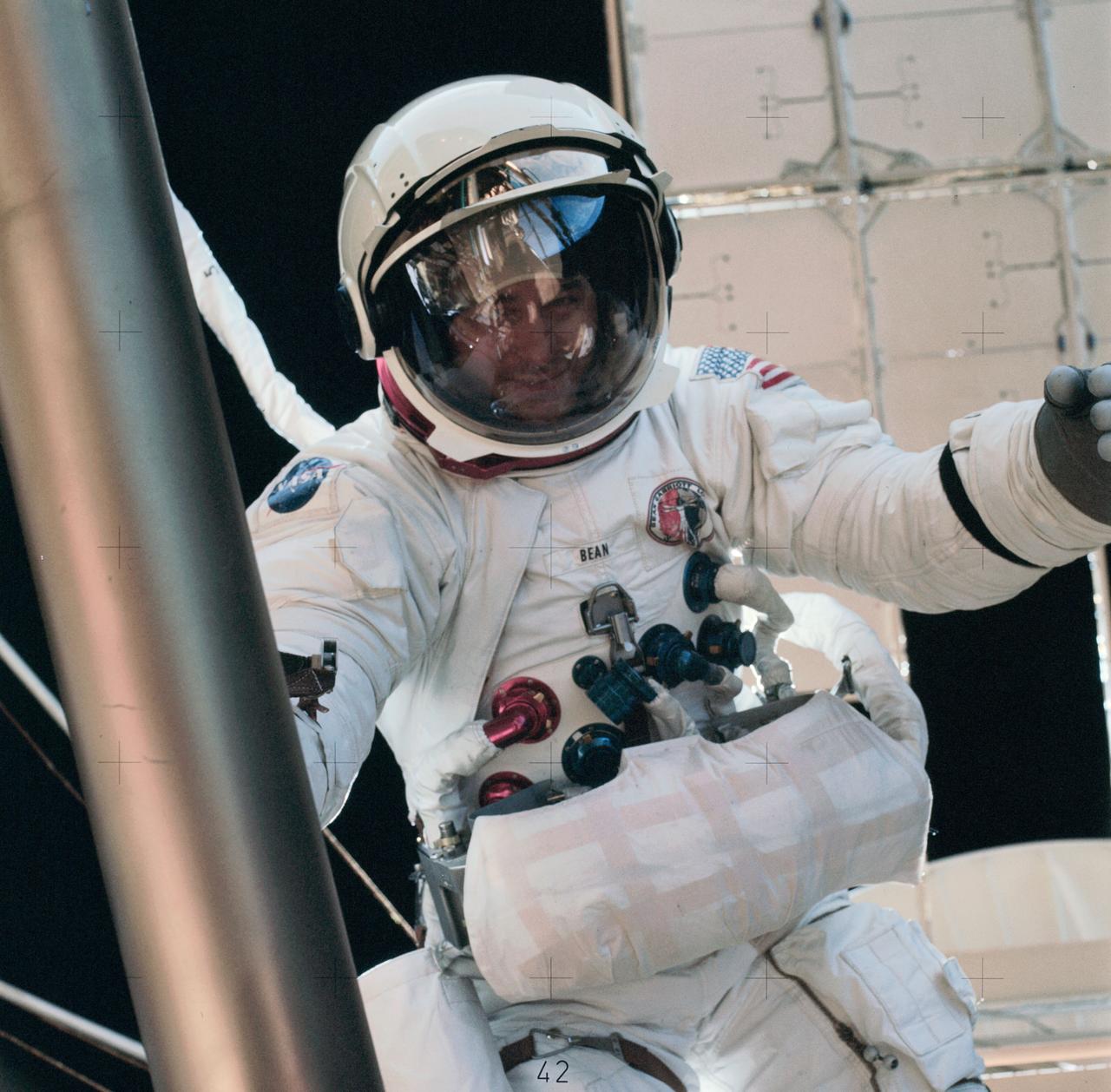
SL3-122-2612 (6 Aug. 1973) --- Astronaut Alan L. Bean, Skylab 3 commander, participates in the final Skylab 3 extravehicular activity (EVA), during which a variety of tasks were performed. Here, Bean is near the Apollo Telescope Mount (ATM) during final film change out for the giant telescope facility. Astronaut Owen K. Garriott, who took the picture, is reflected in Bean's helmet visor. The reflected Earth disk in Bean's visor is so clear that the Red Sea and Nile River area can delineated. Photo credit: NASA
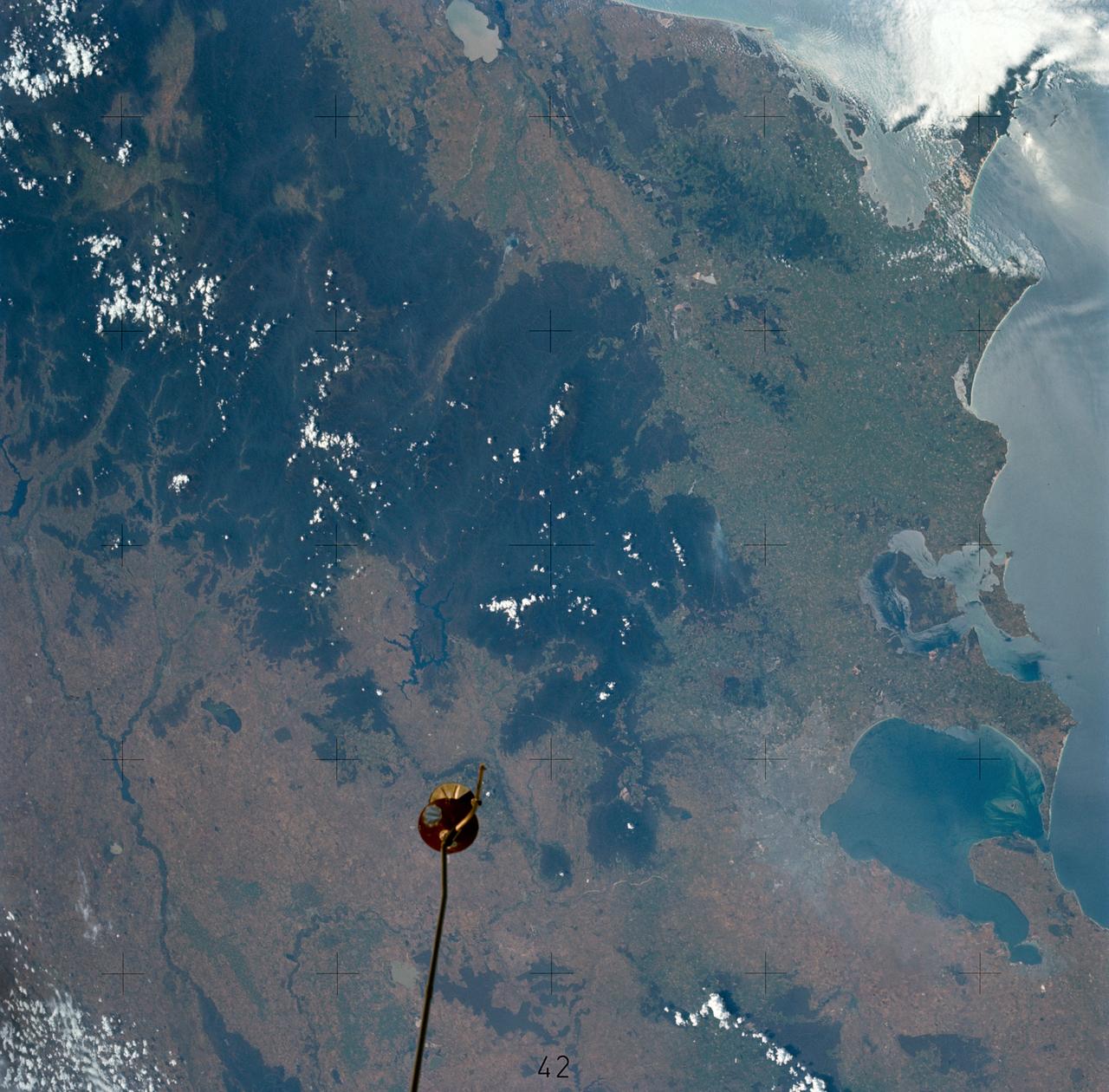
SL4-137-3579 (13 Dec. 1973) --- A near vertical view of the Melbourne, State of Victoria, Australia area as seen from the Skylab space station in Earth orbit. This picture was taken by one of the Skylab 4 crewmen using a hand-held 70mm Hasselblad camera. Included in this view are Port Phillip Bay, Ninety-Mile Beach and the Australian Alps. This view is not in sunglint. Compare this view with that of SL4-137-3578 which is in sunglint. Colors are not easy to distinguish in sunglint, but are without it. There are surface features visible in the first photograph which are not visible in the second. Similarly, some water colors are evident in the second photograph which are not seen in the first. Port Phillip Bay is the best sample. The bay opens to the south. Photo credit: NASA
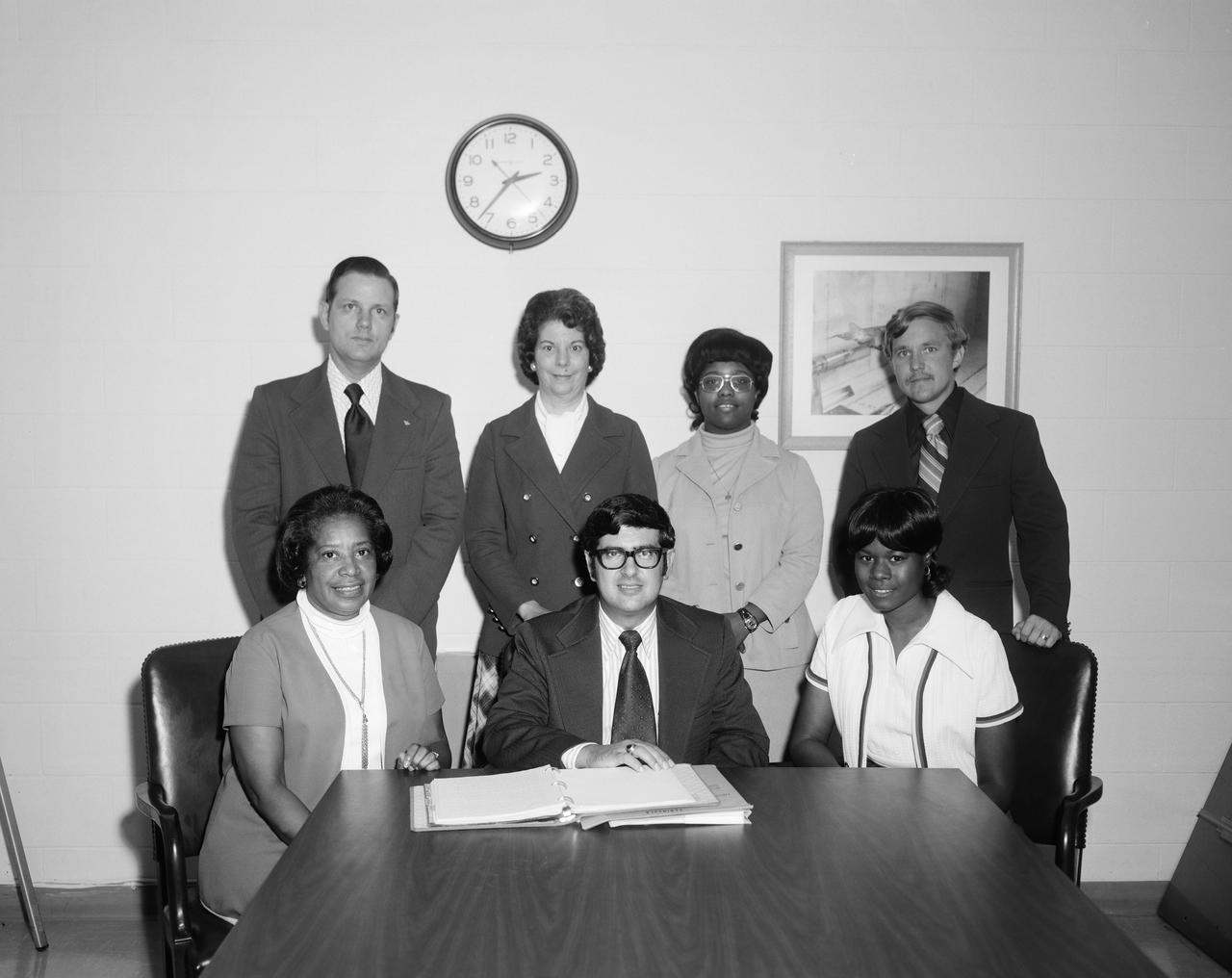
CAMPAIGN COMMITTEE: Frank V. Moore (seated) has been named Director of the Center' s annual Combined Federal Campaign. Members of his campaign staff are (seated) Mary A. Jackson (left) and Gwendolyn Leach. Standing are (from left) Willis C. Cross, Ernestine Martin, Janet McKenzie, and James Ojiba. Photo published in Langley Researcher August 31, 1973 Volume 12, Number 18 page 1.
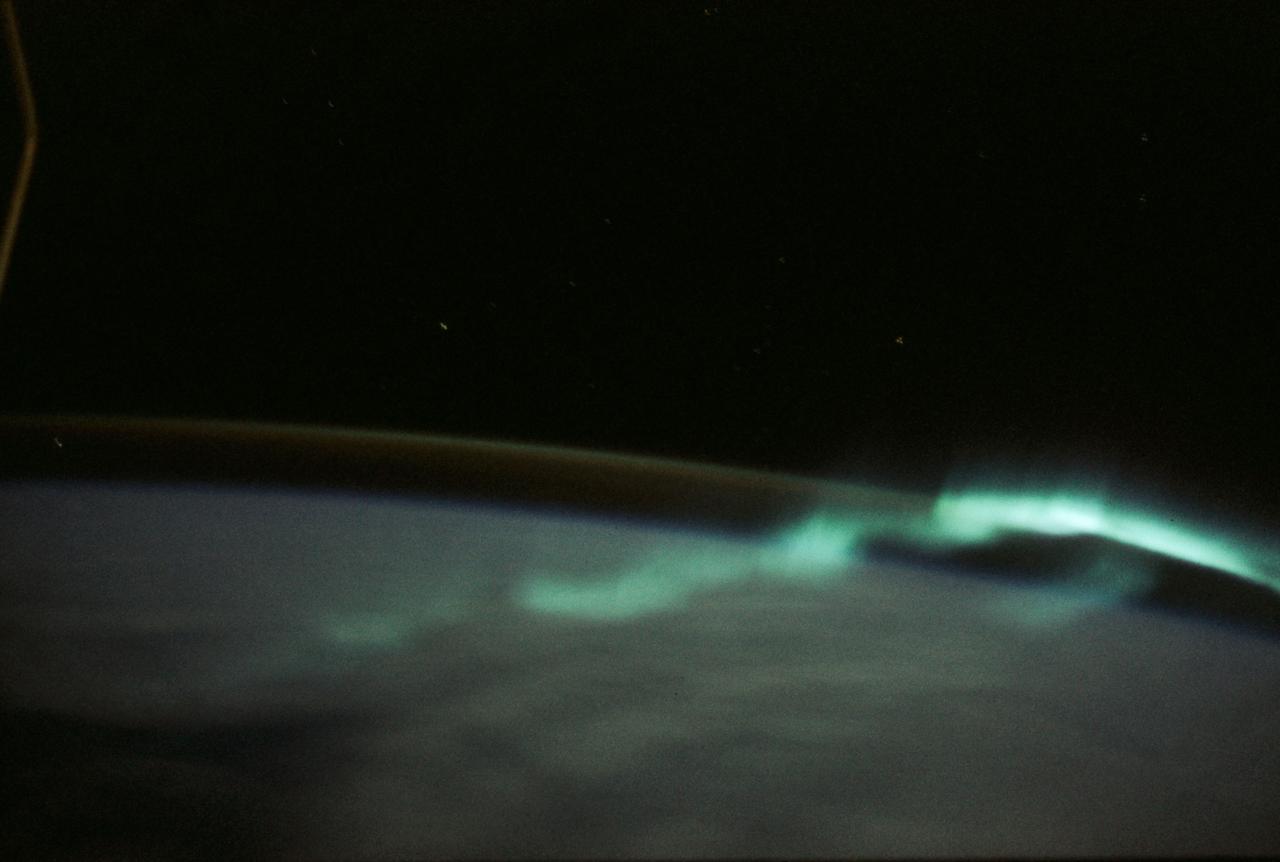
SL3-130-3130 (July-September 1973) --- An excellent view of the southern aurora, luminous bands or streamer of light, in the Southern Hemisphere, as photographed from the Skylab space station in Earth orbit. The space station was moving into the sunlight when this picture was taken. This view is near the edge of the aurora cap. The surface of the Earth is in the foreground. The permanent aurora over the South Pole is in the background. Scientist-astronaut Owen K. Garriott, Skylab 3 science pilot, took this photograph with a hand-held 35mm Nikon camera, with a four-second exposure at f/1.2, using high-speed Ektacrome film. Because auroras are caused by solar activity, they occur at the same time in the Northern and Southern hemispheres. Photo credit: NASA
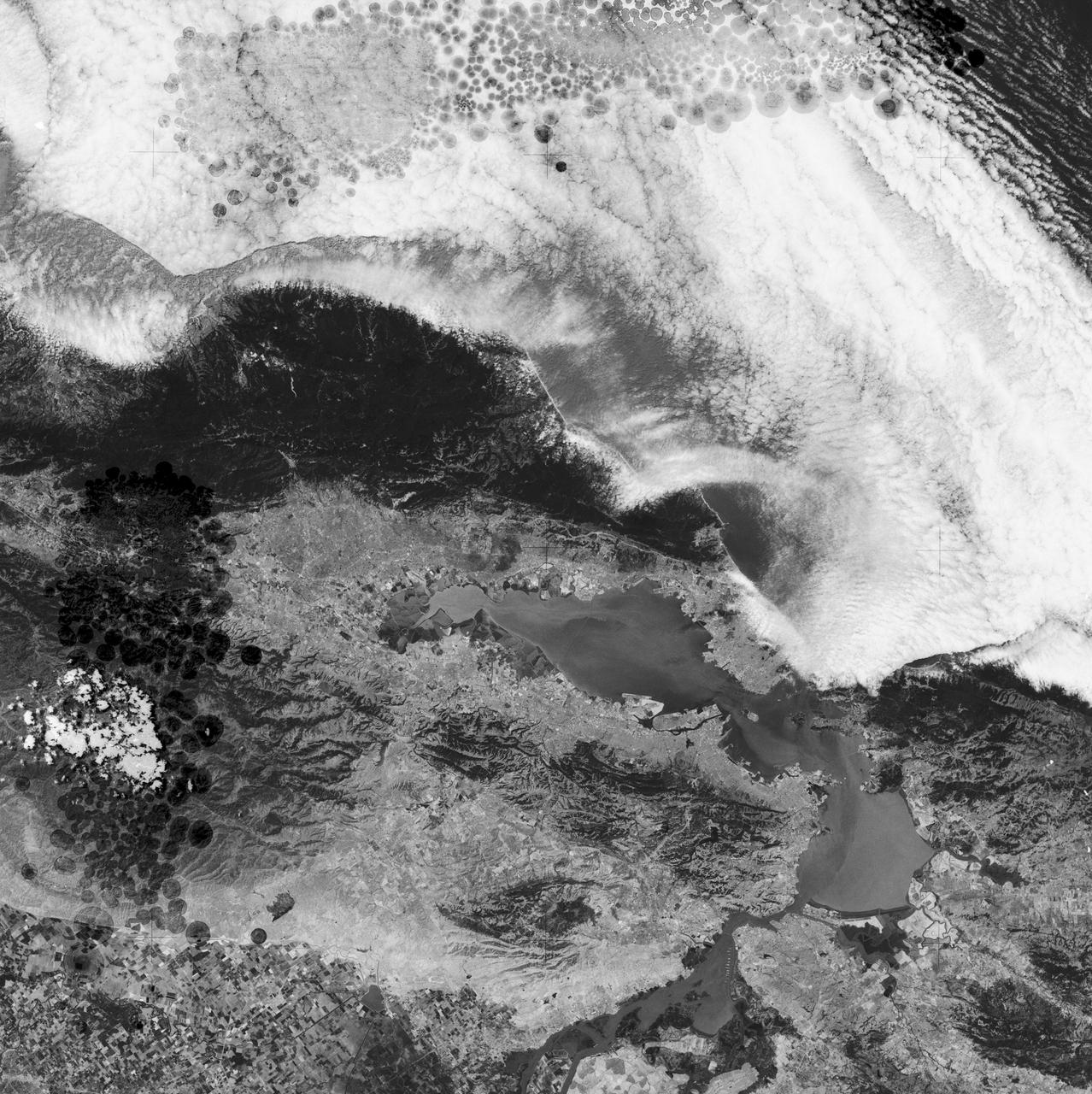
SL2-05-102 (June 1973) --- A black and white photograph of the San Francisco Bay California area, taken from the Skylab 1-2 space station cluster in Earth orbit. THE PICTURE SHOULD BE HELD WITH THE CLOUDS AND PACIFIC OCEAN ON THE LEFT. This photograph was taken by one of six lenses of the Itek-furnished S190-A Multispectral Photographic Facility Experiment in the Multiple Docking Adapter of the space station. Note the thickly populated and highly developed area around the Bay. Among the cities visible in this photograph are San Francisco, Oakland, Berkeley and San Jose. This view extends eastward to show a portion of the San Joaquin Valley. The S190-A experiment is part of the Skylab Earth Resources Experiments Package (EREP). Type SO-022 film was used. This station covered the spectral region from 0.6 to .07 micrometers. Photo credit: NASA

S73-32568 (20 July 1973) --- Floodlights illuminate this nighttime view of the Skylab 3/Saturn 1B space vehicle at Pad B, Launch Complex 39, Kennedy Space Center, Florida, during prelaunch preparations. The reflection is the water adds to the scene. In addition to the Command/Service Module and its launch escapte system, the Skylab 3 space vehicle consists of the Saturn 1B first (S-1B) stage and the Saturn 1B second (S-IVB) stage. The crew for the scheduled 59-day Skylab 3 mission in Earth orbit will be astronauts Alan L. Bean, Owen K. Garriott and Jack R. Lousma. Skylab 3 was launched on July 28, 1973. Photo credit: NASA
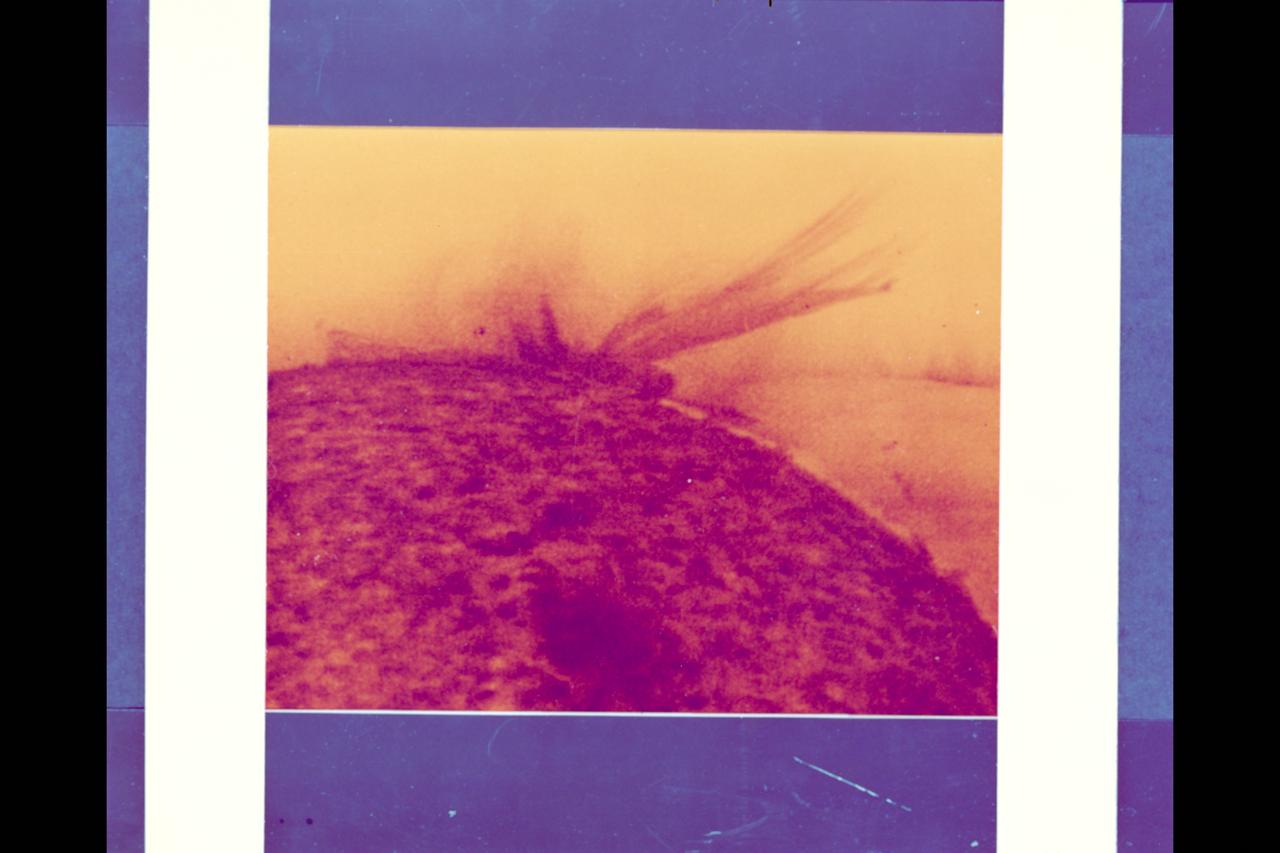
Photograph by Skylab 2 Solar eruption (flare)

S73-02395 (August 1973) --- An artist?s concept illustrating an Apollo-type spacecraft (on left) about to dock with a Soviet Soyuz-type spacecraft. A recent agreement between the United States and the Union of Soviet Socialist Republics provides for the docking in space of the Soyuz and Apollo-type spacecraft in Earth orbit in 1975. The joint venture is called the Apollo-Soyuz Test Project.
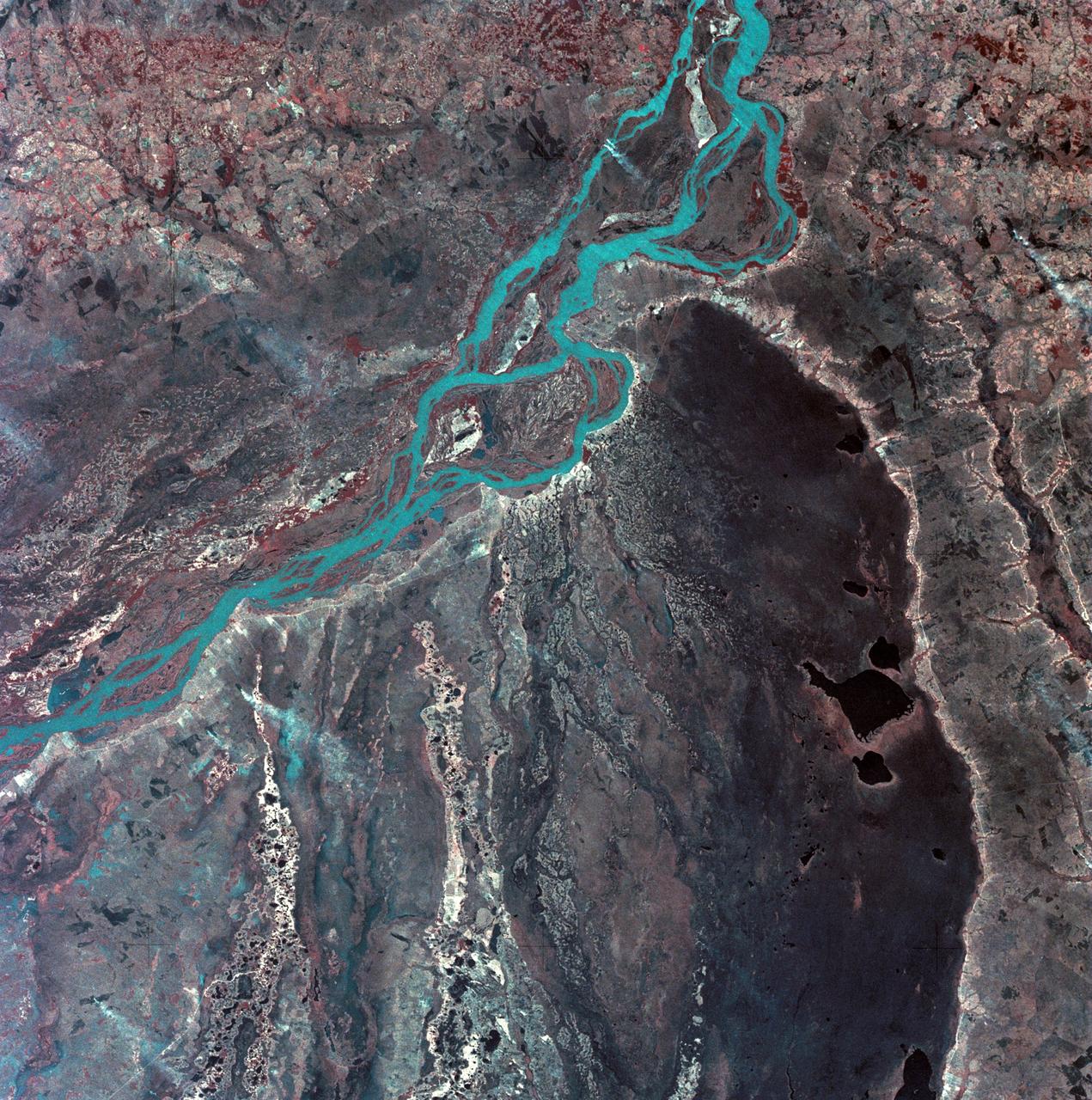
SL3-33-167 (July-September 1973) --- A vertical view of the Argentina-Paraguay border area of South America as photographed from Earth orbit by one of the six lenses of the Itek-furnished S190-A Multispectral Photographic Facility Experiment aboard the Skylab space station. This picture was taken with type 2443 infrared color film. The Parana River flows from east to west across the picture. This part of the Rio Parana is located between the towns of Posadas, Argentina, and Resistencia, Argentina. The major body of water in the large swamp area is Laguna Ibera. Note the several fires burning in this area. The largest land mass (Argentina) is south of the river. Paraguay is north of the river. Isla Apipe Grande is near the center of the photograph. The S190-A experiment is part of the Skylab Earth Resources Experiments Package. Federal agencies participating with NASA on the EREP project are the Departments of Agriculture, Commerce, Interior, the Environmental Protection Agency and the Corps of Engineers. All EREP photography is available to the public through the Department of Interior?s Earth Resources Observations Systems Data Center, Sioux Falls, South Dakota, 57198. Photo credit: NASA
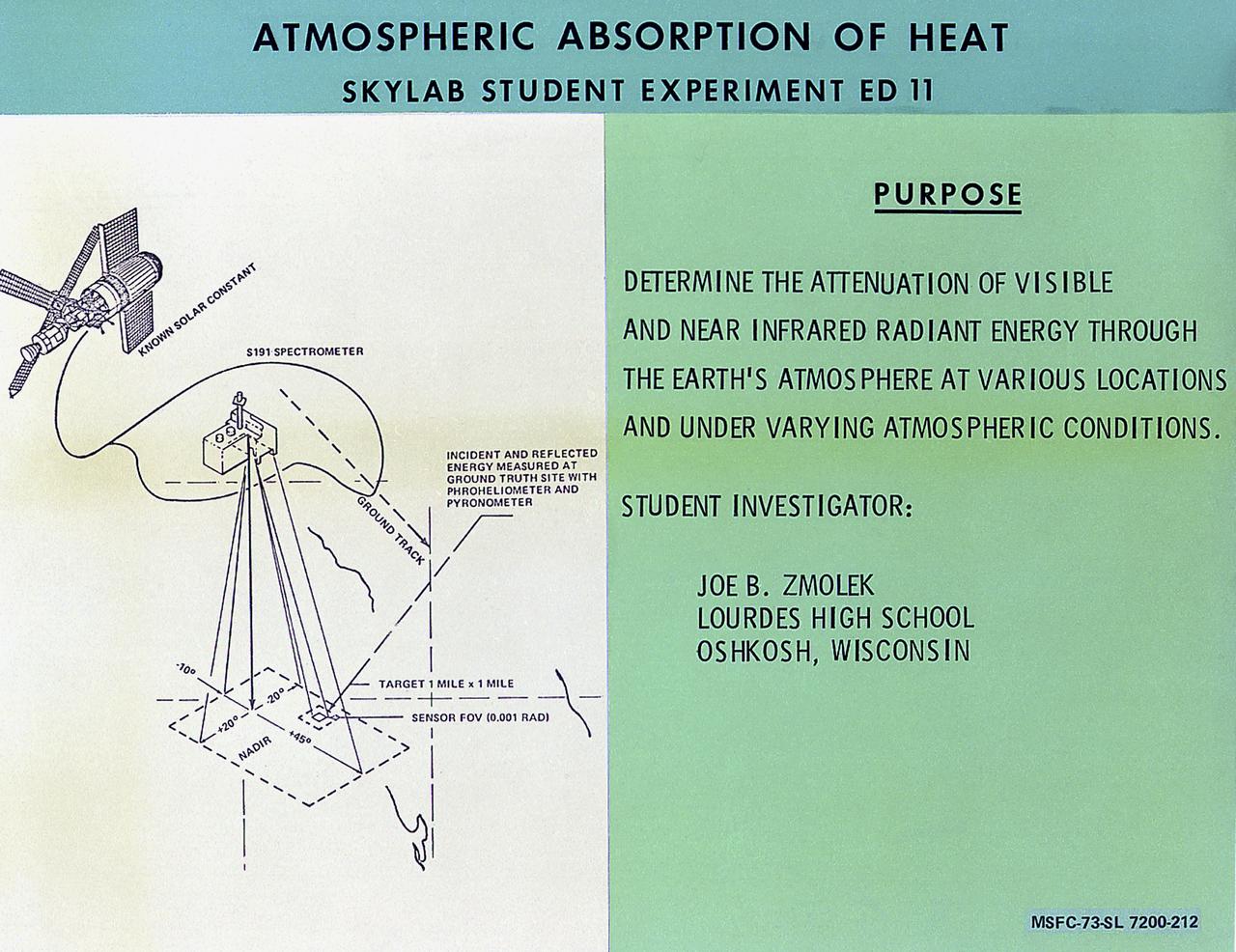
This chart describes the Skylab student experiment, Atmospheric Absorption of Heat, proposed by Joe B. Zmolek of Oshkosh, Wisconsin. This experiment utilized Skylab's Earth Resources Experiment spectrometers to determine the attenuation of radiant energy in the visible and near-infrared spectrums for both densely and sparsely populated areas. In March 1972, NASA and the National Science Teachers Association selected 25 experiment proposals for flight on Skylab. Science advisors from the Marshall Space Flight Center aided and assisted the students in developing the proposals for flight on Skylab.
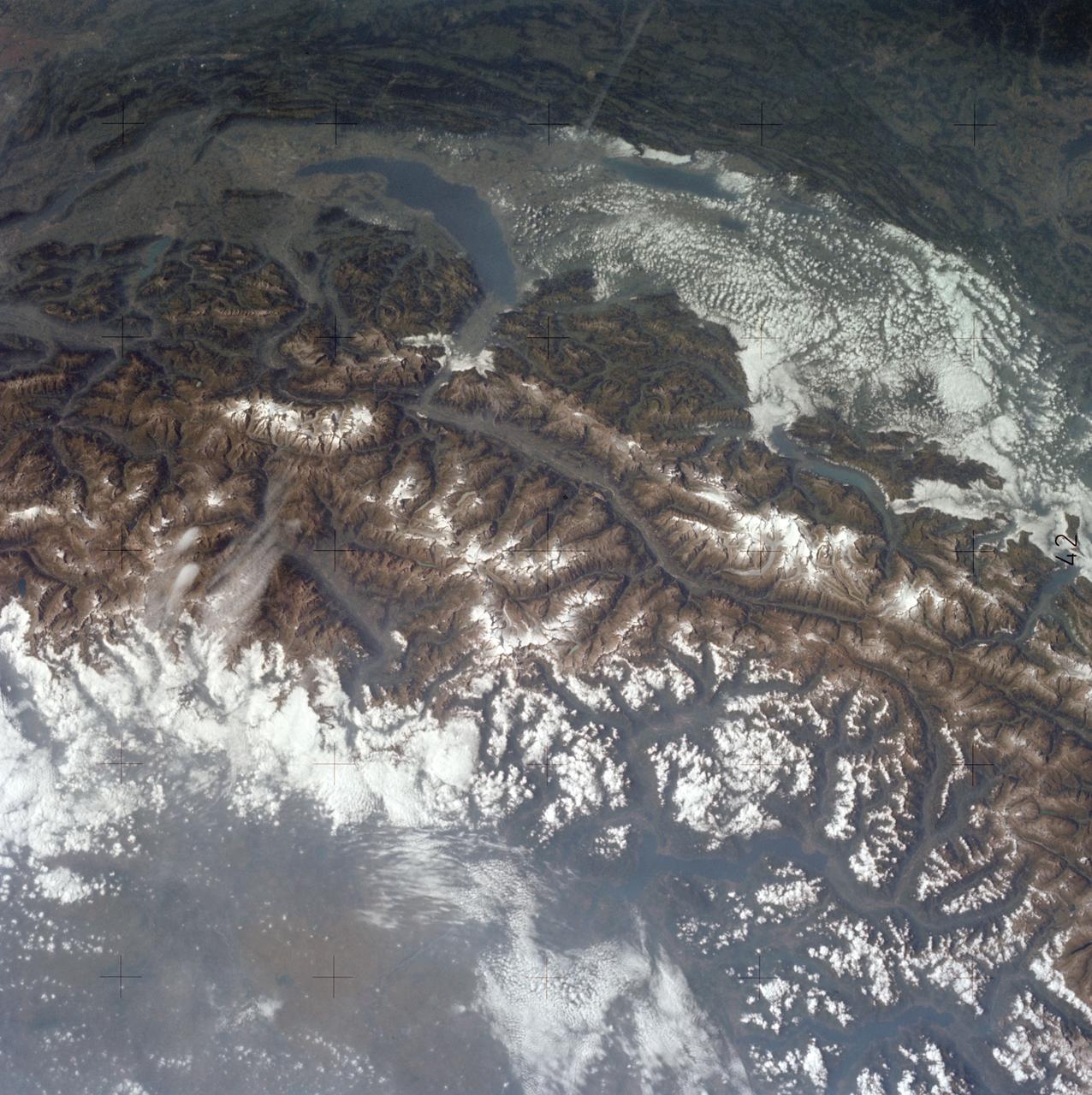
SL3-121-2438 (July-September 1973) --- The Alps of Switzerland, France and Italy are featured in this exceptional photograph taken by a hand-held camera from the Skylab space station during the second manned Skylab mission. Also visible in the out-the-window 70mm Hasselblad view are Lake Geneva, Lake of Lucerne, Rhone River and many other features. The Skylab 3 crewmen, astronauts Alan L. Bean, Owen K. Garriott and Jack R. Lousma completed a 59-day mission with a successful splashdown on Sept. 25, 1973. Photo credit: NASA
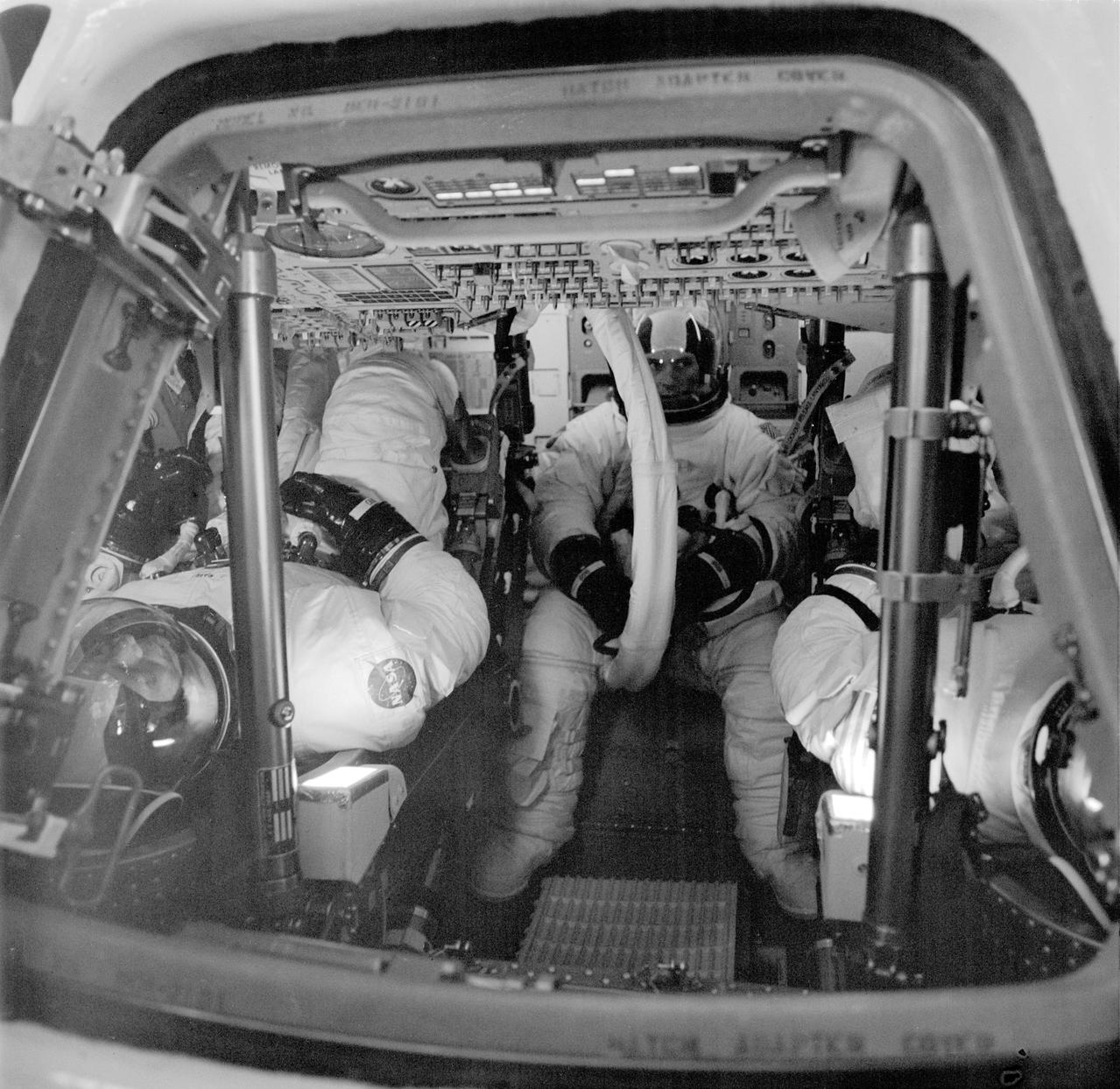
S73-34094 (6 Aug. 1973) --- The Skylab 4 crewmen, fully suited, are seated inside their Command Module, which has been undergoing high altitude chamber test runs at the Kennedy Space Center (KSC) after being considered as a possible rescue vehicle, if needed, for the Skylab 3 crewmen. Facing the camera is scientist-astronaut Edward G. Gibson, science pilot. Astronauts Gerald P. Carr, right, commander, and William R. Pogue, pilot, are also pictured. Photo credit: NASA
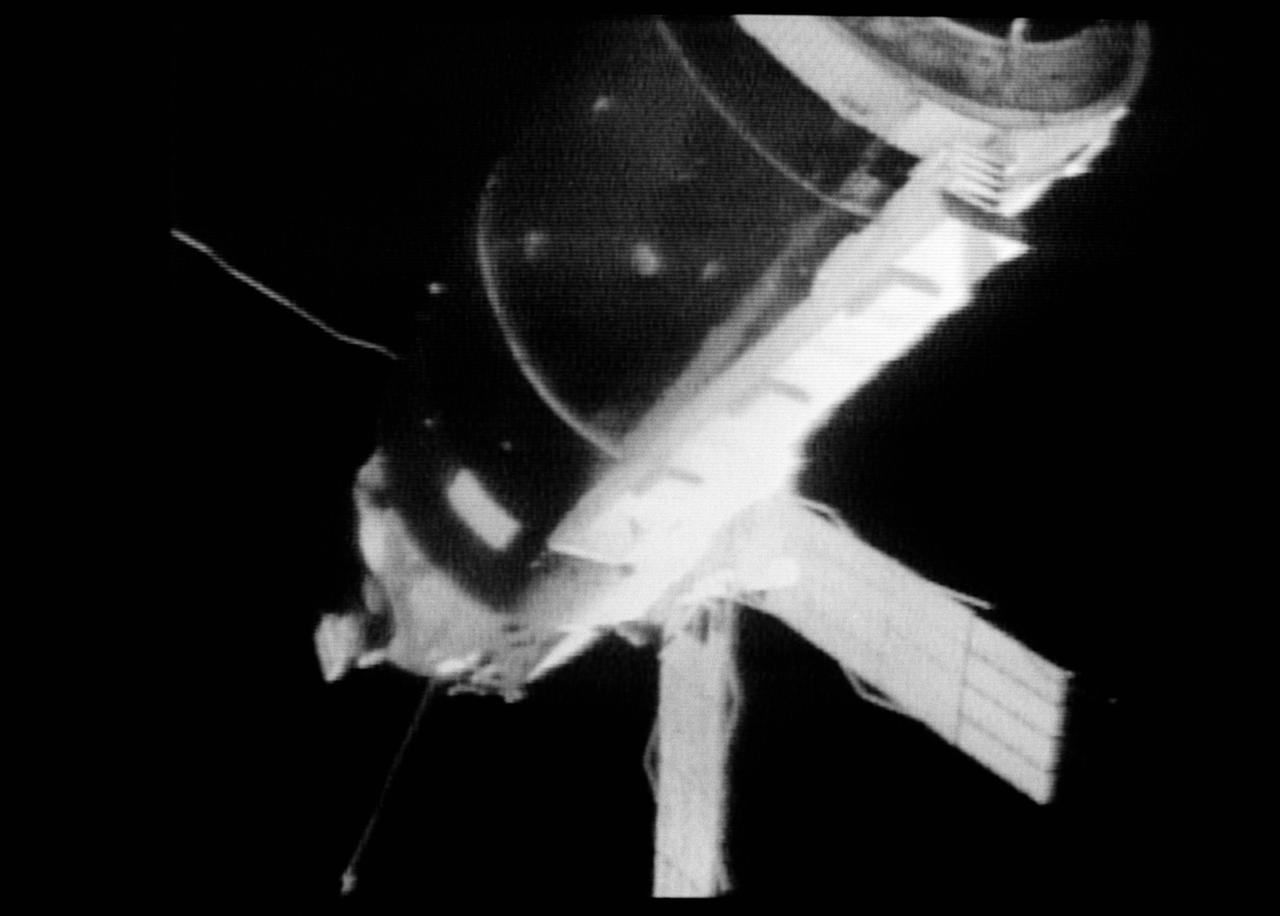
S73-27182 (25 May 1973) --- A close-up view of the Skylab 1 space station cluster can be seen in this reproduction taken from a color television transmission made by a TV camera aboard the Skylab 2 Command Module during its "fly around" inspection of the cluster. This view has been enhanced. At left center the damaged solar array system wing on the Orbital Workshop (OWS) appears to be partly folded. In their preliminary inspection the crewmen noted that portions of the micrometeoroid shield had slid back underneath the OWS solar wing. Solar panels on the Apollo Telescope Mount extend out at the top center. Photo credit: NASA
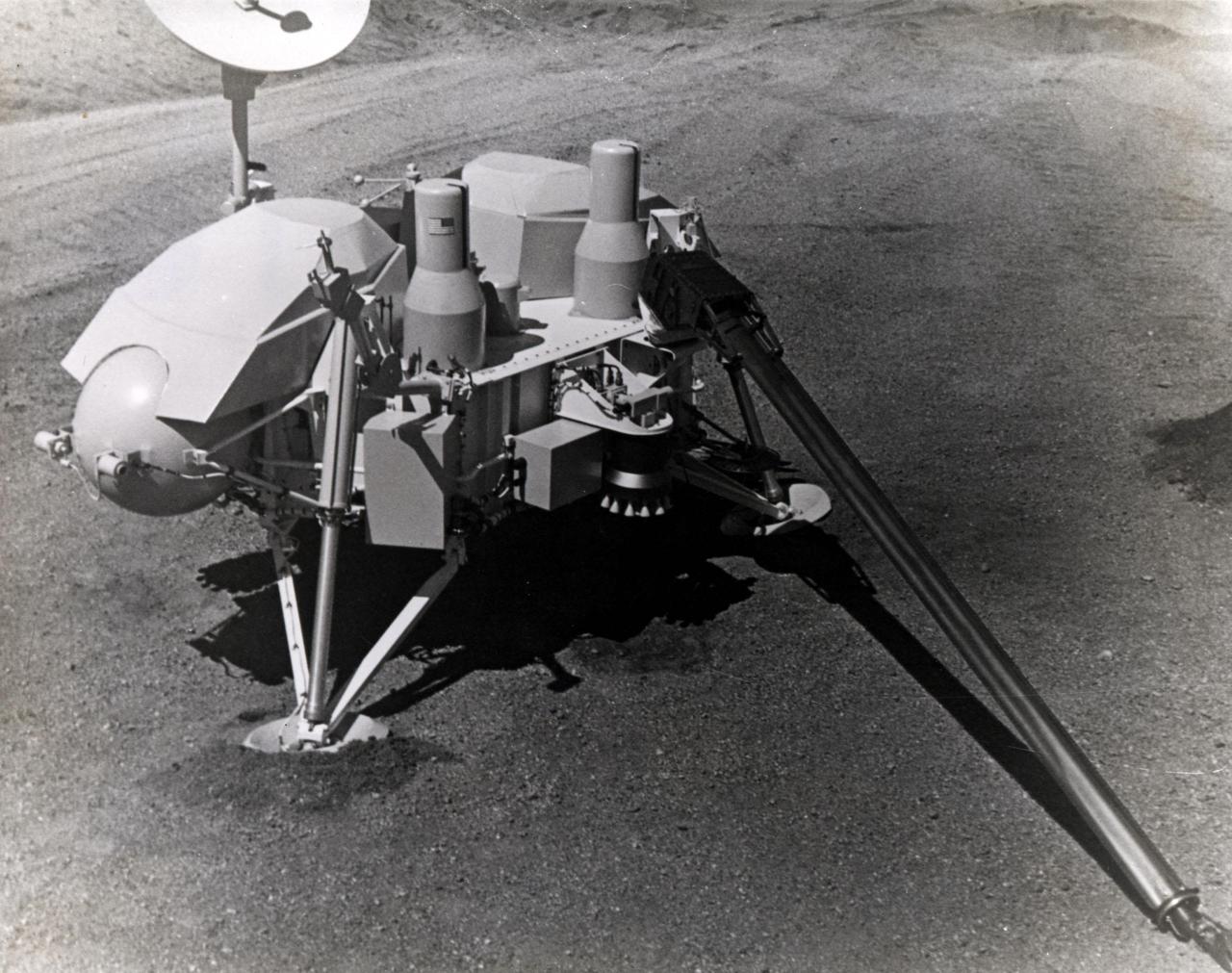
KENNEDY SPACE CENTER, FLA. -- Viking Project In 1976: NASA will land two automated scientific laboratories on the planet Mars. This pioneering effort to explore in detail the surface of another primary planet in our solar system will be identified by a name that exemplifies the spirit of historic exploration. To accomplish this goal, two spacecraft will be launched from the Kennedy Space Center within a month of another in mid-1975. These spacecraft, each including a lander and an orbiter, will hurtle nearly 460 million miles around the Sun before reaching the red planet. The descent will occur when Mars is about 225 million miles from Earth and nearly on the other side of the Sun. This requires a completely automated de-orbit and landing operation because, at that distance, two-way communication between Mars and Earth takes nearly 45 minutes. Surface science will then commence with principal scientific interest invested in biology, geology and meteorology.
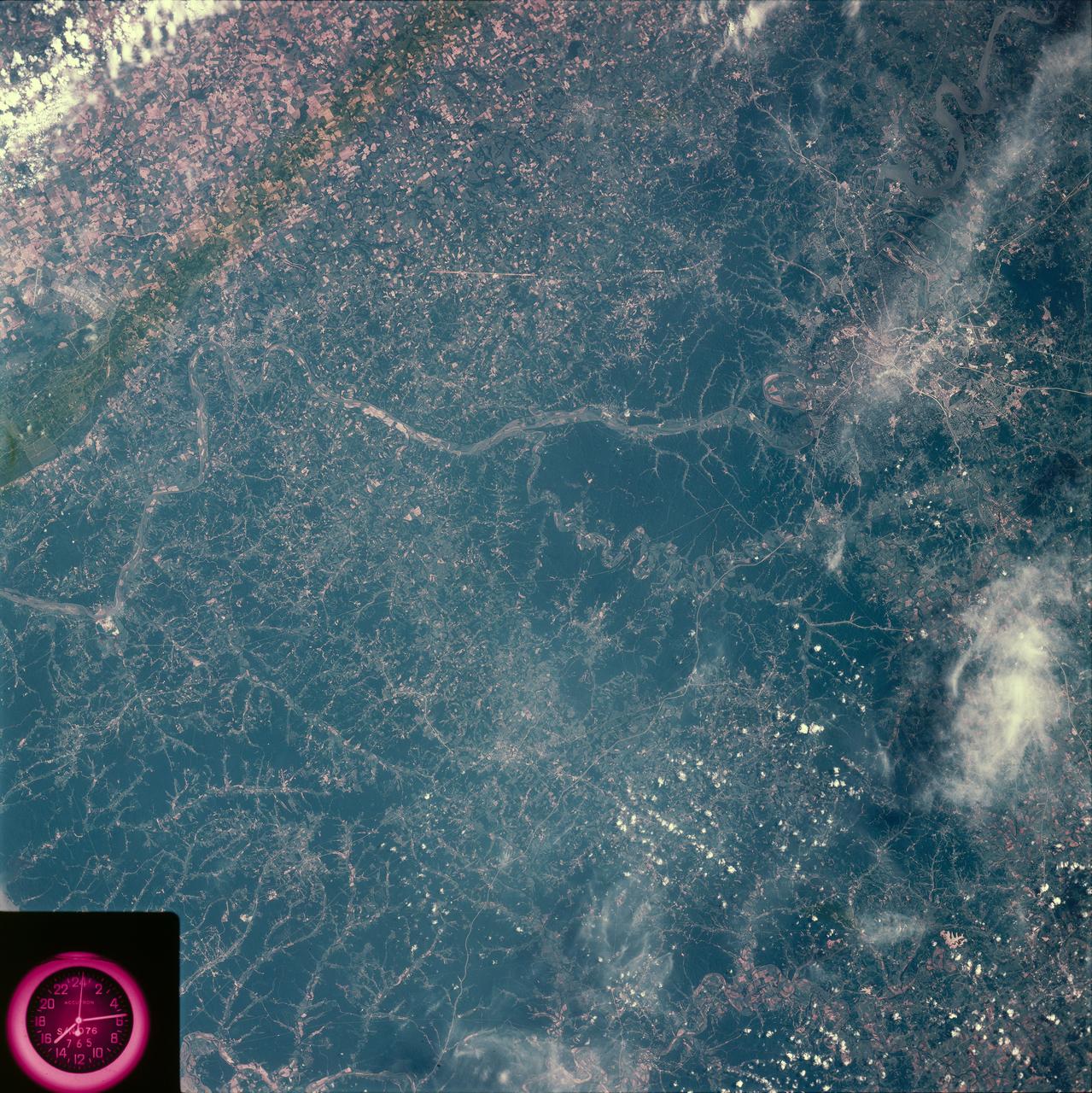
SL2-81-198 (22 June 1973) --- Making its way through the rugged Cumberland Plateau, the Cumberland River winds through the city of Nashville in north central Tennessee (36.0N, 87.0W) where the heavily forested upland terrain produces a landscape of rolling hills with elevations up to 1,100 ft. and narrow valleys. Before the advent of modern communications and transportation in this region, widely scattered and isolated communities had little contact with the outside world. Photo credit: NASA
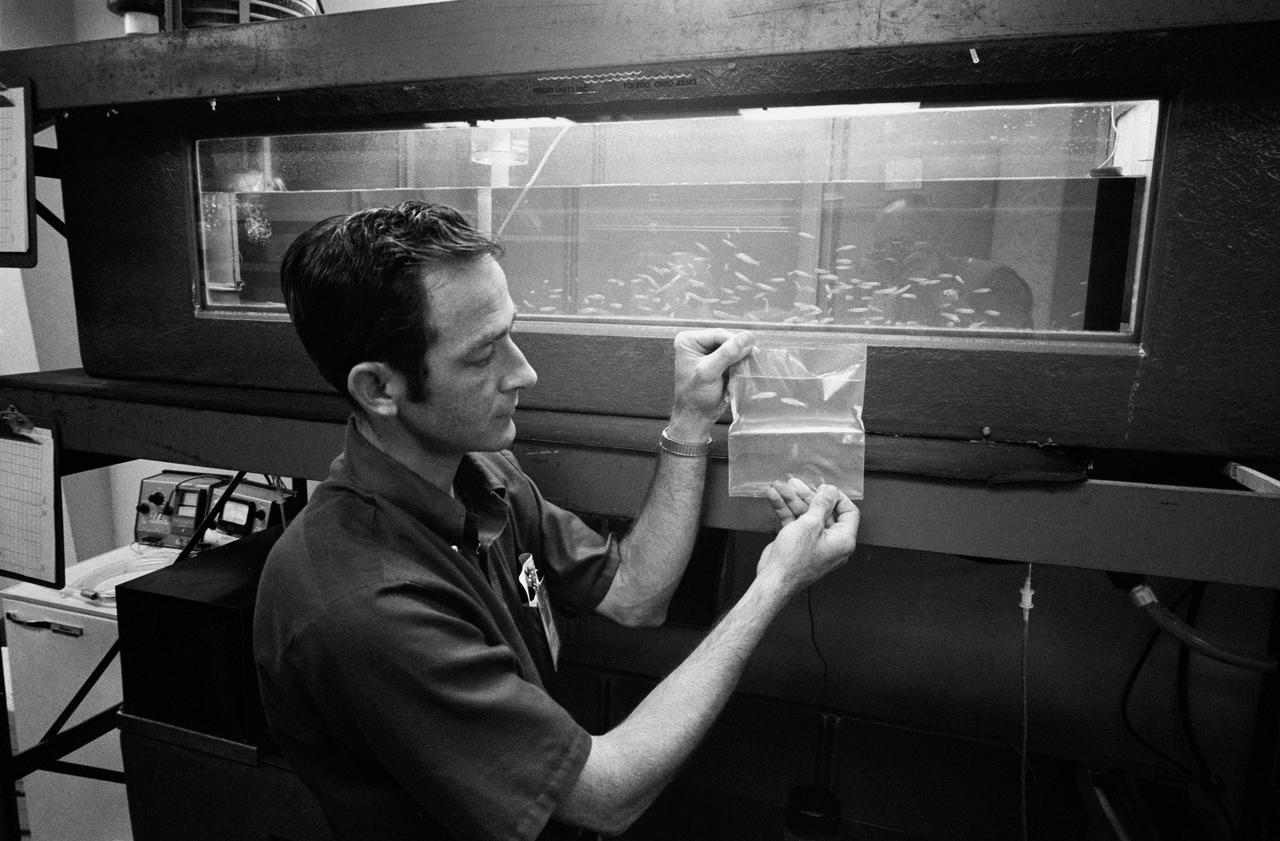
S73-30856 (29 June 1973) --- John Boyd observes a bag with two ?brackish water? minnows known as ?Mummichog Minnows? which will be onboard Skylab 3 with astronauts Alan L. Bean, Owen K. Garriott and Jack R. Lousma. The fish were added to the flight at the request of scientist-astronaut Dr. Owen K. Garriott, science pilot. Fifty eggs from the minnows will also be included in the bag. The objective of this experiment is to show what disorientation the fish will experience when exposed to weightlessness. Many fish have vestibular apparatus quite similar to man. Even though they live in an environment usually considered to resemble weightlessness, they do perceive a gravity vector. An aquarium of the minnows, caught off the coast of Beaufort, North Carolina, is in the background. Photo credit: NASA
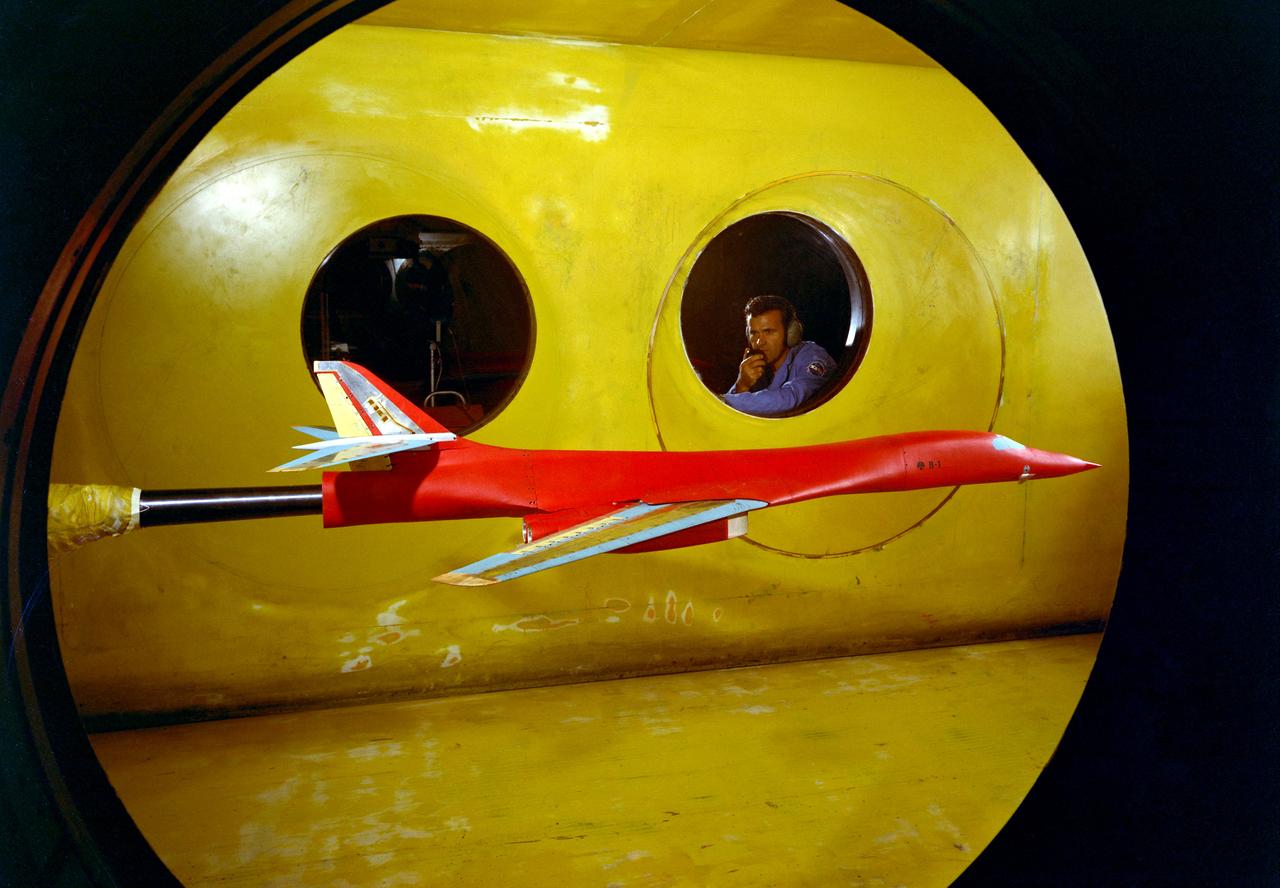
North American B-1. 9 x 7ft Wind Tunnel (Test 97-619). test-619
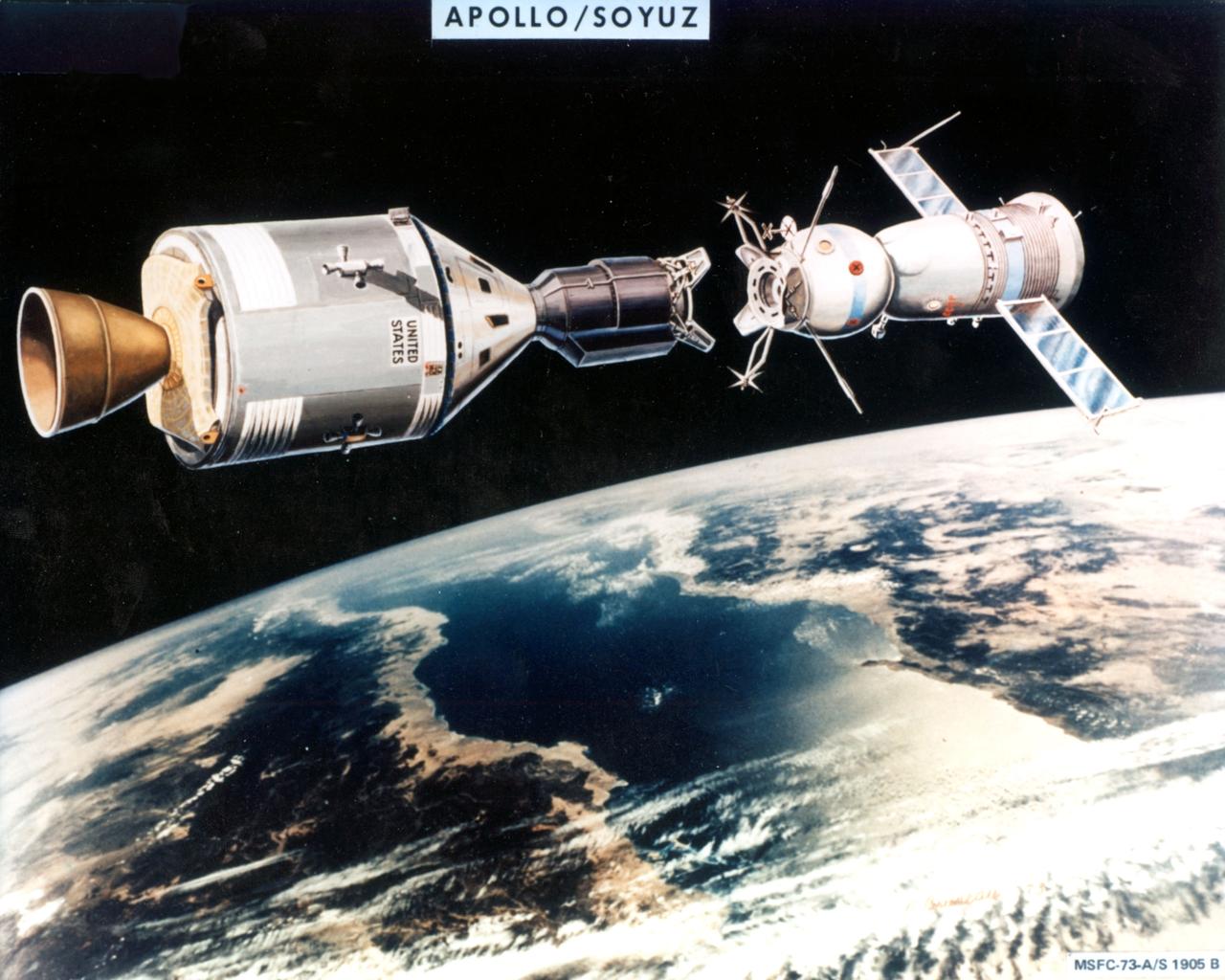
Artist concept of Apollo Soyuz
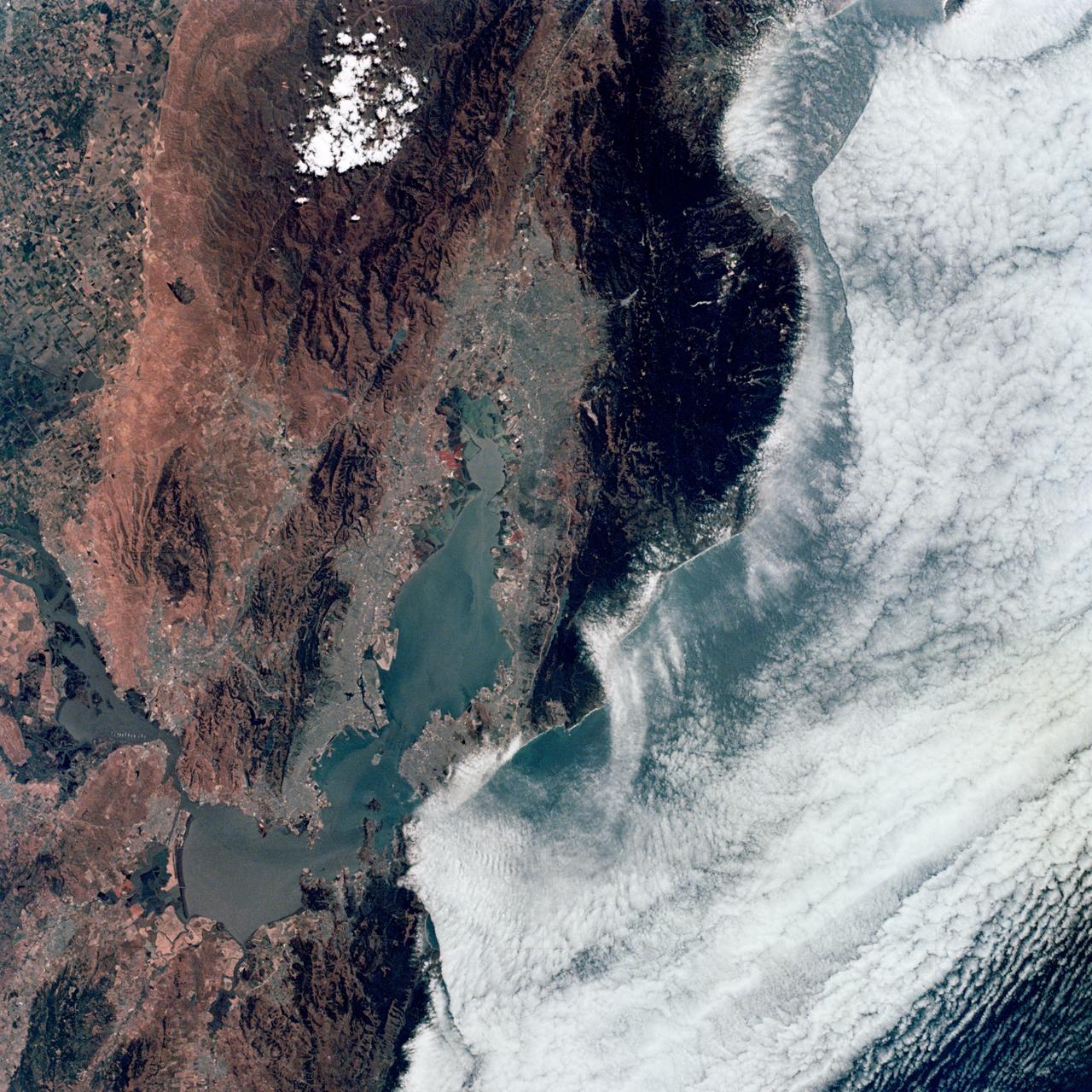
SL2-04-118 (June 1973) --- A color photograph of the San Francisco Bay, California area, taken from the Skylab space station in Earth orbit. (The picture should be held with the clouds and Pacific Ocean on the left.) Note the thickly populated and highly developed area around the bay. Among the cities visible are San Francisco, Oakland, Berkeley and San Jose. This view extends eastward to show a portion of the San Joaquin Valley. This photograph was taken by one of the six lenses of the Itek-furnished S190-A Multispectral Photographic Facility Experiment in the Multiple Docking Adapter of the space station. Type SO-356 film was used. The S190-A experiment is part of the Skylab Earth Resources Experiments Package (EREP). Photo credit: NASA
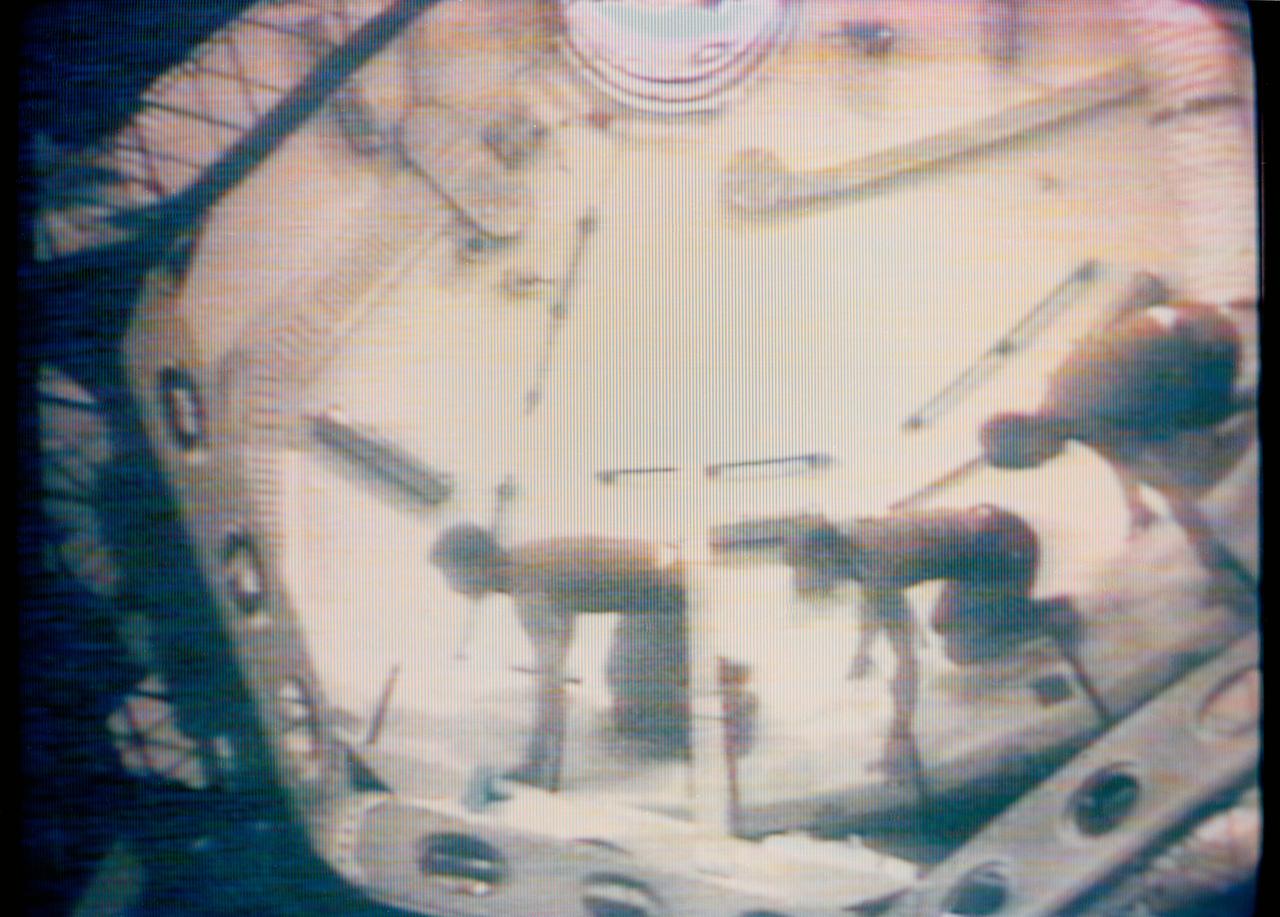
S73-27262 (1 June 1973) --- The three Skylab 2 crewmen give a demonstration on the effects of weightlessness in the Orbital Workshop of the Skylab 1 and 2 space station cluster in Earth orbit, as seen in this reproduction taken from a color television transmission made by a TV camera aboard the space station. Astronauts Charles Conrad Jr., Joseph P. Kerwin and Paul J. Weitz are crouched in a fast-start stance to race around the dome area of the OWS forward compartment. The astronauts had ease of motion and good maneuverability in the zero-gravity of space. Photo credit: NASA
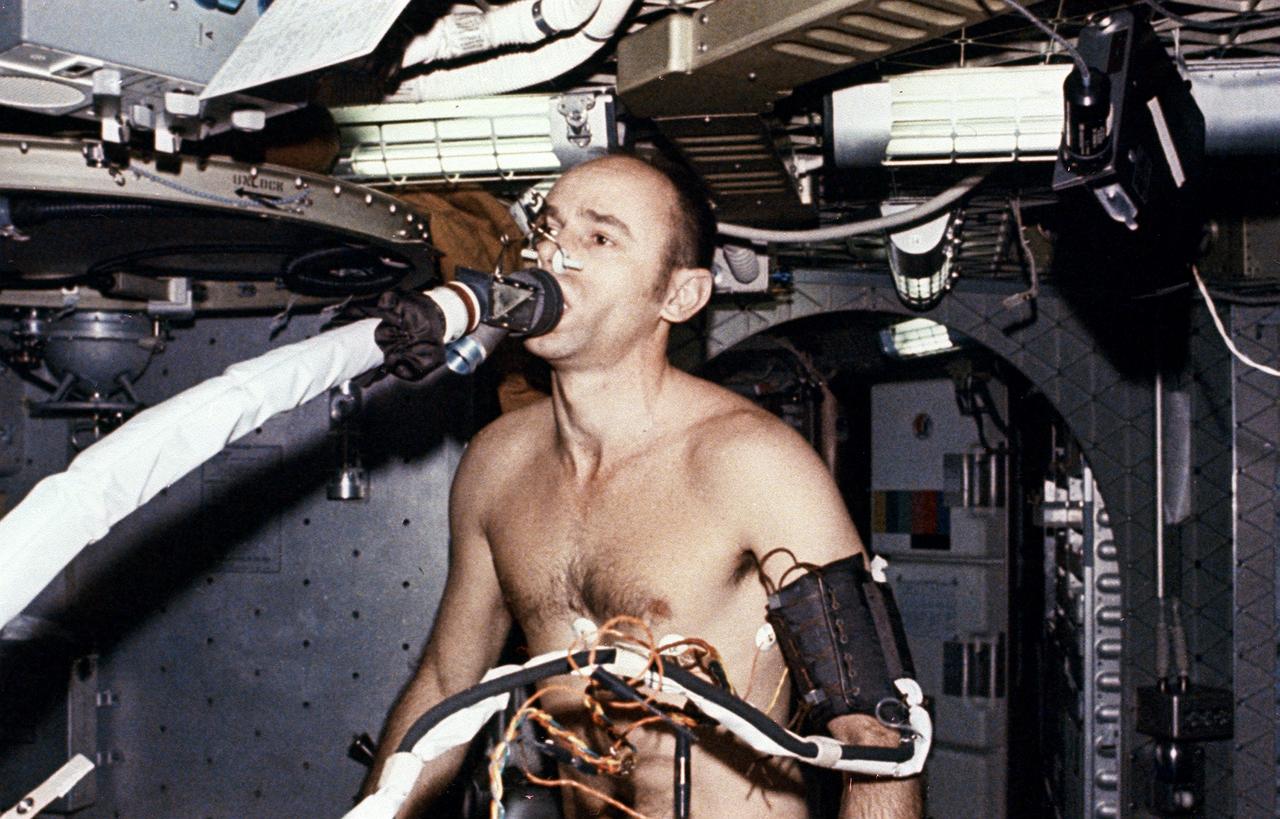
This Skylab-3 onboard photograph shows Astronaut Allen Bean on the ergometer, breathing into the metabolic analyzer. Skylab's Metabolic Activity experiment (M171), a medical evaluation facility, was designed to measure astronauts' metabolic changes while on long-term space missions. The experiment obtained information on astronauts' physiological capabilities and limitations and provided data useful in the design of future spacecraft and work programs. Physiological responses to physical activity was deduced by analyzing inhaled and exhaled air, pulse rate, blood pressure, and other selected variables of the crew while they performed controlled amounts of physical work with a bicycle ergometer.

S73-25140 (16 April 1973) --- A ground-level view of Pad A, Launch Complex 39, Kennedy Space Center, Florida, showing the 341-feet tall Skylab 1/Saturn V space vehicle on the pad soon after being rolled out from the Vehicle Assembly Building (VAB). The vehicle is composed of the Saturn V first (S-1C) stage, the Apollo Telescope Mount (ATM), the Multiple Docking Adapter (MDA), the Airlock Module (AM), and the Orbital Workshop (OWS). Photo credit: NASA
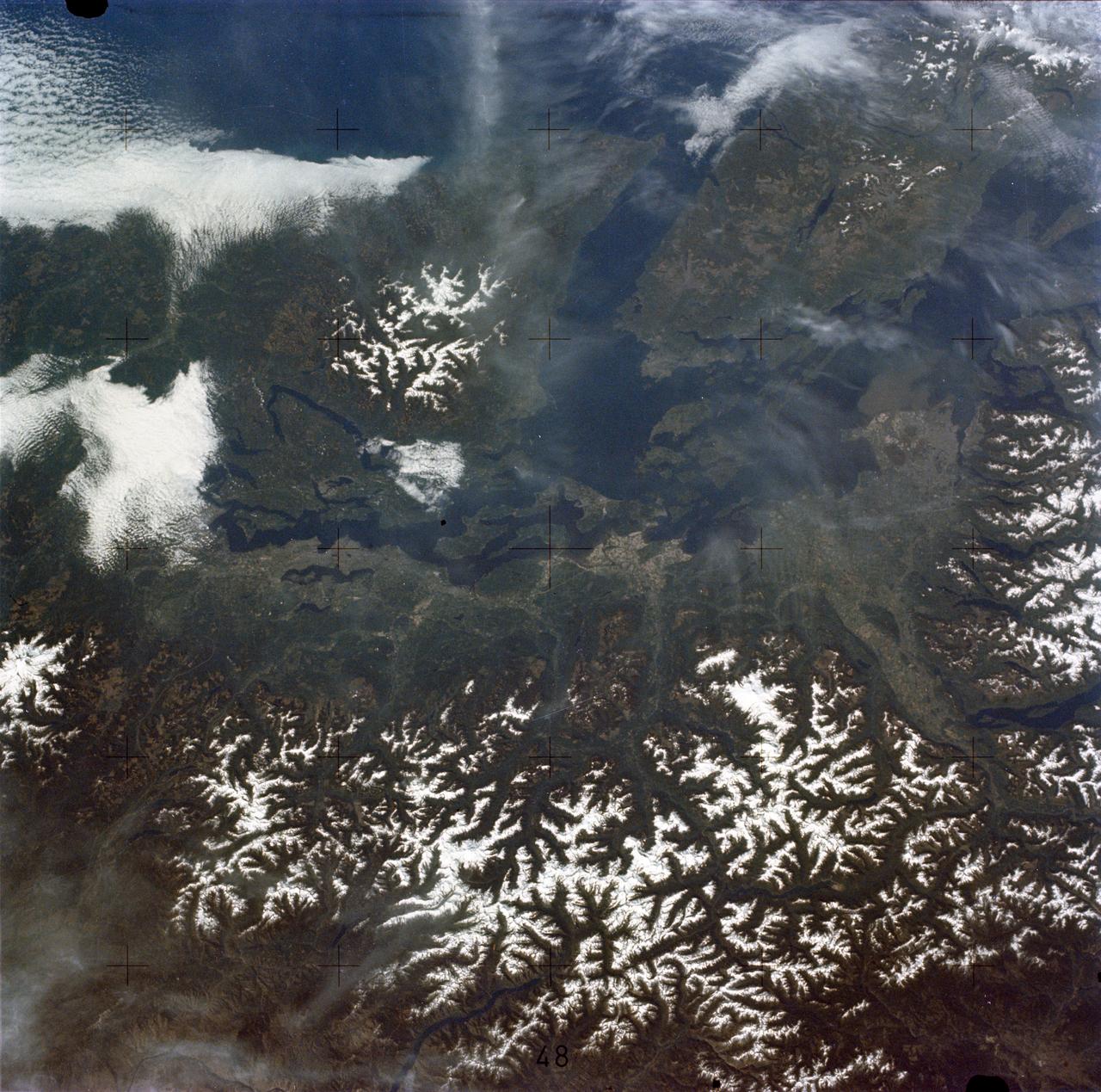
SL2-05-458 (22 June 1973) --- Portions of northwest Washington State (48.0N, 122.5) can be seen in this view as well as portions of British Columbia, Canada. The snow covered Cascade Mountains are on the eastern side of the scene. Vancouver Island is visible in the northeast corner of the photo. The strait of Juan de Fuca separates Vancouver Island from the northwest corner of Washington. Seattle is near the center and the snow covered Olympic Mountains are to the east. Photo credit: NASA
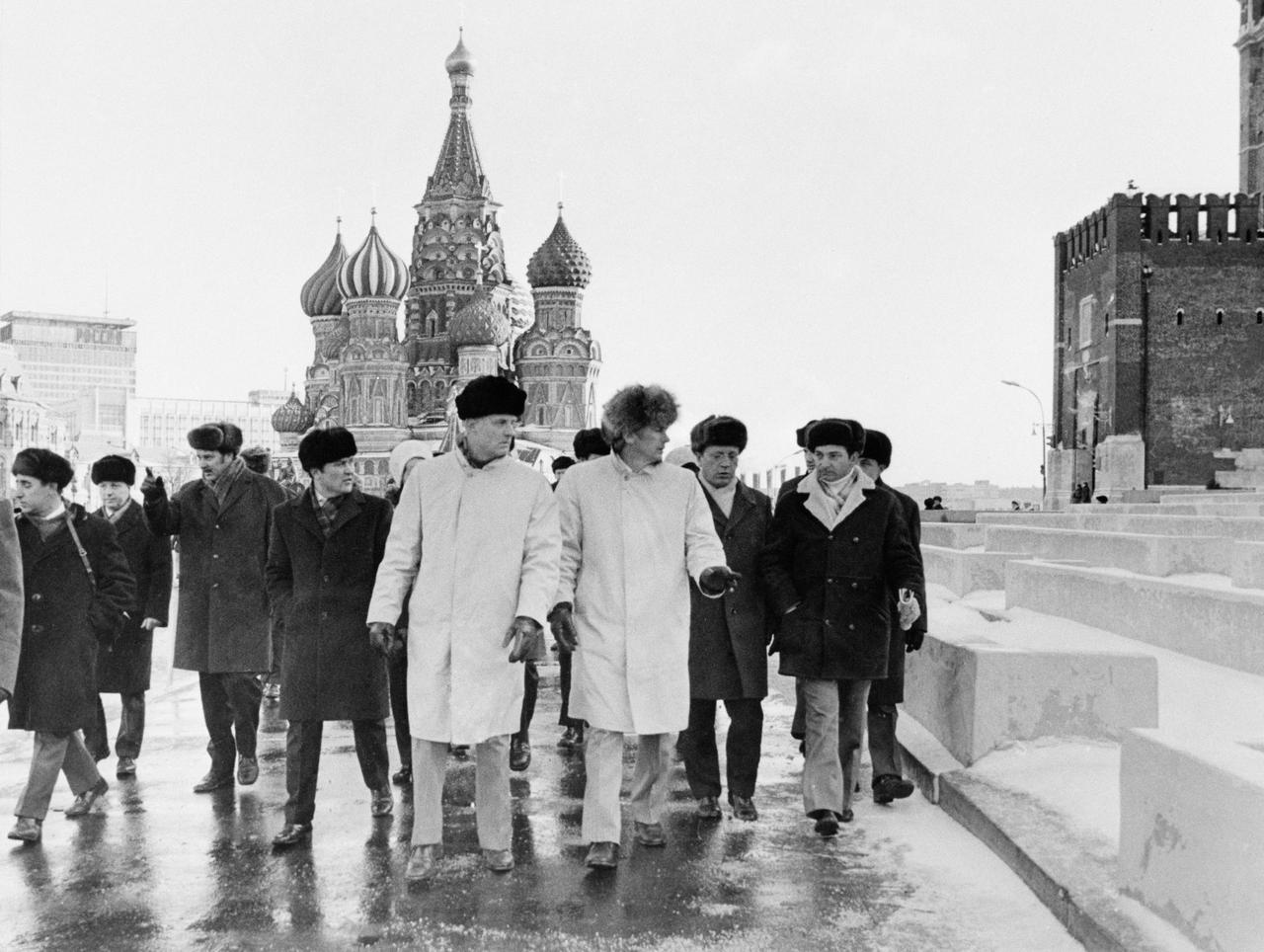
S74-20831 (November 1973) --- A group of astronauts and their cosmonaut hosts are photographed sightseeing on Red Square in the heart of Moscow during a tour of the Soviet capital. The Americans were in the USSR to participate in Apollo-Soyuz Test Project familiarization training on the Soyuz systems at the Cosmonaut Training Center (Star City) near Moscow. Astronaut Thomas P. Stafford (light coat, black cap), commander of the American ASTP crew, was head of the U.S. delegation to Star City. Astronaut Eugene A. Cernan (on Stafford?s left, light coat) is the Special Assistant to the American Technical Director of ASTP. The sightseeing group is walking in the direction of Lenin?s Mausoleum. The structure in the background is the Cathedral of the Intercession (St. Basil?s) Museum. The historic Kremlin complex is to the right. PHOTO COURTESY: USSR ACADEMY OF SCIENCES
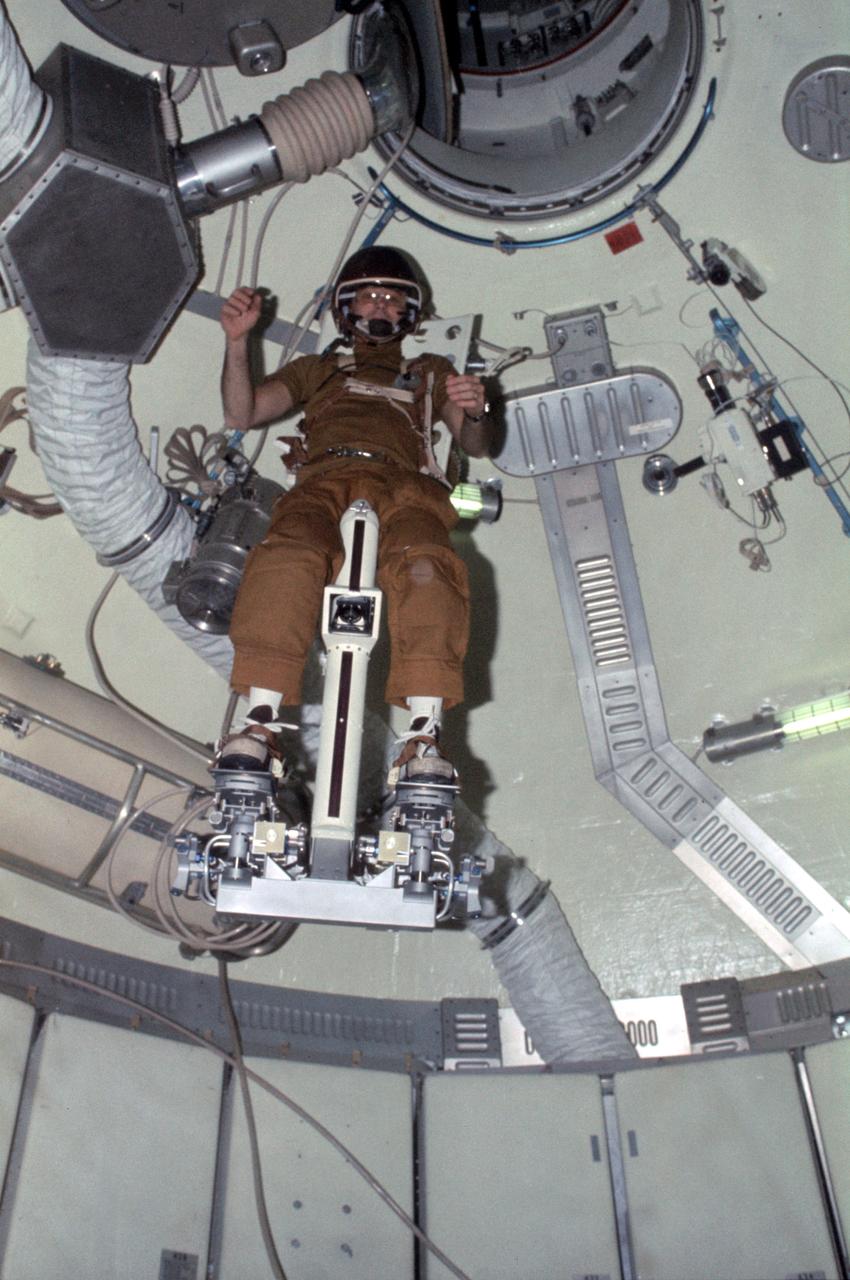
SL3-108-1304 (July-September 1973) --- Astronaut Alan L. Bean, Skylab 3 commander, flies the M509 Astronaut Maneuvering Equipment in the forward dome area of the Orbital Workshop (OWS) on the space station cluster in Earth orbit. Bean is strapped in to the back-mounted, hand-controlled Automatically Stabilized Maneuvering Unit (ASMU). This ASMU experiment is being done in shirt sleeves. The dome area where the experiment is conducted is about 22 feet in diameter and 19 feet from top to bottom. Photo credit: NASA
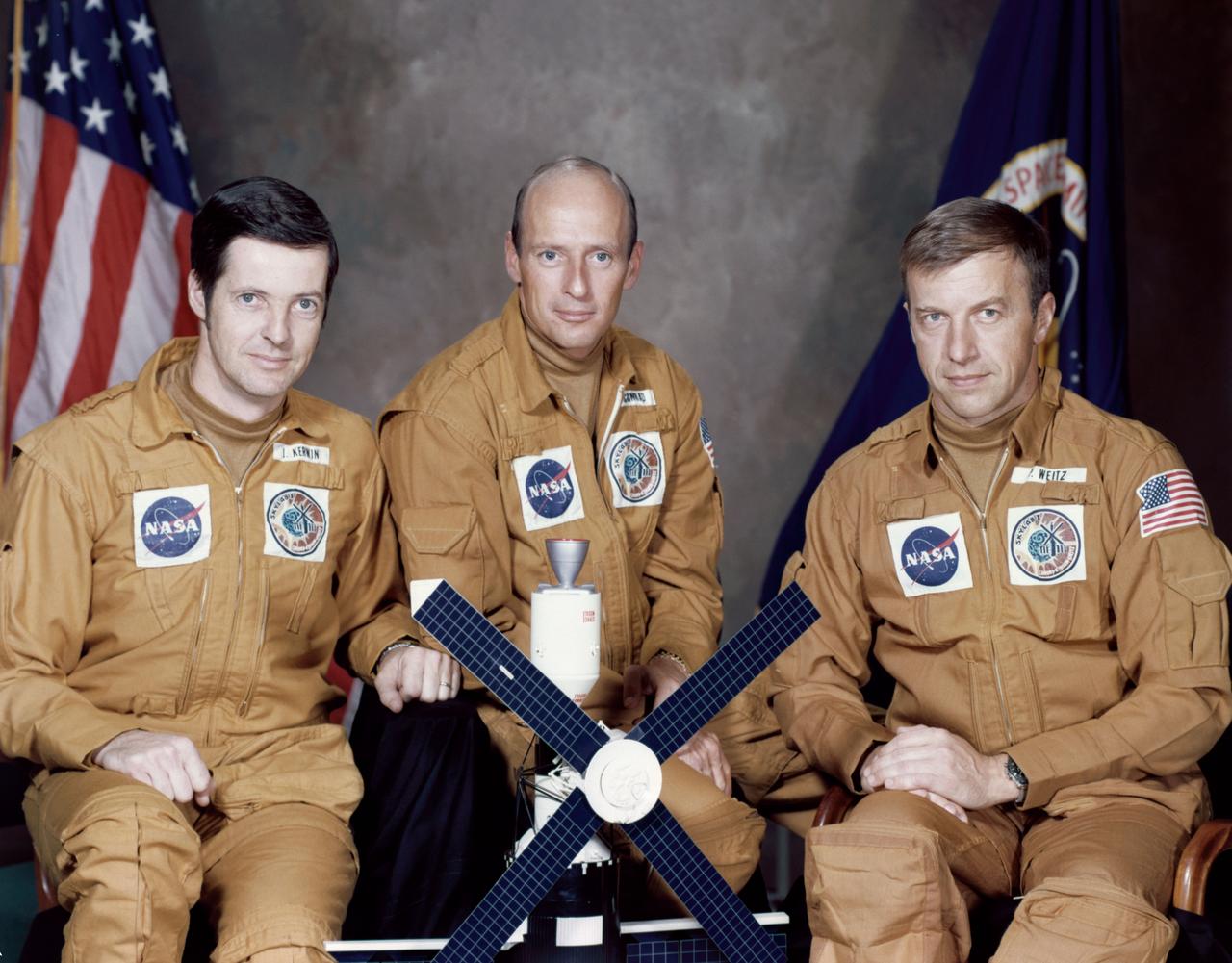
S73-24303 (May 1973) --- These three astronauts have been named by the National Aeronautics and Space Administration as the prime crew of the first manned Skylab mission. They are, left to right, Joseph P. Kerwin, science pilot; Charles Conrad Jr., commander; and Paul J. Weitz, pilot. Skylab is a three-part program consisting of one 28-day and two 56-day manned visits spanning an eight-month period. One day prior to the launch of this crew, the unmanned Skylab space station cluster will be launched and placed in Earth orbit. The first manned mission will last up to 28 days. Photo credit: NASA
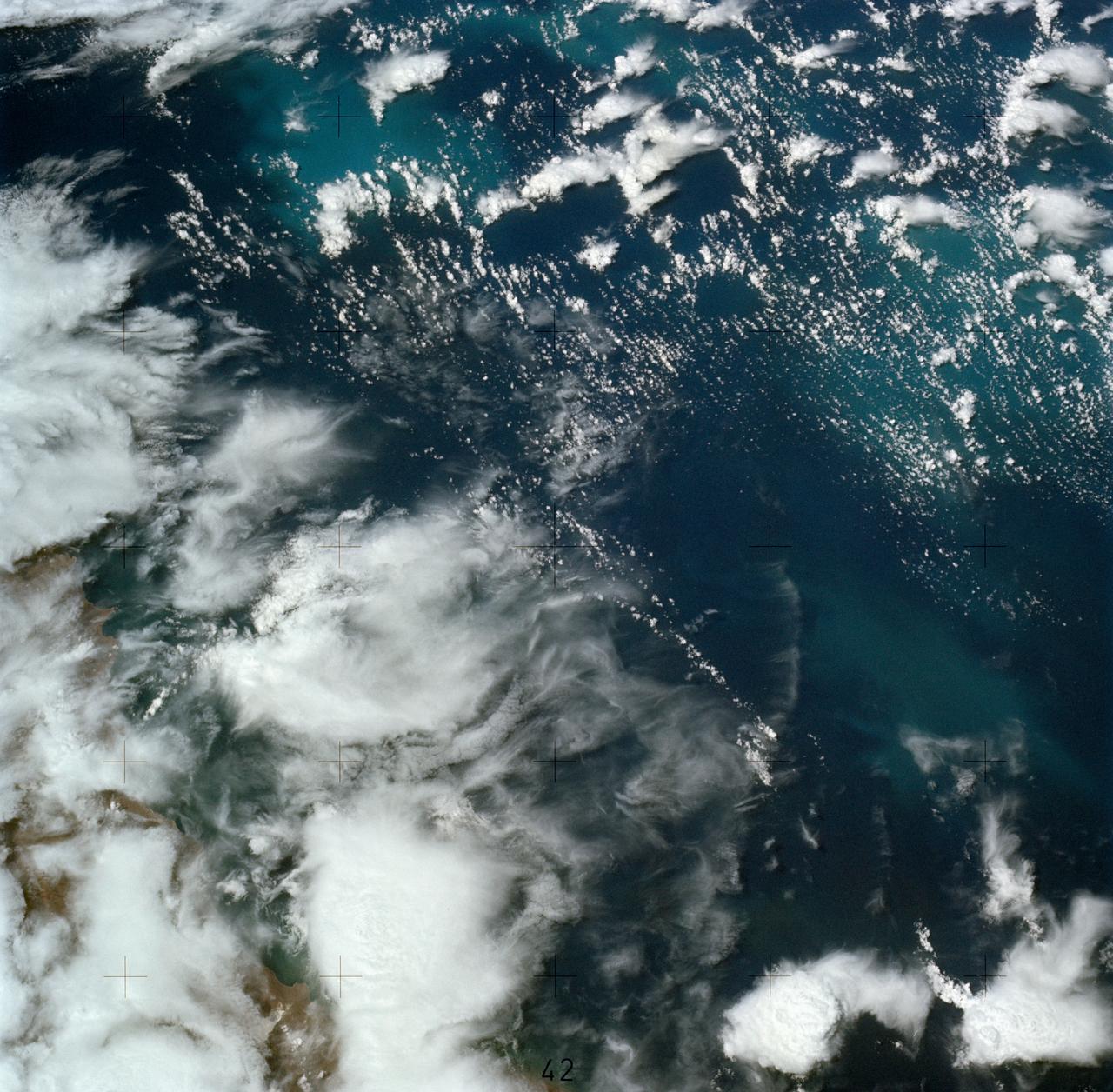
SL4-137-3608 (14 Dec. 1973) --- A view of cold water eddies in the Falkland Current off the South Atlantic coast of southern Argentina as seen from the Skylab space station in Earth orbit. This picture was taken by one of the Skylab 4 crewmen using a hand-held 70mm Hasselblad camera. This land area (left corner) extends south along the coast from Puerto Deseado (center left border) for about 50 miles. Within the ocean, several light blue areas are visible and represent the occurrence of plankton with the Falkland Current. Over the ocean, the cold water eddies are identified by the circular cloud-free areas within the cloud street pattern and bordered by cumulus cloud buildup (white). The cloud streets indicate the wind is from the southwest and do not form over eddies because energy form the atmosphere is absorbed by the cold ocean water. On the downwind side of the eddies, cumulus clouds tend to form as the cold moist air flows over the warmer water. Similar cloud and eddy features have been observed by the Skylab 4 crewmen in the Yucatan Current off Yucatan Peninsula and in some parts of the South Pacific. Studies are underway by Dr. George Maul, NOAA, and Dr. Robert Stevenson, ONR, to determine the significance of the cold water eddies to ocean dynamics. Photo credit: NASA
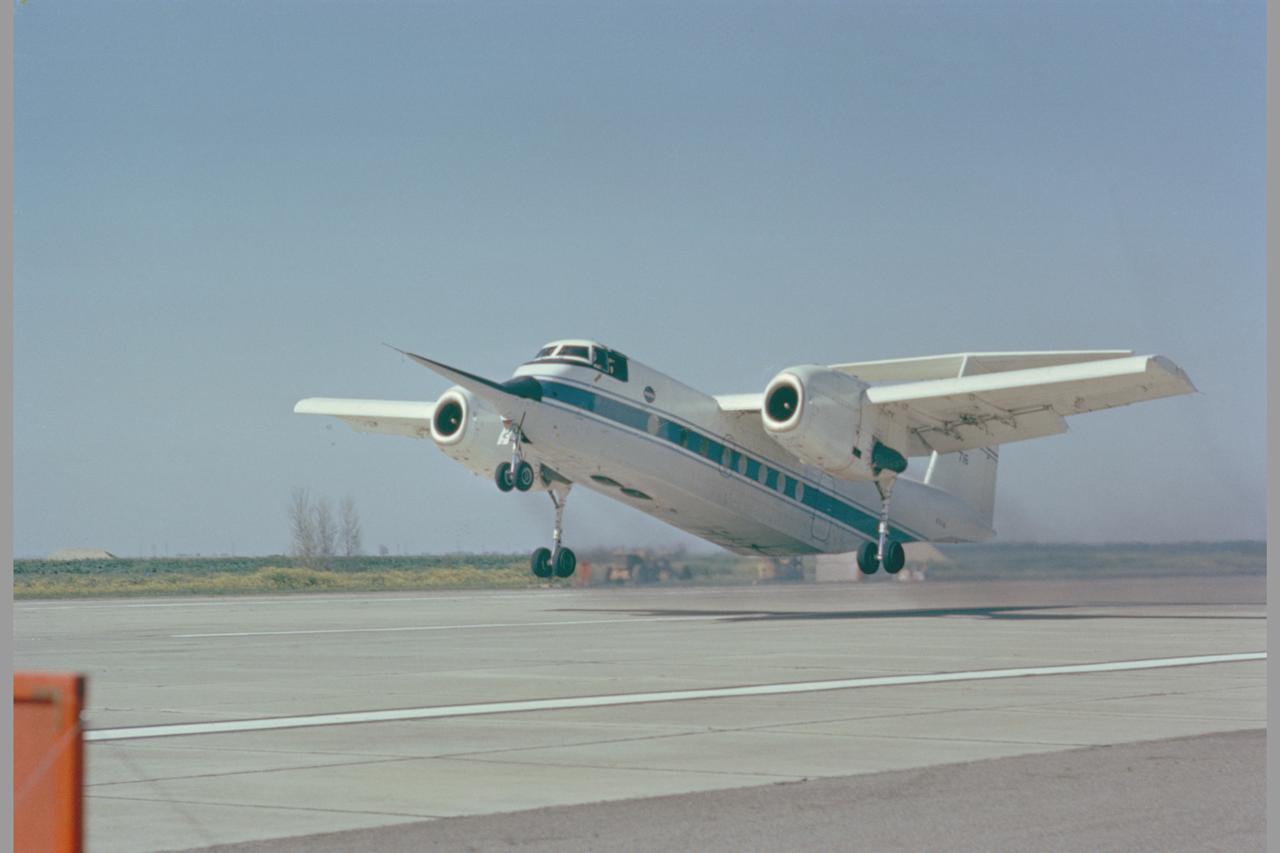
C-8A (NASA-716) Buffalo Augmentor Wing Jet STOL Research Aircraft at Crows Landing during take-off
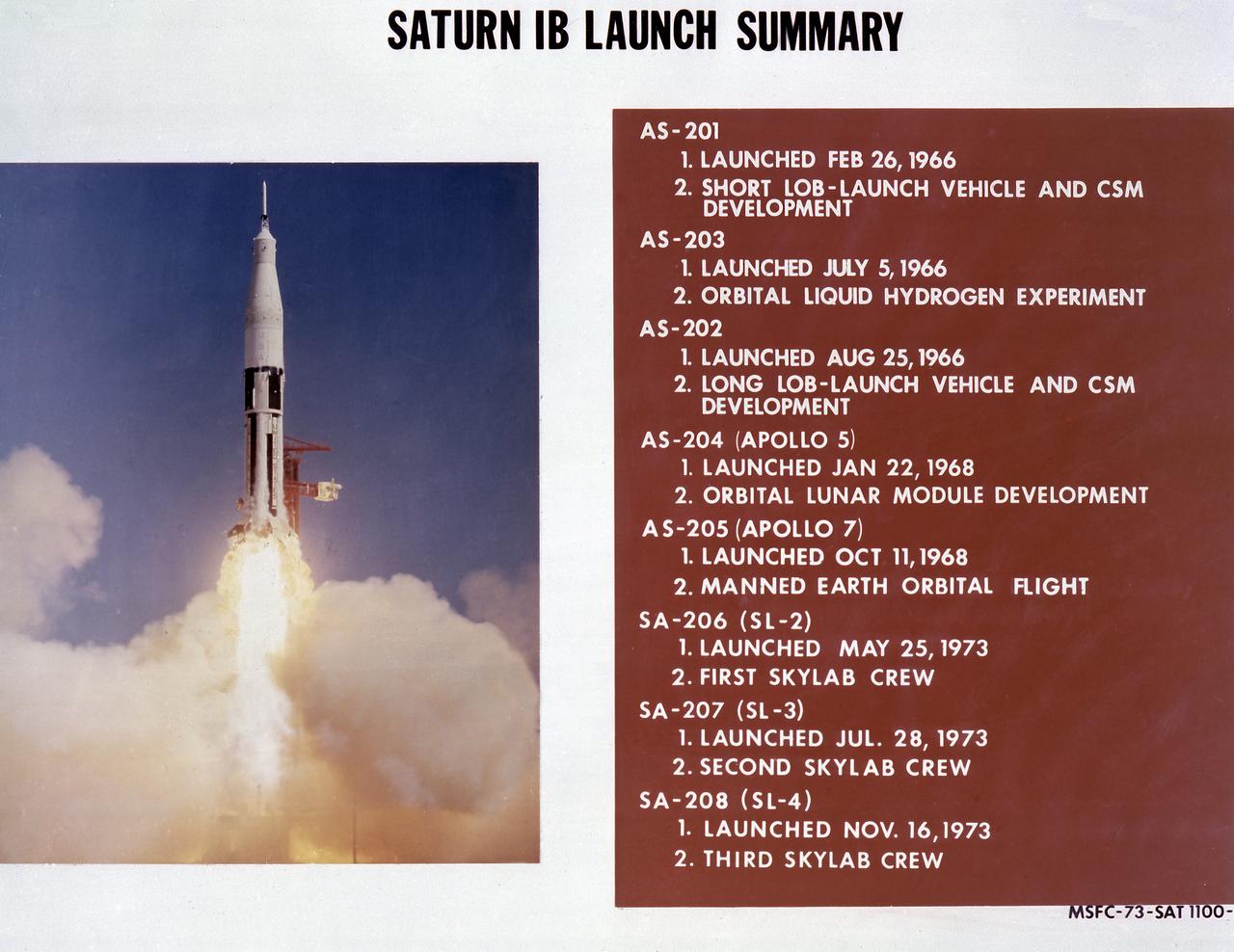
This chart provides a launch summary of the Saturn IB launch vehicle as of 1973. Developed by the Marshall Space Flight Center (MSFC) as an interim vehicle in MSFC's "building block" approach to the Saturn rocket development, the Saturn IB utilized Saturn I technology to further develop and refine the larger boosters and the Apollo spacecraft capabilities required for the marned lunar missions.
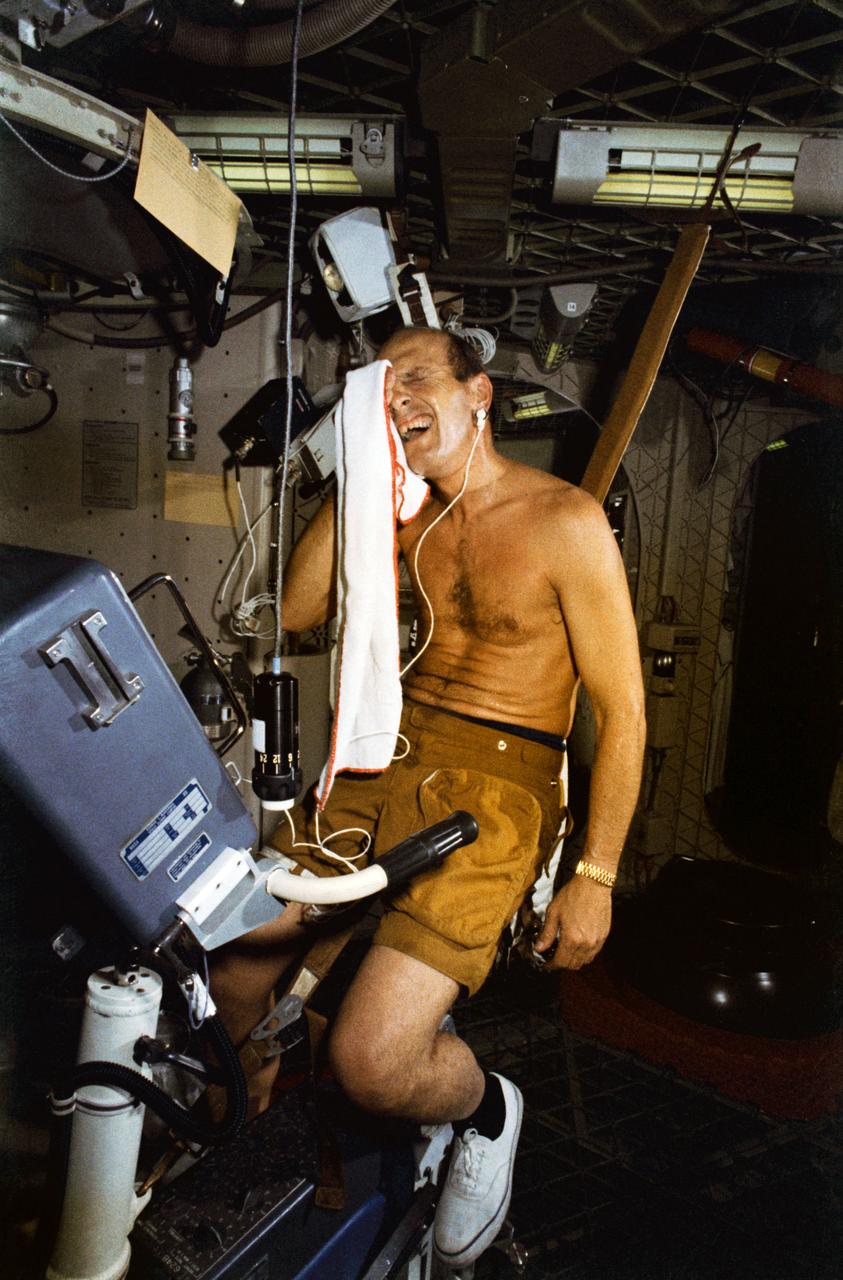
S73-20713 (1 March 1973) --- Astronaut Charles Conrad Jr., commander of the first manned Skylab mission, wipes perspiration from his face following an exercise session on the bicycle ergometer during Skylab training at Johnson Space Center. Conrad is in the work and experiments compartment of the crew quarters of the Skylab Orbital Workshop (OWS) trainer at JSC. In addition to being the prime exercise for the crewmen, the ergometer is also used for the vector-cardiogram test and the metabolic activity experiment. The bicycle ergometer produces measured workloads for use in determining man's metabolic effectiveness. Photo credit: NASA
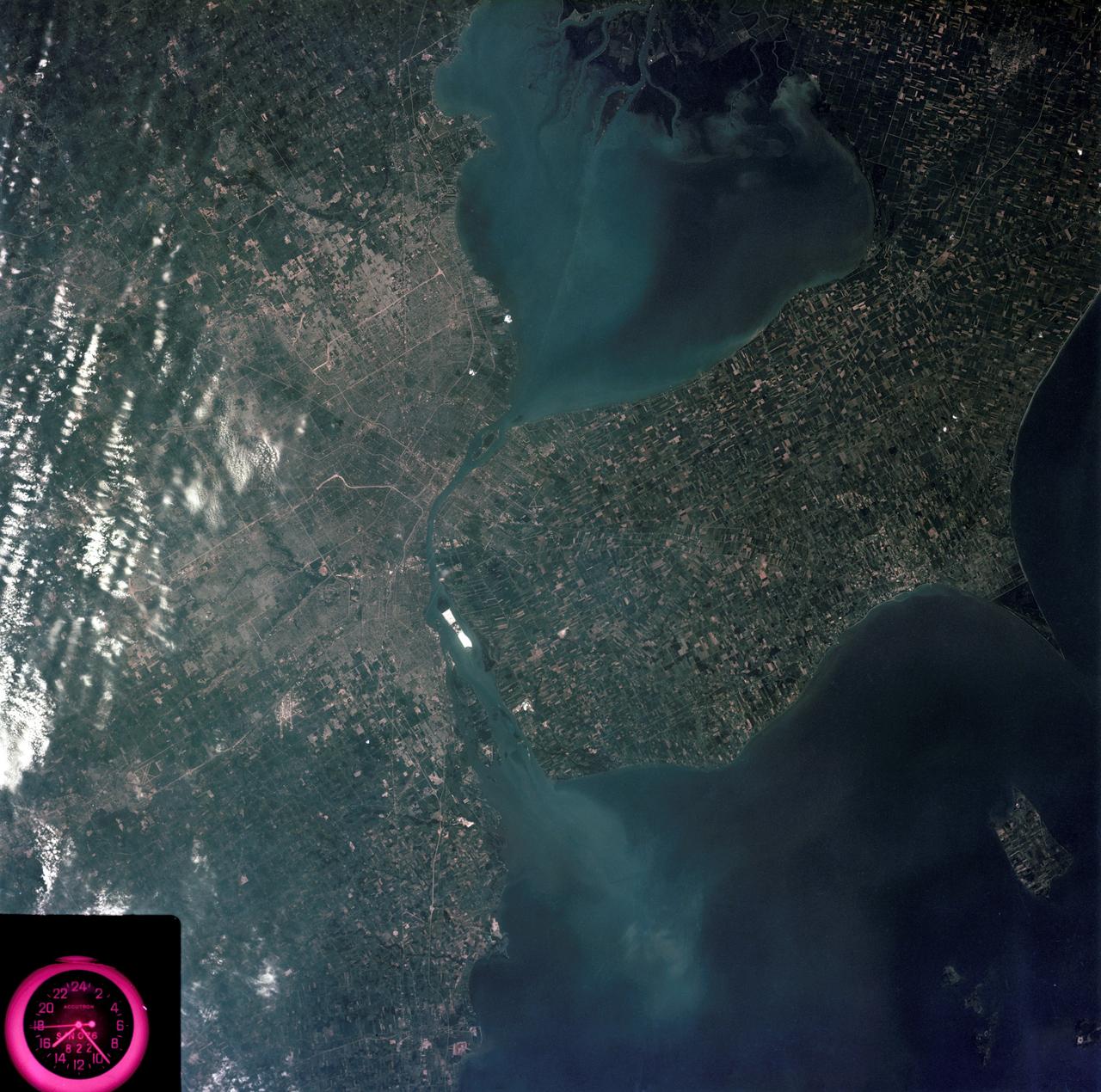
SL3-83-0152 (July-September 1973) --- A near vertical view of the metropolitan Detroit, Michigan area is seen in this Skylab 3 Earth Resources Experiments Package S190-B (five-inch Earth terrain camera) photograph taken from the Skylab space station in Earth orbit. The 25-mile long Detroit River drains the smaller body of water (Lake St. Clair) and flows southwestward separating Detroit from Windsor, Ontario, and empties into Lake Erie. The Detroit River handles a great deal of Great Lakes barge and ship traffic. Major streets and thoroughfares radiating from the city are clearly visible. Fighting Island is the highly reflective, white area located almost in the center of the picture. This high reflectivity is caused by the functional use of the island-disposal ponds for chemical salts. Sedimentation and/or pollution patterns in the area provide interesting visual phenomena for speculation and analysis. Distinct and rather unique cultivated field patterns can be observed south and east of Windsor, Ontario. This is a direct result of an English survey and land tenure system which was utilized when the area was settled. New areas of residential development are fairly easy to differentiate from older, established residential areas. Vegetation and extent of area coverage can be determined. The Oakland County Planning Commission and the Federal Bureau of Outdoor Recreation working closely with Irv Sattinger of the Environmental Research Institute of Michigan (University of Michigan) are presently processing and analyzing photographic and Multispectral scanner data to determine its usefulness for recreation and open space site studies for this area. Photo credit: NASA
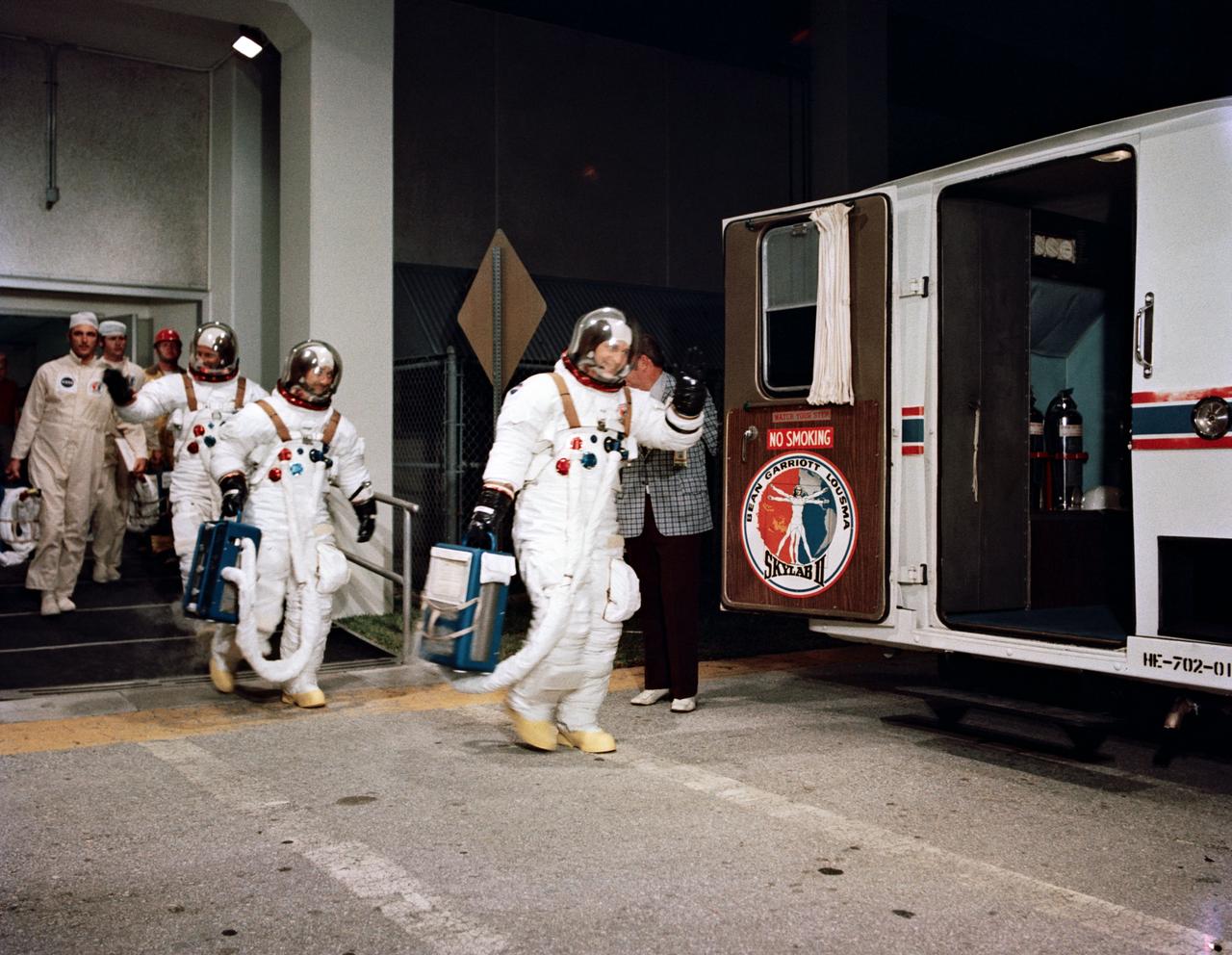
S73-31801 (28 July 1973) --- The three crewmen of the second manned Skylab mission (Skylab 3) leave the Manned Spacecraft Operations Building at the Kennedy Space Center on the morning of the Skylab 3 launch. Leading is astronaut Alan L. Bean, commander; followed by scientist-astronaut Owen K. Garriott, science pilot; and astronaut Jack R. Lousma, pilot. They entered the special van which carried them to Pad B at KSC?s Launch Complex 39 where the Skylab 3/Saturn 1B space vehicle awaited them. The Skylab 3 liftoff was at 7:11 a.m. (EDT), Saturday, July 28, 1973. The three astronauts were scheduled to spend 59 days at the Skylab space station in Earth orbit. Photo credit: NASA

S73-36162 (November 1973) --- Dr. Robert S. Clark changes magnetic tape on the Radiation Counting Laboratory's mini-computer. The computer calculates the total content of radioactive isotopes in the lunar materials. Some 120 different samples from the six landings on the moon have been studied by the lab's gamma spectrometer, which generates 65,000 individual data points of each sample. Measurements of radioactive isotopes reveal how long they have been near the surface, and also reflect how much the rocks have been eroded by micrometeorites. Photo credit: NASA
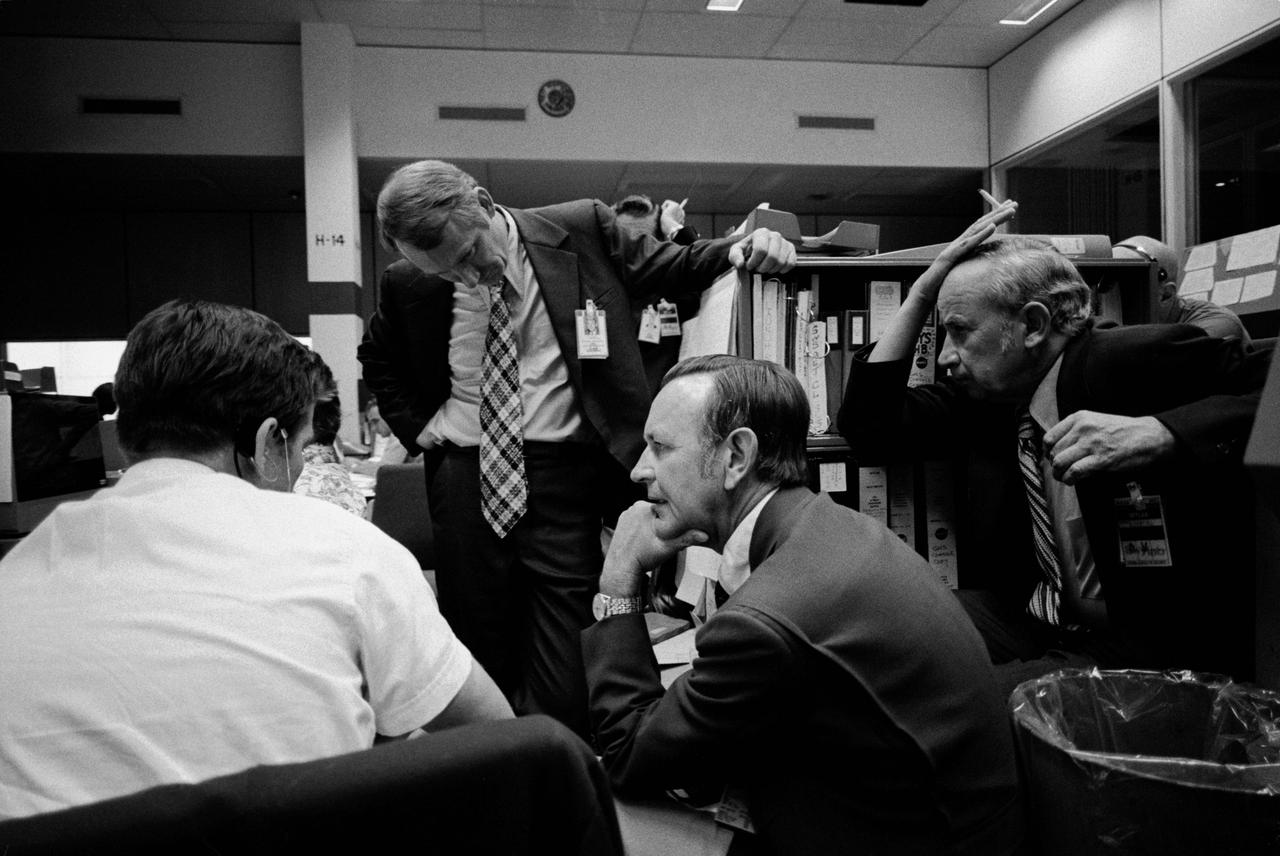
S73-31875 (2 Aug. 1973) --- After learning of a problem in the Command/Service Module which was used to transport the Skylab 3 crew to the orbiting Skylab space station cluster, NASA officials held various meetings to discuss the problem. Here, four men monitor the current status of the problem in the Mission Operations Control Room (MOCR) of the Mission Control Center (MCC) at the Johnson Space Center (JSC). From the left are Gary E. Coen, Guidance and Navigation System flight controller; Howard W. Tindall Jr., Director of Flight Operations at JSC; Dr. Christopher C. Kraft Jr., JSC Director; and Sigurd A. Sjoberg, JSC Deputy Director. Photo credit: NASA
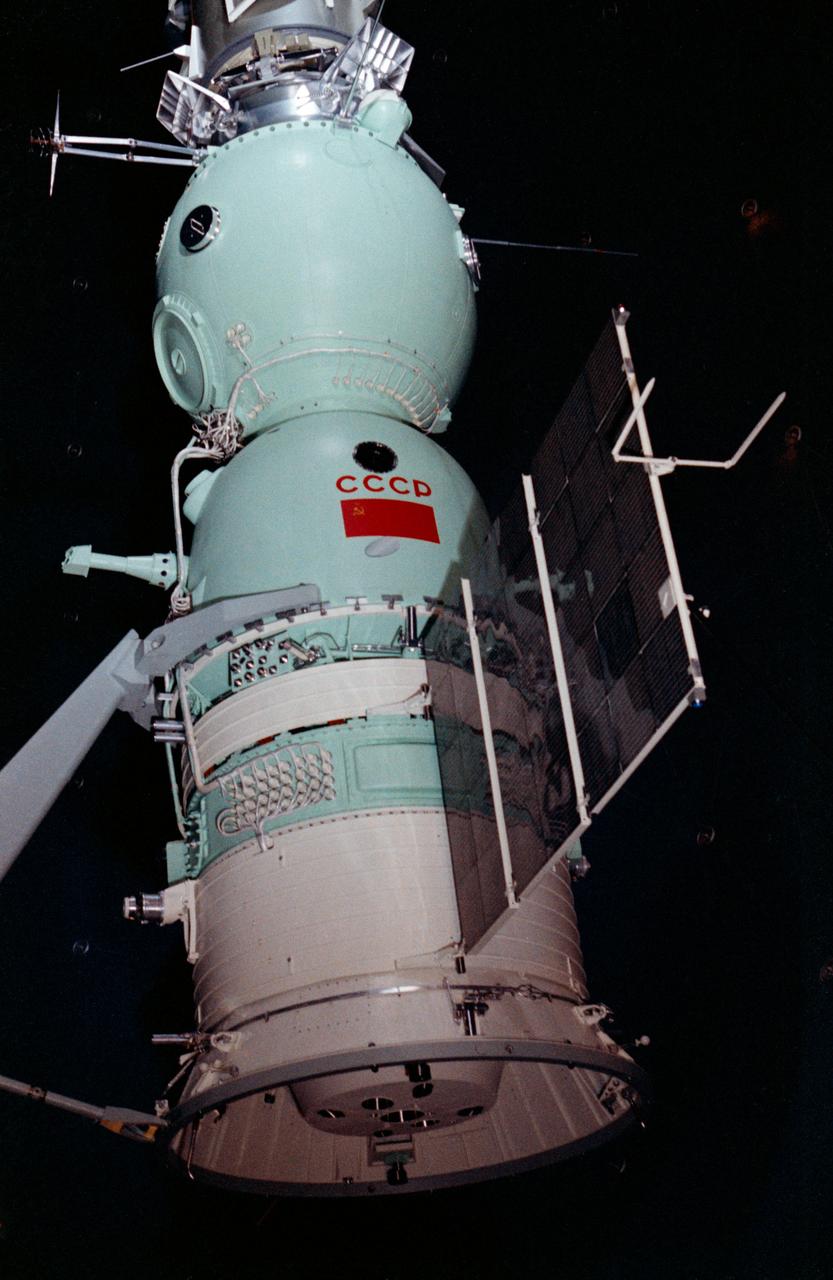
S73-27666 (May-June 1973) --- A close-up view of the Soyuz spacecraft which was part of the Apollo-Soyuz Test Project exhibit at the 30th International Aeronautics and Space Exhibition held May 24 ? June 3, 1973 at the Le Bourget Airport in Paris, France. The ASTP exhibit was co-sponsored by the United States and the Union of Soviet Socialist Republics. An agreement between the U.S. and the USSR provides for the docking in Earth orbit of the Soyuz and Apollo in the summer of 1975. The Apollo spacecraft is out of view to the left. At the far left, a mock-up of a Docking Module connects the Apollo with the Soyuz. The spherical-shaped portion of the Soyuz is called the orbital section. The middle section with the lettering ?CCCP? (USSR) on it is called the cosmonauts? cabin. Two solar panels extend out from the machines and panel section.
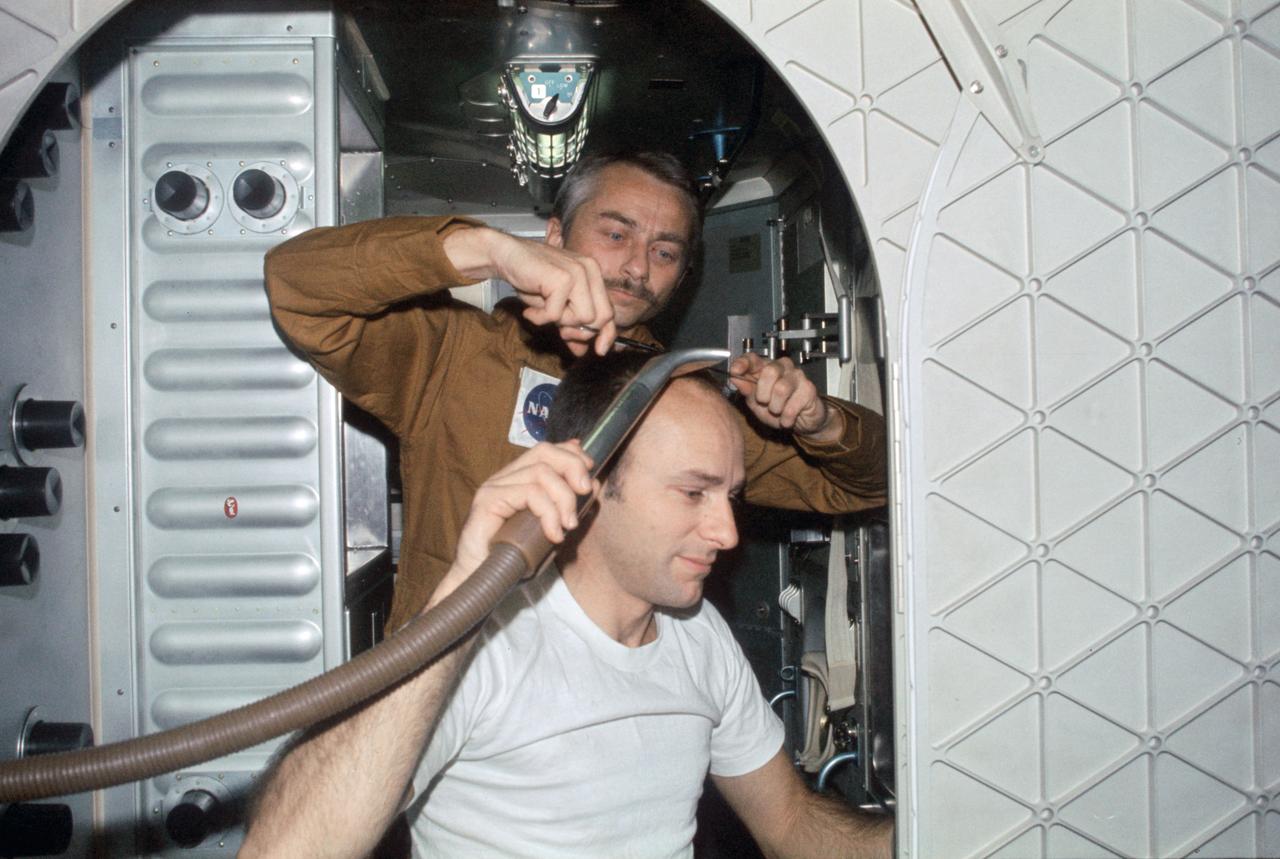
SL3-108-1292 (19 Aug. 1973) --- Scientist-astronaut Owen K. Garriott, Skylab 3 science pilot, trims the hair of astronaut Alan L. Bean, commander, in this onboard photograph from the Skylab Orbital Workshop (OWS) in Earth orbit. Astronaut Jack R. Lousma, pilot, took this picture with a 35mm Nikon camera. Bean holds a vacuum hose to gather in loose hair. The crew of the second manned Skylab flight went on to successfully complete 59 days aboard the Skylab space station cluster in Earth orbit. Photo credit: NASA
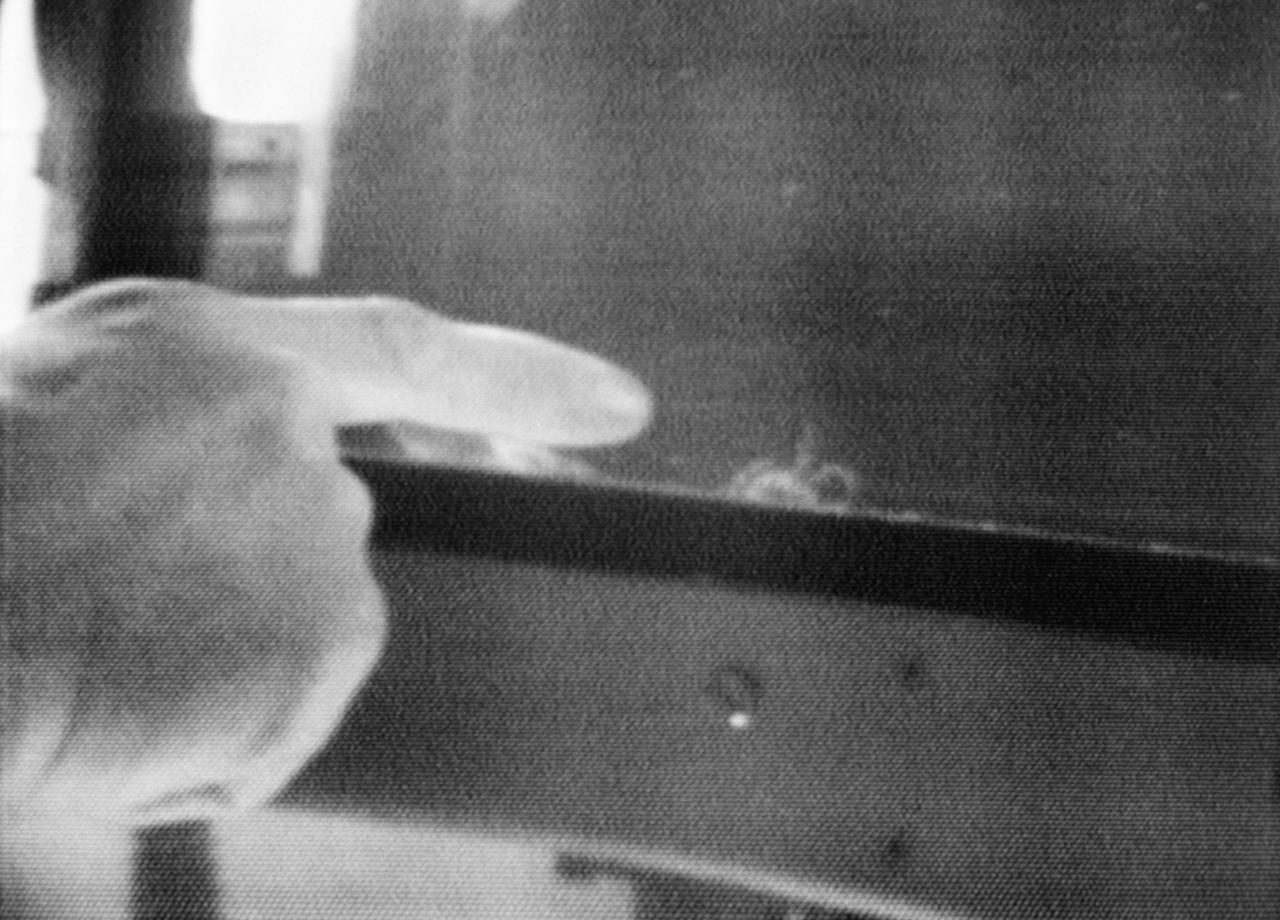
S73-33164 (27 Aug. 1973) --- A close-up view of Anita, one of the two common cross spiders “Araneus diadematus” aboard Skylab, is seen in this photographic reproduction of a color television transmission made by a TV camera aboard the Skylab space station in Earth orbit. A finger of one of the Skylab 3 crewmen points to Anita. The two spiders are housed in an enclosure onto which a motion picture and still camera are attached to record the spider’s attempt to build a web in the zero-gravity of space. The spider experiment (ED52) is one of 25 experiments selected by NASA for Skylab from more than 3,400 experiment proposals submitted by high school students throughout the nation. ED52 was submitted by 17-year old Judith S. Miles of Lexington, Mass. Photo credit: NASA
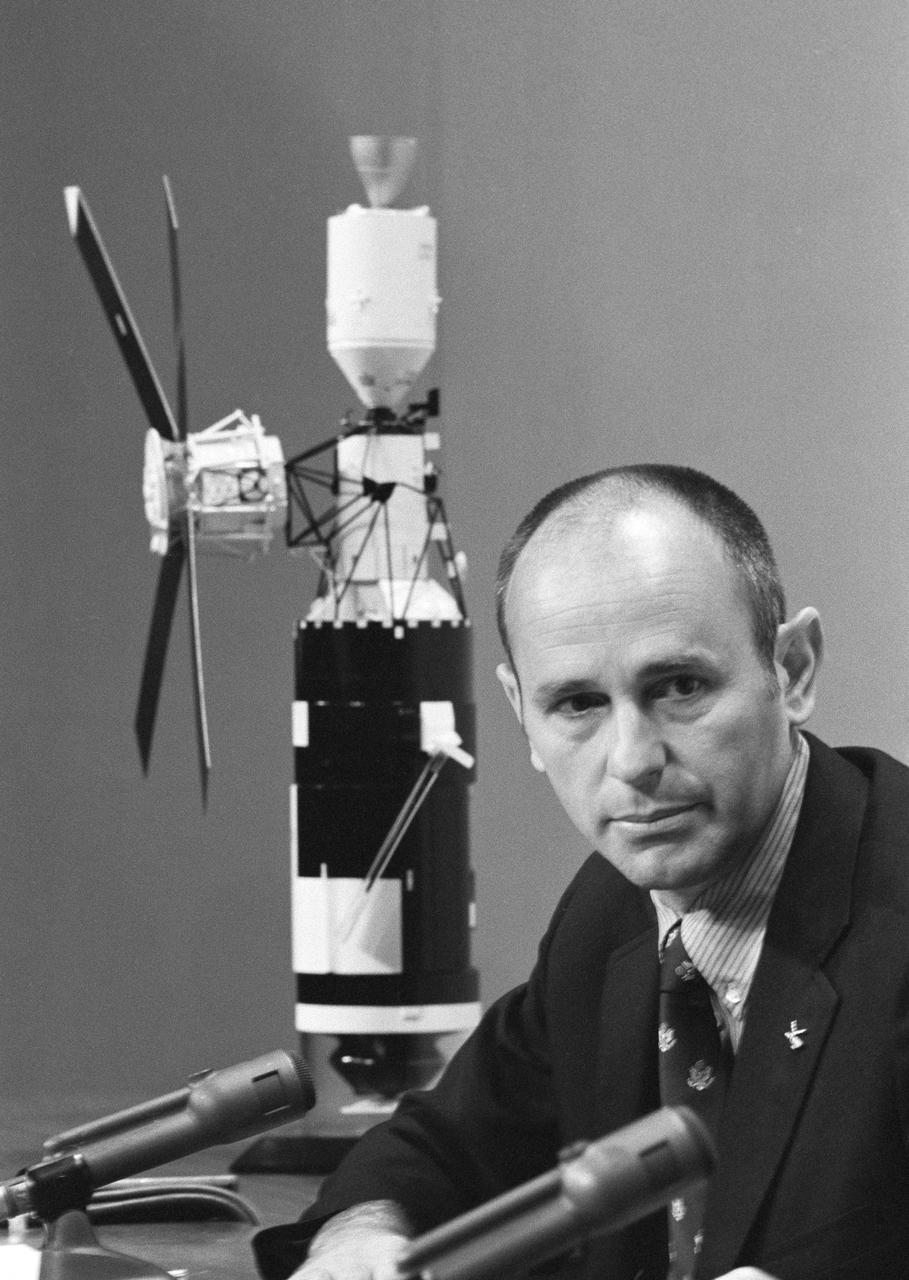
S73-30113 (30 June 1973) --- Astronaut Alan L. Bean, Skylab 3 commander, ponders a question from a newsman during the premission press conference on June 30, 1973, in the Building 1 large auditorium at Johnson Space Center. Photo credit: NASA
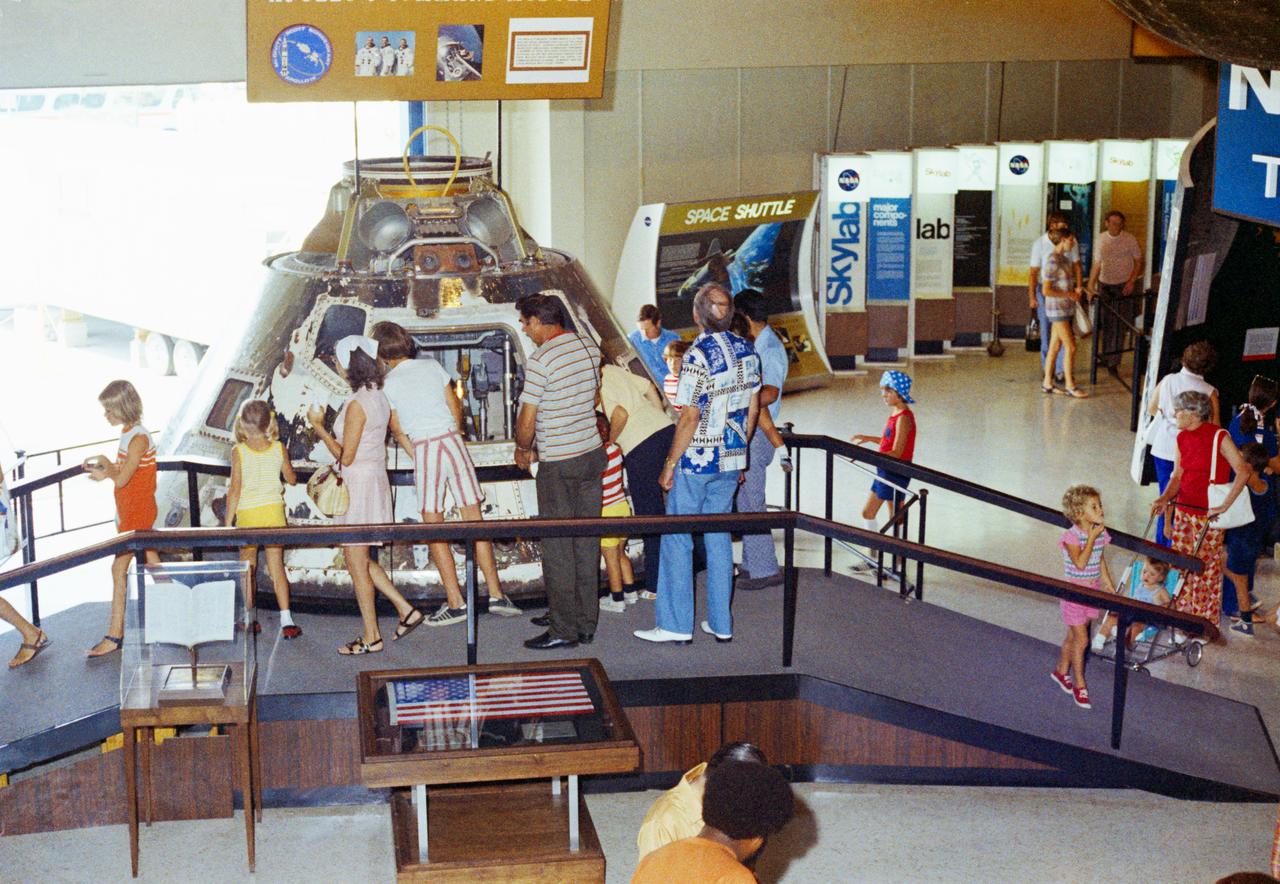
Series show exhibits displayed in the lobby and museum of Bldg. 1 Auditorium for public viewing. Views include spectators looking at the exhibits. JSC, HOUSTON, TX

S73-32839 (10 Sept. 1973) --- Scientist-astronaut Edward G. Gibson, science pilot for the third manned Skylab mission (Skylab 4), enters a notation in a manual while seated at the control and display panel for the Apollo Telescope Mount (ATM) during simulations inside the one-G trainer for the Multiple Docking Adapter (MDA) at the Johnson Space Center (JSC). Dr. Gibson will be joined by astronauts Gerald P. Carr, commander, and William R. Pogue, pilot, when the Skylab 4 mission begins in November 1973. Photo credit: NASA
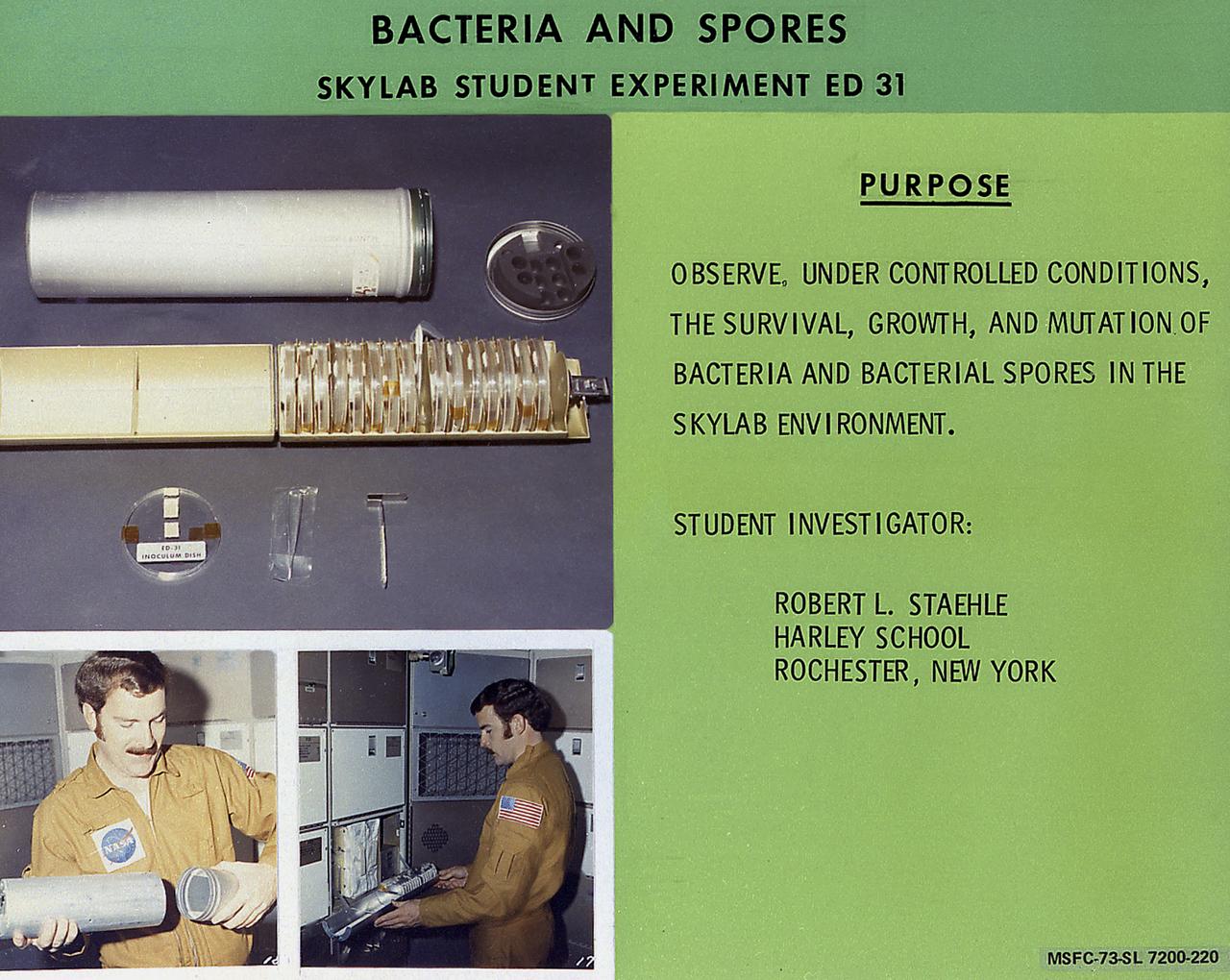
This chart describes the Skylab student experiment Bacteria and Spores, proposed by Robert L. Staehle of Rochester, New York. This experiment was intended to determine the effect of the Skylab environment (particularly weightlessness) on the survival, growth rates, and mutations of certain bacteria and spores. In March 1972, NASA and the National Science Teachers Association selected 25 experiment proposals for flight on Skylab. Science advisors from the Marshall Space Flight Center aided and assisted the students in developing the proposals for flight on Skylab.

S73-37251 (23 November 1973) --- Astronaut Bruce McCandless II, left, shows off a mock-up of the occulting disc for the T025 Coronagraph Contamination Measurement Engineering and Technology Experiment to be used by the crewmen of the third manned Skylab mission (Skylab 4), now into their eighth day in Earth orbit. On the right is flight director Neil B. Hutchinson. The men are in the Mission Operations Control Room (MOCR) of the Mission Control Center (MCC) at Johnson Space Center. Photo credit: NASA

IBM 2250 computer station with Paul Kutler
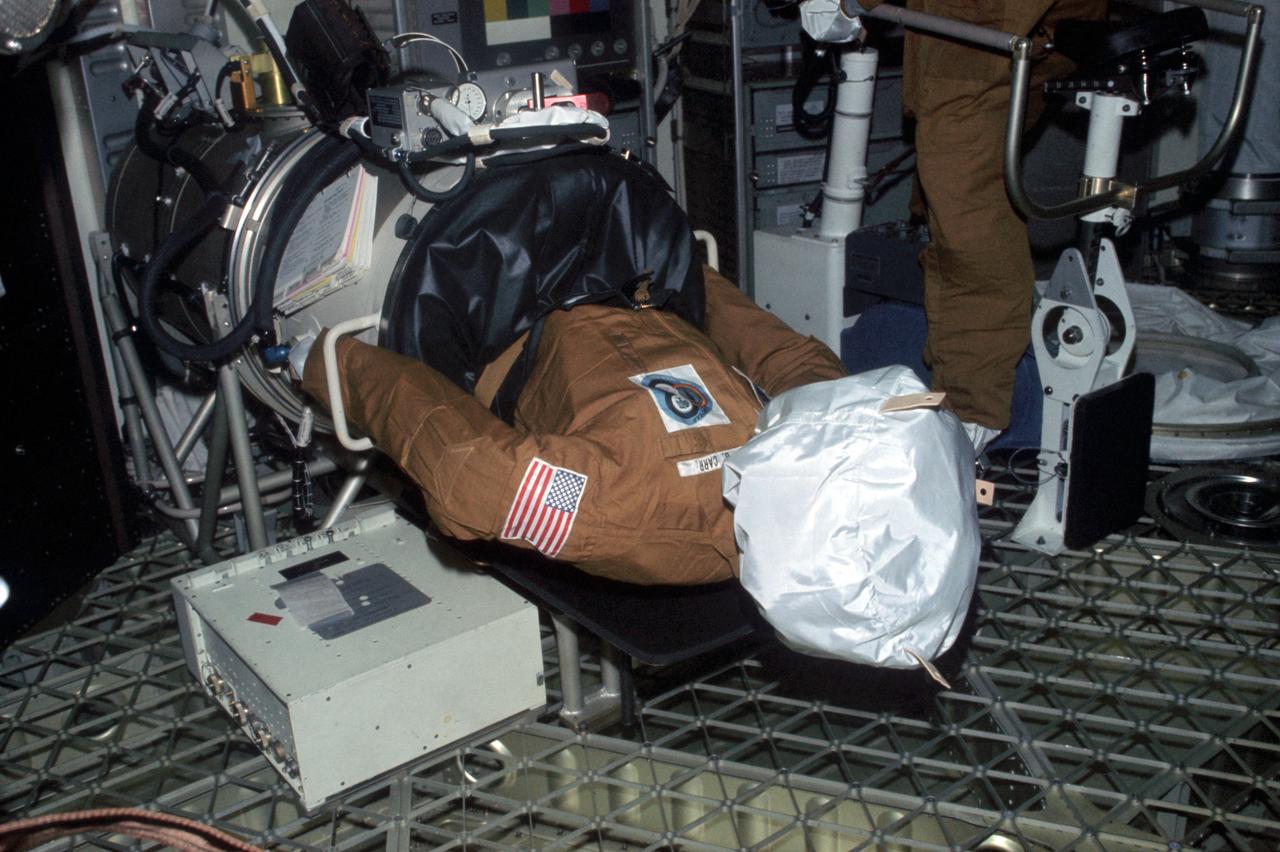
SL3-113-1586 (July-September 1973) --- This photograph is an illustration of the humorous side of the Skylab 3 crew. This dummy was left behind in the Skylab space station by the Skylab 3 crew to be found by the Skylab 4 crew. The dummy is dressed in a flight suit and placed in the Lower Body Negative Pressure Device. The name tag indicates that it represents Gerald P. Carr, Skylab 4 commander, in the background is a partial view of the dummy for William R. Pogue, Skylab 4 pilot, propped upon the bicycle ergometer. The dummy representing Edward G. Gibson, Skylab science pilot, was left in the waste compartment. Astronauts Alan L. Bean, Owen K. Garriott and Jack R. Lousma were the Skylab 3 crewmen. Photo credit: NASA
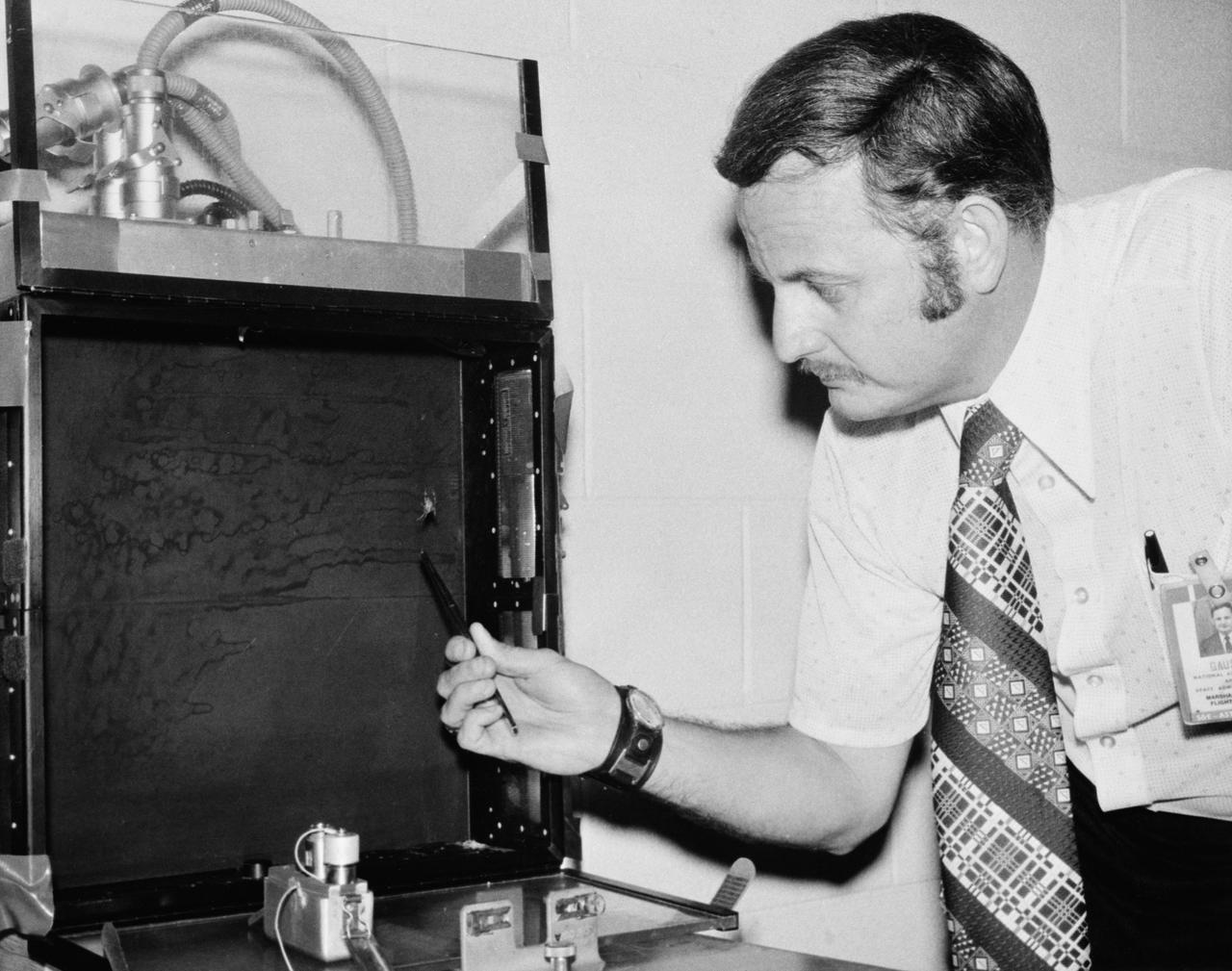
S73-32499 (July 1973) --- Dr. Ray Gause of the NASA Marshall Space Flight Center (MSFC) places dinner, in the form of a housefly, in the web of Arabella - the prime spider for the ED-52 Web Formation Experiment. Arabella can be delineated near the end of the black pen in Dr. Gause's hand. The experiment is one of 25 student experiments accepted for the Skylab program and will be performed during the Skylab 3 mission. Judy Miles, a 17-year-old high school student from Lexington, Massachusetts, is the student experimenter and Dr. Gause is the NASA student advisor. Photo credit: NASA
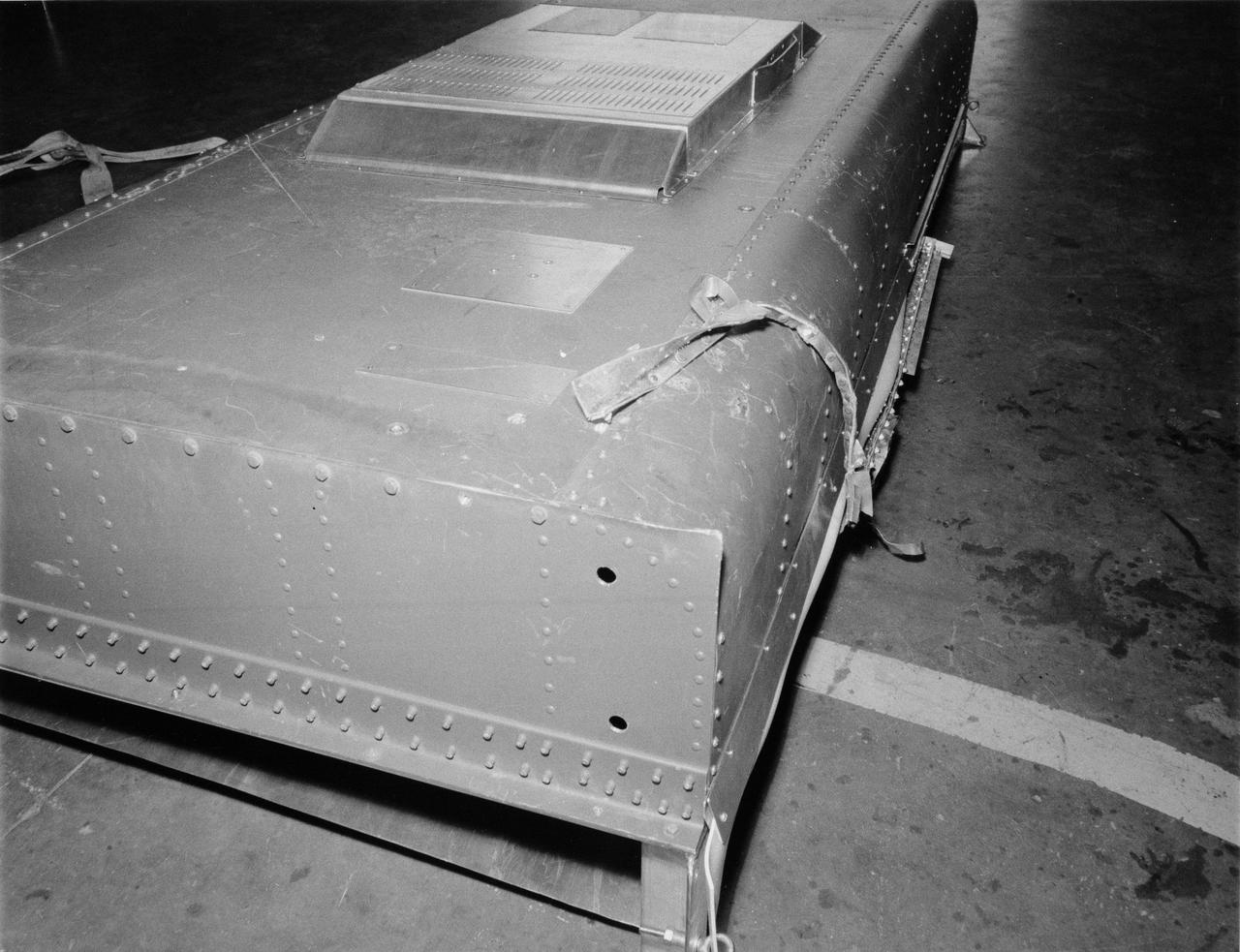
S73-27406 (5 June 1973) --- This structure duplicates the current problem with solar array wing number one on Skylab. The wing is being held against the side of the Orbital Workshop by what appears to be a strip of metal from the Meteoroid shield. Photo credit: NASA
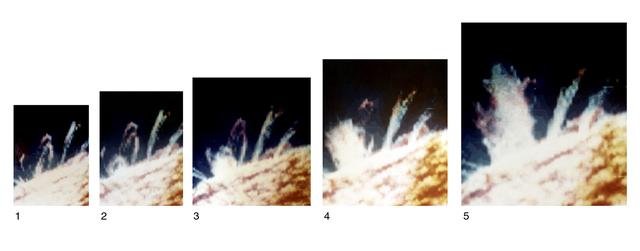
Breaking the grip of the closed magnetic loops that constrain other gases around it, a spray of chromospheric material surges upward, free of the Sun. Views 1 through 5 were recorded about 5 minutes apart by Skylab and comprise a composite of separate images made in chromospheric (red), transition region (green), and coronal (blue) temperatures of an ultraviolet sequence that depicts a solar eruption. Eruption begins (view 2) as material in or near a small, compact loop develops enough energy to overcome the Sun's magnetic bonds.
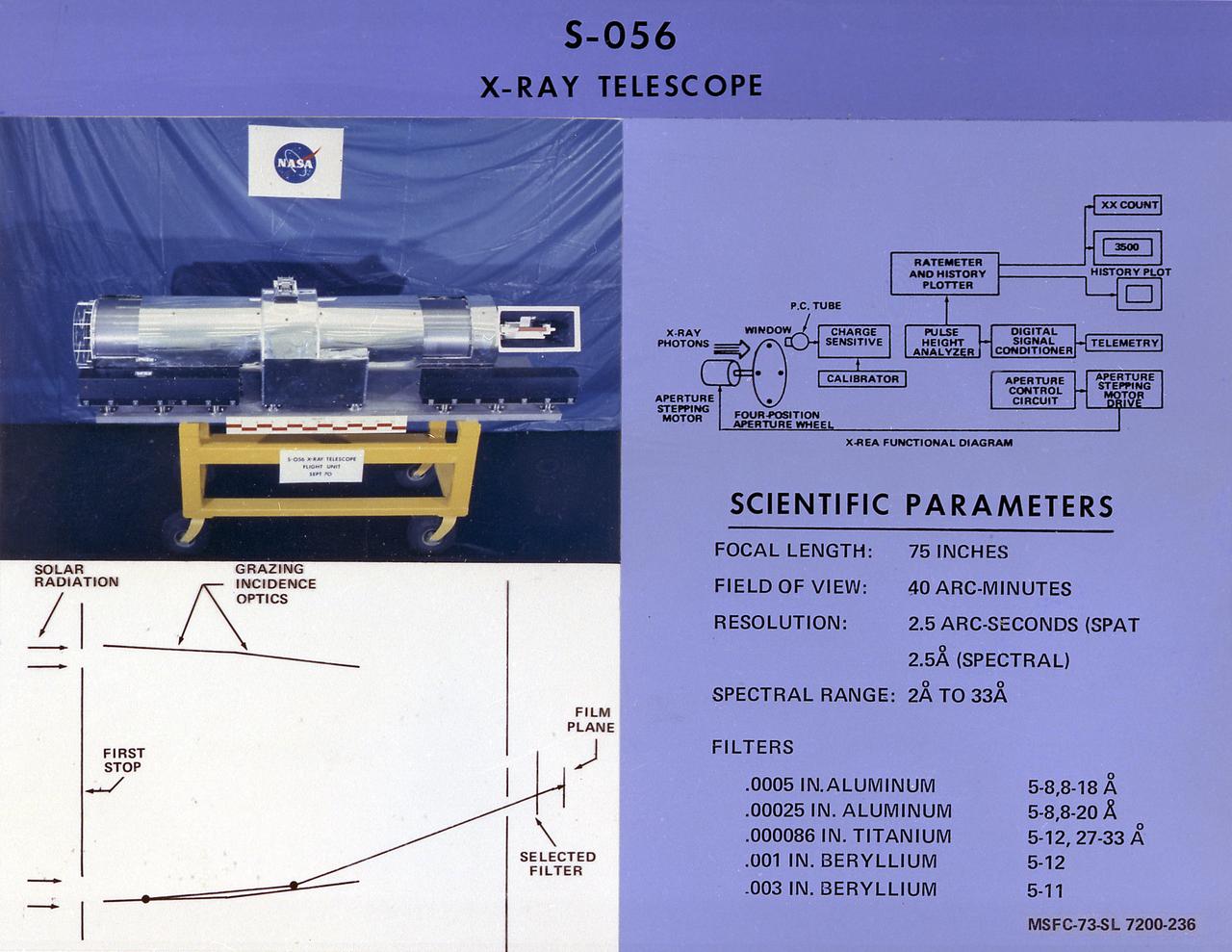
This chart details Skylab's Dual X-Ray Telescopes, one of eight Apollo Telescope Mount facilities. It was designed to gather solar radiation data in the x-ray region of the solar spectrum and provide information on physical processes within the solar atmosphere. In support of the two primary telescopes, auxiliary instruments provided a continuous record of the total x-ray flux in two bands. A flare detector was also provided at the control console as an aid to astronauts for monitoring solar activity. The Marshall Space Flight Center had program management responsibility for the development of Skylab hardware and experiments.
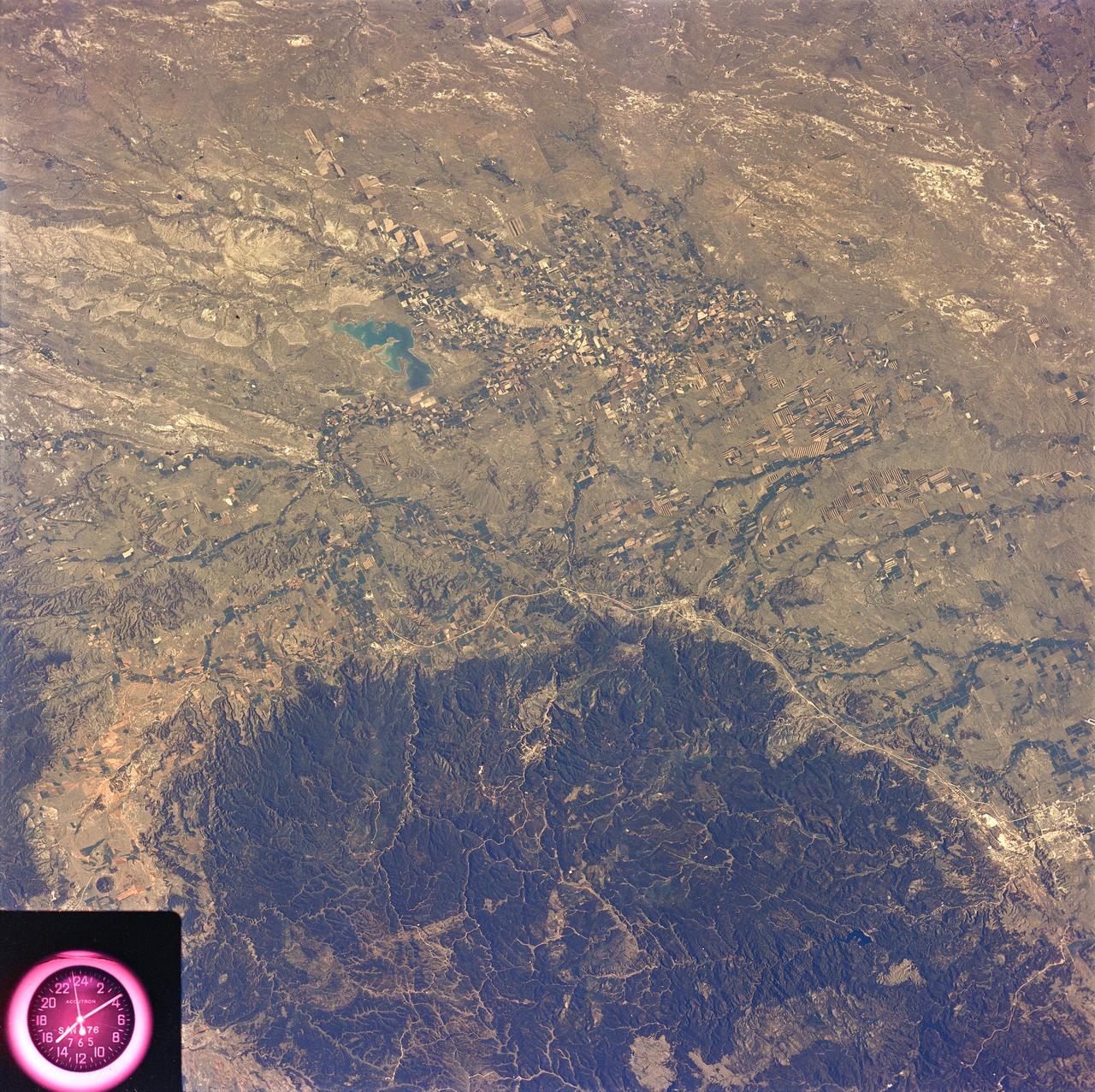
SL2-81-157 (22 June 1973) --- This view of the Black Hills Region, SD (44.0N, 104.0W) shows the scenic Black Hills where Mt. Rushmore and other monuments are located. Cities and towns in this view include: Rapid City, Deadwood, and Belle Fourche with the nearby Belle Fourche Reservoir. Notable in this scene are the recovering burn scars (seen as irregular shaped light toned patches) from a 1959 forest fire in the Black Hills National Forest near the edge of the photo. Photo credit: NASA
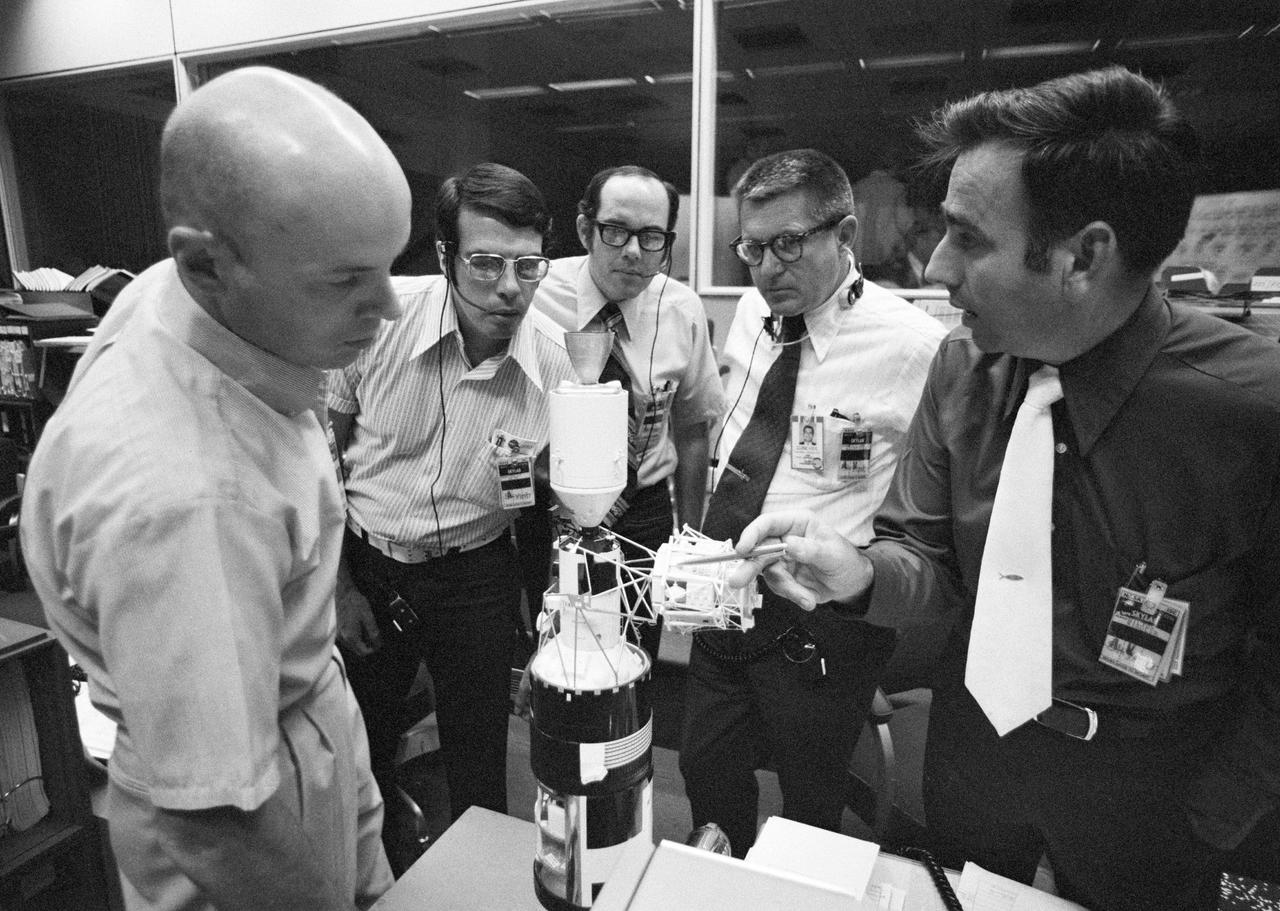
S73-31964 (5 August 1973) --- This group of flight controllers discuss today's approaching extravehicular activity (EVA) to be performed by the Skylab 3 crewmen. They are, left to right, scientist-astronaut Story Musgrave, a Skylab 3 spacecraft communicator; Robert Kain and Scott Millican, both of the Crew Procedures Division, EVA Procedures Section; William C. Schneider, Skylab Program Director, NASA Headquarters; and Milton Windler, flight director. Windler points to the model of the Skylab space station cluster to indicate the location of the ATM's film magazines. The group stands near consoles in the Mission Operations Control Room (MOCR) of the JSC Mission Control Center (MCC). Photo credit: NASA
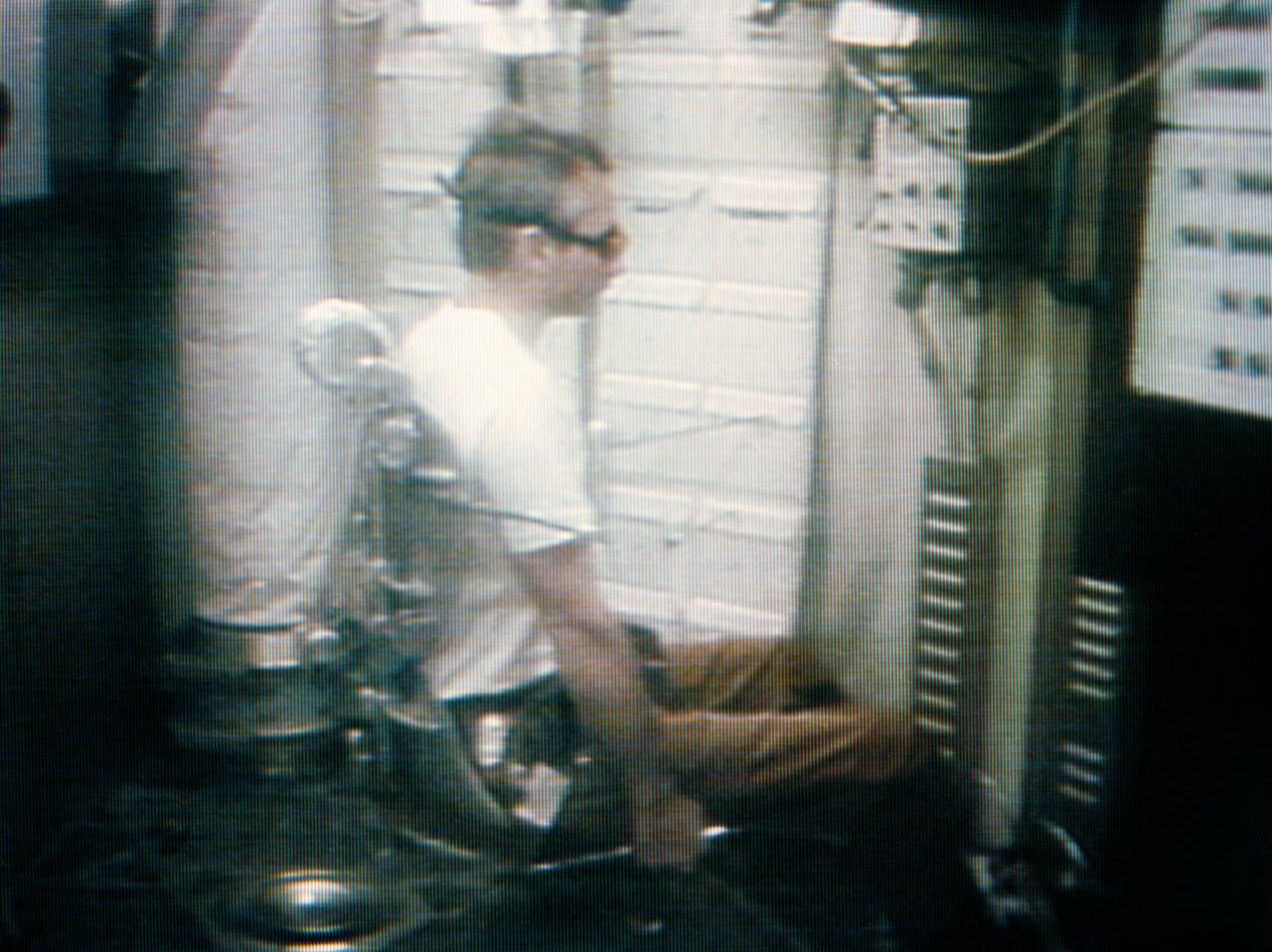
S73-34171 (9 Aug. 1973) --- Scientist-astronaut Owen K. Garriott, Skylab 3 science pilot, serves as test subject for the Skylab ?Human Vestibular Function? M131 Experiment, as seen in this photographic reproduction taken from a television transmission made by a color TV camera aboard the Skylab space station in Earth orbit. The objectives of the Skylab M131 experiment are to obtain data pertinent to establishing the validity of measurements of specific behavioral/physiological responses influenced by vestibular activity under one-g and zero-g conditions; to determine man?s adaptability to unusual vestibular conditions and predict habitability of future spacecraft conditions involving reduced gravity and Coriollis forces; and to measure the accuracy and variability in man?s judgment of spatial coordinates based on atypical gravity receptor cues and inadequate visual cures. Dr. Garriott is seated in the experiment?s litter chair which can rotate the test subject at predetermined rotational velocity or programmed acceleration/decelerational profile. Photo credit: NASA
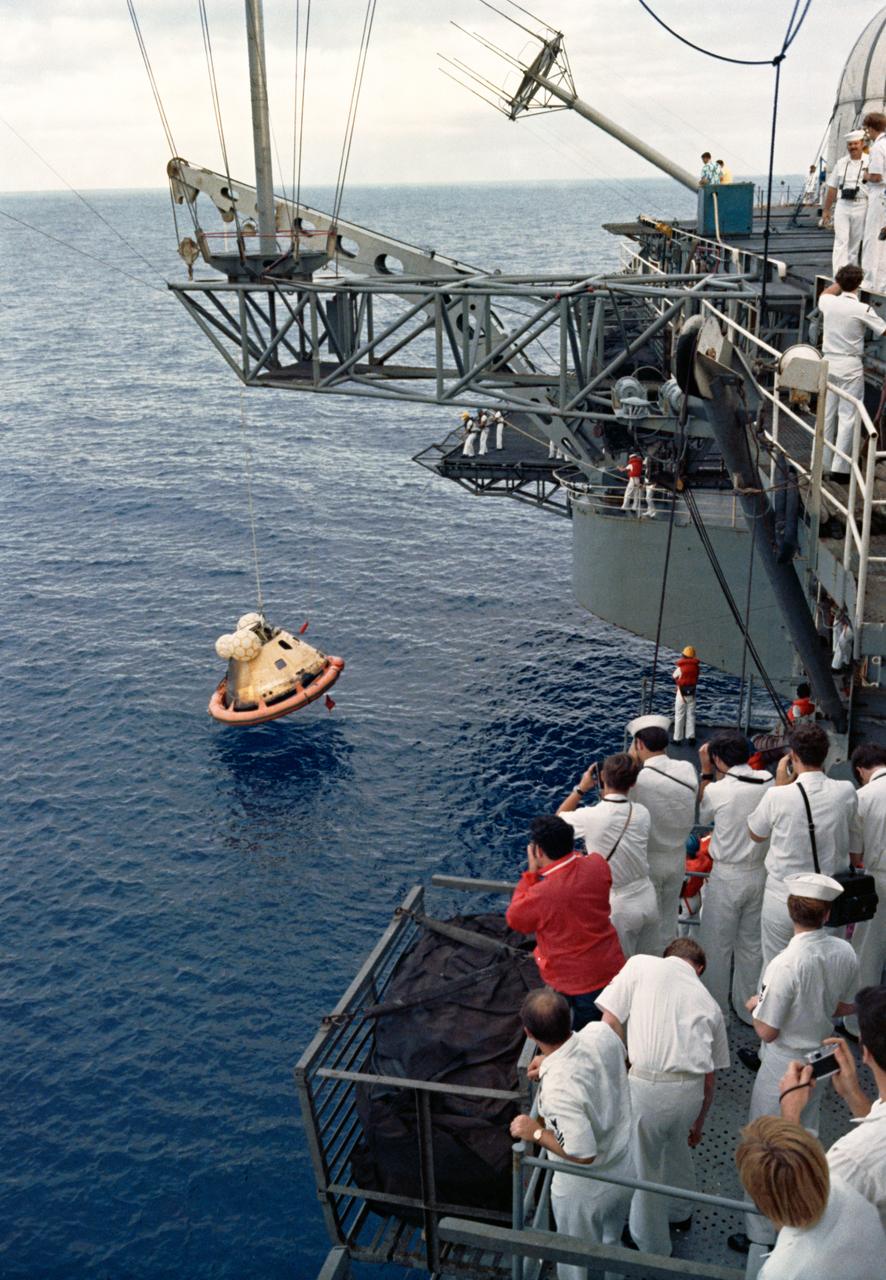
S73-29138 (22 June 1973) --- The Skylab 2 Command Module, with astronauts Charles Conrad Jr., Joseph P. Kerwin and Paul J. Weitz still inside, is hoisted aboard the prime recovery ship, USS Ticonderoga, following successful splashdown in the Pacific Ocean about 835 miles southwest of San Diego, California. The crewmen had just completed a 28-day stay with the Skylab 1 space station in Earth orbit conducting numerous medical, scientific and technological experiments. Note the inflated bags and the floatation collar on the spacecraft. Photo credit: NASA
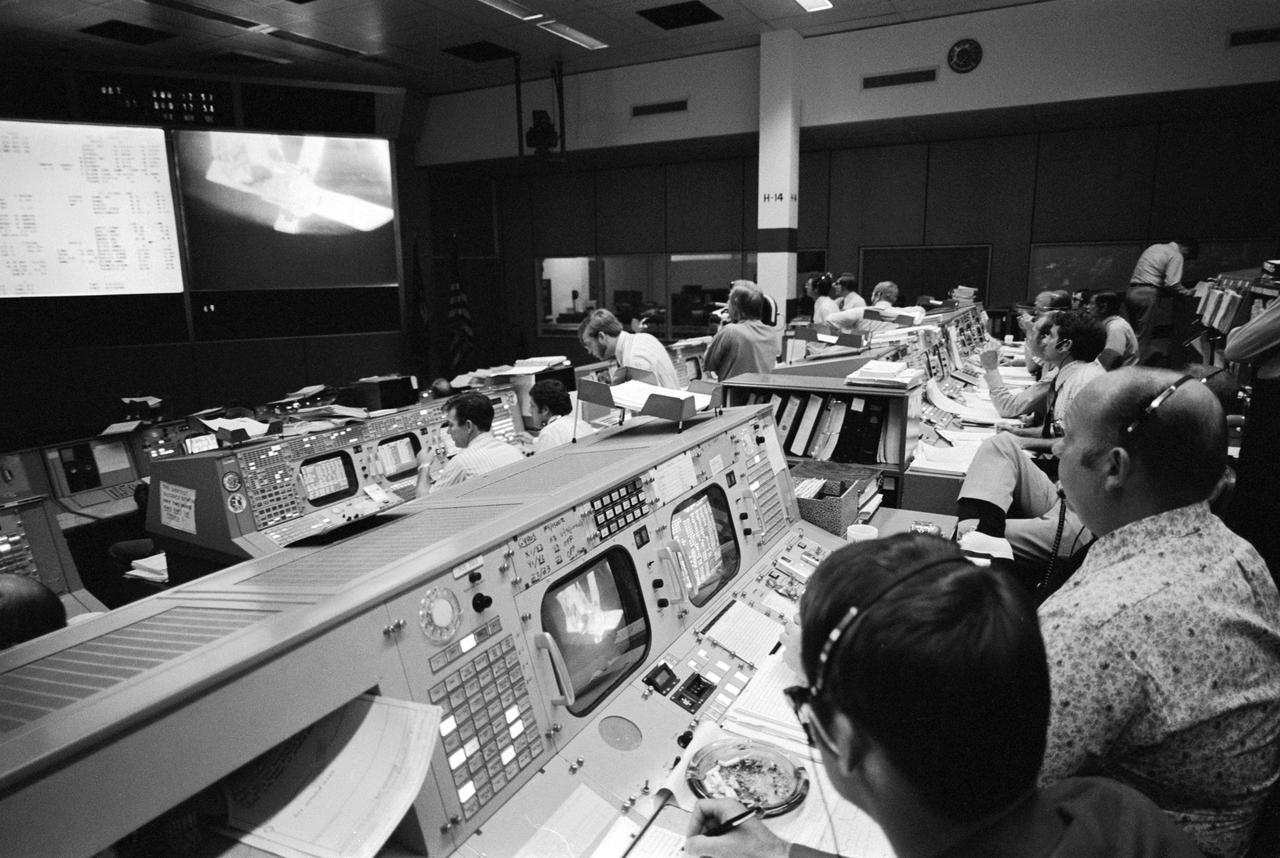
S73-31570 (July 1973) --- Overall view of the Mission Operations Control Room (MOCR) in the Mission Control Center (MCC), building 30, at Johnson Space Center during the Skylab 3 flyaround inspection of the Skylab Earth-orbiting cluster. Photo credit: NASA
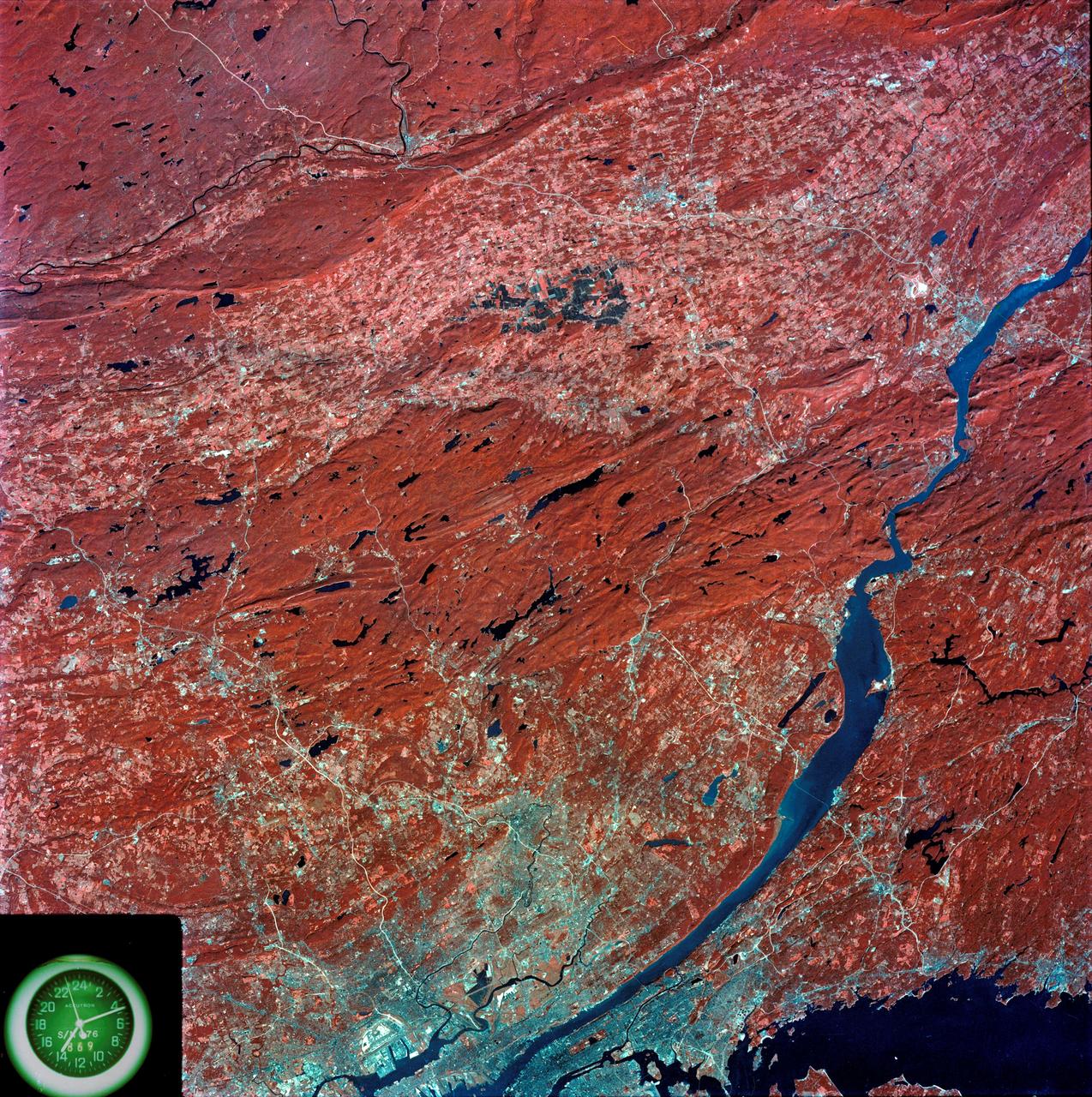
SL3-87-299 (July-September 1973) --- A vertical view of southeastern New York State is seen in this Skylab 3 Earth Resources Experiments Package S190-B (five-inch Earth terrain camera) infrared photograph taken from the Skylab space station in Earth orbit. An 18-inch, 450mm lens and type 2443 infrared Ektachrome film was used. This picture covers the northern part of New Jersey, a part of northwestern Pennsylvania, and the western tip of Connecticut. The body of water is Long Island Sound. The wide Hudson River flows southward across a corner of the photograph. The New York City metropolitan area occupies part of the picture. Federal agencies participating with NASA on the EREP project are the Departments of Agriculture, Commerce, Interior, the Environmental Protection Agency and the Corps of Engineers. All EREP photography is available to the public through the Department of Interior?s Earth Resources Observations Systems Data Center, Sioux Falls, South Dakota, 57198. Photo credit: NASA
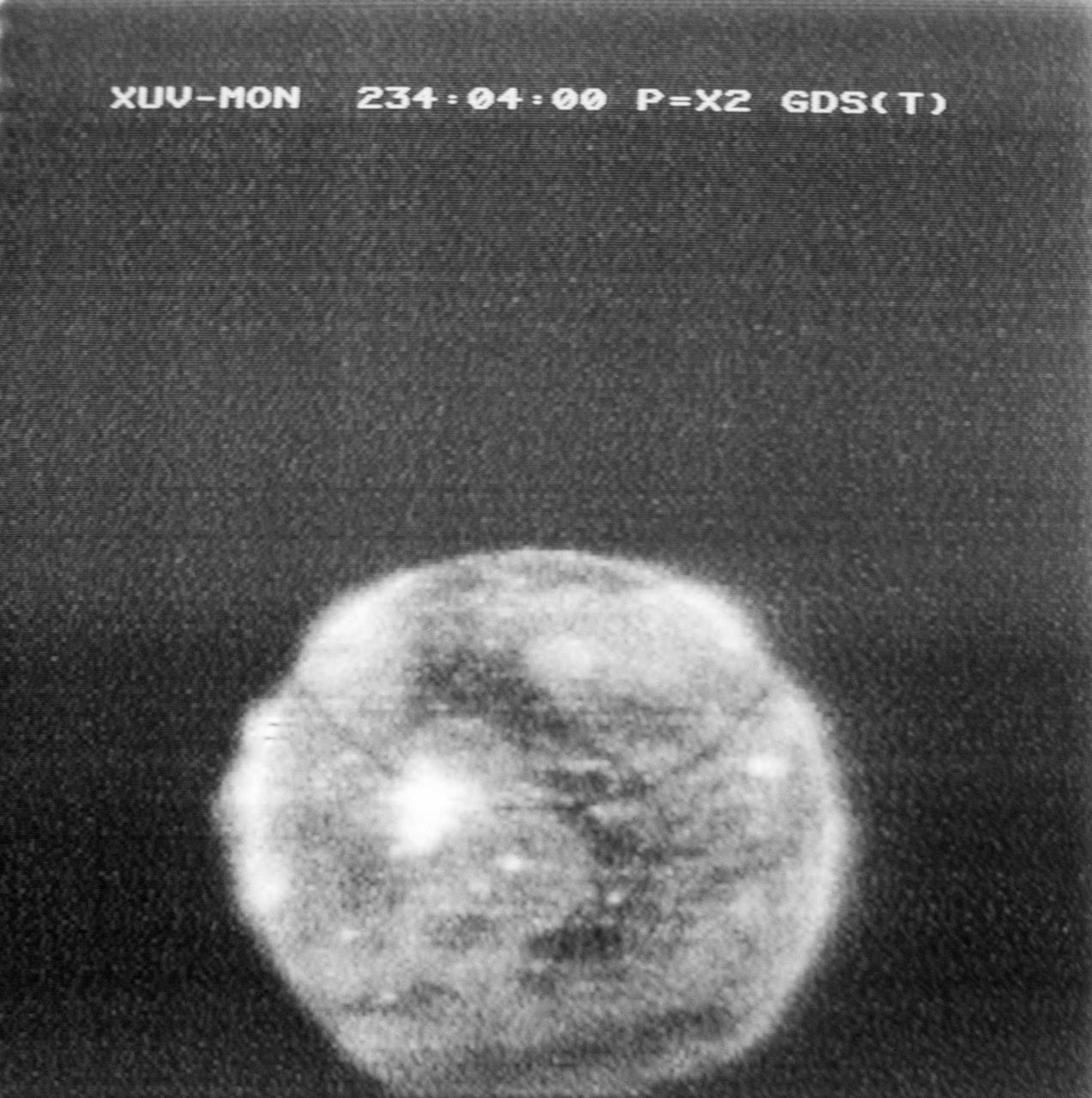
S73-32867 (21 Aug. 1973) --- The solar sphere viewed through the Skylab solar physics experiment (S082) Extreme Ultraviolet Spectroheliographis seen in this photographic reproduction taken from a color television transmission made by a TV camera aboard the Skylab space station in Earth orbit. The solar chromosphere and lower corona are much hotter than the surface of the sun characterized by the white light emissions. This image was recorded during the huge solar prominence which occurred on Aug. 21, 1973. Photo credit: NASA
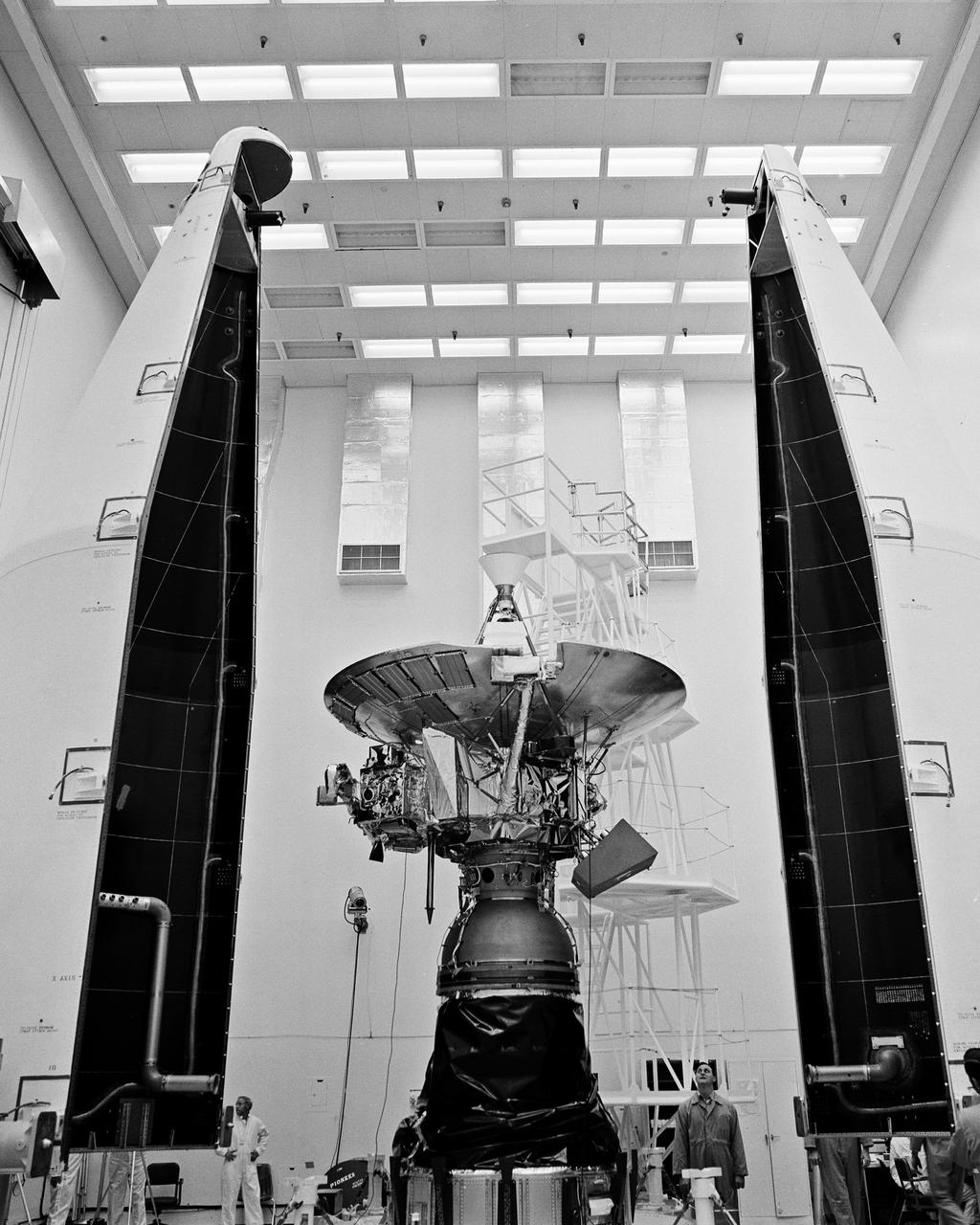
CAPE KENNEDY, Fla. -- In the AO Building at Cape Kennedy Air Force Station in Florida, the Pioneer G spacecraft awaits the installation of its protective payload fairing. The interplanetary space probe is scheduled for launch atop an Atlas Centaur rocket from Cape Kennedy April 5, 1973. Pioneer G's nearly two-year mission will take it on an investigation of the asteroid belt, then on to Jupiter, largest planet in our solar system. NASA's launch teams from the Kennedy Space Center will direct final testing and the launch itself. The mission is a project of the Ames Research Center. Photo Credit: NASA
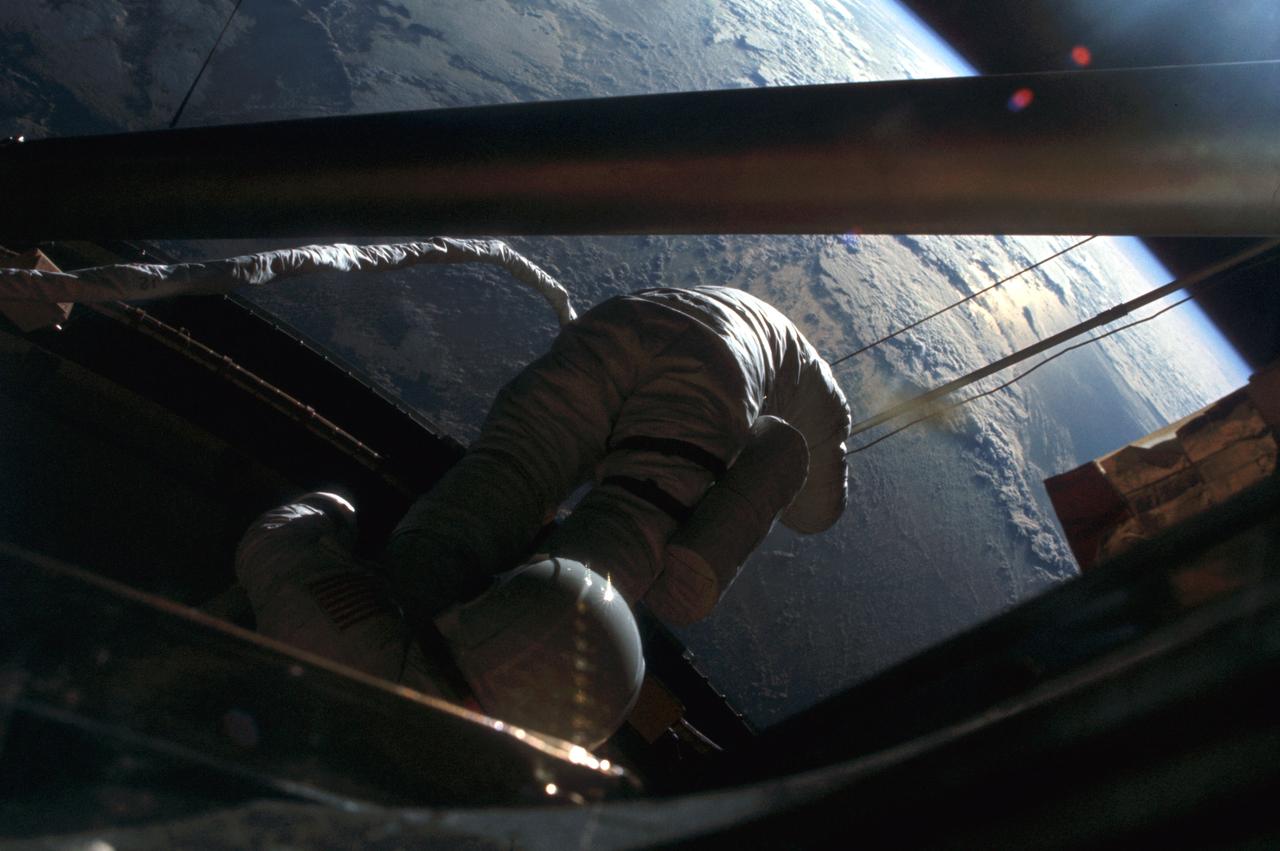
SL3-118-2182 (6 Aug. 1973) --- Skylab 3 astronaut participates in the Aug. 6, 1973 extravehicular activity (EVA) during which the twin pole solar shield was deployed to help shade the Orbital Workshop (OWS). Photo credit: NASA
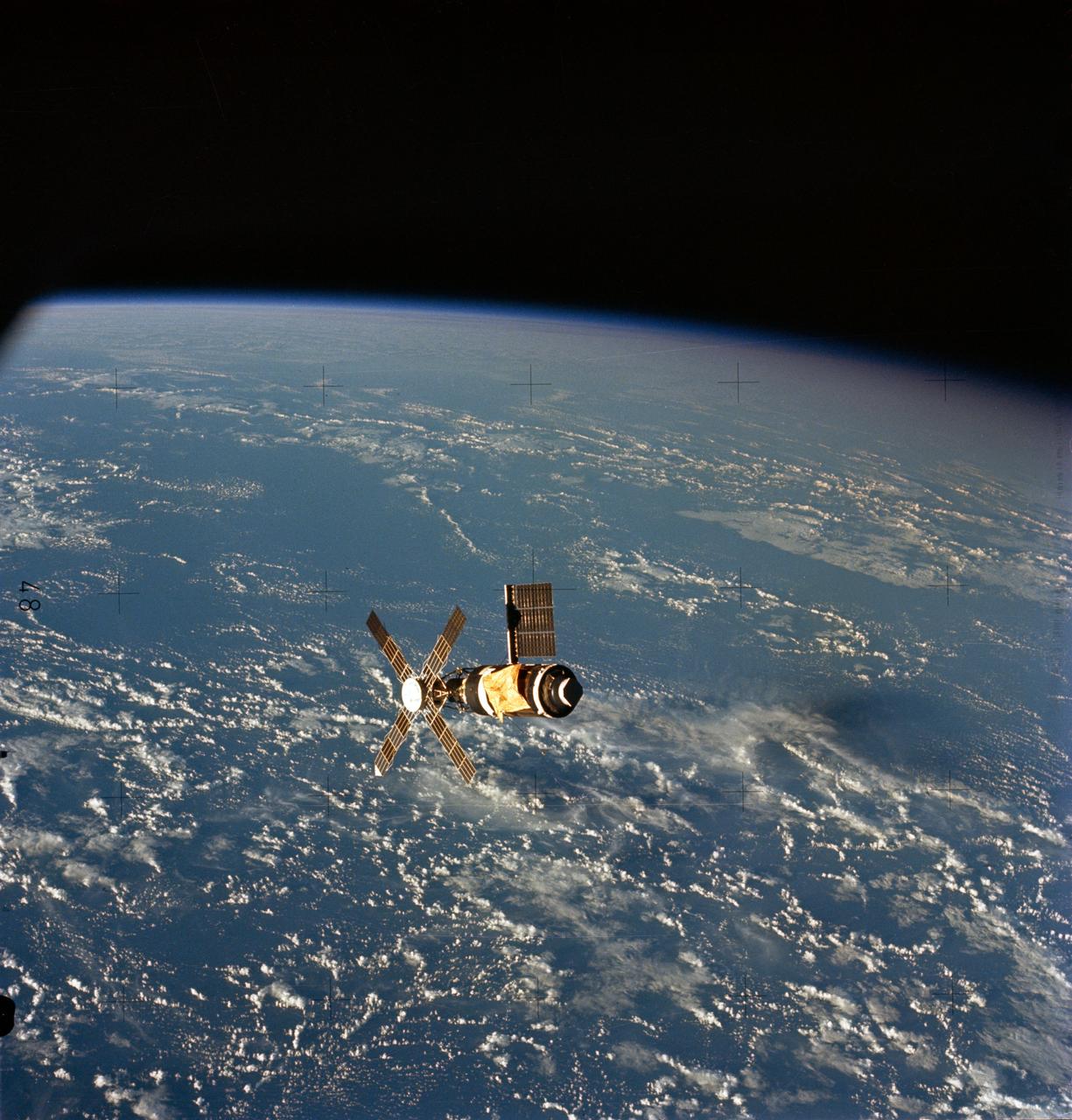
SL2-07-651 (22 June 1973) --- This overhead view of the Skylab Space Station was taken from the Departing Skylab Command/Service Module during the Skylab 2's final fly-around inspection. The single solar panel is quite evident as well as the parasol solar shield, rigged to replace the missing micrometeoroid shield. Both the second solar panel and the micrometeoroid shield were torn away during a mishap in the original Skylab 1 liftoff and orbital insertion. Photo credit: NASA
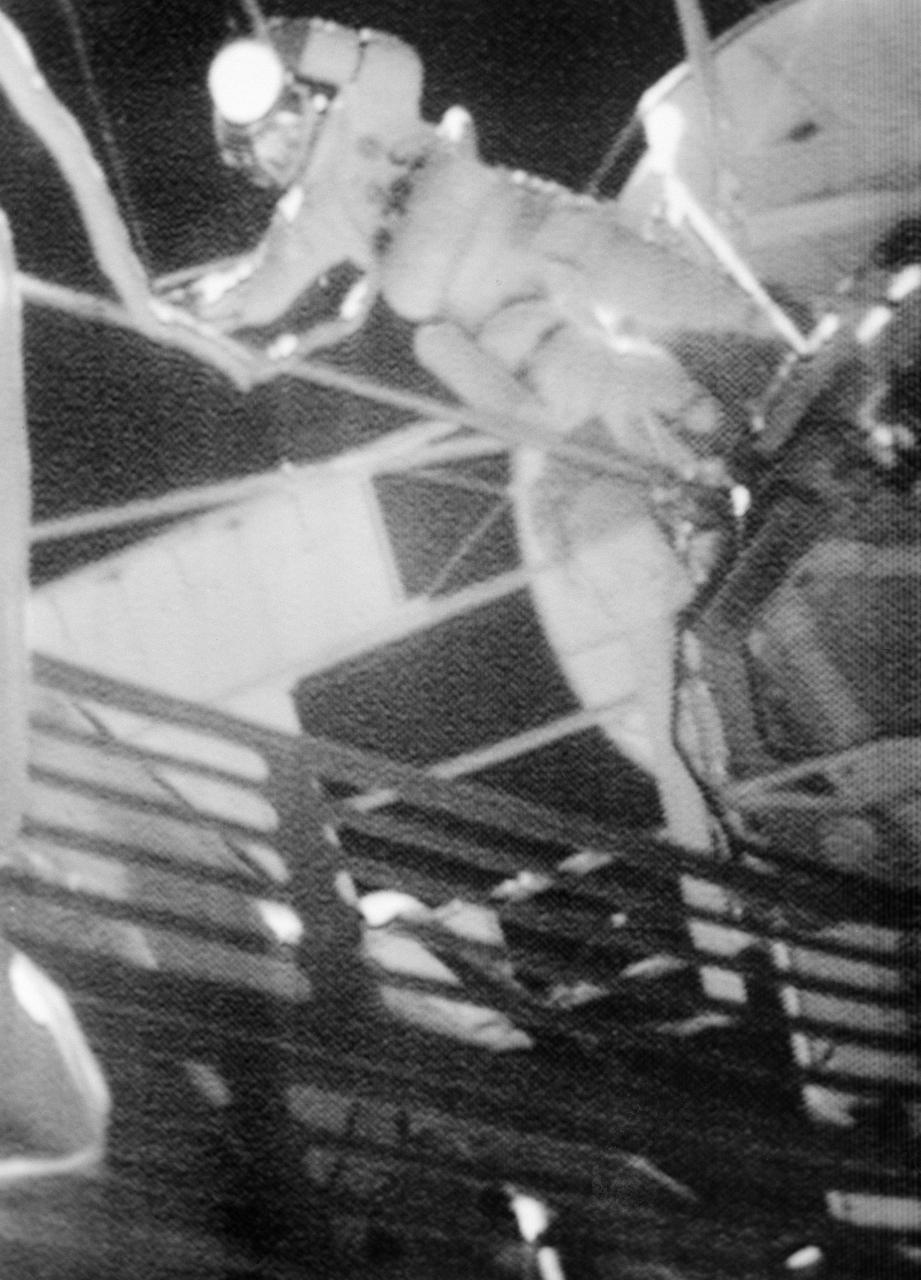
S73-31976 (5 Aug. 1973) --- Astronaut Jack R. Lousma, Skylab 3 pilot, is seen outside the Skylab space station in Earth orbit during the Aug. 5, 1973 Skylab 3 extravehicular activity (EVA) in this photographic reproduction taken from a television transmission made by a color TV camera aboard the space station. Scientist-astronaut Owen K. Garriott, Skylab 3 science pilot, participated in the EVA with Lousma. During the EVA the two crewmen deployed the twin pole solar shield to help shade the Orbital Workshop. Photo credit: NASA
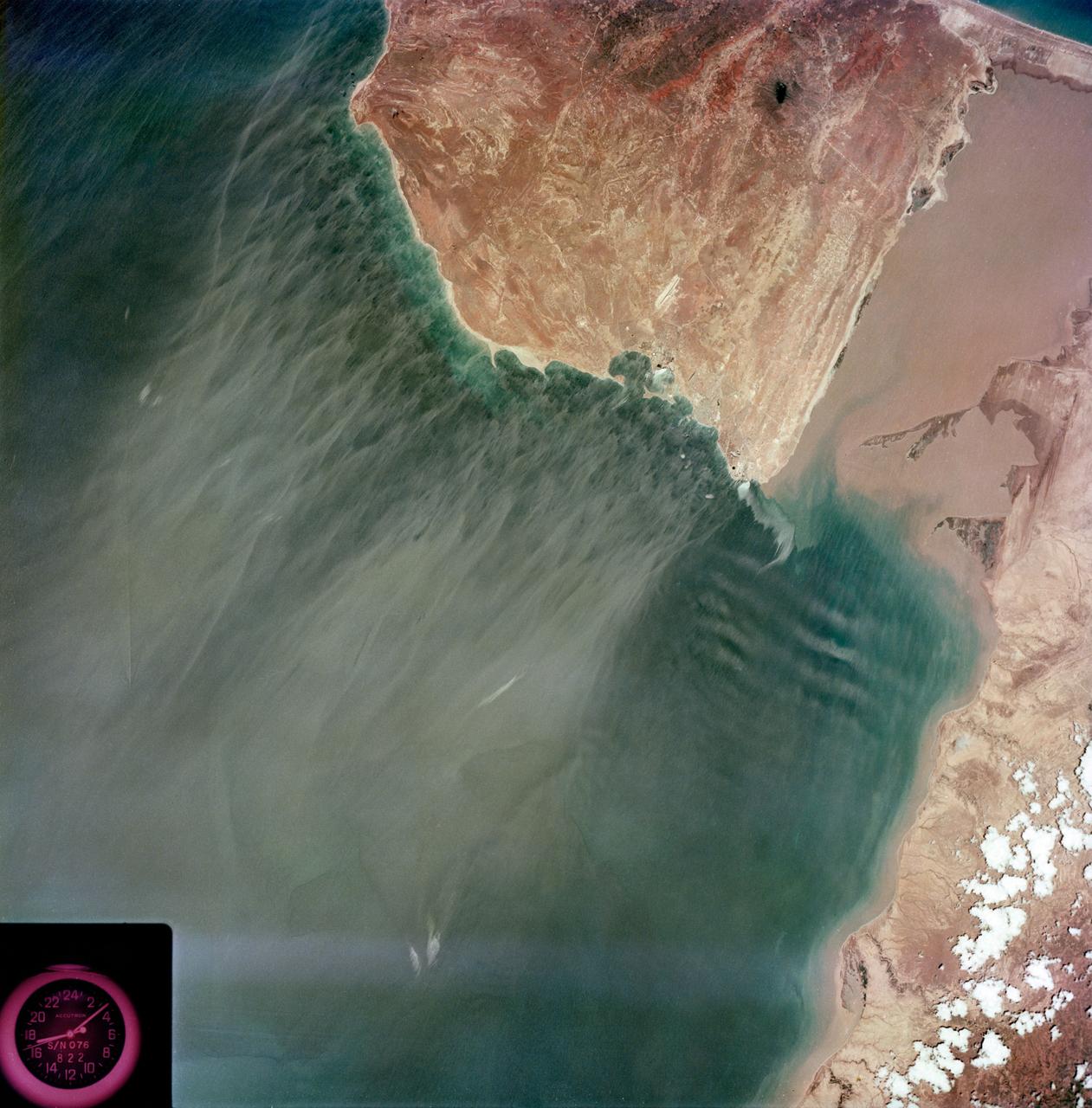
S73-35079 (July-September 1973) --- A near vertical view of the Caribbean coast of Venezuela is seen in this Skylab 3 Earth Resources Experiment Package S190-B (five-inch Earth terrain camera) photograph taken from the Skylab space station in Earth orbit. The large body of water is the Golfo de Venezuela; and the major land mass is the Peninsula de Paraguana. The view is looking northward from the mouth of the Golfete de Coro and Punta Cardon to Punta Macolla. The peninsula is connected to the Venezuelan mainland by the narrow strip of land in the most easterly corner of the picture. The dry, arid climate on the peninsula is indicated by sparse vegetation and the abundance of sand dunes. The highest point is about 2,700 feet above the sea and is the conspicuous black spot. Old raised shoreline features appear as streaks parallel to the Golfete de Coro. Sand dunes and stream erosion have modified these features. Water of the Golfete de Coro is red from the high sediment content. The streaks in the water off the peninsula is apparently an effect of wind which is blowing sand and water offshore. The EREP investigator Dr. Jose Antonio Galavis, of the Ministerio de Mines e Hidrocarburos, will use this information to map geology and coastal sedimentation in the Peninsula de Paraguana. Federal agencies participating with NASA on the EREP projects are the Departments of Agriculture, Commerce, Interior, the Environmental Protection Agency and the Corps of Engineers. All EREP photography is available to the public through the Department of Interior?s Earth Resources Observations Systems Data Center, Sioux Falls, South Dakota, 57198. (Alternate number SL3-83-237) Photo credit: NASA

ADVISORY COMMITTEE: The Federal Women’ s Program Advisory Committee has been established to assist in the implementation of the Federal Women’ s Program at the Center. In an effort to define the specific problems of women employees at Langley, the committee is preparing a self-evaluation and discrimination questionnaire which will soon be distributed to all female employees. Members of the committee are (from left): Lorraine F. Satchell, Carmen, E. Batten, Patricia D. Hurt, Jane s. Hess, Chairman, Sallie M. Harvey, Eloise McGeehee, Mary W. Jackson, and Eunice G. Smith. Absent when the photograph was taken was Jeanette W. George. Photo published in the Langley Researcher, May 11,1973 page 5.
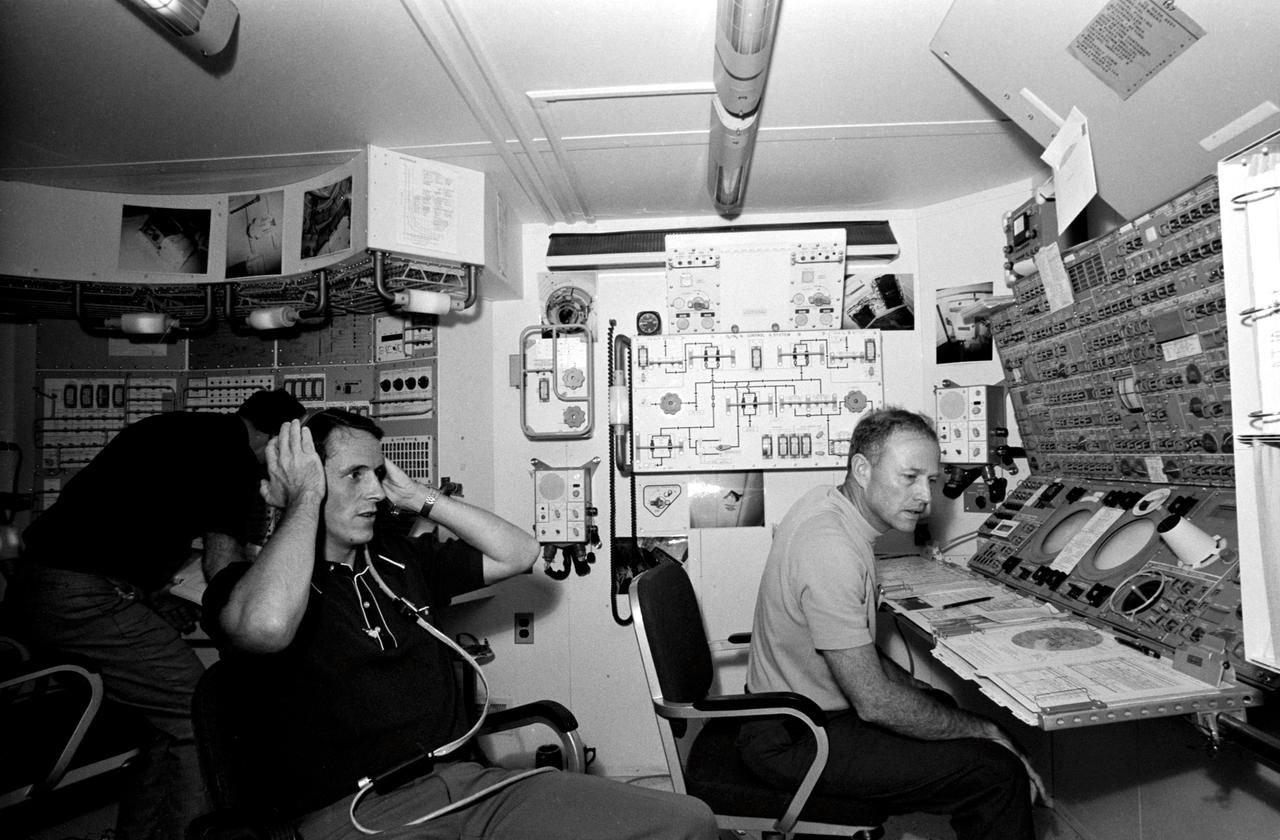
S73-28411 (February 1973) --- The three members of the prime crew of the third of three scheduled manned Skylab missions (Skylab 4) go through Skylab preflight training in the Mission Training and Simulation Facility at the Johnson Space Center. Astronaut Gerald P. Carr (on right), Skylab 4 commander, is seated at a simulator which represents the control and display console of the Apollo Telescope Mount which is located in the space station's Multiple Docking Adapter. Seated on the left is scientist-astronaut Edward G. Gibson, Skylab 4 science pilot. In the left background is astronaut William R. Pogue, Skylab 4 pilot. (Unmanned Skylab 1 will carry the Skylab space station payload into Earth orbit). Photo credit: NASA
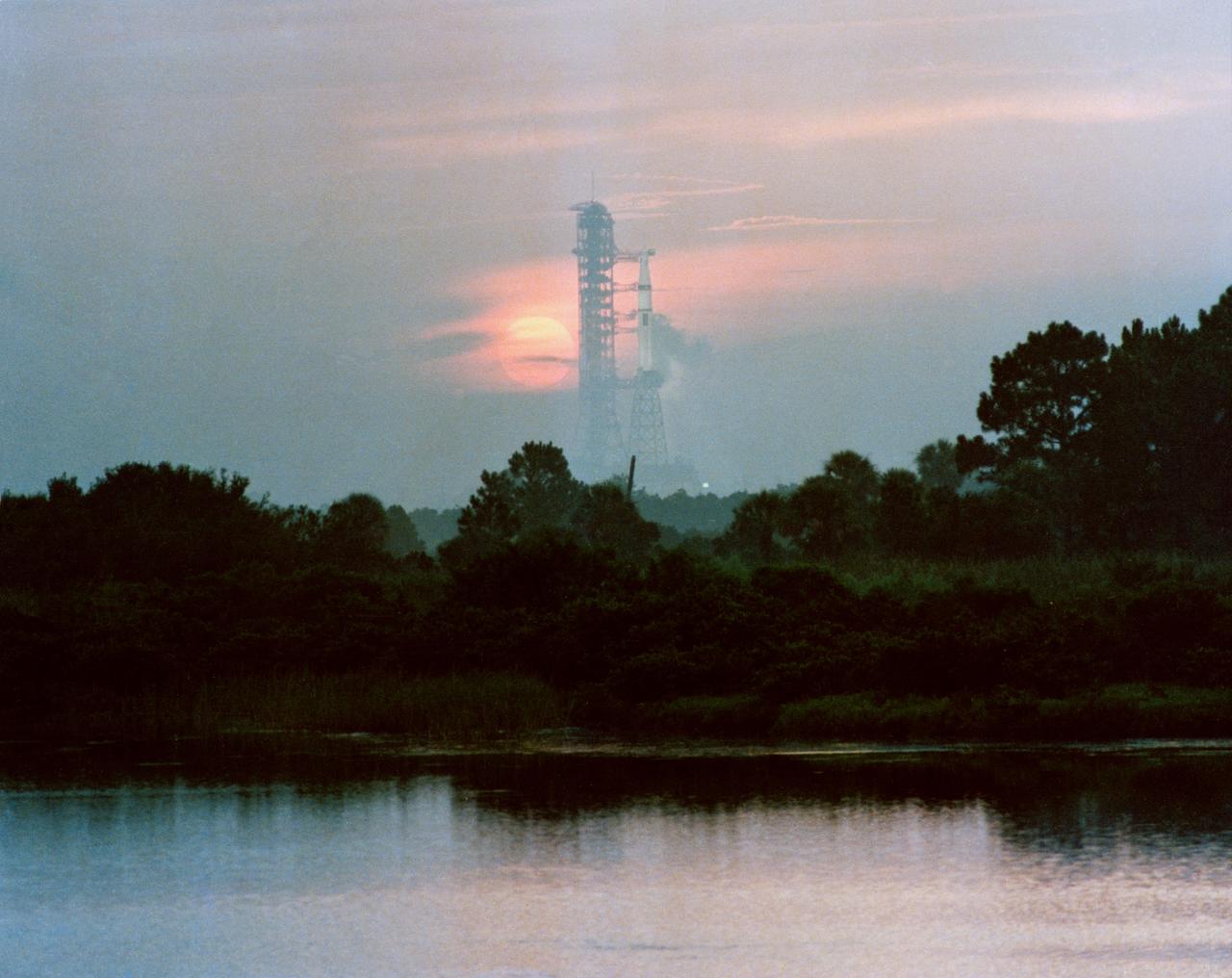
S73-37929 (16 Nov. 1973) --- A sunrise view at the Kennedy Space Center showing in the near distance the Skylab 4/Saturn 1B space vehicle on Pad B, Launch Complex 39, on the morning of the launch. The liftoff was at 9:01:23 a.m. (EST), Friday, Nov. 16, 1973. Skylab 4 is the third and last of three scheduled manned Skylab missions. Aboard the Skylab 4 Command/Service Module were astronauts Gerald P. Carr, Edward G. Gibson and William R. Pogue. This picture was photographed by astronaut Bruce McCandless II. Photo credit: NASA
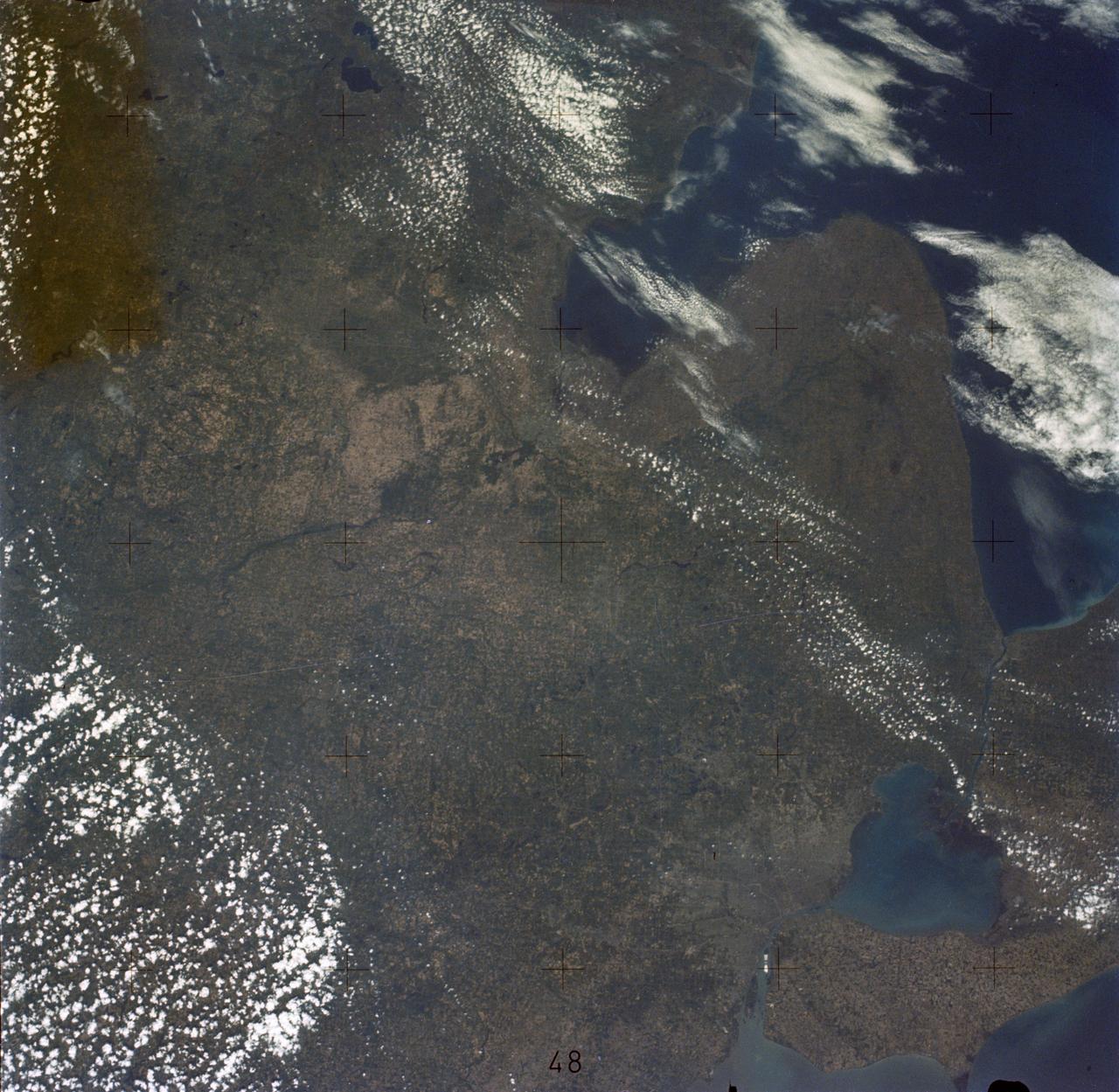
SL2-05-389 (22 June 1973) --- This scene displays the southeastern part of Michigan's Lower Peninsula and adjacent Ontario, Canada (43.0N, 84.0W). Detroit can be recognized by its radial pattern of development and sediment plumes in the rivers from the massive industrial activity. The area pockmarked by lakes northwest of Detroit essentially outlines the limits of the Defiance Moraine caused by the stagnation and melting of Ice Age glaciers. Photo credit: NASA
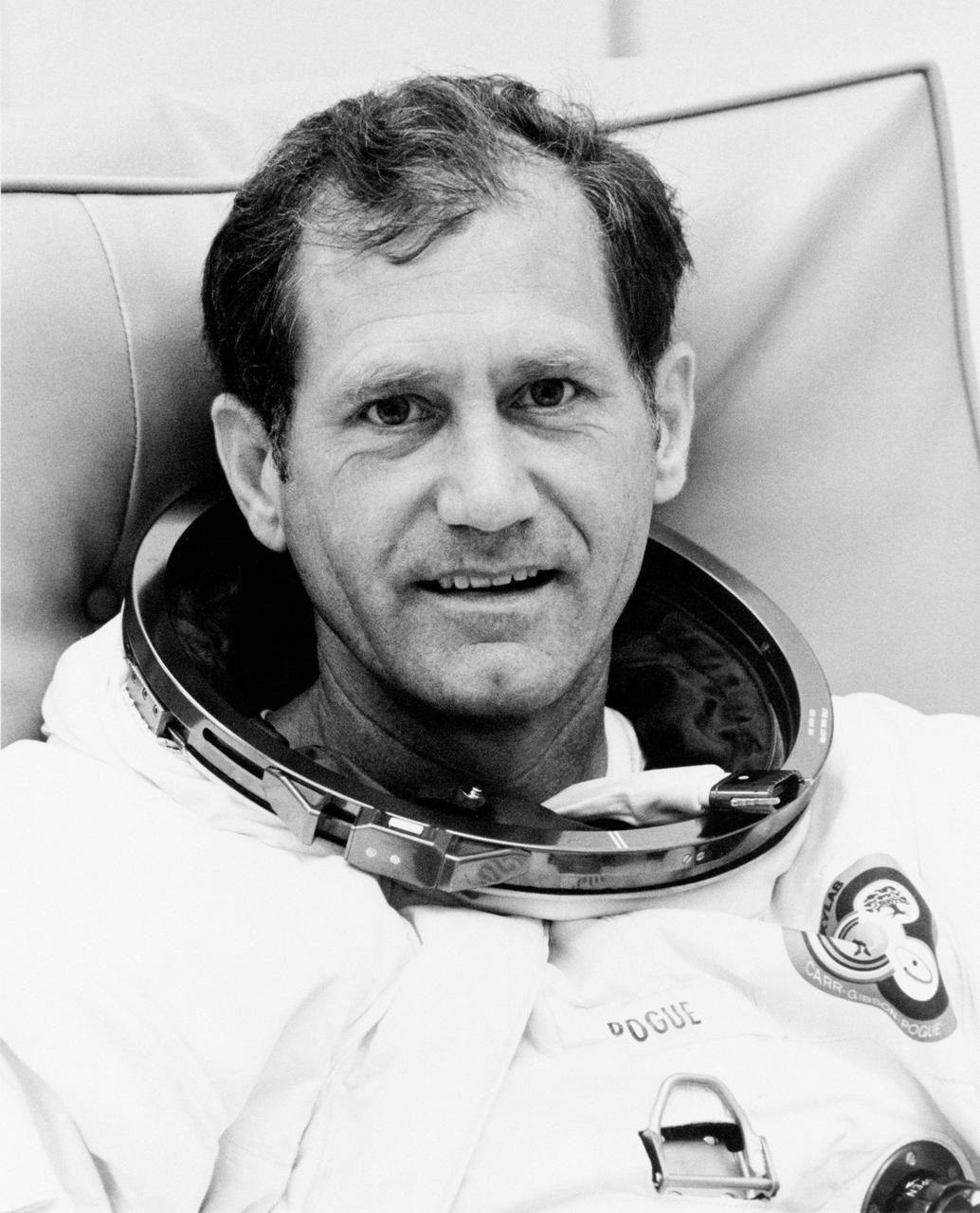
S73-36905 (8 Nov. 1973) --- Astronaut William R. Pogue, pilot of the Skylab 4 mission, relaxes during spacesuit pressure and fit checks at the Kennedy Space Center, Florida. This shoulder and head shot of Pogue was taken a few days before the scheduled Skylab 4 launch. This third and last visit to the Skylab space station in Earth orbit will return additional information on the Earth and sun, as well as provide favorable location from which to observe the recently discovered Comet Kohoutek. The other two members of the Skylab 4 crew will be astronaut Gerald P. Carr, commander; and scientist-astronaut Edward G. Gibson, science pilot. Photo credit: NASA
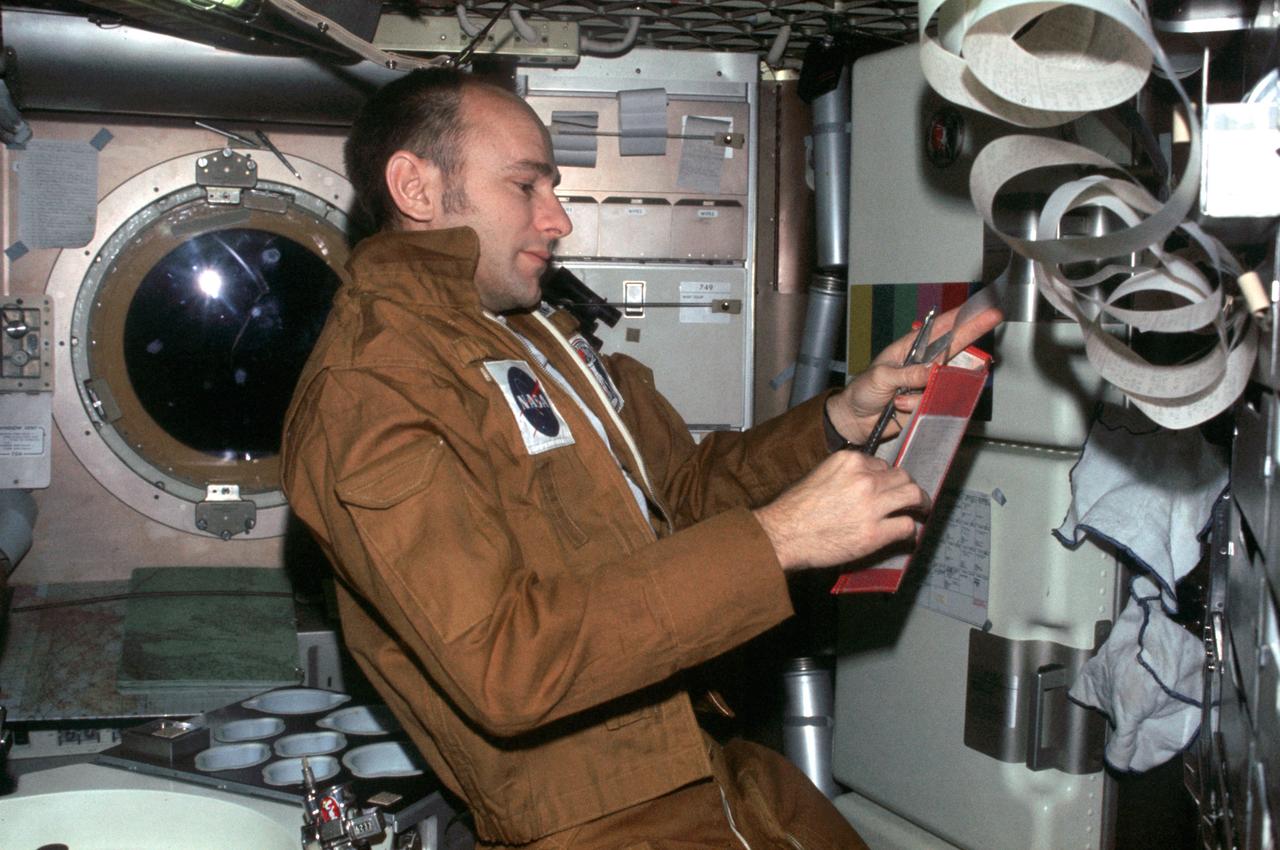
SL3-111-1514 (July-September 1973) --- Astronaut Alan L. Bean, Skylab 3 commander, reads data from book in his right hand while holding teleprinter tape in his left hand, in the ward room of the Skylab space station's Orbital Workshop (OWS) crew quarters. This photograph was taken with a 35mm Nikon camera held by one of Bean's fellow crewmen during the 56.5 day second manned Skylab mission in Earth orbit. Photo credit: NASA
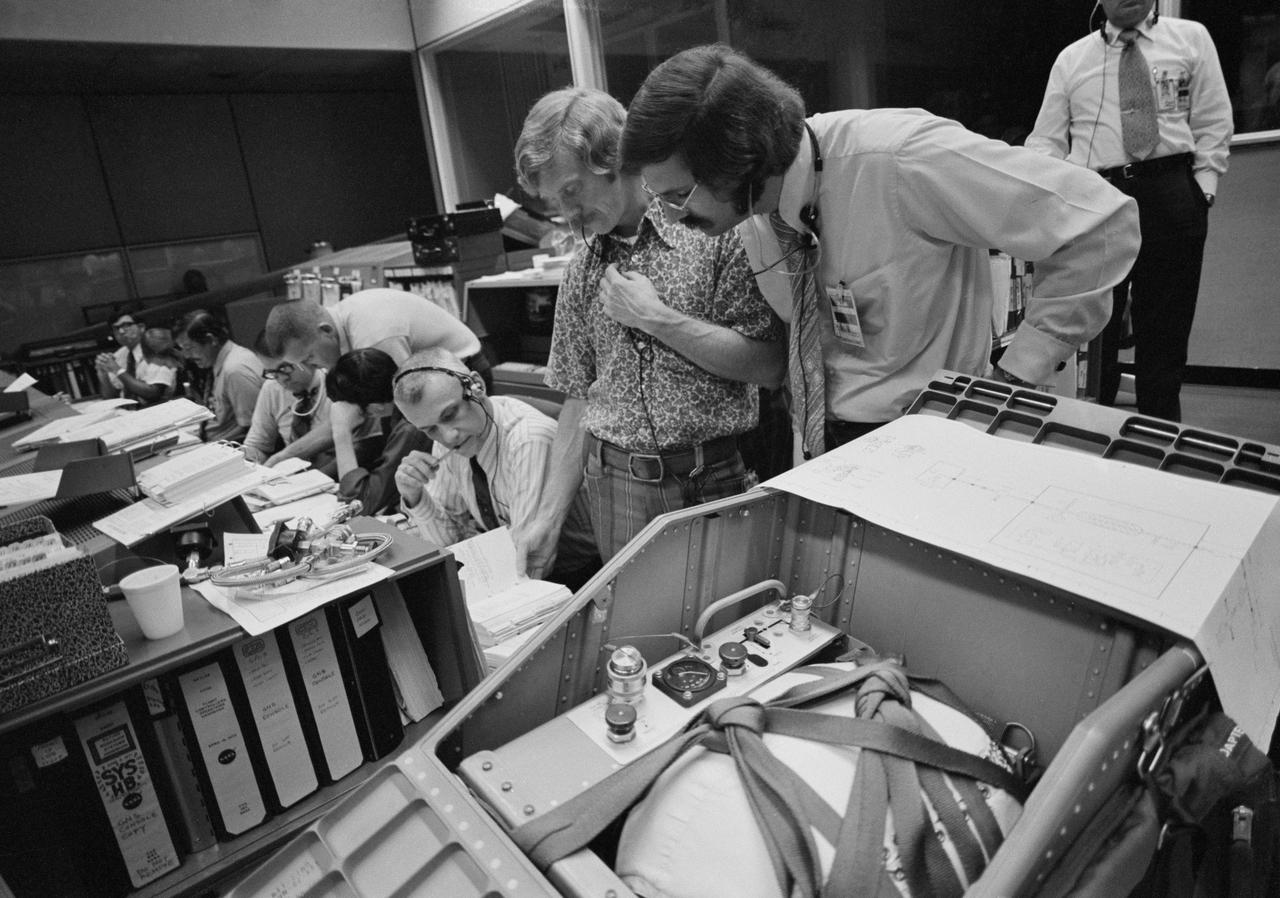
S73-37030 (November 1973) --- The procedures for repairing the coolant system aboard the Airlock Module of the Skylab space station in Earth orbit are discussed by flight controllers in the Mission Operations Control Room in the Mission Control Center at Johnson Space Center. Skylab 4 flight director Neil Hutchinson is on the right. Astronaut Russell L. Schweickart is wearing the sports shirt. Astronaut Bruce McCandless II, a Skylab 4 CAPCOM, is seated next to Schweickart. Items of equipment in the foreground are similar to components of a special coolant re-servicing kit which was taken to Earth orbit by the Skylab 4 crewmen. The kit consists of a tank containing 42 pounds of COOLANOL, a series of saddle valves, bolts and spacers, and leak-check hoses. The re-supply tank is a modified command module reaction control subsystem (RCS) fuel tank. Photo credit: NASA
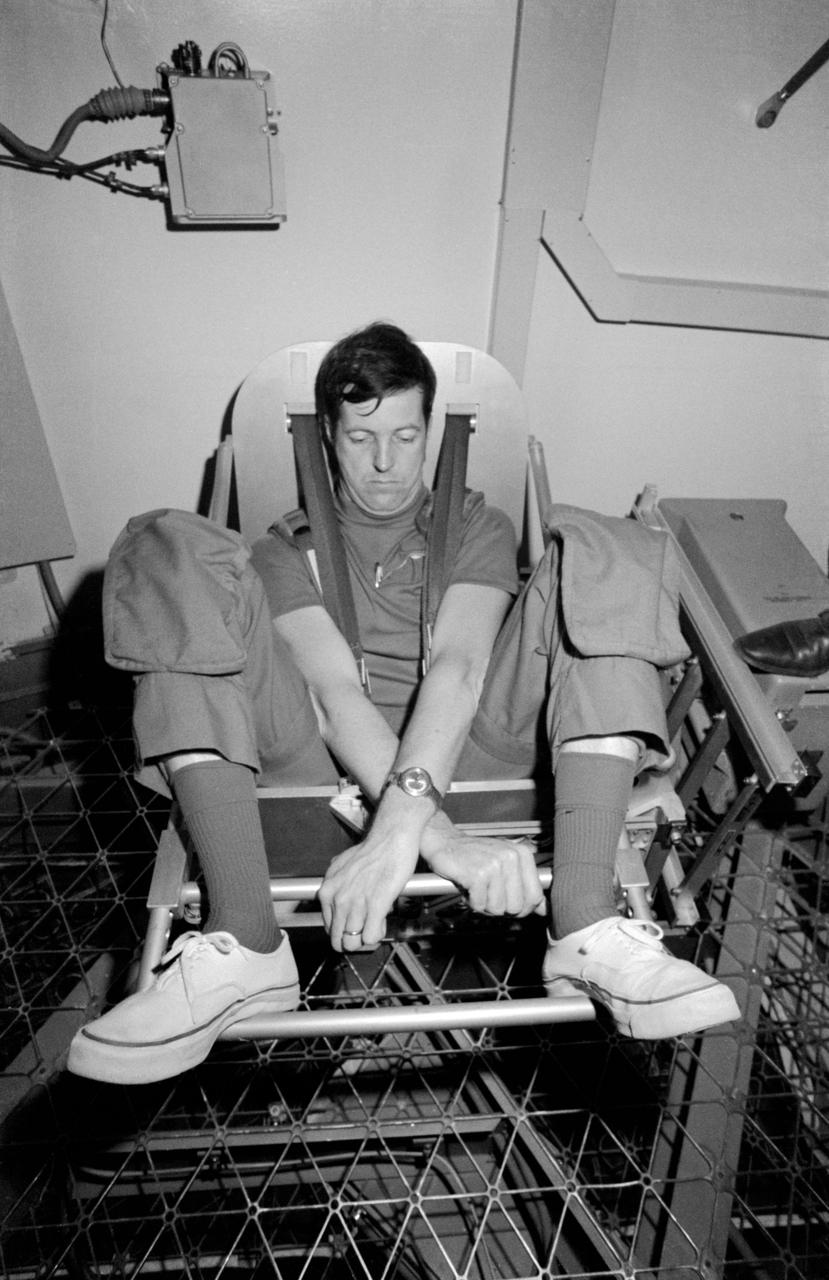
S73-20622 (March 1973) --- Scientist-astronaut Joseph P. Kerwin, science pilot of the first manned Skylab mission, demonstrates the Body Mass Measurement Experiment (M172) during Skylab training at the Johnson Space Center. Dr. Kerwin is in the work and experiments area of the crew quarters of the Skylab Orbital Workshop (OWS) trainer at JSC. The M172 experiment will demonstrate body mass measurement in a null gravity environment, validate theoretical behavior of this method, and support those medical experiments for which body mass measurements are required. The data to be collected in support of M172 are: preflight calibration of the body mass measurement device and measurements of known masses up to 100 kilograms (220 pounds) three times during each Skylab mission. The device, a spring/flexure pivot-mounted chair, will also be used for daily determination of the crewmen?s weight, which will be manually logged and voice recorded for subsequent telemetered transmission. Photo credit: NASA
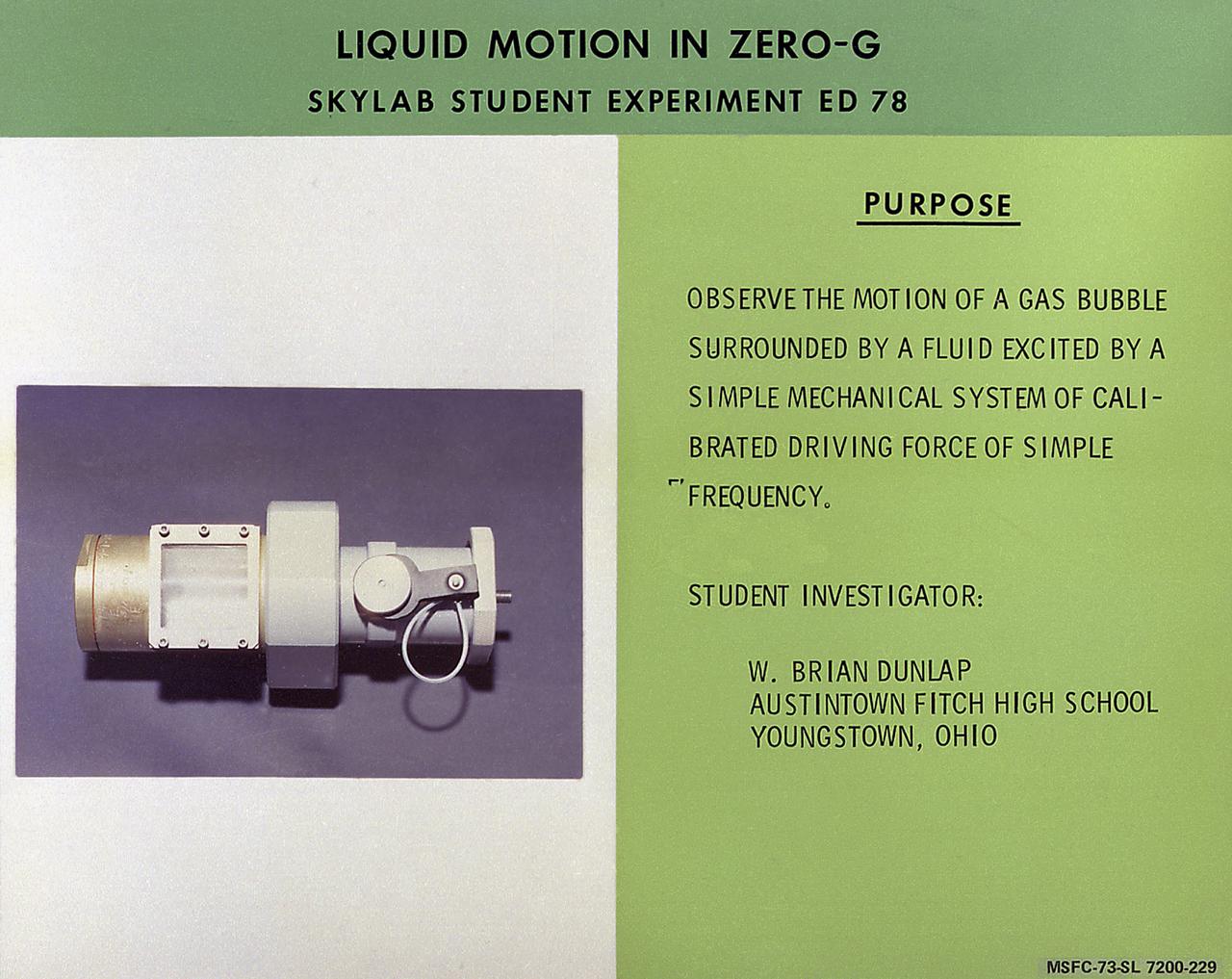
W. Brian Dunlap of Youngstown, Ohio, proposed Skylab student experiment ED-78, Liquid Motion in Zero-G, a study of wave motion in a liquid. He was particularly interested in comparing surface waves over a liquid in zero-gravity with those occurring on Earth. In space, with the absence of gravity, a liquid does not necessarily take the shape of its container as it does on Earth. Adhesion forces may hold the liquid in contact with its container, but the liquid can also assume a free-floating condition. It was in this latter state that Dunlap wished to examine the behavior of surface waves. Data were recorded on videotape and subsequently converted to 16-mm film. Dunlap analyzed these data to determine periods of oscillation of free-floating globules and found agreement with the theory to be much better than expected. In March 1972, NASA and the National Science Teachers Association selected 25 experiment proposals for flight on Skylab. Science advisors from the Marshall Space Flight Center aided and assisted the students in developing the proposals for flight on Skylab.
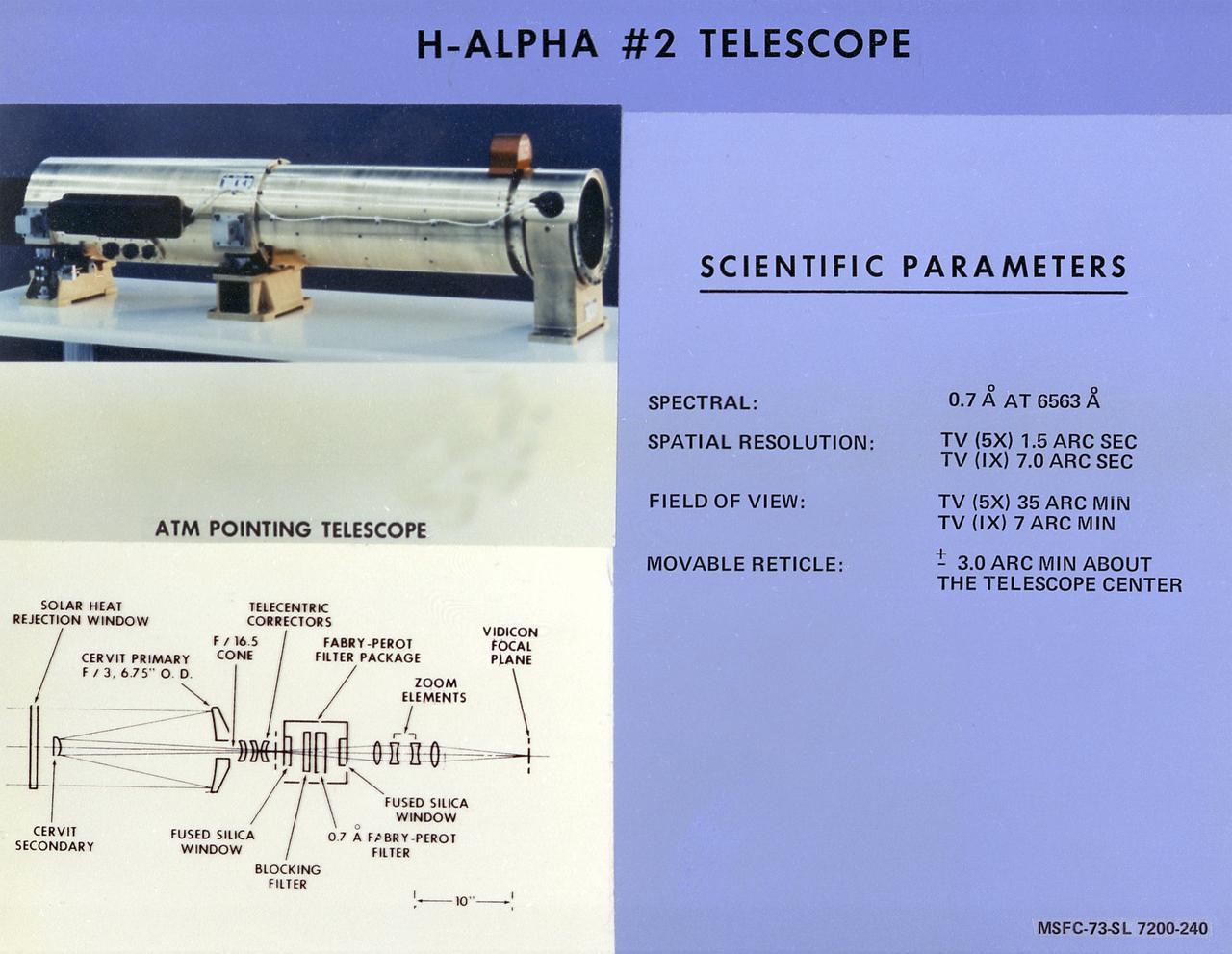
This chart describes the Hydrogen-Alpha (H-Alpha) #2 Telescope, one of eight major solar study facilities on the Skylab Apollo Telescope Mount (ATM). There were two H-Alpha telescopes on the ATM that were used primarily to point the ATM and keep a continuous photographic record during solar observation periods. Both telescopes gave the Skylab astronauts a real-time picture of the Sun in the red light of the H-Alpha spectrum through a closed-circuit television. The H-Alpha #1 telescope provided simultaneous photographic and ultraviolet (UV) pictures, while the #2 telescope operated only in the TV mode. The Marshall Space Flight Center was responsible for development of the H-Alpha Telescopes.
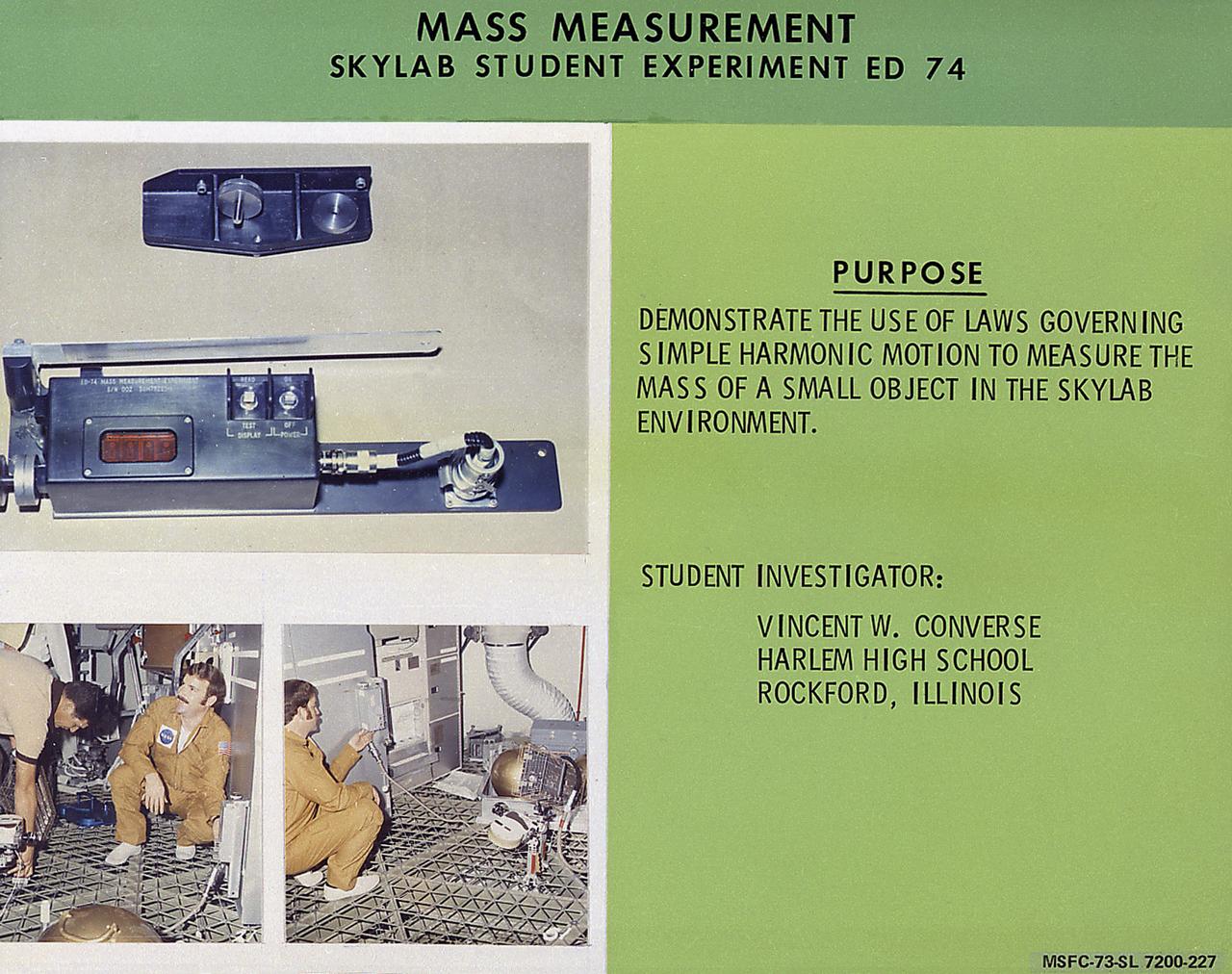
Vincent W. Converse of Rockford, Illinois proposed Skylab's student experiment ED-74, Mass Measurement, to measure mass in a weightless environment. This chart describes Converse's experiment. Mass is the quantity of matter in any object. The gravitational force between an object and the Earth is called weight, which is a result of the Earth's gravity acting upon the object's mass. Even though objects in Skylab were apparently weightless, their mass properties were unchanged. Measurement of mass is therefore an acceptable alternative to measurement of weight. The devices used in this experiment provided accurate mass measurements of the astronauts' weights, intakes, and body wastes throughout the missions. In March 1972, NASA and the National Science Teachers Association selected 25 experiment proposals for flight on Skylab. Science advisors from the Marshall Space Flight Center aided and assisted the students in developing the proposals for flight on Skylab.
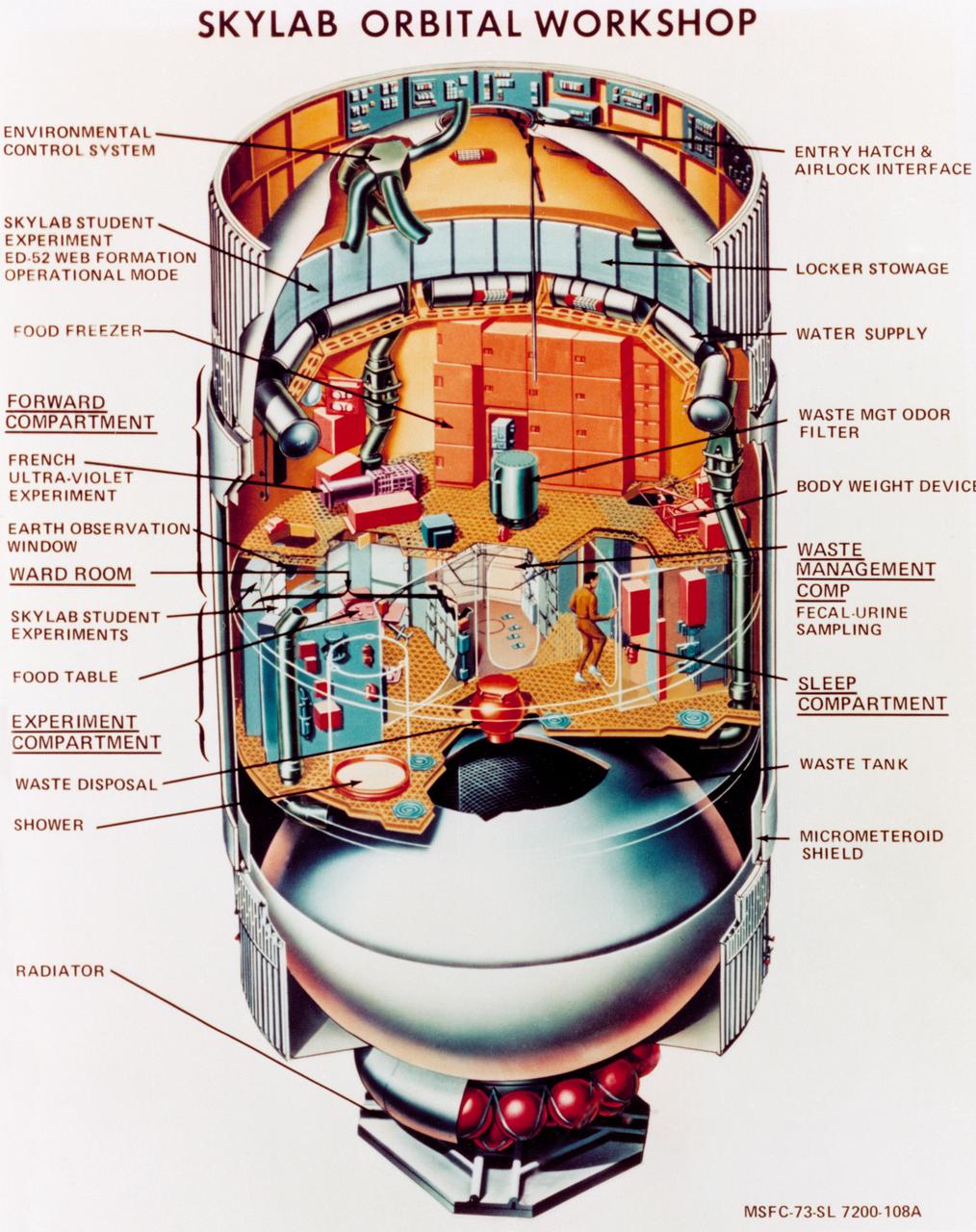
S73-23919 (May 1973) --- An artist's concept illustrating a cutaway view of the Skylab 1 Orbital Workshop (OWS). The OWS is one of the five major components of the Skylab 1 space station cluster which was launched by a Saturn V on May 14, 1973 into Earth orbit. Photo credit: NASA
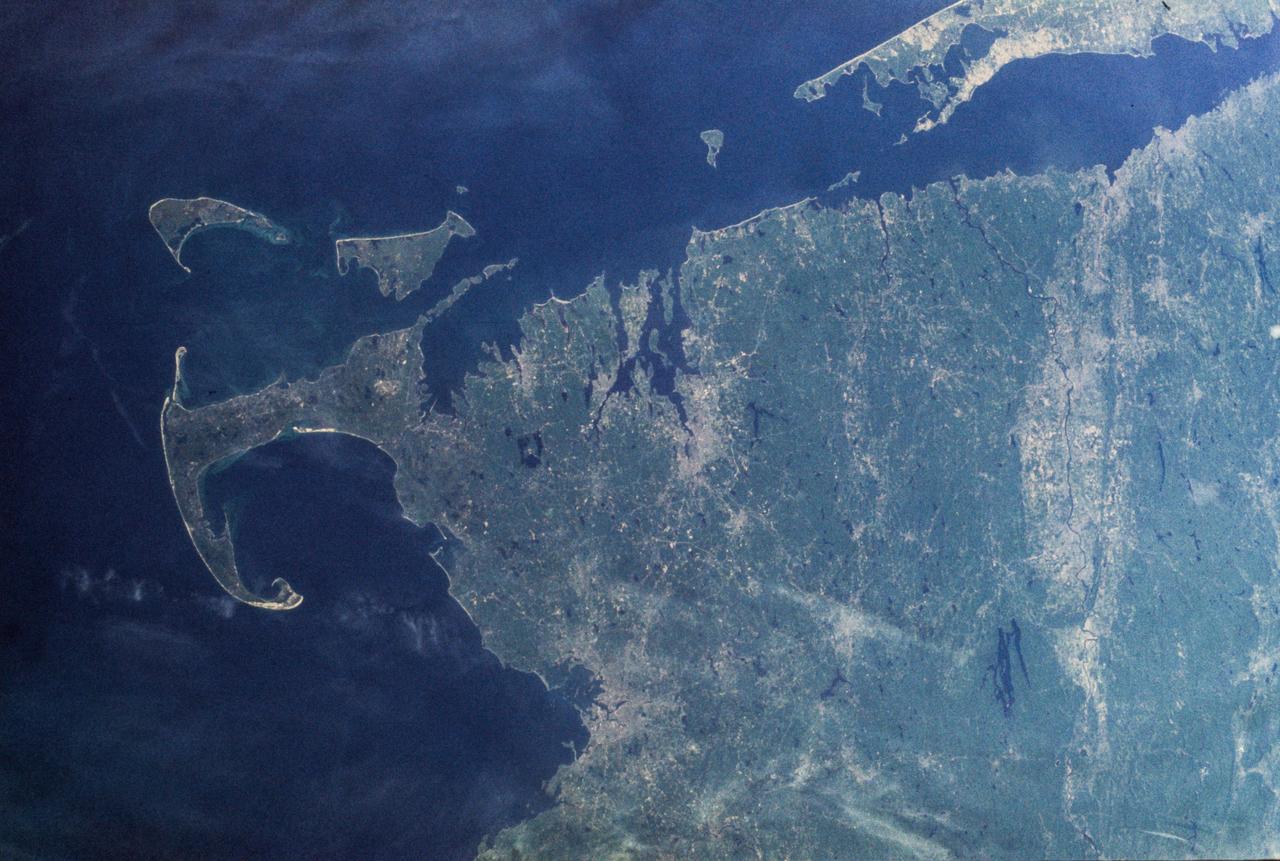
SL2-103-967 (22 June 1973) --- This view of lower New England, (41.5N, 72.0W) shows a rare cloud-free area stretching from northern Long Island across the states of Connecticut, Rhode Island and Massachusetts. The total area covered by this photo is more than 25,000 square miles and includes all of Rhode Island, most of Massachusetts and Connecticut, part of New York and the coastal waters of the Atlantic Ocean. Cape Cod, Boston and the offshore islands are distinctive features. Photo credit: NASA
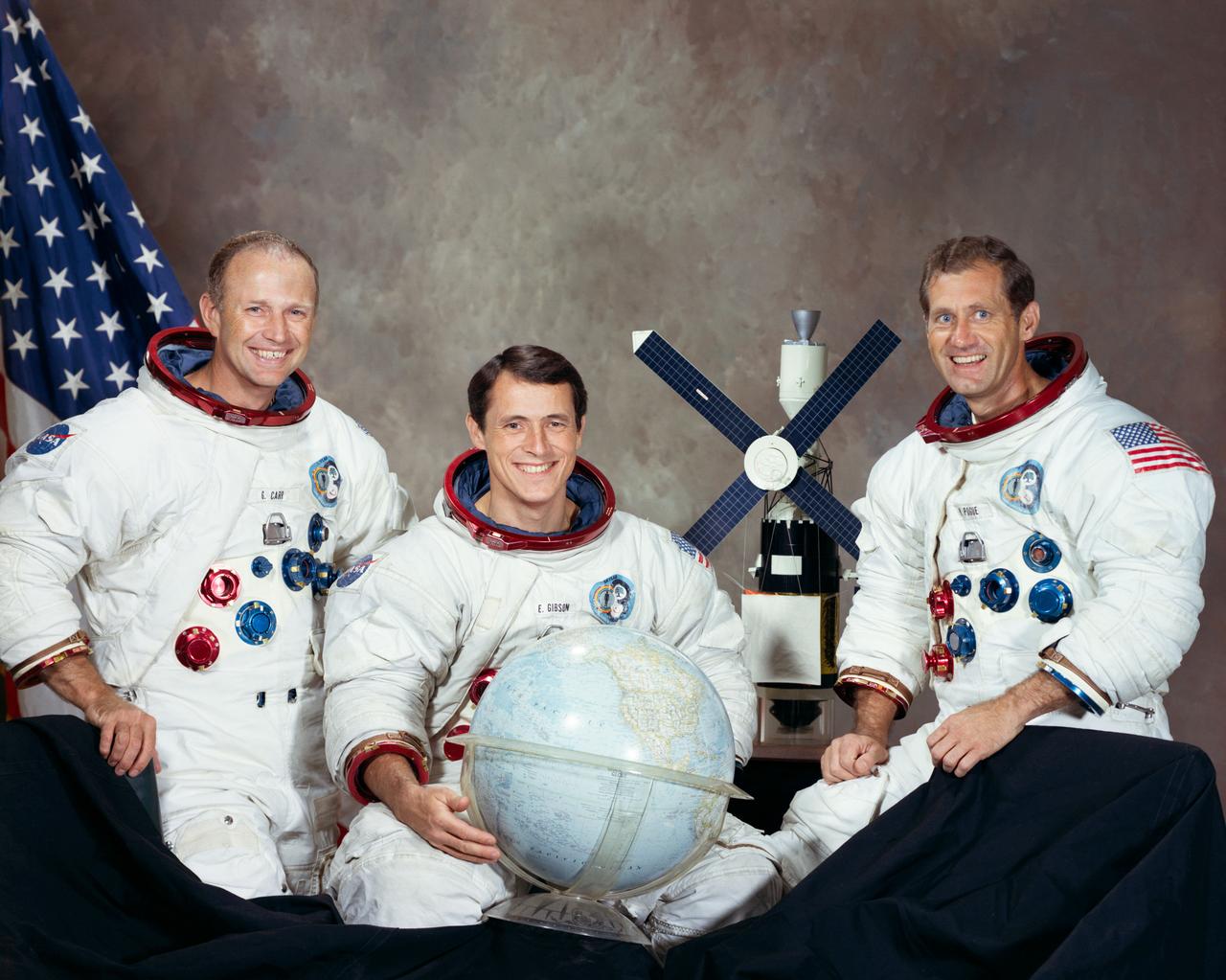
S73-33206 (August 1973) --- These three men are the prime crew for the Skylab 4 mission. Pictured in their Skylab spacesuits with a globe and a model of the Skylab space station are, left to right, astronaut Gerald P. Carr, commander; scientist-astronaut Edward G. Gibson, science pilot; and astronaut William R. Pogue, pilot. Photo credit: NASA
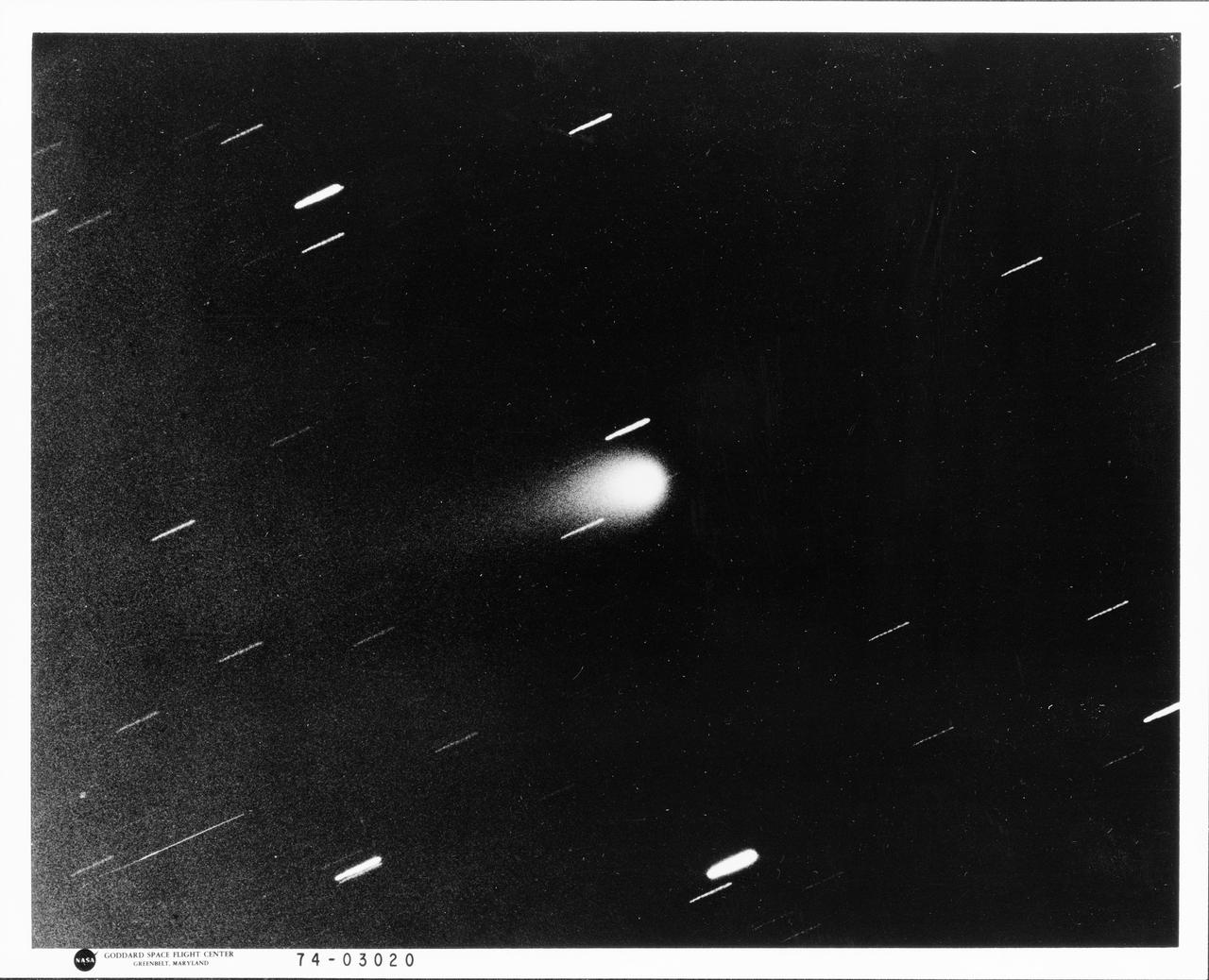
S73-38731 (December 1973) --- Photograph taken of the Comet Kohoutek from the Skylab space station in Earth orbit by a Skylab 4 crew member. Photo credit: NASA
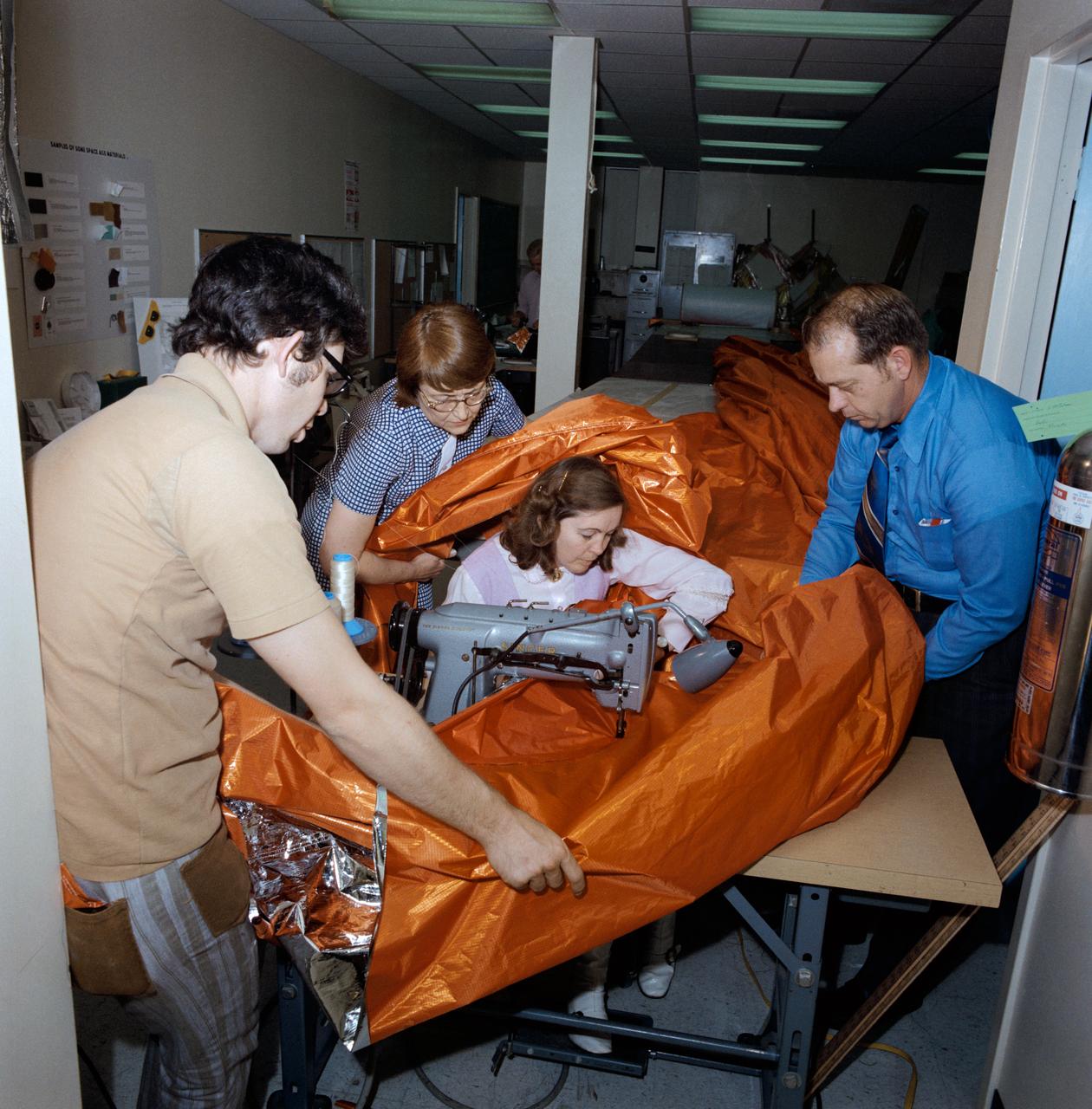
S73-26047 (18 May 1973) --- A sail-like sunshade for possible use as a sunscreen for the Skylab orbital workshop (OWS) is shown being fabricated in the GE Building across the street from the Johnson Space Center. Three persons assist the seamstress feed the material through the sewing machine. The three-layered shade will be composed of a top layer of aluminum Mylar, a middle layer of laminated nylon rip stop, and a bottom layer of thin nylon. Working on the sunshade, from left to right, are Dale Gentry, Elizabeth Gauldin, Alyene Baker and James H. Barnett Jr. Mrs. Baker, a GE employee, operates the double-needle sewing machine. Barnett is head of the Crew Equipment Development Section of JSC's Crew Systems Division. Mrs. Gauldin is also with the Crew Systems Division. Gentry works for GE. The work shown here is part of the crash program underway to prepare a protection device for Skylab to replace the original shield which was lost when the unmanned Skylab 1 launch took place on May 14, 1973. The improvised solar shield selected to be used will be carried to Earth orbit by the Skylab 2 crew, who will deploy it to shade part of the OWS from the hot rays of the sun. Loss of the original shield, as expected, has caused an overheating problem on the OWS. Photo credit: NASA

S73-33655 (1973) --- Left to right, Lynda Bird Johnson Robb, Charles Robb, Claudia "Lady Bird" Johnson, Texas Governor Dolph Briscoe, Christopher C. Kraft, Jr., James Webb, actor David Niven, and nurse Lt. Dolores B. "Dee" O'Hara with NASA officials during formal dedication ceremonies at JSC. Photo credit: NASA
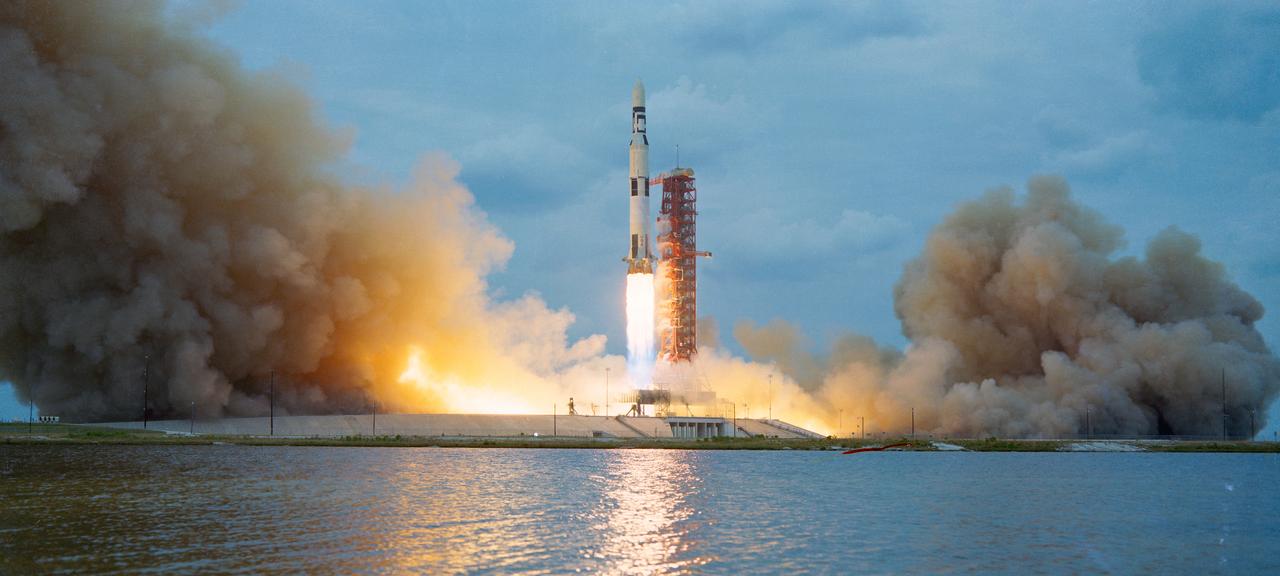
S73-26912 (14 May 1973) --- The unmanned Skylab 1/Saturn V space vehicle is launched from Pad A, Launch Complex 39, Kennedy Space Center, Florida, at 12:00 noon (EDT), May 14, 1973, to place the Skylab space station cluster in Earth orbit. The Skylab 1 payload included four of the five major components of the space station Orbital Workshop, Apollo Telescope Mount, Multiple Docking Adapter, and Airlock Module. In addition to the payload, the Skylab 1/Saturn V second (S-11) stage. The fifth major component of the space station, the Command Service Module with the Skylab 2 crew aboard, was launched at a later date by a Saturn 1B from Pad B. Photo credit: NASA
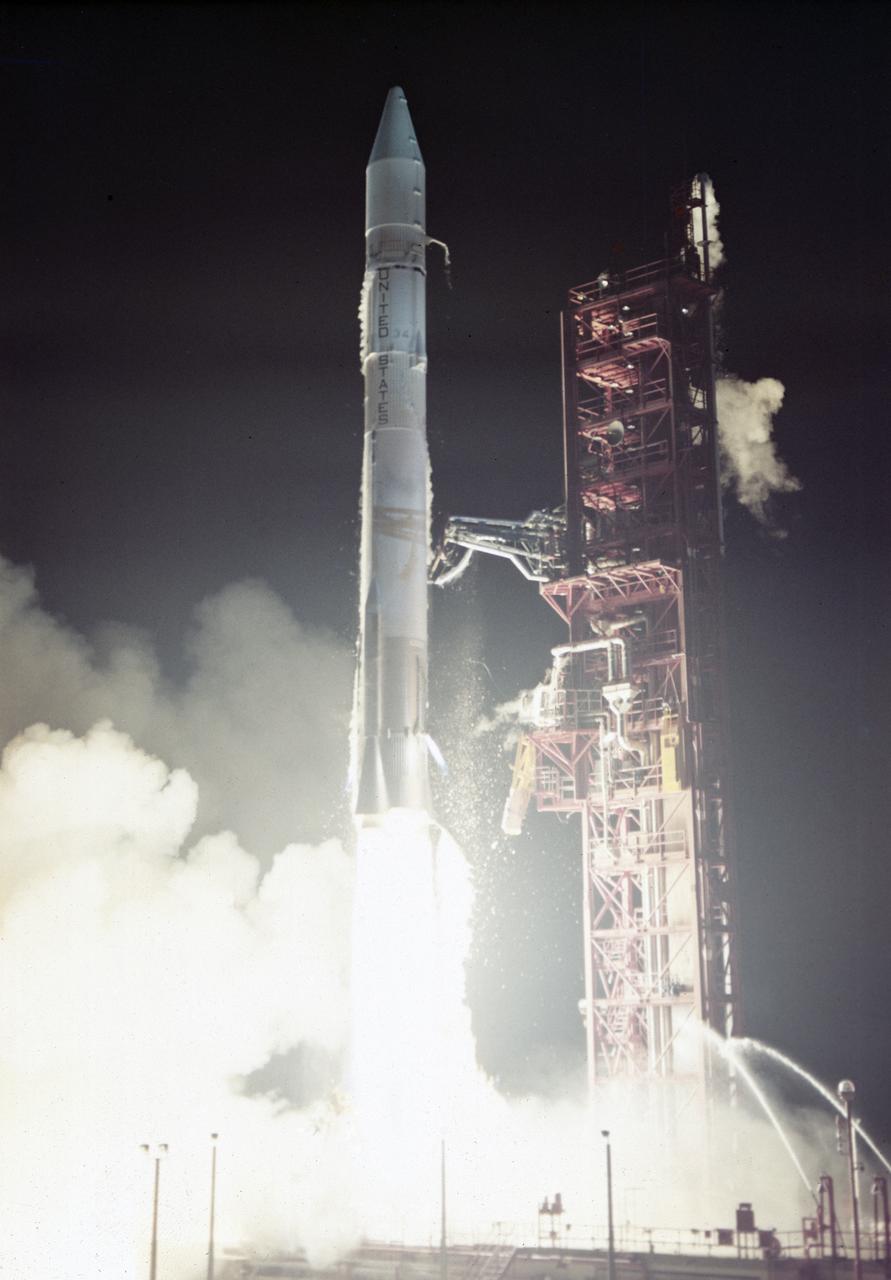
The launch of the Atlas-Centaur carrying the Mariner X spacecraft on November 3, 1973. This mission was for the exploration of the planets Venus and Mercury.

This chart describes the Skylab student experiment Ultraviolet (UV) From Pulsars, proposed by Neal W. Sharnon of Atlanta, Georgia. This experiment was to observe several pulsars with Skylab's UV spectrometer to determine their intensities in that portion of their spectra. A more detailed description of a pulsar's electromagnetic emission profile would be expected to further define means by which its energy is released. Unfortunately, upon examination of the photographic plates containing the data from the experiment, it was found that an alignment error of the spectrometer prevented detection of any of the pulsars. In March 1972, NASA and the National Science Teachers Association selected 25 experiment proposals for flight on Skylab. Science advisors from the Marshall Space Flight Center aided and assisted the students in developing the proposals for flight on Skylab.
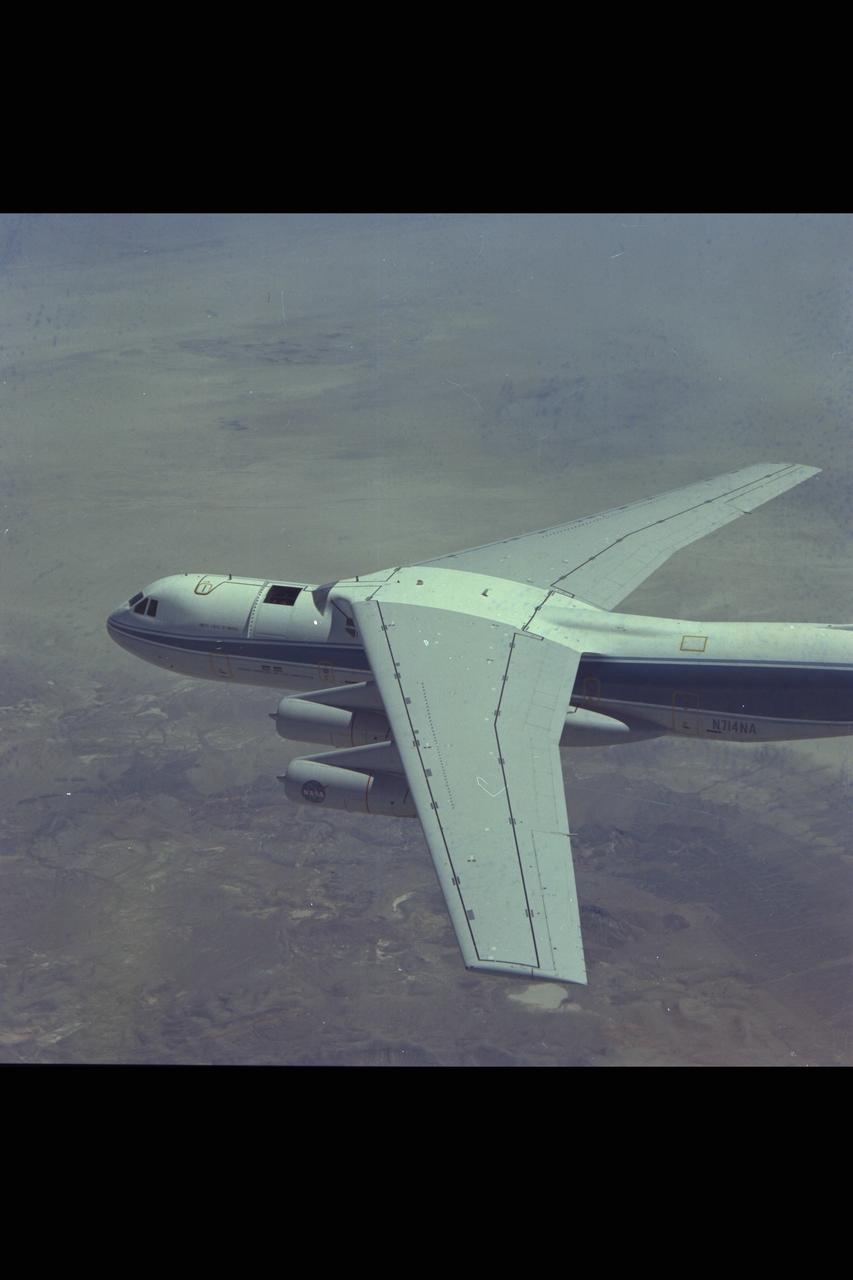
C-141 (NASA-714) Kuipter Airborne Observatory in flight, telescope hatch open
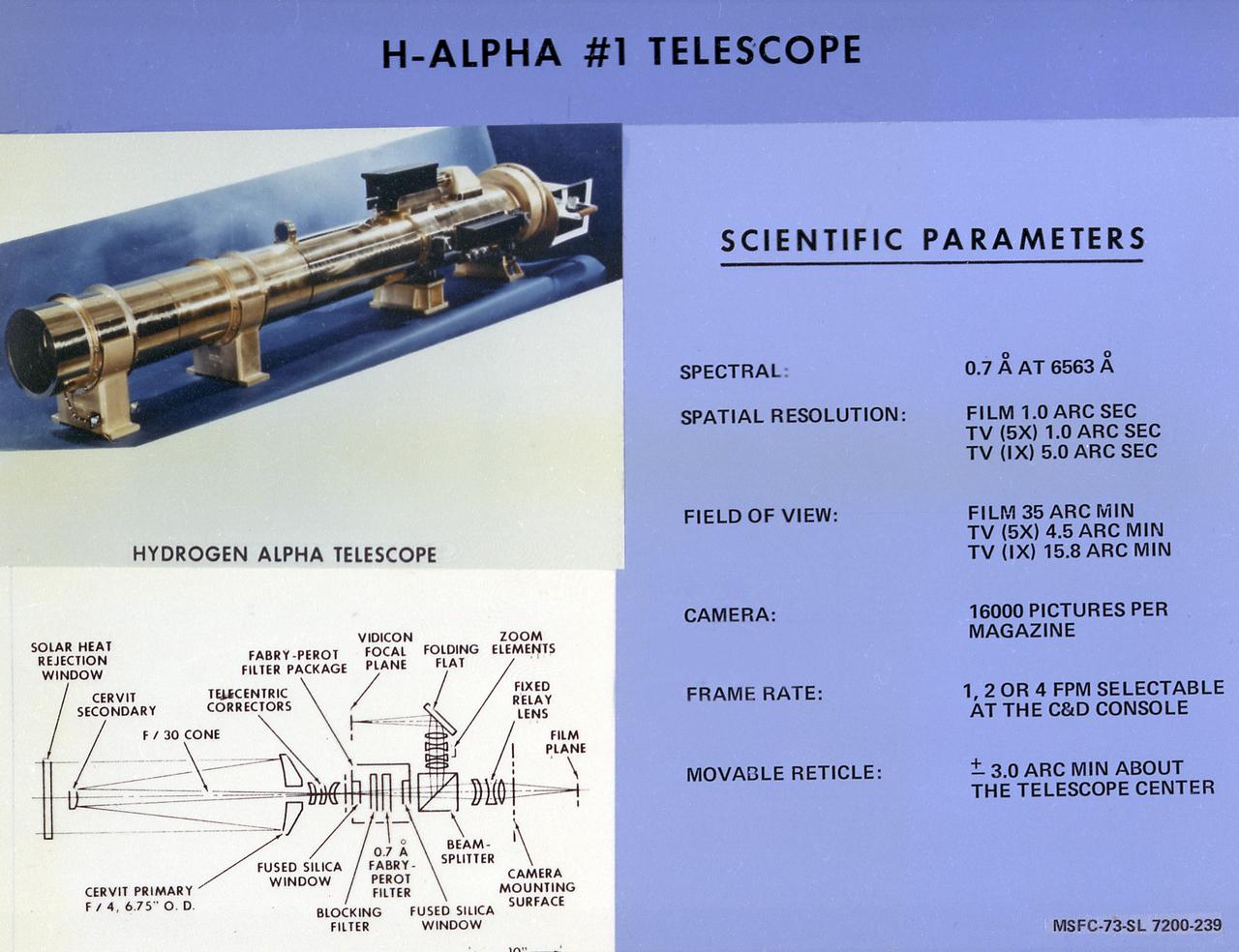
This chart describes the Hydrogen-Alpha (H-Alpha) #1 Telescope, one of eight major solar study facilities on the Skylab Apollo Telescope Mount (ATM). There were two H-Alpha telescopes on the ATM that were used primarily to point the ATM and keep a continuous photographic record during the solar observation periods. Both telescopes gave the Skylab astronauts a real-time picture of the Sun in the red light of the H-Alpha spectrum through a closed-circuit television. The H-Alpha #1 Telescope provided simultaneous photographic and ultraviolet (UV) pictures, while the #2 Telescope operated only in the TV mode. The Marshall Space Flight Center was responsible for development of the H-Alpha Telescopes.
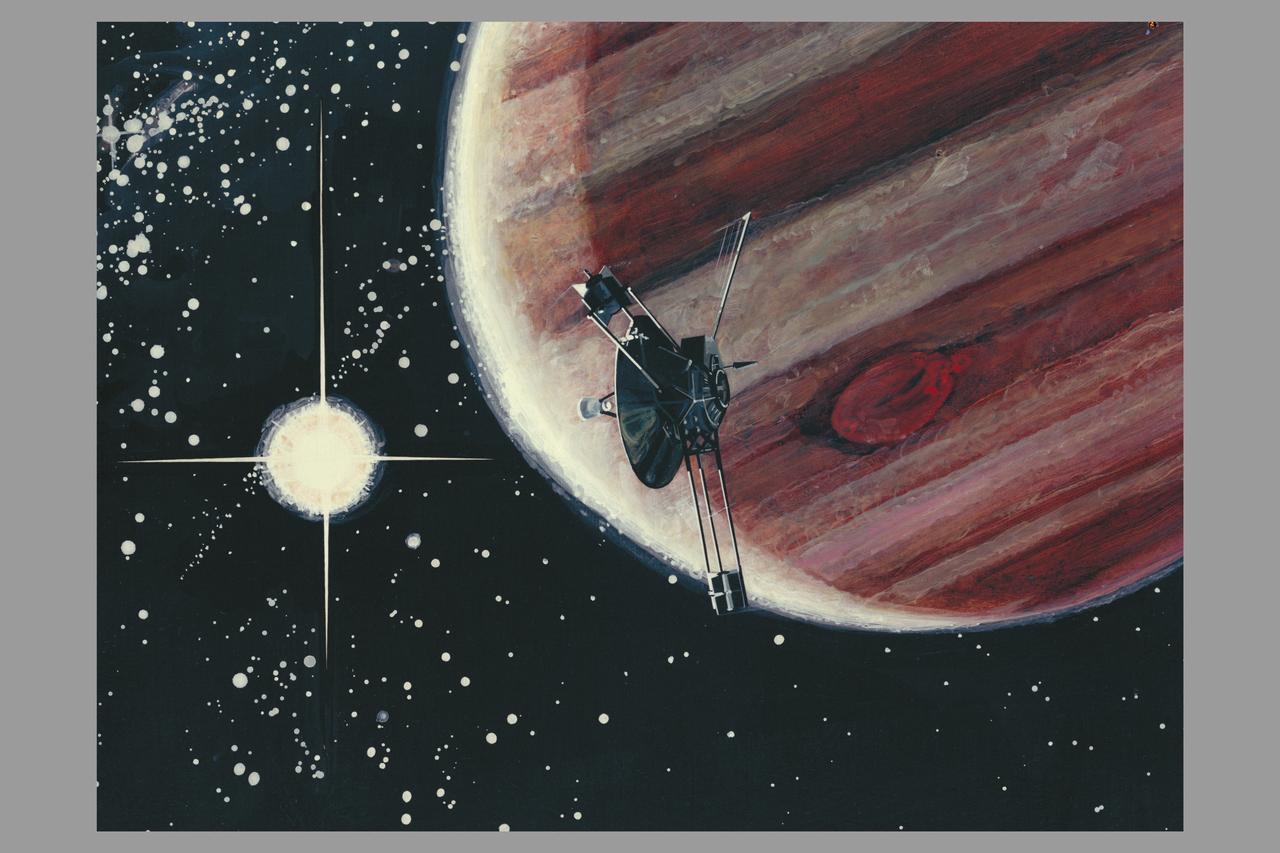
Artist: Rick Guidice Pioneer (10) passing Jupiter (cropped) Mission art

SL3-22-0214 (July-September 1973) --- A vertical view of southeastern Washington State as photographed from Earth orbit by one of the six lenses of the Itek-furnished S190-A Multispectral Photographic Facility Experiment aboard the Skylab space station. The Snake River flows into the Columbia River in the most southerly corner of the picture. The Wallula Lake is below the junction of the two rivers. The Yakima Valley is at the southwestern edge of the photograph. The Columbia Basin is in the center of the picture. The Cascade Range extends across the northwest corner of the photograph. This picture was taken with type SO-356 regular color film. The S190-A experiment is part of the Earth Resources Experiments Package. Federal agencies participating with NASA on the EREP project are the Departments of Agriculture, Commerce, Interior, the Environmental Protection Agency and the Corps of Engineers. All EREP photography is available to the public through the Department of Interior?s Earth Resources Observations Systems Data Center, Sioux Falls, South Dakota, 57198. Photo credit: NASA
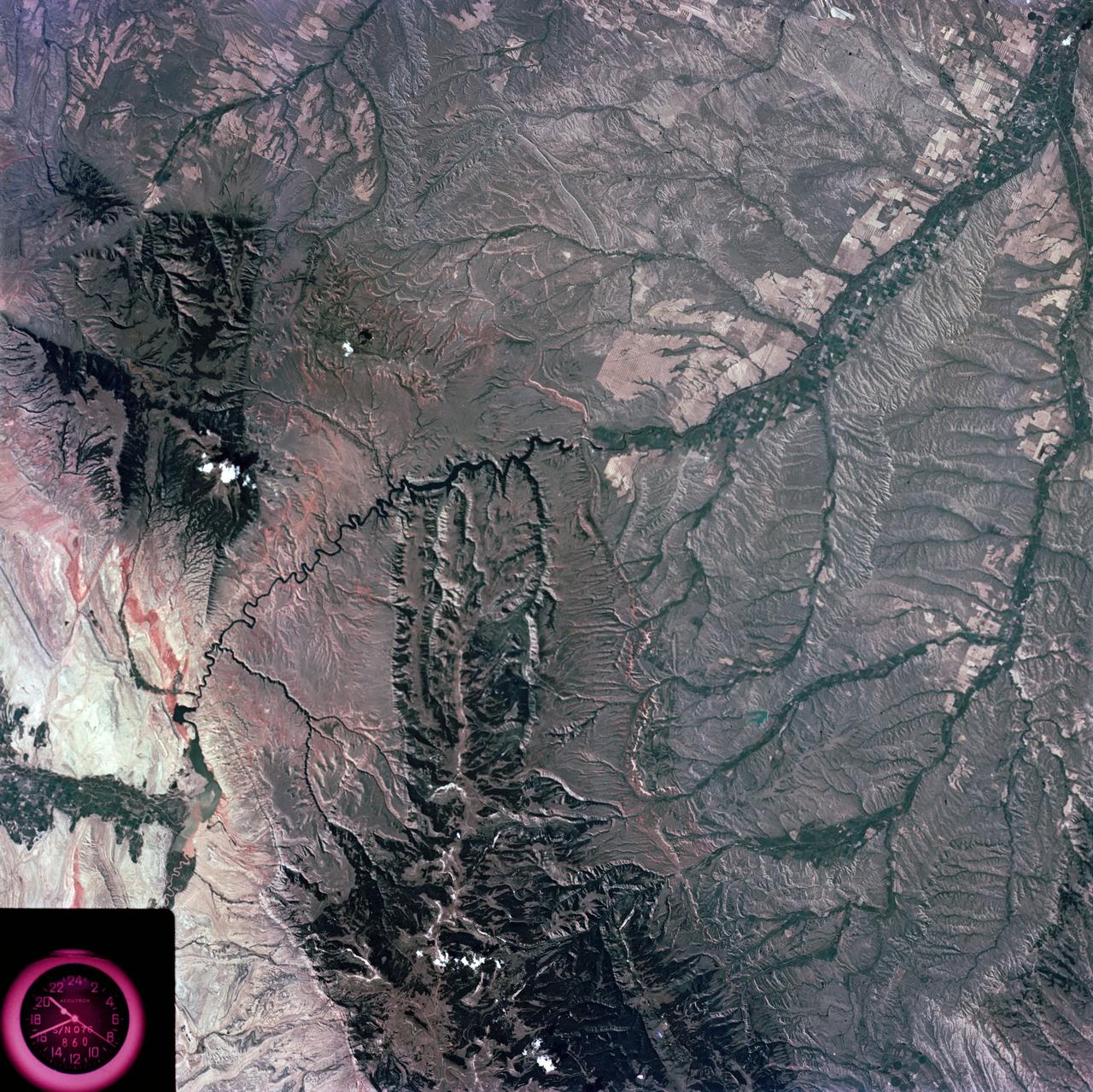
S73-35081 (July-September 1973) --- A view of approximately 3,600 square miles of north central Wyoming and southern Montana is seen in this Skylab 3 Earth Resources Experiments Package S190-B (five-inch Earth terrain camera) photograph taken from the Skylab space station in Earth orbit. The Big Horn River following northward crosses between the northwest trending Big Horn Mountains and the Pryor Mountains. Yellowtail Reservoir, named after a former chief of the Crow Indian tribe in the center of the picture is impounded by a dam across the small rectangular crop area along the Big Horn River (upper right) and the strip farming (yellow) practiced on the rolling hill along the Big Horn River and its tributaries (upper left corner and right edge). The low sun angle enhances the structural features of the mountains as well as the drainage patterns in the adjacent basins. Rock formation appears in this color photograph as they would to the eye from this altitude. The distinctive redbeds can be traced along the front of the Pryor Mountains and indicate the folding that occurred during mountain building. EREP investigators, Dr. Houston of the University of Wyoming and Dr. Hoppin of the University of Iowa, will analyze the photograph and use the results in geological mapping and mineral resource studies. Lowell, Wyoming (lower left corner) and Hardin, Montana (upper right corner) can be recognized. Federal agencies participating with NASA on the EREP project are the Departments of Agriculture, Commerce, Interior, the Environmental Protection Agency and the Corps of Engineers. All EREP photography is available to the public through the Department of Interior?s Earth Resources Observations Systems Data Center, Sioux Falls, South Dakota, 57198. (Alternate number SL3-86-337) Photo credit: NASA
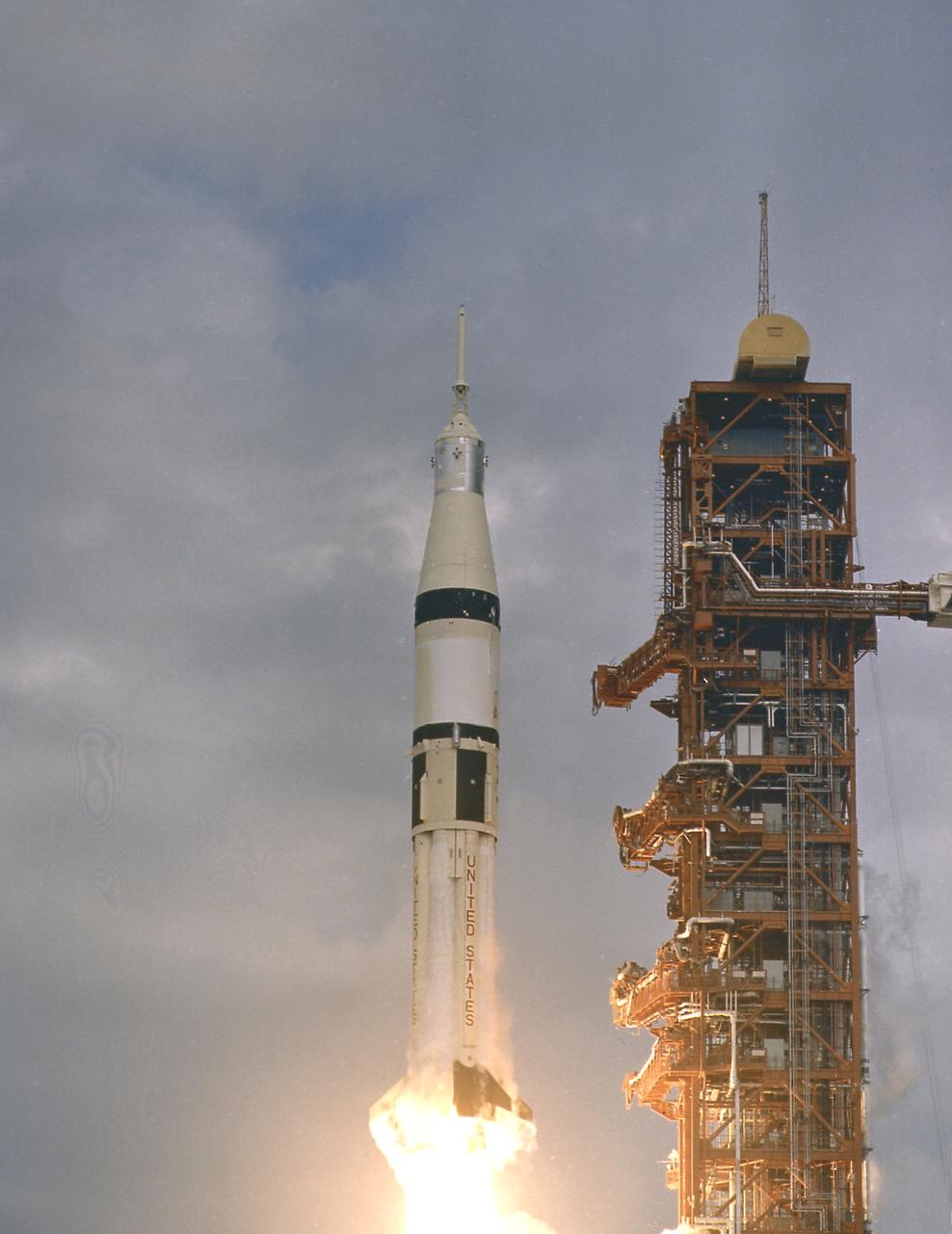
SA-206 lifts off from Kennedy Space Center's launch complex 39B, in Florida, on May 25, 1973, for the first manned Skylab mission (SL-2) with astronauts Pete Conrad, Joseph Kerwin, and Paul Weitz. The Saturn IB, developed under the direction of the Marshall Space Flight Center (MSFC), launched five manned Earth-orbital missions between 1968 and 1975: Apollo 7, Skylab 2, Skylab 3, Skylab 4, and the Apollo-Soyuz Test Project (ASTP).
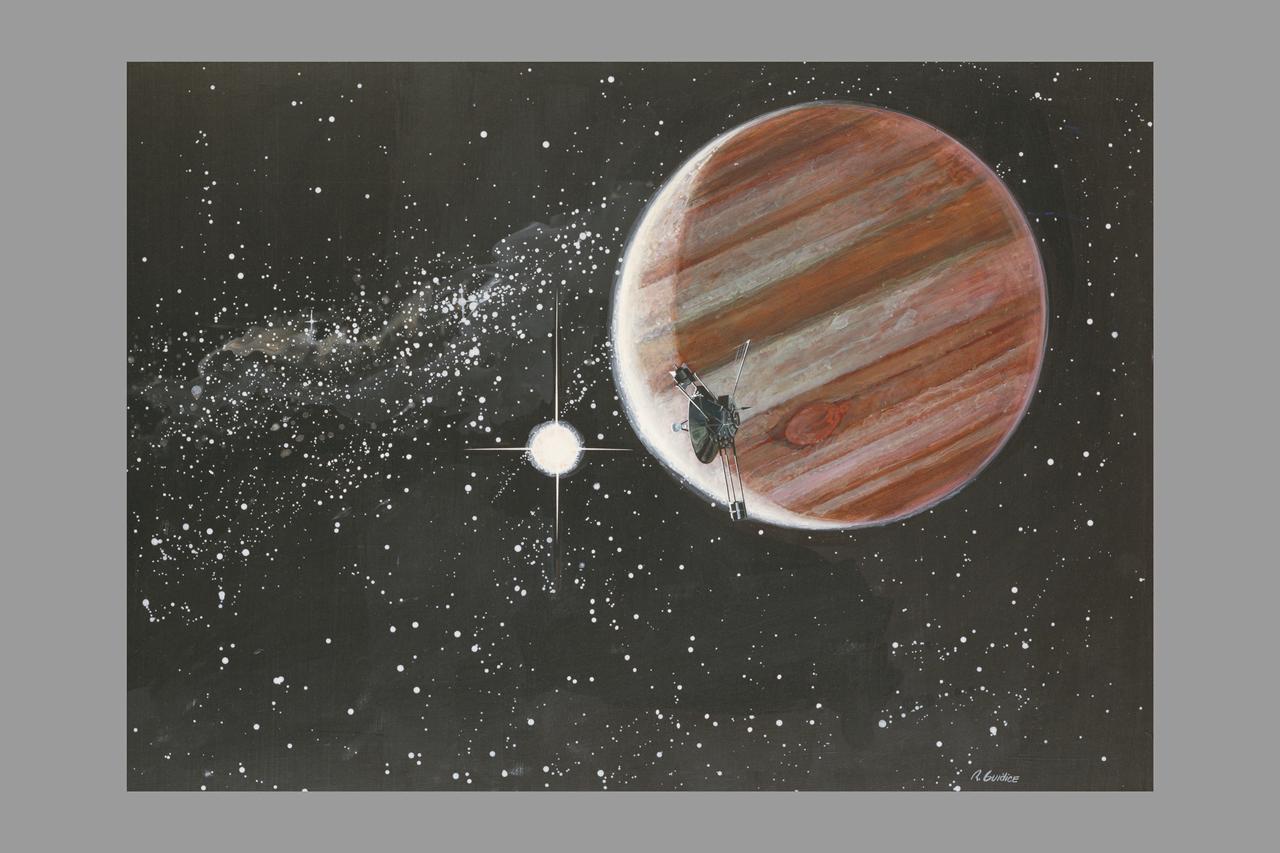
Artist: Rick Guidice Pioneer (10) passing Jupiter
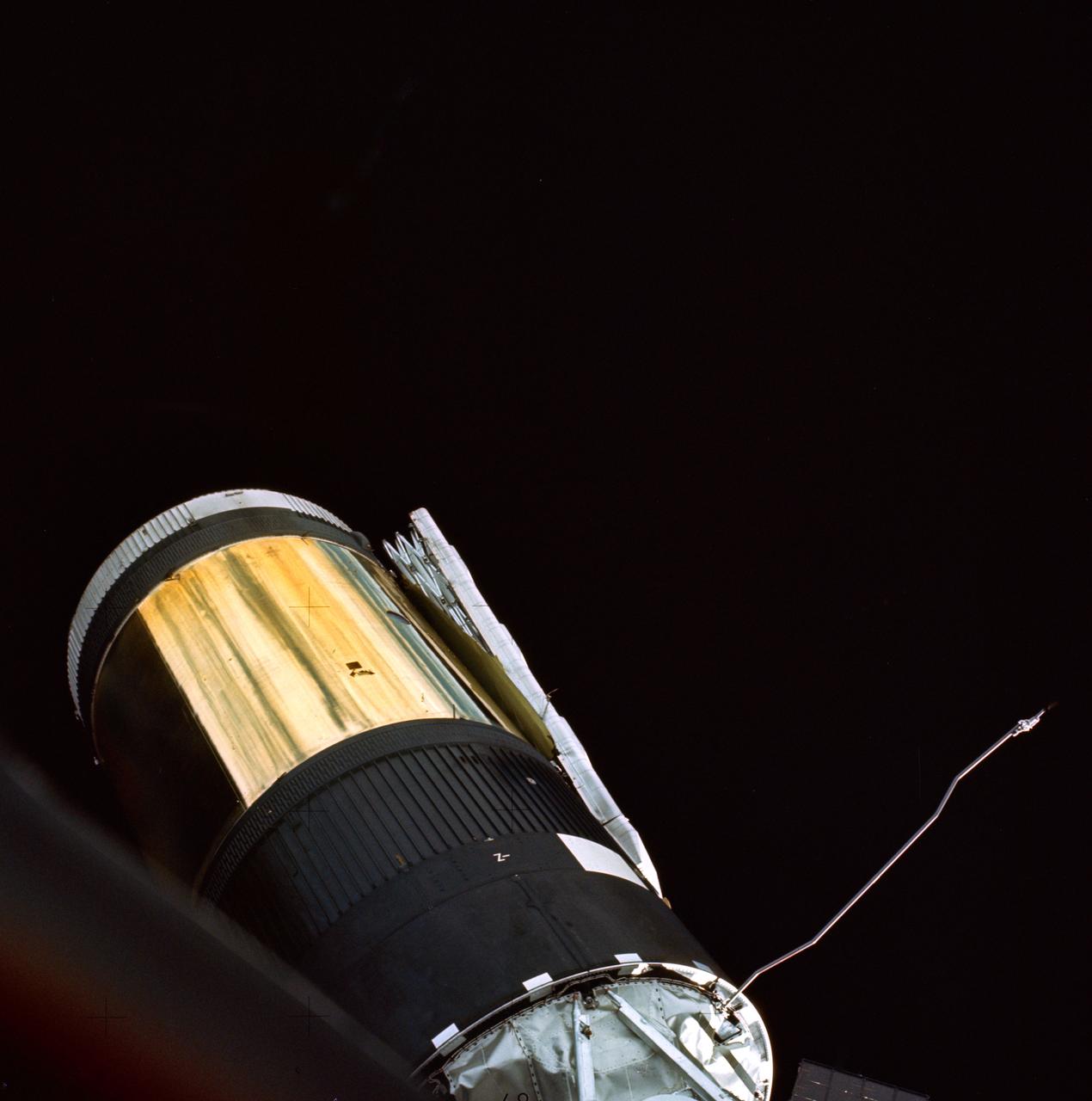
This view of the Skylab Orbital Space Station was taken from the Skylab 2 Command/Service Module during it's initial fly around inspection. The micrometeoroid shield can be seen to be missing and a parasol solar shield was later fitted in its place. The damaged and partially deployed solar array, in the center of the scene, can be seen to be restrained by a strap that was later cut during an early EVA, allowing the panel to fully deploy.
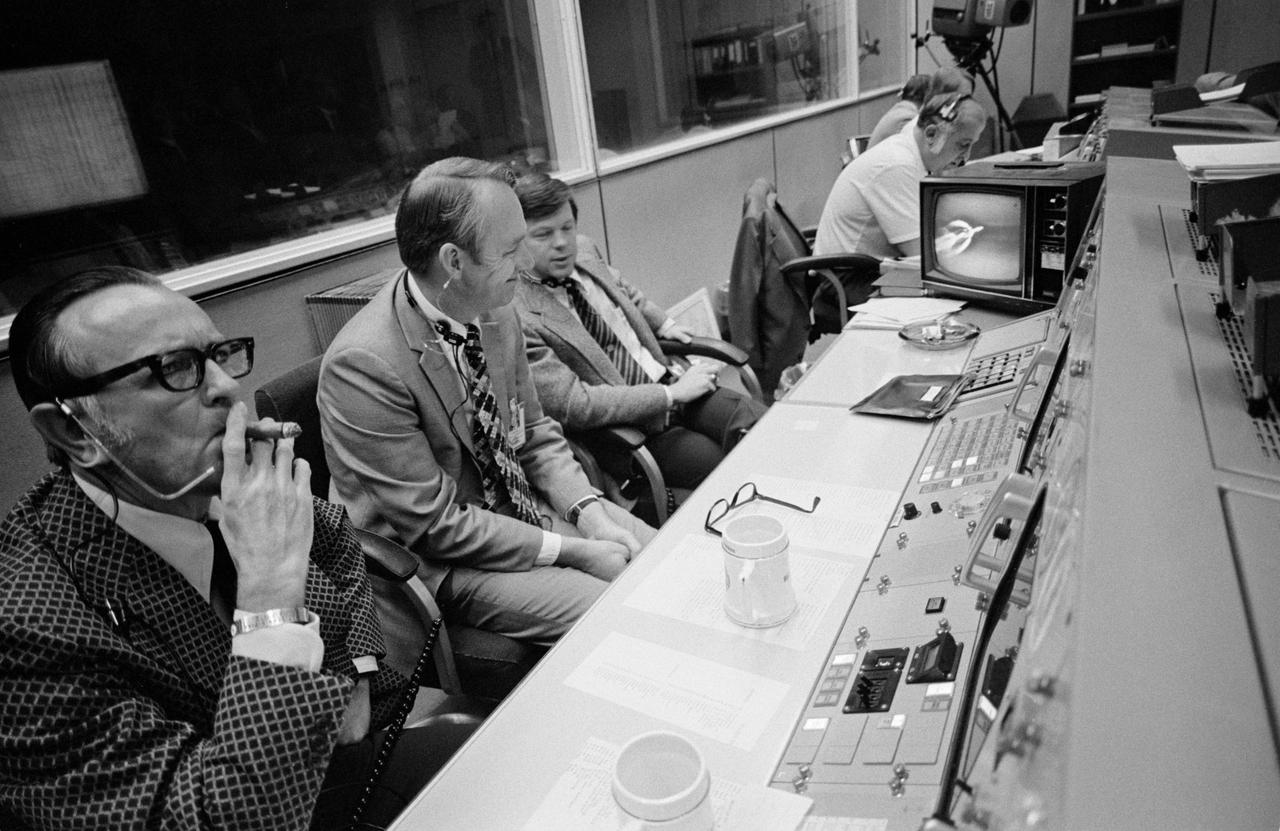
S73-36909 (16 Nov. 2013) --- An overall view of the Flight Operations Director's console in the Mission Operations Control Room in the Mission Control Center at Johnson Space Center during the launch of the Skylab 4 mission. The television monitor records the progress of the flight seconds after liftoff. Left to right, are Dr. Christopher C. Kraft Jr., JSC Director; Howard W. Tindall Jr., JSC Director of Flight Operations; and Flight Director M.P. Frank. Public Affairs commentator John E. McLeish can be seen at the PAO console in the background. Photo credit: NASA
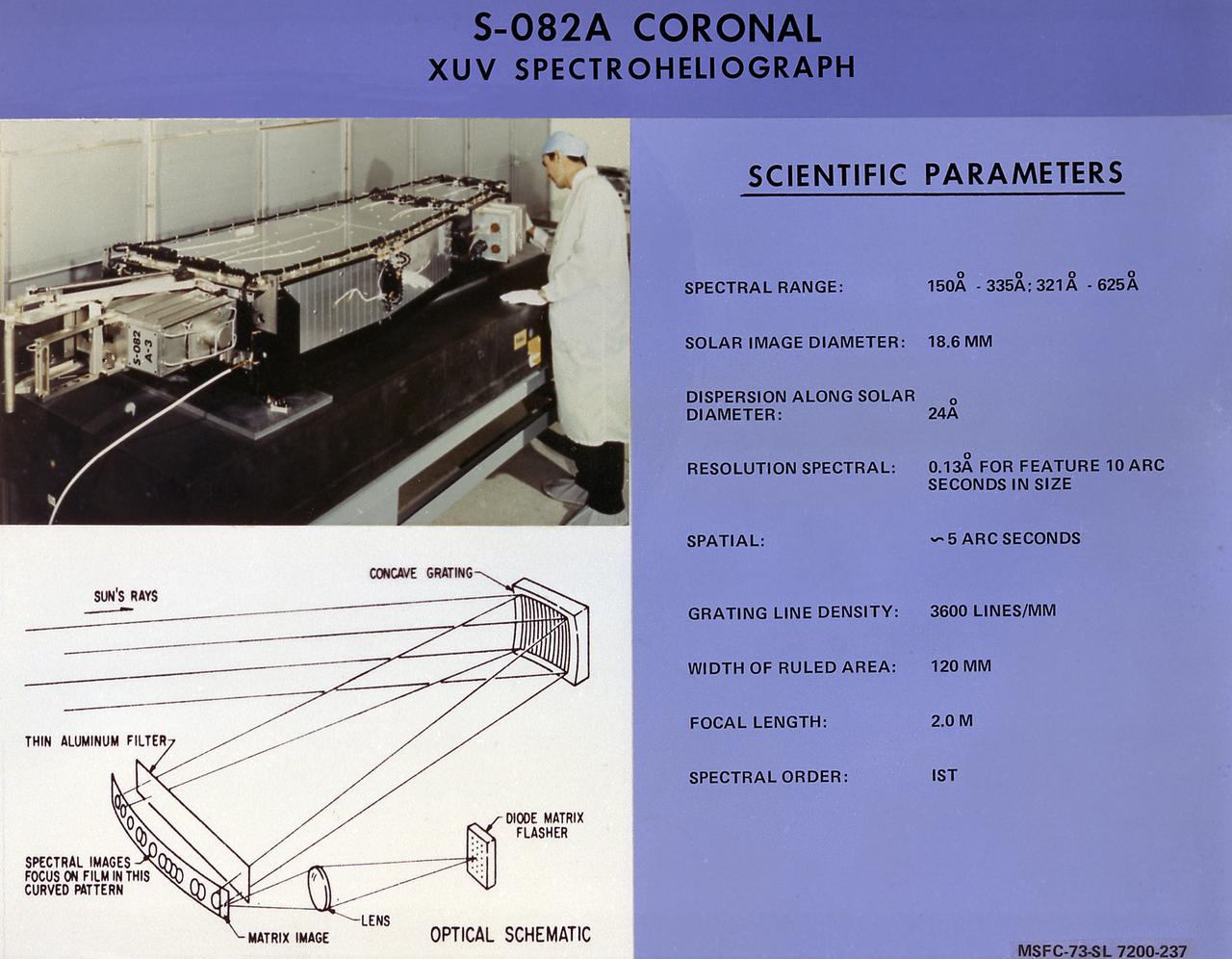
This chart describes Skylab's Extreme Ultraviolet (XUV) Coronal Spectroheliograph, one of the eight Apollo Telescope Mount facilities. It was designed to sequentially photograph the solar chromosphere and corona in selected ultraviolet wavelengths . The instrument also obtained information about composition, temperature, energy conversion and transfer, and plasma processes of the chromosphere and lower corona. The Marshall Space Flight Center had program management responsibility for the development of Skylab hardware and experiments.
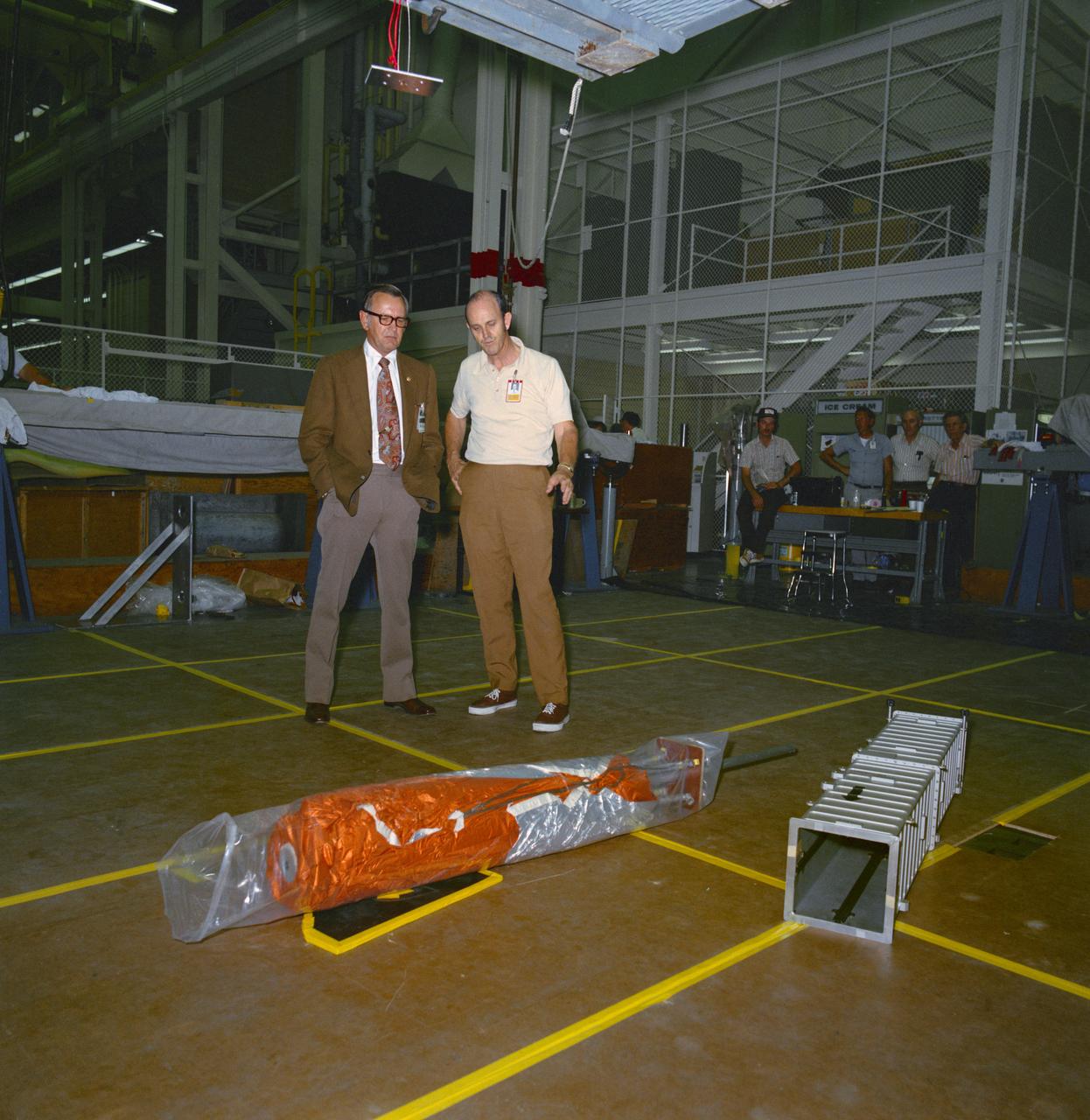
S73-26394 (23 May 1973) --- Dr. Christopher C. Kraft Jr. (left), JSC Director, and George A. Post, JSC Crew Systems Division, look over the packaged "parasol" during fabrication and checkout of the umbrella-like mechanical device in the Technical Services shop in building 10 at Johnson Space Center. The "parasol" is designed to fit into the T027 experiment photometer canister. The canopy portion of the "parasol" measures 24 feet by 22 feet. The "parasol" is one of several sunscreen possibilities being considered for use in shading the overheated Skylab 1 Orbital Workshop. Photo credit: NASA

Space Shuttle Orbitor model 140 A/B-OA87 testing in the 3.5ft Hypersonic Wind Tunnel
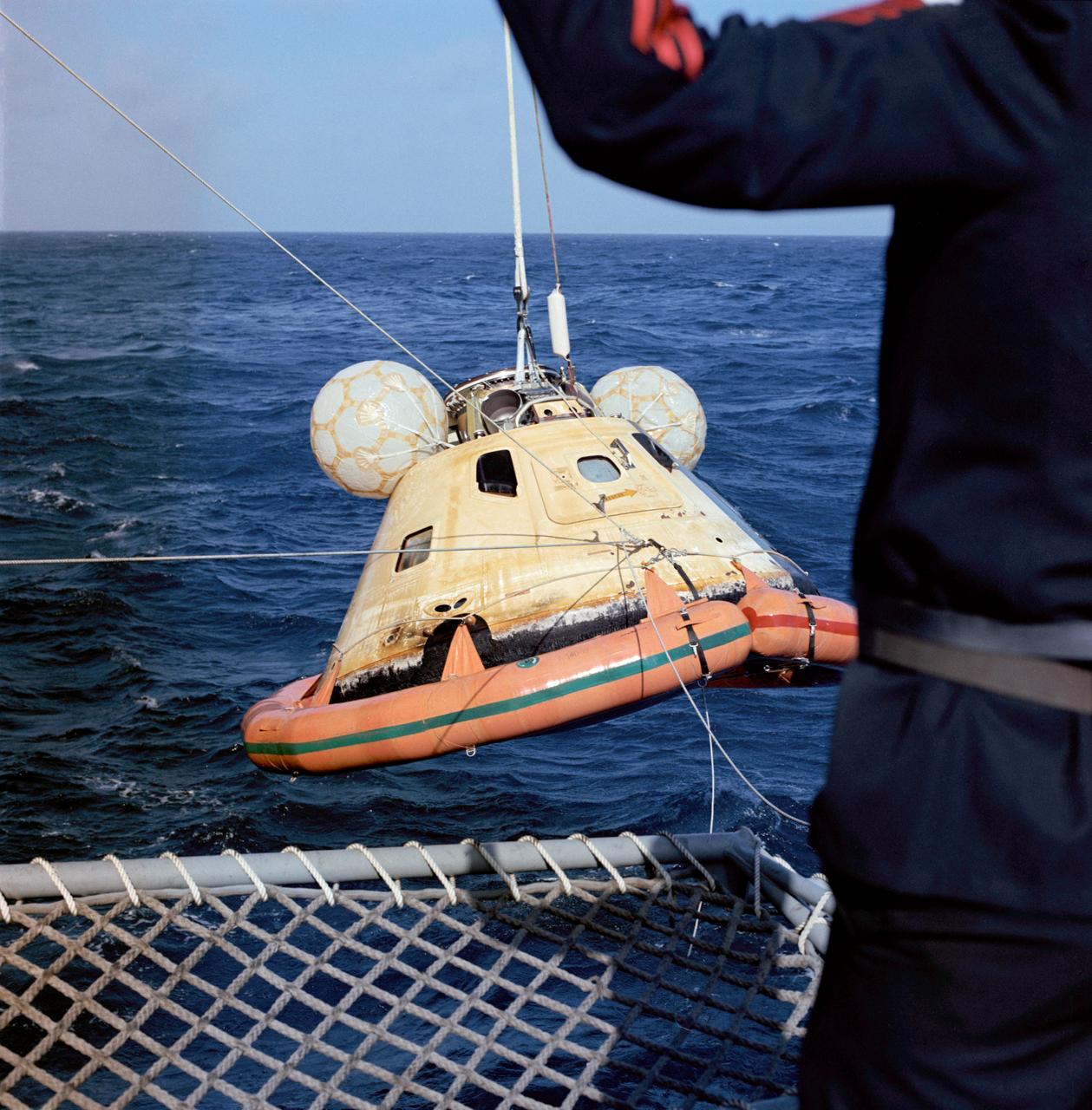
S73-36423 (25 Sept. 1973) --- The Skylab 3 Command Module, with astronauts Alan L. Bean, Owen K. Garriott and Jack R. Lousma still inside, is hoisted aboard the prime recovery ship, USS New Orleans, during recovery operations in the Pacific Ocean. The three crewmen had just completed a successful 59-day visit to the Skylab space station in Earth orbit. The Command Module splashed down in the Pacific about 230 miles southwest of San Diego, California. Earlier in the recovery operations a team of U.S. Navy swimmers attached the flotation collar to the spacecraft to improve its buoyancy. Photo credit: NASA