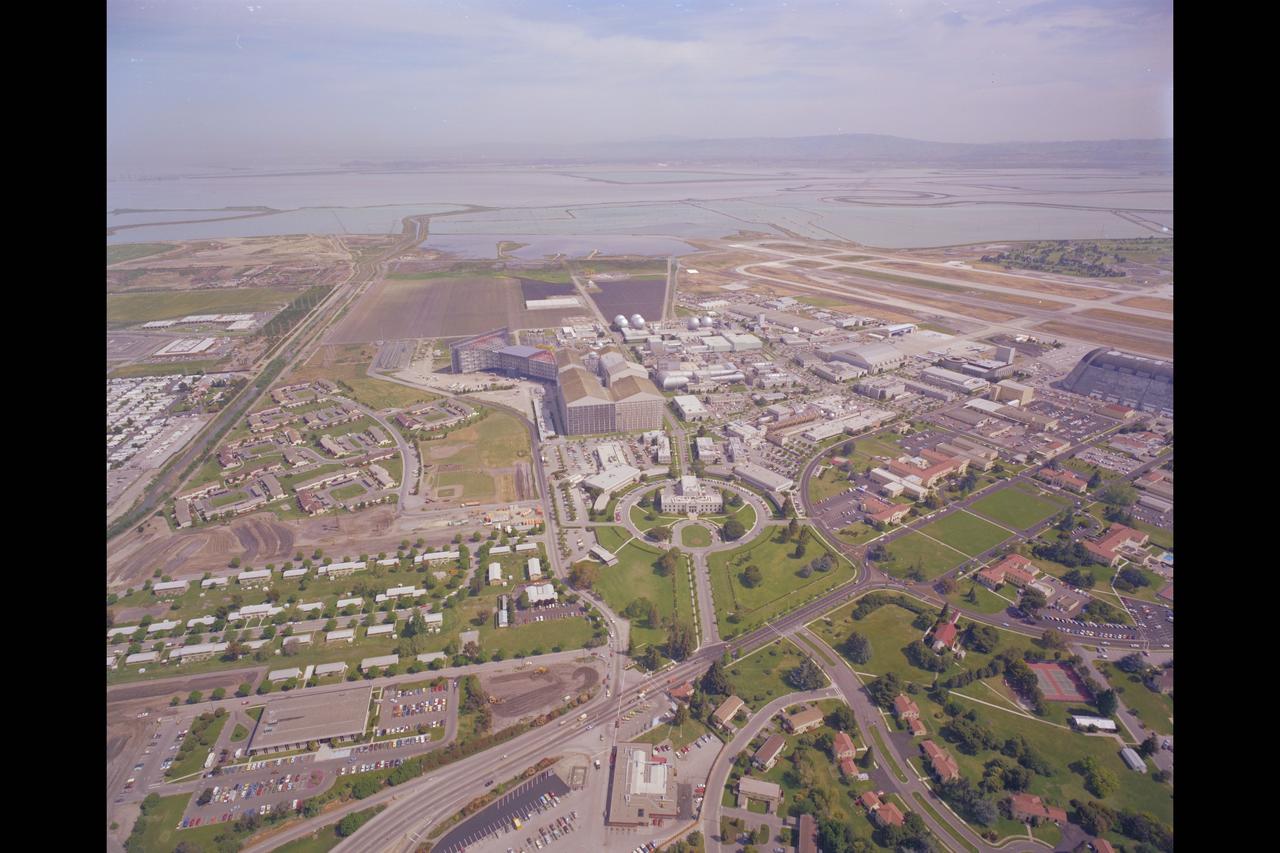
NASA Ames Research Center and Moffett Field Aerial view.
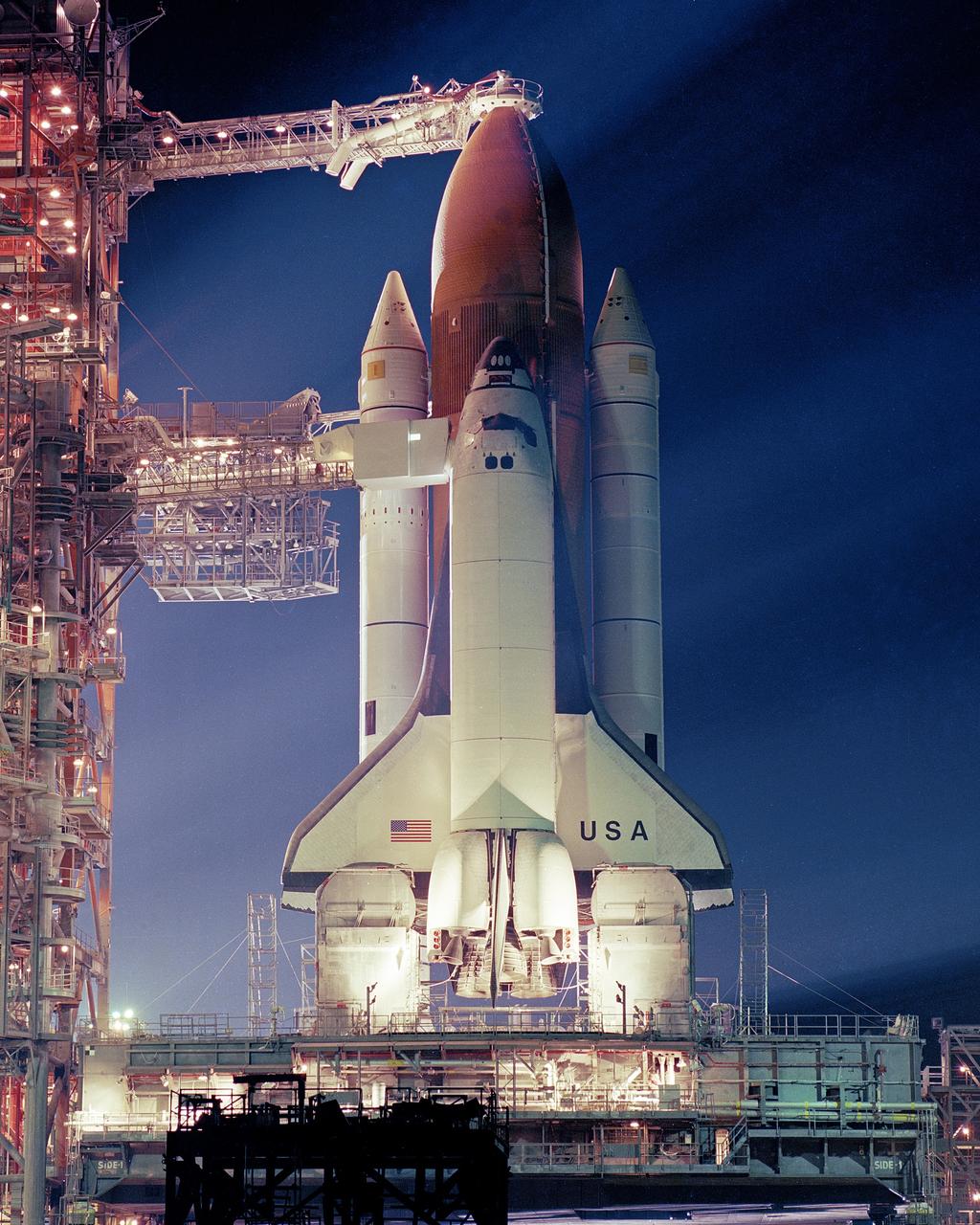
CAPE CANAVERAL, Fla. - STS-3 on Launch Pad 39A with searchlights during loading tests. Photo credit: NASA
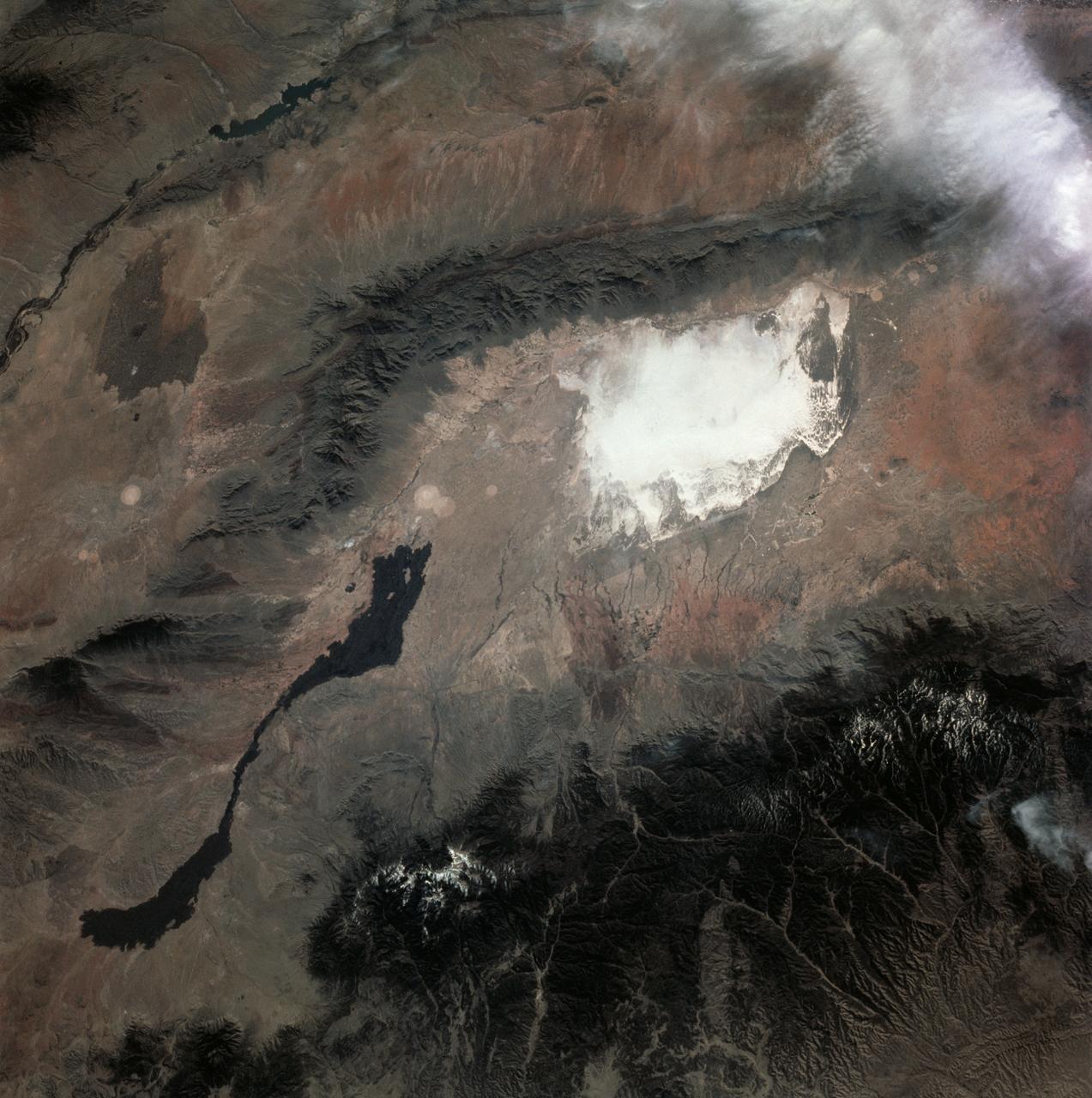
STS003-10-613 (22-30 March 1982) --- A truly remarkable view of White Sands and the nearby Carrizozo Lava Beds in southeast NM (33.5N, 106.5W). White Sands, site of the WW II atomic bomb development and testing facility and later post war nuclear weapons testing that can still be seen in the cleared circular patterns on the ground. Space shuttle Columbia (STS-3), this mission, landed at the White Sands alternate landing site because of bad weather at Edwards AFB, CA. Photo credit: NASA
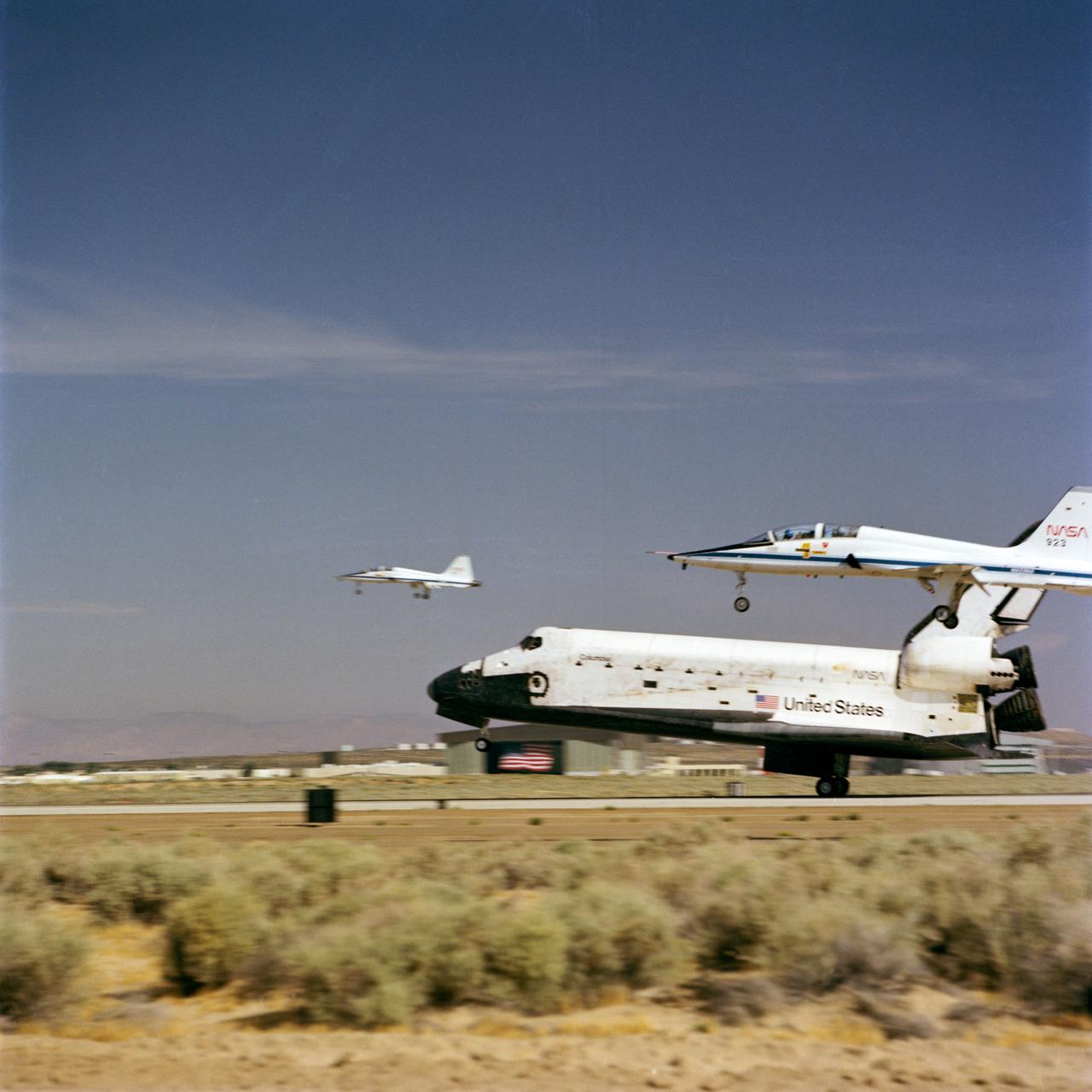
Views of the Columbia landing at EAFB ending the STS-4 Mission on 07/04/1982; of President and Mrs. Reagan greeting the crew out on the Lake bed Runway; and, the view of Roy Rogers with Astronauts Jerry Ross and Guy Gardner. 1. President Ronald Reagan & wife Nancy 2. Roy Rogers 3. Astronaut Jerry L. Ross 4. Astronaut Guy S. Gardner Edwards AFB, CA

S82-28456 (19 Feb. 1982) --- Astronauts Jack R. Lousma, left, STS-3 commander, and C. Gordon Fullerton, pilot, are briefed on emergency procedures at Launch Pad 39A by Buck Tomlinson, a safety instructor with Wackenhut Services, Inc. Also pictured is astronaut Daniel C. Brandenstein, STS-8 pilot. The men were at Kennedy Space Center (KSC) for participation in a countdown demonstration test (CDDT). Photo credit: NASA
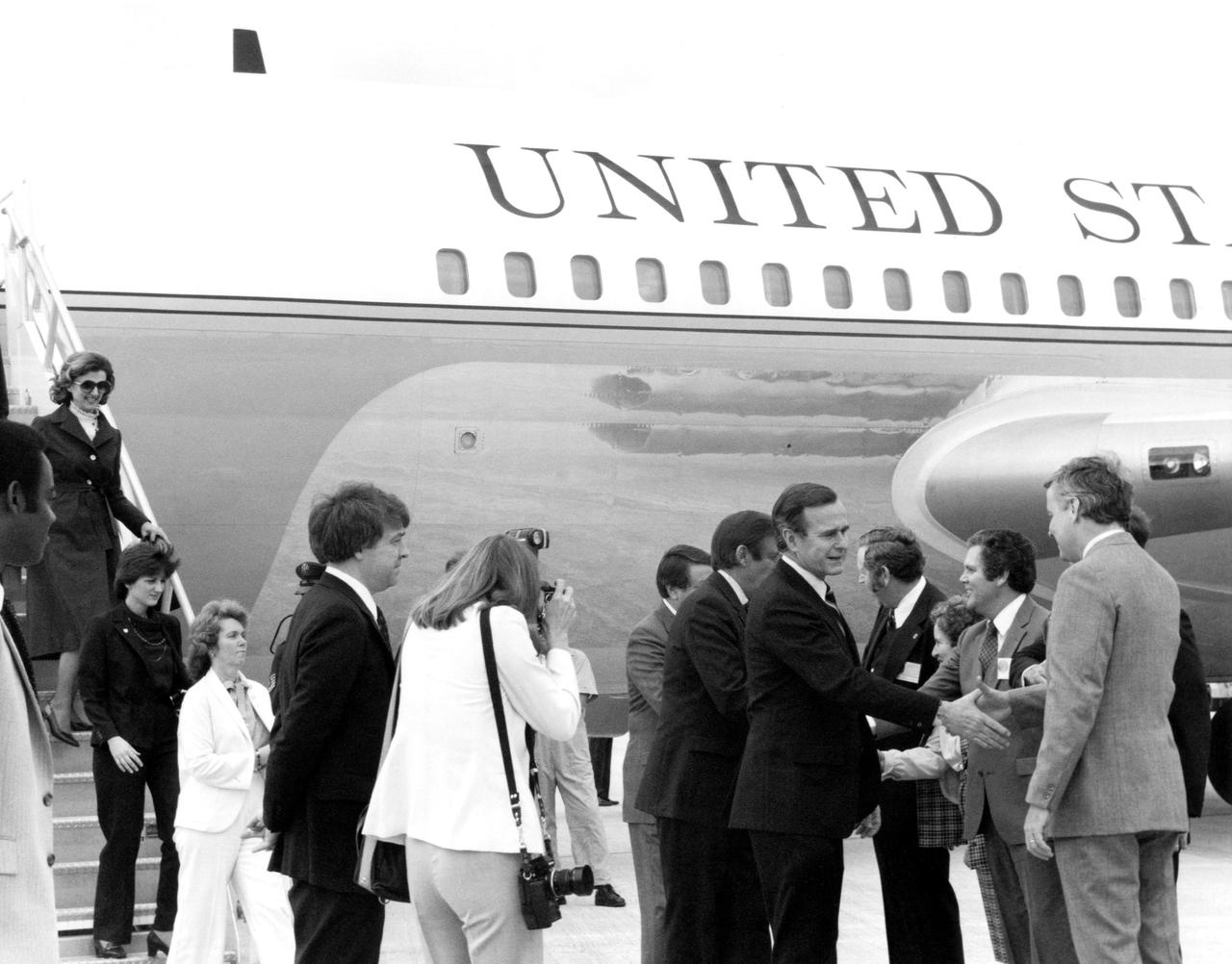
KENNEDY SPACE CENTER, FLA. -- Vice President George H.W. Bush, center left, is welcomed to KSC's Shuttle Landing facility. At the Center for the Spacelab Arrival Ceremony, the vice president is greeted by, from left, Center Director Richard G. Smith; Mrs. Smith; U.S. Rep. Ronnie Flippo, D-Ala.; an Robert Allnut, director of external affairs for NASA Headquarters. In the welcoming party but not pictured was U.S. Rep. Bill Nelson, D-Fla.
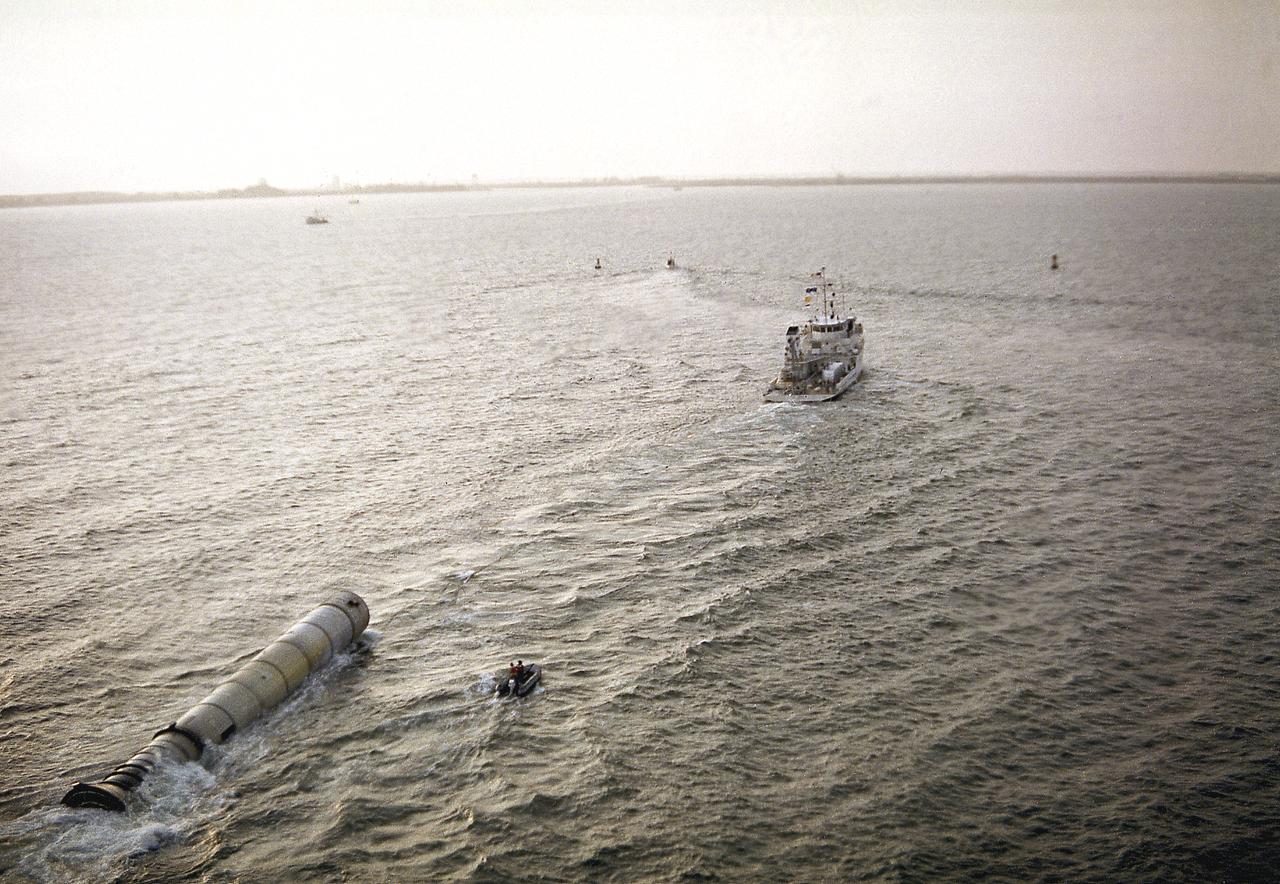
The towing ship, Liberty, towed a recovered solid rocket booster (SRB) for the STS-3 mission to Port Canaveral, Florida. The recovered SRB would be inspected and refurbished for reuse. The Shuttle's SRB's and solid rocket motors (SRM's) are the largest ever built and the first designed for refurbishment and reuse. Standing nearly 150-feet high, the twin boosters provide the majority of thrust for the first two minutes of flight, about 5.8 million pounds. The requirement for reusability dictated durable materials and construction to preclude corrosion of the hardware exposed to the harsh seawater environment. The SRB contains a complete recovery subsystem that includes parachutes, beacons, lights, and tow fixture.
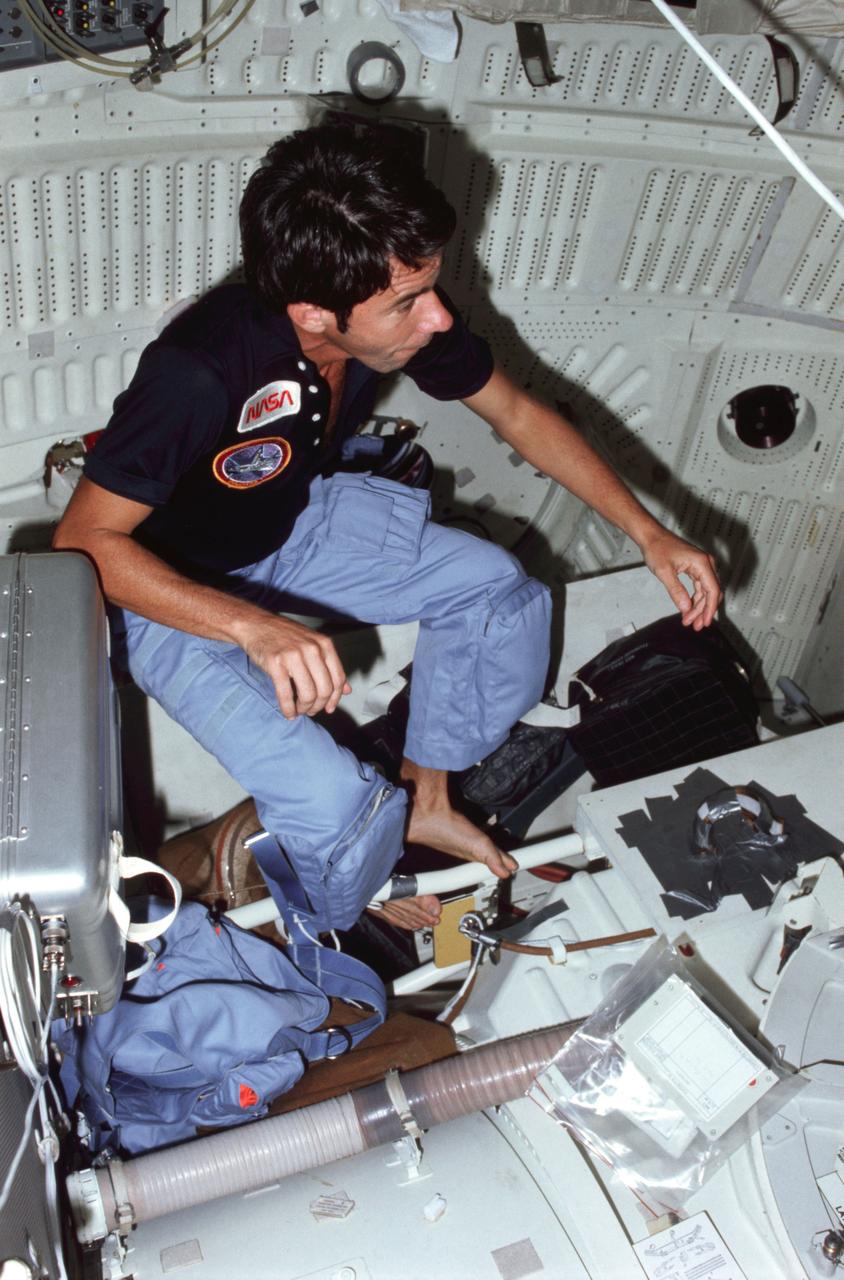
STS005-15-591 (11-16 Nov. 1982) --- Astronaut William B. Lenoir, STS-5 mission specialist, observes middeck activities from access ladder. Carry-on food warmer appears in foreground and the wet trash stowage container and side hatch in the background. Photo credit: NASA
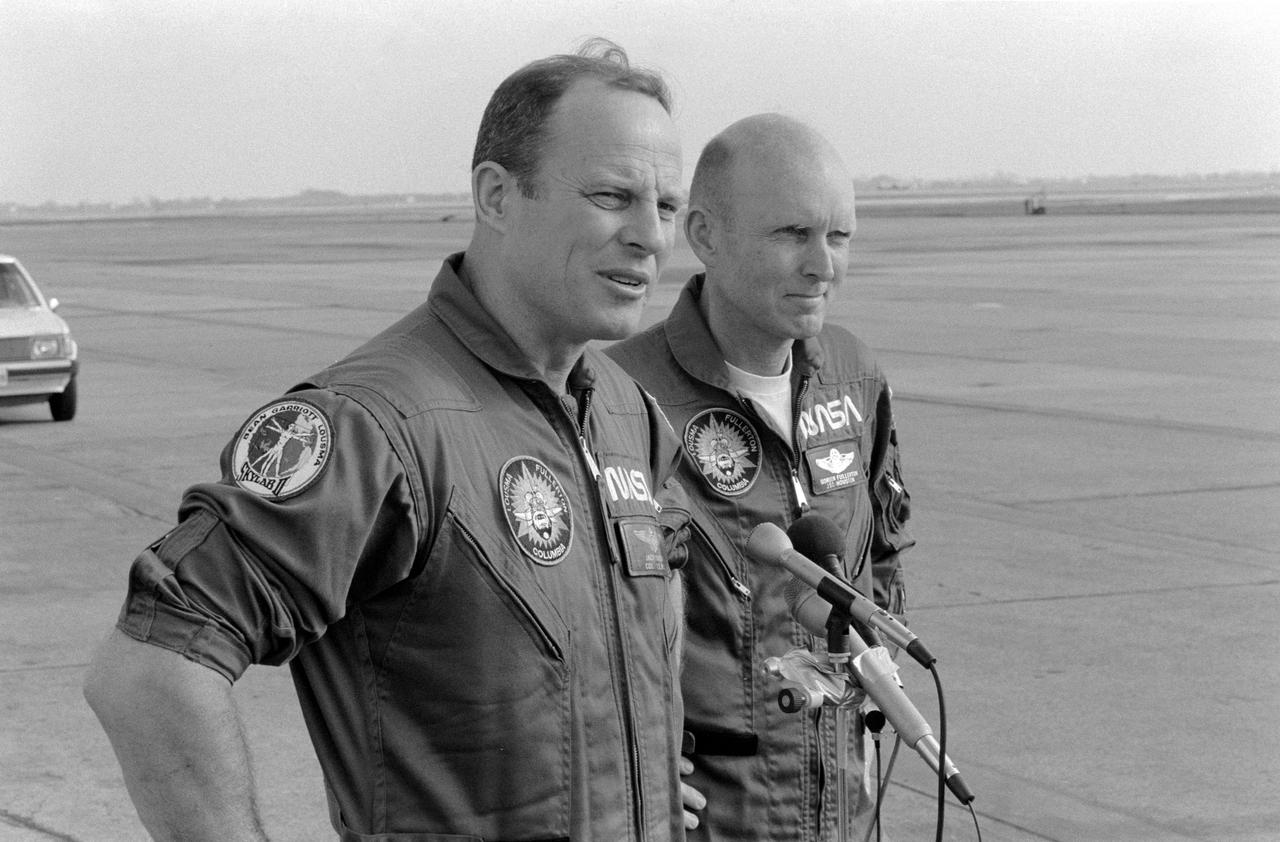
S82-28705 (20 March 1982) --- Astronaut Jack R. Lousma, left, and C. Gordon Fullerton pause for a moment at Ellington Air Force Base prior to their departure in T-38 aircraft to get to NASA?s Kennedy Space Center in time for last minute preparations for their Monday morning launch in the STS-3 space shuttle Columbia. Ellington Air Force Base is just a few miles north of the LBJ Space Center. Photo credit: NASA
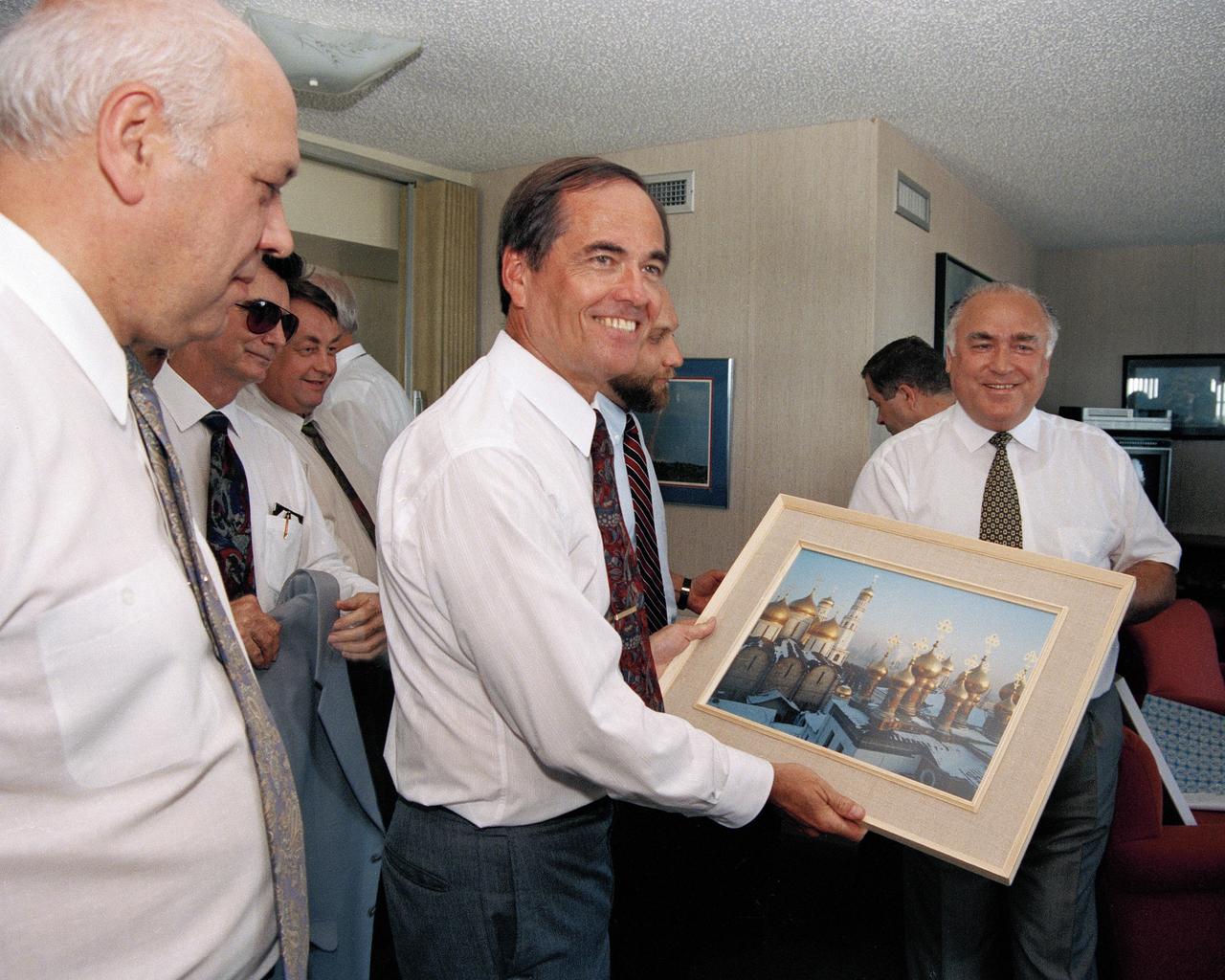
CAPE CANAVERAL, Fla. -- At the Kennedy Space Center in Florida, Russian Prime Minister Viktor Chernomyrdin, right, presents a framed photograph of the Kremlin to center director Robert Crippen during a visit to the space center. Space, energy and the environment are the three major focuses of the Russian's U.S. visit, which also included a stop at the agency's Johnson Space Center. Photo Credit: NASA
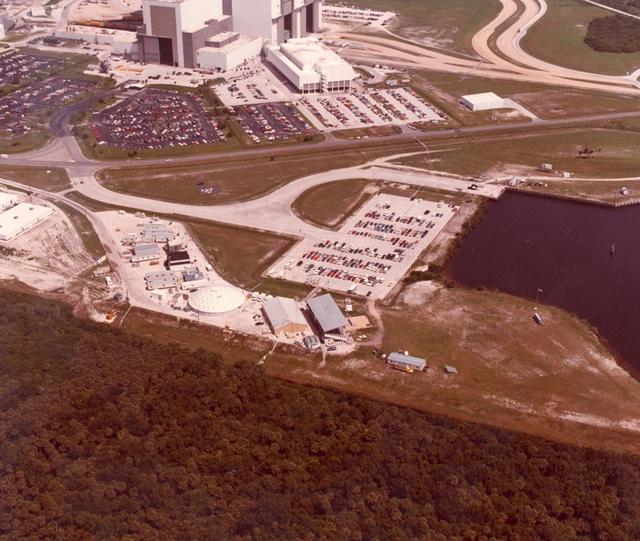
Aerial view of Press Site, June 24, 1982
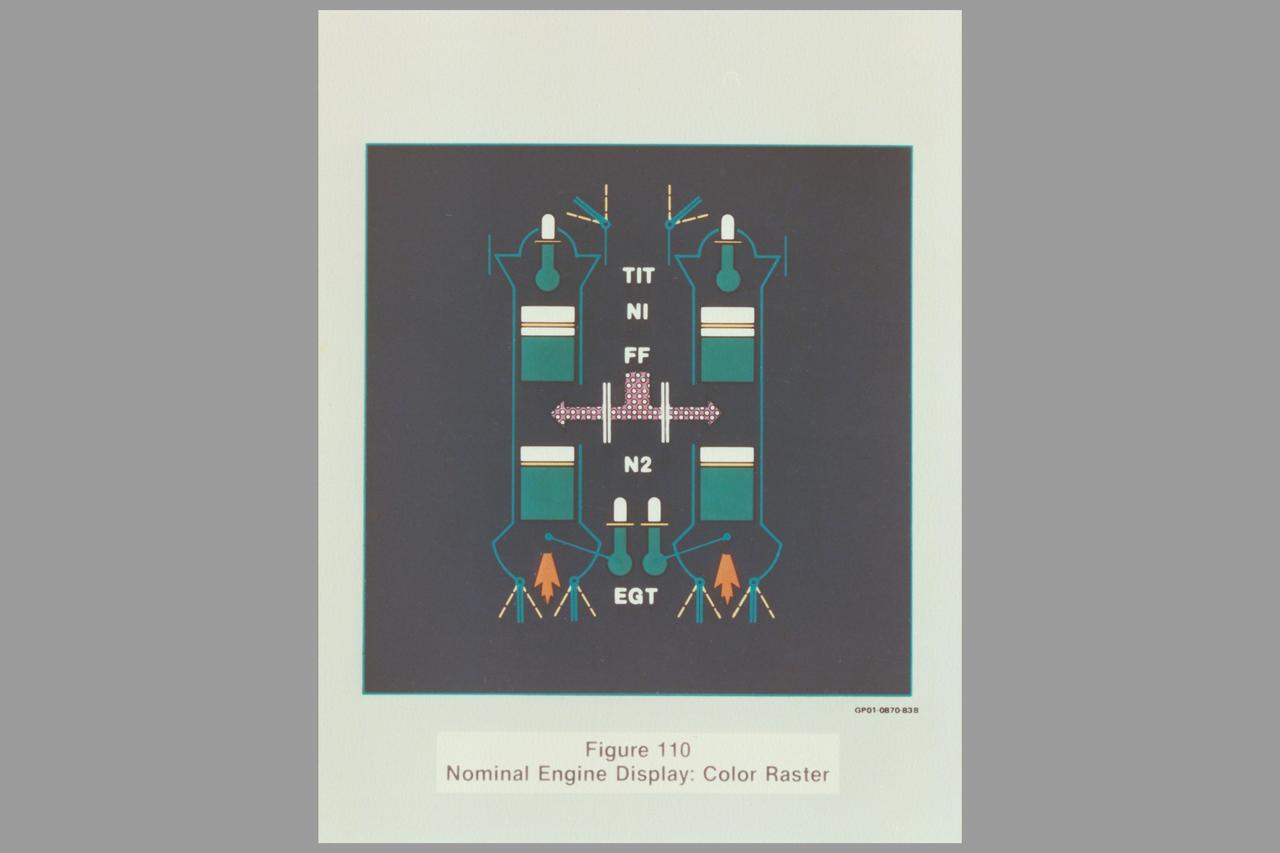
Date: Feb 1982 Photographer: Historical Air Force nominal engine display (AFWAL TR-81-3156, Fig 110
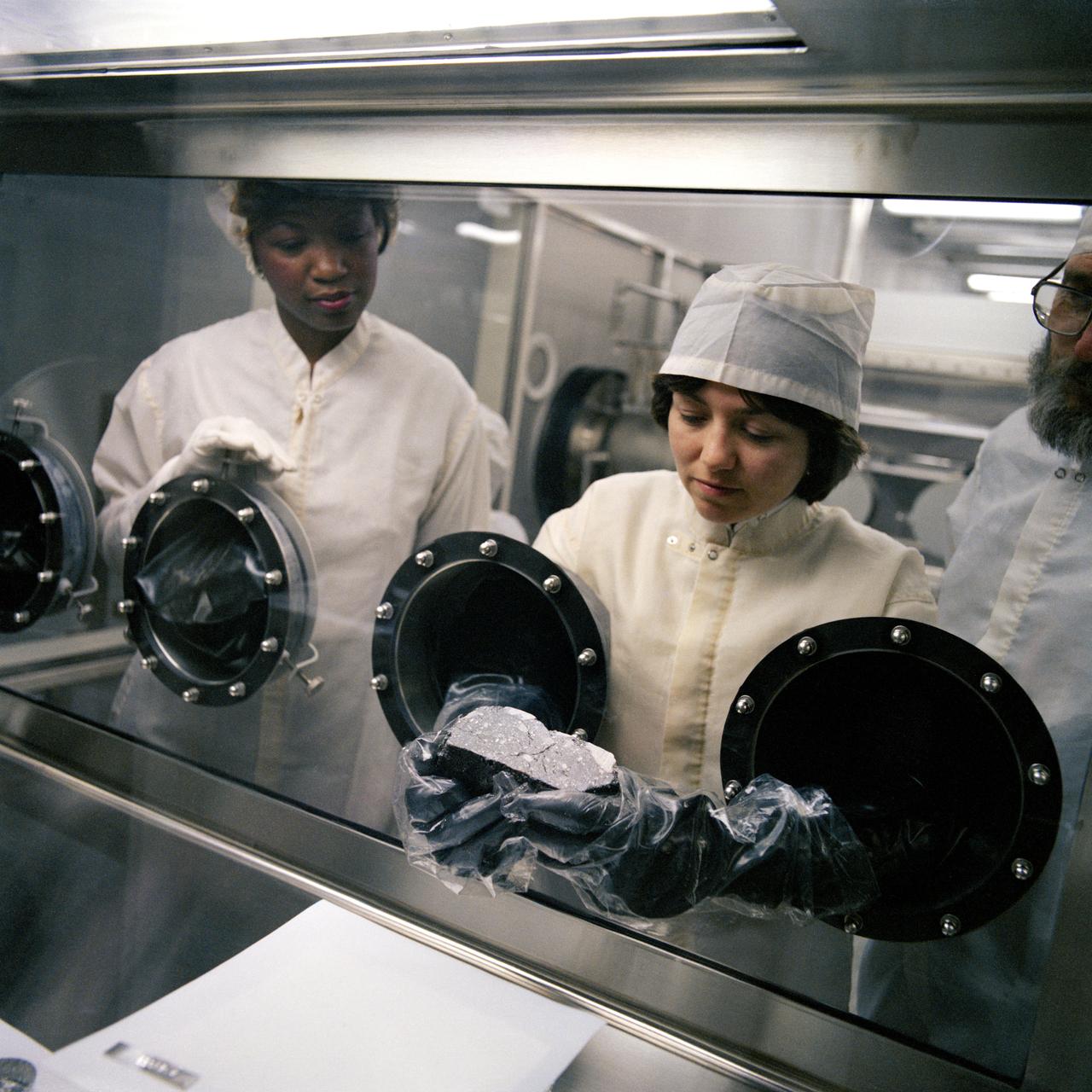
S82-26777 --- Technicians examine lunar samples in a glovebox at NASA's Johnson Space Center in Houston.
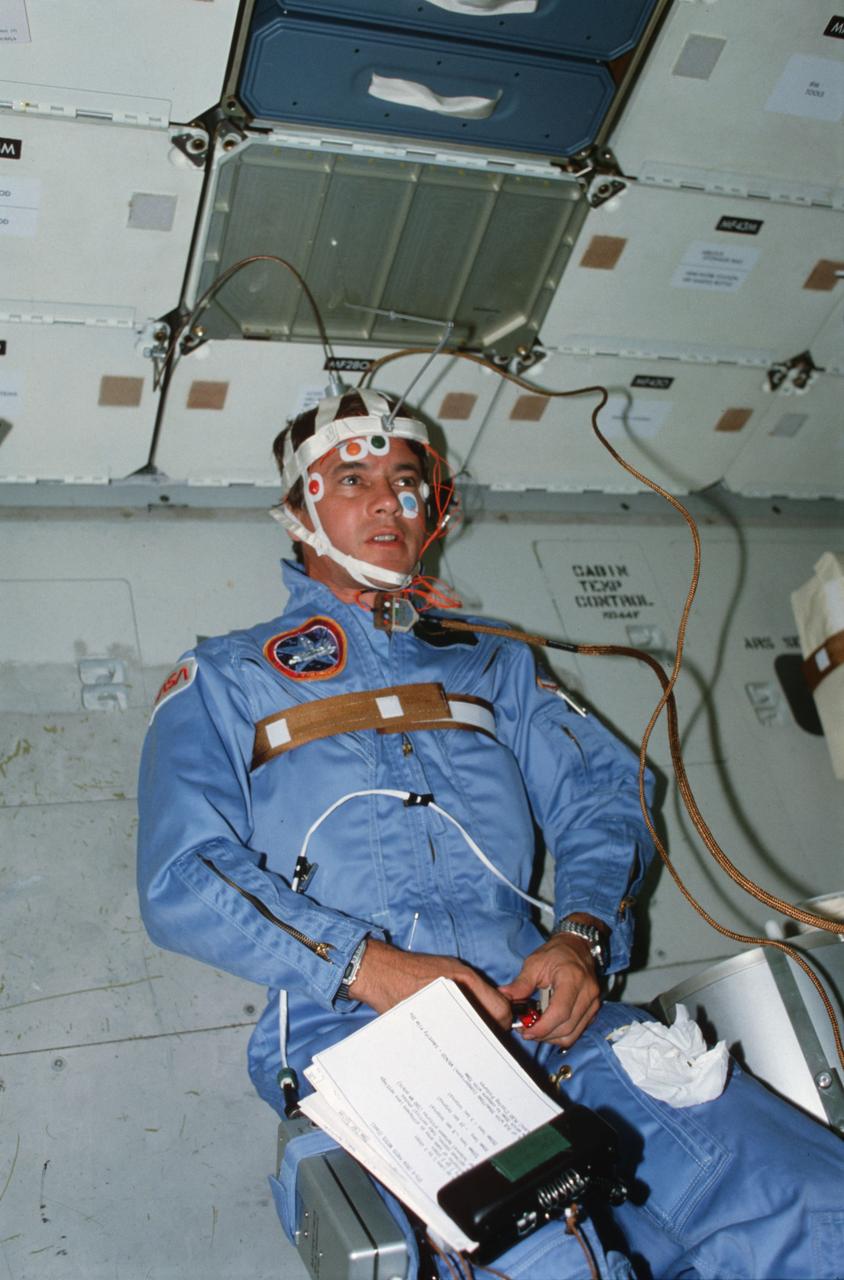
STS005-04-141 (14 Nov. 1982) --- Astronaut Joseph P. Allen IV, one of two mission specialist astronauts for STS-5, participates in a biomedical test in the middeck area of the Earth-orbiting space shuttle Columbia. A series of electrodes have been connected to his face for monitoring of his responses in zero-gravity. He was assisted in the test by astronaut William B. Lenoir, the flight’s other mission specialist. Dr. Allen is wearing the multi-pieced constant wear garment for space shuttle astronauts. This frame was exposed with a 35mm camera. Photo credit: NASA
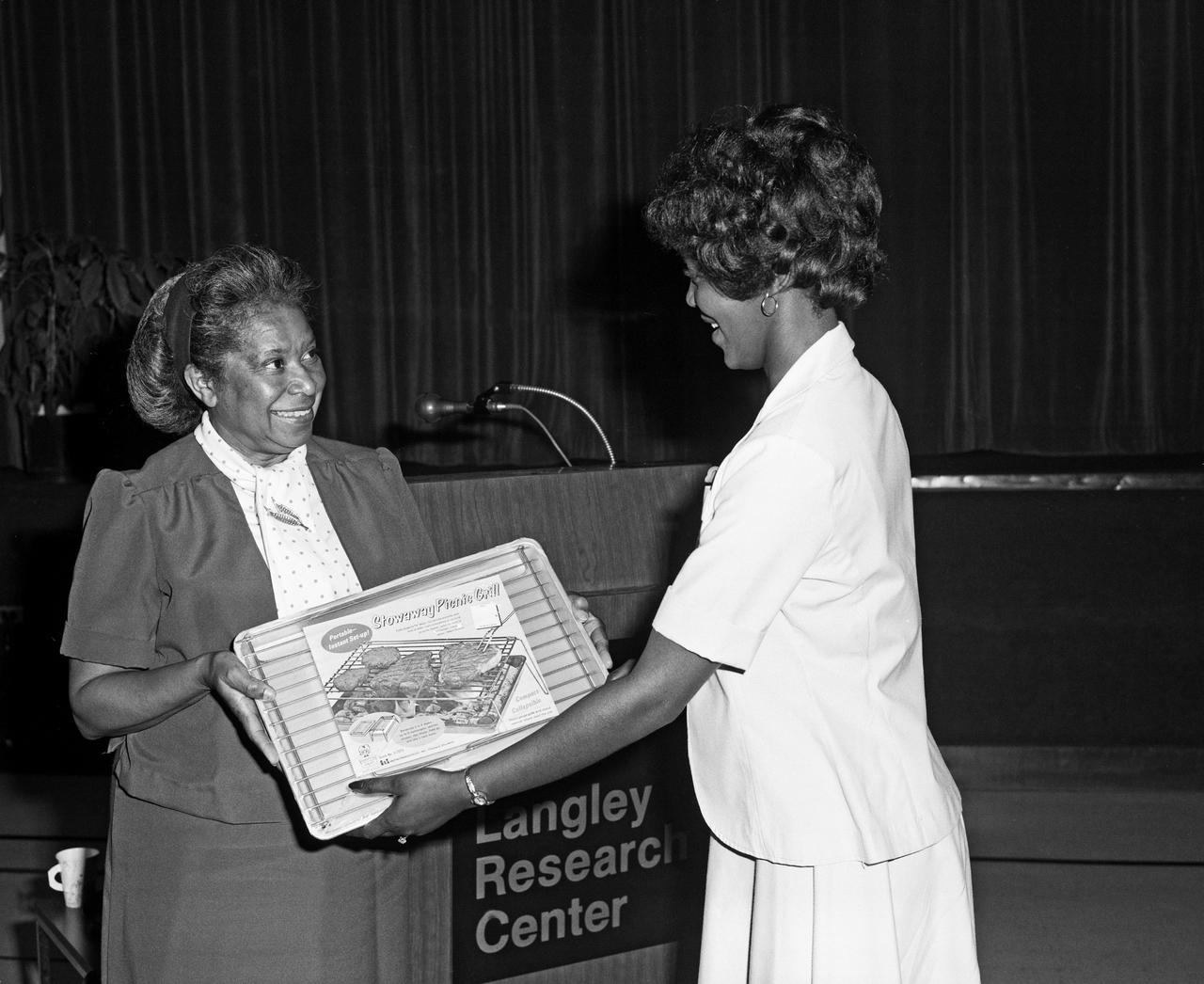
Federal Women's Program with Mary Jackson giving out awards. In 1958 Mary Jackson became NASA's first black female engineer.
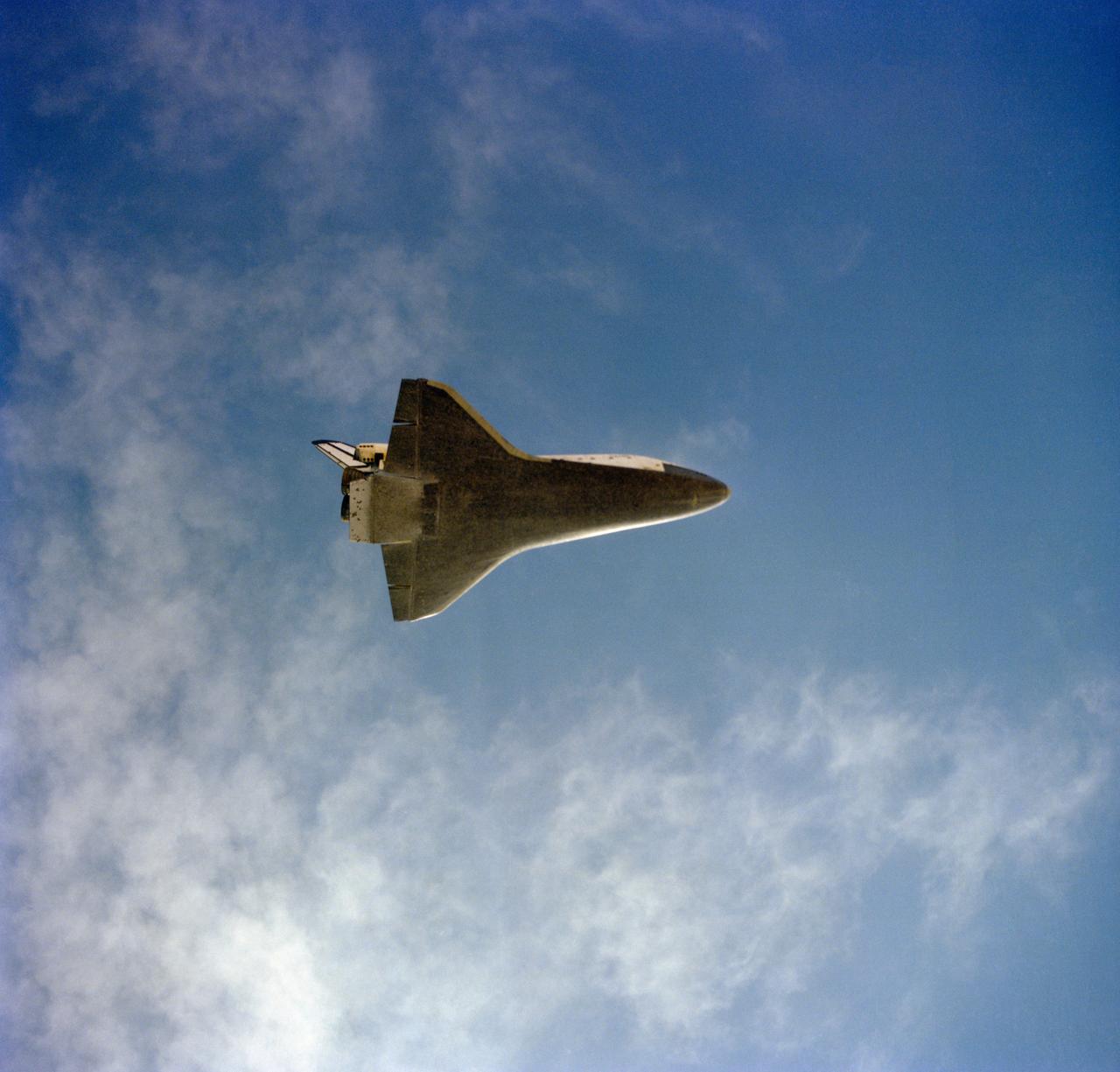
S82-28835 (30 March 1982) --- This unique view of the underside of the space shuttle orbiter Columbia was taken with a handheld camera aboard a T-38 chase plane over the White Sands Missile Range in New Mexico. Bad weather here yesterday vanished and the STS-3 crew of astronaut Jack R. Lousma and C. Gordon Fullerton greeted a pleasant climate along with a large crowd of spectators upon their landing. The successful landing was the first attempted in the actual orbiter on New Mexico soil. Photo credit: NASA

This artist's concept depicts the High Energy Astronomy Observatory (HEAO)-2 in orbit. The HEAO-2, the first imaging and largest x-ray telescope built to date, was capable of producing actual photographs of x-ray objects. Shortly after launch, the HEAO-2 was nicknamed the Einstein Observatory by its scientific experimenters in honor of the centernial of the birth of Albert Einstein, whose concepts of relativity and gravitation have influenced much of modern astrophysics, particularly x-ray astronomy. The HEAO-2, designed and developed by TRW, Inc. under the project management of the Marshall Space Flight Center, was launched aboard an Atlas/Centaur launch vehicle on November 13, 1978. The HEAO-2 was originally identified as HEAO-B but the designation was changed once the spacecraft achieved orbit.
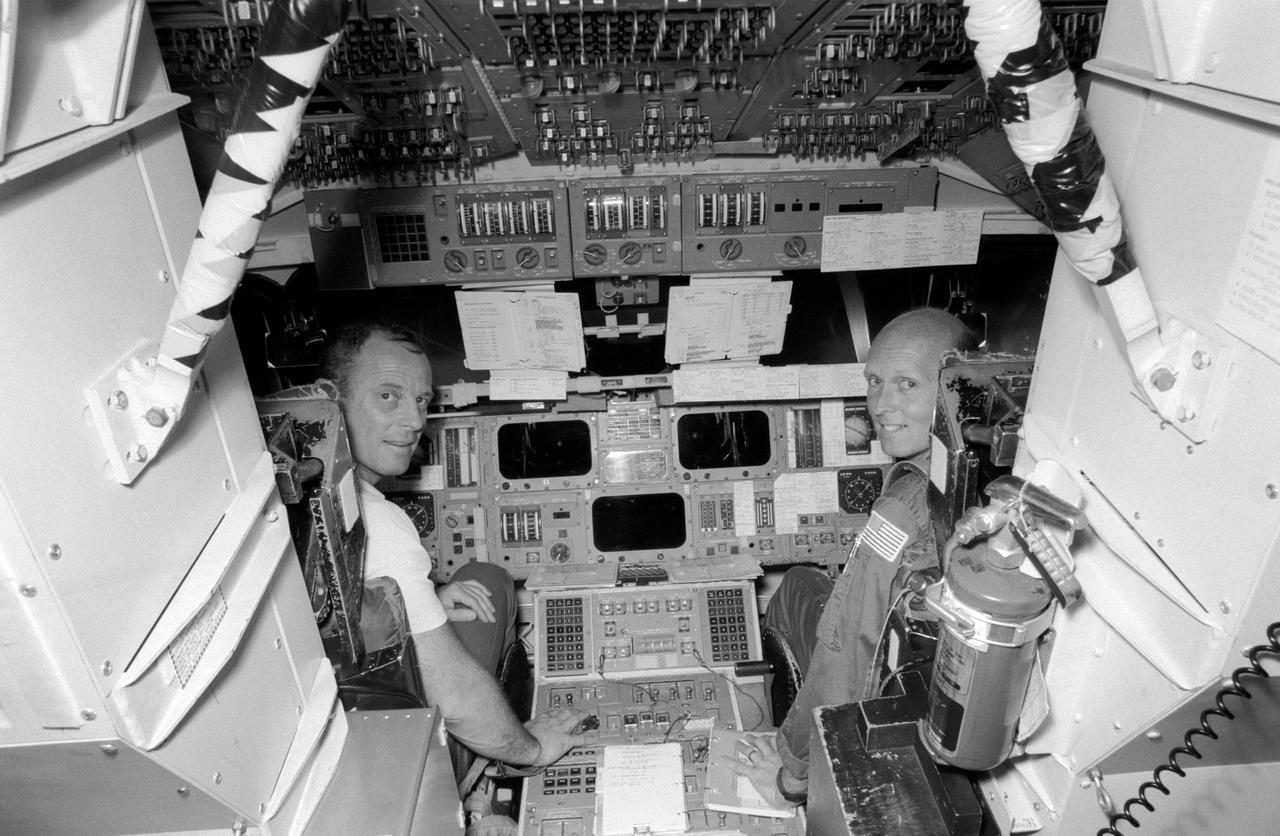
S82-28534 (16 March 1982) --- Astronauts Jack R. Lousma, left, and C. Gordon Fullerton are at the commander and pilot?s station, respectively, in the shuttle mission simulator at the LBJ Space Centers mission simulation and training facility. They have less than a week of training left in preparation for NASA?s third space transportation system (STS-3) flight. Scheduled to launch on March 22, STS-3 in expected to give space shuttle Columbia its longest stay (seven days) thus far. Photo credit: NASA
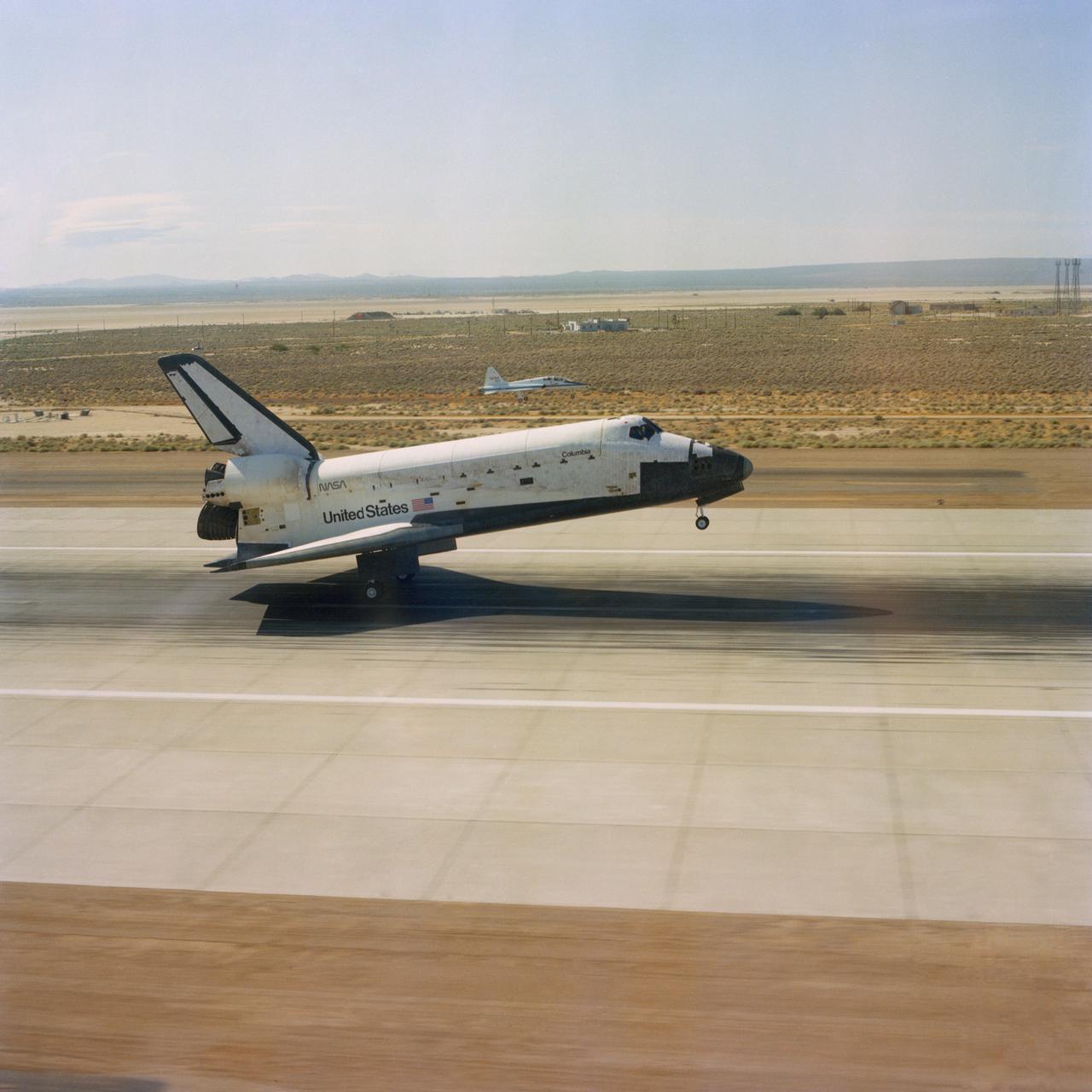
S82-33420 (4 July 1982) --- The aft wheels of the space shuttle Columbia ease down on the runway at Edwards Air Force Base (AFB) today to successfully complete a week-long spaceflight for astronauts Thomas K. Mattingly II, and Henry W. Hartsfield Jr. A T-38 aircraft serves as a chase plane (just above center of photo) in the background. Not long after this photograph was made and the crew had egressed their craft, President Ronald Reagan addressed a giant crowd on hand at Edwards AFB for a special kind of July 4 celebration. Photo credit: NASA
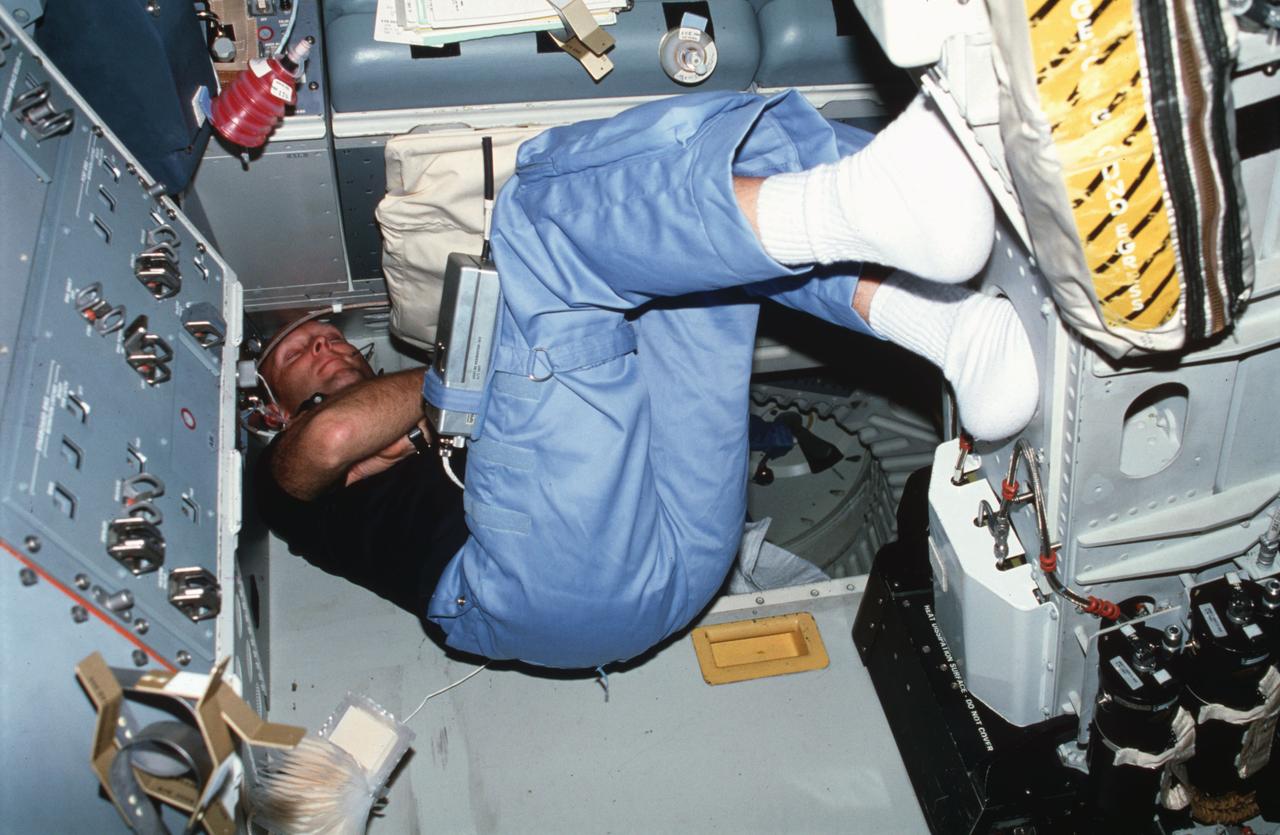
STS003-22-113 (24 March 1982) --- Astronaut Gordon Fullerton, STS-3 pilot, wearing communication kit assembly mini-headset (HDST), sleeps on aft flight deck resting his back against the floor and his feet against commander's ejection seat (S1) back. On-orbit station control panel A8 and payload station panel L15 appear above Fullerton. Special clips for holding notebooks open and beverage containers are velcroed on various panels. Photo credit: NASA
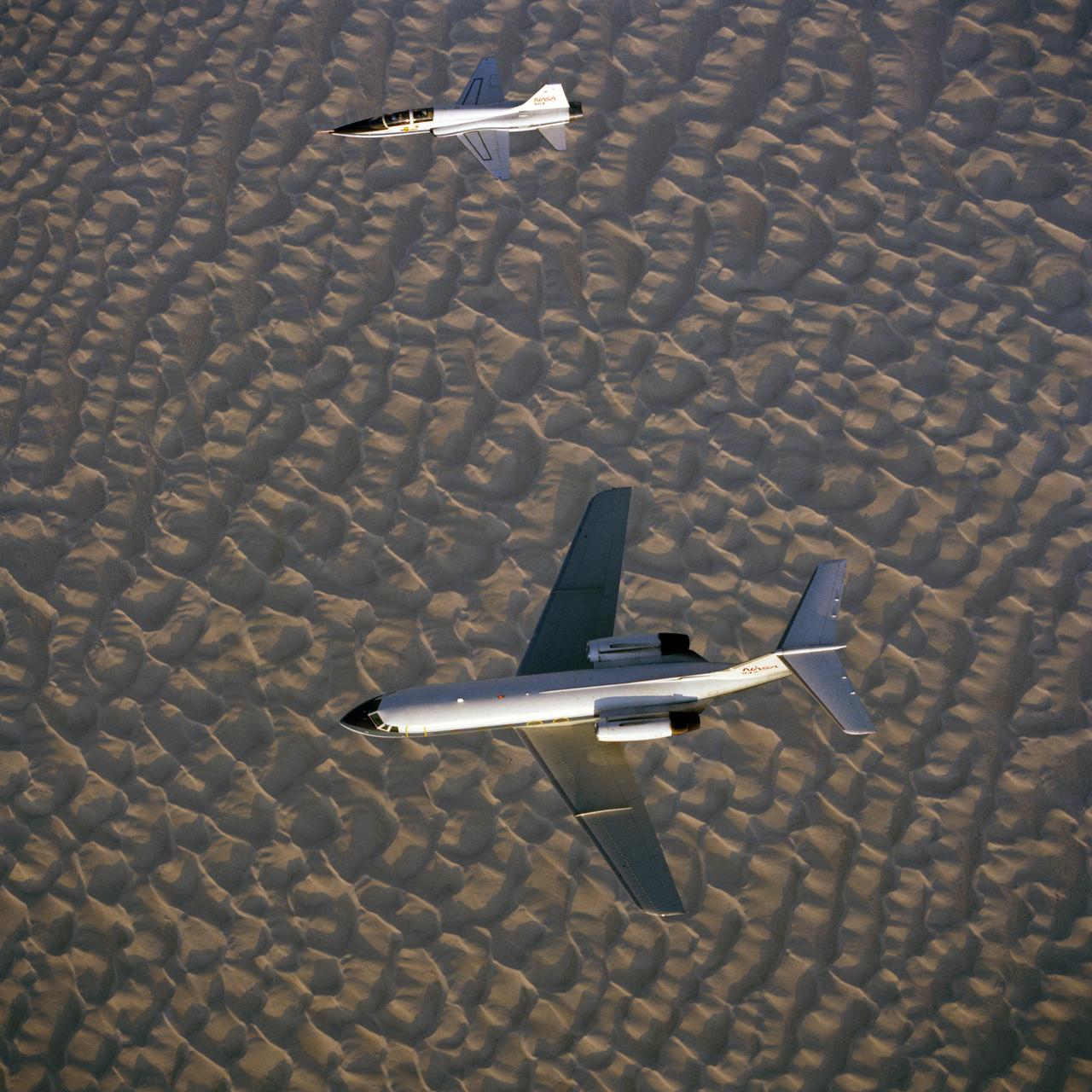
S82-32204 (October 1982) --- NASA 947 and NASA 904, two aircraft stationed at Ellington Air Base for the Johnson Space Center (JSC), are captured during a training and familiarization flight over White Sands, New Mexico. The Gulfstream aircraft (bottom) is NASA?s Space Shuttle Training Aircraft (STA) and the T-38 jet serves as a chase plane. Photo credit: NASA
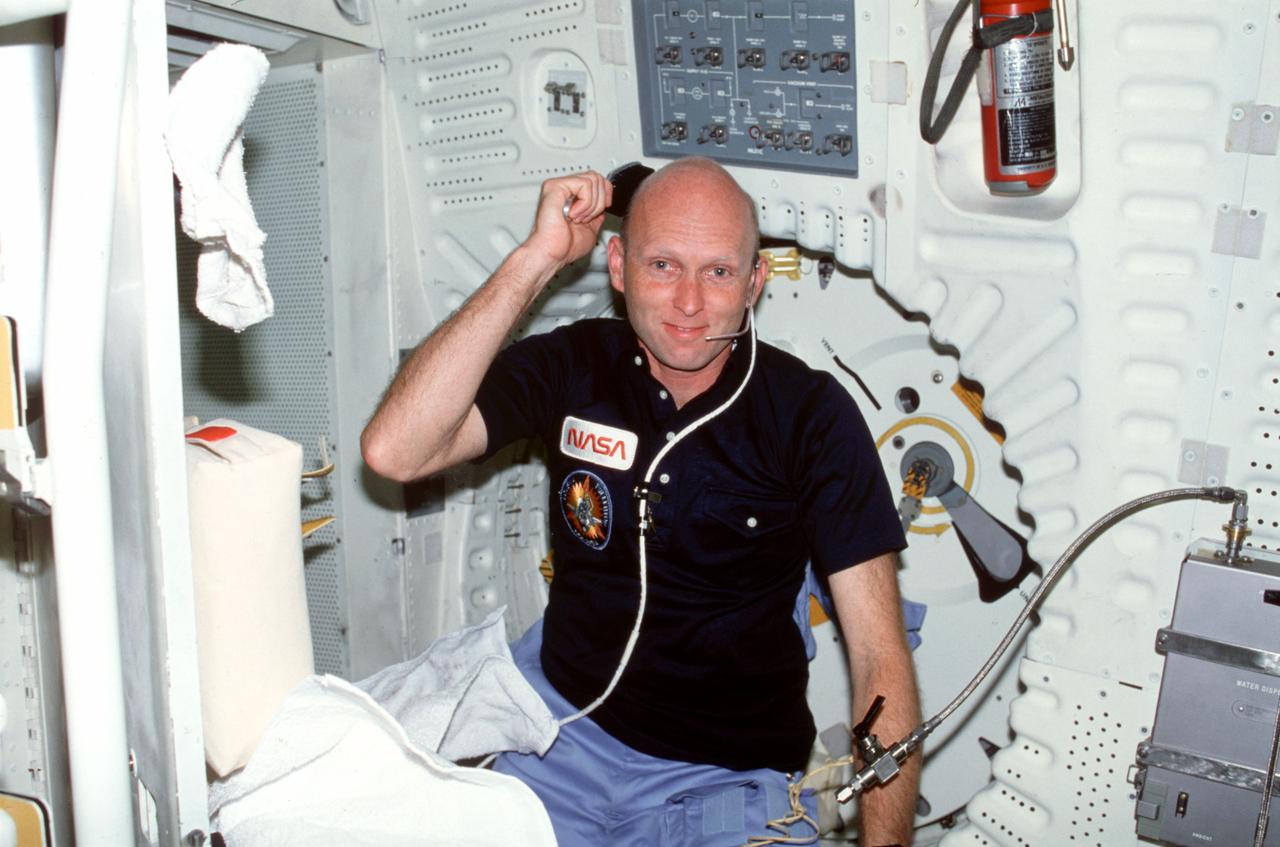
STS003-22-119 (30 March 1982) --- Astronaut Gordon Fullerton, STS-3 pilot, wearing communications kit assembly (ASSY) mini-headset (HDST), uses hygiene kit hair brush on aft middeck. He makes light of his lack of hair during a freshening up session. He makes a token effort with a hair brush. Side hatch and panel ML31C appear behind him. Photo credit: NASA
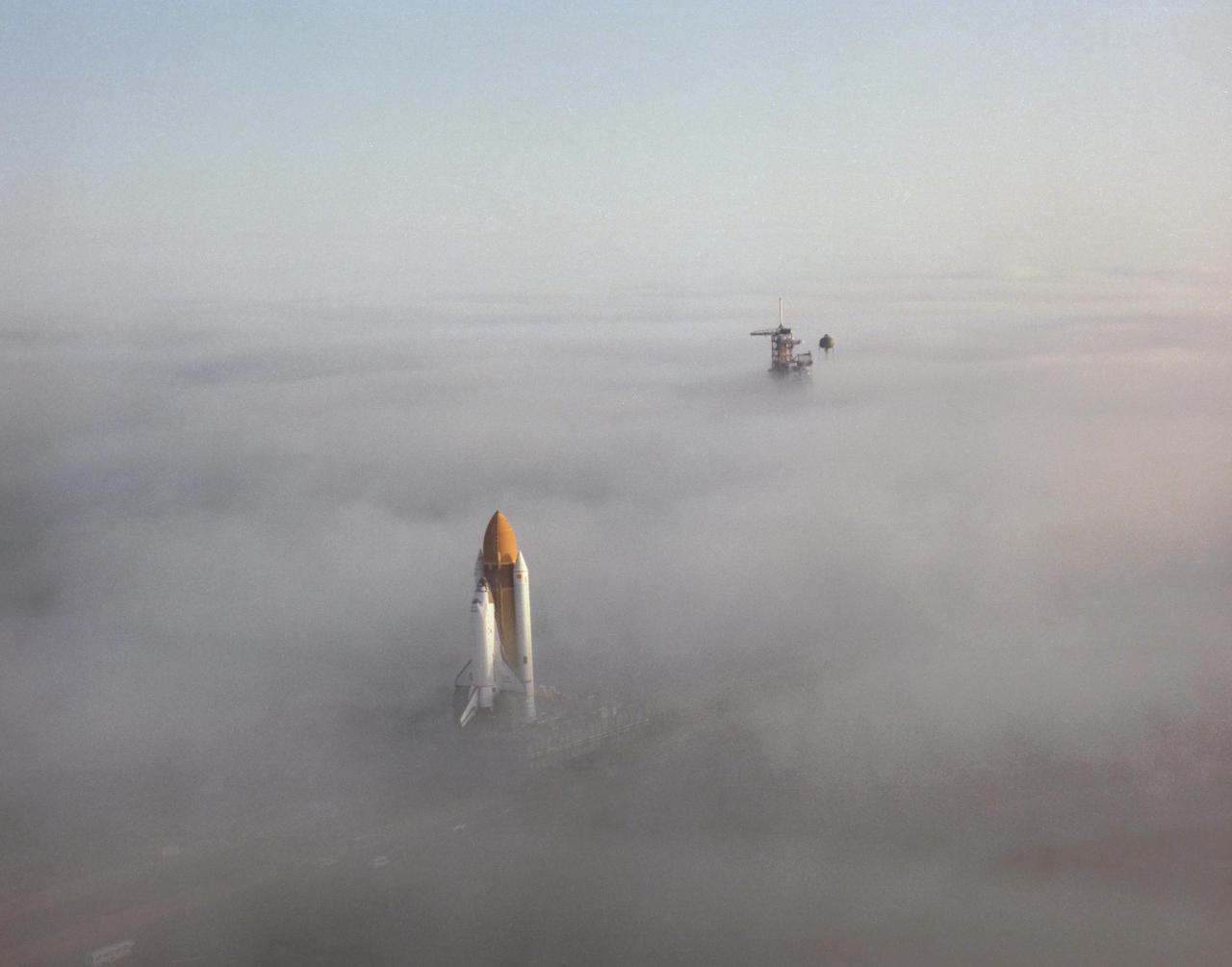
KENNEDY SPACE CENTER, FLA. - The Space Shuttle Challenger presents a surrealistic impression as it moves through the fog on its way down the 3 ½-mile crawlerway enroute to Launch Pad 39A. The fully assembled Shuttle, weighing 12,000 pounds less than its predecessor Columbia, completed the trip from the Vehicle Assembly Building in shortly over 6 hours. The sixth Shuttle flight, which will be the first for the Challenger, is scheduled for no earlier than January 24, 1983.

Bell-47 Helicopter #822 on ramp
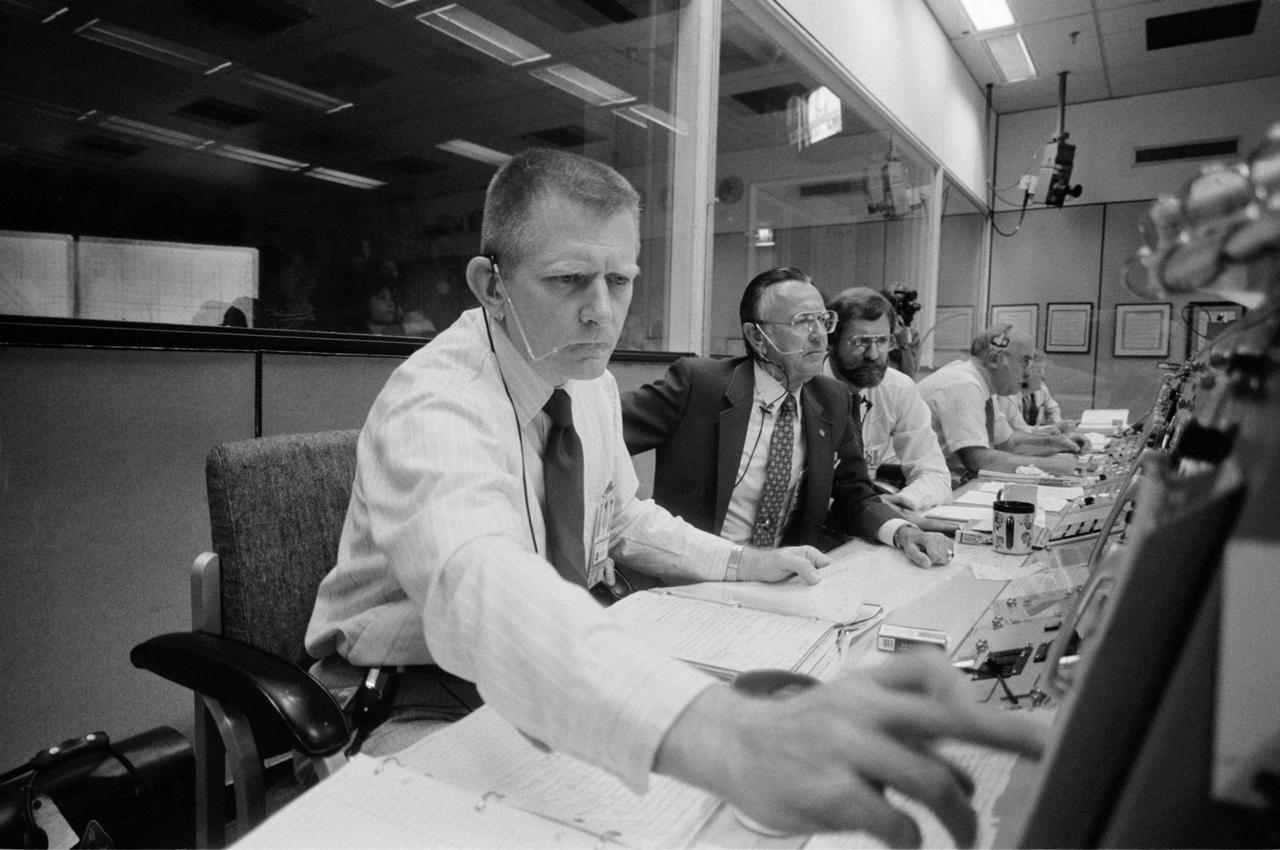
Wide angle view of flight controllers at work in the JSC mission control center during STS-4. Eugene F. Kranz, Deputy Director of Flight Operations at JSC, punches a key on his console in the MOCR during ascent phase of STS-4. Watching other monitors are JSC Director Christopher C. Kraft, Jr. and Neil B. Hutchinson. Beyond the FOD console in the foreground is the public affairs office (PAO) area, where John E. McLeaish, chief of public information, calls out ascent information on Columbia.

Lear Jet (NASA-705) in flight
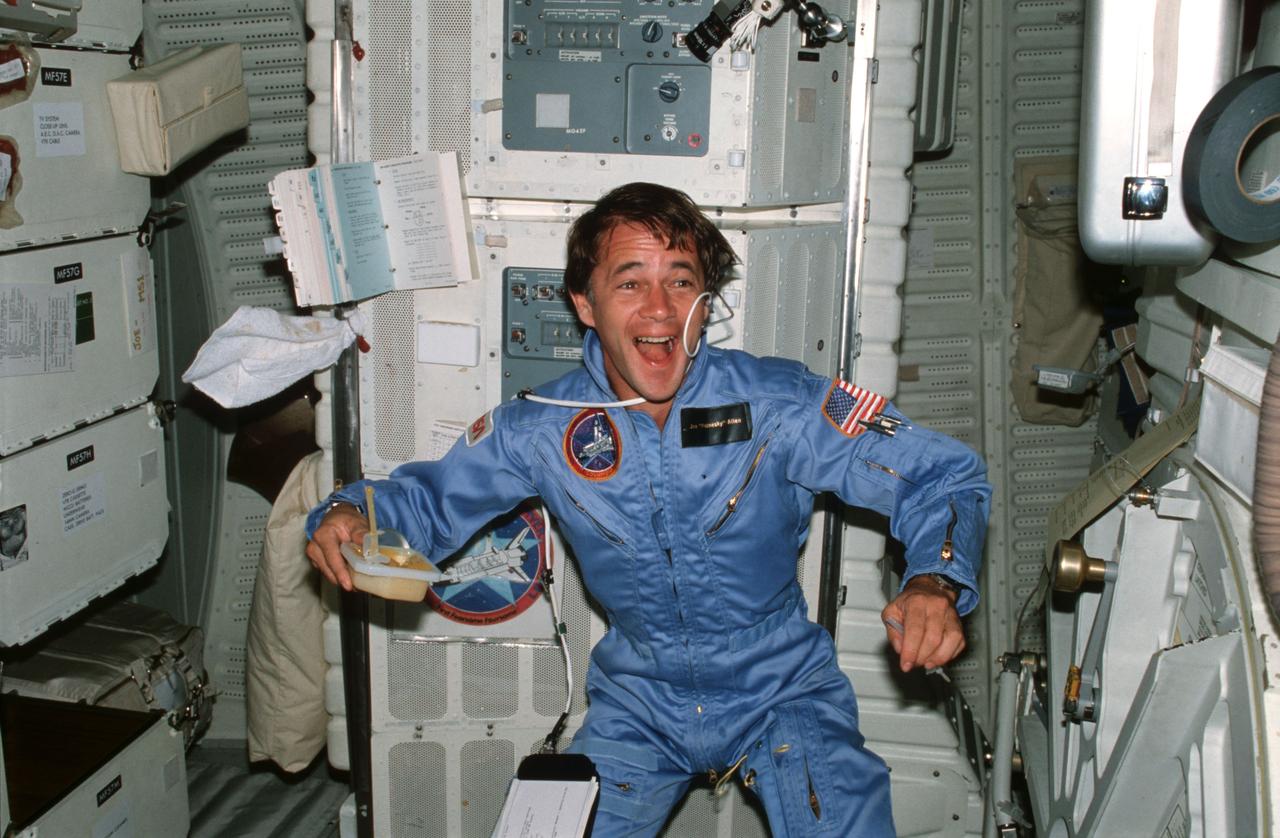
STS005-04-134 (11-16 Nov. 1982) --- Astronaut Joseph P. Allen IV, STS-5 mission specialist, uses beverage container and drinking straw, experiments with microgravity characteristics of orange juice on middeck in front of the Development Flight Instrument (DFI) unit and forward lockers. Allen laughs as he watches the results of his experimentation. Photo credit: NASA
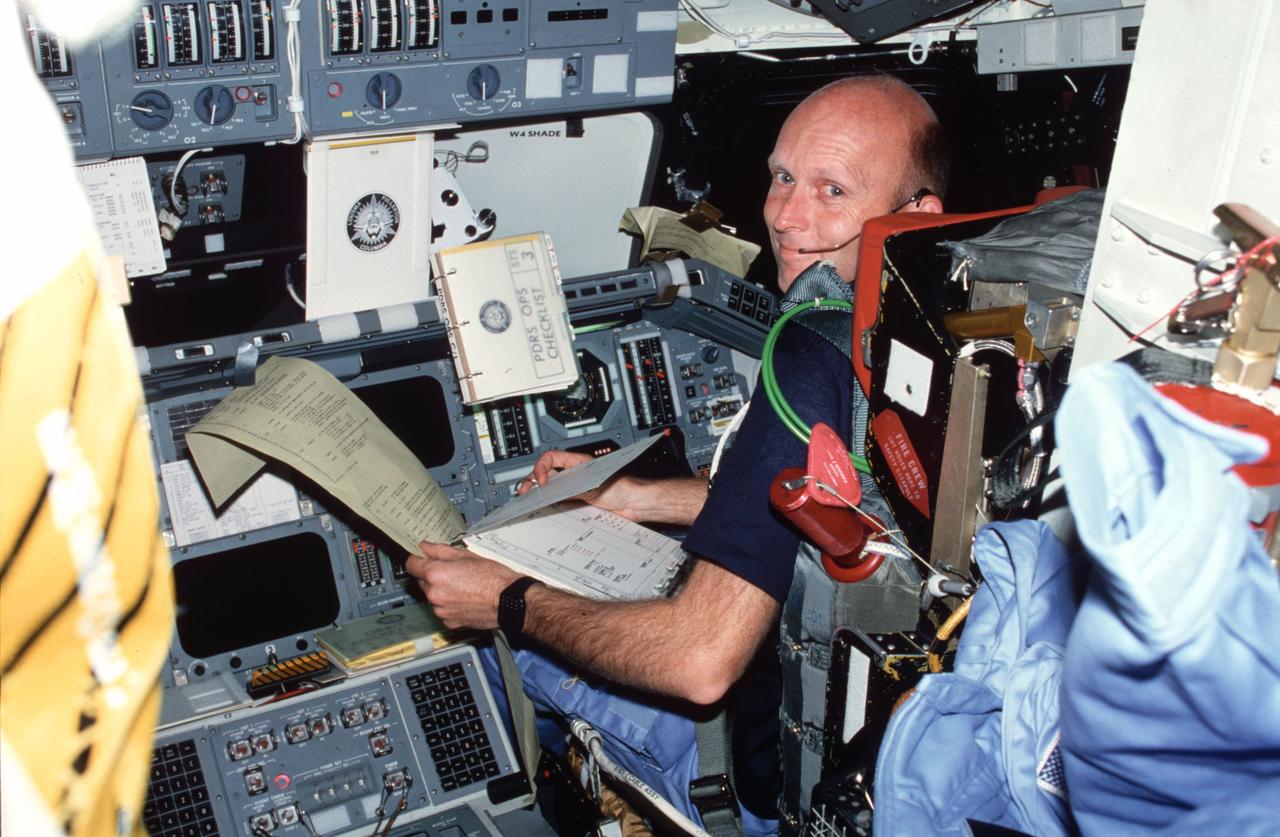
STS003-23-180 (22-30 March 1982) --- Astronaut Gordon Fullerton, STS-3 pilot, wearing communications kit assembly (ASSY) mini-headset (HDST), reviews flight data file (FDF) checklist and text and graphics system (TAGS) printout (ticker tape) while in pilots ejection seat (S2). Pilot station control panels F4, F7, F8, O3, window shade, and portable oxygen system (POS) assy appear in view. Photo credit: NASA
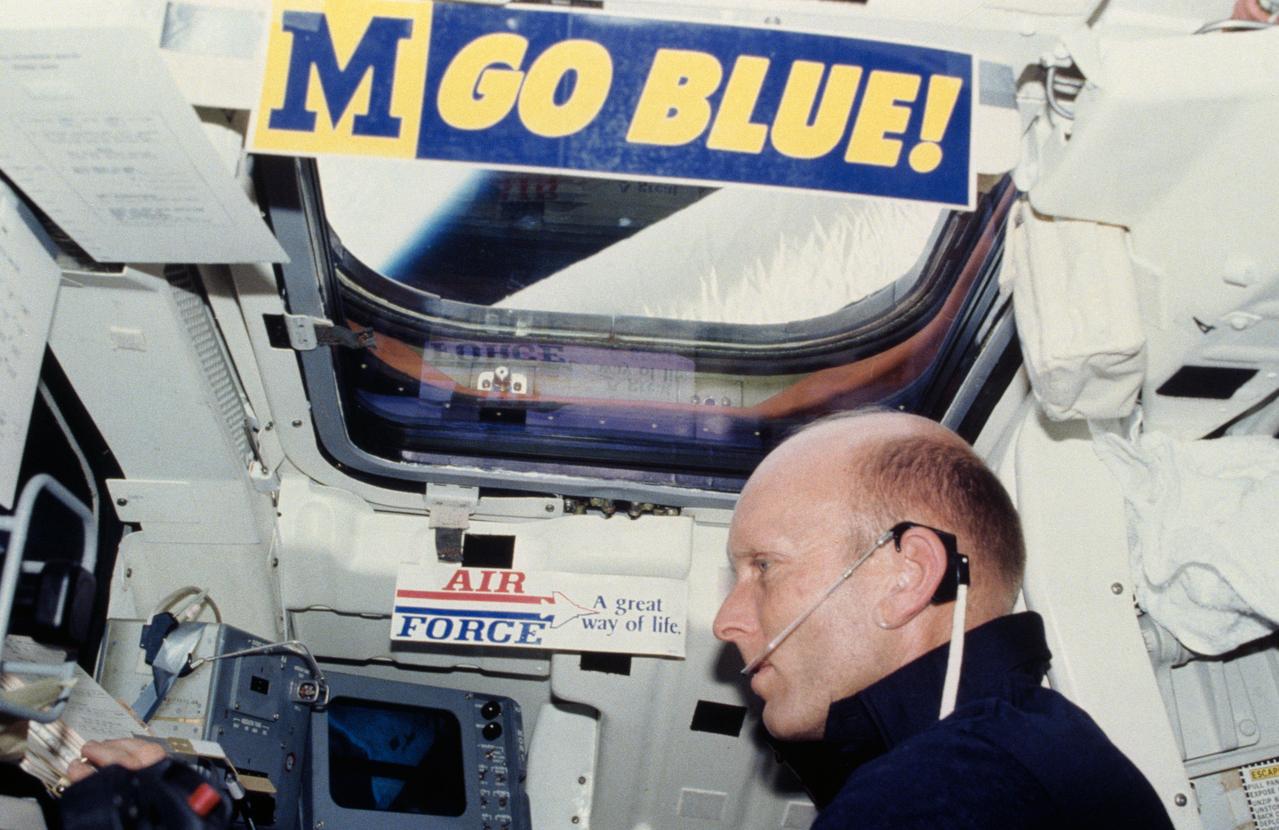
S82-28906 (27 March 1982) --- Astronaut C. Gordon Fullerton, STS-3 pilot, mans the right hand aft station of the flight deck on the Earth-orbiting Columbia. The photograph was taken with a 35mm camera by astronaut Jack R. Lousma, crew commander. The "Go Blue" sticker is a University of Michigan memento of Lousma, and the Air Force sign was put up by Fullerton, a USAF colonel. Lousma, a USMC colonel, received his BS degree in aeronautical engineering in 1959 from UM. One of two aft windows for cargo bay viewing and one of two ceiling windows are visible in the photo. Fullerton and Lousma watched the activity of the remote manipulator system (RMS) arm out the lower window and they took a number of photos of Earth from the upper window. Photo credit: NASA
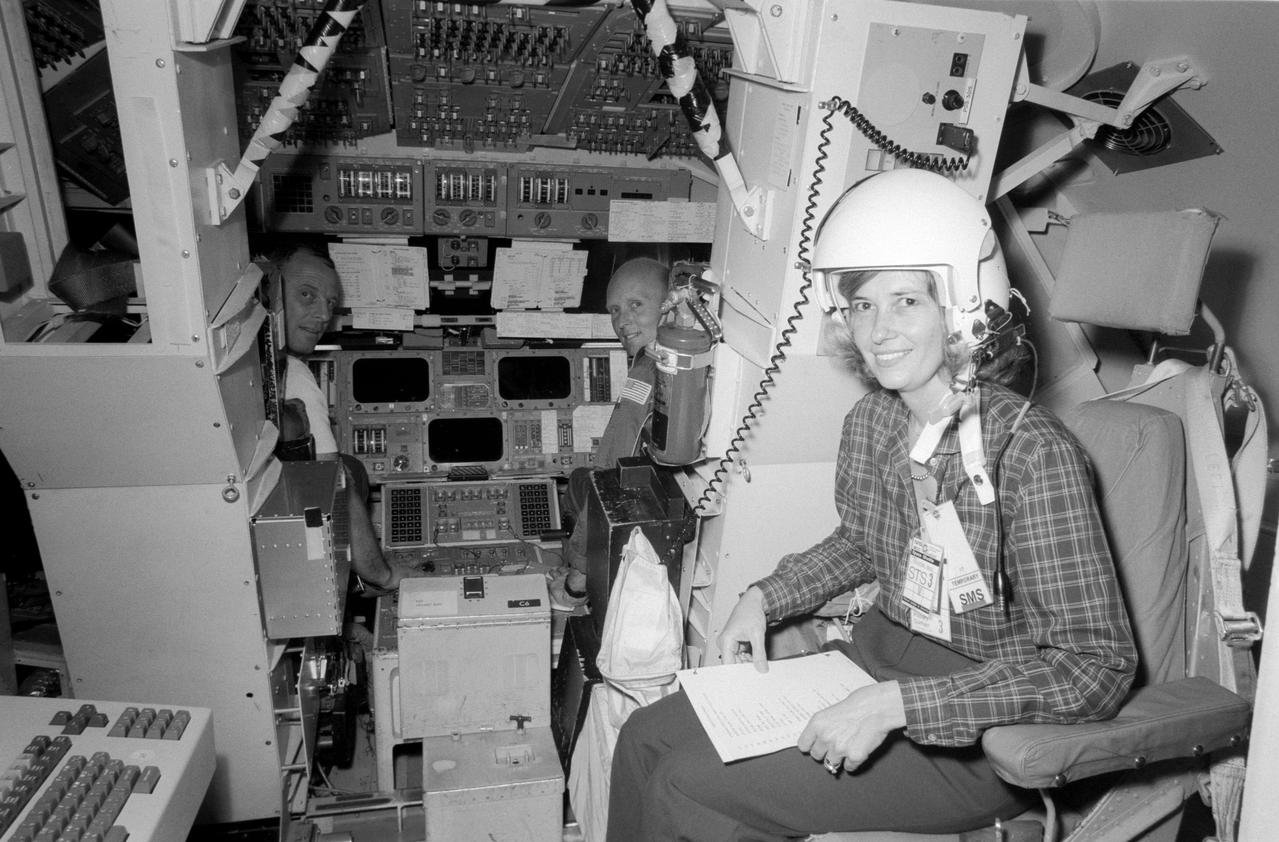
S82-28535 (16 March 1982) --- One of the more pleasant surprises of what are usually routine training sessions today was Mrs. Marie Fullerton, seated in the foreground in a special chair. Astronauts Jack R. Lousma, left background, and C. Gordon Fullerton, center, take a brief break in their simulation session to look back toward their visitor, wife of the pilot for NASA?s next flight. They are in the shuttle mission simulator (SMS) in the LBJ Space Center?s mission simulation and training facility. The crew is in training for its scheduled March 22 launch aboard the space shuttle Columbia for a week?s stay in Earth orbit. Photo credit: NASA

Day-5 Mission Control Room activities, STS-3 Mission of: Alan Briscoe, at the Instrumentation and Communications Officer (INCO) Console; Astronaut Richard Truly and Briscoe; Astronaut Judy Resnik, Flight Director (FD) Jay Greene, and On-Duty FD Harold Draughon. 1. Flight Directors - STS 3 2. Astronaut Judy Resnik 3. Alan Briscoe 4. Jay Greene 5. Harold Draughon
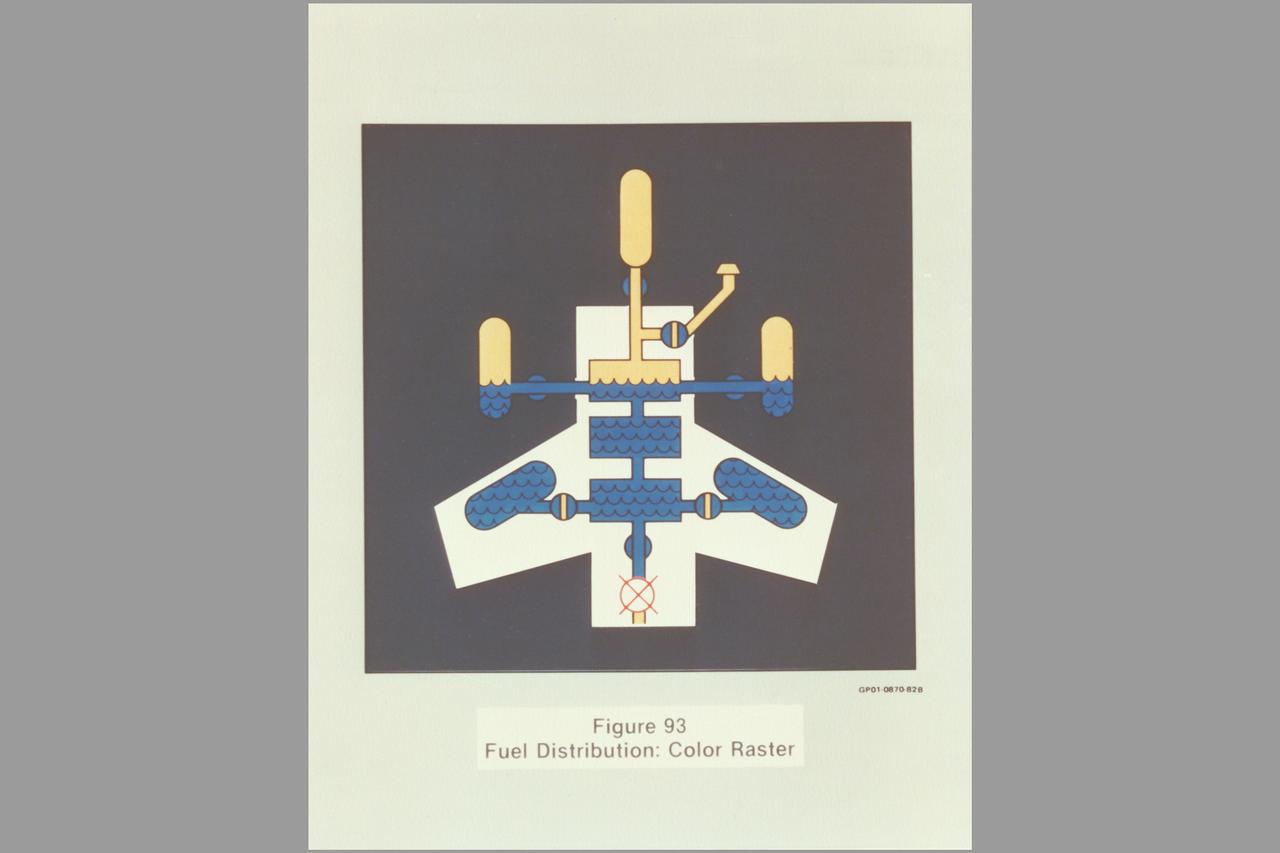
Date: Feb 1982 Photographer: Historical Air Force fuel distribution (AFWAL TR-81-3156, Fig 93
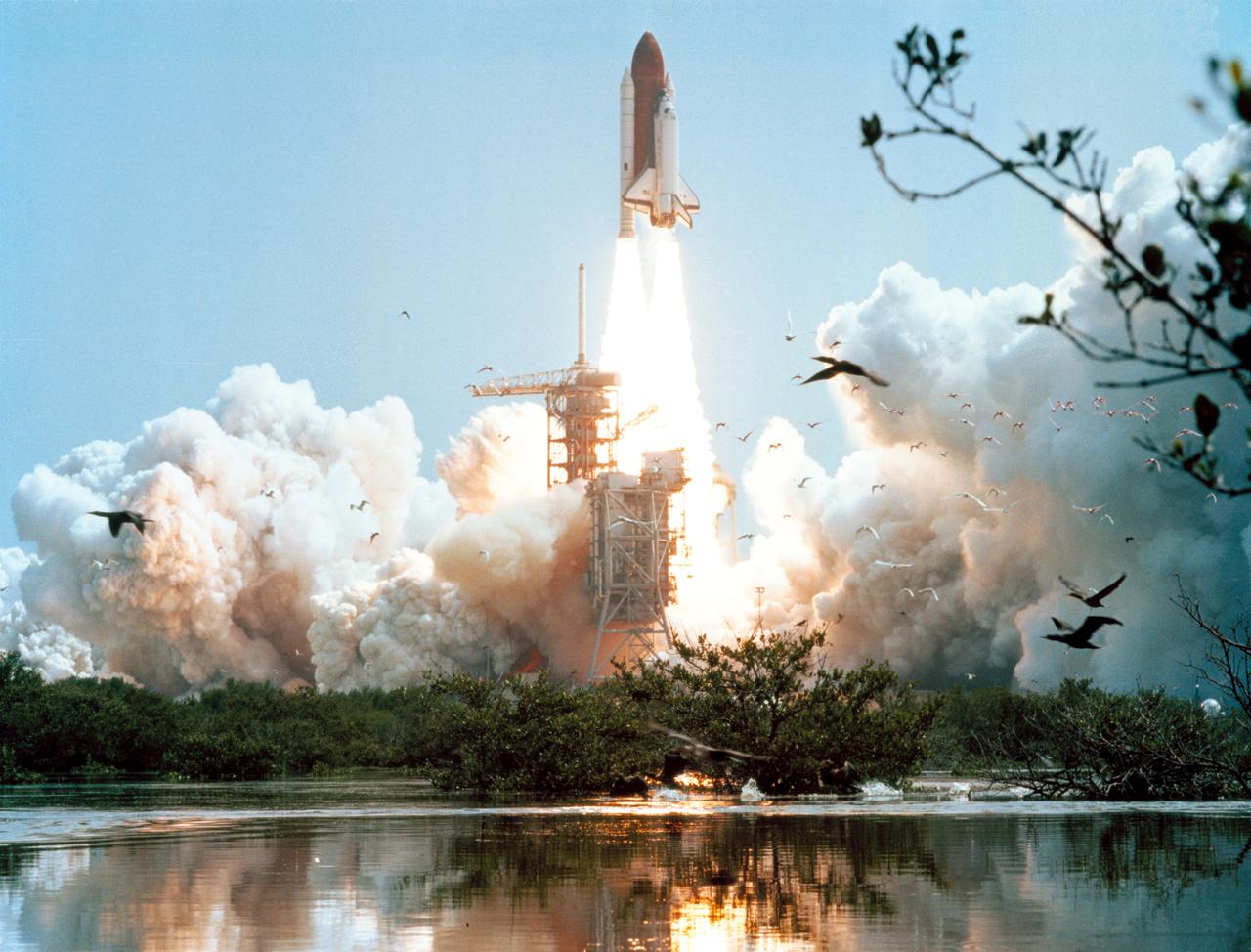
S82-33288 (27 June 1982) --- This horizontal view of the space shuttle Columbia captures the flight of water birds disturbed by the activity at launch Pad 39A. Launch occurred at 10:59:59 a.m. (EDT), June 27, 1982. Astronauts Thomas K. Mattingly II and Henry W. Hartsfield Jr. are aboard for NASA's final orbital flight test before launching into a new space era with the first operational flight planned for fall of this year. Photo credit: NASA
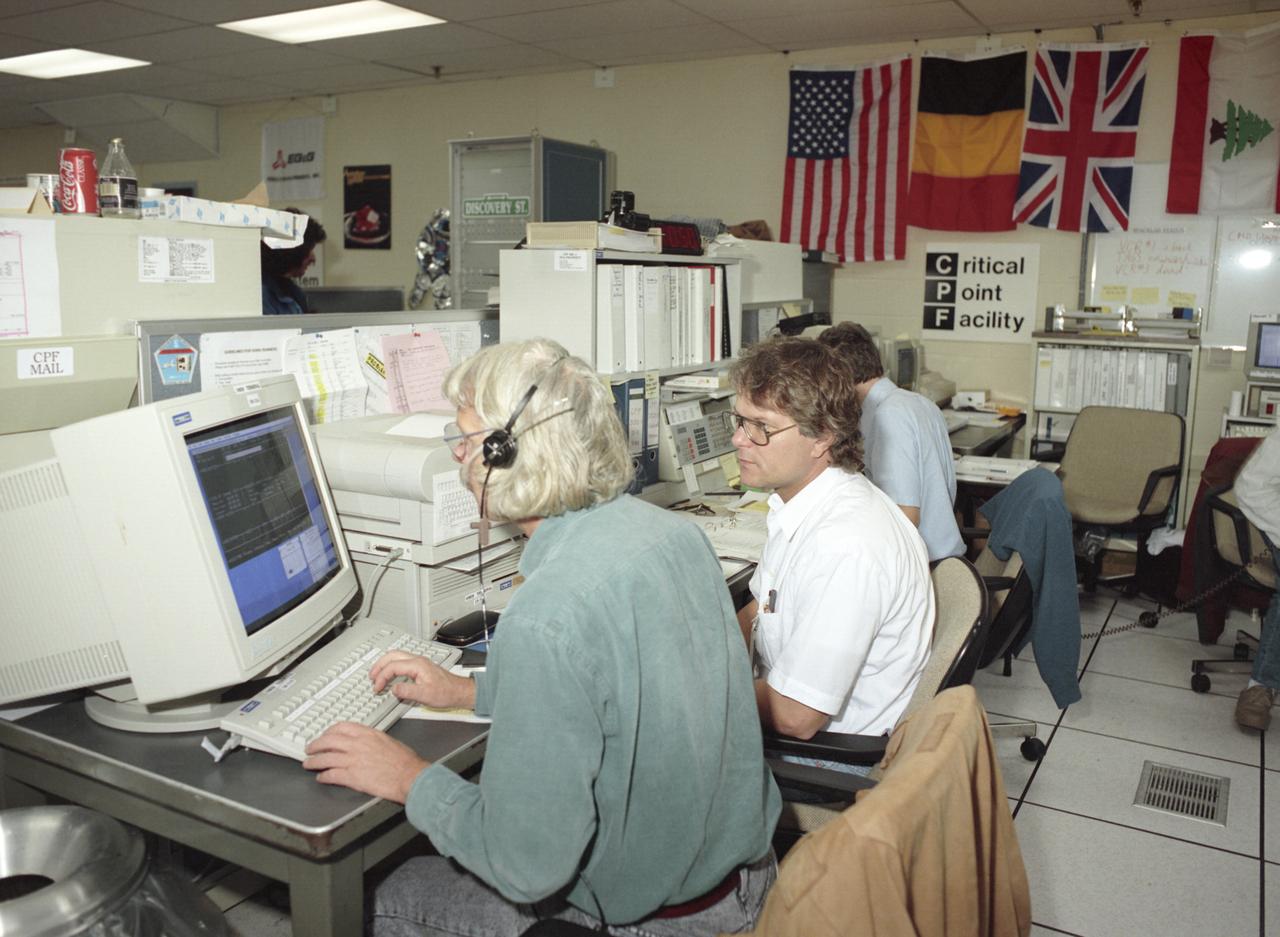
The primary payload for Space Shuttle Mission STS-42, launched January 22, 1992, was the International Microgravity Laboratory-1 (IML-1), a pressurized manned Spacelab module. The goal of IML-1 was to explore in depth the complex effects of weightlessness of living organisms and materials processing. Around-the-clock research was performed on the human nervous system's adaptation to low gravity and effects of microgravity on other life forms such as shrimp eggs, lentil seedlings, fruit fly eggs, and bacteria. Materials processing experiments were also conducted, including crystal growth from a variety of substances such as enzymes, mercury iodide, and a virus. The Huntsville Operations Support Center (HOSC) Spacelab Payload Operations Control Center (SL POCC) at the Marshall Space Flight Center (MSFC) was the air/ground communication channel used between the astronauts and ground control teams during the Spacelab missions. Featured is the Critical Point Facility (CPF) team in the SL POCC during the IML-1 mission.

General Activities in the Mission Operations Control Center (MOCR) during Day-1 of the STS-4 Mission. JSC, HOUSTON, TX Also available in 35 CN
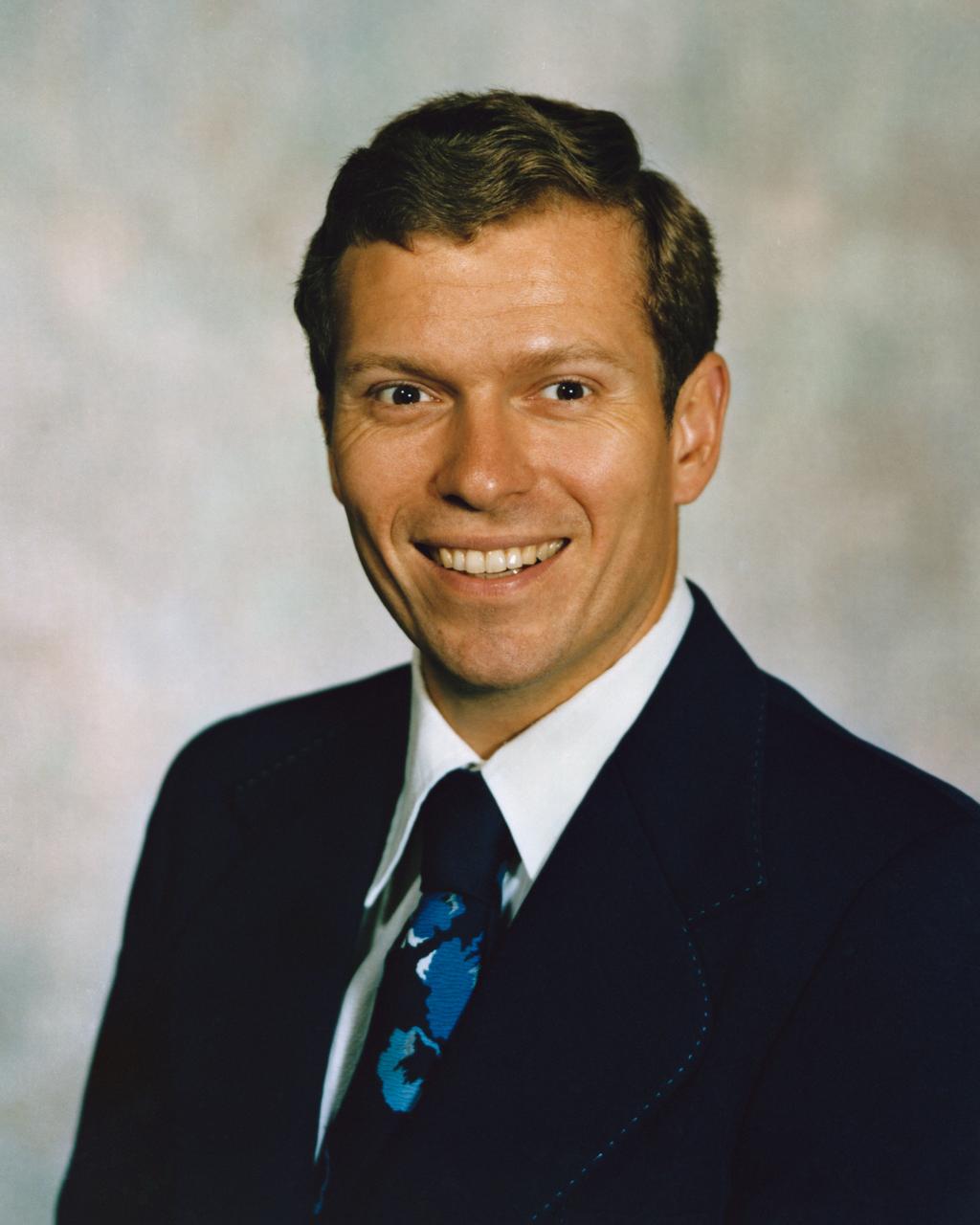
S82-41554 (1982) --- Dr. Byron K. Lichtenberg, payload specialist, Massachusetts Institute of Technology (MIT).
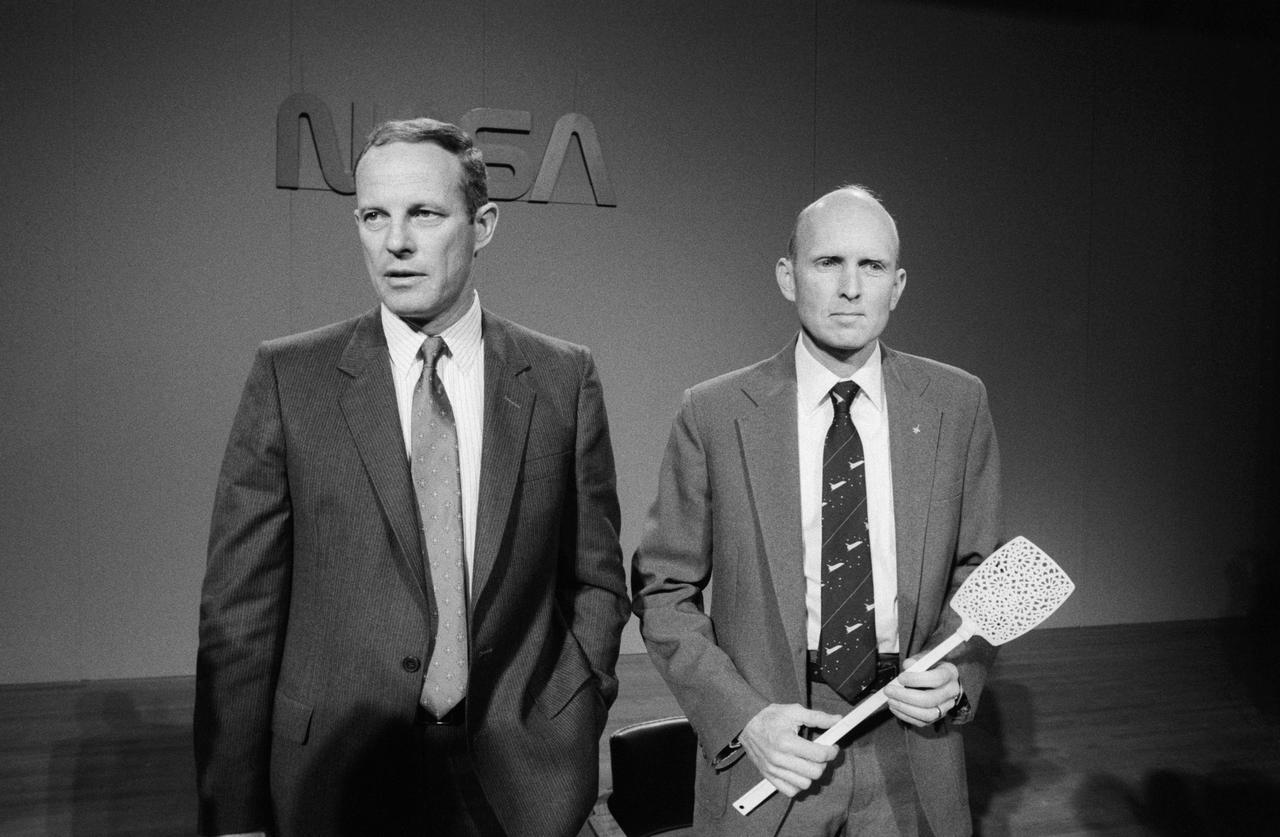
S82-27684 (26 Feb. 1982) --- Astronauts Jack R. Lousma, left, commander, and C. Gordon Fullerton, pilot, enjoy a light moment following their final STS-3 press conference before the scheduled launch of the space shuttle Columbia. Fullerton holds a fly swatter in his hand. During the conference, the crew had joked about insects onboard the craft and suggested the swatter as a means to control the ?critters.? A student experiment entitled ?Insects in Fight Motion Study? will fly with the crew on NASA?s third orbital flight test (STS-3). Photo credit: NASA
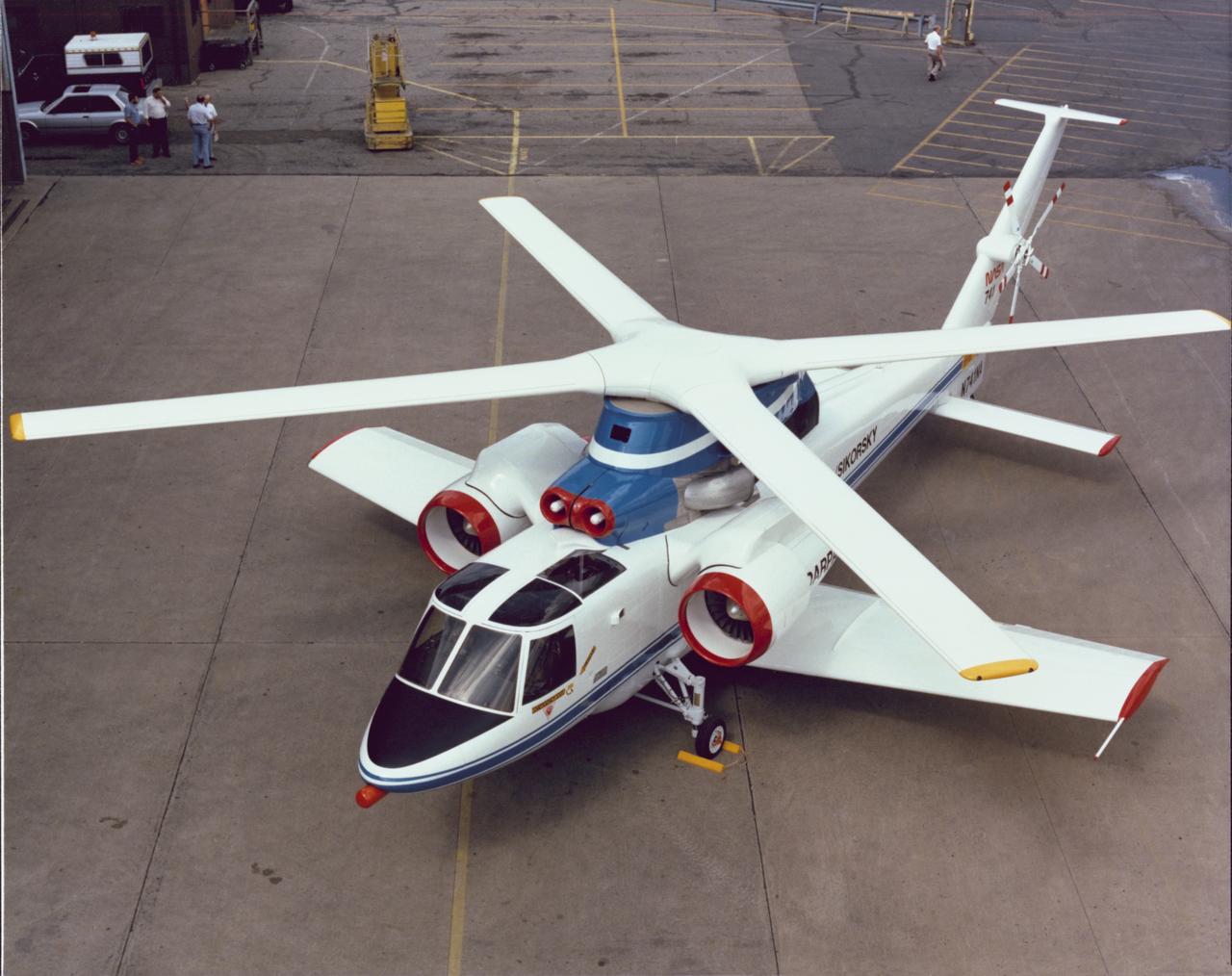
Photo credit to Sikorsky X-Wing (NASA-741) roll-out at Sikorsky Helicopter Co.
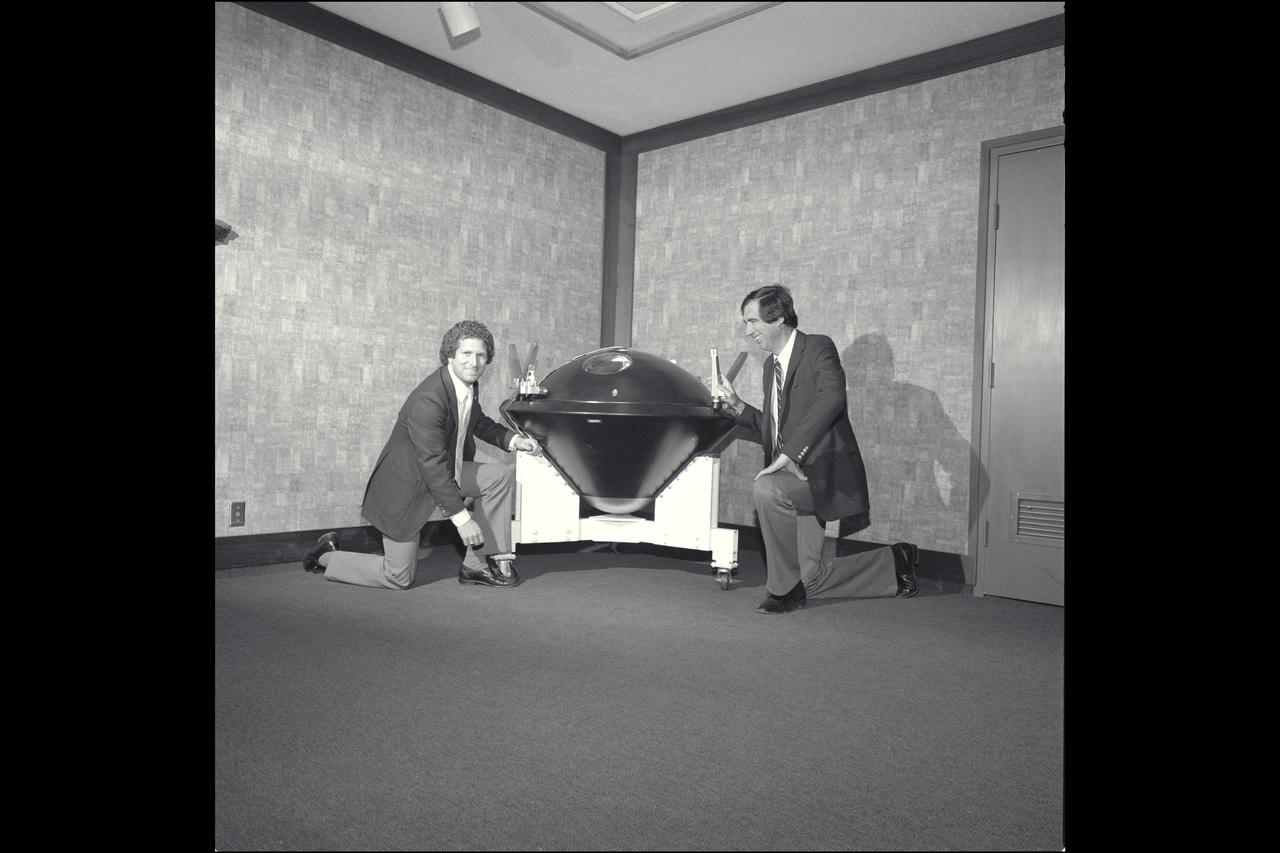
Bill Ballhaus and Nicholas Vojvodich inspect the Galileo Probe Engineering Assembly Display
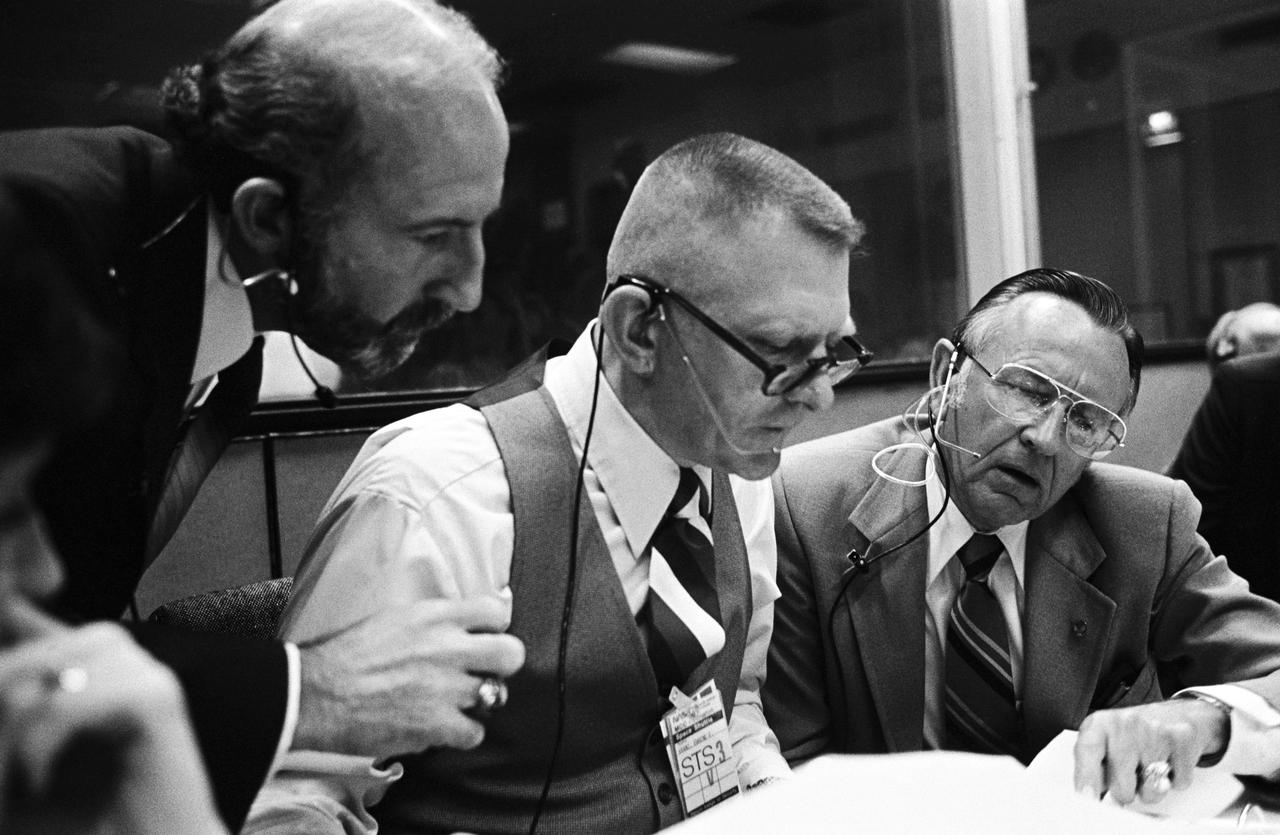
MOCR during Flight Day 1 of the STS-3 Mission. View: Thomas L. Moser, of the Structures and Mechanics Division, briefing Flight Director Eugene Kranz, Flight Operations, and Dr. Kraft, JSC Director. JSC, HOUSTON, TX
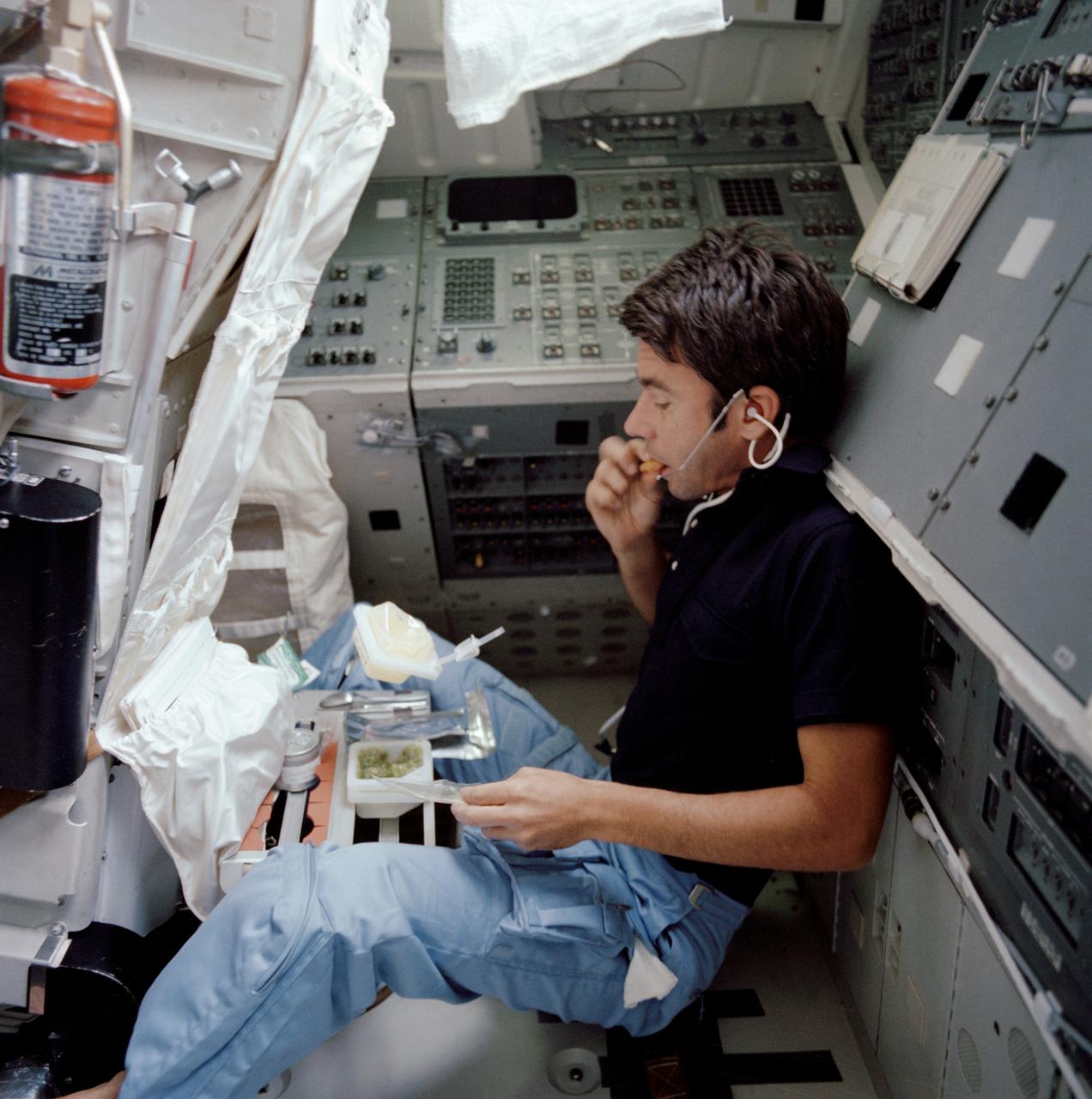
STS005-45-1821 (11-16 Nov. 1982) --- Astronaut William B. Lenoir, STS-5 mission specialist, takes a break to eat his meal on the space shuttle Columbia. Wet trash stowage bags float freely around him and a fire extinguisher hangs on the wall in front of him. Photo credit: NASA
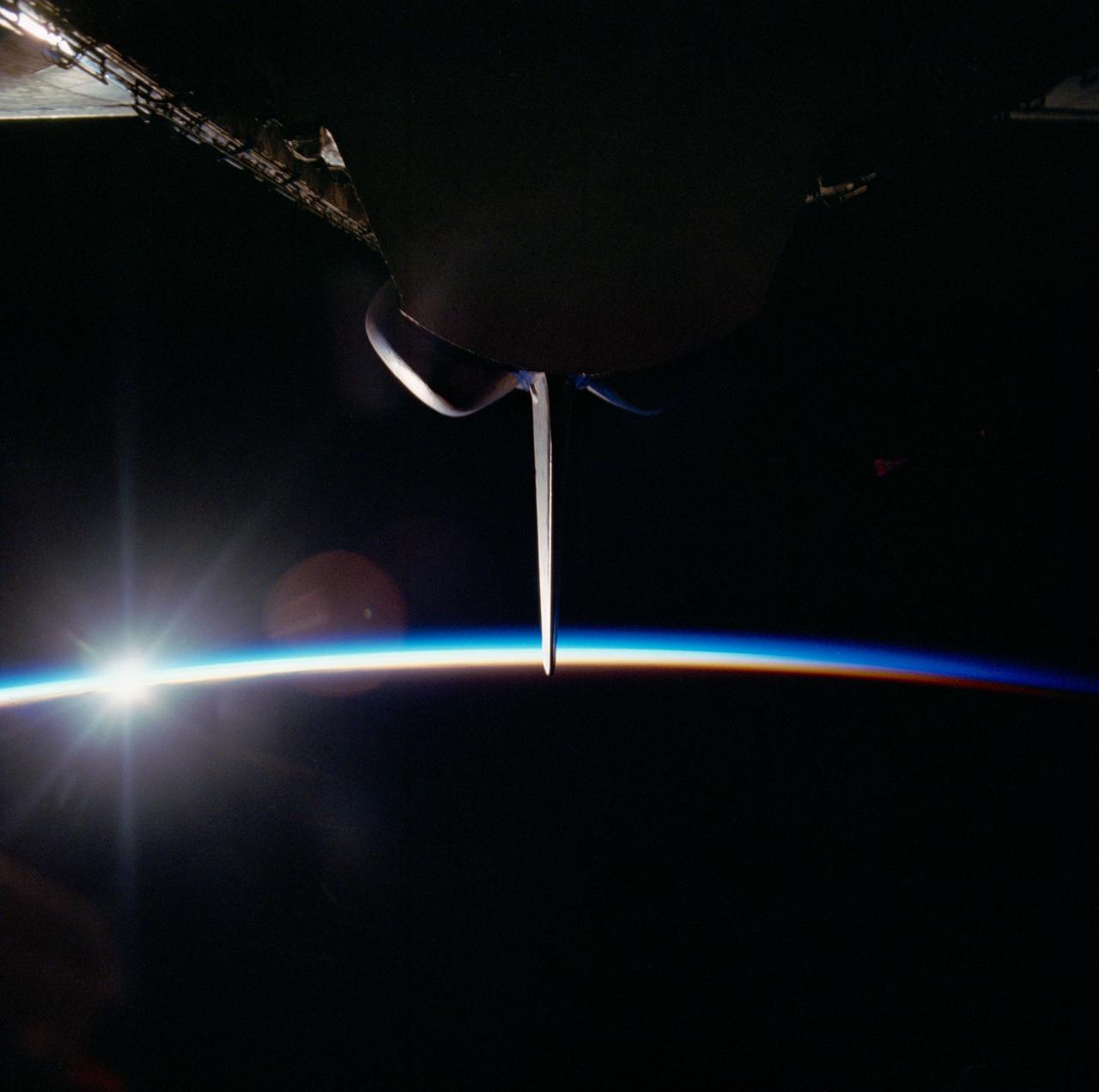
S82-39796 (11-16 Nov. 1982) --- A ?night? scene of the STS-5 space shuttle Columbia in orbit over Earth?s glowing horizon was captured by an astronaut crew member aiming a 70mm handheld camera through the aft windows of the flight deck. The aft section of the cargo bay contains two closed protective shields for satellites which were deployed on the flight. The nearest ?cradle? or shield houses the Satellite Business System?s (SBS-3) spacecraft and is visible in this frame while the Telesta Canada ANIK C-3 shield is out of view. The vertical stabilizer, illuminated by the sun, is flanked by two orbital maneuvering system (OMS) pods. Photo credit: NASA
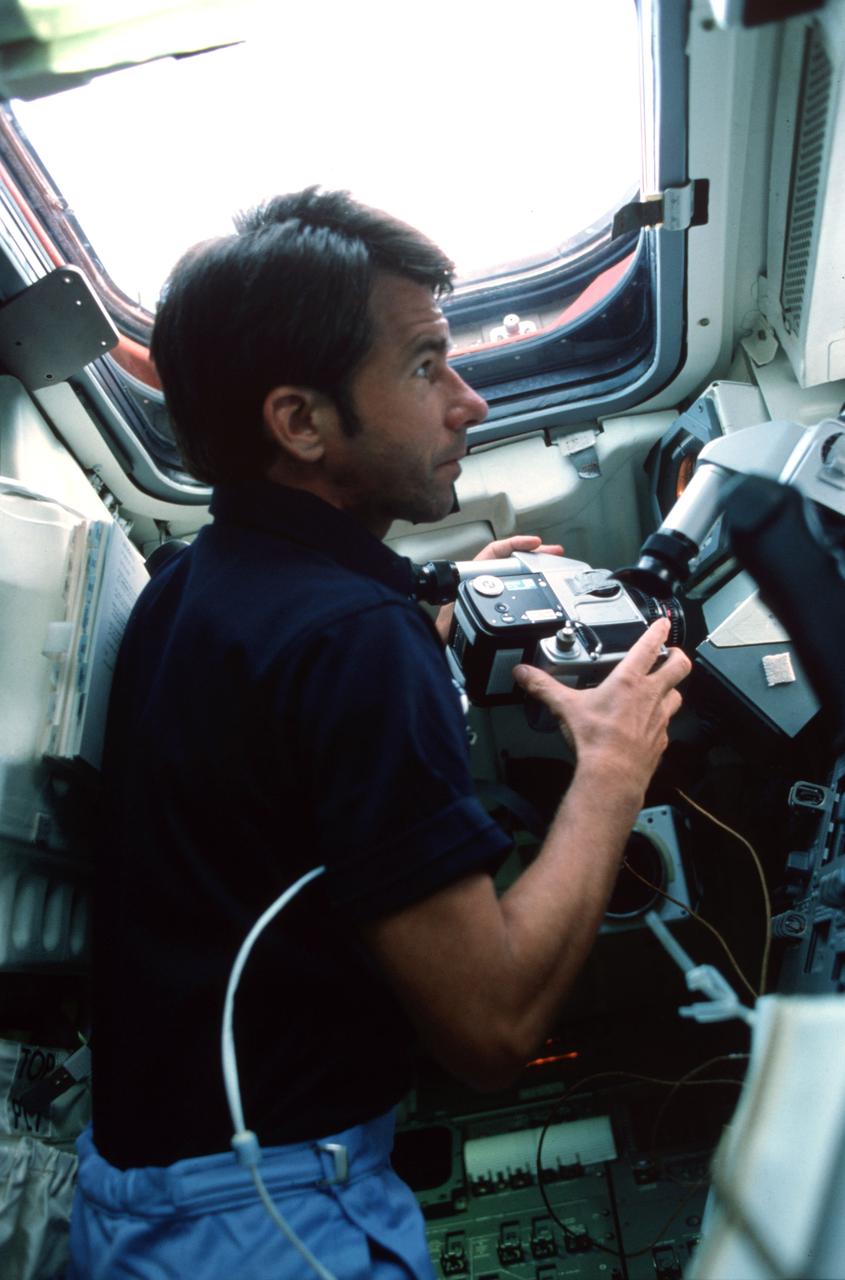
STS005-03-110 (11-16 Nov. 1982) --- Astronaut William B. Lenoir, STS-5 mission specialist, holding a 70mm HASSELBLAD camera, observes scenery through viewing window on aft flight deck on orbit station. Window W7 appears overhead. Lenoir prepares to shoot Earth-looking scenes through window above his head. Photo credit: NASA
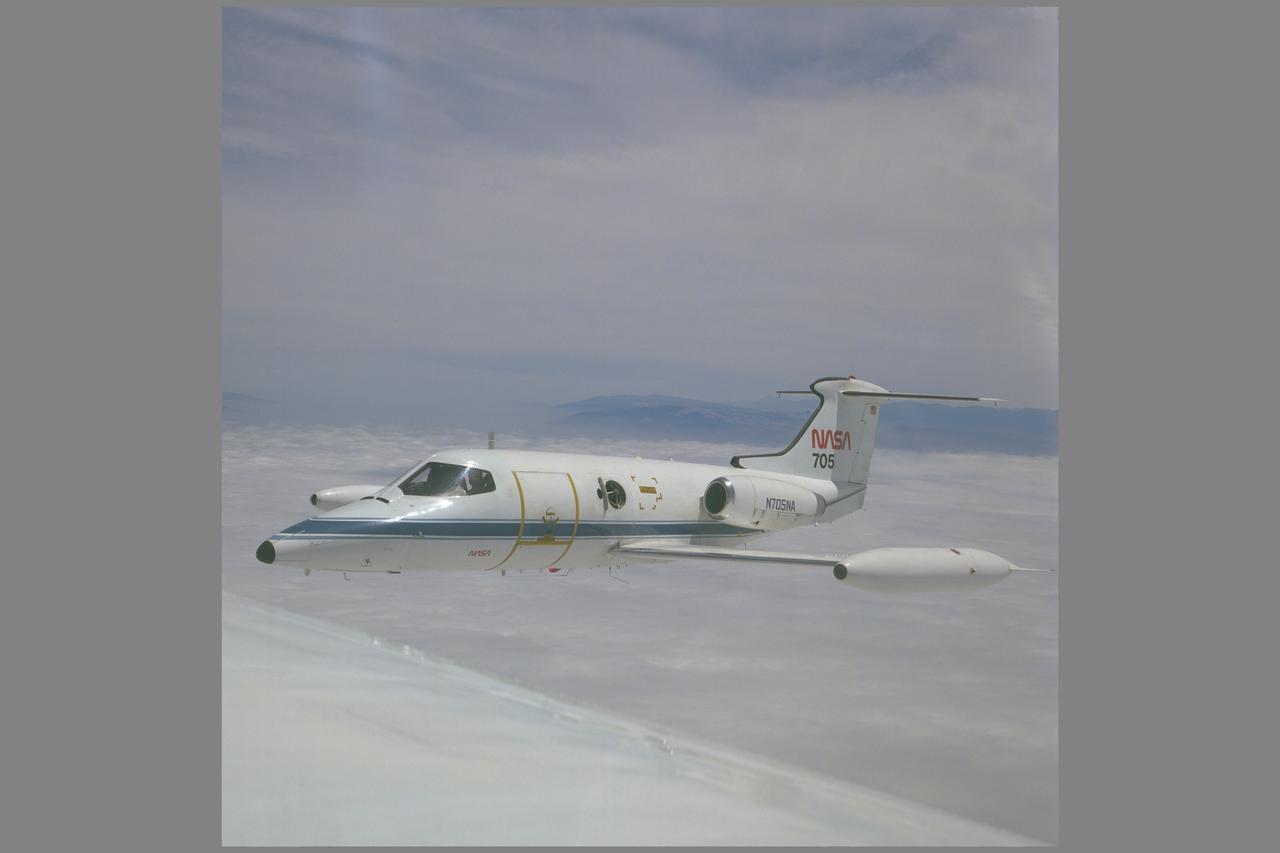
Lear Jet (NASA-705) in flight

General Activities in the Mission Operations Control Center (MOCR) during Day-1 of the STS-4 Mission. JSC, HOUSTON, TX Also available in 35 CN
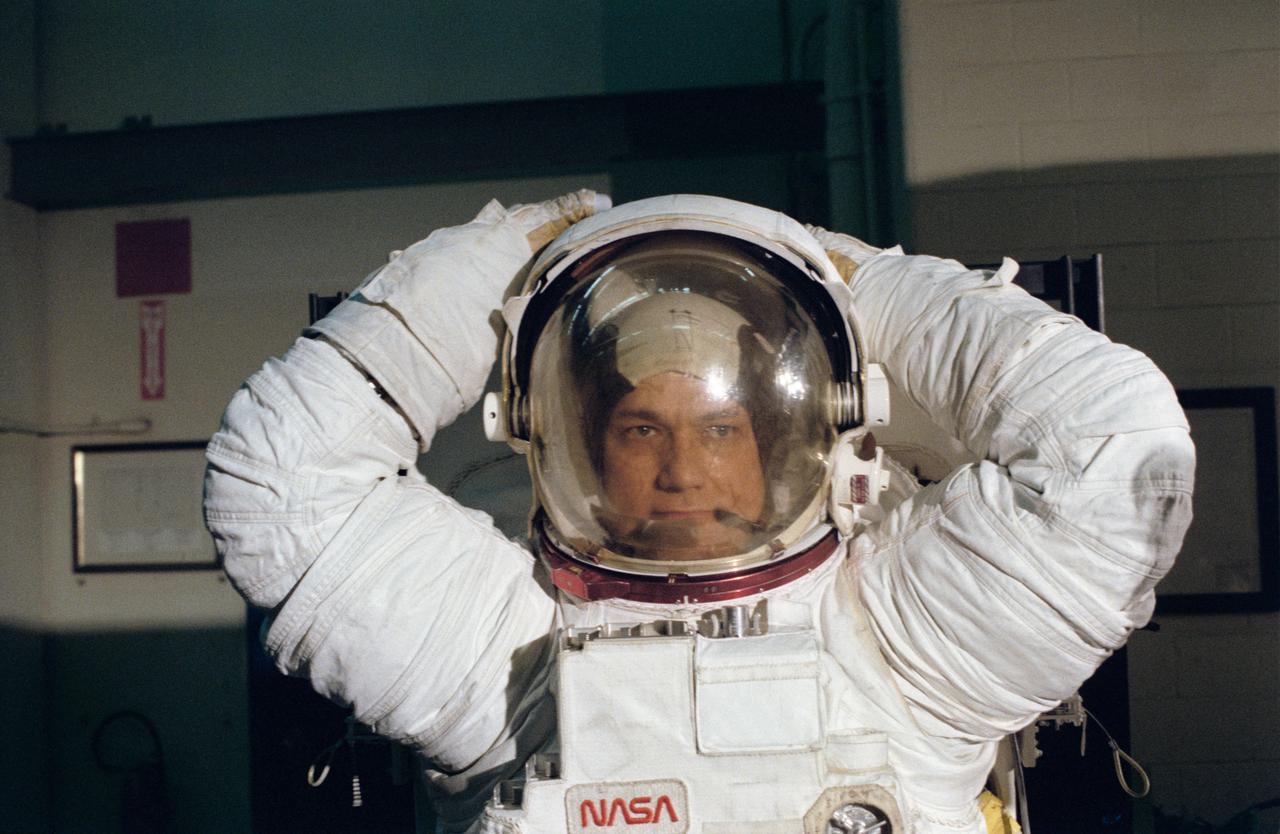
S82-27594 (25 Feb 1982) --- Astronaut Bruce McCandless II models NASA?s extravehicular mobility unit (EMU) spacesuit for Shuttle and the backpack unit (called a manned maneuvering unit) that will give future STS crewmembers extended mobility in space. A forerunner version of the MMU?called an astronaut maneuvering unit?was tested internally on Skylab. The MMU will allow astronauts for the first time in history to move about in the vicinity of their spacecraft without being tethered to the ship. McCandless was giving a demonstration of the EMU/MMU in JSC?s laboratory support facility.
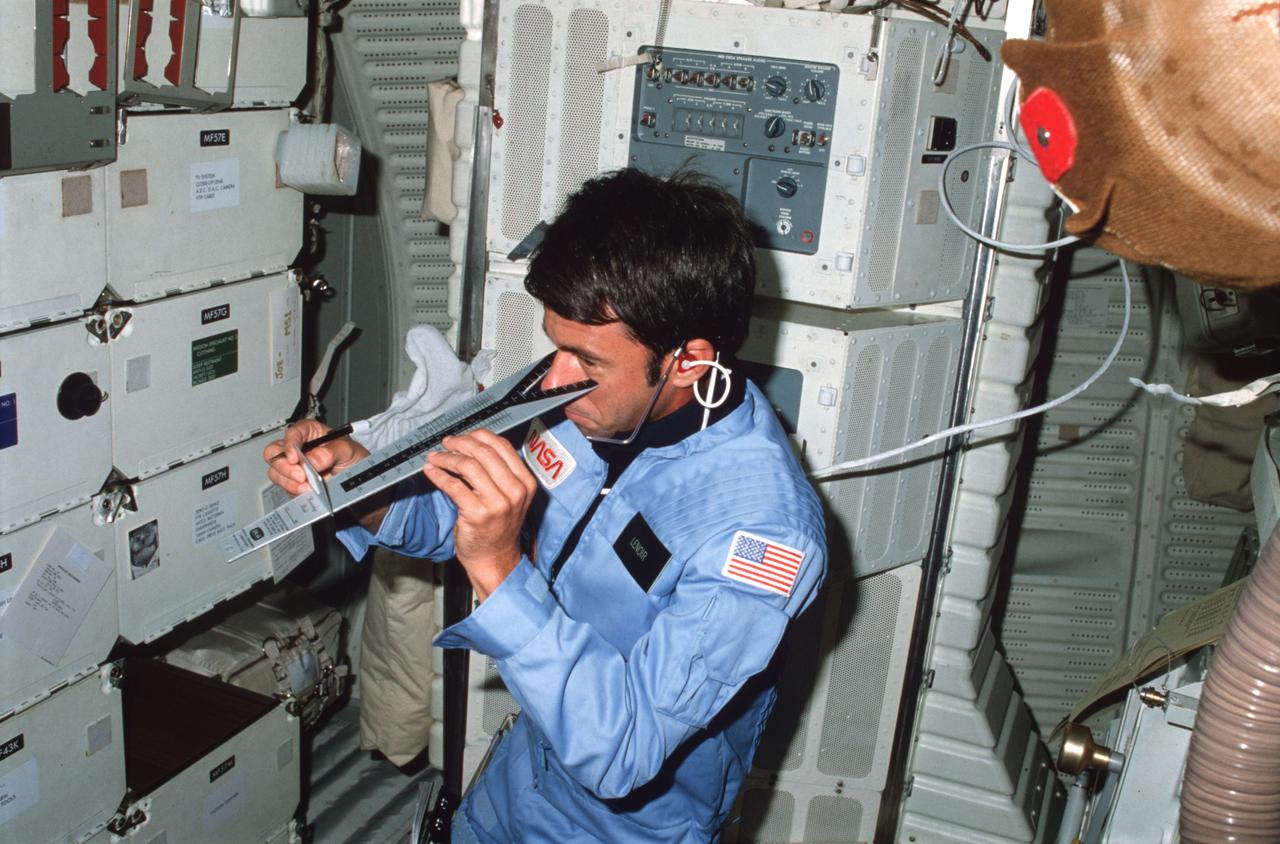
STS005-04-146 (11-16 Nov. 1982) --- Astronaut William B. Lenoir, STS-5 mission specialists, checks his vision using DIOPTER measuring device on middeck in front of Development Flight Instrument (DFI) unit. Photo credit: NASA
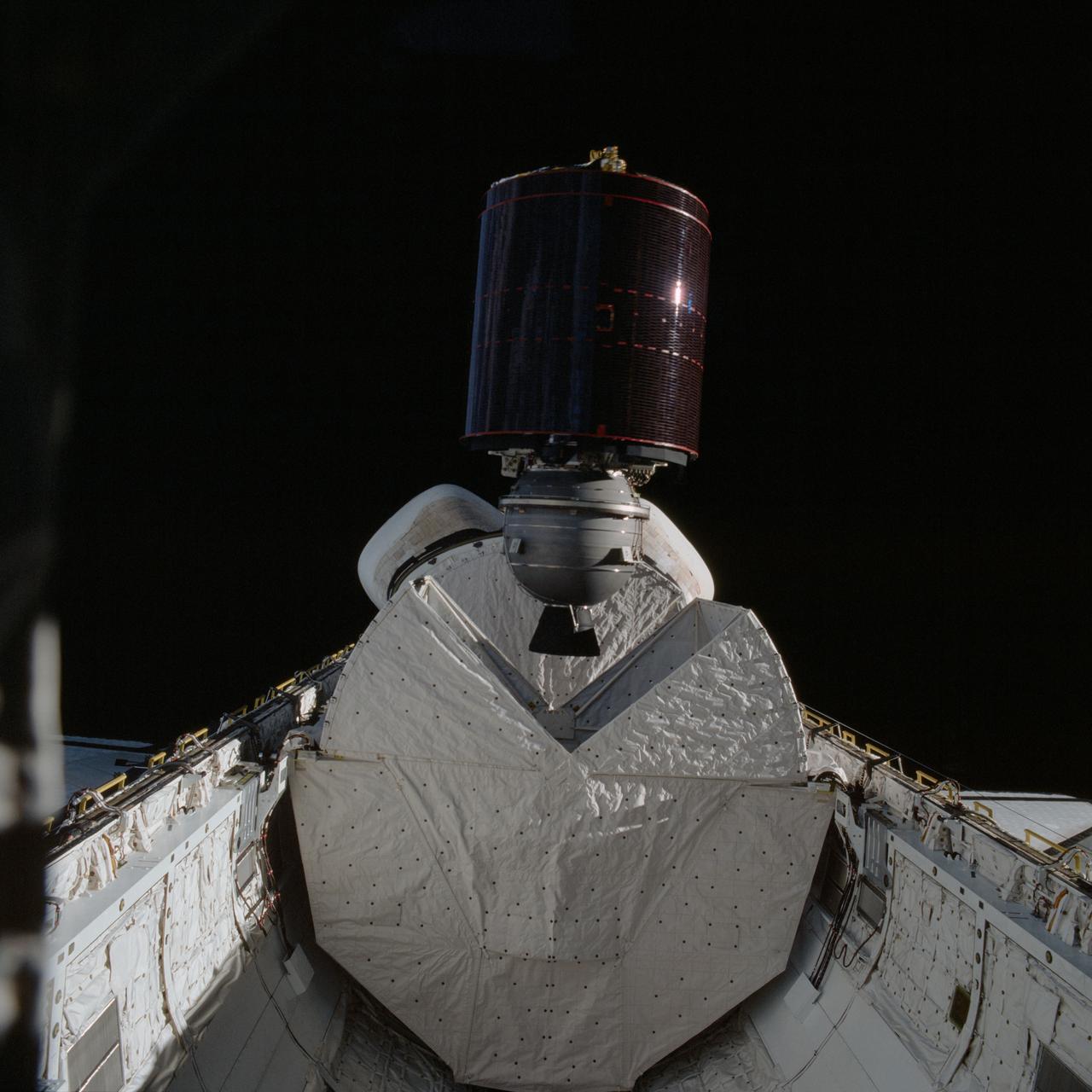
STS005-38-943 (17 Nov. 1982) --- The Satellite Business Systems (SBS-3) satellte is deployed from its protective cradle in the cargo bay of the space shuttle Columbia. Part of Columbia's wings can be seen on both the port and starboard sides. Part of both orbital maneuvering system (OMS) pods are seen at center. The vertical stabilizer is obscured by the satellite. Photo credit: NASA
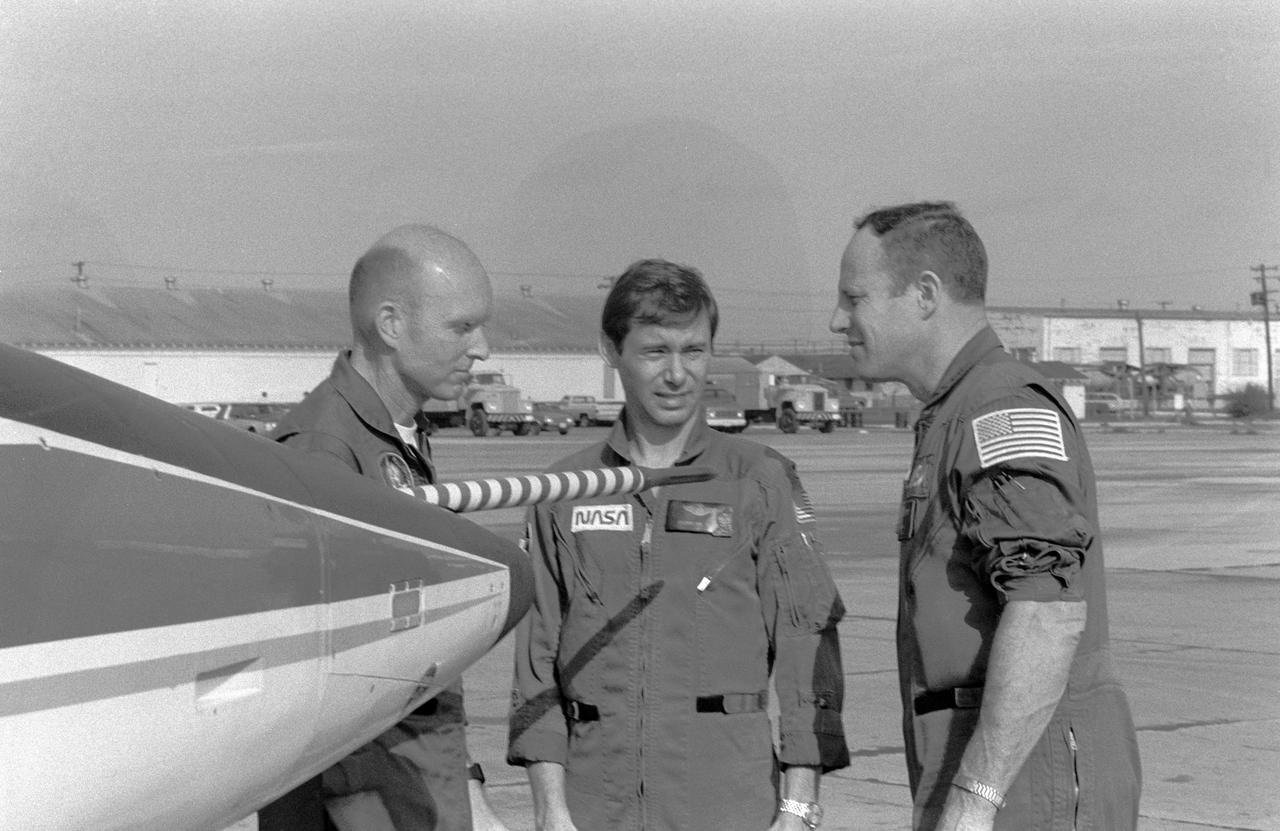
S82-28704 (20 March 1982) --- Astronaut Jack R. Lousma, STS-3 commander, seems to be saying, "?see you guys down there," prior to boarding a T-38 jet trainer and heading for KSC in Florida. Astronaut C. Gordon Fullerton, left, STS-3 pilot, will man the front seat of another T-38, with astronaut Brewster H. Shaw, center, as rear sat passenger. The STS-3 crew has just bade farewell to news media representatives and members of the general public on hand for the departure. Photo credit: NASA
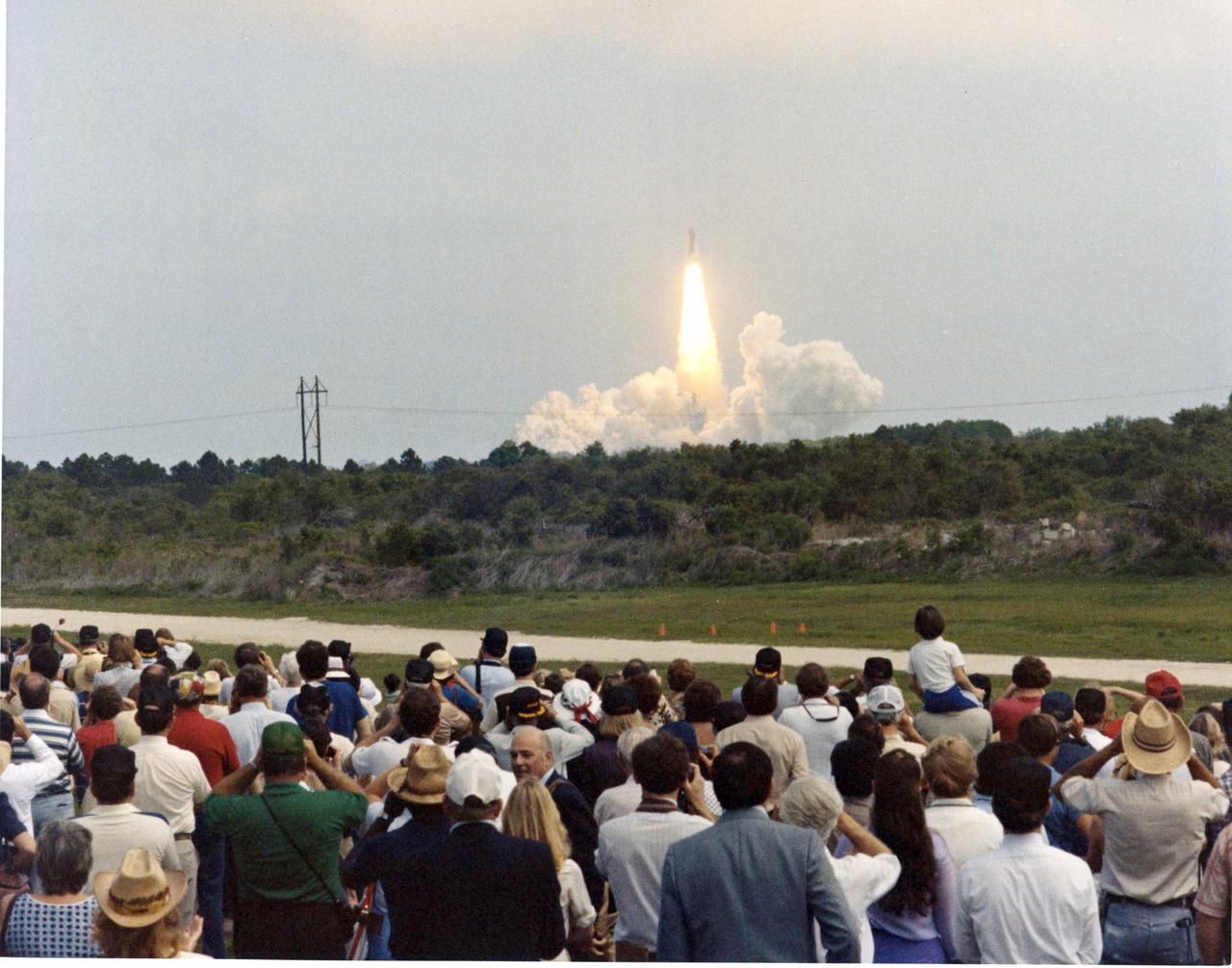
Columbia is cheered on its way by distinguished guests viewing the launch from the Schwartz Road VIP site, located about five miles from the launch pad. About 4,500 invited visitors at the site watched the 11 a.m. liftoff of Columbia on its third orbital flight.
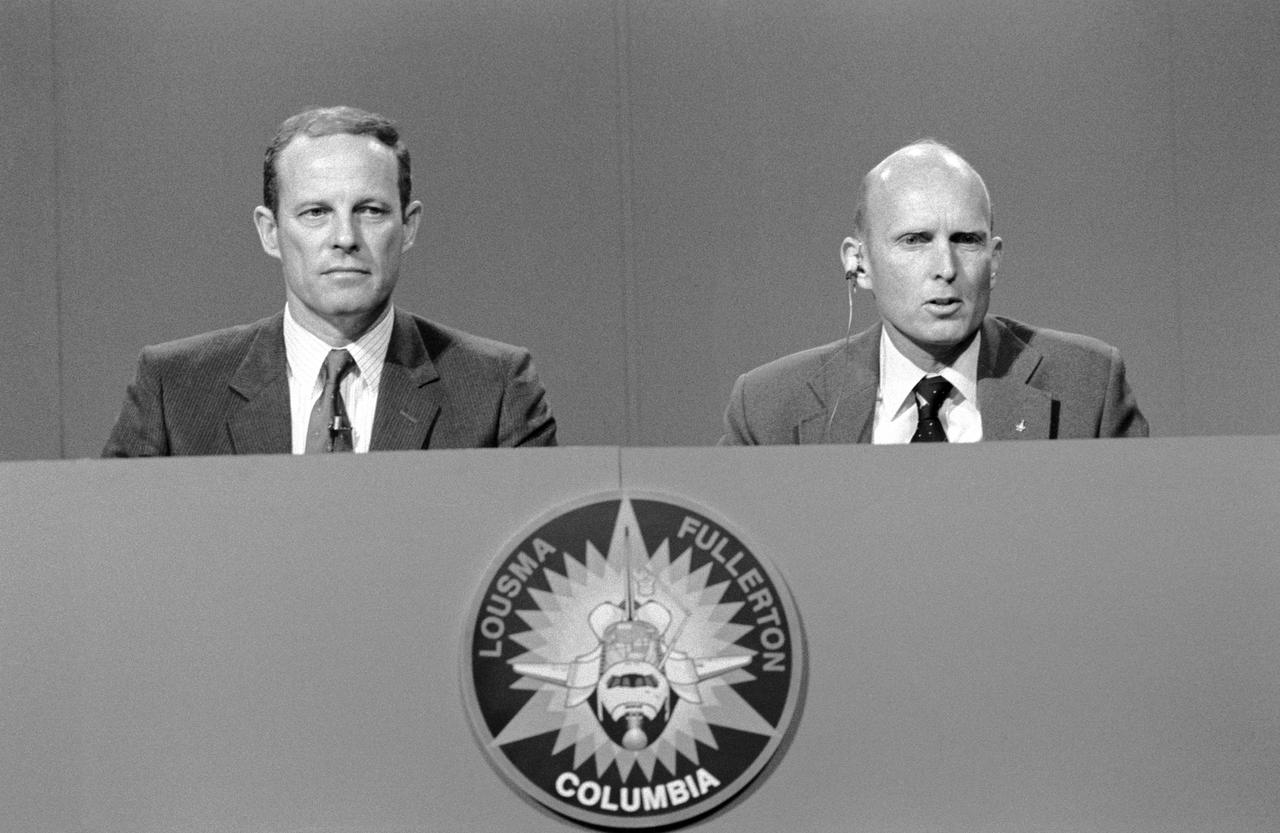
S82-27686 (26 Feb. 1982) --- Astronauts Jack R. Lousma, left, commander, and C. Gordon Fullerton, pilot, answer questions from the press corps during their final pre-STS-3 press conference on Feb. 26, 1982. The two will man the space shuttle Columbia when it launches on March 22, 1982, from the Kennedy Space Center's Launch Pad 39A. Photo credit: NASA

Launch views of the Columbia from Pad 39A starting the STS-4 Mission, 06/27/1982. KSC, FL
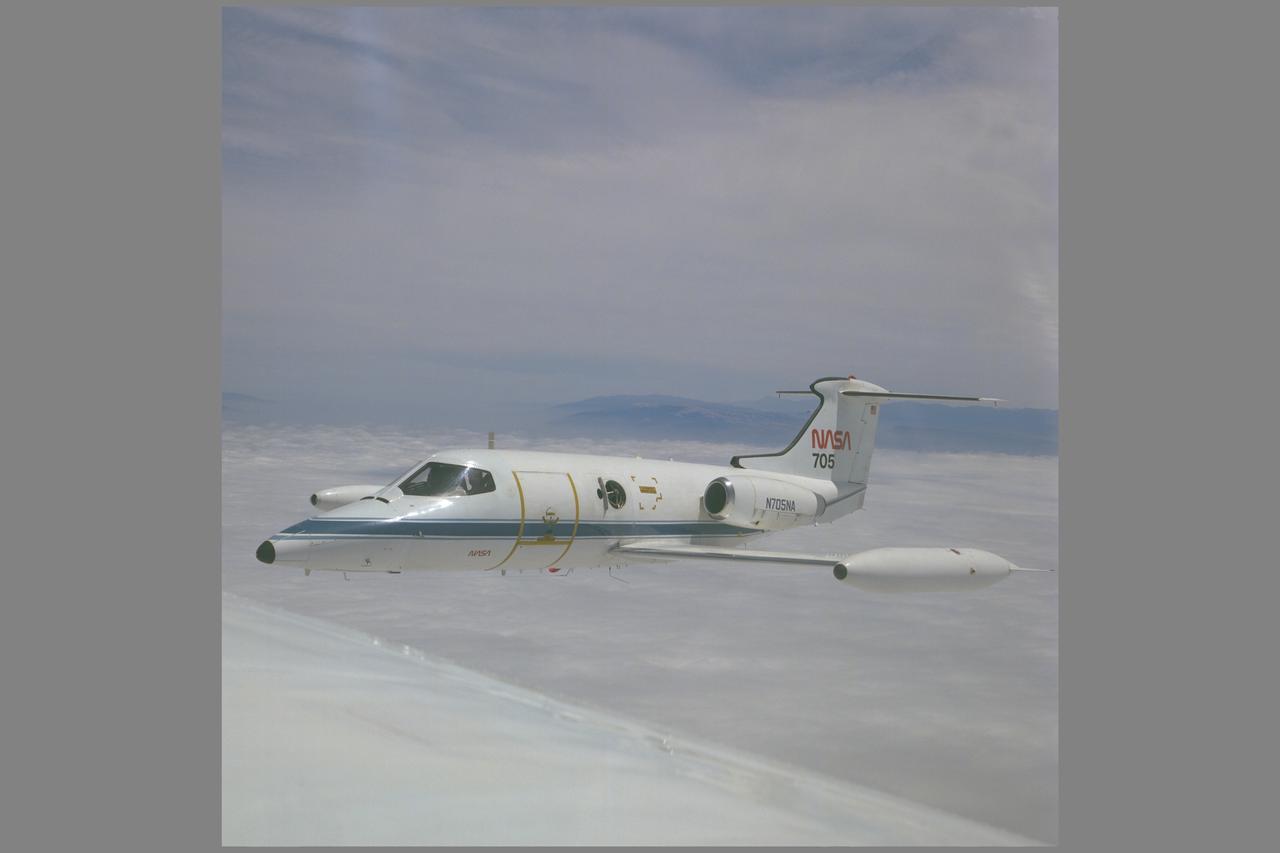
Lear Jet (NASA-705) in flight
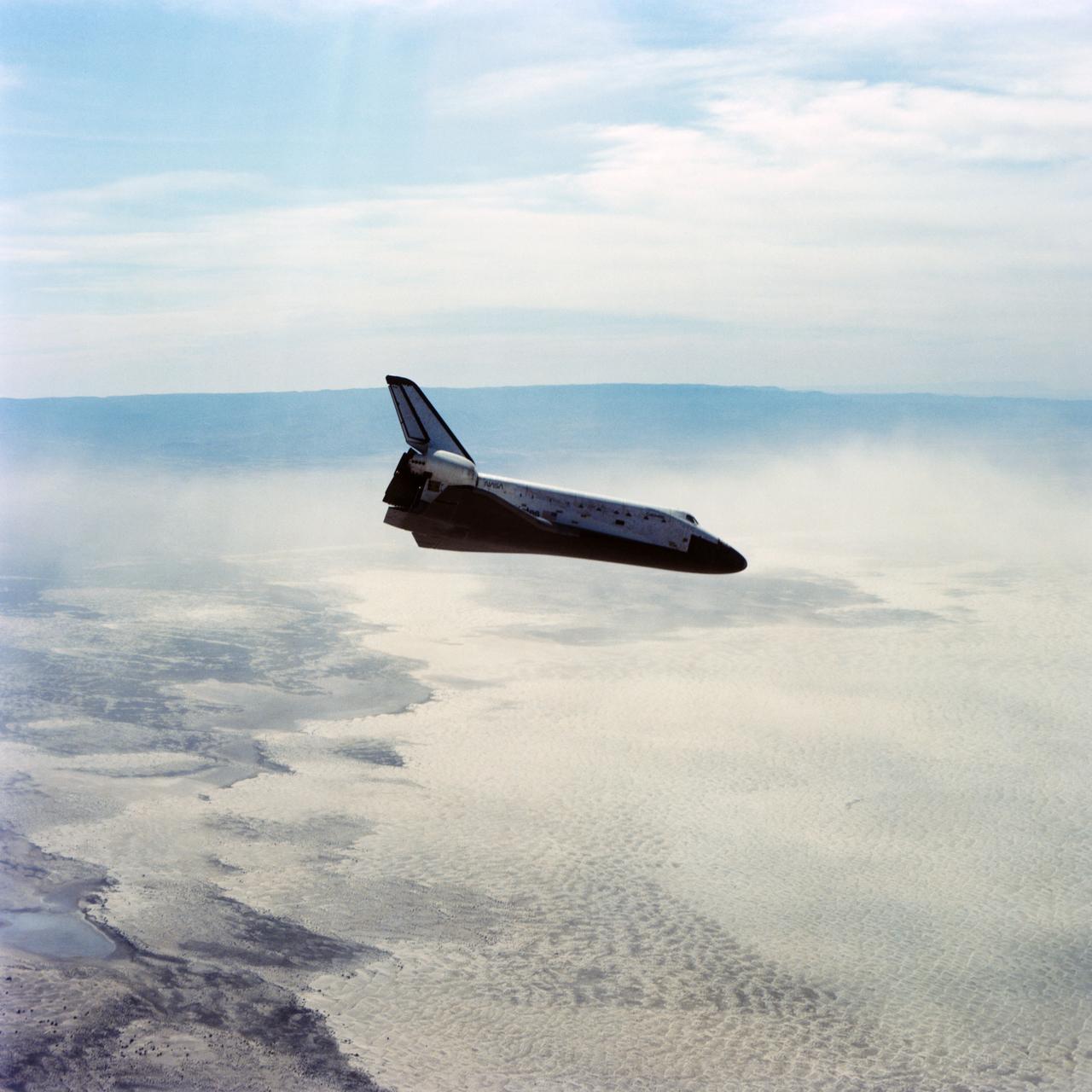
Air-to-air coverage of Orbiter inspection during its descent, along side and during touchdown. NORTHRUP STRIP, WHITE SANDS, NM Also available in 70 CN
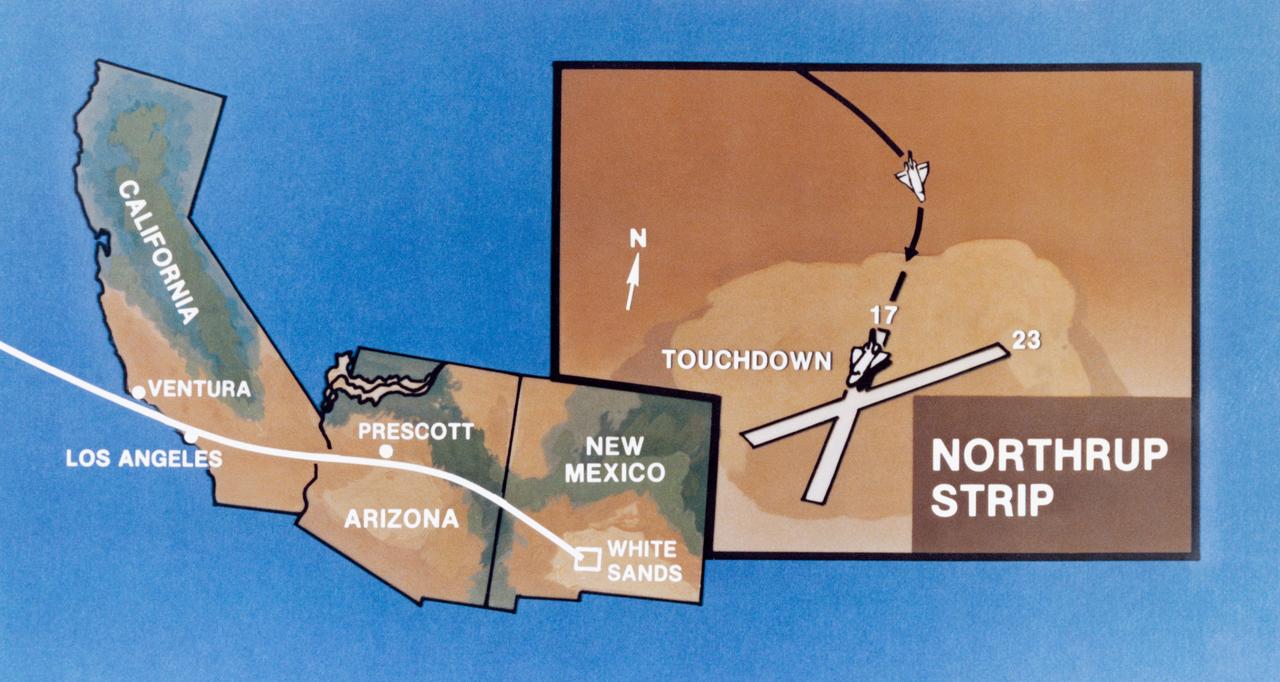
Art Concept of the End-of-Mission Approach and Landing at WSTF, NM, from Rockwell. 1. ART CONCEPT - STS-3 LANDING 2. STS-3 - LANDING WSTF, NM Also available in 4x5 B&W
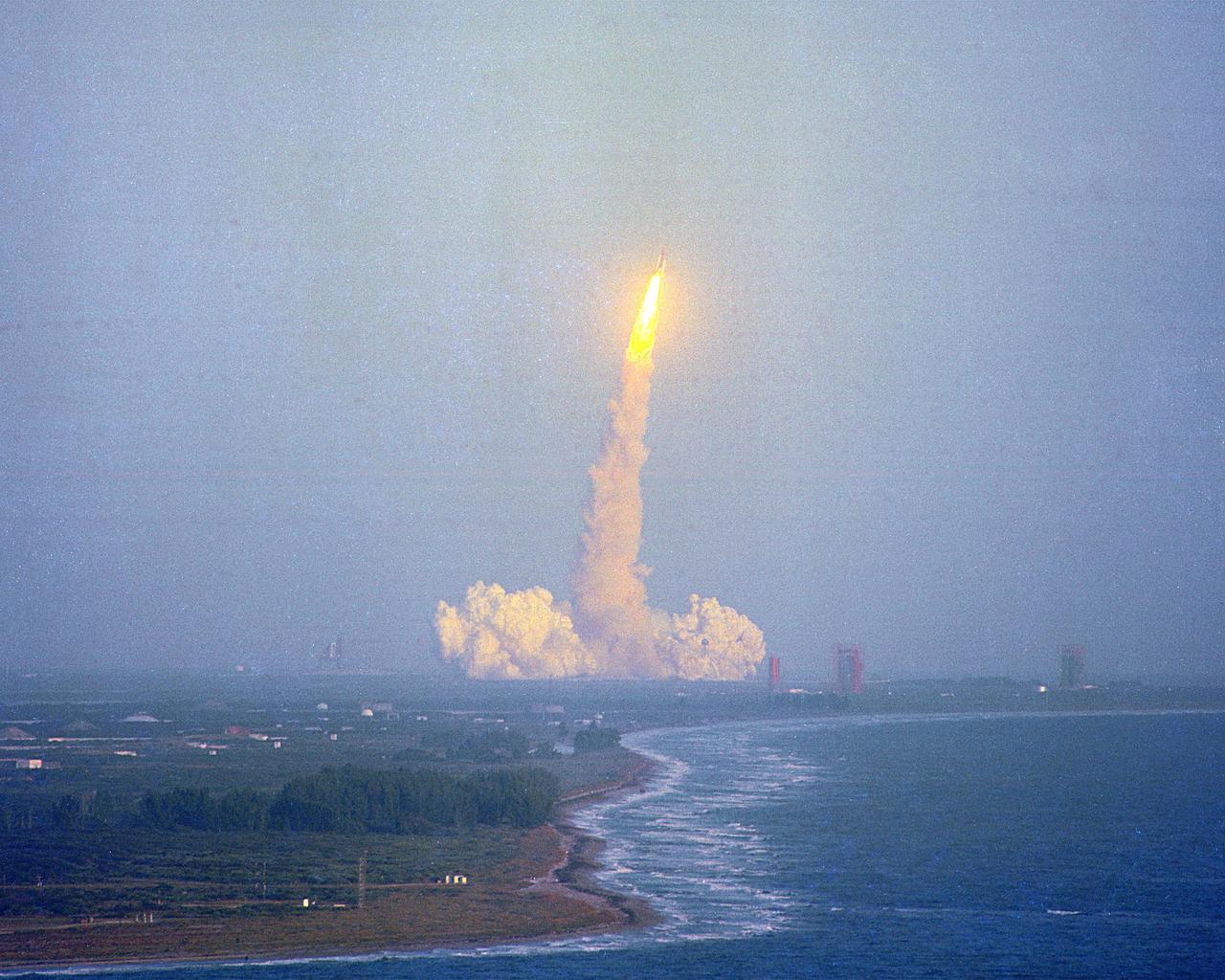
KENNEDY SPACE CENTER, FLA. -- Columbia launches from Launch Pad 39A on mission STS-5.
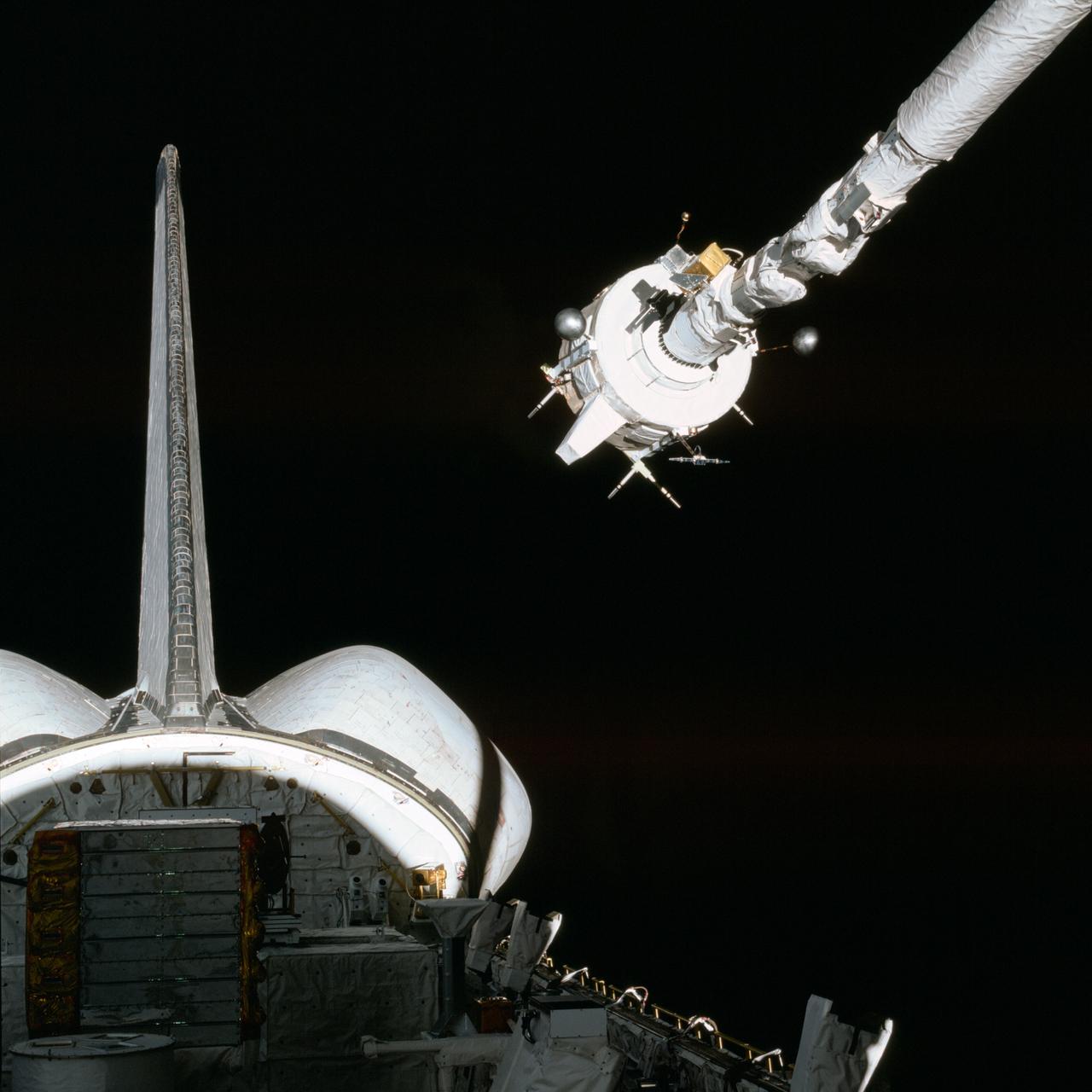
STS003-09-444 (22-30 March 1982) --- The darkness of space provides the backdrop for this scene of the plasma diagnostics package (PDR) experiment in the grasp of the end effector or ?hand? of the remote manipulator system (RMS) arm, and other components of the Office of Space Sciences (OSS-1) package in the aft section of the Columbia?s cargo hold. The PDP is a compact, comprehensive assembly of electromagnetic and particle sensors that will be used to study the interaction of the orbiter with its surrounding environment; to test the capabilities of the shuttle?s remote manipulator system; and to carry out experiments in conjunction with the fast pulse electron generator of the vehicle charging and potential experiment, another experiment on the OSS-1 payload pallet. This photograph was exposed with a 70mm handheld camera by the astronaut crew of STS-3, with a handheld camera aimed through the flight deck?s aft window. Photo credit: NASA
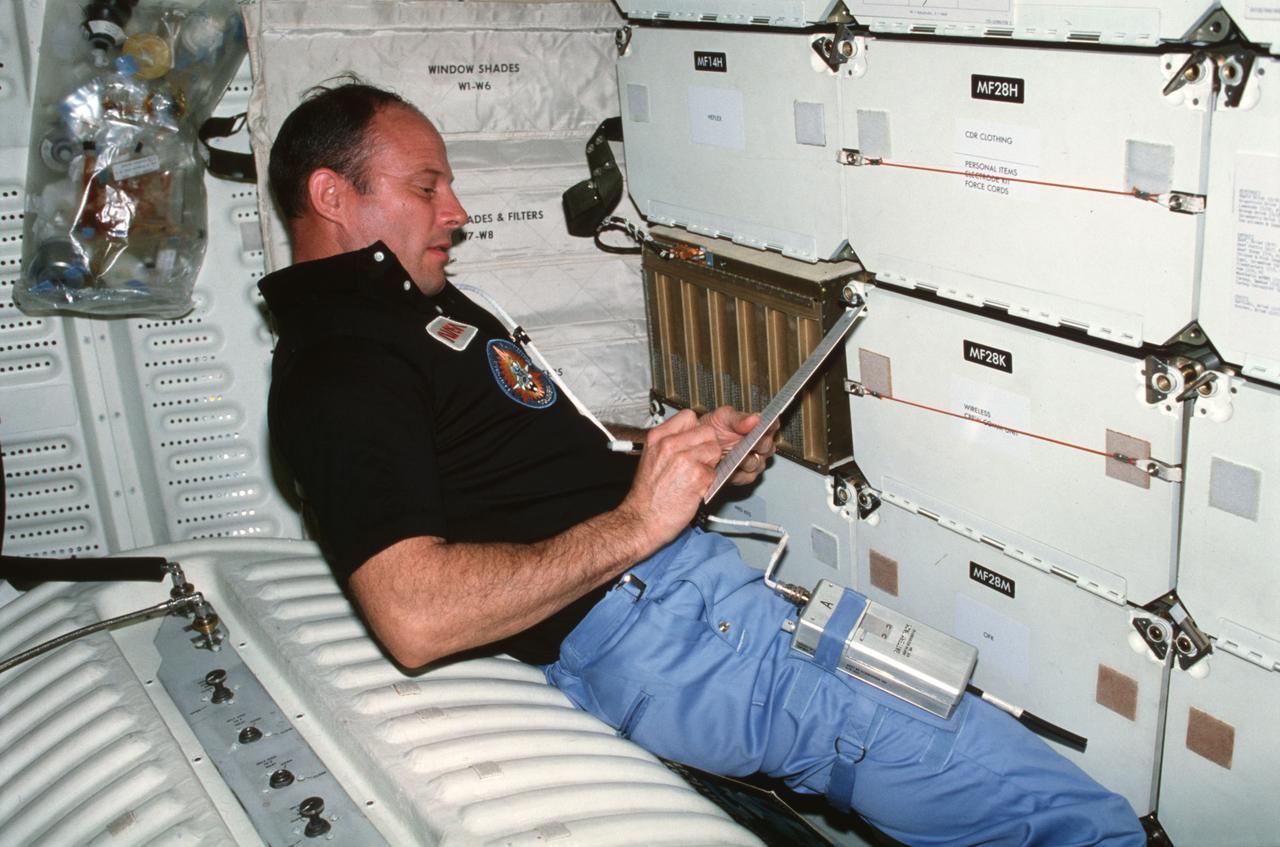
STS003-22-122 (30 March 1982) --- STS-3 Commander Lousma, wearing communications kit assembly (ASSY) mini-headset (HDST), records Plant Growth Unit (PGU) data for the Influence of Weightlessness on Plant Lignification Experiment at forward middeck locker MF14K. The experiment is designed to demonstrate the effect of weightlessness on the quantity and rate of lignin formation in different plant species during early stages of development. Port side bulkhead with window shade and filter kit appears behind Lousma and potable water tank below him. Trash bag also appears in view. Photo credit: NASA
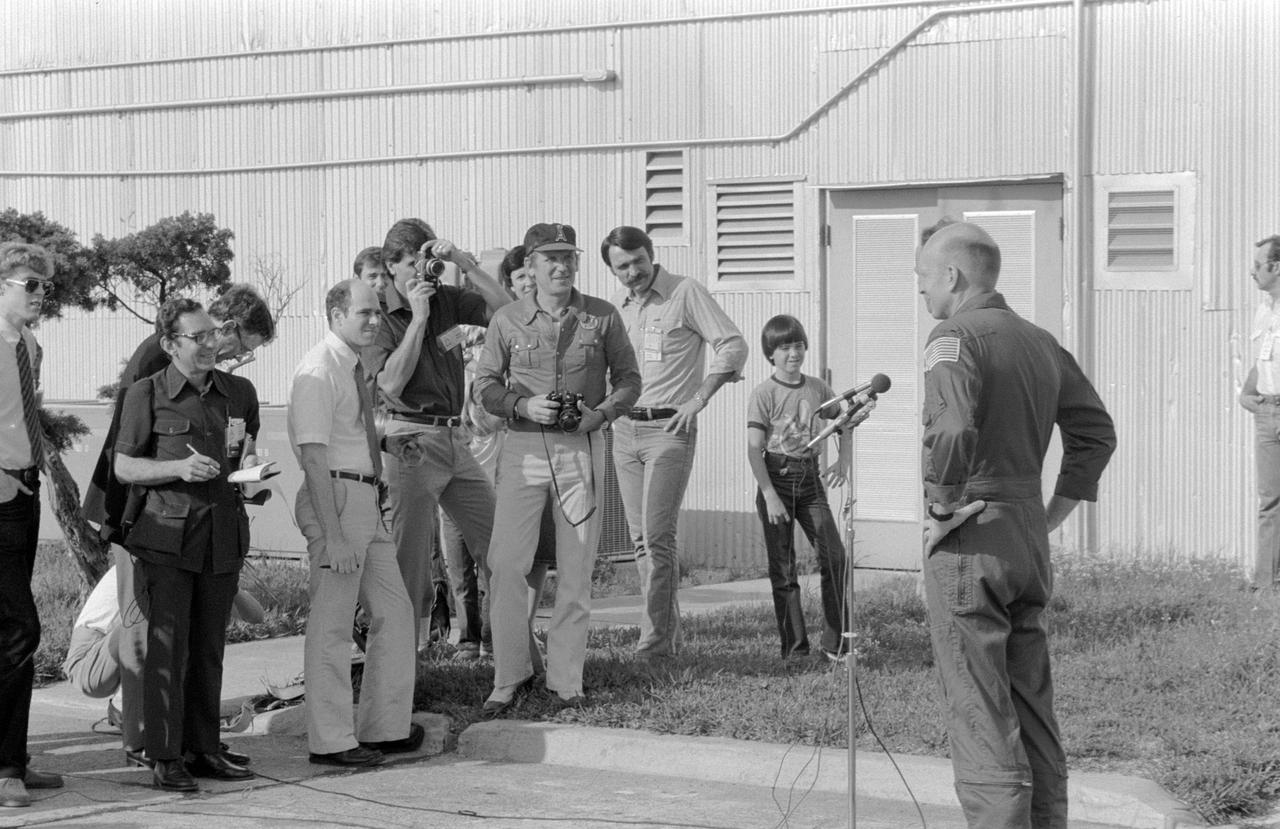
Views of the STS-3 Crew, Astronauts Lousma and Fullerton, during departure activities with family and friends to include Astronaut Brewster Shaw. 1. ASTRONAUT SHAW, BREWSTER - STS-3 EAFB, HOUSTON, TX
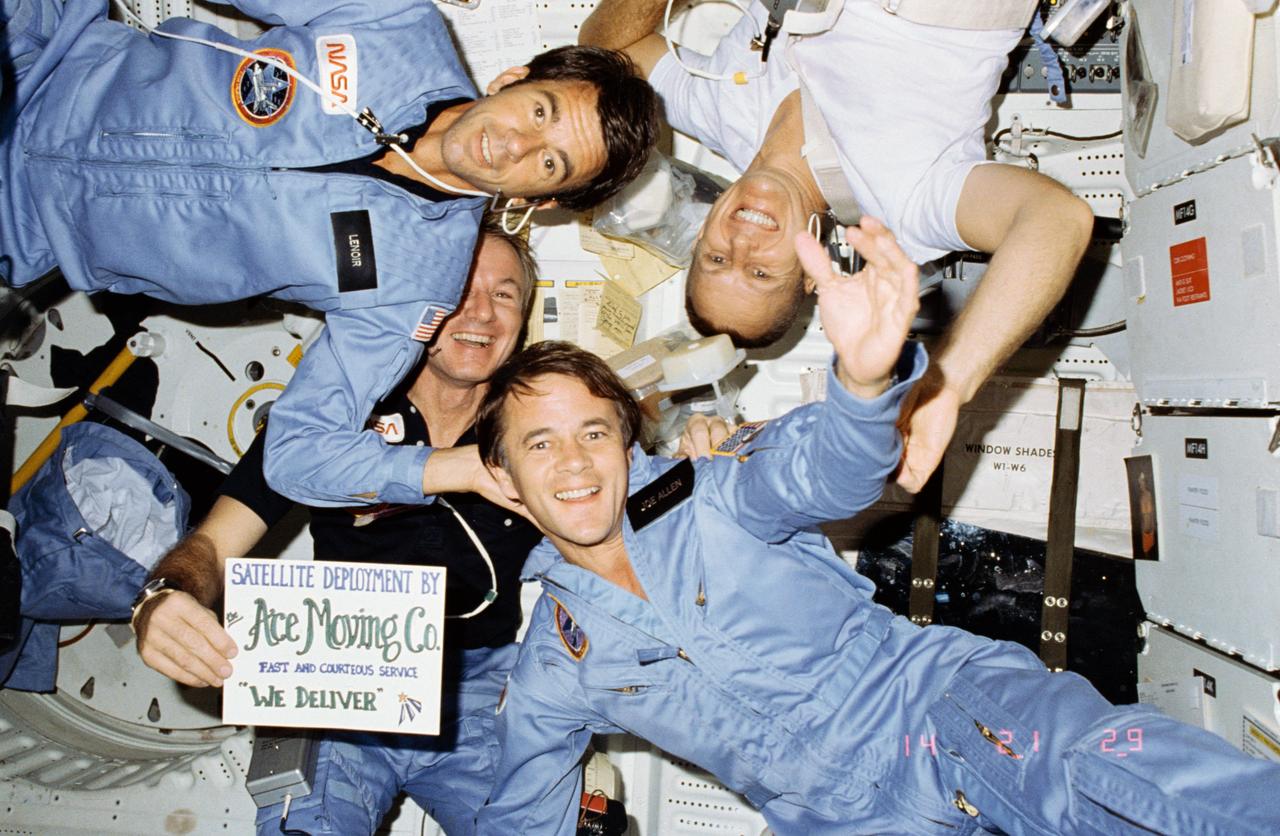
Crew onboard portrait taken on port side middeck shows Commander Brand holding Ace Moving Co sign (partially obscured, near center) and surrounded by Pilot Overmyer (in light t-shirt), Mission Specialist (MS) Allen (center bottom) and MS Lenoir (center top). The sign refers to the successful deployment of two commercial communications satellites on the flight's first two days.
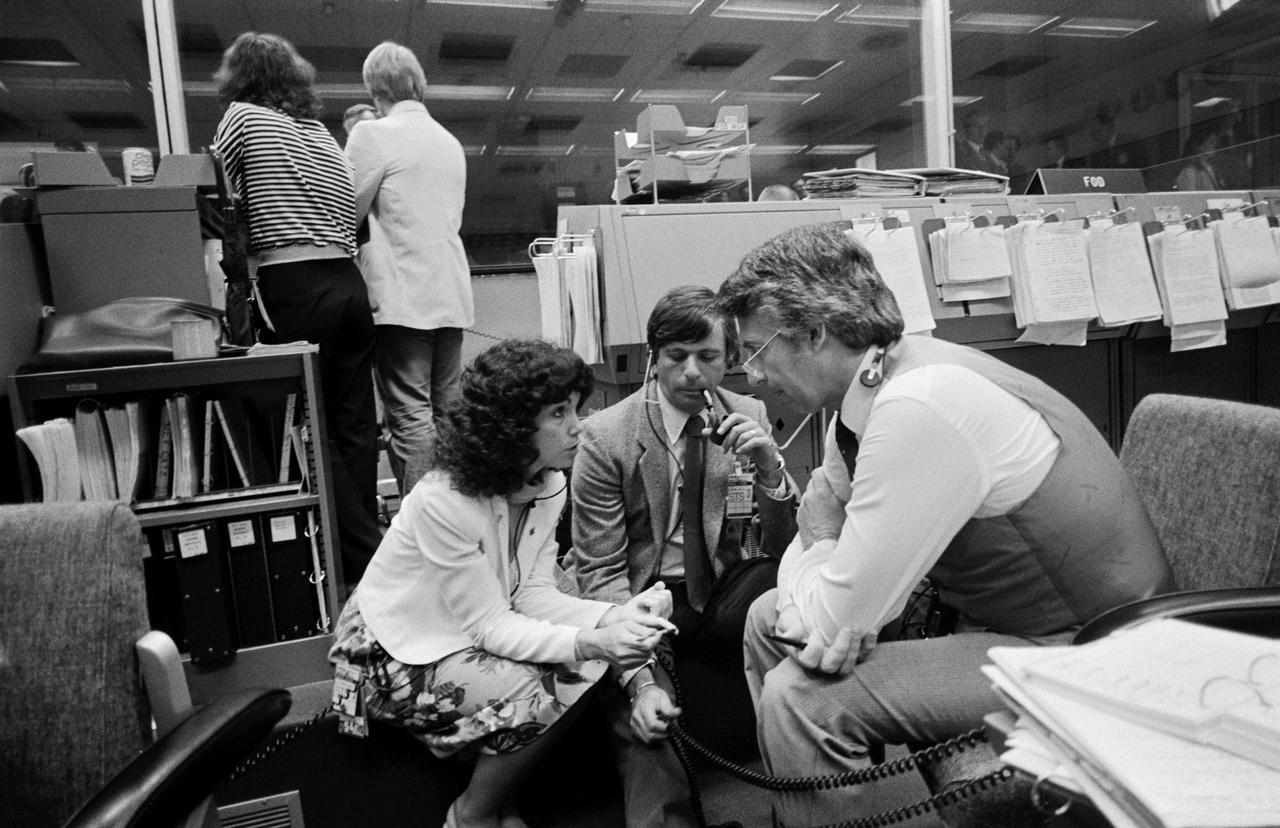
Day-5 Mission Control Room activities, STS-3 Mission of: Alan Briscoe, at the Instrumentation and Communications Officer (INCO) Console; Astronaut Richard Truly and Briscoe; Astronaut Judy Resnik, Flight Director (FD) Jay Greene, and On-Duty FD Harold Draughon. 1. Flight Directors - STS 3 2. Astronaut Judy Resnik 3. Alan Briscoe 4. Jay Greene 5. Harold Draughon
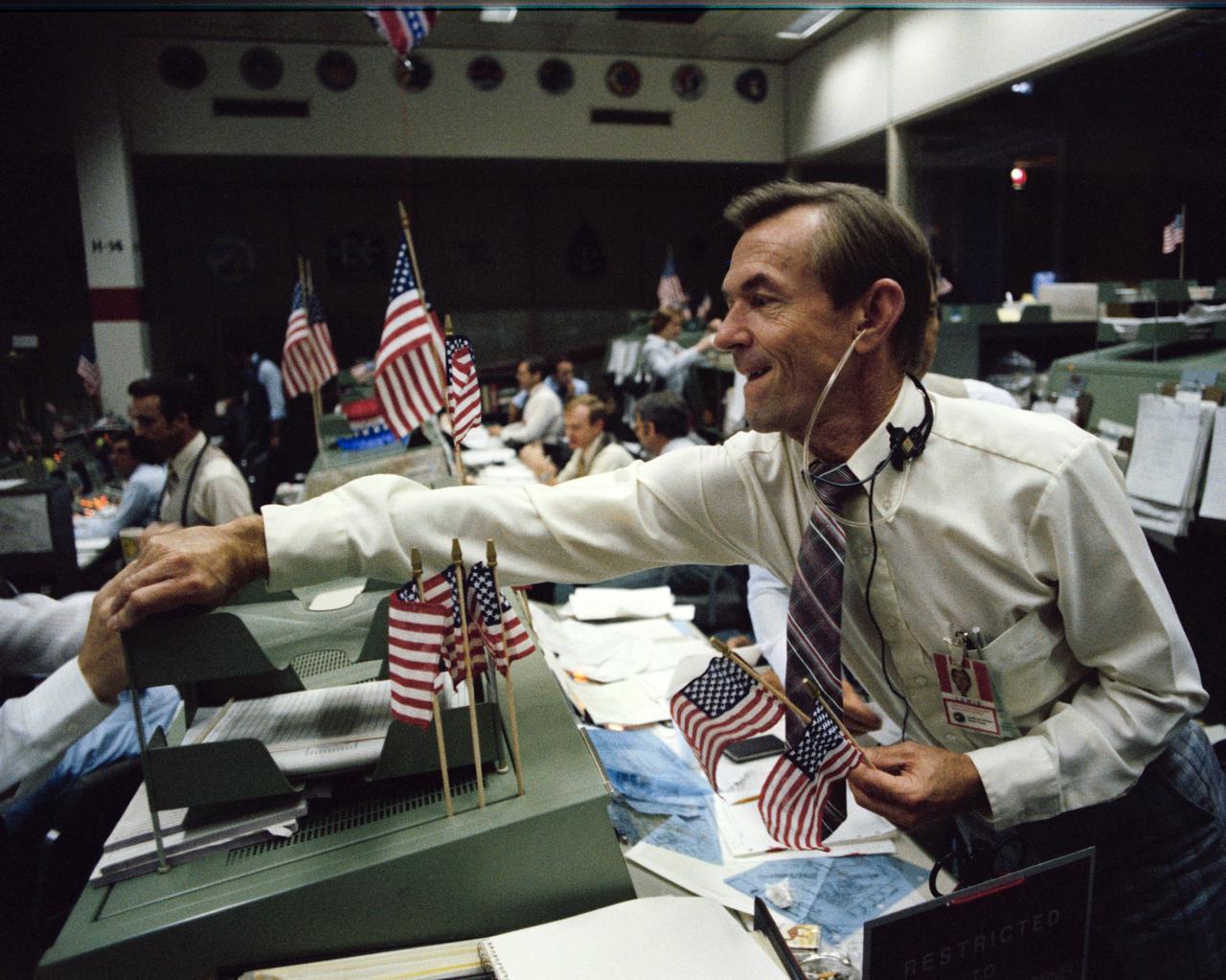
S82-33221 (4 July 1982) --- Lead STS-4 flight director Charles Lewis is congratulated by an unidentified flight controller (partially out of frame) in the Johnson Space Center's Mission Control Center following the landing of the space shuttle Columbia at Edwards Air Force Base in California. Photo credit: NASA
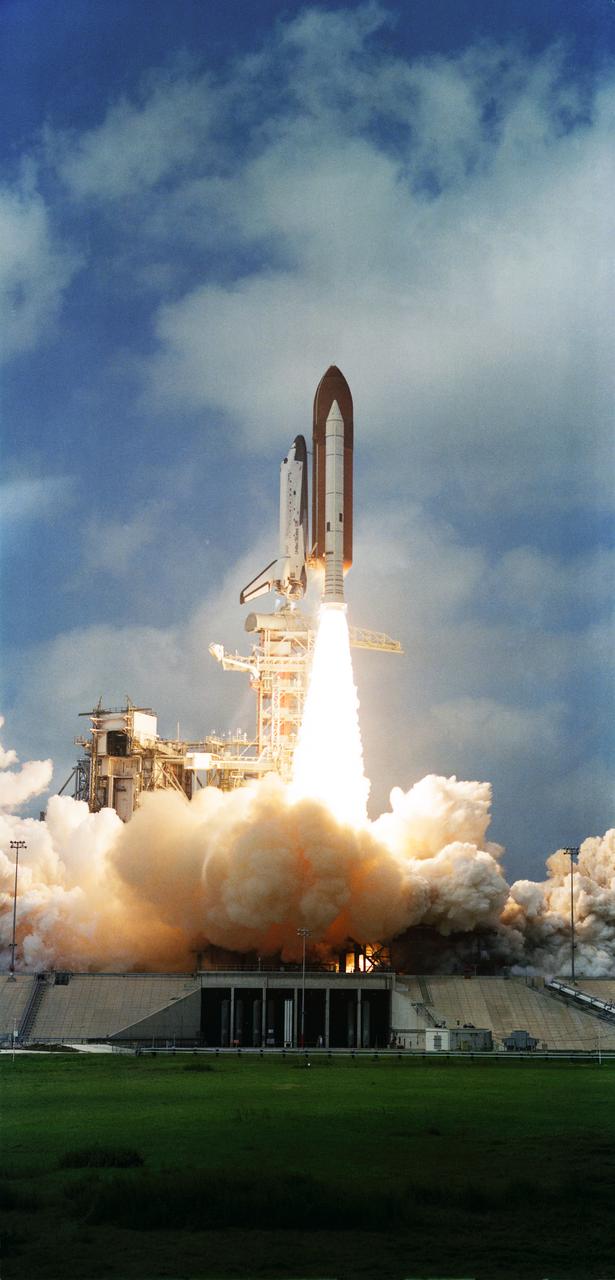
S82-28746 (22 March 1982) --- The space shuttle Columbia, with its third crew aboard, two solid rocket boosters (SRB) and external fuel tank (ET) are photographed as they clear the launch pad at Kennedy Space Center?s Launch Complex 39. Astronauts Jack R. Lousma, STS-3 commander, and C. Gordon Fullerton, pilot, were in Earth orbit some ten minutes later looking ahead to seven days of work in space. The external tank is unpainted for the first time, appearing a dark orange in the color photos and dark gray in black and white. Photo credit: NASA
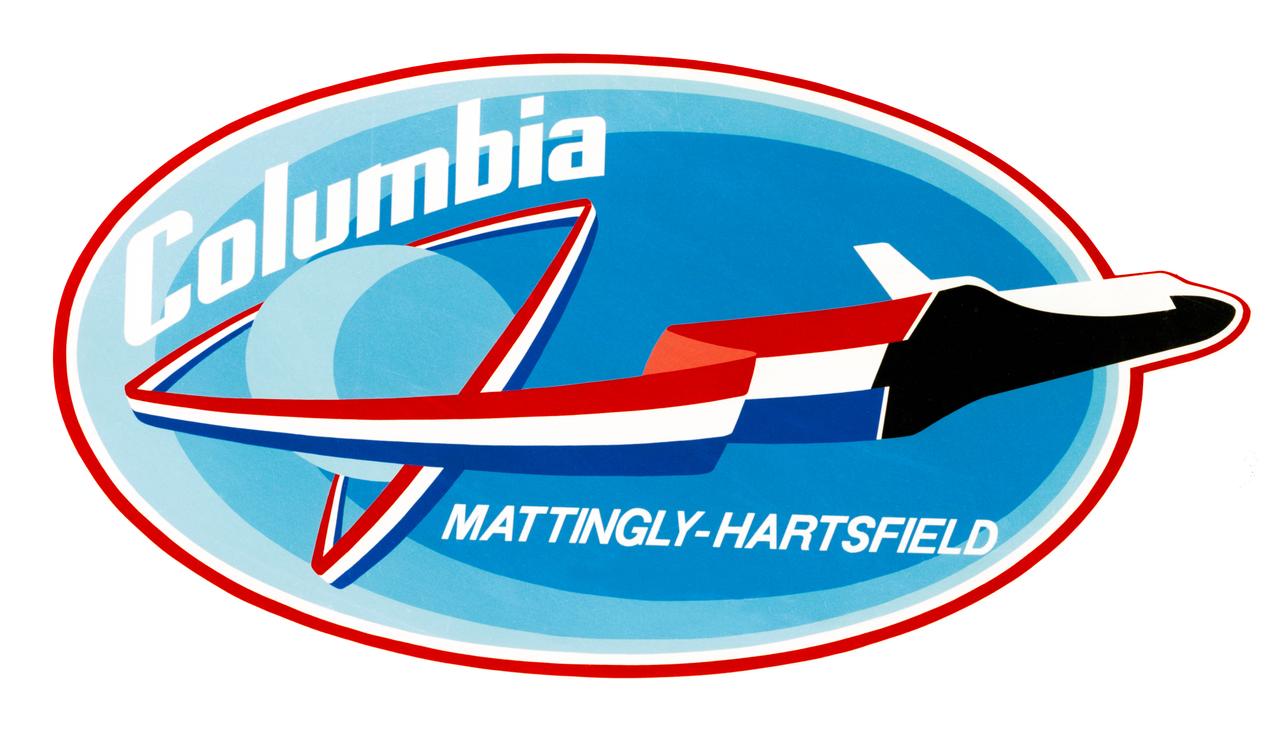
S82-29695 (April 1982) --- This oval shaped artwork is the insignia for the fourth Space Transportation System (STS-4) flight in the National Aeronautics and Space Administration's (NASA) space shuttle Columbia. The Columbia, with its crew of astronauts Thomas K. Mattingly II, and Henry W. Hartsfield Jr. aboard, will launch from the Kennedy Space Center (KSC), and orbit Earth for approximately one week in summer of 1982. The insignia shows the Columbia trailing our nation's colors in the shape of her flight number, representing the fourth and final flight of the highly successful flight test phase. She then streaks on into the future, entering the exciting operational phase scheduled to begin with STS-5. The NASA insignia design for space shuttle flights is reserved for use by the astronauts and for other official use as the NASA Administrator may authorize. Public availability has been approved only in the forms of illustrations by the various news media. When and if there is any change in this policy, which is not anticipated, the change will be publicly announced. Photo credit: NASA
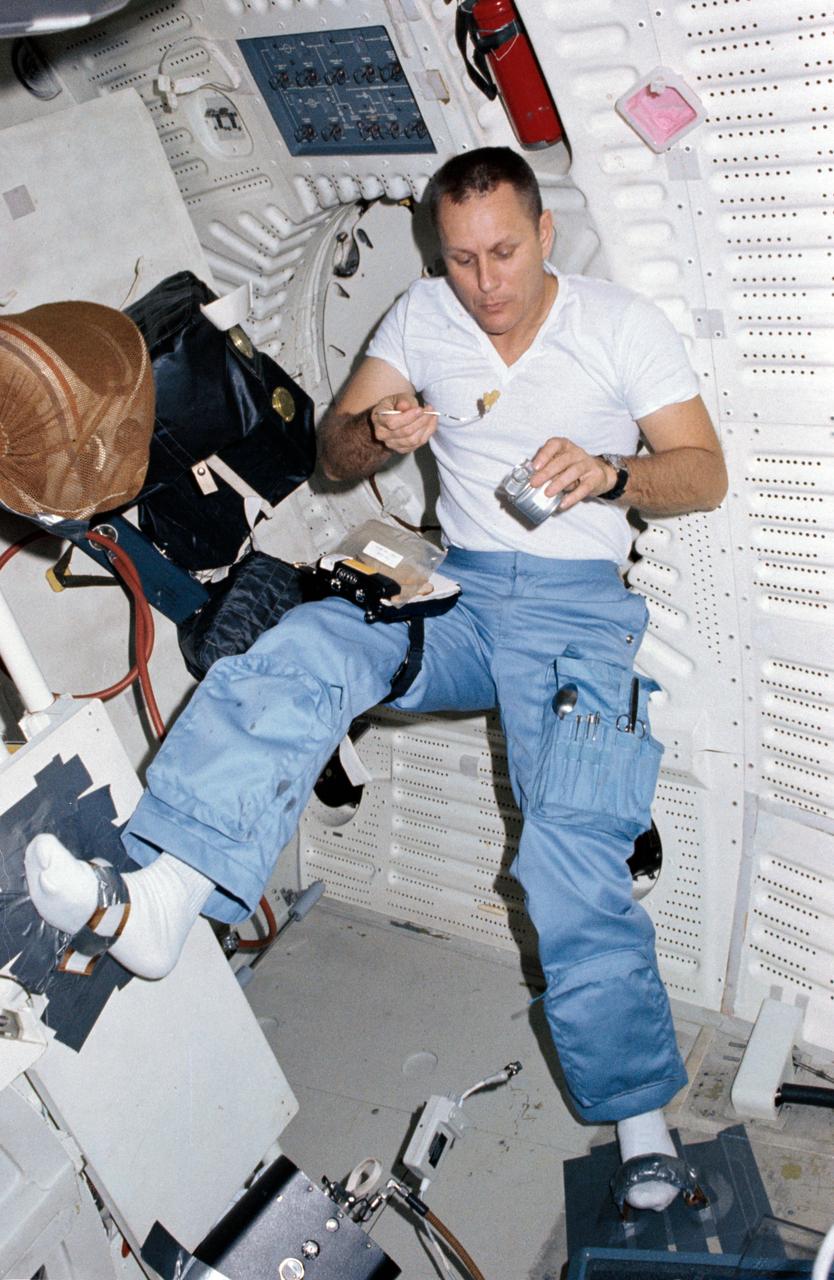
STS005-15-588 (13 Nov. 1982) --- Astronaut Robert F. Overmyer, STS-5 pilot, enjoys a meal from a jury-rigged set-up in the middeck area of the Earth-orbiting space shuttle Columbia. He wears a T-shirt and the trouser portion of a multi-piece constant wear garment. His feet are positioned in recently-rigged foot restraints to avoid involuntary movement in the micro-gravity environment of space. Behind Overmyer are components of the suit, including helmet, worn during landing and takeoff for shuttle flights. The trousers he is presently wearing are part of that attire. Photo credit: NASA
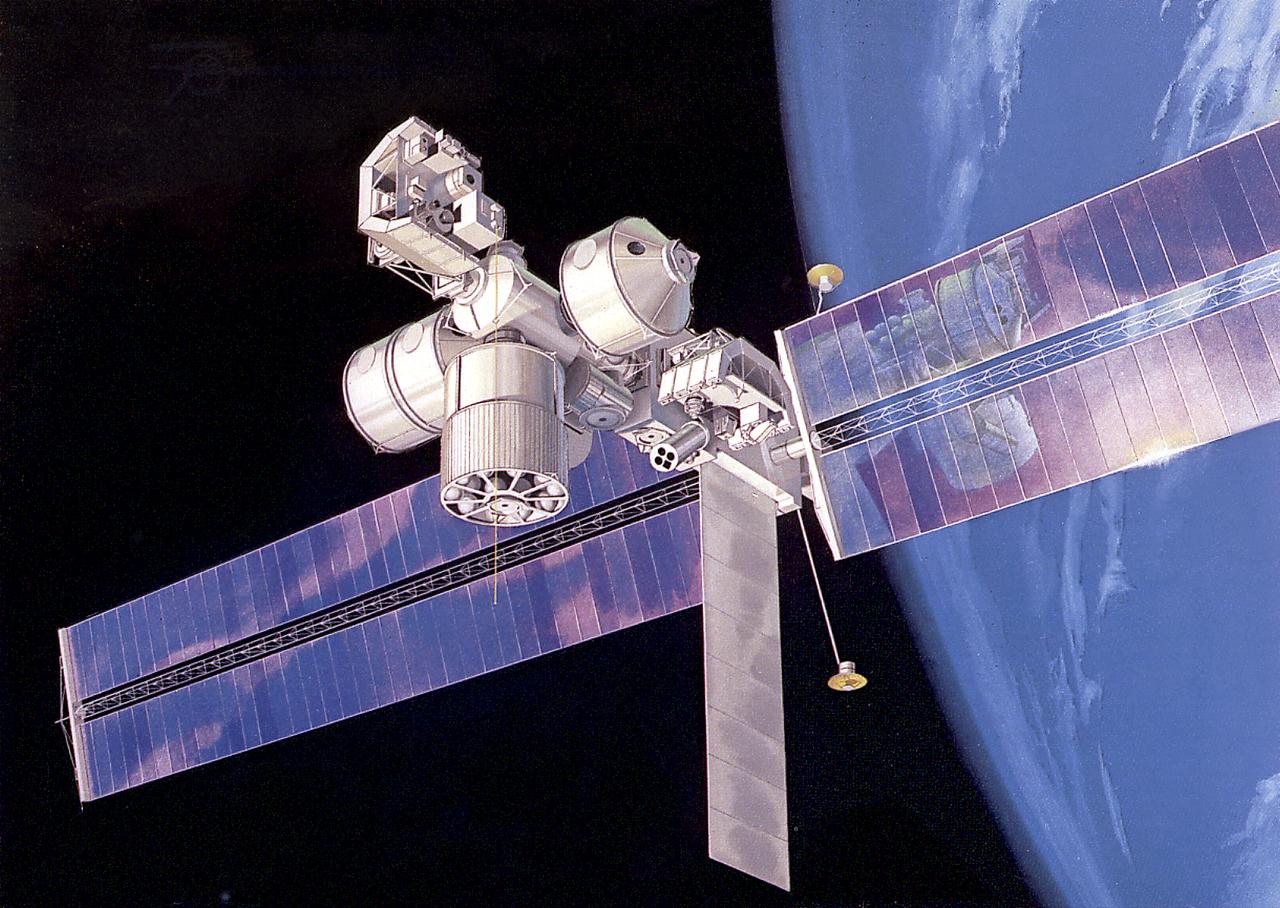
McDornel Douglas performed an Evolutionary Space Platform Concept Study for the Marshall Space Flight Center in the early 1980's. The 10-month study was designed to define, evaluate, and compare approaches and concepts for evolving unmanned and manned capability platforms beyond the then current space platform concepts to an evolutionary goal of establishing a permanent-manned presence in space.
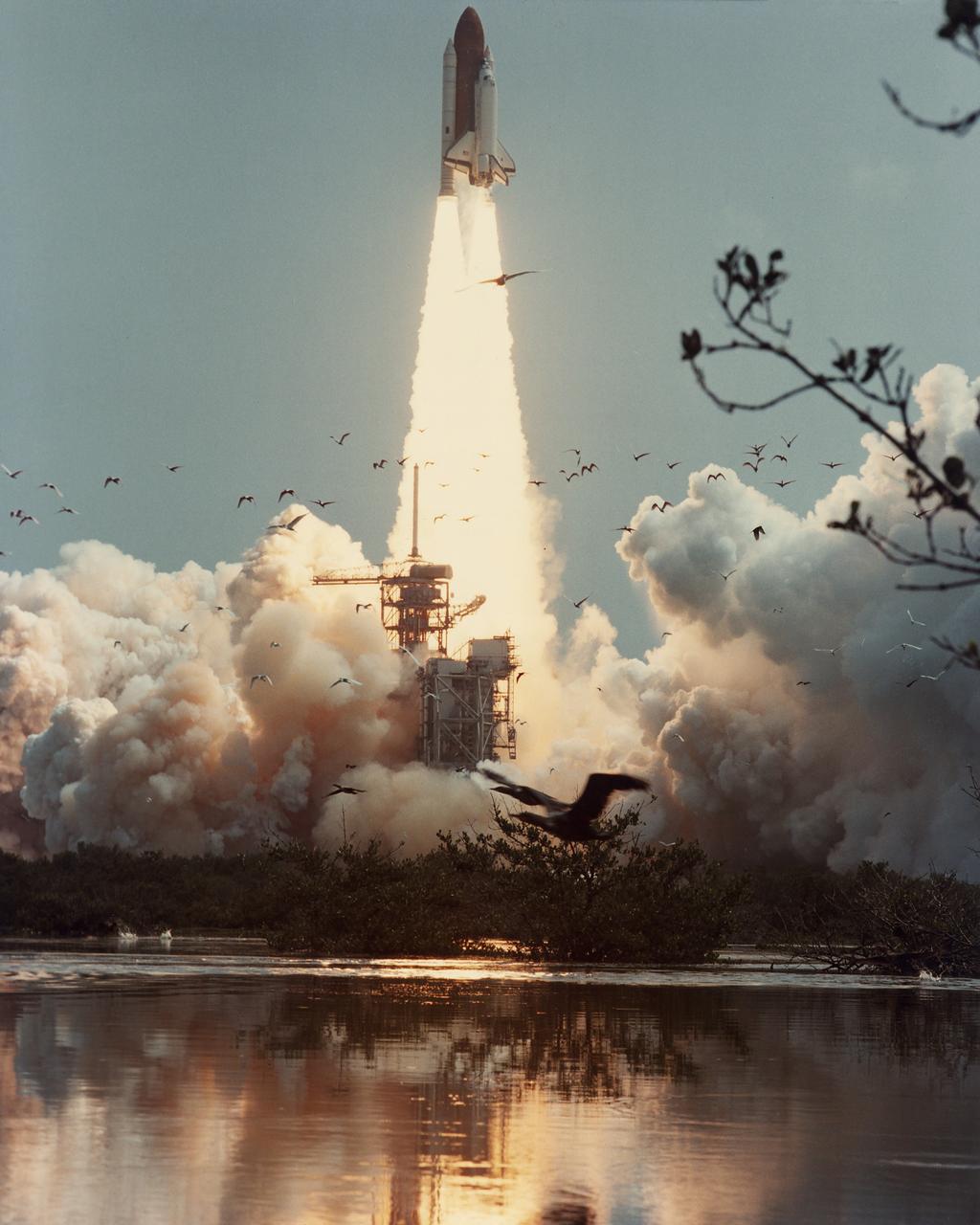
CAPE CANAVERAL, Fla. - STS-4 thunders away from Launch Pad 39A at 10:59:59 a.m. EDT, bound for a seven-day Earth orbital mission and the final developmental flight for the Space Transportation System. The fourth Space Shuttle mission is piloted by Commander Ken Mattingly and Pilot Henry Hartsfield Jr. Photo Credit: NASA
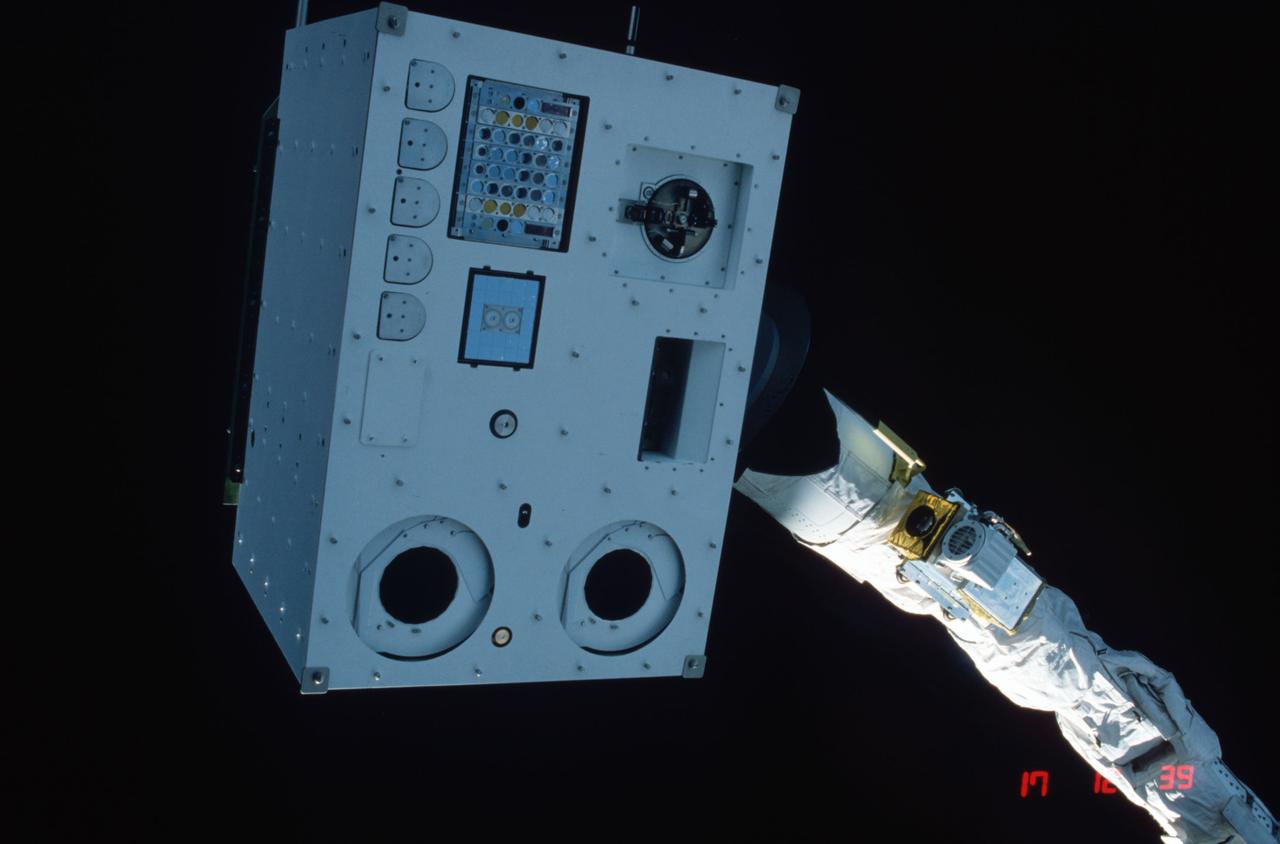
STS004-23-119 (27 June-4 July 1982) --- This is a close-up view of the Marshall Space Flight Center-developed Induced Environment Contamination Monitor (IECM), a multi-instrument box designed to check for contaminants in and around the space shuttle orbiter cargo bay which might adversely affect delicate experiments carried aboard. The astronaut crew of Thomas K. Mattingly II and Henry W. Hartsfield Jr. maneuvered the Canadian-built robot arm (called the remote manipulator system) very near their overhead flight deck windows and captured this scene with a 35mm camera. HOLD PICTURE HORIZONTALLY WITH FRAME NUMBER AT TOP CENTER. Cameras for the 11 instruments are pictured as black circles at the bottom of the frame. The access door to the arm and safe plug is located about halfway up the left edge of the box. A cascade injector device is immediately to the right of the plug. The rectangular opening at right center of the monitor is the optical effects module. Mass spectrometer is at upper left. Air sampler bottles are at upper left. The colorful rectangle near upper left of the monitor is the passive array. Not easily seen, but also a part of the instrument, are the cryogenic quartz crystal micro balance and the temperature controlled quartz micro balance. Photo credit: NASA
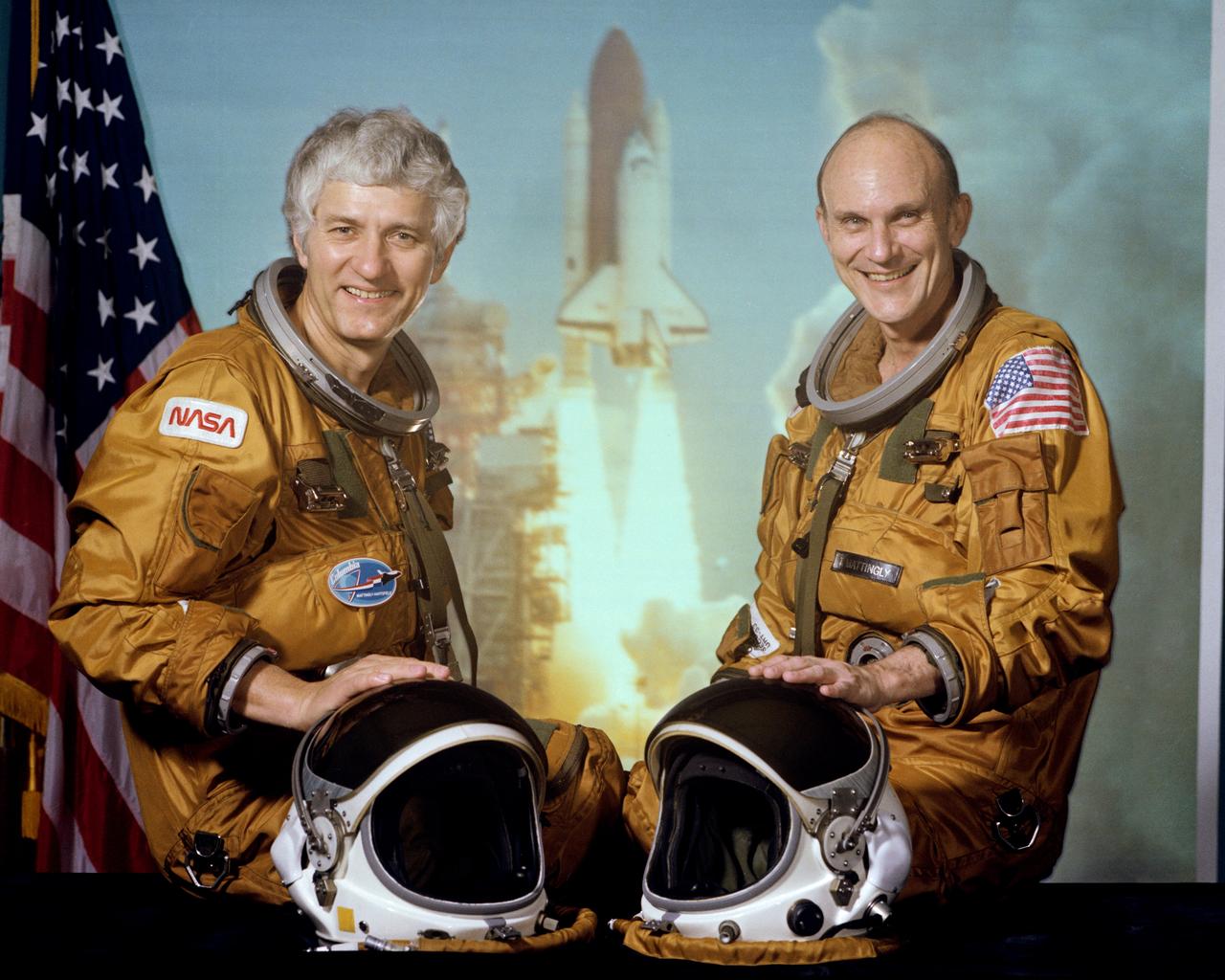
S82-31207 (1 May 1982) --- These two astronauts will man the space shuttle Columbia for NASA's fourth and final (STS-4) orbital flight test. Thomas K. (Ken) Mattingly II, right, is crew commander. Henry W. Hartsfield Jr., is pilot. Their flight is scheduled for launch in late June 1982, and is to last approximately one week, with launch to take place form KSC and landing to be on the dry lake beds of Edwards Air Force Base and Dryden Flight Research Facility (DFRC) in California. Photo credit: NASA
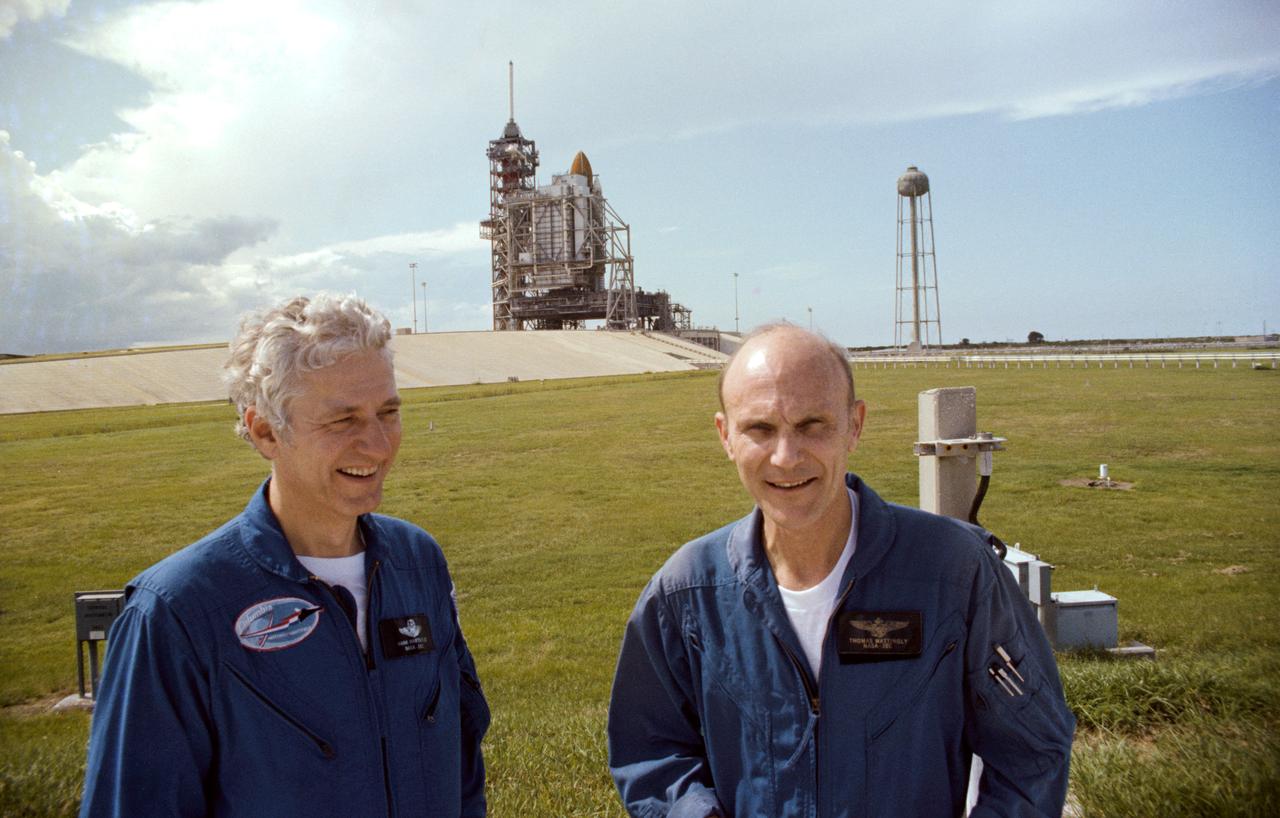
Astronauts Thomas K. Mattingly, II., right, and Henry Hartsfield, Jr. pose for news photographers in front of the Space Shuttle vehicle during break in the countdown demonstration test (CDDT) for STS-4.
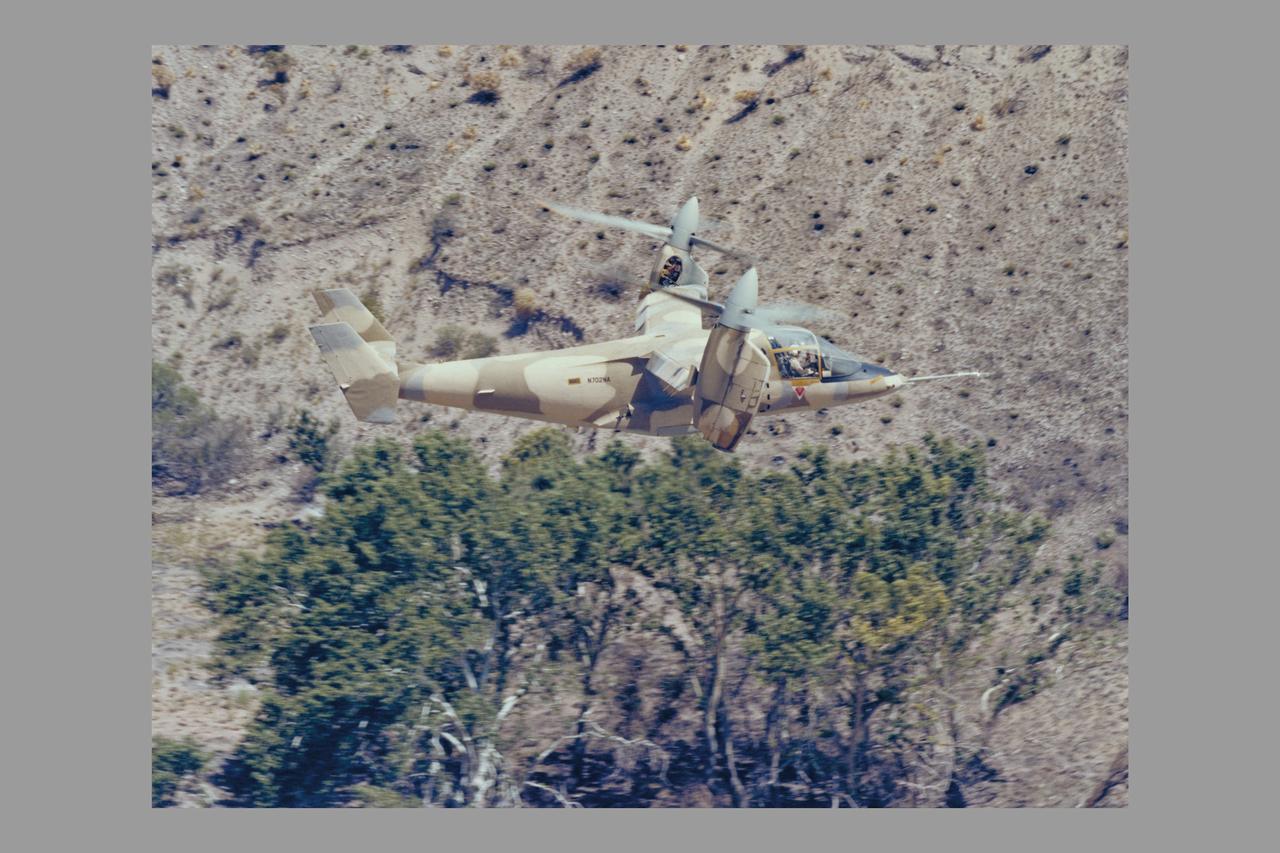
Army Camouflaged XV-15 flying NOE (nap-of-the-earth) tests (ref# 024398_
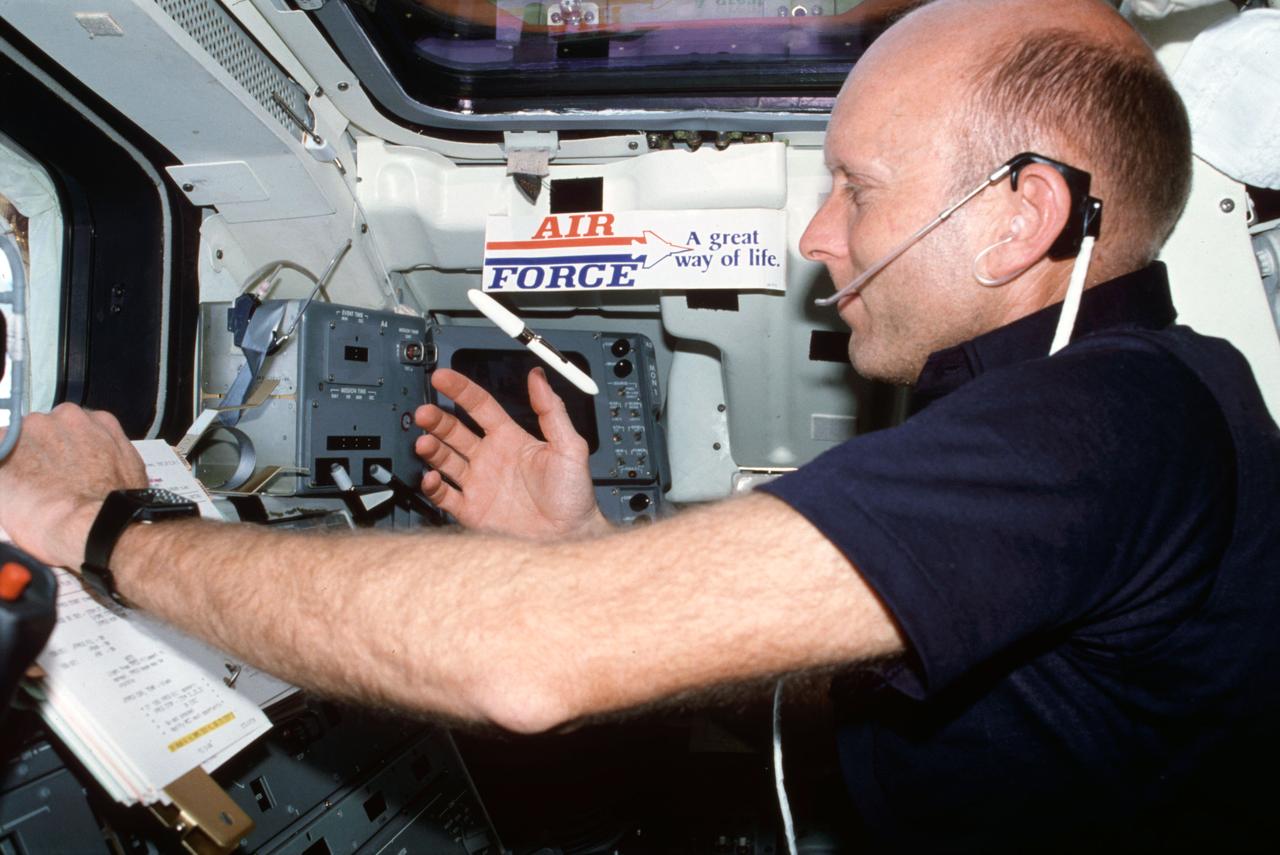
STS003-21-086 (22-30 March 1982) --- Astronaut Gordon Fullerton, STS-3 pilot, wearing communications kit assembly mini-headset, watches a free-floating pen during checklist procedures at the aft flight deck on-orbit station. Taken from the aft flight deck starboard side, Fullerton is seen in front of panels A7 and A8 with W8 and a "United States Air Force - a Great Way of Life" decal overhead. Photo credit: NASA

B-57B on ramp
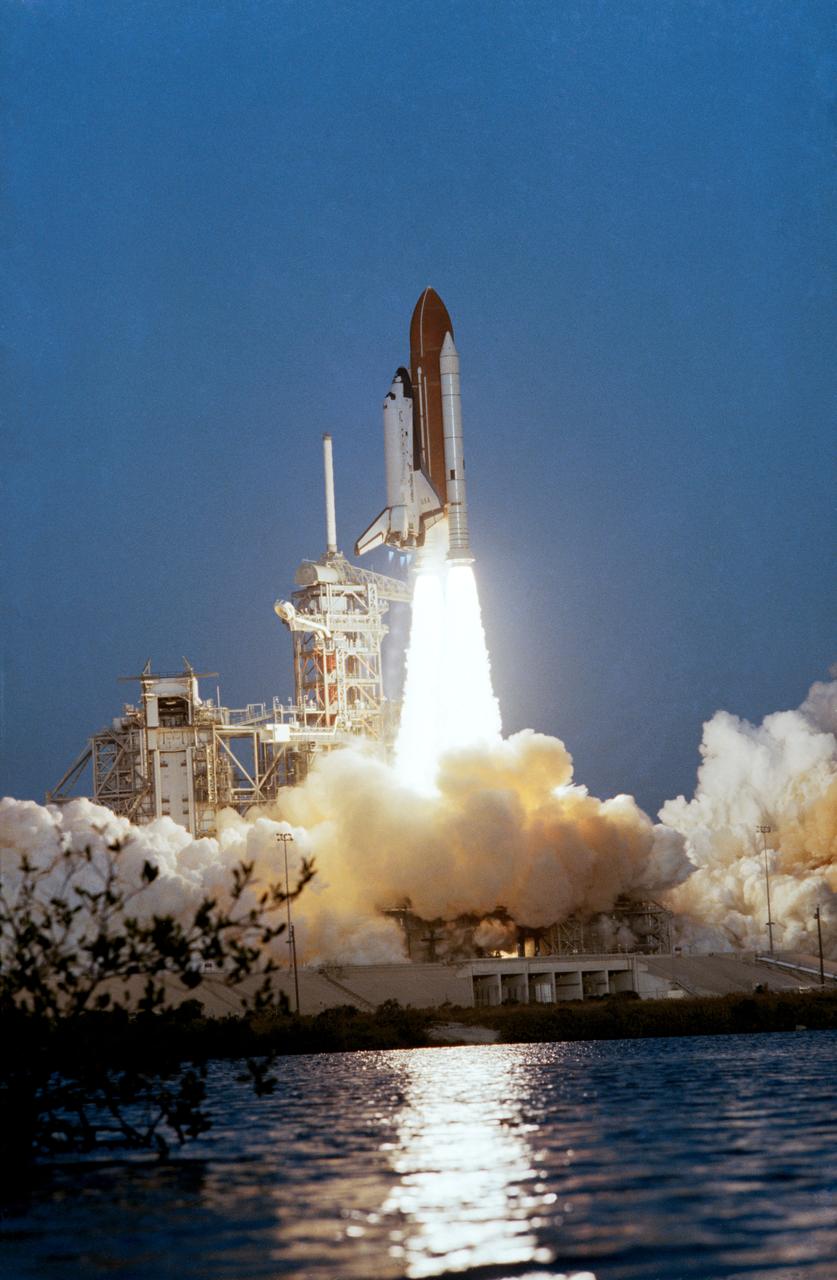
S82-39532 (11 Nov. 1982) --- Having completed its four-mission test program, the space shuttle Columbia begins a new era of operational flights as it clears the launch tower and heads for Earth orbit. Launch occurred at 7:19 a.m. (EST), November 11, 1982. Aboard the orbiter, mated here to its two solid rocket boosters and external fuel tank, were astronauts Vance D. Brand, STS-5 commander; Robert F. Overmyer, pilot; William B. Lenoir, mission specialist; and Joseph P. Allen, mission specialist. Photo credit: NASA
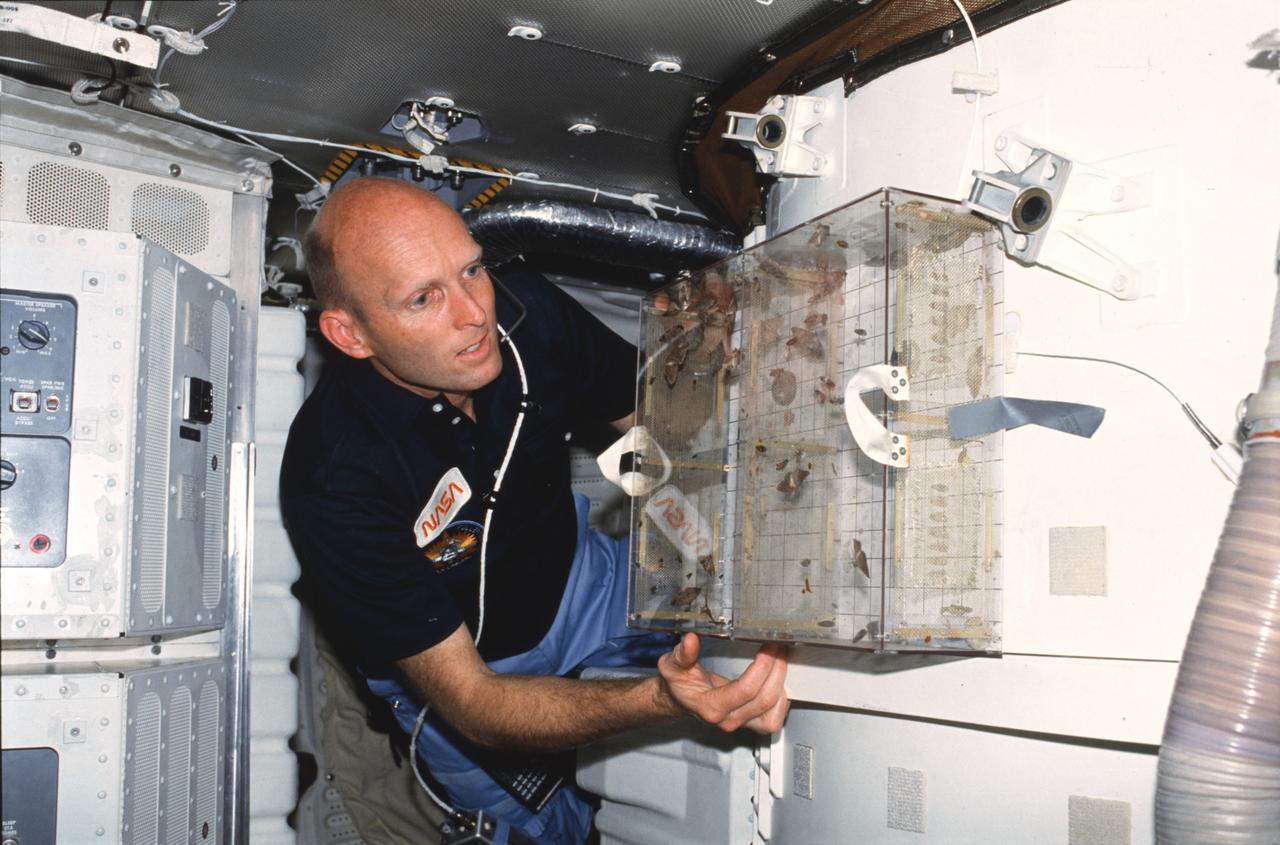
STS003-23-178 (22-30 March 1982) --- Astronaut C. Gordon Fullerton, STS-3 pilot, examines Student Experiment 81-8 (SE-81-8) Insect Flight Motion Study taped to the airlock on aft middeck. Todd Nelson, a high school senior from Minnesota, won a national contest to fly his experiment on this particular flight. Moths, flies, and bees were studied in the near weightless environment. Photo credit: NASA
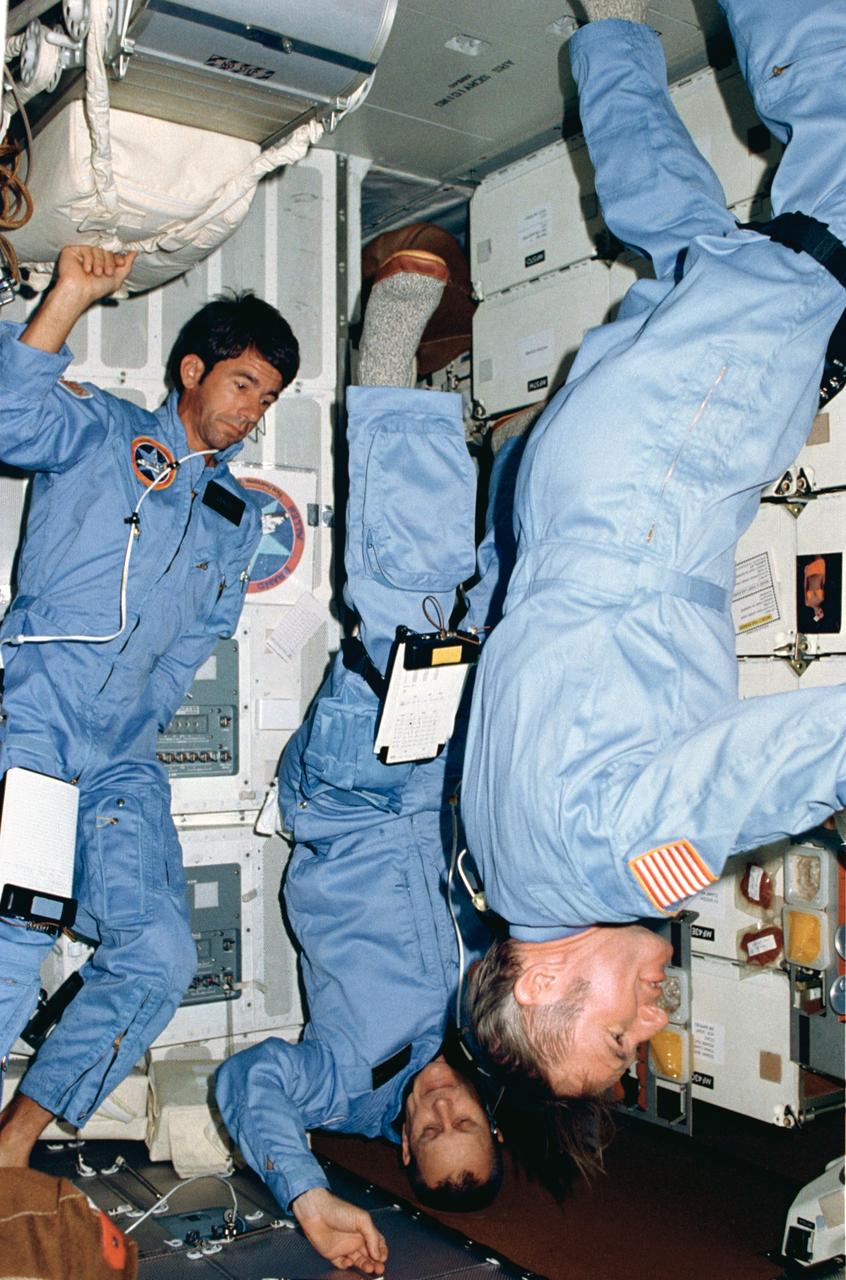
STS005-04-124 (14 Nov. 1982) --- Three members of the four-man STS-5 crew demonstrate the zero-gravity environment aboard the Earth-orbiting space shuttle Columbia. Astronaut Vance D. Brand, mission commander, holds a fairly typical Earth-bound pose, but crewmates, astronauts Robert F. Overmyer (center), pilot, and Dr. William B. Lenoir, mission specialist, perform body movements that could only be accomplished in zero-gravity. Dr. Joseph P. Allen IV, the flight’s other mission specialist, exposed this frame with a 35mm handheld camera. The four astronauts were in the middeck area of their reusable spacecraft when this photograph was made. Photo credit: NASA
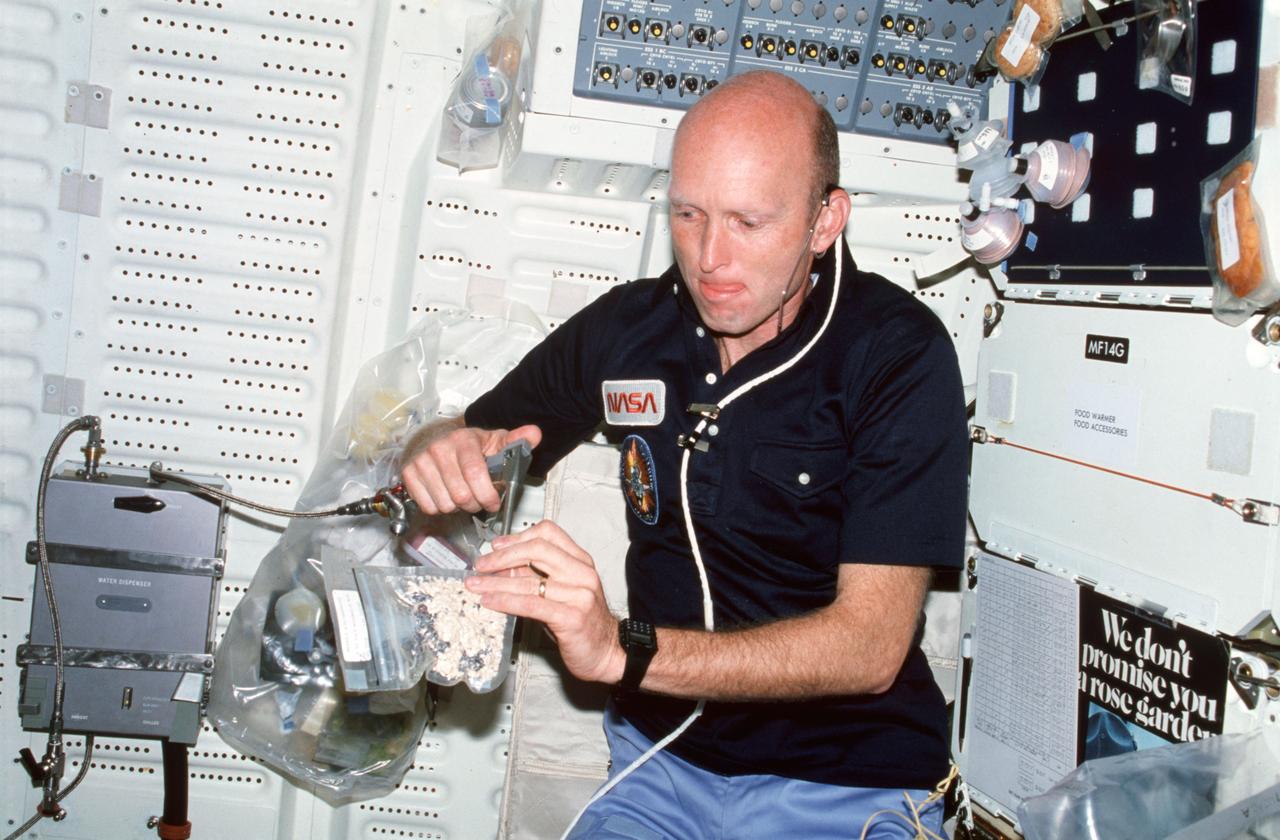
STS003-26-254 (30 March 1982) --- Astronaut Gordon Fullerton, STS-3 pilot, wearing communications kit assembly (ASSY) mini-headset (HDST), inserts the JSC water dispenser kit water gun in rehydratable plastic food (cereal) package to fill it with hot water. Photo credit: NASA
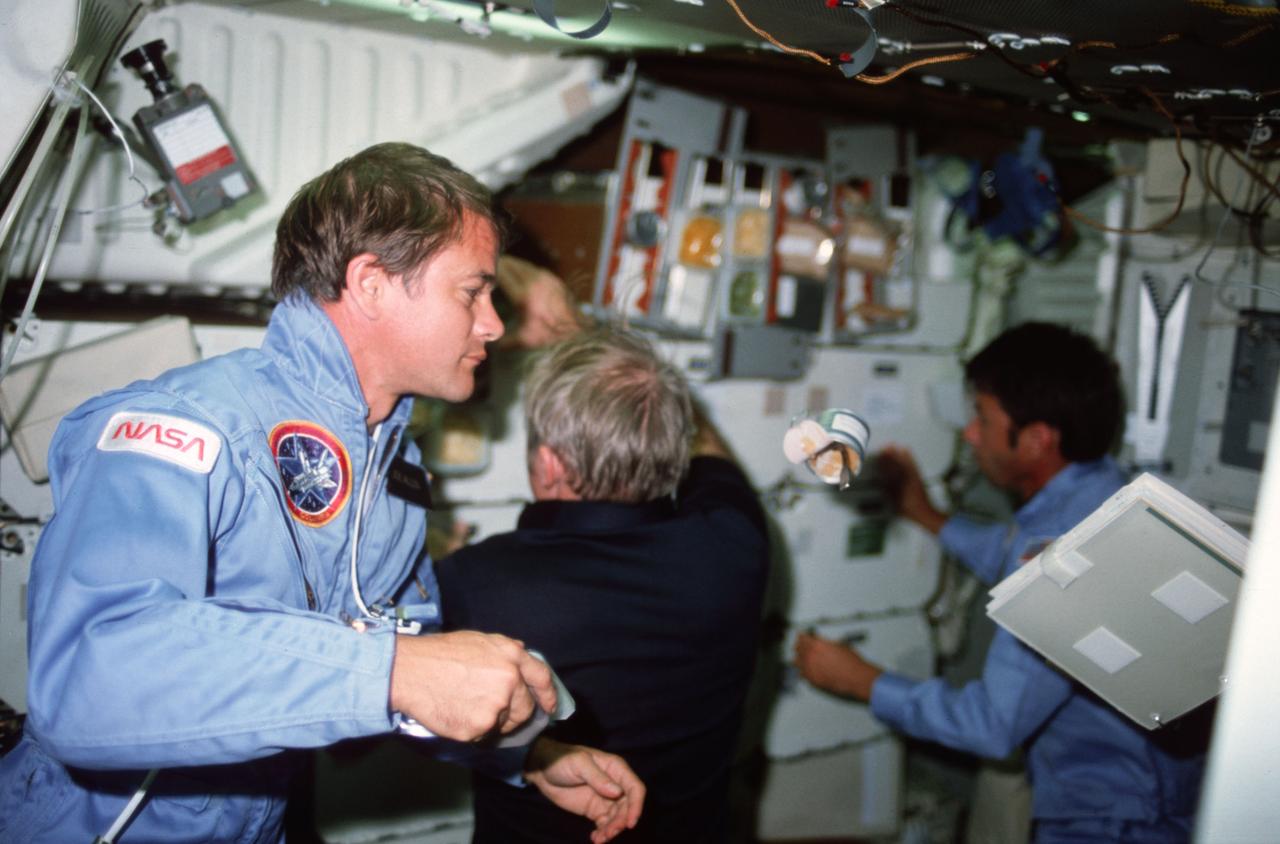
STS005-06-206 (11-16 Nov. 1982) --- Astronaut Joseph P. Allen, STS-5 mission specialist, watches a can of food and a notebook drift on the middeck as Vance C. Brand, commander, (left) and William B. Lenoir, mission specialist, (far left) work at forward middeck lockers. Photo credit: NASA
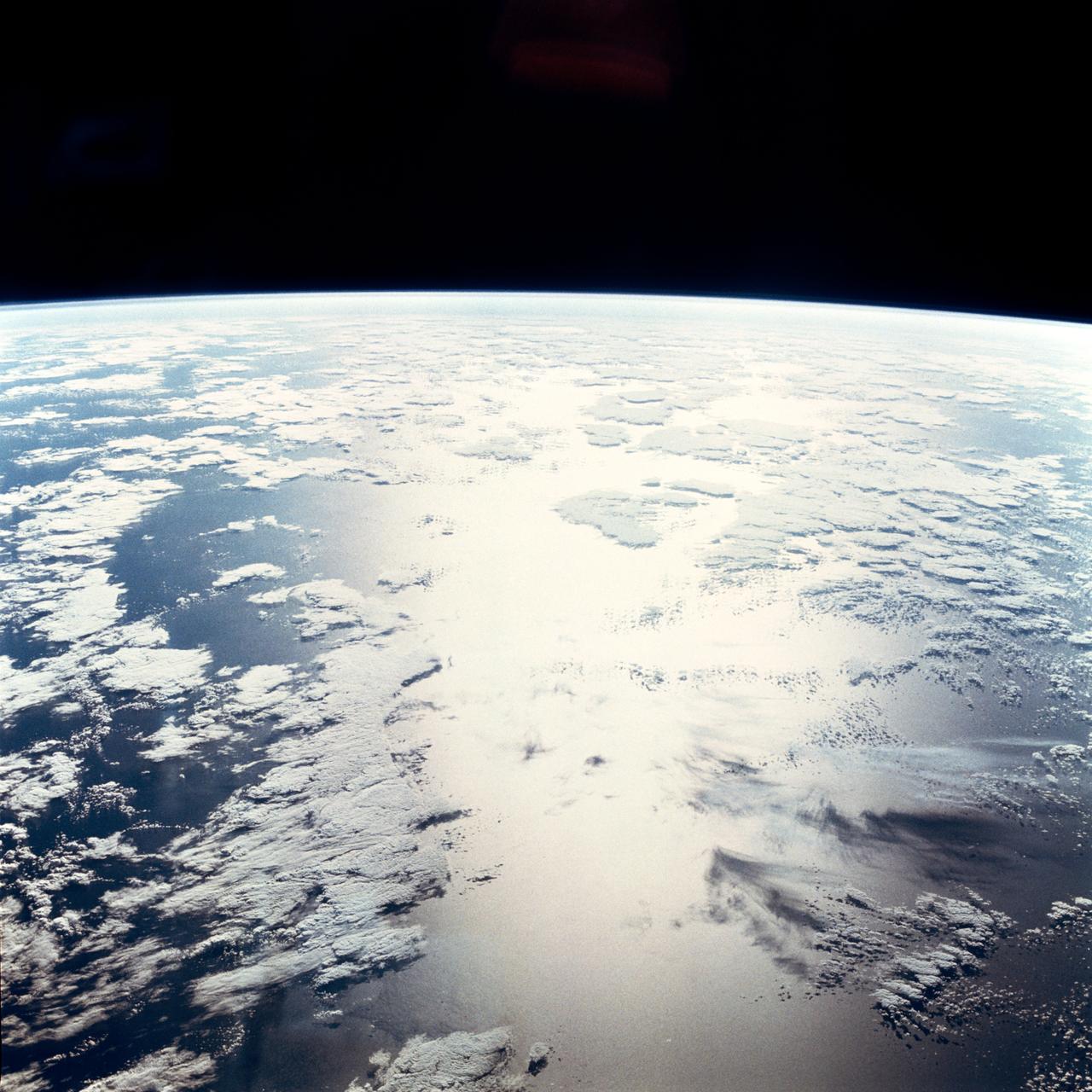
STS004-41-1206 (27 June-4July 1982) --- Sunglint reflects off the water of the North Atlantic Ocean in an area to the east of the Bahamas Islands sometimes called the Sargasso Sea. The area has also been referred to as the ?Bermuda Triangle.? Astronauts Thomas K. Mattingly II, STS-4 commander, and Henry W. Hartsfield Jr., pilot, spent seven days and one hour aboard the Earth-orbiting space shuttle Columbia and performed a variety of duties in addition to those of recording 70mm and 35mm imagery. Photo credit: NASA
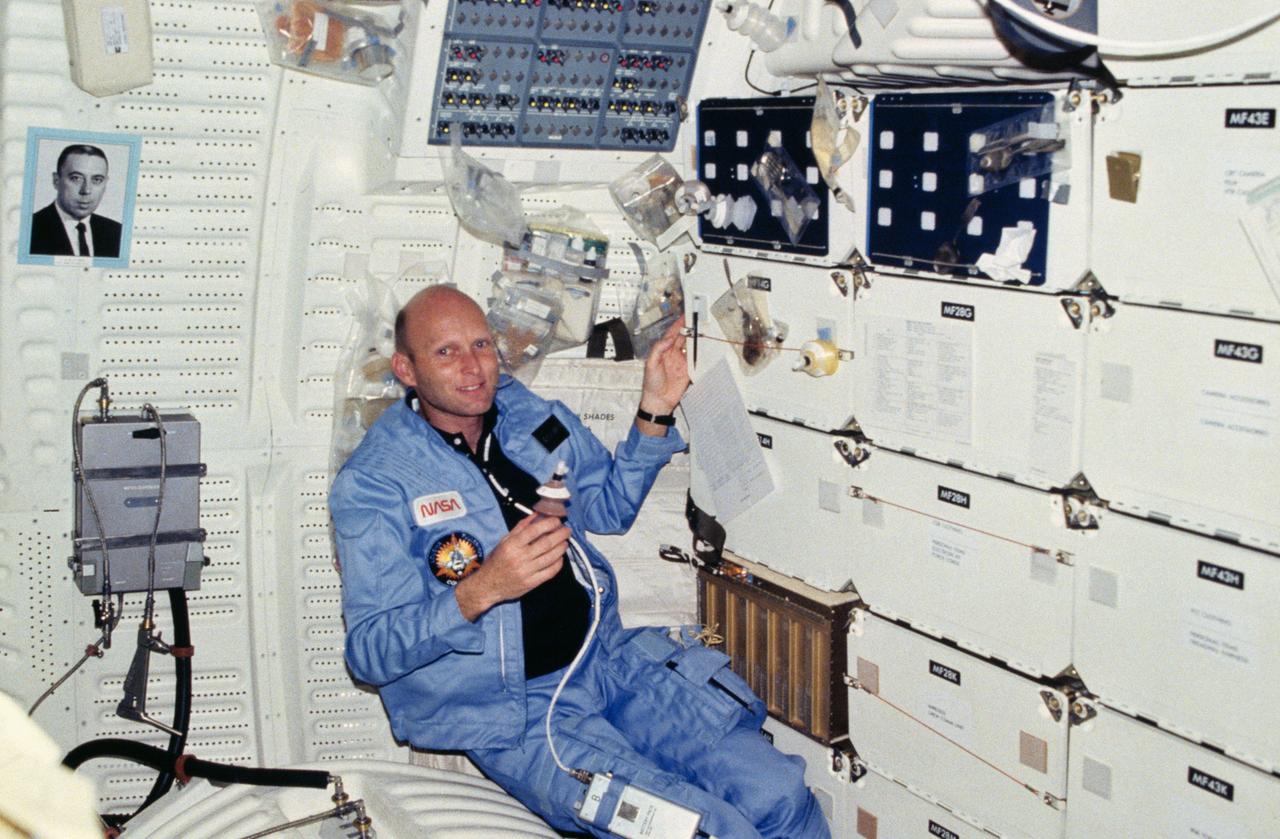
S82-28912 (March 1982) --- This picture, photographed with a 35mm camera operated by astronaut Jack R. Lousma, STS-3 commander, shows astronaut C. Gordon Fullerton, crew pilot, busy with mealtime preparations aboard the Earth-orbiting Columbia. The astronaut has positioned himself in the corner of the middeck area. Fullerton holds a beverage in his right hand in an accordion-like squeeze dispenser. Many packages of pre-packaged dehydrated foods and other meal items can be seen in the photo. Many are fastened to the locker doors and to trays in the locker doors by velcro. Reminiscent of STS-2 days, a portrait of George W. S. Abbey, director of flight operations at JSC, is at left edge. Photo credit: NASA

View of Vice-President George Bush visiting with Astronaut Owen Garriott and Payload Specialist (PS) Wubbo Ockels of the Netherlands, inside the SL after the dedication ceremony, KSC Operations & Checkout (O&C) Building. 1. Astronaut Owen K. Garriott 2. Vice President George Bush 3. Wubbo Ockels - PS 4x5 Color and B&W
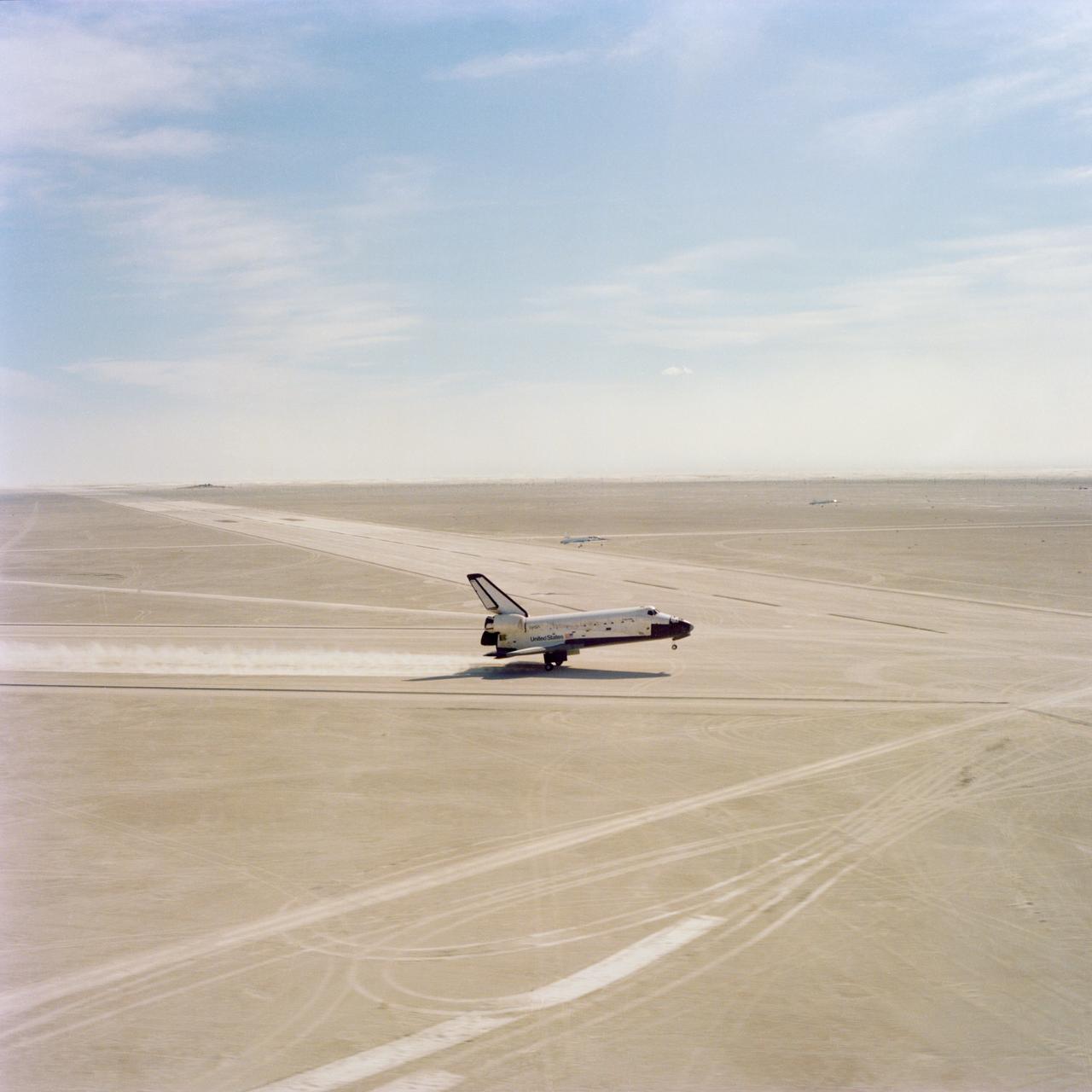
S82-28838 (30 March 1982) --- The space shuttle Columbia (STS-3) touches down on the Northrup Strip at White Sands Missile Range, New Mexico, marking the first time in its three-flight history that it has touched New Mexico soil. T-38 chase plane passenger, Mission Specialist-Astronaut Ronald E. McNair, who also shot some launch photography this flight, recorded a number of frames on 70mm film. Touchdown was shortly after 9 a.m. Mountain Standard Time, March 30, 1982. Photo credit: NASA
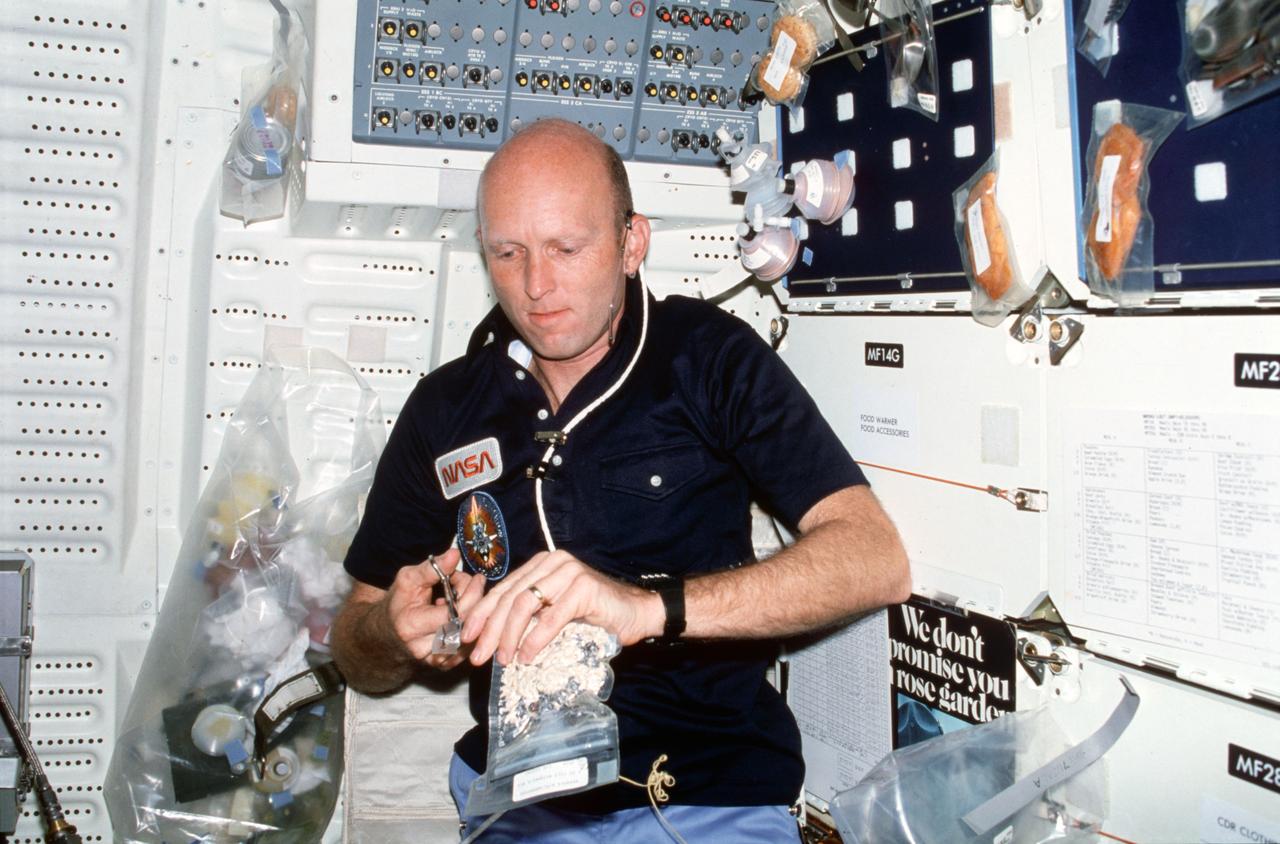
STS003-26-253 (30 March 1982) --- Astronaut Gordon Fullerton, STS-3 pilot, wearing communications kit assembly (assy) mini-headset (HDST), prepares meal on middeck. Fullerton clips corner of rehydratable food (cereal) package with scissors. The opening will allow Fullerton to insert JSC water dispenser kit water gun in order to heat contents with hot water. Meal tray assembly is secured to forward middeck locker and holds additional food packages and beverage containers. Photo credit: NASA
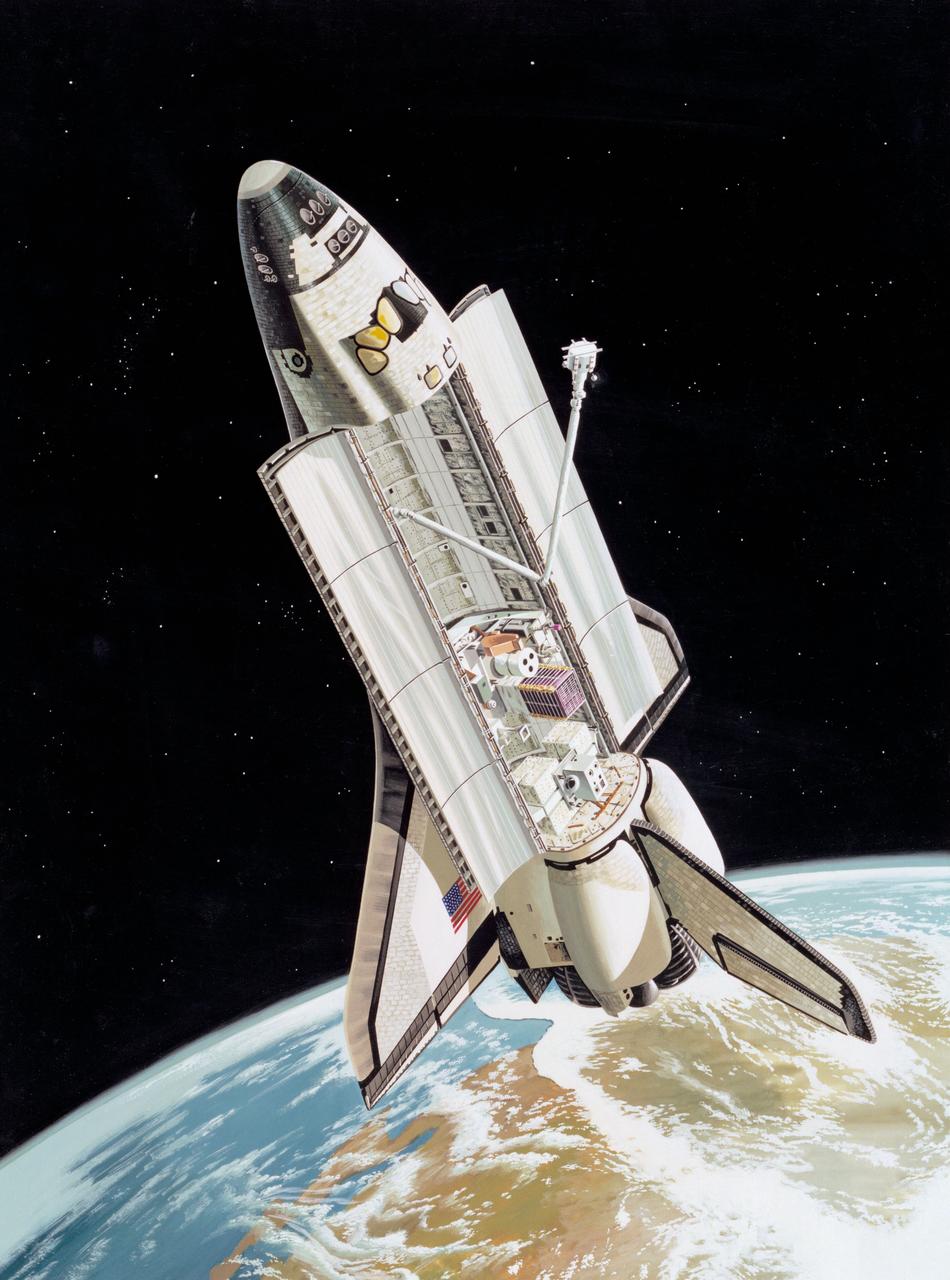
Art Concept of the PDP being held aloft by the Remote Manipulator System (RMS) during the STS-3 Mission from GSFC. 1. ART CONCEPTS - PDP (STS-3) 2. SHUTTLE - EXPERIMENTS (PDP) GSFC, MD
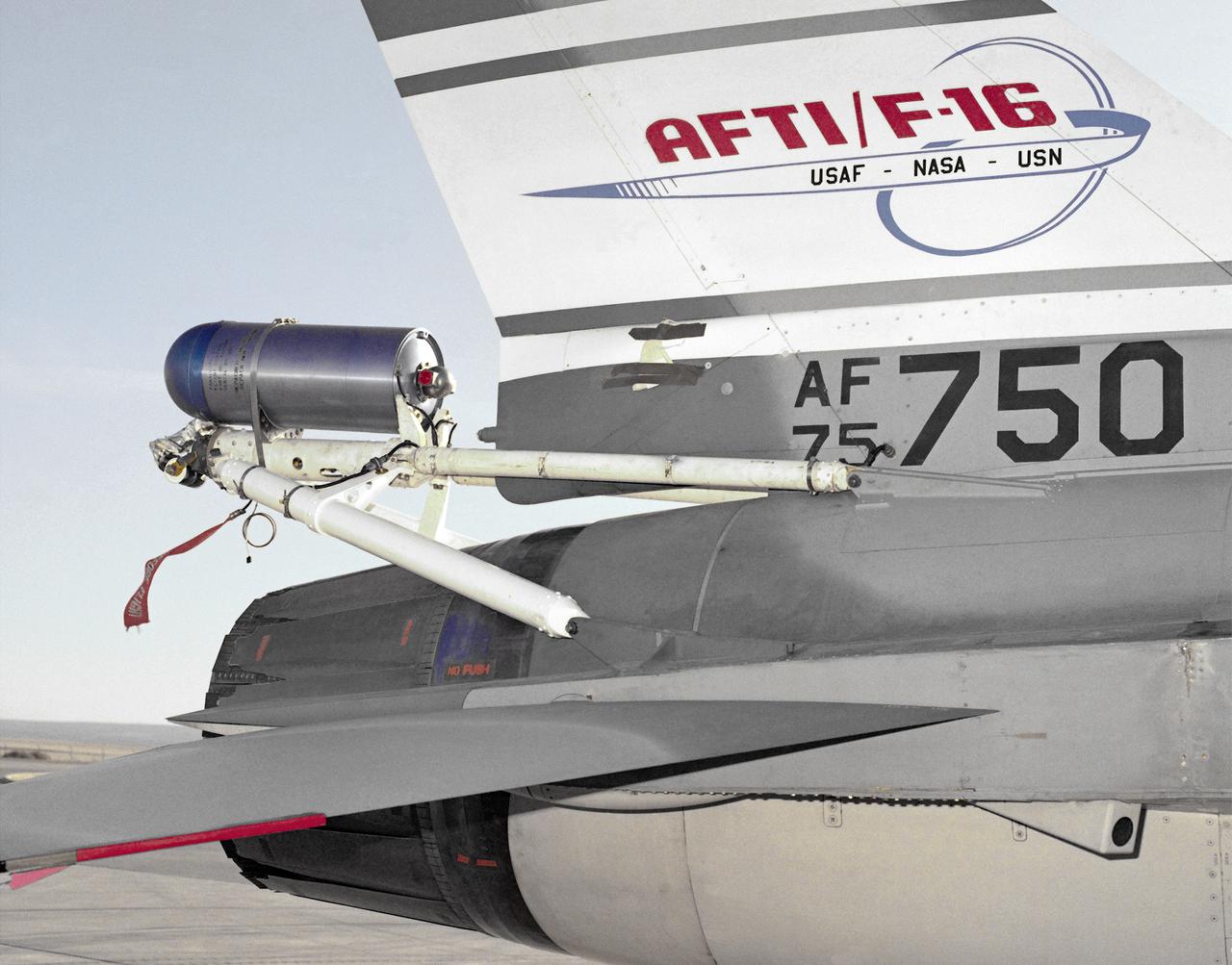
A close-up photo of the spin chute mounted on the rear fuselage of the AFTI F-16, a safety device designed to prevent the loss of aircraft in spin conditions. Under some circumstances, pilots cannot recover from spins using normal controls. It these instances, the spin chute is deployed, thus "breaking" the spin and enabling the pilot to recover. The spin chute is held in a metal cylinder attached to the AFTI F-16 by four tubes, a structure strong enough to withstand the shock of the spin chute opening. Unlike the air probe in the last photo, spin chutes are not standard equipment on research or prototype aircraft but are commonly attached expressly for actual spin tests.
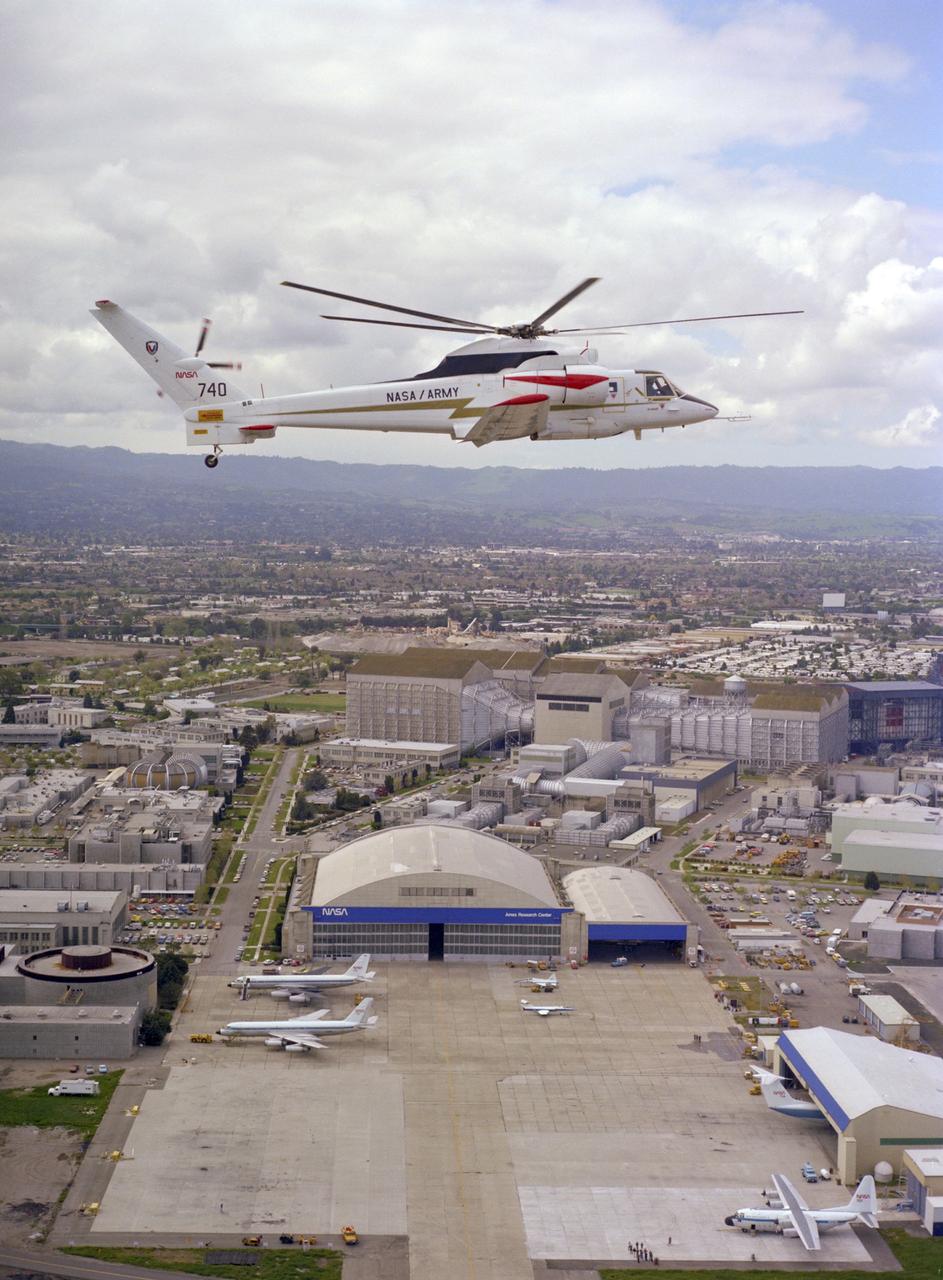
Sikorsky Rotor Systems Research Aircraft ' RSRA' (72-001 NASA-740) compound configuration in flight: NASA Ames Research Center, Hangar and 40x 80x120ft W.T. in the background. Note: Used in publication in Flight Research at Ames; 57 Years of Development and Validation of Aeronautical Technology NASA SP-1998-3300 fig. 132
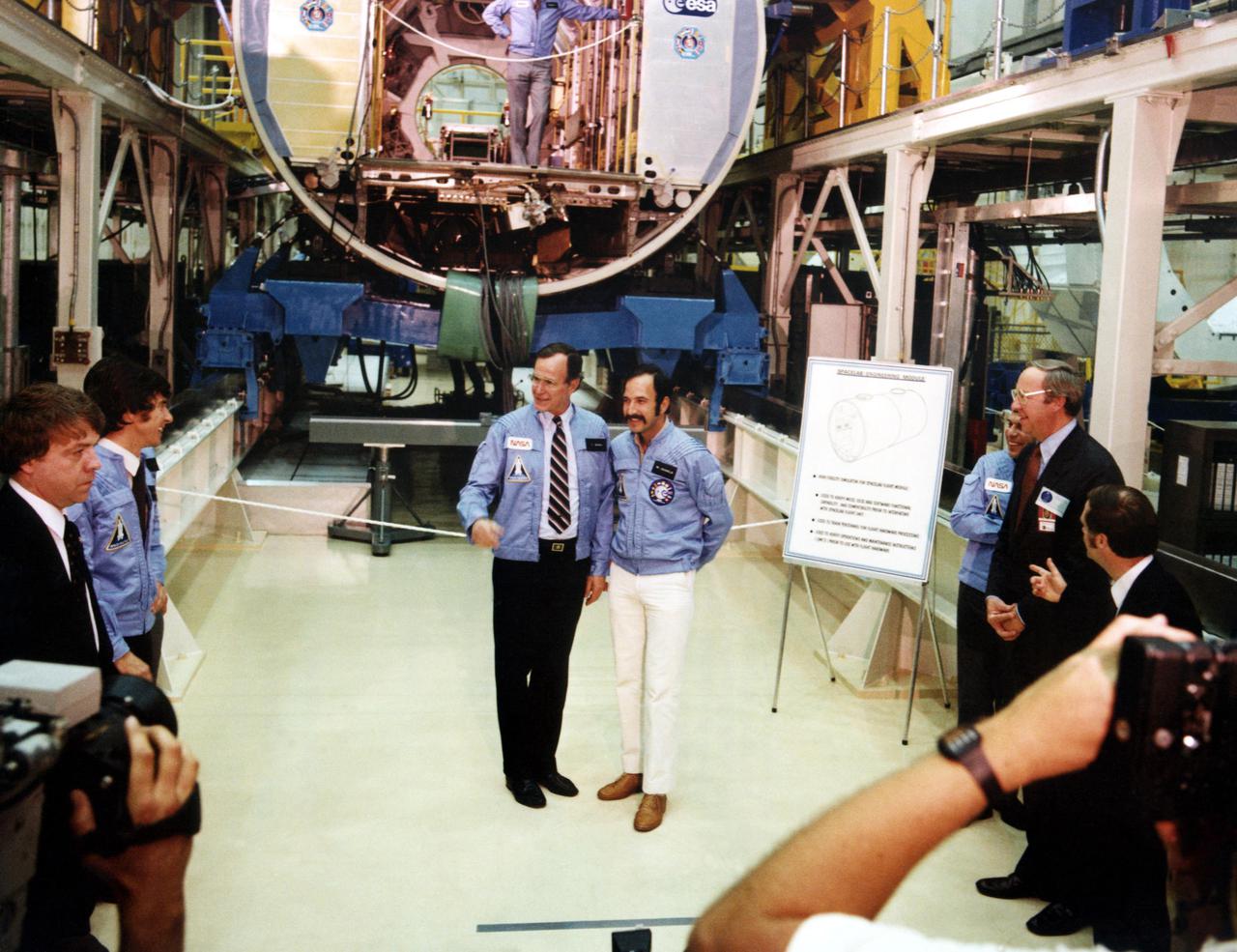
KENNEDY SPACE CENTER, FLA. -- Vice President George F. Bush, center left, is pictured with Payload Specialist Wubbo Ockels of the Netherlands during the Spacelab Arrival Ceremony. Second from left is Payload Specialist Ulf Merbold, Germany. At far right are James McCulls, chief, Special Services Branch, NASA Headquarters; and James C. Harrington, director, Spacelab Program, NASA. Overhead, astronaut Owen K. Garriott, U.S.A., stands in the Spacelab Engineering Module.
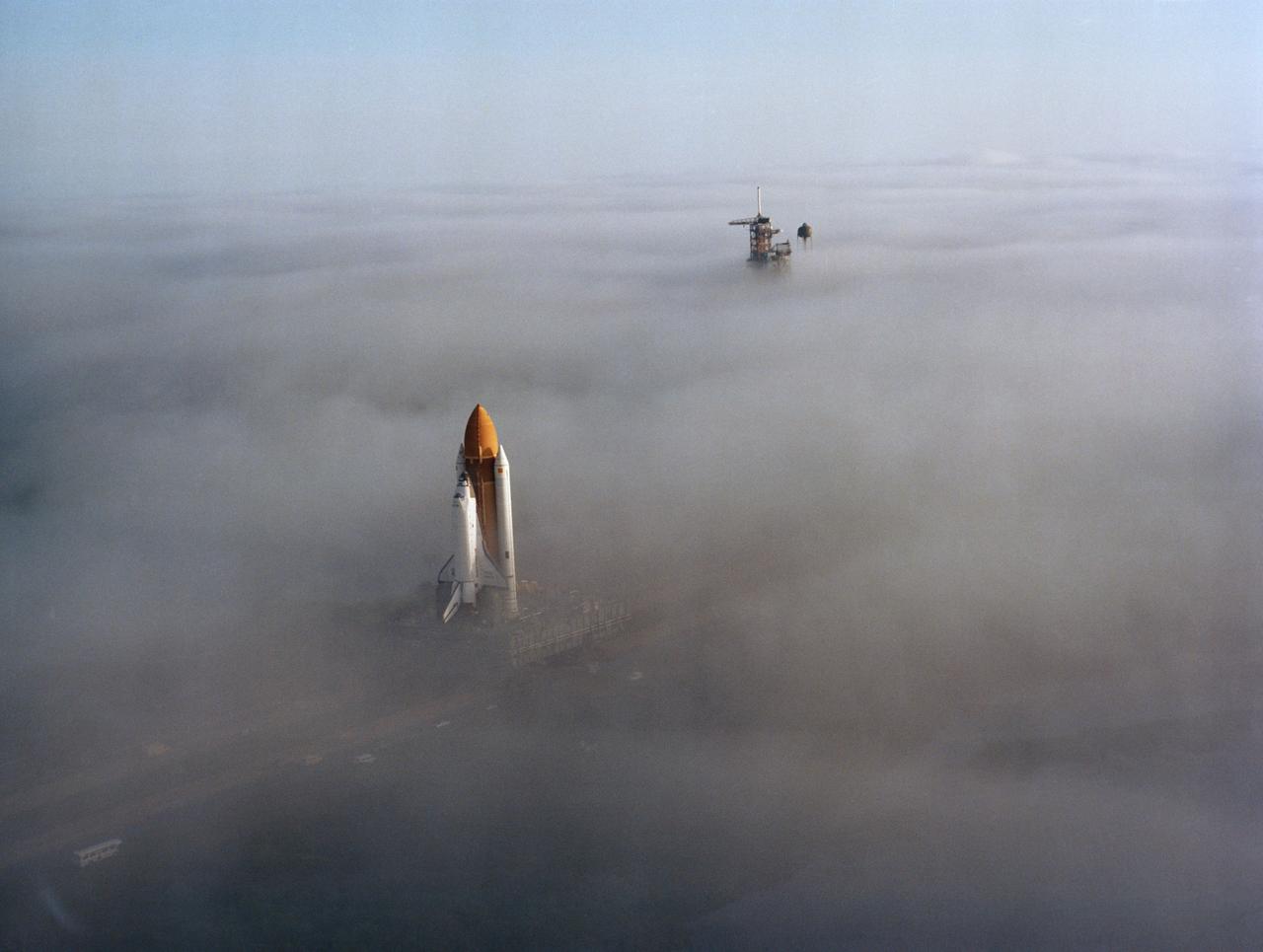
S82-41141 (30 Nov. 1982) --- The space shuttle Challenger, atop a mobile launch platform, slowly moves through the Florida fog to Launch Pad 39A in preparation for its first liftoff early next year. The fully assembled shuttle, weighting 12,000 pounds less than predecessor Columbia, completed the trip in just over six hours. Photo credit: NASA
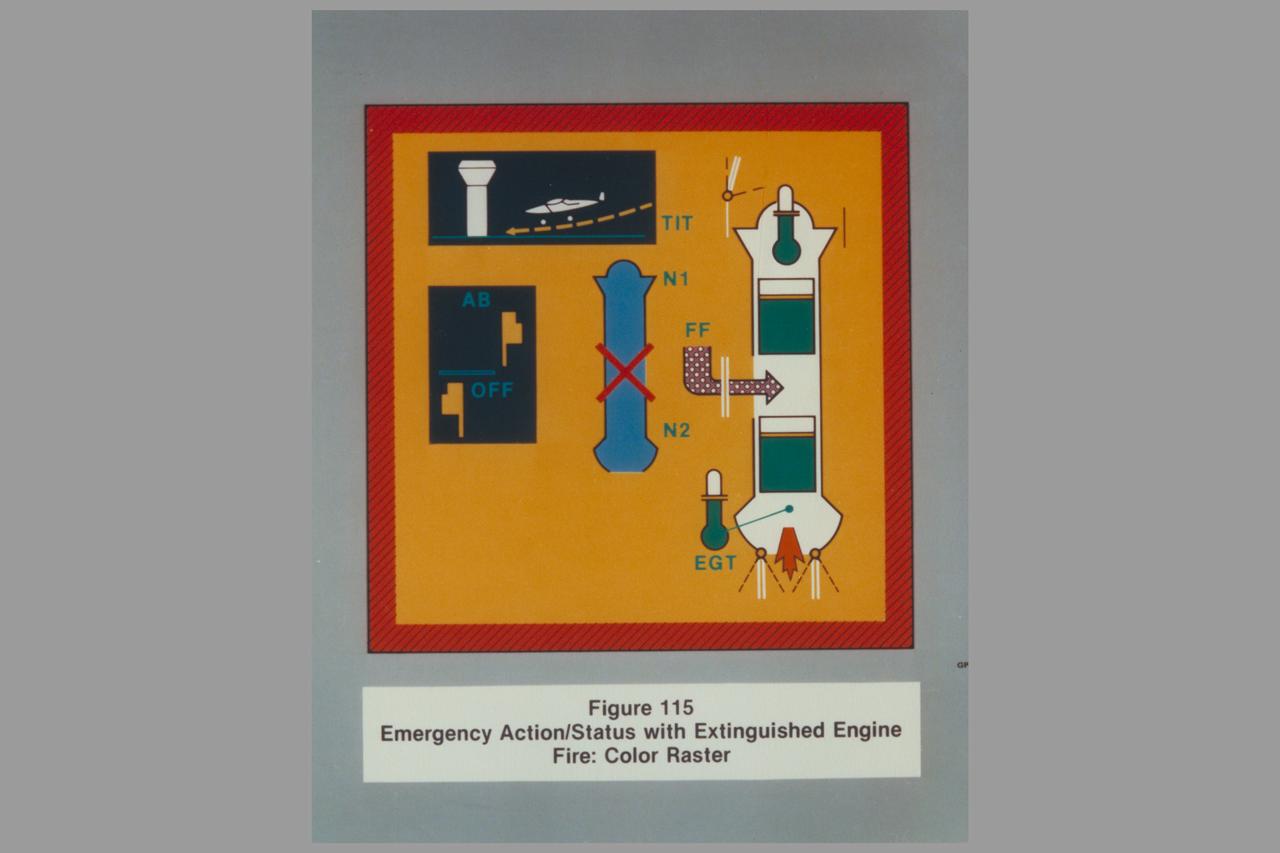
Date: Feb 1982 Photographer: Air Force emergency action status with extinguished engine fire (ref: AFWAL TR-81-3156)
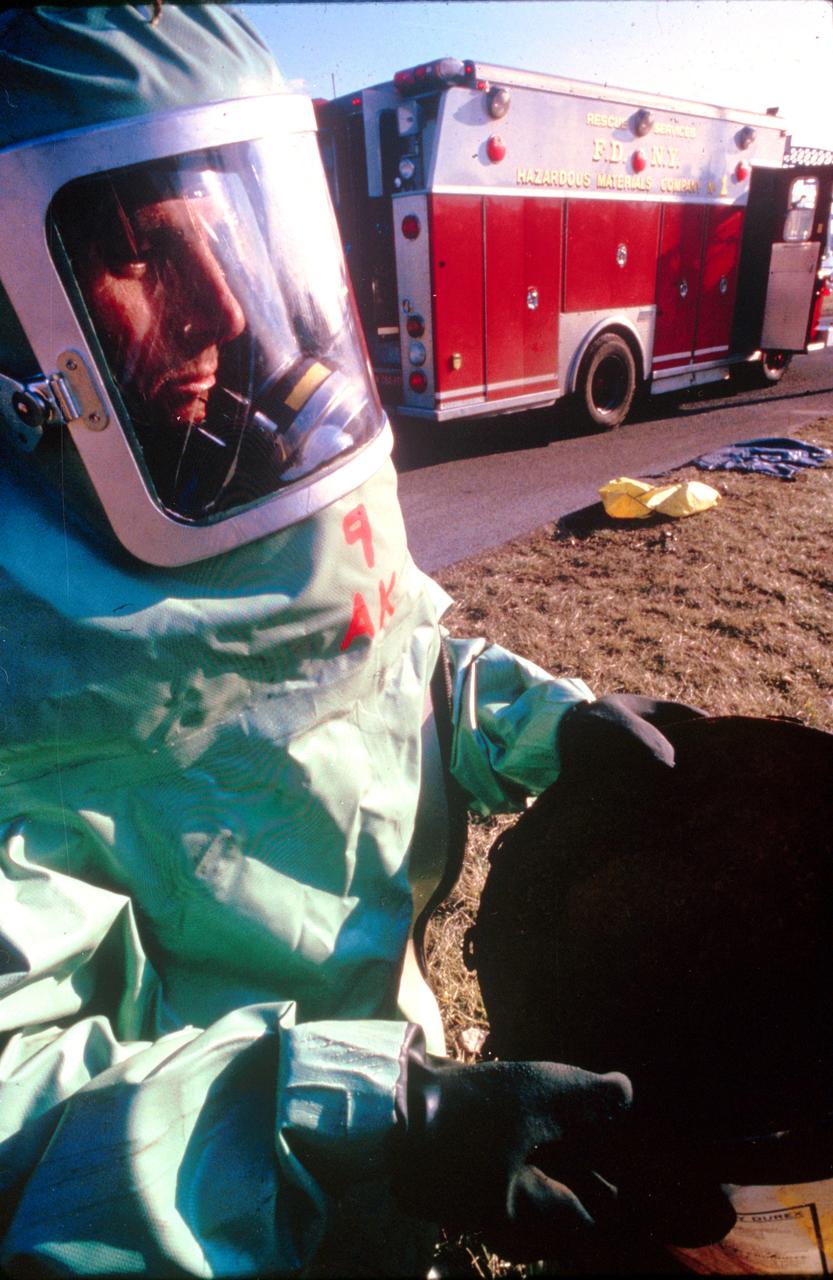
Marshall Space Flight Center used technology from astronauts' space suits to improve the safety of firefighter's attire. The new fire attire is lightweight, fire-resistant, and heat-protective.
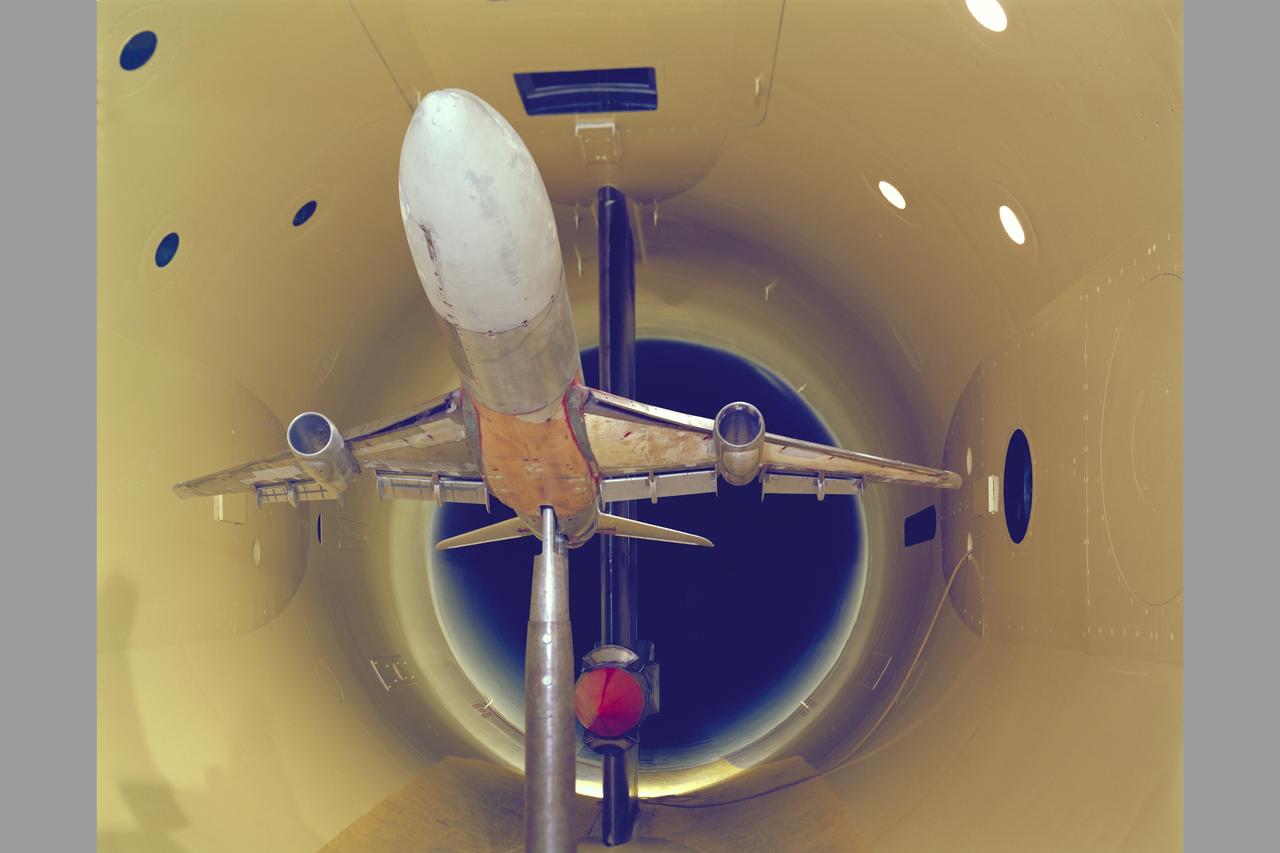
Lockheed L-1011 EET (Energy Efficient Transport) test-516 in 12ft. W.T.
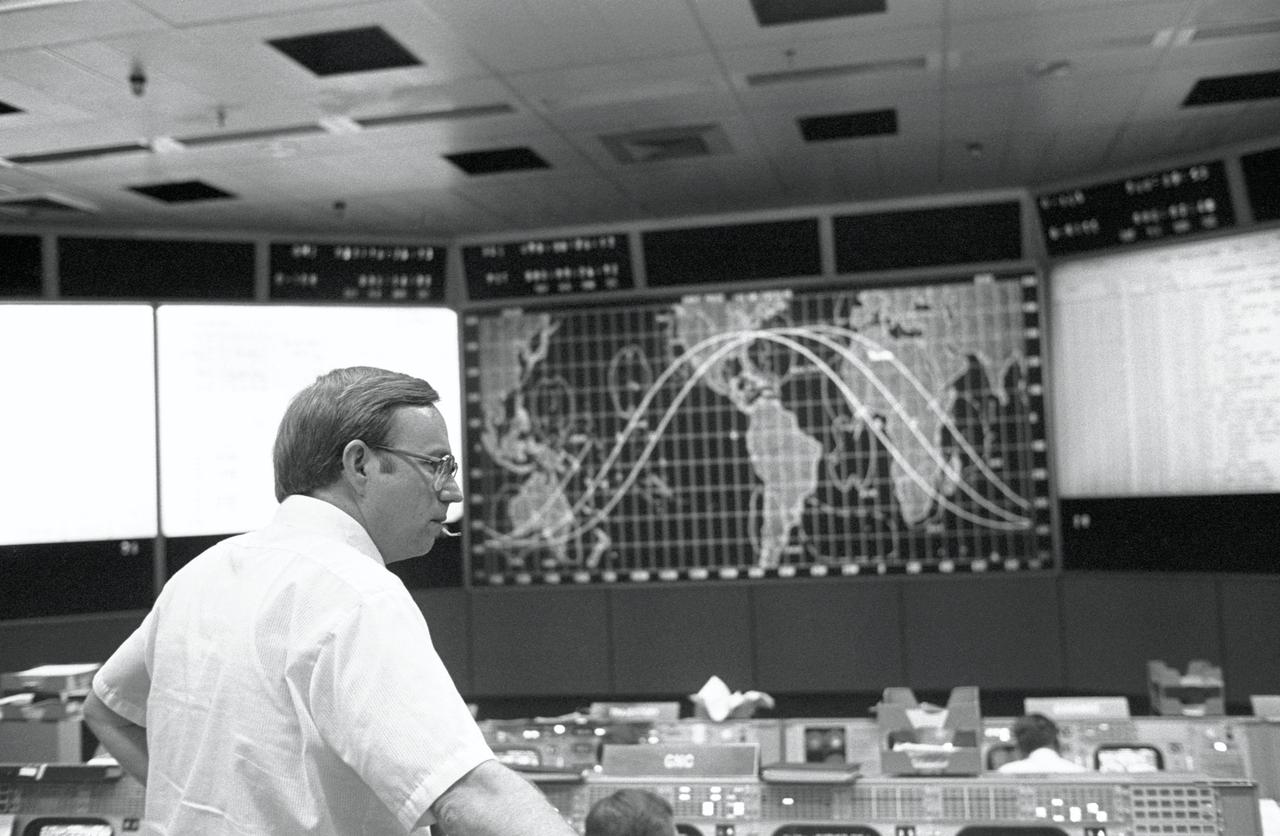
Mission Operations Control Room (MOCR) during Day-1 of the STS-3 Mission. 1. HOLLOWAY, TOMMY W. - MCC 2. MCC - STS-3 3. STS-3 - INFLIGHT JSC, HOUSTON, TX
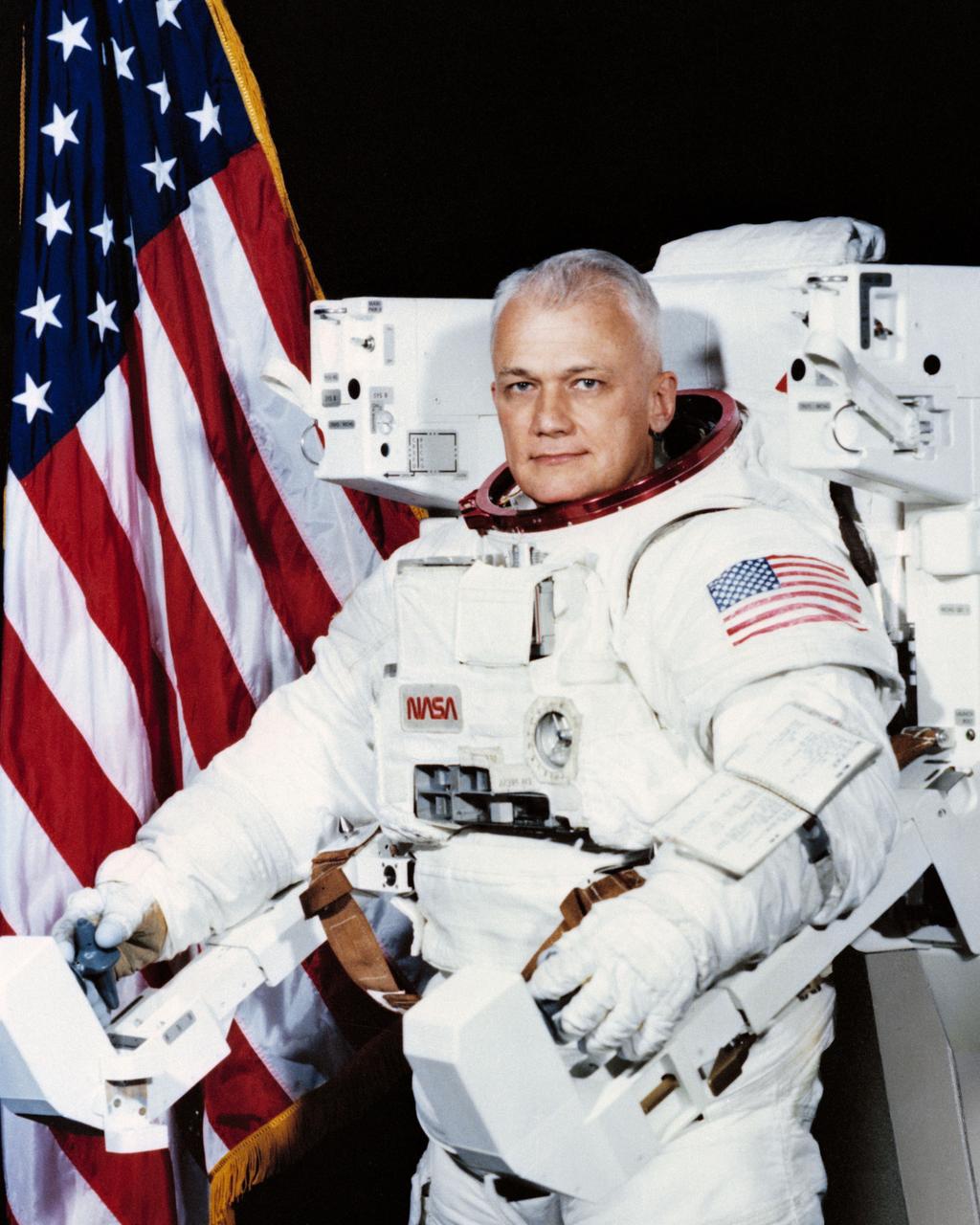
S82-38442 (October 1982) --- Astronaut Bruce McCandless II.
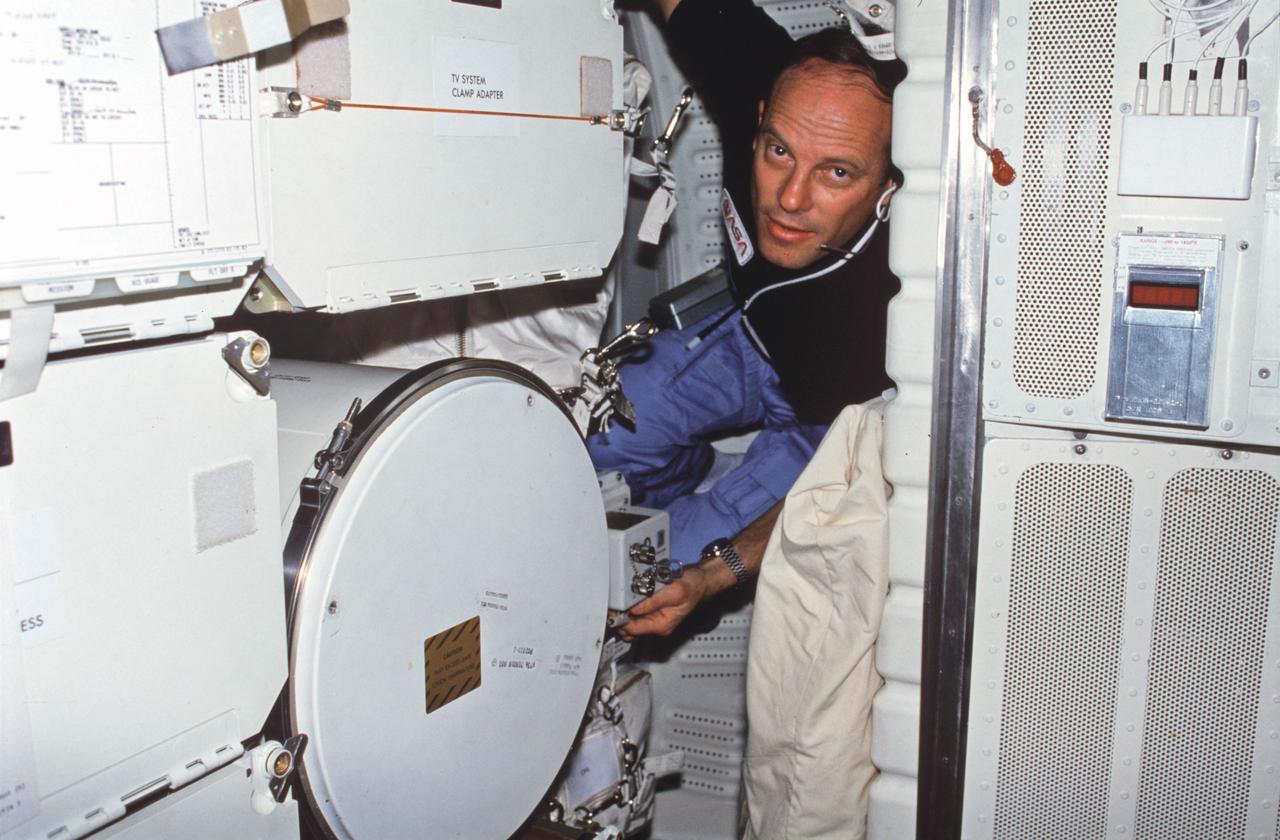
STS003-22-127 (22-30 March 1982) --- Astronaut Jack R. Lousma, STS-3 commander, wearing communications kit assembly (assy) mini-headset, adjusts controls on Monodisperse Latex Reactor (MLR) experiment located in forward middeck lockers MF57H and MF57K. To reach MLR support electronics assy controls, Lousma squeezes in between forward lockers and Development Flight Instrument (DFI) unit on starboard bulkhead. Photo credit: NASA
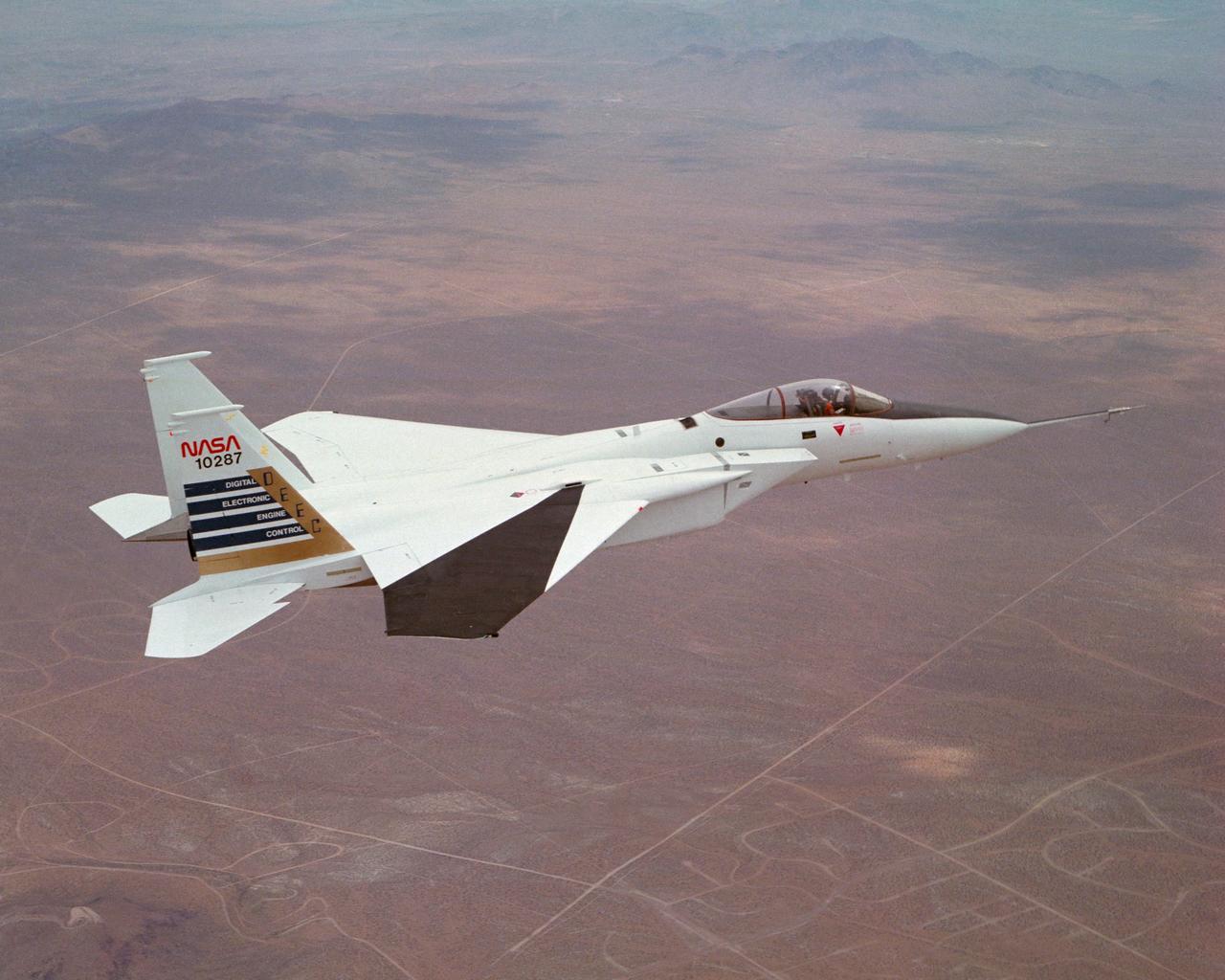
Digital Electronic Engine Control F-15A #287 in flight over California City. Note wing deflection measurement system on right wing.
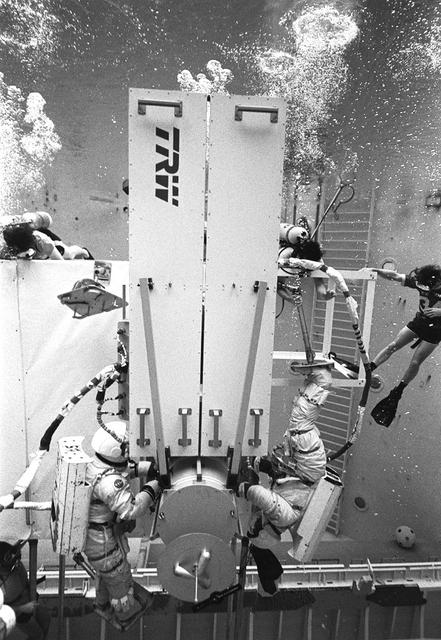
The Space Platform was first conceived as a launching site for deep space exploration. The original idea was to build this space platform either on the moon's surface or near lunar orbit. It would be used as a staging base, where the reusable launch vehicles (later known as Space Shuttles) would ferry machinery and equipment to assemble deep space exploration vehicles. Replaced by the Space Station concept, the space platform idea was never completed. However, early in the space platform development, astronauts trained at the Marshall Space Flight Center's (MSFC) Neutral Buoyancy Simulator (NBS), as pictured here, working on solar array equipment. This experiment was deployed from the shuttle to study the motions of large structures in space. Similar arrays will be used on the Space Station and large observatory spacecraft in the future.
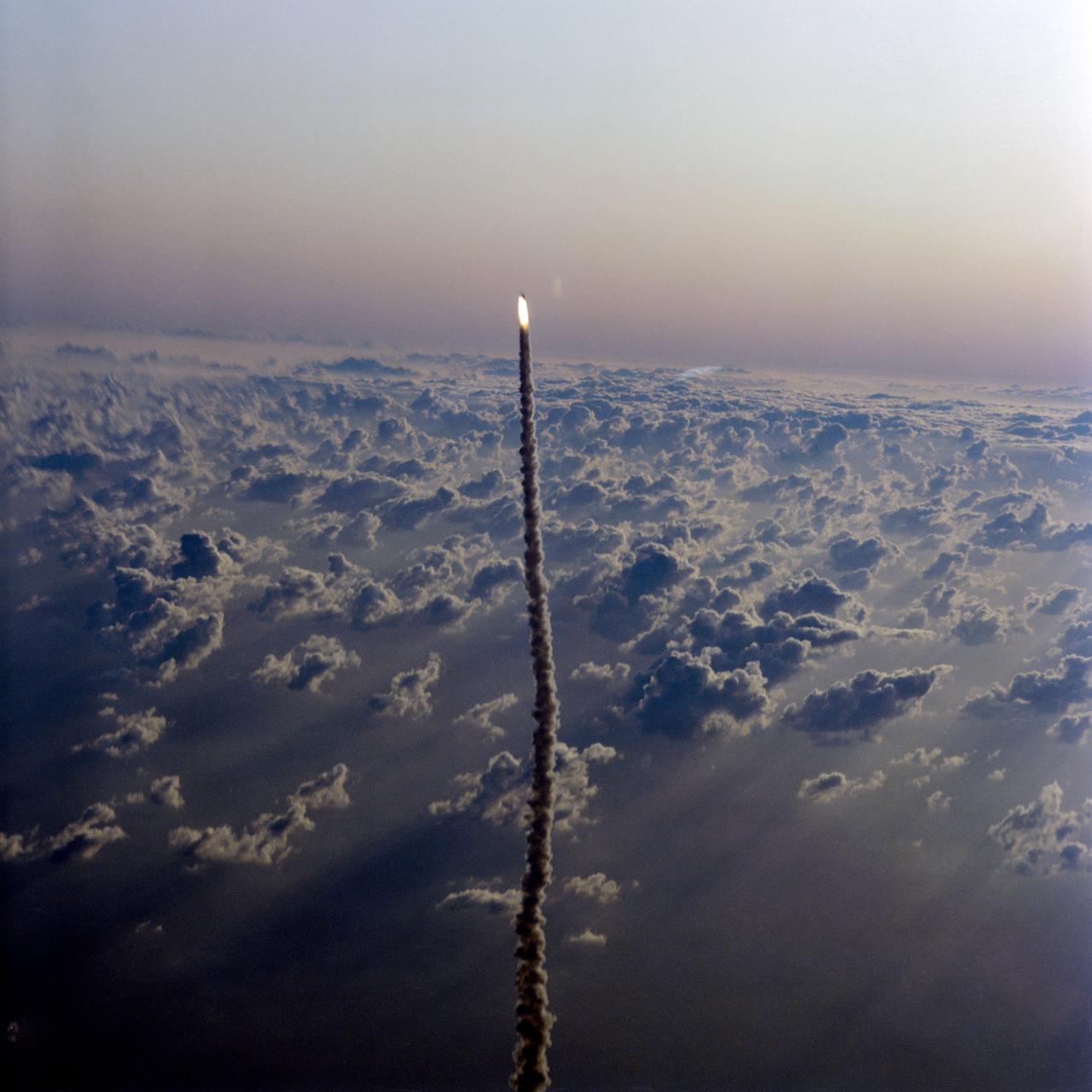
Aerial views of the STS-5 launch from T-38 chase aircraft Nov. 11, 1982. Shuttle Columbia can be seen as a small figure trailed by a line of smoke.
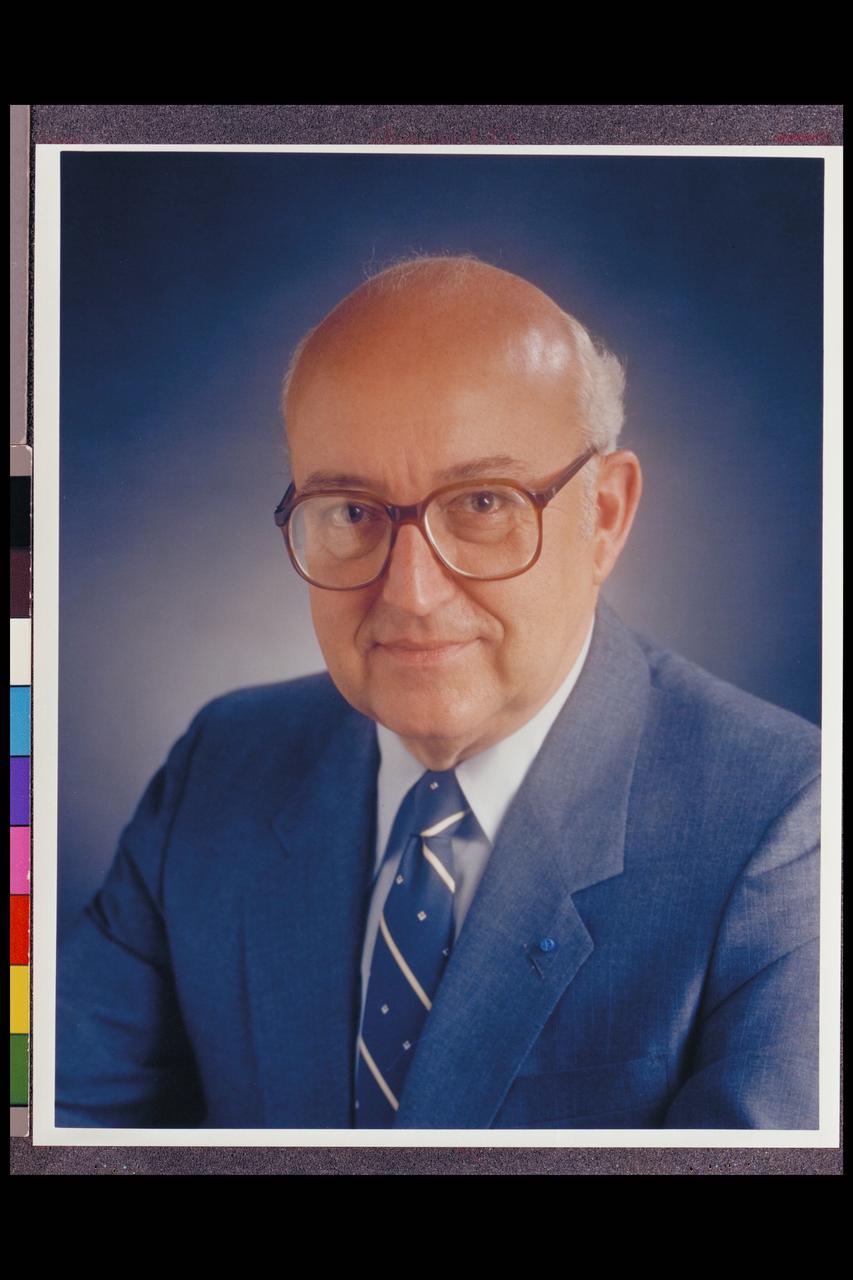
Portrait of Clarence 'Sy' Syvertson, Director of Ames Research Center 1978 - 1984
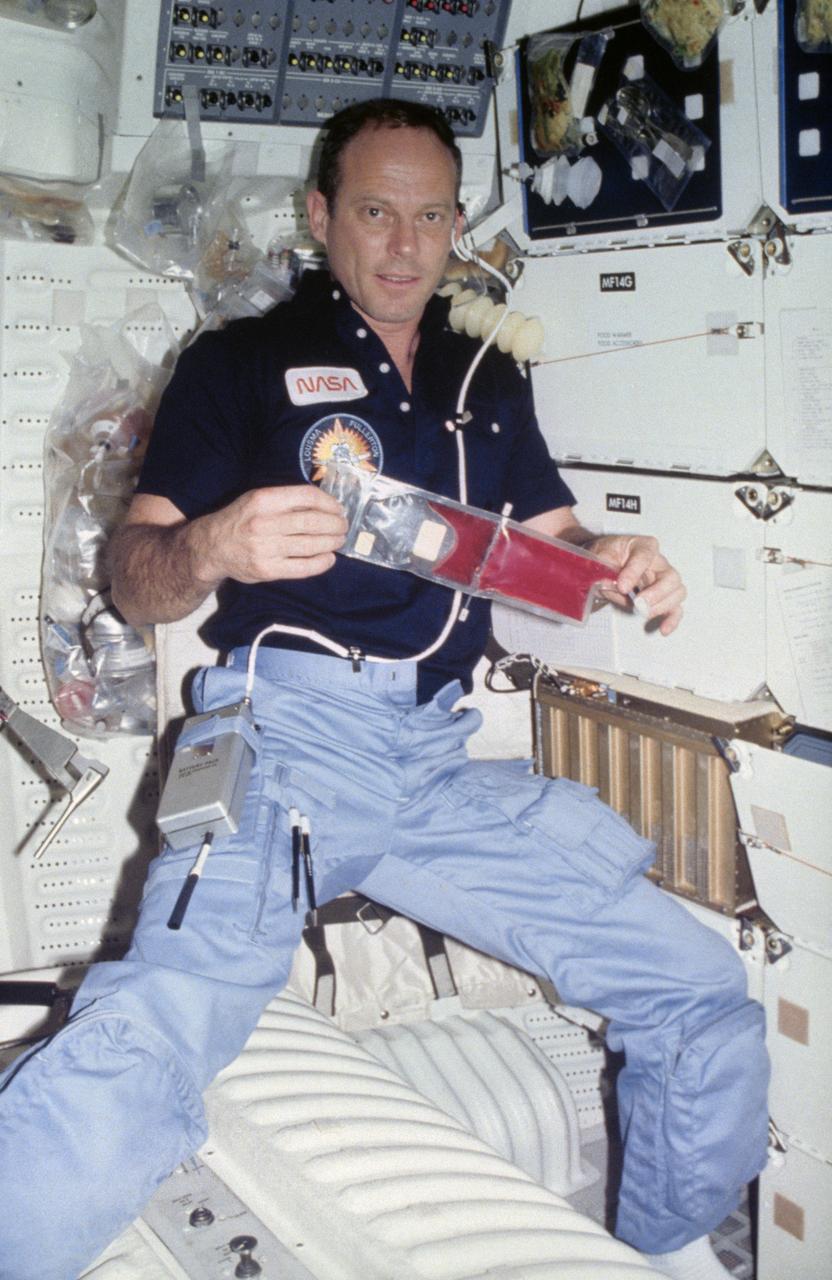
S82-28914 (26 March 1982) --- Astronaut Jack R. Lousma, STS-3 commander, spins a package of colored liquid in zero-gravity aboard the Earth-orbiting space shuttle Columbia. He was actually creating a centrifuge to conduct a test involving the separation of bubbles from the liquid rehydrated strawberry powder for visible clarity. The gas from liquid experiment is a test devised by scientist-astronaut William E. Thornton. The gun-like device at center of left edge is a water-dispenser which the astronauts use in rehydrating food packets, many of which can be seen in the background of this middeck area of the Columbia. Astronaut C. Gordon Fullerton, pilot, exposed this frame with a 35mm camera. Photo credit: NASA
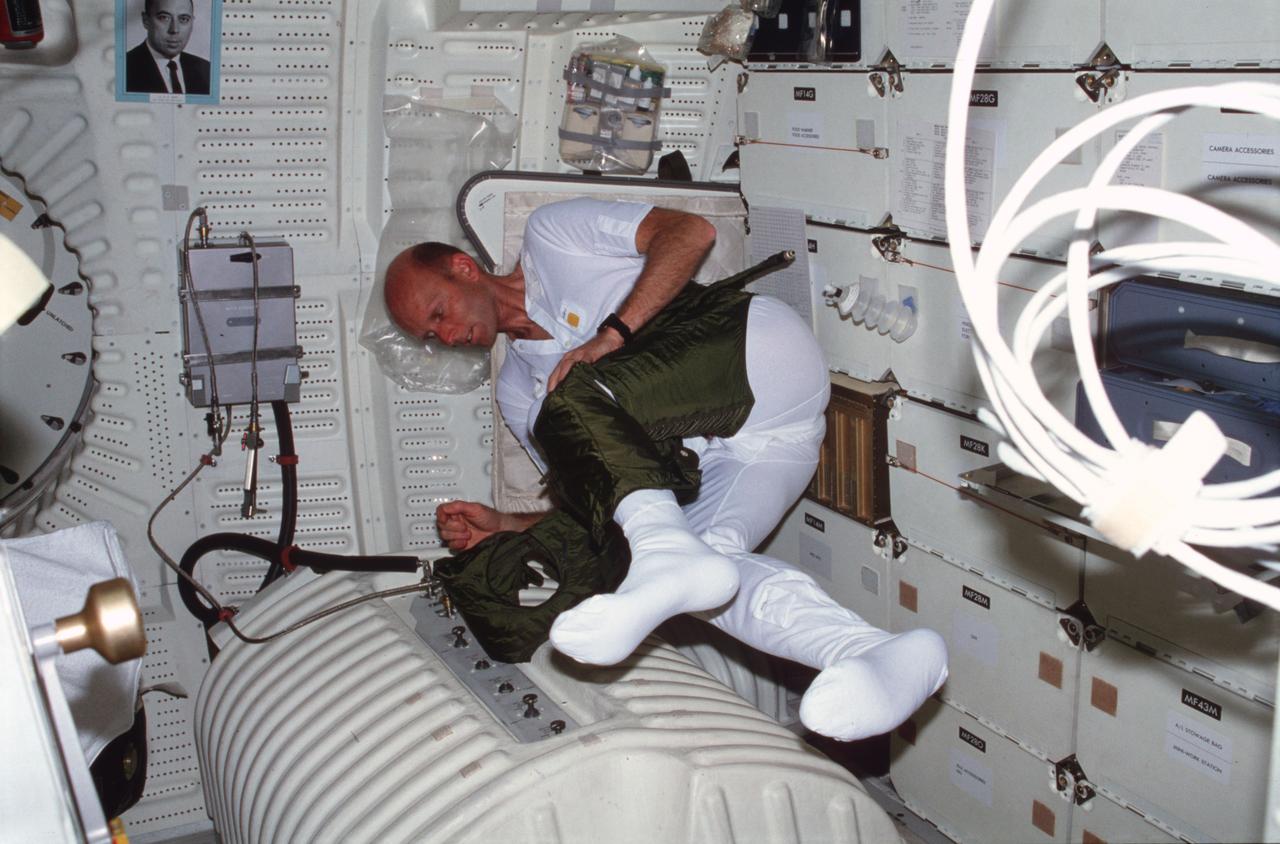
STS003-23-161 (24 March 1982) --- Astronaut C. Gordon Fullerton, STS-3 pilot, dons an olive drab inner garment which complements the space shuttle Extravehicular Mobility Unit (EMU) spacesuit. Since there are no plans for an extravehicular activity (EVA) on the flight, Fullerton is just getting some practice time ?in the field? as he is aboard the Earth-orbiting Columbia. He is in the middeck area of the vehicle. The photograph was taken with a 35mm camera by astronaut Jack R. Lousma, STS-3 commander. Photo credit: NASA