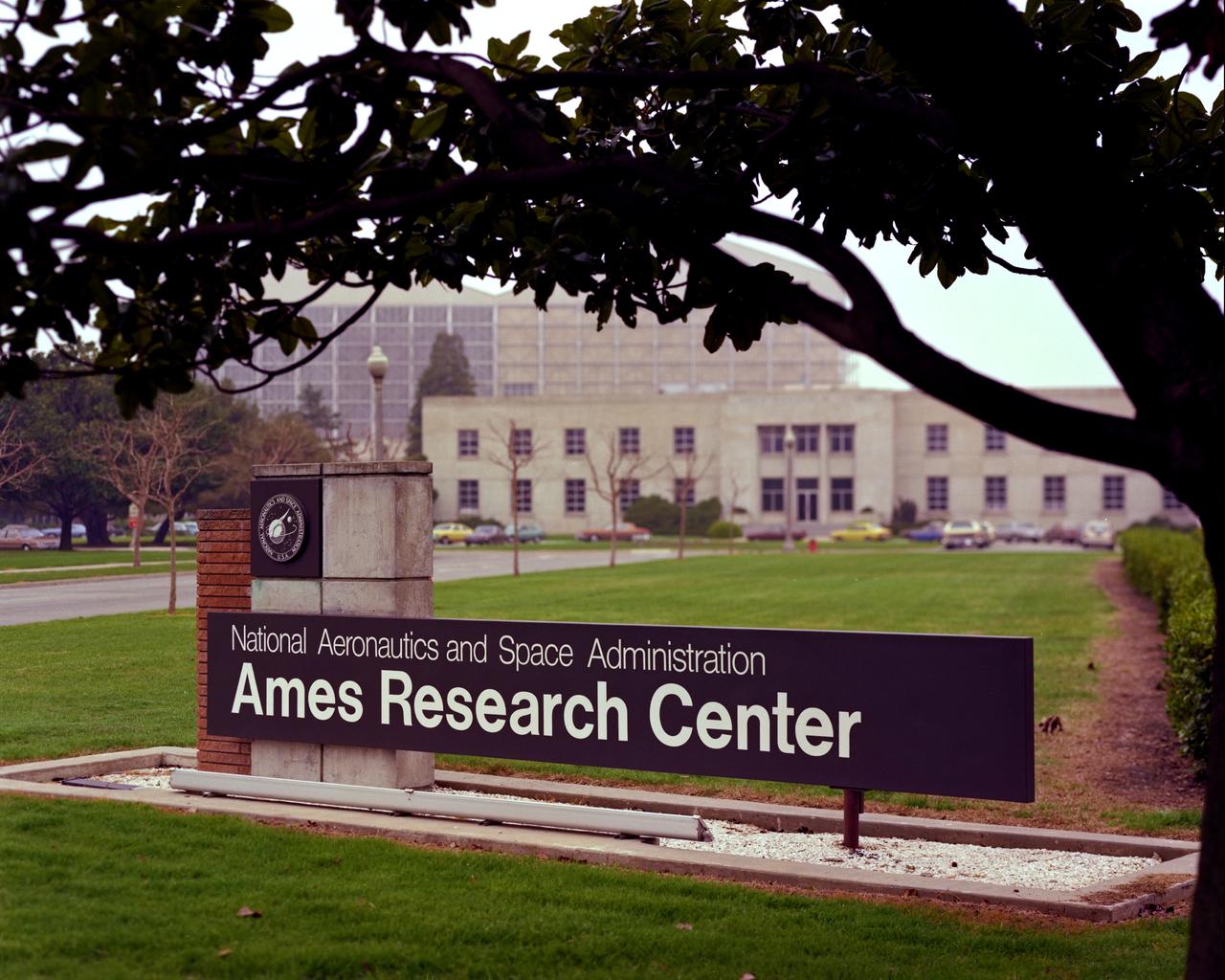
Ames Research Center momument (front) sign
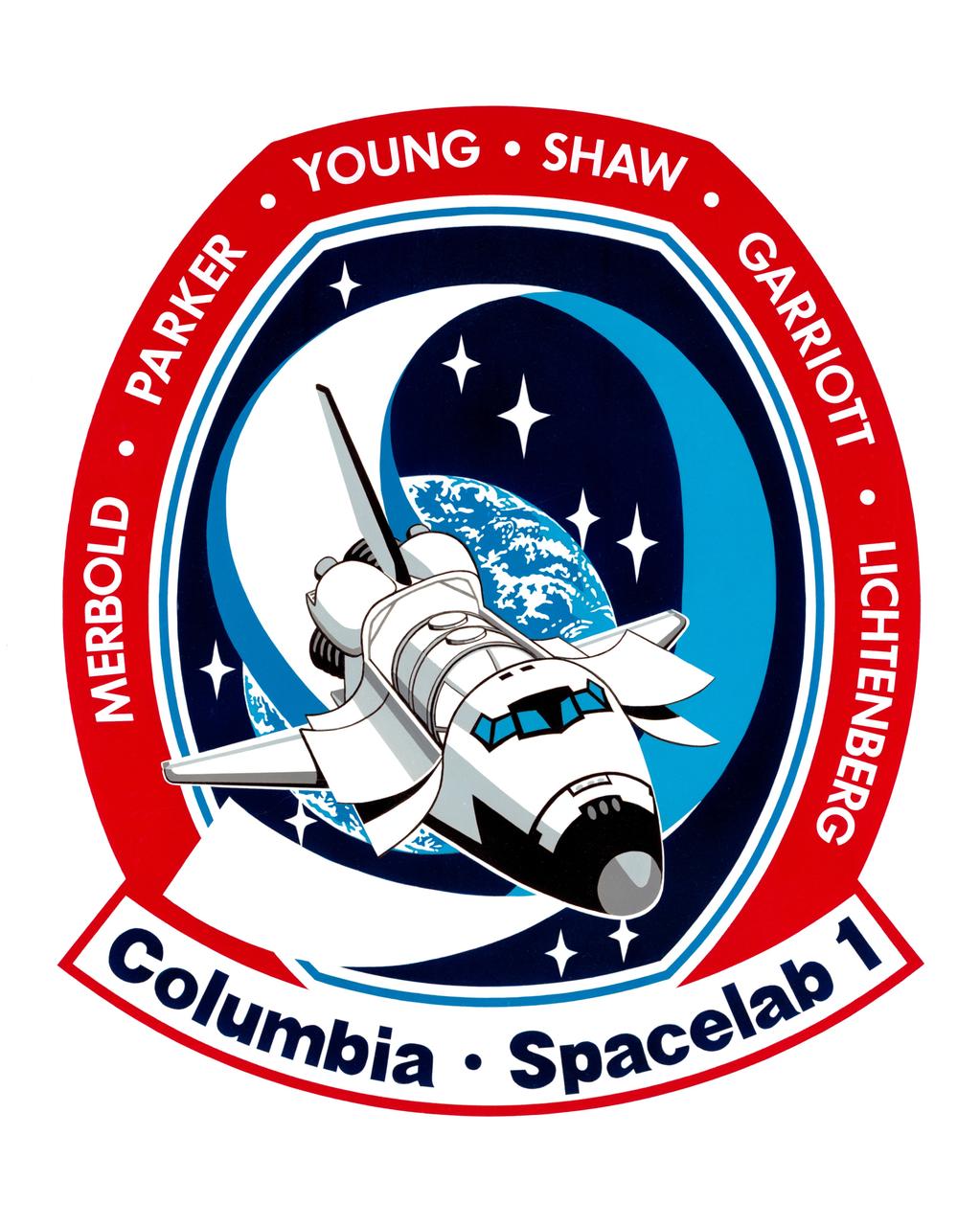
S83-32900 (25 May 1983) --- This is the official insignia for STS-9, the major payload of which is Spacelab-1, depicted in the cargo bay of the space shuttle Columbia. The nine stars and the path of the orbiter tell the flight's numerical designation in the Space Transportation System's mission sequence. Astronaut John W. Young is crew commander; Brewster H. Shaw Jr., pilot. NASA astronauts Owen K. Garriott and Robert A.R. Parker are mission specialists. Byron K. Lichtenberg of the Massachusetts Institute of Technology and Ulf Merbold of the Republic of West Germany are the Spacelab-1 payload specialists. Launch has been set for late 1983. Merbold is a physicist representing the European Space Agency (ESA). The NASA insignia design for space shuttle flights is reserved for use by the astronauts and for other official use as the NASA Administrator may authorize. Public availability has been approved only in the forms of illustrations by the various news media. When and if there is any change in this policy, which is not anticipated, the change will be publicly announced. Photo credit: NASA

FDCD Branch Stability and Control branch: Names, rows front to back, people left to right: Ground level: 1. ?? 2. Debra L. Livingston 3. Katherine G. Johnson 4. Robert Dunning Step 1: 1. Ellie Fillmore (?) 2. Al Hamer 3. Suresh Joshi Step 2: 1. John Young 2. Ernest Armstrong 3. Vladislav Klein 4. Charles T. Woolley Step 3: 1. Lawrence Taylor 2. Tony Fontana Step 4: 1. Bill Suit 2. Jane Carpenter 3. Daniel P. Giesy 4. Mario Smith Step 5: 1. Albert Schy 2. Ray Montgomery 3. Sahajendra Singh Top level: 1: Jim Batterson 2. Jim Williams 3. Claude Keckler 4. N. Sundararajan Behind all: John Shebalin Names given by Danial P. Giesy
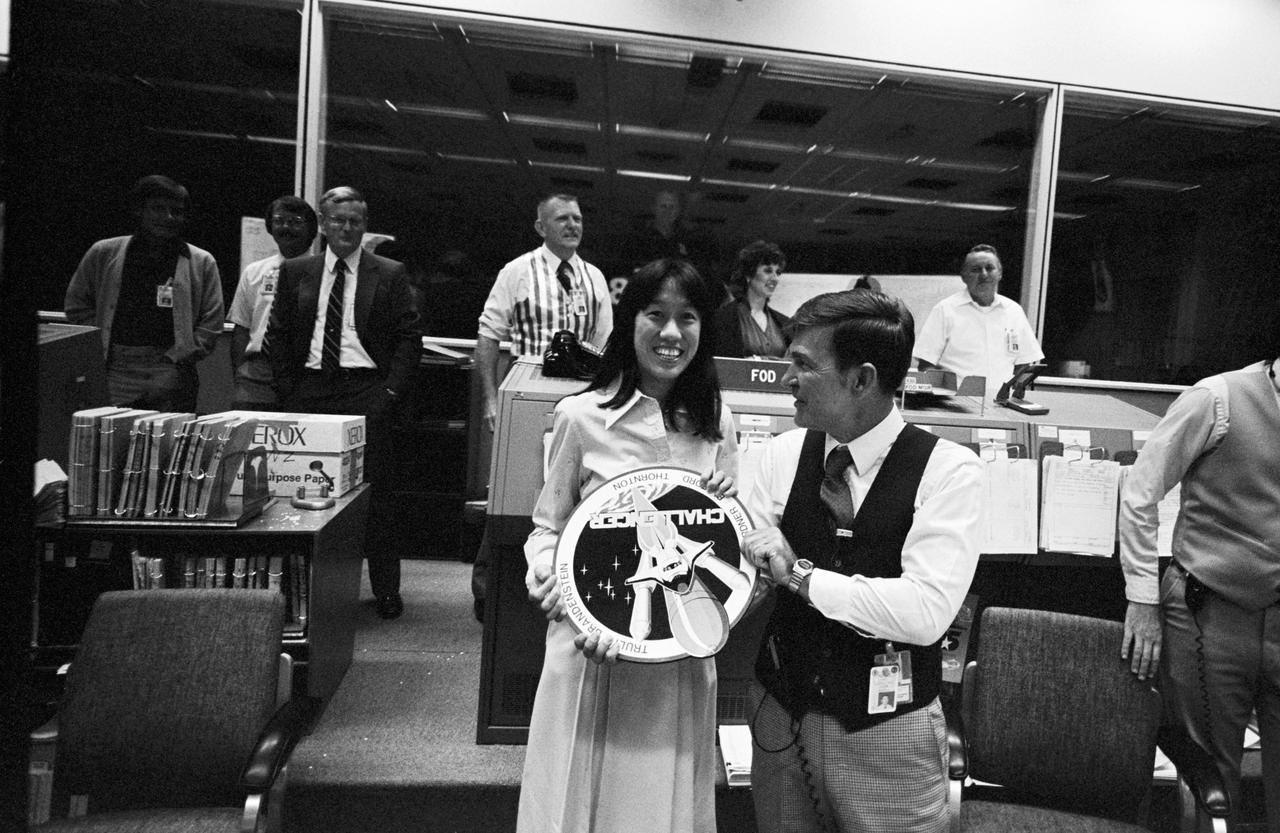
STS-8 MCC Activities, Day 6 CapComs, Astronaut Bill Fisher and Flight Director Harold Draughon. 1. INFLIGHT - STS-8 (MCC) 2. FISHER, ANNA - STS-8 (MCC) 3. FISHER, BILL - STS-8 (MCC) JSC, HOUSTON, TX Also available in 35 CN
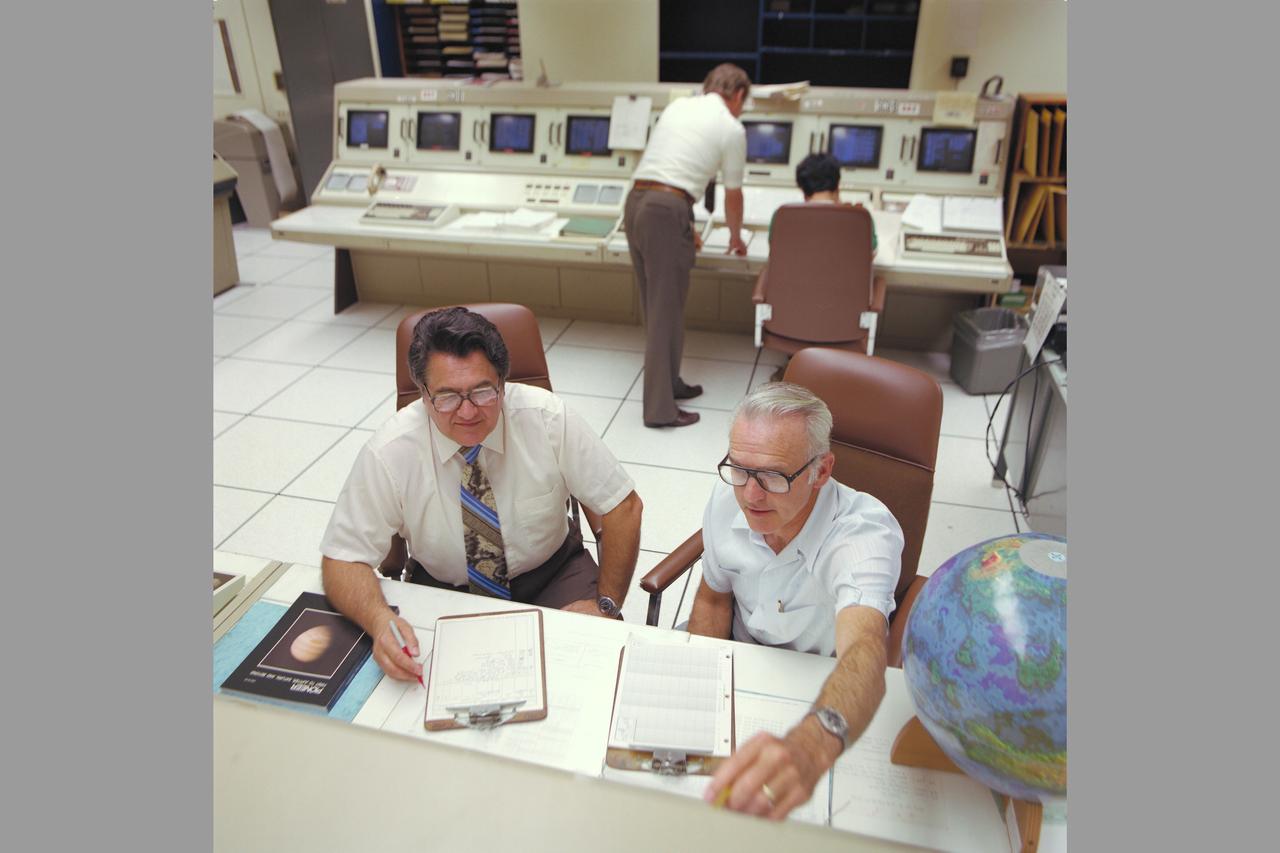
Pioneer Mission Control Center with personnel monitoring spacecraft (PMOC) including Dr Richard Fimmel
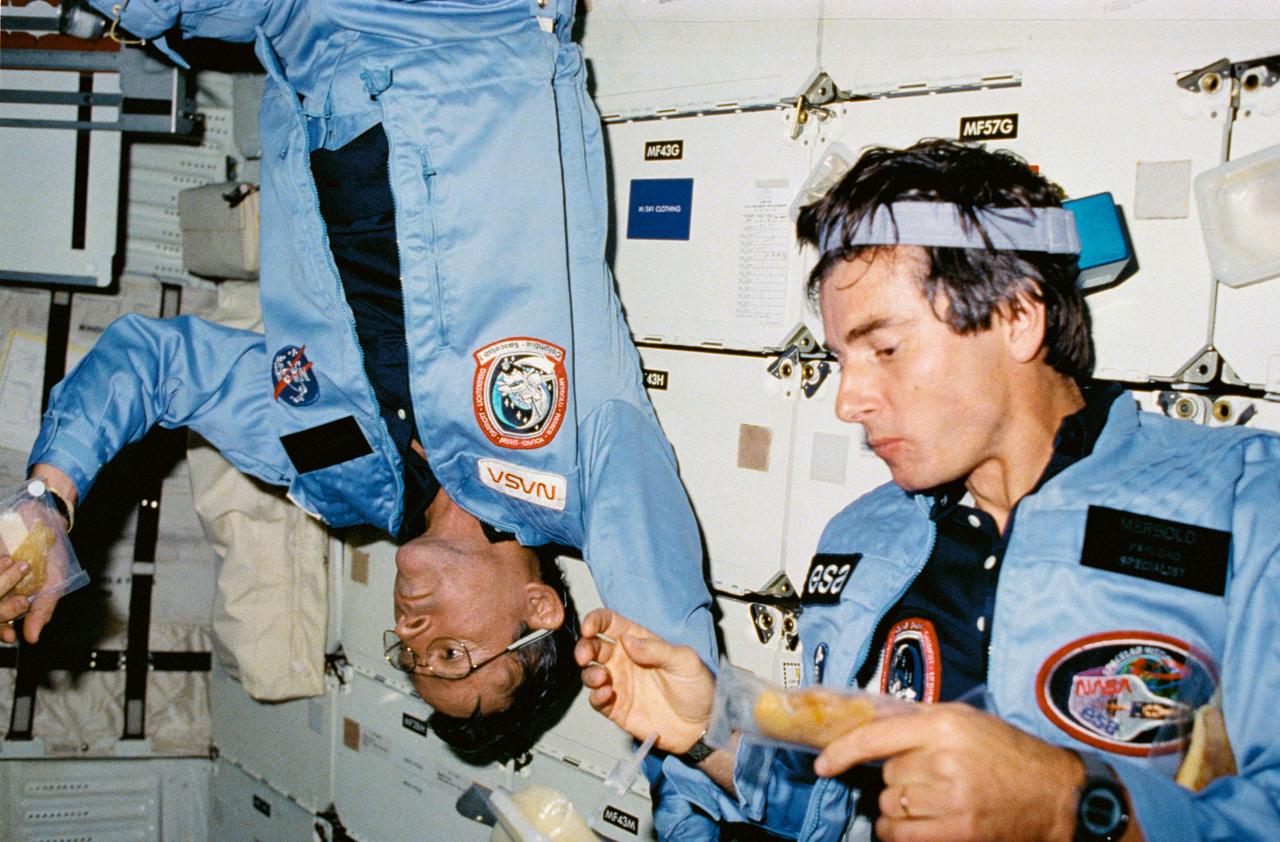
STS009-003-075 (28 November - 8 December 1983) --- Astronaut John W. Young (left), STS-9 crew commander; and Ulf Merbold, payload specialist, enjoy a meal in the middeck of the Earth-orbiting Space Shuttle Columbia. Merbold is a physicist from the Federal Republic of Germany, representing the European Space Agency (ESA) on this 10-day flight. Many of the nearby stowage lockers are used for clothing and food. The photograph was made with a 35mm camera.
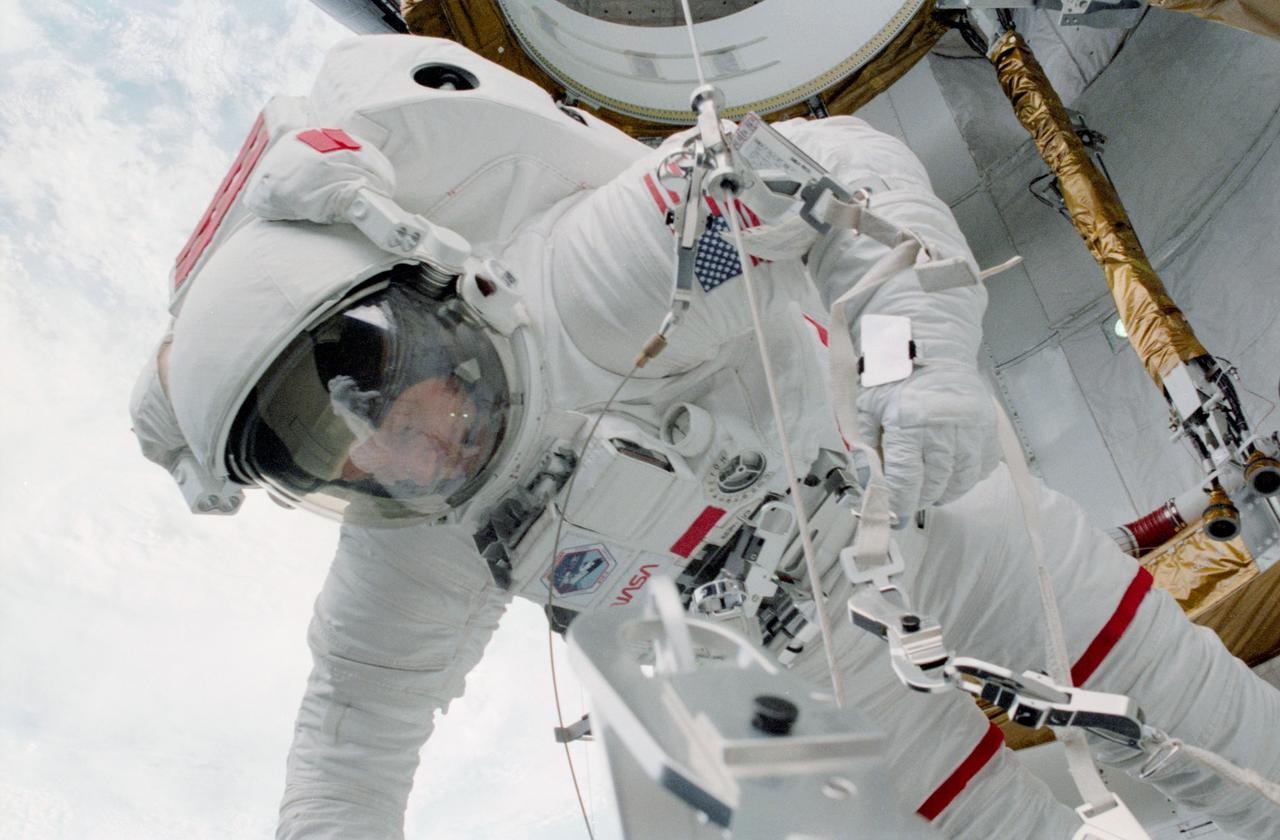
STS006-22-038 (7 April 1983) --- Astronaut F. Story Musgrave, one of two STS-6 mission specialists who performed a long, successful extravehicular activity (EVA) in the cargo bay of the Earth-orbiting space shuttle Challenger, moves along a slide wire near the now vacated inertial upper stage’s (ISU) airborne support equipment (ASE). Astronaut Donald H. Peterson, sharing the cargo bay with Dr. Musgrave, exposed this frame with a 35mm camera, while astronauts Paul J. Weitz, commander; Karol J. Bobko, pilot, remained in the cabin. Photo credit: NASA
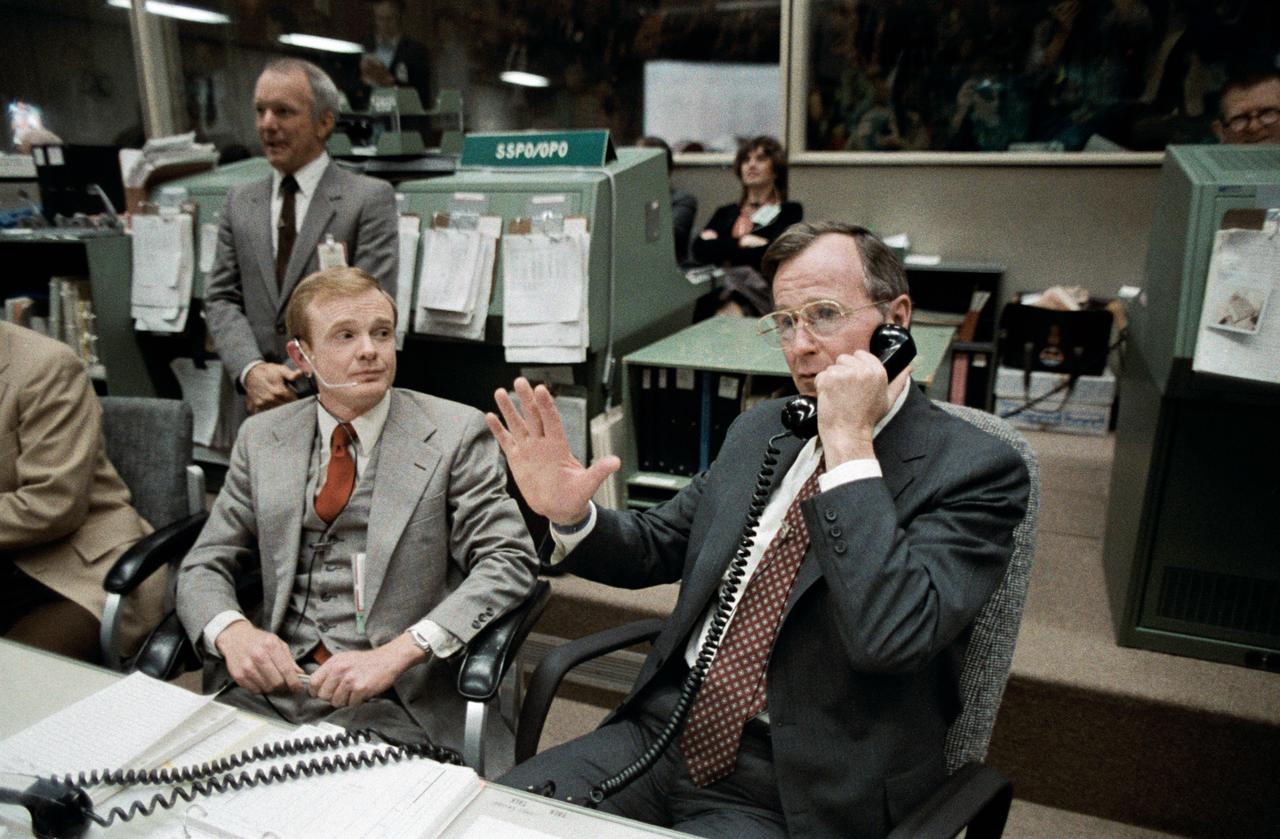
S83-30192 (8 April 1983) --- Vice President George Bush talks to the Earth-orbiting STS-6 astronauts from the spacecraft communicators; (CAPCOM) console in the mission operations control room (MOCR) of the Johnson Space Center?s mission control center. Astronaut Roy D. Bridges, is one of the CAPCOM personnel on duty. JSC Director Gerald D. Griffin, left, watches a large monitor (out of frame) on which the TV scene of the four-member Challenger crew is visible. This photo was made by Otis Imboden.

S83-30222 (4 April 1983) --- The second reusable spacecraft in history successfully launches from Launch Pad 39A at 1:30:00:88 p.m. (EST) on April 4, 1983, and heads for its history making five-day mission in Earth orbit. The space shuttle Challenger, its two solid rocket boosters (SRB), and a new lightweight?external fuel tank were captured on film by an automatically-tripped camera in a protected station nearer to the launch pad than human beings are able to be at launch time. Onboard the spacecraft are astronauts Paul J. Wietz, Karol J. Bobko, Dr. Story Musgrave and Donald H. Peterson. Photo credit: NASA
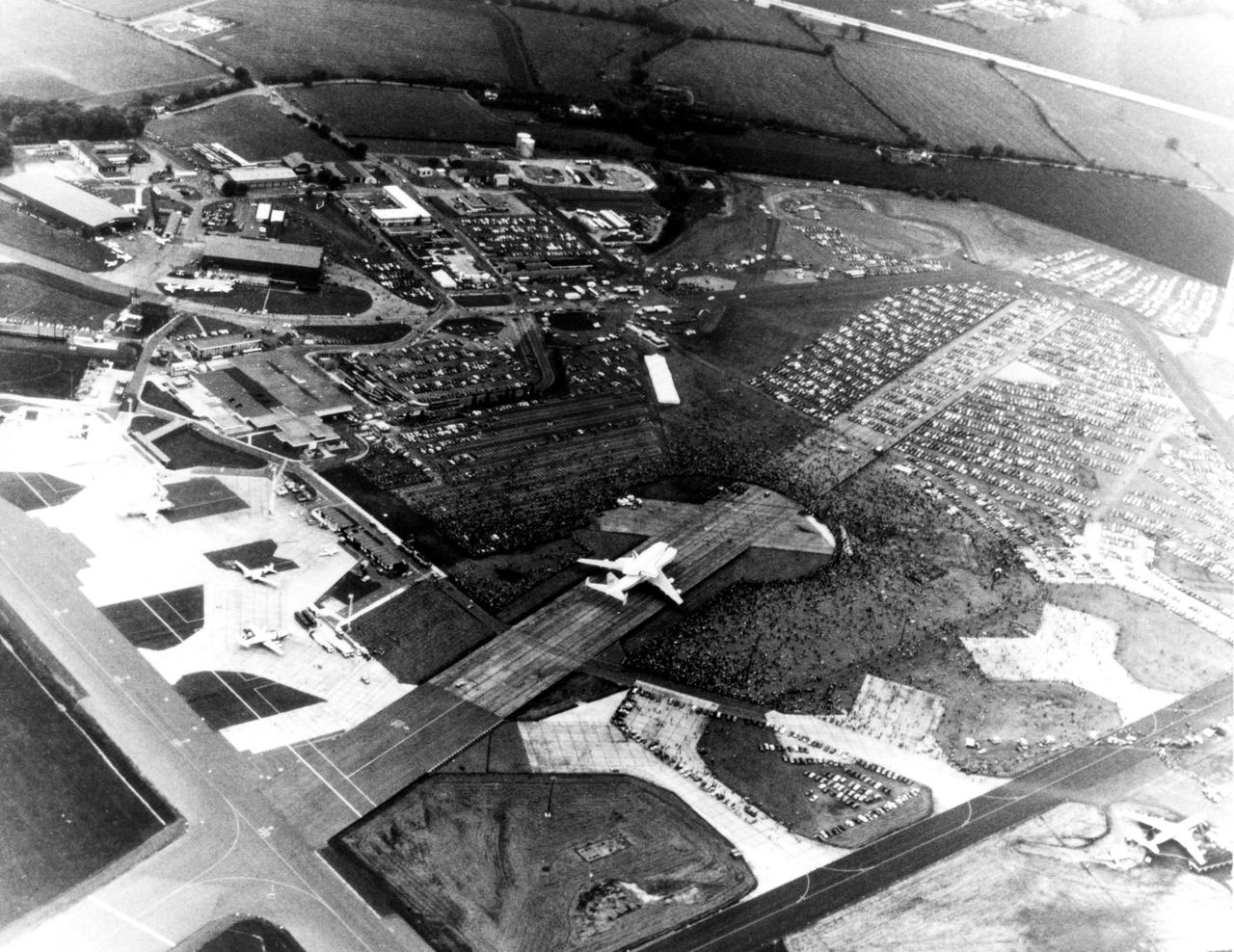
KENNEDY SPACE CENTER, FLA. -- Thousands of Britons surround the Space Shuttle Orbiter Enterprise at Stansted Airport, near London. The Enterprise atop its 747 carrier aircraft was viewed in London, Bonn-Cologne, West Germany, Rome and Ottawa, Canada, in addition to being shown at the Paris Air Show in June 1983.
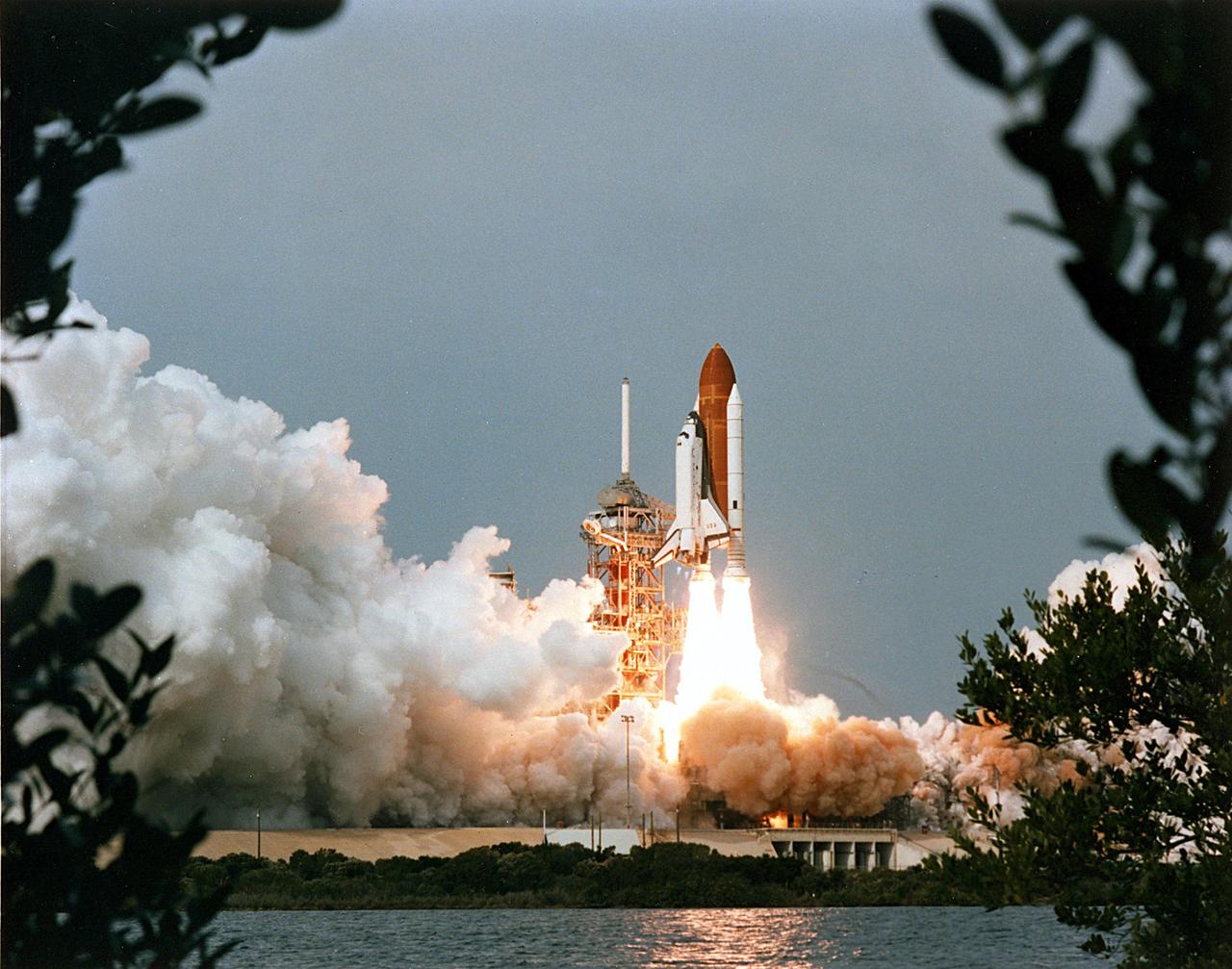
KENNEDY SPACE CENTER, FLA. -- Columbia launches on mission STS-9 from Launch Pad 39-A. This is the first Shuttle flight with six crew members: Commander John W. Young, Pilot Brewster H. Shaw Jr., Mission Specialists Owen K. Garriott and Robert A.R. Parker, and Payload Specialists Byron K. Lichtenberg and Ulf Merbold, who is with the European Space Agency (ESA). The flight carries the first Spacelab mission and first astronaut to represent ESA.
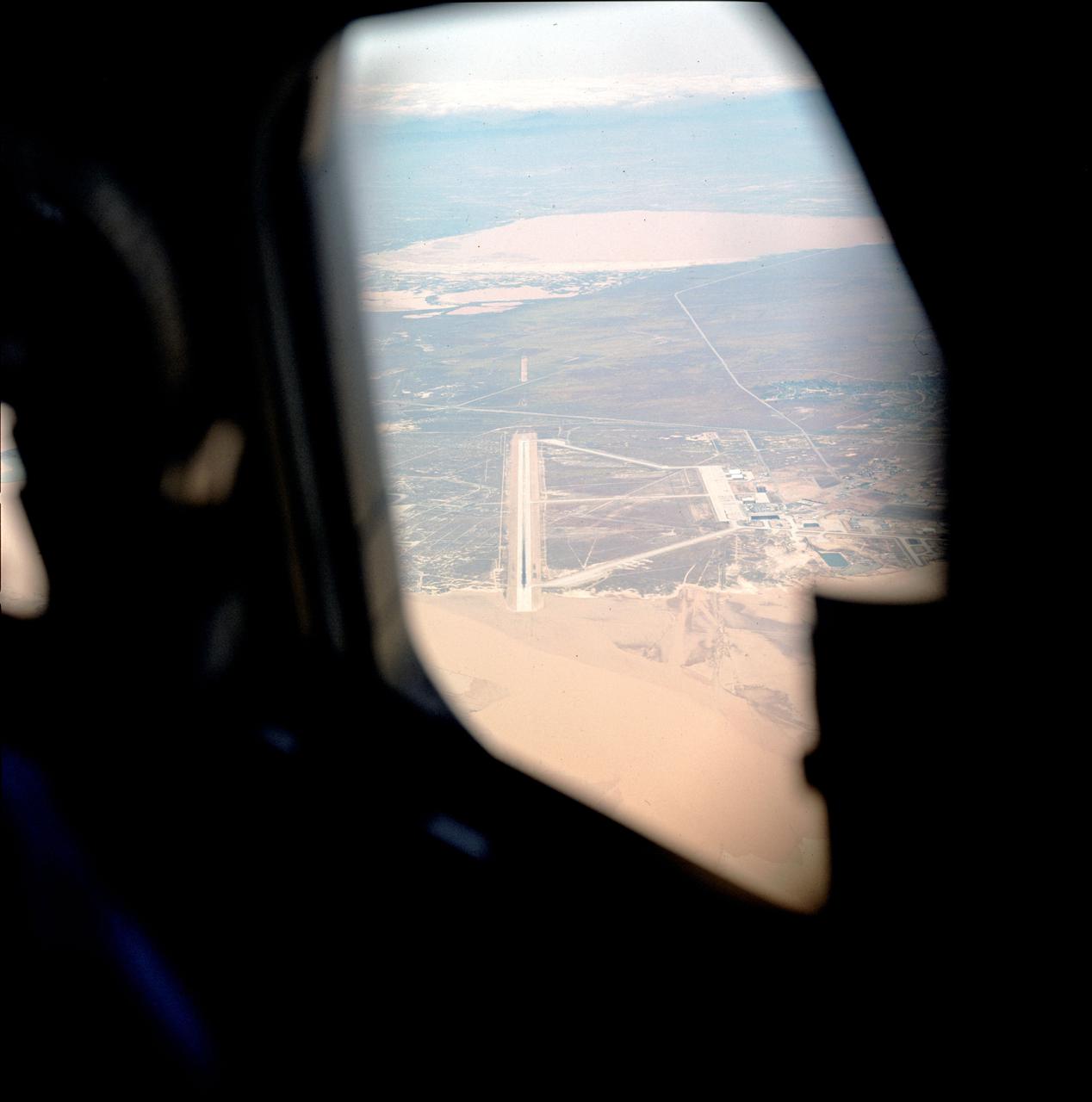
STS006-46-667 (9 April 1983) --- One of the final pictures taken aboard the space shuttle Challenger is this 35mm frame of Landing Strip 22 at Edwards Air Force Base as the reusable spacecraft was lined up for its landing only seconds later. The frame was exposed by astronaut Donald H. Peterson, STS-6 mission specialist, who was stretching behind the commander’s seat occupied by astronaut Paul J. Weitz on the flight deck. Also onboard the spacecraft for the five-day flight were astronauts Karol J. Bobko, pilot, and Dr. F. Story Musgrave, mission specialist. Photo credit: NASA
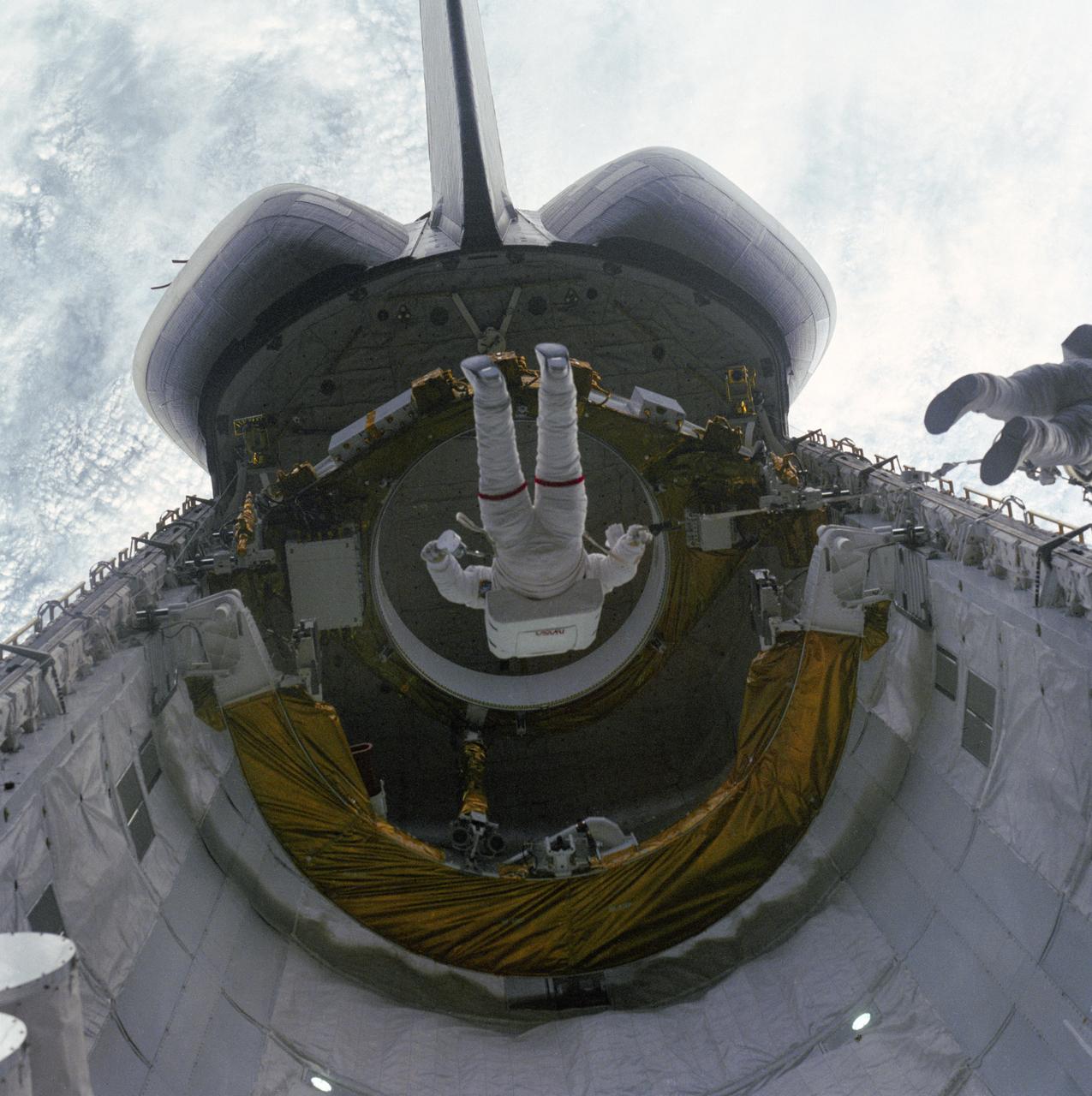
S83-30214 (7 April 1983) --- Astronaut F. Story Musgrave, STS-6 mission specialist, suspends himself midway between the starboard and port slide wire systems to evaluate the pull strength of the reel-in safety tether while astronaut Donald H. Peterson, the flight?s other mission specialist, busies himself along the port side at right edge of frame. This photograph was taken by astronaut Karol J. Bobko, pilot, from the aft window of the Earth-orbiting Challenger?s flight deck. The successful EVA occurred on April 7, 1983, on day four of the five-day flight. The gold-foil protected object is the airborne support equipment (ASE) for the now vacated inertial upper stage (IUS) which aided in the deployment of the tracking and data relay satellite (TDRS) on the first day of the mission. Astronaut Paul J. Weitz, crew commander, was in charge of the Challenger during these operations. The white background is made up mostly of clouds over Earth. Photo credit: NASA

STS006-44-582 (5 April 1983) --- A 70mm camera through the aft windows of the Earth-orbiting space shuttle Challenger’s cabin centered on the starboard orbital maneuvering system (OMS) pod of the reusable spacecraft. Two pieces of thermal protection system tile appear to have loosened. The view also shows one of the cargo bay television cameras, part of the EVA slide wire system, three handrails and other features on the aft bulkhead. Part of the airborne support equipment (ASE) for the now vacated inertial upper stage (IUS)/tracking and data relay satellite (TDRS) tandem is in lower right foreground. Photo credit: NASA
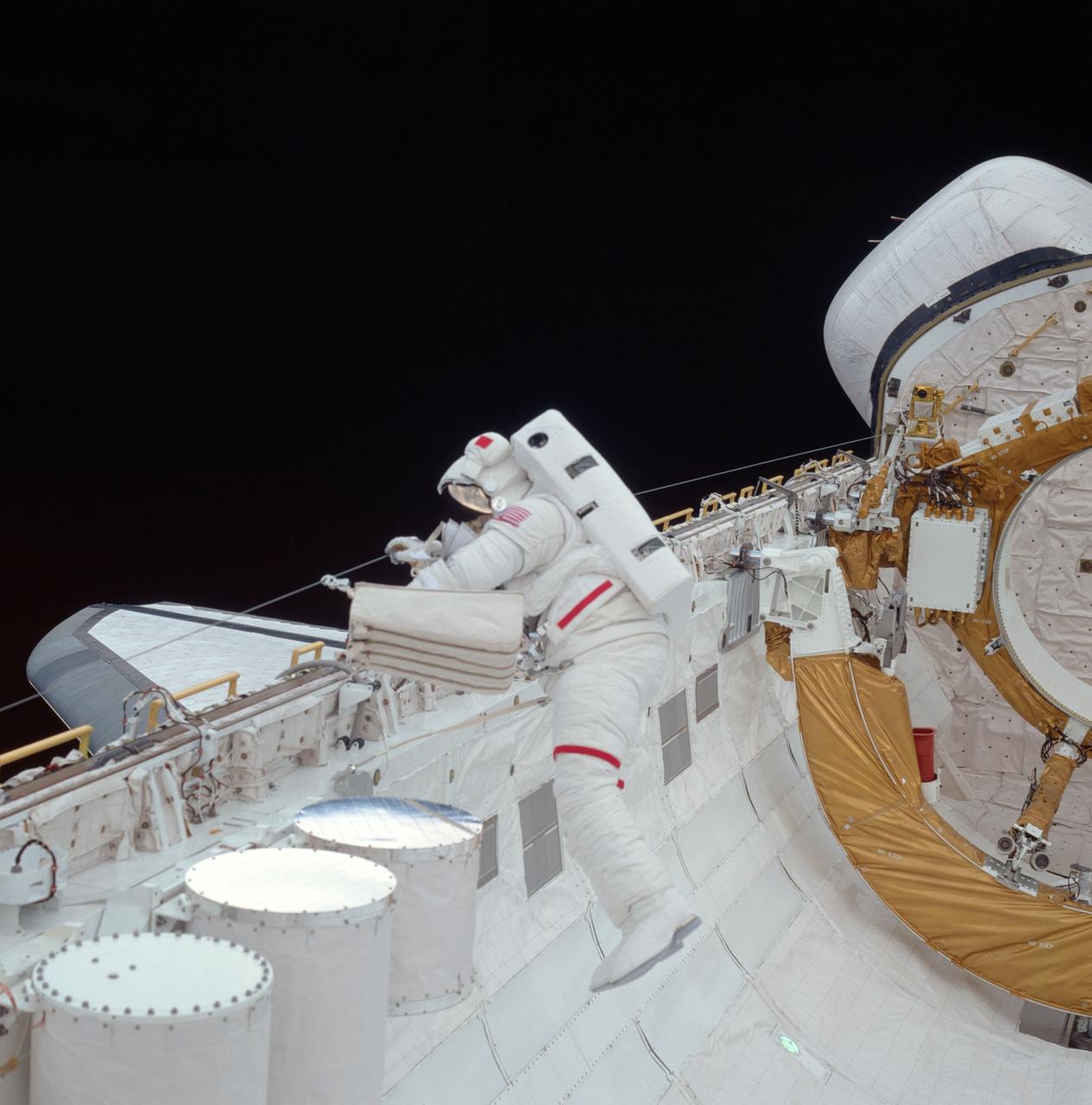
STS006-45-124 (7 April 1983) --- Astronaut F. Story Musgrave, STS-6 mission specialist, translates down the Earth-orbiting space shuttle Challenger’s payload bay door hinge line with a bag of latch tools. This photograph is among the first five still frames that recorded the April 7 extravehicular activity (EVA) of Dr. Musgrave and Donald H. Peterson, the flight’s other mission specialist. It was photographed with a handheld 70mm camera from inside the cabin by one of two crew members who remained on the flight deck during the EVA. Dr. Musgrave’s task here was to evaluate the techniques required to move along the payload bay’s edge with tools. In the lower left foreground are three canisters containing three getaway special (GAS) experiments. Part of the starboard wind and orbital maneuvering system (OMS) pod are seen back dropped against the blackness of space. The gold-foil protected object partially out of frame on the right is the airborne support equipment for the now vacated inertial upper stage (IUS) which aided the deployment of the tracking and data relay satellite on the flight’s first day. Astronauts Paul J. Weitz, command and Karol J. Bobko, pilot, remained inside the Challenger during the EVA. Photo credit: NASA
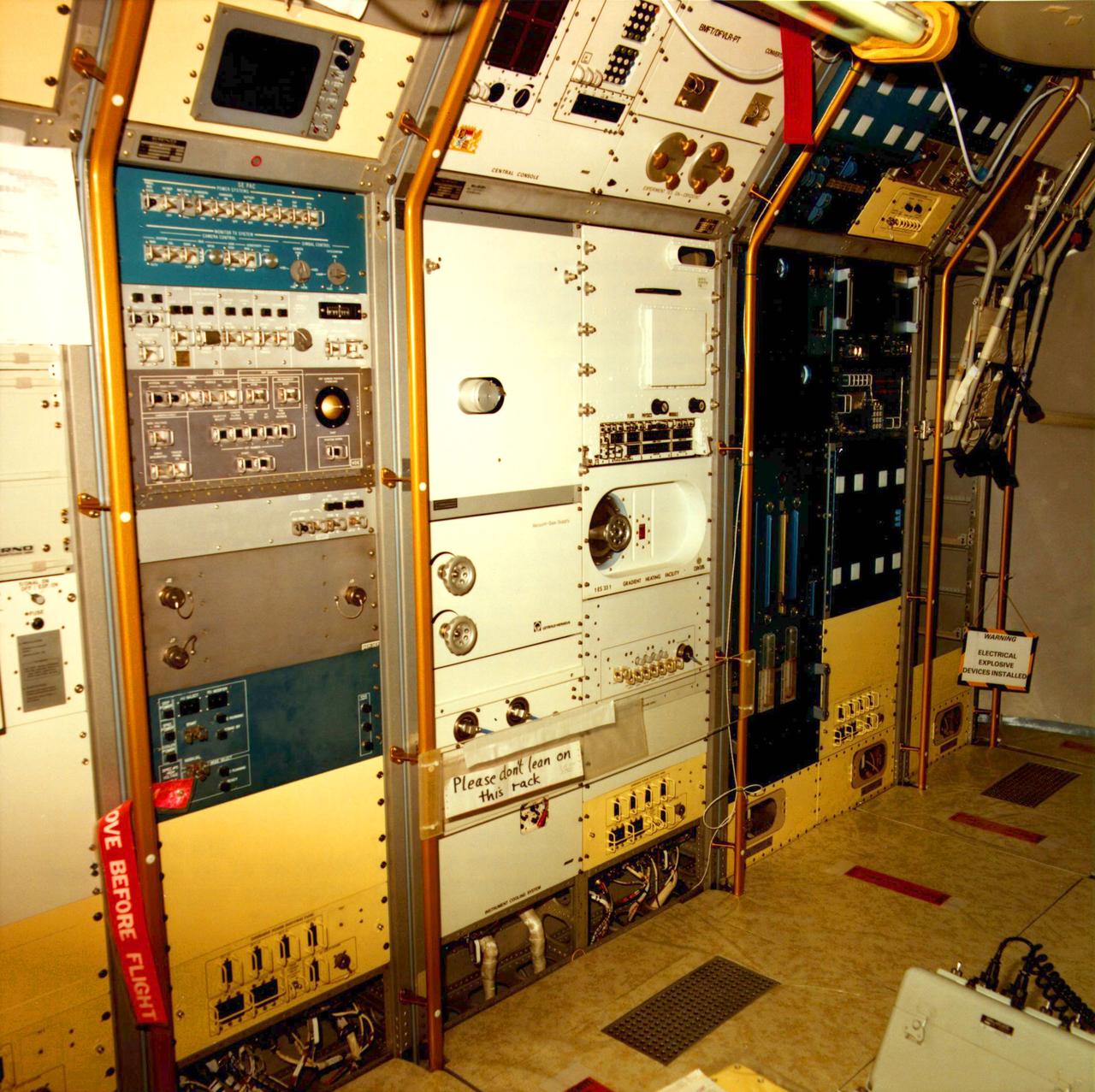
Interior view of Spacelab 1 to show layout of equipment and astronauts testing tools. Operations Checkout (O C) Building located at KSC.
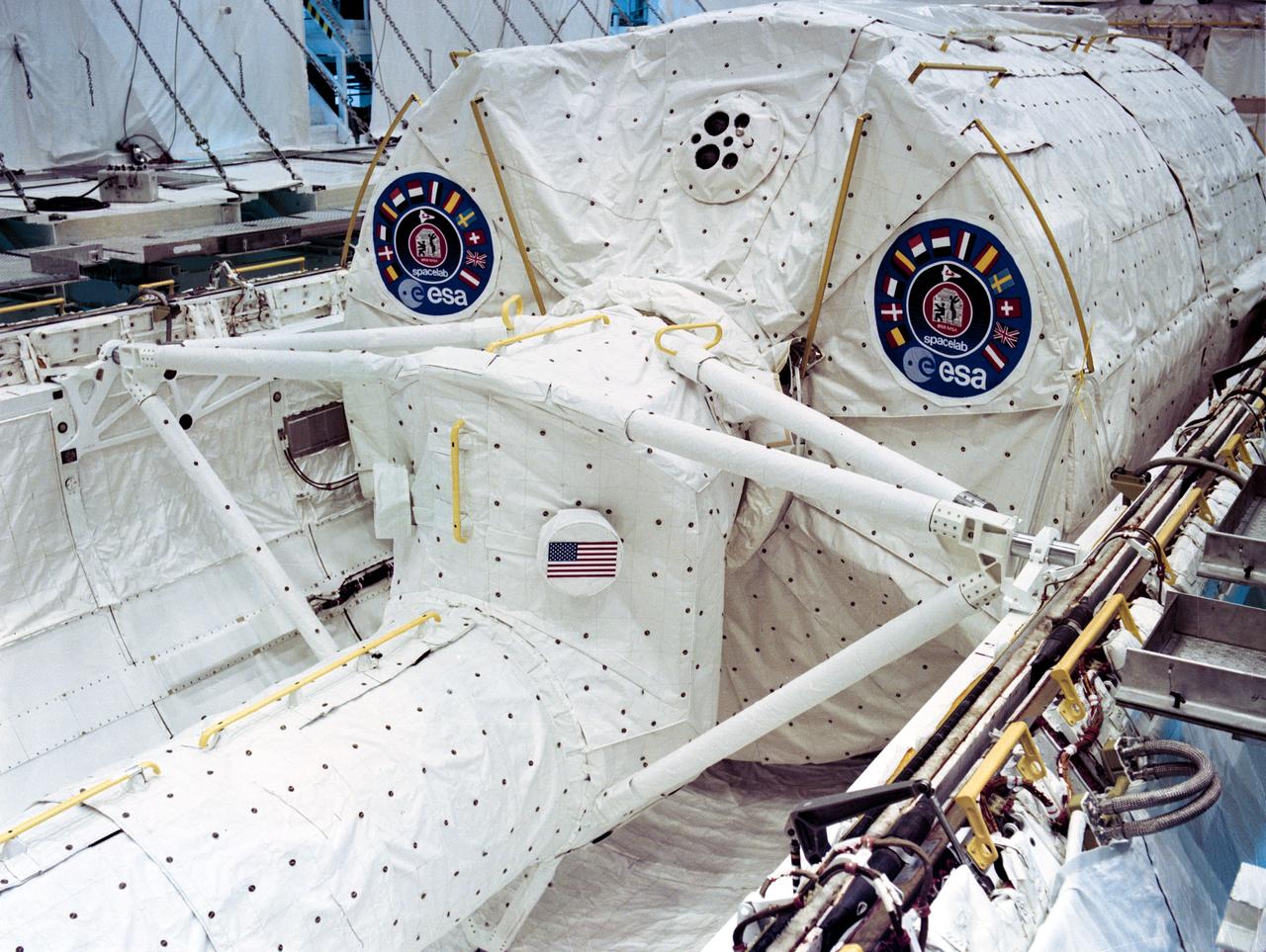
Spacelab I is installed in the Orbiter Columbia and connected to the Orbiter Crew Compartment by the Crew Access Tunnel. The tunnel allows the Astronauts to travel between the Orbiter Crew Compartment and the Spacelab in "shirt-sleeve" conditions. KSC, FL Also available in 4x5 B&W
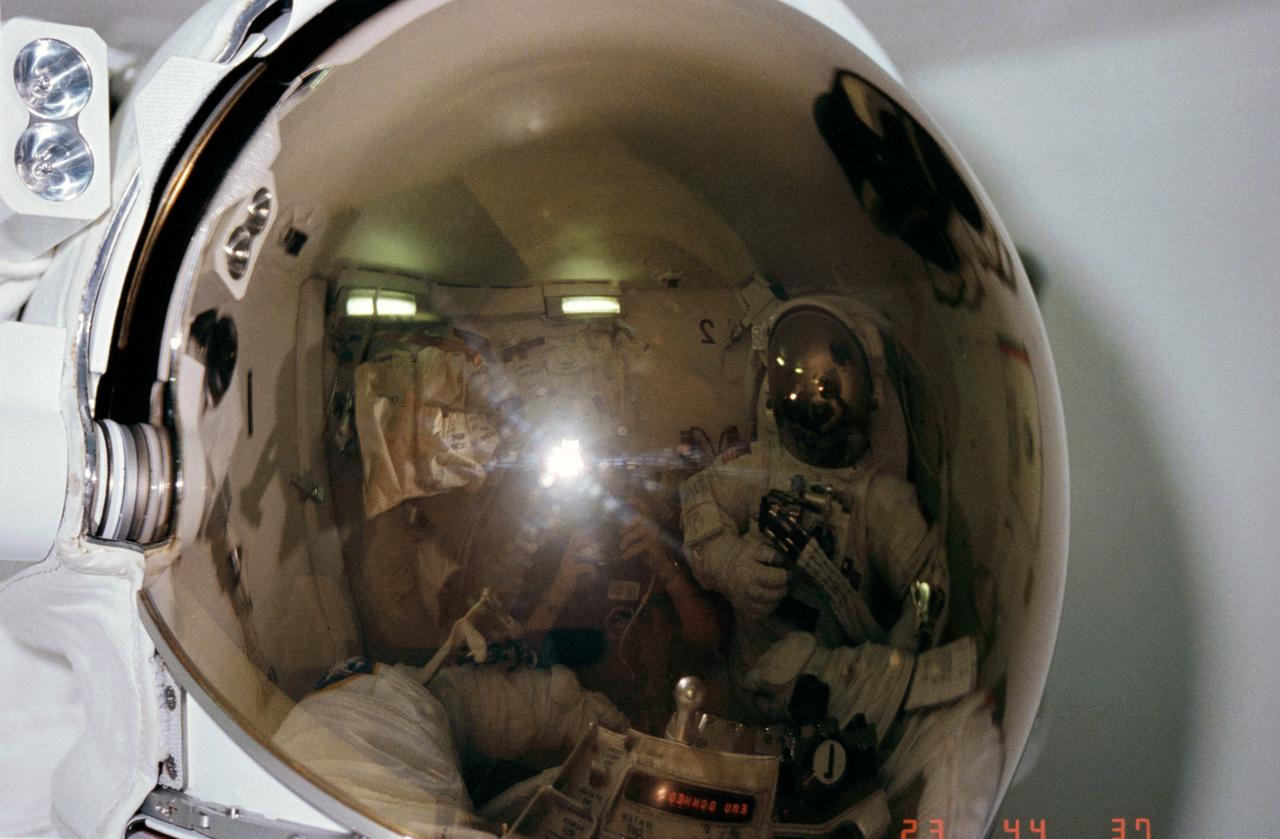
STS006-06-465 (7 April 1983) --- Three-fourths of the STS-6 astronaut crew appears in this unusual 35mm frame exposed in the airlock of the Earth-orbiting space shuttle Challenger. Astronaut F. Story Musgrave’s helmet visor encompasses all the action in the frame. Dr. Musgrave and astronaut Donald H. Peterson (reflected on right side of the visor) were fully suited in their Extravehicular Mobility Unit (EMU) spacesuits and were participating in EVA preparation exercises. Astronaut Karol J. Bobko, STS-6 pilot, wearing conventional onboard shuttle clothing, photographed the two during their procedures and appears at center of frame. The reversed number (1 and 2 in the mirrored image represent the EVA designations for the two mission specialists. Photo credit: NASA
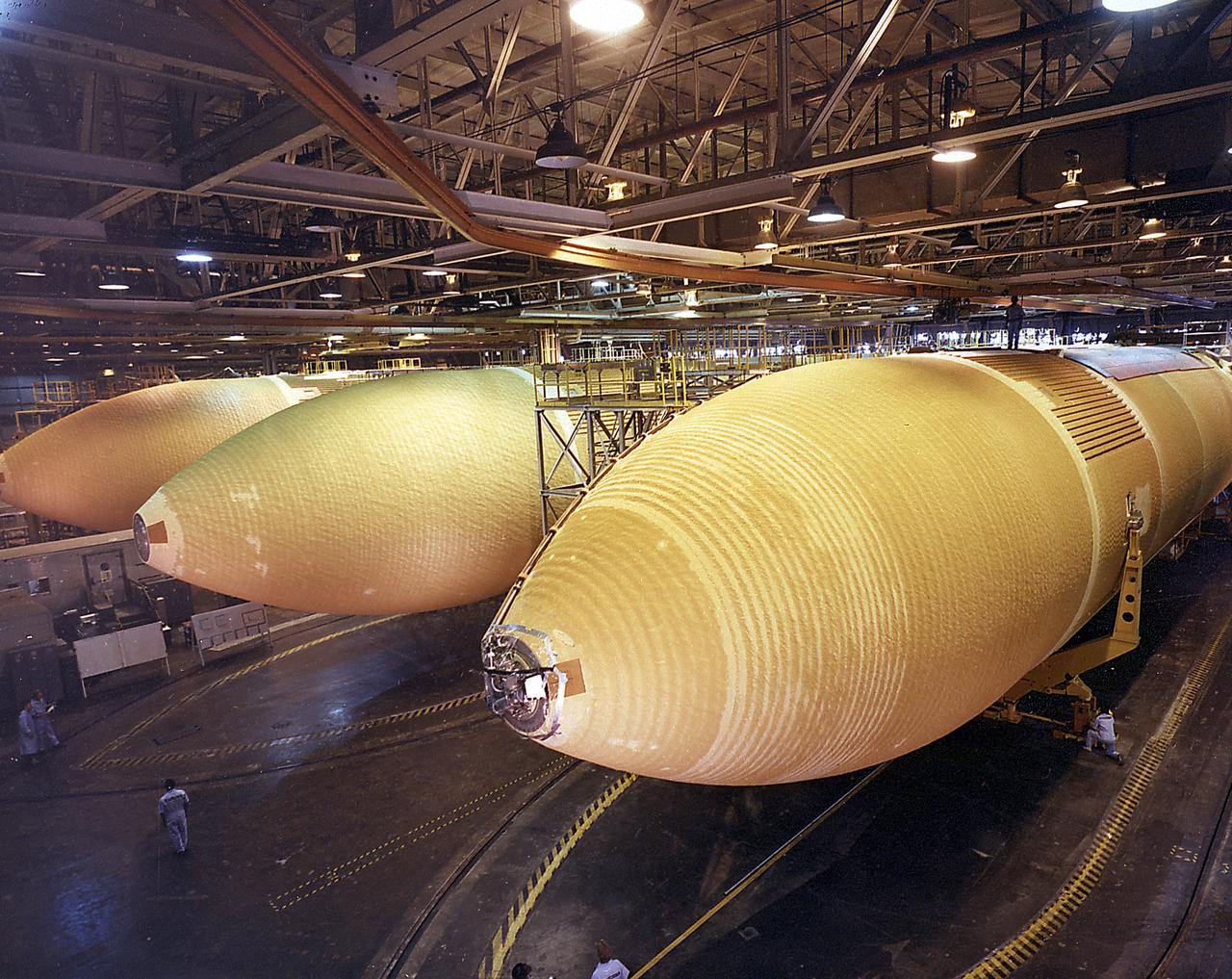
This photograph was taken during the final assembly phase of the Space Shuttle light weight external tanks (LWT) 5, 6, and 7 at the Michoud Assembly Facility in New Orleans, Louisiana. The giant cylinder, higher than a 15-story building, with a length of 154-feet (47-meters) and a diameter of 27.5-feet (8.4-meters), is the largest single piece of the Space Shuttle. During launch, the external tank (ET) acts as a backbone for the orbiter and solid rocket boosters. In separate, internal pressurized tank sections, the ET holds the liquid hydrogen fuel and liquid oxygen oxidizer for the Shuttle's three main engines. During launch, the ET feeds the fuel under pressure through 17-inch (43.2-centimeter) ducts which branch off into smaller lines that feed directly into the main engines. Some 64,000 gallons (242,260 liters) of fuel are consumed by the main engines each minute. Machined from aluminum alloys, the Space Shuttle's ET is the only part of the launch vehicle that currently is not reused. After its 526,000 gallons (1,991,071 liters) of propellants are consumed during the first 8.5 minutes of flight, it is jettisoned from the orbiter and breaks up in the upper atmosphere, its pieces falling into remote ocean waters. The Marshall Space Flight Center was responsible for developing the ET
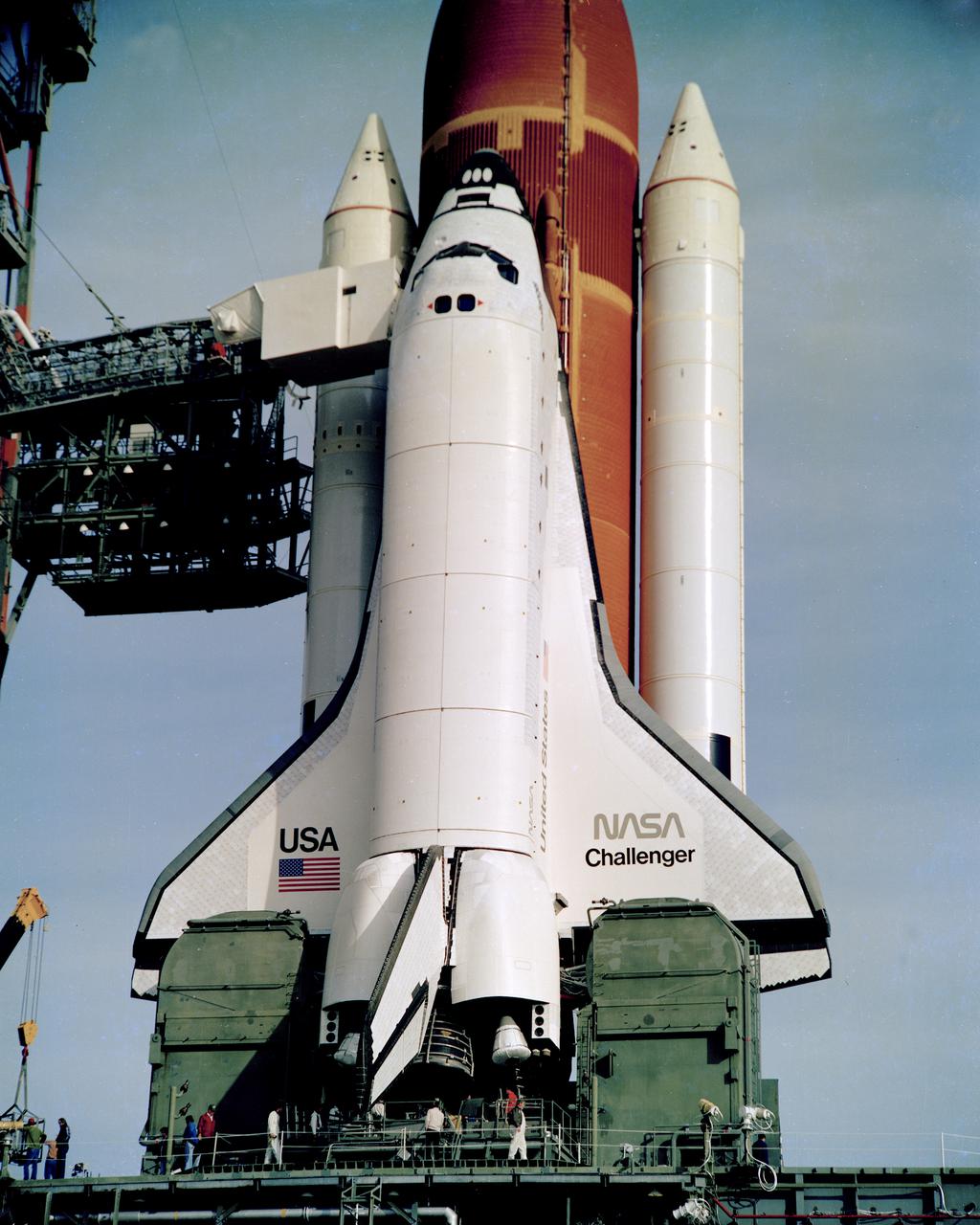
CAPE CANAVERAL, Fla. – STS-6 orbiter Challenger on Complex 39A with rotating service structure retracted. Photo credit: NASA
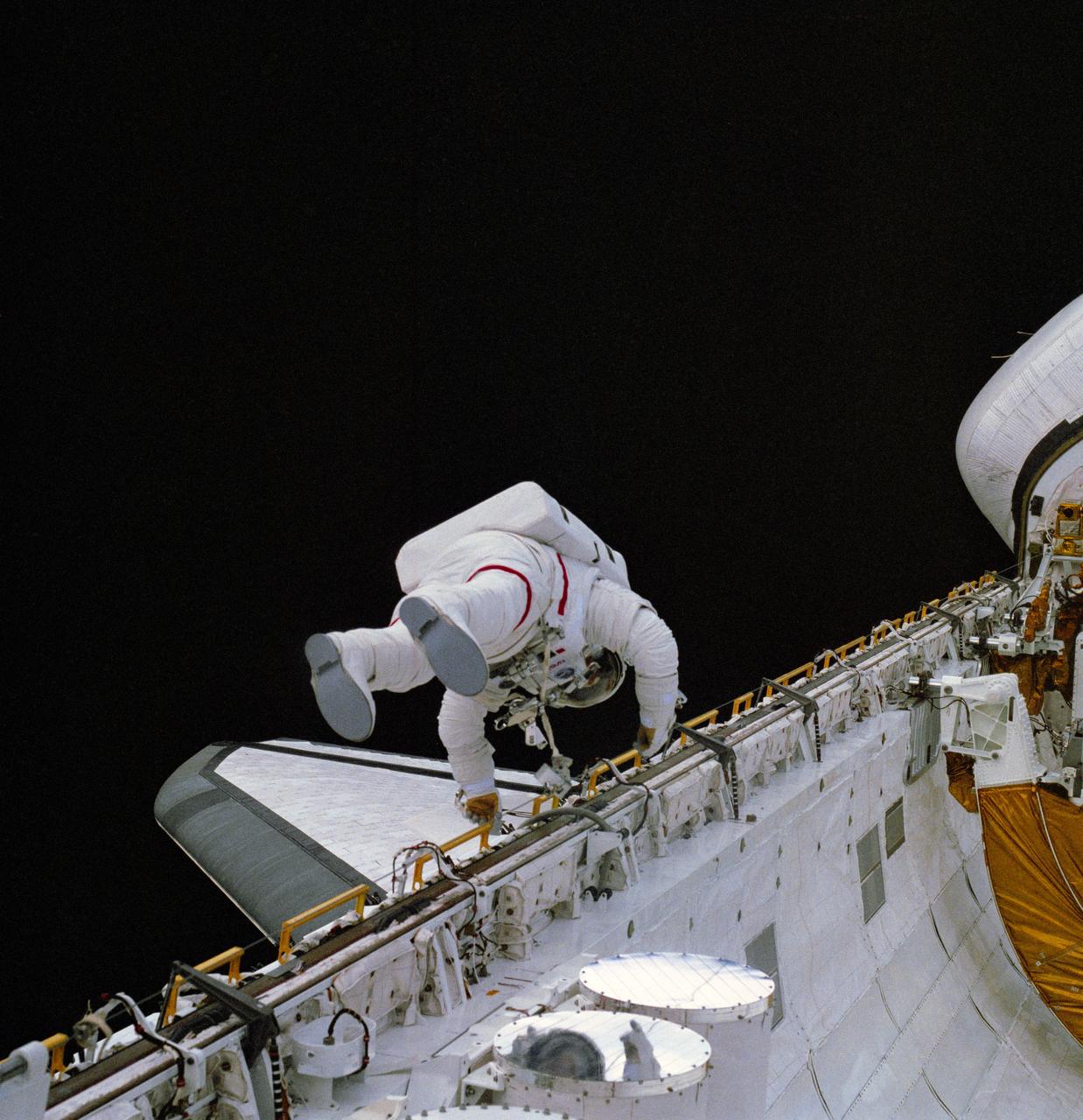
S83-30215 (7 April 1983) --- This photograph of astronaut Story Musgrave, STS-6 mission specialist, translating along the longerons on the port side of the cargo bay of the Earth-orbiting space shuttle Challenger was taken with a hand-held 70mm camera from some 18 meters (60 feet) away by one of two crew members who remained inside the cabin. Astronauts Musgrave and Donald H. Peterson (out of frame) were in the midst of NASA?s first ever shuttle extravehicular activity (EVA). Astronaut Karol J. Bobko, pilot, took a number of photographs through the aft flight deck?s windows, and astronaut Paul J. Weitz, mission commander, also exposed some images but remained in control of the orbiter during the EVA. Photo credit: NASA
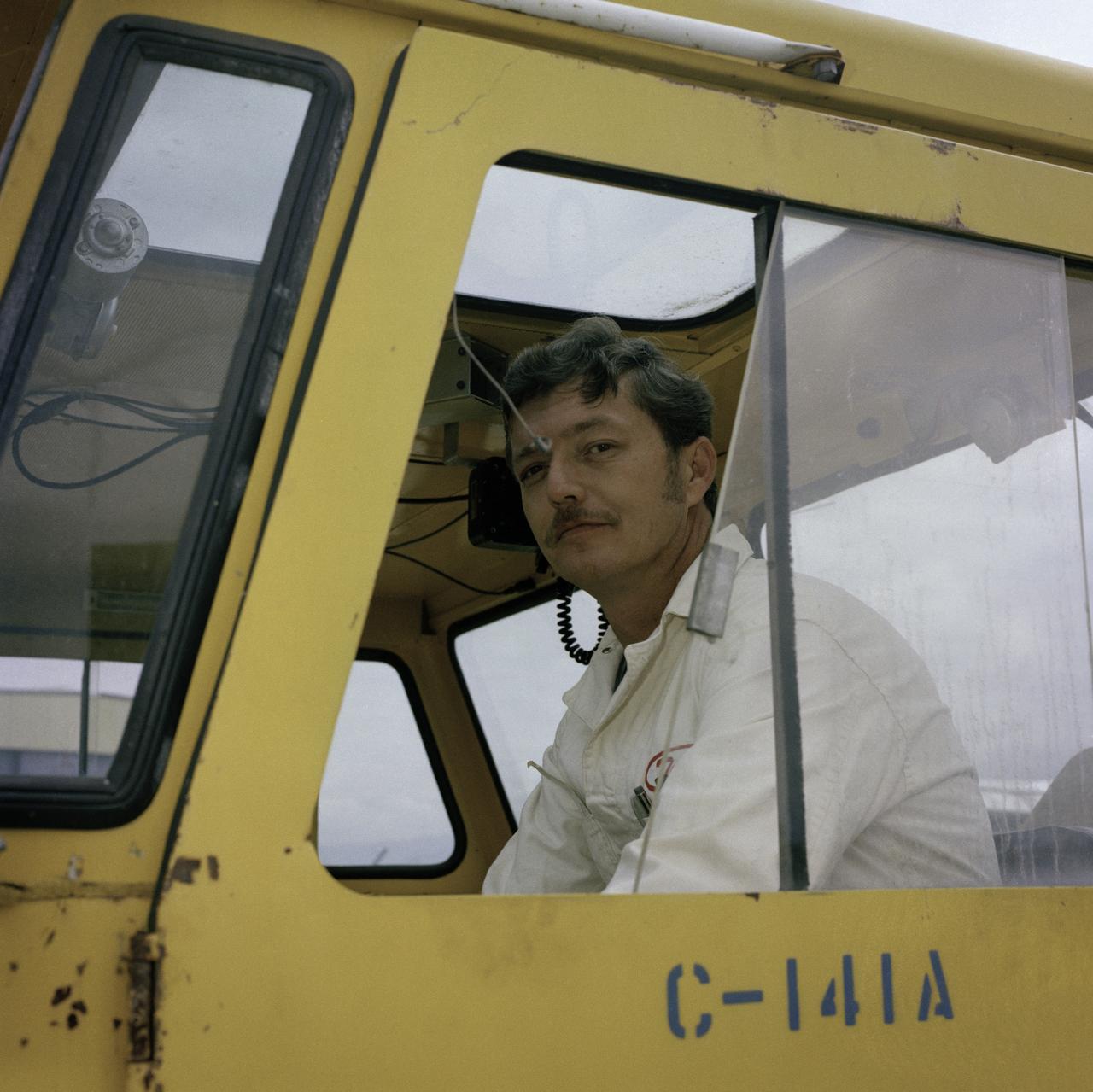
Ground crew ready ready C-141 KAO (NASA 714) departure from Ames Research Center, CA for Australia.
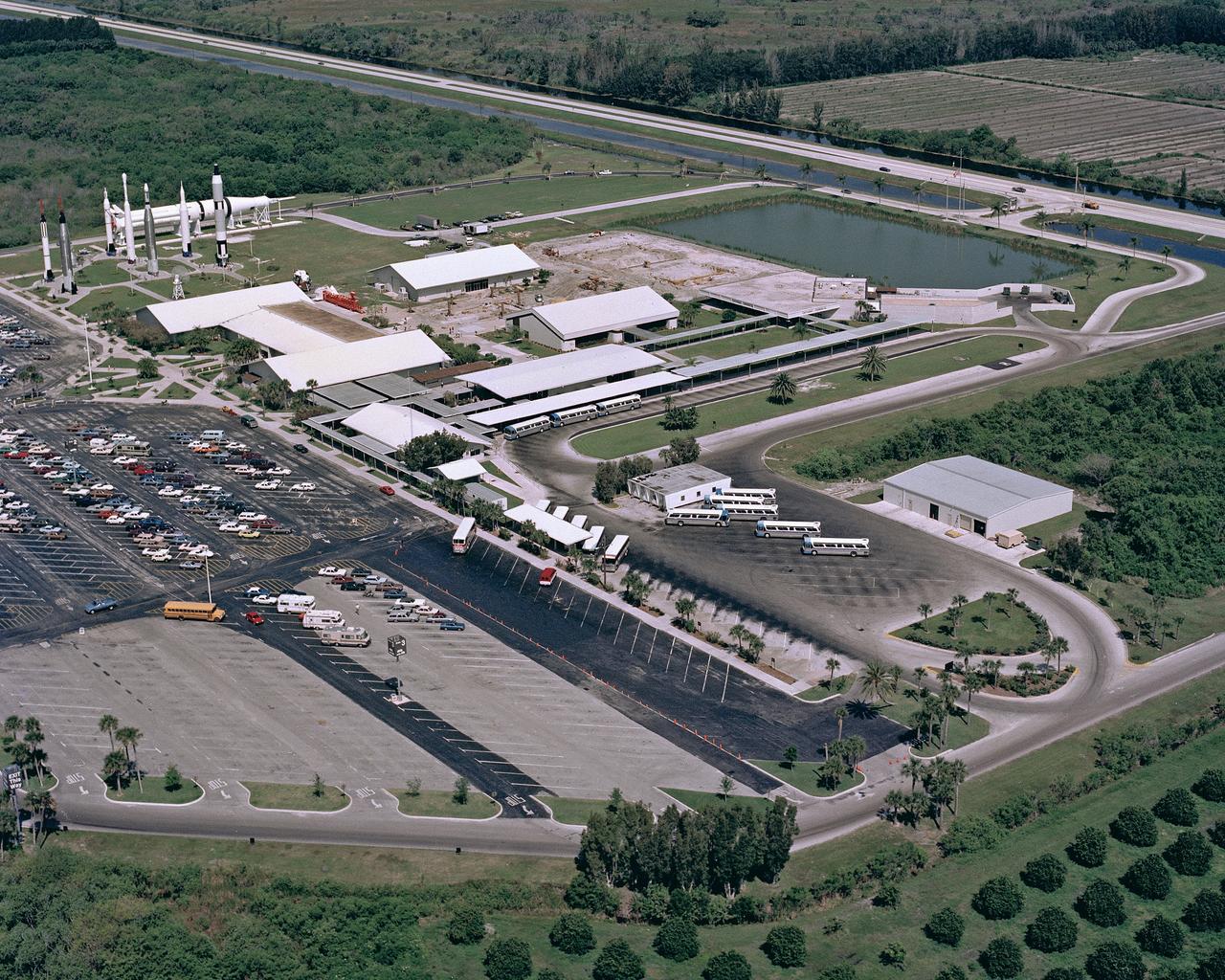
CAPE CANAVERAL, Fla. -- An aerial view of the Visitor Information Center at the Kennedy Space Center in Florida. Photo Credit: NASA
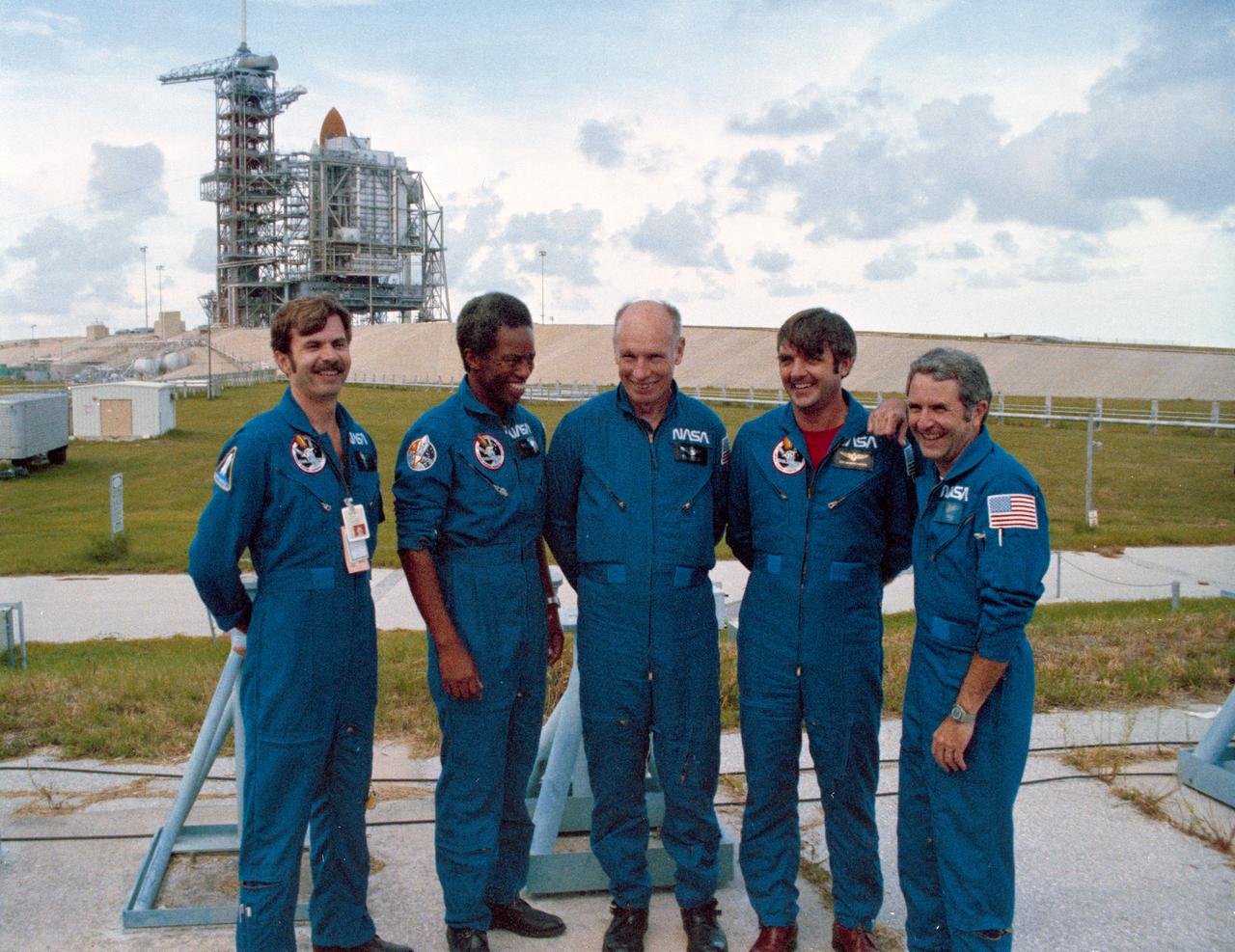
S83-38389 (6 Aug. 1983) --- The STS-8 crew members pause for a crew photo at Pad 39A after a question and answer session with the press. They were about to participate in the STS-8 countdown demonstration test. They will repeat many of their measures on Aug. 30 when they are scheduled to lift off aboard the space shuttle Challenger. From left to right are astronauts Dale A. Gardner, Guion S. Bluford, Dr. William E. Thornton, all mission specialists; Daniel C. Brandenstein, pilot; and Richard F. Truly, commander. The Challenger is in the background at complex 39.

STS008-16-454 (30 Aug-5 Sept 1983) --- Following a precedent set early two decades ago during the Gemini program, three members of the STS-8 astronaut crew aboard the Earth-orbiting Space Shuttle Challenger reveal their military backgrounds and loyalties. Astronauts (left to right) Dale A. Gardner, Richard H. Truly and Daniel C. Brandenstein leave no mystery as to their alma mater and gridiron sentimentalities as they display U.S. Navy stickers. The trio was photographed by Astronaut Guion S. Bluford on the flight deck. Truly is crew commander; Brandenstein, pilot; and Gardner and Bluford, along with Dr. William E. Thornton are all mission specialists for this six-day flight.
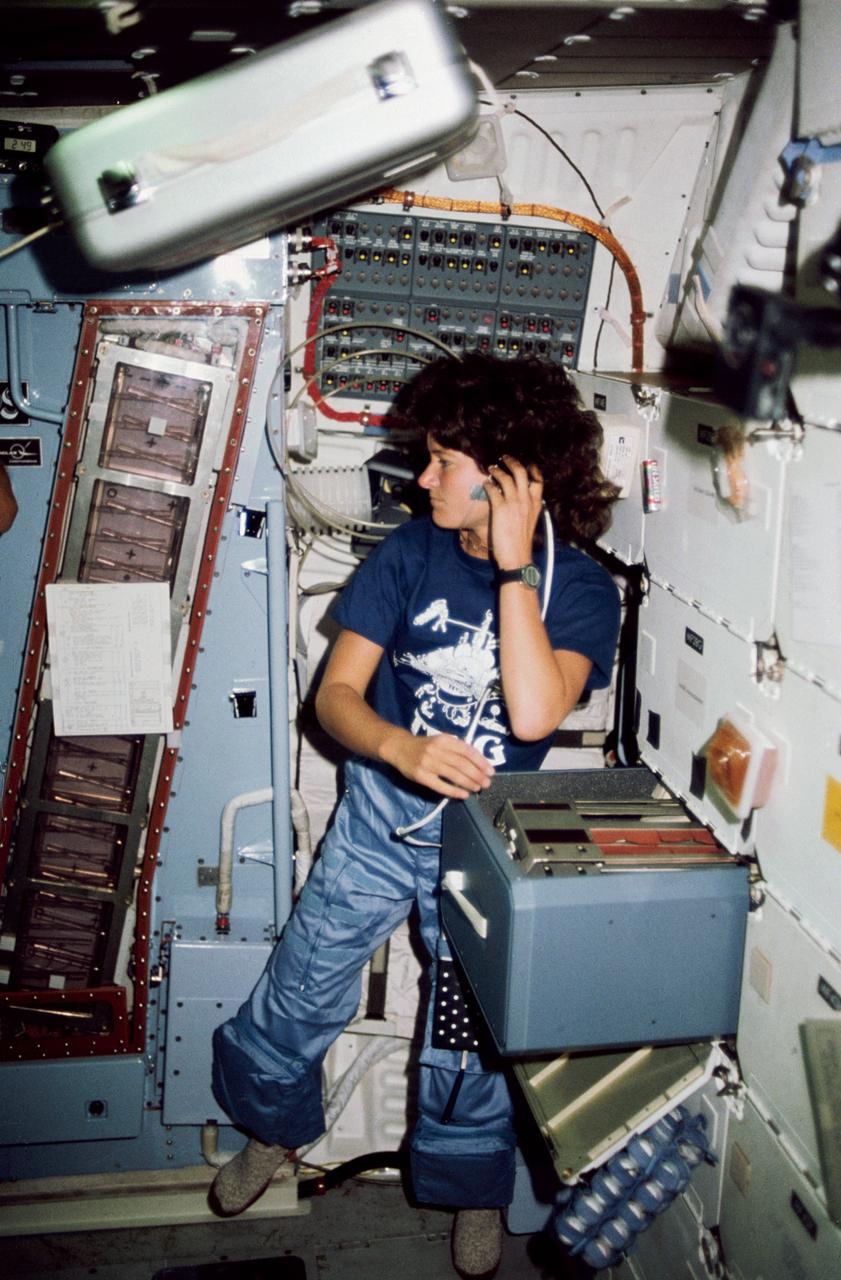
STS007-11-495 (18-24 June 1983) --- Astronaut Sally K. Ride, STS-7 mission specialist, communicates with ground controllers from the mid deck of the Earth-orbiting Space Shuttle Challenger. She has just opened one of the large lockers during the operation and monitoring of the continuous flow electrophoresis system (CFES) experiment at left edge. This photograph was made with a 35mm camera.

S83-32822 (5 May 1983) --- Astronaut Sally K. Ride (left) participates in a mission sequence test in preparation for STS-7, in the Kennedy Space Center?s (KSC) vertical processing facility (VPF). Dr. Ride is a mission specialist for the flight. She is joined here by Anna L. Fisher, a physician and astronaut from the 1978 group of 35, which also included Dr. Ride. Photo credit: NASA

S83-32571 (23 May 1983) --- Four-fifths of the STS-7 crew take a break from simulations in the Johnson Space Center?s Mission Simulation and Training Facility and pose for NASA photographer. Standing on the steps leading into the motion-based Shuttle Mission Simulator (SMS) are (left to right) astronauts Robert L. Crippen, John M. Fabian, Frederick H. Hauck and Sally K. Ride. Crippen is crew commander; Hauck, pilot; and Fabian and Ride are mission specialists, along with Norman E. Thagard (not involved in this phase of training and not pictured). Photo credit: NASA
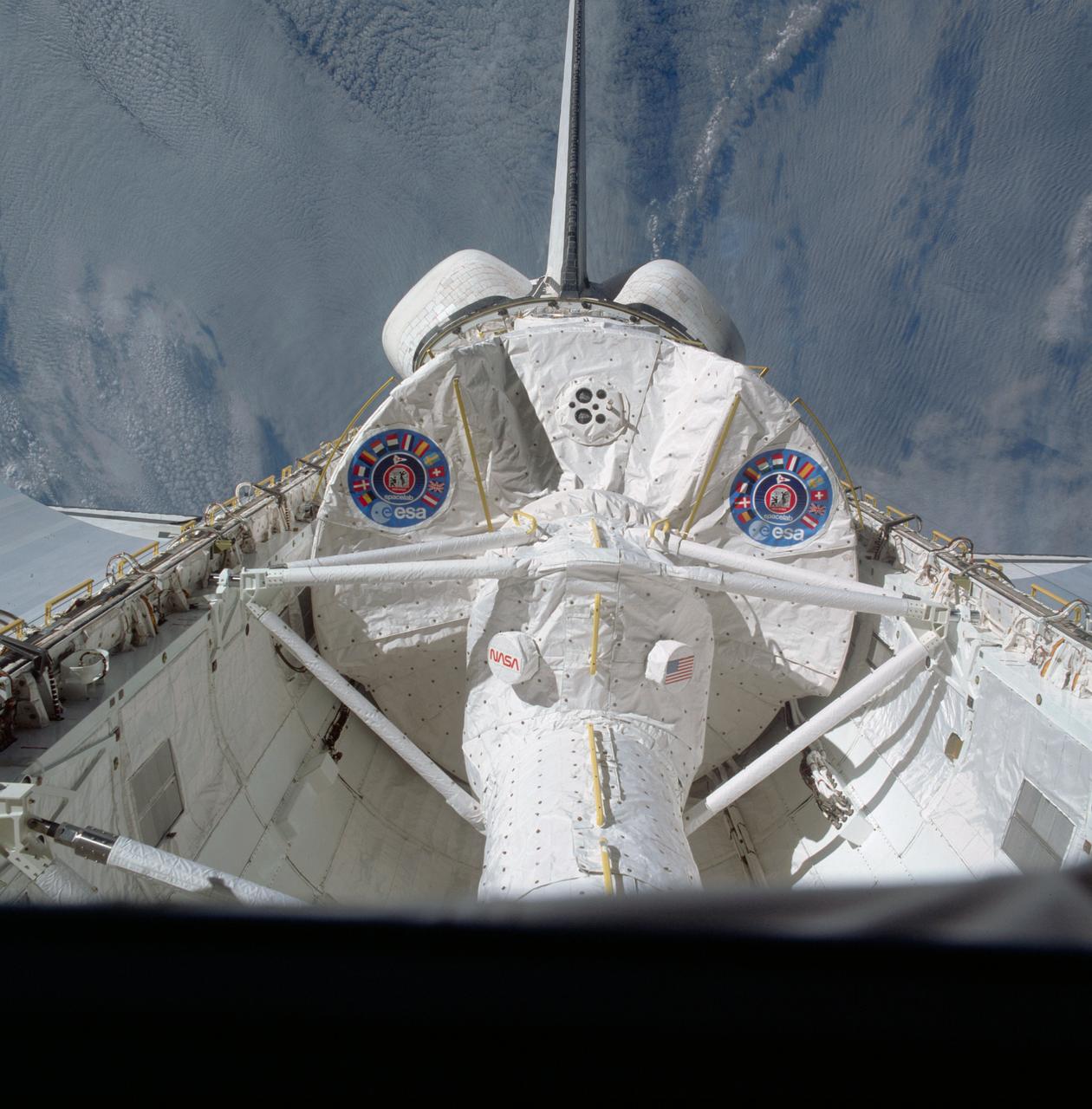
STS009-32-1112 (28 Nov-8 Dec 1983) --- A handheld Hasselblad camera was aimed through the aft windows on the flight deck of Columbia for this initially released scene of the active Spacelab module in the cargo bay. The docking tunnel, leading from the shirt-sleeve environment of the orbiter to the equally comfortable environment of Spacelab, is in the foreground.
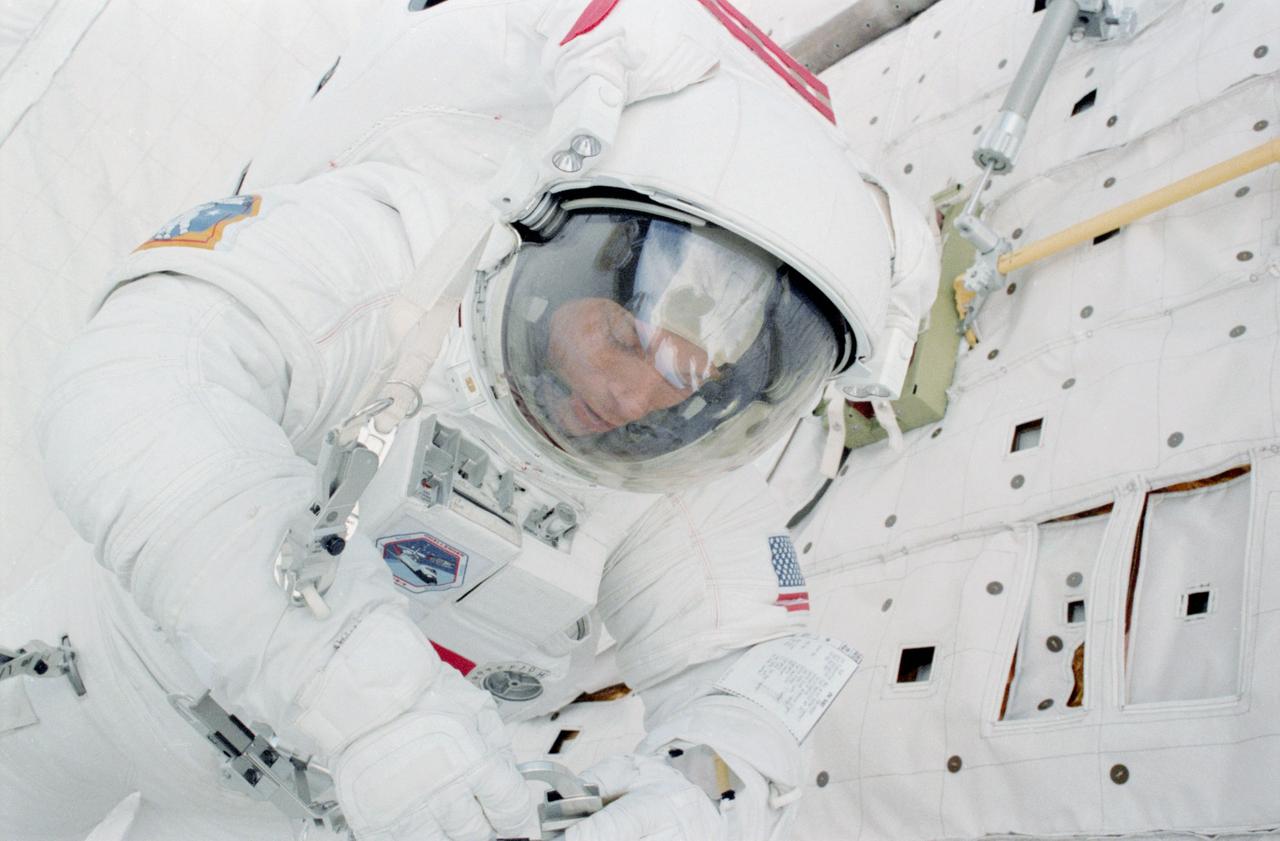
STS006-22-026 (7 April 1983) --- Astronaut F. Story Musgrave, one of two STS-6 mission specialists who performed a lengthy, successful extravehicular activity (EVA) in the cargo bay of the Earth orbiting space shuttle Challenger, anchors himself near the forward bulkhead of the reusable vehicle. Astronaut Donald H. Peterson, sharing the cargo bay with Dr. Musgrave, exposed this frame with a 35mm camera, while astronauts Paul J. Weitz, commander, and Karol J. Bobko, pilot, remained in the cabin. Photo credit: NASA
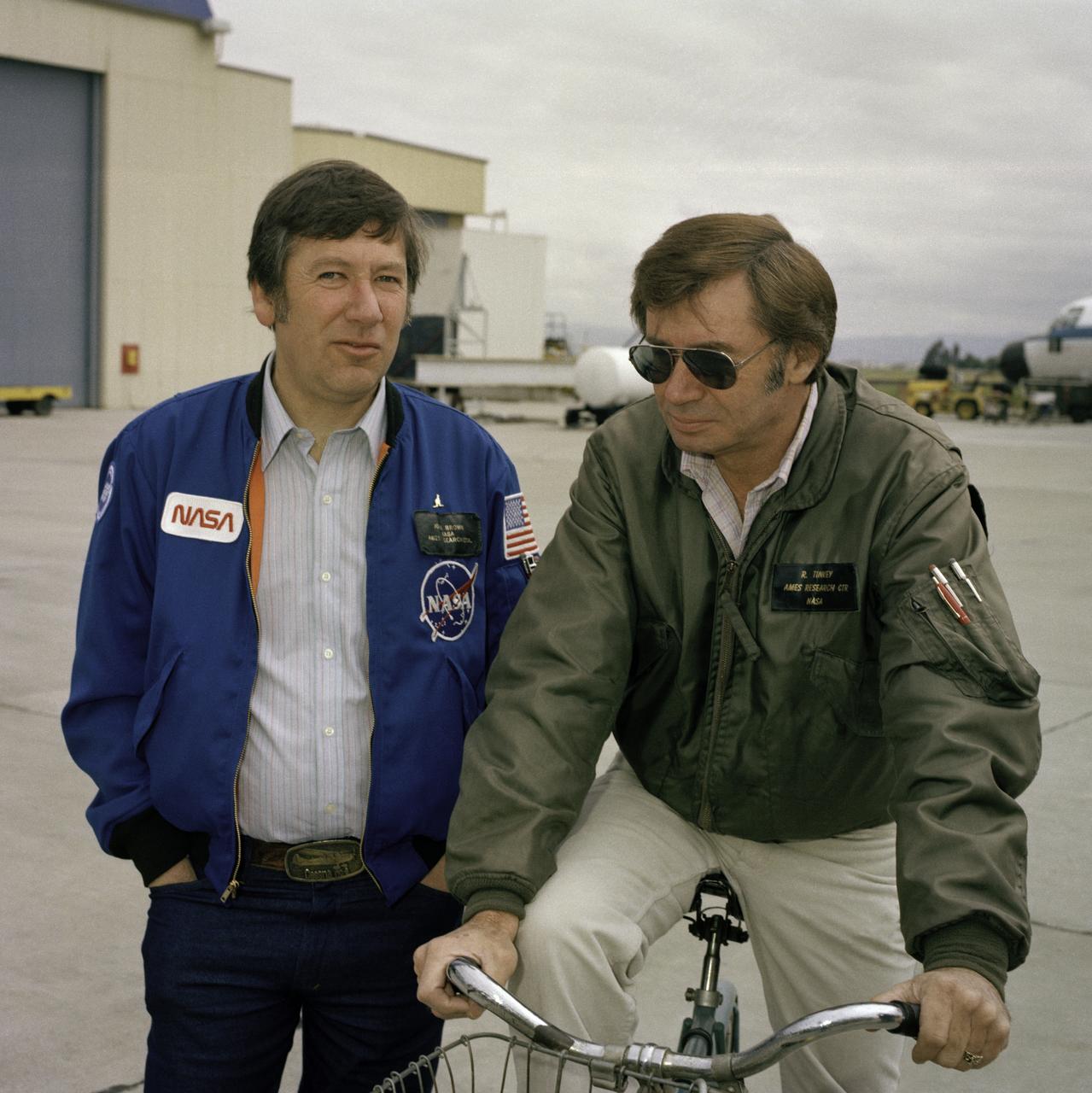
J. Brown and R Tinkey ready C-141 KAO (NASA 714) departure from Ames Research Center, CA for Australia.
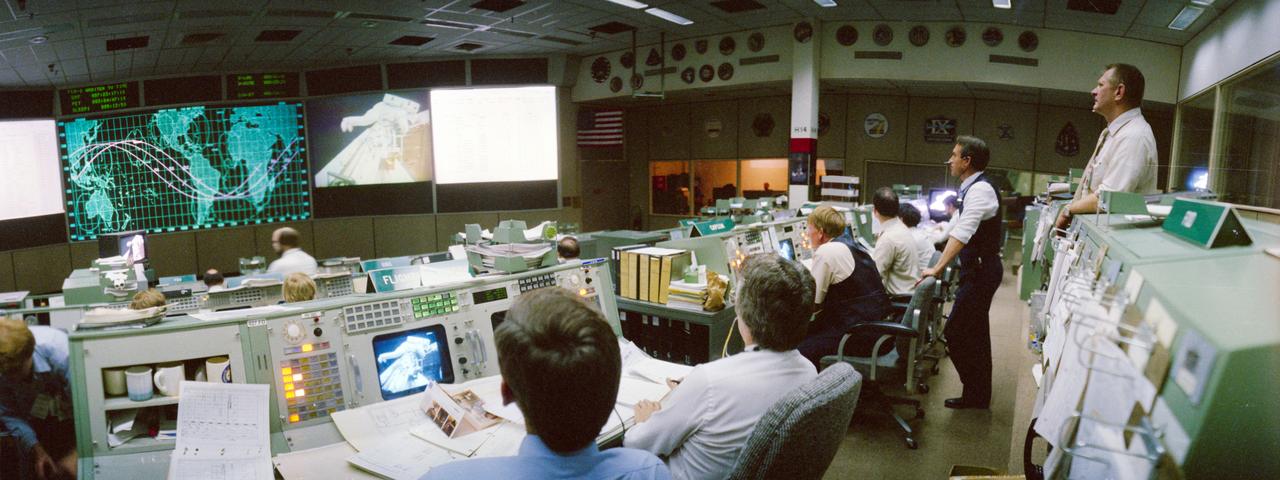
This is a wide-angle view of flight controllers in the MOCR of Mission Control Center (MCC) during the STS-6 Extravehicular Activity (EVA). They are watching the large monitor in the front of the MOCR and small ones at individual consoles as Astronaut Donald H. Peterson translates along the Challenger's port side longerons. Flight Directors Gary E. Coen (left) and Harold M. Draughon are in the foreground. Astronauts John A. McBride and Guy S. Gardner man the Spacecraft Communicator (CAPCOM) Console near center frame. Standing behind the CAPCOM Console is Astronaut William F. Fisher. Eugene F. Kranz, Director of Mission Operations, stands at right near the Flight Operations Directorate Console. JSC, Houston, TX
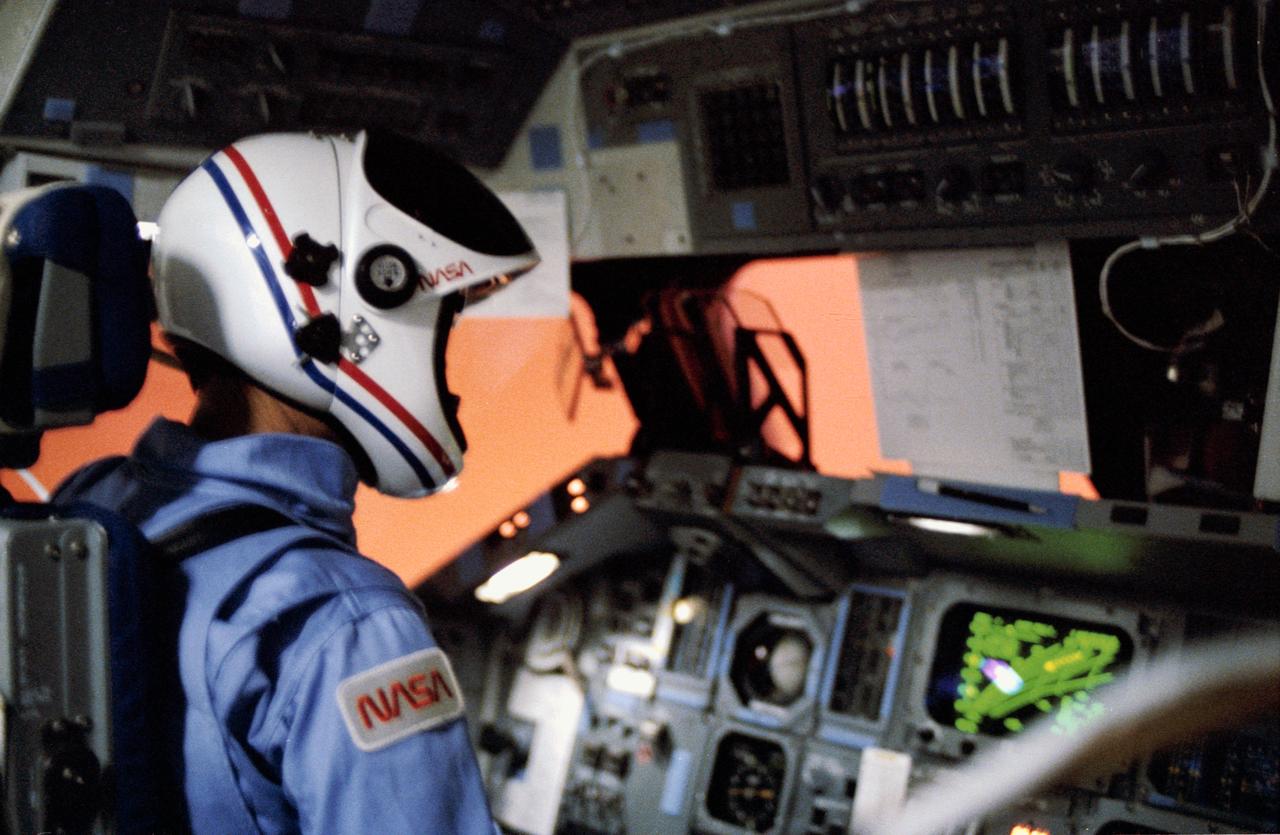
STS007-31-1614 & S83-35775 (24 June 1983) --- Astronaut Robert L. Crippen is seen at the commander’s station of the Space Shuttle Challenger as it passes through the Earth’s atmosphere on re-entry. The friction results in a pinkish glow visible through the forward windows on the flight deck. The scene was exposed with a 35mm camera.
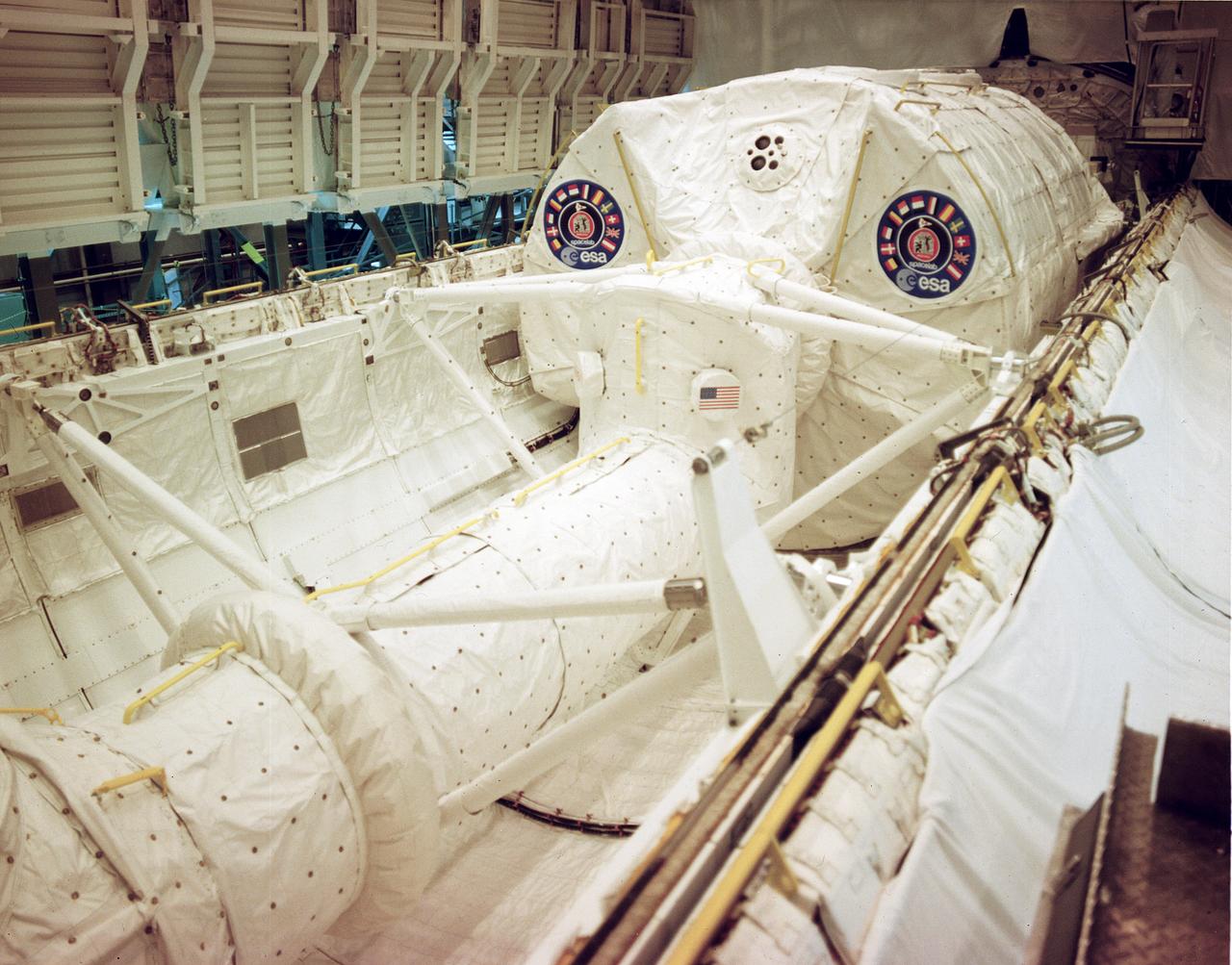
This photograph shows the Spacelab-1 module and Spacelab access turnel being installed in the cargo bay of orbiter Columbia for the STS-9 mission. The oribiting laboratory, built by the European Space Agency, is capable of supporting many types of scientific research that can best be performed in space. The Spacelab access tunnel, the only major piece of Spacelab hardware made in the U.S., connects the module with the mid-deck level of the orbiter cabin. The first Spacelab mission, Spacelab-1, sponsored jointly and shared equally by NASA and the European Space Agency, was a multidisciplinary mission; that is, investigations were performed in several different fields of scientific research. The overall goal of the mission was to verify Spacelab performance through a variety of scientific experiments. The disciplines represented by these experiments were: astronomy and solar physics, earth observations, space plasma physics, materials sciences, atmospheric physics, and life sciences. International in nature, Spacelab-1 conducted experiments from the United States, Japan, the Netherlands, United Kingdom, Beluga, France, Germany, Italy, and Switzerland. Spacelab-1, was launched from the Kennedy Space Center on November 28, 1983 aboard the orbiter Columbia (STS-9). The Marshall Space Flight Center was responsible for managing the Spacelab missions.
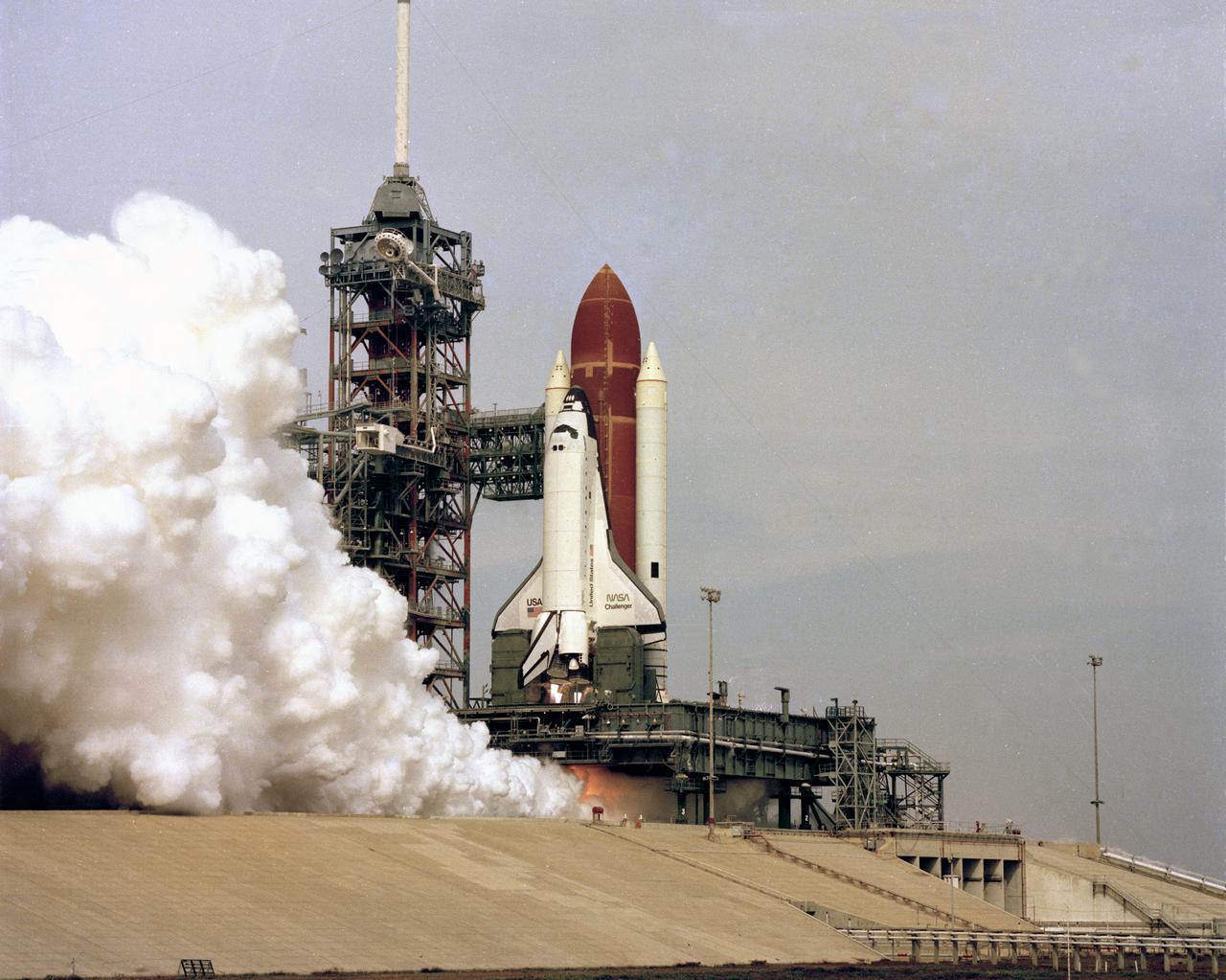
CAPE CANAVERAL, Fla. -- STS-6 second Flight Readiness Firing test, Launch Complex 39. Photo credit: NASA

Galileo Wake probe: 6x6ft w.t. testing
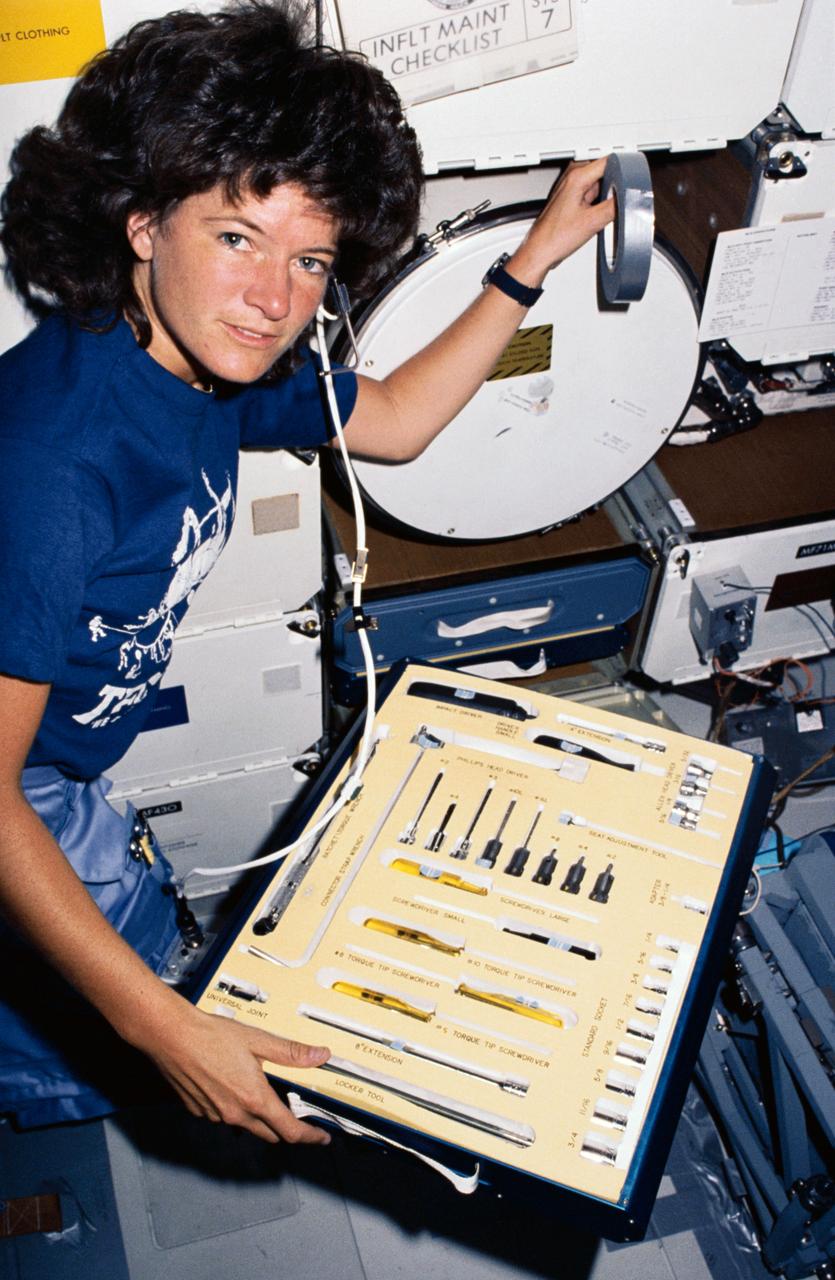
STS007-12-536 (18-24 June 1983) --- Astronaut Sally K. Ride, STS-7 mission specialist, displays the array of tools at her disposal on the mid deck of the Earth-orbiting Space Shuttle Challenger. Dr. Ride is positioned near the monodisperse latex reactor (MLR) experiment. They cylinder near her elbow is the actual reactor and the device next to it at right frame edge is the MRL apparatus container. Dr. Ride and four other astronauts are sharing duties aboard the reusable spacecraft for a six-day space mission full of “firsts.” This photograph was made with a 35mm camera. It was among the visuals used by crewmembers at their post-flight press conference.
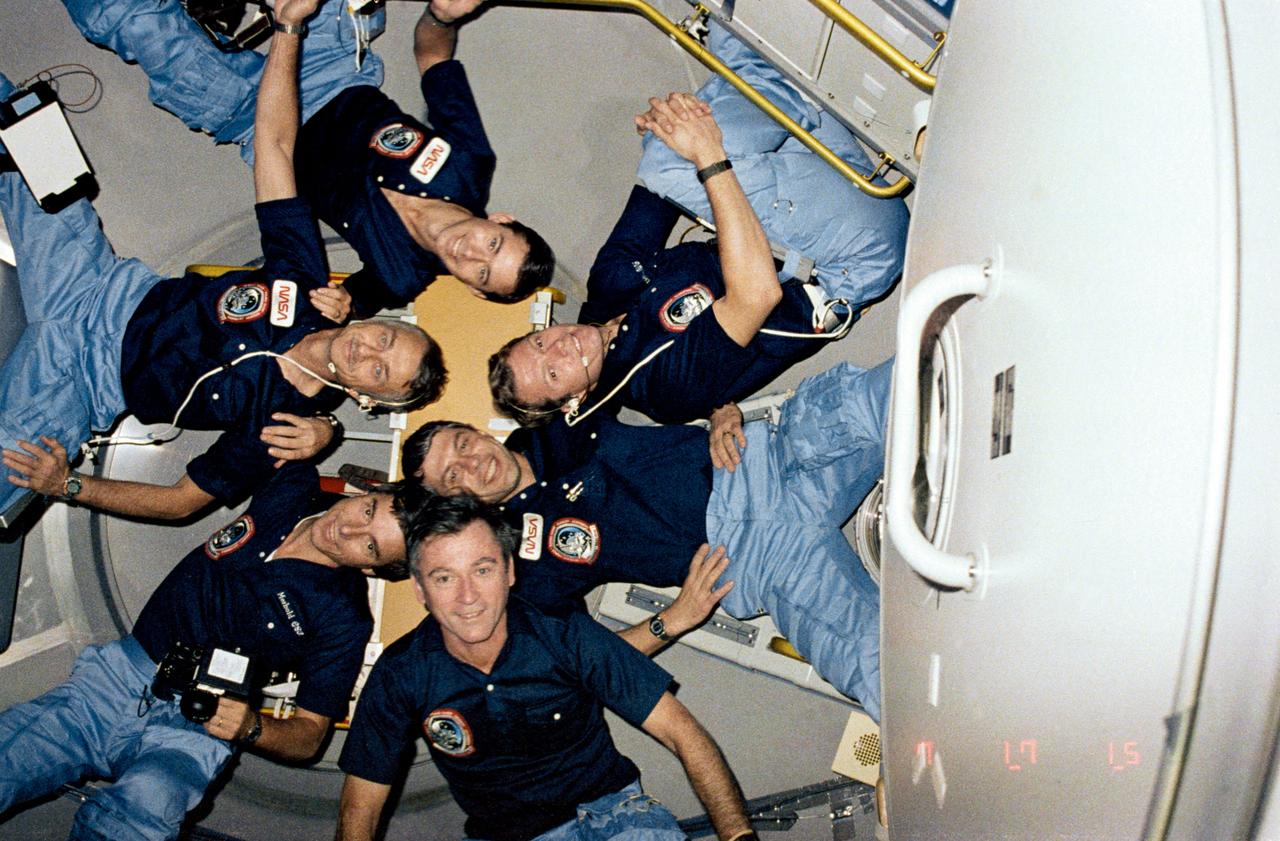
STS009-126-441 (28 Nov 1983) --- The six crewmembers of STS-9 position themselves in a star bust-like cluster in the aft end cone of Spacelab aboard the Shuttle Columbia. Clockwise, beginning with John W. Young, are Ulf Merbold, Owen K. Garriott, Brewster H. Shaw, Jr., Byron M. Lichtenberg and Robert A.R. Parker.

S82-33032 (30 June 1982) --- This scene shows activity at the spacecraft communicator and flight activities officer consoles in the mission operations control room (MOCR) in the Johnson Space Center?s mission control center (MCC). Astronaut Brewster H. Shaw Jr., right, Astronaut Roy D. Bridges Jr. and Marianne J. Dyson are pictured during STS-4?s Day 4 activity. Shaw and Bridges are spacecraft communicators and Dyson is a flight activities officer on the entry team.
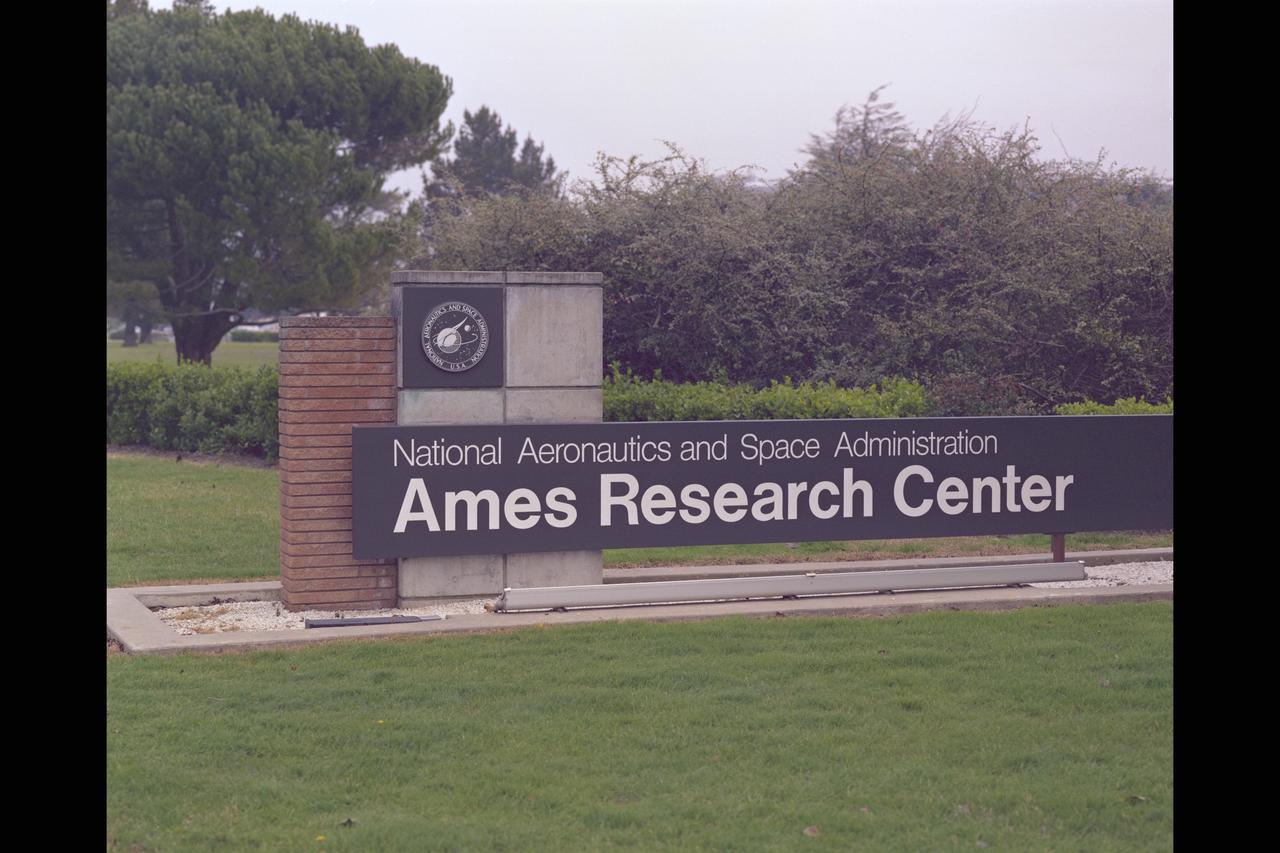
Ames Research Center momument (front) sign
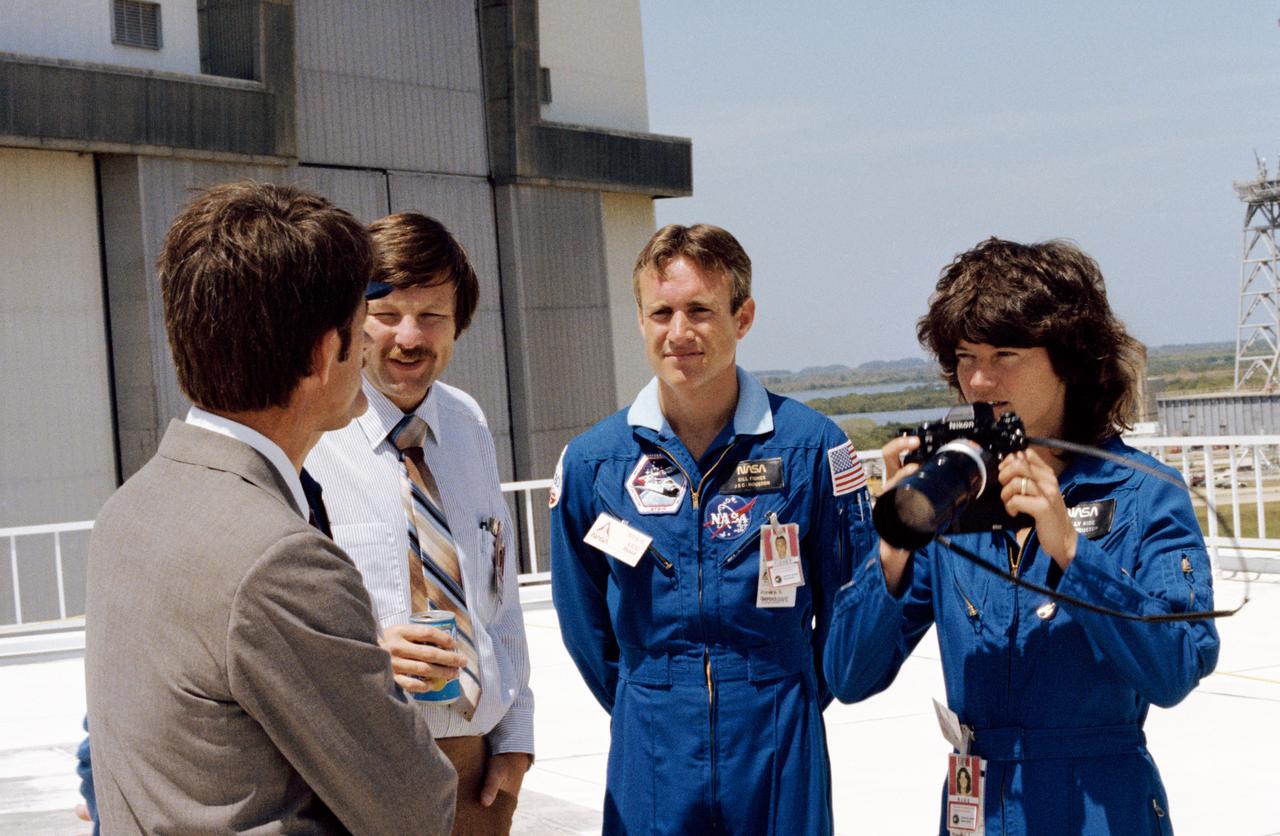
S83-31046 (4 April 1983) --- Astronaut Sally K. Ride, mission specialist for STS-7, scheduled for June 1983, records some of the prelaunch activity for STS-6 on 35mm film at the Kennedy Space Center (KSC). Astronaut William B. Lenoir, STS-5 mission specialist, is at left. Others pictured include Richard W. Nygren (center), chief of the vehicle integration section of the operations division at JSC; and astronaut William F. Fisher, second right. Photo credit: NASA
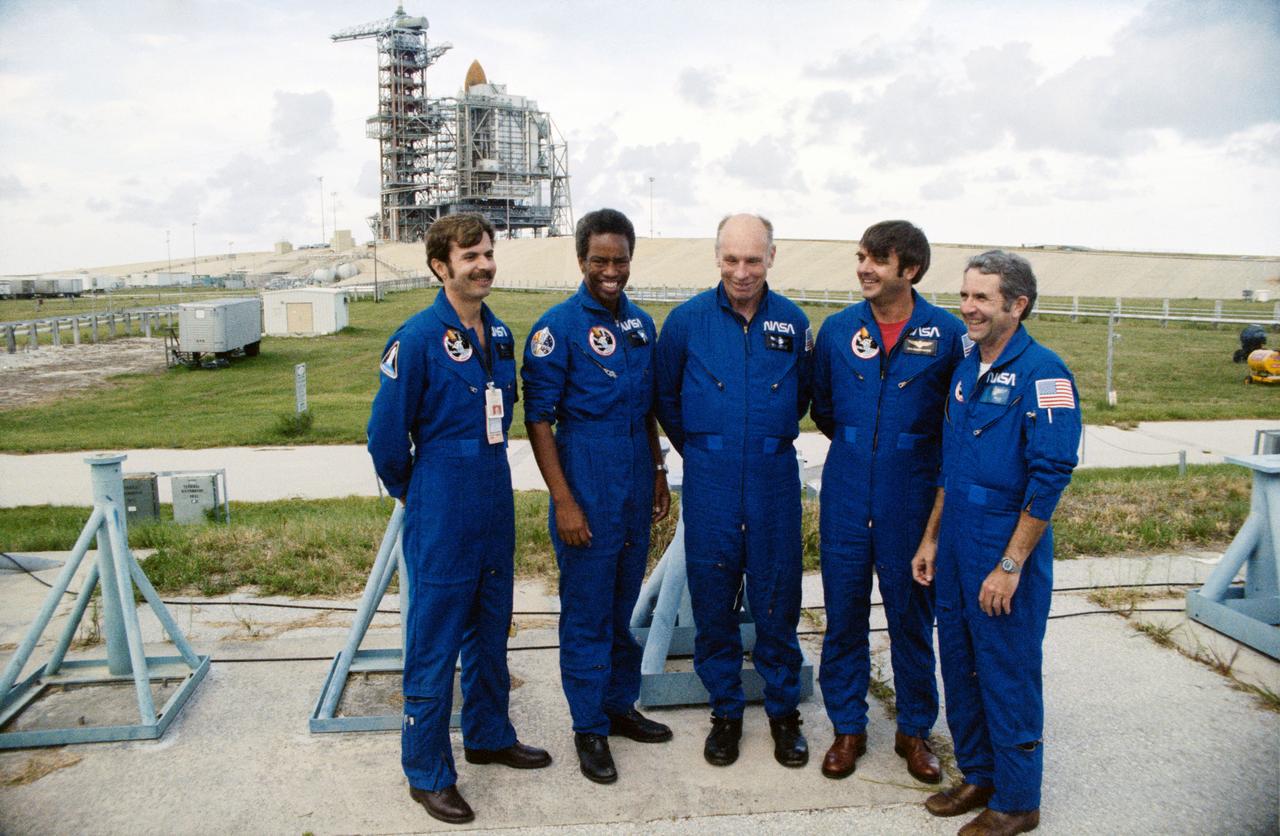
S83-38479 (16 Aug 1983) --- STS-8 crew poses at pad 39A at Kennedy Space Center (KSC) during a session with the news media. From left to right are Astronauts Dale A. Gardner, Guion S. Bluford, and Dr. William E. Thornton, all mission specialists; Daniel C. Brandenstein, pilot; and Richard F. Truly, crew commander.

STS007-15-671 / S83-35767 (21 June 1983) --- Among the "firsts" on the mission is this unprecedented scene of a crew of five astronauts aboard the Space Shuttle Challenger in space. A pre-set 35mm camera exposed the frame. Left to right on the flight deck are Norman E. Thagard, mission specialist; Robert L. Crippen, commander; Frederick H. Hauck, pilot; Sally K. Ride, mission specialist; and John M. Fabian, mission specialist. Crippen the crew commander, is making his second Space Shuttle trip; pilot Hauck and mission specialist Dr. Ride, Dr. Thagard and Fabian are members of the 1978 class of astronaut candidates (ASCAN).
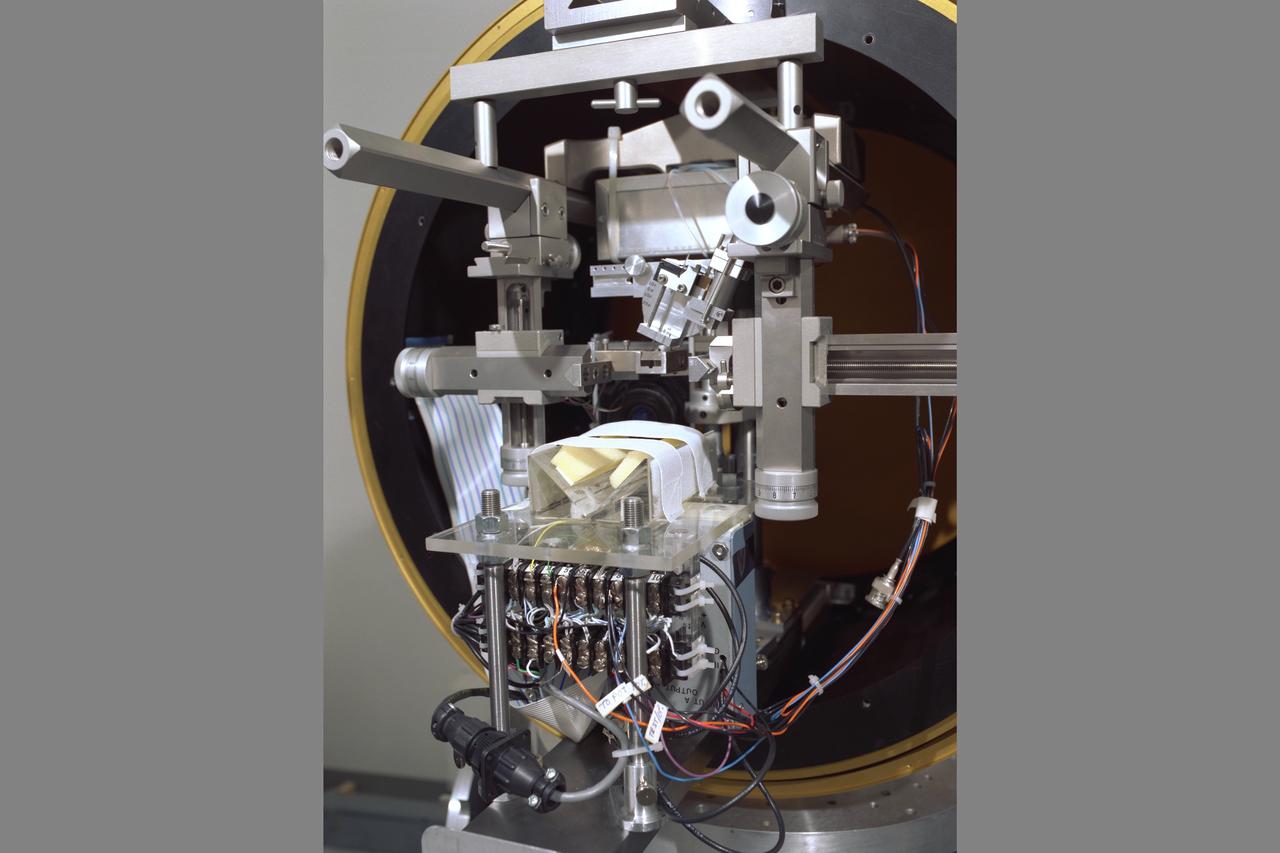
VRF: Vestibular Research Facility Equipment N-242
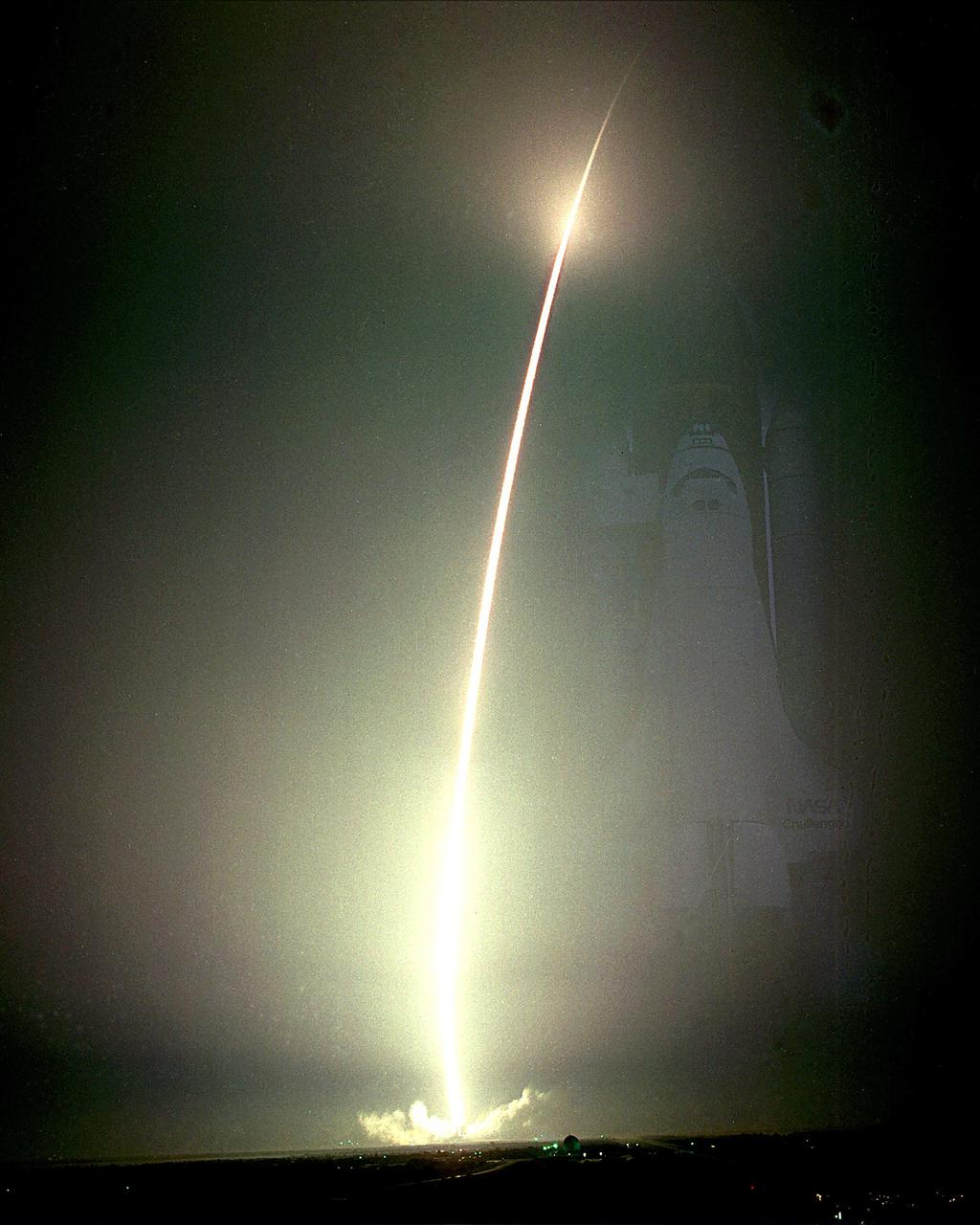
KENNEDY SPACE CENTER, FLA. -- STS-8: Challenger
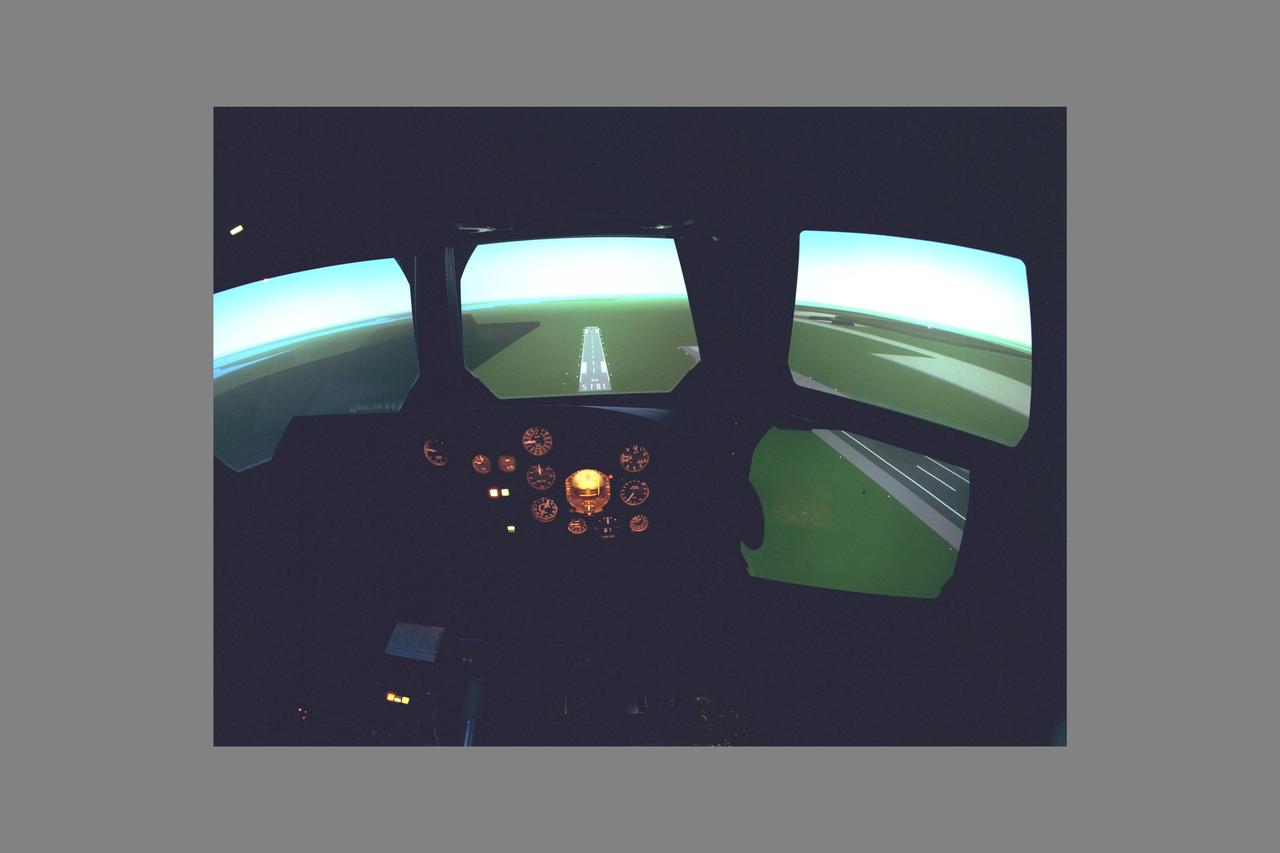
VMS: S-Cab (Space Shuttle configuration) with runway.
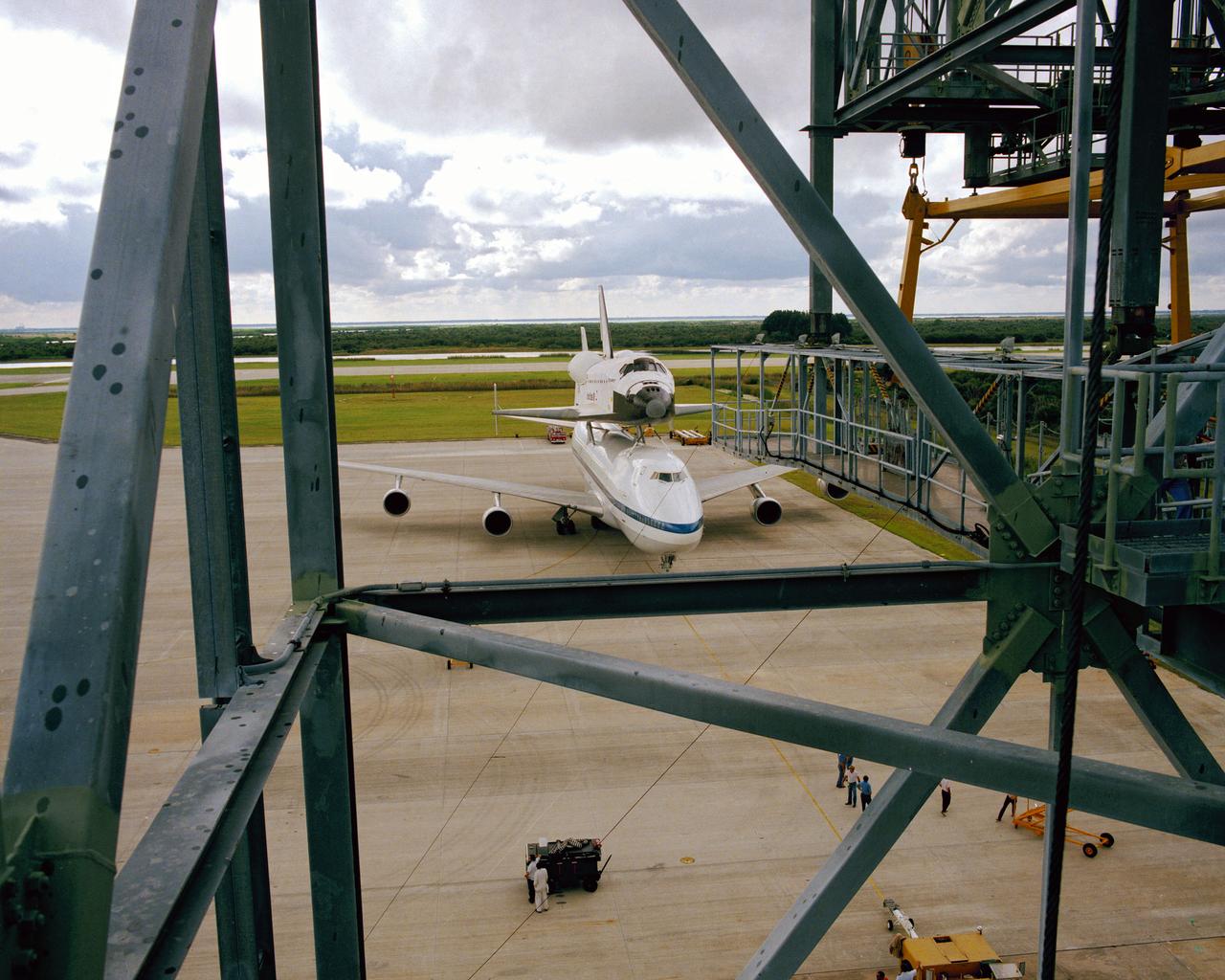
NASA's newest bird, the space shuttle orbiter Discovery, is perched on the 747/shuttle carrier aircraft awaiting positioning at the Mate-Demate Facility at Kennedy Space Center.
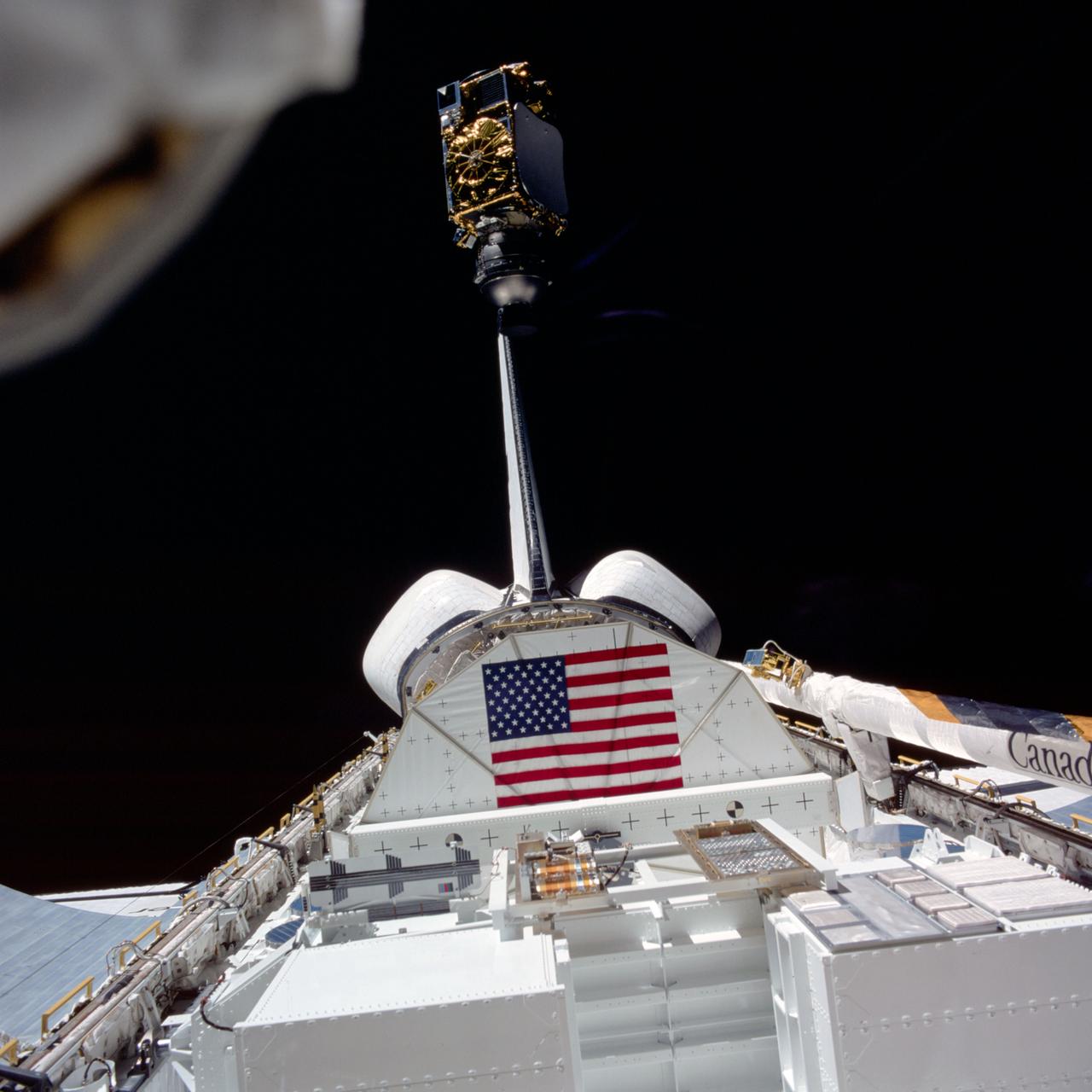
STS008-49-1724 (31 Aug 1983) --- The Indian National Satellite (INSAT) is about to clear the vertical stabilizer of the Earth-orbiting Space Shuttle Challenger and on its way to a higher orbit. The STS-8 mission's Payload Flight Test Article (PFTA) displays the U.S. flag in the middle of the cargo bay, as the Canadian built Remote Manipulator System (RMS) appears to be waiting for its busy agenda of activity with the barbell-shaped test device. This 70mm frame was exposed by a crewmember using a handheld Hasselblad inside Challenger's cabin.
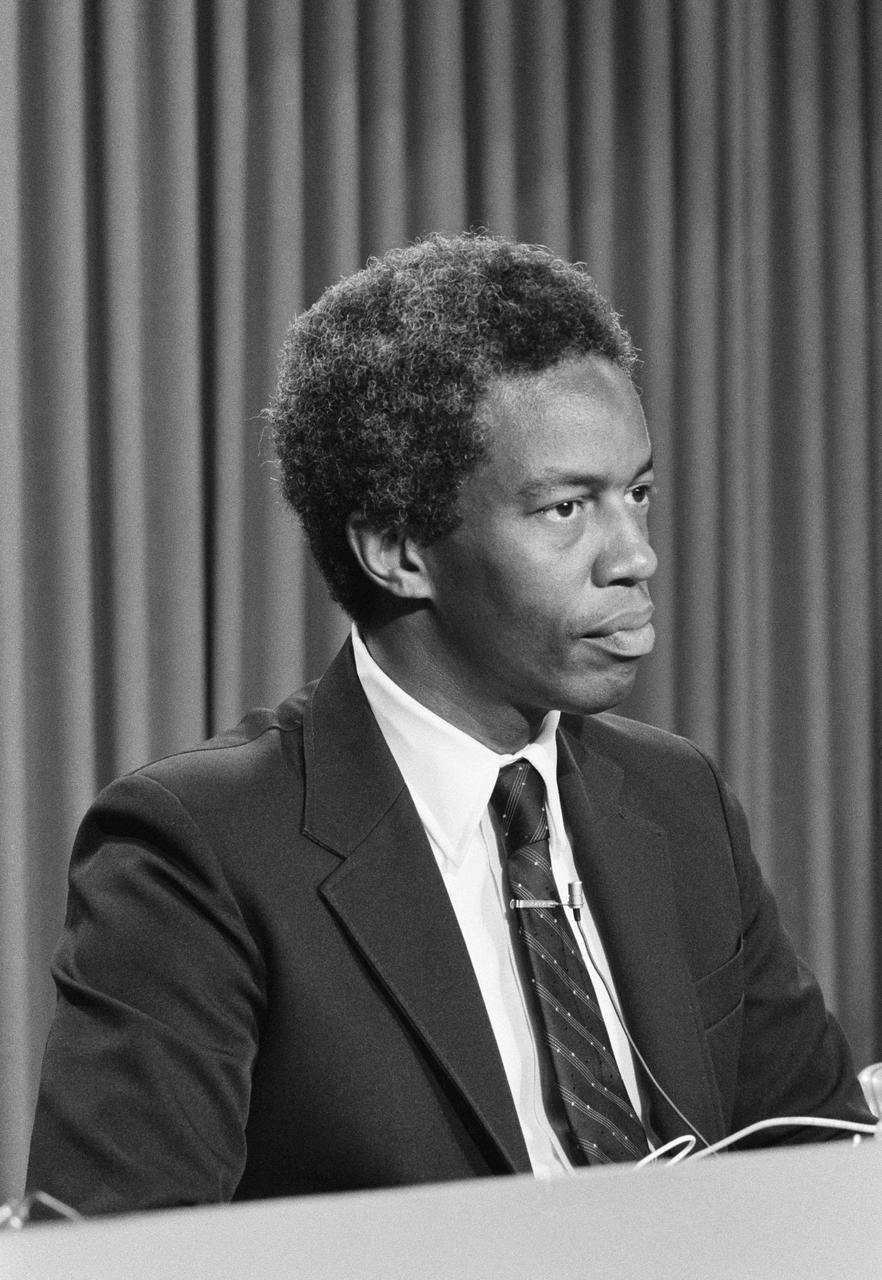
S83-36612 (13 July 1983) --- Astronaut Guion S. Bluford, STS-8 mission specialist, thinks over a question directed to him by a news media representative during his crew?s pre-flight press conference on July 13, 1983. Major Bluford is one of three mission specialists on the five-man STS-8 Challenger crew of astronauts.
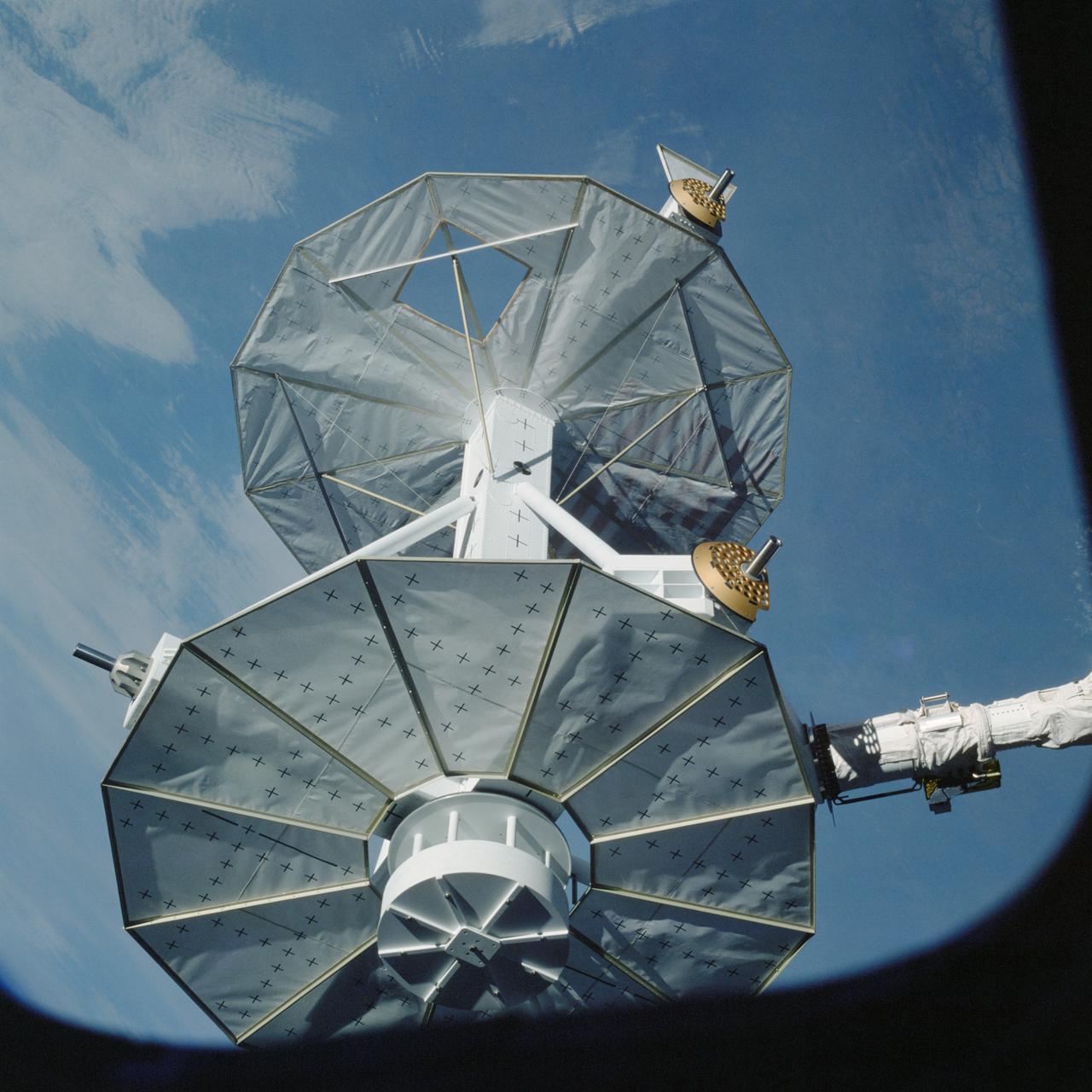
STS008-35-1239 (30 Aug.-5 Sept. 1983) --- The space shuttle Challenger?s payload flight test article (PFTA) is lifted from the cargo bay and held over clouds and water on Earth. The 70mm frame was photographed by one of the five STS-8 crew members with a free hand during the busy RMS/PFTA agenda. Photo credit: NASA

STS007-26-1439 (18-24 June 1983) --- Astronaut John M. Fabian, STS-7 mission specialist, is captured with a 35mm camera at his sleep station in the middeck of the Earth-orbiting space shuttle Challenger. This scene was selected by the five-member astronaut crew for showing at its July 1, 1983 Post Flight Press Conference (PFPC) at the Johnson Space Center's (JSC) main auditorium. Photo credit: NASA
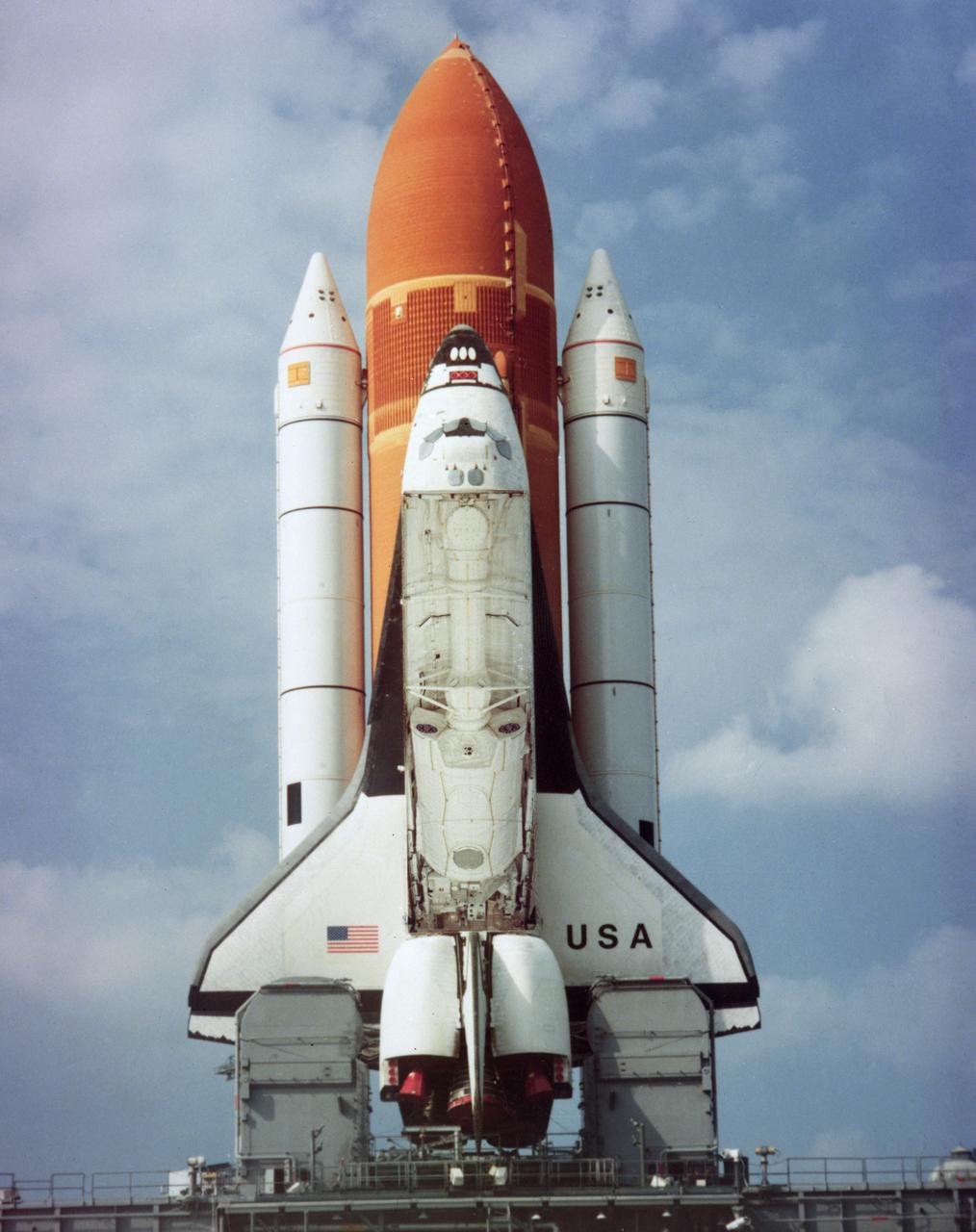
This double exposure image shows Spacelab-1 in the cargo bay of orbiter Columbia. From top to bottom inside the cargo bay are the Spacelab Access Turnel, which is connected to the mid-deck of the orbiter; the Spacelab module, a pressurized module in which scientists conduct experiments not possible on Earth; and Spacelab pallets, which can hold instruments for the experiments requiring direct exposure to space. The first Spacelab mission, Spacelab-1, sponsored jointly and shared equally by NASA and the European Space Agency, was a multidisciplinary mission; that is, investigations were performed in several different fields of scientific research. The overall goal of the mission was to verify Spacelab performance through a variety of scientific experiments. The disciplines represented by these experiments were astronomy and solar physics, earth observations, space plasma physics, materials sciences, atmospheric physics, and life sciences. International in nature, Spacelab-1 conducted experiments from the United States, Japan, the Netherlands, United Kingdom, Beluga, France, Germany, Italy, and Switzerland. Spacelab-1 was launched from the Kennedy Space Center on November 28, 1983 aboard the orbiter Columbia (STS-9). The Marshall Space Flight Center was responsible for managing the Spacelab missions.
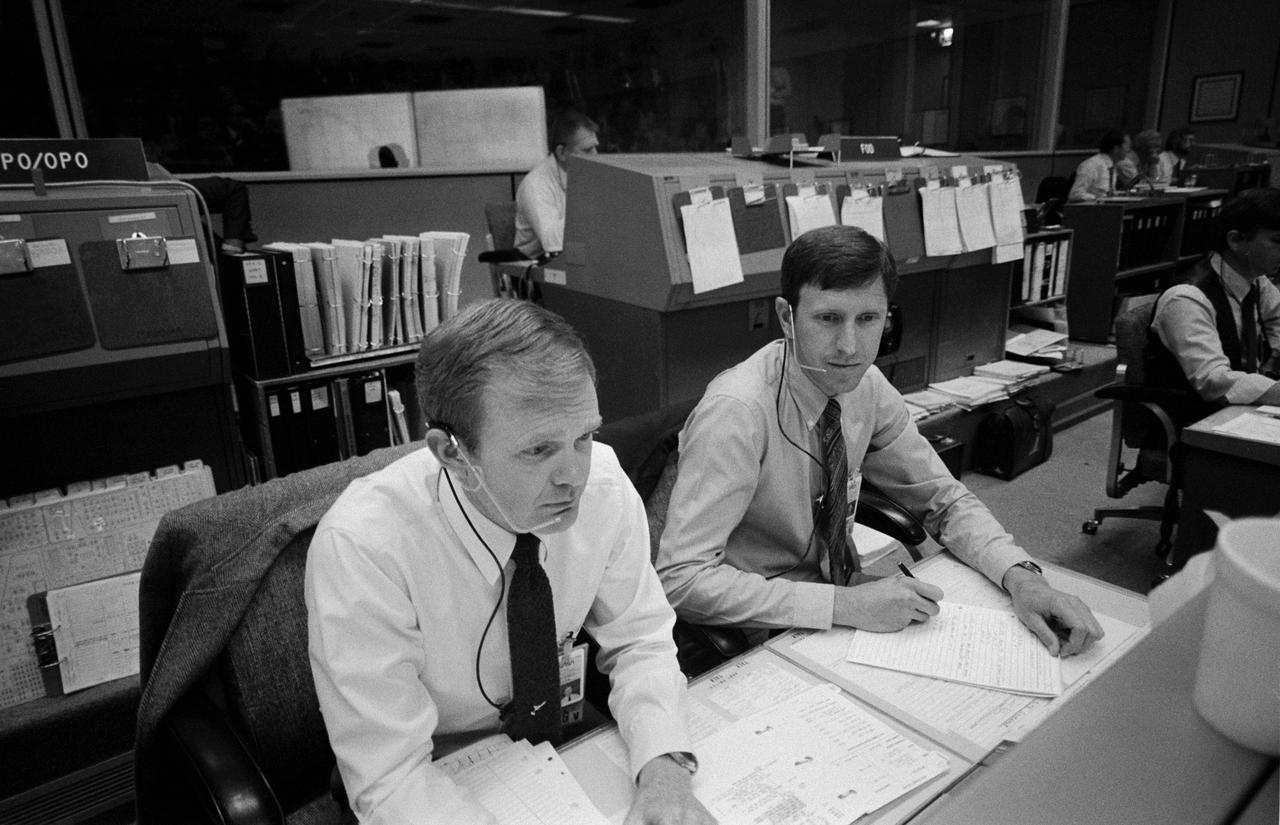
Astronauts Roy D. Bridges (left) and RIchard O. Covey serve as spacecraft communicators (CAPCOM) for STS-6. They are seated at the CAPCOM console in the mission operations control room (MOCR) of JSC's mission control center (30119); Flight Director Jay H. Greene communicates with a nearby flight controller in the MOCR just after launch of the Challenger (30120).
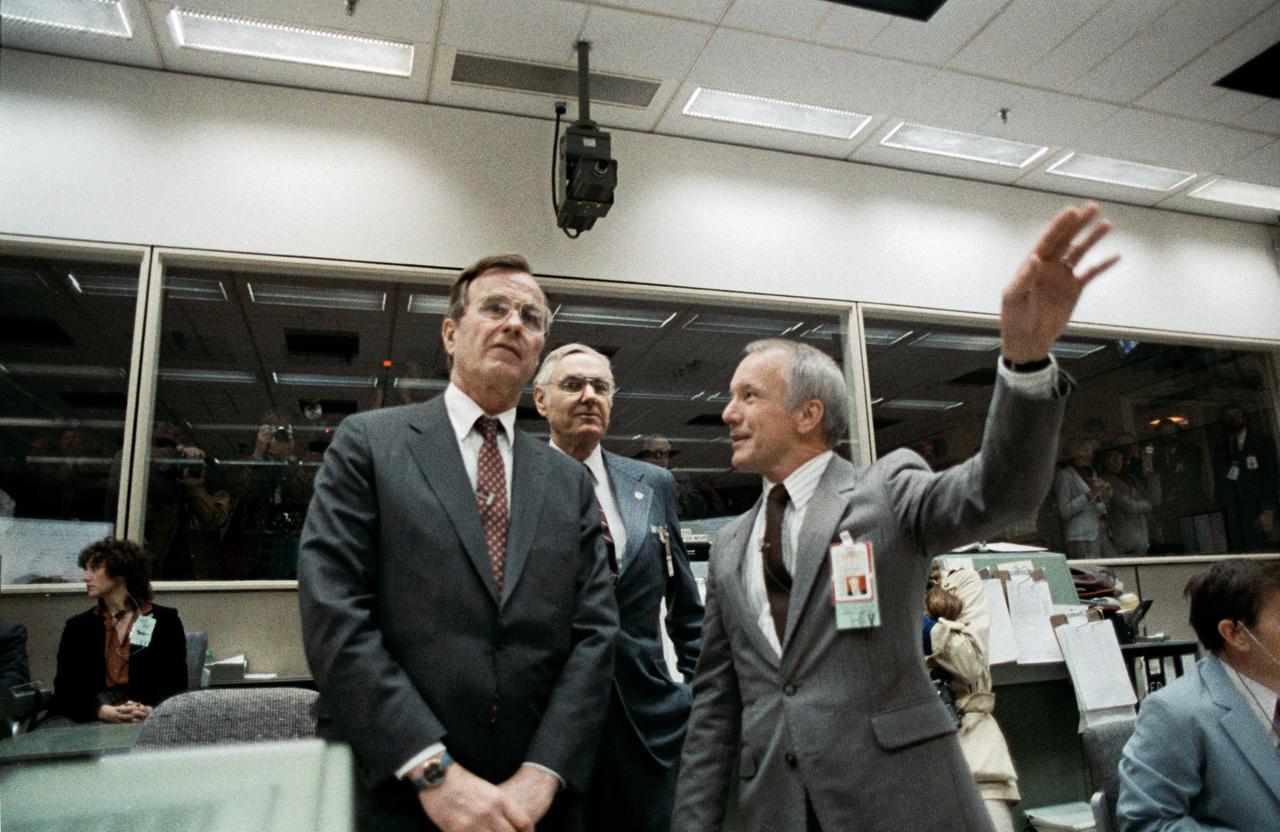
S83-30193 (8 April 1983) --- Vice President George Bush, left, is briefed by JSC Director Gerald D. Griffin, right, during a visit to the mission operations control room (MOCR) in the Johnson Space Center?s mission control center. James Beggs, NASA administrator, center, accompanied the Vice President on his visit. Flight Director Gary E. Coen is partial visible at right edge of frame, The photograph was taken by Otis Imboden.
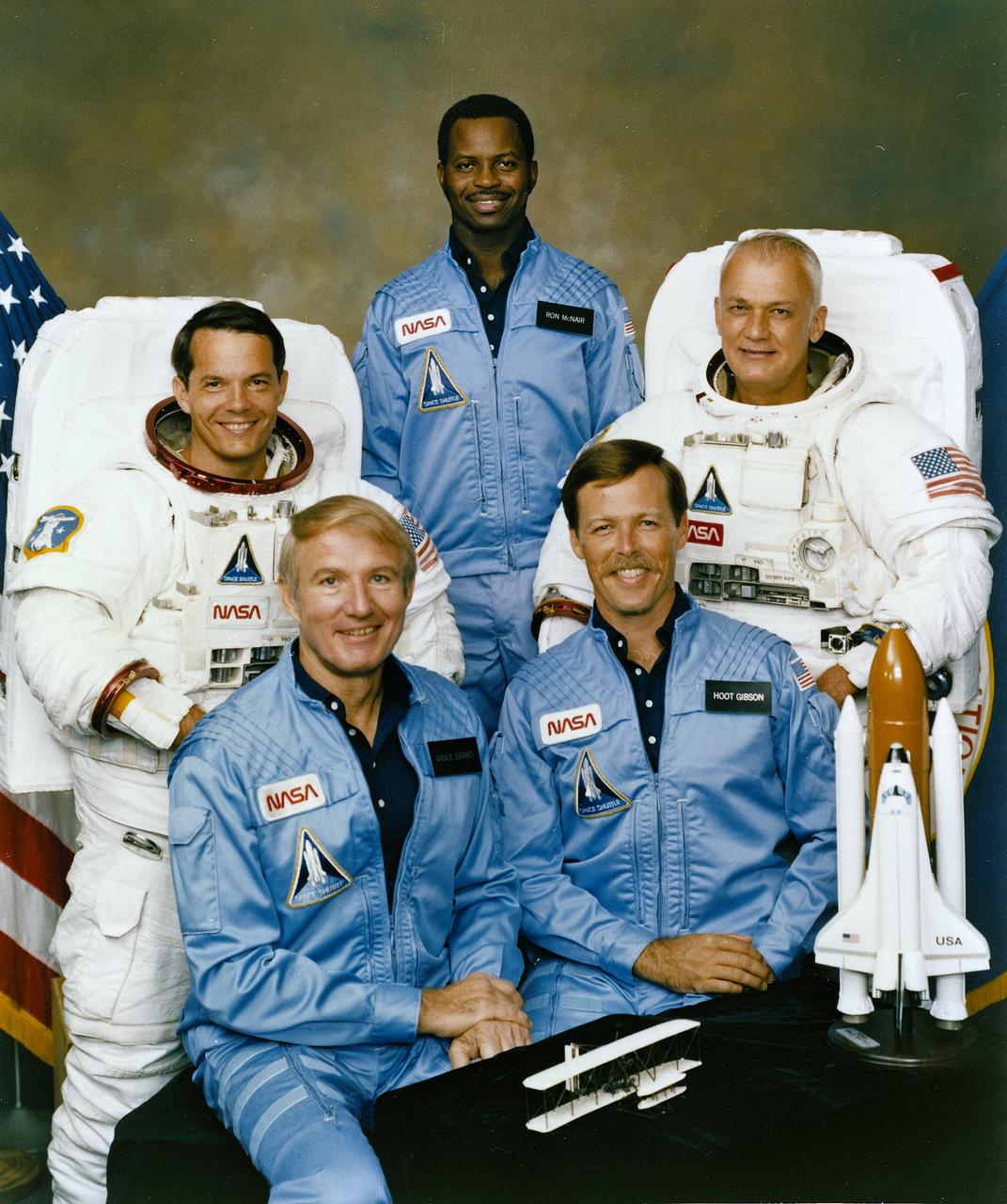
The crew assigned to the STS-41B (STS-11) mission included (seated left to right) Vance D. Brand, commander; and Robert L. Gibson, pilot. Standing left to right are mission specialists Robert L. Stewart, Ronald E. McNair, and Bruce McCandless. Launched aboard the Space Shuttle Challenger on February 3, 1984 at 8:00:00 am (EST), the STS-41B mission marked the first untethered space walks which were performed by McCandless and Stewart. The crew deployed the WESTAR-VI and PALAPA-B2 satellites.
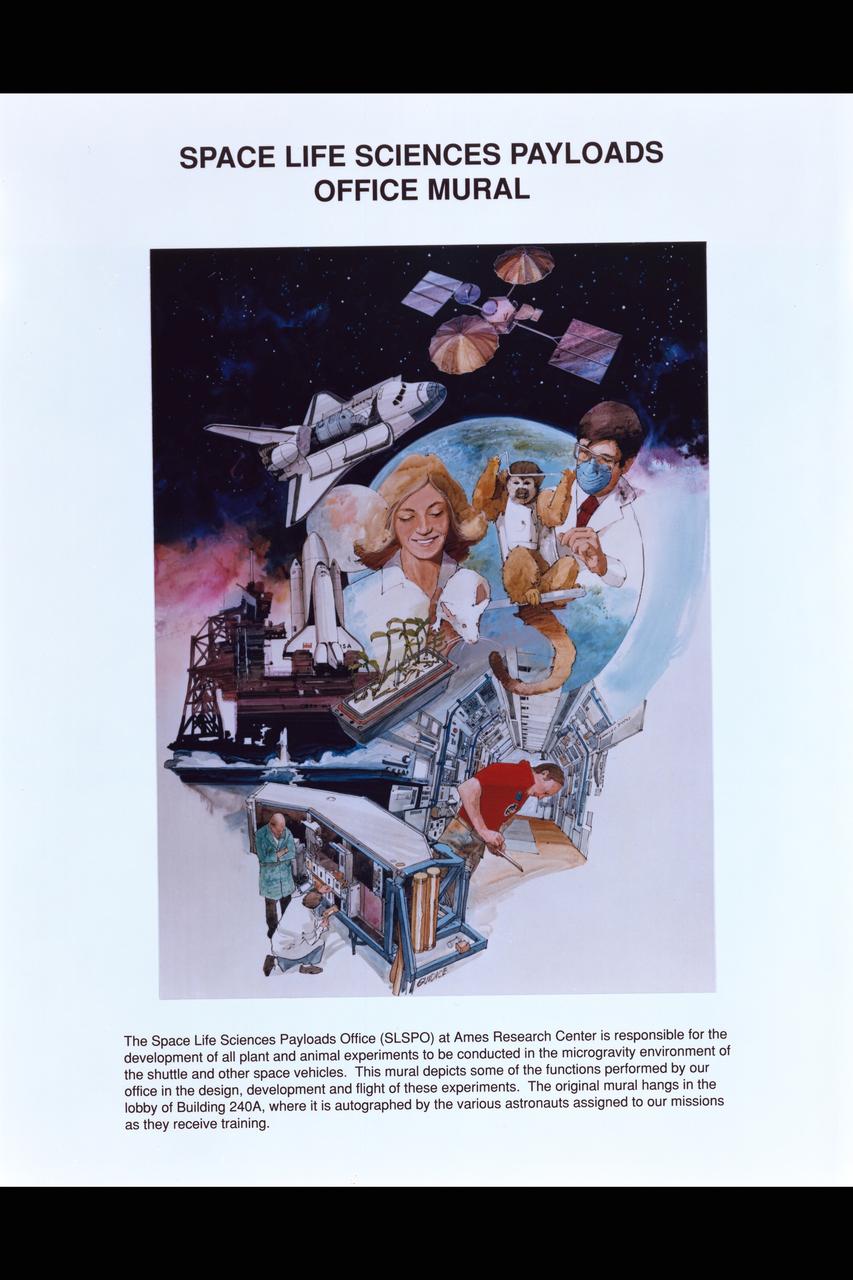
Original Art by Artist: Rick Guidice Space Life Sciences Payloads Office (SLSPO) office manual cover with mission statement. This mural (original in lobby of N-240A) depicts some of the functions performed by our office in the design, development and flight of these experiments.
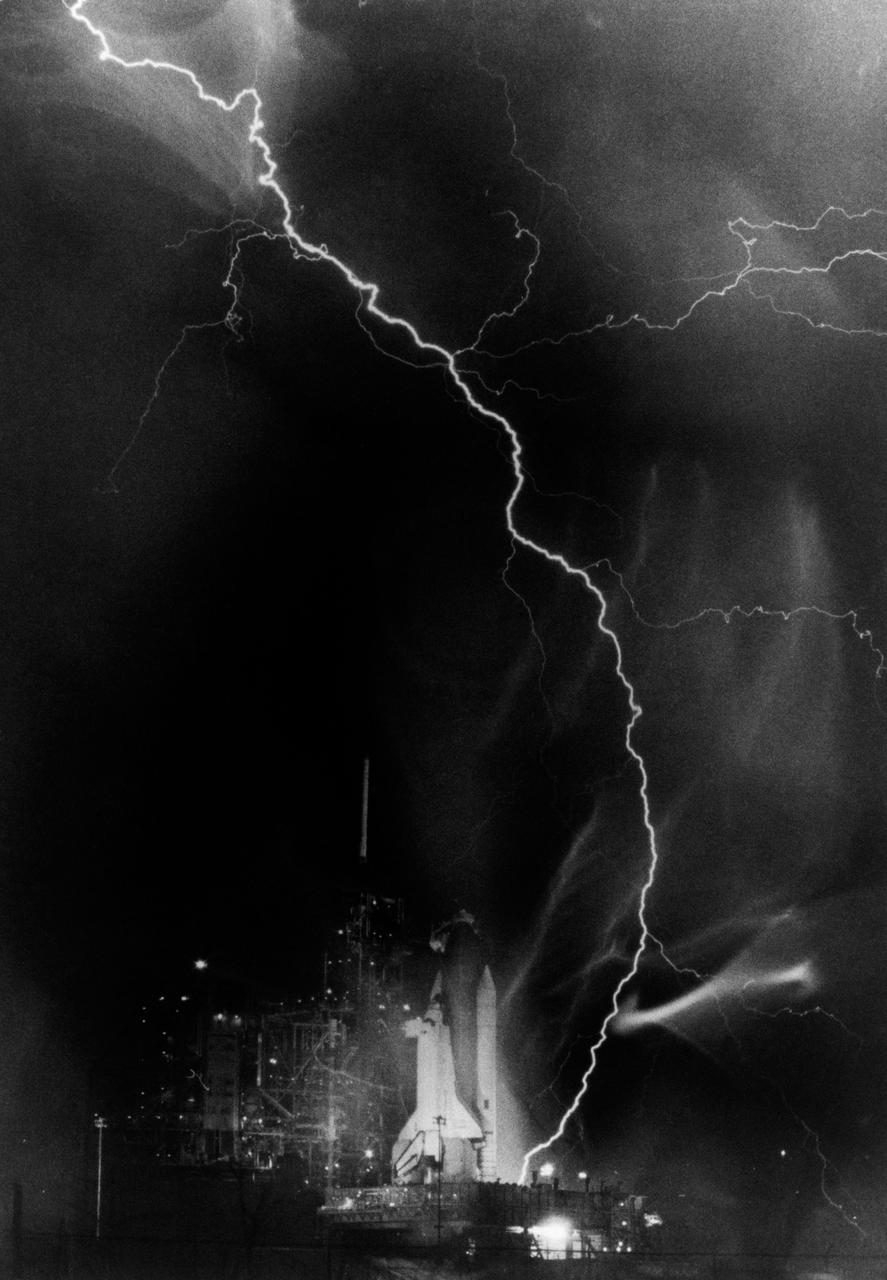
Lightning across the sky with Shuttle at launch pad on 08/30/1983. KSC, FL
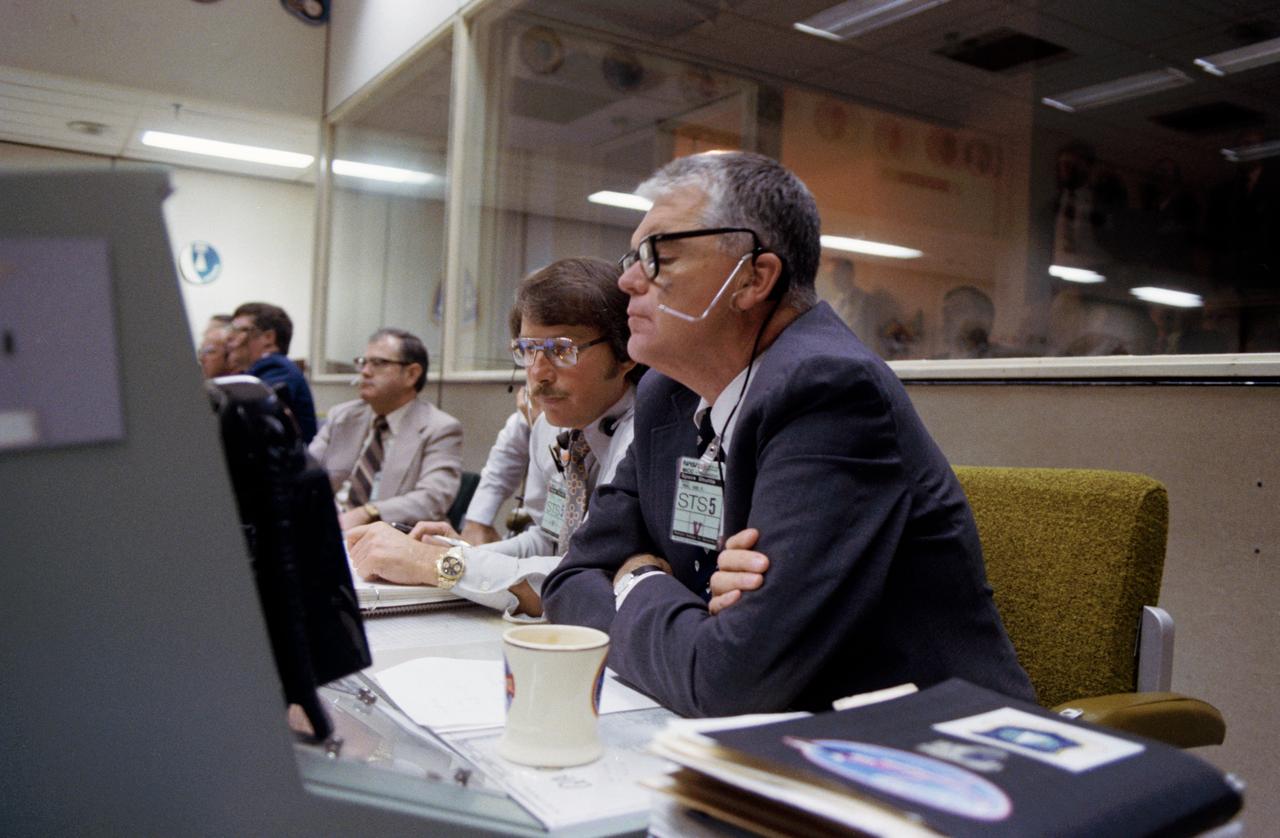
Views of MOCR activity during the STS-5 Mission (11/11-16/1982) of Dr. Hans Mark, NASA Deputy Administrator; Gerald Griffin; portrait of the STS-5 Flight Directors, Flight Director (FD) Cox and Lt. Gen. James A. Abrahamson, Associate Administrator for Space Flight, in the MOCR during the STS-5 Mission. 1. Abrahamson, J. T., Gen,.- STS-5 MOCR 2. Flight Directors - STS-5 MOCR 3. STS-5 - Inflight MOCR 4. Mark, Hans Dr. - STS-5 MOCR 5. Dir. Griffin, Gerald- STS-5 MOCR JSC, Houston, TX. S83-27153 thru S83-27158
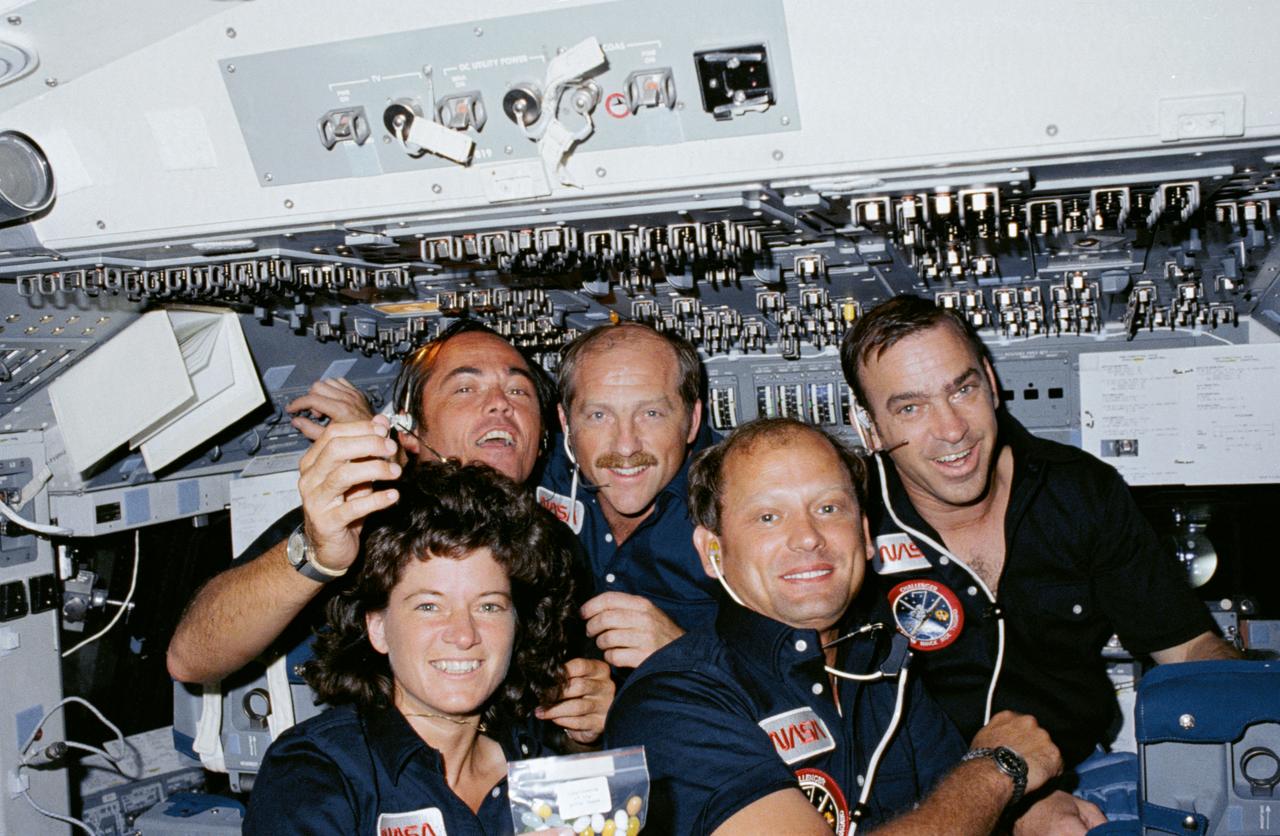
STS007-30-1574 / S83-35774 (21 June 1983) --- The five "passengers" onboard the Earth-orbiting Space Shuttle Challenger display some jelly beans discovered among their food supplies during their six-day mission. The label on the candy reads, "Compliments of the White House." In the rear are (left to right) astronauts Robert L. Crippen, crew commander, Frederick H. Hauck, pilot; and John M. Fabian, mission specialist. In front are Drs. Sally K. Ride and Norman E. Thagard, mission specialists. The scene was exposed by a pre-set 35mm camera.
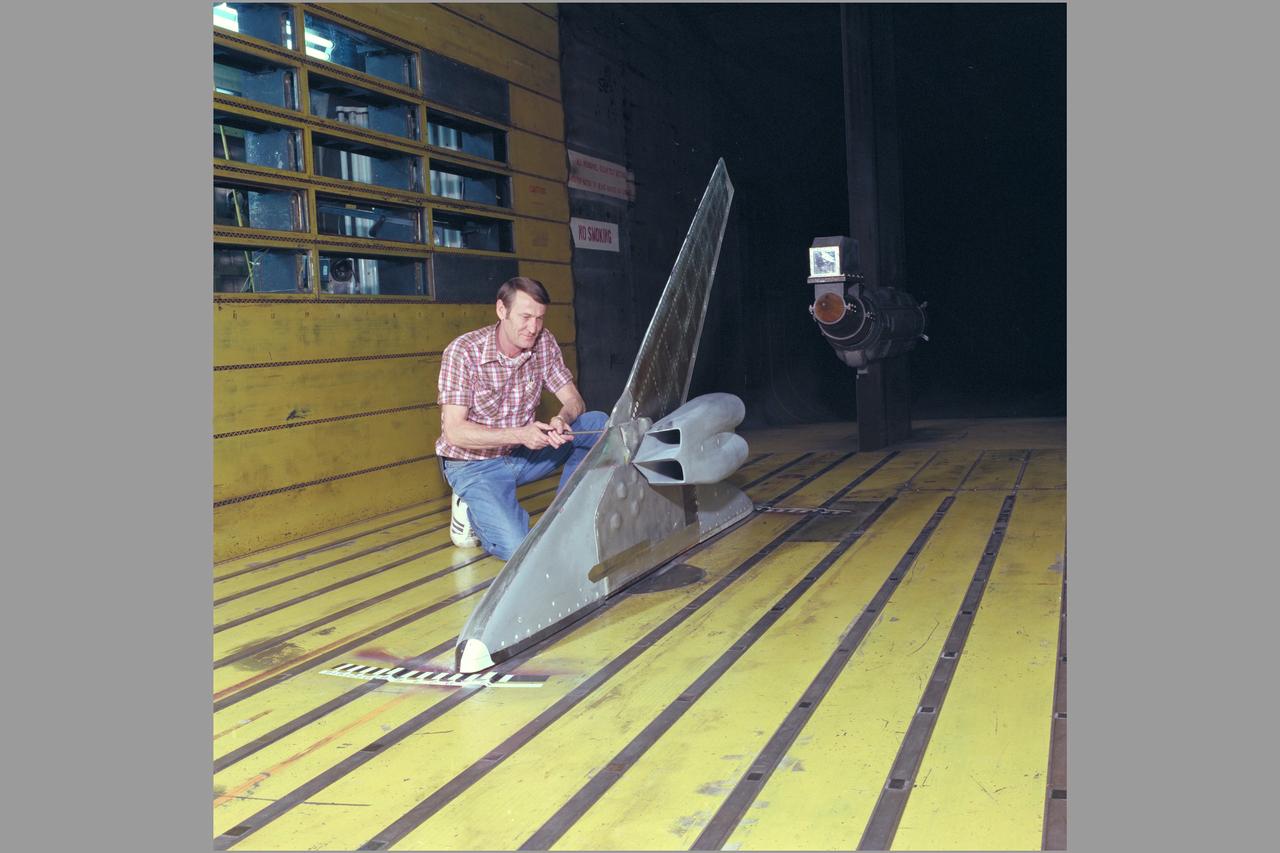
B-1B Shock Induced Ocillation 11x11ft w.t. test-537
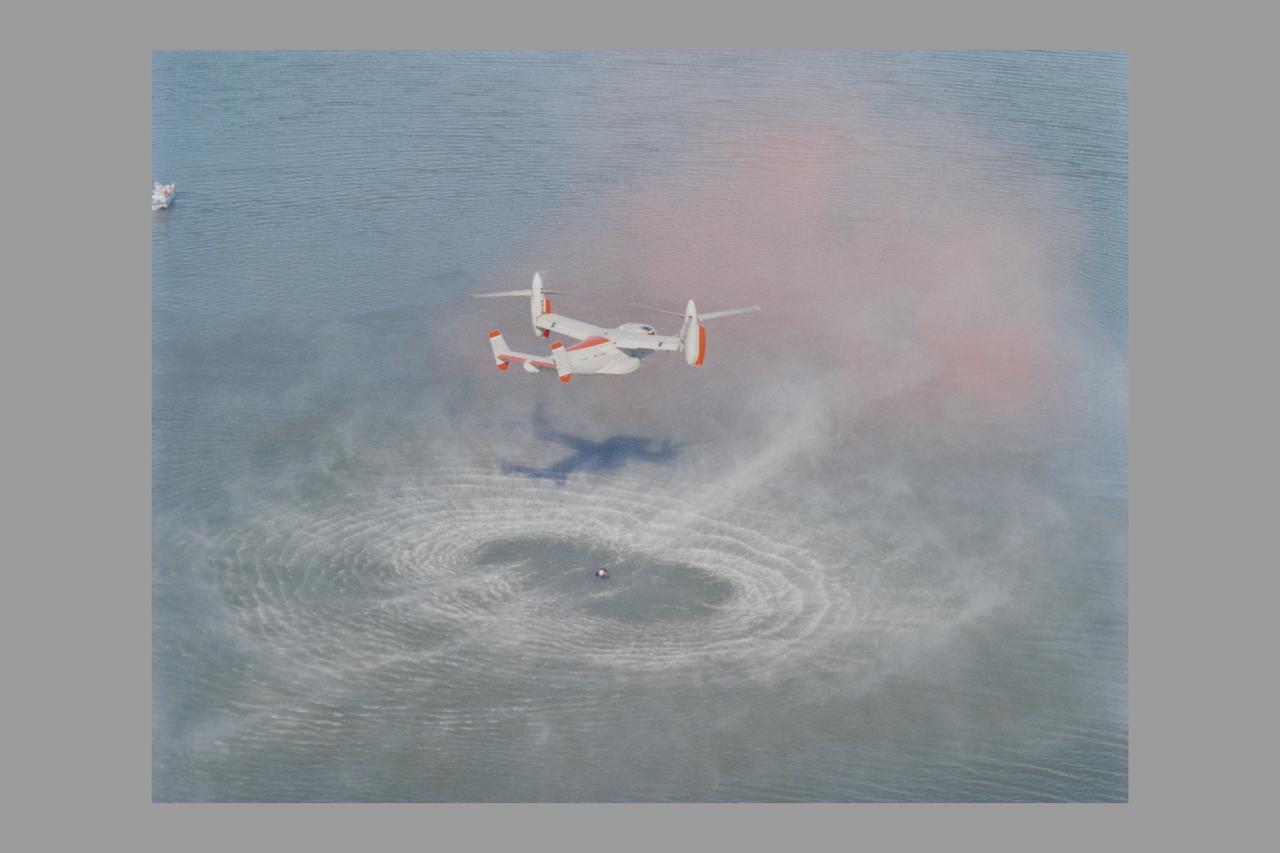
Bell XV-15 Tilt Rotor Army Configurations; Rescue at sea
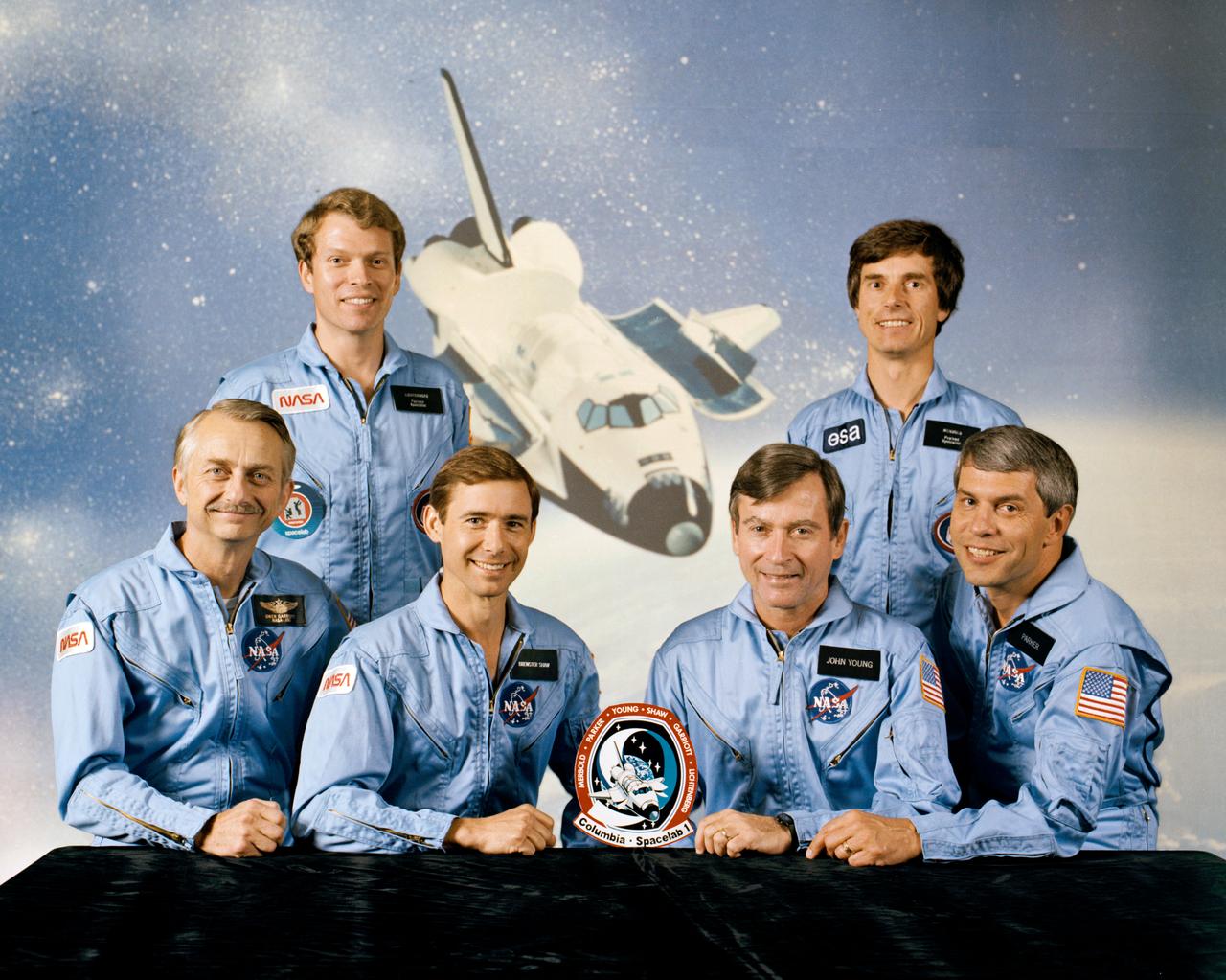
S83-35017 (June 1983) --- These six men represent the first crewmembers to man the Columbia when it gets reactivated later this year. The four NASA astronauts are joined by a European and MIT scientist payload specialist and the Spacelab module and experiment array for STS-9. On the front row are Astronauts Owen K. Garriott, mission specialist; Brewster H. Shaw, Jr., pilot; John W. Young, commander; and Robert A. R. Parker, mission specialist. Byron K. Lichtenberg of the Massachusetts of Technology, left and Ulf Merbold of the Republic of West Germany and the European Space Agency stand in front of an orbital scene featuring the Columbia. Columbia was used for the first five Space Transportation System missions in 1981 and 1982.
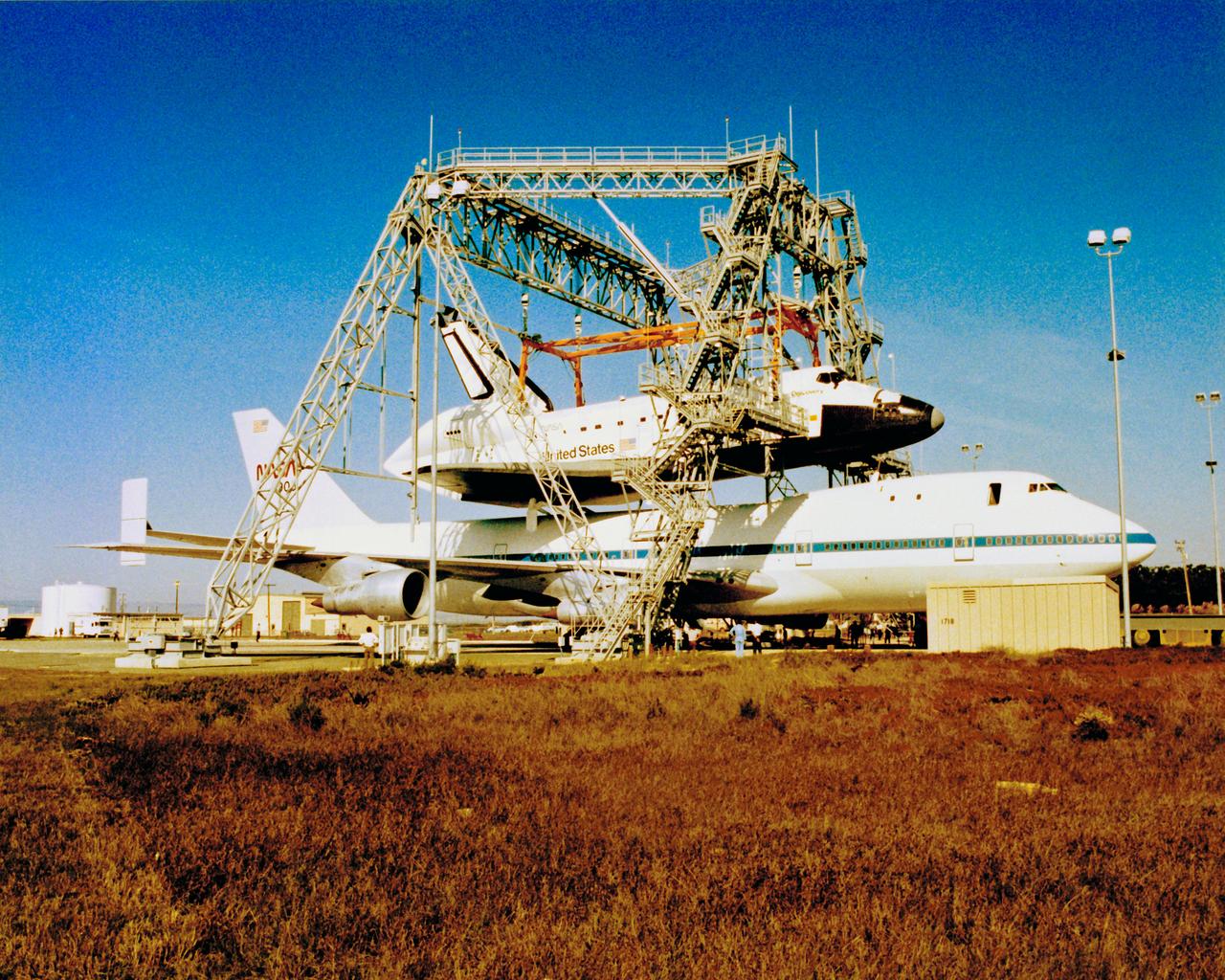
Orbiter at Vandenberg

STS006-46-617 (4-9 April 1983) --- This view of sunset over the Amazon Basin was photographed with a 35mm camera from the Earth-orbiting space shuttle Challenger. The reusable vehicle was making its first trip into space and carried a crew of astronauts Paul J. Weitz, Karol J. Bobko, F. Story Musgrave and Donald H. Peterson. Photo credit: NASA
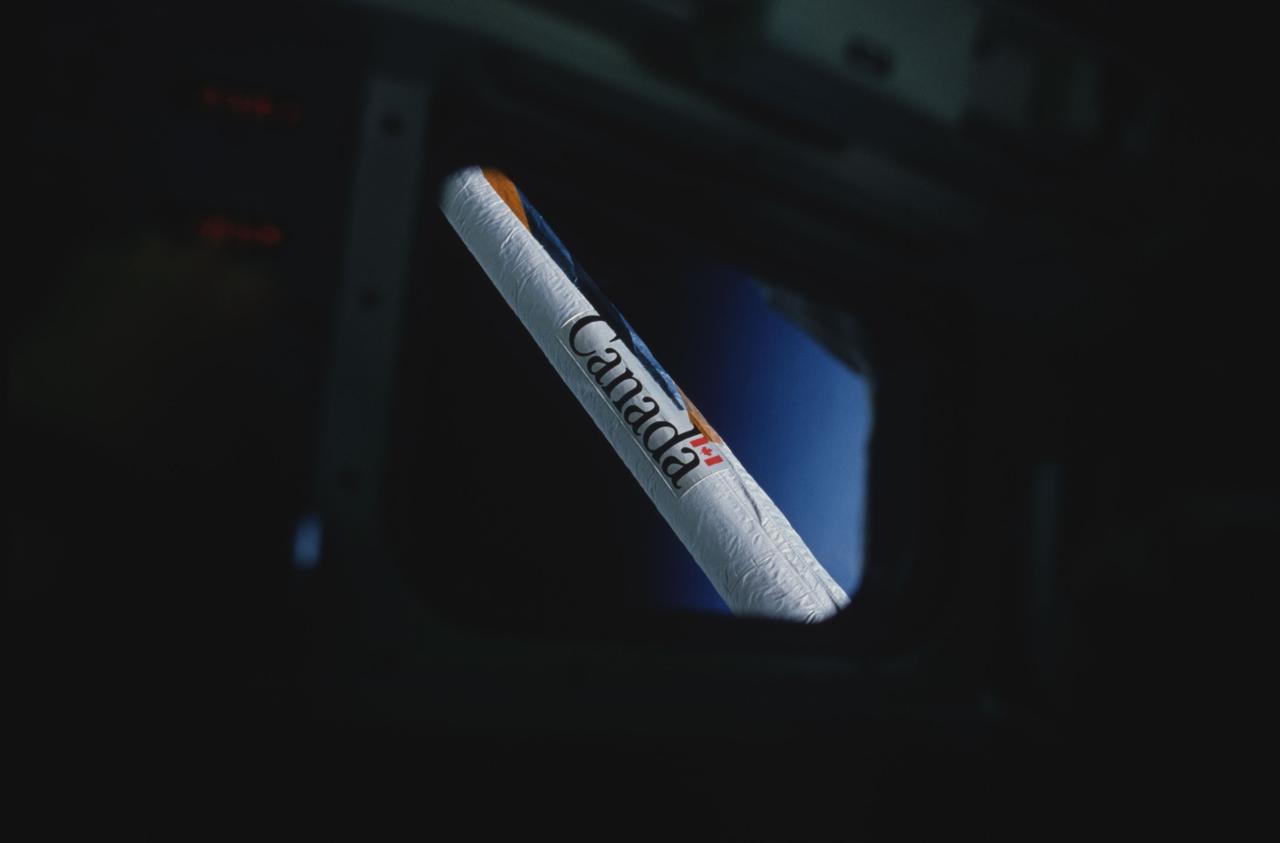
STS008-04-098 (30 Aug-5 Sept 1983) --- A portion of the Canadian-built remote manipulator system (RMS) arm is centered in this frame, photographed through a window on the flight deck of the Earth-orbiting Space Shuttle Challenger. The arm was getting a workout with the payload flight test article (PFTA), which joined the five-member astronaut crew on the six-day mission in space.

Andromeda Galaxy (ref; P-26394C)
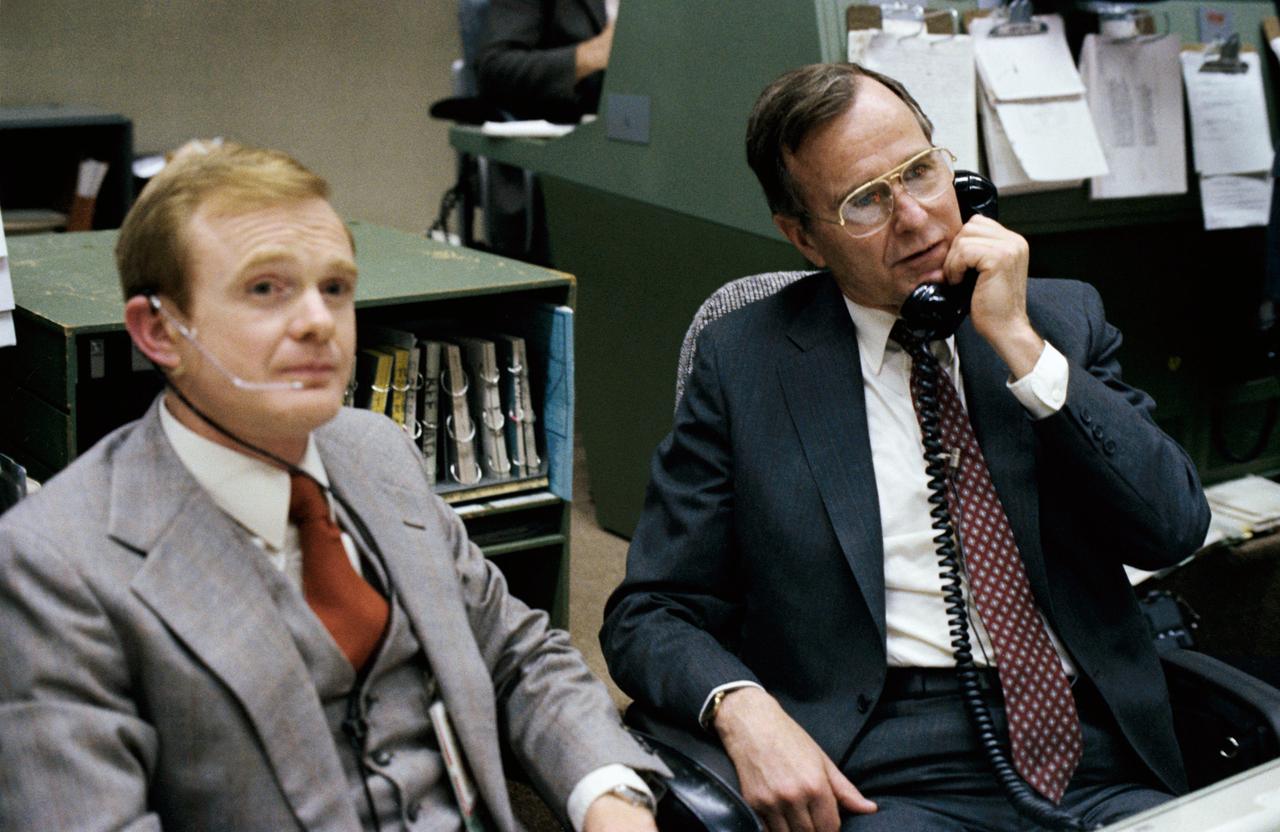
S83-30190 (8 April 1983) --- Vice President George Bush talks to the Earth-orbiting STS-6 astronauts from the spacecraft communicators; (CAPCOM) console in the mission operations control room (MOCR) of the Johnson Space Center?s mission control center. Astronaut Roy D. Bridges, left, is one of the CAPCOM personnel on duty.
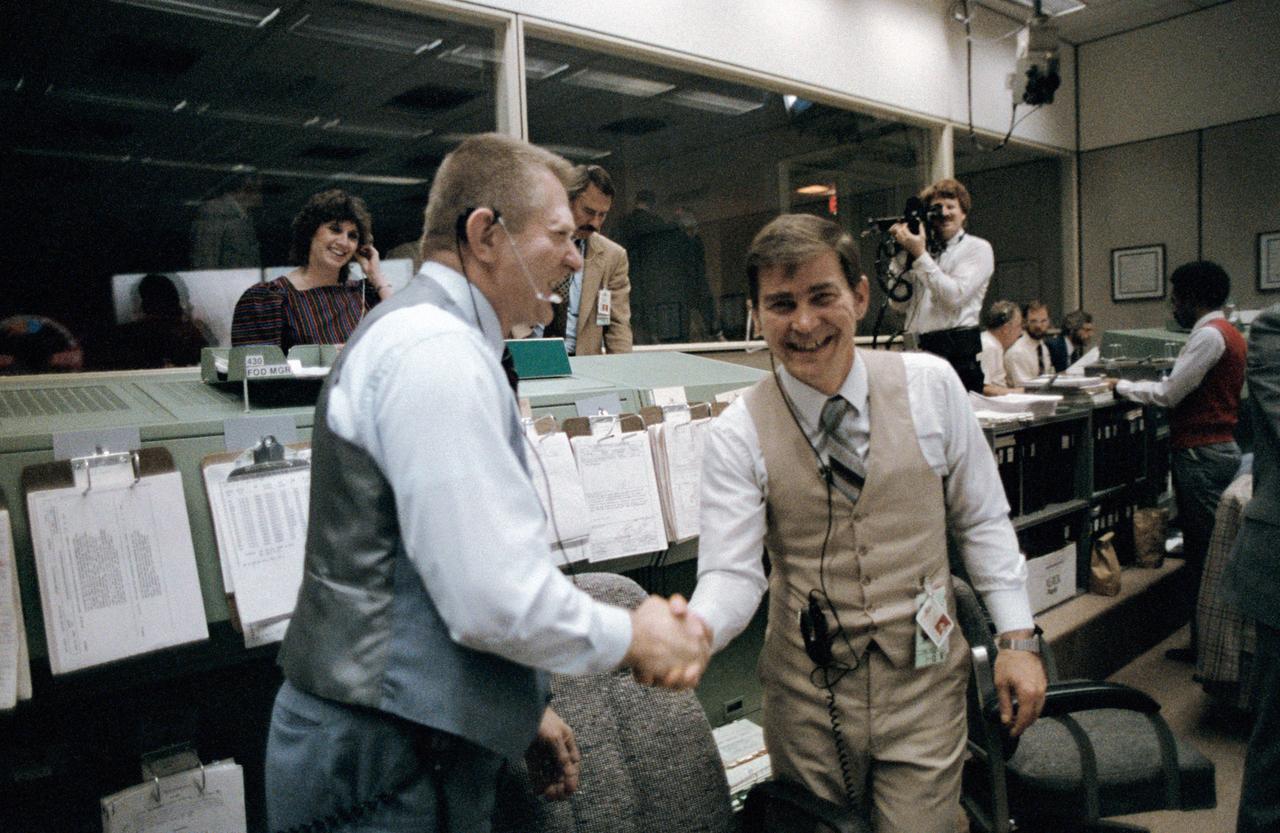
Various views of STS-6 MOCR activities during Day-5 with Vice-Pres. George Bush, Cap Communicator Bridges, JSC Director Gerald Griffin, Eugene F. Kranz, NASA Admin. James M. Beggs, Cap Com Astronaut O'Connor, Flight Directors Jay H. Greene, Gary E. Coen, and Harold Draughon. 1. BUSH, GEORGE, VICE-PRES. - STS-6 MOCR 2. DIR. GRIFFIN, GERALD D. - STS-6 MOCR 3. ADMIN. BEGGS, JAMES M. - STS-6 MOCR 4. FLT. DIRECTORS - STS-6 JSC, HOUSTON, TX Also available in 35 CN

KENNEDY SPACE CENTER, FLA. -- The first flight of Challenger on mission STS-6. The primary payload is the first Tracking and Data Relay Satellite-1. The mission also is using the first lightweight external tank and lightweight solid rocket booster casings. The crew comprises Commander Paul J. Weitz, Pilot Karol J. Bobko, and Mission Specialists Donald H. Peterson and F. Story Musgrave.
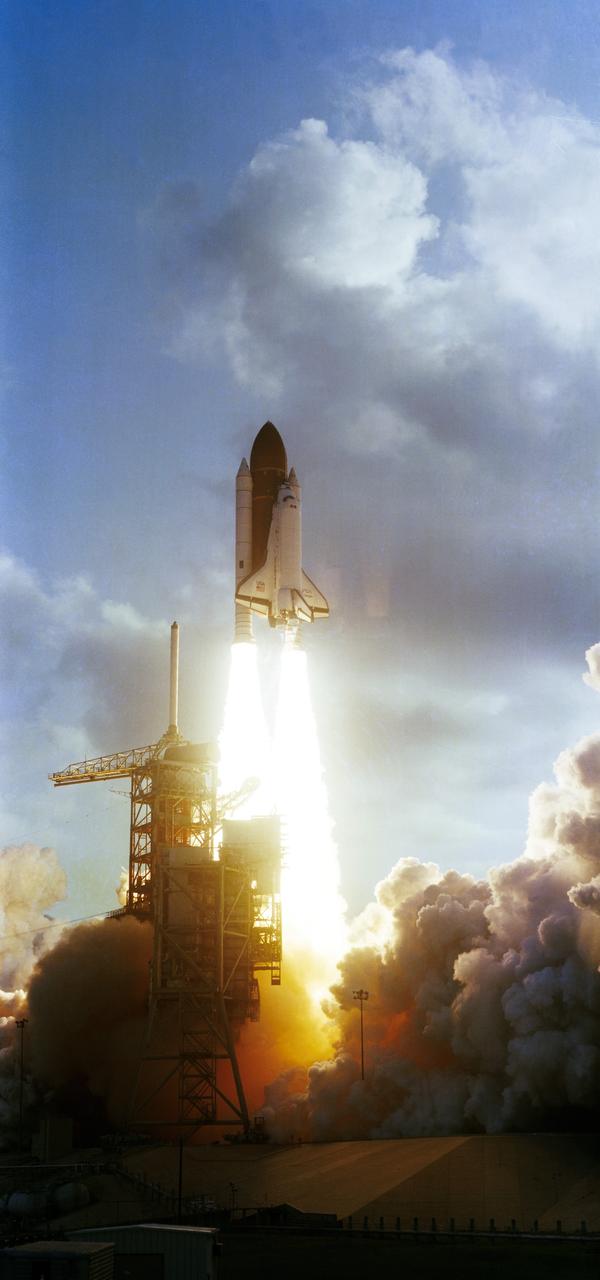
S83-35702 (18 June 1983) --- The seventh launch of the NASA Space Transportation System and the second lift-off of the space shuttle Challenger occurred at 7:33 a.m. (EDT) today from the Pad 39A launch site, at the Kennedy Space Center (KSC). The six-day mission will be highlighted by the first direct landing from space by an orbiter to the Shuttle Landing Facility (SLF). The crew consists of astronauts Robert Crippen, commander, the first two-time space shuttle astronaut; Frederick H. Hauck, pilot; and three mission specialists -- Sally K. Ride, John M. Fabian and Norman E. Thagard. During the mission the crew will deploy the Indonesian PALAPA-B and the Canadian ANIK-C communications satellites. They will also use the Remote Manipulator System (RMS) arm to deploy and retrieve a platform for space experiments called the Shuttle Pallet Satellite (SPAS), and serve as a spaceborne laboratory for OSTA-2, a scientific payload. Getaway Special canisters and materials processing experiments will fill out the complement of payloads on the mission. Photo credit: NASA
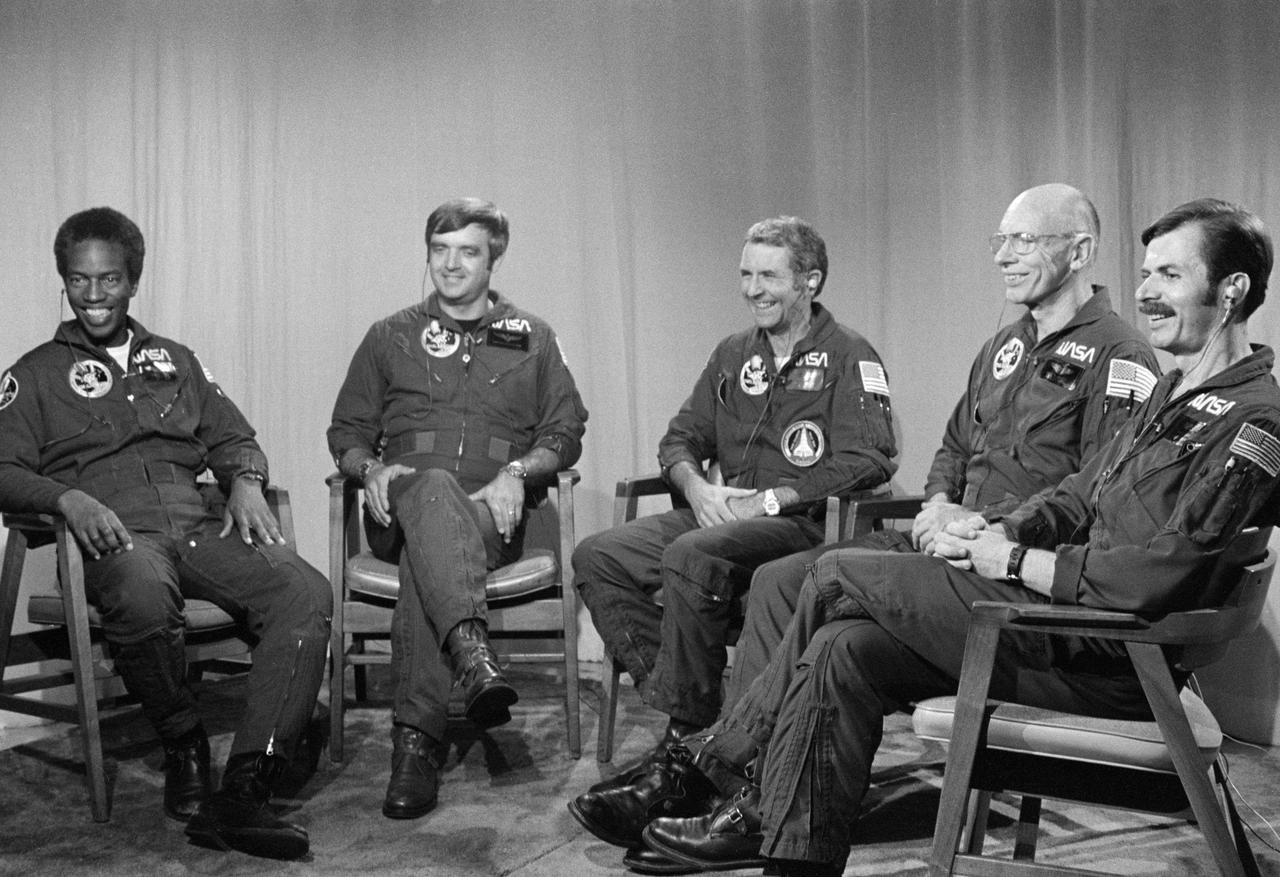
S83-39696 (5 Sept 1983) --- The five member astronaut crew of the Space Shuttle Challenger for STS-8 responds to a comment made by President Ronald Reagan during a post flight telephone conversation with the chief executive. The five astronauts earlier today landed the reusable spacecraft at Edwards Air Force Base in California and were flown to JSC via NASA aircraft. Richard H. Truly, center, is crew commander. Pilot for the six day flight was Daniel C. Brandenstein, second left. The mission specialist were Guion S. Bluford, left: Dr. William S. Thornton, second right, and Dale A. Gardner, right. Photo credit: NASA
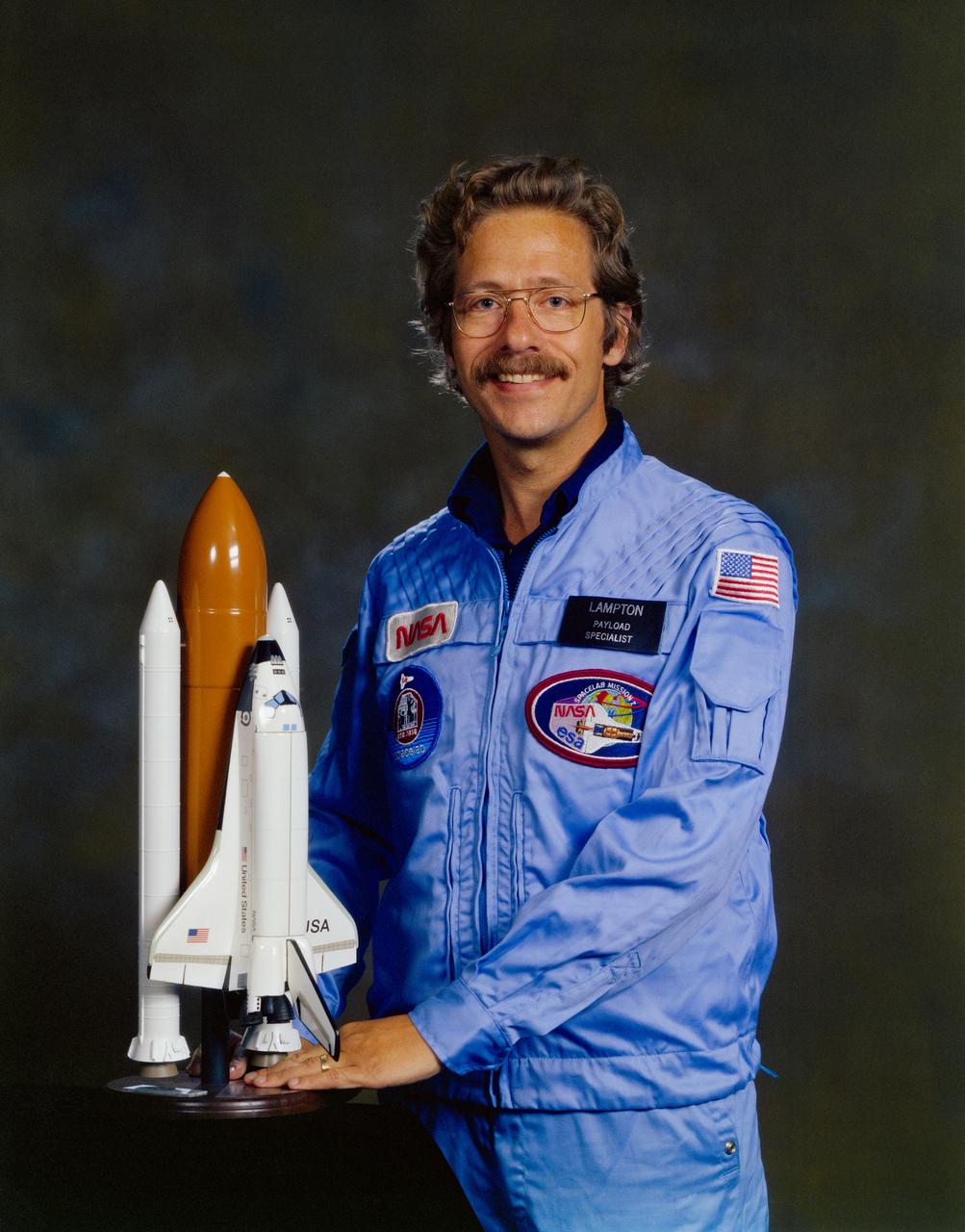
S83-41301 (1983) --- Michael Logan Lampton, backup payload specialist.
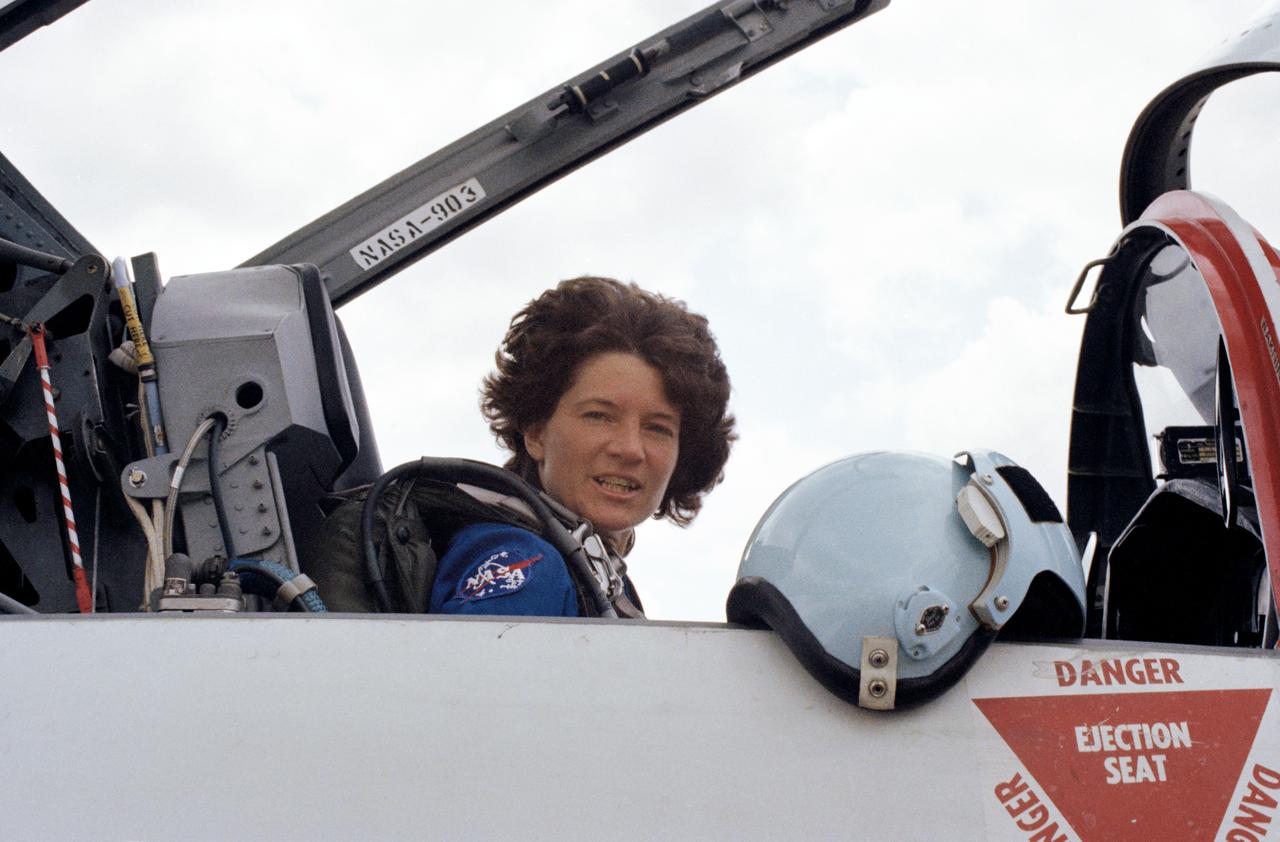
S83-34151 (15 June 1983) --- Astronaut Sally K. Ride, STS-7 mission specialist, takes one last look at familiar training environs before taking off from NASA’s Houston facility in a T-38 jet aircraft, destination: Florida and the Kennedy Space Center (KSC). After a few days of preparation at KSC, Dr. Ride and four other astronauts will be the first NASA five-member crew to fly in space as they liftoff in the Challenger from Launch Pad 39A. The mission specialist is positioned in the rear station of the jet, piloted by astronaut Robert L. Crippen, STS-7 commander. The T-38 fleet is kept at Ellington Base near the Johnson Space Center (JSC).
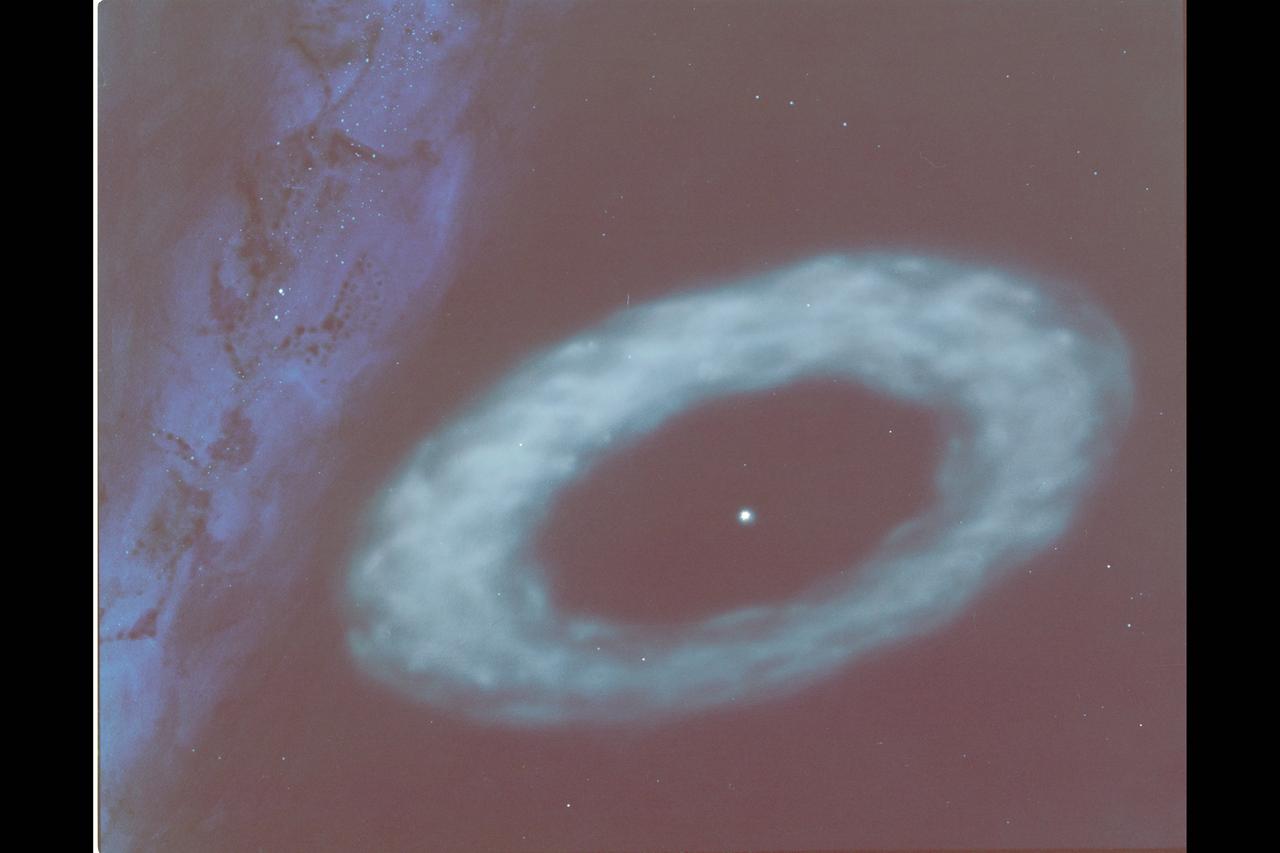
This artist's concept illustrates the ring of material discovered by the Infrared Astronomical Satellite around the star Vega. IRAS scientists believe the material probably consists of dust and small objects resembling meteors. As depicted here, the ring of particles is thin enough toallow light from distant stars to shine through. The plane of the Milky Way is to the right.
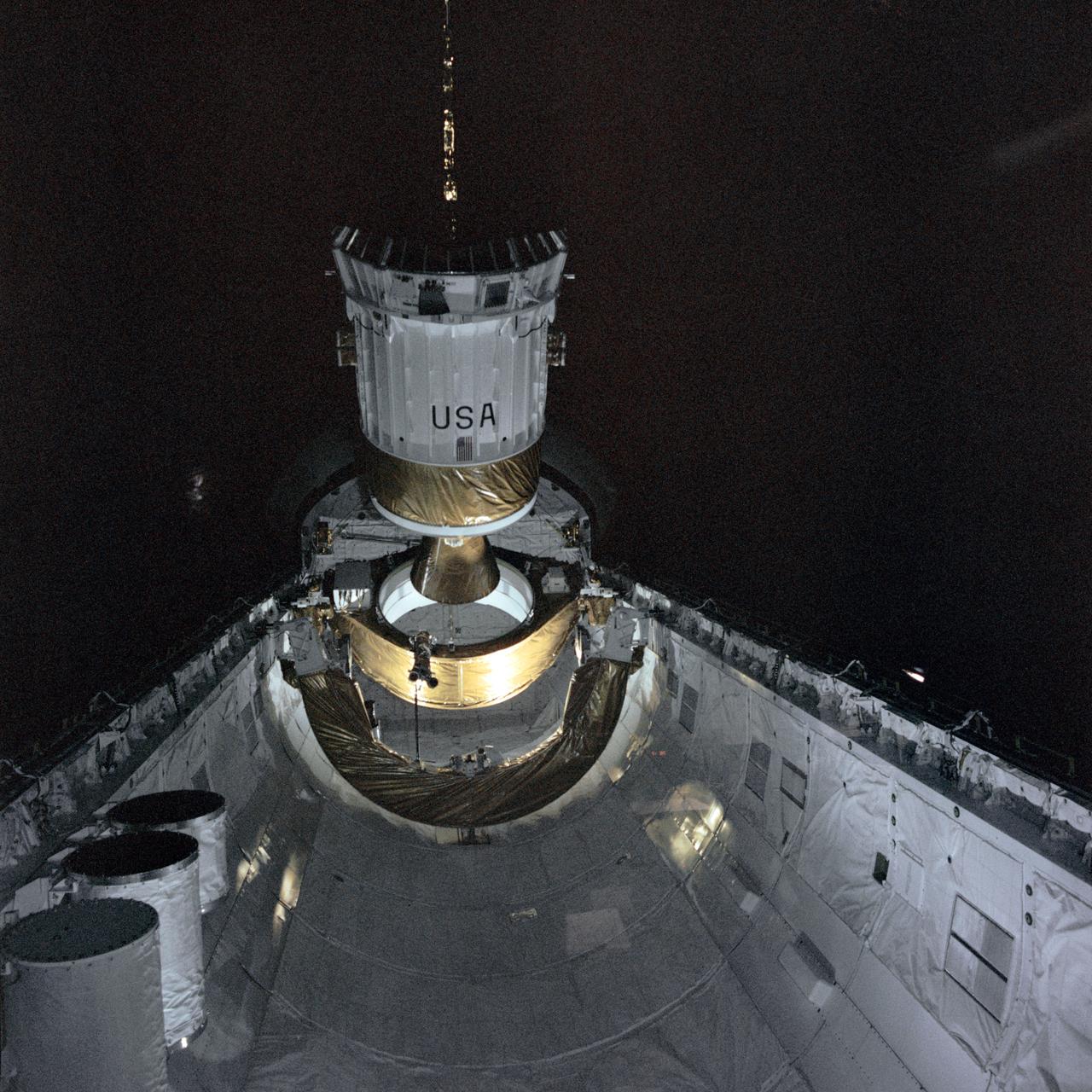
STS006-38-894 (4 April 1983) --- The tracking and data relay satellite (TDRS) leaves the 18-meter (60-ft) long cargo bay of the Earth-orbiting space shuttle Challenger about ten hours following launch of NASA’s second reusable space vehicle. The inertial upper stage (IUS) which gives power necessary to place the TDRS in its desired orbit is clearly seen in this view, photographed with a 70mm camera aimed through the aft flight deck windows of the Challenger. The cylindrical canisters in the left foreground contain scientific experiments from subscribers to NASA’s getaway special (GAS) program. Photo credit: NASA
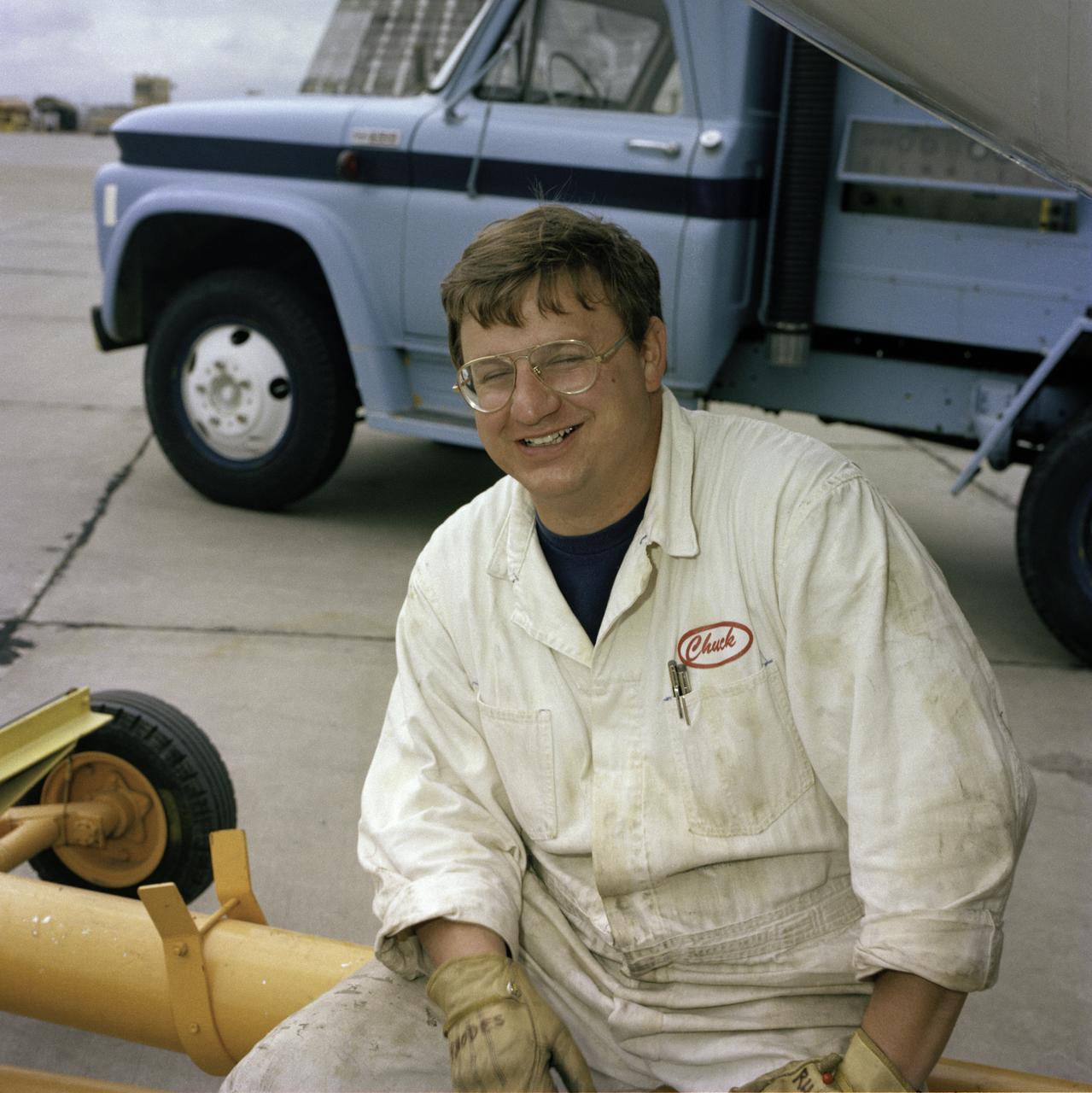
Chuck from the ground crew ready ready C-141 KAO (NASA 714) departure from Ames Research Center, CA for Australia.
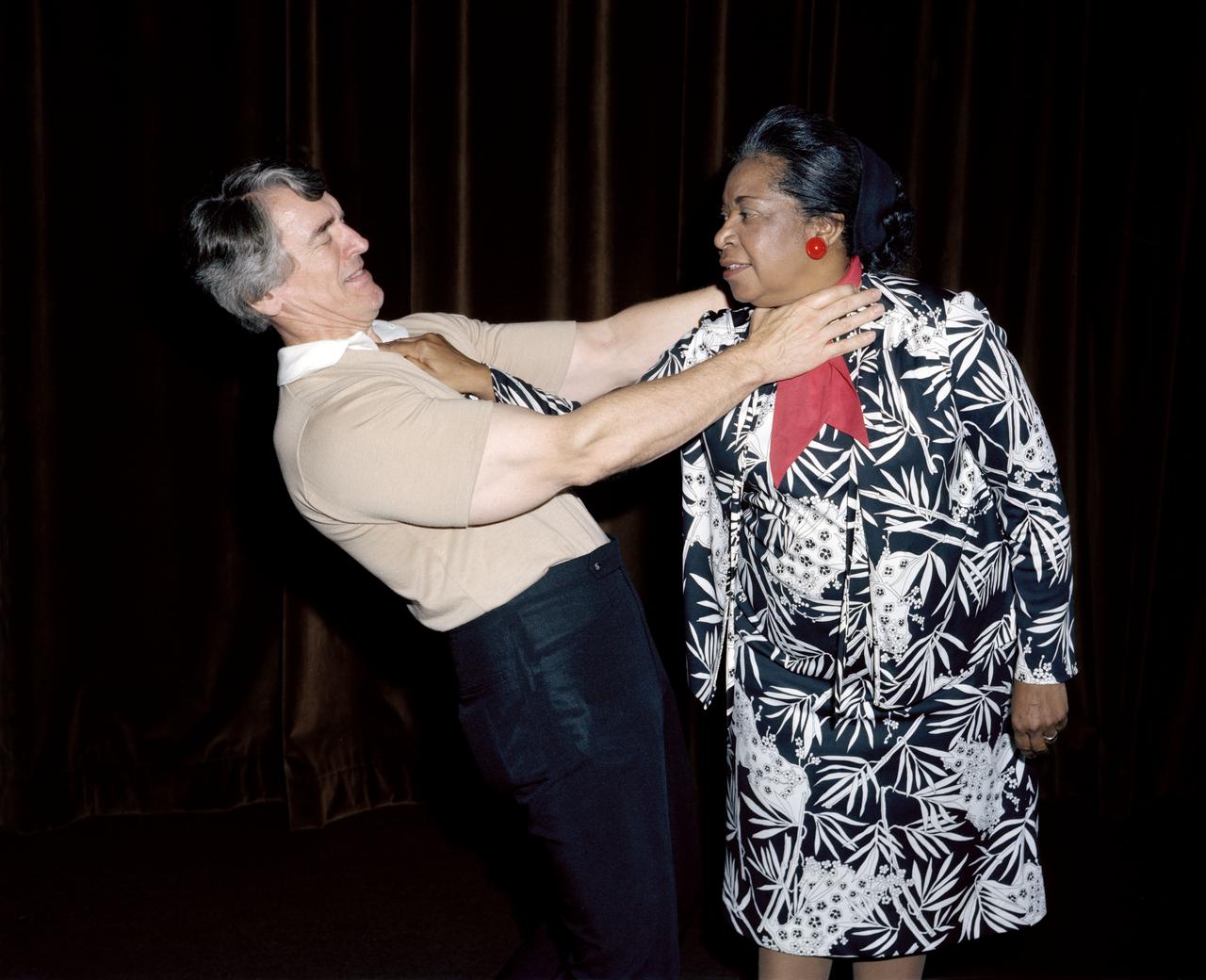
"Self Protection for Women,"sponsored by the Federal Women's Program Committee and the Training Office, will be held June 10 in the Activities Center. This presentation contains practical self-defense techniques that can be learned in ONE hour. Lt. Jim Bullard of the Memphis Police Department, the originator of the program, considers it as pertinent to men as it is to women. Bullard's emphasis is proper "attitude," without which self defense techniques are meaningless. Published in Langley Researcher, May 20,1983 page 2. Mary Jackson, Manager of the Federal Women's Program Committee participating in demonstration.
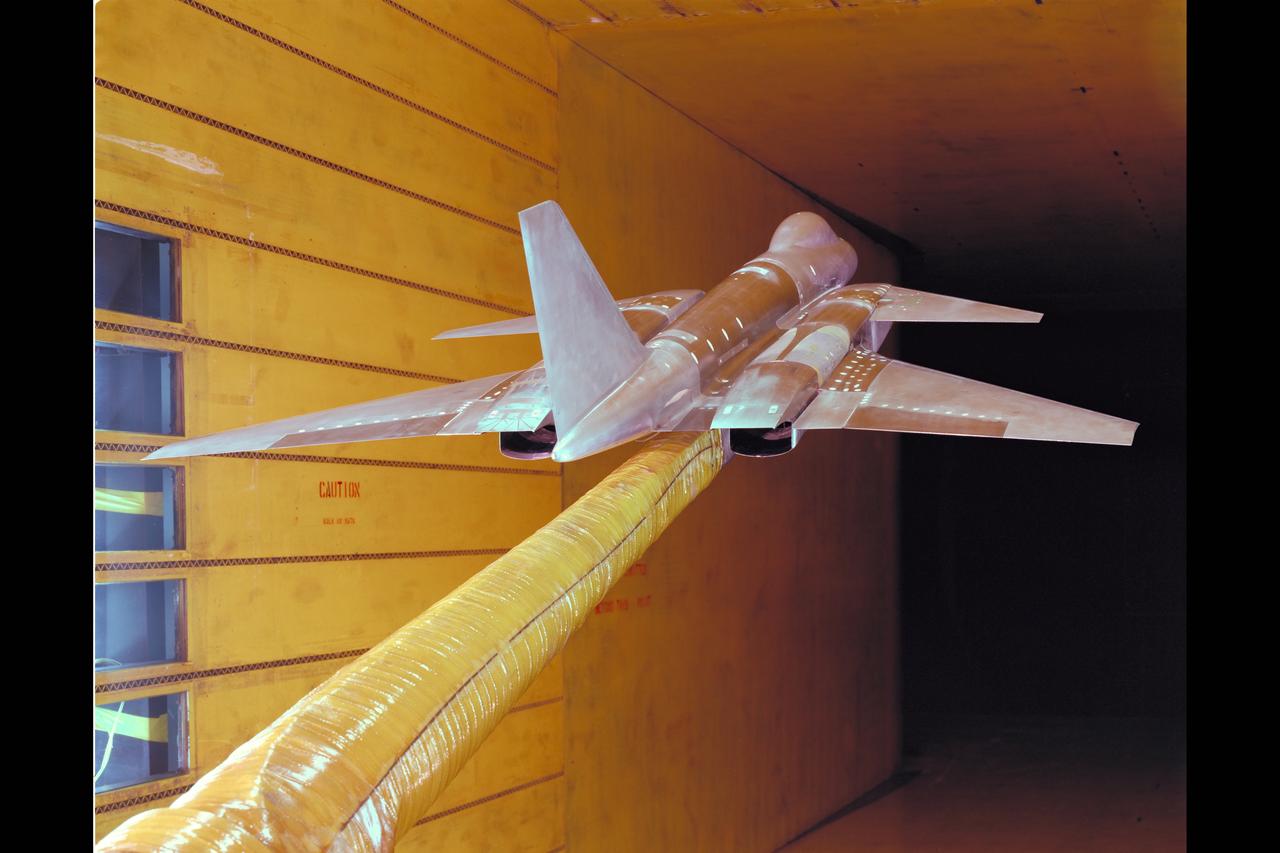
CMAPS: 11ft W.T. Test-514
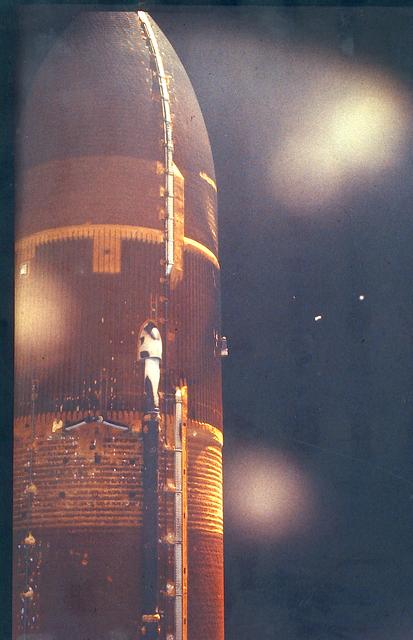
JSC2003-E-15408 (18 June 1983) --- A 35mm still camera located in the umbilical well of the space shuttle Challenger took this photograph of the external fuel tank (ET) after it was dropped from the launch stack as the shuttle headed for Earth orbit on June 18, 1983. The camera was located in the LO2 umbilical near the aft end of the orbiter (right side as you view the ET). Photo credit: NASA
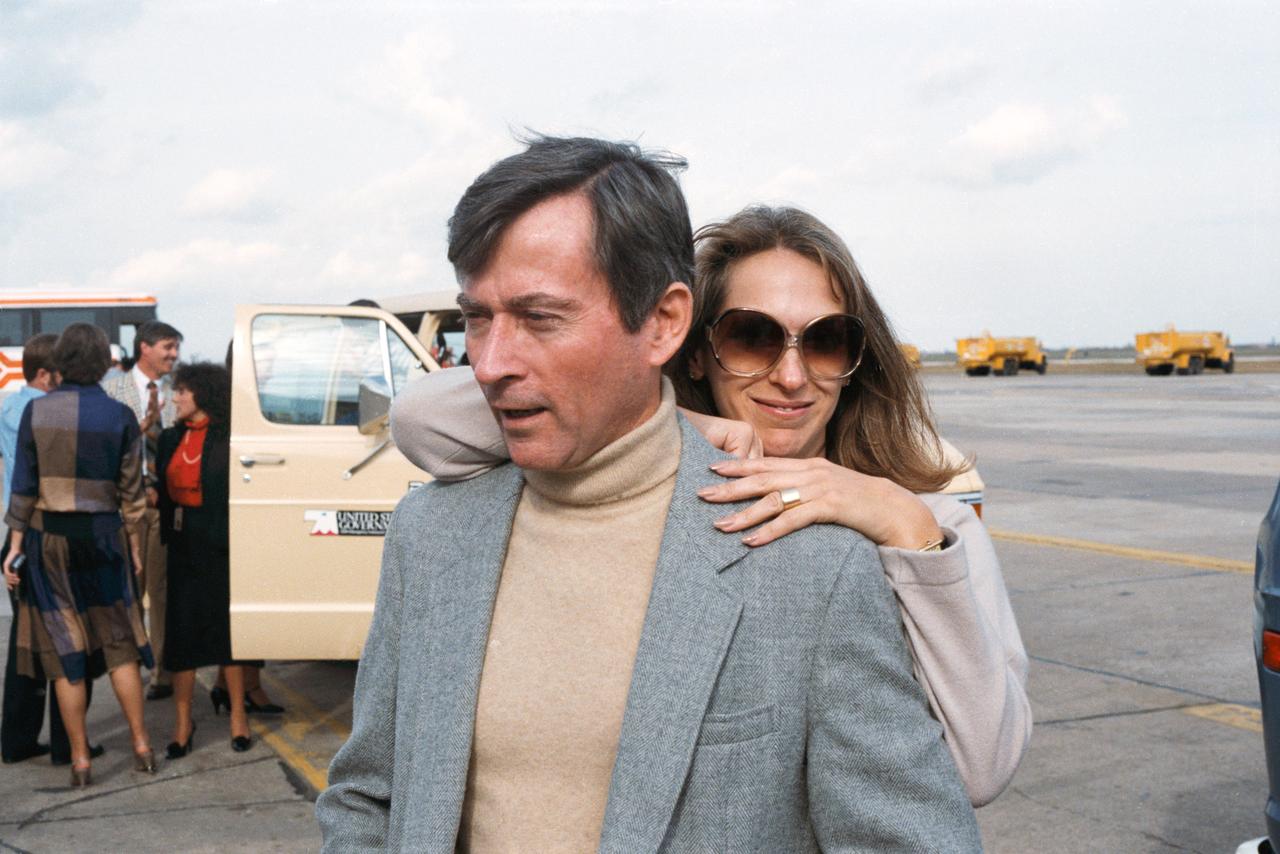
Views of STS-9/41A Crewmen John Young, with wife Susy, and Brewster Shaw with his family upn their return. EAFB, HOUSTON, TX
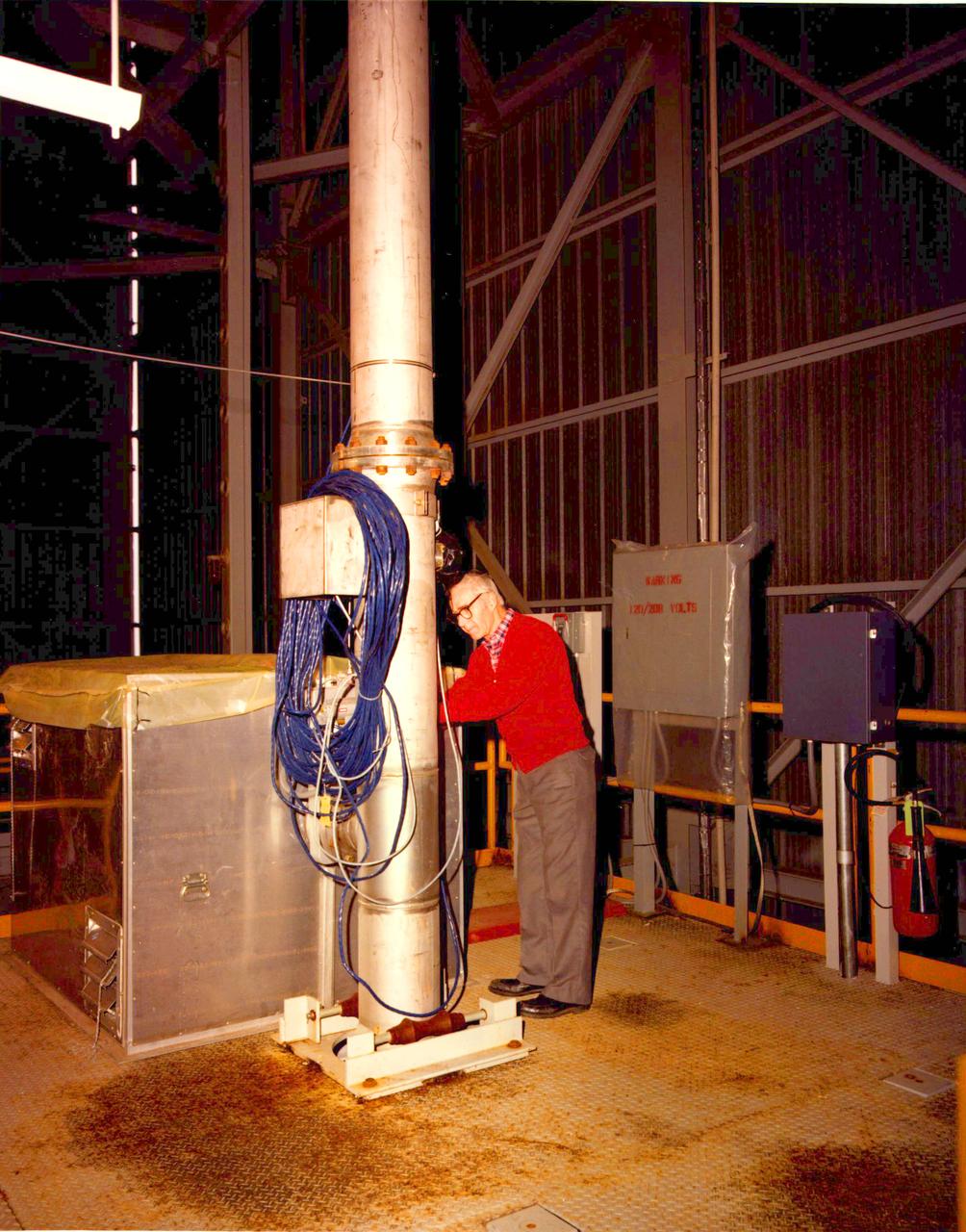
A Drop Tube is a long vertical shaft used for dropping experiment packages, enabling them to achieve microgravity through freefall.
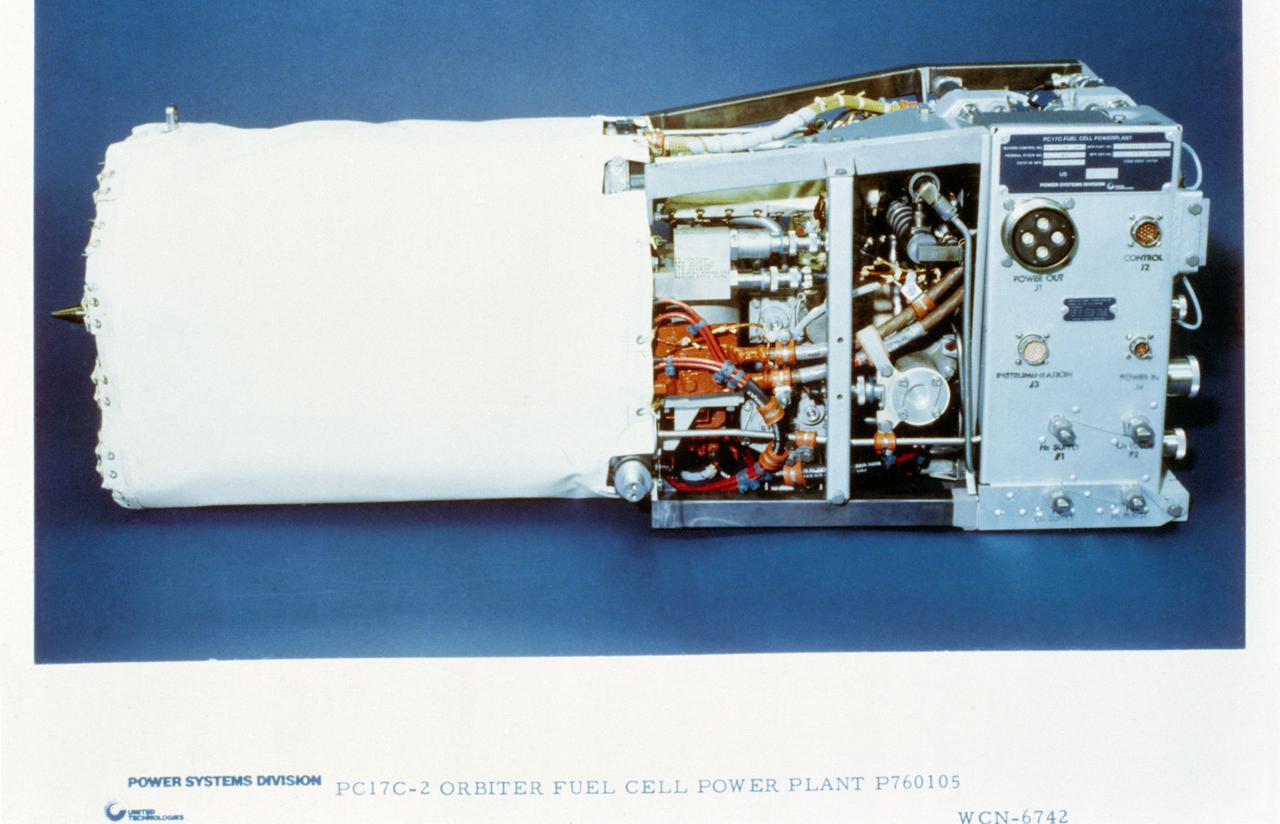
View of the PC17C-2 Orbiter Fuel Cell Power Plant P760105 From United Technologies Hamilton-Standard.
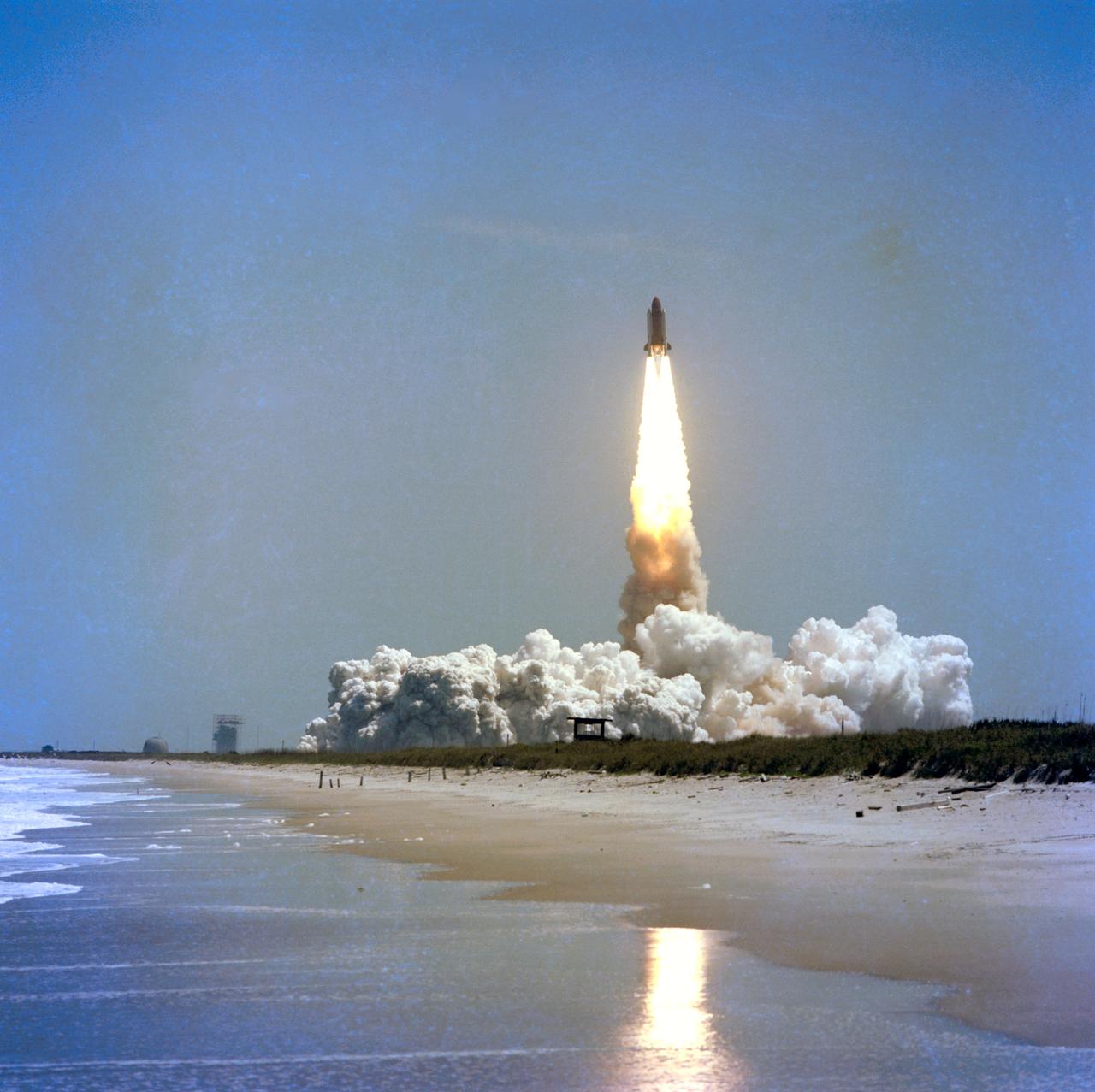
S83-30134 (7 April 1983) --- Flare from the first launch of the space shuttle Challenger is reflected in the Atlantic Ocean?s Cape Canaveral beach waters shortly after 1:30 p.m. (EST) on April 7, 1983. Only the tips of the orbiter?s wings are visible in this south looking view, as the manned portion of the launch cluster is obscured by its new lightweight external fuel tank (ET) and two solid rocket boosters (SRB). Onboard the spacecraft are astronauts Paul J. Weitz, Karol J. Bobko, Dr. F. Story Musgrave and Donald H. Peterson. Photo credit: NASA
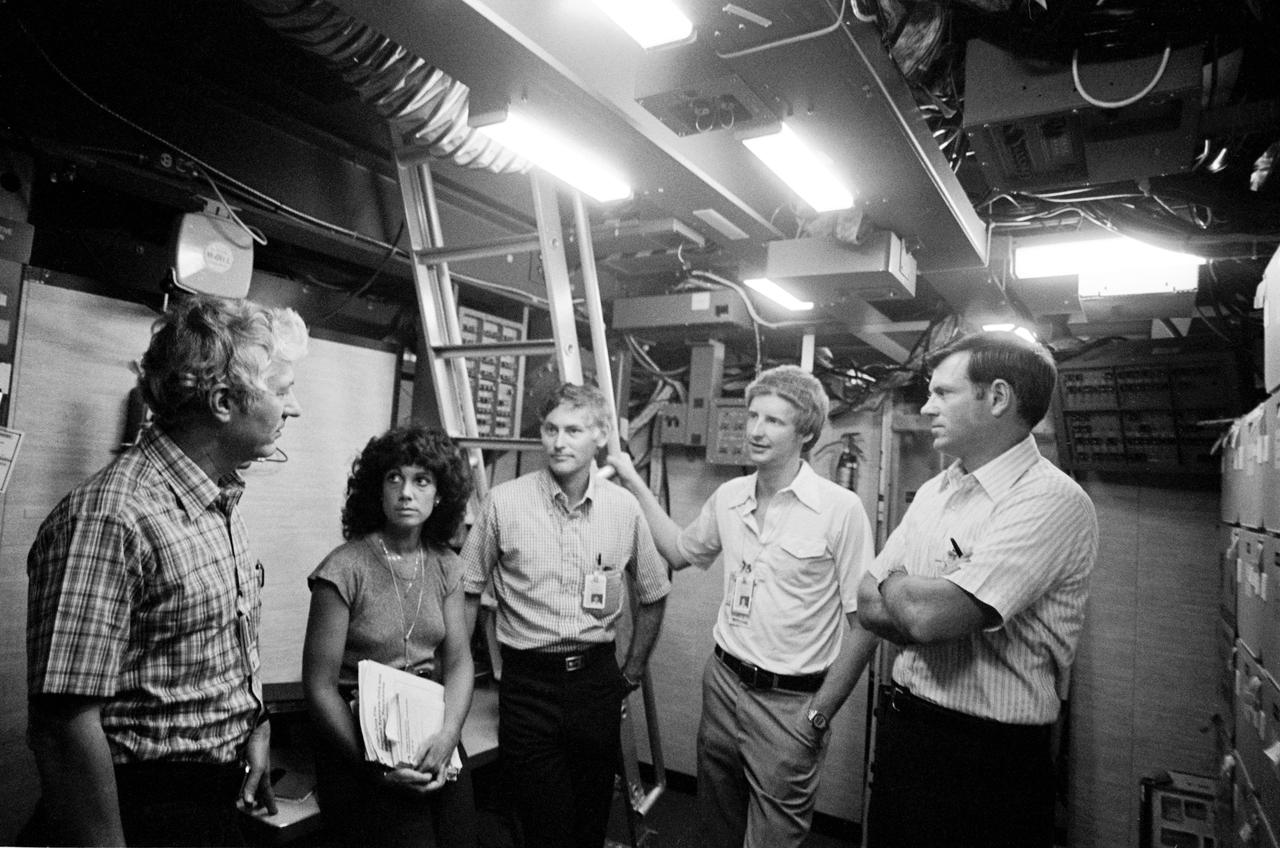
View of STS 41-D mission crew training in Shuttle Mission simulator. From left to right are Henry Hartsfield, Jr., commander; mission specialists Judith Resnik, Richard Mullane, and Steven Hawley; and Michael Coats, pilot. They appear to be standing in the middeck mockup, preparing for training.
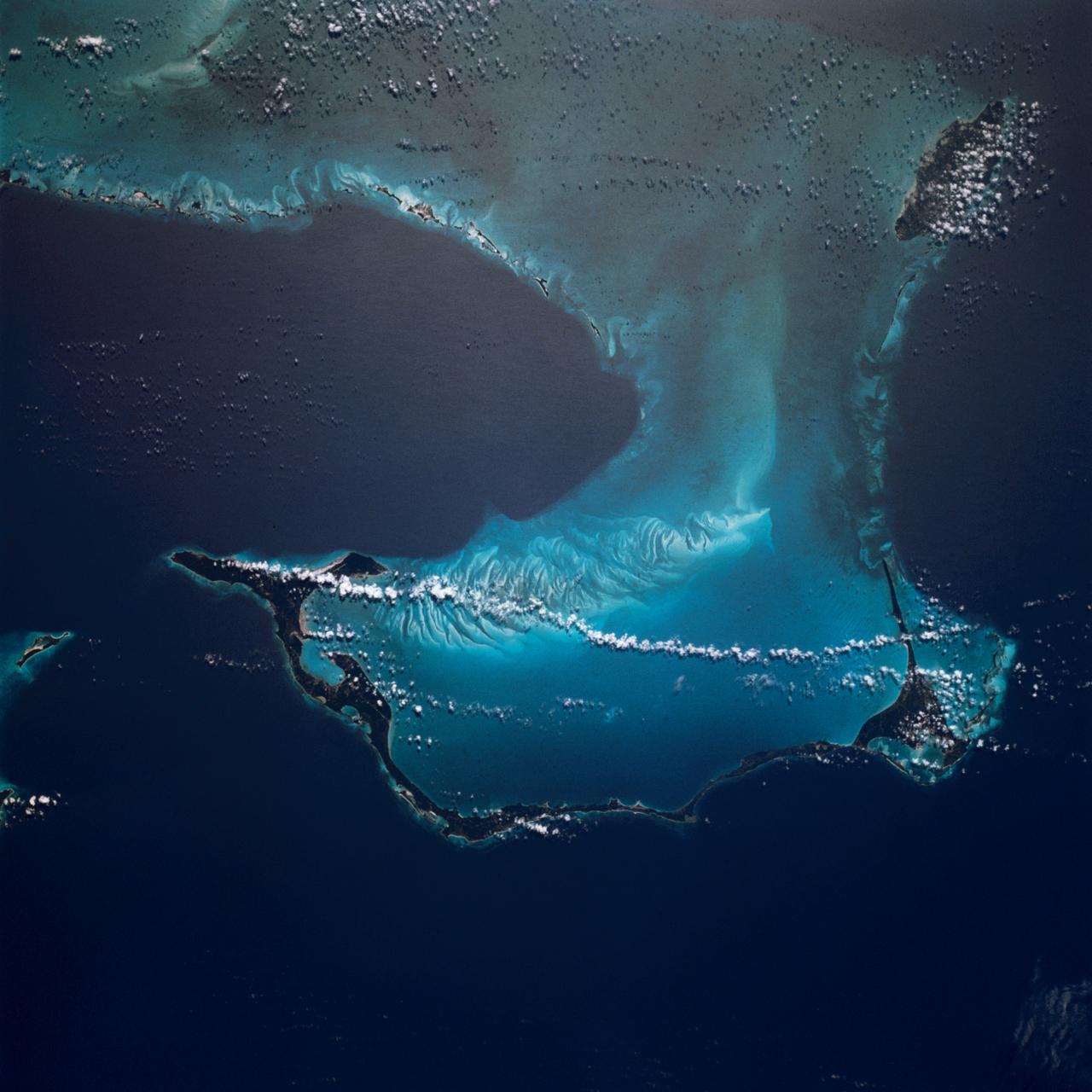
STS006-45-097 (4-9 April 1983) --- This photograph was taken with a handheld 70mm camera aimed through the “ceiling” windows of the Earth-orbiting space shuttle Challenger during its five-day STS-6 mission. A beautiful photo shows the contrast between the islands, clouds, shallow water and deep water. Islands of the Bahamas seen are New Providence (upper left) and Eleuthera (right). Northeast Providence Channel is at the upper edge and Exuma Sound is at the lower left with the open Atlantic along the right edge. The wind, from the south, causes a long cloud to develop downwind from Eleuthera Point. Photo credit: NASA
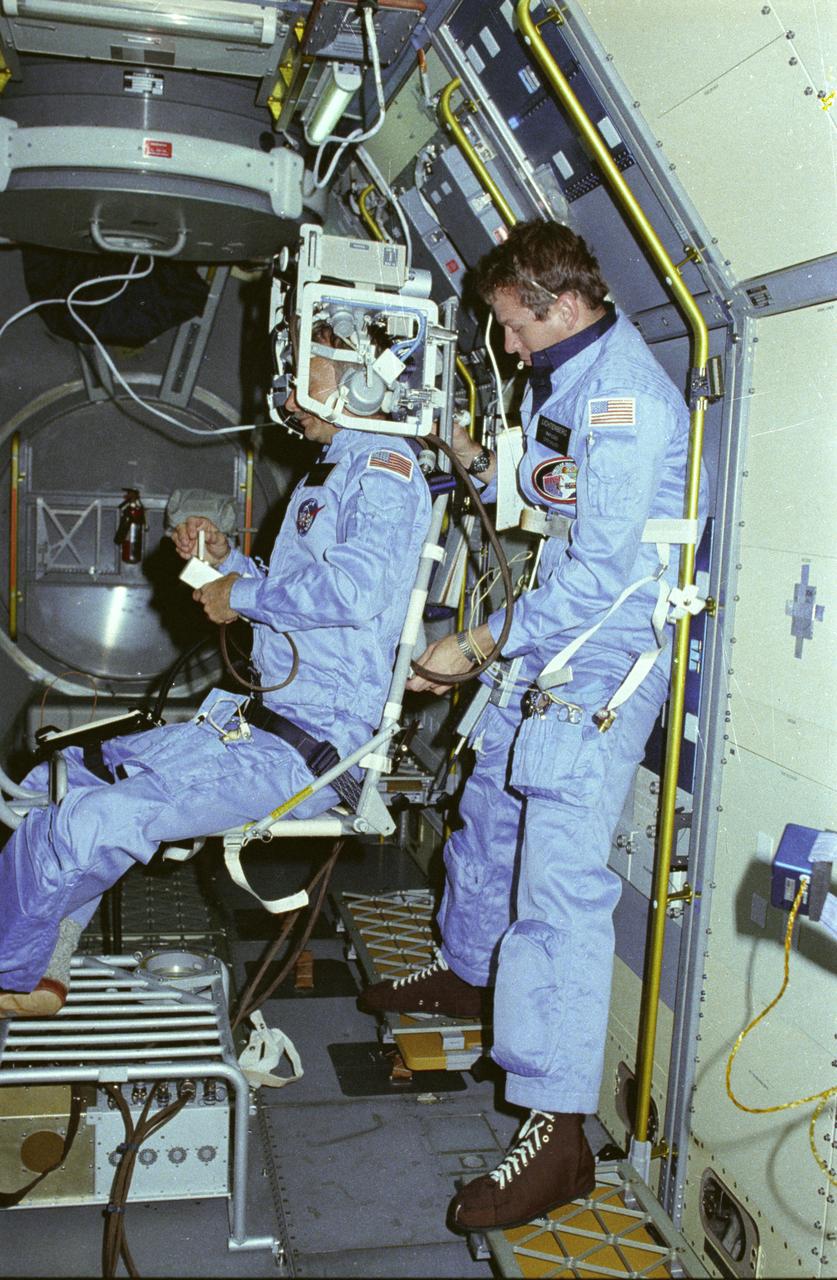
In this photograph, astronauts Owen Garriott on the body restriant system and Byron Lichtenberg prepare for a Vestibular Experiment during the Spacelab-1 mission. The Vestibular Experiments in Space were the study of the interaction among the otoliths, semicircular canals, vision, and spinal reflexes in humans. The main objective was to determine how the body, which receives redundant information for several sensory sources, interprets this information in microgravity. Another objective was to record and characterize the symptoms of space sickness experienced by crewmembers. The body restraint system was a rotating chair with a harness to hold the test subject in place. The crewmember wore an accelerometer and electrodes to record head motion and horizontal and vertical eye movement as the body rotated. The first Spacelab mission, Spacelab-1, sponsored jointly and shared equally by NASA and the European Space Agency, was a multidisciplinary mission; that is, investigations were performed in several different fields of scientific research. The overall goal of the mission was to verify Spacelab performance through a variety of scientific experiments. The Spacelab-1 was launched aboard the Space Shuttle Orbiter Columbia for the STS-9 mission on November 28, 1983. The Marshall Space Flight Center had management responsibilities for the mission.
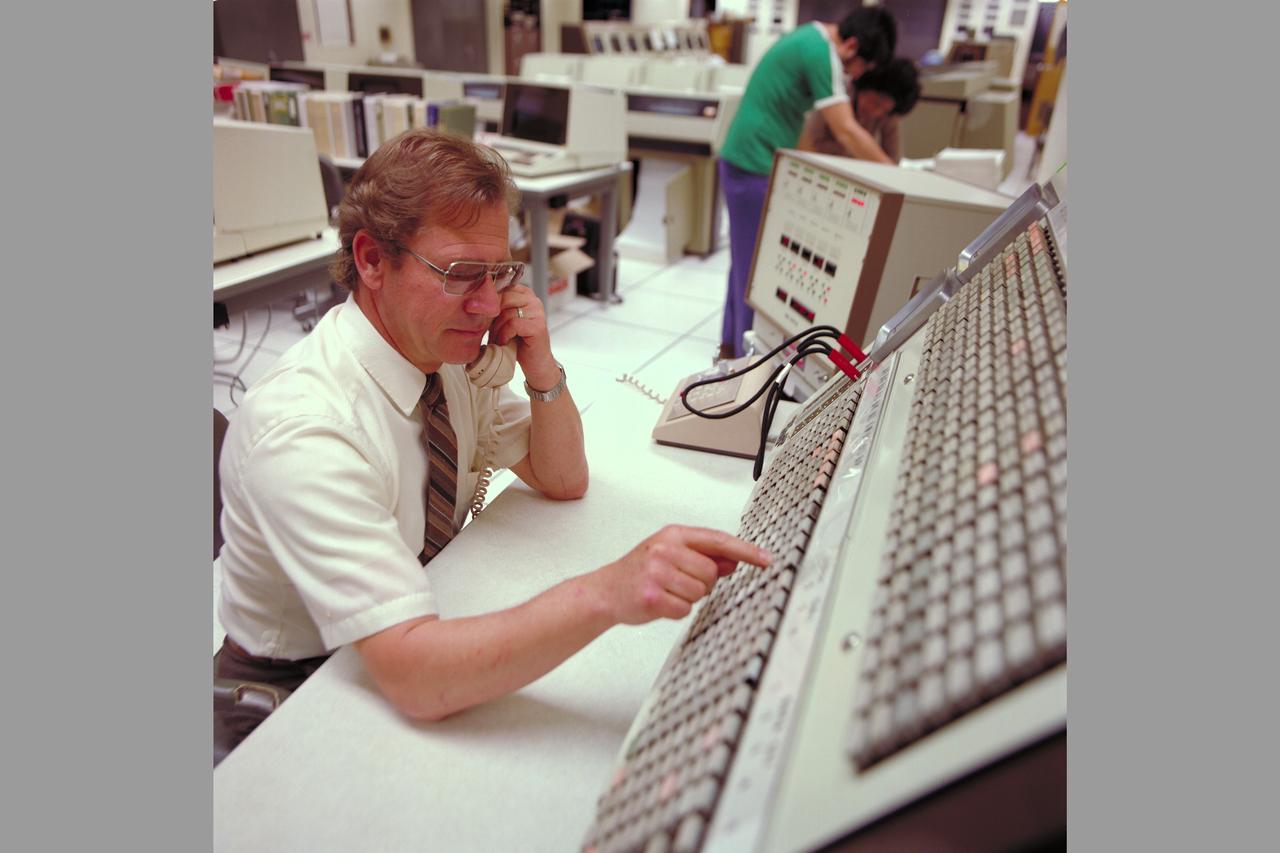
Pioneer Mission Control Center with personnel monitoring spacecraft (PMOC)
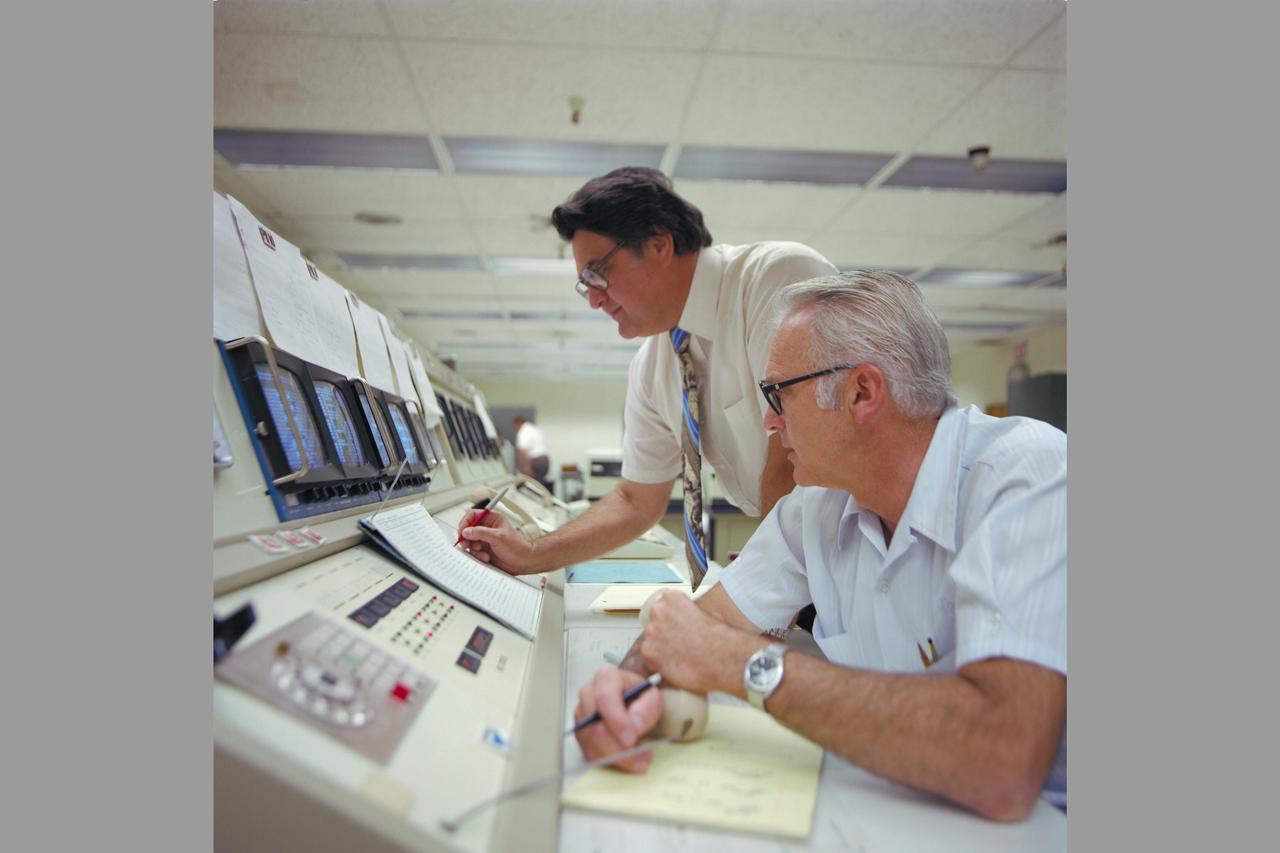
Pioneer Mission Control Center with personnel monitoring spacecraft (PMOC) includes Dr Richard Fimmel

Monte Hodges and Randy Hobbs ready C-141 KAO (NASA 714) departure from Ames Research Center, CA for Australia.
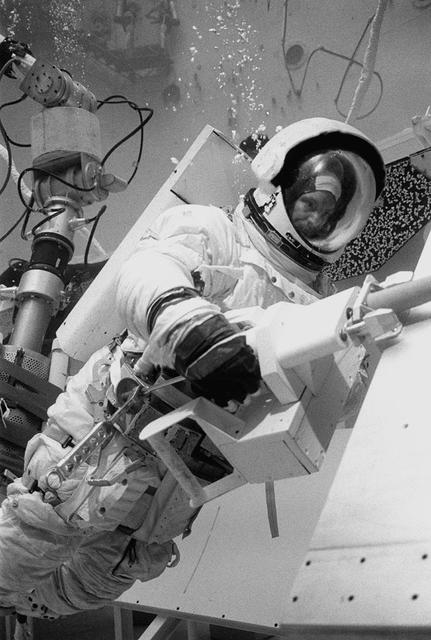
In February 1980, a satellite called Solar Maximum Mission Spacecraft, or Solar Max, was launched into Earth's orbit. Its primary objective was to provide a detailed study of solar flares, active regions on the Sun's surface, sunspots, and other solar activities. Additionally, it was to measure the total output of radiation from the Sun. Not much was known about solar activity at that time except for a slight knowledge of solar flares. After its launch, Solar Max fulfilled everyone's expectations. However, after a year in orbit, Solar Max's Altitude Control System malfunctioned, preventing the precise pointing of instruments at the Sun. NASA scientists were disappointed at the lost data, but not altogether dismayed because Solar Max had been designed for Space Shuttle retrievability enabling repair of the satellite. On April 6, 1984, Space Shuttle Challenger (STS-41C), Commanded by astronaut Robert L. Crippen and piloted by Francis R. Scobee, launched on a historic voyage. This voyage initiated a series of firsts for NASA; the first satellite retrieval, the first service use of a new space system called the Marned Maneuvering Unit (MMU), the first in-orbit repair, the first use of the Remote Manipulator System (RMS), and the Space Shuttle Challenger's first space flight. The mission was successful in retrieving Solar Max. Mission Specialist Dr. George D. Nelson, using the MMU, left the orbiter's cargo bay and rendezvoused with Solar Max. After attaching himself to the satellite, he awaited the orbiter to maneuver itself nearby. Using the RMS, Solar Max was captured and docked in the cargo bay while Dr. Nelson replaced the altitude control system and the coronagraph/polarimeter electronics box. After the repairs were completed, Solar Max was redeposited in orbit with the assistance of the RMS. Prior to the April 1984 launch, countless man-hours were spent preparing for this mission. The crew of Challenger spent months at Marshall Space Flight Center's (MSFC) Neutral Buoyancy Simulator (NBS) practicing retrieval maneuvers, piloting the MMU, and training on equipment so they could make the needed repairs to Solar Max. Pictured is Dr. Nelson performing a replacement task on the Solar Max mock-up in the NBS.
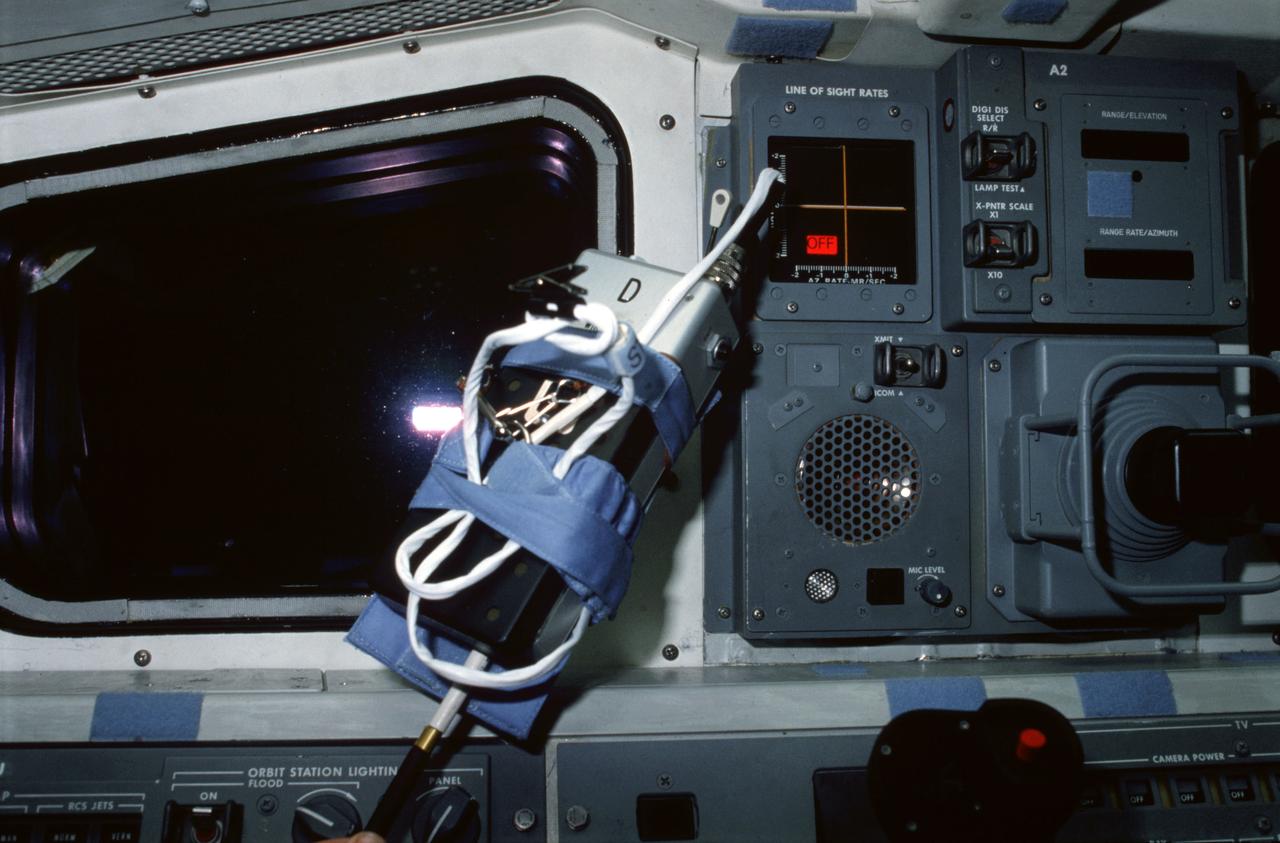
STS008-18-479 (5 Sept 1983) --- Aft flight deck documentation includes on orbit station with control panel A2, aft viewing window W9, and communications kit assembly (ASSY) headset (HDST) interface unit (HIU) and cable free floating in front of it.
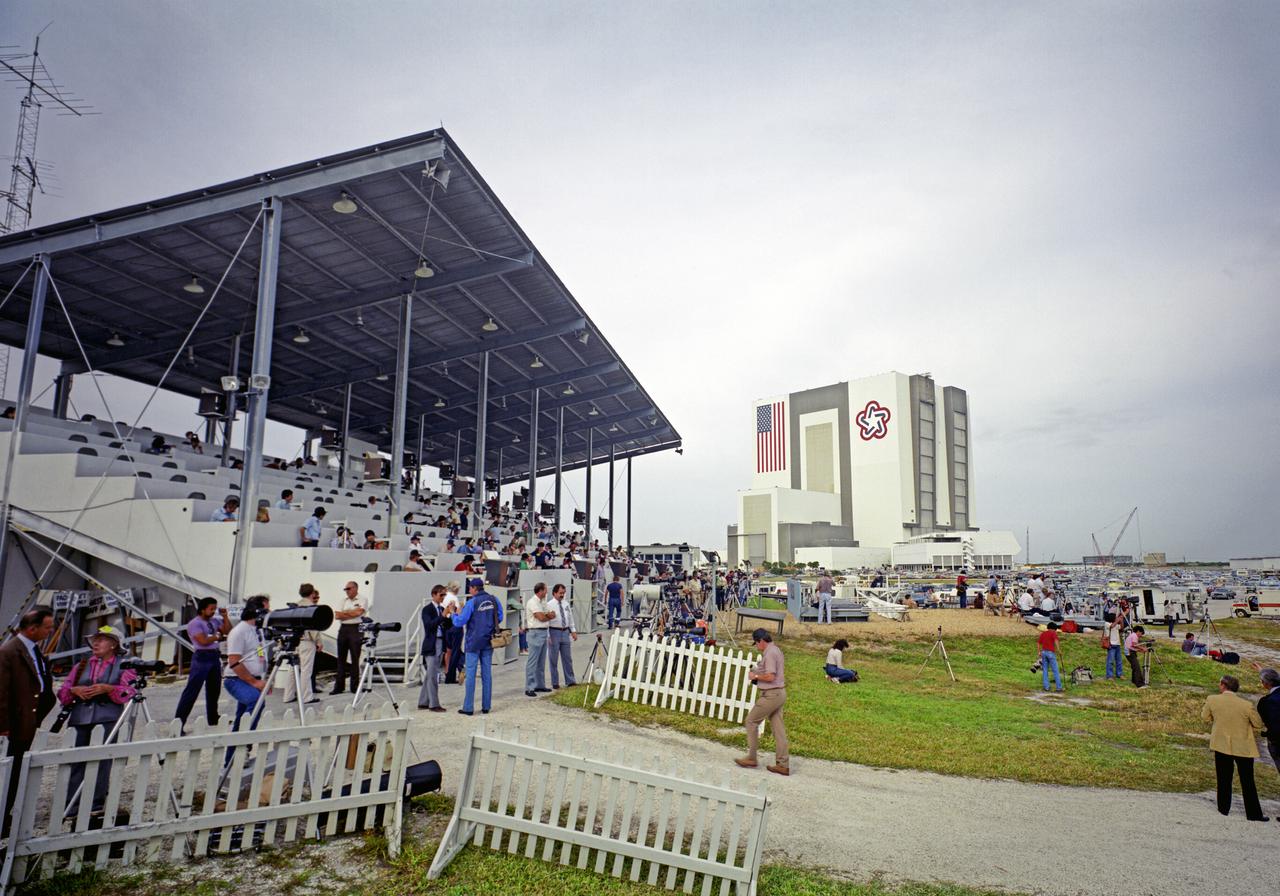
CAPE CANAVERAL, Fla. -- Minutes before STS-9 launch, nearly 1,000 news media representatives gather at the Press Site to prepare for coverage of the launch. Photo credit: NASA
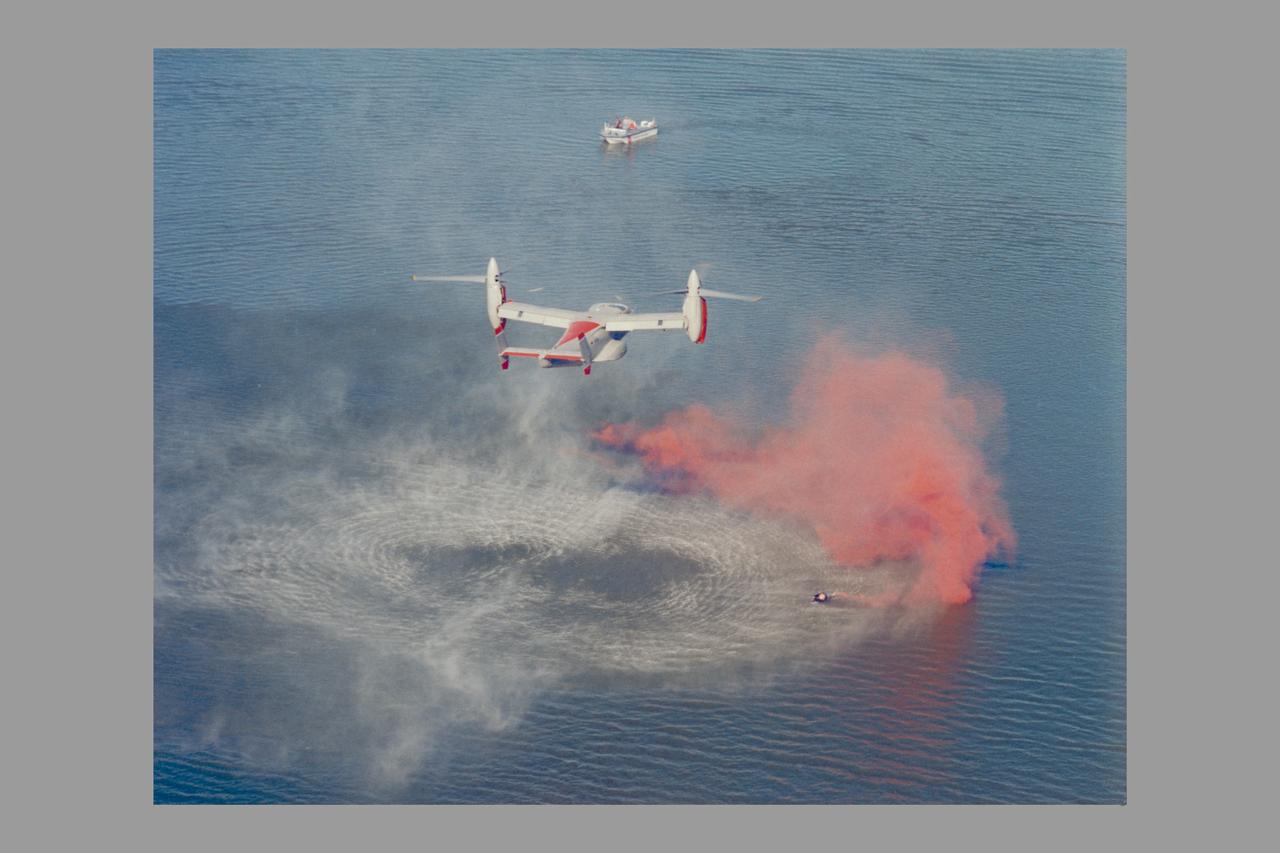
Bell XV-15 Tilt Rotor Army Configurations; Rescue
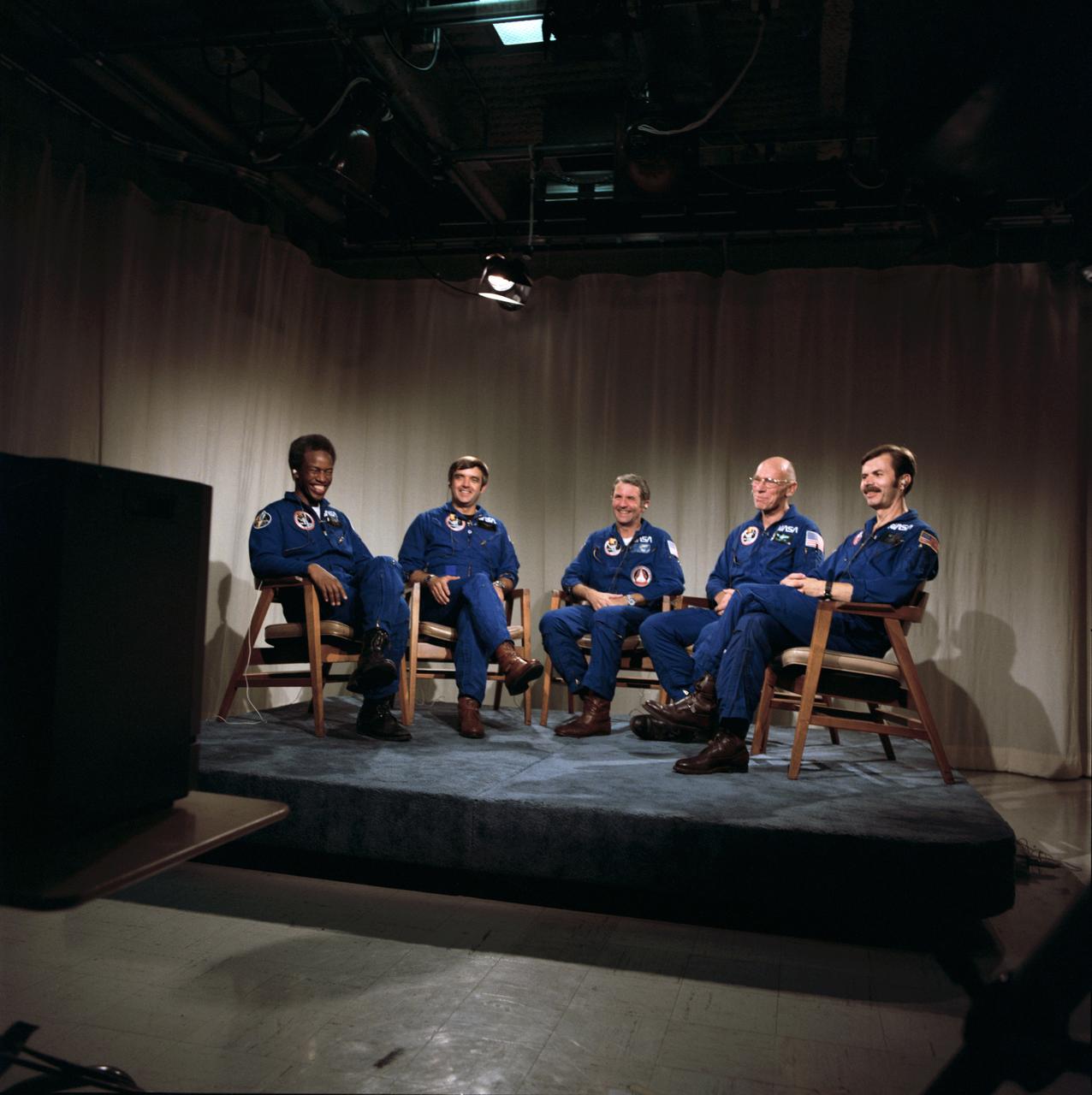
S83-39693 (5 Sept 1983) --- The five member astronaut crew of the Space Shuttle Challenger for STS-8 responds to a comment made by President Ronald Reagan during a post flight telephone conversation with the chief executive. The five astronauts earlier today landed the reusable spacecraft at Edwards Air Force Base in California and were flown to JSC via NASA aircraft. Richard H. Truly, center, is crew commander. Pilot for the six day flight was Daniel C. Brandenstein, second left. The mission specialist were Guion S. Bluford, left: Dr. William S. Thornton, second right, and Dale A. Gardner, right.
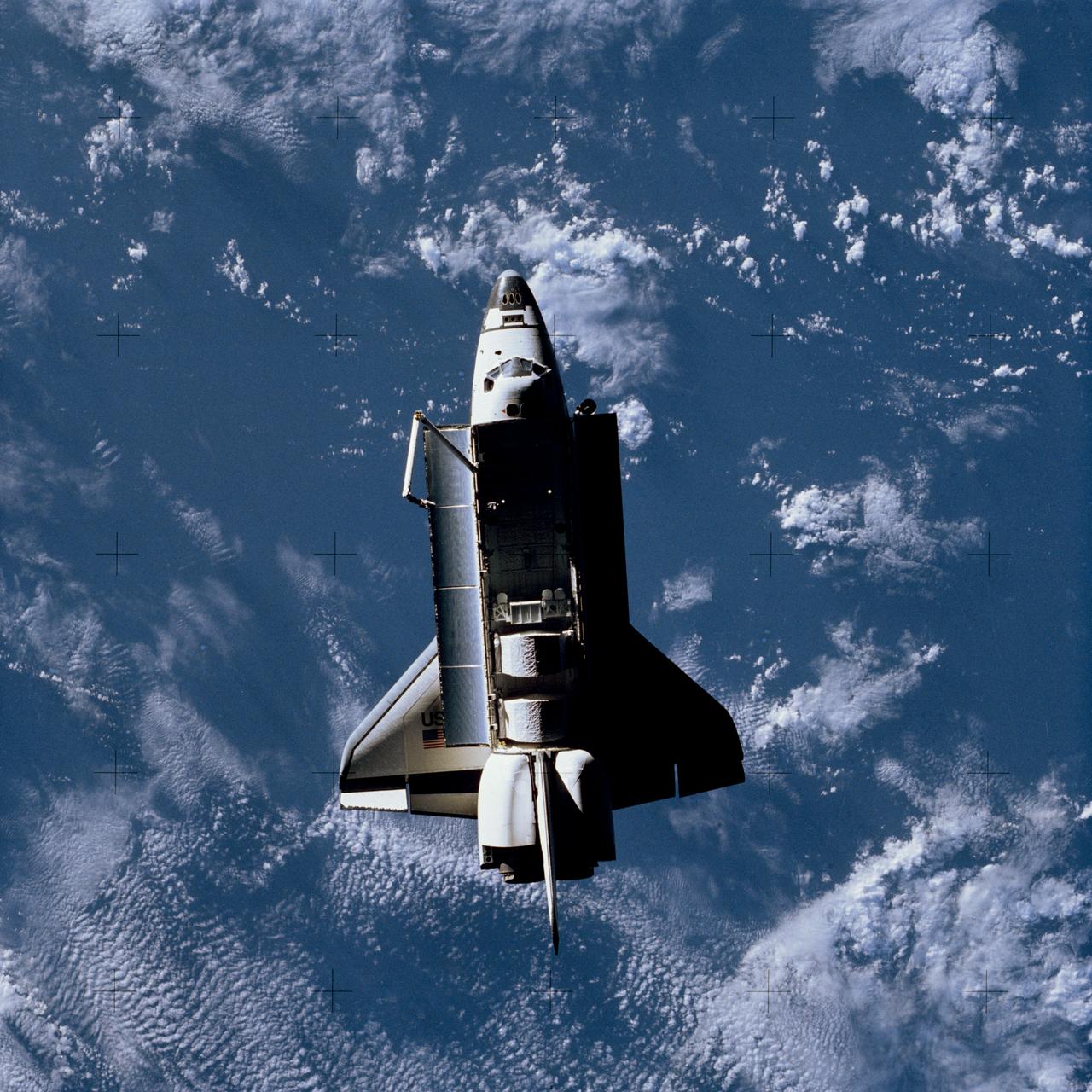
Full views of "Challenger" in Space, taken by the Shuttle Pallet Satellite (SPAS), also views of Cargo Bay and Remote Manipulator System (RMS) extended. 1. SHUTTLE - RMS (STS-7) Also available in 4x5 CN

White Sands Galileo balloon drop test at White Sands New Mexico
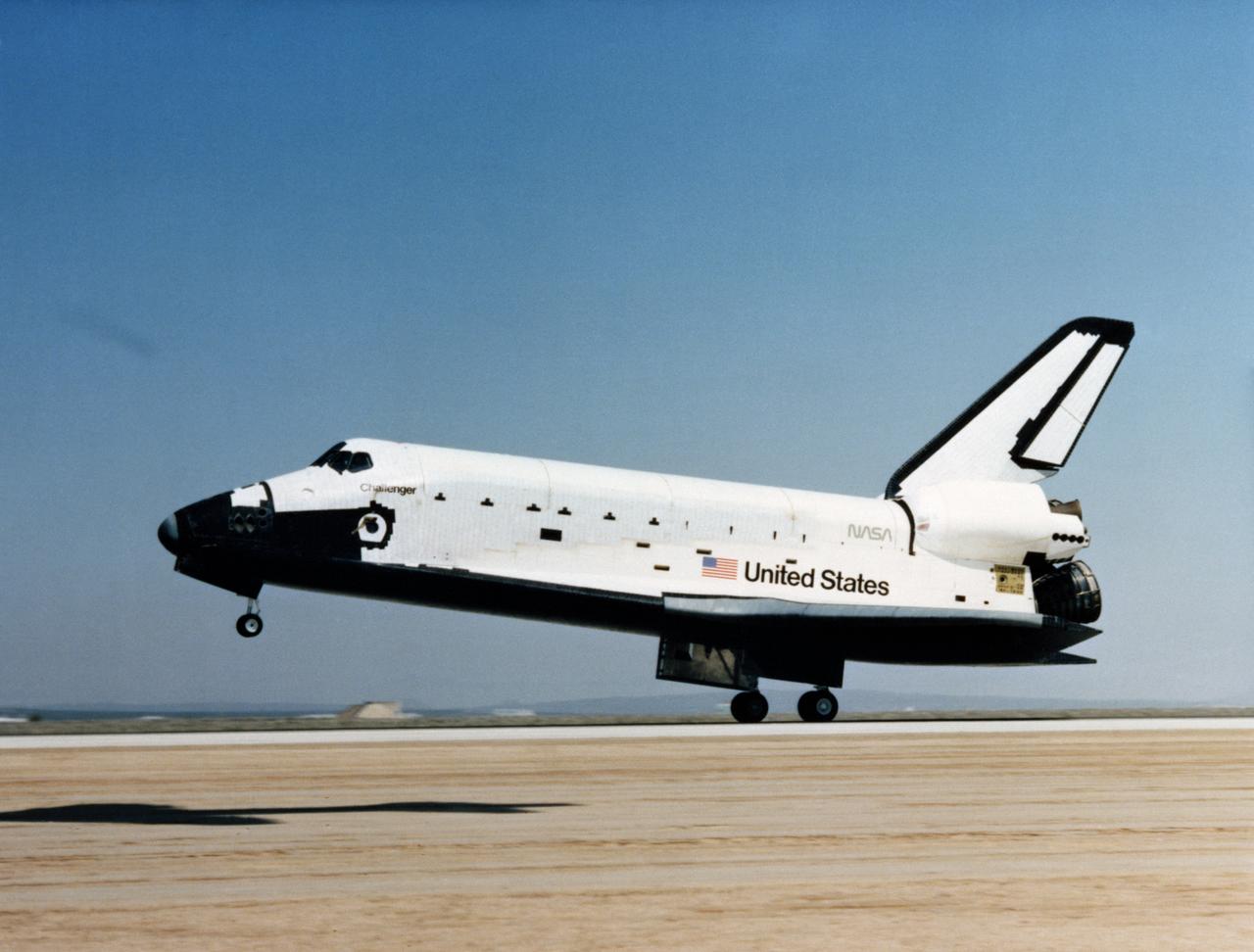
S83-30220 (9 April 1983) --- The space shuttle Challenger makes its first landing shortly before 11 a.m. (PST) on April 9, 1983, on Runway 22 at the Edwards Air Force Base in Southern California. Onboard the reusable spacecraft, having just completed a successful five-day mission, are astronauts Paul J. Weitz, Karol J. Bobko, F. Story Musgrave and Donald H. Peterson. Photo credit: NASA
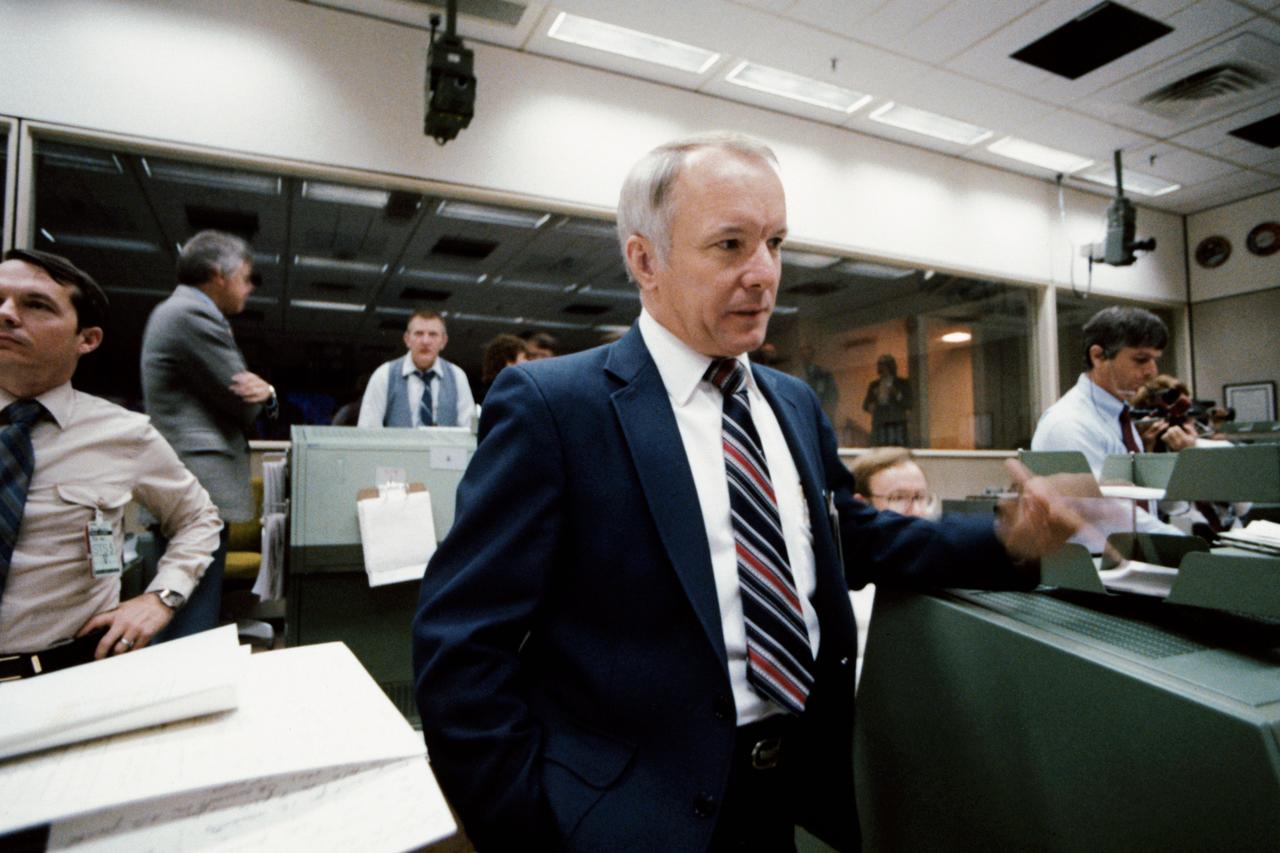
Views of MOCR activity during the STS-5 Mission (11/11-16/1982) of Dr. Hans Mark, NASA Deputy Administrator; Gerald Griffin; portrait of the STS-5 Flight Directors, Flight Director (FD) Cox and Lt. Gen. James A. Abrahamson, Associate Administrator for Space Flight, in the MOCR during the STS-5 Mission. 1. Abrahamson, J. T., Gen,.- STS-5 MOCR 2. Flight Directors - STS-5 MOCR 3. STS-5 - Inflight MOCR 4. Mark, Hans Dr. - STS-5 MOCR 5. Dir. Griffin, Gerald- STS-5 MOCR JSC, Houston, TX. S83-27153 thru S83-27158
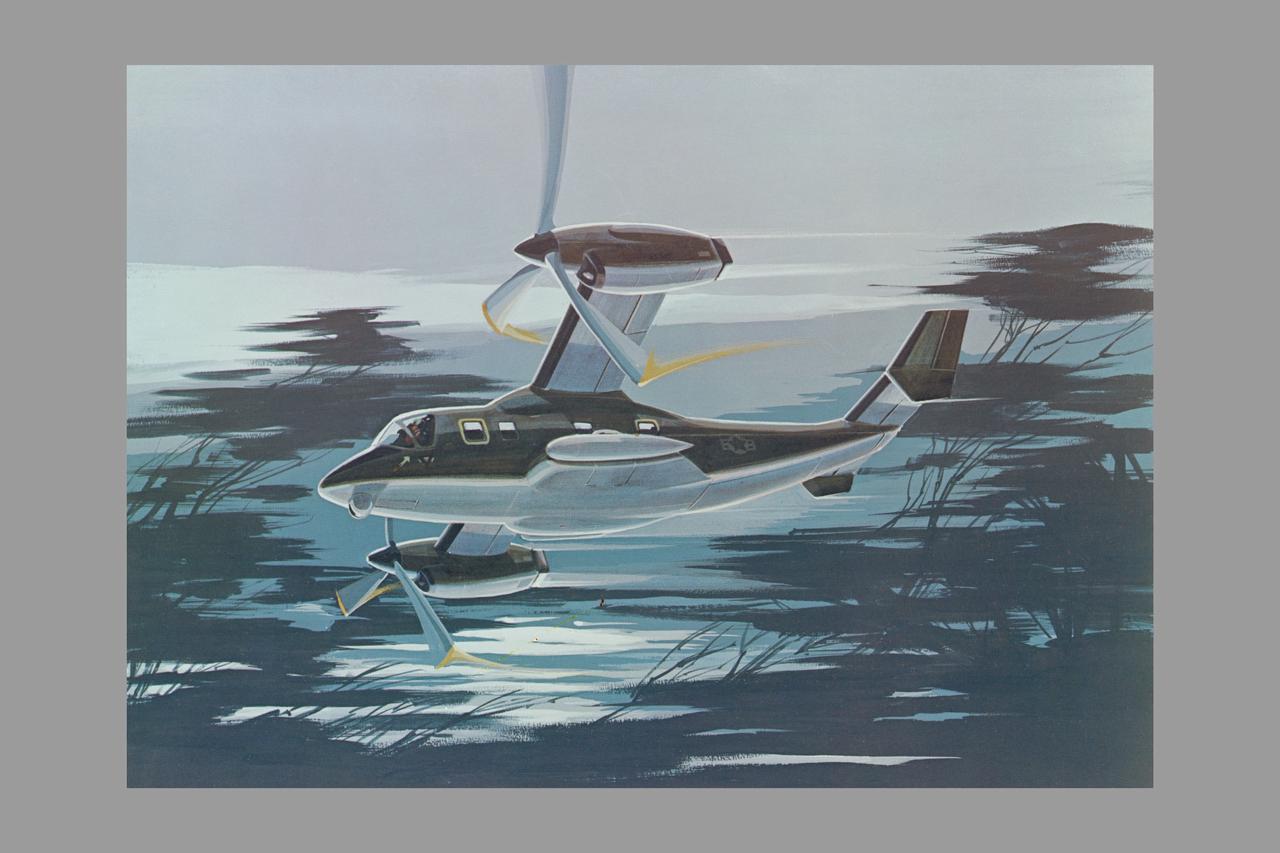
Bell XV-15 Tilt Rotor Army Configurations; Combat, Rescue, and JVX artist renderings
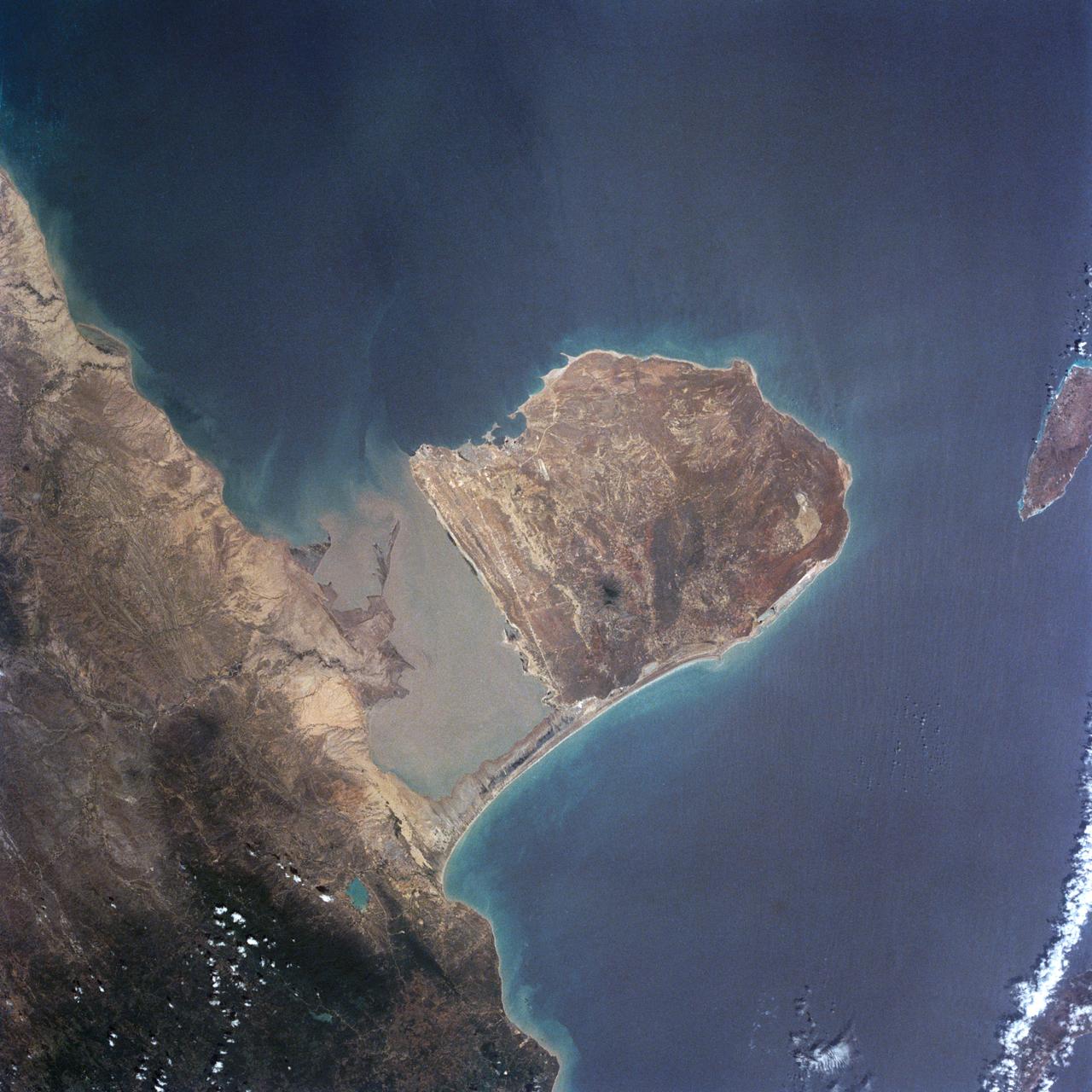
Various views of Earth taken on STS-7 for news release.