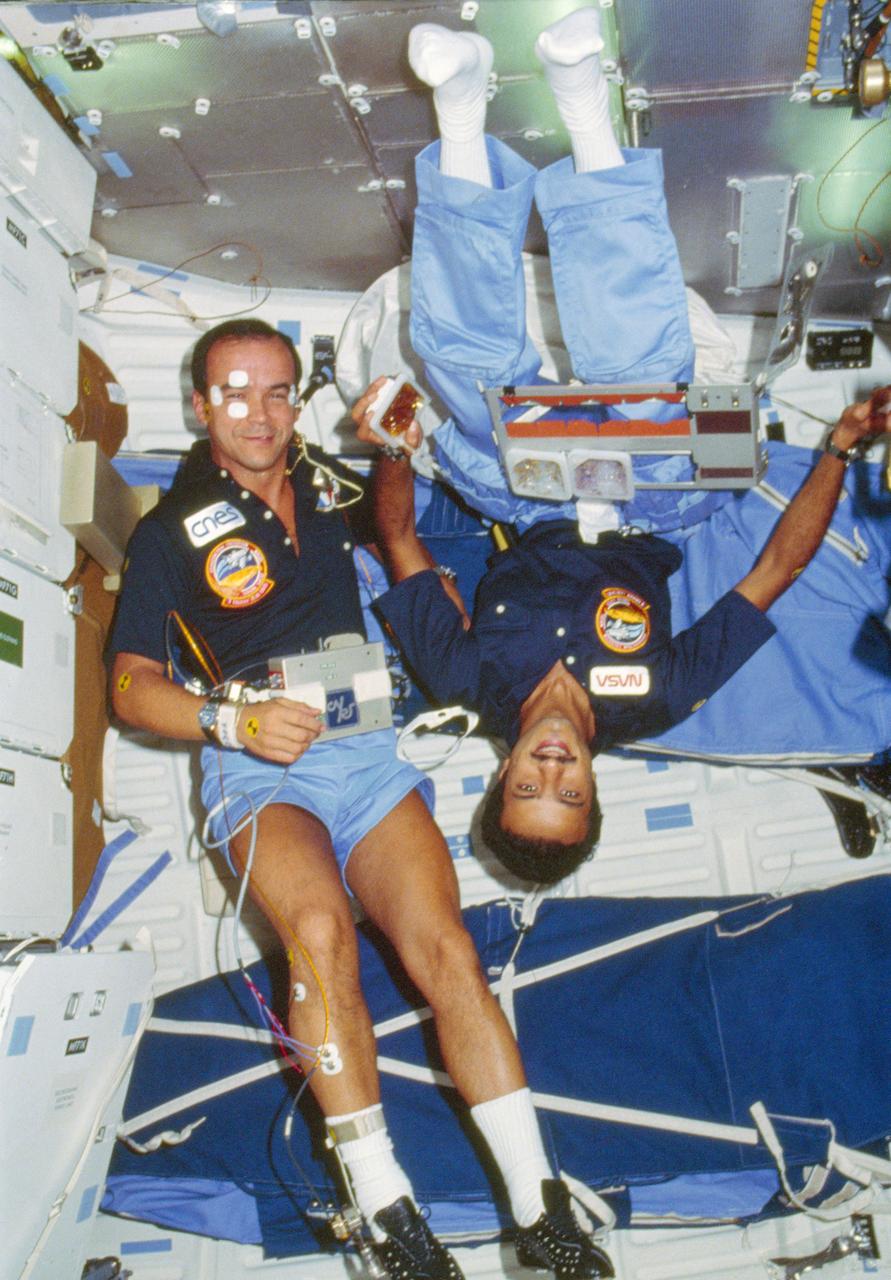
51G-102-035 (17-24 June 1985) --- The two payload specialists for the week-long flight share a middeck scene on the earth-orbiting Discovery. Sultan Salman Abdelazize Al-Saud (left) is in the midst of a meal while Patrick Baudry conducts a phase of the French Postural Experiment (FPE) on himself. Sleep restraints are in the background.
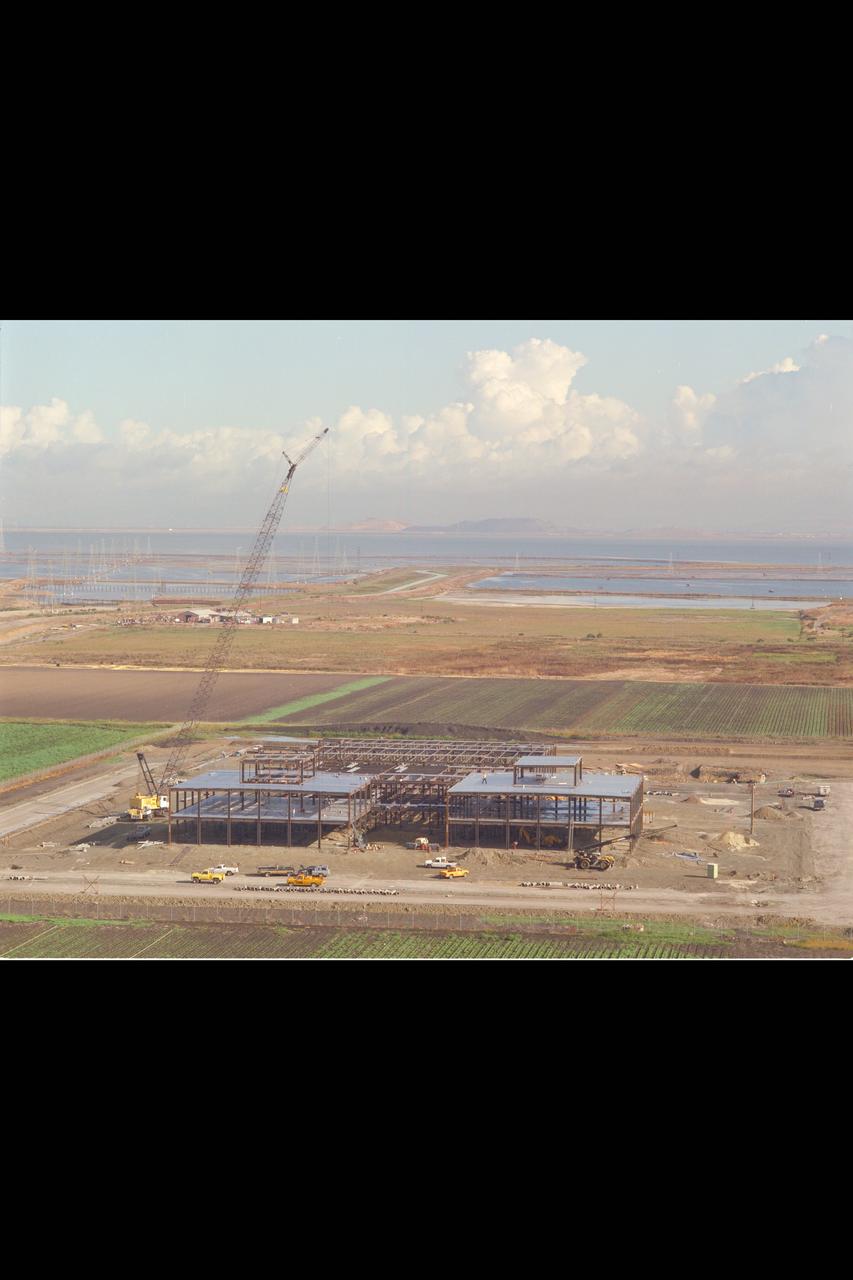
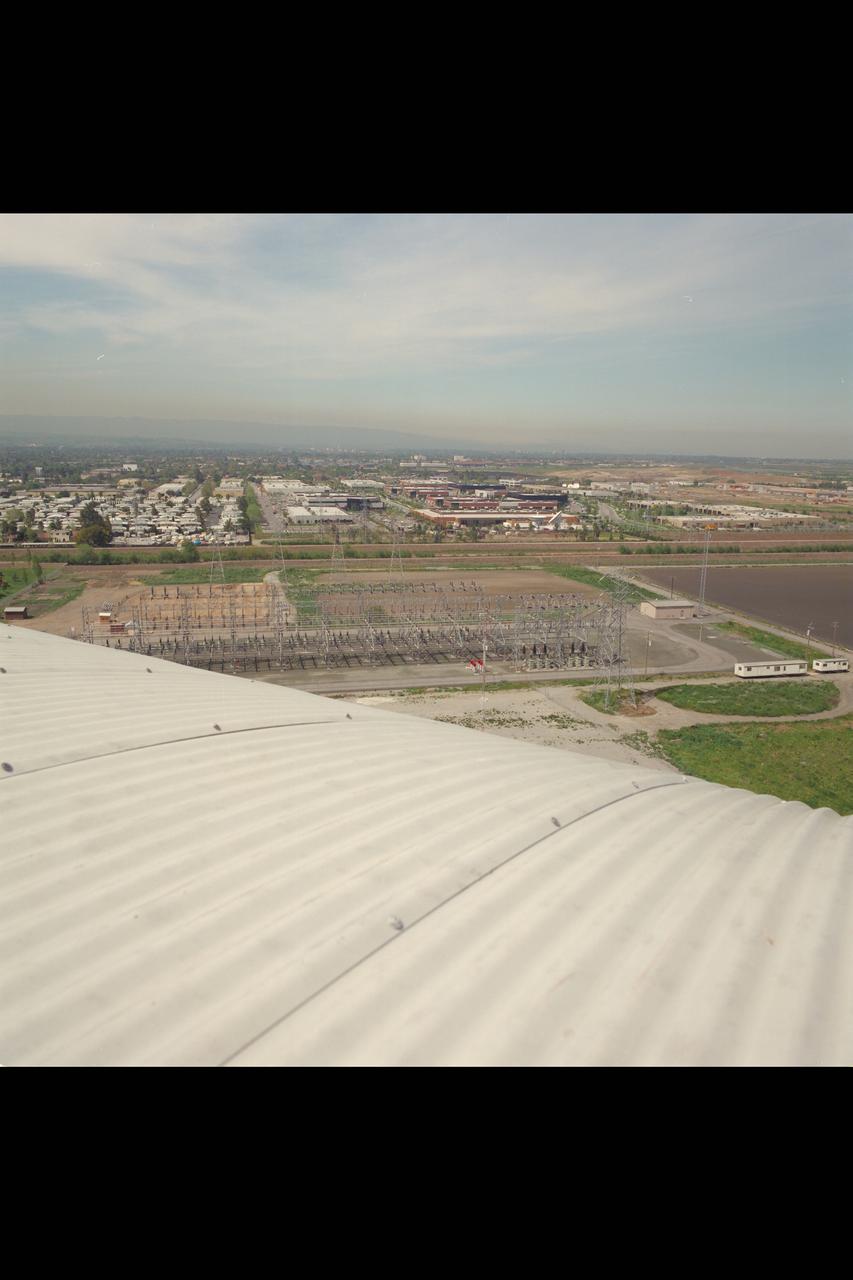
N-258 NAS (Numerical Aerodynamic Simulation) Facility, Roof Top Aerials of construction site, framing
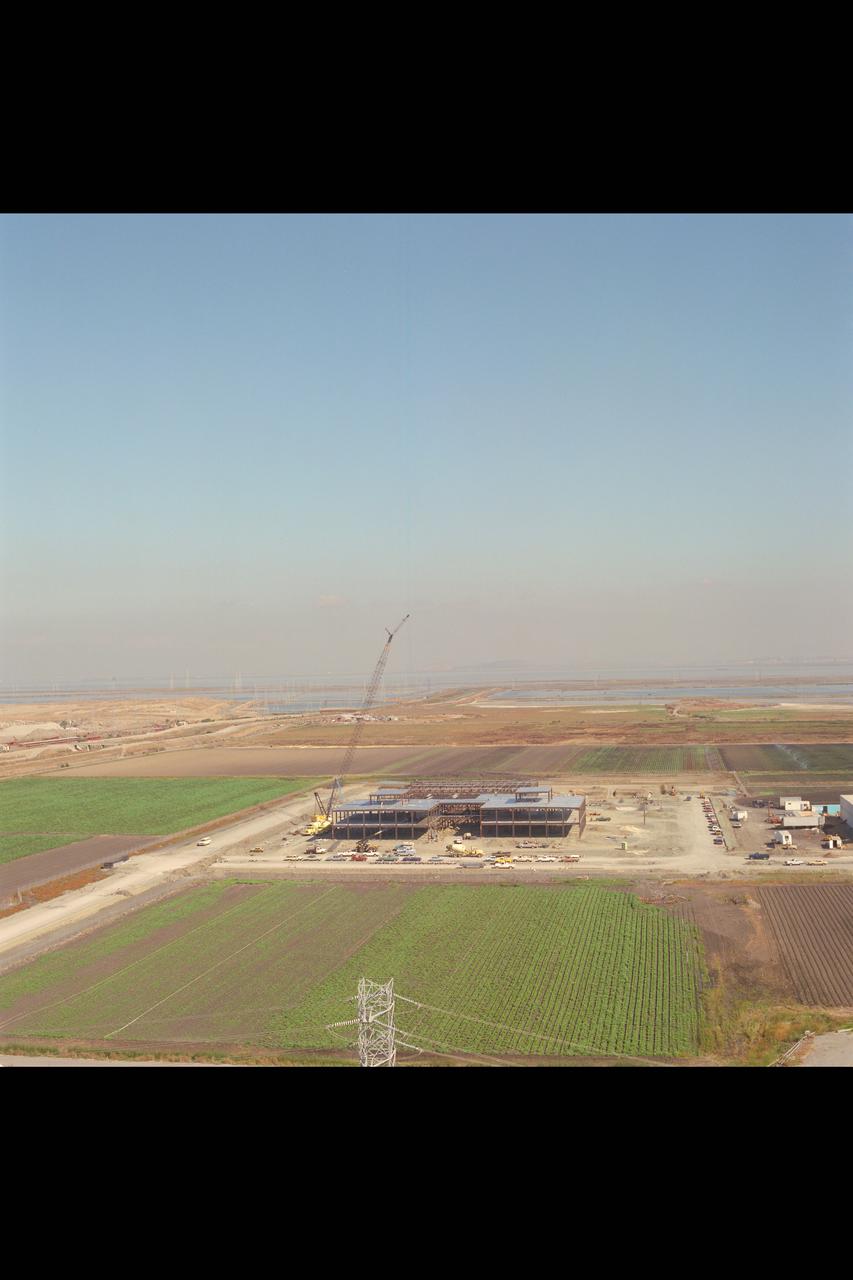
N-258 NAS (Numerical Aerodynamic Simulation) Facility, Roof Top Aerials of construction site, framing
U-2 in Over Flight @ AMES
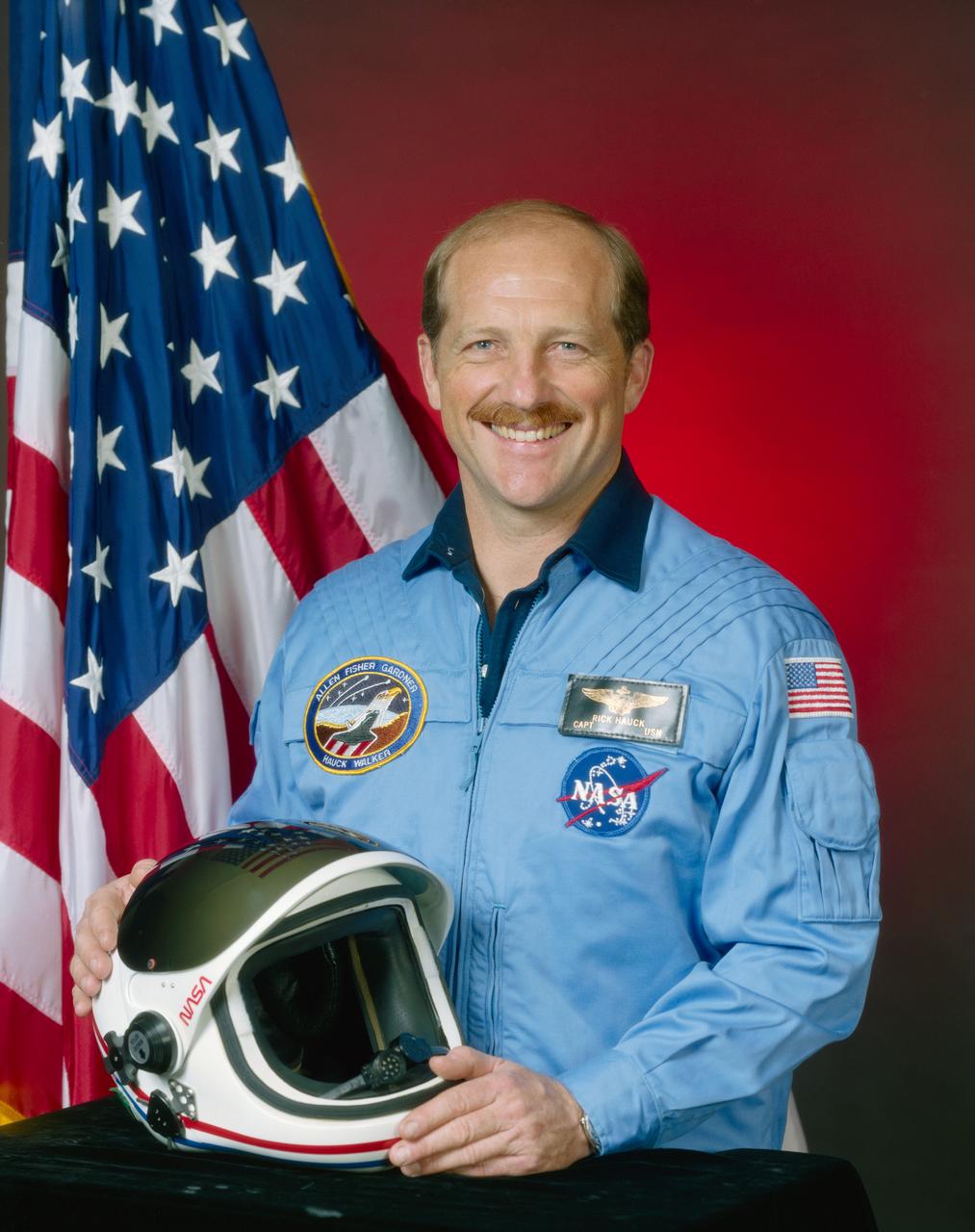
S85-36058 (1985) --- Astronaut Frederick H. "Rick" Hauck
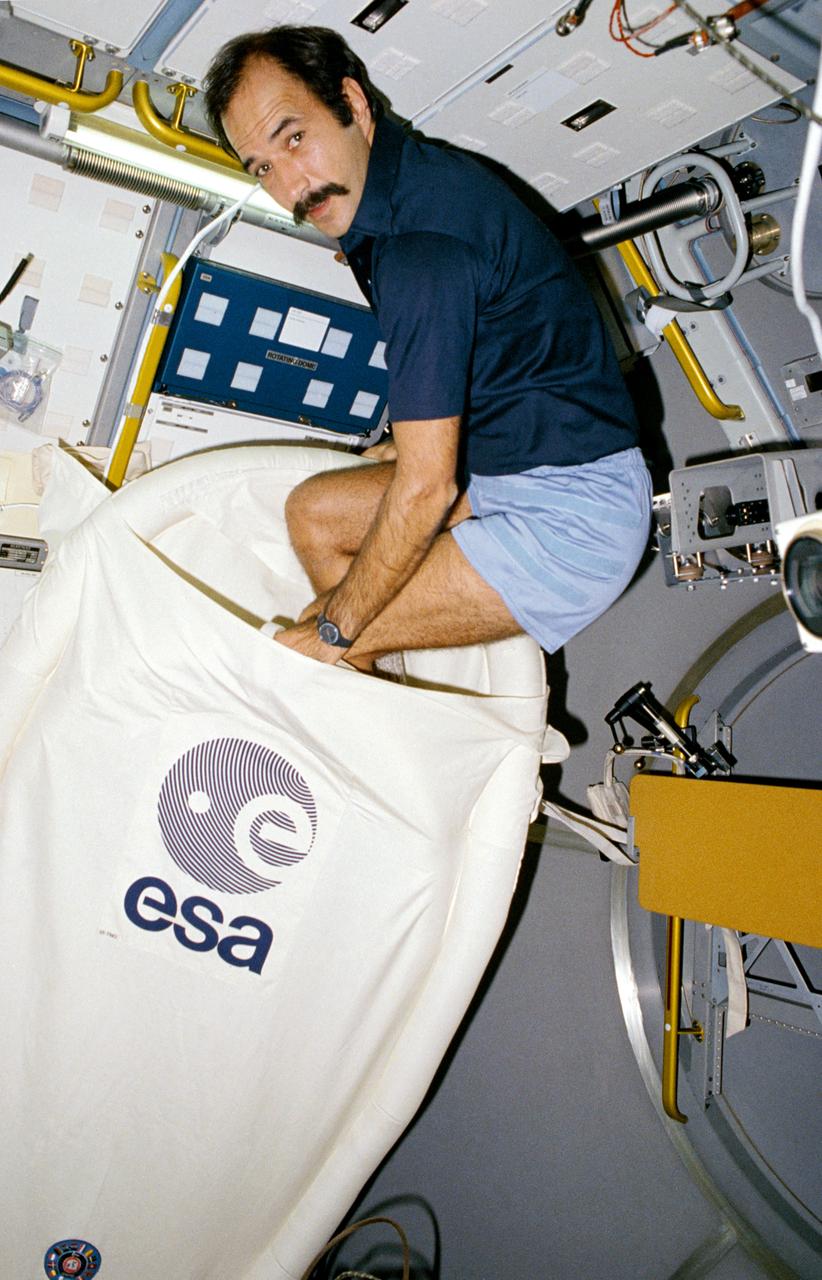
61A-08-018 (30 Oct.-6 Nov. 1985) --- Wubbo J. Ockels, a Dutch scientists representing the European Space Agency (ESA), crawls from an unique sleeping restraint in D-1 science module. Unlike the other crewmembers on STS 61A, Ockels did not sleep in the middeck of the Challenger. Ockels proposed this concept of sleeping facility and the actual hardware was developed by the Technisch Natur Wetenschappelyk Onderzoek (TNO), a Dutch government organization.
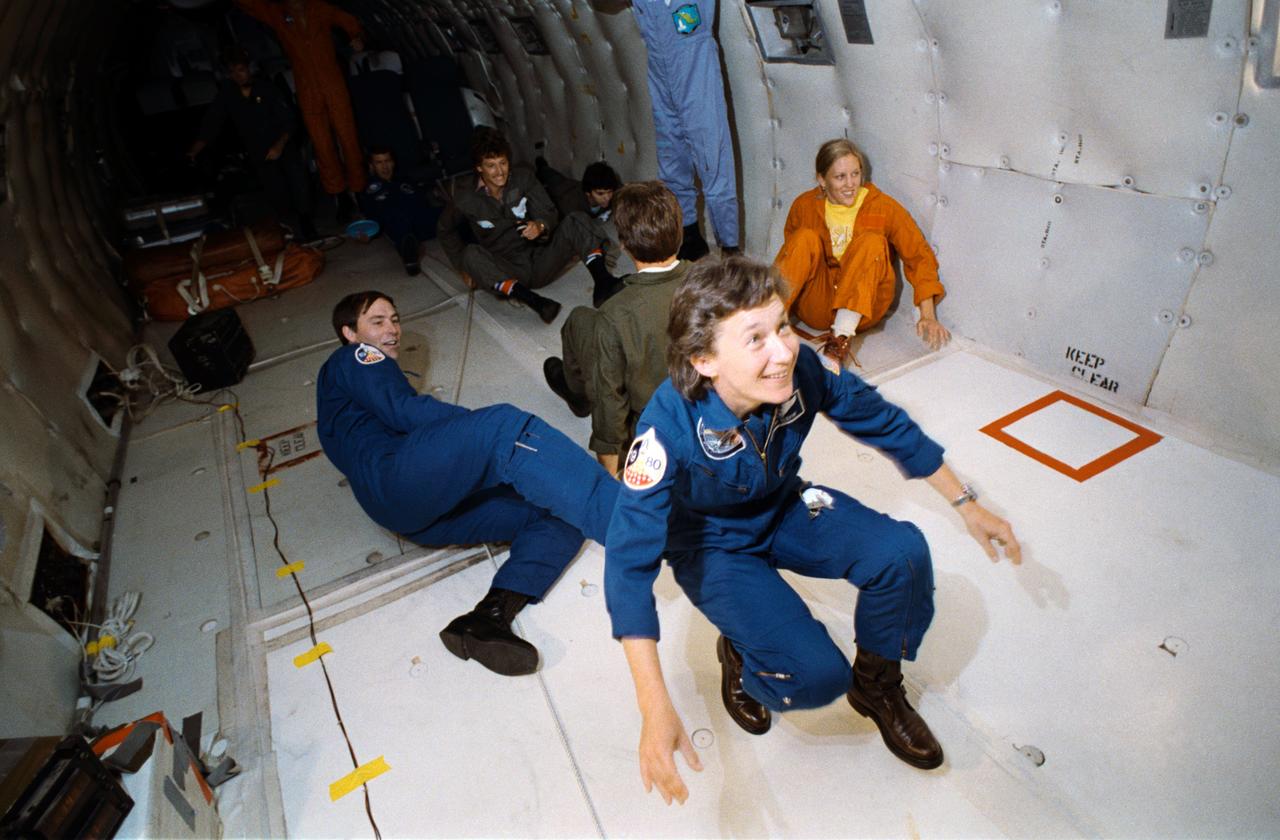
KC-135 inflight training of the STS-30/61B Crew for suit donning doffing and Zero-G orientation for Rudolfo Neri, Astronaut Mary Cleave, and Ricardo Peralta, Backup Neri. 1. Astronaut Cleave, Mary - Zero-G 2. Neri, Rodolfo - Zero-G 3. Peralta, Ricard - Zero-G
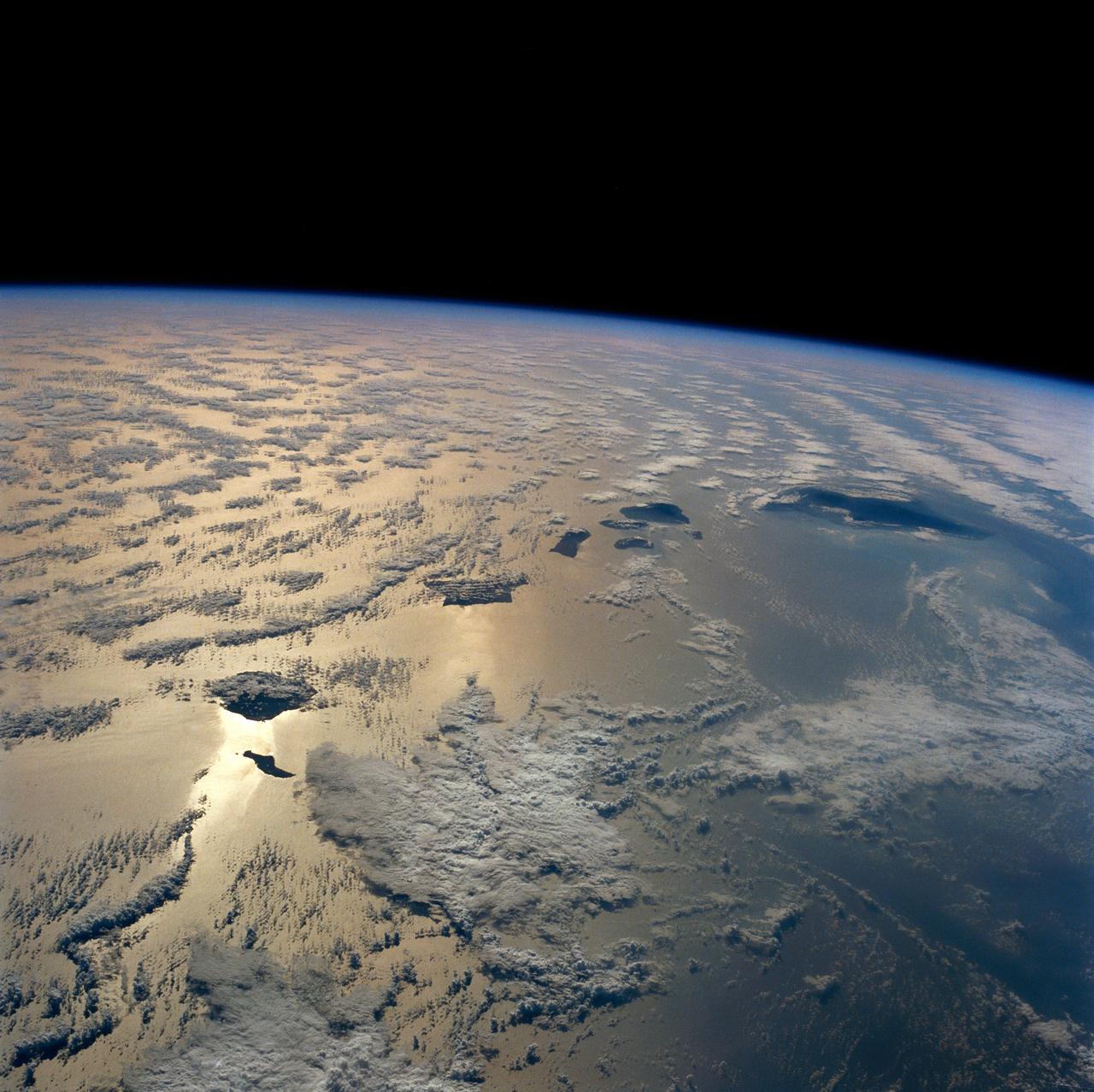
The entire Hawaiian Island Archipelago (21.5N, 158.0W) is seen in this single view. The islands are a favorite international resort and tourist attraction drawing visitors from all over the world to enjoy the tropical climate, year round beaches and lush island flora. Being volcanic in origin, the islands' offer a rugged landscape and on the big island of Hawaii, there is still an occasional volcanic eruption of lava flows and steam vents.
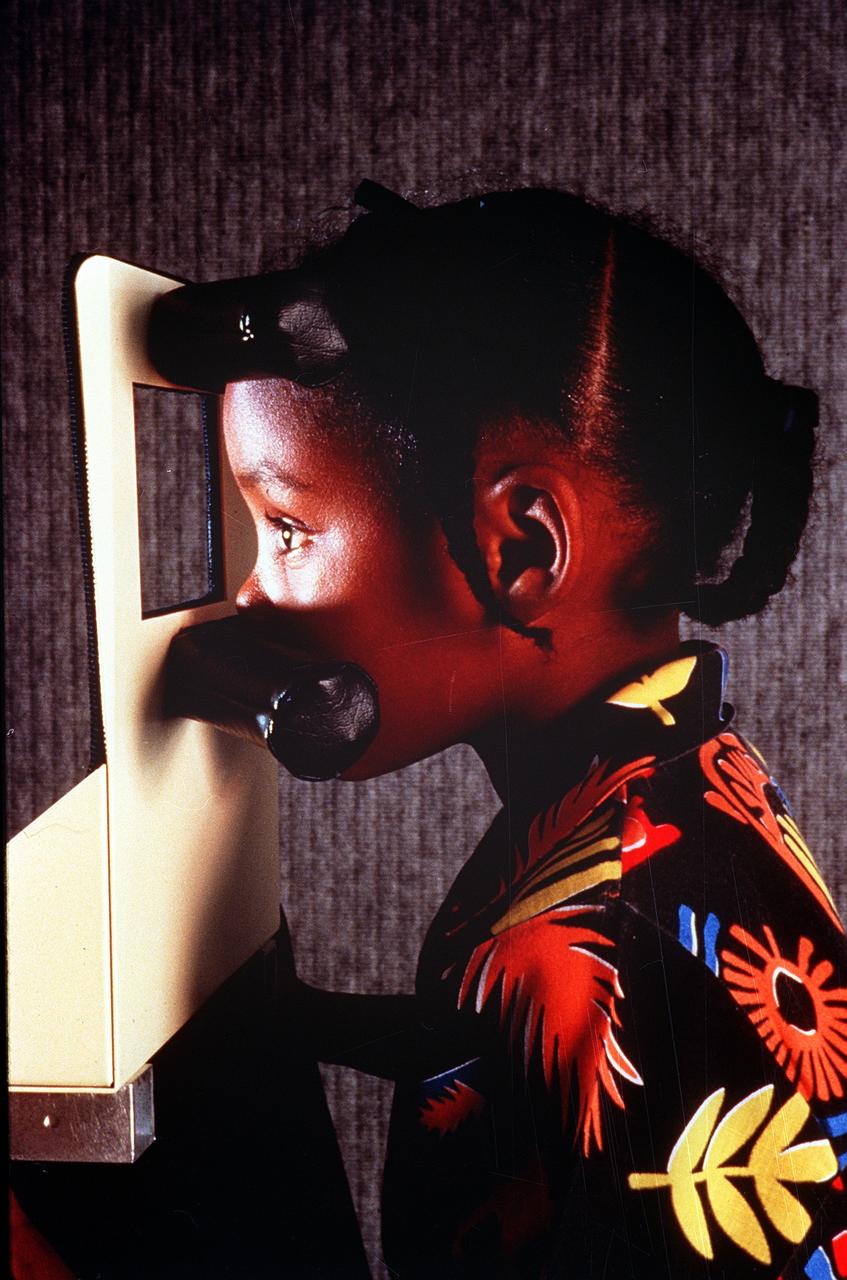
The NASA imaging processing technology, an advanced computer technique to enhance images sent to Earth in digital form by distant spacecraft, helped develop a new vision screening process. The Ocular Vision Screening system, an important step in preventing vision impairment, is a portable device designed especially to detect eye problems in children through the analysis of retinal reflexes.
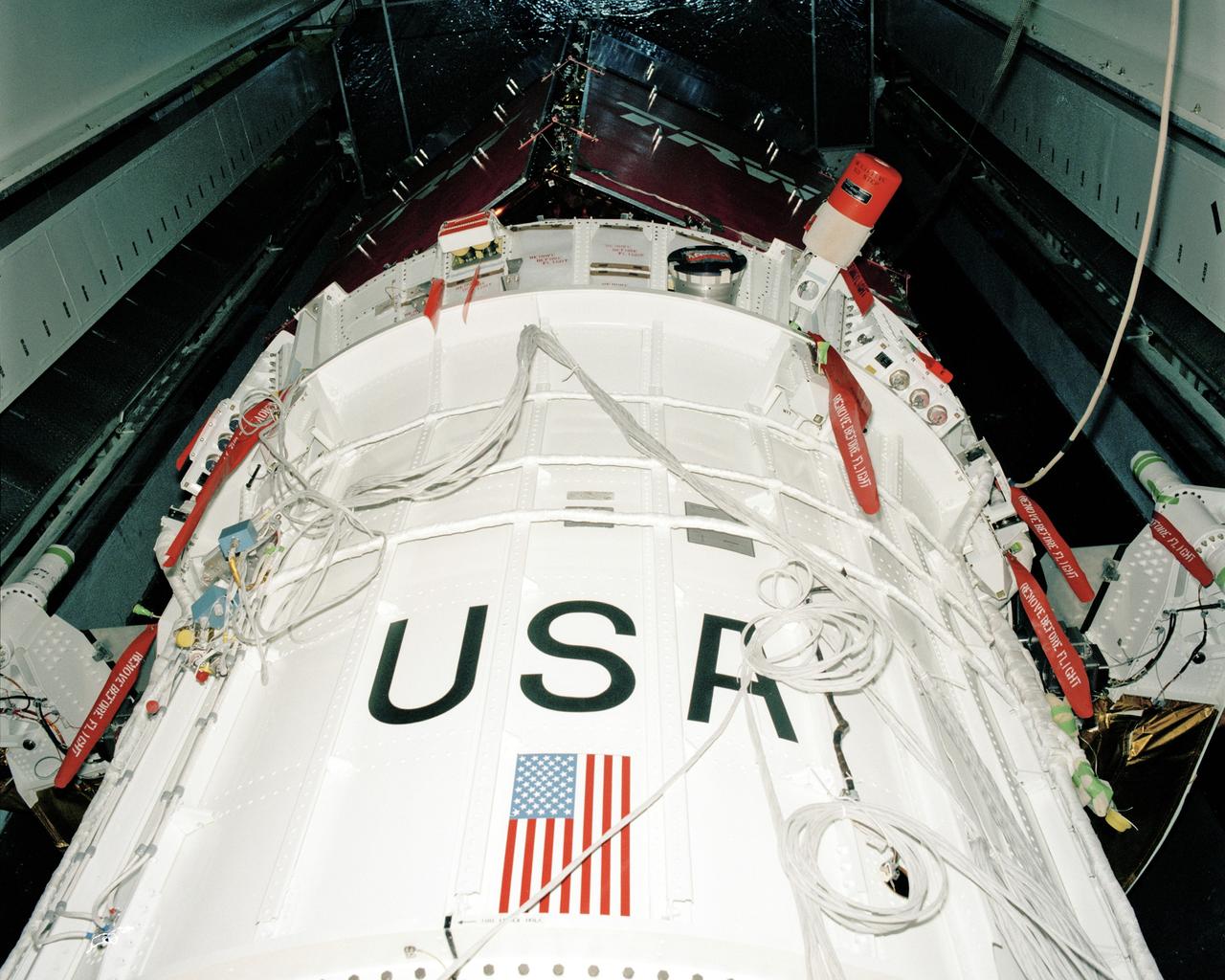
CAPE CANAVERAL, Fla. – ANIK/TDRS installation into payload canister. Photo credit: NASA
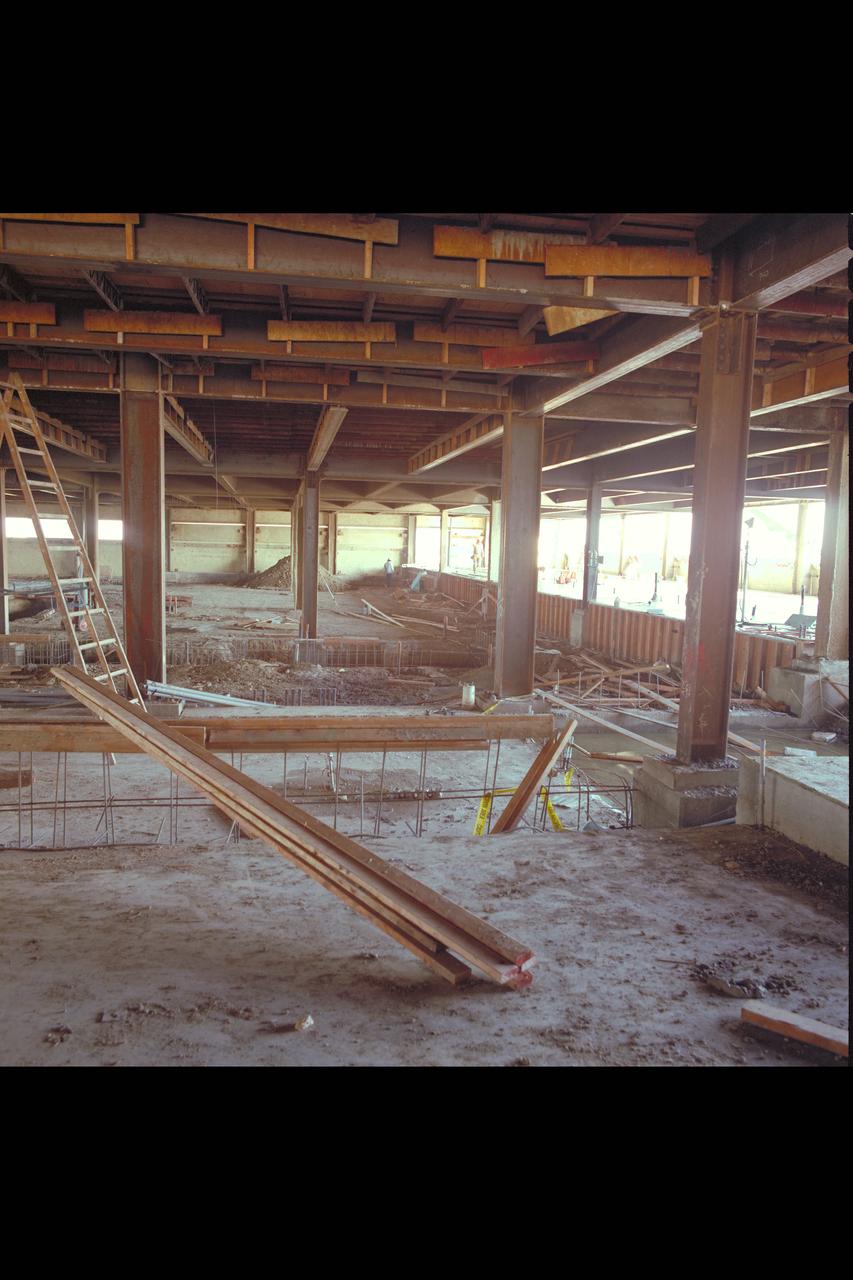
N-258 NAS (Numerical Aerodynamic Simulation) Facility, Interior of Construction Site, Framing

CAPE CANAVERAL, Fla. – At the Kennedy Space Center in Florida, the new space shuttle, Atlantis, arrives at the Shuttle Landing Facility. The shuttle is mounted atop the Shuttle Carrier Aircraft, a modified Boeing 747. Over the next seven months Atlantis will be prepared for its maiden voyage, STS-51J. Atlantis, NASA's fourth space-rated shuttle, was named after the two-masted boat that served as the primary research vessel for the Woods Hole Oceanographic Institute in Massachusetts from 1930 to 1966. The boat had a 17-member crew and accommodated up to five scientists who worked in two onboard laboratories, examining water samples and marine life. Like its predecessors, Atlantis was constructed by Rockwell International in Palmdale, Calif. The spacecraft was transported over land from Palmdale to Edwards Air Force Base on April 3, 1985 for the cross-country ferry flight to Kennedy. For more: http://www.nasa.gov/centers/kennedy/shuttleoperations/orbiters/atlantis-info.html Photo credit: NASA/Louie Rochefort
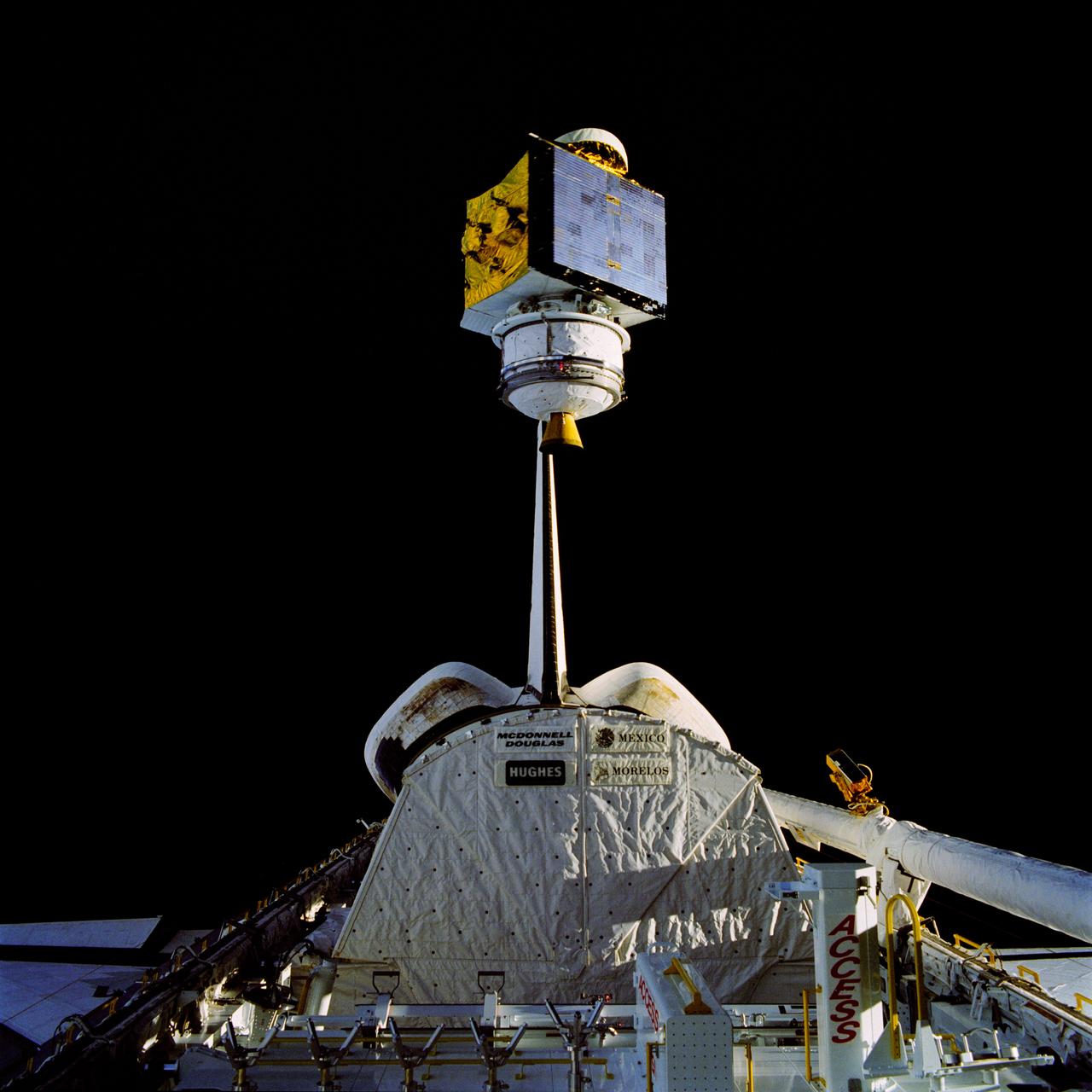
61B-38-36W (28 Nov 1985) --- The 4,144-pound RCA Satcom K-2 communications satellite is photographed as it spins from the cargo bay of the Earth-orbiting Atlantis. A TV camera at right records the deployment for a later playback to Earth. This frame was photographed with a handheld Hasselblad camera inside the spacecraft.
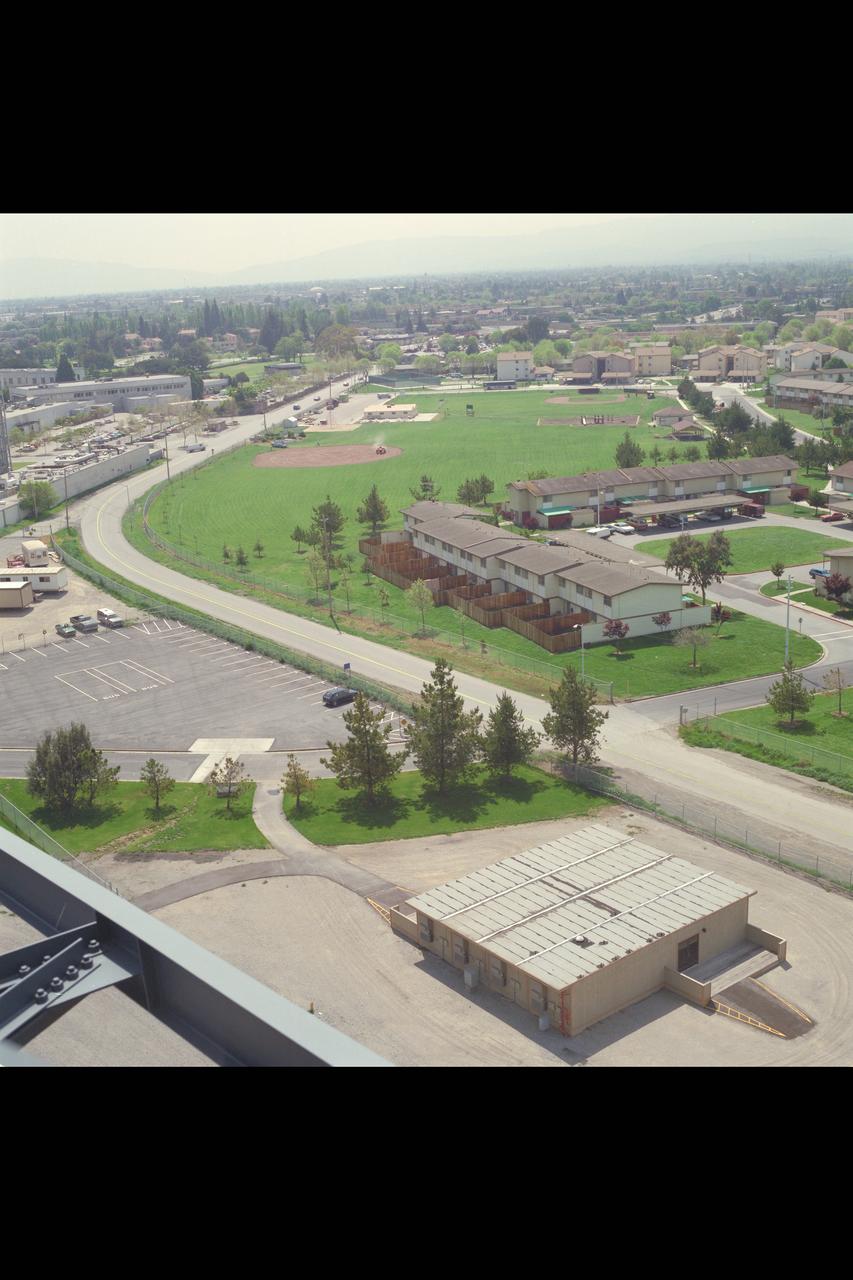
N-258 NAS (Numerical Aerodynamic Simulation) Facility: Construction
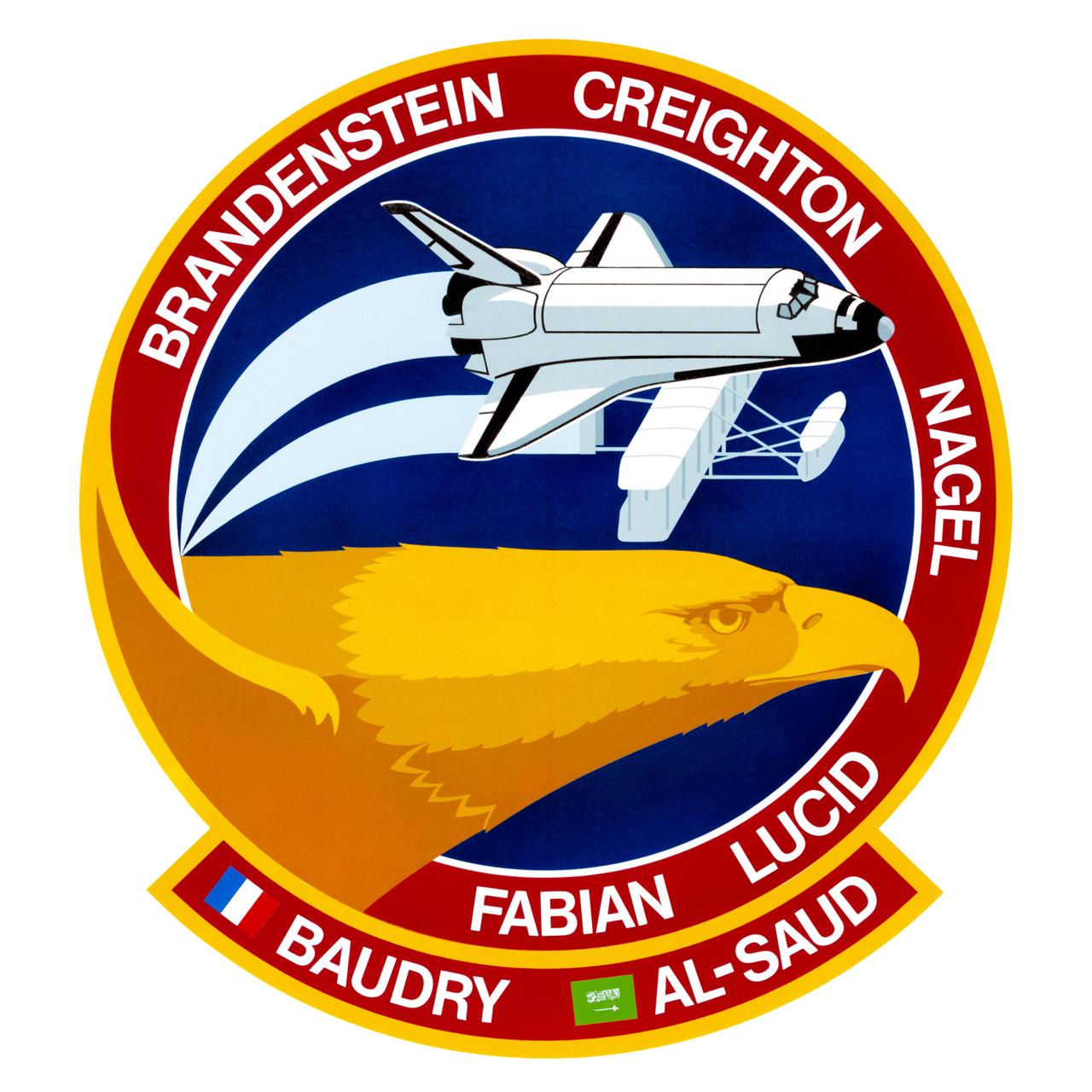
S85-31266 (May 1985) --- The STS-51G insignia illustrates the advances in aviation technology in the United States within a relatively short span of the twentieth century. The surnames of the crew members for the Discovery's mission appear near the center edge of the circular design. They are astronauts Daniel C. Brandenstein, mission commander; John O. Creighton, pilot; John M. Fabian, Steven R. Nagel and Shannon W. Lucid, mission specialists; Sultan Salman Abdelazize Al-Saud and Patrick Baudry, payload specialists. Al-Saud is flying as part of the reimbursable agreement with the Arab Satellite Communications Organization covering the launch of the Arabsat 1B communications satellite and Baudry represents France's Centre National d'Etudes Spatiales. The NASA insignia design for space shuttle flights is reserved for use by the astronauts and for other official use as the NASA Administrator may authorize. Public availability has been approved only in the forms of illustrations by the various news media. When and if there is any change in this policy, which is not anticipated, the change will be publicly announced. Photo credit: NASA
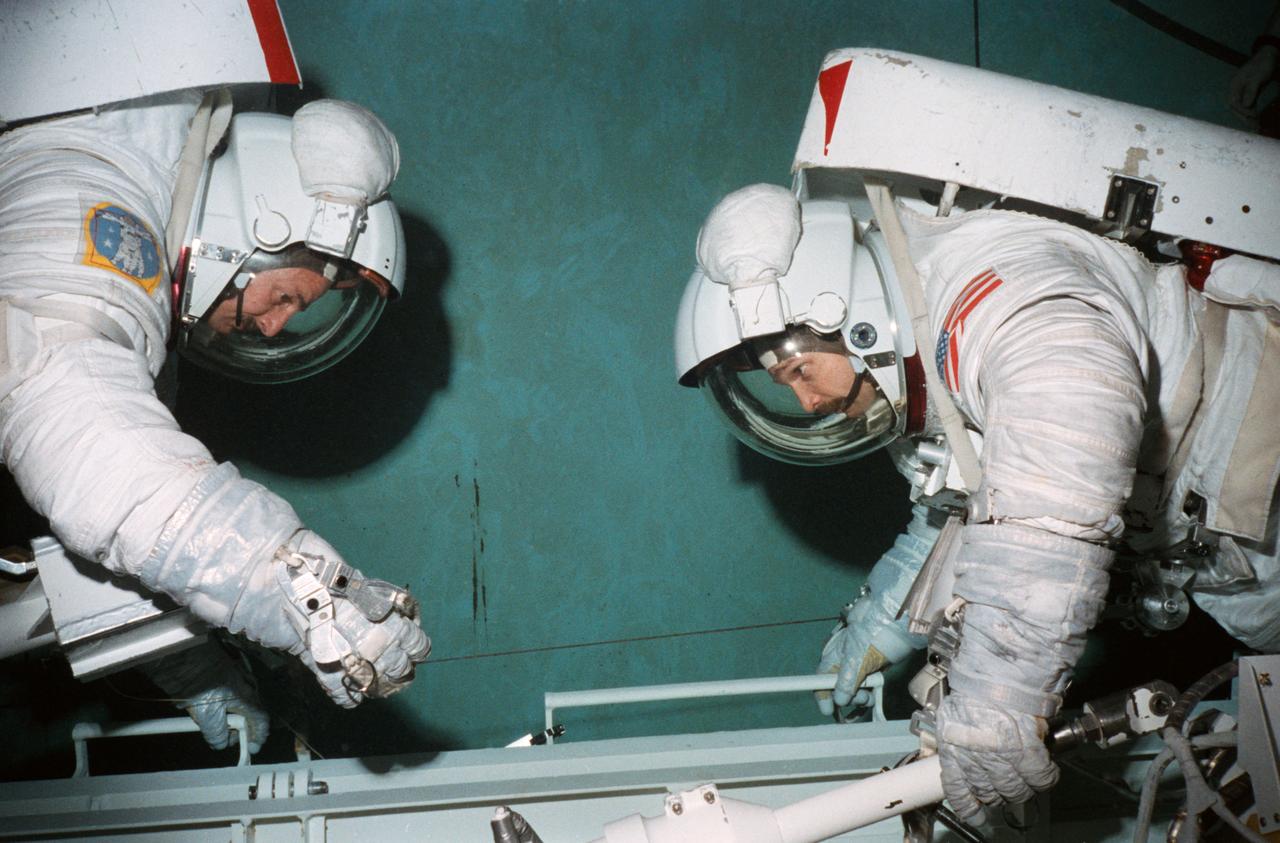
Astronauts David Griggs and Jeffrey Hoffman in Egress Training. 1. ASTRONAUT GRIGGS, DAVID - STS-51E 2. STS-51E - CREW TRAINING JSC, HOUSTON, TX
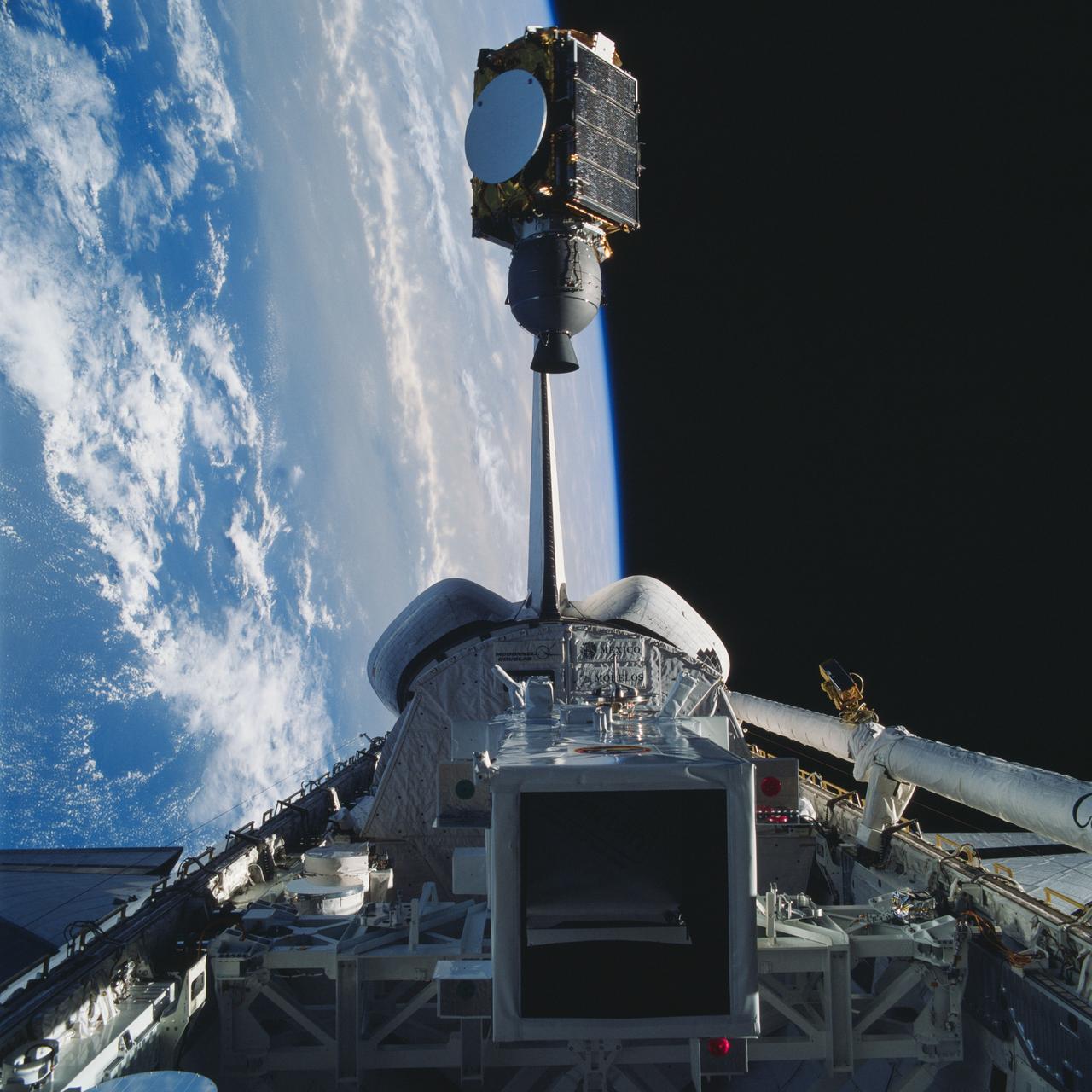
Arabsat communications satellite deploying from Discovery's payload bay. Cloudy Earth's surface can be seen to the left of the frame.
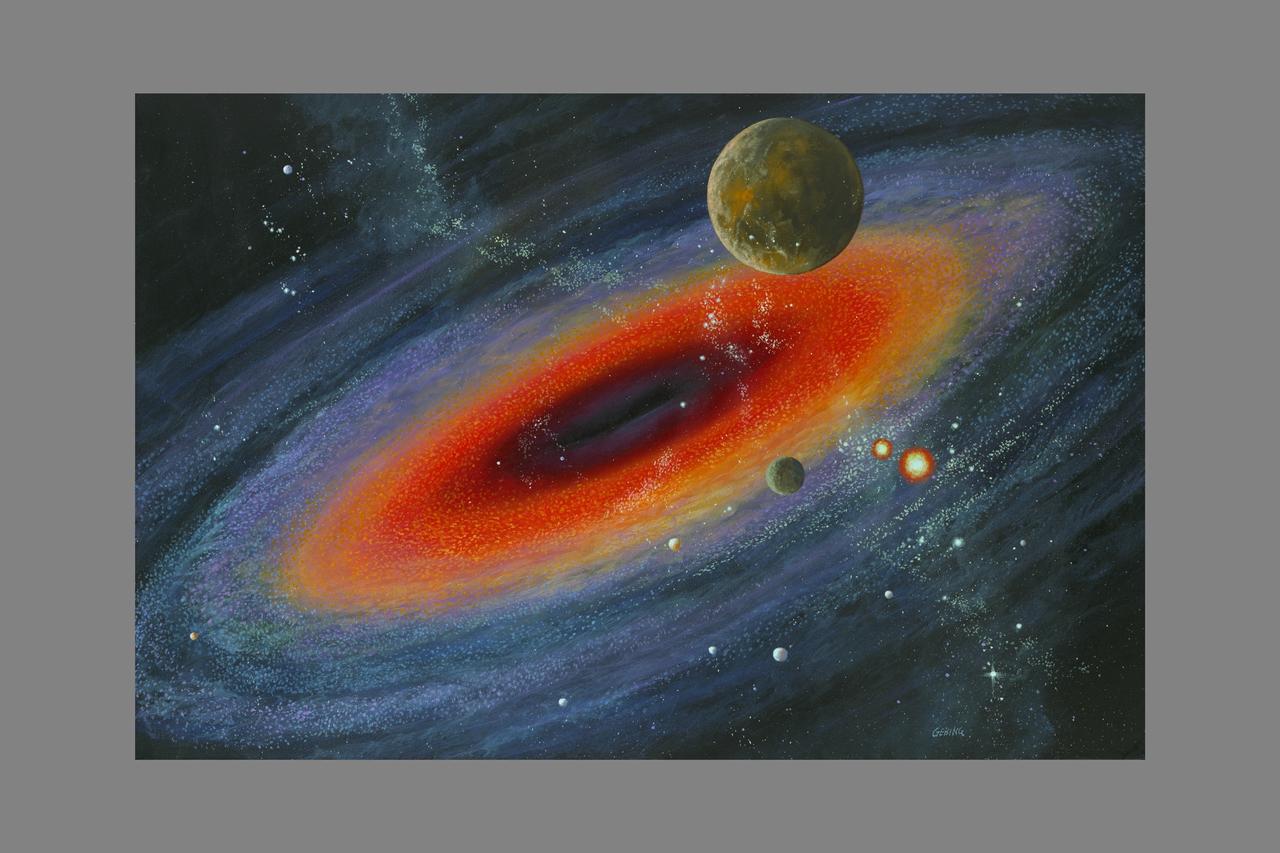
Artist: Gebing Artist's conception of a newborne star, still hidden in visible light by the dust clouds within which it formed, shows matter in orbit around the rotating star. Such leftover debris may eventually form comets, planets, satellites, and asteroids. Material squeezed out by the formation process is thought to be ejected along the star's rotation axis in relatively narrow, high-velocity streams of matter. (ref: SIRTF borchure 'A Window on Cosmic Birth 1987) -- Milky Way with Black hole
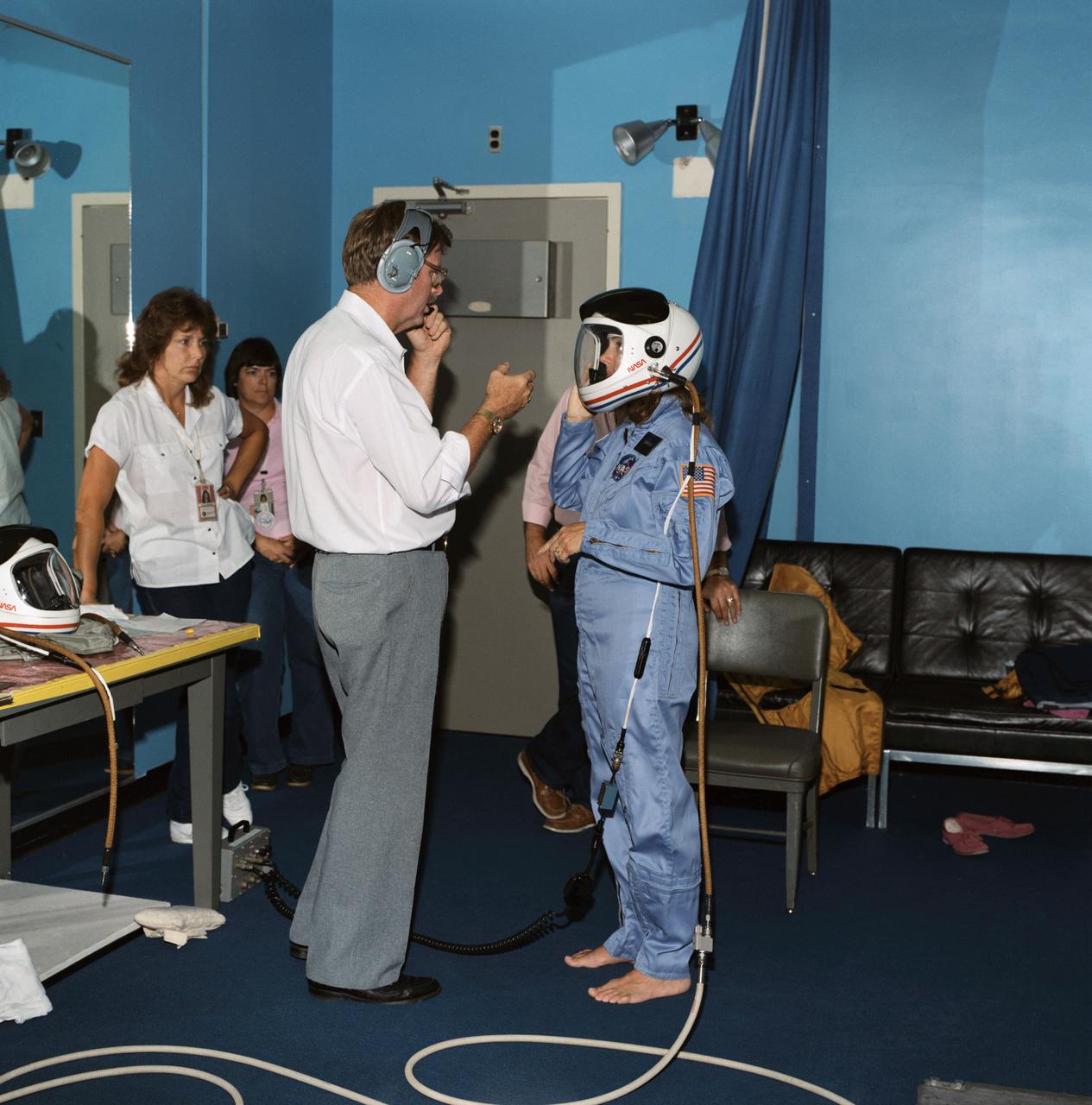
S85-40031 (November 1985) --- Payload specialist Sharon Christa McAuliffe is briefed on launch/entry helmets by crew systems technician Alan M. Rochford in the Johnson Space Center’s crew systems lab. McAuliffe is one of seven crew members in training for STS-51L flight scheduled for January 1986. Photo credit: NASA

XV-15 Tilt Rotor (NASA-703) hovers at Ames Research Center with Navy P-3 Orion on flight line in foreground

Views of STS-51E PS Patrick Baudry during Zero-G Training Flights. 1. STS-51E - CREW TRAINING
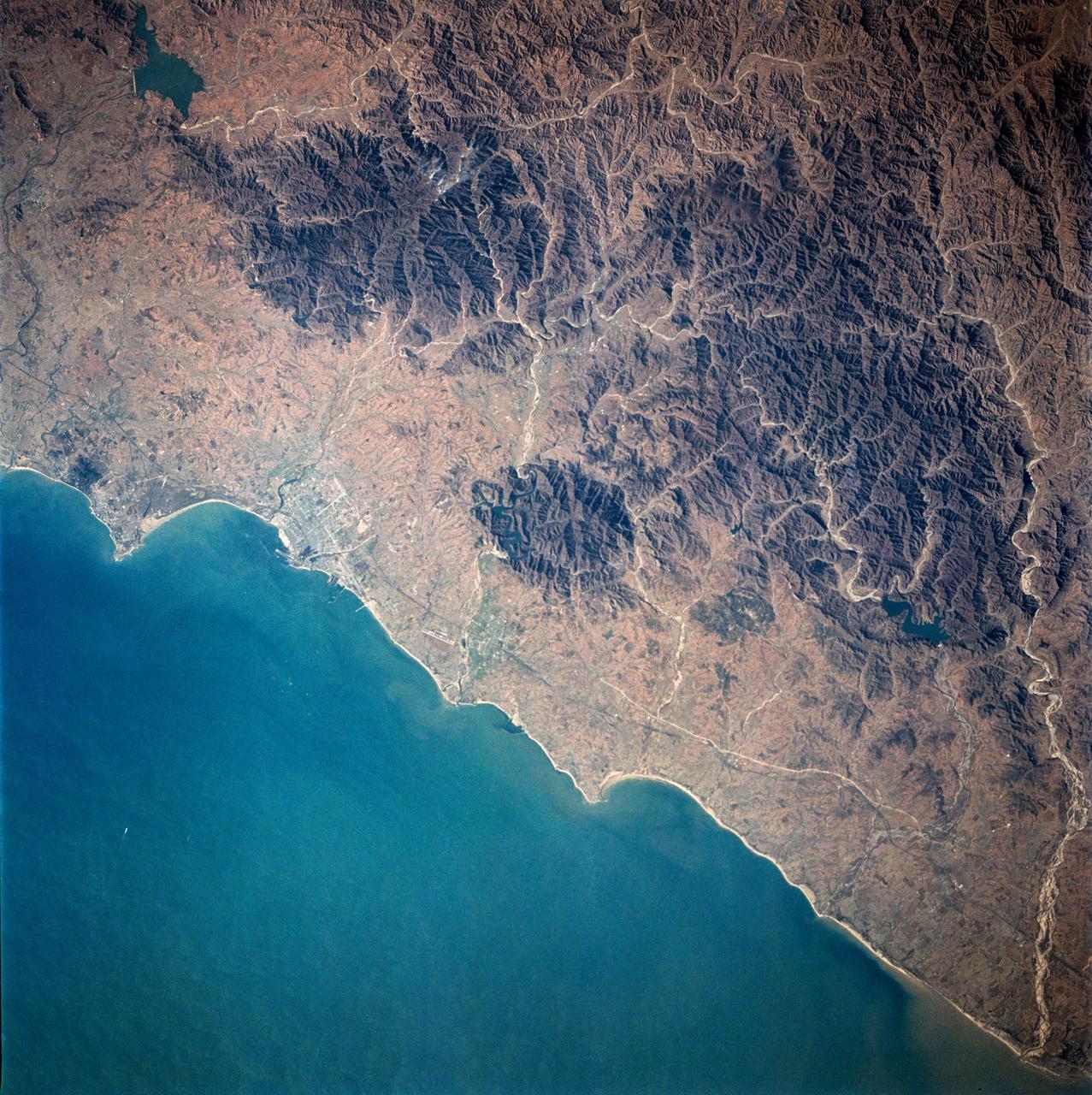
61A-39-052 (30 Oct-6 Nov 1985) --- This Earth view shows Quinhuangdao, China. The Great Wall of China can be seen in this photograph. The center coordinates are 40.0 north latitude and 120.0 east longitude. This photograph was taken from an altitude of 180 miles, on the 24th orbit of the Space Shuttle Challenger. The crew consists of astronauts Henry W. Hartsfield, Jr., commander; Steven R. Nagel, pilot; mission specialists James F. Buchli, Guion S. Bluford, Jr., Bonnie J. Dunbar; payload specialists Reinhard Furrer (DFVLR), Ernst Messerschmid (DFVLR), and Wubbo J. Ockels (ESA).
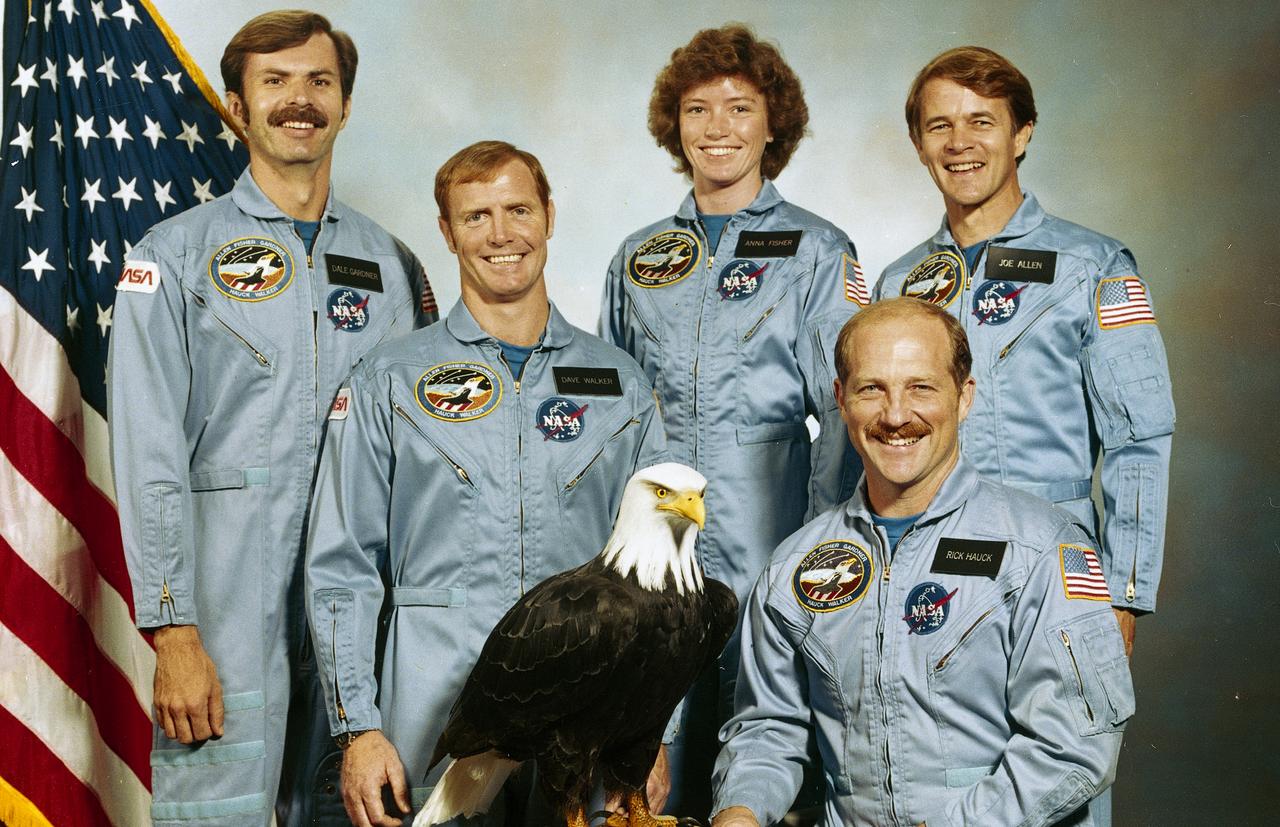
The crew assigned to the STS-51A mission included Frederick H. Hauck, commander,who is seated to the right. Standing, left to right, are Dale A. Gardner, mission specialist; David M. Walker, pilot; and mission specialists Anna L. Fisher, and Joseph P. Allen. Launched aboard the Space Shuttle Discovery on November 8, 1984 at 7:15:00 am (EST), the STS-51A mission deployed the Canadian communications satellite TELLESAT-H (ANIK), and the defense communications satellite SYCOM IV-1 (also known as LEASAT-1). In addition, 2 malfunctioning satellites were retrieved: the PALAPA-B2 and the WESTAR-VI.
N-258 NAS (Numerical Aerodynamic Simulation) Facility: Construction
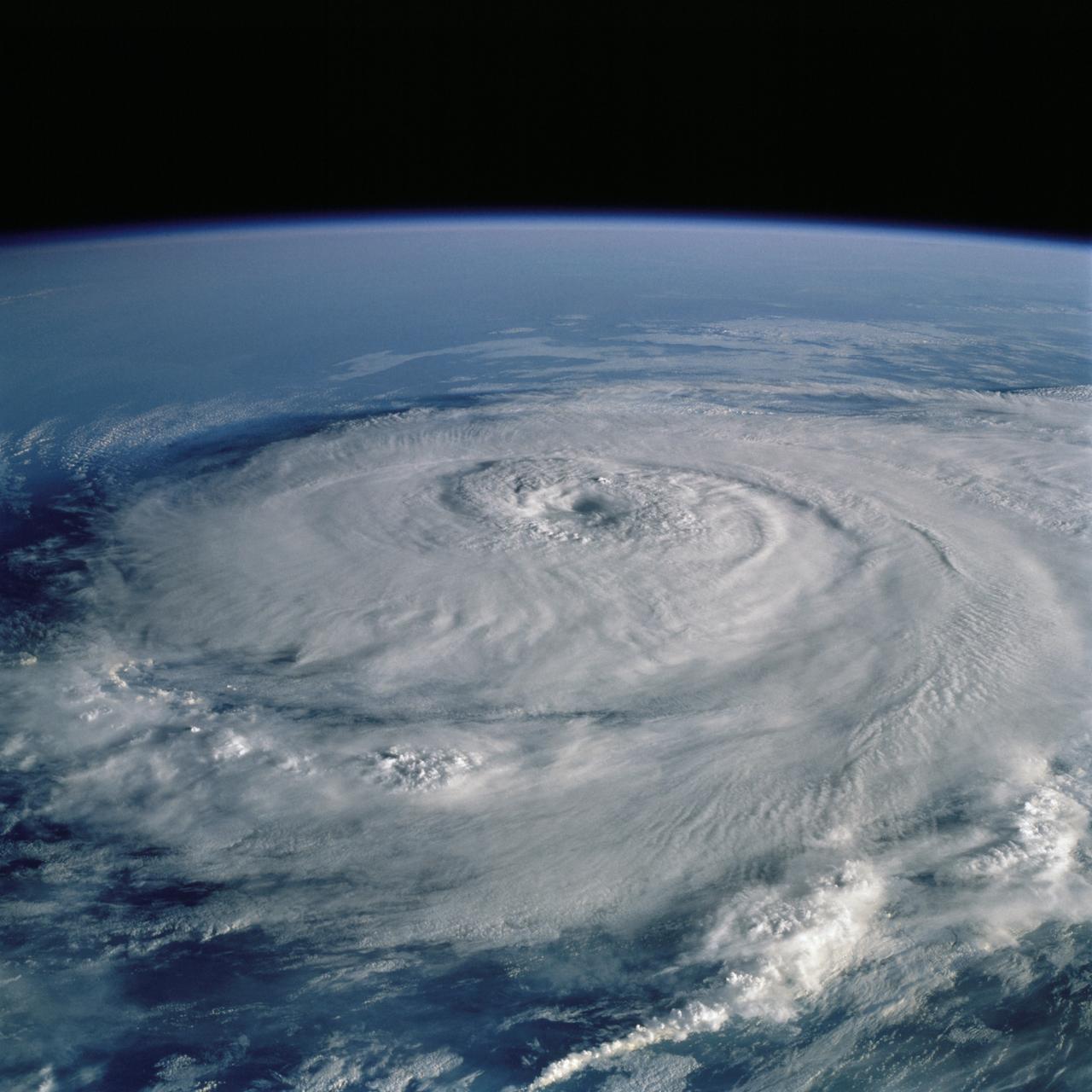
51I-44-052 (2 Sept. 1985) --- An oblique view of Hurricane Elena, photographed with a 70mm camera by STS-51I crew members of the space shuttle Discovery on Sept. 2, 1985. Photo credit: NASA
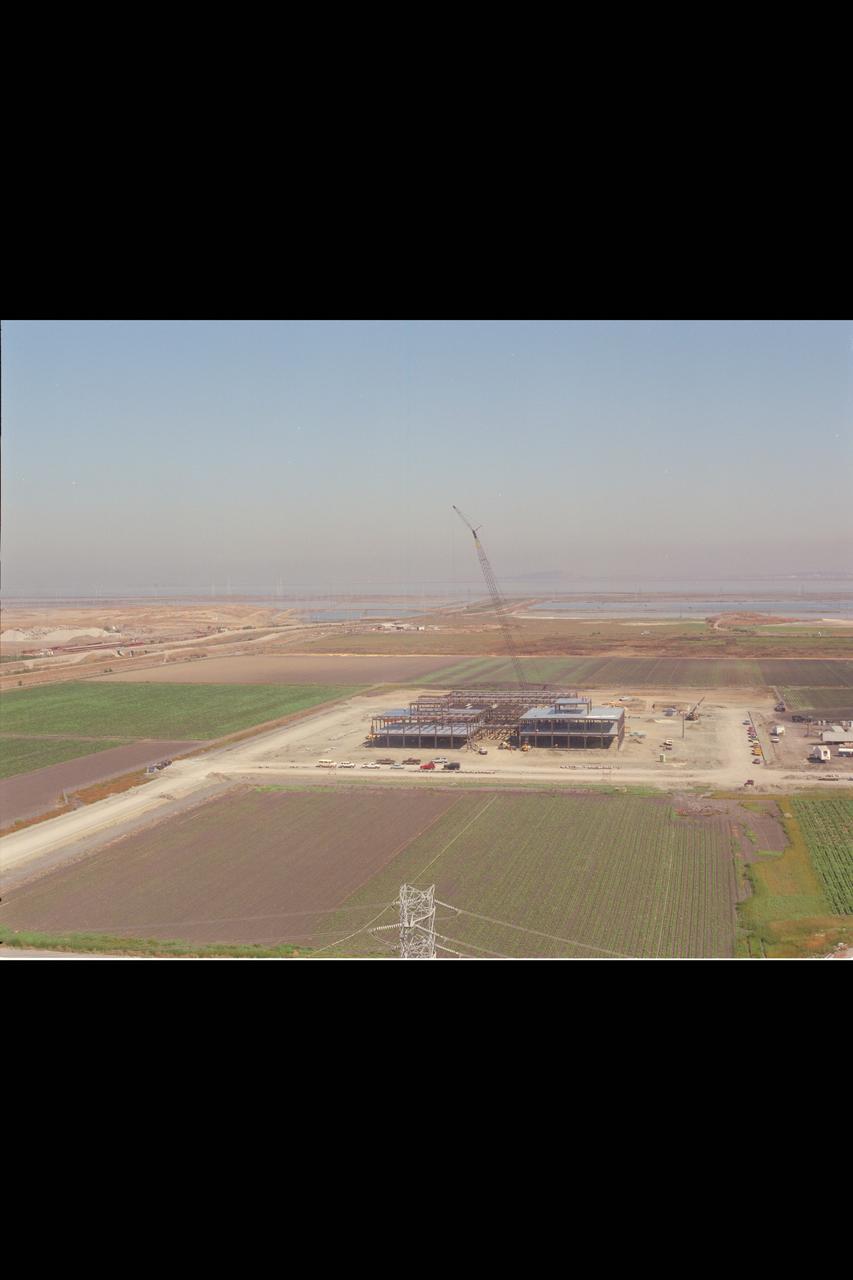
N-258 NAS (Numerical Aerodynamic Simulation) Facility, Roof Top Aerials of construction site, framing
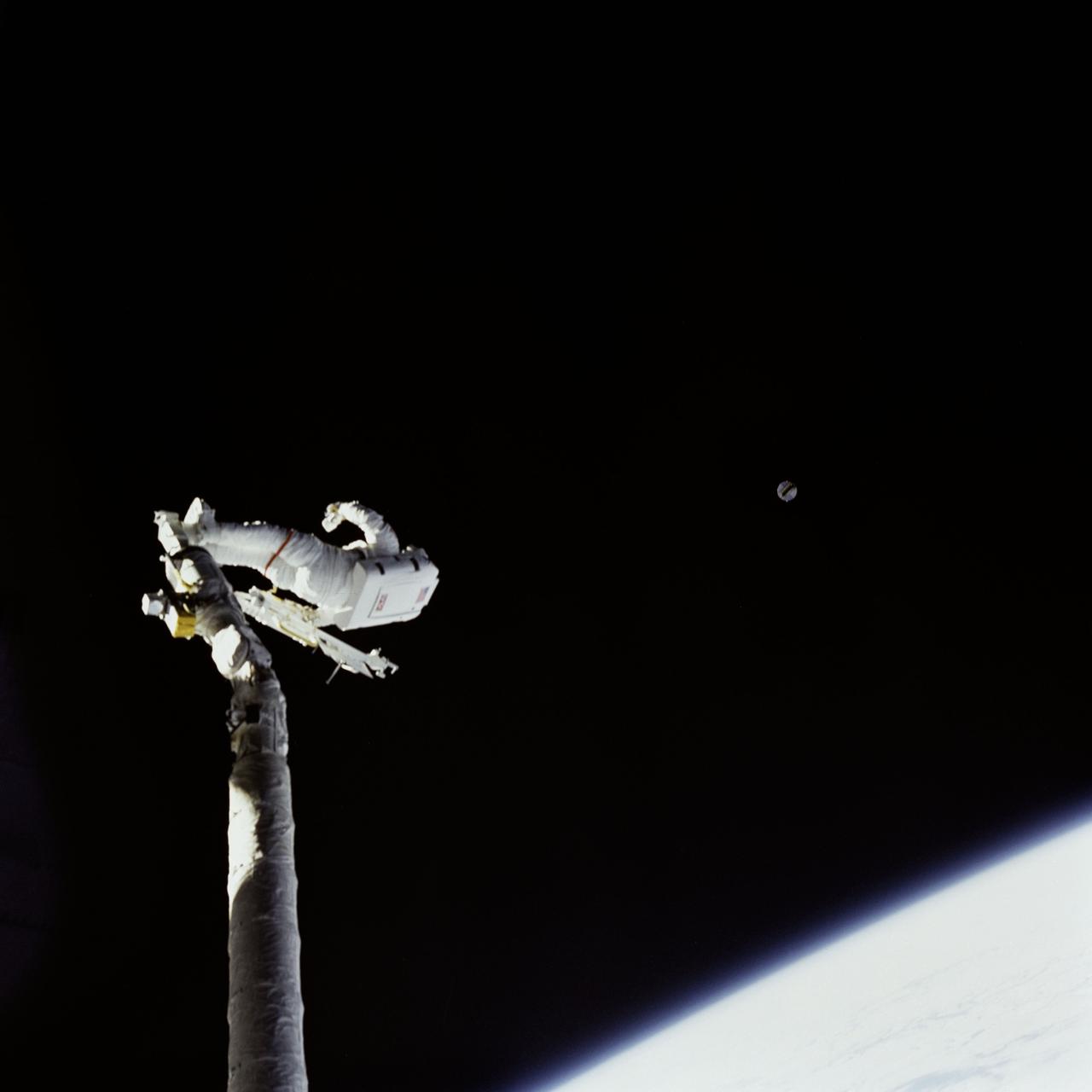
51I-44-081 (1 Sept 1985) --- Astronaut James D. van Hoften on the Discovery's remote manipulator system (RMS) arm visually tracks the distant Syncom IV-3 communications satellite after its second release, on Sept. 1, 1985.
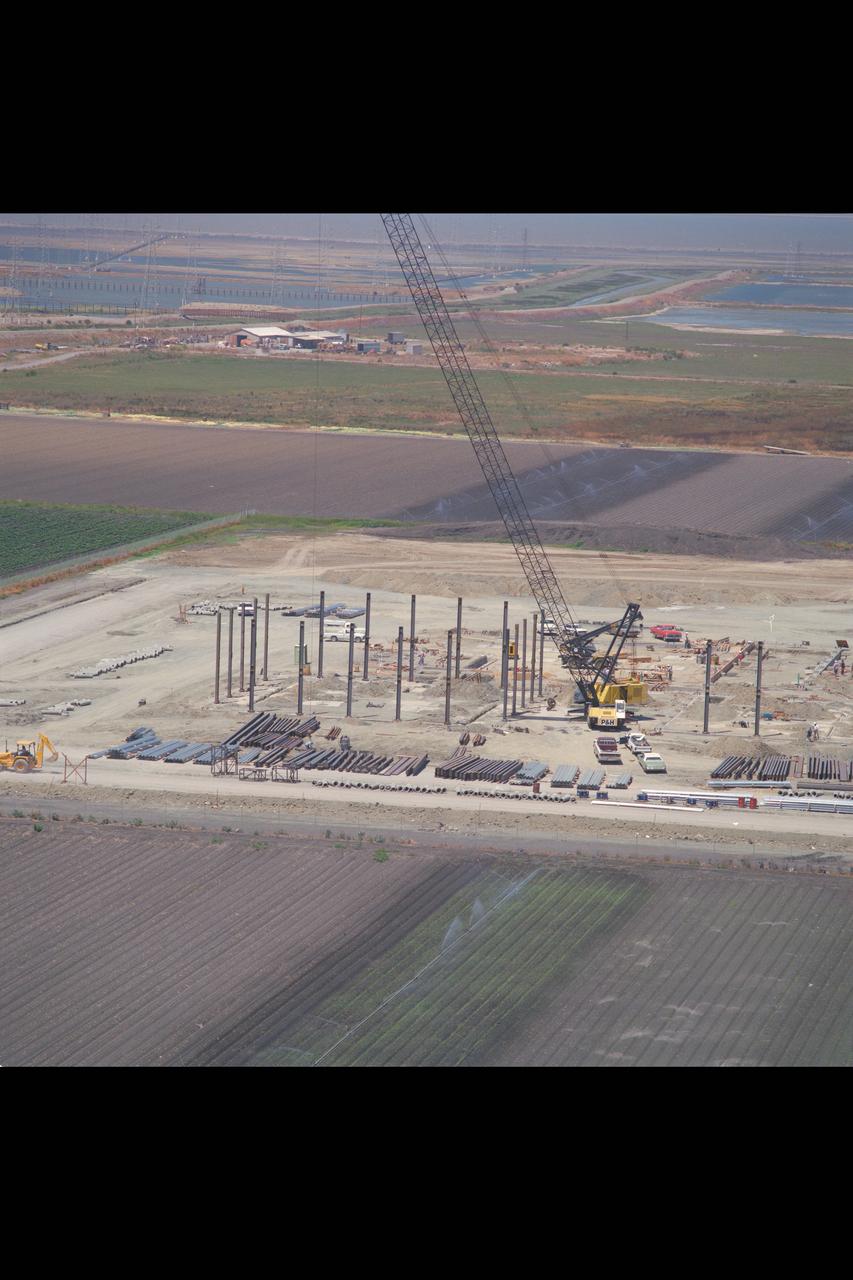
N-258 NAS (Numerical Aerodynamic Simualtion) Facility, aerials of (pre) construction site, Foundation
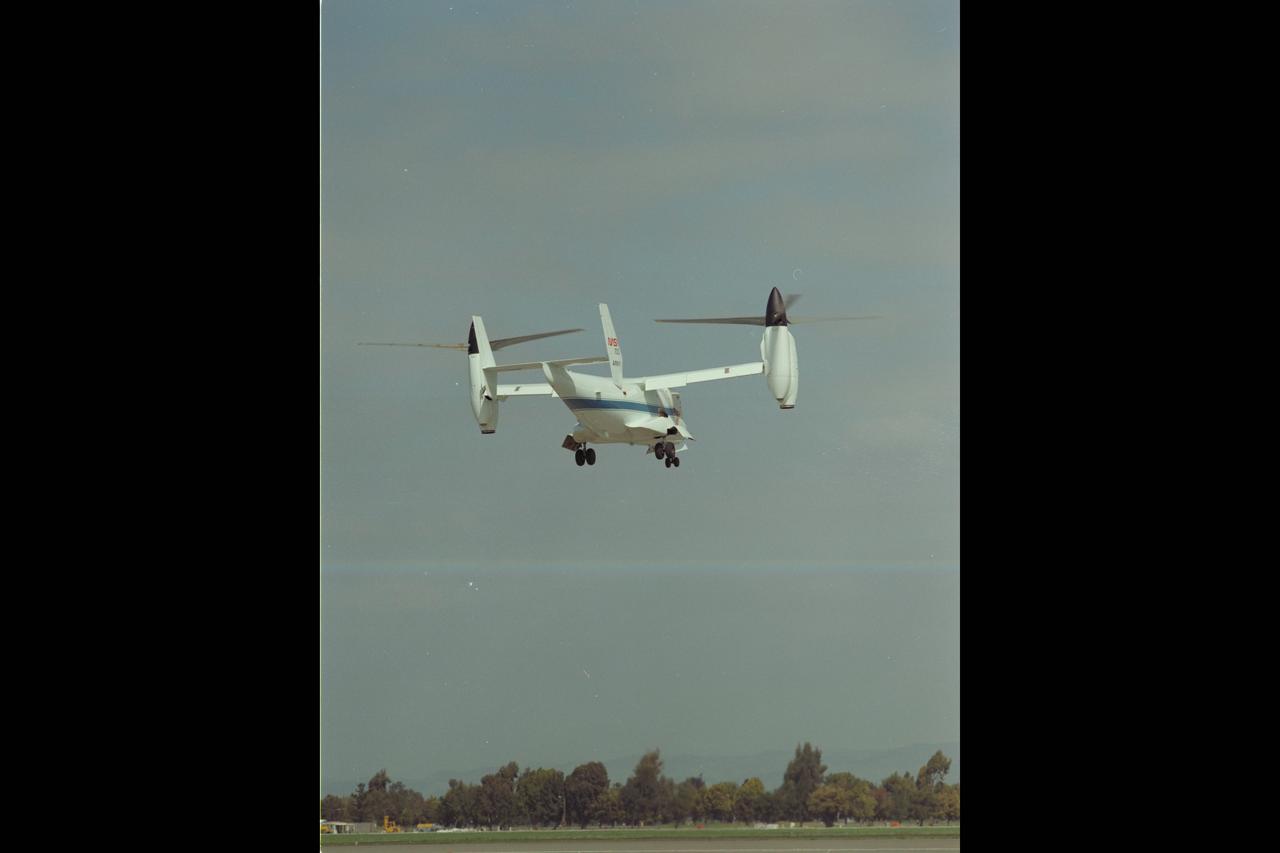
XV-15 (NASA-703) Evaluation Flight @ Ames; Above Title, Conversion Mode, and Helicopter Mode
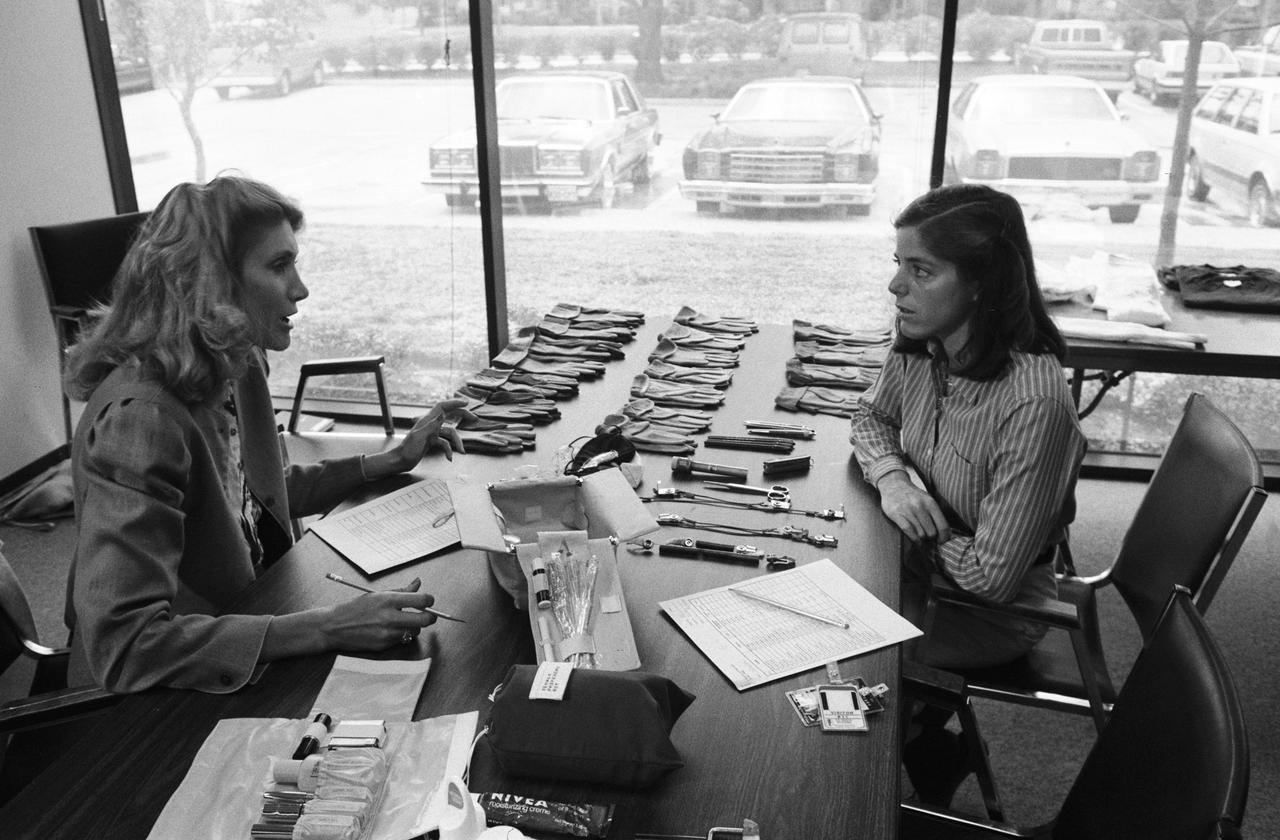
Views of STS-33/51L crew personnel Prime McAuliffe and Backup Morgan at the ILC Facility during clothing selection and Building #37 during food sampling, and with the rest of the STS-33/51L crew. 40074: "Teacher-in-Space" Participant Barbara Morgan (right) is briefed on her suit and on personal hygiene equipment to be used on the STS-51L Mission. 1. JSC - Education Program (Teacher in Space) 2. Barbara Morgan 3. Christa McAuliffe 4. STS-33/51L - Crew Training (Uniforms/Food/Crew)
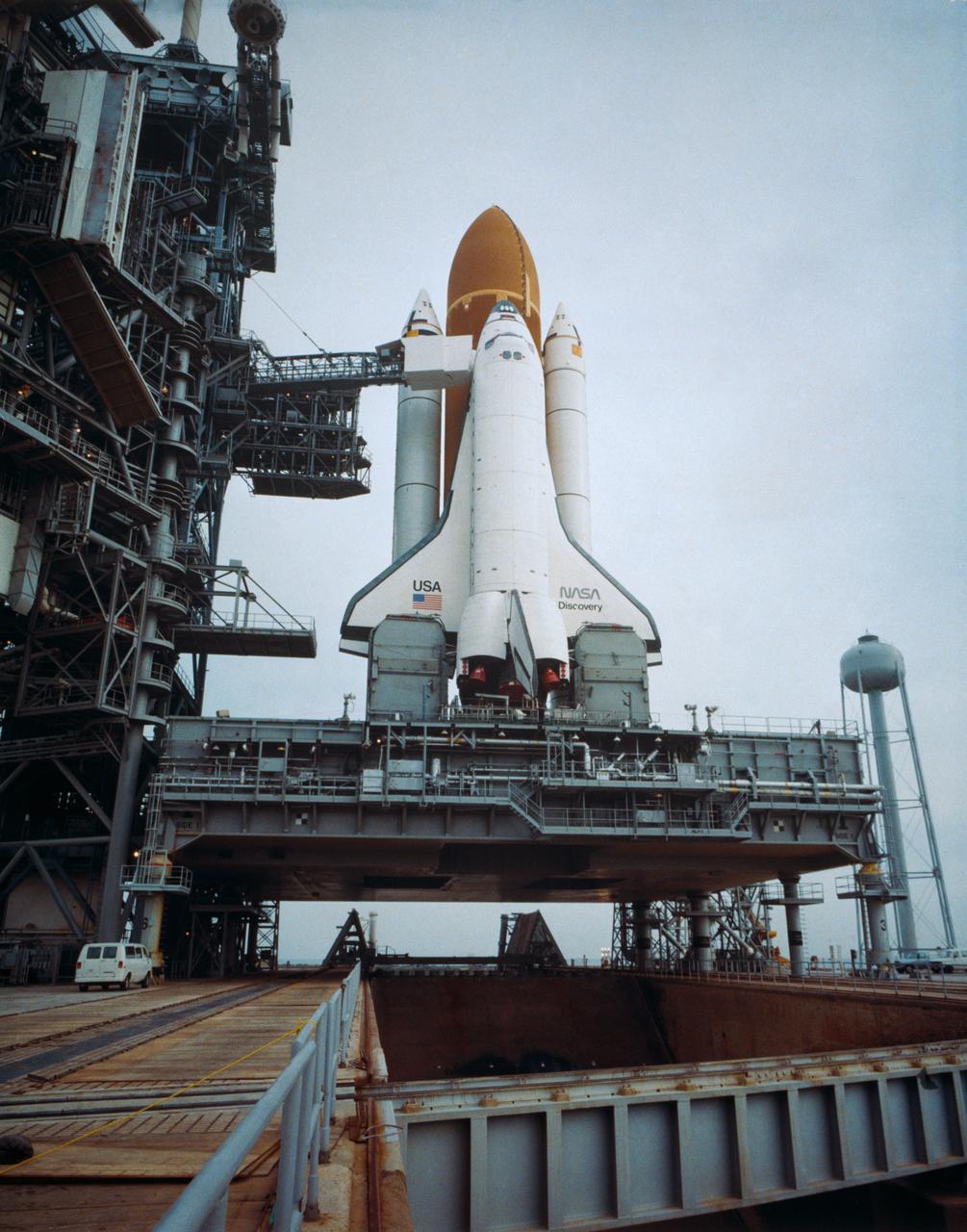
Shuttle Discovery on the launch pad for the STS 51-D mission.
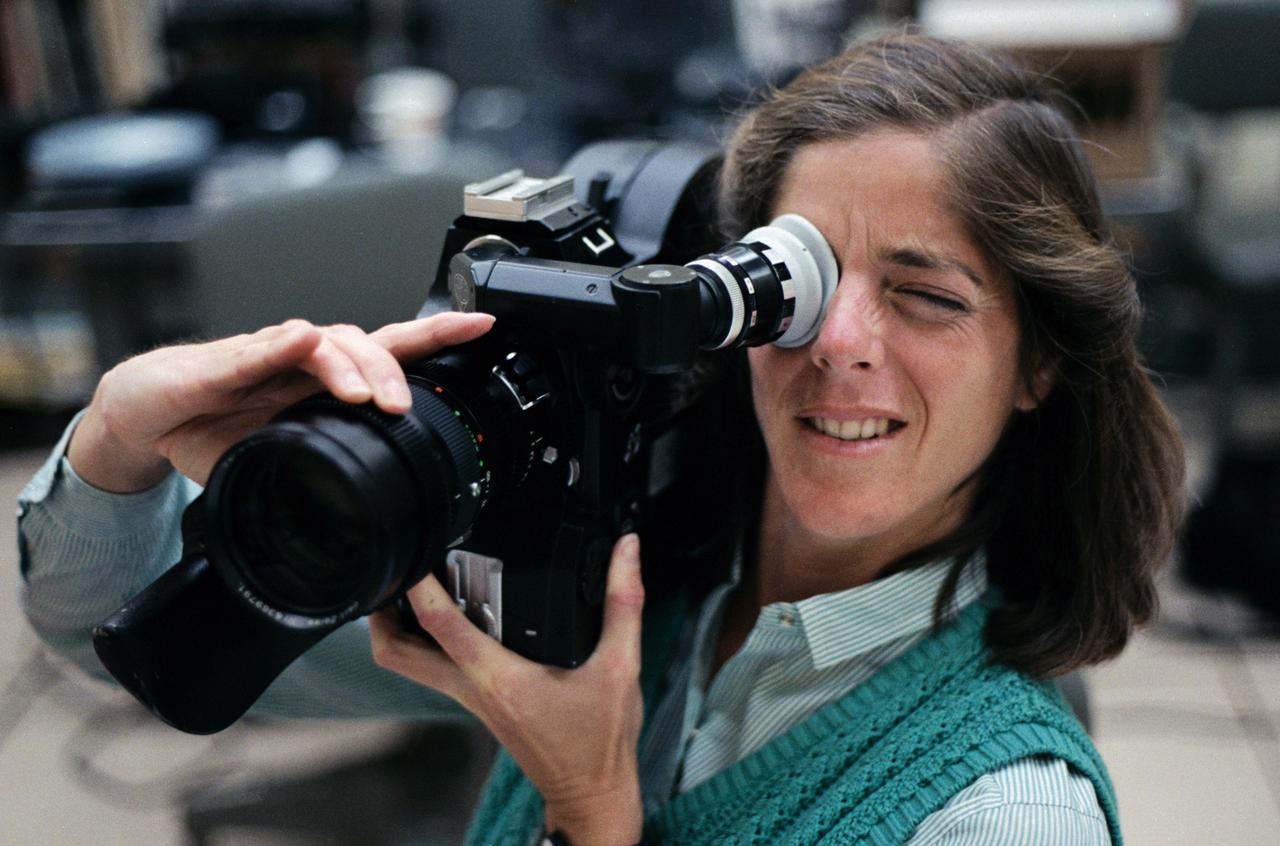
S85-40671 (18 Sept. 1985) --- The two teachers, Barbara R. Morgan and Sharon Christa McAuliffe (out of frame) have hands-on experience with an Arriflex motion picture camera following a briefing on space photography. The two began training Sept. 10, 1985 with the STS-51L crew and learning basic procedures for space travelers. The second week of training included camera training, aircraft familiarization and other activities. Morgan zeroes in on a test subject during a practice session with the Arriflex. Photo credit: NASA
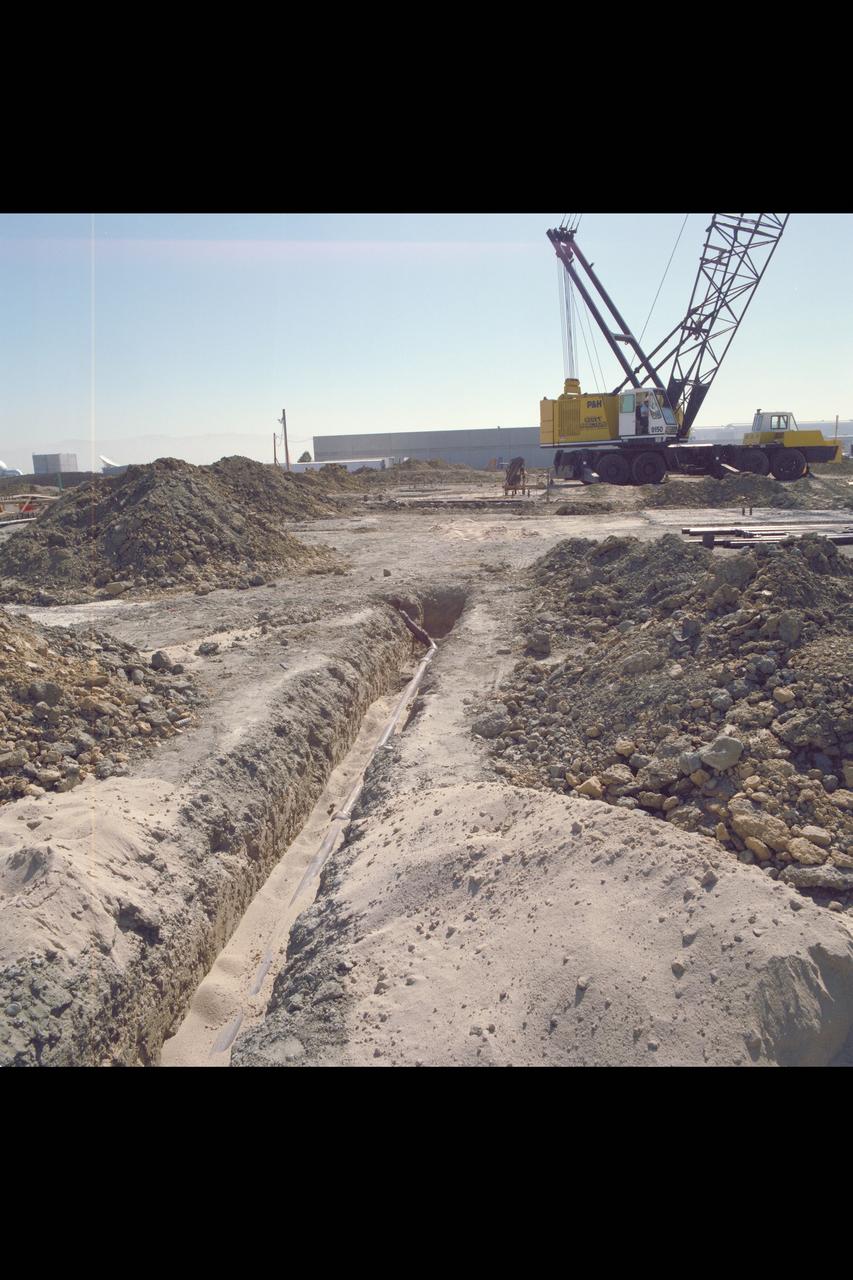
N-258 NAS (Numerical Aerodynamic Simualtion) Facility, aerials of (pre) construction site, Foundation
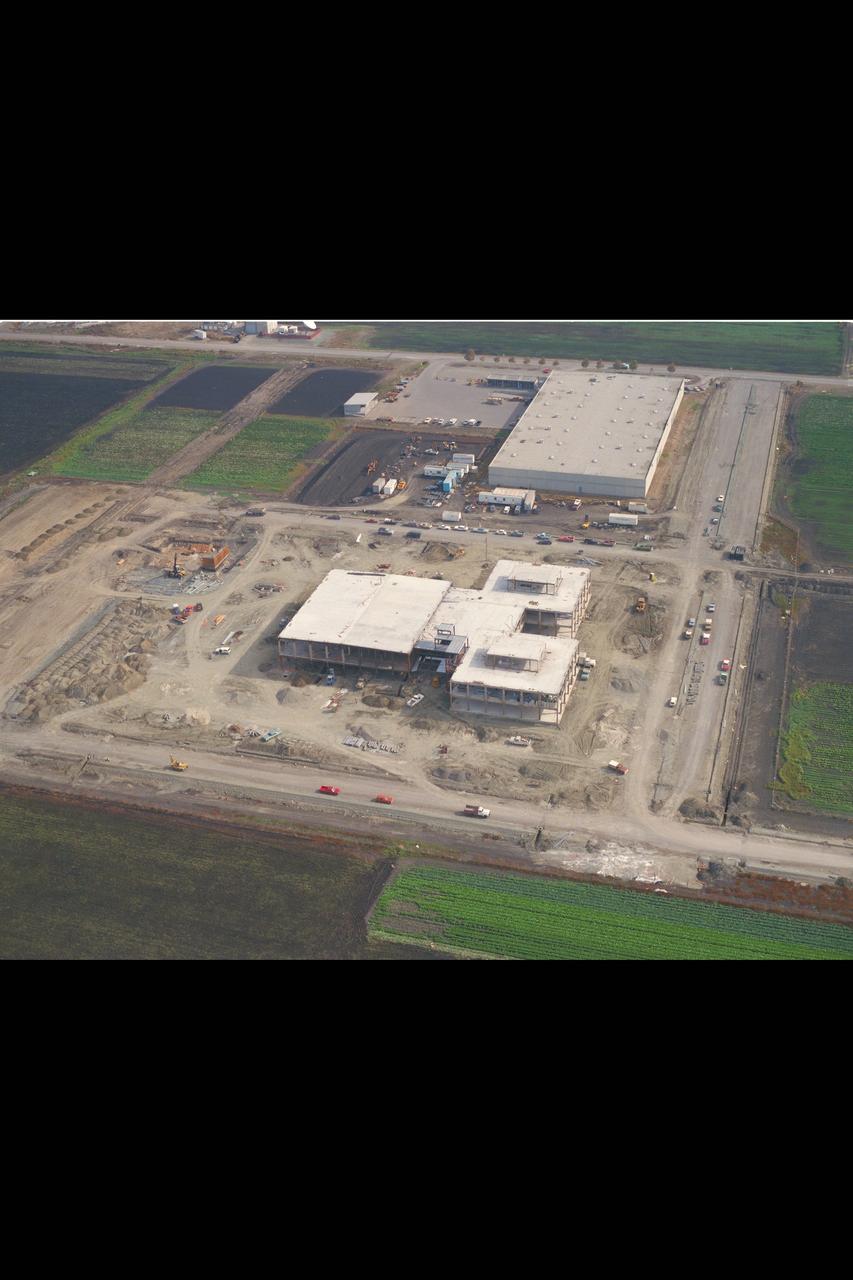
N-258 NAS (Numerical Aerodynamic Simulation) Facility, Aerials of construction site, framing
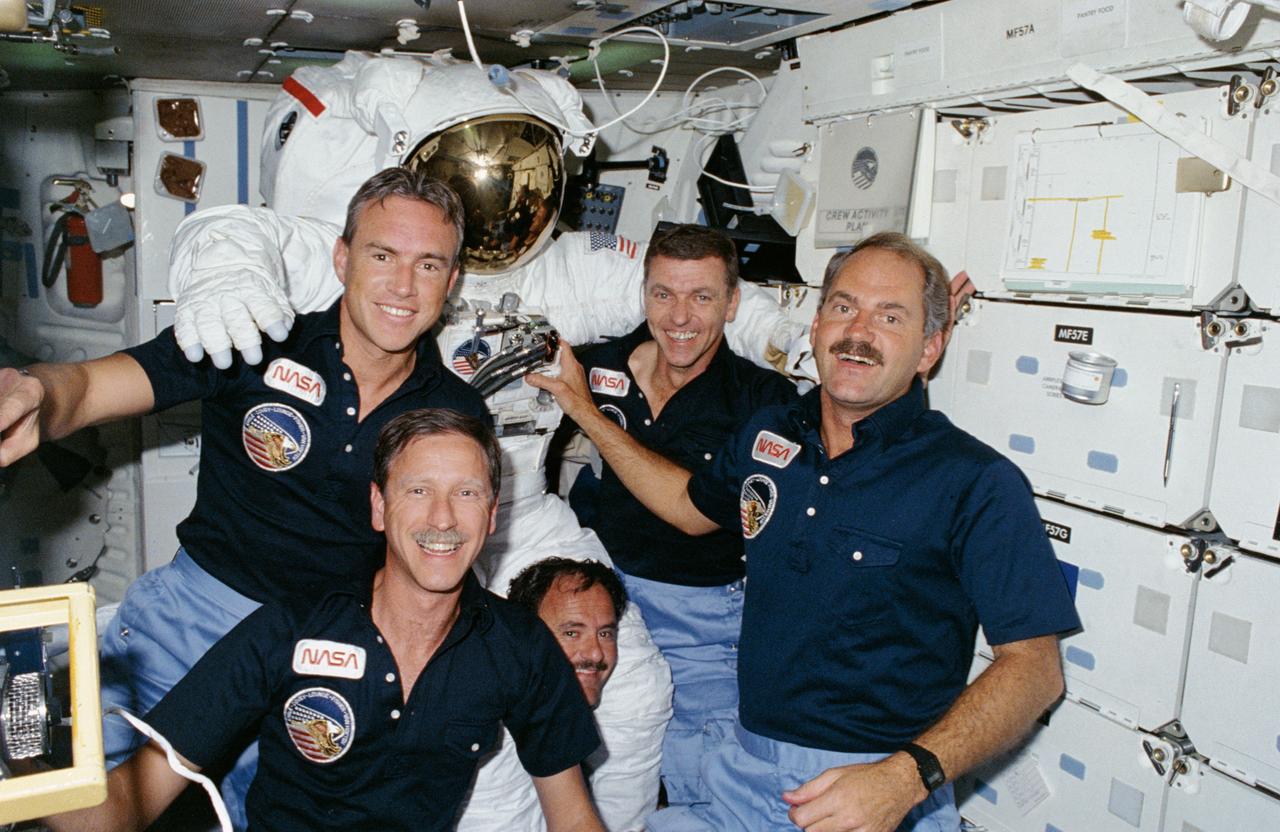
51I-07-015 (4-5 Sept 1985) --- All five STS 51-I crewmembers pose with one of two extravehicular mobility unit (EMU) spacesuits used by Astronauts van Hoften and Fisher on their two-day EVA.
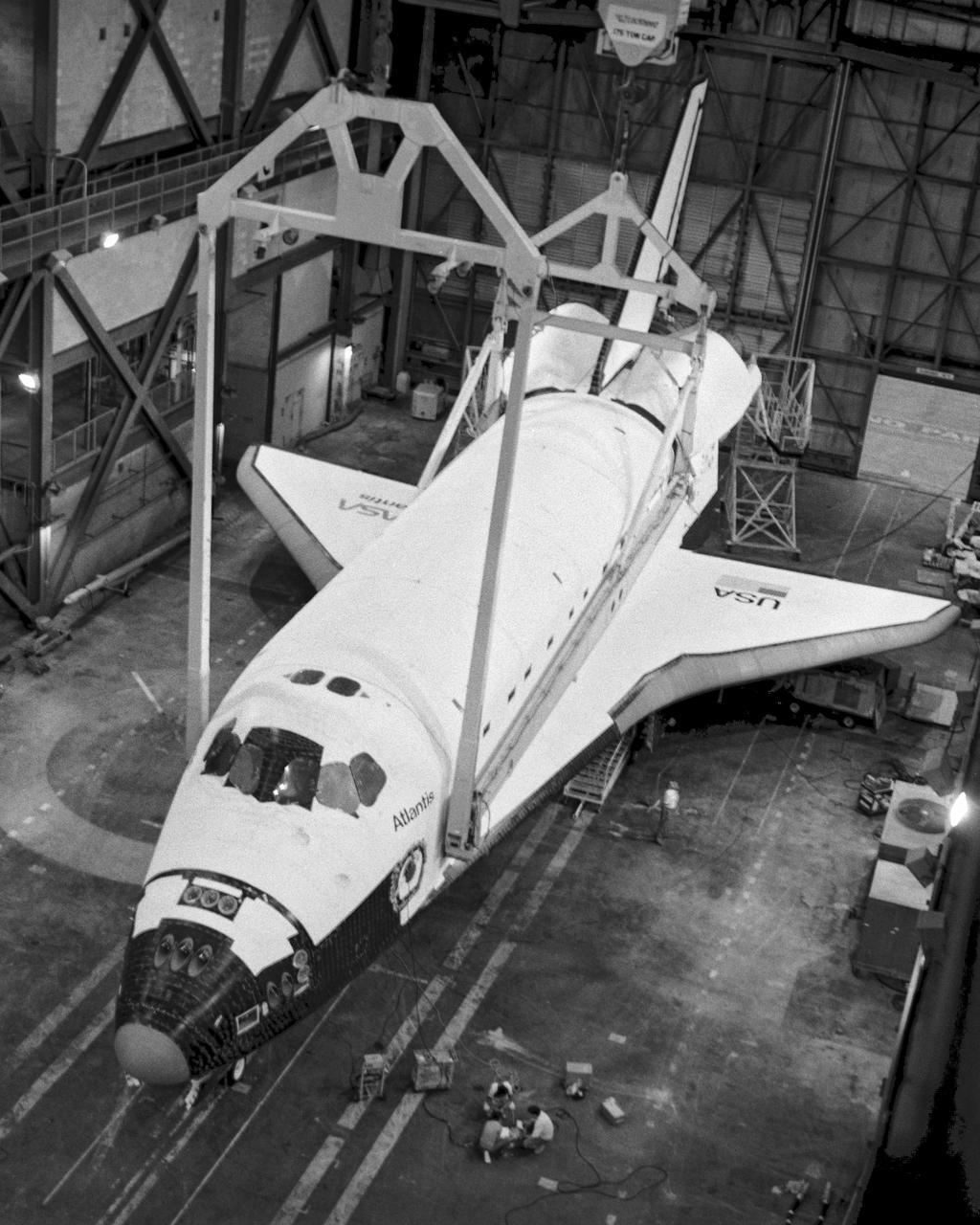
CAPE CANAVERAL, Fla. -- At the Kennedy Space Center in Florida, the space shuttle Atlantis is gently lowered into place next to the external fuel tank and solid rocket boosters in the Vehicle Assembly Building in preparation for its maiden flight, STS-51J. Photo credit: NASA
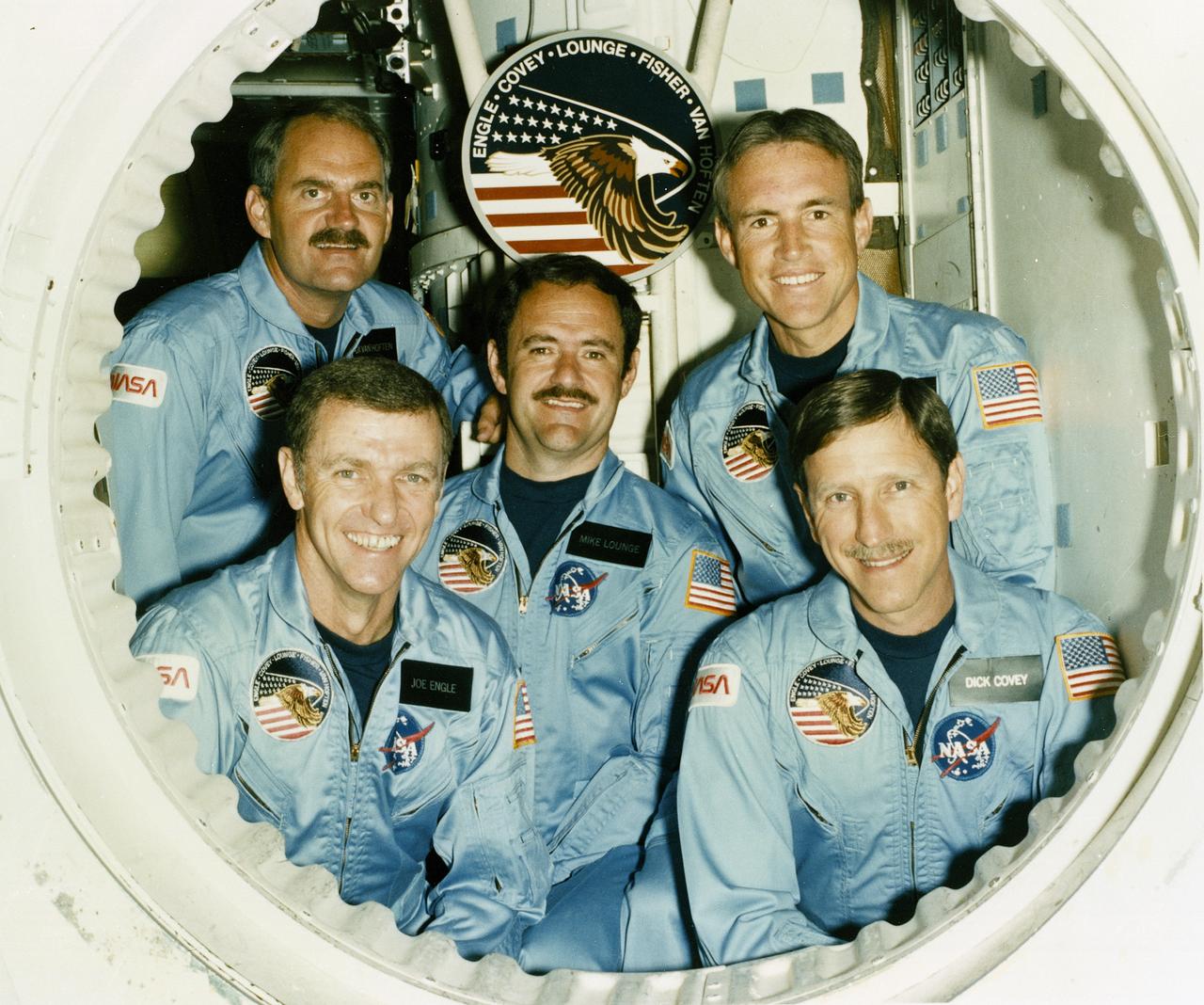
The crew assigned to the STS-51I mission included (front row left to right) Joe H. Engle, commander; and Richard O. Covey, pilot. In the center is John M. (Mike) Lounge, mission specialist. On the back row, from left to right, are mission specialists James D. van Hoften, and William F. Fisher. Launched aboard the Space Shuttle Discovery on August 27, 1985 at 6:58:01 am (EDT), the STS-51I mission’s primary payloads were three communication satellites: the ASC-1 for the American Satellite Company; the AUSSAT-1, an Australian communications satellite; and the SYNCOM-IV-4, the synchronous communications satellite.
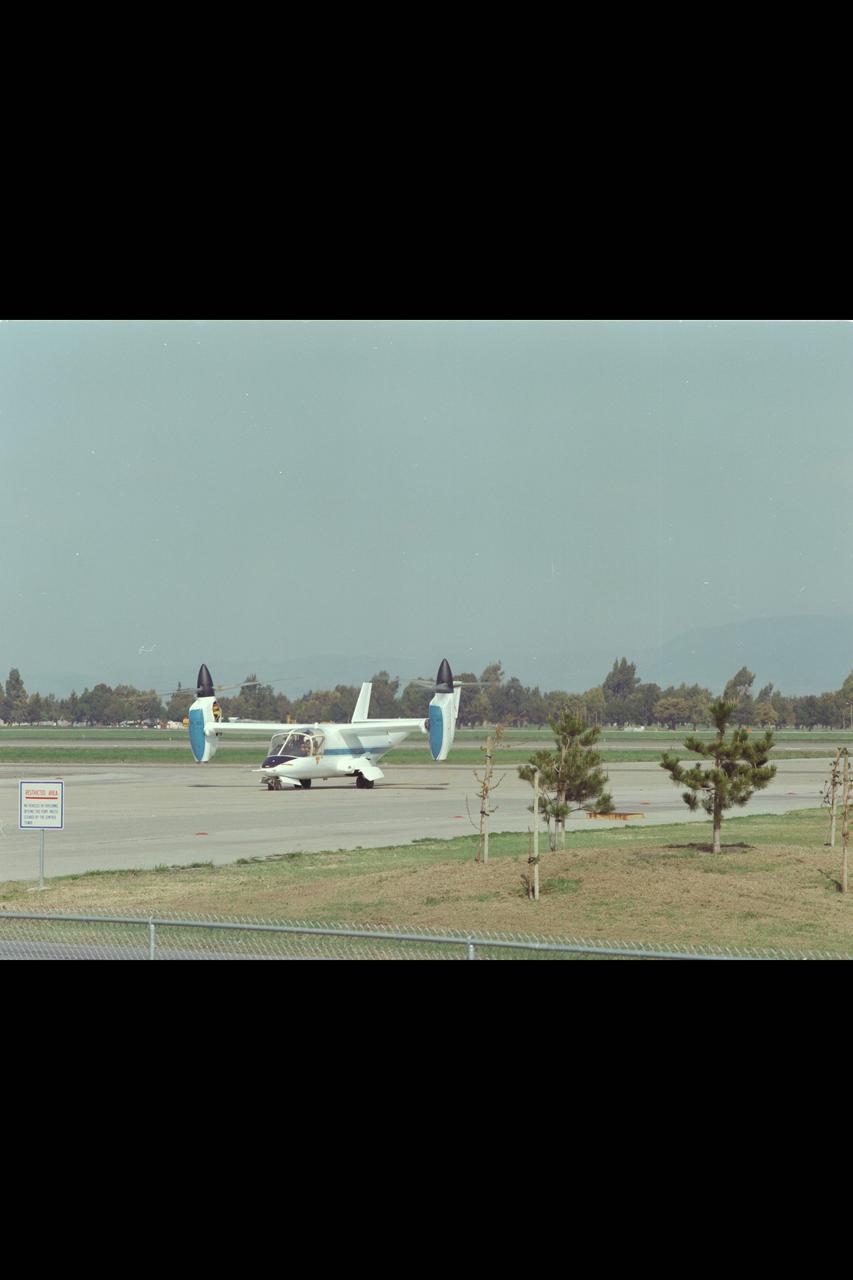
XV-15 (NASA-703) Evaluation Flight @ Ames; Above Title and Helicopter Mode from East Side Runway
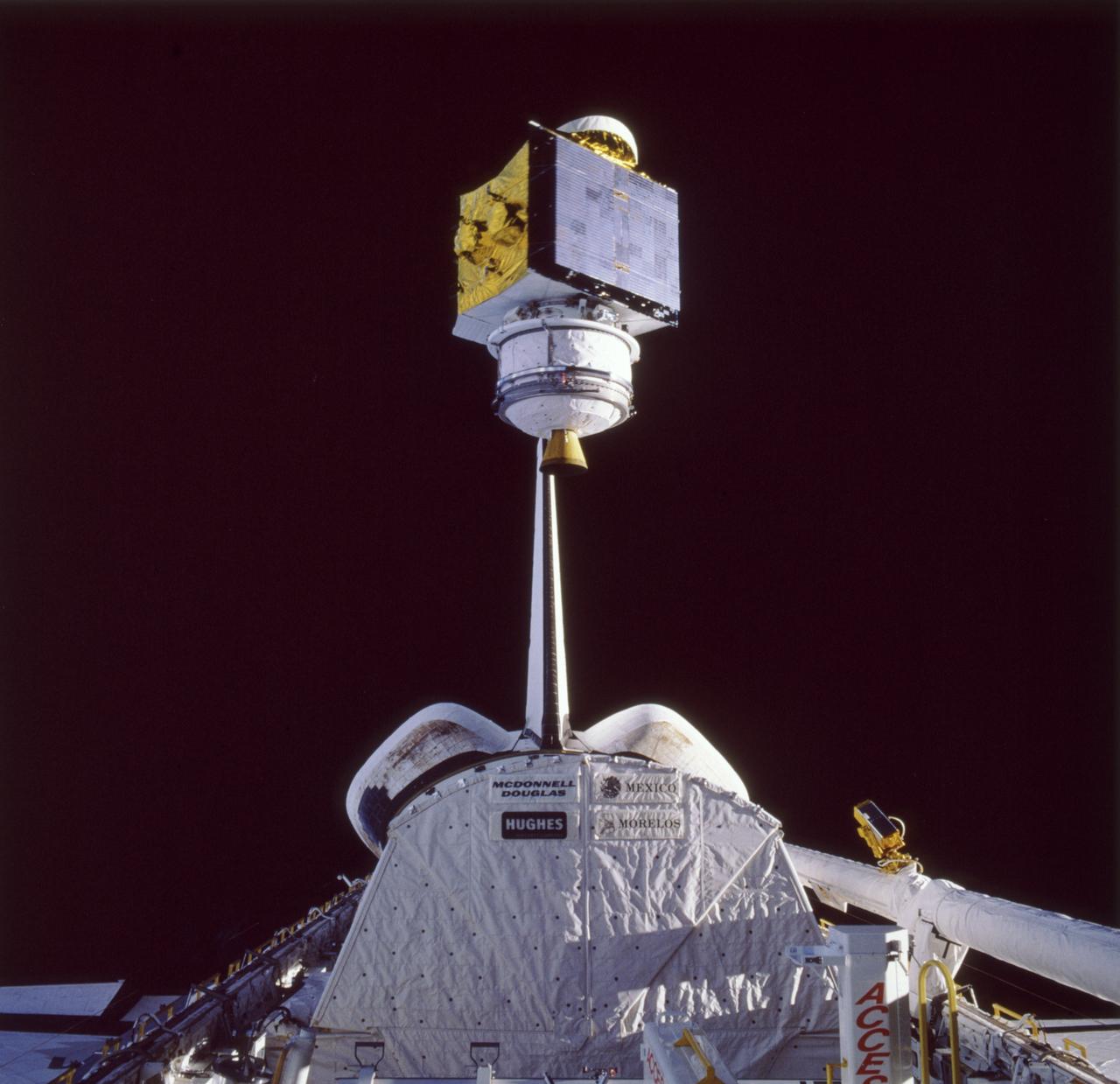
In this photograph the SATCOM KU-2 satellite attached to a Payload Assist Module-D (PAM-D) is being released from the cargo bay of the Space Shuttle Orbiter Atlantis during STS-61B, the 23rd Shuttle Mission. The PAM-D is an upper stage system used to deploy payloads to a required orbit unattainable by the spacecraft. SATCOM KU-2 is an RCA communication satellite and was launched on November 26, 1985.
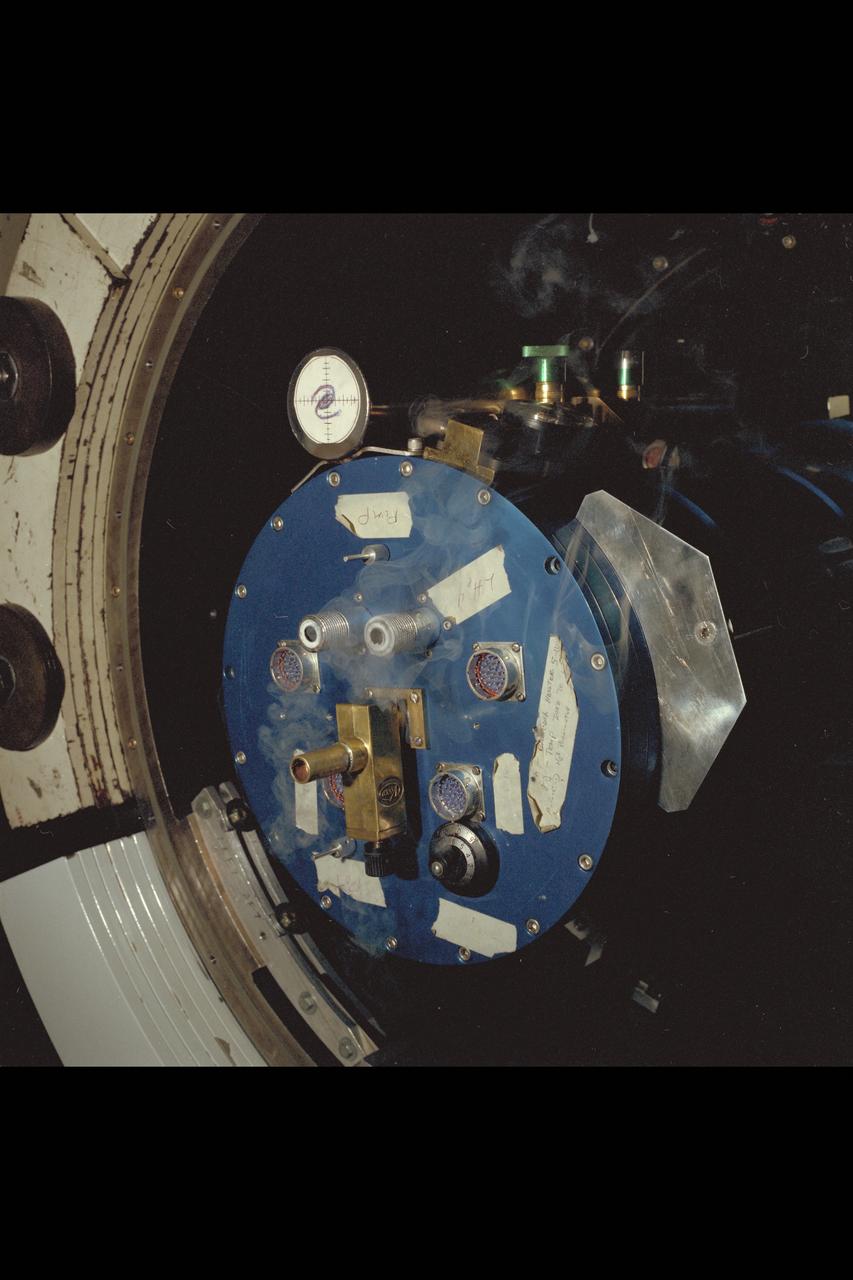
C-141 KAO: Yerkes Observatory, University of Chicago, FAR-IR Camera
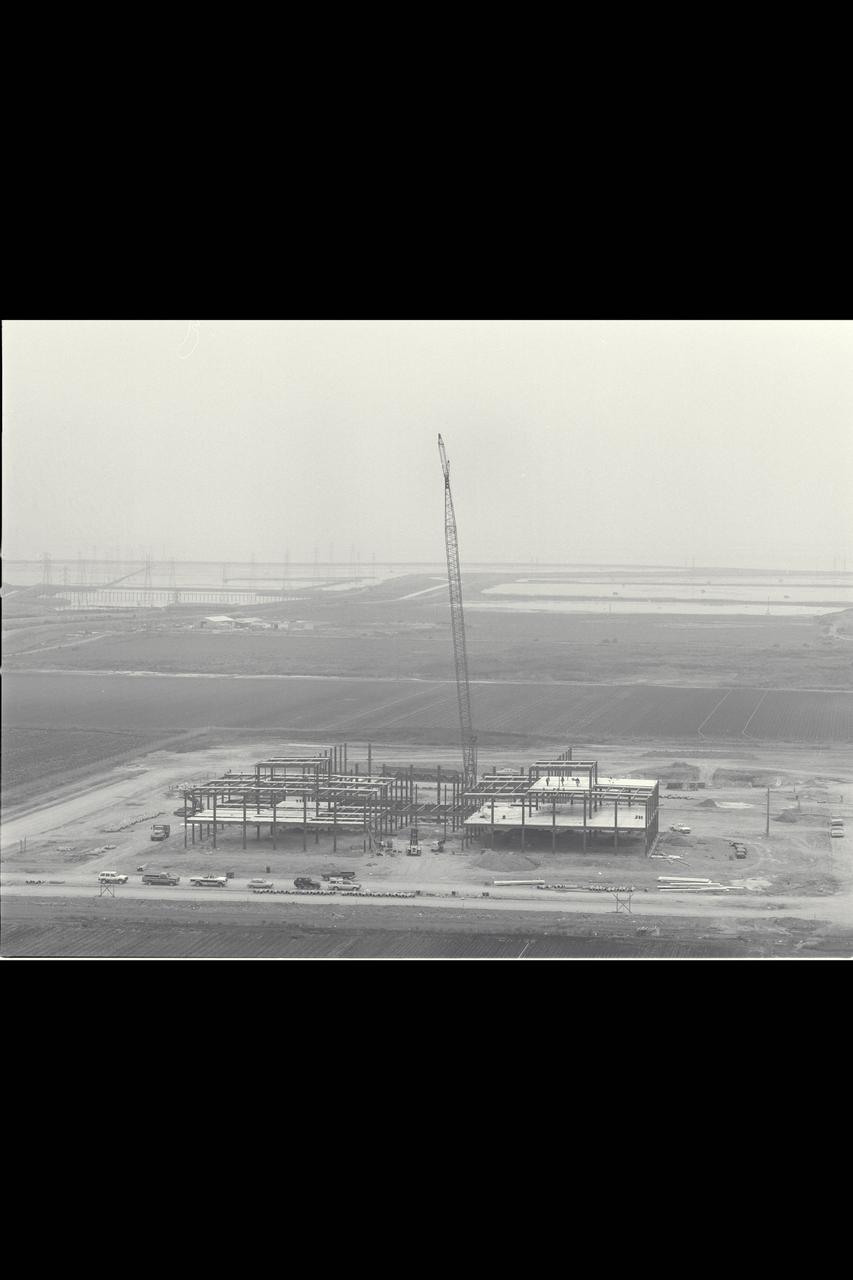
N-258 NAS (Numerical Aerodynamic Simualtion) Facility, aerials of (pre) construction site, Framing
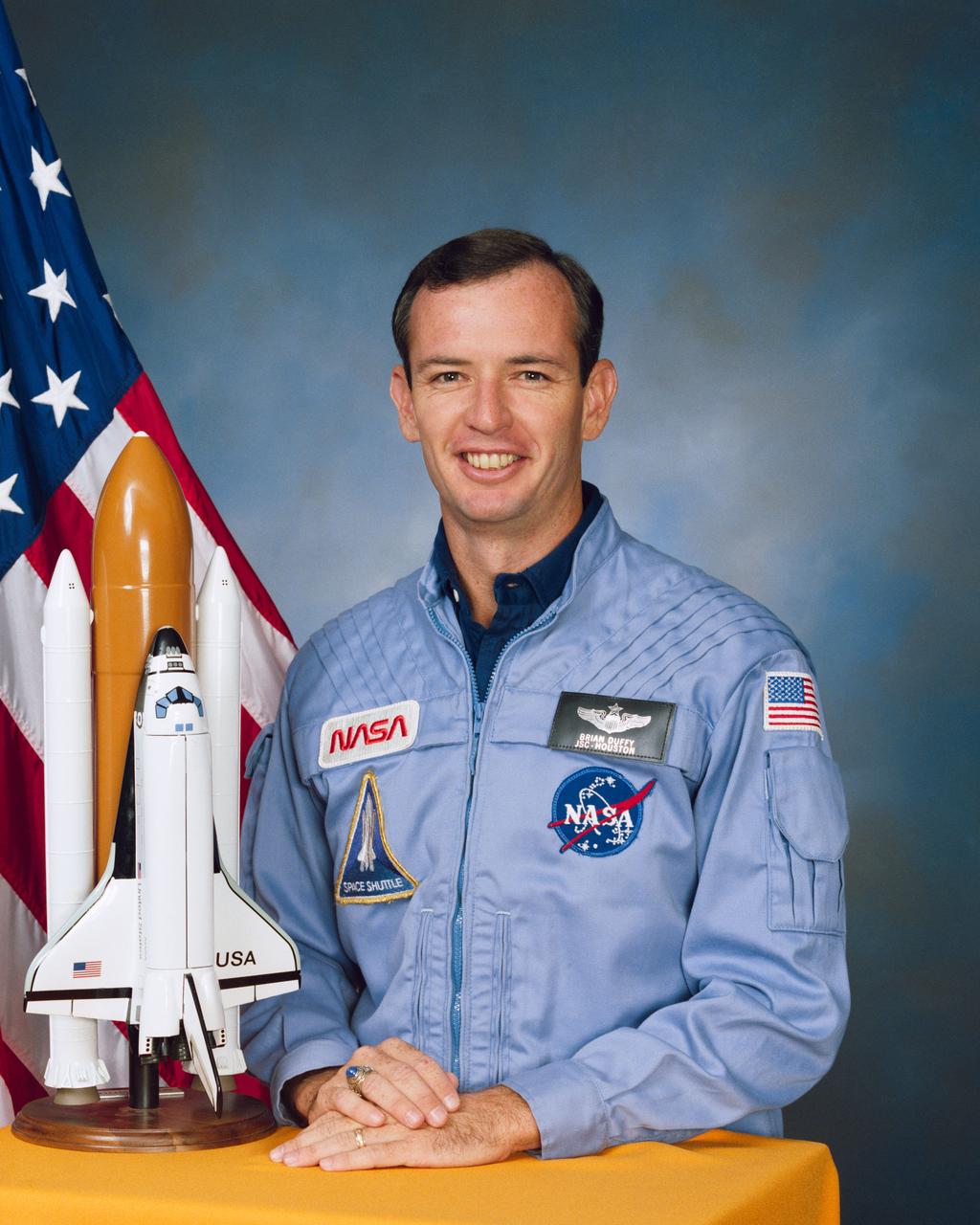
S85-41886 (October 1995) --- Astronaut Brian Duffy, Astronaut Candidate Group 11
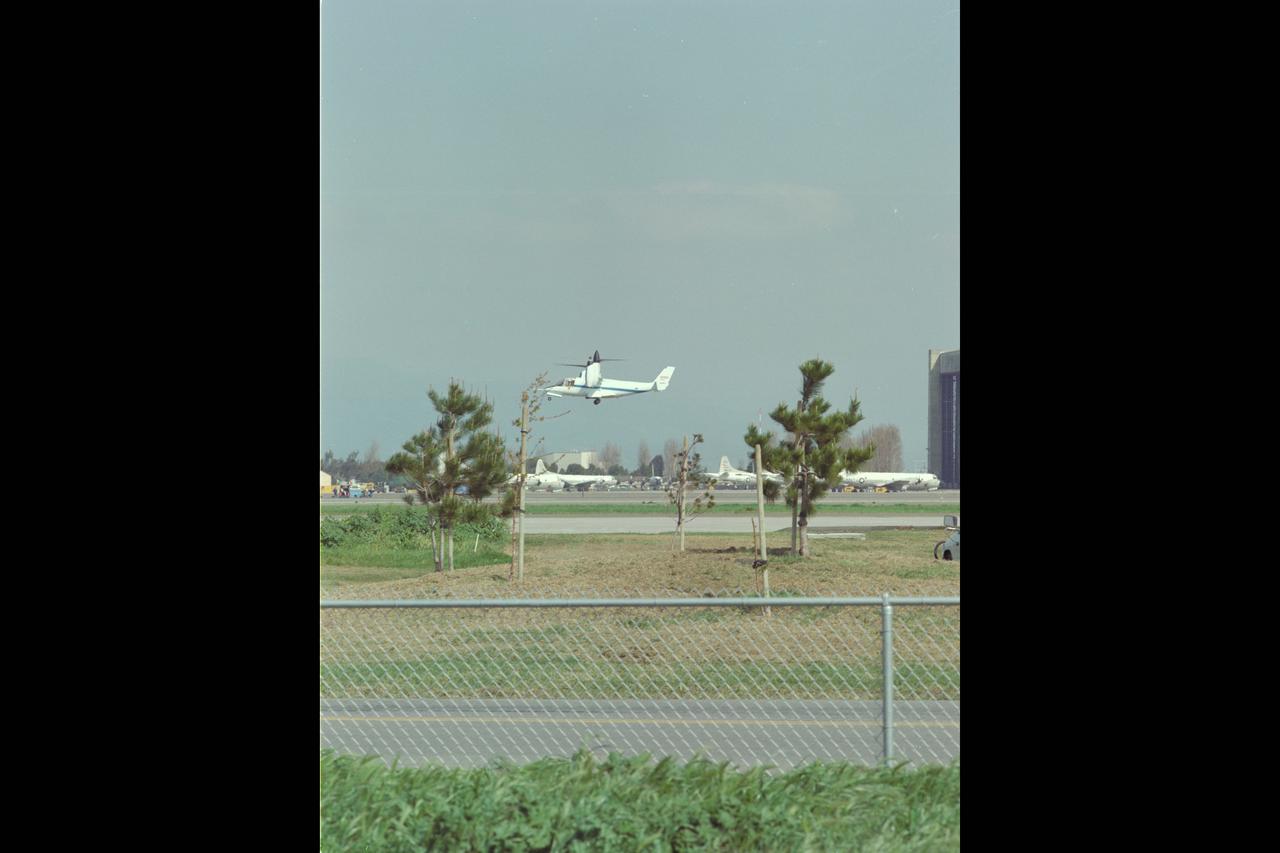
XV-15 (NASA-703) Evaluation Flight @ Ames; Above Title and Helicopter Mode from East Side Runway
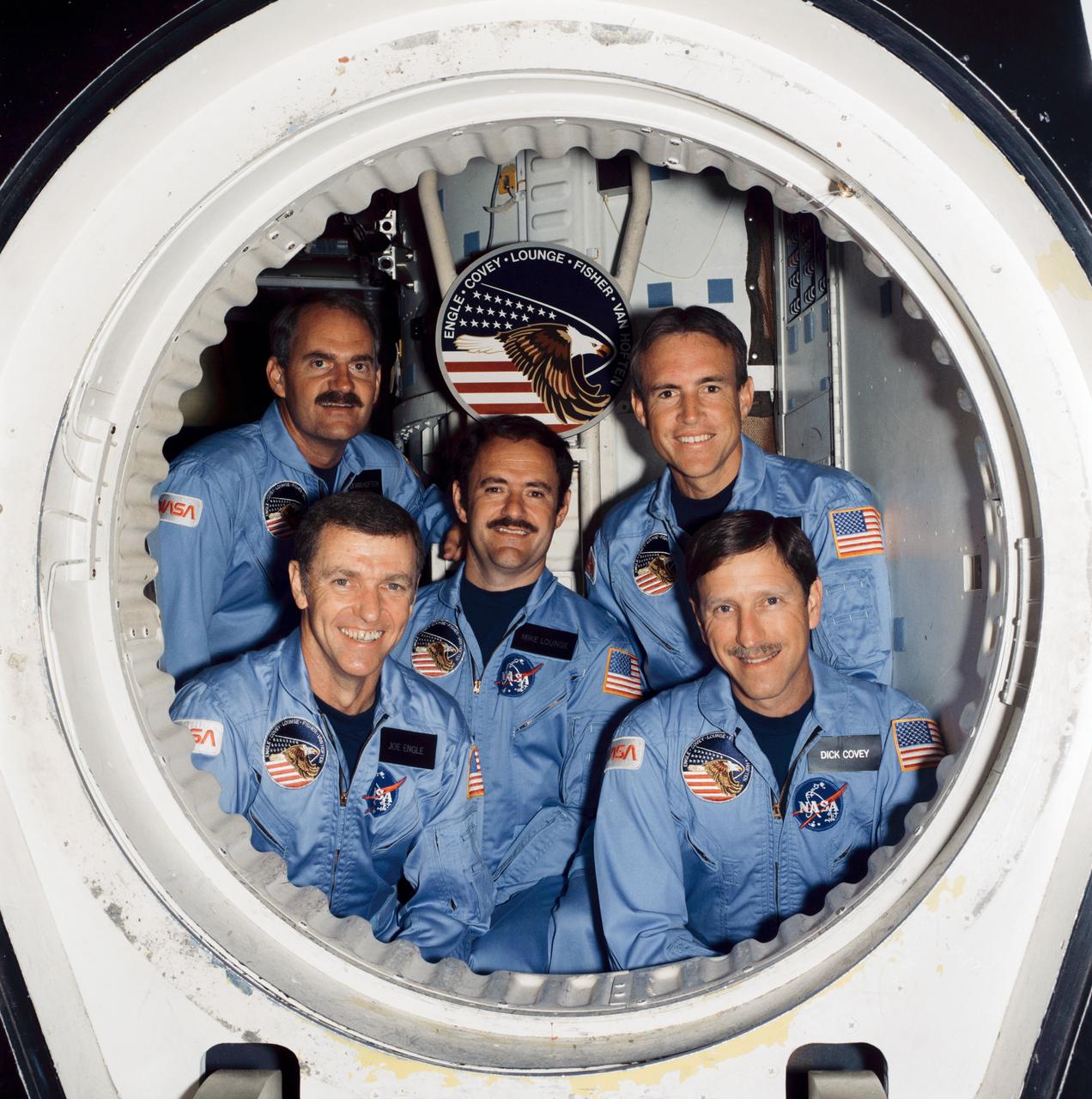
S85-36062 (1 July 1985) --- These five NASA astronauts make up the crew for the mission STS-51I, scheduled for launch in August of this year. Taking a break from rehearsals in the crew compartment trainer in the Shuttle Mockup and Integration Laboratory at JSC are astronauts Joe H. Engle (front left), crew commander; Richard O. Covey (front right), pilot; and (back row, left-to-right) astronauts James D. van Hoften, John M. (Mike) Lounge and William F. Fisher -- all mission specialists.
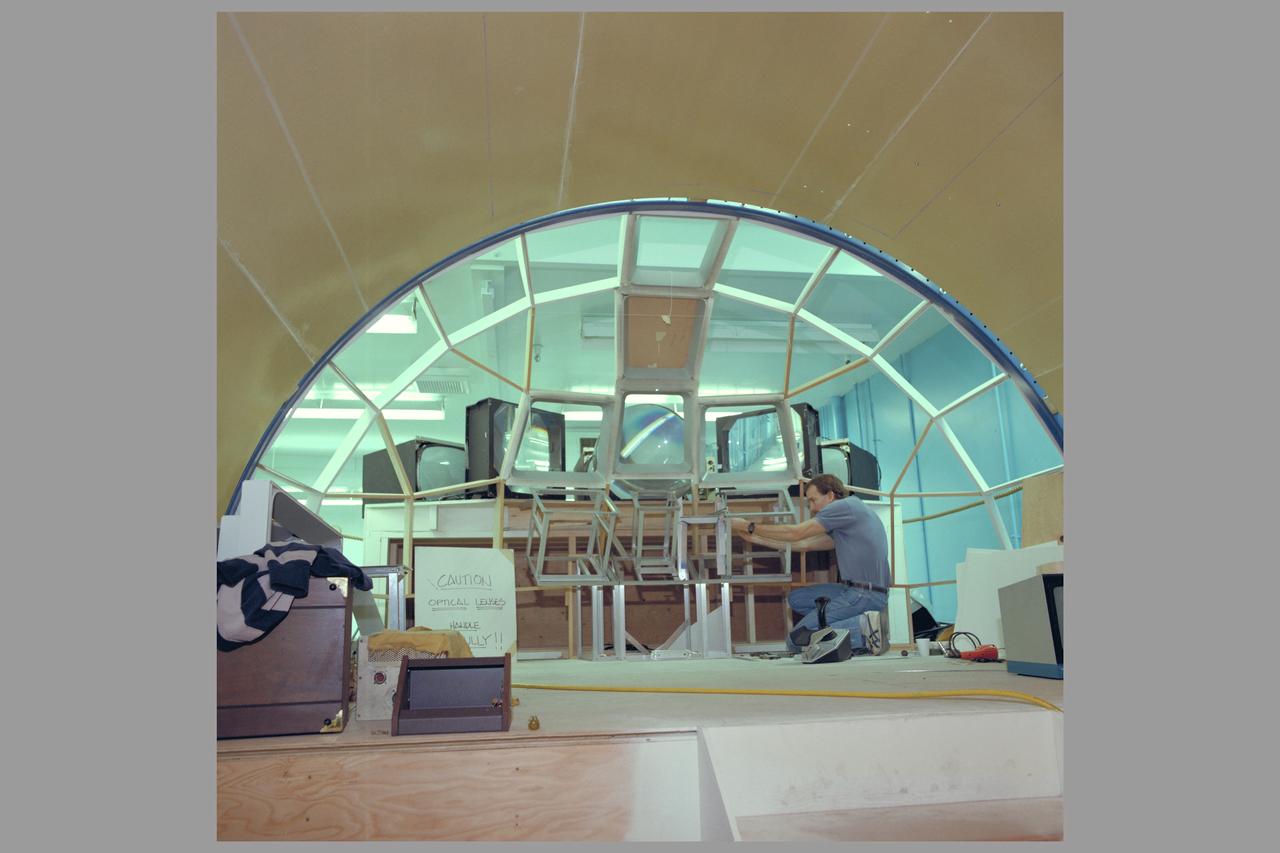
SPACE STATION MODEL MOCKUPS N-239A PROX-OPS (PROXIMITY OPERATIONS SIMULATOR) FABRICATION WITH PHIL CULBERTSON
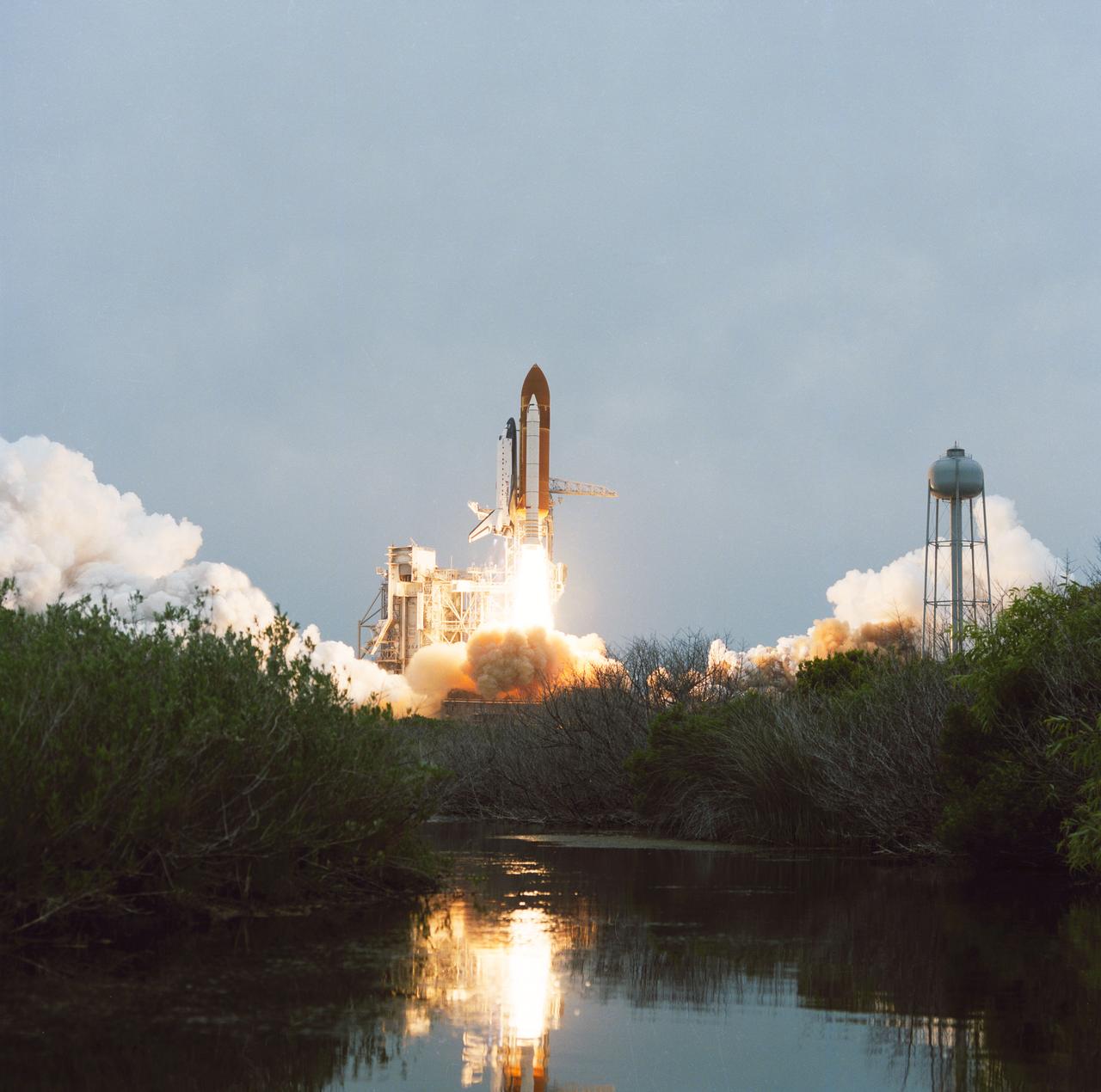
51D-9093 (12 April 1985) --- A 70mm frame of the Space Shuttle Discovery's 51-D launch at 8:59 a.m. (EST), April 12, 1985. Onboard are seven crewmembers and two communications satellites and a variety of medical and other experiments.
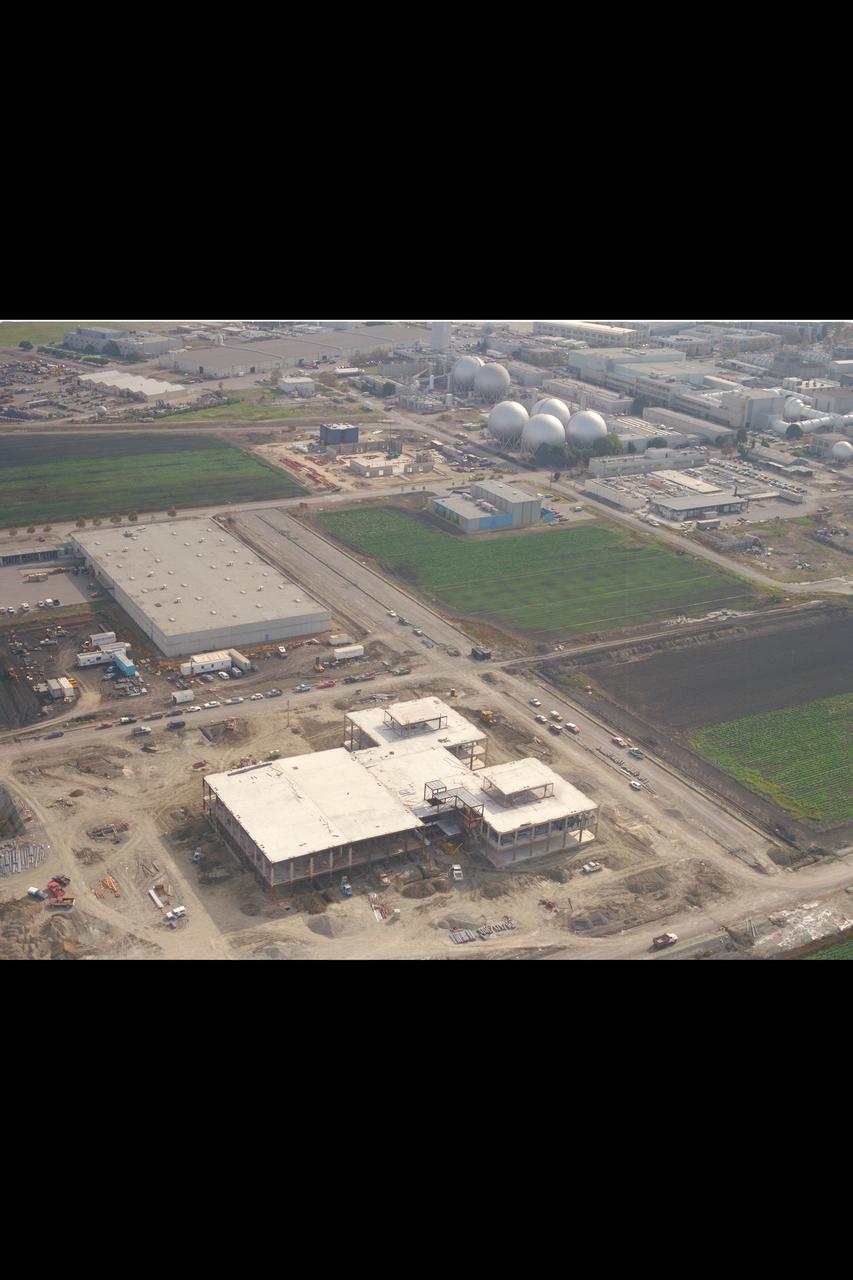
N-258 NAS (Numerical Aerodynamic Simulation) Facility, Aerials of construction site, framing
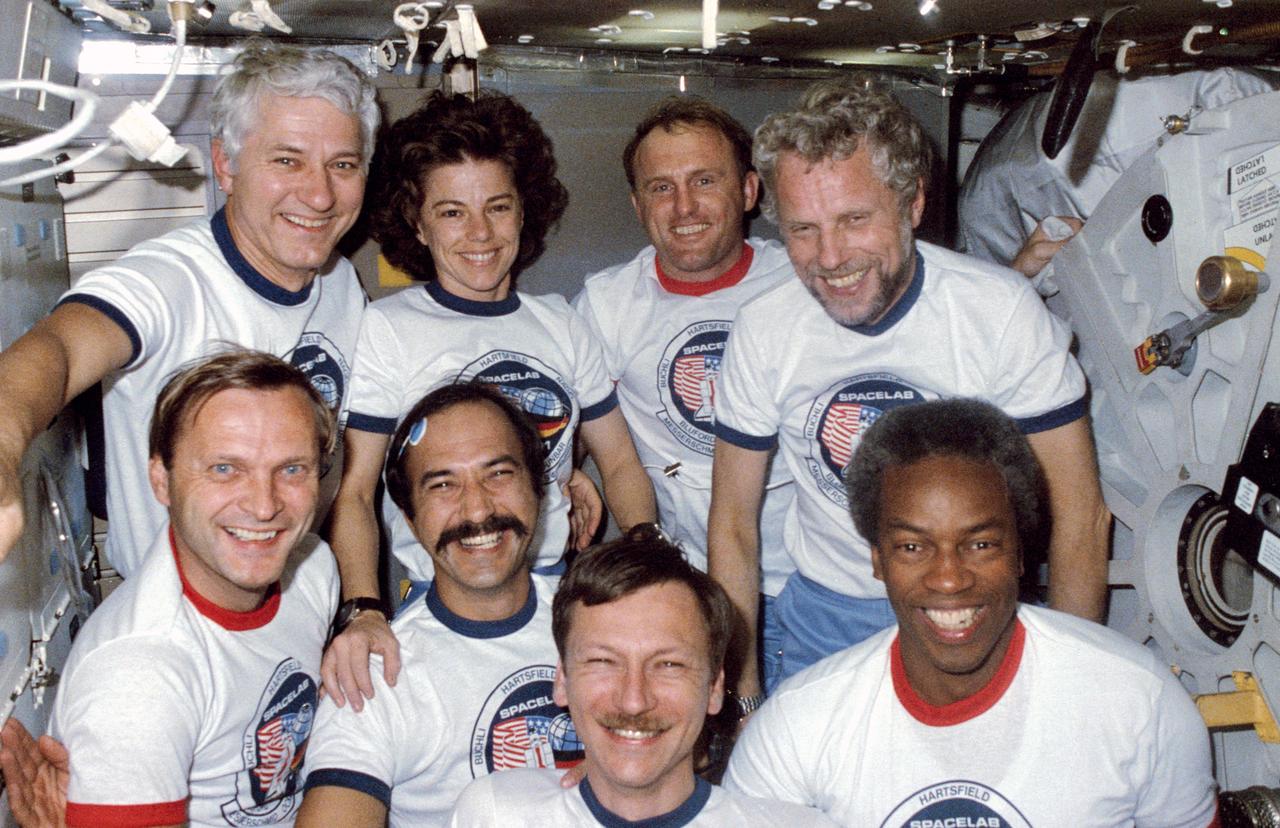
61A-117-019 (30 Oct.-6 Nov. 1985) --- Traditional in-flight portrait of all eight STS-61A crew members was made with an automatic exposure of a 35mm camera. Left to right, back row, Henry W. Hartsfield Jr., commander; Bonnie J. Dunbar, mission specialist; James F. Buchli, mission specialist; and Reinhard Furrer, payload specialist. Left to right, front row, Ernst Messerschmid, payload specialist; Wubbo J. Ockels, payload specialist representing the European Space Agency (ESA); Steven R. Nagel, pilot; and Guion S. Bluford Jr., mission specialist. Photo credit: NASA
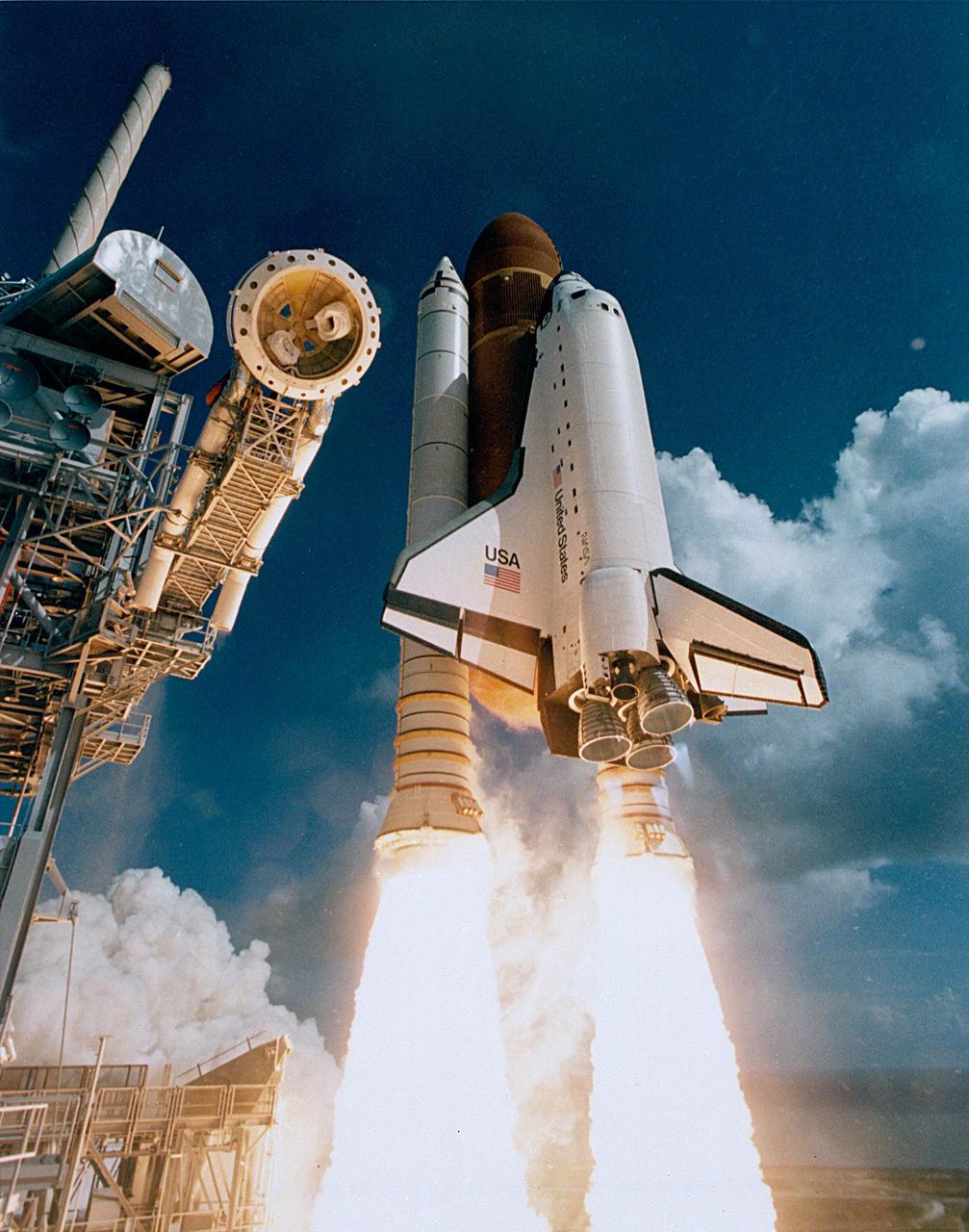
KENNEDY SPACE CENTER, FLA. -- STS-51-J: Atlantis
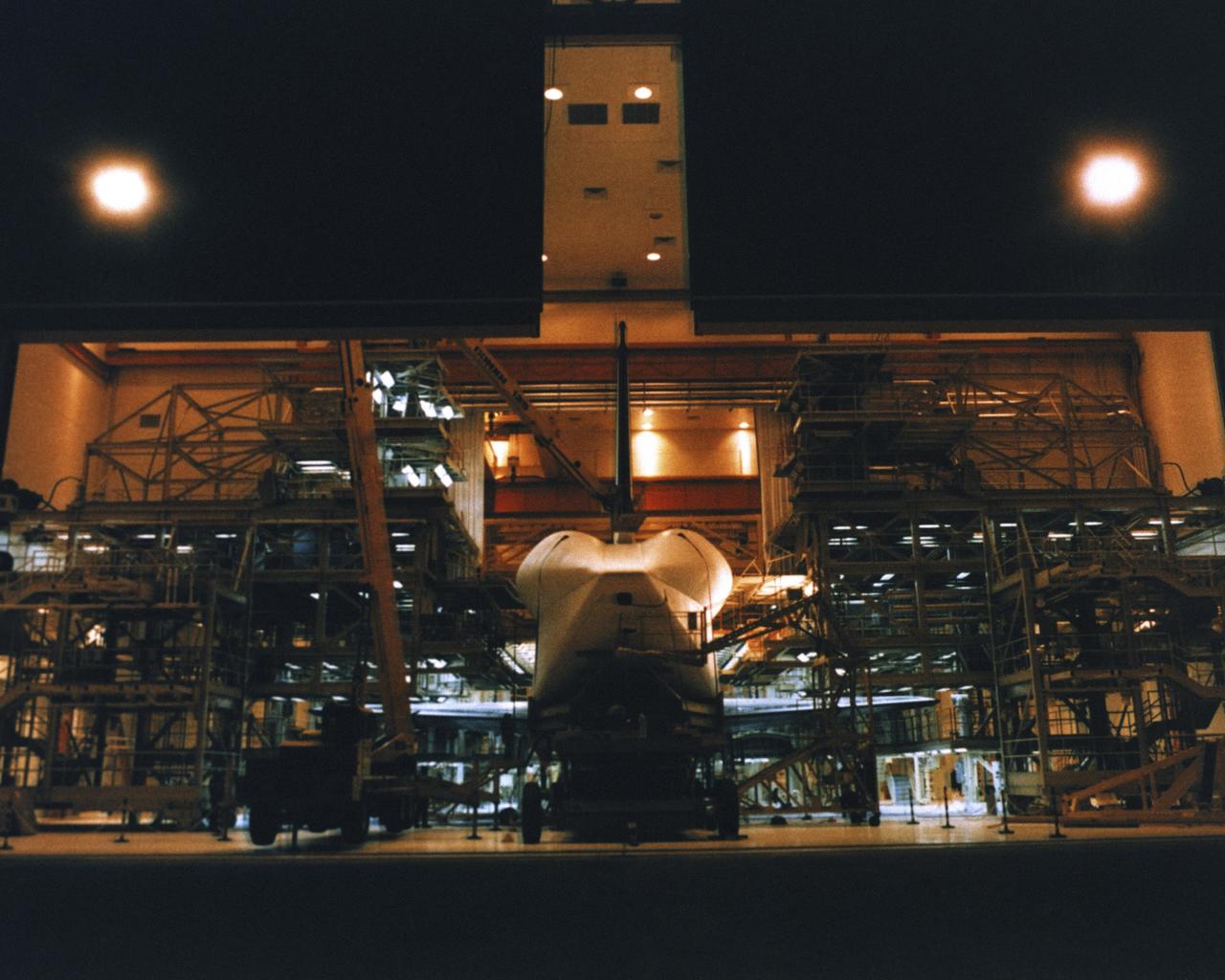
VANDENBERG AIR FORCE BASE, Calif. -- Enterprise inside the Orbiter Maintenance and Checkout Facility at Vandenberg AFB, California. Photo Credit: NASA
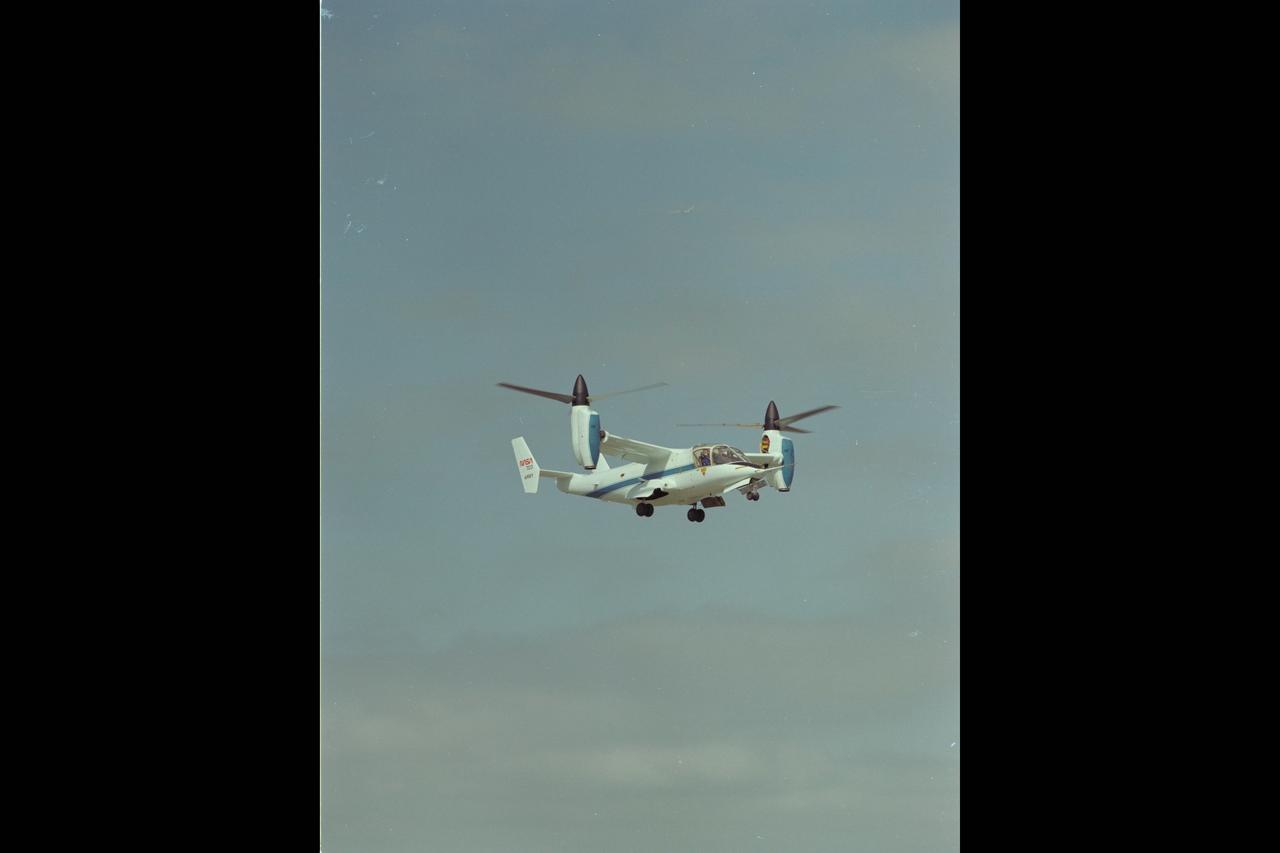
XV-15 Tilt Rotor (NASA-703) hovers at Ames Research Center, helicopter mode
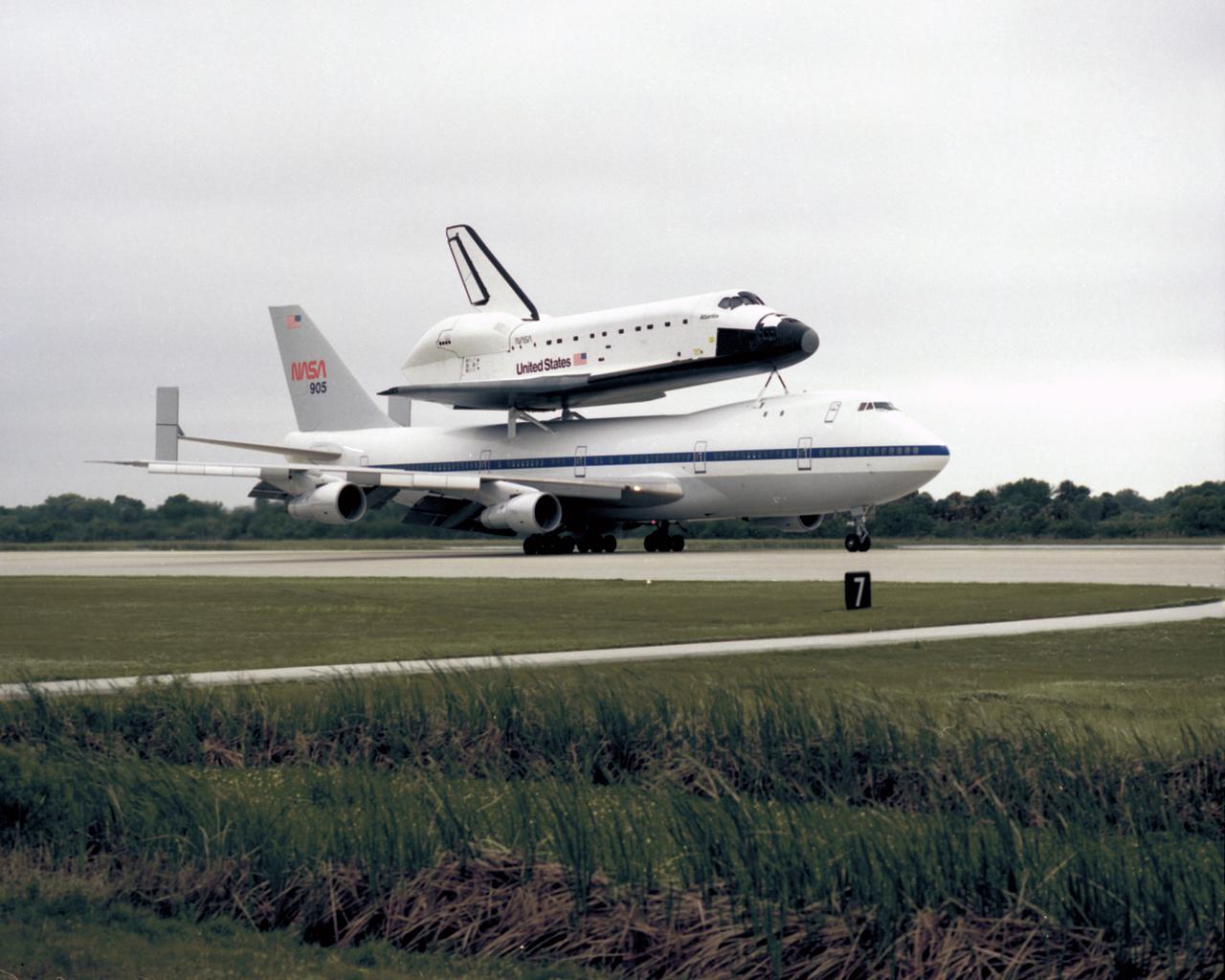
Orbiter Atlantis arrival at SLF.
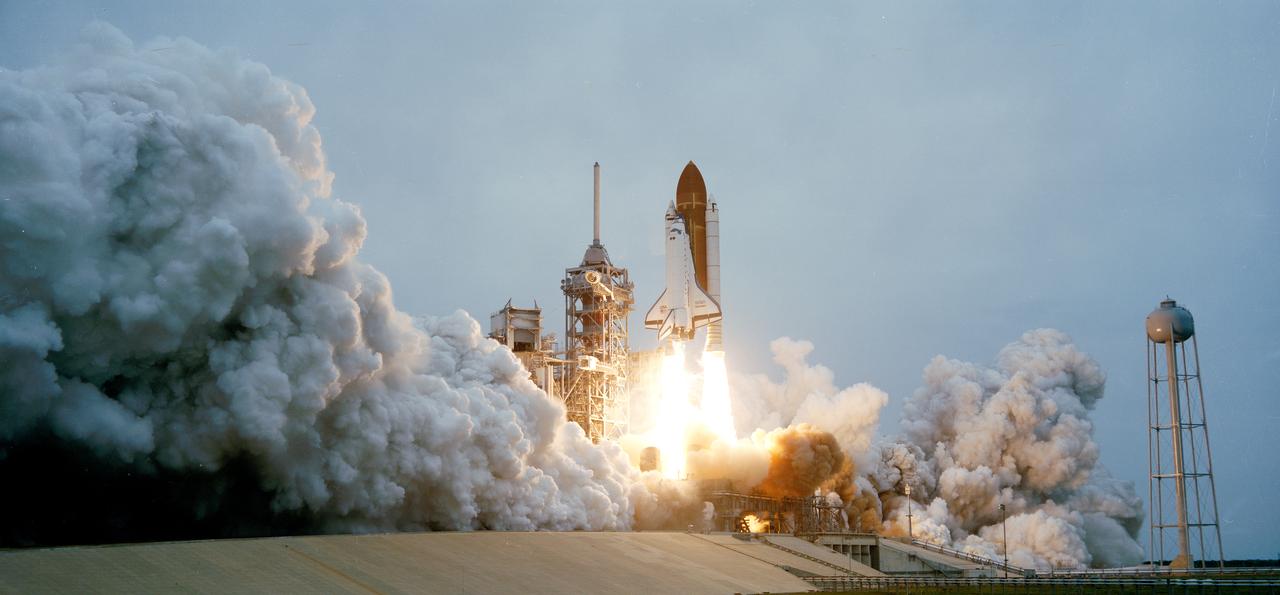
51D-9094 (12 April 1985) --- A 70mm frame of the Space Shuttle Discovery's 51-D launch at 8:59 a.m. (EST), April 12, 1985. Onboard are seven crewmembers and two communications satellites and a variety of medical and other experiments.
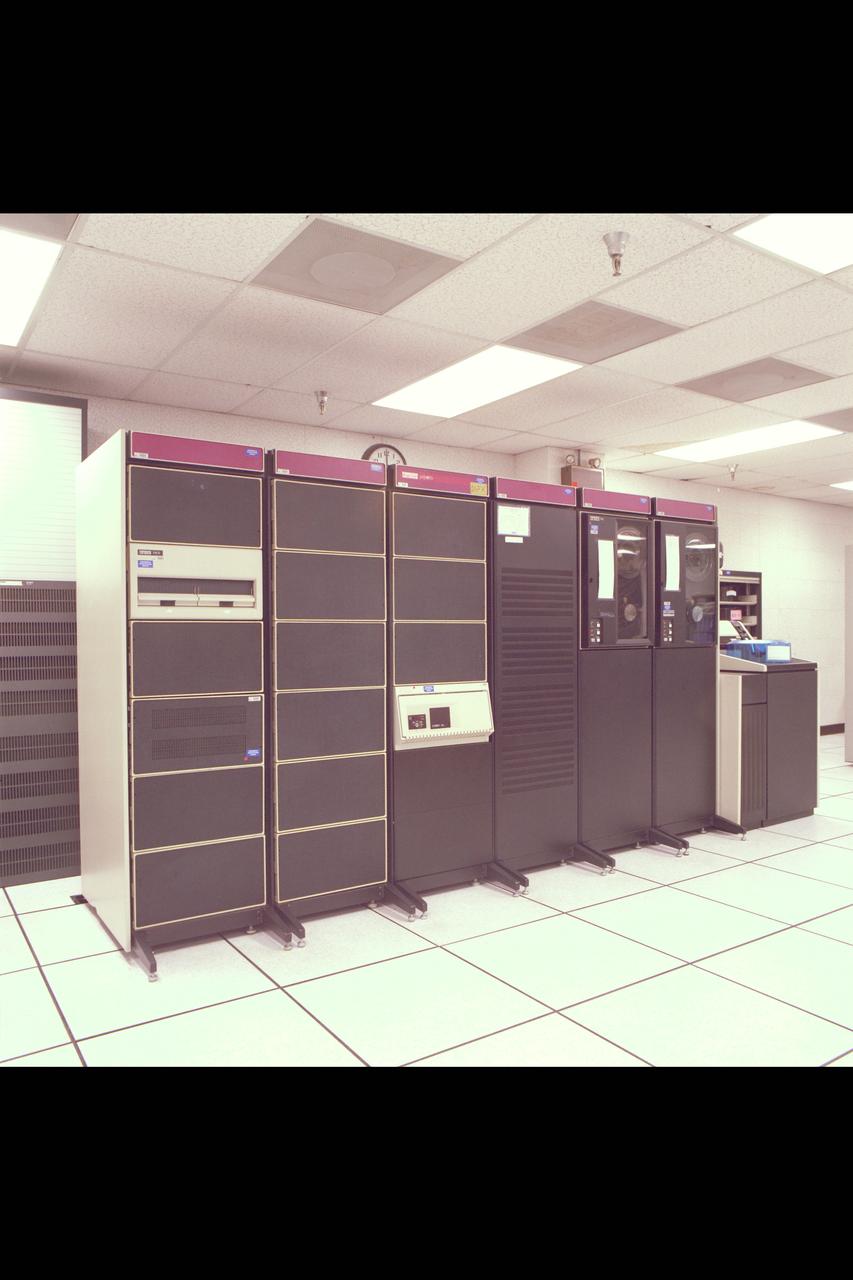
N-227 Wind Tunnel Data Control Room: Hardware
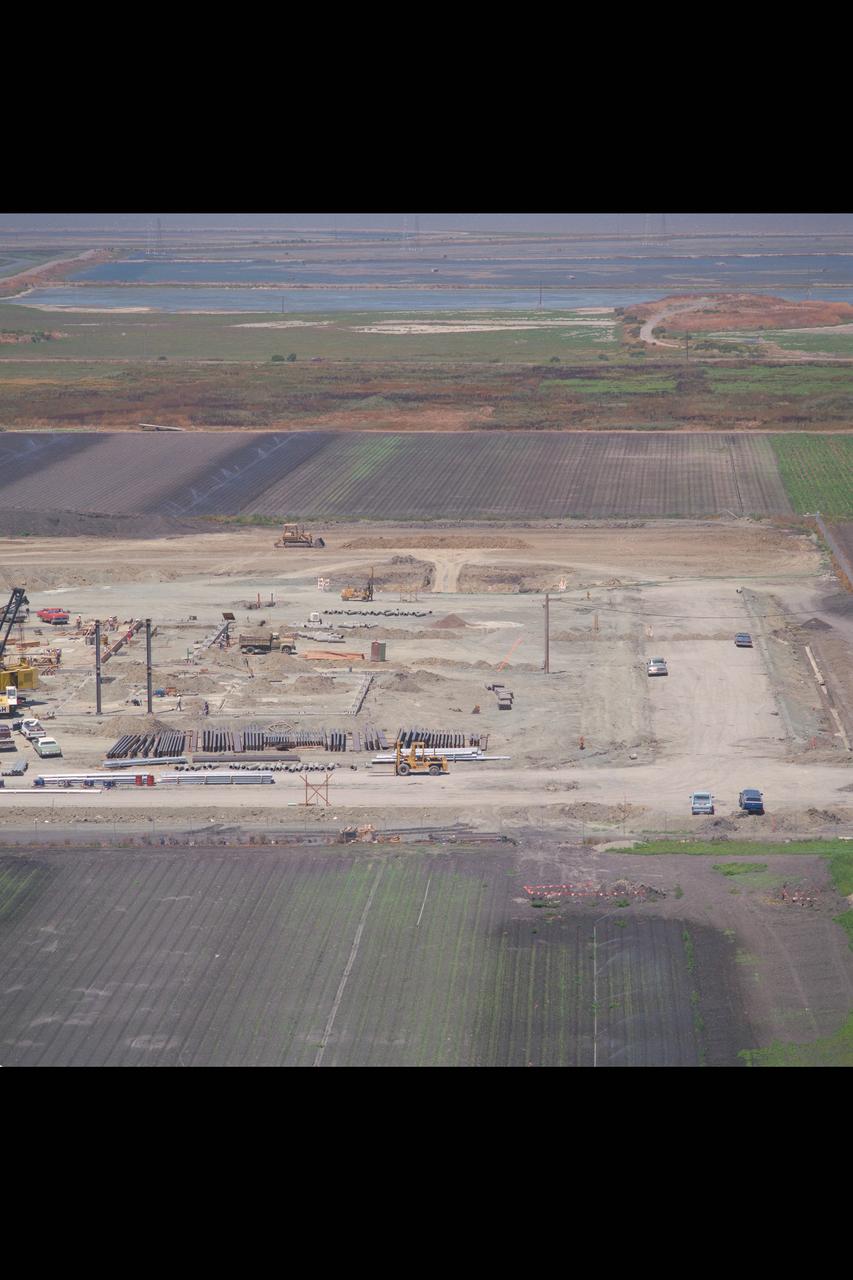
N-258 NAS (Numerical Aerodynamic Simualtion) Facility, aerials of (pre) construction site, Foundation
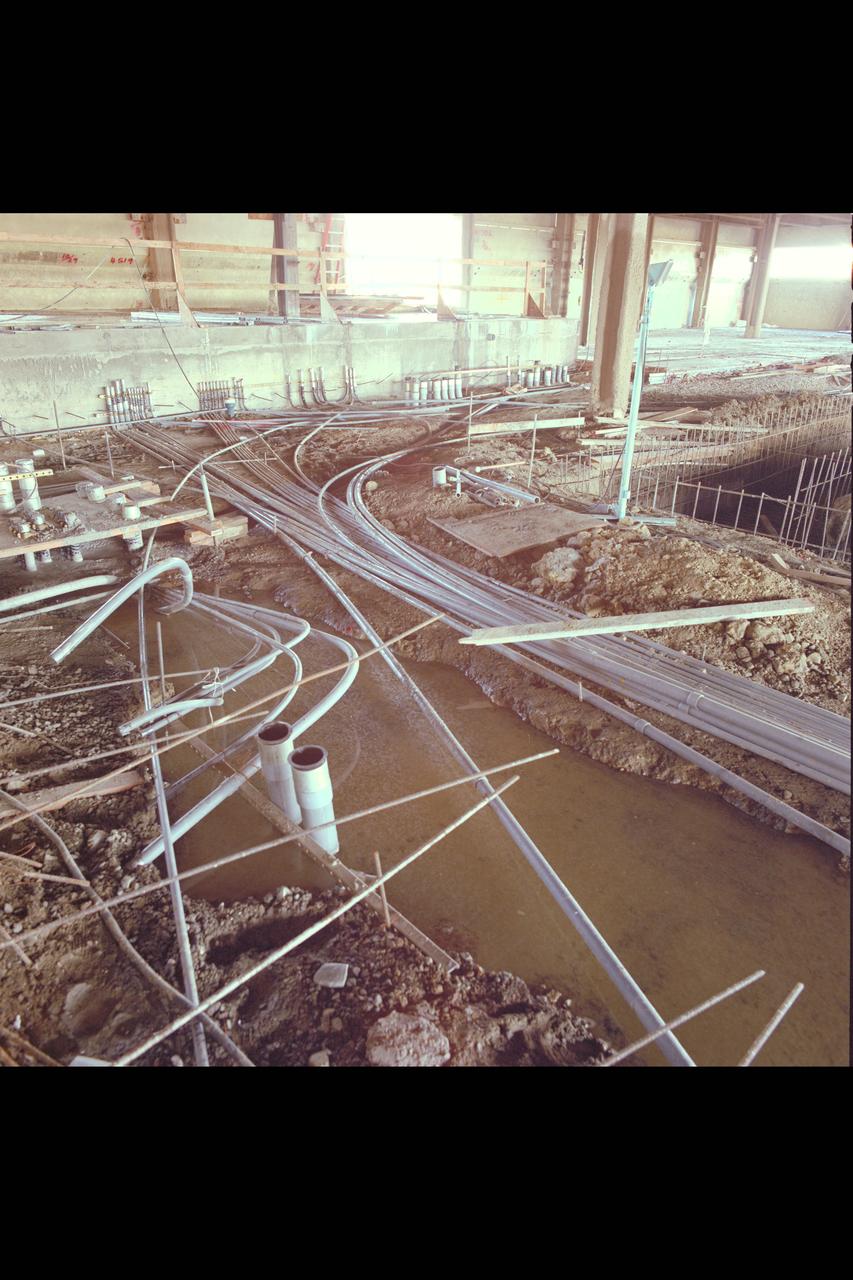
N-258 NAS (Numerical Aerodynamic Simulation) Facility, Interior of Construction Site, Framing
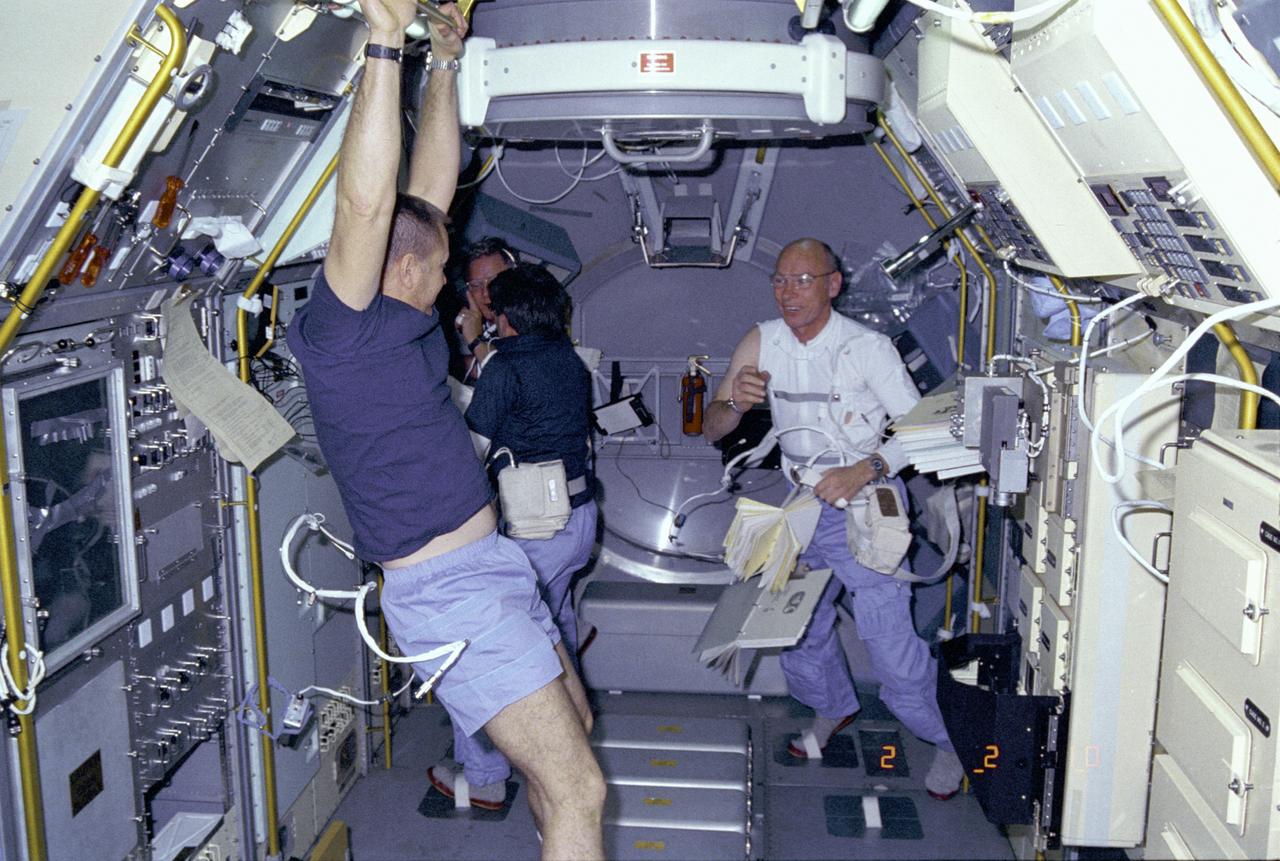
Activities inside the laboratory module during the Spacelab-3 mission are shown in this photograph. Left to right are astronauts Robert Overmyer, Commander of the mission; Don Lind, Mission Specialist; Lodewijk van den Berg, Payload Specialist; and William Thornton, Mission Specialist. The primary purpose of the Spacelab-3 mission was to conduct materials science experiments in a stable low-gravity environment. In addition, the crew did research in life sciences, fluid mechanics, atmospheric science, and astronomy. Spacelab-3 was equipped with several new minilabs, special facilities that would be used repeatedly on future flights. Two elaborate crystal growth furnaces, a life support and housing facility for small animals, and two types of apparatus for the study of fluids were evaluated on their inaugural flight. Spacelab-3 (STS-51B) was launched aboard the Space Shuttle Challenger on April 29, 1985. The Marshall Space Flight Center had managing responsibilities of the mission.
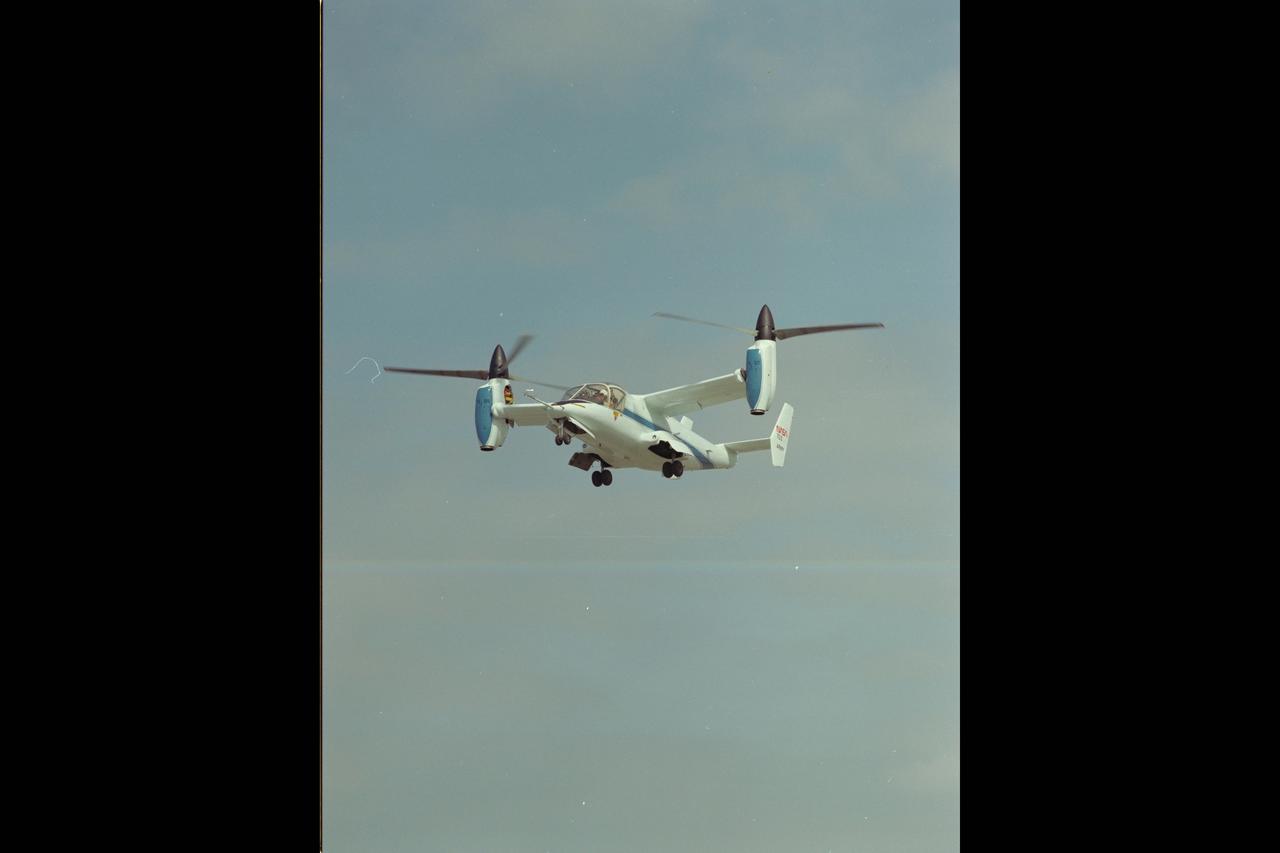
XV-15 (NASA-703) Evaluation Flight @ Ames; Above Title and Helicopter Mode
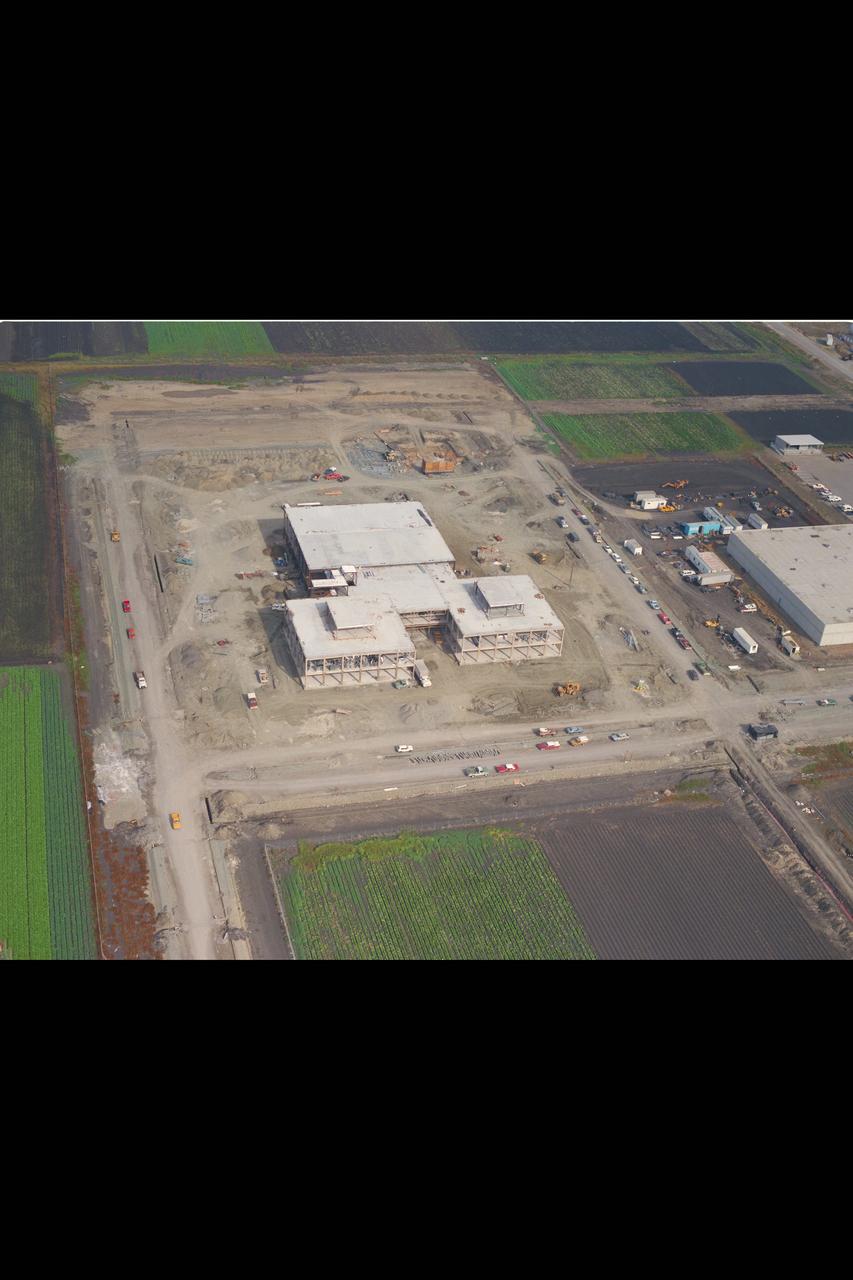
N-258 NAS (Numerical Aerodynamic Simulation) Facility, Aerials of construction site, framing

N-258 NAS (Numerical Aerodynamic Simulation) Facility, Roof Top Aerials of construction site, framing
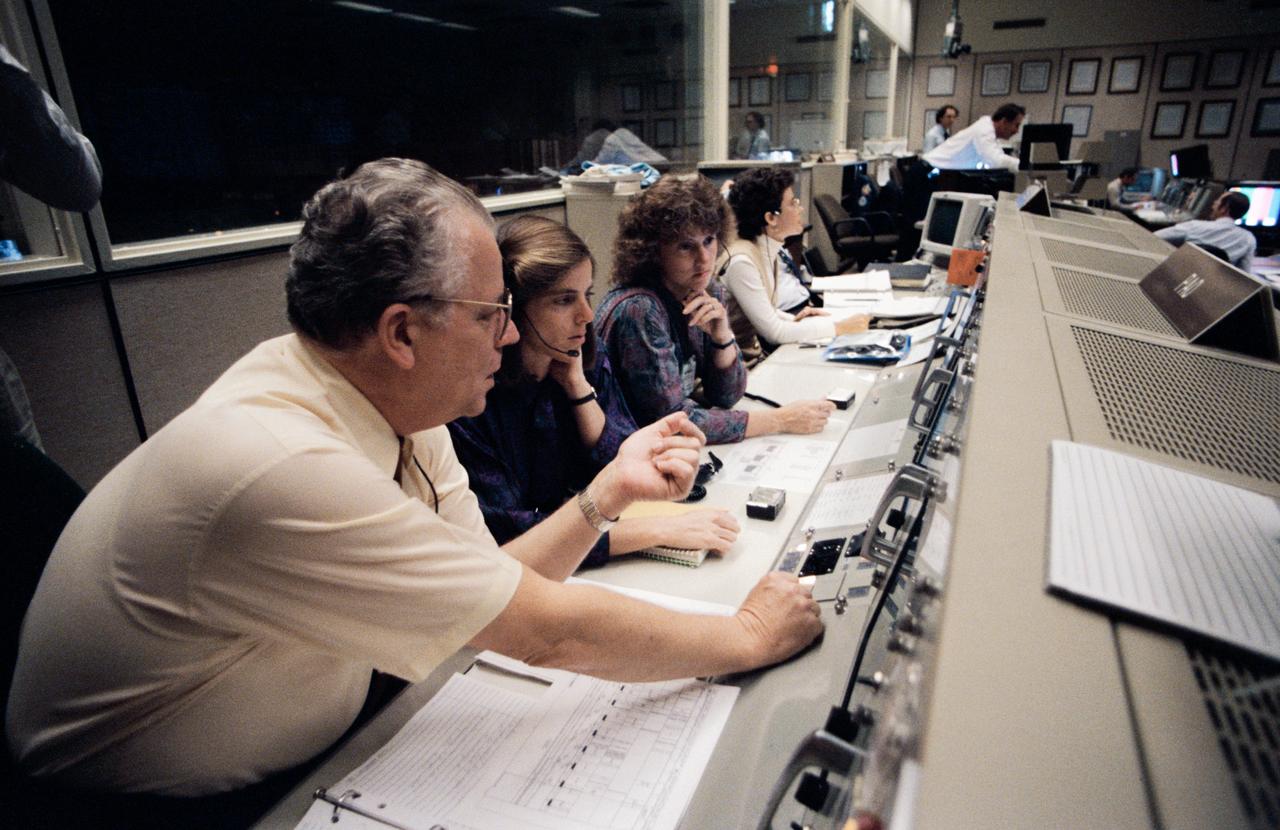
61A-S-135 (5 Nov 1985) --- Two school teachers in training at the Johnson Space Center got their first ?real time? exposure to a Space Shuttle mission as they monitor activity aboard the Spacelab D-1 science module from the mission control center. Sharon Christa McAuliffe (frame center) and Barbara R. Morgan are briefed by Terry White at the Public Affairs console during a television downlink from the Earth-orbiting Space Shuttle Challenger. McAuliffe is scheduled to fly as teacher/citizen observer on the STS 51-L mission early next year; and Morgan is in training as her backup.
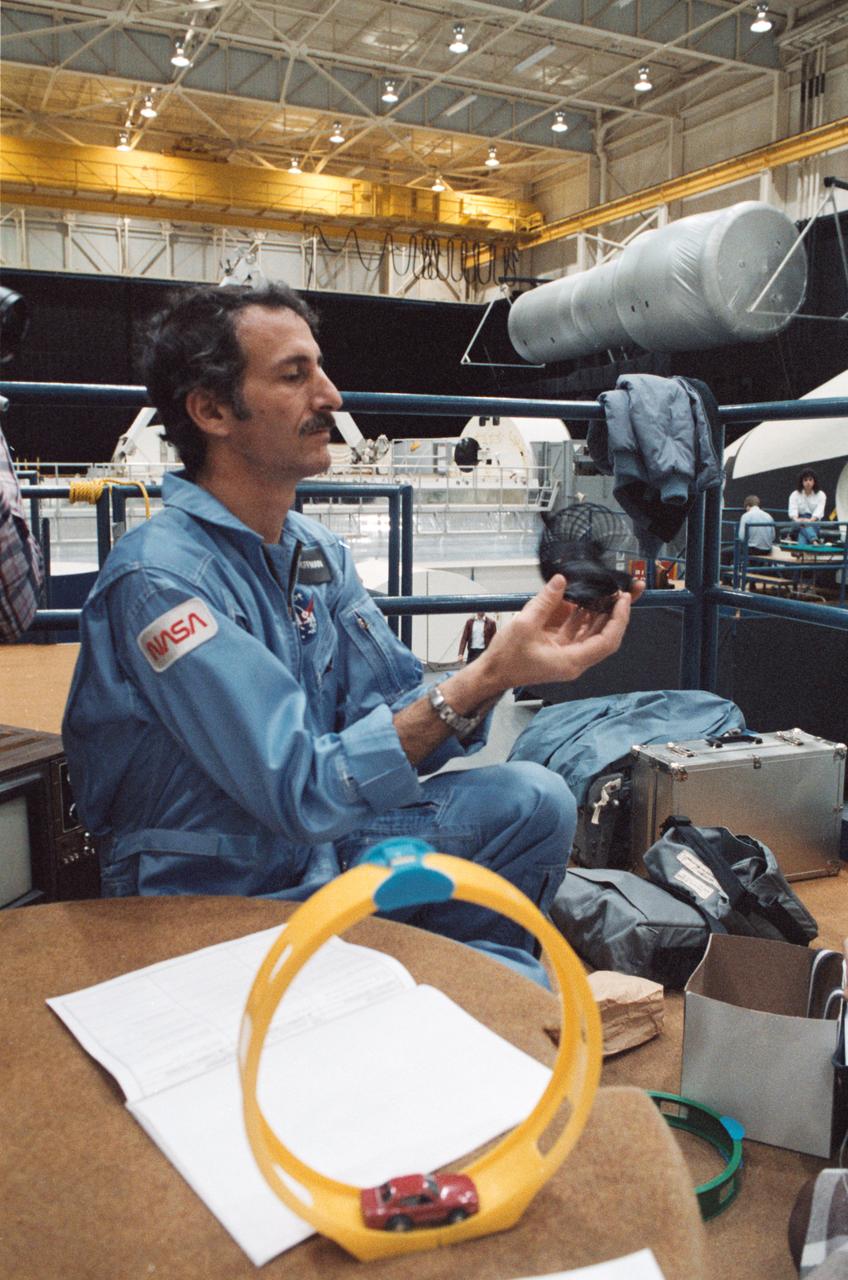
STS-51E Crewman Jeff Hoffman in 1-G Trainer with space experiment toys and camera, 01/17/1985, . 1. STS-51E - EXPERIMENTS (TOYS) JSC, HOUSTON, TX Also available in 35 B&W
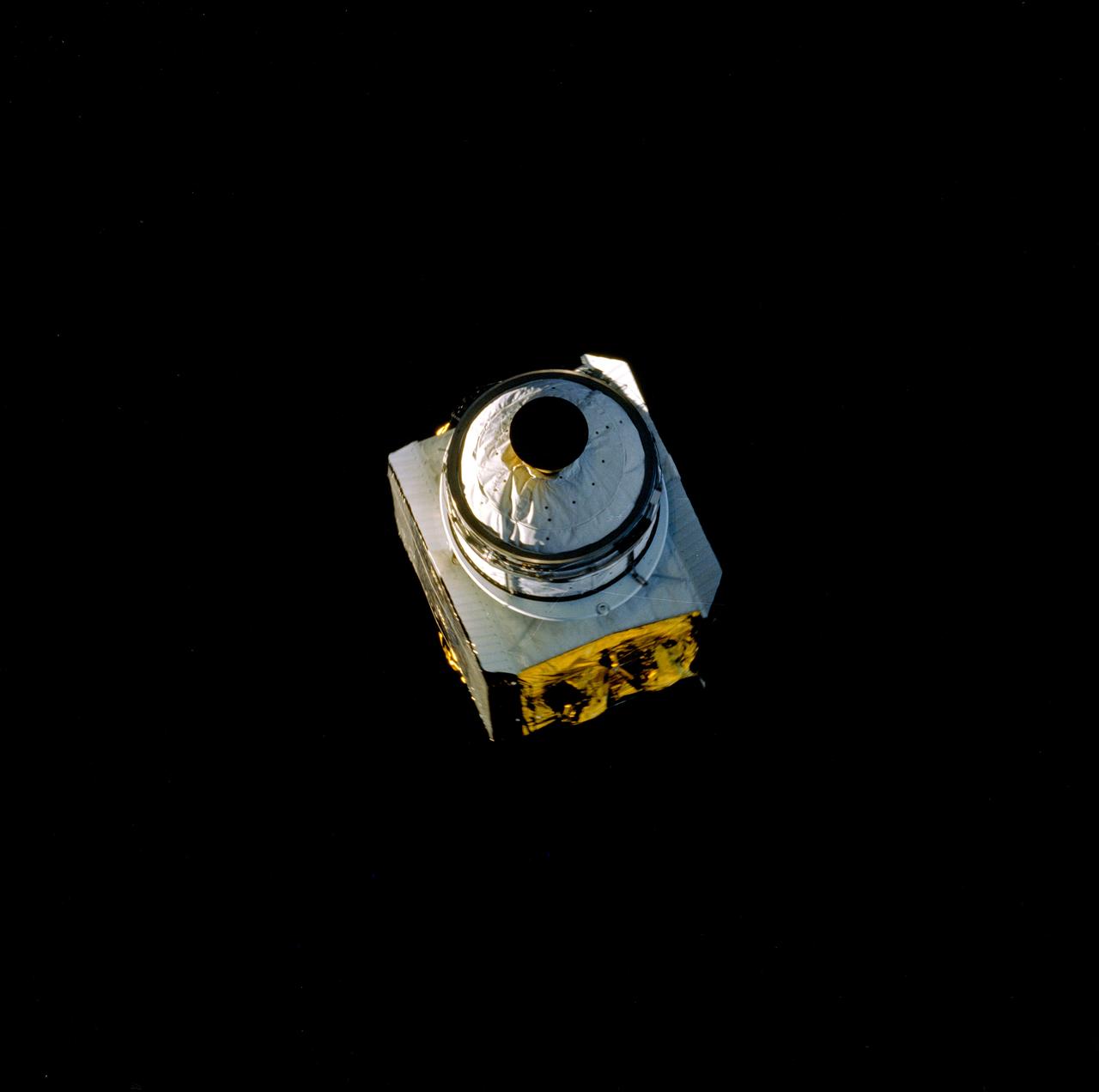
61B-44-054E (28 Nov 1985) --- The 4,1444 pound RCA Satcom K-2 communications satellite is photographed with a 70mm Hasselblad as it moves quickly away from the Atlantis.
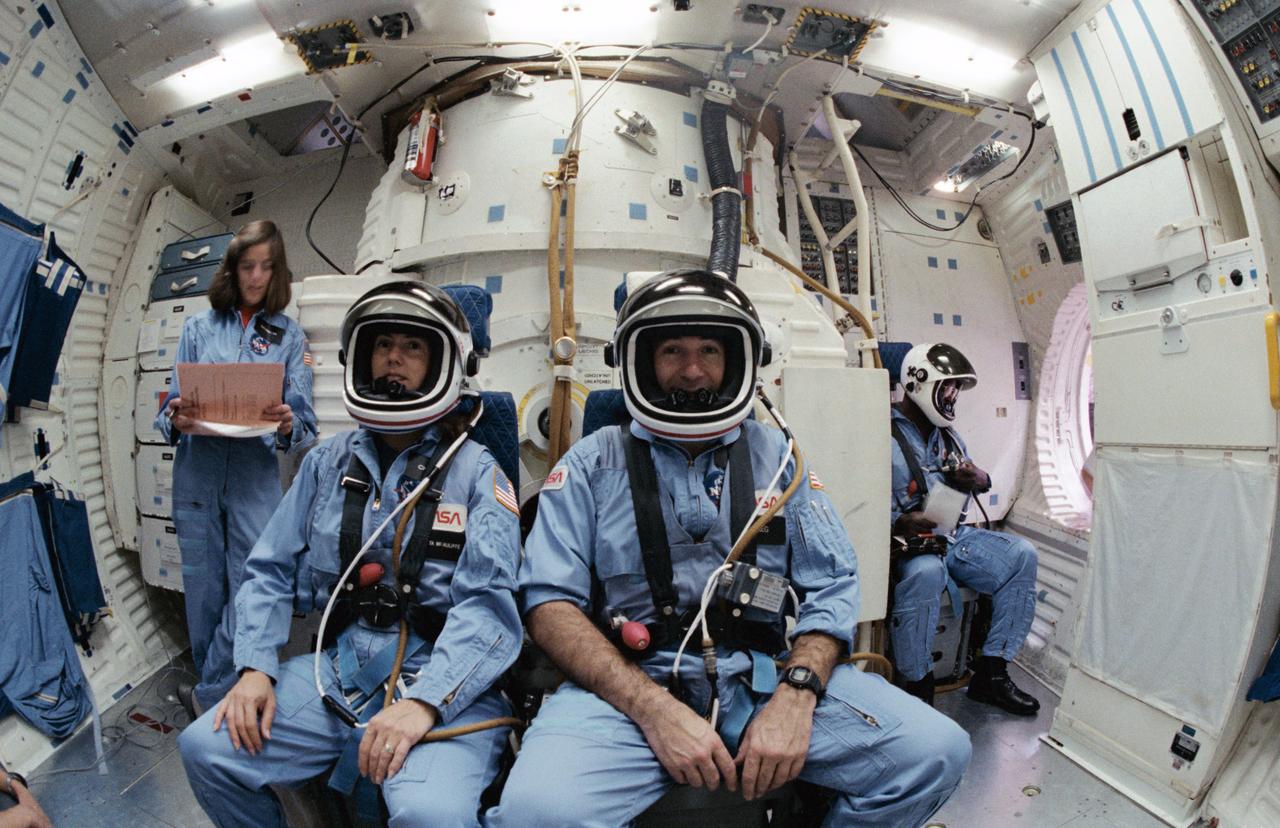
S85-46208 (December 1985) --- L.?R., backup Payload Specialist Barbara R. Morgan, Teacher Payload Specialist Christa McAuliffe, Hughes Payload Specialist Gregory B. Jarvis and Mission Specialist Ronald E. McNair in shuttle mission simulator at the Johnson Space Center. Photo was taken by Bill Bowers. Photo credit: NASA
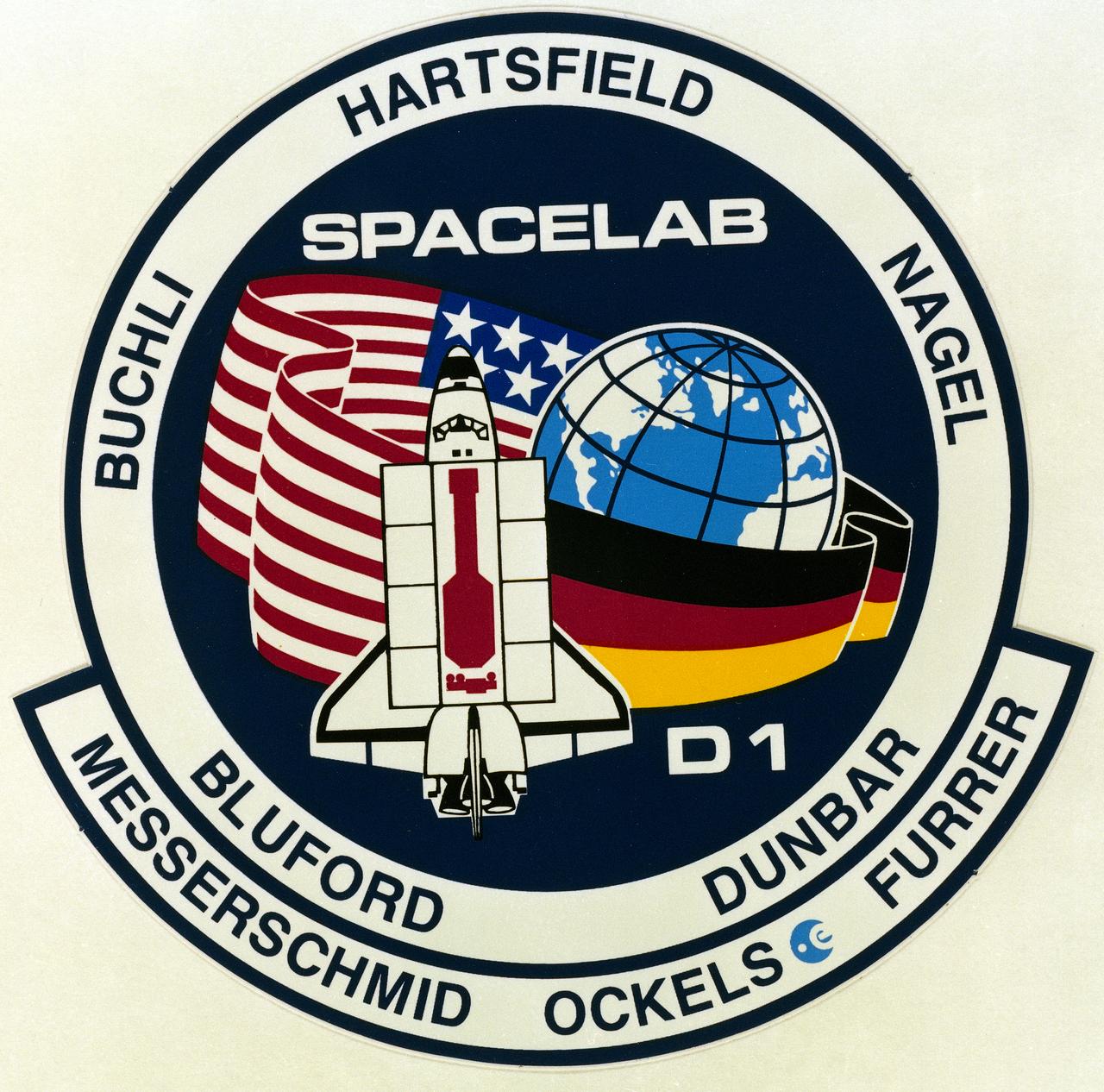
This insignia was chosen by the eight members of the STS-61A/D1 Spacelab mission to represent the record-sized Space Shuttle crew. Crewmembers surnames surround the colorful patch scene depicting Challenger carrying a long science module and an international crew from Europe and the United States.
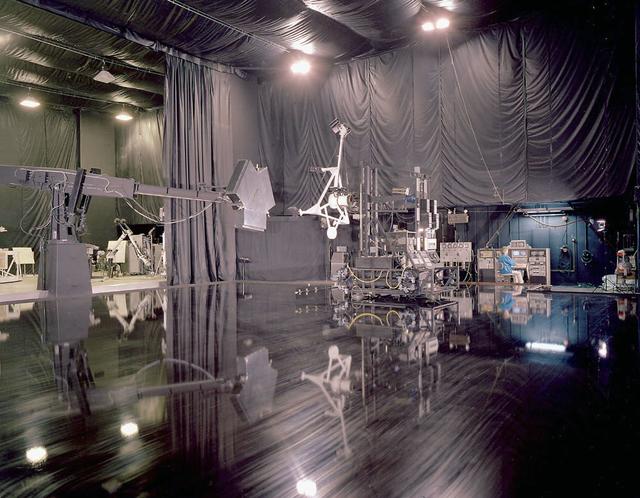
Marshall employees conduct tests on the simulated rendezvous docking mechanism (SRDM)as depicted in this photo of the flat floor area in building 4619.
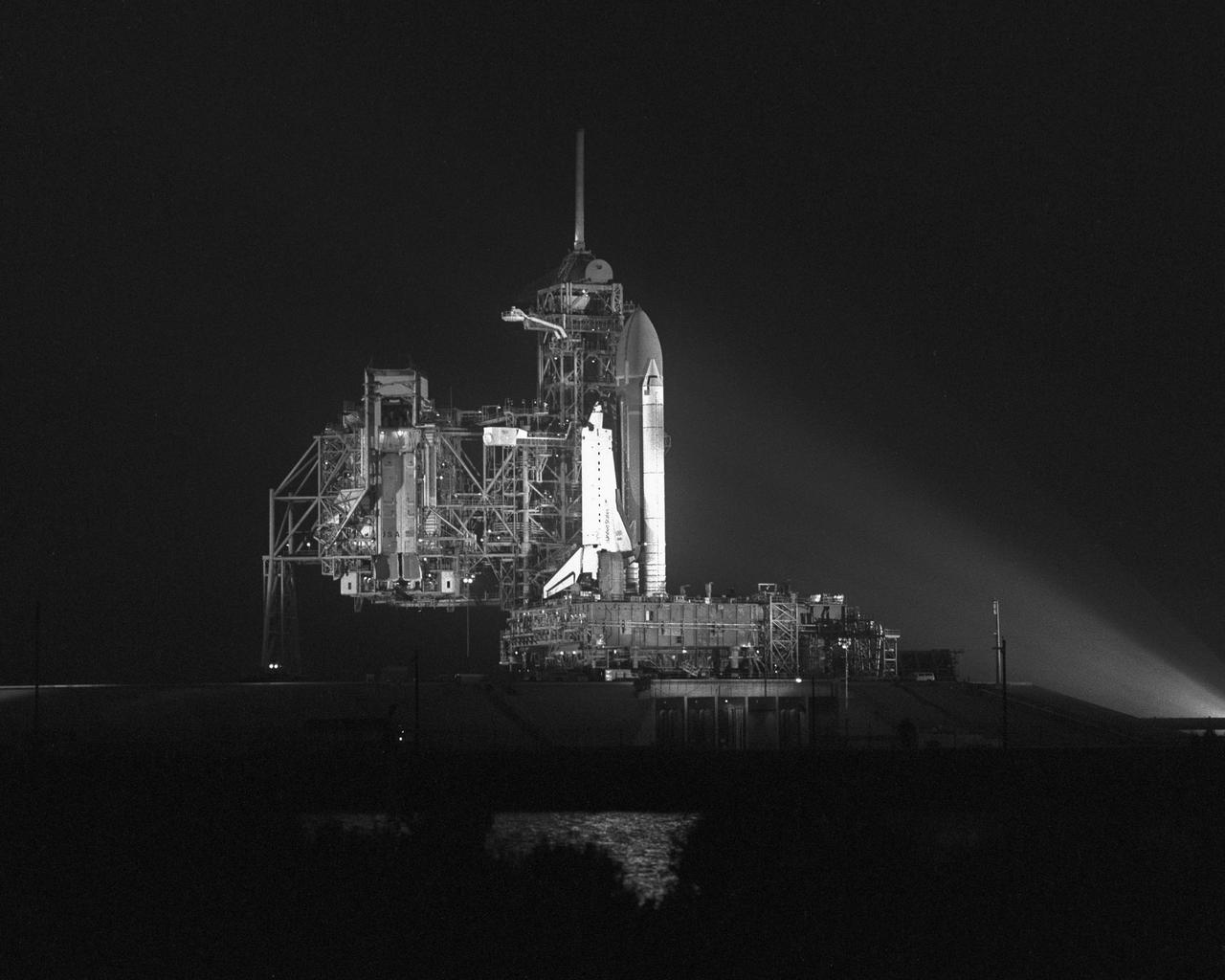
CAPE CANAVERAL, Fla. -- At the Kennedy Space Center in Florida, the space shuttle Atlantis stands at Launch Complex 39A in preparation for its maiden flight, STS-51J. Photo credit: NASA
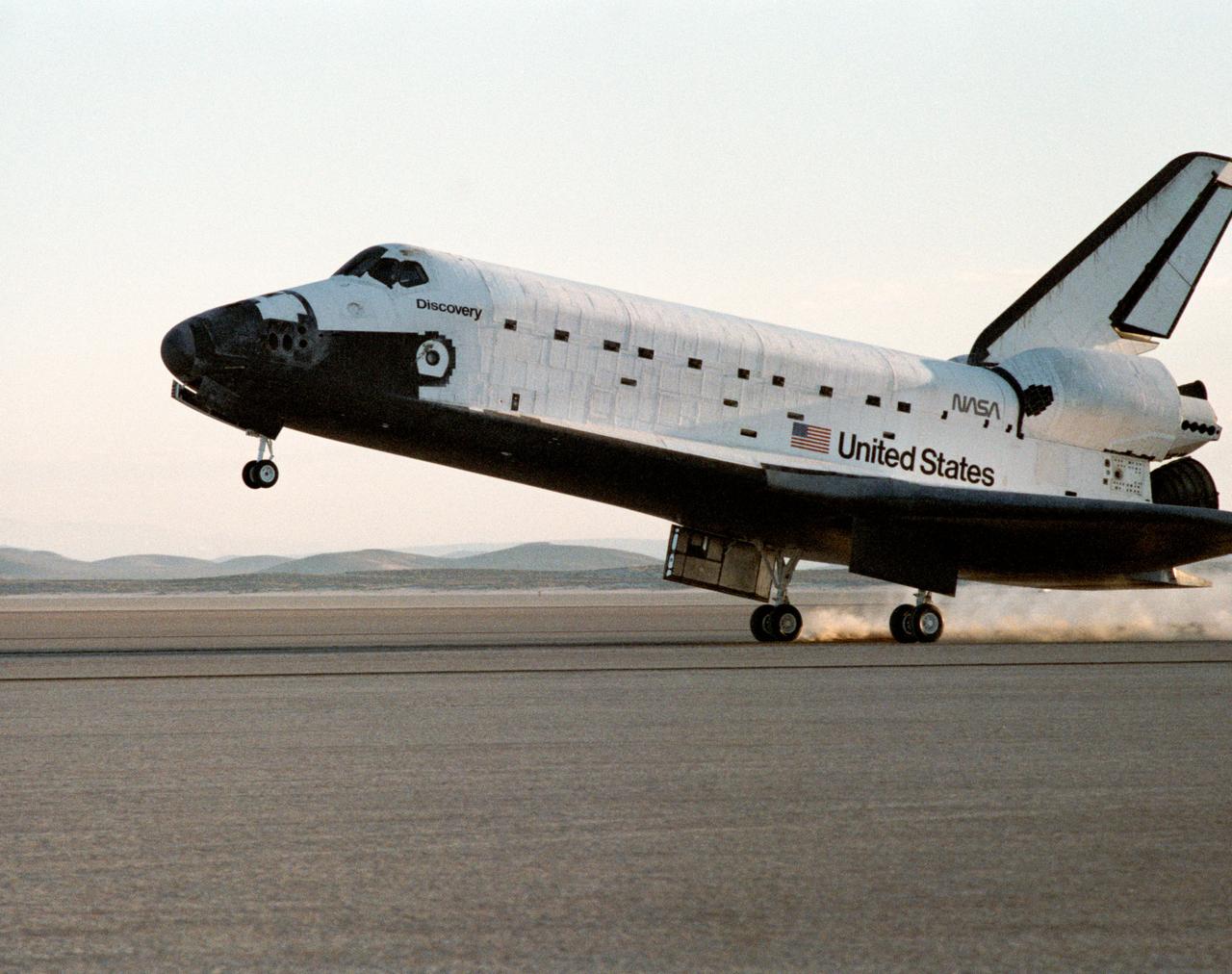
51G-S-225 (24 June 1985) --- Discovery, with its seven-member 51-G crew aboard, touches down on a dry lakebed at Edwards Air Force Base in California. Landing was noted at 6:11:53 a.m. (PDT), June 24, 1985.
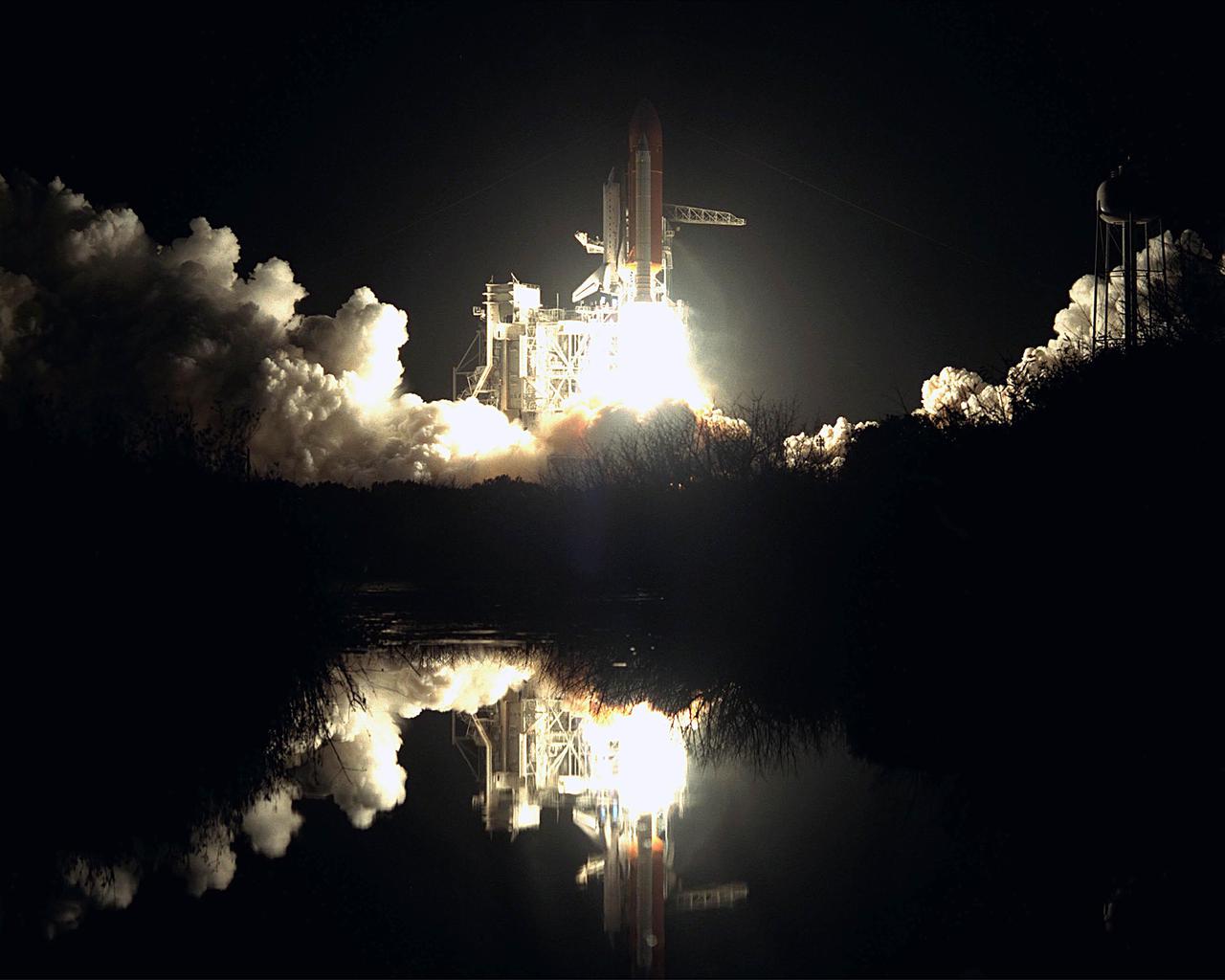
KENNEDY SPACE CENTER, FLA. -- STS-61-B: Atlantis

The crew assigned to the STS-51D mission included (front left to right) Karol J. Bobko, commander; Donald E. Williams, pilot; M. Rhea Seddon, mission specialist; and Jeffrey A. Hoffman, mission specialist. On the back row, left to right, are S. David Griggs, mission specialist; and payload specialists Charles D. Walker, and E. Jake Garn (Republican Utah Senator). Launched aboard the Space Shuttle Discovery on April 12, 1985 at 8:59:05 am (EST), the STS-51D mission’s primary payloads were the TELESAT-1 (ANIK-C) communications satellite and the SYNCOM IV-3 (also known as LEASAT-3).
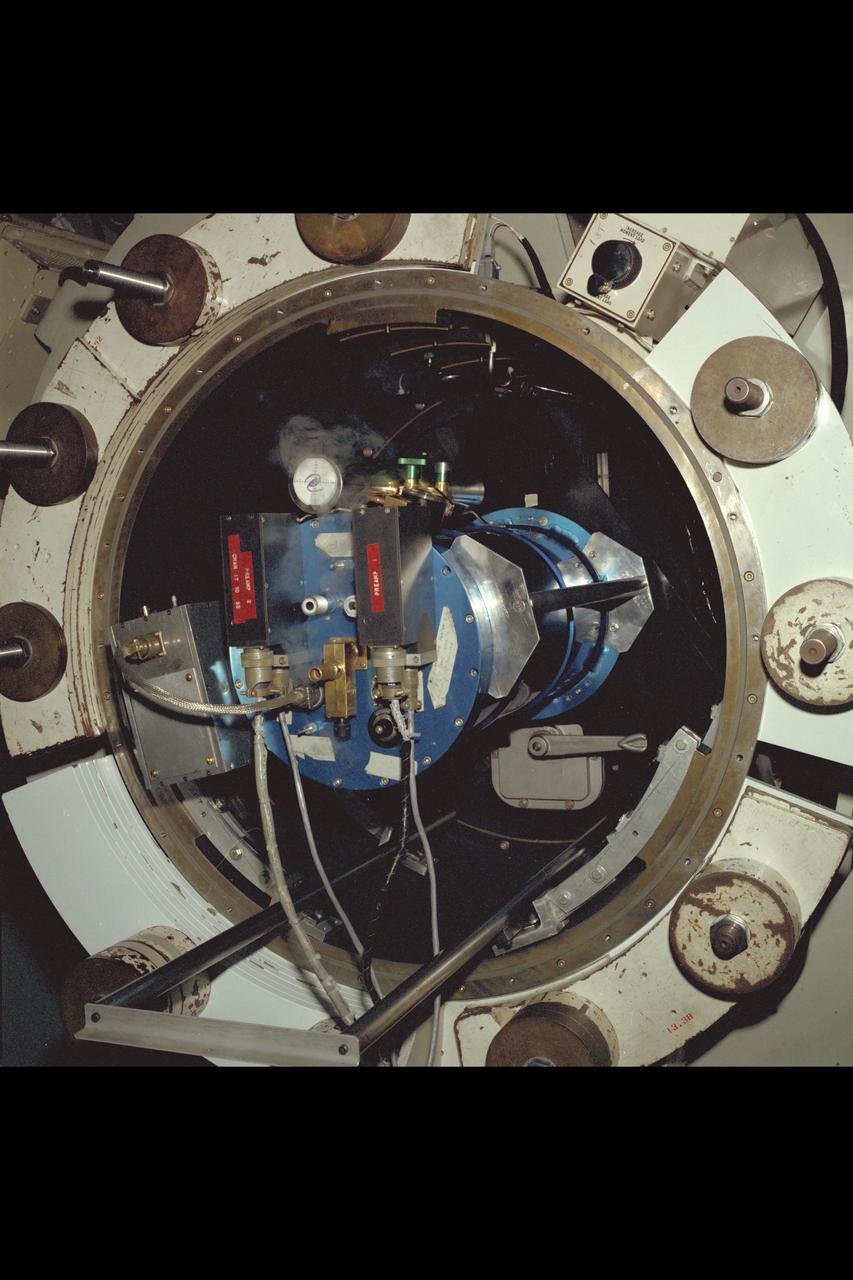
C-141 KAO Yerkes Observatory, University of Chicago (FAR-IR Camera)

N-258 NAS (Numerical Aerodynamic Simualtion) Facility, aerials of (pre) construction site, Foundation
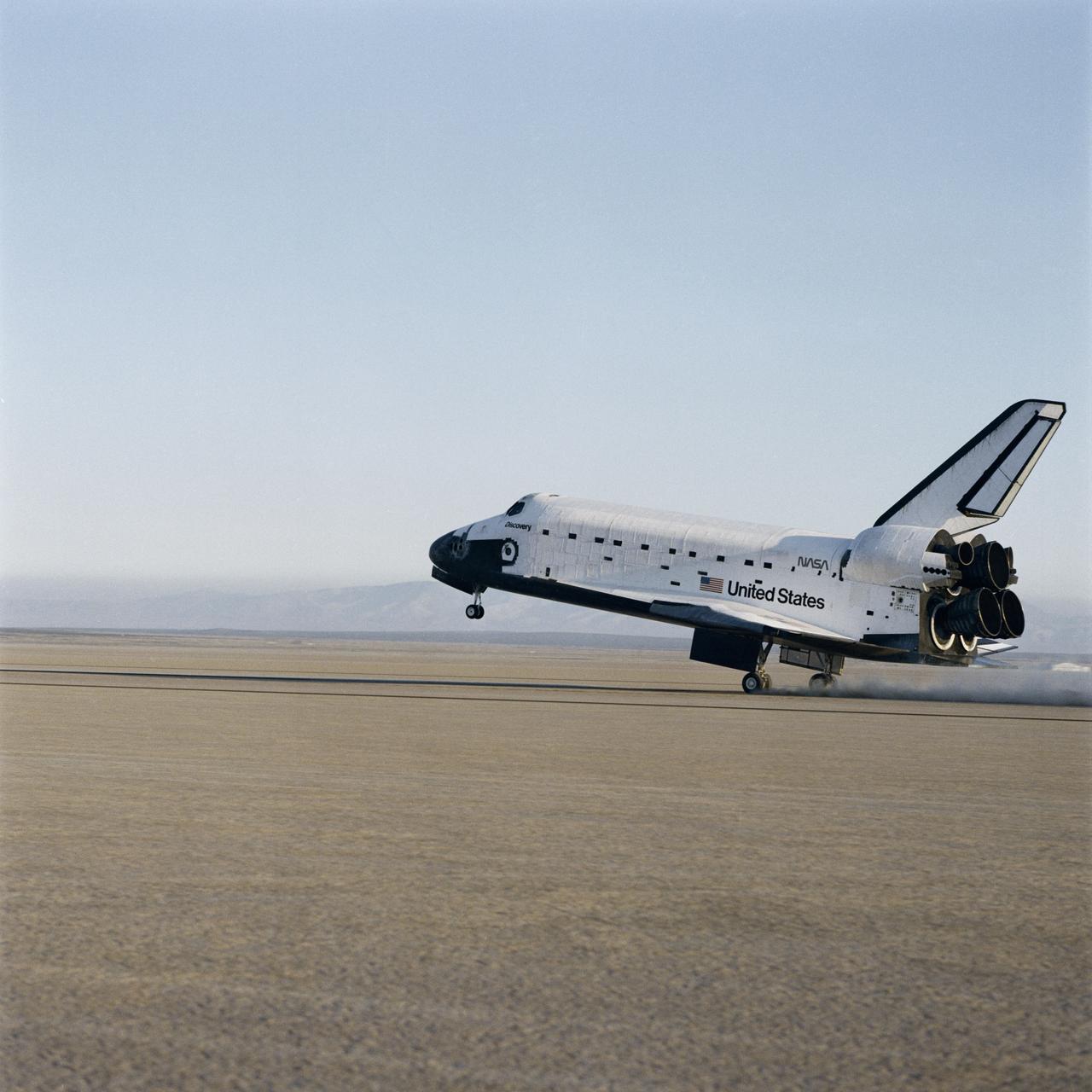
51G-S-224 (24 June 1985) --- Discovery, with its seven-member 51-G crew aboard, touches down on a dry lakebed at Edwards Air Force Base in California. Landing was noted at 6:11:53 a.m. (PDT), June 24, 1985.
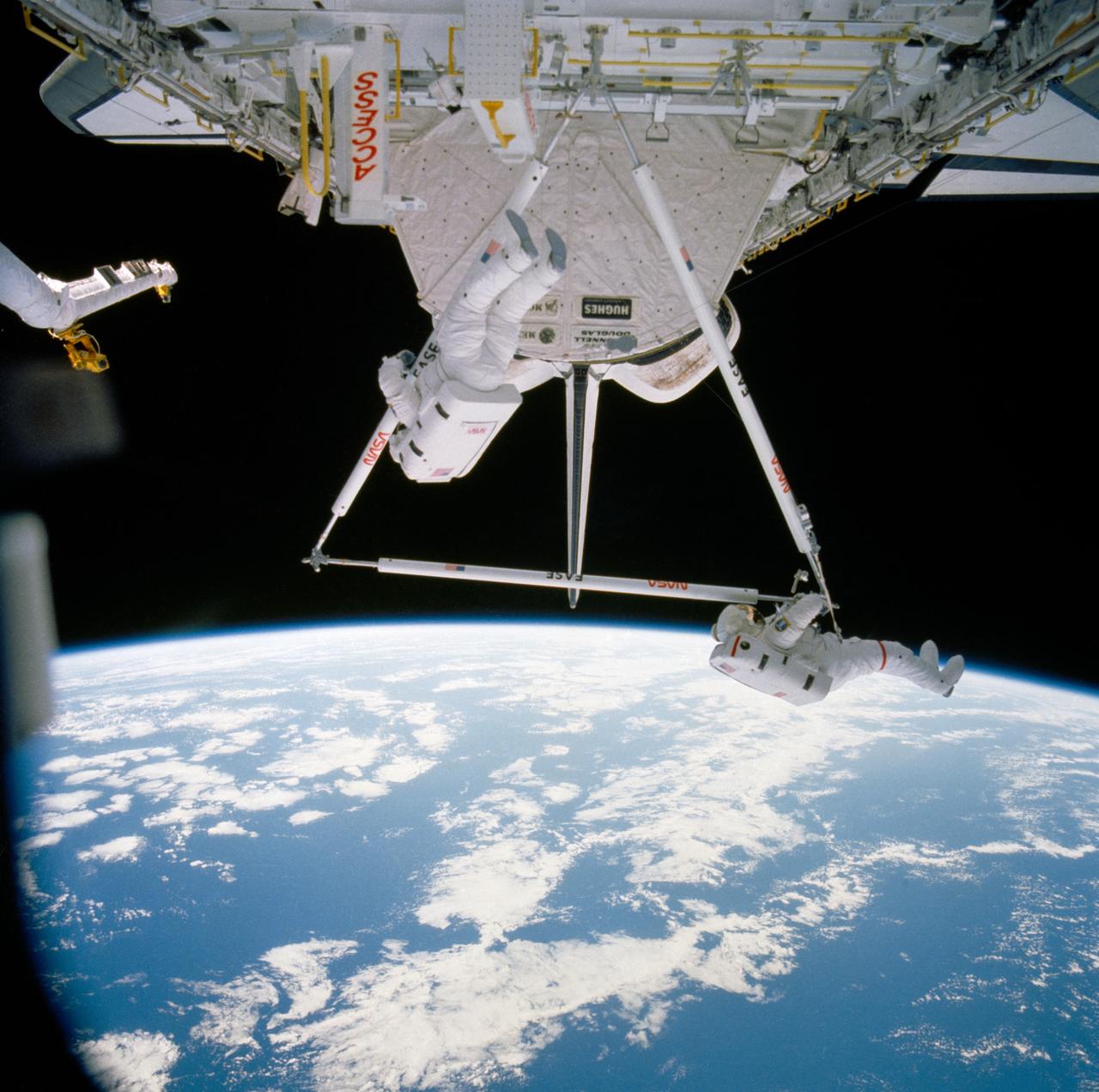
Astronauts Jerry L. Ross (left) and Sherwood C. (Woody) Spring are photographed as they assemble pieces of the Experimental Assembly of Structures in Extravehicular Activities (EASE) device in the open payload bay. The Canadian-built remote manipulator system (RMS) arm (partially obscured in the right portion of the frame) is in position to allow television cameras to record the activity.
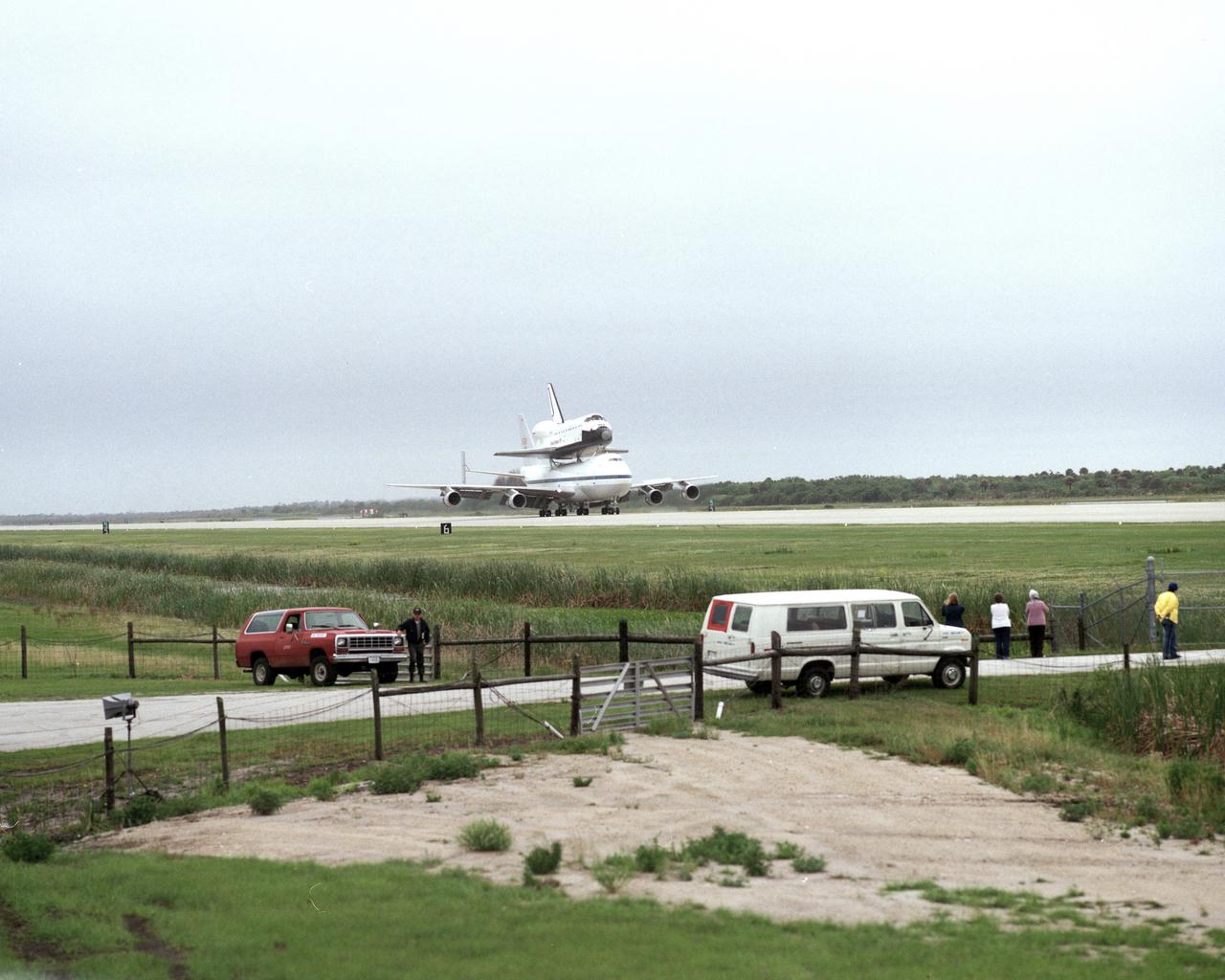
CAPE CANAVERAL, Fla. – At the Kennedy Space Center in Florida, the new space shuttle, Atlantis, arrives at the Shuttle Landing Facility. The shuttle is mounted atop the Shuttle Carrier Aircraft, a modified Boeing 747. Over the next seven months Atlantis will be prepared for its maiden voyage, STS-51J. Atlantis, NASA's fourth space-rated shuttle, was named after the two-masted boat that served as the primary research vessel for the Woods Hole Oceanographic Institute in Massachusetts from 1930 to 1966. The boat had a 17-member crew and accommodated up to five scientists who worked in two onboard laboratories, examining water samples and marine life. Like its predecessors, Atlantis was constructed by Rockwell International in Palmdale, Calif. The spacecraft was transported over land from Palmdale to Edwards Air Force Base on April 3, 1985 for the cross-country ferry flight to Kennedy. For more: http://www.nasa.gov/centers/kennedy/shuttleoperations/orbiters/atlantis-info.html Photo credit: NASA/Louie Rochefort

N-258 NAS (Numerical Aerodynamic Simulation) Facility, Roof Top Aerial of Construction Site, Framing
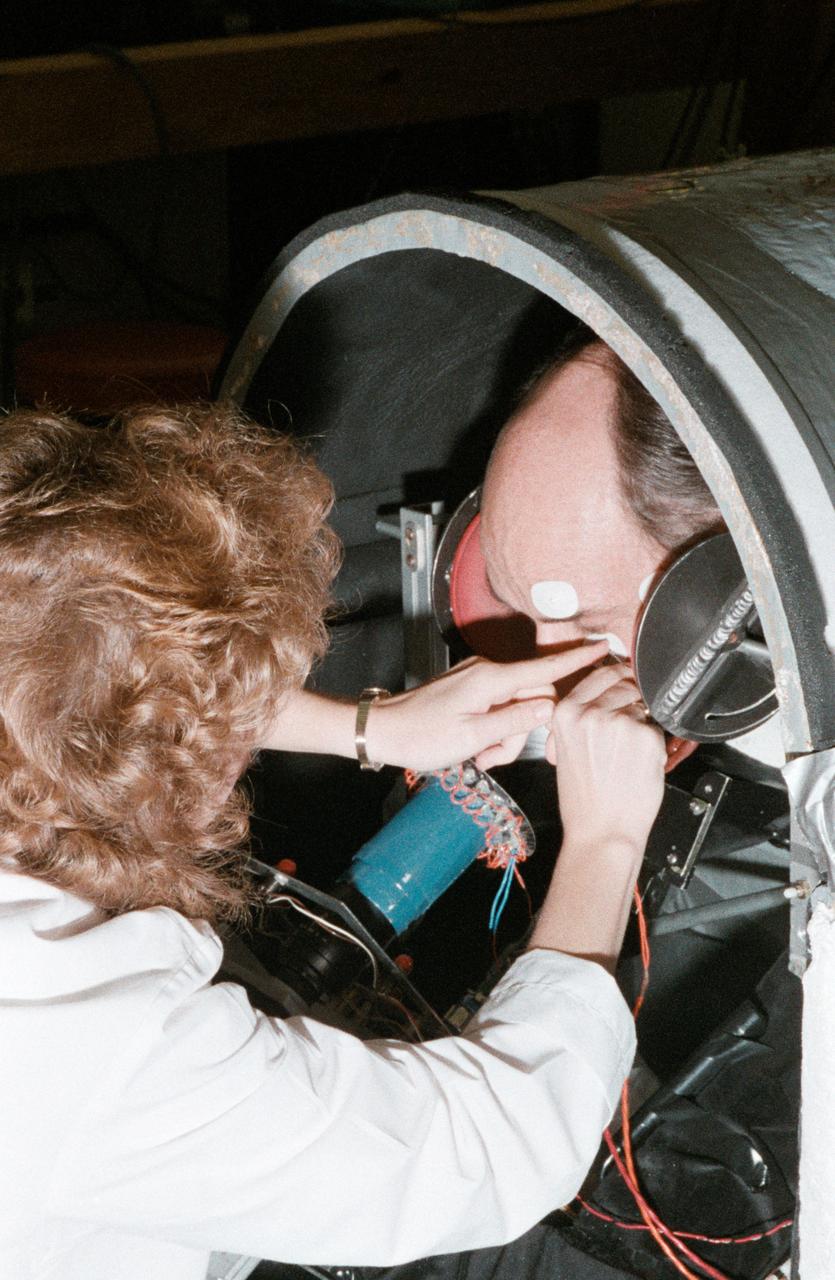
Sen. Jake Garn trains in use of equipment for medical experiments.
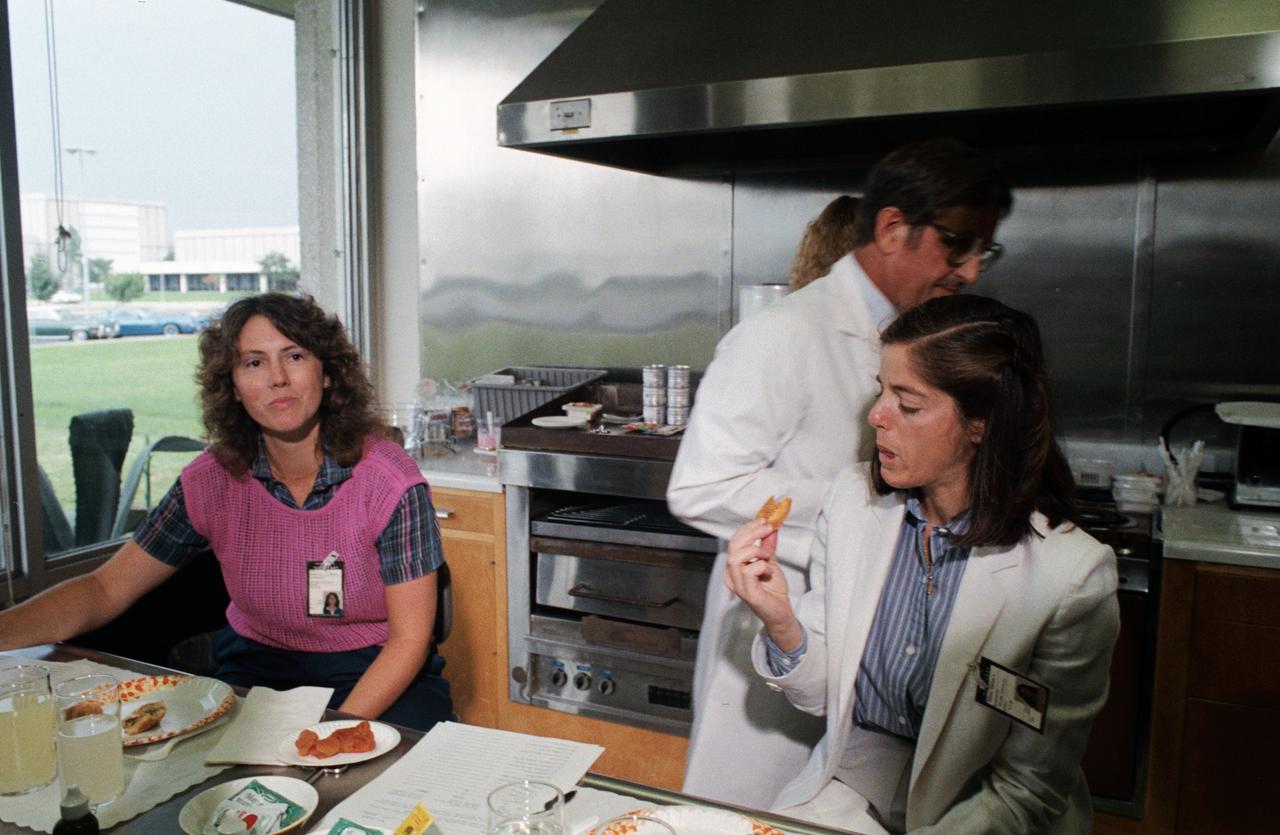
S85-39978 (10 Sept. 1985) --- Sharon Christa McAuliffe, left, appears to be deciding what she thinks of a piece of space food she tastes during a session of interfacing with space shuttle life sciences. Barbara R. Morgan samples an apricot. The two are in early training at the Johnson Space Center (JSC) in preparation for the STS-51L spaceflight early next year. McAuliffe is prime payload specialist representing the Teacher in Space Project, and Morgan is her backup. Dr. C.T. Bourland, a dietitian specialist, assists the two. Photo credit: NASA
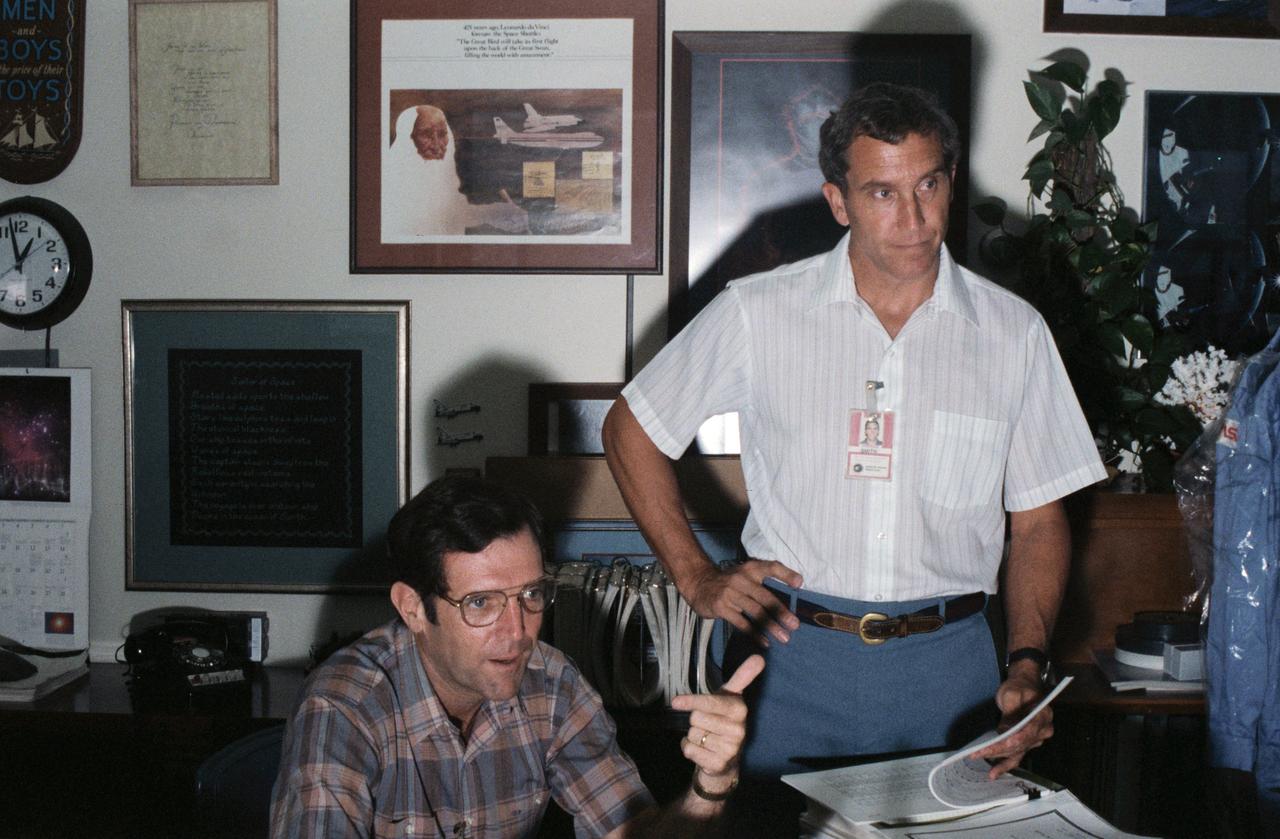
Candid views of the STS-33/51L Crew during study periods in their offices on 09/09/1985. Astronauts Michael J. Smith (right), STS 51L Pilot, and Francis R. (Dick) Scobee, 51L Mission Commander, are photographed in conversation while in training. JSC, HOUSTON, TX
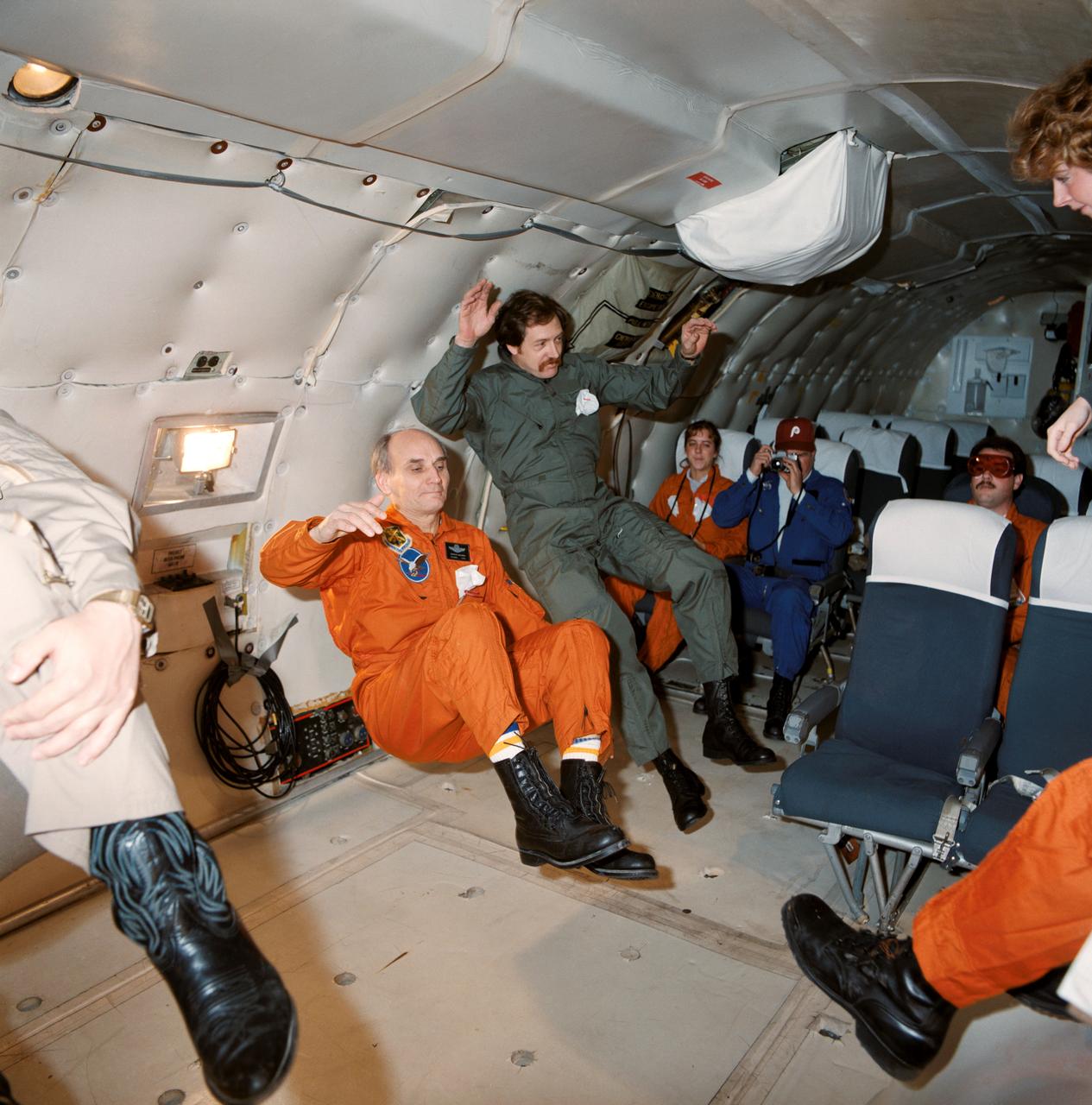
Views of STS-51E Crewman Senator Jake Garn during Zero-G Parabolas. 1. Senator E. J. "Jake" Garn - Zero-G
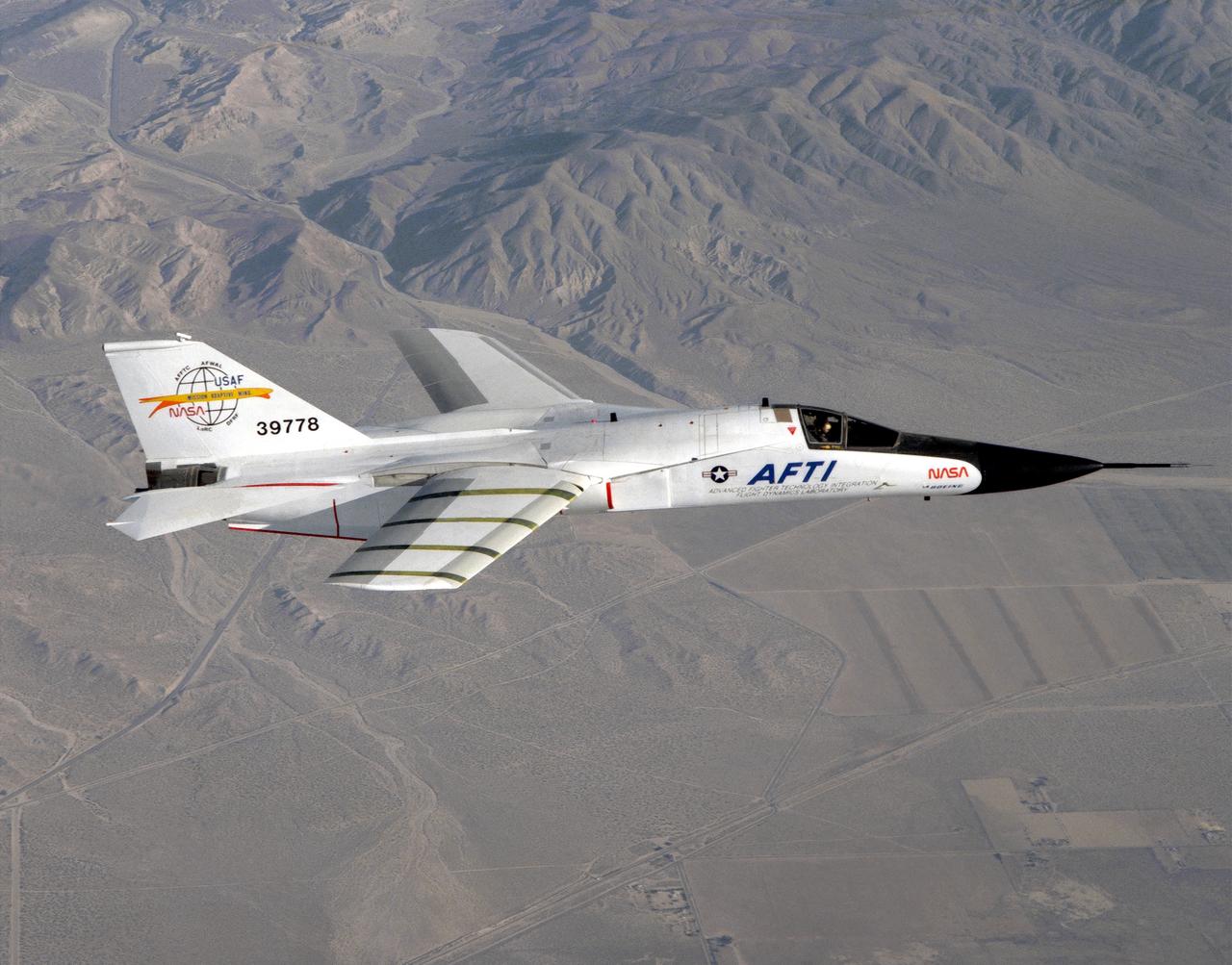
This photograph shows a modified General Dynamics AFTI/F-111A Aardvark with supercritical mission adaptive wings (MAW) installed. The four dark bands on the right wing are the locations of pressure orifices used to measure surface pressures and shock locations on the MAW. The El Paso Mountains and Red Rock Canyon State Park Califonia, about 30 miles northwest of Edwards Air Force Base, are seen directly in the background. With the phasing out of the TACT program came a renewed effort by the Air Force Flight Dynamics Laboratory to extend supercritical wing technology to a higher level of performance. In the early 1980s the supercritical wing on the F-111A aircraft was replaced with a wing built by Boeing Aircraft Company System called a “mission adaptive wing” (MAW), and a joint NASA and Air Force program called Advanced Fighter Technology Integration (AFTI) was born.
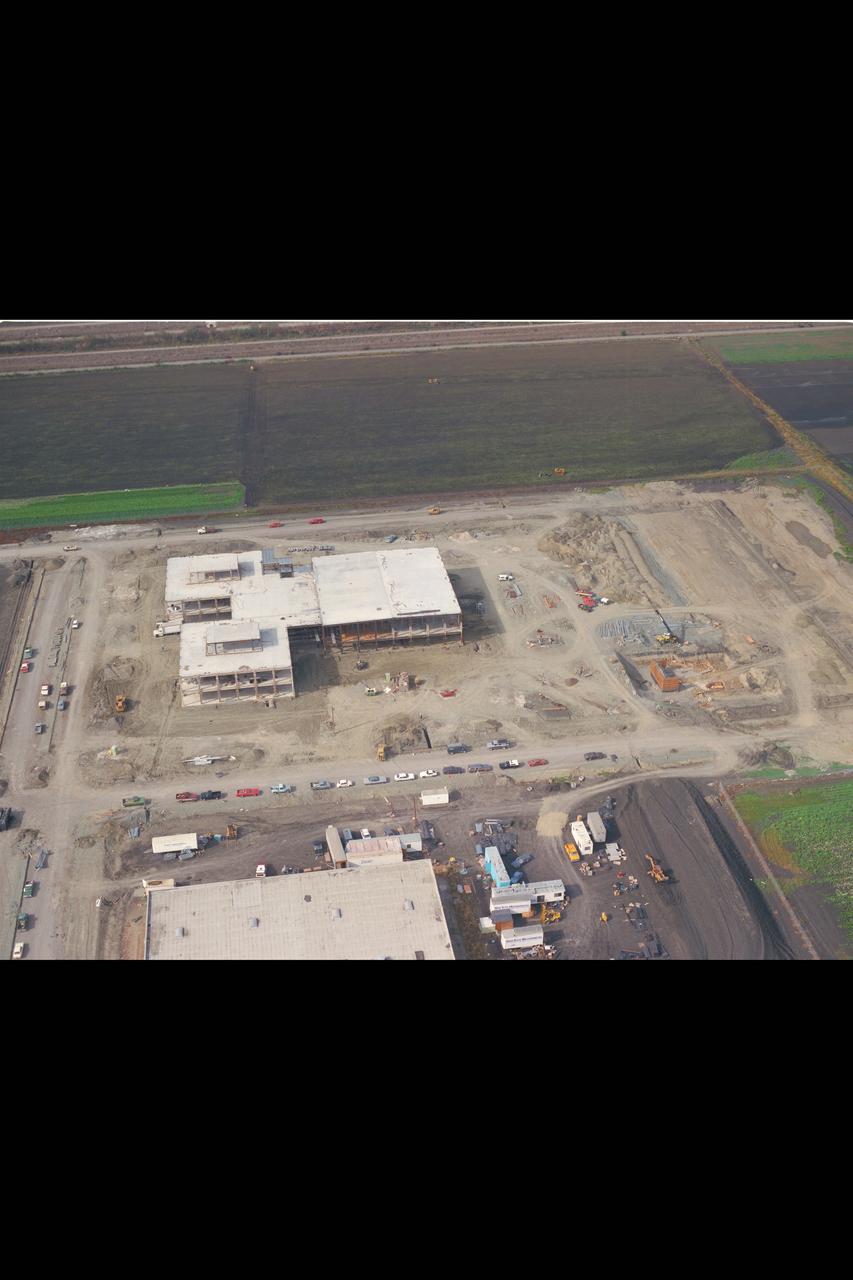
N-258 NAS (Numerical Aerodynamic Simulation) Facility, Aerials of construction site, framing
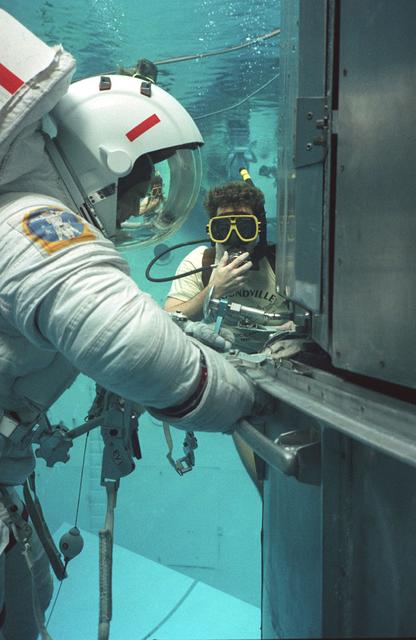
Prior to its launch in April 1990, the Hubble Space Telescope (HST) went through years of development and testing. The HST was the first of its kind and the scientific community could only imagine the fruits of their collective labors. However, prior to its launch, more practical procedures, such as astronaut training, had to be developed. As the HST was to remain in orbit for years, it became apparent that on-orbit maintenance routines would have to be developed. The best facility to develop these maintenance practices was at the Neutral Buoyancy Simulator (NBS) at the Marshall Space Flight Center (MSFC). The NBS provided mock-ups of the HST (in sections), a Remote Manipulator System (RMS), and a shuttle's cargo bay pallet. This real life scenario provided scientists, engineers, and astronauts a practical environment to work out any problems with a plarned on-orbit maintenance mission. Pictured is an astronaut in training with a mock-up section of the HST, practicing using tools especially designed for the task being performed.
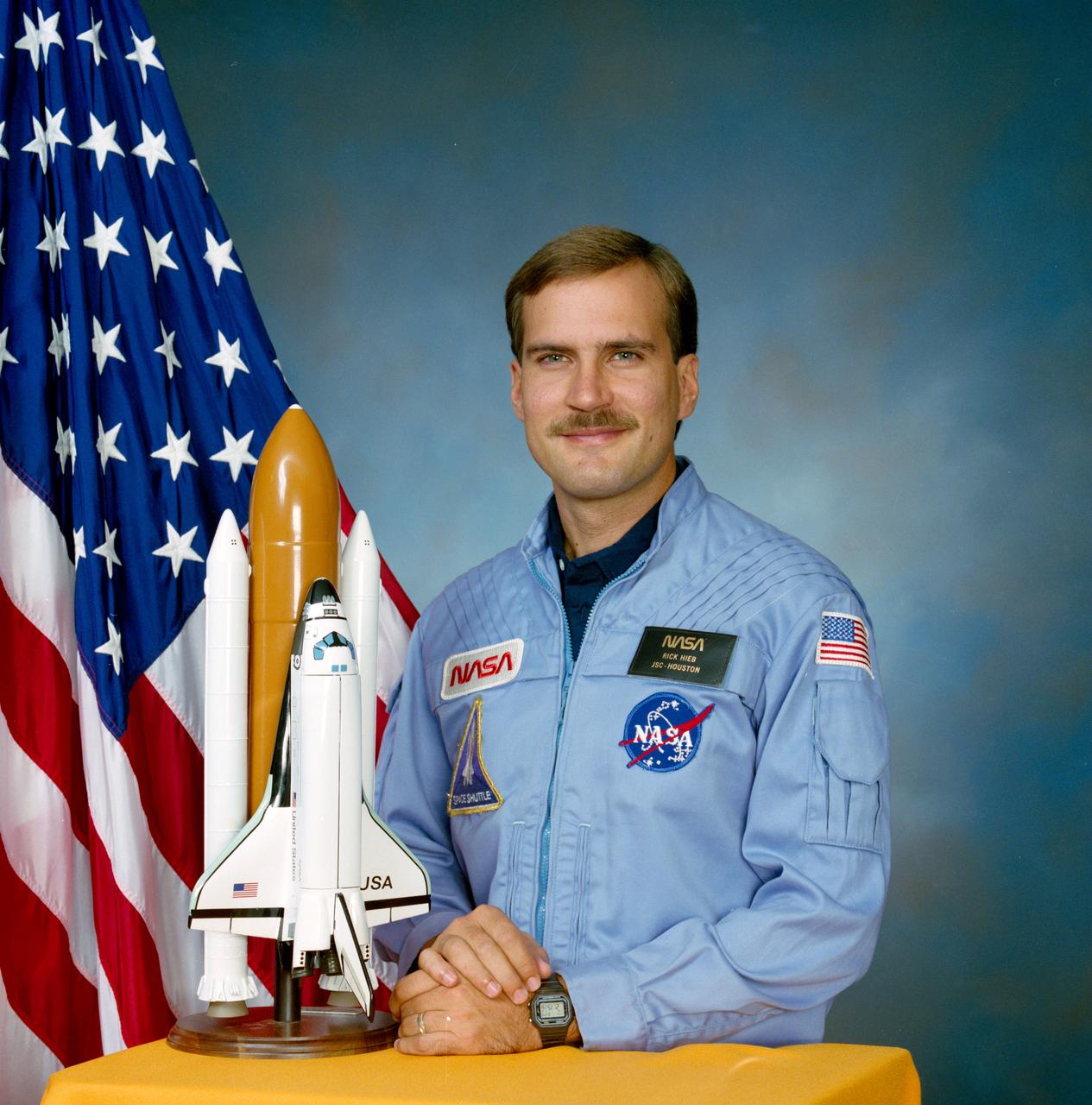
S85-41893 (Oct 1985) --- Astronaut Richard J. Hieb.
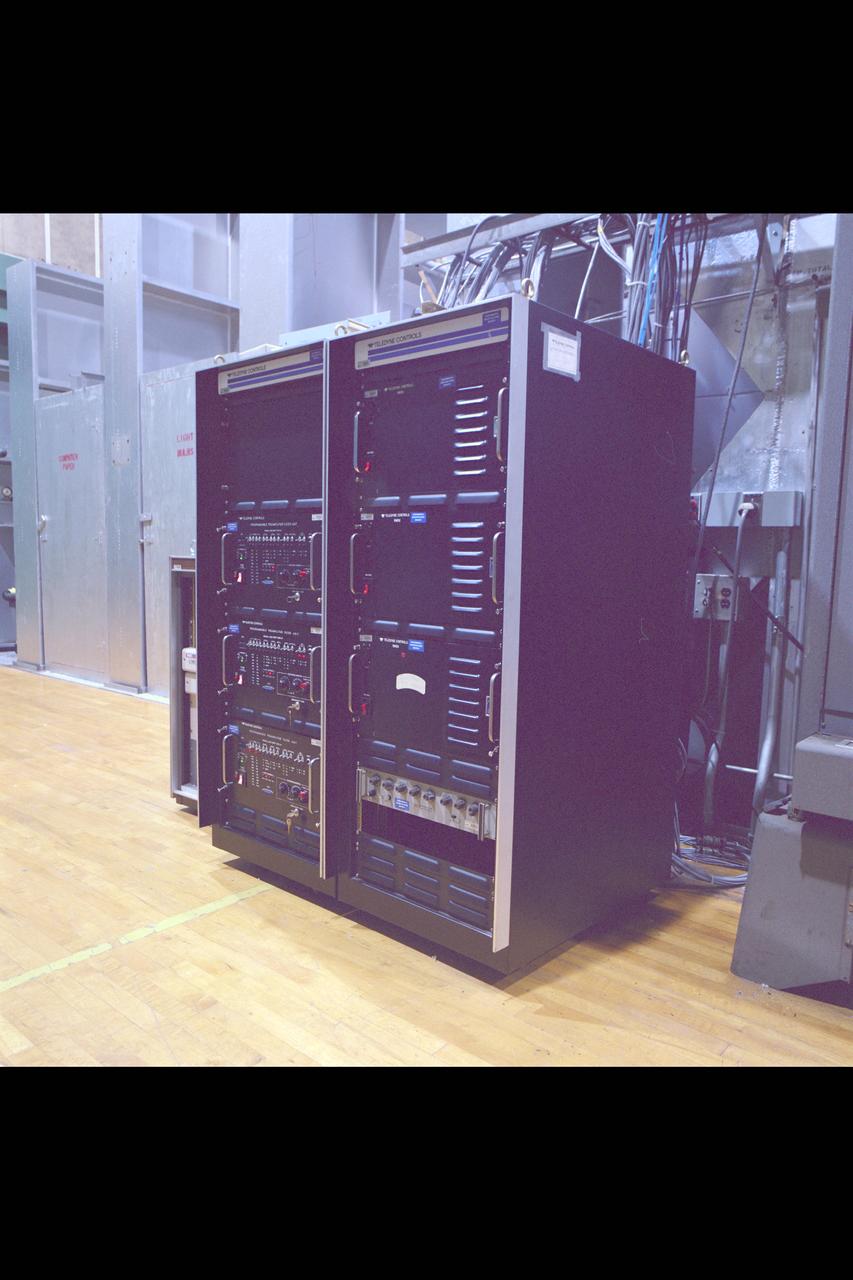
N-227 Unitary Wind Tunnel Data Control Room: Hardware
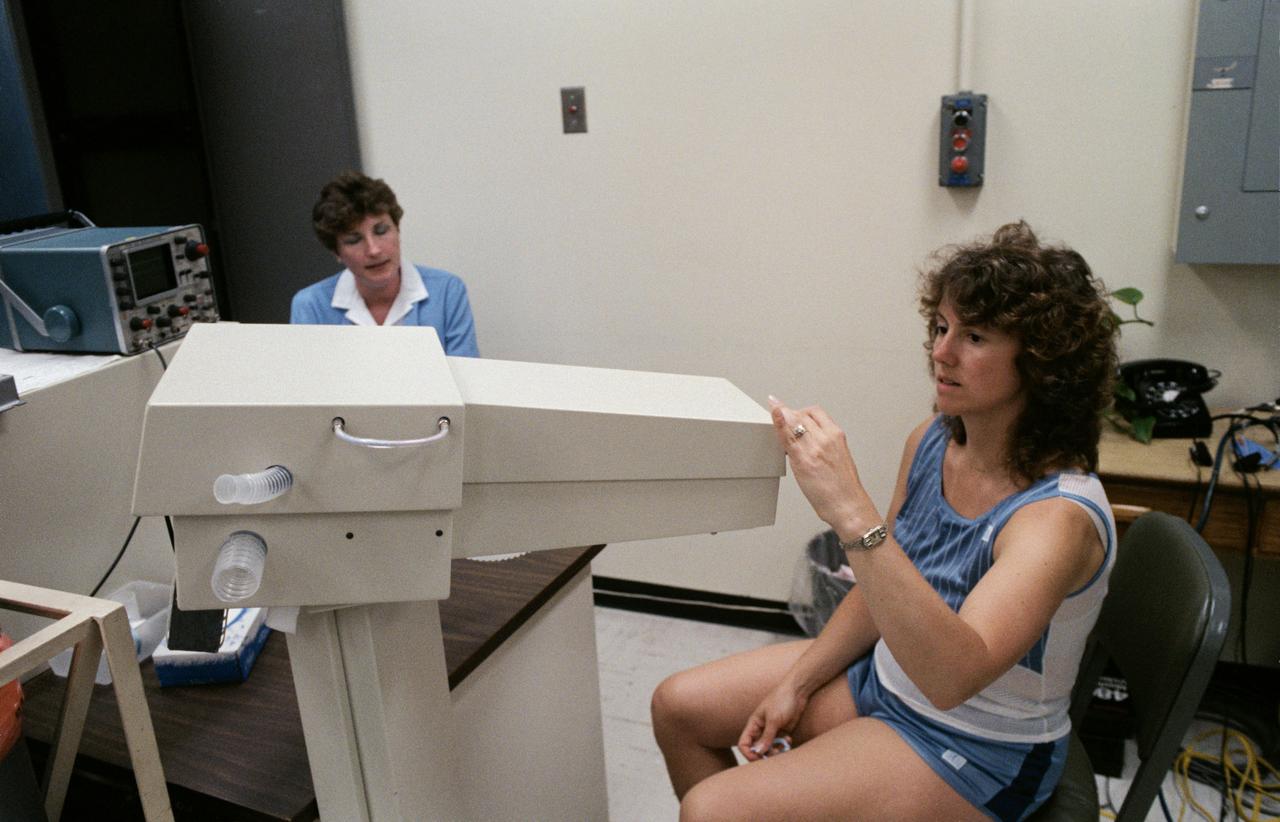
S85-36966 (10 July 1985) --- Teacher Sharon Christa McAuliffe prepares to test her lung capacity during medical examinations at the Johnson Space Center (JSC) clinic. Photo credit: NASA
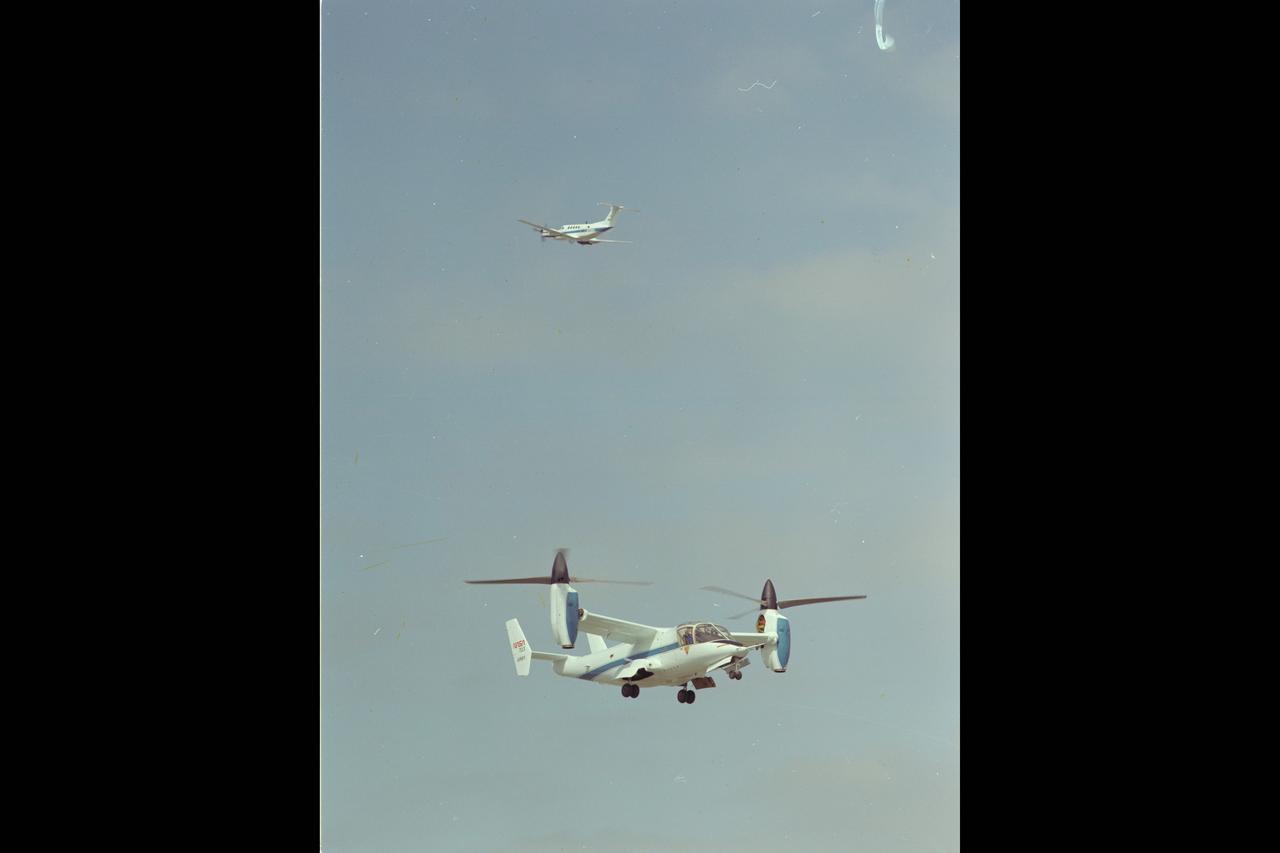
XV-15 Tilt Rotor (NASA-703) hovers at Ames Research Center
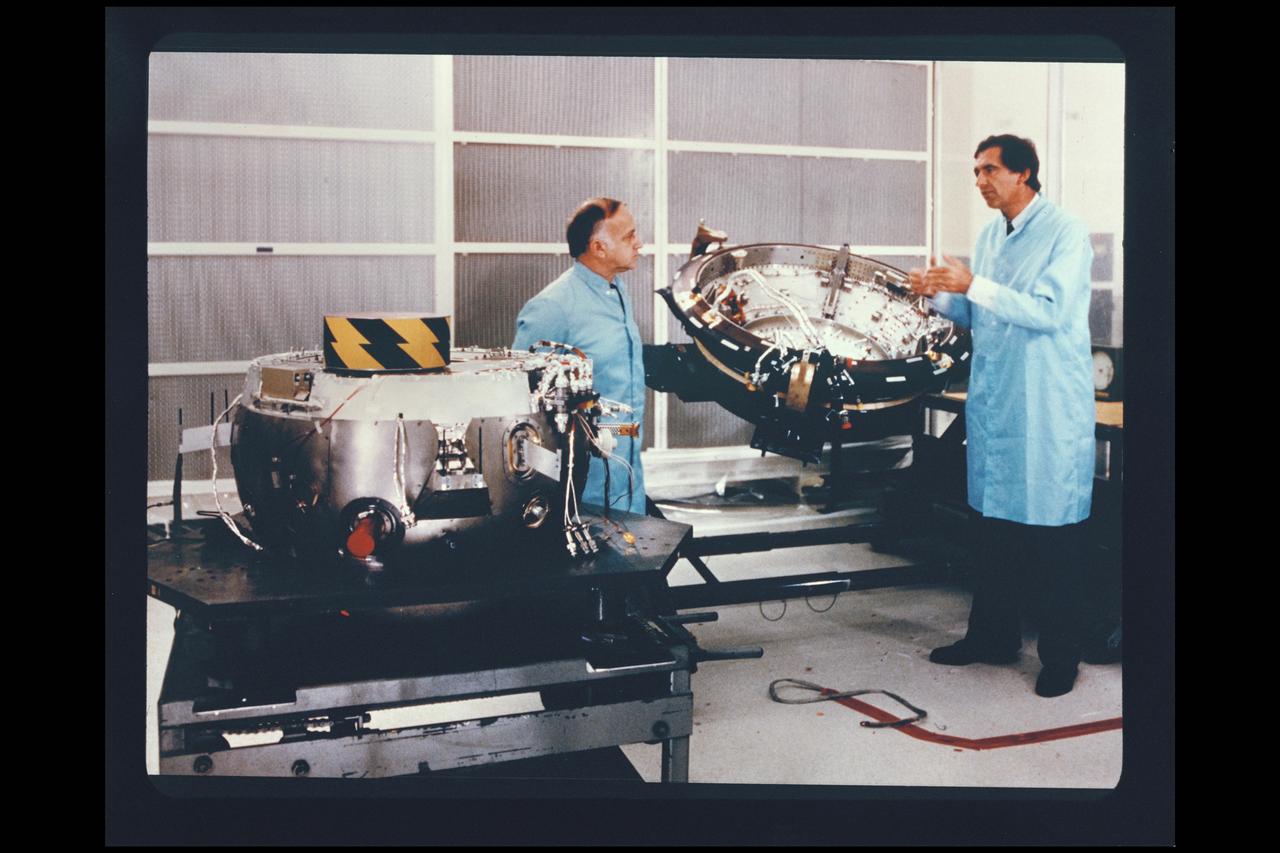
Photo by JPL Pioneer Galileo Probe Orbiter being tested at JPL (being inspected byAngelo 'Gus' Gustaferro and John Vojvodich)
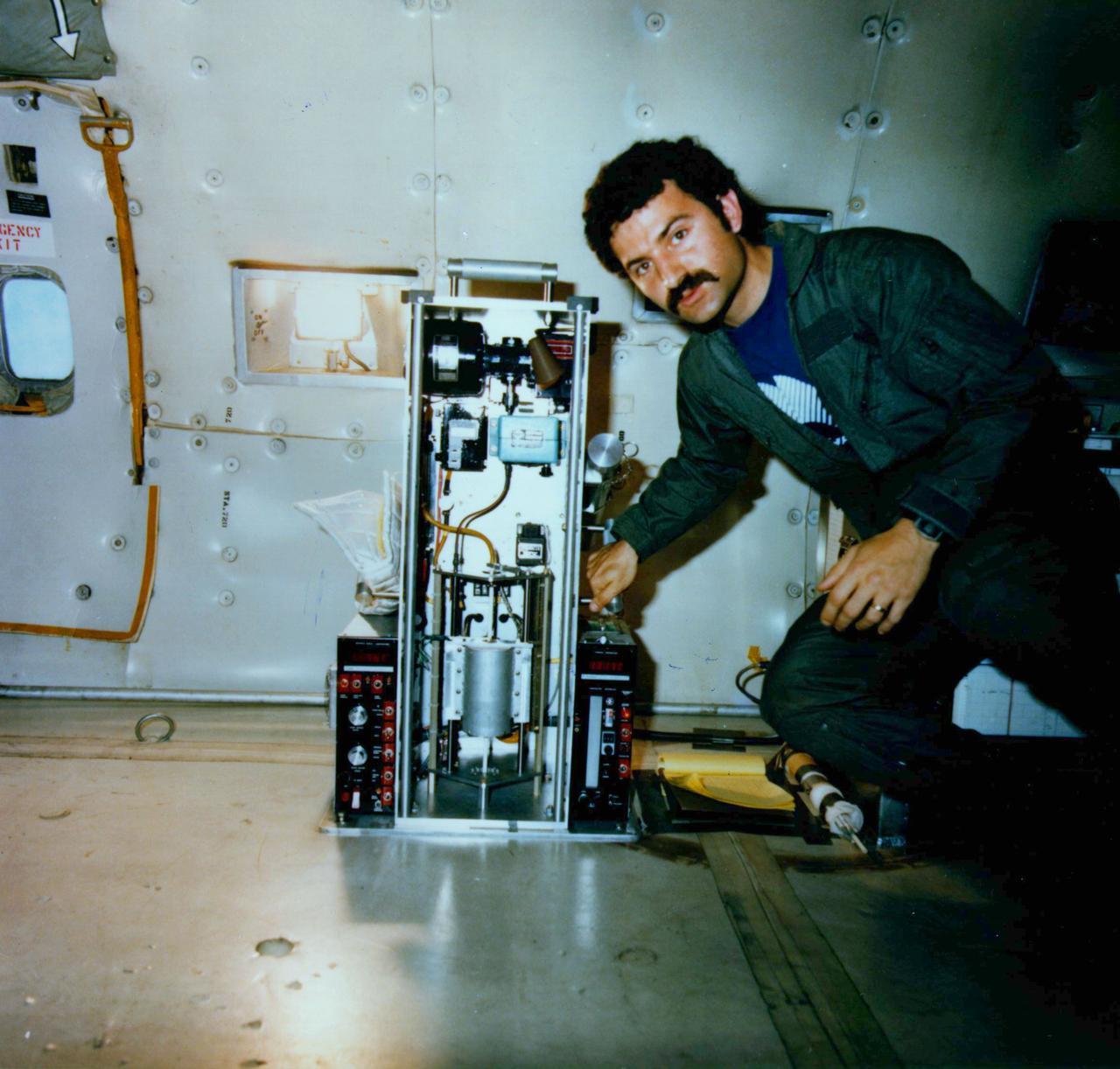
Peter Curerri with KC-135 experiment hardware, a prototype aircraft version of Advanced Automated Directional Solidification Furnace (AADSF).

S85-25802 (21 Jan 1978) --- Astronaut John C. Creighton.
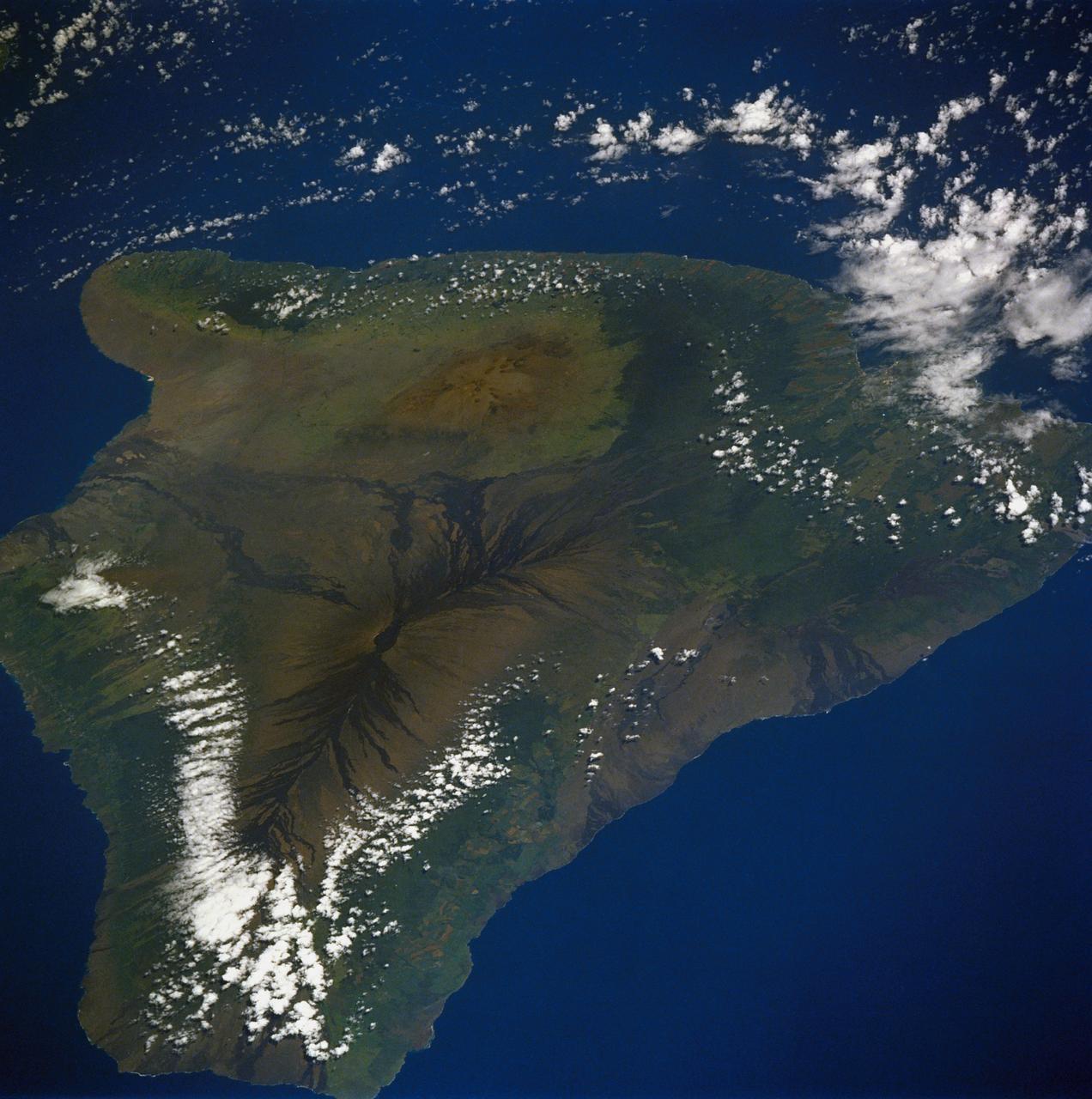
61A-50-057 (1 Nov 1985) --- An oblique view of Hawaii, the largest of the Hawaiian Island Group, as photographed by the crewmembers of Challenger on STS-61A in November of 1985. This unusual early morning view shows nearly the entire island with minimal cloud cover. Normally, these near tropical islands are obscured by heavy cloud cover except for the early morning hours. UPDATE, NOVEMBER 28, 1986 PLEASE NOTE: The Kilauea fissure, on the southeast coast, while not as prominent as ancient, neighboring Mauna Loa and Mauna Kea craters, has been spewing a molten lava flow since July 18, 1986, at a rate of six cubic yards per second. Generally flowing toward the sea, the lava mass had reached the coast by today after destroying several homes and private property along the way. The seven-mile long lava flow covered over 600 feet of coastline and extended into the ocean, creating over 12 acres of new beachfront property.

S85-41802 (7 Sept 1985) --- Wheels of the Space Shuttle Atlantis touch down on the dry lakebed at Edwards Air Force Base to mark successful completion of the STS 51-J mission. Crewmembers onboard for the flight were Astronauts Karol J. Bobko, Ronald J. Grabe, David C. Hilmers, and Robert L. Stewart; and USAF Maj. William A. Pailes.
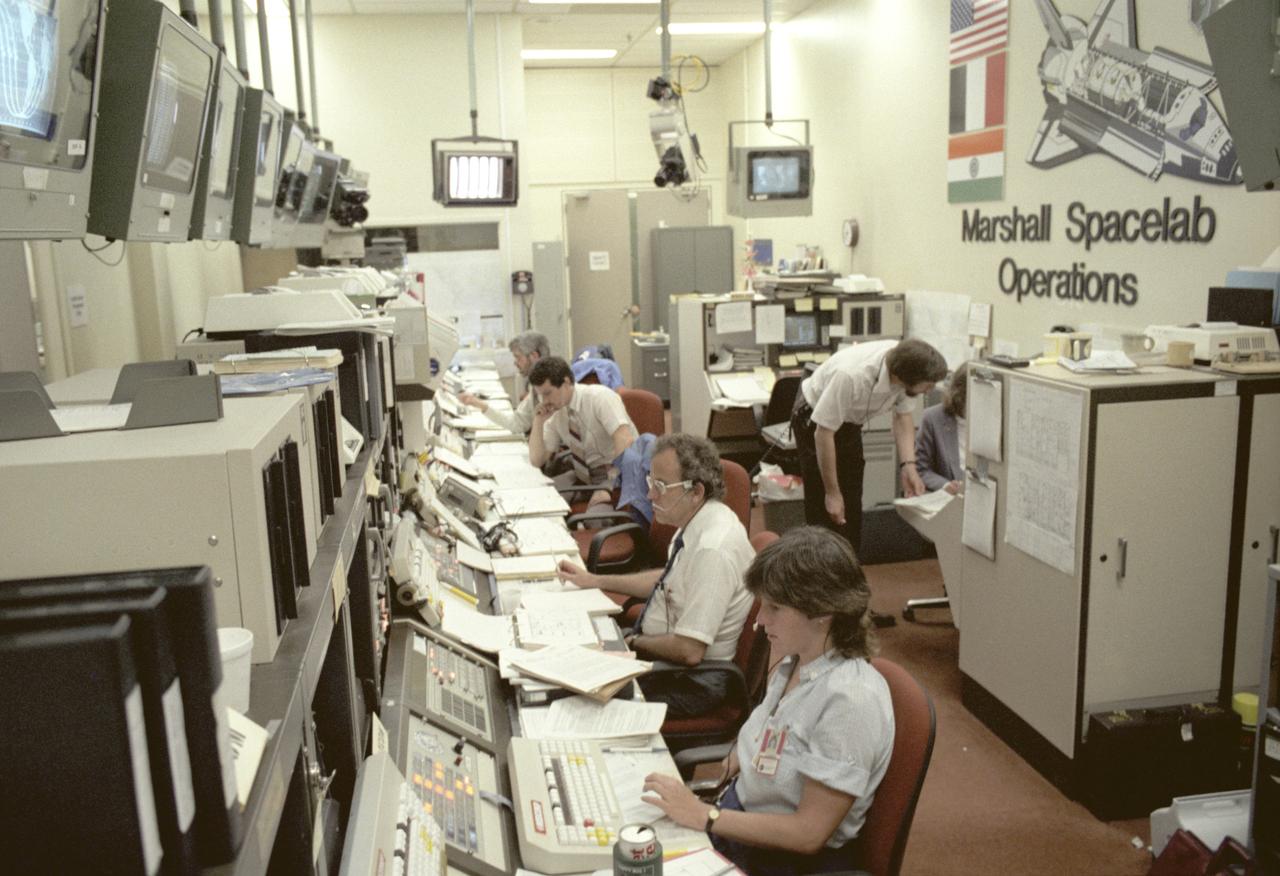
Spacelab-3 launched aboard STS-51B, with the major science objective being to perform engineering tests on two new facilities: the rodent animal holding facility and the primate animal holding facility. In addition, scientists observed the animals to obtain first hand knowledge of the effects of launch and reentry stresses and behavior. The need for suitable animal housing to support research in space led to the development of the Research Animal Holding Facility at the Ames Research Center. Scientists often study animals to find clues to human physiology and behavior. Rats, insects, and microorganisms had already been studied aboard the Shuttle on previous missions. On Spacelab-3, scientists had a chance to observe a large number of animals living in space in a specially designed and independently controlled housing facility. Marshall Space Flight Center (MSFC) had management responsibility for the Spacelab-3 mission. This photograph depicts activities during the mission at the Huntsville Operations Support Center (HOSC) Spacelab Payload Operations Control Center (SL POCC) at MSFC.
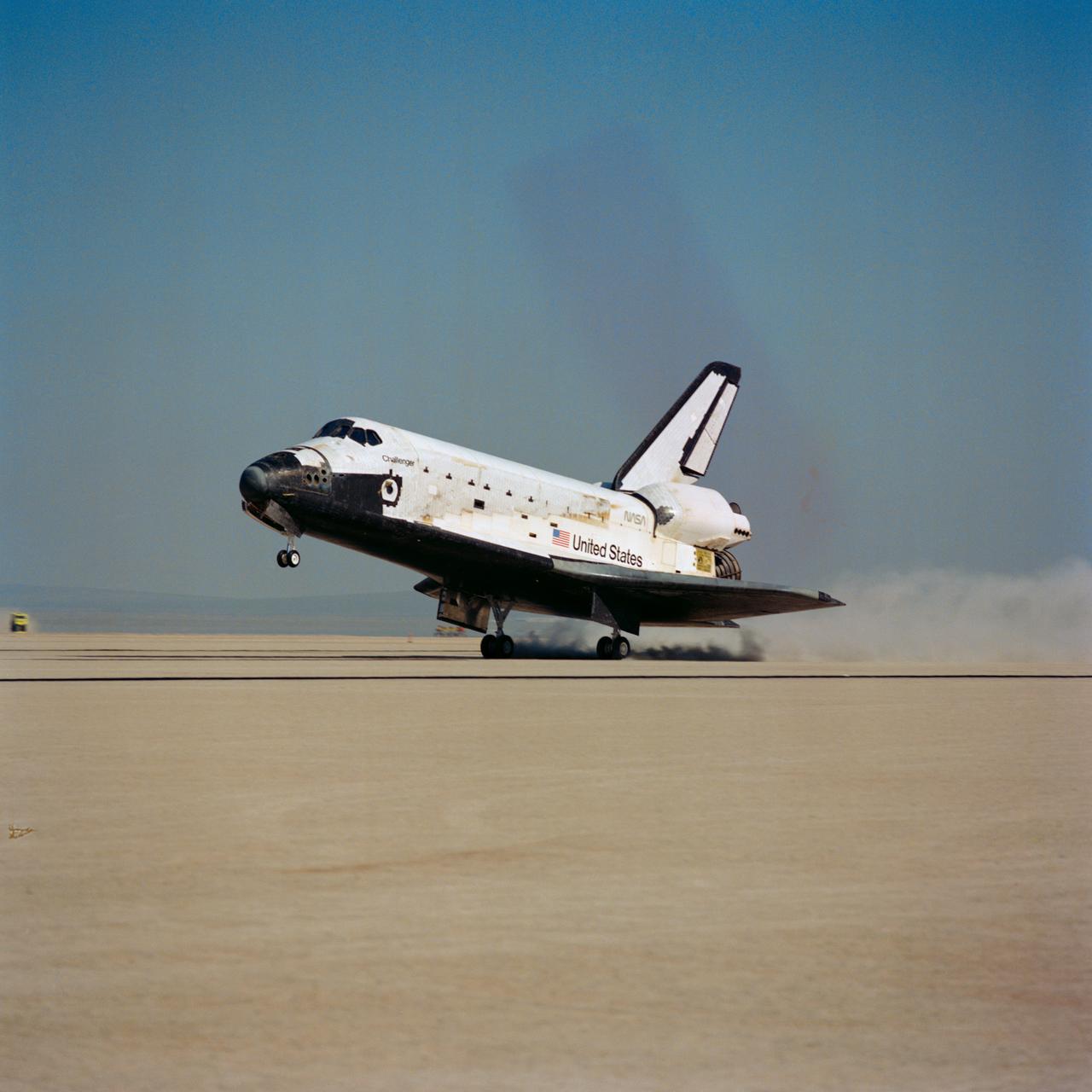
Shuttle Challenger lands on Runway 17 at Edwards at end of 51-B mission. The photo is a rear view of the shuttle landing gear touching the runway, with clouds of dirt trailing behind it. The nose gear is still in the air (071); Side view of the Challenger landing gear touching the runway (072).

S85-34358 (june 1985) - Astronaut Anna L. Fisher.
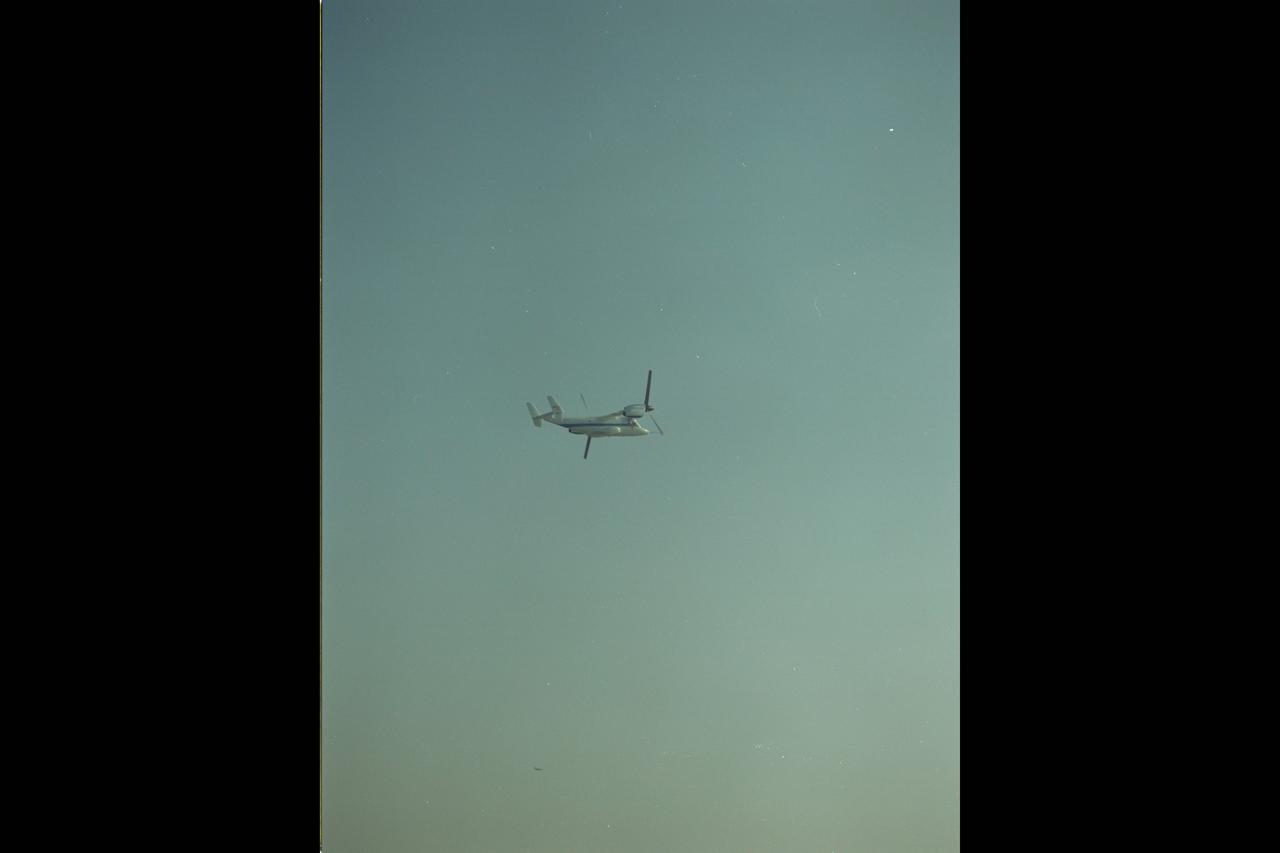
XV-15 Tilt Rotor (NASA-703) in flight at Ames Research Center
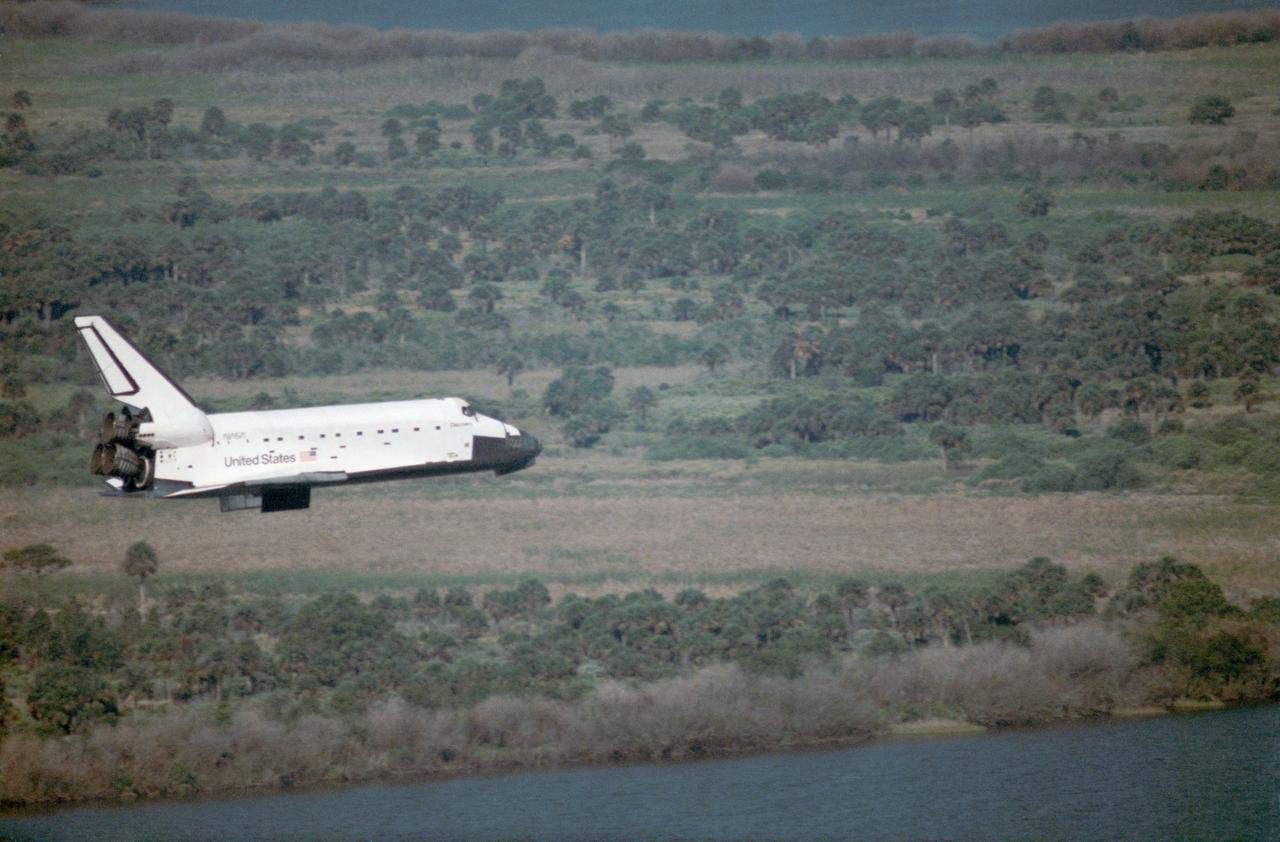
51D-9107 (19 April 1985) --- A side-looking, wide view of the Space Shuttle Discovery shows the vehicle on its final phase following a full week in space. The Discovery and its seven-member crew arrived at KSC's landing facility at 8:54:29 a.m. (EST), April 19, 1985. Launch was at 8:59 a.m. (EST) on April 12.
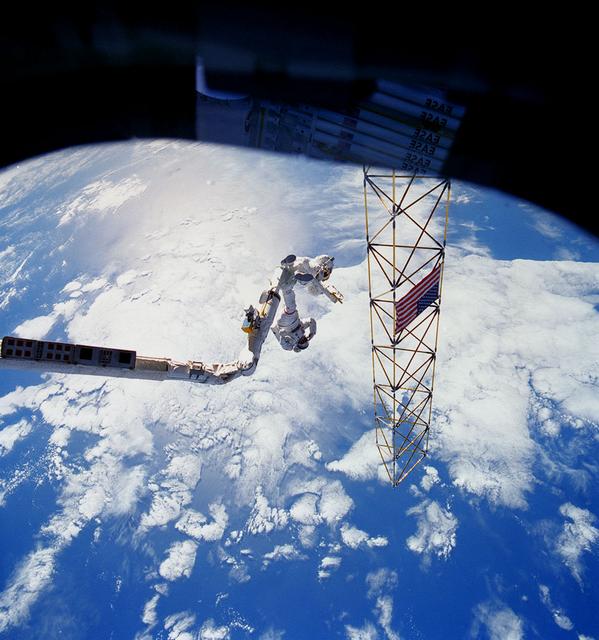
This is an STS-61B onboard photo of astronauts Ross and Spring on the Remote Manipulator System (RMS) as they approach the erected Assembly Concept for Construction of Erectable Space Structure (ACCESS).
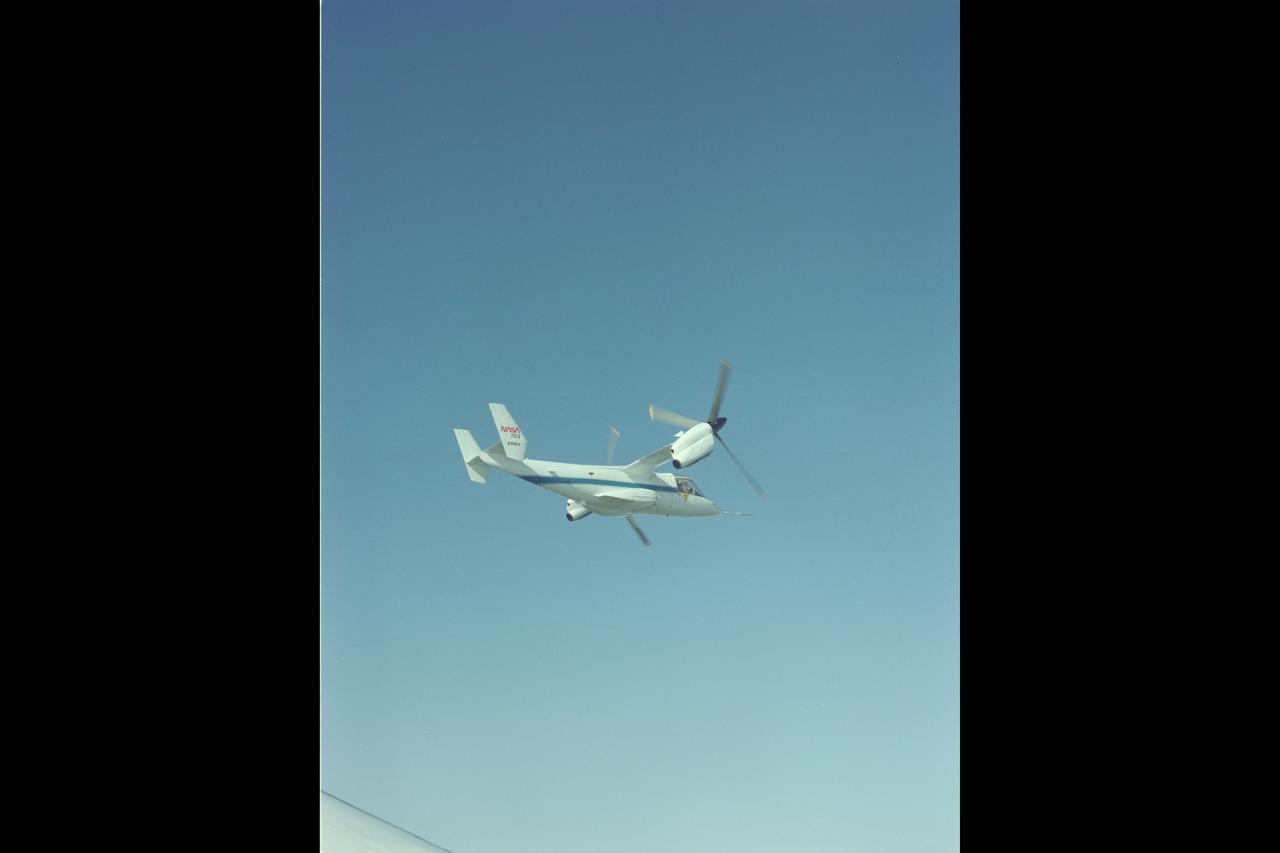
XV-15 Tilt Rotor (NASA-703) in conversion flight at Ames Research Center
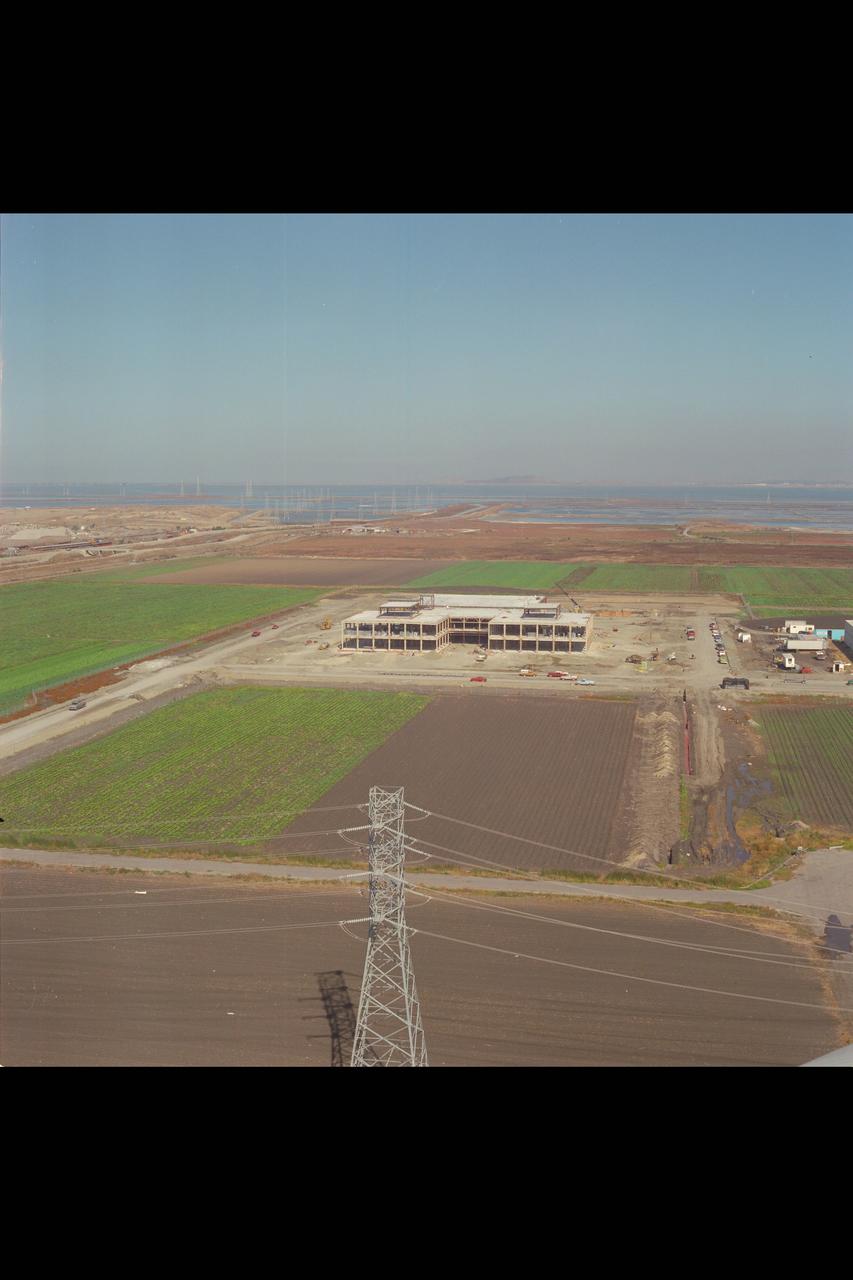
N-258 NAS (Numerical Aerodynamic Simulation) Facility, Aerials of construction site