
Payload specialist Sharon Christa McAuliffe appears to be enjoying her ride during her training in the T-38 jet trainer. Part of Galveston Island and the Greater Houston Metropolitan area can be seen in the background.
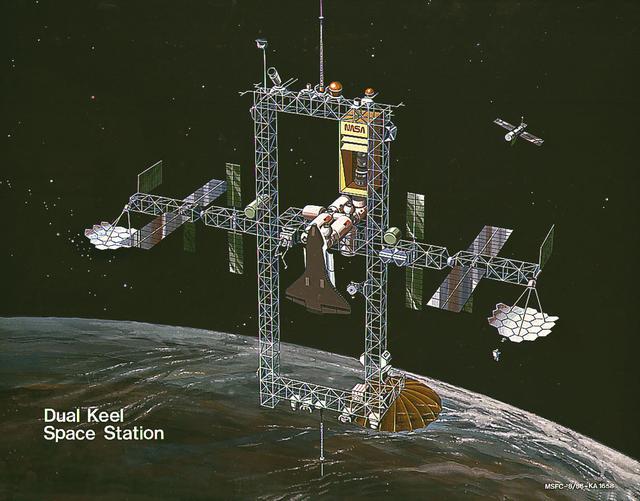
In response to President Reagan's directive to NASA to develop a permanent marned Space Station within a decade, part of the State of the Union message to Congress on January 25, 1984, NASA and the Administration adopted a phased approach to Station development. This approach provided an initial capability at reduced costs, to be followed by an enhanced Space Station capability in the future. This illustration depicts a configuration with enhanced capabilities. It builds on the horizontal boom and module pattern of the revised baseline. This configuration would feature dual keels, two vertical spines 105-meters long joined by upper and lower booms. The structure carrying the modules would become a transverse boom of a basically rectangular structure. The two new booms, 45-meters in length, would provide extensive accommodations for attached payloads, and would offer a wide field of view. Power would be increased significantly, with the addition if a 50-kW solar dynamic power system.
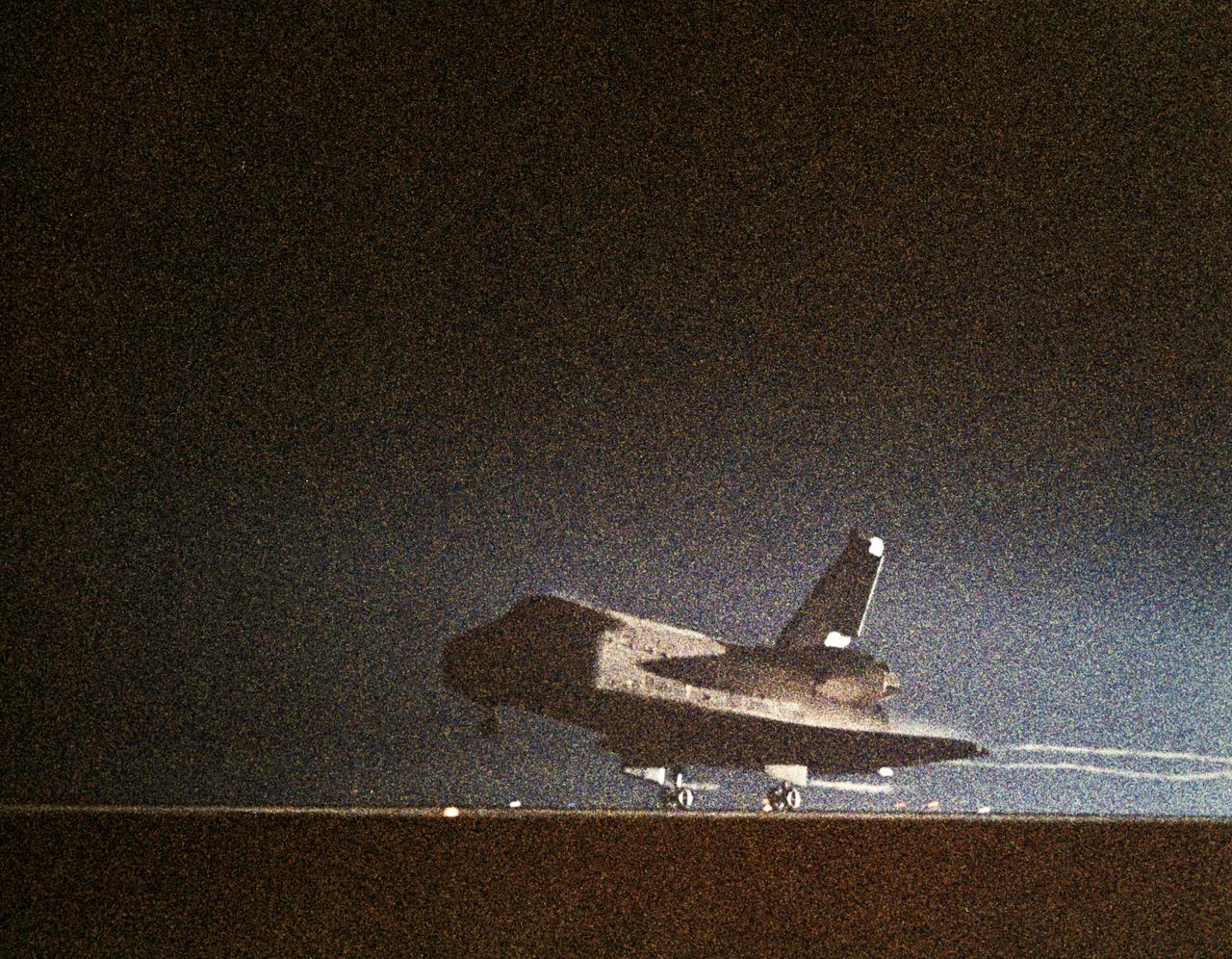
61C-S-050 (18 Jan 1986) --- This NASA photo records the night landing of space shuttle Columbia at Edwards Air Force Base and end of the STS 61-C mission. View is of the shuttle's main landing gear touching down, with streams of light trailing behind the orbiter. Photo credit: NASA
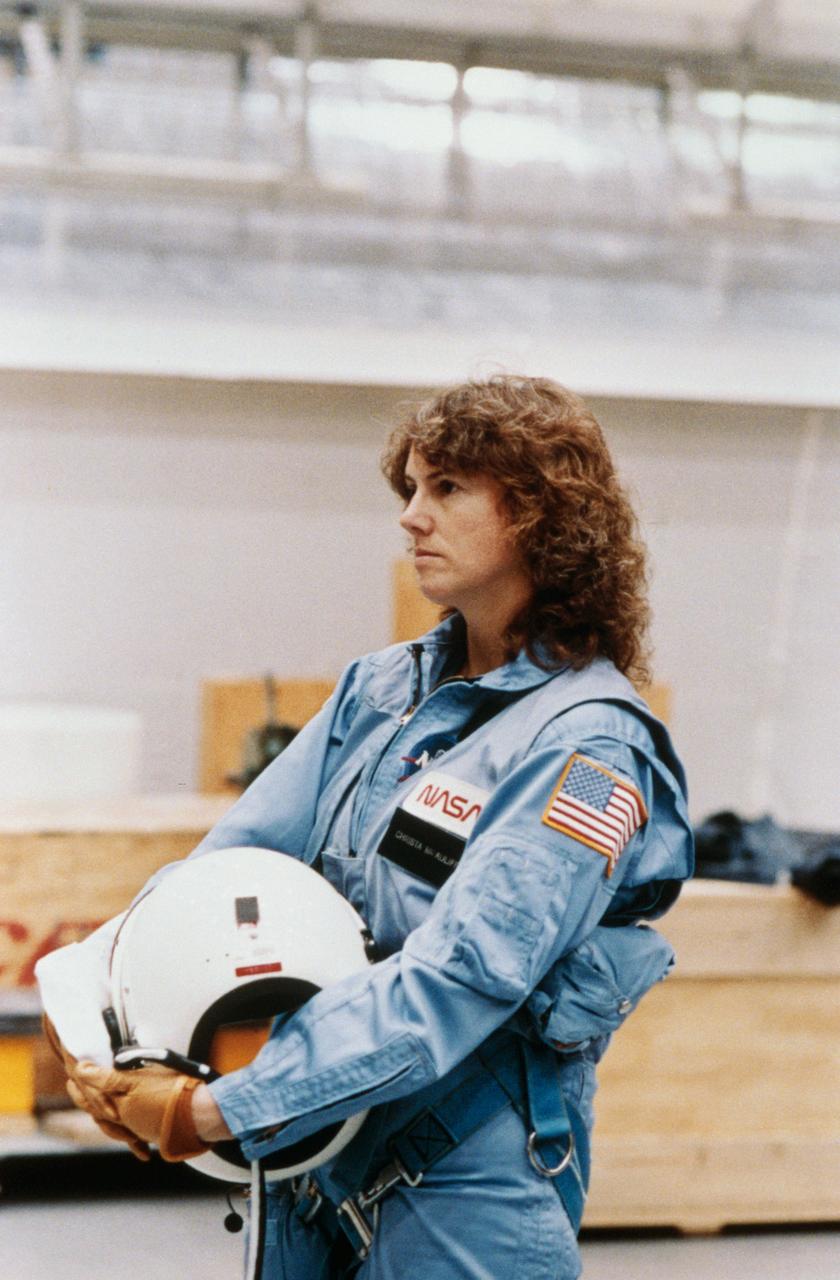
S86-25251 (January 1986) --- Sharon Christa McAuliffe, payload specialist for STS-51L, takes a breather following a busy day?s training in the Johnson Space Center?s Shuttle Mock-up and Integration Laboratory. McAuliffe, a New Hampshire school teacher, was chosen from among ten finalists in the Teacher-in-Space Project to serve as citizen observer aboard the Challenger. This photo was taken by Keith Meyers of the New York Times. Photo credit: NASA
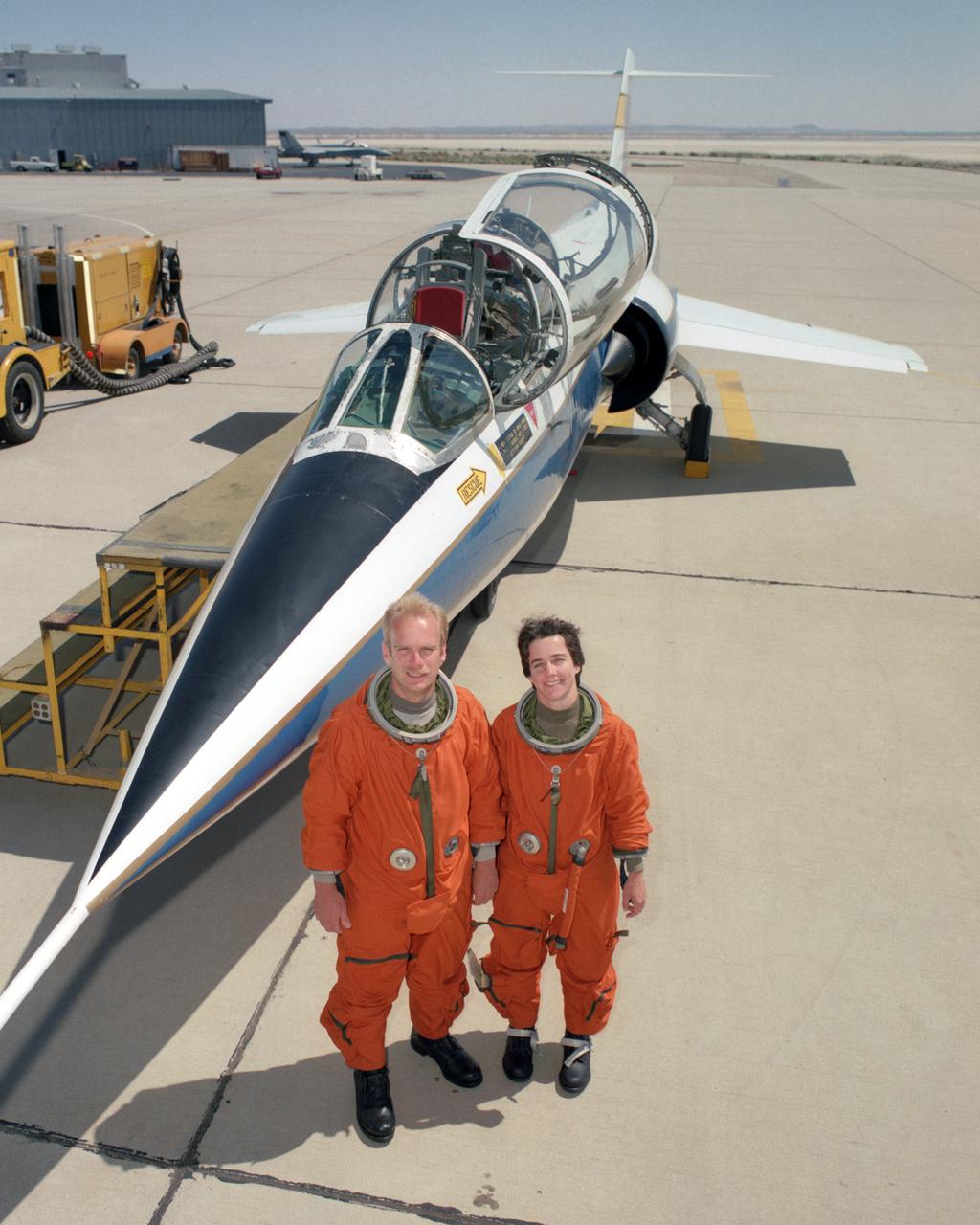
Flight test engineers Bob Meyer and Marta Bohn-Meyer had the distinction of being the only married couple to both serve on flight status on this two-seat F-104 at NASA Dryden.
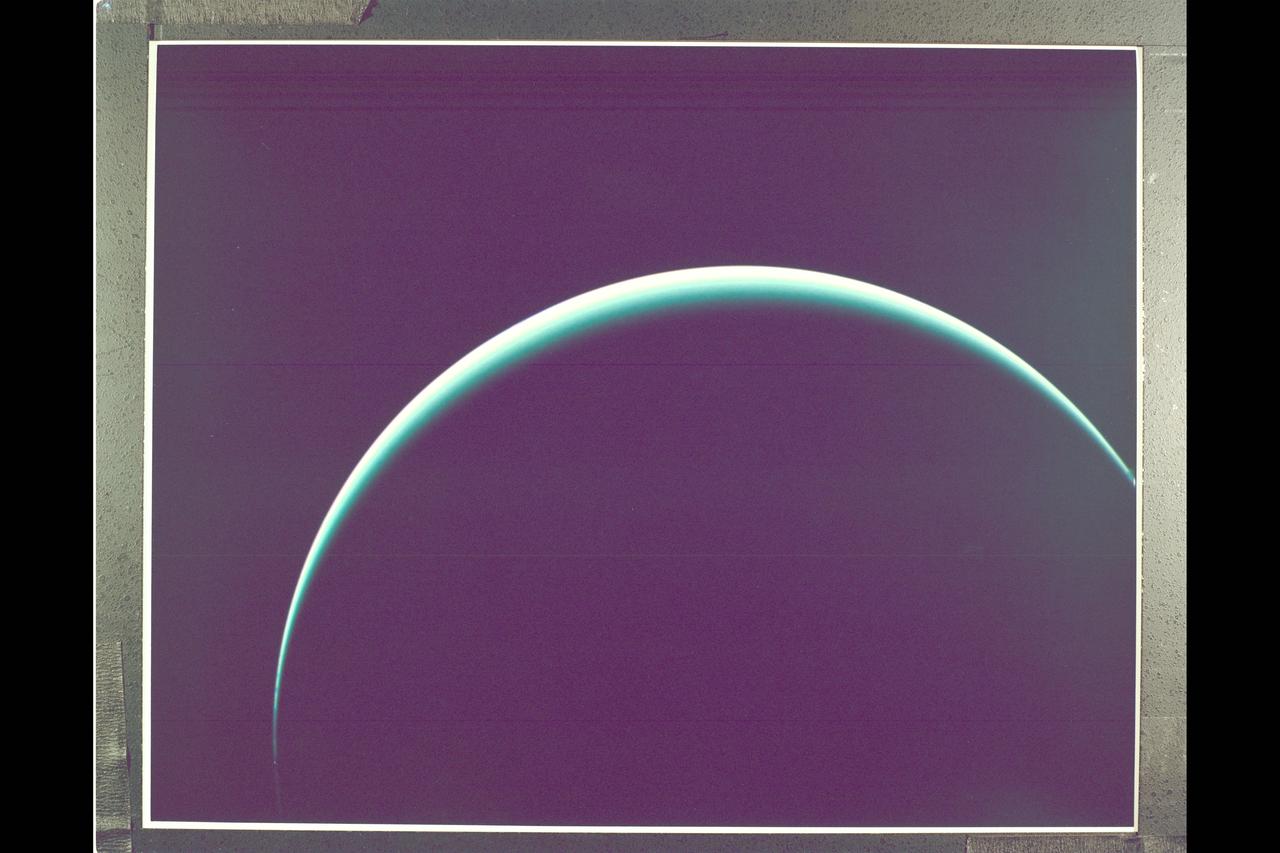
Range : 1 illion km. ( 600,000 mi. ) Resolution : 140 km. ( 90 mi. ) P-29539C This Voyager 2 image of Uranus was captured as the spacecraft was leaving Uranus behind on its cruise to Neptune. The image is a color composite of three photographs taken through blue, grren, and orange filters. Thin thin crecent seen here is at an angle of 153 degrees between the the spacecraft, the planet, and the sun. Even at this extreme angle, uranus retains the pale blue-green color seen by the ground based astronomers and recorded by Voyager 2 during its historic encounter, this color results from the presence of methane in Uranus' atmosphere. The gas absorbs red wavelengths of light, leaving the predominant hue seen here. The tendency for the cresent to become white at the extreme edge is cased by the presence of a high-altitude haze. Voyager 2, having encountered Jupiter in 1979, Saturn in 1981, and Uranus in 1986, will proceed on its jouney to Neptune. Closest approach is scheduled for August 24, 1989.
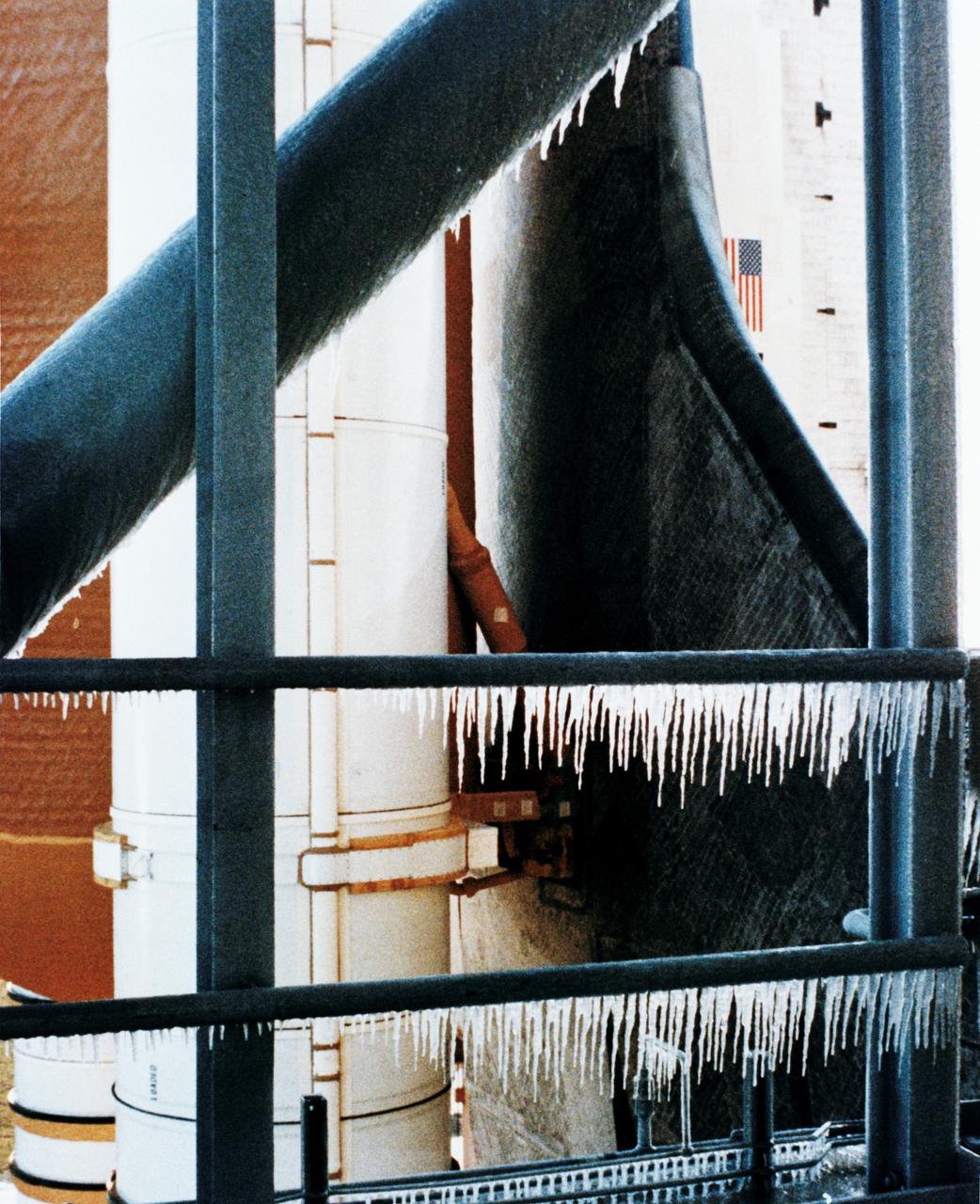
51L-10147 (28 Jan. 1986) --- View of ice on the 51-L launch complex. Photo credit: NASA
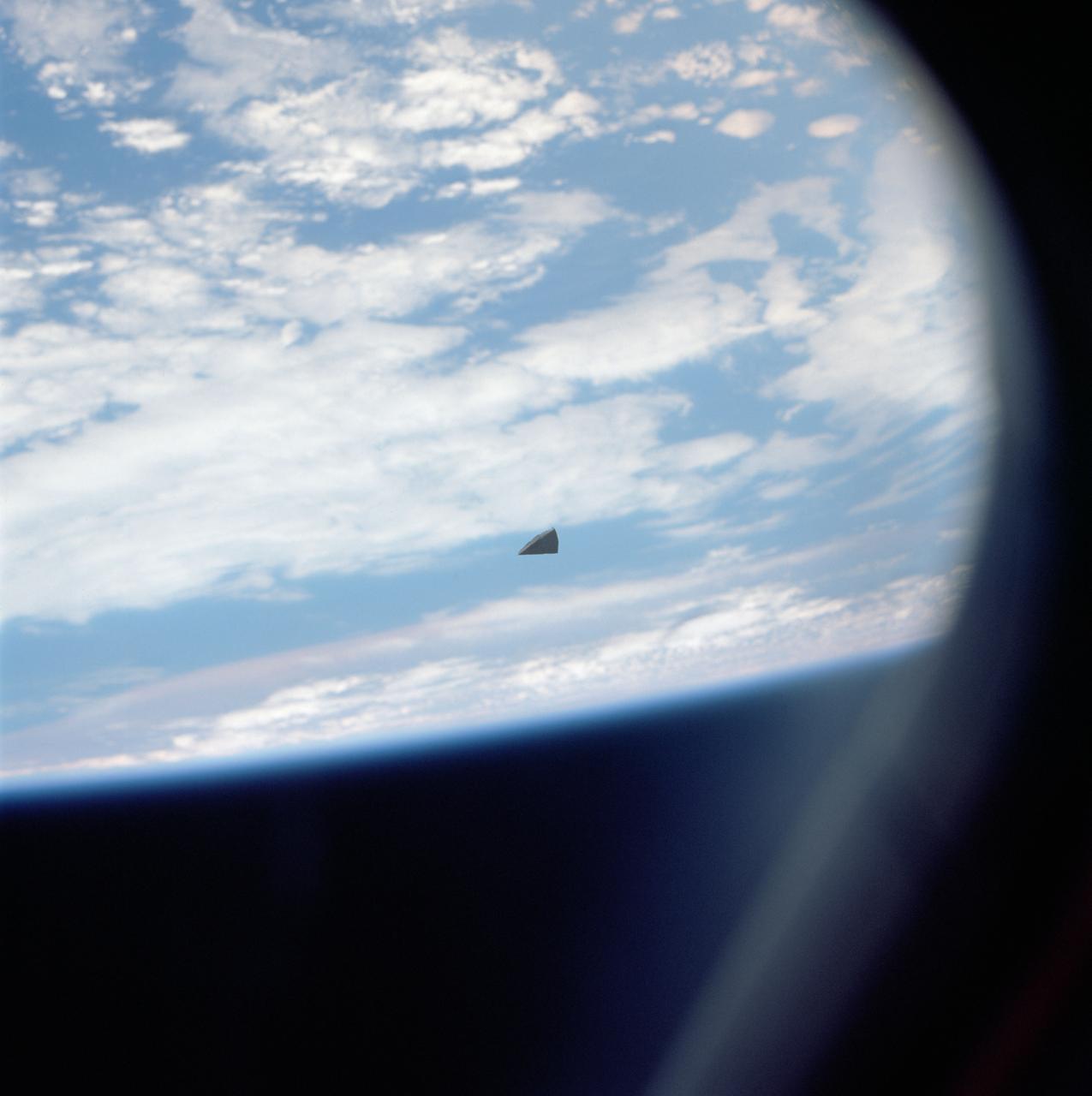
A small piece of thermal insulation tile floats in space near the Shuttle Columbia. The cloudy surface of the earth is used as a background.
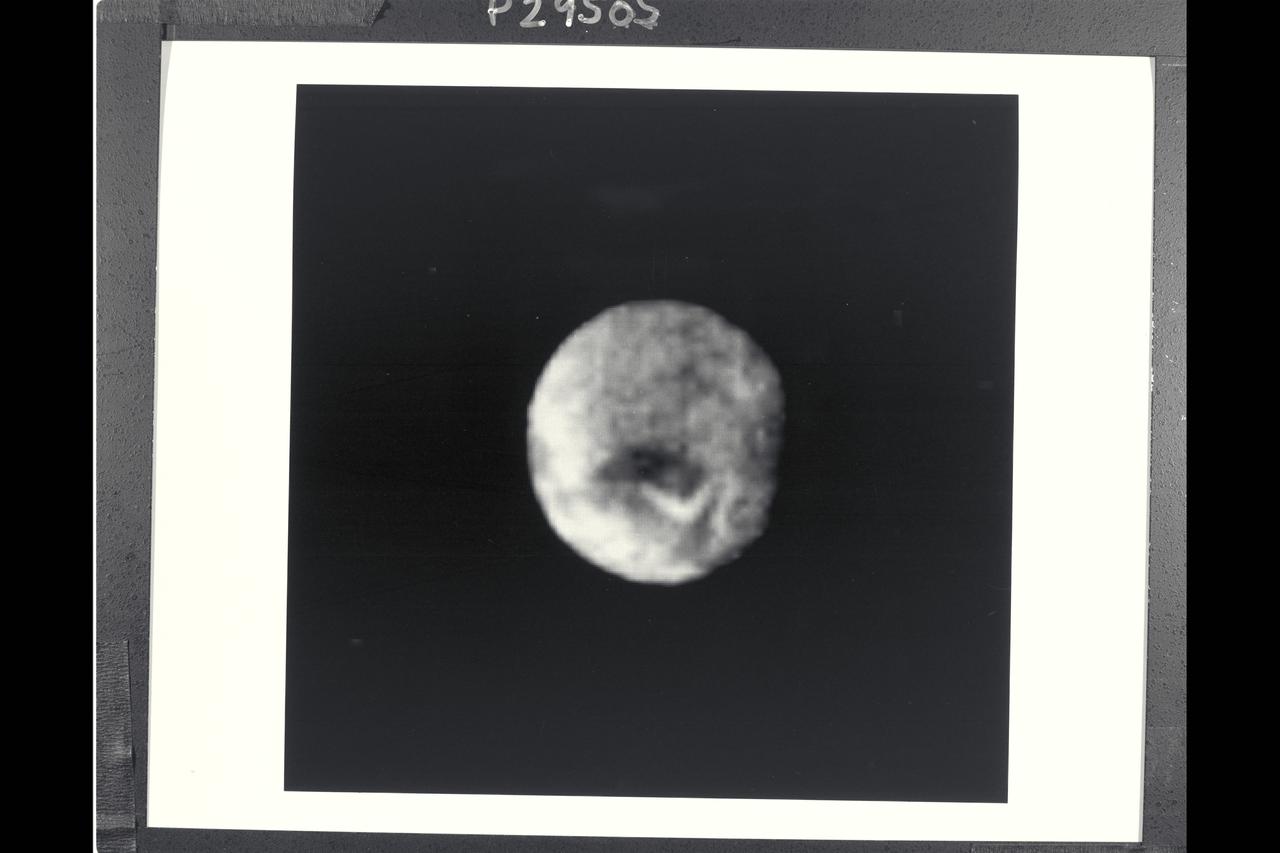
P-29505 Moon Voyager 2 flyby of Uranus' moons
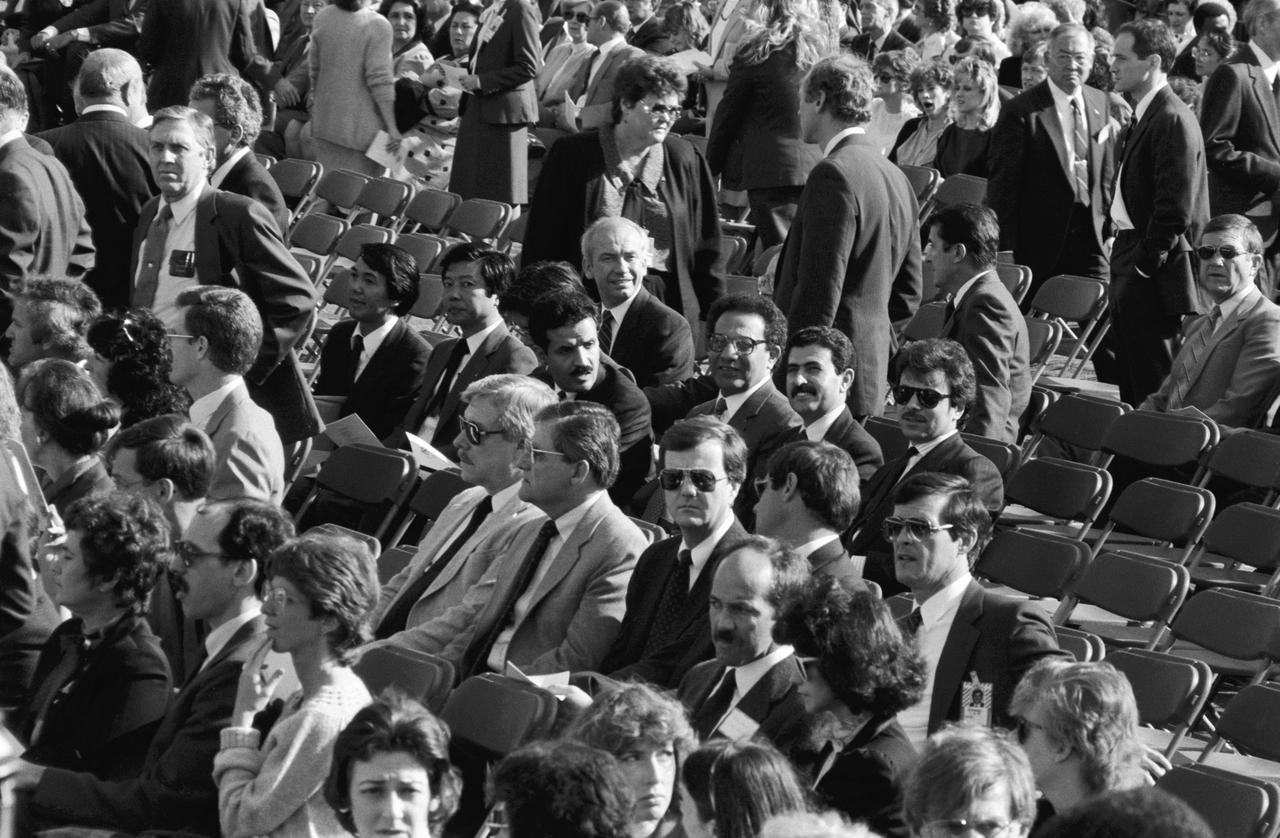
View of the audience at the memorial service at JSC for the Crew of STS 51-L. Sultan Salman Abdelazize Al-Saud of Saudi Arabia is seen in the center of the view.
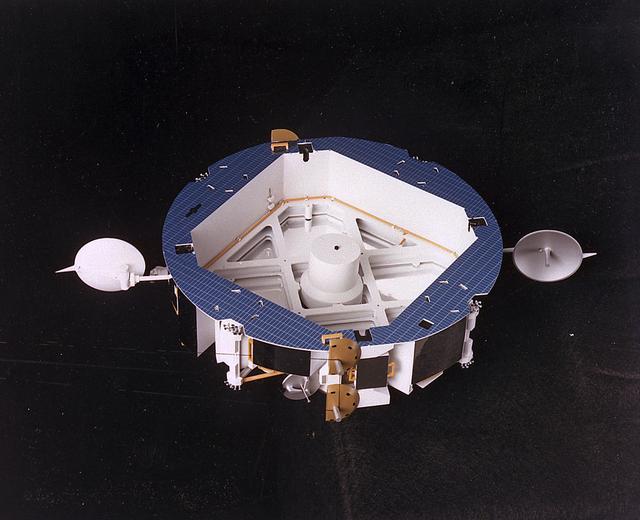
In this 1986 artist's concept, the Orbital Maneuvering Vehicle (OMV), is shown without its main propulsion module. Essentially two propulsion vehicles in one, the OMV could be powered by a main propulsion module , or, in its short range vehicle configuration shown here, use its own hydrazine and cold gas thrusters. As envisioned by Marshall Space Flight Center plarners, the OMV would be a remotely-controlled free-flying space tug which would place, rendezvous, dock, and retrieve orbital payloads.
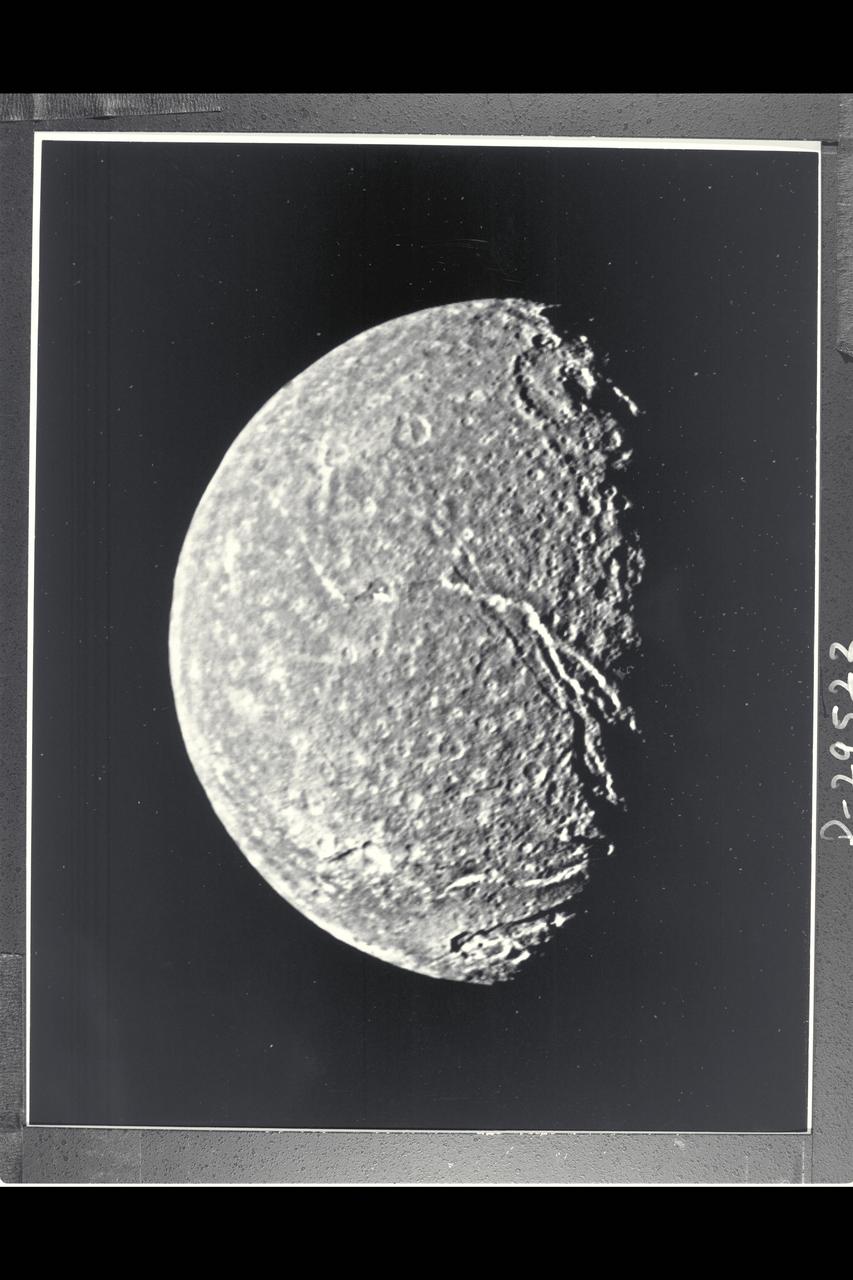
P-29522BW Range: 369,000 kilometers (229,000 miles) This is the highest-resolution picture of Titania returned by Voyager 2. The picture is a composite of two images taken through the clear-filter of Voyager's narrow-angle camera. The resolution of this image is 13 km (8 mi). Titania is the largest satellite of Uranus, with a diameter of little more than 1,600 km (1,000 mi). Abundant impact craters of many sizes pockmark the ancient surface. The most prominant features are fault valleys that stretch across Titania. They are up to 1,500 km (nearly 1,000 mi) long and as much as 75 km (45 mi) wide. In valleys seen at right center, the sunward-facing walls are very bright. While this is due partly to the lighting angle, the brightness also indicates the presence of a lighter material, possibly young frost deposits. An impact crater more than 200 km (125 mi) in diameter distinguishes the very bottom of the disk; the crater is cut by a younger fault valley more than 100 km (60 mi) wide. An even larger impact crater, perhaps 300 km (180 mi) across, is visible at top.
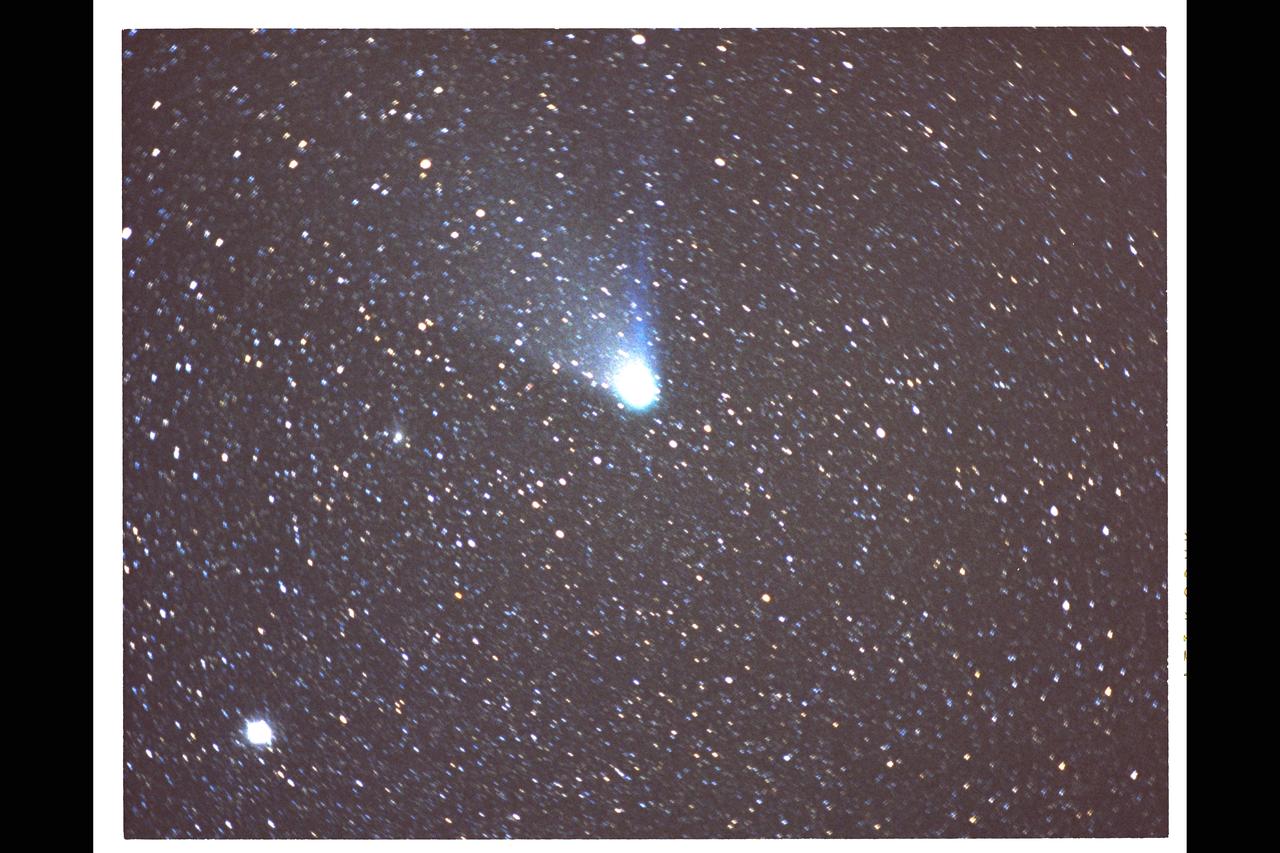
C-141 Kuiper Airborne Imagery of Comet Halley (New Zealand Expedition) PHOTO CREDIT Photo taken with equipment designed, mounted on the headring and operated by the Charleston (South Carolina) County School District CAN DO Project;
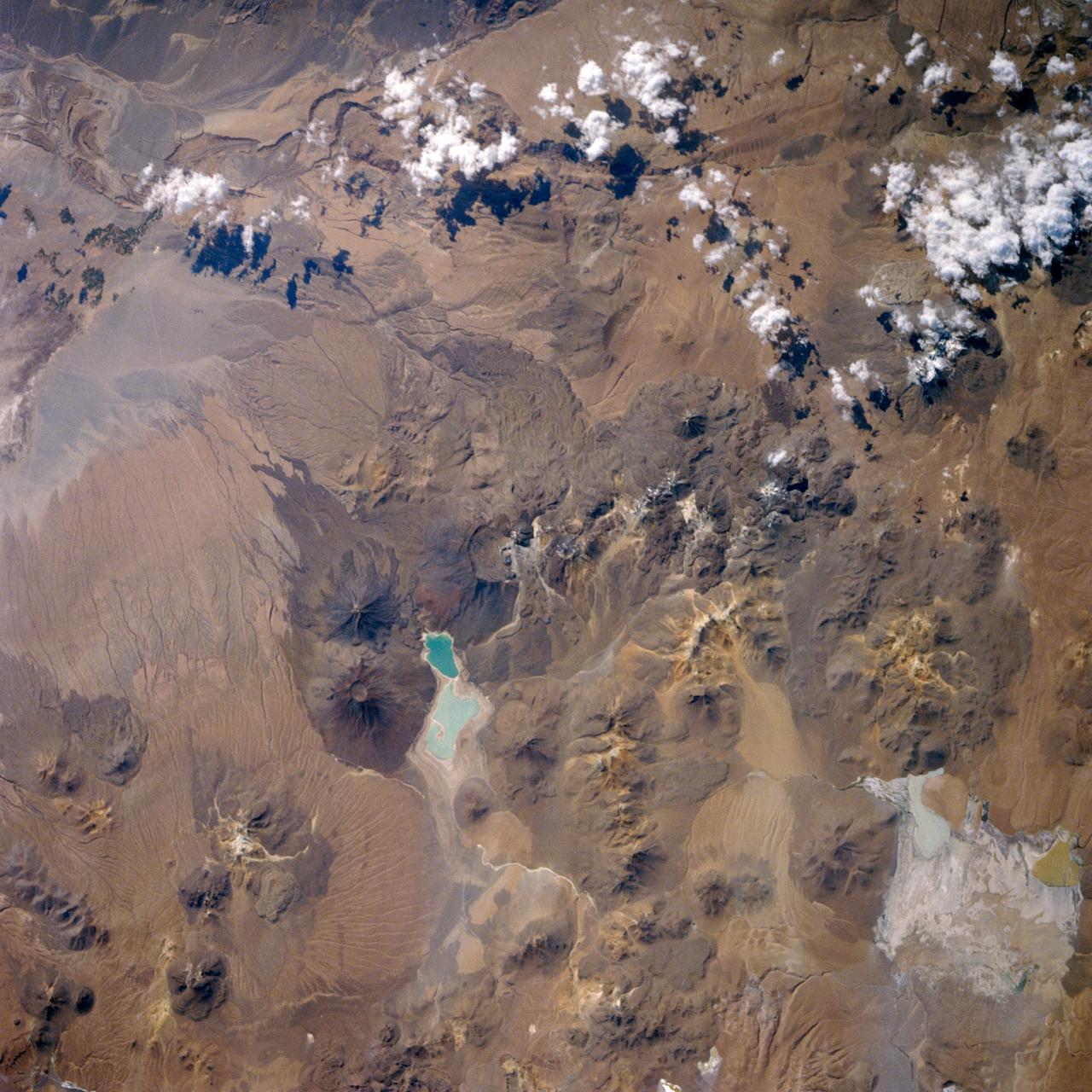
61C-32-089 (12 Jan. 1986) --- This nearly-vertical handheld Hasselblad image over Chile was photographed from an altitude of 176 nautical miles during the sixth orbit of the space shuttle Columbia on Jan. 12, 1986. Many of the noted Andes volcanoes can be seen in the frame. Laguna Verde (Green Lake) is near the center of the frame. Center coordinates are located at 22.5 degrees south latitude and 68 degrees west longitude. The shuttle was 176 nautical miles above a point centered at 21.8 degrees south latitude and 67.3 degrees west longitude.
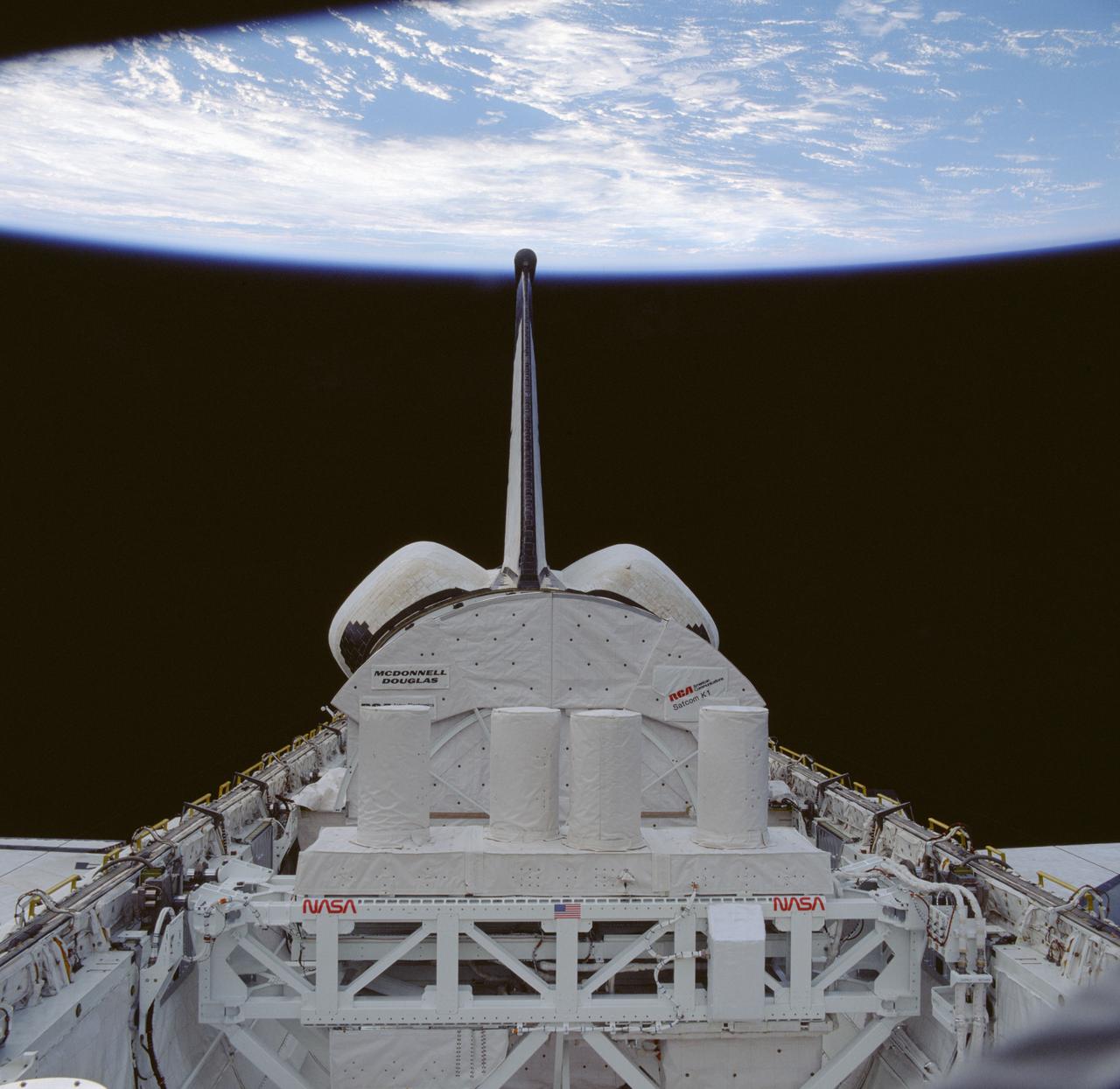
61C-39-002 (12-17 Jan 1986) --- This view of the cargo bay of the Earth-orbiting Space Shuttle Columbia reveals some of the STS 61-C mission payloads. The materials science laboratory (MSL-2), sponsored by the Marshall Space Flight Center (MSFC), is in the foreground. A small portion of the first Hitchhiker payload, sponsored by the Goddard Space Flight Center (GSFC), is in the immediate foreground, mounted to the spacecraft's starboard side. The closed sun shield for the now-vacated RCA SATCOM K-1 communications satellite is behind the MSL. Completely out of view, behind the shield, are 13 getaway specials in canisters. Clouds over ocean and the blackness of space share the backdrop for the 70mm camera's frame.
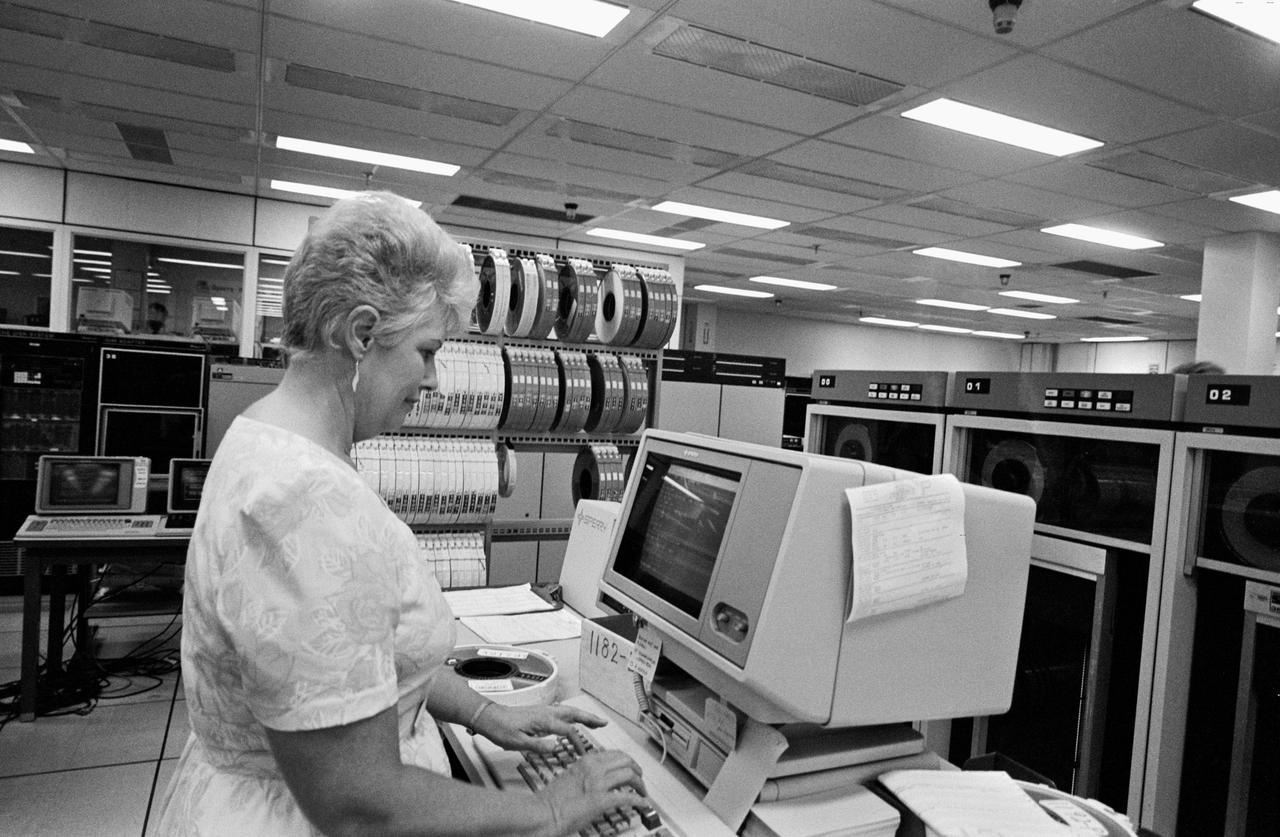
S86-30337 (4 April 1986) --- Digital data from the MADS tape is sent from Larue Forbes’ terminal to a hard copy printer in another facility at JSC.
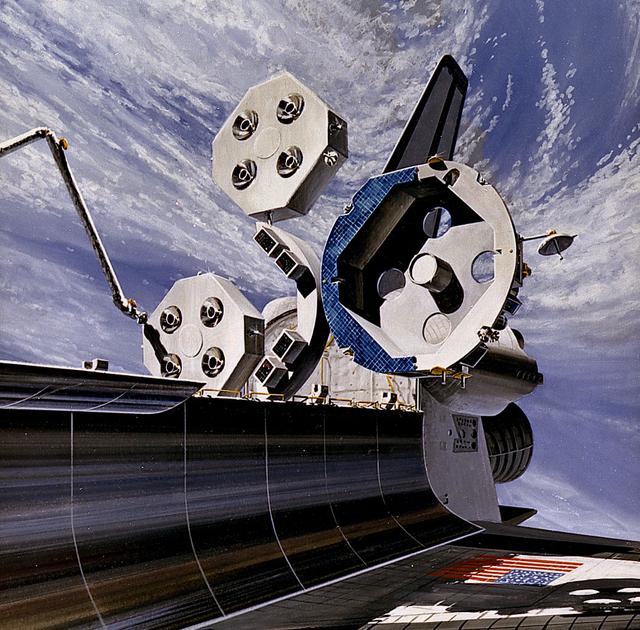
In this 1986 artist's concept, the Orbital Maneuvering Vehicle (OMV), undergoes changeout of the Propulsion Module outside the Space Shuttle Cargo Bay. As envisioned by Marshall Space Flight Center plarners, the OMV would be a remotely-controlled free-flying space tug which would place, rendezvous, dock, and retrieve orbital payloads.
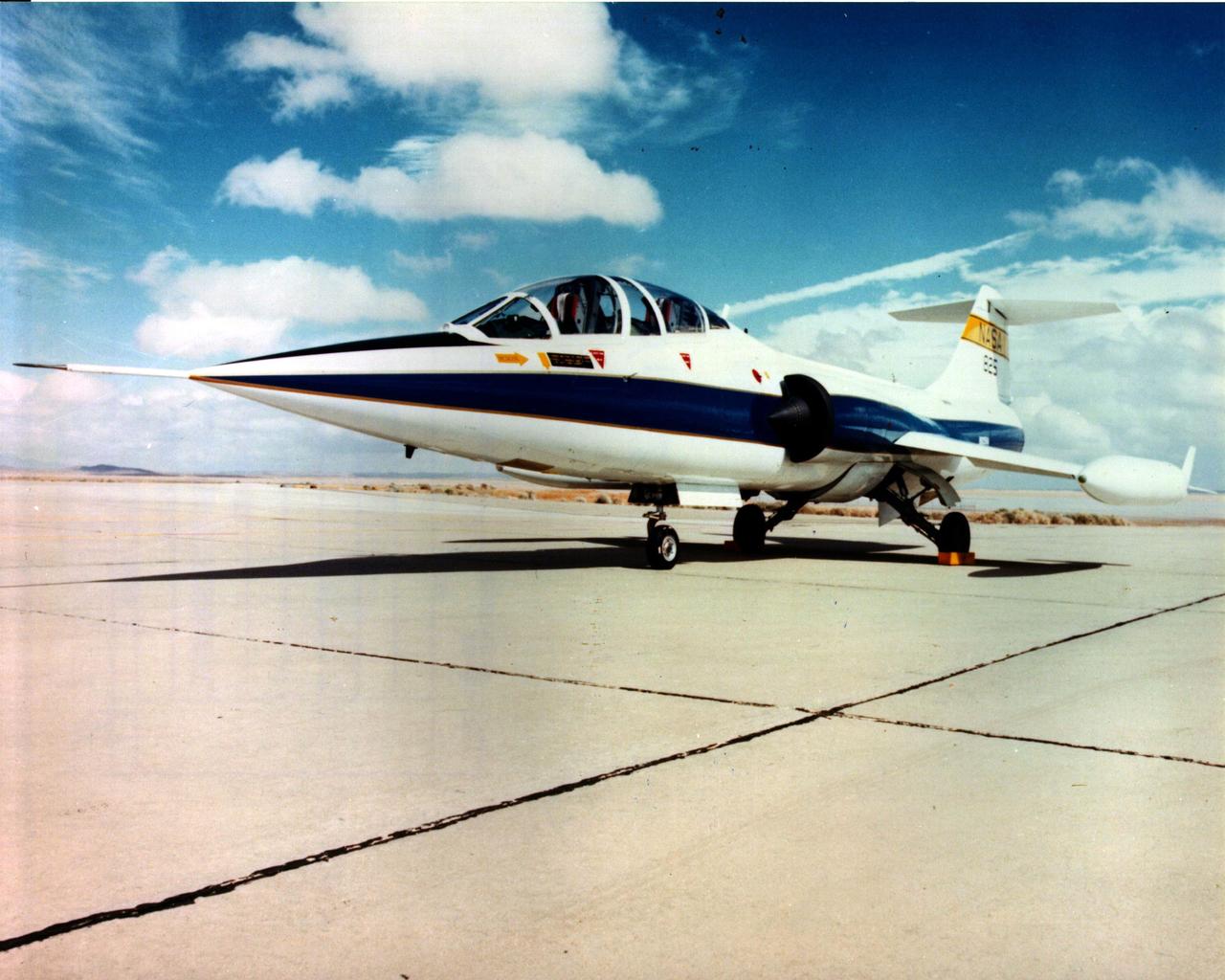
NASA F-104 Aircraft
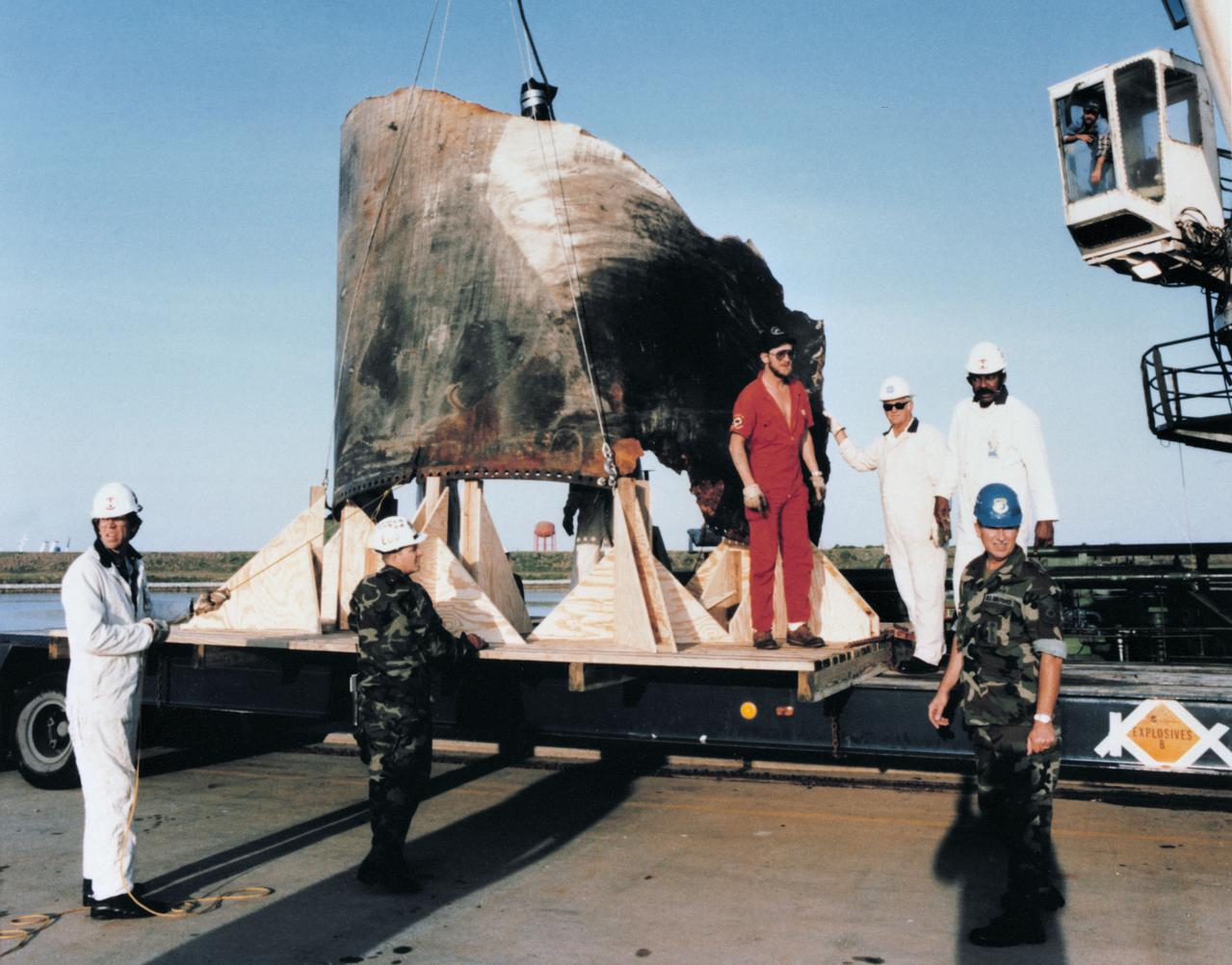
S86-30504 (16 April 1986) --- A 4,000 pound, 11' x 20' piece of the aft center segment tang joint of the space shuttle Challenger's right-hand solid rocket booster is off loaded from the Stena Workhorse after its recovery on April 13, 1986. The burned out area is 15" x 28". Photo credit: NASA
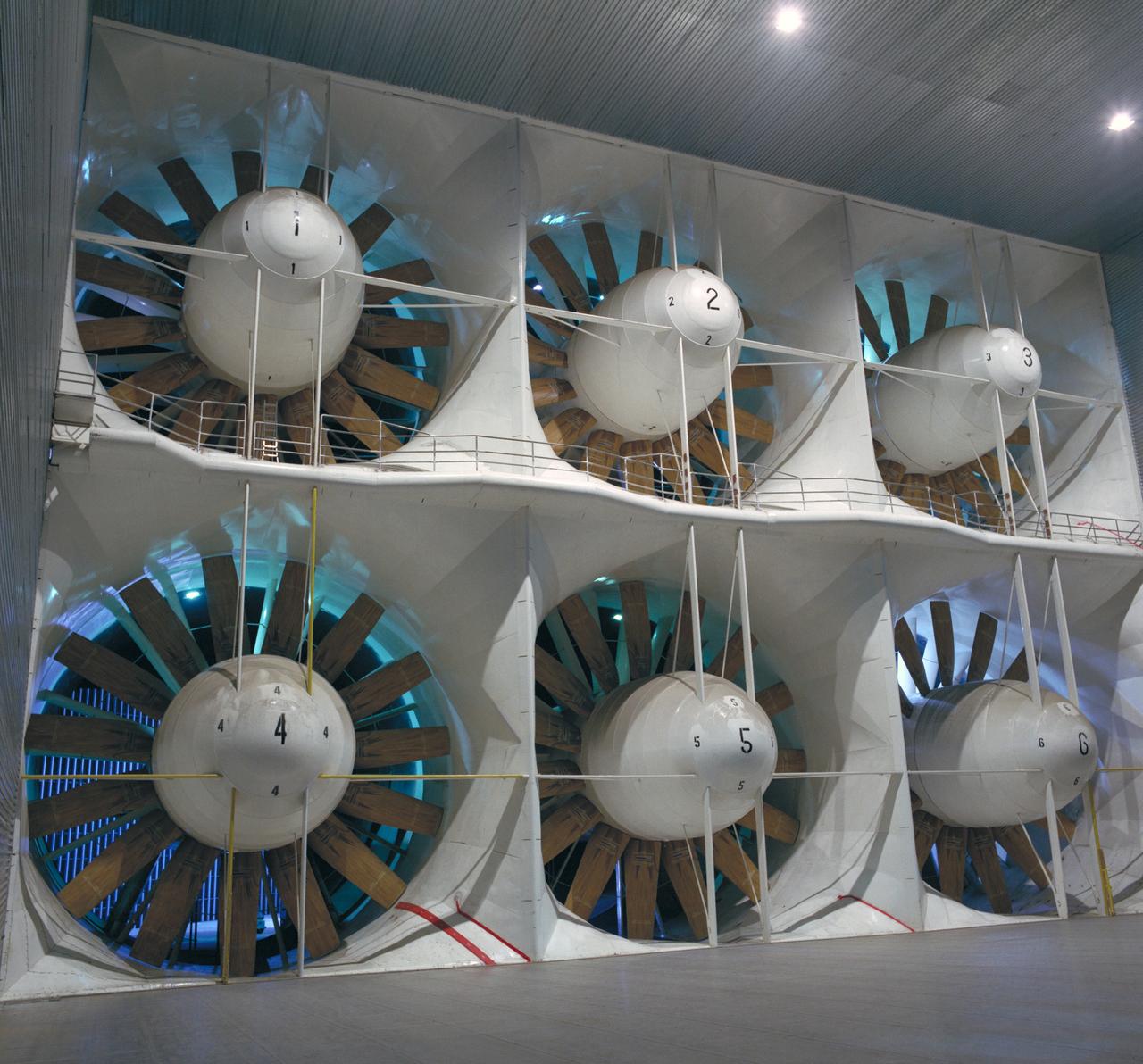
40 x 80 ft. Wind Tunnel Reconstruction @ Ames Research Center, Moffett Field, CA: Final Survey. Drive Motor
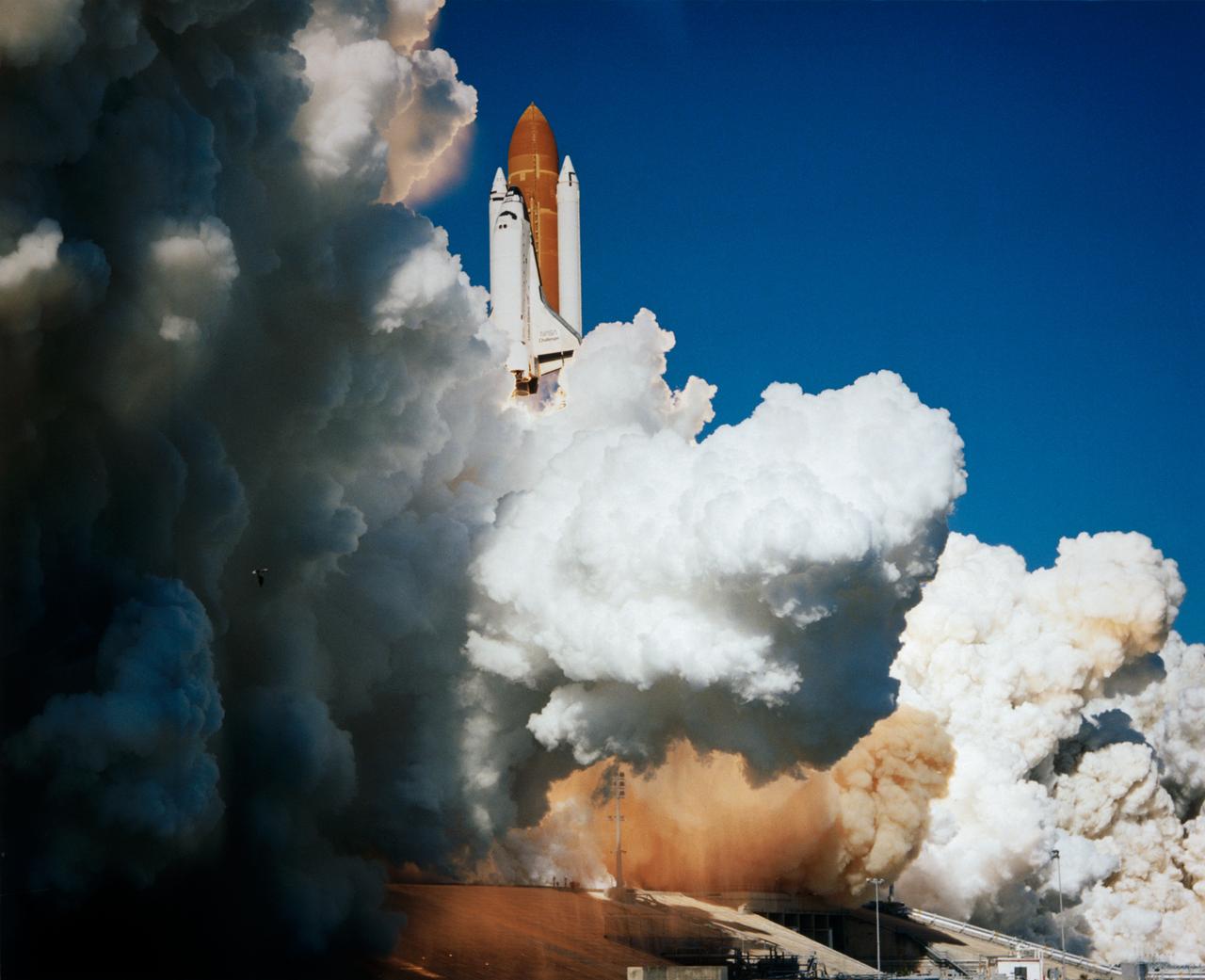
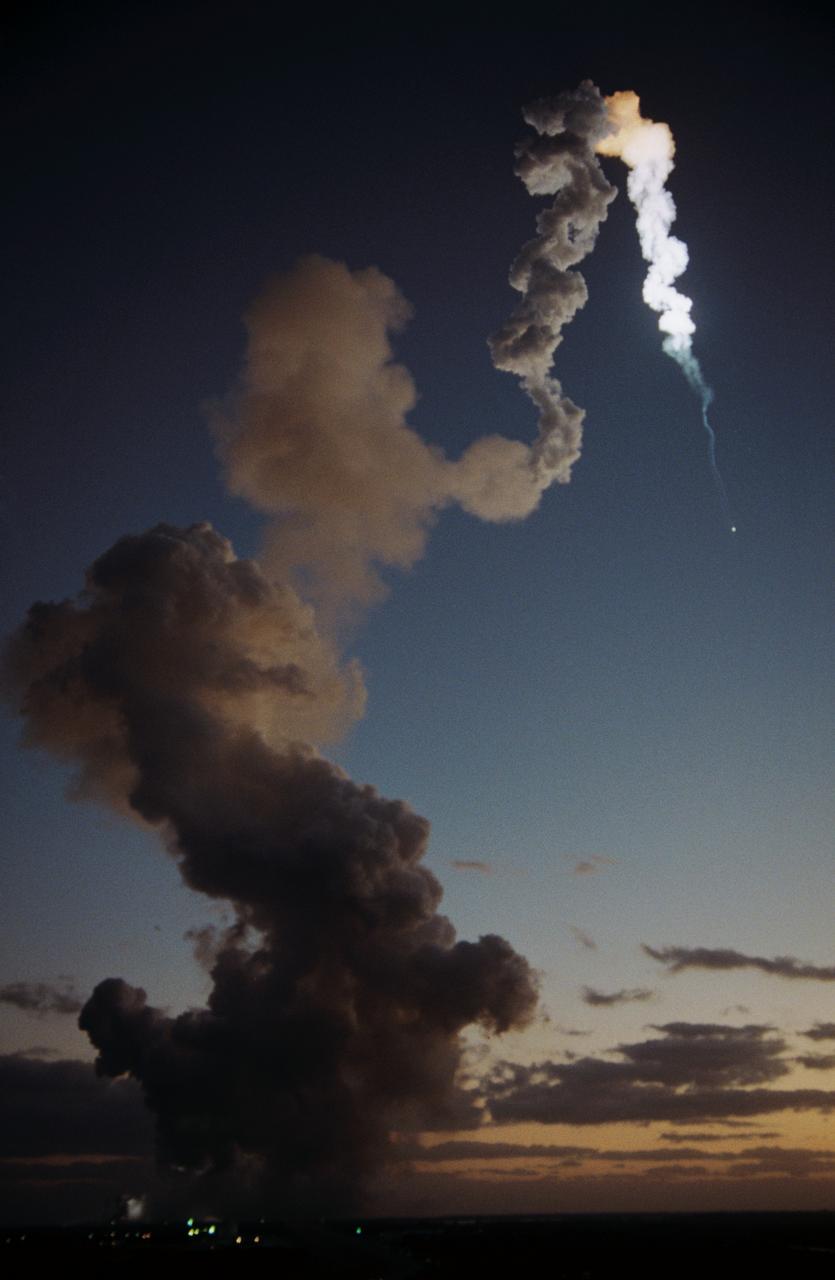
51L-S-157 (28 Jan. 1986) --- The space shuttle Challenger lifted off from Pad 39B Jan. 28, 1986 at 11:38 a.m. (EST) with a crew of seven astronauts and the Tracking and Data Relay Satellite (TDRS). An accident 73 seconds after liftoff claimed both crew and vehicle. Photo credit: NASA
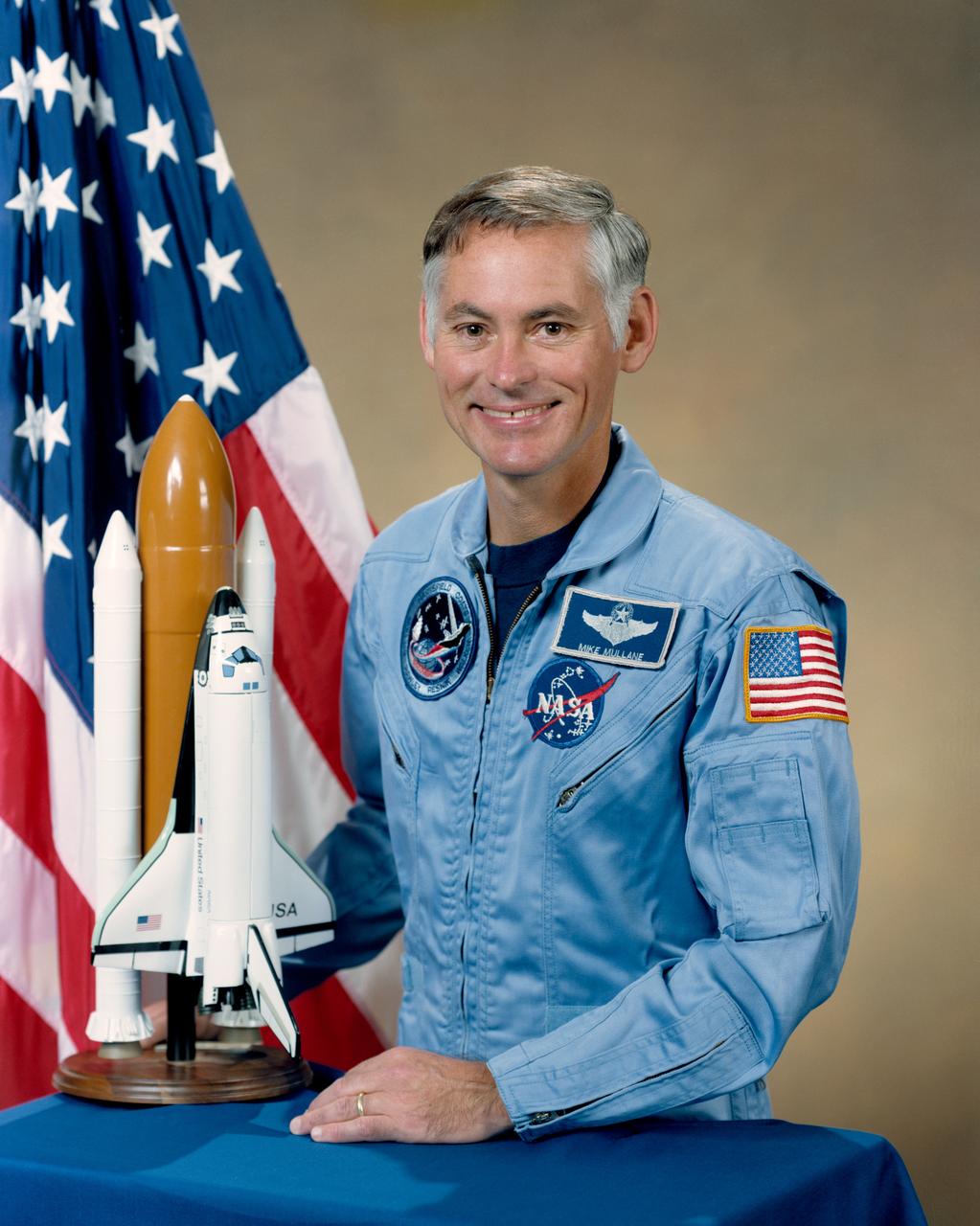
S86-40741 (Nov 1986) --- Astronaut R. Michael Mullane, mission specialist.
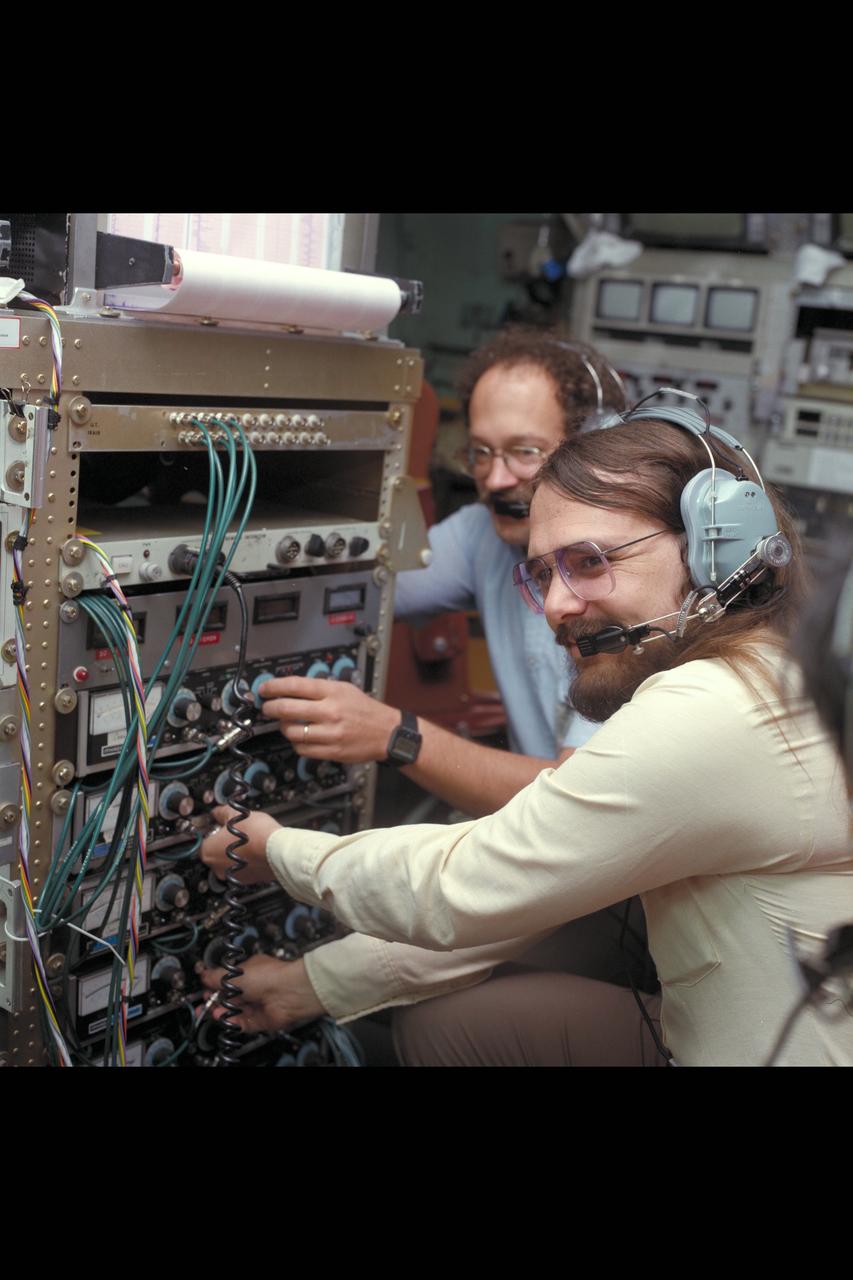
C-141 KAO: University of Texas
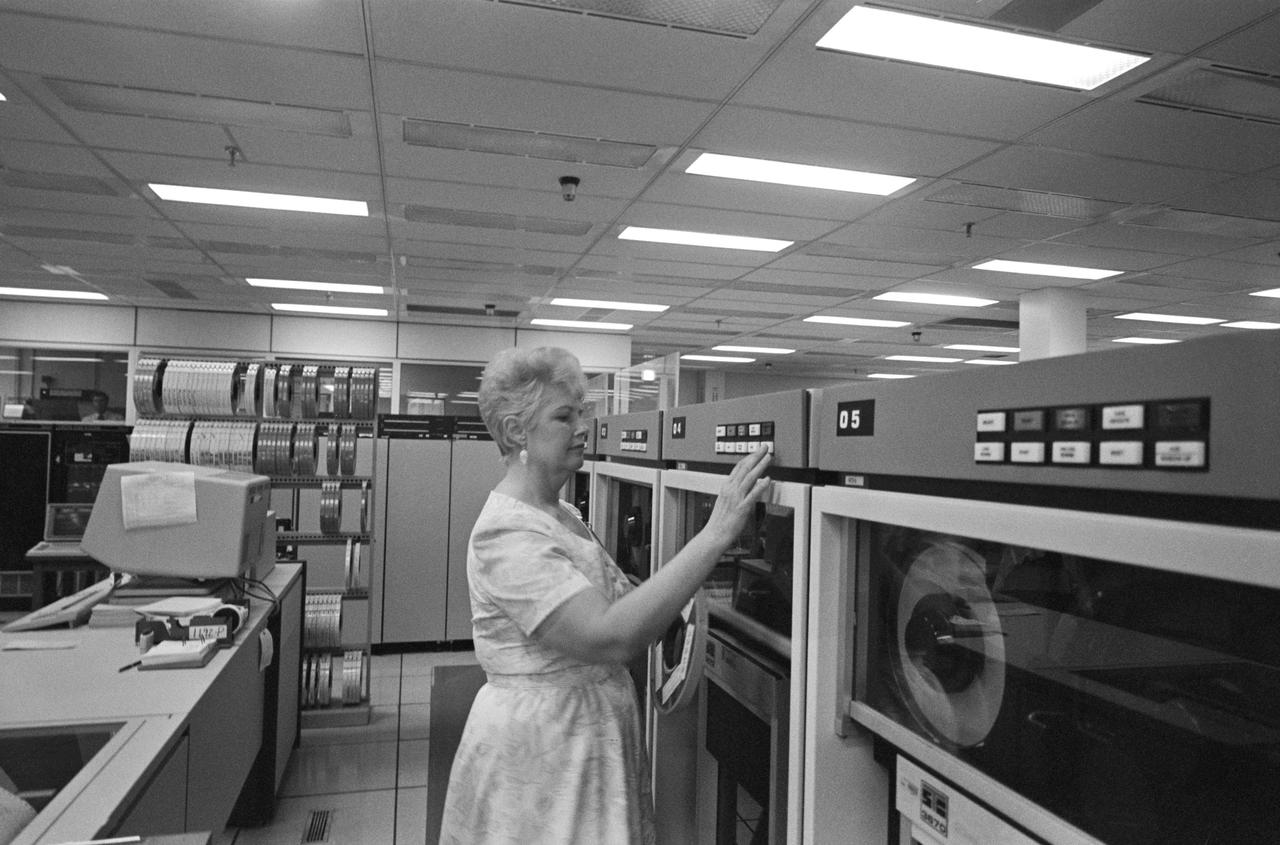
S86-30340 (4 April 1986) --- Larue Forbes of CSC prepares to put the MADS tape onto one of the central data office’s computers.
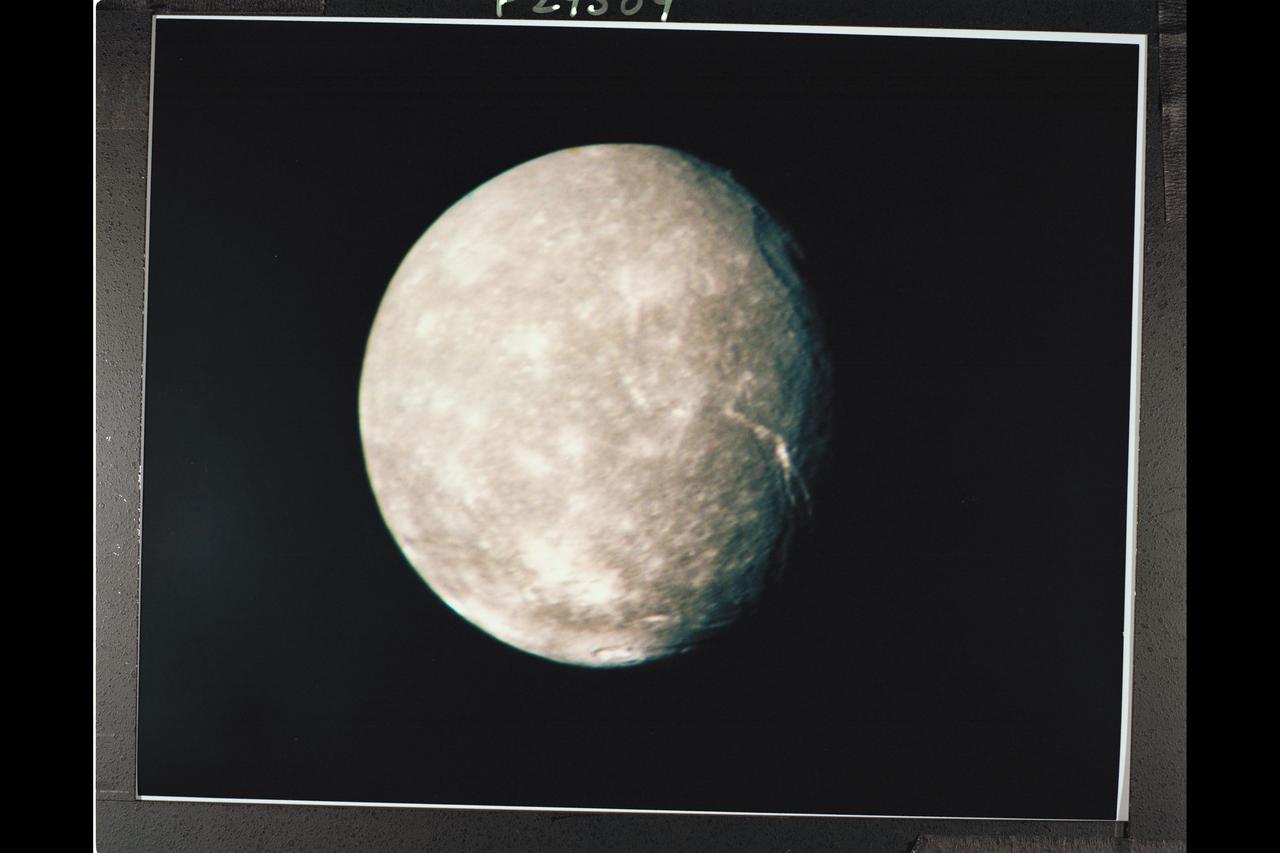
P-29509 C Range: 500,000 kilometers (300,000 miles) This high-resolution color composite of Titania was made as Voyager 2 neared its closest approach to Uranus. Voyager's narrow-angle camera acquired this image through the violet and clear filters and shows details about 9 km (6 mi) in size. Titania has a diameter of about 1,600 km (1,000 MI). In addition to many scars due to impacts, Titania displays evidence of other geologic activity at some point in its history. The large trench-like feature near the terminator (day-night boundary) at middle right suggests at least one episode of tectonic activity, Another, basinlike structure near the upper right is evidence of an ancient period of heavy impact activity. The neutral gray color of Titania is characteristic of the Uranian satellites as a whole.
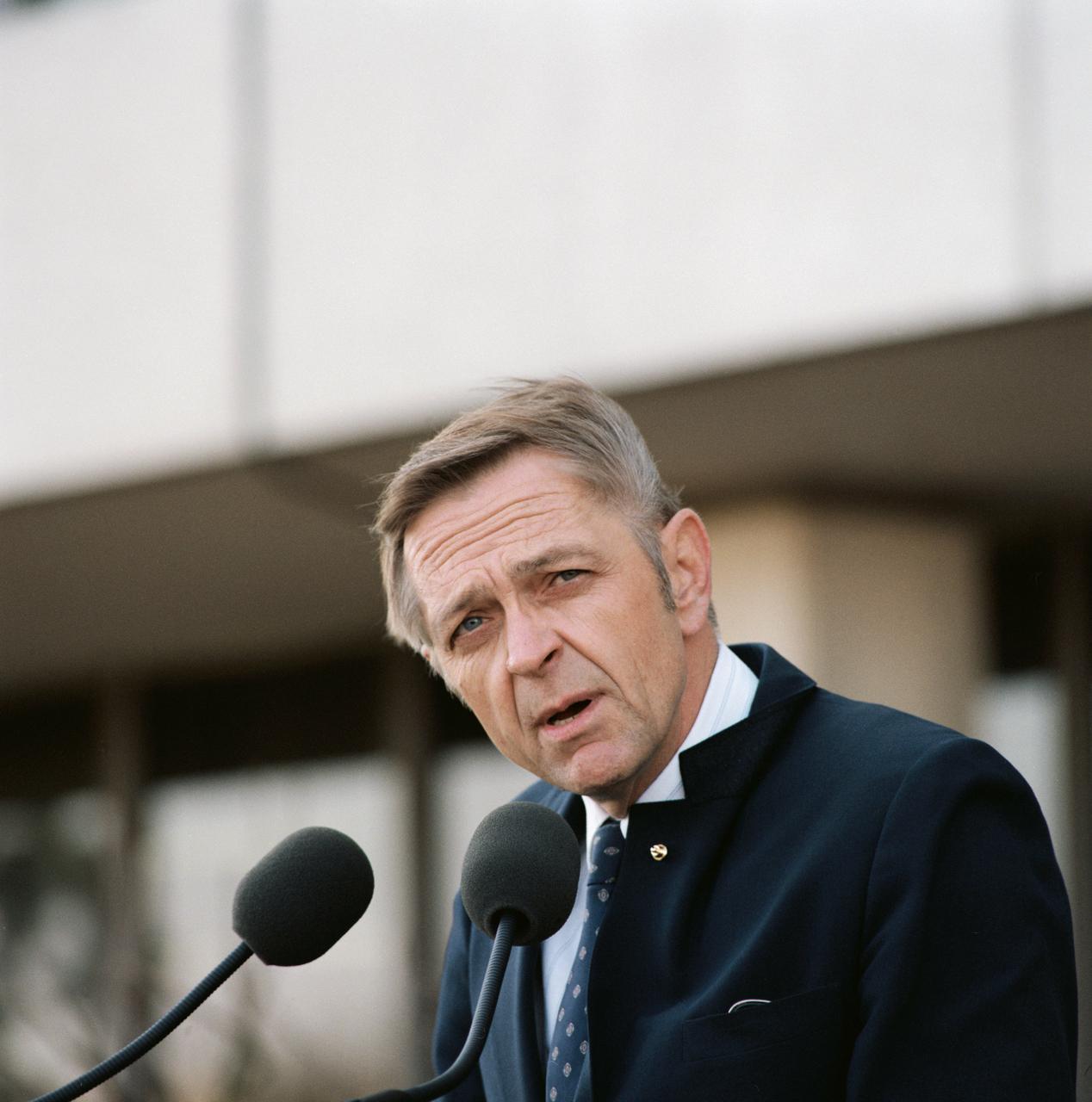
Various views of new JSC Director, Jesse W. Moore, addressing JSC personnel behind Bldg. 1, 02/28/1986. JSC, HOUSTON, TX Also available in 120 CN
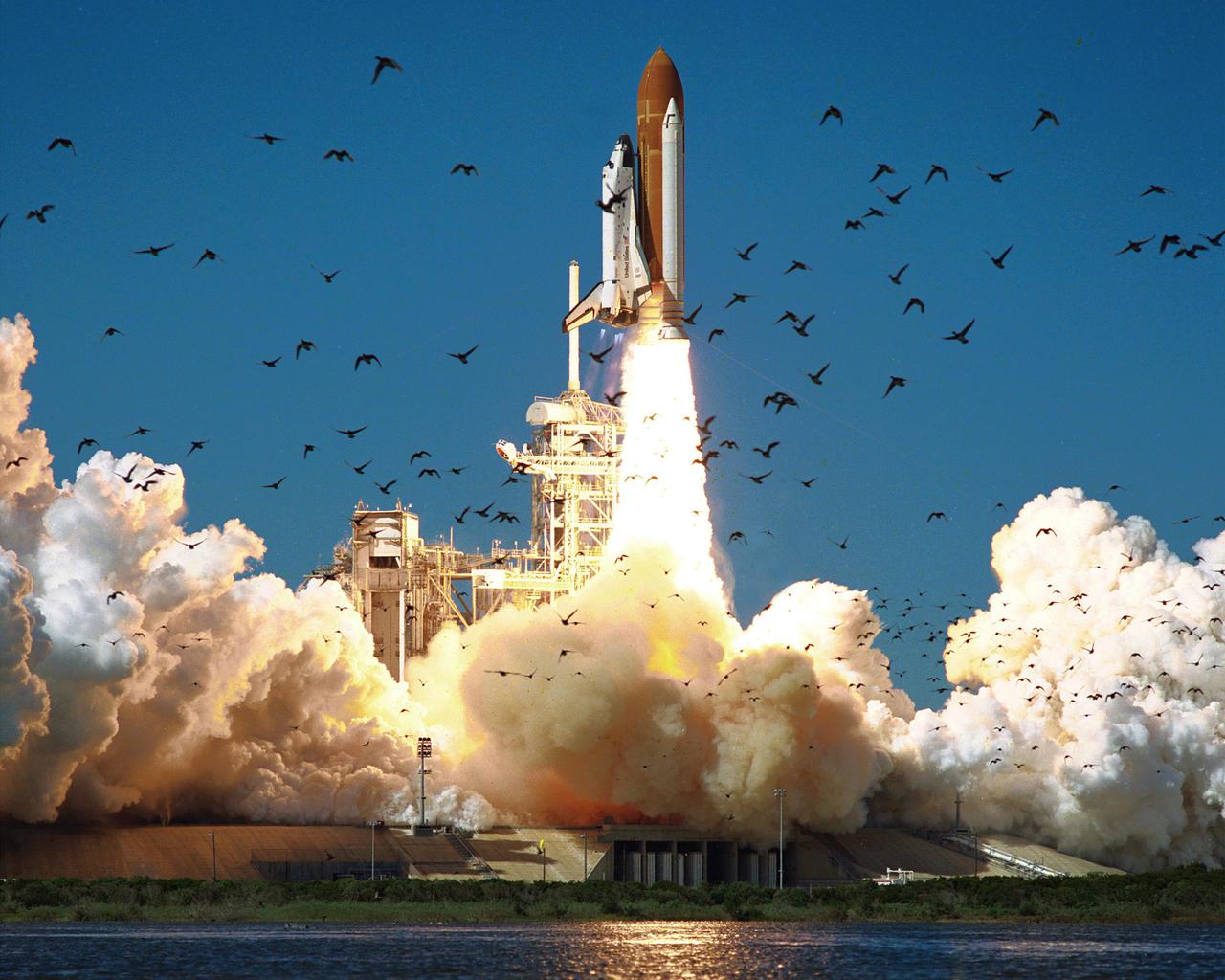
KENNEDY SPACE CENTER, FLA. -- STS-51-L: Challenger
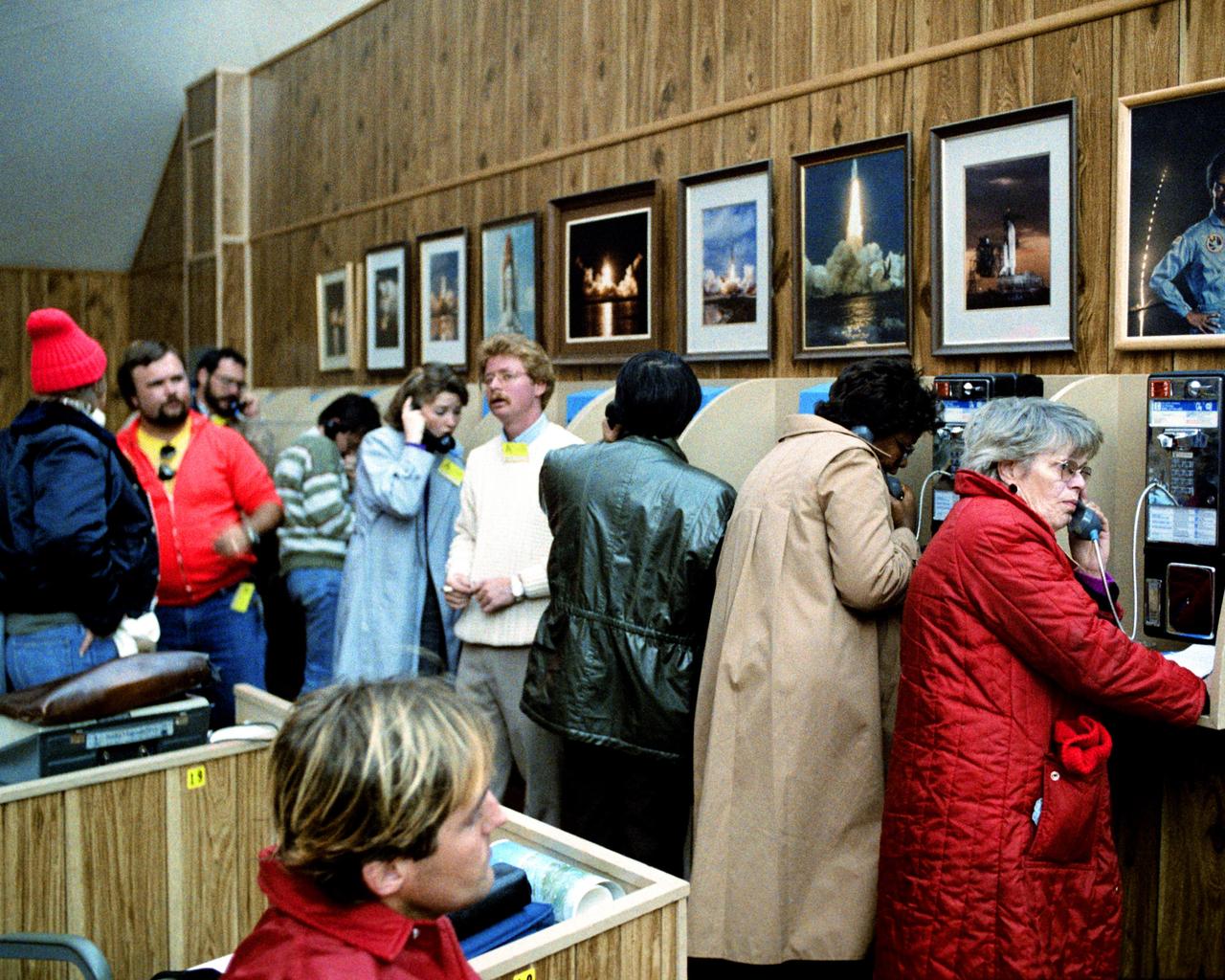
CAPE CANAVERAL, Fla. -- NASA/ADMIN ARRIVAL OF VICE PRESIDENT BUSH FOLLOWING STS-51L. Photo credit: NASA
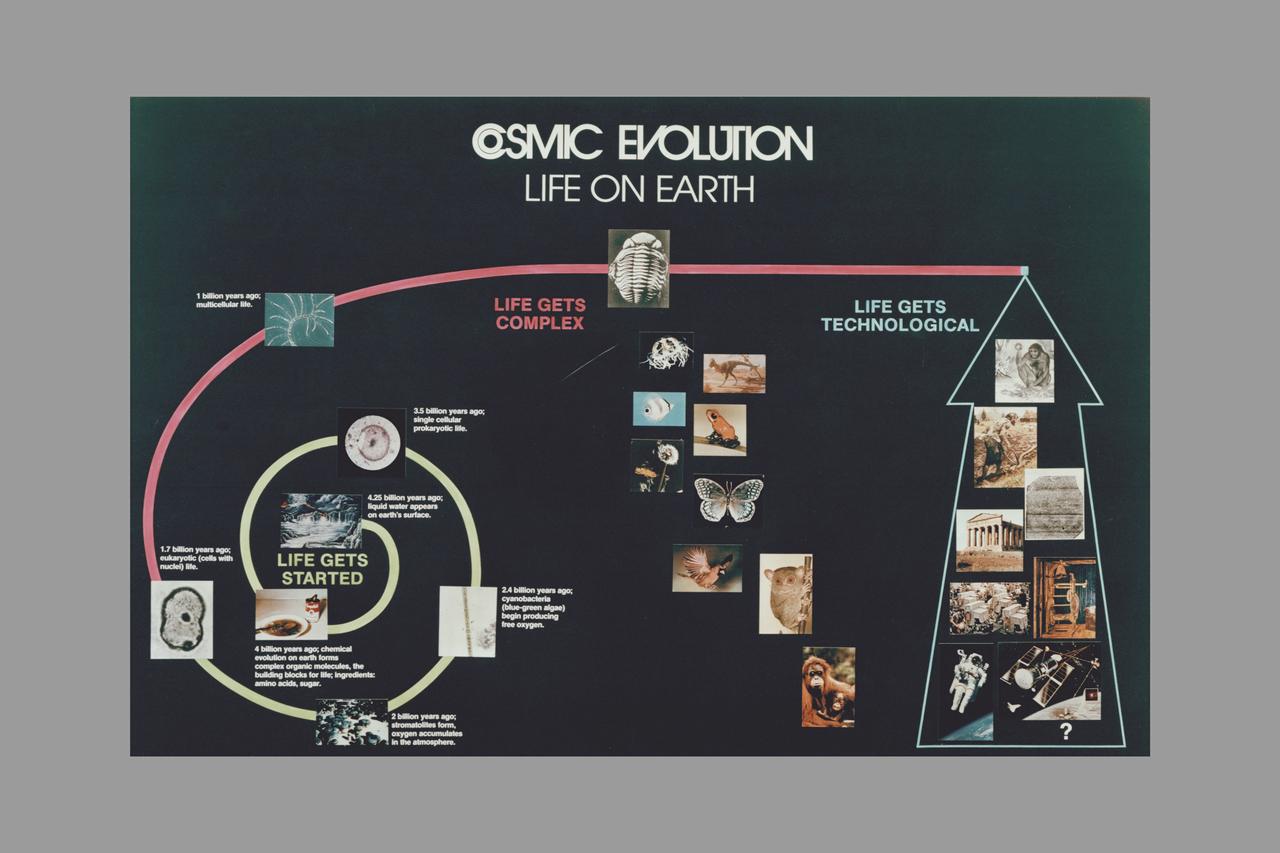
Cosmic Evolution. Setting the stage. Life on Earth (contains some copyrighten material - no for general release)
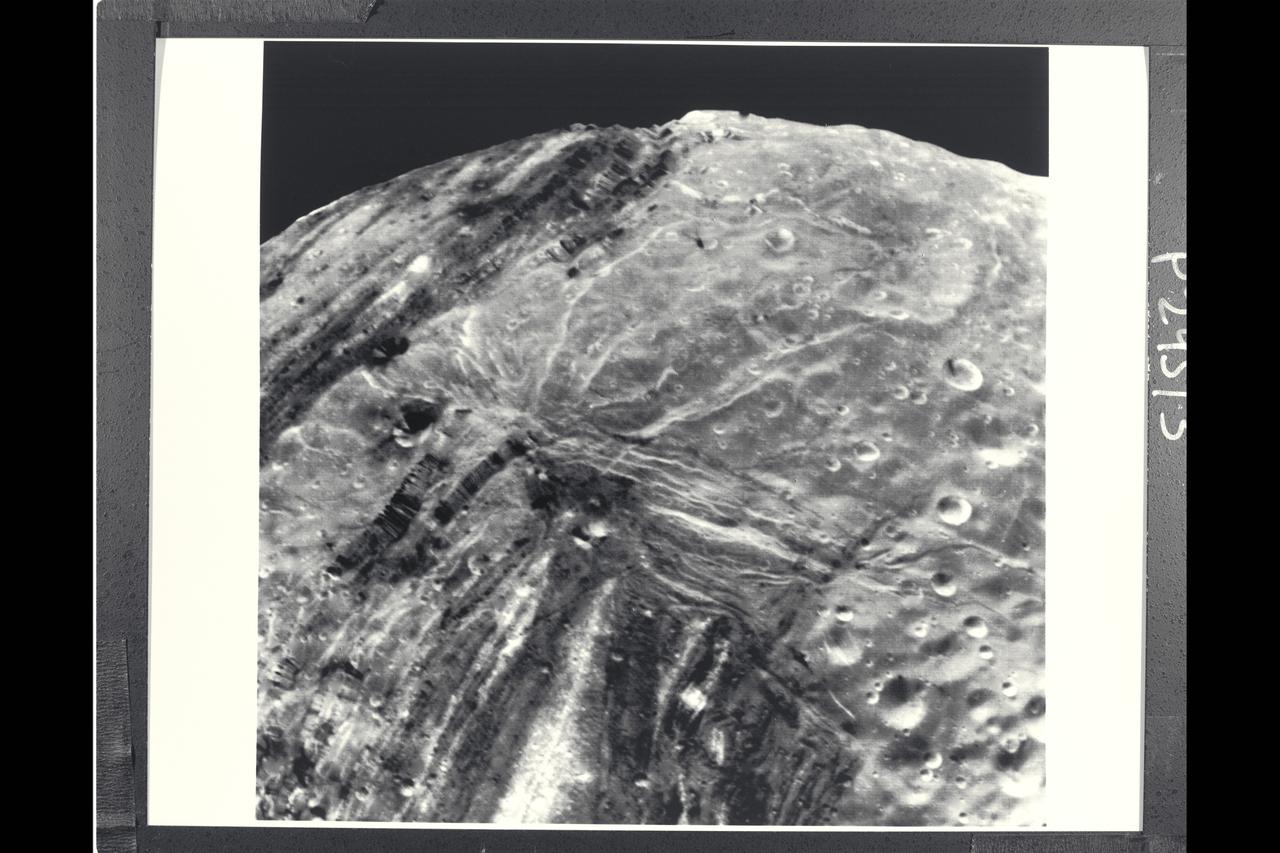
P-29513 BW Range: 31,000 kilometers (19,000 miles) This Voyager 2 image of Miranda was taken shortly before the spacecraft's closet approach to the Uranian moon.The high resolution of 600 meters (2,000 feet) reveals a bewildering variety of fractures, grooves and craters, as well as features of different albedos (reflectances). This clear-filter, narrow-angle view encompasses areas of older, heavily cratered terrain with a wide variety of forms. The grooves and troughs reach depths of a few kilometers and expose materials of different albedos. The great variety of directions of fracture and troughs, and the different densities of impact craters on them, signify a long, complex geologic evolution of this satellite.
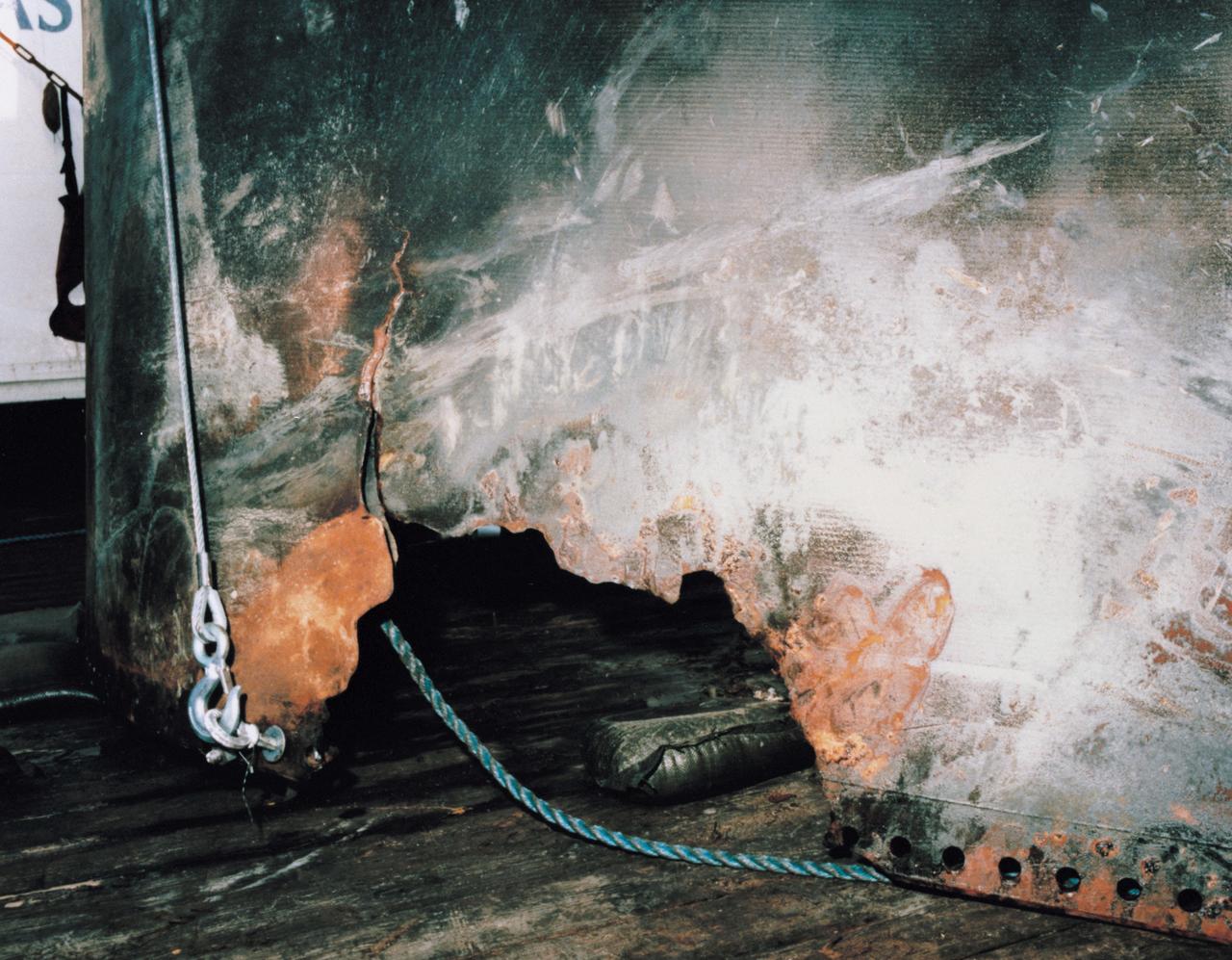
S86-30503 (16 April 1986) --- A 4,000 pound, 11' x 20' piece of the aft center segment tang joint of the space shuttle Challenger's right-hand solid rocket booster is off loaded from the Stena Workhorse after its recovery on April 13, 1986. The burned out area is 15" x 28". Photo credit: NASA
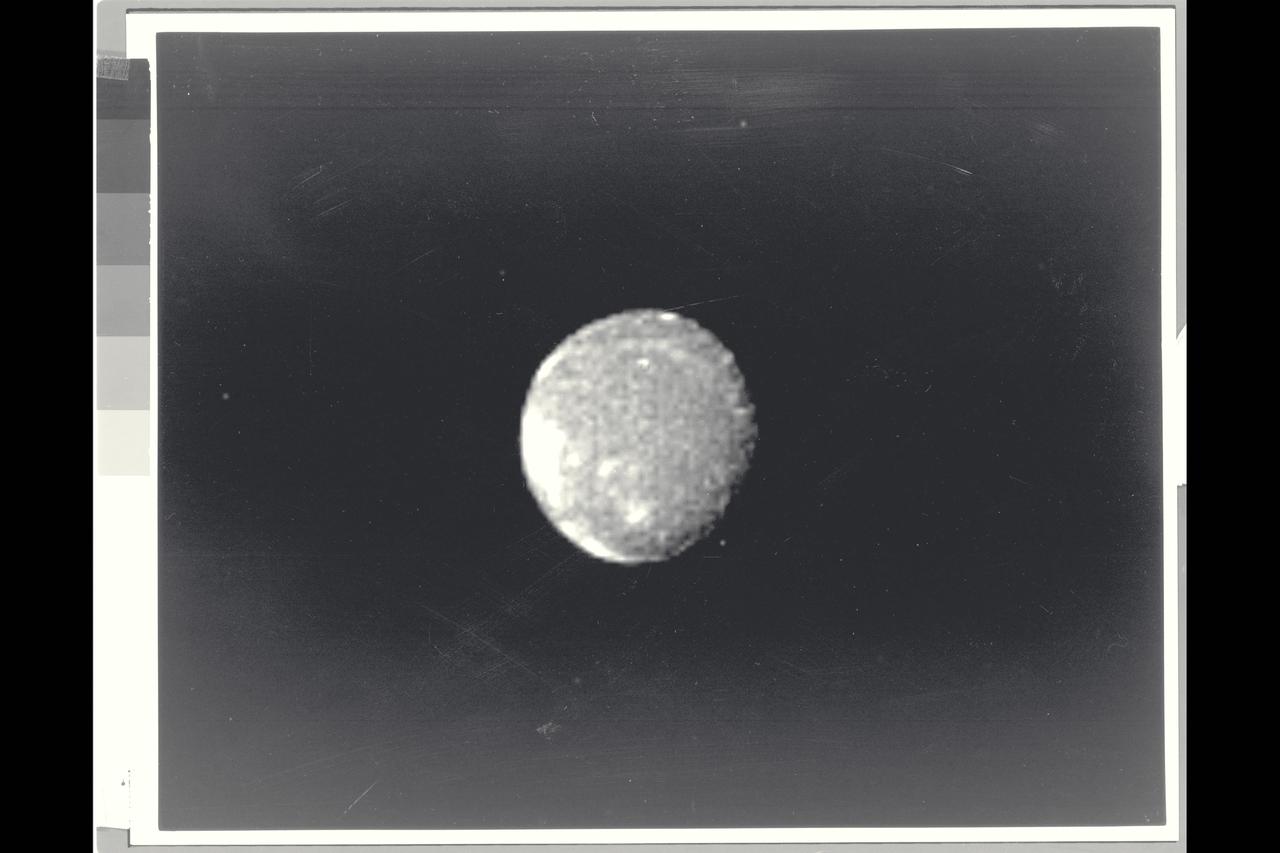
Range : 2.52 million miles (1.56 million miles) Resolution : 47km. ( 29 mi.) Closest Approach: 127,000 km. (79,000 mi.) P-29479B/W This Voyager 2 image of the brightest Uranian satellite of the five largest, Ariel, was shot through a clear filter with the narrow angle camera. Ariel is about 1,300 km. ( 800 mi. )in diameter. This image shows several distinct bright areas that reflect nearly 45 % of the incident sunlight. On average, the satellite displays reflectivity of about 25-30 %. The bright areas are probably fresh water ice, perhaps excavated by impacts. the south pole of Ariel is slightly off center of the disk in this view.
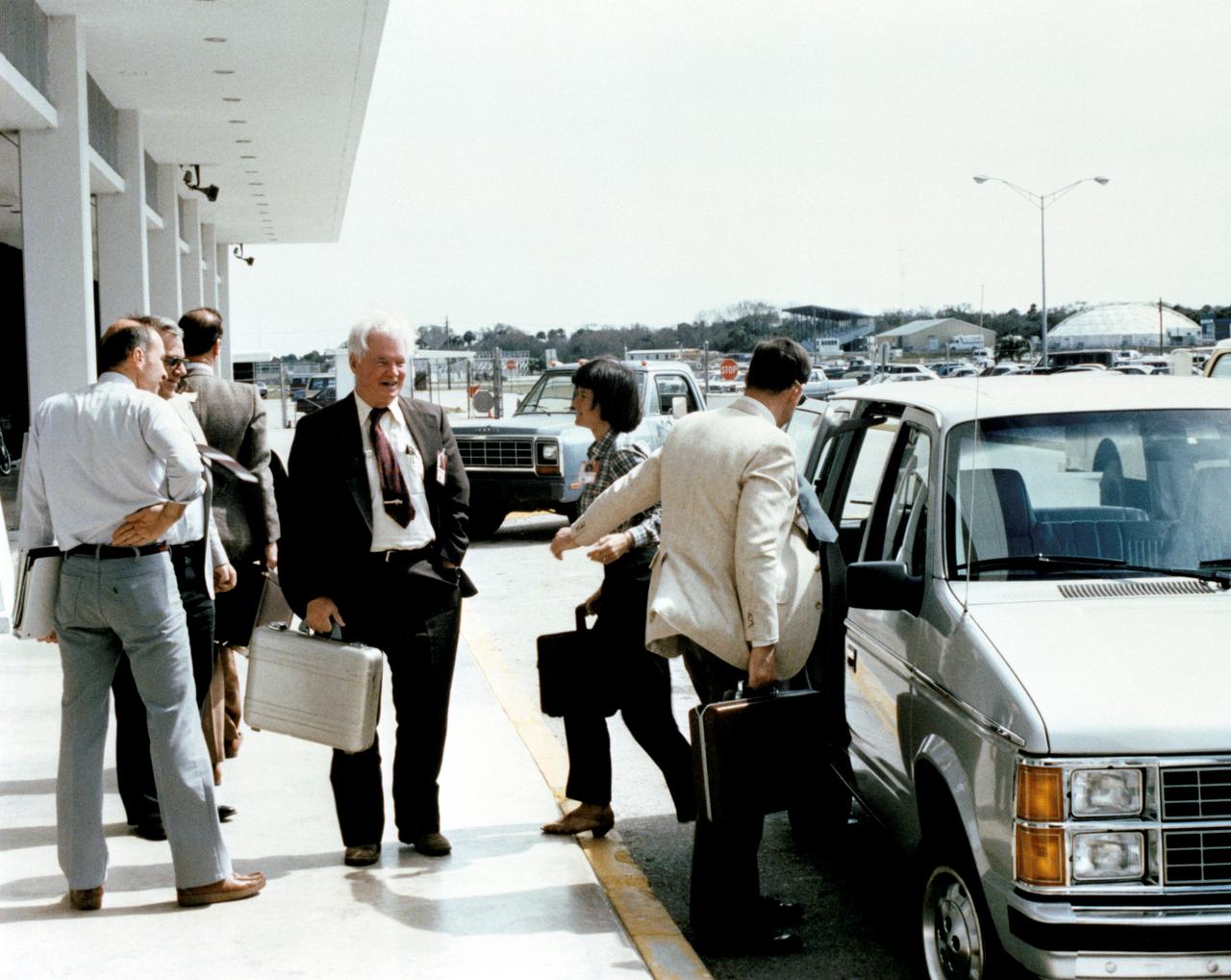
51L-10166 (4 March 1986) --- Members of the Presidential Commission on the space shuttle Challenger accident arrive at the Launch Control Center at Kennedy Space Center (KSC). Commission members present are Robert Hotz (center) and Dr. Sally Ride. Others pictured are John Chase, staff assistant to the Commission (far right) and from left to right: Bob Sieck, Director of Shuttle operations; Jack Martin and John Fabian.
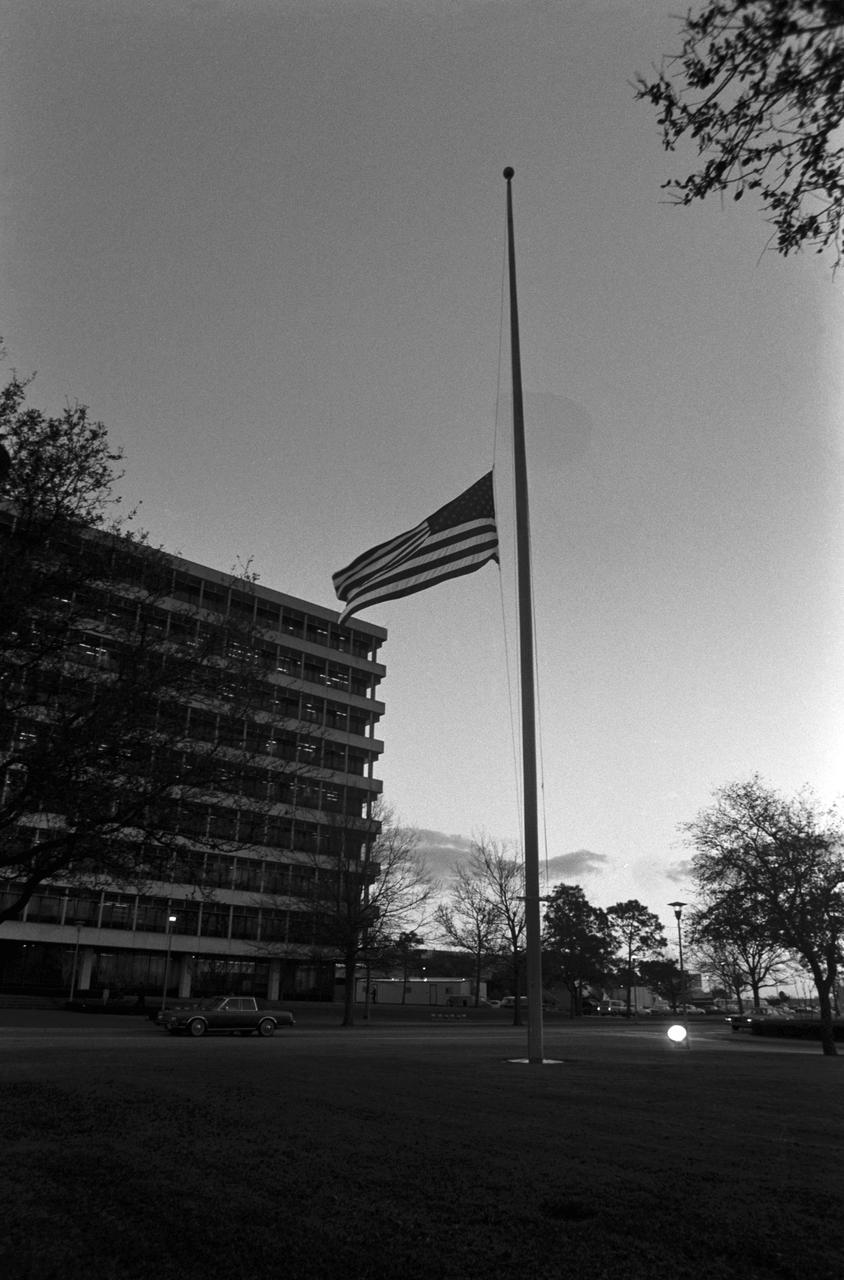
S86-26436 (31 Jan. 1986) --- The United States flag, in front of the Johnson Space Center’s (JSC) project management building, flies at half-mast in memory of the seven space shuttle Challenger crew members who lost their lives on Jan. 28, 1986. Earlier today, memorial services about 100 yards from the flag drew thousands of JSC employees, friends and family of the STS-51L astronauts and payload specialists. Photo credit: NASA
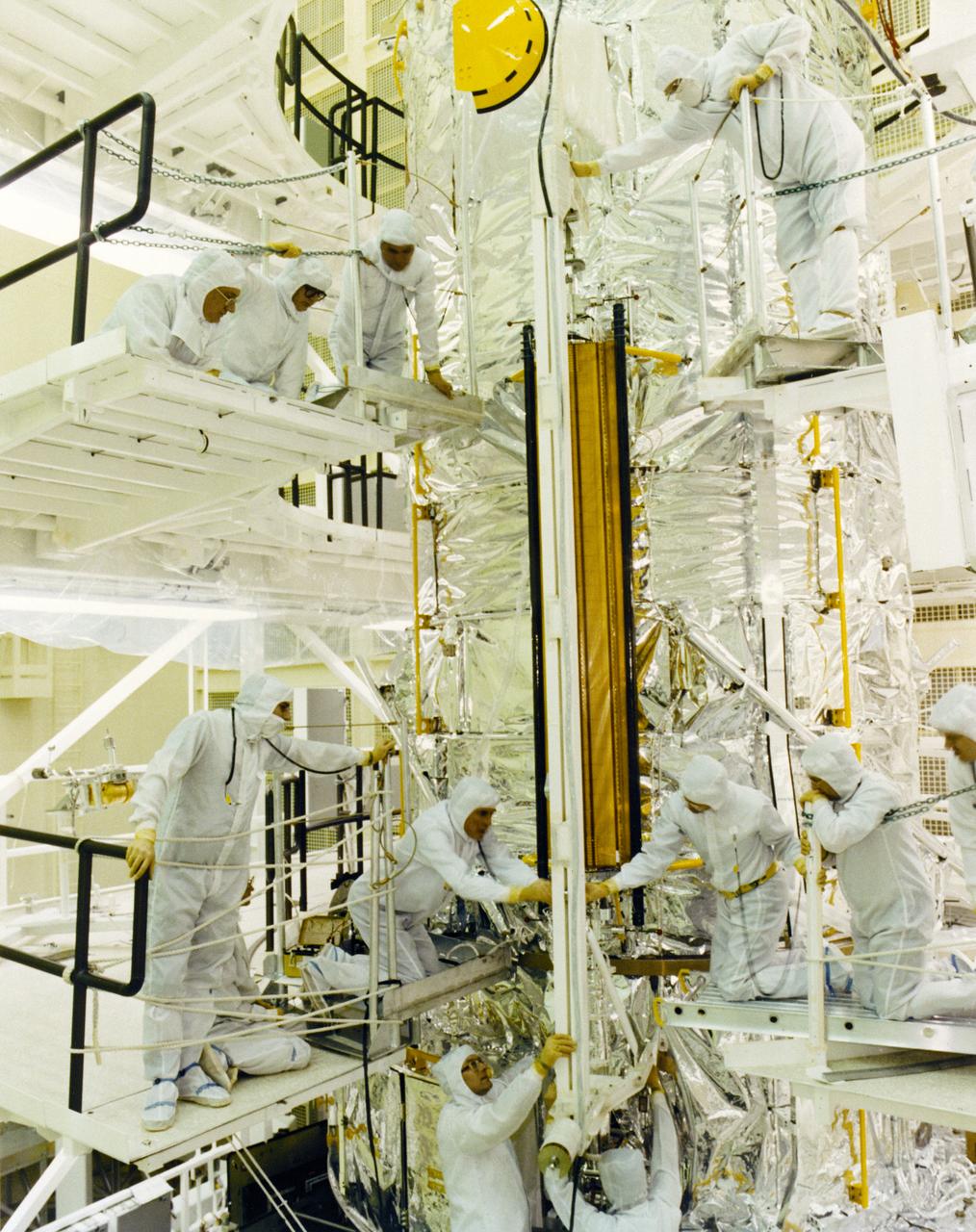
Engineers and technicians conduct a fit check of the Hubble Space Telescope (HST) Solar Array flight article in a clean room of the Lockheed Missile and Space Company. The Solar Array is 40- feet (12.1-meters) long and 8.2-feet (2.5-meters) wide, and provides power to the spacecraft. The HST is the first of NASA's great observatories and the most complex and sensitive optical telescope ever made. The purpose of the HST is to study the cosmos from a low-Earth orbit by placing the telescope in space, enabling astronomers to collect data that is free of the Earth's atmosphere. The HST was deployed from the Space Shuttle Discovery (STS-31 mission) into Earth orbit in April 1990. The Marshall Space Flight Center had overall responsibility for design, development, and construction of the HST. The Perkin-Elmer Corporation, in Danbury, Cornecticut, developed the optical system and guidance sensors. The Lockheed Missile and Space Company, Sunnyvale, California, produced the protective outer shroud and spacecraft systems, and assembled and tested the finished telescope.
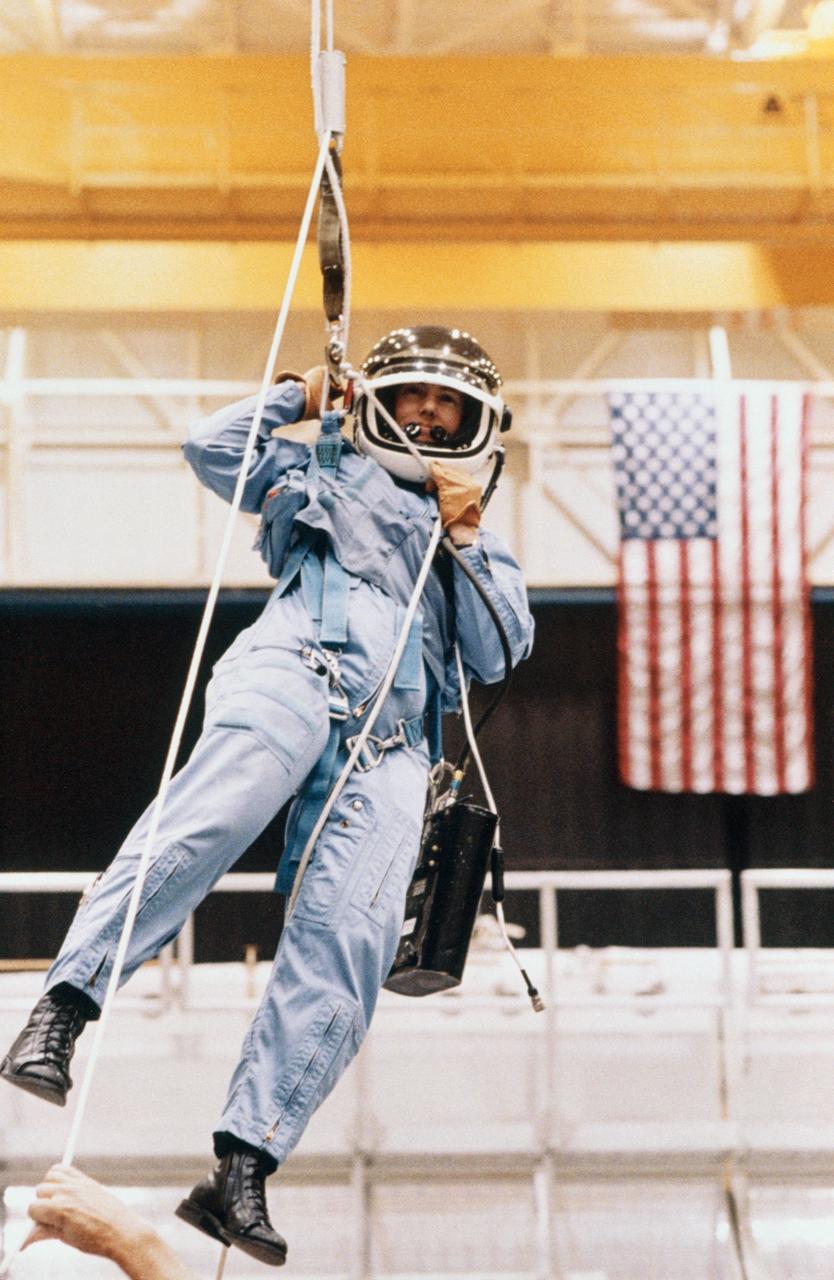
S86-25183 (for release January 1986) --- Sharon Christa McAuliffe, STS-51L payload specialist representing the Teacher-in-Space Project, descends from a mock-up of the space shuttle using a sky-genie device during an emergency training session in the Johnson Space Center?s (JSC) Shuttle Mock-up and Integration Laboratory. The photograph was taken by Keith Meyers of the New York Times. EDITOR?S NOTE: The STS-51L crew members lost their lives in the space shuttle Challenger accident moments after launch on Jan. 28, 1986 from the Kennedy Space Center (KSC). Photo credit: NASA
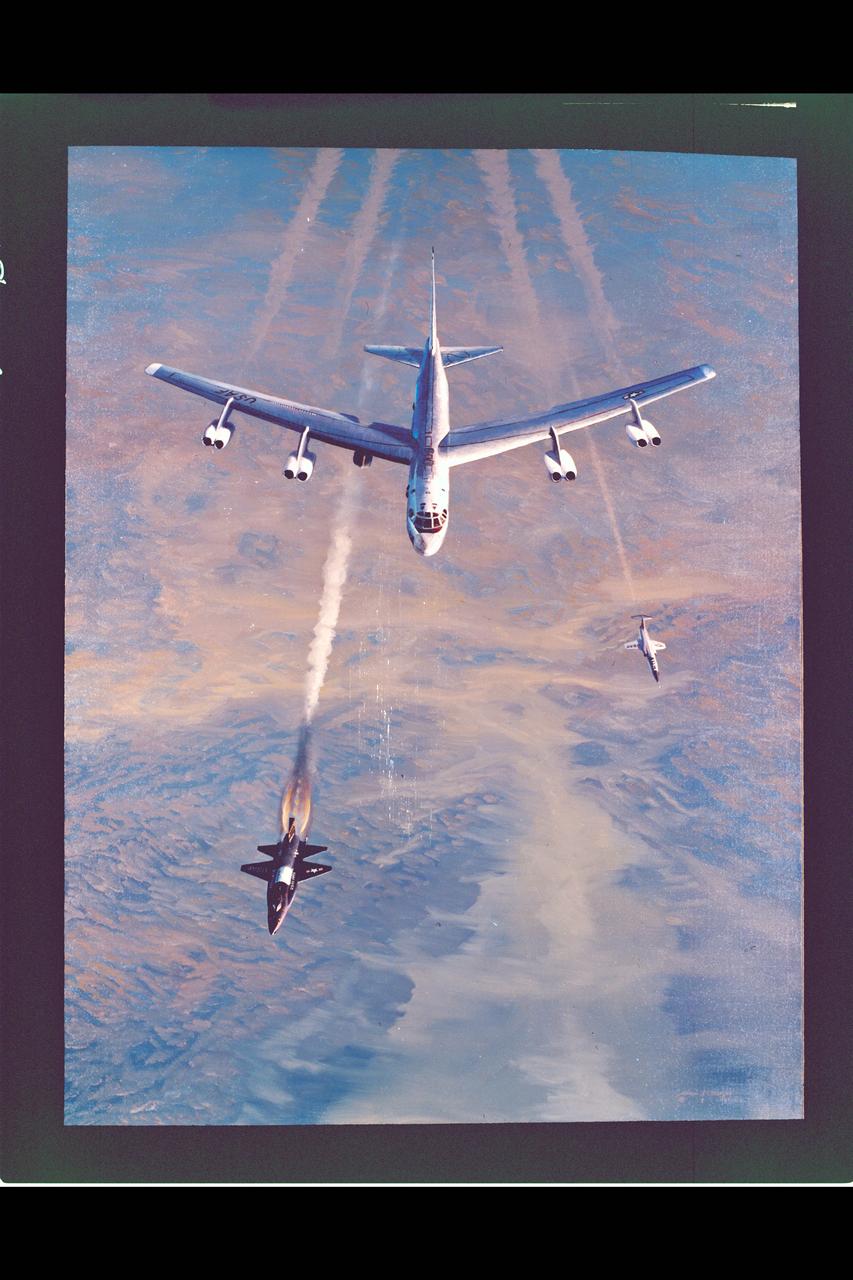
Artist: W.S. Phillips Aeronautics Art: X-15 Hypersonic Final (HQ ref: 84-HC-281 & 84-H-285)
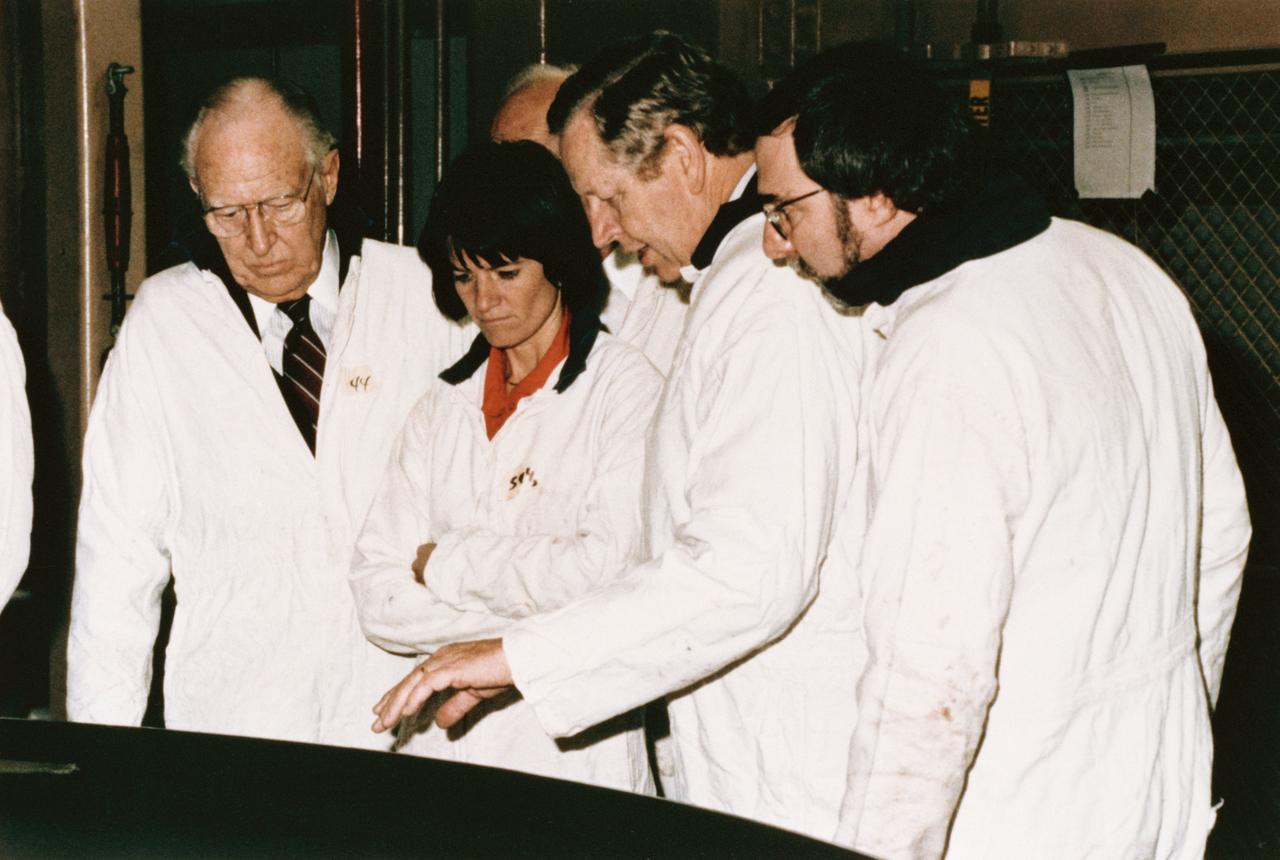
S86-28889 (14 Feb. 1986) --- Kennedy Space Center Director Richard Smith points out a portion of a solid rocket booster segment to astronaut Sally Ride and to the chairman of the Presidential Commission on the Space Shuttle Challenger Accident, William P. Rogers. The commission was taken to various booster storage and handling facilities at KSC on Feb. 14, 1986 as part of the failure investigation. Photo credit: NASA

S86-26417 (Feb. 1986) --- Astronaut Joe H. Engle.
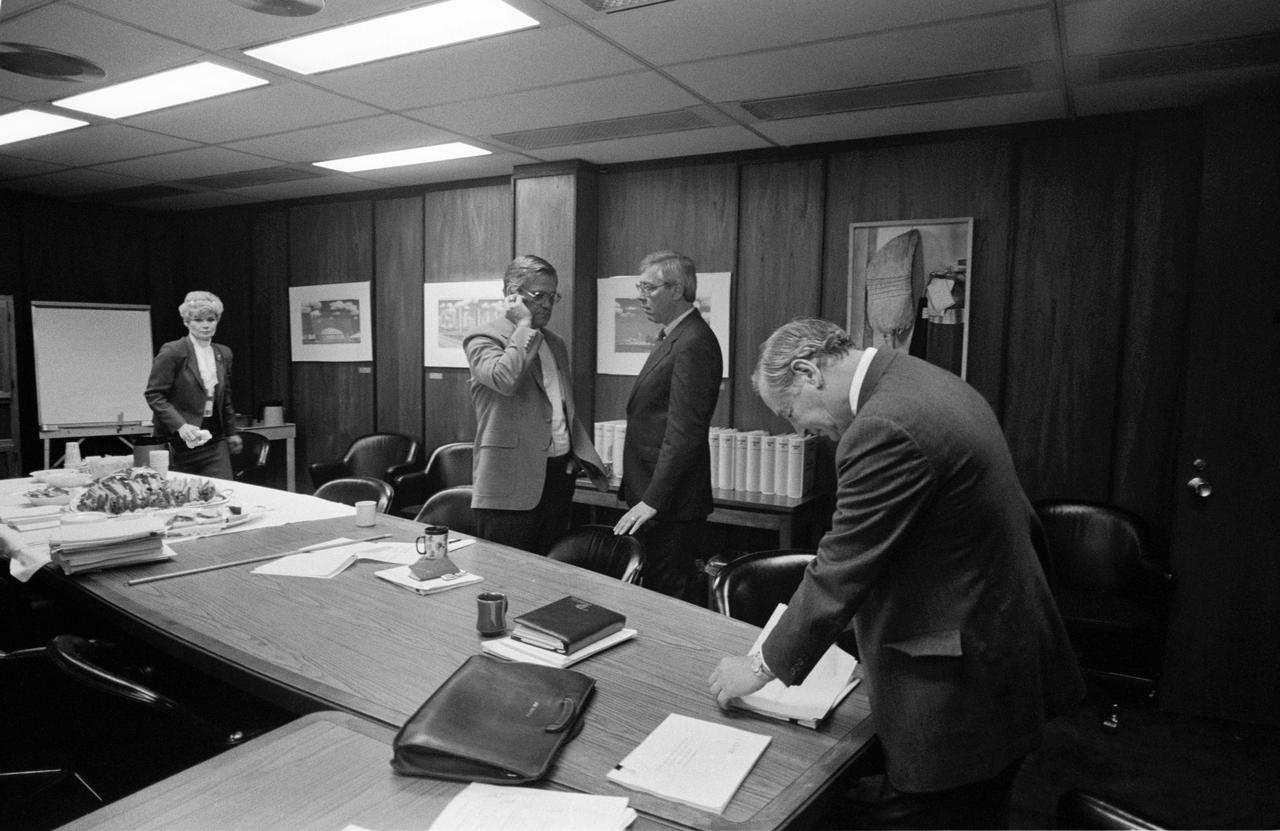
S86-28749 (5 March 1986) --- Two JSC officials chat prior to a meeting with members of the Presidential Commission on the Space Shuttle Challenger Accident, while one of the commissioners studies his notes. Pictured left to right in the foreground are Richard H. Kohrs, Deputy Manager of the National Space Transportation Systems Program Office; JSC Deputy Director Robert C. Goetz and Joseph F. Sutter. Photo credit: NASA
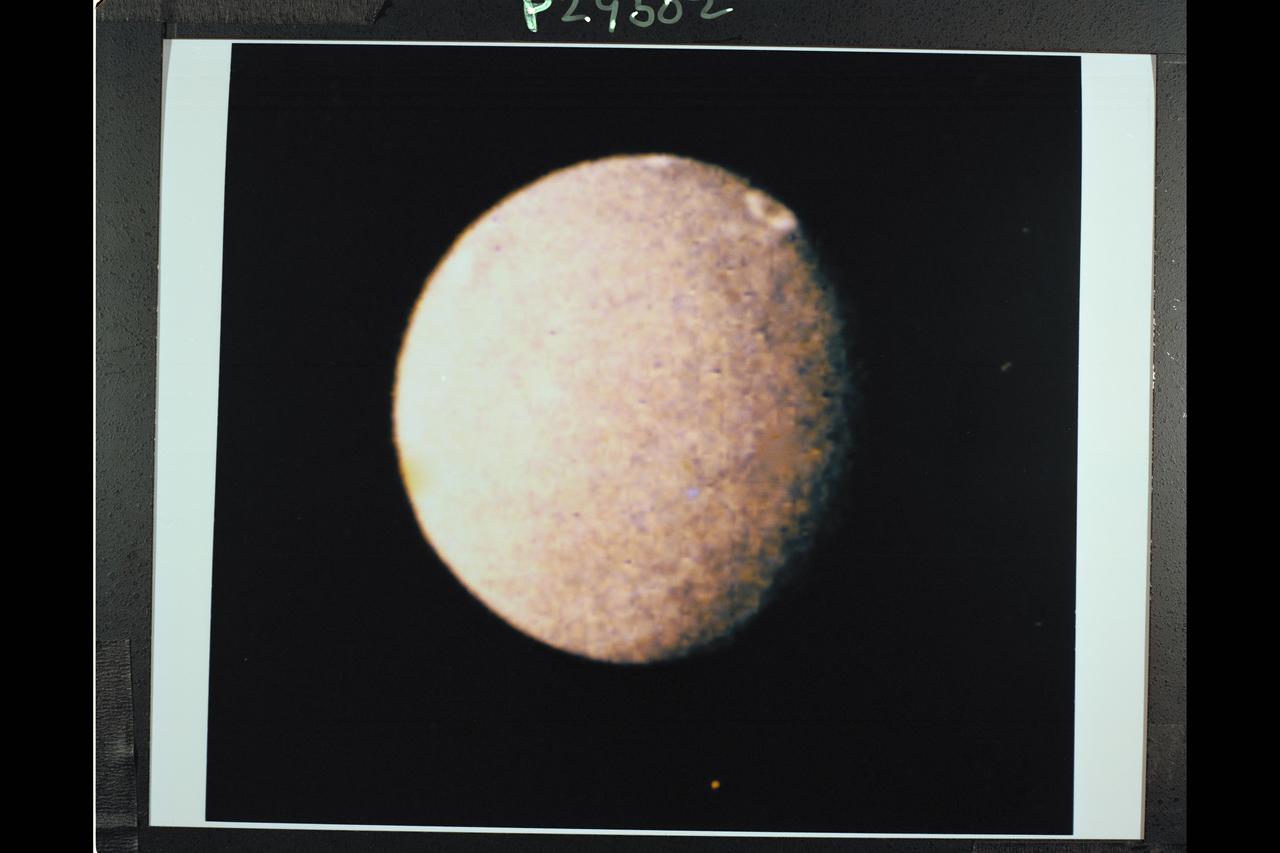
P-29502C Range: 1.04 million kilometers (650,000 miles) This color photo of Umbriel, the darkest of Uranus' five large moons was synthesized from frames exposed with the Voyager narrow-angle camera's violet and clear filters and has a resolution of 19 km (12 mi.). Umbriel is characterized by the darkest surface and smallest brightness variations of any of the large satellites of Uranus. As seen here, the surface is also generally gray and colorless. Nevertheless, at this resolution, considerable topographic detail is revealed, showing that Umbriel's surface is covered by impact craters. The brightest spot (shown at top near the equator at approxiamately 270 ° longitude) appears as a bright ring. Its geological significance is not yet understood. Umbriel has a diameter of about 1,200 km (750 miles) and orbits 267,000 km (166,000 mi) from Uranus' center. The satellite's name, from Alexander Pope's 'Rape of the Lock,' means 'dark angel'.
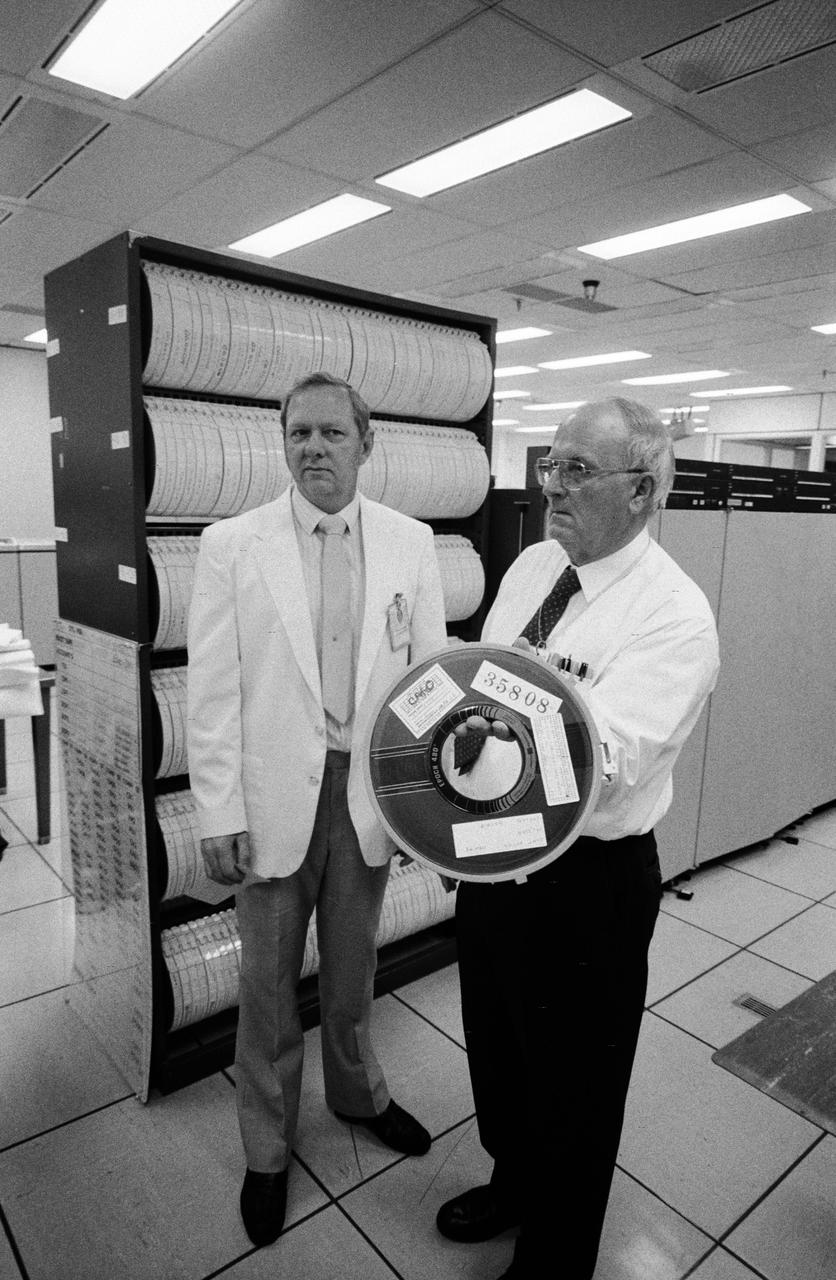
S86-30339 (4 April 1986) --- Stan Williams (left) of Lockheed and Luther D. Palmer of NASA are pictured with the MADS tapes in JSC’s central data office.
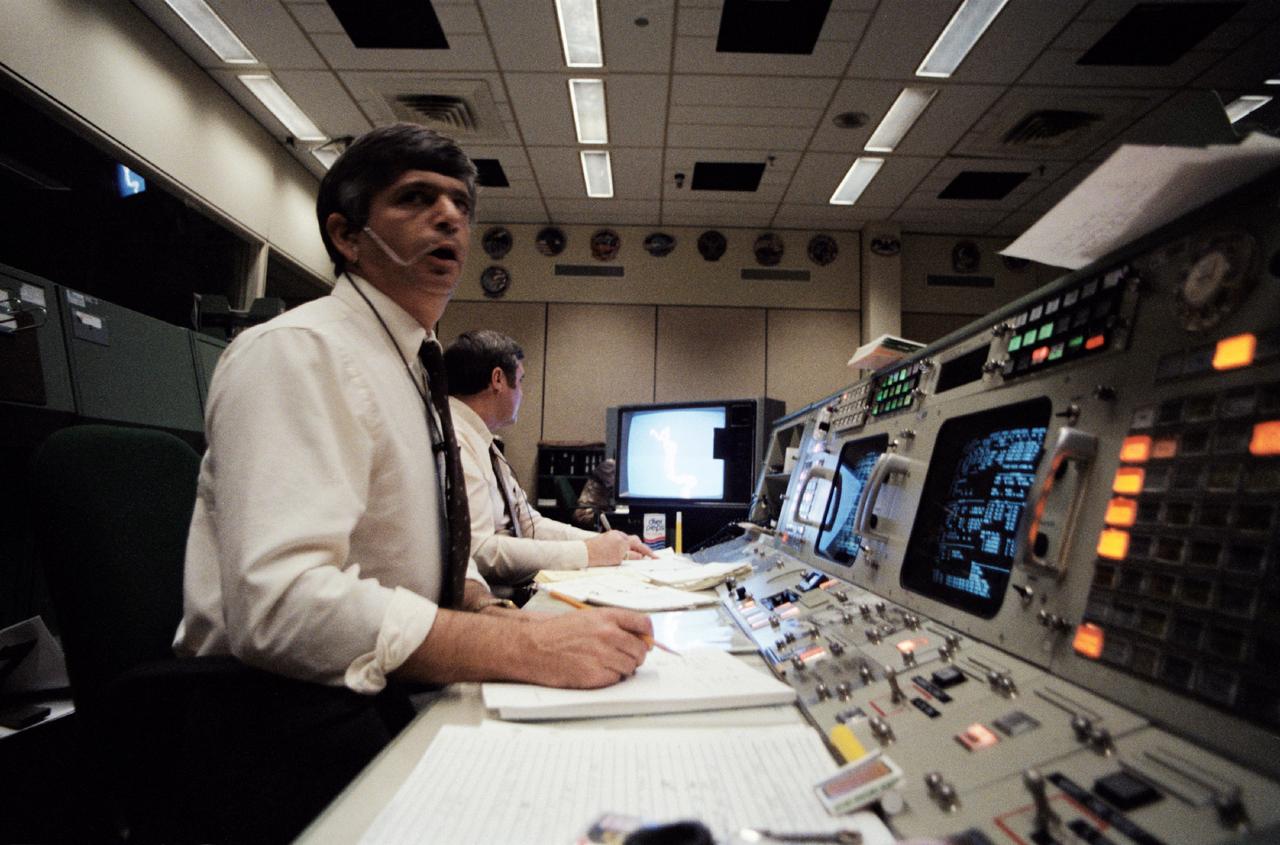
51L-S-002 (28 Jan. 1986) --- Flight directors Jay H. Greene (foreground) and Alan L. (Lee) Briscoe study data on monitors at their consoles in the flight control room (FCR) of the Johnson Space Center's Mission Control Center. The photo was made just moments after the announcement came that Challenger's launch phase was not nominal. Photo credit: NASA
S86-25293 (30 Oct. 1985) --- Barbara R. Morgan and Sharon Christa McAuliffe (right) are pictured during a visit to NASA's Kennedy Space Center (KSC) Launch Complex 39 to witness the launch of the space shuttle Challenger. McAuliffe is scheduled to launch aboard the space shuttle Challenger, STS-51L mission, herself early next year as the United States? first in-space citizen observer. Morgan is the backup for the Teacher-in-Space Project?s payload specialist position. The photo was taken by Keith Meyers of the New York Times. EDITOR'S NOTE: The STS-51L crew members lost their lives in the space shuttle Challenger accident moments after launch on Jan. 28, 1986 from the Kennedy Space Center (KSC). Photo credit: NASA
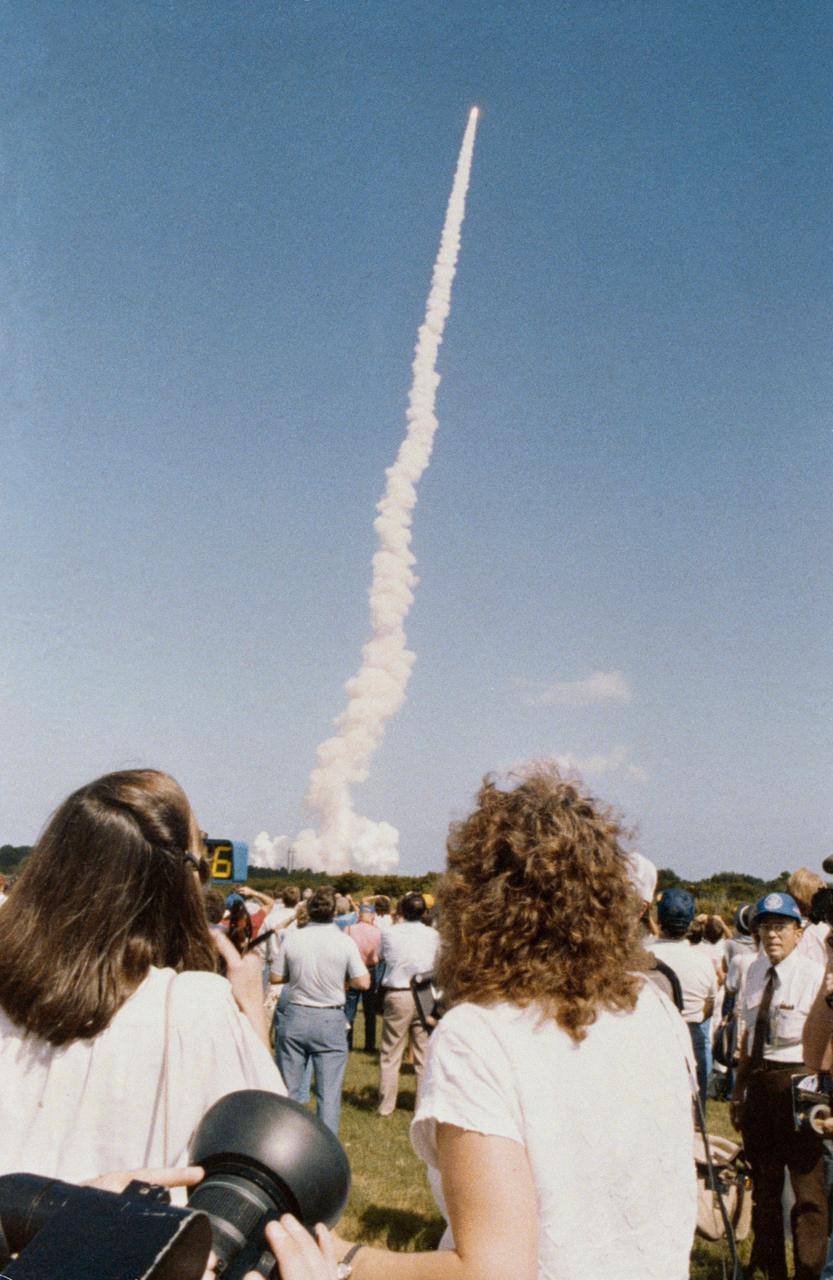
STS61C-S-046 (12 Jan. 1986) --- Although many miles away from the launch pad, the space shuttle Columbia can still be seen in this distant scene. The scene was recorded around 7 a.m. (EST), Jan. 12, 1986. Photo credit: NASA
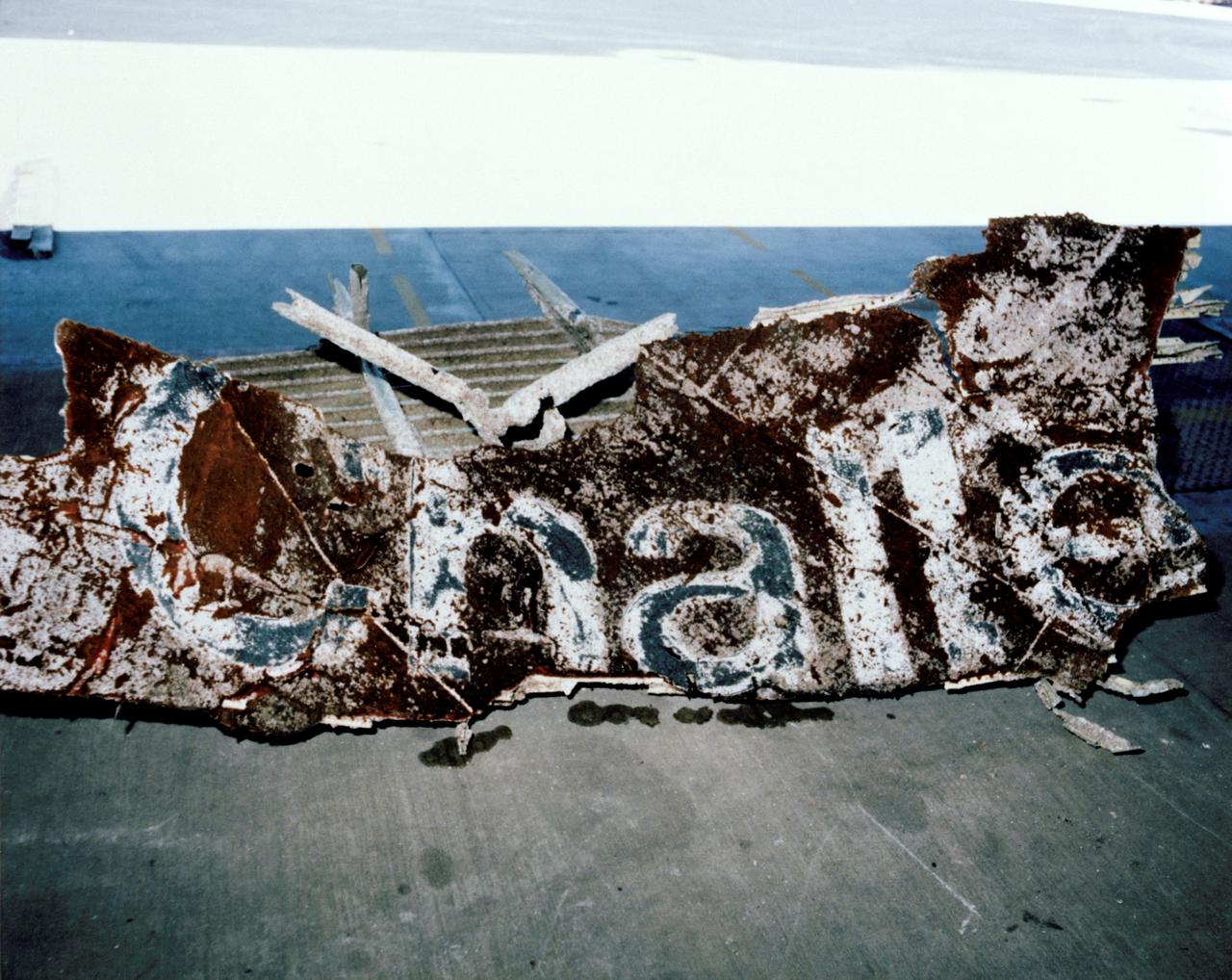
51L-10187 (18 April 1986) --- A 9'7" x 16' segment of Challenger's right wing is unloaded at the Logistics Facility after being off-loaded from the rescue and salvage ship USS Opportune. It was located and recovered by Navy divers from the Opportune about 12 nautical miles northeast of Cape Canaveral in 70 feet of water. Photo credit: NASA
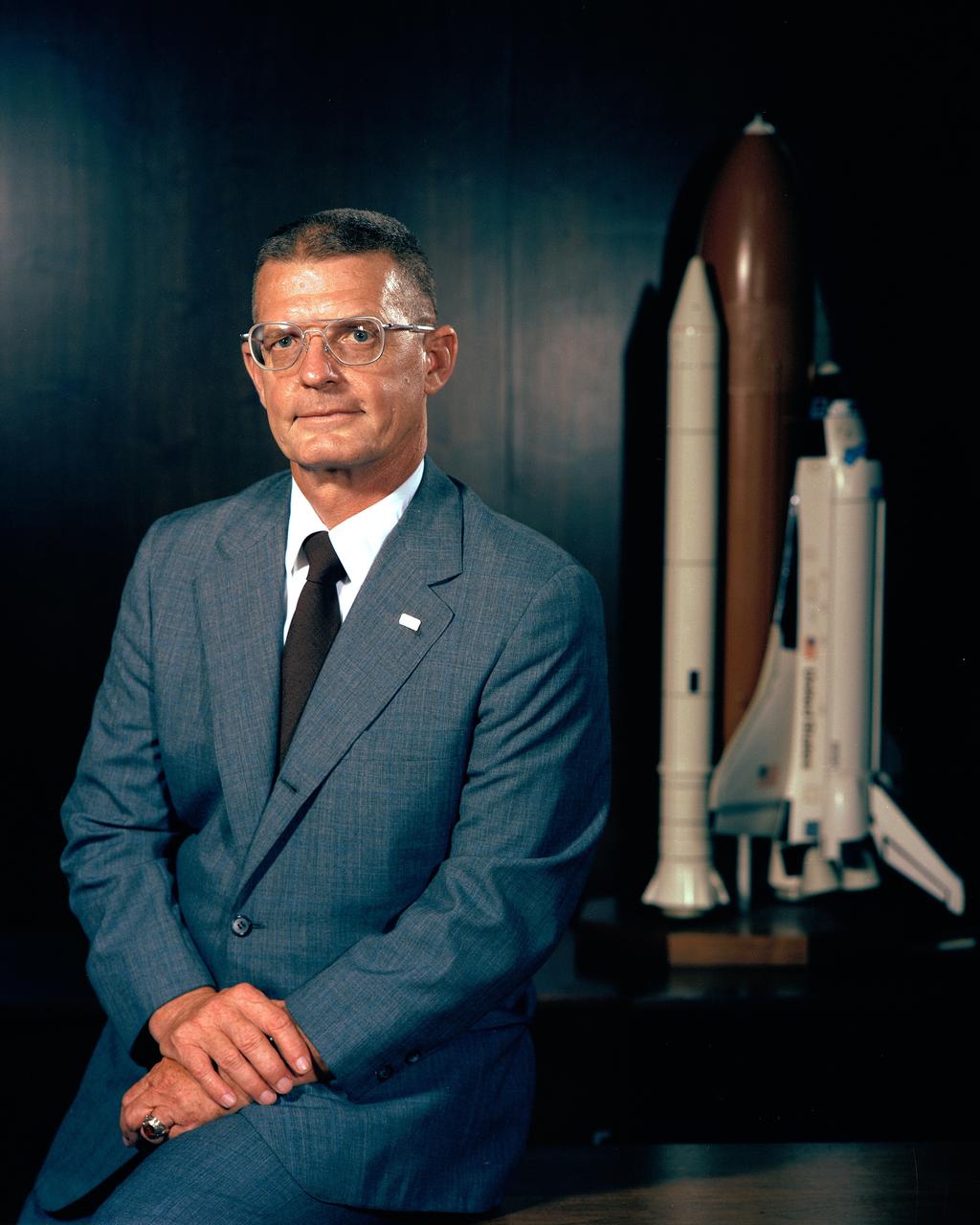
CAPE CANAVERAL, Fla. – Portrait of Lt. Gen. Forrest S. McCartney, KSC Center Director Photo credit: NASA

C-141 KAO: University of Texas
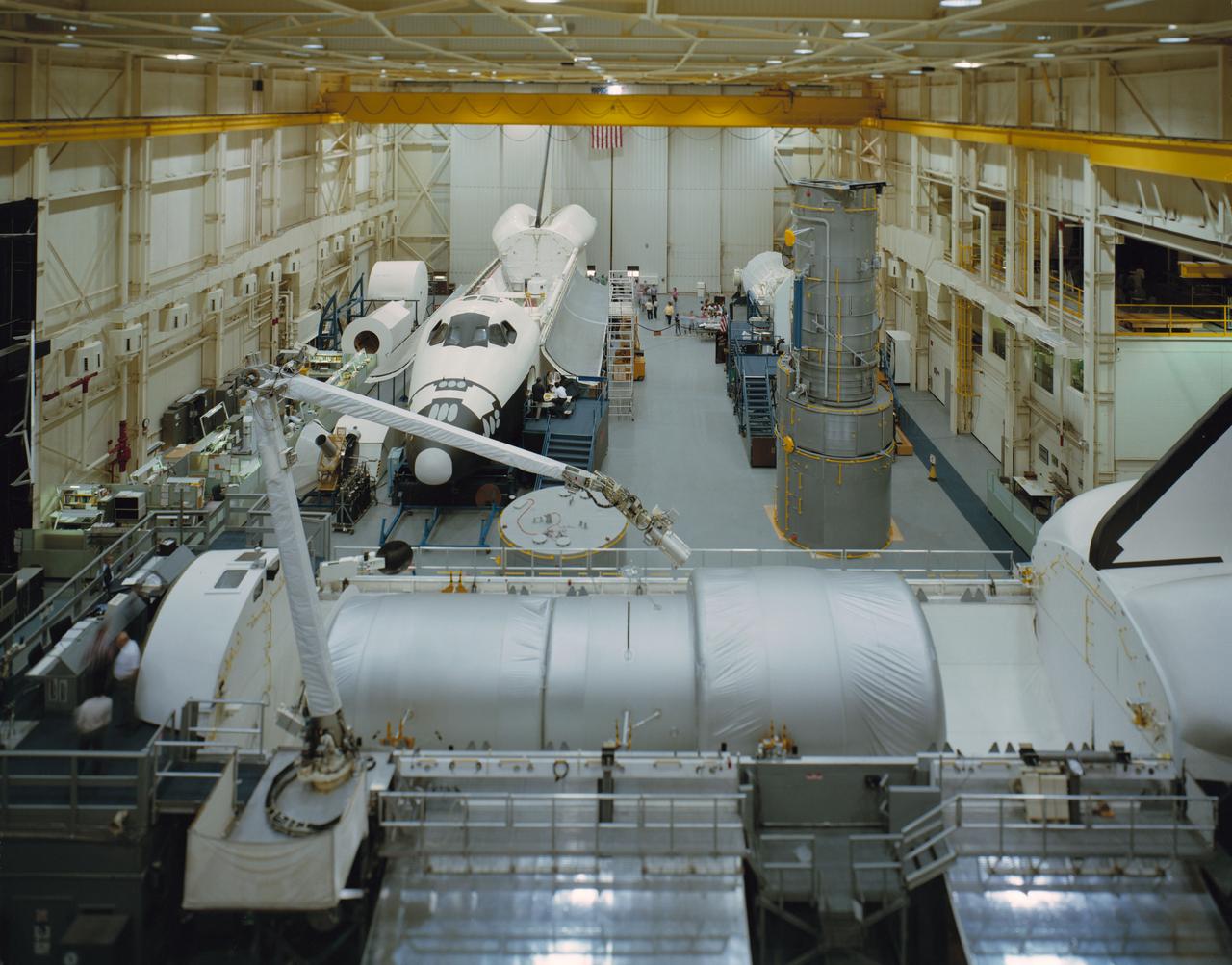
Overall views of the Bldg. 9A Training Facility and closeup views of the Space Telescope Mockup for the Weightless Environment Training Facility (WETF). 1. SHUTTLE - PAYLOADS (TELESCOPE) JSC, HOUSTON, TX Also available in 4x5 CN
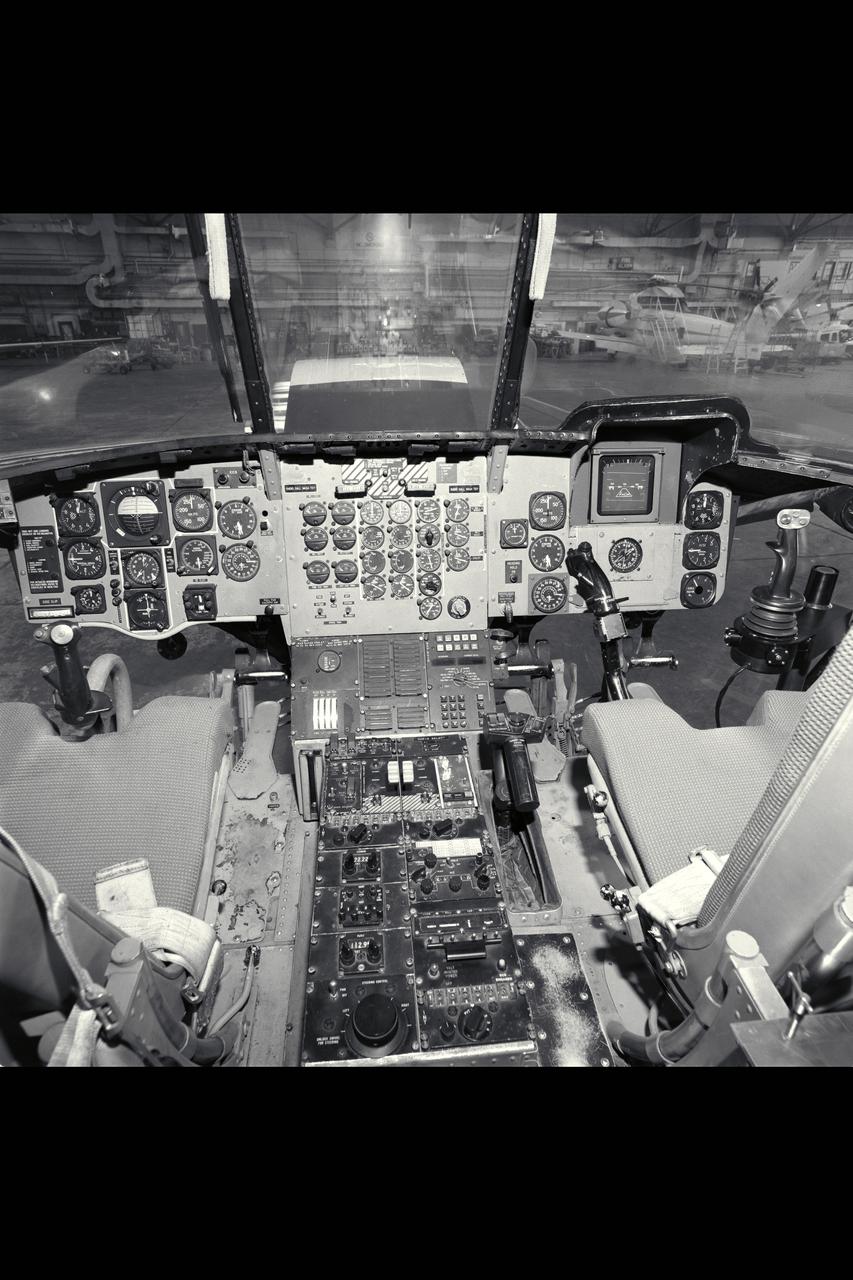
CH-47 (NASA-737) Control Panel and Cockpit
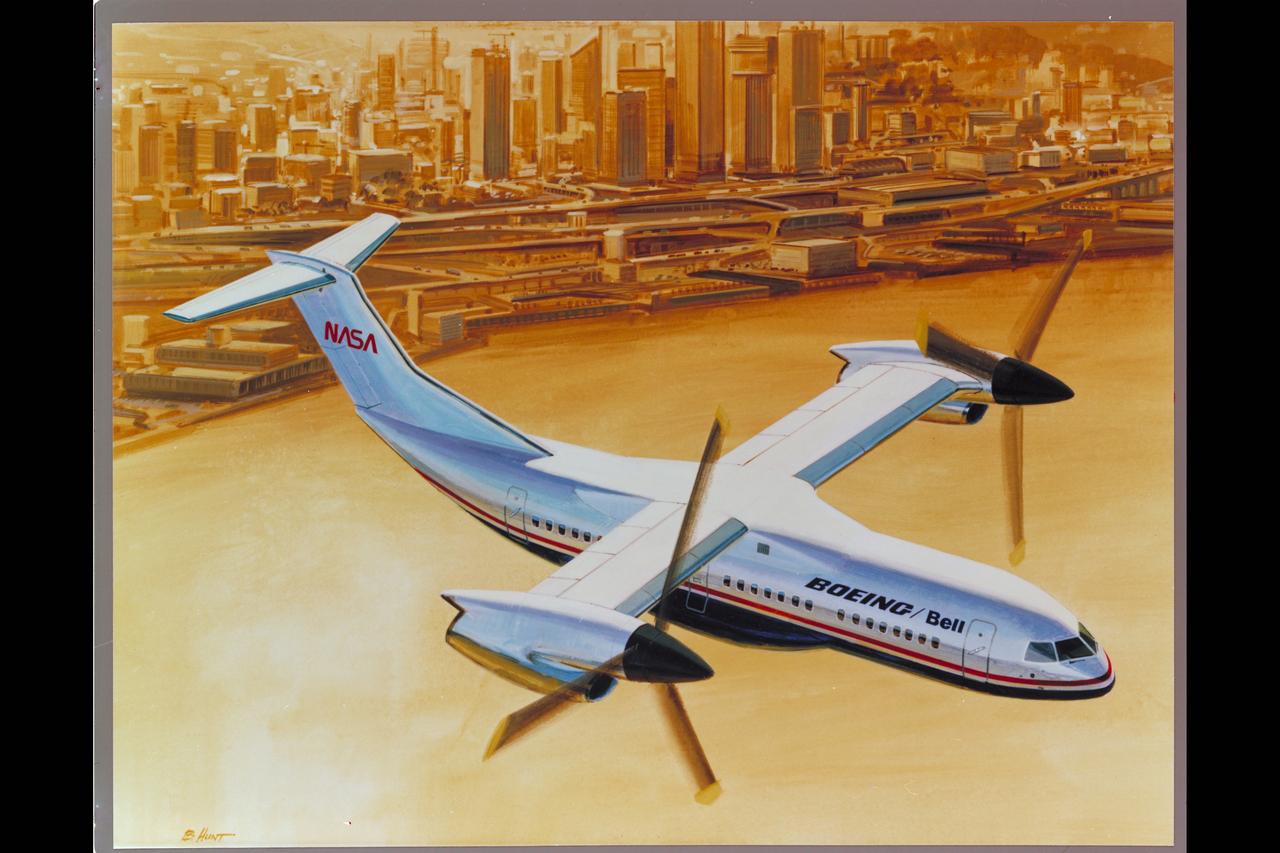
Civil Tilt Rotor Commuter Aircraft concepts by Boeing/Bell
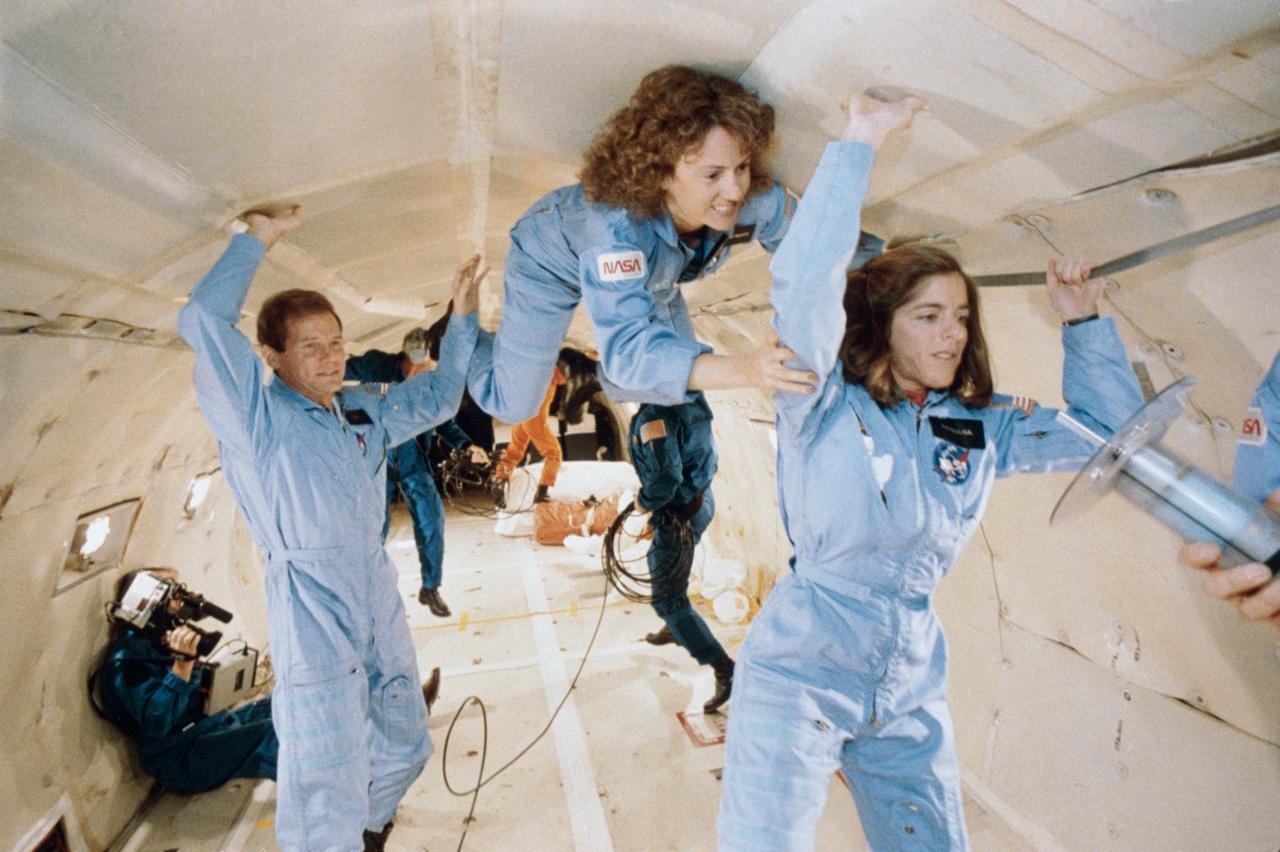
S86-25192 (January 1986) --- Two payload specialists in training for the STS-51L mission, and a payload specialist from STS-61C share a ?zero-gravity? flight aboard a KC-135 aircraft over the Gulf of Mexico. Left to right are United States Representative Bill Nelson (Democrat, Florida), Sharon Christa McAuliffe, and Barbara R. Morgan. The congressman is a payload specialist for the STS-61C mission. McAuliffe is the prime payload specialist for the Teacher-in-Space Project aboard the STS-51L mission; and Morgan is her backup. The photo was taken by Keith meyers of the New York Times. EDITOR?S NOTE: The STS-51L crew members lost their lives in the space shuttle Challenger accident moments after launch on Jan. 28, 1986 from the Kennedy Space Center (KSC). Photo credit: NASA
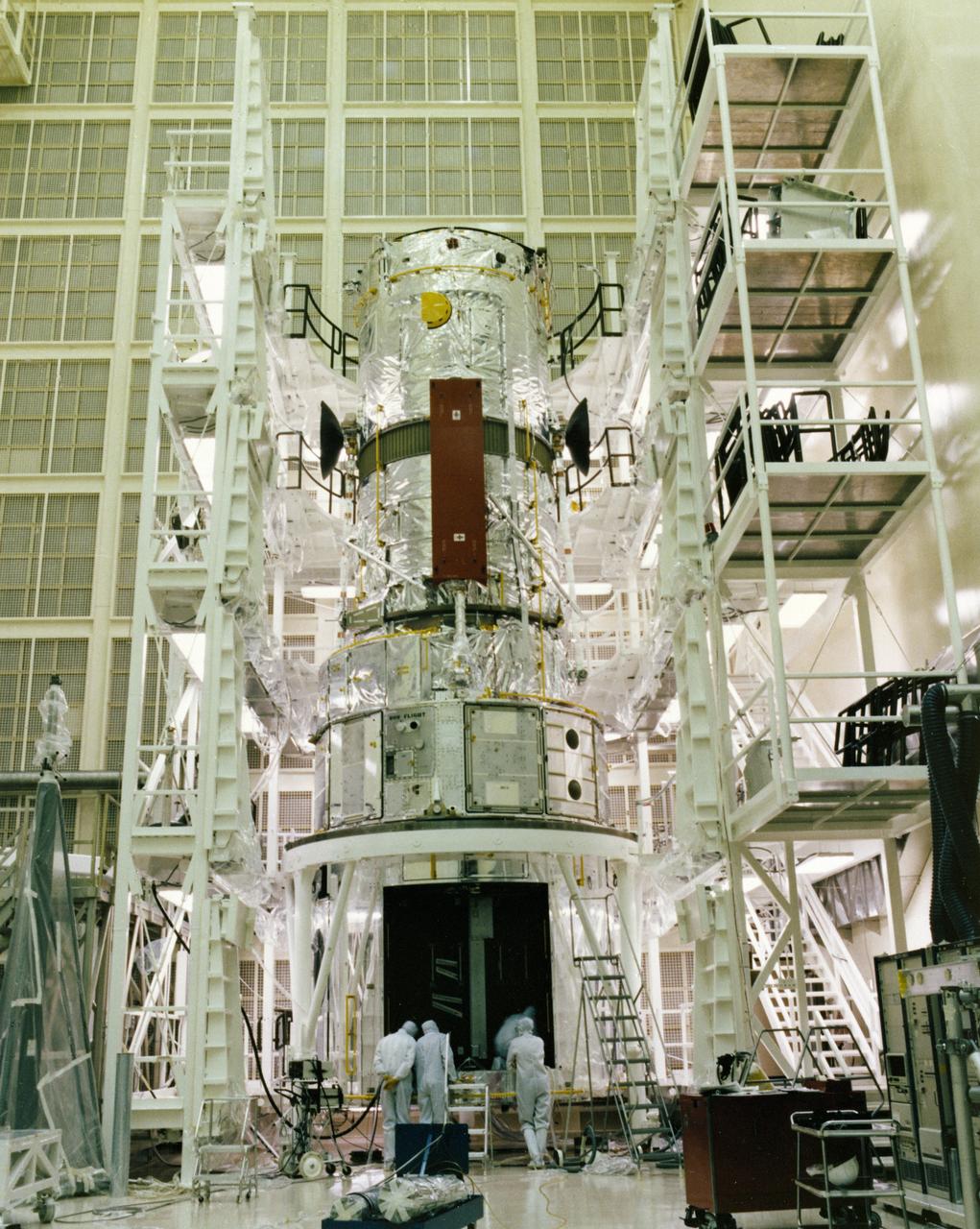
This photograph shows the Hubble Space Telescope (HST) flight article assembly with multilayer insulation, high gain anterna, and solar arrays in a clean room of the Lockheed Missile and Space Company. The HST is the first of NASA's great observatories and the most complex and sensitive optical telescope ever made. The purpose of the HST is to study the cosmos from a low-Earth orbit by placing the telescope in space, enabling astronomers to collect data that is free of the Earth's atmosphere. The HST was deployed from the Space Shuttle Discovery (STS-31 mission) into Earth orbit in April 1990. The Marshall Space Flight Center had overall responsibility for design, development, and construction of the HST. The Perkin-Elmer Corporation, in Danbury, Connecticut, developed the optical system and guidance sensors. The Lockheed Missile and Space Company, Sunnyvale, California, produced the protective outer shroud and spacecraft systems, and assembled and tested the finished telescope.
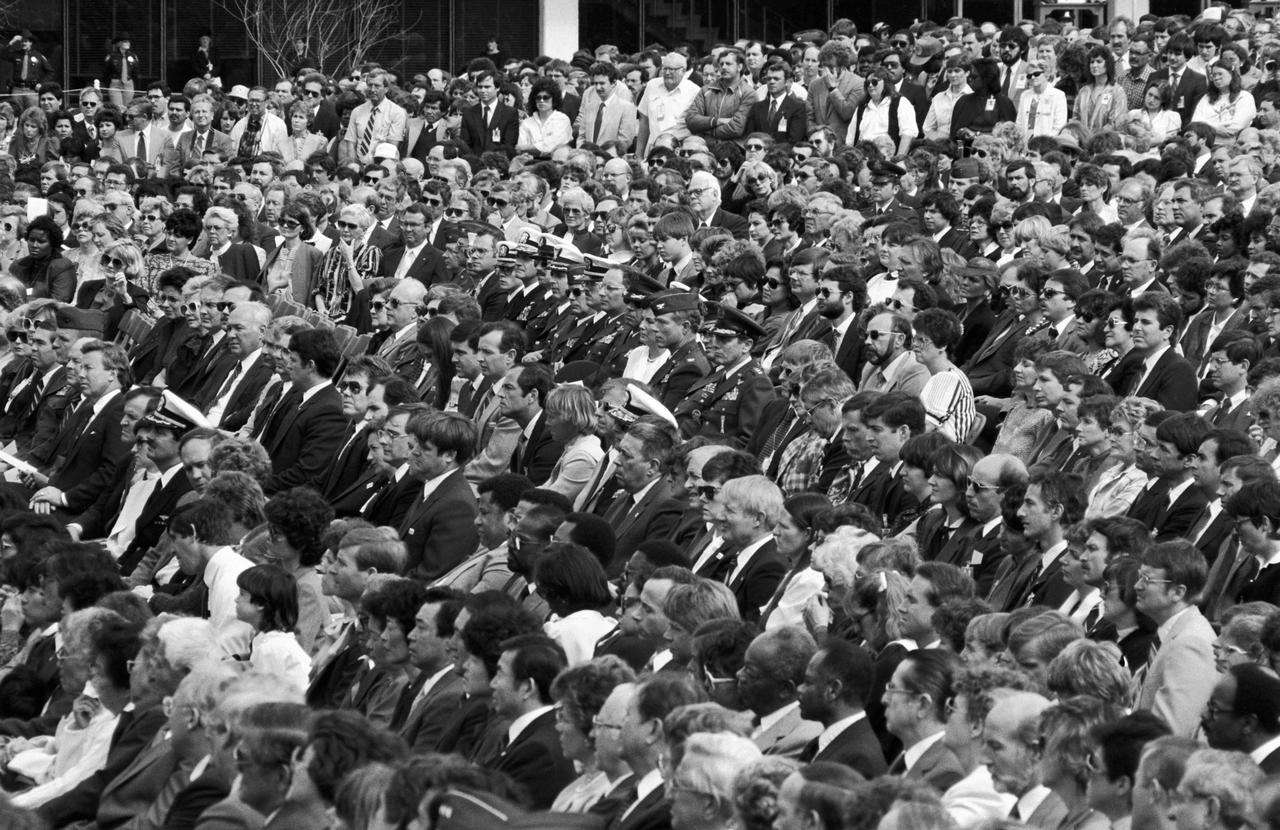
Overall view of the audience at the memorial service at JSC for the Crew of STS 51-L.
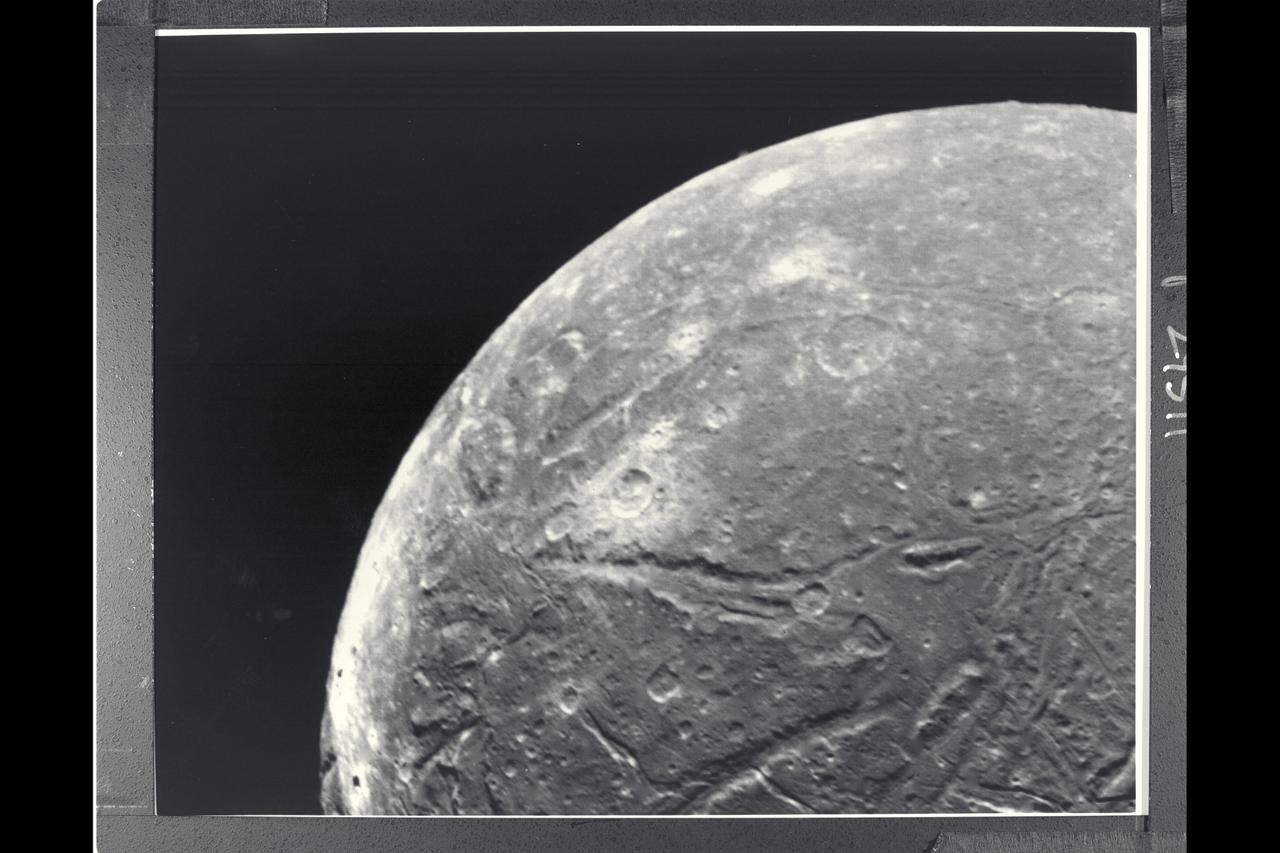
P-29511 BW Range: 130,000 kilometers (80,000 miles) This clear-filter, narrow-angle picture is part of the high-resolution Voyager 2 imaging sequence of Ariel, a moon of Uranus about 1,300 kilometers (800 miles) in diameter. The complexity of Ariels' surface indicates that a variety of geologic processes have occured. The numerous craters, for example, are indications of an old surface bombarded by meteroids over a long periond. Also conspicuous at this resolution, about 2.4 km (1.5 mi), are linear grooves (evidence of tectonic activity that has broken up the surface) and smooth patches (indicative of deposition of material).
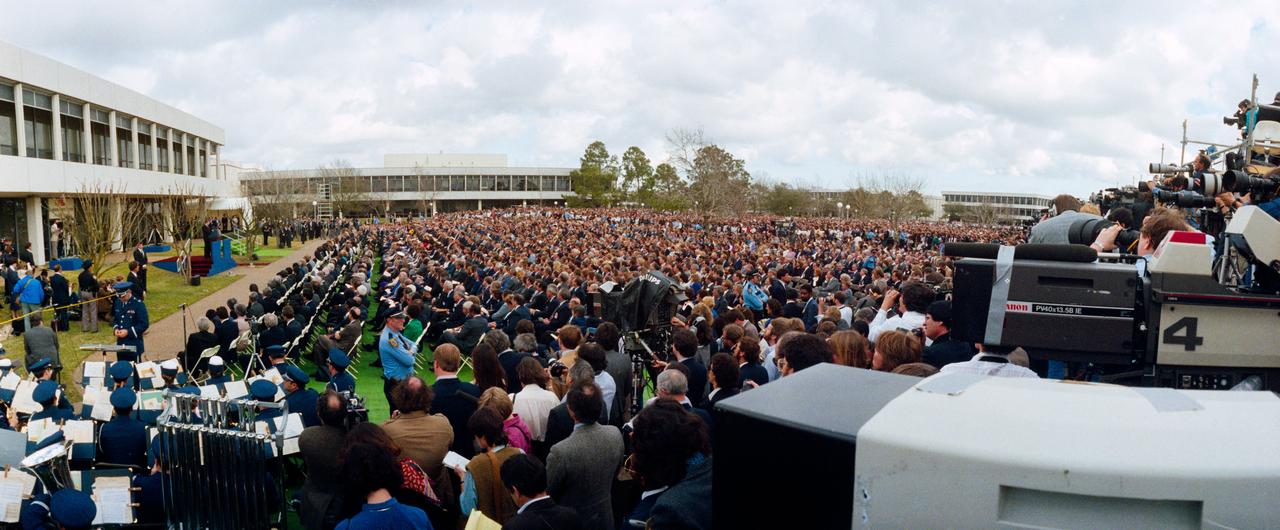
51L-S-127 (31 Jan. 1986) --- A wide angle lens was used to capture only a portion of the crowd gathered for memorial services for the seven members of the STS-51L Challenger crew at the Johnson Space Center. President Ronald Reagan speaks at the lectern at far left edge of the frame. The photographer for the picture was positioned on a large platform erected to accommodate the many members of the news media on hand for the event. Photo credit: NASA
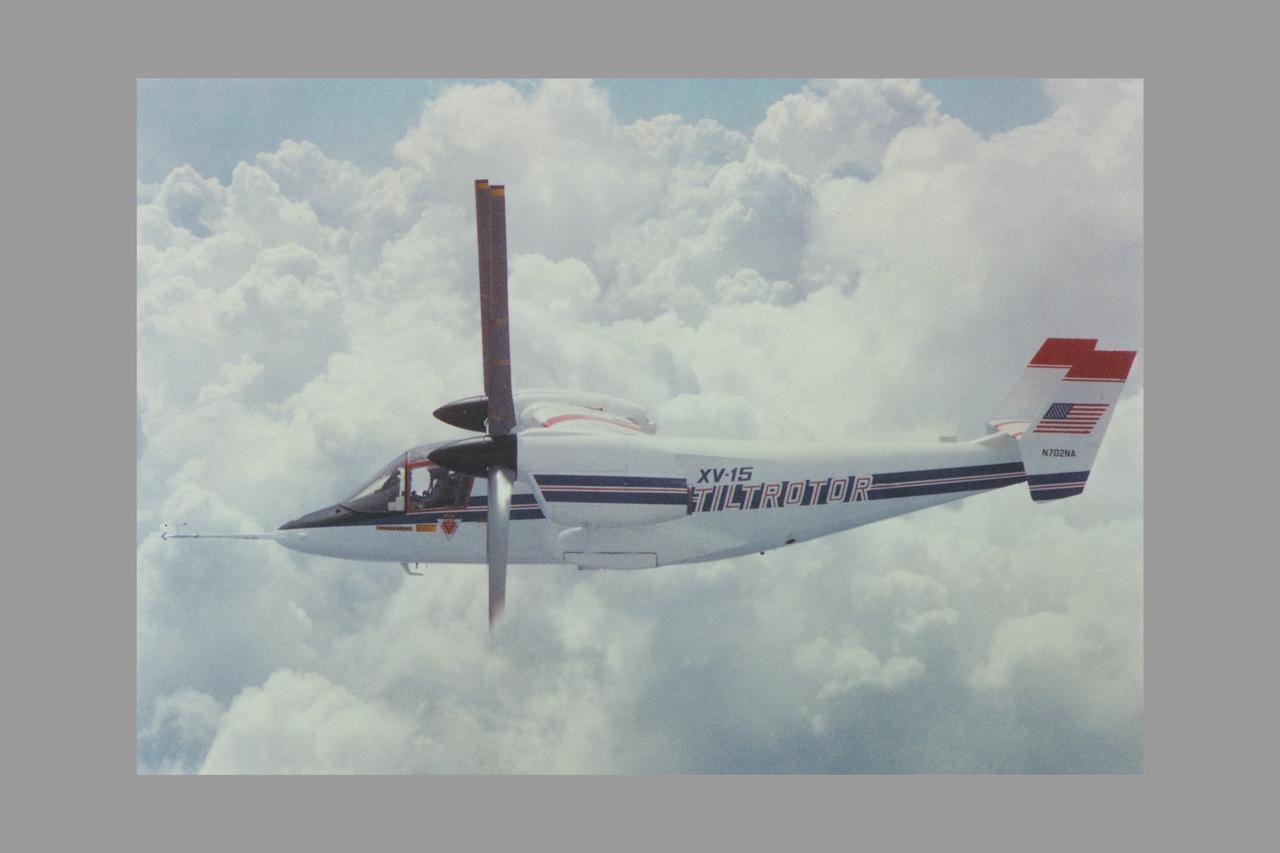
Tilt Rotor and Tilt Wing Concepts: Bell-Boeing and Bell-Textron: showen is the NASA/ARMY/Navy XV-15
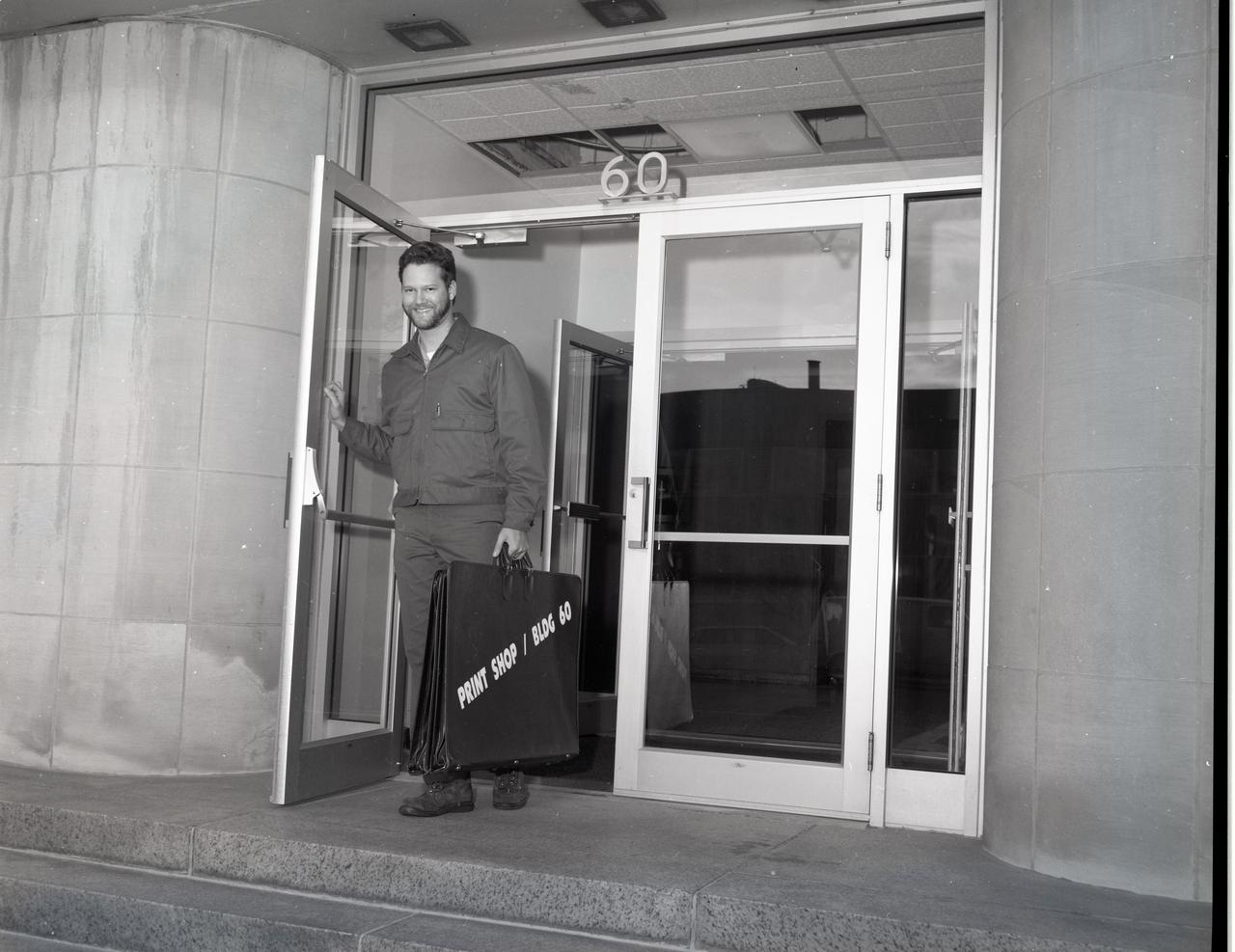
Cortez III Employee Delivers Work Between the Print Shop and the Building 60 Graphics Department
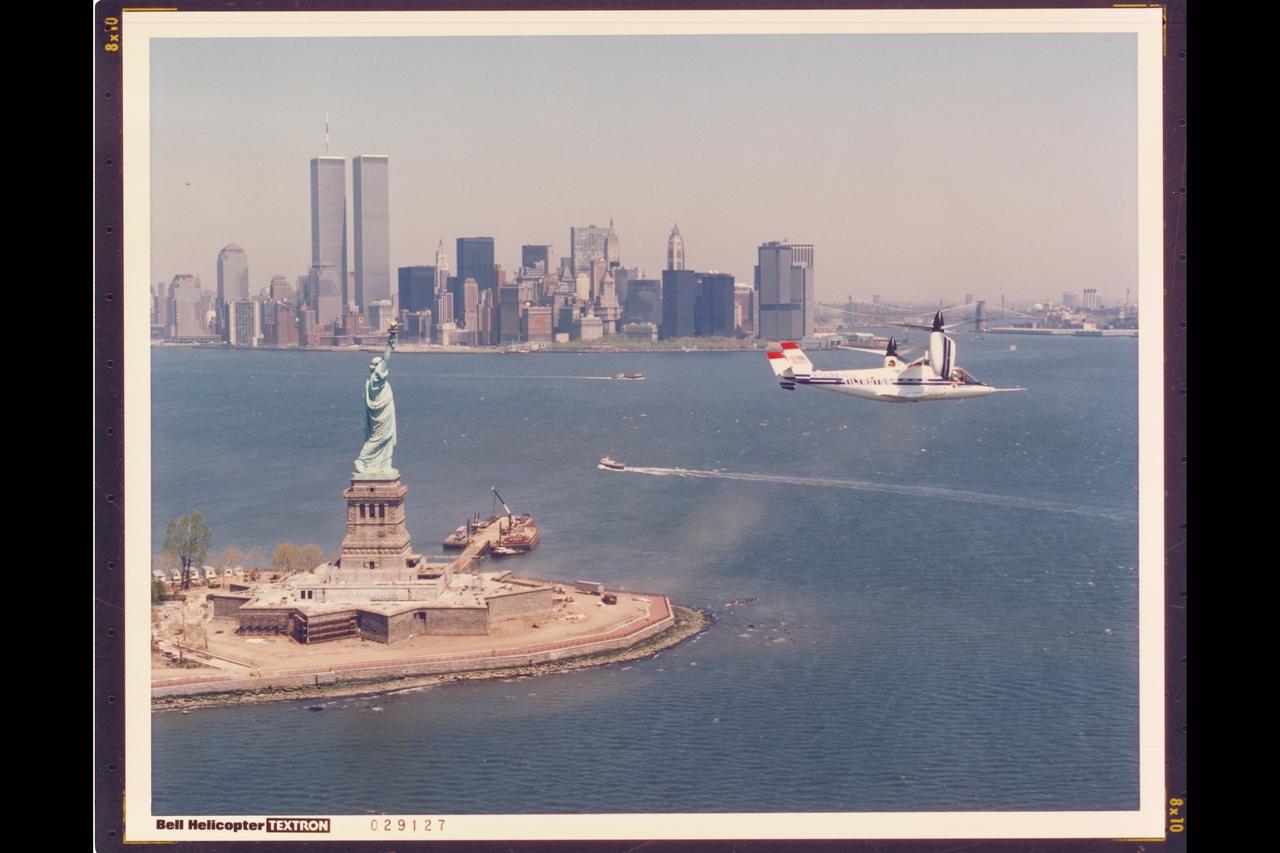
BELL HELICOPTER BELL TEXTRON XV-15 TILT ROTOR AIRCRAFT IN FLIGHT OVER NEW YORK, ELLIS ISLAND AND STATUE OF LIBERTY
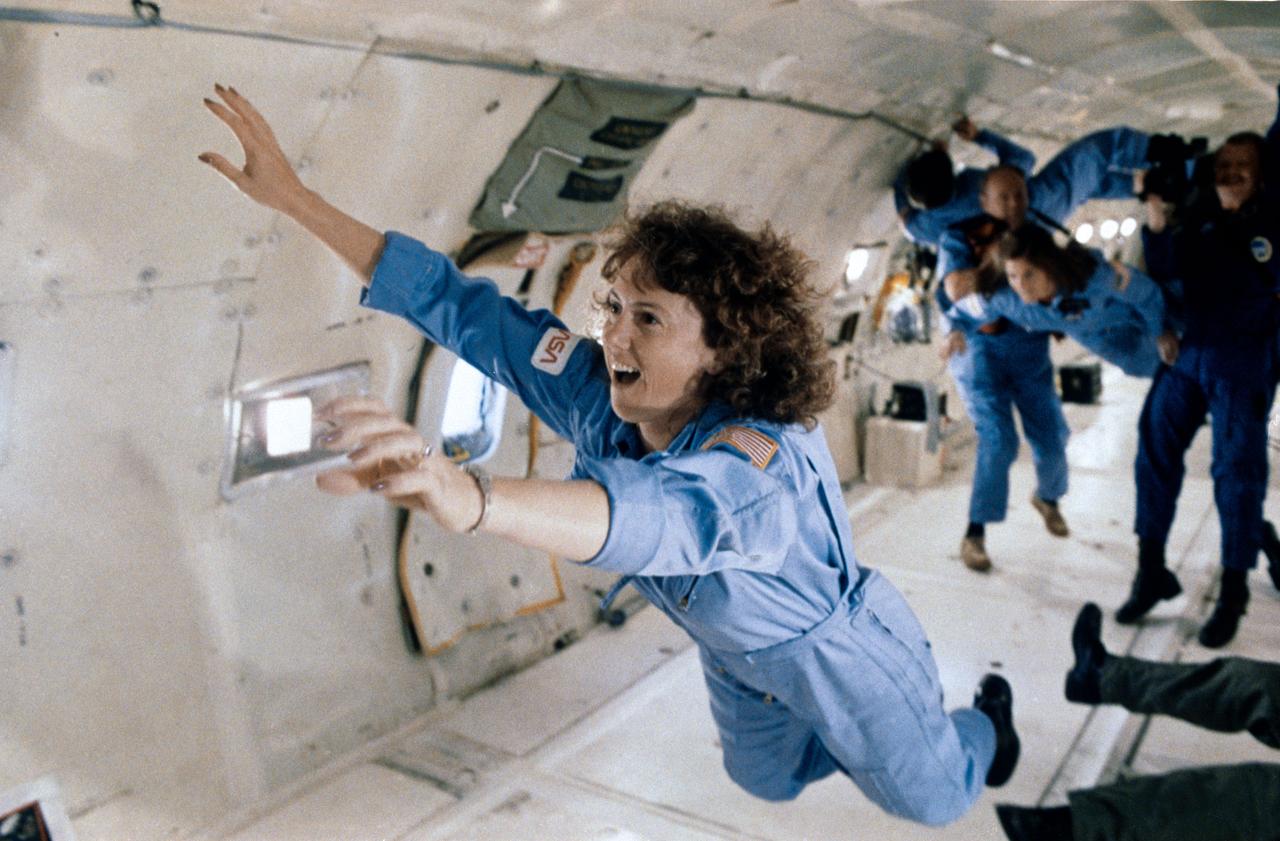
S86-25180 (October 1985) --- Sharon Christa McAuliffe, STS-51L citizen observer/payload specialist, representing the Teacher-in-Space Project, floats forward and upward during a few moments of weightlessness aboard a KC-135 aircraft. The flight is part of her training for the scheduled five-day flight aboard the Challenger in January of next year. Barbara R. Morgan, backup payload specialist for STS-51L, is partially visible in the background. The photo was taken by Keith Meyers of the New York Times. Photo credit: NASA
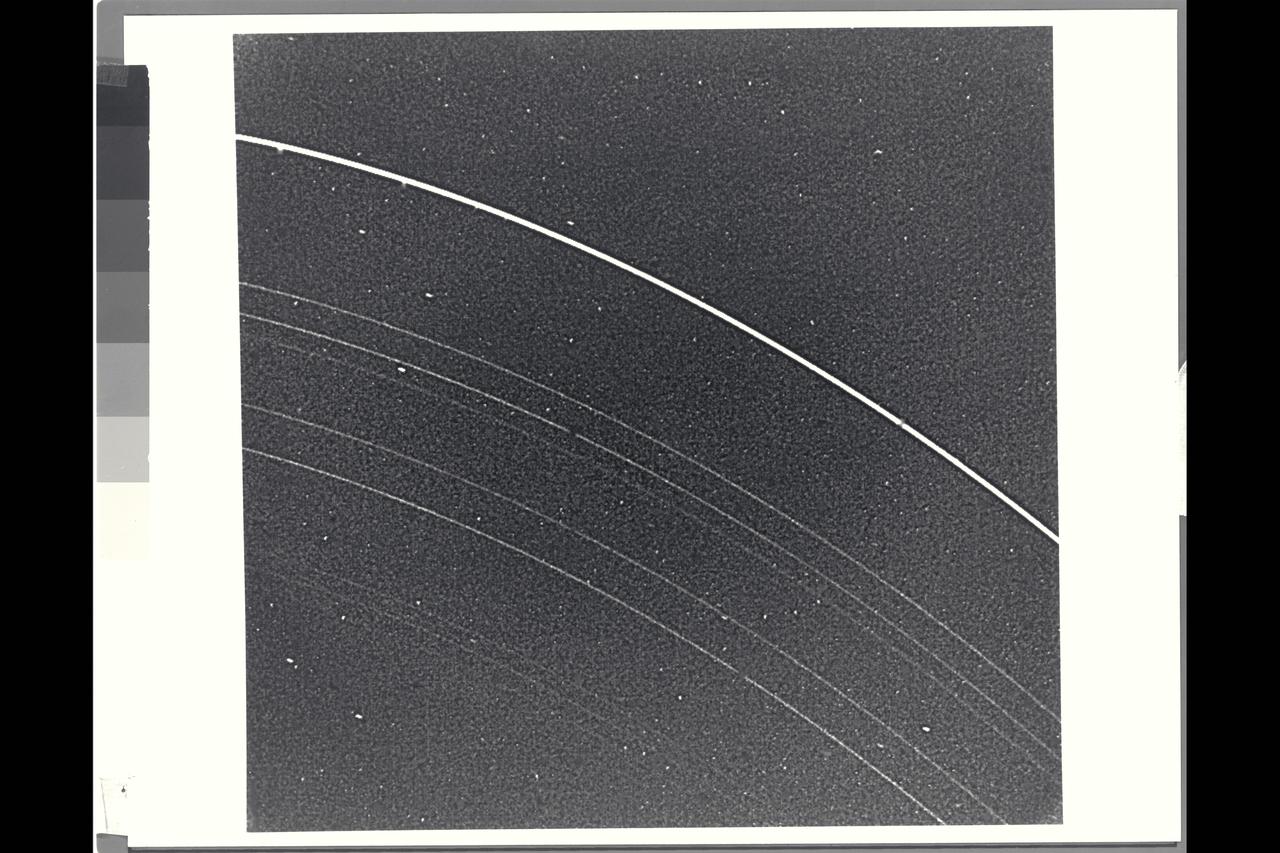
Range : 2.52 million miles (1.56 million miles) P-29481B/W Voyager 2 returned this photograph with all nine known Uranus rings visible from a 15 sec. exposure through the narrow angle camera. The rings are quite dark and very narrow. The most prominent and outermost of the nine, Epsilon, is seen at top. The next three in toward Uranus, called Delta, Gamma, and Eta, are much fainter and more narrow than Epsilon ring. Then come Beta and Alpha rings, and finally, the innermost grouping, known simply as the 4,5, & 6 rings. The last three are very faint and are at the limit of detection for the Voyager camera. Uranus' rings range in width from about 100 km. (60 mi.) at the widest part of the Epsilon ring, to only a few kilometers for most of the others. this iamge was processed to enhance narrow features; the bright dots are imperfections on the camera detector. The resolution scale is about 50 km. (30 mi.)
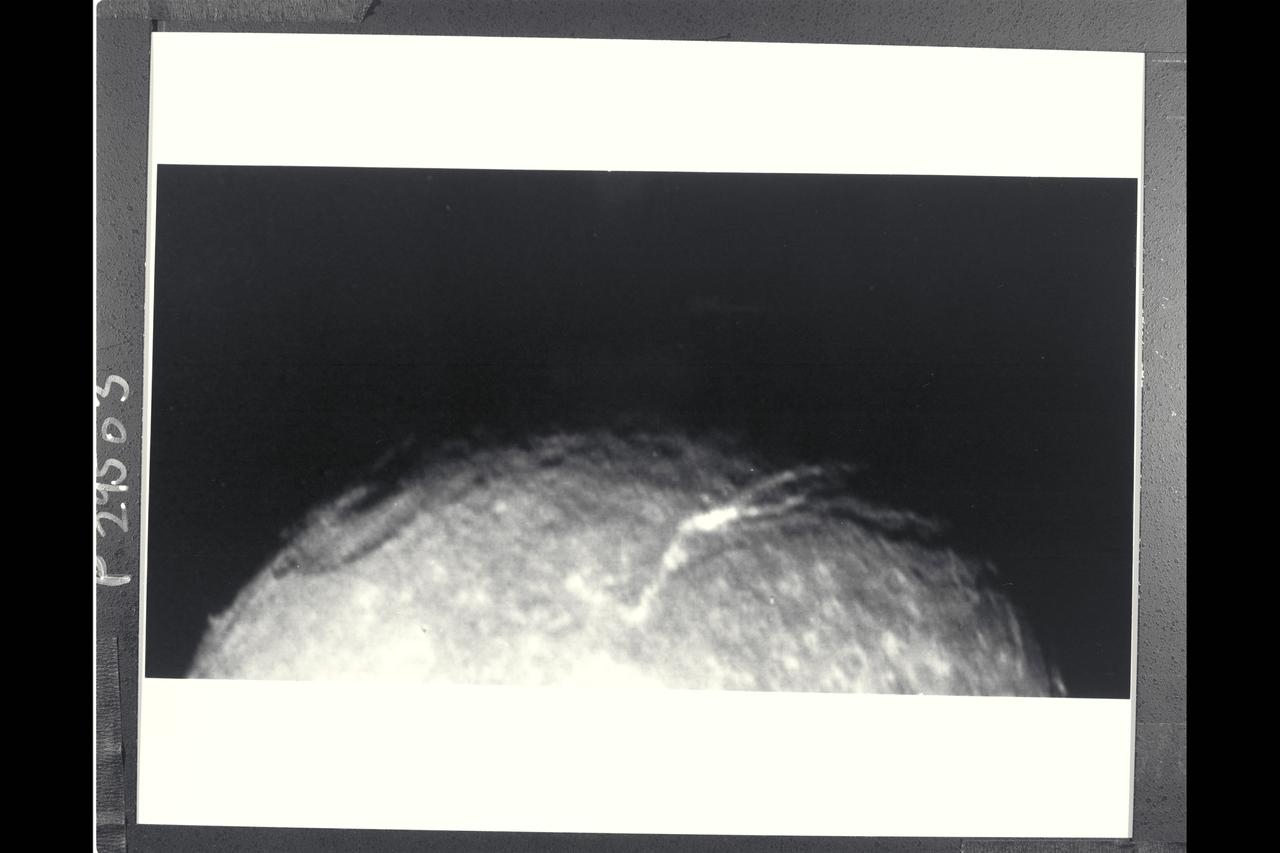
P29503 Moon (closeup) Voyager 2 flyby of Uranus
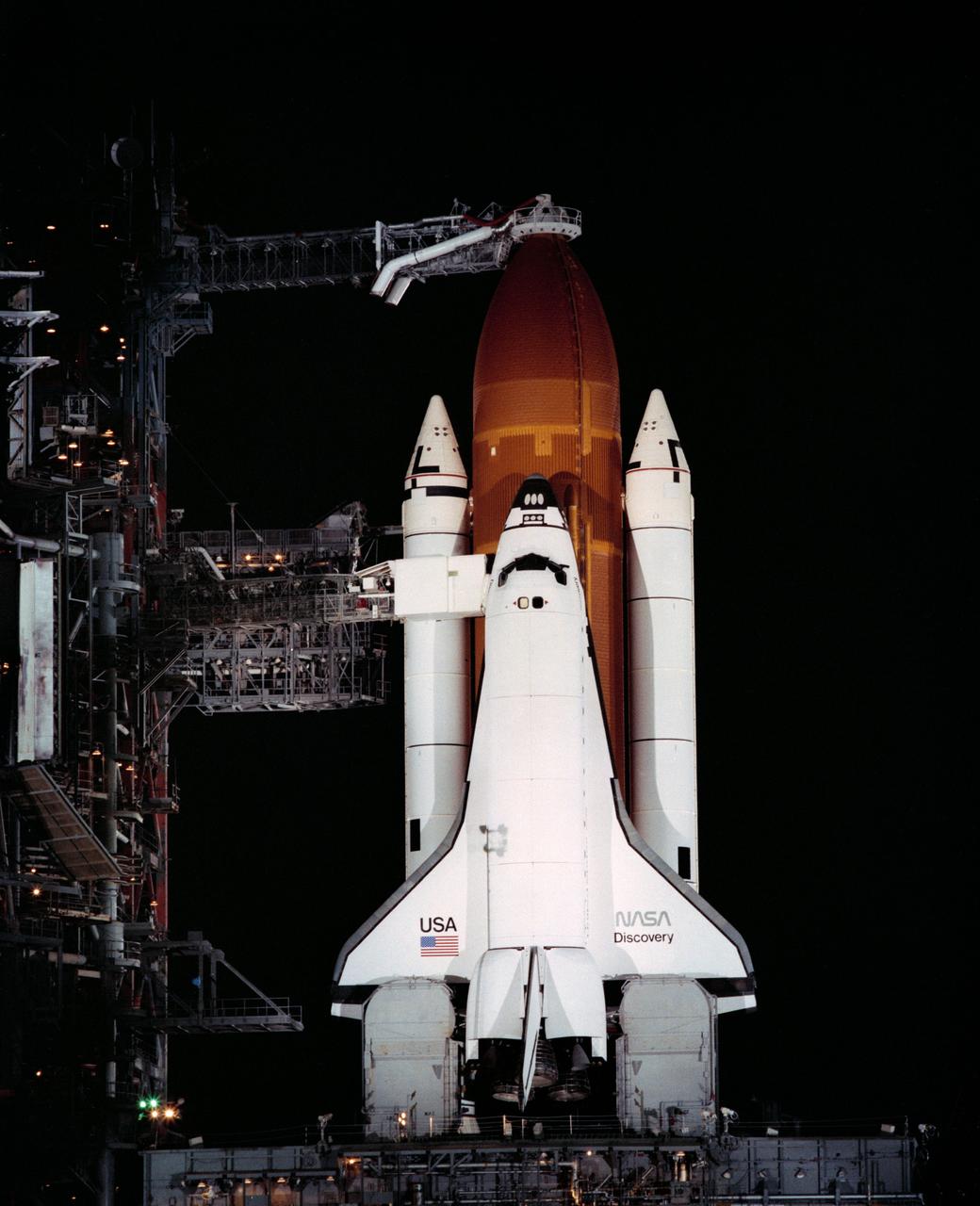
The Space Shuttle Discovery moves towards Pad "A" on the crawler transporter for its maiden flight. The Shuttle Discovery is poised atop Pad "A" at Complex 39 prior ot the STS-41D mission. KSC, FL

C-130 aircraft Shoreline Amphitheater: Thermal IR Imagery
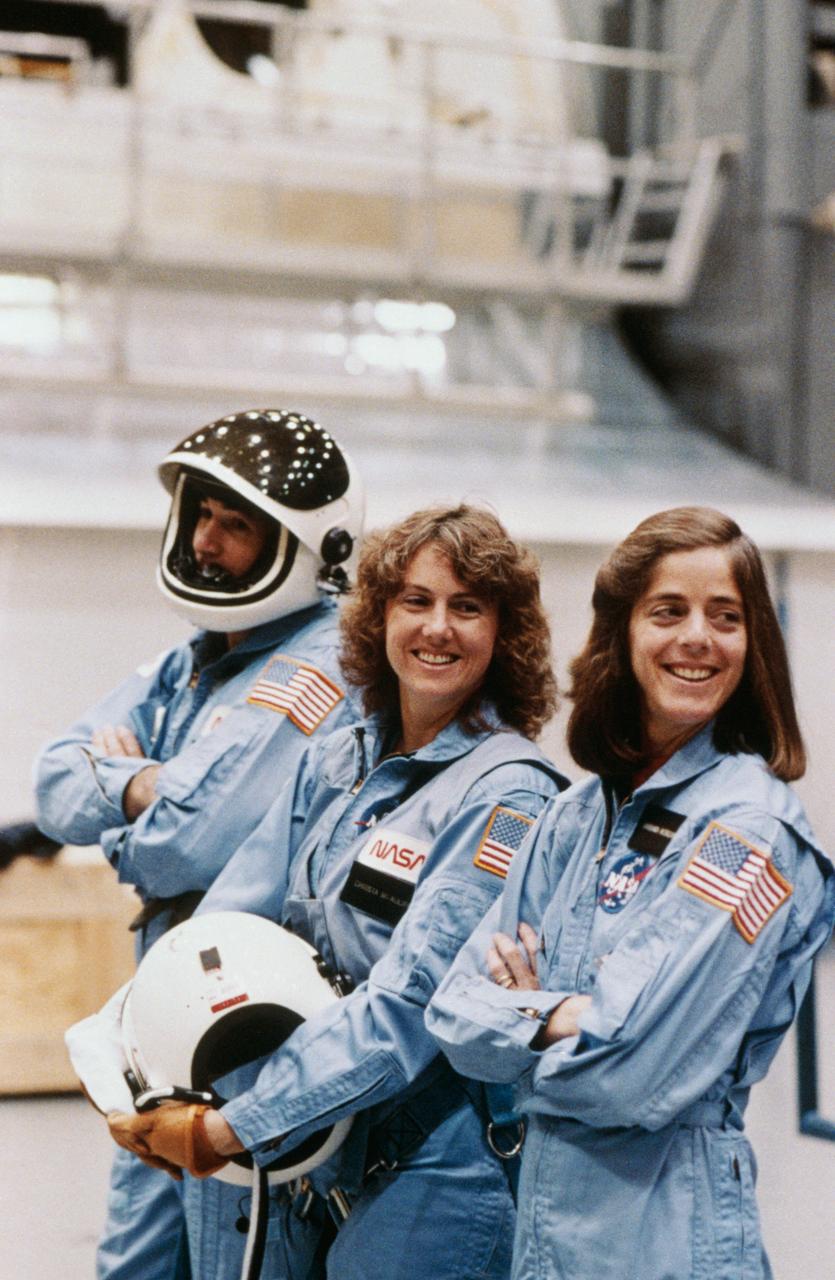
S86-25254 (January 1986) --- Payload specialists in training for STS-51L take a break in shuttle emergency egress training at the Johnson Space Center's (JSC) Shuttle Mock-up and Integration Laboratory. Left to right are Gregory Jarvis of Hughes, Sharon Christa McAuliffe and Barbara Morgan of the Teacher-in-Space Project. McAuliffe was selected as NASA's first citizen observer in the Space Shuttle Program and Morgan was named her backup. The photo was taken by Keith Meyers of the New York Times. EDITOR?S NOTE: The STS-51L crew members lost their lives in the space shuttle Challenger accident moments after launch on Jan. 28, 1986 from the Kennedy Space Center (KSC). Photo credit: NASA
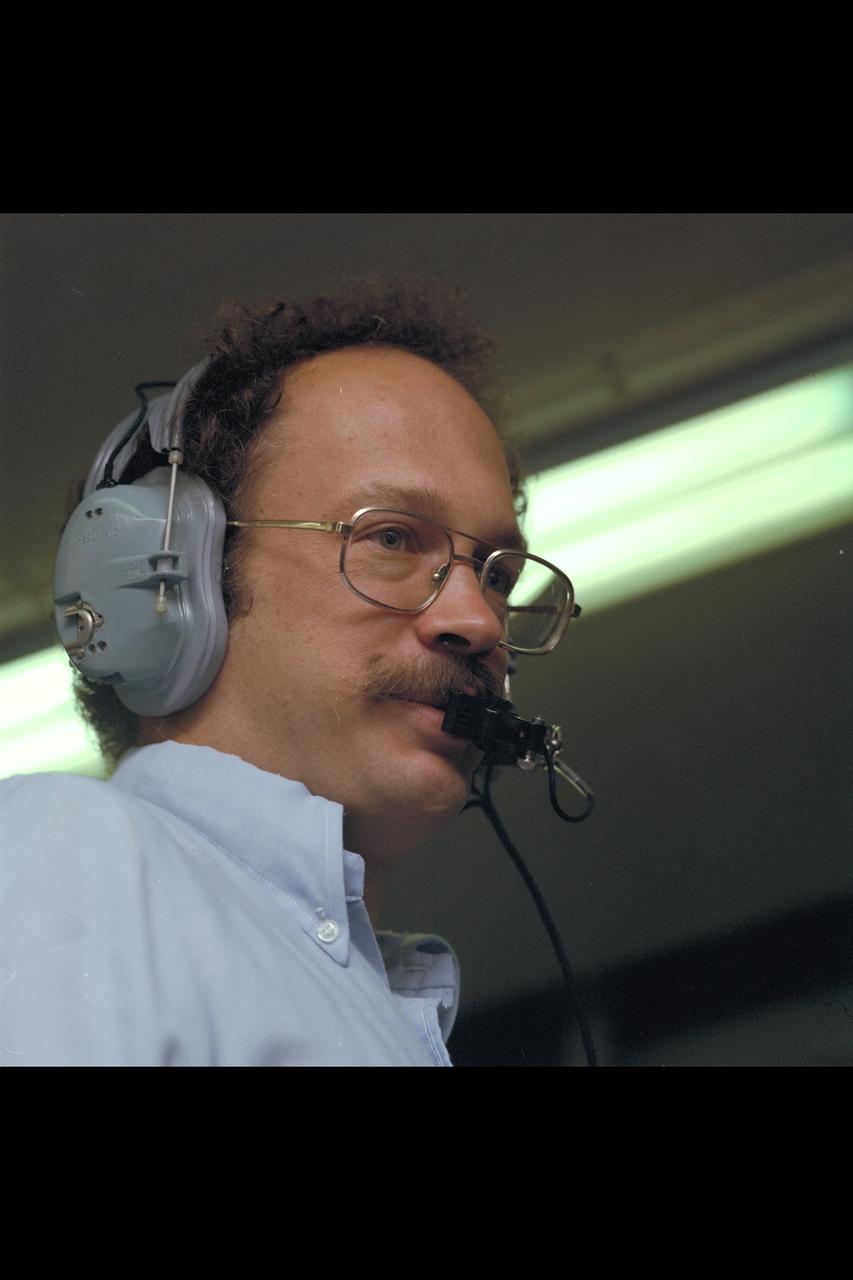
C-141 KAO: University of Texas
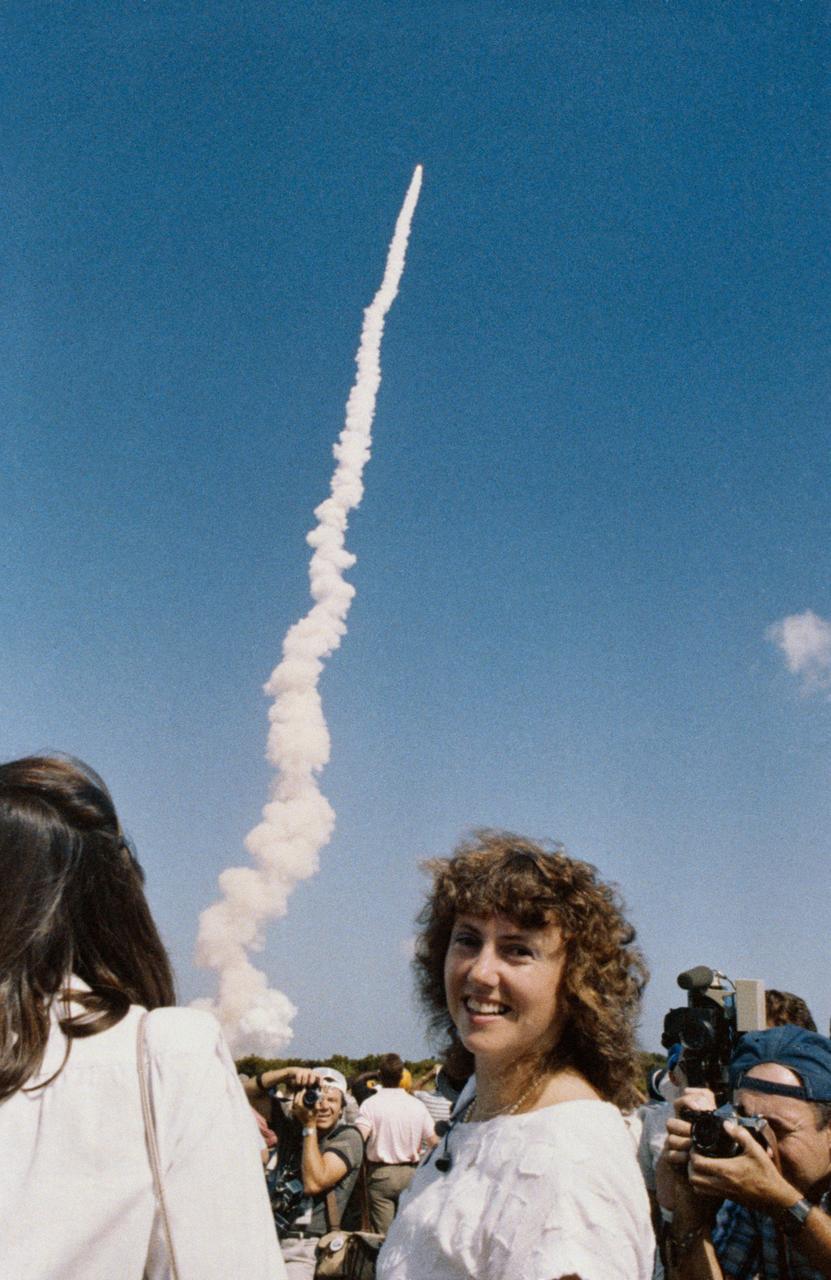
S86-25294 (30 Oct. 1985) --- Barbara R. Morgan and Sharon Christa McAuliffe (right) are pictured during a visit to NASA's Kennedy Space Center (KSC) Launch Complex 39 to witness the launch of the space shuttle Challenger. McAuliffe is scheduled to launch aboard the space shuttle Challenger, STS-51L mission, herself early next year as the United States? first in-space citizen observer. Morgan is the backup for the Teacher-in-Space Project?s payload specialist position. The photo was taken by Keith Meyers of the New York Times. EDITOR?S NOTE: The STS-51L crew members lost their lives in the space shuttle Challenger accident moments after launch on Jan. 28, 1986 from the Kennedy Space Center (KSC). Photo credit: NASA
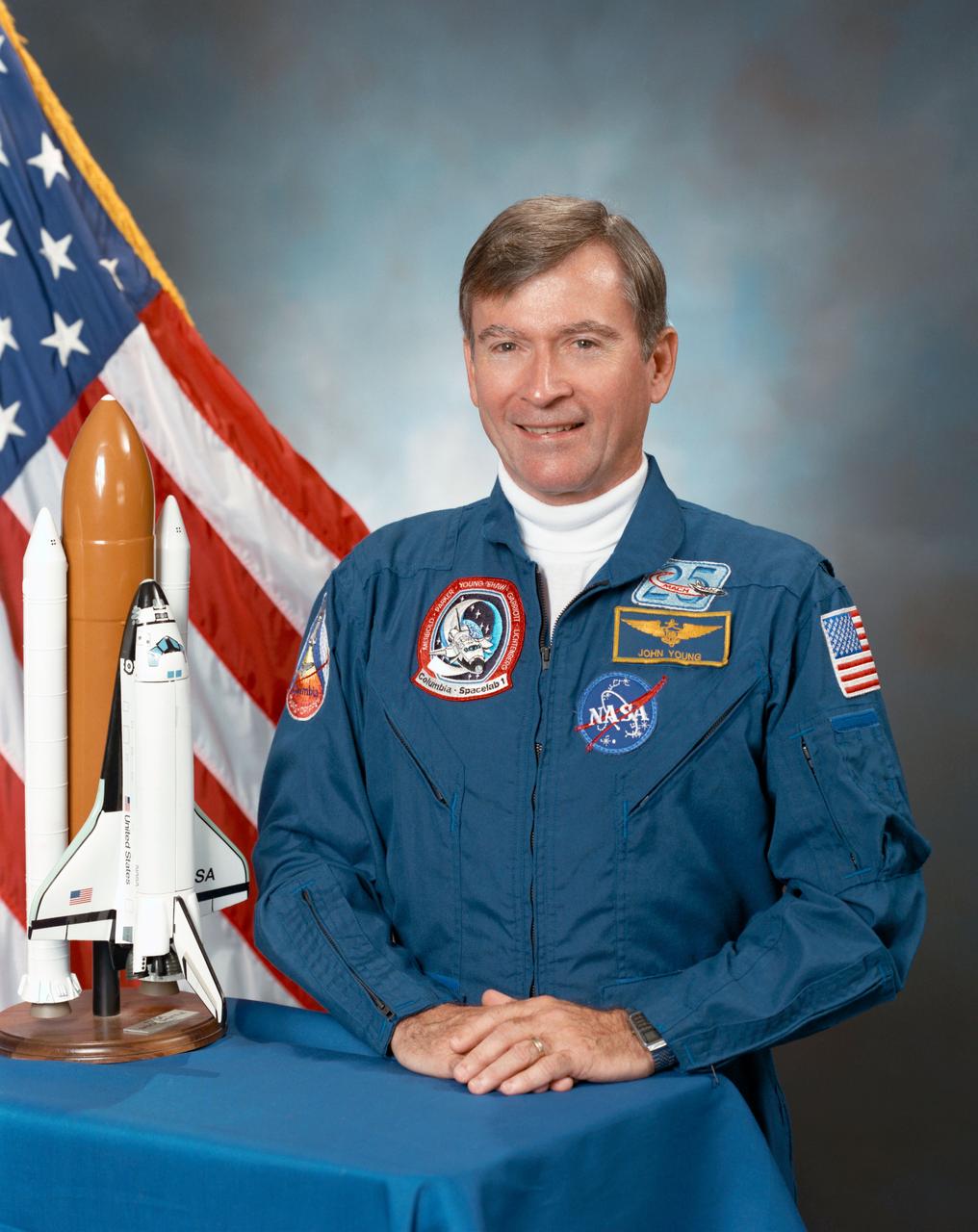
S86-38018 (1986) --- Astronaut John W. Young.

C-130 aircraft Shoreline Amphitheater: Thermal IR Imagery
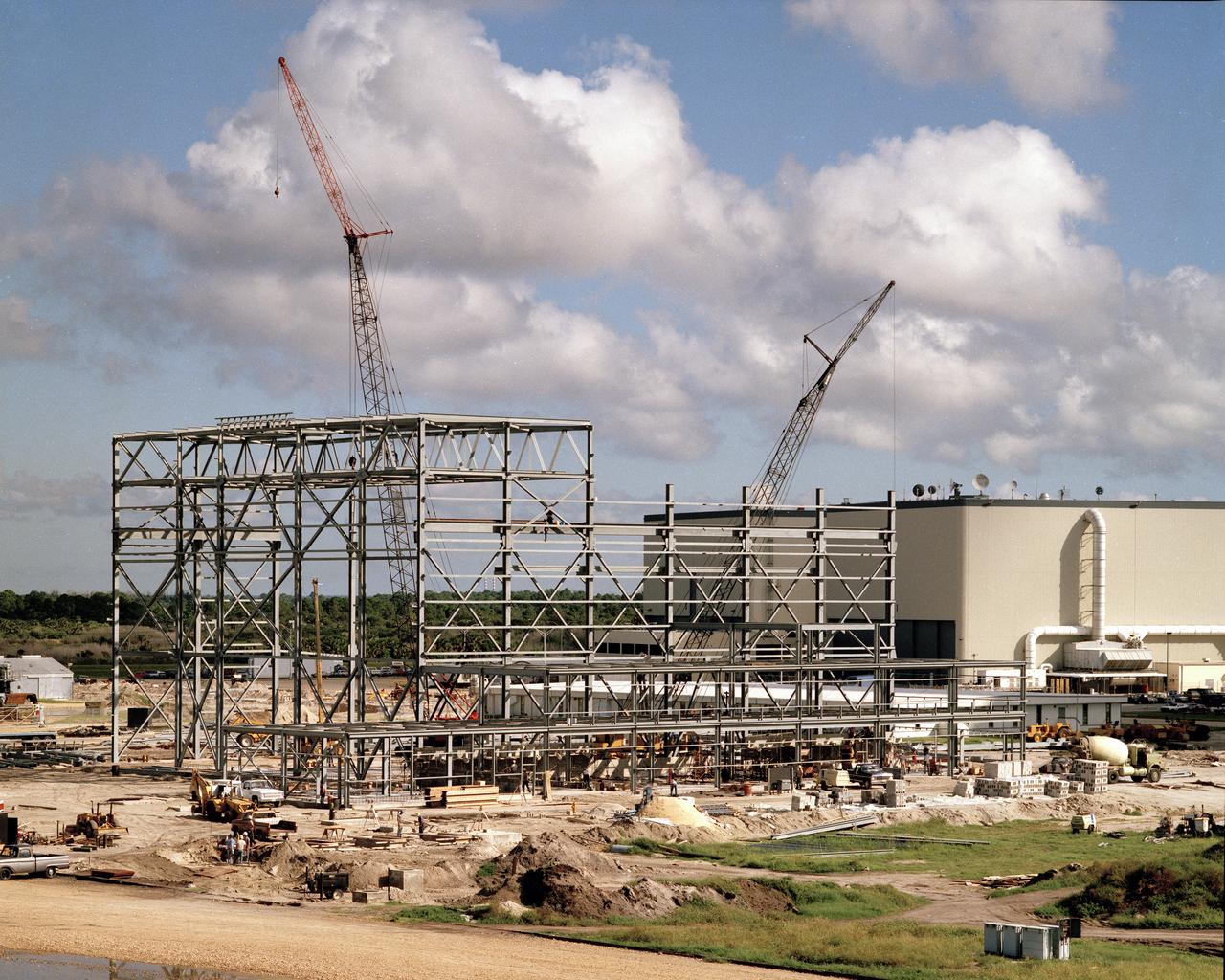
Construction of the Shuttle Orbiter Modification and Refurbishment Facility (OMRF). Northwest of the VAB.
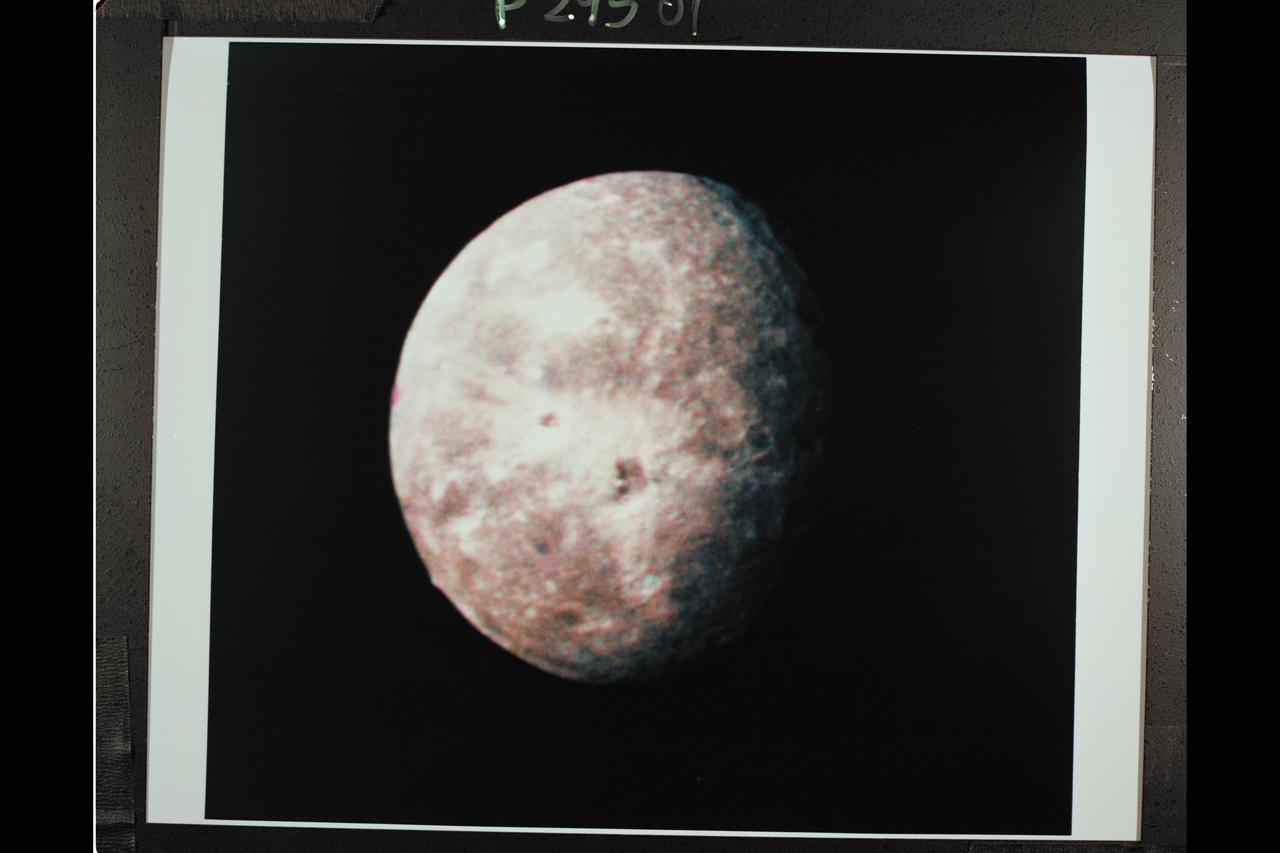
P29501C Moon from Voyager 2 Uranus flyby

S86-28458 (28 Feb. 1986) --- Astronaut Michael L. Coats participates in a rehearsal for his assigned flight at the commander's station of the Shuttle Mission Simulator (SMS) at the Johnson Space Center (JSC). NOTE: Coats, a veteran of spaceflight, originally trained for STS 61-H, which was cancelled in the wake of the Challenger accident. Following the Janaury 1986 accident he was named to serve on a mock crew (STS-61M) for personnel training and simulation purposes. Photo credit: NASA
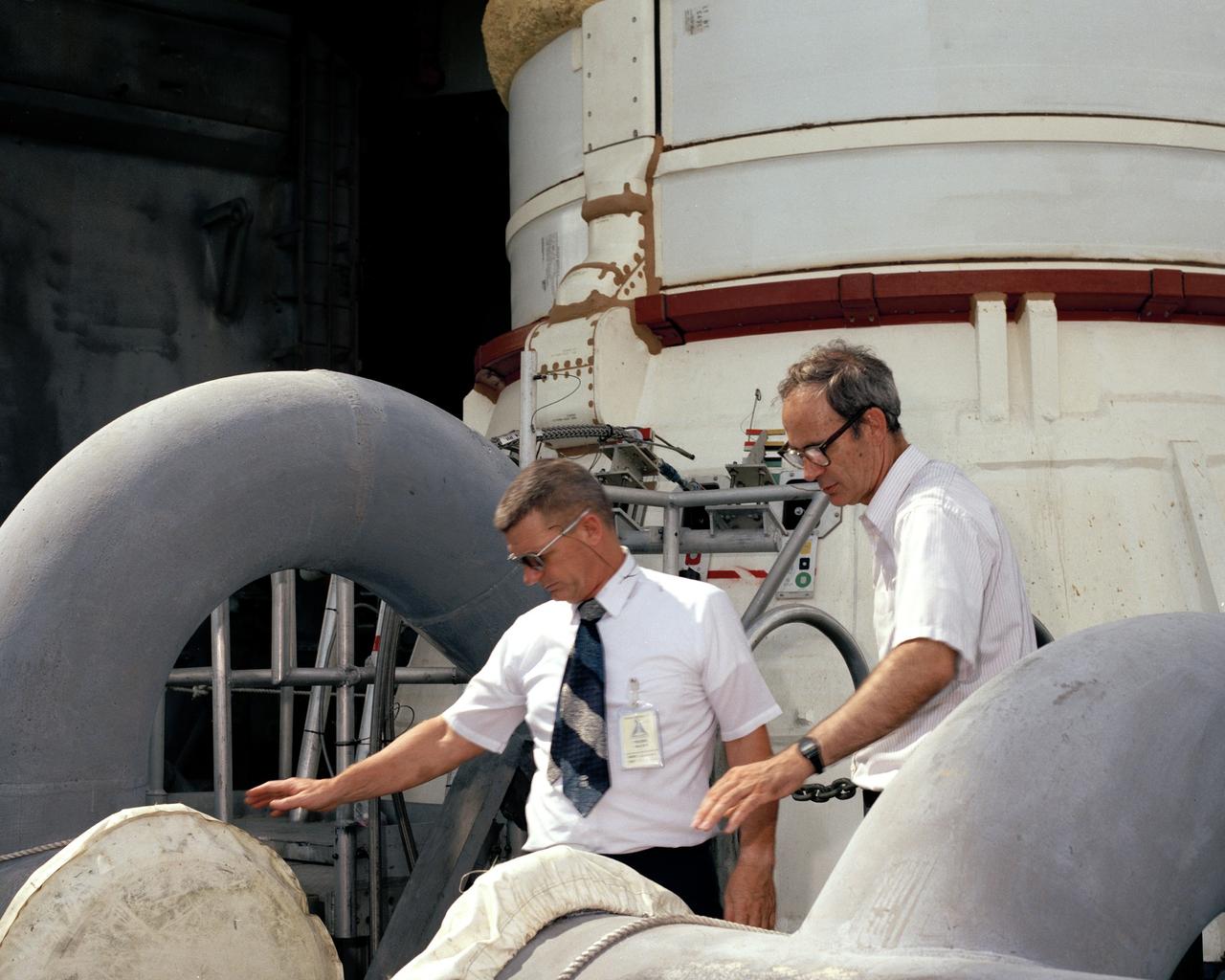
CAPE CANAVERAL, Fla. - Kennedy Space Center Director Lt. Gen. Forrest S. McCartney, left, stands on the fixed service structure in front of one of the space shuttle Atlantis' solid rocket boosters the morning after it is rolled out to Pad 39B. With McCartney is the pad site manager Bill Warren. Photo credit: NASA
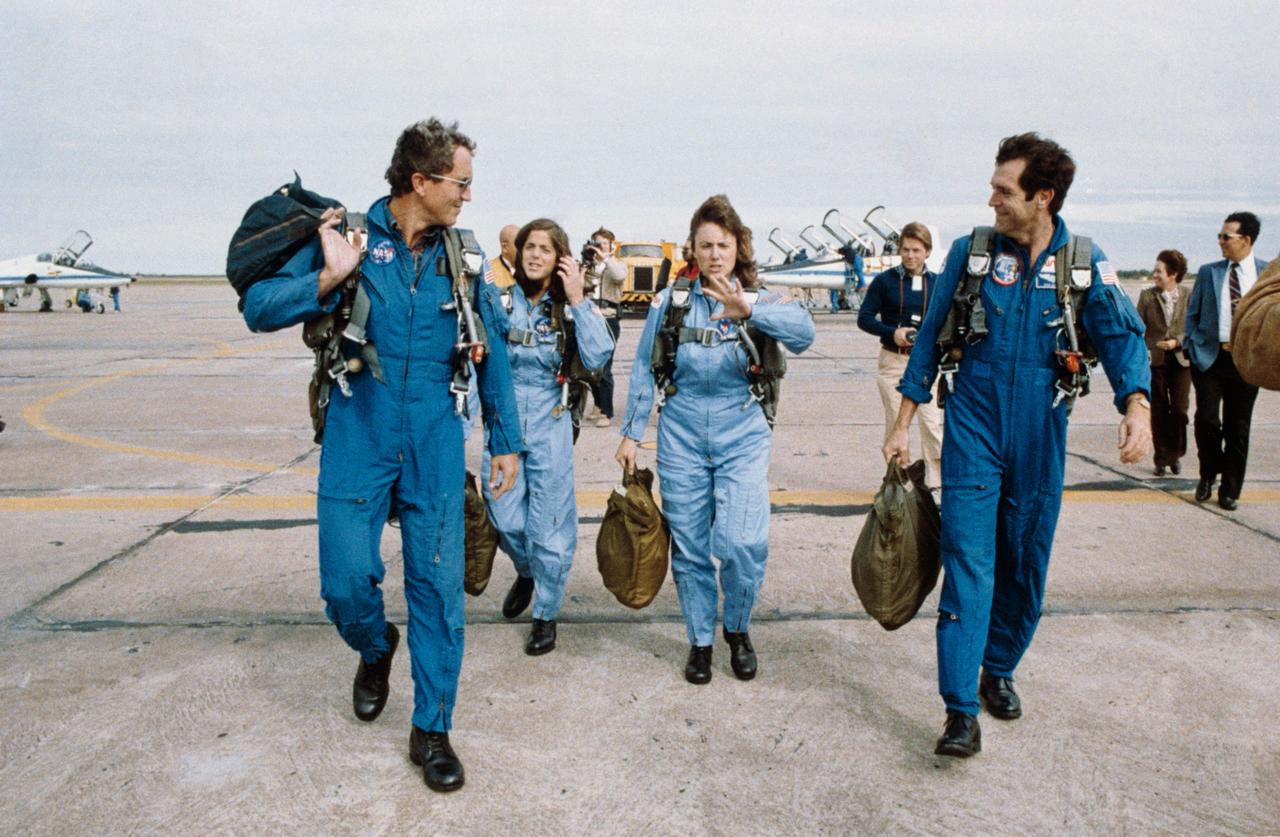
S86-25199 (September 1985) --- Three members of the STS-51L prime crew and a backup crew member walk away from the flight line at nearby Ellington Field following flights in the T-38 jet trainers seen in the background. Sharon Christa McAuliffe (center right), payload specialist/citizen observer for the Teacher-in-Space Project, and Barbara R. Morgan (center left), her backup, are flanked by astronauts Francis R. (Dick) Scobee (right), mission commander, and Michael J. Smith, pilot. The photo was taken by Keith Meyers of the New York Times. EDITOR?S NOTE: The STS-51L crew members lost their lives in the space shuttle Challenger accident moments after launch on Jan. 28, 1986 from the Kennedy Space Center (KSC). Photo credit: NASA
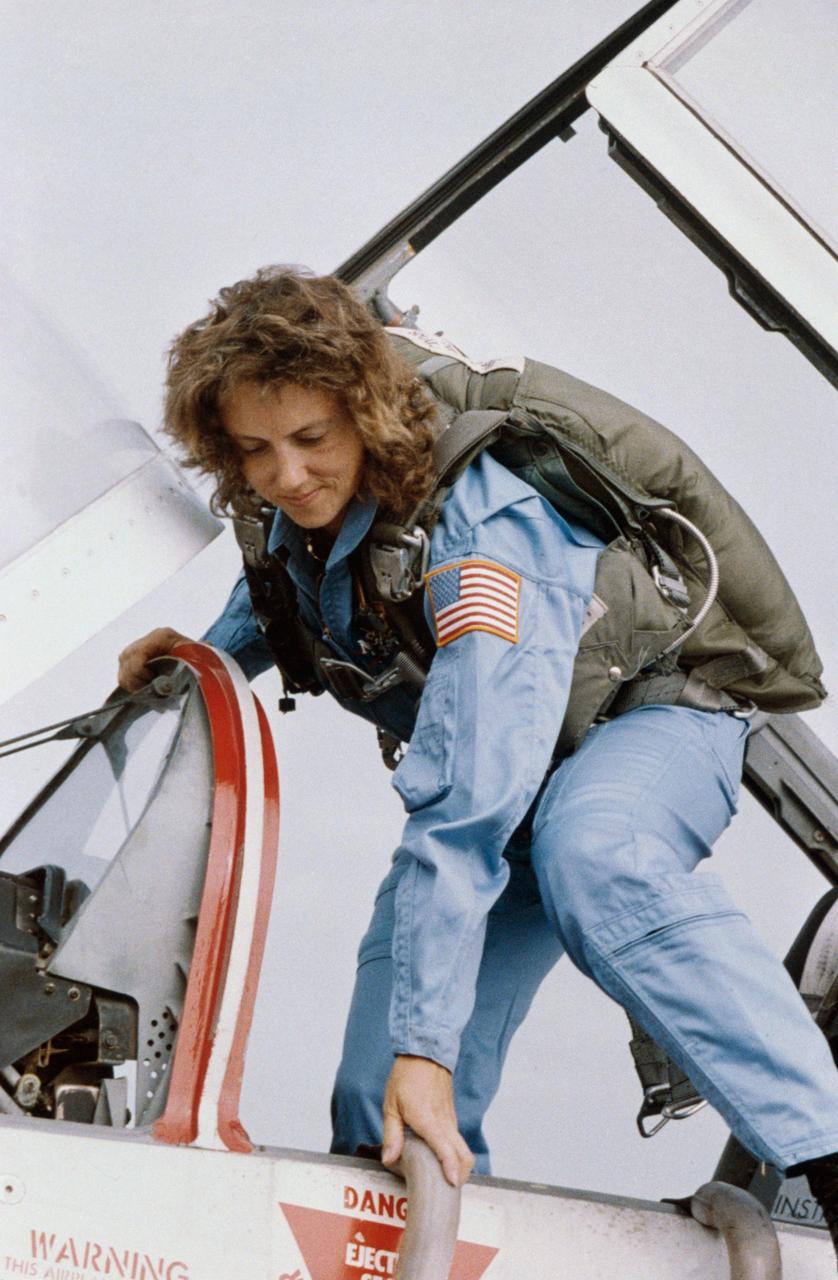
S86-25234 (January 1986) --- STS-51L Payload Specialist Sharon Christa McAuliffe egresses the rear station of a NASA T-38 jet trainer at Ellington Base near the Johnson Space Center, where the Teacher-in-Space Project top finalist is in training for the January mission. The photo was taken by Keith Meyers of the New York Times. Photo credit: NASA
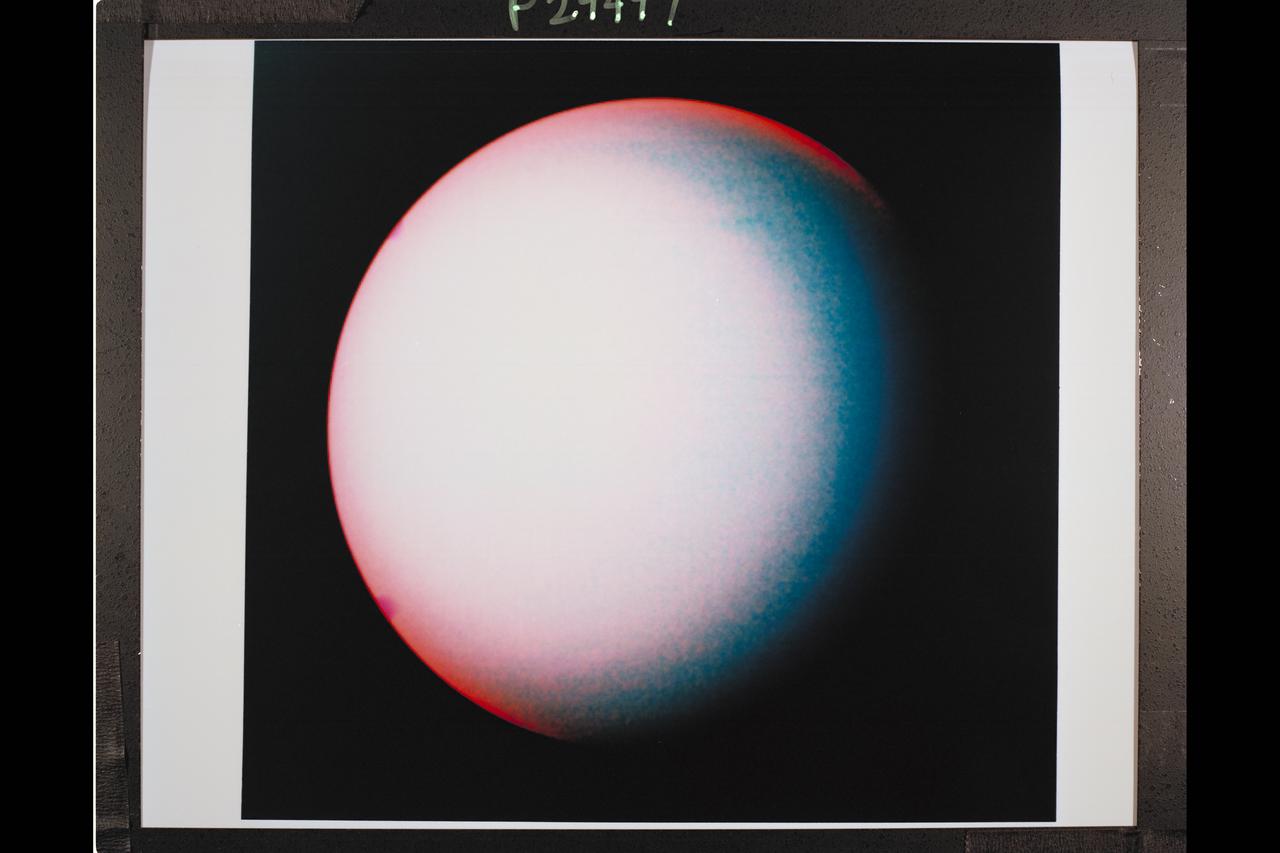
Range : 2.7 million miles (1.7 million miles) P-29497C Tis Voyager 2, false color composite of Uranus demonstrates the usefulness of special filters in the Voyager cameras for revealing the presence of high altitude hazes in Uranus' atmosphere. The picture is a composite of images obtained through the single orange and two methane filters of Voyager's wide angle camera. Orange, short wavelength and long wavelength methane images are displayed, retrospectively, as blue, green, and orange. The pink area centered on the pole is due to the presence of hazes high in the atmosphere that reflect the light before it has traversed a long enough path through the atmosphere to suffer absorbtion by methane gas. The bluest region at mid-latitude represent the most haze free regions on Uranus, thus, deeper cloud levels can be detected in these areas.
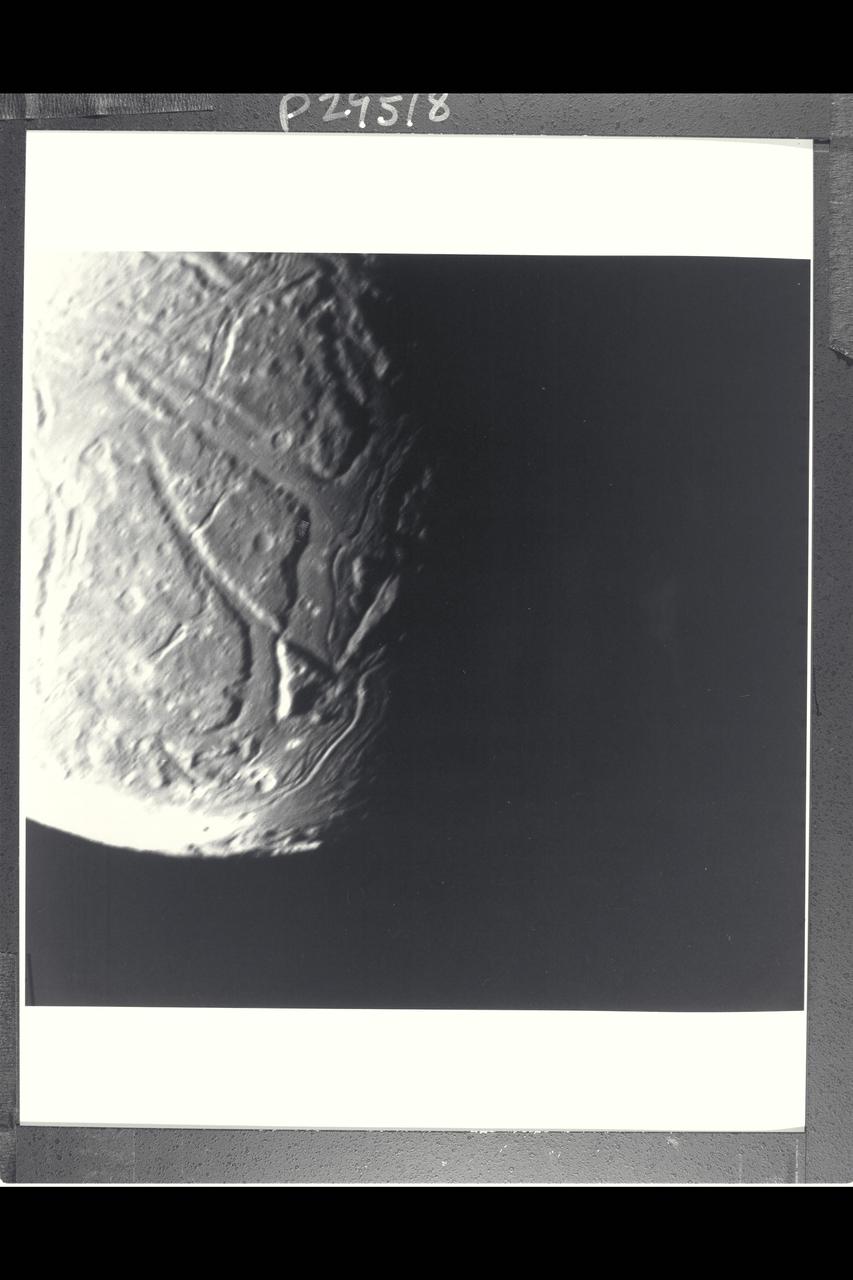
P-29518 BW Range: 130,000 kilometers (80,000 miles) This highest-resolution Voyager 2 view of Ariel's terminator shows a complex array of transecting valleys with superimposed impact craters. This clear-filter, narrow-angle view has a resolution of about 2.4 km (1.5 mi). Particularly striking to Voyager scientists is the fact that the faults that bound the linear valleys are not visible where they transect one another across the valleys. Apparently these valleys were filled with deposits sometime after they were formed by tectonic processes, leaving them flat and smooth. Sinuous rilles (trenches) later formed, probably by some flow process. Some type of fluid flow may well have been involved in their evolution.
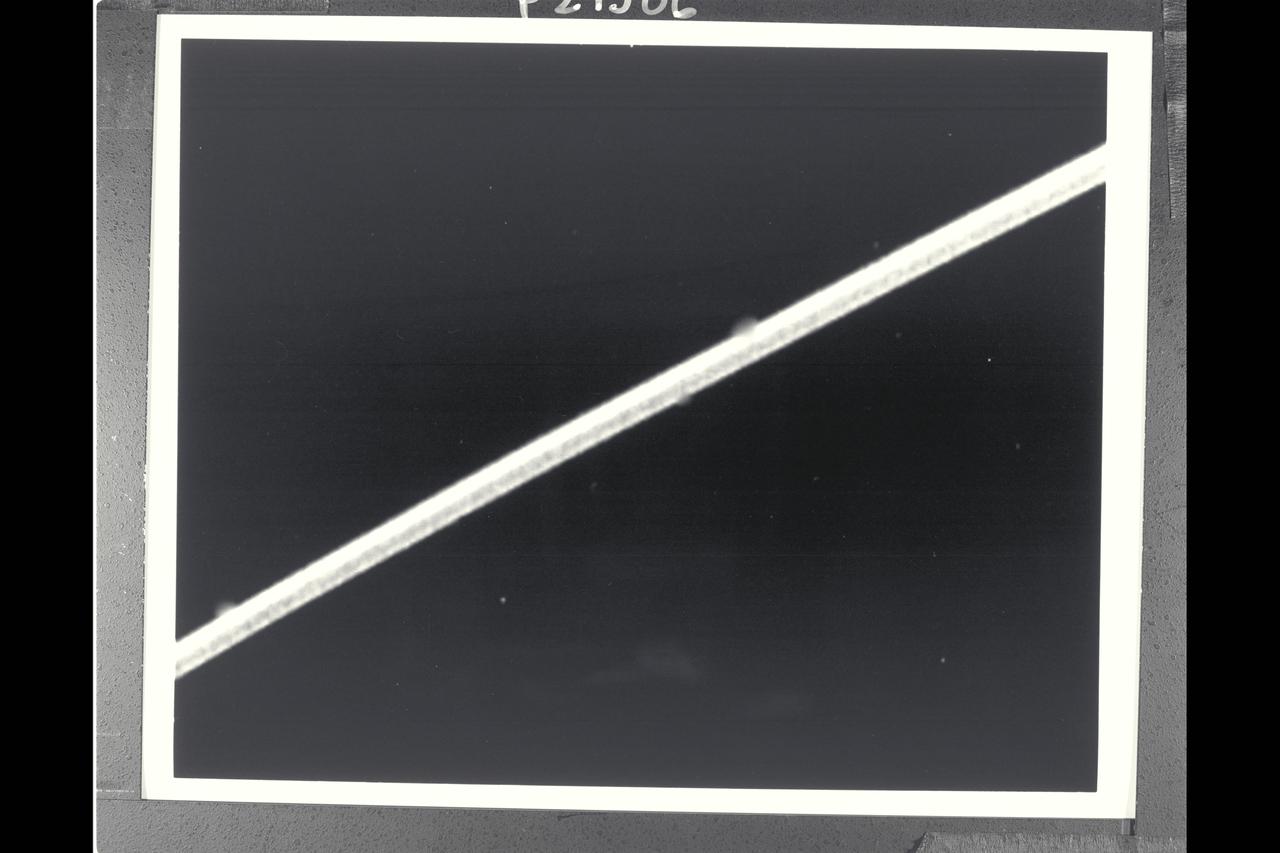
P-29506BW Range: 1.12 million kilometers (690,000 miles) This high-resolution image of the epsilon ring of Uranus is a clear-filter picture from Voyager's narrow-angle camera and has a resolution of about 10 km (6 mi). The epsilon ring, approx. 100 km (60 mi) wide at this location, clearly shows a structural variation. Visible here are a broad, bright outer component about 40 km (25 mi) wide; a darker, middle region of comparable width; and a narrow, bright inner strip about 15 km (9 mi) wide. The epsilon-ring structure seen by Voyager is similiar to that observed from the ground with stellar-occultation techniques. This frame represents the first Voyager image that resolves these features within the epsilon ring. The occasional fuzzy splotches on the outer and innerparts of the ring are artifacts left by the removal of reseau marks (used for making measurements on the image).
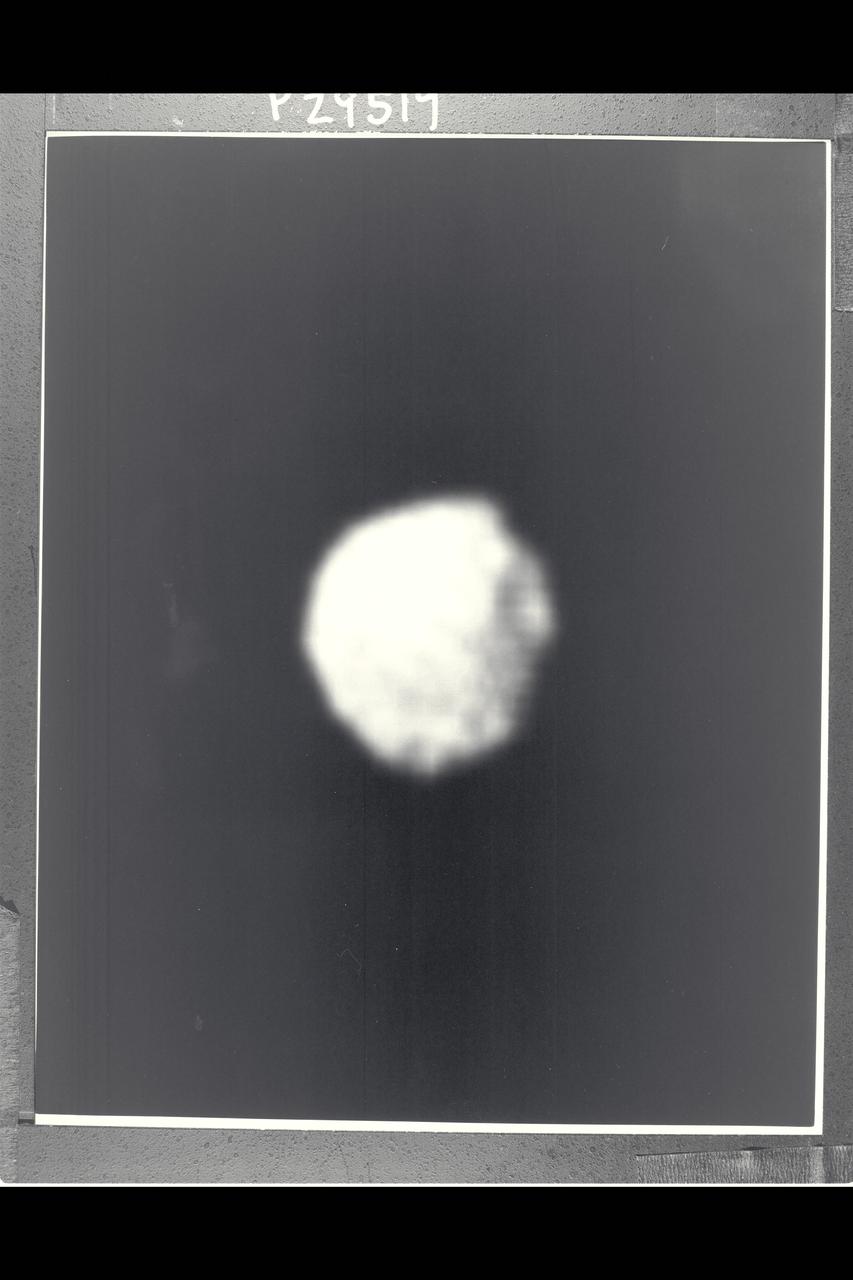
P-29519BW Range: 500,000 kilometers (300,000 miles) Several craters are seen on the surface of 1986U1, one of the several small moons of Uranus discovered by Voyager 2. This single image, a clear-filtered, narrow-angle picture with a resolution of about 10 km (6 mi), is the only closeup the spacecraft obtained of any of the new moons. The moon was found December 30, 1985; it was the first and largest of nine satellites discovered by the spacecraft's cameras. This image shows 1986U1 to be a dark, nearly spherical object, with a diameter of about 150 km (90 mi); the dark surface reflects only 7 percent of the incident light. The picture was inserted into the Voyager encounter sequence late in its development.This image has had a complex history, having been recorded on the spacecraft tape recorder and first played back during the late afternoon of its recording. An antenna-pointing problem at one of the Austrailian tracking stations led to the loss of the data, so the image had to be retransmitted.
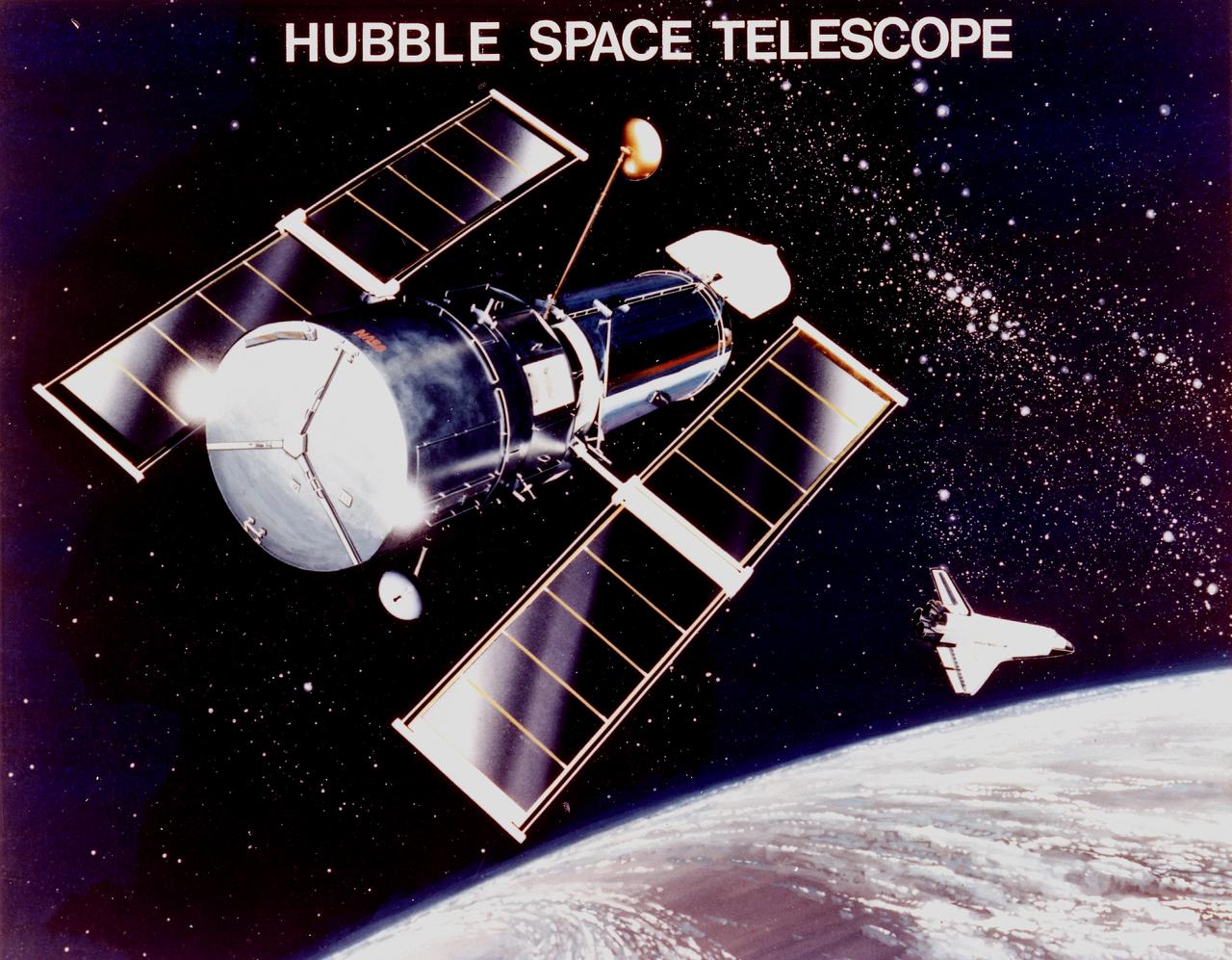
This is an artist's concept of the Hubble Space Telescope (HST). The HST is the product of a partnership between NASA, European Space Agency Contractors, and the international community of astronomers. It is named after Edwin P. Hubble, an American Astronomer who discovered the expanding nature of the universe and was the first to realize the true nature of galaxies. The purpose of the HST, the most complex and sensitive optical telescope ever made, is to study the cosmos from a low-Earth orbit. By placing the telescope in space, astronomers are able to collect data that is free of the Earth's atmosphere. The HST detects objects 25 times fainter than the dimmest objects seen from Earth and provides astronomers with an observable universe 250 times larger than is visible from ground-based telescopes, perhaps as far away as 14 billion light-years. The HST views galaxies, stars, planets, comets, possibly other solar systems, and even unusual phenomena such as quasars, with 10 times the clarity of ground-based telescopes. The major elements of the HST are the Optical Telescope Assembly (OTA), the Support System Module (SSM), and the Scientific Instruments (SI). The HST is approximately the size of a railroad car, with two cylinders joined together and wrapped in a silvery reflective heat shield blanket. Wing-like solar arrays extend horizontally from each side of these cylinders, and dish-shaped anternas extend above and below the body of the telescope. The HST was deployed from the Space Shuttle Discovery (STS-31 mission) into Earth orbit in April 1990. The Marshall Space Flight Center had responsibility for design, development, and construction of the HST. The Perkin-Elmer Corporation, in Danbury, Connecticut, developed the optical system and guidance sensors. The Lockheed Missile and Space Company of Sunnyvale, California produced the protective outer shroud and spacecraft systems, and assembled and tested the finished telescope.
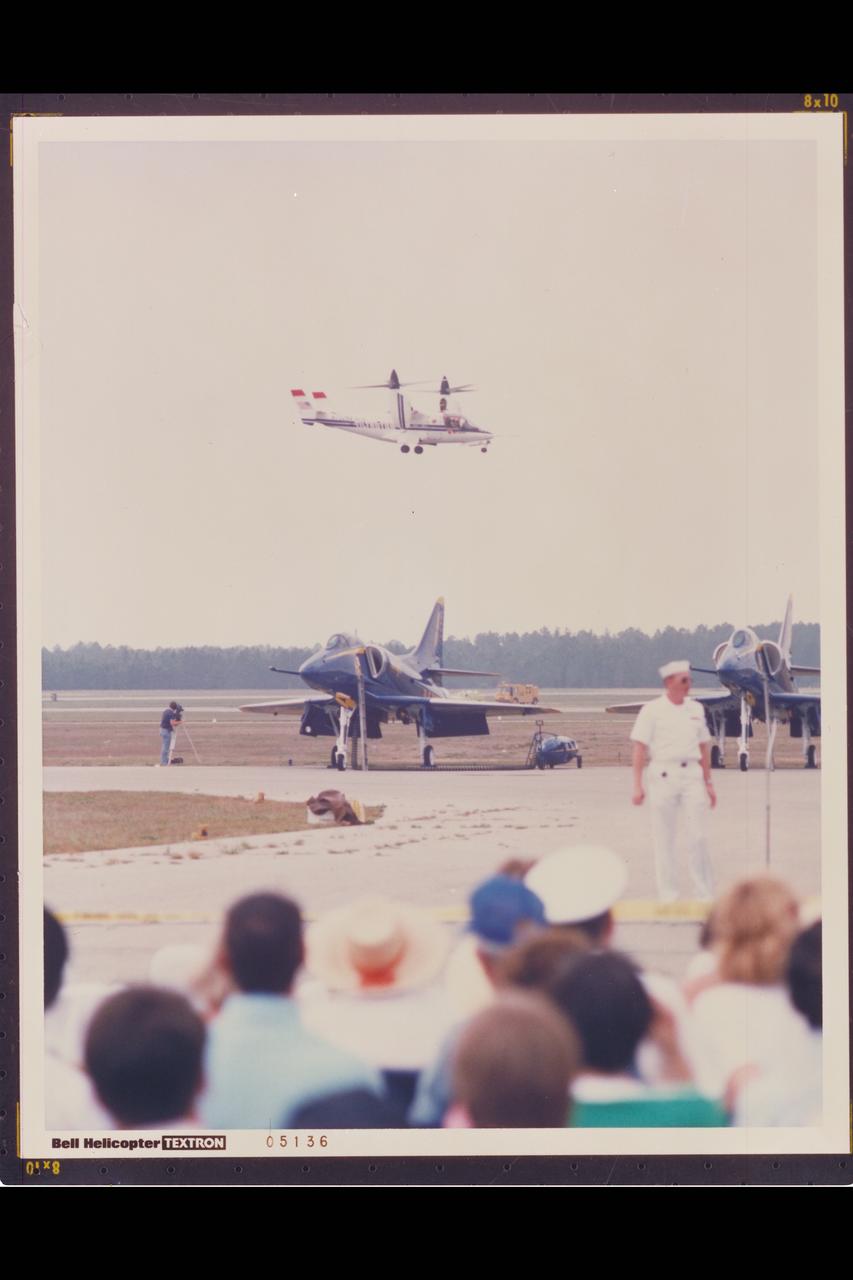
Bell Textron XV-15 Tilt Rotor Aircraft flight demo at airshow - Navy Blue Angles in forground) (Bell Helicopter Textron ref: 05136)
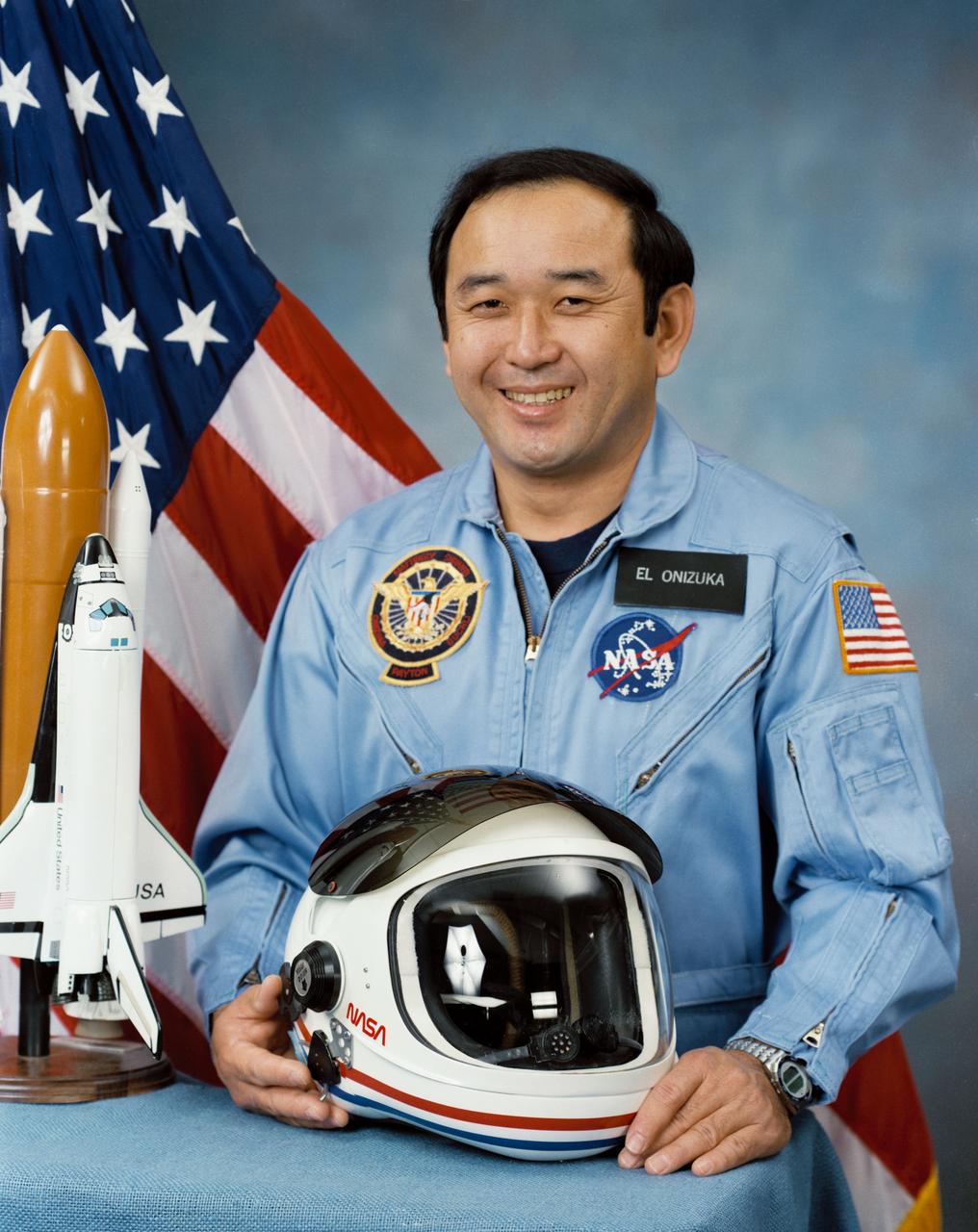
S86-25964 (31 Jan. 1978) --- Astronaut Ellison S. Onizuka. Photo credit: NASA (NOTE: Astronaut Onizuka lost his life in the Jan. 28, 1986, STS-51L space shuttle Challenger accident, along with six other crew members.)
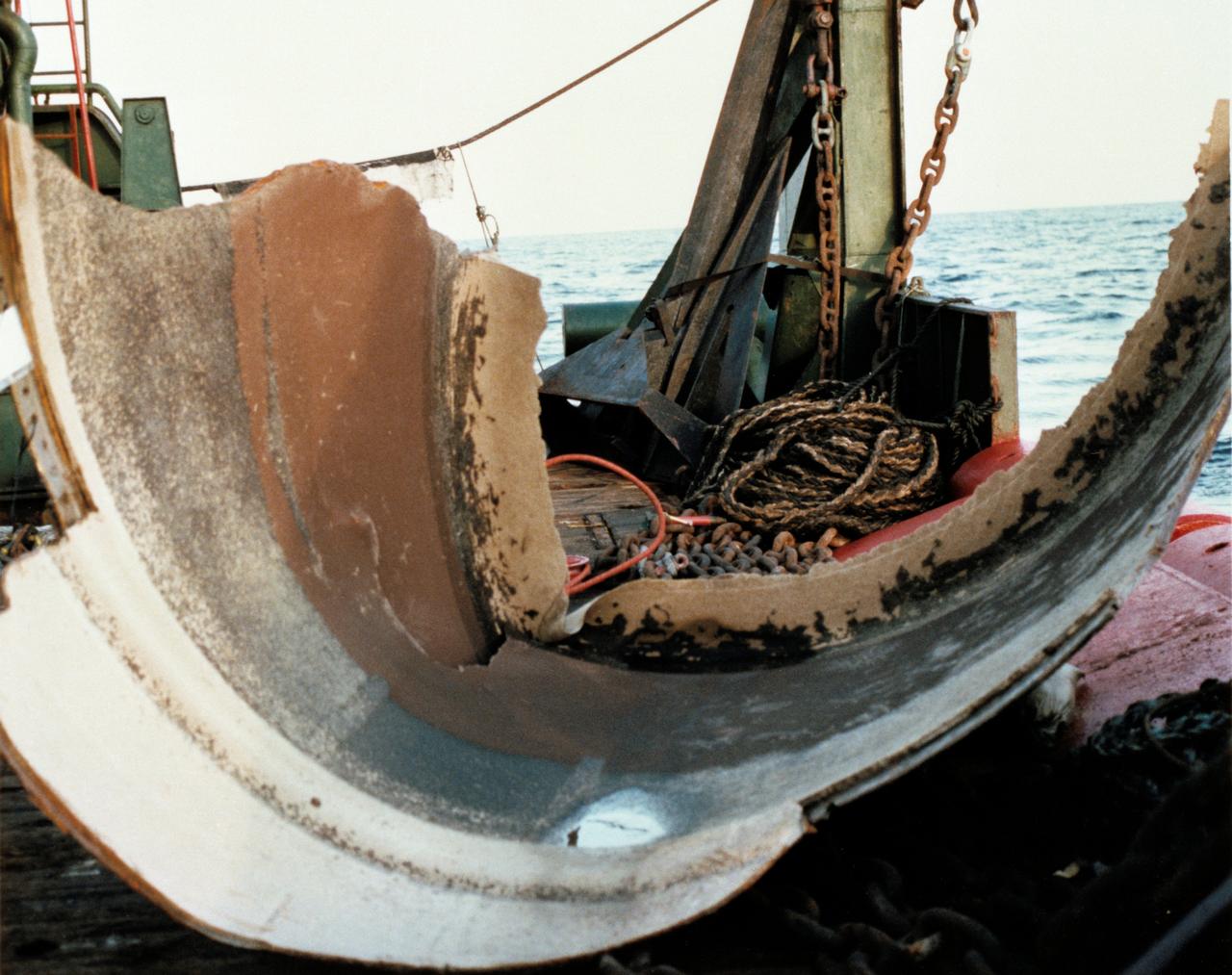
51L-10162 (8-9 March 1986) --- View of the left solid rocket booster first piece retrieval #11 (STS-51L space shuttle Challenger). Photo credit: NASA
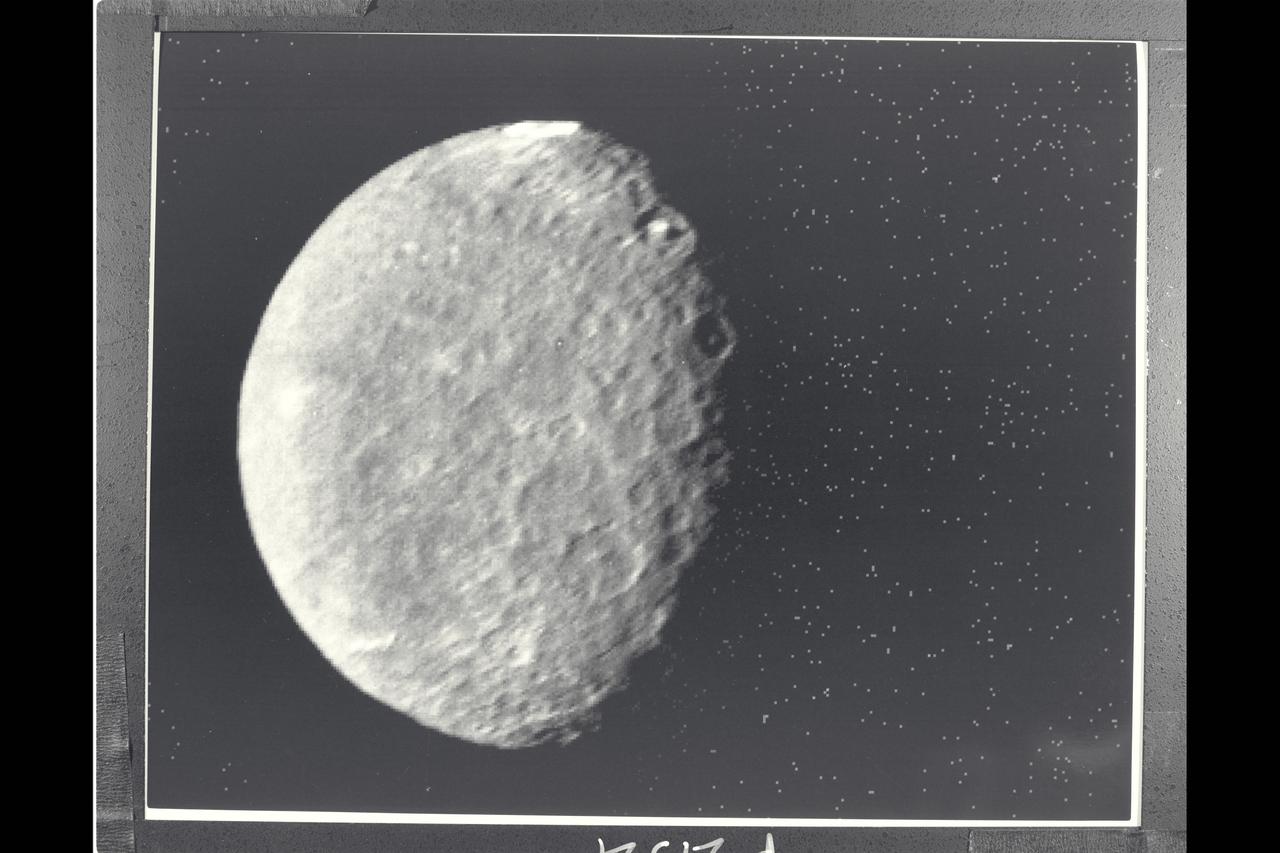
P-29521 BW Range: 557,000 kilometers ( 346, 000 miles) The southern hemisphere of Umbriel displays heavy cratering in this Voyager 2 image. This frame, taken through the clear-filter of Voyager's narrow-angle camera, is the most detailed image of Umbriel, with a resolution of about 10 km (6 mi). Umbriel is the darkest of Uranus' larger moons and the one that appears to have experienced the lowest level of geological activity. It has a diameter of about 1,200 km (750 mi) and reflects only 16 percent of the light striking its surface; in the latter respect, Umbriel is similiar to lunar highland areas. Umbriel is heavily cratered but lacks the numerous bright-ray craters seen on the other large Uranian satellites; this results in a relatively uniform surface albedo (reflectivity). The prominent crater on the terminator (upper right) is about 110 km (70 mi) across and has a bright central peak. The strangest feature in this image (at top) is a curious bright ring, the most reflective area seen on Umbriel. The ring is about 140 km (90 mi) in diameter and lies near the satellite's equator. The nature of the ring is not known, although it might be a frost deposit, perhaps associated with an impact crater. Spots against the black background are due to 'noise' in the data.
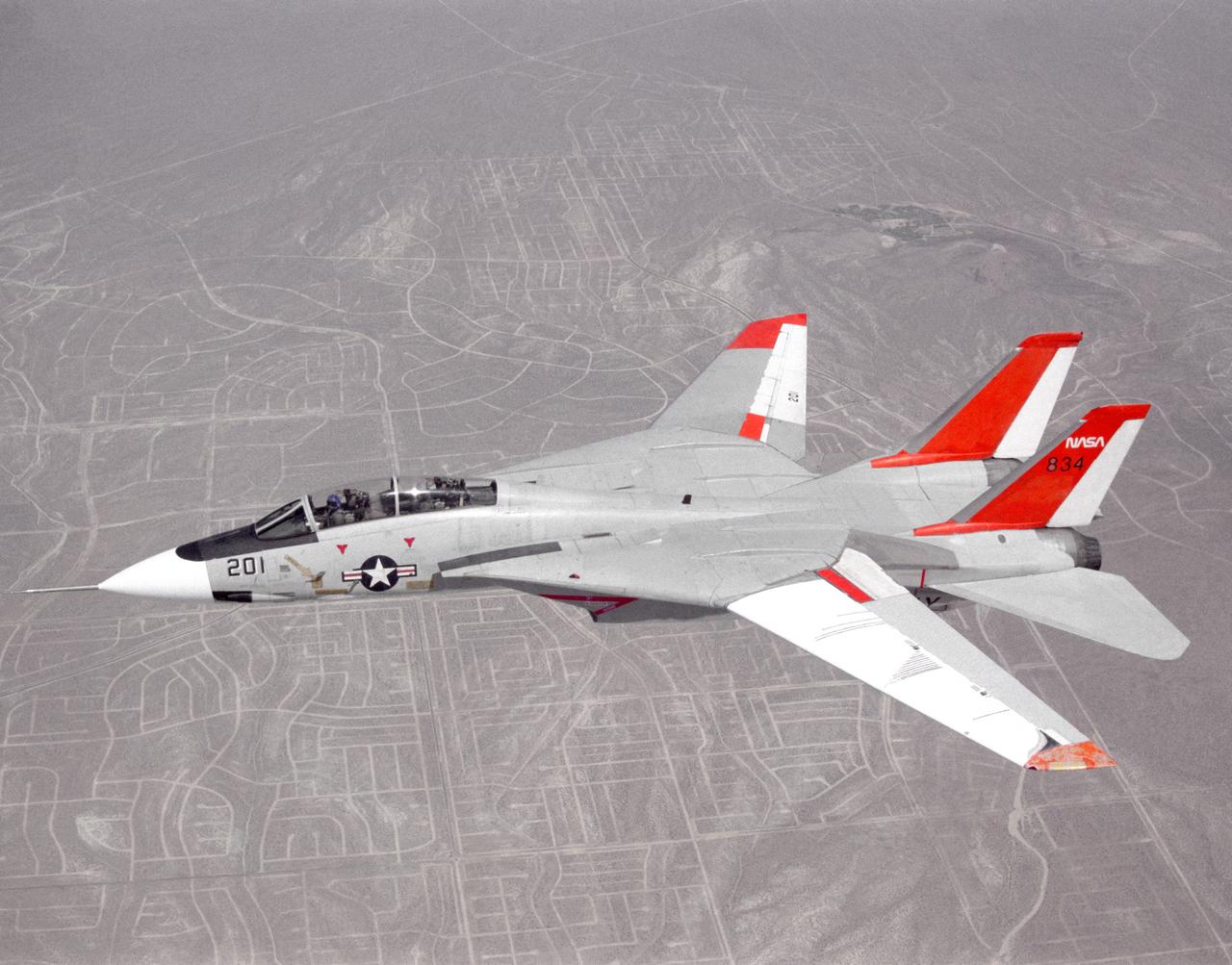
NASA 834, an F-14 Navy Tomcat, seen here in flight, was used at Dryden in 1986 and 1987 in a program known as the Variable-Sweep Transition Flight Experiment (VSTFE). This program explored laminar flow on variable sweep aircraft at high subsonic speeds. An F-14 aircraft was chosen as the carrier vehicle for the VSTFE program primarily because of its variable-sweep capability, Mach and Reynolds number capability, availability, and favorable wing pressure distribution. The variable sweep outer-panels of the F-14 aircraft were modified with natural laminar flow gloves to provide not only smooth surfaces but also airfoils that can produce a wide range of pressure distributions for which transition location can be determined at various flight conditions and sweep angles. Glove I, seen here installed on the upper surface of the left wing, was a "cleanup" or smoothing of the basic F-14 wing, while Glove II was designed to provide specific pressure distributions at Mach 0.7. Laminar flow research continued at Dryden with a research program on the NASA 848 F-16XL, a laminar flow experiment involving a wing-mounted panel with millions of tiny laser cut holes drawing off turbulent boundary layer air with a suction pump.
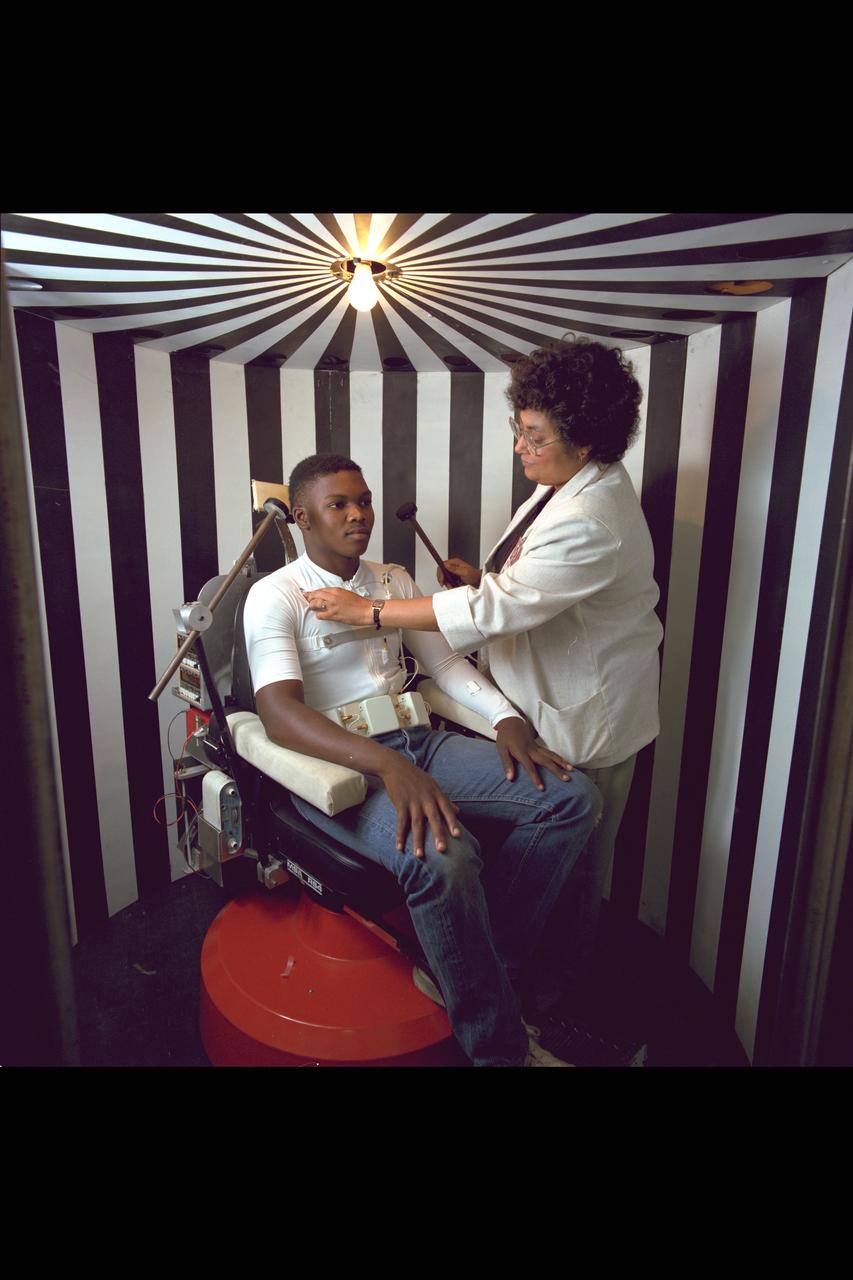
Dr. Pat Cowings in Motion Sickness Laboratory of the Human Environmental Test Facility S.13 with test subject Leah Schafer
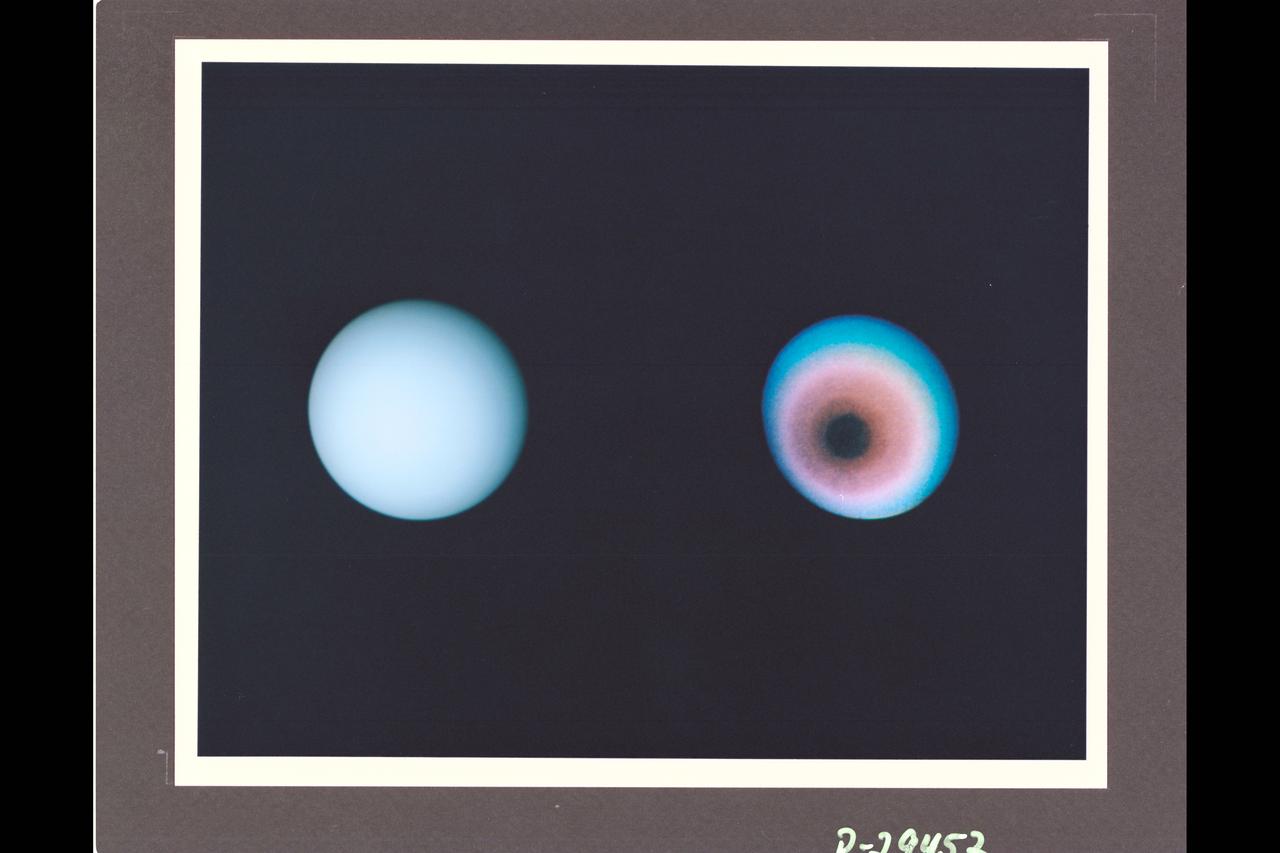
P-29452 These two images of Uranus are shown here to reveal the pole rotation of the planet, as photographed by Voyager 2. The left is seen as the human eye would see, and the right isfalse color to reveal more intricate details.
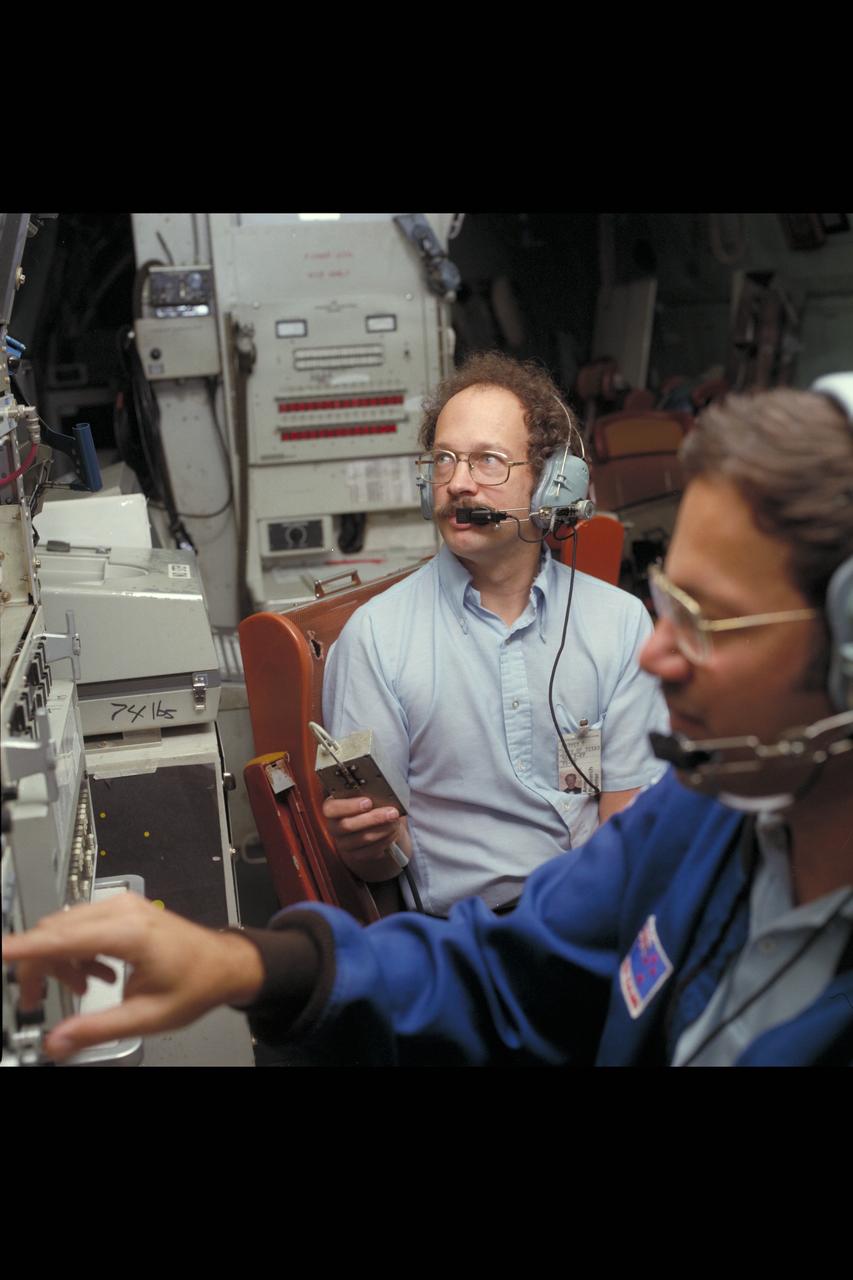
C-141 KAO: University of Texas
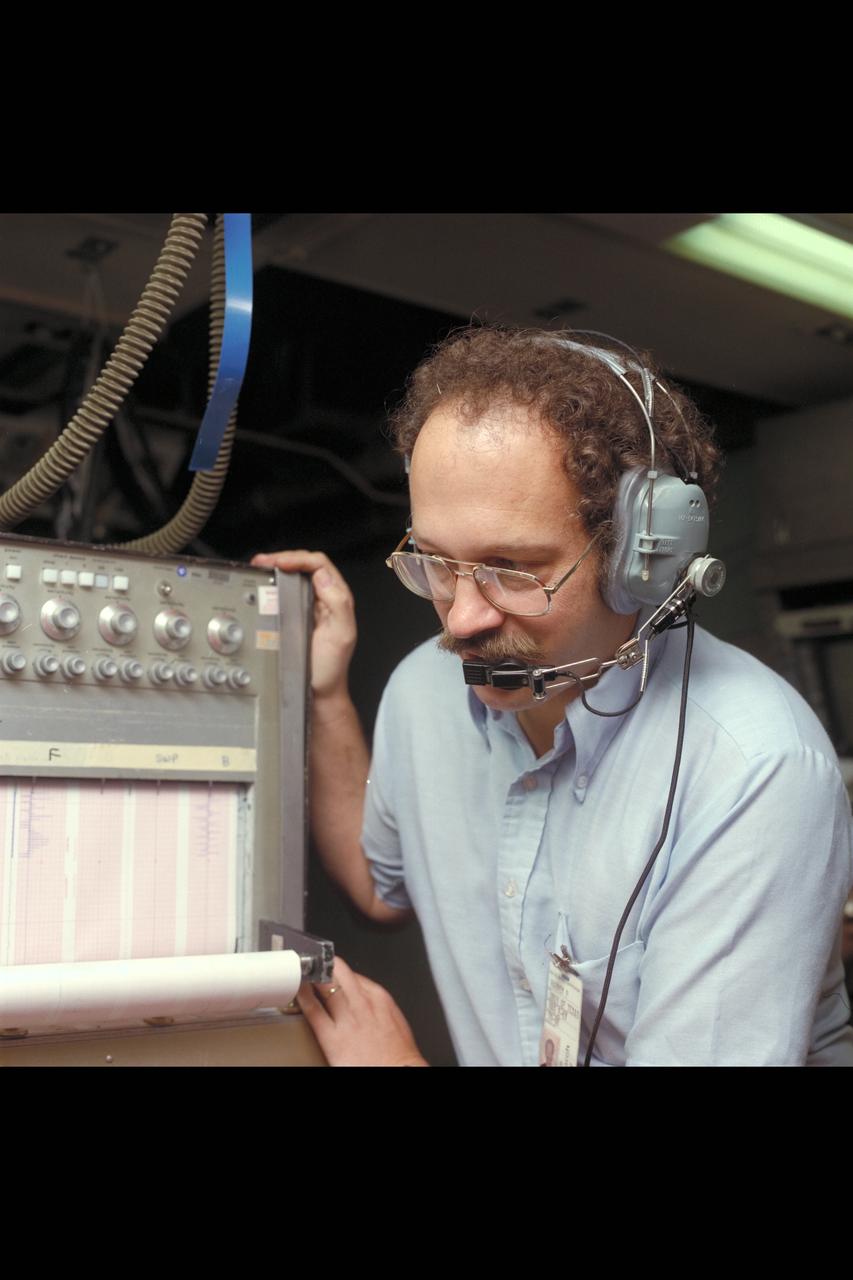
C-141 KAO: University of Texas
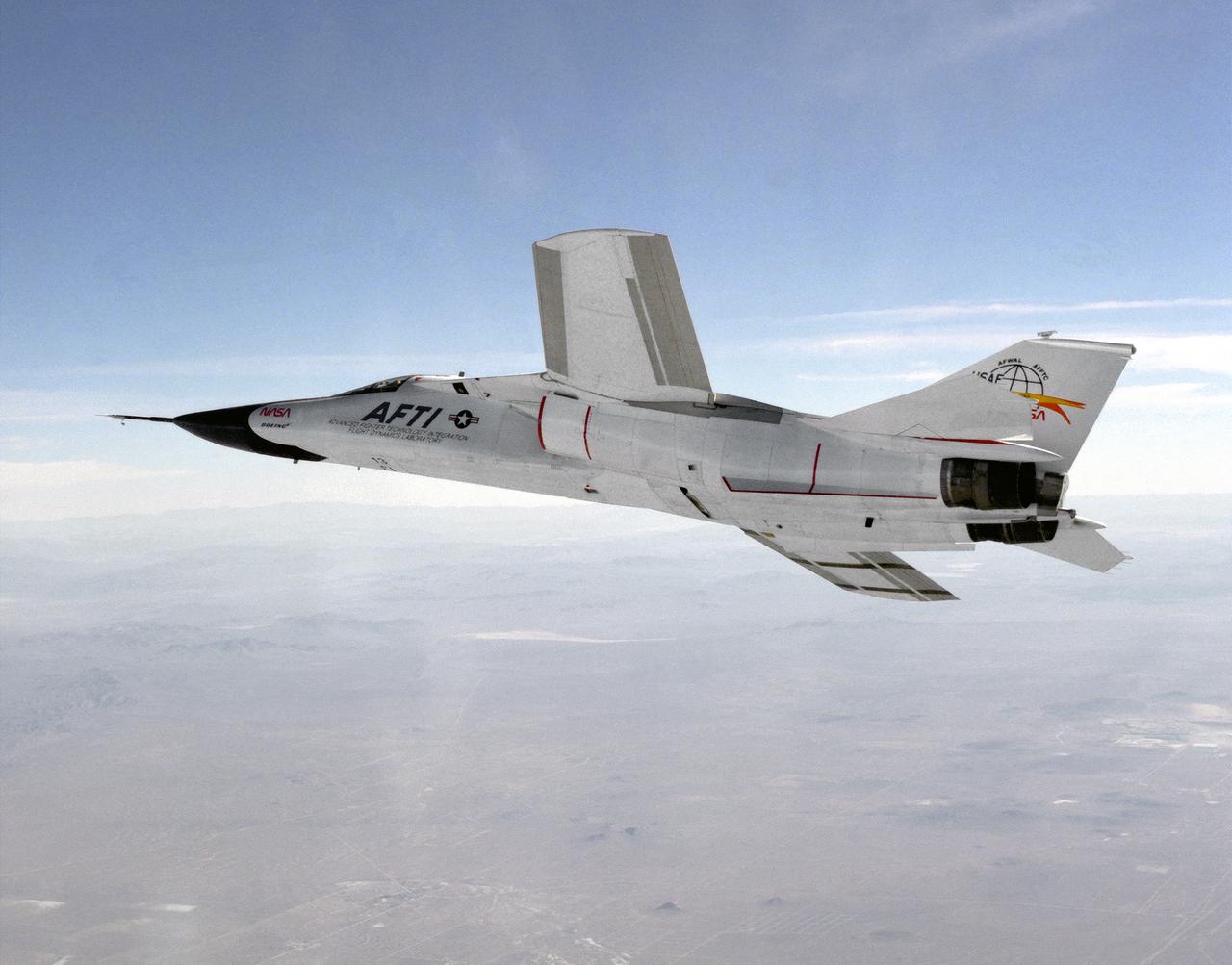
This photograph shows a modified General Dynamics AFTI/F-111A Aardvark with supercritical mission adaptive wings (MAW) installed. The AFTI/F111A is seen banking towards Rodgers Dry Lake and Edwards Air Force Base. With the phasing out of the TACT program came a renewed effort by the Air Force Flight Dynamics Laboratory to extend supercritical wing technology to a higher level of performance. In the early 1980s the supercritical wing on the F-111A aircraft was replaced with a wing built by Boeing Aircraft Company System called a “mission adaptive wing” (MAW), and a joint NASA and Air Force program called Advanced Fighter Technology Integration (AFTI) was born.
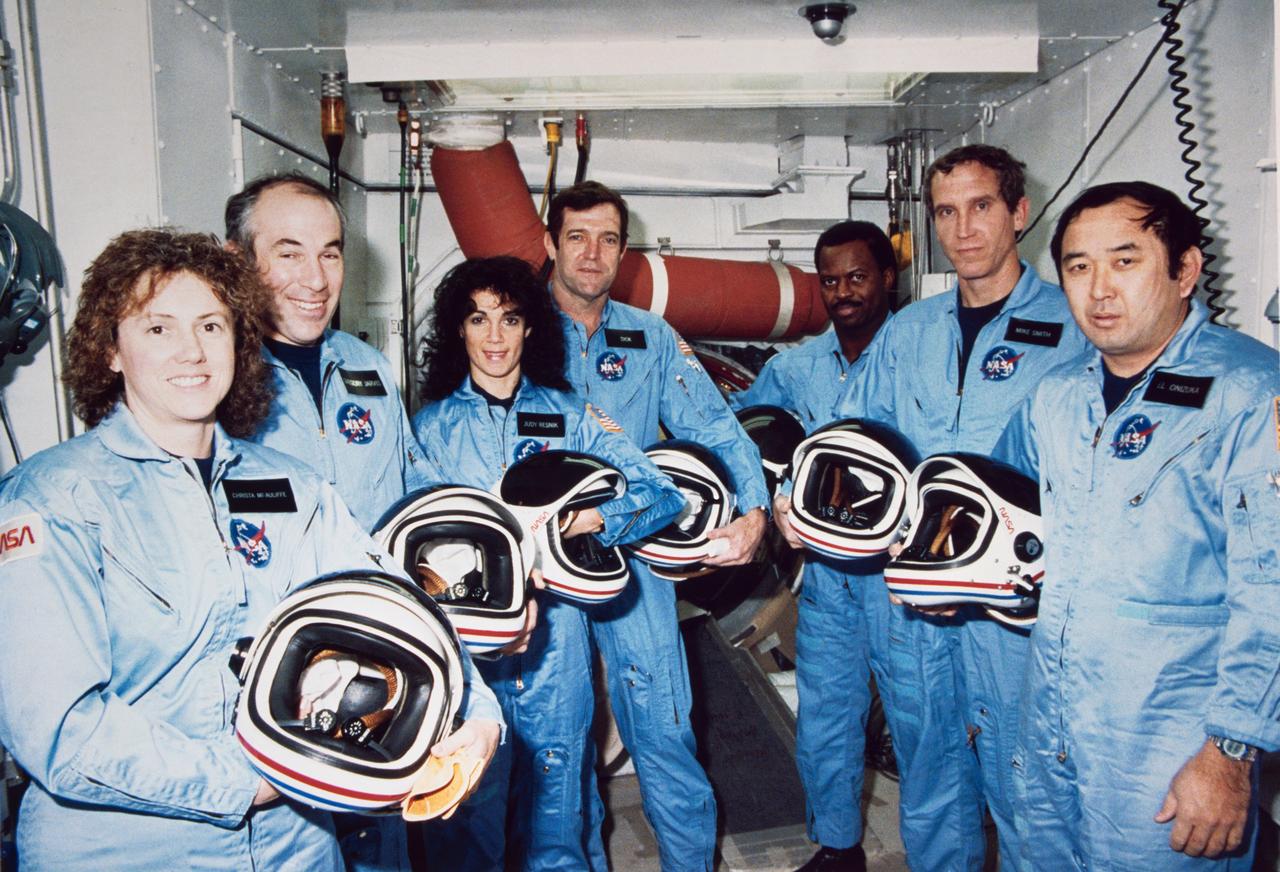
S86-30460 (9 Jan. 1986) --- NASA's STS-51L crew members pose for photographs during a break in countdown training at the White Room, Launch Complex 39, Pad B. Left to right are Teacher-in-Space payload specialist Sharon Christa McAuliffe; payload specialist Gregory Jarvis; and astronauts Judith A. Resnik, mission specialist; Francis R. (Dick) Scobee, mission commander; Ronald E. McNair, mission specialist; Mike J. Smith, pilot; and Ellison S. Onizuka, mission specialist. EDITOR'S NOTE: The STS-51L crew lost their lives in an explosion, onboard the space shuttle Challenger, following launch Jan. 28, 1986. Photo credit: NASA
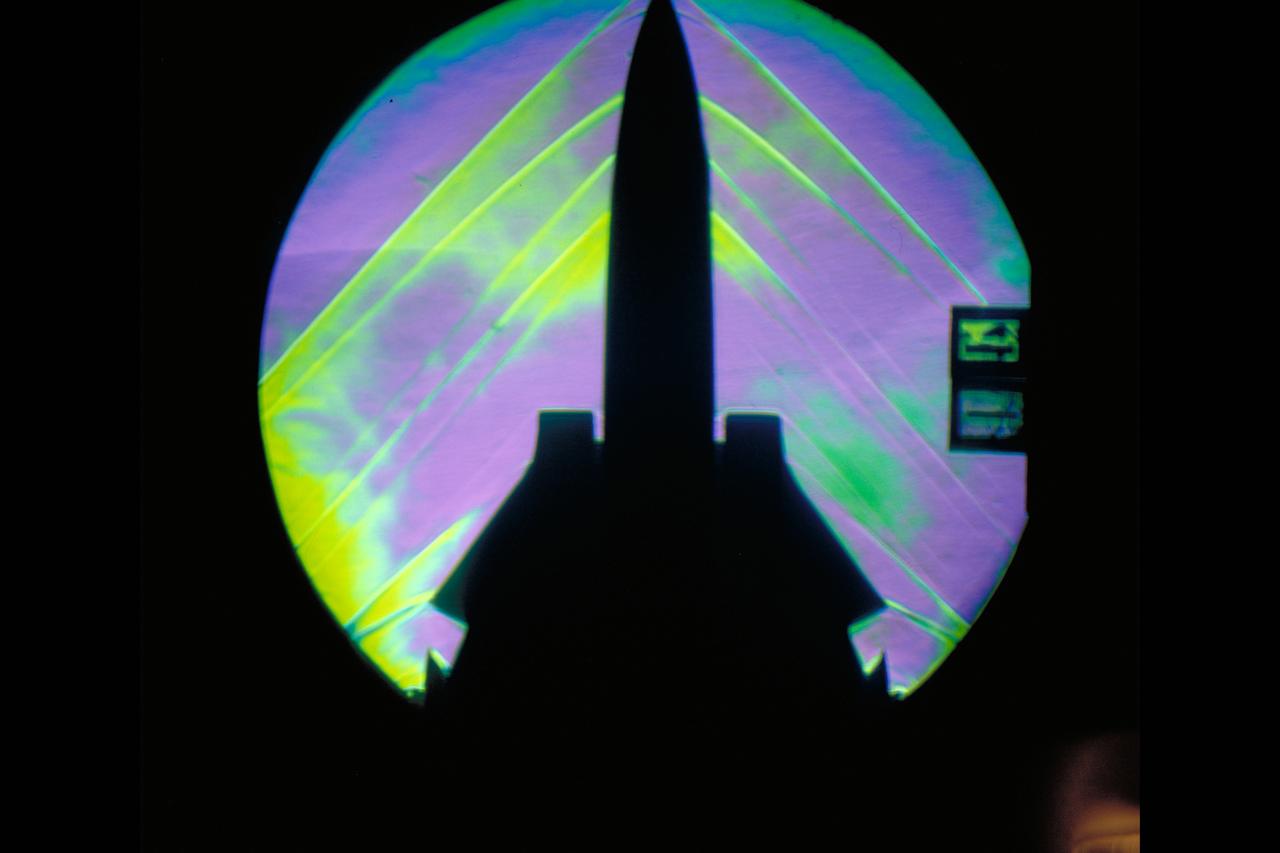
W.T. system F-14D model Schlieren test-041 in 9x7ft w.t.
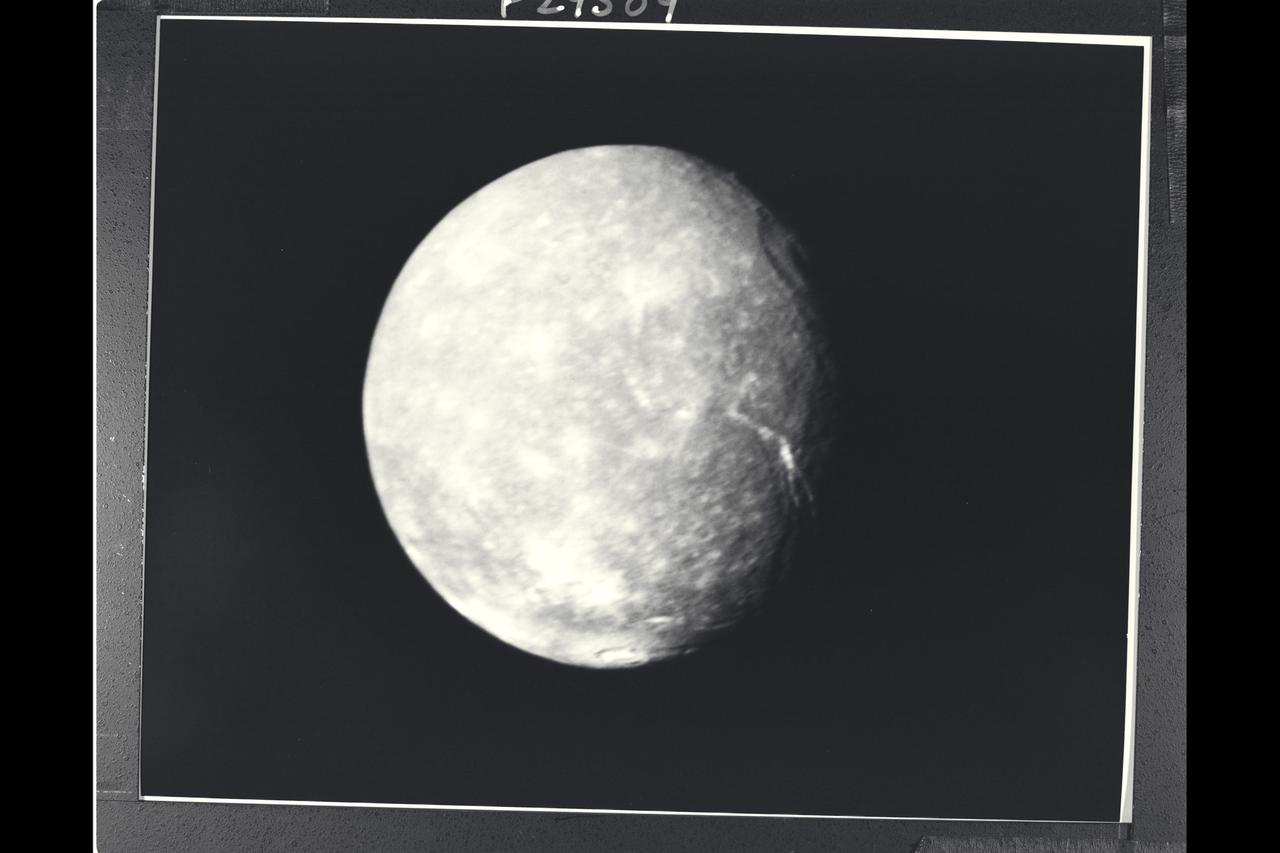
P-29509 BW Range: 500,000 kilometers (300,000 miles) This high-resolution image of Titania was made as Voyager 2 neared its closest approach to Uranus. Voyager's narrow-angle camera acquired this image through the violet and clear filters and shows details about 9 km (6 mi) in size. Titania has a diameter of about 1,600 km (1,000 MI). In addition to many scars due to impacts, Titania displays evidence of other geologic activity at some point in its history. The large trench-like feature near the terminator (day-night boundary) at middle right suggests at least one episode of tectonic activity, Another, basinlike structure near the upper right is evidence of an ancient period of heavy impact activity. The neutral gray color of Titania is characteristic of the Uranian satellites as a whole.
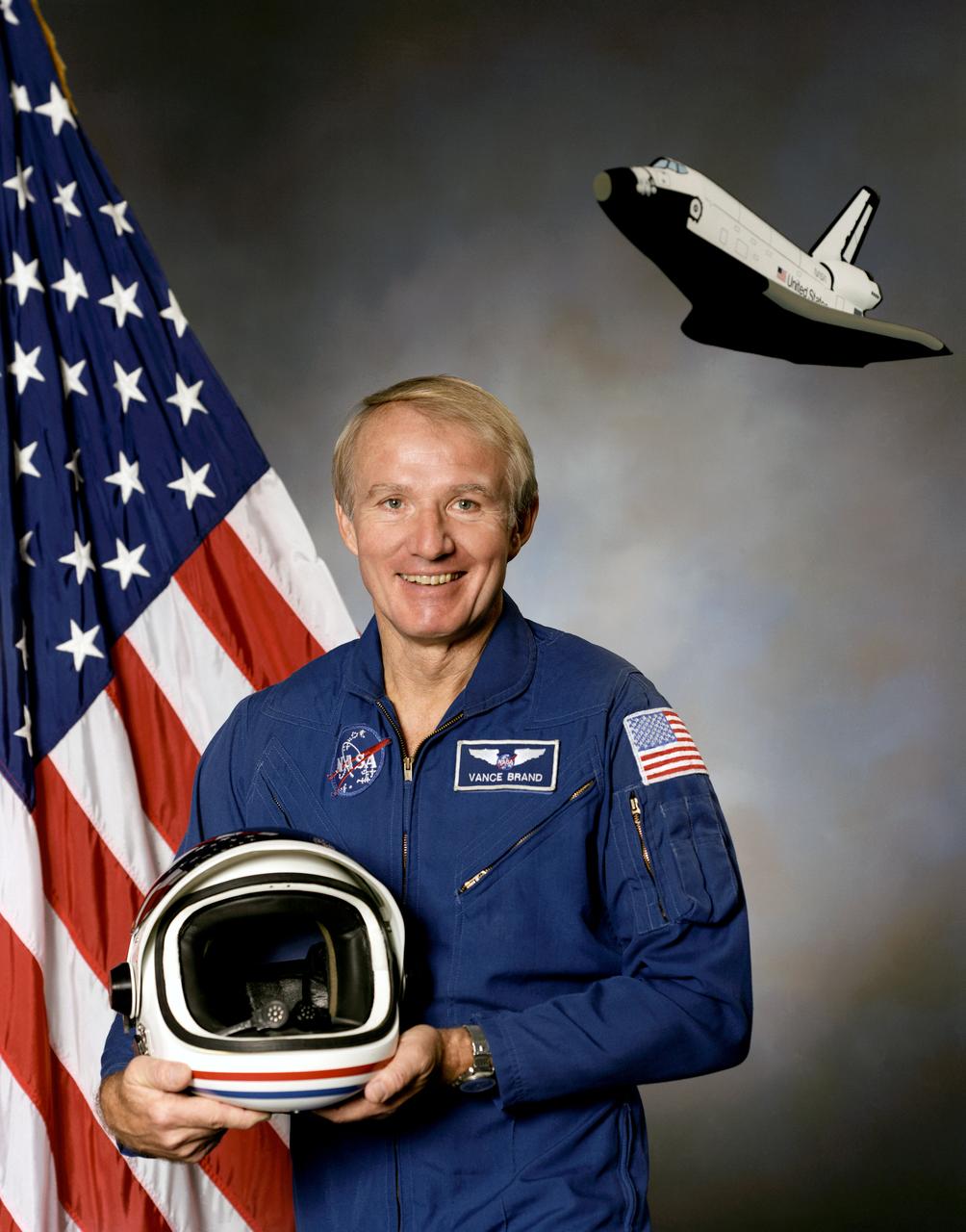
S86-38100 (2 Oct. 1986) --- Astronaut Vance D. Brand.
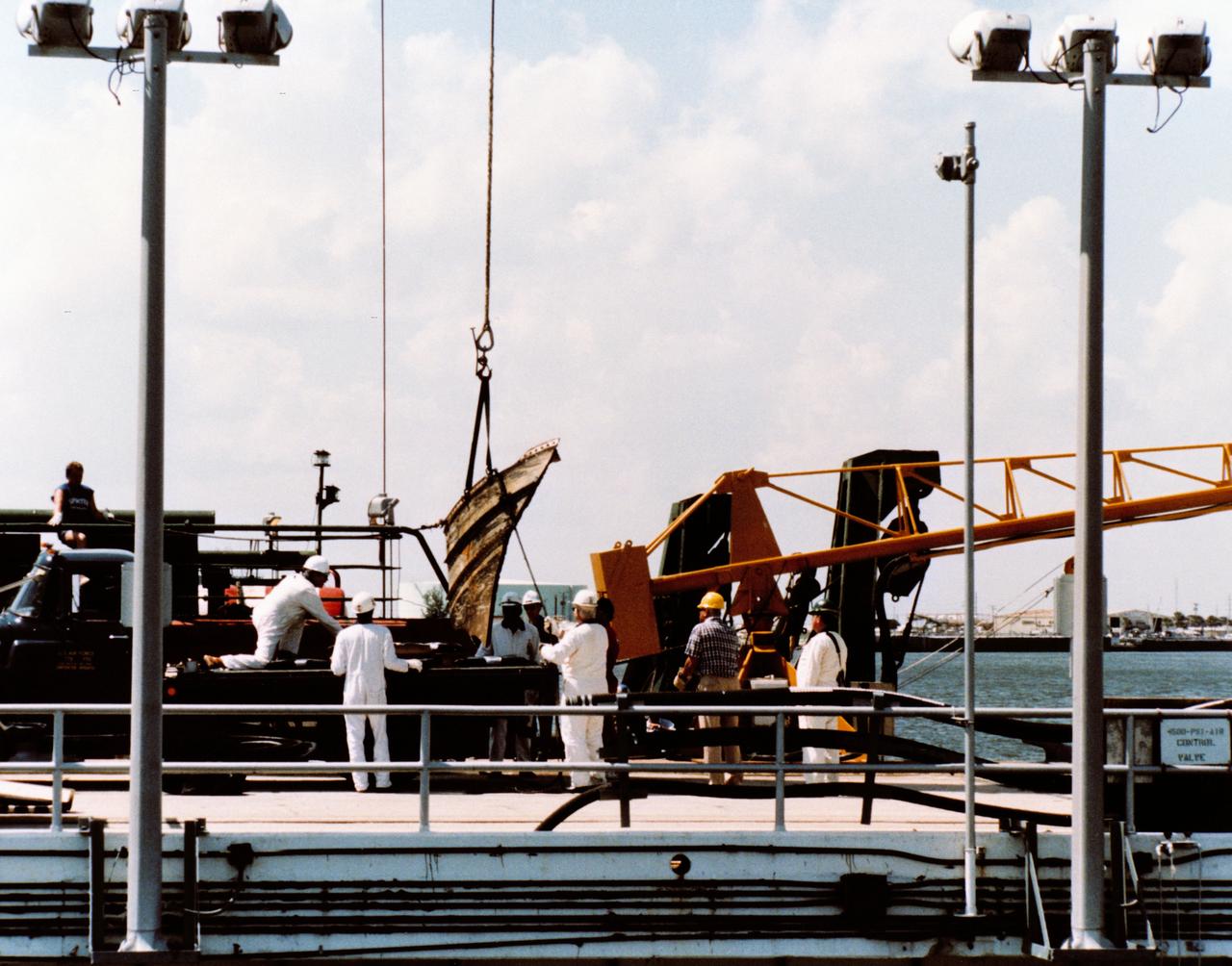
S86-29890 (20 March 1986) --- Stena workhorse arrival and offload of SRB. Trident Basin. (112) (st)
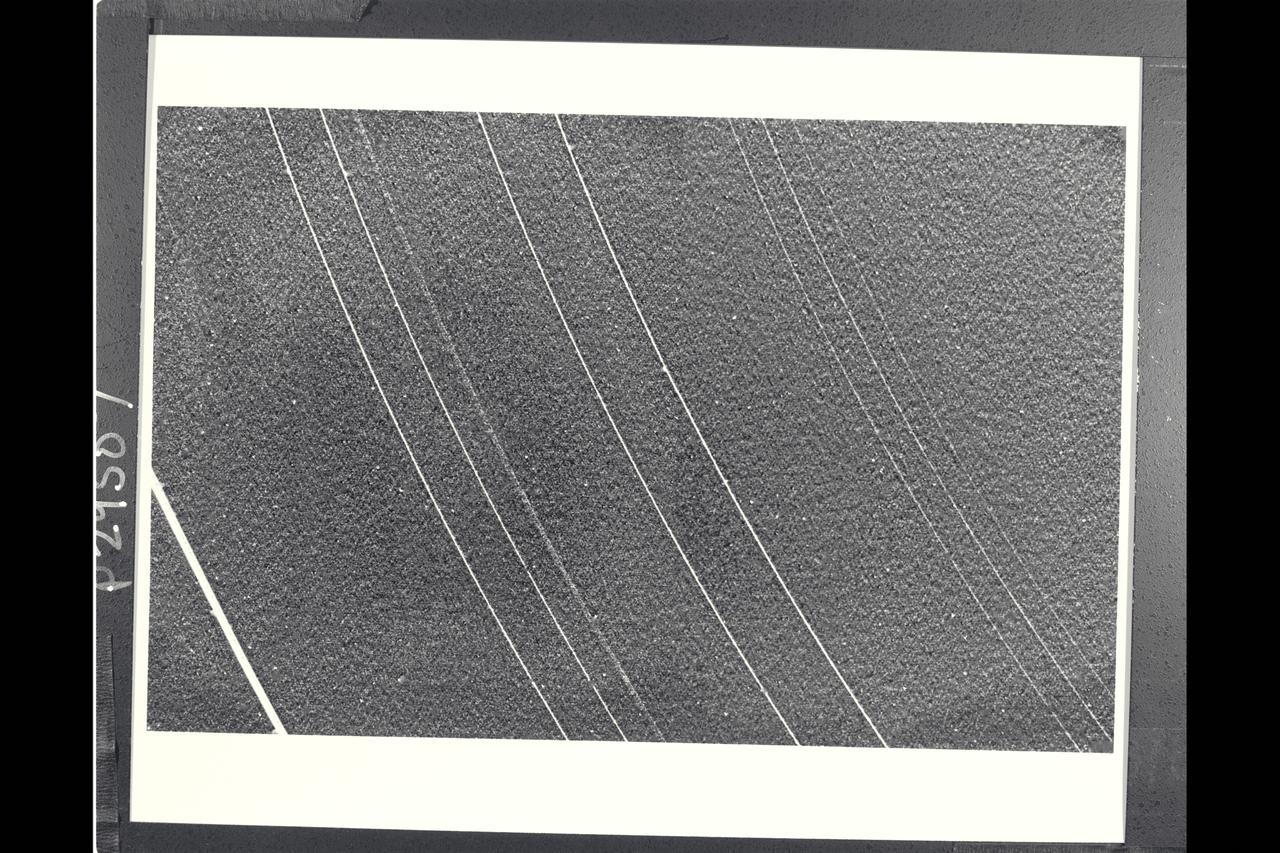
P-29507 Rings Voyager 2 flyby of Uranus
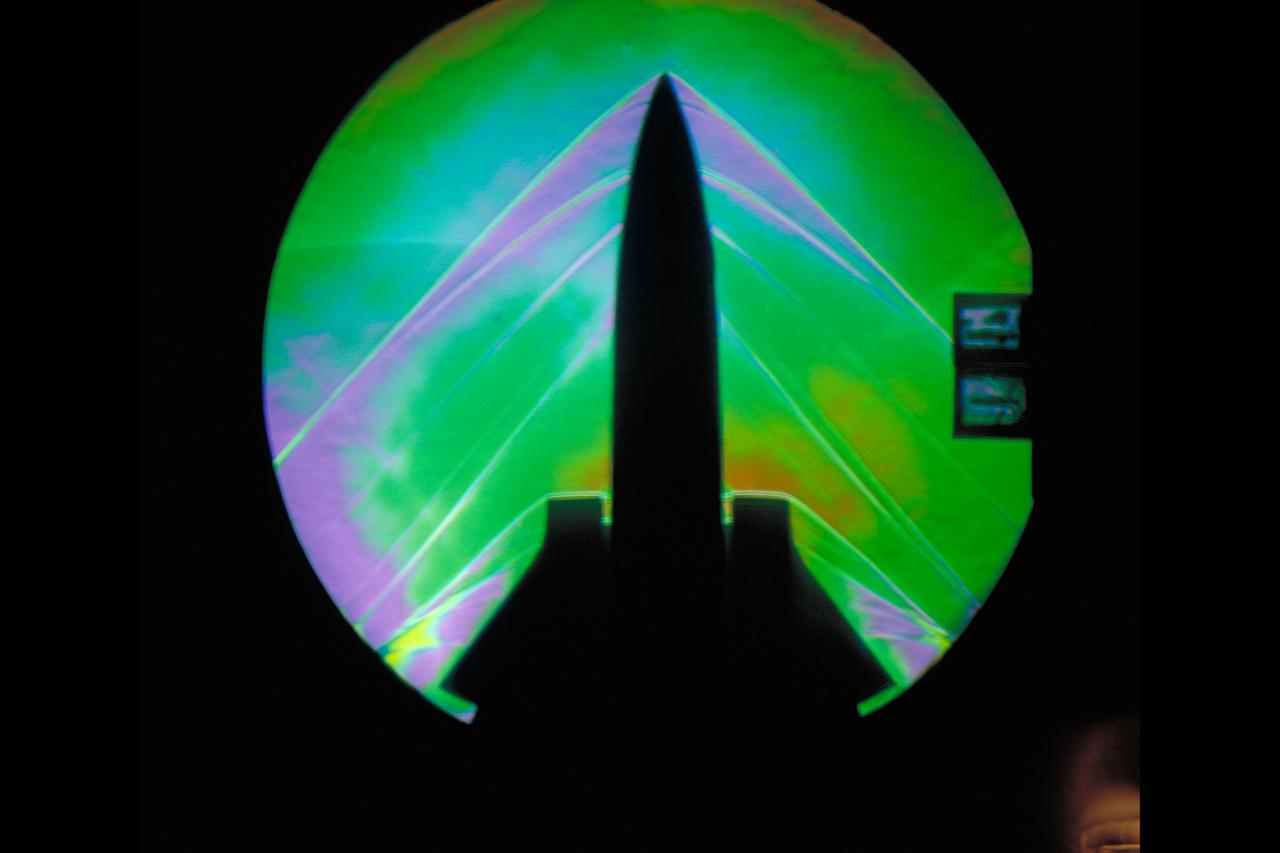
W.T. system F-14D model Schlieren test-041 in 9x7ft w.t.
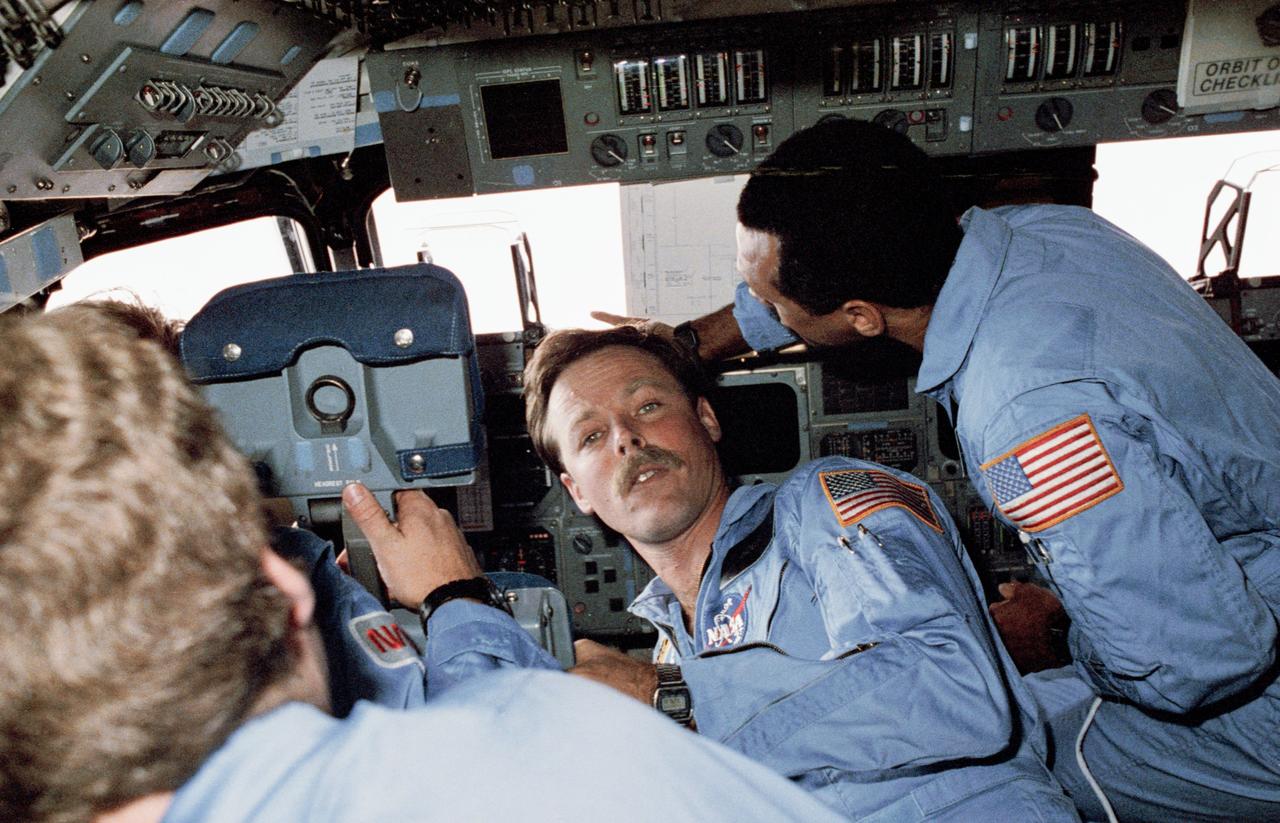
61C-21-009 (12-17 Jan 1986) --- Four members of the seven-man STS 61-C crew aboard the Columbia convene at the commander's station during the five-day mission which kicks off a busy 1986 for the Space Transportation System (STS). Astronaut Robert L. Gibson (center frame), mission commander, is surrounded by (l.-r.). Astronaut Steven A. Hawley, mission specialist, an unidentified crewmember (only partially visible) and astronaut Charles F. Bolden, pilot.
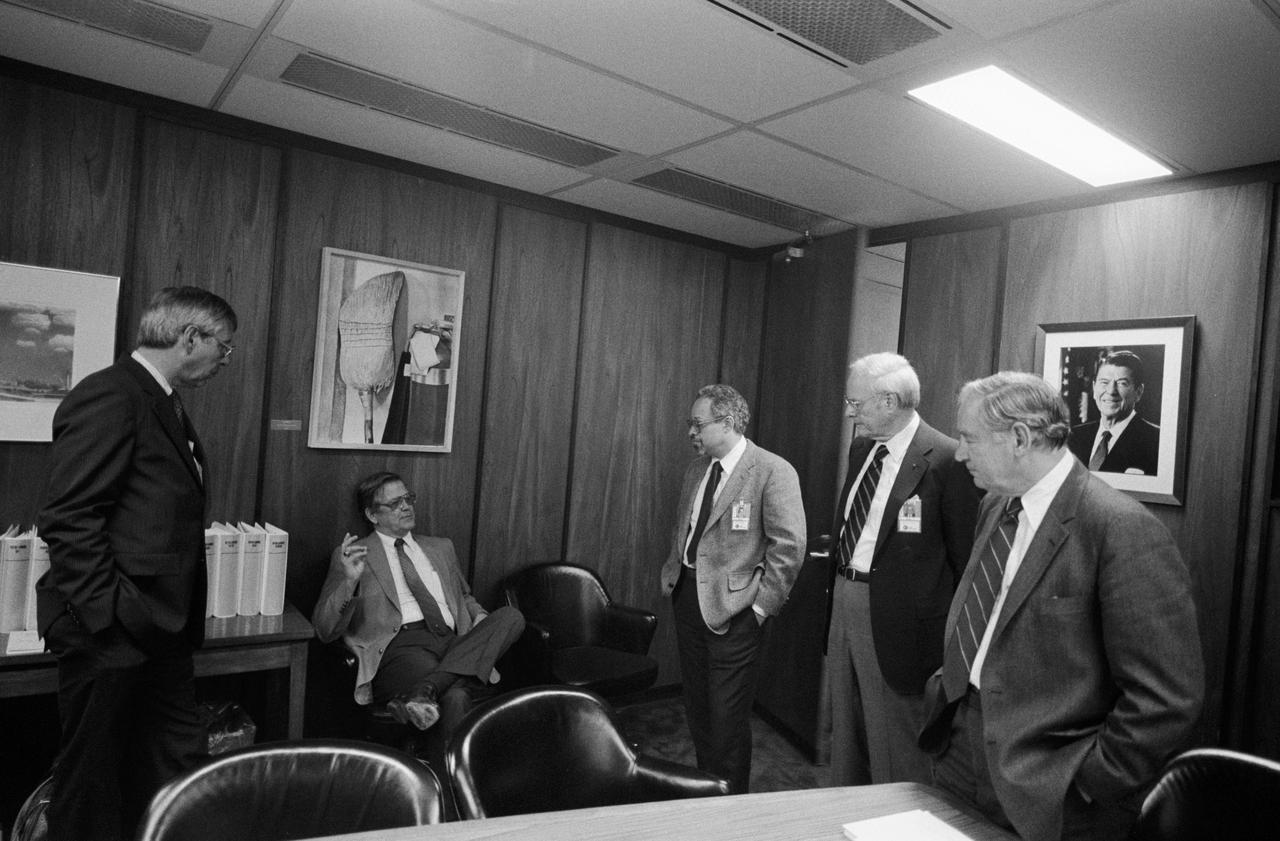
S86-28751 (5 March 1986) --- Two NASA officials talk with members of the Presidential Commission on the Space Shuttle Challenger Accident in the Executive Conference Room of JSC’s Project Management Building. Left to right are JSC Deputy Director Robert C. Goetz; Richard H. Kohrs, Deputy Manager, National Space Transportation Systems Office; and commission members Dr. Arthur B.C. Walker Jr., Robert W. Rummel and Joseph F. Sutter. Photo credit: NASA
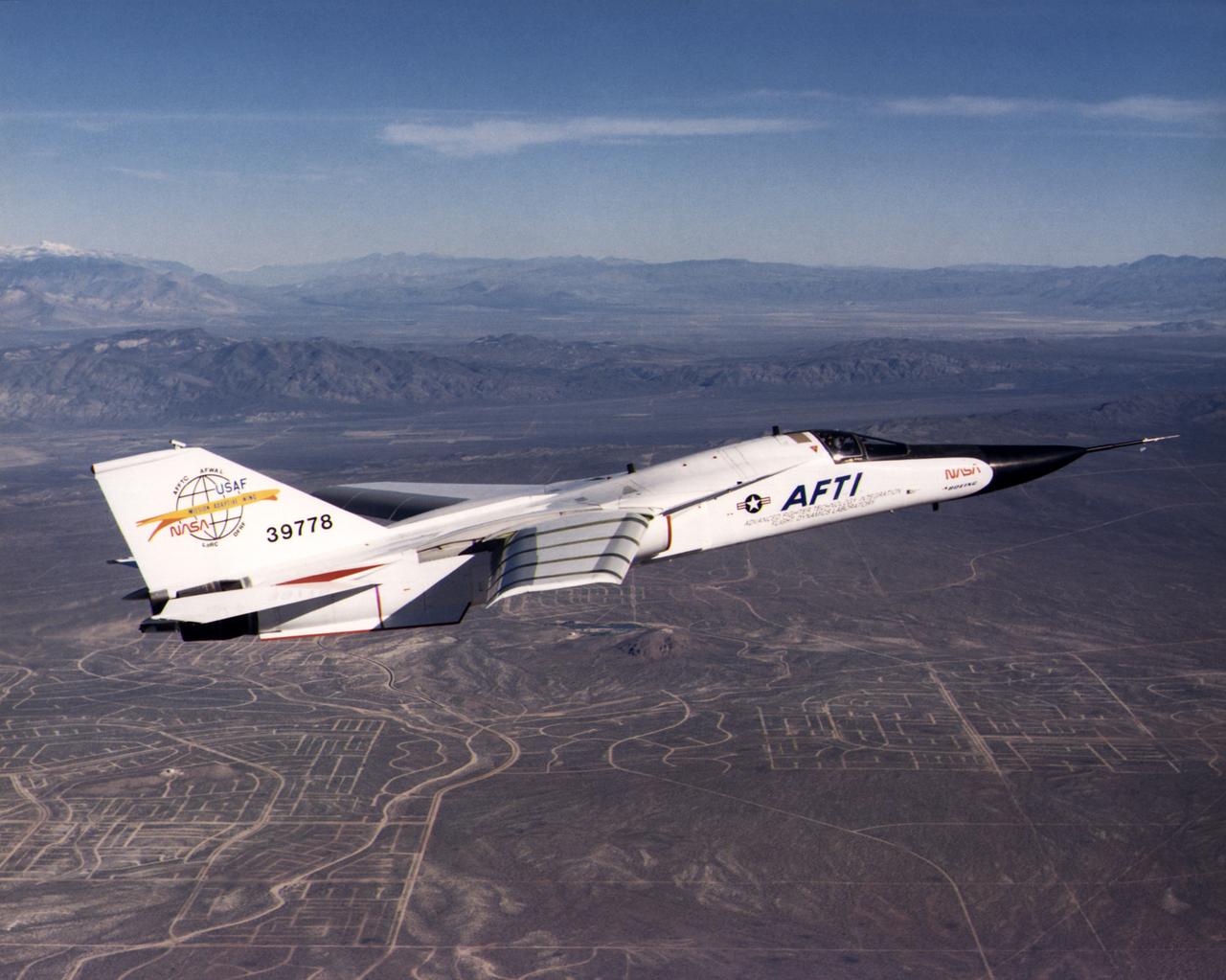
This photograph shows a modified General Dynamics AFTI/F-111A Aardvark in flight with supercritical mission adaptive wings (MAW) installed. With the phasing out of the TACT program came a renewed effort by the Air Force Flight Dynamics Laboratory to extend supercritical wing technology to a higher level of performance. In the early 1980s the supercritical wing on the F-111A aircraft was replaced with a wing built by Boeing Aircraft Company System called a “mission adaptive wing” (MAW), and a joint NASA and Air Force program called Advanced Fighter Technology Integration (AFTI) was born.