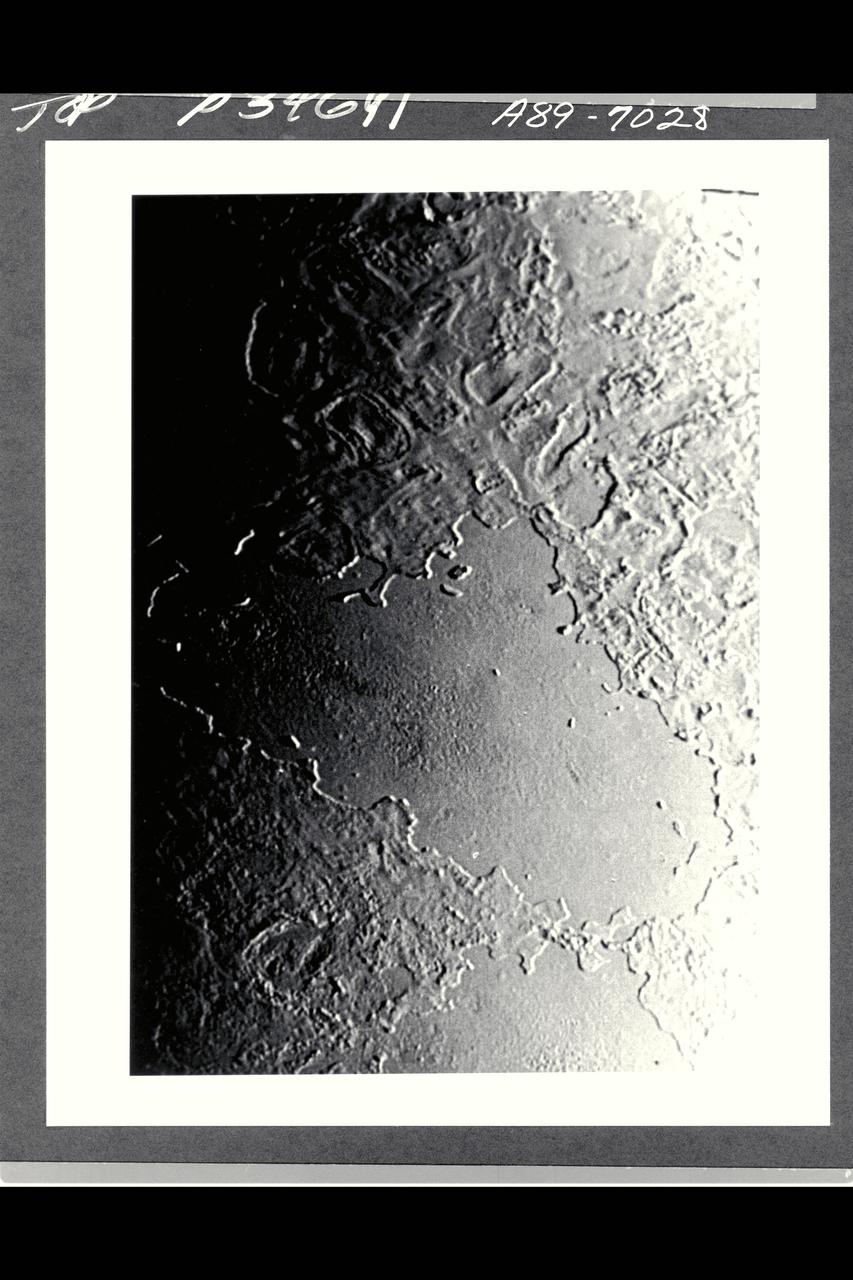
P-34668 This narrow angled image of Neptune's Triton, part of a sequence recieved from Voyager 2 shows a large flooded basin about 200 km. or 120 miles wide and 400 km. or 240 miles long. It appears to have been formed chiefly by two large, ancient craters. The walls of the basin have retreated, possibly as a consequence of sapping or collapse into the fluid that filled the main floor. The vent from which the flood evidently erupted lies near the right hand end of the basin. The surface of the eruptive material is rough near the vent and along the center of the basin, perhaps as a consequence of the presence of large rafts of ice. The absence of resolved impact craters on the floor of the basin indicatyes a young age for the flood.
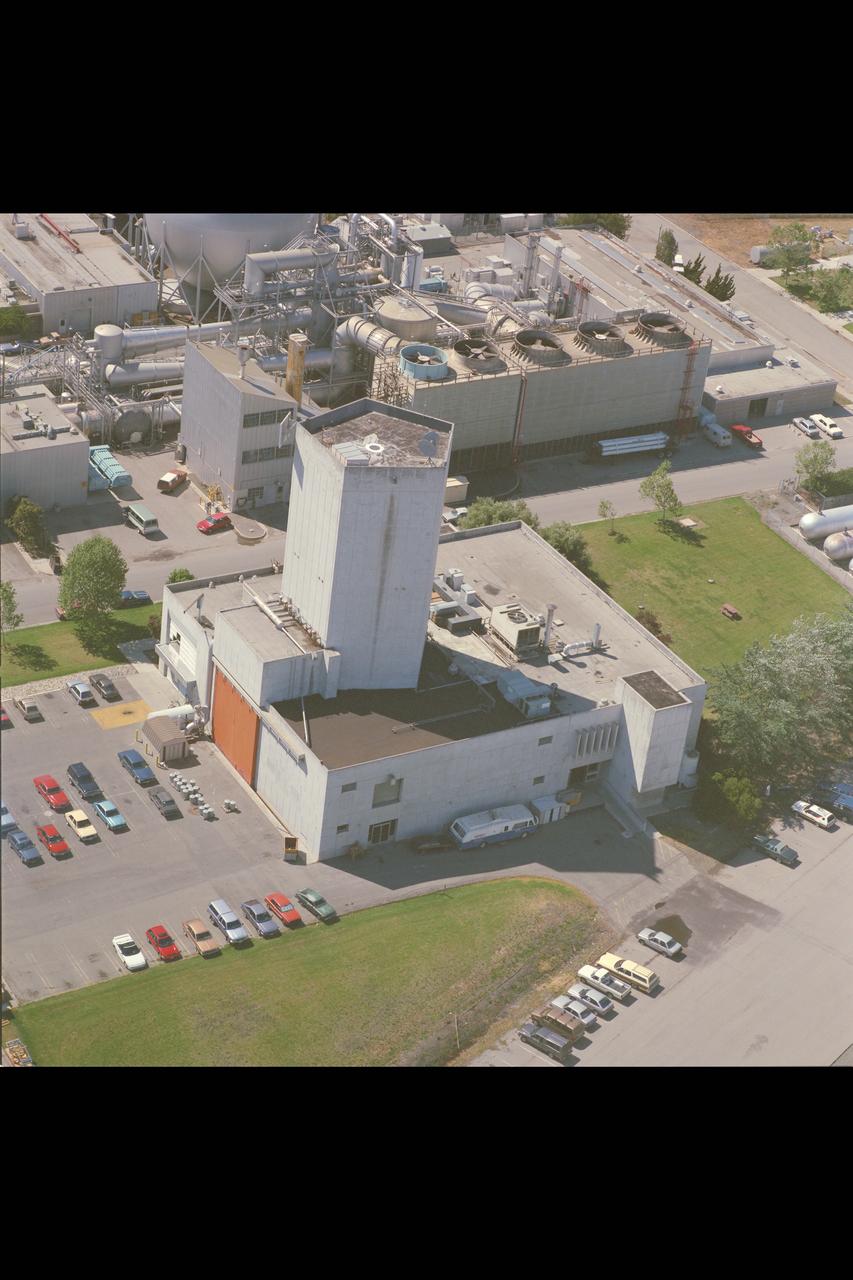
Ames Facility Aerials: N-242
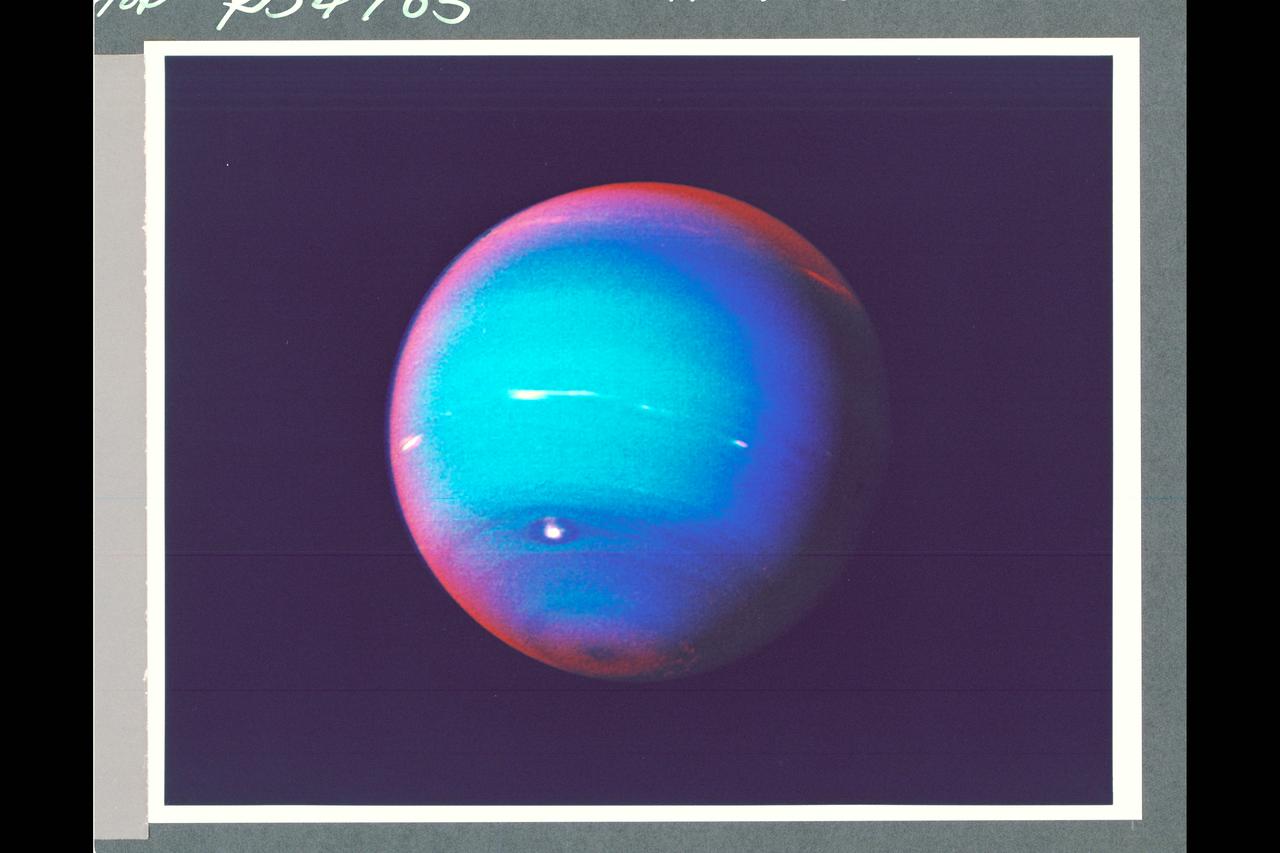
P-34705 This false-color photograph of Neptune was made from Voyager 2 images taken through three filters: blue, green, and a filter that passes light at a wavelength that is absorbed by methane gas. Thus, regions that appear white or bright red are those that reflect sunlight before it passes through a large quantity of methane. The image reveals the presence of a ubiquitous haze that covers Neptune in a semitransparent layer. Near the center of the disk, sunlight passes through the haze and deeper into the atmosphere, where some wavelenghths are absorbed by methane gas, causing the center to appear less red. Near the edge of the planet, the haze scatters sunlight at a higher altitude, above most of the methane, causing the bright red edge around the planet. By measuring haze brightness at several wavelengths, scientists are able to estimate the thickness of the haze and its ability to scatter sunlight. The image is among the last of the full-disk photos that Voyager 2 took before beginning its endless journey into interstellar space.
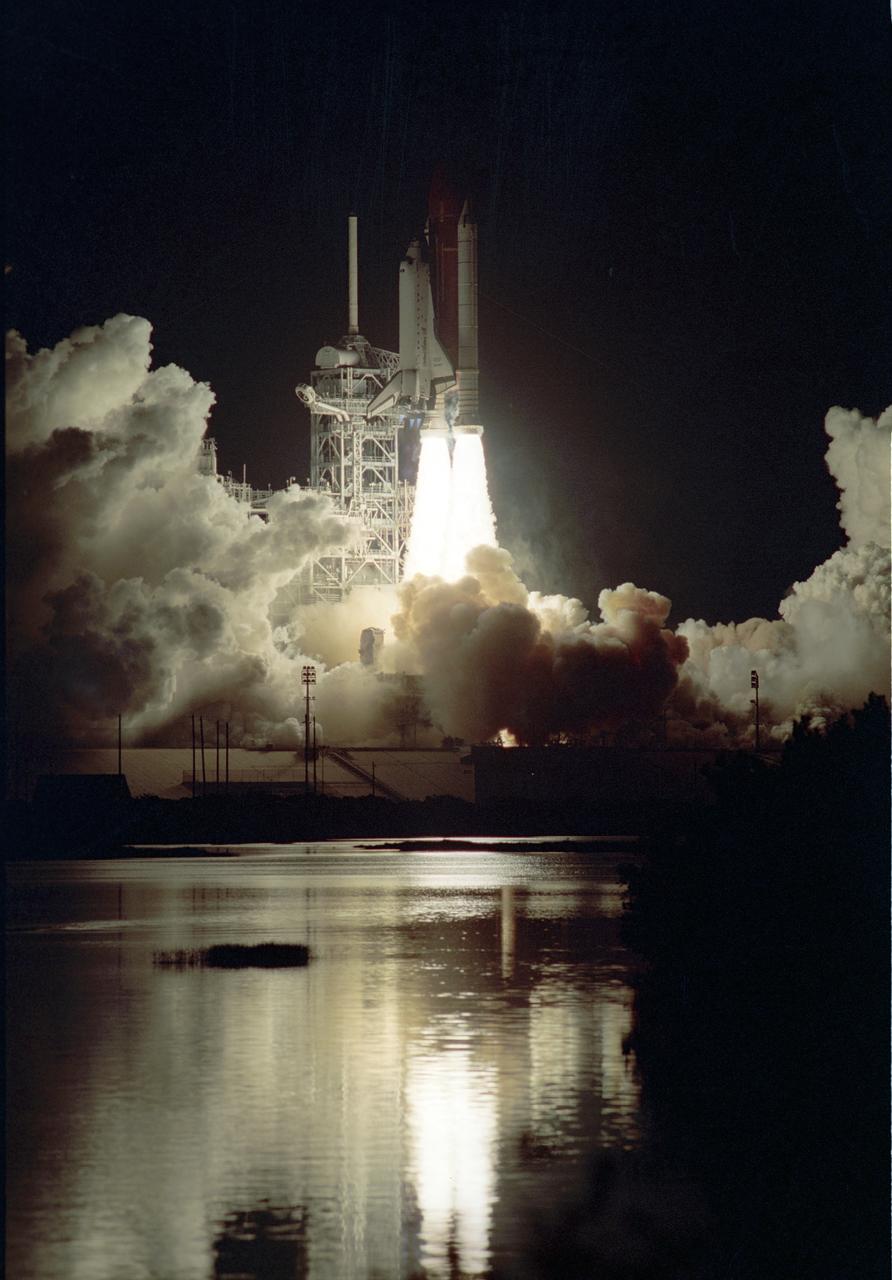
On November 22, 1989, at 7:23:30pm (EST), five astronauts were launched into space aboard the Space Shuttle Orbiter Discovery for the 5th Department of Defense (DOD) mission, STS-33. Crew members included Frederick D. Gregory, commander; John E. Blaha, pilot; and mission specialists Kathryn C. Thornton, Manley L. (Sonny) Carter, and F. Story Musgrave.
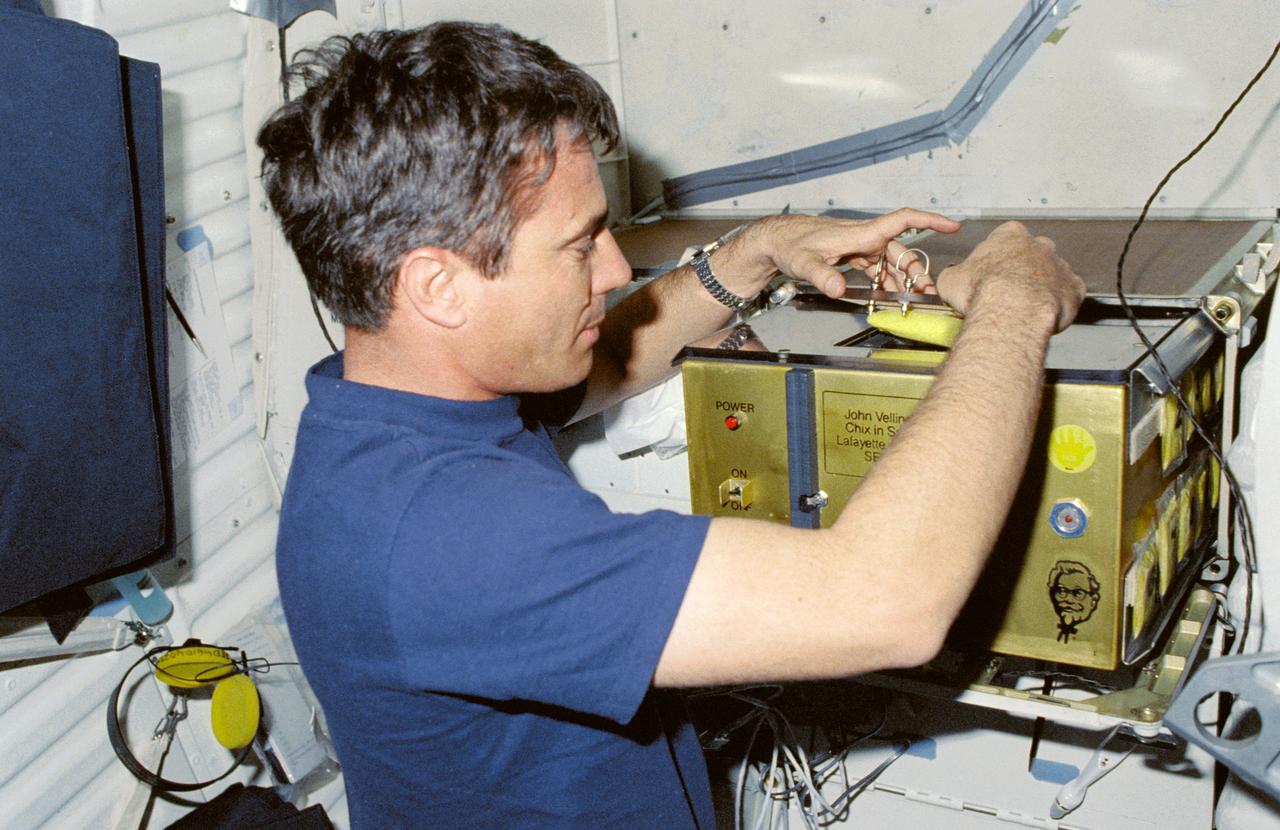
STS029-01-001 (16 Marach 1989) --- Astronaut John E. Blaha, STS-29 pilot, checks an incubator on the mid deck of Earth-orbiting Discovery during Flight Day 4 activity. The incubator is part of a student involvement program experiment titled, "Chicken Embryo Development in Space." The student experimenter is John C. Vellinger. The experiment's sponsor is Kentucky Fried Chicken. This photographic frame was among NASA's third STS-29 photo release. Monday, March 20, 1989. Crewmembers were Astronauts Michael L. Coats, John E. Blaha, James F. Buchli, Robert C. Springer and James P. Bagian.
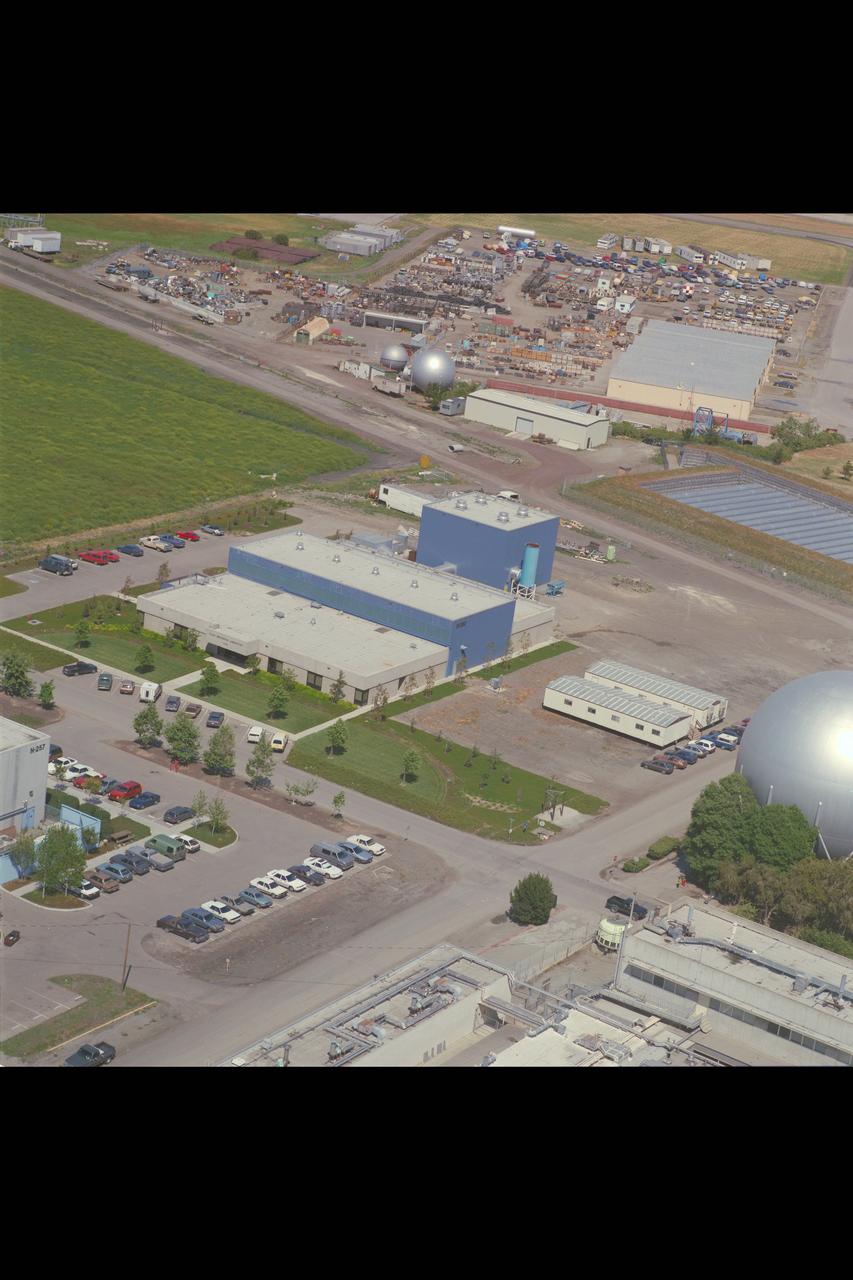
Ames Facility Aerials: N-260
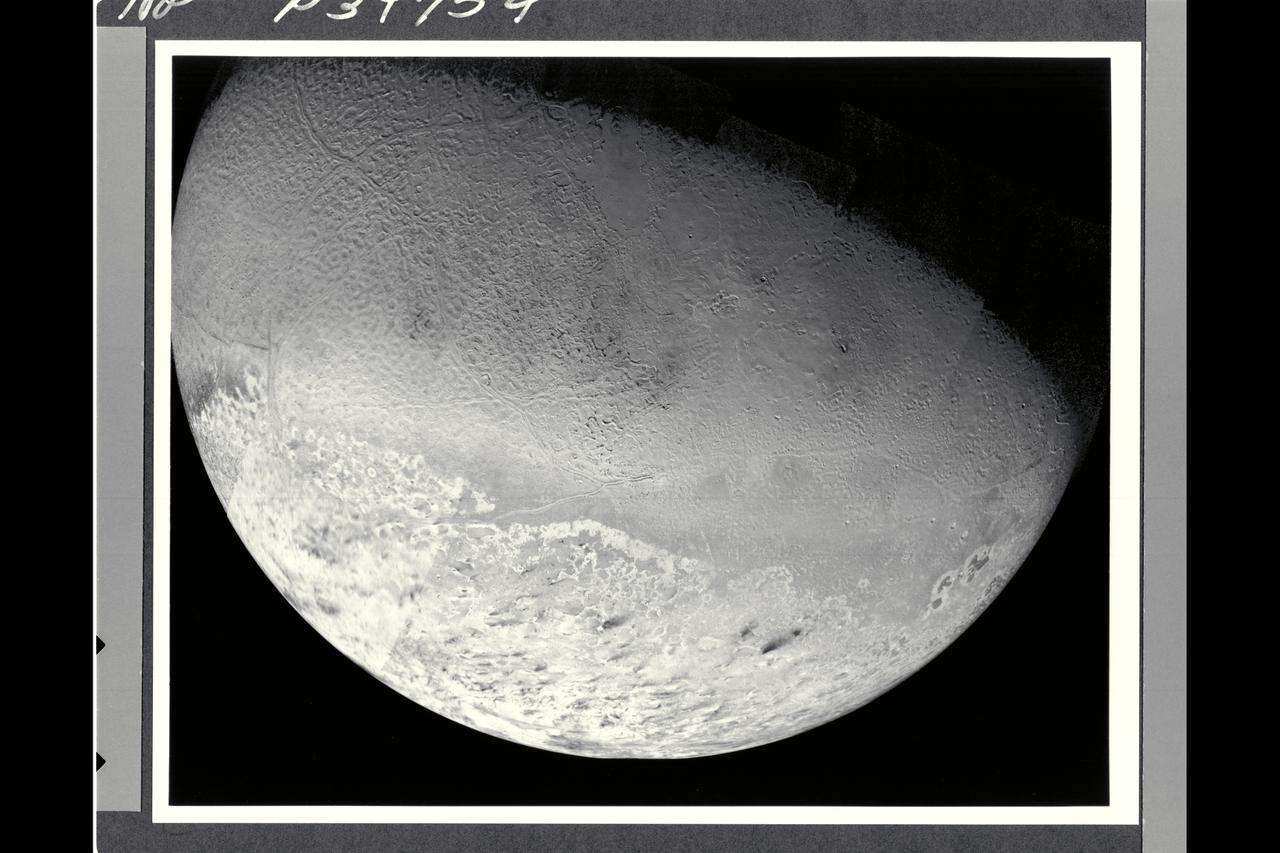
This photomosaic of Triton, assembled from 14 individual frames, shows the great variety of its surface features. At the bottom of the image are remnants of the south polar cap, containing 'dark' streaks generally aligned towards the northeast (upper right in the image). Even though these are darker than other features on Triton, they reflect nearly ten times as much light as the surface of the Earth's moon. North of the cap, in the western (left) half of the disk is the region which has been informally dubbed the 'cantaloupe' terrain. Small dimples with upraised rims and shallow central depressions dot the area. Long fractures have opened allowing some icy material to ooze up and form a central ridge. These criss-cross the region and extend into parts of the polar cap region. Towards the south this terrain has a light covering of frost. Running east to the limb of Triton, just north of the polar cap, is an area of smooth plains and low hills which is the most densely cratered region seen. In the northeast (upper right) of this image are plains which show evidence for extensive resurfacing, including possible extrusions of flowing material onto the surface. This region also contains two large smooth areas reminiscent of the maria of the Earth's moon which were formed by large-scale volcanic flooding. Near the eastern (right) limb of Triton are three darker gray markings with sharply defined brighter borders. These are unlike anything else seen in the solar system, and their origin is not yet understood.
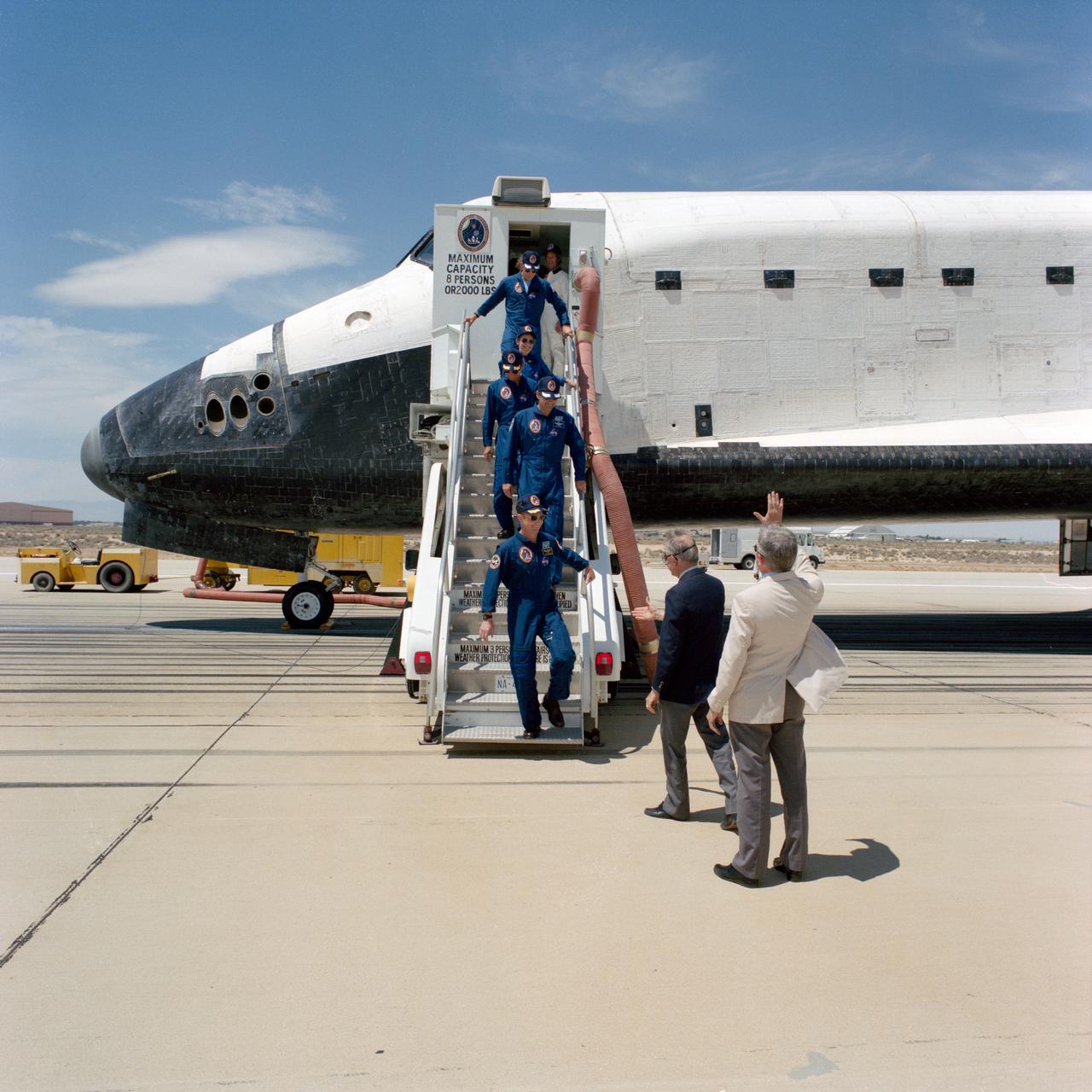
STS030-S-137 (8 May 1989) --- Crewmembers who spent four full days in space aboard Space Shuttle Atlantis egress their temporary home for a welcome meeting with terra firma. Pictured, from bottom of steps to top, are Astronauts David M.Walker, Ronald J. Grabe, Norman E. Thagard, Mary L. Cleave and Mark C. Lee. Rear Admiral Richard H. Truly (foreground), acting NASA Administrator, and Dale D. Myers, Deputy Administrator of NASA, await to greet the crewmembers. Minutes earlier, the spacecraft's landing gear came to a stop at 12:44:33 p.m. (PDT), 8 May 1989. It landed on Runway 22, a concrete facility, like a number of other NASA flights. Still others have landed on unpaved dry lake bed strips.
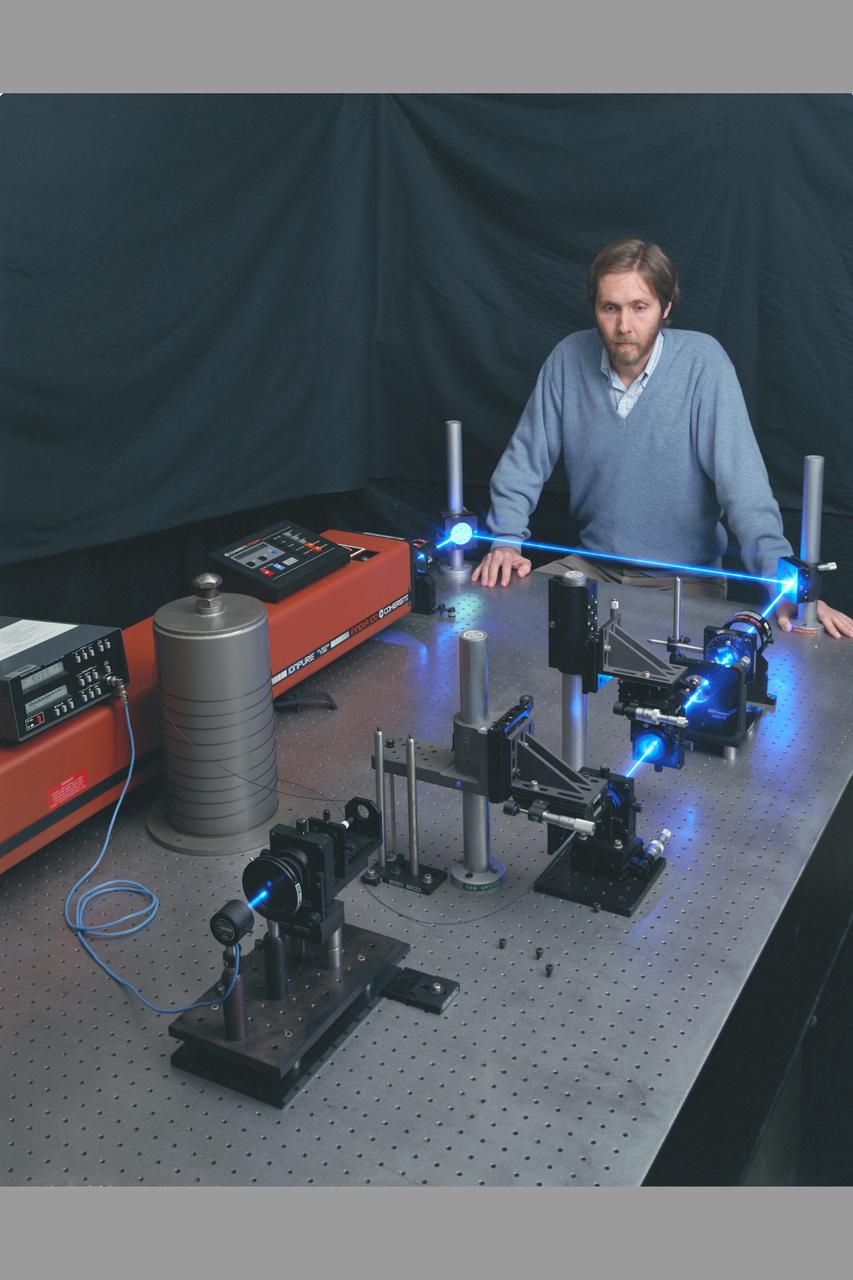
N-213 Laser Optics Laboratory with Dana Lynch
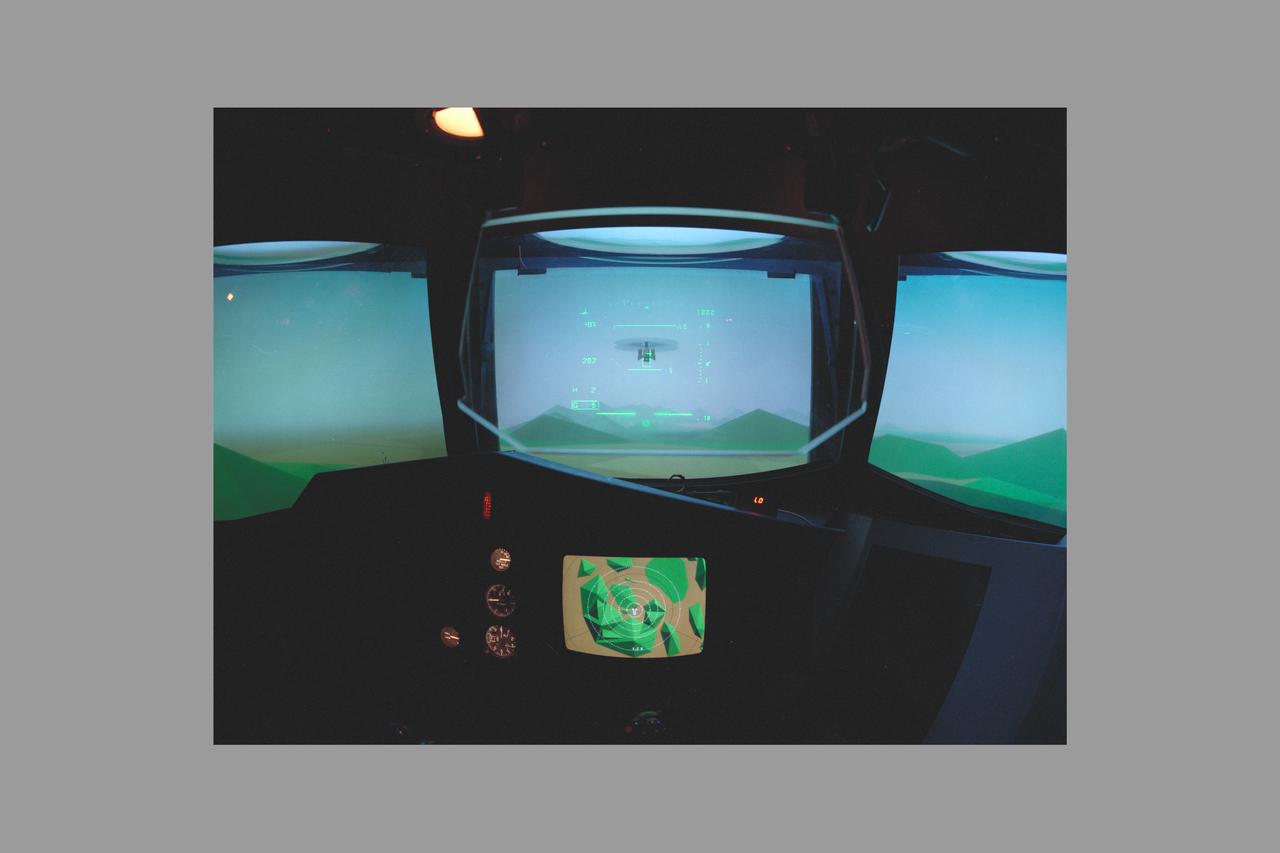
VMS I-Cab: MV-22 Simulation.
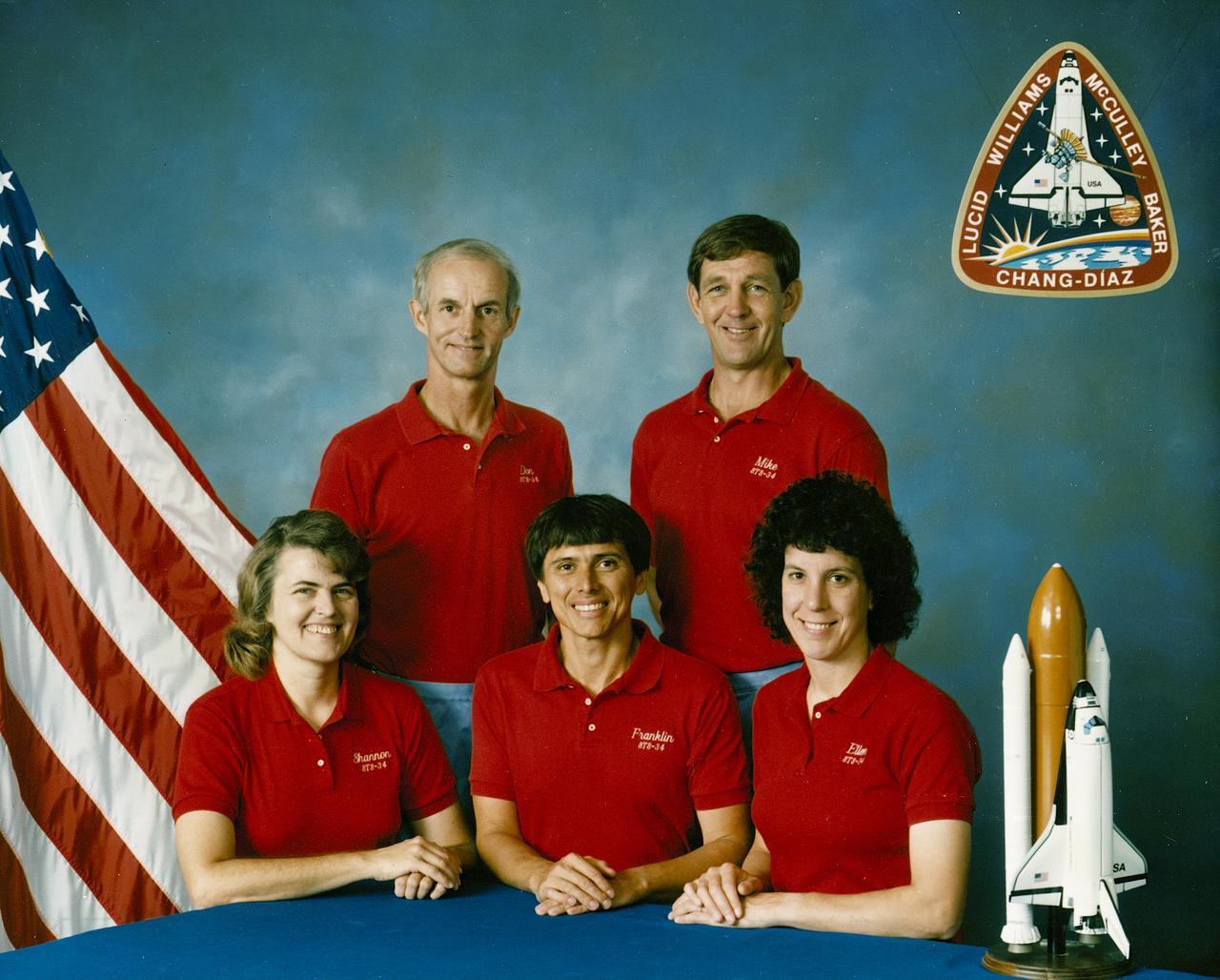
The STS-34 crew portrait includes 5 astronauts. Pictured left to right are Shannon W. Lucid, mission specialist; Donald E. Williams, commander; Franklin R. Chang-Diaz, mission specialist; Michael J. McCulley, pilot; and Ellen S. Baker, mission secialist. The crew of 5 launched aboard the Space Shuttle Orbiter Atlantis on October 18, 1989 at 12:53:40pm (EDT). The primary payload was the Galileo Jupiter Spacecraft and attached inertial upper stage (IUS). Deployed 6 hours and 30 minutes into the flight, the IUS stages fired, boosting Galileo on trajectory for a 6 year trip to Jupiter.
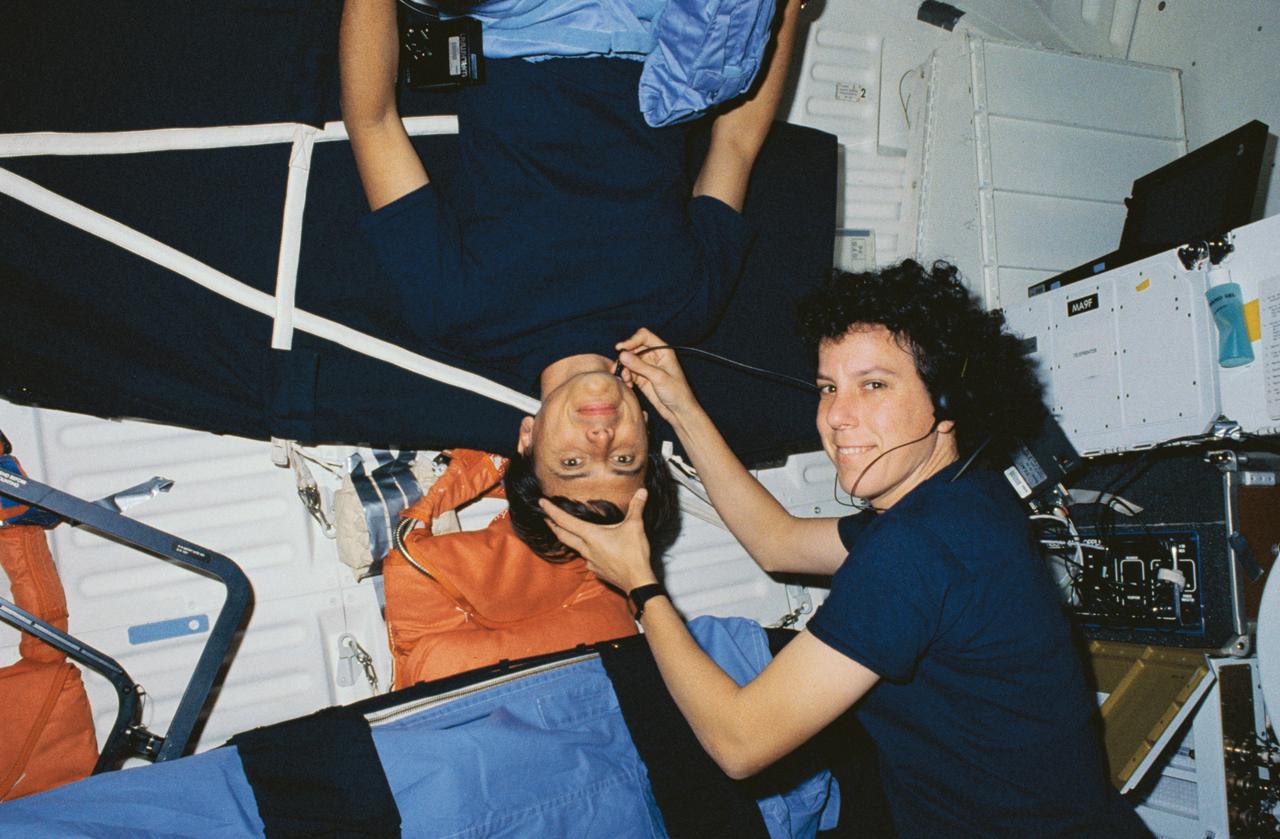
STS034-08-007 (18-23 Oct. 1989) --- Astronaut Ellen S. Baker, an STS-34 mission specialist and medical doctor, conducts a medical examination on astronaut Franklin R. Chang-Diaz, mission specialist, on the middeck of the Earth-orbiting space shuttle Atlantis. Dr. Baker was monitoring Chang-Diaz's blood flow. The scene was recorded on film with a 35mm camera.Photo credit: NASA or National Aeronautics and Space Administration
Ames Facility Aerials: looking north east
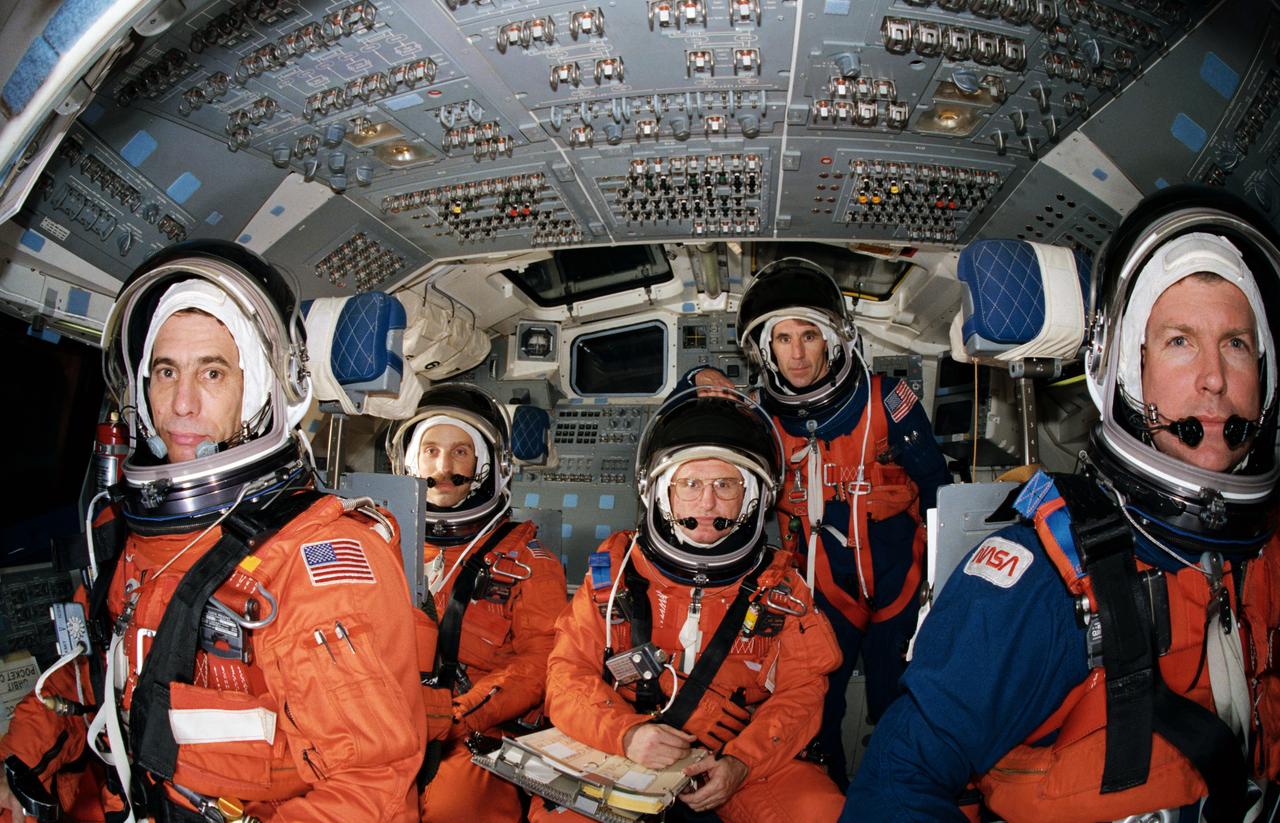
S89-26390 (January 1989) --- The five crew members for STS-29 pause during launch and entry phase rehearsals in the crew compartment trainer at the Johnson Space Center. Four members are in their entry positions and the fifth has been "borrowed" for a moment from the middeck. In front are John E. Blaha (left), pilot, and Michael L. Coats, mission commander. Behind them are James P. Bagian (left), and James F. Buchli, both mission specialists. Robert C. Springer, the third mission specialist, stands here at aft station. He will occupy Discovery's middeck for entry phase, while Bagian will occupy that post for launch. Photo credit: NASA
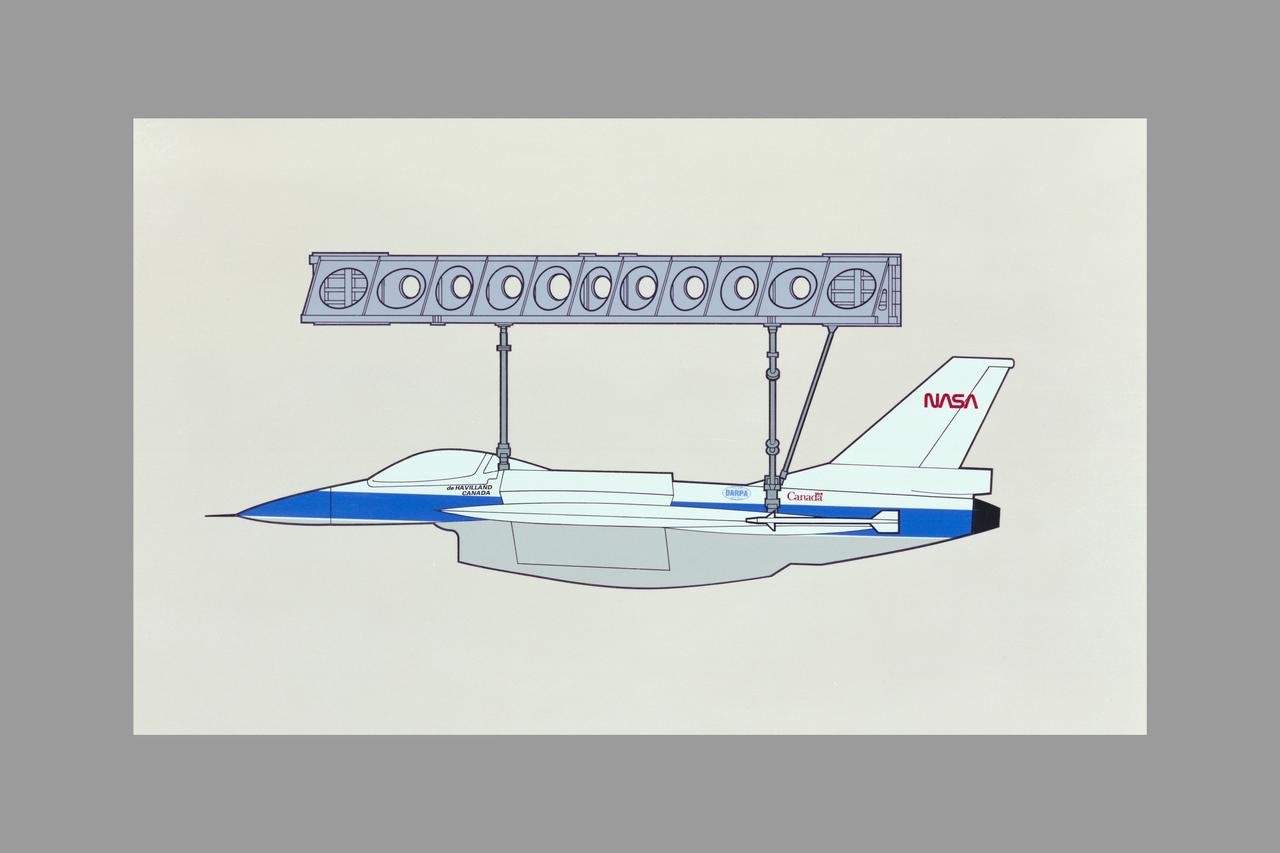
Drawing DARPA Ejector fighter model (deHavilland/Canada/NASA) E-7
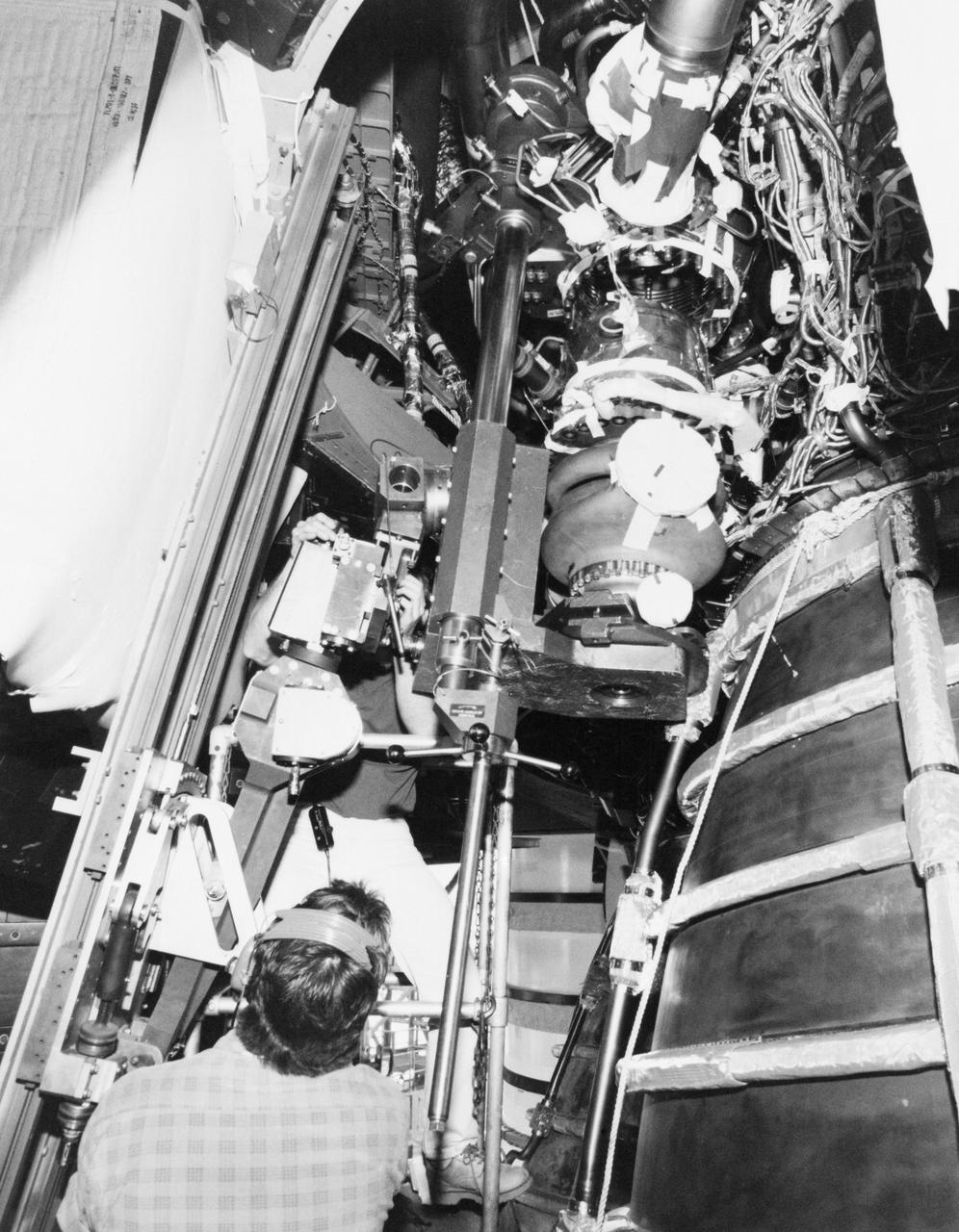
S89-28092 (7 Feb 1989) --- Kennedy Space Center technicians inspect an area near the three main engines of the Space Shuttle Discovery prior to the removal of one of three oxidozer turbo pumps. New pumps are scheduled to be installed soon. Now at Launch Pad 39-B, Discovery is set for launch in mid-March for Mission STS-29. Primary payload will be TDRS-D. Crewmembers are Astronauts Michael L. Coats, mission commander, John E. Blaha, pilot; along with James F. Buchli, Robert C. Springer and James P. Bagian, all mission specialists.
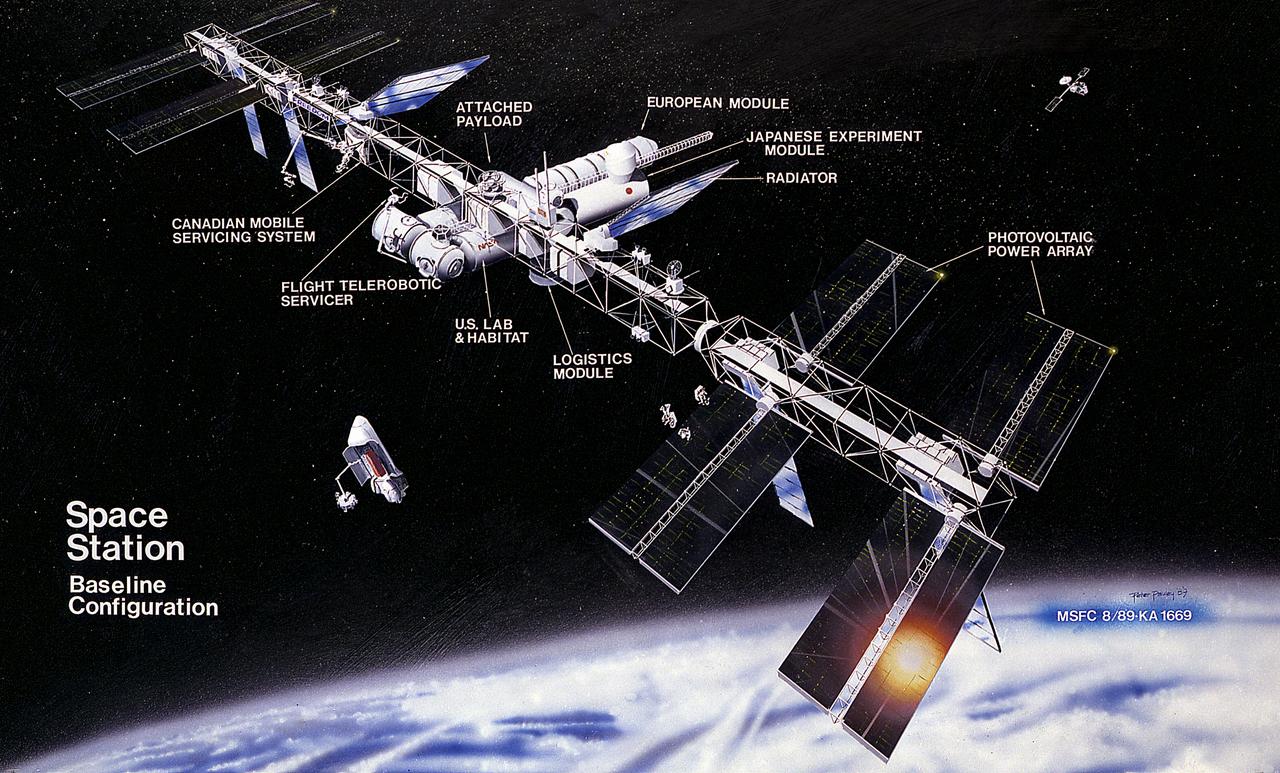
In response to President Reagan's directive to NASA to develop a permanent marned Space Station within a decade, part of the State of the Union message to Congress on January 25, 1984, NASA and the Administration adopted a phased approach to Station development. This approach provided an initial capability at reduced costs, to be followed by an enhanced Space Station capability in the future. This illustration depicts the baseline configuration, which features a 110-meter-long horizontal boom with four pressurized modules attached in the middle. Located at each end are four photovoltaic arrays generating a total of 75-kW of power. Two attachment points for external payloads are provided along this boom. The four pressurized modules include the following: A laboratory and habitation module provided by the United States; two additional laboratories, one each provided by the European Space Agency (ESA) and Japan; and an ESA-provided Man-Tended Free Flyer, a pressurized module capable of operations both attached to and separate from the Space Station core. Canada was expected to provide the first increment of a Mobile Serving System.
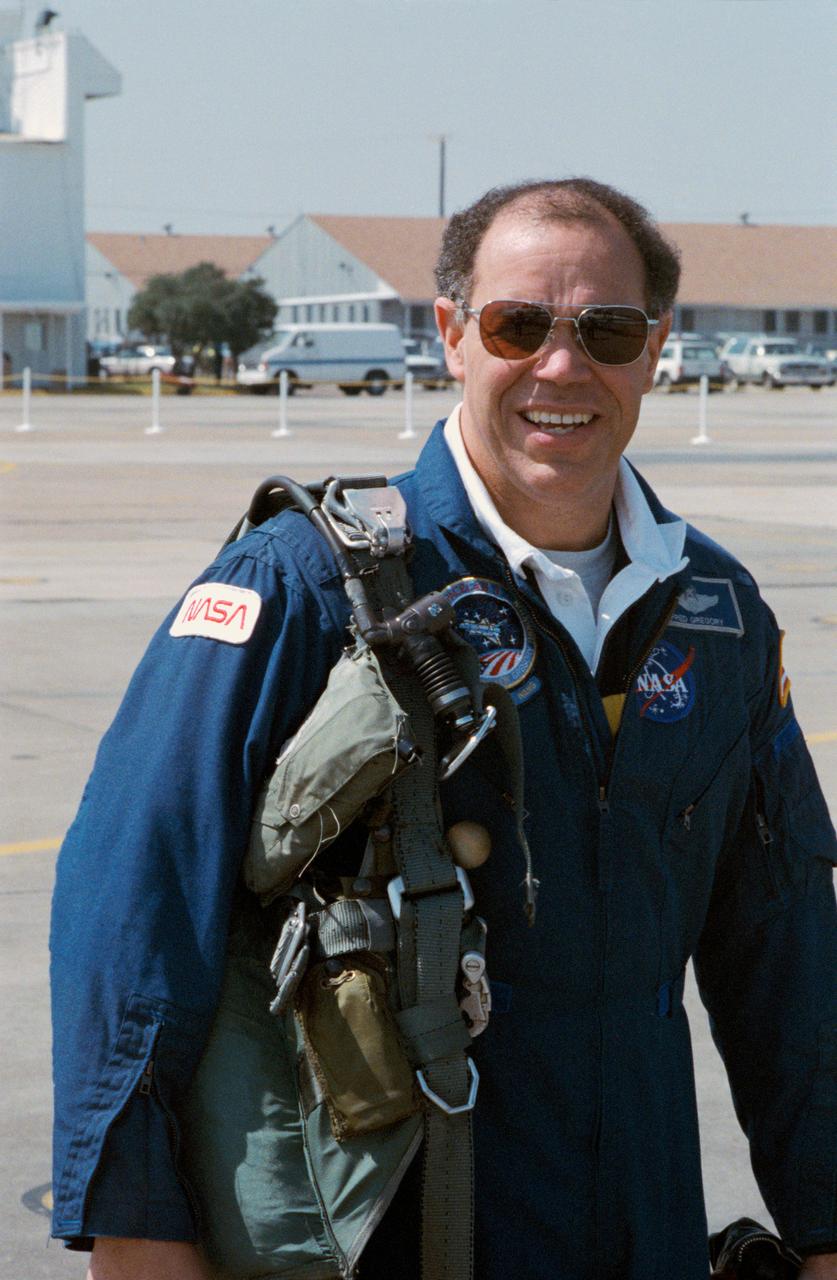
STS029-S-001 (10 March 1989) --- Astronaut Frederick Gregory, STS-33 mission commander, prepares to climb aboard a NASA T-38 jet aircraft. He's part of a group of JSC personnel who, in various NASA aircraft, will accompany the flight crew en route to the Kennedy Space Center (KSC) launch facility. The second post-Challenger flight of Discovery is scheduled for a 8:07 a.m. (EST) launch on March 13, 1989.
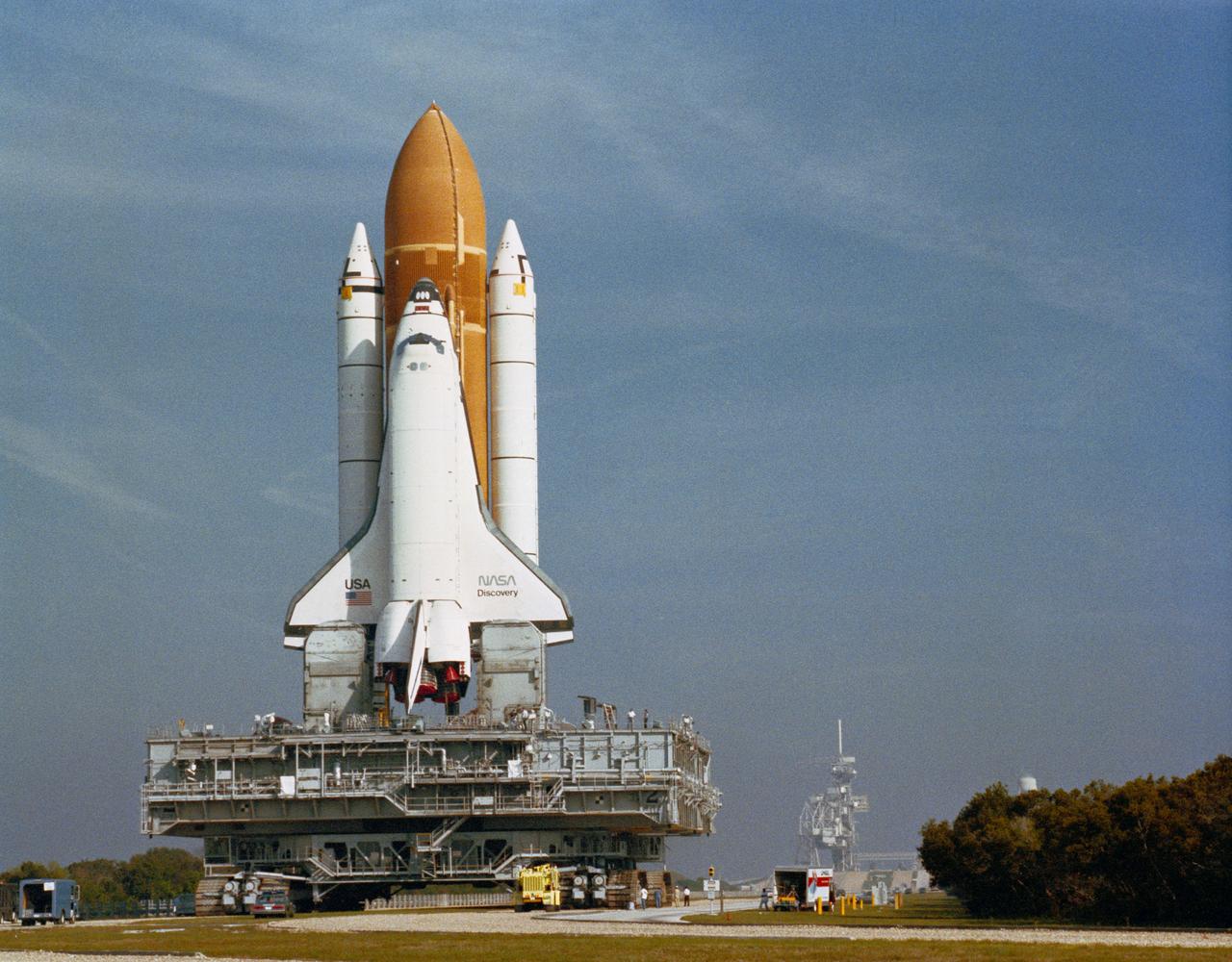
S89-28110 (3 Feb 1989) ---The Space Shuttle Discovery, atop a mobile launch platform, is rolled toward Kennedy Space Center's Launch Pad 39-B on Feb. 3, l989. It rolled through the doors of the huge vehicle assembly building (VAB) at 6 a.m.,several hours ago. The Launch Complex is in view here. The trip to the pad takes approximately 5 and 1/2 hours. Onboard the spacecraft in mid-March for a five-day mission, on which will be deployed a third tracking and data relay satellite (TDRS-D), will be Astronauts Michael L. Coats, John E. Blaha, James F. Buchli, James P. Bagian and Robert C. Springer.
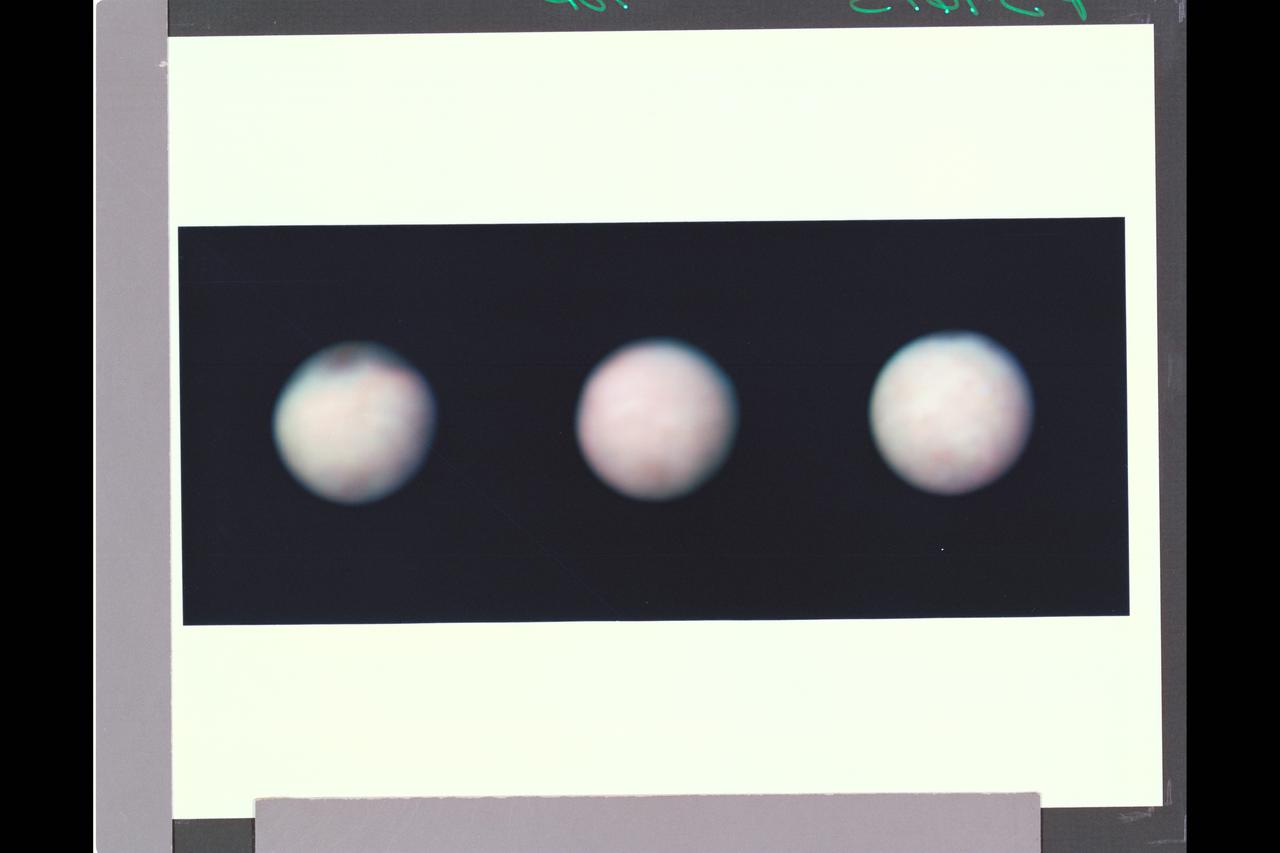
P-34615 These three color images of Triton were taken at three different orbital longitudes to show different faces of the neptune moon. the overall pinkish cast of the images may be due to the presence of reddish material on Triton produced by irradiation of methane gas and ice on Triton. In these pictures the south pole is at roughly 6 o'clock, about 1/6th of the way from the bottom. Near the top of the left on Triton's equator are several large dark spots that are probably suface markings. These markings rotate with a 5.88-day orbital period of Triton. The left image has a central longitude 288 degrees, the center at 351 degrees ( nearly the hemisphere that will be seen at Voyager's closest approach to Triton), and the right image is at 35 degrees logitude.
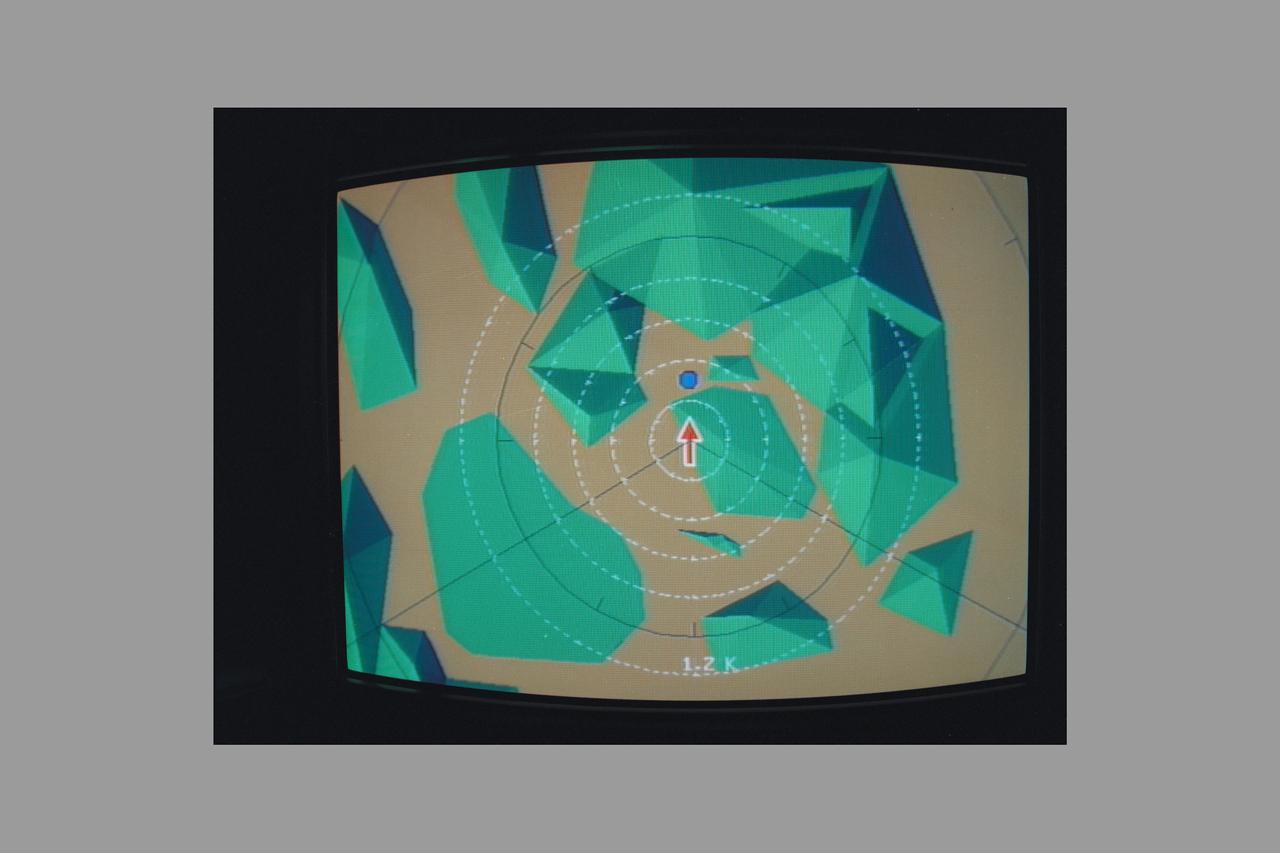
VMS I-Cab: MV-22 Simulation.
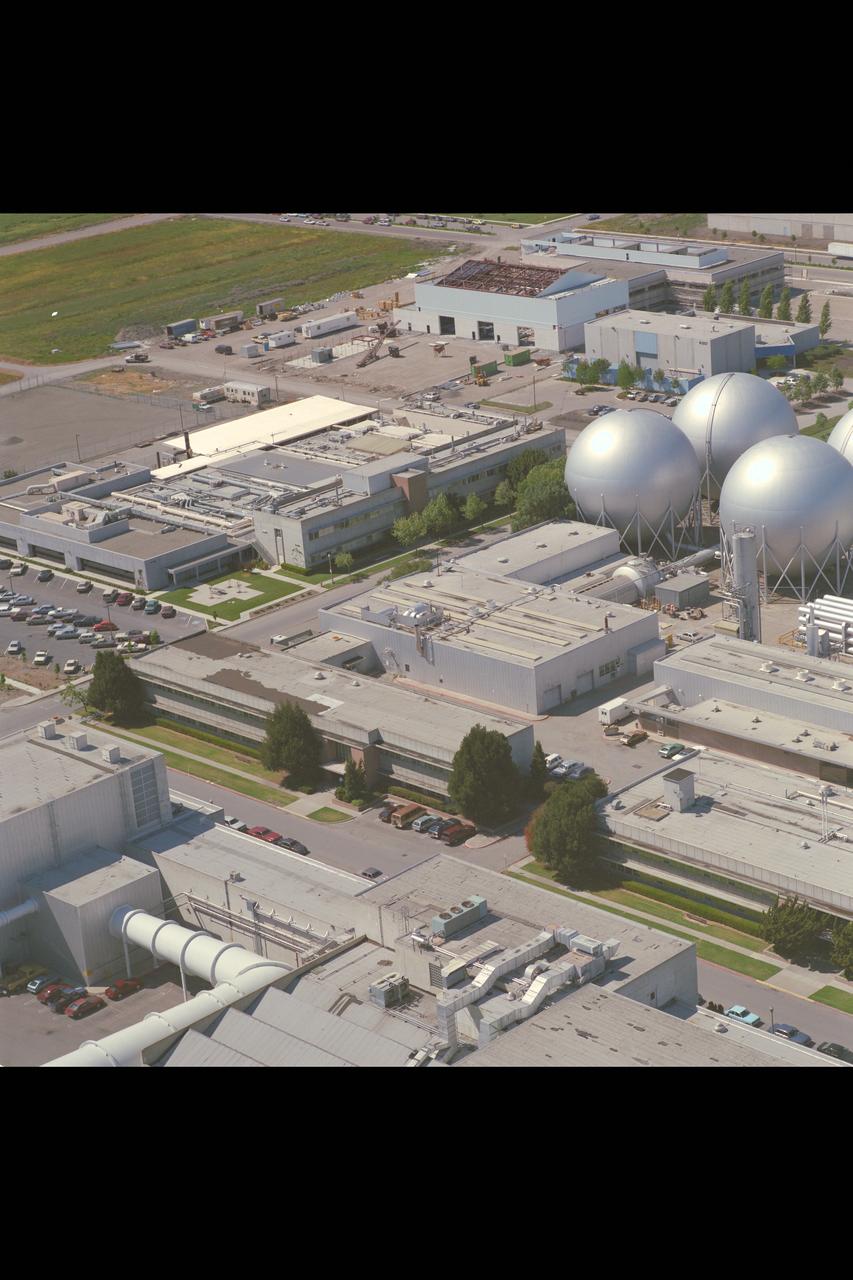
Ames Facility Aerials: N-229
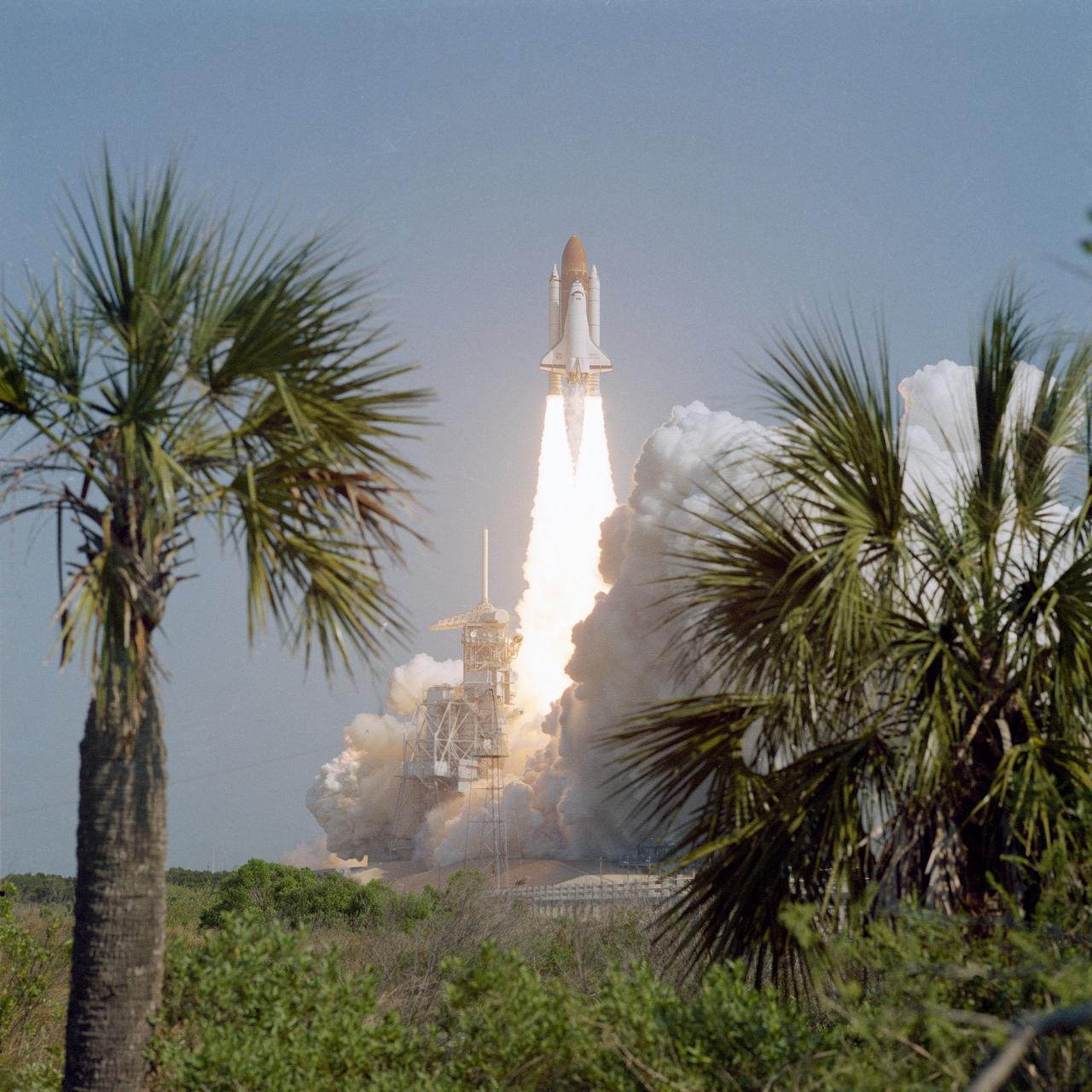
STS029-S-027 (13 March 1989) --- From Launch Pad 39D, the Space Shuttle Discovery is launched on mission STS-29. Discovery lifted off at 9:57 a.m. (EST), March 13, 1989, carrying the tracking and data relay satellite (TDRS-1) into orbit. Florida vegetation frames the launch scene. Onboard the spacecraft were astronauts Michael L. Coats, commander; John E. Blaha, pilot; and James F. Buchli, James P. Bagian and Robert C. Springer, all mission specialists.
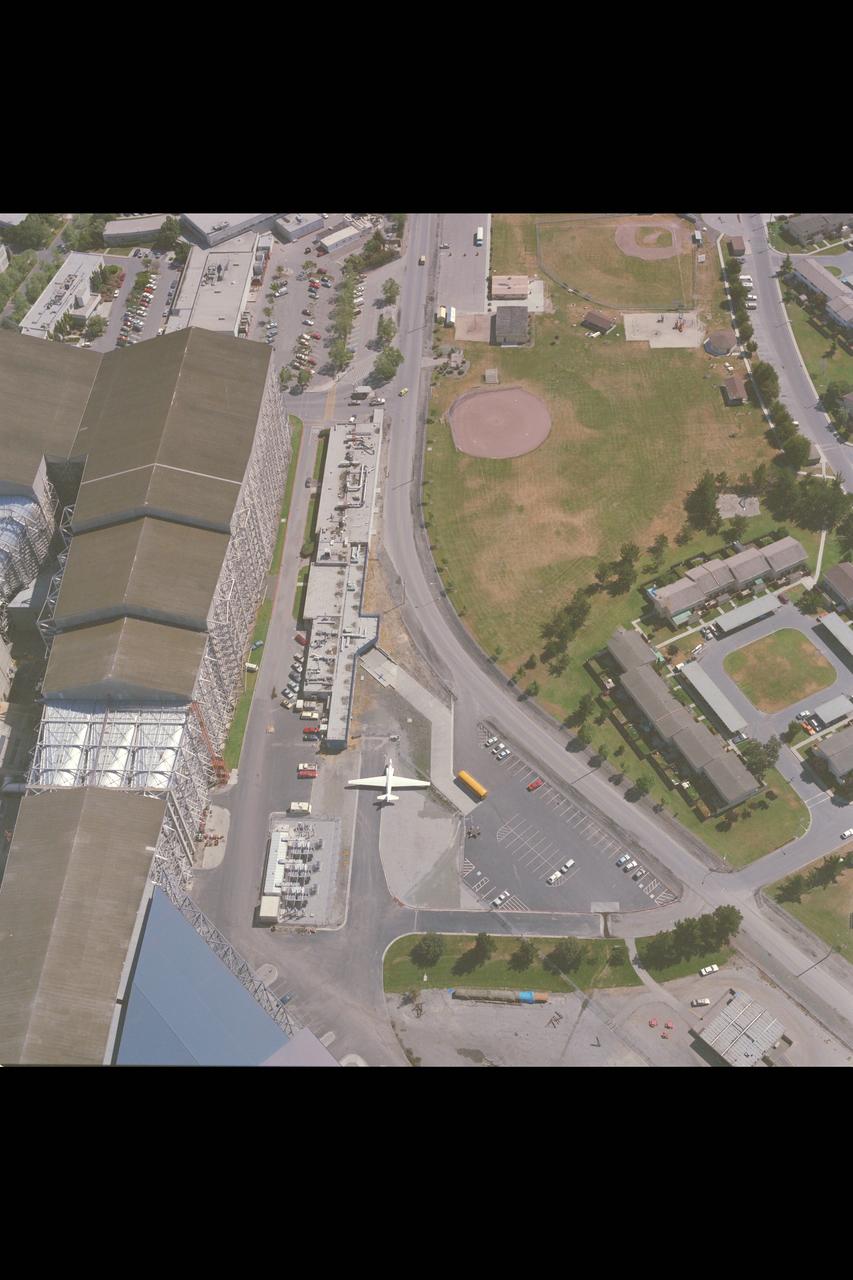
Ames Facility Aerials: N-223 VIC with U-2 on Static display and N-221
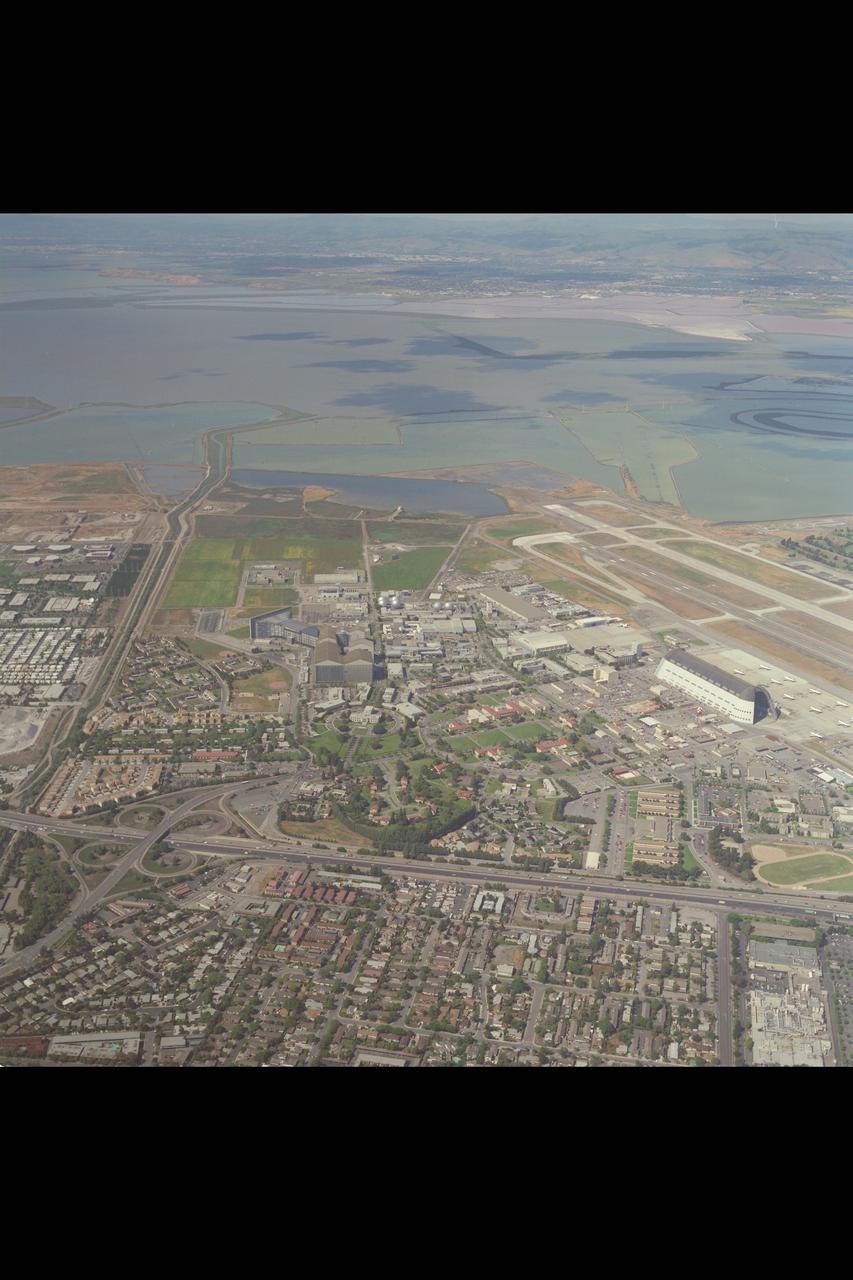
Ames Facility Aerials: looking north
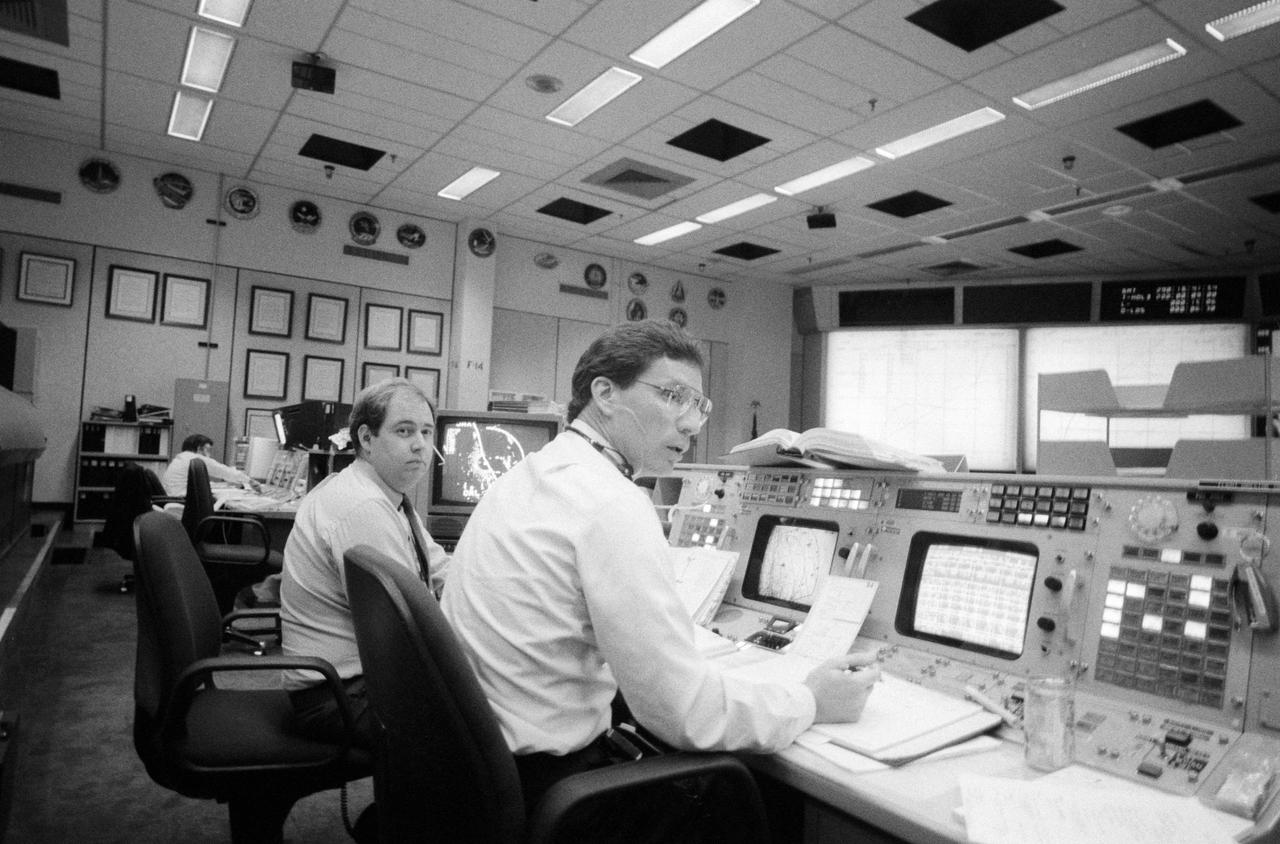
Flight directors Robert E. Castle, Jr (left) and Ronald D. Dittemore monitor console displays during STS-34 mission. Castle and Dittemore will oversee flight activities from their stations in JSC's Mission Control Center (MCC) Bldg 30 flight control room (FCR). In the background are the FCR large screens which display flight data.
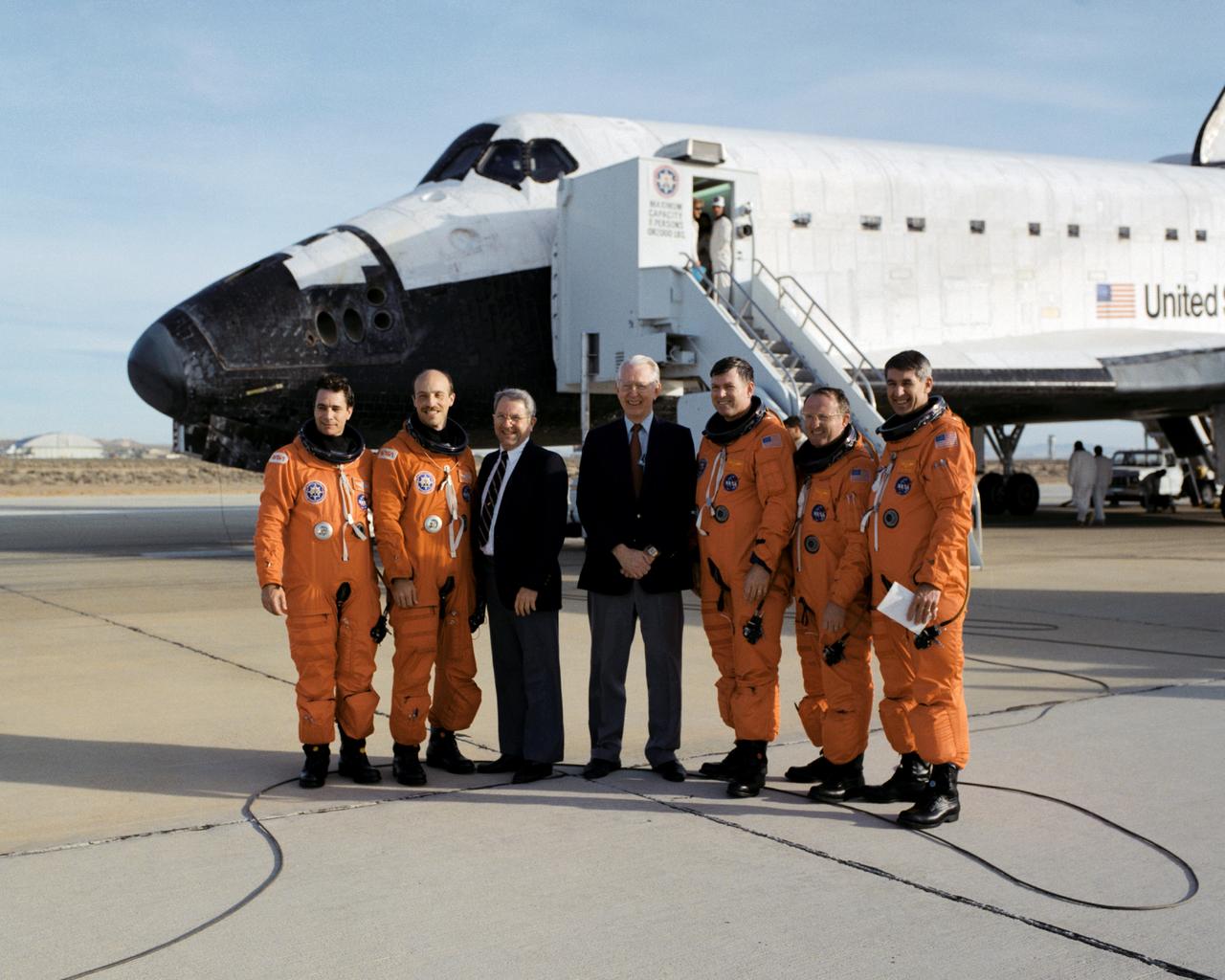
STS029-S-066 (18 March 1989) --- The five-man crew who flew aboard NASA's Space Shuttle Discovery (background) pose near it with NASA officials following a successful five-day mission in space. Left to right are astronauts John E. Blaha, pilot; and James P. Bagian, mission specialist; Rear Admiral Richard H. Truly, NASA Associate Administrator for Space Flight; Dr. James C. Fletcher, NASA Administrator; astronauts Michael L. Coats, commander; and James F. Buchli and Robert C. Springer, mission specialists.
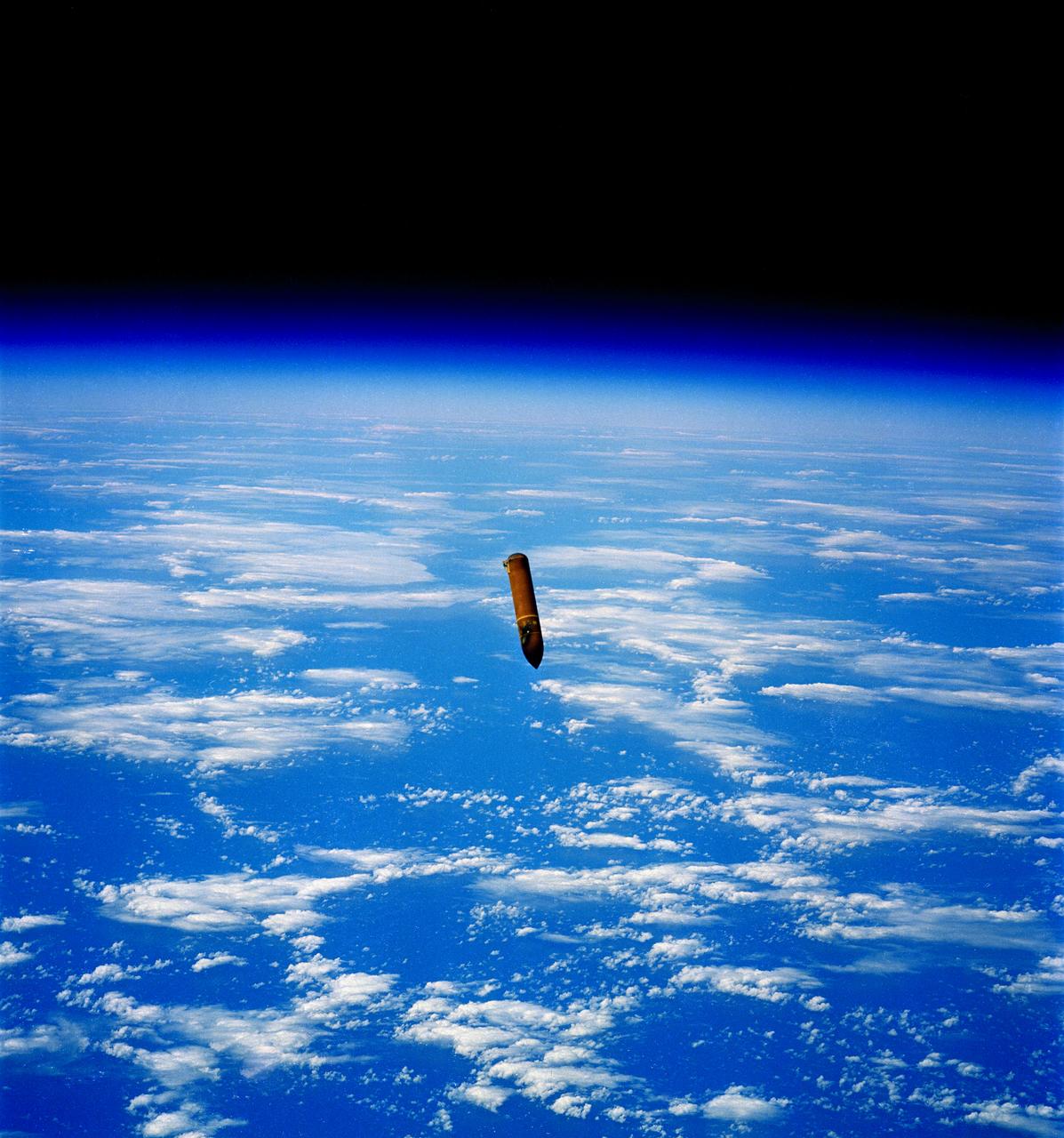
This STS-29 mission onboard photo depicts the External Tank (ET) falling toward the ocean after separation from the Shuttle orbiter Discovery. The giant cylinder, higher than a 15-story building, with a length of 154-feet (47-meters) and a diameter of 27,5-feet (8.4-meters), is the largest single piece of the Space Shuttle. During launch, the ET also acts as a backbone for the orbiter and solid rocket boosters. In separate, internal pressurized tank sections, the ET holds the liquid hydrogen fuel and liquid oxygen oxidizer for the Shuttle's three main engines. During launch, the ET feeds the fuel under pressure through 17-inch (43.2-centimeter) ducts which branch off into smaller lines that feed directly into the main engines. Some 64,000 gallons (242,260 liters) of fuel are consumed by the main engines each minute. Machined from aluminum alloys, the Space Shuttle's ET is the only part of the launch vehicle that currently is not reused. After its 526,000 gallons (1,991,071 liters) of propellants are consumed during the first 8.5 minutes of flight, it is jettisoned from the orbiter and breaks up in the upper atmosphere, its pieces falling into remote ocean waters. The Marshall Space Flight Center was responsible for developing the ET.
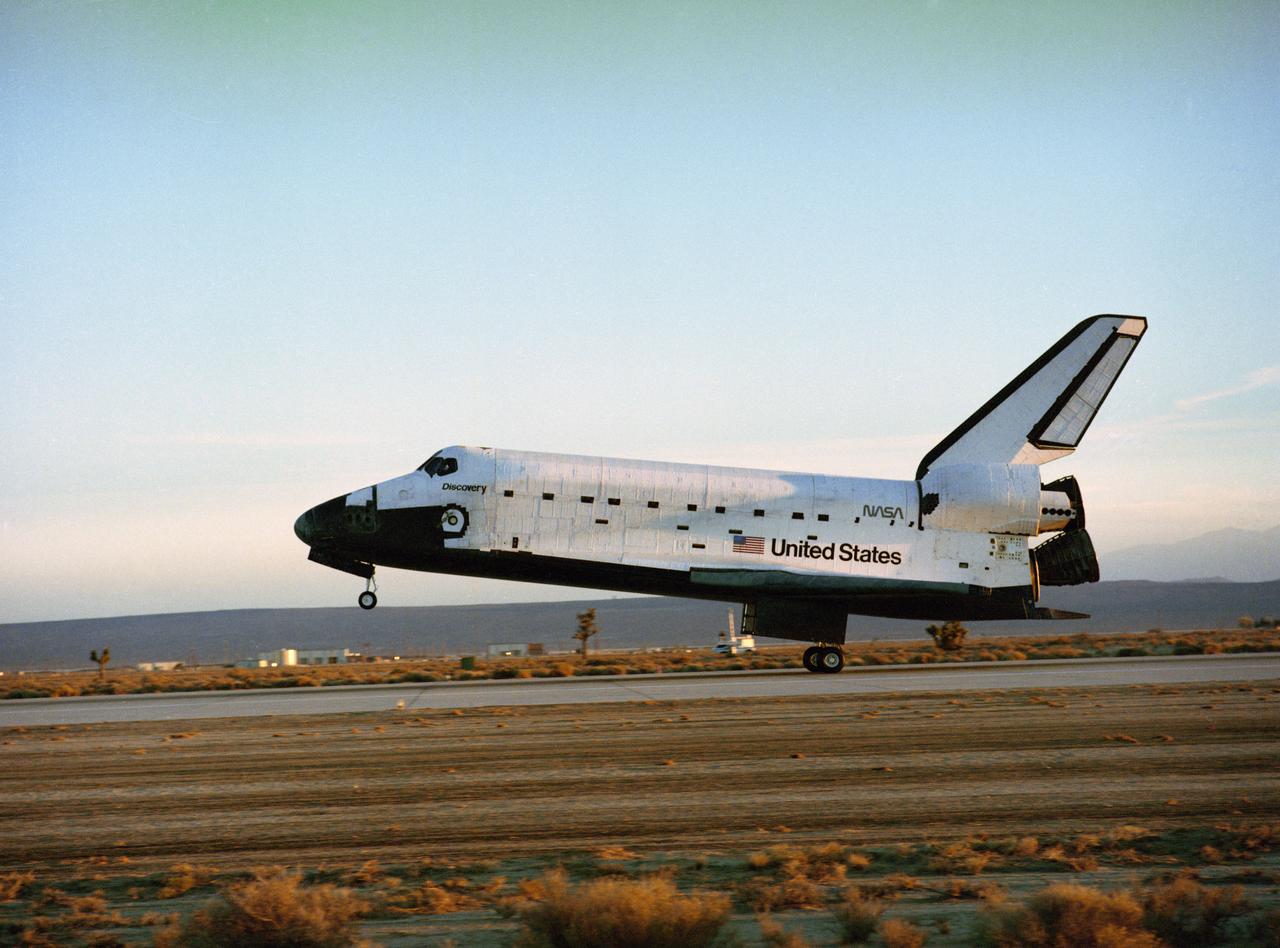
STS033-S-010 (27 Nov 1989) --- The Space Shuttle Discovery, with a crew of five astronauts aboard, touches down on a runway at Edwards Air Force Base in southern California. The landing occurred at 16:31:02 p.m. (PST), Nov. 27, 1989. Onboard Discovery for the DOD-devoted mission were astronauts Frederick D. Gregory, John E. Blaha, Kathryn C. Thornton, F. Story Musgrave and Manley L. Carter.

In 1986, NASA introduced a Shuttle-borne ultraviolet observatory called Astro. The Astro Observatory was designed to explore the universe by observing and measuring the ultraviolet radiation from celestial objects. Astronomical targets of observation selected for Astro missions included planets, stars, star clusters, galaxies, clusters of galaxies, quasars, remnants of exploded stars (supernovae), clouds of gas and dust (nebulae), and the interstellar medium. Astro-1 used a Spacelab pallet system with an instrument pointing system and a cruciform structure for bearing the three ultraviolet instruments mounted in a parallel configuration. The three instruments were: The Hopkins Ultraviolet Telescope (HUT), which was designed to obtain far-ultraviolet spectroscopic data from white dwarfs, emission nebulae, active galaxies, and quasars; the Wisconsin Ultraviolet Photo-Polarimeter Experiment (WUPPE) which was to study polarized ultraviolet light from magnetic white dwarfs, binary stars, reflection nebulae, and active galaxies; and the Ultraviolet Imaging Telescope (UIT) which was to record photographic images in ultraviolet light of galaxies, star clusters, and nebulae. The star trackers that supported the instrument pointing system were also mounted on the cruciform. Also in the payload bay was the Broad Band X-Ray Telescope (BBXRT), which was designed to obtain high-resolution x-ray spectra from stellar corona, x-ray binary stars, active galactic nuclei, and galaxy clusters. Managed by the Marshall Space Flight Center, the Astro-1 observatory was launched aboard the Space Shuttle Orbiter Columbia (STS-35) on December 2, 1990.
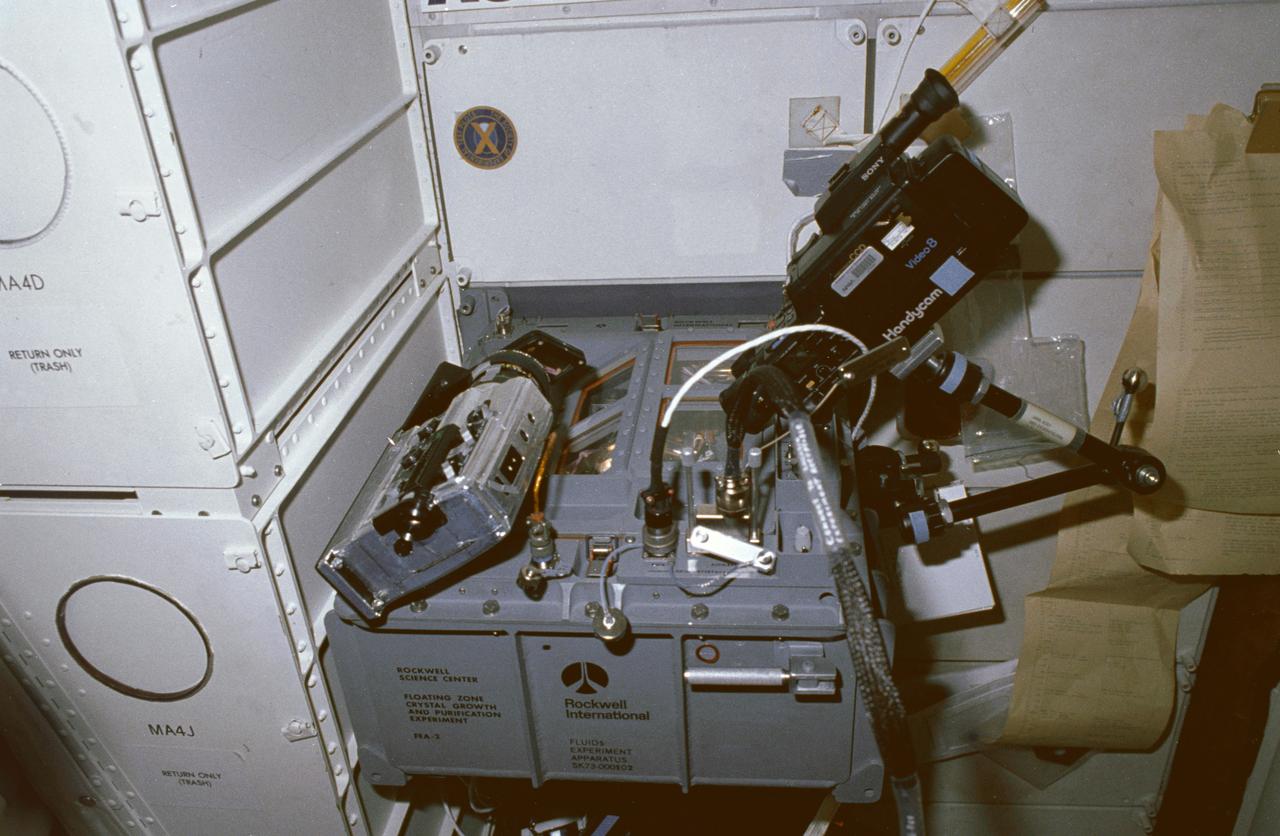
STS030-10-003 (4-8 May 1989) --- An overall scene of the onboard materials science project for STS-30. Seen is the fluids experiment apparatus, supported by an accompanying computer and an 8mm camcorder for its operation. Another major component of the project-- Astronaut Mary L. Cleave, who devoted a great deal of STS-30 monitoring various experiments--is out of frame.
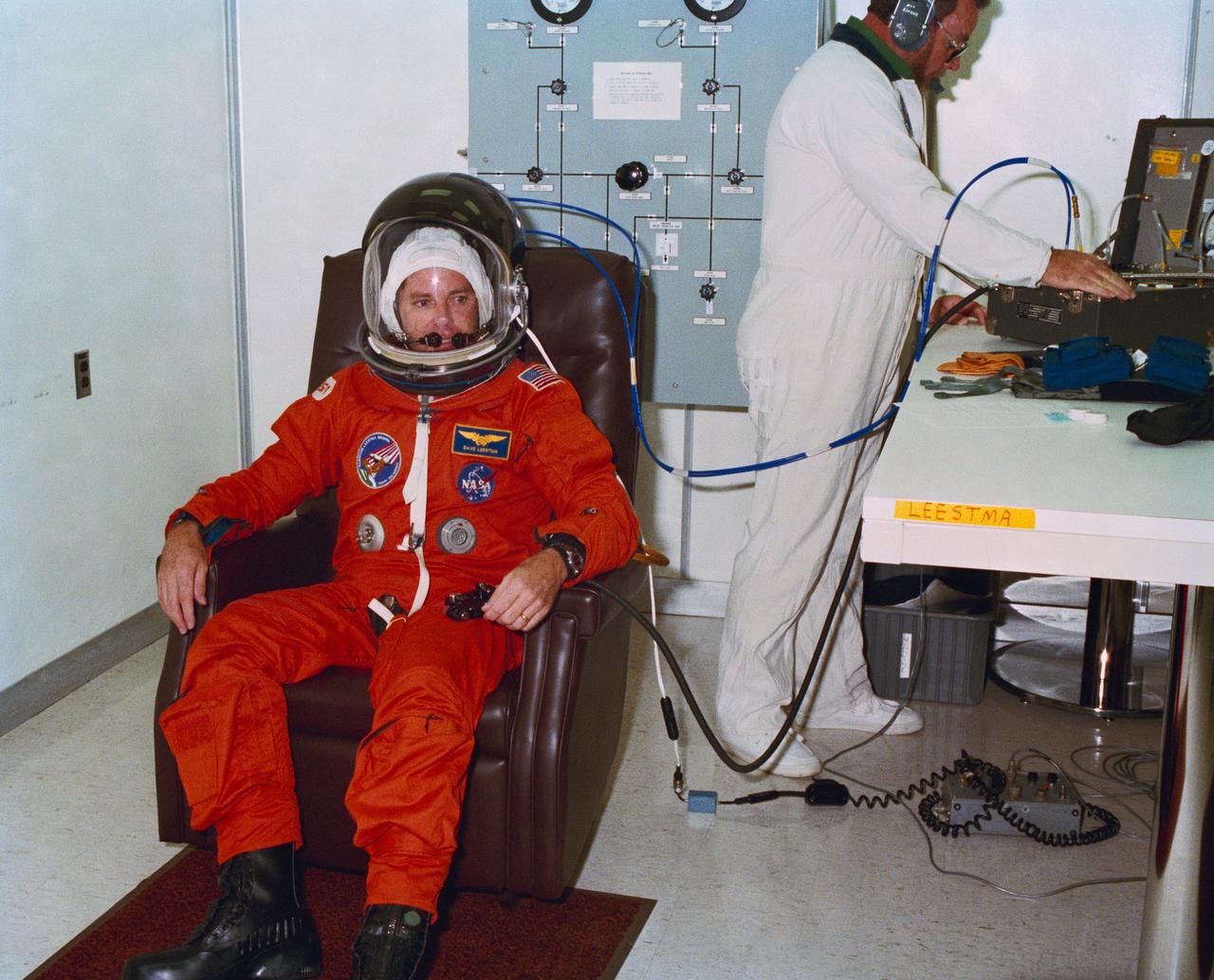
S89-41093 (9 Aug 1989) --- STS-28 Columbia, Orbiter Vehicle (OV) 102, mission specialist David C. Leestma relaxes in chair after donning launch and entry suit (LES) and launch and entry helmet (LEH). Technician in the background monitors LES systems. Leestma, along with fellow crewmembers, is participating in the terminal countdown demonstration test (TCDT) at the Kennedy Space Center (KSC) Operations and Checkout (O&C) Building. View provided by KSC with alternate number KSC-89PC-673.
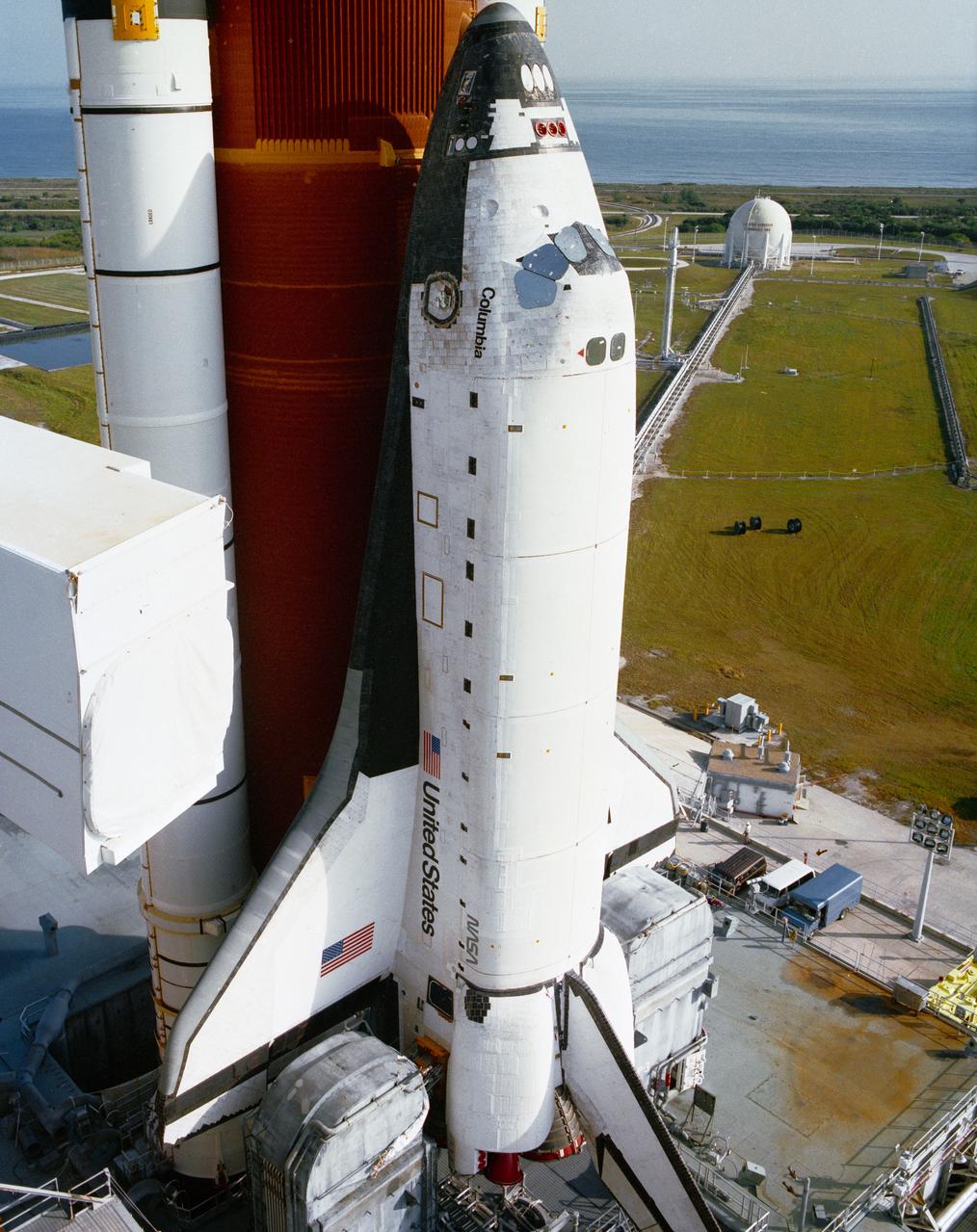
S89-51983 (18 Nov 1989) --- Roll-out of the Space Shuttle Columbia is completed as the vehicle, atop the Mobile Launcher Platform, is positioned on the hard stand at Pad 39A. The approximately eight-hour journey from the Vehicle Assembly Building began at 2:32 a.m. EST. This marks the first time a Space Shuttle has been at Pad A at Launch Complex 39 since January 12, 1986, when Columbia was launched on mission 61C. Pad A will next be used for the launch of Columbia and a five person crew on the STS-32 mission, presently scheduled for no earlier than December 18, 1989.
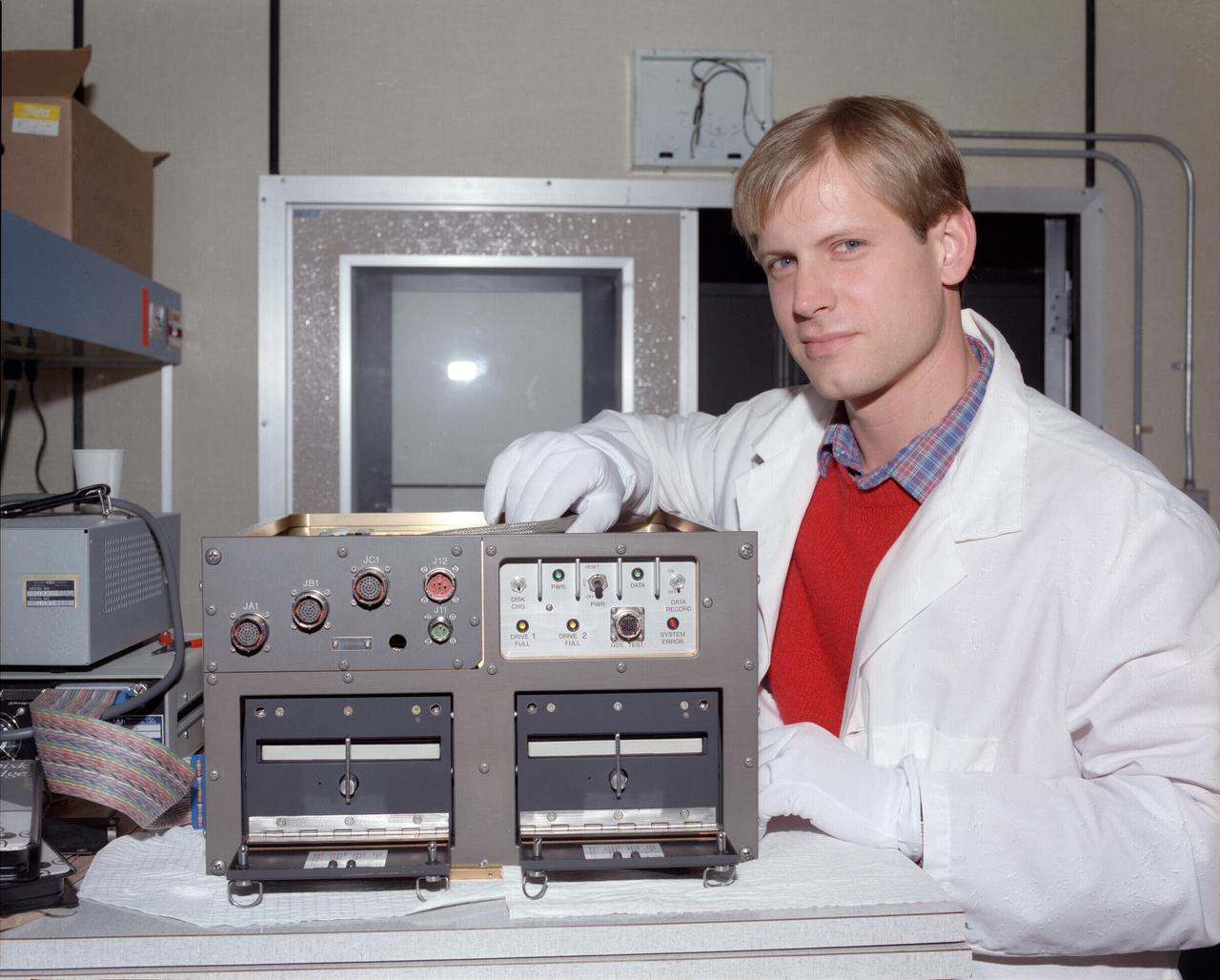
Space Acceleration Measurement System, SAMS Flight Hardware, Unit A
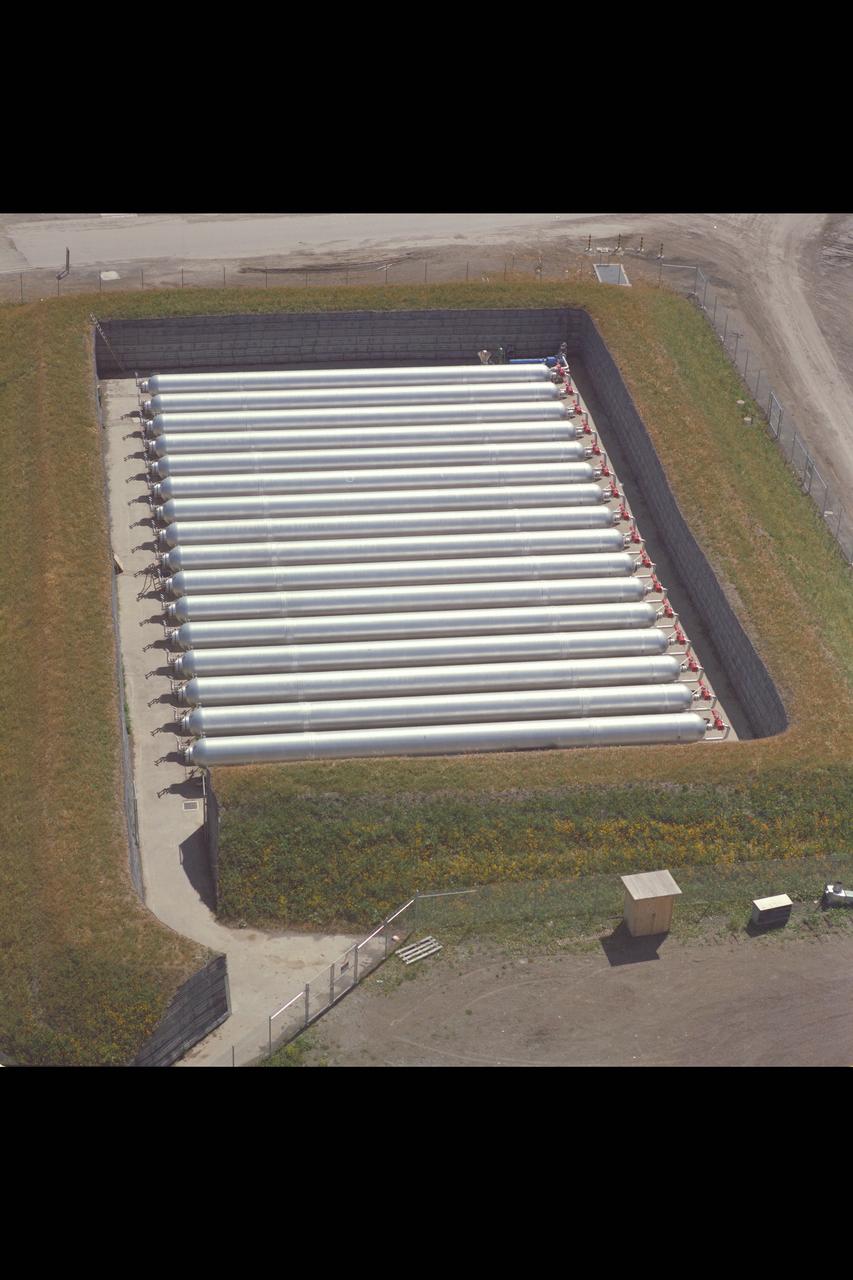
Ames Aerials: N-250A High Pressure Air Storage Facility
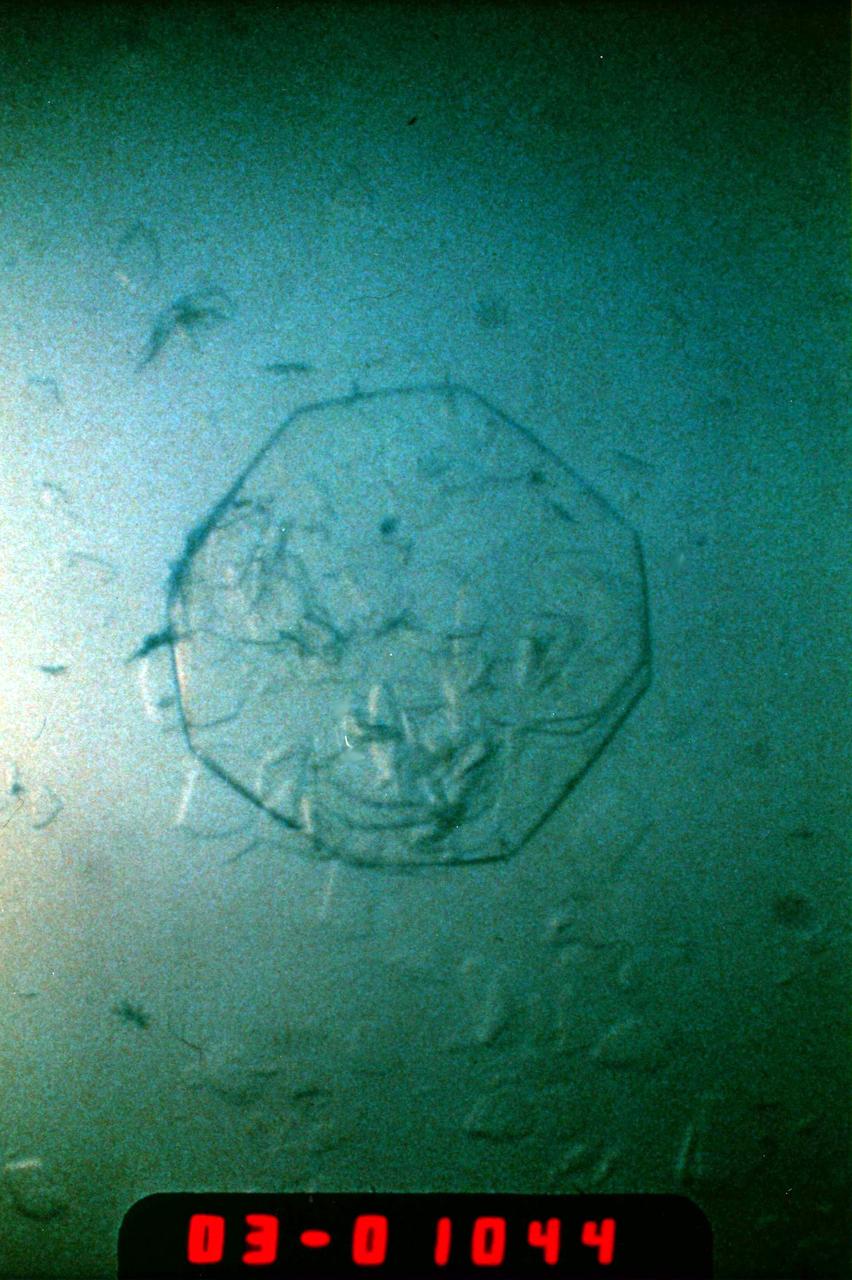
(PCG) Protein Crystal Growth Human Serum Albumin. Contributes to many transport and regulatory processes and has multifunctional binding properties which range from various metals, to fatty acids, hormones, and a wide spectrum of therapeutic drugs. The most abundant protein of the circulatory system. It binds and transports an incredible variety of biological and pharmaceutical ligands throughout the blood stream. Principal Investigator on STS-26 was Larry DeLucas.

Virtual Environment Reality workstation technology (helmet & gloves)
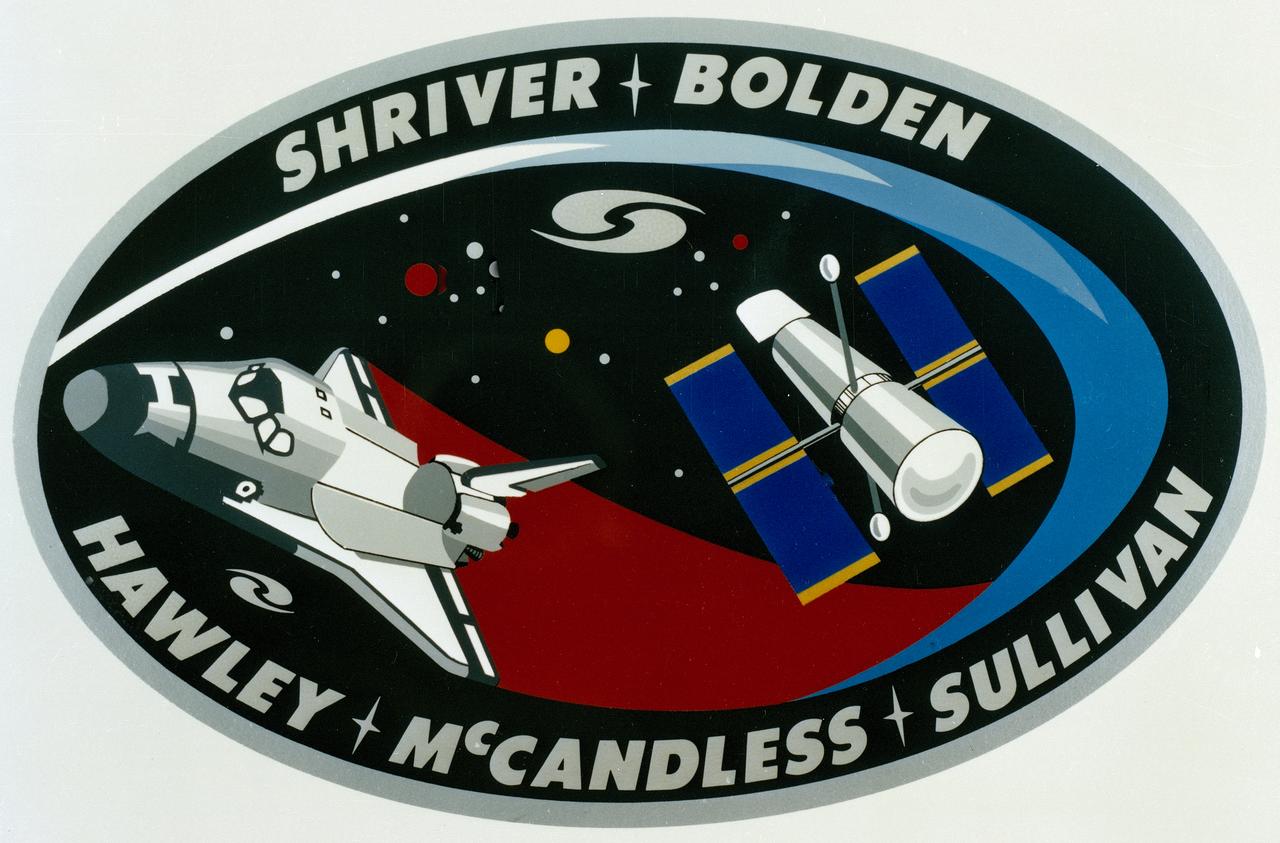
The mission insignia for NASA's STS-31 mission features the Hubble Space Telescope (HST) in its observing configuration against a background of the universe it will study. The cosmos includes a stylistic depiction of galaxies in recognition of the contribution made by Sir Edwin Hubble to our understanding of the nature of galaxies and the expansion of the universe. The STS-31 crew points out that is it in honor of Hubble's work that this great observatory in space bears his name. The depicted Space Shuttle trails a spectrum symbolic of both the red shift observations that were so important to Hubble's work and new information which will be obtained with the HST. Encircling the art work, designed by the crew, are the names of its members.
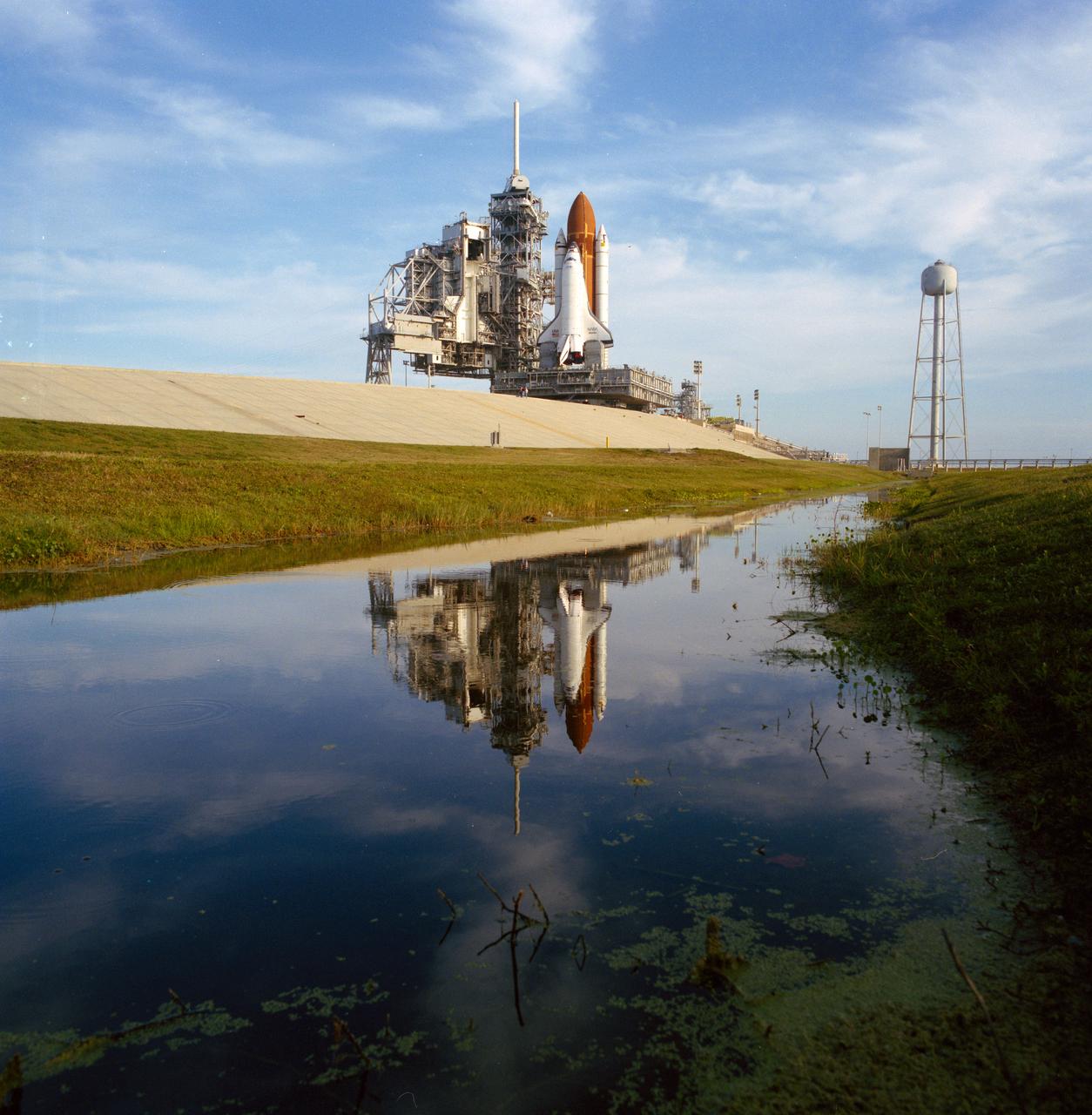
S89-30719 (22 March 1989) --- Space shuttle Atlantis is seen soon in duplicate, thanks to reflection in nearby water, after arriving at Pad 39-B. The spacecraft left the vehicle assembly building (VAB) at 12:01A.M. and arrived to this point at 7 A.M. Atlantis is scheduled for NASA STS-30 mission on which the Magellan will be deployed to orbit planet Venus and map its topographic features. Launch is scheduled for April 28.
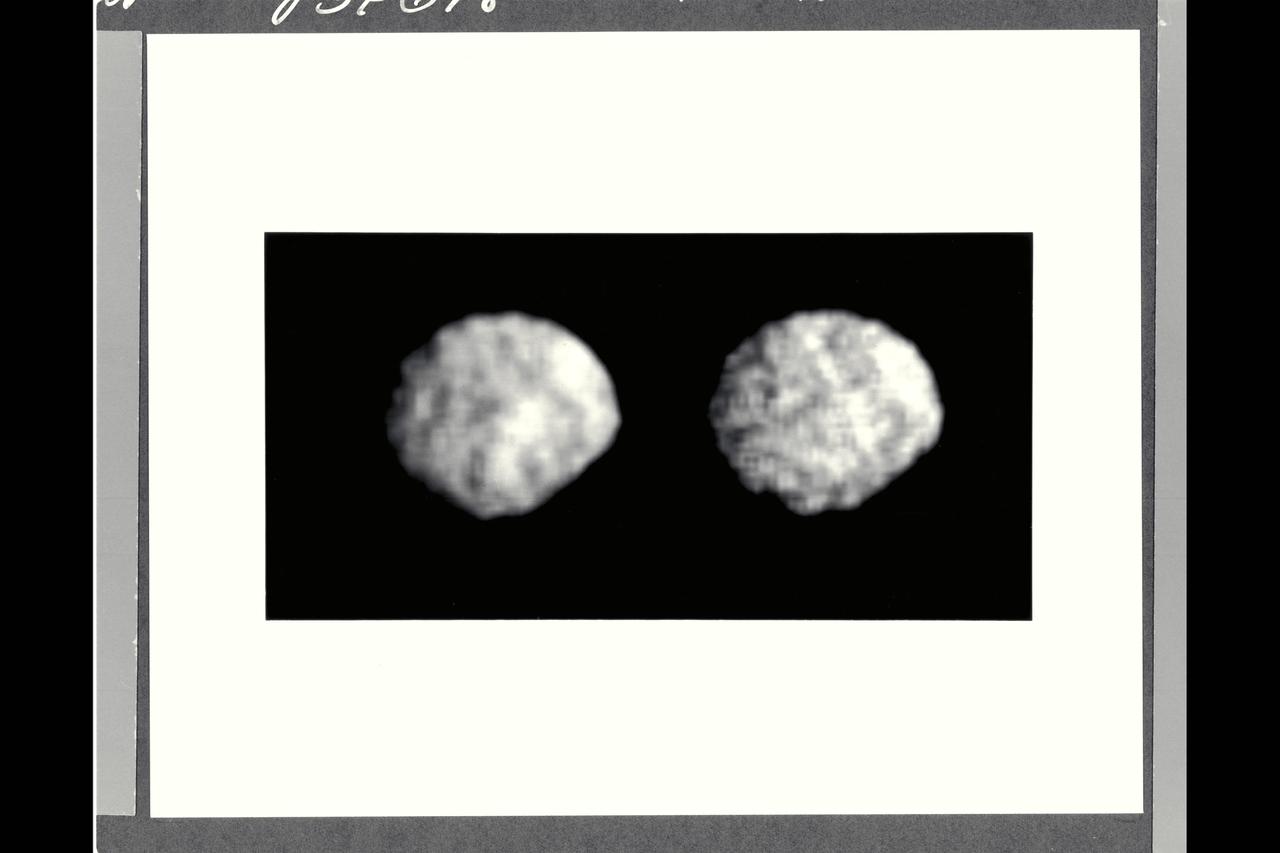
P-34698 These Voyager 2 images of satellite 1989N2 at a resolution of 4.2 kilometers (2.6 miles) per pixel reveals it to be an irregularly shaped, dark object. The satellite appears to have several craters 30 to 50 kilometers (18.5 to 31 miles) across. The irregular outline suggests that this moon has remained cold and rigid throughout much of its history. It is about 210 by 190 kilometers (130 by 118 miles), about half the size of 1989N1. It has a low albedo surface reflecting about 5 percent of the incident light.
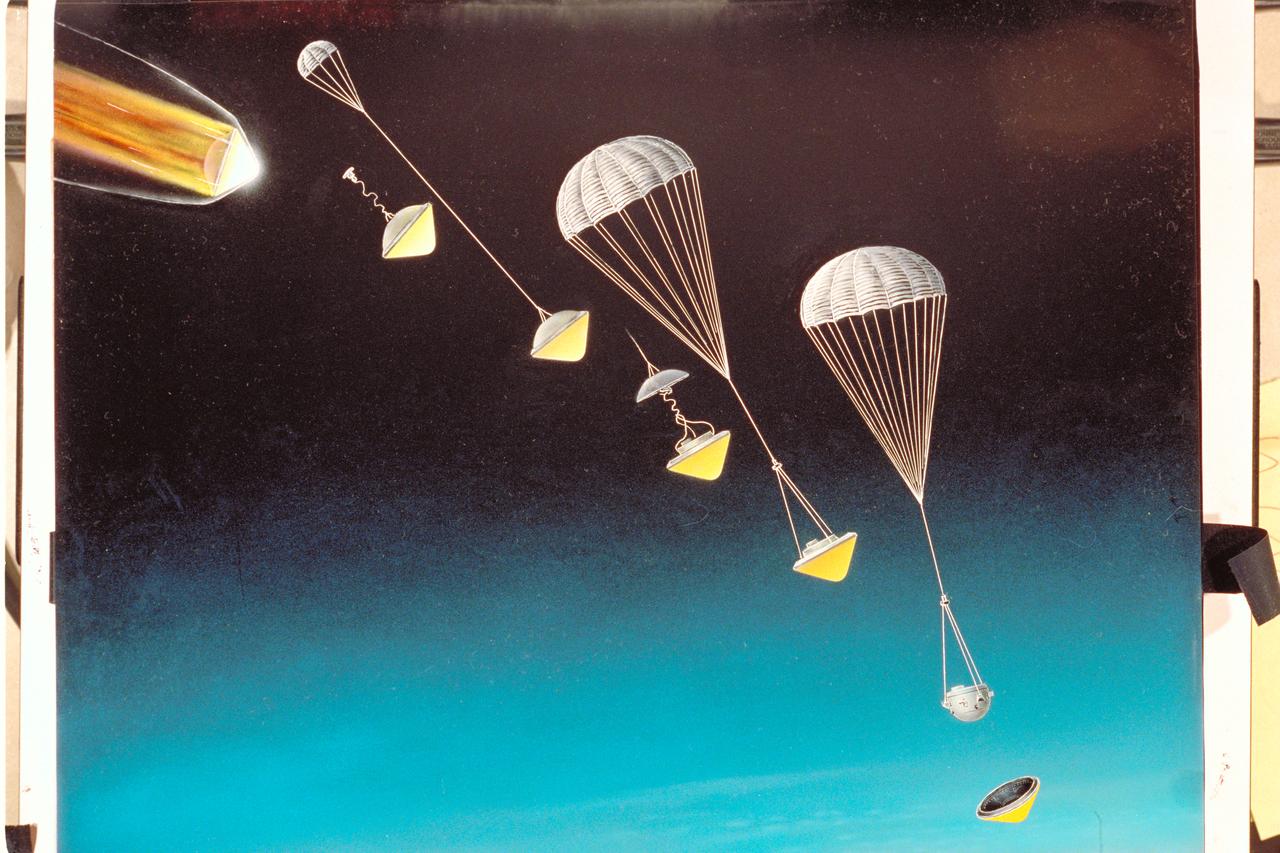
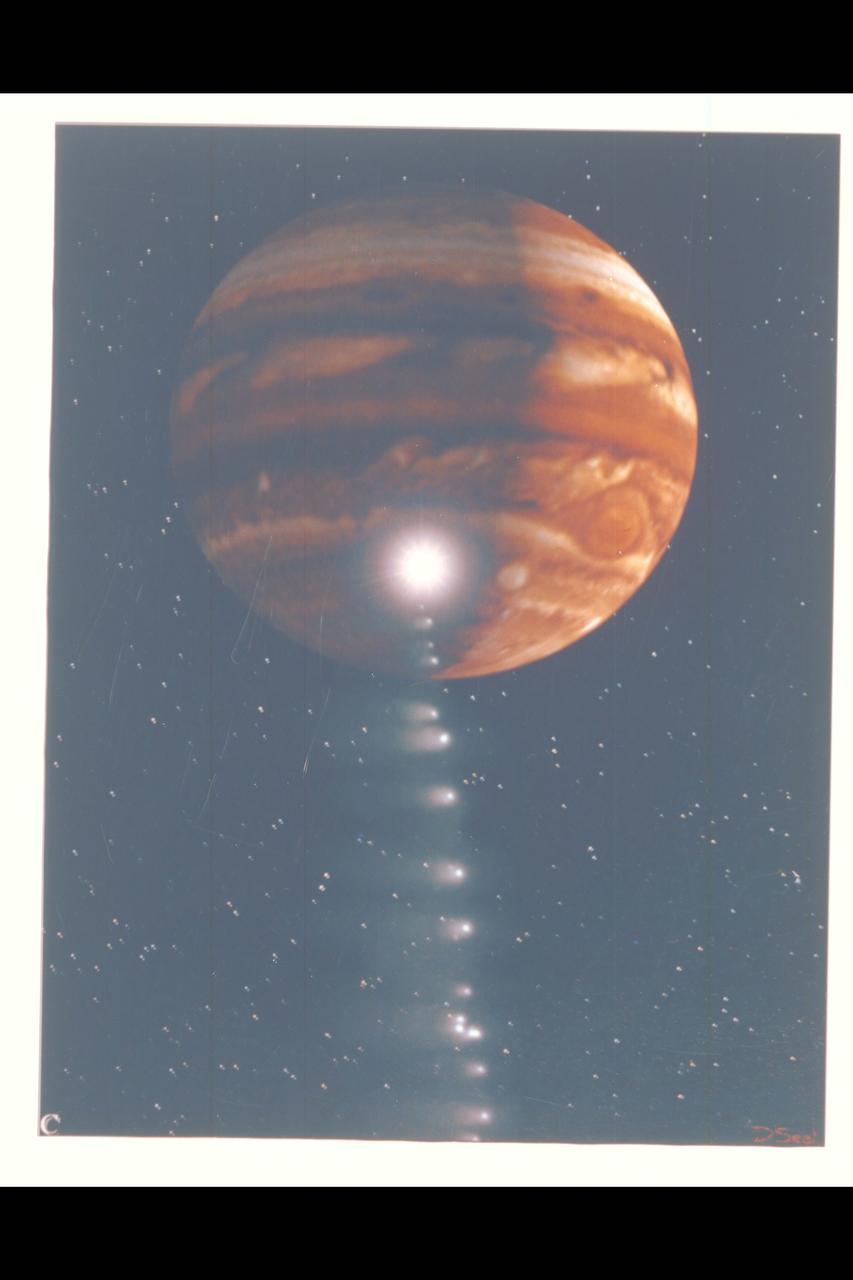
Artist: unknown Jupiter Mission: Pioneer Galileo Entry Probe Artwork (descent and separation)
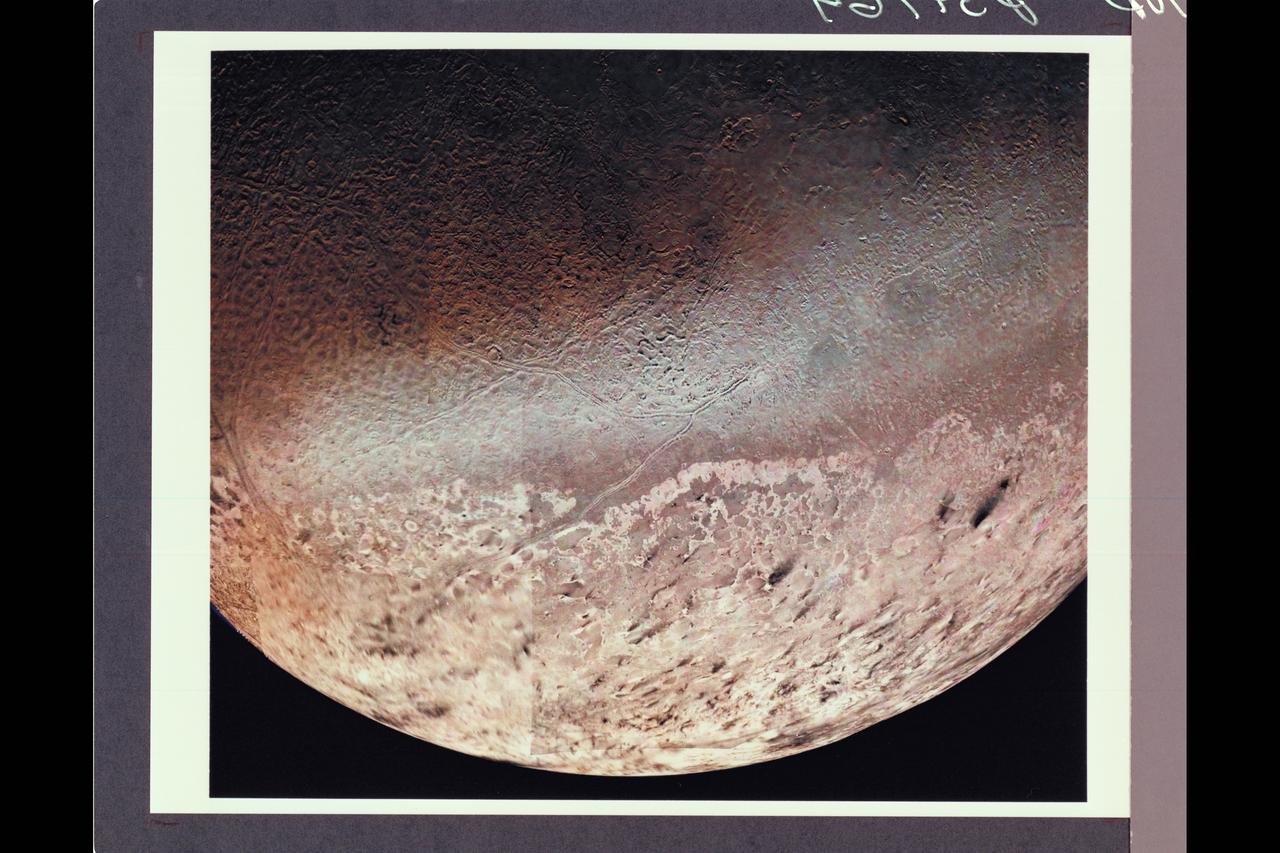
P-34764 Voyager 2 obtained this high resolution color image of Neptune's large satellite Triton during its close flyby. Approximately a dozen individual images were combined to produce this comprehensive view of the Neptune-facing hemisphere of Triton. Fine detail is provided by high resolution, clear-filter images, with color information added from lower resolution frames. The large south polar cap at the bottom of the image is highly refective and slightly pink in color , and may consist of a slowly evaporating layer of nitrogen ice deposited during the previous winter. From the ragged edge of the polar cap northward the satellite's face is generously darker and redder in color. This coloring may be produced by the action of ultraviolet light and magnetospheric radiation upon methane in the atmosphere and surface. Running across this darker region , approximately parallel to the edge of the polar cap, is a band of brighter white material that is almost bluish in color. The underlying topography in this bright band is similiar, however to that in the darker, redder regions surrounding it.
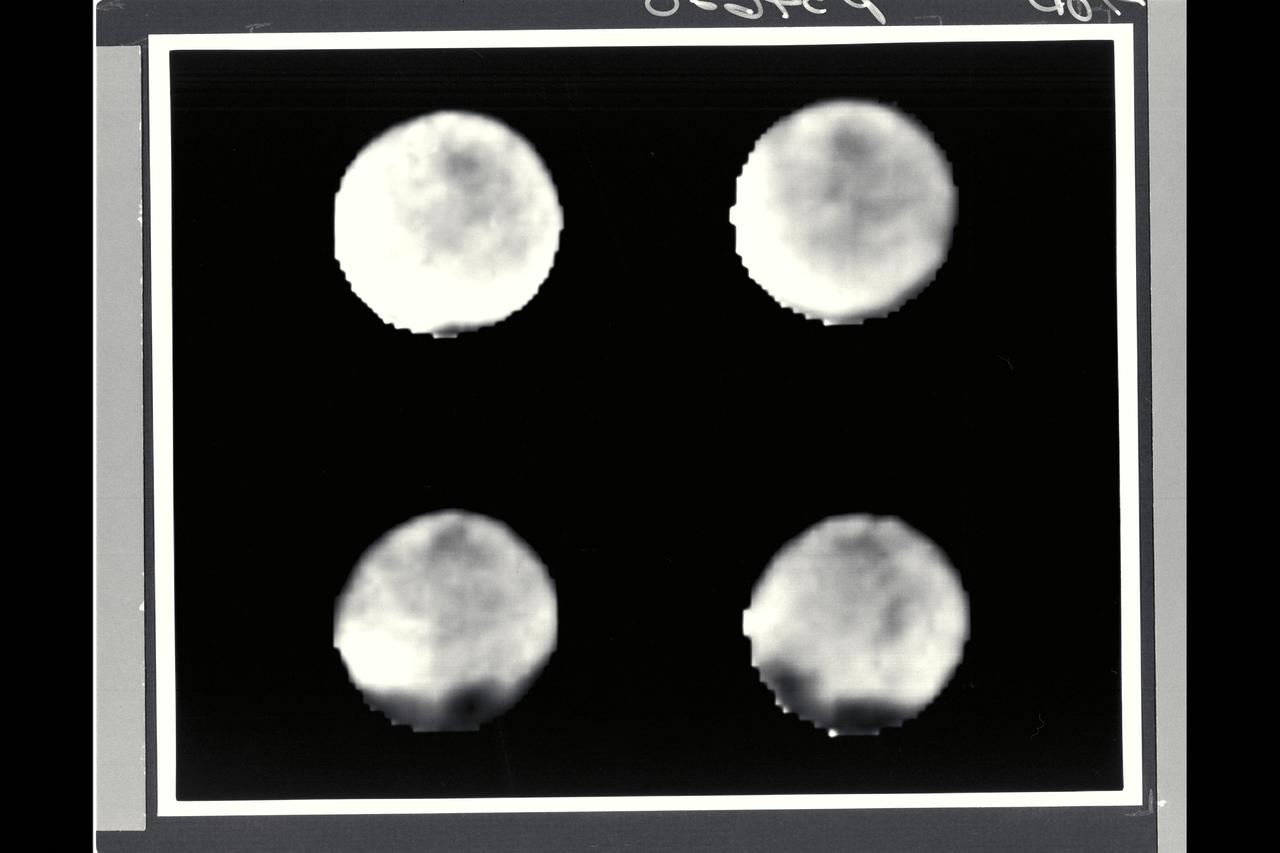
August 17 to 19, 1989 Range : 11.5 million km (7.1 million mi.) to 7.9 million km (4.9 million mi.) Four black and white images of Neptune's largest satellite, Triton, show it's rotation between the first (upper left) image and the last (lower right). Resolution improves from about 200 km (124 miles) to 150 km (93 miles) per line pair. Triton's south pole lies in the dark area near the bottom of the disk. Dark spots, roughly 1,000 km (620 miles) across, occur near the equator, and show Triton rotation between images. The rotation appears to be synchronous with Triton's 5.88-day orbital period (i.e., Triton rotates on its axis in the same time it revolves around Neptune.) The spots' constant rotation rate and their visibility near the edge of the disk suggest the spots are surface features. Whatever atmosphere is present on Triton appears transparent enough that Voyager 2's cameras can see through it.
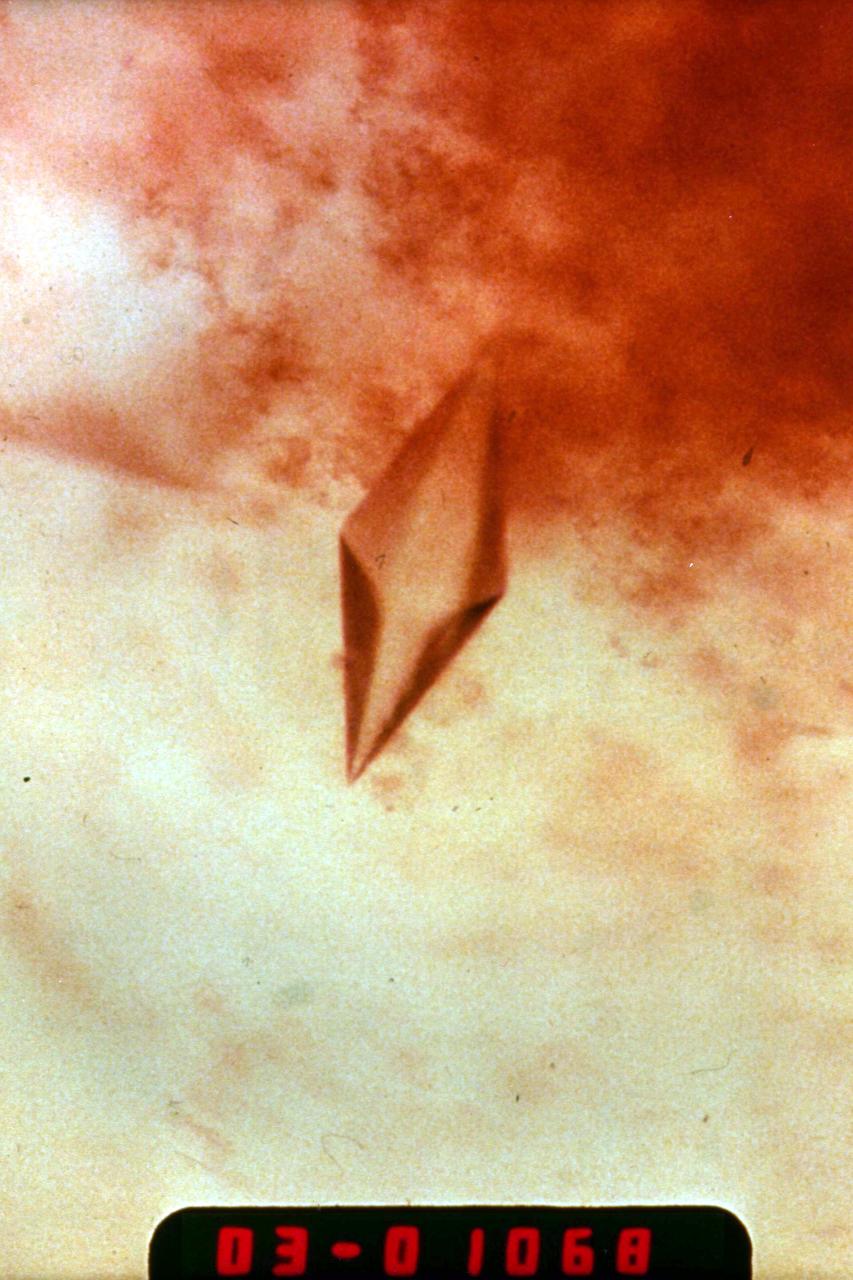
(PCG) Protein Crystal Growth Renin. Enzyme produced by the kidneys, plays a major role in the chemical reaction that controls blood pressure. Principal Investigator on STS-26 was Charles Bugg.

P-34679 Range : 2 million km. ( 1.2 million miles ) In this Voyager 2, wide-angle image, the two main rings of Neptune can be clearly seen. In the lower part of the frame, the originally-announced ring arc, consisting of three distinct features, is visible. This feature covers about 35 degrees of longitude and has yet to be radially resolved in Voyager Images. from higher resolution images it is known that this region contains much more material than the diffuse belts seen elsewhere in its orbit, which seem to encircle the planet. This is consistent with the fact that ground-based observations of stellar occultations by the rings show them to be very broken and clumpy. The more sensitive, wide-angle camera is revealing more widely distributed but fainter material. Each of these rings of material lies just outside of the orbit of a newly discovered moon. One of these moons, 1989N2, may be seen in the upper right corner. The moon is streaked by its orbital motion, whereas the stars in the frame are less smeared. the dark area around the bright moon and star are artifacts of the processing required to bring out the faint rings.
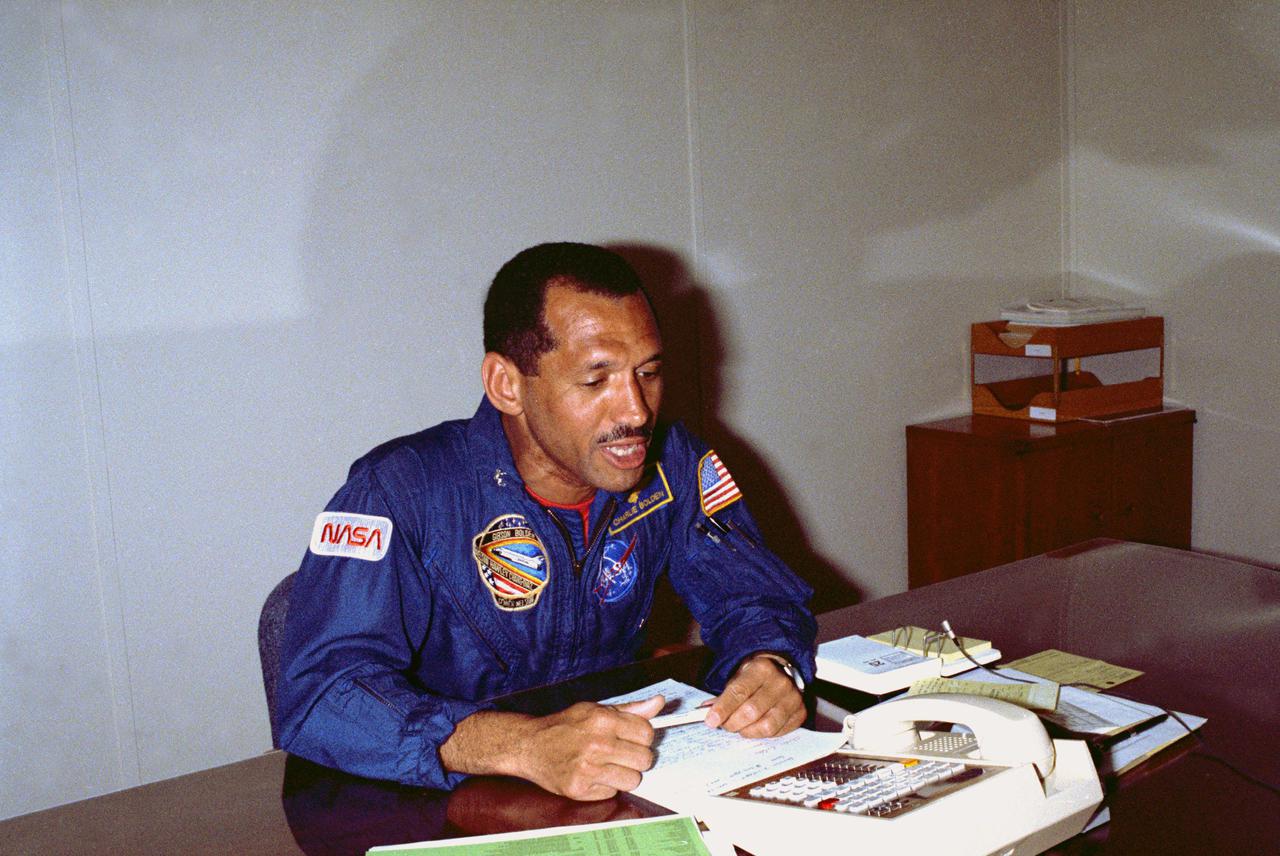
KENNEDY SPACE CENTER, FLA. -- At 1:30 a.m. EST the morning of the scheduled launch of Space Shuttle Mission STS-30 aboard Atlantis, astronaut Charles Bolden receives a call from the Vice President of the United States Dan Quayle. The Vice President called from the NASA tracking station in Australia while visiting the facility. STS-30 will launch the Magellan_Venus radar mapper spacecraft on a 15-month journey to Venus. This is the first U.S. planetary mission in 11 years and the first on Shuttle.
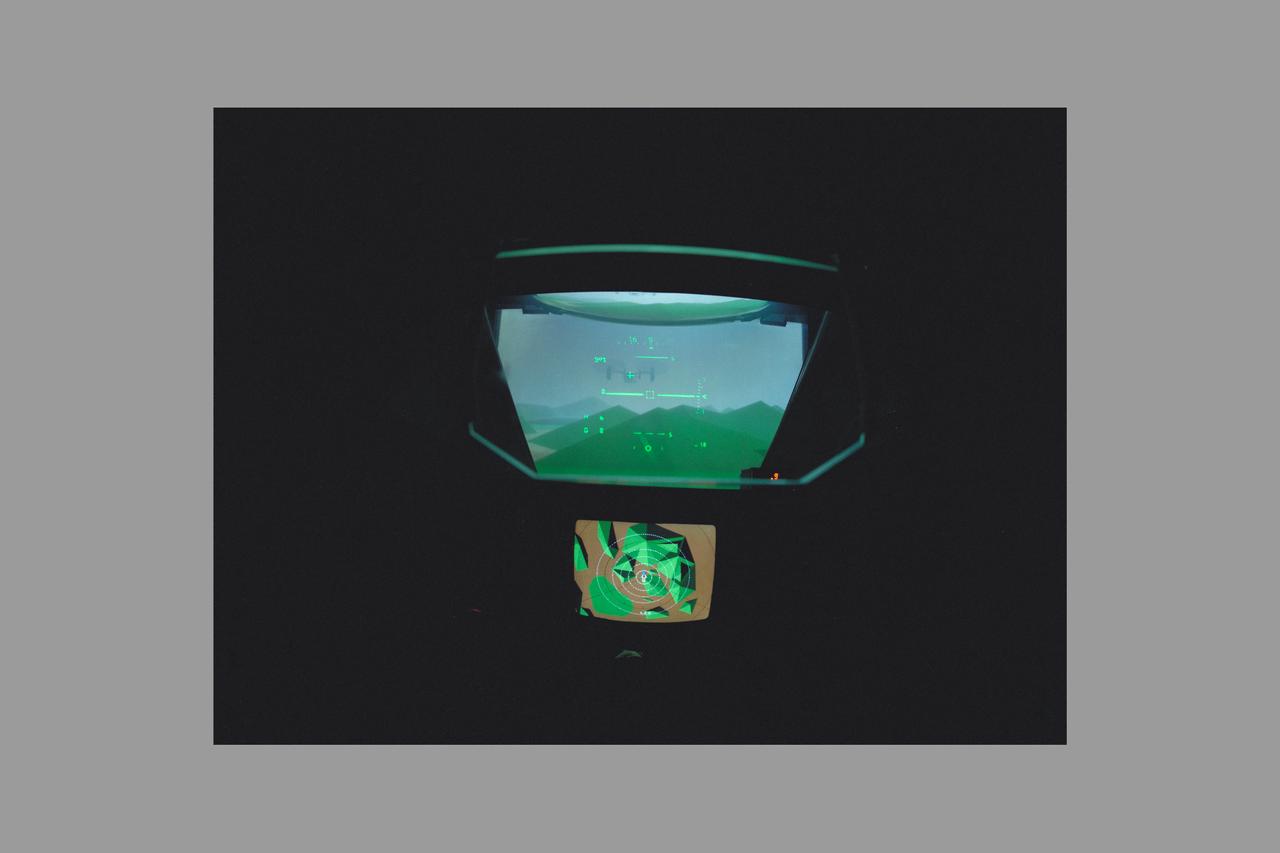
VMS I-Cab: MV-22 Simulation. heads-up display
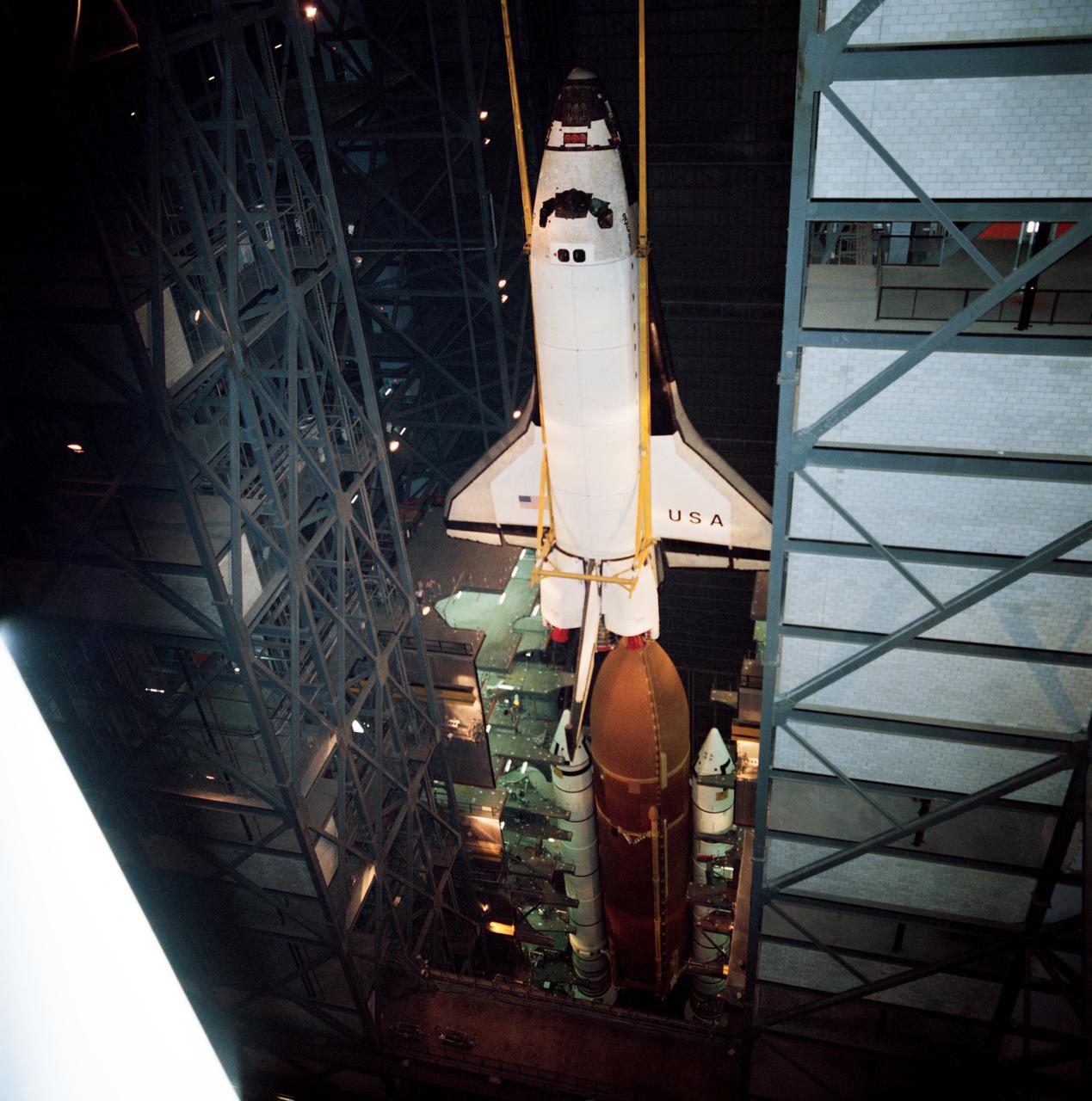
S89-40392 (12 July 1989) --- Inside KSC's giant vehicle assembly building, Space Shuttle Columbia is mated to two solid rocket boosters (SRB) and an external fuel tank as preparations continue for an early September launch. The mission is scheduled as a DOD-devoted flight, set for launch early next month.
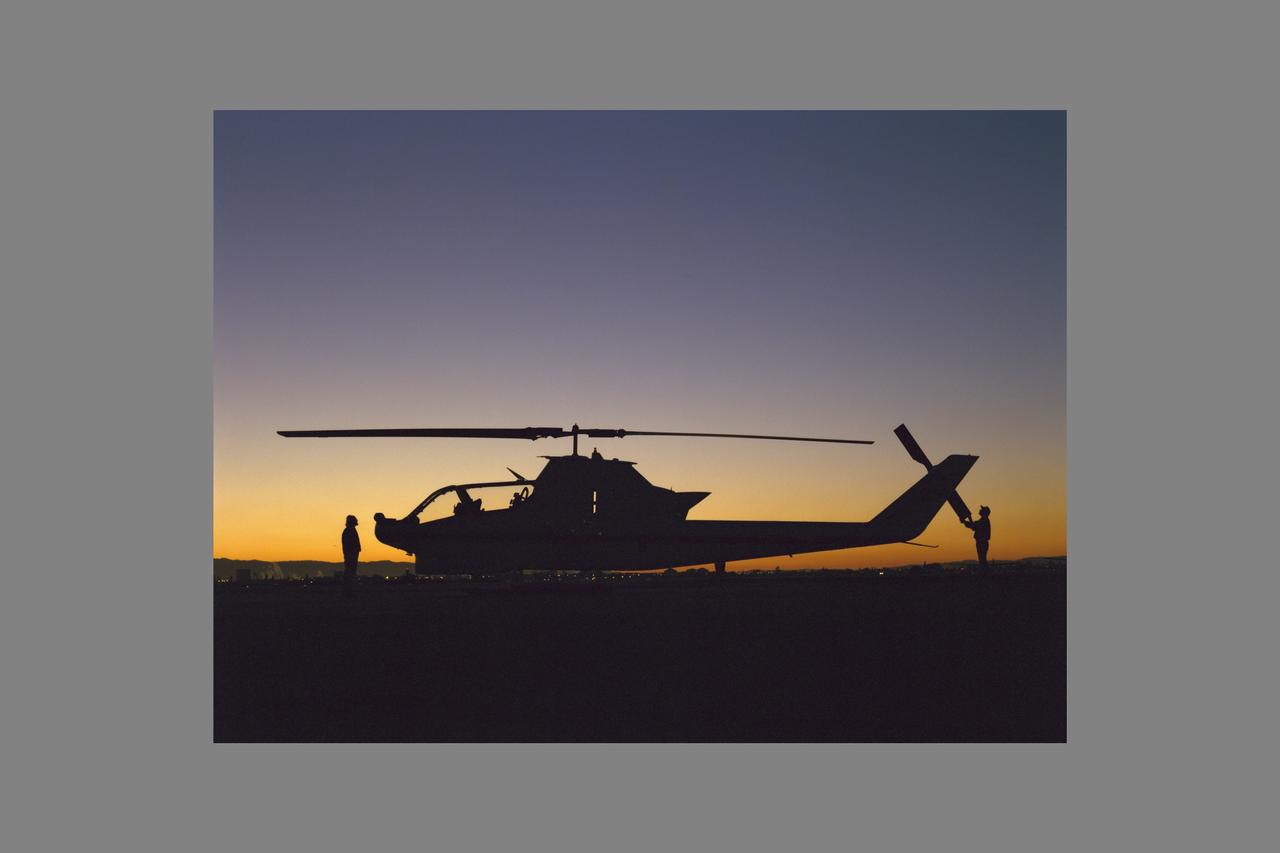
NAH-1S (NASA-736) Cobra on,the NASA Ames flight line at sunrise

STS033-S-001 (22 Nov 1989) --- Lighting up the entire launch complex, the Space Shuttle Discovery heads toward an earth-orbital mission, devoted to the Department of Defense. Launch occurred at 7:23:29.989 p.m. (EST), November 22, 1989. The photograph was taken by Astronaut Michael L. Coats in the Shuttle Training Aircraft (STA).
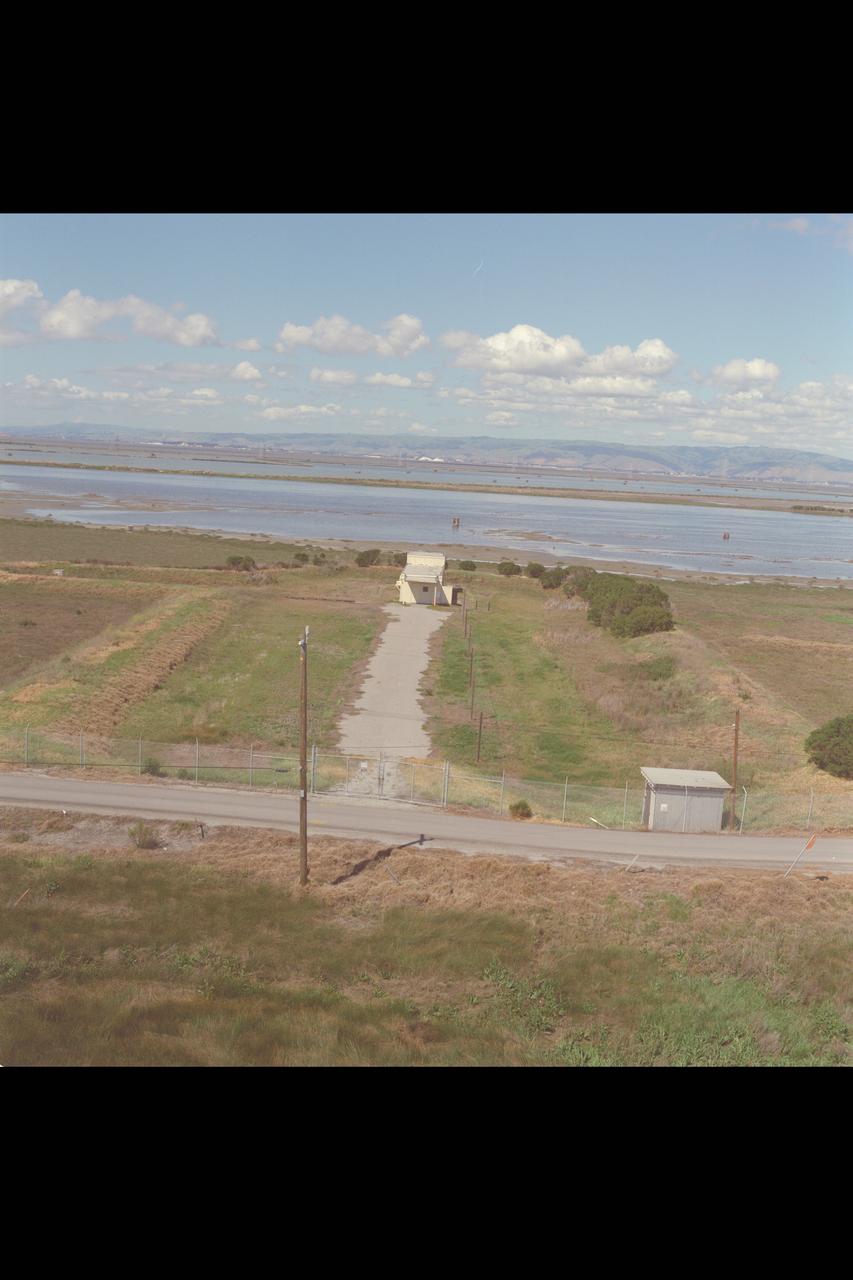
Ames Facility Aerials: N-217
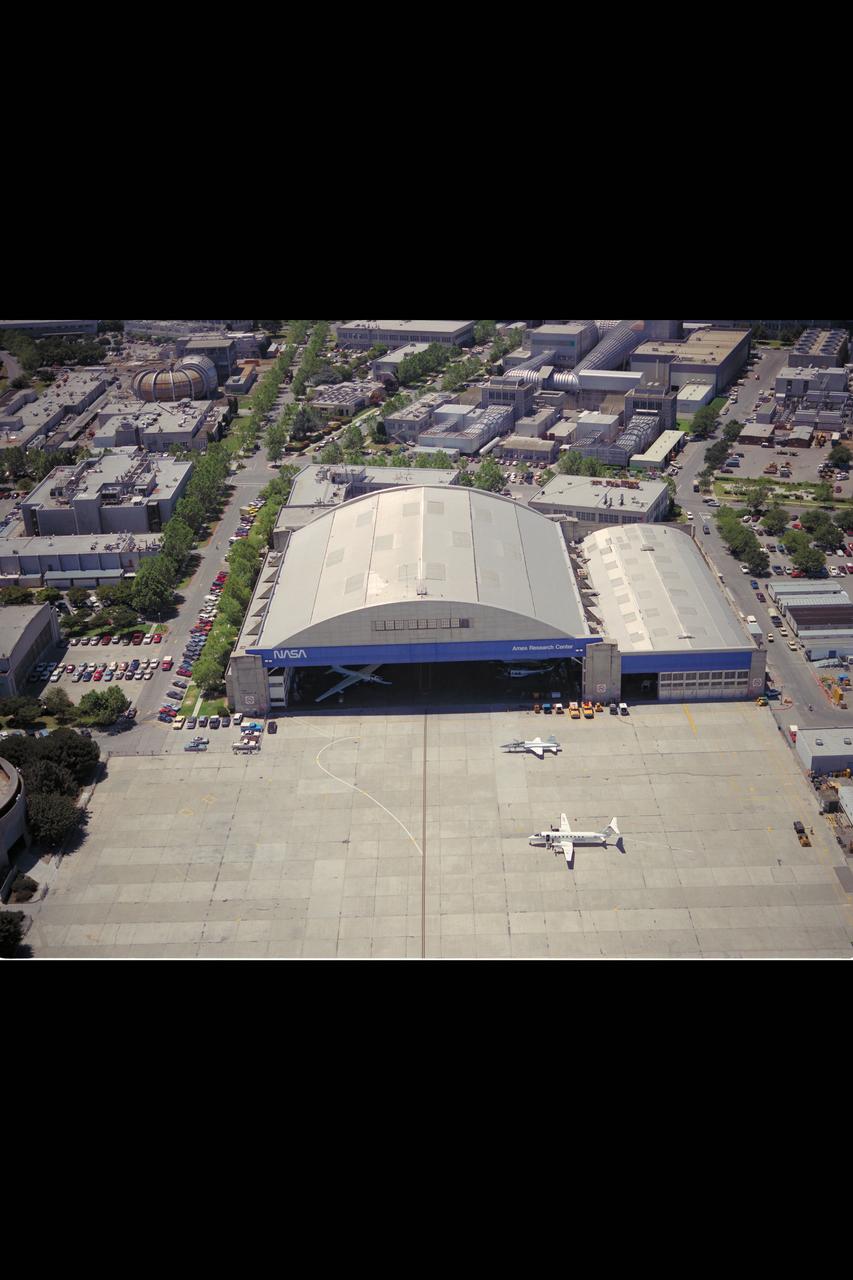
Ames Facility Aerials: N-211
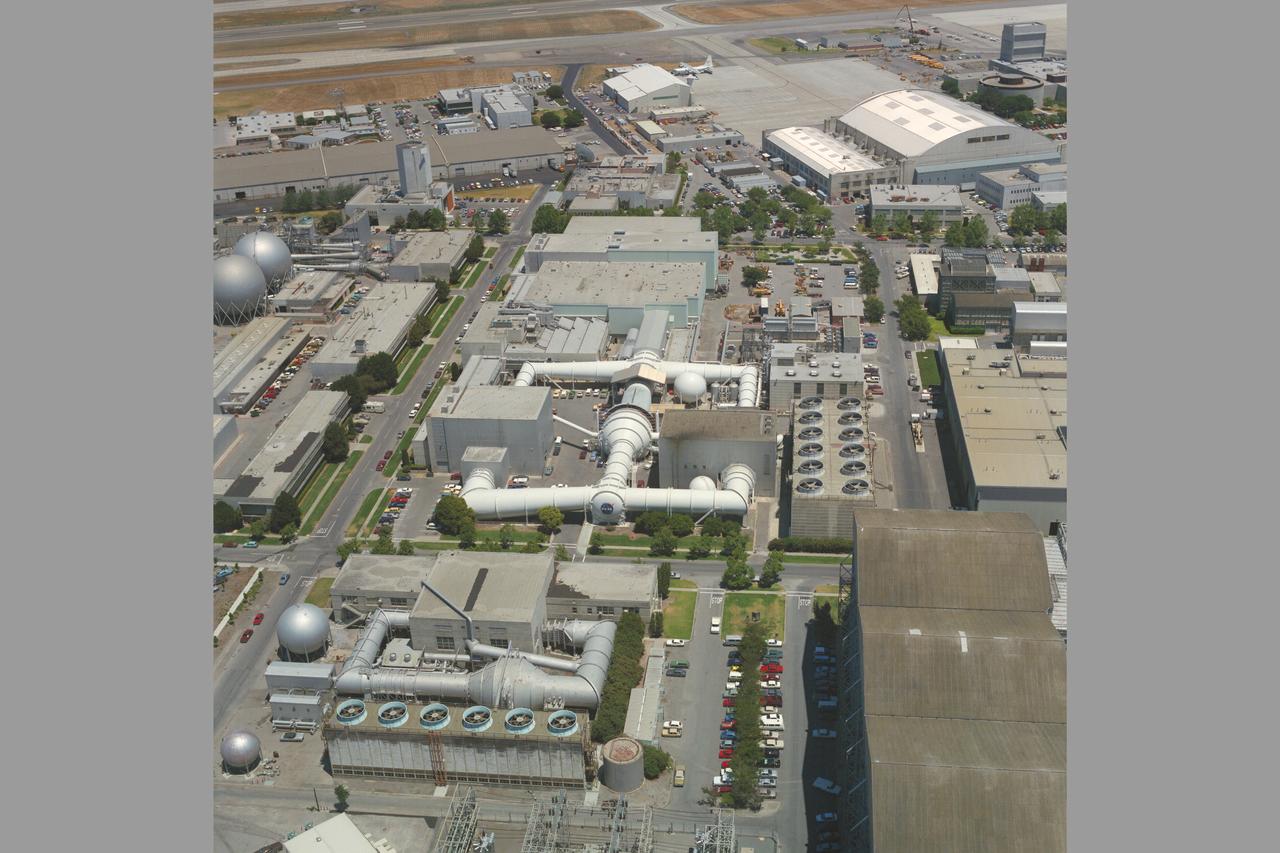
Aerial view of Unitary Plan Wind Tunnel complex with NASA insignia
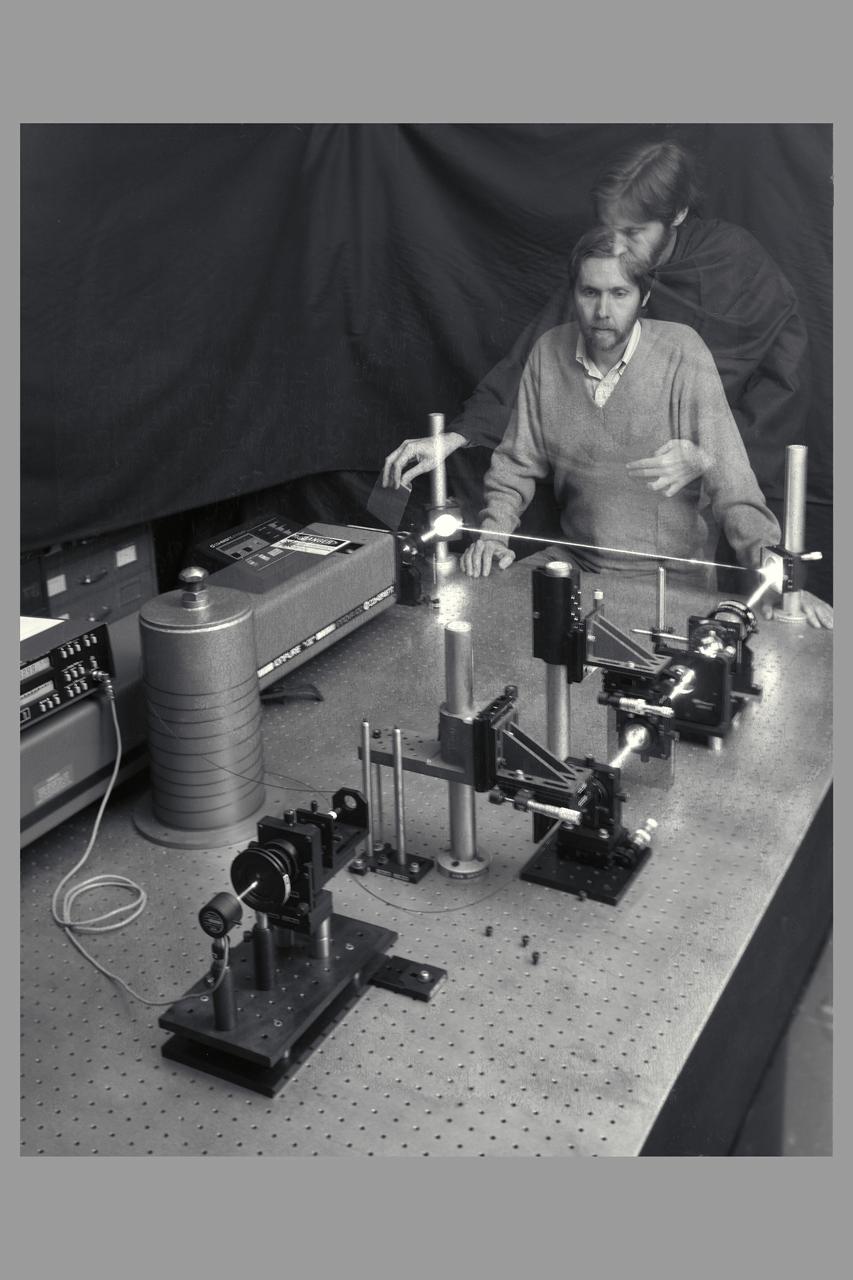
N-213 Laser Optics Laboratory - double exposed polaroid by Ken McAlister (engineer) 3-17-89 with Dana Lynch
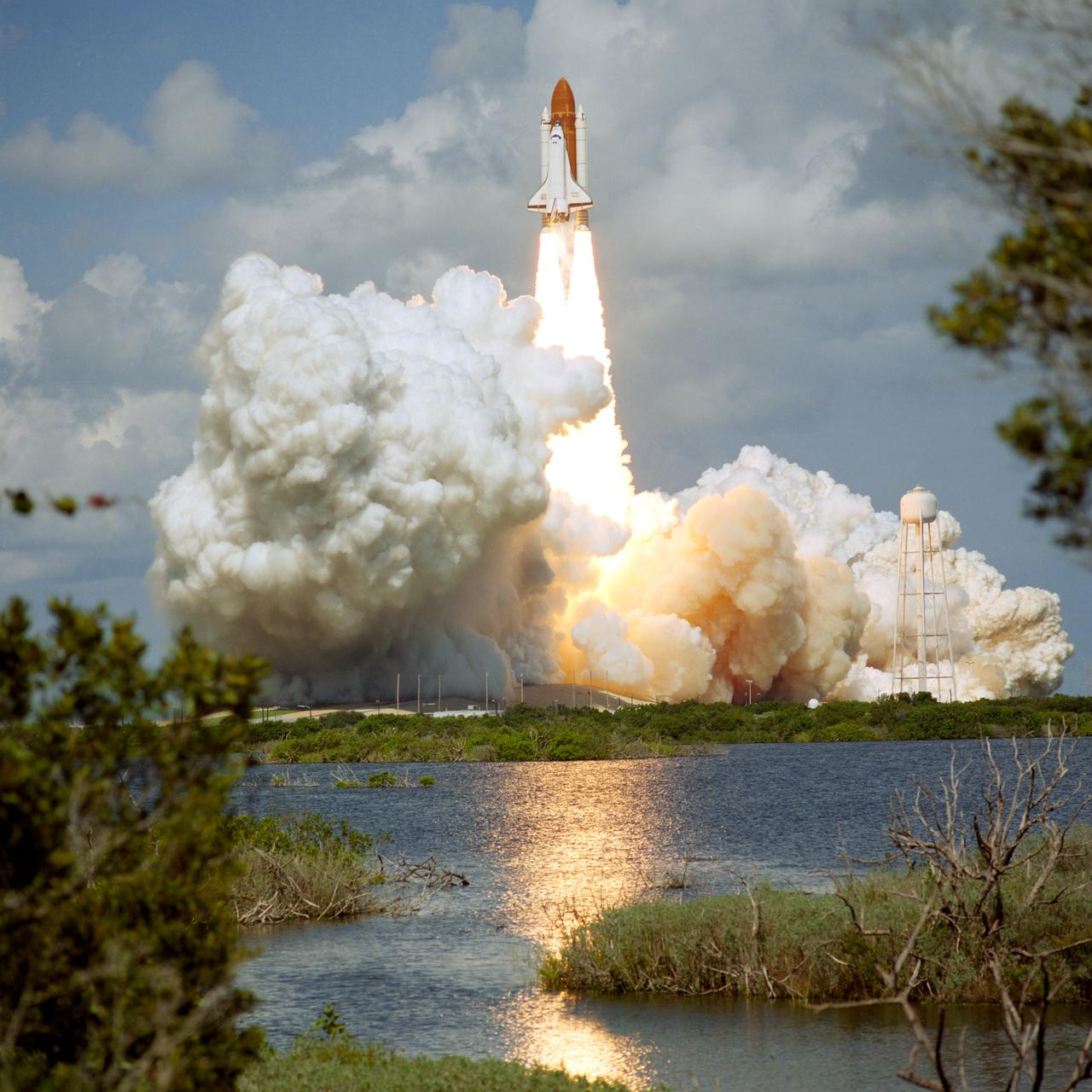
STS034-S-025 (18 Oct 1989) --- The STS-34 Space Shuttle Atlantis lifts off from Launch Pad 39-B at 2:53:39:983 p.m. (EDT), marking the beginning of a five-day mission in space. Atlantis carries a crew of five and the spacecraft Galileo, along with a number of other scientific experiments. The Jupiter-bound probe will be deployed from Atlantis some six hours after launch. The journey to the giant planet is expected to take over six years. Crewmembers for the mission are astronauts Donald E. Williams, Michael J. McCulley, Shannon W. Lucid, Franklin R. Chang-Diaz and Ellen S. Baker. The scene was recorded with a 70mm camera.
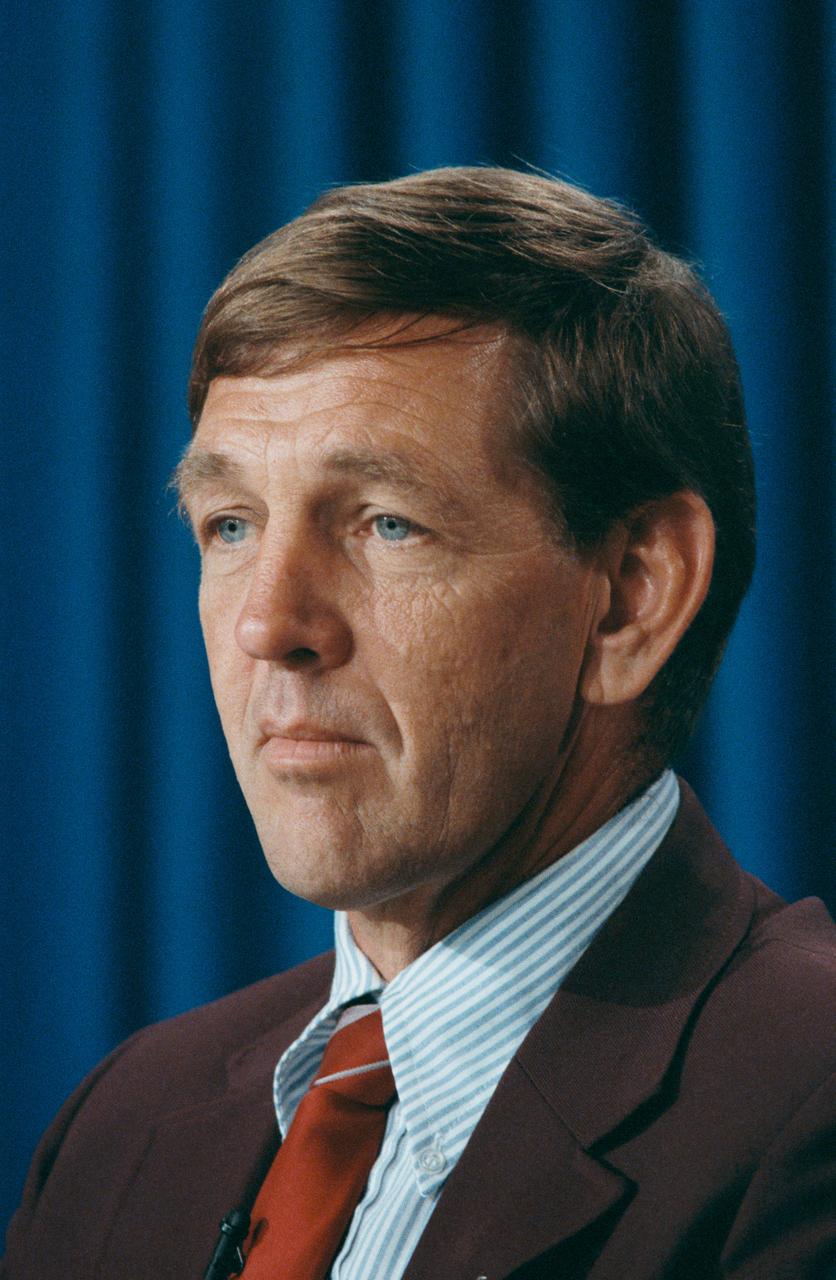
STS-34 Atlantis, Orbiter Vehicle (OV) 104, Pilot Michael J. McCulley reflects on a question during the thirty days before launch (T-30) press briefing in the JSC Auditorium and Public Affairs Facility Bldg 2 briefing room.
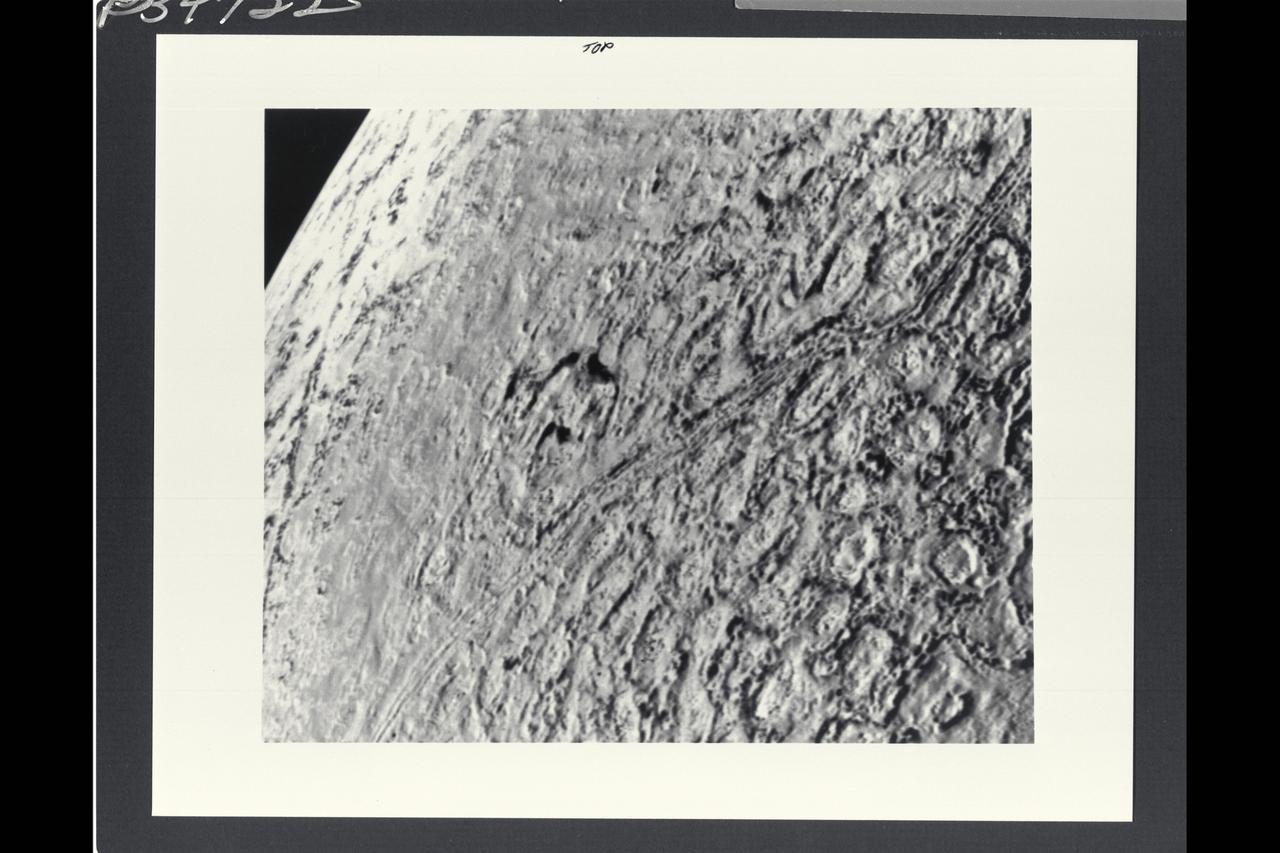
Voyager II Imagery, Neptune: This is one of the most detailed views of the surface of Triton taken by Voyager 2 on its flyby of the large satellite of Neptune early in the morning of August 25, 1989. The picture was stored on the tape recorder and relayed to Earth later. Taken from a distanT ce of only 40,000 km (25, 000 miles), the frame is about 220 kilometers (140 miles) across and shows details as small as 750 meters (0.5 miles). Most of the area is covered by a peculiar landscape of roughly circular depressions separated by rugged ridges. This type of terrain, which covers large tracts of Triton's northern hemisphere, is unlike anything seen elsewhere in the solar system. The depressions are probably not impact craters: They are too similar in size and too regularly spaced. Their origin is still unknown, but may involve local melting and collapse of the icy surface. A conspicuous set of grooves and ridges cuts across the landscape, indicating fracturing and deformation of Triton's surface. The rarity of impact craters suggests a young surface by solar-system standards, probably less than a few billion years old. The Voyager Mission is conducted by JPL for NASA's Office of Space Science and Applications. (JPL ref: P-34722 Voyager N-60 )
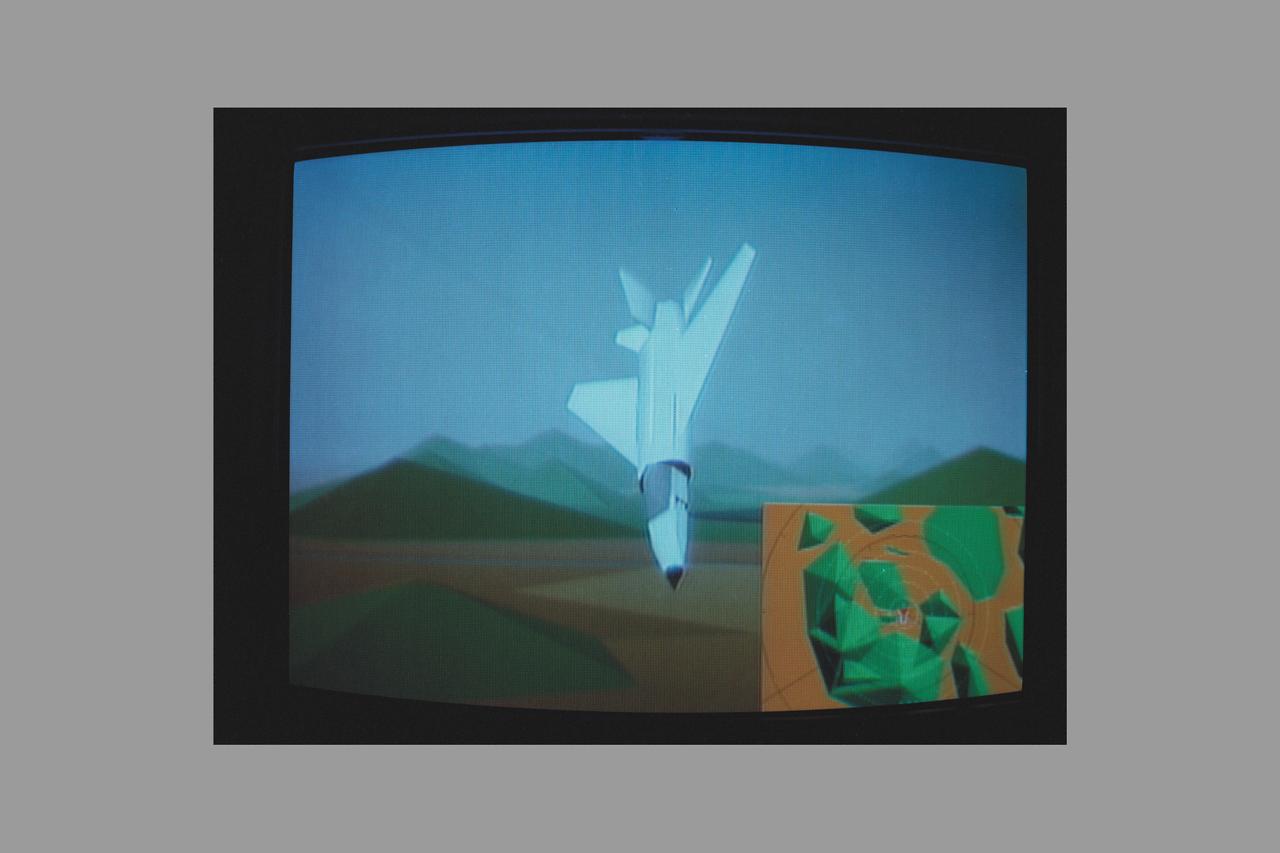
VMS I-Cab: MV-22 Simulation.
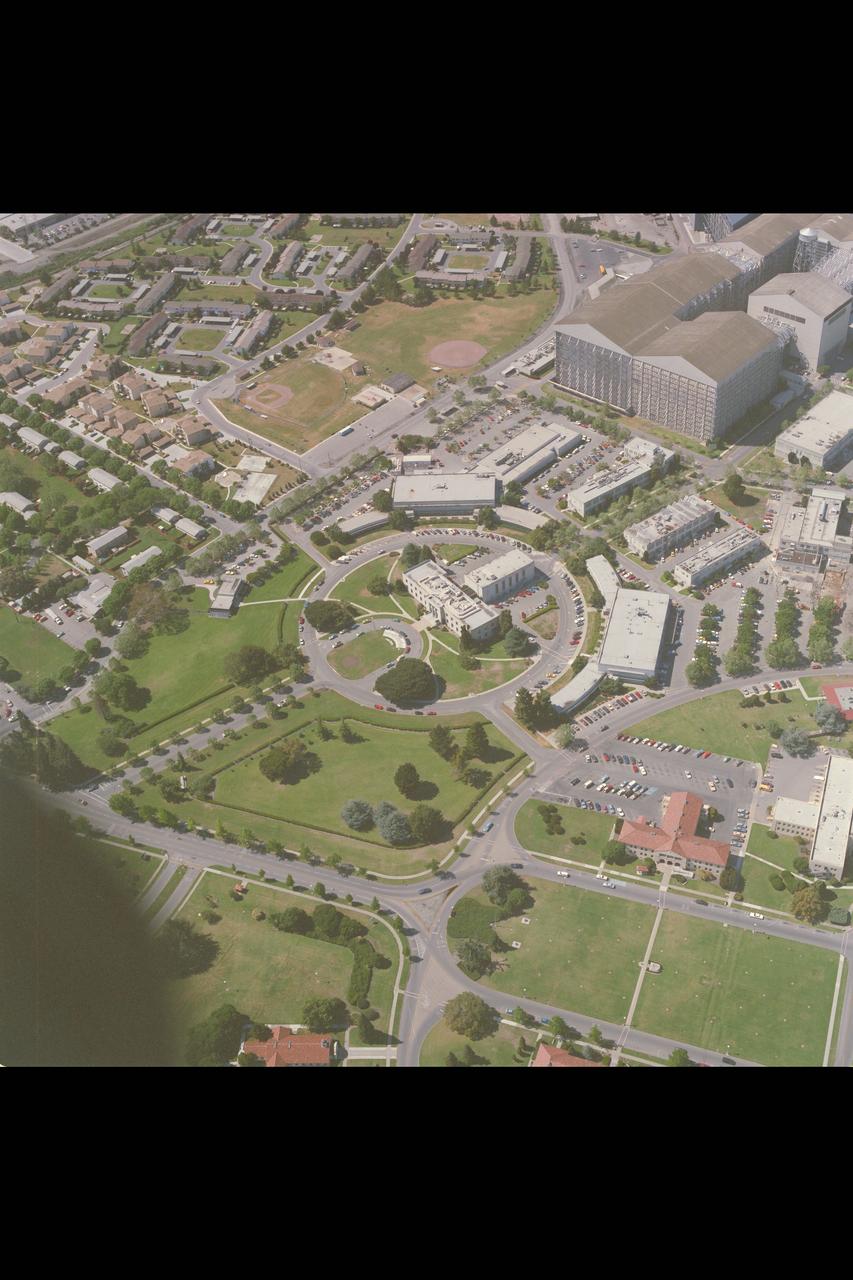
Ames Aerial Bush Circle, N-200 Administration - N-201Auditorium

STS029-S-040 (13 Mar 1989) --- Astronauts Frank R. Culbertson, left, and John O. Creighton man their spacecraft communicator console positions for the launch phase of the STS-29 mission.

Range : 660,000 km. ( 412,000 miles ) P-34711 This Voyager 2 wide angle photograph shows the shadow of Neptune on the rings. Because Neptune's shadow casts a curved profile on the rings which does not quite reach out to the outermost ring at about 38,000 km. (24,000 miles) from the cloudtops. In this photo, taken through the clear filter at a phase angle of about 135 degrees, the shadow does fall on the inner bright ring ( at about 28,000 km. (18,000 miles) from the cloudtops. The shadow also clearly delineates the radial extent of the broad sheet of material discovered extending from about halfway between the bright rings down to, and perhaps beyond the inner bright ring. A very thin, brighter of the edge of this diffuse sheet can also be seen. additional information from other images indicates that this faint material extends further in, to at least the position of the innermost faint ring discovered at about 17,000 km (11,000 mi.) from the cloudtops.
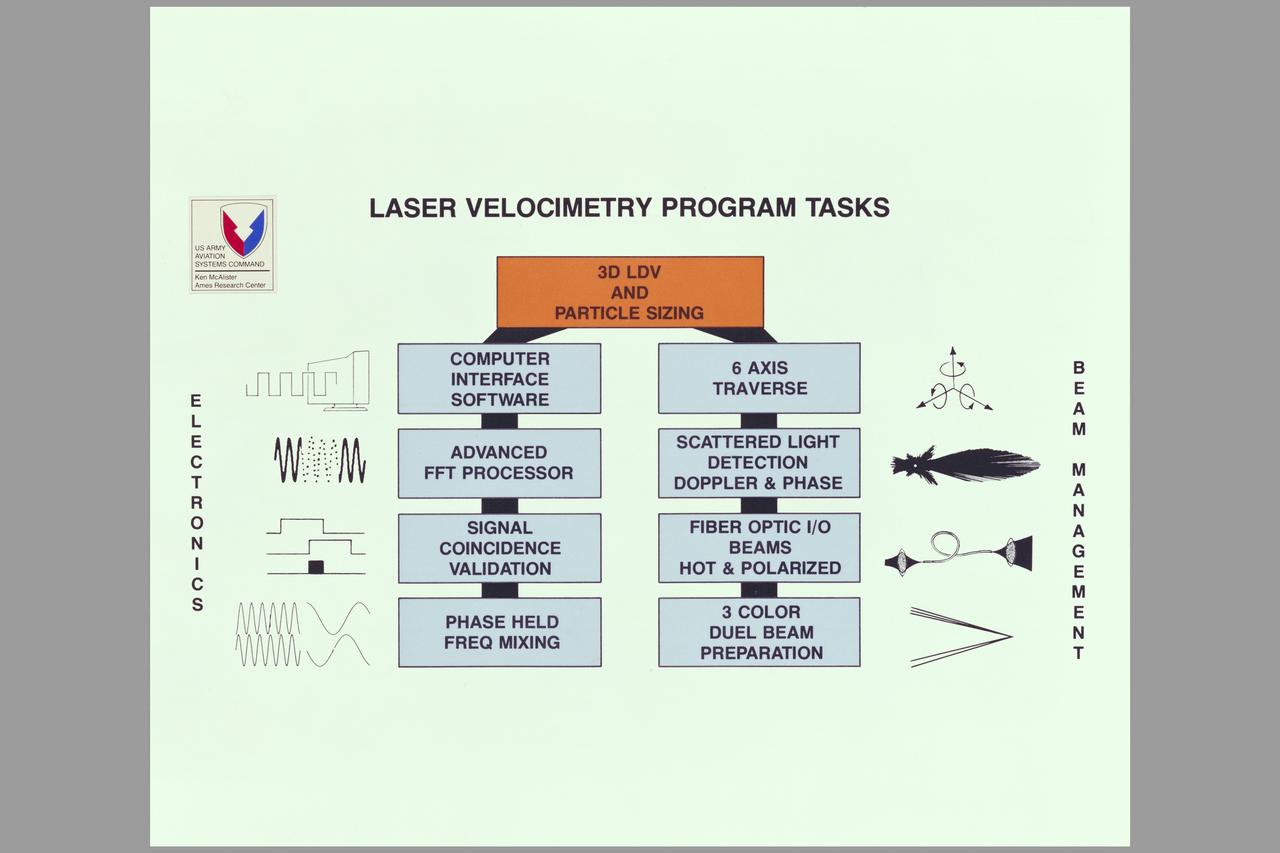
Graphics (McAlister) Army Aeroflightdynamics Directorate 3D Laser Velocimeter for Rotor Flow Studies: Laser Velocimetry Program Tasks Composite.
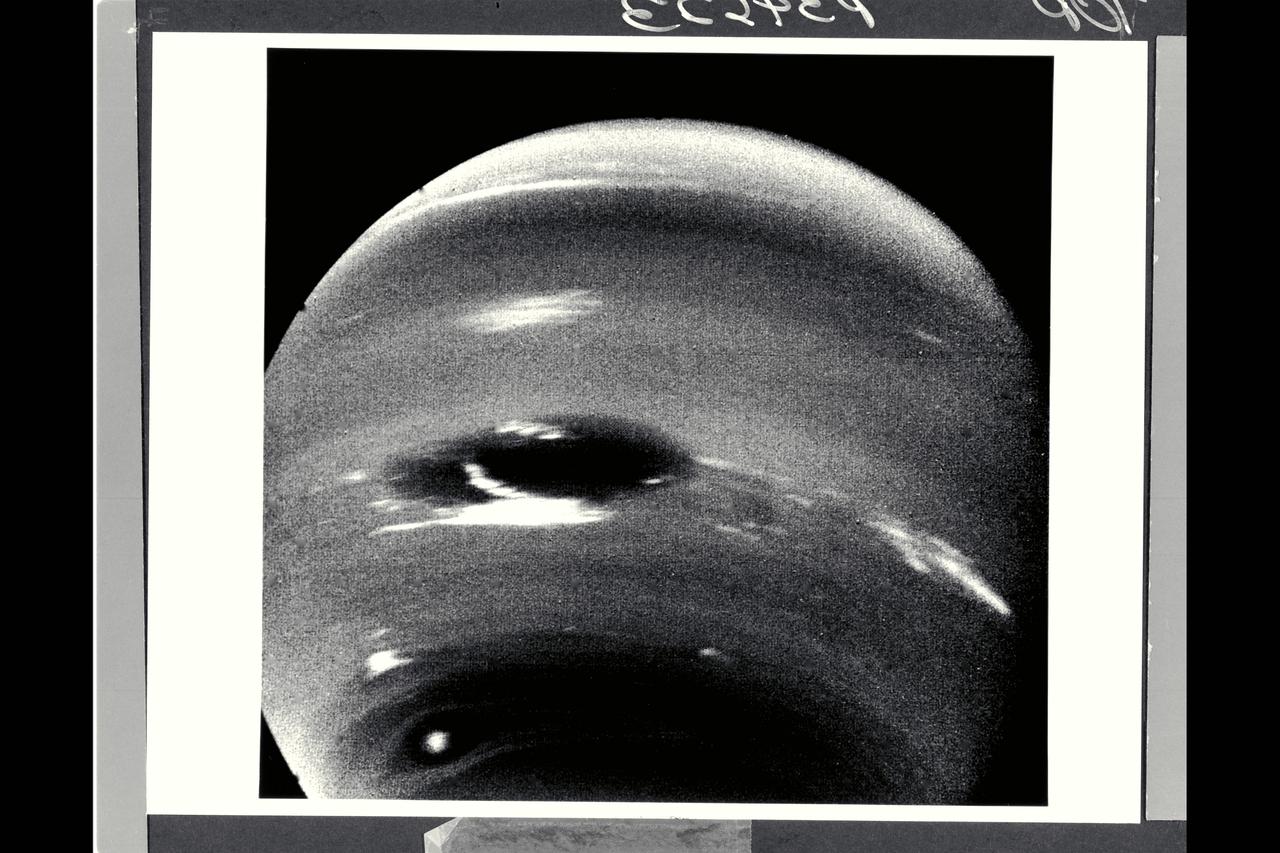
Range : 6.1 million km ( 3.8 million miles) This image of clouds in Neptune's atmosphere is the first that tests the accuracy of the weather forecast that was made eight days earlier to select targets for the Voyager narrow-angle camer. Three of the four targeted features are visible in this photograph; all three are close to their predicted locations. The Great Dark Spot with its bright white companion is slightly to the left of center. The small brig&ht Scooter is below and to the left, and the second dark spot with its bright core is below the Scooter. Strong eastward winds -- up to 400 mph -- cause the second dark spot to overtake and pass the larger one every five days.
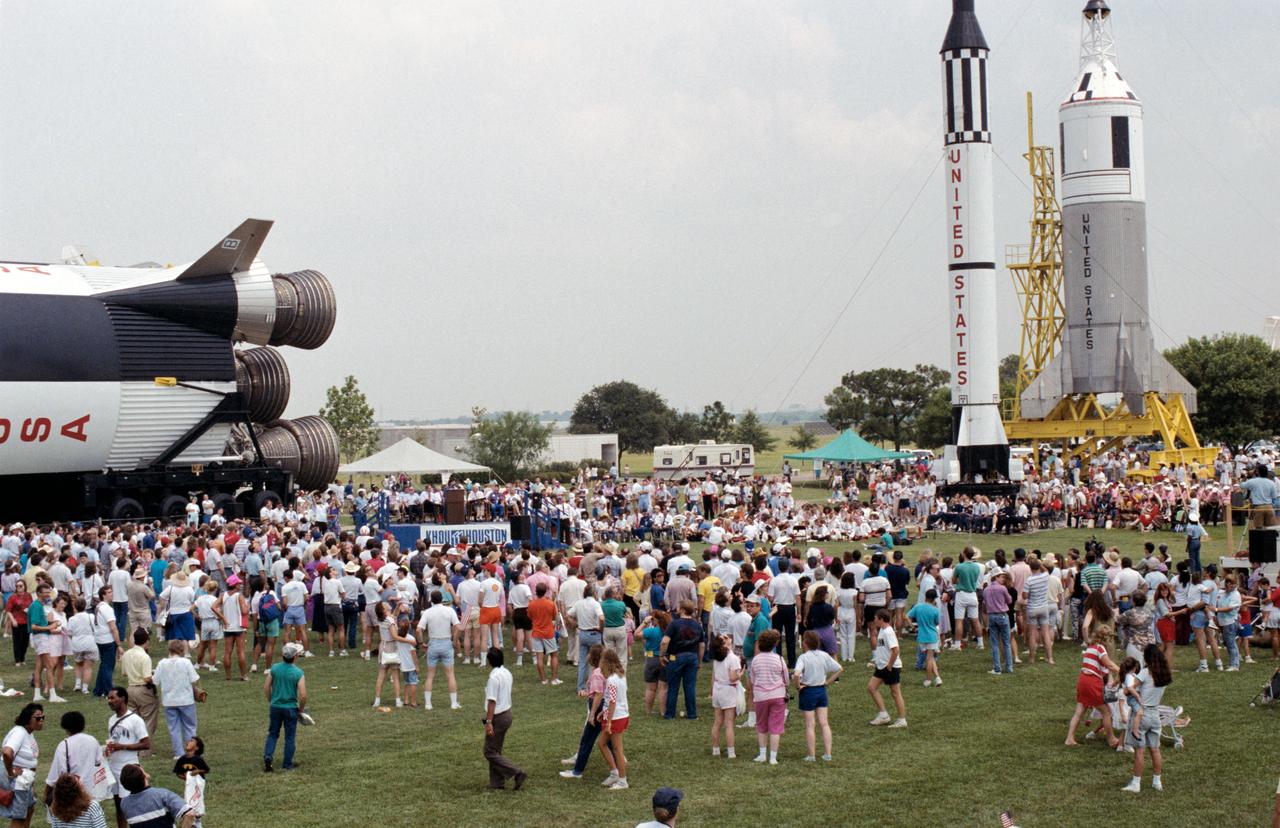
View of crowd at Rocket Park during Apollo 11 Anniversary festivities.
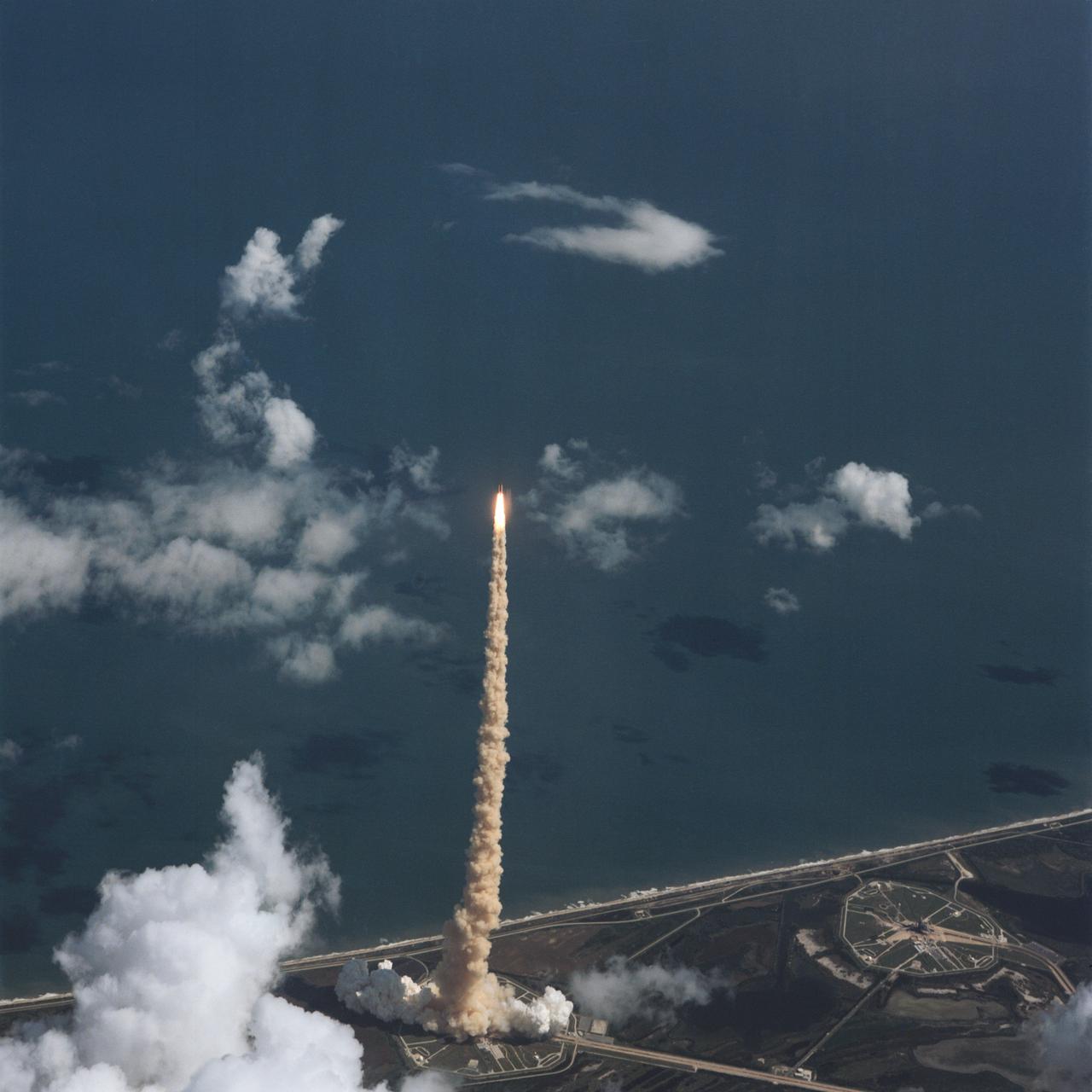
STS-34 Atlantis, Orbiter Vehicle (OV) 104, lifts off from Kennedy Space Center (KSC) Launch Complex (LC) Pad 39B at 12:53:39:983 pm Eastern Daylight Time (EDT). This aerial view shows OV-104, its external tank (ET), and two solid rocket boosters (SRBs) rising high above LC Pad 39B atop a plume of exhaust smoke. Atlantic Ocean is visible in the background. The liftoff marks the beginning of a five-day mission in space.
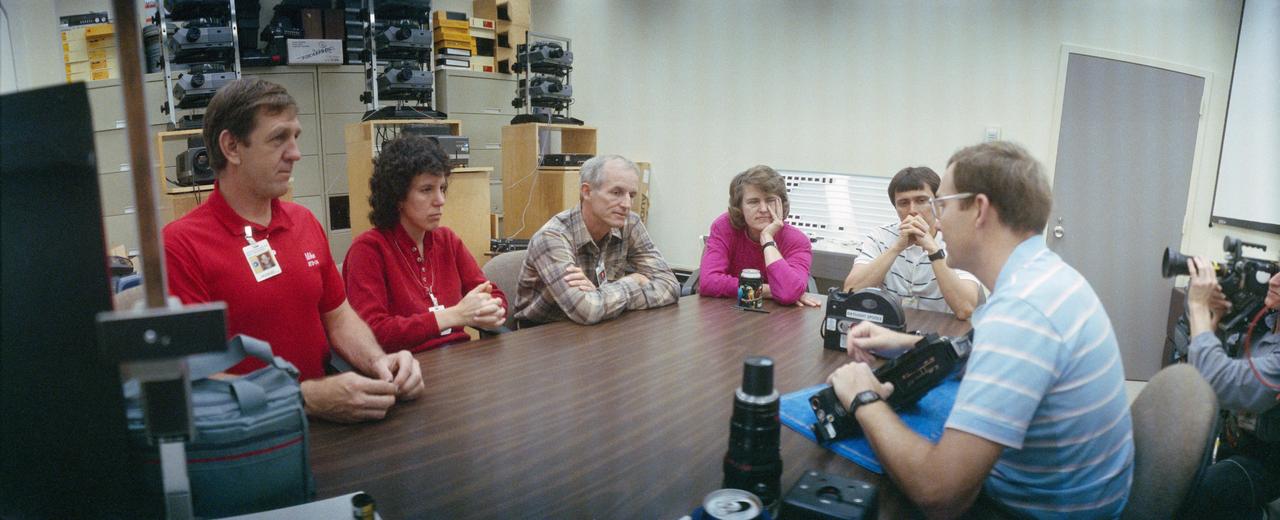
STS-34 Atlantis, Orbiter Vehicle (OV) 104, crewmembers listen to trainer Bill Bowers explain ARRIFLEX camera equipment during briefing at JSC. Across the table from Bowers are (left to right) Pilot Michael J. McCulley, Mission Specialist (MS) Ellen S. Baker, Commander Donald E. Williams, MS Shannon W. Lucid, and MS Franklin R. Chang-Diaz.

Farewell BBQ for Ames Director (1984-1989) William F Ballhaus
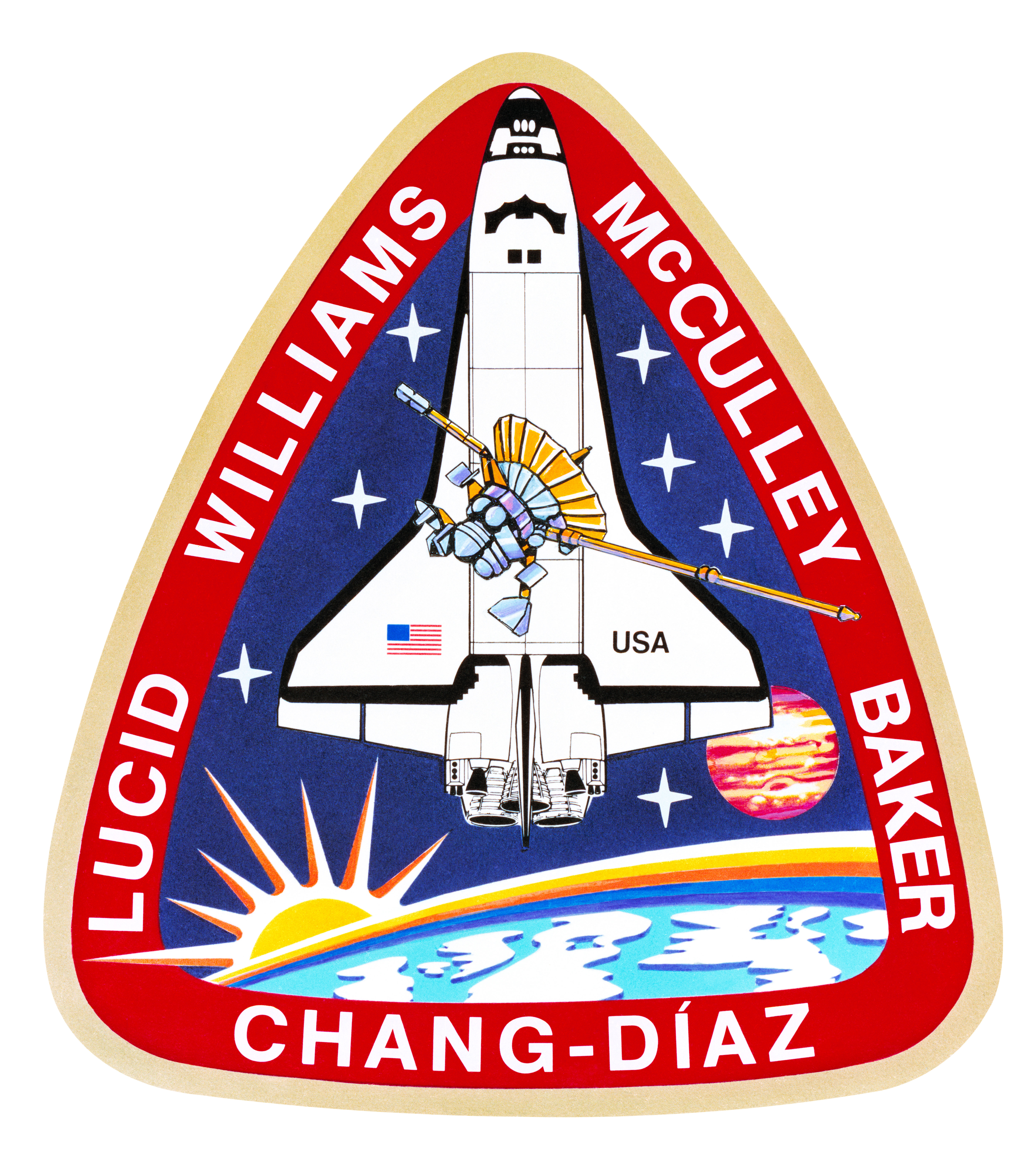
S89-20077 (17 July 1989) --- The triangular shape of the STS-34 crew patch represents forward motion and the entering into new frontiers of science, engineering and technology. The Galileo spacecraft overlaying the orbiter symbolizes the joining together of both manned and unmanned space programs in order to maximize the capabilities of each. The crew members, who designed the patch, use a sunrise stretching across Earth's horizon to depict expansion of our knowledge of the solar system and other worlds, leading to a better understanding of our own planet. In the distance, Jupiter, a unique world with many unknowns, awaits the arrival of Galileo to help unlock its secrets. Meanwhile, the space shuttle remains in Earth orbit, continuing to explore the near-Earth environment. The NASA insignia design for space shuttle flights is reserved for use by the astronauts and for other official use as the NASA Administrator may authorize. Public availability has been approved only in the forms of illustrations by the various news media. When and if there is any change in this policy, which is not anticipated, the change will be publicly announced. Photo credit: NASA
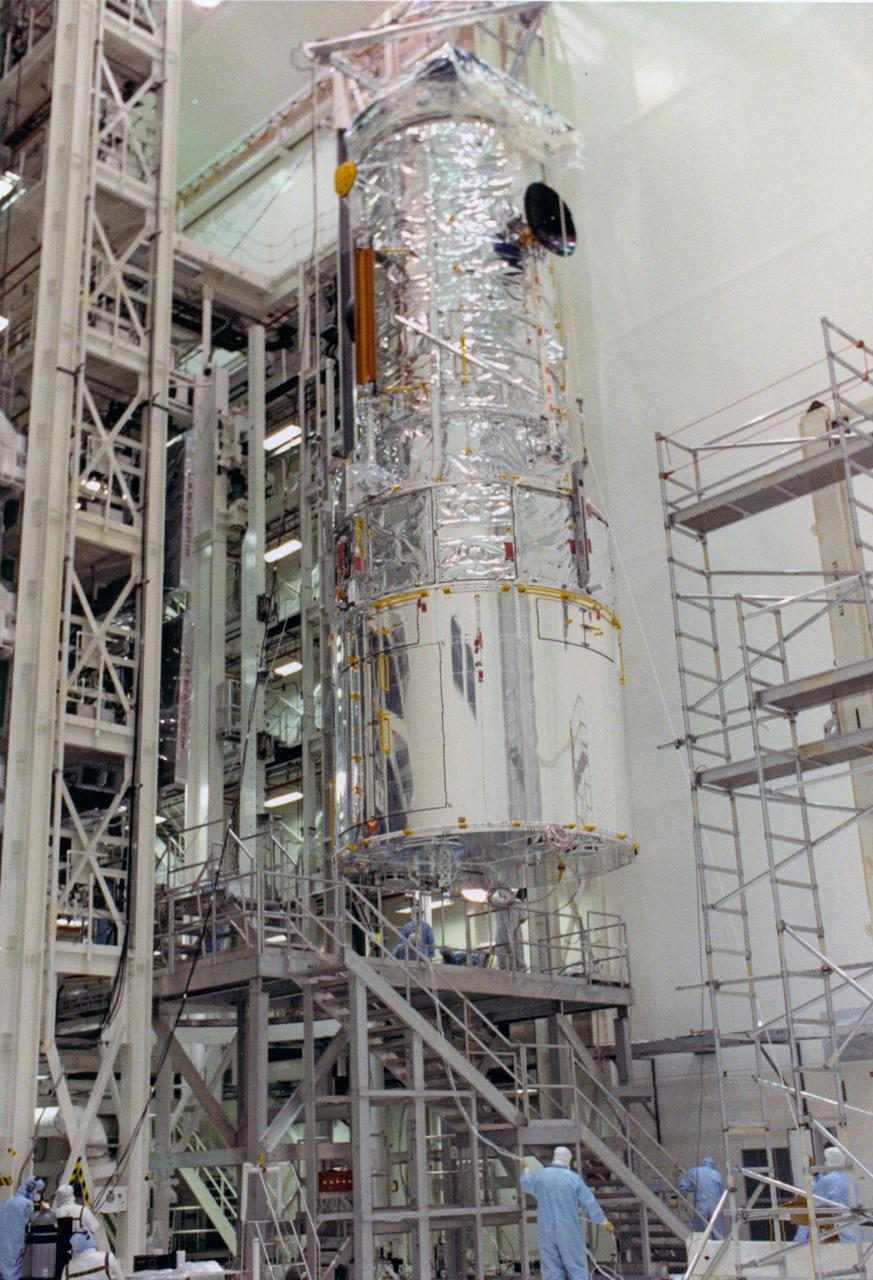
KENNEDY SPACE CENTER, FLA. -- The Hubble Space Telescope (HST) is lifted into the workstands in the Vertical Processing Facility as work begins at KSC to process the 94-inch primary mirror telescope for launch on Discovery on Space Shuttle Mission STS-31 in March 1990. With HST, astronomers will be able to view 97 percent of the known universe, and will be able to get pictures unlimited and undistorted by the Earth's atmosphere. Compared with earth-based observatories, the HST will be able to view celestial objects that are 50 times fainter, provide images that are 10 times sharper, and see objects that are seven times farther away. .
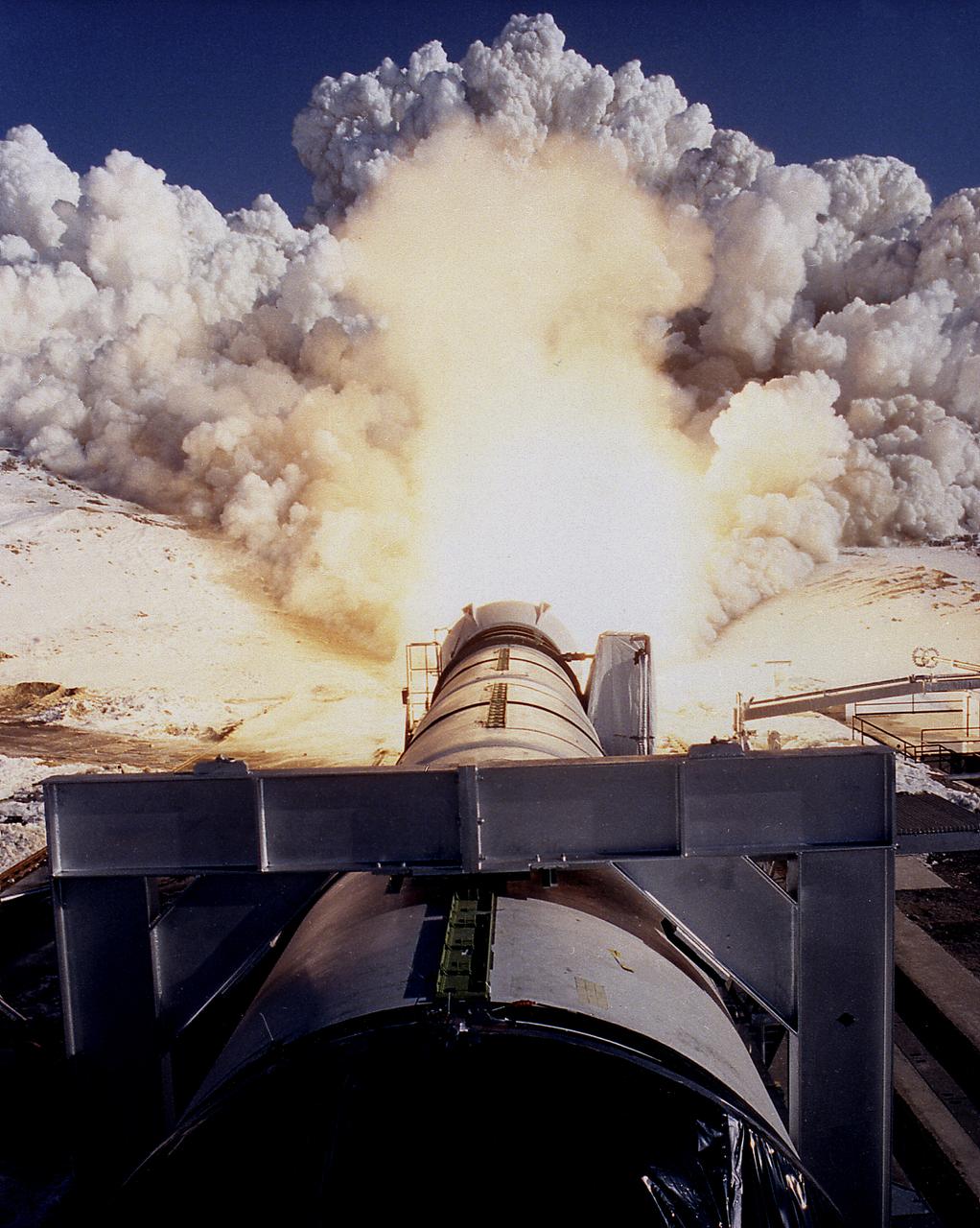
This photograph shows a static firing test of the Solid Rocket Qualification Motor-8 (QM-8) at the Morton Thiokol Test Site in Wasatch, Utah. The twin solid rocket boosters provide the majority of thrust for the first two minutes of flight, about 5.8 million pounds, augmenting the Shuttle's main propulsion system during liftoff. The major design drivers for the solid rocket motors (SRM's) were high thrust and reuse. The desired thrust was achieved by using state-of-the-art solid propellant and by using a long cylindrical motor with a specific core design that allows the propellant to burn in a carefully controlled marner. Under the direction of the Marshall Space Flight Center, the SRM's are provided by the Morton Thiokol Corporation.
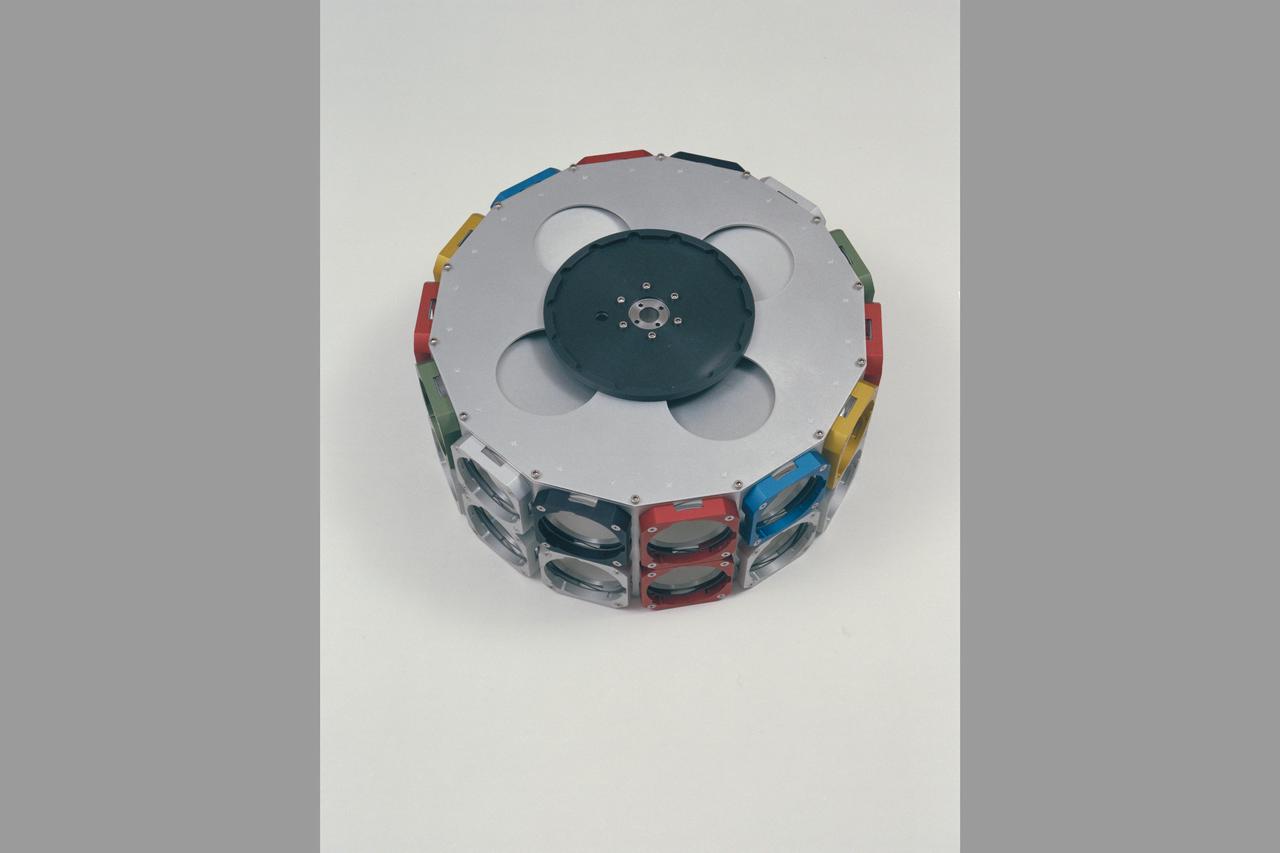
SL-J Space Shuttle Frog Embryology Experiment (FEU) flight hardware
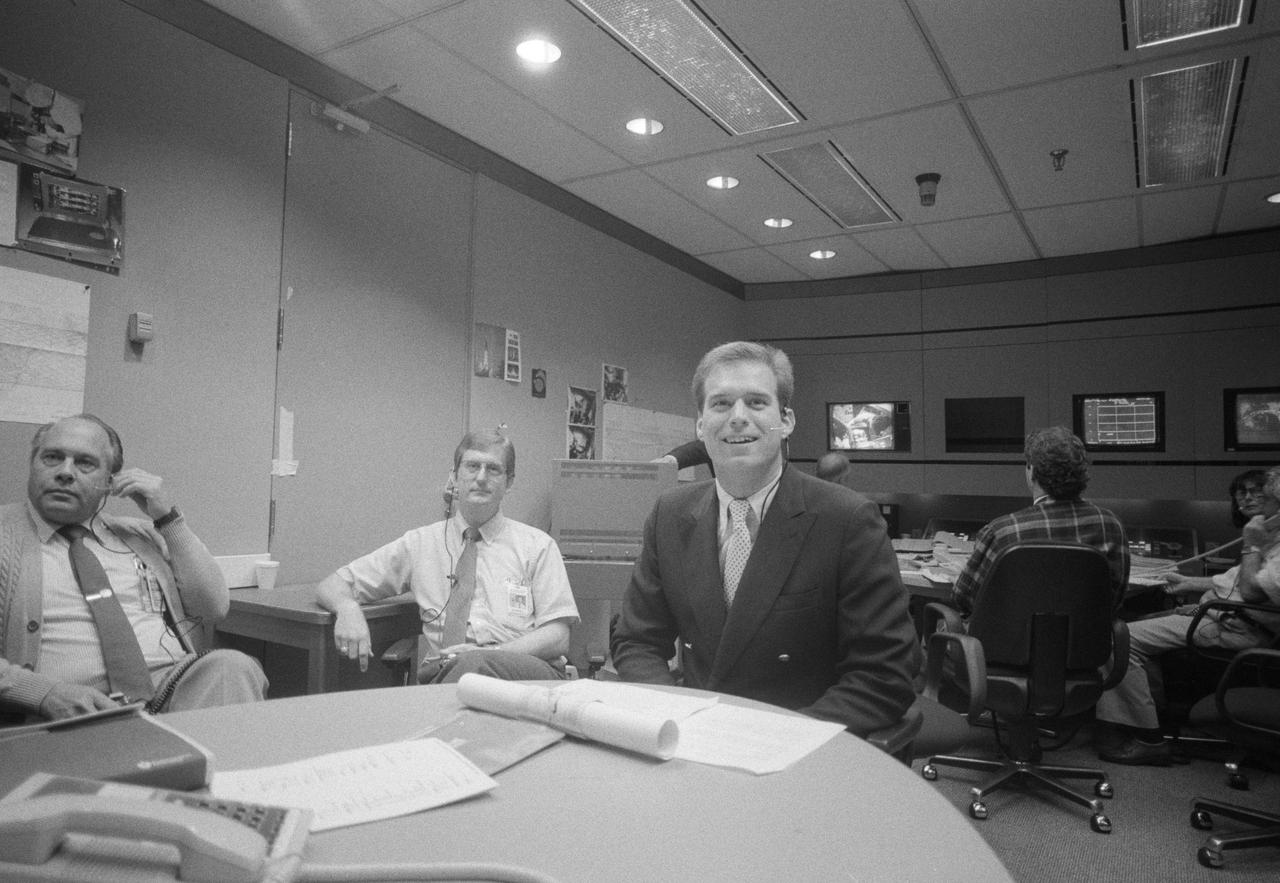
STS029-S-047 (16 Mar 1989) --- Student experimenter John C. Vellinger, right, watches a TV monitor in the customer support room of Johnson Space Center's mission control center during a downlink from the spacecraft of astronaut John E. Blaha conducting the experiment in the incubator used for the test. The experiment is titled "Chicken Embryo Development in Space." Also visible are Neil Criestie and Robert N. Stuckey of JSC. The experiment's sponsor is Kentucky Fried Chicken.

Range : 280,000 km. ( 170,000 miles ) P-34726 BW Two 10 minute exposures of Neptune's rings clearly show the two main rings , as well as the inner faint ring and the faint band that extends planetward from roughly halfway between the two bright rings. Both bright rings have material throughout their entire orbit, and are therefore continuous. The inner ring and the broad band are much fainter than the two narrow main rings. These images were taken 1 hour and 27 minutes aprt, using the clear filter on Voyager 2's wide angle camera. These long exposures images were taken while the rings were backlit by the sun. This viewing geometry enhances the visibility of dust and allows optically thinner parts of the rings to be seen. The bright glare in the center is due to overexposure of the crescent of Neptune . The two gaps in the upper part of the outer ring in the image on the left are due to the removal of blemishes during computer processing of the images. Numerous bright stars are evident in the background.
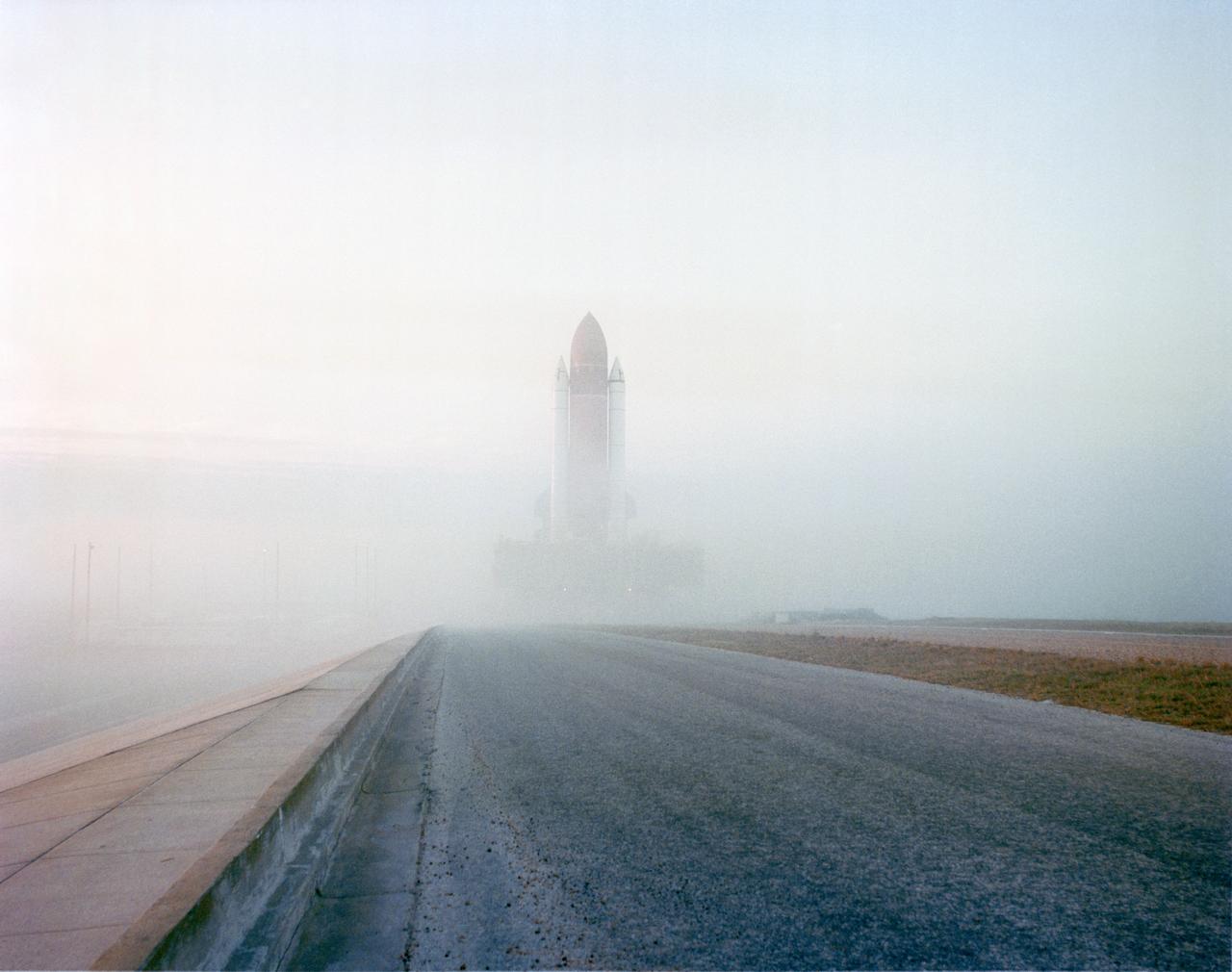
STS-32 Columbia, Orbiter Vehicle (OV) 102, rolls through the morning's foggy mist atop the mobile launcher platform and crawler transporter to Kennedy Space Center (KSC) Launch Complex (LC) Pad 39A. OV-102's wings appear on either side of the two solid rocket boosters (SRBs) and external tank (ET). Rollout from the Vehicle Assembly Building (VAB) began at 2:32 am Eastern Standard Time (EST), and OV-102 was on the pad pedestals about 8 hours later. This marks the first time a Space Shuttle has been at LC Pad 39A since 01-12-85 when OV-102 was launched on mission 61C. View provided by KSC with alternate number KSC-89PC-1259.
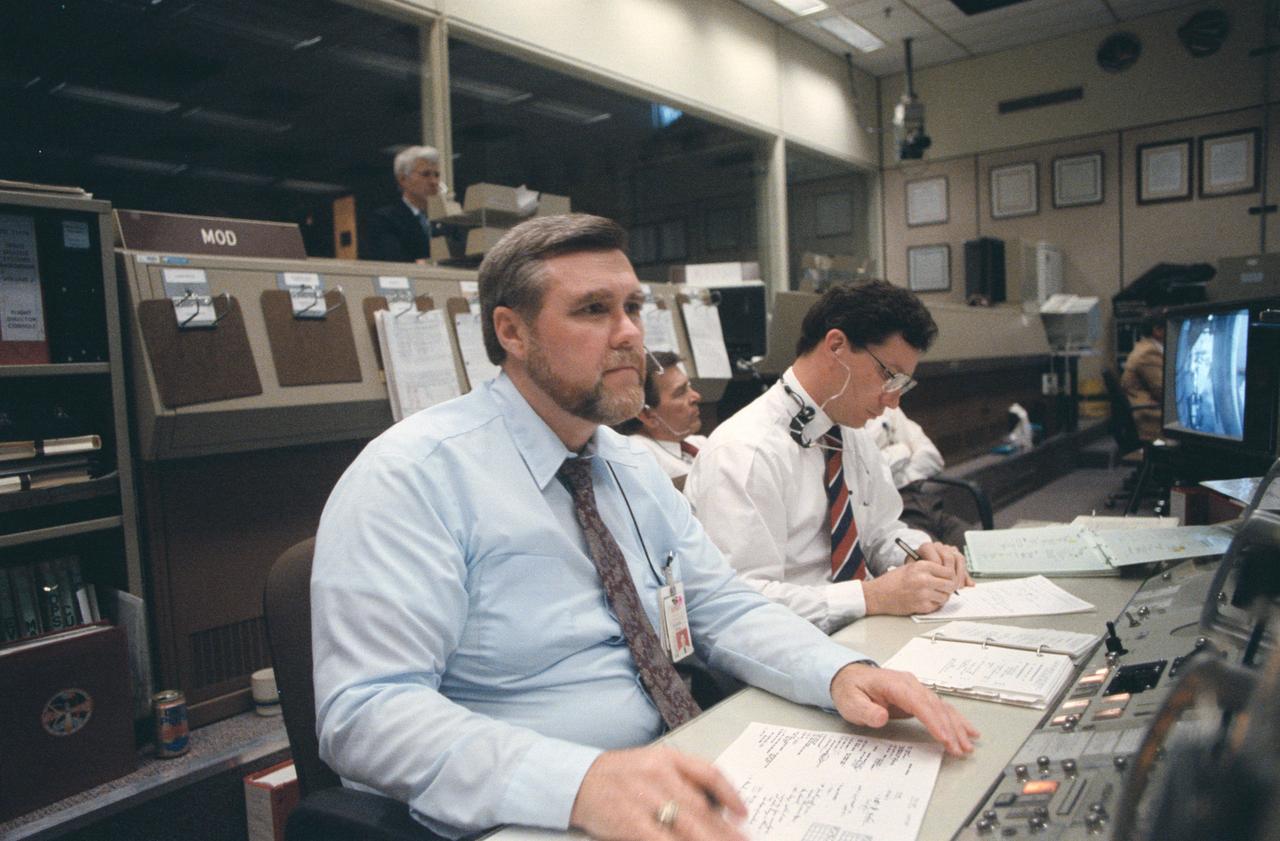
STS029-S-041 (13 March 1989) --- Flight Directors (FD) Lee Brisco (left) and Ronad D. Dittmore monitor prelaunch activity on monitors at their consoles in the flight control room of the Johnson Space Center's mission control center. FD Gary Coen is in the back ground.
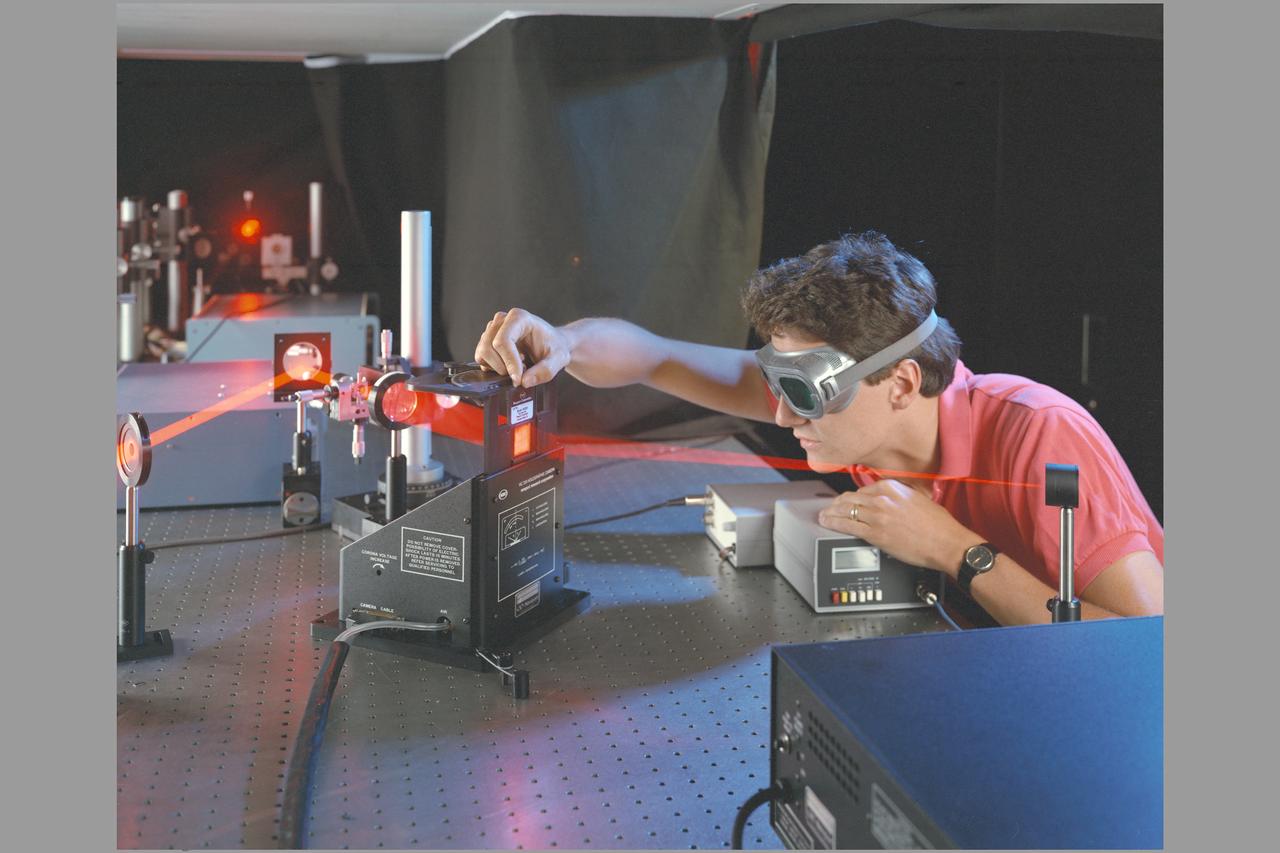
Thermoplastic hologram (laser) N-220 with John Downing

S89-25082 (January 1989) --- Space shuttle Discovery will be manned by these five astronauts when it makes it second flight within a five-month period next month. The STS-29 crew members are (front row), Michael L. Coats (right), commander; and John E. Blaha, pilot; (left to right back row) James P. Bagian, Robert C. Springer and James F. Buchli, mission specialists. Photo credit: NASA
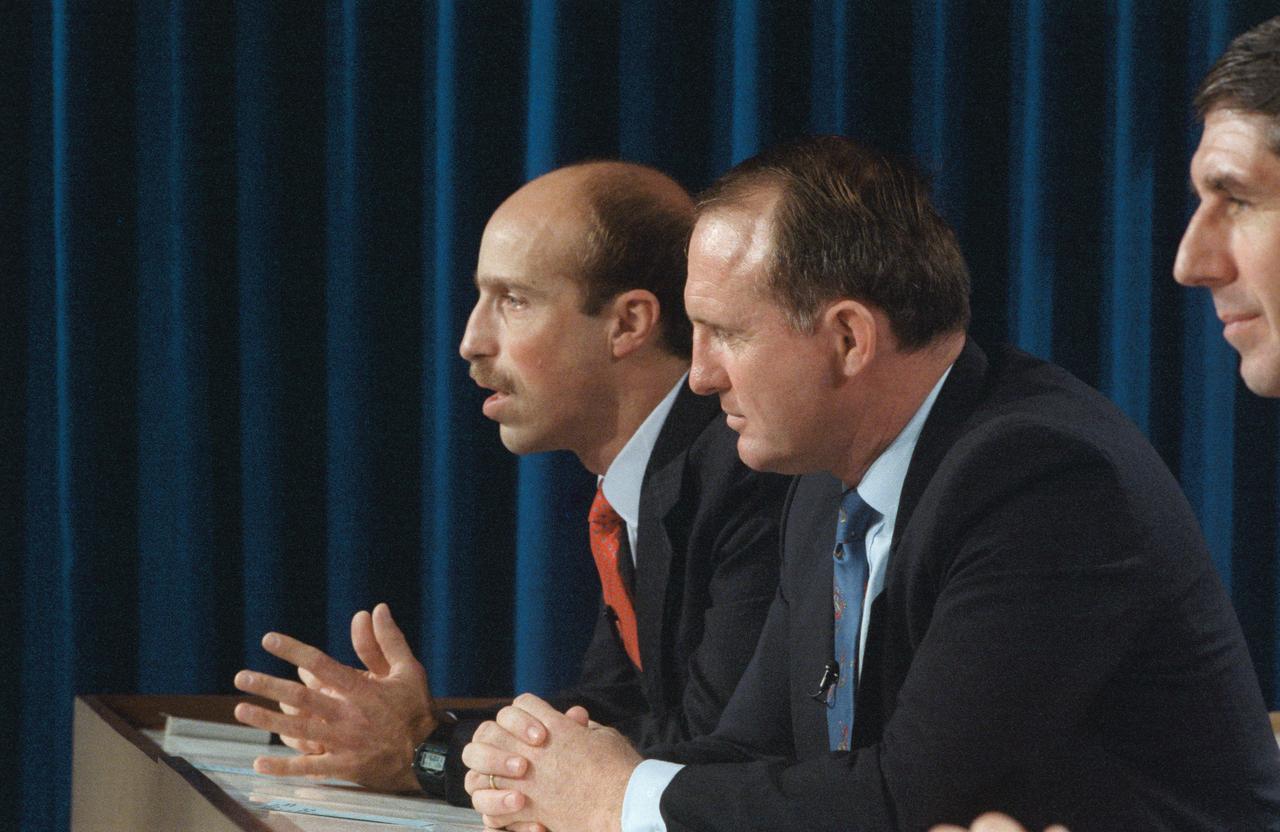
S89-25327 (11 Jan 1989) --- Two crewmembers for NASA's STS-29 mission ponder a question from a news reporter during a press conference concerning their scheduled mid-March flight. James P. Bagian, at left, begins to answer the query, as James F. Buchli listens. Out of the frame are other members of the crew--Astronauts Michael L. Coats, mission commander; and John E. Blaha and Robert C. Springer. The five will deploy a tracking and data relay satellite from Discovery's cargo bay as well as perform other important chores on their scheduled five-day flight.
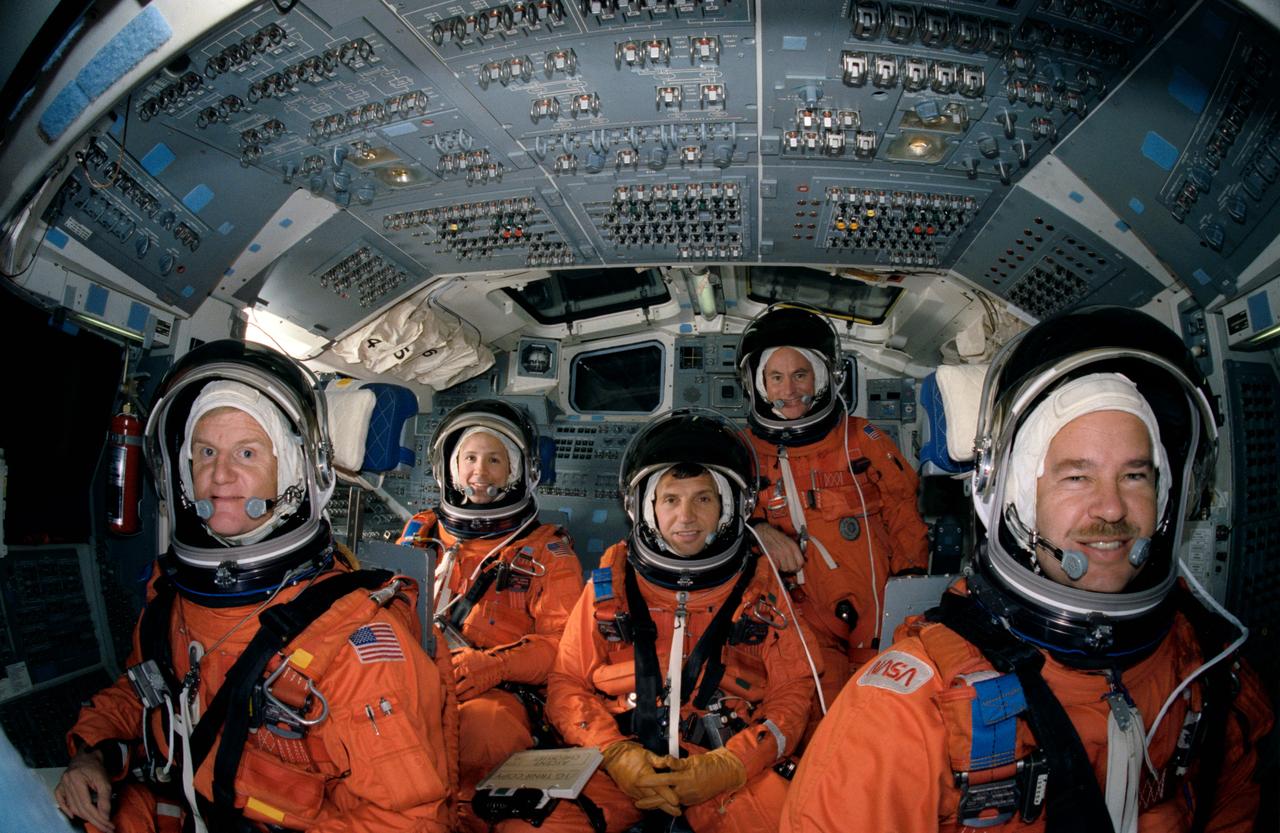
S89-51626 (18 Dec 1989) --- The astronaut crewmembers of the STS-36 mission occupy the flight deck of the crew compartment trainer in the Johnson Space Center's Space Shuttle mockup and integration laboratory. They are, left to right, Astronauts John H. Casper, pilot; Pierre J. Thuot, David C. Hilmers and Richard M. (Mike) Mullane, mission specialists; and John O. Creighton, mission commander. Mullane will be stationed on the mid deck for launch, while Thuot will man that position during entry. The photograph was made by William H. Bowers, crew photo instructor.
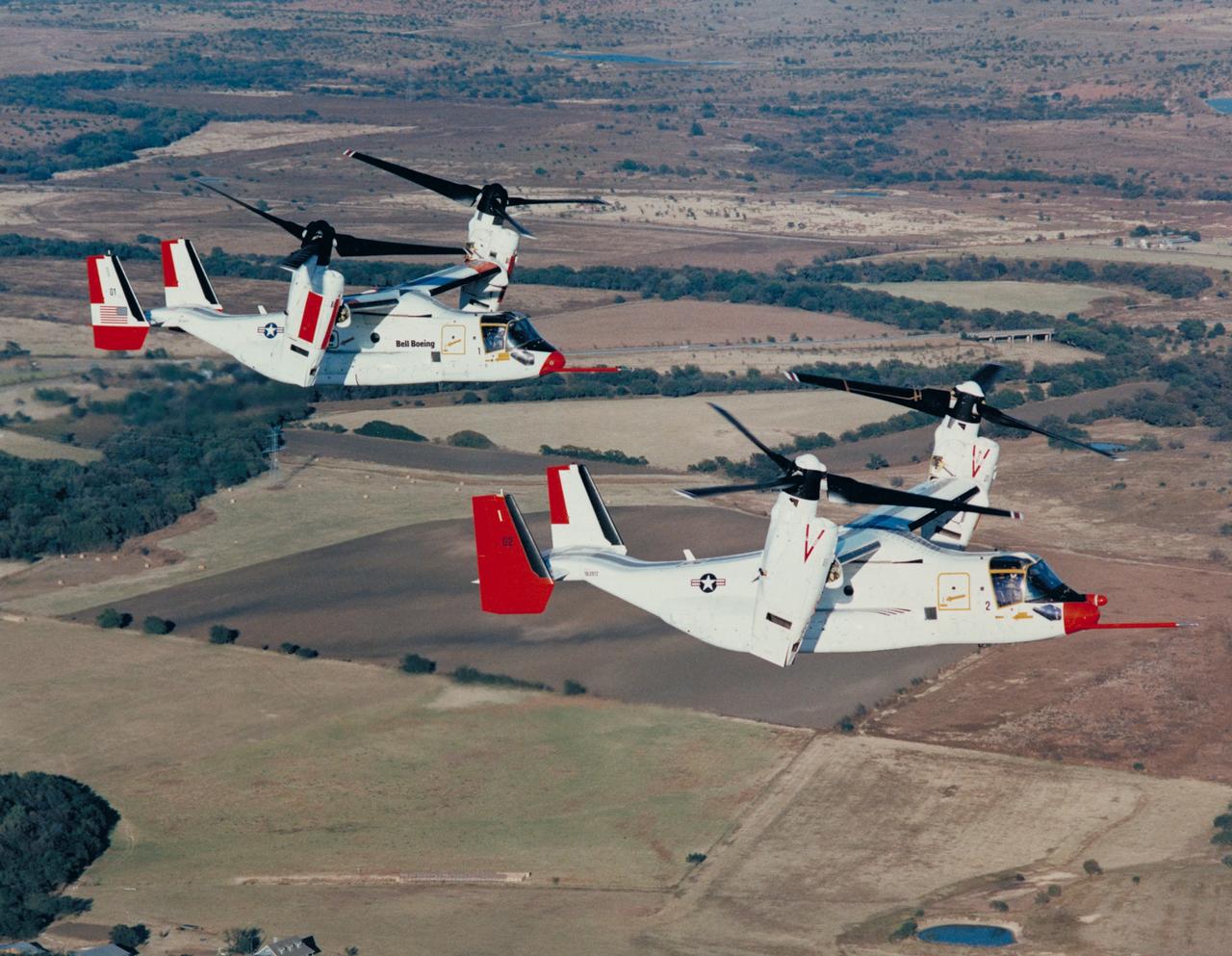
Bell Helicopter Bell-Boeing Tilt Rotor V-22 Ospreys in flight.
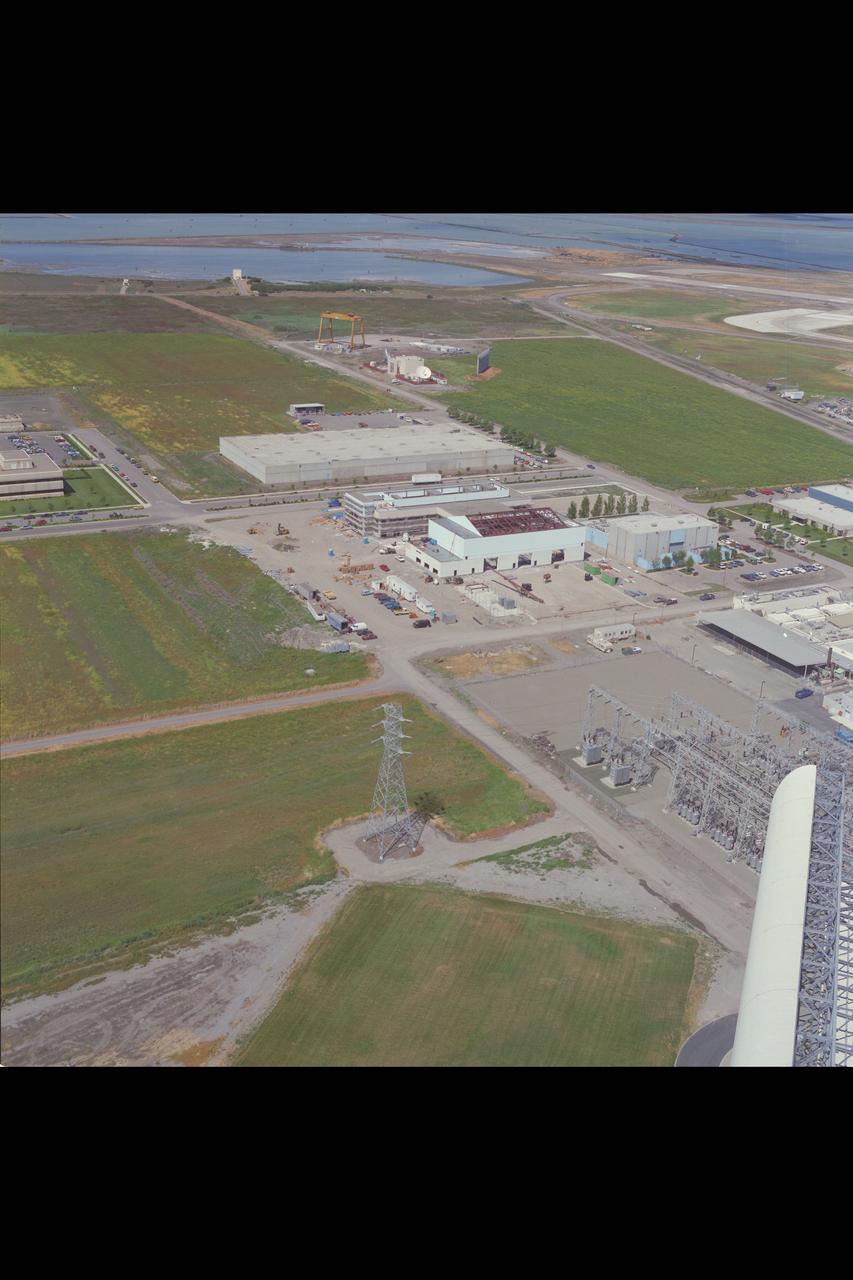
Ames Aerials: N-262 underconstruction, N-255, N-257,
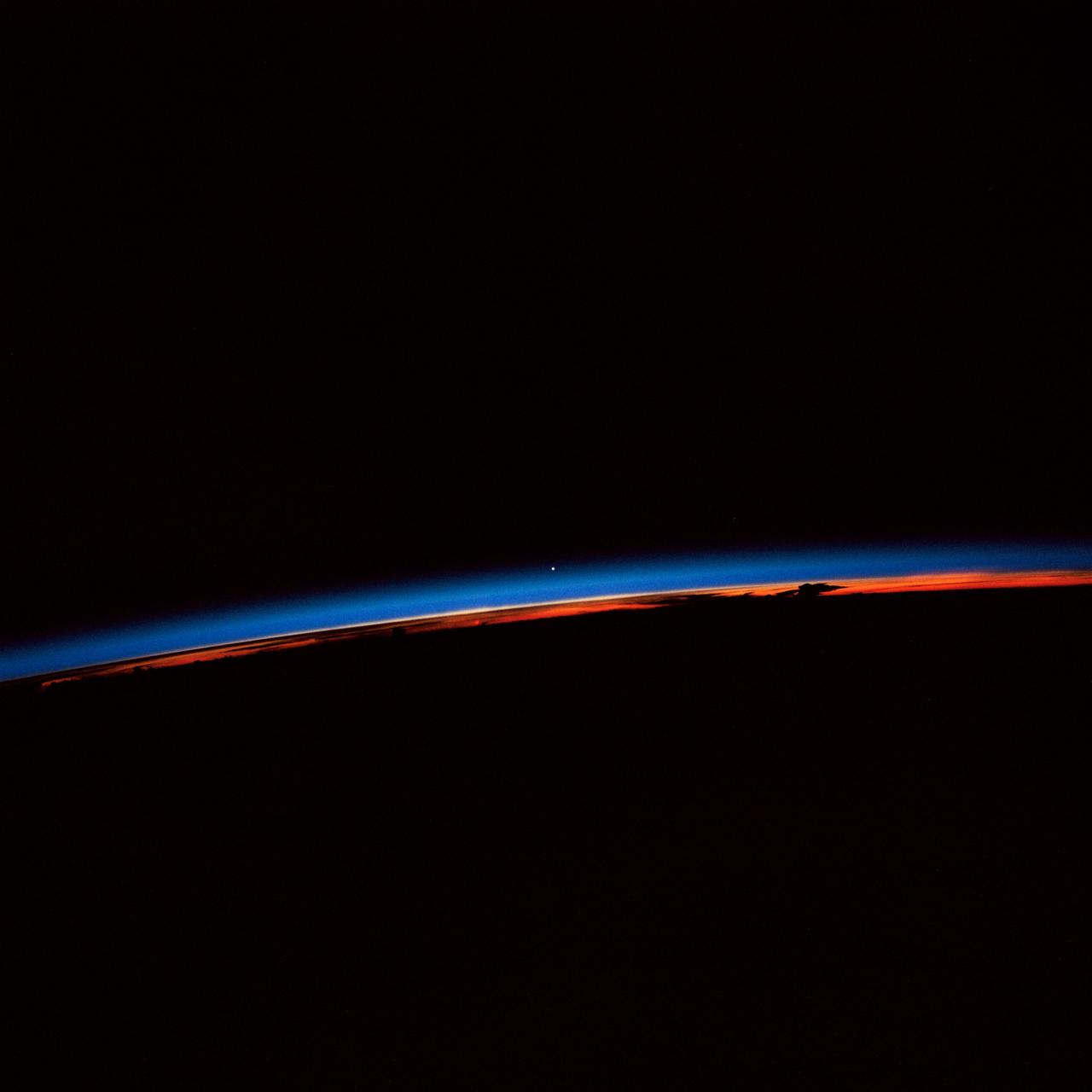
STS-30 Earth observation captured by crewmembers onboard Atlantis, Orbiter Vehicle (OV) 104, shows the sunset over the Earth as well as the planet Venus near the center of the frame. Jutting clouds are seen on the horizon, just beneath the blue strip of airglow.
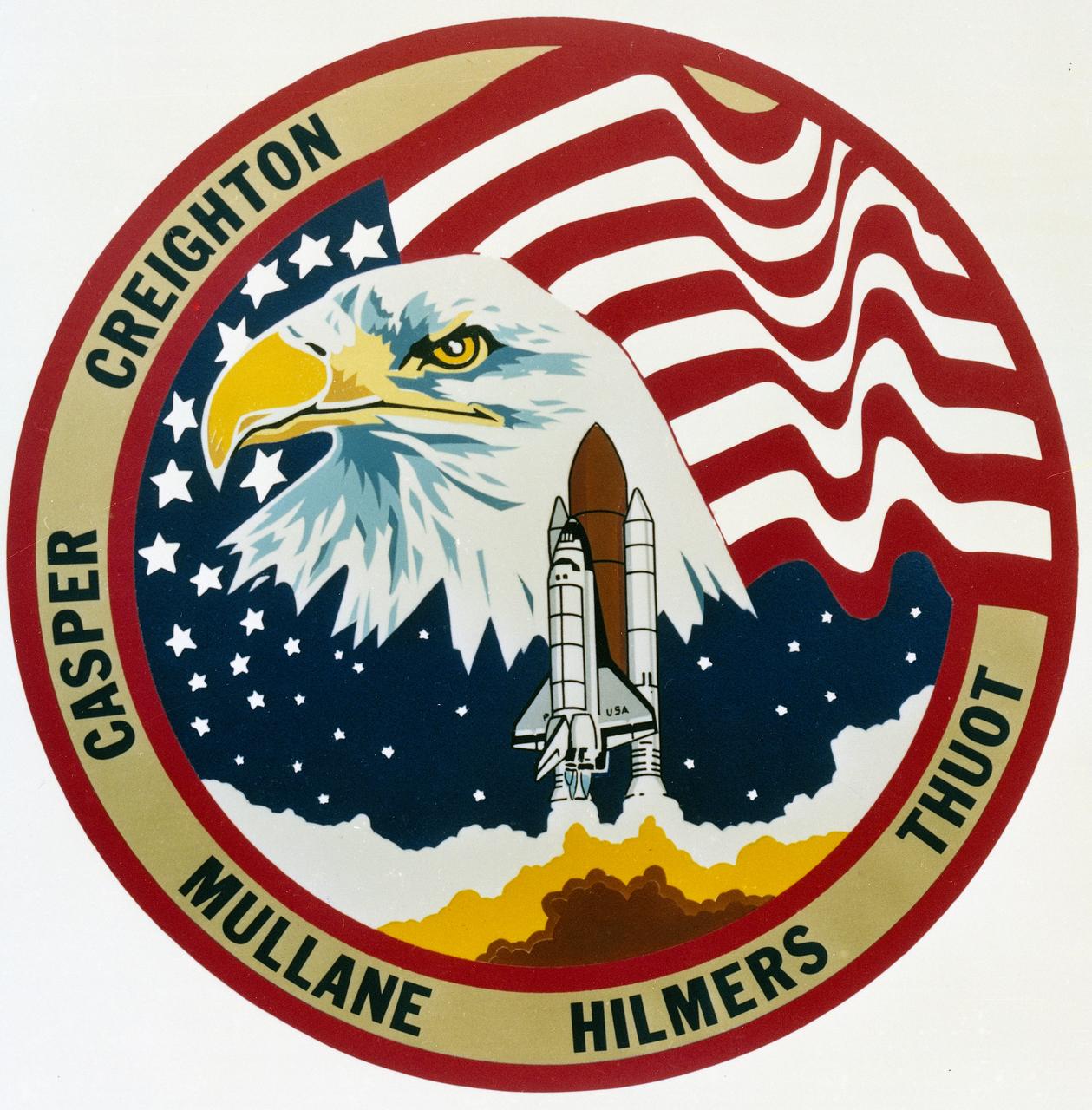
The dominant theme of the STS-36, designed by the five astronaut crewmembers, is, in their words ...the essential role that space plays in preserving the blessings of freedom and liberty for America. The crew used the eagle to symbolize our country's commitment to strength and vigilance; its domain is not bound by the limits of Earth but reaches out to the star. The Shuttle, they express majestically beginning its journey into orbit demonstrates how man and machine work together for the security of our nation. A crew spokesman went on to say the flag represents the patriotism and love for America possessed by each member of the five-man crew and signifies the honor accorded them through participation in national defense.
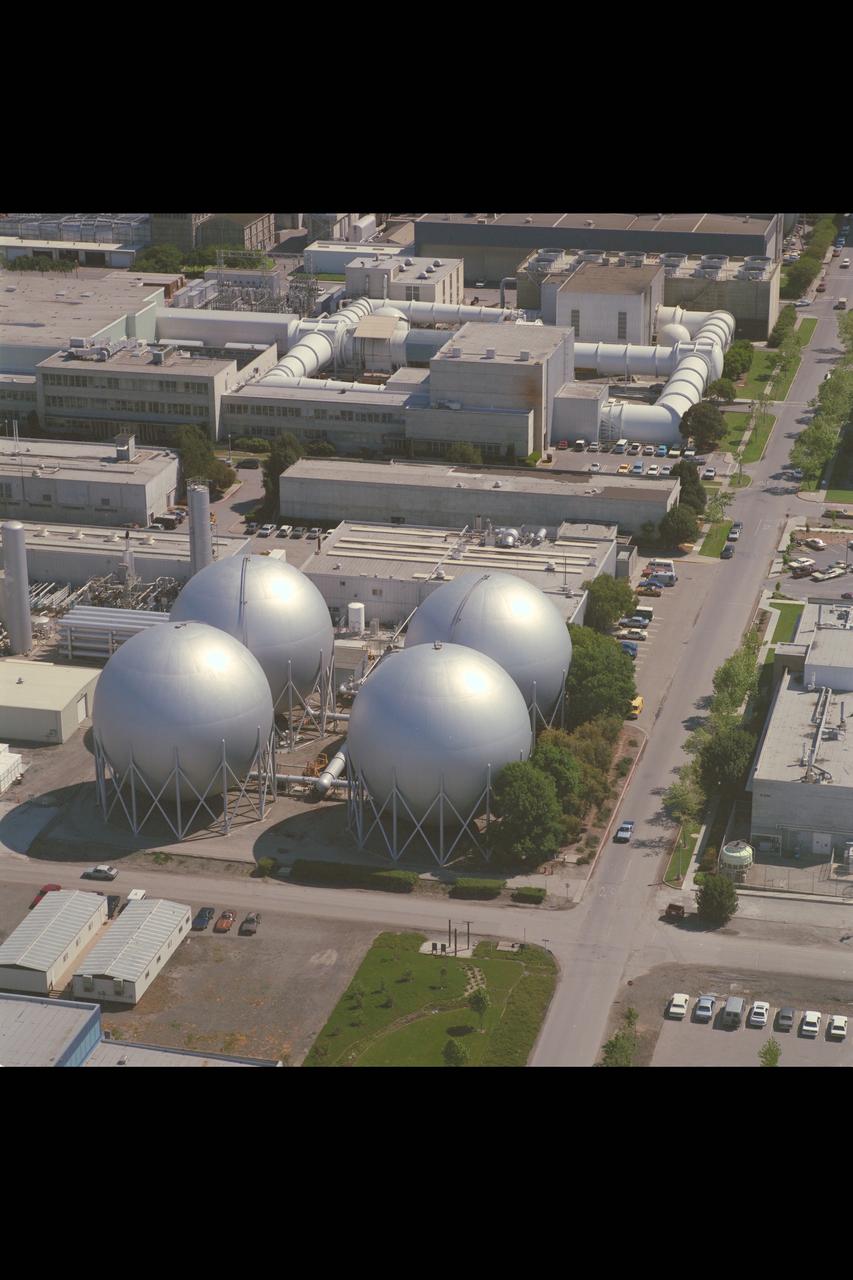
Ames Facility Aerials: N-229
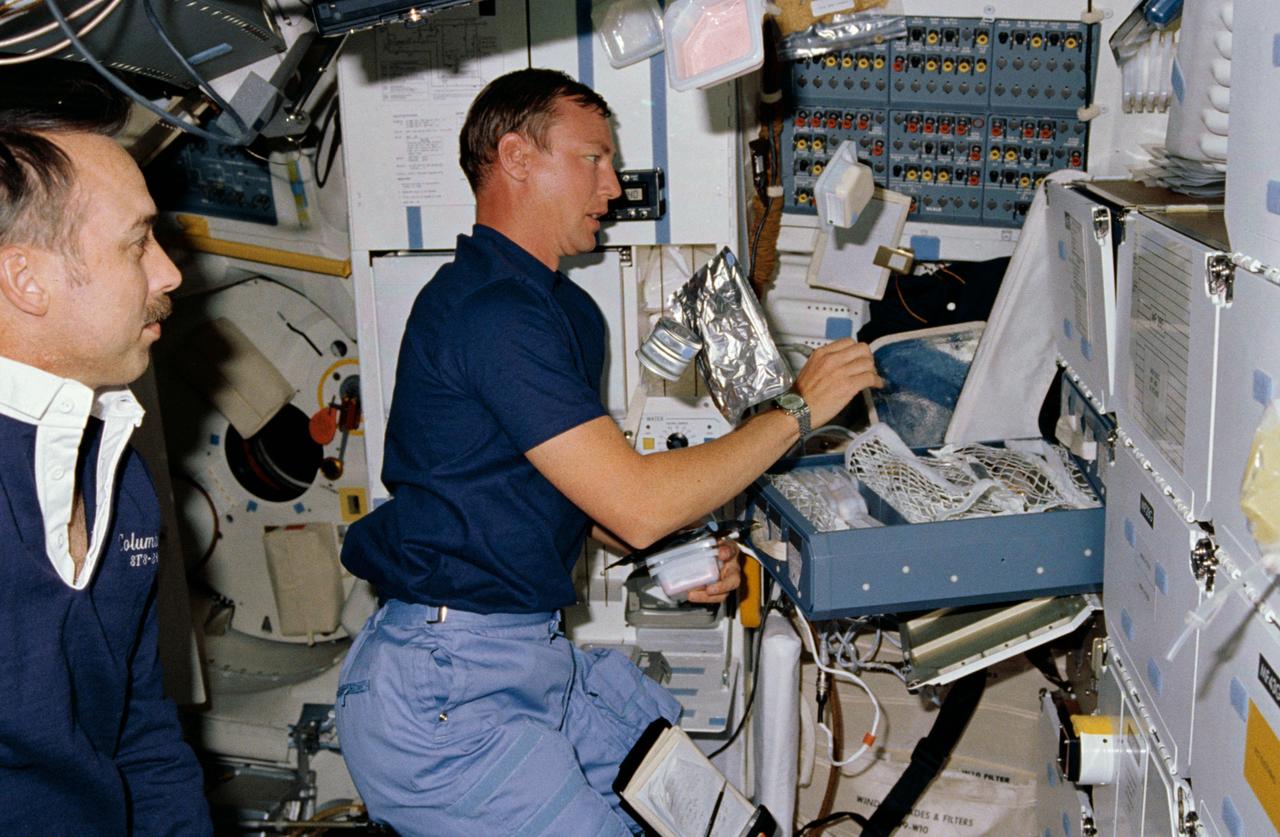
STS028-13-013 (August 1989) --- Astronaut Mark N. Brown, STS-28 mission specialist, assembles various components of a meal at the stowage locker area of Columbia's middeck, as James C. Adamson, mission specialist, looks on.
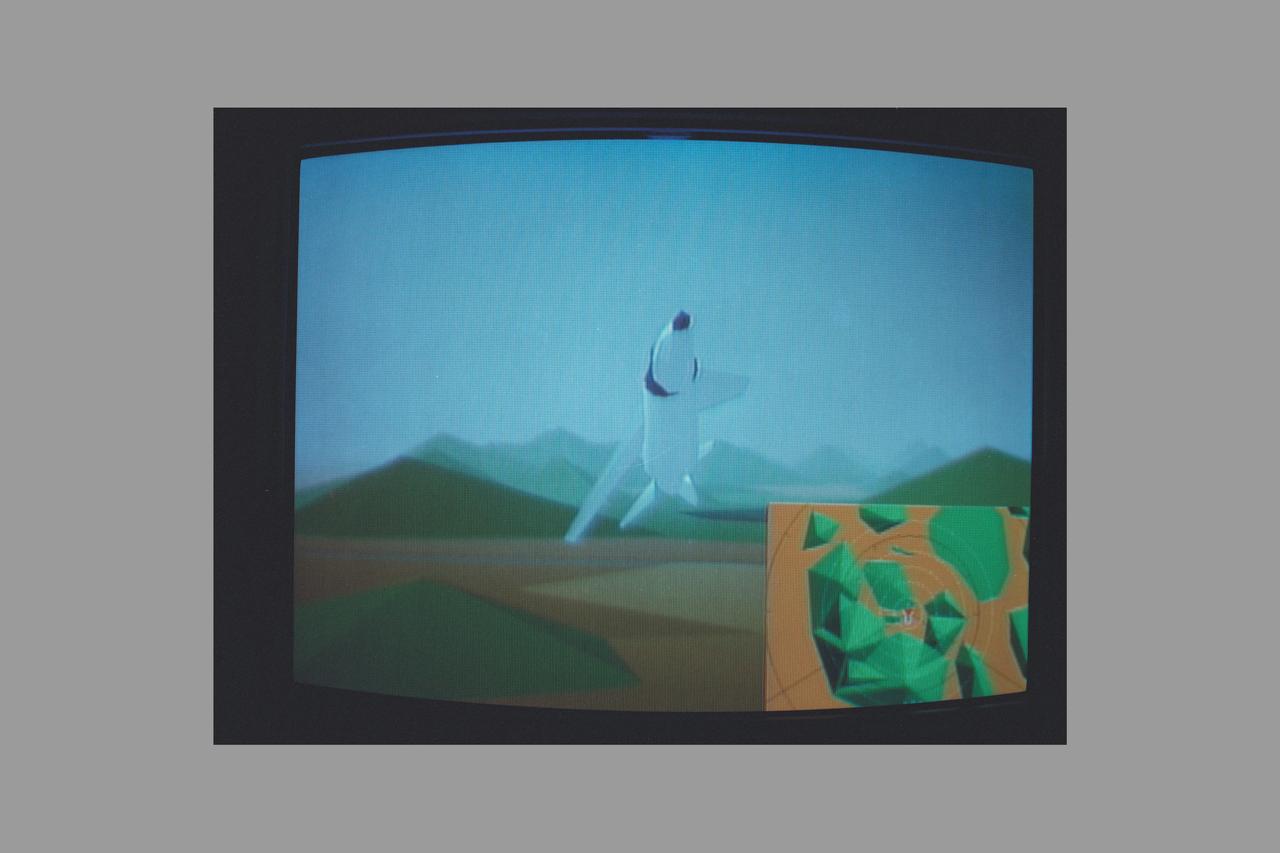
VMS I-Cab: MV-22 Simulation.
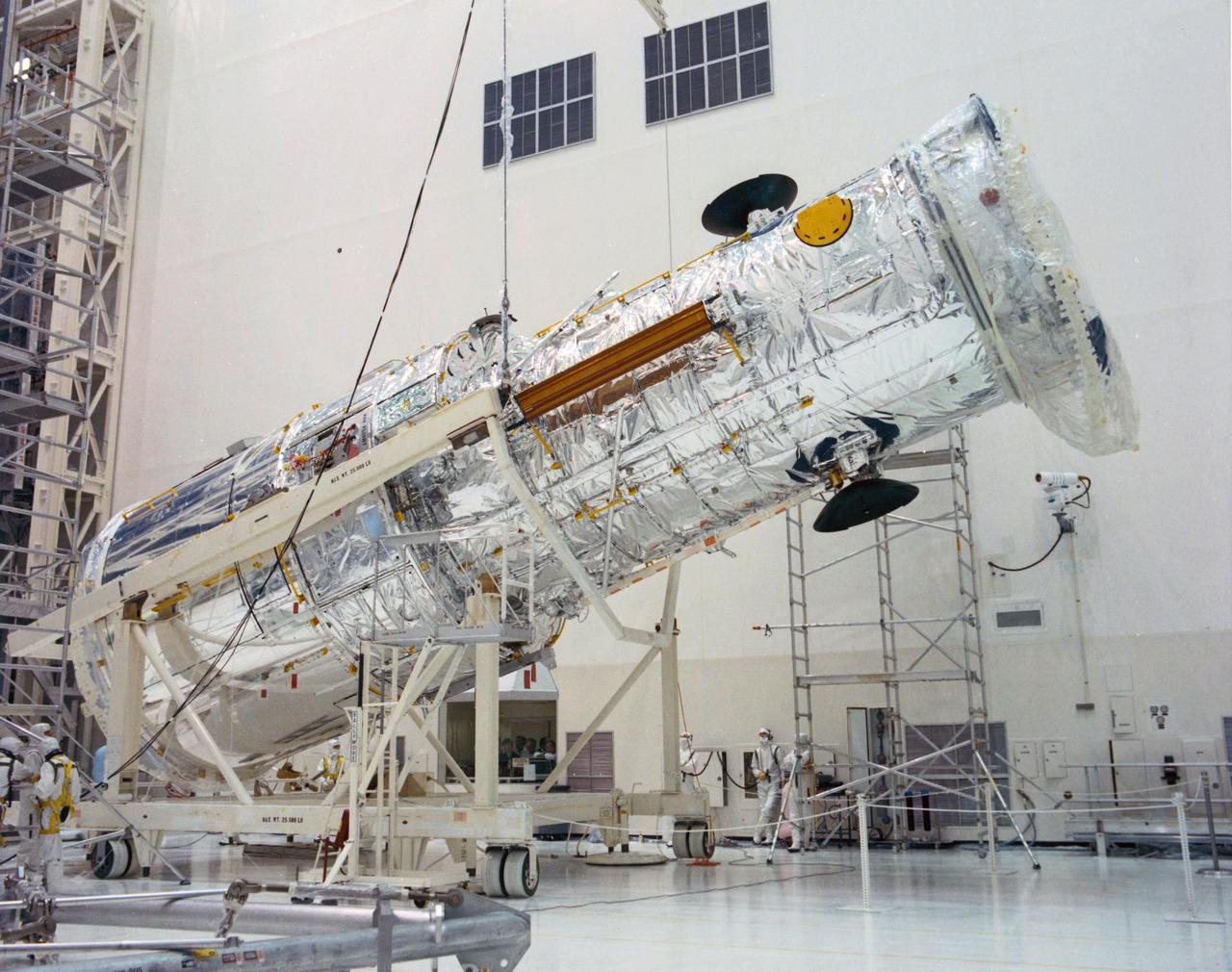
KENNEDY SPACE CENTER, FLA. -- The Hubble Space Telescope (HST) is lifted into the vertical position in the Vertical Processing Facility as work begins at KSC to process the 94-inch primary mirror telescope for launch on Discovery on Space Shuttle Mission STS-31 in March 1990. With HST, astronomers will be able to view 97 percent of the known universe, and will be able to get pictures unlimited and undistorted by the Earth's atmosphere. Compared with earth-based observatories, the HST will be able to view celestial objects that are 50 times fainter, provide images that are 10 times sharper, and see objects that are seven times farther away. .
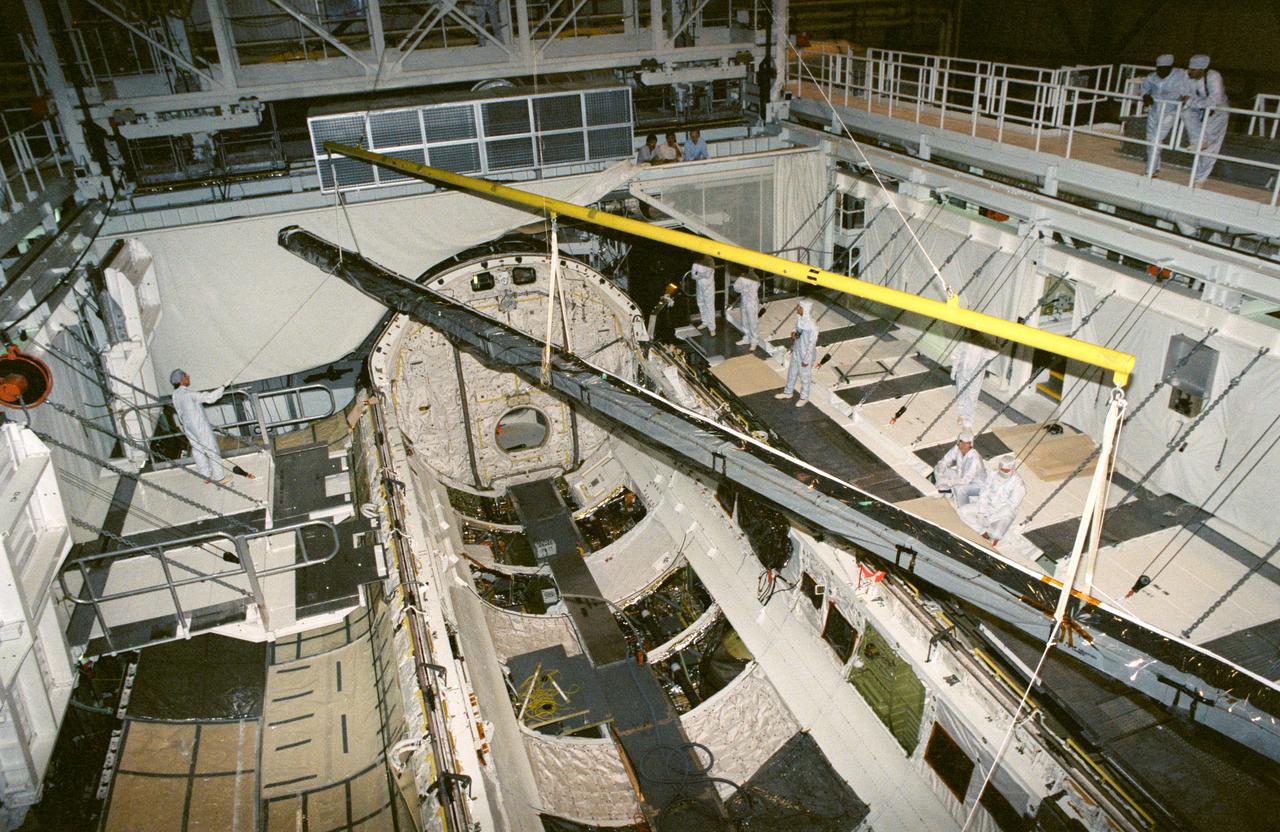
S89-25873 (Nov 1988) --- The Space Station Heat Pipe Advanced Radiator Element (SHARE) is readied for installation in late November at Kennedy Space Center's orbiter processing facility (OPF). The SHARE device will be carried on a pedestel in Discovery's cargo bay during the five-day STS-29 mission, scheduled for a mid-March 1989 launch.
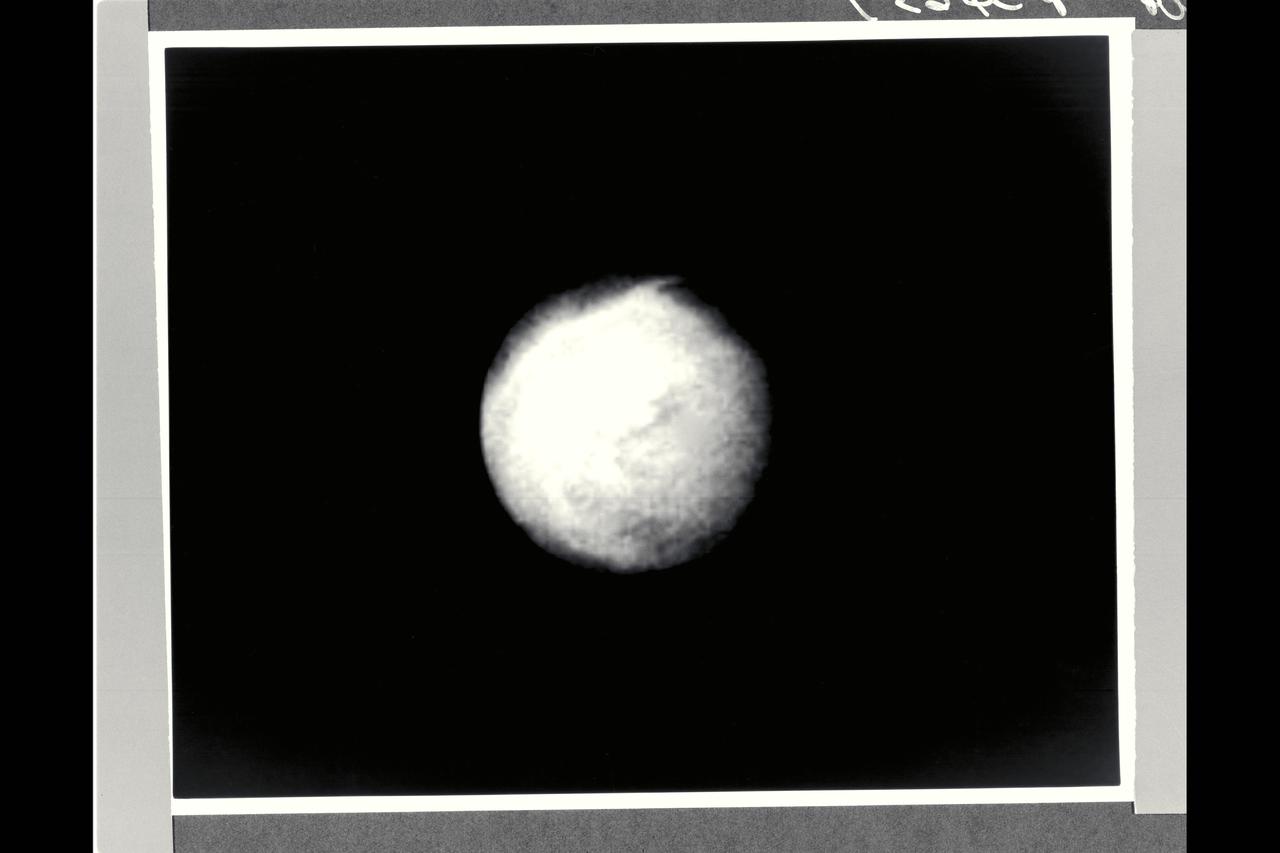
Range : 4 million km (2.5 million miles) Already-intriquing patterns of unknown origin appear on the surgace of Neptune's largest satellite, Trition, in this image from Voyager 2. Voyager images show that Trition's diameter is about 2,720 km (1,690 miles), and that it is one of the brightest objects in the solar system, reflecting about 70 percent of the sunlight that strikes it. THis is the hemisphere of Triton that always faces away from Neptune. The south pole is near the botton of the image. Triton's rotation axis is tilted so that the latitude at the center of the disk is 55 degrees south. Dark regions at the top of the disk extend from roughly the equator to beyond 20 degrees north. The margin between the bright and dark regions varies with longitude around the satellite. The gray, featureless area just to the right of the center of the disk is due to a reseau (reticule mark) in the camera.
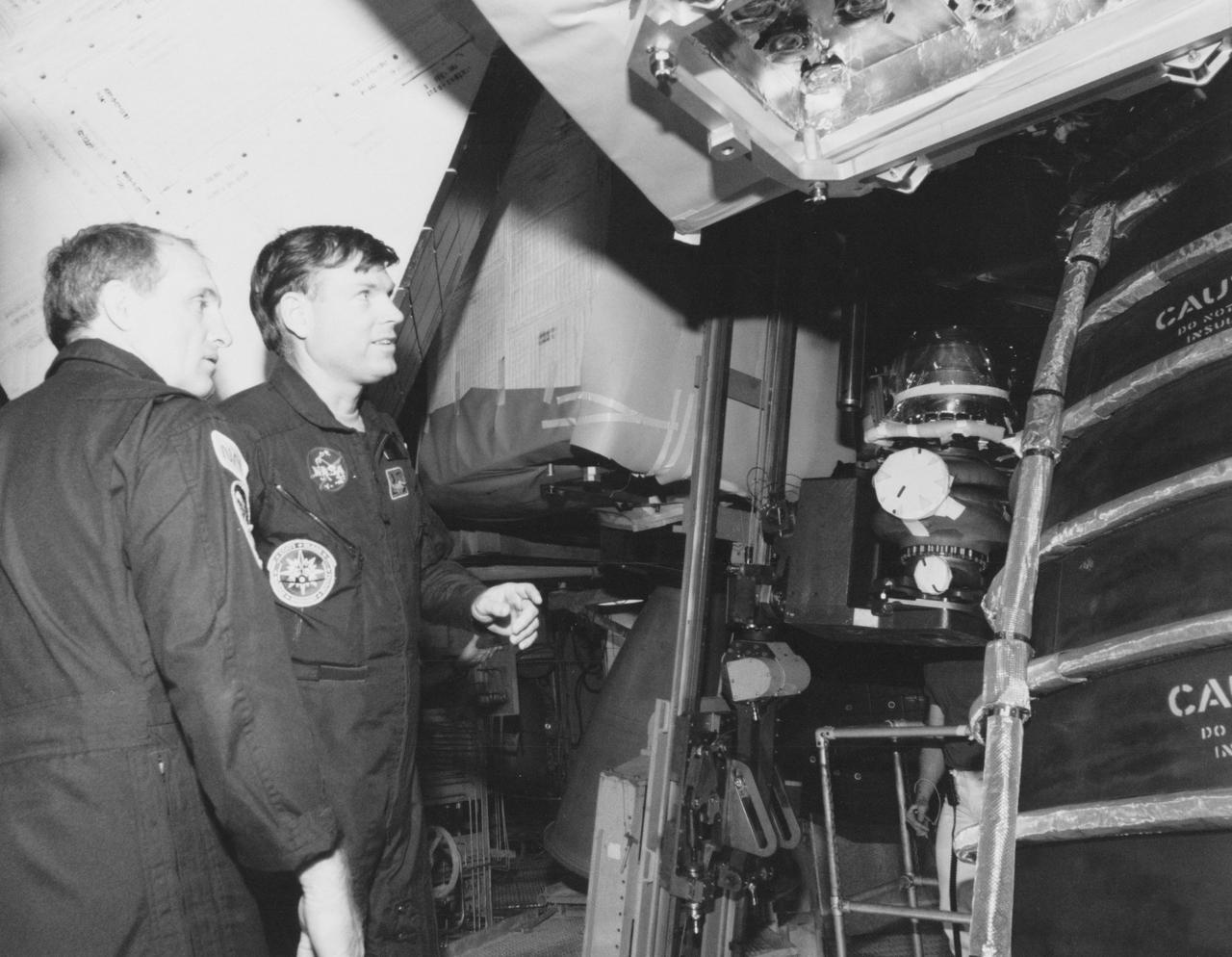
S89-28091 (7 Feb 1989) --- STS-29 astronauts inspect an area near the three main engines of the Space Shuttle Discovery prior to the removal of one of three oxidozer turbo pumps. Left to right are Astronauts James F. Buchli, mission specialist, and Michael L. Coats, mission commander. New pumps are scheduled to be installed soon. Now at Launch Pad 39-B, Discovery is set for launch in mid-March for Mission STS-29. Primary payload will be TDRS-D. Crewmembers not seen here are John E. Blaha, the pilot; and Robert C. Springer and James P. Bagian, both mission specialists.
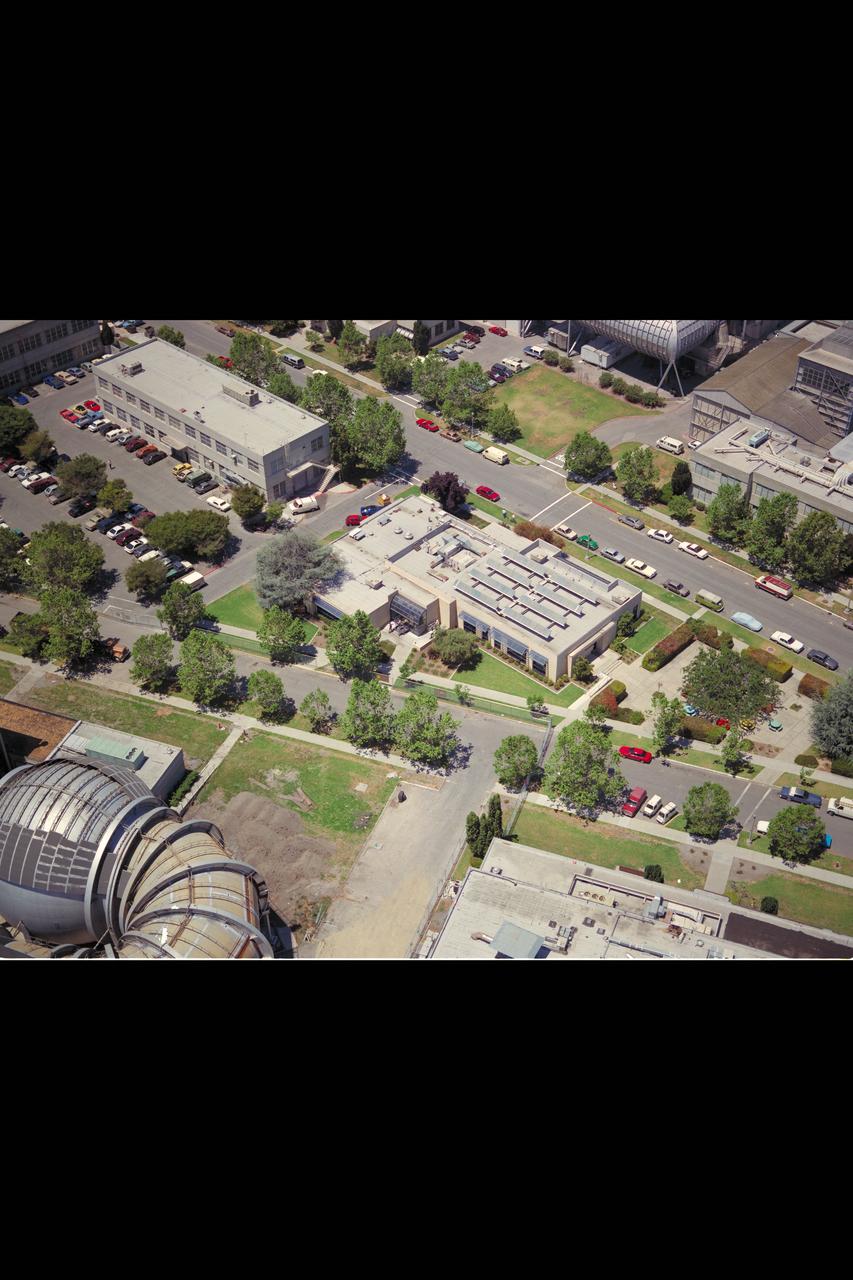
Ames Facility Aerials: N-235 cafeteria
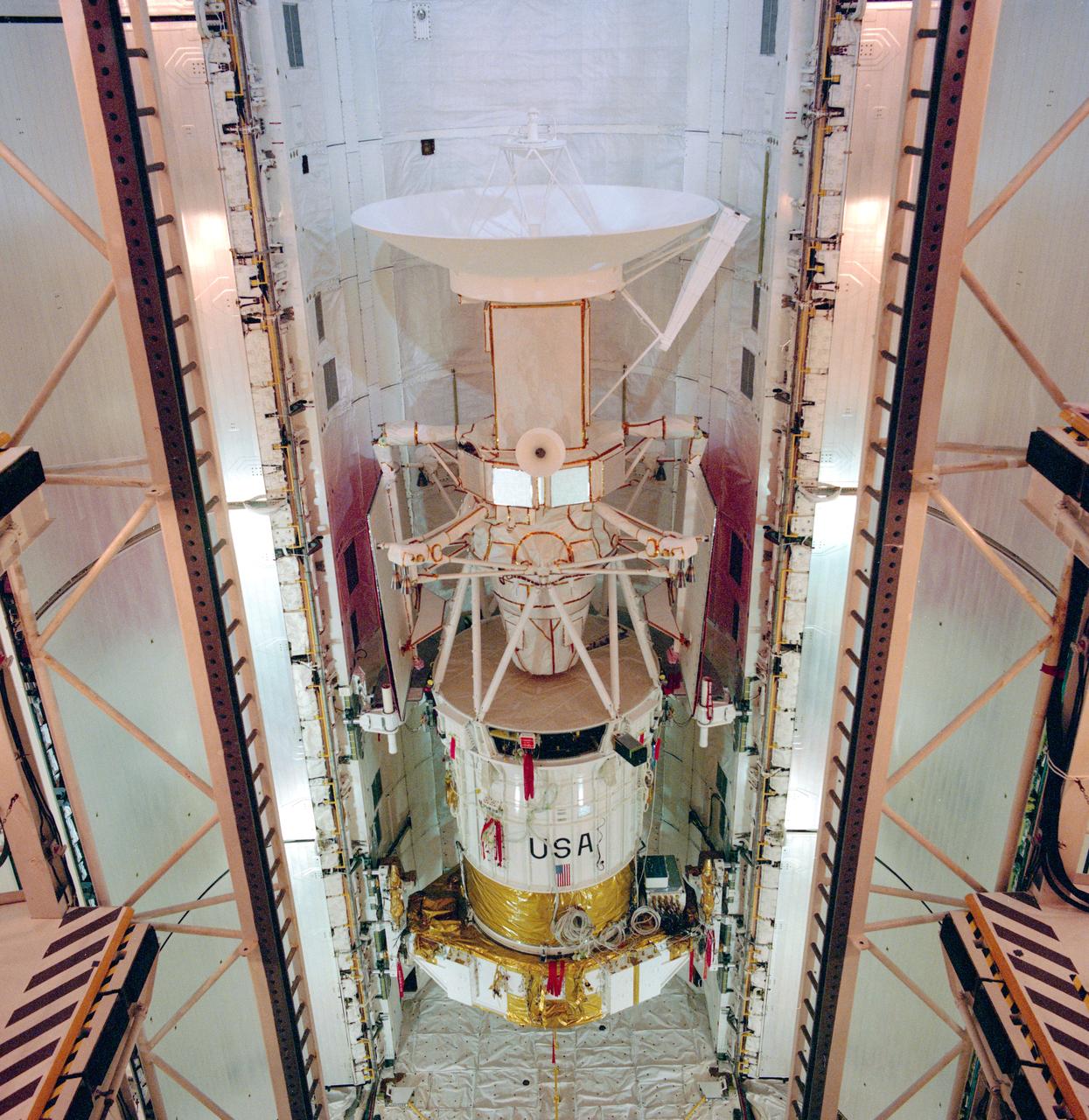
S89-30720 (29 March 1989) --- The spacecraft Magellan is in the payload bay of the orbiter Atlantis at launch pad 39-B. Magellan is scheduled to be released from Atlantis April 28, 1989, on NASA's STS-30 mission. Its mission will be the first U.S. planetary probe in over 10 years and it is the first deployed by the shuttle. The mission calls for the spacecraft to make the approximately 15-month journey to the planet Venus and perform radar mapping operations, transmitting the information back to NASA's Jet Propulsion Laboratory (JPL) in California.
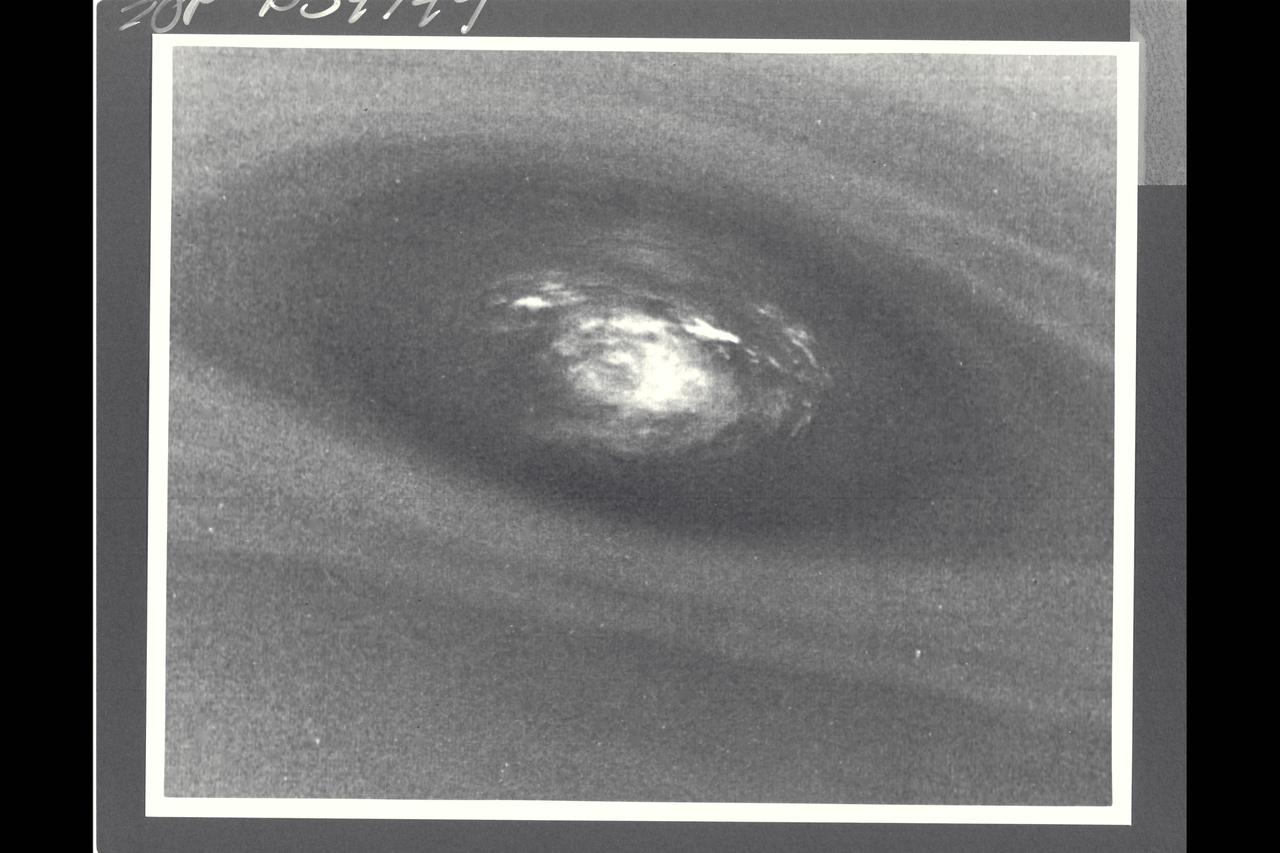
Voyager II Imagery; Neptune. This bulls-eye view of Neptune's small dark spot (D2) was obtained by Voyager 2's narrow-angle camera , when Neptune was within 1.1 million km (680,000 miles) of the planet. The smallest structures that can be seen are 20 km (12 miles) across. This unplanned photograph was obtained when the infrared spectrograph was mapping the the highest-resolution view of the feature taken during the flyby. Banding surrounding the feature indicates unseen strong winds, while structues within the bright spot suggest both active upwelling of clouds and rotation about the center. A rotation rate has not yet been measured, but the v-shaped structure near the right edge of the bright area indicates that the spot rotates clockwise. Unlike the Great Red Spot on Jupiter, which rotates counterclockwise, if the D2 spot on Neptune rotates clockwise, the material will be descending in the dark oval region. The fact that infrared data will yield temperature information about the region above the clouds makes this observation especially valuable. The Voyager Mission is conducted by JPL for NASA's Office of Space Science and Applicaitons. (JPL ref: P-34749 Voyager N-71) taken during the flyby. Banding surrounding the feature indicates unseen strong winds, while structures within the bright spot suggest both active upwelling of clouds and rotation about the center. A rotation rate has not yest been measured, but the Vv-sphped
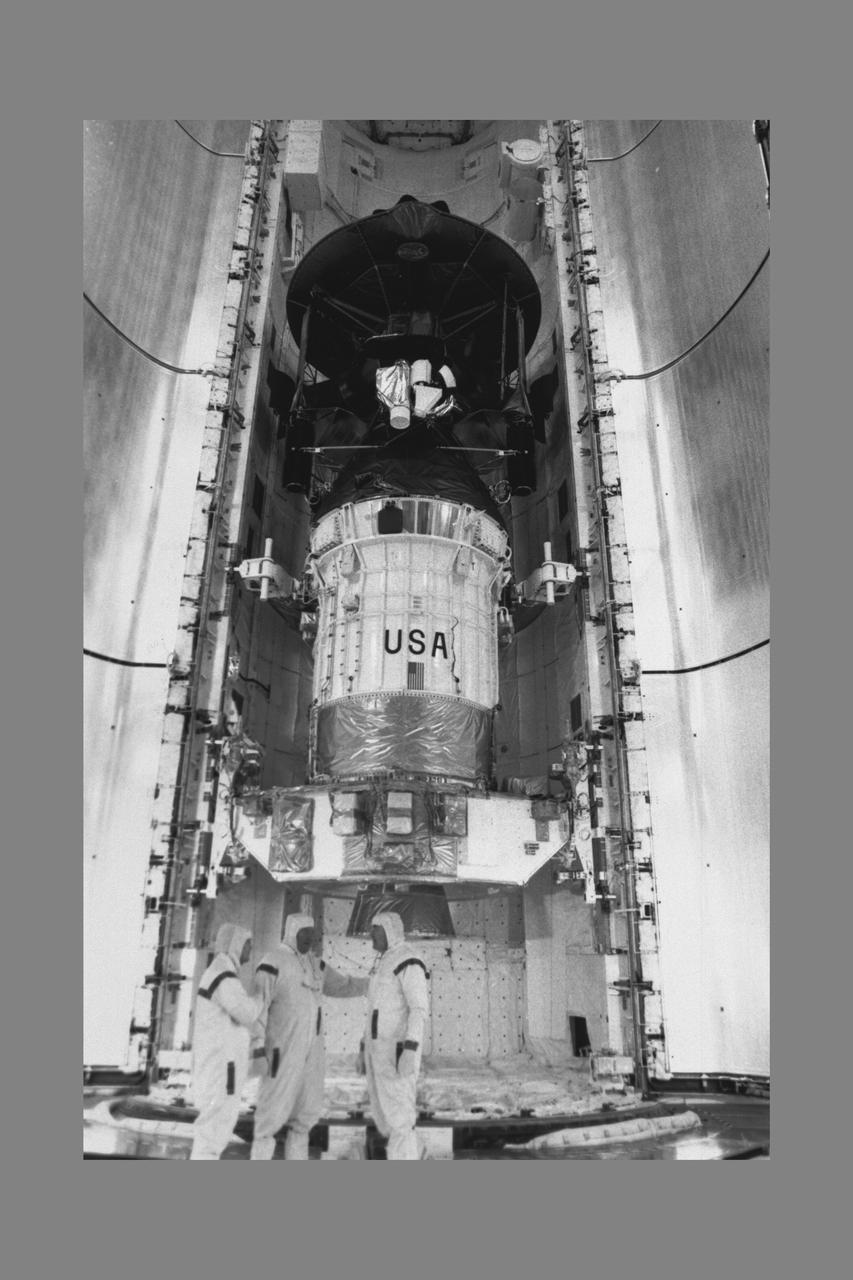
Space Shuttle Mission STS-34 Atlantis: Pioneer Galileo spacecraft in cargo bay
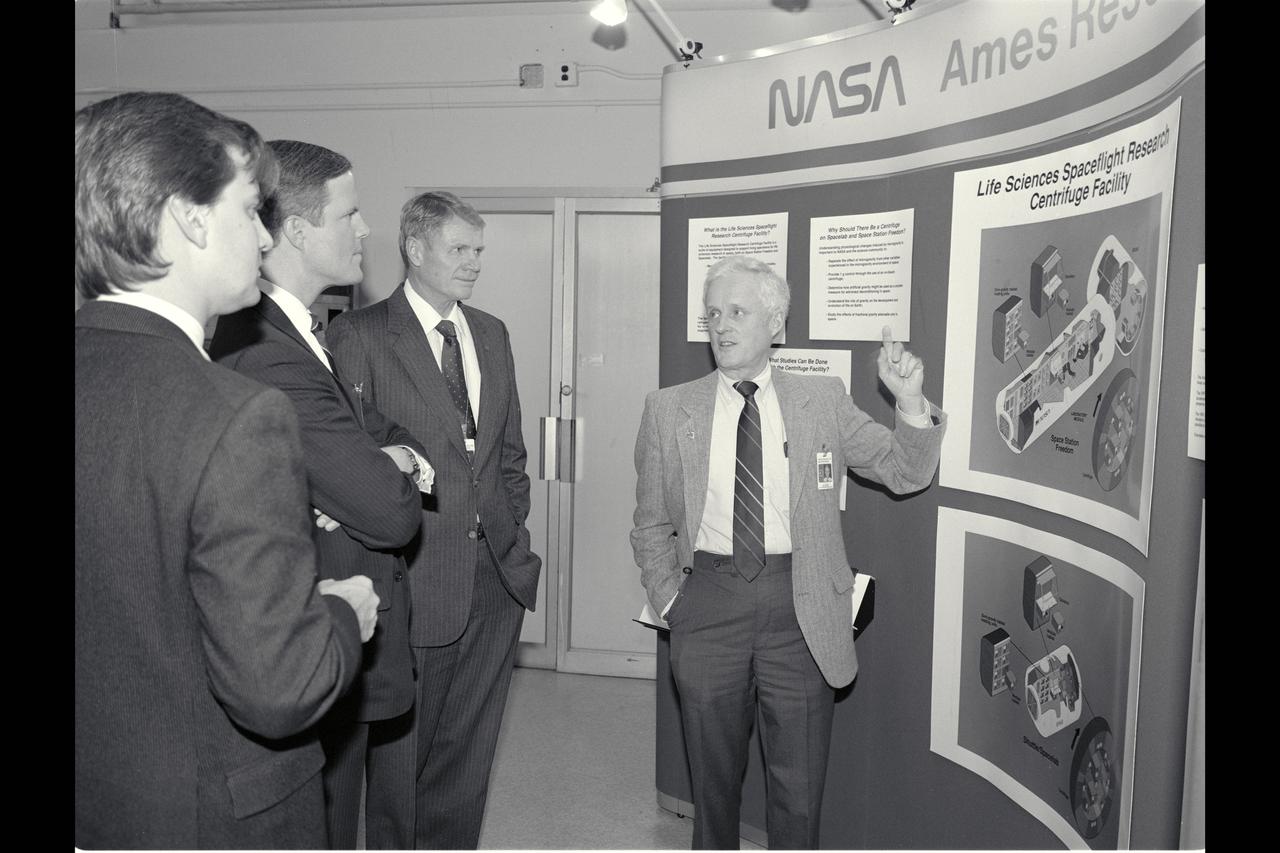
California Congressman Tom Campbell (15th District) stops on a tour of Ames with Dale Compton, Ames Director to learn about the SSBRP project for Space Station
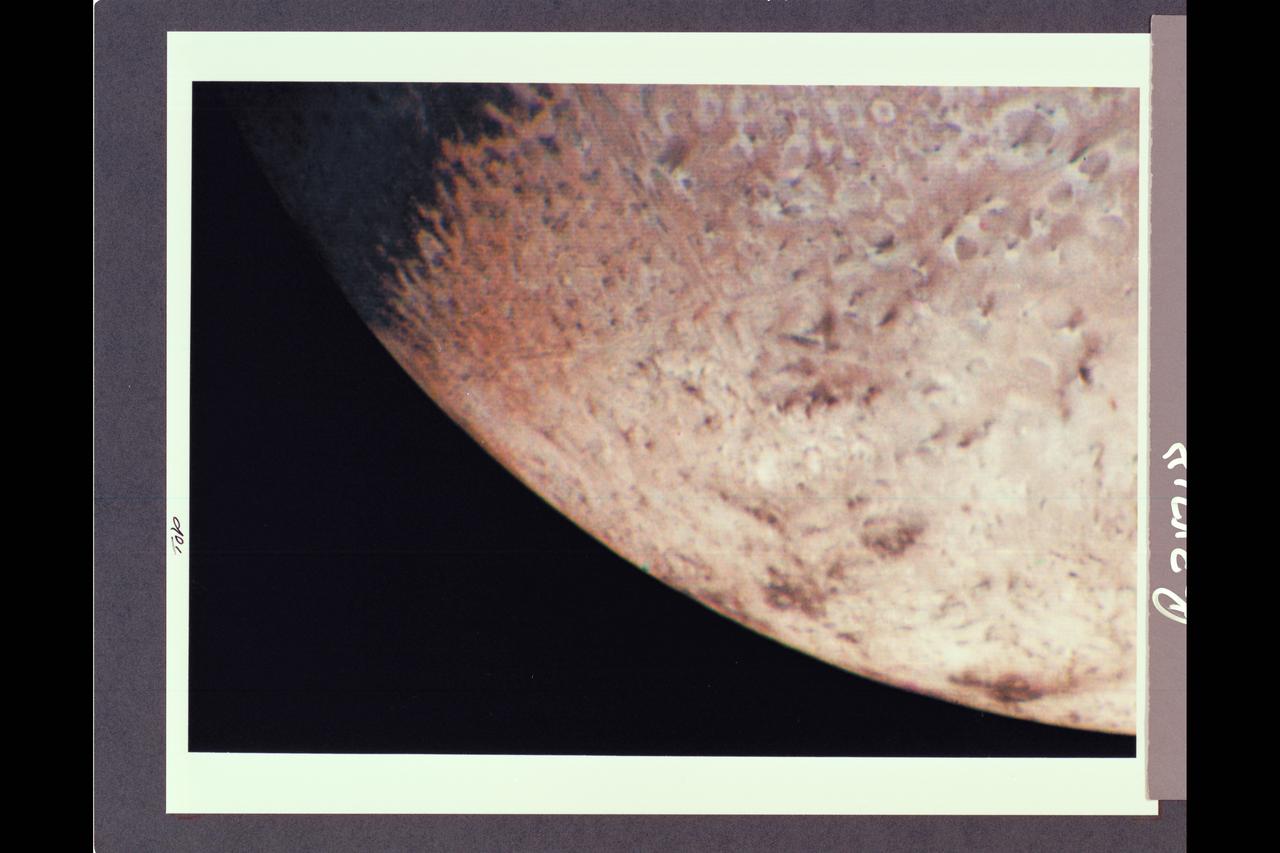
P-34718 Range: 210,000 kilometers (128,000 miles) This natural color image of the limb of Triton shows the largest surface features at about 3 miles across. The picture is a composite of images taken through the violet, green and clear filters and shows a geologic boundary between a rough, pitted surface to the right and a smoother surface to the left. The change between surface types is gradual. The image also shows a color boundary between pinkish material in the upper part of the image and whiter material in the lower part. The geologic and color boundaries are not the same. That implies that whatever supplies the color is a very thin coating over a different underlying material in which the geologic boundary occurs. The colored coating may be a seasonal frost composed of compounds volatile enough to be sublimated at the very low temperatures (40 K to 50 K or -387.4 F to -369.4 F) prevailing near Triton's surface. Possible compositions of the frost layer include methane (which turns red when irradiated), carbon monoxide or nitrogen. The color in this image is somewhat exaggerated: Triton is primarily a white object with a pinkish cast in some areas.

Thermoplastic hologram (laser) N-220 with Florence Gerbault
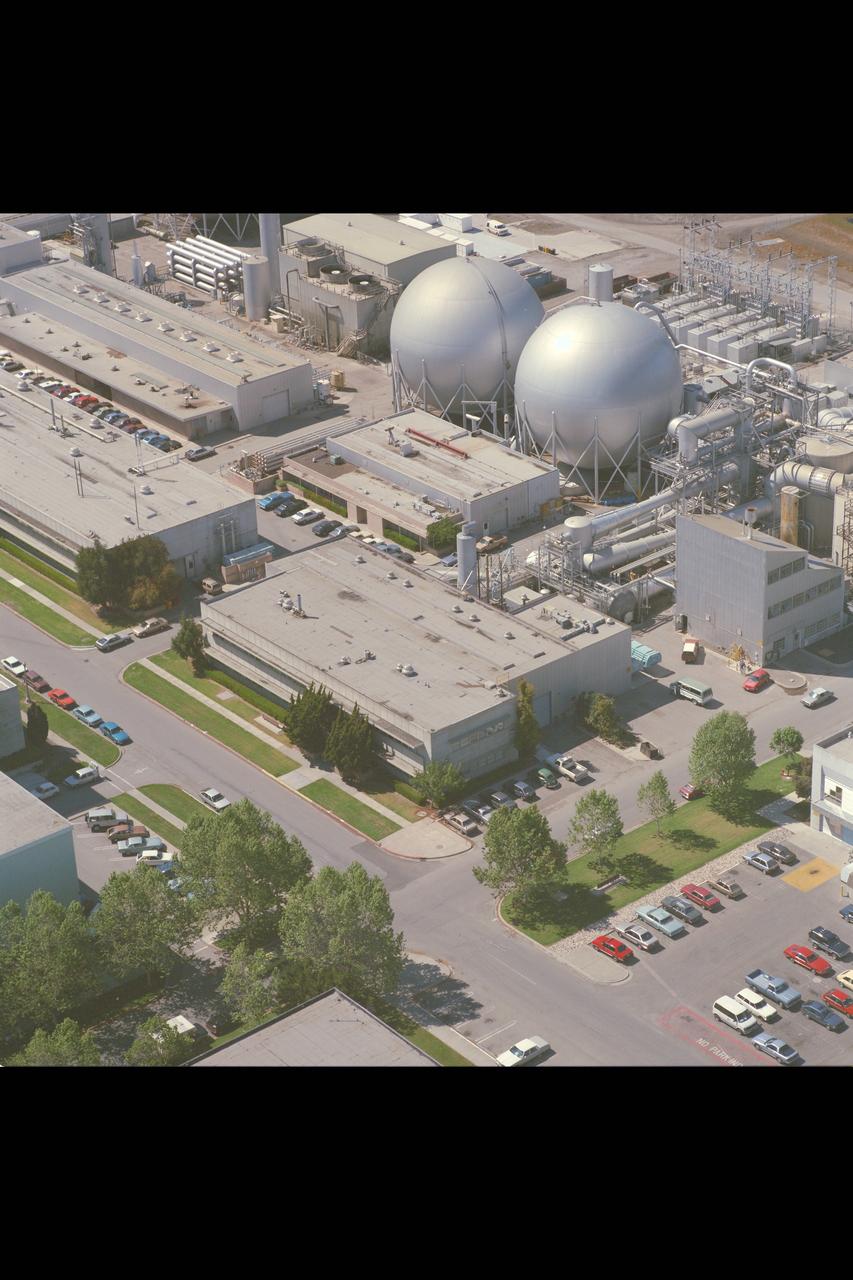
Ames Facility Aerials: n-240 back side
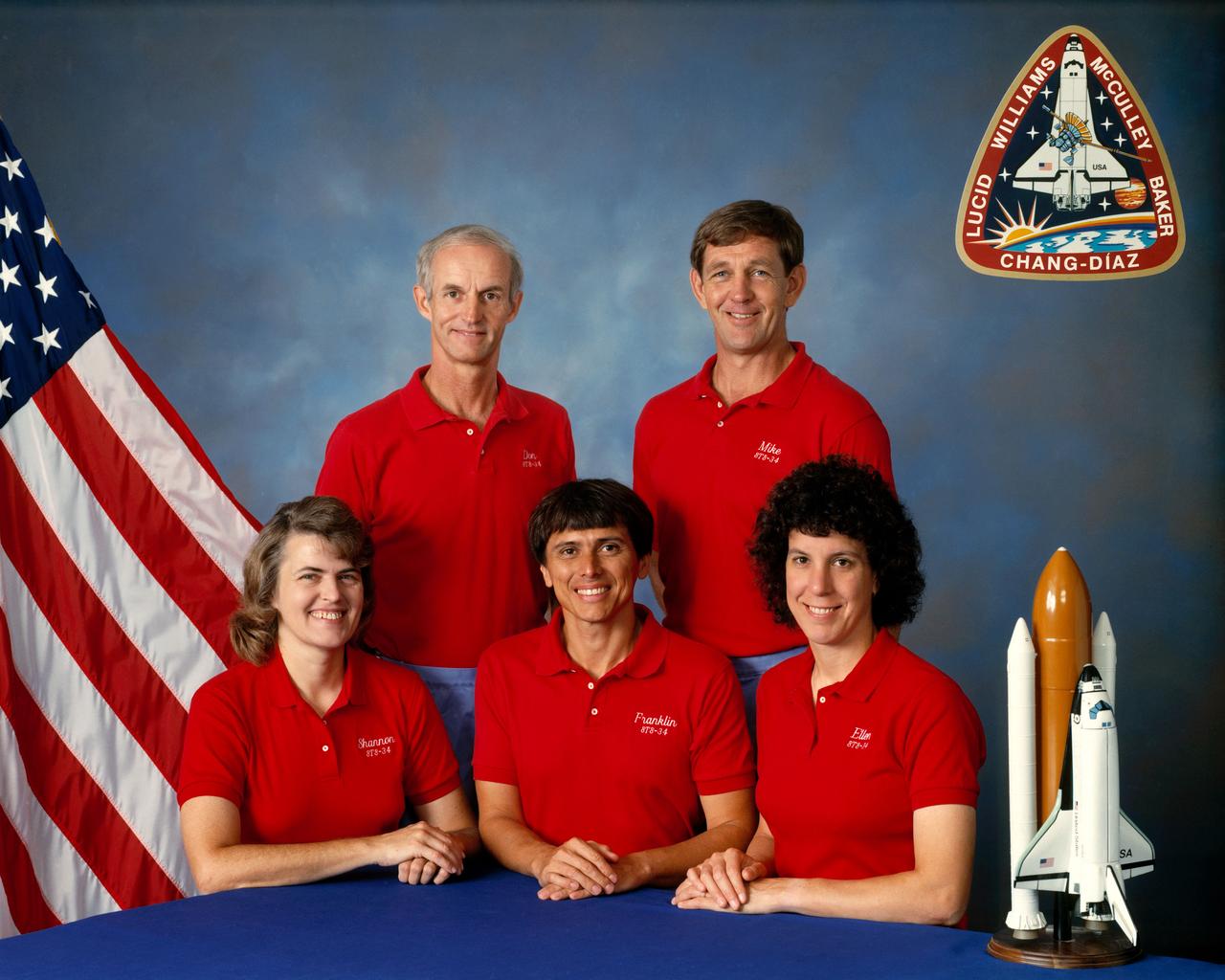
S89-39803 (July 1989) --- These five astronauts have been assigned to fly the Space Shuttle Atlantis for the mission on which the Jupiter probe, Galileo will be deployed. The mission is scheduled for October of this year. Seated, left to right, are mission specialists Shannon W. Lucid, Ph.D.; Franklin Chang-Diaz, Ph.D.; and Ellen S. Baker, M.D. Standing behind the mission specialists are left, Donald E. Williams, commander; and Michael J. McCulley, pilot.
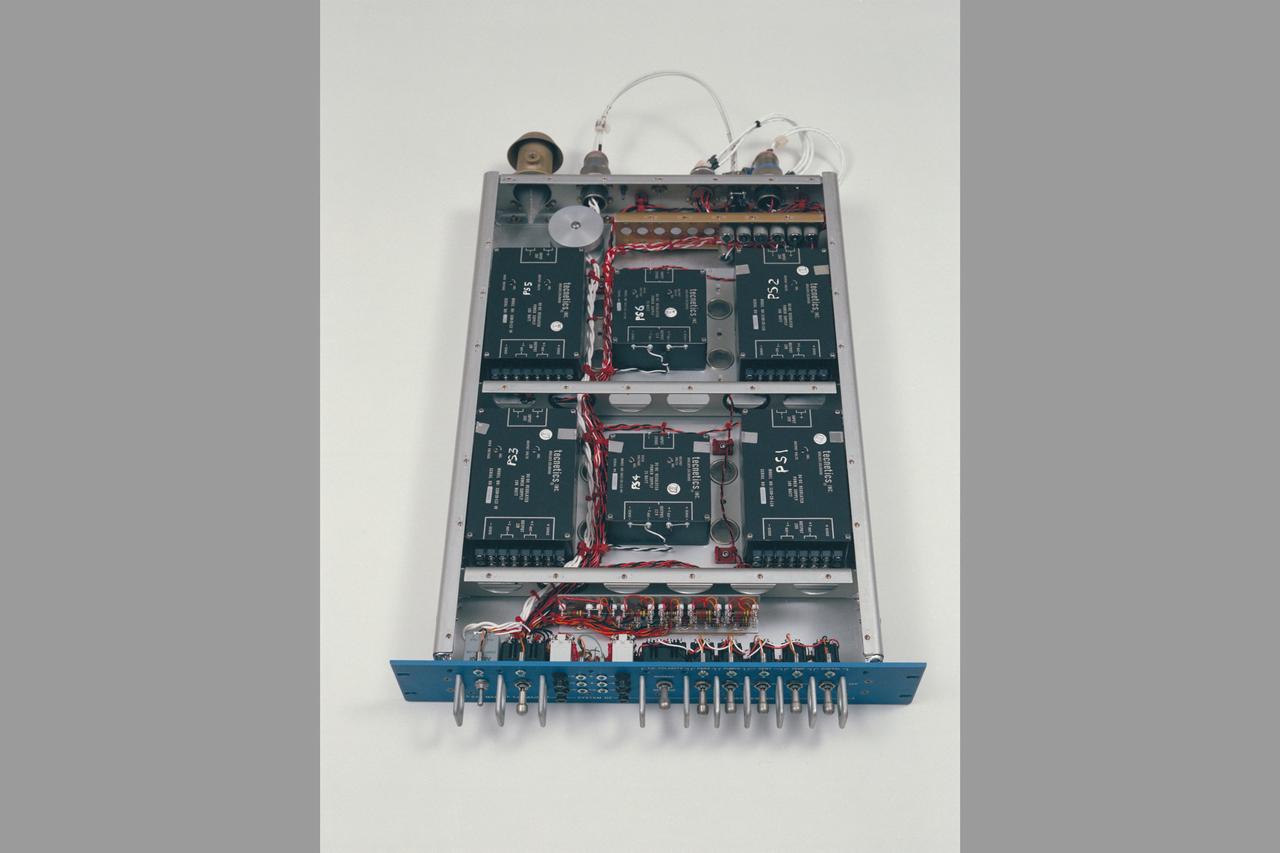
SL-J Space Shuttle Frog Embryology Experiment (FEU) flight hardware