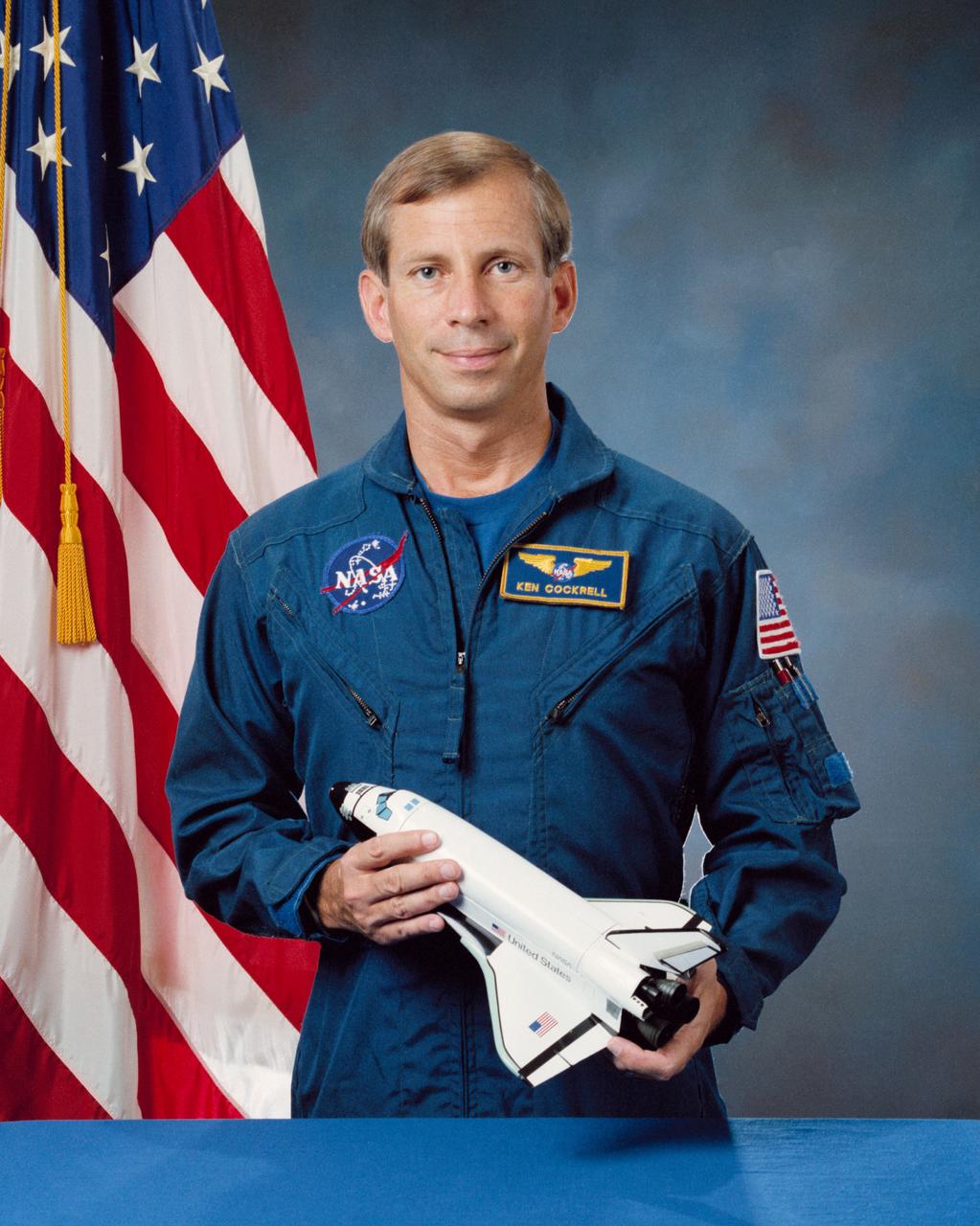
Official portrait of astronaut candidate Kenneth D. Cockrell, a member of Astronaut Class 13 (1990) and a space shuttle pilot candidate. Cockrell wears a navy blue flight suit and holds space shuttle model.

As seen from space, the Great Salt Lake, Utah, USA (41.5N, 112.5W) appears as two separate bodies of water with a narrow divider in the middle. At the turn of the century, a railroad bridge without culverts, was built across the lake and ever since, the water and salinity levels have been uneqal on either side. Fed by snowmelt from the nearby Wasatch Mountains, the lake in recent years has had record high water levels, threatening to flood the local areas.
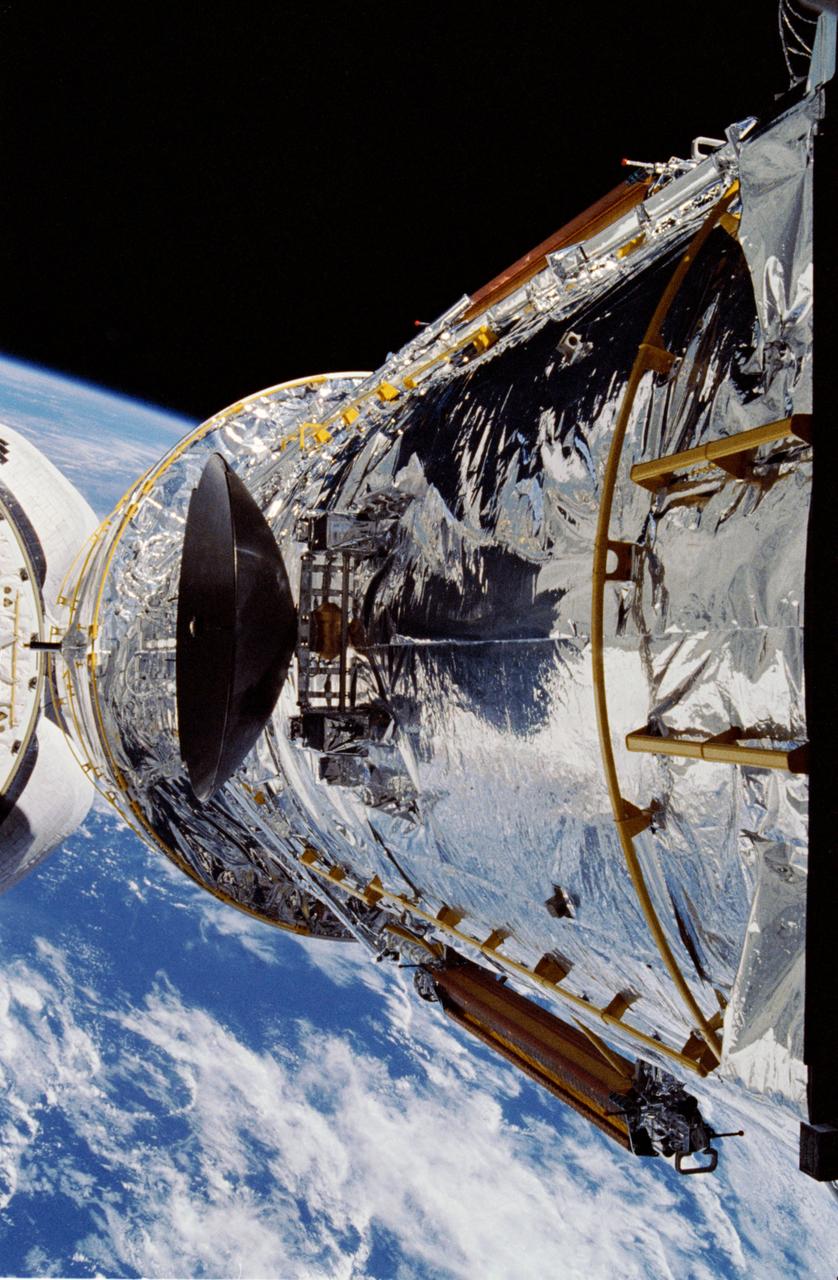
The Hubble Space Telescope (HST) is raised above the payload bay (PLB) in low hover position during STS-31 checkout and pre-deployment procedures aboard Discovery, Orbiter Vehicle (OV) 103. Stowed along the HST Support System Module (SSM) are the high gain antenna (HGA) (center) and the two solar arrays (one either side). In the background are the orbital maneuvering system (OMS) pods and the Earth's surface.
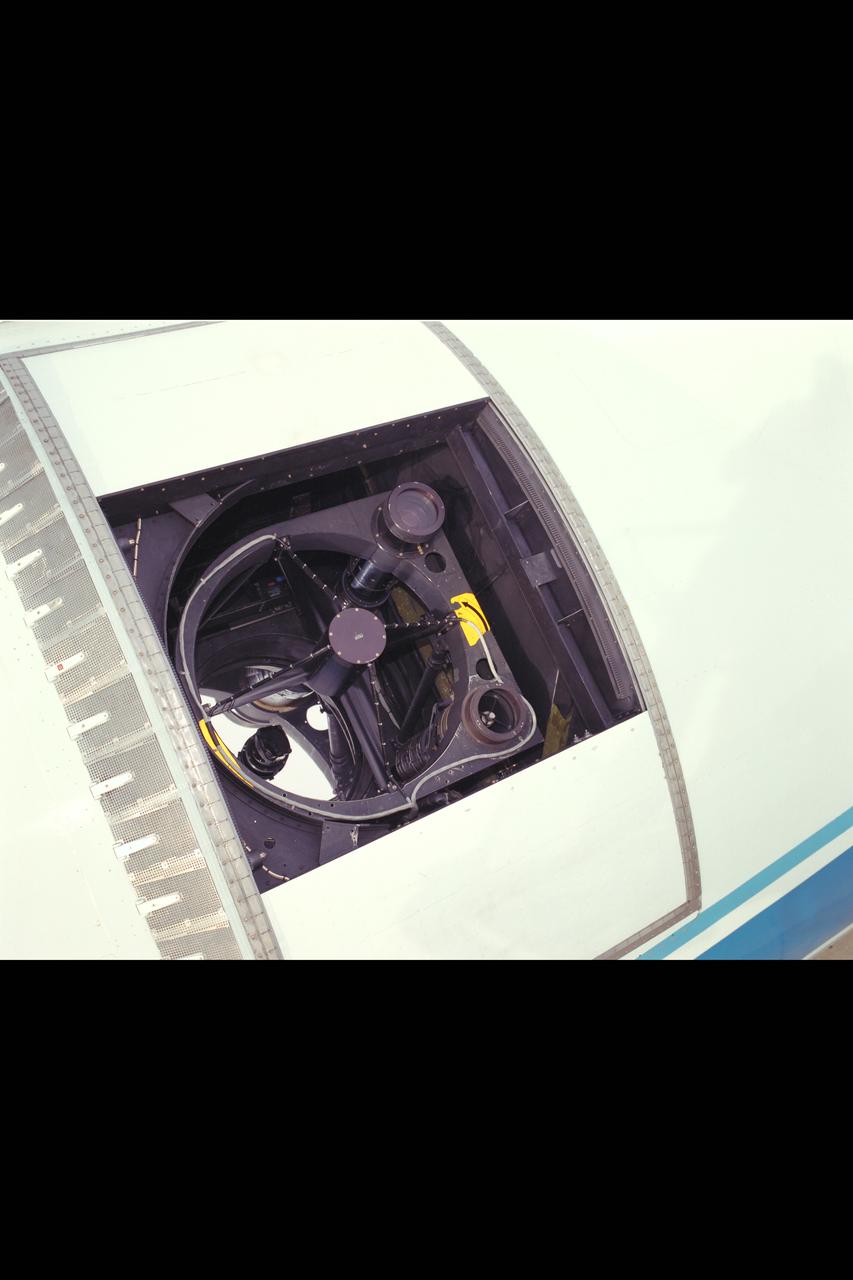
C-141 KAO (NASA-714) on ramp (Close-up of the telescope)
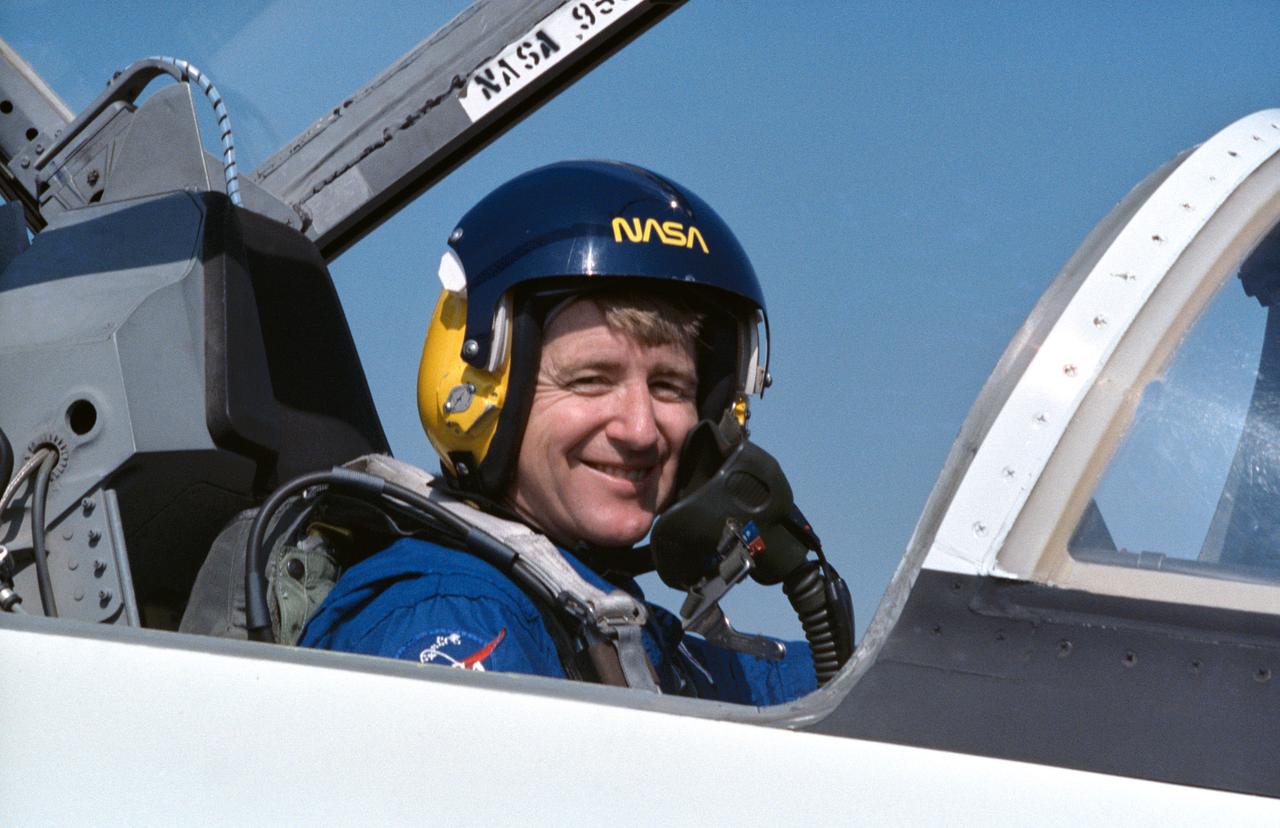
STS-38 Pilot Frank L. Culberston, smiling and wearing his helmet with breathing apparatus attached, sits in T-38A NASA 955 forward cockpit at Ellington Field and prepares for departure.
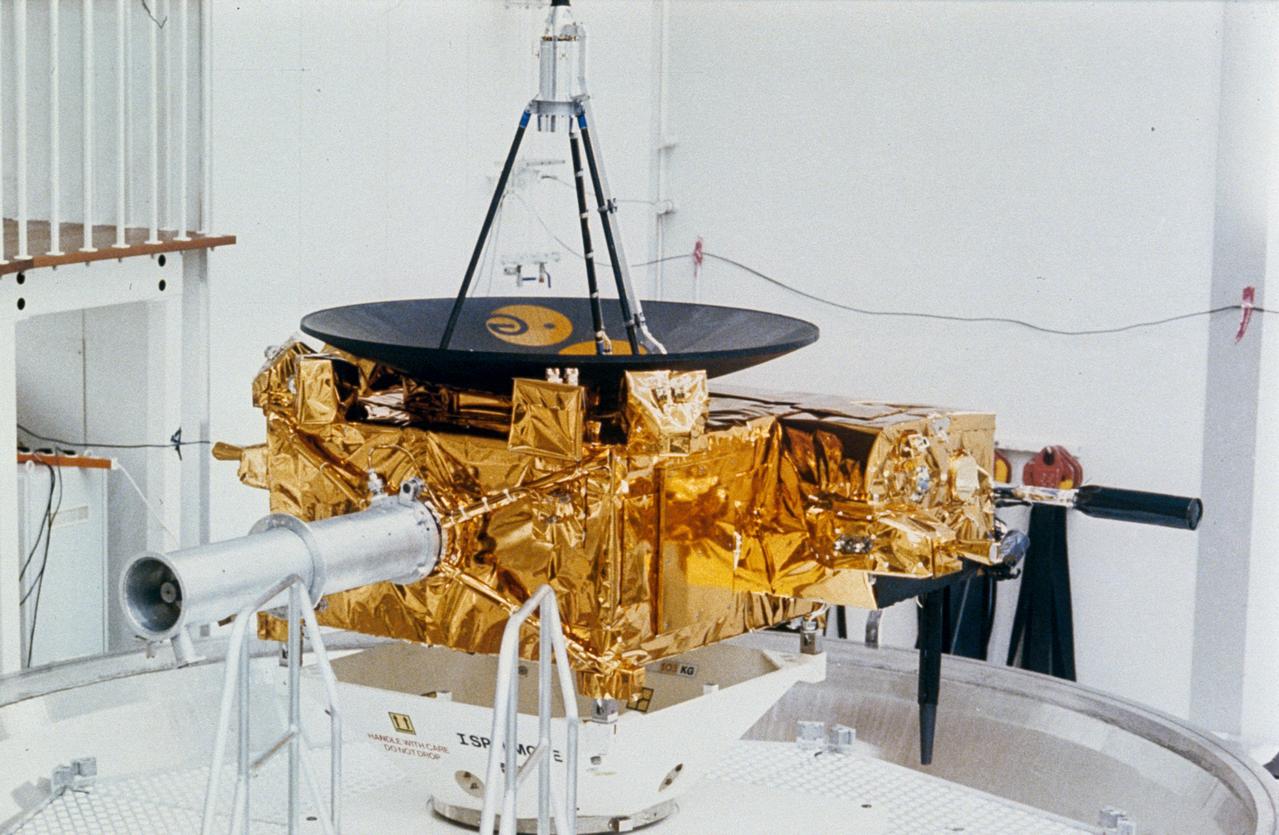
S90-45985 (May 1990) --- The Ulysses spacecraft undergoes testing at the vacuum spin-balancing facility in ESTEC. Careful balancing is required in order to ensure that the high gain antenna, which is aligned with the spacecraft spin axis, can be accurately pointed toward Earth throughout the mission. It will be flown to Kennedy Space Center (KSC) for further processing before being on loaded to Discovery's cargo bay. The Space Shuttle crew of STS-41 will send it off to its long-awaited mission.
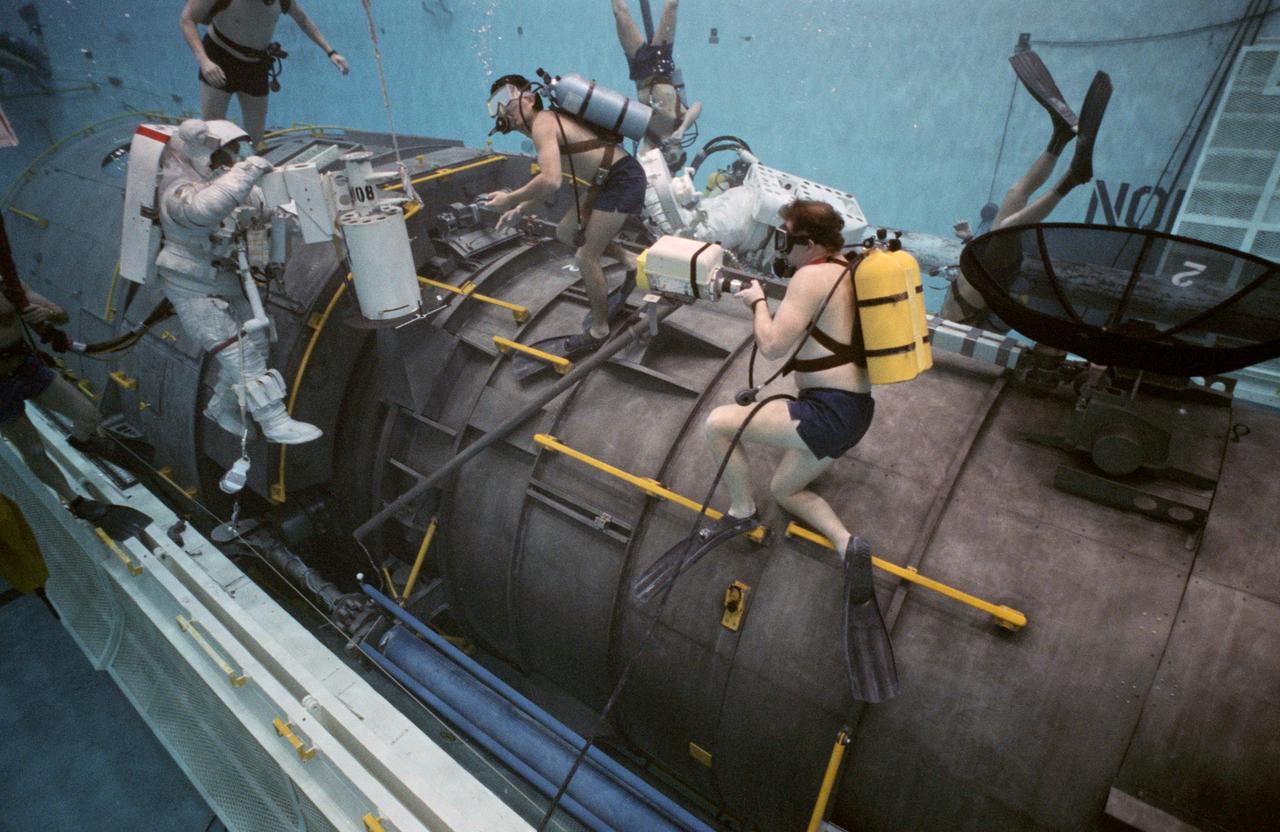
STS-31 Mission Specialist (MS) Bruce McCandless II (left), wearing an extravehicular mobility unit (EMU), maneuvers his way around a mockup of the remote manipulator system (RMS) end effector during an underwater simulation in JSC's Weightless Environment Training Facility (WETF) Bldg 29 pool. The end effector is attached to a grapple fixture on the Hubble Space Telescope (HST) mockup. As McCandless performs contingency extravehicular activity (EVA) procedures, fellow crewmember MS Kathryn D. Sullivan, in EMU, works on the opposite side of the HST mockup, and SCUBA-equipped divers monitor the activity. Though no EVA is planned for STS-31, the two crewmembers train for contingencies that would necessitate leaving the shirt sleeve environment of Discovery's, Orbiter Vehicle (OV) 103's, crew cabin and performing chores with the HST payload or related hardware in the payload bay (PLB).
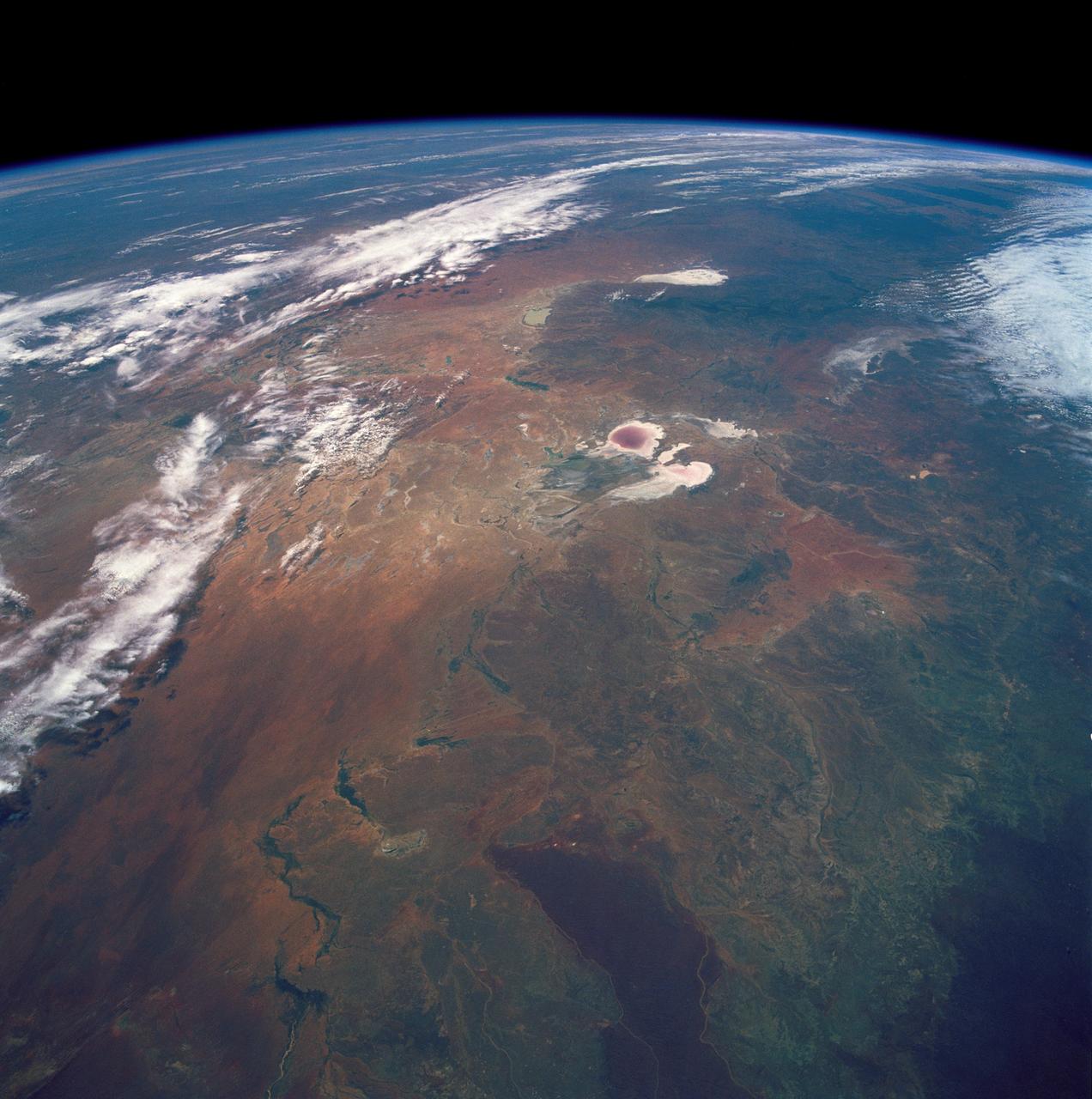
STS035-501-007 (2-10 Dec. 1990) --- The STS-35 crewmembers aboard the Earth-orbiting Space Shuttle Columbia photographed this view of the Arid Simpson Desert of Australia with a handheld Rolleiflex camera. Lake Eyre is normally dry; however, the STS-35 crew was able to recognize water in the lowest parts of the lake (dark pink area) and possibly in Lake Blanche east of Lake Eyre. Lake Frome lies in the distance separated from Lake Torrens (top right) by dark hills of Flinders Range. The Finke River (bottom left to middle) flows into the Eyre basin from the northwest. Although it is the largest river entering the basin, Finke's floods seldom reach Lake Eyre. The dark brown patch in the foreground is an area of ancient, brown lateritic soils partly covered by dunes.
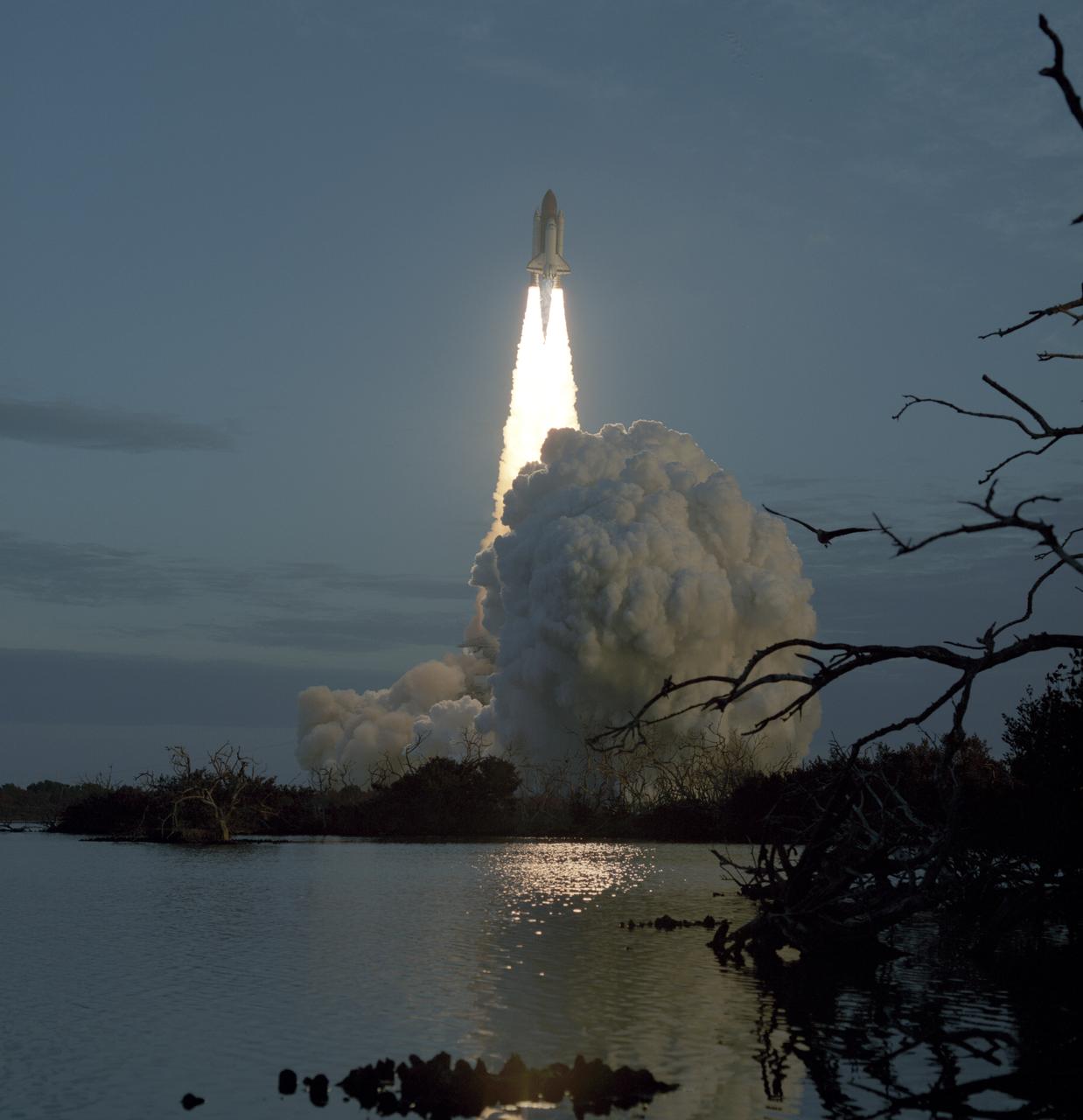
Five astronauts launched aboard the Space Shuttle Columbia on January 9, 1990 at 7:35:00am (EST) for the STS-32 mission. The crew included David C. Brandenstein, commander; James D. Weatherbee, pilot; and mission specialists Marsha S. Ivins, G. David Low, and Bonnie J. Dunbar. Primary objectives of the mission were the deployment of the SYNCOM IV-F5 defense communications satellite and the retrieval of NASA’s Long Duration Exposure Facility (LDEF).

STS036-S-018 (3 March 1990) --- The Space Shuttle Atlantis touches down at Edwards Air Force Base in California to complete the STS-36 mission. Onboard were Astronauts John O. Creighton, John H. Casper, David C. Hilmers, Richard M. (Mike) Mullane and Pierre J. Thuot.
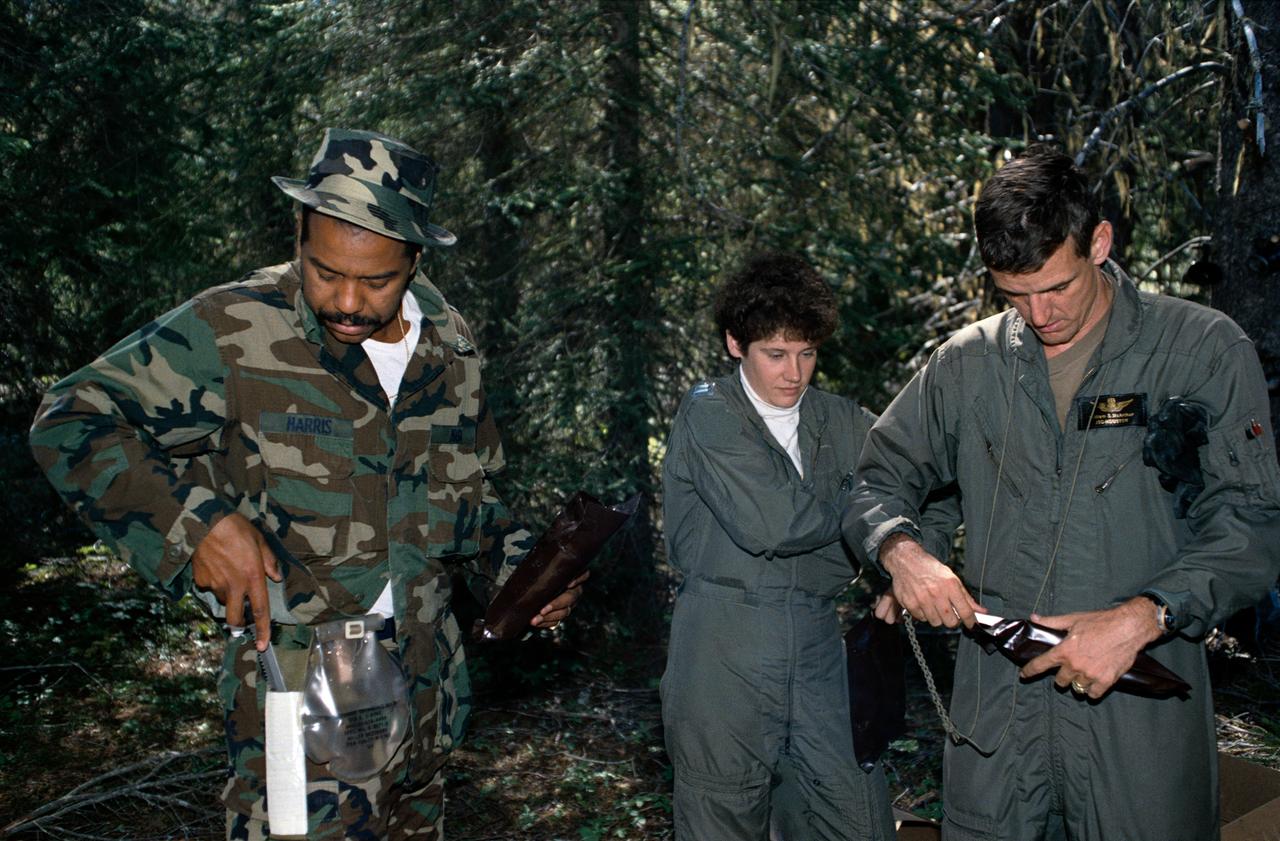
1990 Group 13 Astronaut Candidates (ASCANs) (left to right) Bernard J. Harris, Jr, Susan J. Helms, and William S. McArthur, Jr open dehydrated food packages during wilderness survival training at Fairchild Air Force Base (AFB) in Spokane, Washington. The training was conducted in the mountain forests of Washington from 08-26-90 through 08-30-90.
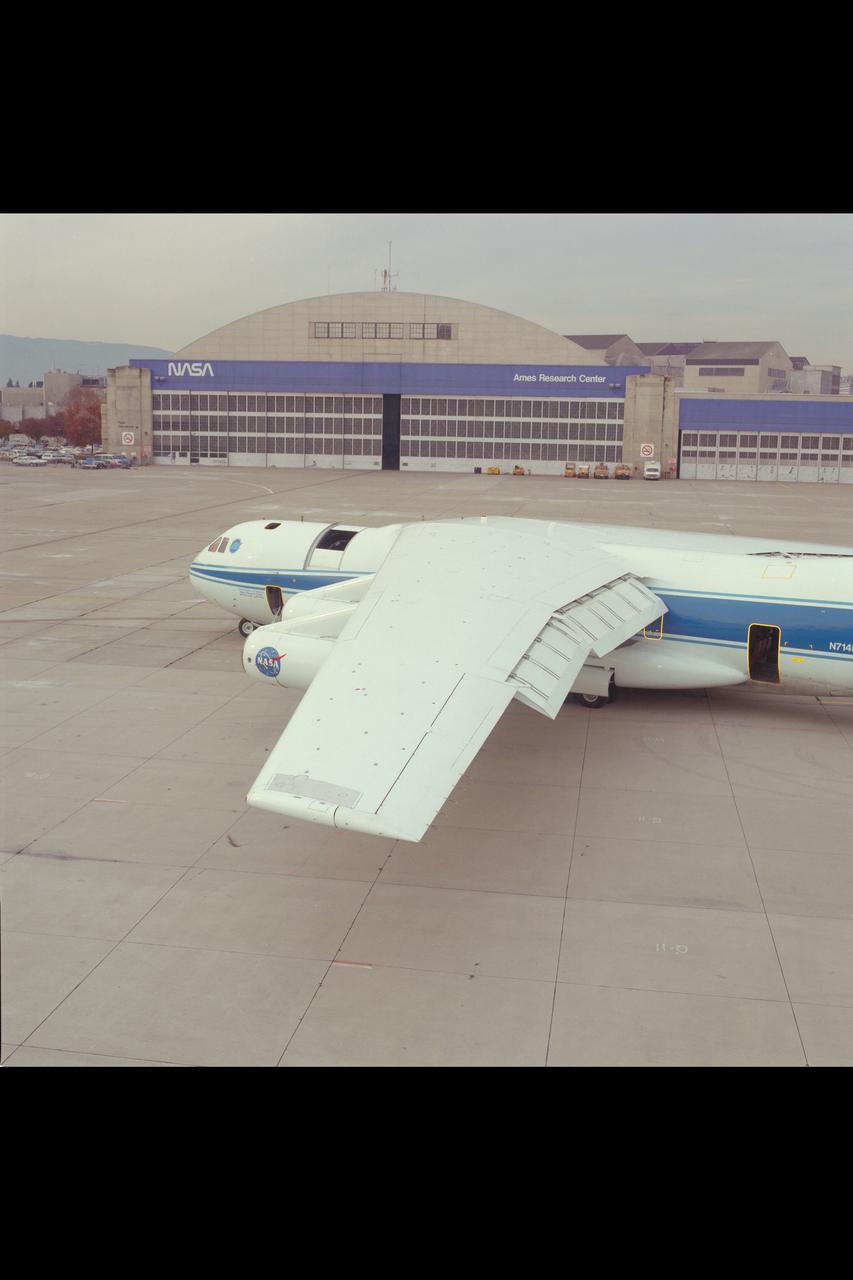
C-141 KAO (NASA-714) on ramp
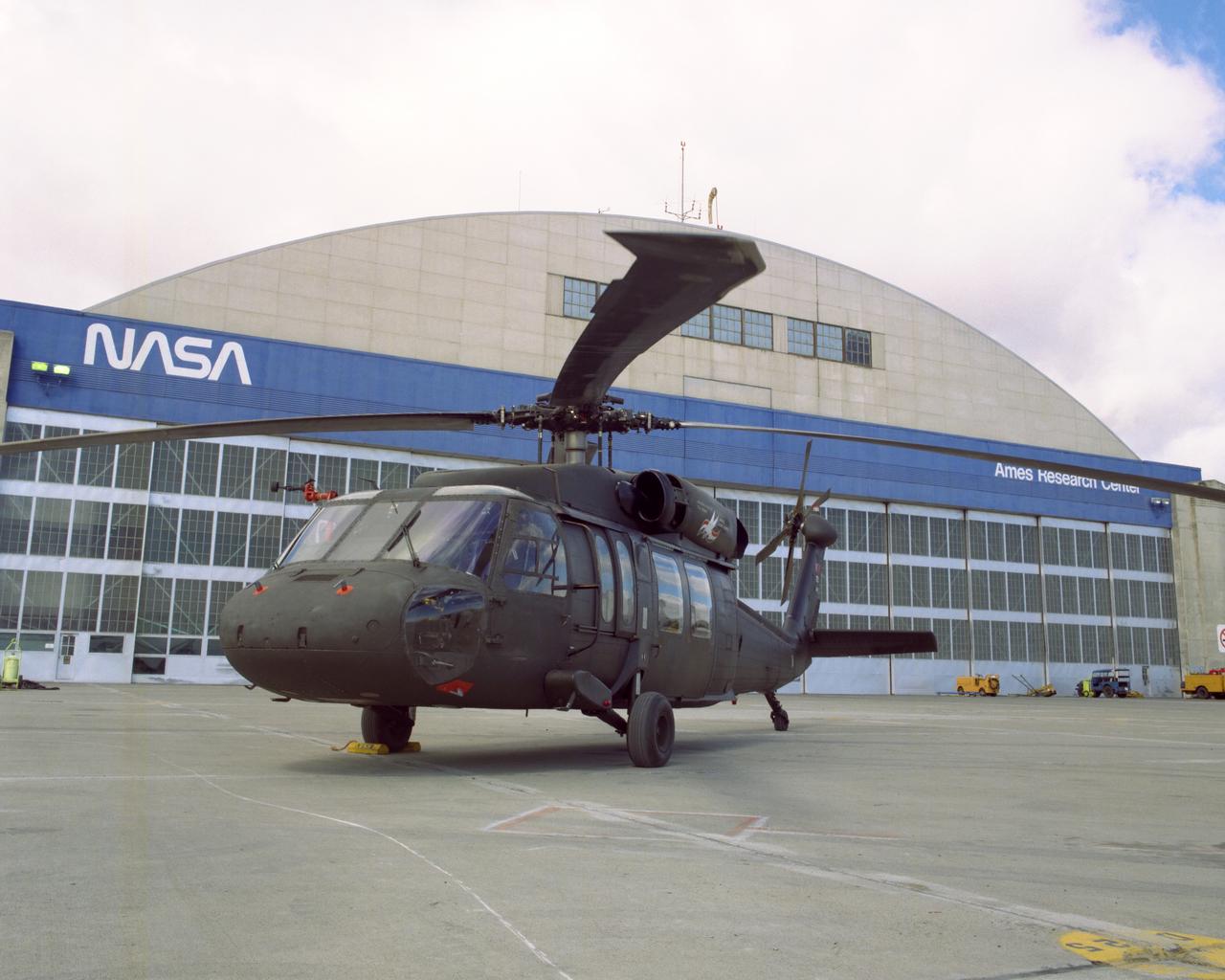
UH-60 NASA-750 in front of Ames hangar
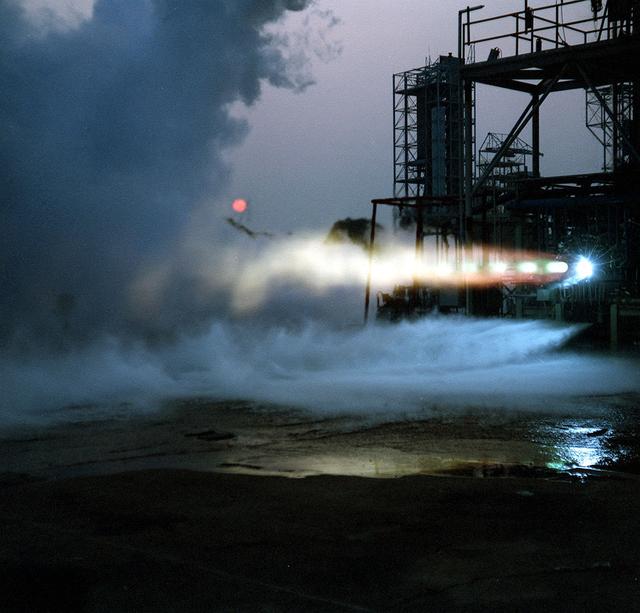
A 40K Pratt Whitney engine for the National Launch System is test fired at Marshall's Test Stand 116.
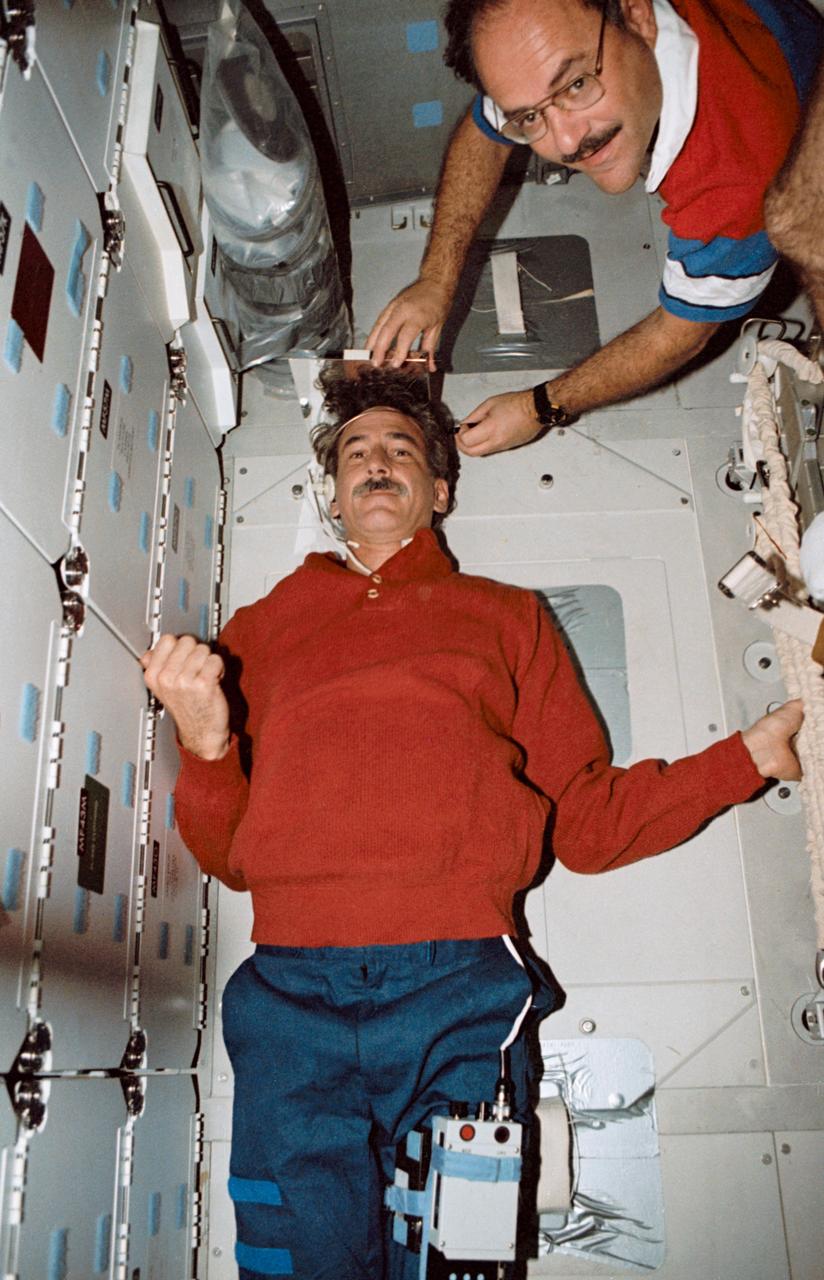
STS035-19-021 (December 1990) --- STS-35 Mission Specialist Jeffrey A. Hoffman stretches out on the middeck floor while MS John M. (Mike) Lounge records his height. The two crew members are in front of the forward lockers aboard Columbia, Orbiter Vehicle (OV) 102. Hoffman steadies himself using the stowed treadmill and the lockers. Above Hoffman's head is a plastic bag filled with Development Test Objective (DTO) 634, Trash Compaction and Retention System Demonstration, trash compactor charcoal filtered bag lids. This image was selected by the Public Affairs Office (PAO) for public release.
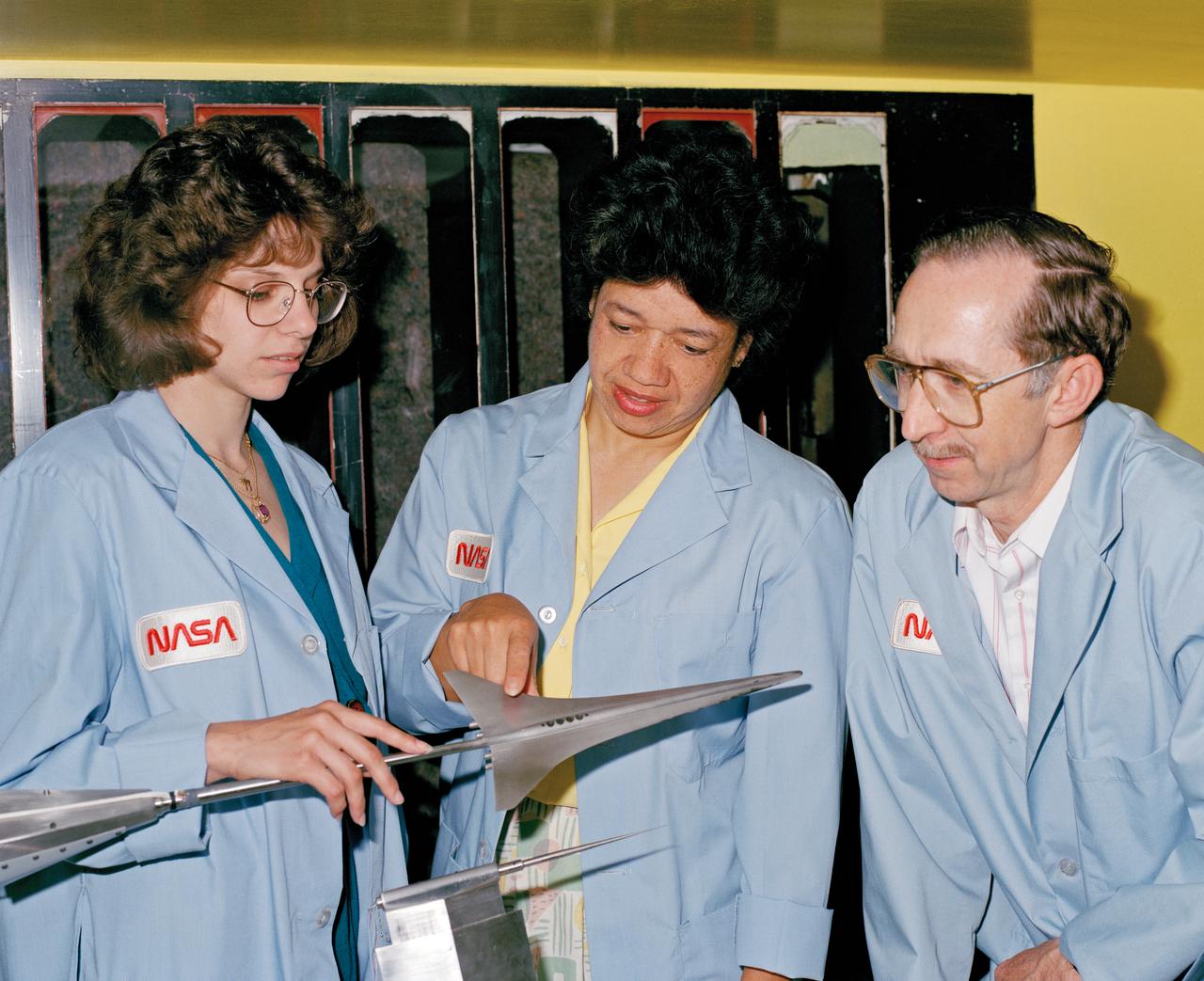
NASA Staff Dr.Darden, Matthew Overhold, Kathy Needleman,Robert Mack.
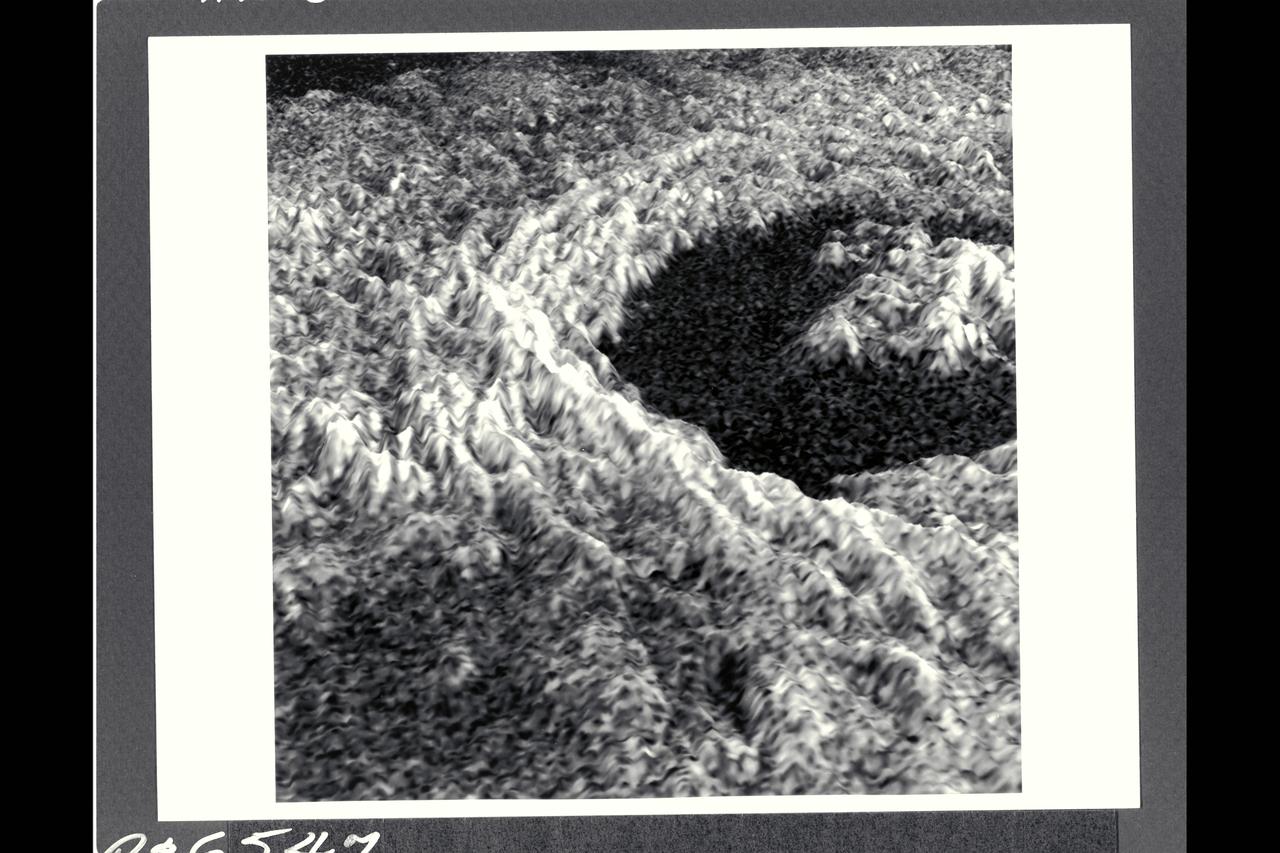
This three-dimensional representation of brightness variations in a Magellan radar image of Golubkina crater enhances the structural features of the crater. Golubkina is 34 kimometers (20.4 mi.) in diameter, and is located at about 60.5 degrees north latitude, 287.2 degrees east longitude. Golubkina is characterized by terraced inner walls and a central peak, typical of large impact craters on the Earth, Moon and Mars. The terraced inner walls form at late stages in the formation of an impact crater, due to collapse of the initial cavity formed by the meterorite impact. The central peak forms due to rebound of the inner crater floor.
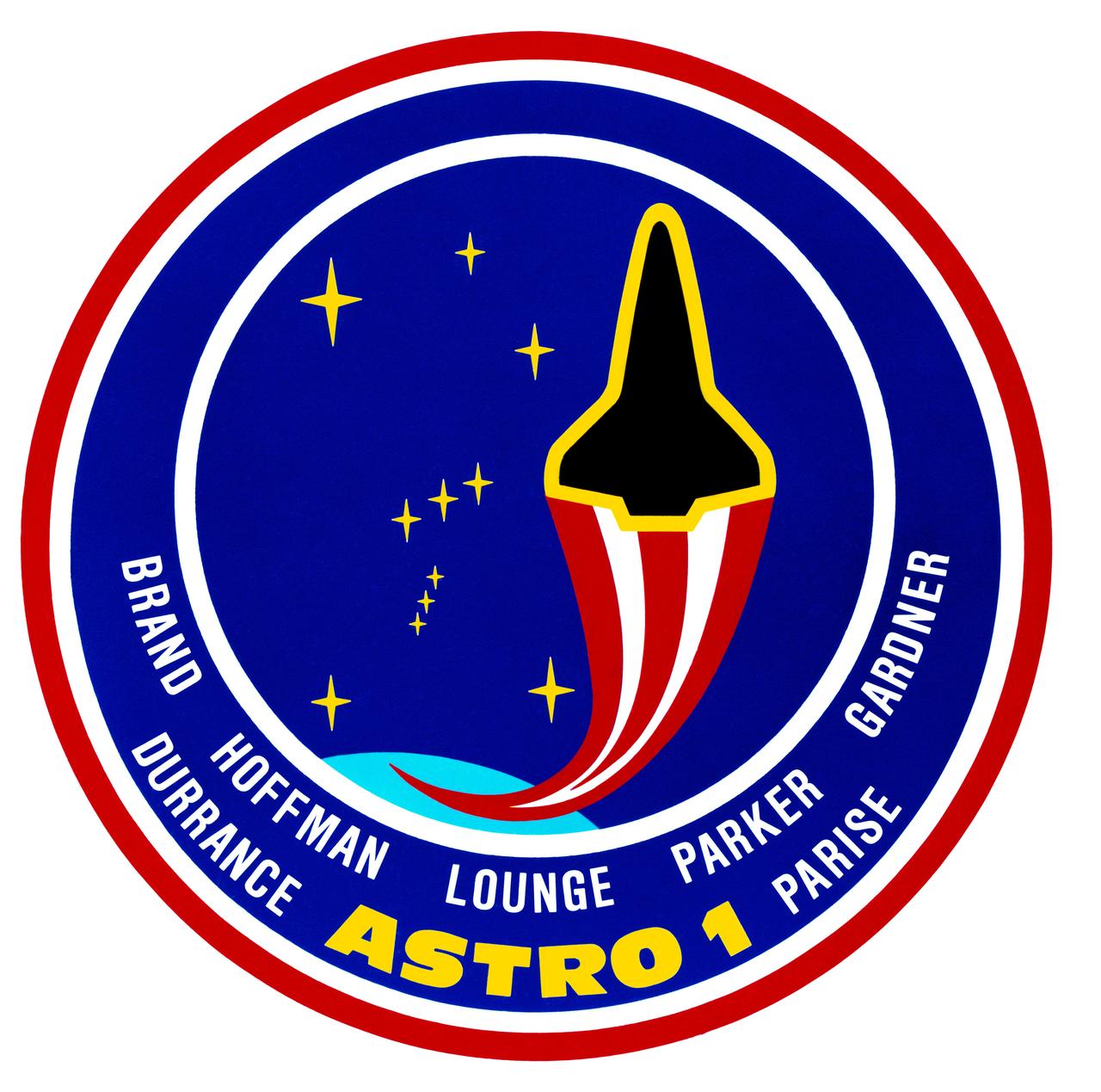
STS035-S-001 (29 Jan. 1990) --- Designed by the crew members assigned to the mission, the STS-35 crew patch symbolizes the space shuttle flying above Earth's atmosphere to better study the many celestial objects of the Universe, represented by the constellation Orion. The primary payload of STS-35 is ASTRO-l, a group of ultraviolet telescopes and the Broad-Band X-Ray Telescope. Crew members on the flight are astronauts Vance D. Brand, commander; Guy S. Gardner, pilot; and Jeffrey A. Hoffman, John M. (Mike) Lounge, Robert A. R. Parker, all mission specialists; along with the two payload specialists - Samuel T. Durrance and Ronald Parise. The NASA insignia design for space shuttle flights is reserved for use by the astronauts and for other official use as the NASA Administrator may authorize. Public availability has been approved only in the forms of illustrations by the various news media. When and if there is any change in this policy, which is not anticipated, the change will be publicly announced. Photo credit: NASA
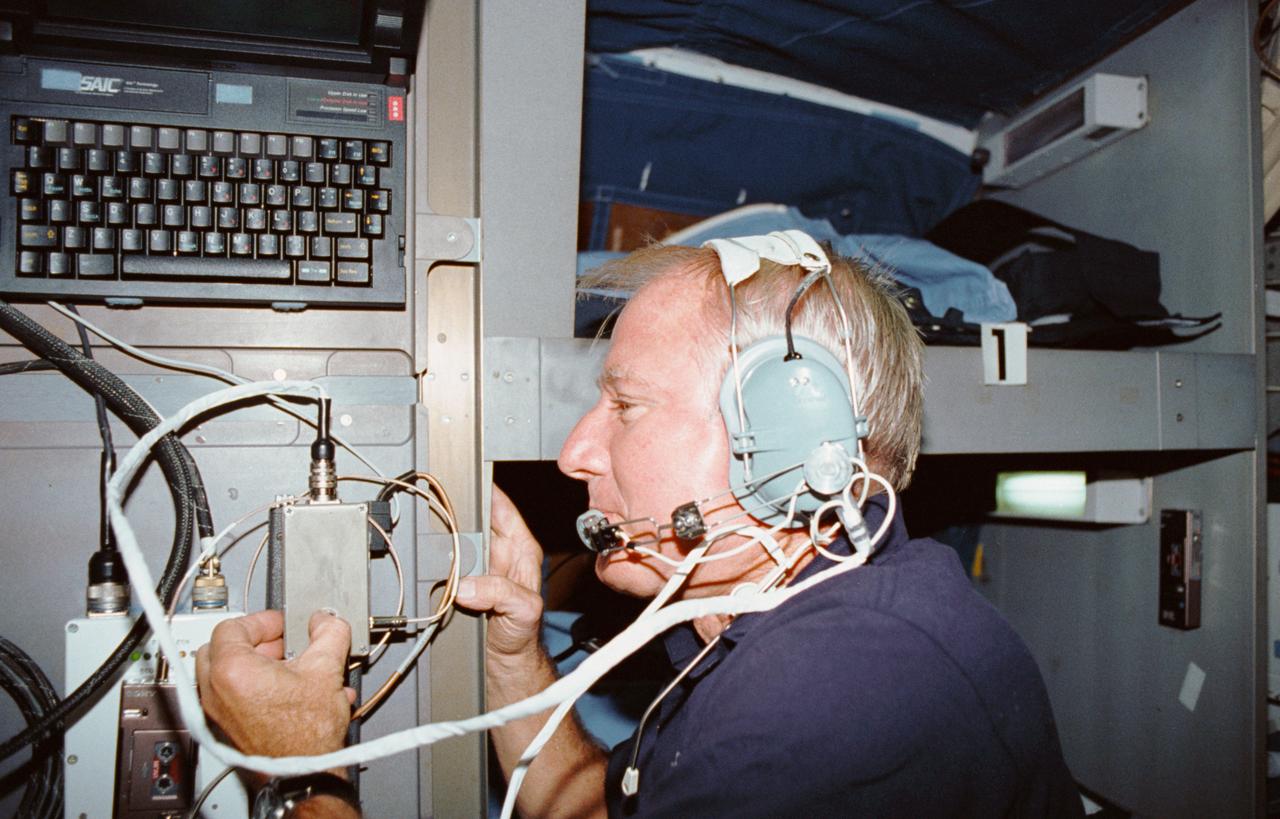
STS035-05-036 (2-10 Dec 1990) --- STS-35 Commander Vance D. Brand, wearing headset, communicates with family members using Shuttle Amateur Radio Experiment (SAREX) on Columbia's, Orbiter Vehicle (OV) 102's, middeck. SAREX and its portable laptop computer mounted on the outside of the middeck sleep station allowed the STS-35 crewmembers to "visit" and briefly share some of their in space experiences with family members. It also provided radio transmissions between ground based amateur radio operators around the world and OV-102. The experiment enabled students from all over the United States to have a chance to communicate with a crewmember in space.
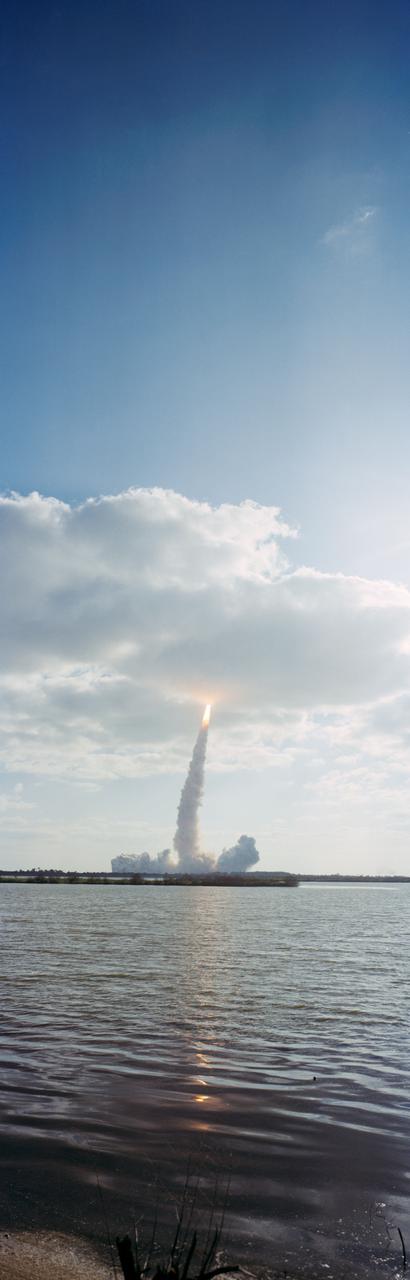
STS-31 Discovery, Orbiter Vehicle (OV) 103, is hidden in low-lying cloud cover as it rises above Kennedy Space Center (KSC) Launch Complex (LC) Pad 39B just after its liftoff at 8:33:51.0492 am (Eastern Daylight Time (EDT)). The glow of the solid rocket booster (SRB) and the space shuttle main engine (SSME) firings appears just below the cloud cover and is reflected in the nearby waterway (foreground). An exhaust plume trails from OV-103 and its SRBs and covers the launch pad area.
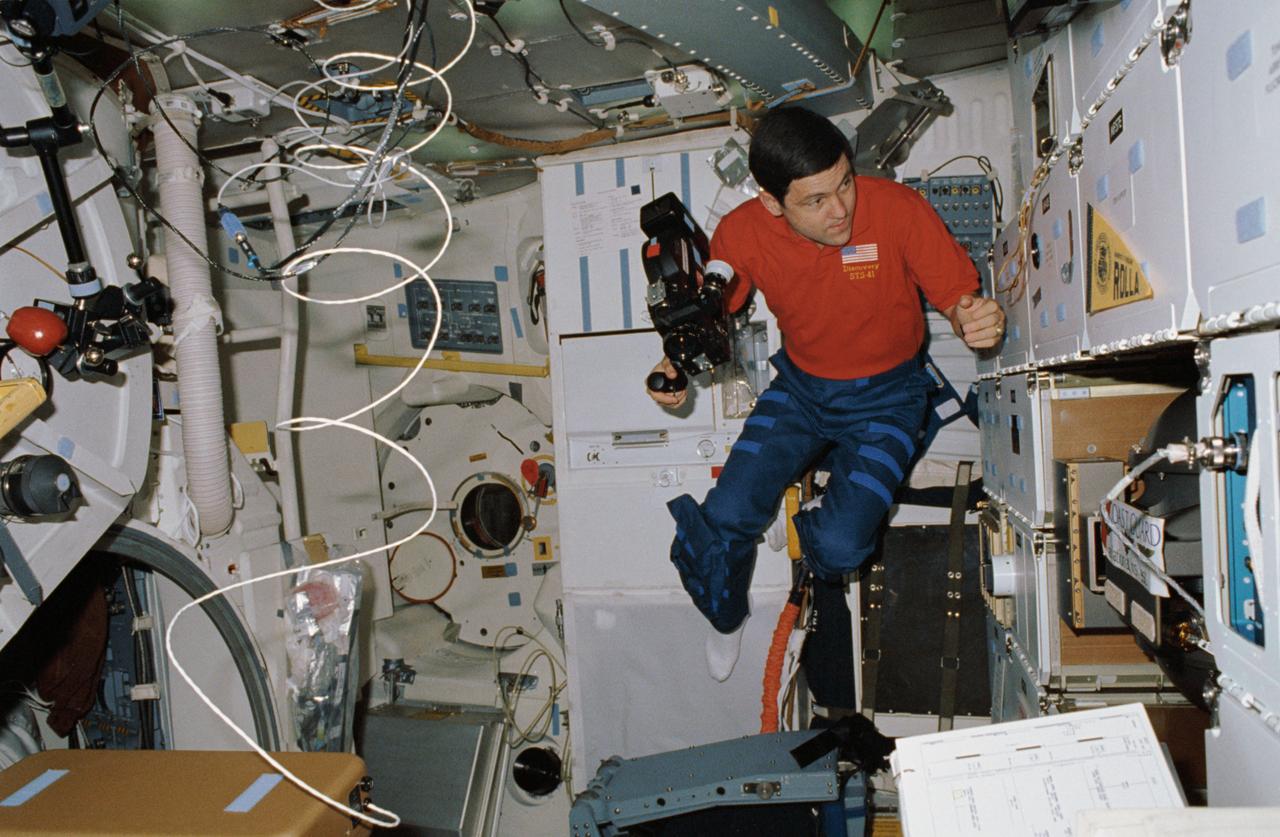
STS041-05-011 (6-10 Oct 1990) --- Astronaut Robert D. Cabana, STS-41 pilot, exhibits the weightlessness of space travel as he appears to "float" about on the middeck of Discovery. Careful inspection of the photo proves that, actually, his floating is limited, as he has anchored his left foot with a special restraint device. He apparently has chosen this vantage point to use the Arriflex motion picture camera in his right hand.
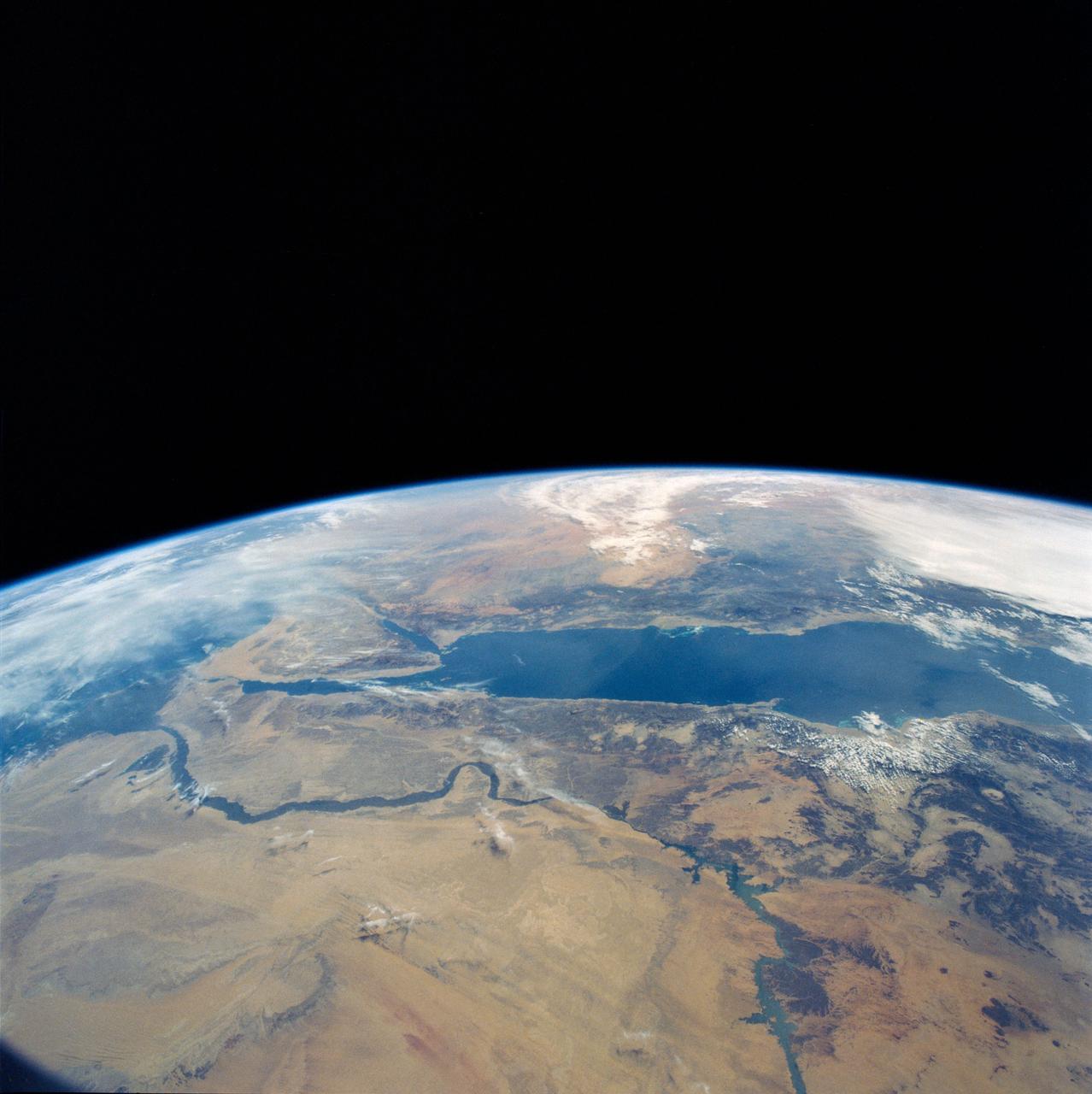
STS031-79-015 (24-29 April 1990) --- The 330-plus nautical mile orbital altitude of the Space Shuttle Discovery allowed for this unique high oblique 70mm Hasselblad frame. Egypt is in the foreground, with the Nile River and Lake Nasser readily identifiable. Cairo and Alexandria are visible. The Mediterranean Sea is on the horizon in upper left. The Red Sea is in the center. Other areas seen include Saudi Arabia, Jordan, Palestine and Israel; the Gulf of Aqaba and the Gulf of Suez.
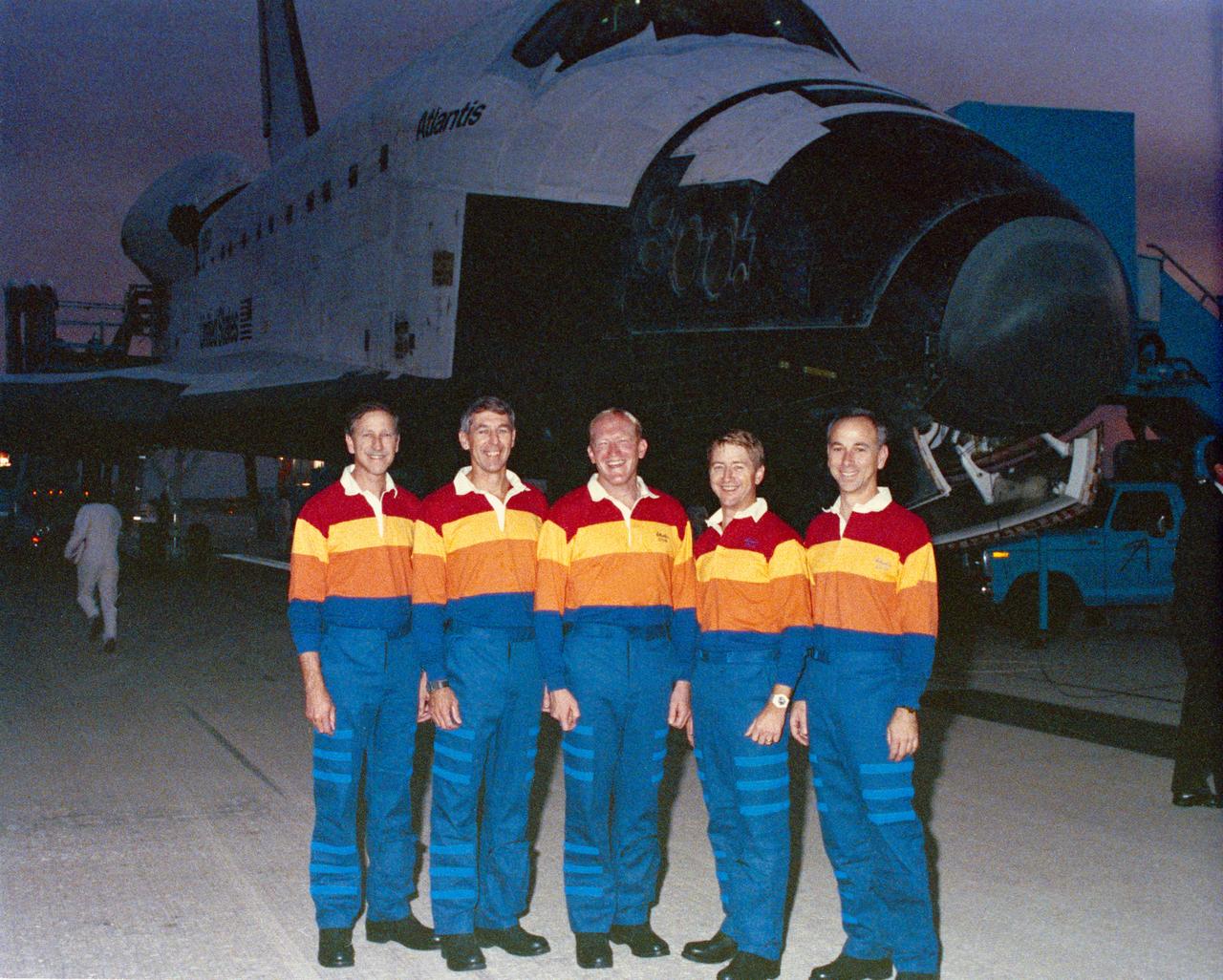
STS038-S-040 (20 Nov 1990) --- STS-38 crewmembers, wearing red, yellow, and orange polo shirts, pose in front of Atlantis, Orbiter Vehicle (OV) 104, parked on runway 33 at Kennedy Space Center's (KSC) Shuttle Landing Facility (SLF) during post flight activities. Left to right are Commander Richard O. Covey, Mission Specialist (MS) Robert C. Springer, MS Charles D. Gemar, Pilot Frank L. Culbertson, and MS Carl J. Meade.
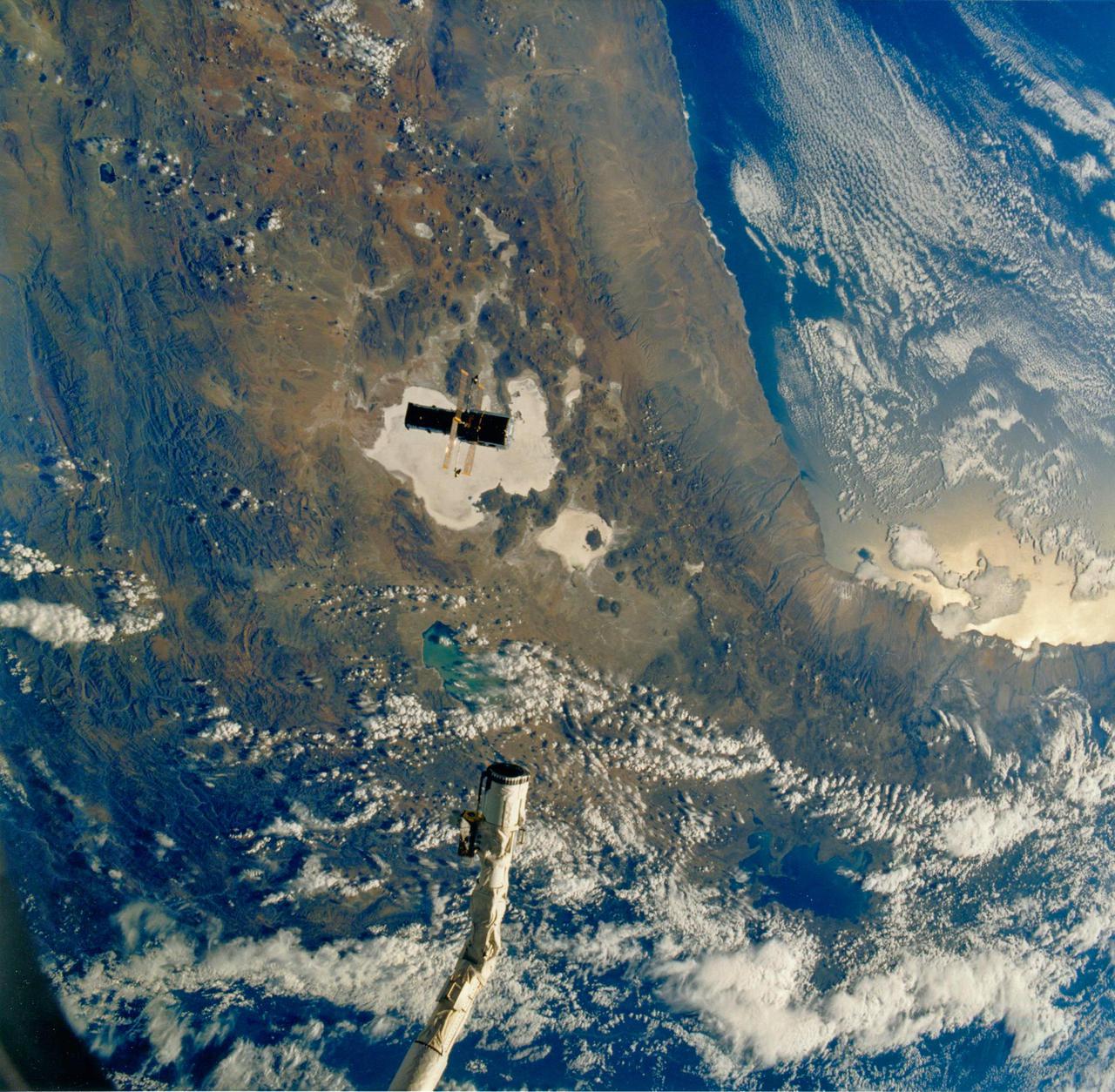
JOHNSON SPACE CENTER, HOUSTON, TEXAS -- STS-31 ONBOARD SCENE -- The huge Hubble Space Telescope (HST), backdropped against Bolivian, Chilean and Peruvian topography some 332 nautical miles away, and the Space Shuttle Discovery, represented in this scene by its remote manipulator system (RMS) arm, begin their relative separation in space. The chalk-colored feature directly beneath HST is called Salar de Uyuni. Lake Titicaca is in upper right, and Lake Fuope is under partial cloud cover near the RMS's end effector. This photograph, one of the first eight STS-31 onboard frames to be released by NASA, was taken with a handheld Hasselblad camera by one of the five busy crew members in Discovery's cabin.
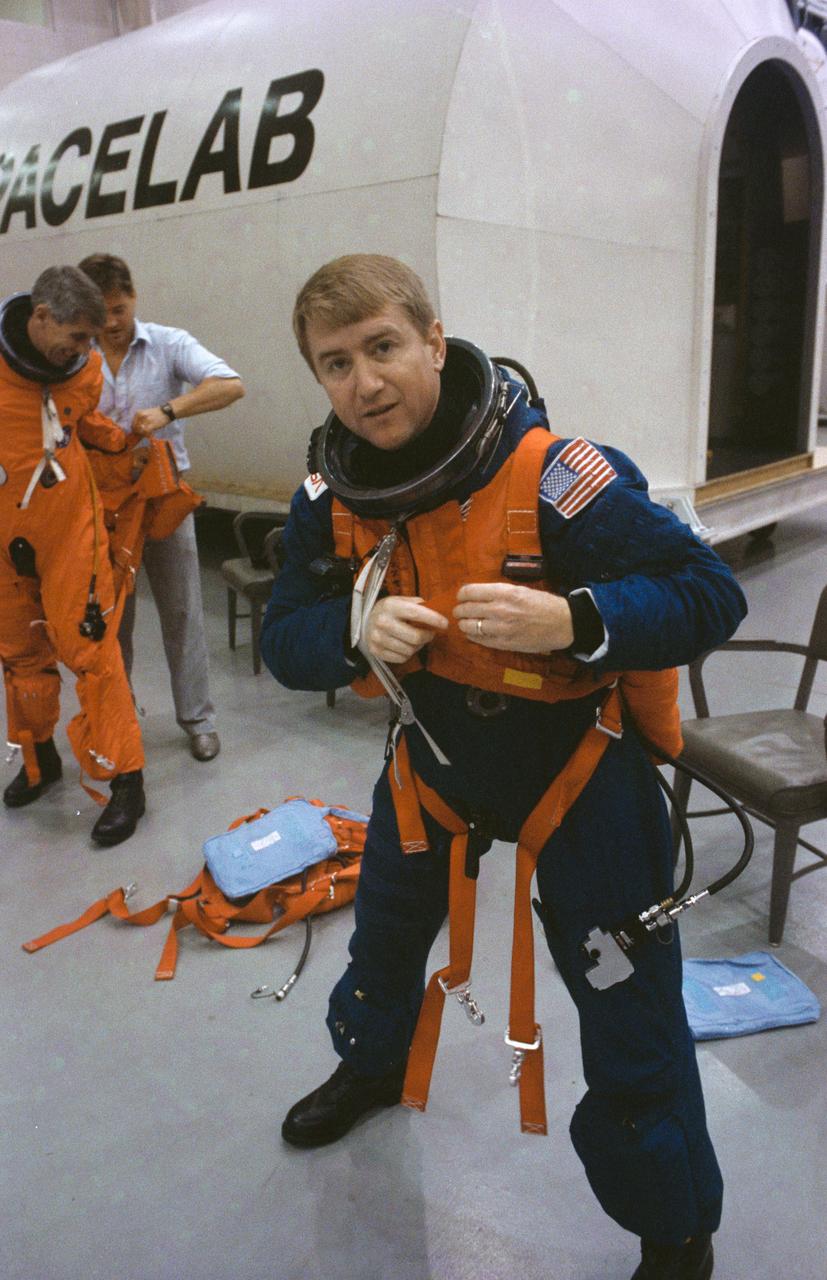
STS-38 crewmembers don launch and entry suit (LES) equipment prior to emergency egress training in JSC's Mockup and Integration Laboratory (MAIL) Bldg 9A. Pilot Frank L. Culbertson, wearing navy blue LES, fastens parachute strap and Mission Specialist (MS) Robert C. Springer, wearing orange LES, dons parachute pack with a technician's assistance in front of a Spacelab module mockup.
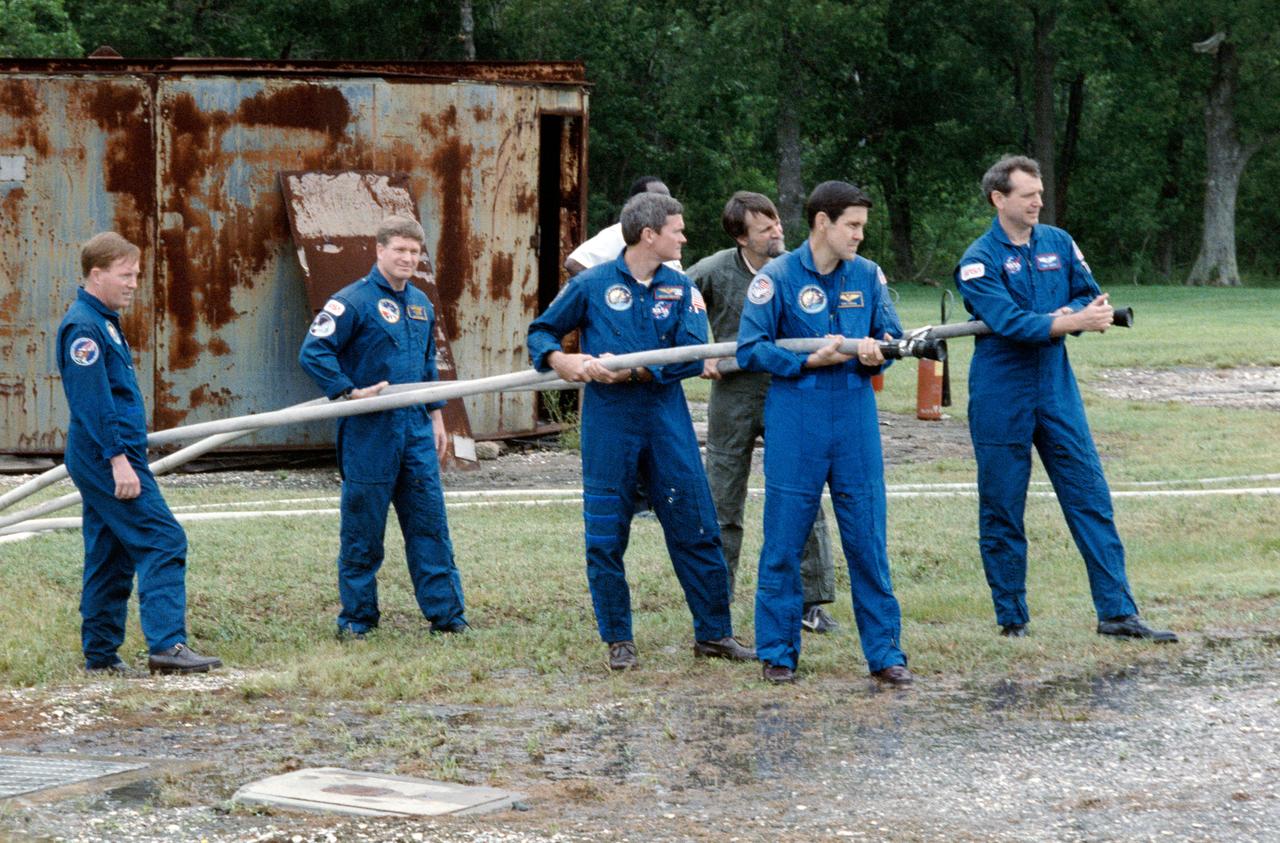
S90-38926 (4 May 1990) --- The STS-41 astronaut crew and a STS-35 backup payload specialist participate in fire control training exercises at the Johnson Space Center (JSC). Left to right are Richard N. Richards, William M. Shepherd, Bruce E. Melnick, Kenneth Nordsieck, Robert D. Cabana and Thomas D. Akers. Nordsieck is Astro-1 backup payload specialist in training for STS-35. This type training is provided all crewmembers assigned to seats aboard Space Shuttle.
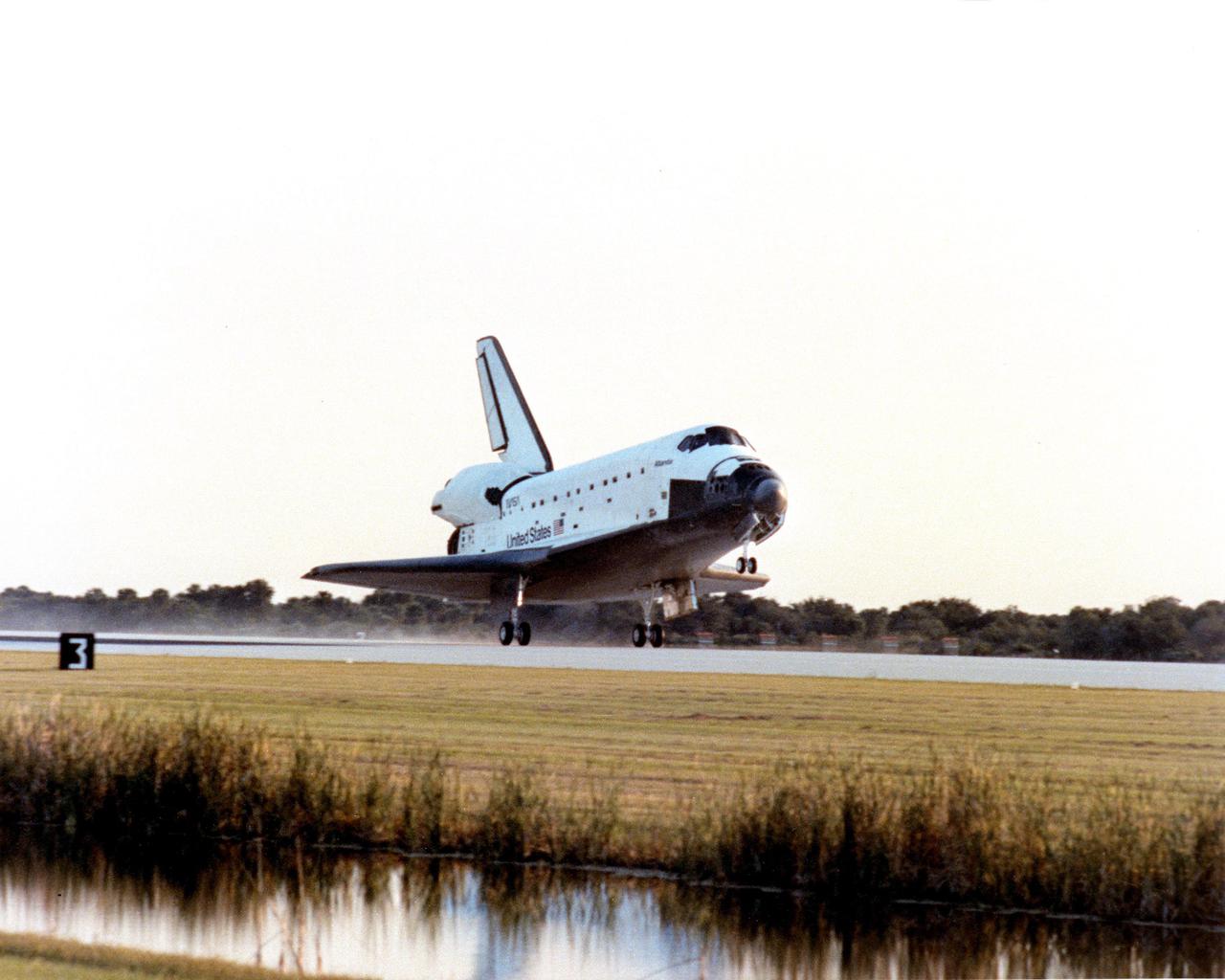
KENNEDY SPACE CENTER, FLA. -- The Shuttle Atlantis and Space Shuttle Mission STS-38 lands at Kennedy Space Center's Shuttle Landing Facility at 4:43 p.m. EST. This is the first Shuttle landing at KSC since 1985.
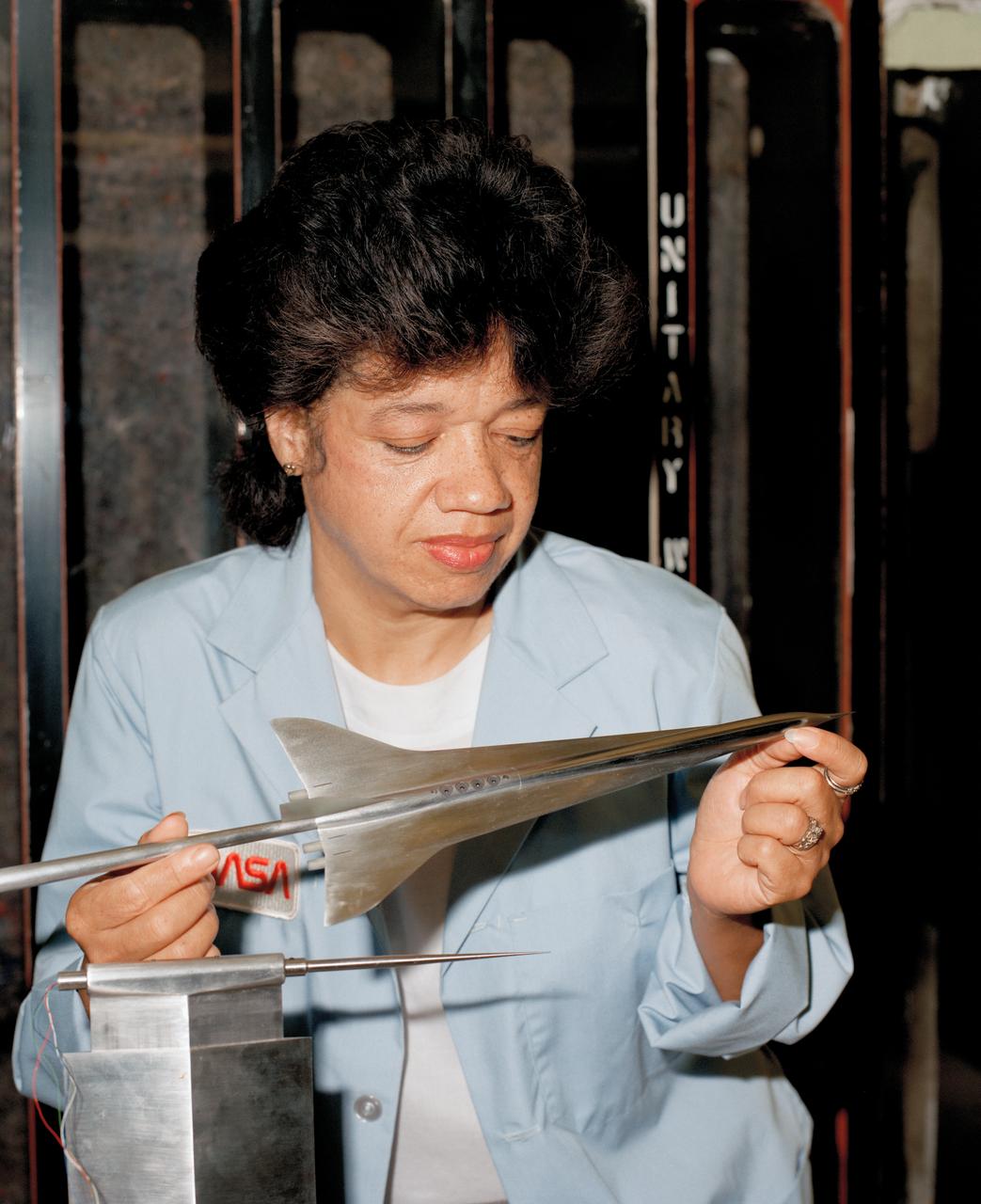
NASA Staff Dr.Darden, Mach 3 Sonic Boom Model Wind Tunnel
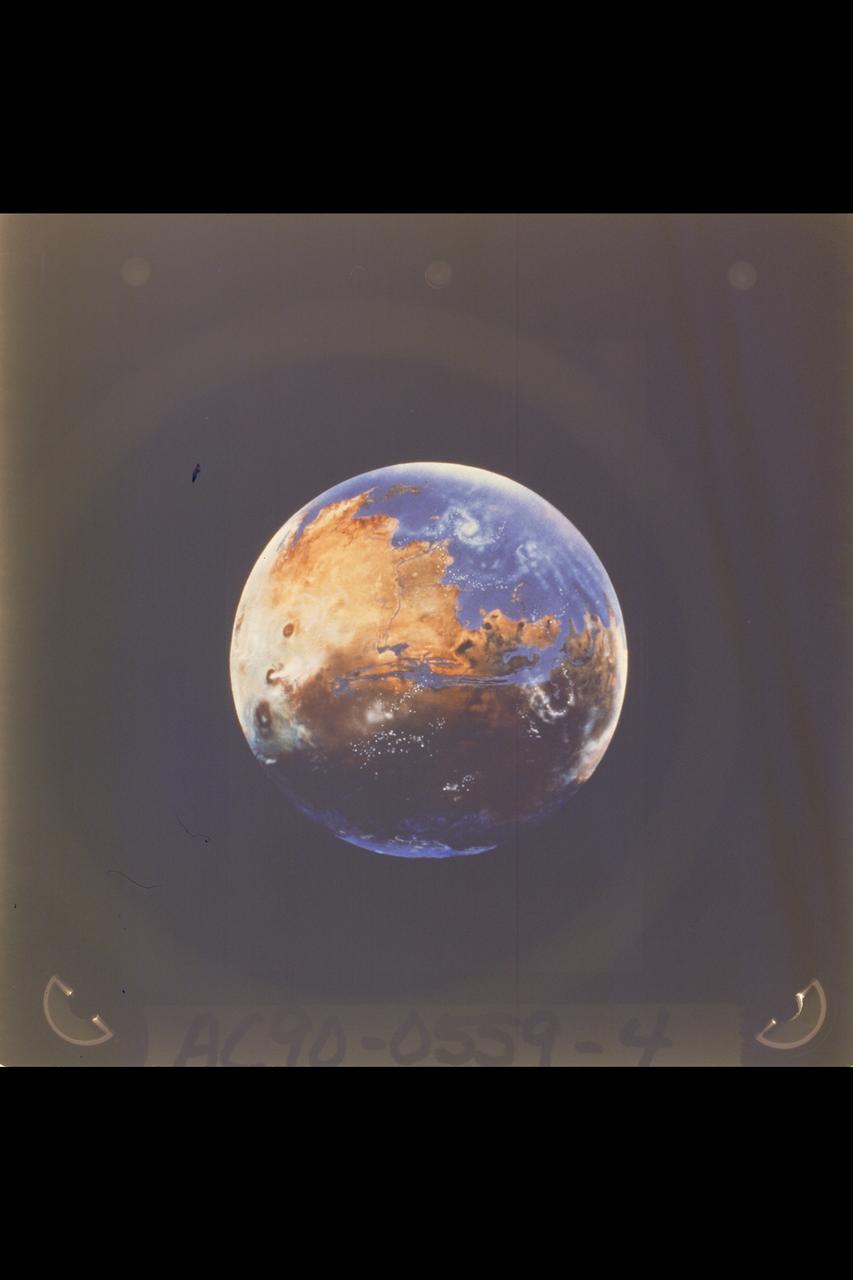
Viking History of Water on Mars Composite Study done by Chris McKay, Ames Scientist. Art by Michael Carroll
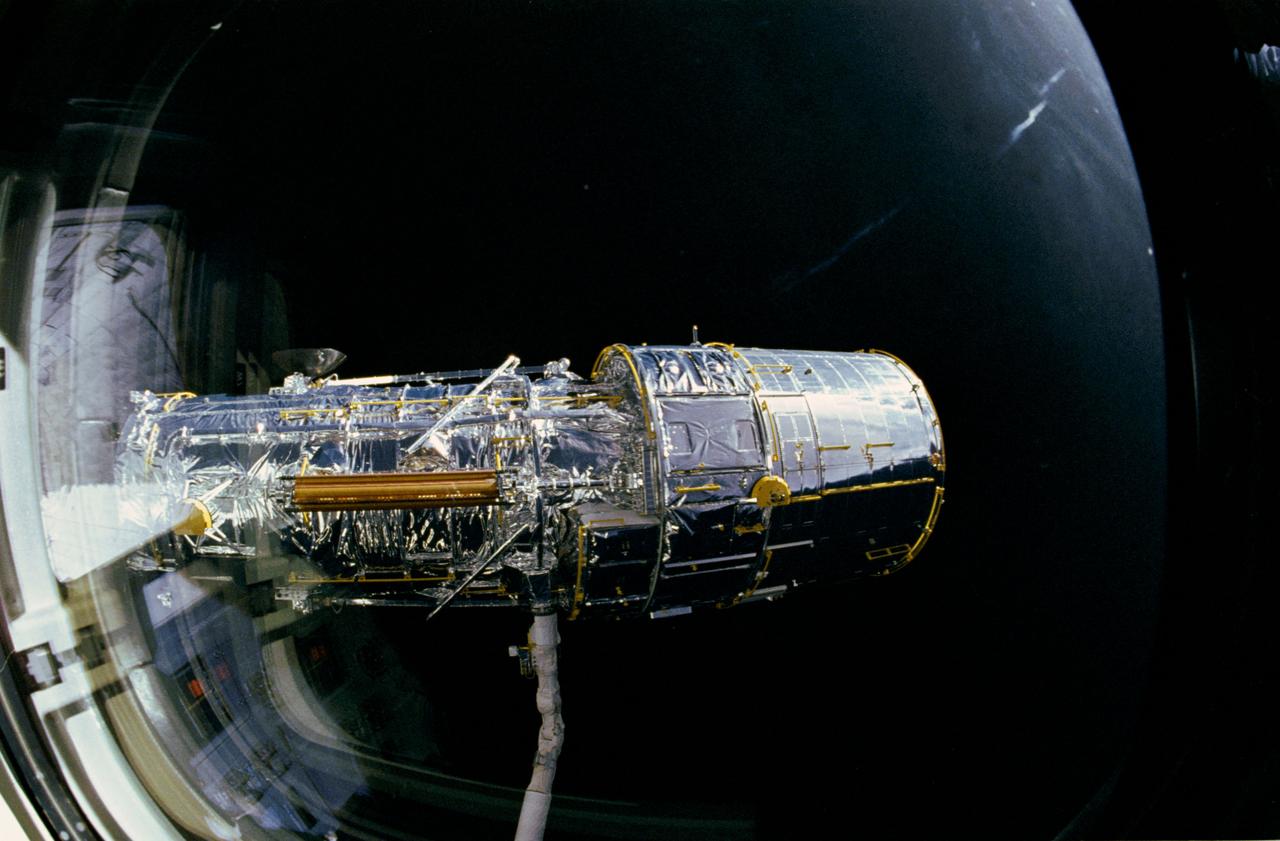
During STS-31 checkout, the Hubble Space Telescope (HST) is held in a pre-deployment position by Discovery's, Orbiter Vehicle (OV) 103's, remote manipulator system (RMS). The view, taken from the crew cabin overhead window W7, shows the starboard solar array (SA) panel (center) and two high gain antennae (HGA) (on either side) stowed along side the Support System Module (SSM) forward shell. The sun highlights HST against the blackness of space.
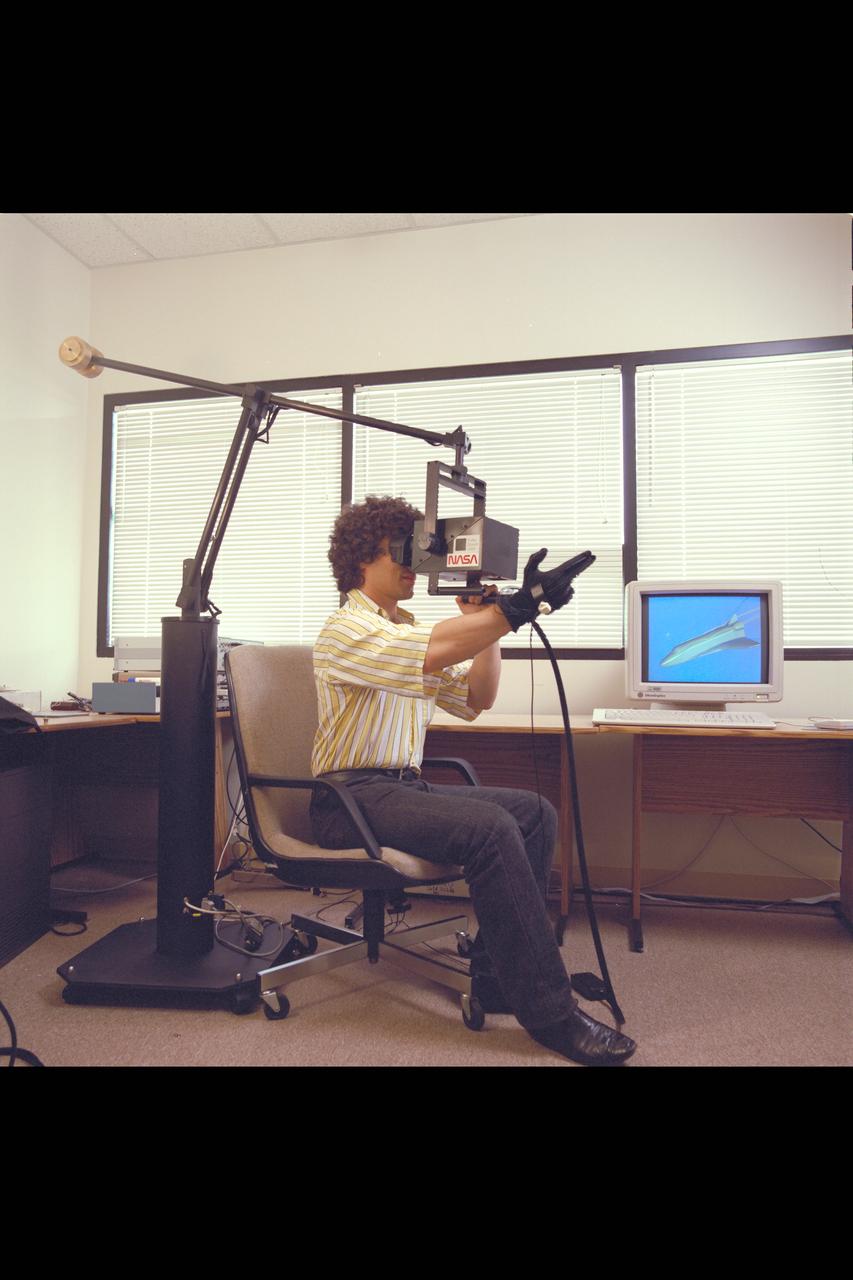
N-258 NAS facility virtual reality workstation, hand-held maneuvering unit , test and virtual environment simulation by Creon Levitt

Range : 1.7 million miles This colorized picture of Venus was taken about 6 days after Galileo's closest approach to the planet. It has been colorized to a bluish hue to emphasize subtle contrasts in the cloud markings and to indicate that it was taken through a violet filter. Features in the sulfuric acid clouds near the top of the planet's atmosphere are most prominent in violet and ultraviolet light. This image shows the east-to-west-trending cloud banding and the brighter polar hoods familiar from past studies of Venus. The features are embedded in winds that flow from east to west at about 230 mph. The smallest features visible are about 45 miles across. An intriguing filamentary dark pattern is seen immediately left of the bright region at the subsolar point (equatorial 'noon'). North is at the top and the evening terminator is to the left.
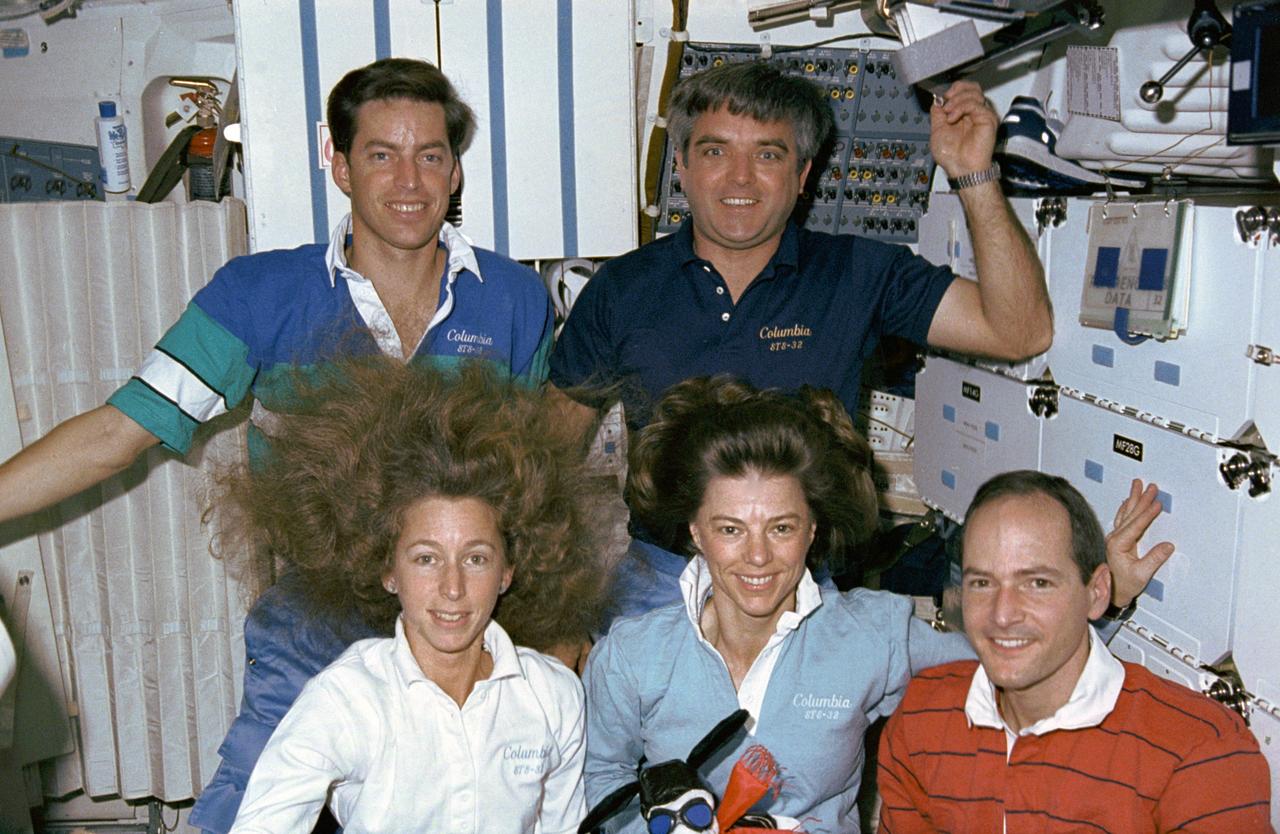
STS032-57-006 (9-20 Jan 1990) --- The five astronaut crew members used a pre-set 35mm camera to take this in-flight crew portrait. Astronauts Daniel C. Brandenstein (right, rear), mission commander, and James D. Wetherbee (left, rear), pilot, were in charge of controlling the Space Shuttle Columbia during its record-setting 11-day stay in Earth-orbit as well as performing a variety of other chores. Mission specialists performing a number of experiments and tackling a myriad of miscellaneous tasks were, left to right on the front row: astronauts Marsha S. Ivins, Bonnie J. Dunbar and G. David Low. Together the quintet retrieved the Long Duration Exposure Facility (LDEF), released into space the Syncom IV-5 communications satellite, took photos of Earth, performed troubleshooting duties and adhered to a busy agenda during their stay aboard Columbia. This picture was used by the astronauts at their January 30, 1990 Post Flight Press Conference (PFPC) at the Johnson Space Center (JSC).
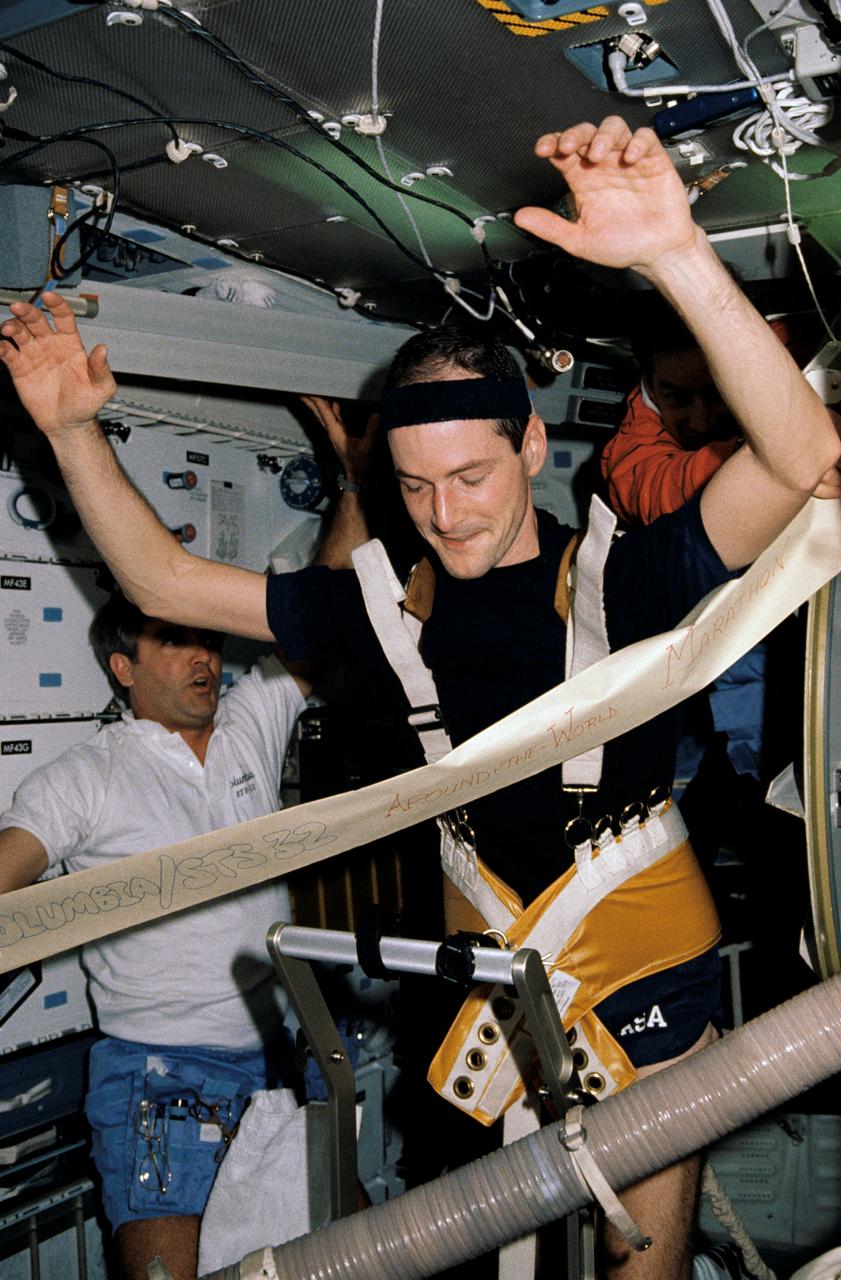
STS032-03-021 (9-20 Jan. 1990) --- Three crew members aboard the Space Shuttle Columbia enjoy one of the lighter moments of the 11-day mission on the flight deck. Astronaut G. David Low "runs" on a treadmill device while astronauts Daniel C. Brandenstein, left, and James D. Wetherbee look on. Wetherbee's mother competed in a marathon in Houston while the crew members had their own in-space version. The treadmill served as an exerciser and also was an important element of onboard biomedical testing. This picture was used by the astronauts at their January 30, 1990 Post Flight Press Conference (PFPC) at the Johnson Space Center (JSC).
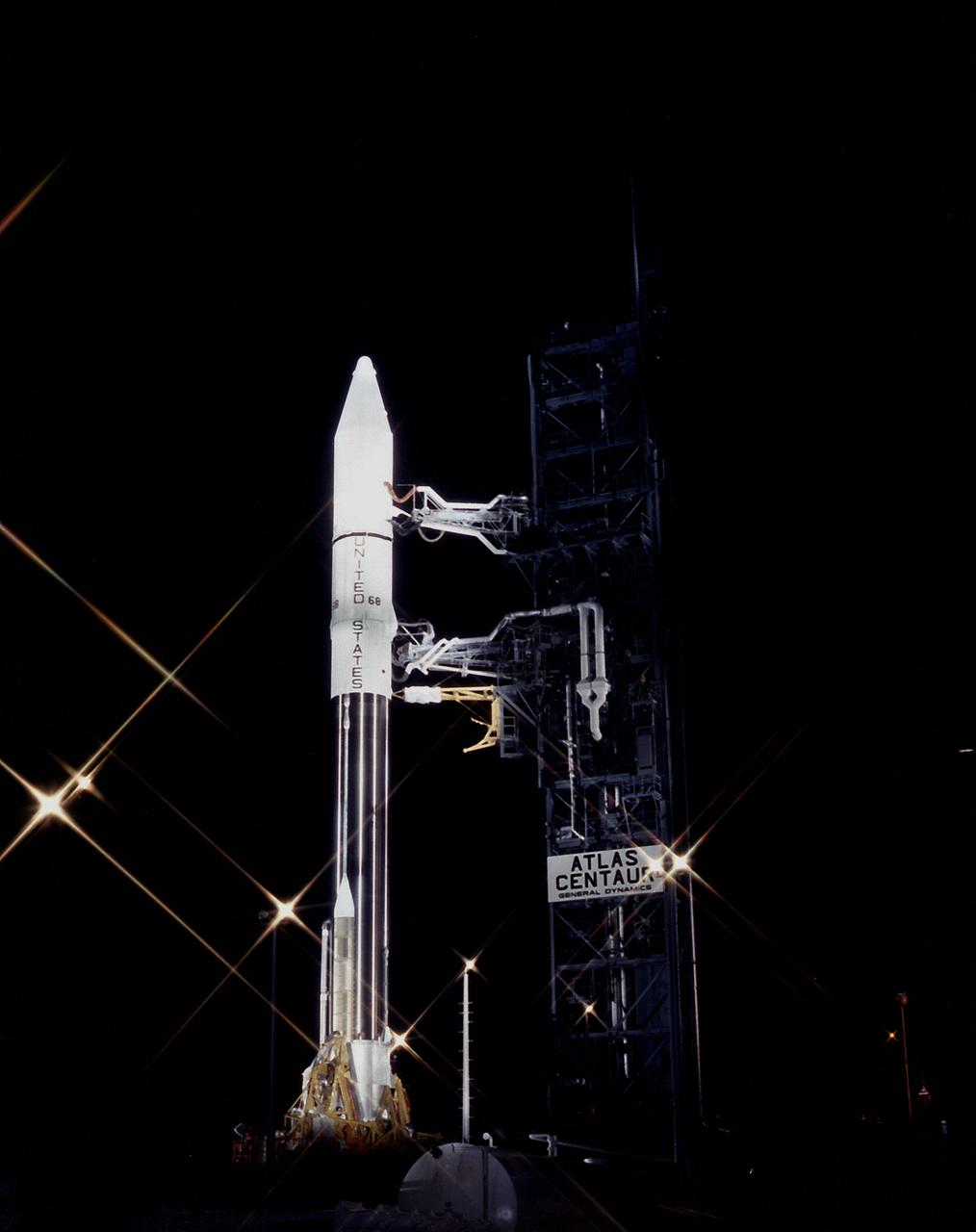
The Atlas-Centaur, AC-68 vehicle, with the FLTSATCOM (F-8 Communication Satellite) aboard, on the Complex 36 at the Cape Canaveral Air Force Station. The FLTSATCOM will provide communications for ships and submarines at sea, planes in the air and military ground units throughout the world. It will also provide instant communications between the President and the Commanding Officers.
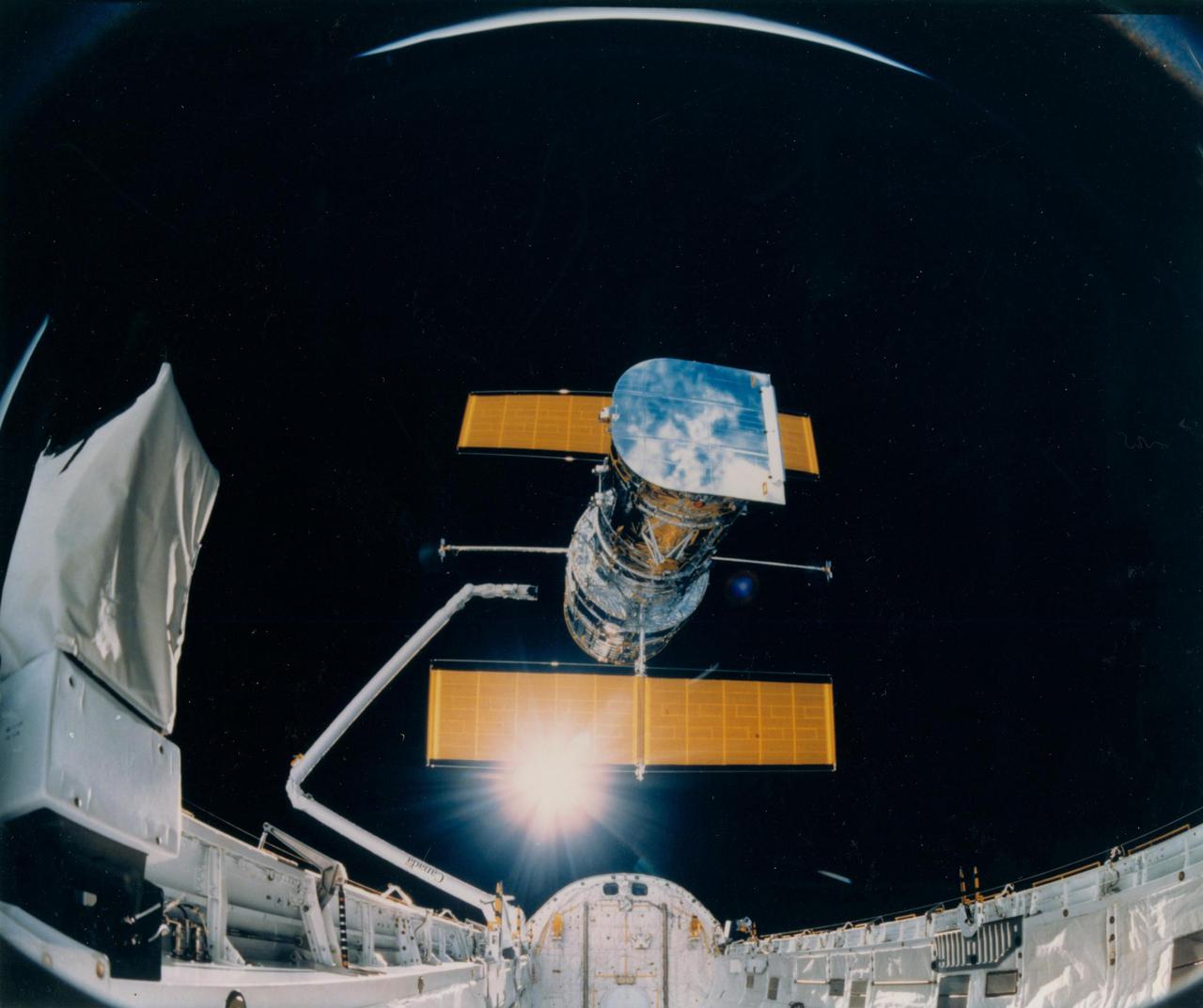
JOHNSON SPACE CENTER, HOUSTON, TEXAS -- STS-31 ONBOARD SCENE -- This photograph was taken by the STS-31 crew aboard the Space Shuttle Discovery and shows the Hubble Space Telescope being deployed on April 25, 1990, from the payload bay. The giant spacecraft is being put in orbit to gather information about a large variety of astronomical objects, from neighboring planets and stars to the most distant galaxies and quasars. The photo was taken by the IMAX Cargo Bay Camera (ICBC), mounted in a container on the port side of Discovery in Bay 12. The camera was remotely controlled by the crew members in the cabin, using a Gas Autonomous Payload Controller (GAPC). The 70mm motion picture coverage of the telescope and its deployment exercises will be featured in an IMAX_Omnimax film for the International Space Year 1992.
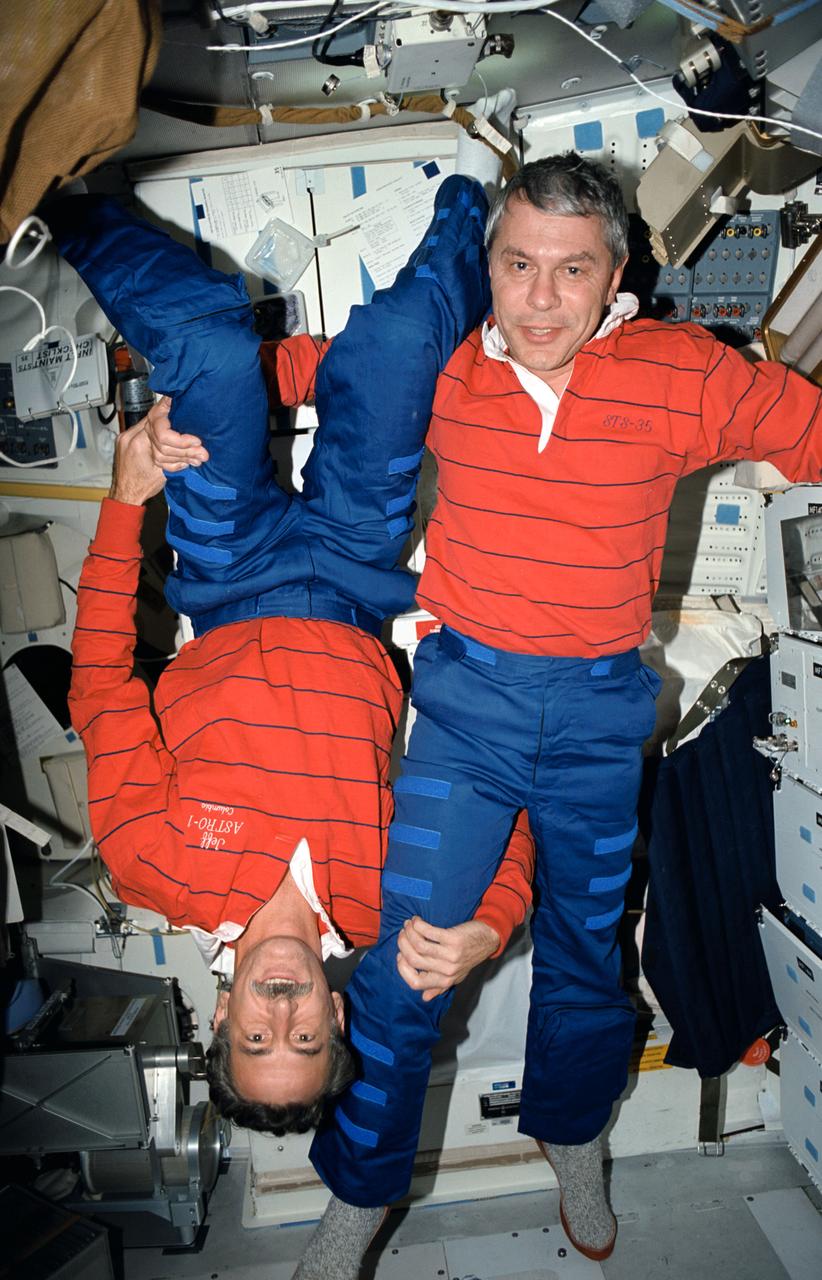
STS035-49-029 (2-10 Dec 1990) --- Posing on the middeck of Columbia, Orbiter Vehicle (OV) 102, are Mission Specialist (MS) Jeffrey A. Hoffman (mustache) and MS Robert A. R. Parker. Determining who is right side up is complicated by the microgravity of space. Hoffman's head is at the middeck floor and his feet are at the ceiling. The two crewmembers are in front of OV-102's port side with the waste collection system (WCS) contingency unit, side hatch, and galley visible behind them.
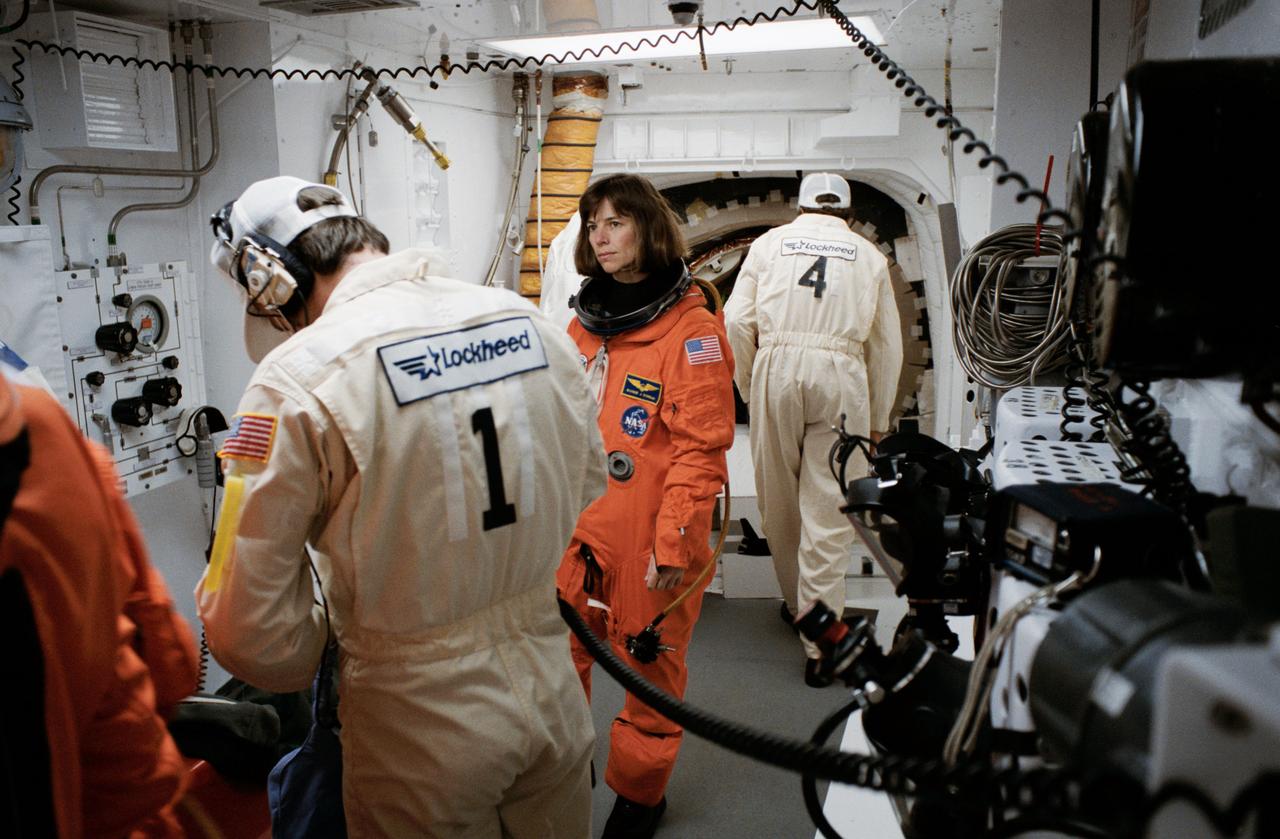
STS-32 Mission Specialist (MS) Bonnie J. Dunbar, wearing launch and entry suit (LES), looks on as technicians prepare LES equipment in the white room on the orbiter access arm at Kennedy Space Center (KSC) Launch Complex (LC) Pad 39A before entering Columbia, Orbiter Vehicle (OV) 102. In the background, a technician looks through OV-102 side hatch.
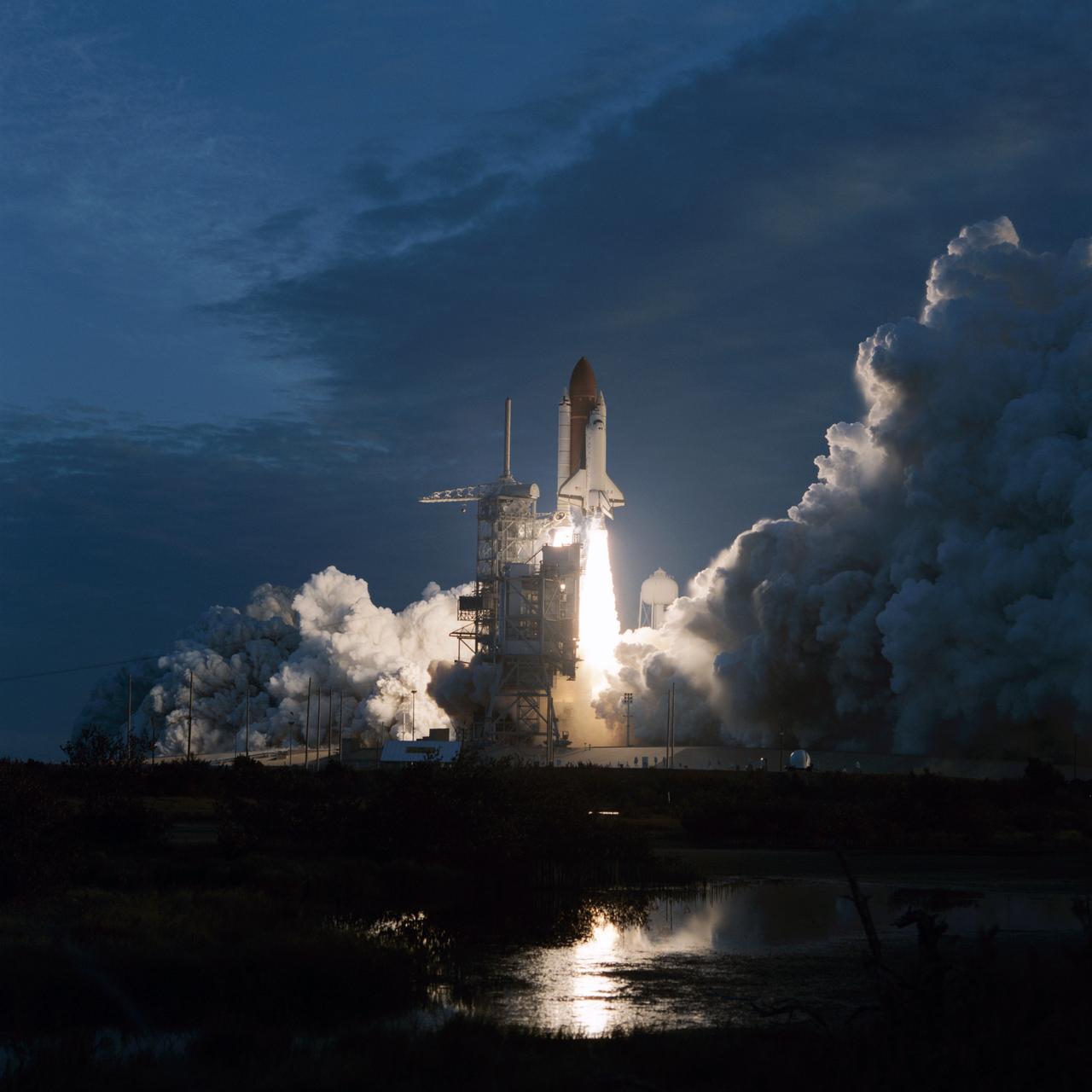
STS-32 Columbia, Orbiter Vehicle (OV) 102, its external tank (ET), and solid rocket boosters (SRBs) rise above the mobile launcher platform and begin to clear fixed service structure (FSS) tower (with rotating service structure (RSS) retracted) at Kennedy Space Center (KSC) Launch Complex (LC) Pad 39A. Liftoff occurred at 7:34:59:98 am Eastern Standard Time (EST) some 24 hours after dubious weather at the return-to-landing site (RTLS) had cancelled a scheduled launch. An exhaust cloud covers the launch pad. The firing SRBs and space shuttle main engines (SSMEs) are reflected in a nearby waterway. OV-102's launch is highlighted against the early morning darkness.
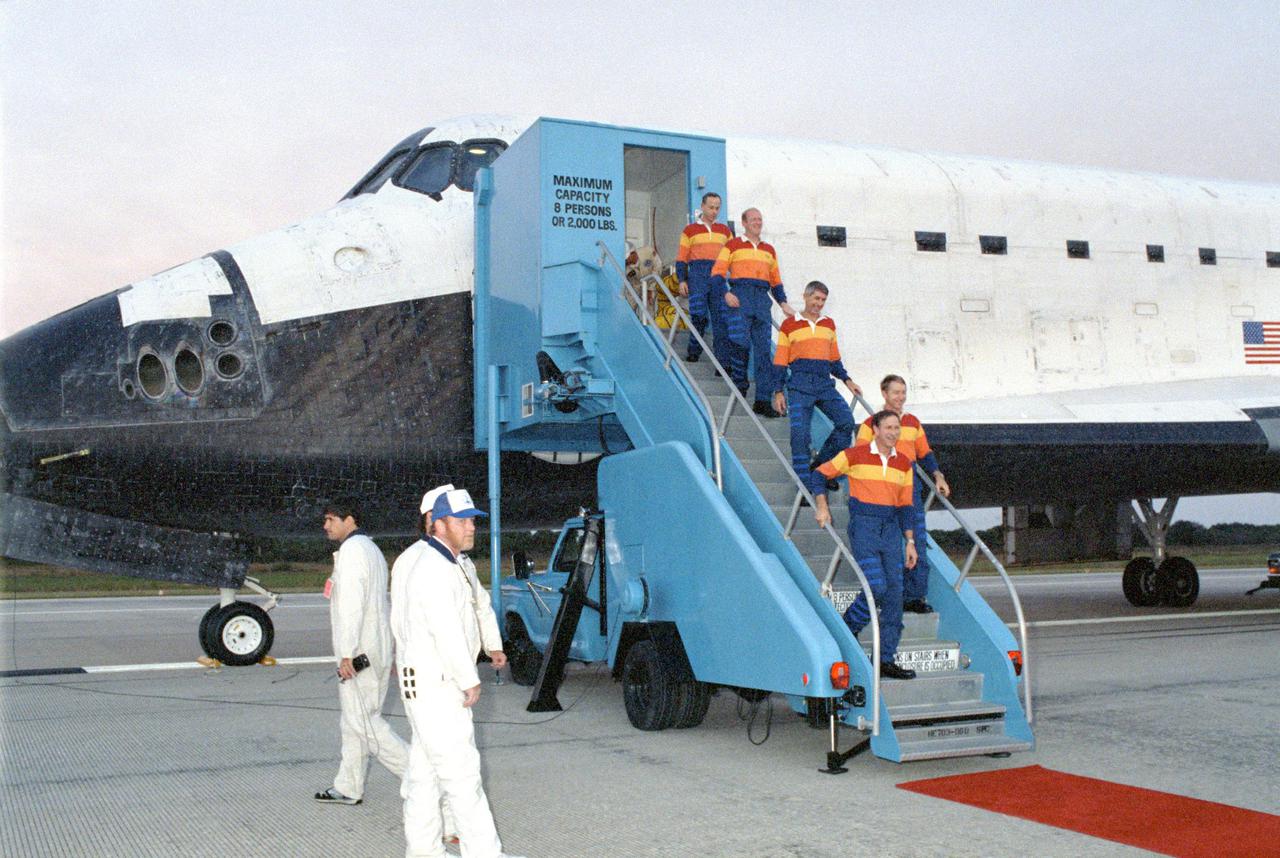
KENNEDY SPACE CENTER, FLA. -- The STS-38 flight crew disembark from the orbiter Atlantis after a successful landing at KSC's Shuttle Landing Facility. From bottom up are Commander Richard Covey, Pilot Frank Culbertson and Mission Specialists Robert Springer, Charles Gemar and Carl Meade.

STS036-01-014 (28 Feb-3 Mar 1990) --- Astronaut John O. Creighton, STS-36 mission commander, aims a 70mm Hasselblad camera through Atlantis' aft windows. The Hasselblad is primarily used for out the window shots, mostly those that feature subjects on Earth. Creighton and four other astronauts spent four and a half days in space for the DOD-devoted mission.
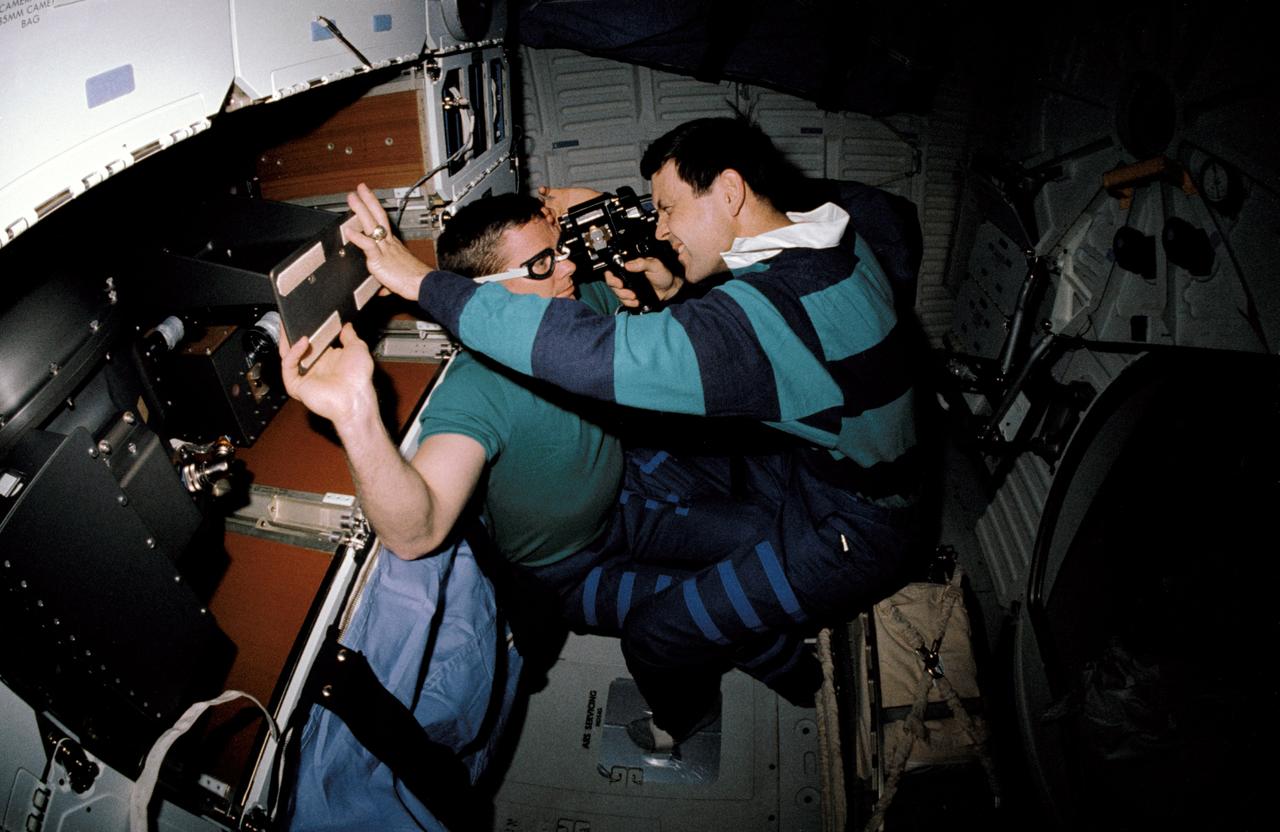
STS041-02-015 (6-10 Oct. 1990) --- A 35mm scene showing astronauts Robert D. Cabana (right), STS-41 pilot, and Bruce E. Melnick, mission specialist, participating in a detailed supplemental objective for STS-41 involving retinal photography. The hypothesis of this experiment is that retinal photographs taken on orbit will show evidence of increased intracranial pressure (ICP) and the evidence of increased ICP and the development of Space Adaptation Syndrome (SAS) will be correlated. SAS has been a subject of on-orbit analysis since the early days of space shuttle.
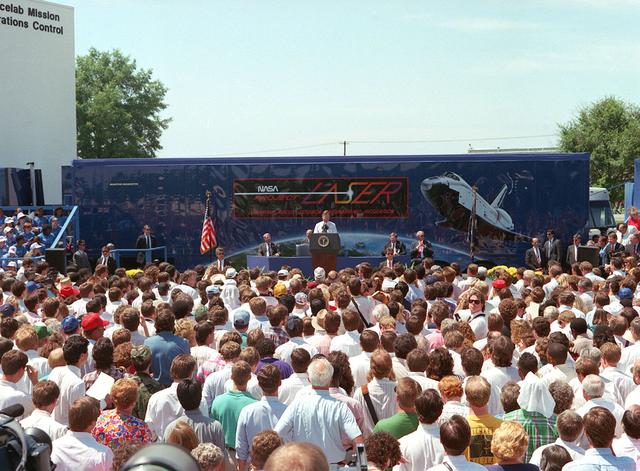
President George Bush delivers an address to Marshall Space Flight Center (MSFC) employees during his visit to the center. President Bush gave NASA employees an objective to send missions back to the moon to stay then continue on to Mars, referring to the Space Station project.
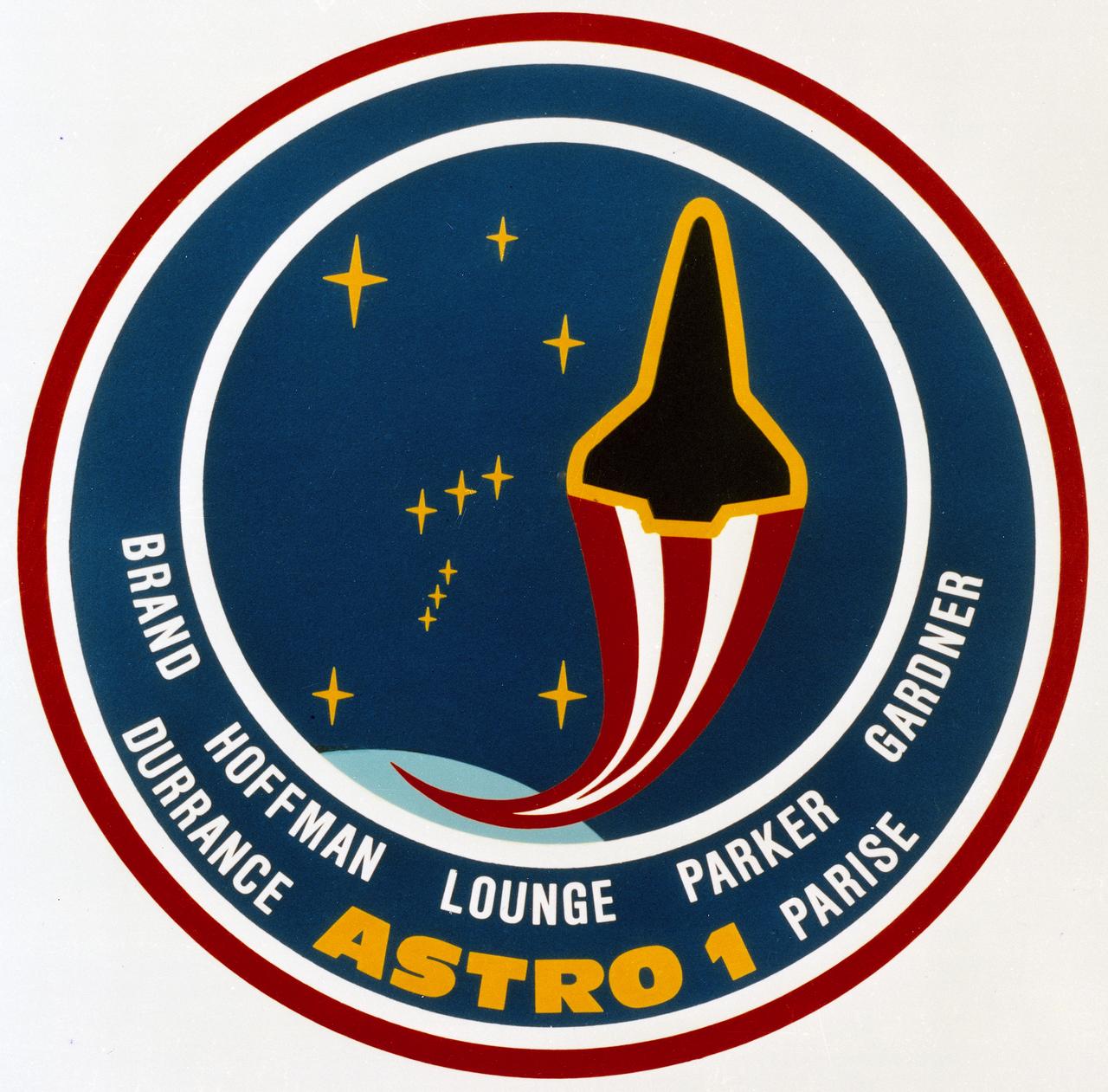
Designed by the crewmembers assigned to the mission, the STS-35 crew patch symbolizes the Space Shuttle flying above Earth's atmosphere to better study the many celestial objects of the universe, represented by the constellation Orion.

STS036-S-008 (3 March 1990) --- The crewmembers for STS-36 egress the Shuttle Atlantis following touchdown at Edwards Air Force Base in California. NASA officials stand nearby awaiting to greet (from bottom to top of the steps) Astronauts John O. Creighton, John H. Casper, Pierre J. Thuot, David C. Hilmers and Richard M. (Mike) Mullane. At right are Dr. William B. Lenoir (left) acting associate administrator for space flight; and Donald R. Puddy, director of flight crew operations.
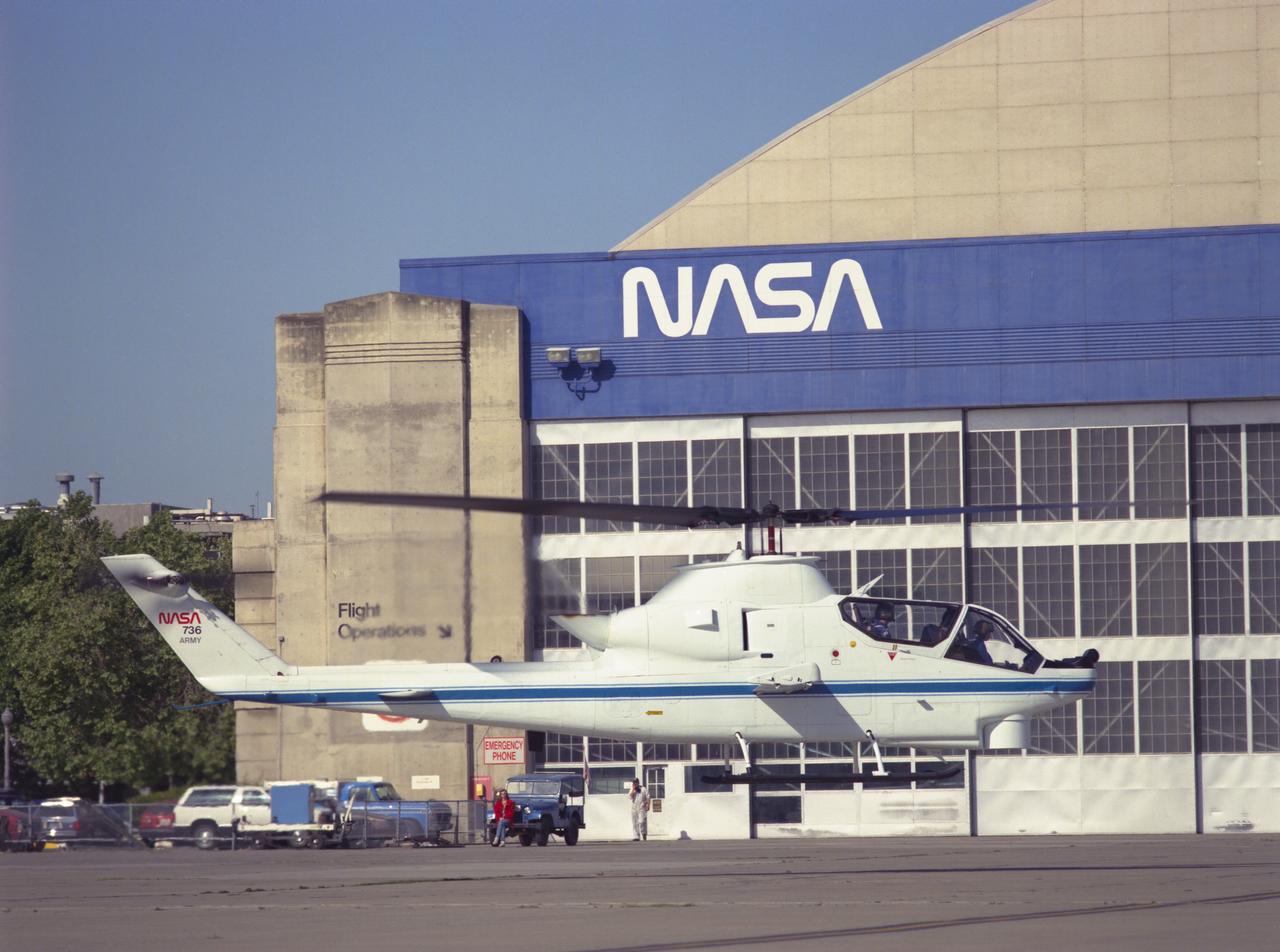
Cobra AH-1G (NASA-736) helicopter hovering on Ames ramp
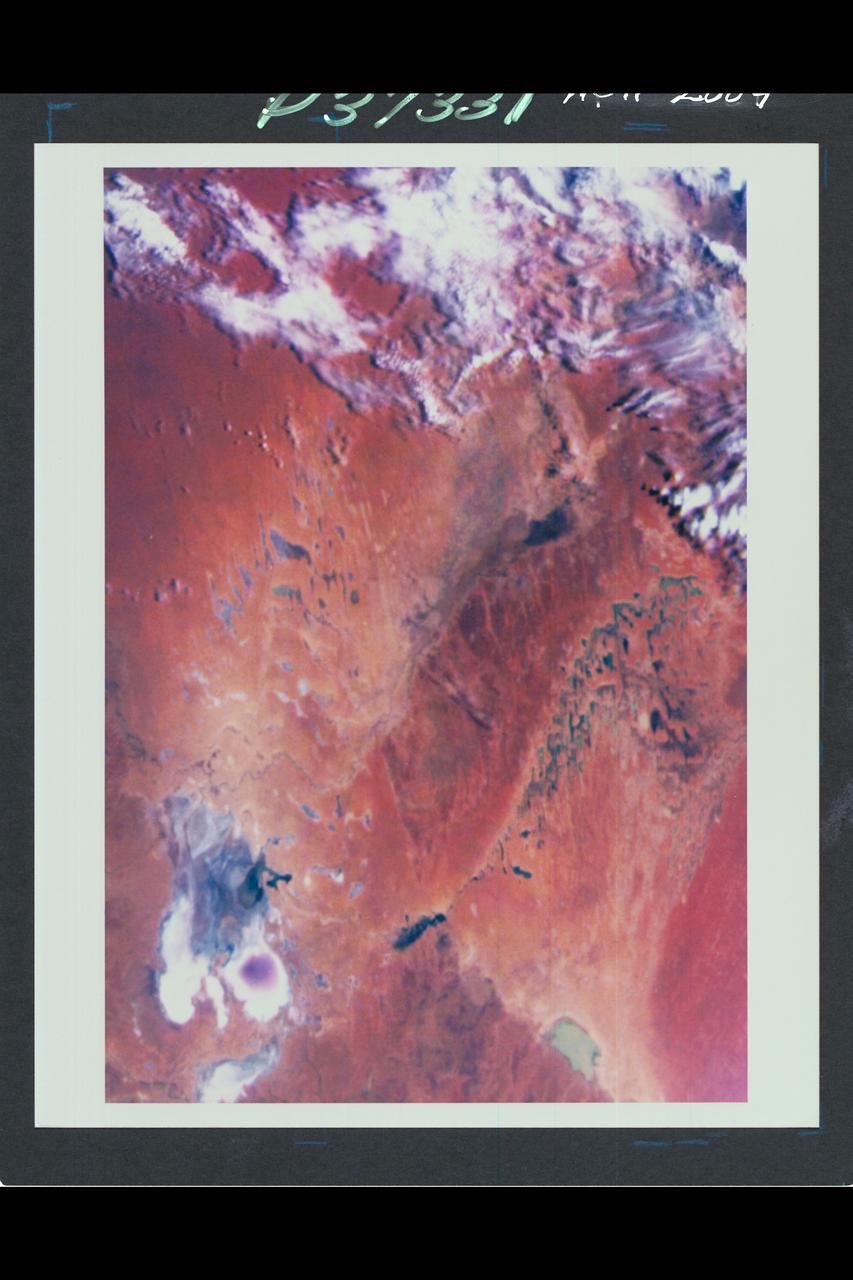
Range : 35,000 miles plus. This color image of the Simpson Desert in Australia was obtained by the Galileo spacecraft at aboaut 2:30 pm PST. The color composite was made from images taken through the red, green and violet filters. The area shown, about 280 miles wide by about 340 miles north-to-south, is southeast of Alice Springs. At lower left is Lake Eyre, a salt lake below sea level, subject to seasonal water-level fluctuations; when this image was acquired the lake was nearly dry. At lower right is the greenish Lake Blanche. Fields of linear sand dunes stretch north and east of Lake Eyre, shaped by prevailing winds from the south and showing, in different colors, the various sources and/or ages of their sands.
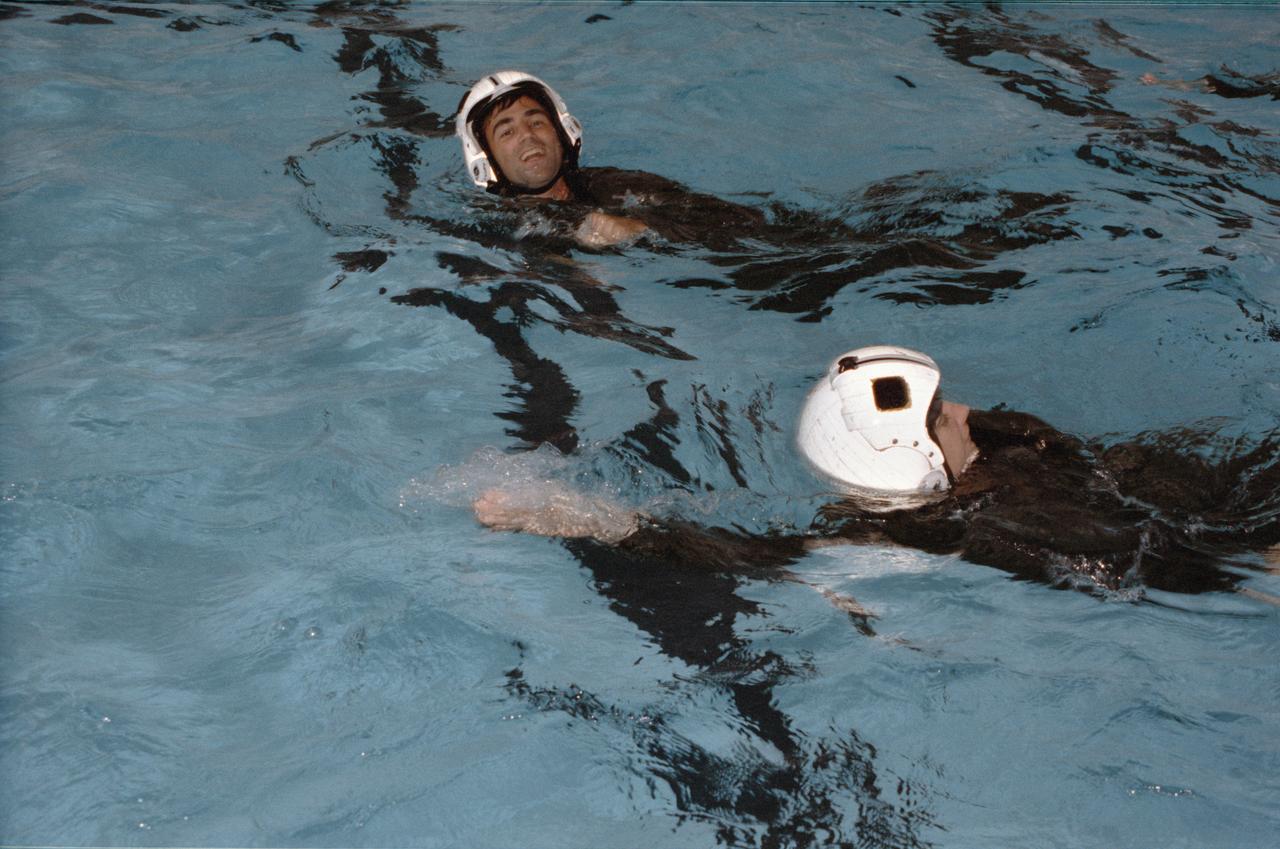
1990 Group 13 Astronaut Candidates (ASCANs) Susan J. Helms (foreground) and William G. Gregory, wearing helmets and flight suits, swim in pool at Elgin Air Force Base (AFB) in Pensacola, Florida, during water survival exercises. The training familiarized the candidates with survival techniques necessary in the event of a water landing. ASCANs participated in the exercises from 08-14-90 through 08-17-90.
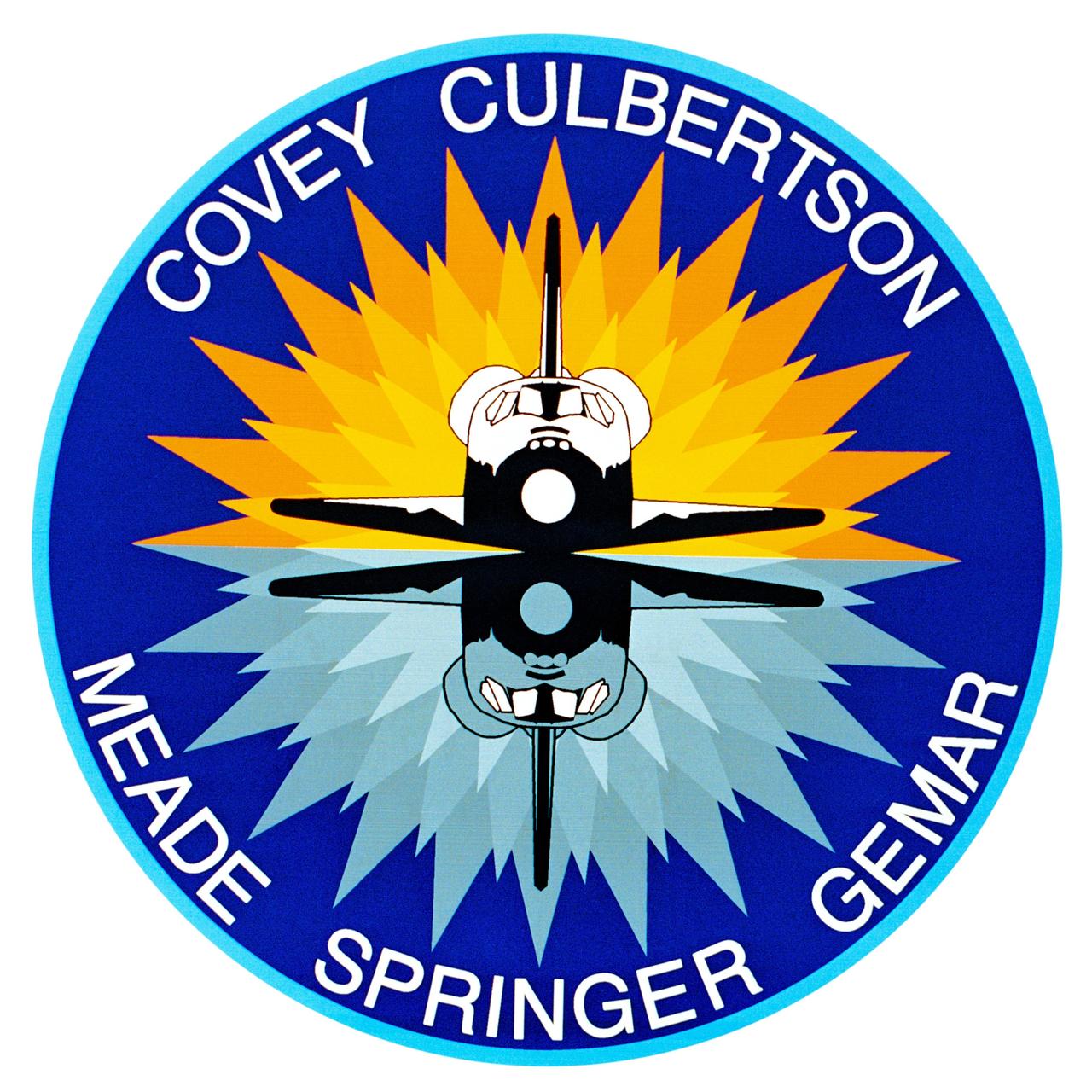
STS038-S-001 (May 1990) --- The STS-38 patch was designed to represent and pay tribute to all the men and women who contribute to the Space Shuttle Program. The top orbiter, with the stylistic Orbital Maneuvering System burn, symbolizes the continuing dynamic nature of the Space Shuttle Program. The bottom orbiter, a black and white mirror image, acknowledges the thousands of unheralded individuals who work behind the scenes in support of America's Space Shuttle Program. This mirror image symbolizes the importance of their contributions. The NASA insignia design for space shuttle flights is reserved for use by the astronauts and for other official use as the NASA Administrator may authorize. Public availability has been approved only in the forms of illustrations by the various news media. When and if there is any change in this policy, which is not anticipated, the change will be publicly announced. Photo credit: NASA
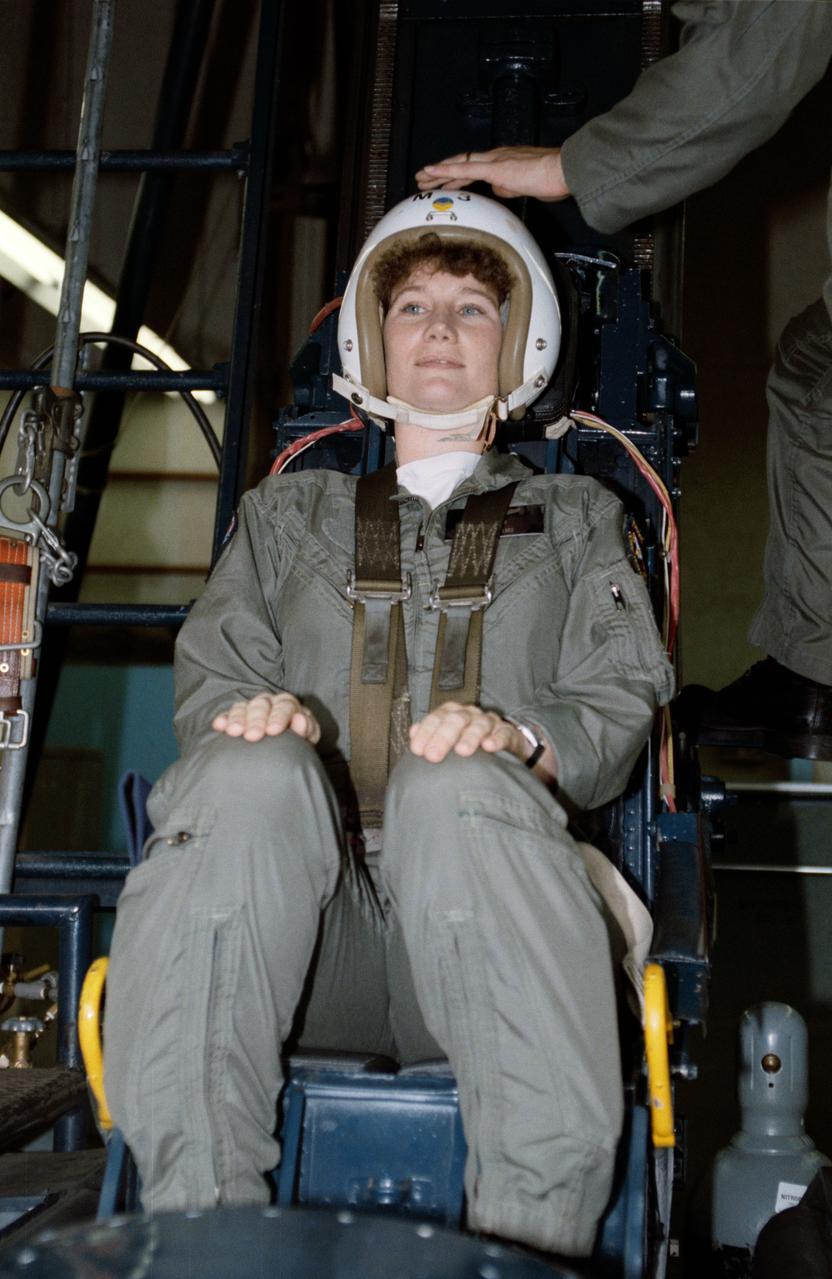
S90-45852 (29-31 July 1990) --- Susan J. Helms, one of 23 astronaut candidates who began a year's training and evaluation in July, participates in one of may sessions at a survival training course at Vance Air Force Base. This portion of the course is designed to familiarize the trainee with the "feel" of emergency ejection from a jet aircraft.

STS032-15-022 (17 Jan 1990) --- Astronaut Daniel C. Brandenstein, STS-32 mission commander, holds up a cake that's guaranteed not to go bad. The inflatable "cake" was part of frequent recognition of the commander's 47th birthday on January 17, 1990.
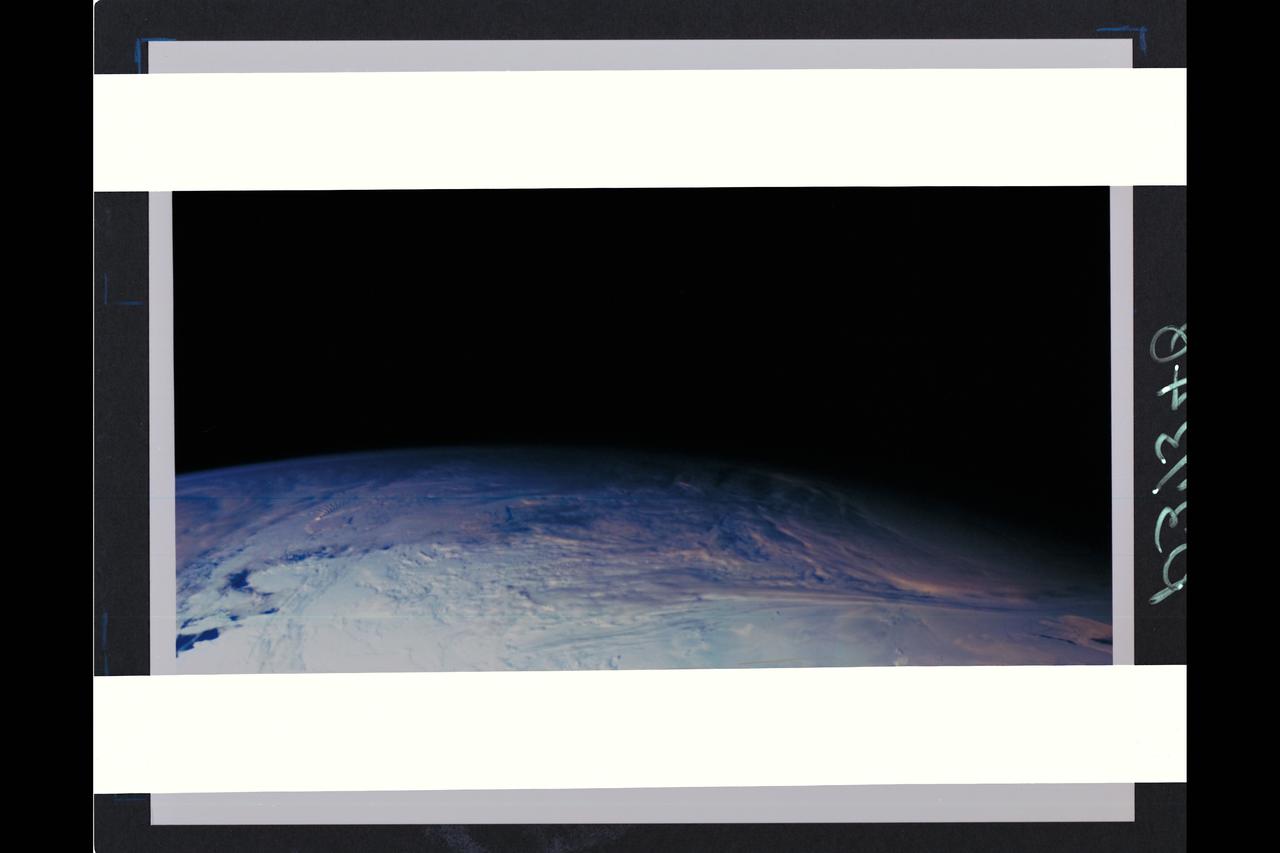
This color picture of the limb of the Earth, looking north past Antarctica, is a mosaic of 11 images taken during a ten-minute period near 5:45 p.m. PST Dec. 8, 1990, by Galileo's imaging system. Red, green and violet filters were used. The picture spans about 1,600 miles across the south polar latitudes of our planet The morning day/night terminator is toward the right. The South Pole is out of sight below the picture; the visible areas of Antarctica are those lying generally south of South America. The violet-blue envelope of Earth's atmosphere is prominent along the limb to the left. At lower left, the dark blue Amundsen Sea lies to the left of the Walgreen and Bakutis Coasts. Beyond it, Peter Island reacts with the winds to produce a striking pattern of atmosperic waves. (JPL ref. No. P-37340)
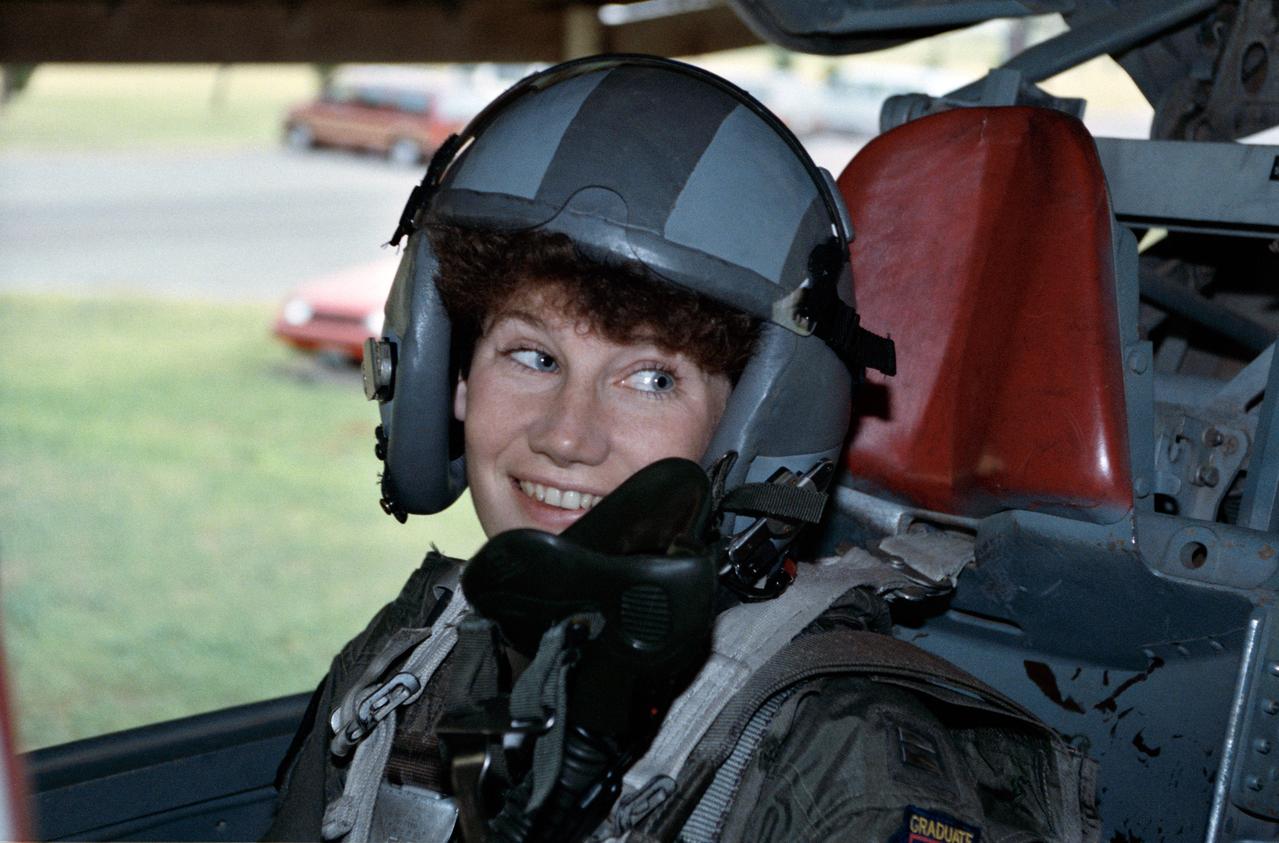
S90-45896 (29-31 July 1990) --- Susan J. Helms, one of the 23 astronaut candidates who began a year's training and evaluation program in July, participates in one of themany sessions at a survival training course at Vance Air Force Base. This portion of the course is designed to familiarize the trainee with procedures to follow in preparation for ejection from a jet aircraft.
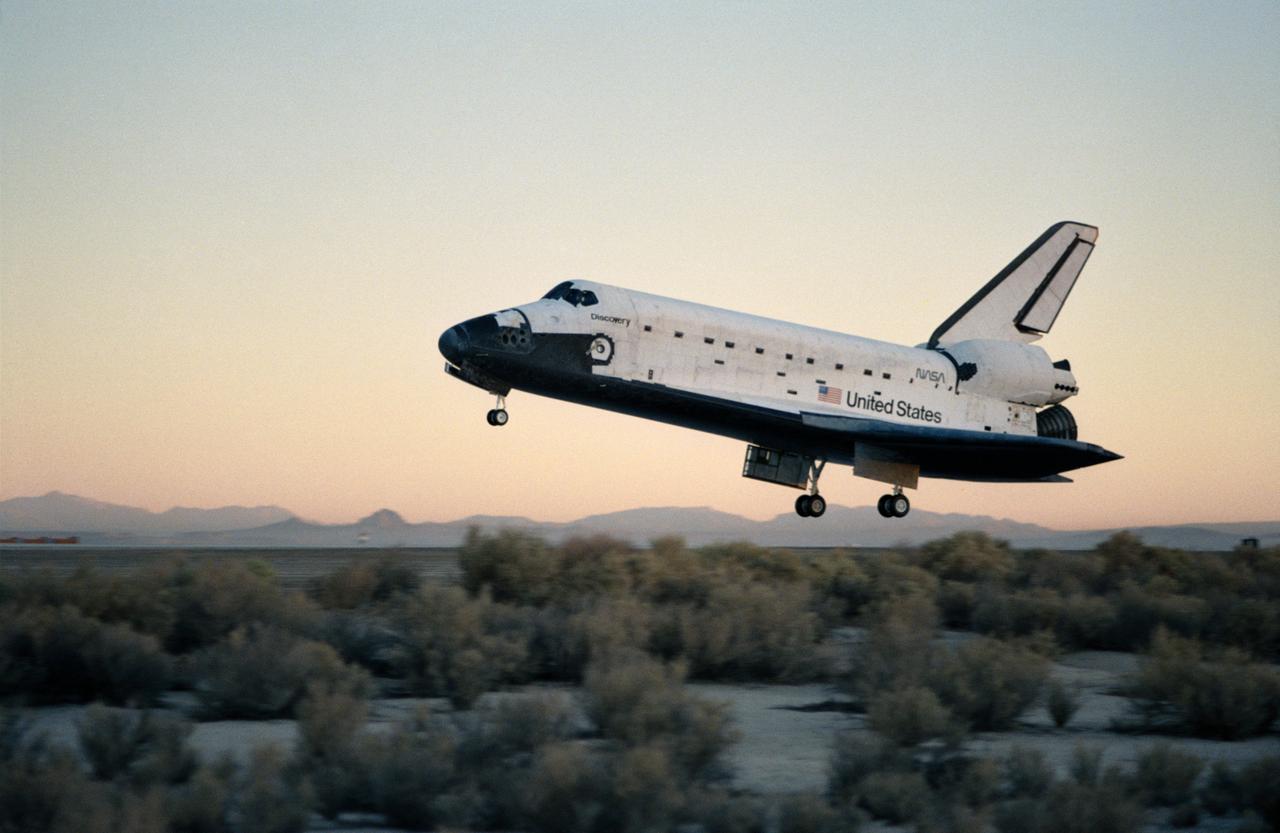
STS-41 Discovery, Orbiter Vehicle (OV) 103, with nose landing gear (NLG) and main landing gear (MLG) deployed, glides over concrete runway 22 at Edwards Air Force Base (EAFB), California, prior to touchdown.
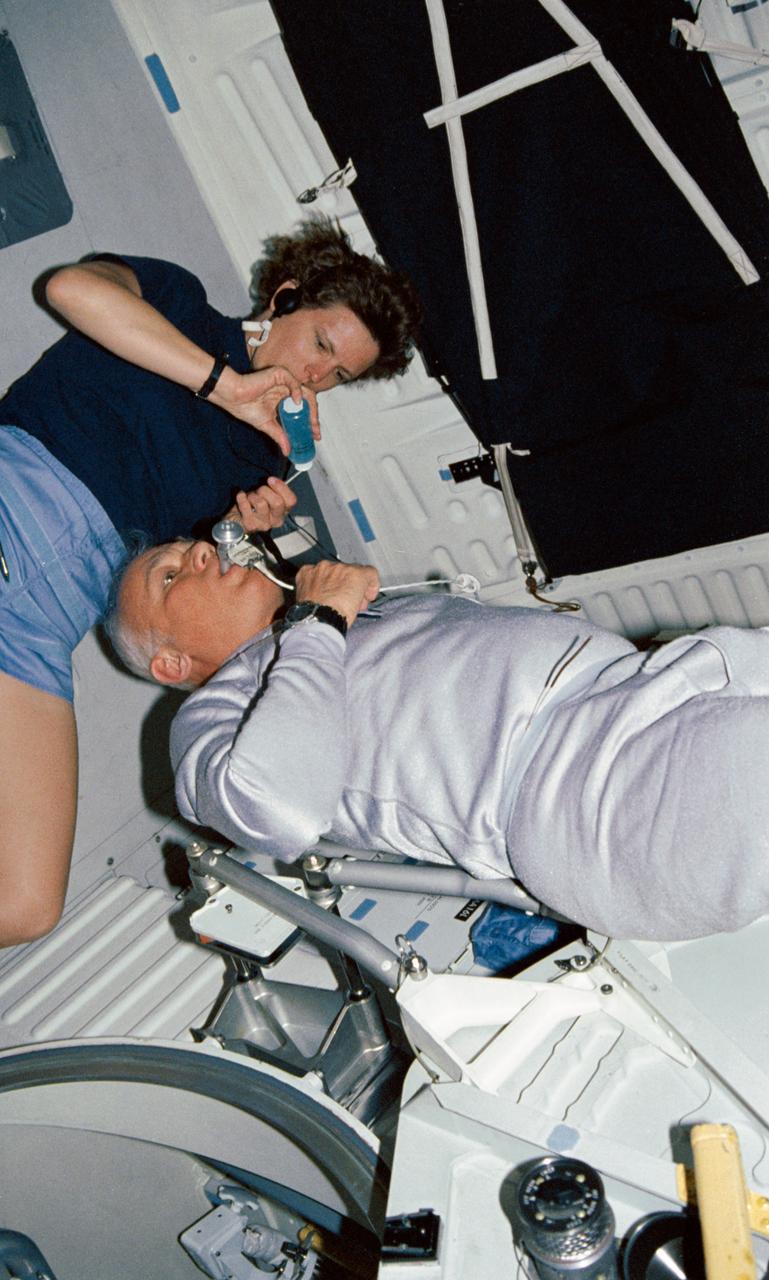
STS031-04-002 (24-29 April 1990) --- Astronauts Kathryn D. Sullivan and Bruce McCandless II, mission specialists, work together to perform one of the mission's medical experiments. The experiment is Detailed Supplementary Objective (DSO) 462, Non invasive Estimation of Central Venous Pressure During Spaceflight. Sullivan applies a gel substance to a transducer which will be placed on McCandless' jugular vein to collect the sought data. The cable links to a data recorder.
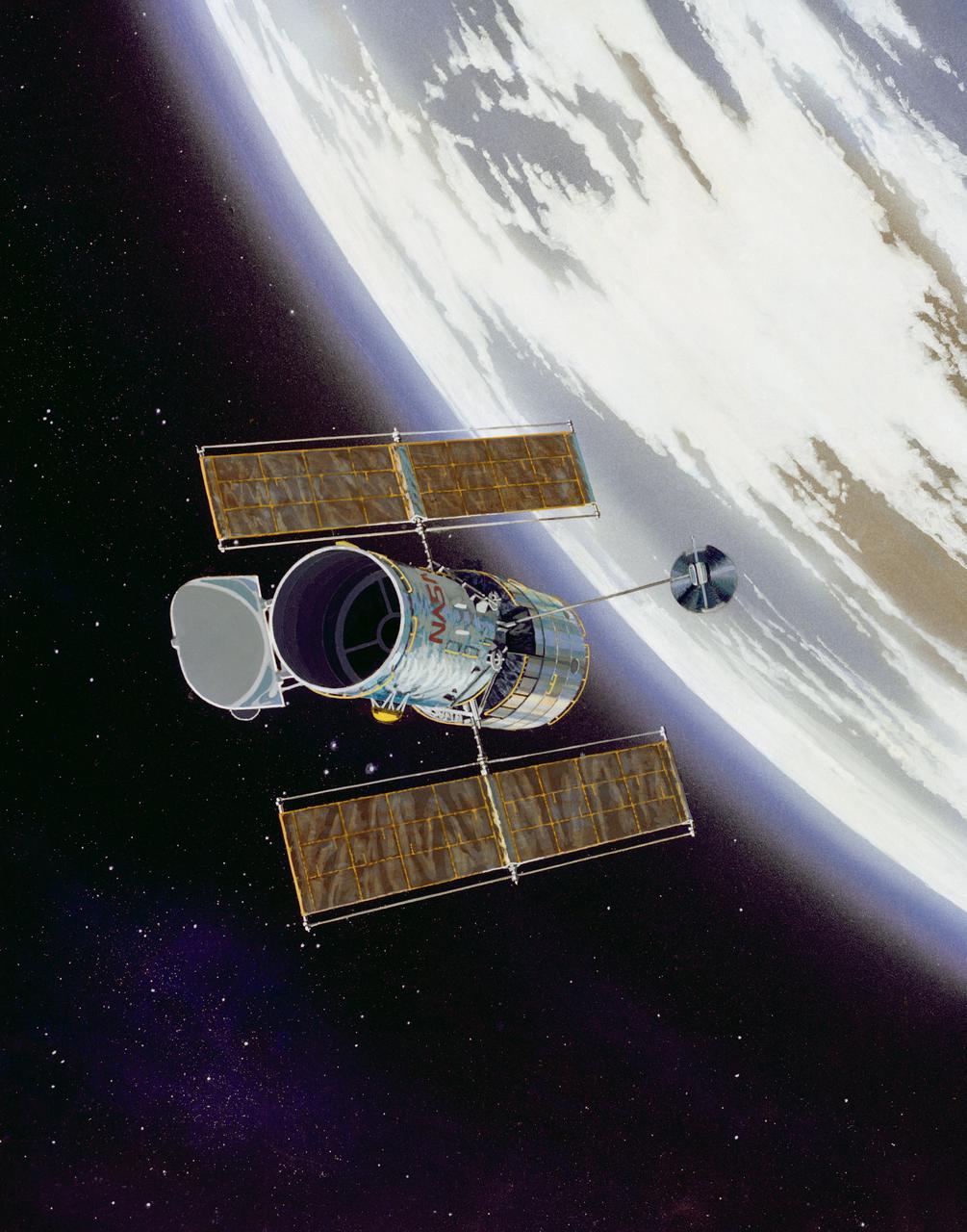
This artist concept shows the Hubble Space Telescope (HST) in operational configuration orbiting the Earth after its deploy from Discovery, Orbiter Vehicle (OV) 103 during STS-31. The high gain antennas (HGAs) and solar arrays (SAs) have been extended. HST's aperature door is open as it views the universe from a vantage point above the Earth's atmosphere. View provided by the Marshall Space Flight Center (MSFC).
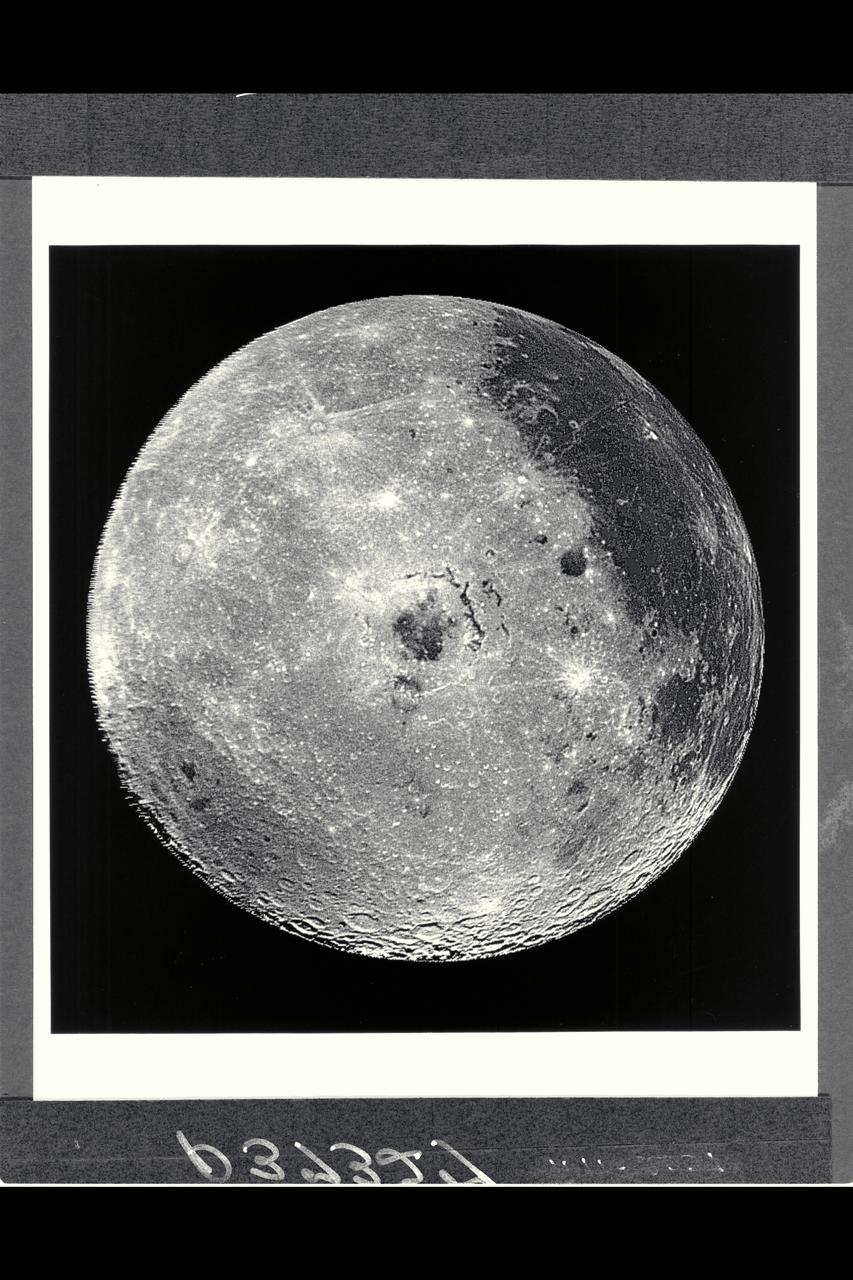
Range : 350,000 miles This image of the western hemisphere of the Moon was taken through a green filter by Galileo at 9:35 am PST. In the center is the Orientale Basin, 600 miles in diameter, formed about 3.8 billion years ago by the impact of an streroid-size body. Orientale's dark center is a small mare. To the right is the lunar near side with the great, dark Oceanus Procellarum above and the small, circular, dark Mare Humorum Below. Maria are broad plains formed mostly over 3 billion years ago as vast bassaltic lava flows. To the left is the lunar far side with fewer maria, but, at lower left, the South-Pole-Aitken basin, about 1200 miles in diameter, which resemble Orientale but is much older and more weathered and battered by cratering. The intervening cratered highlands of both sides, as well as the maria, are dotted with bright, young craters. This image was 'reprojected' so as to center visibility of small features.

S90-46492 (16 Aug 1990) --- Astronaut Tamara E. Jernigan, STS-40 mission specialist, is pictured in a training version of the extravehicular mobility unit (EMU) spacesuit. Dr. Jernigan was about to be submerged in the Johnson Space Center's 25-ft. deep weightless environment training facility (WET-F) pool to simulate a contingency extravehicular activity (EVA). There is no EVA scheduled for STS-40, the Spacelab Life Sciences (SLS-1) mission.
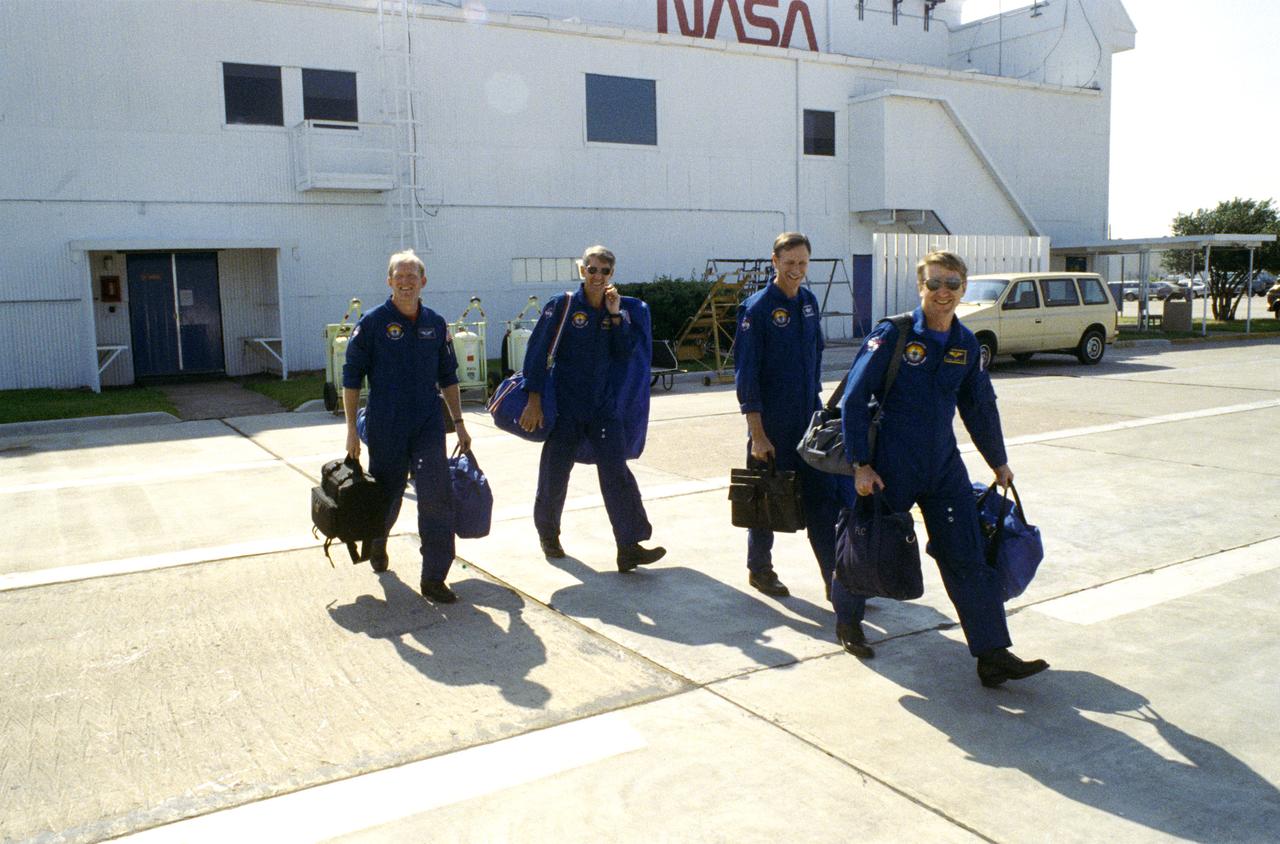
STS-38 crewmembers, carrying their luggage, walk across the Ellington Field runway to board their T-38As. The crewmembers are lead by Pilot Frank L. Culbertson. Commander Richard O. Covey, Mission Specialist (MS) Robert C. Springer (wearing sunglasses), and MS Charles D. Gemar follow. The crewmembers are preparing for their departure to the Kennedy Space Center (KSC). Ellington Field hangar is visible in the background.
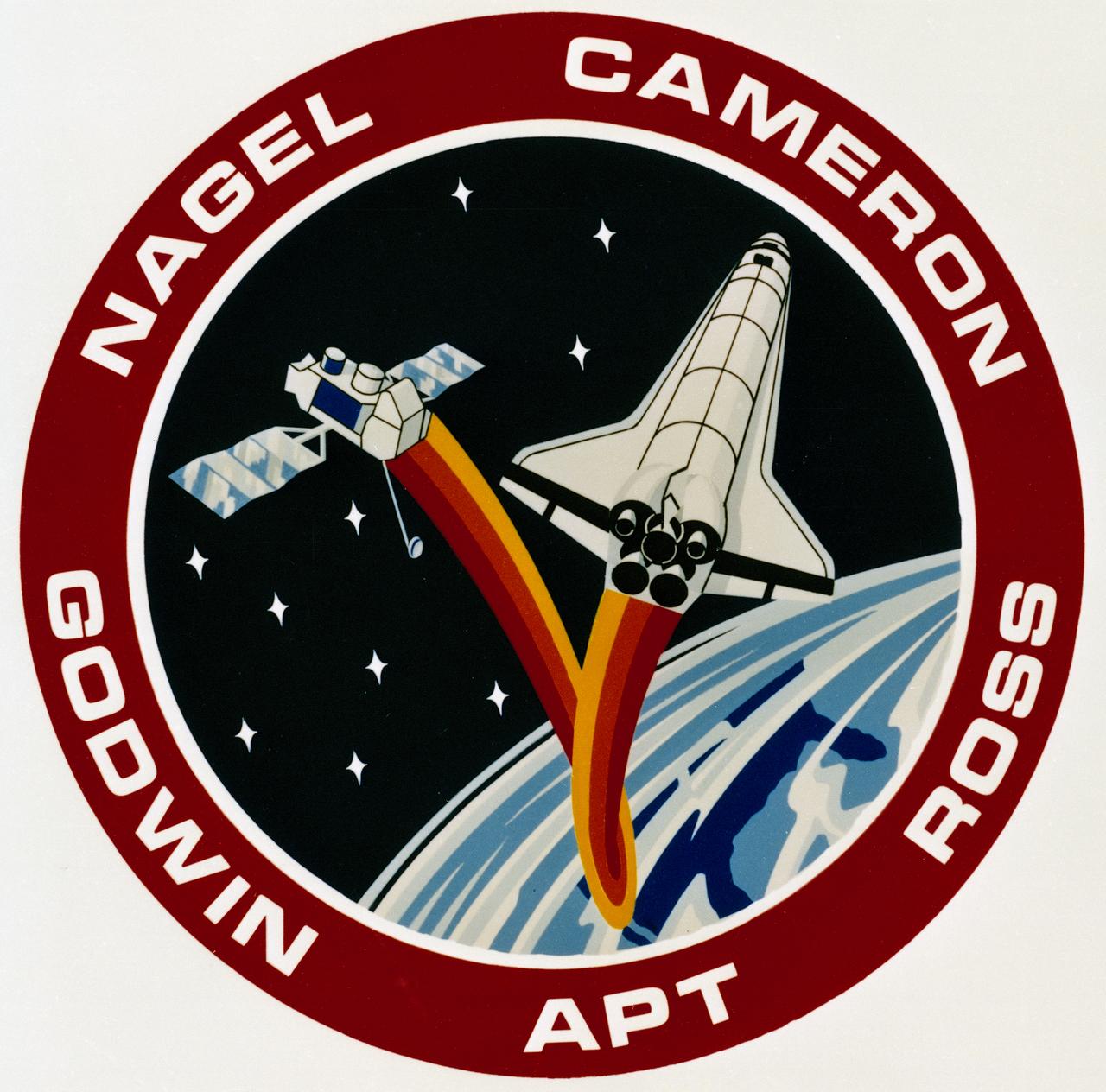
The principal theme of the STS-37 patch, designed by astronaut crewmembers, is the primary payload -- Gamma Ray Observatory (GRO) -- and its relationship to the Space Shuttle. The Shuttle and the GRO are both depicted on the patch and are connected by a large gamma. The gamma symbolizes both the quest for gamma rays by GRO as well as the importance of the relationship between the manned and unmanned elements of the United States space program. The Earth background shows the southern portion of the United States under a partial cloud cover while the two fields of three and seven stars, respectively, refer to the STS-37 mission designation.
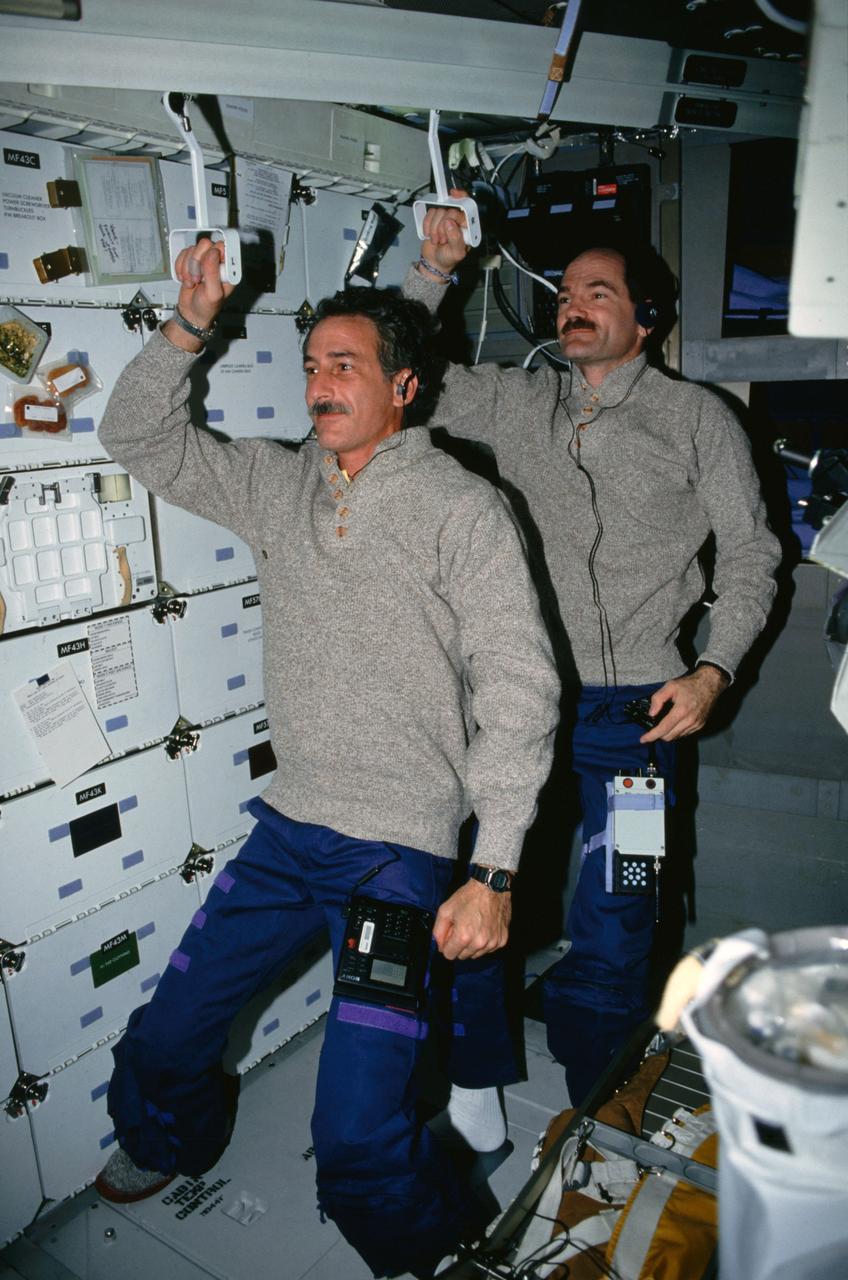
STS035-10-005 (2-10 Dec 1990) --- STS-35 Mission Specialist (MS) Jeffrey A. Hoffman (front) and Pilot Guy S. Gardner, holding Development Test Objective (DTO) 634 trash compactor handles to the ceiling, "commute" to work on the middeck of Columbia, Orbiter Vehicle (OV) 102. Just below Hoffman's right elbow in locker MF43G DTO 634, Trash Compaction and Retention System Demonstration, trash compactor with a geared mechanism that allows manual compaction of wet and dry trash is visible. Also in the view are the stowed treadmill on the middeck floor and the starboard side sleep station.
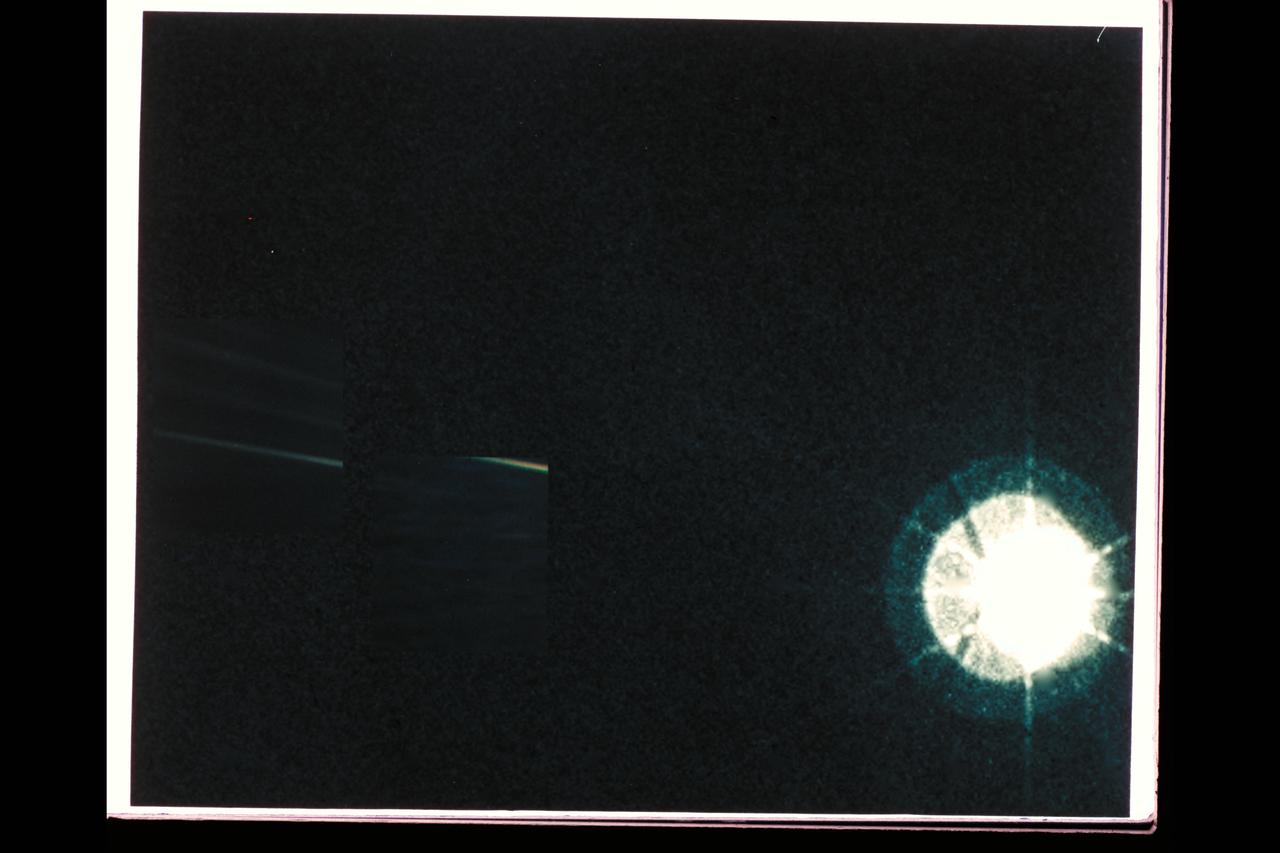
Range : 4 billion miles from Earth, at 32 degrees to the ecliptic. P-36057C This color image of the Sun, Earth, and Venus is one of the first, and maybe, only images that show are solar system from such a vantage point. The image is a portion of a wide angle image containing the sun and the region of space where the Earth and Venus were at the time, with narrow angle cameras centered on each planet. The wide angle was taken with the cameras darkest filter, a methane absorption band, and the shortest possible exposure, one two-hundredth of a second, to avoid saturating the camera's vidicon tube with scattered sunlight. The sun is not large in the sky, as seen from Voyager's perpective at the edge of the solar system. Yet, it is still 8xs brighter than the brightest star in Earth's sky, Sirius. The image of the sun you see is far larger than the actual dimension of the solar disk. The result of the brightness is a bright burned out image with multiple reflections from the optics of the camera. The rays around th sun are a diffraction pattern of the calibration lamp which is mounted in front of the wide angle lens. the 2 narrow angle frames containing the images of the Earth and Venus have been digitally mosaicked into the wide angle image at the appropriate scale. These images were taken through three color filters and recombined to produce the color image. The violet, green, and blue filters used , as well as exposure times of .72,.48, and .72 for Earth, and .36, .24, and .36 for Venus.The images also show long linear streaks resulting from scatering of sulight off parts of the camera and its shade.
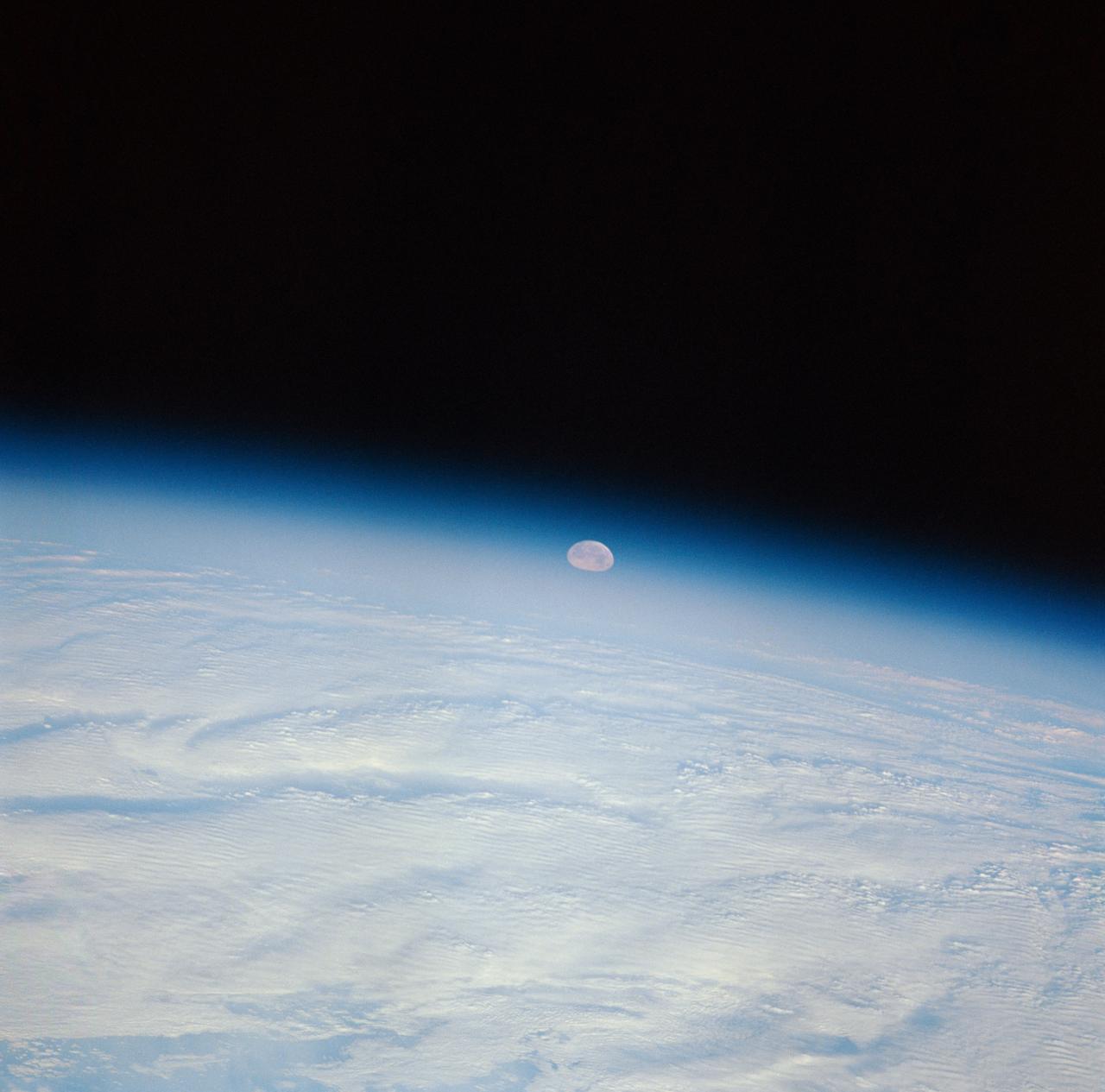
STS-32 crew took this view of the moon setting over the Earth's limb. Near the center is a semi-vortex in the clouds - a storm system in the early stages of formation. The moon's image is distorted due to refraction through the Earth's atmosphere. The near side of the moon is visible showing the vast area of the moon's western seas (Mare Occidental), Apollo landing sites: Apollo 14 at Fra Mauro and Apollo 16 at Central Highlands near Descartes.
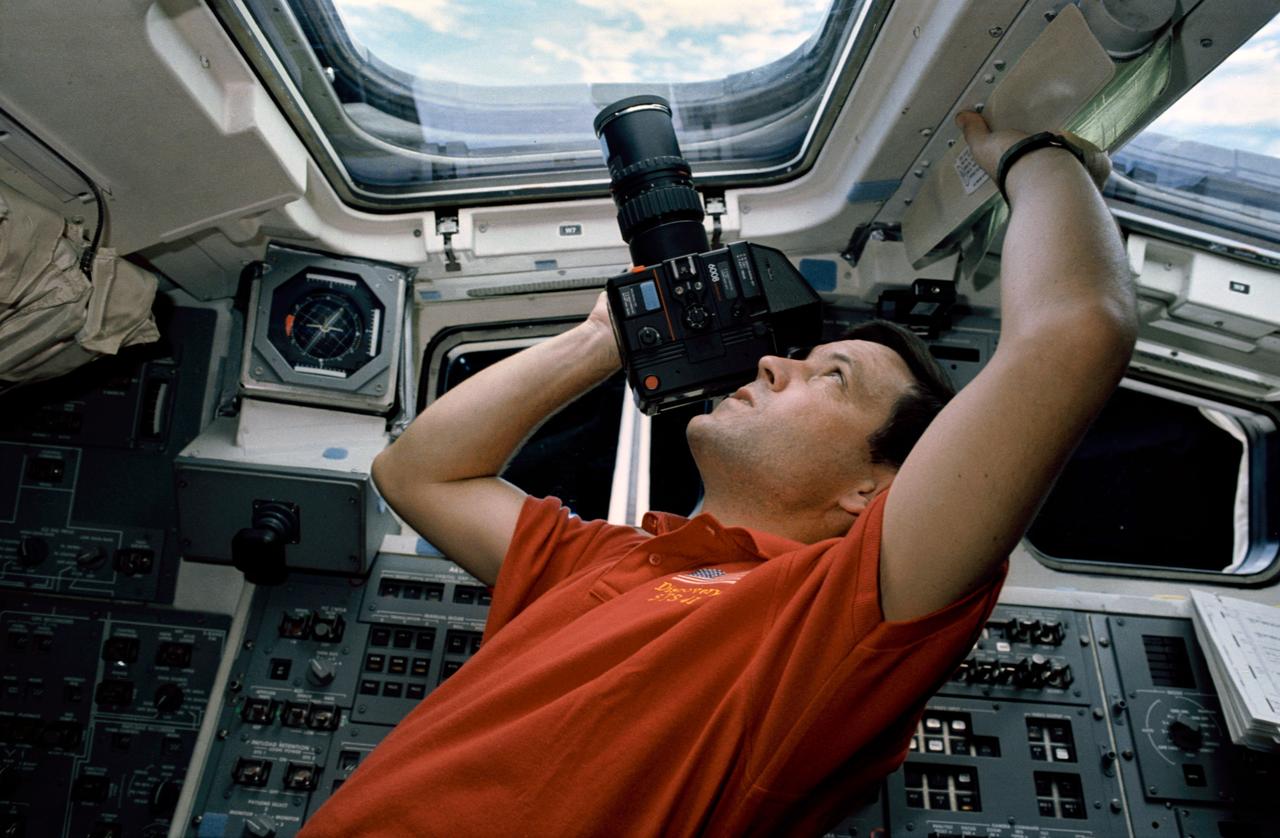
STS041-22-008 (6-10 Oct 1990) --- Astronaut Robert D. Cabana, STS-41 pilot, uses a handheld camera to record Earth scenes from the aft flight deck of Discovery.
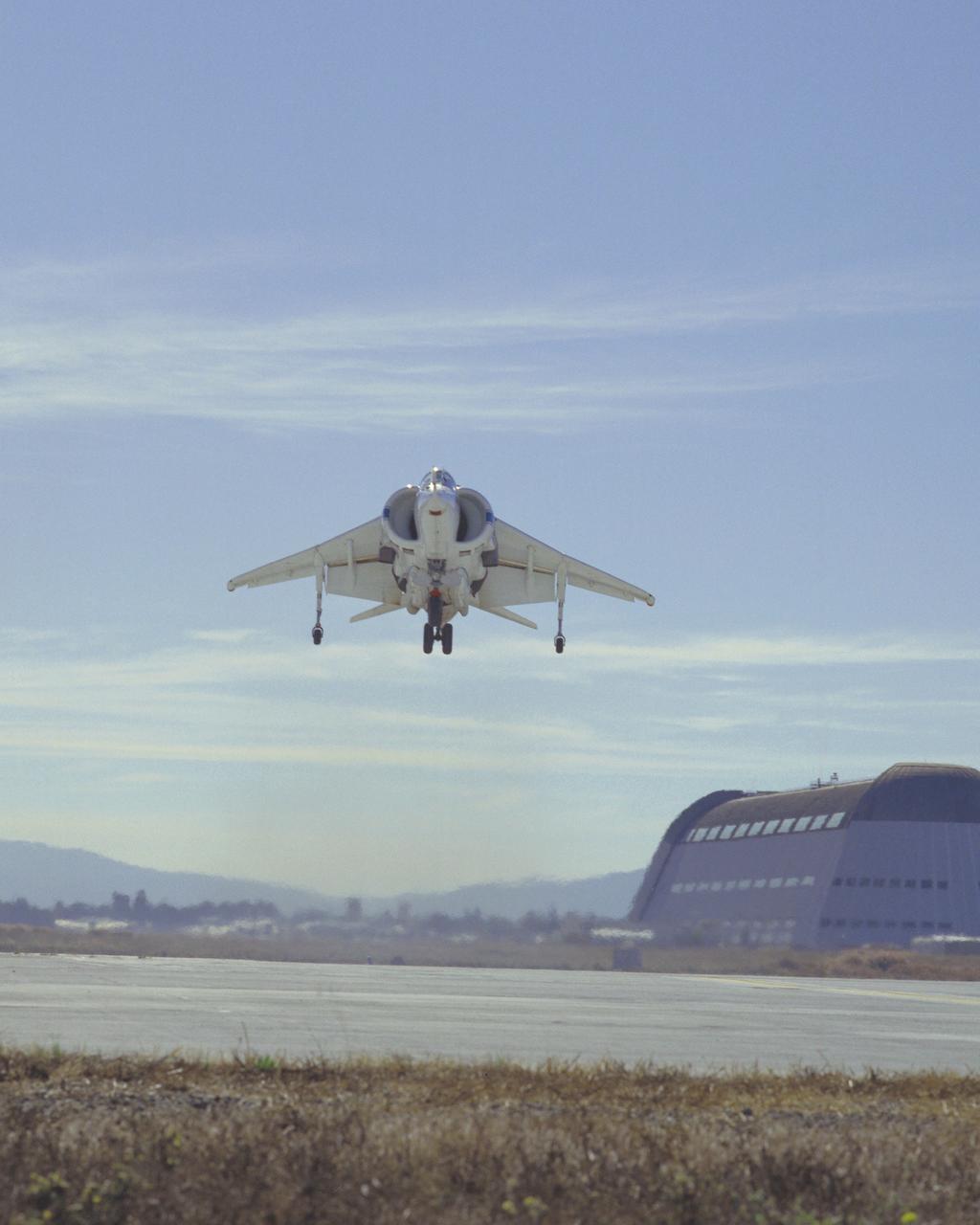
McDonnell Douglas YAV-8B (Bu. No. 158394 NASA 704 VSRA) Harrier V/STOL Systems Research Aircraft hover Note: Used in publication in Flight Research at Ames; 57 Years of Development and Validation of Aeronautical Technology NASA SP-1998-3300 fig.125
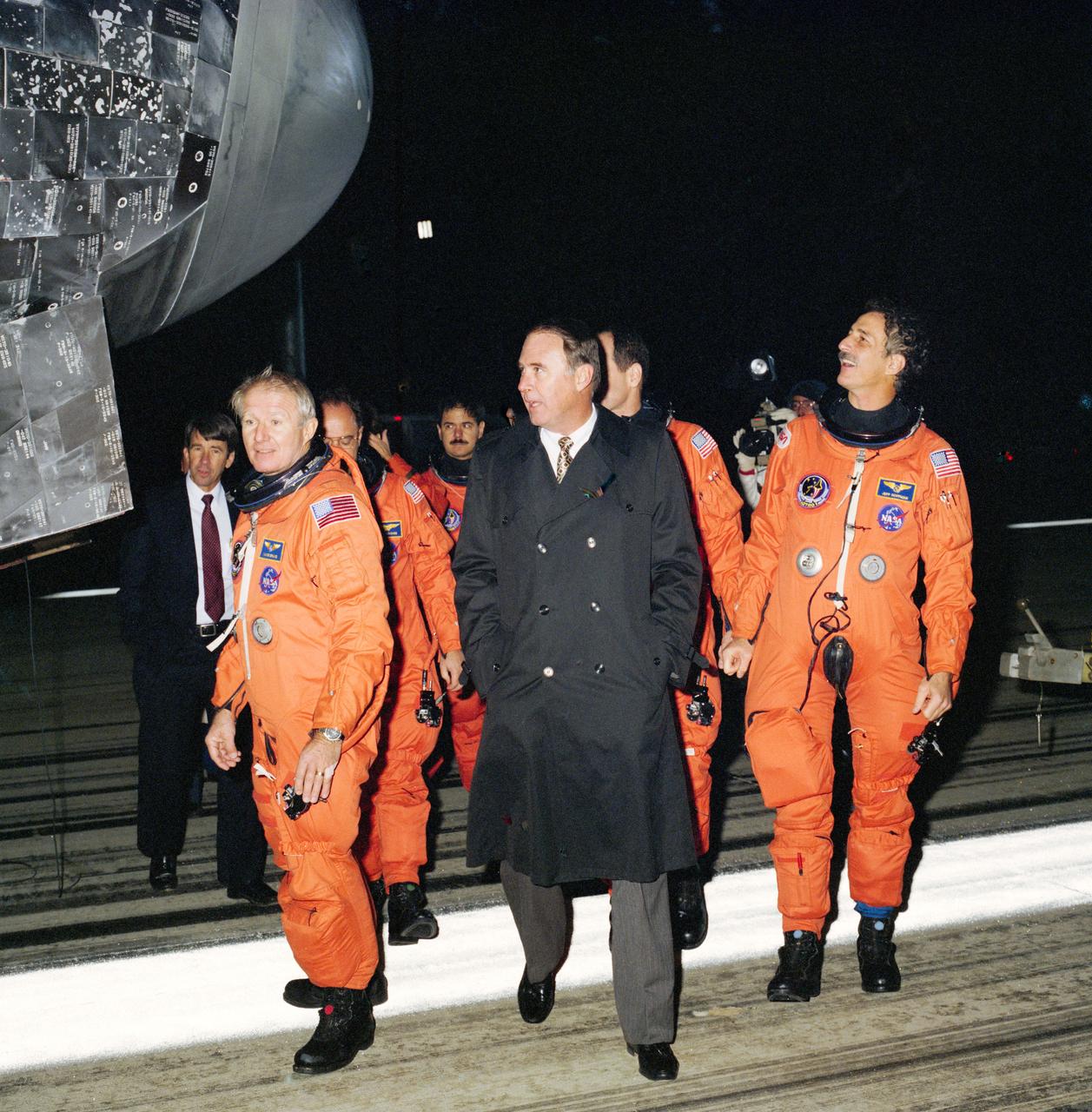
STS035-S-091 (10 Dec 1990) --- Donald R. Puddy (center), Director of Flight Crew Operations at the Johnson Space Center (JSC), joins the STS-35 crewmembers in a post-landing walk-around inspection of the Columbia at Edwards Air Force Base. Crewmembers pictured are, left to right, Vance D. Brand, John M. (Mike) Lounge, Ronald A. Parise, Guy S. Gardner and Jeffrey A. Hoffman. Obscured or out of frame are Samuel T. Durrance and Robert A. R. Parker. Dr. William B. Lenoir, NASA Associate Administrator for Space Flight, is at far left background.
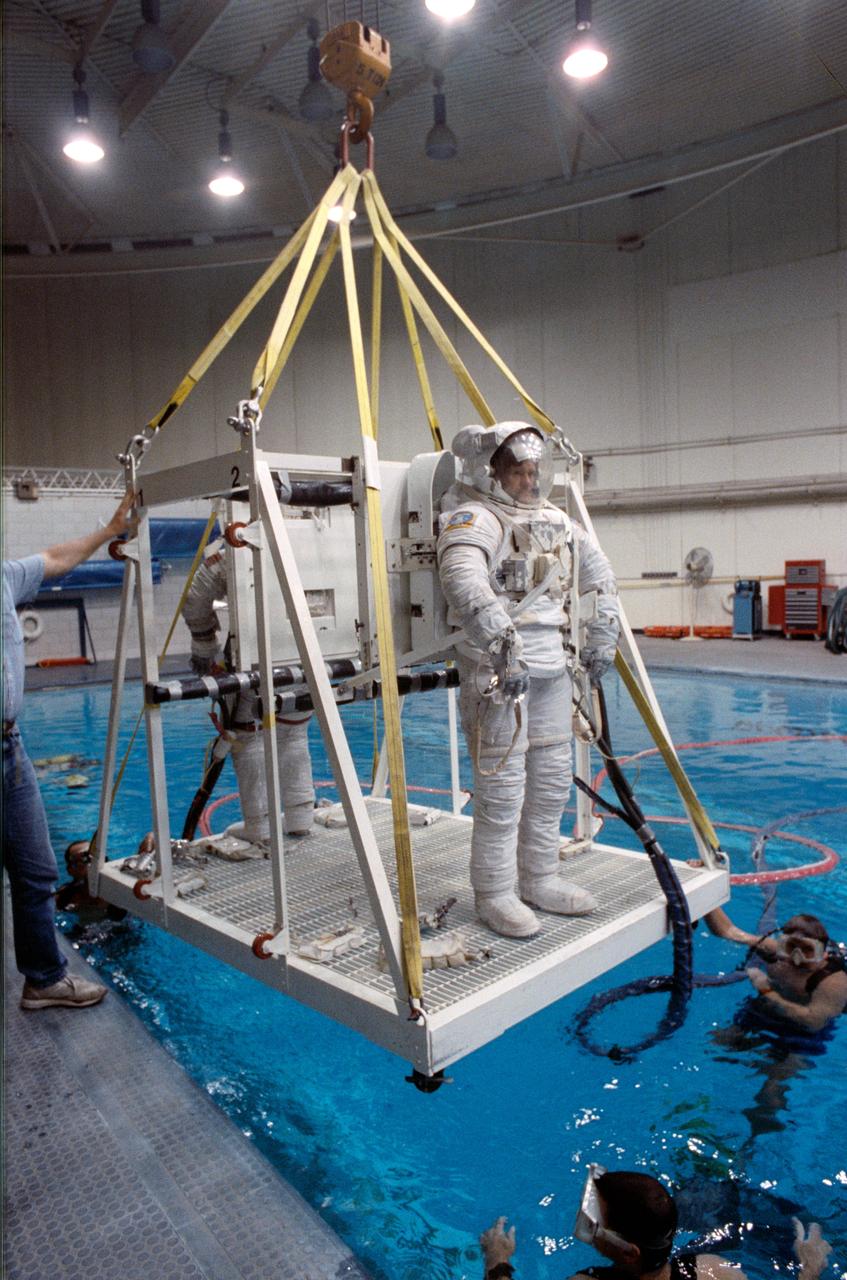
S90-46030 (Aug 1990) --- Astronaut Donald R. McMonagle (foreground) wears an extravehicular mobility unit (EMU) spacesuit as he prepares to be lowered into a 25-ft. deep pool at the Johnson Space Center's weightless environment training facility (WET-F). Astronaut Gregory J. Harbaugh, a fellow STS 39 mission specialist, shares the moveable platform with McMonagle and prepares to join him in the simulation of a contingency extravehicular activity (EVA) for the mission, scheduled for Discovery in the spring of 1991. A number of SCUBA-equipped divers assist in the training session.
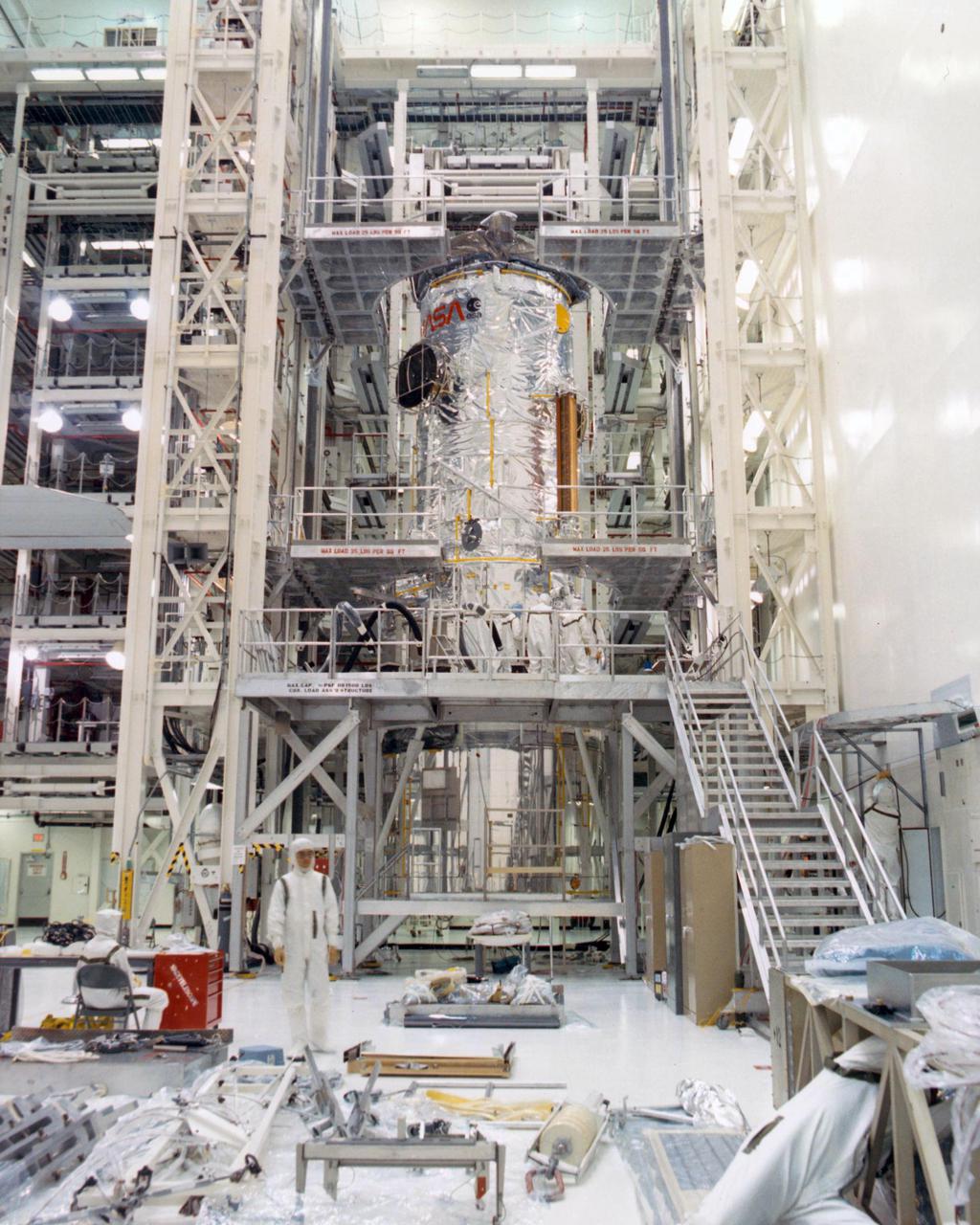
KENNEDY SPACE CENTER, FLA. -- The Hubble Space Telescope (HST) in a test cell at the Vertical Processing Facility has completed functional testing of its science instruments and is being readied for a final contamination inspection and cleaning. With HST, astronomers will be able to view 97 percent of the known universe, and will be able to get pictures unlimited and undistorted by the Earth's atmosphere. Compared with earth-based observatories, the HST will be able to view celestial objects that are 50 times fainter, provide images that are 10 times sharper, and see objects that are seven times farther away. .
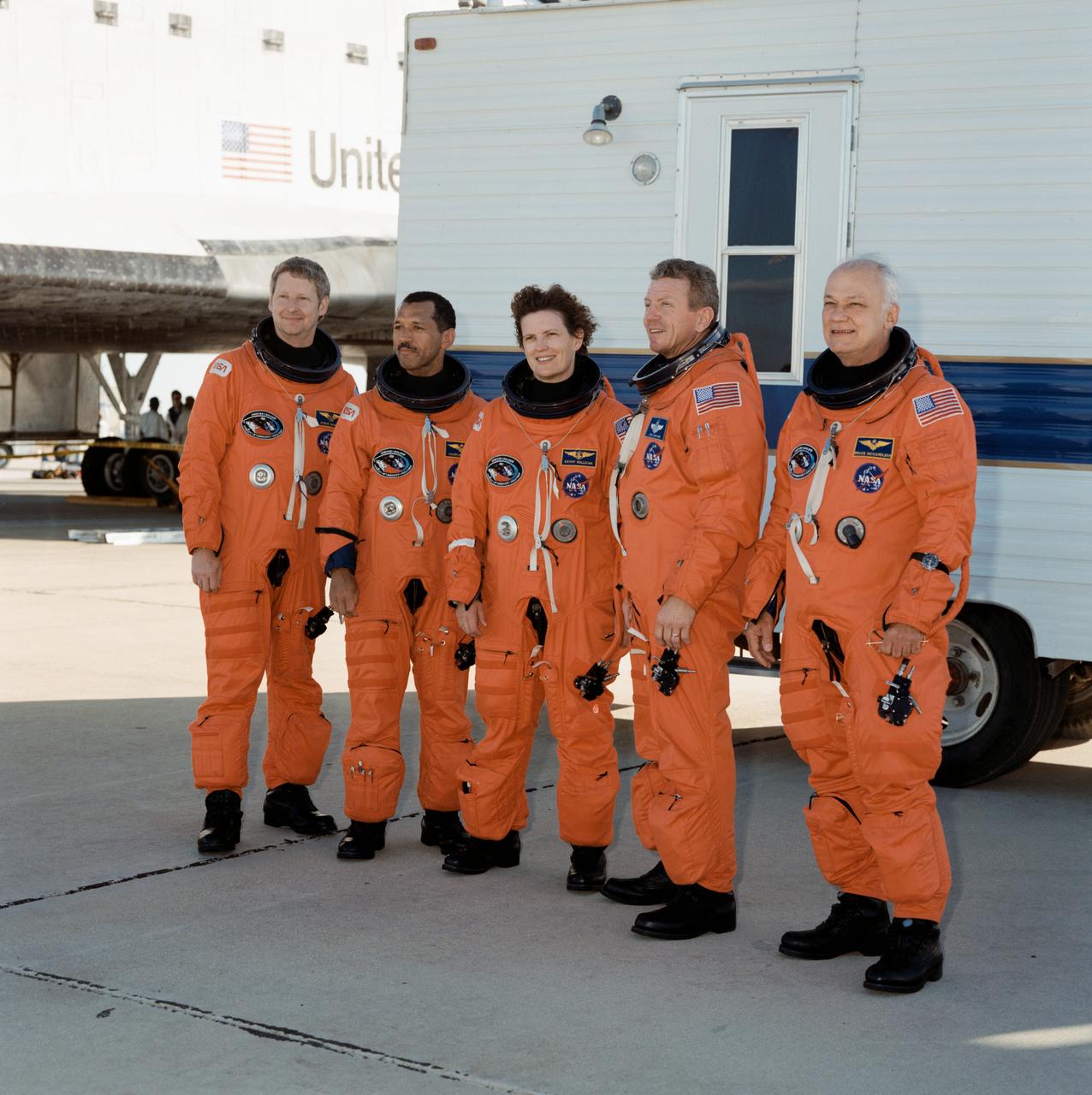
STS031-S-130 (29 April 1990) --- The astronauts of STS-31 pose for a quick photo near the Space Shuttle Discovery following a smooth landing on the runway at Edwards Air Force Base to complete a highly successful five-day mission. Pictured, left to right, are Astronauts Steven A. Hawley, Charles F. Bolden Jr., Kathryn D. Sullivan, Loren J. Shriver, and Bruce McCandless II. Theirs was an Earth orbital flight during which the Hubble Space Telescope (HST) was sent toward its 15-year mission.
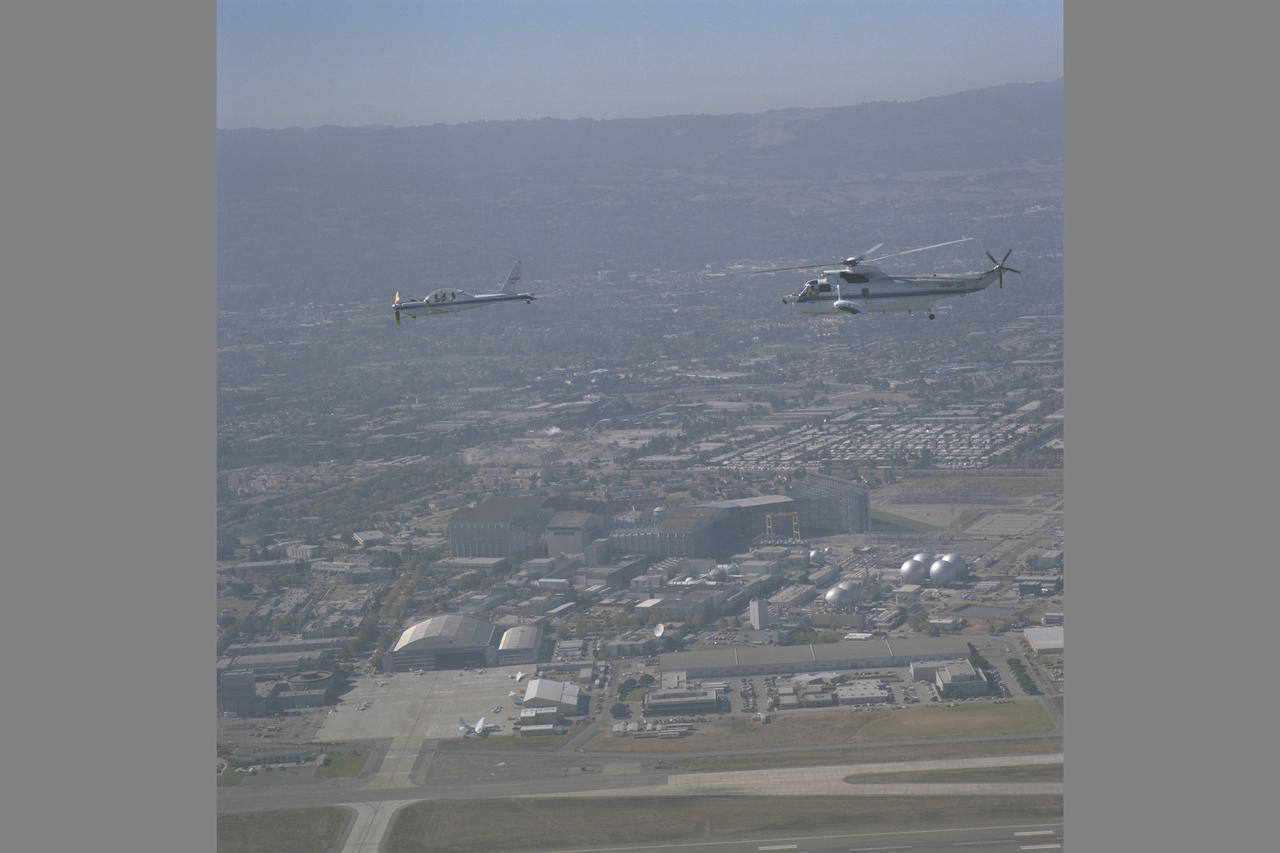
YO-3A (NASA-718) and SH-3G (NASA-735) in flight over Ames on way to Crows Landing during Helicopter Airborne Laser Positioning System flight tests
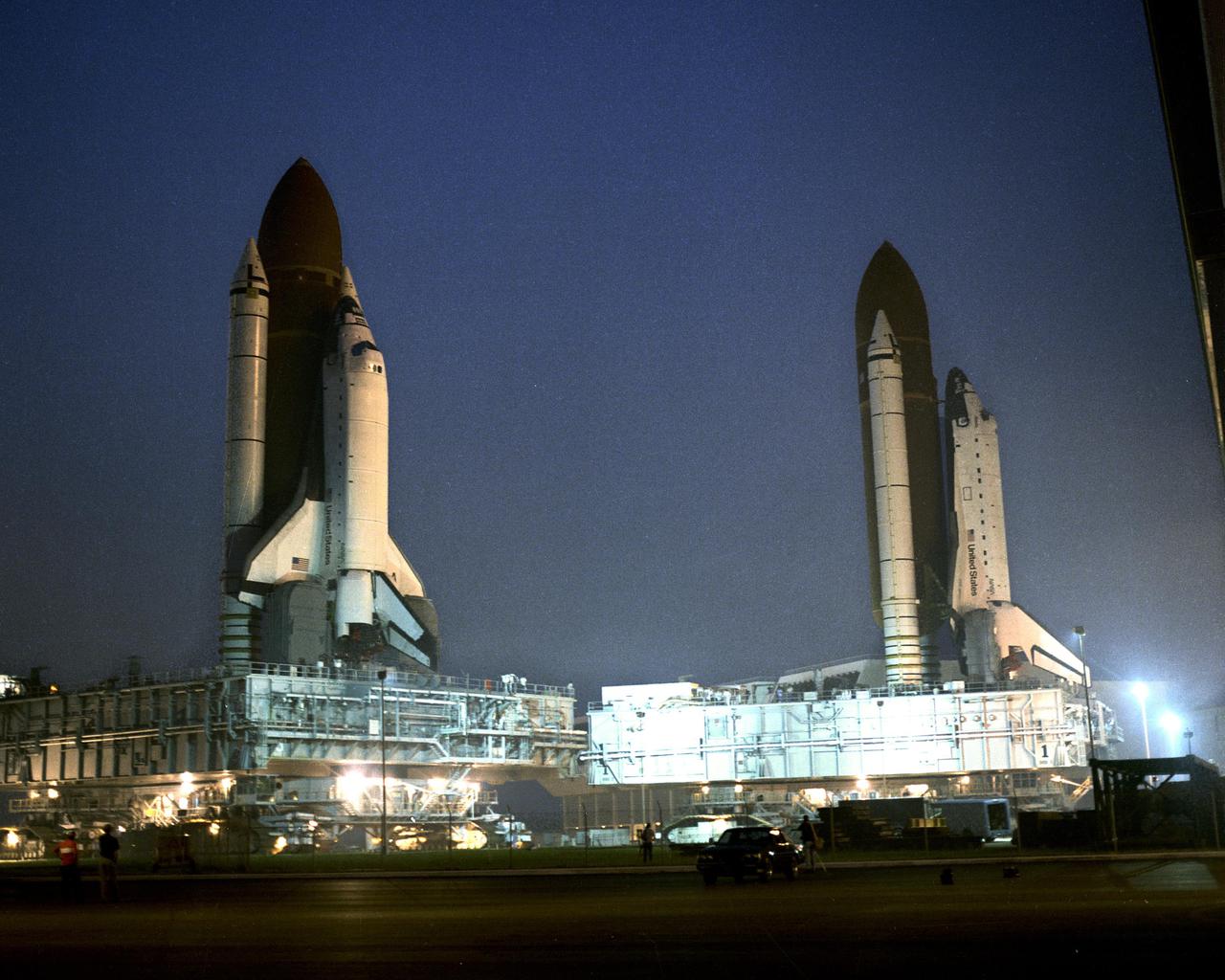
KENNEDY SPACE CENTER, FLA. -- The Space Shuttle Columbia (left), slated for mission STS-35, is rolled past the Space Shuttle Atlantis on its way to Pad 39A. Atlantis, slated for mission STS-38, is parked in front of bay three of the Vehicle Assembly Building following its rollback from Pad 39A for repairs to the liquid hydrogen lines. First motion of Atlantis from the pad was at 10:14 p.m. August 8. It arrived at the VAB at 4 a.m. August 9. First motion of Coumbia leaving the VAB for the pad was at 5:47 a.m. Columbia is due to arrive at the pad at noon August 9. Once Columbia is hard down at the pad, Atlantis will be moved into the VAB for destack operations. When Columbia reaches the pad, its payload bay doors will be opened and servicing of the ASTRO-1 payload will begin. Also, portions of the Shuttle interface verification test not completed in the VAB will be conducted.
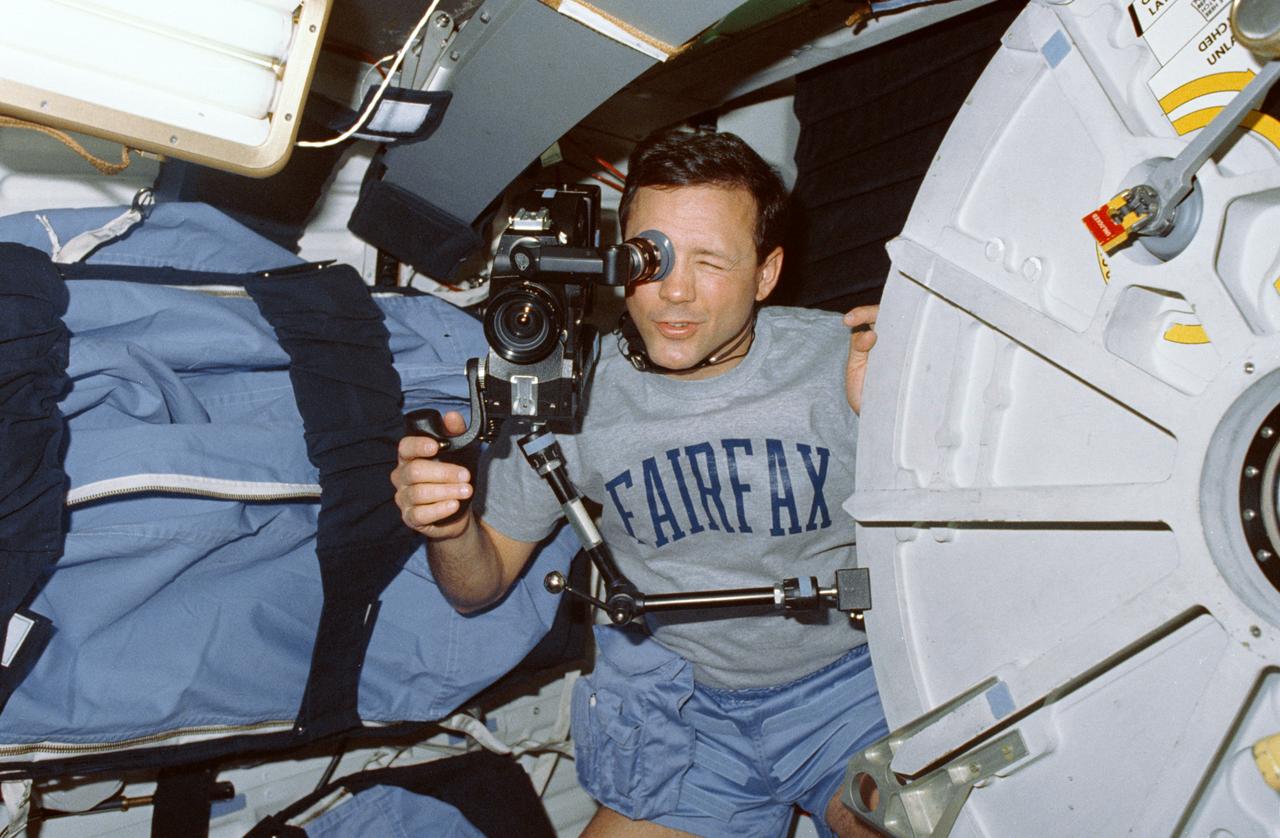
STS-36 Mission Specialist (MS) Pierre J. Thuot operates 16mm ARRIFLEX motion picture camera mounted on the open airlock hatch via a bracket. Thuot uses the camera to record activity of his fellow STS-36 crewmembers on the middeck of Atlantis, Orbiter Vehicle (OV) 104. Positioned between the airlock hatch and the starboard wall-mounted sleep restraints, Thuot, wearing a FAIRFAX t-shirt, squints into the cameras eye piece. Thuot and four other astronauts spent four days, 10 hours and 19 minutes aboard OV-104 for the Department of Defense (DOD) devoted mission.
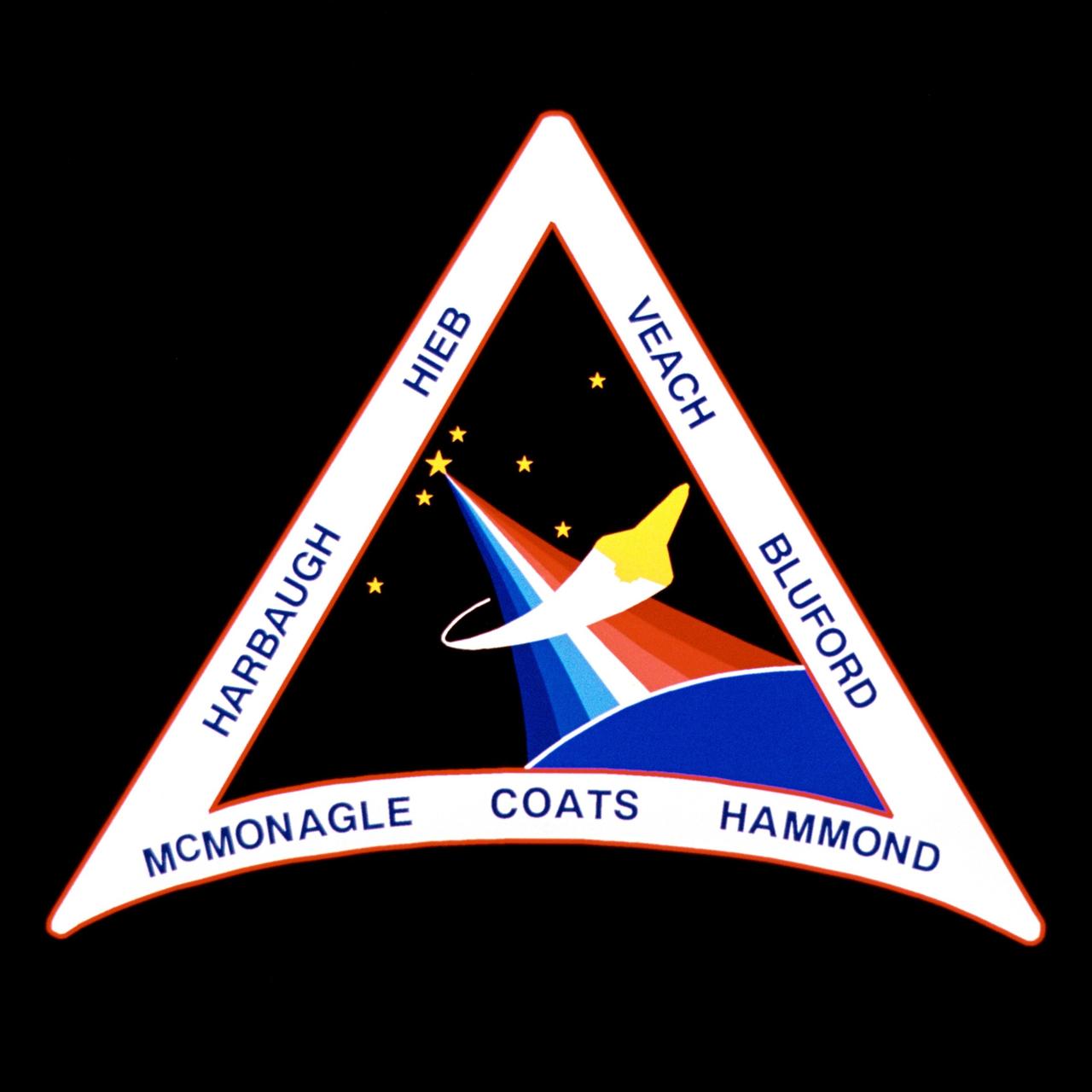
STS039-S-001 (October 1990) --- The arrowhead shape of the STS-39 crew patch represents a skyward aim to learn more about our planet's atmosphere and space environment in support of the Department of Defense. Our national symbol is represented by the star constellation Aguila (the eagle) as its brightest star, Altair, lifts a protective canopy above Earth. The space shuttle encircles the spectrum which represents x-ray, ultraviolet, visible and infrared electromagnetic radiation to be measured by a variety of scientific instruments. Experiments will be operated within the payload bay and aboard a free-flying satellite which will be deployed and retrieved during the mission. The patch was designed by the STS-39 crew. The NASA insignia design for space shuttle flights is reserved for use by the astronauts and for other official use as the NASA Administrator may authorize. Public availability has been approved only in the form of illustrations by the various news media. When and if there is any change in this policy, which we do not anticipate, it will be publicly announced. Photo credit: NASA
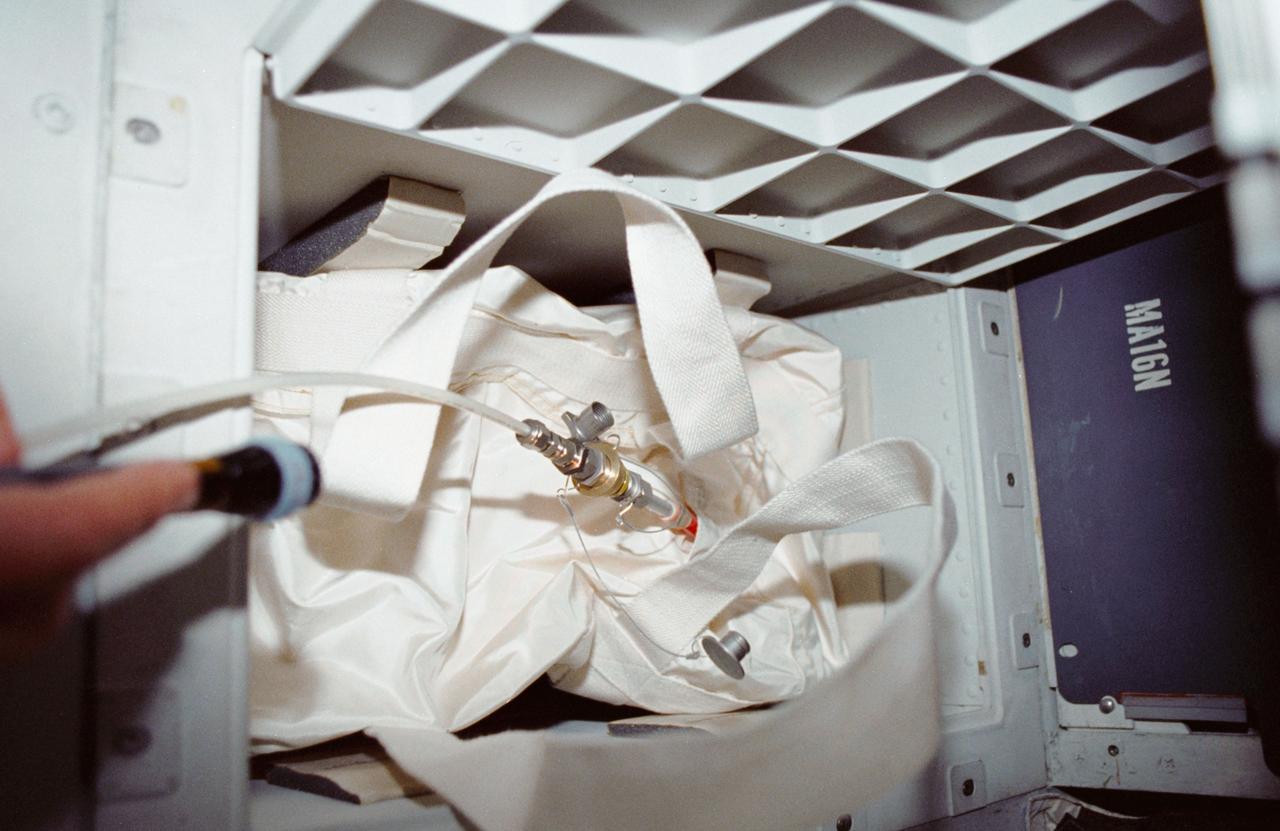
STS035-12-005 (2-10 Dec 1990) --- During STS-35, middeck stowage volume G and a contingency water container (CWC) were utilized to remedy a problem onboard Columbia, Orbiter Vehicle (OV) 102. A hose connecting OV-102's waste water system to the CWC was used in order to bypass a suspected clog in the line from the waste water tank to the exit nozzle. On flight day seven, Pilot Guy S. Gardner carried out an inflight maintenance (IFM) procedure by connecting a spare hose from the line to the container. The CWC is a rubber-lined duffle bag that holds about 95 pounds of water and is used in situations where water cannot be dumped overboard normally.
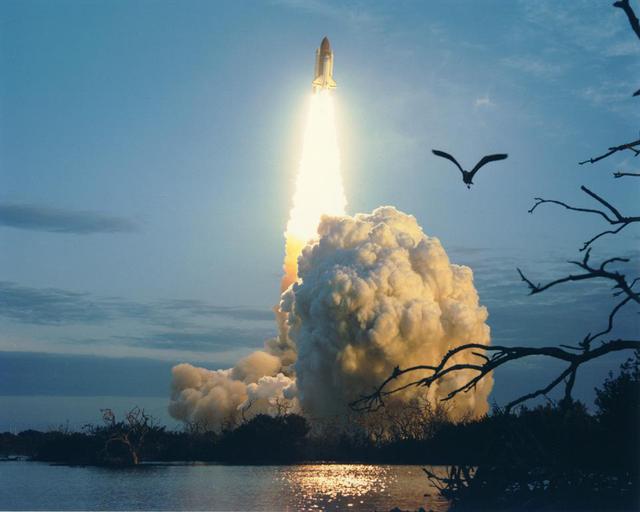
KENNEDY SPACE CENTER, FLA. -- At 7:35 a.m. EST on January 9, the Space Shuttle Columbia roars aloft from KSC's Pad 39-A into the Florida skies. During the ten-day STS-32 mission, the five-member crew is scheduled to deploy the SYNCOM IV-5 military communications satellite and retrieve the Long Duration Exposure Facility. STS-32 marks the 33rd Shuttle mission since flight operations began in 1981. Crew members are: Commander Daniel C. Brandenstein; Pilot James D. Wetherbee; and Mission Specialists Marsha S. Ivins, G. David Low, and Bonnie J. Dunbar
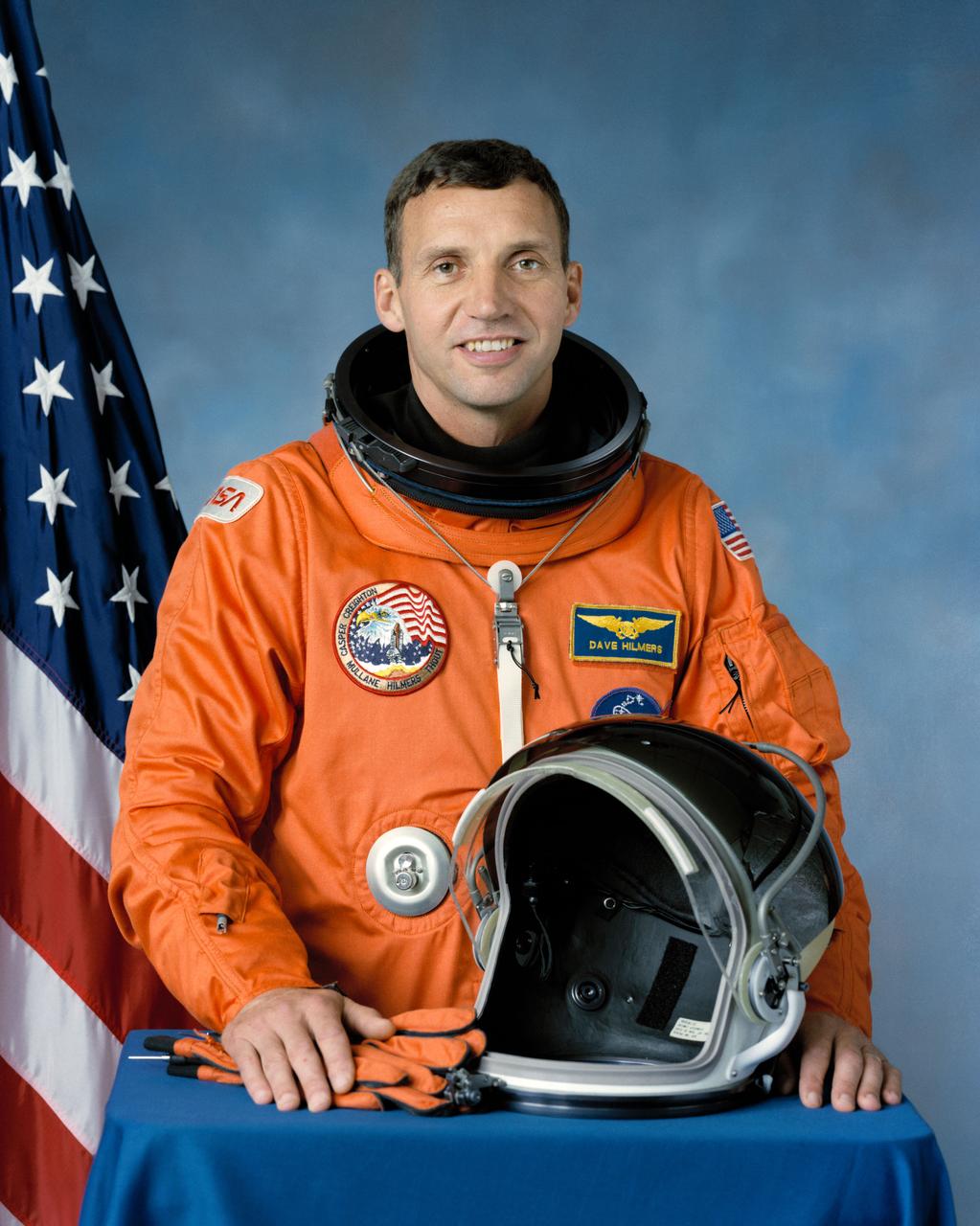
S90-38883 (April 1990) --- Astronaut David C. Hilmers.

STS032-30-024 (17 Jan 1990) --- Astronaut Daniel C. Brandenstein, STS-32 mission commander, holds up a card signed by friends in the astronaut office and around JSC. The commander celebrated his 47th birthday on January 17, 1990, about two thirds the way through an eleven-day mission in Earth orbit aboard Columbia. Brandenstein is seated at the commander's station.
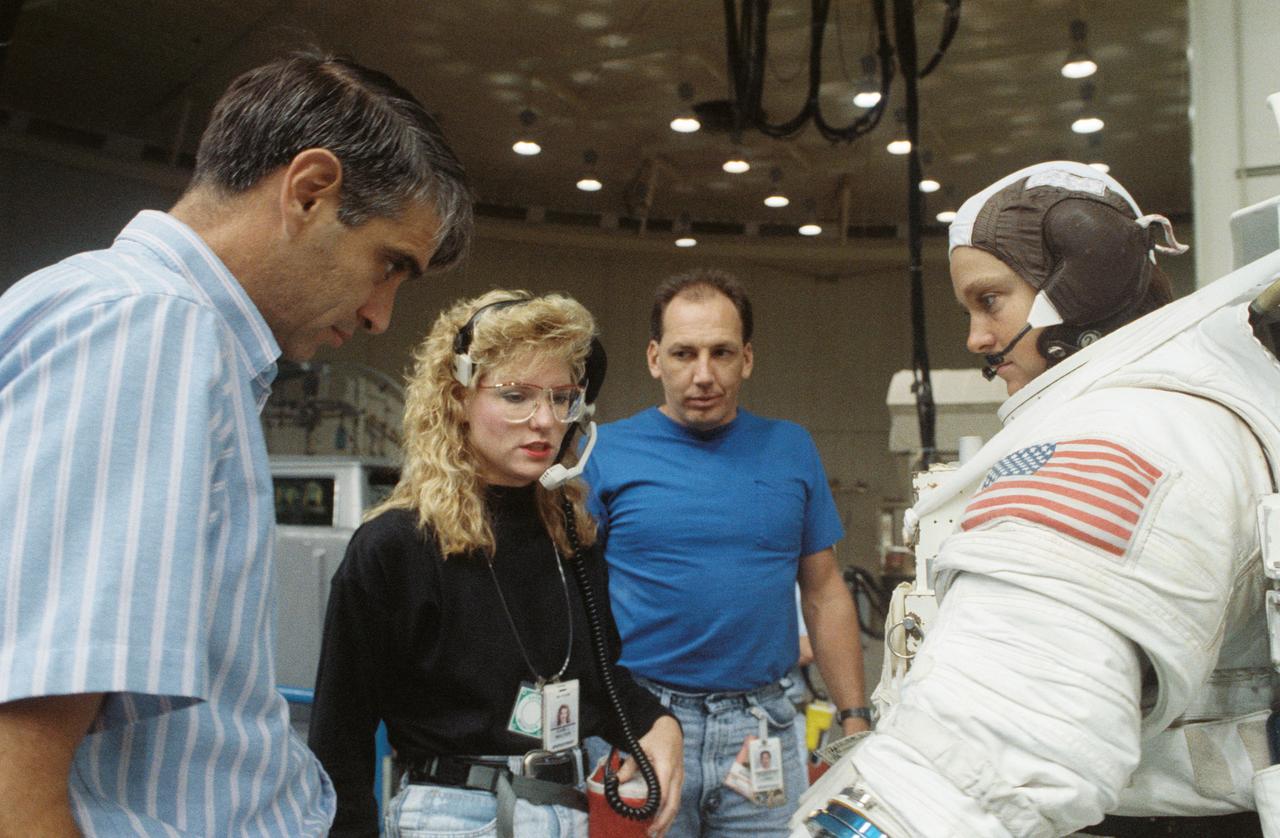
S90-45785 (16 Aug 1990) --- Astronaut Tamara E. Jernigan, STS-40 mission specialist, is pictured in a training version of the extravehicular mobility unit (EMU) spacesuit talking with a fellow crewmember and members of the crew training staff. At left is astronaut Sidney M. Gutierrez, pilot for the flight. Dr. Jernigan was about to be submerged in the Johnson Space Center's 25-ft. deep weightless environment training facility (WET-F) pool to simulate a contingency extravehicular activity (EVA). There is no EVA scheduled for STS-40, the Spacelab Life Sciences (SLS-1) mission.
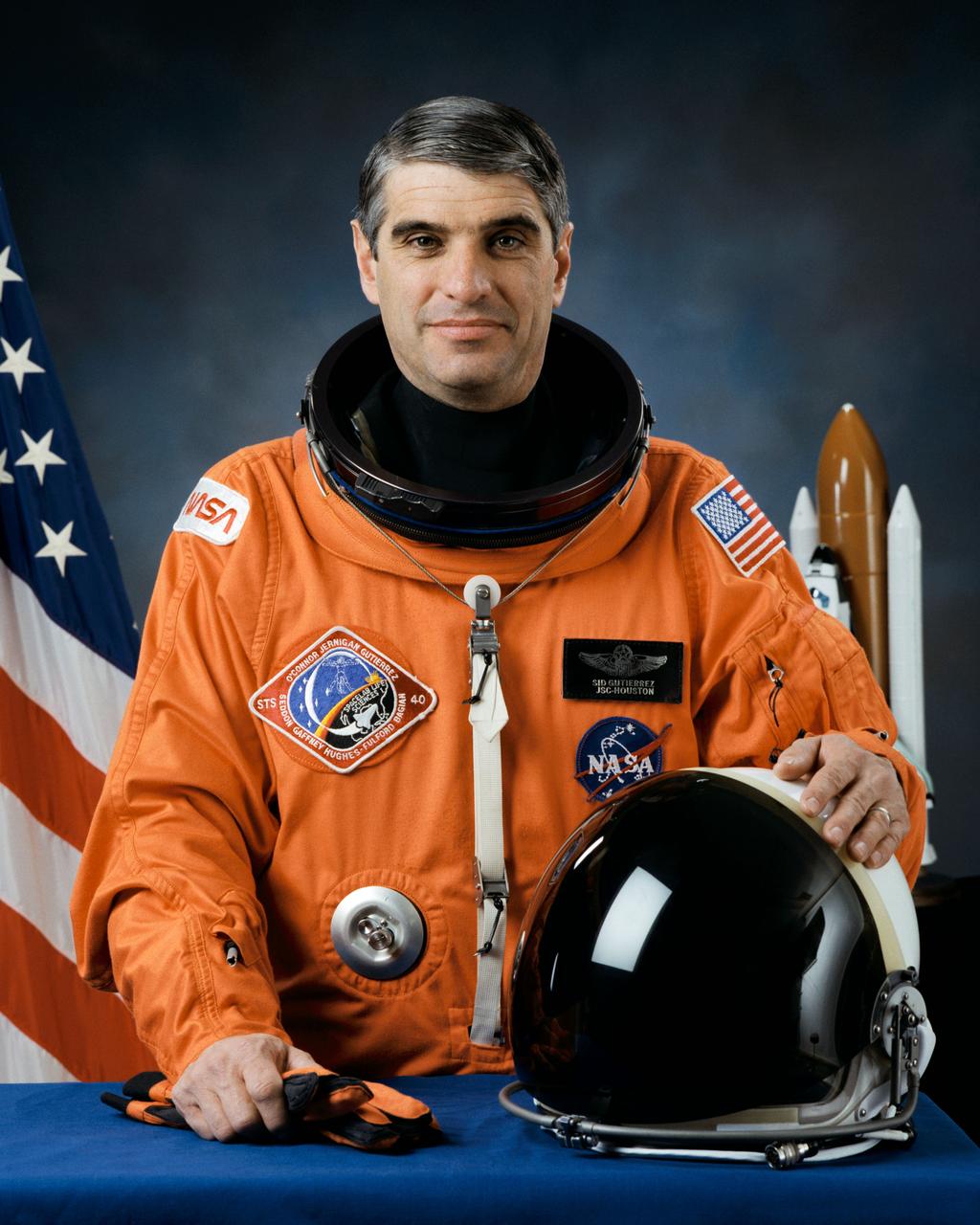
S90-52749 (1990) --- Astronaut Sidney M. Gutierrez.
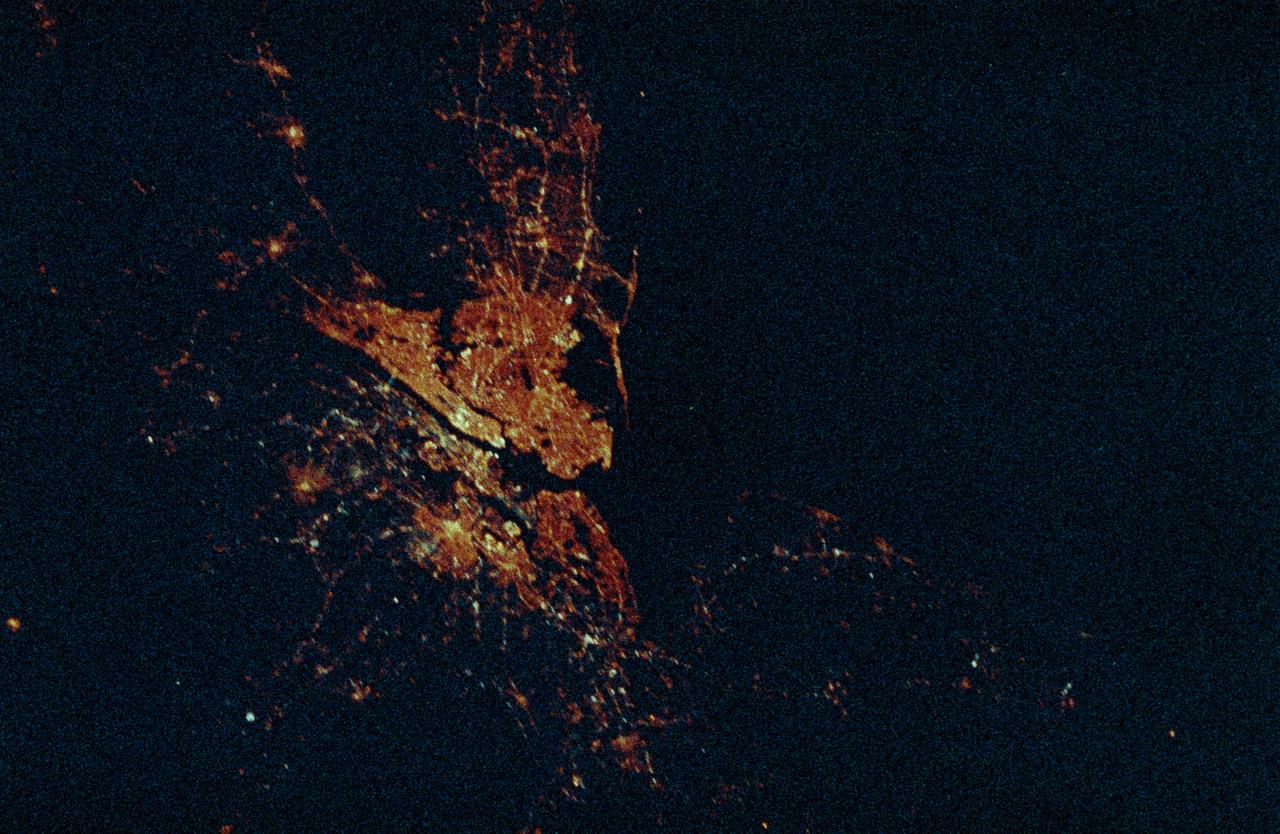
STS-36 Earth observation shows New York City, New York at night lit up along the Eastern seaboard of the United States and the Atlantic Ocean. The city lights designate the densely populated central city and the major highways surrounding it.
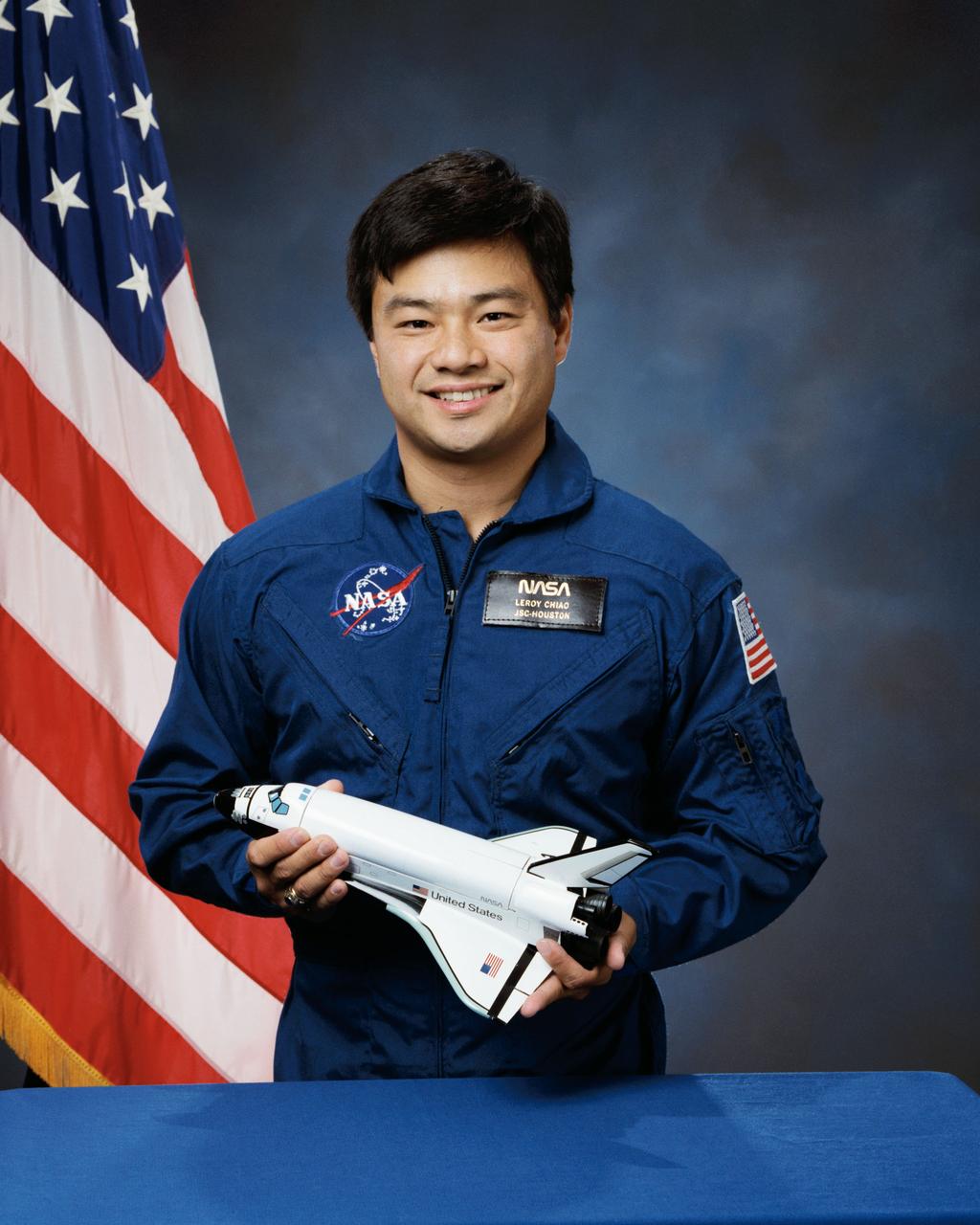
S90-45388 (August 1990) --- Astronaut Leroy Chiao, mission specialist.

Galileo spacecraft image of the Moon recorded at 9:35 am Pacific Standard Time (PST), 12-09-90, after completing its first Earth Gravity Assist. Western hemisphere of the Moon was taken through a green filter at a range of about 350,000 miles. In the center is Orientale Basin, 600 miles in diameter, formed about 3.8 billion years ago by the impact of an asteroid-size body. Orientale's dark center is a small mare. To the right is the lunar near side with the great, dark Oceanus Procellarum above the small, circular, dark Mare Humorum below. Maria are broad plains formed mostly over 3 billion years ago as vast basaltic lava flows. To the left is the lunar far side with fewer maria, but, at lower left South-Pole-Aitken basin, about 1200 miles in diameter, which resembles Orientale but is much older and more weathered and battered by cratering. The intervening cratered highlands of both sides, as well as the maria, are dotted with bright young craters. This image was "reprojected" so as to center the Orientale Basin, and was filtered to enhance the visibility of small features. The digital image processing was done by DLR, the German Aerospace Research Establishment near Munich, an international collaborator in the Galileo mission. Photo was provided by Jet Propulsion Laboratory (JPL) with alternate number P-37327, 12-19-90.
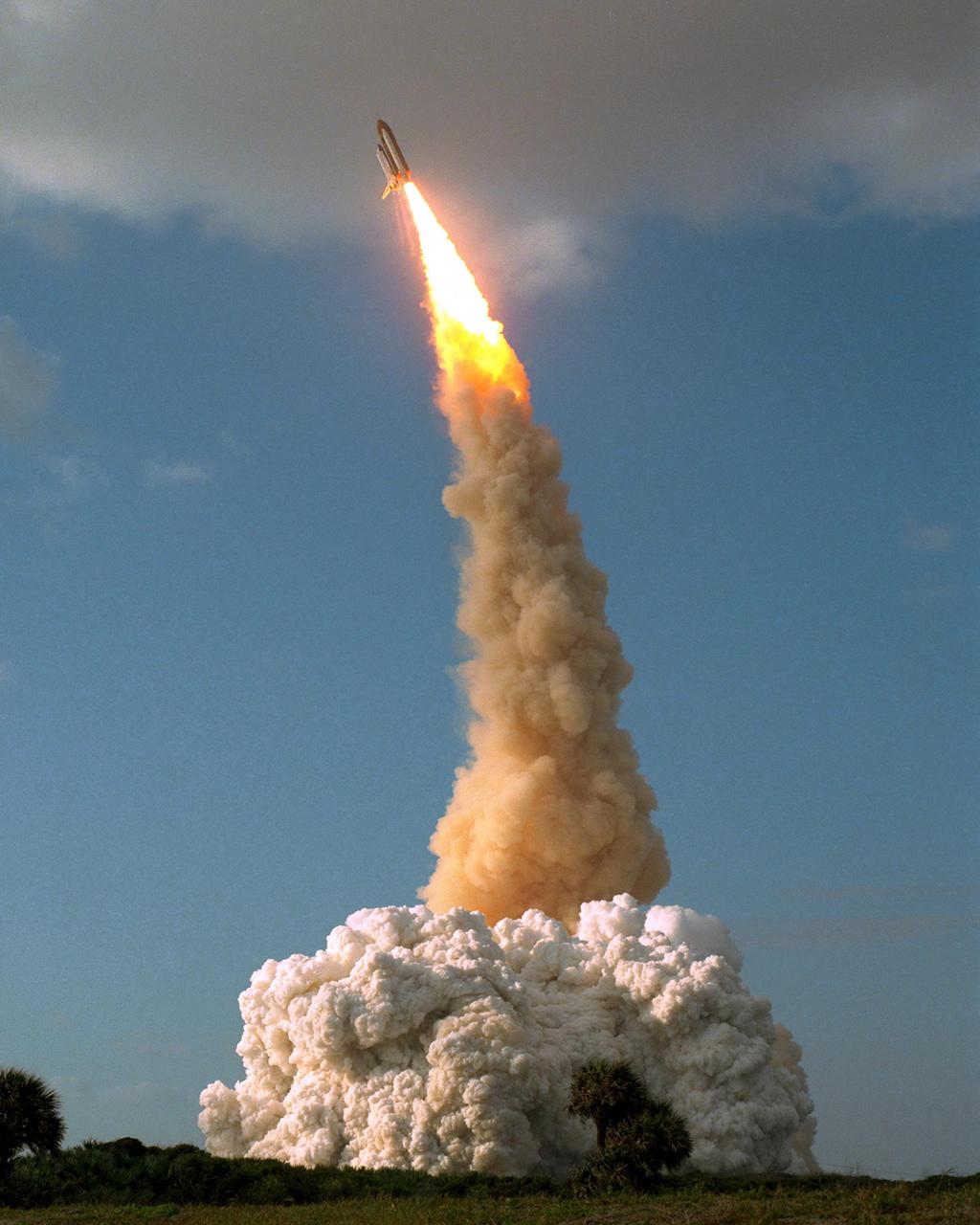
KENNEDY SPACE CENTER, FLA. -- The Space Shuttle Discovery lifts off from Pad 39-B at 8:33 a.m. EDT carrying a crew of five and the Hubble Space Telescope. STS-31 crew members are Commander Loren Shriver, Pilot Charles Bolden and Mission Specialists Steven Hawley, Bruce McCandless II and Kathryn Sullivan.
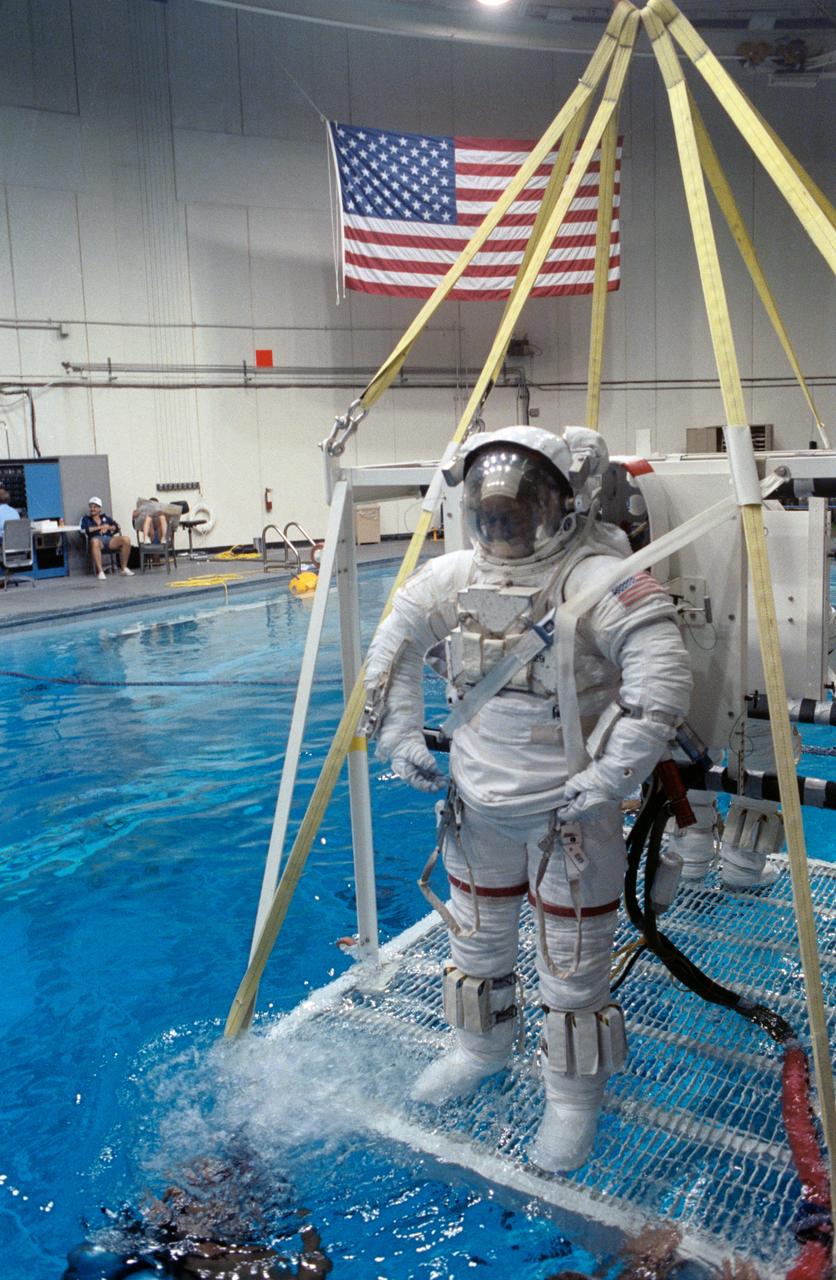
S90-44118 (August 1990) --- Astronaut Guion S. Bluford, mission specialist for STS-39, wearing an extravehicular mobility unit (EMU) spacesuit, is lowered by a hoist device prior to participating in an underwater rehearsal of a contingency EVA. The scene is in the Johnson Space Center's weightless environment training facility (WET-F) which houses a 25-ft. deep pool (visible in background).
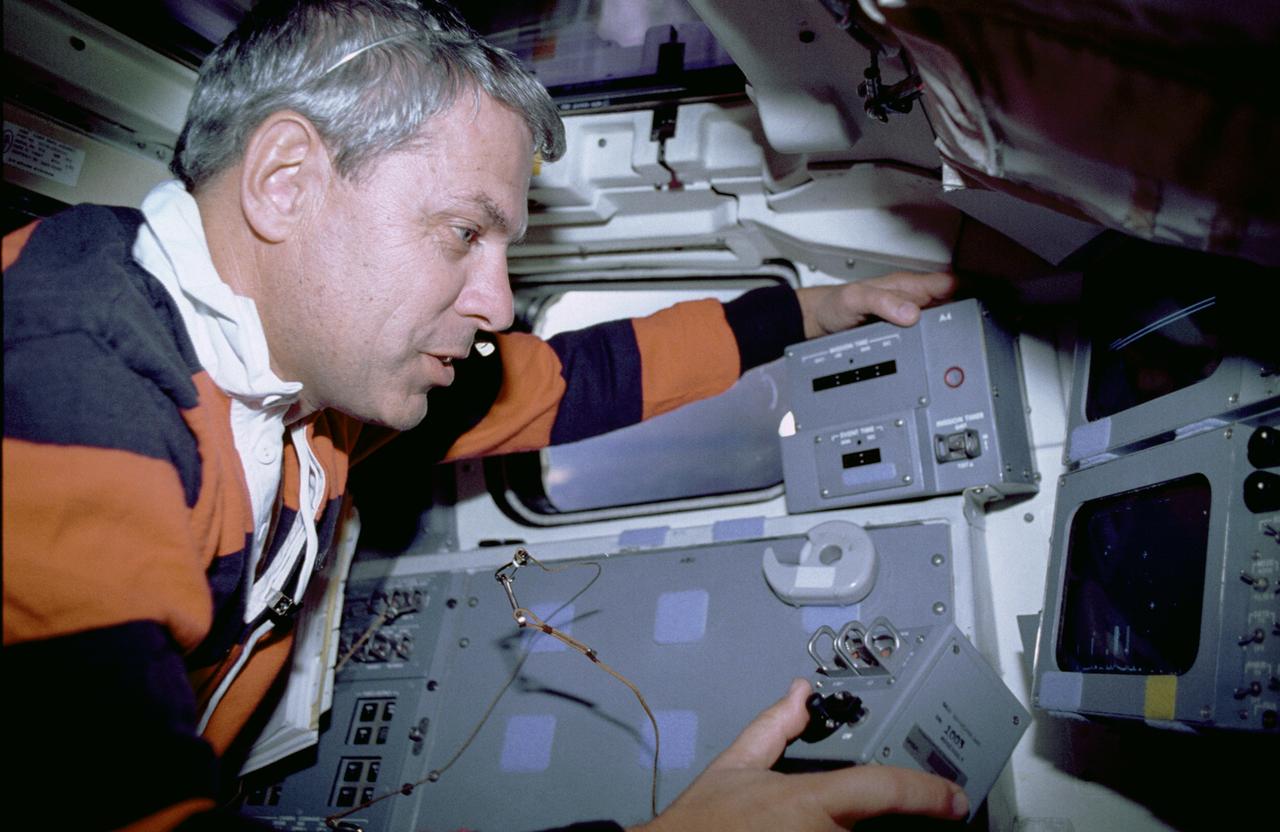
The primary objective of the STS-35 mission was round the clock observation of the celestial sphere in ultraviolet and X-Ray astronomy with the Astro-1 observatory which consisted of four telescopes: the Hopkins Ultraviolet Telescope (HUT); the Wisconsin Ultraviolet Photo-Polarimeter Experiment (WUPPE); the Ultraviolet Imaging Telescope (UIT); and the Broad Band X-Ray Telescope (BBXRT). The Huntsville Operations Support Center (HOSC) Spacelab Payload Operations Control Center (SL POCC) at the Marshall Space Flight Center (MSFC) was the air/ground communication channel used between the astronauts and ground control teams during the Spacelab missions. Teams of controllers and researchers directed on-orbit science operations, sent commands to the spacecraft, received data from experiments aboard the Space Shuttle, adjusted mission schedules to take advantage of unexpected science opportunities or unexpected results, and worked with crew members to resolve problems with their experiments. Due to loss of data used for pointing and operating the ultraviolet telescopes, MSFC ground teams were forced to aim the telescopes with fine tuning by the flight crew. Pictured onboard the shuttle is astronaut Robert Parker using a Manual Pointing Controller (MPC) for the ASTRO-1 mission Instrument Pointing System (IPS).
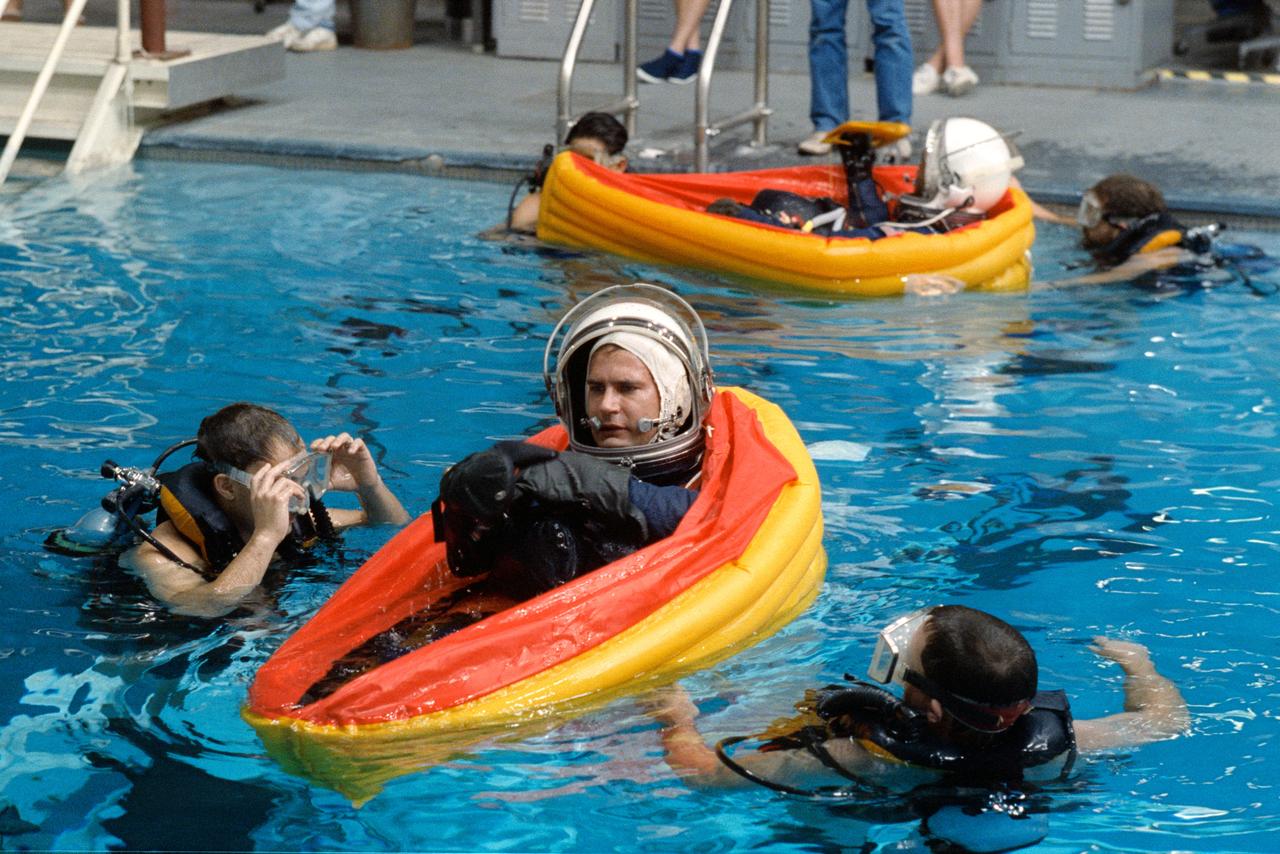
S90-54754 (13 Dec 1990) --- Astronaut Richard J. Hieb, STS-39 mission specialist, wearing launch and entry suit (LES) and launch and entry helmet (LEH), floats in single person life raft after landing in JSC's Weightless Environment Training Facility (WETF) Bldg 29 pool. During emergency egress bailout procedures, Hieb practiced procedures necessary for a water landing. Divers monitor Hieb's activity.
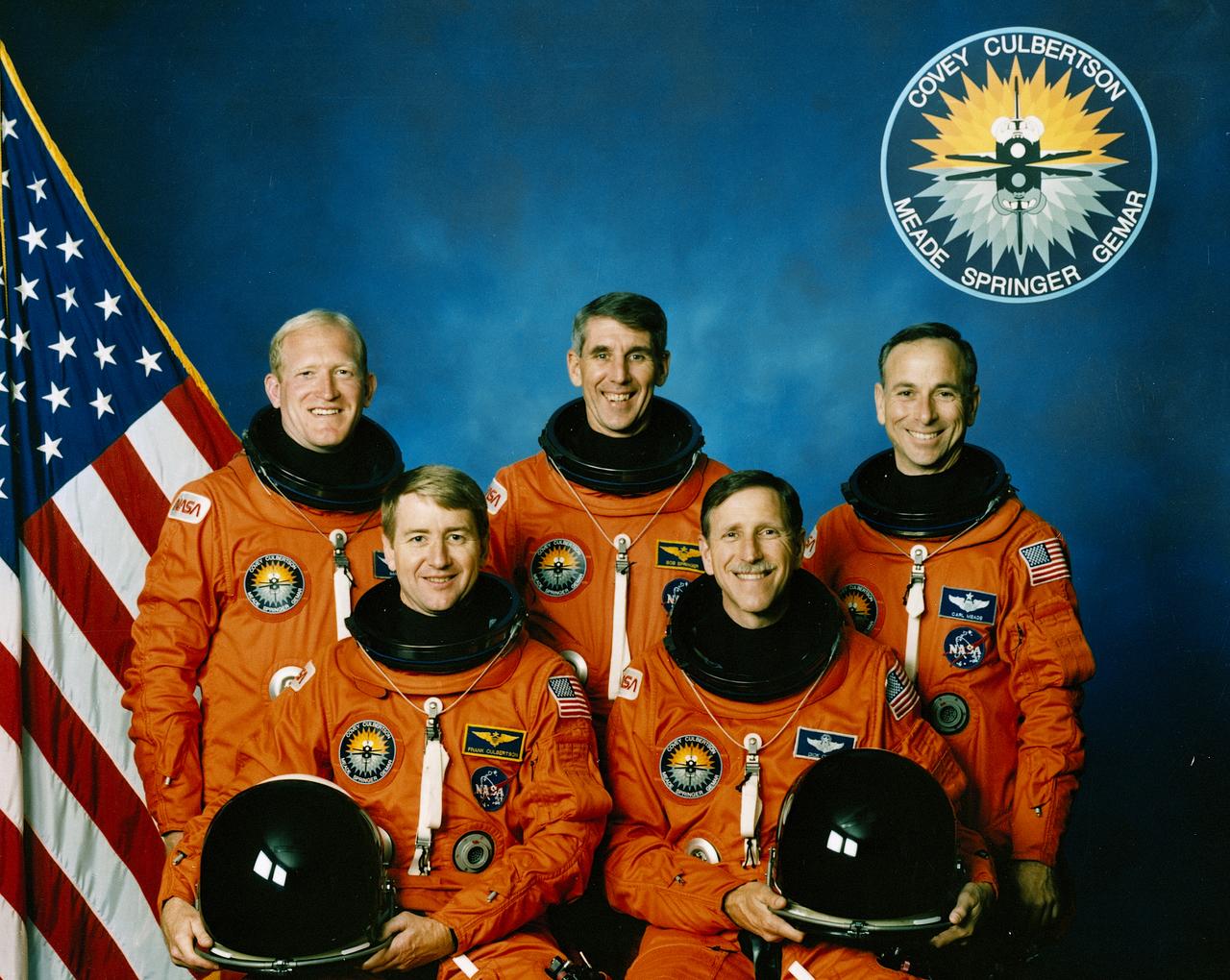
The official STS-38 crew portrait includes the following 5 astronauts (front left to right): Frank L. Culbertson, pilot; and Richard O. Covey, commander. Standing (left to right) are mission specialists (MS) Charles D. (Sam) Gemar, (MS-3), Robert C. Springer, (MS-1), and Carl J. Meade, (MS-2). The seventh mission dedicated to the Department of Defense (DOD), the STS-38 crew launched aboard the Space Shuttle Atlantis on November 15, 1990 at 6:48:15 pm (EST).
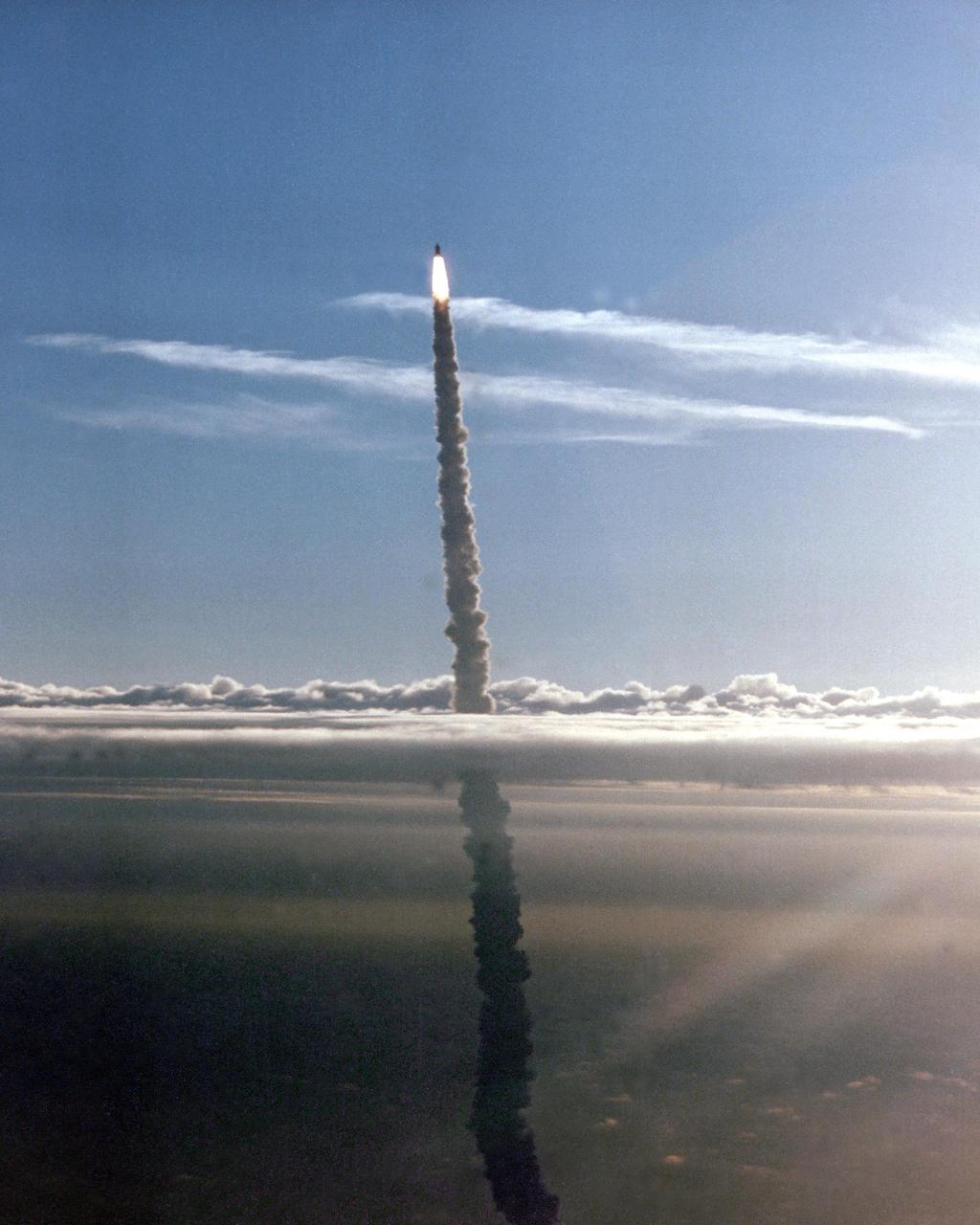
KENNEDY SPACE CENTER, FLA. -- STS-32R lifts off from Pad 39-A at 7:35 a.m. EST. Columbia is scheduled to deploy the Syncom IV-5 defense communications satellite and retrieve NASA's Long duration Exposure Facility (LDEF) during a 10-day mission, the longest Shuttle flight to date. The mission also includes a variety of experiments, including Protein Crystal Growth. This photo was taken from the Shuttle Training Aircraft.
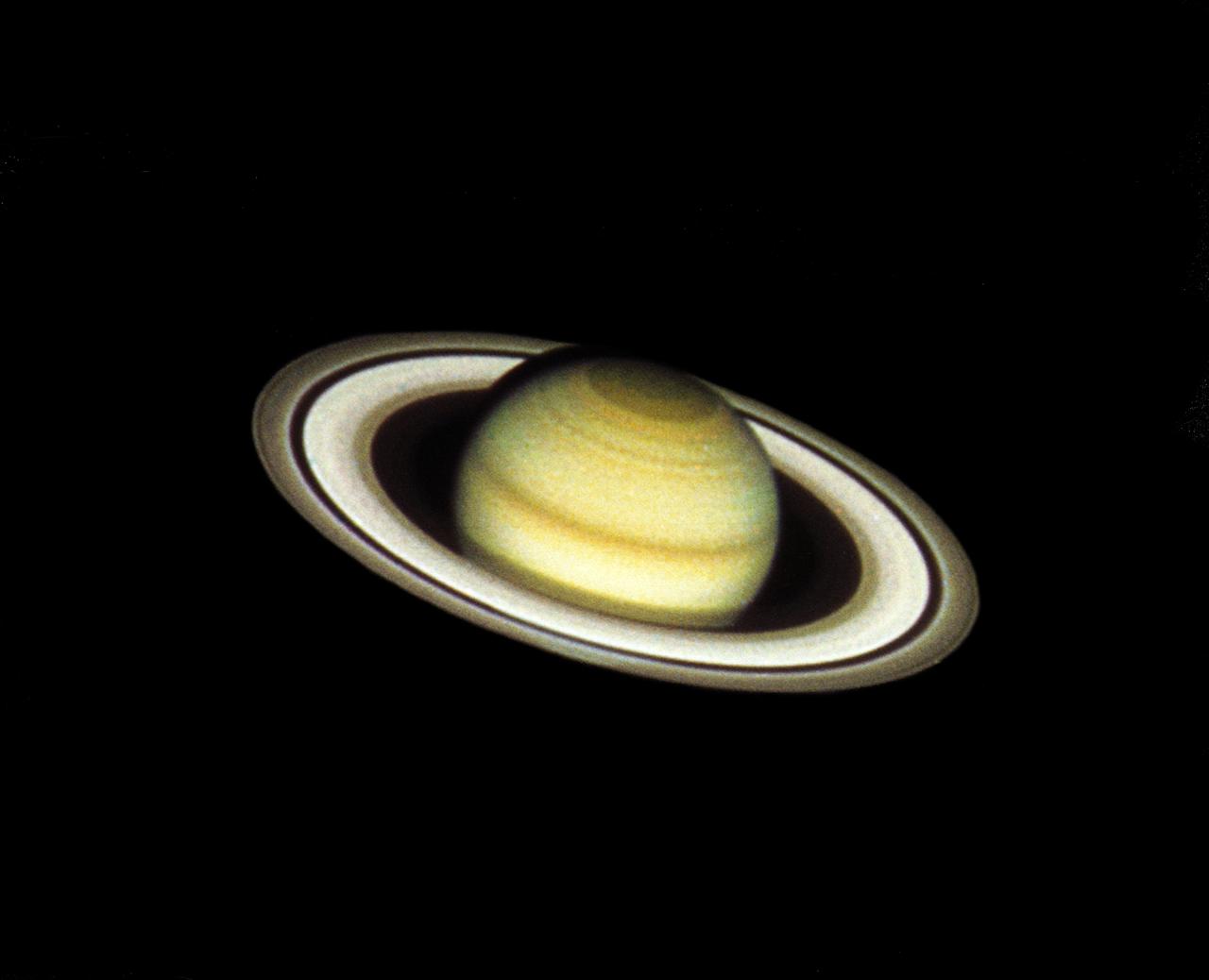
This color image of Saturn was taken with the Hubble Space Telescope's (HST's) Wide Field Camera (WFC) at 3:25 am EDT, August 26, 1990, when the planet was at a distance of 2.39 million km (360 million miles) from Earth. The color in the image is reconstructed by combining three different pictures, taken in blue, green and red light (4390, 5470 and 7180 angstroms). Because Saturn's north pole is currently tilted toward Earth (24 degrees), the HST image reveals unprecedented detail in atmospheric features at the northern polar hood, a region not extensively imaged by the Voyager space probes. The classic features of Saturn's vast ring system are also clearly seen from outer to irner edge; the bright A and B rings, divided by the Cassini division, and the very faint inner C ring. The Enche division, a dark gap near the outer edge of the A ring, has never before been photographed from Earth.
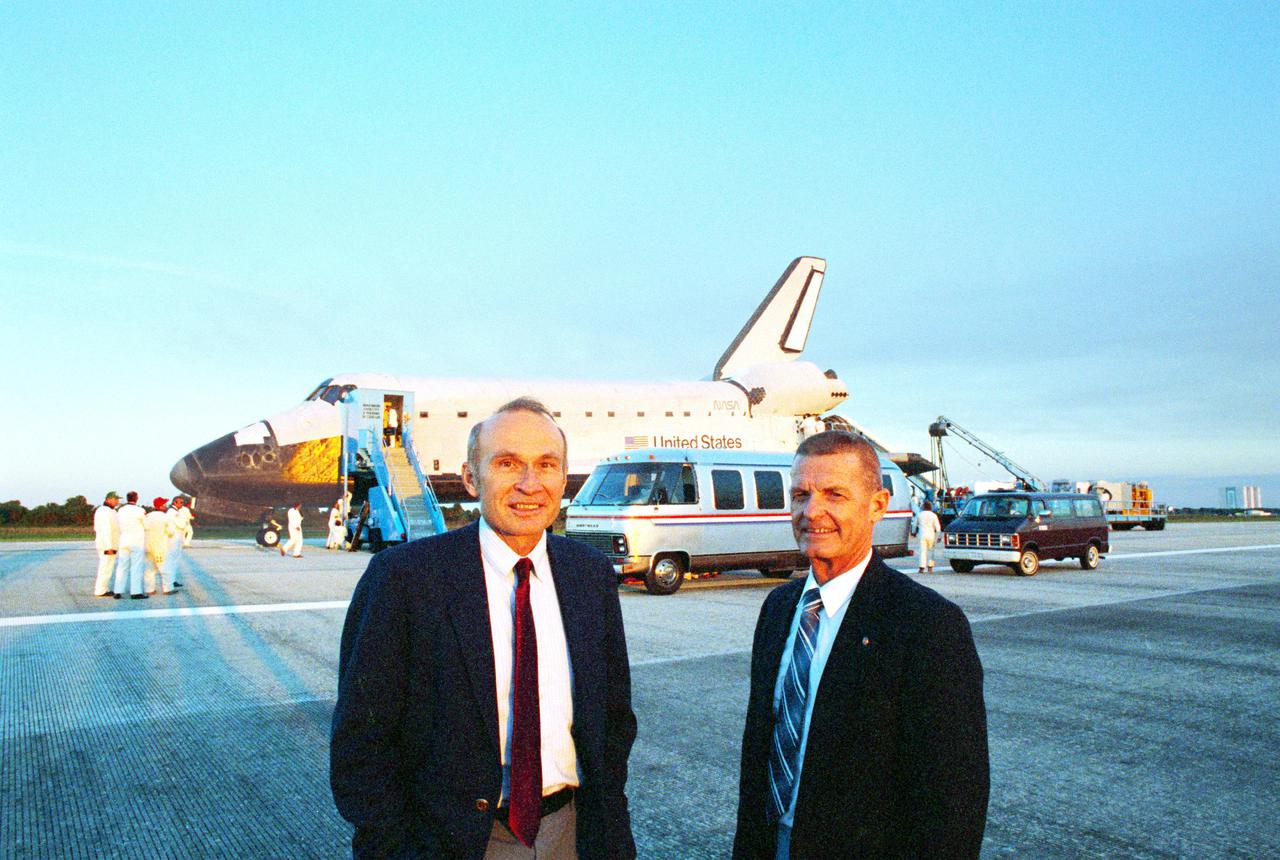
KENNEDY SPACE CENTER, FLA. -- Launch Director Robert Sieck (left) and Center Director Forrest McCartney pose before the orbiter Atlantis following the first end-of-mission Shuttle landing at KSC in more than five years. Atlantis touched down on Shuttle Landing Facility Runway 33 at 4:43 p.m. EST, completing a five-day mission.
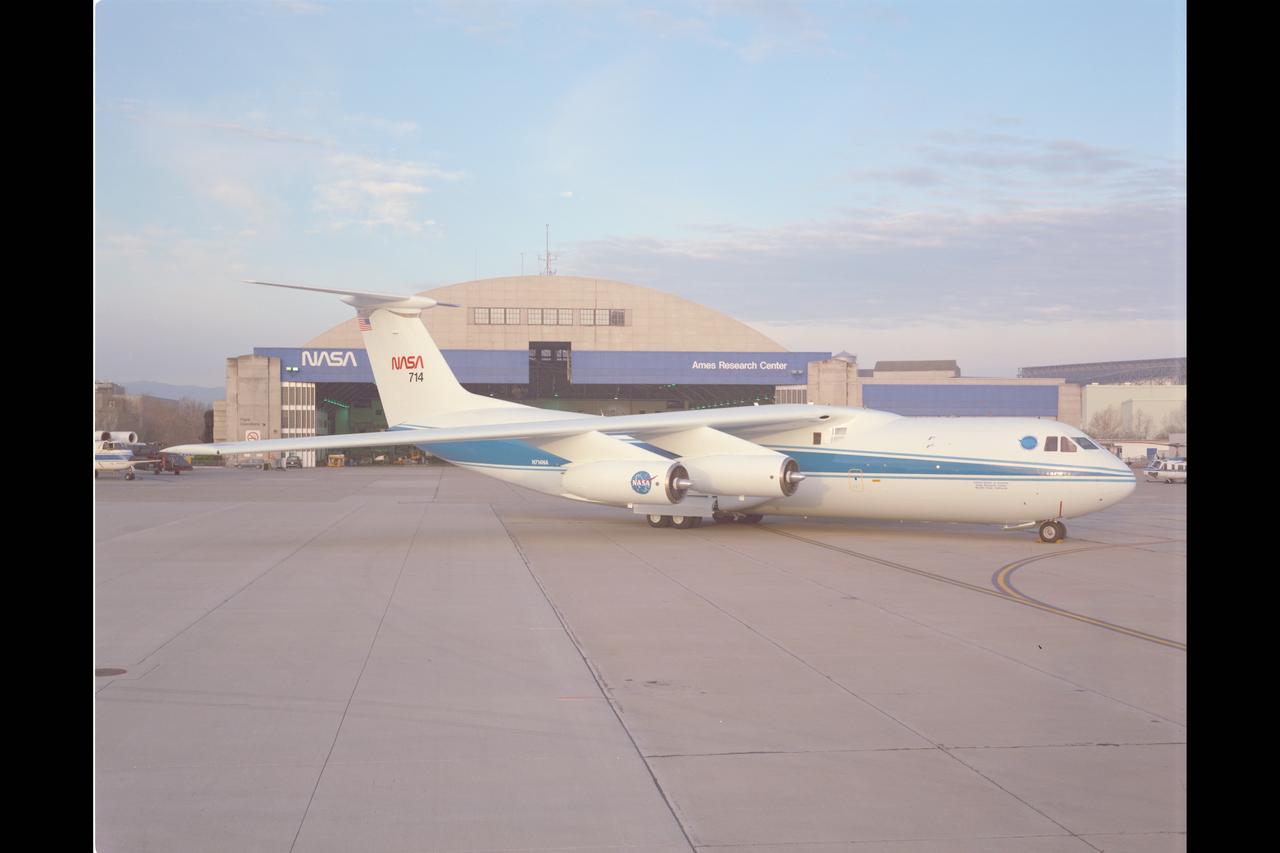
C-141 KAO (NASA-714) on ramp
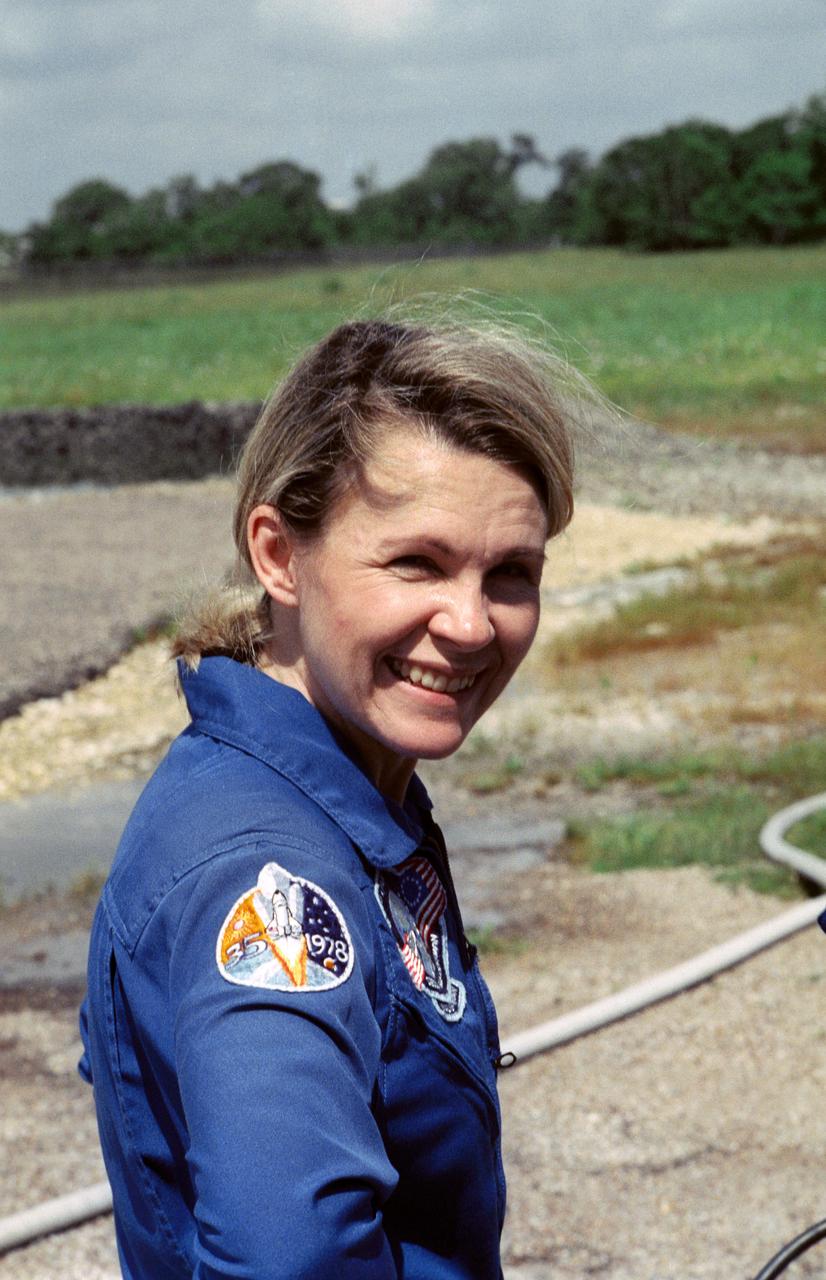
S90-46497 (18 Aug 1990) --- Astronaut Rhea Seddon, STS-40 mission specialist, takes a break from firefighting training at the Johnson Space Center (JSC). In less than a year Dr. Seddon will be joined by four NASA astronauts and two payload specialists for the Spacelab Life Sciences (SLS-1) mission aboard Columbia.
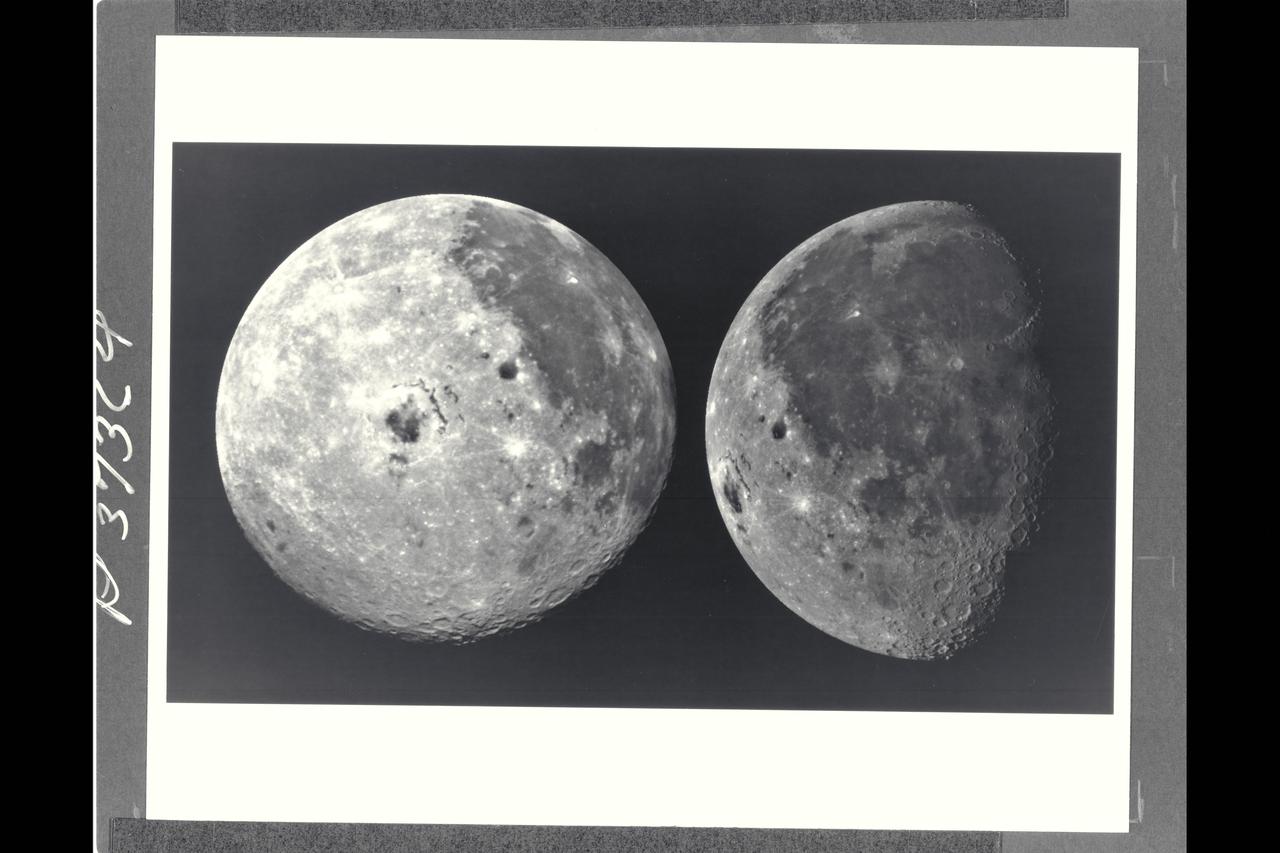
Range : 220,000 mi. (left)/350,000 mi. (right) These pictures of the Moon were taken by the Galileo spacecraft. Image on the right shows the dark Oceanus Procellarum in the upper center, with Mare Imbrium above it and the smaller circular Mare Humorum below. The Orientale Basin, with a small mare in its center, is on the lower left near the limb or edge. Between stretches the cratered highland terrain, with scattered bright young craters on highlands and maria alike. The left image shows the globe of the Moon rotated, putting Mare Imbrium on the eastern limb and moving the Orientale Basin almost to the center. The extent of the cratered highlands on tghe far side is very apparent., At lower left, near the limb, is the South-Pole-Aitken basin, similar to Orientale but very much older and some 1,200 miles in diameter. This feature was previously known as a large depression in the southern far side; this image shows its Orientale-like structure and darkness relative to surrounding highlands.
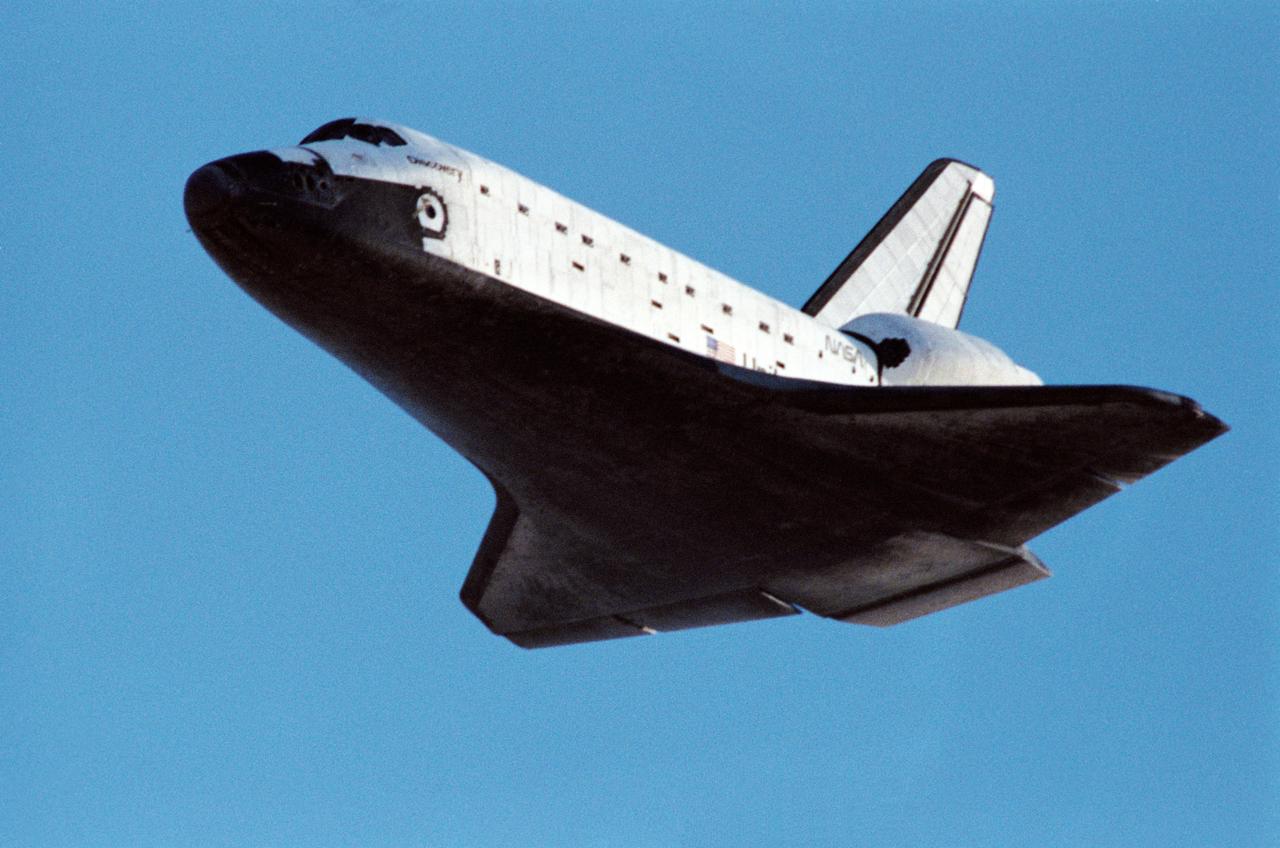
STS031-S-131 (29 April 1990) --- Low angle view of the Space Shuttle Discovery as it approaches for landing on a concrete runway at Edwards Air Force Base to complete a highly successful five-day mission. It was a long awaited Earth orbital flight during which the Hubble Space Telescope (HST) was sent toward its 15-year mission. Discovery's wheels came to a complete stop at 6:51:00 a.m. (PDT), April 29, 1990. The landing gear was deployed just moments after this frame was exposed. Inside the spacecraft for STS-31 were astronauts Loren J. Shriver, Charles F. Bolden, Bruce McCandless II, Kathryn D. Sullivan and Steven A. Hawley.

S90-52756 (December 1990) --- NASA's STS-39 crew members, wearing their partial pressure launch and entry suits, pose for traditional portrait. Left to right are astronauts Charles L. (Lacy) Veach, Donald R. McMonagle, Gregory J. Harbaugh, Michael L. Coats, L. Blaine Hammond Jr., Richard J. Hieb and Guion S. Bluford Jr. Coats is mission commander; Hammond, pilot, and the others are mission specialists. Photo credit: NASA
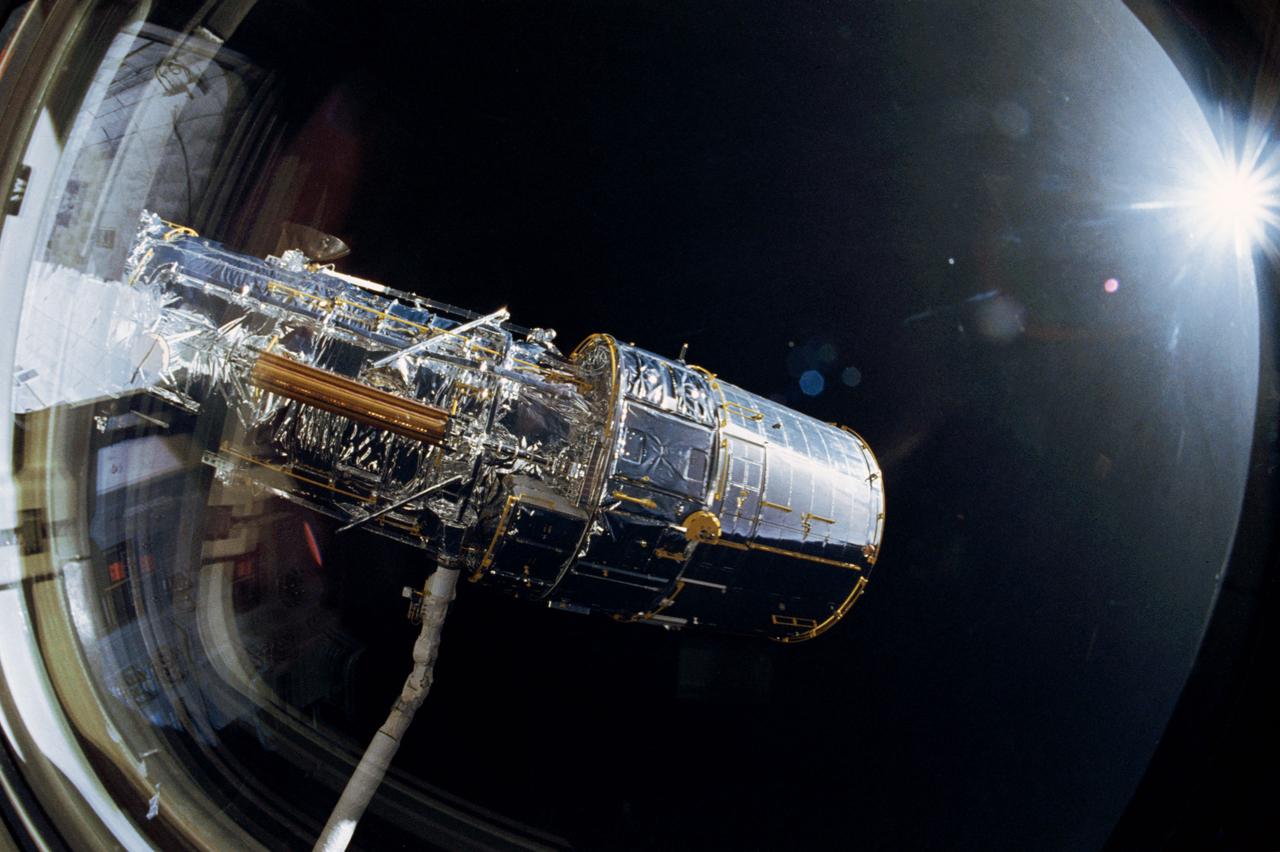
The Hubble Space Telescope (HST), grappled by Discovery's, Orbiter Vehicle (OV) 103's, remote manipulator system (RMS), is oriented in a 90 degree pitch position during STS-31 pre-deployment checkout procedures. The solar array (SA) panel (center) and high gain antennae (HGA) (on either side) are stowed along the Support System Module (SSM) forward shell prior to deployment. The sun highlights HST against the blackness of space.
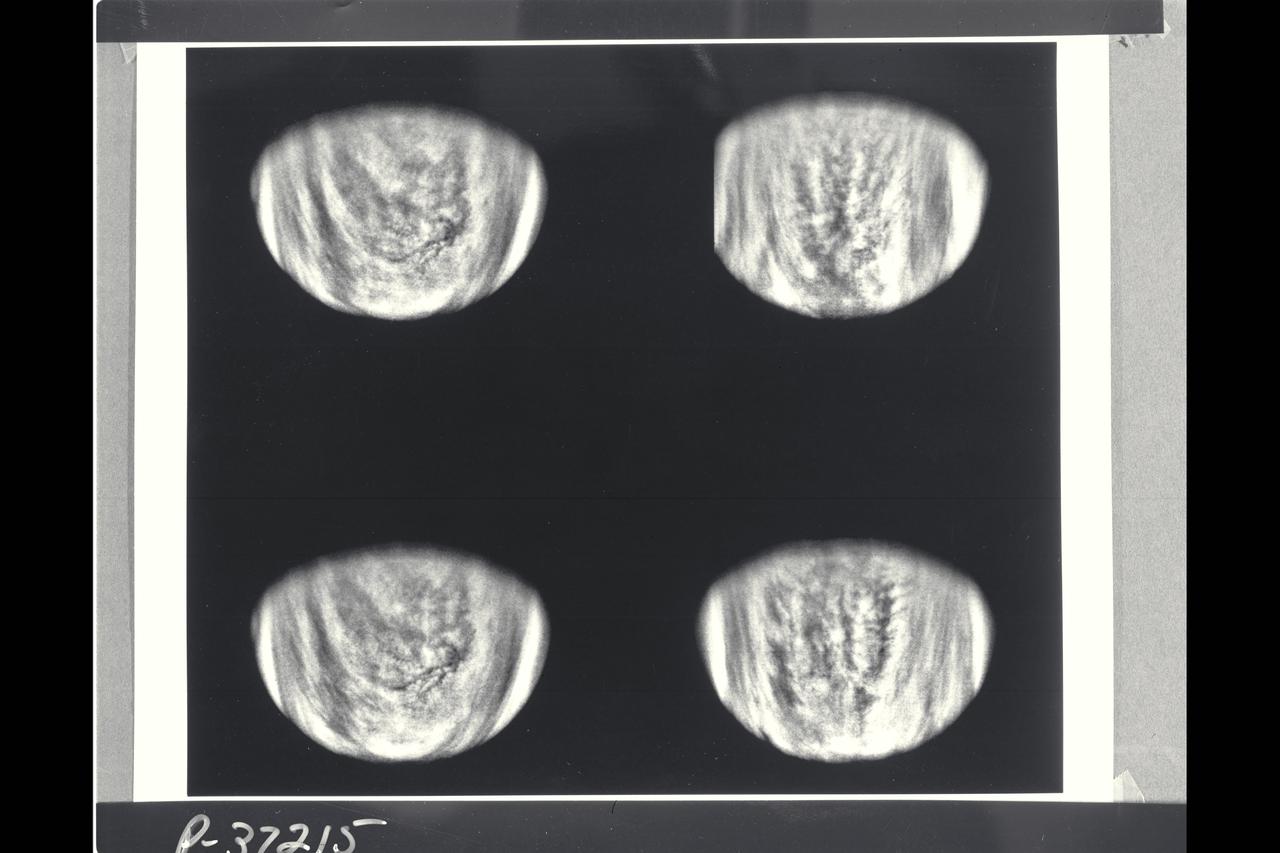
Range : 1.4 to 2 million miles These are enhanced versions of four views of Venus taken by Galileo's Solid State Imaging System. The pictures in the top row were taken about 4 and 5 days after closest approach, and those in the bottom row 6 days after closest approach, 2 hours apart. These show the faint Venusian cloud features vary clearly. A high-pass filter way applied to bring out broader global variations in tone. The bright polar hoods are a well-known feature of Venus. Of particular interest to planetary atmospheric scientists are the complex cloud patterns near the equator, in the vicinity of the bright subsolar point, where convection is most prevalent.
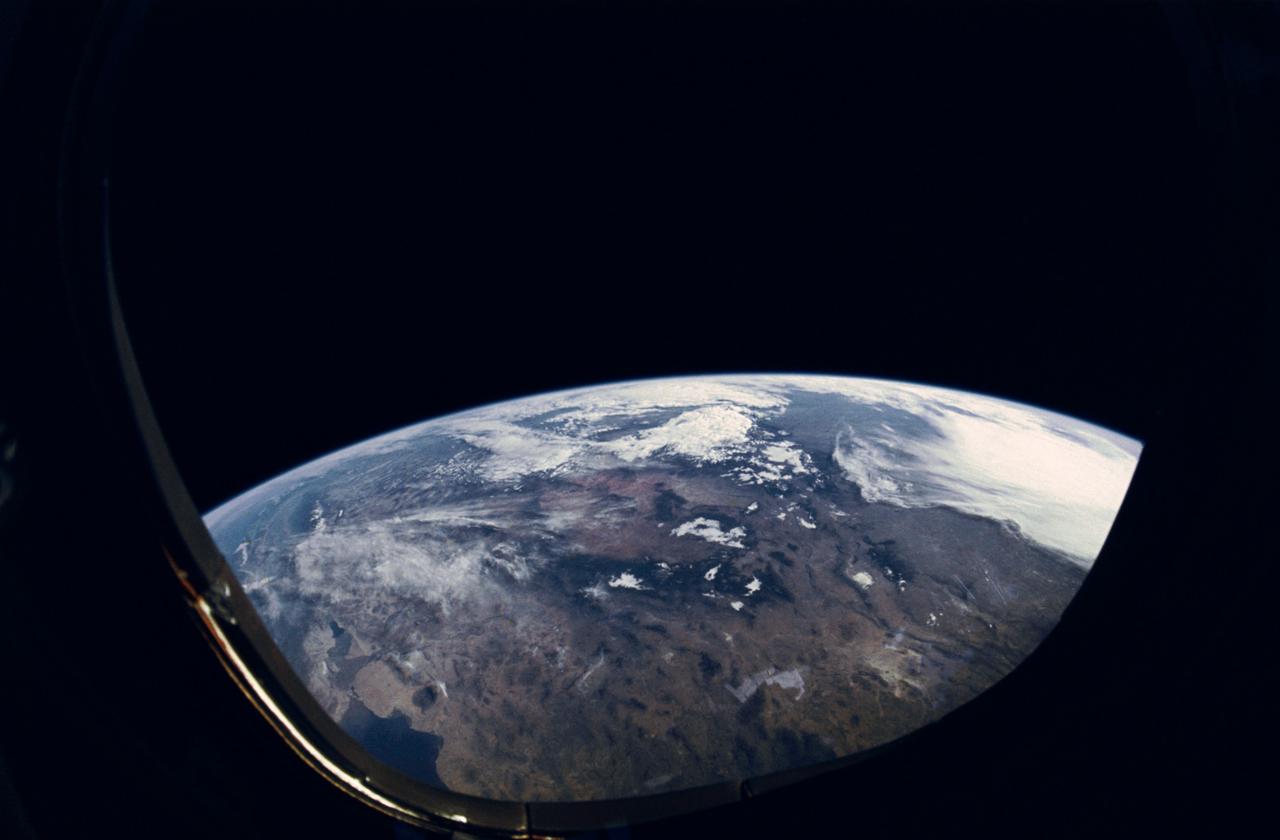
STS-31 Earth observation taken aboard Discovery, Orbiter Vehicle (OV) 103, is of the western United States with the Salton Sea and Imperial Valley area recognizable at the lower left. The view is framed in a flight deck window and was photographed using a fish-eye lens.
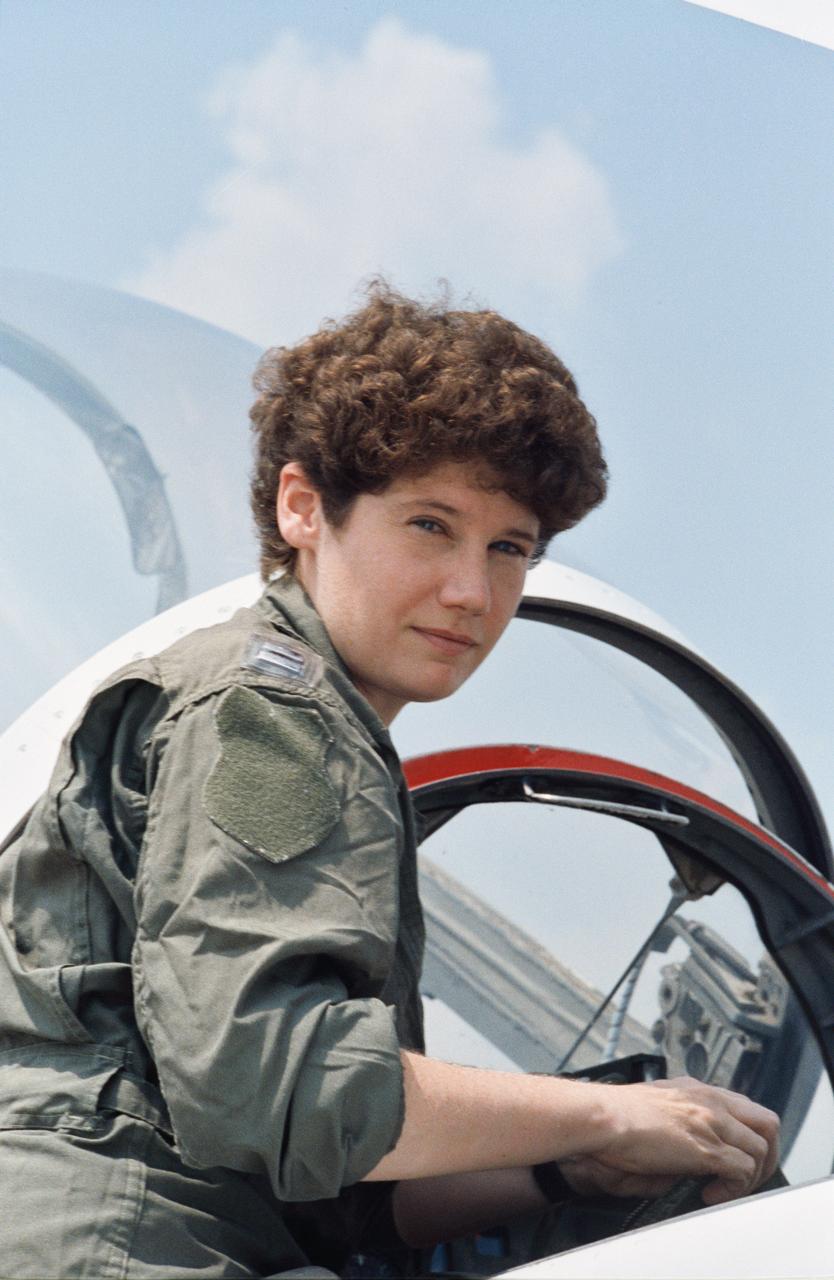
S90-45810 (29-31 July 1990) --- Susan J. Helms, one of 23 astronaut candidate who began a year's training and evaluation in July, climbs into a T-38 jet trainer during a survival training school at Vance Air Force Base in Oklahoma.
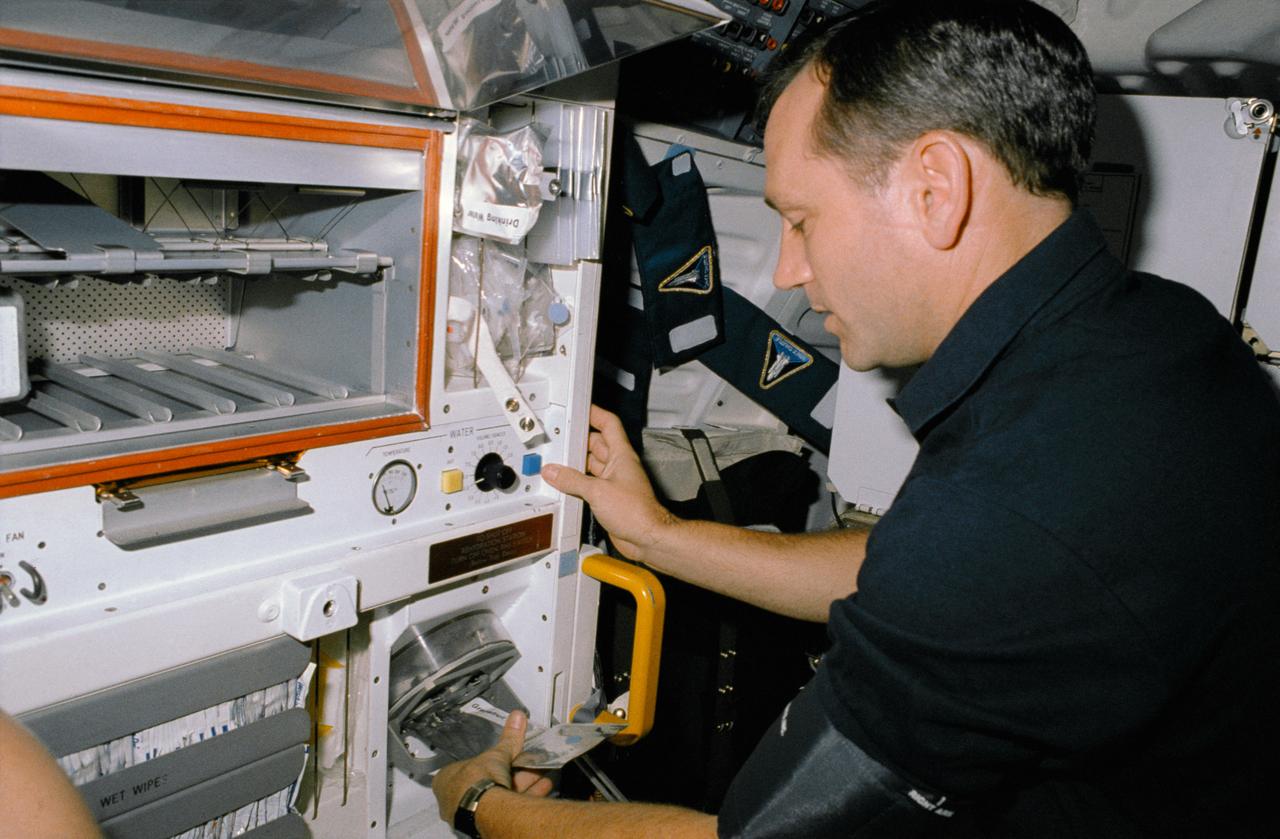
STS041-06-004 (6-10 Oct 1990) --- A 35mm scene of astronaut Thomas D. Akers, STS-41 mission specialist, using Space Shuttle Discovery?s galley water feed to rehydrate a package of food.