New renovated NASA Ames Research Center 12ft Pressure Wind Tunnel view of control room
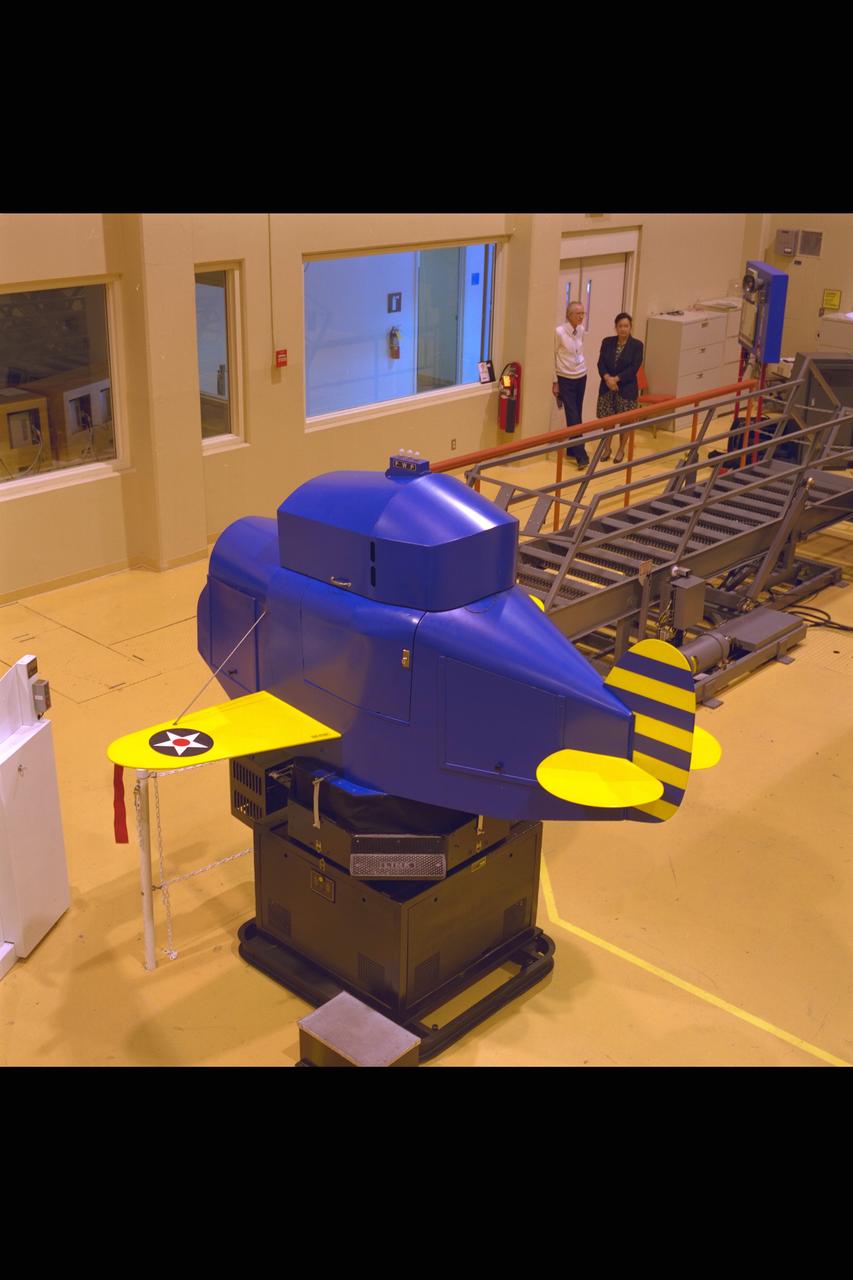
Link Trainer - Blue Box. Historical (1910's) Simulator installed in the NASA Ames Research Center N-257 Crew Vehicle Systems Research Facility (CVSRF)
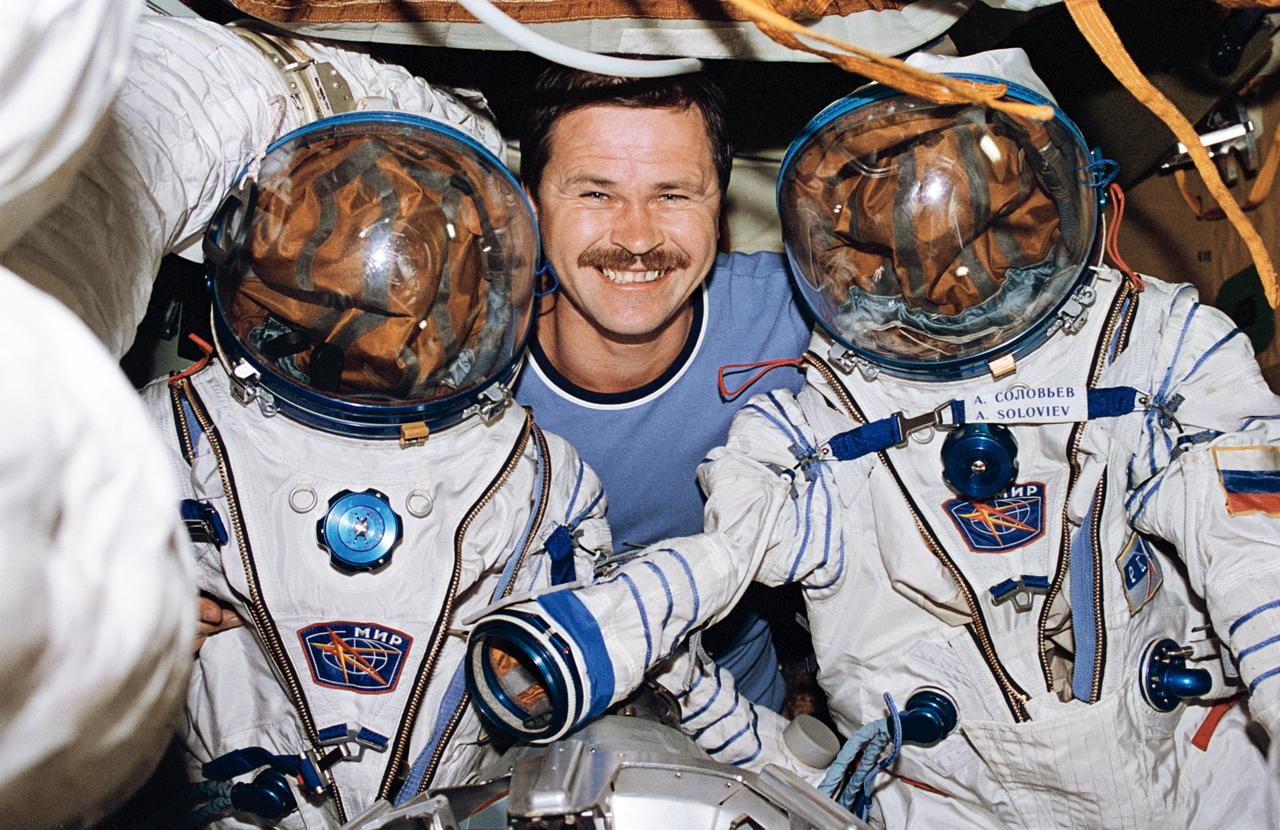
STS071-104-029 (27 June-7 July 1995) --- Cosmonaut Nikolai M. Budarin, Mir-19 flight engineer, is pictured on Russia's Mir Space Station with two Russian space suits. These are for Intravehicular (IVA) wear and are not the suits designed for Extravehicular Activity (EVA). Budarin remained aboard Mir with cosmonaut Anatoly Y. Solovyev, Mir-19 commander, when the three Mir-18 crewmembers and the five STS-71 astronauts later undocked the space shuttle Atlantis from Mir and returned to Earth.
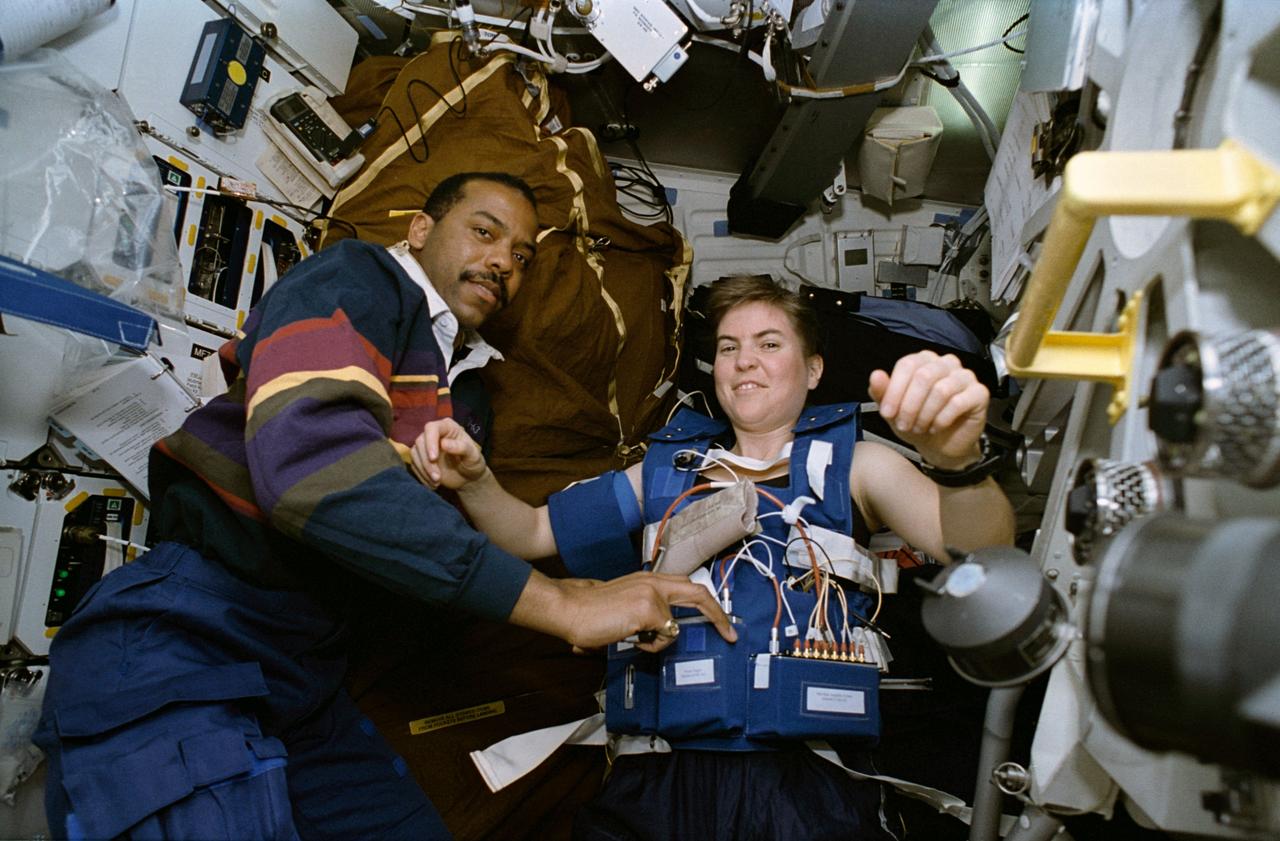
STS063-86-016 (3-11 Feb 1995) --- With astronaut Janice E. Voss, mission specialist, as his test subject, astronaut Bernard A. Harris, Jr., payload commander and a physician, uses a special biomedical harness experiment to check the response of muscles to microgravity. They are on the mid-deck, where many of the SpaceHab 3 experiments are located. The SpaceHab 3 Module is in the cargo bay. Others onboard the Space Shuttle Discovery were astronauts James D. Wetherbee, commander; Eileen M. Collins, pilot; mission specialists C. Michael Foale and Russian cosmonaut Vladimir G. Titov.
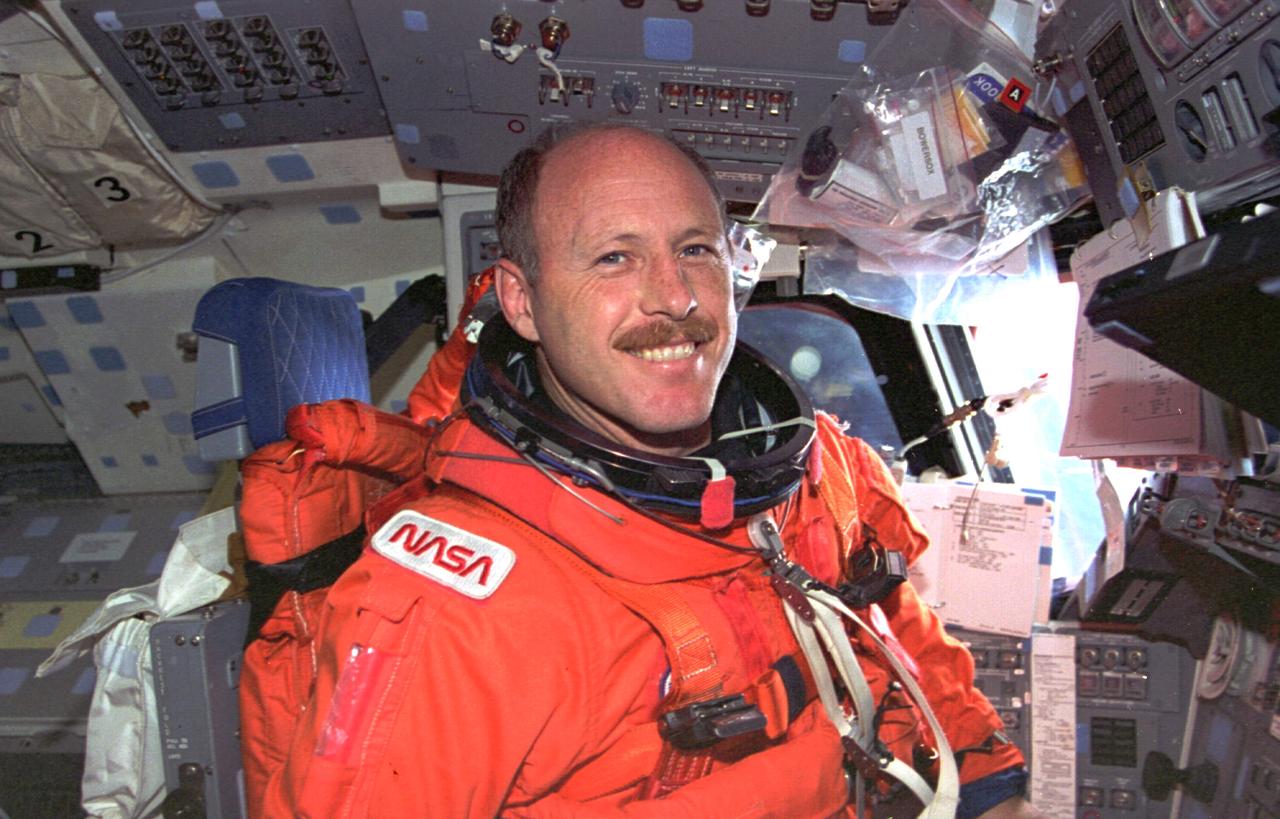
STS073-164-025 (5 November 1995) --- The countenance of astronaut Kenneth D. Bowersox signifies the near completion of a successful 16-day mission in Earth-orbit aboard the Space Shuttle Columbia. Bowersox, attired in the shuttle launch and entry garment, mans the commander's station prior to the entry phase of the flight.
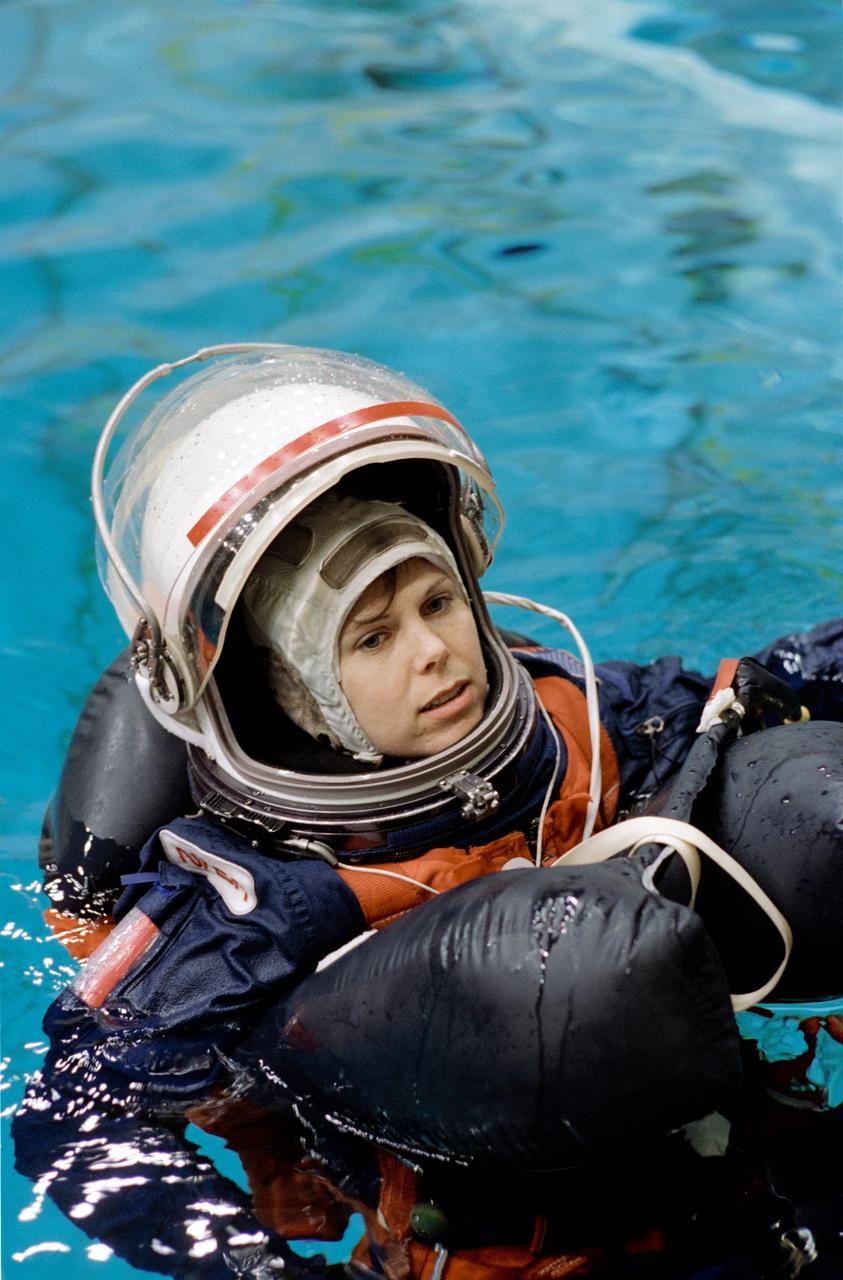
S95-03501 (16 FEB 1995) --- Astronaut Mary Ellen Weber prepares to deploy a life raft during a training session at the Johnson Space Center's (JSC) Weightless Environment Training Facility (WET-F). Training as a mission specialist for the STS-70 mission, Weber was joined by four crew mates in the emergency bailout rehearsal.
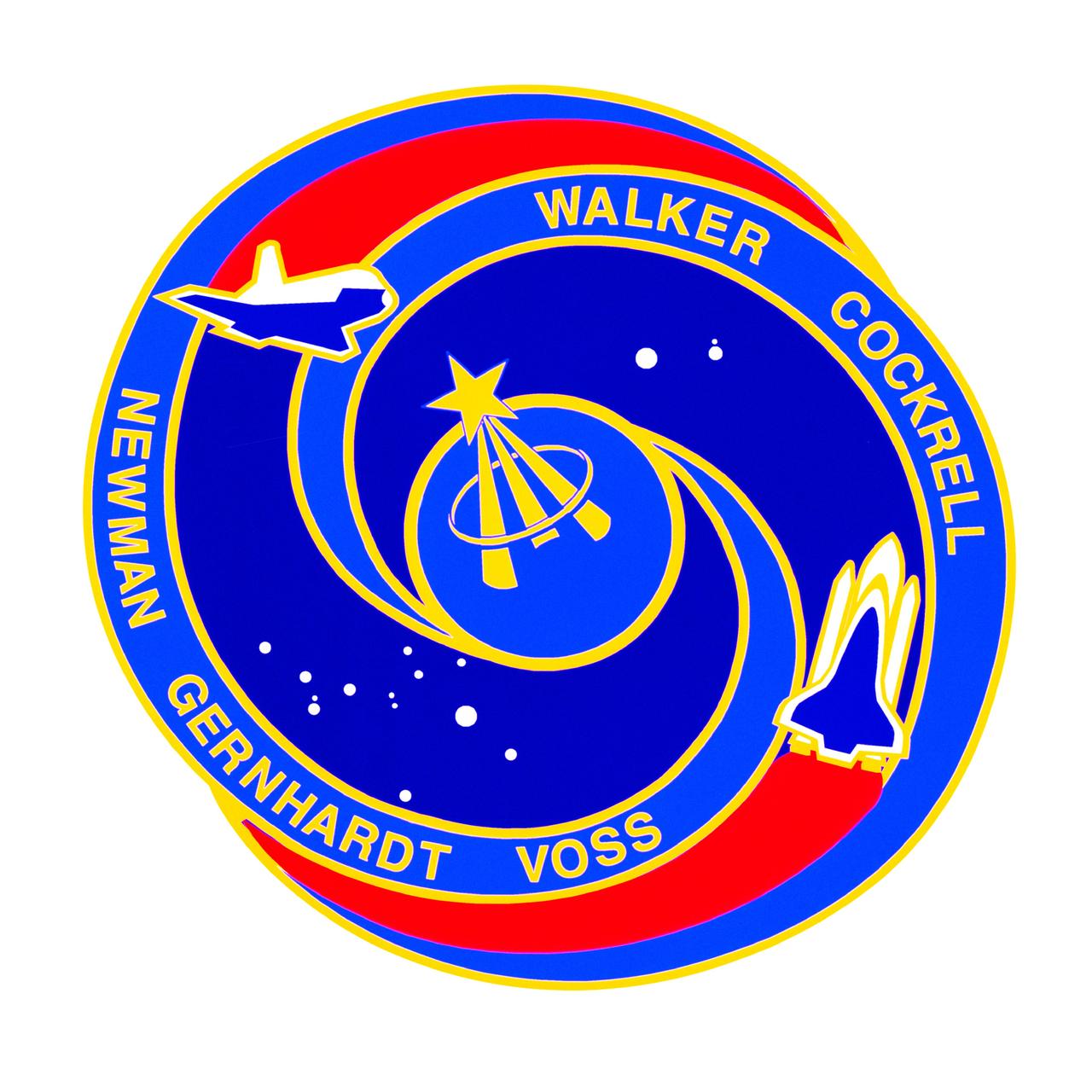
Designed by the mission crew members, the patch for STS-69 symbolizes the multifaceted nature of the flight's mission. The primary payload, the Wake Shield Facility (WSF), is represented in the center by the astronaut emblem against a flat disk. The astronaut emblem also signifies the importance of human beings in space exploration, reflected by the planned space walk to practice for International Space Station (ISS) activities and to evaluate space suit design modifications. The two stylized Space Shuttles highlight the ascent and entry phases of the mission. Along with the two spiral plumes, the stylized Space Shuttles symbolize a NASA first, the deployment and recovery on the same mission of two spacecraft (both the Wake Shield Facility and the Spartan). The constellations Canis Major and Canis Minor represent the astronomy objectives of the Spartan and International Extreme Ultraviolet Hitchhiker (IEH) payload. The two constellations also symbolize the talents and dedication of the support personnel who make Space Shuttle missions possible.
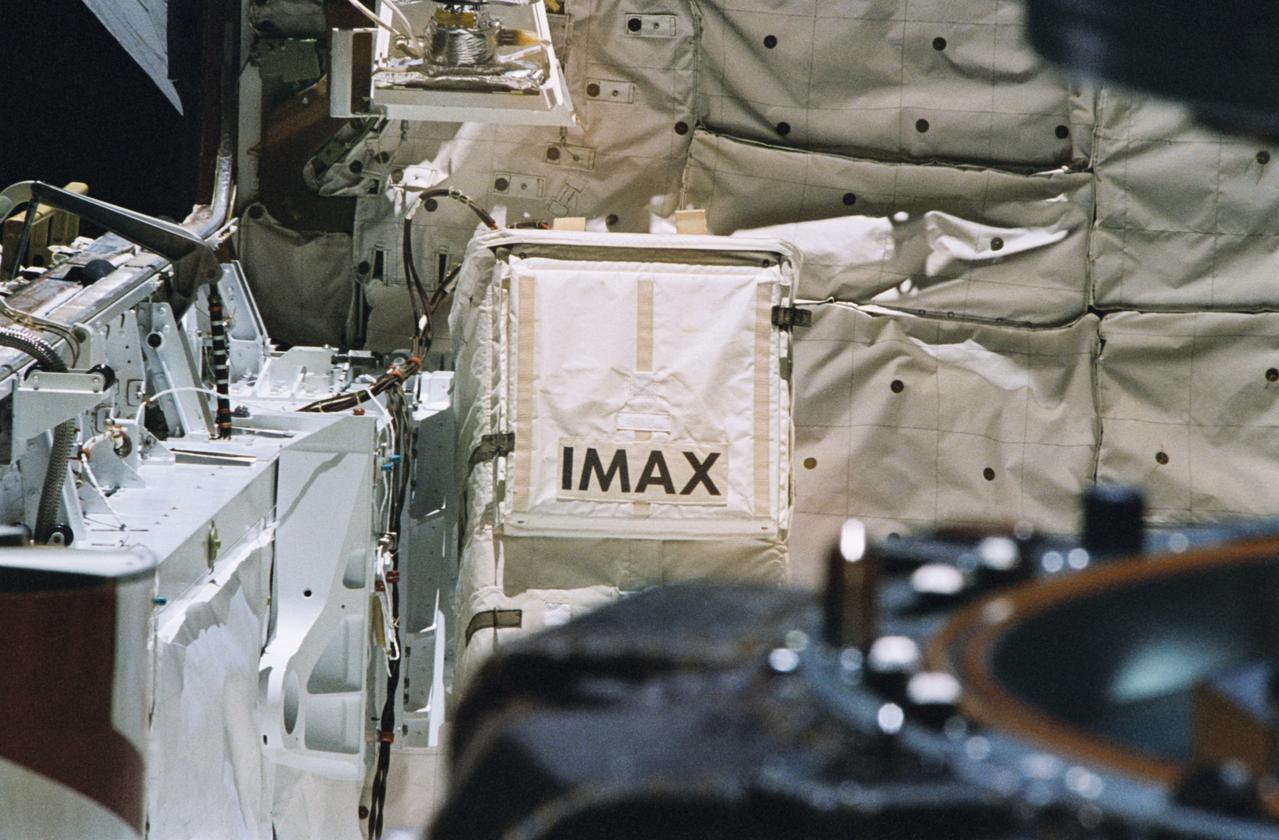
STS074-361-035 (12-20 Nov 1995) --- This medium close-up view centers on the IMAX Cargo Bay Camera (ICBC) and its associated IMAX Camera Container Equipment (ICCE) at its position in the cargo bay of the Earth-orbiting Space Shuttle Atlantis. With its own ?space suit? or protective covering to protect it from the rigors of space, this version of the IMAX was able to record scenes not accessible with the in-cabin cameras. For docking and undocking activities involving Russia?s Mir Space Station and the Space Shuttle Atlantis, the camera joined a variety of in-cabin camera hardware in recording the historical events. IMAX?s secondary objectives were to film Earth views. The IMAX project is a collaboration between NASA, the Smithsonian Institution?s National Air and Space Museum (NASM), IMAX Systems Corporation, and the Lockheed Corporation to document significant space activities and promote NASA?s educational goals using the IMAX film medium.
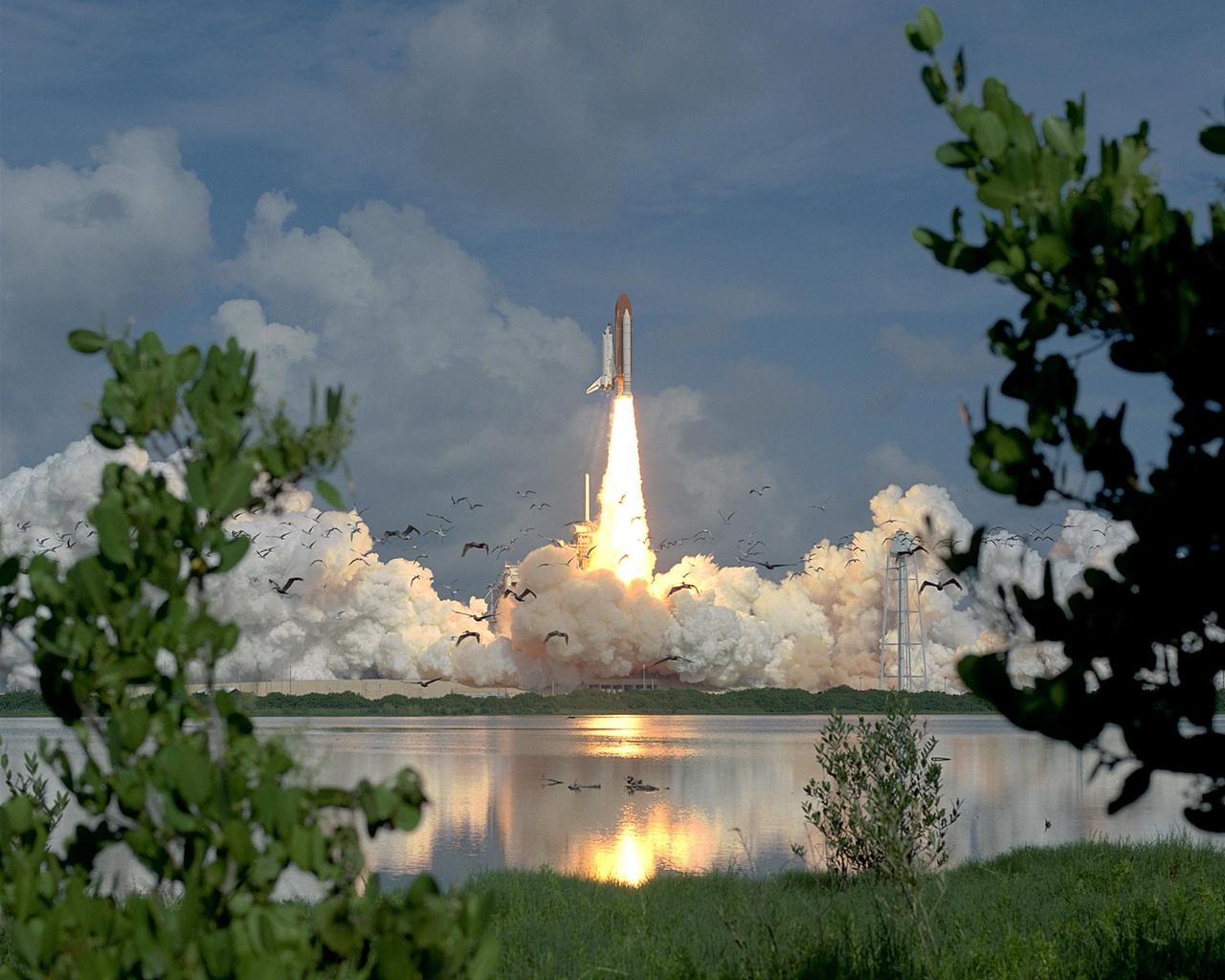
Startled birds scatter as the stillness of a summer morning is broken by a giant's roar. The Space Shuttle Discovery thundered into space from Launch Pad 39B at 9:41:55:078 a.m. EDT. STS-70 is the 70th Shuttle flight overall, the 21st for Discovery (OV-103), and the fourth Shuttle flight in 1995. On board for the nearly eight-day mission are a crew of five: Commander Terence "Tom" Henricks, Pilot Kevin R. Kregel, and Mission Specialists Nancy Jane Currie, Donald A. Thomas and Mary Ellen Weber. The crew's primary objective is to deploy the Tracking and Data Relay Satellite-G (TDRS-G), which will join a constellation of other TDRS spacecraft already on orbit
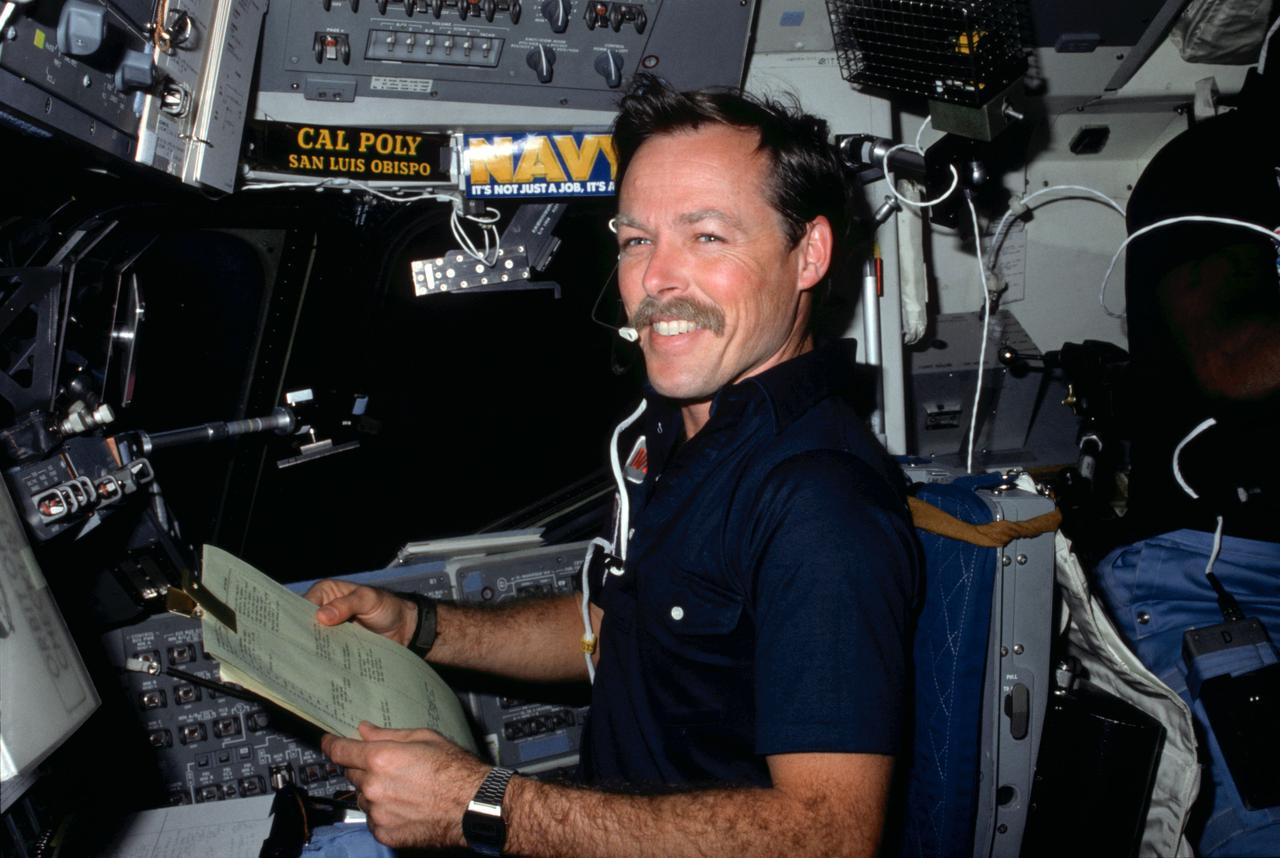
41B-07-230 (S84-27027) (3-11 February 1984) ---Astronaut Robert L. Gibson, 41-B pilot, reviews some teleprinter copy on the flight deck?s starboard station during the eight-day 41-B Space Shuttle mission. Four other astronauts share the Challenger with Gibson. They are Astronauts Vance D. Brand, commander; and Ronald E. McNair, Bruce McCandless II and Robert L. Stewart, all mission specialists. The photograph was taken from the commander?s station with a 35mm camera.
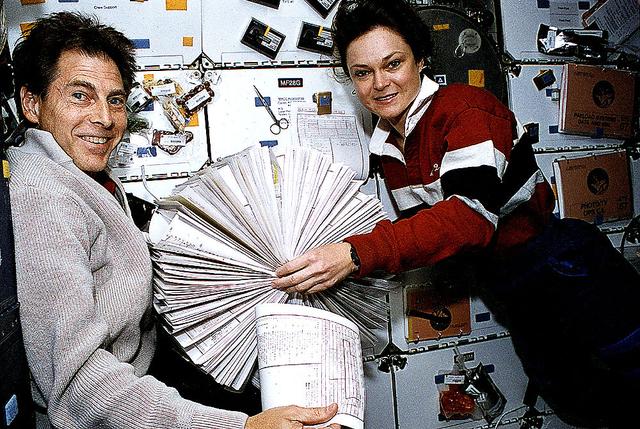
Astronaut Tamara Jernigan, STS-67 payload commander, and payload specialist Samuel T. Durrance use the absence of gravity for a perusal of Astro-2 targets in a loose-leaf, Rolodex-type collection of data. The two are in the mid-deck of the Earth-orbiting Space Shuttle Endeavour.
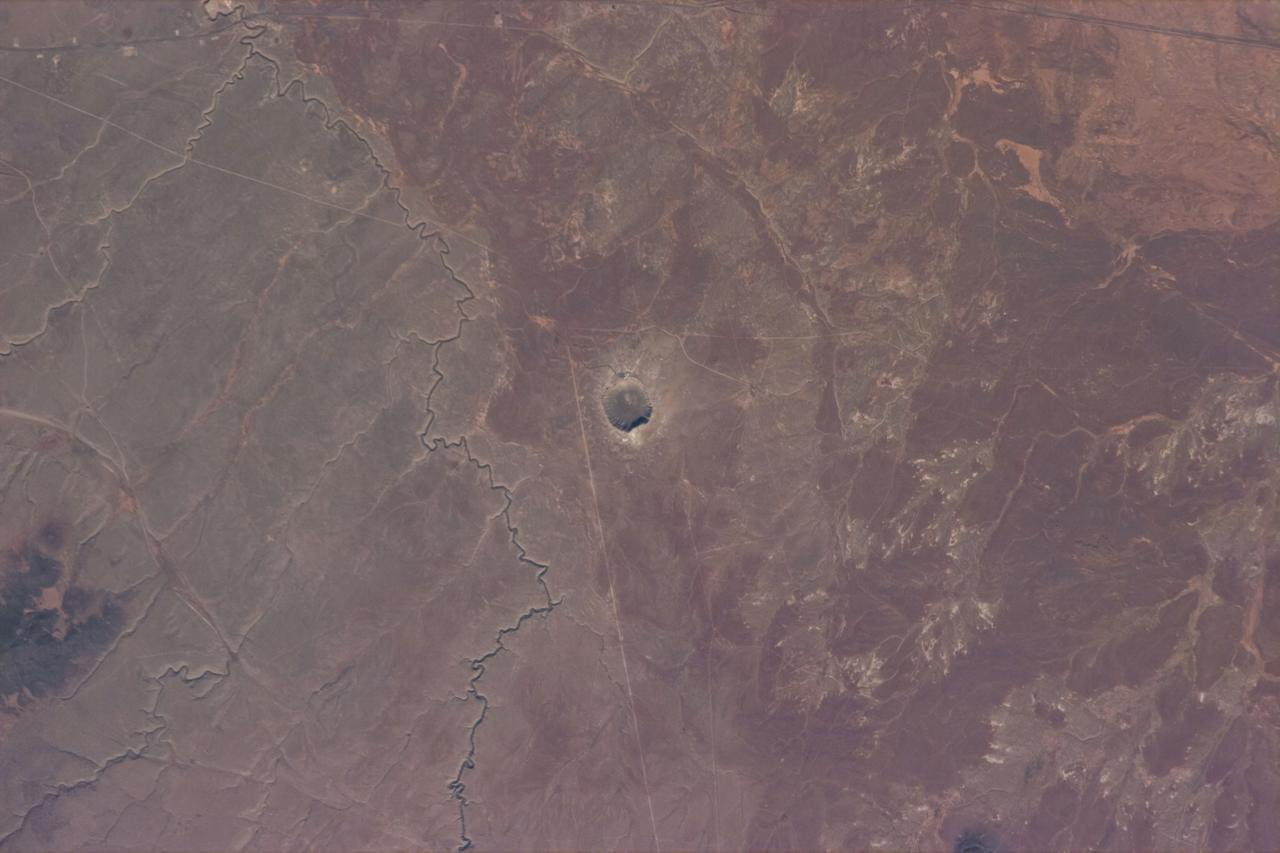
Earth observations taken from shuttle Columbia during STS-73 mission. Views were taken using an electronic still camera.
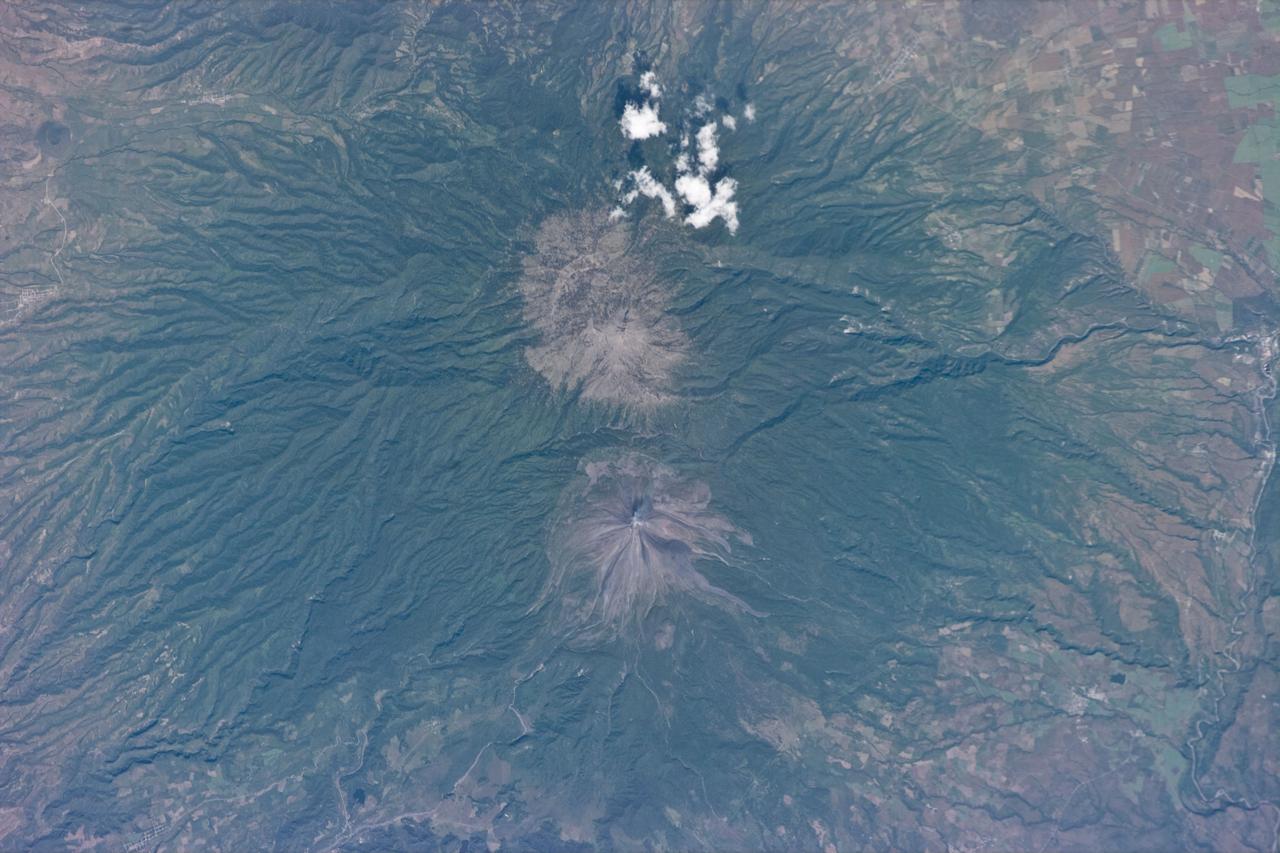
STS073-E-5274 (3 Nov. 1995) --- Colima was photographed with a color Electronic Still Camera (ESC) onboard the Earth-orbiting space shuttle Columbia. The volcano lies due south of Guadalajara and Lake Chapala. It is considered to be one of Mexico's most active and most dangerous volcanoes, lying not far from heavily populated areas.
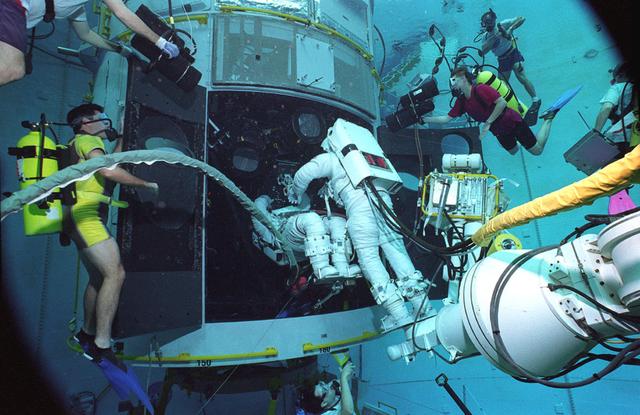
Astronauts Greg Harbaugh and Steve Smith conduct Hubble Space Telescope (HST) training in Marshall's Neutral Buoyancy Simulator (NBS).
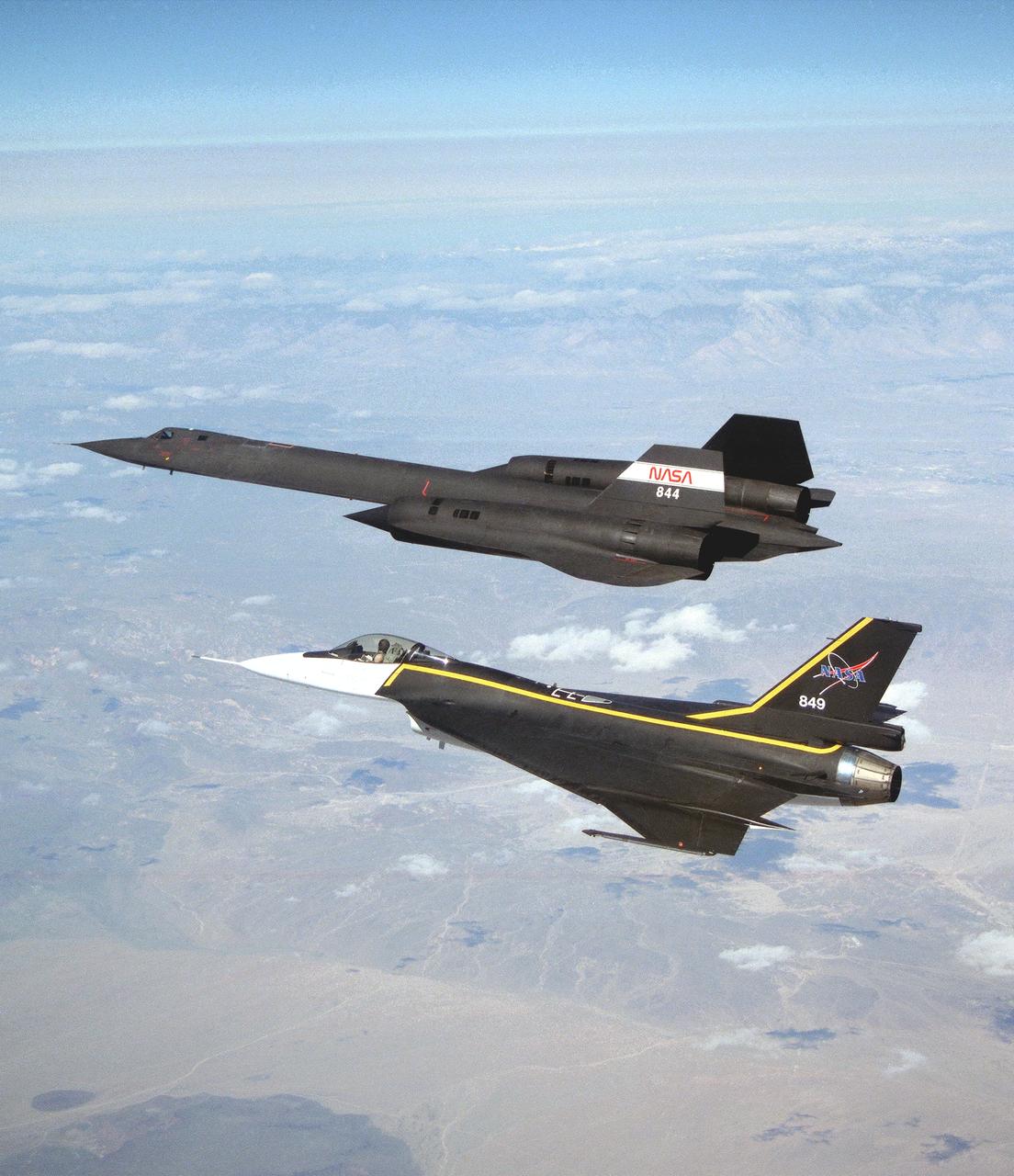
The single-seat F-16XL, NASA 849, joins up with an SR-71A, NASA 844, as crews set up for one of the flights in the recent sonic boom research program conducted by the Dryden Flight Research Center, Edwards, California. During the missions, the F-16XL probed the shockwaves generated by the SR-71, while at lower altitudes sensors on an F-18 and on a YO-3A, and also on the ground, recorded data from the same shockwave.
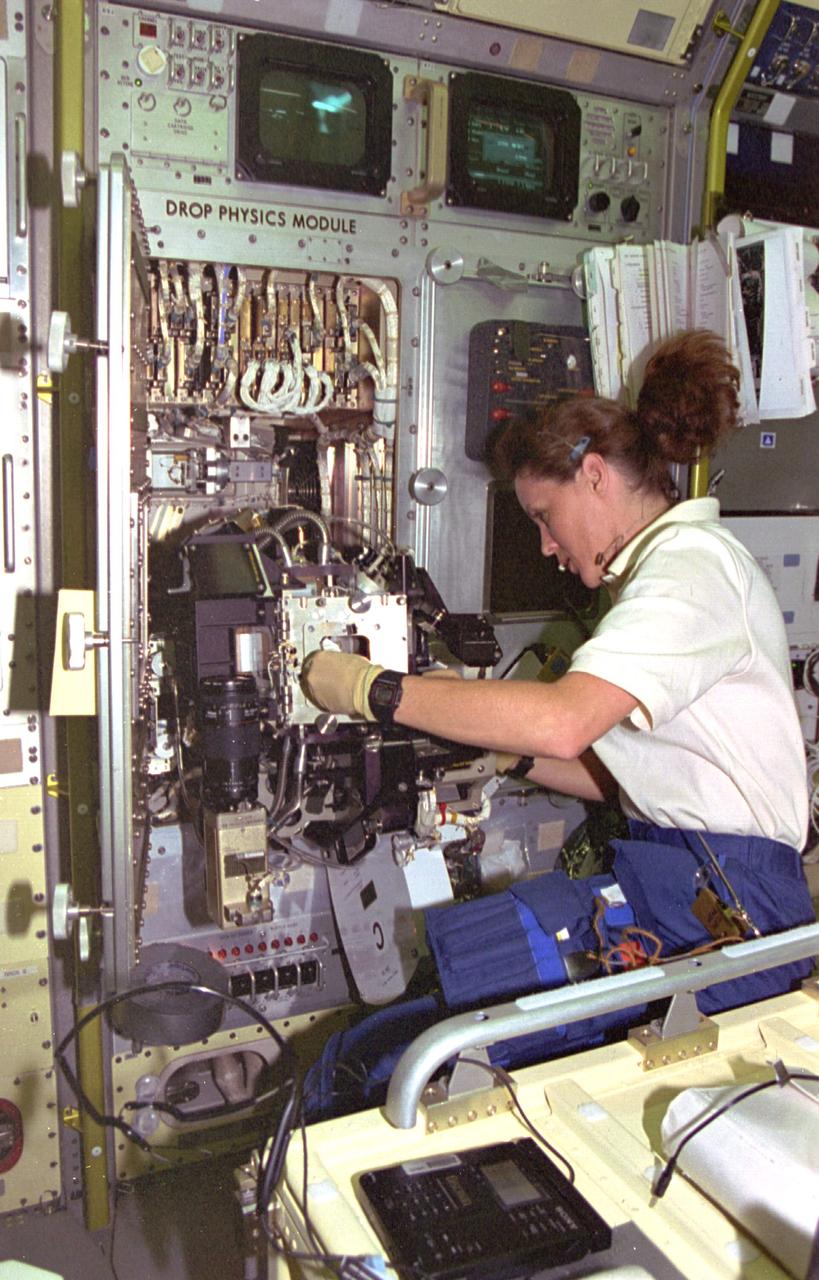
STS073-143-026 (20 October-5 November 1995) --- Astronaut Kathryn C. Thornton, STS-73 payload commander for the United States Microgravity Laboratory (USML-2), explores the inner workings of the Drop Physics Module (DPM). Thornton was joined by four other NASA astronauts and two guest researchers for almost 16 days of research aboard the Space Shuttle Columbia in Earth-orbit.
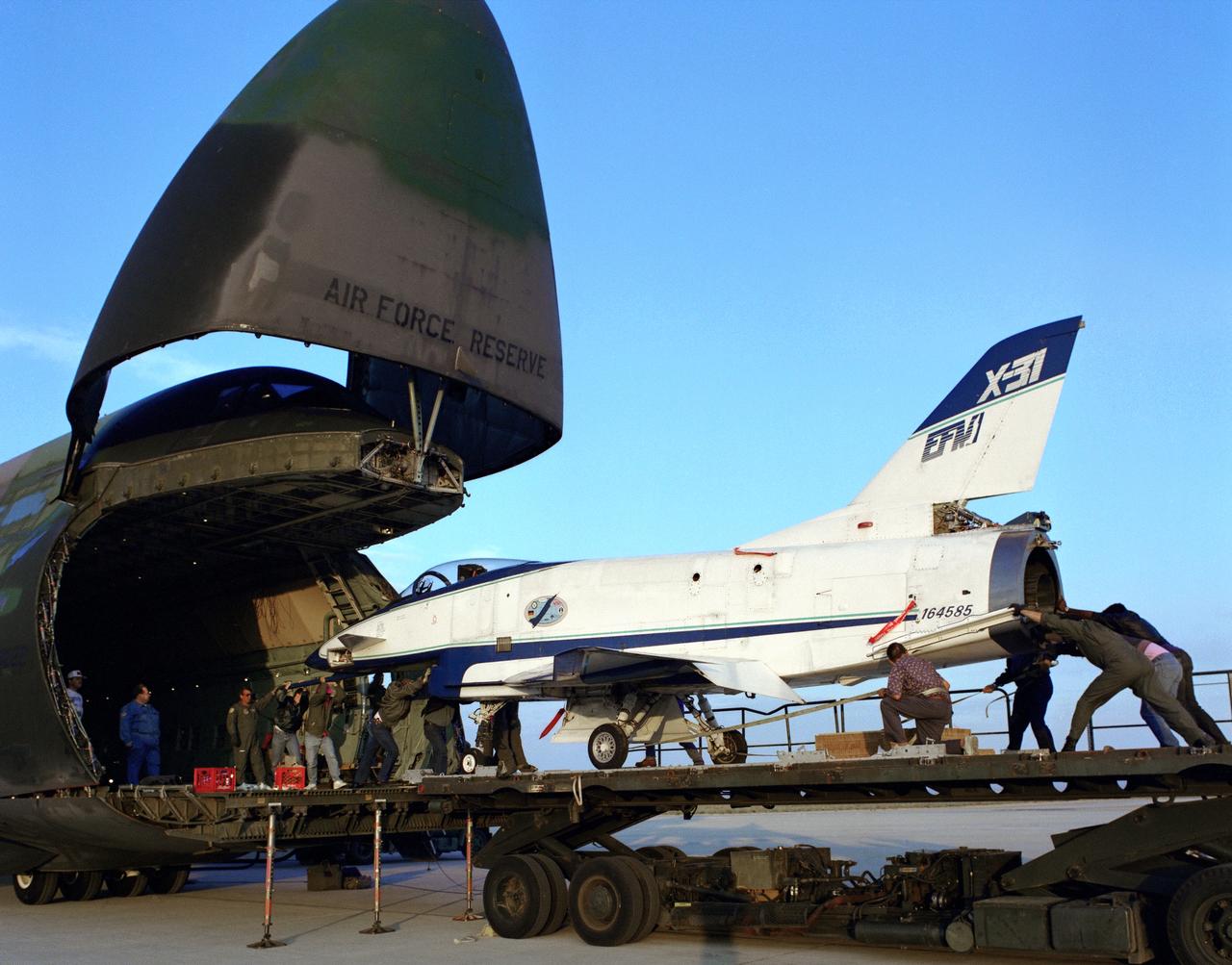
The X-31 Enhanced Fighter Maneuverability Technology Demonstrator Aircraft, based at the NASA Dryden Flight Research Center, Edwards, California, begins rolling aboard an Air Force Reserve C-5 transport which ferried it on May 22, 1995 to Europe where it was flown in the Paris Air Show in June 1995. To fit in the C-5 the right wing of the X-31 had to be removed. At the air show, the X-31 demonstrated the value of using thrust vectoring (directing engine exhaust flow) coupled with advanced flight control systems to provide controlled flight at very high angles of attack.
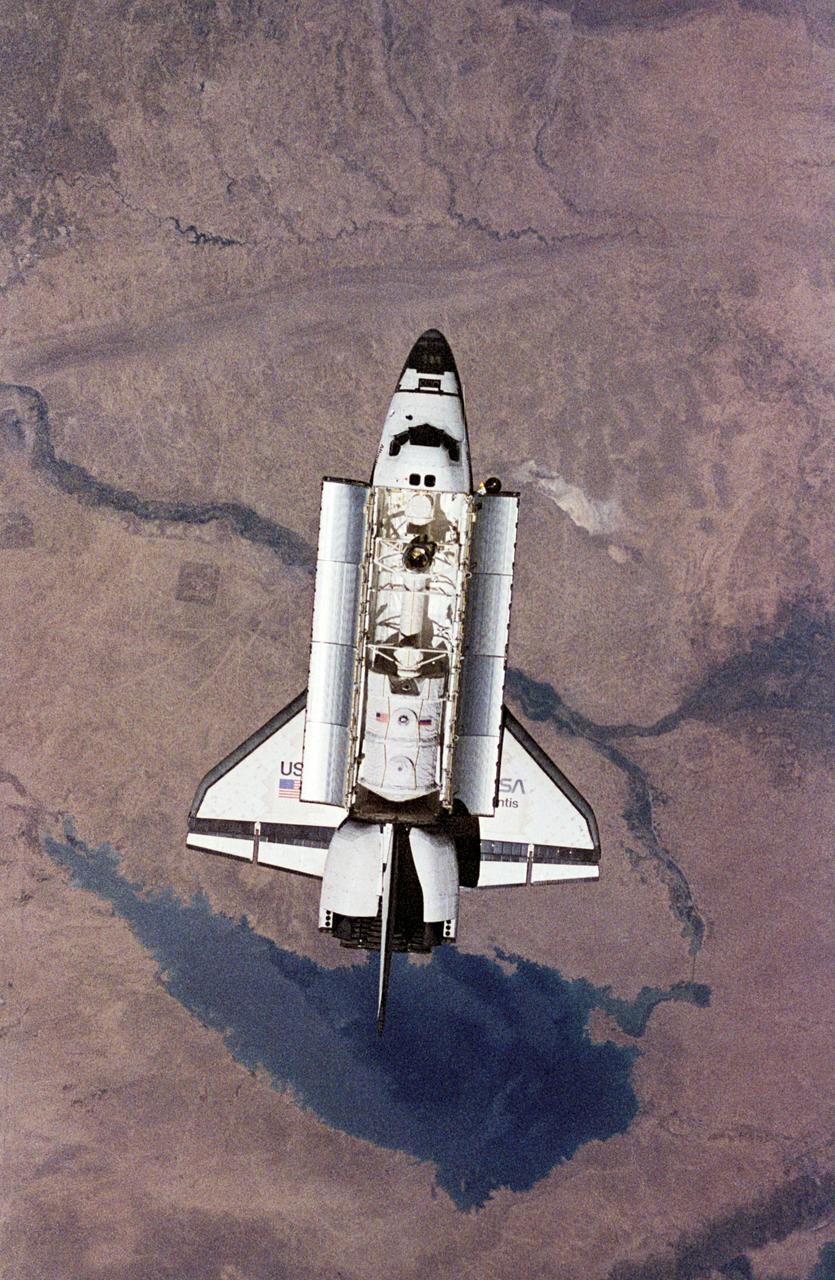
NM18-309-018 (28 June 1995) --- The Space Shuttle Atlantis orbits Earth at a point above Iraq as photographed by one of the Mir-18 crew members aboard Russia's Mir Space Station. The image was photographed prior to rendezvous and docking of the two spacecraft. The Spacelab science module and the tunnel connecting it to the crew cabin, as well as the added mechanism for interface with the Mir's docking system can be easily seen. The geography pictured is 60 miles northwest of Baghdad. The Buhayrat Ath Tharthar (reservoir) is the widest body of water visible. Also seen are the Tigris and Euphrates Rivers.
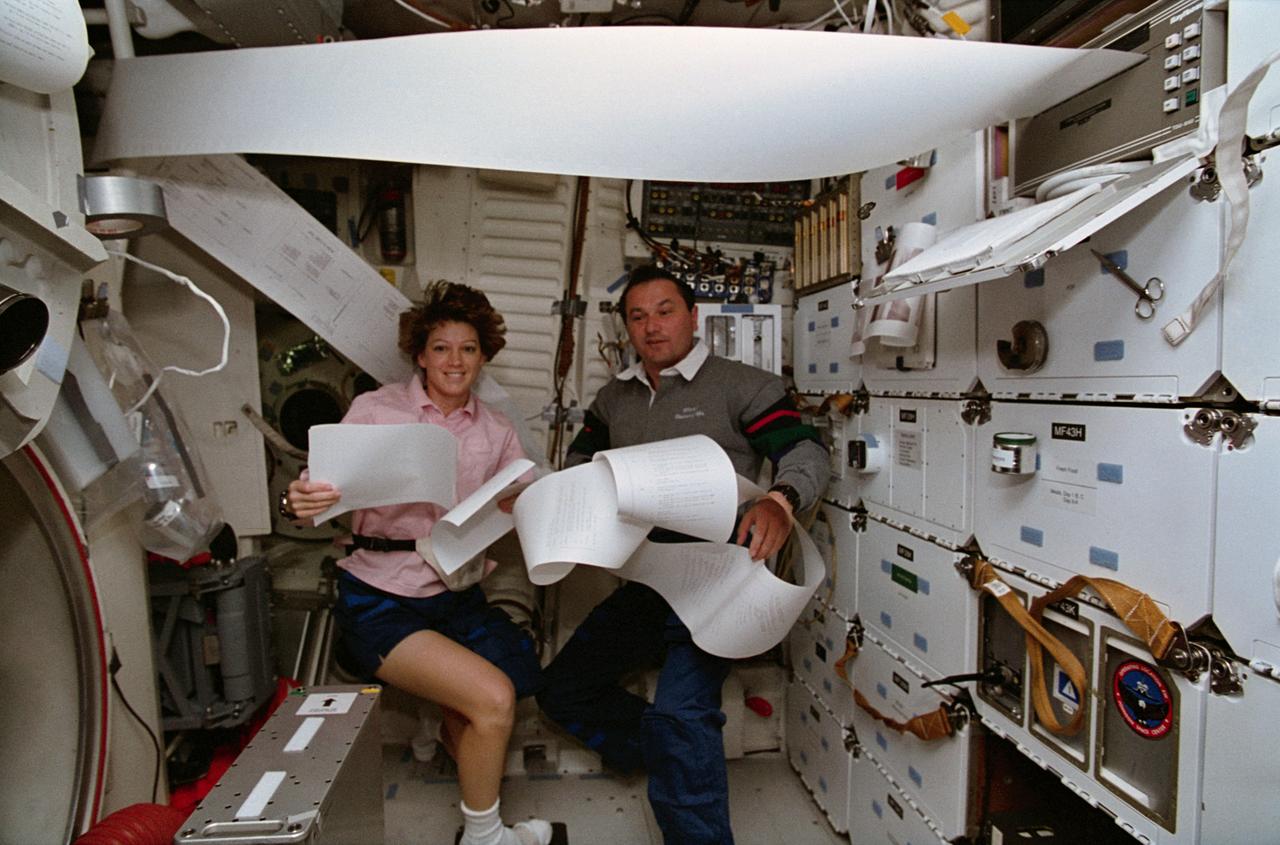
STS063-86-028 (3-11 Feb 1995) --- On the Space Shuttle Discovery's middeck, astronaut Eileen M. Collins and cosmonaut Vladimir G. Titov attempt to organize a lengthy mail message from flight controllers on Earth. Collins was pilot for the eight day mission and Titov served as a mission specialist representing the Russian Space Agency (RSA), thus becoming one of a small number of people to have flown on spacecraft launched by the United States and Russia. Approximately 30 feet of messages from the Thermal Imaging Printing System (TIPS) are spread around the middeck.

NM18-305-029 (March-July 1995) --- Cosmonaut Gennadiy M. Strekalov, Mir-18 flight engineer, writes on a can lid. During the 115-day stay, crew members often had to improvise for the shortage of paper. This particular set of notes had to do the re-routing of cables on Mir. This visual was one of many that the three Mir-18 crew emembers showed at a July 18 press conference in Houston.
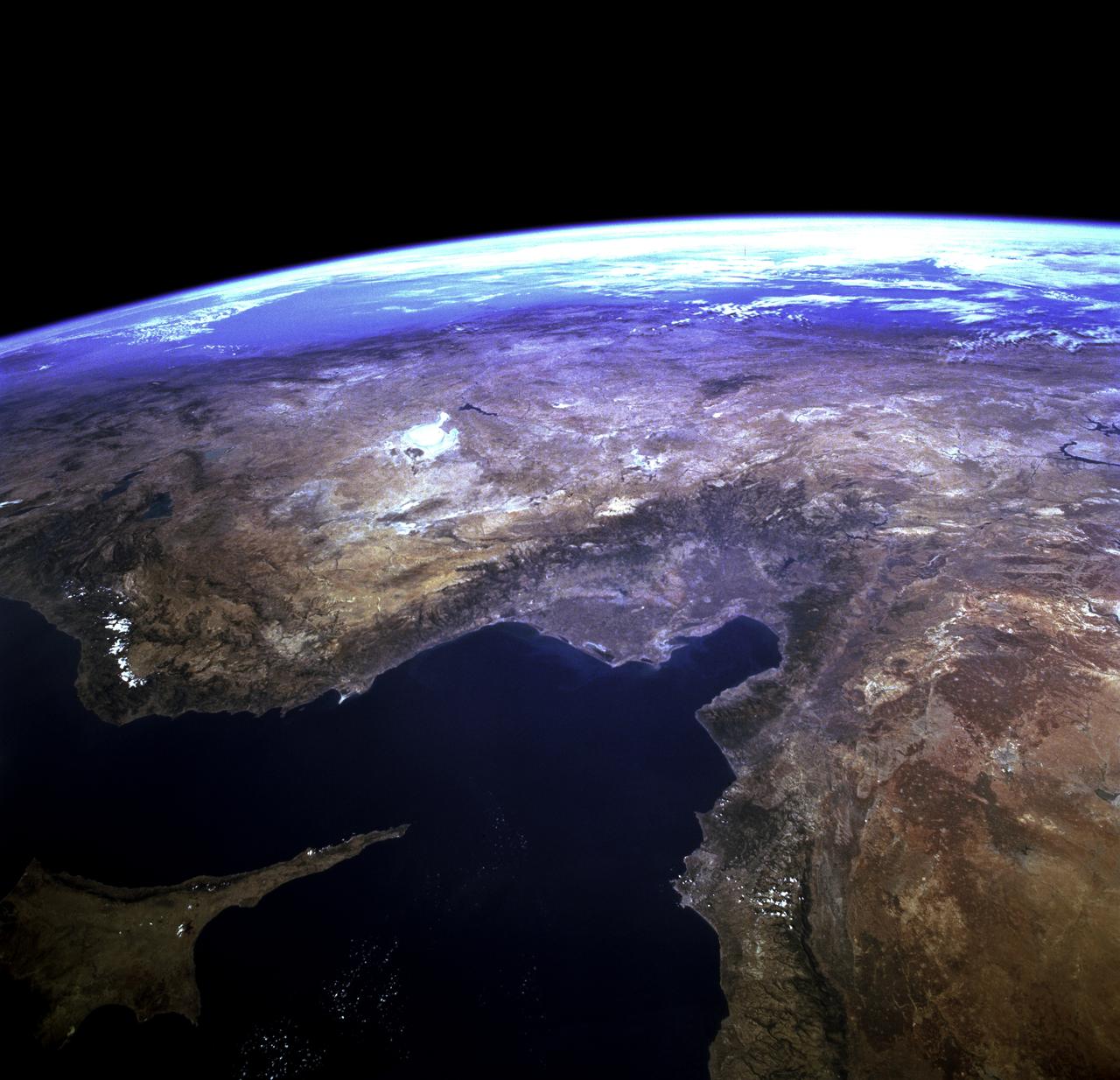
STS073-723-054 (21 October 1995) --- Central Turkey dominates this north-looking panorama, with the long fingered island of Cyprus lower left, surrounded by the deep blue waters of the Mediterranean Sea. Turkey's capital, Ankara, lies just north of the white bed of a dry lake in the center of the view. The city is supplied with water from the neighboring blue lake. The coast of Syria and Lebanon appear bottom right. Man-made lakes on the upper Euphrates River in eastern Turkey appear extreme right. According to scientists studying the STS-73 photo collection, the striking difference in visibility to north and south of Turkey suggests a pollution event over the Black Sea. Air pollution from East European industry flows down into the Black Sea basin, especially at the west end (haze top left) as shown in this view (compare clearer air top right).
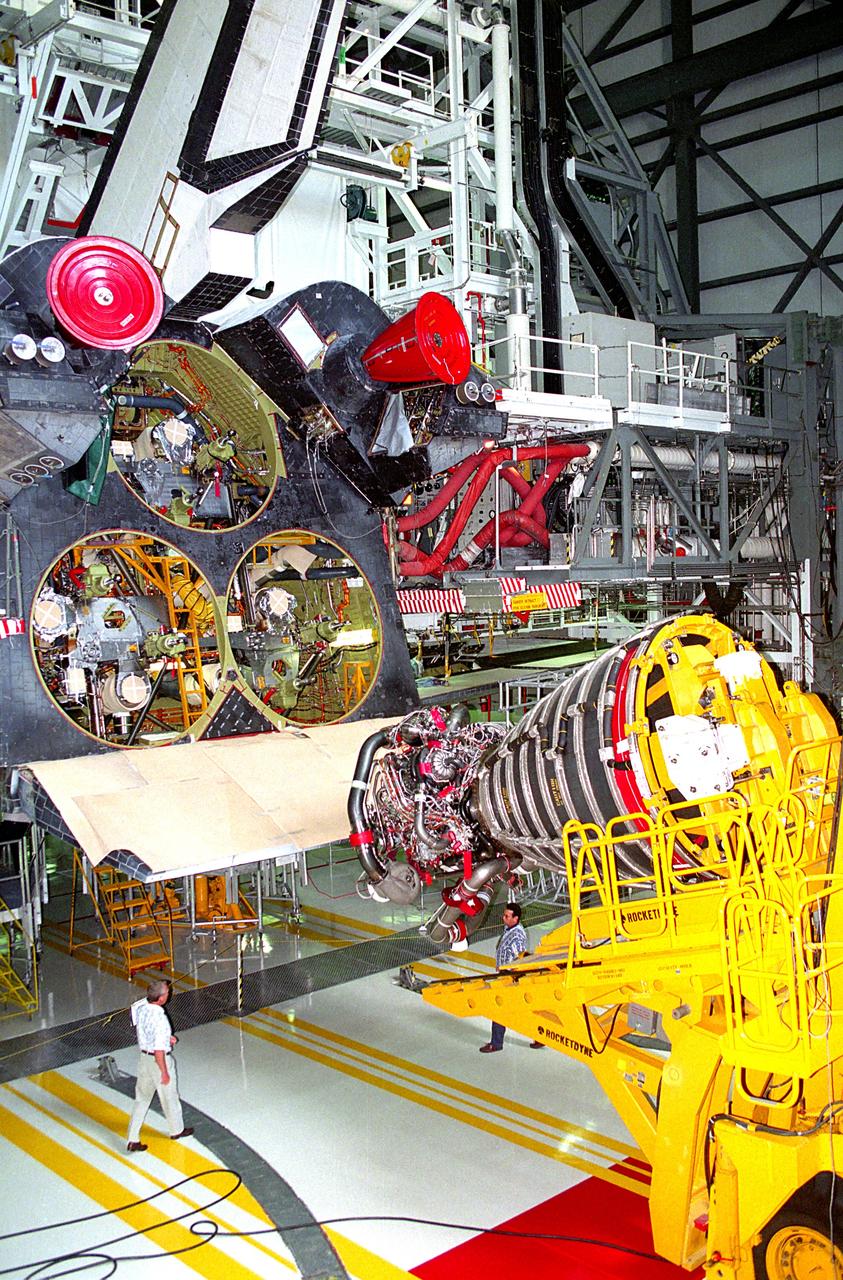
KENNEDY SPACE CENTER, FLA. - A Space Shuttle Main Engine (SSME) hoist prepares to lift the first Block 1 engine to be installed in an orbiter into the number one position on Discovery while the spaceplane is being prepared for the STS-70 mission in the high bay of Orbiter Processing Facility 2. The new engine, SSME No. 2036, features a new high-pressure liquid oxygen turbopump, a two-duct powerhead, a baffleless main injector, a single-coil heat exchanger and start sequence modifications. The other two main engines to be used during the liftoff of the STS-70 mission are of the existing Phase II design.
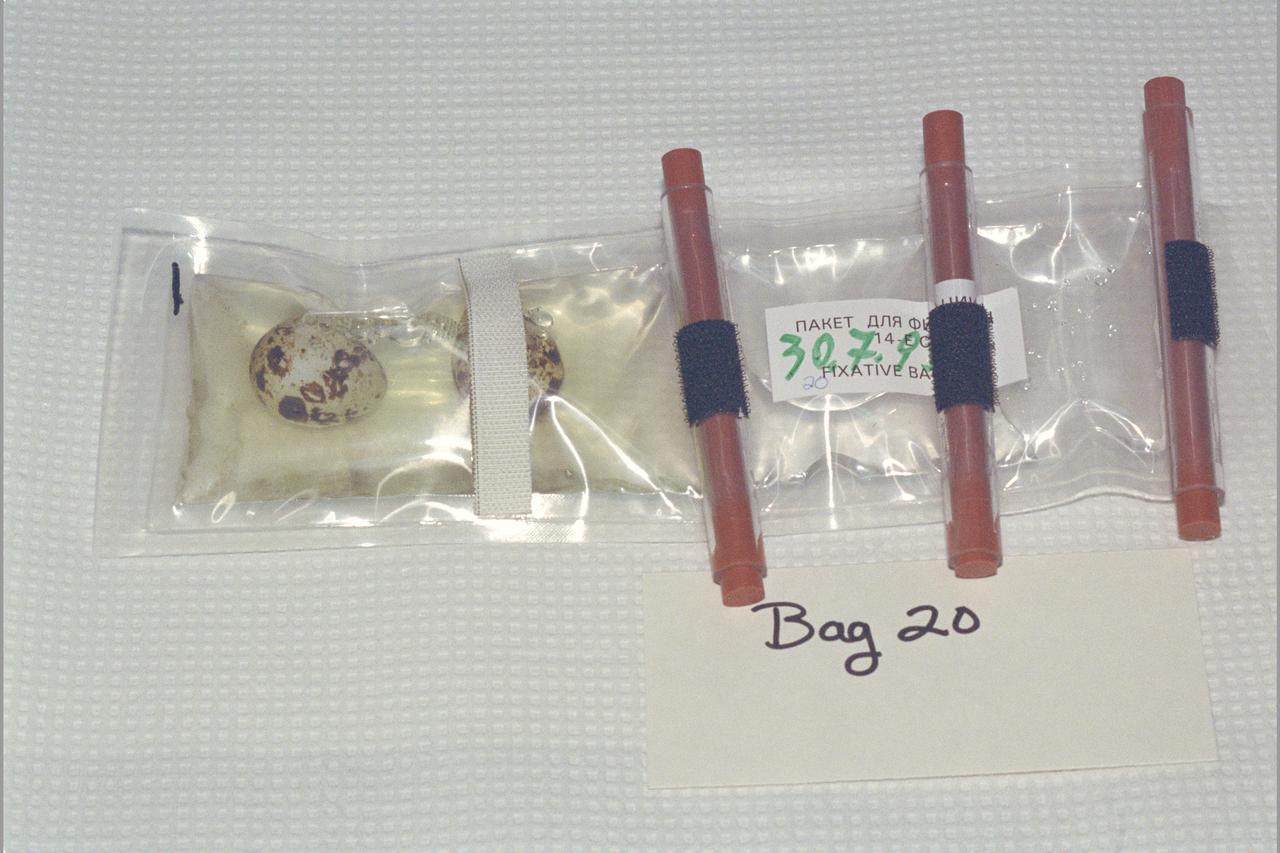
Space Shuttle STS-74 incubator fix kit; Quail Eggs from MIR Space Station
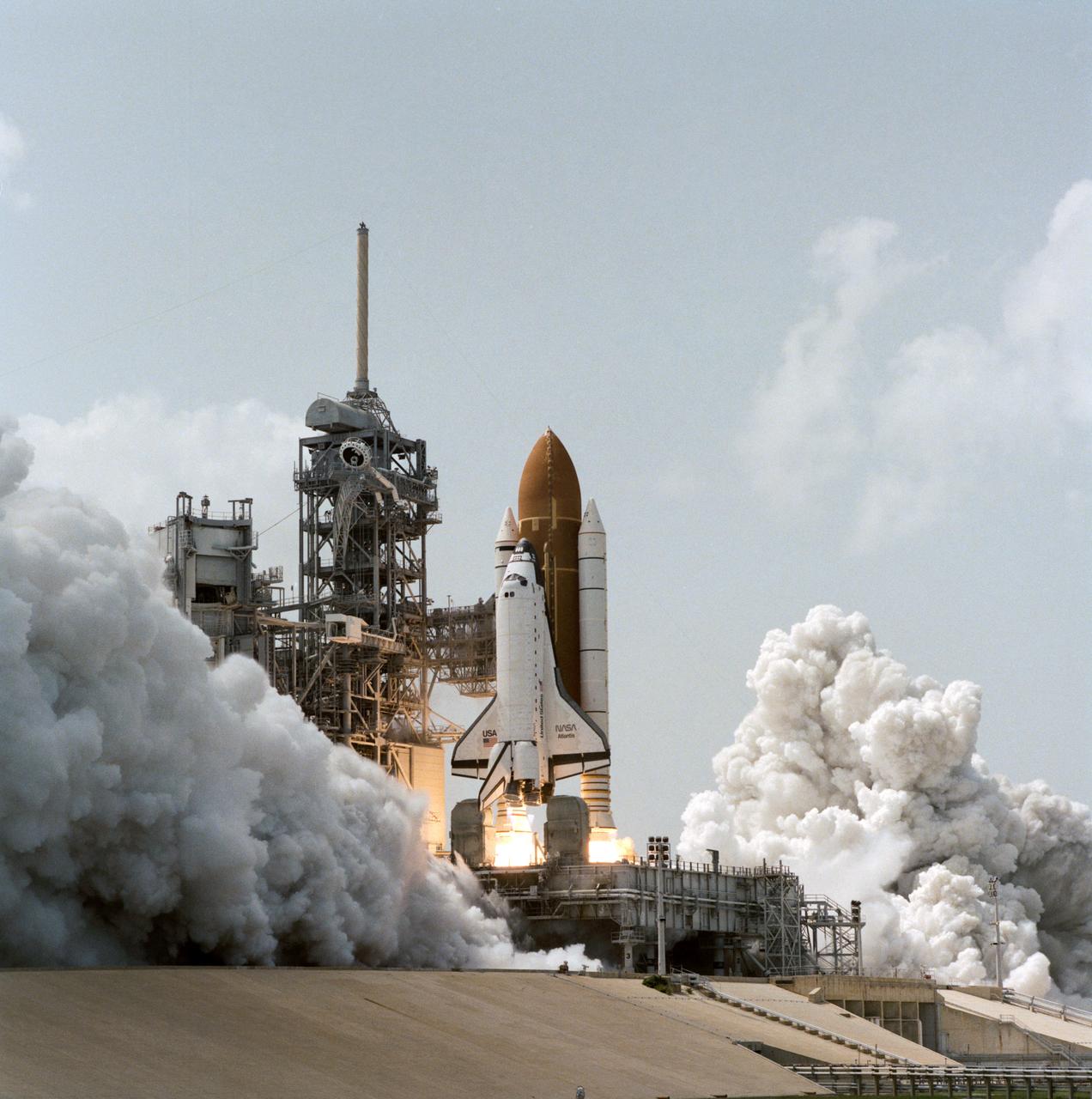
STS071-S-003 (27 June 1995) --- At the Kennedy Space Center's (KSC) Launch Pad 39A, the 100th United States human space launch gets underway at 3:32:19 p.m. (EDT) on June 27, 1995. Onboard the Space Shuttle Atlantis are five NASA astronauts and two Russian cosmonauts. In two days, the crew will join up with astronaut Norman E. Thagard and two Russian cosmonauts who have been onboard Russia's Mir Space Station since March of this year. That pair - Vladimir N. Dezhurov and Gennadiy M. Strekalov - will return to Earth aboard the Space Shuttle Atlantis with Thagard and the short-term United States visitors, while Anatoly Y. Solovyev and Nikolai M. Budarin - the two cosmonauts launched today aboard the Space Shuttle Atlantis - will remain aboard Mir for a longer tour of duty.
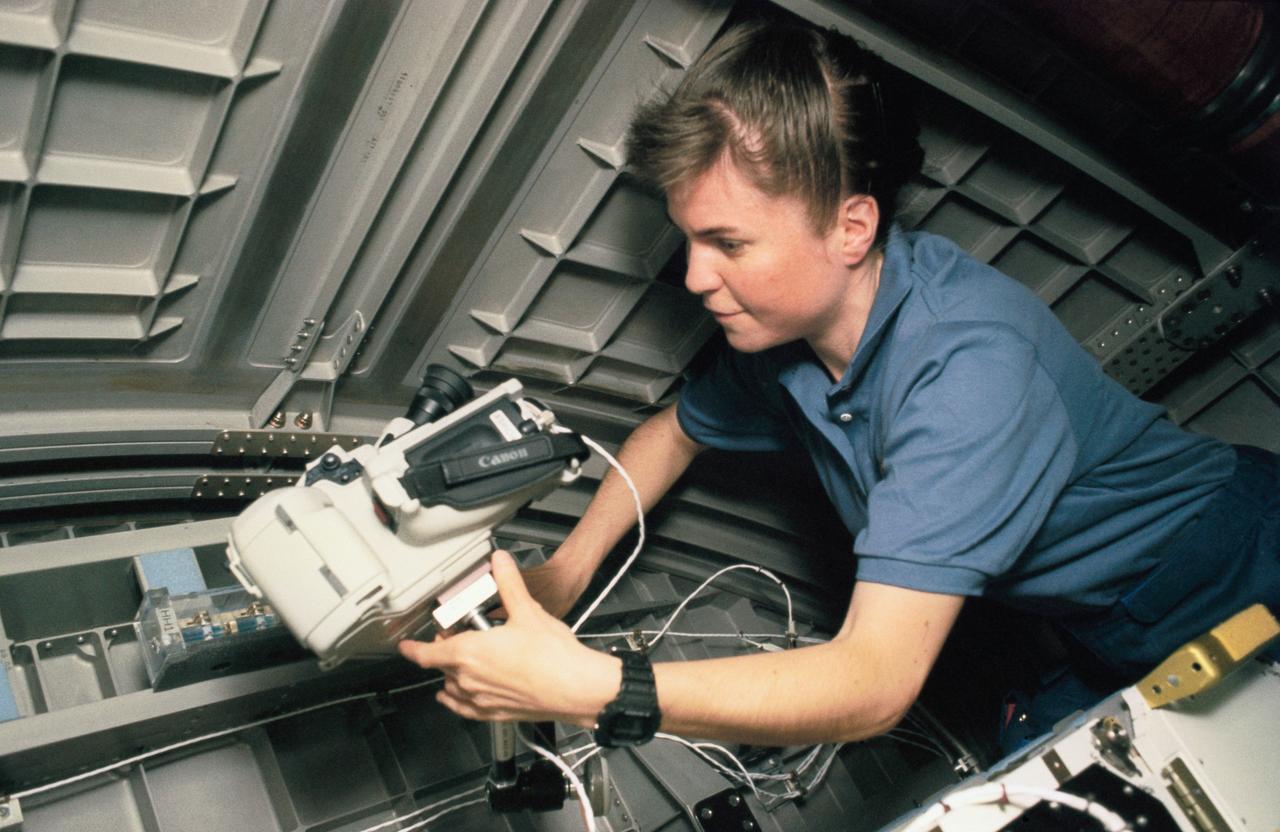
STS063-313-018 (3-11 Feb 1995) --- Janice E. Voss, mission specialist, with a video camera in SpaceHab-3 onboard the Space Shuttle Discovery. This is one of 16 still photographs released by the NASA Johnson Space Center (JSC) Public Affairs Office (PAO) on February 14, 1995. Others onboard the Discovery were astronauts James D. Wetherbee, mission commander; Eileen M. Collins, pilot; Bernard A. Harris Jr., payload commander; mission specialists C. Michael Foale, and cosmonaut Vladimir G. Titov.

STS073-E-5275 (3 Nov. 1995) --- Resort City of Acapulco appears in this north-looking view, photographed from the Earth-orbiting space shuttle Columbia with the Electronic Still Camera (ESC). The airport lies on a narrow neck of land between the sea and a large coastal lagoon. This mission marks the first time NASA has released in mid-flight electronically-downlinked color images that feature geographic subject matter.
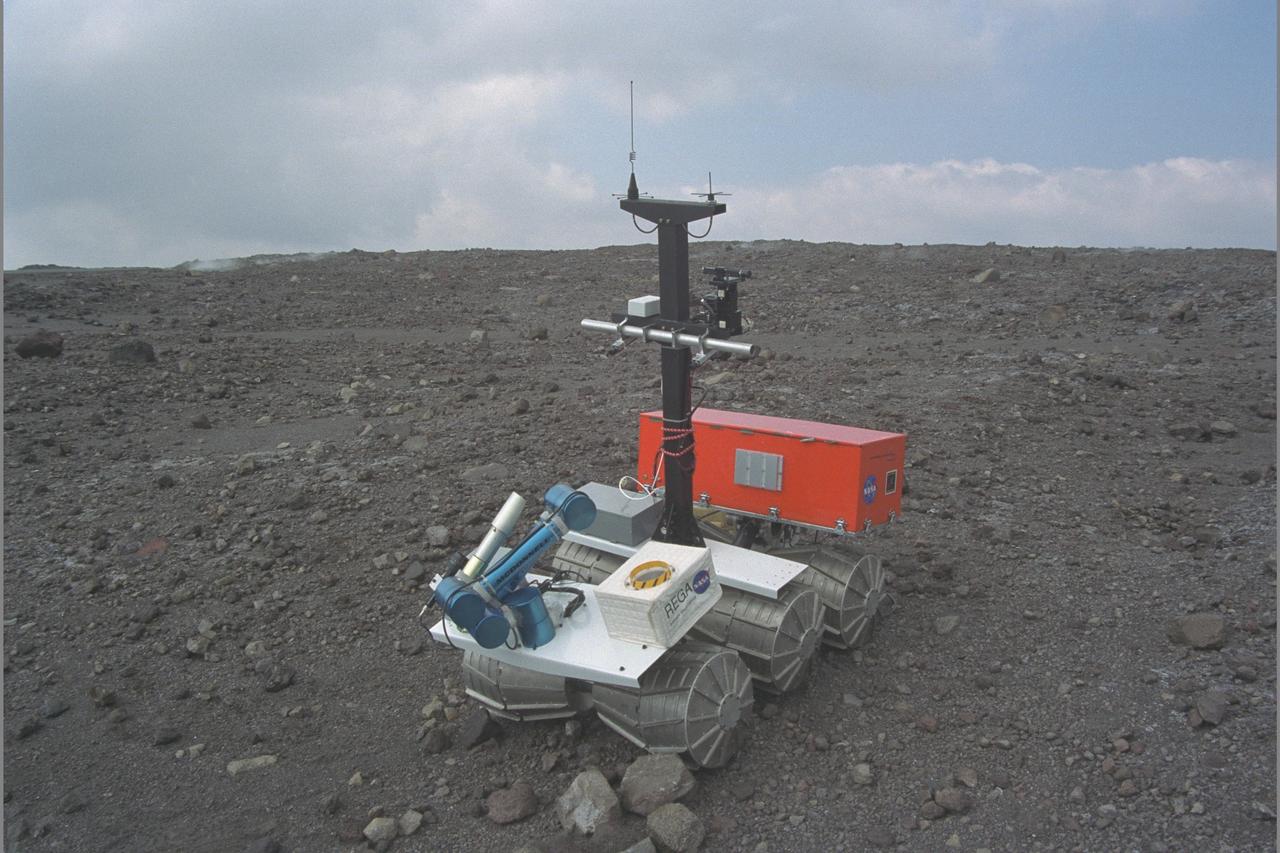
Marsokhod Russian Rover explores Kilauea, Hawaii via telepresence for Jason IV 'Island Earth' Projects (Volcano simulates Martian Terrain)
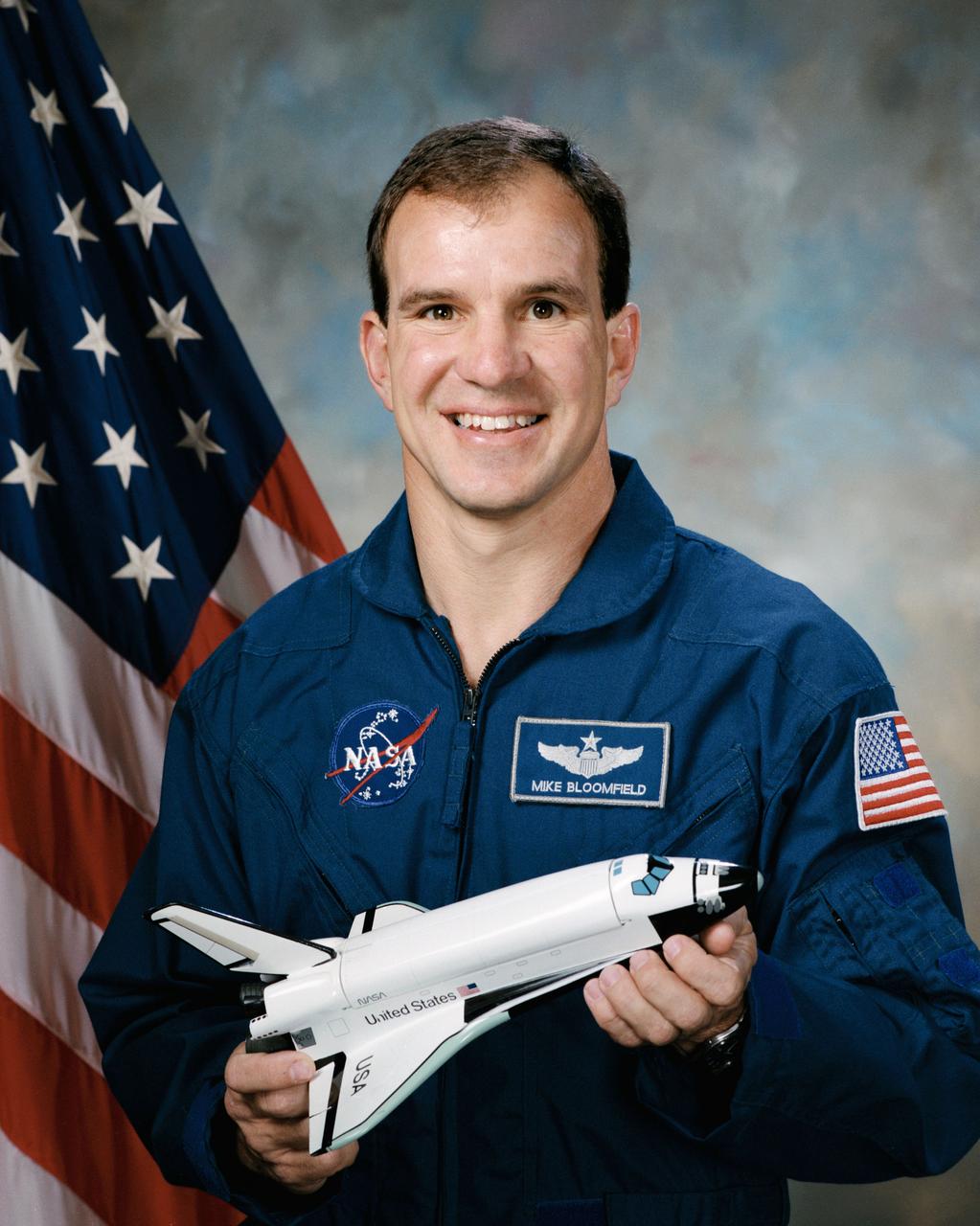
S95-10530 (1995) --- Astronaut Michael J. Bloomfield, pilot.
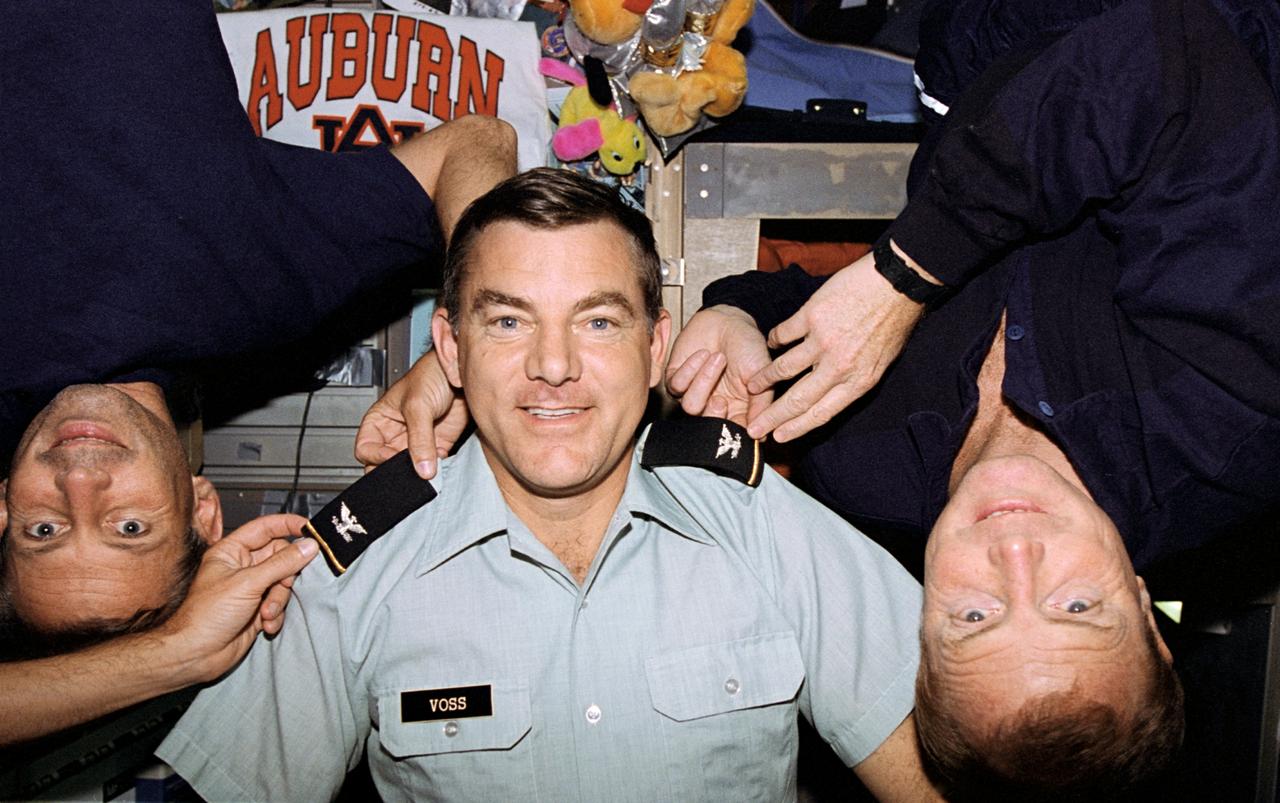
STS069-347-013 (7-18 September 1995) --- Upon the announcement of his new status as a Colonel, selectee, Lieutenant Colonel James S. Voss (United States Army), gets a preview of the new rank with the aid of fellow crewmembers. They are astronauts David M. Walker (right) and Kenneth D. Cockrell, commander and pilot, respectively. Mission specialist Voss, payload commander, made his third flight in space. The Space Shuttle Endeavour, with a five-member crew, launched on September 7, 1995, from the Kennedy Space Center (KSC). The mission ended September 18, 1995, with a successful landing on Runway 33 at KSC.
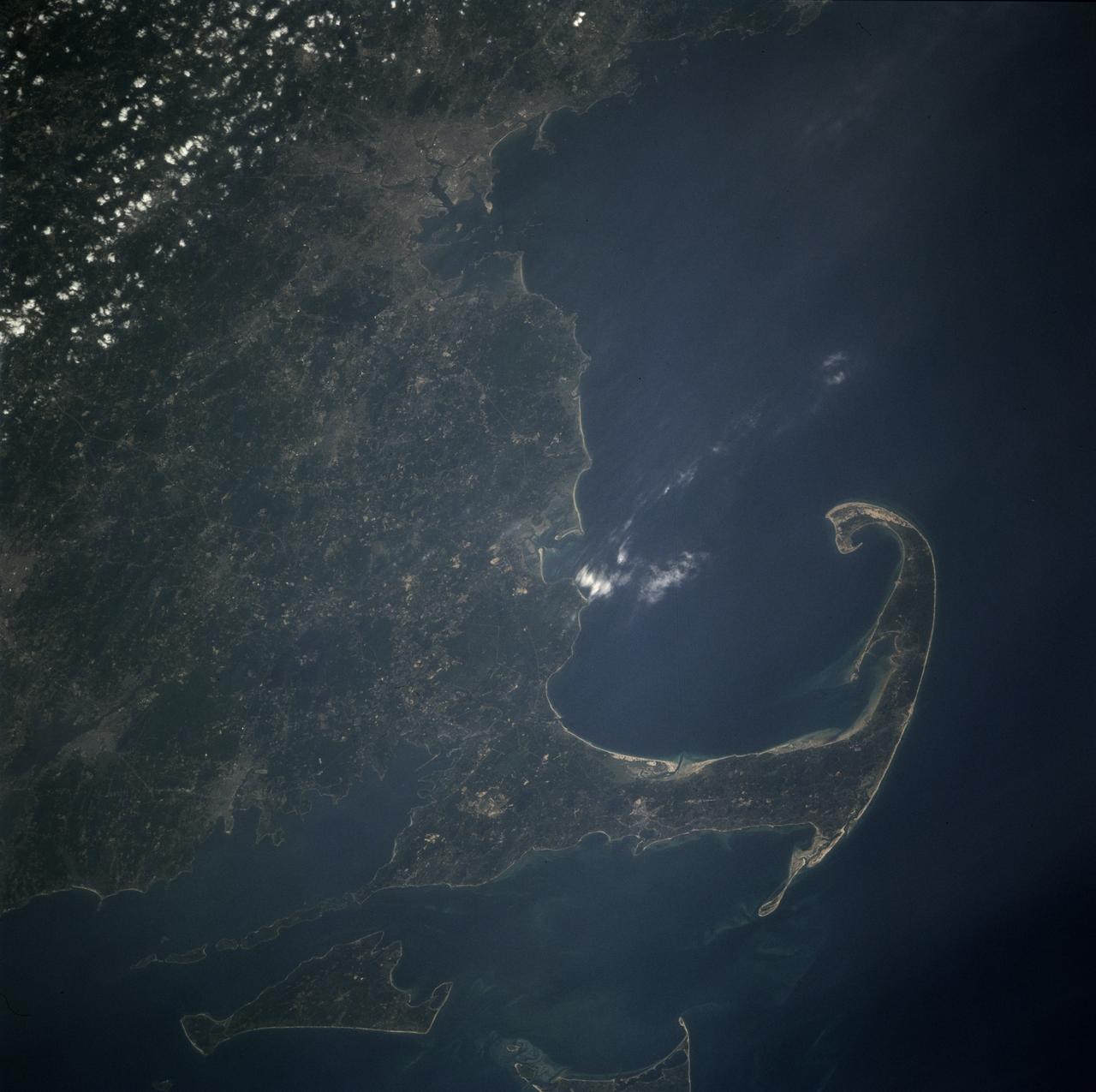
STS071-708-040 (27 June-7 July 1995) --- This view shows Cape Cod in some detail in the center right of the view. Provincetown lies on the inside of the hook of Cape Cod. Other larger cities are unusually easy to see on this frame. The Boston metropolitan area is the large gray area at the top (north), with a smaller gray patch immediately south indicating Brockton, Massachusetts. Other smaller patches in southern Massachusetts (bottom left) indicate Fall River (far left) and New Bedford in the coast on the north side of Buzzard's Bay. The outskirts of Providence, Rhode Island appear half way up the left edge of the frame. The islands at the bottom of the frame are Martha's Vineyard (bottom left) and Nantucket Island (partial view). Shoals (near-surface sand bars) appear as light-blue swirls on the shallow sea bottom between Cape Cod and these islands. The distance from Boston to Nantucket is almost 100 miles.
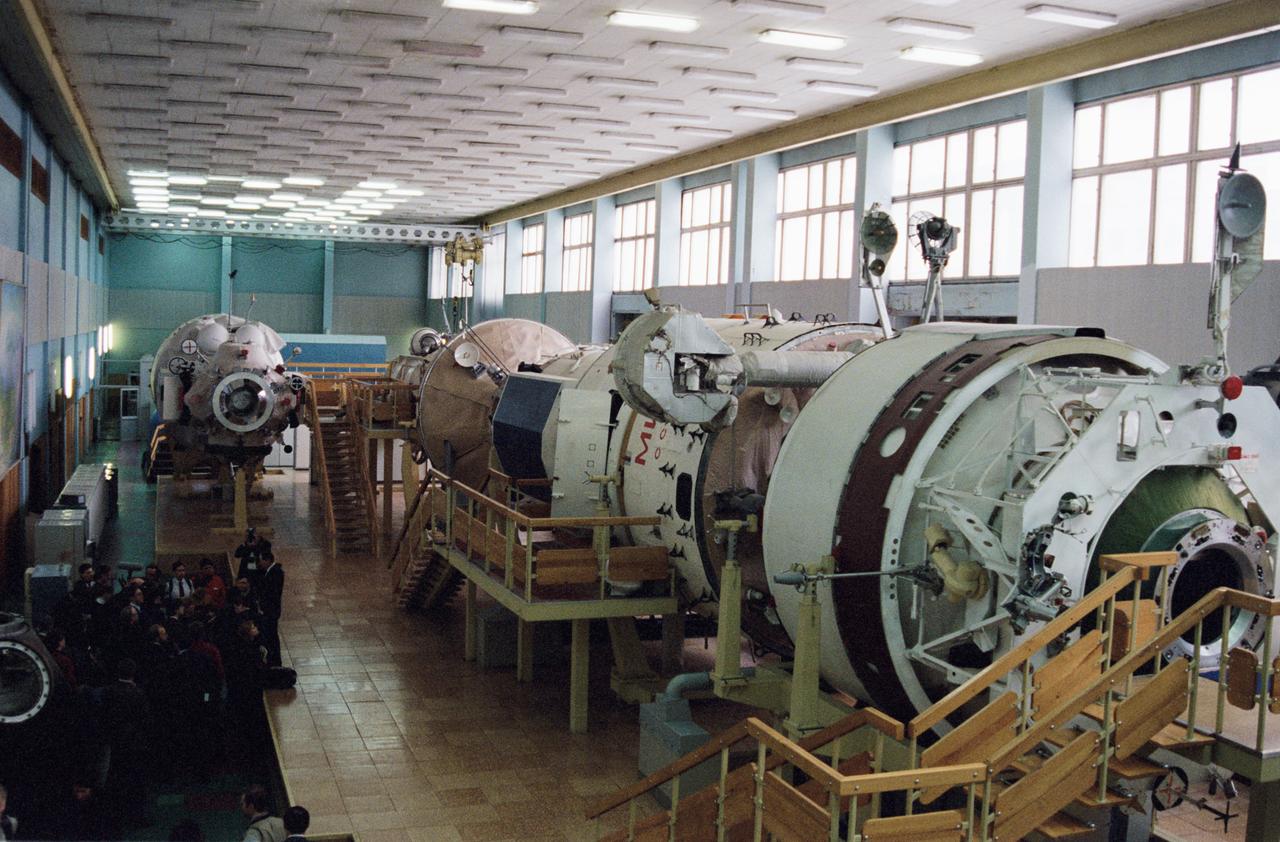
S95-04320 (22 Feb 1995) --- A full-scale mockup of Russia's Space Station with the core module called Mir in the center. Other modules connected to the core include Kvant, Kvant II and Kristall. The mockup at the Gagarin Cosmonaut Training Center in Star City, Russia is used for cosmonaut training prior to flights aboard the orbiting laboratory. At the time this photo was taken, NASA astronauts Norman E. Thagard and Bonnie J. Dunbar were in Russia for training.
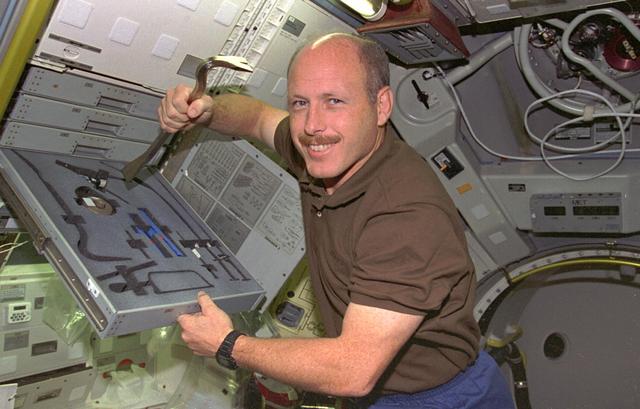
STS073-351-024 (20 October - 5 November 1995) --- Astronaut Kenneth D. Bowersox, STS-73 mission commander, retrieves a crow bar from a tool set onboard the science module in the cargo bay of the Earth-orbiting Space Shuttle Columbia. Various tools were available for a variety of in-flight maintenance tasks for the crew to carry out during the 16-day United States Microgravity Laboratory (USML-2) mission.
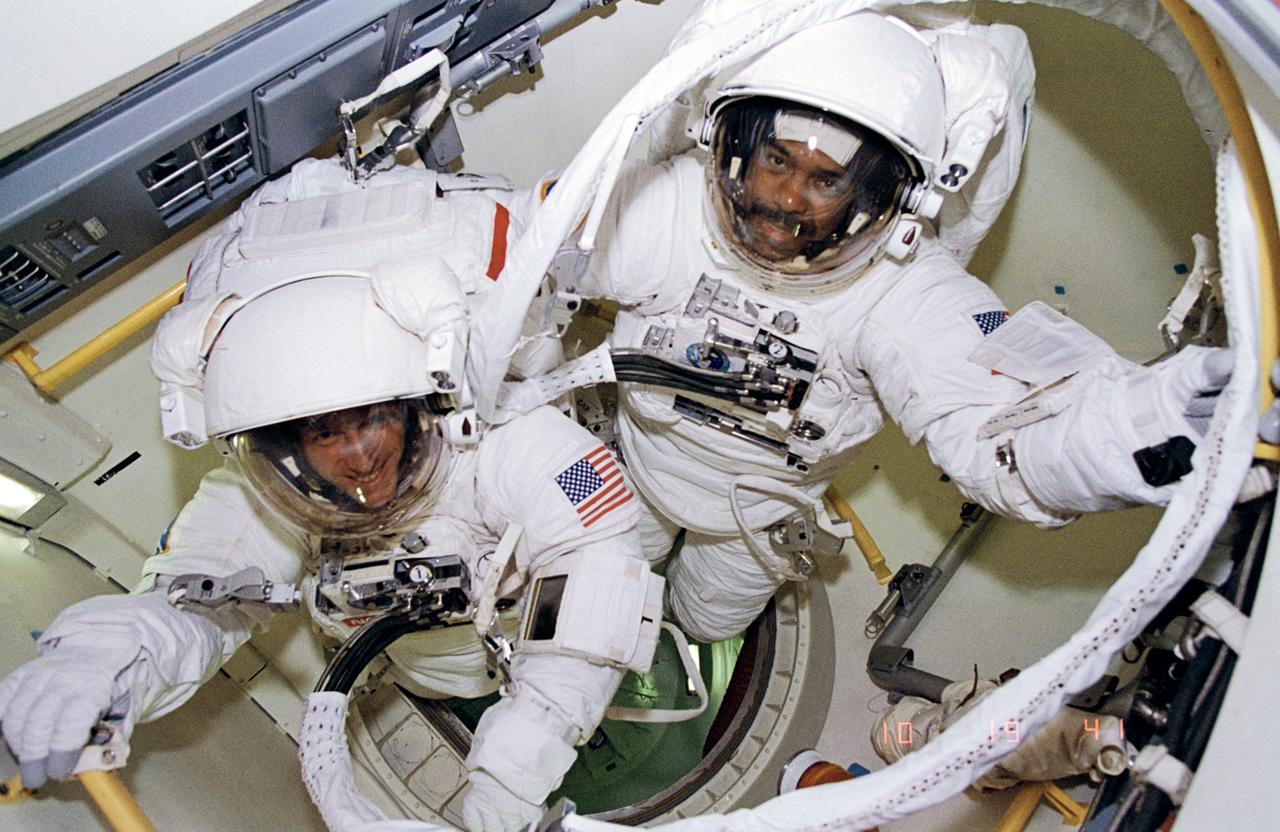
STS063-67-024 (9 Feb. 1995) --- Astronauts Bernard A. Harris Jr., STS-63 payload commander, (top right) and C. Michael Foale, mission specialist, are ready to egress airlock for an extravehicular activity (EVA). Others onboard the space shuttle Discovery were astronauts James D. Wetherbee, mission commander; Eileen M. Collins, pilot; mission specialists Janice E. Voss, and cosmonaut Vladimir G. Titov. Photo credit: NASA
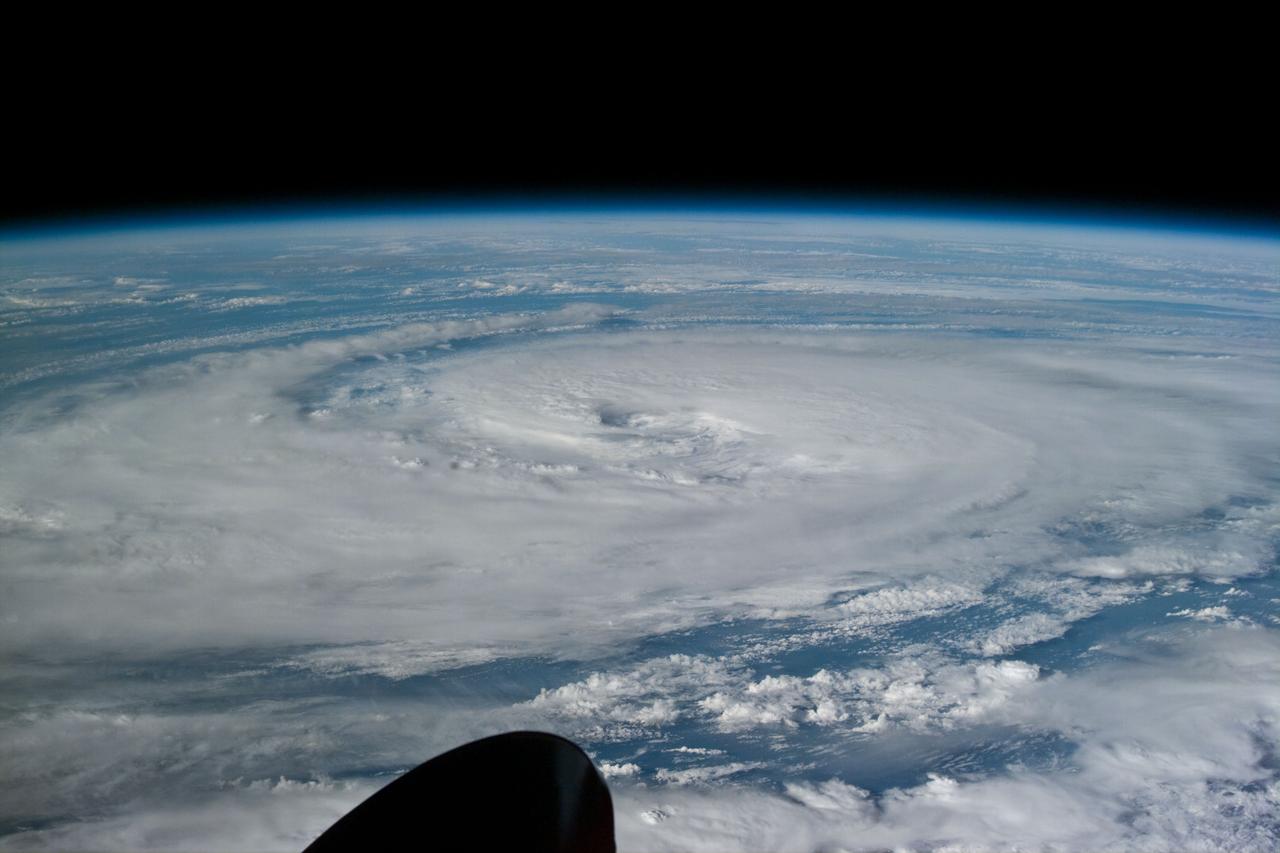
STS073-E-5313 (3 Nov. 1995) --- Typhoon Angela packed winds of 115 knots when this shot was taken with an Electronic Still Camera (ESC) from the Earth-orbiting space shuttle Columbia. It subsequently increased to speeds of 155 nautical miles, making it a super typhoon, heading due west toward Luzon in the Philippines.
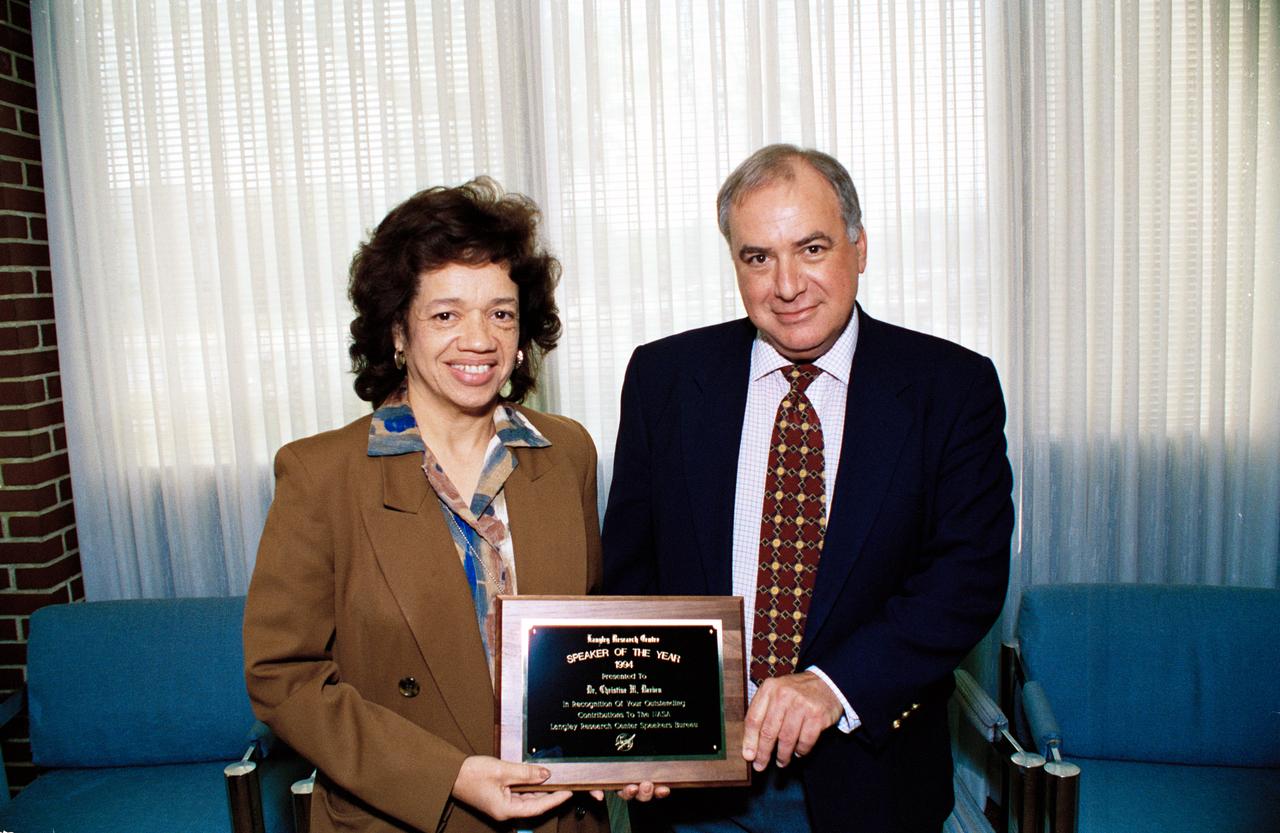
Christine Darden Speaker of the Year presented by Center Director Paul Holloway
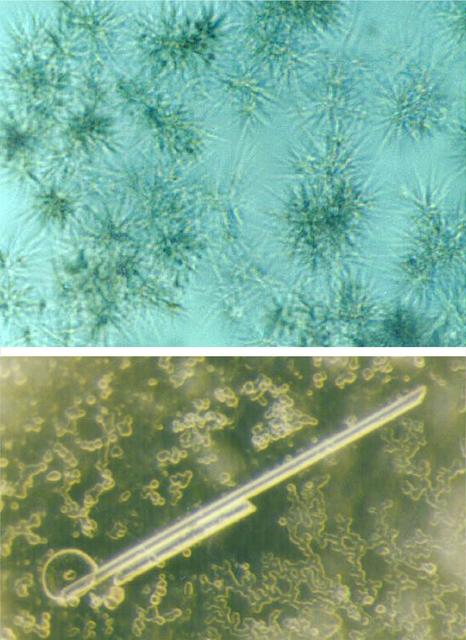
This image shows crystals of the protein raf kinase grown on Earth (photo a) and on USML-2 (photo b). The space-grown crystals are an order of magnitude larger. Principal Investigator: Dan Carter of New Century Pharmaceuticals

The Space Shuttle Endeavour completes the slow trip to Launch Pad 39B. The approximately six-to-eight hour journey from the Vehicle Assembly Building began shortly before 7 a.m. Once atop the pad hardstand, the protective Rotating Service Structure will be moved in place around the vehicle. Endeavour is being readied to kick off the 1996 Shuttle launch schedule with a Jan. 11 liftoff
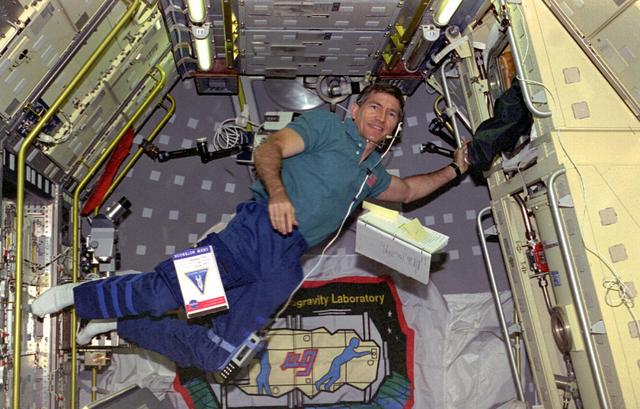
STS073-101-018 (20 October-5 November 1995) --- Payload specialist Fred W. Leslie maneuvers his body to a position conducive to research at the Crystal Growth Furnace (CGF) aboard the science module in the cargo bay of the Earth-orbiting Space Shuttle Columbia. Crystallization has been discovered to be more effectively studied in the weightless environment of space than on Earth, because the gravity-induced phenomena that obscure or change the process or change the process are greatly reduced or eliminated. Leslie was joined by a second guest researcher and five NASA astronauts for 16 full days of in-space research in support of the United States Microgravity Laboratory (USML-2) mission.
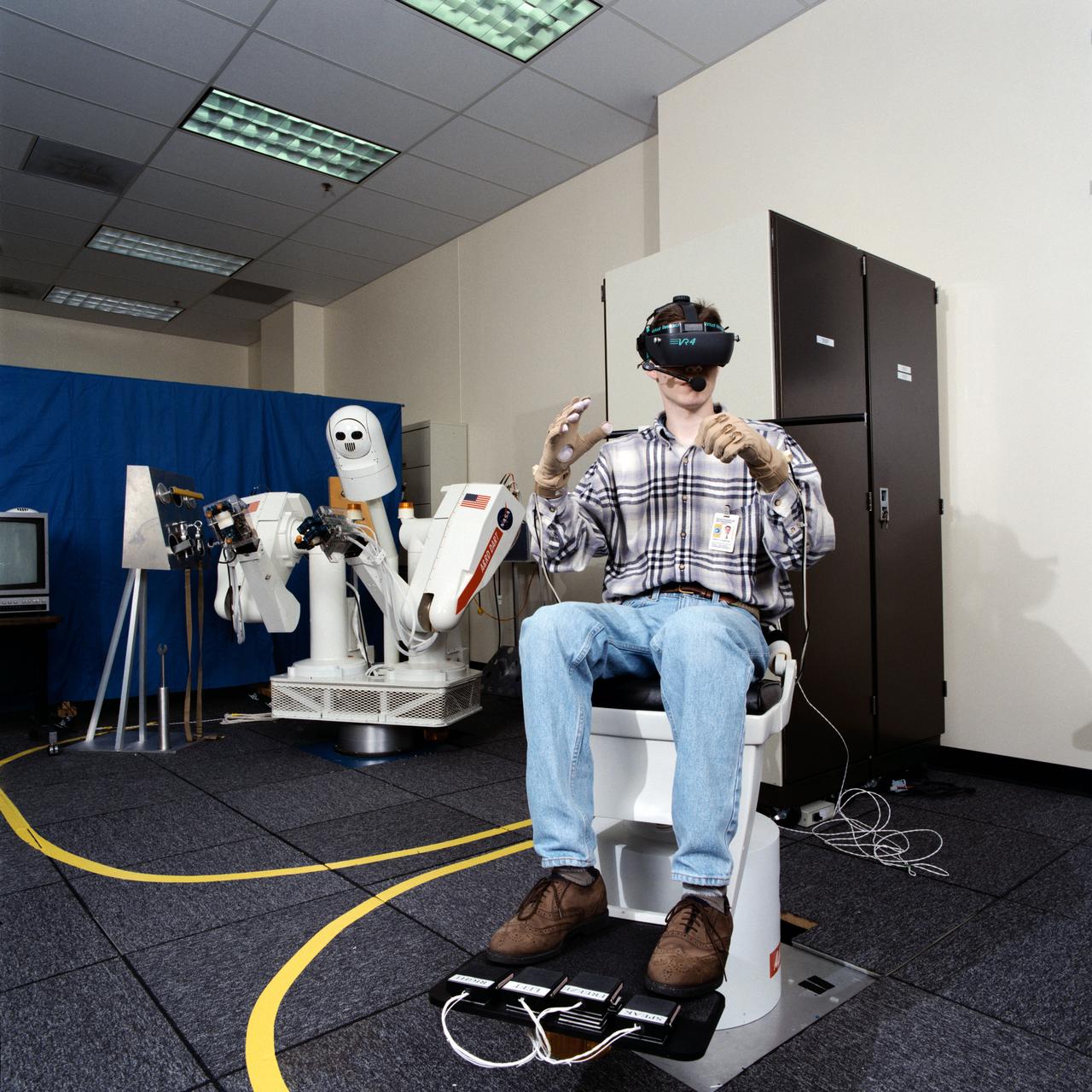
Photographic documentation of the Dextrous Anthropomorphic Robot Testbed (DART)/Full-Immersion Telepresence Testbed (FITT) system. Photos were taken in the Dexterous Robotics Lab, bldg 9N, room 113, and include: DART with upper arm cover removed (08920-1); DART head fully assembled (08922); DART head (08923,08939); DART only official view (08924-5); DART head with shell removed (08926-7); DART/FITT together with operator (08928-9); DART with tools (08930-1,08934); DART with tether hook (08932); DART with rope (08933); DART with Portable Foot Restraint (PFR) (08935); DART pulling out ORU (08936); DART with electronics panel (08937); and DART with automated ball grasp (08938).
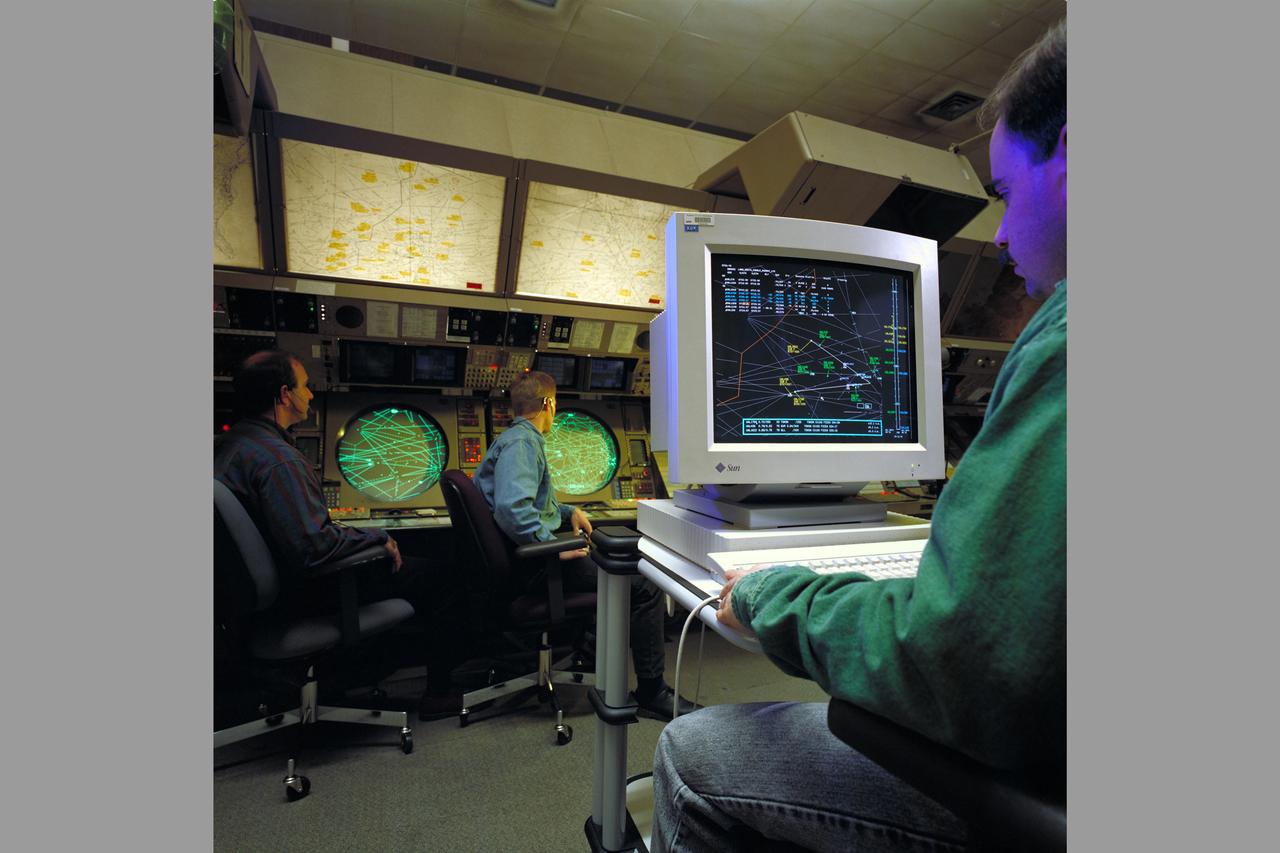
Air Traffic Control Center, Longmont, Colorado showing evaluation demonistrations of Ames CTAS System
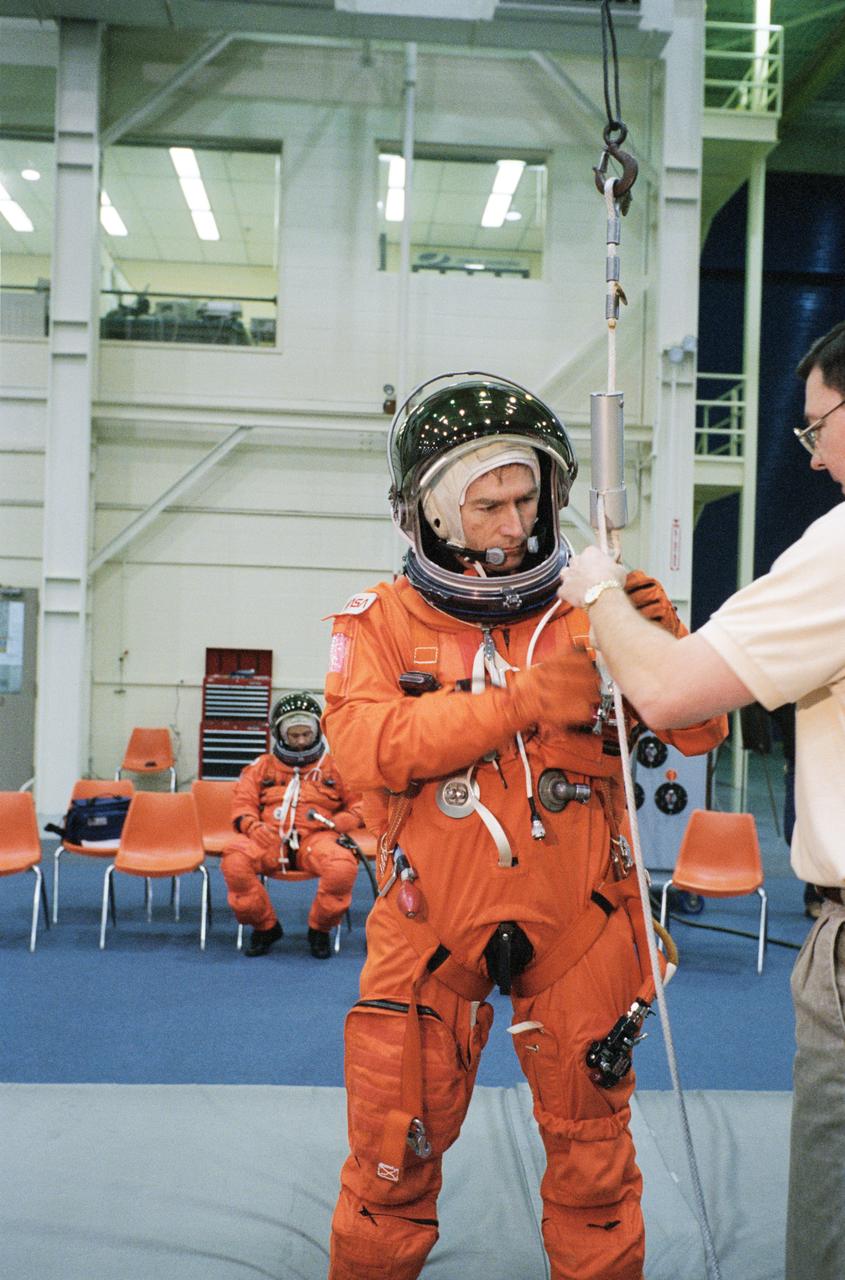
S95-09157 (27 Apr. 1995) --- Payload specialist Fred W. Leslie has just translated from the top of a Shuttle mockup-trainer using a Sky-genie device during emergency egress training with his six STS-73 crew mates. He is assisted here by Scott Gill, a member of the STS-73 training staff. The seven will fly aboard the Space Shuttle Columbia later this year to support the United States Microgravity Laboratory (USML-2) mission.
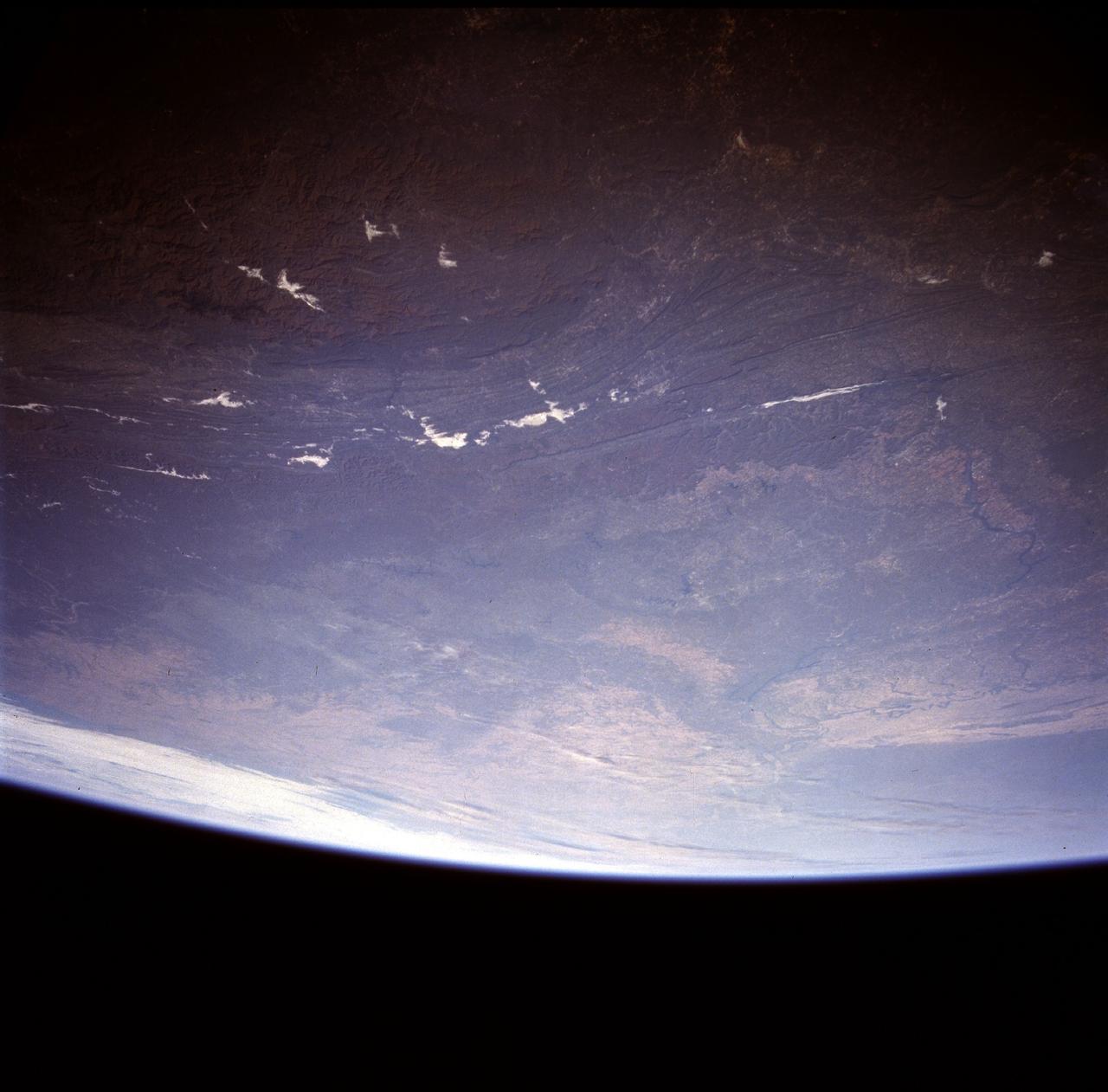
STS073-728-010 (22 October 1995) --- Photographed by the astronauts aboard the Space Shuttle Columbia orbiting at 146 nautical miles above Earth is this scene over West Virginia featuring the Appalachian Mountains. Center point coordinates are 37.5 degrees north latitude and 80.5 degrees west longitude.
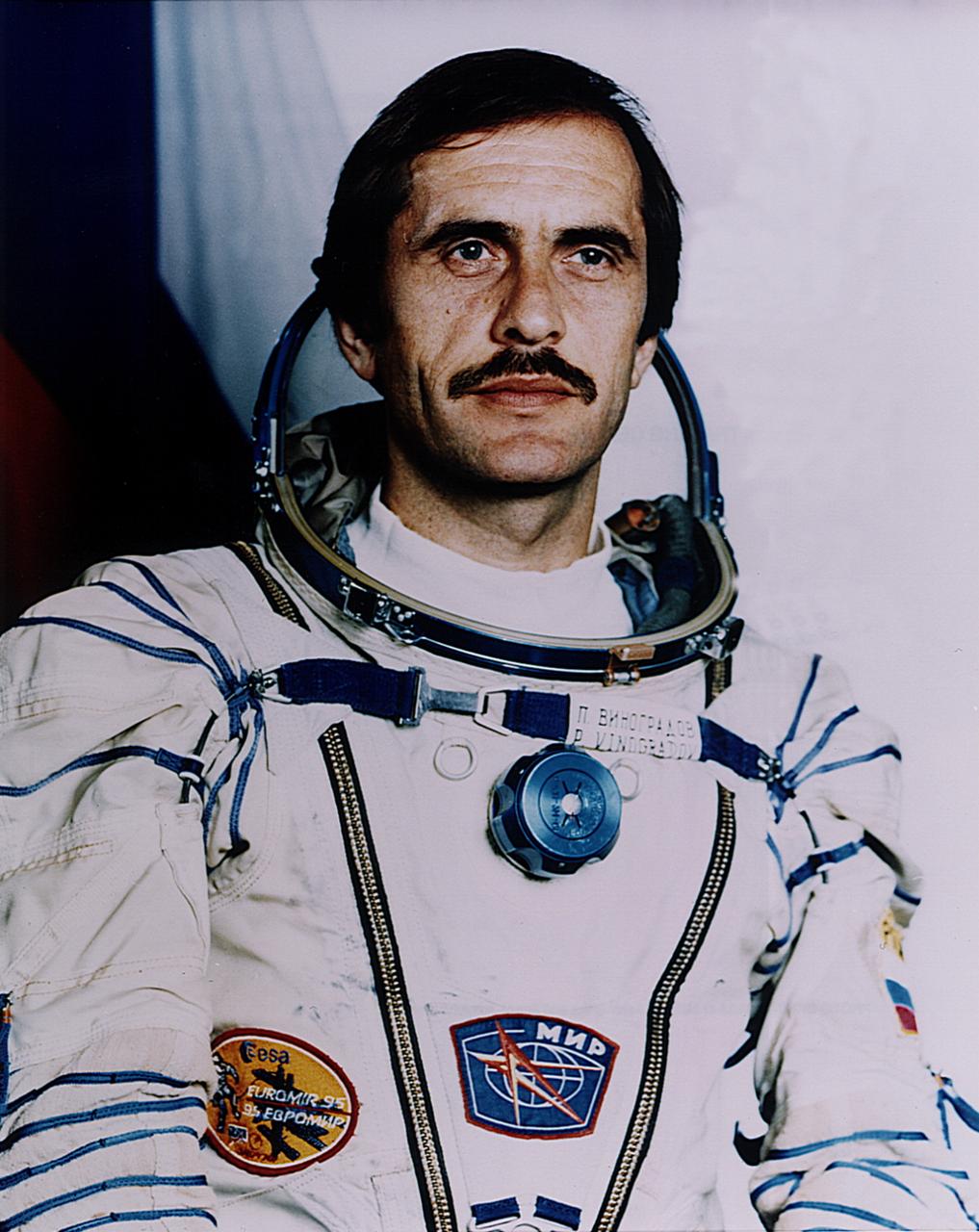
S95-21470 (December 1995) --- Cosmonaut Pavel V. Vinogradov, Mir 22 flight engineer
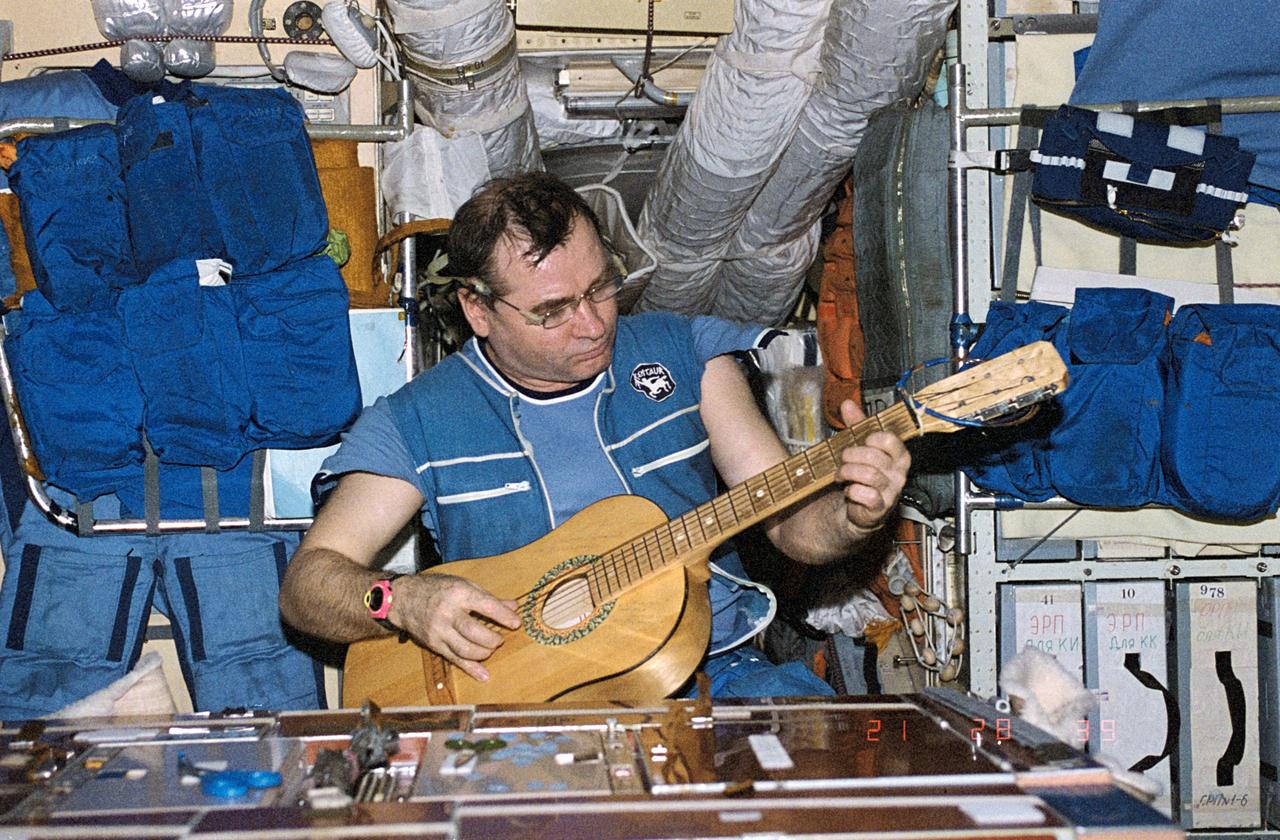
NM18-303-025 (March-July 1995) --- Onboard Mir’s base block module, cosmonaut Gennadiy M. Strekalov finds a rare moment of relaxation. At a July 18 press conference in Houston, Strekalov told reporters the guitar had been aboard the Space Station for several years.
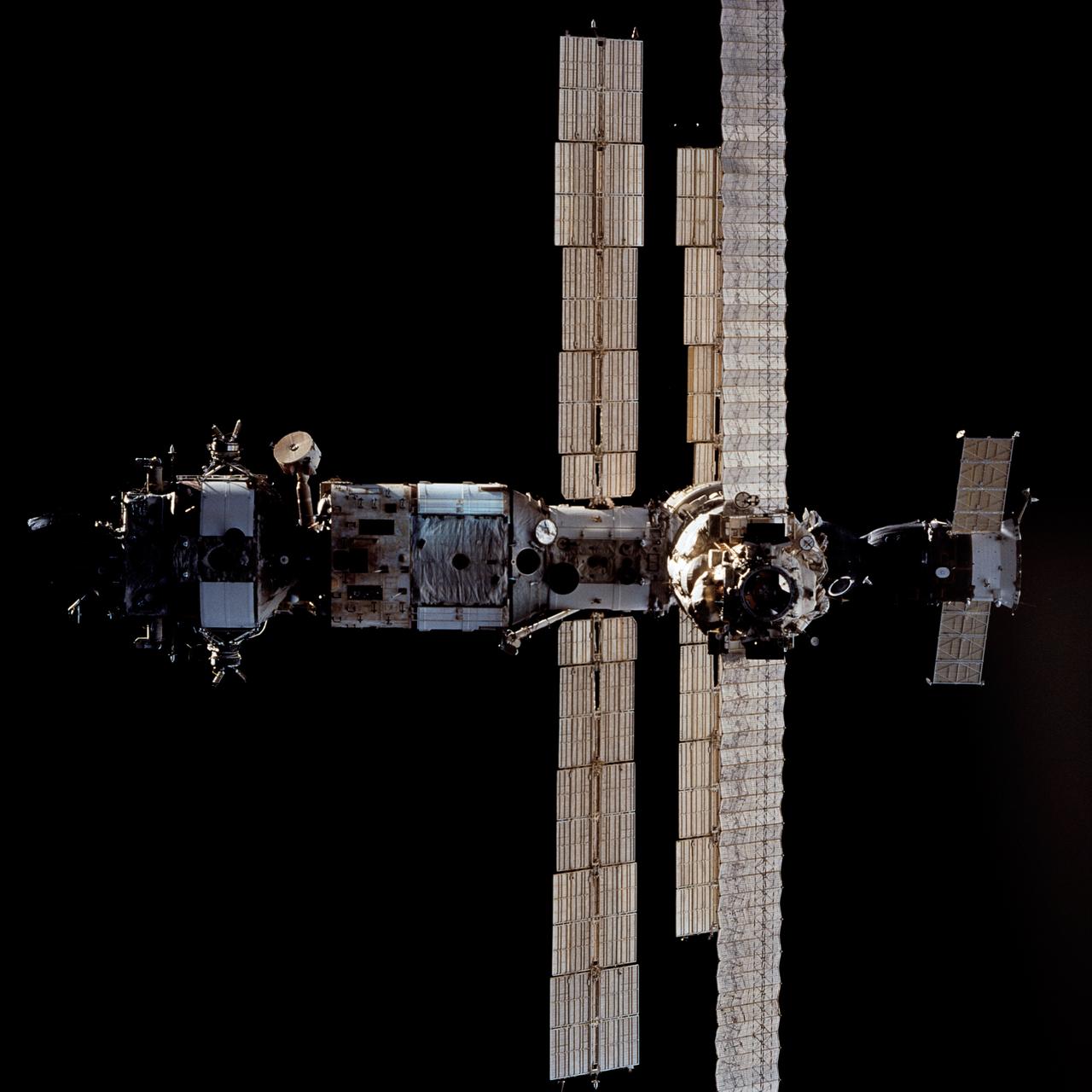
STS063-712-017 (6 Feb. 1995) --- Russia's Mir Space Station during rendezvous operations with the Space Shuttle Discovery. Docked at the bottom of the Mir facility is a Soyuz spacecraft. On the opposite end (almost cropped out of frame at top) is a Progress spacecraft. Onboard the Space Shuttle Discovery were astronauts James D. Wetherbee, mission commander; Eileen M. Collins, pilot; Bernard A. Harris, Jr., payload commander; C. Michael Foale and Janice E. Voss, mission specialists; along with cosmonaut Vladimir G. Titov, mission specialist.
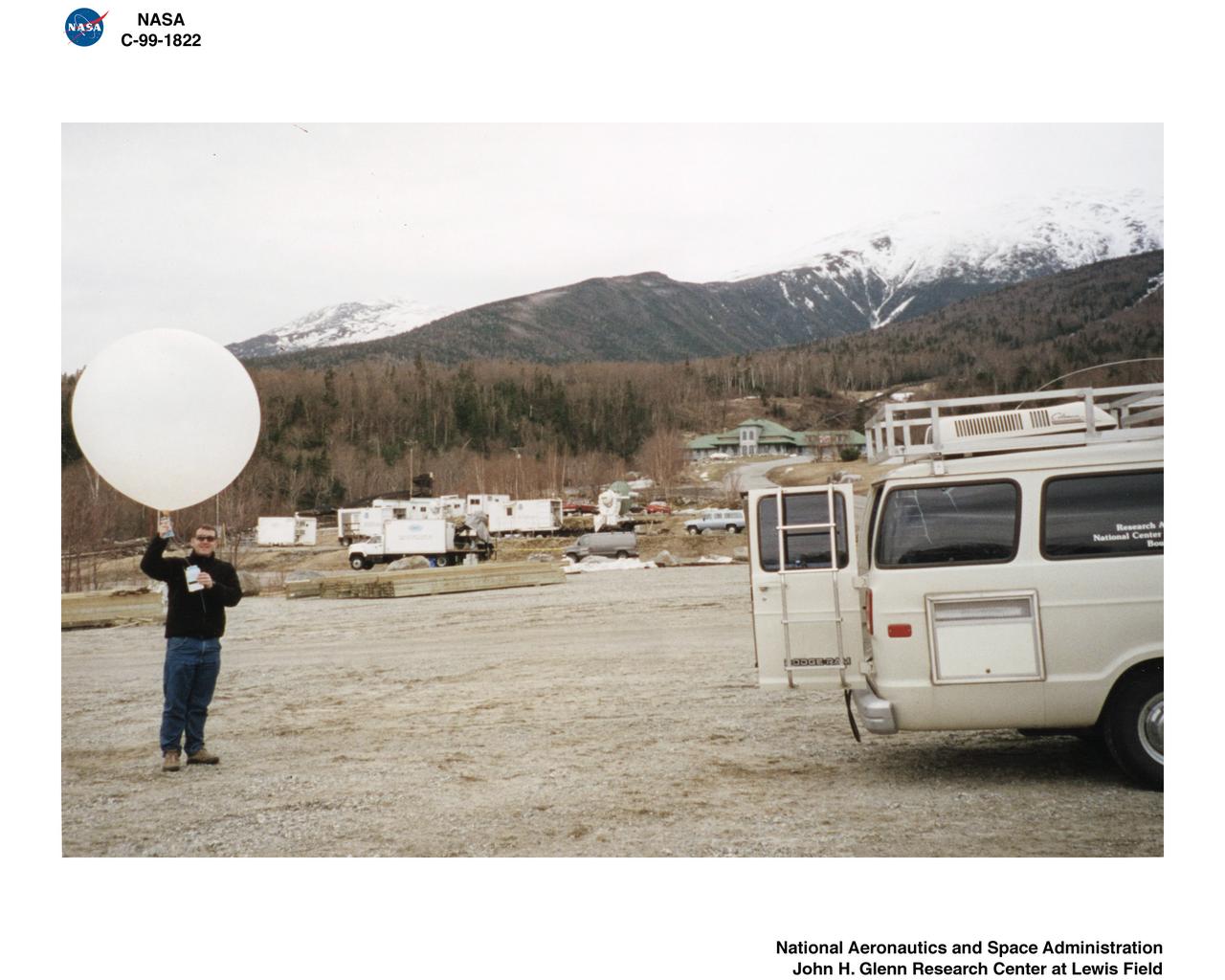
MWISP - MT WASHINGTON ICING SENSORS PROJECT - RADIOSONDE LAUNCH
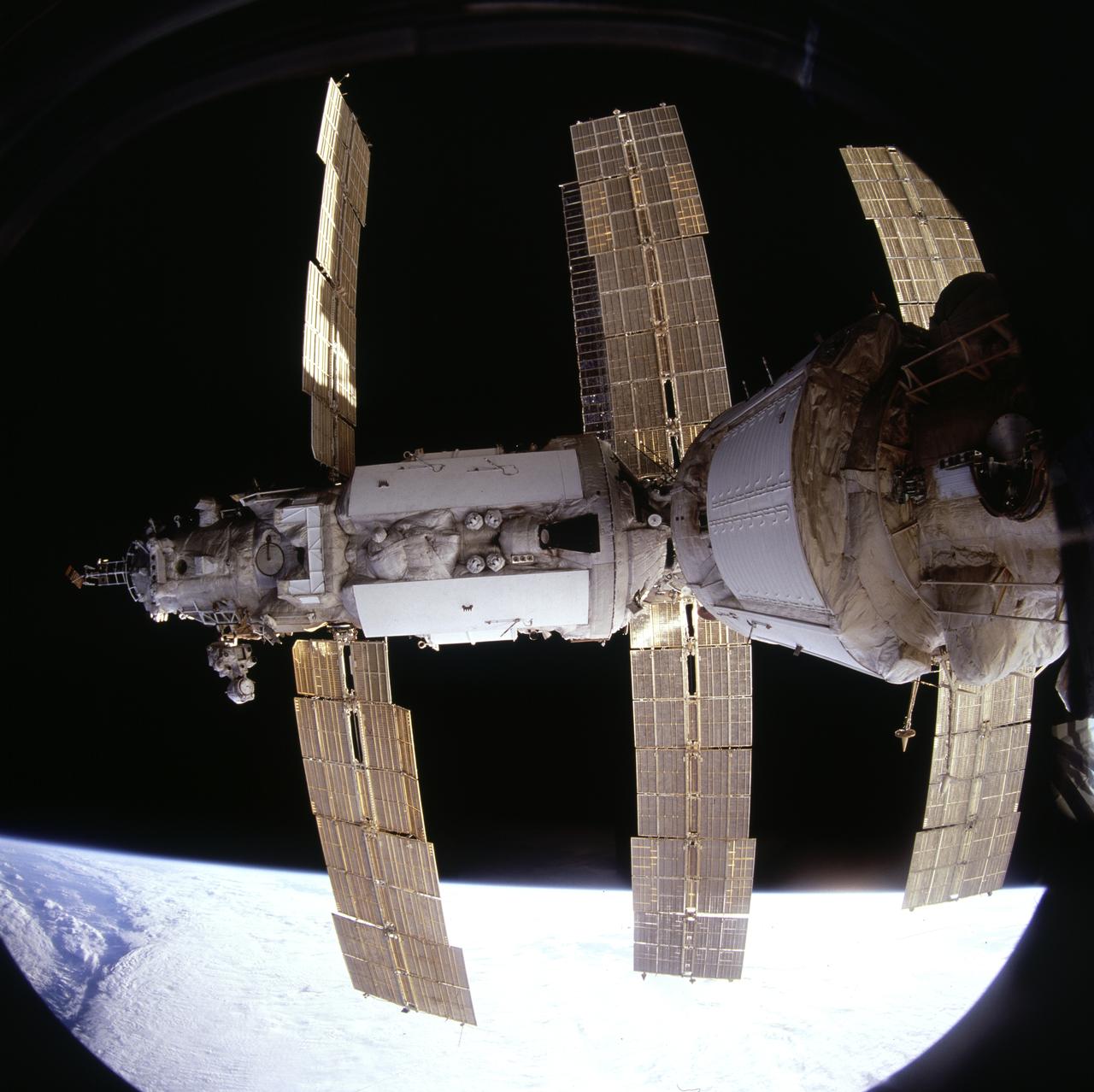
STS071-701-089 (27 June-7 July 1995) --- This view of many of the adjoined components of Russia's Mir Space Station was provided by a crew member aiming a hand-held Hasselblad camera through an overhead window on the space shuttle Atlantis' aft flight deck. During the week in which the Atlantis and Mir were docked, six astronauts and four cosmonauts stayed busy in several different areas. Most of the time was spent in the Spacelab Science Module in Atlantis' cargo bay.
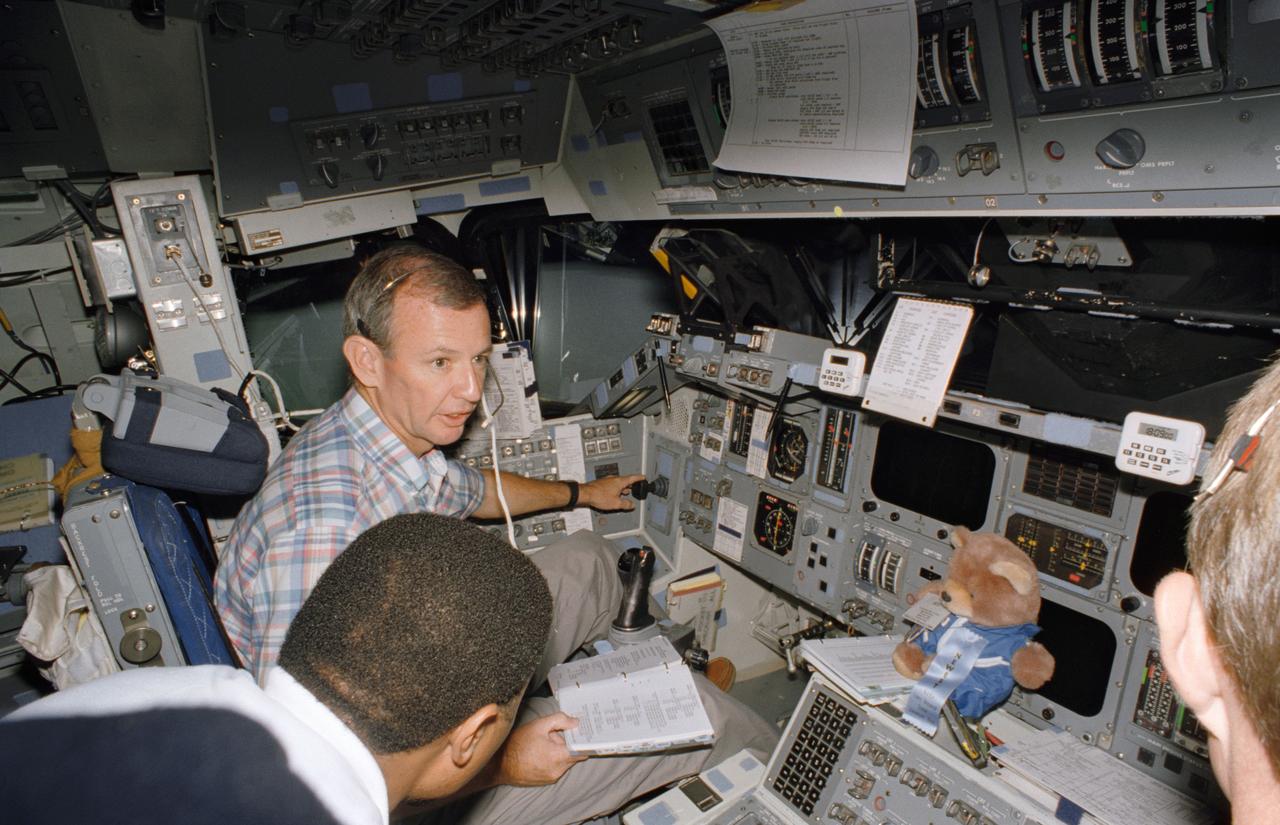
S95-12716 (May 1995) --- Astronauts Brian Duffy, in commander's seat, and Winston E. Scott discuss their scheduled flight aboard the Space Shuttle Endeavour. The two are on the flight deck of the Johnson Space Center's (JSC) fixed base Shuttle Mission Simulator (SMS). Duffy, mission commander, and Scott, mission specialist, will be joined for the winter flight by three other NASA astronauts and an international mission specialist representing NASDA.
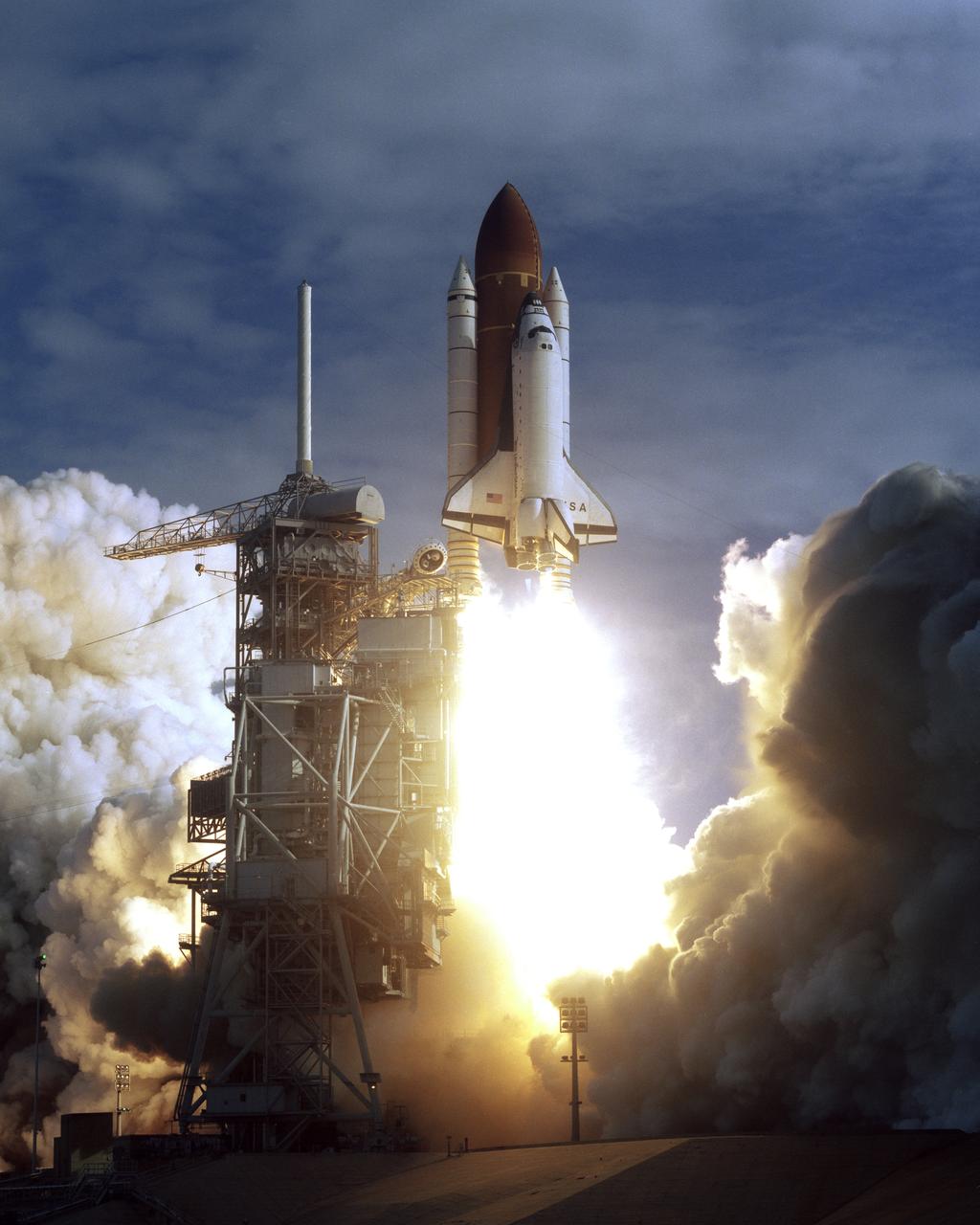
STS073-S-030 (20 Oct. 1995) --- The space shuttle Columbia lifts off from Launch Pad 39B, at the Kennedy Space Center (KSC), to begin a scheduled 16-day mission in Earth orbit in support of the United States Microgravity Laboratory (USML-2). Five NASA astronauts and two scientists from the private sector were onboard. Liftoff occurred at 9:53:00 a.m. (EDT) on Oct. 20, 1995. The mission represents the 72nd space shuttle flight for NASA. The crew will be working around the clock on a diverse assortment of USML-2 experiments located in a science module in Columbia's cargo bay. Fields of study include fluid physics, materials science, biotechnology, combustion science and commercial space processing technologies. The crew is made up of astronauts Kenneth D. Bowersox, commander; Kent V. Rominger, pilot; Kathryn C. Thornton, payload commander; Michael E. Lopez-Alegria and Catherine G. Coleman, both mission specialists; along with Fred W. Leslie and Albert Sacco Jr., payload specialists. Photo credit: NASA
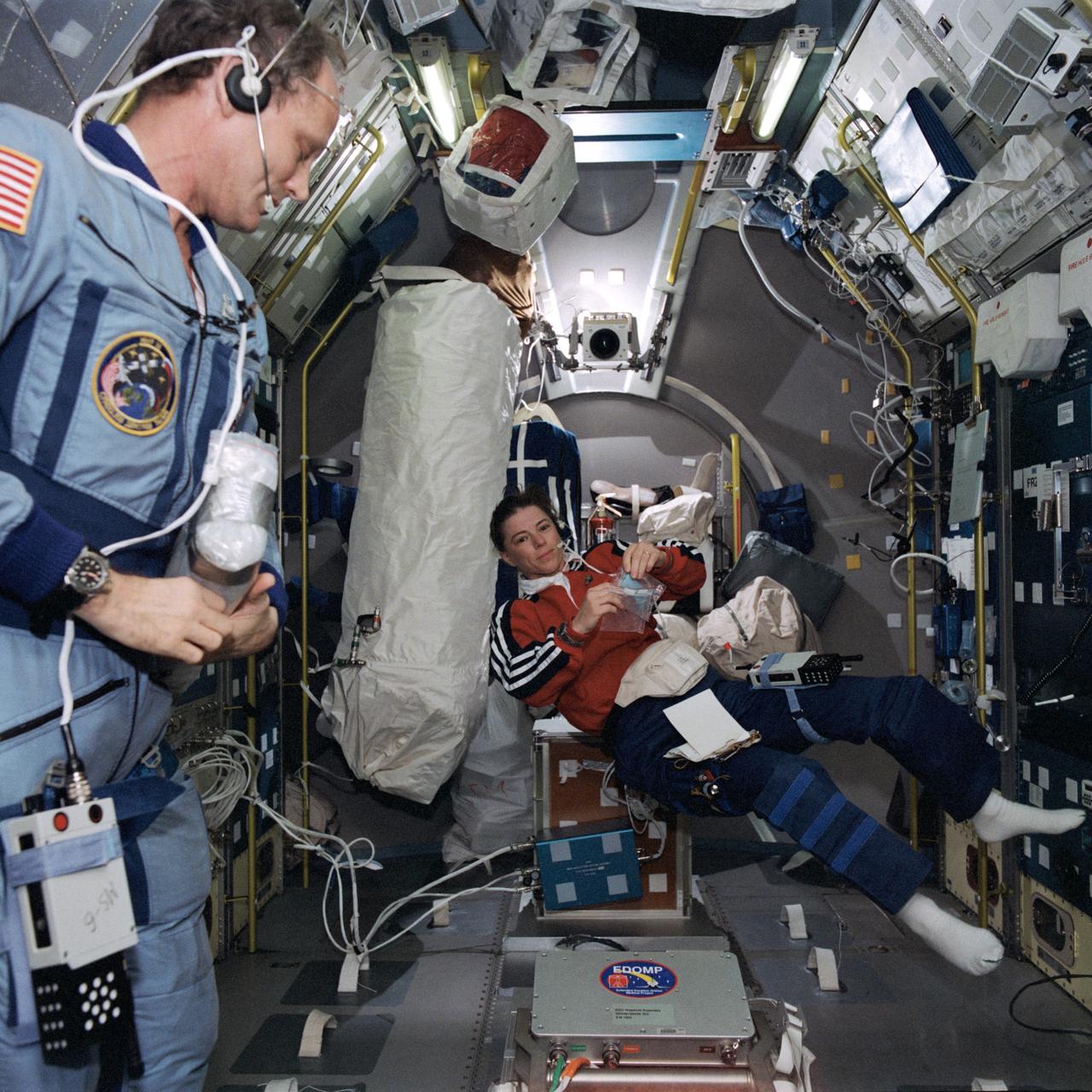
STS071-758-009 (27 June - 7 July 1995) --- Astronaut Bonnie J. Dunbar, mission specialist, floats about in the Spacelab Science Module as astronaut Norman E. Thagard looks on. Thagard, Mir-18 guest cosmonaut researcher, had completed four months in space aboard Russia's Mir Space Station. When this photograph was taken he was undergoing a battery of tests and data collection exercises on Spacelab, onboard the Space Shuttle Atlantis. Dunbar had served as his Mir-18 backup, during a year's training in Russia.
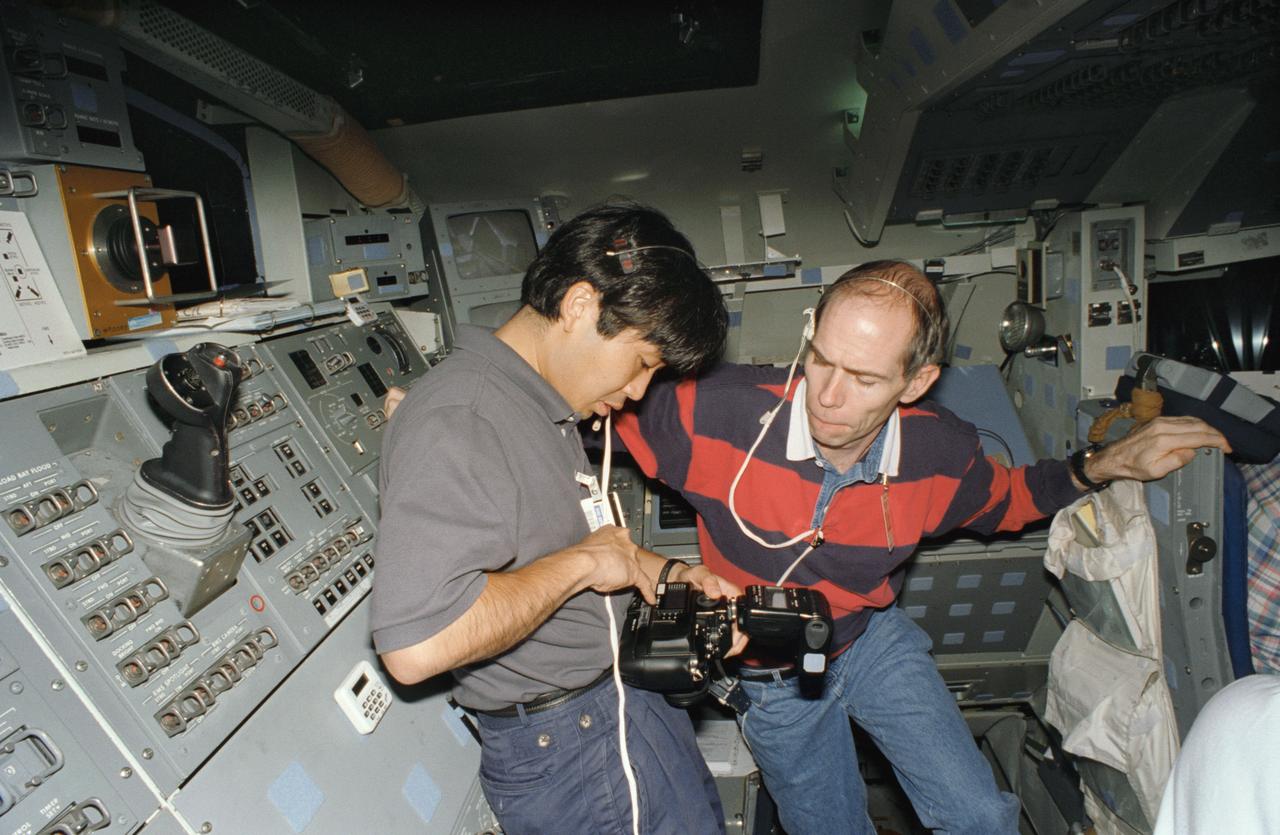
S95-12703 (May 1995) --- Astronauts Koichi Wakata (left) and Daniel T. Barry check the settings on a 35mm camera during an STS-72 training session. Wakata is a mission specialist, representing Japan's National Space Development Agency (NASDA) and Barry is a United States astronaut assigned as mission specialist for the same mission. The two are on the aft flight deck of the fixed base Shuttle Mission Simulator (SMS) at the Johnson Space Center (JSC).
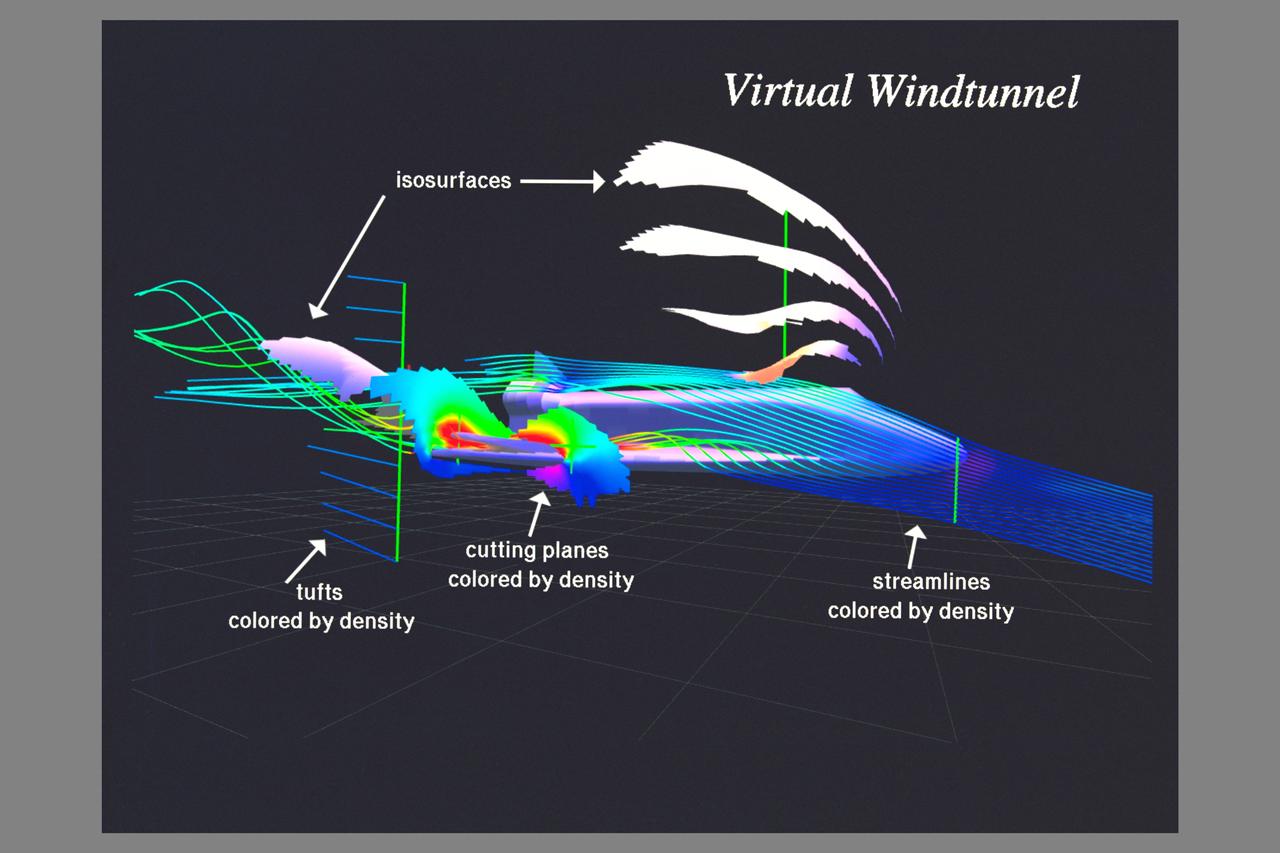
Computational Fluid Dynamics (CFD) image of Space Shuttle Pressure Flow using Virtual Wind Tunnel
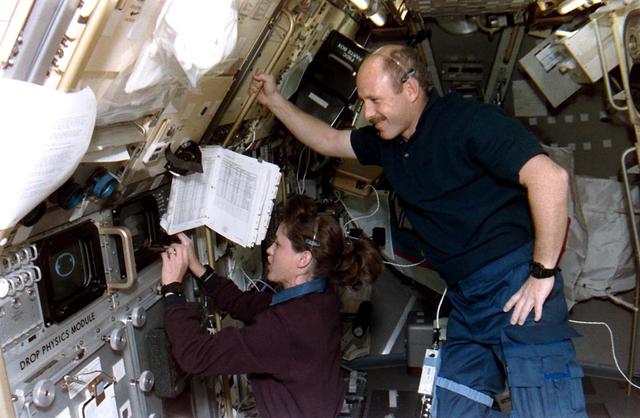
Astronaut Kathryn C. Thornton, payload commander, works at the Drop Physics Module (DPM) on the portside of the science module supporting the U.S. Microgravity Laboratory (USML-2). Astronaut Kerneth D. Bowersox, mission commander, looks on.
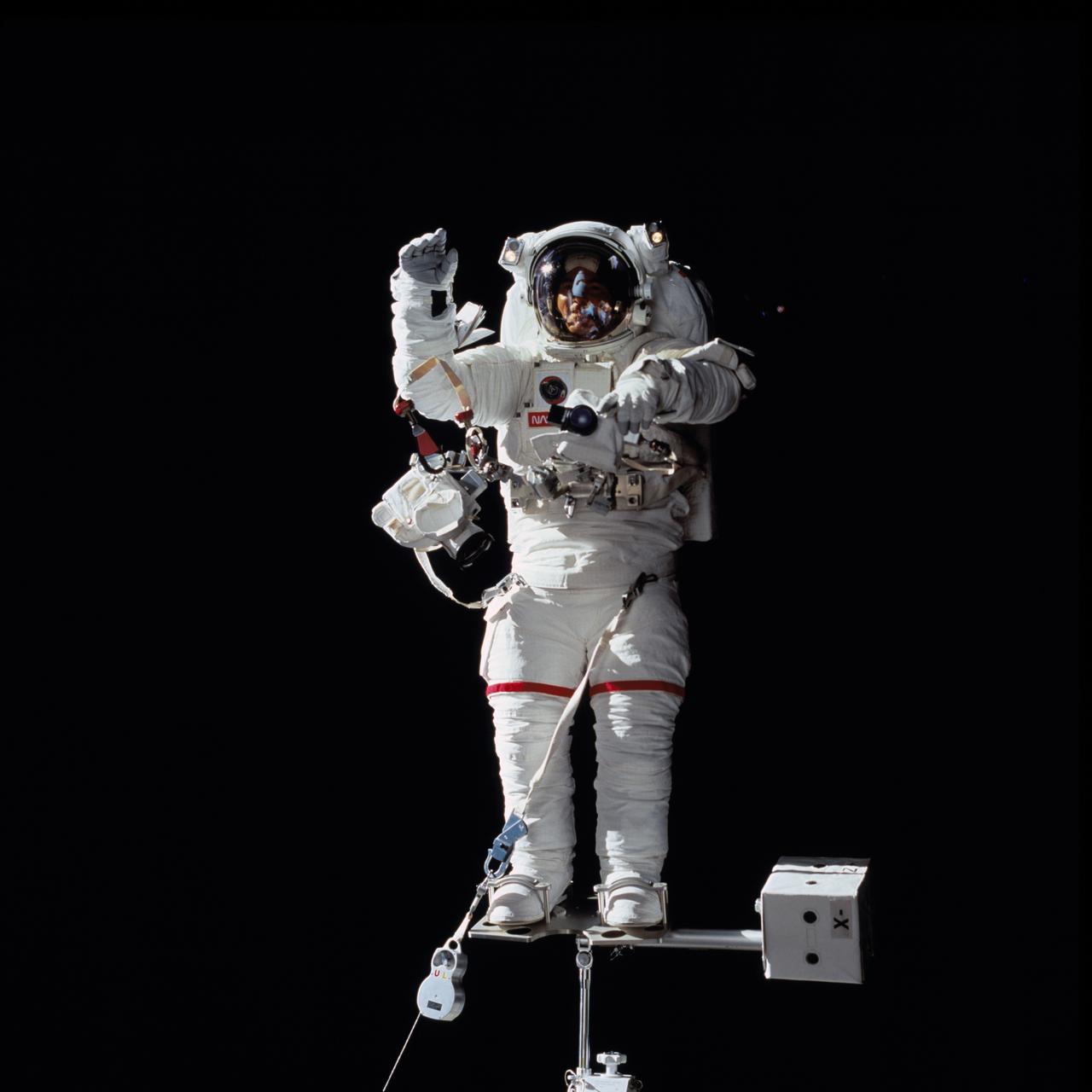
STS069-714-063 (16 September 1995) --- Astronaut James S. Voss, payload commander, is pictured during the September 16, 1995, Extravehicular Activity (EVA) which was conducted in and around Space Shuttle Endeavour's cargo bay. Voss, whose visor reflects Endeavour's forward section, was standing on a mobile foot restraint attached to the arm of the Remote Manipulator System (RMS). As evidenced by the thin white cable, Voss was tethered to the end of the RMS as well. Evaluations for Space Station-era tools and various elements of the space suits were performed by Voss and his space walking crewmate, astronaut Michael L. Gernhardt, mission specialist.
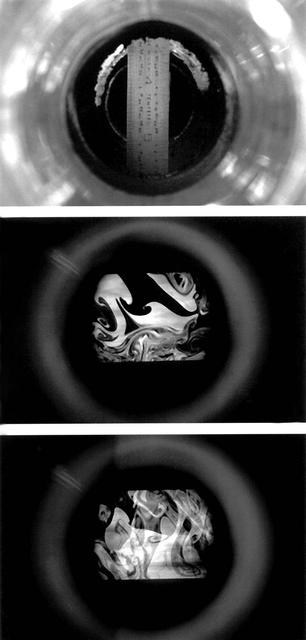
LII is a technique for measuring soot concentration. This image was taken with an ordinary 35-mm camera, these reveal soot distribution within the chimney. Principal Investigator: Dr. Randall L. Vander Wal
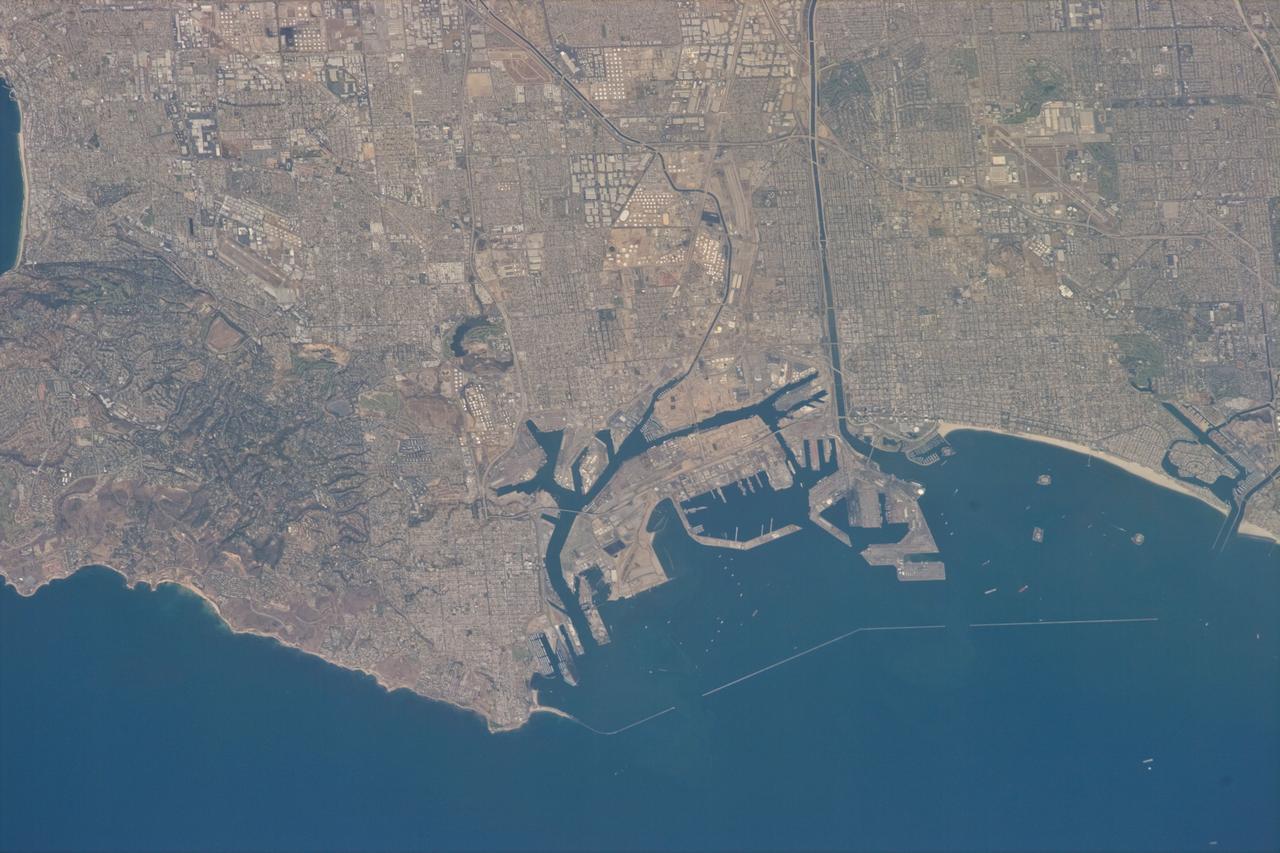
STS073-E-5081 (30 Oct. 1995) --- The port of the Queen Mary ocean liner is near bottom right center in this Electronic Still Camera (ESC) view. The scene covers from Redondo Beach on the left to Seal Beach on the right; from San Pedro at bottom to the Torrance-Gardena area at top.
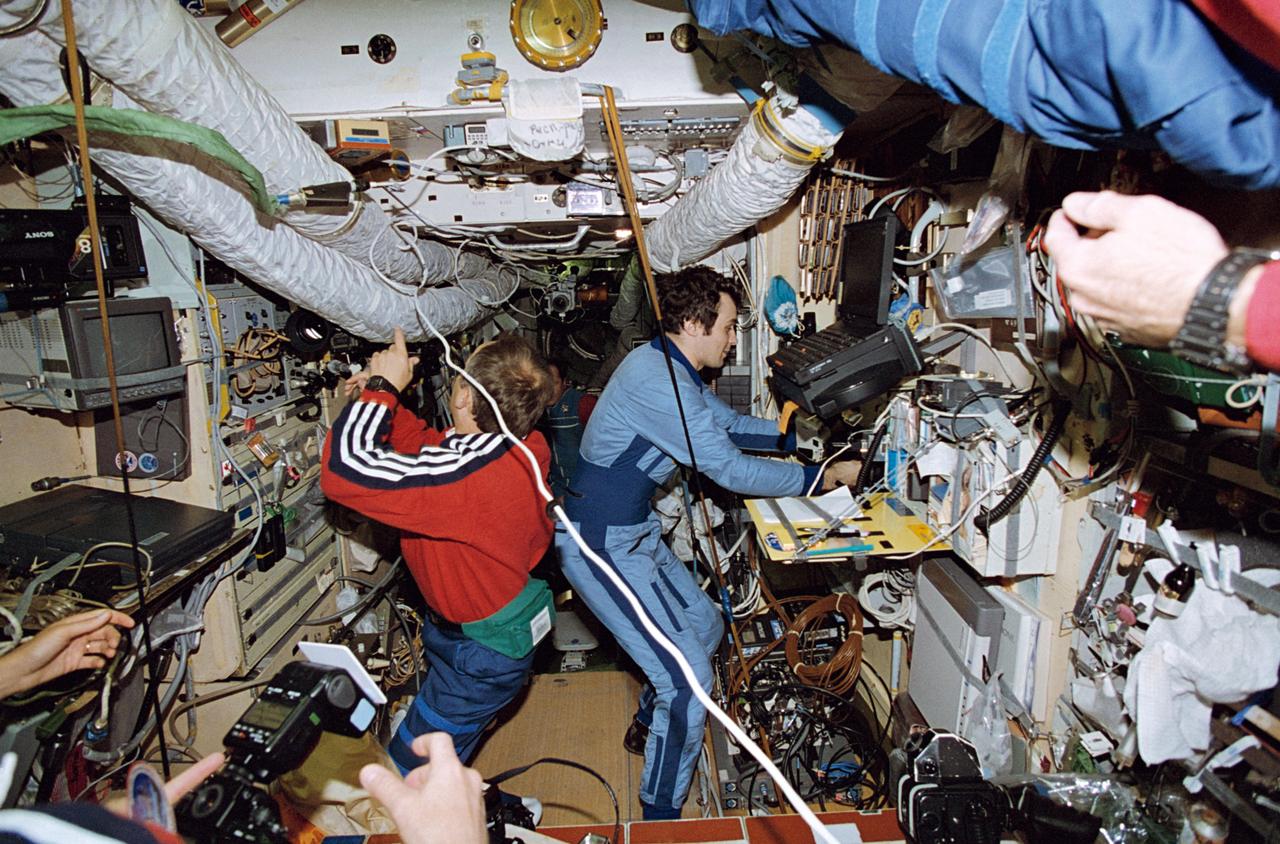
STS071-118-007 (27 June - 7 July 1995) --- Onboard the Russia?s Mir Space Station Mir Base Block, cosmonauts Anatoly Y. Solovyev (left) and Vladimir N. Dezhurov, Mir 19 and 18 commanders, respectively, exchange information about their research tasks. The two represent a change of guard aboard Mir, as Dezhurov prepares to come back to Earth with the STS-71 crew aboard Space Shuttle Atlantis. Nikolai M. Budarin and Gennadiy M. Strekalov - cosmonaut/flight engineers making the same exchange -- are out of frame.
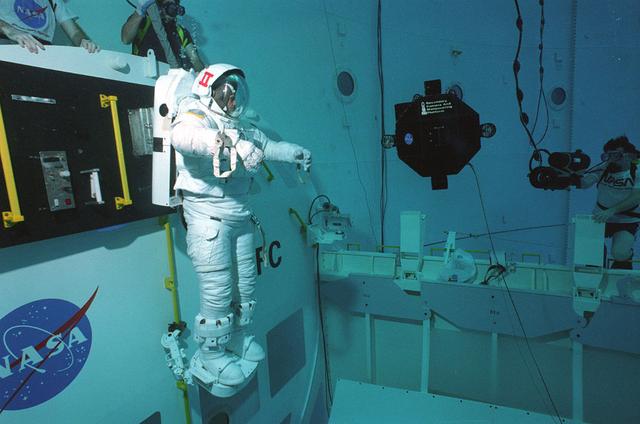
A diver tests a secondary camera and maneuvering platform in Marshall's Neutral Buoyancy Simulator (NBS).The secondary camera will be beneficial for recording repairs and other extra vehicular activities (EVA) the astronuats will perform while making repairs on the Hubble Space Telescope (HST). The maneuvering platform was developed to give the astronauts something to stand on while performing maintenance tasks. These platforms were developed to be mobile so that the astronauts could move them to accommadate different sites.
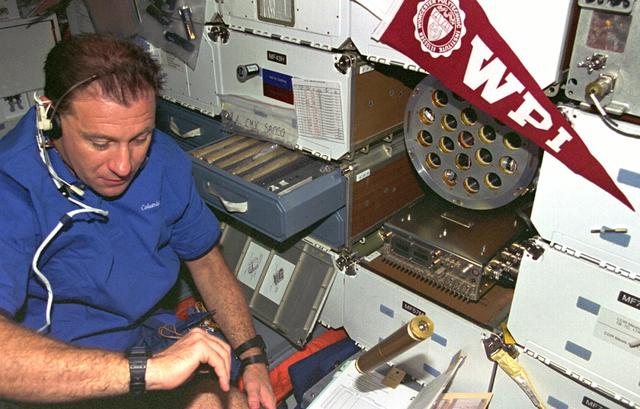
STS073-353-010 (20 October - 5 November 1995) --- Payload specialist Albert Sacco Jr. checks out the Zeolite Crystal Growth (ZCG) on the middeck of the Earth-orbiting Space Shuttle Columbia. ZCG evaluated Zeolite crystallization and growth in the microgravity environment aboard Columbia in order to achieve high yields of large, nearly perfect crystals in space. Zeolites are complex arrangements of silica and alumina that occur naturally as well as synthetically.
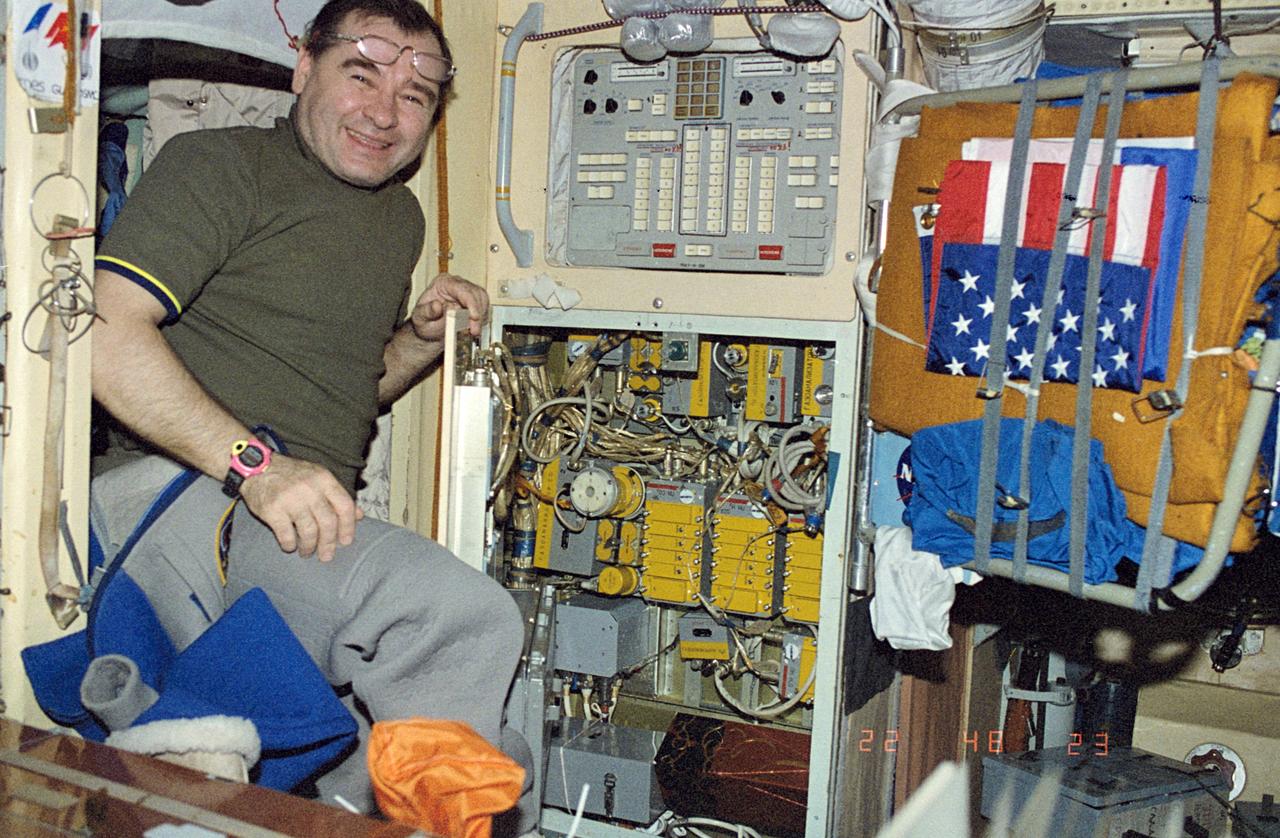
NM18-302-025 (March-July 1995) --- Onboard Mir's base block module cosmonaut Gennadiy M. Strekalov, flight engineer, prepares to check the air quality control and the propulsion system of the station. Strekalov told reporters at a July 18 press conference in Houston that even though he tried not to awaken astronaut Norman E. Thagard, who was asleep nearby, he was unable to keep from disturbing the cosmonaut researcher. He went on to point out that Thagard was always very cooperative and tolerant of such interruptions.

Pictured here is an artist's depiction of Rockwell's Vertical Landing Single-Stage-to-Orbit (SSTO) Reusable Launch Vehicle (RLV) deploying a satellite concept. The development of the RLV is essential in the cost reduction of future space travel.
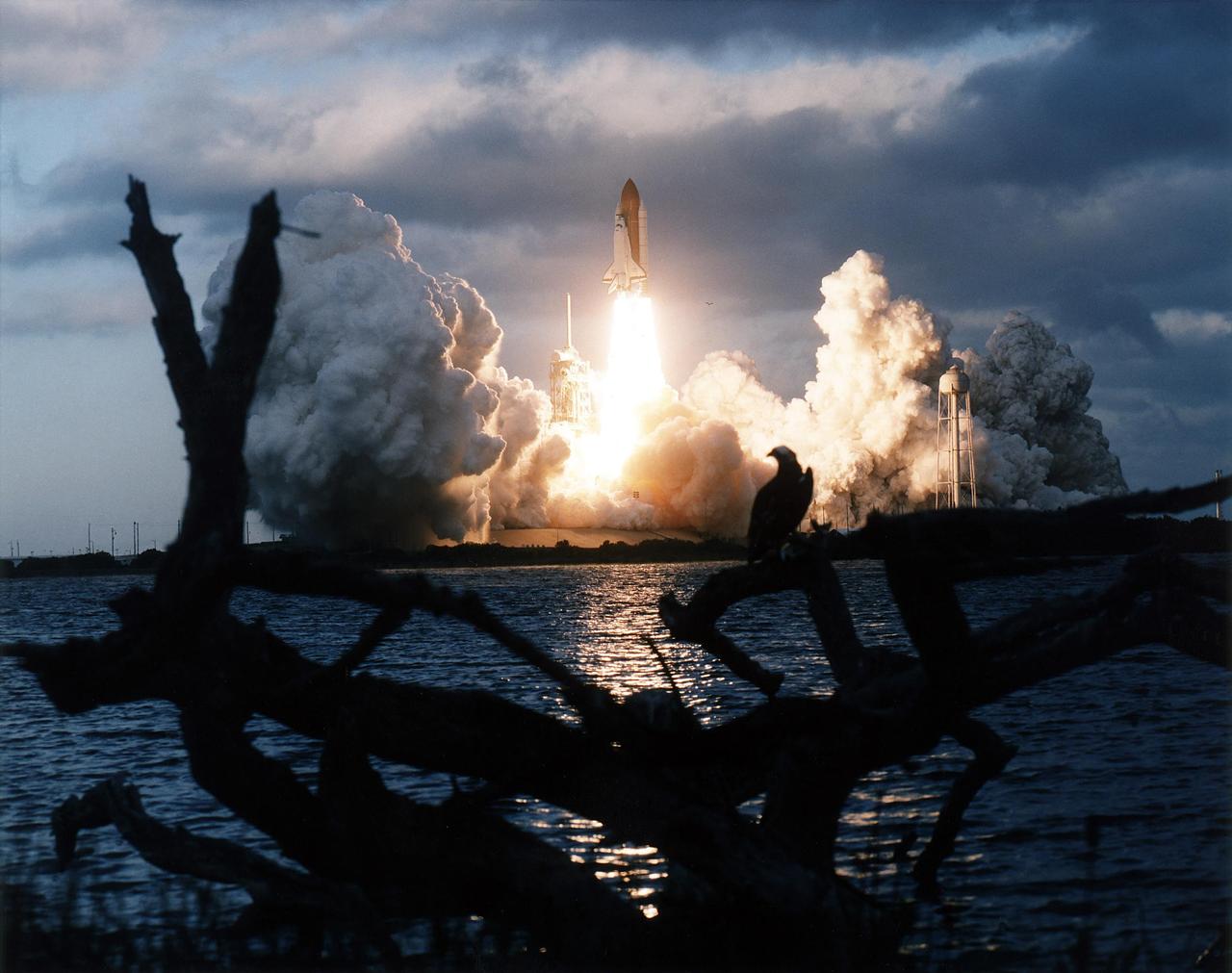
KENNEDY SPACE CENTER, FLA. -- STS-74: Atlantis
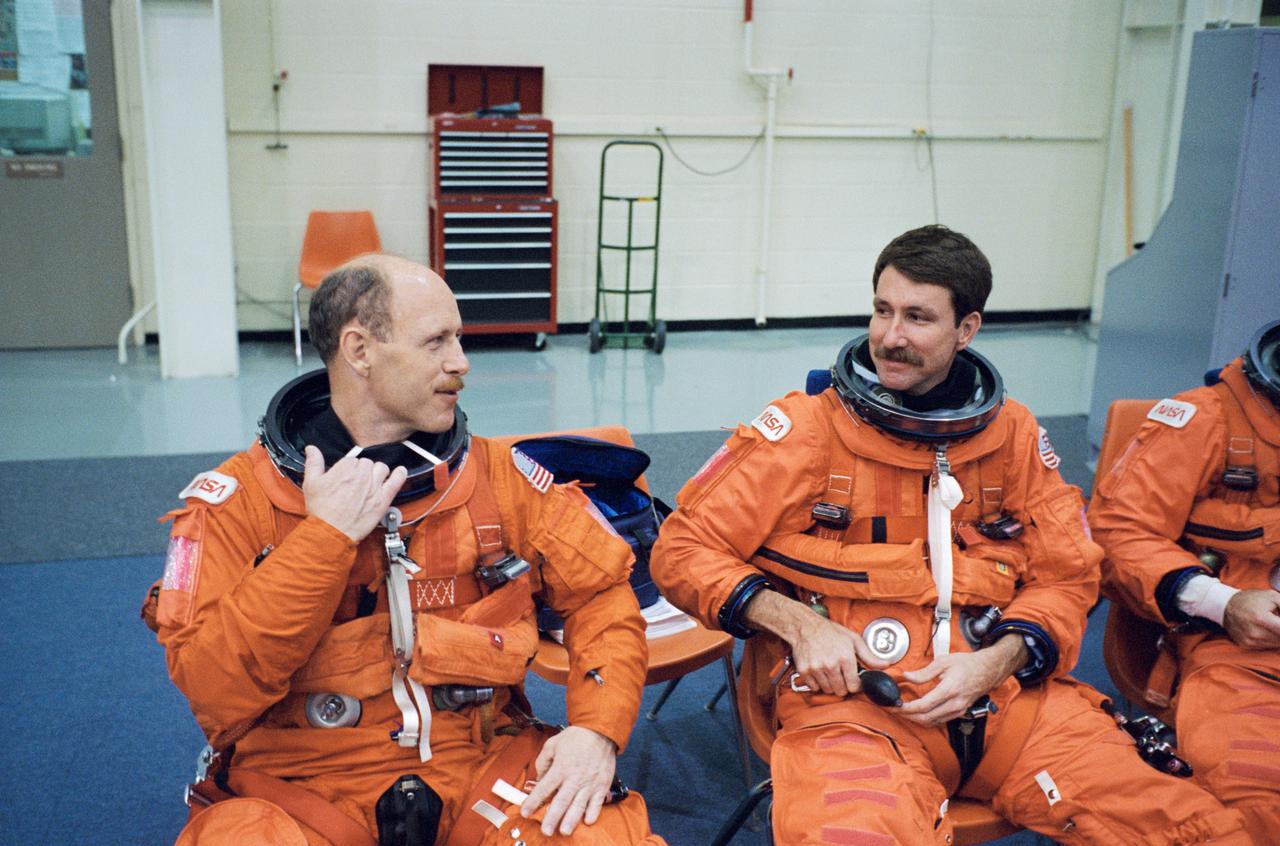
S95-09140 (27 Apr. 1995) --- Attired in training versions of the Space Shuttle partial pressure launch and entry garment, astronauts Kenneth D. Bowersox (left) and Kent V. Rominger prepare to rehearse an emergency situation with the Space Shuttle. The two are commander and pilot, respectively, for the United States Microgravity Laboratory (USML-2) mission. Bowersox was pilot for the USML-1 mission. The emergency egress training exercises took place in the Systems Integration Facility at the Johnson Space Center (JSC).
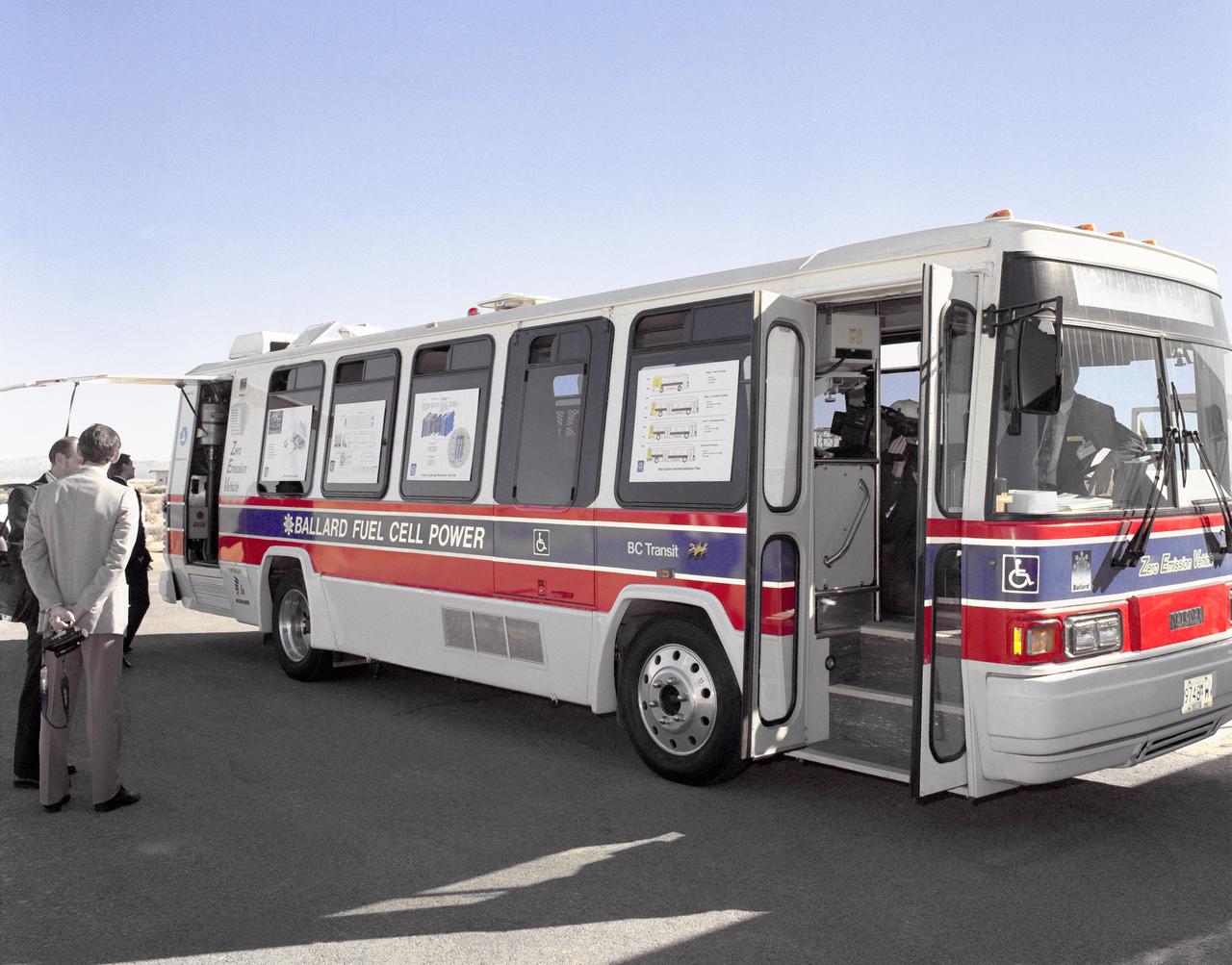
Fuel Cell Powered Bus

STS073-356-018 (20 October - 5 November 1995) --- Astronaut Kent V. Rominger, pilot, demonstrates an age-old trash-compacting method on the middeck of the Earth-orbiting Space Shuttle Columbia. Following a meal, Rominger had collected the residue wrappers, etc. and filled a plastic bag. Following his compacting maneuvers, Rominger went on to deposit the sack into a temporary trash-stowage area beneath the middeck. Making his first flight into space, Rominger joined four other NASA astronauts and two guest researchers for more than two weeks' research in support of the United States Microgravity Laboratory (USML-2) mission.
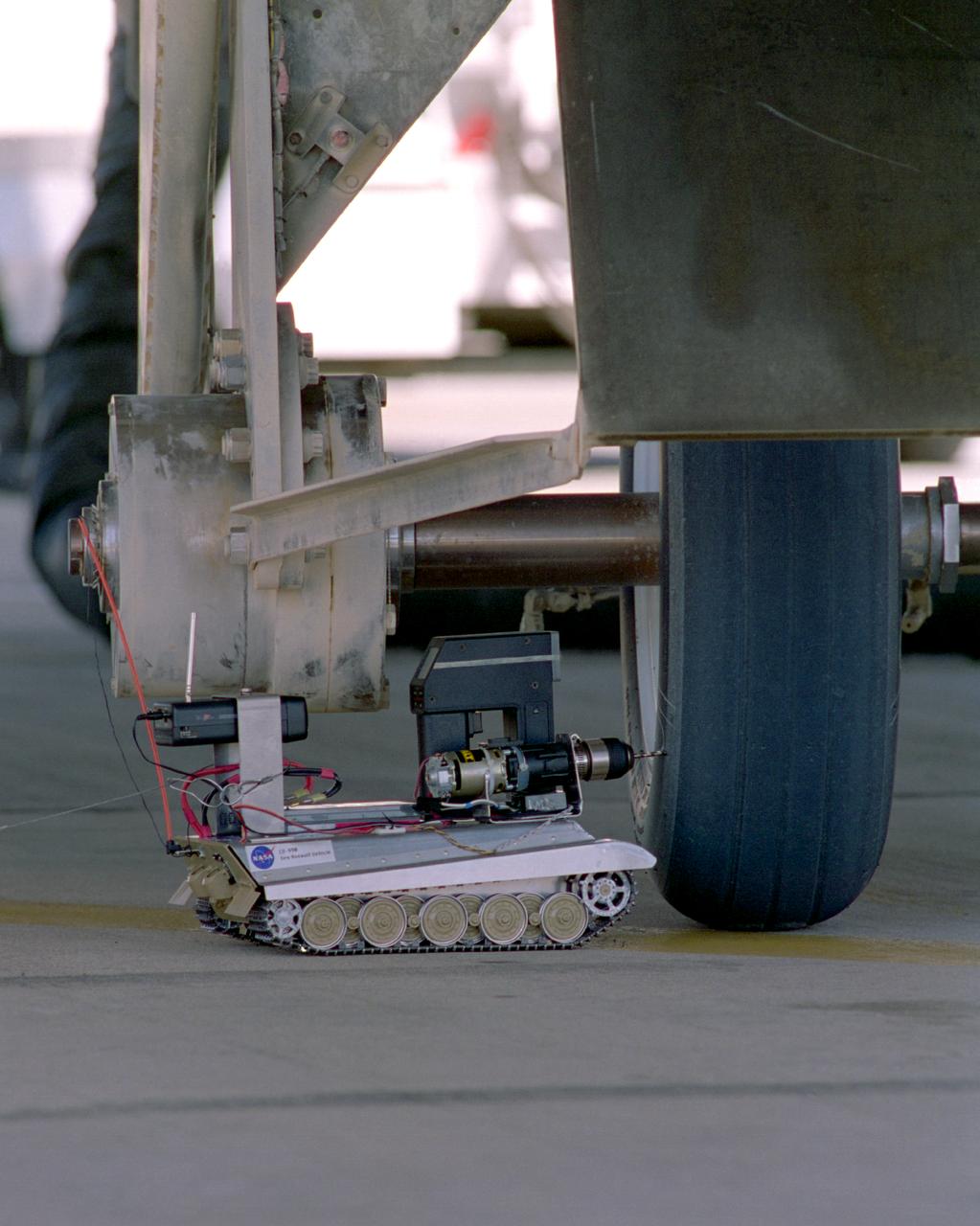
Created from a 1/16th model of a German World War II tank, the TAV (Tire Assault Vehicle) was an important safety feature for the Convair 990 Landing System Research Aircraft, which tested space shuttle tires. It was imperative to know the extreme conditions the shuttle tires could tolerate at landing without putting the shuttle and its crew at risk. In addition, the CV990 was able to land repeatedly to test the tires. The TAV was built from a kit and modified into a radio controlled, video-equipped machine to drill holes in aircraft test tires that were in imminent danger of exploding because of one or more conditions: high air pressure, high temperatures, and cord wear. An exploding test tire releases energy equivalent to two and one-half sticks of dynamite and can cause severe injuries to anyone within 50 ft. of the explosion, as well as ear injury - possibly permanent hearing loss - to anyone within 100 ft. The degree of danger is also determined by the temperature pressure and cord wear of a test tire. The TAV was developed by David Carrott, a PRC employee under contract to NASA.
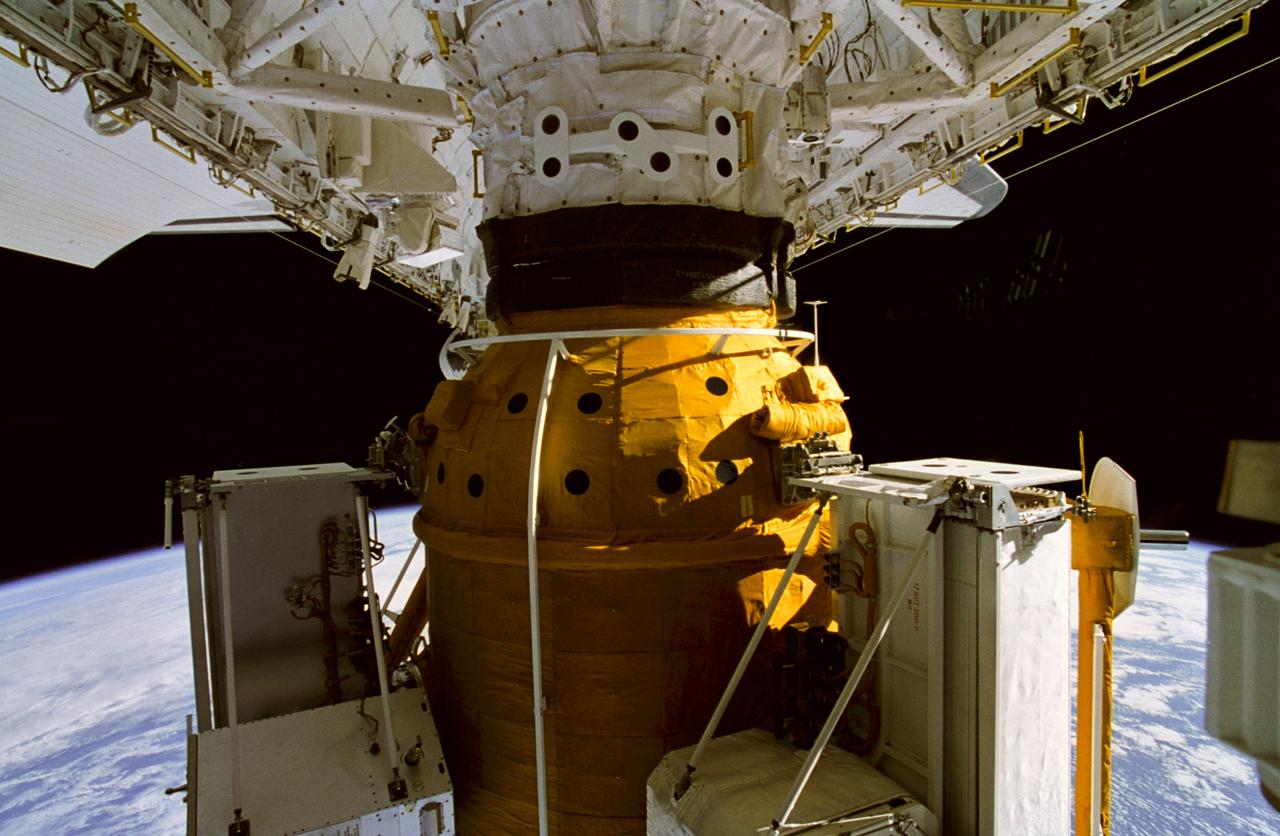
STS074-302-033 (14 Nov 1995) --- A 35mm camera aimed through the Space Shuttle Atlantis? aft windows captured the deployment of the Docking Module (DM), which was later delivered to Russia?s Mir Space Station in Earth-orbit. The Orbiter Docking System (ODS) is partially visible at bottom center. The flight began with a November 12, 1995, launch from Kennedy Space Center (KSC) and ended with landing there on November 20, 1995. The STS-74 crew members were astronauts Kenneth D. Cameron, mission commander; James D. Halsell, pilot; William S. McArthur, Jr., Jerry L. Ross and Canadian astronaut Chris A. Hadfield, all mission specialists. The Mir-20 crew is composed of cosmonauts Yuriy P. Gidzenko, commander; and Sergei V. Avdeyev, engineer; along with the European Space Agency?s (ESA) Thomas Reiter, cosmonaut researcher. Joint activities on the Mir and the Atlantis ended on November 18, 1995, when the two spacecraft separated.
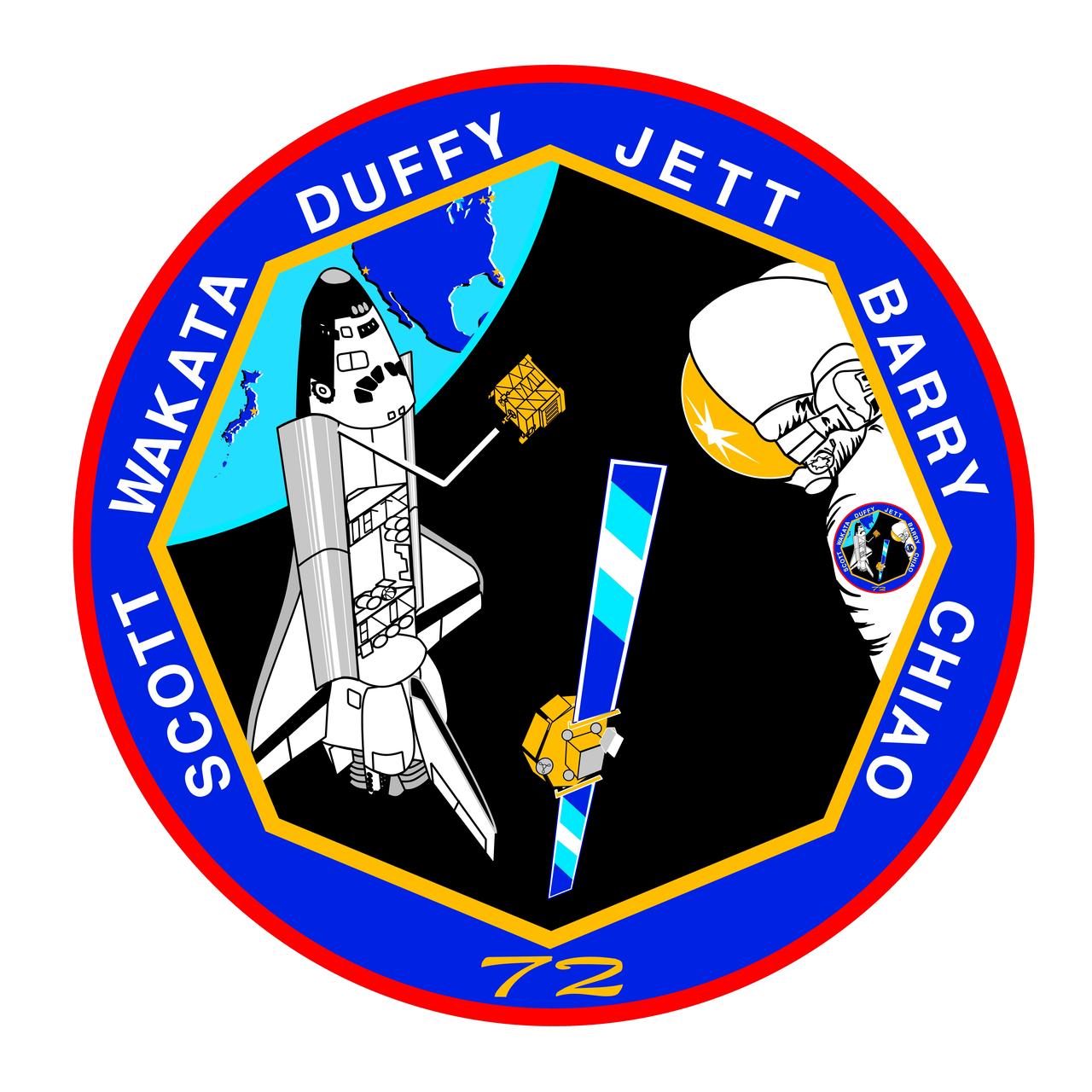
STS072-S-001 (May 1995) --- The crew patch of STS-72 depicts the space shuttle Endeavour and some of the payloads on the flight. The Japanese satellite, Space Flyer Unit (SFU) is shown in a free-flying configuration with the solar array panels deployed. The inner gold border of the patch represents the SFU's distinct octagonal shape. Endeavour will rendezvous with and retrieve SFU at an altitude of approximately 250 nautical miles. The Office of Aeronautics and Space Technology's (OAST) flyer satellite is shown just after release from the Remote Manipulator System (RMS). The OAST satellite will be deployed at an altitude of 165 nautical miles to fly free for two days gathering scientific data. The payload bay contains equipment for the secondary payloads - the Shuttle Laser Altimeter (SLA) and the Shuttle Solar Backscatter Ultraviolet Instrument (SSBUI). There are two spacewalks planned to test hardware for assembly of the International Space Station. The stars represent the hometowns of the crew members in the United States and Japan. The NASA insignia design for space shuttle flights is reserved for use by the astronauts and for other official use as the NASA Administrator may authorize. Public availability has been approved only in the forms of illustrations by the various news media. When and if there is any change in this policy, which is not anticipated, the change will be publicly announced. Photo credit: NASA
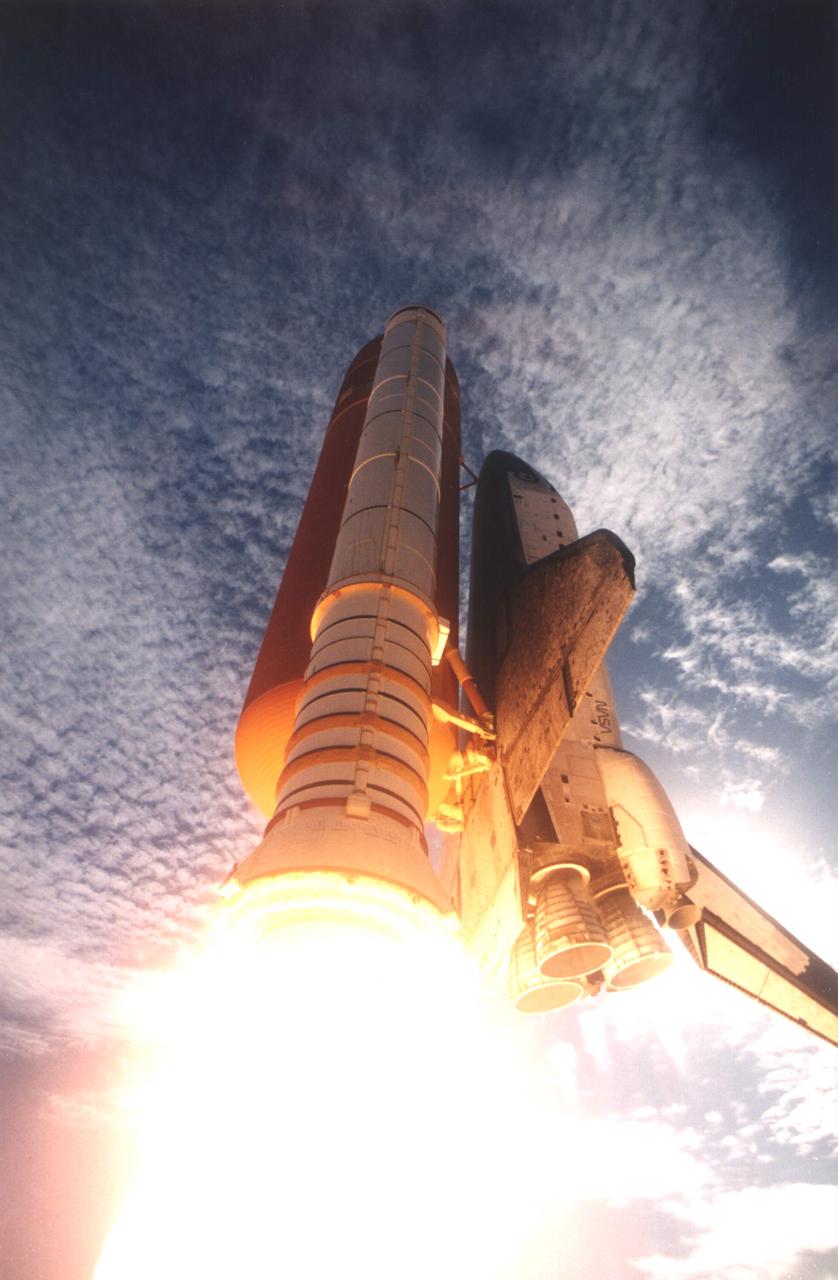
STS073-S-027 (20 October 1995) --- A 35mm camera captured this low-angle view of the Space Shuttle Columbia as it lifted off from Launch Pad 39B, at the Kennedy Space Center (KSC), to begin a scheduled 16-day mission in Earth-orbit in support of the United States Microgravity Laboratory (USML-2). Five NASA astronauts and two scientists from the private sector were onboard. Liftoff occurred at 9:53:00 a.m. (EDT) on October 20, 1995. The mission represents the 72nd Space Shuttle flight for NASA. The crew will be working around the clock on a diverse assortment of USML-2 experiments located in a science module in Columbia's cargo bay. Fields of study include fluid physics, materials science, biotechnology, combustion science and commercial space processing technologies. The crew is made up of astronauts Kenneth D. Bowersox, commander; Kent V. Rominger, pilot; Kathryn C. Thornton, payload commander; Michael E. Lopez-Alegria and Catherine G. Coleman, mission specialists; along with Fred W. Leslie and Albert Sacco Jr., payload specialists.
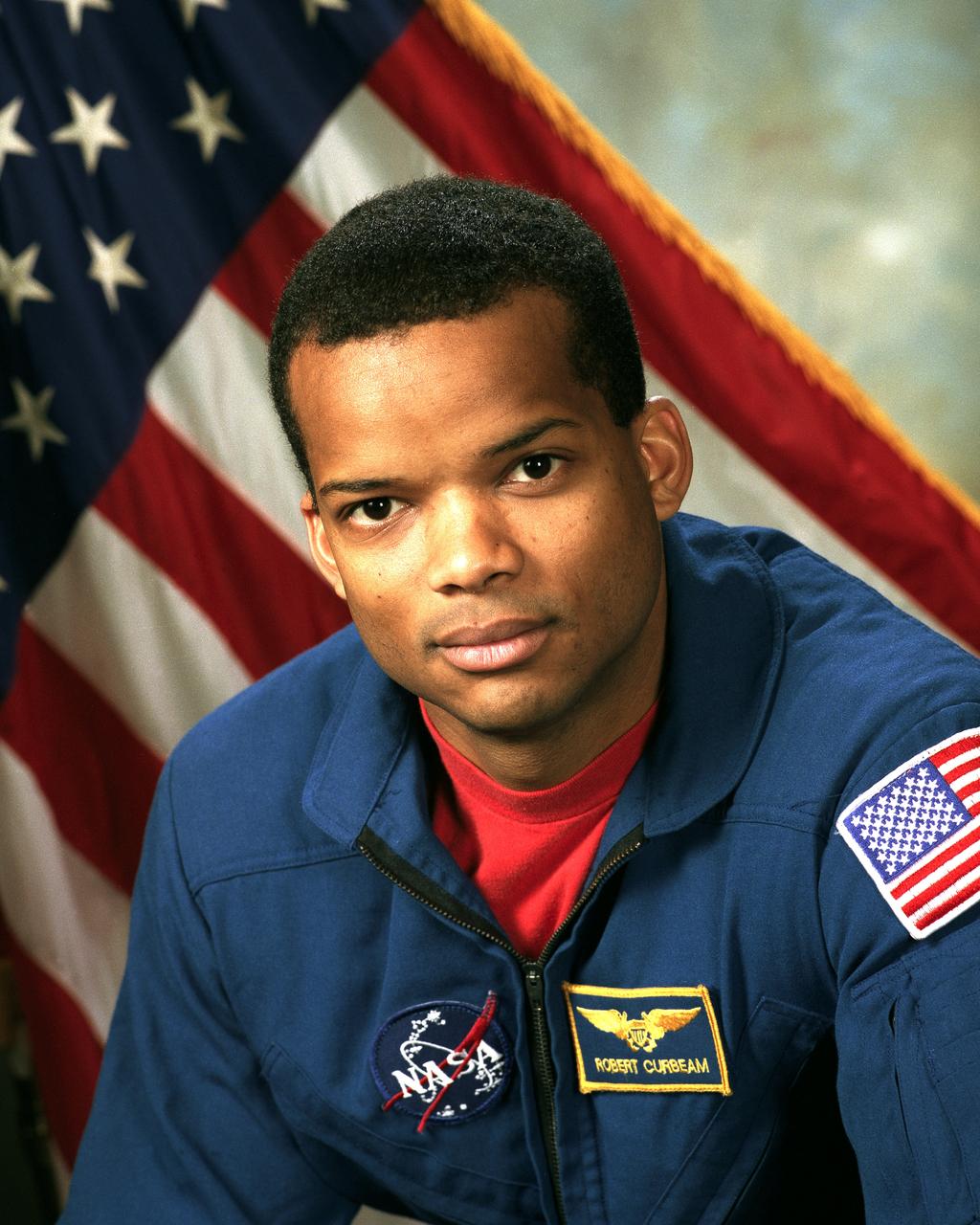
S95-09671 (1995) --- Astronaut Robert L. Curbeam, mission specialist
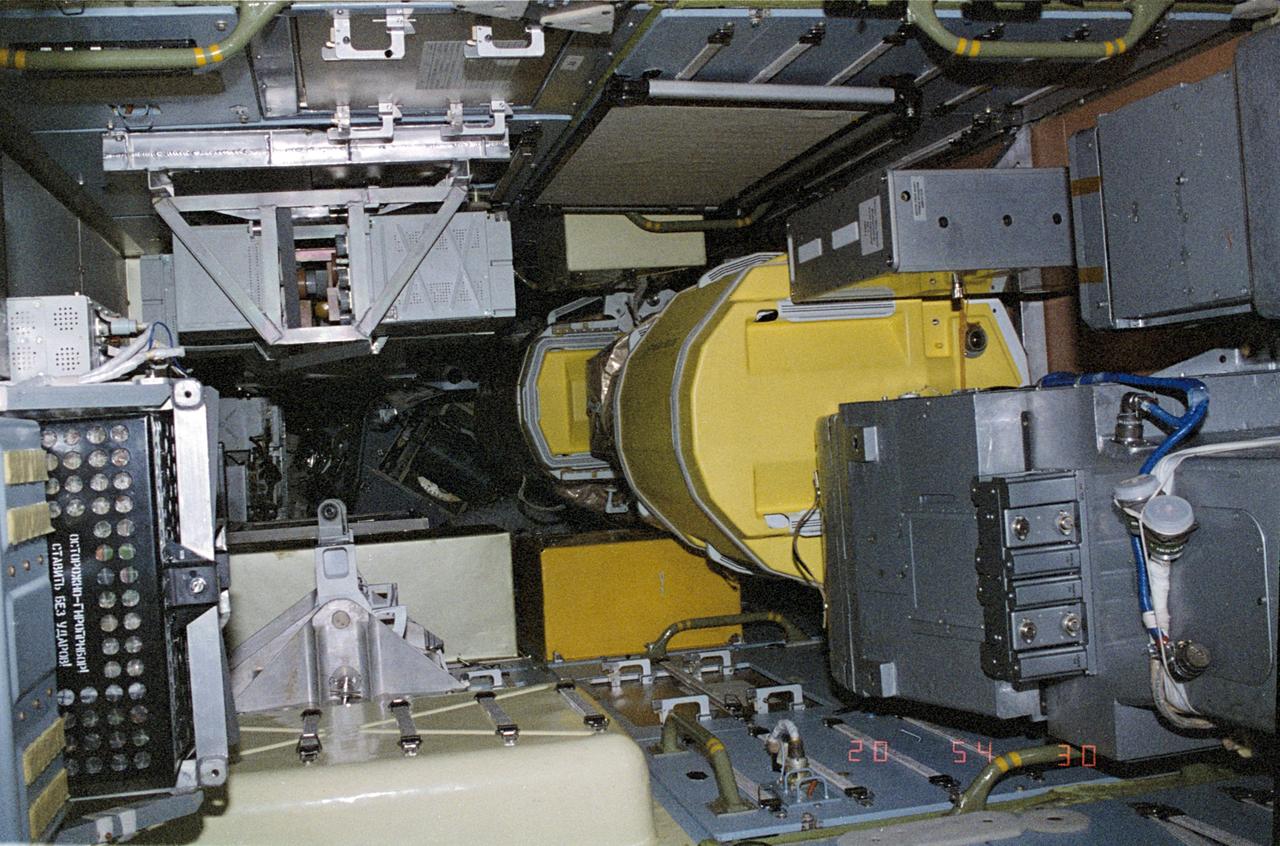
NM18-307-019 (March-July 1995) --- This photograph was taken by one of the Mir-18 crew members shortly after the arrival of the Spektr module. The spacecraft contained yet unopened gear and supplies for the Mir crews. This image was one of many shown at a July 18 press conference in Houston.
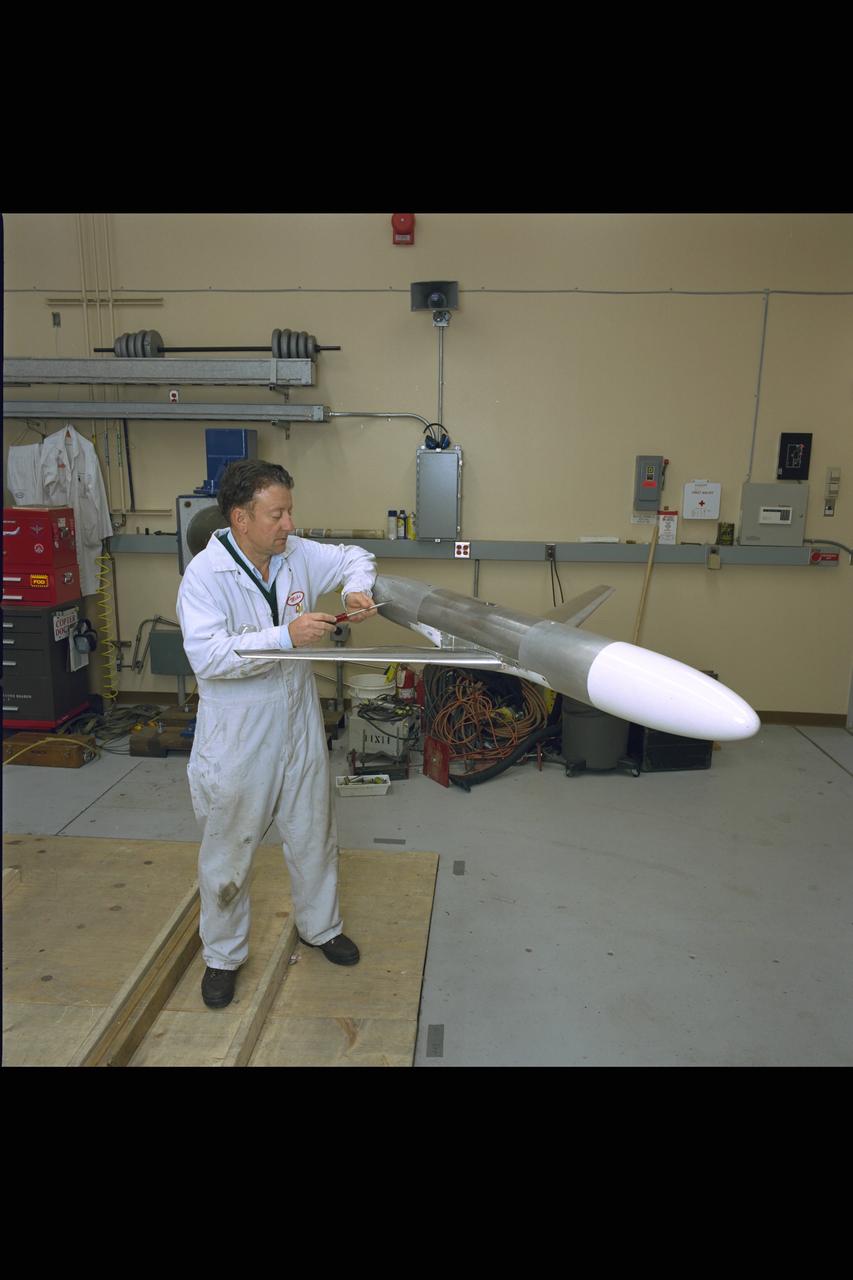
New renovated NASA Ames Research Center 12ft Pressure Wind Tunnel view of mechanic with mdoel in model prep area
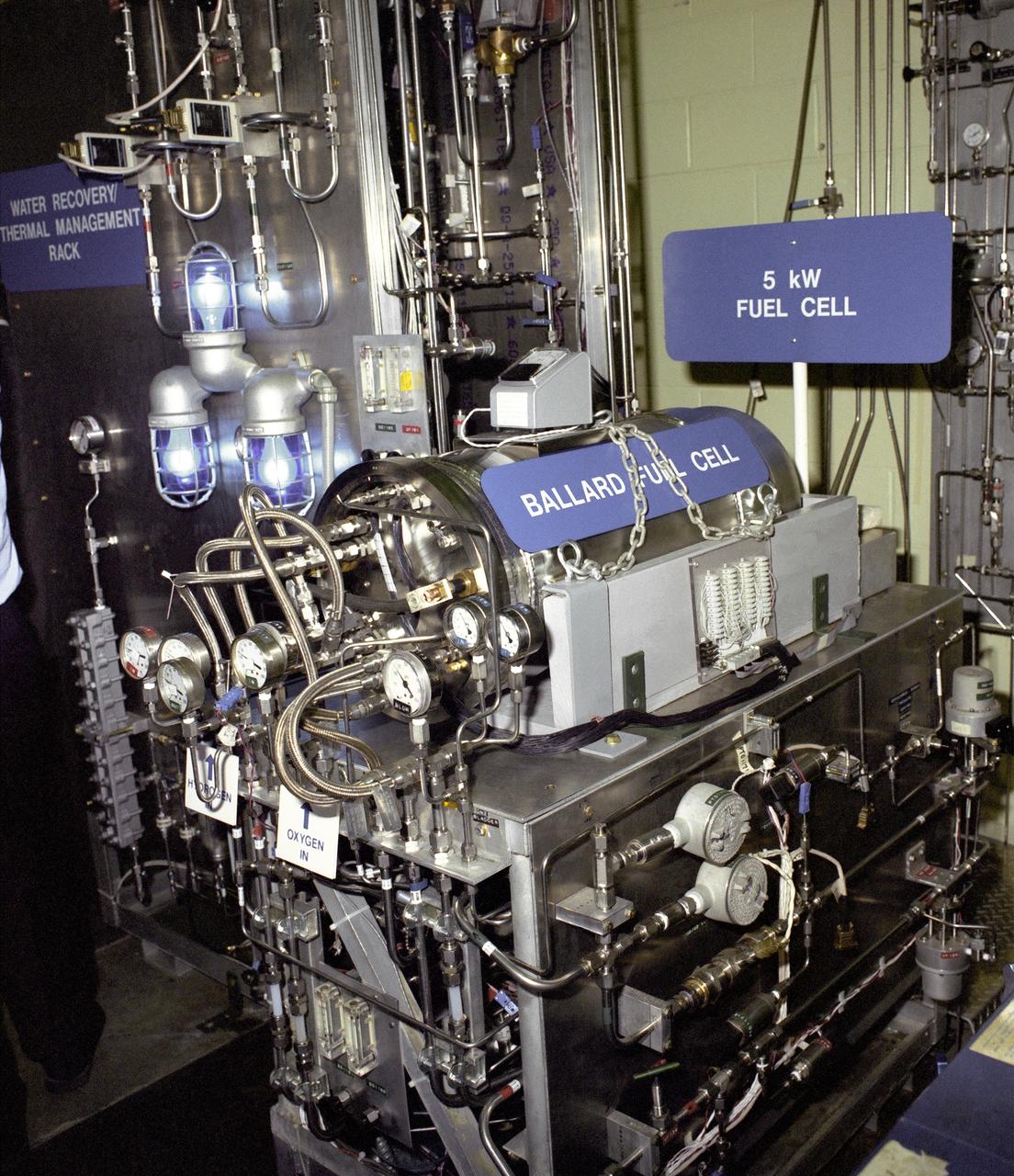
Fuel Cell for Bus
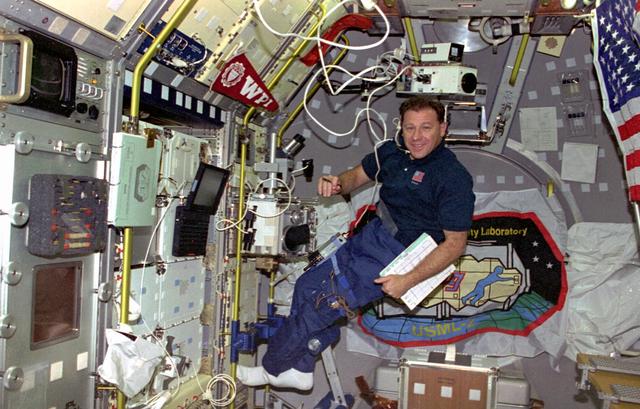
STS073-106-001 (20 October-5 November 1995) --- Payload specialist Albert Sacco Jr. takes direction from a crew mate out of frame onboard the United States Microgravity Laboratory (USML-2) science module in the cargo bay of the Space Shuttle Columbia. Sacco was about to check out an experiment in a glovebox, which represented one of the busier areas during the 16-day USML-2 flight.
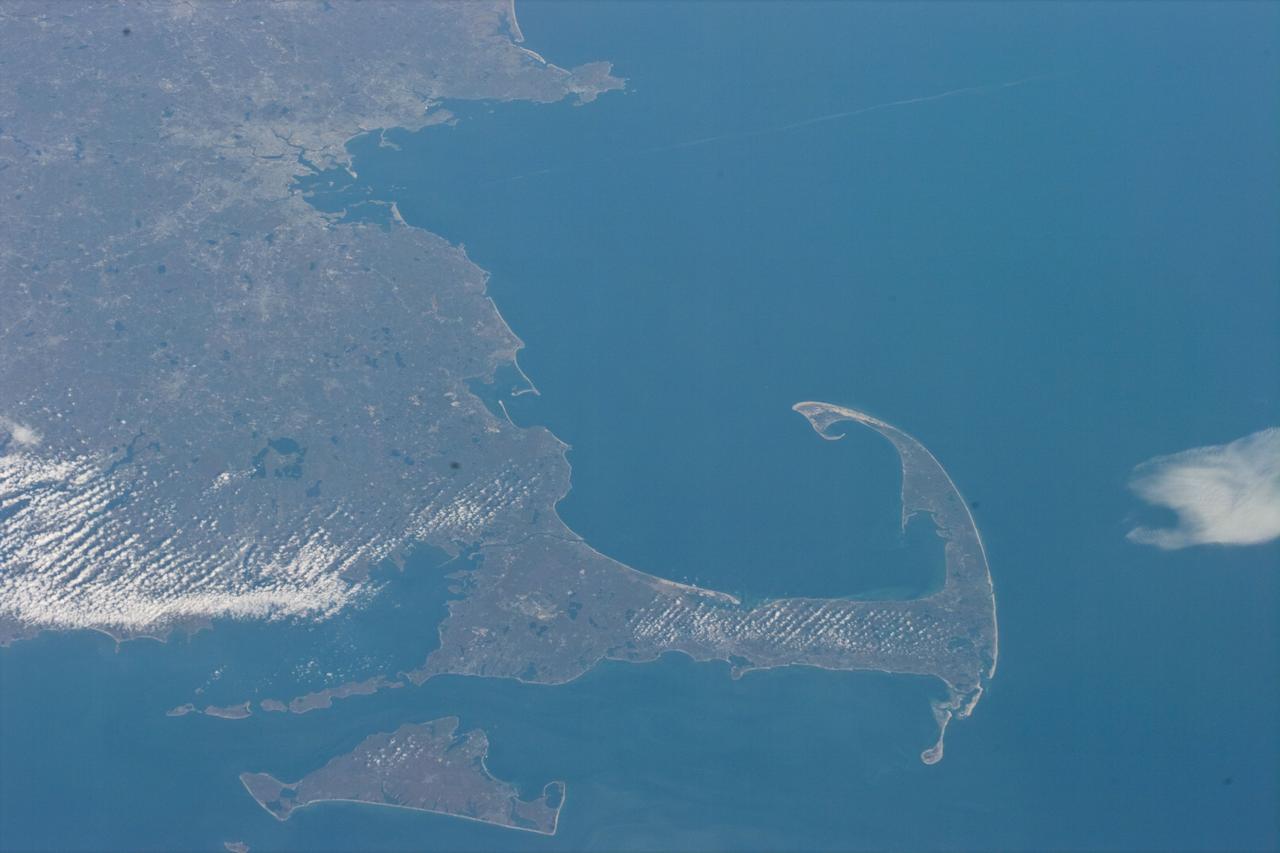
STS073-E-5099 (30 Oct. 1995) --- The entire coast of Massachusetts can be seen, from Martha's Vineyard and Buzzard's Bay in the foreground past the Boston metropolitan region. The frame was exposed with the Electronic Still Camera (ESC).
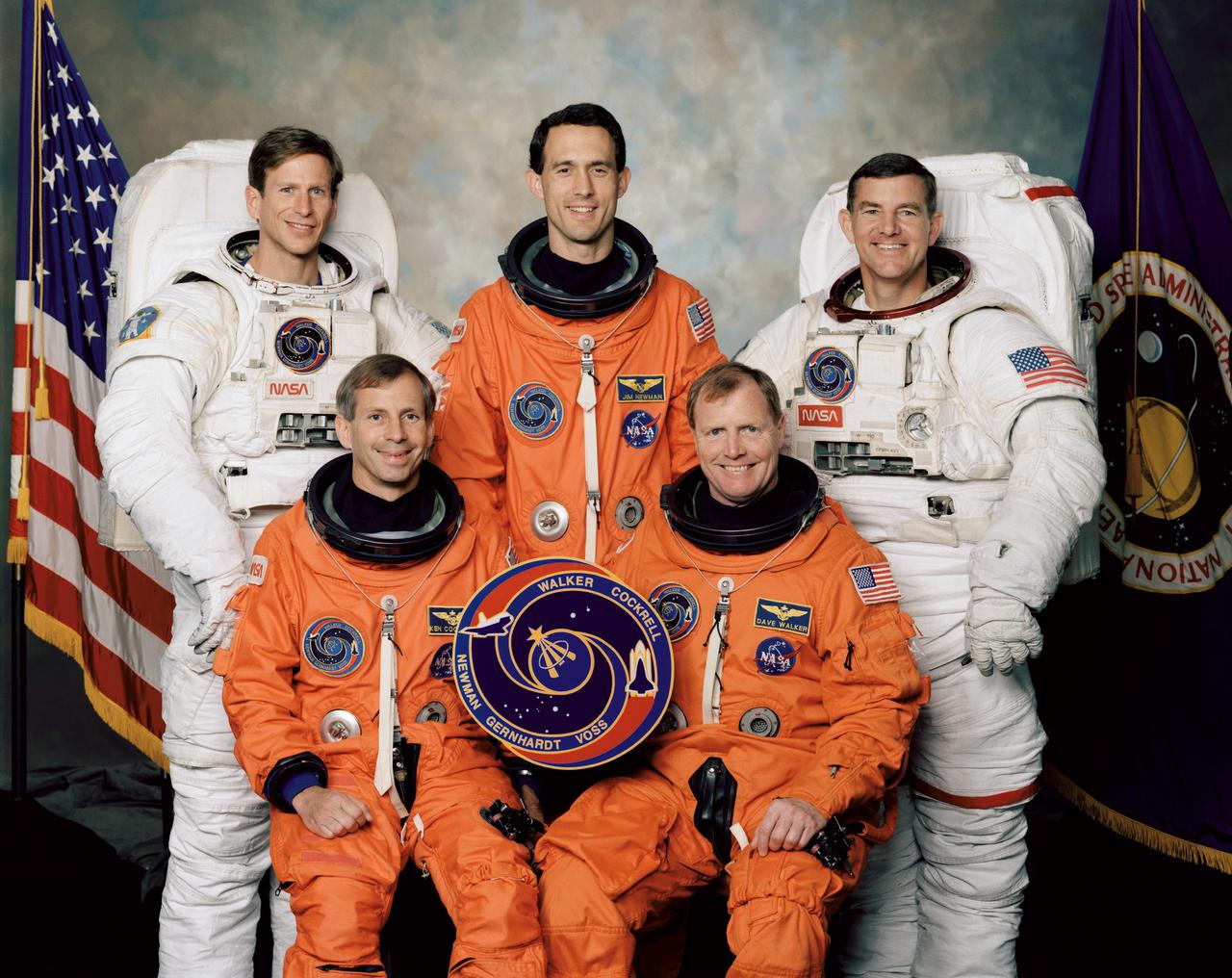
These five NASA astronauts were the crew members for the STS-69 mission that launched aboard the Space Shuttle Endeavour September 7, 1995. Pictured on the front row (left to right) are David M. Walker, mission commander; and Kenneth D. Cockrell, pilot. On the back row (left to right) are Michael L. Gernhardt and James H. Newman, both mission specialists; and James S. Voss, payload commander. The mission’s two primary payloads included the Spartan 201-3 and Wake Shield Facility-2 (WSF-2).
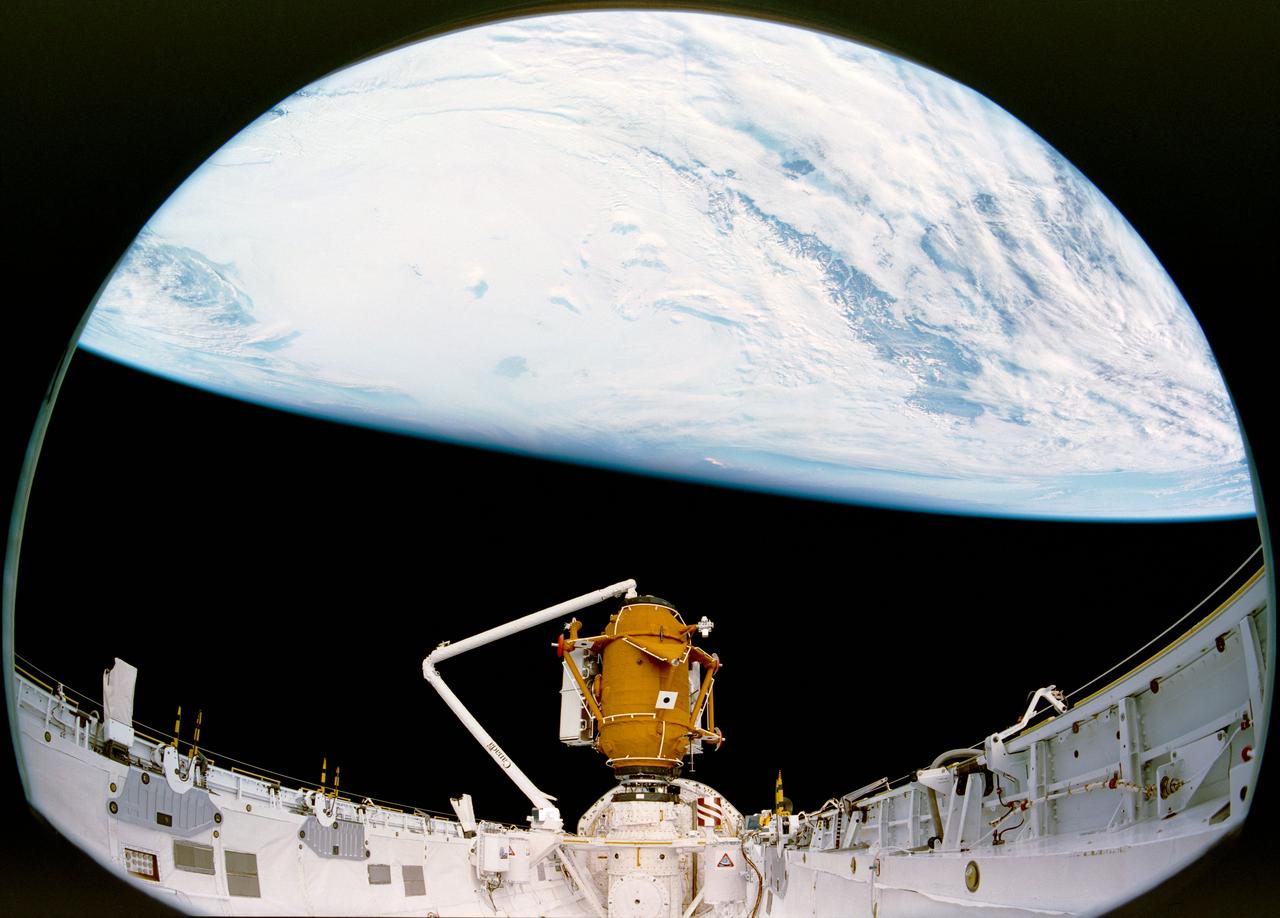
S95-22079 (14 Nov 1995) --- The Docking Module (DM) is seen just after installation in the Space Shuttle Atlantis' cargo bay. The snow-covered Bukhtarminskaye Reservoir, just north of China, may be seen in the background. When this photo was taken, five NASA astronauts were onboard Atlantis, awaiting their joint activities which is set to begin in less than 24 hours with three Mir-20 cosmonauts following tomorrow's scheduled docking. During the STS-74 mission, the crew used an IMAX camera to document the Space Shuttle Atlantis' rendezvous and docking with the Mir Space Station. The 65mm camera system was located in the Atlantis' cargo bay and provided a unique fish-eye perspective. These images were selected from footage that will be incorporated in a large-format feature film about NASA's cooperative program with the Russians. NASA has flown IMAX camera systems on many Shuttle missions, including the recent STS-63 Shuttle-Mir rendezvous and STS-71 Shuttle-Mir docking. Film from previous missions was used to create the productions The Dream is Alive, The Blue Planet, and Destiny in Space.
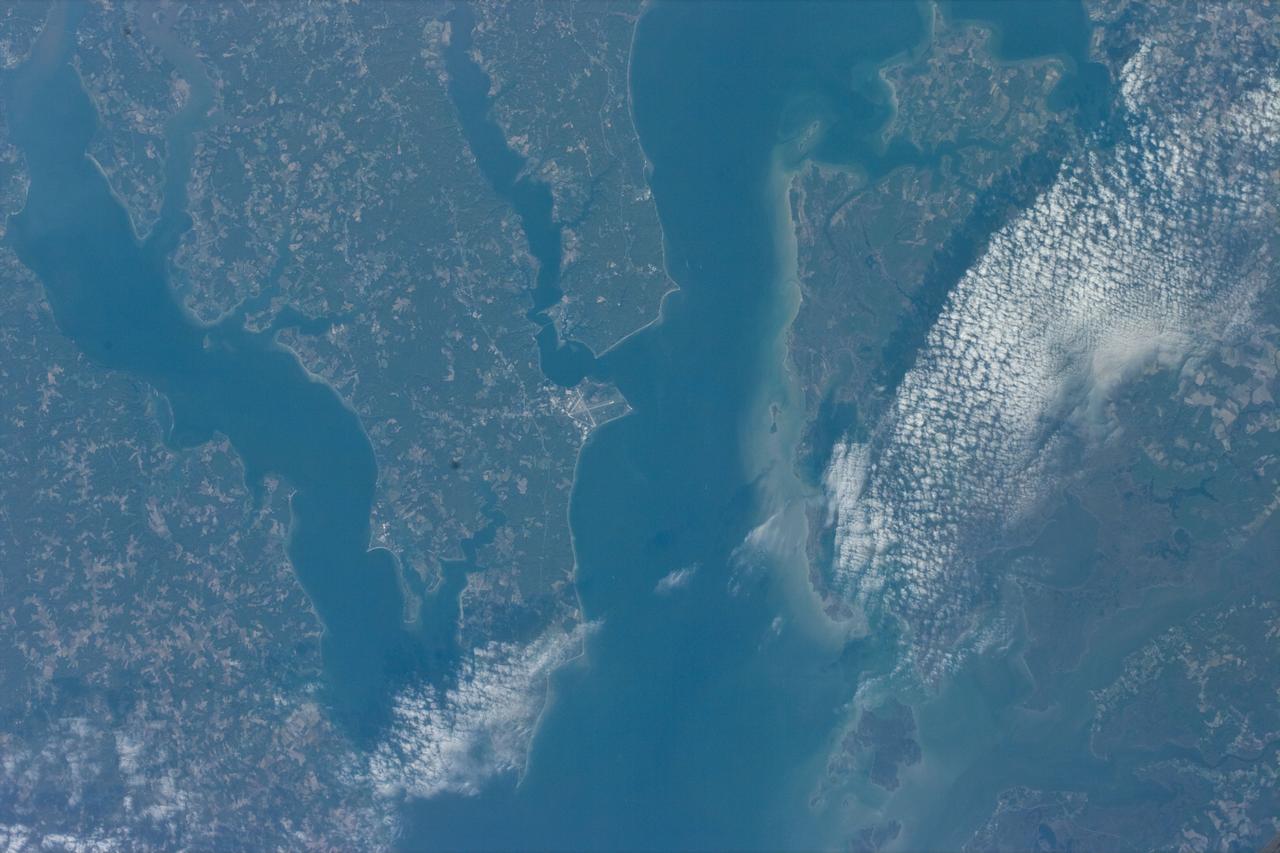
STS073-E-5096 (30 Oct. 1995) --- Central Chesapeake Bay. The lower Potomac River and Patuxent River join the Bay, whose eastern side is muddy from sediment eroded from the shoreline. The image is centered on the Patuxent River Naval Air Station. The frame was exposed with the Electronic Still Camera (ESC).
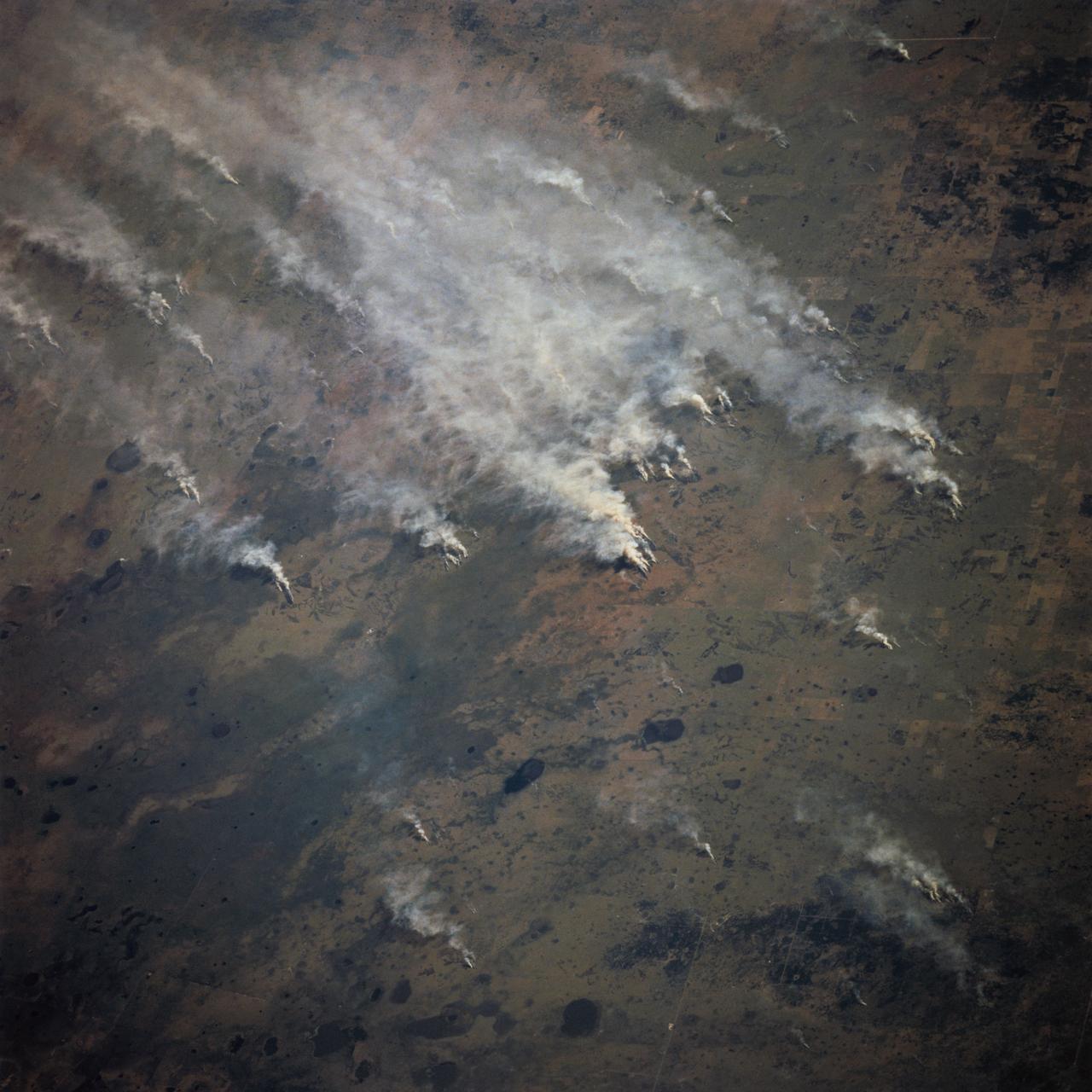
STS070-717-027 (13-22 JULY 1995) --- Easterly winds from the Mozambique Channel blow the smoke from many large fires in southern Mozambique inland. Neighboring views showed the smoke moving over and around the Chimanimani Mountains, into Zimbabwe on the African plateau. Winter is the dry season in southern Africa and fires are set to hasten the greening of the grass shoots for cattle grazing.
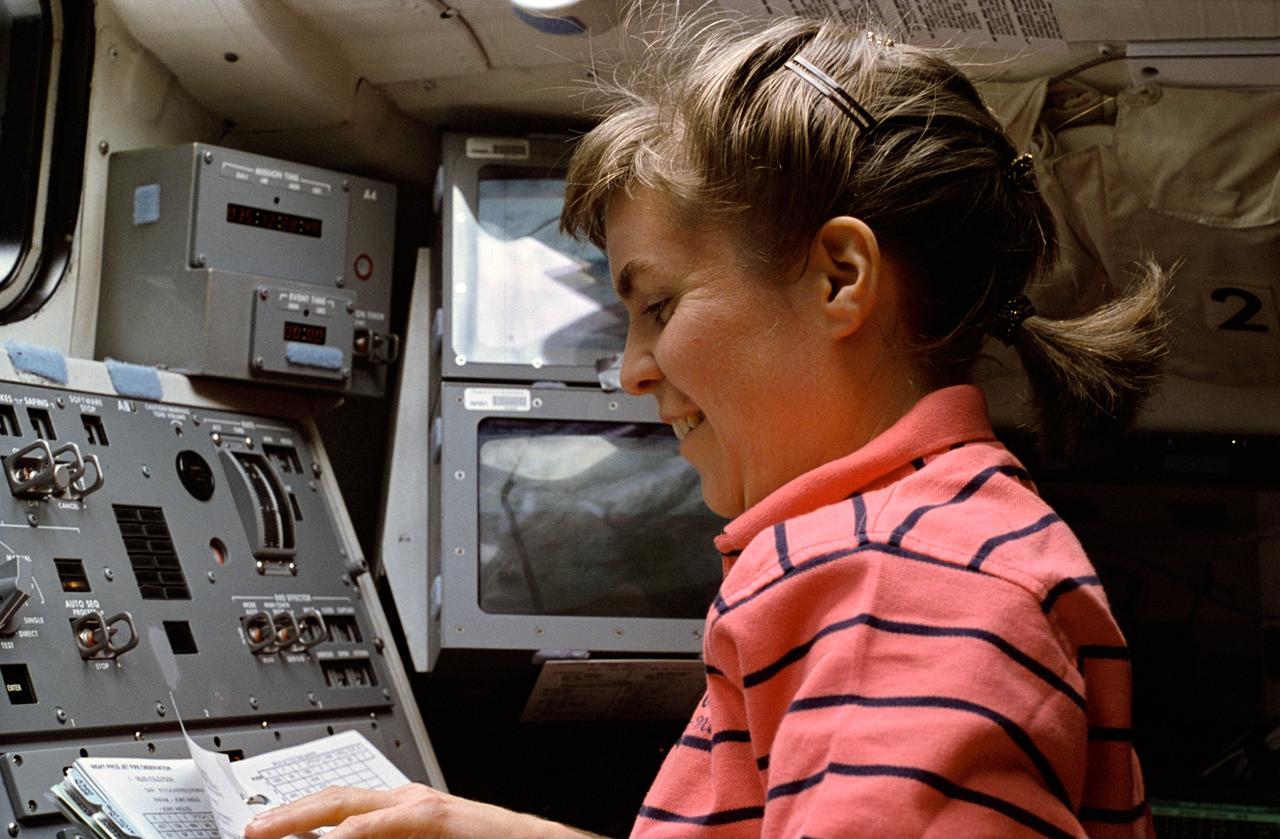
STS063-25-017 (3-11 Feb 1995) --- On the Space Shuttle Discovery's flight deck, astronaut Janice E. Voss, mission specialist, looks over a procedures list while operating the Remote Manipulator System (RMS) arm. Voss was joined by four other NASA astronauts and a Russian cosmonaut for eight days in space, was making her second space flight.
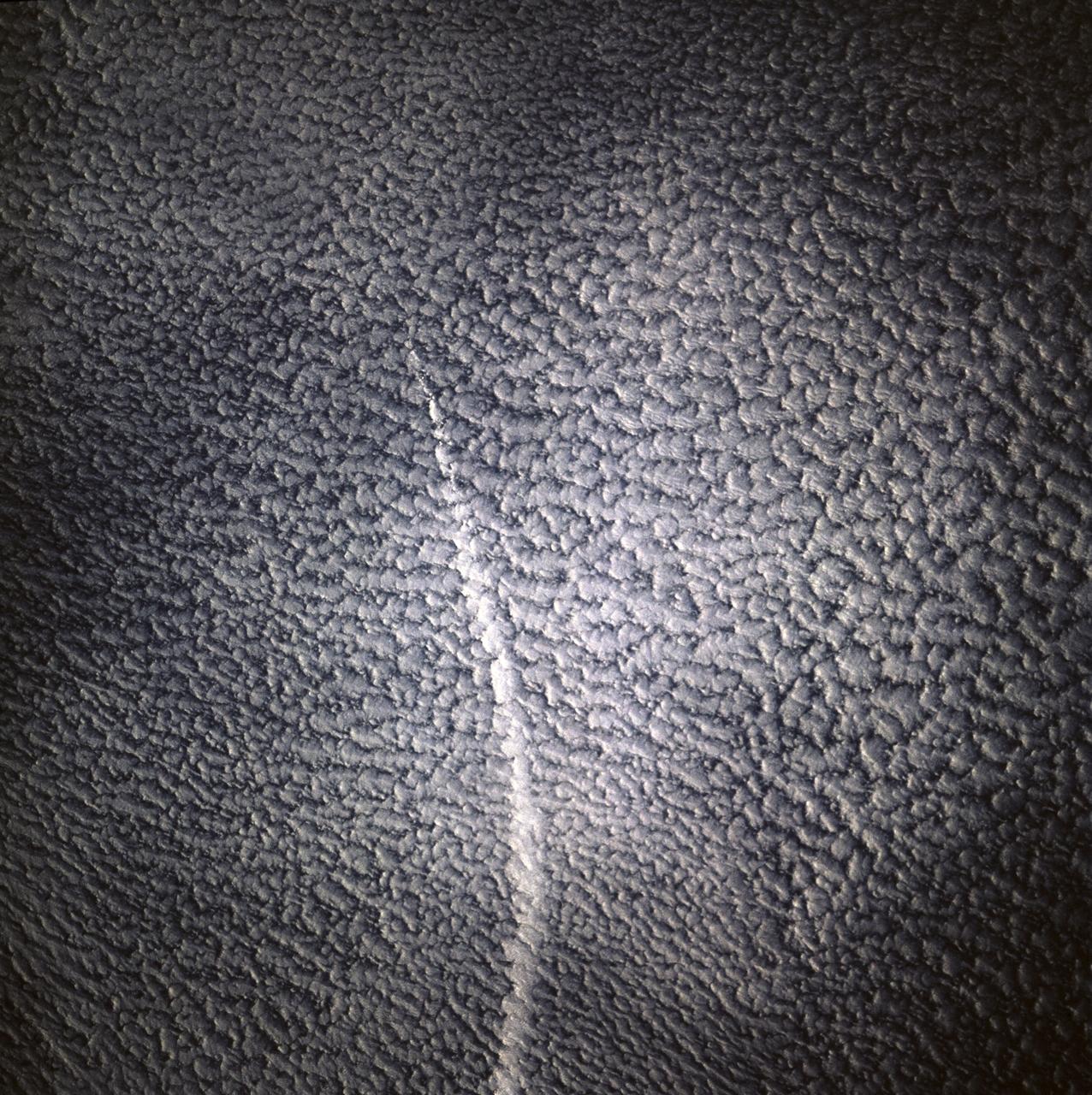
STS071-745-006 (27 June-7 July 1995) --- This view shows a ship track, probably in the northern Pacific Ocean, where a ship has caused clouds to form more thickly directly above the path of this ship. This track is therefore visible even though the ship itself is not. Ship tracks are thought to be caused by particles thrown up into the air by the ship, from smokestack emissions and from water particles generated by the ship moving through the sea. Under favorable weather conditions, water condenses around these particles to form clouds, in this case thicker "popcorn" clouds than already exists in the area. Ongoing studies are attempting to understand this phenomenon better.
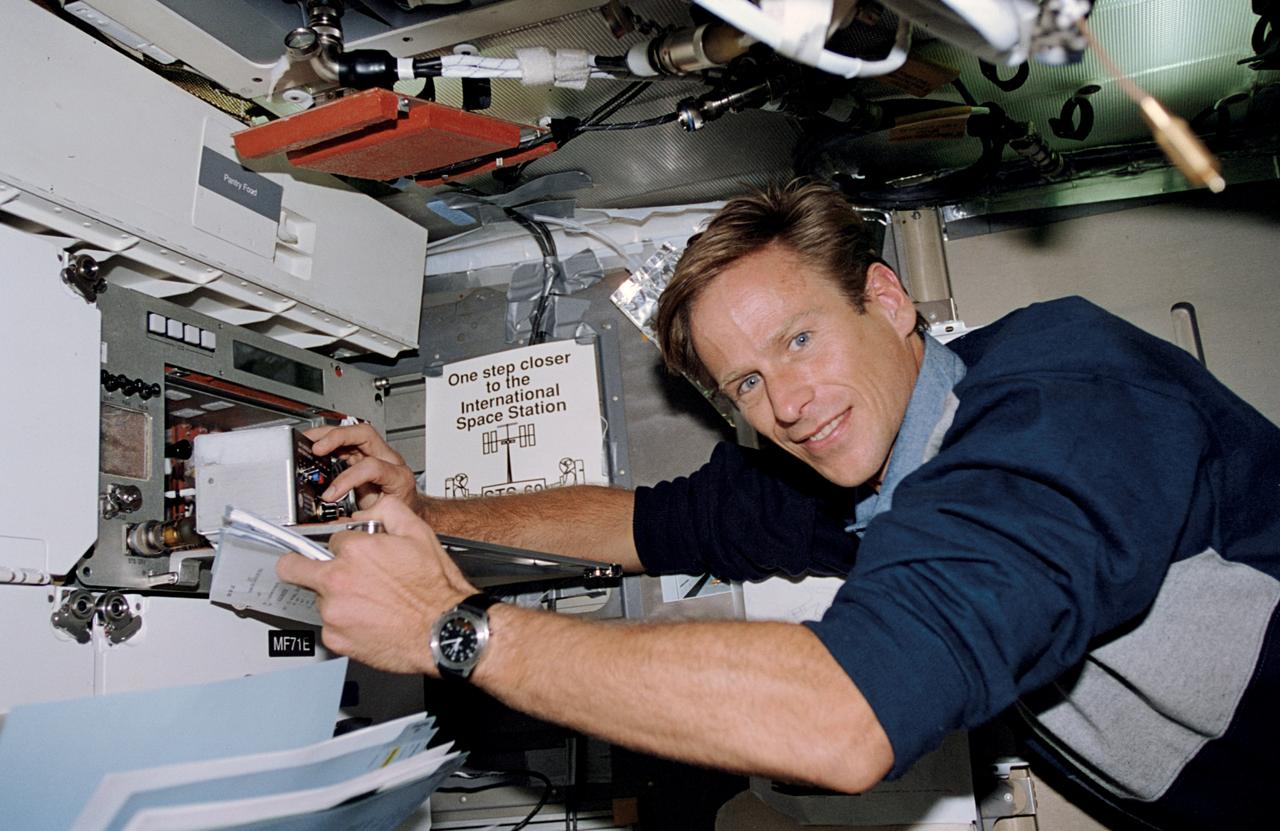
STS069-377-021 (7-18 September 1995) --- Astronaut Michael L. Gernhardt, mission specialist, works with a test called the Commercial Material Dispersion Apparatus Instrumentation Technology Associates, Inc., Experiment (CMIX) 04. The experiment is in one of the stowage lockers on Space Shuttle Endeavour’s middeck. Endeavour, with a five-member crew, launched on September 7, 1995, from the Kennedy Space Center (KSC). The mission ended September 18, 1995, with a successful landing on Runway 33 at KSC.
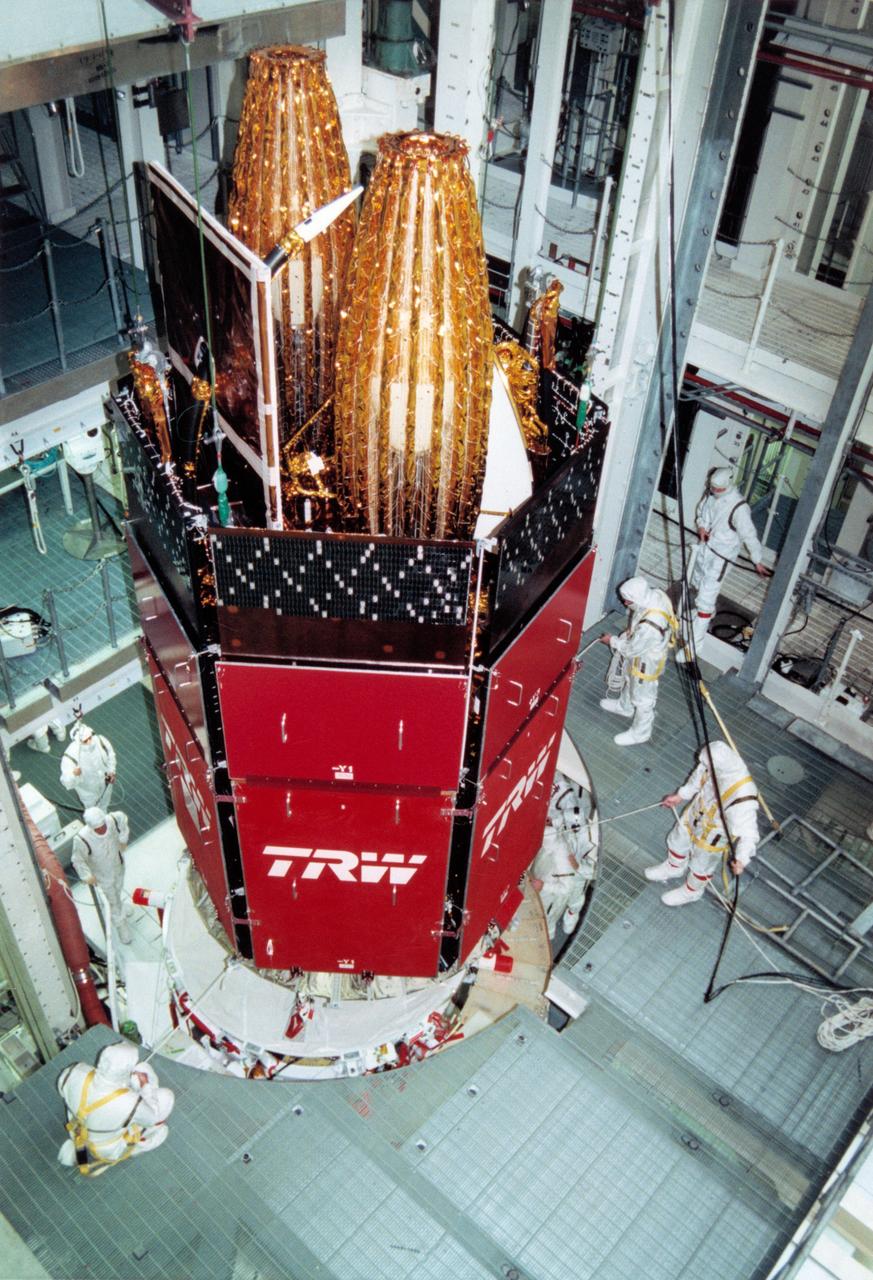
S95-08962 (12 APRIL 1995) --- Members of the Kennedy Space Center (KSC) Payload Processing Team hoist the Tracking and Data Relay Satellite (TDRS-G) into a work stand in the Vertical Processing Facility (VPF) for mating with its Inertial Upper Stage (IUS). After testing and final checkout, TDRS-G and the IUS will be transported to Launch Pad 39B and installed into the Space Shuttle Discovery's payload bay for launch on the STS-70 mission, scheduled for launch June 8, 1995.
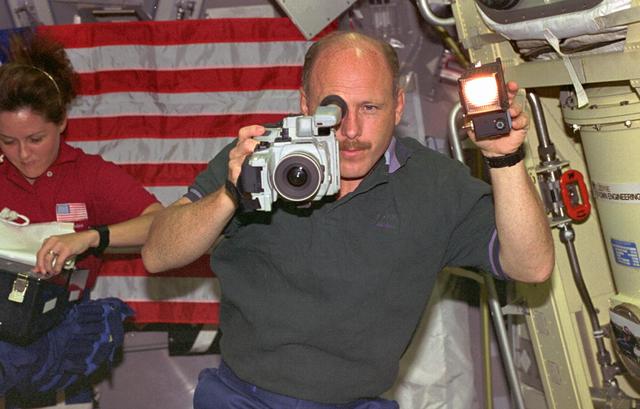
STS073-230-014 (20 October - 5 November 1995) --- Astronaut Kenneth D. Bowersox, STS-73 mission commander, uses a camcorder to record United States Microgravity Laboratory 2 (USML-2) activities onboard the Space Shuttle Columbia. Nearby, astronaut Kathryn C. Thornton, payload commander, prepares to open a supply chest to support one of many science experiments conducted by the seven-member crew during the 16-day USML-2 flight.
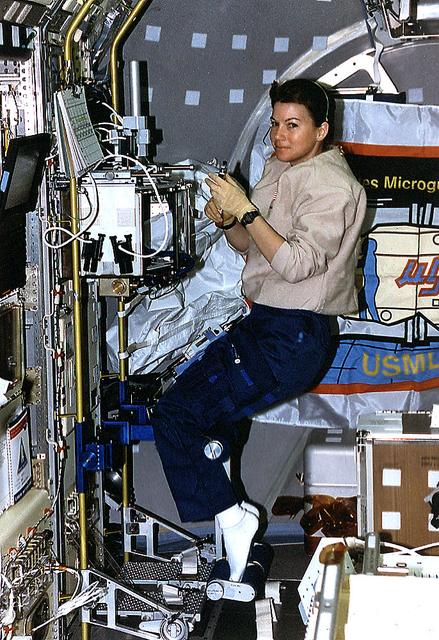
Onboard Space Shuttle Columbia (STS-73) Mission Specialists Catherine Cady Coleman works at the glovebox facility in support of the Protein Crystal Growth Glovebox (PCG-GBX) experiment in the United States Microgravity Laboratory 2 (USML-2) Spacelab science module.

Visit by the Dalai Lama and tour of the Space Station mockup in Bldg 9 with astronauts Dan Bursch and Tom Jones. Inside the space station mockup (17339-41). Walking outside the mockups (17342-5). Group portrait of tour group (17346).
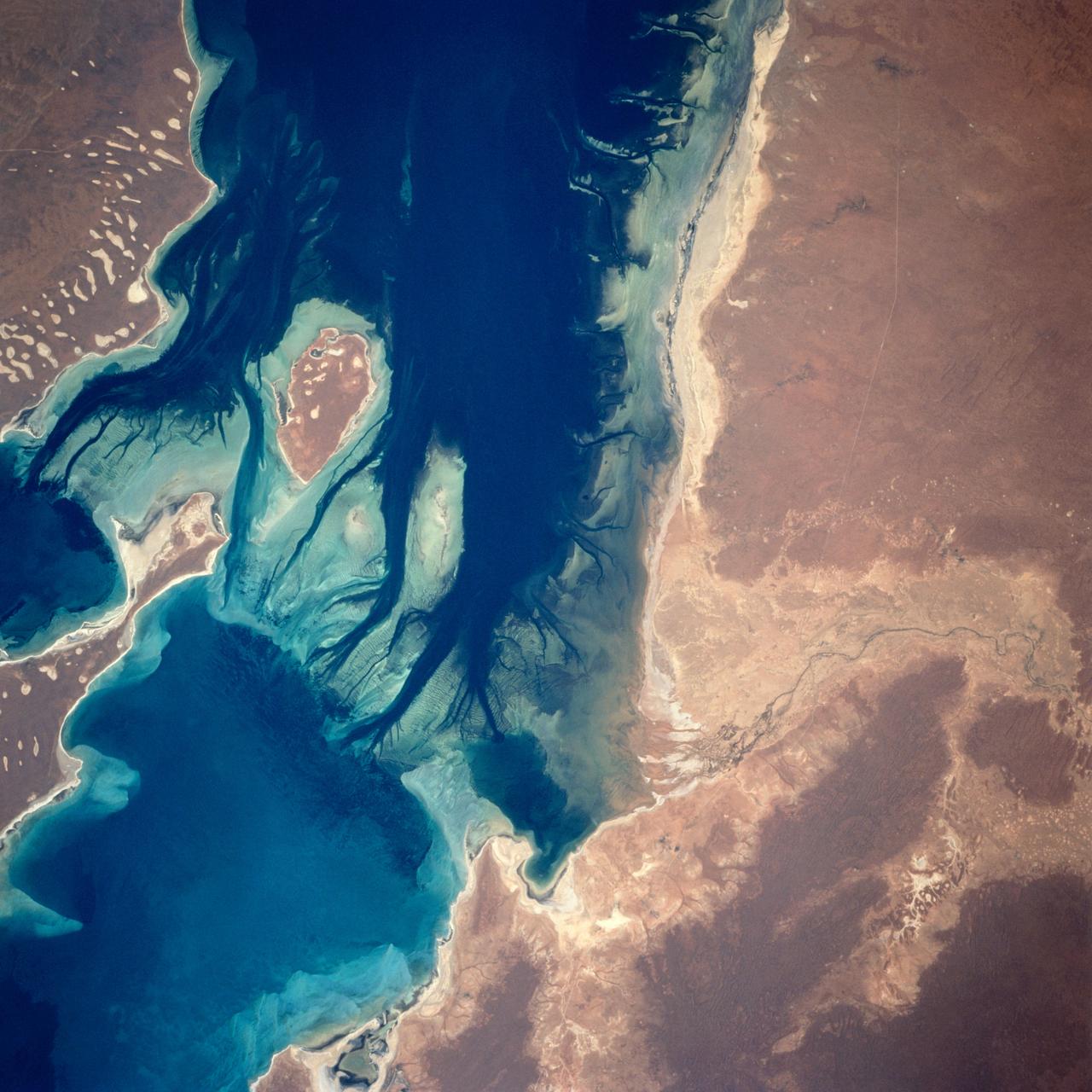
A nearly vertical view of Disappointment Reach and surroundings. Ripple-like patterns extending at right angles to the tidal flow can be discerned on shoals. Relict sand dune patterns, crests unvegetated, are evident on the western side of the estuary. Red mud brought down the Mooramel River on the east side of the estuary does extend into the shallow water of the inter-tidal lagoons. Most of the light-colored water along the coast, represents shoals of lime sediment. Patterns of sediment distribution by tides, waves, streams, and wind combine to create a complex and colorful scene.
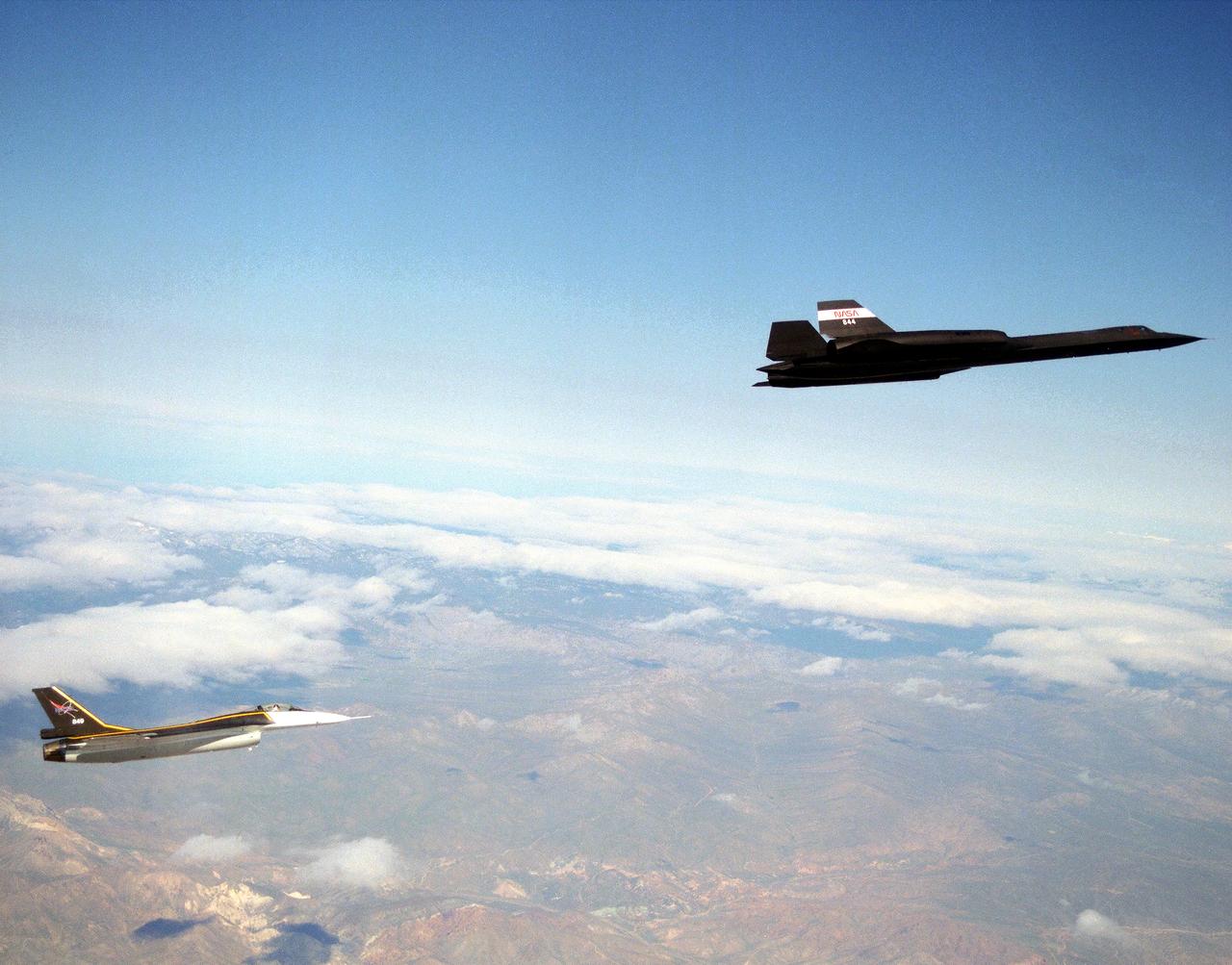
The single-seat F-16XL, NASA 849, joins up with an SR-71A, NASA 844, as crews set up for one of the flights in the recent sonic boom research program conducted by the Dryden Flight Research Center, Edwards, California. During the missions, the F-16XL probed the shockwaves generated by the SR-71, while at lower altitudes sensors on an F-18 and on a YO-3A, and also on the ground, recorded data from the same shockwave.
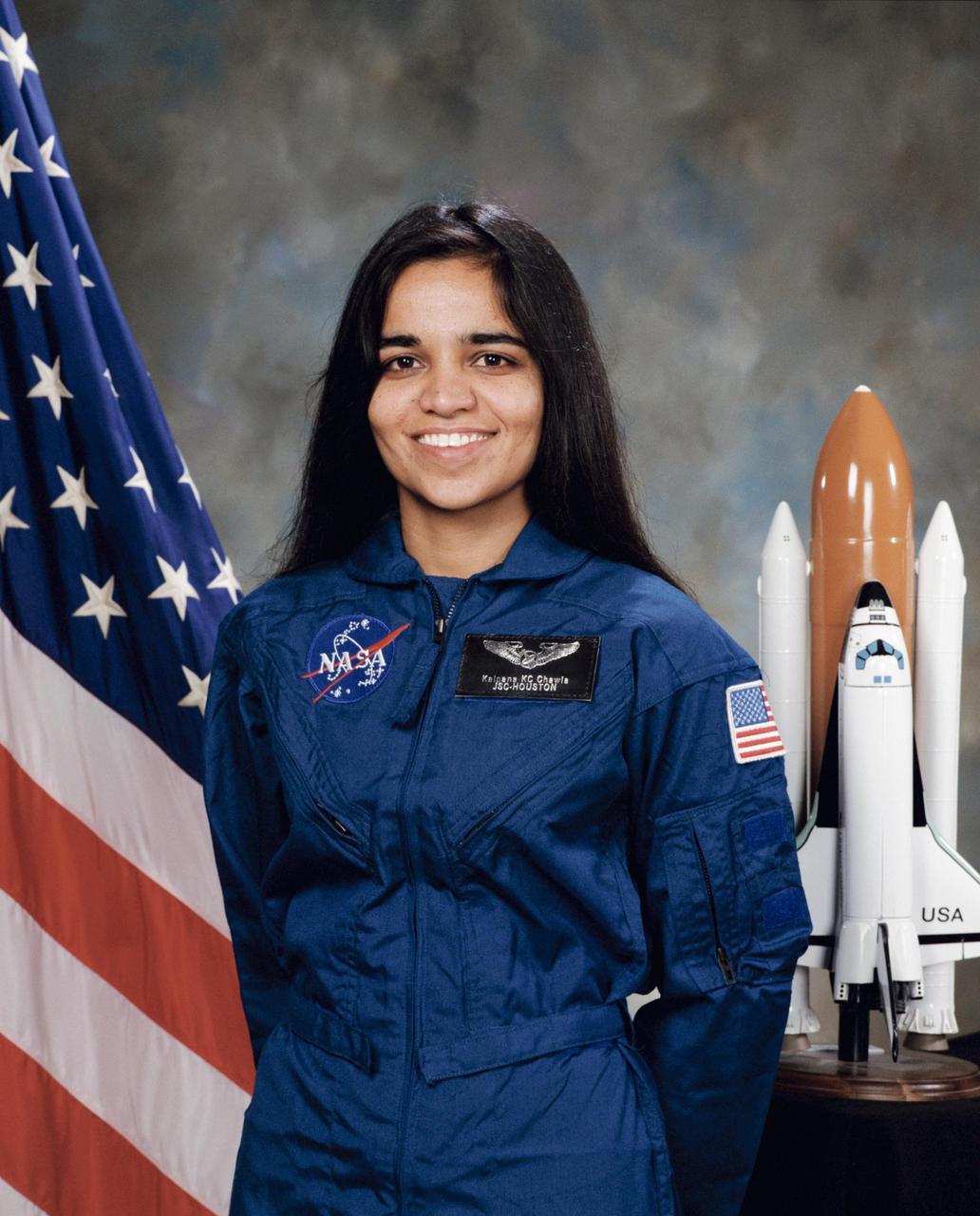
Astronaut Kalpana Chawla, mission specialist.
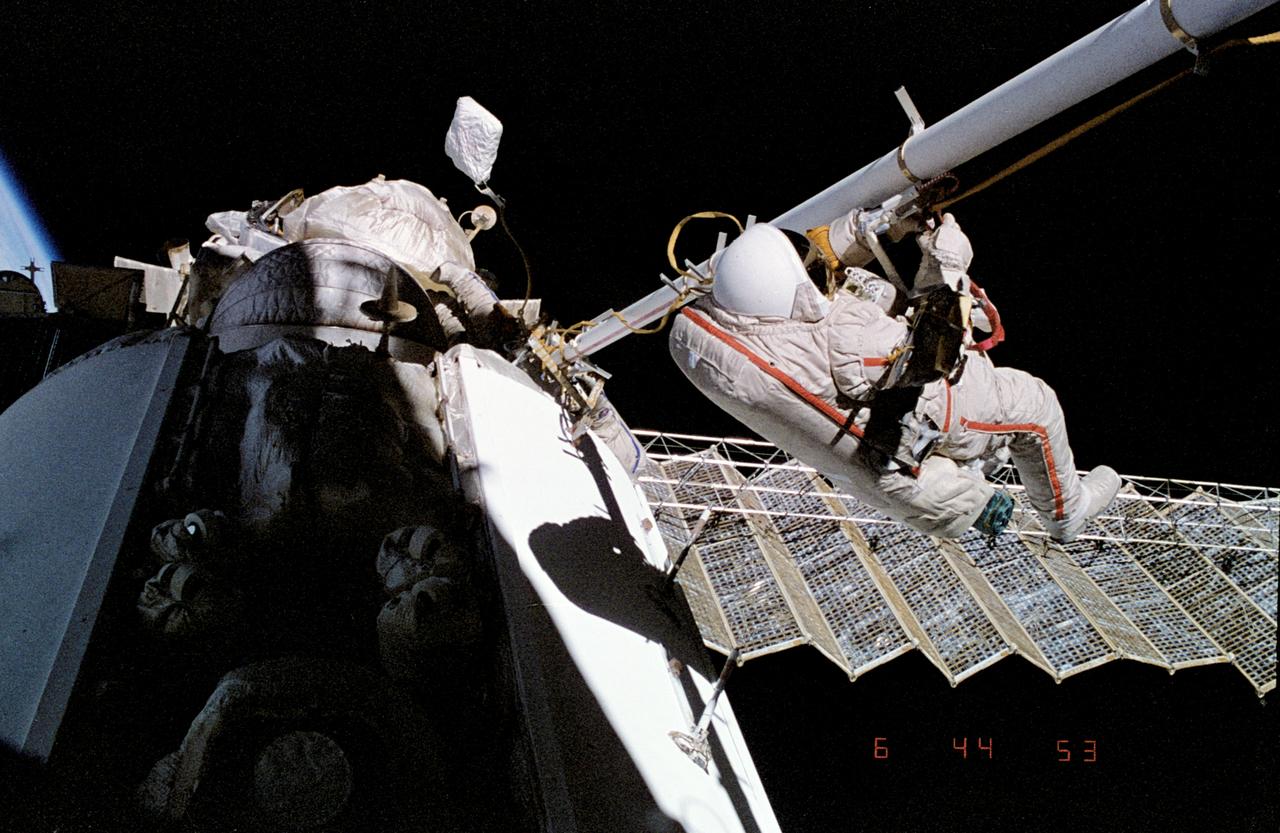
NM18-305-008 (March-July 1995) --- Cosmonaut Vladimir N. Dezhurov, Mir-18 mission commander, is photographed during one of five spacewalks conducted by the Mir-18 crew. Dezhurov is working with solar array panels. This is one of many visuals shown during a July 18 press conference in Houston.
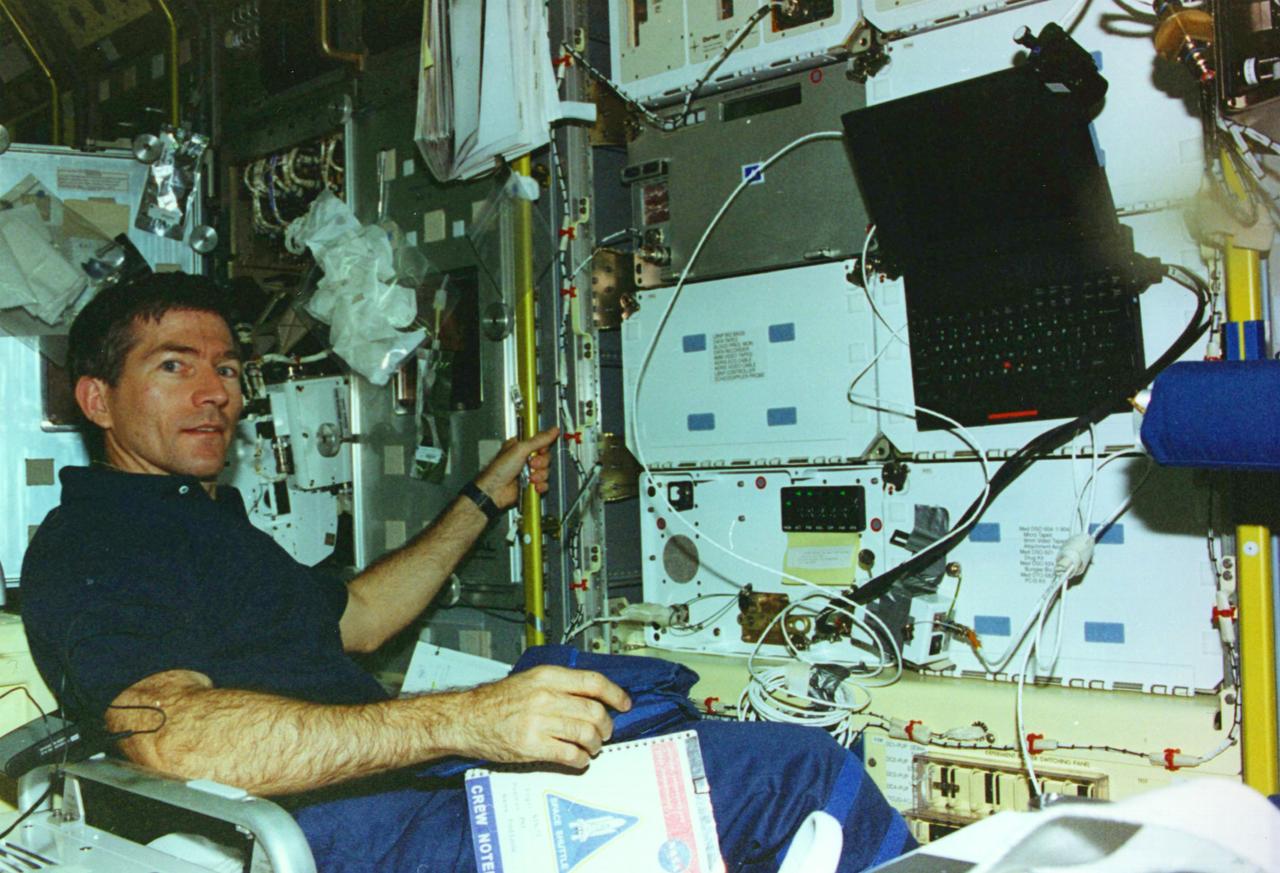
Paylaod Specialist, Fred Leslie working on experiment.
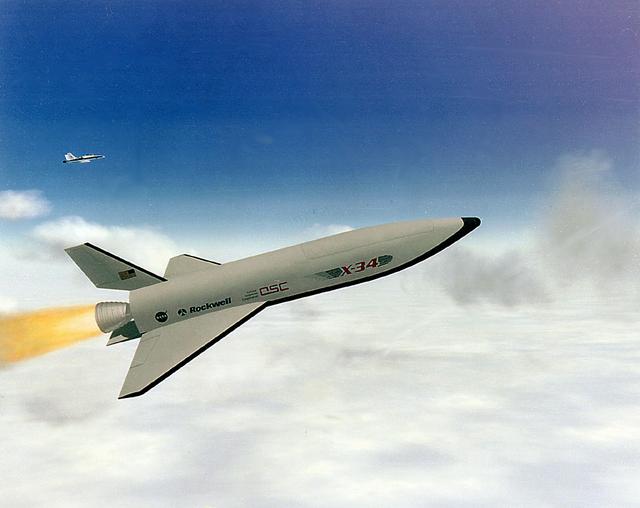
The X-34 Reusable Launch Vehicle (RLV) concept is pictured here. NASA plarned to utilize the X-34 small reusable booster for research of Reusable Launch Vehicle (RLV) technologies that may be applicable to future larger RLV's. It was being developed cooperatively by Orbital Science Corporation, Rockwell International Corporation, and NASA. The objectives of the X-34 program were to significantly reduce launch costs for small payloads and to provide a test bed for NASA RLV technology. The X-34 would be launched from a 747 shuttle carrier aircraft. After delivering its payload (booster by an upper stage) to orbit, it would land autonomously on the same runway from which the 747 departed. The X-34 vehicle was powered by a liquid oxygen tank (LOX) and an RP-1 liquid Fastrac engine that was designed and built by Marshall Space Flight Center. The X-34 would be capable of speeds up to Mach 8 and altitudes of 250,000 feet. The X-34 program was cancelled in 2001.
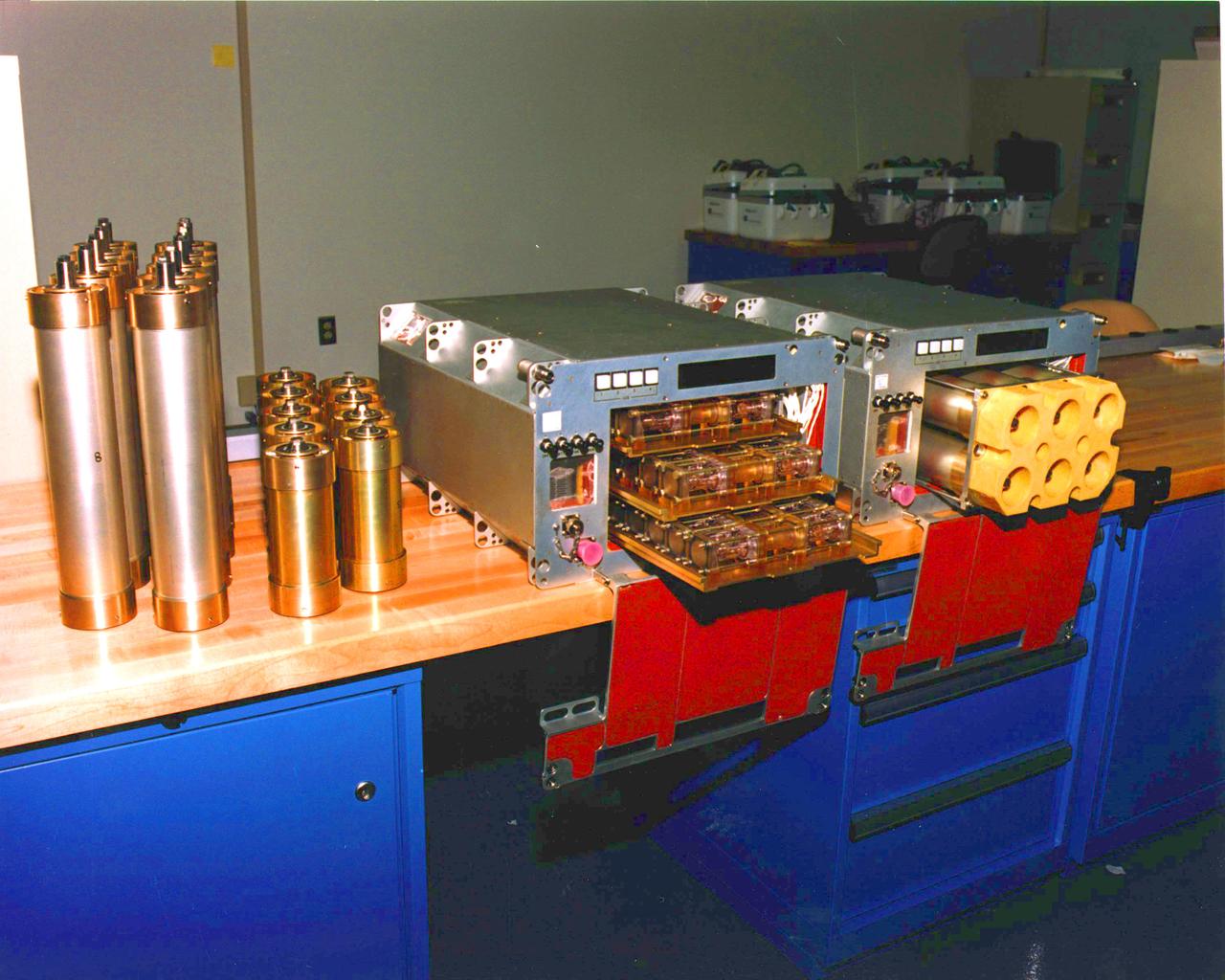
Two versions of (PCAM) Protein Crystallization Apparatus for Microgravity, (DCAM) Diffusion Controled Crystallization Apparatus is in the (STES) Single Locker Thermal Enclosure System. Principal Investigator was Dan Carter.

An experiment vehicle plunges into the deceleration at the end of a 5.18-second drop in the Zero-Gravity Research Facility at NASA's Glenn Research Center. The Zero-Gravity Research Facility was developed to support microgravity research and development programs that investigate various physical sciences, materials, fluid physics, and combustion and processing systems. Payloads up to one-meter in diameter and 455 kg in weight can be accommodated. The facility has a 145-meter evacuated shaft to ensure a disturbance-free drop. This is No. 3 of a sequence of 4 images. (Credit: NASA/Glenn Research Center)
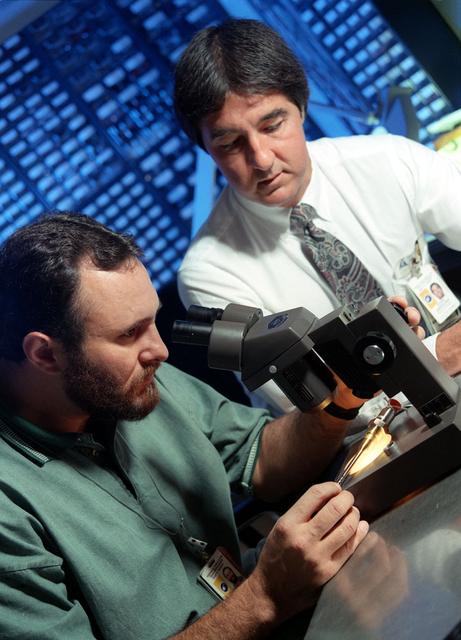
A rugged, highly accurate, low-temperature sensor is developed by NASA researchers. A new sensor allows accurate, quick low-temperature measurements in rugged environments. This is especially useful in piping with very cold liquids under high pressure, and high flow rate conditions.
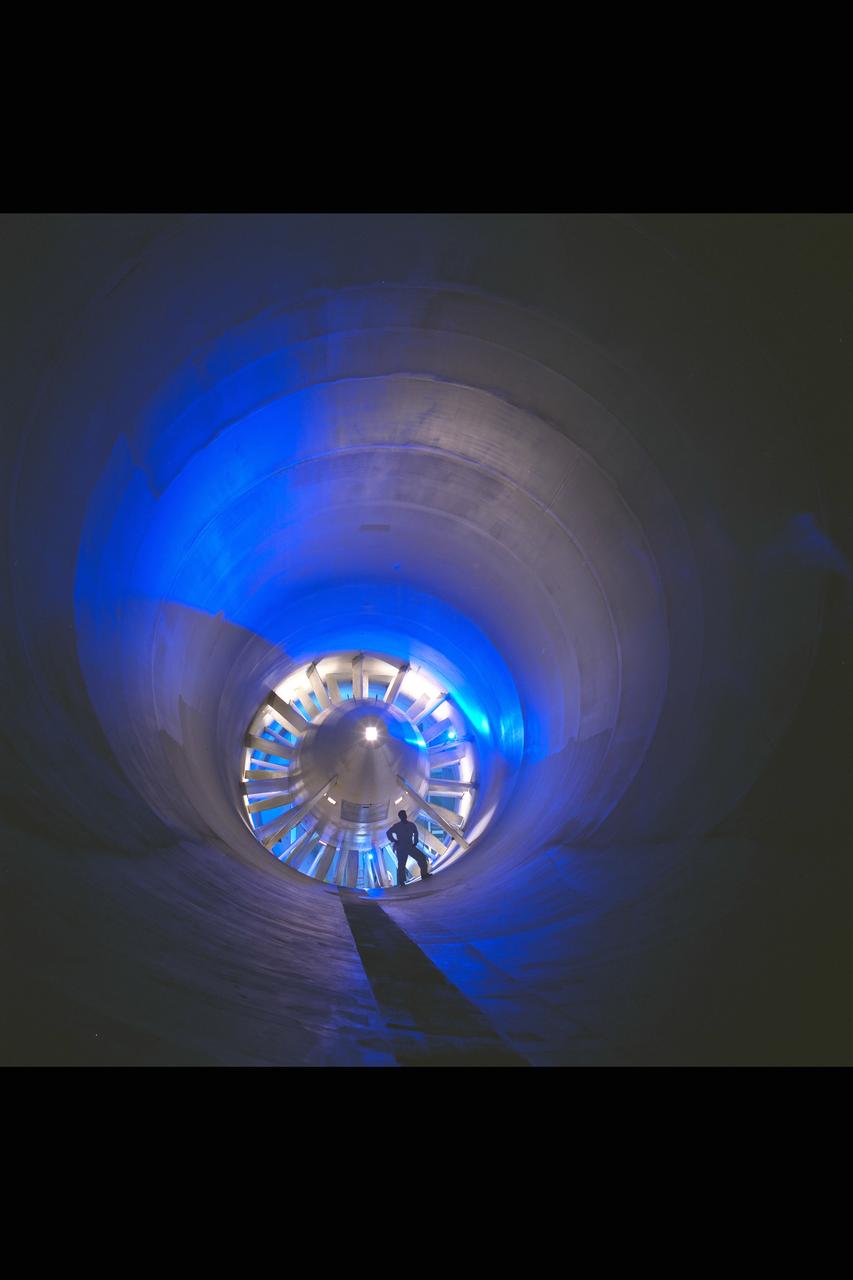
New renovated NASA Ames Research Center 12 foot Pressure Wind Tunnel, seen here is the single stage, 20 blade axial-flow fan powered by a 15,000 horsepower variable speed, synchronous electric motor that provides airflow in the closed-return, variable-density tunnel.
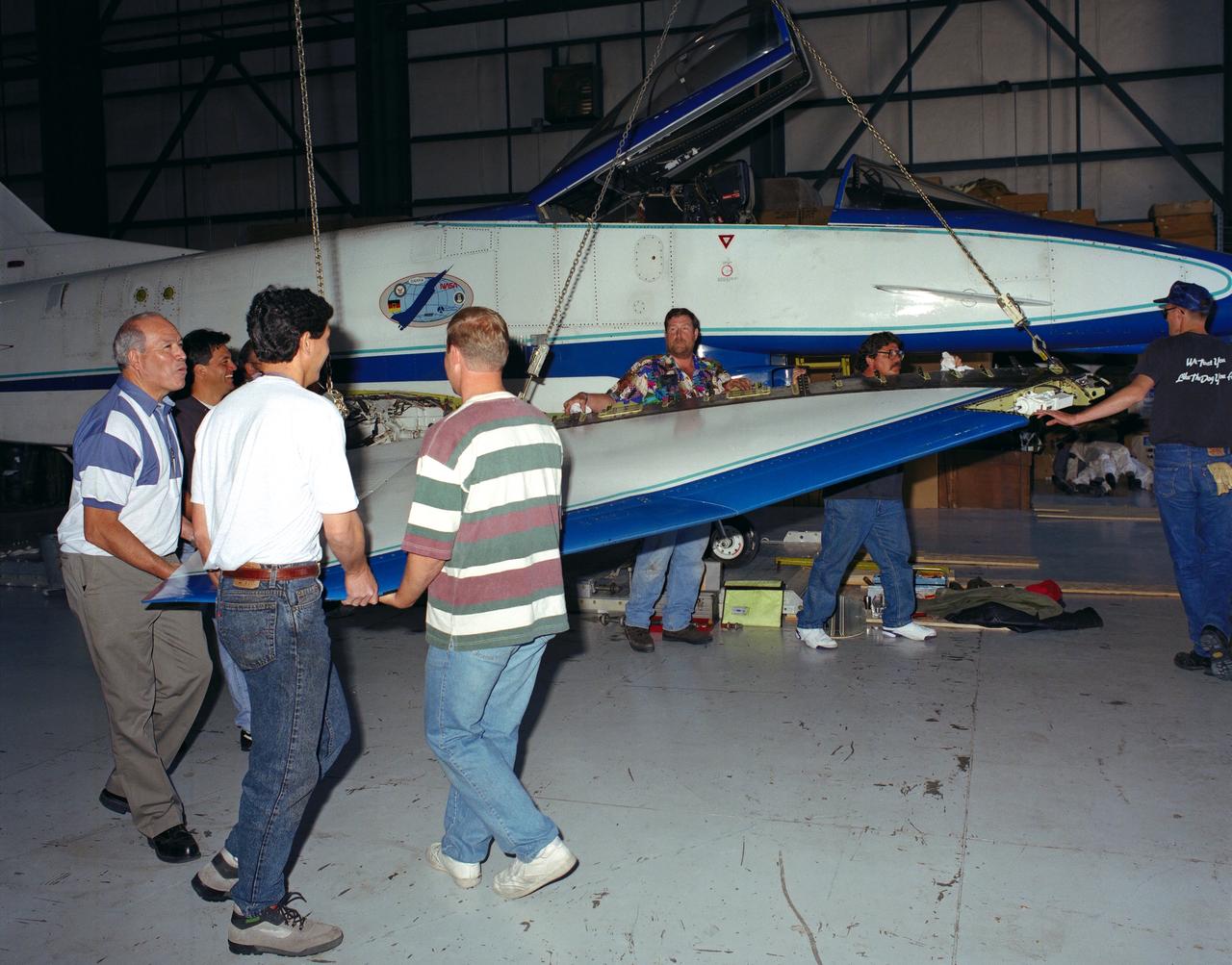
U.S. and German personnel of the X-31 Enhanced Fighter Maneuverability Technology Demonstrator aircraft program removing the right wing of the aircraft, which was ferried from Edwards Air Force Base, California, to Europe on May 22, 1995 aboard an Air Force Reserve C-5 transport. The X-31, based at the NASA Dryden Flight Research Center was ferried to Europe and flown in the Paris Air Show in June. The wing of the X-31 was removed on May 18, 1995, to allow the aircraft to fit inside the C-5 fuselage. Officials of the X-31 project used Manching, Germany, as a staging base to prepare the aircraft for the flight demonstration. At the air show, the X-31 demonstrated the value of using thrust vectoring (directing engine exhaust flow) coupled with advanced flight control systems to provide controlled flight at very high angles of attack. The aircraft arrived back at Edwards in a Air Force Reserve C-5 on June 25, 1995 and off loaded at Dryden June 27. The X-31 aircraft was developed jointly by Rockwell International's North American Aircraft Division (now part of Boeing) and Daimler-Benz Aerospace (formerly Messerschmitt-Bolkow-Blohm), under sponsorship by the U.S. Department of Defense and the German Federal Ministry of Defense.

This deepest-ever view of the universe unveils myriad galaxies back to the begirning of time. Several hundred, never-before-seen, galaxies are visible in this view of the universe, called Hubble Deep Field (HDF). Besides the classical spiral and elliptical shaped galaxies, there is a bewildering variety of other galaxy shapes and colors that are important clues to understanding the evolution of the universe. Some of the galaxies may have formed less than one-billion years after the Big Bang. The image was assembled from many separate exposures with the Wide Field/Planetary Camera 2 (WF/PC2), for ten consecutive days between December 18, 1995 and December 28, 1995. This true-color view was assembled from separate images taken with blue, red, and infrared light. By combining these separate images into a single color picture, astronomers will be able to infer, at least statistically, the distance, age, and composition of galaxies in the field. Blue objects contain young stars and/or are relatively close, while redder objects contain older stellar populations and/or are farther away.
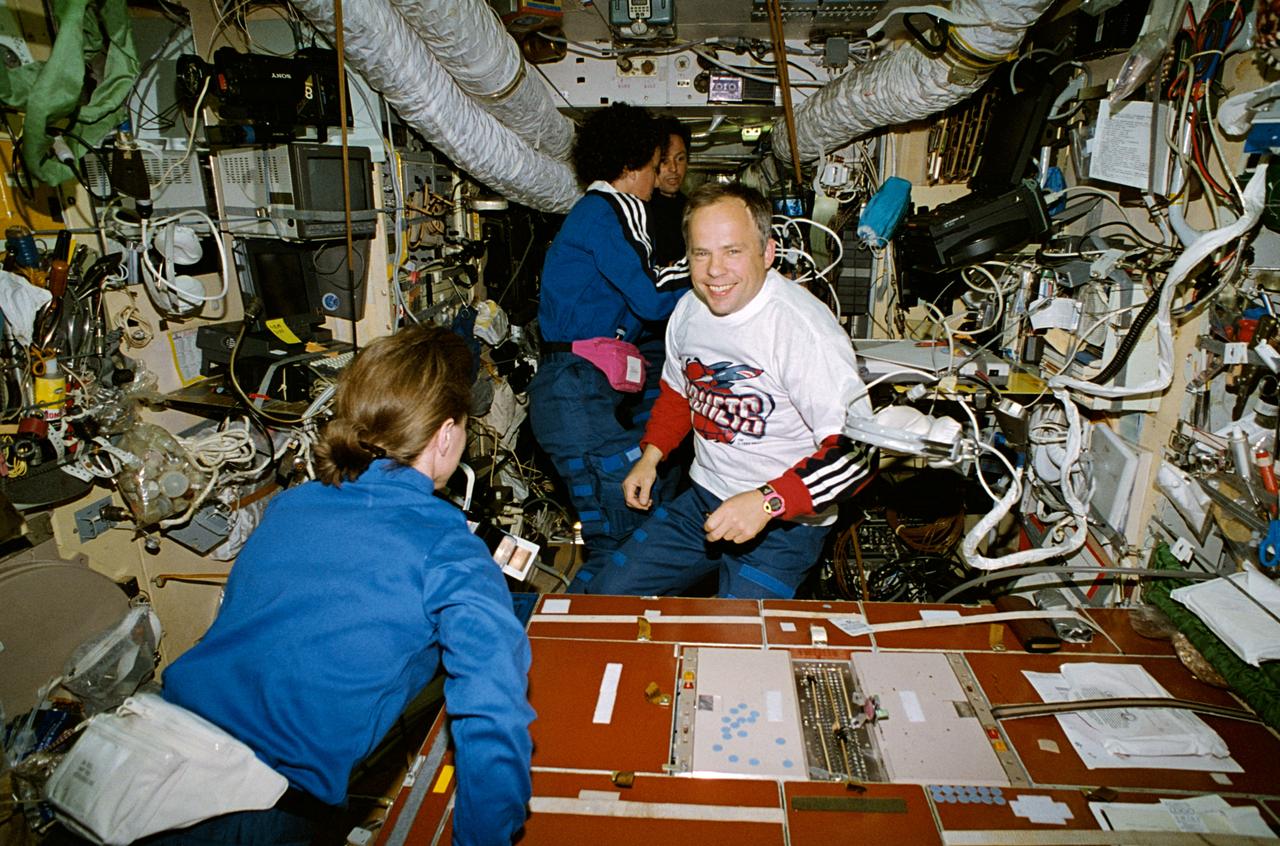
STS071-122-021 (27 June-7 July 1995) --- Three astronauts and a cosmonaut who went into space aboard the space shuttle Atlantis check out the core module living quarters on Russia's Mir Space Station. Sporting a new Houston Rockets T-shirt near frame center is cosmonaut Anatoly Y. Solovyev, Mir-19 mission commander. Astronaut Bonnie J. Dunbar, STS-71 mission specialist, floats into the frame at lower left. Beyond Solovyev are astronauts Ellen S. Baker and Gregory J. Harbaugh, mission specialists.
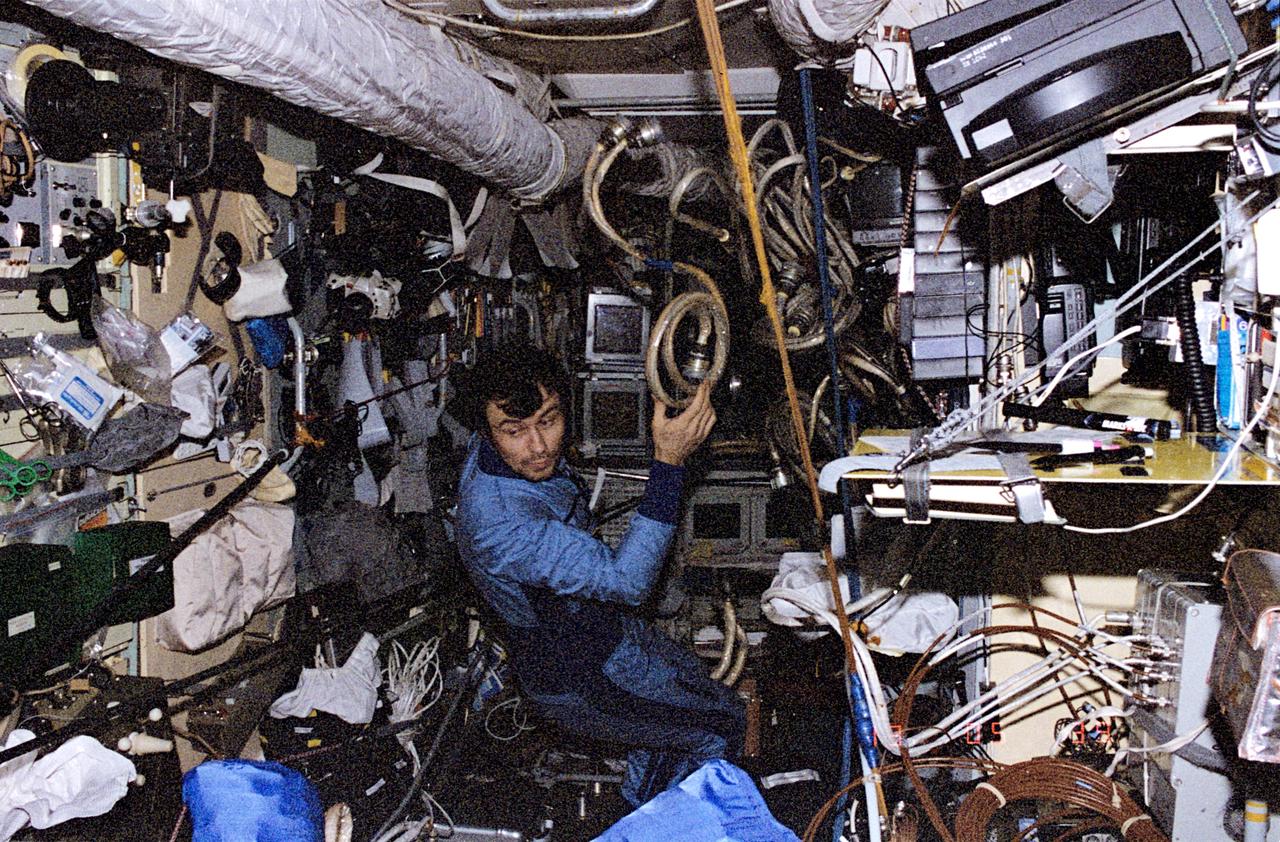
NM18-307-014 (March-July 1995) --- Onboard Mir's Spektr module, cosmonaut Vladimir N. Dezhurov re-routes cables as part of the module's activation process. This visual was one of many shown by the Mir-18 crew at a press conference on July 18 in Houston.