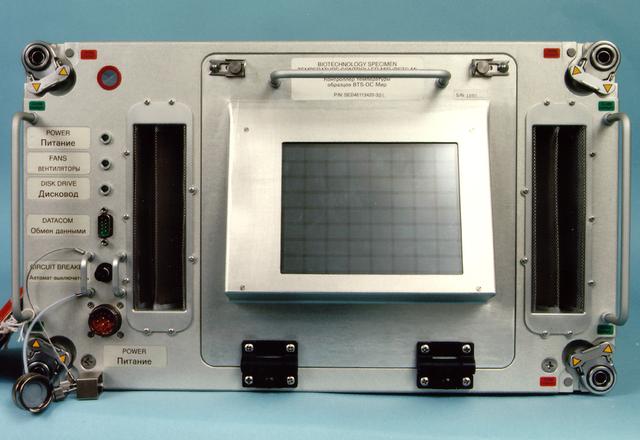
Biotechnology Specimen Temperature Controller (BSTC) will cultivate cells until their turn in the bioreactor; it can also be used in culturing experiments that do not require the bioreactor. The BSTC comprises four incubation/refrigeration chambers individually set at 4 to 50 deg. C (near-freezing to above body temperature). Each chamber holds three rugged tissue chamber modules (12 total), clear Teflon bags holding 30 ml of growth media, all positioned by a metal frame. Every 7 to 21 days (depending on growth rates), an astronaut uses a shrouded syringe and the bags' needleless injection ports to transfer a few cells to a fresh media bag, and to introduce a fixative so that the cells may be studied after flight. The design also lets the crew sample the media to measure glucose, gas, and pH levels, and to inspect cells with a microscope. The controller is monitored by the flight crew through a 23-cm (9-inch) color computer display on the face of the BSTC. This view shows the BTSC with the front panel open. The work is sponsored by NASA's Office of Biological and Physical Research. The bioreactor is managed by the Biotechnology Cell Science Program at NASA's Johnson Space Center (JSC). NASA-sponsored bioreactor research has been instrumental in helping scientists to better understand normal and cancerous tissue development. In cooperation with the medical community, the bioreactor design is being used to prepare better models of human colon, prostate, breast and ovarian tumors. Cartilage, bone marrow, heart muscle, skeletal muscle, pancreatic islet cells, liver and kidney are just a few of the normal tissues being cultured in rotating bioreactors by investigators.

KENNEDY SPACE CENTER, FLA. -- The orbiter Discovery touches down on Runway 15 of KSC's Shuttle Landing Facility to complete the STS-91 mission. Main gear touchdown was at 2:00:18 p.m. EDT on June 12, 1998, landing on orbit 155 of the mission. The wheels stopped at 2:01:22 p.m. EDT, for a total mission-elapsed time of 9 days, 19 hours, 55 minutes and 1 second. The 91st Shuttle mission was the 44th KSC landing in the history of the Space Shuttle program and the 15th consecutive landing at KSC. During the mission, the orbiter docked with the Russian space station Mir for the ninth time, concluding Phase I of the joint U.S.-Russian International Space Station Program. STS-91 also featured first flights for both the Alpha Magnetic Spectrometer and the Space Shuttle super lightweight external tank. The STS-91 flight crew included Mission Commander Charles J. Precourt; Pilot Dominic L. Gorie; and Mission Specialists Wendy B. Lawrence, Franklin R. Chang-Diaz, Janet Lynn Kavandi and Valery Victorovitch Ryumin of the Russian Space Agency. Astronaut Andrew S. W. Thomas also returned to Earth as an STS-91 crew member after 141 days in space

S88-E-5031 (12-05-98) --- Early stages of RMS lifting of Unity to be mated to the docking system in the foreground were recorded by astronauts in Endeavour's cabin. The electronic still camera (ESC) frame was exposed at 22:37:57 GMT, Dec. 5.
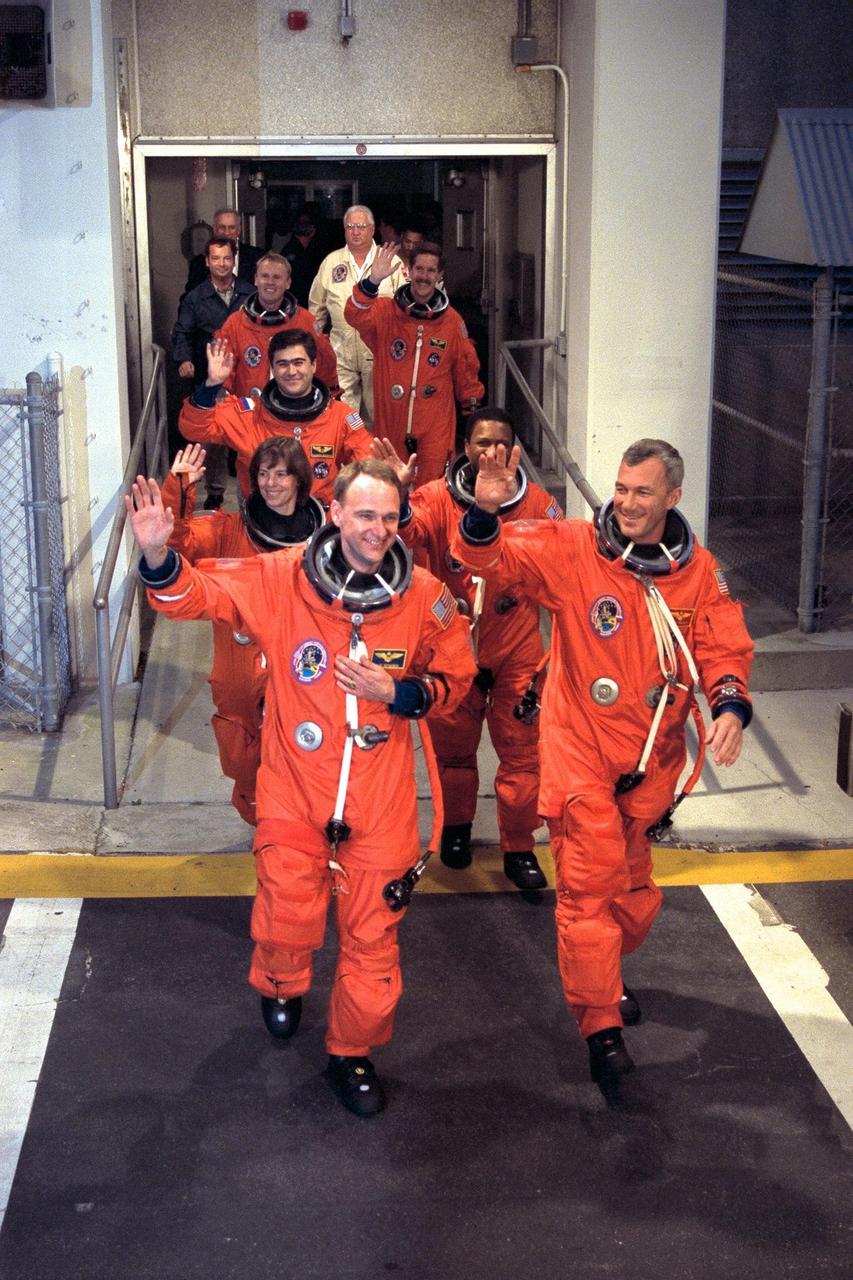
The STS-89 crew walk out of the Operations and Checkout Building and head for the Astrovan that will transport them to Launch Pad 39A, where the Space Shuttle Endeavour awaits to take them to Russia’s Mir space station. Waving to the crowd and leading the way, from front to back, left to right, are Pilot Joe Edwards Jr., Commander Terrence Wilcutt, and Mission Specialists Bonnie Dunbar, Ph.D., Michael Anderson, Salizhan Sharipov of the Russian Space Agency, Andrew Thomas, Ph.D., and James Reilly, Ph.D. STS-89, slated for a 9:48 p.m. EST liftoff Jan. 22, is the eighth docking with the Russian Space Station Mir, the first Mir docking for Endeavour (all previous dockings were made by Atlantis), and the first launch of 1998. After docking with Mir, Mission Specialist Andrew Thomas, Ph.D., will transfer to the space station, succeeding David Wolf, M.D
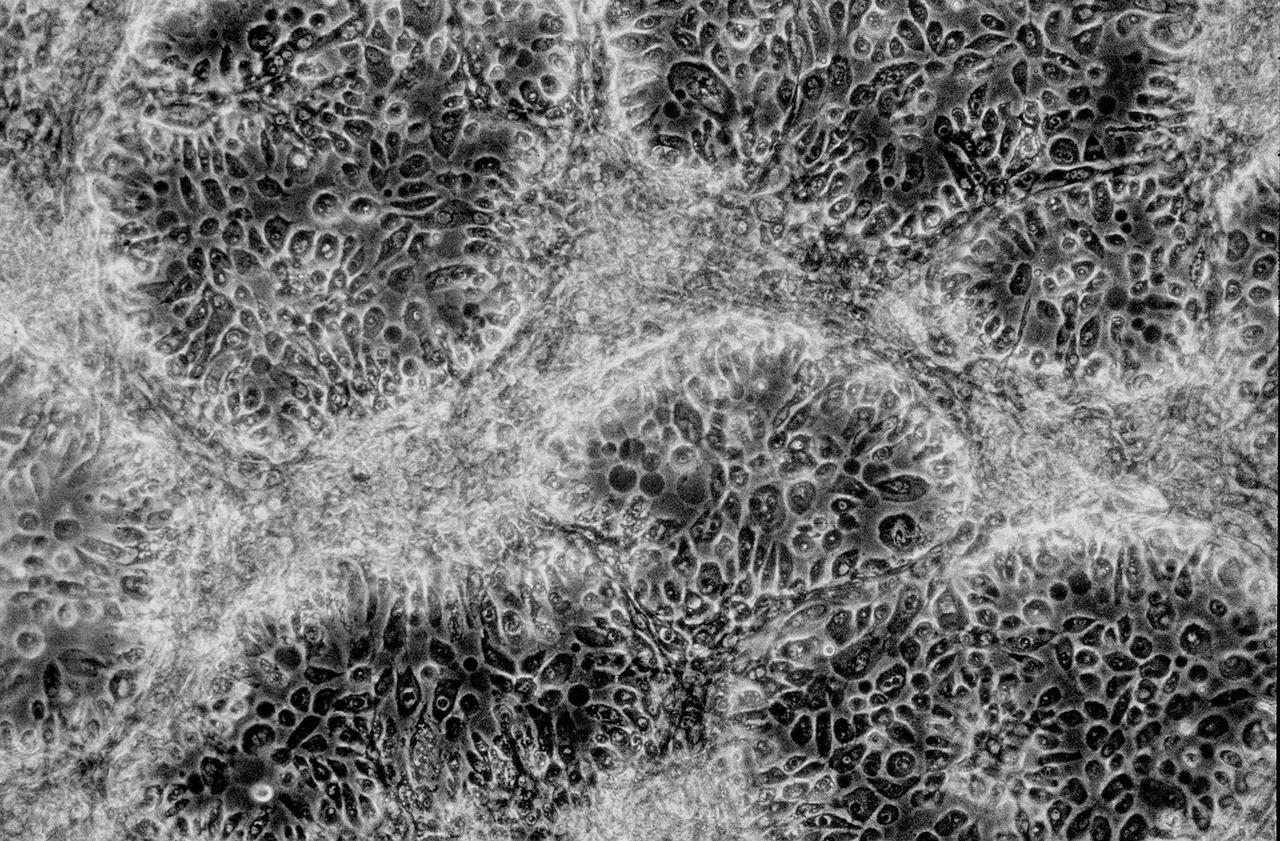
Isolation of human mammary epithelial cells (HMEC) from breast cancer susceptible tissue. Outgrowth of cells from duct element in upper right corner cultured in a standard dish; most cells spontaneously die during early cell divisions, but a few will establish long-term growth. NASA's Marshall Space Flight Center (MSFC) is sponsoring research with Bioreactors, rotating wall vessels designed to grow tissue samples in space, to understand how breast cancer works. This ground-based work studies the growth and assembly of human mammary epithelial cell (HMEC) from breast cancer susceptible tissue. Radiation can make the cells cancerous, thus allowing better comparisons of healthy vs. tunorous tissue. Credit: Dr. Robert Tichmond, NASA/Marshall Space Flight Center (MSFC).
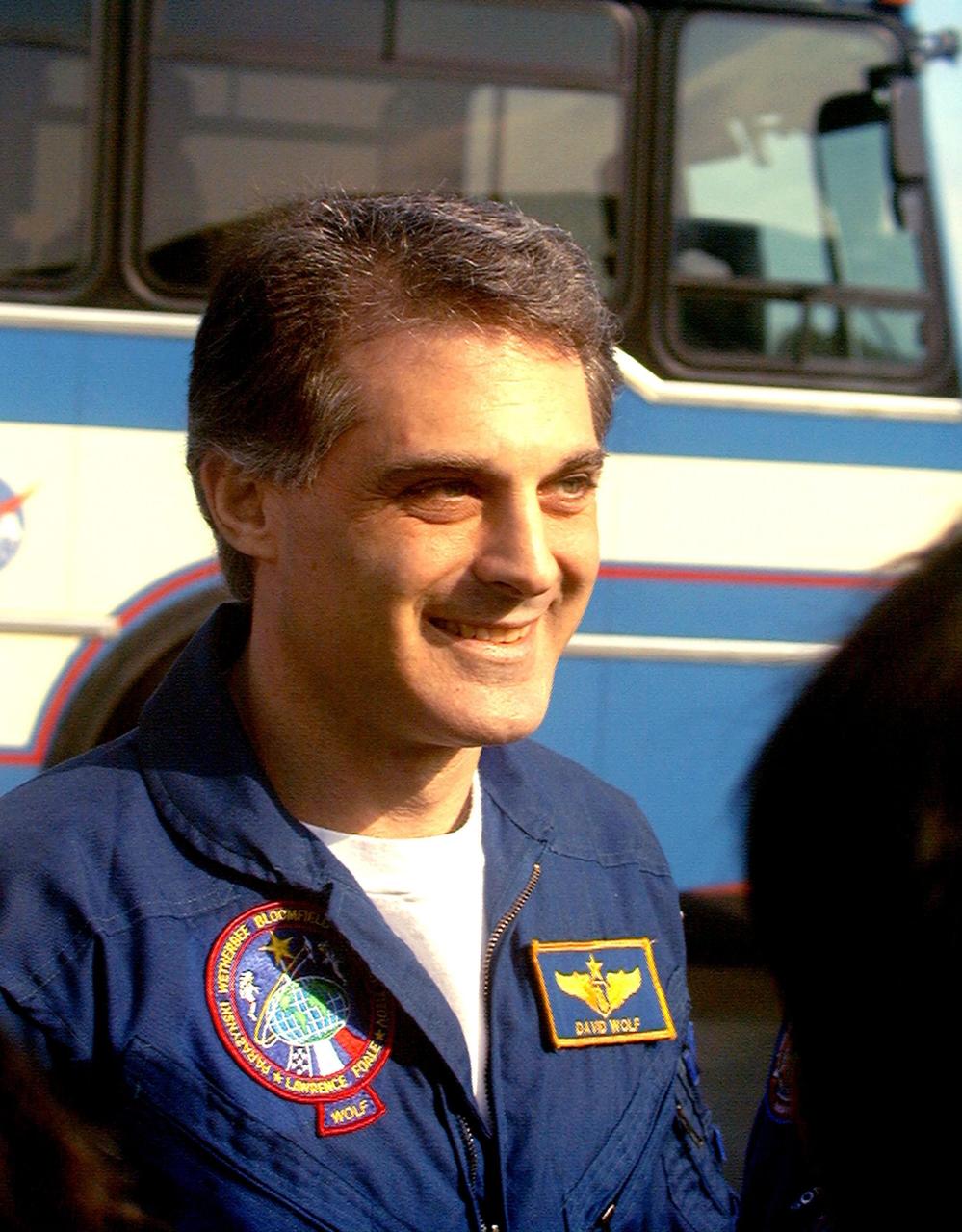
NASA astronaut and Mir 24 crew member David Wolf, M.D., enjoys a moment with the media at the Skid Strip at Cape Canaveral Air Station on Feb. 1 moments before his departure for Johnson Space Center. The STS-89 crew that brought Dr. Wolf back to Earth arrived at KSC aboard the orbiter Endeavour Jan. 31, concluding the eighth Shuttle-Mir docking mission. STS-89 Mission Specialist Andrew Thomas, Ph.D., succeeded Dr. Wolf on Mir and is scheduled to remain on the Russian space station until the STS-91 Shuttle mission returns in June 1998. In addition to the docking and crew exchange, STS-89 included the transfer of science, logistical equipment and supplies between the two orbiting spacecrafts
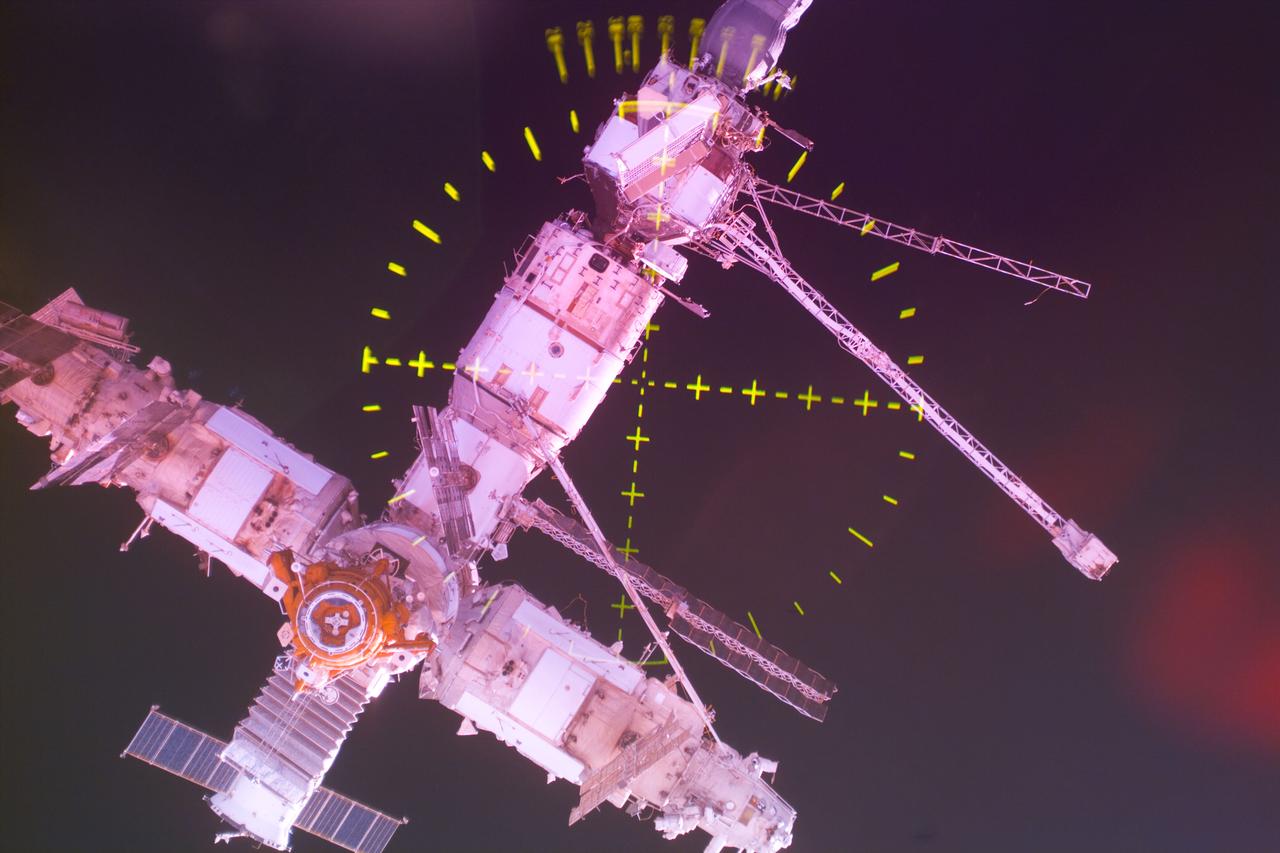
S89-E-5166 (24 Jan 1998) --- This Electronic Still Camera (ESC) image shows the black space forming the backdrop for this view of Russia's Mir Space Station, inside 500 feet and closing. Astronaut Terrence W. (Terry) Wilcutt was at the controls of the Space Shuttle Endeavour during this event -- the eighth of nine planned Shuttle/Mir link-ups. The markings in the frame are those of the Crew Optical Alignment System (COAS). The ESC image was exposed at 19:48:14 GMT, January 24, 1998.
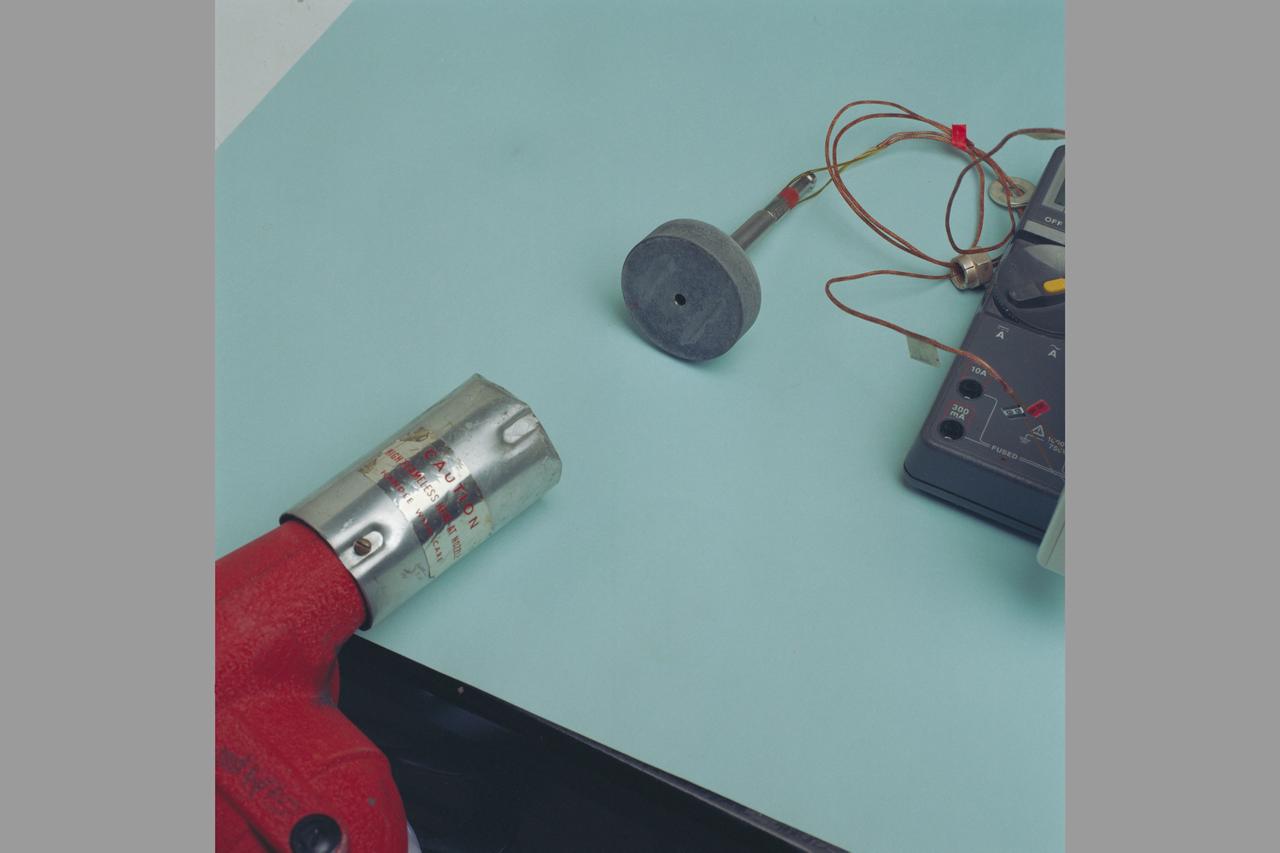
X-33 Aeroshell Flight Test Instrumentation. (leeward)

S88-E-5171 (12-15-98) --- MightySat, a 705-pound U.S. Air Force/Phillips Laboratory satellite, pops out of a special canister in the cargo bay of the Space Shuttle Endeavour on its way to the begining of its Earth-orbital life. The succeeding frame shows the satellite after it left the Shuttle. The photo was taken with an electronic still camera (ESC) at 02:13:50 GMT, Dec. 15.
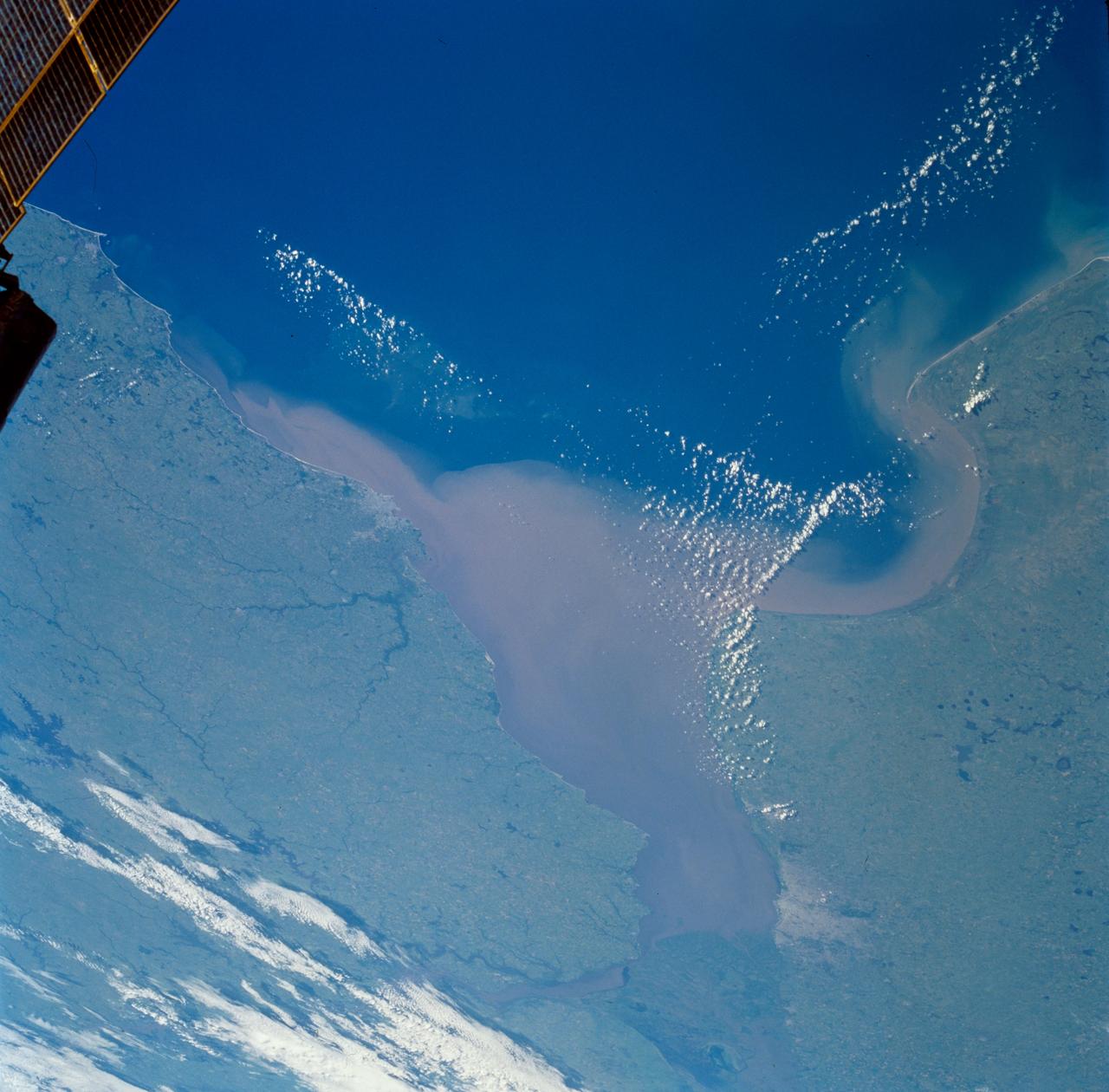
STS089-703-056 (22-31 Jan. 1998) --- This oblique picture of Argentina and other parts of South America was photographed with a 70mm handheld camera from the Earth-orbiting space shuttle Endeavour. Looking westward across the continent, north is toward the upper right corner and the Atlantic Ocean is in the foreground. Rio de la Plata in the center (the confluence of Rio Uruguay and Rio Parana) shows a sediment plume generated by drainage of El Niño rains upslope in the Andean foothills. The sediment plume is possibly more extensive than usual and extends down the coast and out of the bay to the left (south). The city of Buenos Aires, Argentina (population 13 million) is at upper left, and at right center is the city of Montevideo, Uruguay (population 1.2 million). Photo credit: NASA
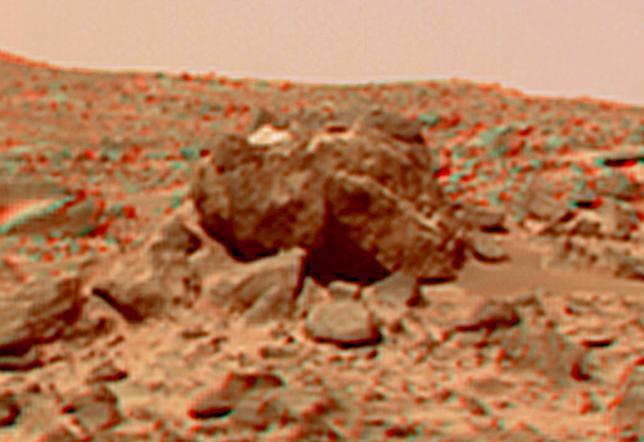
This view of the "Hippo," 25 meters to the west of the lander, was produced by combining the "Super Panorama" frames from the IMP camera. Super resolution was applied to help to address questions about the texture of this rock and what it might tell us about its mode of origin. The composite color frames that make up this anaglyph were produced for both the right and left eye of the IMP. These composites consist of more than 15 frames per eye (because multiple sequences covered the same area), taken with different color filters that were enlarged by 500% and then co-added using Adobe Photoshop to produce, in effect, a super-resolution panchromatic frame that is sharper than an individual frame would be. These panchromatic frames were then colorized with the red, green, and blue filtered images from the same sequence. The color balance was adjusted to approximate the true color of Mars. The anaglyph view was produced by combining the left with the right eye color composite frames by assigning the left eye composite view to the red color plane and the right eye composite view to the green and blue color planes (cyan), to produce a stereo anaglyph mosaic. This mosaic can be viewed in 3-D on your computer monitor or in color print form by wearing red-blue 3-D glasses. http://photojournal.jpl.nasa.gov/catalog/PIA01421
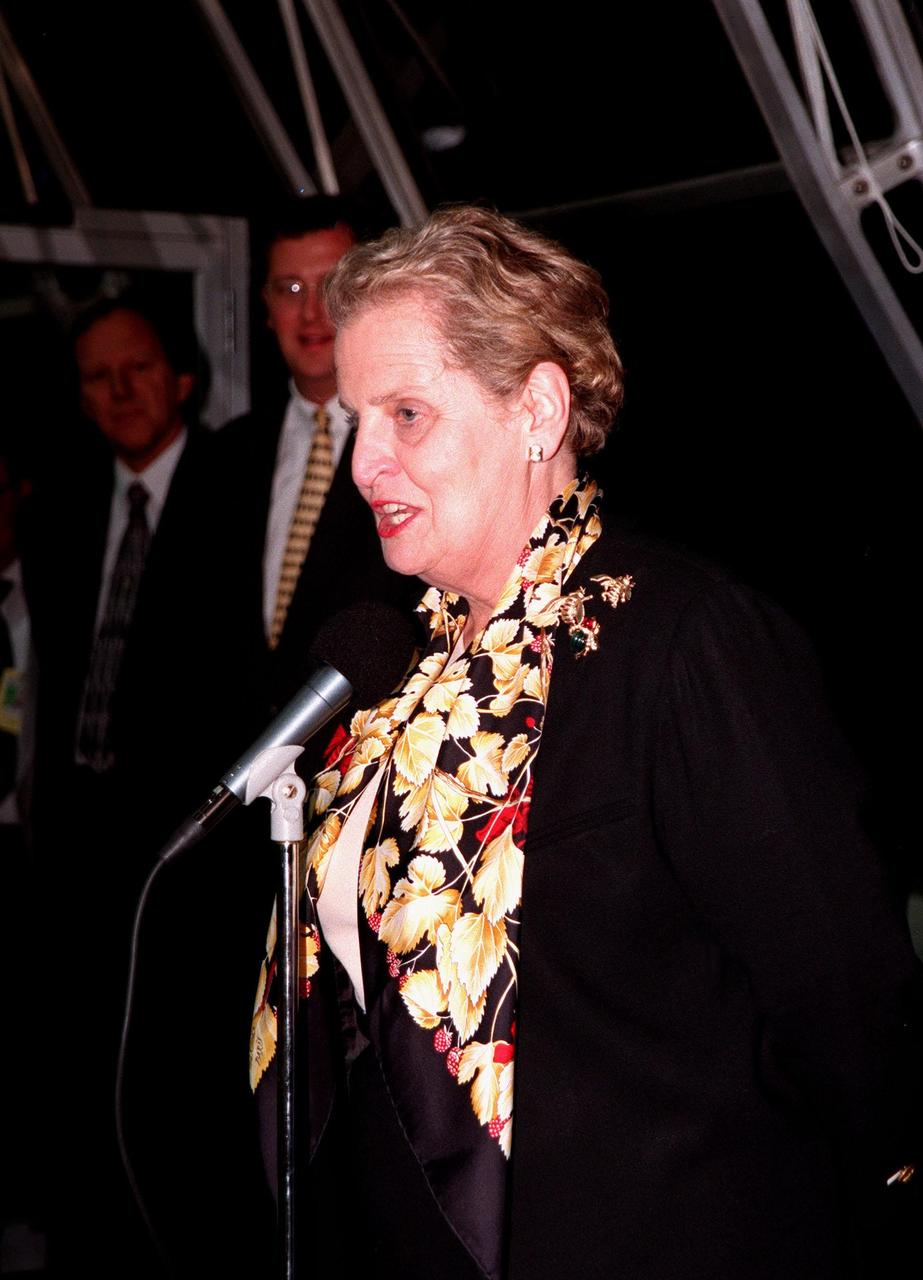
In a firing room of the Launch Control Center, U.S. Secretary of State Madeleine Albright speaks to the launch team after the successful launch of Space Shuttle Endeavour at 3:35:34 a.m. EST. During the nearly 12-day mission of STS-88, the six-member crew will mate in space the first two elements of the International Space Station the already-orbiting Zarya control module and the Unity connecting module carried by Endeavour
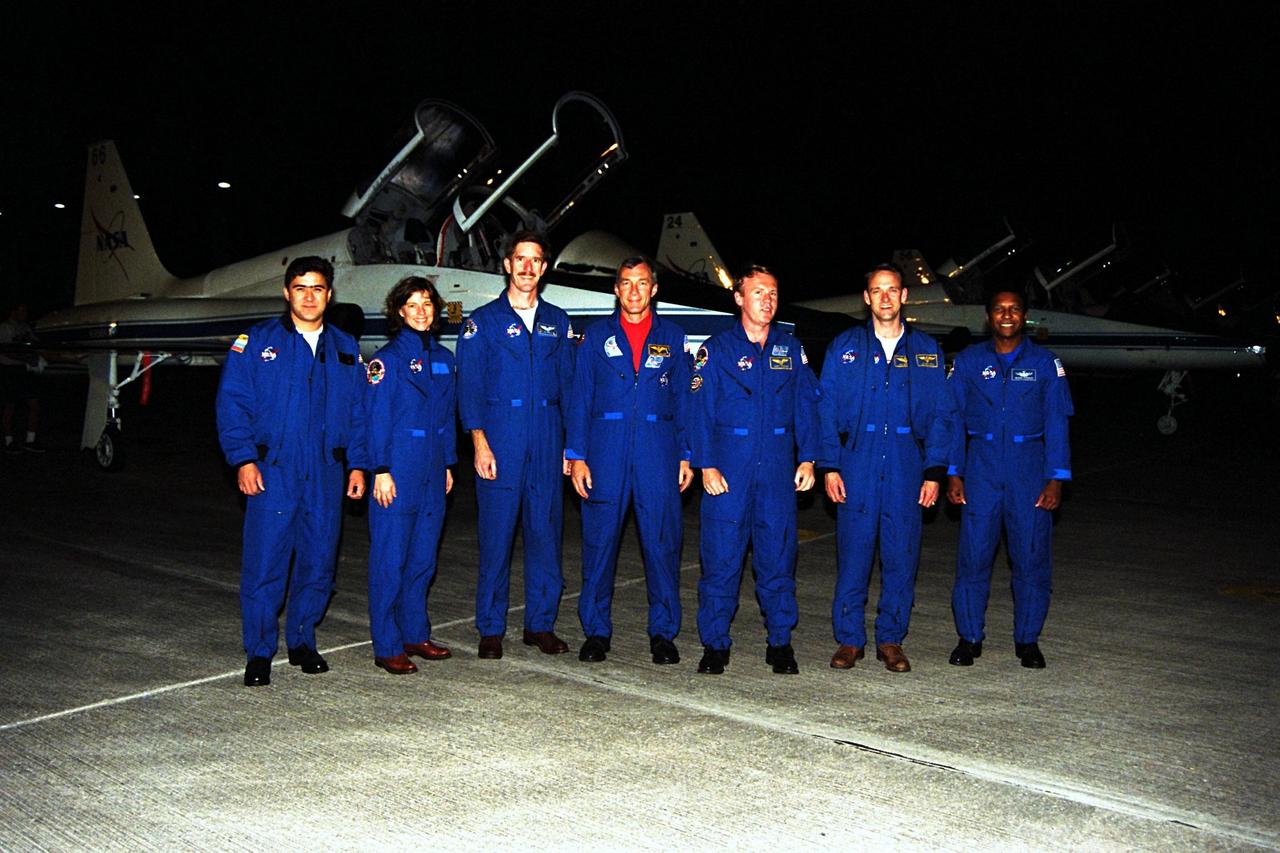
The STS-89 crew pose at Kennedy Space Center’s (KSC’s) Shuttle Landing Facility after flying in from NASA’s Johnson Space Center to begin Terminal Countdown Demonstration Test (TCDT) activities. The TCDT is held at KSC prior to each Space Shuttle flight to provide crews with the opportunity to participate in simulated countdown activities. Endeavour is targeted for launch of STS-89 on Jan. 22 at 9:48 p.m. EST. From left to right are Mission Specialists Salizhan Sharipov, of the Russian Space Agency, Bonnie Dunbar, Ph.D., and James Reilly, Ph.D.; Commander Terrence Wilcutt; Mission Specialist Andrew Thomas, Ph.D.; Pilot Joe Edwards Jr.; and Mission Specialist Michael Anderson. Mission STS-89 will be the first mission of 1998 and the eighth to dock with Russia’s Mir Space Station, where Thomas will succeed David Wolf, M.D., who has been on Mir since September 28. The STS-89 mission is scheduled to last nine days
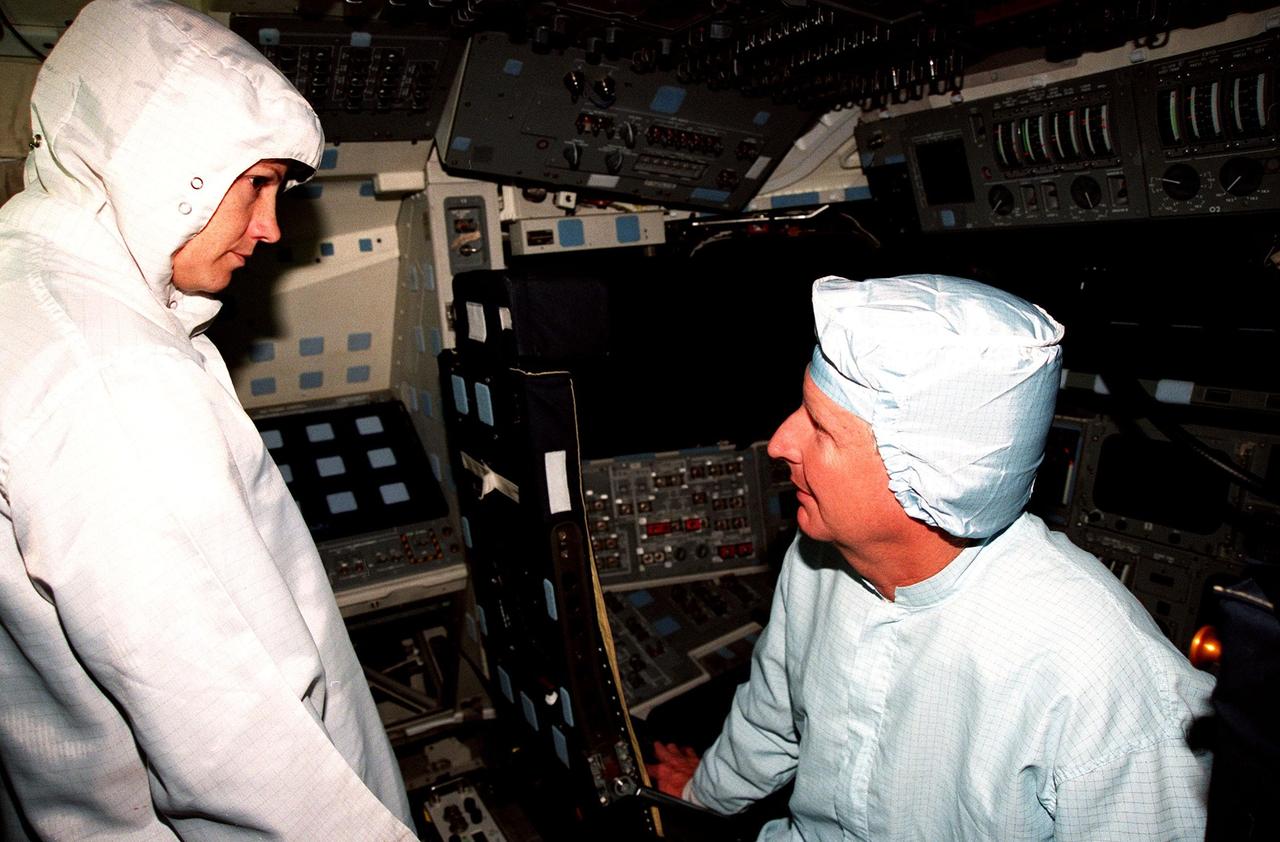
In the Orbiter Processing Facility Bay 3, aboard the orbiter Columbia, STS-93 Mission Commander Eileen M. Collins listens to Mission Specialist Steven A. Hawley during the Crew Equipment Interface Test (CEIT). Collins is the first woman to serve as a mission commander on a shuttle flight. The CEIT provides an opportunity for crew members to check equipment and facilities that will be aboard the orbiter during their mission. The rest of the crew members are Pilot Jeffrey S. Ashby, Mission Specialist Catherine G. Coleman, and Mission Specialist Michel Tognini of France. The STS-93 mission will deploy the Advanced X-ray Astrophysics Facility (AXAF), which comprises three major elements: the spacecraft, the telescope, and the science instrument module (SIM). AXAF will allow scientists from around the world to obtain unprecedented X-ray images of a variety of high-energy objects to help understand the structure and evolution of the universe. Targeted date for the launch of STS-93 is March 18, 1999

KENNEDY SPACE CENTER, FLA. -- The Space Shuttle Columbia soars from Launch Pad 39B at 2:19 p.m. EDT Apr. 17 to begin the STS-90 Neurolab mission. The launch was delayed 24 hours due to difficulty with a network signal processor, which was replaced Apr. 16, on the orbiter. The crew members are Commander Richard Searfoss, Pilot Scott Altman, Mission Specialists Richard Linnehan, D.V.M., Dafydd (Dave) Williams, M.D., with the Canadian Space Agency, and Kathryn (Kay) Hire; and Payload Specialists Jay Buckey, M.D., and James Pawelczyk, Ph.D. Investigations during the Neurolab mission will focus on the effects of microgravity on the nervous system
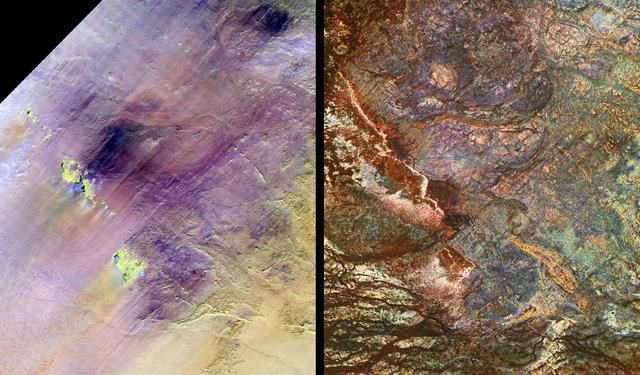
These images show two views of a region of south-central Egypt. On the left is an optical image from NASA Landsat Thematic Mapper, and on the right is a radar image from NASA Spaceborne Imaging Radar-C/X-band Synthetic Aperture Radar SIR-C/X-SAR.
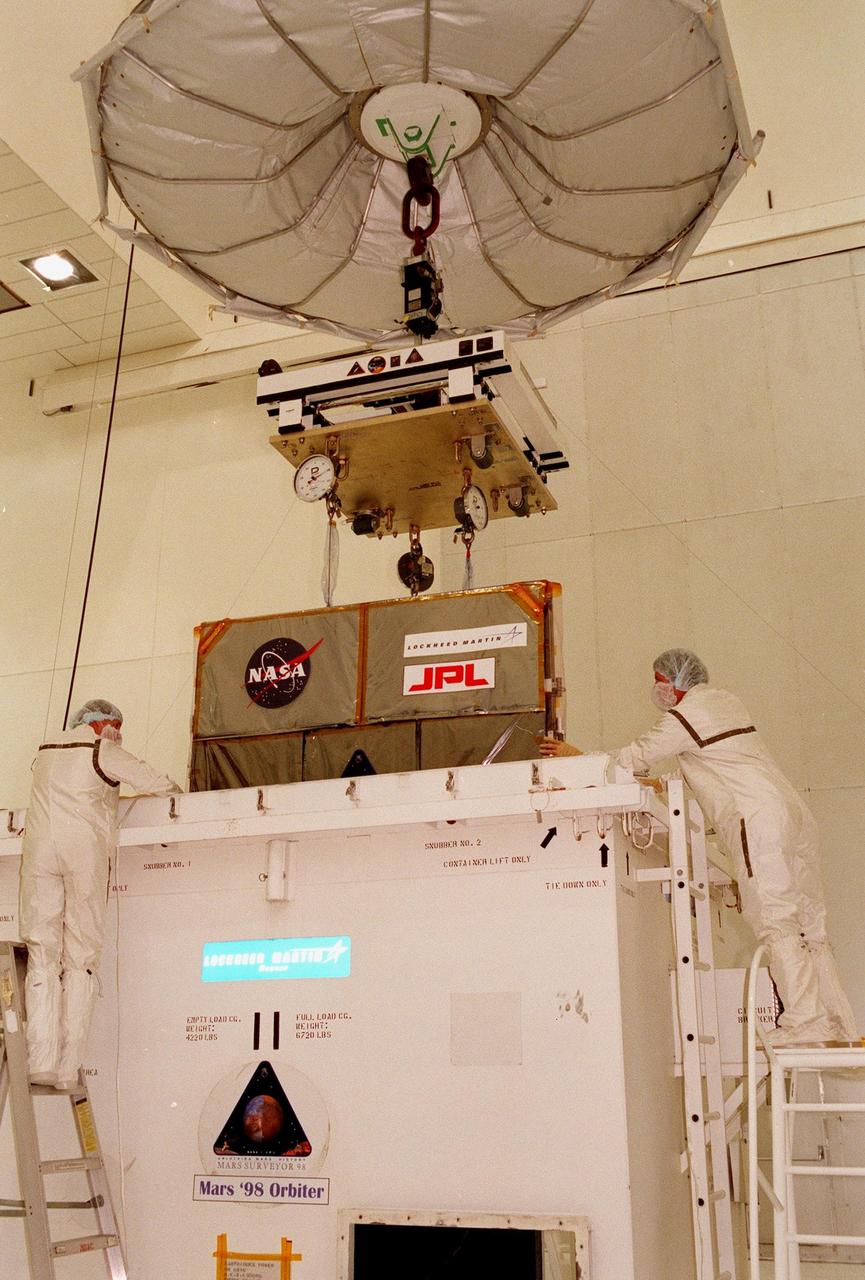
Technicians in the Spacecraft Assembly and Encapsulation Facility-2 (SAEF-2) oversee the removal of the Mars Climate Orbiter from its container. The Mars Climate Orbiter is heading for Mars where it will primarily support its companion Mars Polar Lander spacecraft, planned for launch on Jan. 3, 1999. After that, the Mars Climate Orbiter's instruments will monitor the Martian atmosphere and image the planet's surface on a daily basis for one Martian year (two Earth years). It will observe the appearance and movement of atmospheric dust and water vapor, as well as characterize seasonal changes on the surface. The detailed images of the surface features will provide important clues to the planet's early climate history and give scientists more information about possible liquid water reserves beneath the surface. The scheduled launch date for the Mars Climate Orbiter is Dec. 10, 1998, on a Boeing Delta II 7425 rocket
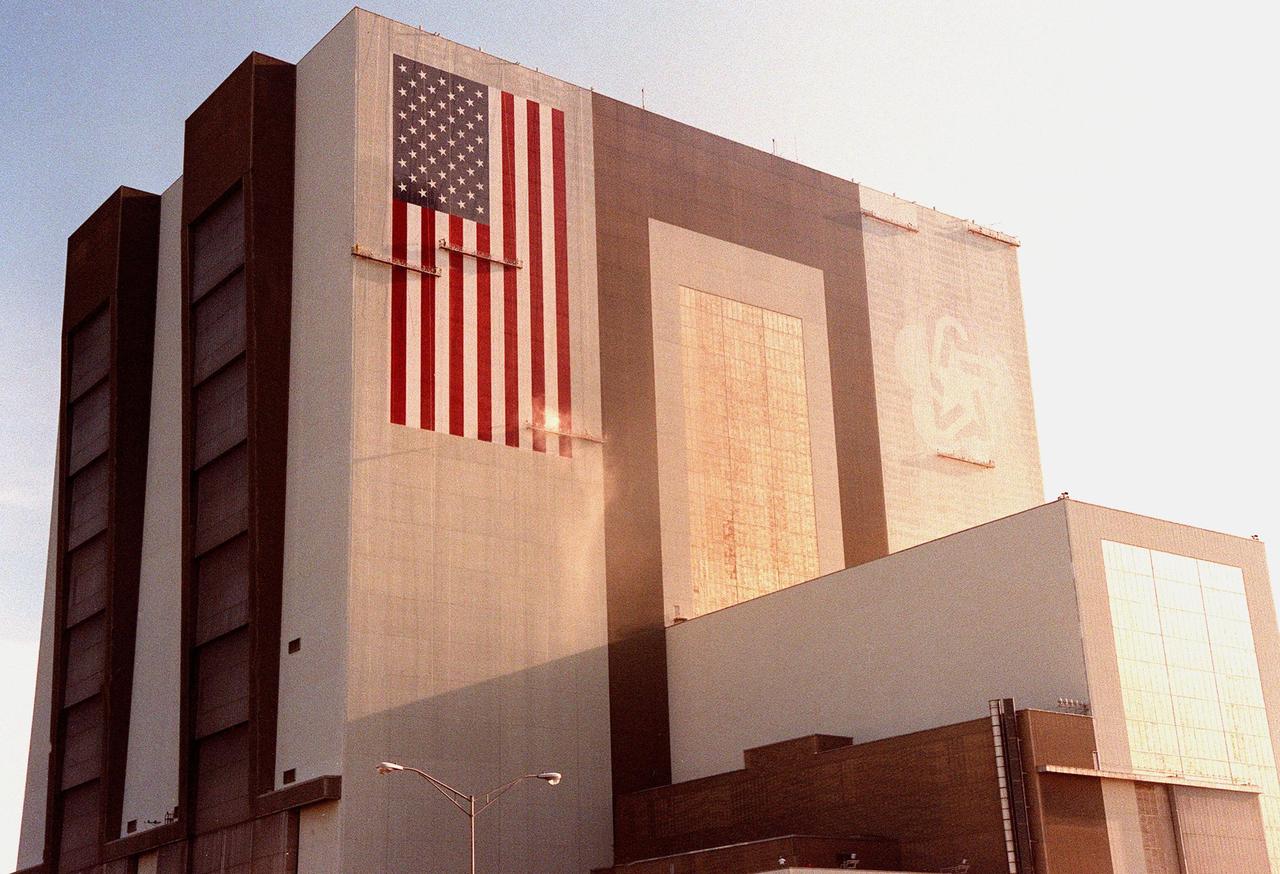
Painters are suspended on platforms from the top of the 525-foot-high Vehicle Assembly Building (VAB) at KSC during repainting of the American flag and NASA logo. The flag spans an area 209 feet by 110 feet and will require 510 gallons of red, white and blue paint. Each stripe of the flag is 9 feet wide and each star is 6 feet in diameter. The previous Bicentennial Emblem on the other side of the VAB doors is being replaced by the NASA logo, honoring NASA’s 40th anniversary (in October). The logo covers an area 110 feet by 132 feet. The painting platforms are operated by two electric motors and travel 35 feet per minute. Work is being done with rollers, with brushes being used for details. The paint was donated by ICI Devoe of Louisville, Ky. Work is expected to be completed in mid-September
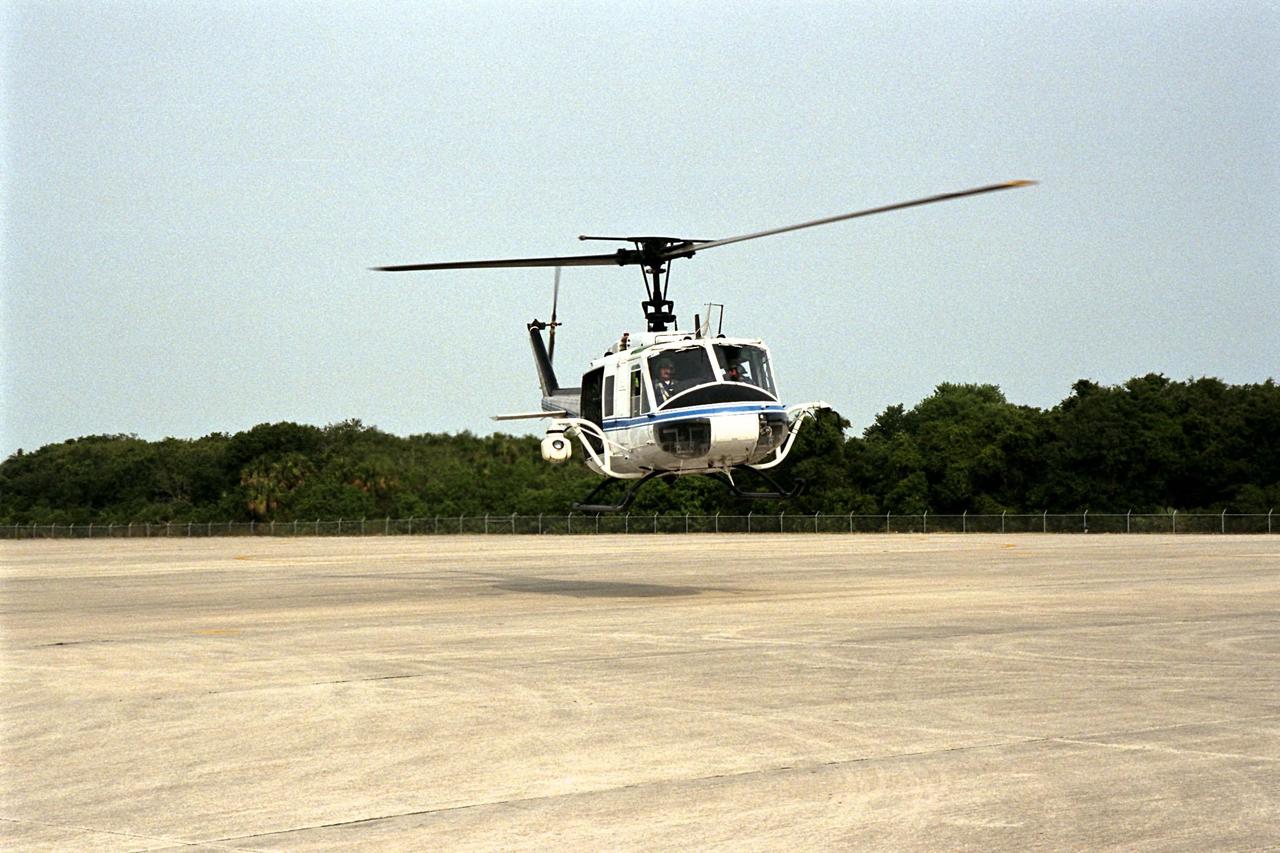
KENNEDY SPACE CENTER, FLA. -- NASA's Huey UH-1 helicopter lands at the Shuttle Landing Facility to pick up Kennedy Space Center (KSC) Security personnel who operate the Forward Looking Infrared Radar (FLIR) installed on board. The helicopter has also been outfitted with a portable global positioning satellite (GPS) system to support Florida's Division of Forestry as they fight the brush fires which have been plaguing the state as a result of extremely dry conditions and lightning storms. The FLIR includes a beach ball-sized infrared camera that is mounted on the helicopter's right siderail and a real-time television monitor and recorder installed inside. While the FLIR collects temperature data and images, the GPS system provides the exact coordinates of the fires being observed and transmits the data to the firefighters on the ground. KSC's security team routinely uses the FLIR equipment prior to Shuttle launch and landing activities to ensure that the area surrounding the launch pad and runway are clear of unauthorized personnel. KSC's Base Operations Contractor, EG&G Florida, operates the NASA-owned helicopter

Lear Jet (NASA 805) NAIMS (NASA Airborne Infrared measurement system) Experiment
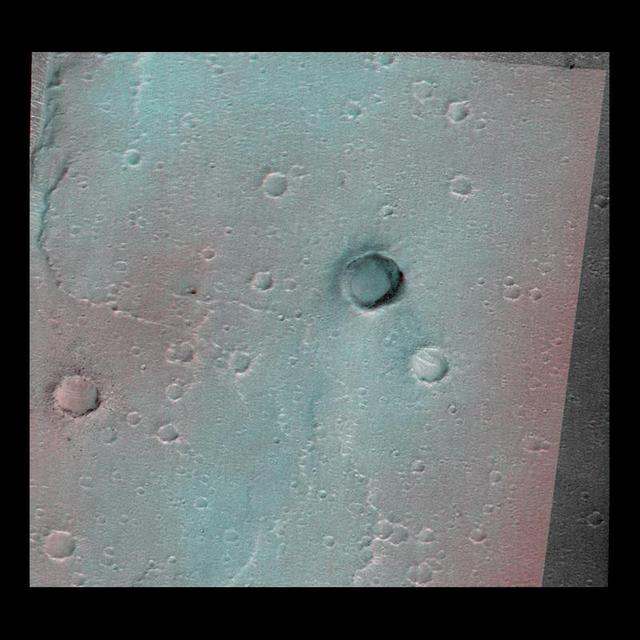
This image of the vicinity of the Viking Lander 1 was captured by NASA Mars Global Surveyor MOC camera. site. 3D glasses are necessary to identify surface detail.
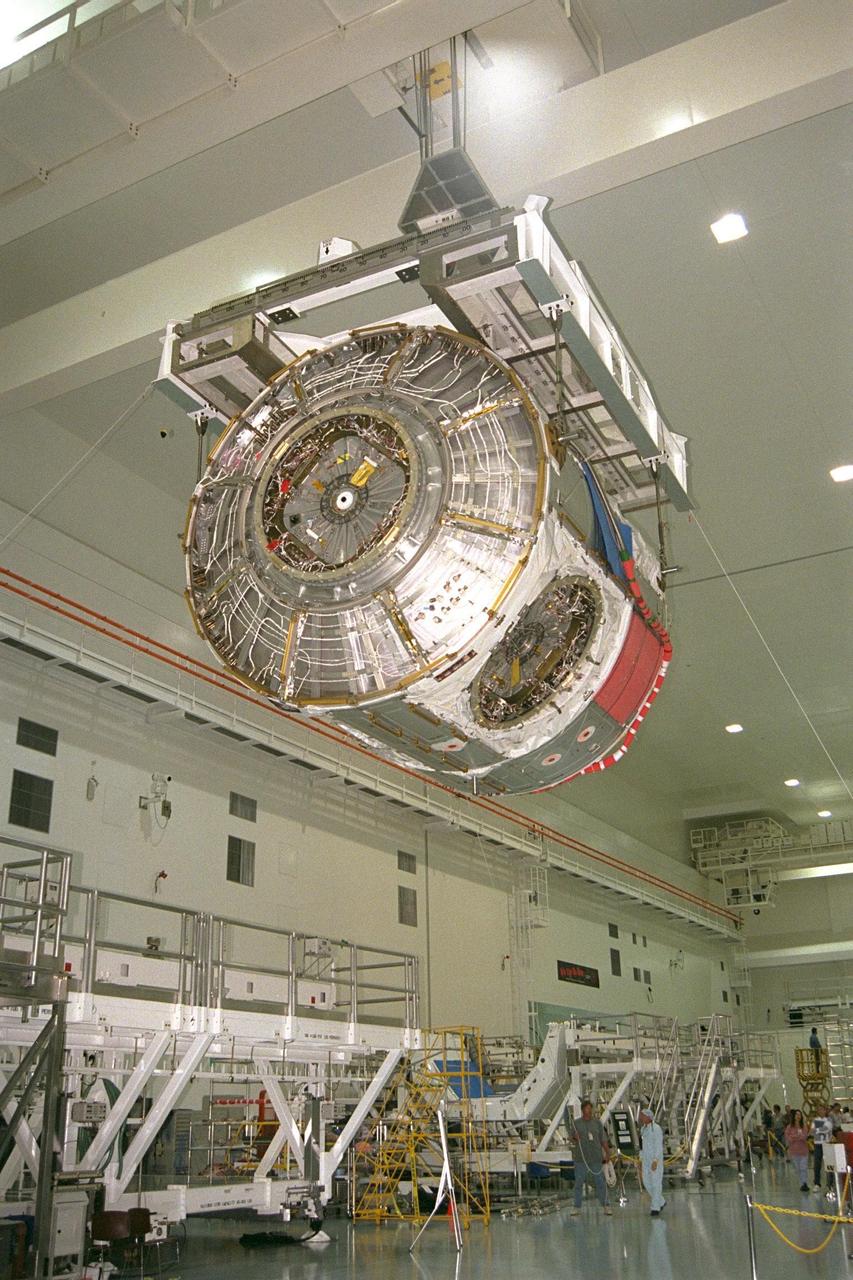
Node 1, the first U.S. element for the International Space Station, and Pressurized Mating Adapter-1 (PMA-1) continue with prelaunch preparation activities at KSC's Space Station Processing Facility. Node 1 is a connecting passageway to the living and working areas of the space station. The node and PMA-1 are being moved to an element rotation stand, or test stand, where they will undergo an interim weight and center of gravity determination. The final determination is planned to be performed prior to transporting Node 1 to the launch pad. Node 1 is scheduled to fly on STS-88
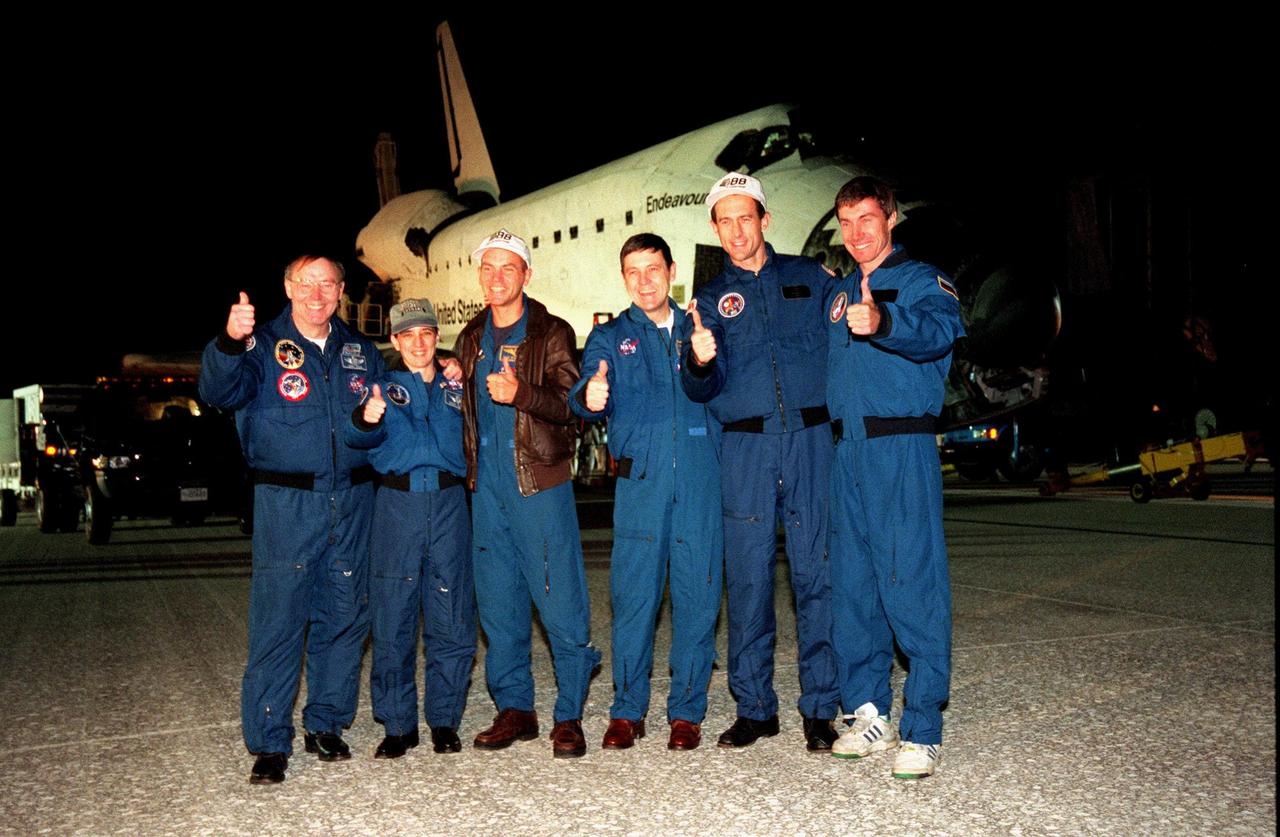
The STS-88 crew, in front of the orbiter Endeavour on Runway 15 of the Shuttle Landing Facility, show their joy at their successful mission with a thumbs up for media gathered nearby. From left, they are Mission Specialists Jerry L. Ross and Nancy J. Currie, Pilot Frederick W. "Rick" Sturckow, Commander Robert D. Cabana, and Mission Specialists James H. Newman and Sergei Konstantinovich Krikalev, a Russian cosmonaut. Endeavour touched down at 10:53:29 p.m. EST after a nearly 12-day, flawless mission. On the 4.6-million-mile mission, Endeavour carried the U.S.-built Unity connecting module to begin construction of the International Space Station. The crew successfully mated Unity with the Russian-built Zarya control module during three space walks. With this mission, Ross completed seven space walks totaling 44 hours and 9 minutes, more than any other American space walker. Newman moved into third place for U.S. space walks with a total of 28 hours and 27 minutes on four excursions
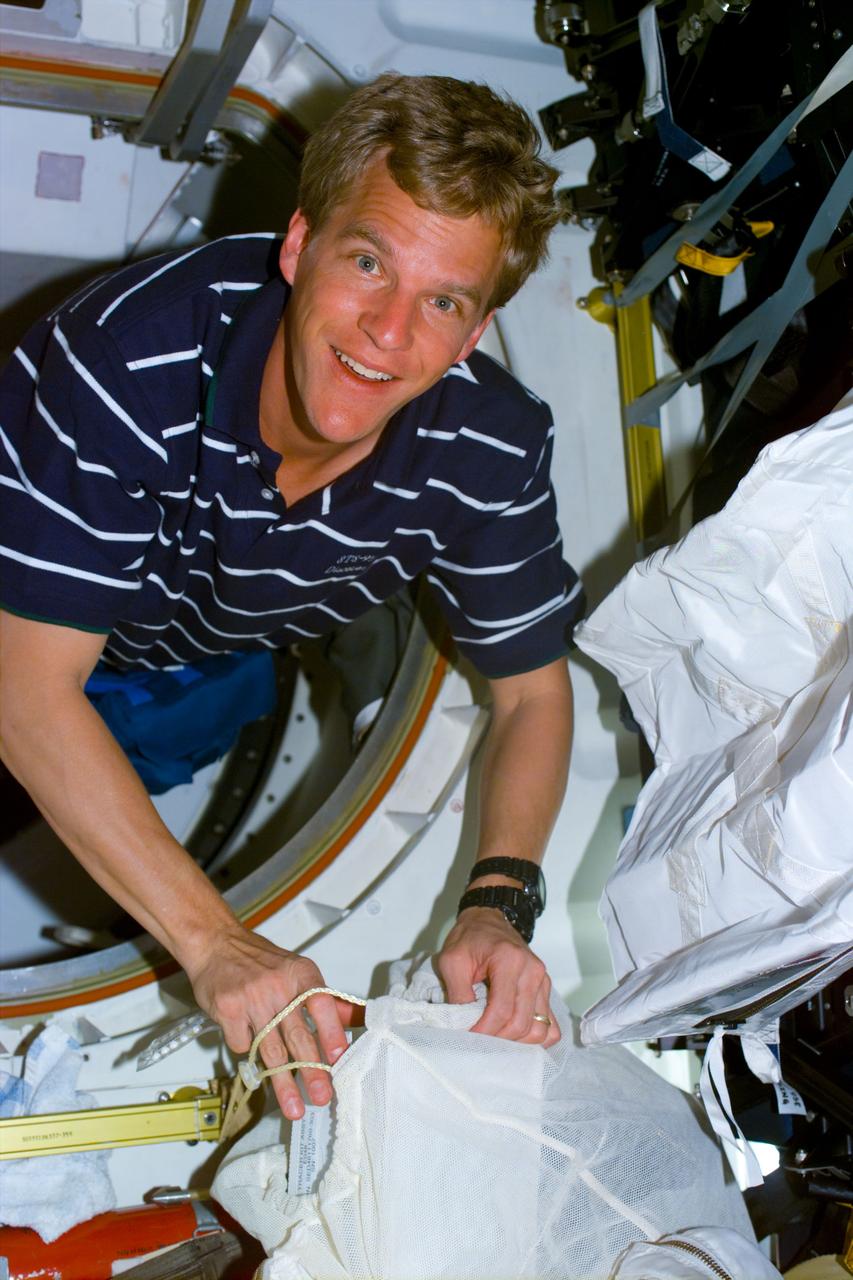
STS095-E-5052 (30 Oct. 1998) --- Astronaut Scott E. Parazynski, STS-95 mission specialist, emerges from the tunnel that connects SPACEHAB to Discovery's middeck during flight day two activity. The photo was taken with an electronic still camera (ESC) at 10:42:30, Oct. 30.
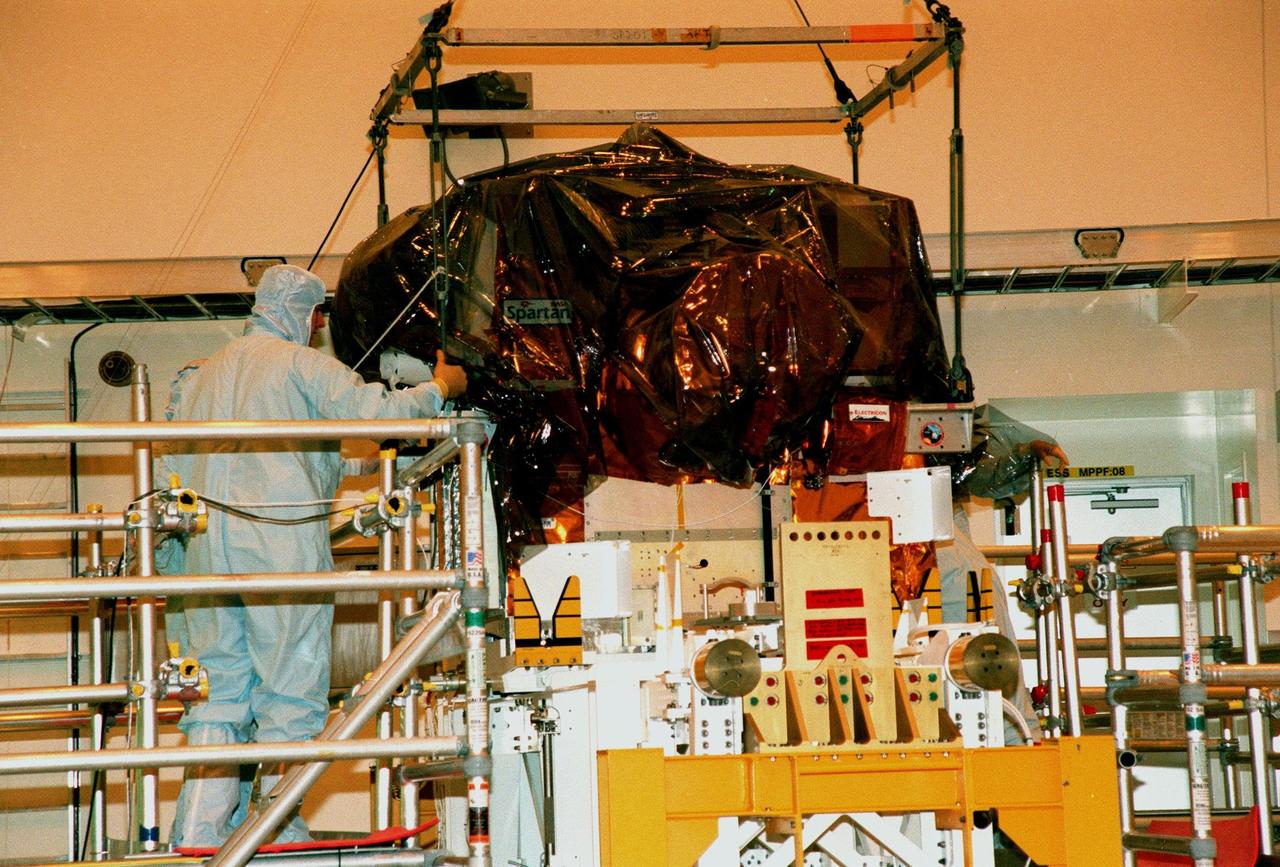
The Spartan solar-observing deployable spacecraft is moved from a bridge in the Multi-Payload Processing Facility at KSC where it had been stored for protection from a hurricane threatening the area. Spartan is one of the payloads for the STS-95 mission, scheduled to launch Oct. 29. Other research payloads include the Hubble Space Telescope Orbital Systems Test Platform, the International Extreme Ultraviolet Hitchhiker, as well as the SPACEHAB single module with experiments on space flight and the aging process
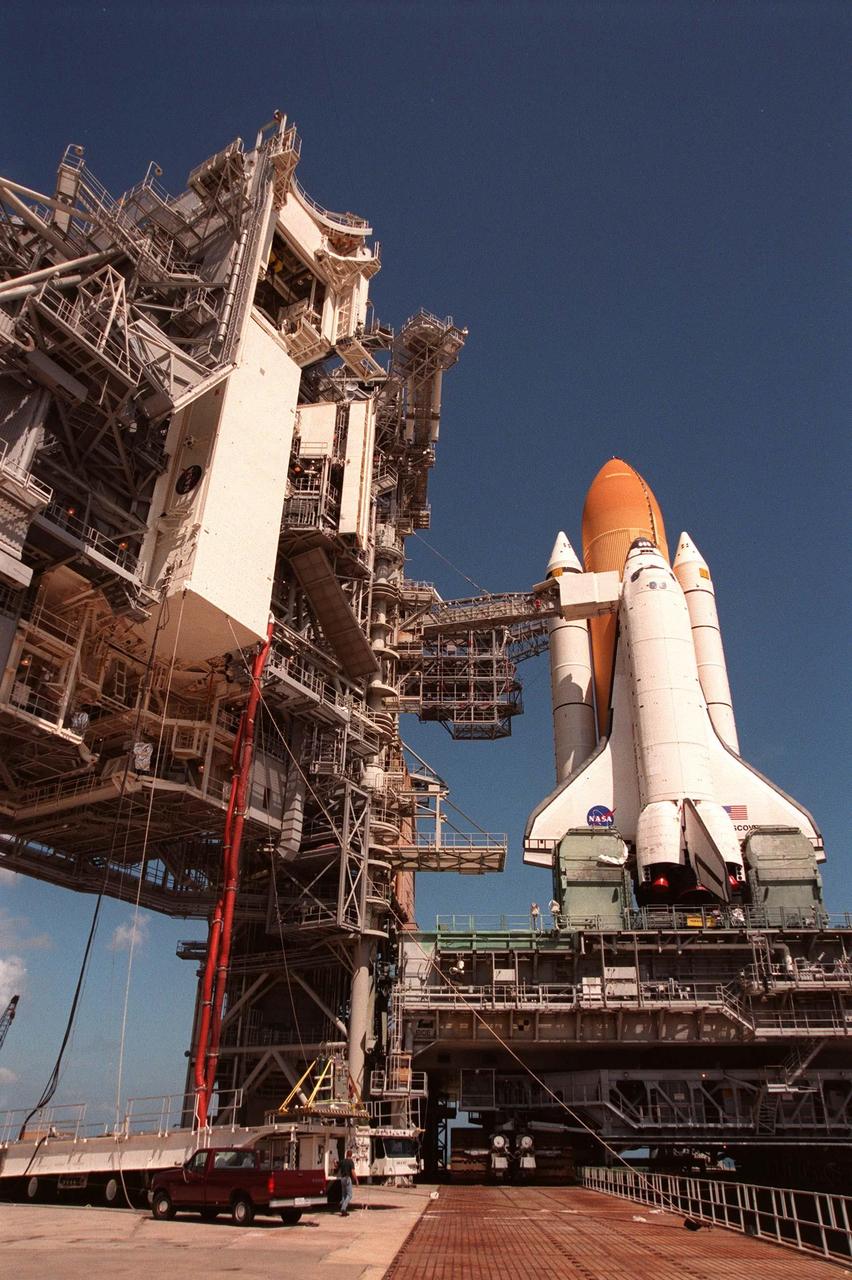
KENNEDY SPACE CENTER, FLA. -- At left, the payload canister for Space Shuttle Discovery is lifted from its canister movement vehicle to the top of the Rotating Service Structure on Launch Pad 39-B. Discovery (right), sitting atop the Mobile Launch Platform and next to the Fixed Service Structure, is scheduled for launch on Oct. 29, 1998, for the STS-95 mission. That mission includes the International Extreme Ultraviolet Hitchhiker (IEH-3), the Hubble Space Telescope Orbital Systems Test Platform, the Spartan solar-observing deployable spacecraft, and the SPACEHAB single module with experiments on space flight and the aging process
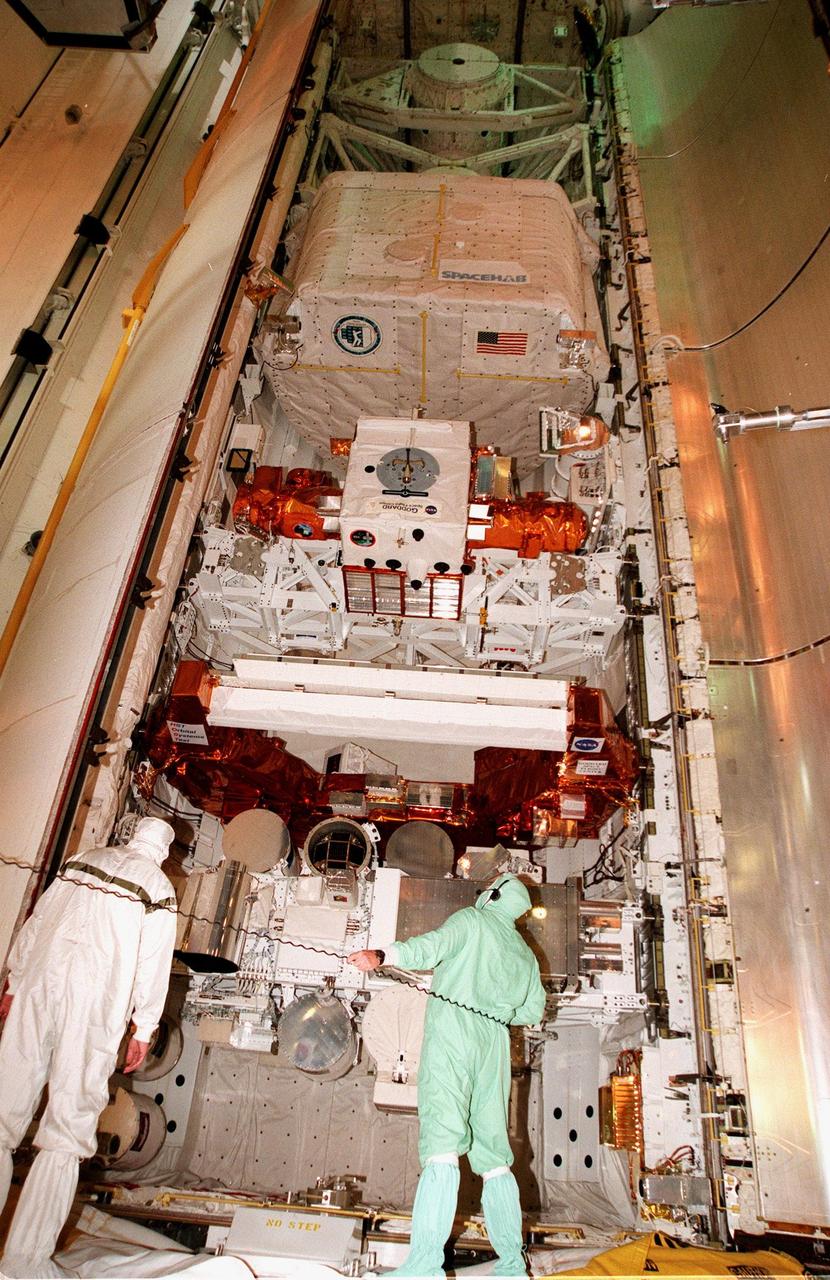
KENNEDY SPACE CENTER, FLA. -- On Launch Complex 39B, KSC workers check the payloads for mission STS-95 which were loaded into the orbiter Discovery payload bay before launch. The mission includes the SPACEHAB single module (seen at the top of the bay) with experiments on space flight and the aging process, the International Extreme Ultraviolet Hitchhiker (IEH-3), the Hubble Space Telescope Orbital Systems Test Platform, and the Spartan solar-observing deployable spacecraft. STS-95 is expected to launch at 2 p.m. EST on Oct. 29, last 8 days, 21 hours and 49 minutes, and land at 11:49 a.m. EST on Nov. 7

Time Series of Jupiter Aurora
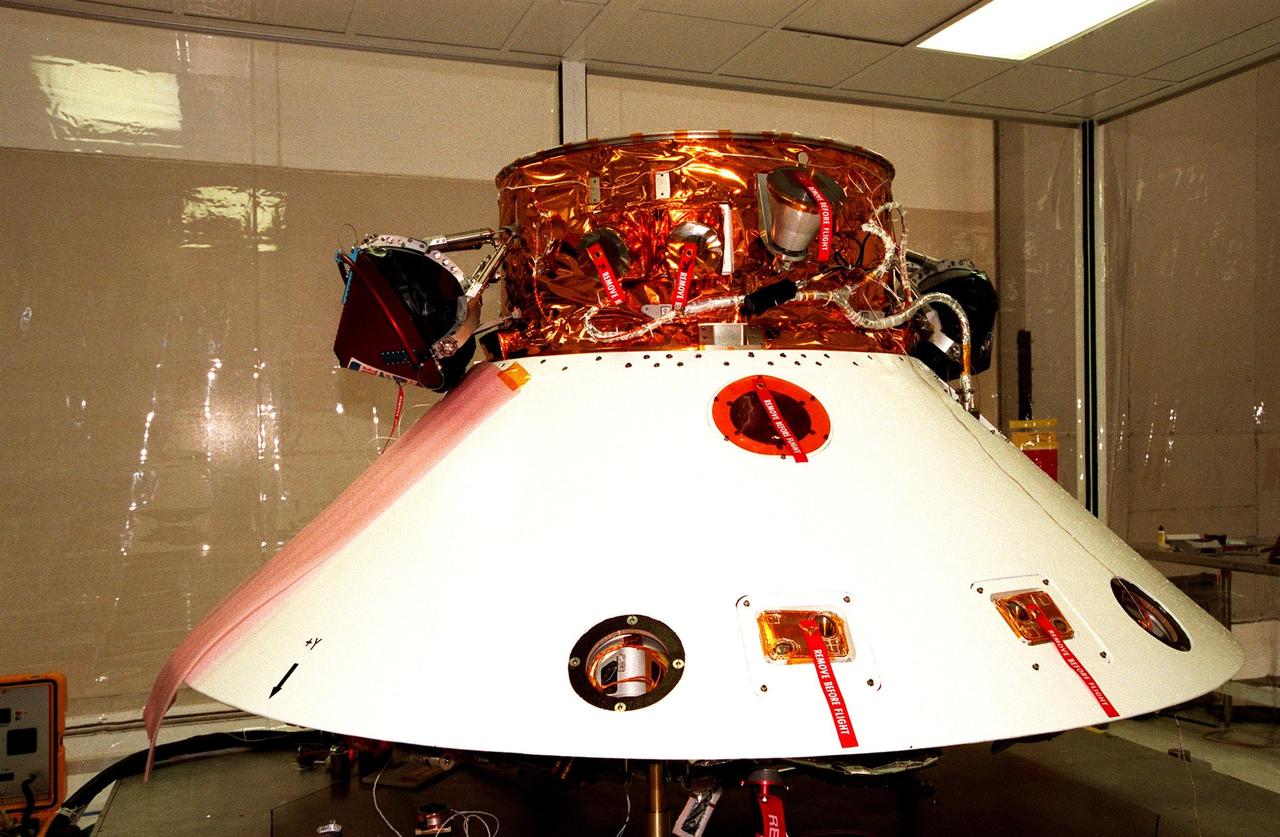
KENNEDY SPACE CENTER, FLA. -- In the Spacecraft Assembly and Encapsulation Facility -2 (SAEF-2), the two Mars microprobes are shown mounted on opposite sides of the Mars Polar Lander. The two microprobes and the lander are scheduled to be launched Jan. 3, 1999, aboard a Delta II rocket. The solar-powered spacecraft is designed to touch down on the Martian surface near the northern-most boundary of the south pole in order to study the water cycle there. The lander also will help scientists learn more about climate change and current resources on Mars, studying such things as frost, dust, water vapor and condensates in the Martian atmosphere. The Mars microprobes, called Deep Space 2, are part of NASA's New Millennium Program. They will complement the climate-related scientific focus of the lander by demonstrating an advanced, rugged microlaser system for detecting subsurface water. Such data on polar subsurface water, in the form of ice, should help put limits on scientific projections for the global abundance of water on Mars
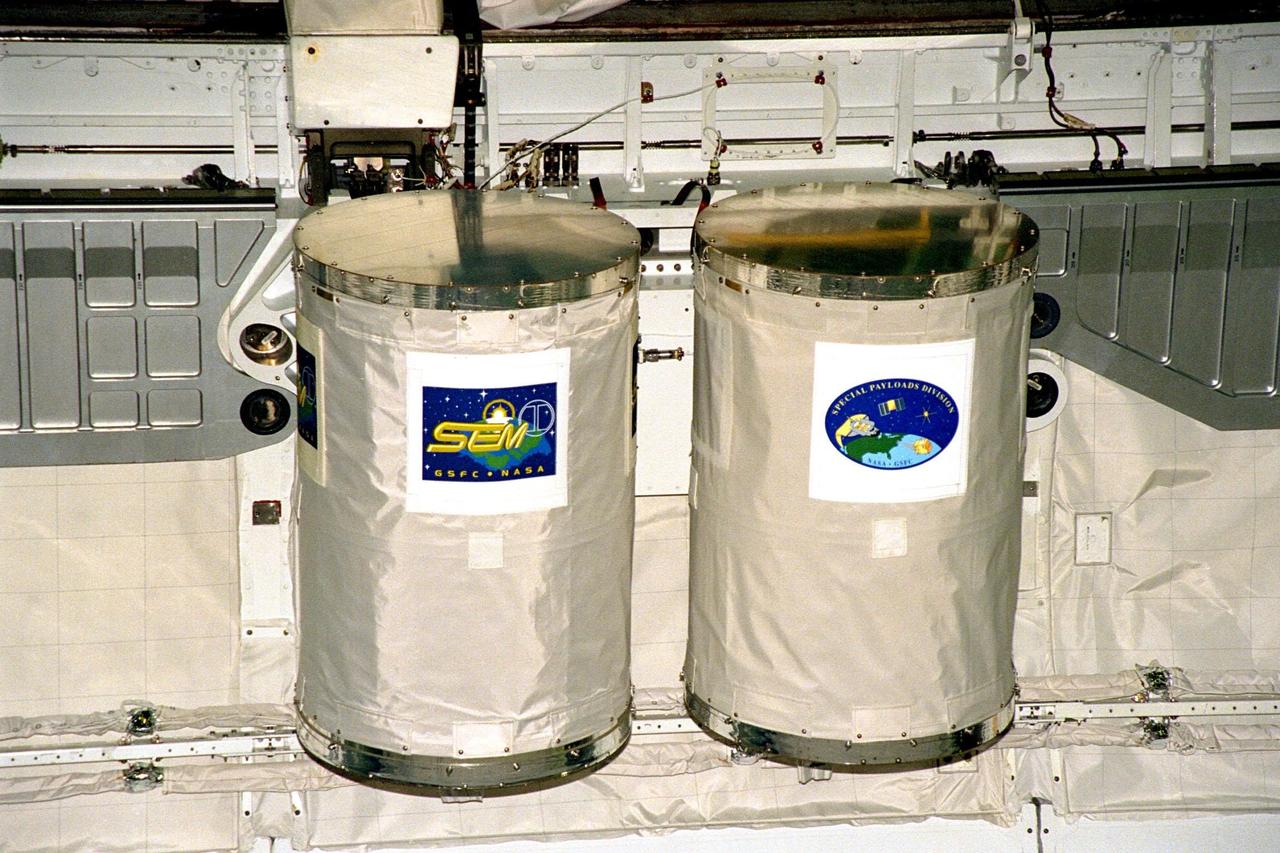
Processing activities for STS-91 continue in KSC's Orbiter Processing Facility Bay 2. Two Get Away Special (GAS) canisters are shown after their installation into Discovery's payload bay. The GAS canister on the left houses the Space Experiment Module (SEM-03), part of an educational initiative of NASA's Shuttle Small Payloads Project. On the right is a canister containing commemorative flags to be flown during the mission. STS-91 is scheduled to launch aboard the Space Shuttle Discovery for the ninth and final docking with the Russian Space Station Mir from KSC's Launch Pad 39A on June 2 with a launch window opening around 6:04 p.m. EDT
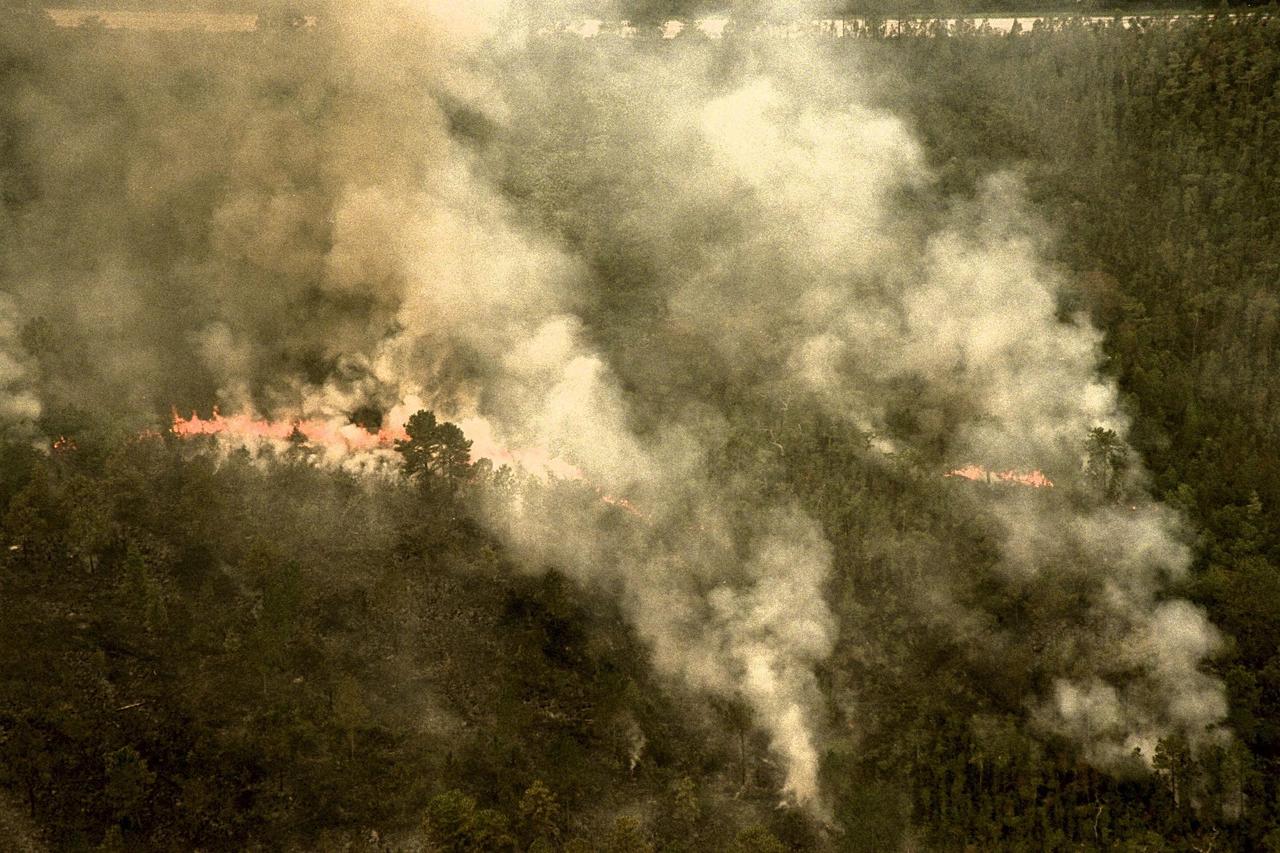
KENNEDY SPACE CENTER, FLA. -- A forest fire burning in Volusia County, Florida, is clearly visible from NASA's Huey UH-1 helicopter. The helicopter has been outfitted with a Forward Looking Infrared Radar (FLIR) and a portable global positioning satellite (GPS) system to support Florida's Division of Forestry as they fight the brush fires which have been plaguing the state as a result of extremely dry conditions and lightning storms. The FLIR includes a beach ball-sized infrared camera that is mounted on the helicopter's right siderail and a real-time television monitor and recorder installed inside. While the FLIR collects temperature data and images, the GPS system provides the exact coordinates of the fires being observed and transmits the data to the firefighters on the ground. The Kennedy Space Center (KSC) security team routinely uses the FLIR equipment prior to Shuttle launch and landing activities to ensure that the area surrounding the launch pad and runway are clear of unauthorized personnel. KSC's Base Operations Contractor, EG&G Florida, operates the NASA-owned helicopter
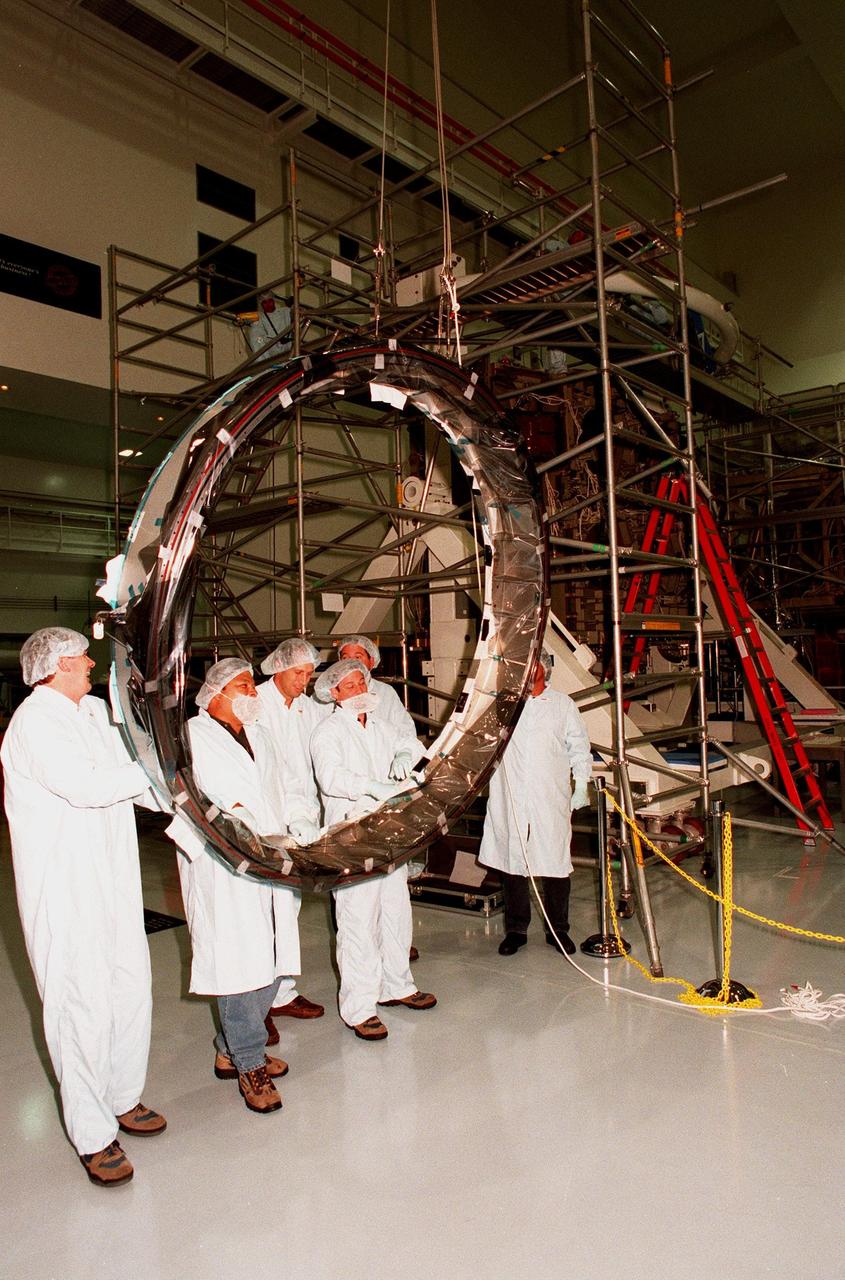
Workers in the Space Station Processing Facility look at the Passive Common Berthing Mechanism (PCBM) that will be attached to the Z1 integrated truss structure, a component of the International Space Station (ISS). The Z1 truss will be used for the temporary installation of the P6 truss segment to the Unity connecting module. The P6 truss segment contains the solar arrays and batteries which will provide early station power. The truss is scheduled to be launched aboard STS-92 in late 1999

Members of the STS-95 crew and their families prepare for their return flight to the Johnson Space Center in Houston, Texas, at the Skid Strip at Cape Canaveral Air Station. The STS-95 mission ended with landing at Kennedy Space Center's Shuttle Landing Facility at 12:04 p.m. EST on Nov. 7. The STS-95 crew consists of Mission Commander Curtis L. Brown Jr.; Pilot Steven W. Lindsey; Mission Specialist Scott E. Parazynski; Mission Specialist Stephen K. Robinson; Mission Specialist Pedro Duque, with the European Space Agency (ESA); Payload Specialist Chiaki Mukai, with the National Space Development Agency of Japan (NASDA); and Payload Specialist John H. Glenn Jr., a senator from Ohio and one of the original seven Project Mercury astronauts. The mission included research payloads such as the Spartan-201 solar-observing deployable spacecraft, the Hubble Space Telescope Orbital Systems Test Platform, the International Extreme Ultraviolet Hitchhiker, as well as a SPACEHAB single module with experiments on space flight and the aging process
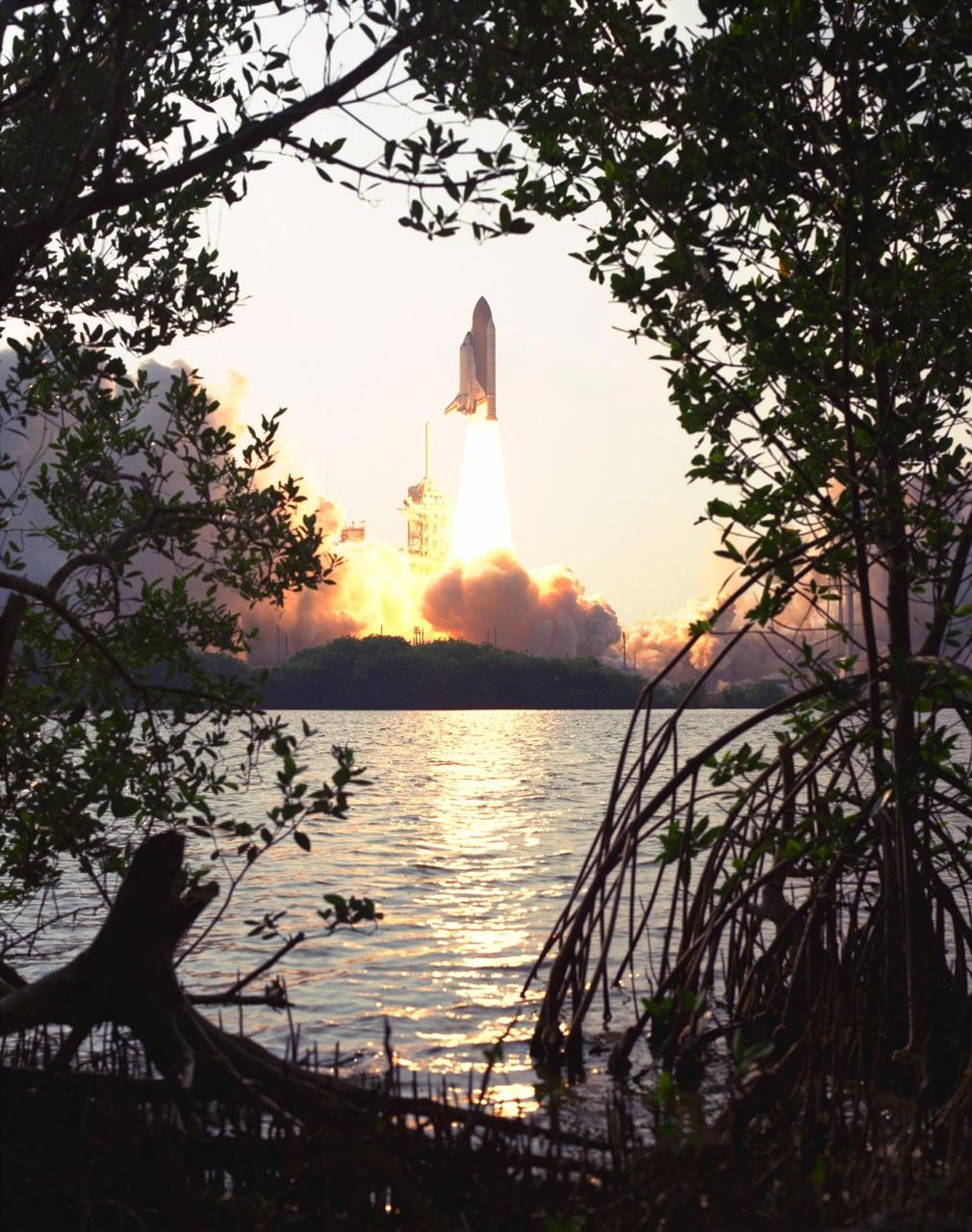
KENNEDY SPACE CENTER, Fla. -- The Space Coast's natural foliage frames the Space Shuttle Discovery and the reflection of the intense heat and light of its liftoff from Launch Pad 39A at 6:06:24 p.m. EDT June 2. On board Discovery are Mission Commander Charles J. Precourt; Pilot Dominic L. Gorie; and Mission Specialists Wendy B. Lawrence, Franklin R. Chang-Diaz, Janet Lynn Kavandi and Valery Victorovitch Ryumin. The nearly 10-day mission will feature the ninth and final Shuttle docking with the Russian space station Mir, the first Mir docking for the Space Shuttle orbiter Discovery, the first on-orbit test of the Alpha Magnetic Spectrometer (AMS), and the first flight of the new Space Shuttle super lightweight external tank. Astronaut Andrew S. W. Thomas will be returning to Earth as an STS-91 crew member after living more than four months aboard Mir
STS-88 Mission Commander Robert D. Cabana suits up in the Operations and Checkout Building prior, as part of flight crew equipment fit check, to his trip to Launch Pad 39A. He is helped by suit tech (right) Lloyd Armintor and an unidentified KSC worker. The crew are at KSC to participate in the Terminal Countdown Demonstration Test (TCDT) which includes mission familiarization activities, emergency egress training, and the simulated main engine cut-off exercise. This is Cabana's fourth space flight. Mission STS-88 is targeted for launch on Dec. 3, 1998. It is the first U.S. flight for the assembly of the International Space Station and will carry the Unity connecting module
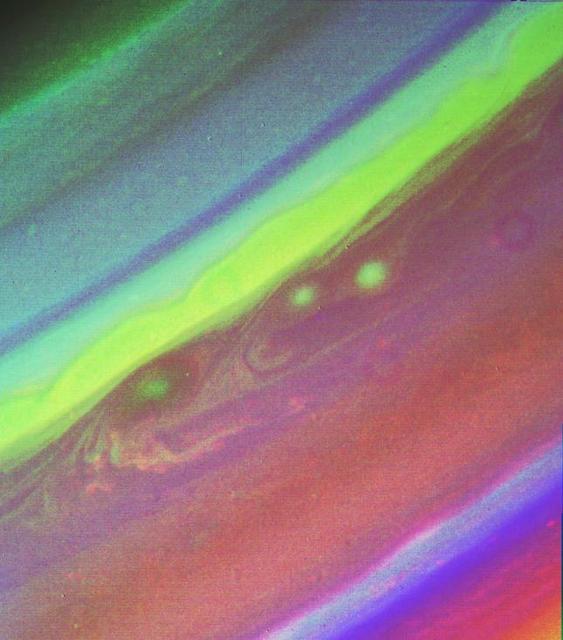
This false color picture of Saturn’s northern hemisphere was assembled from ultraviolet, violet and green images obtained Aug. 19 by Voyager 2 from a range of 7.1 million kilometers (4.4 million miles). The several weather patterns evident include three spots flowing westward at about 15 meters-per-second (33 mph). Although the cloud system associated with the western-most spot is part of this flow, the spot itself moves eastward at about 30 meters-per-second (65 mph). Their joint flow shows the anti-cyclonic rotation of the spot, which is about 3,000 km. (1,900 mi.) in diameter. The ribbon- like feature to the north marks a high-speed jet where wind speeds approach 150 meters-per-second (330 mph). http://photojournal.jpl.nasa.gov/catalog/PIA01365
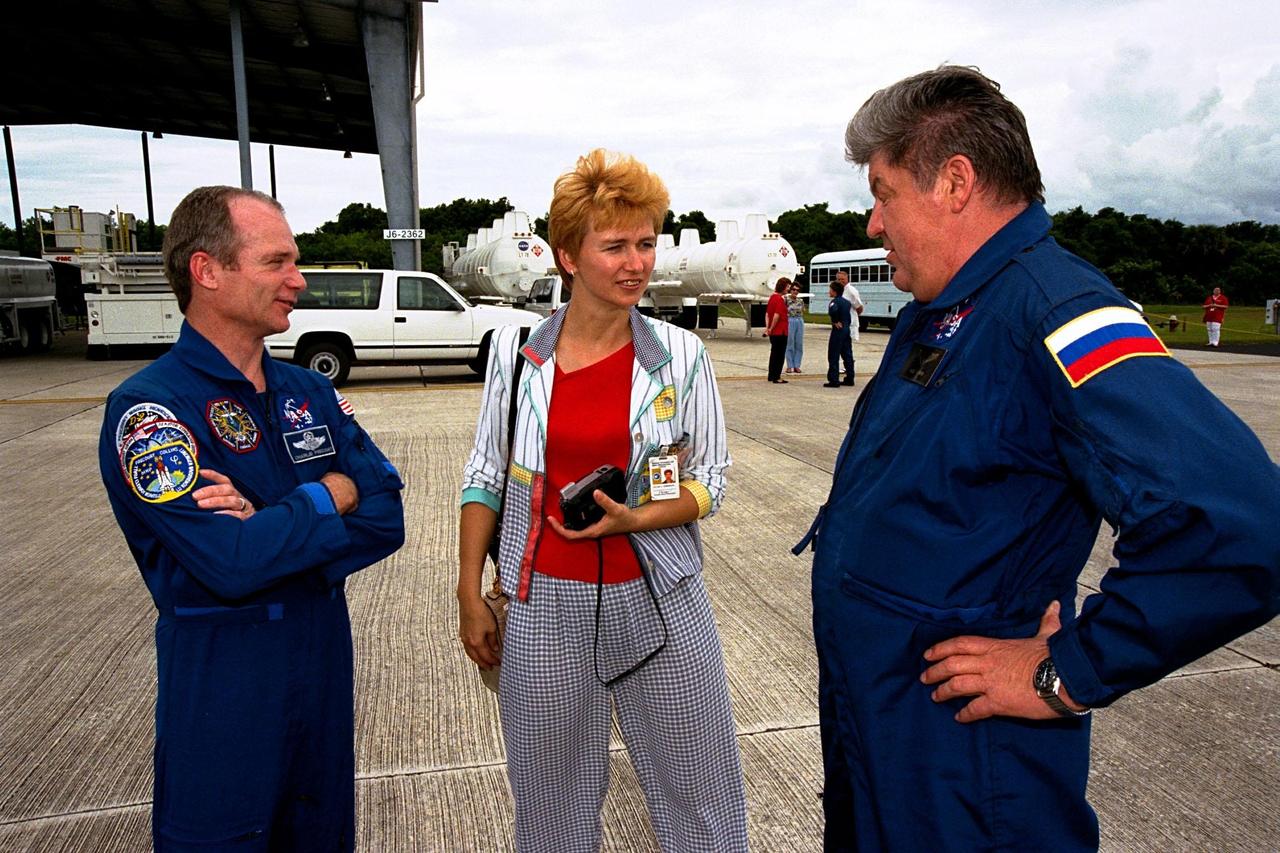
STS-91 Mission Commander Charles Precourt (left) talks to Elena V. Kondakova and her husband, Valery Ryumin, a cosmonaut with the Russian Space Agency (RSA) and STS-91 mission specialist, at Kennedy Space Center's Shuttle Landing Facility (SLF). The STS-91 crew had just arrived at the SLF aboard T-38 jets in preparation for launch. Kondakova, also a cosmonaut with the RSA, flew with Commander Precourt as a mission specialist on STS-84 which launched on May 15, 1997. STS-91 is scheduled to be launched on June 2 on Space Shuttle Discovery with a launch window opening around 6:10 p.m. EDT. The mission will feature the ninth Shuttle docking with the Russian Space Station Mir, the first Mir docking for Discovery, the conclusion of Phase I of the joint U.S.-Russian International Space Station Program, and the first flight of the new Space Shuttle super lightweight external tank. The STS-91 flight crew also includes Pilot Dominic Gorie and Mission Specialists Wendy B. Lawrence; Franklin Chang-Diaz, Ph.D.; and Janet Kavandi, Ph.D. Andrew Thomas, Ph.D., will be returning to Earth with the crew after living more than four months aboard Mir
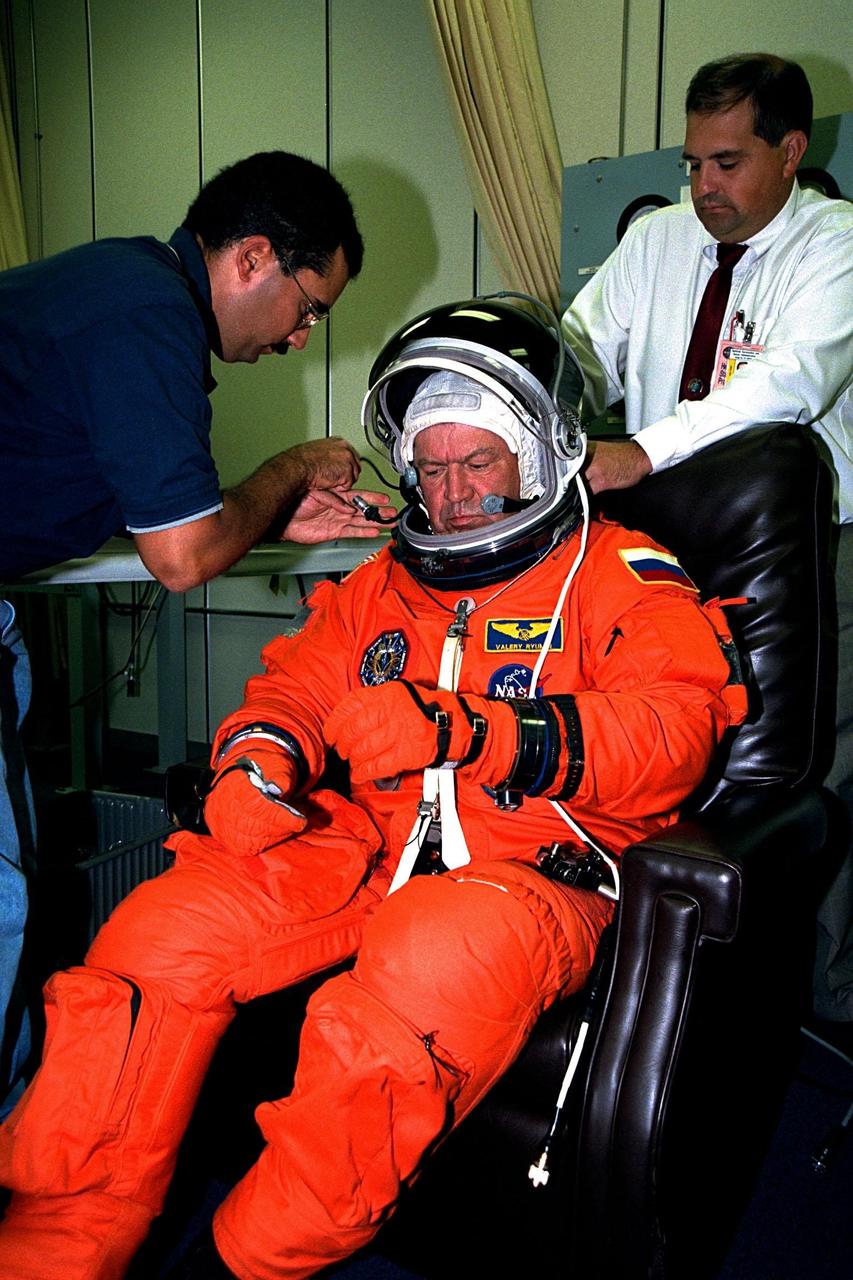
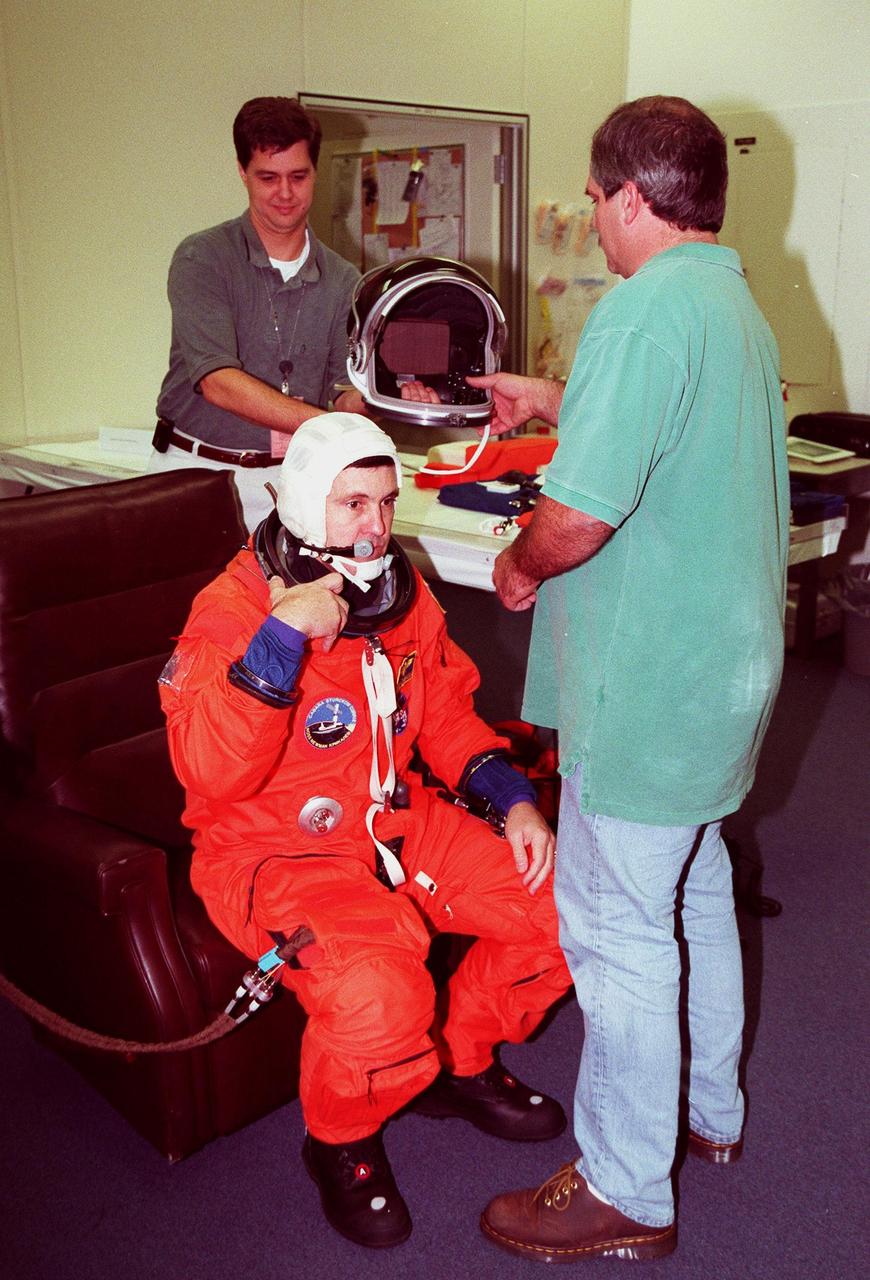
STS-91 Mission Specialist and Russian cosmonaut Valery Victorovitch Ryumin is outfitted with his ascent/reentry flight suit and helmet by two suit technicians in the Operations and Checkout (O&C) Building. The final suit fitting and checkout takes place prior to the crew walkout and transport to Launch Pad 39A. He has been director of the Russian Shuttle-Mir program and flight director for the Salyut-7 and Mir space stations and is a veteran of three space flights with a total of 362 days in space. This will be Ryumin’s first visit to Mir. However, his experience with Russian spacecraft in orbit will prove extremely valuable as he helps the crew with Mir equipment transfer operations. He will also be assessing the condition of the station for the Russian space program. STS-91 is scheduled to be launched on June 2 with a launch window opening around 6:10 p.m. EDT. The mission will feature the ninth and final Shuttle docking with the Russian space station Mir, the first Mir docking for Discovery, the first on-orbit test of the Alpha Magnetic Spectrometer (AMS), and the first flight of the new Space Shuttle super lightweight external tank. Astronaut Andrew S. W. Thomas will return to Earth as a STS91 crew member after living more than four months aboard Mir
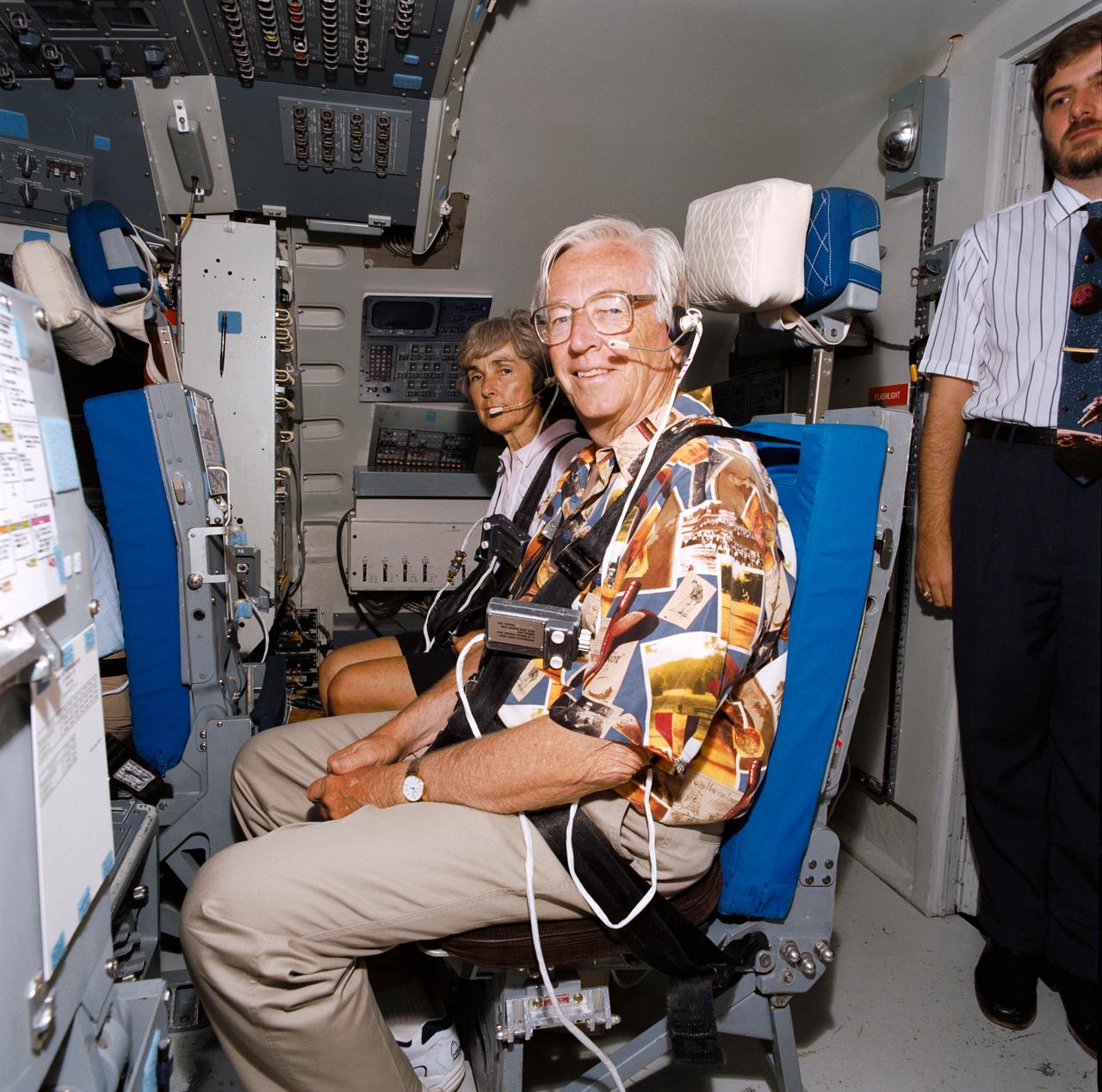
Charles Schulz Memorial Library. View of unidentified individual in cockpit area (02834 thru 02835); and View of unidentified individuals in cockpit area (02836).
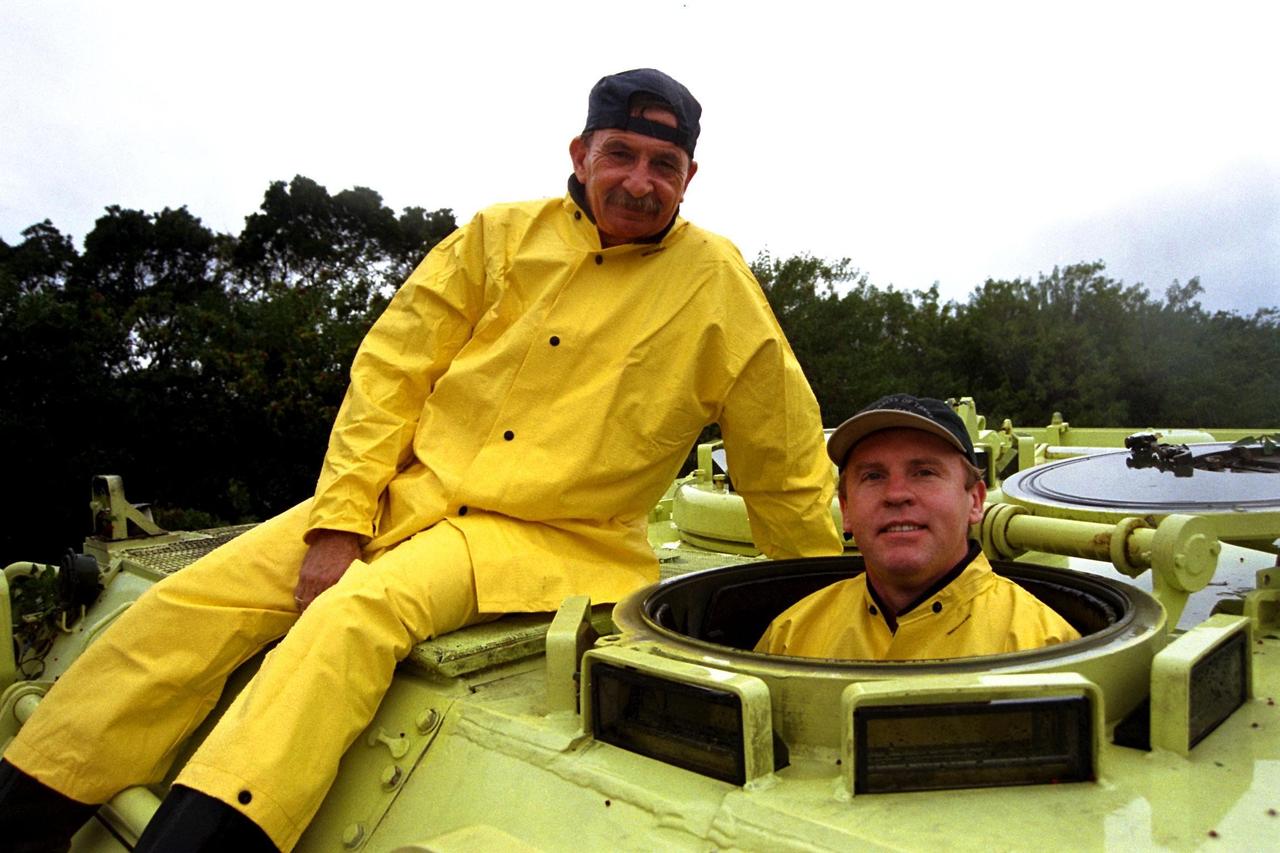
STS-89 Mission Specialist Andrew Thomas, Ph.D. gets ready to drive an M-113 armored personnel carrier as part of Terminal Countdown Demonstration Test (TCDT) activities. The TCDT is held at KSC prior to each Space Shuttle flight to provide crews with an opportunity to participate in simulated countdown activities. Standing inside the M-113 is Dr. Thomas while George Hoggard, a training officer with KSC Fire Services, sits atop the vehicle. The STS-89 mission will be the eighth docking of the Space Shuttle with the Russian Space Station Mir. After docking, Dr. Thomas will transfer to the space station, succeeding David Wolf, M.D., who will return to Earth aboard Endeavour. Dr. Thomas will live and work on Mir until June. STS-89 is scheduled for a Jan. 22 liftoff at 9:48 p.m
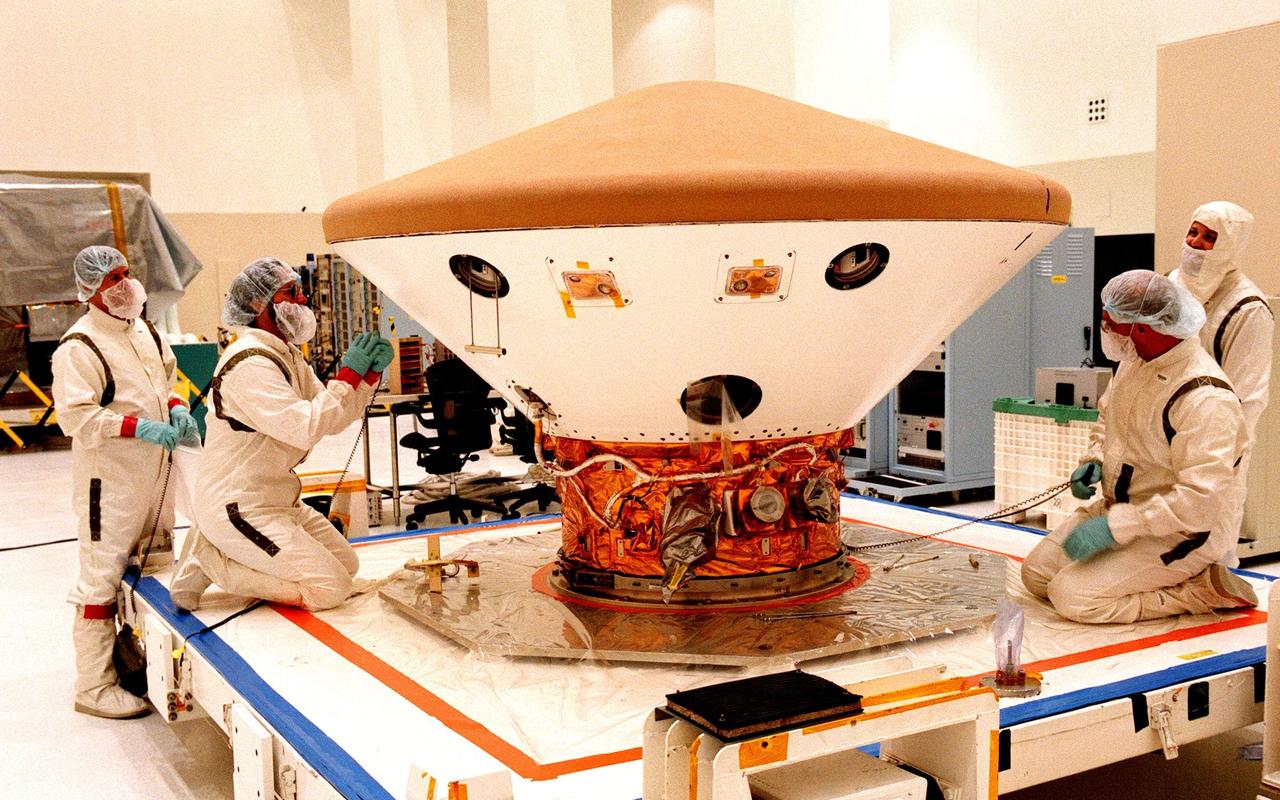
KENNEDY SPACE CENTER, FLA. -- In the Spacecraft Assembly and Encapsulation Facility-2 (SAEF-2), the Mars Polar Lander is secured on a workstand for testing, which includes a functional test of the science instruments and the basic spacecraft subsystems. The Mars Polar Lander is targeted for launch from Cape Canaveral Air Station aboard a Delta II rocket on Jan. 3, 1999. The solar-powered spacecraft is designed to touch down on the Martian surface near the northern-most boundary of the south pole in order to study the water cycle there. The lander also will help scientists learn more about climate change and current resources on Mars, studying such things as frost, dust, water vapor and condensates in the Martian atmosphere
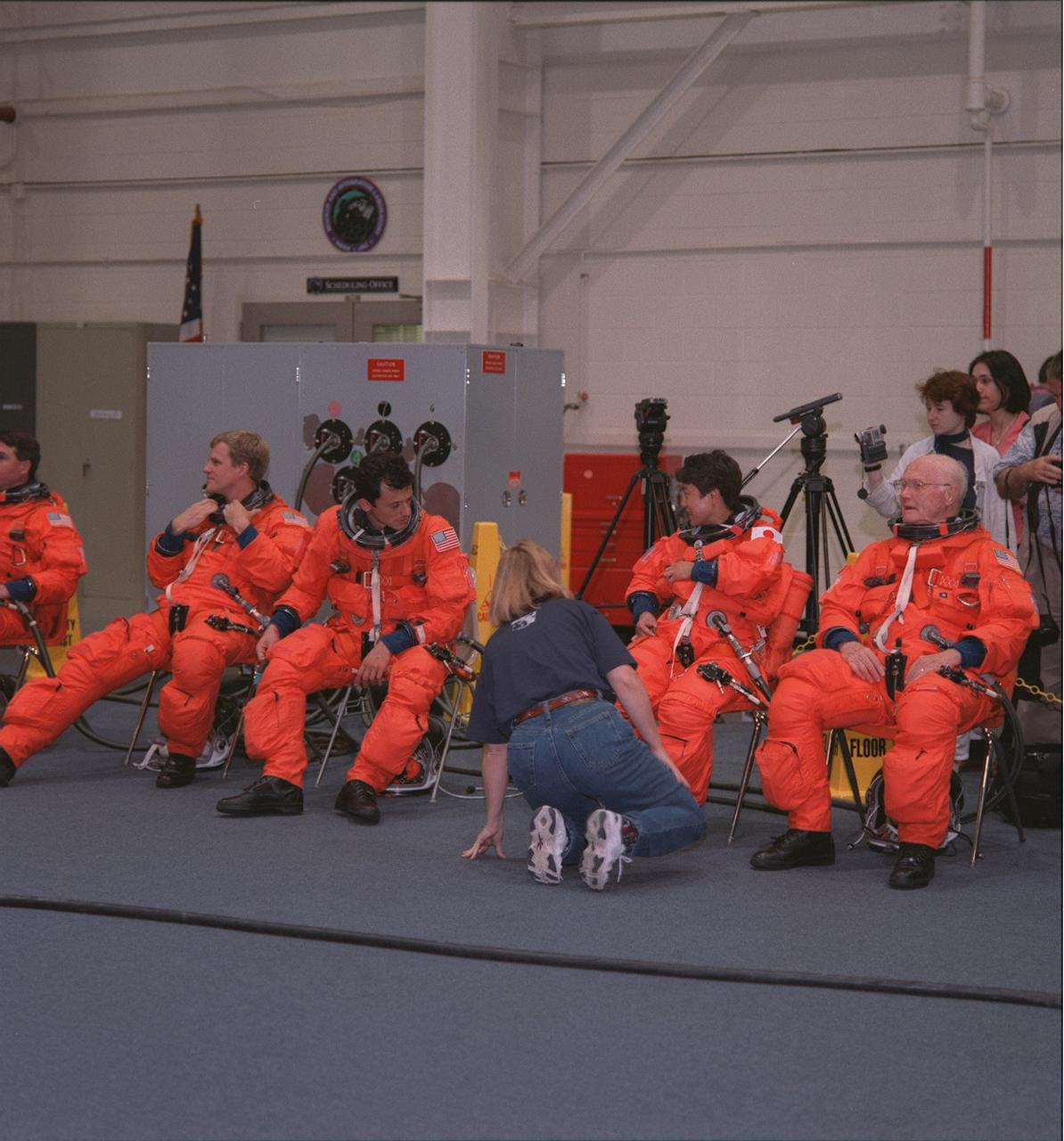
S98-07973 (5 June 1998) --- Five of the seven STS-95 crew members are seen as they wait for a training and photo session to begin in the systems integration facility at NASA's Johnson Space Center. From the left are astronauts Stephen K. Robinson (partially out of frame), Scott E. Parazynski and Pedro Duque, all mission specialists; along with Chiaki Mukai and U.S. Sen. John H. Glenn Jr. (D.-Ohio), both payload specialists. Duque represents the European Space Agency and Mukai, Japan's National Space Development Agency (NASDA).
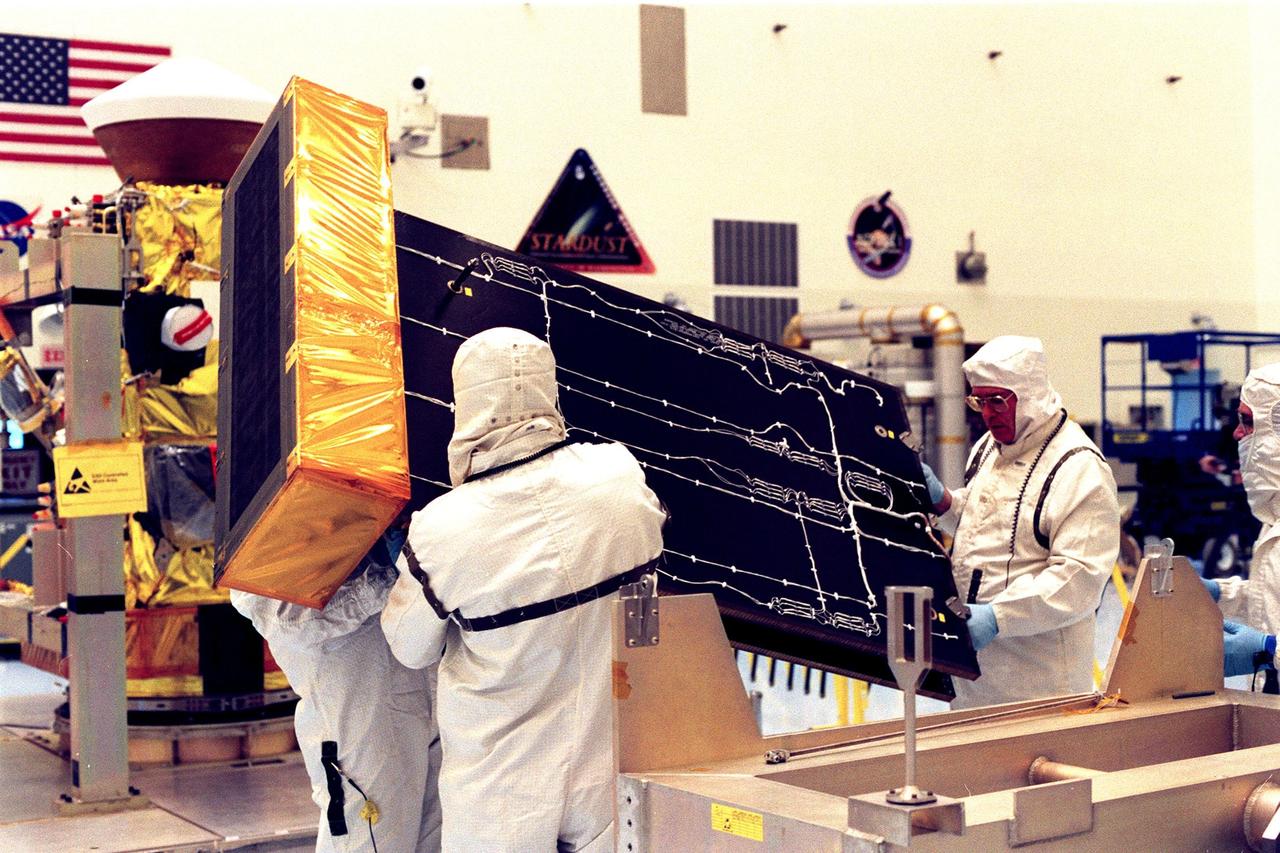
In the Payload Hazardous Servicing Facility, workers carry one of the Stardust solar panels removed for testing. The spacecraft Stardust will use a unique medium called aerogel to capture comet particles flying off the nucleus of comet Wild 2 in January 2004, plus collect interstellar dust for later analysis. Stardust will be launched aboard a Boeing Delta 7426 rocket from Complex 17, Cape Canaveral Air Station, targeted for Feb. 6, 1999. The collected samples will return to Earth in a re-entry capsule to be jettisoned from Stardust as it swings by Earth in January 2006
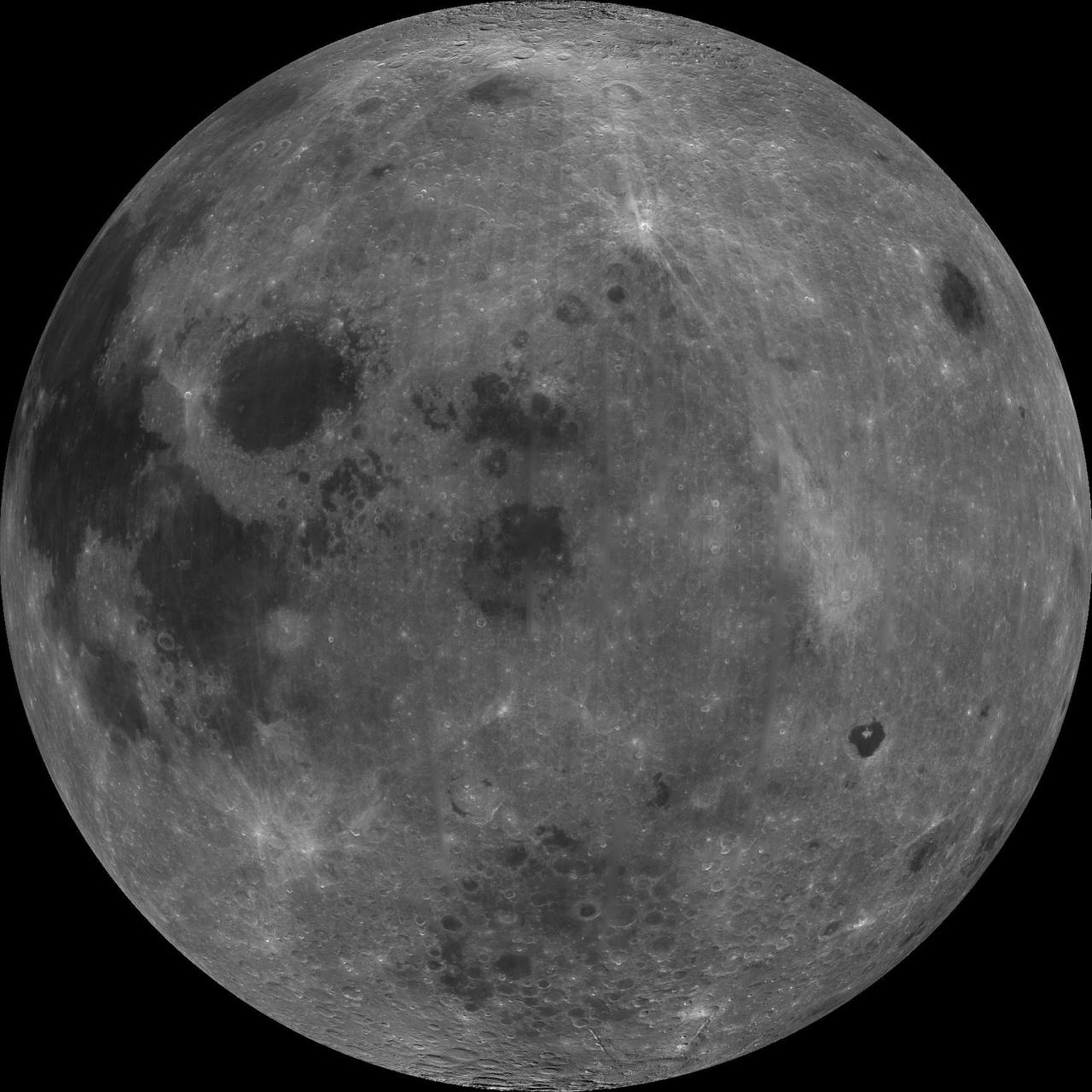
About 50,000 Clementine images were processed to produce the four orthographic views of the Moon. The images show albedo variations (normalized brightness or reflectivity) of the surface at a wavelength of 750 nm (just longward of visible red). The image projection is centered at 0 degree latitude and 180 degrees longitude. Mare Moscoviense (dark albedo feature upper left of image center) and South Pole-Aitken Basin (dark feature at bottom) represent maria regions largely absent on the lunar farside. The Clementine altimeter showed Aitken Basin to consist of a topographic rim about 2500 km in diameter, an inner shelf ranging from 400 to 600 km in width, and an irregular depressed floor about 12 km in depth. http://photojournal.jpl.nasa.gov/catalog/PIA00303
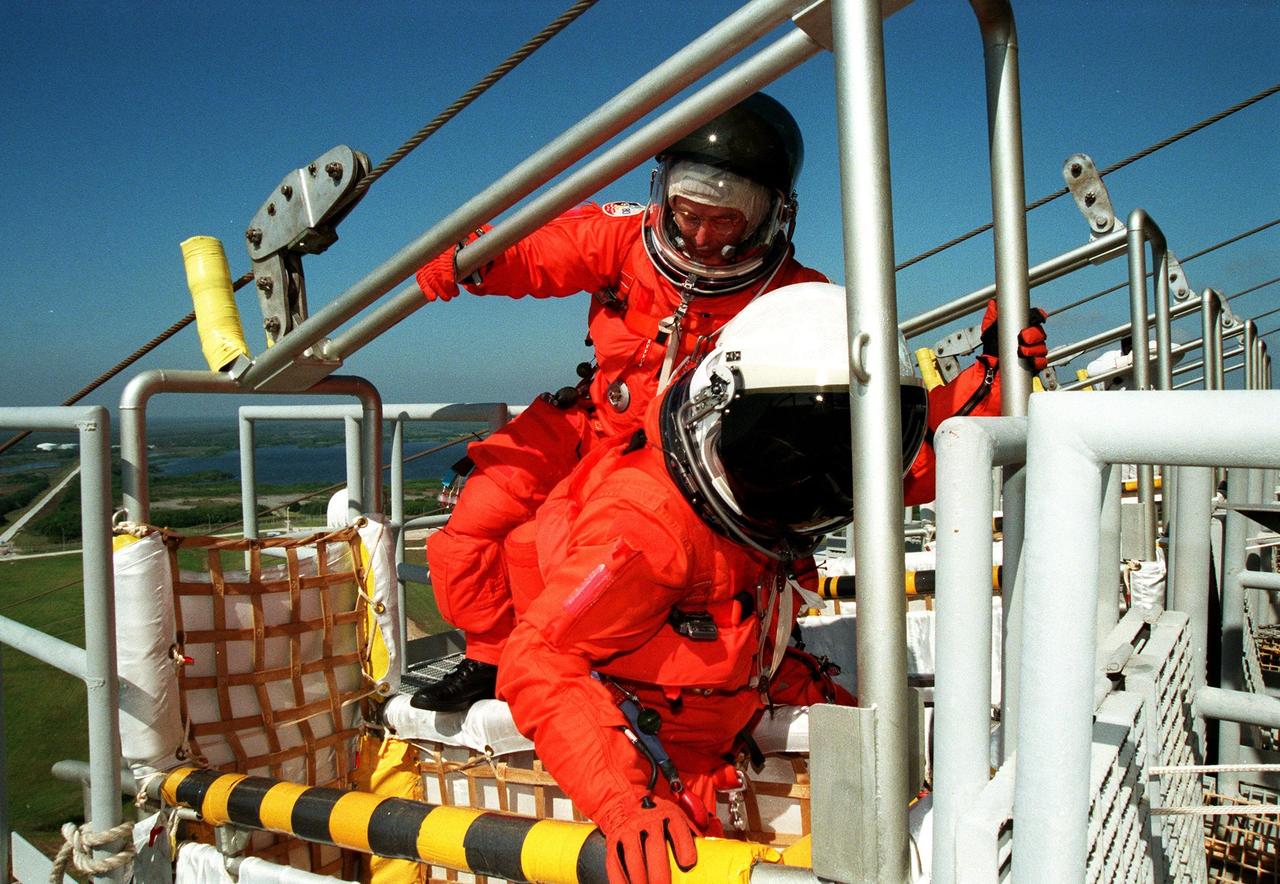
KENNEDY SPACE CENTER, Fla. -- STS-88 Mission Specialist Jerry L. Ross (left) climbs into slideware basket behind Mission Specialist Nancy Jane Currie, Ph.D., (right) at Launch Pad 39A as part of an emergency egress exercise. The crew are at KSC to participate in the Terminal Countdown Demonstration Test (TCDT) which includes mission familiarization activities, emergency egress training, and the simulated main engine cut-off exercise. Mission STS-88 is targeted for launch on Dec. 3, 1998. It is the first U.S. flight for the assembly of the International Space Station and will carry the Unity connecting module. Unity will be mated with the already orbiting Russian-built Zarya control module. The 12-day mission includes three planned spacewalks to connect power, data and utility lines and install exterior equipment
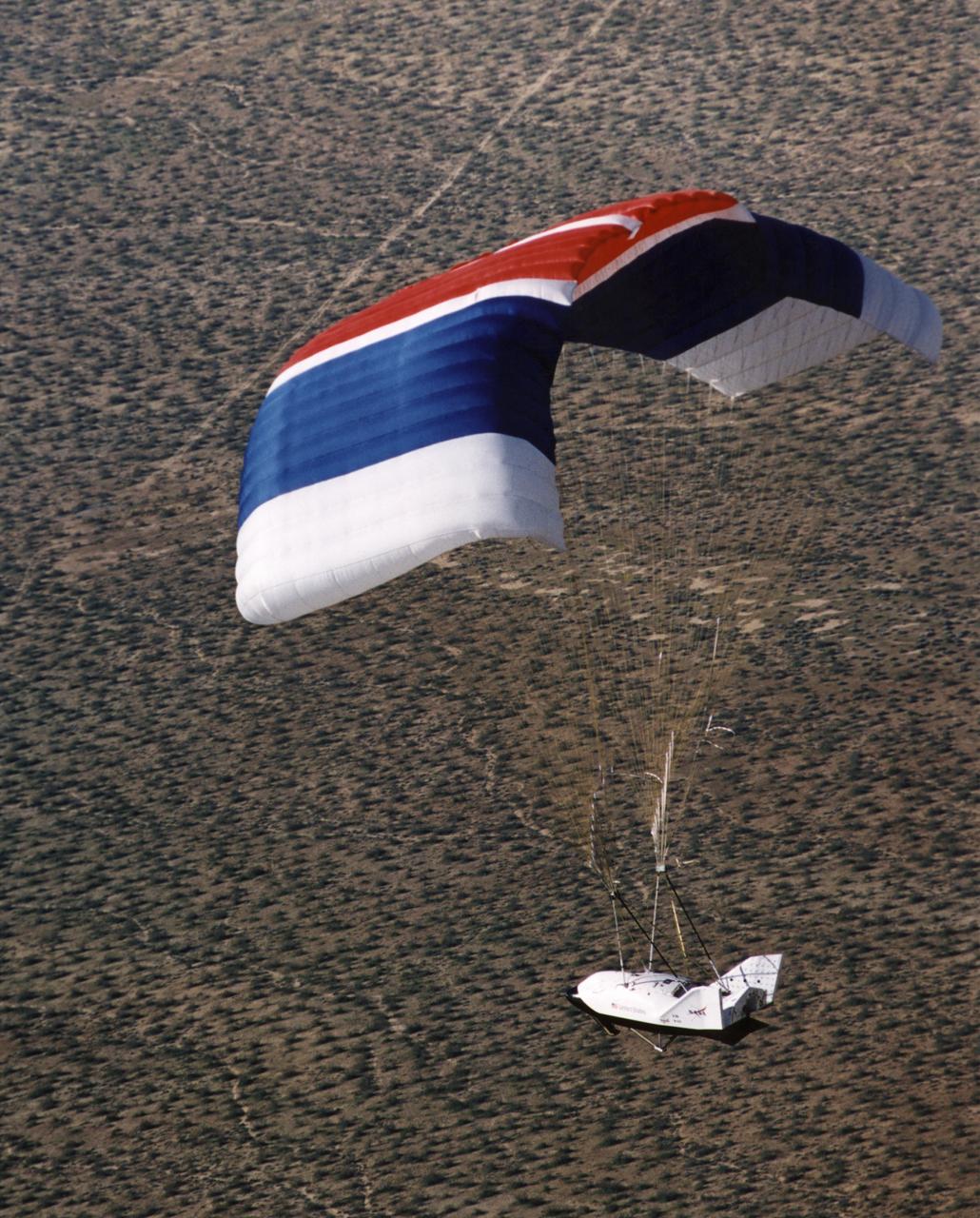
The X-38 Crew Return Vehicle descends under its steerable parafoil over the California desert in its first free flight at the Dryden Flight Research Center, Edwards, California. The flight took place March 12, 1998.
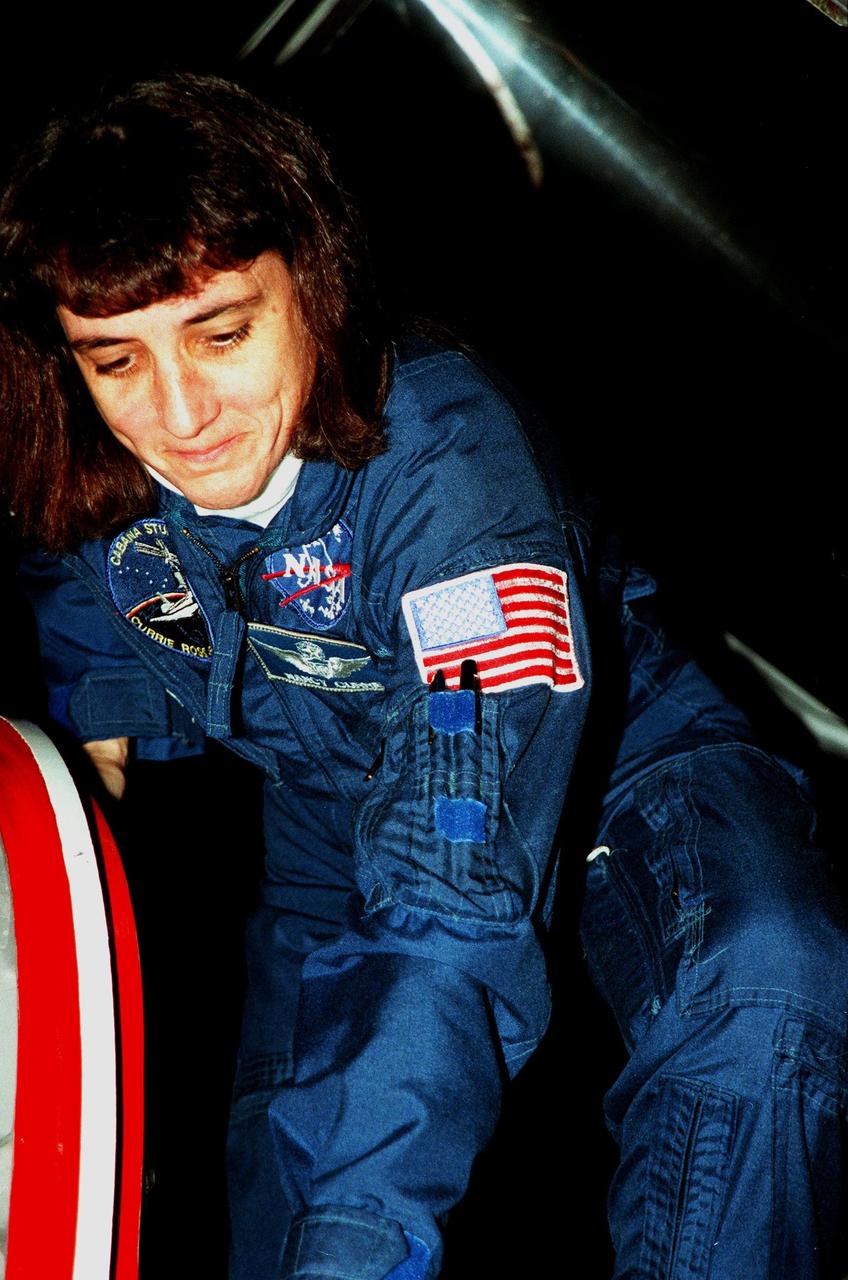
STS-88 Mission Specialist Nancy J. Currie climbs out of a T-38 jet aircraft in which she arrived after dark at the Shuttle Landing Facility in order to take part in Terminal Countdown Demonstration Test (TCDT) activities. The TCDT provides the crew with simulated countdown exercises, emergency egress training, and opportunities to inspect their mission payloads in the orbiter's payload bay. Mission STS-88 is targeted for launch on Dec. 3, 1998. It is the first U.S. flight for the assembly of the International Space Station and will carry the Unity connecting module. Others in the STS-88 crew are Mission Commander Robert D. Cabana, Pilot Frederick W. "Rick" Sturckow, Mission Specialists Jerry L. Ross, James H. Newman and Sergei Krikalev, a Russian cosmonaut. Ross and Newman will make three spacewalks to connect power, data and utility lines and install exterior equipment
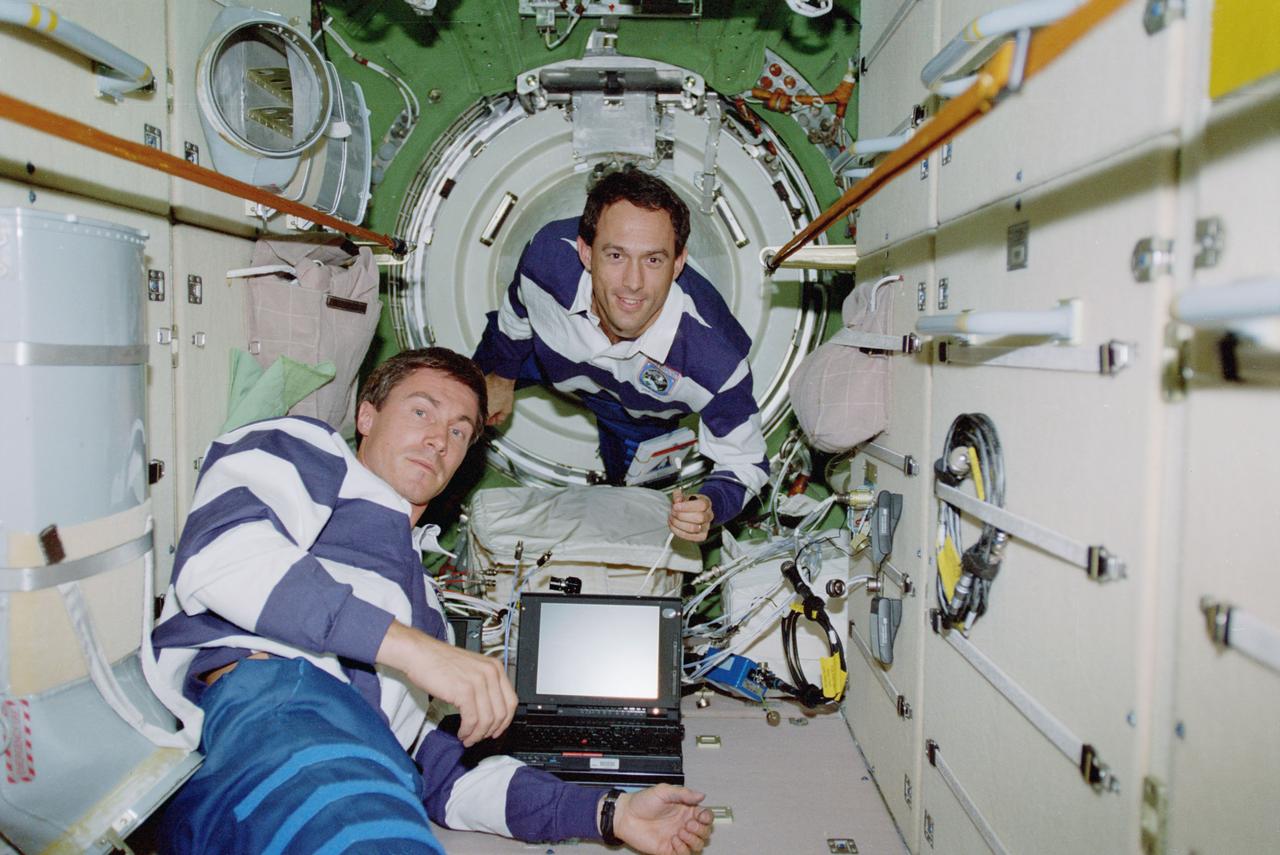
STS088-357-008 (4-15 Dec. 1998) --- Cosmonaut Sergei K. Krikalev (foreground), mission specialist representing the Russian Space Agency (RSA), and astronaut James H. Newman, mission specialist, participate in video teleconference with ground controllers while working in the Russian-built FGB or Zarya Module. At the time the photo was made, Zarya was docked with the United States-built Unity (Node 1) Module, which was temporarily connected to the Space Shuttle Endeavour?s cargo bay. The mission specialists, along with other members of the crew, were in the process of setting up interior systems of Zarya.
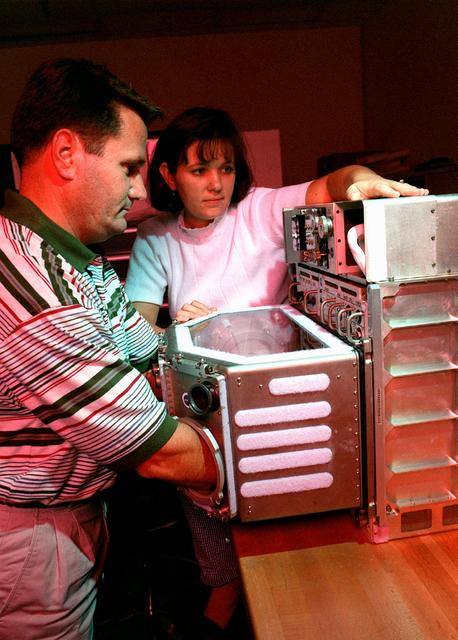
Mary-Etta Wright and Dornie McCaghren with Russia's Mir Flight Glovebox.
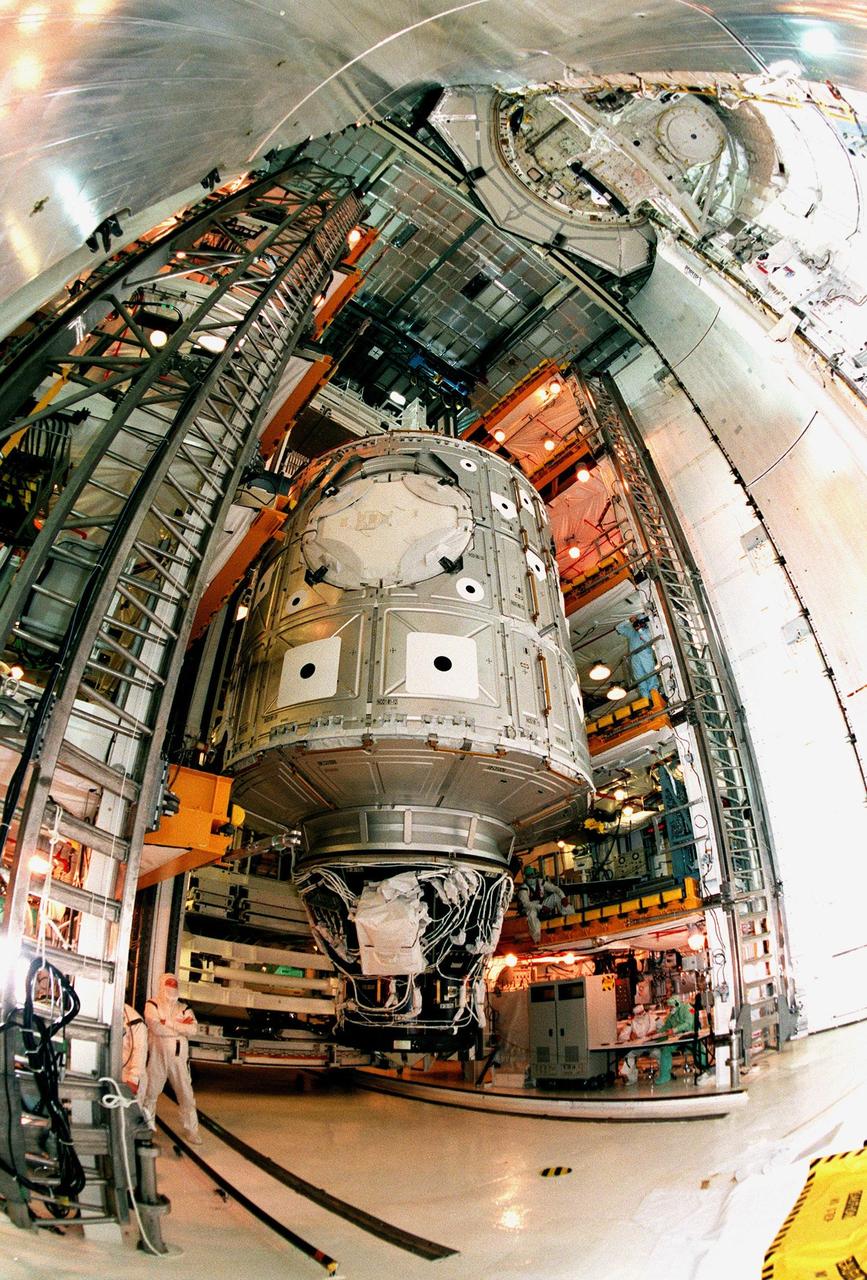
Looking like a painting, this wide-angle view shows the Unity connecting module being moved toward the payload bay of the orbiter Endeavour at Launch Pad 39A. Part of the International Space Station (ISS), Unity is scheduled for launch Dec. 3, 1998, on Mission STS-88. The Unity is a connecting passageway to the living and working areas of ISS. While on orbit, the flight crew will deploy Unity from the payload bay and attach it to the Russian-built Zarya control module which will be in orbit at that time
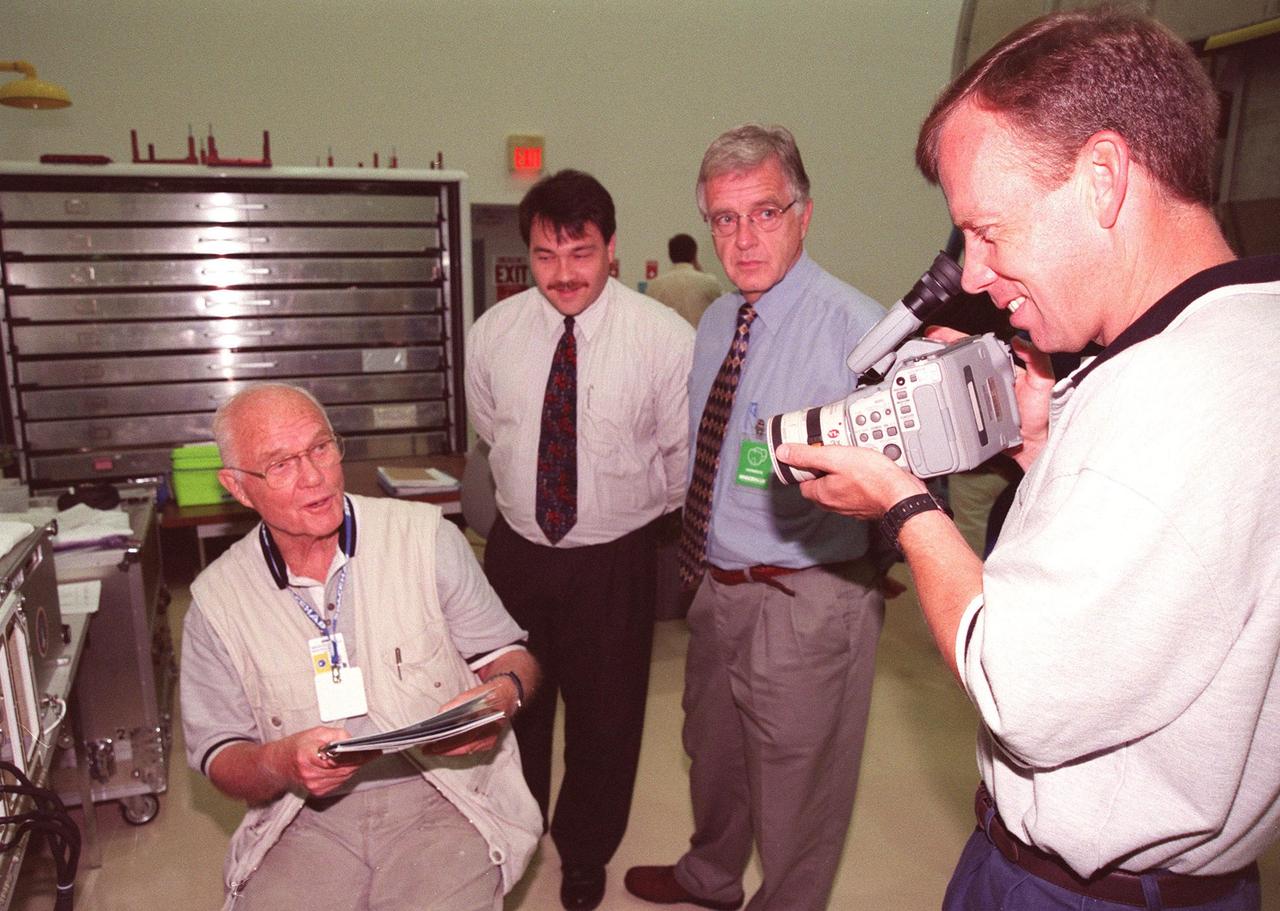
KENNEDY SPACE CENTER, FLA. -- In the SPACEHAB Payload Processing Facility (SPPF), Cape Canaveral, STS-95 Payload Specialist John Glenn, who is a senator from Ohio, is a willing subject for Pilot Steven Lindsey, who practices his camera technique while KSC workers watch. STS-95 crew members have been participating in SPACEHAB familiarization in the SPPF. Scheduled to launch Oct. 29, the mission includes research payloads such as the Spartan solar-observing deployable spacecraft, the Hubble Space Telescope Orbital Systems Test Platform, the International Extreme Ultraviolet Hitchhiker, as well as the SPACEHAB single module with experiments on space flight and the aging process
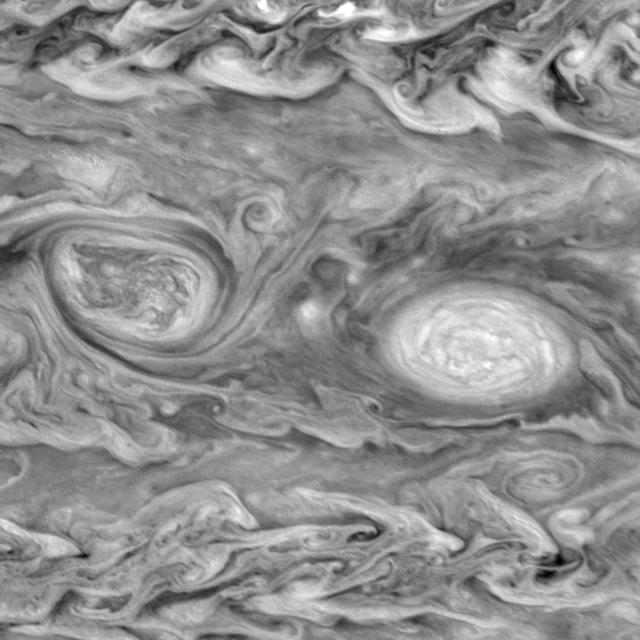
Two frame "movie" of a pair of vortices in Jupiter's southern hemisphere. The two frames are separated by ten hours. The right oval is rotating counterclockwise, like other anticyclonic bright vortices in Jupiter's atmosphere. The left vortex is a cyclonic (clockwise) vortex. The differences between them (their brightness, their symmetry, and their behavior) are clues to how Jupiter's atmosphere works. The frames span about fifteen degrees in latitude and longitude and are centered at 141 degrees west longitude and 36 degrees south planetocentric latitude. Both vortices are about 3500 kilometers in diameter in the north-south direction. The images were taken in near infrared light at 756 nanometers and show clouds that are at a pressure level of about 1 bar in Jupiter's atmosphere. North is at the top. The smallest resolved features are tens of kilometers in size. These images were taken on May 7, 1997, at a range of 1.5 million kilometers by the Solid State Imaging system on NASA's Galileo spacecraft. An animation is available at http://photojournal.jpl.nasa.gov/catalog/PIA01230
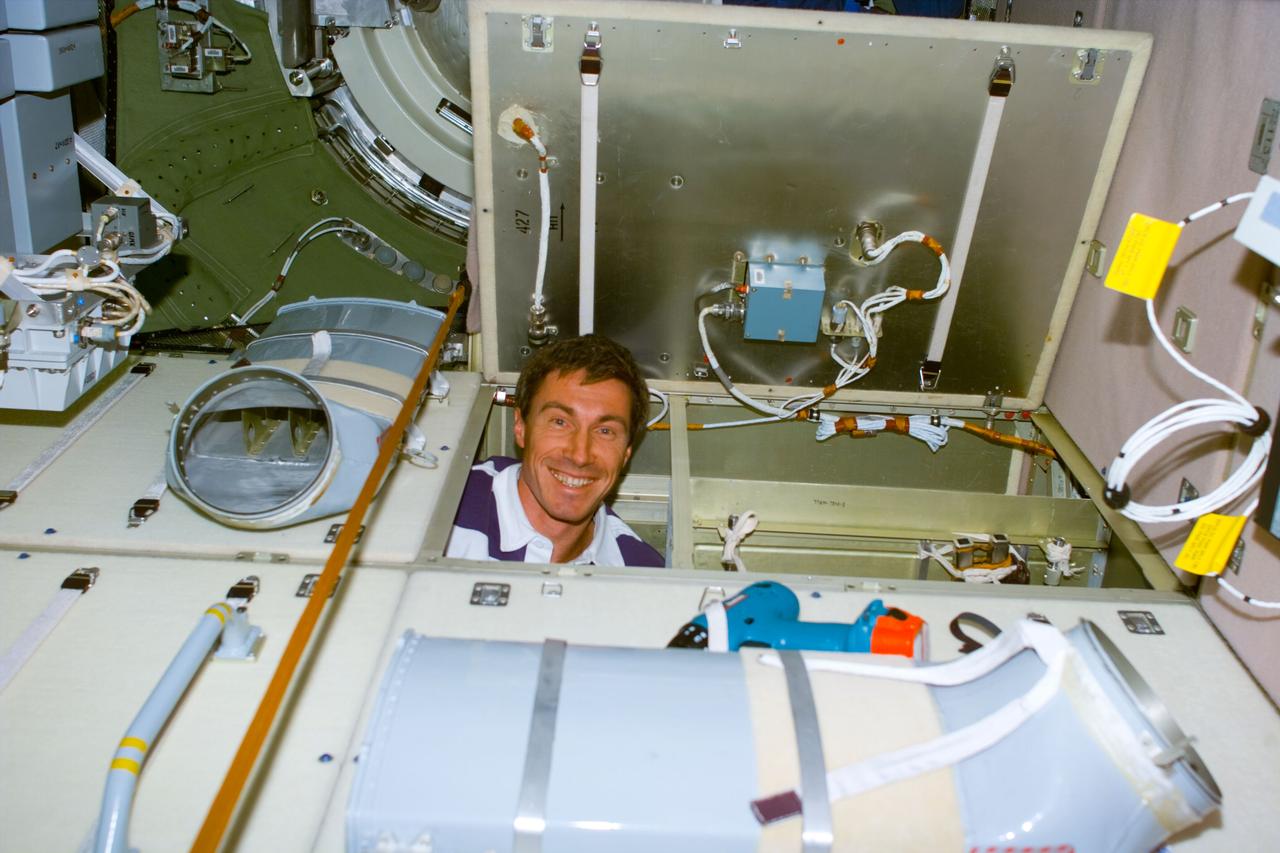
S88-E-5086 (12-11-98) --- Sergei Krikalev, mission specialist representing the Russian Space Agency (RSA), pokes his head up from inside one of the bays inside the walls on the Russian-built Zarya module. Krikalev and astronaut Nancy J. Currie replaced a faulty unit which controls the discharging of stored energy from one of Zarya's six batteries. The photo was taken with an electronic still camera (ESC) at 05:41:18 GMT, Dec. 11.
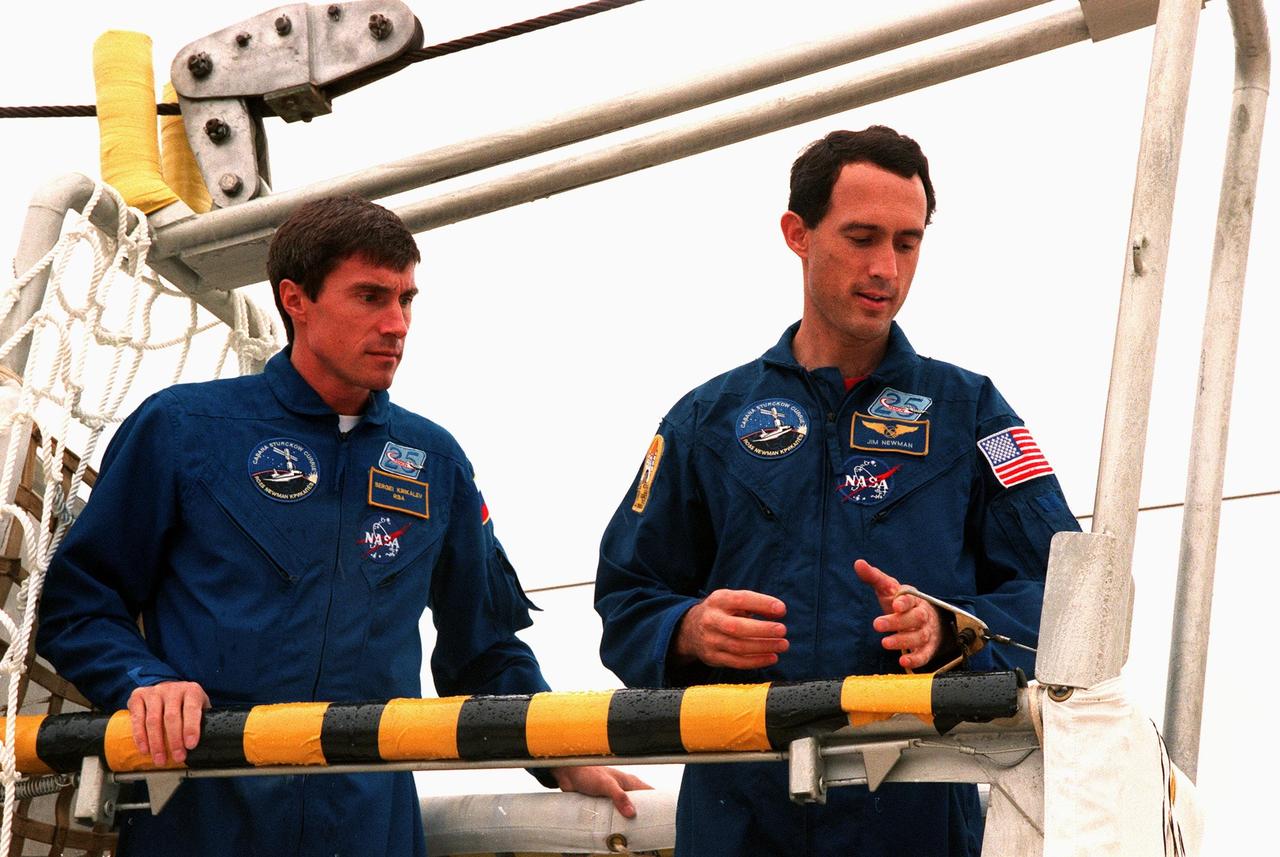
KENNEDY SPACE CENTER, Fla. -- STS-88 Mission Specialists Sergei Krikalev and James H. Newman practice emergency egress procedures in a slidewire basket at Launch Pad 39A as part of Terminal Countdown Demonstration Test (TCDT) activities, a dress rehearsal for launch. Mission STS-88 is targeted for launch on Dec. 3, 1998. It is the first U.S. flight for the assembly of the International Space Station and will carry the Unity connecting module
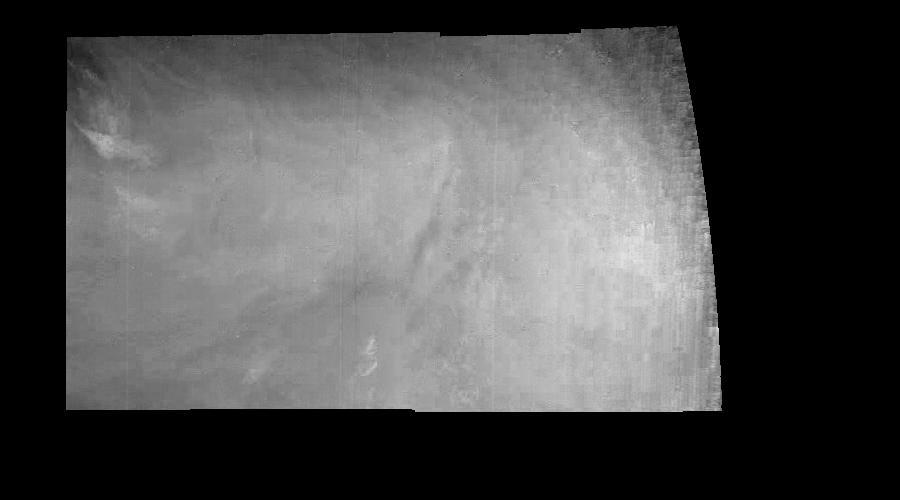
Jupiter Equatorial Region in a Methane Band Time Set 3
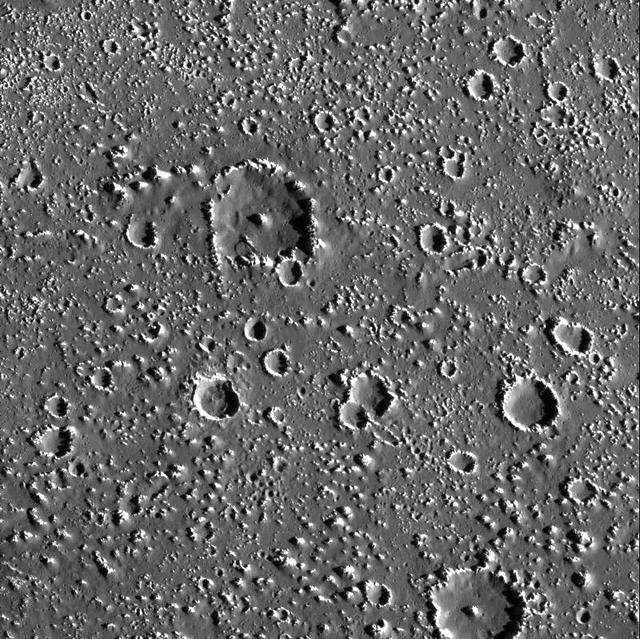
So few Small Craters on Callisto
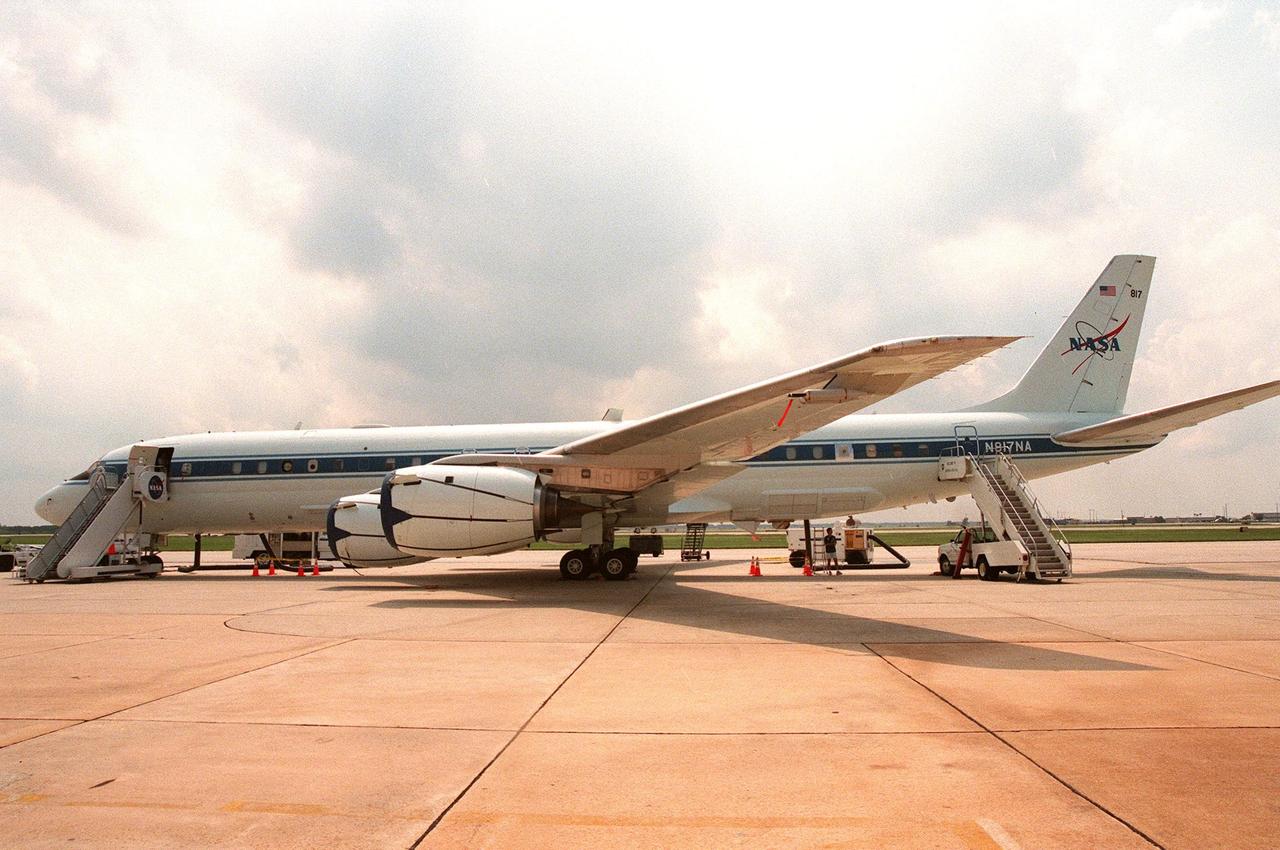
This NASA Dryden Flight Research Center DC-8, on view at Patrick Air Force Base, stands ready to pursue its goal of collecting high-altitude information about Atlantic hurricanes and tropical storms. Flying at 35,000 to 40,000 feet, the plane is equipped with instruments to measure the storm’s structure, environment and changes in intensity and tracking. The DC-8 is part of the NASA-led Atmospheric Dynamics and Remote Sensing program that includes other government weather researchers and the university community in a study of Atlantic hurricanes and tropical storms. The hurricane study, which lasts through September 1998, is part of NASA’s Earth Science enterprise to better understand the total Earth system and the effects of natural and human-induced changes on the global environment
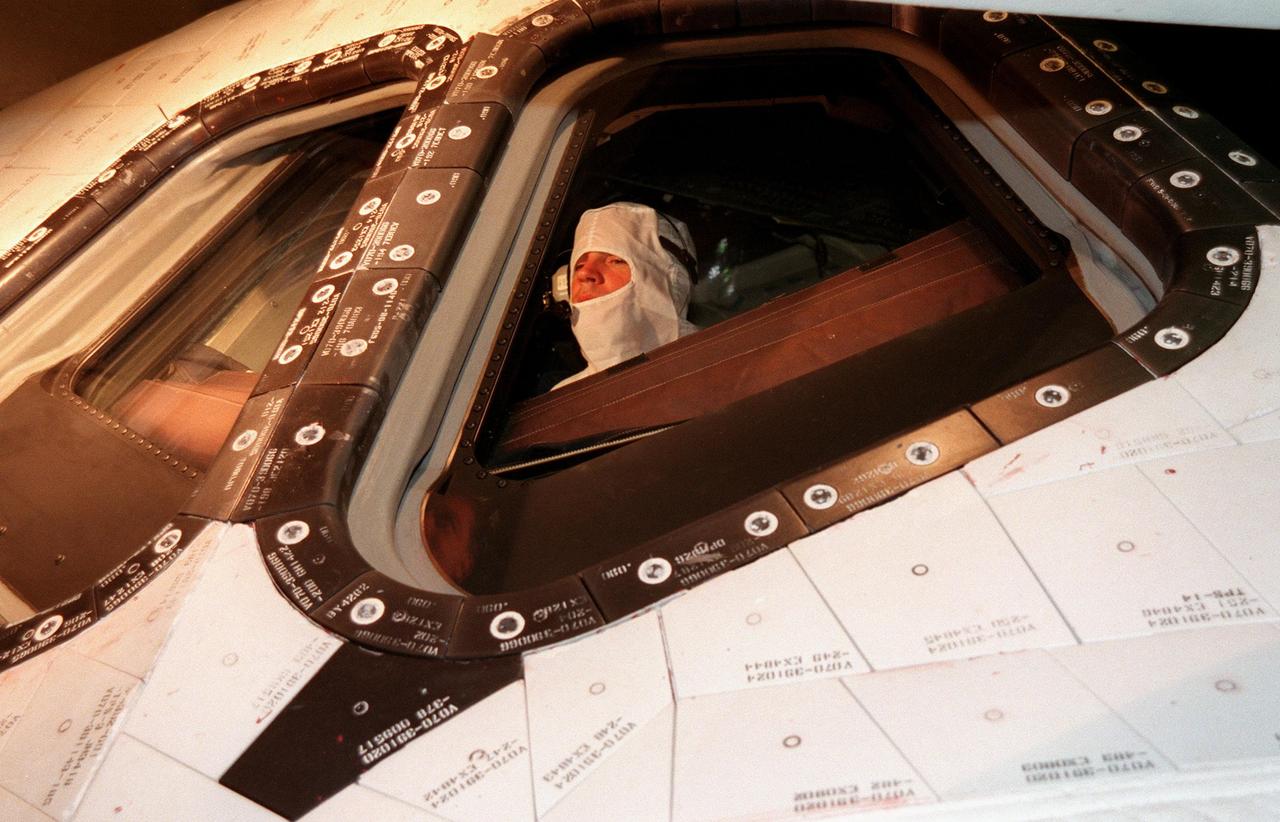
KENNEDY SPACE CENTER, FLA. -- In the Orbiter Processing Facility Bay 1, STS-88 Pilot Frederick W. Sturckow makes a visual inspection of windows on the Space Shuttle orbiter Endeavour. The STS-88 crew members are participating in a Crew Equipment Interface Test (CEIT), familiarizing themselves with the orbiter's midbody and crew compartments. Targeted for launch on Dec. 3, 1998, STS-88 will be the first Space Shuttle launch for assembly of the International Space Station (ISS). The primary payload is the Unity connecting module which will be mated to the Russian-built Zarya control module, expected to be already on orbit after a November launch from Russia. The first major U.S.-built component of ISS, Unity will serve as a connecting passageway to living and working areas of the space station. Unity has two attached pressurized mating adapters (PMAs) and one stowage rack installed inside. PMA-1 provides the permanent connection point between Unity and Zarya; PMA-2 will serve as a Space Shuttle docking port. Zarya is a self-supporting active vehicle, providing propulsive control capability and power during the early assembly stages. It also has fuel storage capability

KENNEDY SPACE CENTER, FLA. -- In the Spacecraft Assembly and Encapsulation Facility -2 (SAEF-2), Satish Krishnan (right) from the Jet Propulsion Laboratory places a Mars microprobe on a workstand. In the background, Chris Voorhees watches. Two microprobes will hitchhike on the Mars Polar Lander, scheduled to be launched Jan. 3, 1999, aboard a Delta II rocket. The solar-powered spacecraft is designed to touch down on the Martian surface near the northern-most boundary of the south pole in order to study the water cycle there. The lander also will help scientists learn more about climate change and current resources on Mars, studying such things as frost, dust, water vapor and condensates in the Martian atmosphere. The Mars microprobes, called Deep Space 2, are part of NASA's New Millennium Program. They will complement the climate-related scientific focus of the lander by demonstrating an advanced, rugged microlaser system for detecting subsurface water. Such data on polar subsurface water, in the form of ice, should help put limits on scientific projections for the global abundance of water on Mars
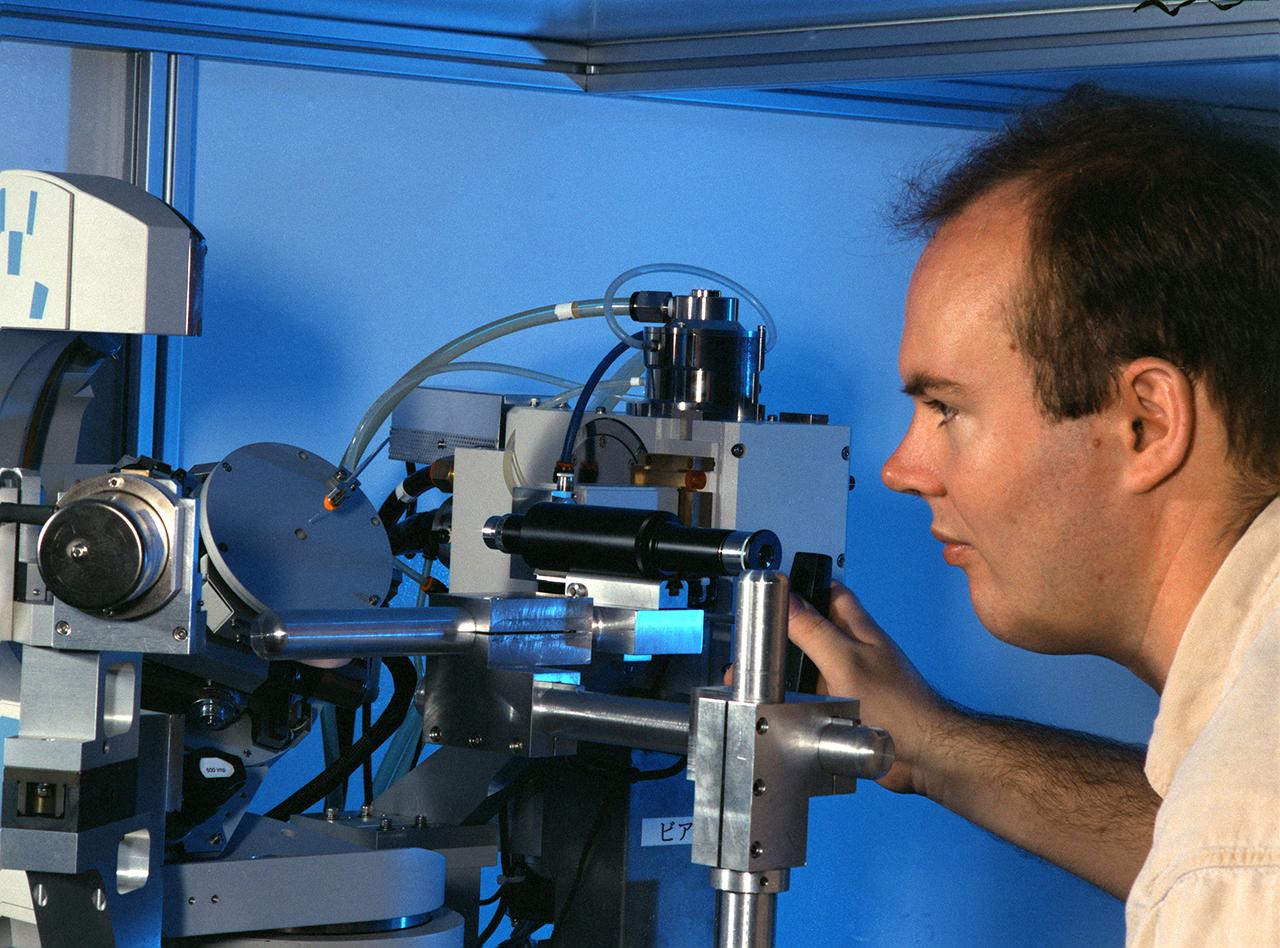
Eddie Snell, Post-Doctoral Fellow the National Research Council (NRC) uses a reciprocal space mapping diffractometer for macromolecular crystal quality studies. The diffractometer is used in mapping the structure of macromolecules such as proteins to determine their structure and thus understand how they function with other proteins in the body. This is one of several analytical tools used on proteins crystallized on Earth and in space experiments. Photo credit: NASA/Marshall Space Flight Center (MSFC)
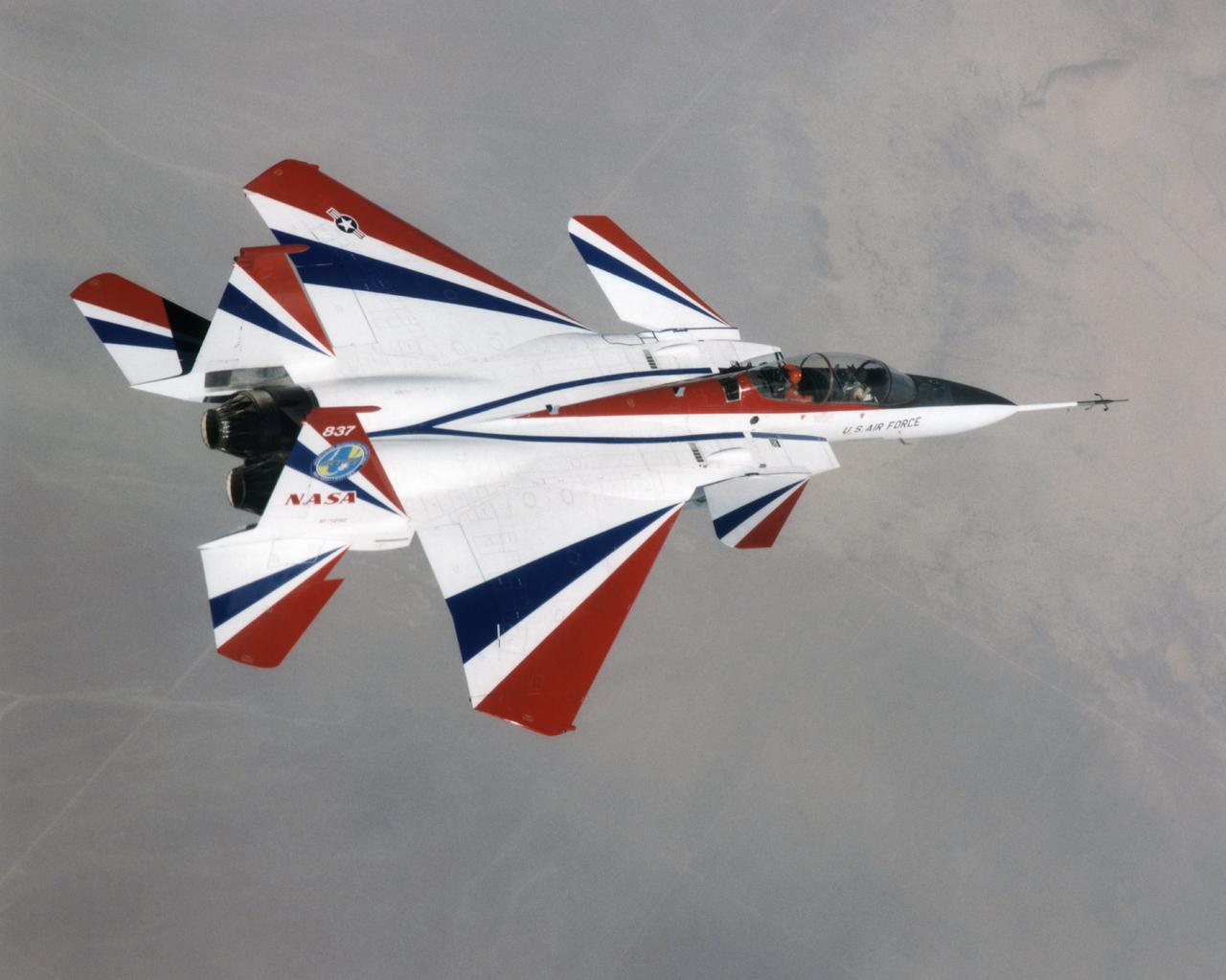
The F-15 ACTIVE in flight above the Mojave desert on April 14, 1998. The overhead shot shows the aircraft's striking red and while paint scheme/ The large forward canards are actually the tail surfaces from an F-18.
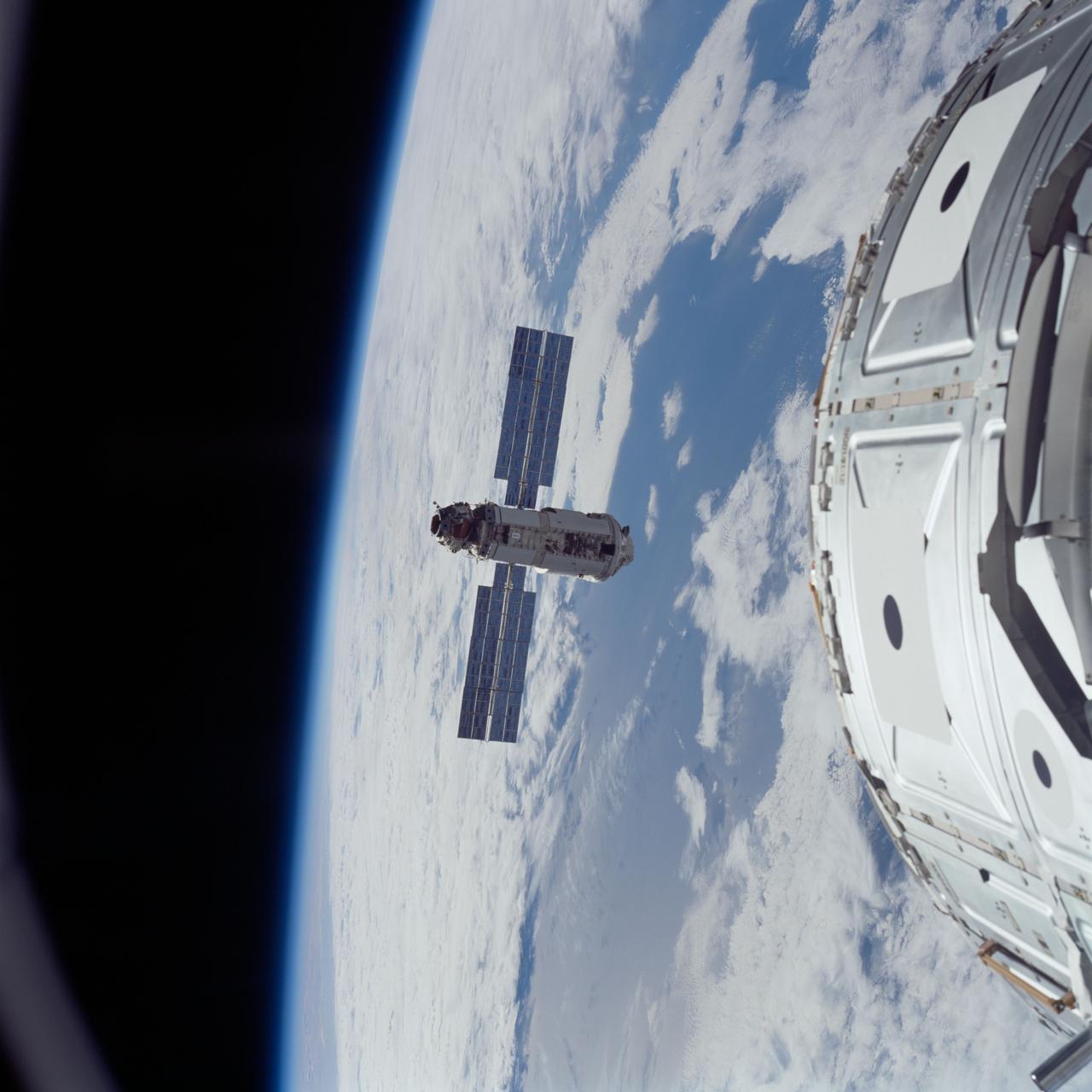
STS088-737-056 (4-15 Dec. 1998) --- With the U.S.-built Unity module in the foreground, the Space Shuttle Endeavour approaches the Russian-built FGB (Zarya) module in Earth-orbit. Once the two spacecraft were docked, three extravehicular activities (EVA) and a great deal of interior, shirt-sleeve environment work was accomplished by the crew to ready the tandem for its International Space Station (ISS) duty.
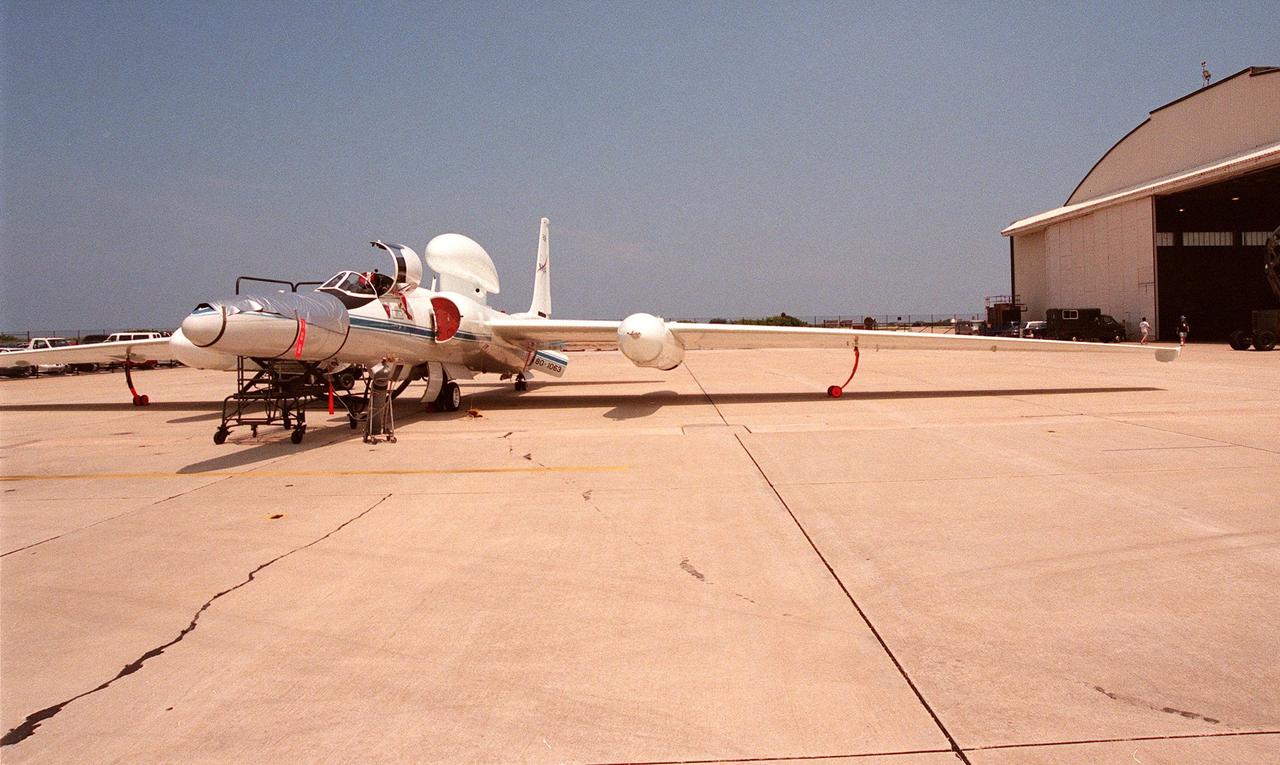
This high-altitude research plane, a specially equipped Dryden Flight Research Center ER-2 (a modified U-2), is readied at Patrick Air Force Base for flight into a hurricane in the Atlantic. The plane is part of the NASA-led Atmospheric Dynamics and Remote Sensing program that includes other government weather researchers and the university community in a study of Atlantic hurricanes and tropical storms. The ER-2, soaring above 65,000 feet, will measure the structure of hurricanes and the surrounding atmosphere that steers the storms’ movement. The hurricane study, which lasts through September 1998, is part of NASA’s Earth Science enterprise to better understand the total Earth system and the effects of natural and human-induced changes on the global environment
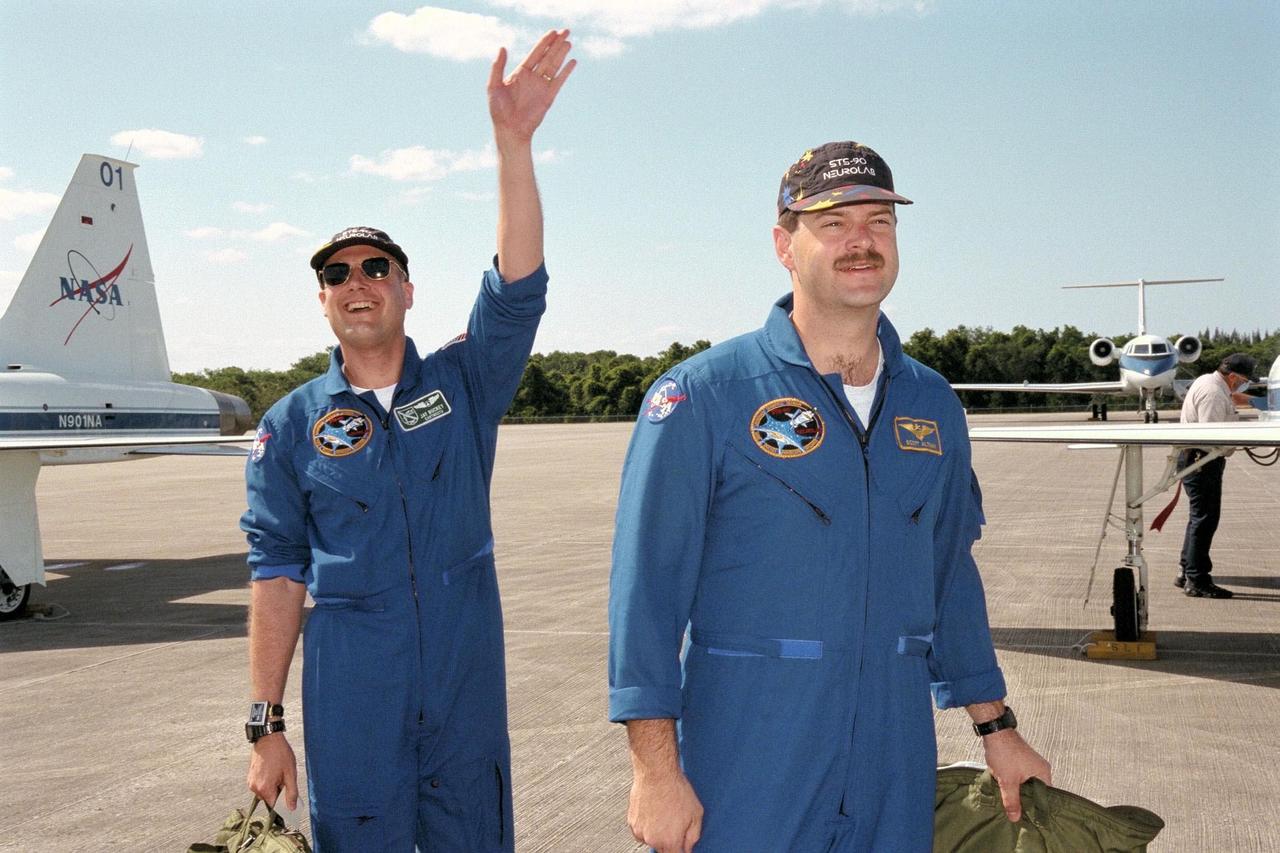
KENNEDY SPACE CENTER, FLA. -- STS-90 Payload Specialist Jay Buckey, M.D. (at left), and Pilot Scott Altman arrive at Kennedy Space Center's Shuttle Landing Facility in preparation for the launch of Columbia on April 16 at 2:19 p.m. EDT from KSC's Launch Pad 39B. The launch of Neurolab on STS-90, which will be the second mission of 1998, is scheduled to last nearly 17 days
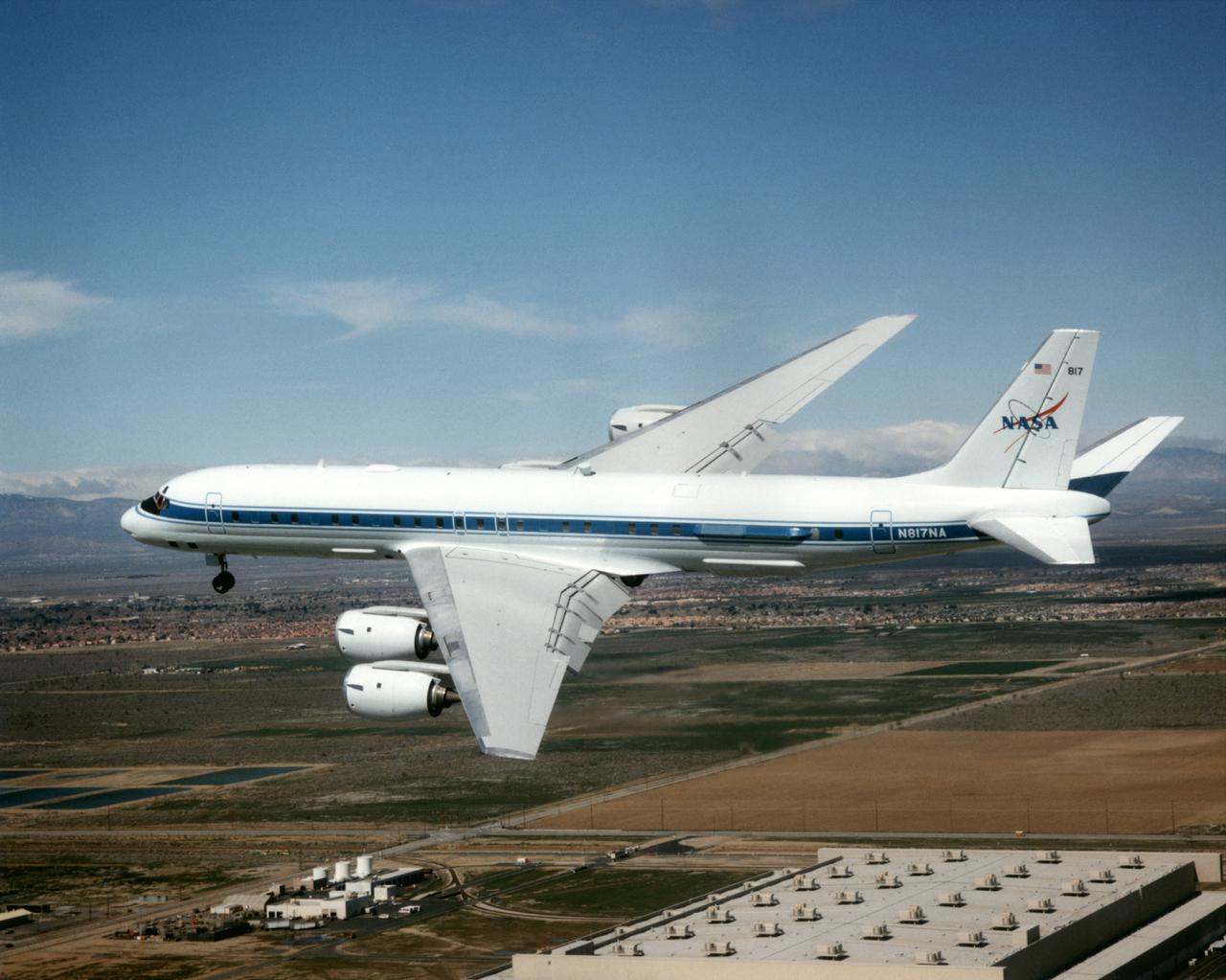
The DC-8 Airborne Laboratory in a left banking turn above the airport at Palmdale, California. The right wing is silhouetted against the blue sky, while the left wing contrasts with the desert terrain. The former airliner is a "dash-72" model and has a range of 5,400 miles. The craft can stay airborne for 12 hours and has an operational speed range between 300 and 500 knots. The research flights are made at between 500 and 41,000 feet. The aircraft can carry up to 30,000 lbs of research/science payload equipment installed in 15 mission-definable spaces.
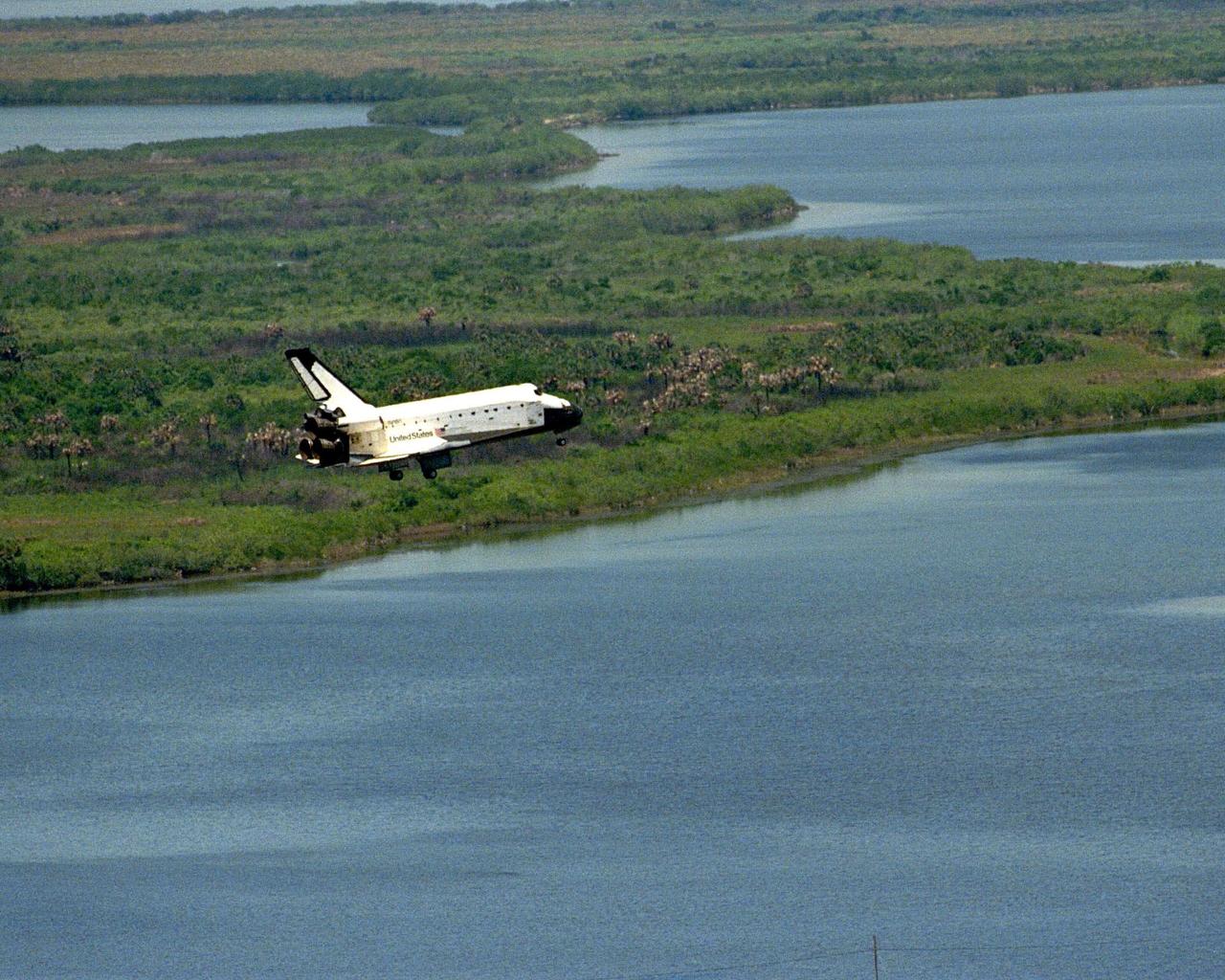
The orbiter Columbia approaches touchdown on Runway 33 of KSC's Shuttle Landing Facility to complete the nearly 16-day STS-90 mission. Framed by Florida foliage and wetlands, this unique view was taken from the roof of the 525-foot-high Vehicle Assembly Building. Main gear touchdown was at 12:08:59 p.m. EDT on May 3, 1998, landing on orbit 256 of the mission. The wheels stopped at 12:09:58 EDT, completing a total mission time of 15 days, 21 hours, 50 minutes and 58 seconds. The 90th Shuttle mission was Columbia's 13th landing at the space center and the 43rd KSC landing in the history of the Space Shuttle program. During the mission, the crew conducted research to contribute to a better understanding of the human nervous system. The crew of the STS-90 Neurolab mission include Commander Richard Searfoss; Pilot Scott Altman; Mission Specialists Richard Linnehan, D.V.M., Dafydd (Dave) Williams, M.D., with the Canadian Space Agency, and Kathryn (Kay) Hire; and Payload Specialists Jay Buckey, M.D., and James Pawelczyk, Ph.D
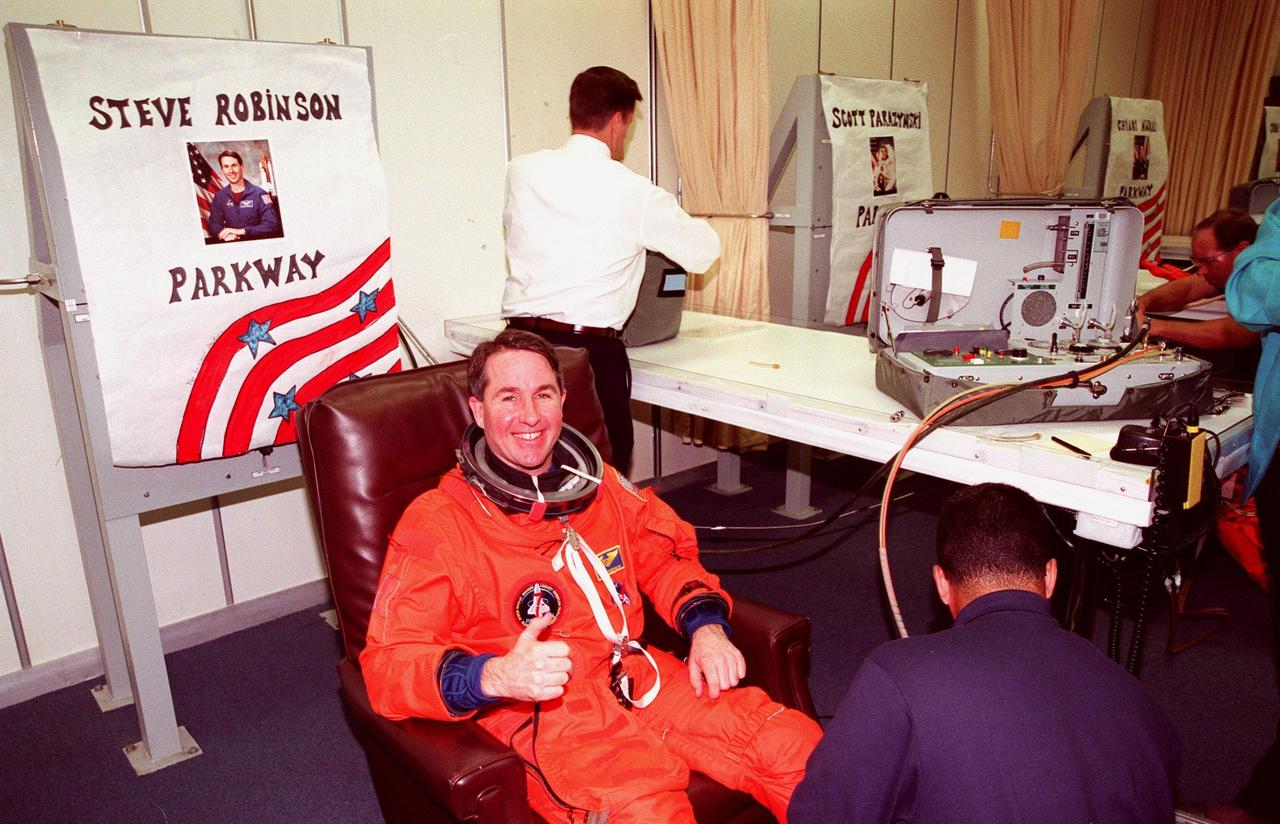
STS-95 Mission Specialist Stephen K. Robinson gives a thumbs up as he dons his flight suit in the Operations and Checkout Building with the help of suit tech George Brittingham (lower right). The final fitting takes place prior to the crew walkout and transport to Launch Pad 39B. Targeted for launch at 2 p.m. EST on Oct. 29, the mission is expected to last 8 days, 21 hours and 49 minutes, and return to KSC at 11:49 a.m. EST on Nov. 7. The STS-95 mission includes research payloads such as the Spartan solar-observing deployable spacecraft, the Hubble Space Telescope Orbital Systems Test Platform, the International Extreme Ultraviolet Hitchhiker, as well as the SPACEHAB single module with experiments on space flight and the aging process
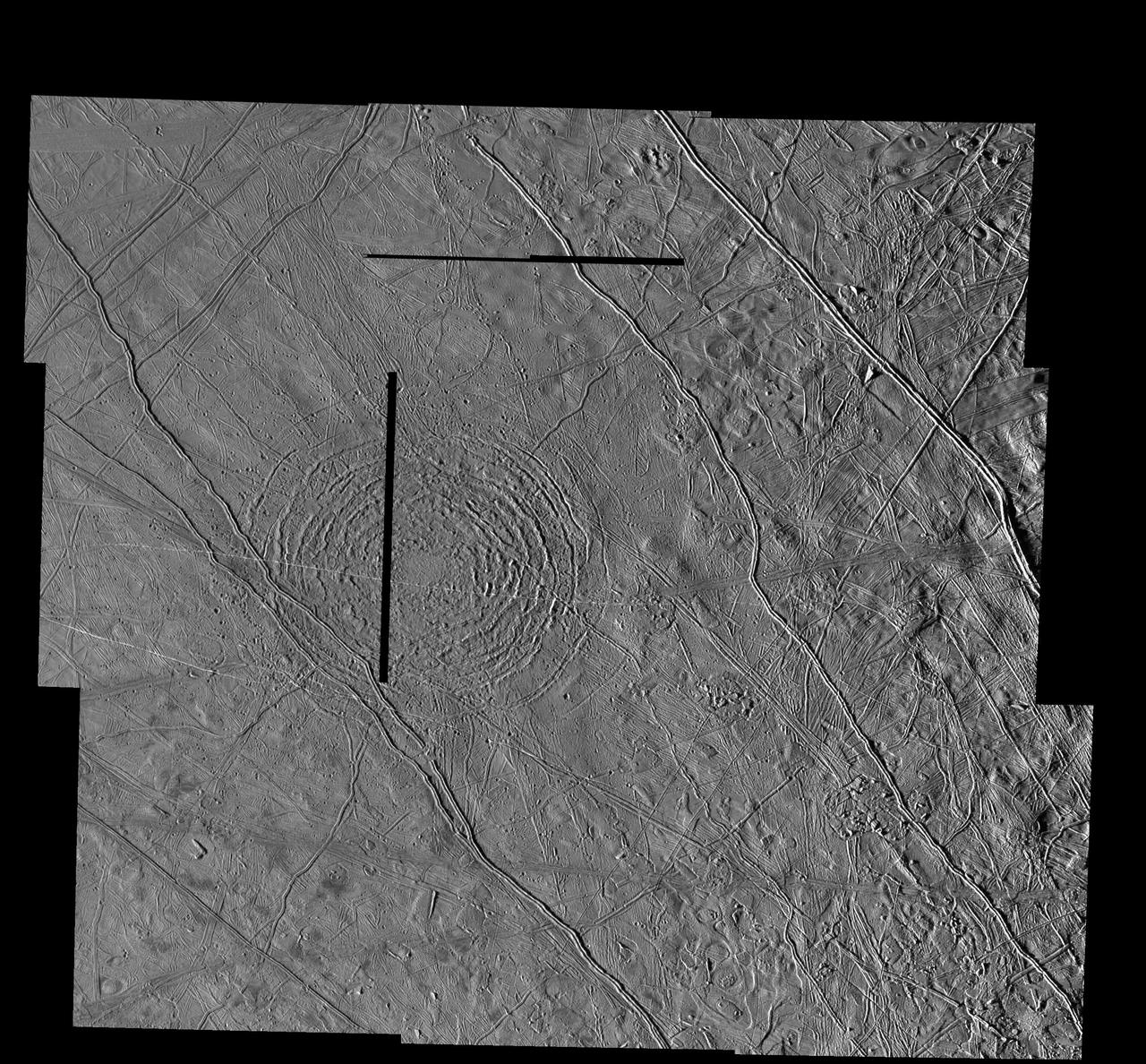
The Tyre multi-ring Structure on Europa
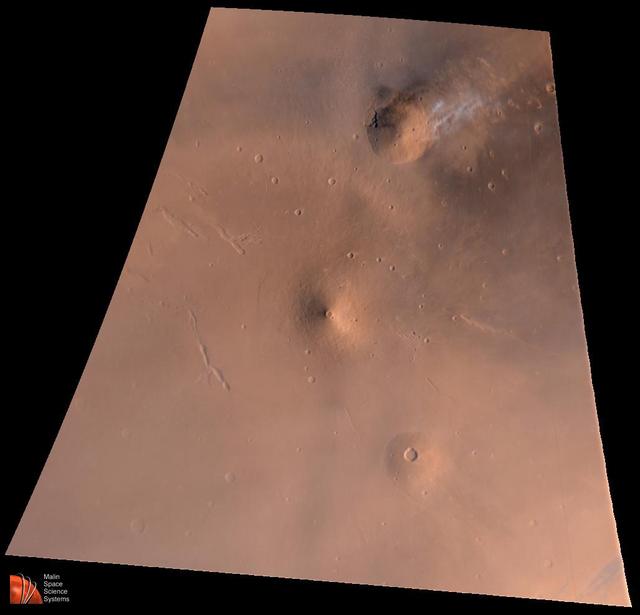
Elysium Mons Volcanic Region
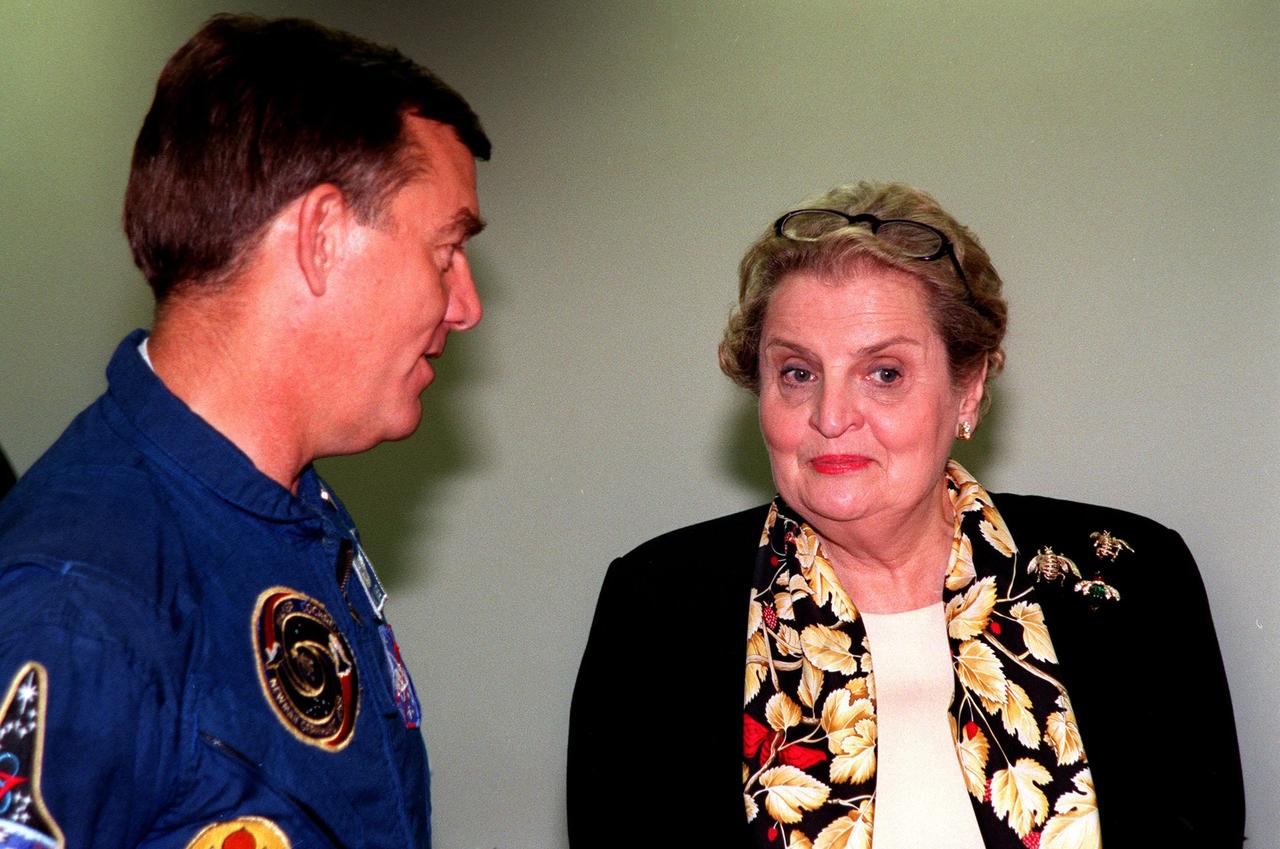
U.S. Secretary of State Madeleine Albright (right) talks with astronaut Jim Voss following the successful launch of Endeavour on Mission STS-88 from Launch Pad 39A at 3:35:34 a.m. EST. STS-88 is the first U.S. mission dedicated to the assembly of the International Space Station (ISS). Voss is a member of the STS-100 crew, the eighth ISS assembly team
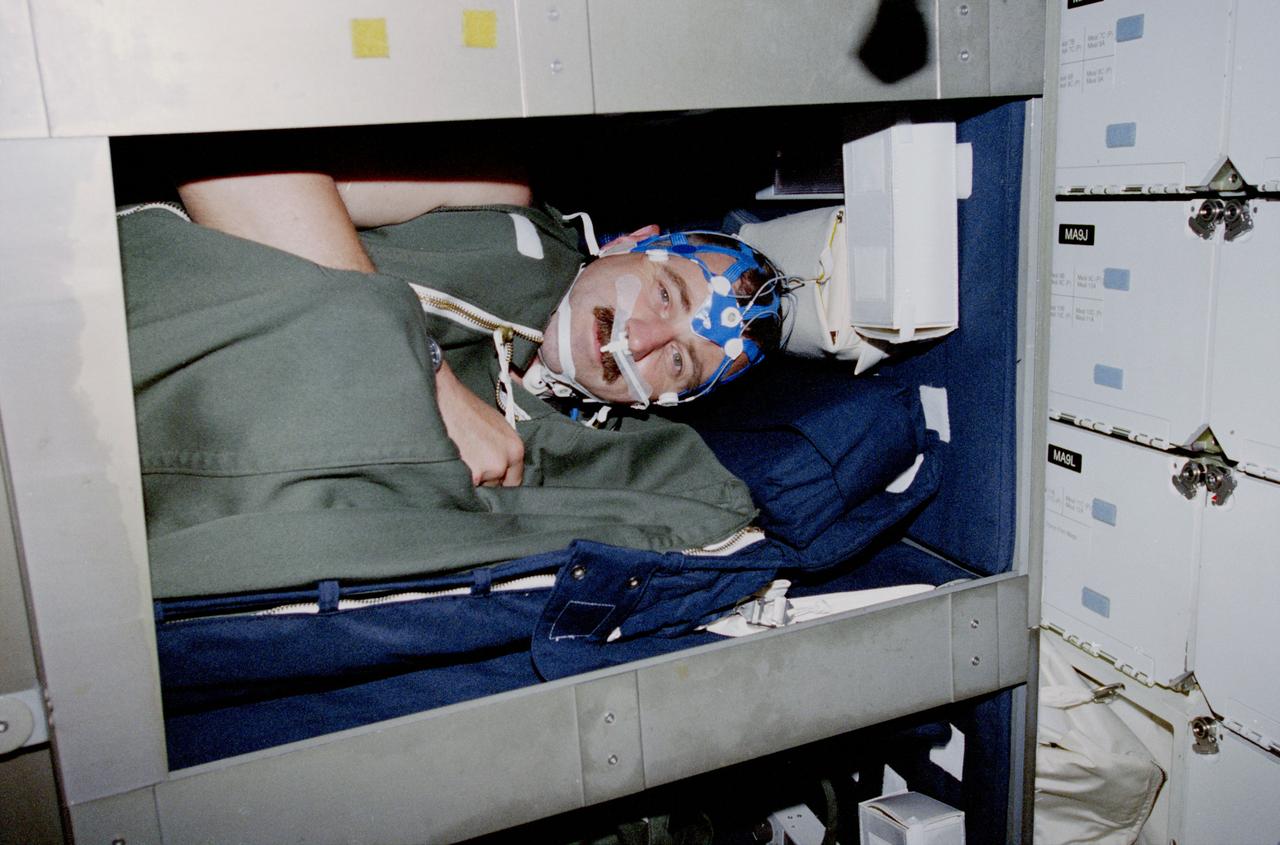
STS090-377-011 (17 APRIL-3 MAY 1998) --- Astronaut Dafydd R. (Dave) Williams, mission specialist representing the Canadian Space Agency (CSA), accomplishes more than one purpose when he sleeps in this bunk aboard the Earth-orbiting Space Shuttle Columbia. Conducting a Neurolab sleep experiment, Williams wears equipment which includes a sleep net (mesh cap that monitors and records brain waves); a Respiratory Inductance Plethysmograph (RIP) suit for monitoring respiration; and an activity monitor -- a device (out of view) worn on the wrist to detect and record body movement. Data on brain waves, eye movements, respiration, heart rate, and oxygen concentration are routed to a portable data recorder. The entire system has capabilities similar to a fully equipped sleep laboratory on Earth. The sleeping bag is conventional Shuttle ware and not part of the experiment.
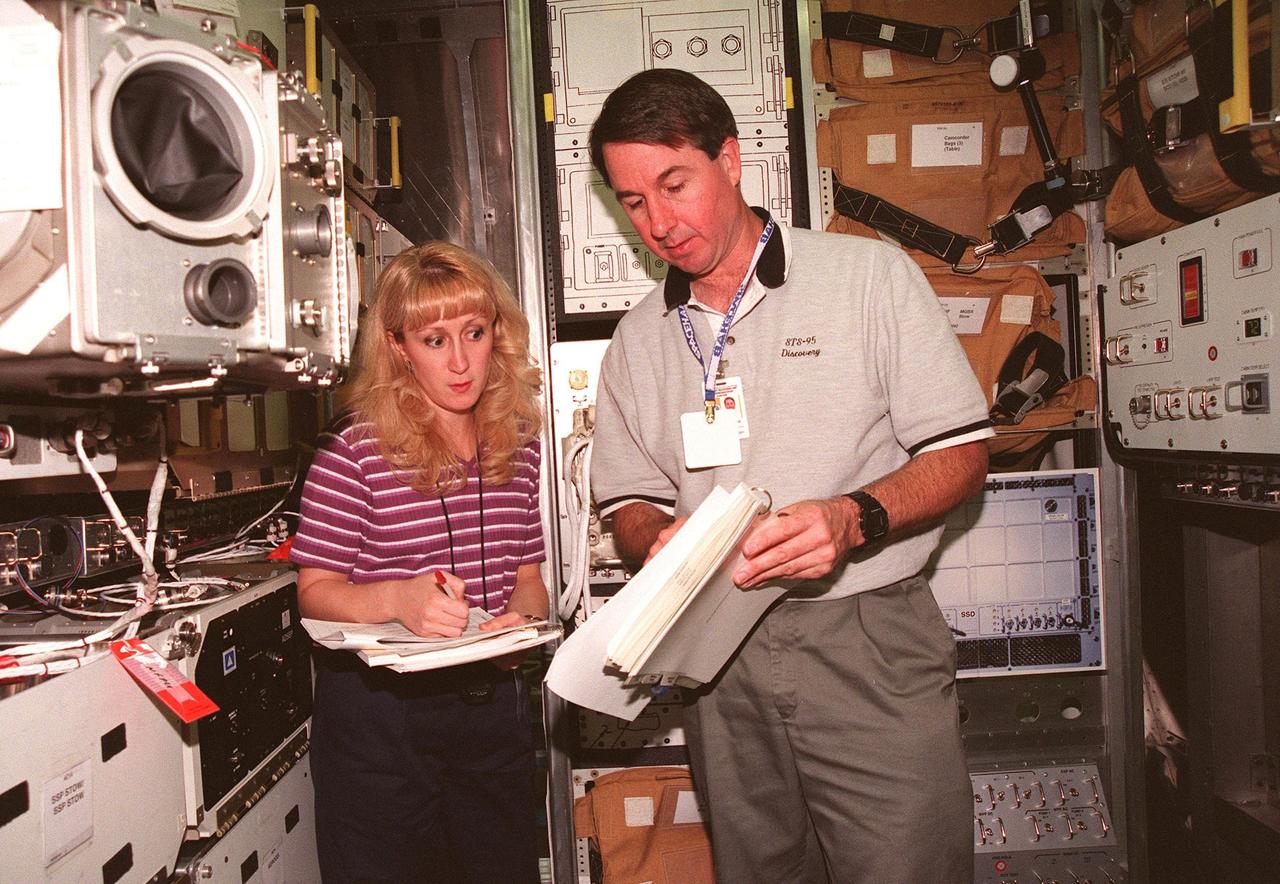
KENNEDY SPACE CENTER, FLA. -- Terri Schneider, a Timeline technician with United Space Alliance, and STS-95 Mission Specialist Stephen Robinson, Ph.D., look at documentation during SPACEHAB familiarization at the SPACEHAB Payload Processing Facility, Cape Canaveral. The mission, scheduled to launch Oct. 29, includes research payloads such as the Spartan solar-observing deployable spacecraft, the Hubble Space Telescope Orbital Systems Test Platform, the International Extreme Ultraviolet Hitchhiker, as well as the SPACEHAB single module with experiments on space flight and the aging process
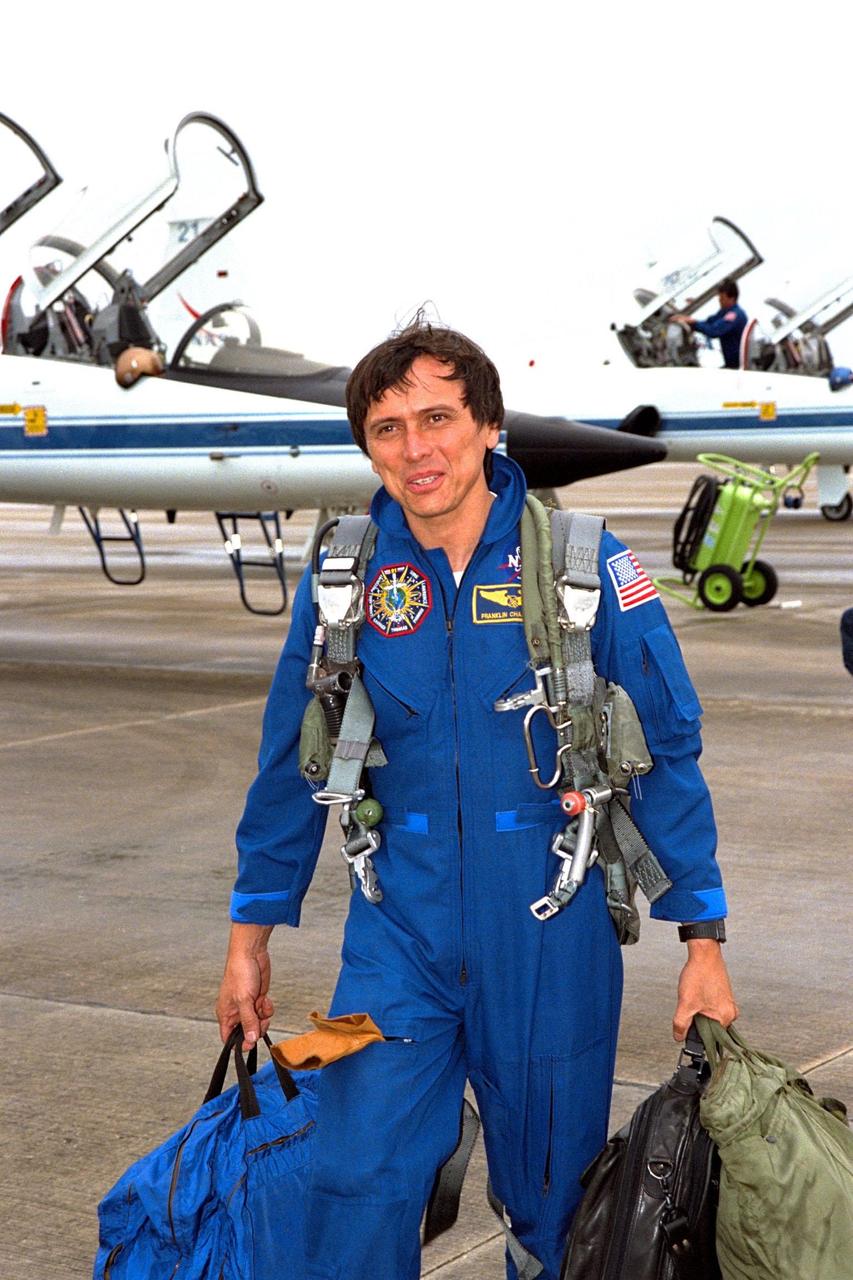
STS-91 Mission Specialist Franklin Chang-Diaz, Ph.D., arrives at Kennedy Space Center's Shuttle Landing Facility aboard a T-38 jet. He is here to participate in the Terminal Countdown Demonstration Test (TCDT), a dress rehearsal for launch. The STS-91 launch is targeted for June 2 with a launch window opening around 6:10 p.m. EDT. The mission will conclude Phase I of the joint U.S.-Russian International Space Station Program. Although it will be the ninth Shuttle docking with the Russian Space Station Mir, it will be the first Mir docking for the Space Shuttle orbiter Discovery. Chang-Diaz is making his sixth space flight. The STS-91 mission will also be the first flight for the new Space Shuttle super lightweight external tank. The STS-91 flight crew also includes Mission Commander Charles Precourt; Pilot Dominic Gorie; and Mission Specialists Wendy B. Lawrence; Janet Lynn Kavandi, Ph.D.; and Valery Ryumin, with the Russian Space Agency. Andrew Thomas, Ph.D., will be returning to Earth with the crew after living aboard Mir since January 25, 1998
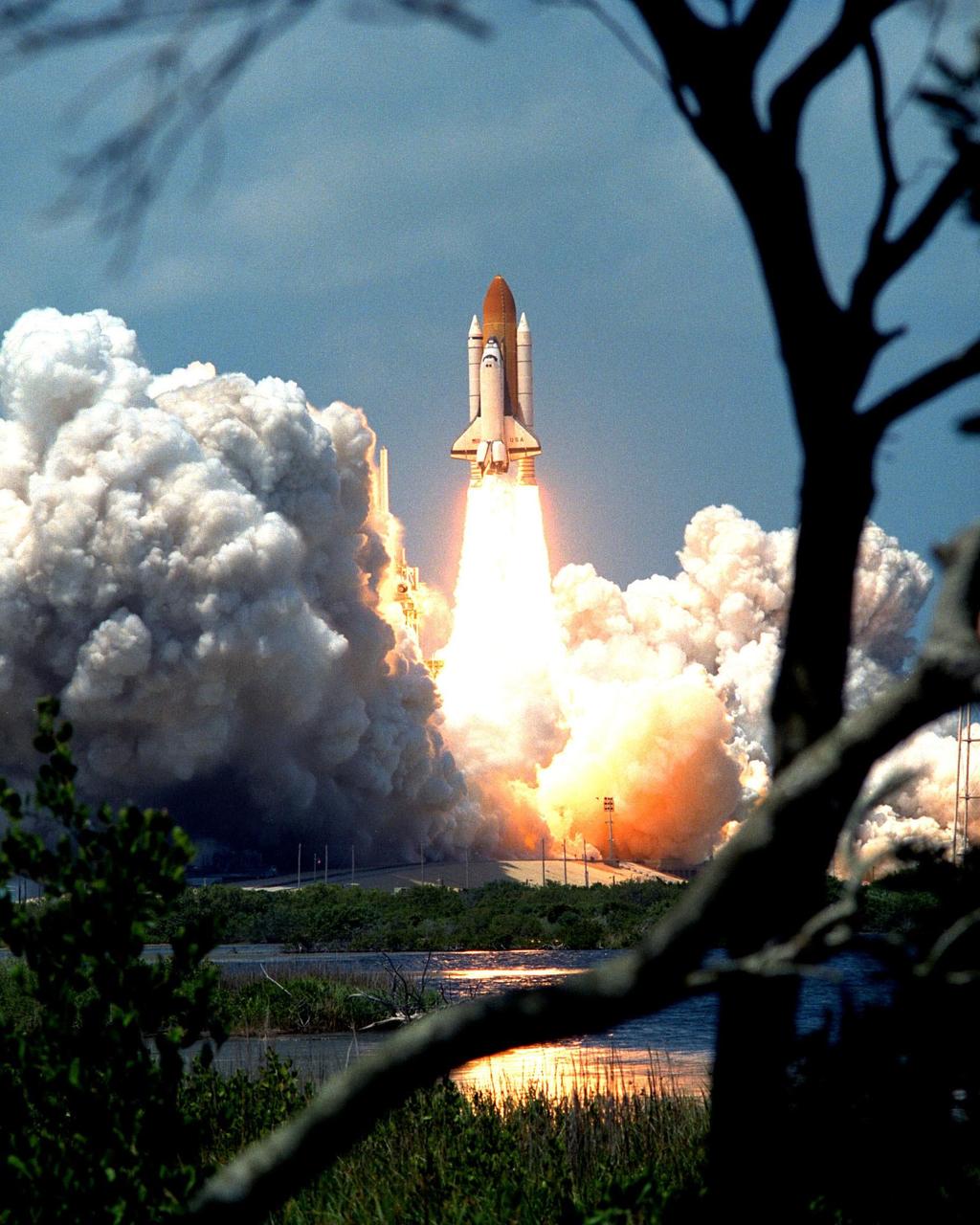
KENNEDY SPACE CENTER, FLA. -- The Space Shuttle Columbia soars from Launch Pad 39B at 2:19 p.m. EDT Apr. 17 to begin the nearly 17-day STS-90 Neurolab mission. The launch was delayed 24 hours due to difficulty with a network signal processor, which was replaced Apr. 16, on the orbiter. The crew members are Commander Richard Searfoss, Pilot Scott Altman, Mission Specialists Richard Linnehan, D.V.M., Dafydd (Dave) Williams, M.D., with the Canadian Space Agency, and Kathryn (Kay) Hire; and Payload Specialists Jay Buckey, M.D., and James Pawelczyk, Ph.D. Investigations during the Neurolab mission will focus on the effects of microgravity on the nervous system.
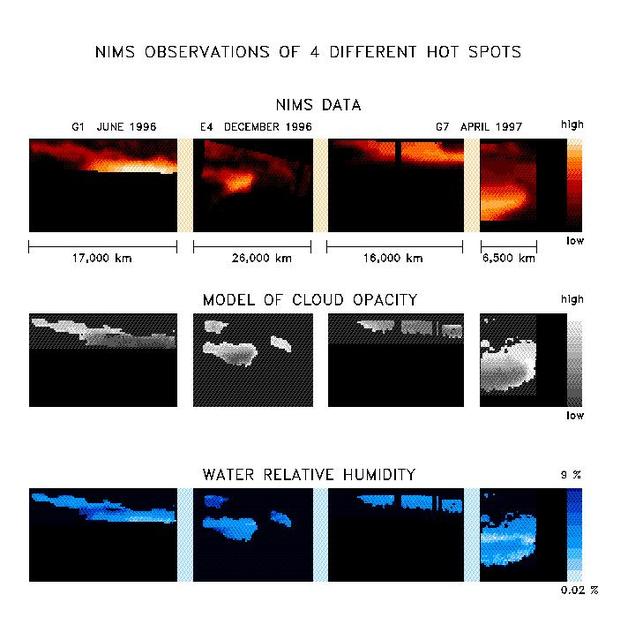
With the NIMS instrument high quality observations are being obtained from all parts of Jupiter. The images in the upper panel are taken at a wavelength of 4.8 microns. At this wavelength thermal radiation from about 100 km deep below the visible cloud deck is escaping, allowing us to study the deep atmospheric region. The overlying cloud deck absorbs a part of the radiation, but there are places where it is thin and more radiation can escape. These are called hot spot regions. Many hotspots regions occur in a zone between the equator and 15 degrees north latitude, the North Equatorial Belt (NEB), but thermal radiation is seen from much of the planet. The uniqueness of NIMS is that it is capable of observing the same spatial region at a maximum of 408 different wavelengths between 0.7 and 5.2 micron simultaneously. Every picture element (pixel) contains a spectrum of up to 408 wavelengths. The gases that compose the atmosphere leave there traces in the spectra. In this particular case, 48 wavelengths were available between 4.6 and 5.2 micron, and we see spectral signatures of water, ammonia, and phosphine. Also, the total amount of radiation is determined by the amount of overlying cloud, characterized by the cloud opacity. By means of model calculations, we can determine the amount of water and the cloud opacity for each individual spectrum. The amount ammonia and phosphine is more difficult to obtain because its influence on the spectra is weaker. The results of these calculations are shown in the form of maps in the next two panels. With NIMS, we can now have a detailed look at the spatial distribution of the water and ammonia amounts and the cloud opacity in the atmosphere. Not all the pixels from the observations have good spectra, so for some data points no reliable determination of the water and cloud opacity could be made. We find that the atmosphere is extremely dry in, and close to, the hot spot, with relative humidities between 0.02 % and 10 %, with the dryest places being inside the hot spot. This corroborates the in-situ Galileo Entry Probe measurements. The Probe entered the atmosphere, on December 5 1995, in a hot spot region. Whereas the Probe obtained only a very localized snapshot, with NIMS we can do observations of larger areas and over longer periods. The spatial distribution of water is more complex than expected. More detailed investigations will be necessary to fully understand these results. http://photojournal.jpl.nasa.gov/catalog/PIA01224
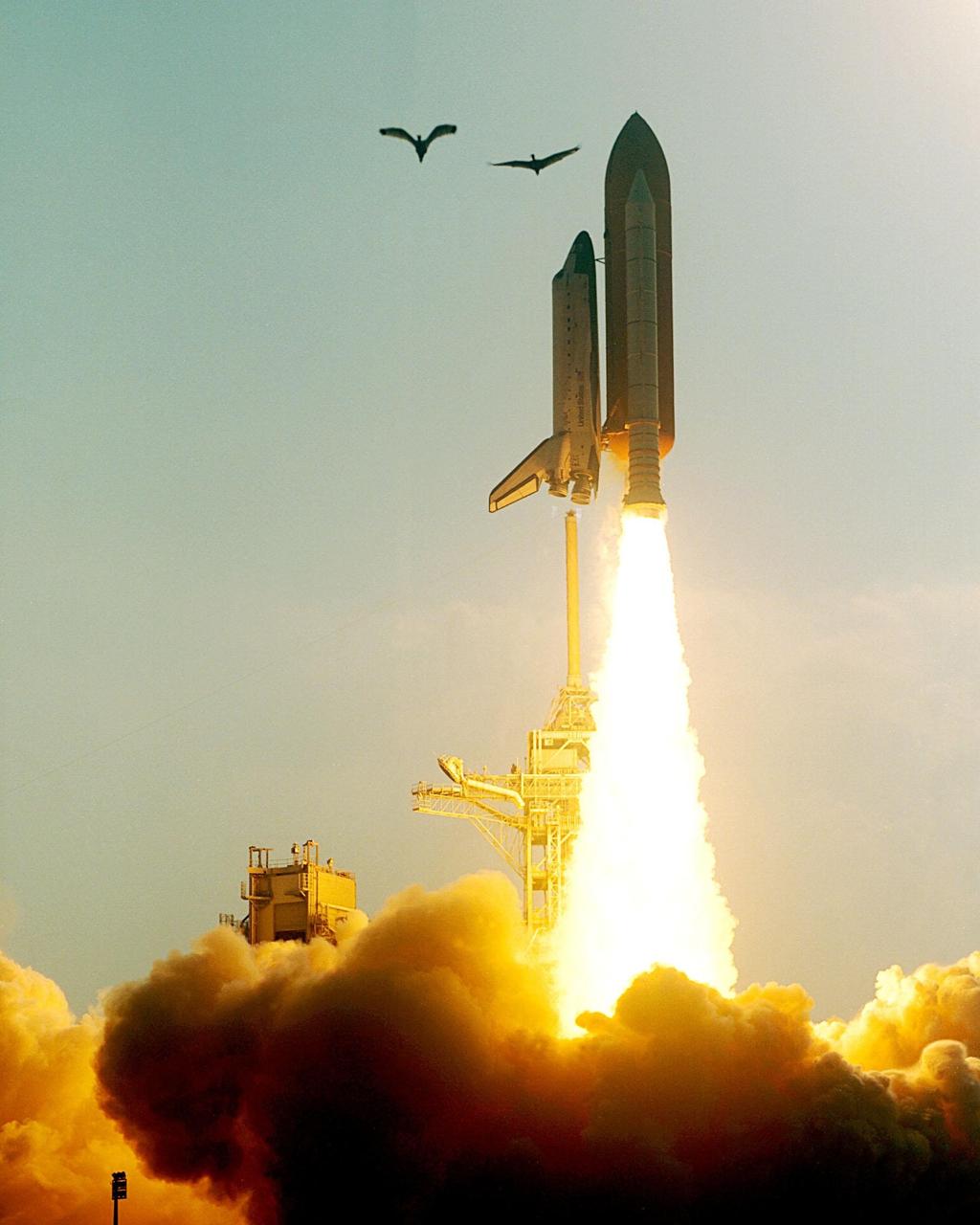
KENNEDY SPACE CENTER, Fla. -- Startled by the thunderous roar of the Space Shuttle Discovery’s engines as it lifts off, birds hurriedly leave the Launch Pad 39A area for a more peaceful site. Liftoff time for the 91st Shuttle launch and last Shuttle-Mir mission was 6:06:24 p.m. EDT June 2. On board Discovery are Mission Commander Charles J. Precourt; Pilot Dominic L. Gorie; and Mission Specialists Wendy B. Lawrence, Franklin R. Chang-Diaz, Janet Lynn Kavandi and Valery Victorovitch Ryumin. The nearly 10-day mission will feature the ninth and final Shuttle docking with the Russian space station Mir, the first Mir docking for the Space Shuttle orbiter Discovery, the first on-orbit test of the Alpha Magnetic Spectrometer (AMS), and the first flight of the new Space Shuttle super lightweight external tank. Astronaut Andrew S. W. Thomas will be returning to Earth as an STS-91 crew member after living more than four months aboard Mir

This artist's concept depicts the completely assembled International Space Station (ISS) passing over the Straits of Gibraltar and the Mediterranean Sea. As a gateway to permanent human presence in space, the Space Station Program is to expand knowledge benefiting all people and nations. The ISS is a multidisciplinary laboratory, technology test bed, and observatory that will provide unprecedented undertakings in scientific, technological, and international experimentation. Experiments to be conducted in the ISS include: microgravity research, Earth science, space science, life sciences, space product development, and engineering research and technology. The sixteen countries participating the ISS are: United States, Russian Federation, Canada, Japan, United Kingdom, Germany, Italy, France, Norway, Netherlands, Belgium, Spain, Denmark, Sweden, Switzerland, and Brazil.

Jupiter Equatorial Region in a Methane Band Time Set 1
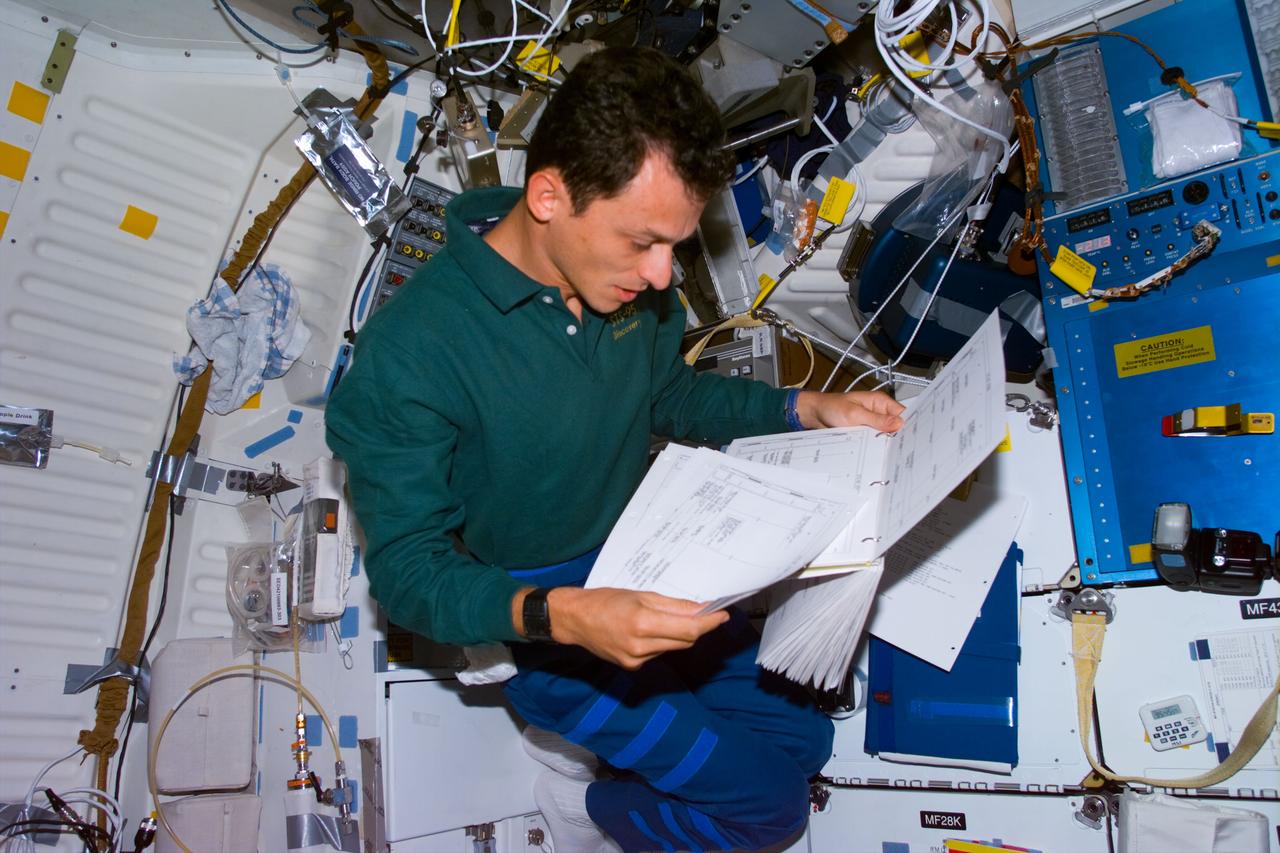
STS095-E-5237 (4 Nov. 1998) --- Astronaut Duque has his hands full of reference papers in the Spacehab facility during Flight Day 7 activity onboard the Space Shuttle Discovery. The photo was taken with an electronic still camera (ESC) at 17:53:38 GMT, Nov. 4.
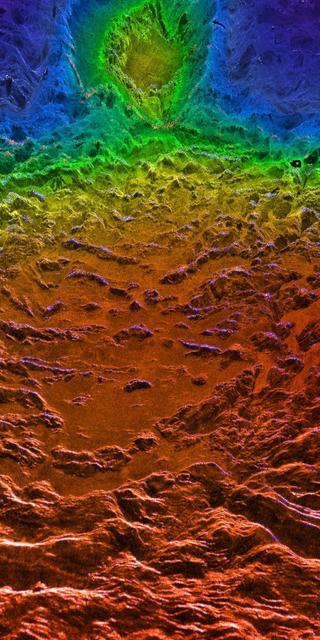
This perspective view of Venus, generated by computer from NASA Magellan data and color-coded with emissivity, is a look westward across the Fortuna Tessera toward the slopes of Maxwell Montes. http://photojournal.jpl.nasa.gov/catalog/PIA00316
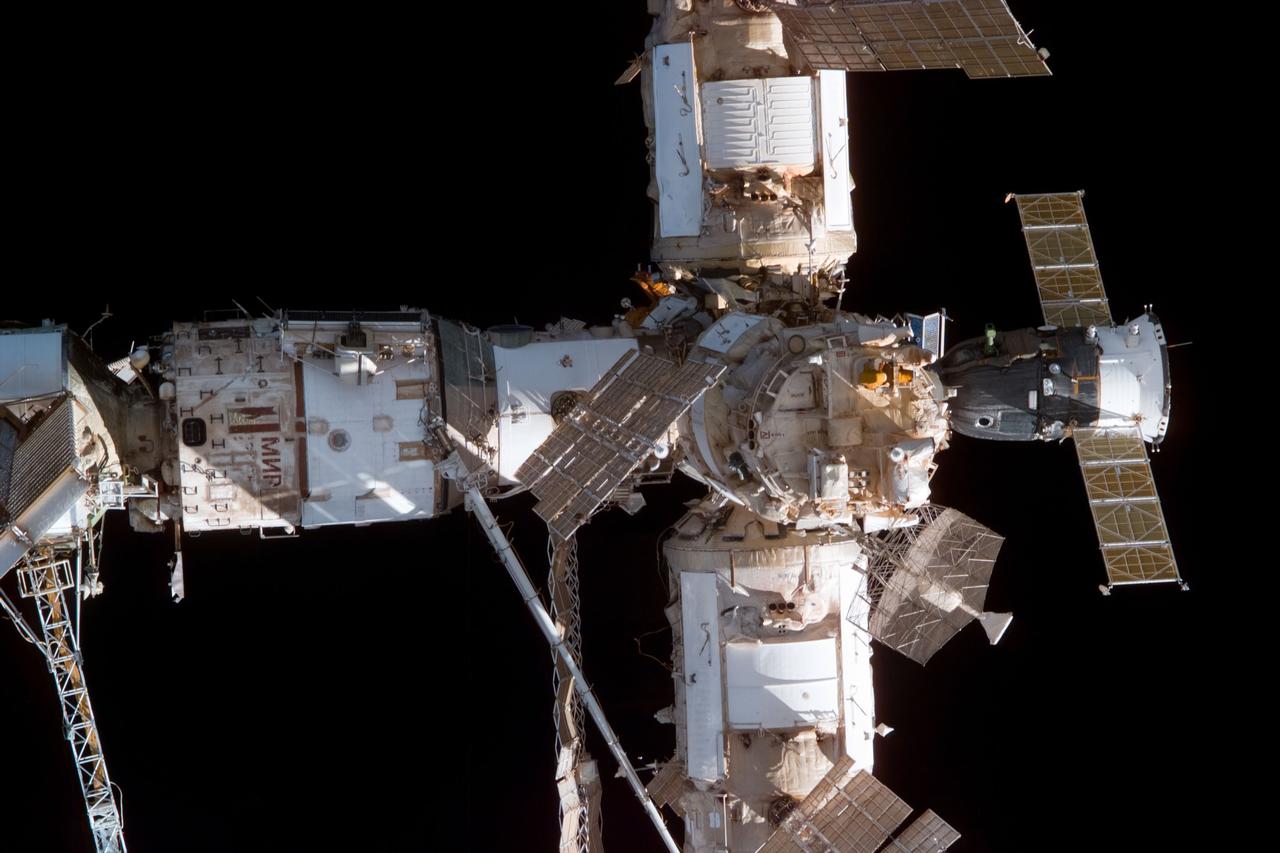
S89-E-5387 (29 Jan 1998) --- This Electronic Still Camera (ESC) image shows most of the elements of Russia's Mir Space Station. The view taken from onboard the Space Shuttle Endeavour during relative separation of the two spacecraft following undocking operations. Thus ending the eighth Shuttle/Mir joint docking mission. This ESC view was taken on January 29, 1998, at 14:46:24 MET.
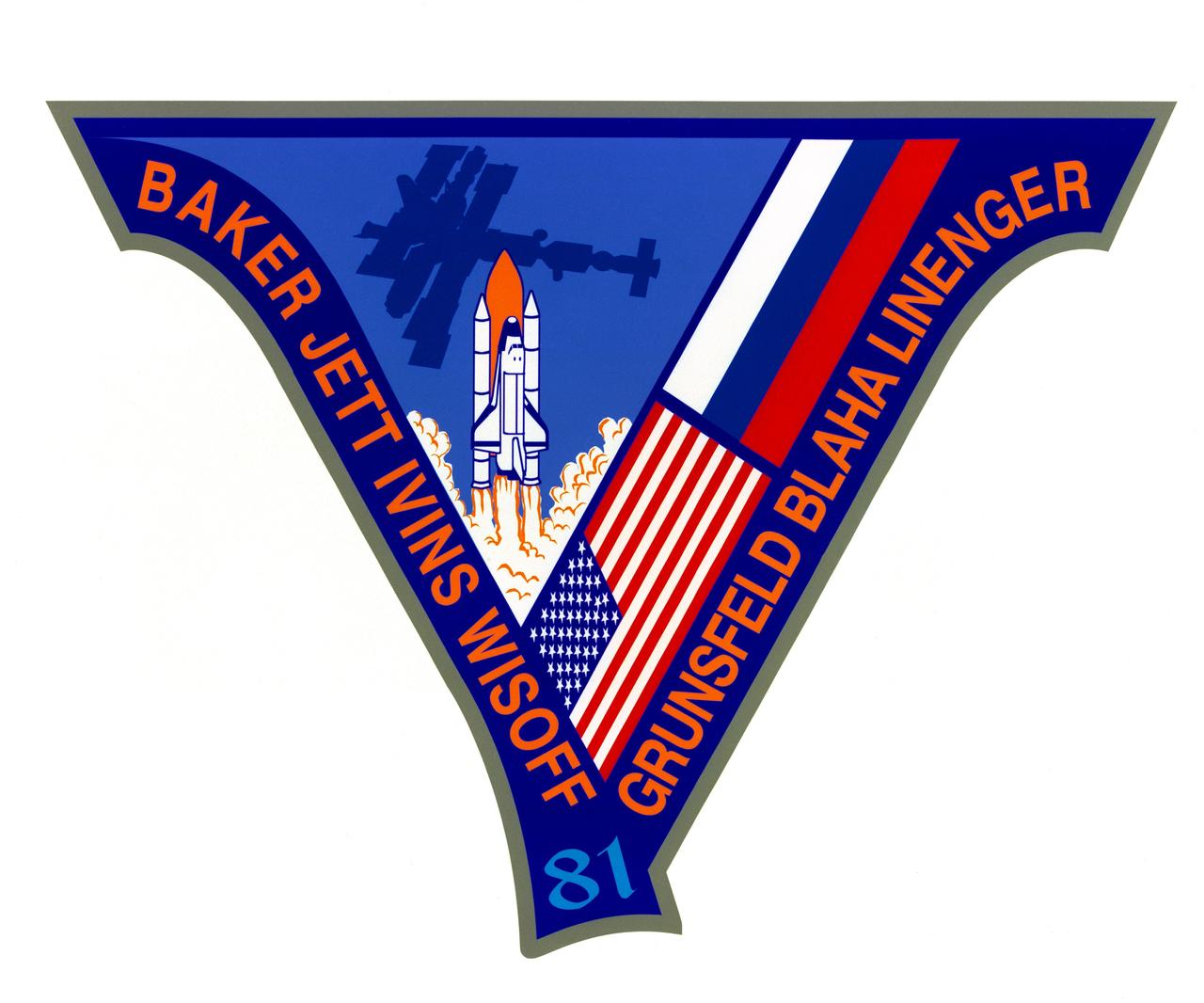
STS081-S-001 (June 1996) --- The STS-81 crew patch for the fifth Shuttle-Mir docking mission, is shaped to represent the Roman numeral V. The space shuttle Atlantis, OV-104, is launching toward a rendezvous with Russia?s Mir Space Station, silhouetted in the background. Atlantis and the STS-81 crew will spend several days docked to Mir during which time astronaut Jerry M. Linenger (NASA-Mir 4) will replace astronaut John E. Blaha (NASA-Mir 3) as the United States crew member onboard Mir. Scientific experiments and logistics will also be transferred between Atlantis and Mir. The United States and Russian flags are depicted along with the names of the shuttle crew members: Michael A. Baker, commander; Brent W. Jett, pilot; Peter J. K.(Jeff) Wisoff, mission specialist 1; John W. Grunsfeld, mission specialist 2; Marsha S. Ivins, mission specialist 3; Linenger; mission specialist 4; and Blaha, mission specialist 5. The NASA insignia design for space shuttle flights is reserved for use by the astronauts and for other official use as the NASA Administrator may authorize. Public availability has been approved only in the forms of illustrations by the various news media. When and if there is any change in this policy, which is not anticipated, the change will be publicly announced. Photo credit: NASA
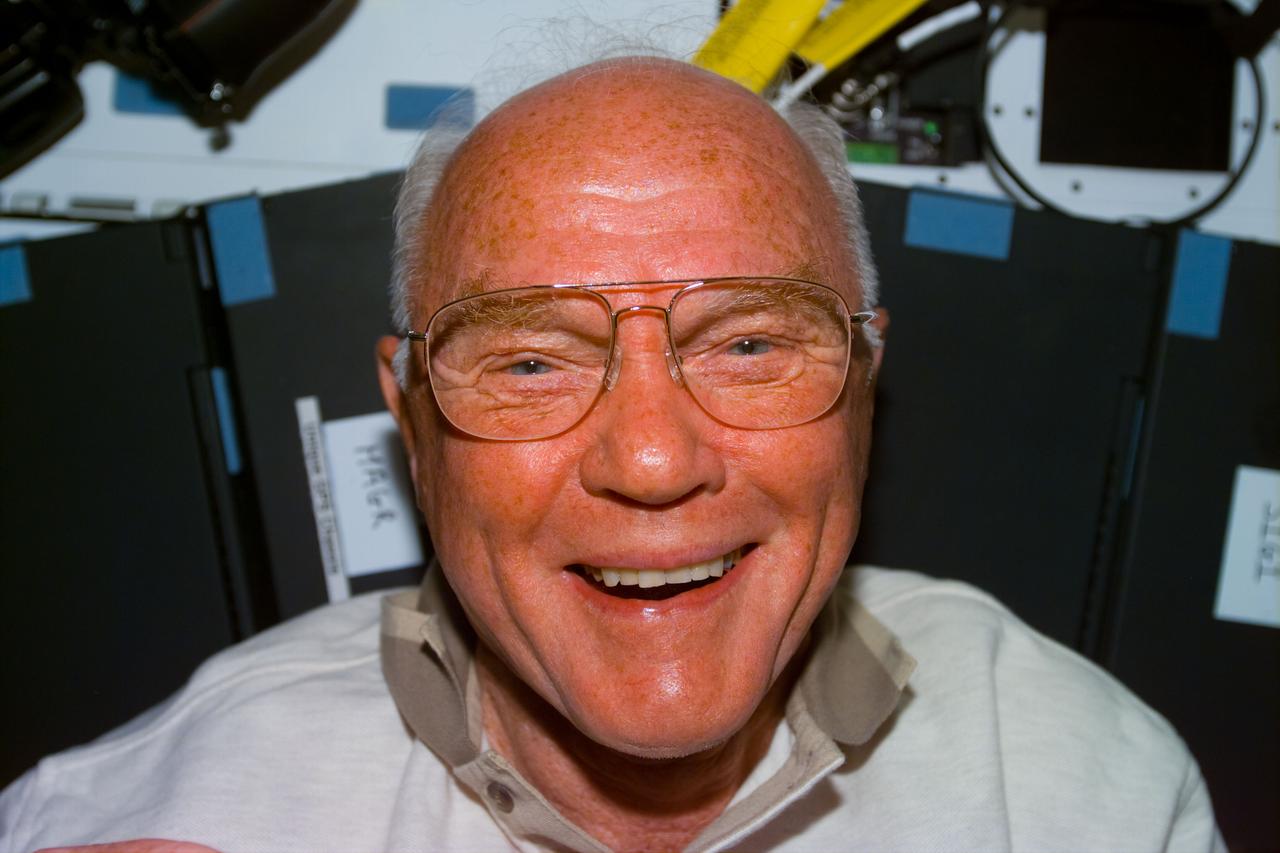
STS095-E-5191 (31 Oct. 1998) --- Judging by his countenance, U.S. Sen. John H. Glenn Jr., appears to be enjoying his second trip into space following a 36-year span since his first trip. The photograph was taken with an electronic still camera (ESC) at 04:47:53 GMT, Oct. 31.
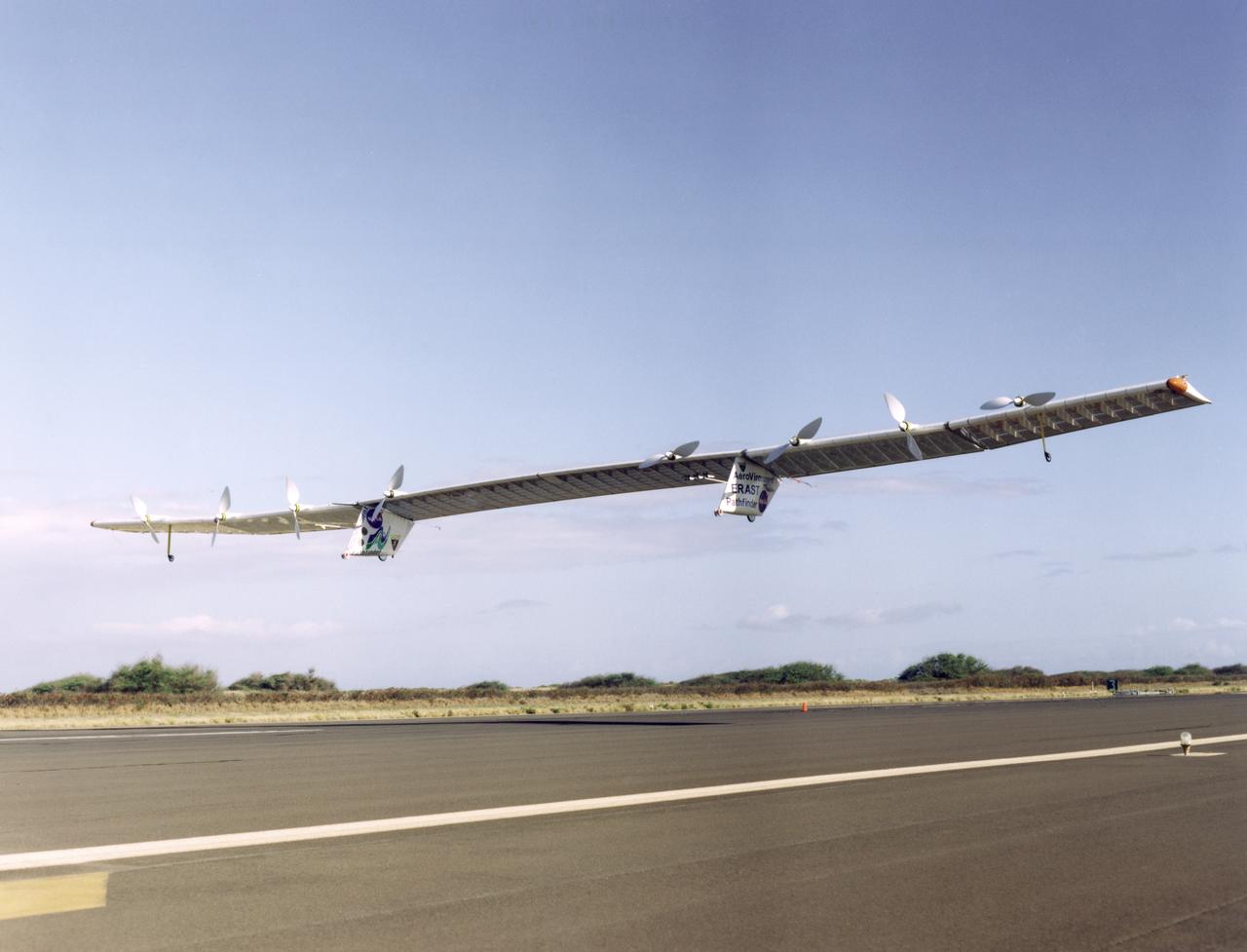
Pathfinder-Plus on a flight over Hawaii in 1998.
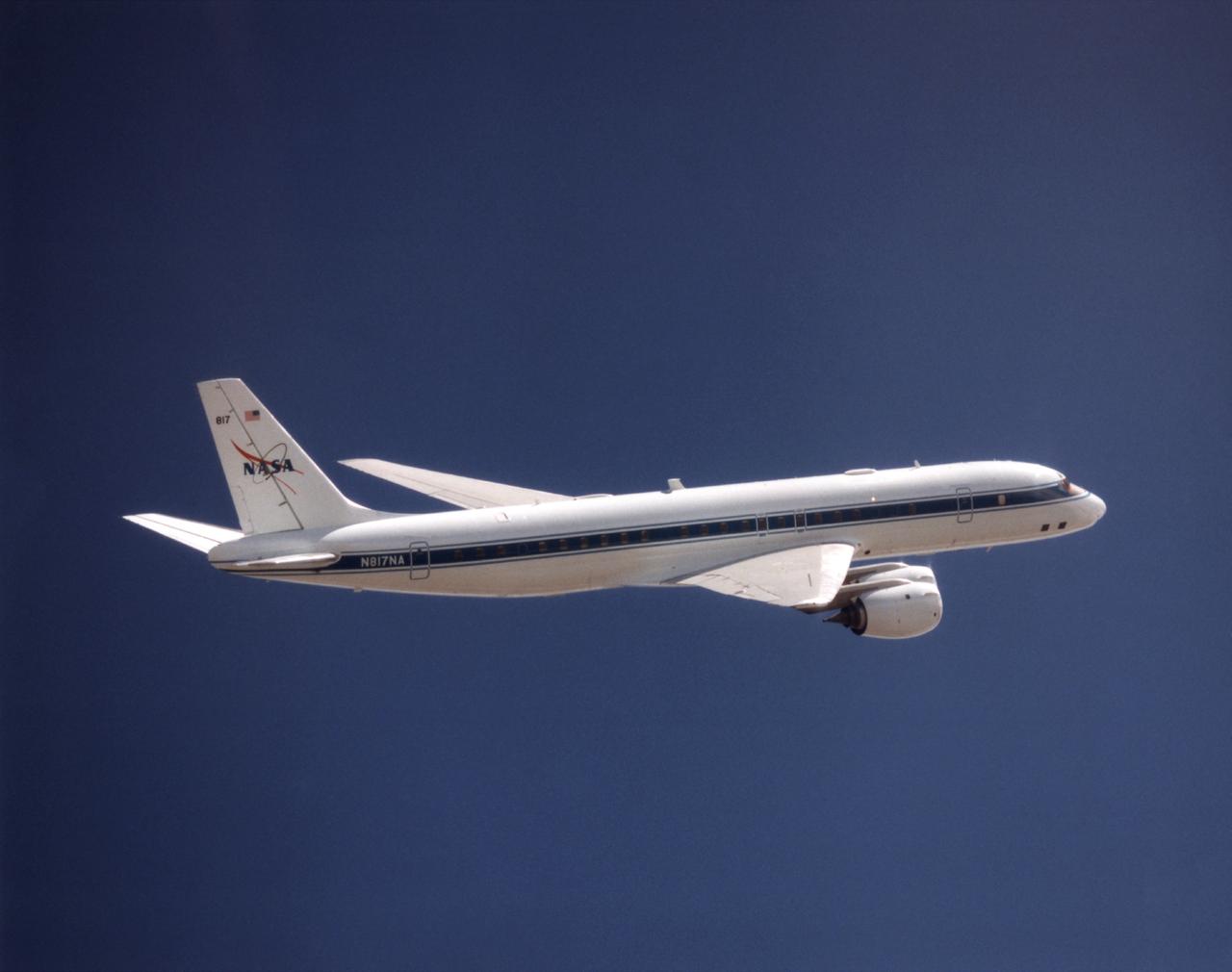
NASA's DC-8 Airborne Science platform shown against a background of a dark blue sky on February 20, 1998. The aircraft is shown from the right rear, slightly above its plane, with the right wing in the foreground and the left wing and horizontal tail in the background. The former airliner is a "dash-72" model and has a range of 5,400 miles. The craft can stay airborne for 12 hours and has an operational speed range between 300 and 500 knots. The research flights are made at between 500 and 41,000 feet. The aircraft can carry up to 30,000 lbs of research/science payload equipment installed in 15 mission-definable spaces.

The crew of STS-90 pose in the white room at KSC's Launch Pad 39B, where they are participating in Terminal Countdown Demonstration Test (TCDT) activities. The TCDT is held at KSC prior to each Space Shuttle flight to provide crews with the opportunity to participate in simulated countdown activities. The crew include, left to right, Commander Richard Searfoss, Pilot Scott Altman, Mission Specialist Kathryn (Kay) Hire, Richard Linnehan, D.V.M., Payload Specialists James Pawelczyk, Ph.D., and Jay Buckey, M.D., and Mission Specialist Dafydd (Dave) Williams, M.D., with the Canadian Space Agency. Columbia is targeted for launch of STS-90 on April 16 at 2:19 p.m. EDT and will be the second mission of 1998. The mission is scheduled to last nearly 17 days
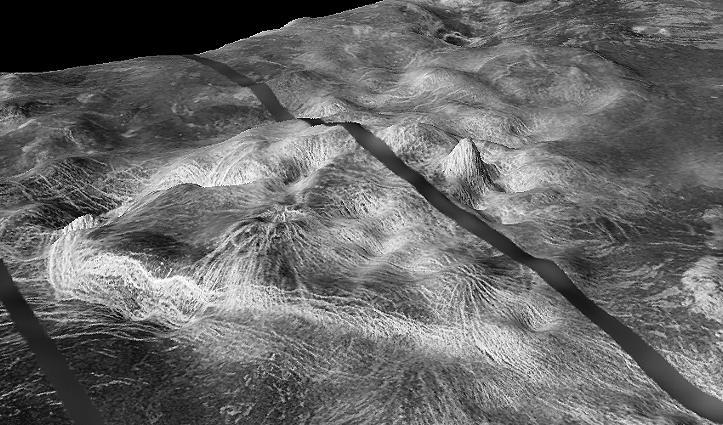
The view from NASA's Magellan spacecraft shows Yavine Corona, looking northeast. Coronae are roughly circular, volcanic features believed to form over hot upwellings of magma within the Venusian mantle. http://photojournal.jpl.nasa.gov/catalog/PIA00098
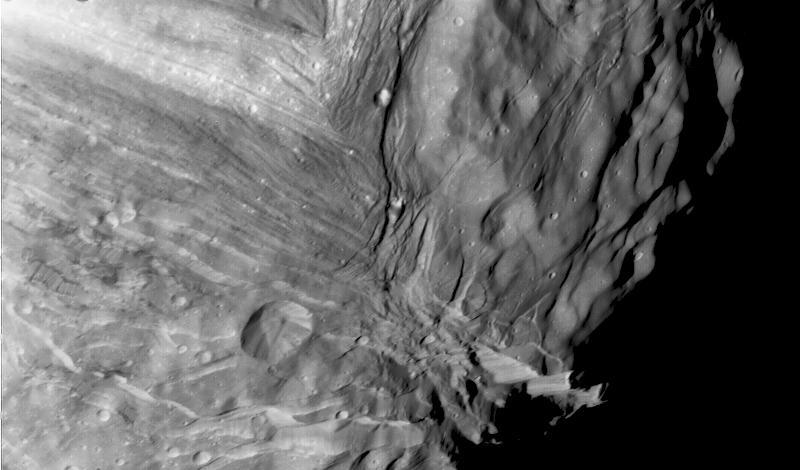
Miranda, innermost of Uranus large satellites, is seen at close range in this Voyager 2 image, taken Jan. 24, 1986, as part of a high-resolution mosaicing sequence.
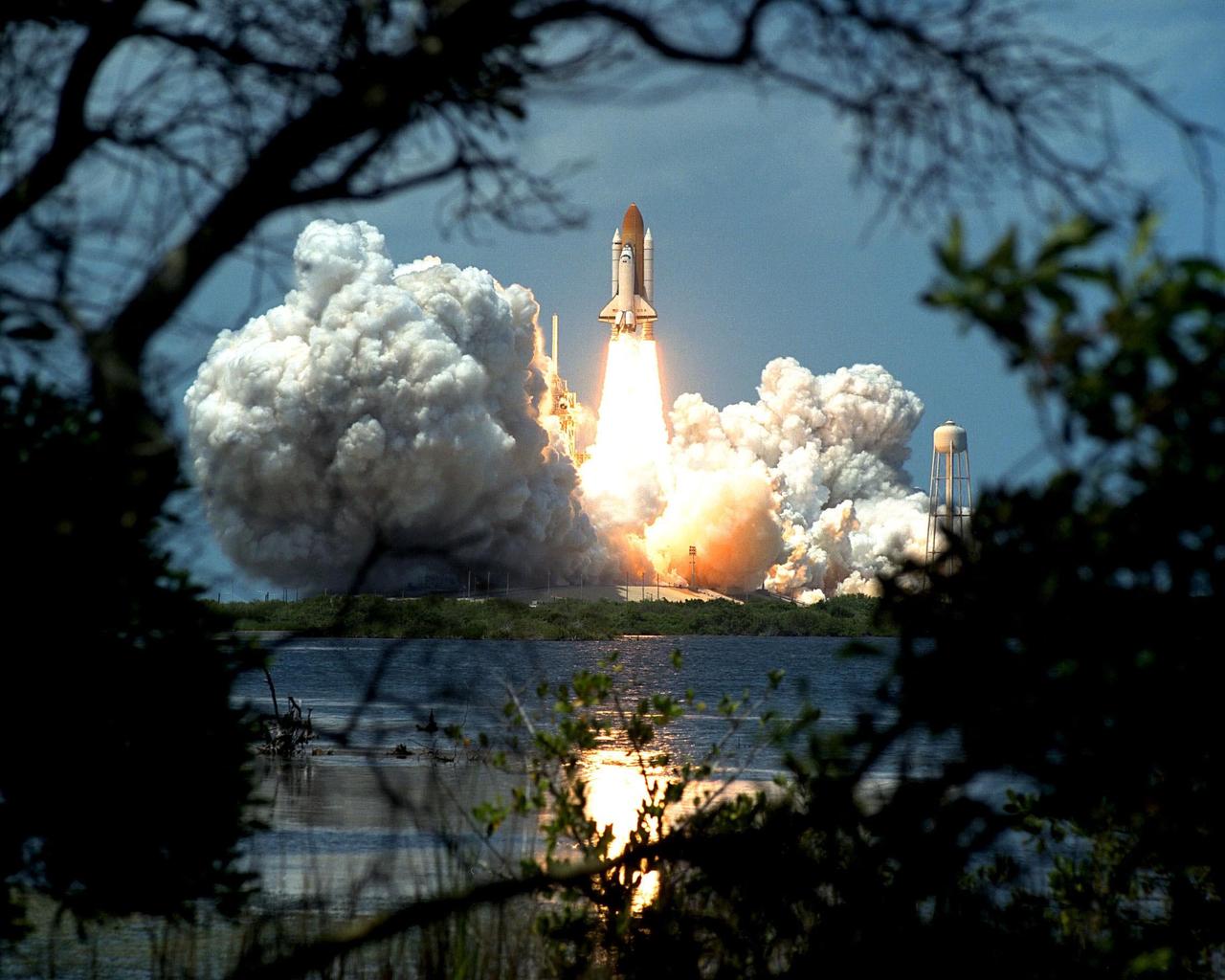
KENNEDY SPACE CENTER, FLA. -- Framed by native Floridian foliage, the Space Shuttle Columbia soars from Launch Pad 39B at 2:19 p.m. EDT Apr. 17 to begin the nearly 17-day STS-90 Neurolab mission. The launch was delayed 24 hours due to difficulty with a network signal processor, which was replaced Apr. 16, on the orbiter. The crew members are Commander Richard Searfoss, Pilot Scott Altman, Mission Specialists Richard Linnehan, D.V.M., Dafydd (Dave) Williams, M.D., with the Canadian Space Agency, and Kathryn (Kay) Hire; and Payload Specialists Jay Buckey, M.D., and James Pawelczyk, Ph.D. Investigations during the Neurolab mission will focus on the effects of microgravity on the nervous system
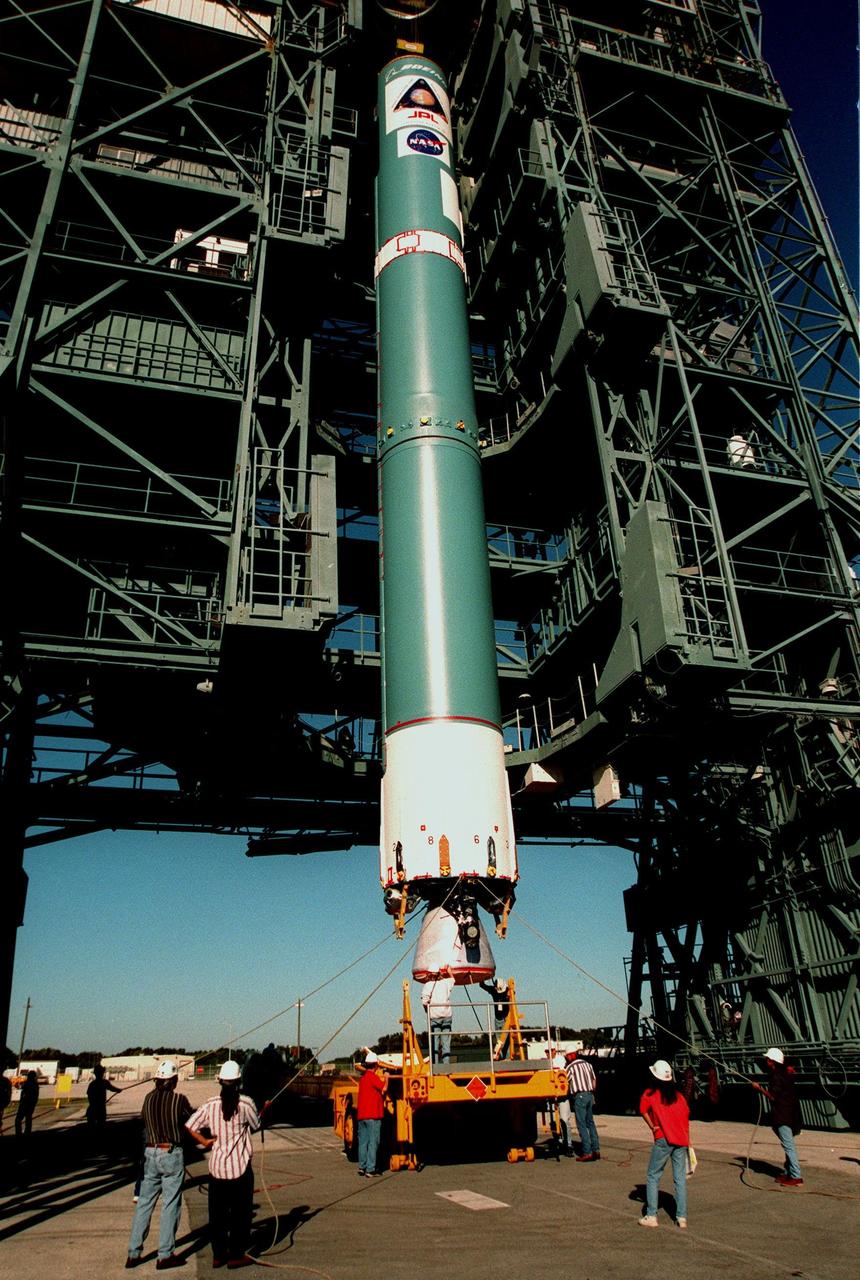
KENNEDY SPACE CENTER, FLA. -- Workers guide the lifting of the first stage of a Delta II rocket up the gantry at Launch Complex 17B, Cape Canaveral Air Station. The rocket will be used to launch the Mars Polar Lander on Jan. 3, 1999. The lander is a solar-powered spacecraft designed to touch down on the Martian surface near the northern-most boundary of the south pole in order to study the water cycle there. The lander also will help scientists learn more about climate change and current resources on Mars, studying such things as frost, dust, water vapor and condensates in the Martian atmosphere. It is the second spacecraft to be launched in a pair of Mars '98 missions. The first is the Mars Climate Orbiter, to be launched aboard a Delta II rocket from Launch Complex 17A on Dec. 10, 1998
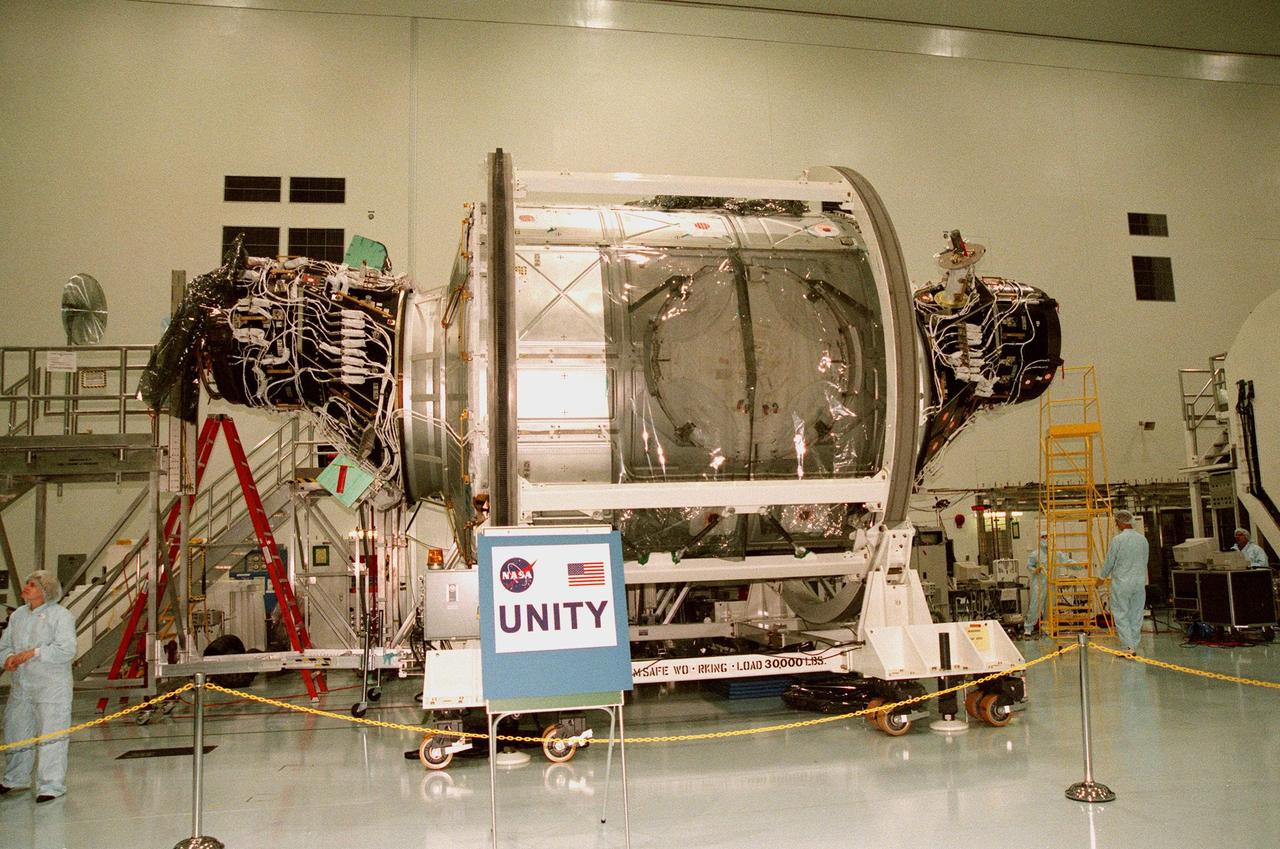
In the Space Station Processing Facility, the Unity connecting module, part of the International Space Station, is shown with Pressurized Mating Adapters 1 (left) and 2 (right) attached. Unity is scheduled to undergo testing of the common berthing mechanism to which other space station elements will dock. Unity is the primary payload on mission STS-88, targeted to launch Dec. 3, 1998. Other testing includes the Pad Demonstration Test to verify the compatibility of the module with the Space Shuttle as well as the ability of the astronauts to send and receive commands to Unity from the flight deck of the orbiter. Unity is expected to be ready for installation into the payload canister on Oct. 25, and transported to Launch Pad 39-A on Oct. 27. The Unity will be mated to the Russian-built Zarya control module which should already be in orbit at that time
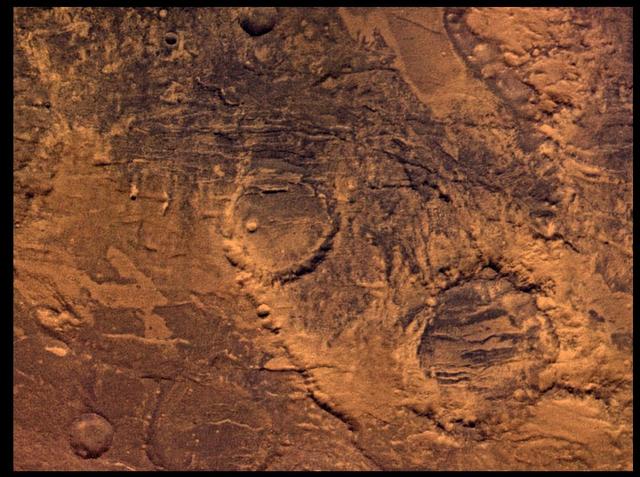
Claritas Fossae, Approximately Natural Color http://photojournal.jpl.nasa.gov/catalog/PIA00338
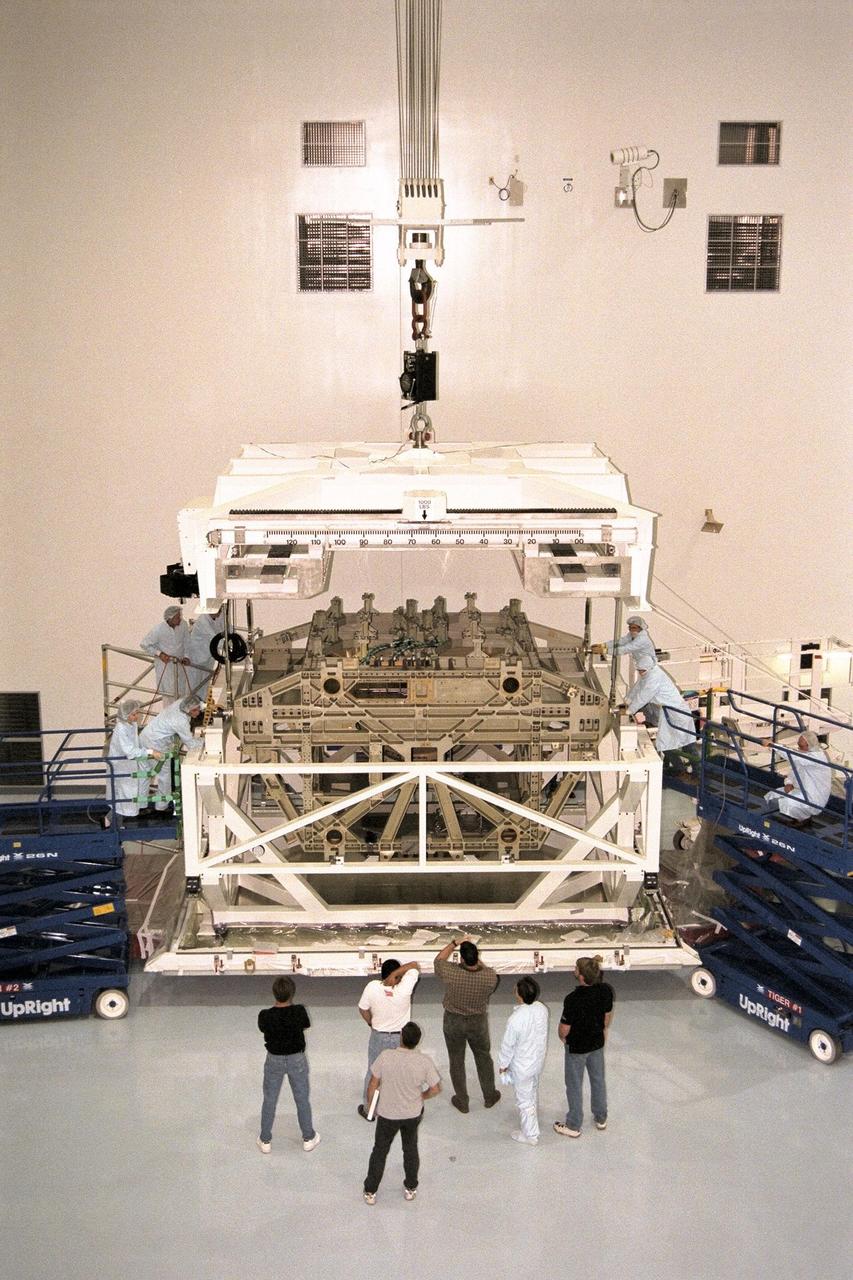
KENNEDY SPACE CENTER, FLA. -- The Z1 Integrated Truss Segment (ITS), a major element of the STS-92 mission scheduled for launch aboard Space Shuttle Atlantis in January 1999, is lowered into its workstand for processing in KSC's Space Station Processing Facility (SSPF). The Z-1 truss supports the staged buildup of International Space Station (ISS) on this third scheduled flight for ISS. The Z1 truss allows the temporary installation of the U.S. power module to Node 1. Early in the assembly sequence, the purpose of Z1 is to provide a mounting location for Ku-band and S-band telemetry and extravehicular activity (EVA) equipment. It also provides common berthing mechanism hardcover stowage. In addition, it will assist with the execution of nonpropulsive attitude control. The truss arrived at KSC on Feb. 17 for preflight processing in the SSPF
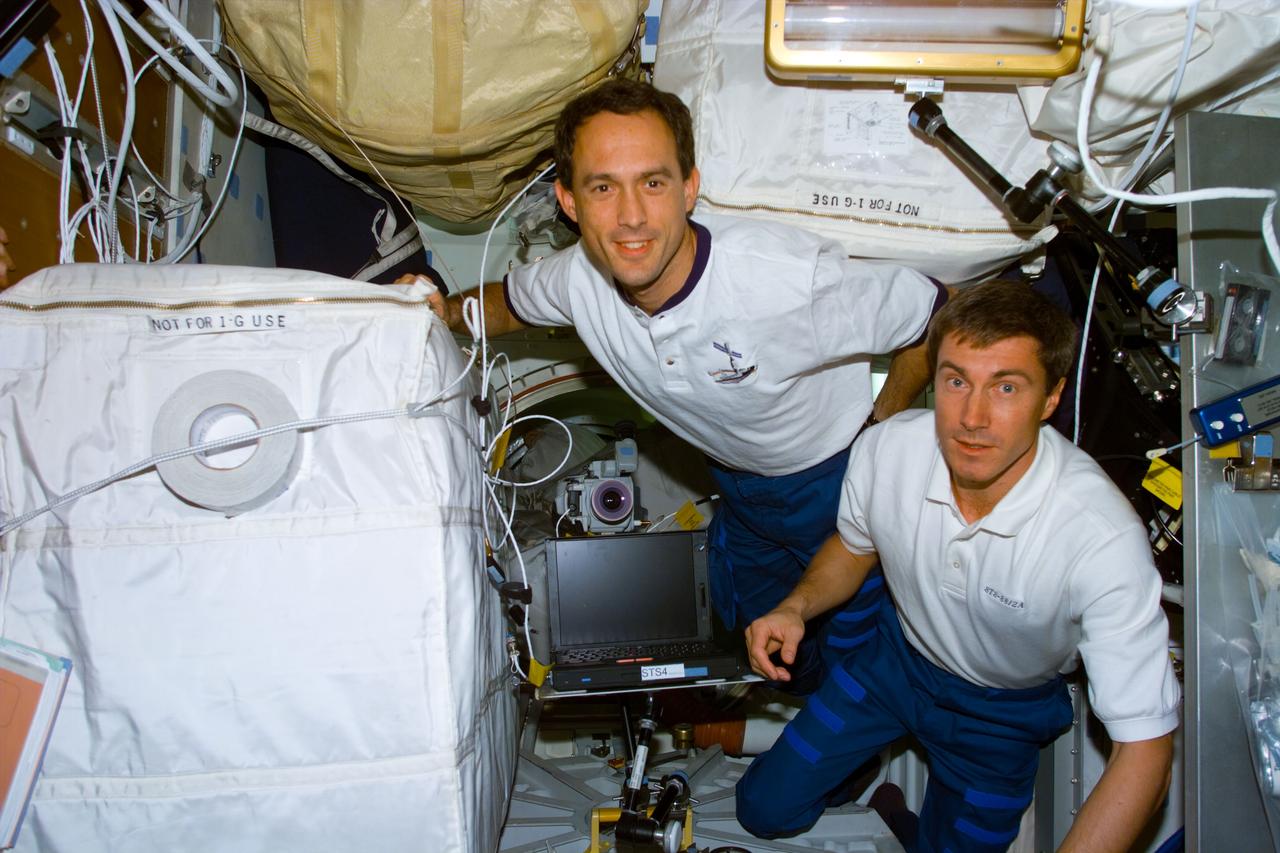
S88-E-5159 (12-14-98) --- Less than 48-hours prior to the completion of their 11-day mission in Earth orbit, two of the seven STS-88 crew members are pictured on Endeavour's middeck. They are James H. Newman (left) and Sergei K. Krikalev, both mission specialists. Krikalev represents the Russian Space Agency (RSA) and has been named to the first ISS crew. Newman earlier had joined astronaut Jerry L. Ross on three space walks to perform a number of tasks to ready the first components of ISS. The photo was taken with an electronic still camera (ESC) at 03:00:43, Dec. 14.
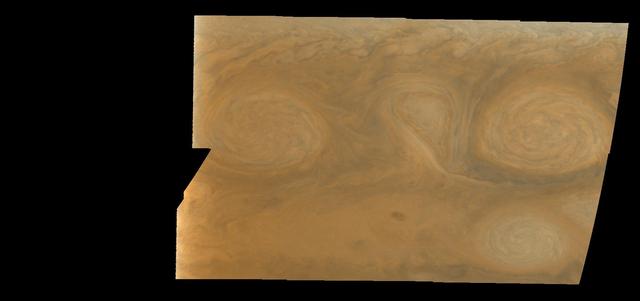
These images, taken on February 19, 1997 by NASA Galileo orbiter, show two of the three long-lived White Ovals that formed to the south of the Jupiter Great Red Spot.
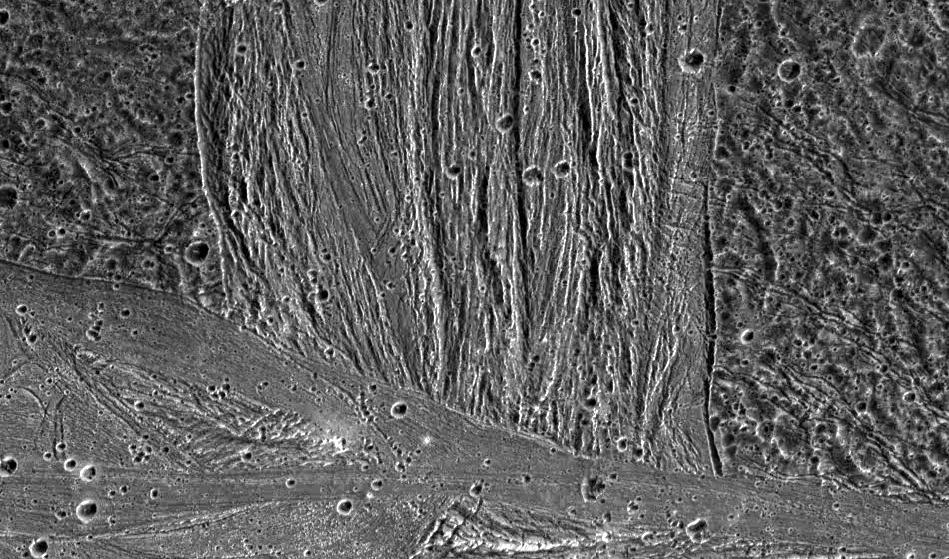
Swaths of Grooved Terrain on Ganymede
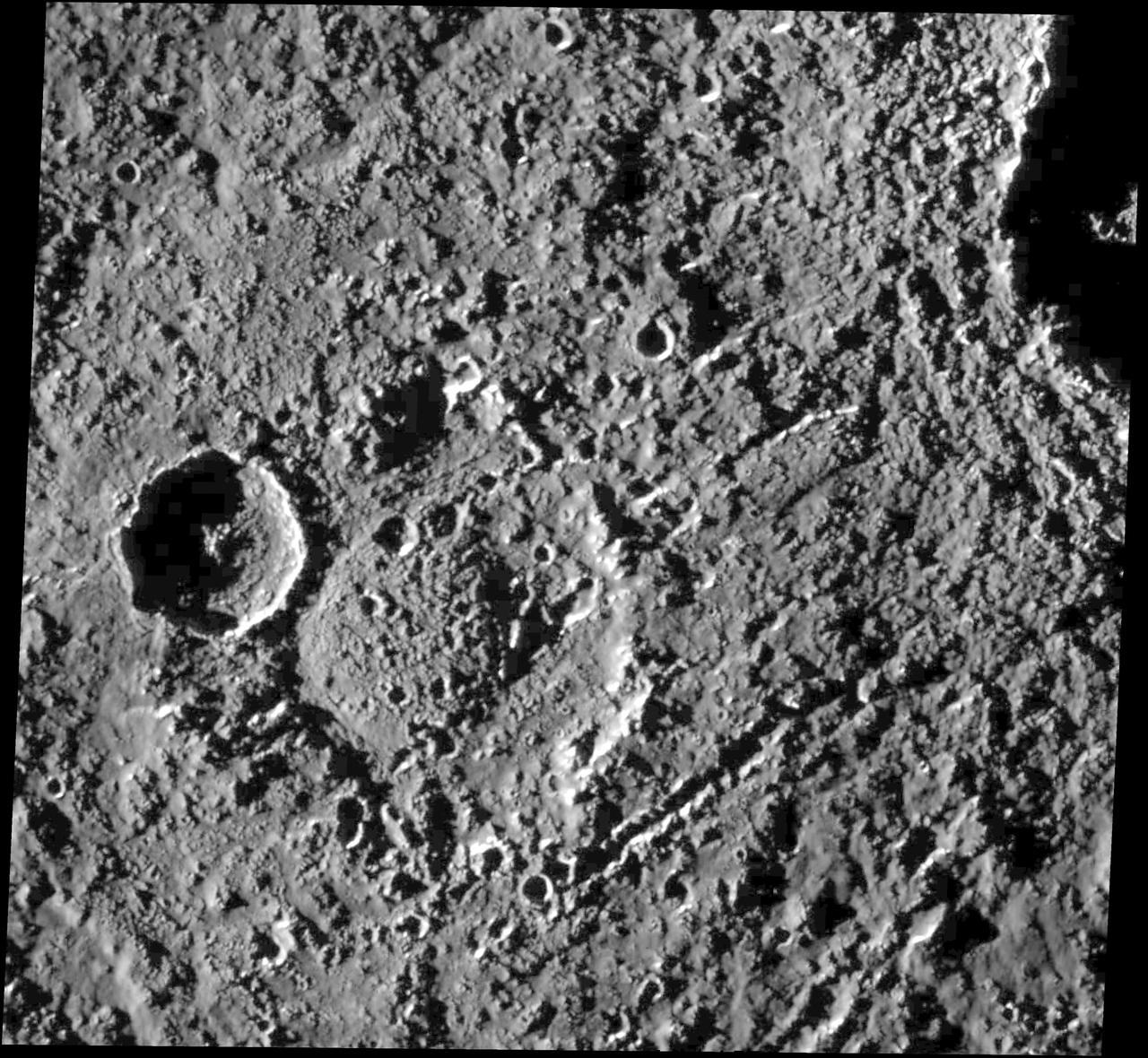
Har Crater on Callisto
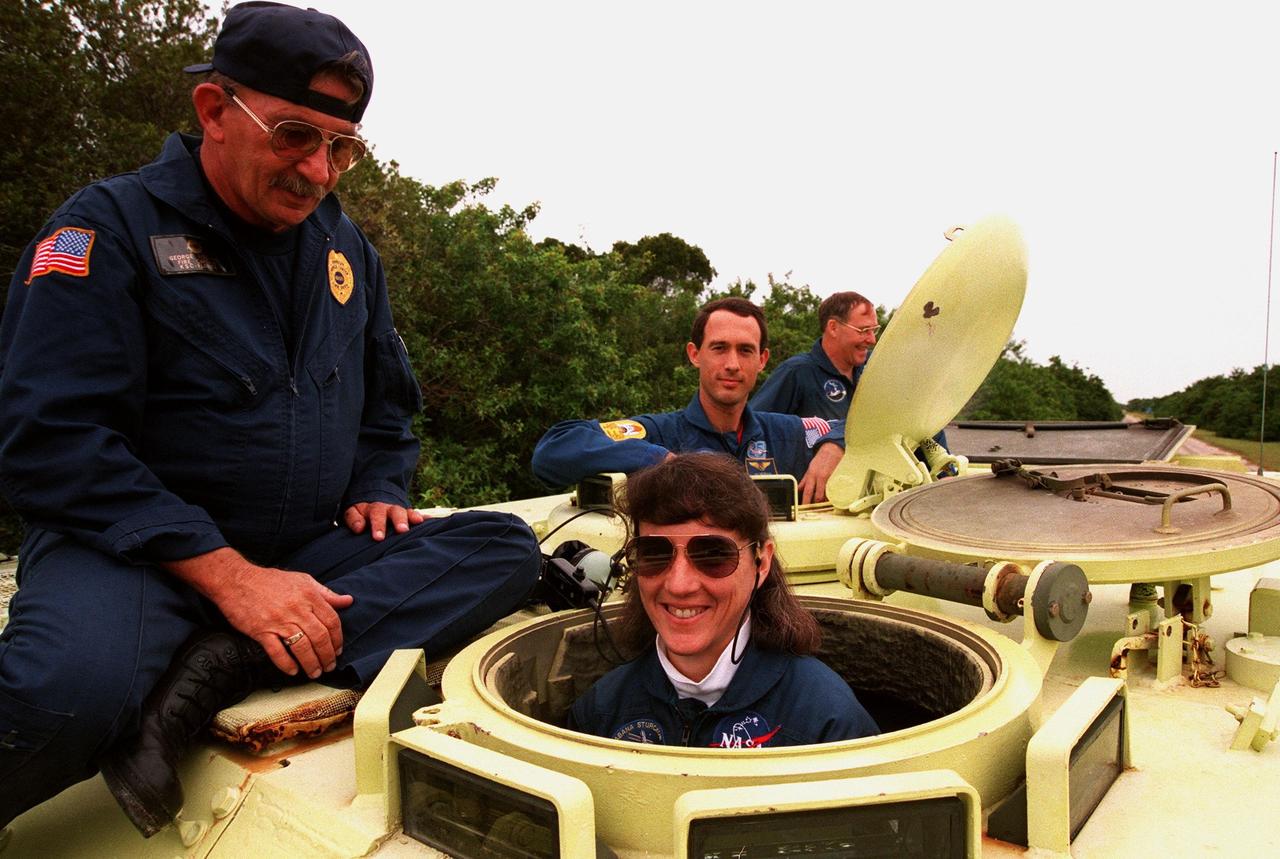
STS-88 Mission Specialist Nancy J. Currie prepares to operate an M-113, an armored personnel carrier, as part of emergency egress training under the watchful eye of instructor George Hoggard (left) during Terminal Countdown Demonstration Test (TCDT) activities. The TCDT also provides the crew with simulated countdown exercises and opportunities to inspect their mission payloads in the orbiter's payload bay. Mission STS-88 is targeted for launch on Dec. 3, 1998. It is the first U.S. flight for the assembly of the International Space Station and will carry the Unity connecting module. Others in the STS-88 crew are Mission Commander Robert D. Cabana; Pilot Frederick W. "Rick" Sturckow; and Mission Specialists Jerry L. Ross, James H. Newman, and Sergei Konstantinovich Krikalev, a Russian cosmonaut

Jupiter atmospheric circulation is dominated by alternating eastward and westward jets from equatorial to polar latitudes. This image was taken on April 3, 1997, by NASA Galileo spacecraft.
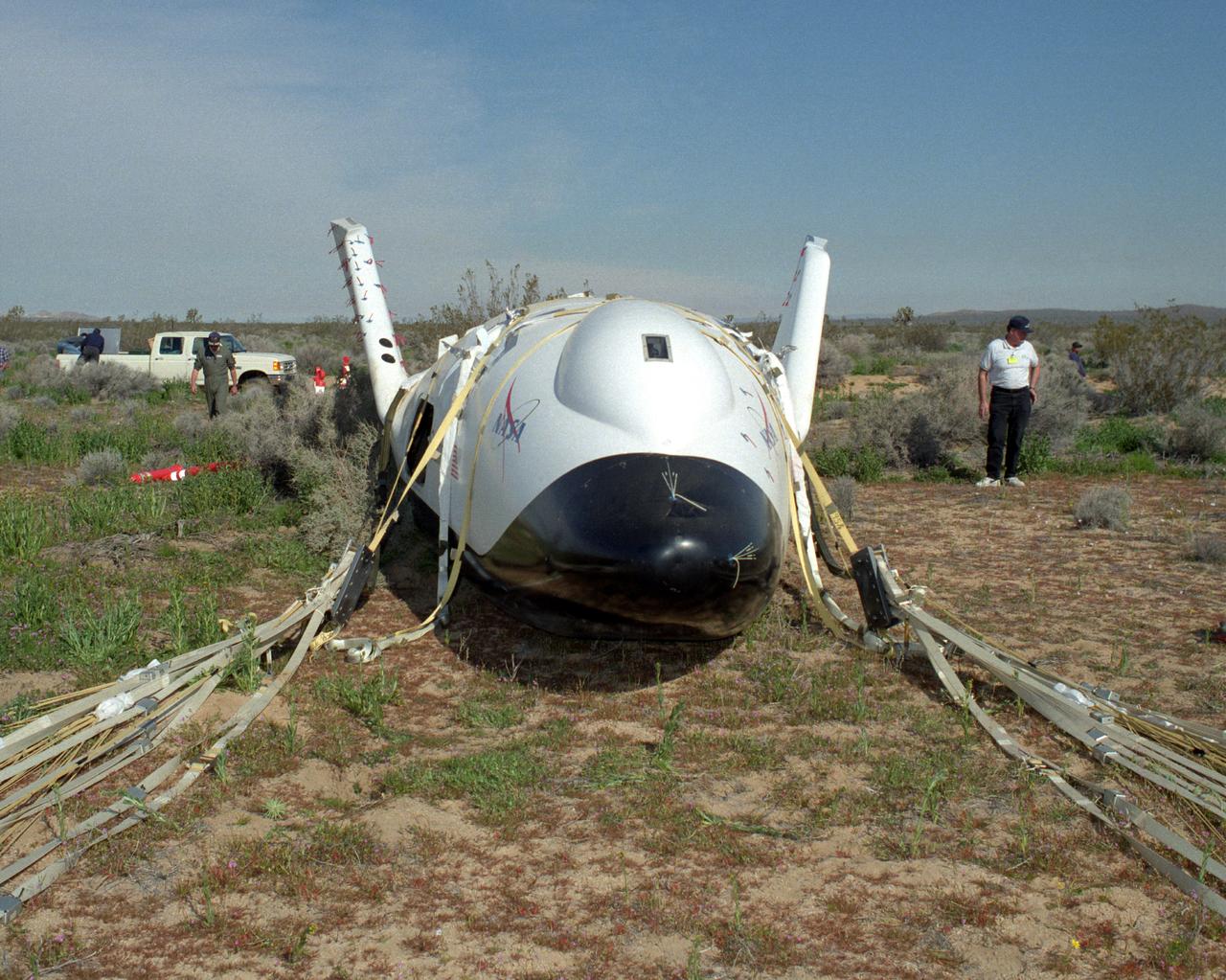
Crew members surround the X-38 lifting body research vehicle after a successful test flight and landing in March 1998. The flight was the first free flight for the vehicle and took place at the Dryden Flight Research Center, Edwards, California.