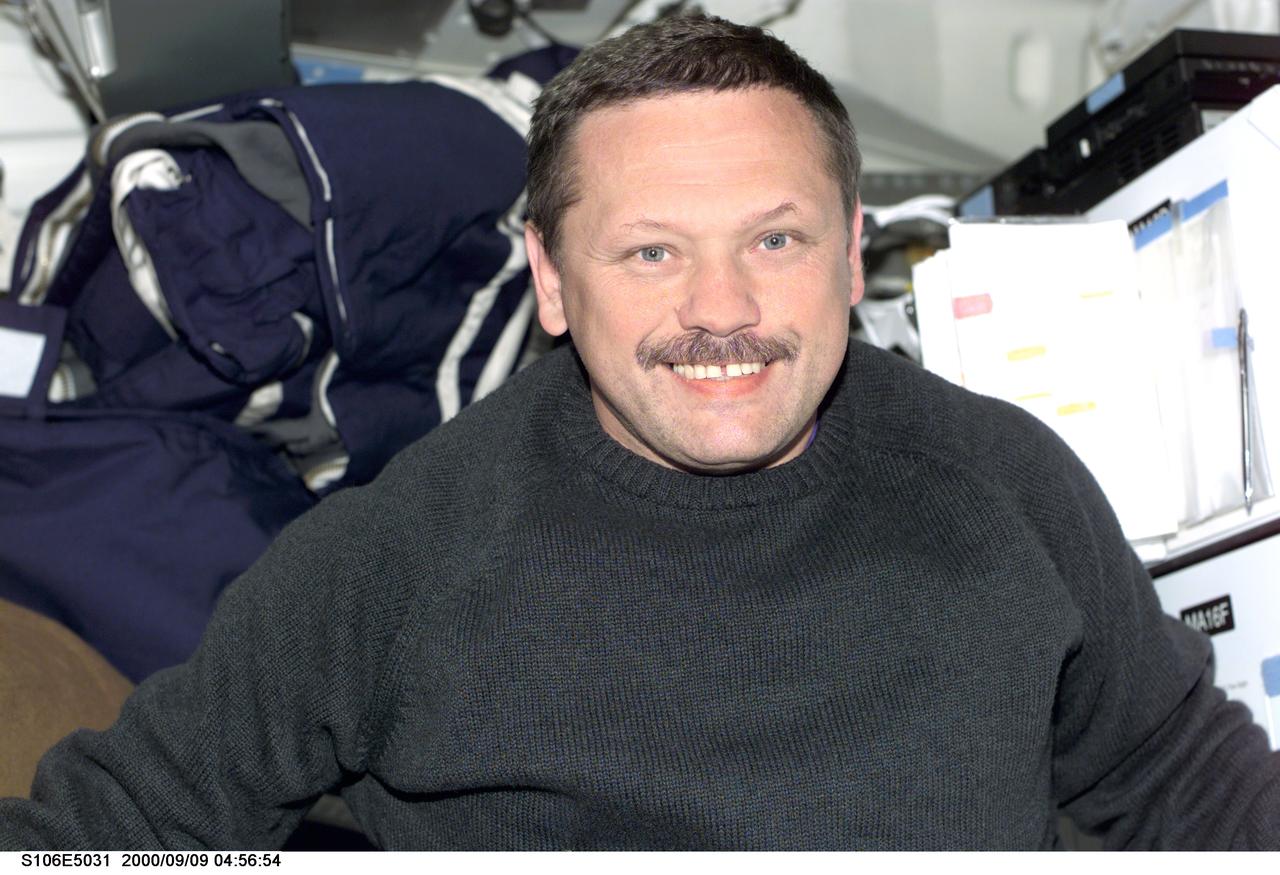
S106-E-5031 (9 September 2000) --- Cosmonaut Boris V. Morukov, one of two mission specialists who represent the Russian Aviation and Space Agency on this scheduled 11-day mission, appears to like the progress of the effort by the seven-member crew to keep up its busy agenda onboard the Space Shuttle Atlantis. The crew is less than 24 hours away from Atlantis' scheduled docking with the International Space Station (ISS).
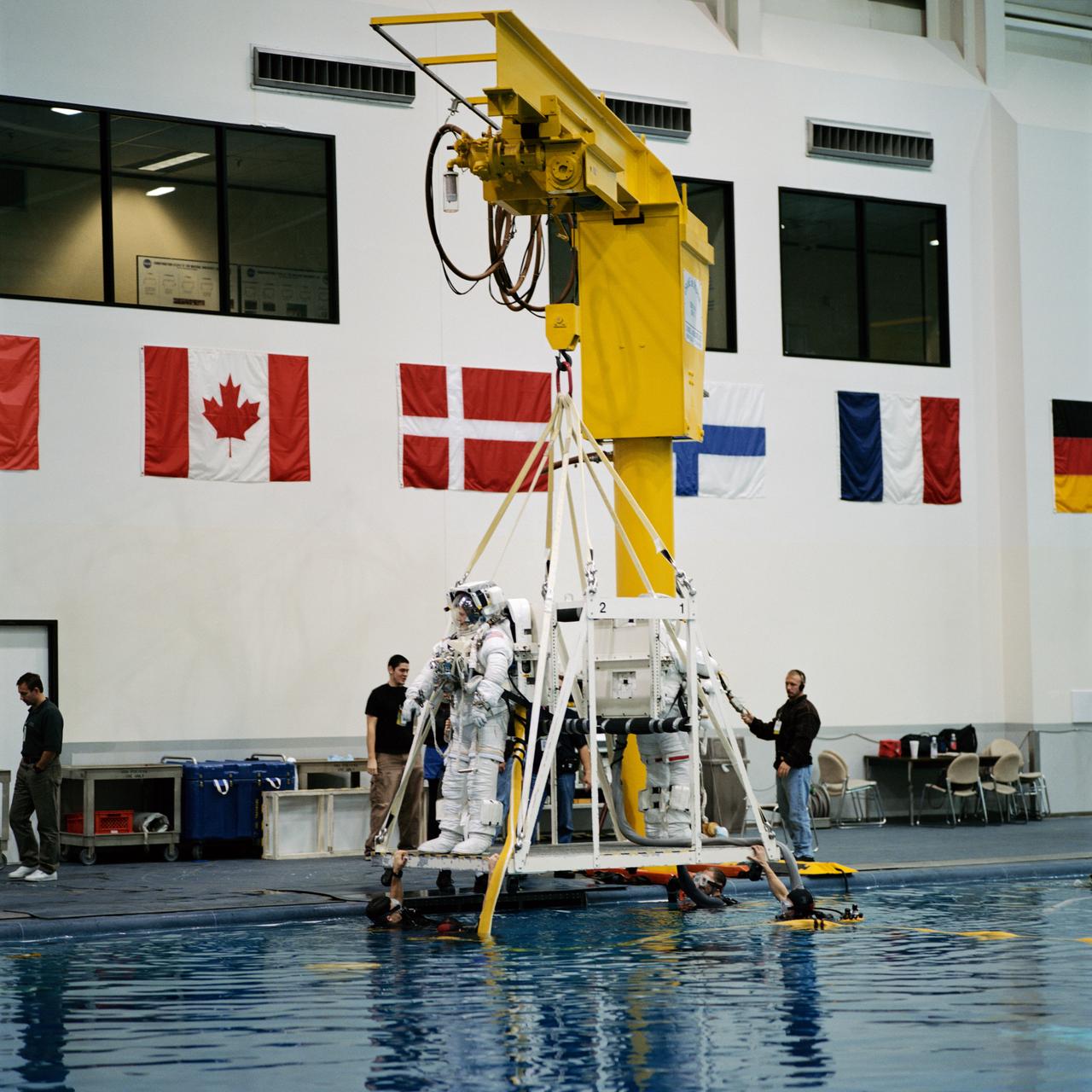
JSC2000-07400 (1 Dec. 2000) --- Both attired in training versions of the Extravehicular Mobility Unit (EMU) spacesuit, astronauts Scott E. Parazynski (left) and Chris A. Hadfield stand on a platform that will ease the two STS-100 mission specialists into a giant pool of water at the Neutral Buoyancy Laboratory (NBL). Minutes later, the two were in a neutrally buoyant state beneath the surface rehearsing spacewalk duties scheduled for next year's visit to the International Space Station (ISS). Hadfield represents the Canadian Space Agency (CSA).
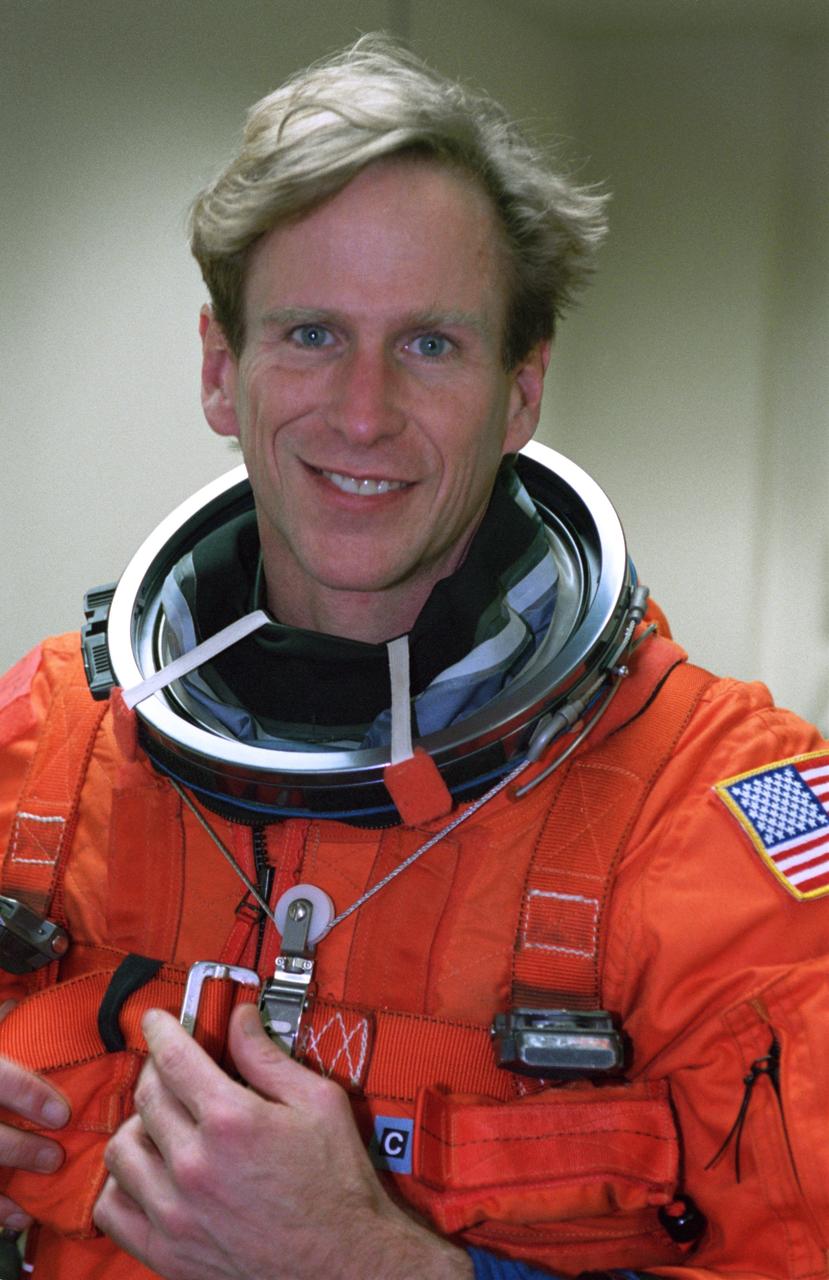
JSC2000-07284 (17 November 2000) --- Astronaut Michael L. Gernhardt, STS-104 mission specialist, attired in a training version of the shuttle launch and entry garment at the Jake Garn Simulation and Training Facility at Johnson Space Center (JSC). Gernhardt will join four other astronauts for a June mission with the International Space Station (ISS).
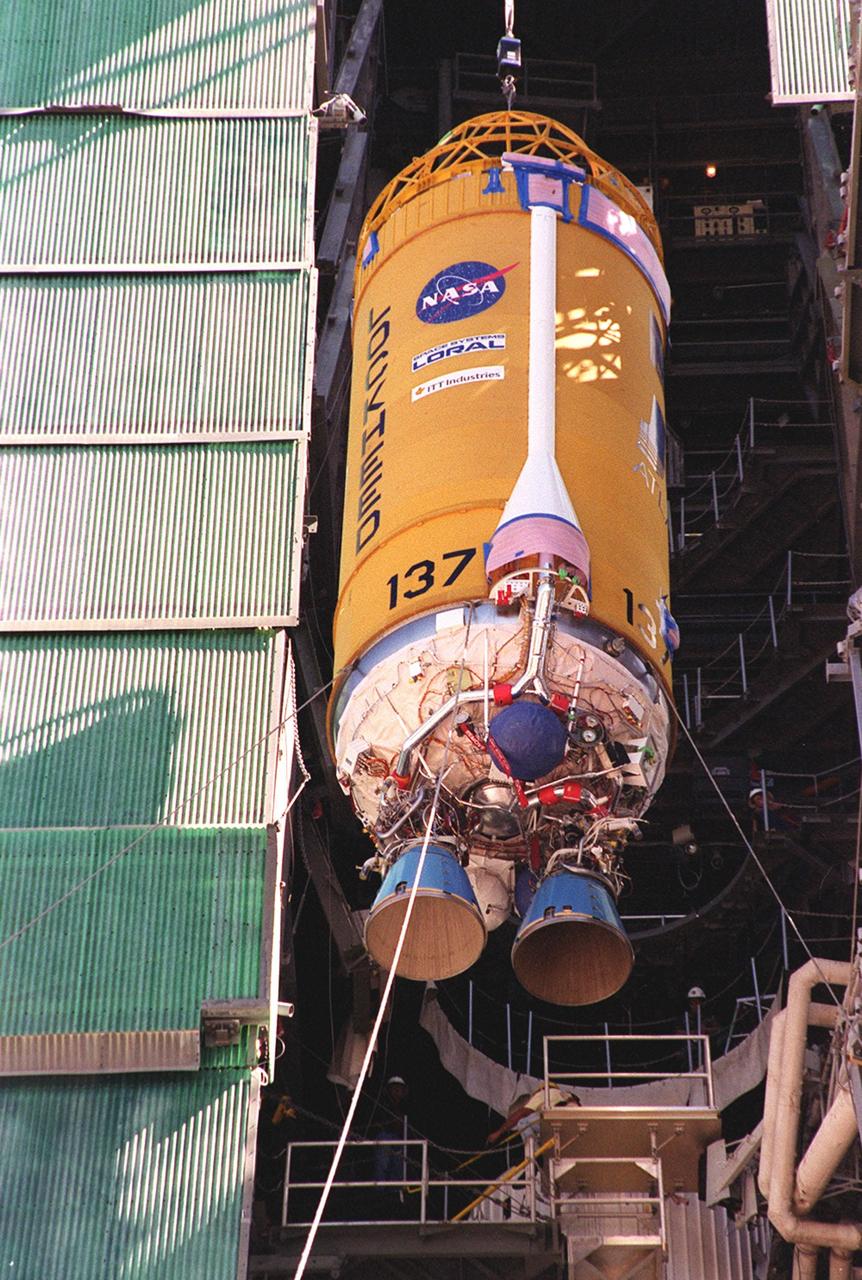
At launch pad 36-A, Cape Canaveral Air Force Station, cables help guide the second stage of an Atlas II/Centaur rocket as it is lifted up the gantry (behind it) for mating with the first stage. Atlas II is designed to launch payloads into low earth orbit, geosynchronous transfer orbit or geosynchronous orbit. The rocket is the launch vehicle for the GOES-L satellite, part of the NOAA National Weather Service system in weather imagery and atmospheric sounding information. The primary objective of the GOES-L is to provide a full capability satellite in an on-orbit storage condition, to assure NOAA continuity in services from a two-satellite constellation. Launch services are being provided by the 45th Space Wing
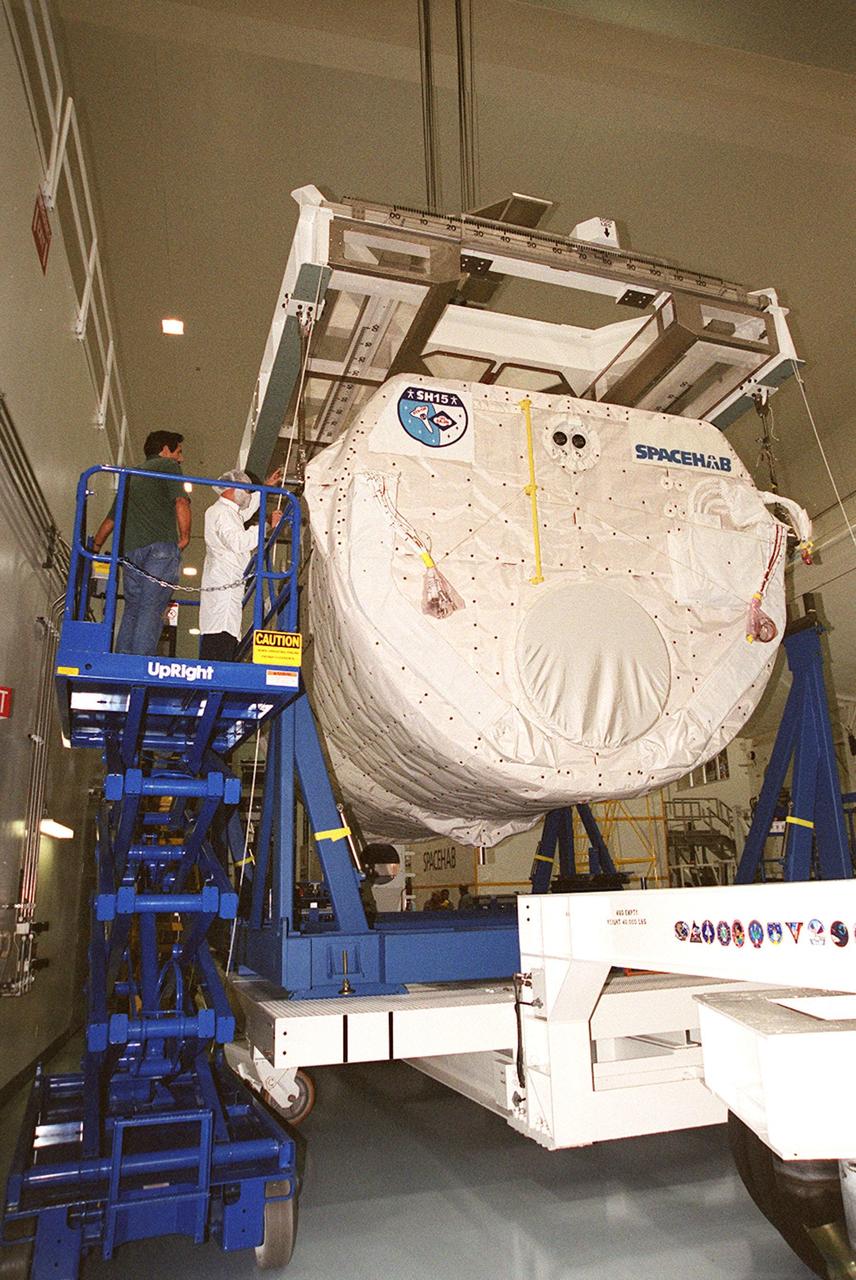
KENNEDY SPACE CENTER, FLA. -- Workers attach an overhead crane to the SPACEHAB module to lift it off the transport vehicle beneath it. The module, part of the payload on mission STS-106, will be placed in the payload canister for transport to the launch pad. STS-106 is scheduled to launch Sept. 8 at 8:31 a.m. EDT
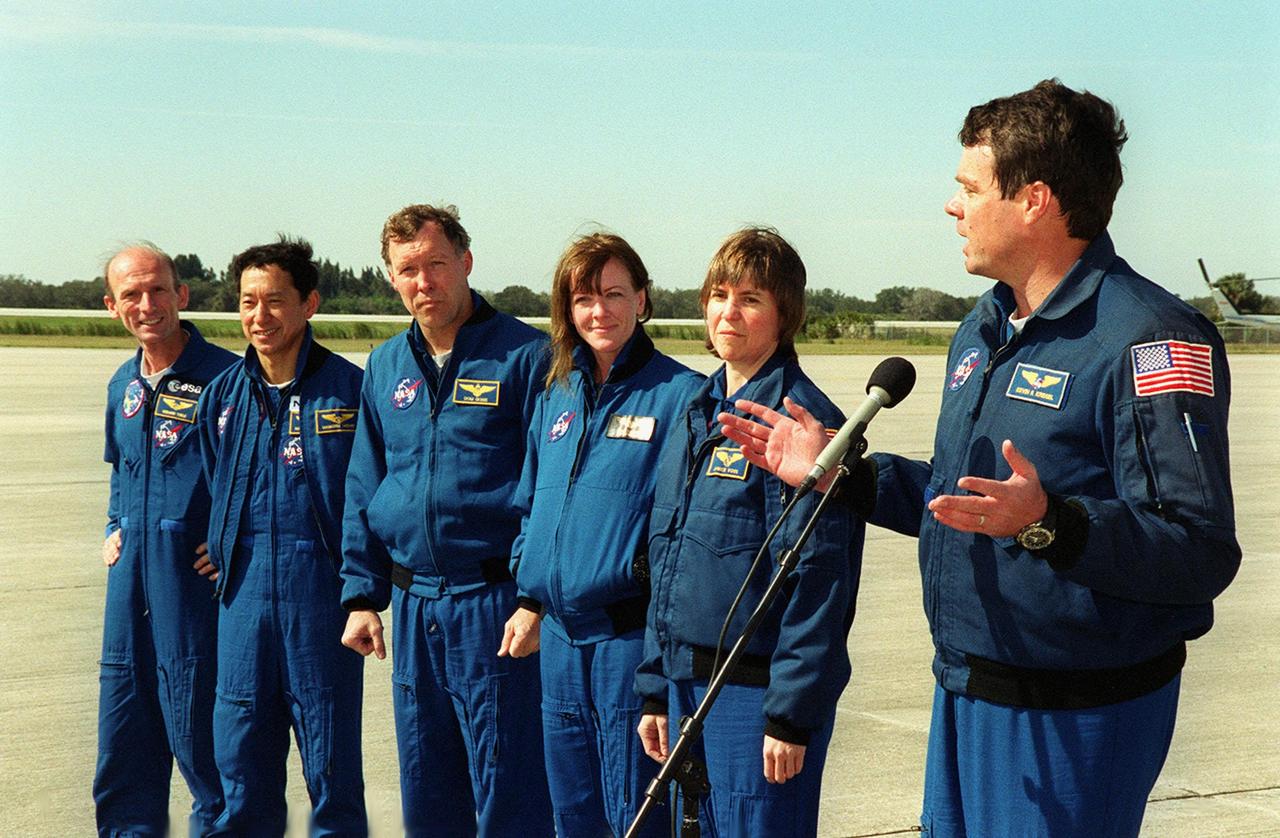
After arriving at KSC's Shuttle Landing Facility, the STS-99 crew pause to greet the media and Commander Kevin Kregel (right) introduces his crew: (from left) Mission Specialists Gerhard Thiele (Ph.D.) and Mamoru Mohri (Ph.D.); Pilot Dominic Gorie; and Mission Specialists Janet Lynn Kavandi (Ph.D.) and Janice Voss (Ph.D.). Thiele is with the European Space Agency and Mohri is with the National Space Development Agency (NASDA) of Japan. Over the next few days, the crew will review mission procedures, conduct test flights in the Shuttle Training Aircraft and undergo routine preflight medical exams. STS-99 is the Shuttle Radar Topography Mission, which will chart a new course, using two antennae and a 200-foot-long section of space station-derived mast protruding from the payload bay to produce unrivaled 3-D images of the Earth's surface. The result of the Shuttle Radar Topography Mission could be close to 1 trillion measurements of the Earth's topography. Besides contributing to the production of better maps, these measurements could lead to improved water drainage modeling, more realistic flight simulators, better locations for cell phone towers, and enhanced navigation safety. Launch of Endeavour is scheduled for Jan. 31 at 12:47 p.m. EST
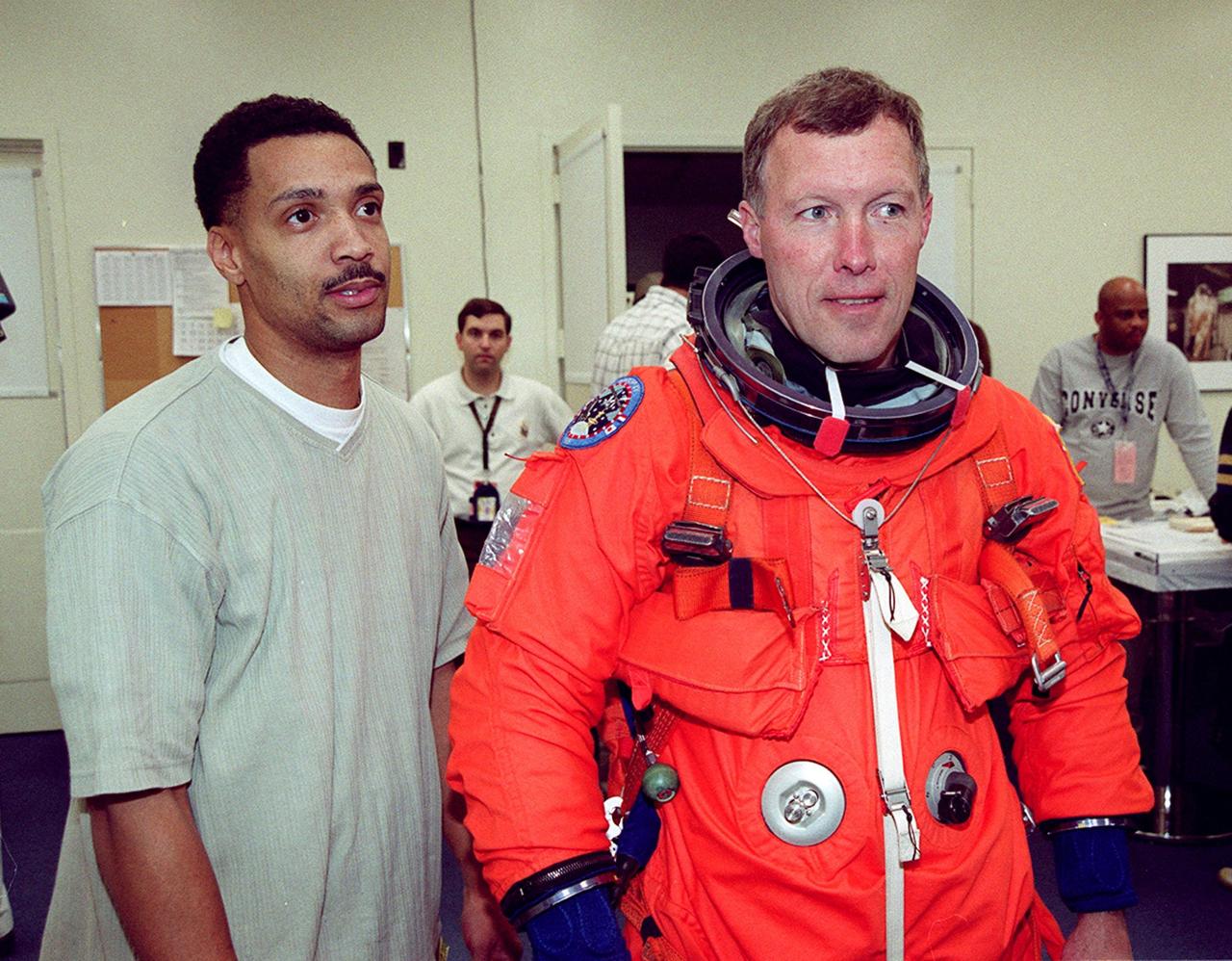
In the Operations and Checkout Building's suitup room, Carlous Gillis, with United Space Alliance, helps STS-99 Pilot Dominic Gorie with pre-pack and fit check. Gorie and other crew members Commander Kevin Kregel, and Mission Specialists Janet Kavandi, Janice Voss, Gerhard Thiele of Germany and Mamoru Mohri of Japan are preparing for launch of their mission on Feb. 11 at 12:30 p.m. EST aboard Space Shuttle Endeavour. STS-99 is the Shuttle Radar Topography Mission, which will produce unrivaled 3-D images of the Earth's surface. The result of the Shuttle Radar Topography Mission could be close to 1 trillion measurements of the Earth's topography. Landing is expected at KSC on Feb. 22 at 4:36 p.m. EST
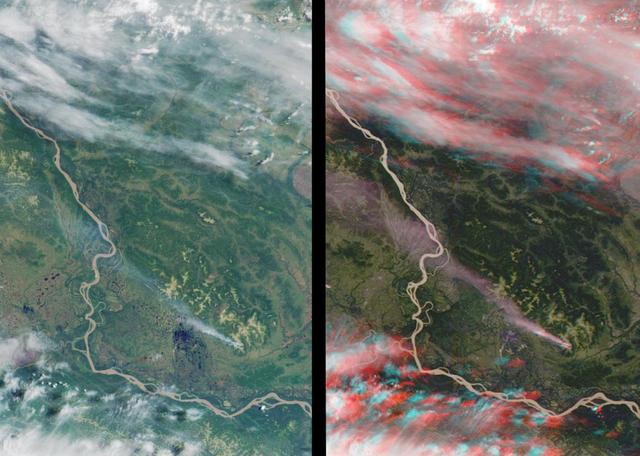
This stereo view of western Alaska was acquired by NASA Terra satellite on June 25, 2000. 3D glasses are necessary to view this image.
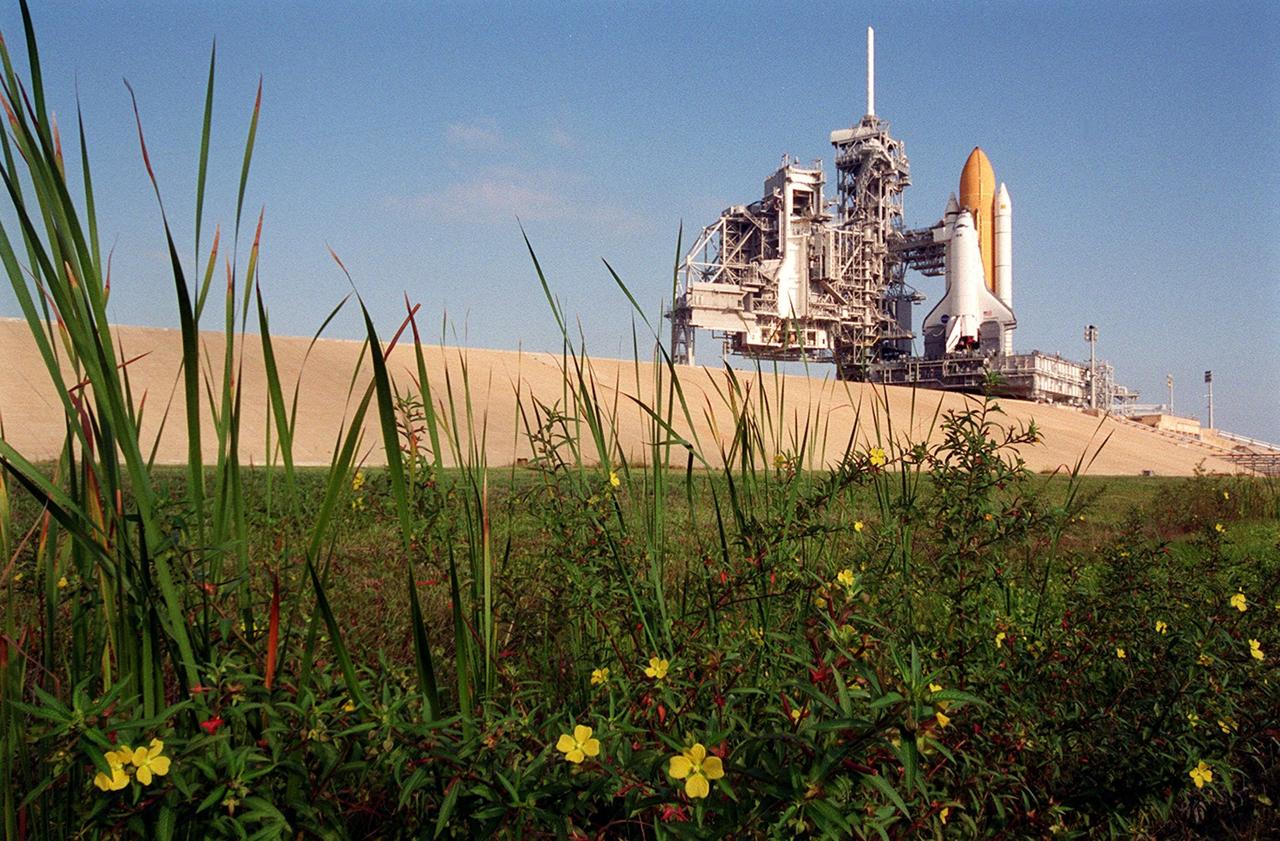
KENNEDY SPACE CENTER, FLA. -- Viewed across a field of wildflowers and other greenery, Space Shuttle Discovery rises above them on Launch Pad 39A. Discovery is undergoing final launch preparations of STS-92. Scheduled to lift off Oct. 5 at 9:38 p.m. EDT, Discovery will be making the 100th Space Shuttle mission launched from Kennedy Space Center. Discovery also will be making its 28th flight into space, more than any of the other orbiters to date. STS-92 is a mission to the International Space Station, carrying the Z1 truss, which is the first of 10 trusses on the Station, and the third Pressurized Mating Adapter
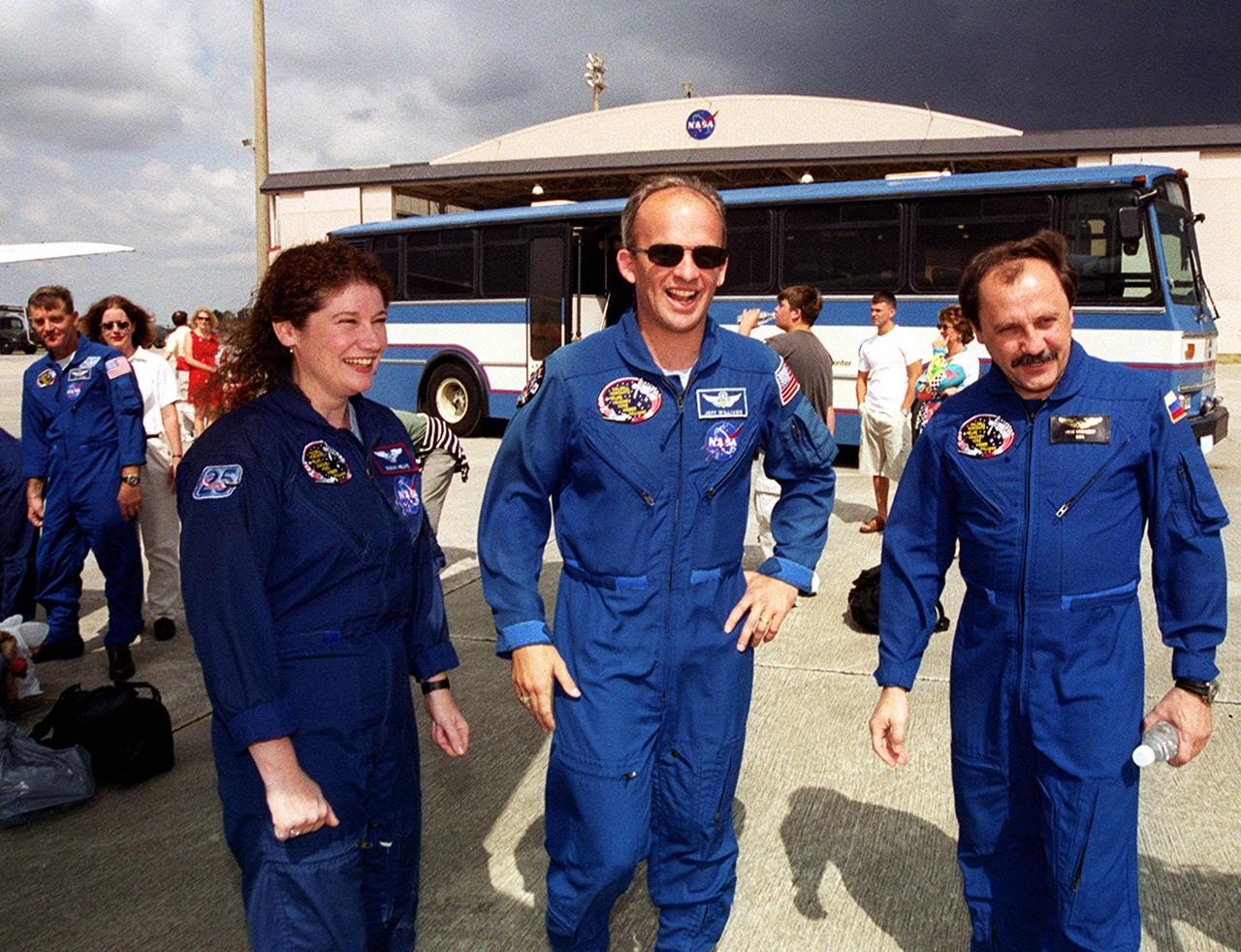
Members of the STS-101 crew gather with families and friends at Patrick Air Force Base before departure for Houston. In the foreground are Mission Specialists Susan J. Helms, Jeffrey N. Williams and Yury Usachev of Russia. At far left is Mission Specialist James S. Voss. After landing at 2:20 a.m. EDT May 29, the crew and their families enjoyed the Memorial Day holiday in Florida. The crew returned from the third flight to the International Space Station where they made repairs, transferred cargo and completed a space walk to install and connect several pieces of equipment on the outside of the Space Station
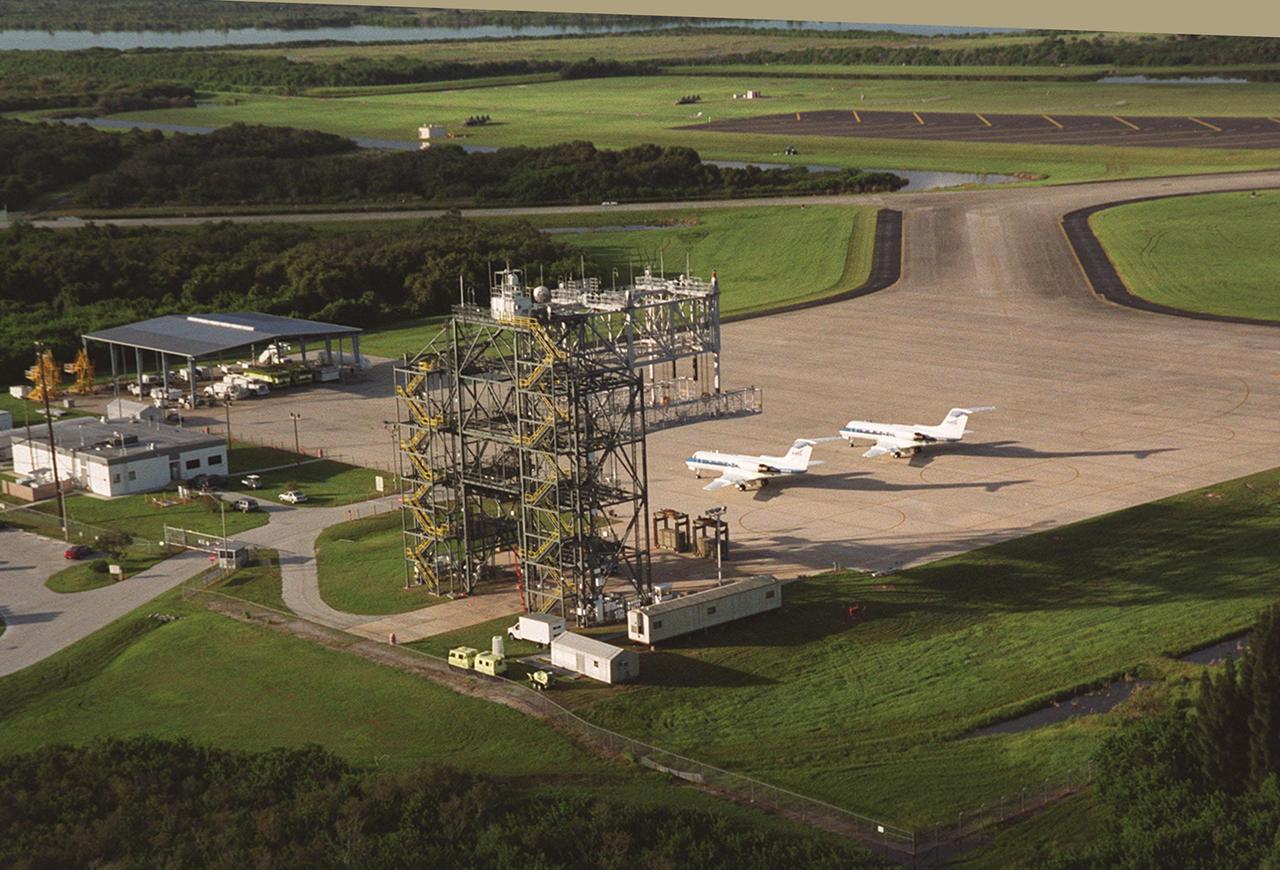
An aerial view of the Shuttle Landing Facility shows the Mate/Demate device in the foreground, with two Shuttle Training Aircraft (STA) on the ground behind it. Visible in the background is the runway and the taxi way leading from the SLF to the right. The STAs are Grumman Gulfstream 2 aircraft with converted cockpits that emulate those in the Shuttles for practice landings at the SLF.
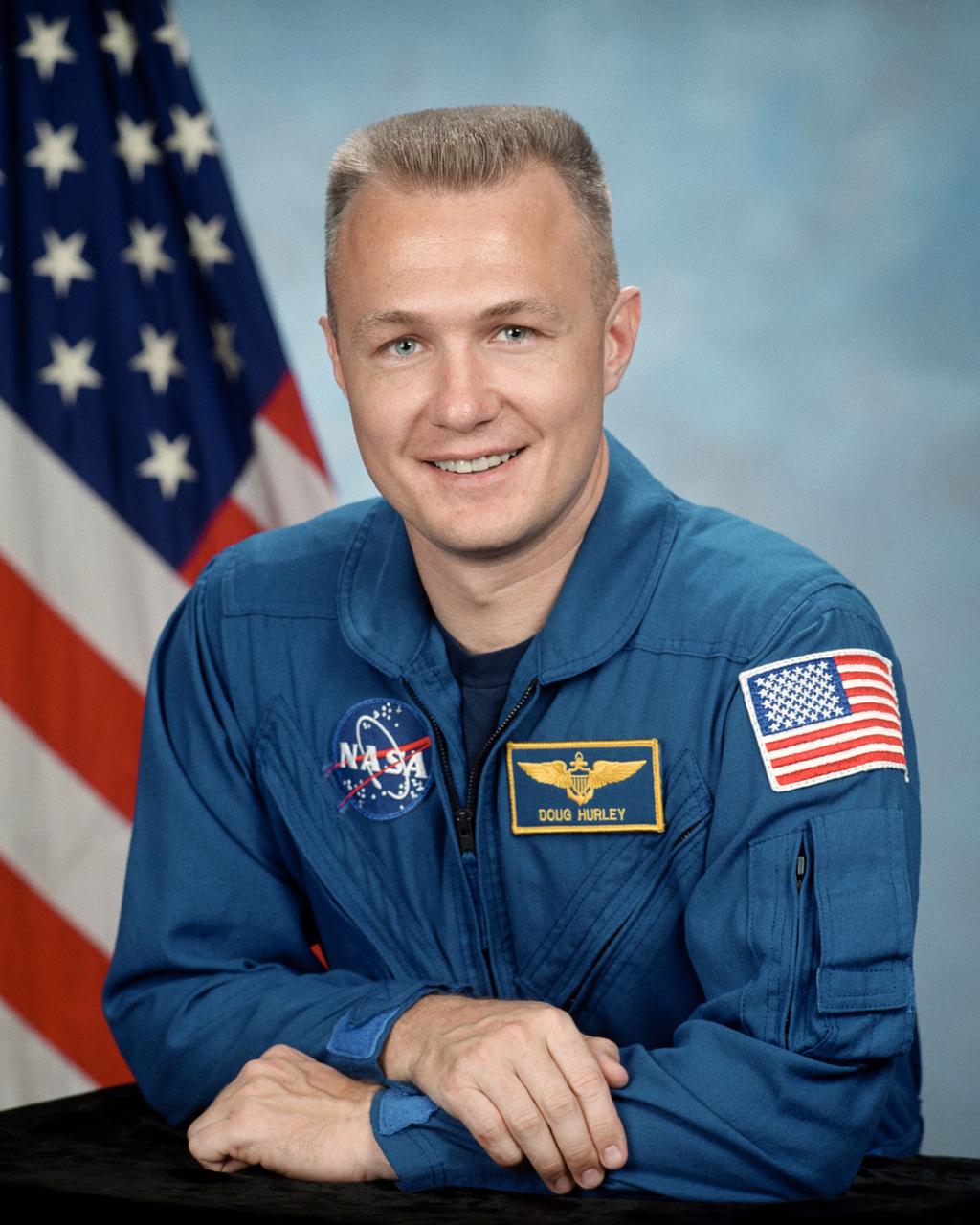
JOHNSON SPACE CENTER, Houston -- JSC2000-07599 (November 2000) --- Astronaut Douglas G. Hurley, pilot
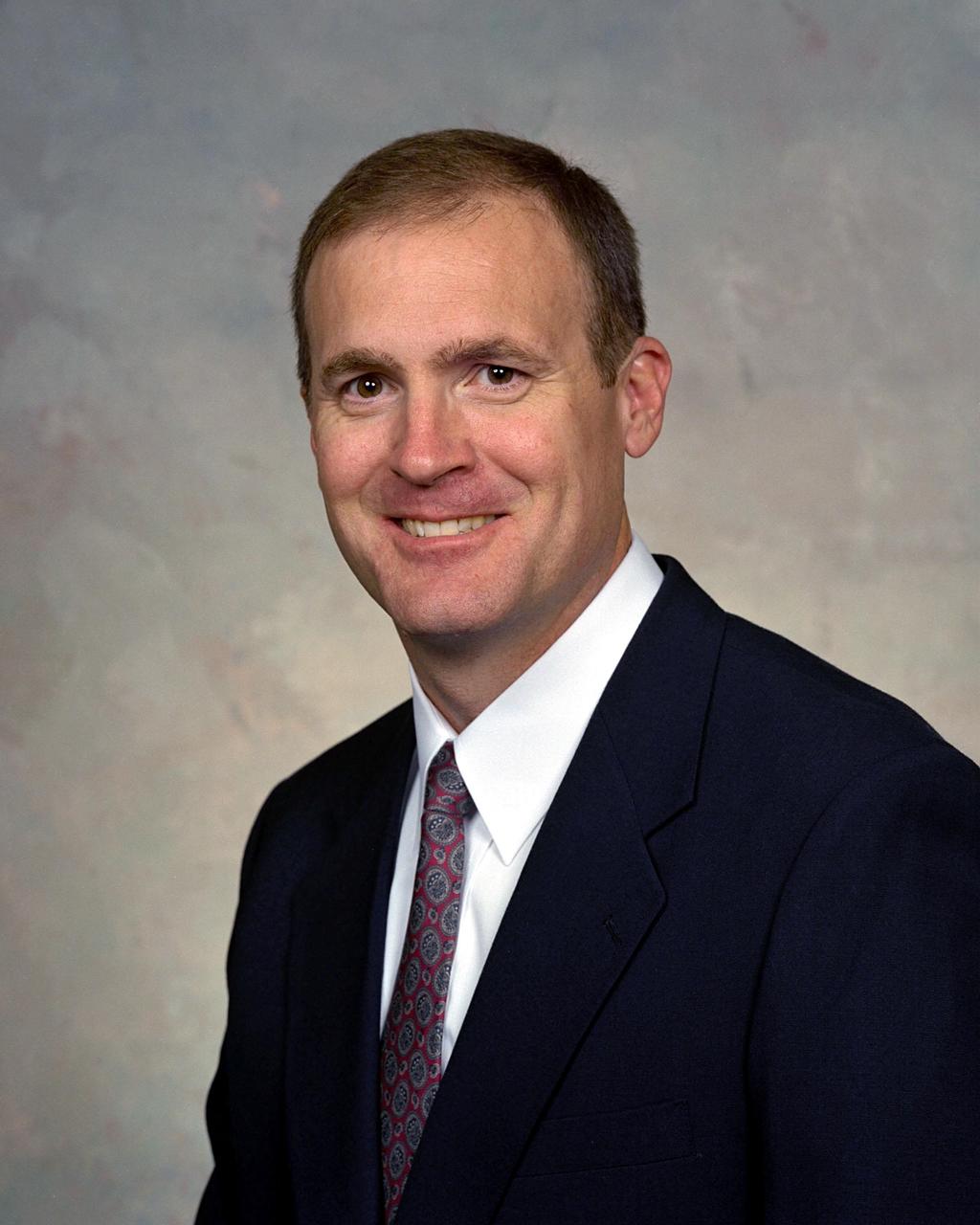
KENNEDY SPACE CENTER, FLA. -- Official portrait of James D. Halsell Jr., manager, Space Shuttle Program Integration Office.

KENNEDY SPACE CENTER, FLA. -- At Launch Pad 39A, work on replacing the Power Drive Unit (PDU) in Space Shuttle Atlantis is suspended in the early morning hours. The crane used to hoist the PDU is barely visible against the tail and next to a main engine nozzle. The Rotating Service Structure had to be moved away from the Shuttle to do the work. Atlantis is scheduled to lift off April 24 at 4:15 p.m. EDT on mission STS-101, the third flight to the International Space Station. The primary mission is to carry logistics and supplies to the Space Station, plus the crew will be preparing the Station for the arrival of the Zvezda Service Module, expected to be launched by Russia in July 2000
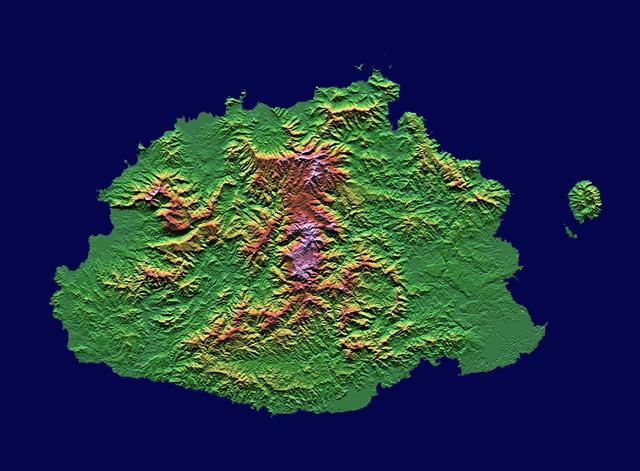
The Sovereign Democratic Republic of the Fiji Islands, commonly known as Fiji, is an independent nation consisting of some 332 islands surrounding the Koro Sea in the South Pacific Ocean. This image shows Viti Levu, the largest island in the group.

The preliminary design for the Space Experiment Research and Processing Laboratory (SERPL) at Kennedy Space Center is shown in this artist's rendition. The SERPL is a planned 100,000-square-foot laboratory that will provide expanded and upgraded facilities for hosting International Space Station experiment processing. In addition, it will provide better support for other biological and life sciences payload processing at KSC. It will serve as a magnet facility for a planned 400-acre Space Station Commerce Park

KENNEDY SPACE CENTER, FLA. -- Workers in the Space Station Processing Facility check the progress of the SPACEHAB module as it is lowered toward the payload canister below. The module, part of the payload on mission STS-106, will be placed in the payload canister for transport to the launch pad. STS-106 is scheduled to launch Sept. 8 at 8:31 a.m. EDT. During the mission to the International Space Station, the crew will complete service module support tasks on orbit, transfer supplies and outfit the Space Station for the first long-duration crew
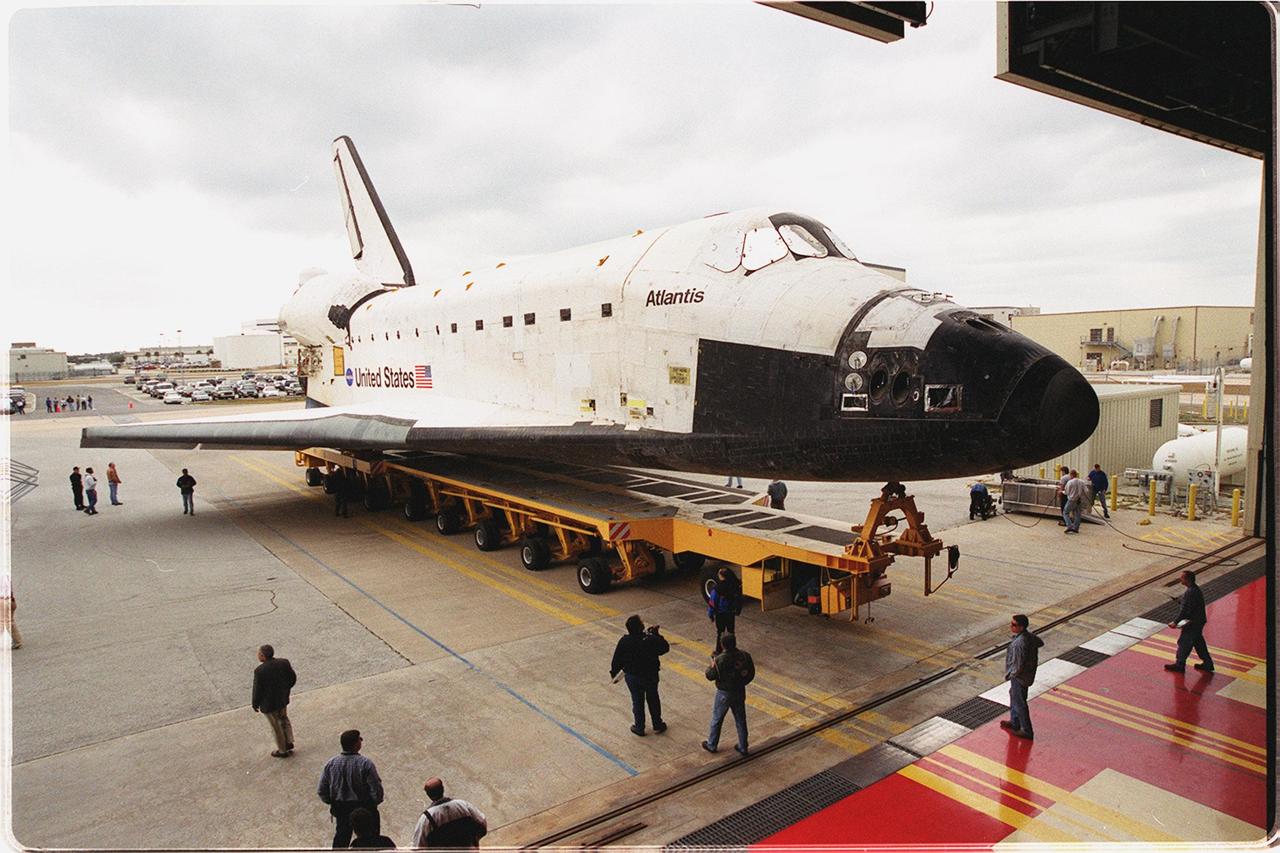
The orbiter Atlantis rolls out of the Orbiter Processing Facility bay 3 on its transporter. It is being transferred to the Vehicle Assembly Building where it will be raised to vertical and lifted up and into high bay 3 for stacking with its external tank and solid rocket boosters. Atlantis will fly on mission STS-98, the seventh construction flight to the International Space Station. The orbiter will carry in its payload bay the U.S. Laboratory, named Destiny, that will have five system racks already installed inside of the module. After delivery of electronics in the lab, electrically powered attitude control for Control Moment Gyroscopes will be activated. Atlantis is scheduled for launch on Jan. 18, 2001, at 2:44 a.m. EST, with a crew of five
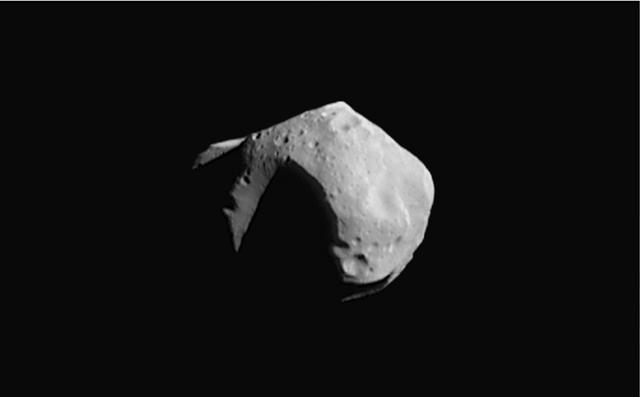
Mosaic of Mathilde
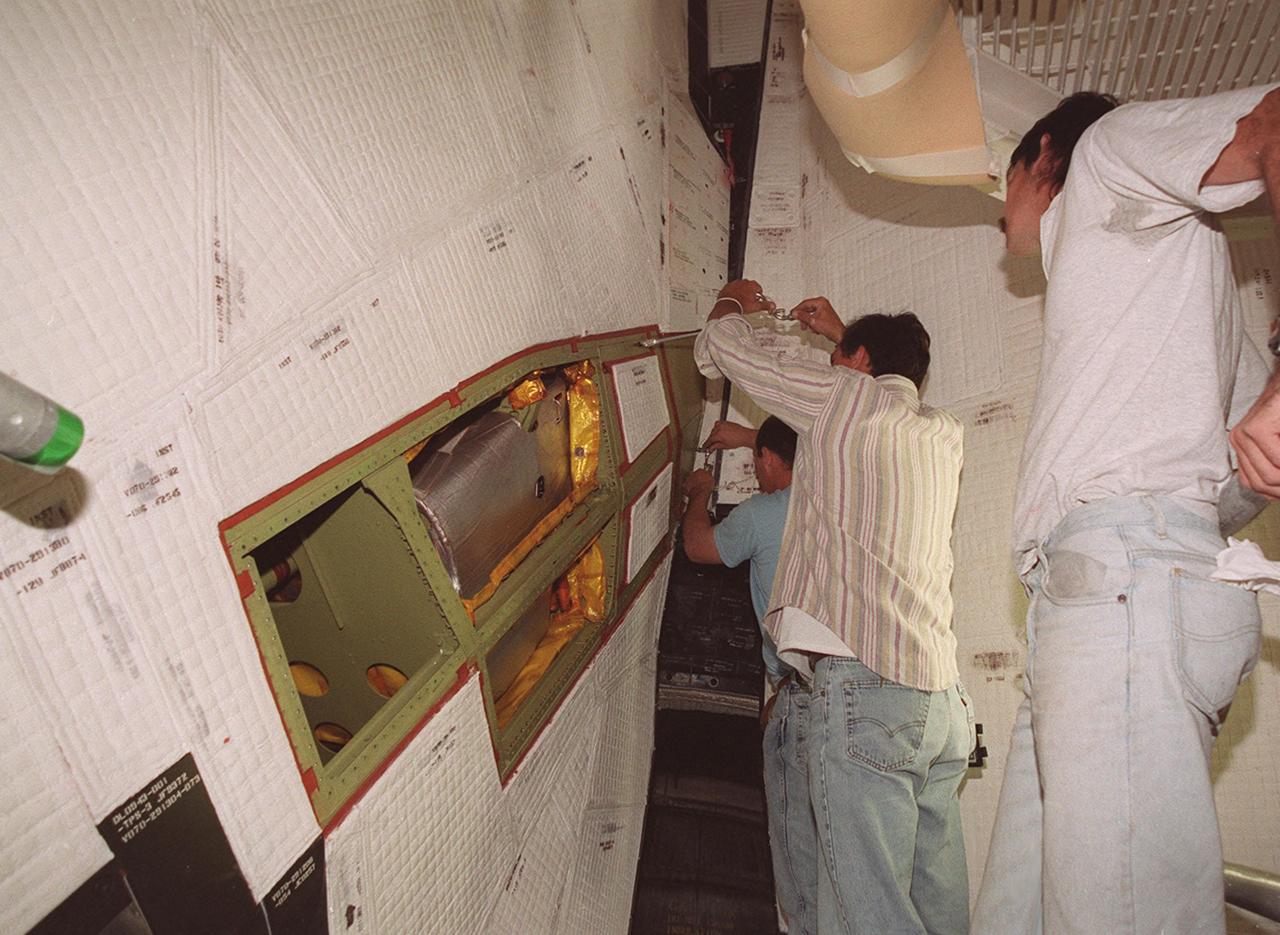
KENNEDY SPACE CENTER, FLA. -- Technicians at Launch Pad 39A begin removing thermal blankets and panels from a site near the tail of Space Shuttle Atlantis in order to reach the power drive unit (PDU) inside. The PDU controls the rudder/speed brake on the orbiter. From left to right are Mark Noel, Bob Wright and Tod Biddle, with United Space Alliance. Shuttle managers decided to replace the faulty PDU, about the size of an office copy machine, at the launch pad. If successful, launch preparations will continue as planned, with liftoff targeted for April 24 at 4:15 p.m. on mission STS-101. The mission is the third assembly flight for the International Space Station, carrying logistics and supplies to the Space Station, plus the crew will be preparing the Station for the arrival of the Zvezda Service Module, expected to be launched by Russia in July 2000. The crew will conduct one space walk to perform maintenance on the Space Station
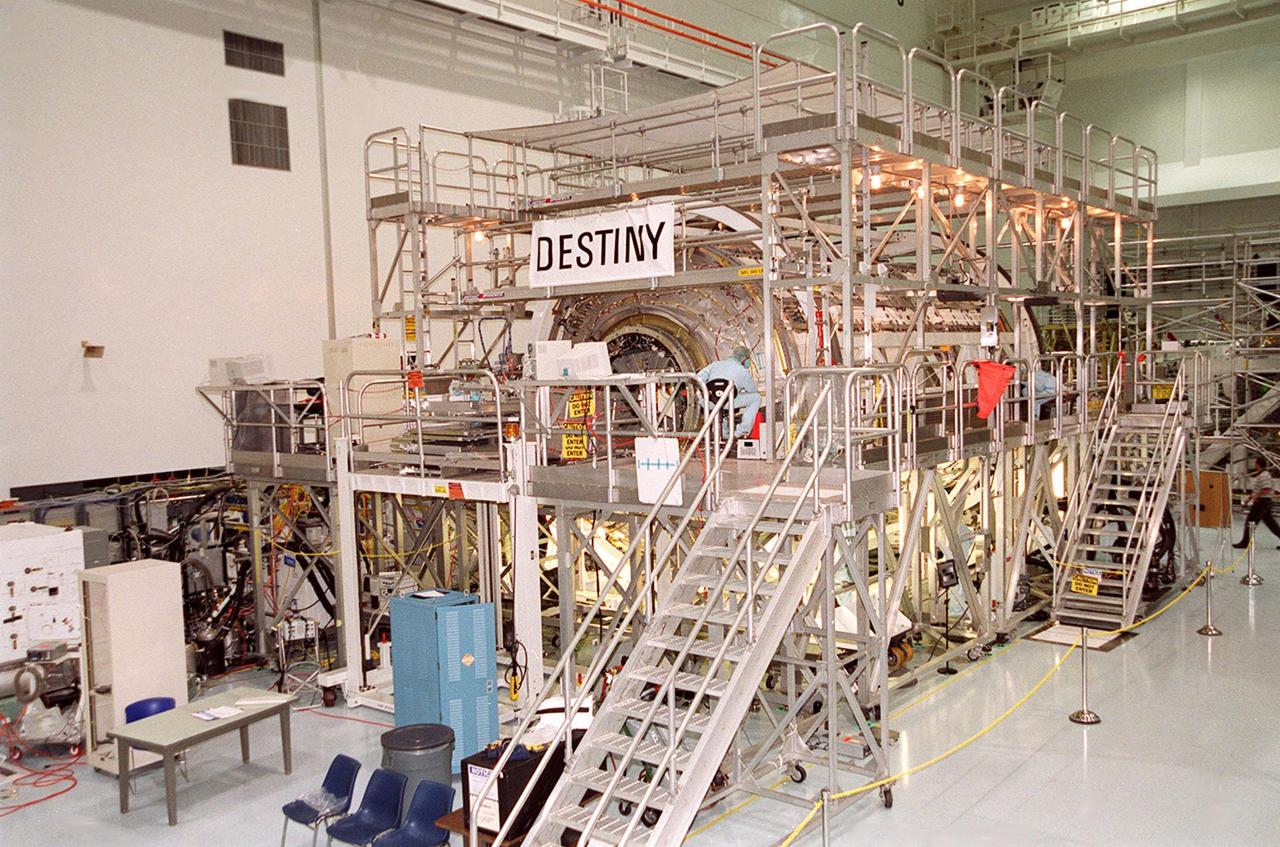
KENNEDY SPACE CENTER, FLA. -- In the Space Station Processing Facility, the U.S. Laboratory Destiny is about to undergo rotation in its workstand. A component of the International Space Station, Destiny is scheduled to fly on mission STS-98 in early 2001. During the mission, the crew will install the Lab during a series of three space walks. The STS-98 mission will provide the station with science research facilities and expand its power, life support and control capabilities. The U.S. Lab module continues a long tradition of microgravity materials research, first conducted by Skylab and later Shuttle and Spacelab missions. Destiny is expected to be a major feature in future research, providing facilities for biotechnology, fluid physics, combustion, and life sciences research
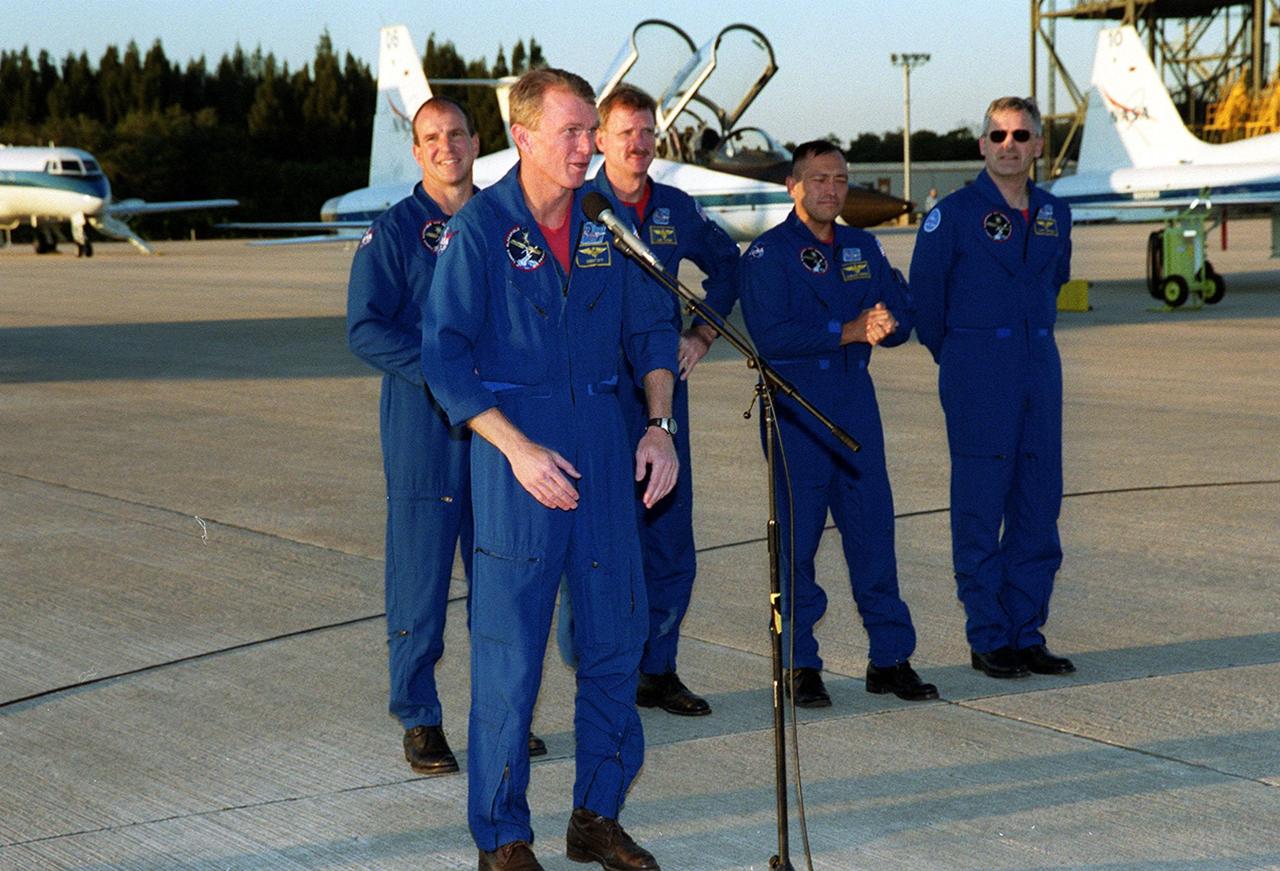
After arriving at the Shuttle Landing Facility, the STS-97 crew gather to address the media. At the microphone, Commander Brent Jett praises the efforts of the KSC workers to get ready for the launch. Behind Jett are Pilot Michael Bloomfield and Mission Specialists Joseph Tanner, Carlos Noriega and Marc Garneau, who is with the Canadian Space Agency. Mission STS-97 is the sixth construction flight to the International Space Station. Its payload includes the P6 Integrated Truss Structure and a photovoltaic (PV) module, with giant solar arrays that will provide power to the Station. The mission includes two spacewalks to complete the solar array connections. STS-97 is scheduled to launch Nov. 30 at about 10:06 p.m. EST
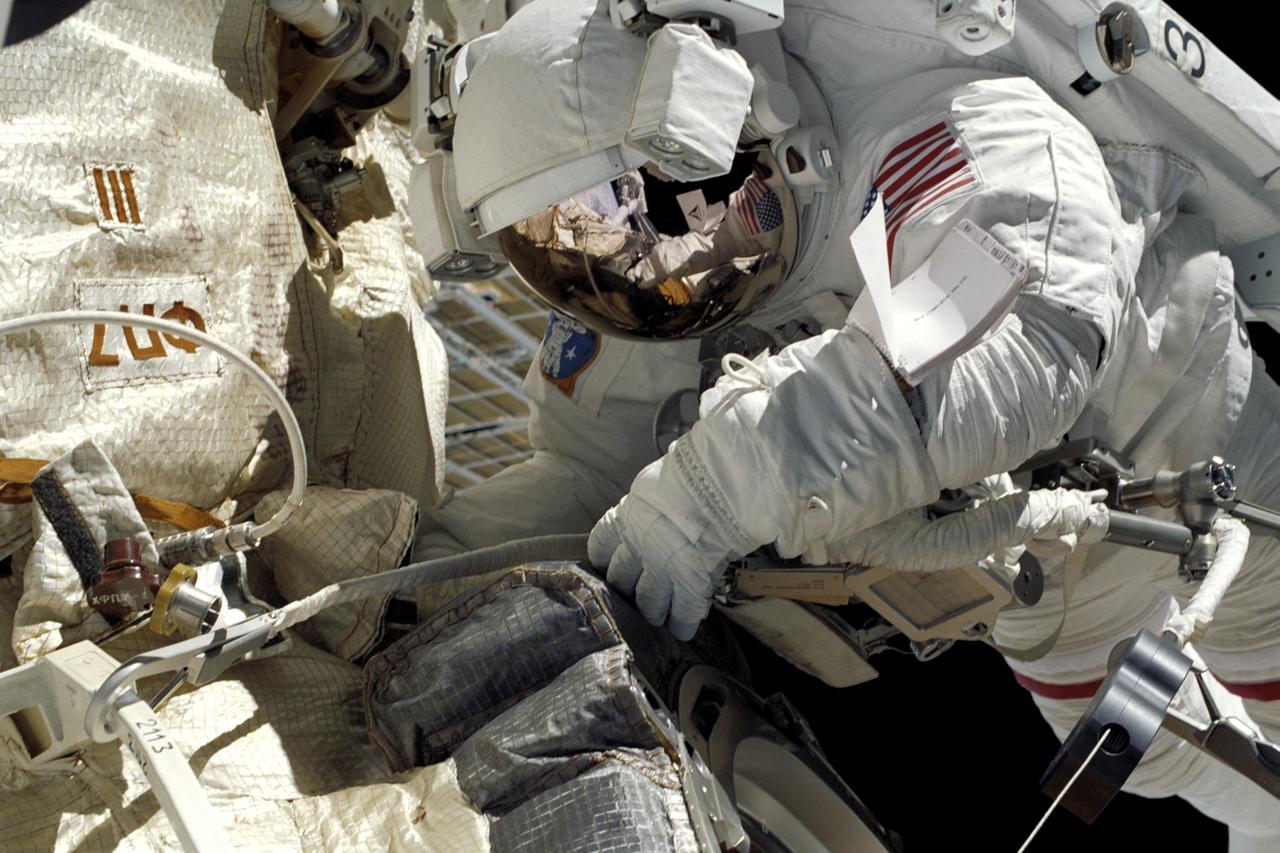
S106-349-012 (11 September 2000) --- Astronaut Edward T. Lu, mission specialist, was captured on film by his spacewalking colleague, cosmonaut Yuri I. Malenchenko, during the 6-hour-plus space walk the two performed on the exterior of the International Space Station (ISS). Malenchenko was one of two mission specialists on the 12-day flight who represented the Russian Aviation and Space Agency.
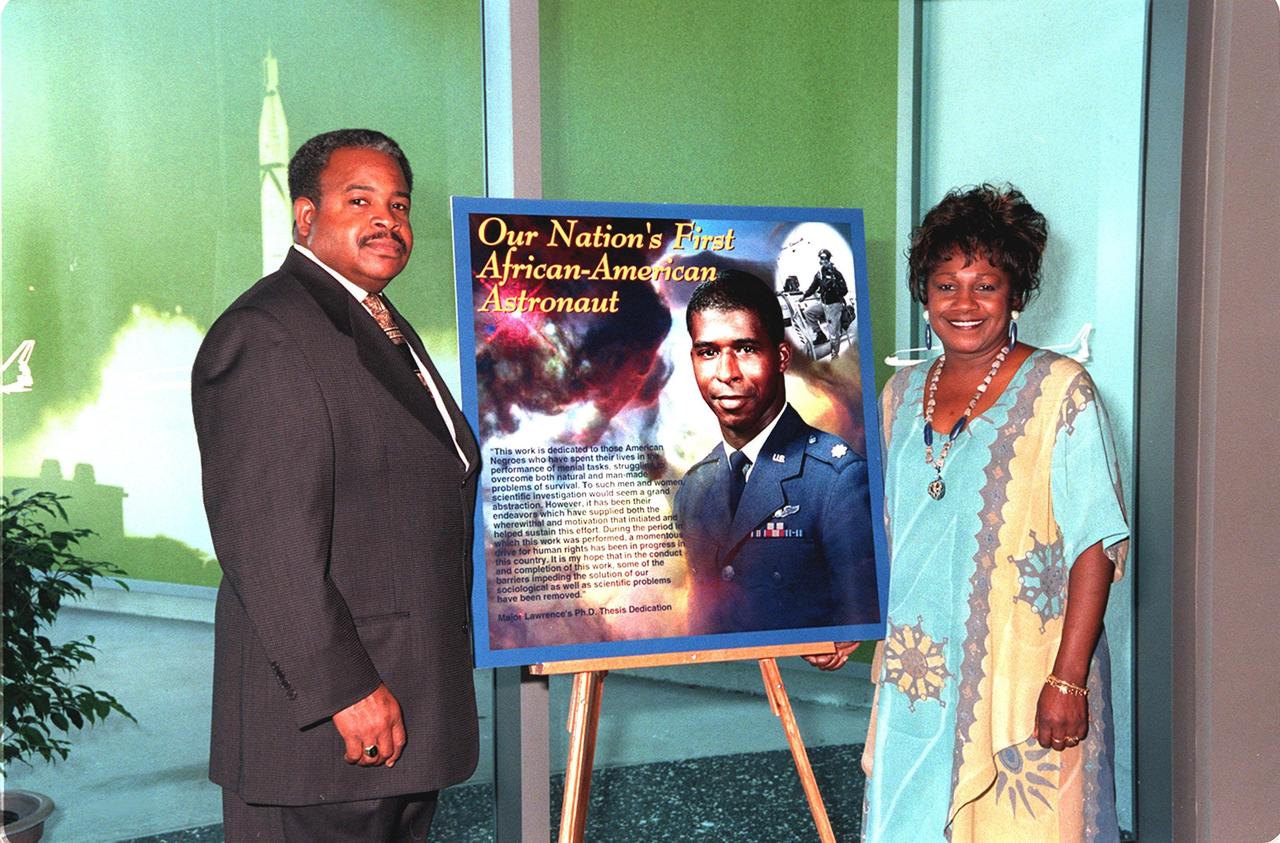
Mack McKinney (left), chief, Programs Resources Management, and Delores Abraham (right), with the Astronaut office, flank one of the posters decorating the Early Space Exploration Conference Center at the KSC Visitor Complex for the 2000 African American History Month Celebration Luncheon. McKinney is chairperson for the event
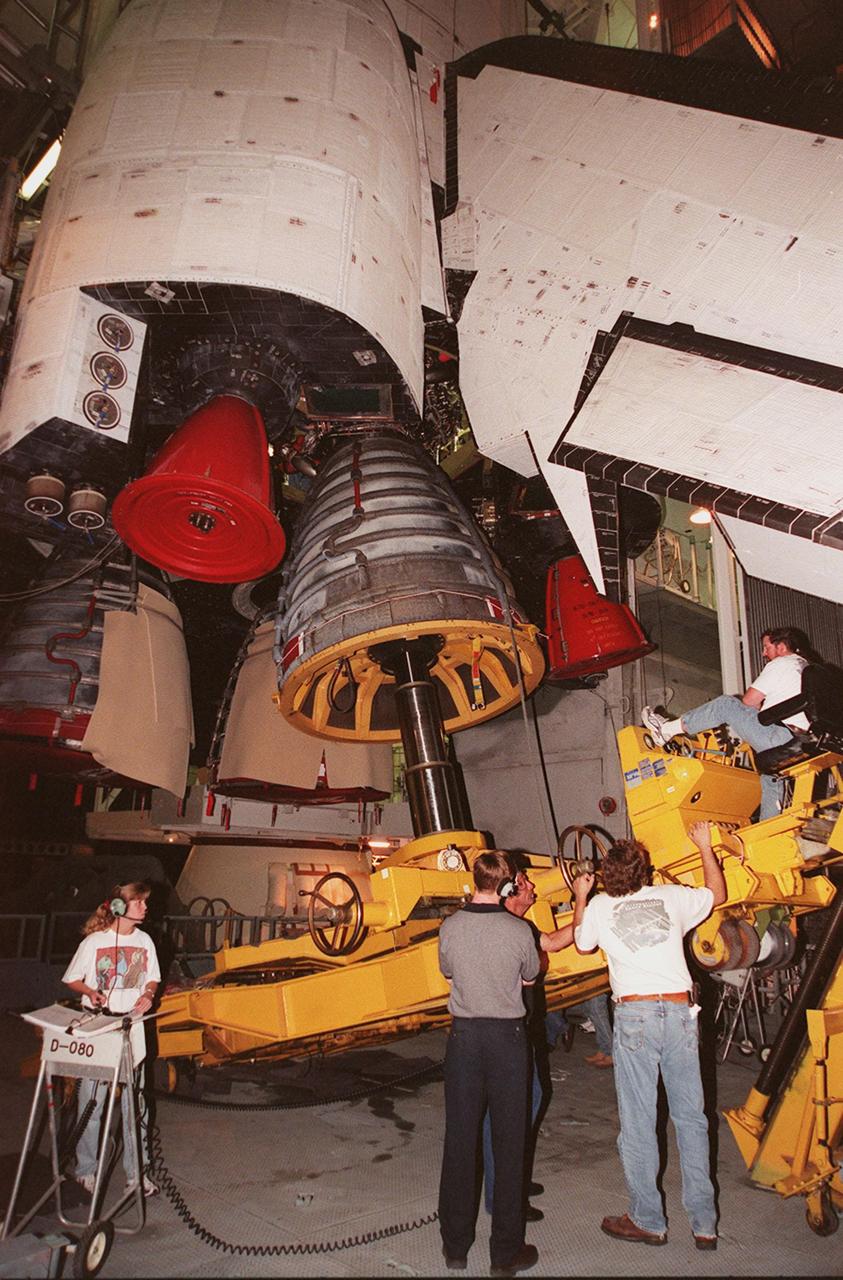
KENNEDY SPACE CENTER, FLA. -- Workers in the Vehicle Assembly Building oversee the replacement of Main Engine No. 1 in Space Shuttle Atlantis (overhead). An inventory review concerning defective main engine fuel pump tip seals indicated that defective seals might be present on the previous fuel pump for the engine. The decision was made to replace the suspect engine with one originally slated for Discovery. The main engine nozzle, visible in the photo, is 7.8 feet across and 9.4 feet high. Space Shuttle Atlantis is scheduled to launch no earlier than April 17, 2000, on mission STS-101 to resupply the International Space Station for the arrival of the next pressurized module, the Russian-built Zvezda
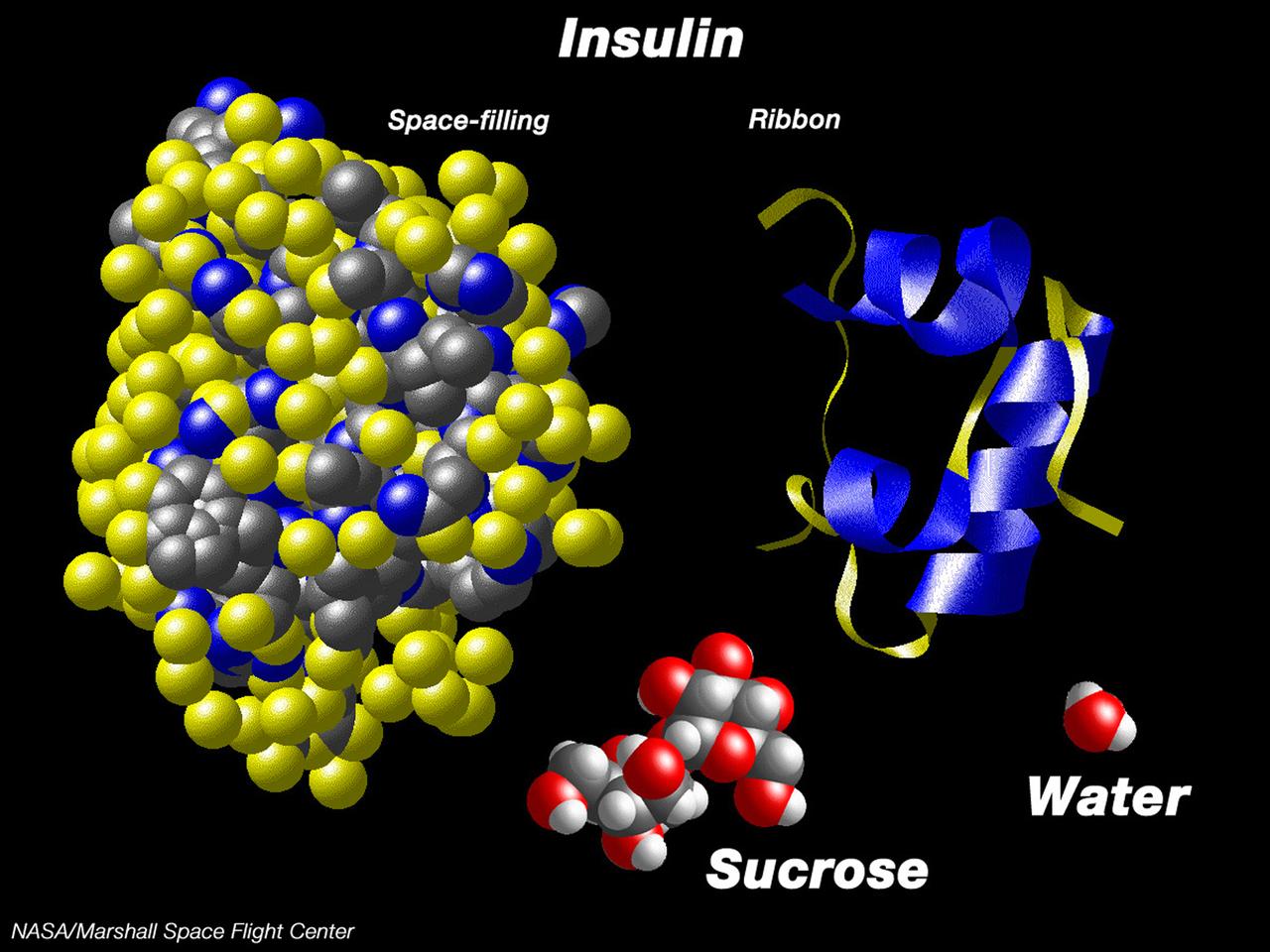
This computer graphic depicts the relative complexity of crystallizing large proteins in order to study their structures through x-ray crystallography. Insulin is a vital protein whose structure has several subtle points that scientists are still trying to determine. Large molecules such as insuline are complex with structures that are comparatively difficult to understand. For comparison, a sugar molecule (which many people have grown as hard crystals in science glass) and a water molecule are shown. These images were produced with the Macmolecule program. Photo credit: NASA/Marshall Space Flight Center (MSFC)
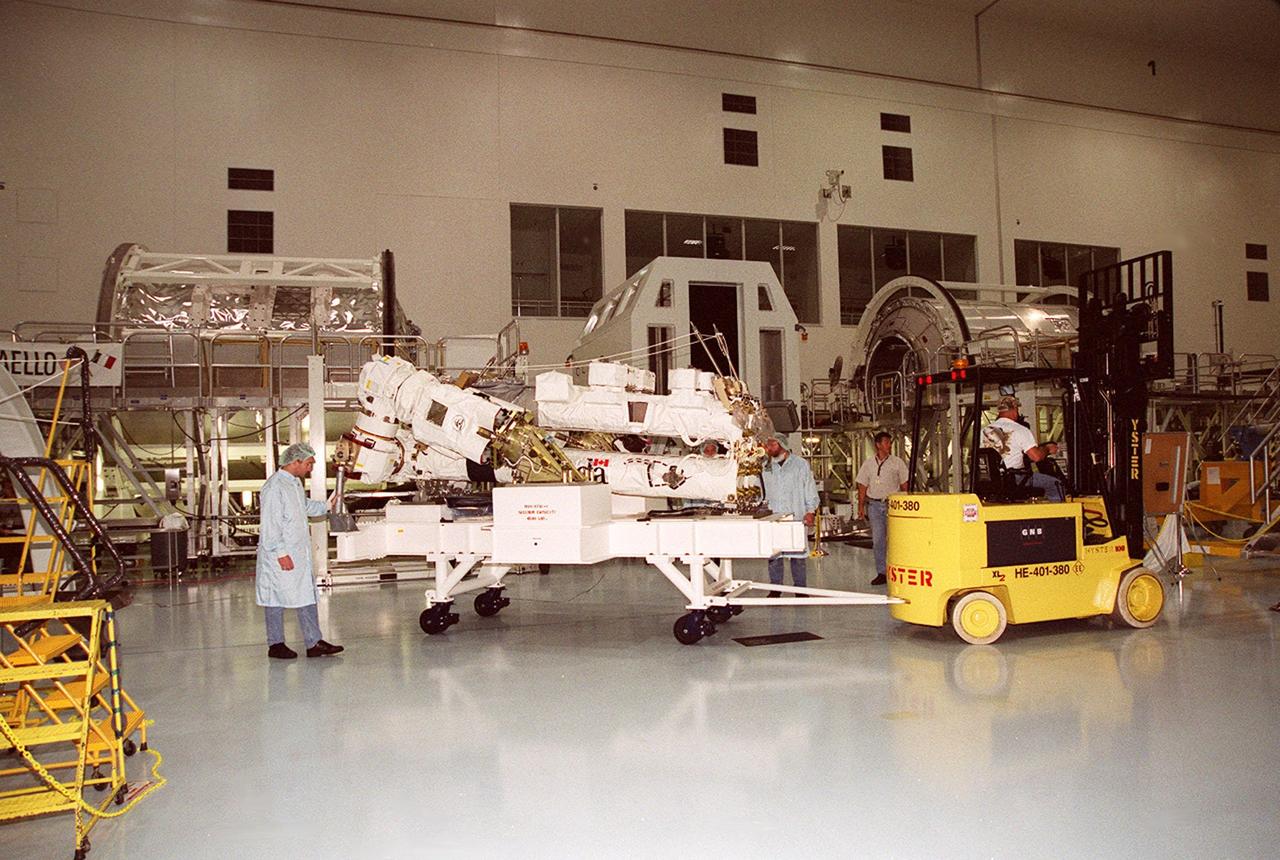
Workers in the Space Station Processing Facility move the Space Station Remote Manipulator System (SSRMS), also known as the “Canadian arm,” to a pallet for testing. The SSRMS is part of Canada’s Mobile Servicing System, an essential component of the International Space Station. This robotic system will play a key role in Space Station assembly and maintenance, moving equipment and supplies around the Station, releasing and capturing satellites, supporting astronauts working in space and servicing instruments and other payloads attached to the Space Station. SSRMS will be on Shuttle mission STS-100, flight 6A, to the Space Station, scheduled for launch April 19, 2001

KENNEDY SPACE CENTER, Fla. -- As Space Shuttle Atlantis lifts off from Launch Pad 39A on mission STS-101, twin columns of smoke from the solid rocket boosters trail behind. Liftoff occurred on time at 6:11:10 a.m. EDT. The mission is taking the crew of seven to the International Space Station to deliver logistics and supplies as well as to prepare the Station for the arrival of the Zvezda Service Module, expected to be launched by Russia in July 2000. Also, the crew will conduct one space walk and will reboost the space station from 230 statute miles to 250 statute miles. This will be the third assembly flight to the Space Station. After a 10-day mission, landing is targeted for May 29 at 2:19 a.m. EDT. This is the 98th Shuttle flight and the 21st flight for Shuttle Atlantis
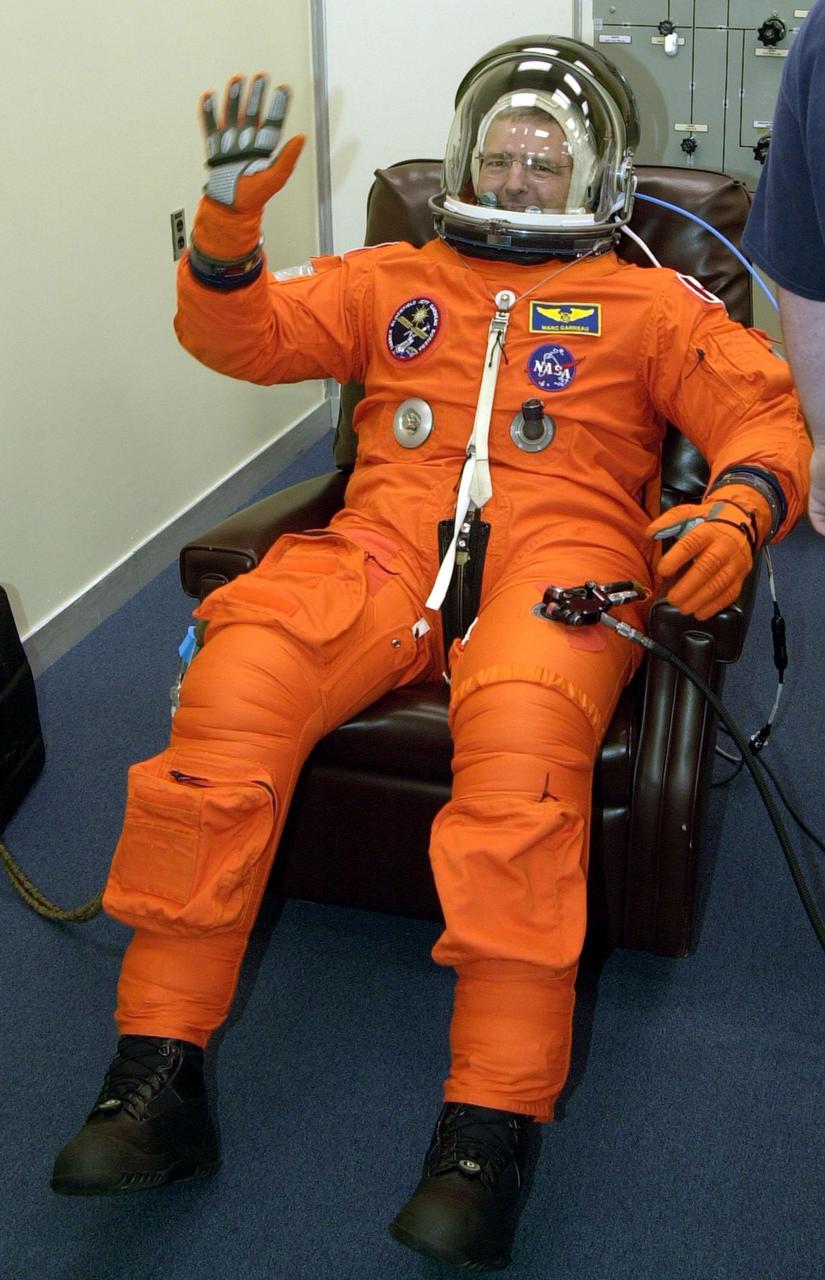
During pre-pack and fit check in the Operations and Checkout Building, STS-97 Mission Specialist Marc Garneau waves after getting his helmet on. Garneau is with the Canadian Space Agency. Mission STS-97 is the sixth construction flight to the International Space Station. Its payload includes the P6 Integrated Truss Structure and a photovoltaic (PV) module, with giant solar arrays that will provide power to the Station. The mission includes two spacewalks to complete the solar array connections. STS-97 is scheduled to launch Nov. 30 at about 10:06 p.m. EST
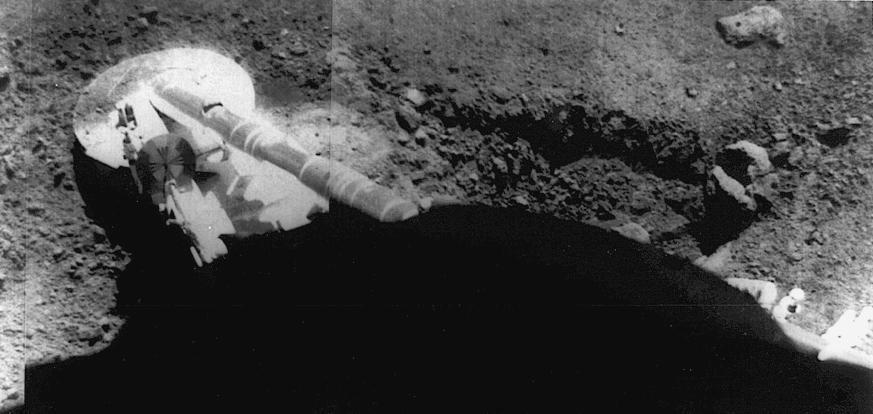
Surveyor 5 image of the footpad resting in the lunar soil. The trench at right was formed by the footpad sliding during landing. Surveyor 5 landed on the Moon on 11 September 1967 at 1.41 N, 23.18E in Mare Tranquillitatis.

ISS01-E-5117 (December 2000) --- This westerly-looking view over north Harris County featuring Lake Houston and the Bush Intercontinental Airport was photographed with a digital still camera from the Earth-orbiting International Space Station (ISS). Parts of the 610 Loop, Interstate Highway 45, U.S. Highway 59 and the Sam Houston Toll Way can be easily delineated in the view. Part of the downtown area is just below center at left edge of the frame.

The STS-101 crew wave to onlookers as they leave the Operations and Checkout Building enroute to Launch Pad 39A and liftoff of Space Shuttle Atlantis, targeted for 4:15 p.m. EDT. In their orange launch and entry suits, they are (front line) Pilot Scott J. Horowitz and Commander James D. Halsell Jr.; (second line) Mission Specialists Mary Ellen Weber and Jeffrey N. Williams; and (third line) Mission Specialists Susan Helms, Yuri Usachev of Russia and James S. Voss. The mission will take the crew to the International Space Station to deliver logistics and supplies and to prepare the Station for the arrival of the Zvezda Service Module, expected to be launched by Russia in July 2000. Also, the crew will conduct one space walk. This will be the third assembly flight to the Space Station. The mission is expected to last about 10 days, with Atlantis landing at KSC Thursday, May 4, about 11:23 a.m. EDT
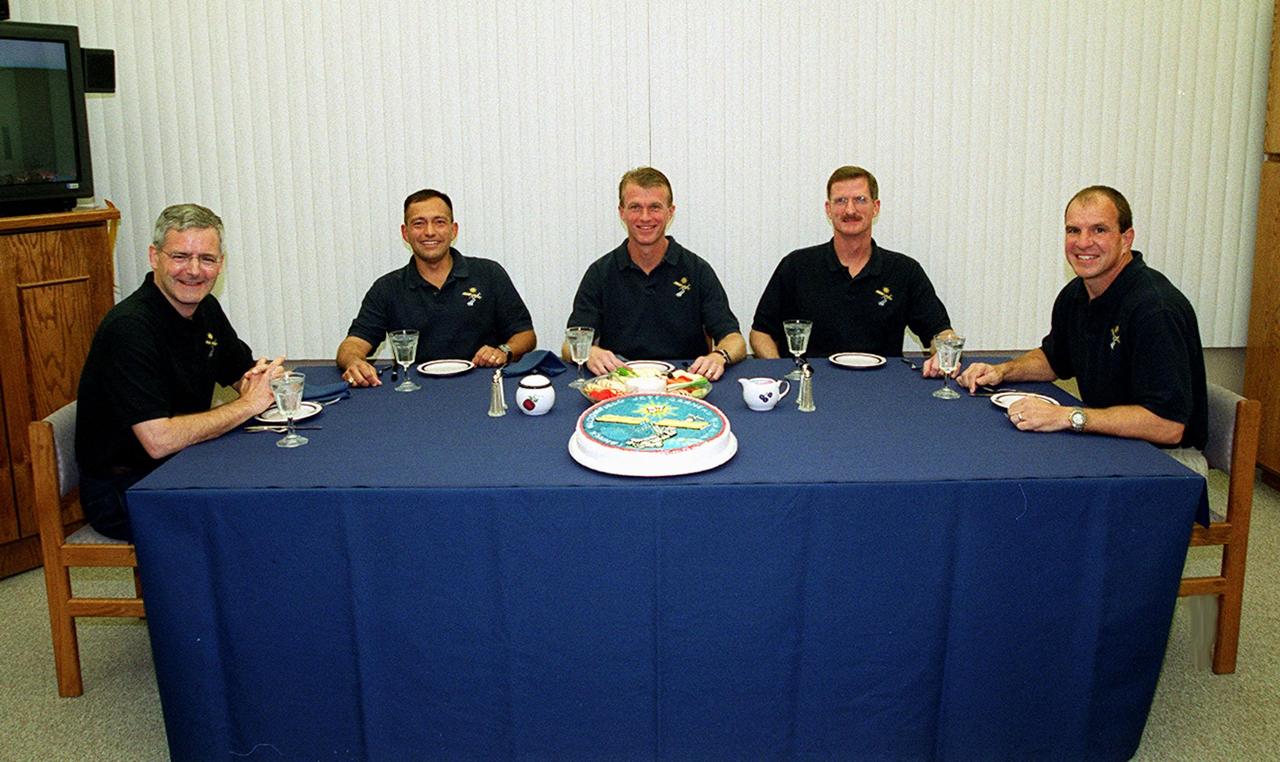
The STS-97 crew are ready to enjoy a snack in the crew quarters, Operations and Checkout Building, before beginning to suit up for launch. Seated from left are Mission Specialists Marc Garneau and Carlos Noriega, Commander Brent Jett, Mission Specialist Joseph Tanner and Pilot Michael Bloomfield. Garneau is with the Canadian Space Agency. Mission STS-97 is the sixth construction flight to the International Space Station. It is transporting the P6 Integrated Truss Structure that comprises Solar Array Wing-3 and the Integrated Electronic Assembly, to be installed on the Space Station. The solar arrays are mounted on a “blanket” that can be folded like an accordion for delivery. Once in orbit, astronauts will deploy the blankets to their full size. The 11-day mission includes two spacewalks to complete the solar array connections. The Station’s electrical power system will use eight photovoltaic solar arrays, each 112 feet long by 39 feet wide, to convert sunlight to electricity.. Gimbals will be used to rotate the arrays so that they will face the Sun to provide maximum power to the Space Station. Launch is scheduled for Nov. 30 at 10:06 p.m. EST
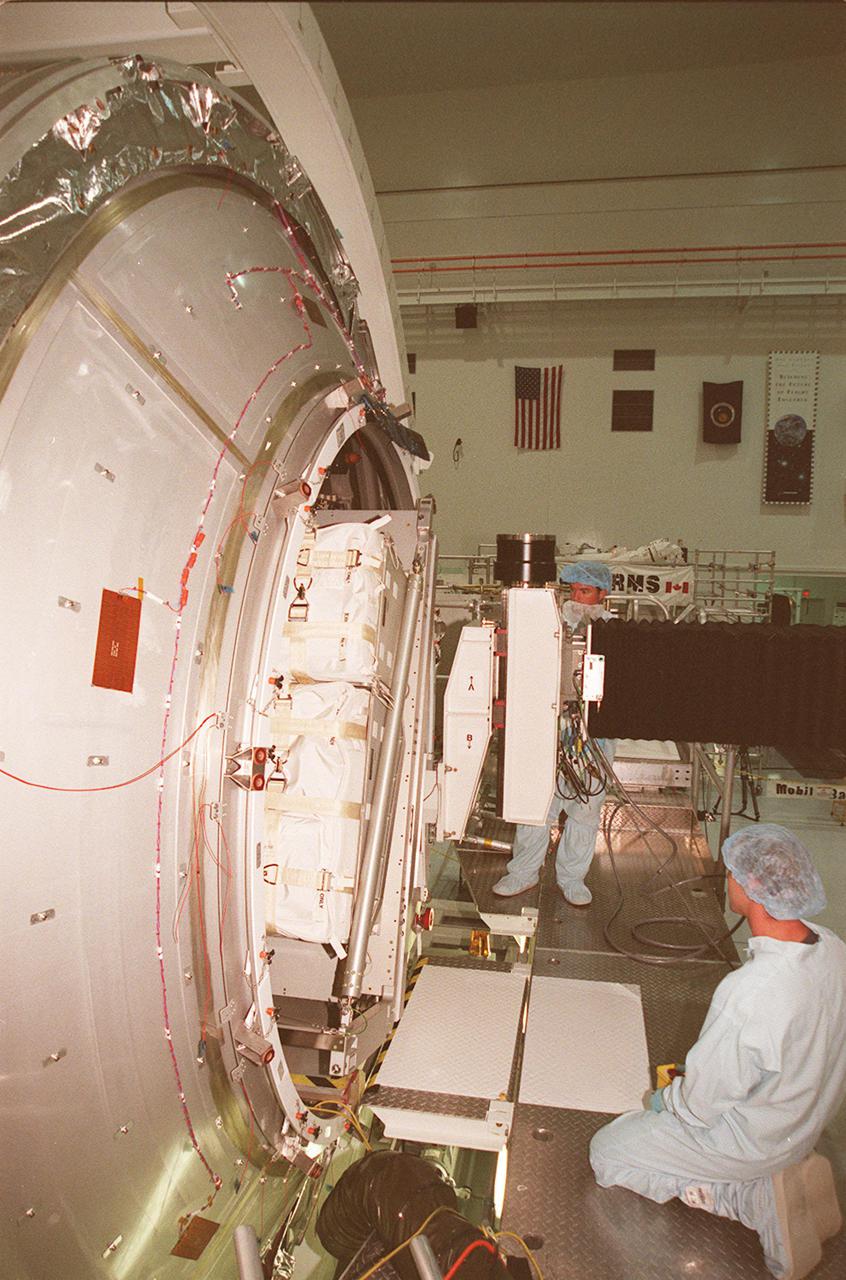
KENNEDY SPACE CENTER, FLA. -- Workers in the Space Station Processing Facility watch as a laboratory rack moves into the Multi-Purpose Logistics Module Leonardo. The MPLM is the first of three such pressurized modules that will serve as the International Space Station’s “moving vans,” carrying laboratory racks filled with equipment, experiments and supplies to and from the Space Station aboard the Space Shuttle. Leonardo will be launched March 1, 2001, on Shuttle mission STS-102 On that flight, Leonardo will be filled with equipment and supplies to outfit the U.S. laboratory module, being carried to the ISS on the Jan. 19, 2001, launch of STS-98
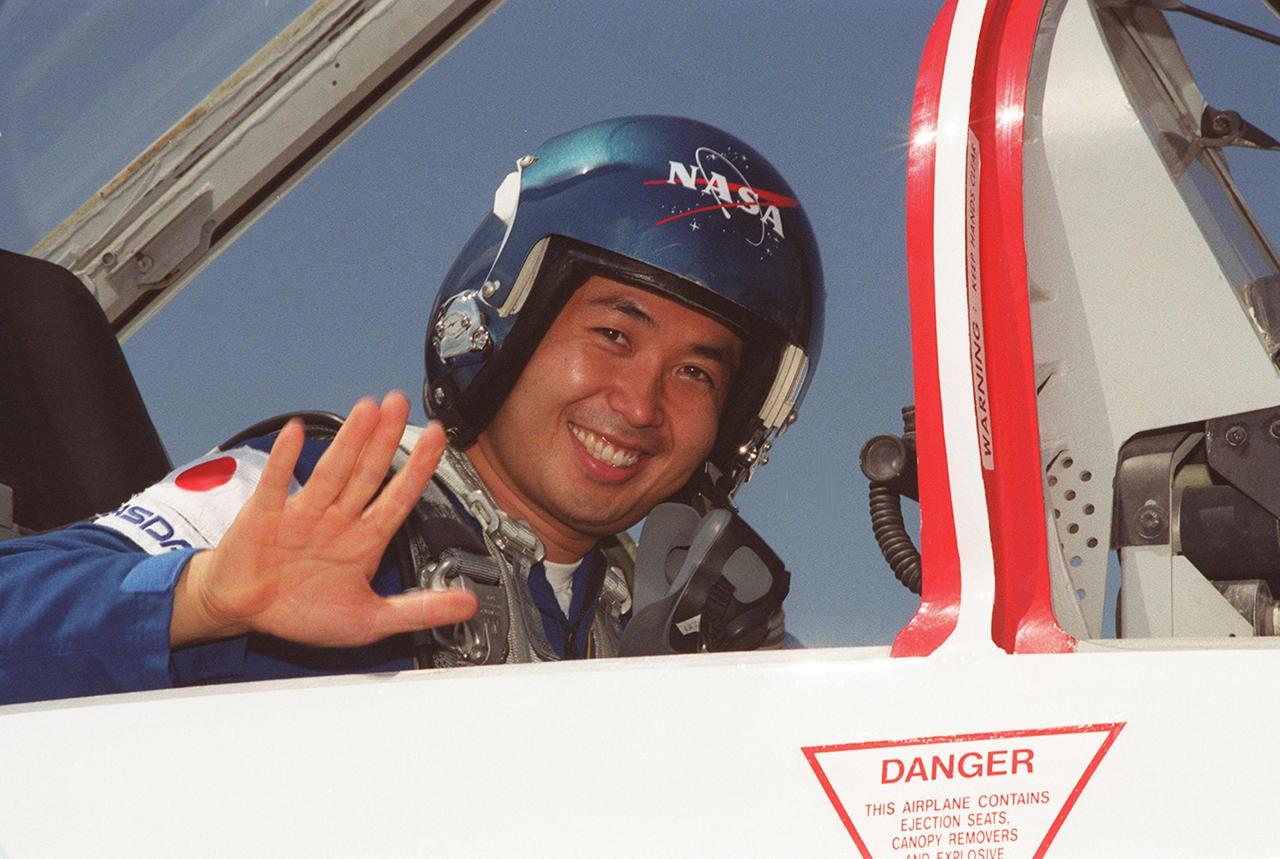
KENNEDY SPACE CENTER, FLA. -- STS-92 Mission Specialist Koichi Wakata arrives at KSC’s Shuttle Landing Facility to take part in a Crew Equipment Interface Test. Wakata is with the Japanese space agency. He and other crew members Commander Brian Duffy, Pilot Pam Melroy and Mission Specialists Leroy Chiao, Jeff Wisoff, Michael Lopez-Alegria and Bill McArthur will spend time at SPACEHAB becoming familiar with the payload and equipment they will use on their mission to the International Space Station. The mission payload includes the Integrated Truss Structure Z1, an early exterior framework to allow the first U.S. solar arrays on a future flight to be temporarily installed on Unity for early power; Ku-band communication to support early science capability and U.S. television; and PMA-3 to provide a Shuttle docking port for solar array installation on the sixth ISS flight and Lab installation on the seventh ISS flight. STS-92 is scheduled to launch Oct. 5 from launch Pad 39A

KENNEDY SPACE CENTER, Fla. -- Members of the STS-107 crew look over equipment inside the SPACEHAB Double Module, which will be making its first research flight into space on STS-107. Seen are (left to right) Payload Specialists Ilan Ramon and Mission Specialist David M. Brown. STS-107 will carry a broad collection of experiments ranging from material science to life science. It is scheduled to launch July 19, 2001
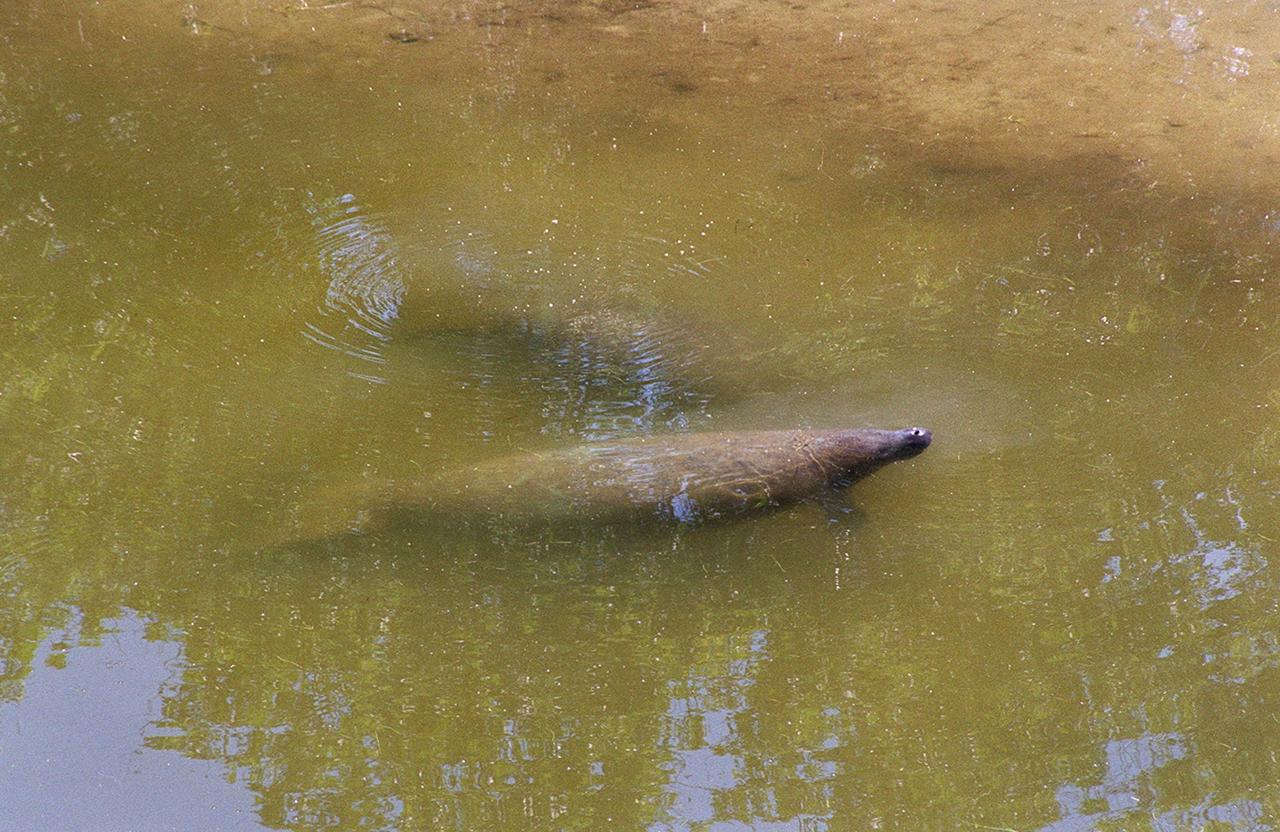
In waters on Kennedy Space Center, two manatees are seen leisurely swimming. In winter they gather in Florida's warm water rivers and inland springs. KSC shares a boundary with the Merritt Island National Wildlife Refuge, which encompasses 92,000 acres that are a habitat for more than 331 species of birds, 31 mammals, 117 fishes, and 65 amphibians and reptiles. The marshes and open water of the refuge provide wintering areas for 23 species of migratory waterfowl, as well as a year-round home for great blue herons, great egrets, wood storks, cormorants, brown pelicans and other species of marsh and shore birds, as well as a variety of insects
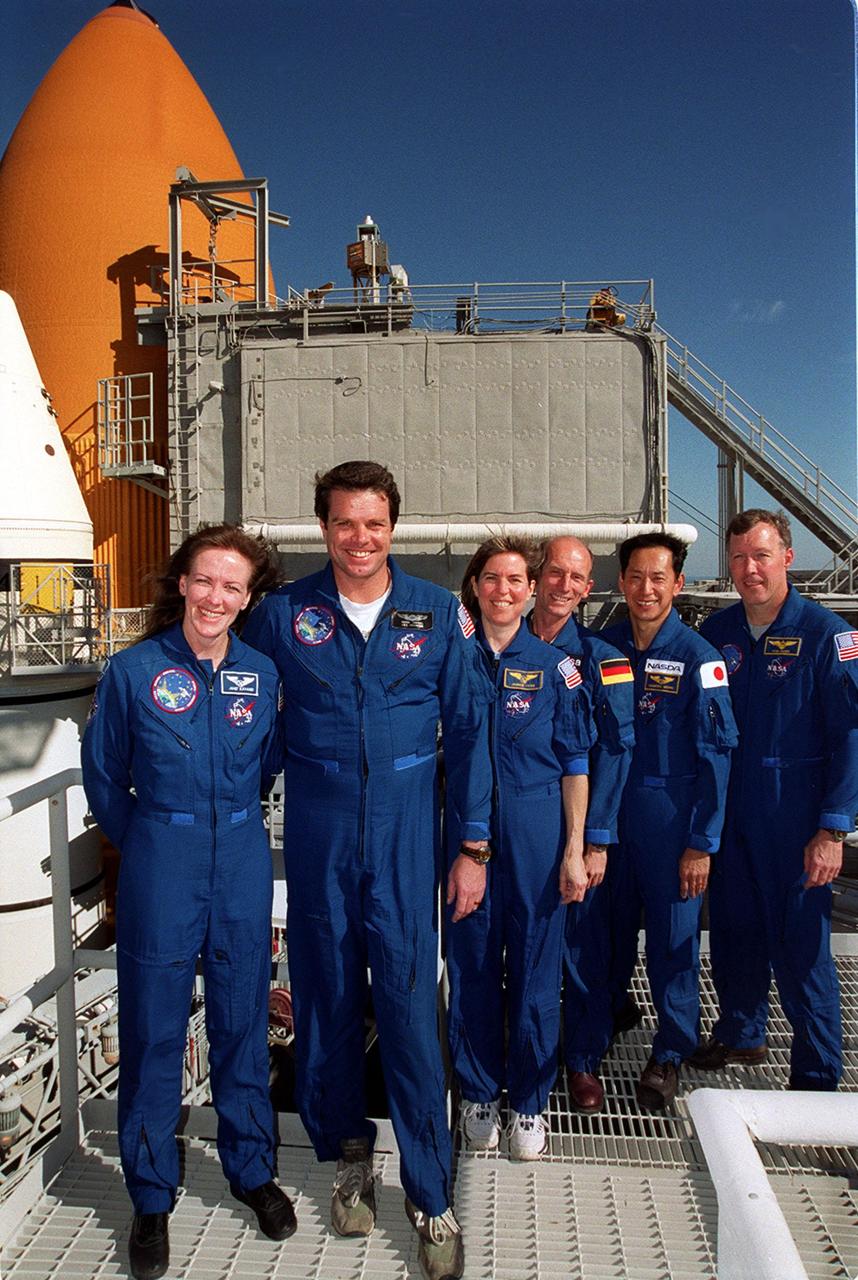
KENNEDY SPACE CENTER, Fla. -- At the 167-foot level of the Fixed Service Structure on Launch Pad 39A, the STS-99 crew pose for a photograph during Terminal Countdown Demonstration Test (TCDT) activities. Standing left to right are Mission Specialist Janet Lynn Kavandi (Ph.D.), Commander Kevin Kregel, Mission Specialists Janice Voss (Ph.D.), Gerhard Thiele and Mamoru Mohri, and Pilot Dominic Gorie. Thiele is with the European Space Agency and Mohri is with the National Space Development Agency (NASDA) of Japan. Behind them (left) are visible the top of a solid rocket booster (white) and external tank (orange). The TCDT provides the crew with simulated countdown exercises, emergency egress training, and opportunities to inspect the mission payloads in the orbiter's payload bay. STS-99 is the Shuttle Radar Topography Mission, which will chart a new course, using two antennae and a 200-foot-long section of space station-derived mast protruding from the payload bay to produce unrivaled 3-D images of the Earth's surface. The result of the Shuttle Radar Topography Mission could be close to 1 trillion measurements of the Earth's topography. Besides contributing to the production of better maps, these measurements could lead to improved water drainage modeling, more realistic flight simulators, better locations for cell phone towers, and enhanced navigation safety. Launch of Endeavour on the 11-day mission is scheduled for Jan. 31 at 12:47 p.m. EST
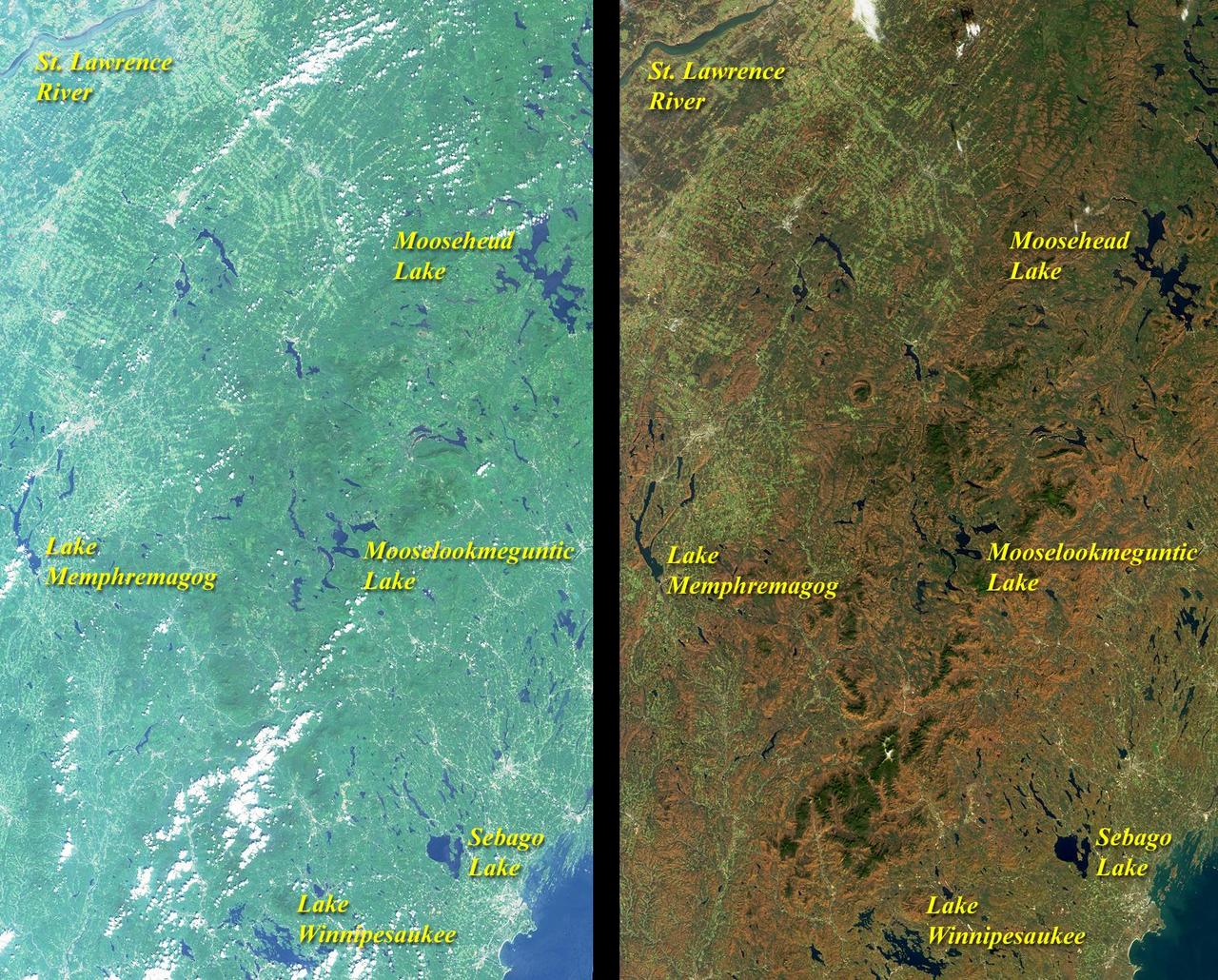
These images from NASA Terra satellite include eastern Vermont, New Hampshire, and western Maine, as well as the southeastern corner of Quebec province between August and October, 2000.
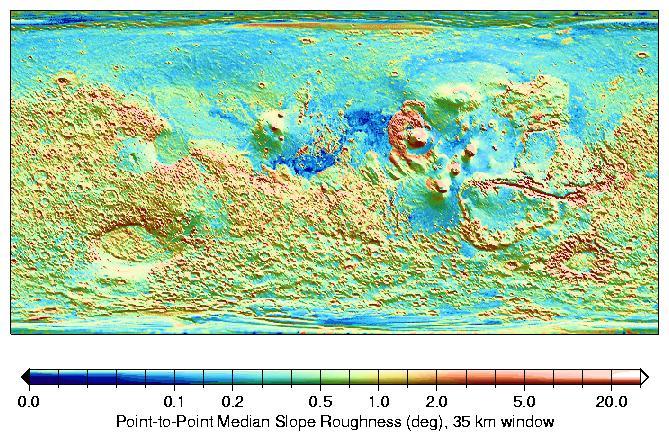
MOLA Global Roughness Map of Mars
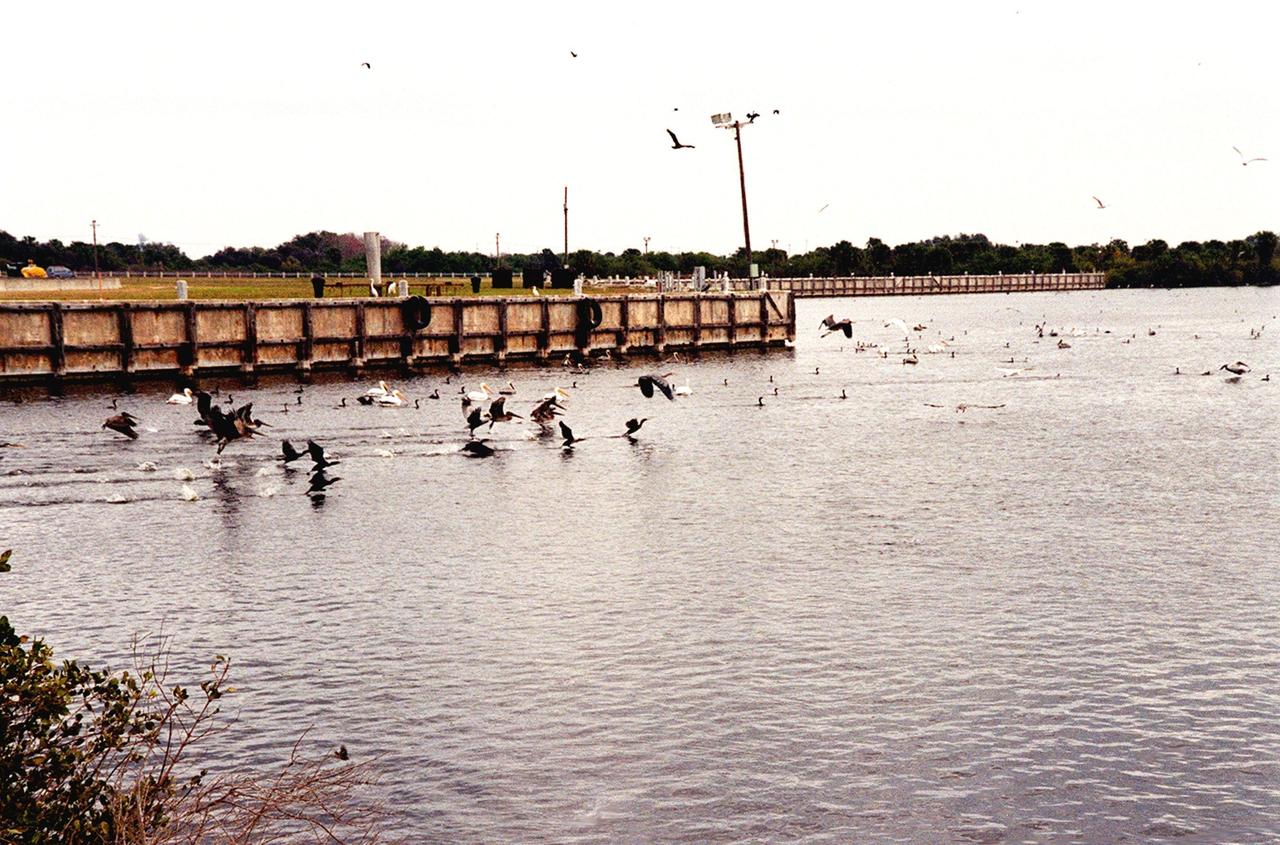
KENNEDY SPACE CENTER, FLA. -- The water in the turn basin, east of the Vehicle Assembly Building and next to the crawlerway, teems with fish and draws white pelicans, gray pelicans, cormorants, sea gulls and more looking for a meal. The turn basin is part of the Indian River Lagoon, composed of Mosquito Lagoon to the north, Banana River and Creek to the south and the Indian River to the west. The Indian River Lagoon has one of the most diverse bird populations anywhere in America. Also, nearly one-third of the nation's manatee population lives here or migrates through the lagoon seasonally. The lagoon varies in width from ½ mile to 5 miles and averages only 3 feet in depth
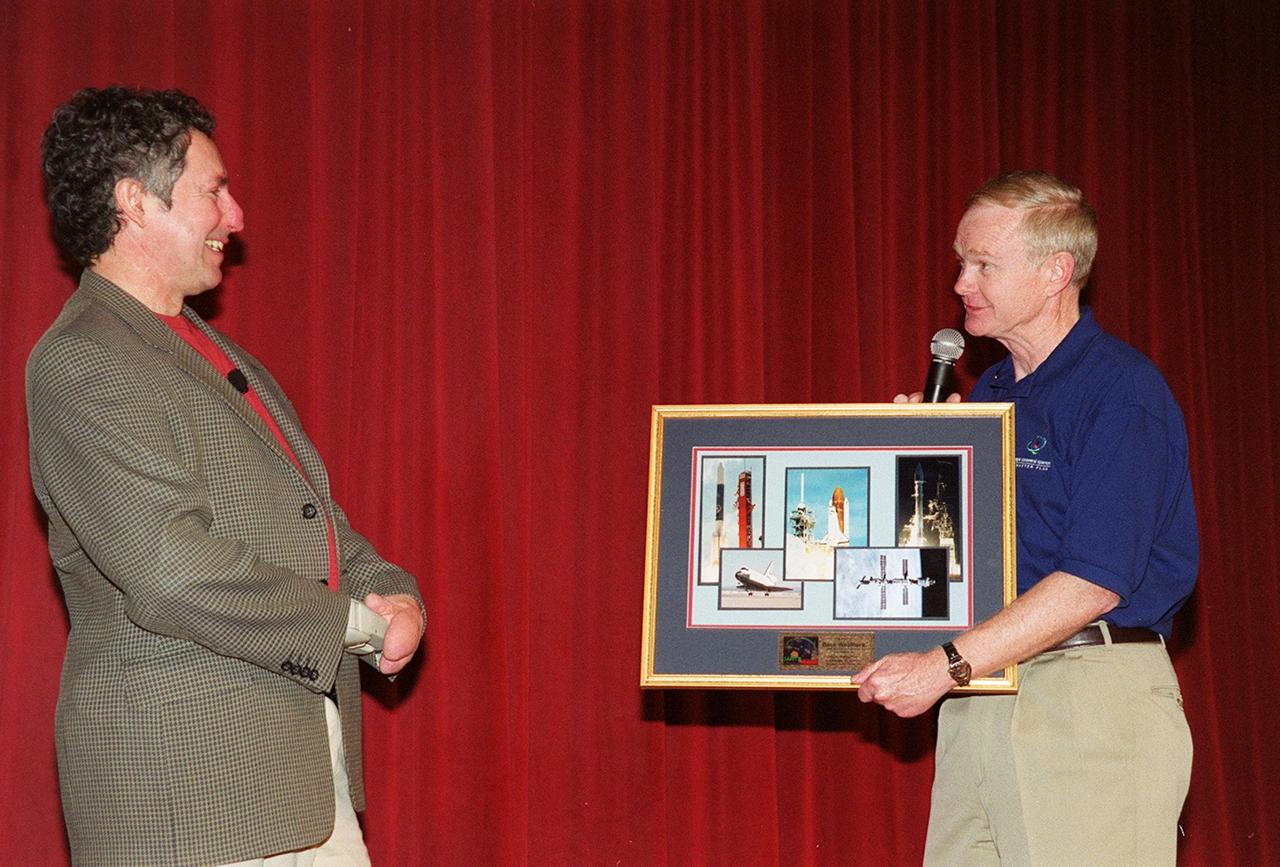
During Super Safety and Health Day at KSC, keynote speaker Dr. Beck Weathers is given a memento of his visit by Center Director Roy Bridges. Weathers spoke about his ordeal of surviving the 1996 Mt. Everest disaster and the lessons learned from the experience. Safety Day is a full day of NASA-sponsored, KSC and 45th Space Wing events involving a number of health and safety related activities: Displays, vendors, technical paper sessions, panel discussions, a keynote speaker, etc. The entire Center and Wing stand down to participate in the planned events. Safety Day is held annually to proactively increase awareness in safety and health among the government and contractor workforce population. The first guiding principle at KSC is “Safety and Health First.” KSC’s number one goal is to “Assure sound, safe and efficient practices and processes are in place for privatized/commercialized launch site processing.
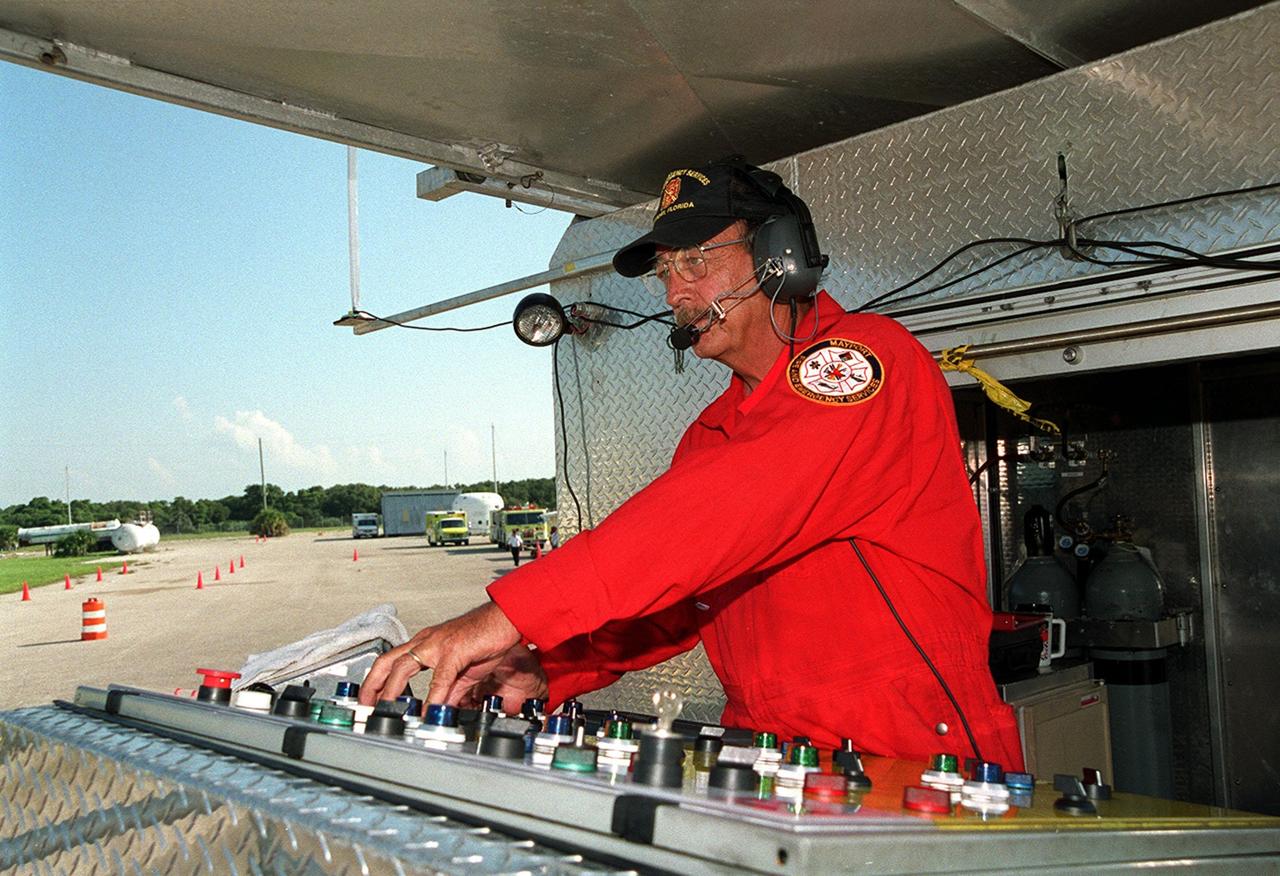
KENNEDY SPACE CENTER, FLA. -- A training officer controls elements of a fire training exercise at Cape Canaveral Air Force Station Pad 30 for firefighters with Fire and Emergency Services at the Naval Station Mayport, Fla. The firefighters tackled flames from a burning simulated aircraft.
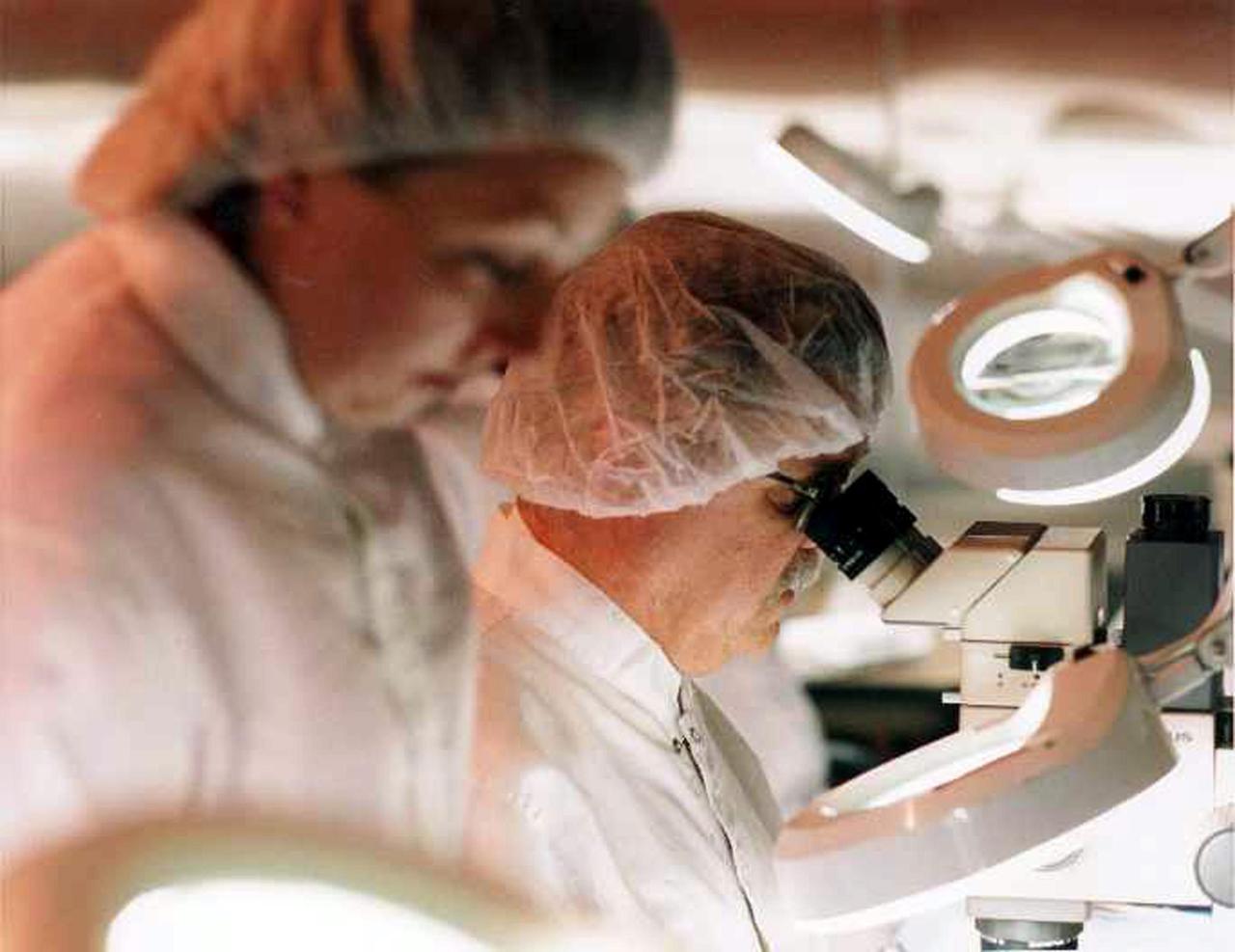
Researchers perform tests at Kennedy Space Center. New facilities for such research will be provided at the Space Experiment Research Procession Laboratory (SERPL). The SERPL is a planned 100,000-square-foot laboratory that will provide expanded and upgraded facilities for hosting International Space Station experiment processing. In addition, it will provide better support for other biological and life sciences payload processing at KSC. It will serve as a magnet facility for a planned 400-acre Space Station Commerce Park

Viking 2 Image of Mars Utopian Plain
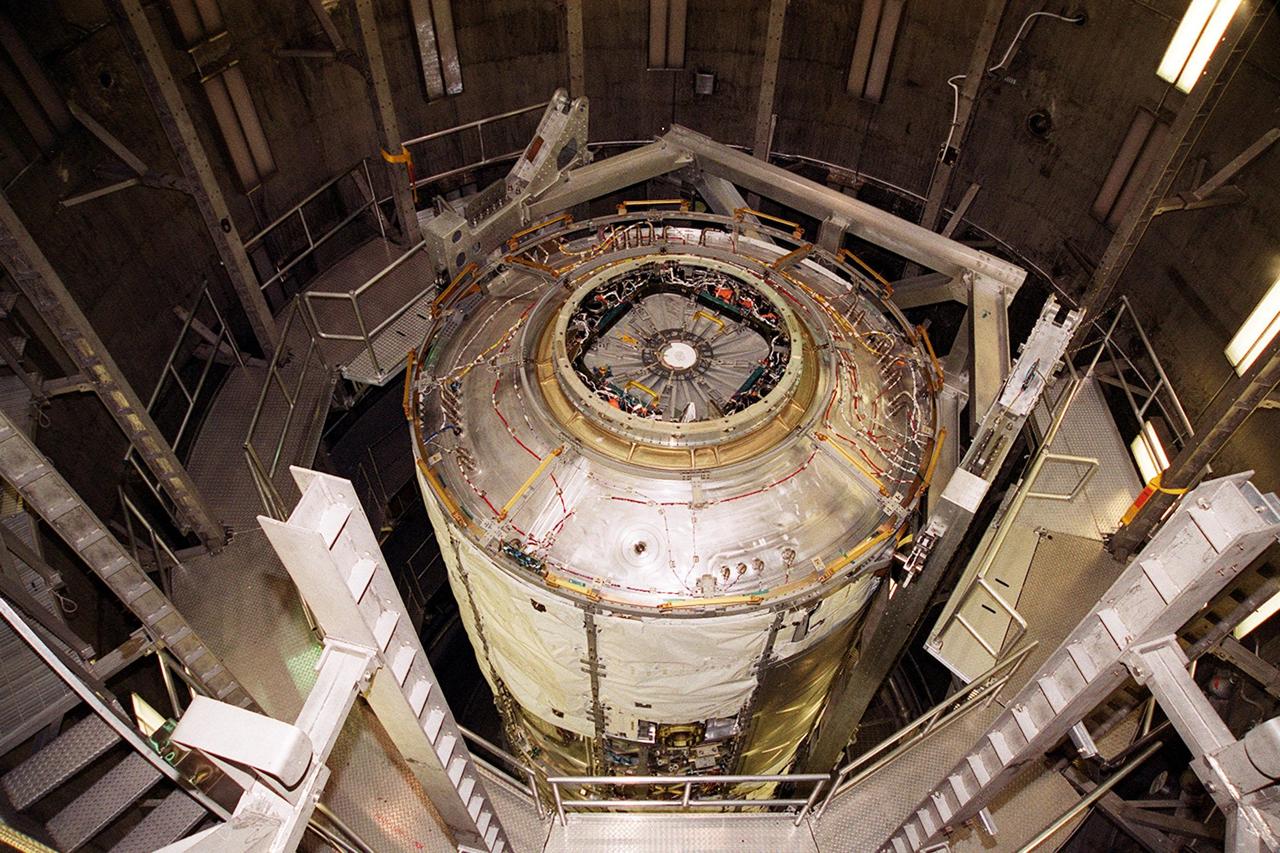
KENNEDY SPACE CENTER, FLA. -- After successfully completing a leak test inside a vacuum chamber in the Operations and Checkout Building, the U.S. Lab, a component of the International Space Station, is ready to be lifted and removed from the chamber. The 32,000-pound scientific research lab, named Destiny, is the first Space Station element to spend seven days in the renovated vacuum chamber. Destiny is scheduled to be launched on Shuttle mission STS-98, the 5A assembly mission, targeted for Jan. 18, 2001. During the mission, the crew will install the Lab in the Space Station during a series of three space walks. The STS-98 mission will provide the Station with science research facilities and expand its power, life support and control capabilities. The U.S. Lab module continues a long tradition of microgravity materials research, first conducted by Skylab and later Shuttle and Spacelab missions. Destiny is expected to be a major feature in future research, providing facilities for biotechnology, fluid physics, combustion, and life sciences research
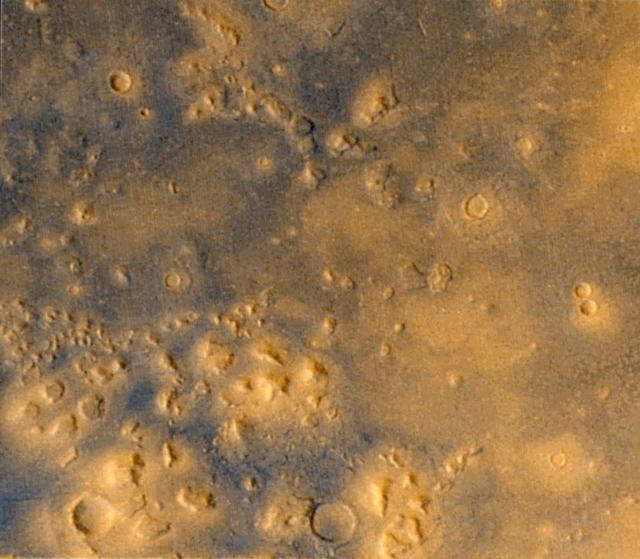
This image was taken by NASA Mars Global Surveyor Cydonia region on Mars. 3D glasses are necessary to view this image.
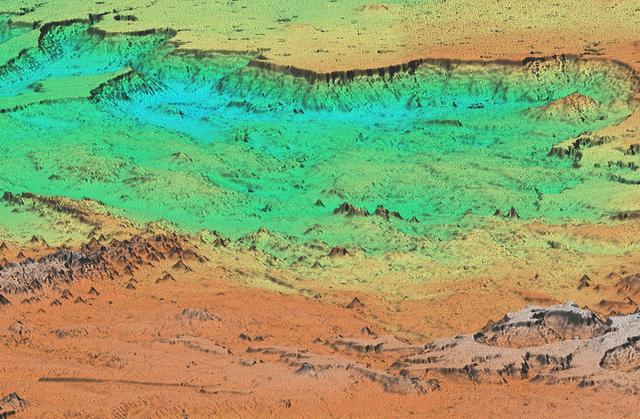
This perspective view acquired by NASA Shuttle Radar Topography Mission SRTM from data collected in the year 2000 shows Patagonia, Argentina, a spectacular landscape formed by volcanoes, rivers, and wind.

In the Space Station Processing Facility, STS-98 Mission Specialist Marsha Ivins wields a tool on part of the U.S. Lab, Destiny. The crew is checking out equipment inside the lab as part of Crew Equipment Interface Test activities, becoming familiar with equipment it will be handling during the mission. Others in the crew are Commander Ken Cockrell, Pilot Mark Polansky and Mission Specialists Robert Curbeam and Thomas Jones. The mission will be transporting the Lab to the International Space Station with five system racks already installed inside of the module. With delivery of electronics in the lab, electrically powered attitude control for Control Moment Gyroscopes will be activated. The STS-98 launch is scheduled for Jan. 18, 2001
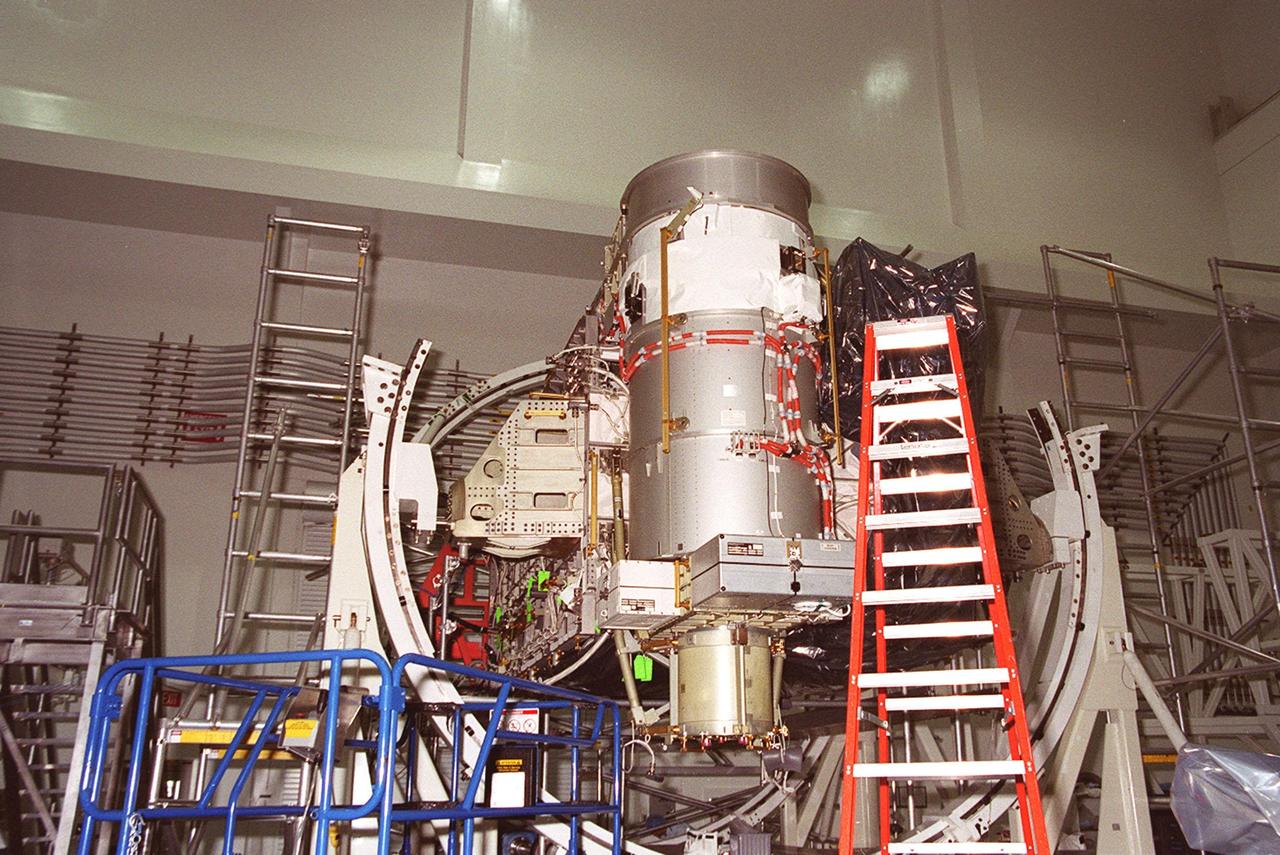
In the Space Station Processing Facility, Solar Array Wing-3, a component of the International Space Station, is installed in the Integrated Electronic Assembly where it will be tested. The solar array is scheduled to be launched on STS-97 in late November along with the P6 truss. The Station’s electrical power system (EPS) will use eight photovoltaic solar arrays to convert sunlight to electricity. Each of the eight solar arrays will be 112 feet long by 39 feet wide. The solar arrays are mounted on a “blanket” that can be folded like an accordion for delivery. Once in orbit, astronauts will deploy the blankets to their full size. Gimbals will be used to rotate the arrays so that they will face the Sun to provide maximum power to the Space Station
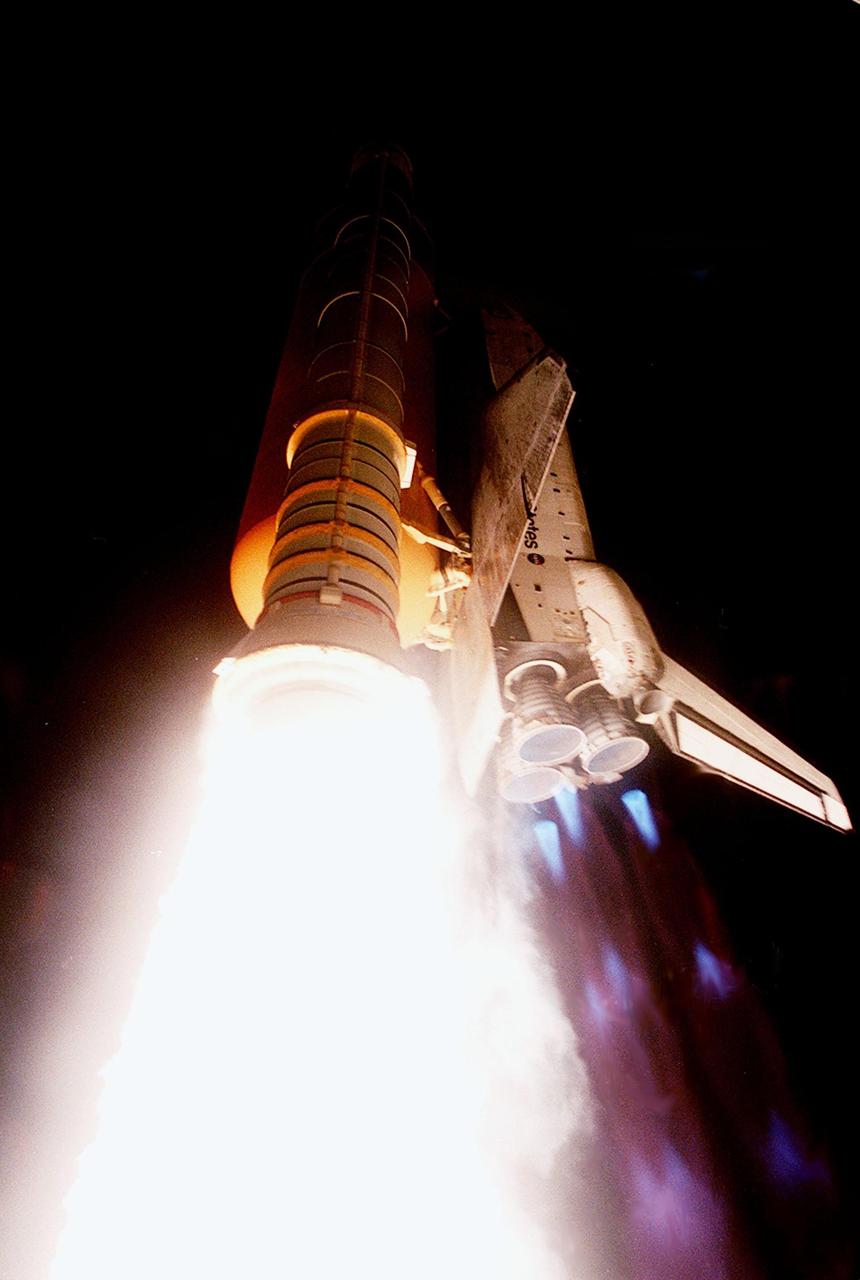
KENNEDY SPACE CENTER, Fla. -- The brilliant exhaust from the solid rocket boosters (left) and blue mach diamonds from the main engine nozzles (right) mark the perfect launch of Space Shuttle Atlantis on mission STS-101. Liftoff occurred on time at 6:11:10 a.m. EDT. The mission is taking the crew of seven to the International Space Station to deliver logistics and supplies as well as to prepare the Station for the arrival of the Zvezda Service Module, expected to be launched by Russia in July 2000. Also, the crew will conduct one space walk and will reboost the space station from 230 statute miles to 250 statute miles. This will be the third assembly flight to the Space Station. After a 10-day mission, landing is targeted for May 29 at 2:19 a.m. EDT. This is the 98th Shuttle flight and the 21st flight for Shuttle Atlantis
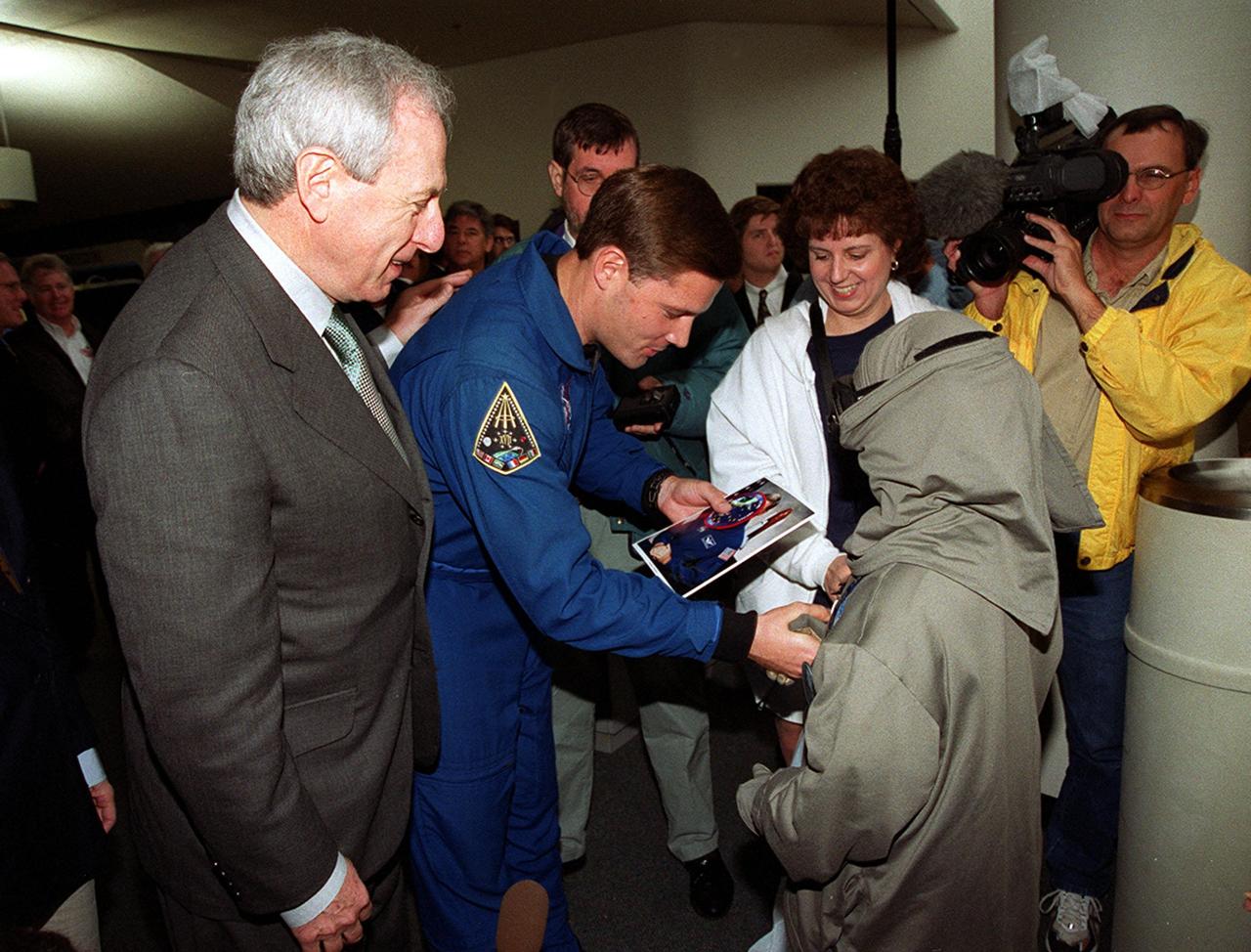
NASA Administrator Dan Goldin (left) watches as 10-year-old Jonathan Pierce (right), who is garbed in a protective cooling suit designed by NASA, shakes hands with astronaut Dog Wheelock. Behind Jonathan is his mother, Penny. Jonathan suffers from erythropoietic protoporphyria, a rare condition that makes his body unable to withstand ultraviolet rays. The suit allows him to be outside during the day, which would otherwise be impossible. Jonathan's trip was funded by the Make-A-Wish Foundation and included a visit to Disney World. He and his family were among a dozen VIPs at KSC to view the launch of STS-99
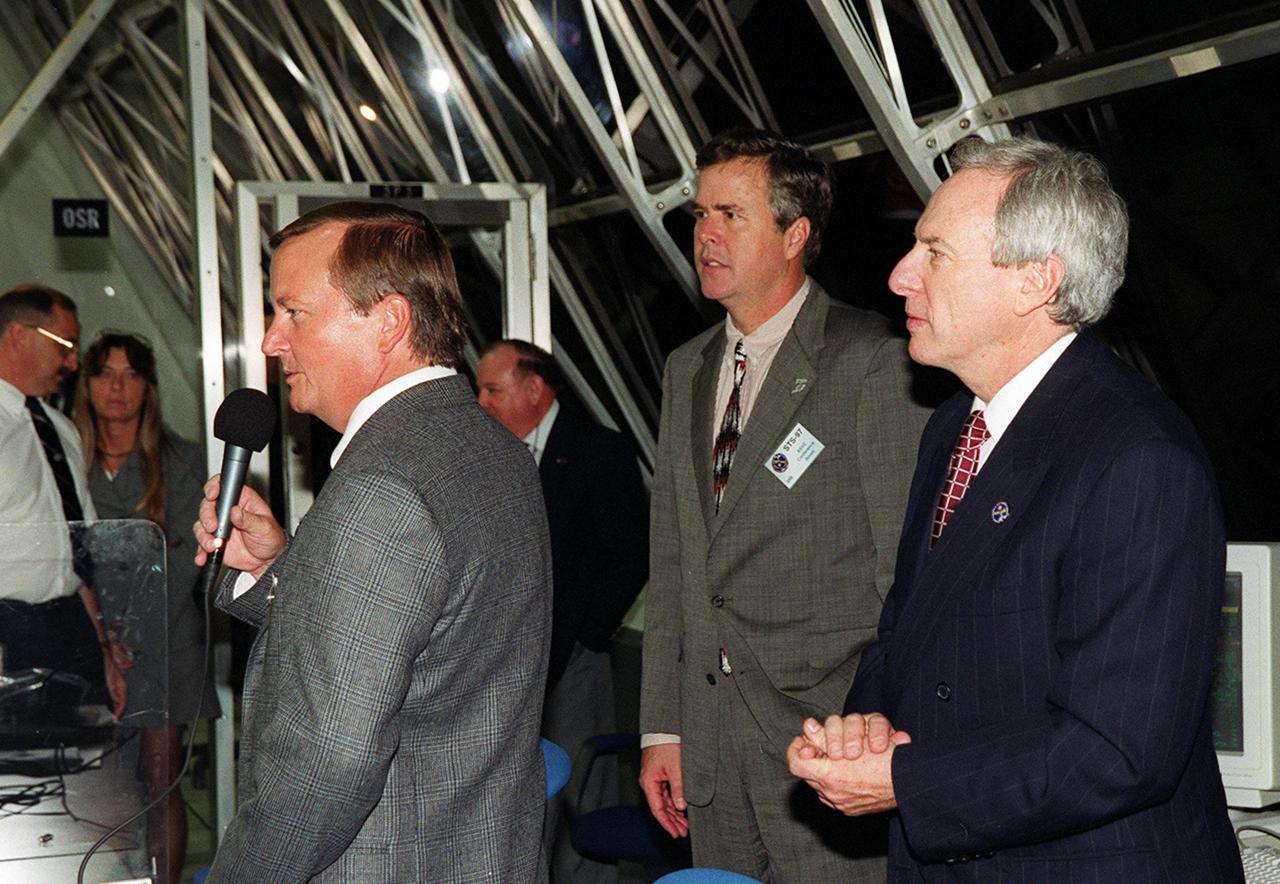
KENNEDY SPACE CENTER, FLA. -- In the Firing Room, Launch Control Center, after a successful launch of Space Shuttle Endeavour on mission STS-97, Launch Director Michael Leinbach (with microphone) addresses the launch team. Behind him at right are Florida Governor Jeb Bush and NASA Administrator Daniel Goldin. Liftoff of Endeavour occurred at 10:06:01 p.m. EST. Endeavour and its five-member crew will deliver U.S. solar arrays to the International Space Station and be the first Shuttle crew to visit the Station’s first resident crew. The 11-day mission includes three spacewalks. This marks the 101st mission in Space Shuttle history and the 25th night launch. Endeavour is expected to land at KSC Dec. 11 at 6:19 p.m. EST
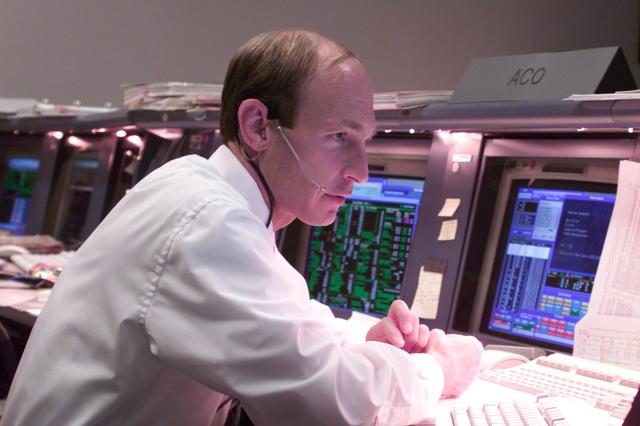
JSC2000-E-22832 (13 September 2000) --- Gary Ford intently watches a monitor at the Assembly and Checkout Officer (ACO) console in Houston's Mission Control Center (MCC). The ACO is responsible for station assembly, activation and checkout operations.
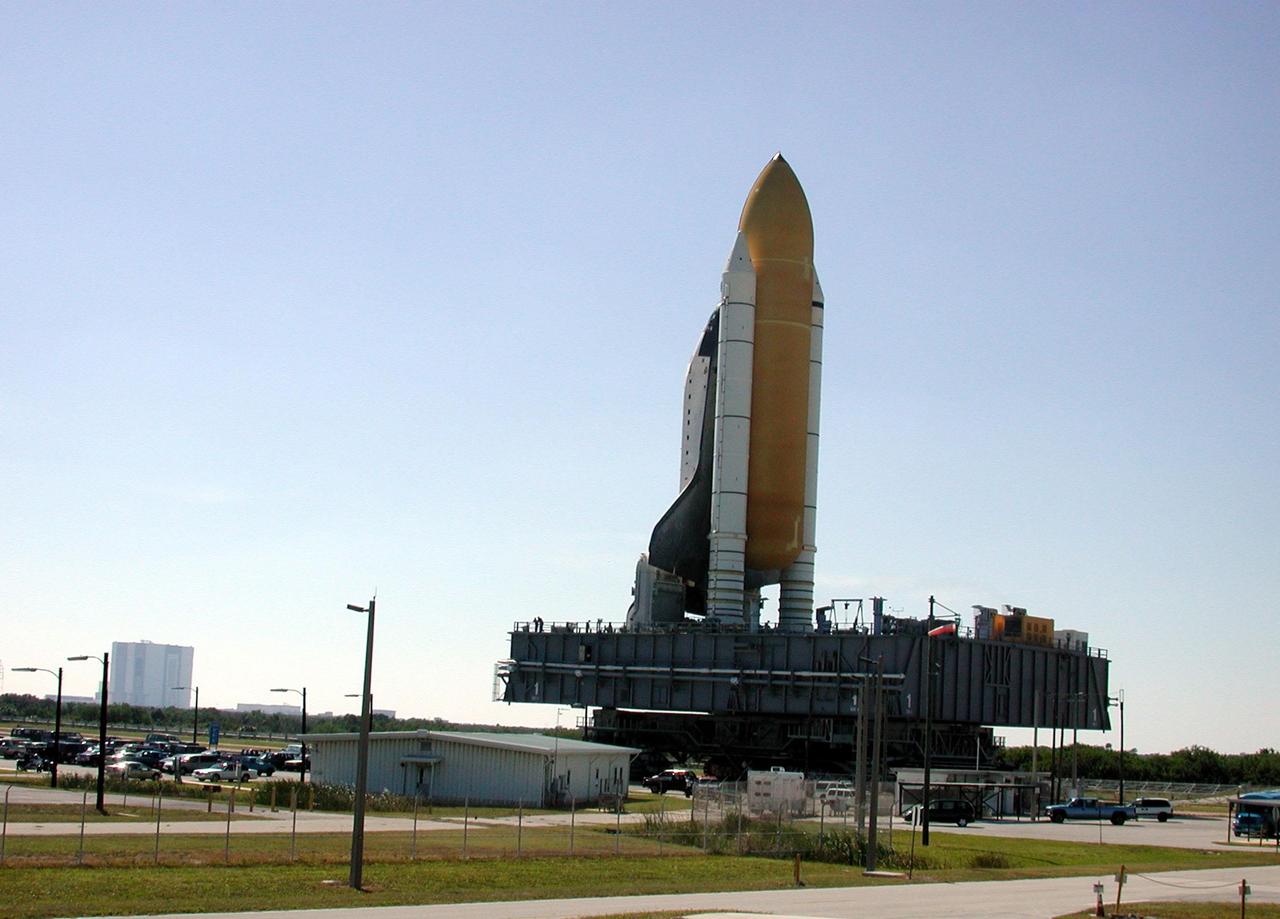
KENNEDY SPACE CENTER, FLA. -- Space Shuttle Endeavour is nearly through the gate on its backward trek from Launch Pad 39B. A broken cleat on the crawler-transporter forced the reverse movement so the cleat could be repaired before moving up the incline to the top of the pad. Endeavour is scheduled to be launched Nov. 30 at 10:01 p.m. EST on mission STS-97, the sixth construction flight to the International Space Station. Its payload includes the P6 Integrated Truss Structure and a photovoltaic (PV) module, with giant solar arrays that will provide power to the Station. The mission includes two spacewalks to complete the solar array connections
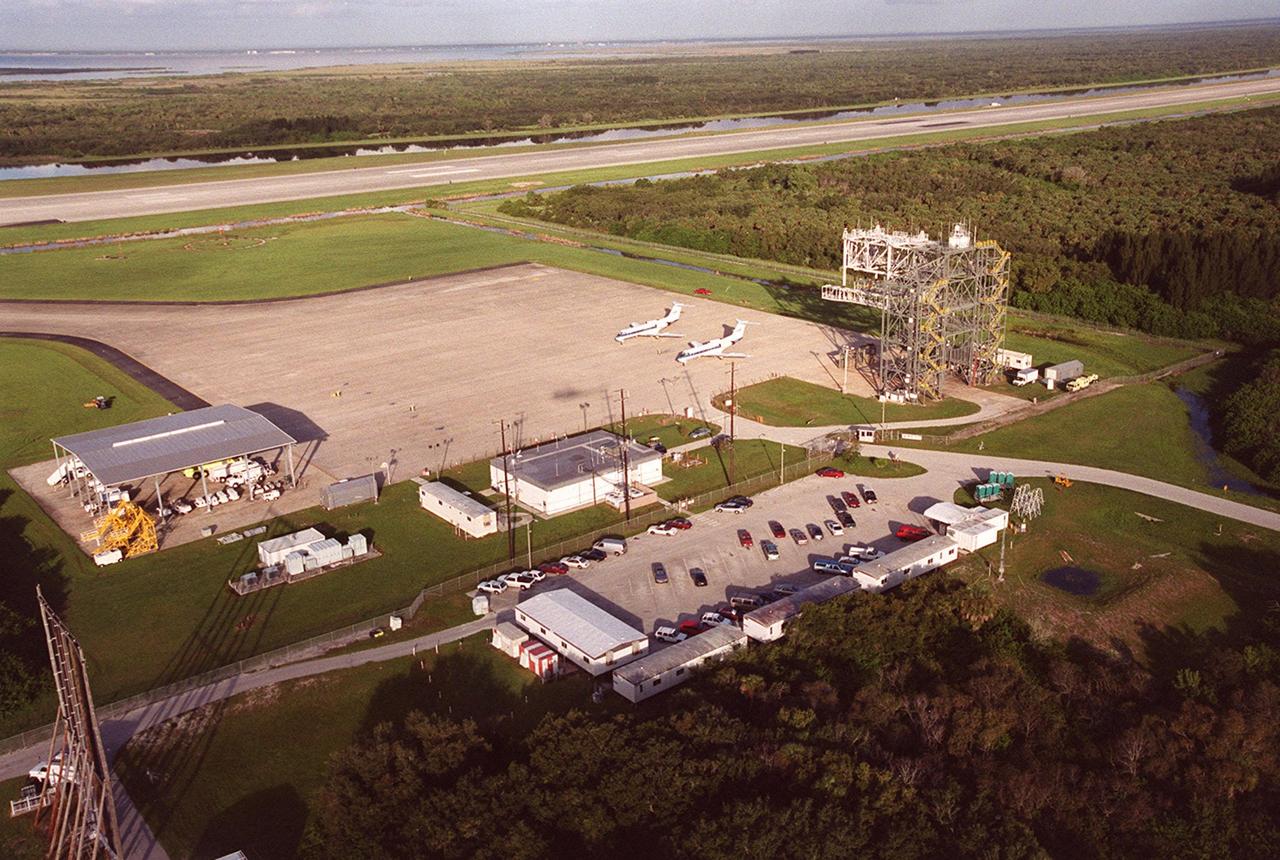
KENNEDY SPACE CENTER, FLA. -- An aerial view of the Shuttle Landing Facility shows the fuel truck shelter (left), administrative building (center) with parking lot behind it (foreground), two Shuttle Training Aircraft (STA) parked on the apron and the mate/demate device (right). In the background is the runway. The STAs are Grumman Gulfstream 2 aircraft with converted cockpits that emulate those in the Shuttles for practice landings at the SLF. The mate/demate device is used to lift the orbiter onto or off a Shuttle Carrier Aircraft when it has to be ferried to or from KSC
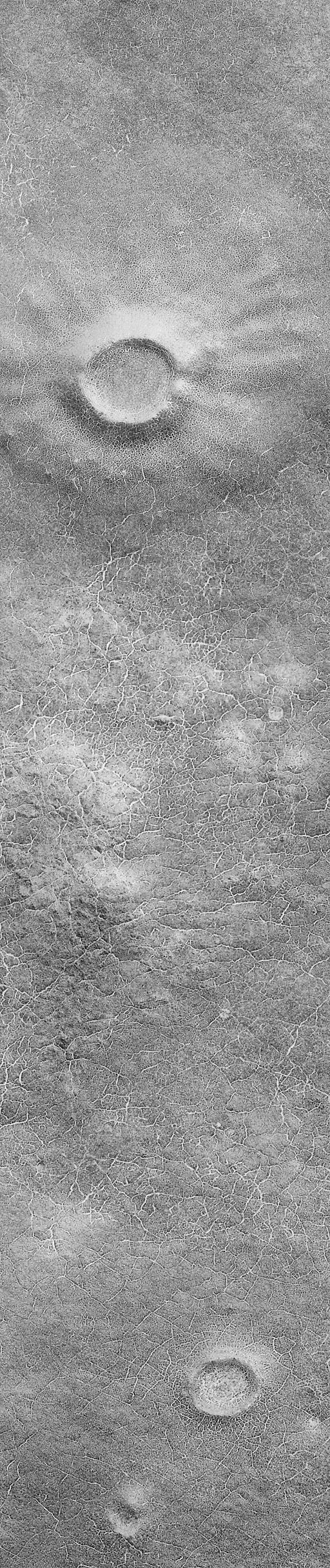
Patterned Ground of the Martian Antarctic
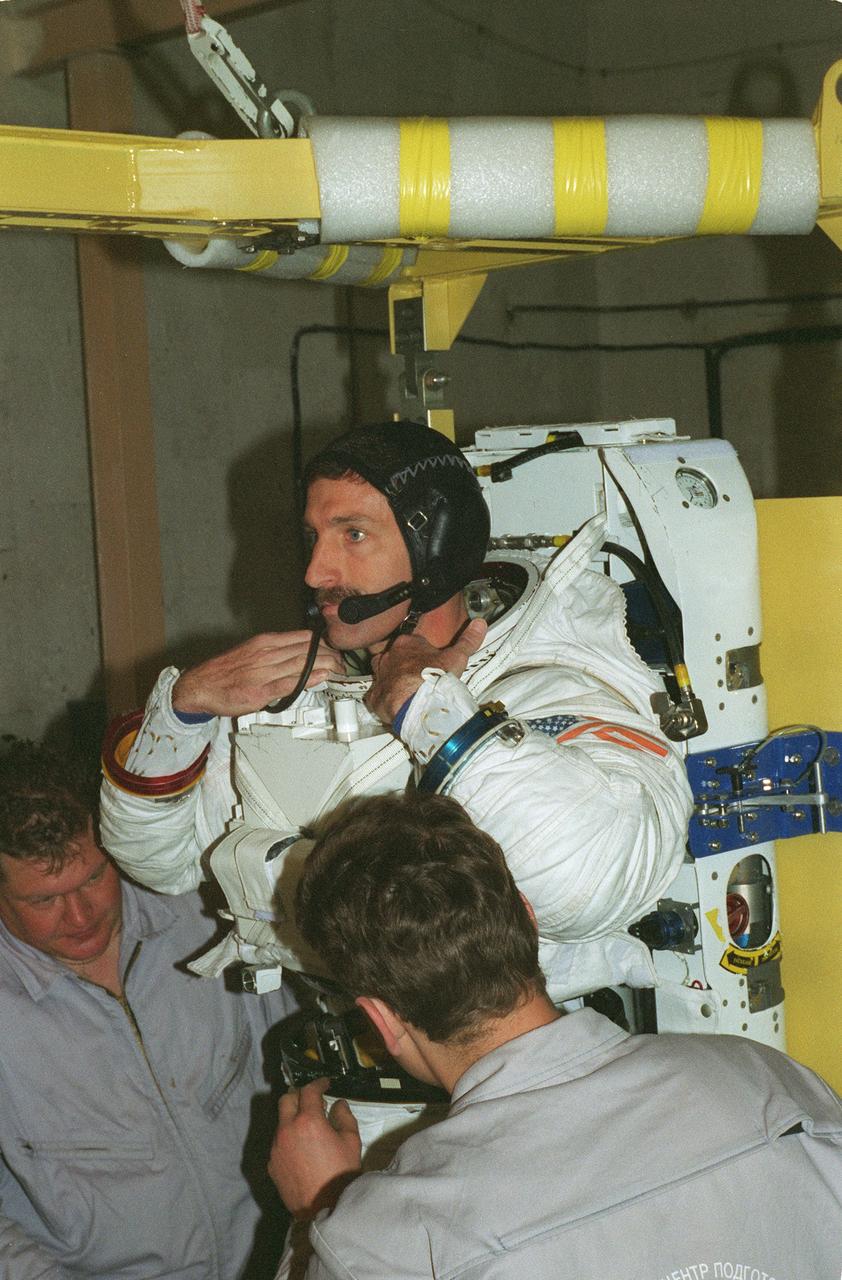
JSC2000-04866 (19 May 2000) --- Equipped with a shuttle extravehicular mobility unit (EMU) space suit, astronaut Daniel C. Burbank prepares to participate in an underwater spacewalk rehearsal in the Hydrolab facility at the Gagarin Cosmonaut Training Center in Star City, Russia. Burbank, STS-106 mission specialist, was joined by astronaut Edward T. Lu (out of frame), for the simulation.
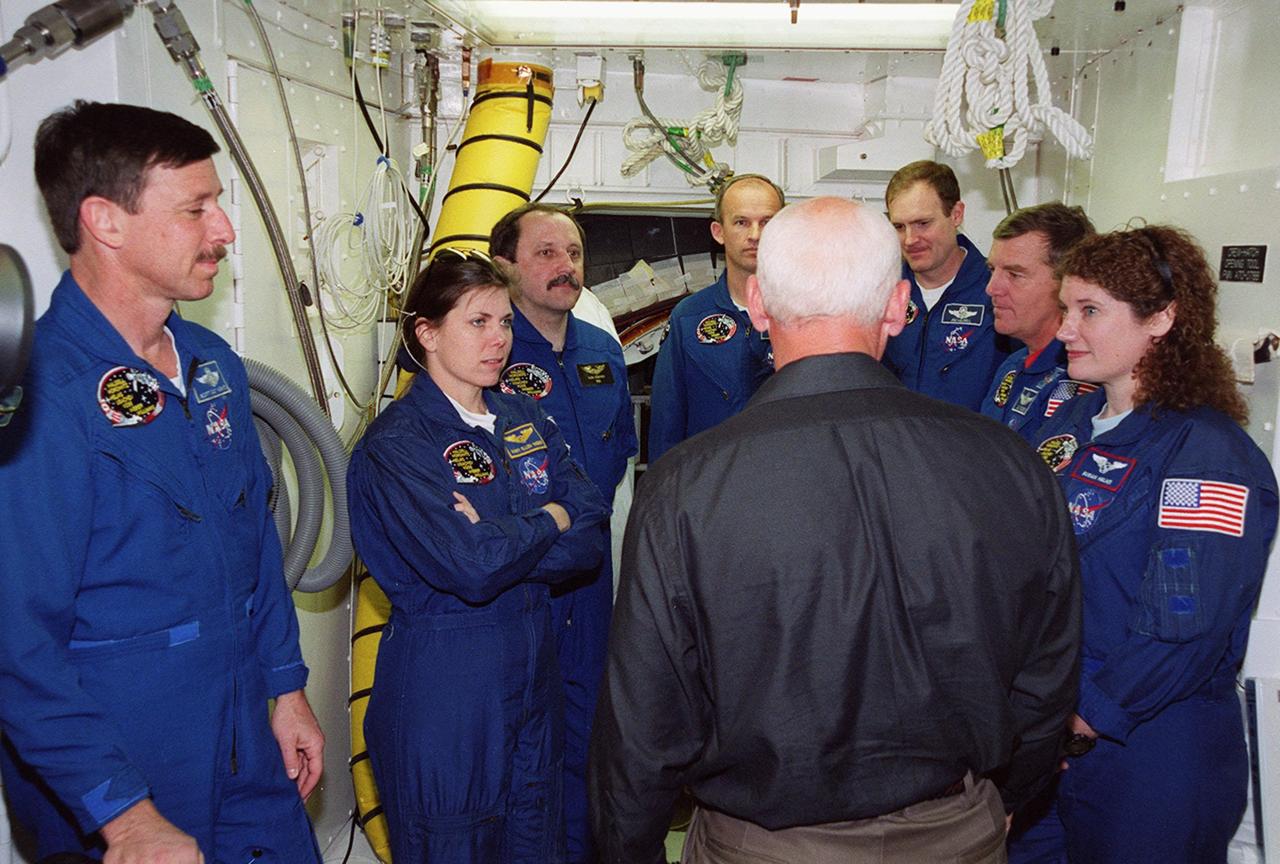
Inside the White Room at Launch Pad 39A, the STS-101 crew take part in training during a Terminal Countdown Demonstration Test (TCDT). Activities during TCDT include emergency egress from the orbiter and a dress rehearsal for launch. Standing left to right are Pilot Scott Horowitz, Mission Specialists Mary Ellen Weber, Yury Usachev and Jeffrey Williams, Commander James Halsell, and Mission Specialists James Voss and Susan Helms. During their mission to the International Space Station, the STS-101 crew will be delivering logistics and supplies, plus preparing the Station for the arrival of the Zvezda Service Module, expected to be launched by Russia in July 2000. Also, the crew will conduct one space walk to perform maintenance on the Space Station. This will be the third assembly flight for the Space Station. STS-101 is scheduled to launch April 24 at 4:15 p.m. from Launch Pad 39A
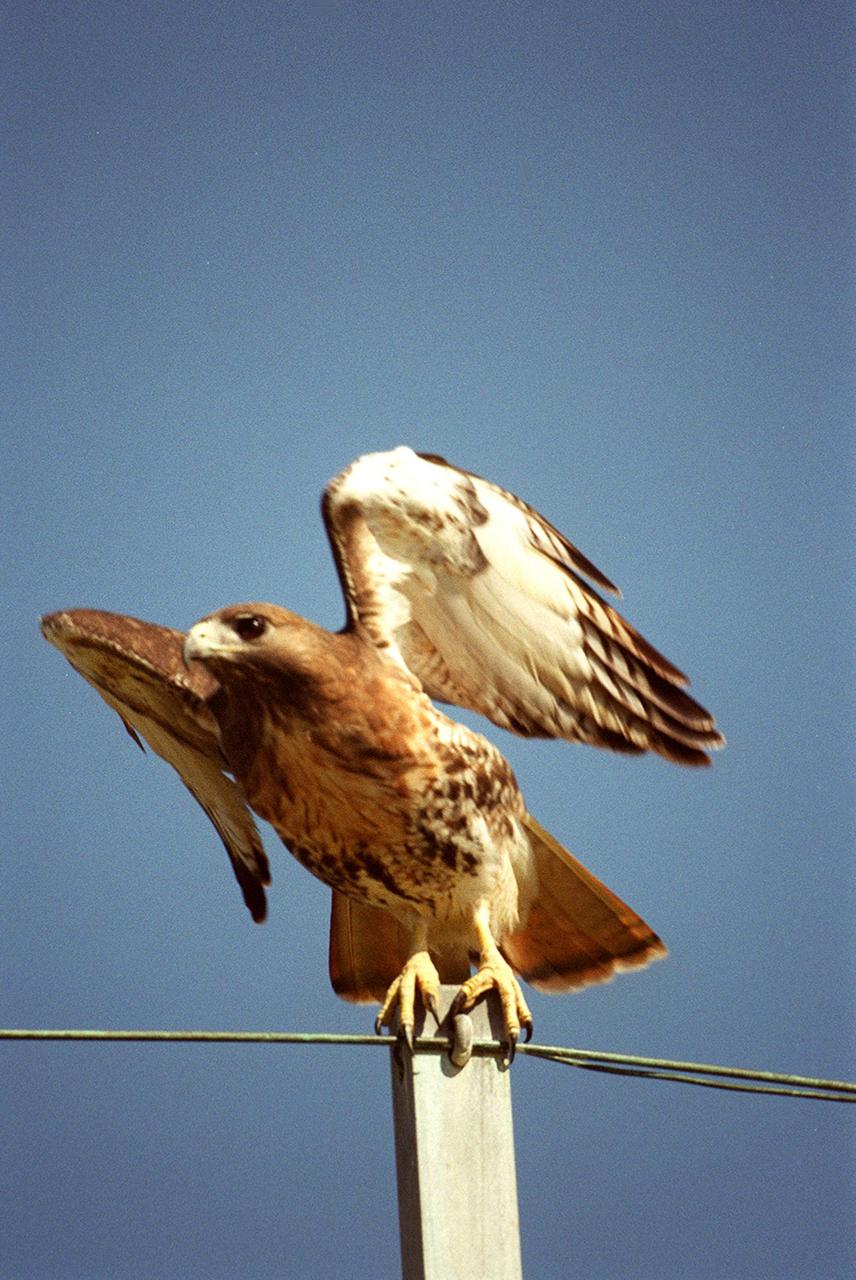
KENNEDY SPACE CENTER, FLA. -- From the top of a utility pole, a red-tailed hawk launches into flight, perhaps after spotting prey, typically a small rodent. Ranging in height from 18 inches to 25 inches, the species has a stocky build with a whitish breast and rust-colored tail. It has a high-pitched descending scream with a hoarse quality. The hawk inhabits mainly deciduous forest and adjacent open country from Alaska and Nova Scotia south to Panama. KSC shares a boundary with the Merritt Island National Wildlife Refuge, which encompasses 92,000 acres that are a habitat for more than 331 species of birds, 31 mammals, 117 fishes, and 65 amphibians and reptiles. The marshes and open water of the refuge provide wintering areas for 23 species of migratory waterfowl, as well as a year-round home for great blue herons, great egrets, wood storks, cormorants, brown pelicans and other species of marsh and shore birds, as well as a variety of insects
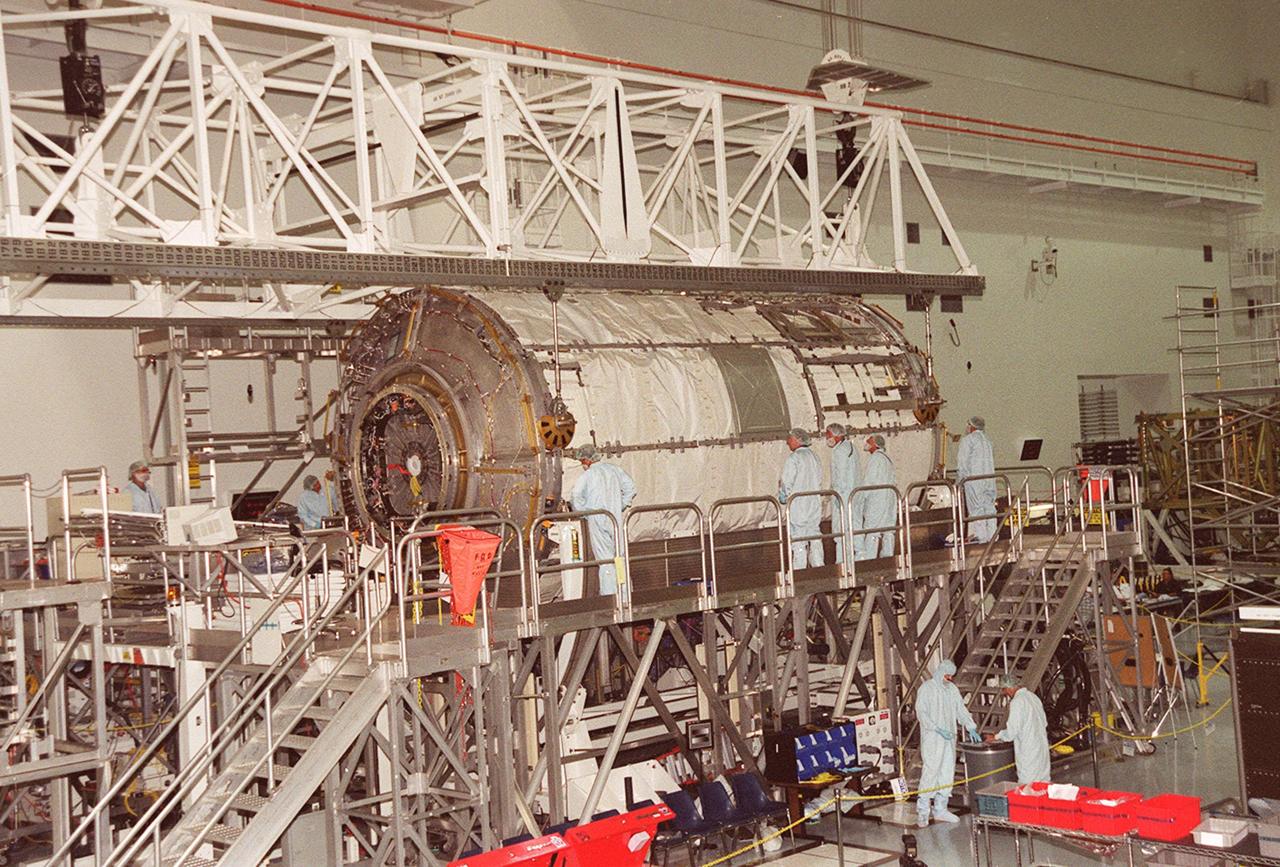
KENNEDY SPACE CENTER, Fla. -- In the Space Station Processing Facility, technicians watch closely as the U.S. Laboratory Destiny rotates. A component of the International Space Station, Destiny is scheduled to fly on mission STS-98 in early 2001. During the mission, the crew will install the Lab during a series of three space walks. The STS-98 mission will provide the station with science research facilities and expand its power, life support and control capabilities. The U.S. Lab module continues a long tradition of microgravity materials research, first conducted by Skylab and later Shuttle and Spacelab missions. Destiny is expected to be a major feature in future research, providing facilities for biotechnology, fluid physics, combustion, and life sciences research.
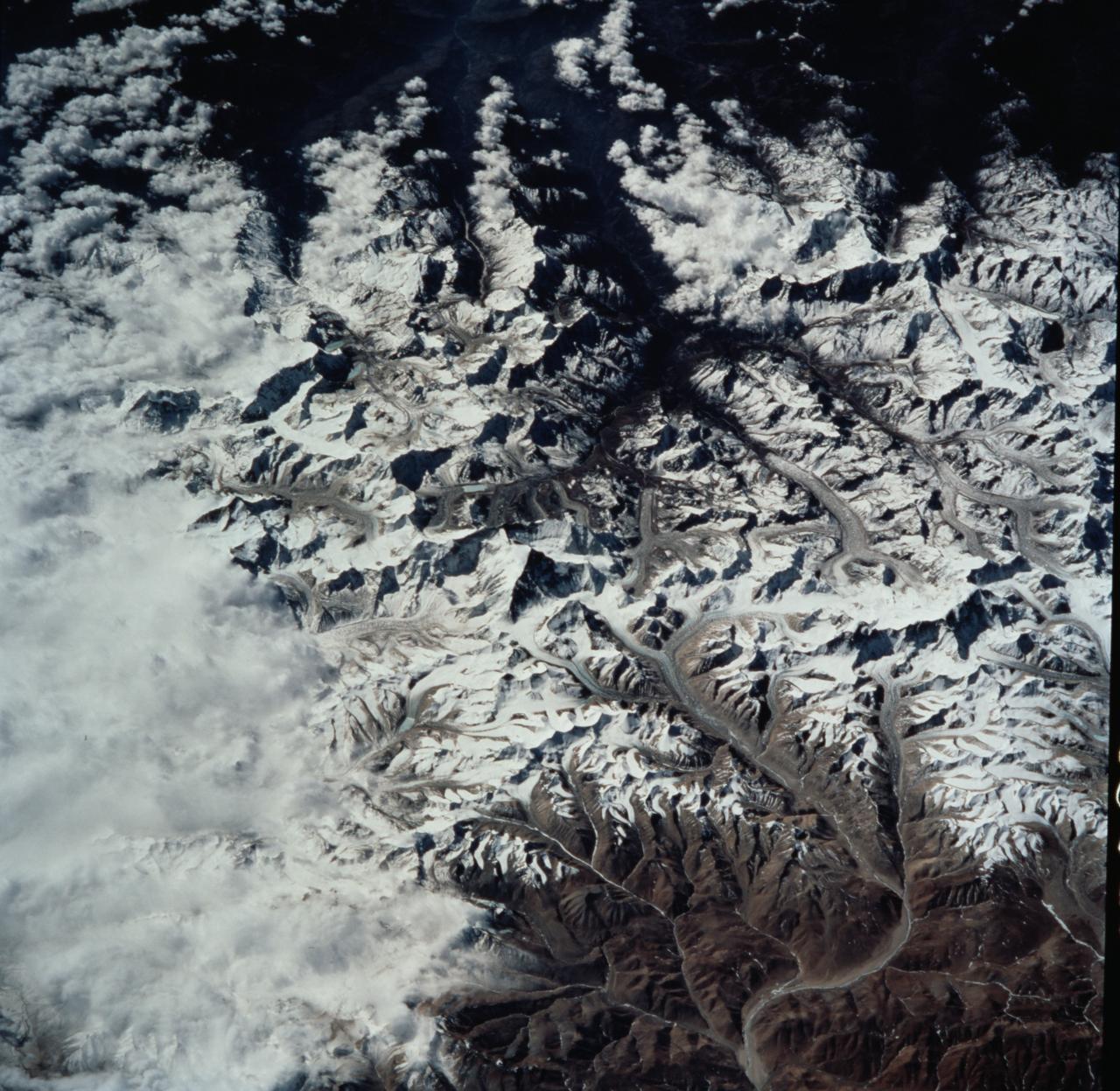
STS099-735-046 (11-22 February 2000) ---Mt. Everest (29,028 feet or 8,848 meters), is featured in the center of this 70mm frame photographed by one of the STS-99 crew members. Everest, also called Qomolangma Feng, is just north of the border between Nepal and China. The Himalayas and the Tibetan Plateau are products of the collision of the Indian and Eurasian tectonic plates. With the continuing northward march of India, the crust of the Earth has become thicker and the Tibetan Plateau has been uplifted to an average elevation of about 15,000 feet. According to NASA scientists studying the STS-99 imagery, fossil-bearing limestones are at the summit of the mountain. The scientists say that these limestones were deposited beneath the sea around 510 million years ago (Cambrian to Ordovician time). Glaciers, moraines, and outwash plains are spectacularly displayed. Glacial meltwaters in this area feed the Arun River, eventually reaching the Ganges on the plains of India.
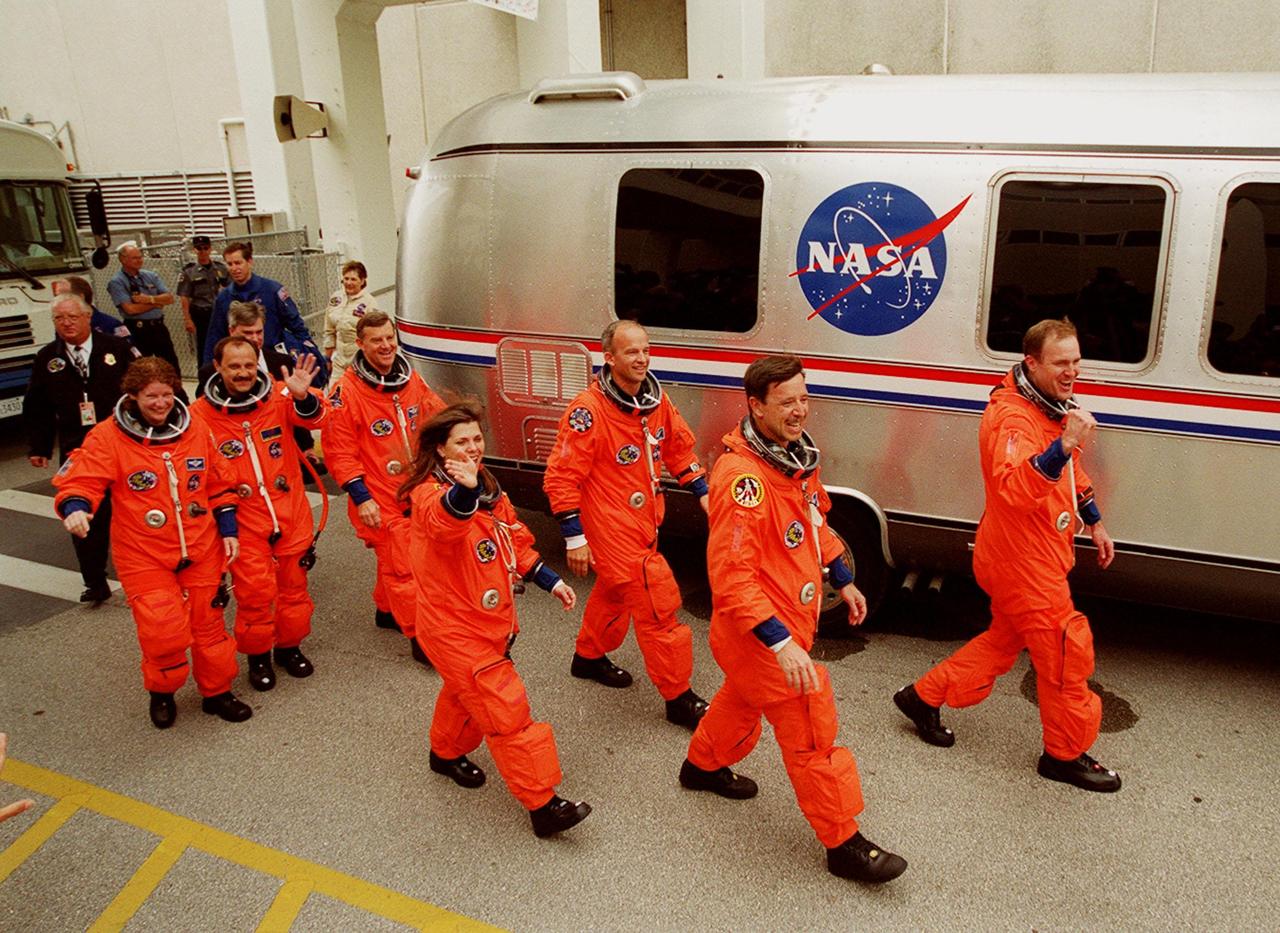
Waving to onlookers, the STS-101 crew eagerly walk to the waiting Astrovan that will take them to Launch Pad 39A and the second attempt at liftoff of Space Shuttle Atlantis. In their orange launch and entry suits, they are (left to right) Mission Specialists Susan J. Helms, Yury Usachev, James S. Voss, Mary Ellen Weber and Jeffrey N. Williams; Pilot Scott J. Horowitz; and Commander James D. Halsell Jr. The first launch attempt on April 24 was scrubbed due to unfavorable weather conditions. The mission will take the crew to the International Space Station to deliver logistics and supplies and to prepare the Station for the arrival of the Zvezda Service Module, expected to be launched by Russia in July 2000. Also, the crew will conduct one space walk. This will be the third assembly flight to the Space Station. Liftoff is targeted for 3:52 p.m. EDT. The mission is expected to last about 10 days, with Atlantis landing at KSC Saturday, May 6, about 11:53 a.m. EDT
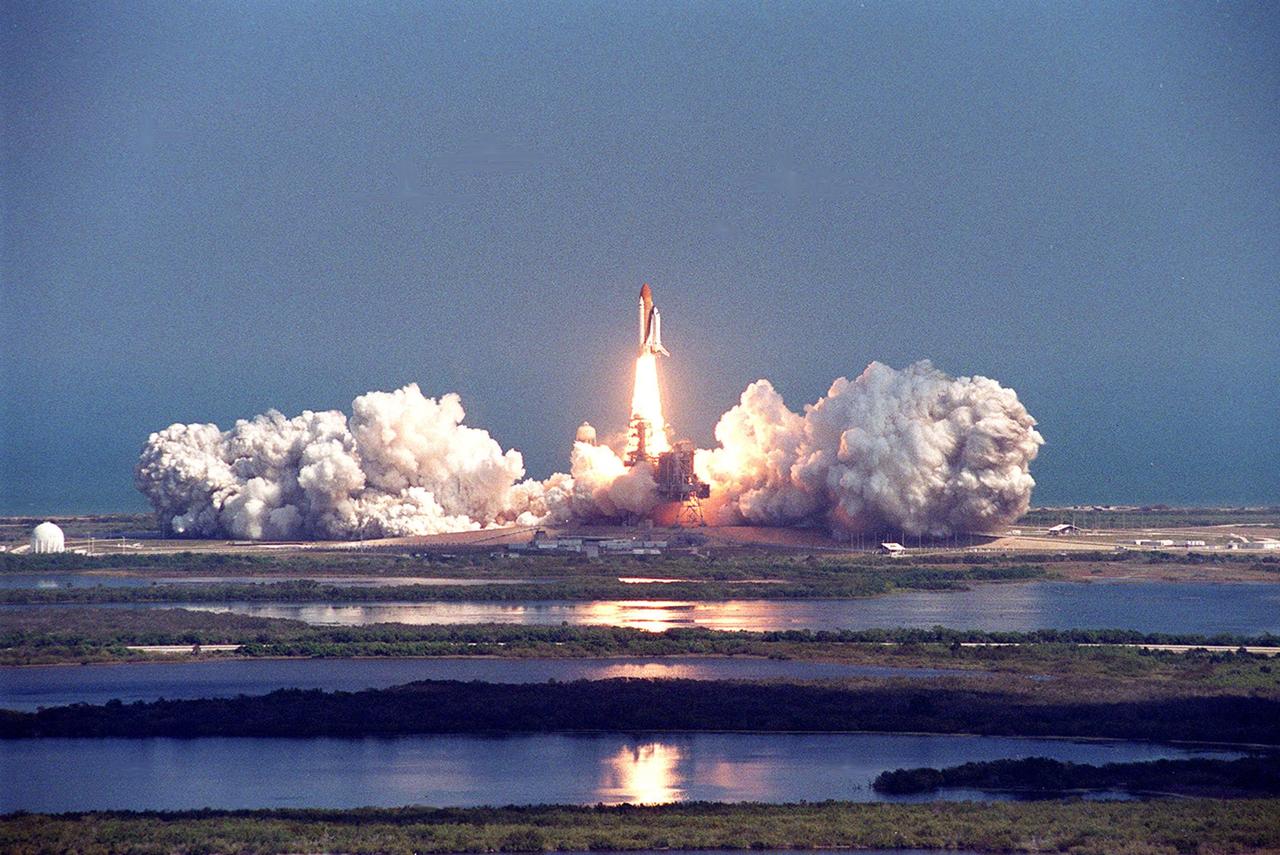
KENNEDY SPACE CENTER, Fla. -- Viewed from the roof of the Vehicle Assembly Building, Space Shuttle Endeavour appears to rise from the sea as it lifts off from Launch Pad 39A at 12:43:40 p.m. EST. Known as the Shuttle Radar Topography Mission (SRTM), STS-99 will chart a new course to produce unrivaled 3-D images of the Earth's surface. The result of the SRTM could be close to 1 trillion measurements of the Earth's topography. The mission is expected to last 11days, with Endeavour landing at KSC Tuesday, Feb. 22, at 4:36 p.m. EST. This is the 97th Shuttle flight and 14th for Shuttle Endeavour
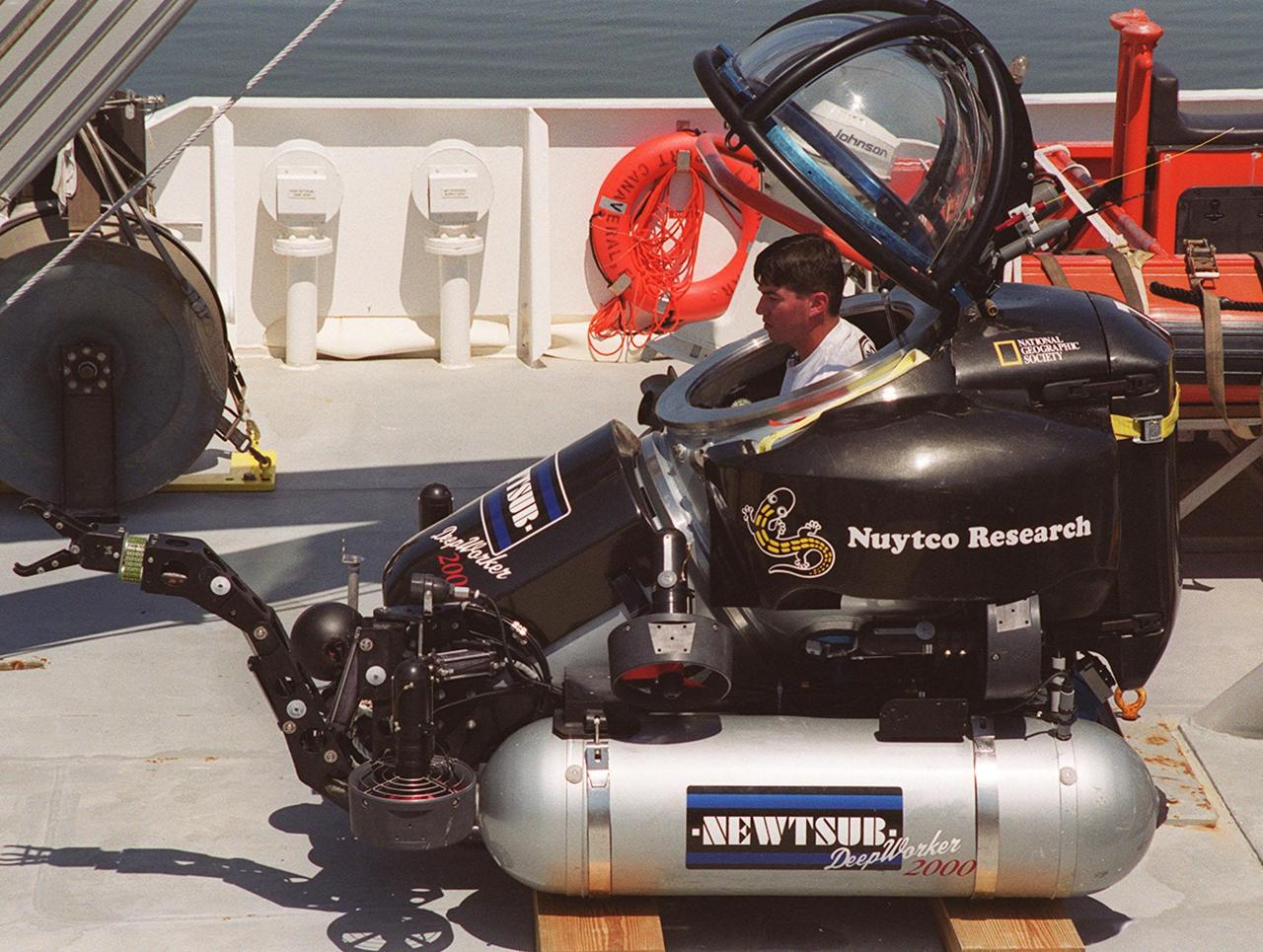
The one-man submarine dubbed DeepWorker 2000 sits on the deck of Liberty Star, one of two KSC solid rocket booster recovery ships. Inside the sub is the pilot, Anker Rasmussen. The sub is being tested on its ability to duplicate the sometimes hazardous job United Space Alliance (USA) divers perform to recover the expended boosters in the ocean after a launch. The boosters splash down in an impact area about 140 miles east of Jacksonville and after recovery are towed back to KSC for refurbishment by the specially rigged recovery ships. DeepWorker 2000 was built by Nuytco Research Ltd., North Vancouver, British Columbia. It is 8.25 feet long, 5.75 feet high, and weighs 3,800 pounds. USA is a prime contractor to NASA for the Space Shuttle program
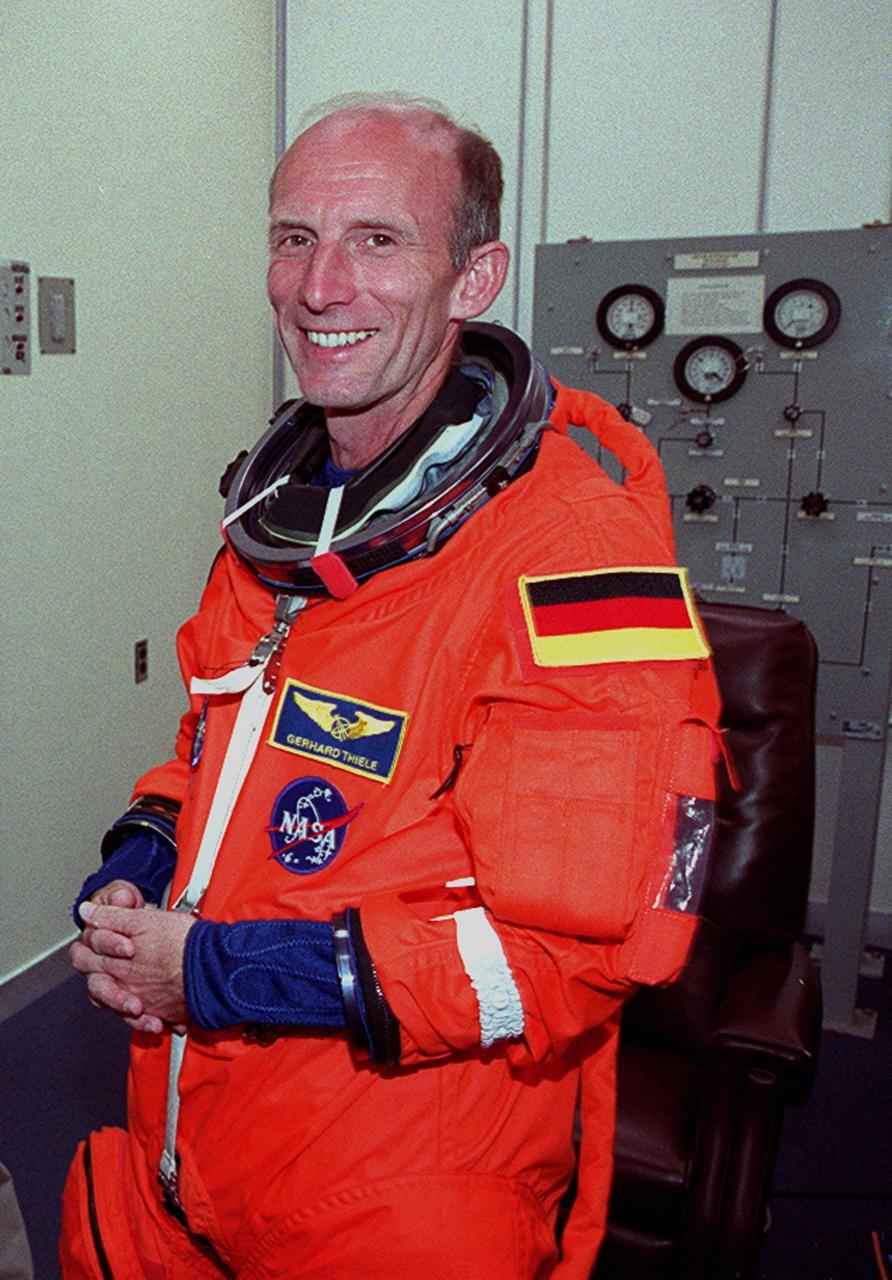
In the Operations and Checkout Building, STS-99 Mission Specialist Gerhard Thiele, who is with the European Space Agency, smiles as he dons his launch and entry suit during final launch preparations. Liftoff of STS-99, known as the Shuttle Radar Topography Mission (SRTM), is scheduled for 12:47 p.m. EST from Launch Pad 39A. The SRTM will chart a new course to produce unrivaled 3-D images of the Earth's surface, using two antennae and a 200-foot-long section of space station-derived mast protruding from the payload bay. The result of the Shuttle Radar Topography Mission could be close to 1 trillion measurements of the Earth's topography. Besides contributing to the production of better maps, these measurements could lead to improved water drainage modeling, more realistic flight simulators, better locations for cell phone towers, and enhanced navigation safety. The mission is expected to last about 11days. Endeavour is expected to land at KSC Friday, Feb. 11, at 4:55 p.m. EST
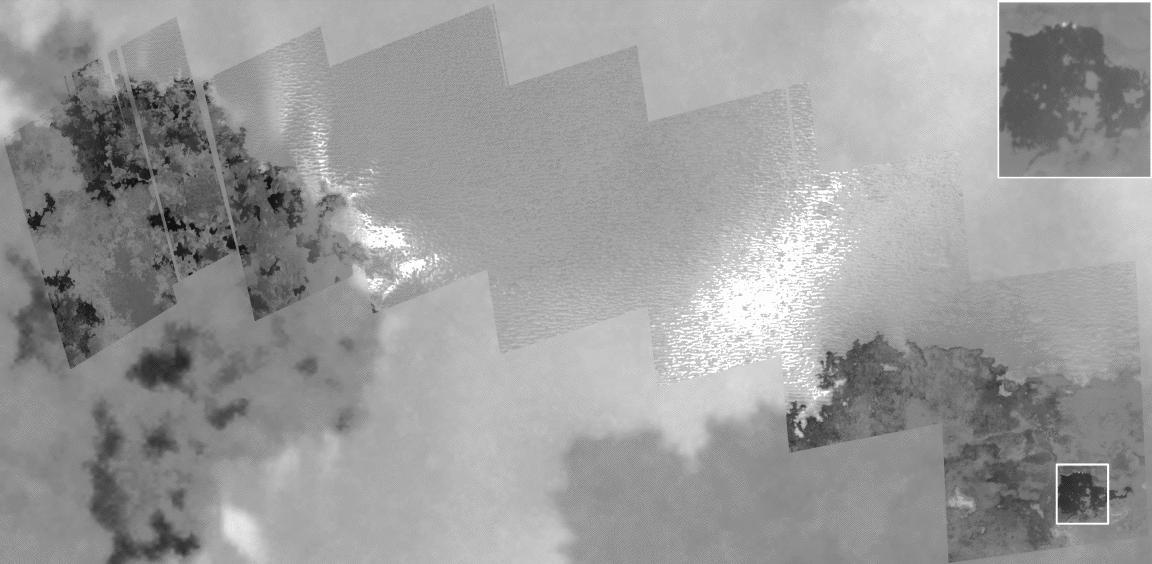
Galileo Takes a Close-up Look at Prometheus
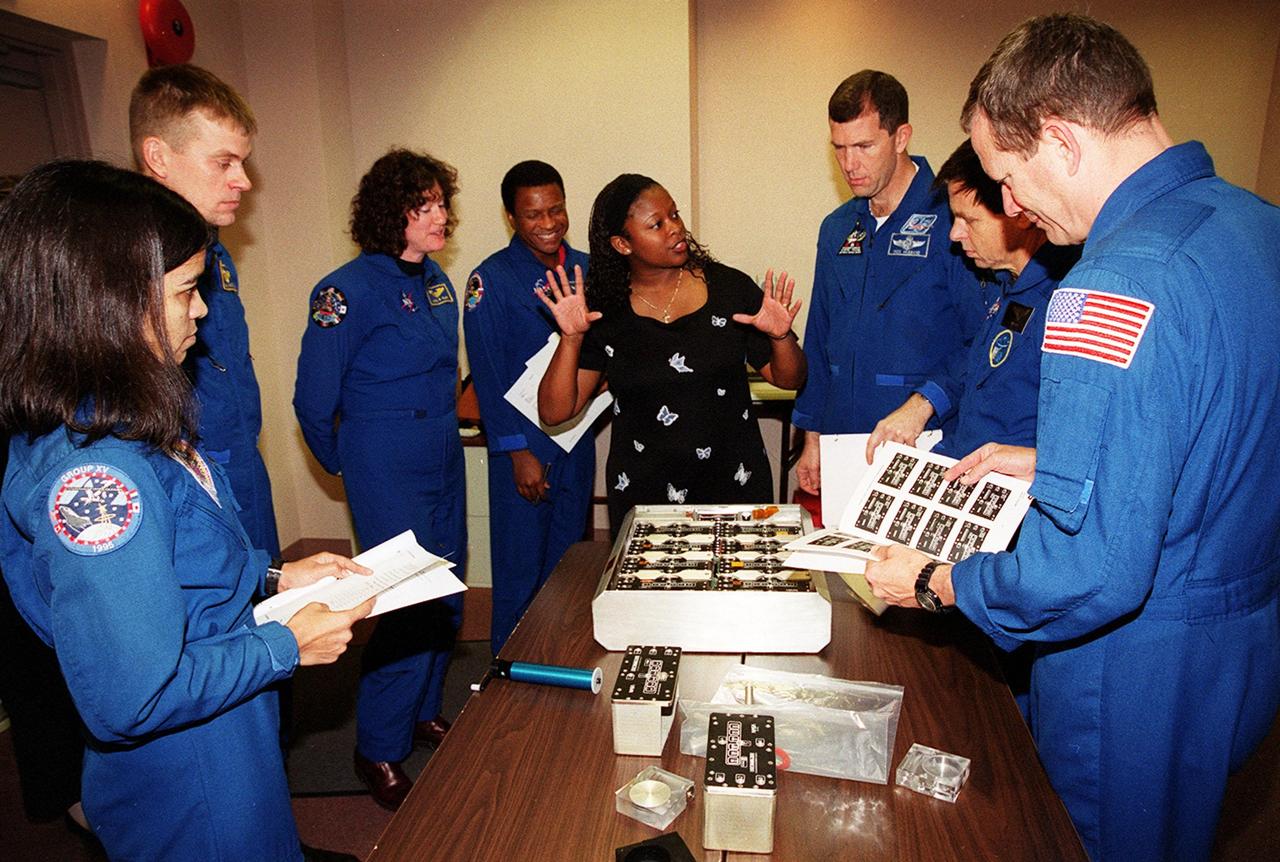
KENNEDY SPACE CENTER, FLA. -- As part of In-Flight Maintenance training at SPACEHAB, in Cape Canaveral, Fla., members of the STS-107 crew learn about Biological Research in Canisters (BRIC) experiments that will be on their mission. From left are Mission Specialist Kalpana Chawla, Pilot William C. “Willie” McCool, Mission Specialists Laurel Clark and Michael Anderson, Roberteen McCray of Bionetics, Commander Rick D. Husband,; Payload Specialist Ilan Ramon of Israel and Mission Specialist David M. Brown. STS-107 will carry a broad collection of experiments ranging from material science to life science. It is scheduled to launch July 19, 2001

KENNEDY SPACE CENTER, Fla. -- STS-107 crew members take part in In-Flight Maintenance training for their mission. Under the watchful eyes of SPACEHAB trainer David Butler (left), Payload Specialist Ilan Ramon of Israel (center) and Mission Specialist David M. Brown (right) check equipment and paperwork inside the SPACEHAB Double Module. Research mission STS-107, scheduled to launch July 19, 2001, will carry the SPACEHAB Double Module in its first flight into space and a broad collection of experiments ranging from material science to life science

Northern Plains Textures Visible Near the Terminator
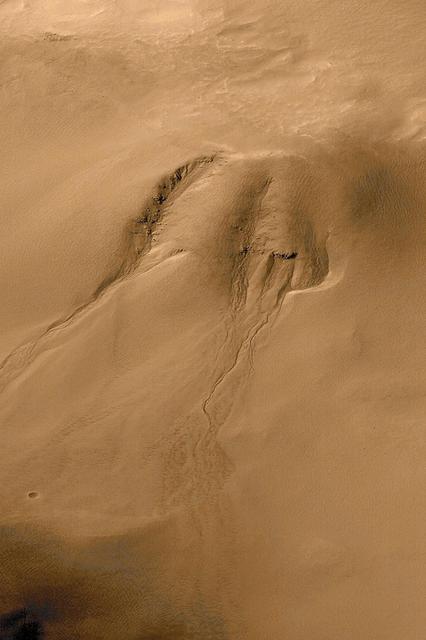
Evidence for Recent Liquid Water on Mars: Gullies in Crater Wall, Noachis Terra
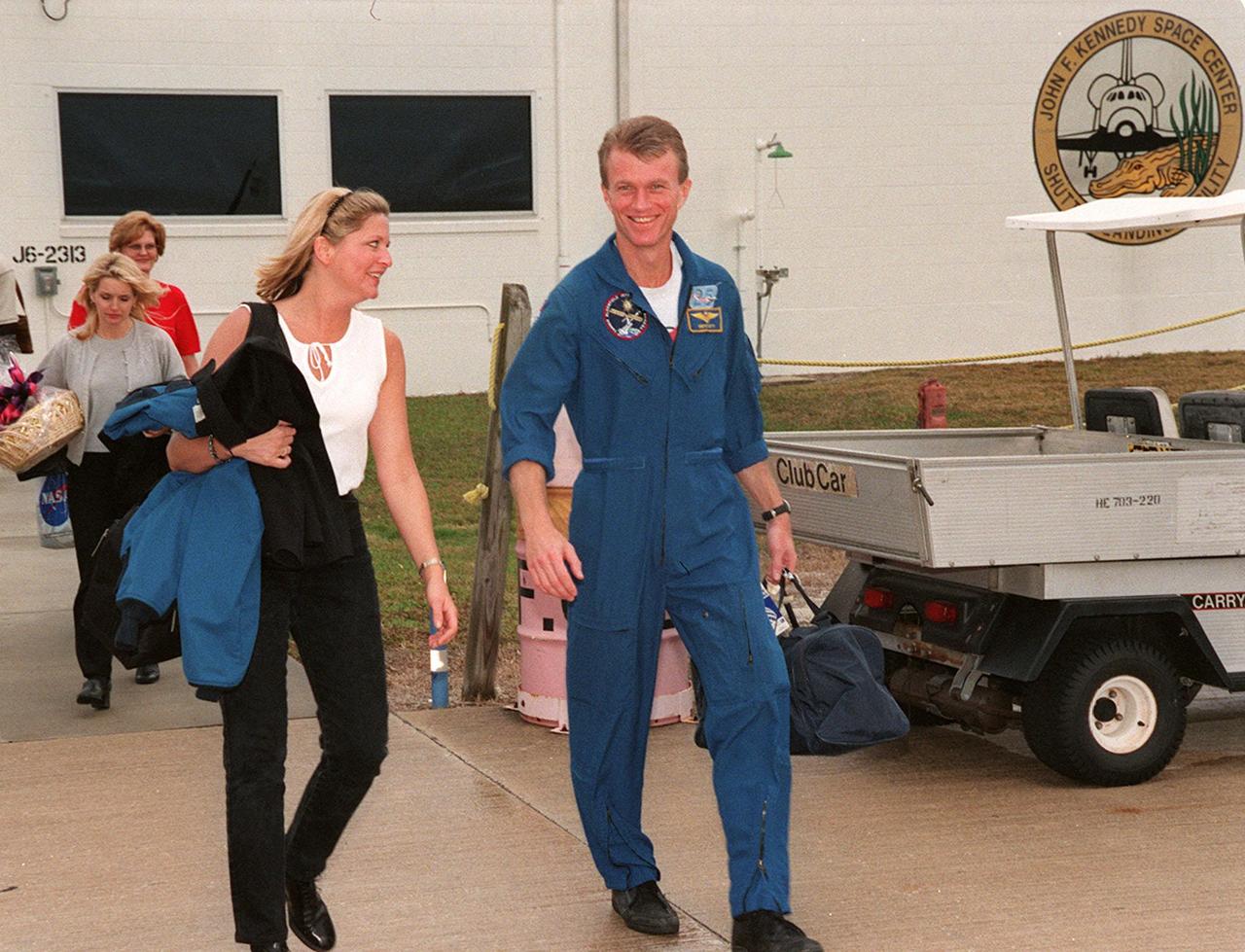
KENNEDY SPACE CENTER, FLA. -- After a night’s rest and a brief press conference at KSC, STS-97 Commander Brent Jett (right) heads for a plane at the Shuttle Landing Facility. With him is his wife. They and other crew members and their families are returning to Houston.; Mission STS-97 ended on Dec. 11, 2000, with a landing at KSC at 6:04 p.m. EST
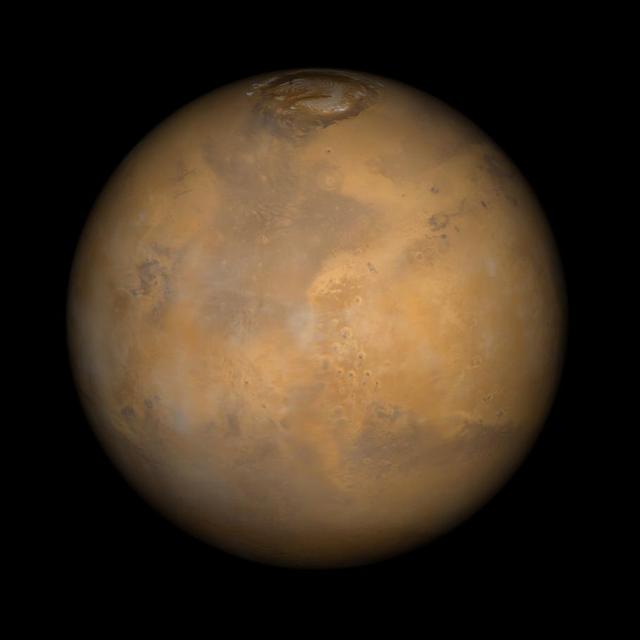
Somewhere down there sits the Mars Pathfinder lander and Sojourner rover. This Mars Global Surveyor Mars Orbiter Camera view of the red planet shows the region that includes Ares Vallis and the Chryse Plains upon which both Mars Pathfinder and the Viking 1 landed in 1997 and 1976, respectively. Acidalia Planitia is the dark surface that dominates the center left. The Pathfinder site is immediately south of Acidalia, just left of center in this view. Also shown--the north polar cap is at the top, and Arabia Terra and Sinus Meridiani are to the right. The bluish-white features are clouds. This is a color composite of 9 red and 9 blue image strips taken by the Mars Global Surveyor Mars Orbiter Camera on 9 successive orbits from pole-to-pole during the calibration phase of the mission in March 1999. The color is computer-enhanced and is not shown as it would actually appear to the human eye. http://photojournal.jpl.nasa.gov/catalog/PIA02000
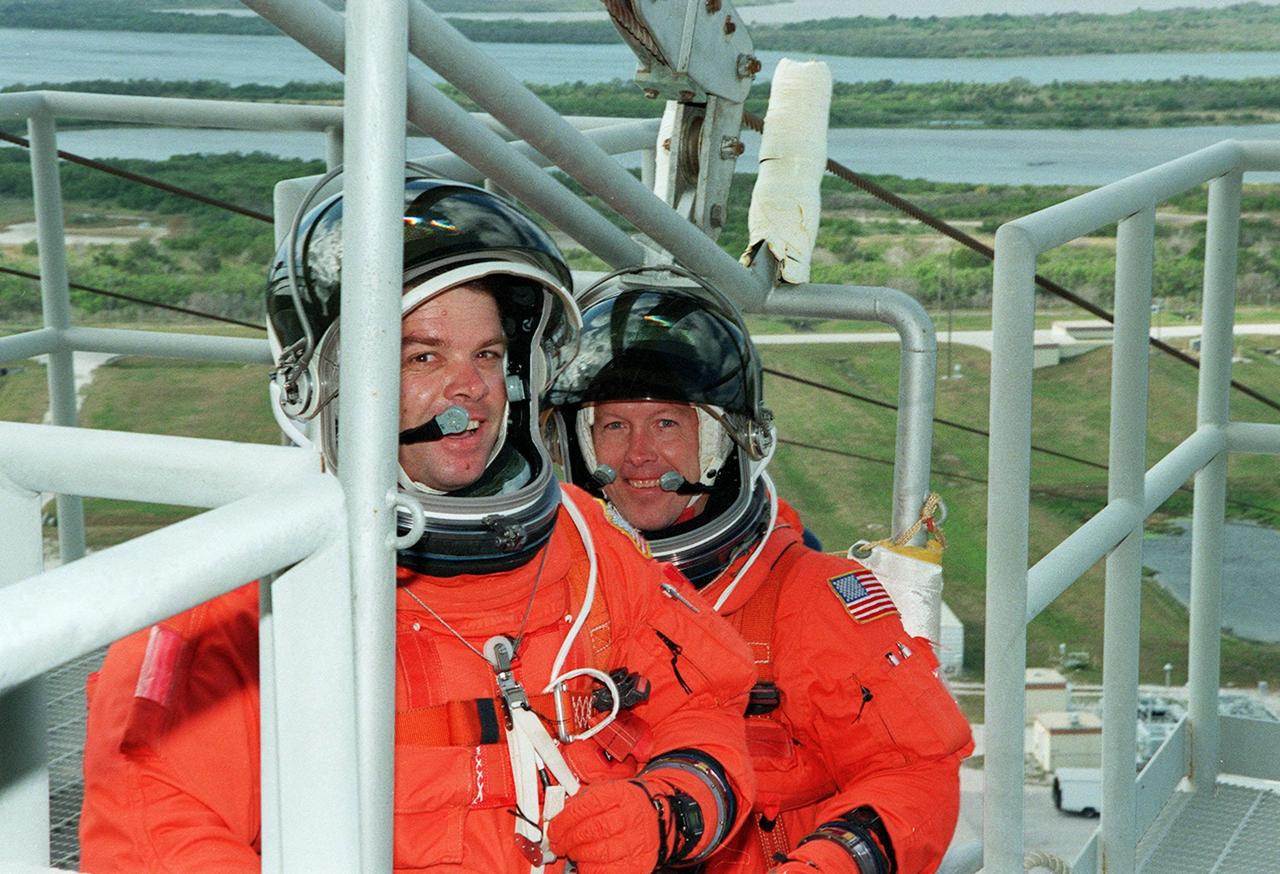
KENNEDY SPACE CENTER, Fla. -- At Launch Pad 39A, STS-99 Mission Specialists Gerhard Thiele (Ph.D.), of the European Space Agency (in front), and Janet Kavandi (Ph.D.) prepare to practice emergency egress procedures with a slidewire basket. Seven slidewires, with flatbottom baskets suspended from each wire, extend from the Fixed Service Structure at the orbiter access arm level. These baskets could provide an escape route for the astronauts until the final 30 seconds of the countdown in case of an emergency. The crew is taking part in Terminal Countdown Demonstration Test (TCDT) activities that provide the crew with simulated countdown exercises, emergency egress training, and opportunities to inspect the mission payloads in the orbiter's payload bay. STS-99 is the Shuttle Radar Topography Mission, which will chart a new course, using two antennae and a 200-foot-long section of space station-derived mast protruding from the payload bay to produce unrivaled 3-D images of the Earth's surface. The result of the Shuttle Radar Topography Mission could be close to 1 trillion measurements of the Earth's topography. Besides contributing to the production of better maps, these measurements could lead to improved water drainage modeling, more realistic flight simulators, better locations for cell phone towers, and enhanced navigation safety. Launch of Endeavour on the 11-day mission is scheduled for Jan. 31 at 12:47 p.m. EST.
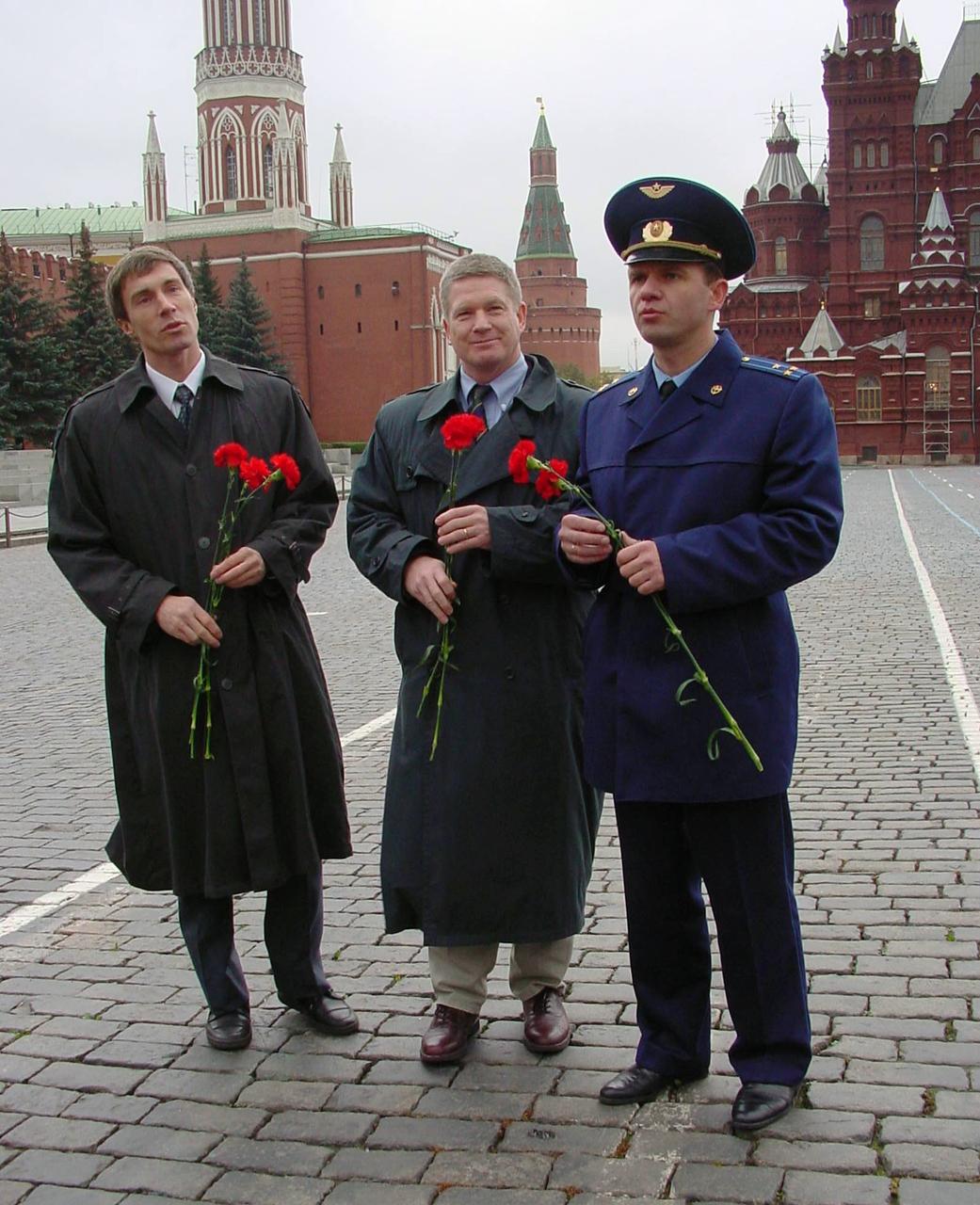
JSC2000-E-27075 (16 October 2000) --- Expedition One crew members in Moscow. From left, flight engineer Sergei Krikalev, expedition commander William (Bill) Shepherd and Soyuz pilot Yuri Gidzenko.
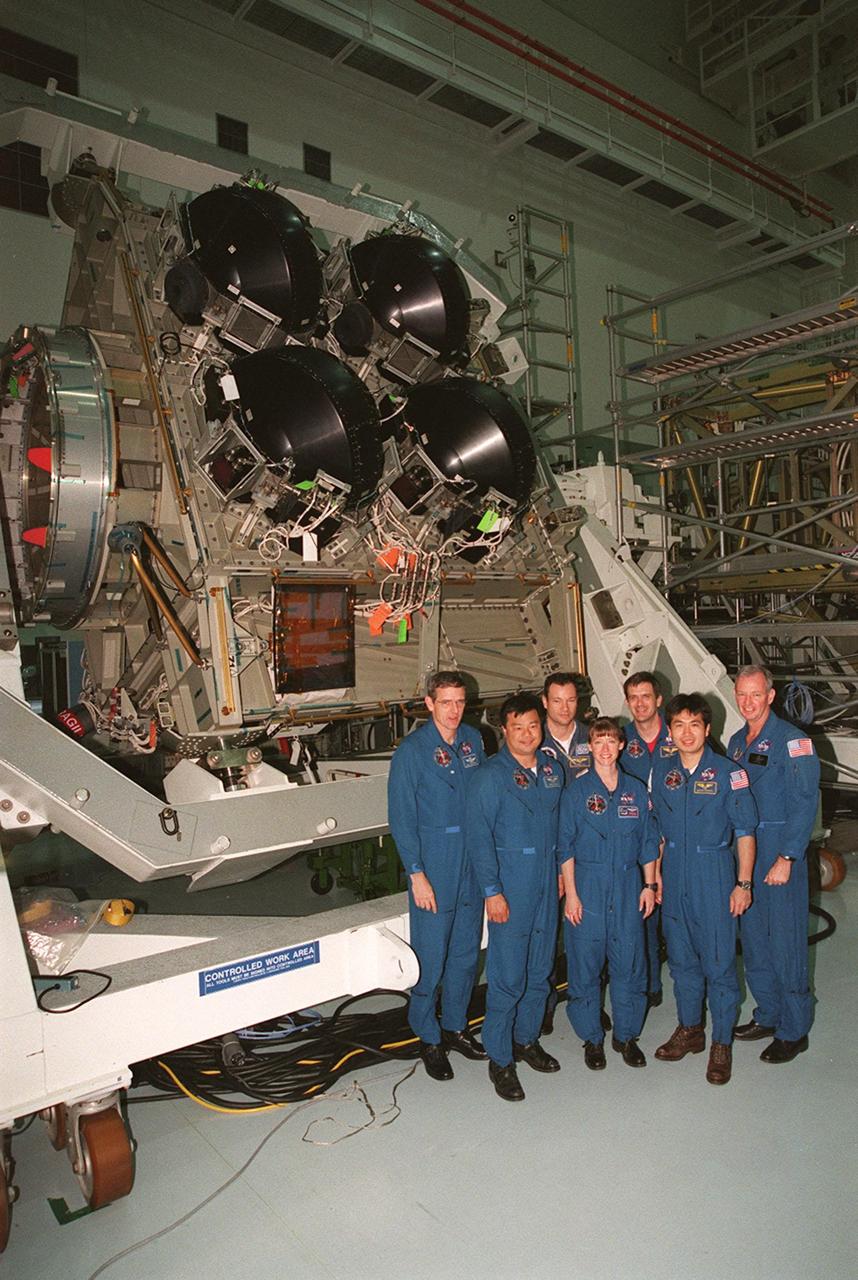
KENNEDY SPACE CENTER, FLA. -- The STS-92 crew pose in front of the Integrated Truss Structure Z1, an element of the International Space Station that will be part of the mission payload. STS-92 is the fifth U.S. flight in the construction of the International Space Station. Standing left to right are Mission Specialists William S. McArthur Jr., Leroy Chiao, and Michael E. Lopez-Alegria; Pilot Pamela A. Melroy; Mission Specialists Peter J.K. Wisoff and Koichi Wakata; and Commander Brian Duffy. Wakata is with the National Space Development Agency of Japan. The Z1 is an early exterior framework to allow the first U.S. solar arrays on a future flight to be temporarily installed on Unity for early power. Another part of the payload is a pressurized mating adapter, PMA-3, to provide a Shuttle docking port for solar array installation on the sixth ISS flight and Lab installation on the seventh ISS flight. Launch of STS-92 is scheduled for Sept. 21, 2000
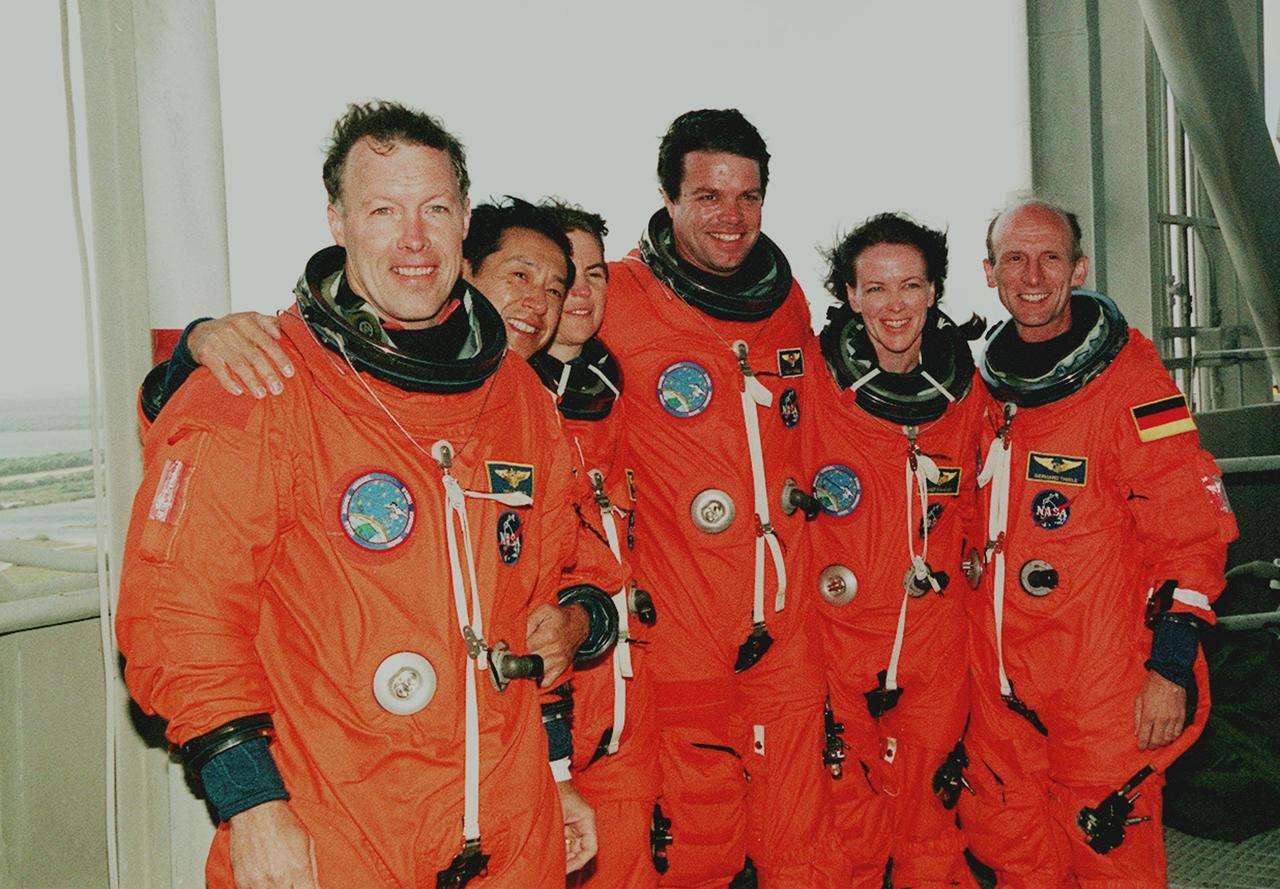
KENNEDY SPACE CENTER, Fla. -- At the 195-foot level of the Fixed Service Structure on Launch Pad 39A, the STS-99 crew pose for a photograph during Terminal Countdown Demonstration Test (TCDT) activities. Standing left to right are Pilot Dominic Gorie, Mission Specialist Mamoru Mohri (Ph.D.), Mission Specialist Janice Voss (Ph.D.), Commander Kevin Kregel, Mission Specialist Janet Lynn Kavandi (Ph.D.), and Mission Specialist Gerhard Thiele (Ph.D.). Thiele is with the European Space Agency and Mohri is with the National Space Development Agency (NASDA) of Japan. The TCDT provides the crew with simulated countdown exercises, emergency egress training, and opportunities to inspect the mission payloads in the orbiter's payload bay. STS-99 is the Shuttle Radar Topography Mission, which will chart a new course, using two antennae and a 200-foot-long section of space station-derived mast protruding from the payload bay to produce unrivaled 3-D images of the Earth's surface. The result of the Shuttle Radar Topography Mission could be close to 1 trillion measurements of the Earth's topography. Besides contributing to the production of better maps, these measurements could lead to improved water drainage modeling, more realistic flight simulators, better locations for cell phone towers, and enhanced navigation safety. Launch of Endeavour on the 11-day mission is scheduled for Jan. 31 at 12:47 p.m. EST
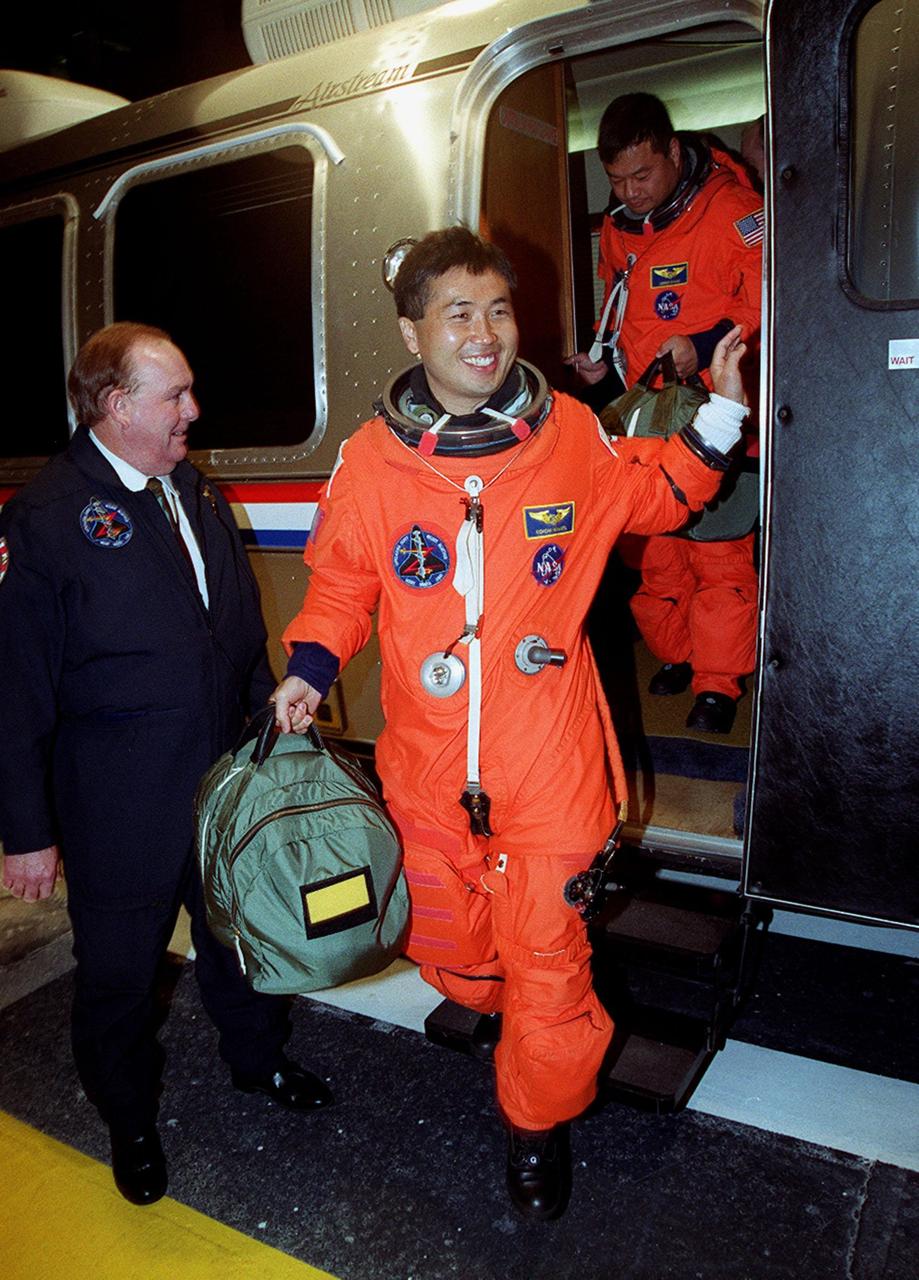
STS-92 Mission Specialist Koichi Wakata of Japan exits the Astrovan on its return to the Operations and Checkout Building. Behind him is Mission Specialist Leroy Chiao. The scheduled launch to the International Space Station (ISS) was scrubbed about 90 minutes before liftoff. The mission will be the fifth flight for the construction of the ISS. The payload includes the Integrated Truss Structure Z-1 and the third Pressurized Mating Adapter. During the 11-day mission, four extravehicular activities (EVAs), or spacewalks, are planned. The Z-1 truss is the first of 10 that will become the backbone of the International Space Station, eventually stretching the length of a football field. PMA-3 will provide a Shuttle docking port for solar array installation on the sixth ISS flight and Lab installation on the seventh ISS flight. The launch has been rescheduled for liftoff Oct. 11 at 7:17 p.m
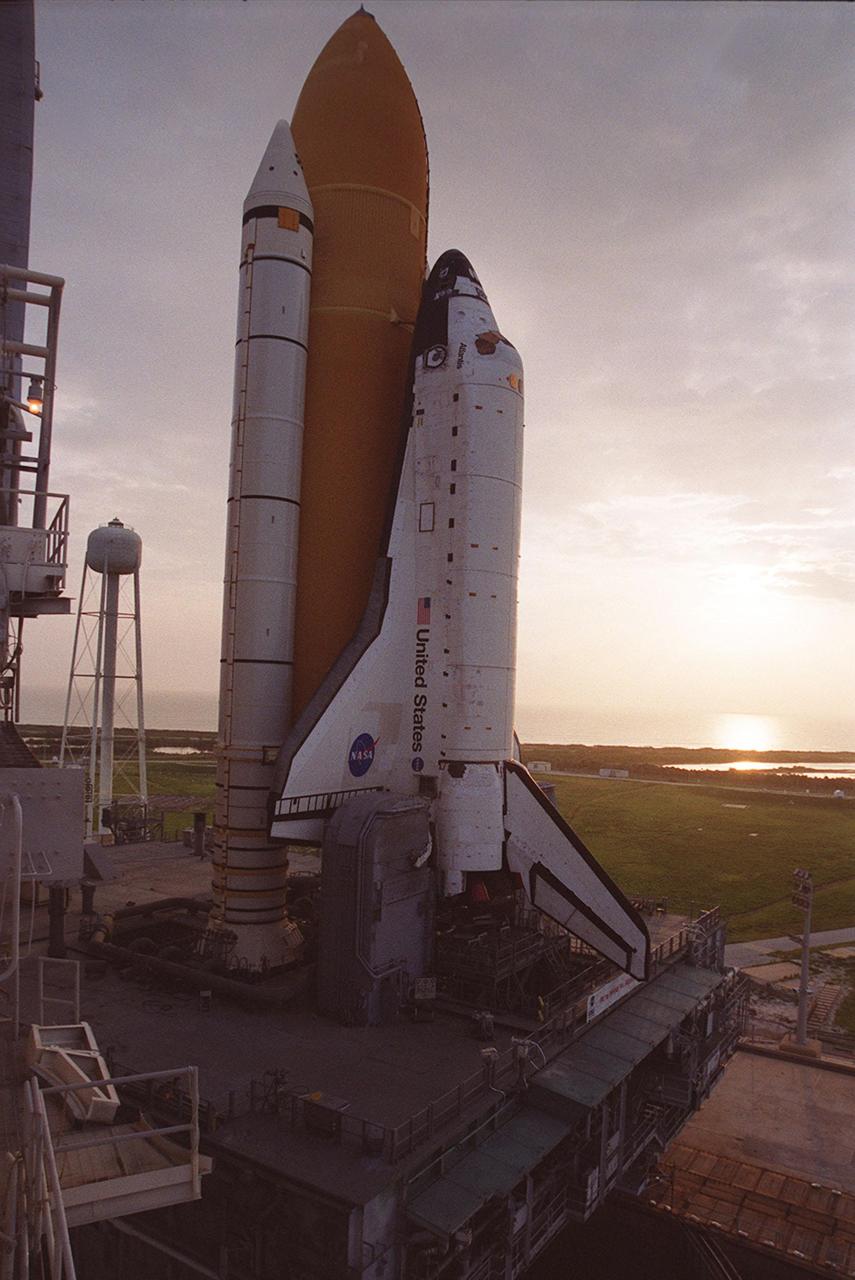
KENNEDY SPACE CENTER, Fla. -- The sun lights the early morning sky, revealing Space Shuttle Atlantis, atop the Mobile Launcher Platform and Crawler-Transporter, at Launch Pad 39B. It started its 8-hour rollout from the Vehicle Assembly Building high bay 2 (Safe Haven) at 11:20 p.m., Aug. 13, arriving shortly after 7 a.m. Aug. 14. At its immediate left is the 290-foot high water tank that holds 300,000 gallons of water, part of the sound suppression system at the pad. At the edge of the photo can be seen part of the Rotating Service Structure. Atlantis is scheduled for launch Sept. 8 at 8:31 a.m. EDT on mission STS-106.

This anaglyph, from NASA Shuttle Radar Topography Mission, is of Honolulu, on the island of Oahu .3D glasses are necessary to view this image.
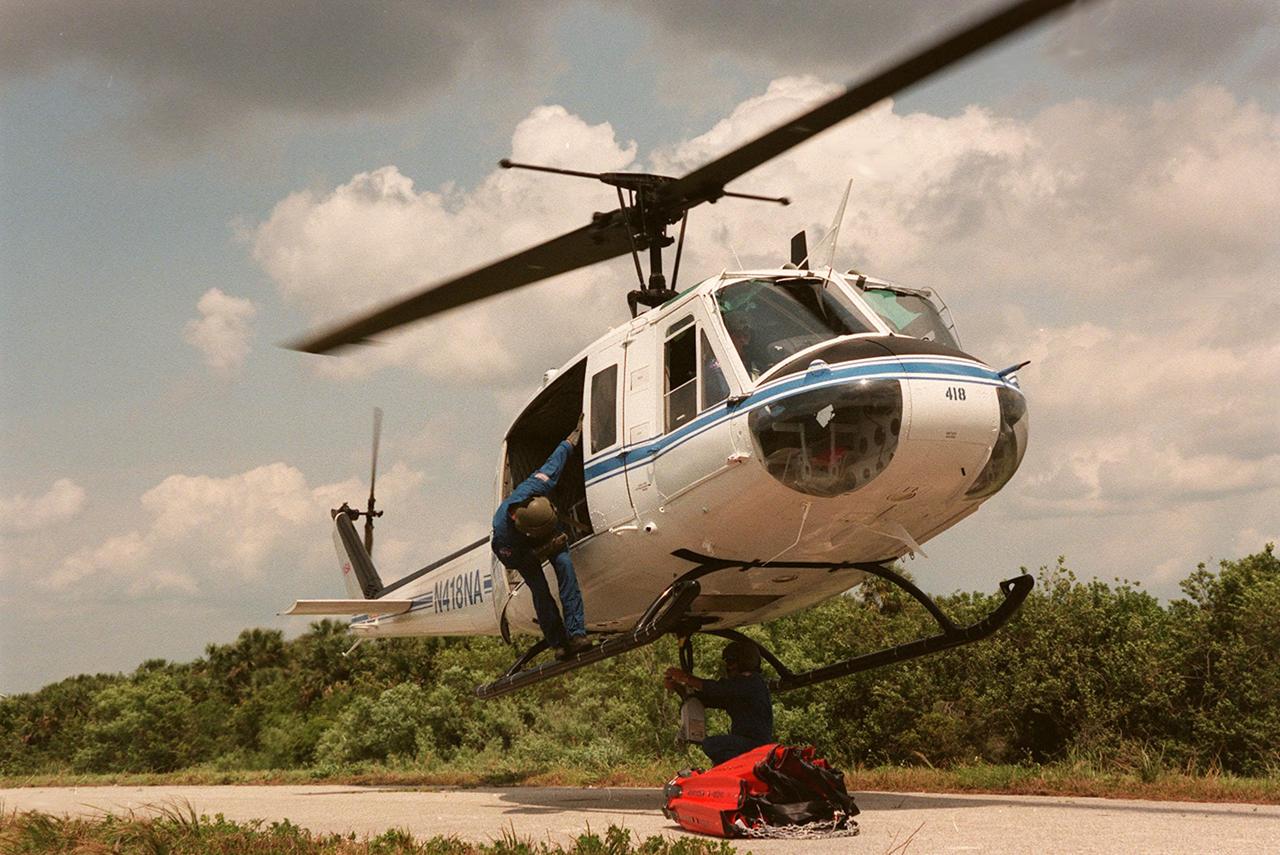
KENNEDY SPACE CENTER, FLA. -- Workers attach a high-impact-resistant flexible plastic bucket to a NASA helicopter. Holding 324 gallons of water, it will be used for fire protection on property and buildings at Kennedy Space Center. Known as the "Bambi" bucket, it will also support the Fish and Wildlife Service for controlled burns plus any wild fires in the area.

KENNEDY SPACE CENTER, FLA. -- STS-101 Mission Specialist Susan J. Helms adjusts her helmet after climbing into her seat inside Space Shuttle Atlantis for a simulated launch countdown. The countdown is part of Terminal Countdown Demonstration Test (TCDT) activities that also include emergency egress training and familiarization with the payload. Other crew members taking part are Commander James D. Halsell Jr., Pilot Scott J. "Doc" Horowitz and Mission Specialists Mary Ellen Weber, James Voss, Jeffrey N. Williams, and Yury Usachev of Russia. During their mission to the International Space Station, the STS-101 crew will be delivering logistics and supplies, plus preparing the Station for the arrival of the Zvezda Service Module, expected to be launched by Russia in July 2000. Also, the crew will conduct one space walk to perform maintenance on the Space Station. This will be the third assembly flight for the Space Station. STS-101 is scheduled to launch April 24 at 4:15 p.m. from Launch Pad 39A
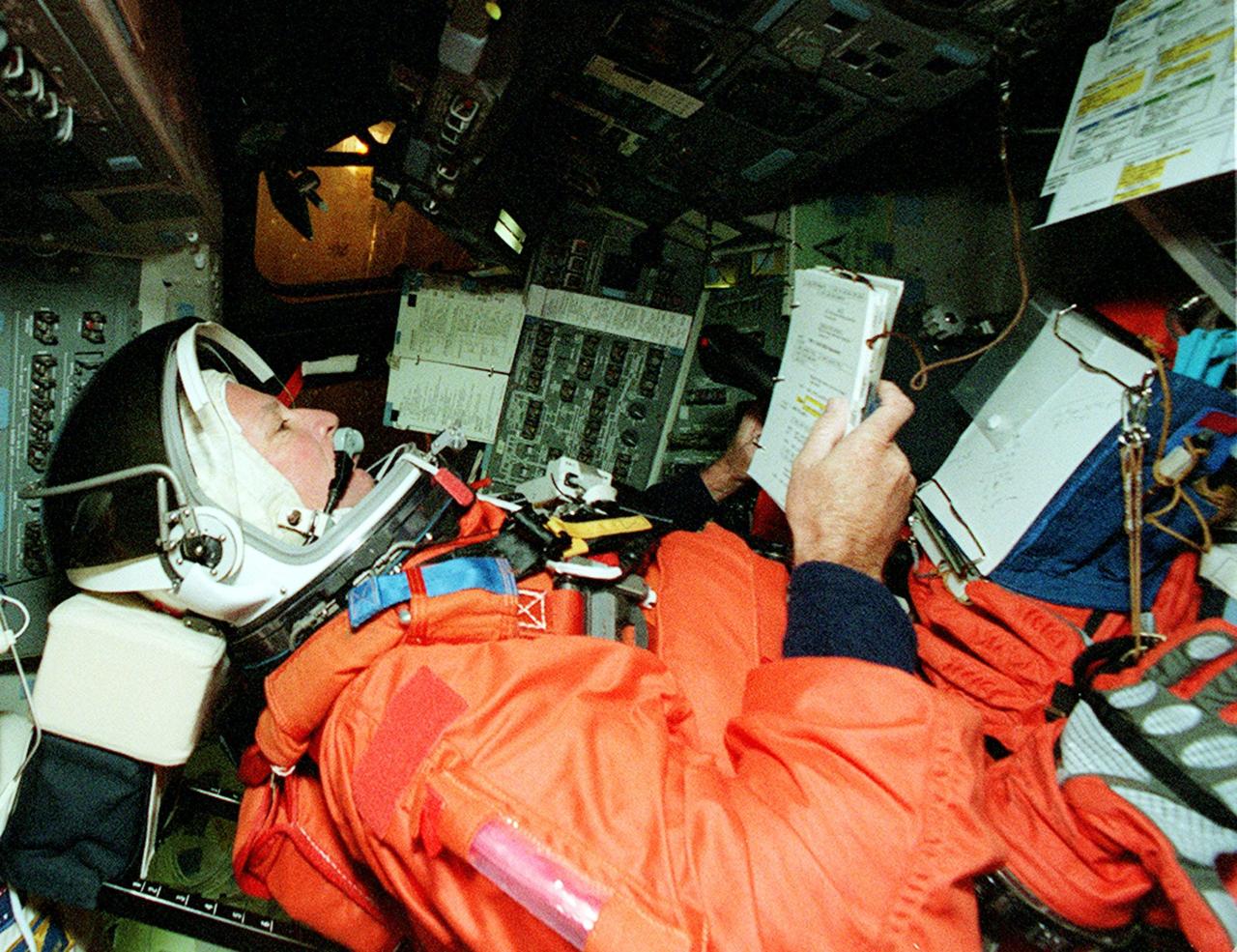
KENNEDY SPACE CENTER, FLA. -- STS-92 Commander Brian Duffy is seated at the controls of Discovery to take part in a simulated countdown. The countdown is part of Terminal Countdown Demonstration Test (TCDT) activities that he and other crew members have been performing. STS-92 is scheduled to launch Oct. 5 at 9:38 p.m. EDT on the fifth flight to the International Space Station. It will carry two elements of the Space Station, the Integrated Truss Structure Z1 and the third Pressurized Mating Adapter. The mission is also the 100th flight in the Shuttle program
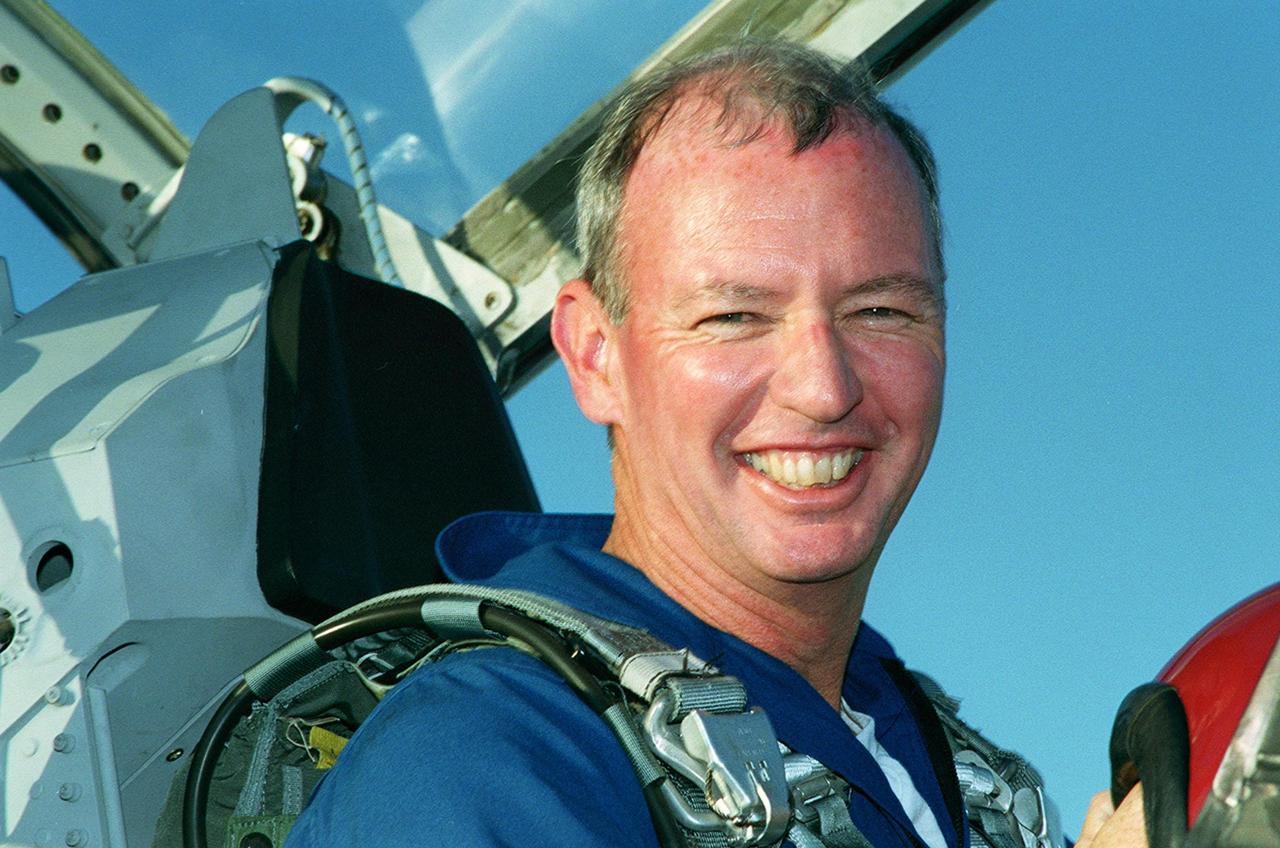
STS-92 Commander Brian Duffy smiles after landing at the KSC Shuttle Landing Facility in a T-38 training jet aircraft. He and the rest of the crew are at KSC to take part in Terminal Countdown Demonstration Test activities, which include emergency egress training from the orbiter and pad, and a simulated countdown. The fifth mission to the International Space Station, STS-92 will carry the Integrated Truss Structure Z1, the first of the planned 10 trusses on the Space Station, and the third Pressurized Mating Adapter. The Z1 will allow the first U.S. solar arrays on a future flight to be temporarily installed on Unity for early power. PMA-3 will provide a Shuttle docking port for the solar array installation on the sixth ISS flight and Lab installation on the seventh ISS flight. STS-92 is scheduled to launch Oct. 5 from launch Pad 39A. It will be the 100th flight in the Shuttle program
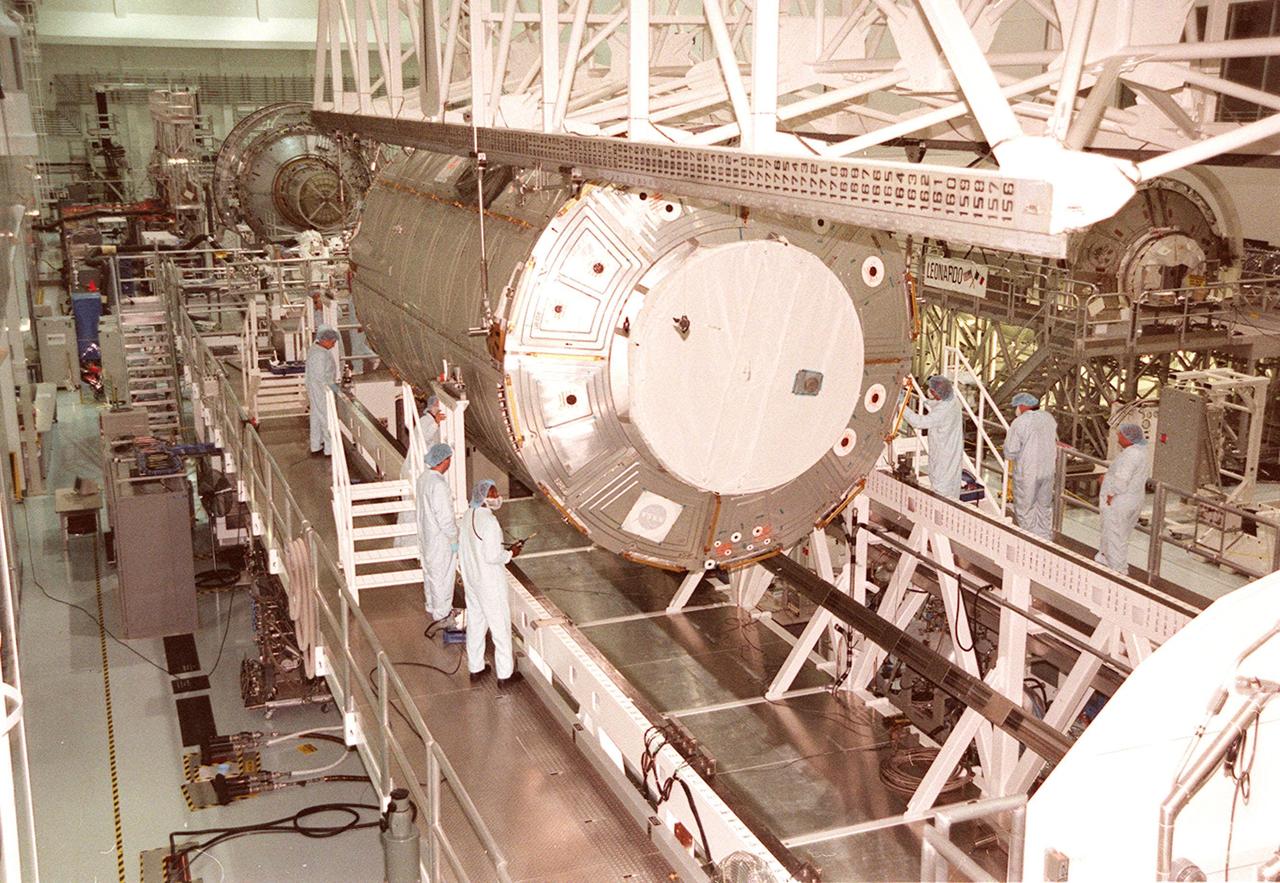
KENNEDY SPACE CENTER, FLA. -- In the Space Station Processing Facility, workers watch while the U.S. Lab Destiny is lowered onto the Launch Package Integration Stand (LPIS) for a weight and center of gravity determination. Destiny is the payload aboard Space Shuttle Atlantis on mission STS-98 to the Space Station. The lab is fitted with five system racks and will already have experiments installed inside for the flight. The launch is scheduled for January 2001
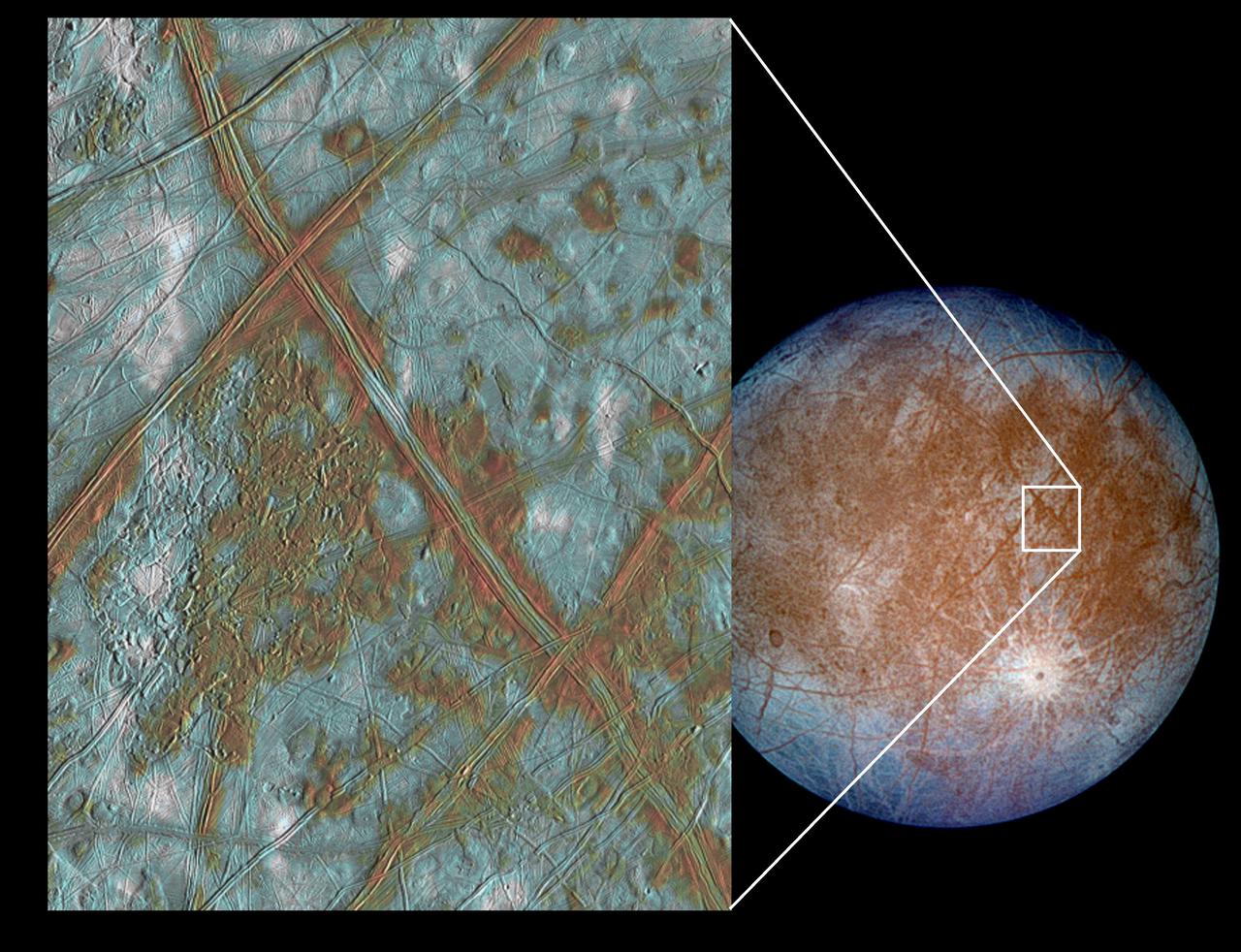
Blocks in the Europan Crust Provide More Evidence of Subterranean Ocean

These are the first pictures that NASA Cassini spacecraft took of Jupiter ring, a portion of which appears in each frame as an arc opening toward the right.

KENNEDY SPACE CENTER, Fla. -- After a 4.4-million-mile mission, Endeavour nears Runway 15 at the Shuttle Landing Facility to complete the successful 10-day, 19-hour and 58-minute-long STS-97 mission. At the controls is Commander Brent Jett. Other crew members on board are Pilot Michael Bloomfield and Mission Specialists Joseph Tanner, Carlos Noriega and Marc Garneau of Canada. On the mission, Endeavour carried the P6 Integrated Truss Structure with solar arrays to power the International Space Station. The arrays and other equipment were installed during three EVAs that totaled 19 hours, 20 minutes. Endeavour was docked with the Space Station for 6 days, 23 hours, 13 minutes. This is the 16th nighttime landing for a Space Shuttle and the 53rd at Kennedy Space Center
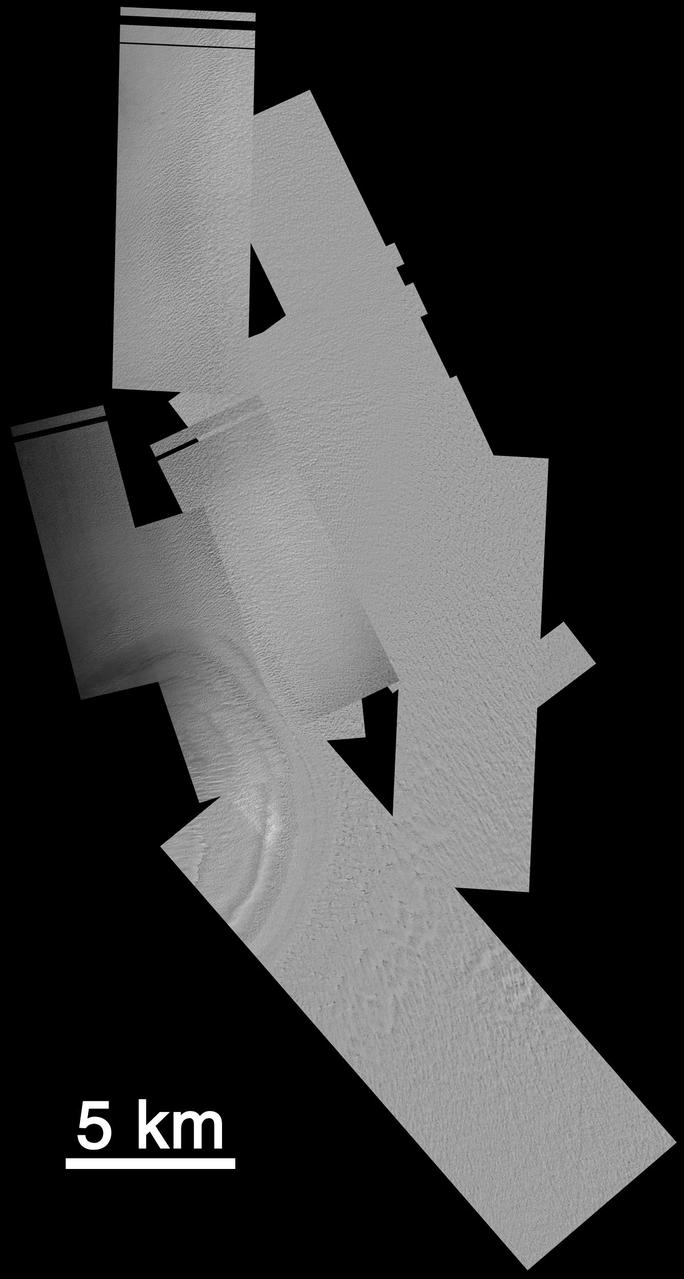
Mars Polar Lander: The Search Continues
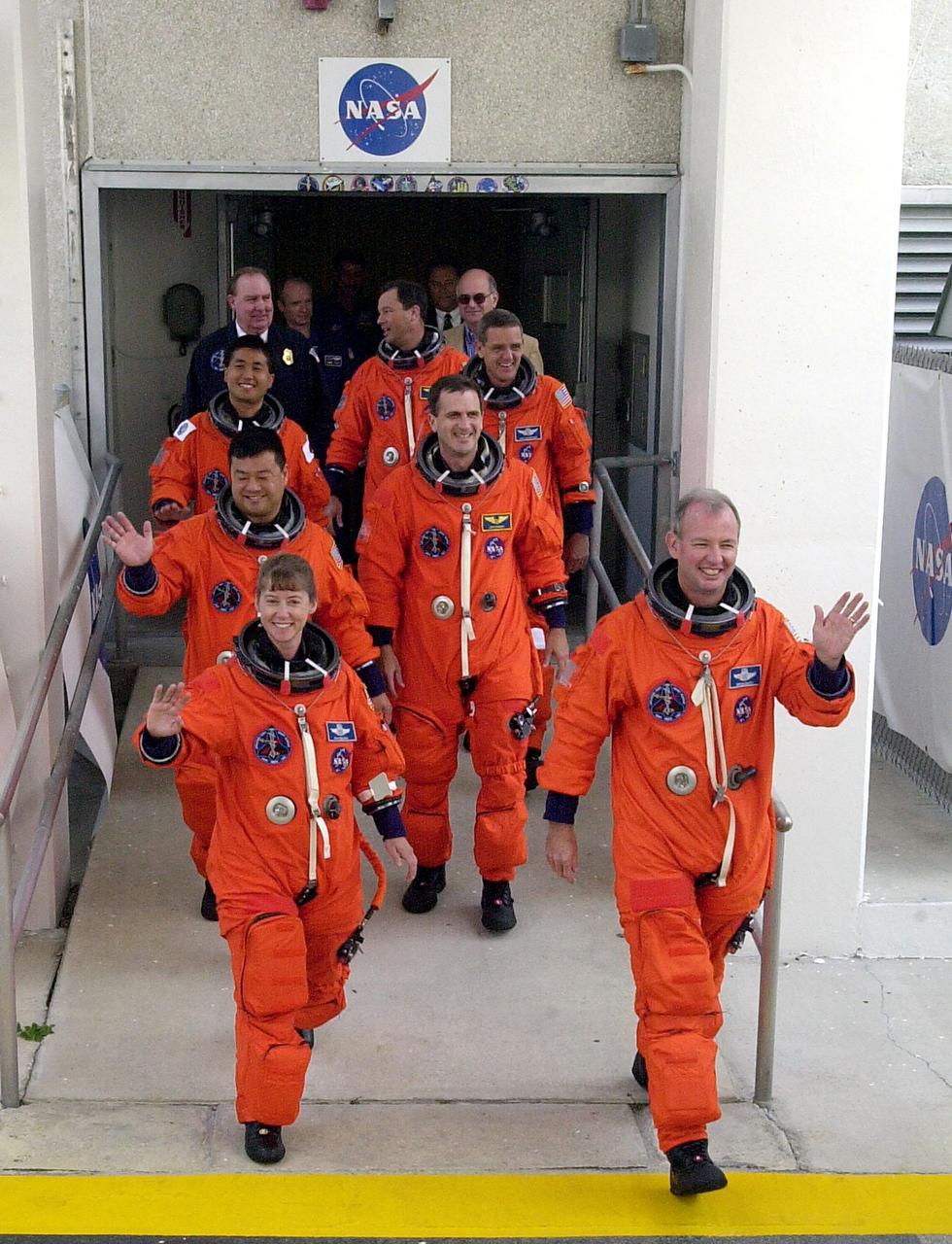
The STS-92 crew eagerly walk out of the Operations and Checkout Building for the second time for their trip to Launch Pad 39A. On the left side, from front to back, are Pilot Pamela Ann Melroy and Mission Specialists Leroy Chiao and Koichi Wakata of Japan. On the right side, front to back, are Commander Brian Duffy and Mission Specialists Peter J.K. “Jeff” Wisoff, William S. McArthur Jr. and Michael E. Lopez-Alegria. During the 11-day mission to the International Space Station, four extravehicular activities (EVAs), or spacewalks, are planned for construction. The payload includes the Integrated Truss Structure Z-1 and the third Pressurized Mating Adapter. The Z-1 truss is the first of 10 that will become the backbone of the Space Station, eventually stretching the length of a football field. PMA-3 will provide a Shuttle docking port for solar array installation on the sixth Station flight and Lab installation on the seventh Station flight. This launch is the fourth for Duffy and Wisoff, the third for Chiao and McArthur, second for Wakata and Lopez-Alegria, and first for Melroy. Launch is scheduled for 7:17 p.m. EDT. Landing is expected Oct. 22 at 2:10 p.m. EDT. [Photo taken with a Nikon D1 camera.
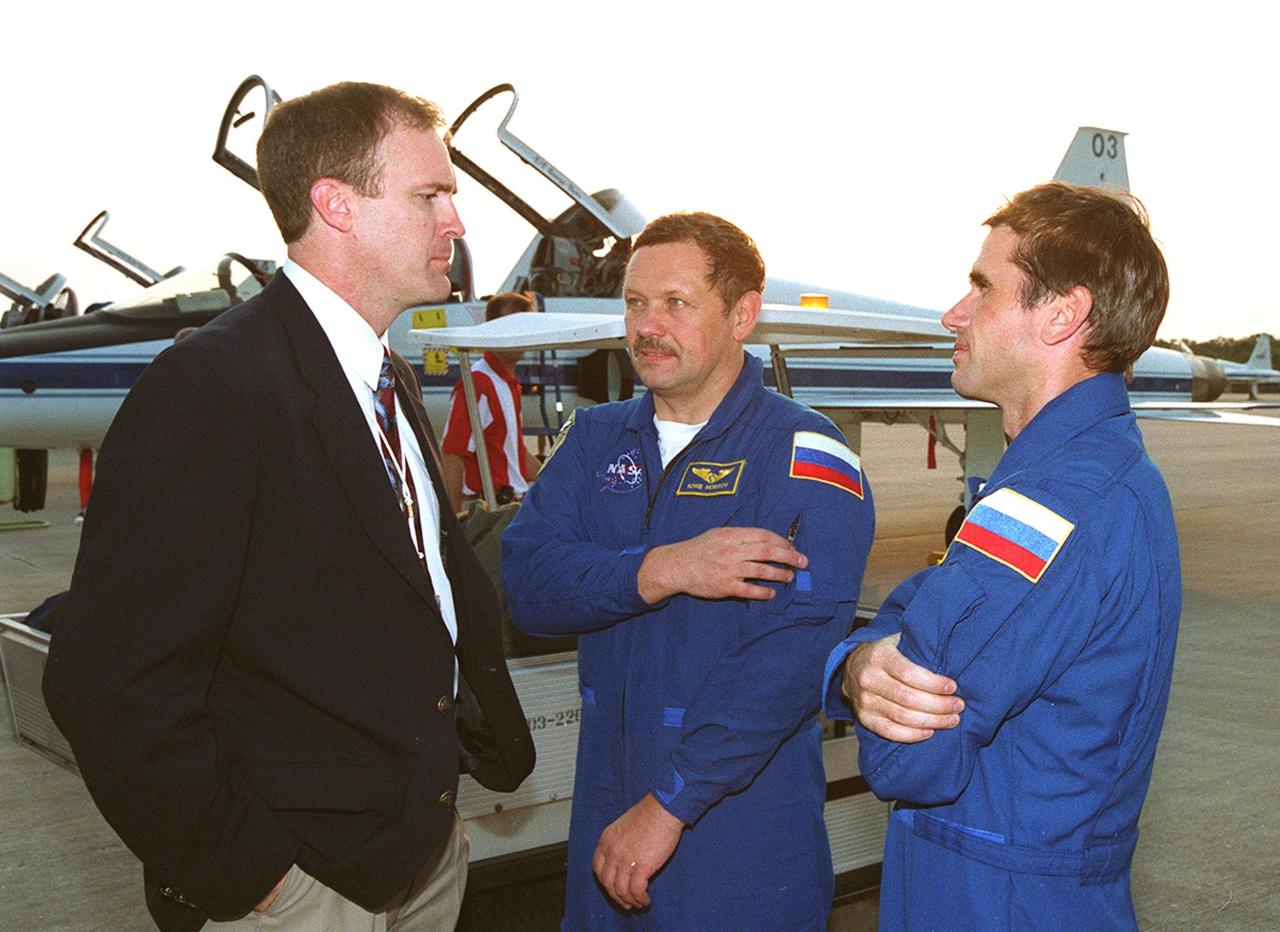
Jim Halsell Jr. (left), former mission commander and now the manager, Shuttle Program Integration Office, chats with STS-106 Mission Specialists Boris V. Morukov (center) and Yuri I. Malenchenko (right) after their arrival at KSC. Morukov and Malenchenko, who are with the Russian Aviation and Space Agency, are at KSC with the rest of the crew to take part in Terminal Countdown Demonstration Test activities, which include emergency egress training and a simulated launch countdown. STS-106 is scheduled to launch Sept. 8, 2000, at 8:31 a.m. EDT from Launch Pad 39B. On the 11-day mission, the seven-member crew will perform support tasks on orbit, transfer supplies and prepare the living quarters in the newly arrived Zvezda Service Module. The first long-duration crew, dubbed “Expedition One,” is due to arrive at the Station in late fall
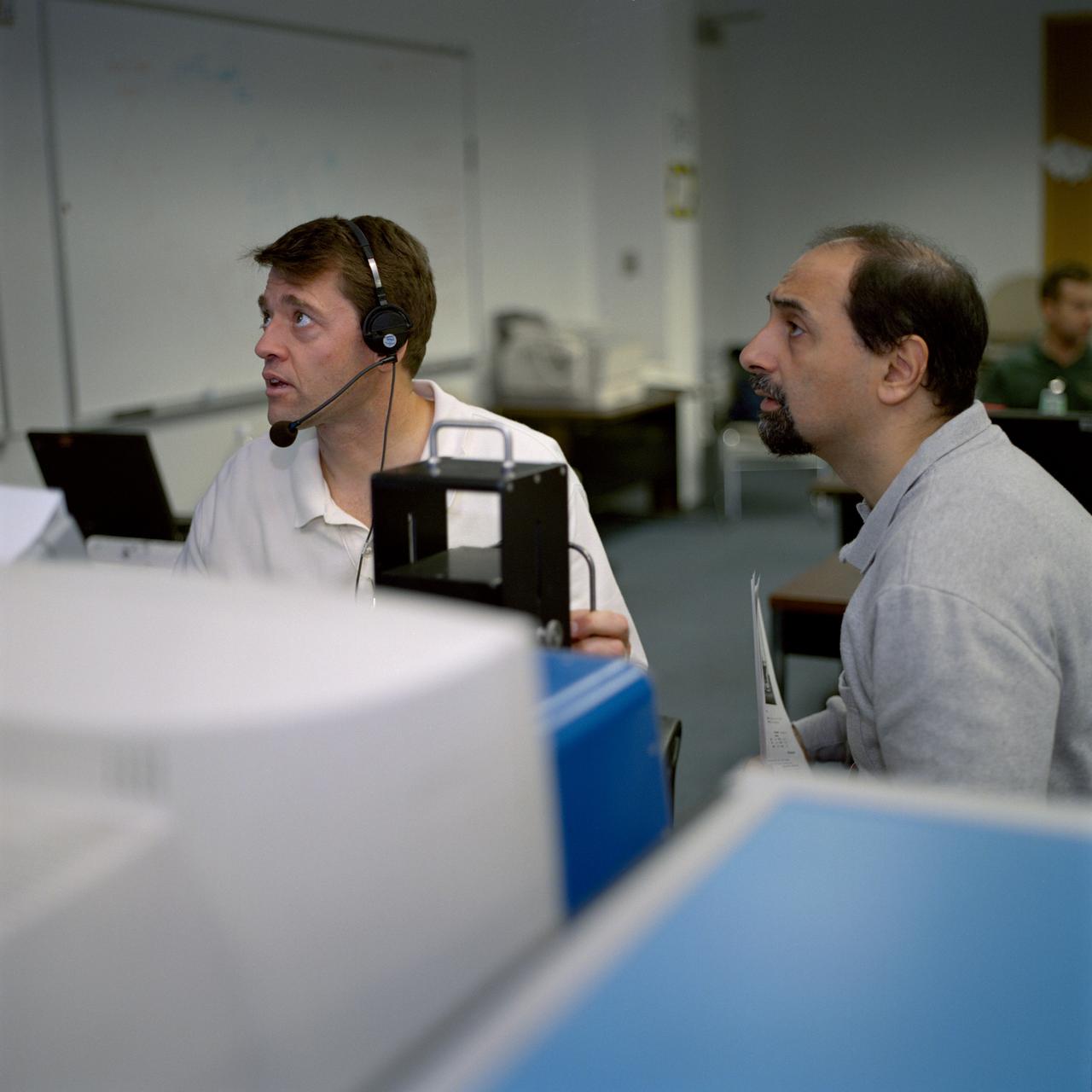
JSC2000-07405 (1 Dec. 2000) --- Astronauts Jeffrey S. Ashby (left), STS-100 pilot, and Umberto Guidoni, mission specialist representing the European Space Agency (ESA), use remote monitors to watch the spacewalk simulation by crewmates Scott E. Parazynski and Chris A. Hadfield at the Neutral Buoyancy Laboratory (NBL) near NASA's Johnson Space Center.
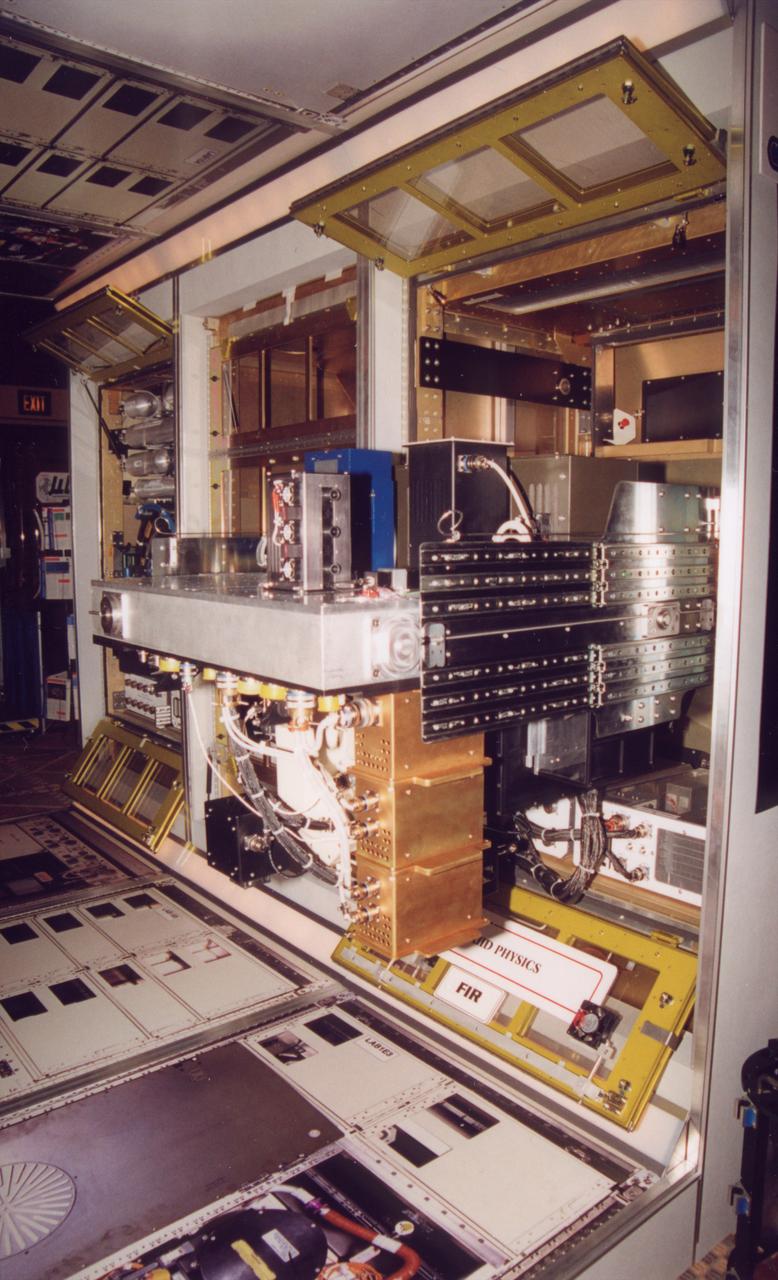
The optical bench for the Fluids Integrated Rack section of the Fluids and Combustion Facility (FCF) is shown extracted for servicing and with the optical bench rotated 90 degrees to access the rear elements. The FCF will be installed, in phases, in the Destiny, the U.S. Laboratory Module of the International Space Station (ISS), and will accommodate multiple users for a range of investigations. This is an engineering mockup; the flight hardware is subject to change as designs are refined. The FCF is being developed by the Microgravity Science Division (MSD) at the NASA Glenn Research Center. (Photo credit: NASA/Marshall Space Flight Center)

KENNEDY SPACE CENTER, Fla. -- Flames from the solid rocket boosters light up the clouds of smoke and steam trailing behind Space Shuttle Atlantis as it leaps into the pre-dawn sky on mission STS-101. Liftoff occurred on time at 6:11:10 a.m. EDT. The mission is taking the crew of seven to the International Space Station to deliver logistics and supplies as well as to prepare the Station for the arrival of the Zvezda Service Module, expected to be launched by Russia in July 2000. Also, the crew will conduct one space walk and will reboost the space station from 230 statute miles to 250 statute miles. This will be the third assembly flight to the Space Station. After a 10-day mission, landing is targeted for May 29 at 2:19 a.m. EDT. This is the 98th Shuttle flight and the 21st flight for Shuttle Atlantis
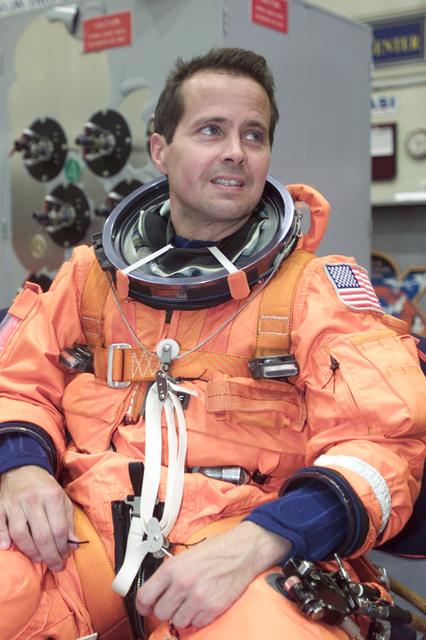
JSC2000-E-23715 (2 October 2000) --- Astronaut Daniel W. Bursch, Expedition Four flight engineer, relaxes following his suit-up process prior to a mission training session in the Space Vehicle Mockup Facility at the Johnson Space Center (JSC).
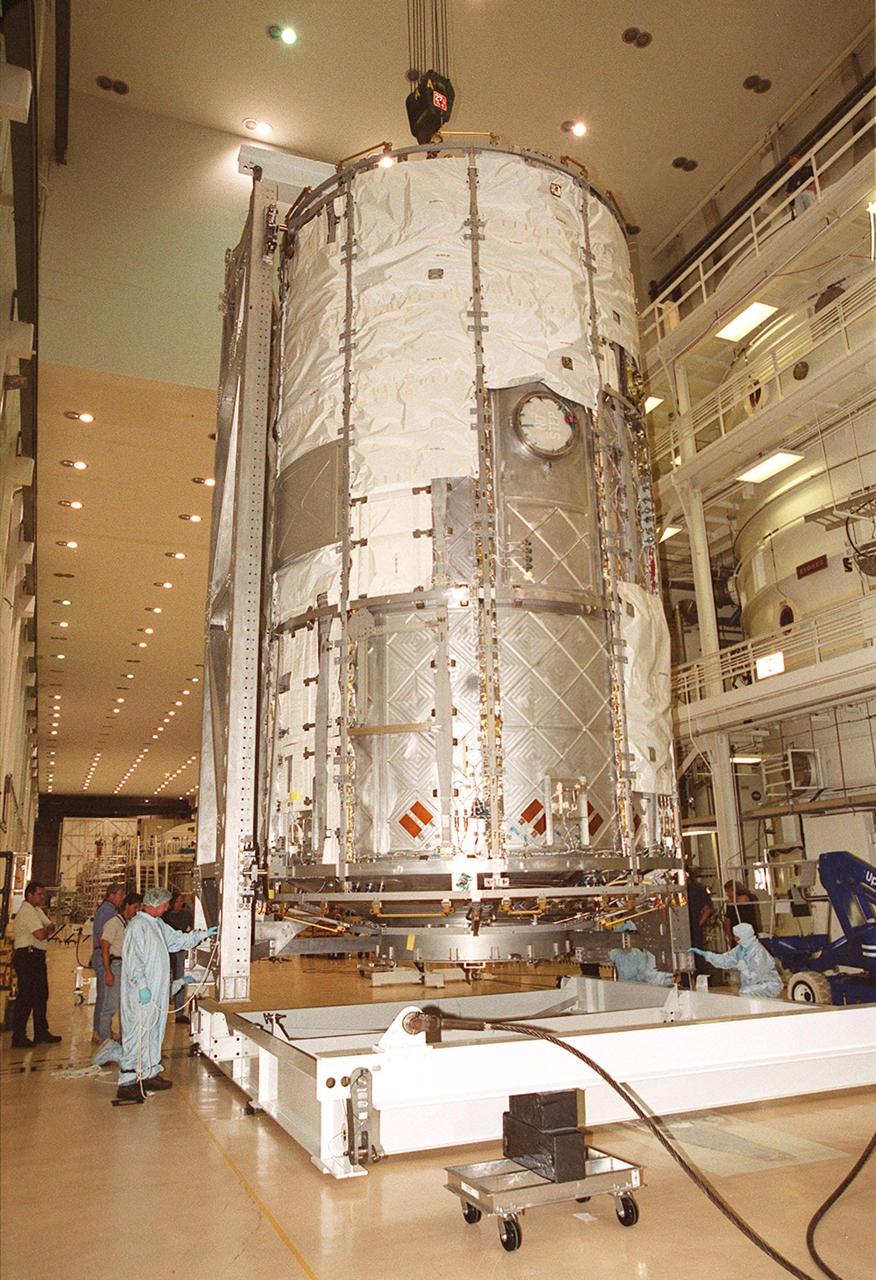
KENNEDY SPACE CENTER, FLA. -- In the Operations and Checkout Building, the U.S. Lab reaches the open floor after being lifted out of the vacuum chamber where it was tested for leaks. The test was very successful. The 32,000-pound scientific research lab, named Destiny, is the first Space Station element to spend seven days in the renovated vacuum chamber. Destiny is scheduled to be launched on Shuttle mission STS-98, the 5A assembly mission, targeted for Jan. 18, 2001. During the mission, the crew will install the Lab in the Space Station during a series of three space walks. The STS-98 mission will provide the Station with science research facilities and expand its power, life support and control capabilities. The U.S. Lab module continues a long tradition of microgravity materials research, first conducted by Skylab and later Shuttle and Spacelab missions. Destiny is expected to be a major feature in future research, providing facilities for biotechnology, fluid physics, combustion, and life sciences research
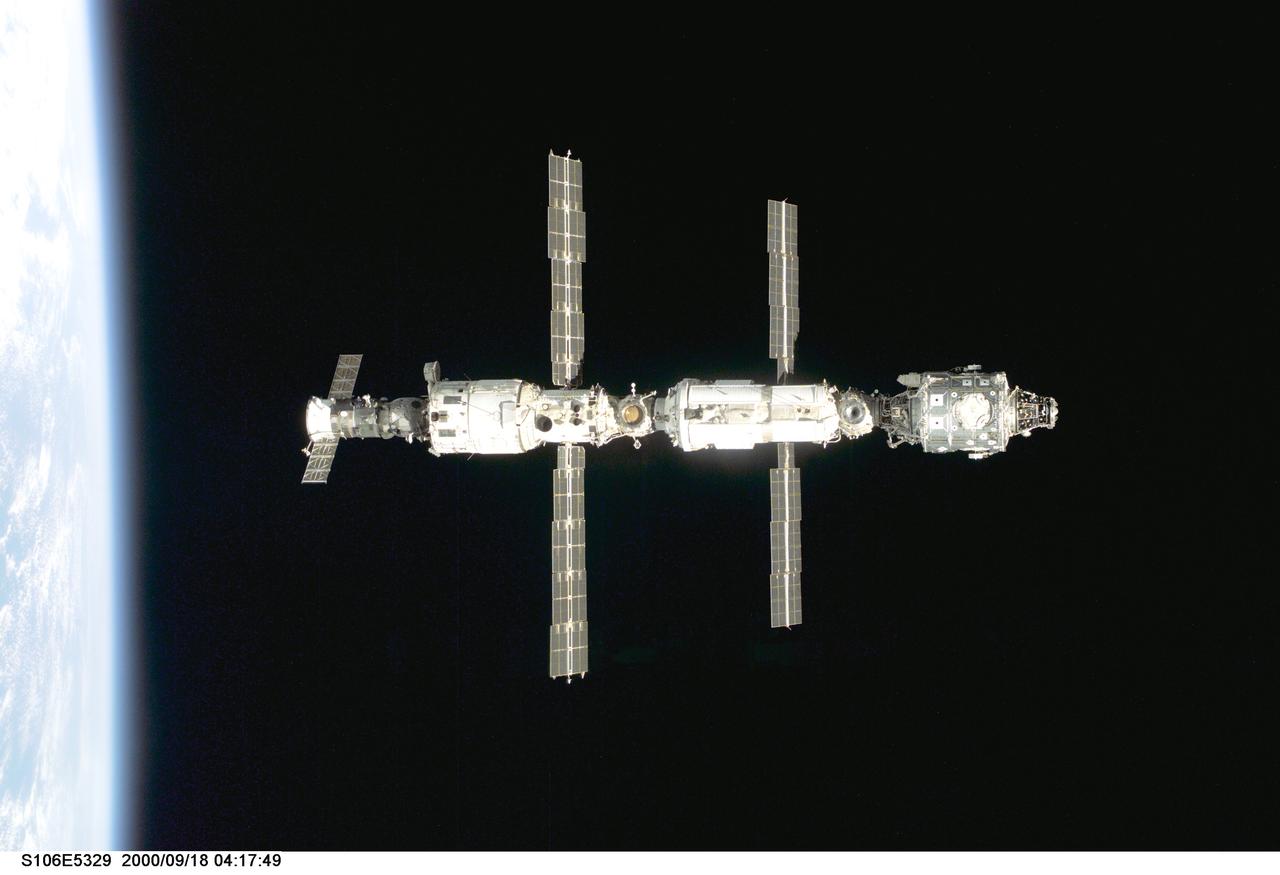
S106-E-5329 (18 September 2000) --- Backdropped against black space above Earth's horizon, the International Space Station (ISS) is seen following its undocking with the Space Shuttle Atlantis. After accomplishing all mission objectives in outfitting the station for the first resident crew, the seven astronauts and cosmonauts undocked at 3:46 GMT on Sept. 18 over Russia near the northeastern portion of Ukraine. When Atlantis was at a safe distance from the station, about 450 feet, astronaut Scott D. Altman, pilot, performed a 90-minute, double-loop fly around to enable the crew to document the station’s exterior. He fired Atlantis’ jets one final time to separate from the station at 5:35 (GMT) September 18.
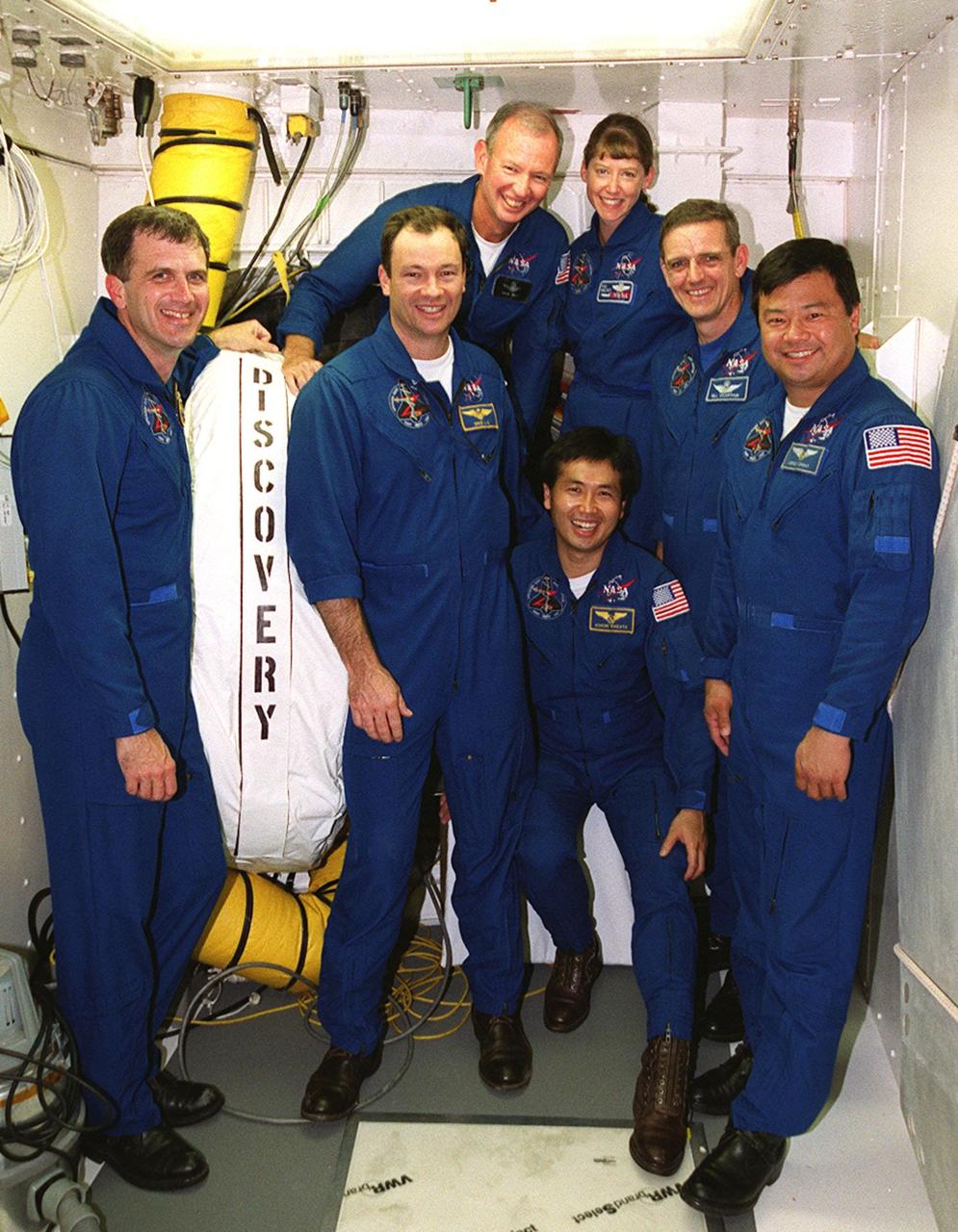
The STS-92 crew poses for a photograph in the White Room, the environmentally controlled chamber on the orbiter access arm that provides entry for the crew into the orbiter. Standing, left to right, are Mission Specialists Peter J.K. “Jeff” Wisoff and Michael E. Lopez-Alegria; Commander Brian Duffy; Pilot Pamela Ann Melroy; and Mission Specialists William S. McArthur Jr. and Leroy Chiao. Crouching in front is Mission Specialist Koichi Wakata of Japan. The crew is at KSC for Terminal Countdown Demonstration Test activities that provide emergency egress training, opportunities to inspect the mission payload, and take part in a simulated countdown. STS-92 is scheduled to launch Oct. 5 at 9:38 p.m. EDT on the fifth flight to the International Space Station. It will carry two elements of the Space Station, the Integrated Truss Structure Z1 and the third Pressurized Mating Adapter. The mission is also the 100th flight in the Shuttle program
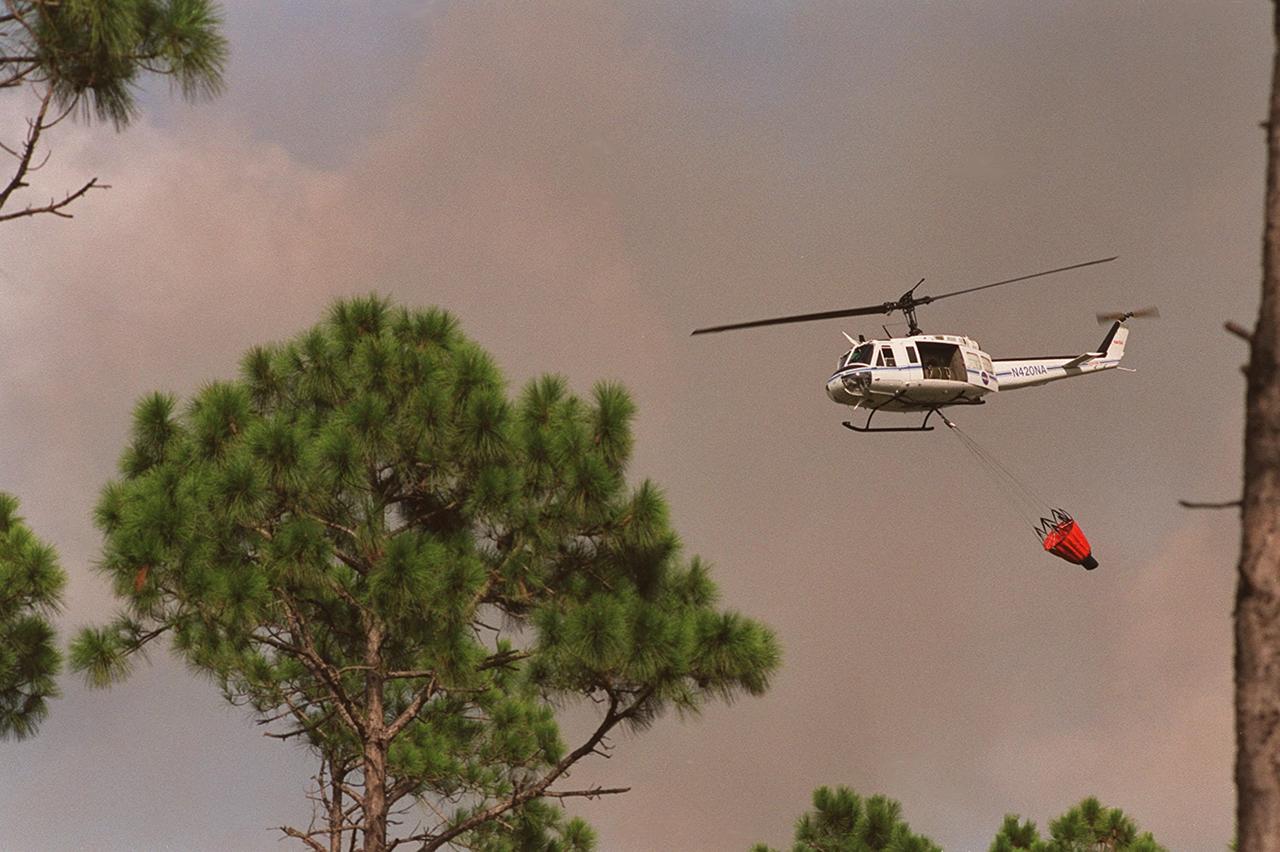
A NASA helicopter flies toward the source of the smoke to drop its load of water on a wildfire at KSC. Before being extinguished, the fire burned about 20 acres at a site near gate 2C on Kennedy Parkway North (route 3)
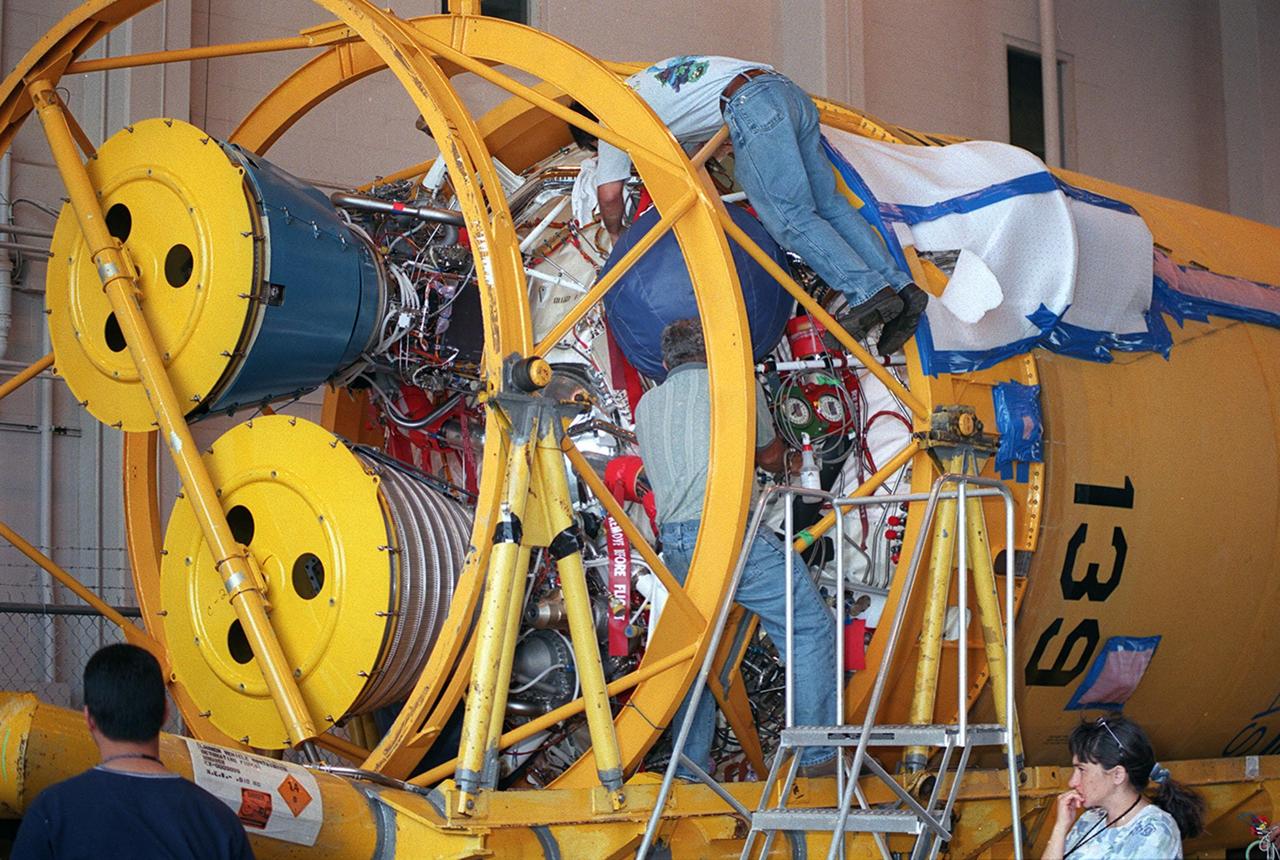
At Hangar J, Cape Canaveral Air Force Station (CCAFS), work is begun on the Centaur upper stage that will be used with an Atlas IIA rocket to launch the latest Tracking and Data Relay Satellite (TDRS) June 29 from CCAFS. The Atlas/Centaur launch vehicle is manufactured and operated by Lockheed Martin. Atlas IIA is capable of lifting payload systems to geosynchronous transfer orbit