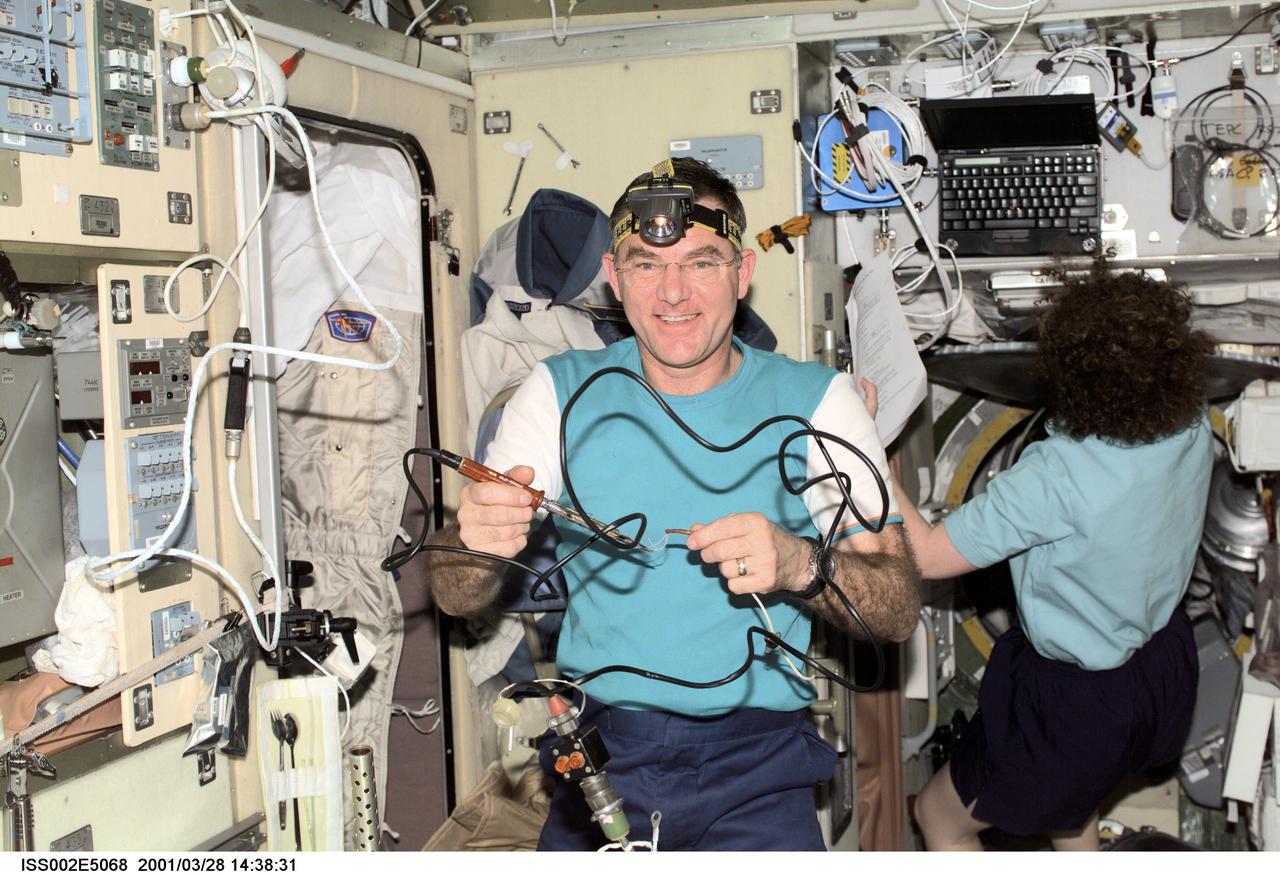
ISS002-E-5068 (28 March 2001) --- Astronaut James S. Voss, Expedition Two flight engineer, prepares to use a soldering tool for a maintenance task in the Zvezda Service Module onboard the International Space Station (ISS). Astronaut Susan J. Helms, flight engineer, is in the background. The image was recorded with a digital still camera.
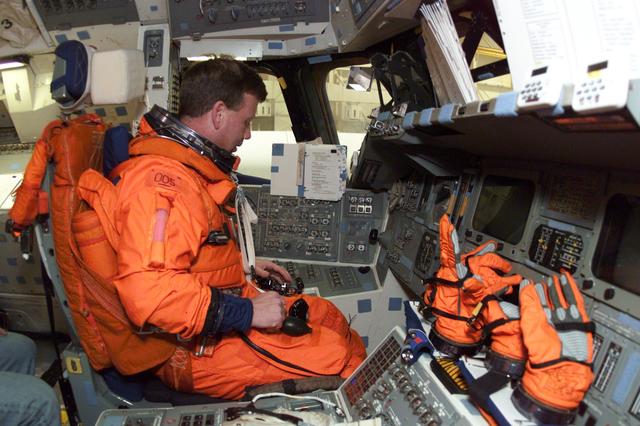
JSC2001-E-06420 (27 February 2001) --- Astronaut Steven W. Lindsey, mission commander, occupies commander’s station during mission training in one of the high fidelity trainers/mockups in the Systems Integration Facility at Johnson Space Center (JSC). The STS-104 mission to the International Space Station (ISS) represents the Space Shuttle Atlantis' first flight using a new engine and is targeted for a liftoff no earlier than June 14, 2001.
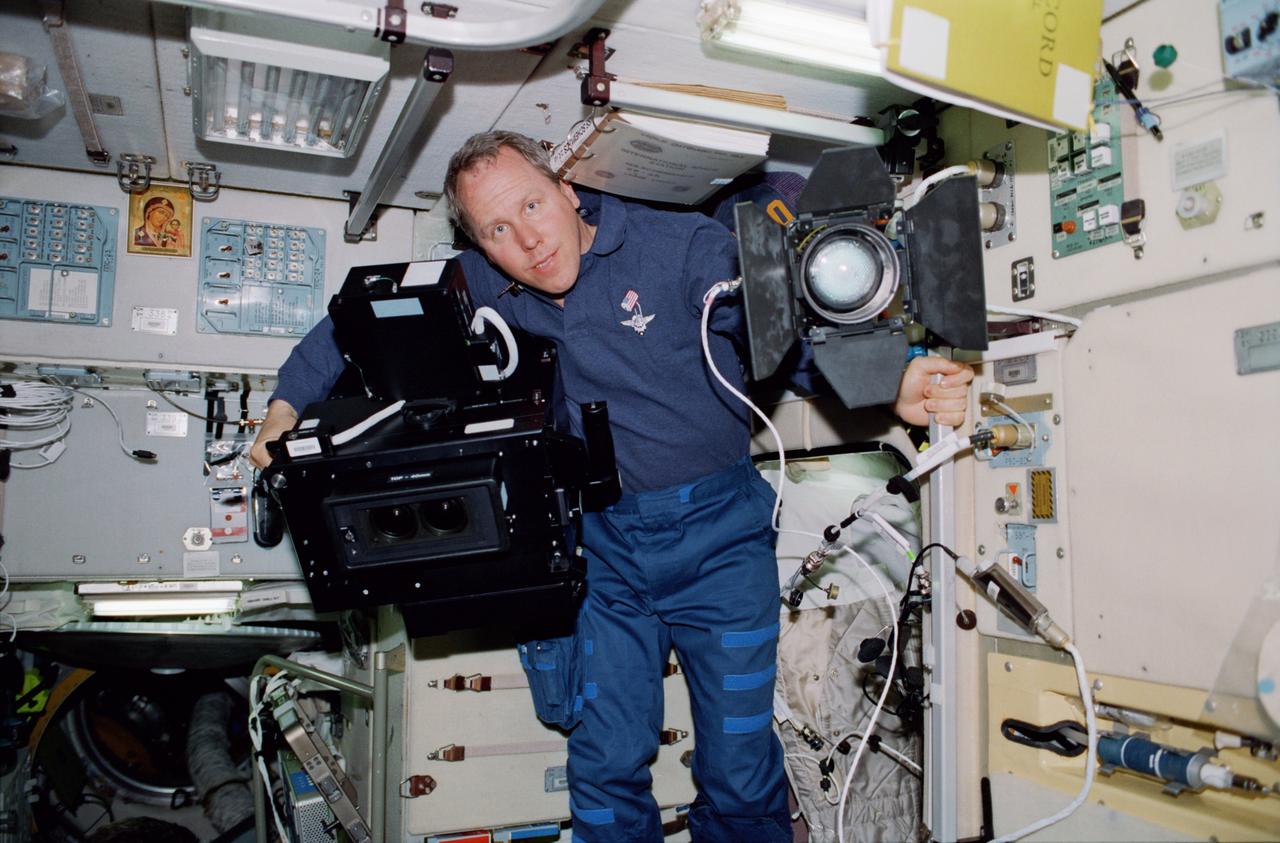
STS098-337-0026 (7-20 February 2001) --- Astronaut Thomas D. Jones, mission specialist, is seen with IMAX camera gear in the Zvezda service module of the International Space Station (ISS).
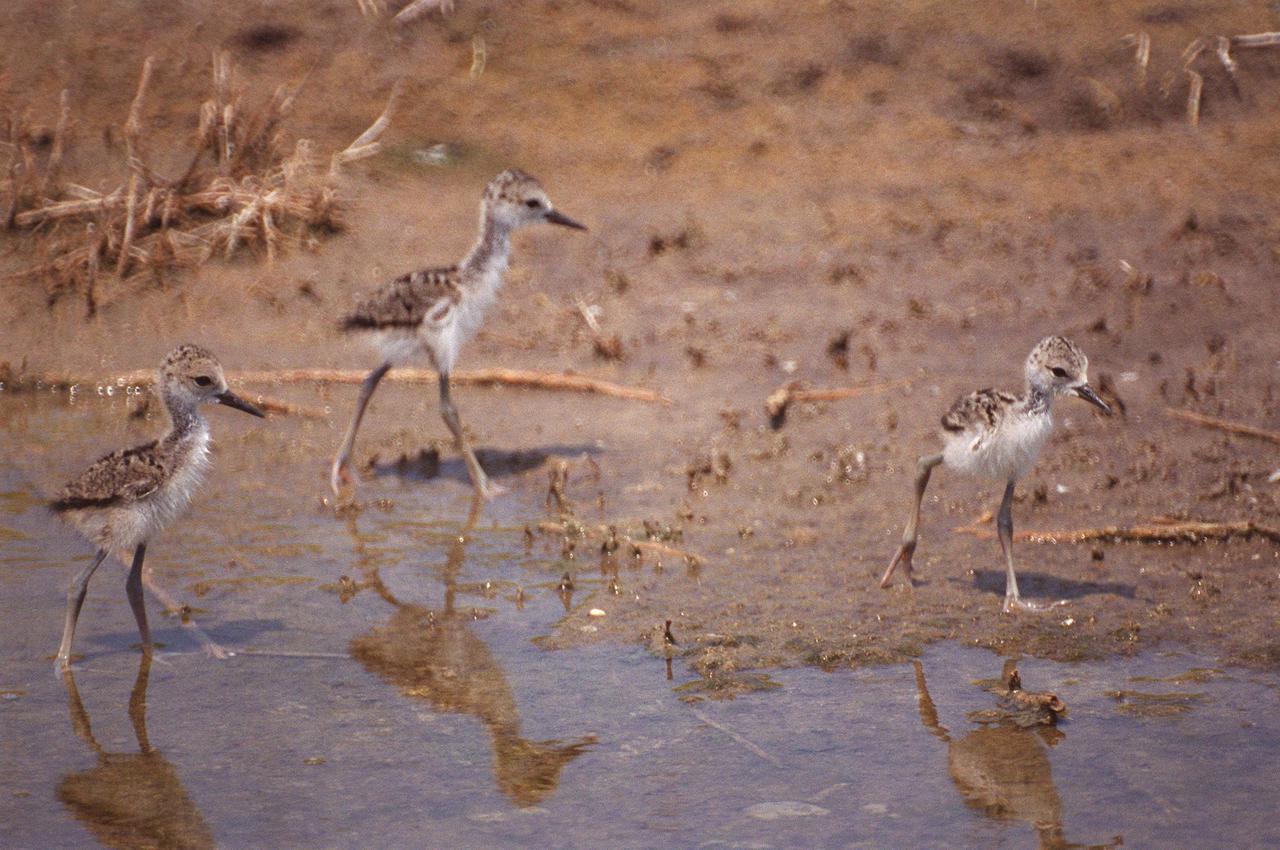
KENNEDY SPACE CENTER, FLA. -- Chicks of the Black-necked Stilt already display the long legs and stride of the adult. The species inhabits salt marshes and shallow coastal bays in the East, as well as freshwater marshes in the West. They are found along the Atlantic Coast from Delaware to northern South America. Adults are black above and white below, with a long neck, very long red legs and a straight, very thin bill. These chicks were photographed in the Merritt Island National Wildlife Refuge, which shares a boundary with Kennedy Space Center. The Refuge encompasses 92,000 acres that are a habitat for more than 331 species of birds, 31 mammals, 117 fishes, and 65 amphibians and reptiles. The marshes and open water of the refuge provide wintering areas for 23 species of migratory waterfowl, as well as a year-round home for great blue herons, great egrets, wood storks, cormorants, brown pelicans and other species of marsh and shore birds, as well as a variety of insects
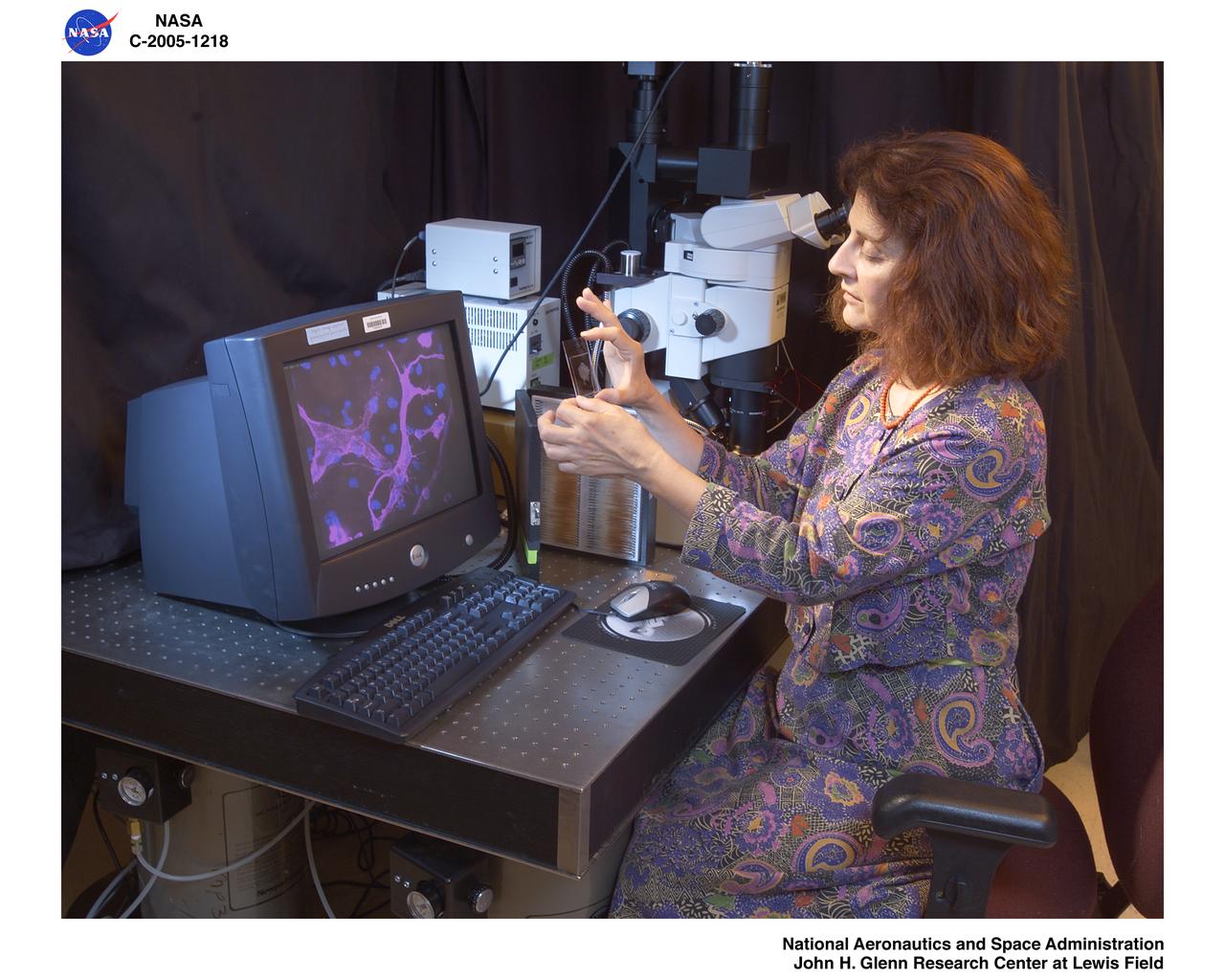
Researcher studying microvascular remodeling for Astronaut health in microgravity and space exploration
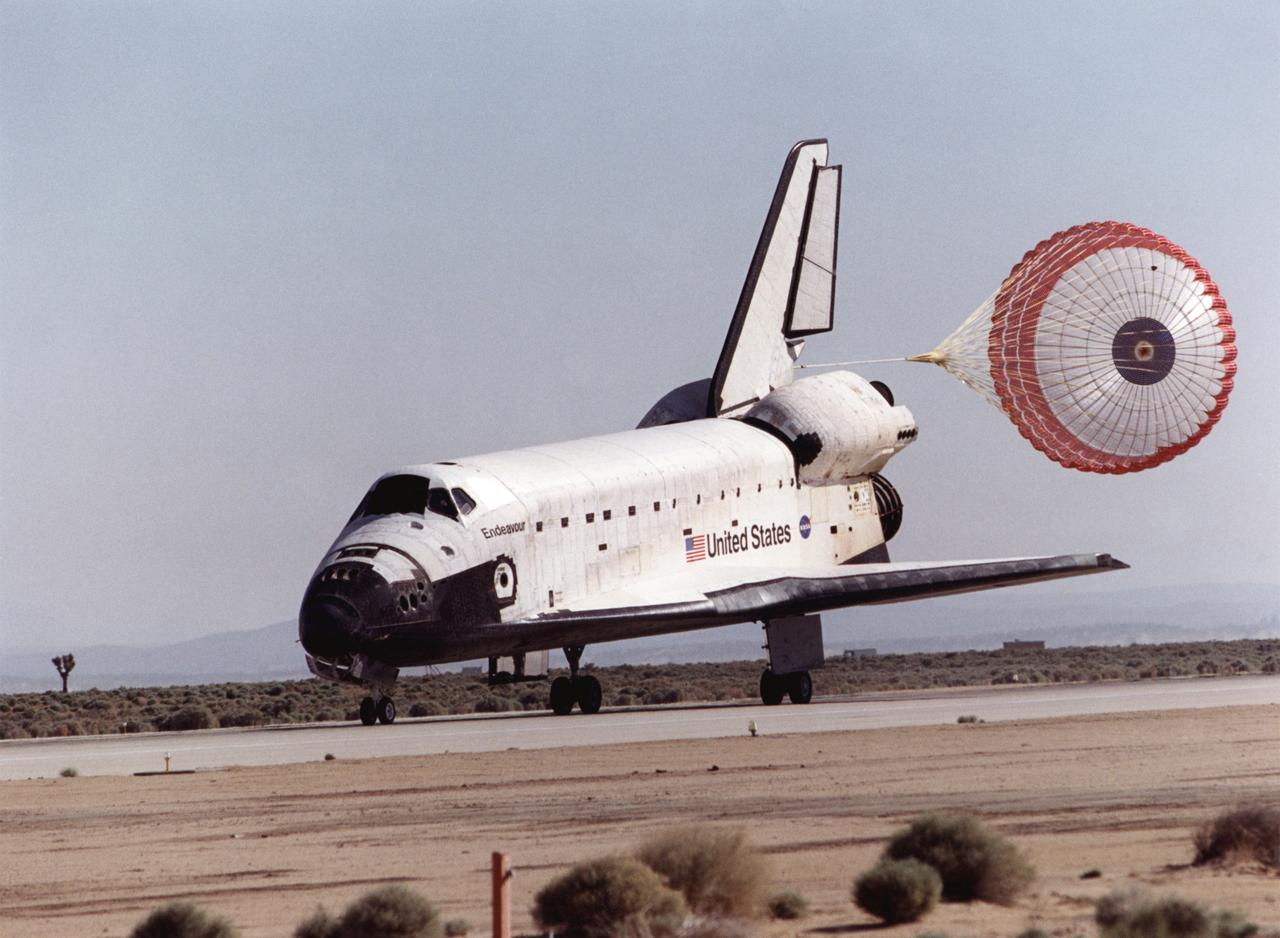
A lone desert Joshua tree greeted the arrival of Space Shuttle Endeavour at Edwards Air Force Base, California, May 1, 2001. A large drag chute helped slow Endeavour on the runway. After mounting the shuttle on a converted 747 airliner at NASA's Dryden Flight Research Center, Endeavour will be carried back to the Kennedy Space Center for its next mission. Weather in Florida necessitated landing in California.
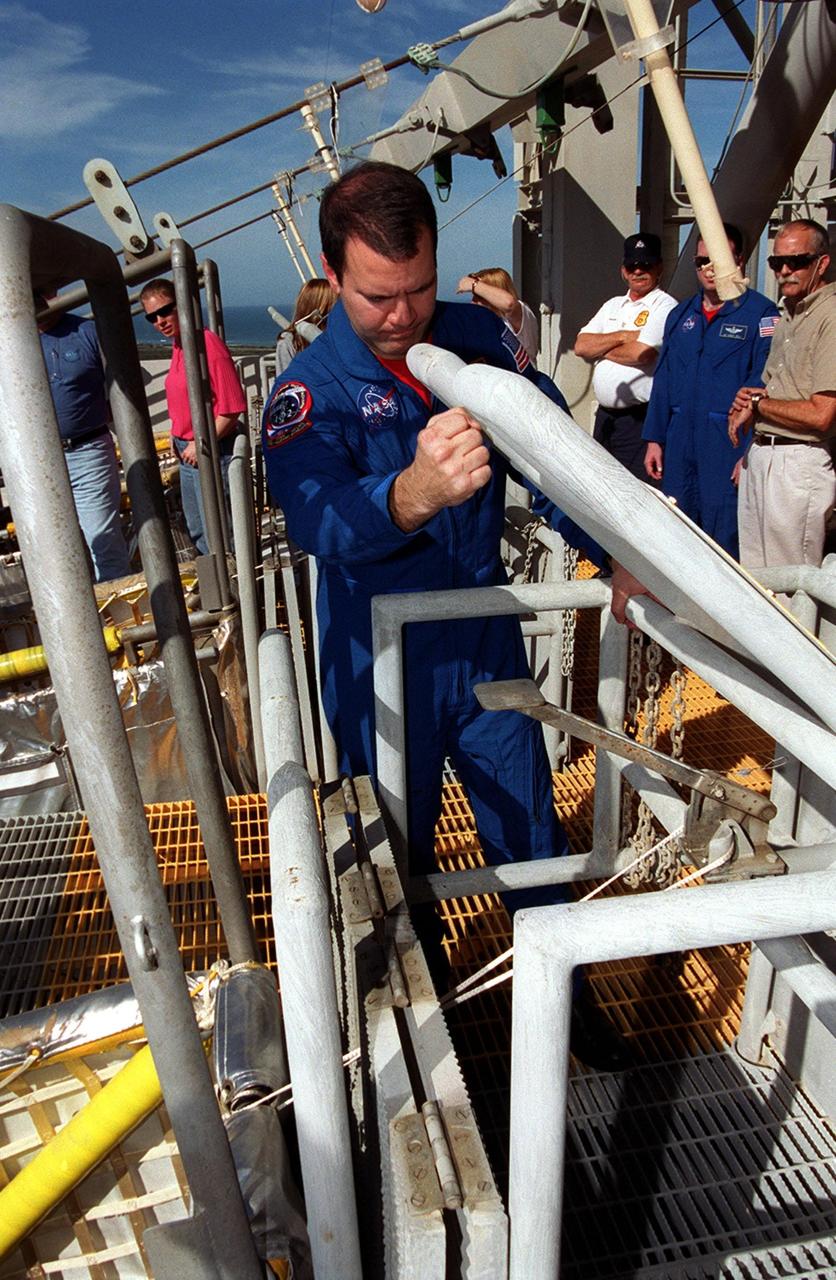
During emergency exit training on the Fixed Service Structure of Launch Pad 39B, STS-102 Mission Specialist Paul Richards takes a closer look at the lever that releases a slidewire basket, used for emergency exits from the launch pad, to the landing below. He and the rest of the crew are taking part in Terminal Countdown Demonstration Test activities, which include a simulated launch countdown. STS-102 is the eighth construction flight to the International Space Station, with Space Shuttle Discovery carrying the Multi-Purpose Logistics Module Leonardo. Launch on mission STS-102 is scheduled for March 8
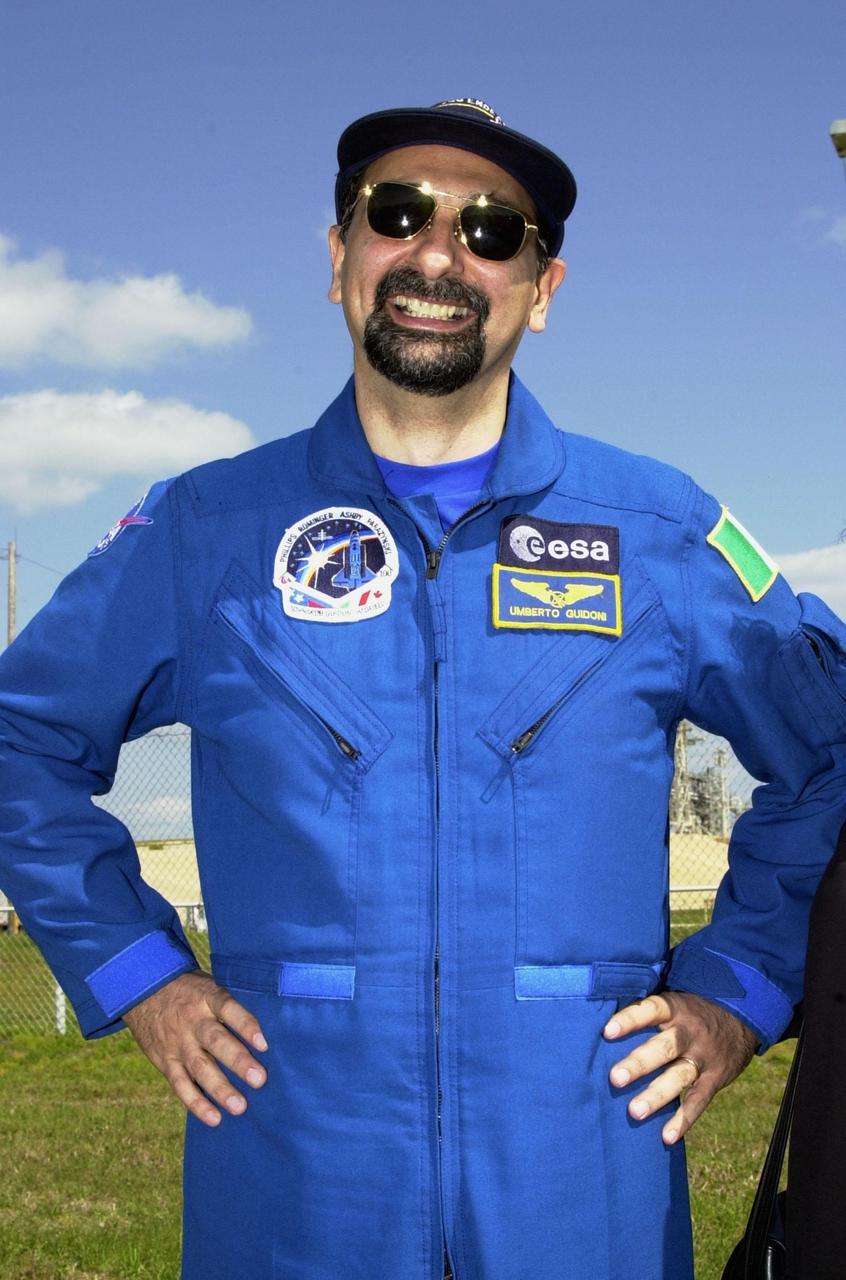
KENNEDY SPACE CENTER, FLA. -- STS-100 Mission Specialist Umberto Guidoni stands near Launch Pad 39A to greet family and friends. Guidoni is with the European Space Agency. The crew is at KSC to complete final flight plan reviews in anticipation of launch. The 11-day mission to the International Space Station will deliver and integrate the Spacelab Logistics Pallet/Launch Deployment Assembly, which includes the Space Station Remote Manipulator system and the UHF Antenna, and the Multi-Purpose Logistics Module Raffaello. The mission includes two planned spacewalks for installation of the SSRMS. The mission is also the inaugural flight of the MPLM Raffaello, carrying resupply stowage racks and resupply/return stowage platforms. Liftoff on mission STS-100 is scheduled at 2:41 p.m. EDT April 19
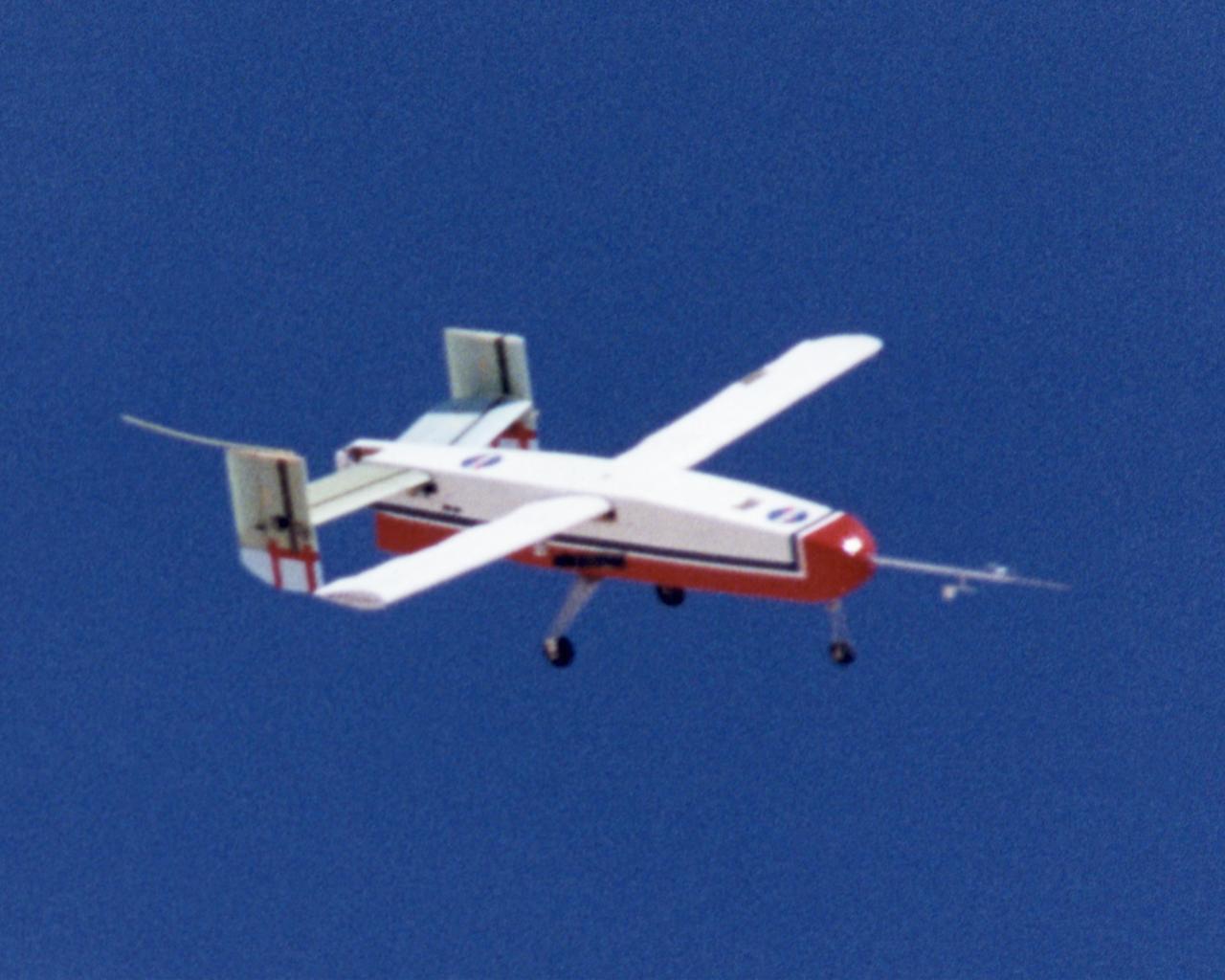
Wing Deployment Sequence #3: The deployable, inflatable wing technology demonstrator experiment aircraft's wings fully deployed during flight following separation from its carrier aircraft during a flight conducted by the NASA Dryden Flight Research Center, Edwards, Californiaornia. The inflatable wing project represented a basic flight research effort by Dryden personnel. Three successful flights of the I2000 inflatable wing aircraft occurred. During the flights, the team air-launched the radio-controlled (R/C) I2000 from an R/C utility airplane at an altitude of 800-1000 feet. As the I2000 separated from the carrier aircraft, its inflatable wings "popped-out," deploying rapidly via an on-board nitrogen bottle. The aircraft remained stable as it transitioned from wingless to winged flight. The unpowered I2000 glided down to a smooth landing under complete control.
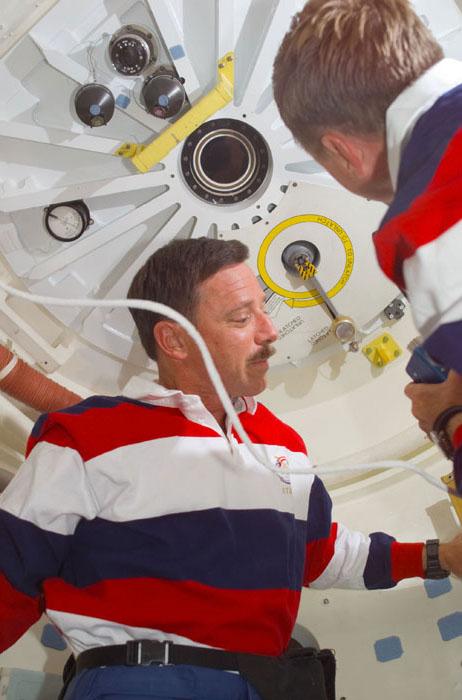
STS105-E-5092 (12 August 2001) --- Scott J. Horowitz (bottom), STS-105 commander, and Frank L. Culbertson, Jr., Expedition Three mission commander, prepare to open Space Shuttle Discovery's airlock hatch leading to the International Space Station (ISS). Culbertson and cosmonauts Mikhail Tyurin and Vladimir N. Dezhurov will be replacing the Expedition Two crew as residents aboard the ISS. This image was taken with a digital still camera.
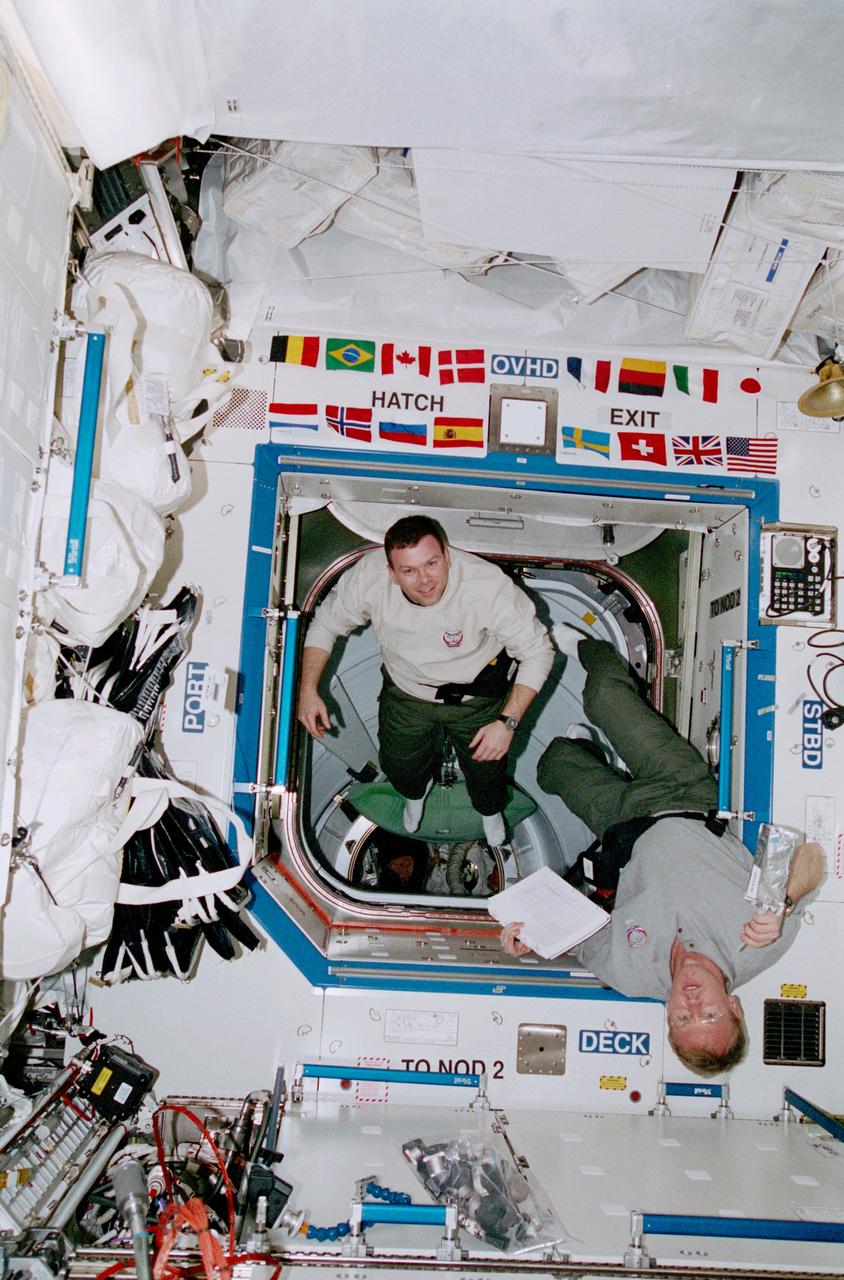
STS102-368-030 (8-21 March 2001) --- Astronauts Andrew S. W. Thomas (holding a beverage), STS-102 mission specialist and James M. Kelly, STS-102 pilot, are photographed while onboard the Destiny laboratory on the International Space Station (ISS).
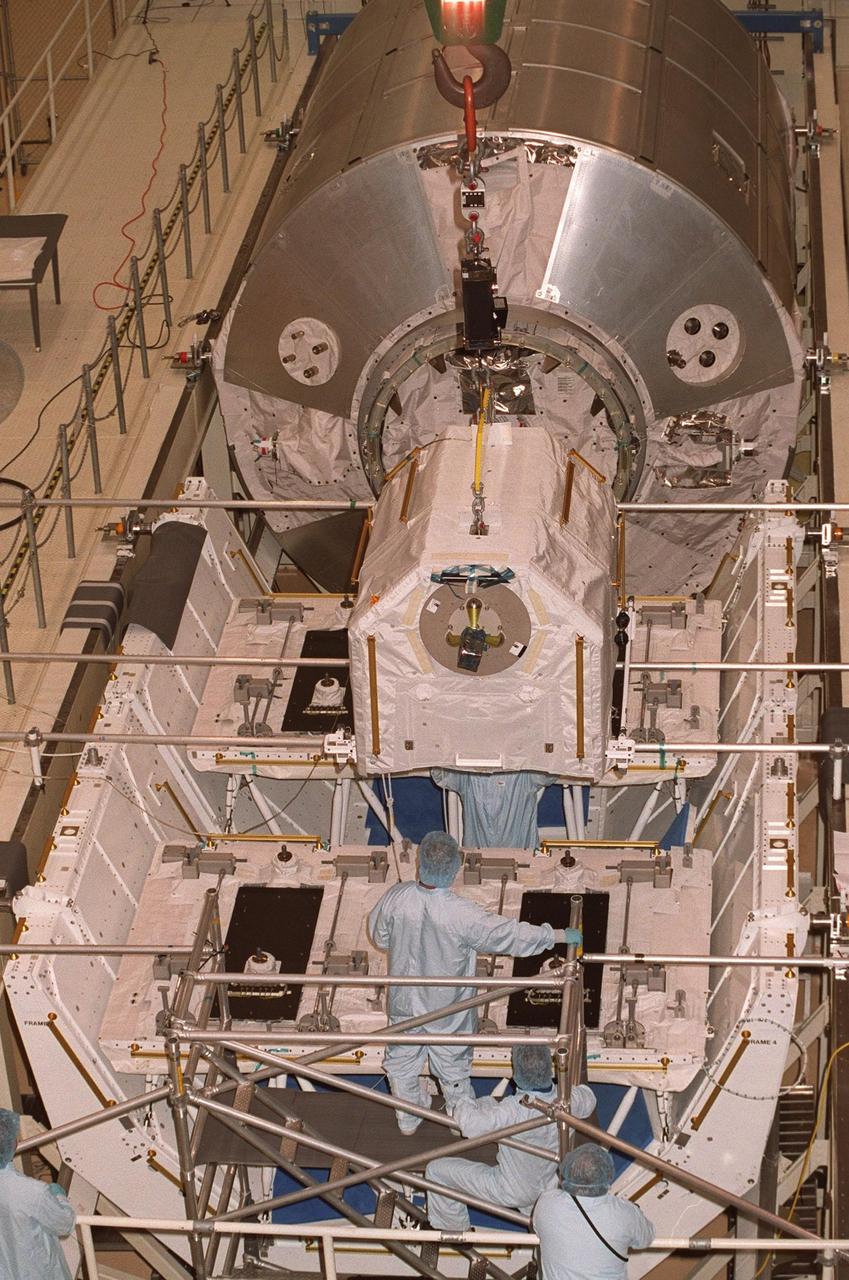
KENNEDY SPACE CENTER, FLA. -- An overhead crane in the Operations and Checkout Building lowers one of four gas tanks onto the Spacelab Logistics Double Pallet while workers help guide it. Part of the STS-104 payload, the storage tanks two gaseous oxygen and two gaseous nitrogen comprise the high pressure gas assembly that will be attached to the Joint Airlock Module during two spacewalks. The tanks will support future spacewalk operations from the Station and augment the Service Module gas resupply system
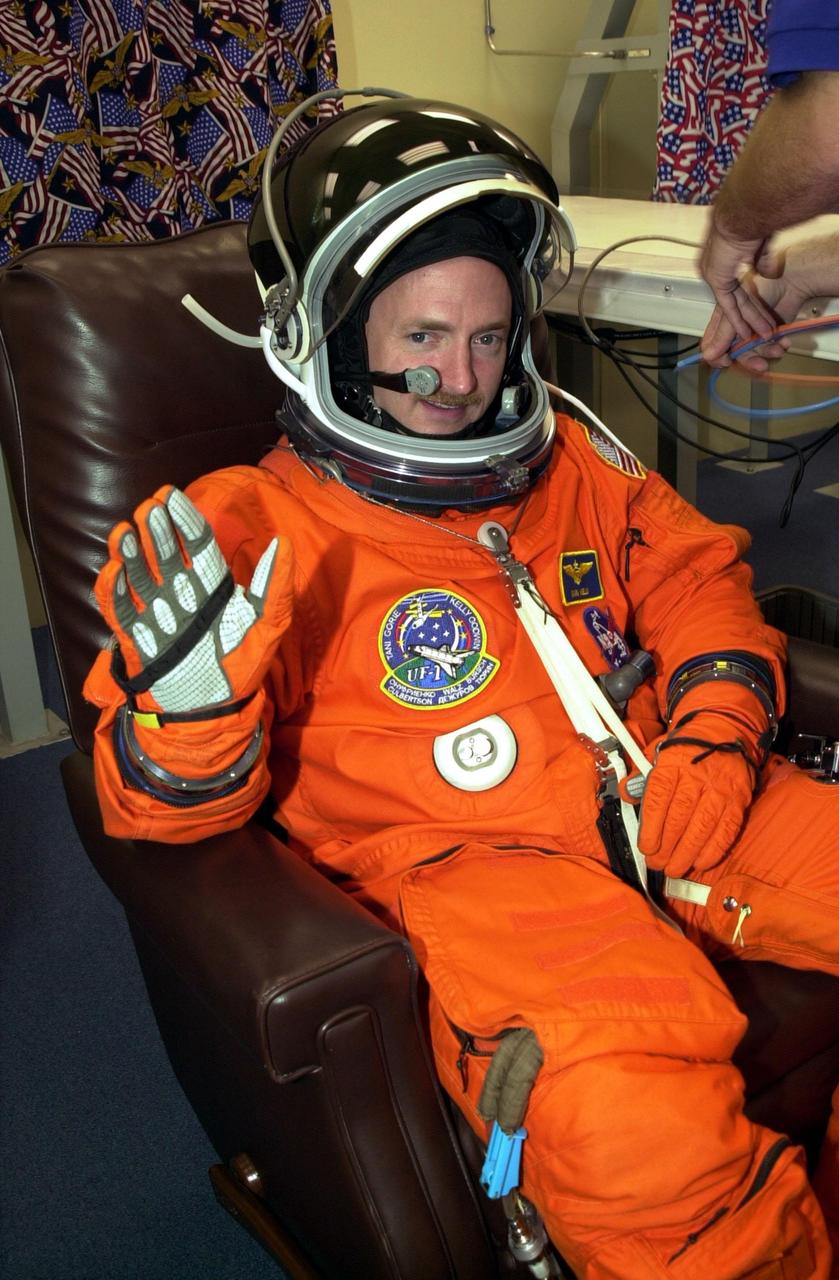
KENNEDY SPACE CENTER, Fla. -- STS-108 Pilot Mark E. Kelly gets a final suit check prior to heading to Launch Pad 39B and Space Shuttle Endeavour. Top priorities for the 11-day STS-108 (UF-1) mission of Endeavour are rotation of the International Space Station Expedition 3 and Expedition 4 crews; bringing water, equipment and supplies to the station in the Multi-Purpose Logistics Module Raffaello; and the crew's completion of robotics tasks and a spacewalk to install thermal blankets over two pieces of equipment at the bases of the Space Station's solar wings. Launch is scheduled for 5:45 p.m. EST Dec. 4, 2001, from Launch Pad 39B

KENNEDY SPACE CENTER, FLA. -- A humorous question from the media (out of view) produces smiles among the STS-98 crew during a briefing at Launch Pad 39A. Standing, left to right, are Pilot Mark Polansky, Mission Specialist Thomas Jones (with microphone), Commander Ken Cockrell, and Mission Specialists Marsha Ivins and Robert Curbeam. All are at KSC to take part in Terminal Countdown Demonstration Test activities, which include emergency egress training and a simulated launch countdown. STS-98 is the seventh construction flight to the International Space Station, carrying as payload the U.S. Lab Destiny, a key element in the construction of the ISS. Launch of STS-98 is scheduled for Jan. 19 at 2:11 a.m
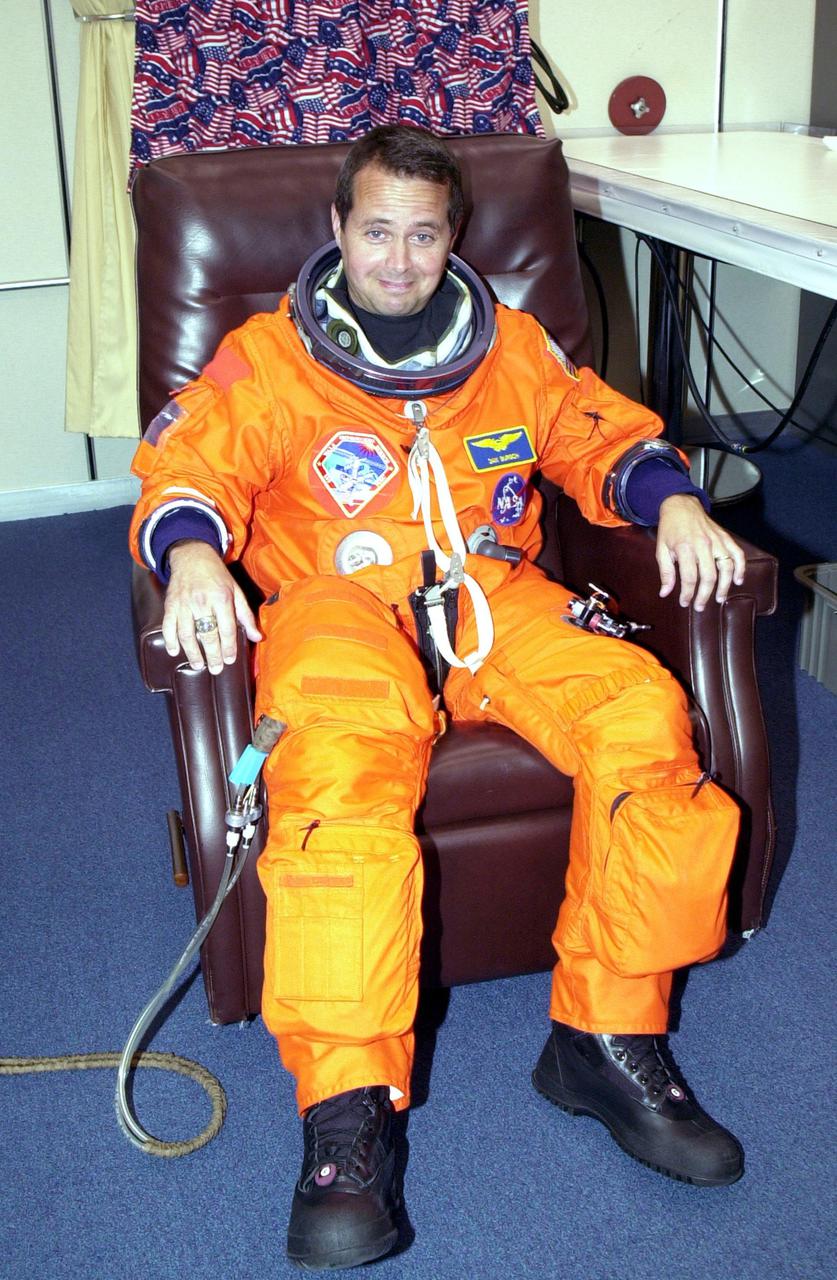
KENNEDY SPACE CENTER, Fla. -- Expedition 4 crew member Daniel W. Bursch waits patiently for final checkout of his launch and entry suit prior to heading to Launch Pad 39B and Space Shuttle Endeavour. Top priorities for the 11-day STS-108 (UF-1) mission of Endeavour are rotation of the International Space Station Expedition 3 and Expedition 4 crews; bringing water, equipment and supplies to the station in the Multi-Purpose Logistics Module Raffaello; and the crew's completion of robotics tasks and a spacewalk to install thermal blankets over two pieces of equipment at the bases of the Space Station's solar wings. Launch is scheduled for 5:45 p.m. EST Dec. 4, 2001, from Launch Pad 39B
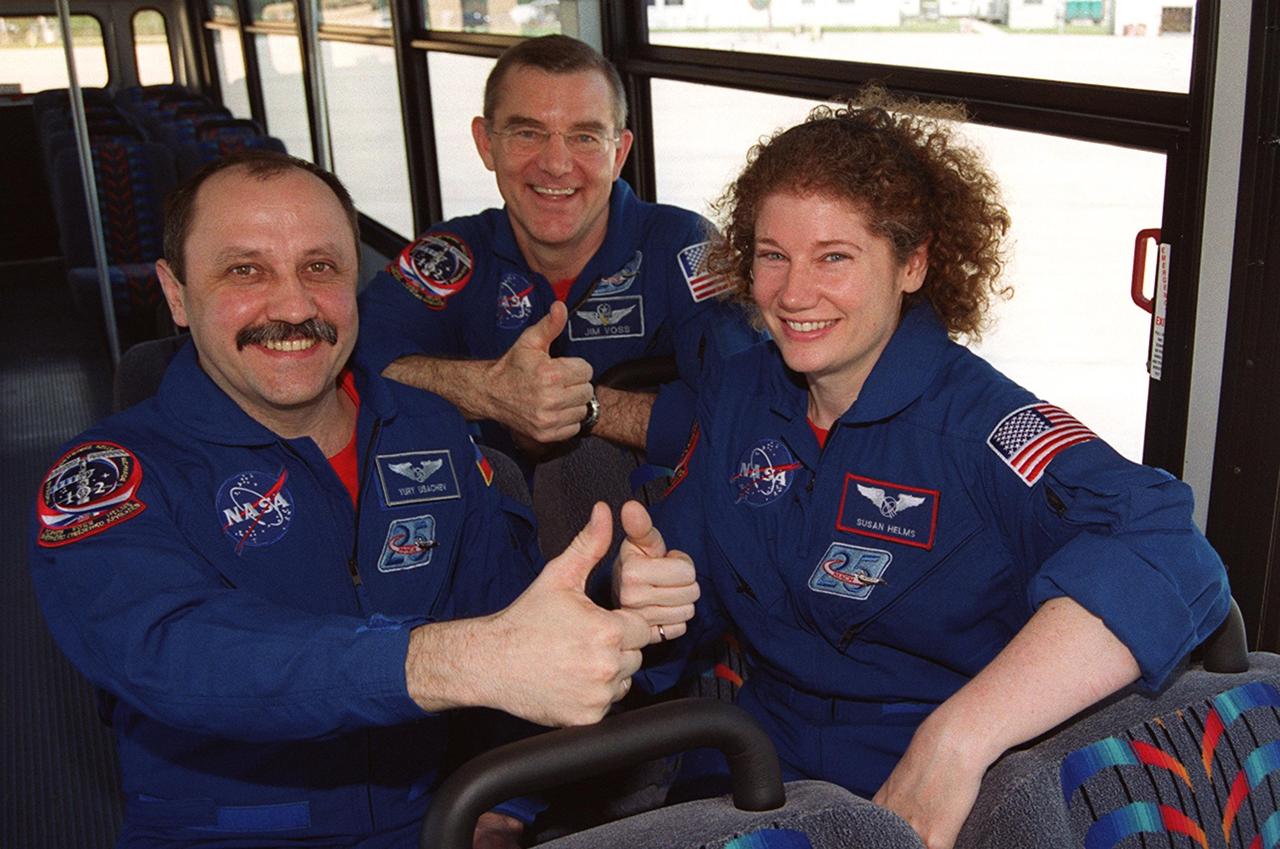
KENNEDY SPACE CENTER, Fla. -- The Expedition Two crew give thumbs up from the bus that transported them to KSC's Shuttle Landing Facility for their departure to the Johnson Space Center. From left are Commander Yury Usachev, James Voss and Susan Helms. The crew have spent the past five months living and working on the International Space Station. They returned to Earth with the STS-105 crew aboard the orbiter Discovery on Aug. 22. The mission came to a close upon landing at KSC’s Shuttle Landing Facility runway 15 after a 4.3-million-mile mission to the International Space Station. Main gear touchdown was at 2:22:58 p.m. EDT; wheel stop, at 2:24:06 p.m. EDT. The 11-day, 21-hour, 12-minute STS-105 mission accomplished the goals set for the 11th flight to the International Space Station: swapout of the resident Station crew; delivery of equipment, supplies and scientific experiments; and installation of the Early Ammonia Servicer and heater cables for the S0 truss on the Station. Discovery completed its 30th flight into space, the 106th mission of the Space Shuttle program. Out of five missions in 2001, the landing was the first to occur in daylight at KSC.
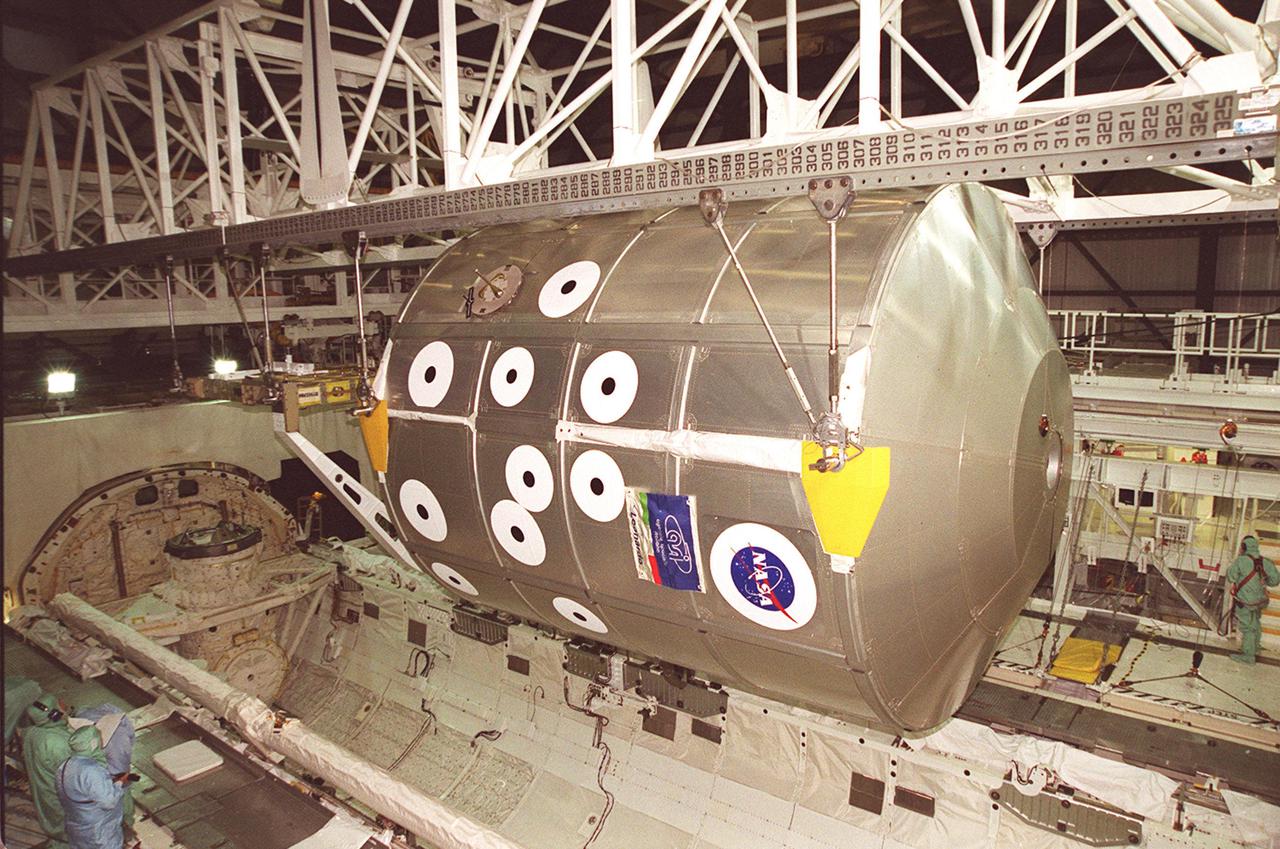
KENNEDY SPACE CENTER, FLA. -- In the Orbiter Processing Facility bay 2, an overhead crane lifts the Multi-Purpose Logistics Module Leonardo and the integrated cargo carrier behind it out of Discovery’s payload bay. The MPLM has just returned from its first round trip to the International Space Station on mission STS-102. Leonardo will be transferred to the SSPF to prepare it for future missions. The MPLM serves as a cargo van, carrying equipment and supplies to the Space Station
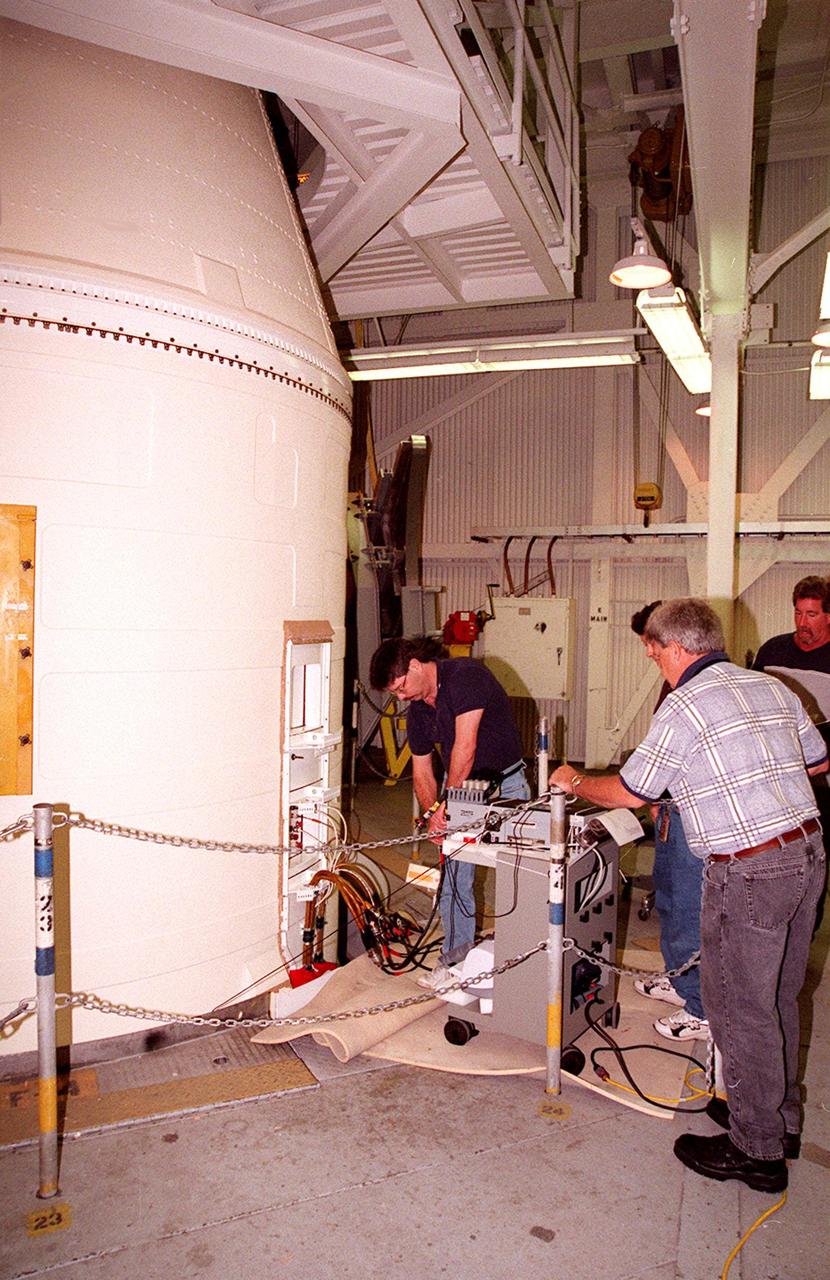
KENNEDY SPACE CENTER, FLA. -- Working near the top of a solid rocket booster, NASA and United Space Alliance SRB technicians hook up SRB cables to a Cirris Signature Touch 1 cable tester. From left are Steve Swichkow, with NASA, and Jim Silviano (back to camera) and Jeff Suter, with USA. The SRB is part of Space Shuttle Atlantis, rolled back from Launch Pad 39A in order to conduct tests on the cables. A prior extensive evaluation of NASA’s SRB cable inventory on the shelf revealed conductor damage in four (of about 200) cables. Shuttle managers decided to prove the integrity of the system tunnel cables already on Atlantis before launching. Workers are conducting inspections, making continuity checks and conducting X-ray analysis on the cables. The launch has been rescheduled no earlier than Feb. 6. <br
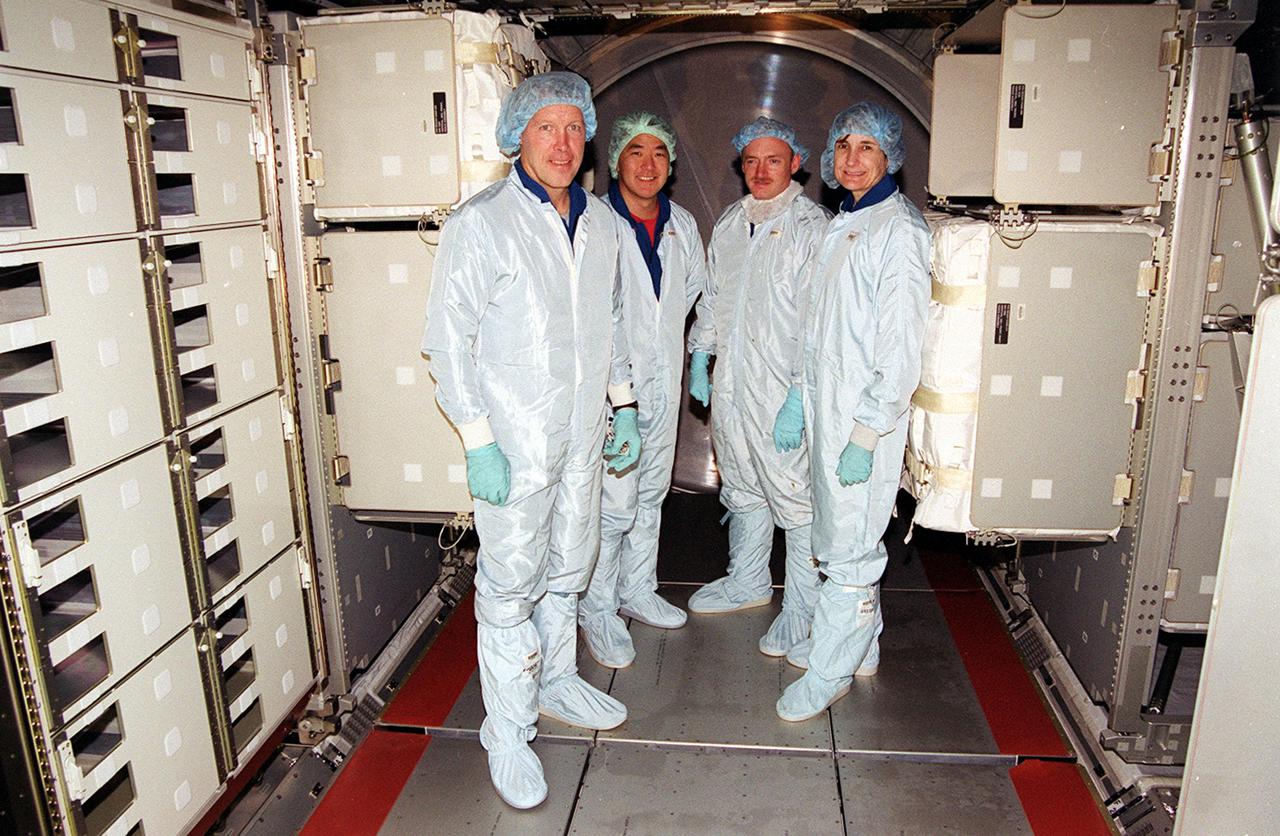
KENNEDY SPACE CENTER, Fla. -- The STS-108 crew pause during their checkout of the Multi-Purpose Logistics Module Raffaello. From left are Commander Dominic L. Gorie, Mission Specialist Daniel M. Tani, Pilot Mark E. Kelly and Mission Specialist Linda A. Godwin. The four astronauts are taking part in Crew Equipment Interface Test (CEIT) activities at KSC. The CEIT provides familiarization with the launch vehicle and payload. Mission STS-108 is a Utilization Flight (UF-1), carrying the Expedition Four crew plus Multi-Purpose Logistics Module Raffaello to the International Space Station. The Expedition Four crew comprises Yuri Onufriyenko, commander, Russian Aviation and Space Agency, and astronauts Daniel W. Bursch and Carl E. Walz. Endeavour is scheduled to launch Nov. 29 on mission STS-108
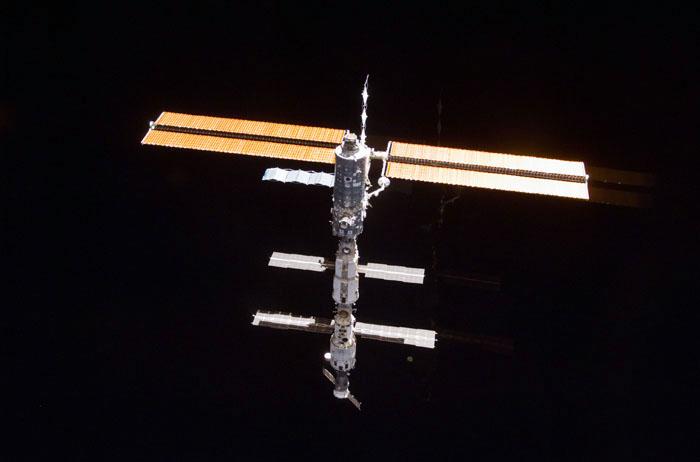
STS98-E-5307 (16 February 2001) --- The International Space Station (ISS) backdropped against the blackness of space following undocking. The photo was taken with a digital still camera.
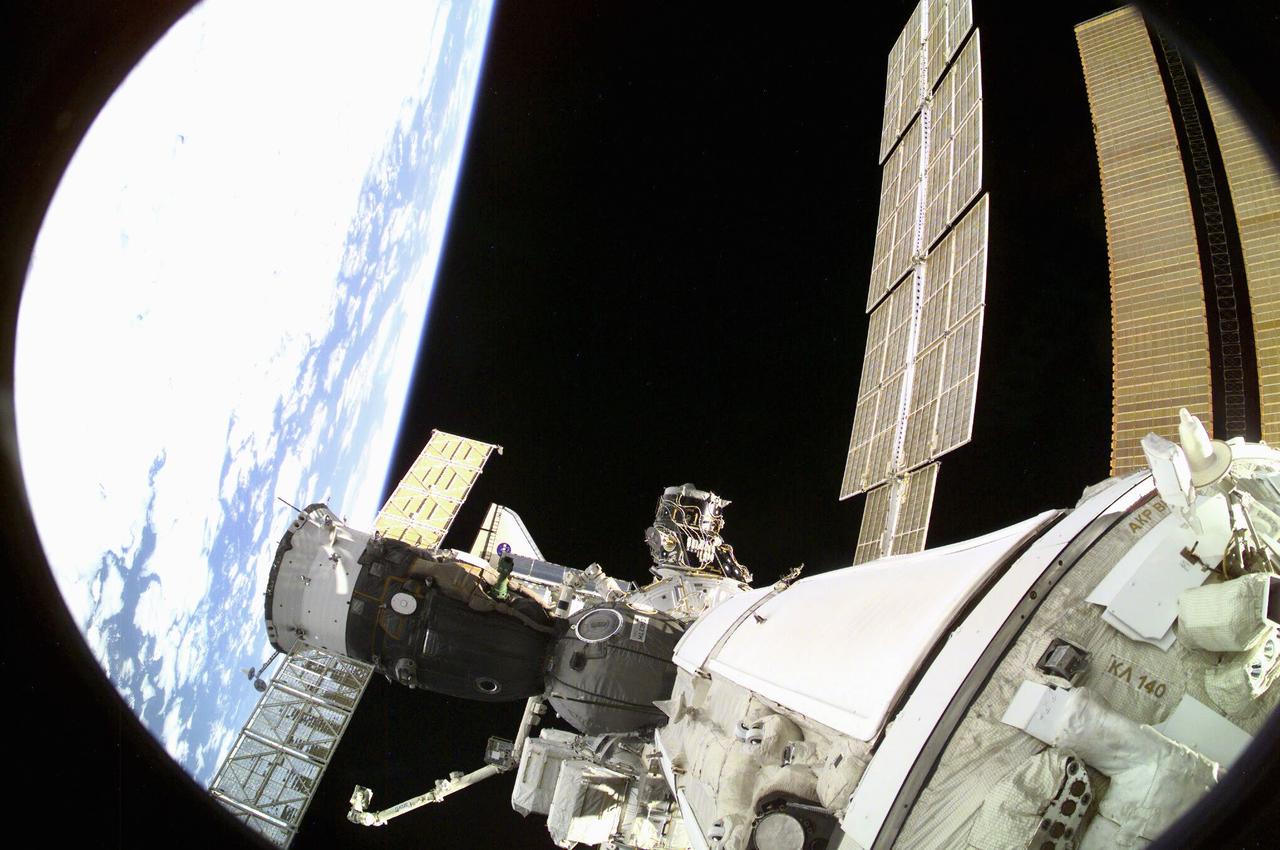
ISS003-E-8279 (7 December 2001) --- One of the Expedition Three crew members aimed a digital still camera through a window on the Russian segment of the International Space Station (ISS) to record this image of rendezvous operations with the Space Shuttle Endeavour. With six astronauts and a cosmonaut aboard, Endeavour was very near the point of docking at this point. Viewing of the shuttle in this scene is almost obstructed by the Soyuz vehicle docked above it.
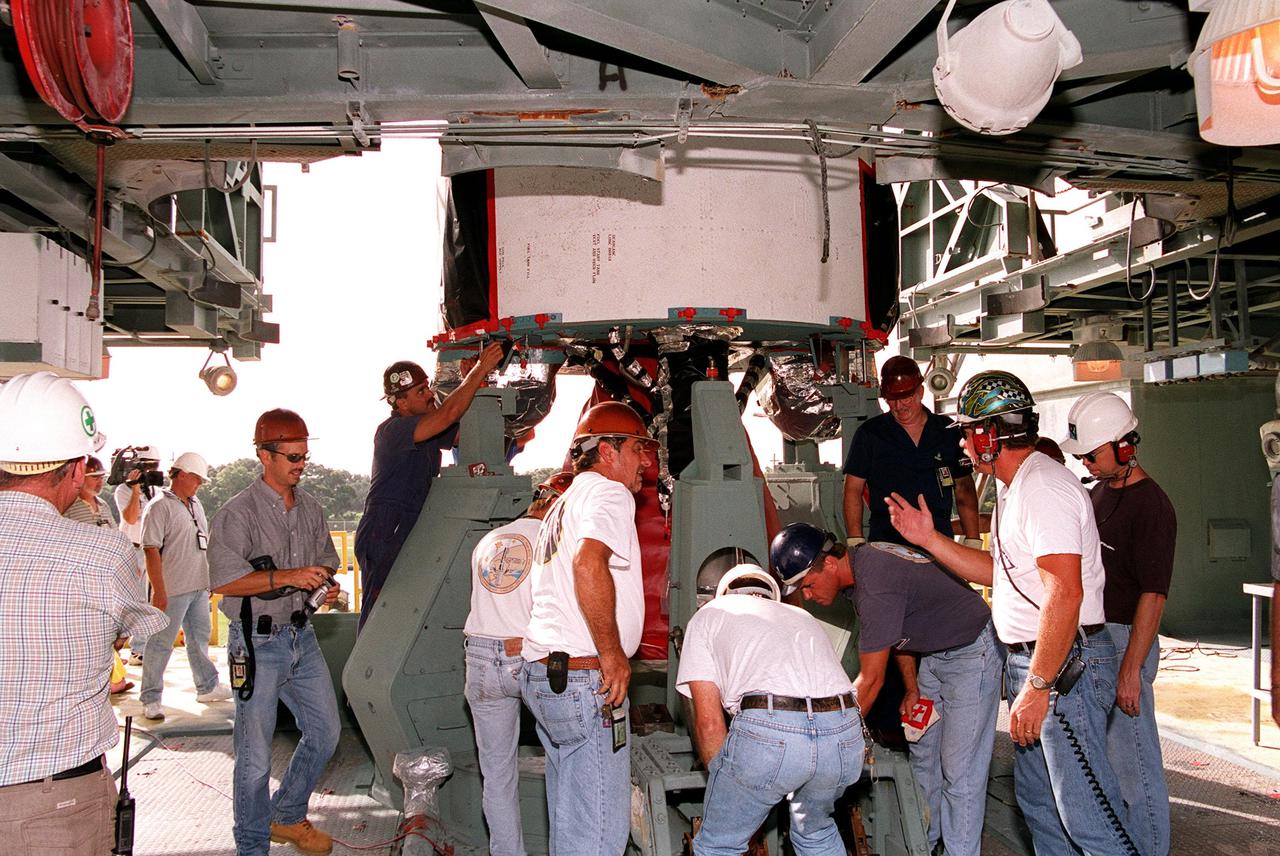
KENNEDY SPACE CENTER, Fla. -- On Launch Complex 17A, Cape Canaveral Air Force Station, technicians work on the bottom of the first stage of a Delta II rocket before its lift up the gantry. The rocket will propel the Genesis spacecraft on a journey to capture samples of the ions and elements in the solar wind and return them to Earth for scientists to use to determine the exact composition of the Sun and the solar system’s origin. NASA's Genesis project in managed by the Jet Propulsion Laboratory in Pasadena, Calif. Lockheed Martin Astronautics built the Genesis spacecraft for NASA in Denver, Colo. The launch is scheduled for July 30 at 12:36 p.m. EDT
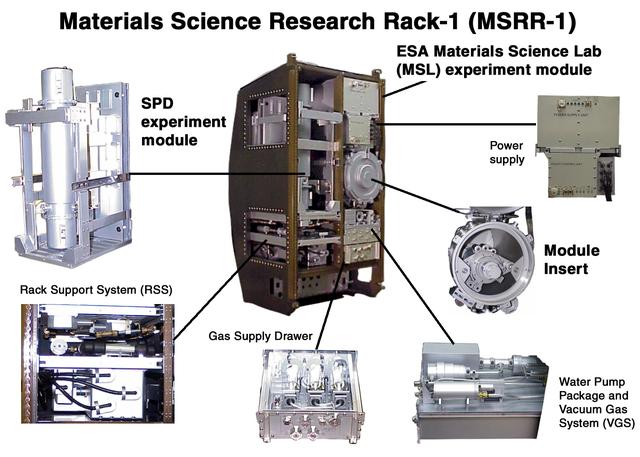
This scale model depicts the Materials Science Research Rack-1 (MSRR-1) being developed by NASA's Marshall Space Flight Center and the European Space Agency (ESA) for placement in the Destiny laboratory module aboard the International Space Station. The rack is part of the plarned Materials Science Research Facility (MSRF) and is expected to include two furnace module inserts, a Quench Module Insert (being developed by NASA's Marshall Space Flight Center) to study directional solidification in rapidly cooled alloys and a Diffusion Module Insert (being developed by the European Space Agency) to study crystal growth, and a transparent furnace (being developed by NASA's Space Product Development program). Multi-user equipment in the rack is being developed under the auspices of NASA's Office of Biological and Physical Research (OBPR) and ESA. Key elements are labeled in other images (0101754, 0101829, and TBD). This composite is from a digital still camera; higher resolution is not available.
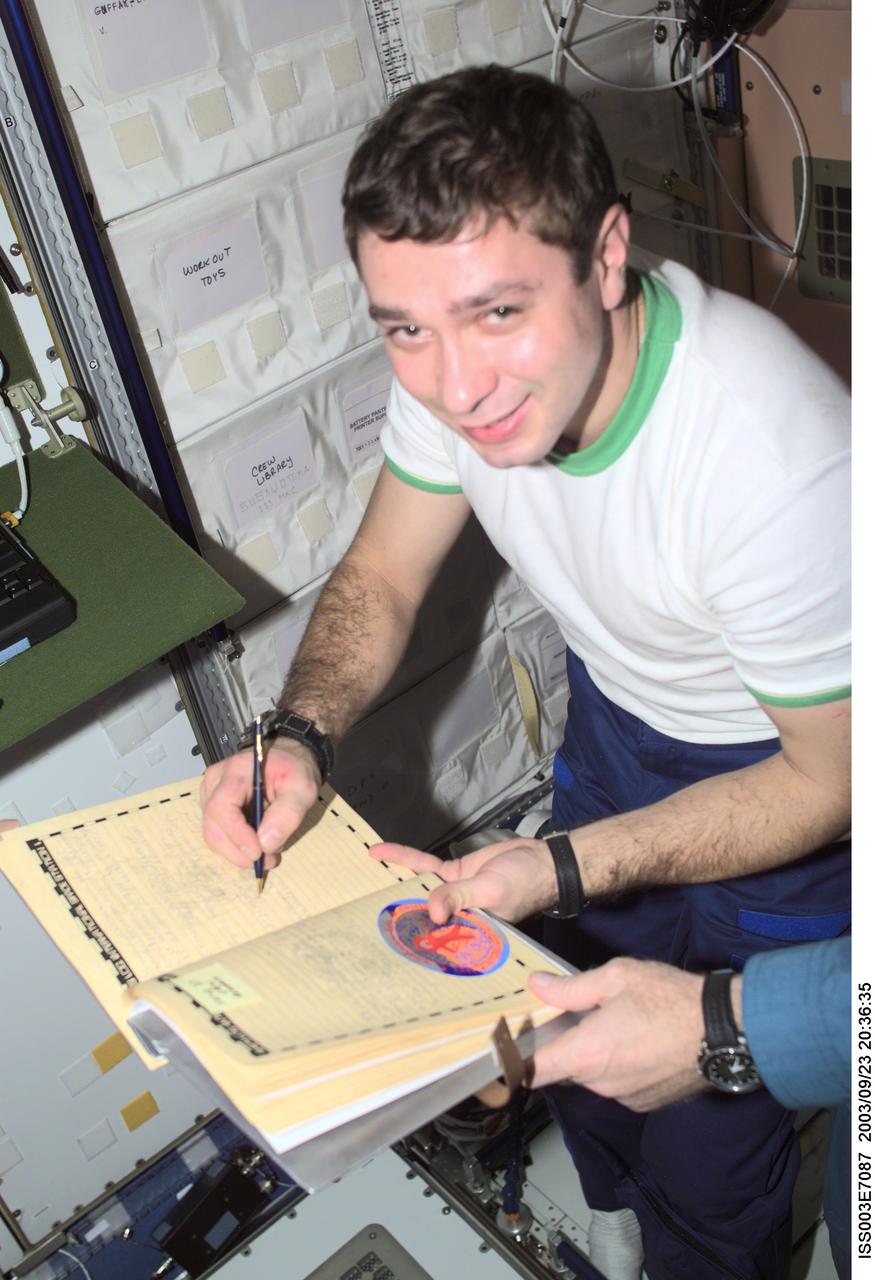
ISS003-E-7087 (23-31 October 2001) --- Flight Engineer Konstantin Kozeev, of the Soyuz Taxi crew, adds his name to the list of the International Space Station (ISS) visitors in the ship’s log in the Unity node. Kozeev represents Rosaviakosmos. This image was taken with a digital still camera.

Rod Coil Co-polymer Technology
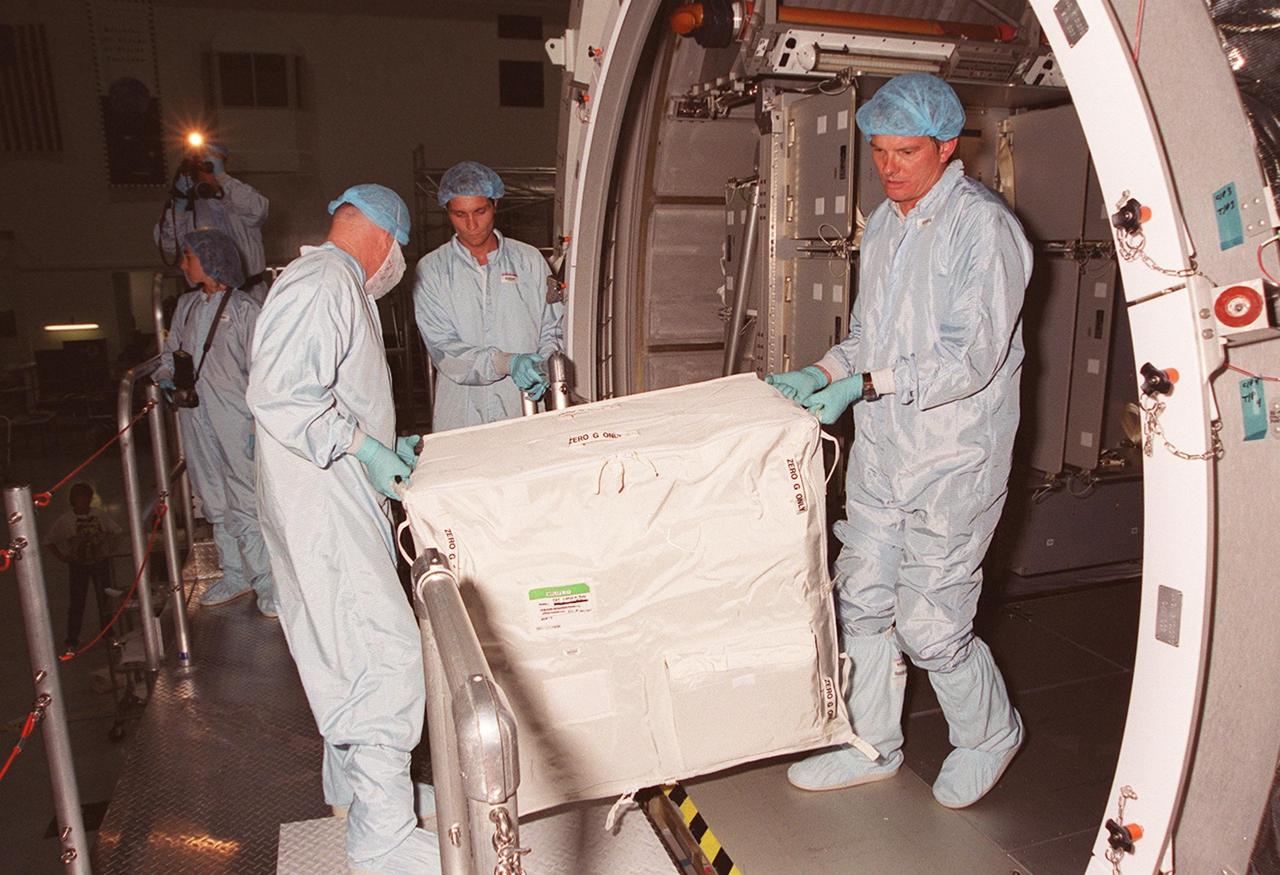
KENNEDY SPACE CENTER, FLA. -- Inside the Multi-Purpose Logistics Module Leonardo, which is in the Space Station Processing Facility, workers remove one of the containers returned from the International Space Station on mission STS-102. The MPLM brought back to KSC nearly a ton of trash and excess equipment from the Space Station. Leonardo is one of three MPLMs built by the Italian Space Agency to serve as “cargo vans” to the Station, carrying supplies and equipment. In the SSPF, Leonardo will be prepared for a future mission
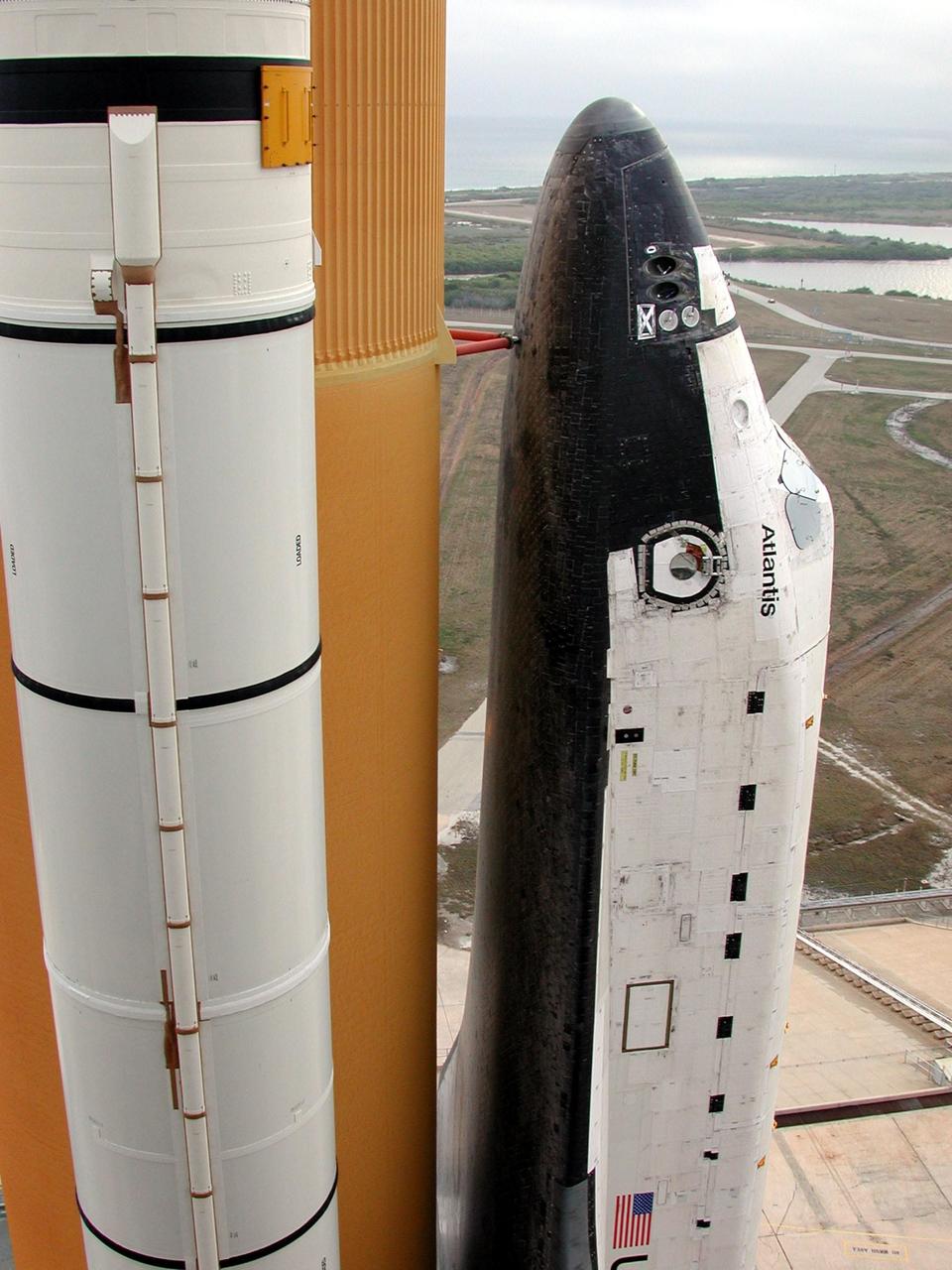
KENNEDY SPACE CENTER, FLA. -- Space Shuttle Atlantis , with its orange external tank and white solid rocket boosters attached, is viewed from the 235-foot level of the Fixed Service Structure on Launch Pad 39A. Atlantis is rolling back to the Vehicle Assembly Building so that workers can conduct inspections, make continuity checks and conduct X-ray analysis on the 36 SRB cables located inside each booster’s system tunnel (seen at left on the outside of the SRB). An extensive evaluation of NASA’s SRB cable inventory revealed conductor damage in four (of about 200) cables on the shelf. Shuttle managers decided to prove the integrity of the system tunnel cables already on Atlantis before launching Jan. 19. The launch has been rescheduled no earlier than Feb. 6
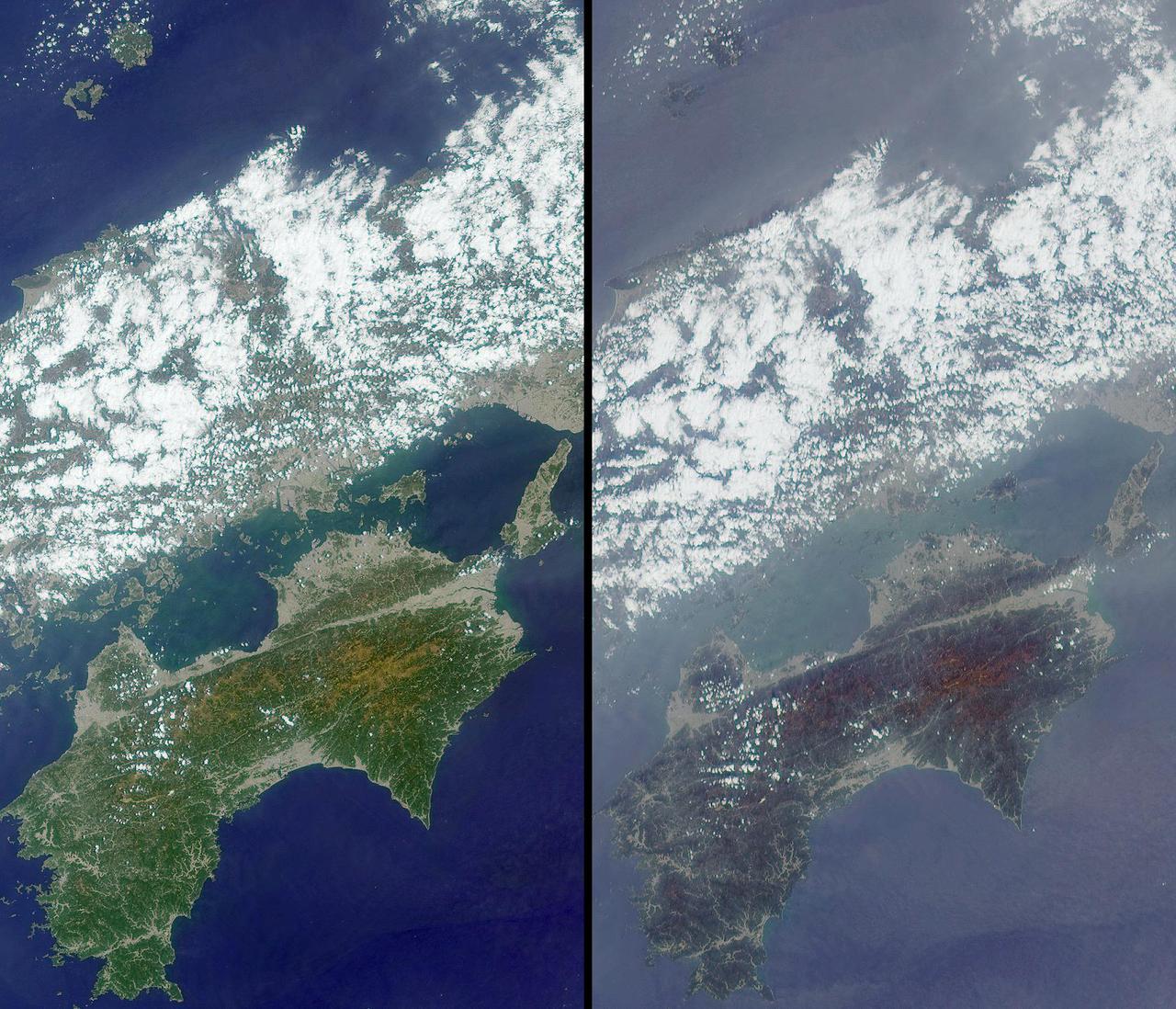
These images, centered just north of Shikoku Island in southwest Japan, were acquired by NASA Terra satellite on April 13, 2001 during Terra orbit 7015.
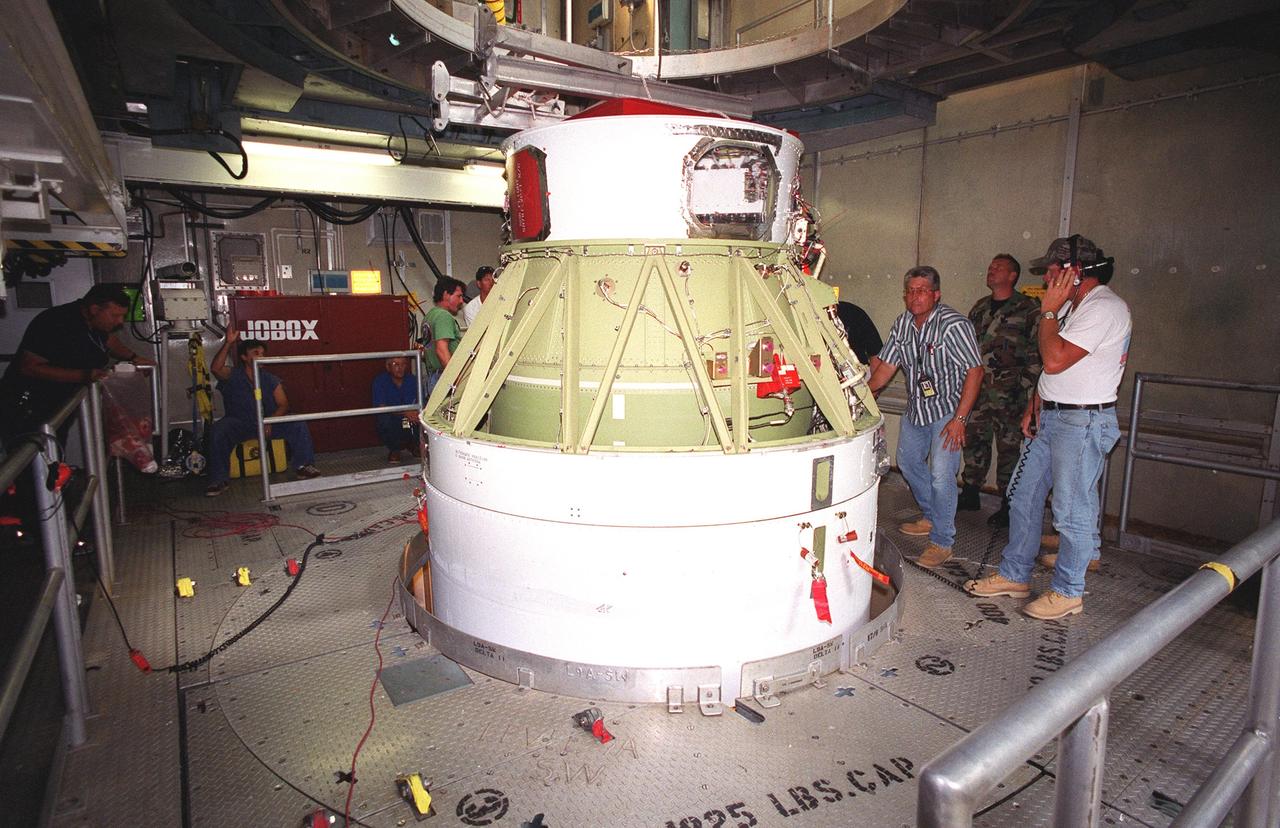
KENNEDY SPACE CENTER, FLA. -- On Launch Complex 17-B, Cape Canaveral Air Force Station, the second stage of a Boeing Delta 7425-10 rocket is lifted into position as preparations to launch NASA's Microwave Anisotropy Probe (MAP) on June 30 continue. The launch will place MAP into a lunar-assisted trajectory to the Sun-Earth for a 27-month mission.; The probe will measure small fluctuations in the temperature of the cosmic microwave background radiation to an accuracy of one millionth of a degree. These measurements should reveal the size, matter content, age, geometry and fate of the universe. They will also reveal the primordial structure that grew to form galaxies and will test ideas about the origins of these primordial structures. The MAP instrument will be continuously shaded from the Sun, Earth, and Moon by the spacecraft. The probe is a product of Goddard Space Flight Center in partnership with Princeton University
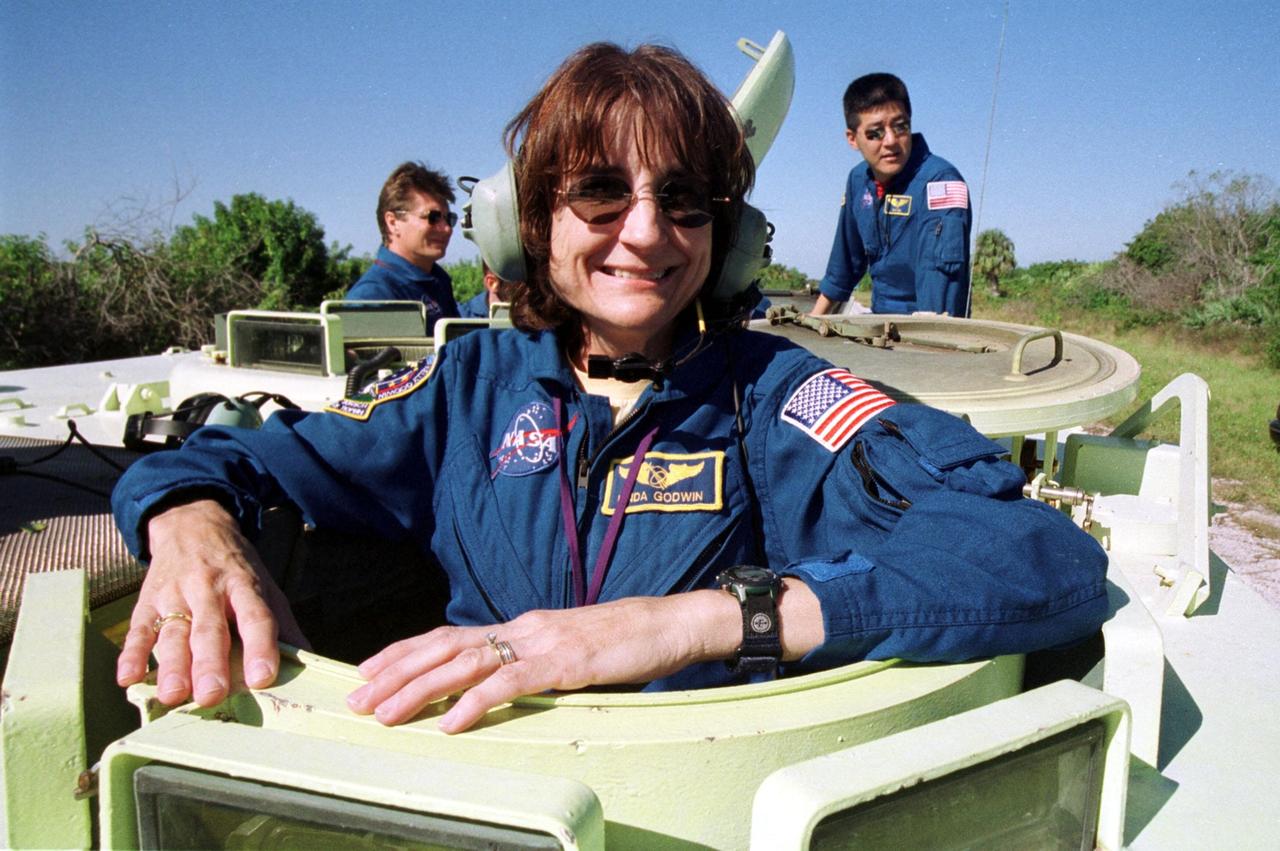
KENNEDY SPACE CENTER, Fla. -- STS-108 Mission Specialist Linda A. Godwin is ready to take her turn driving an M-113 armored personnel carrier. She and other crew members are taking part in Terminal Countdown Demonstration Test activities, which include emergency exit from the launch pad and a simulated launch countdown. The 11-day mission will carry the replacement Expedition 4 crew to the International Space Station, as well as the Multi-Purpose Logistics Module Raffaello, filled with supplies and equipment. STS-108 is scheduled to launch Nov. 29 on Space Shuttle Endeavour
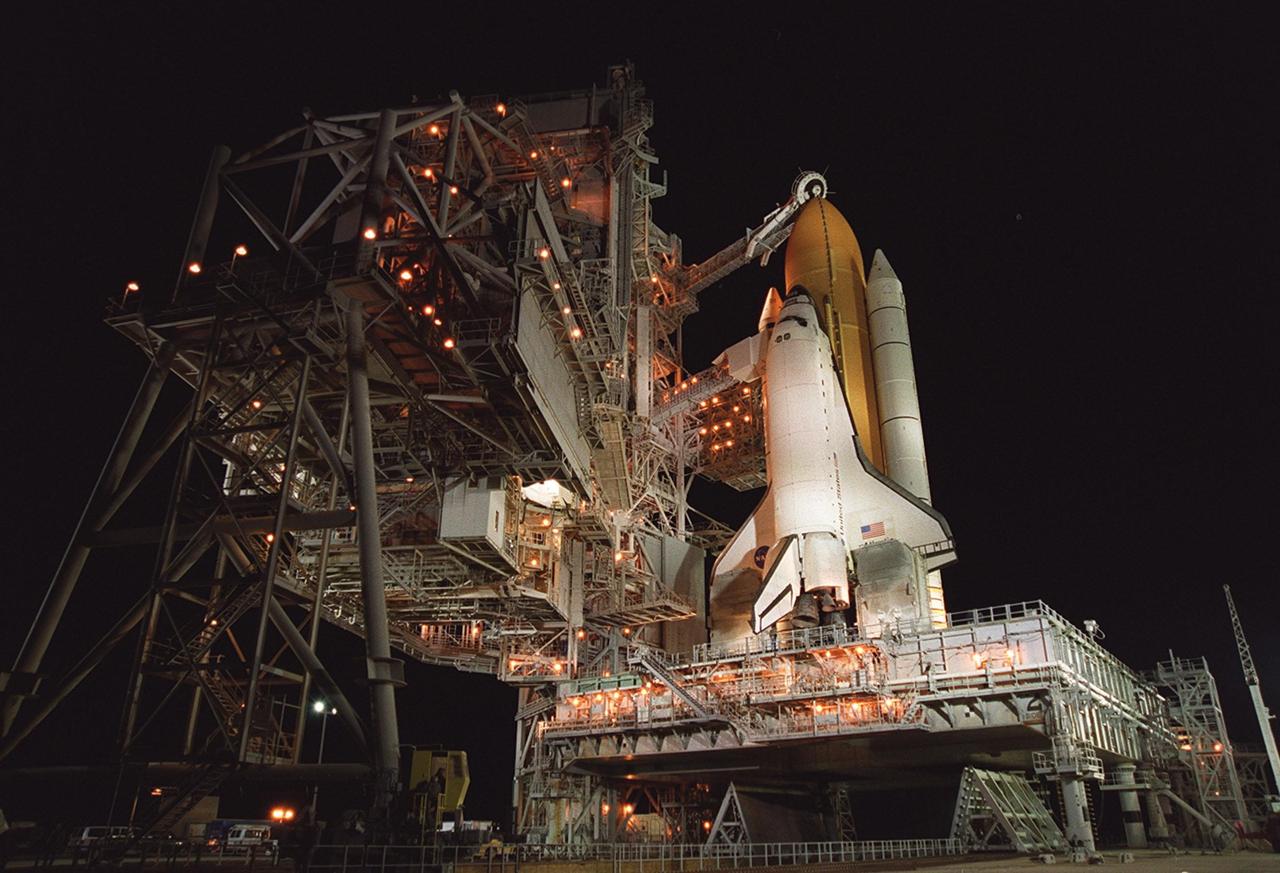
Space Shuttle Atlantis is revealed after rollback of the Rotating Service Structure. Extended to the side of Atlantis is the orbiter access arm, with the White Room at its end. The White Room is an environmentally controlled area that provides entry for the crew into Atlantis’s cockpit. Above the yellow-orange external tank is the Gaseous Oxygen Vent Arm, with the “beanie cap” vent hood raised. Before cryogenic loading, the hood will be lowered into position over the external tank vent louvers to vent gaseous oxygen vapors away from the Shuttle. Atlantis is carrying the U.S. Laboratory Destiny, a key module in the growth of the International Space Station. Destiny will be attached to the Unity node on the Space Station using the Shuttle’s robotic arm. Three spacewalks are required to complete the planned construction work during the 11-day mission. Launch is targeted for 6:11 p.m. EST and the planned landing at KSC Feb. 18 about 1:39 p.m. This mission marks the seventh Shuttle flight to the Space Station, the 23rd flight of Atlantis and the 102nd flight overall in NASA’s Space Shuttle program
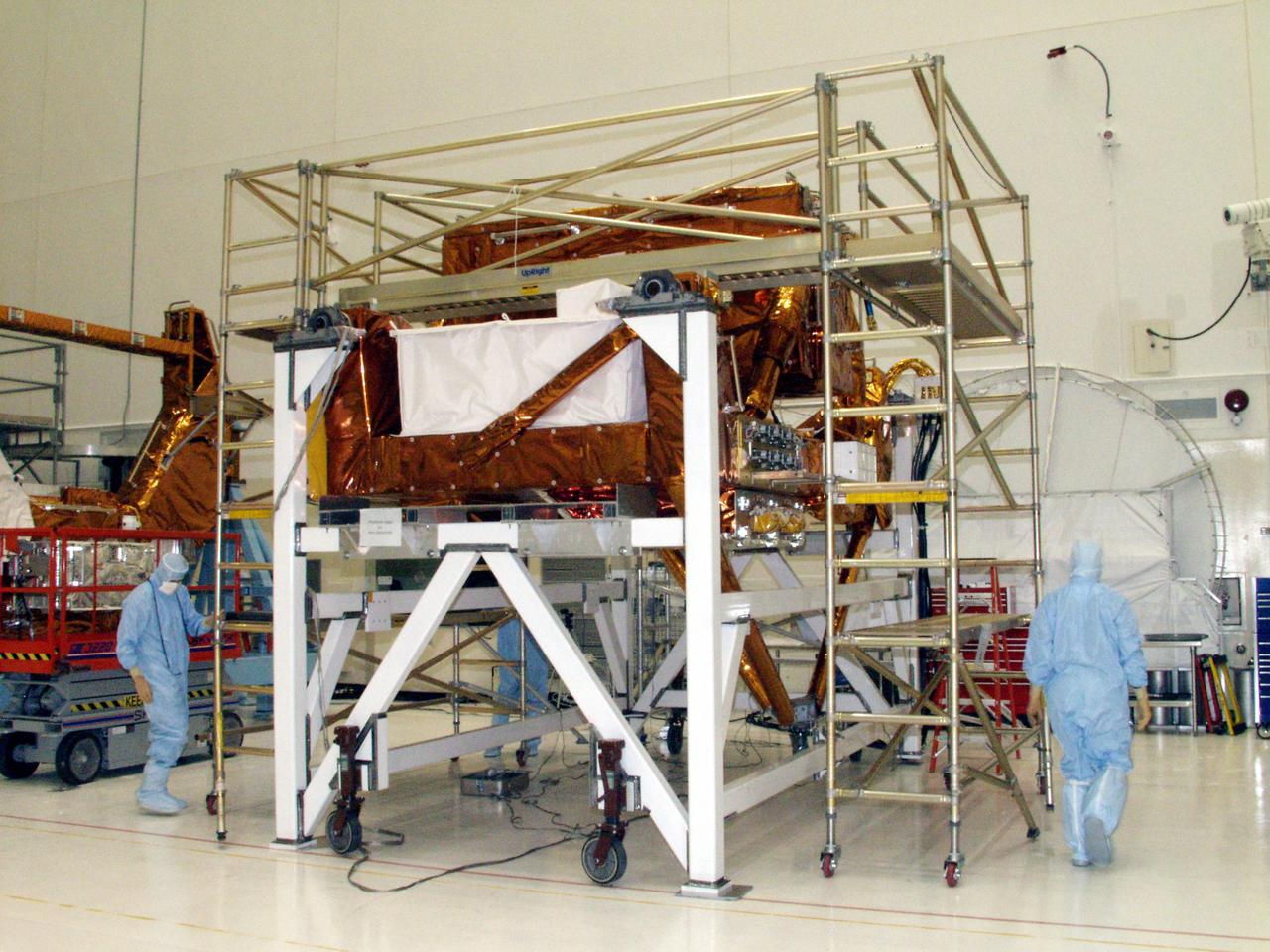
KENNEDY SPACE CENTER, FLA. --The STS-109 flight hardware for maintenance of the Hubble Space Telescope (HST) is being processed inside the clean room at the Vertical Processing Facility (VPF). Seen here is the Axial Science Instrument Protective Enclosure (ASIPE), which will house the Advanced Camera for Surveys (ACS). The hardware will be installed on four principle payload carriers. The STS-109 launch aboard Columbia is targeted for Feb. 14, 2002, and will be the 108th flight in the Space Shuttle program

ISS003-E-7129 (31 October 2001) --- A Soyuz spacecraft departs from the International Space Station (ISS) carrying the Soyuz taxi crew, Commander Victor Afanasyev, Flight Engineer Konstantin Kozeev and French Flight Engineer Claudie Haignere, ending their eight-day stay on the station. Afanasyev and Kozeev represent Rosaviakosmos, and Haignere represents ESA, carrying out a flight program for CNES, the French Space Agency, under a commercial contract with the Russian Aviation and Space Agency. This image was taken with a digital still camera.
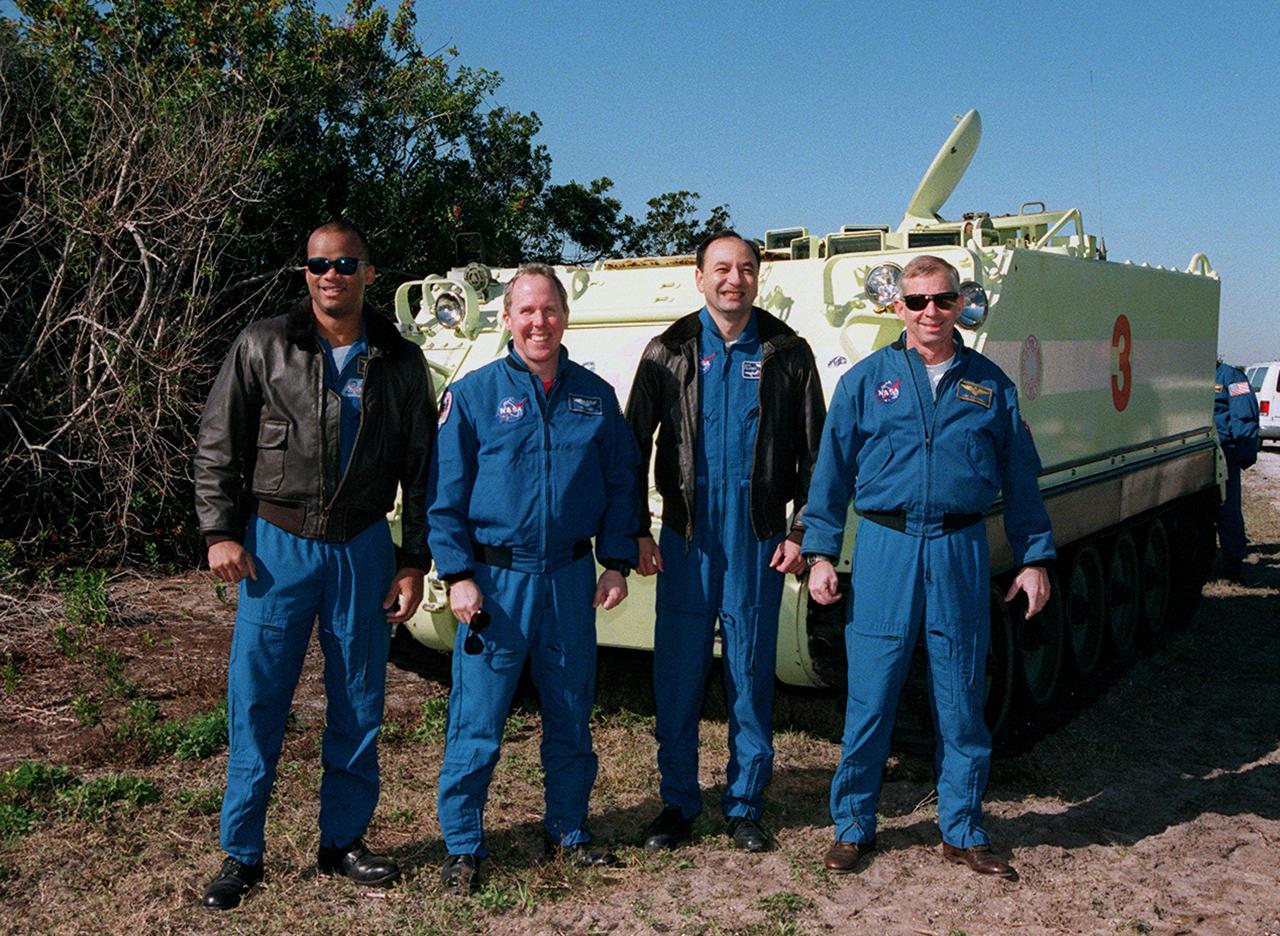
Members of the STS-98 crew pose in front of the M-113 armored carrier they were test driving as part of emergency egress training at Launch Pad 39A. From left are Mission Specialists Robert Curbeam and Thomas Jones, Pilot Mark Polansky and Commander Ken Cockrell. Not pictured is the fifth crew member, Mission Specialist Marsha Ivins. The carrier could be used to transport the crew to a nearby bunker, or farther, in the event of an emergency at the pad prior to launch. The STS-98 crew is at KSC to take part in Terminal Countdown Demonstration Test activities, which also includes a simulated launch countdown. STS-98 is the seventh construction flight to the International Space Station, carrying as payload the U.S. Lab Destiny, a key element in the construction of the ISS
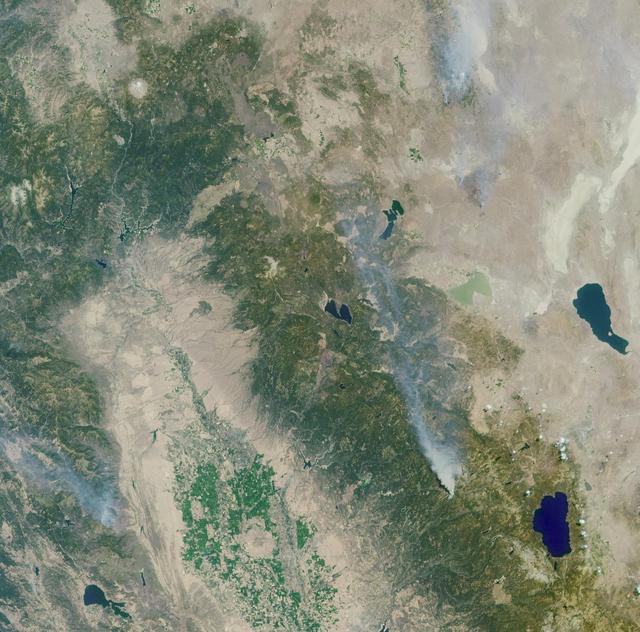
These images from NASA Terra satellite are of the Central Valley and the Sierra Nevada Mountains showing several smoke plumes from wildfires burning throughout Northern California on August 13, 2001.
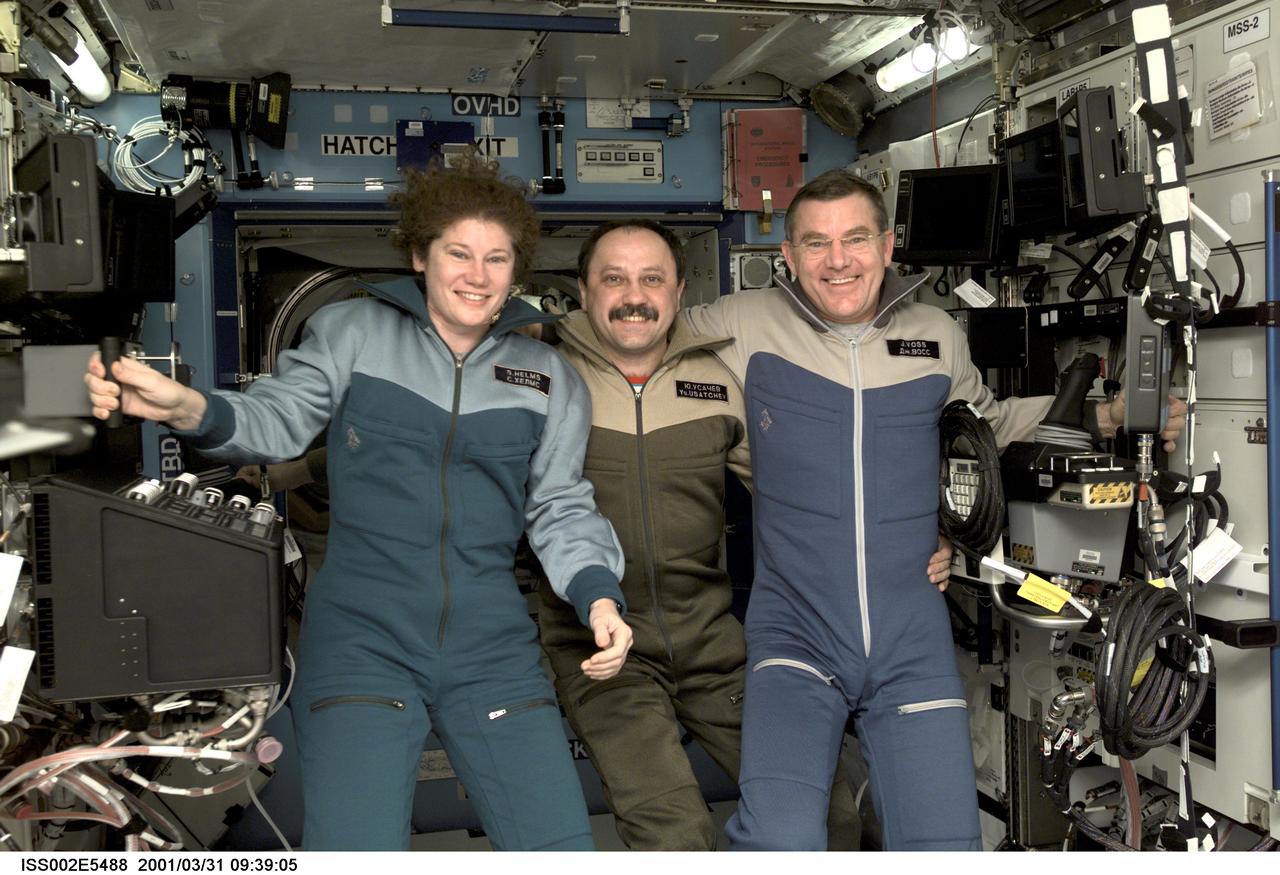
ISS002-E-5488 (31 March 2001) --- The Expedition Two crewmembers -- astronaut Susan J. Helms (left), cosmonaut Yury V. Usachev and astronaut James S. Voss -- pose for a photograph in the U.S. Laboratory / Destiny module of the International Space Station (ISS). This image was recorded with a digital still camera.
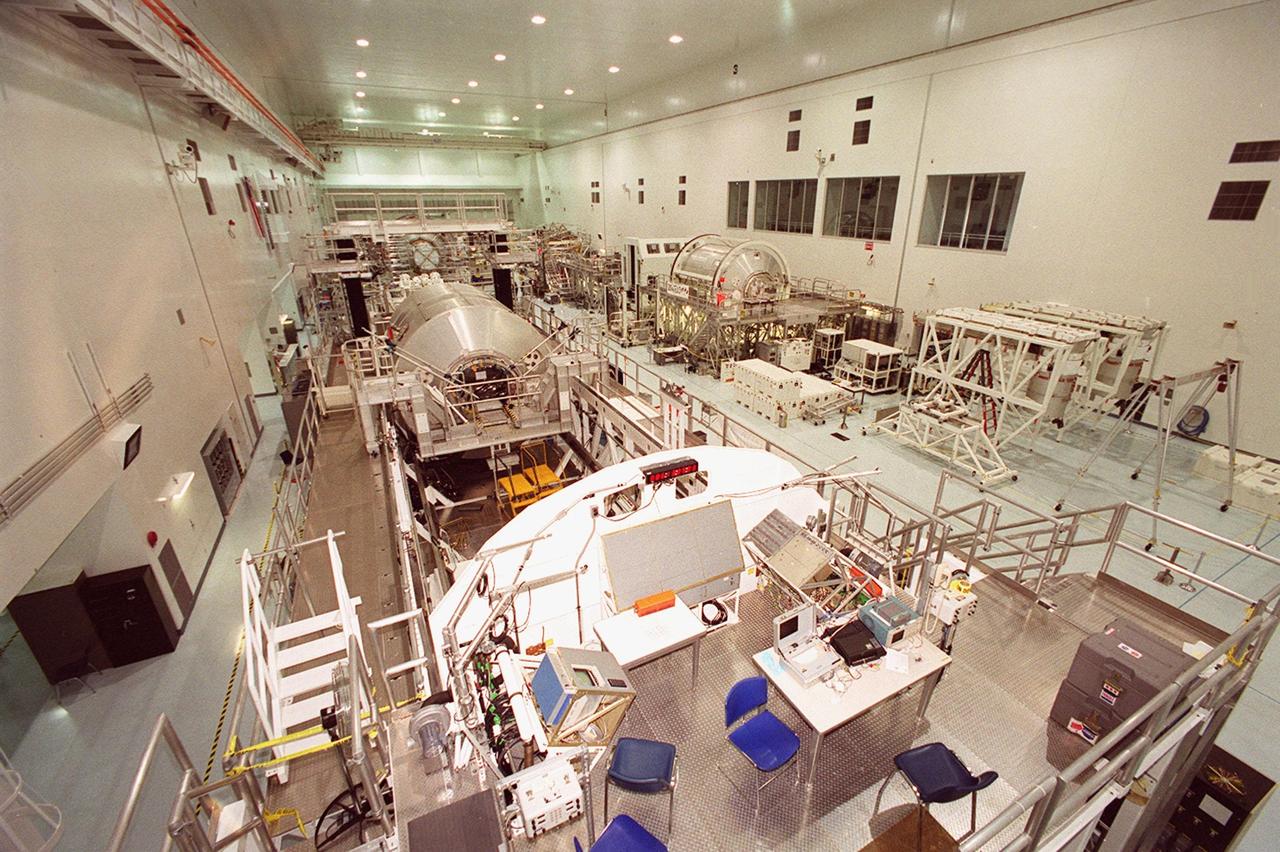
An overview of the Space Station Processing Facility shows equipment and future payloads on Shuttle missions to the International Space Station. At left is a Multi-Purpose Logistics Module Raffaello; at right another MPLM, Donatello. Windows on the wall at right give visitors on bus tours a look at operations during the day
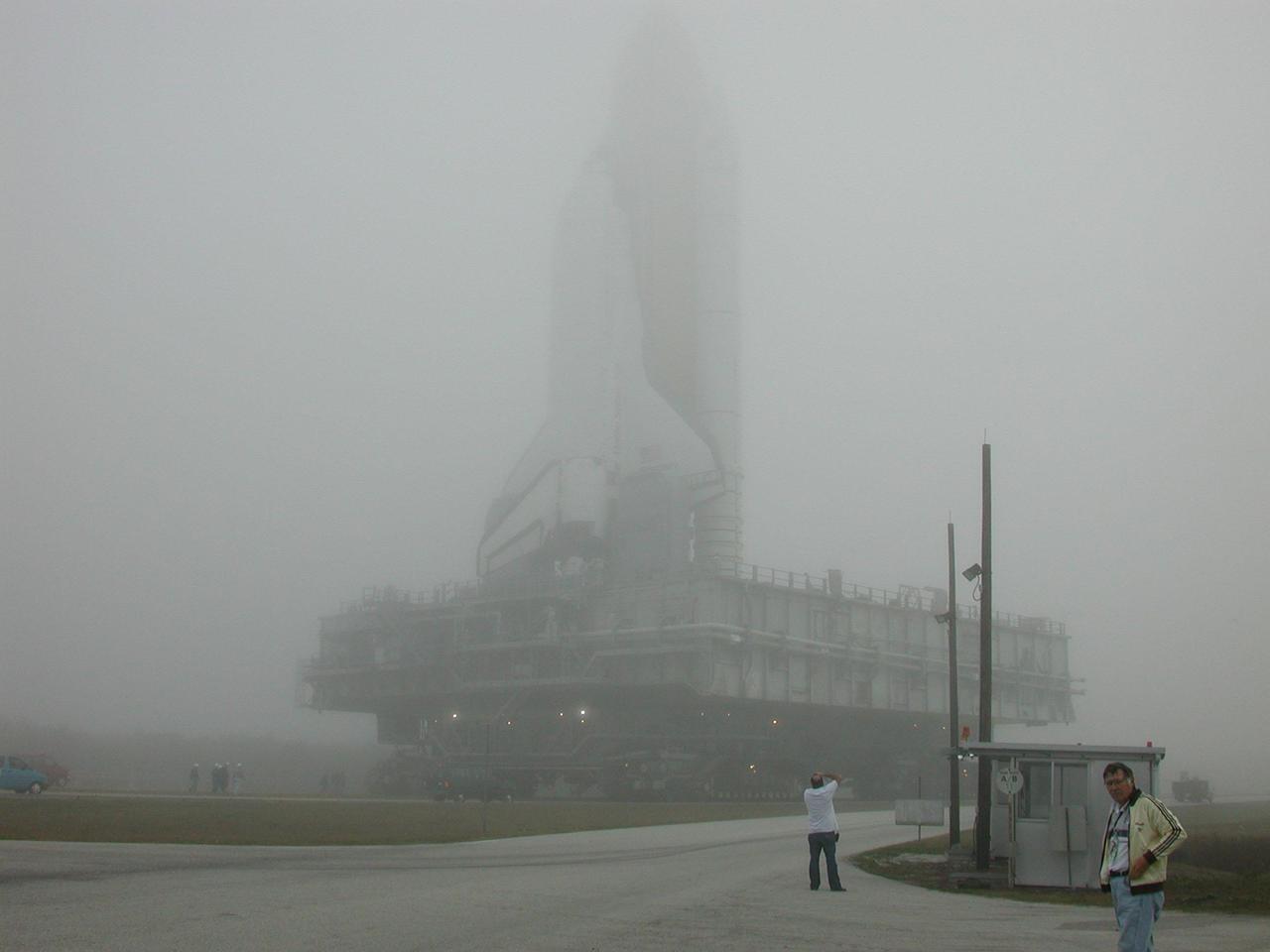
KENNEDY SPACE CENTER, Fla. -- Fog-enshrouded Space Shuttle Discovery dwarfs the workers on the ground as it crawls to Launch Pad 39B. Discovery will be flying on mission STS-102 to the International Space Station. Its payload is the Multi-Purpose Logistics Module Leonardo, a “moving van,” to carry laboratory racks filled with equipment, experiments and supplies to and from the Space Station aboard the Space Shuttle. The flight will also carry the Expedition Two crew up to the Space Station, replacing Expedition One, who will return to Earth on Discovery. Launch is scheduled for March 8 at 6:45 a.m. EST
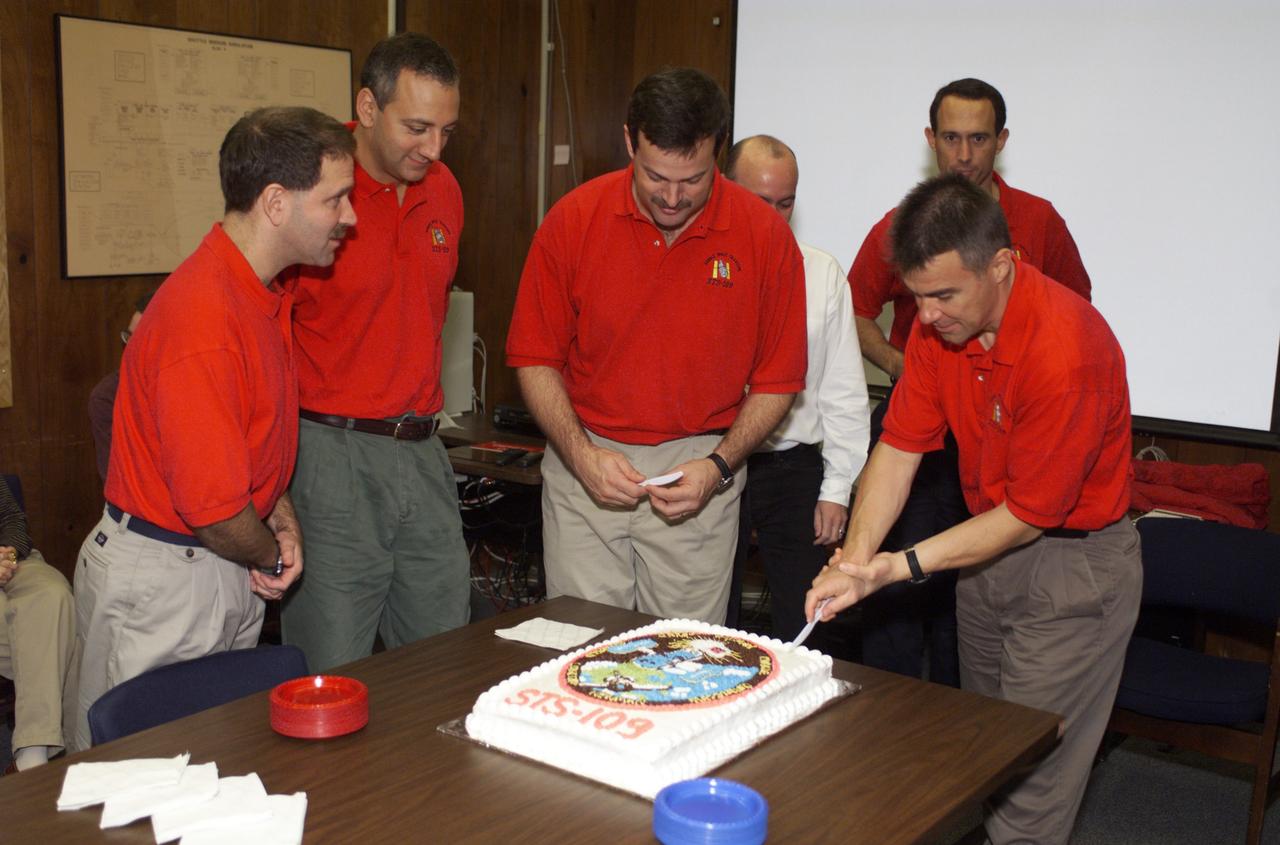
JSC2001-E-44846 (December 2001) --- The STS-109 crew members pause from their mission training for a cake cutting ceremony in the Jake Garn Simulation and Training Facility at the Johnson Space Center (JSC). From left to right are astronauts John M. Grunsfeld, Michael J. Massimino, Scott D. Altman, and Duane G. Carey, James H. Newman; along with David Steward of the United Space Alliance (USA). Altman and Carey are mission commander and pilot, respectively. Grunsfeld is payload commander, with the others serving as mission specialists. Astronauts Nancy J. Currie and Richard M. Linnehan are out of frame.
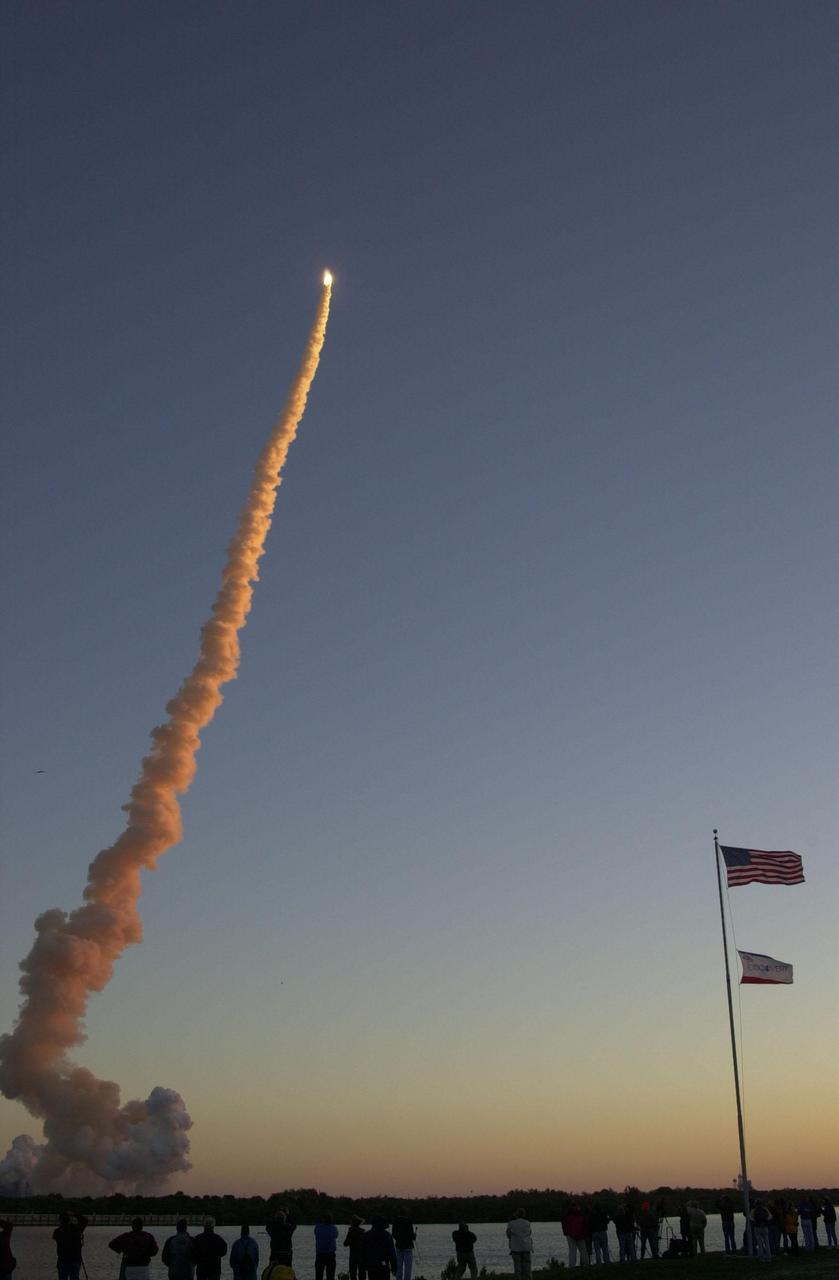
KENNEDY SPACE CENTER, Fla. -- Space Shuttle Discovery outshines a rising sun as it blasts off on mission STS-102, the eighth construction flight to the International Space Station. The lower smoke plumes appear red from the dawn’s rays. Liftoff occurred on time at 6:42:09 EST
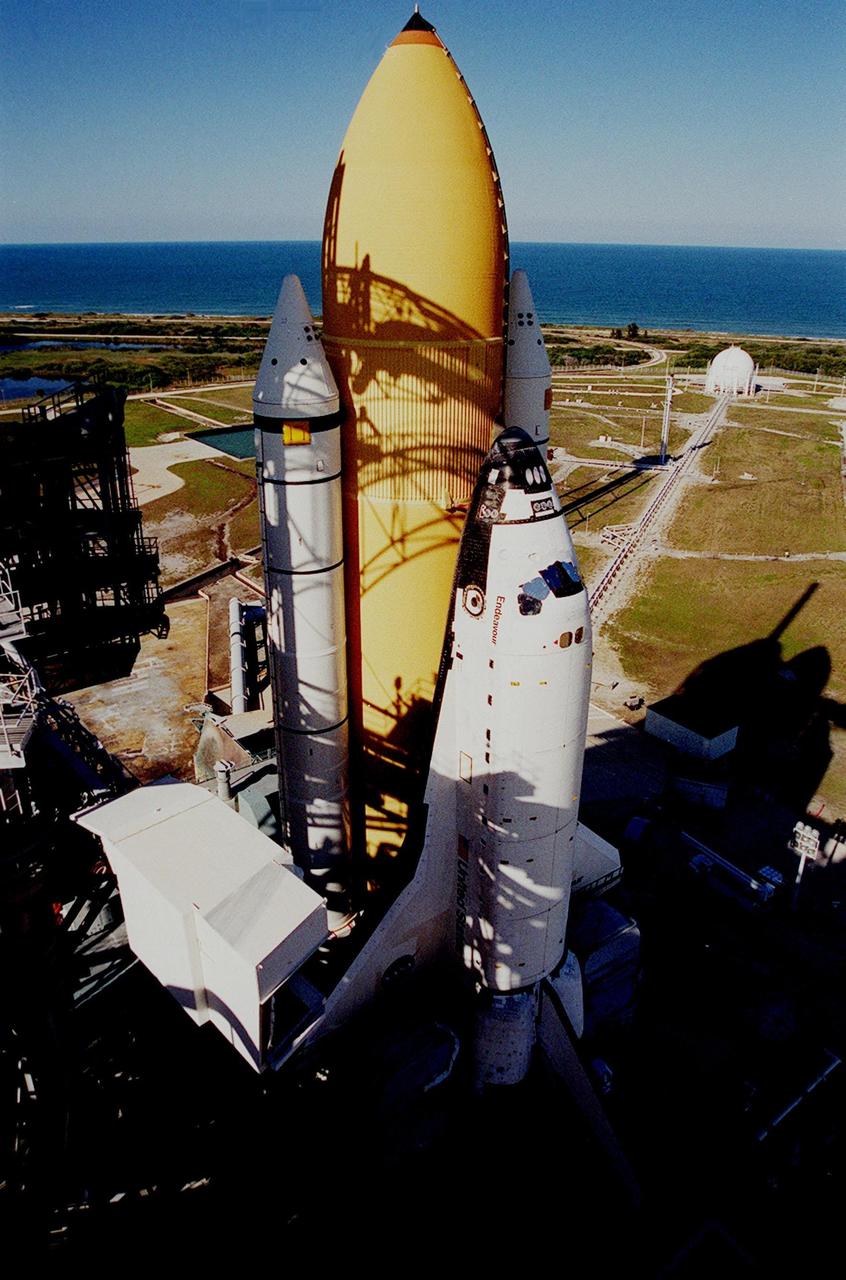
KENNEDY SPACE CENTER, FLA. -- Afternoon shadows cast a grid over the Space Shuttle Endeavour’s white solid rocket boosters and orange external tank after arriving on Launch Pad 39A. In the background is seen the deep blue of the Atlantic Ocean. Endeavour is expected to lift off on mission STS-100 on April 19, carrying the Multi-Purpose Logistics Module Raffaello and the Canadian robotic arm, SSRMS, to the International Space Station
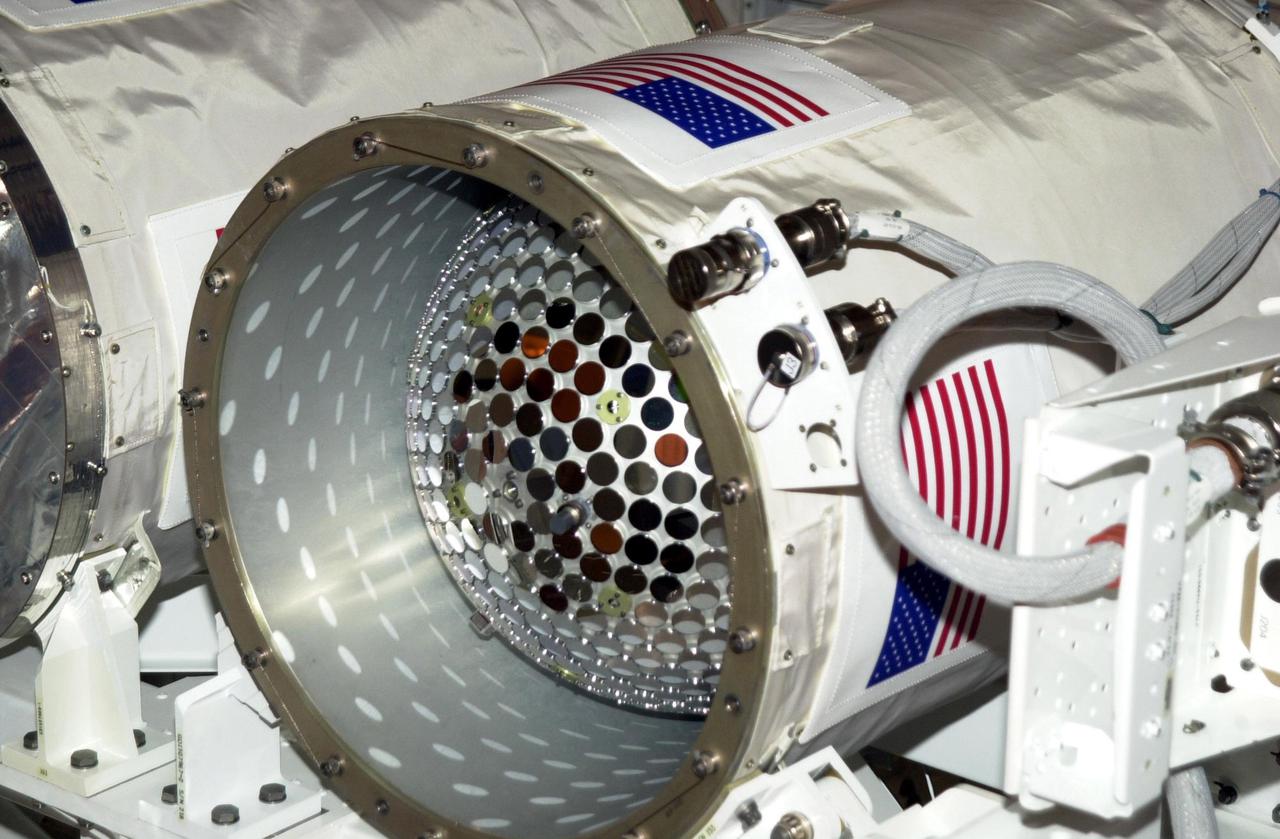
KENNEDY SPACE CENTER, Fla. -- The Starshine-2 experiment rests inside a canister in the payload bay of Space Shuttle Endeavour. The deployable experiment is being carried on mission STS-108. Starshine-2's 800 aluminum mirrors were polished by more than 25,000 students from 26 countries. Top priorities for the STS-108 (UF-1) mission of Endeavour are rotation of the International Space Station Expedition Three and Expedition Four crews, bringing water, equipment and supplies to the station in the Multi-Purpose Logistics Module Raffaello, and completion of robotics tasks and a spacewalk to install thermal blankets over two pieces of equipment at the bases of the Space Station's solar wings. Liftoff of Endeavour on mission STS-108 is scheduled for 7:41 p.m. EST
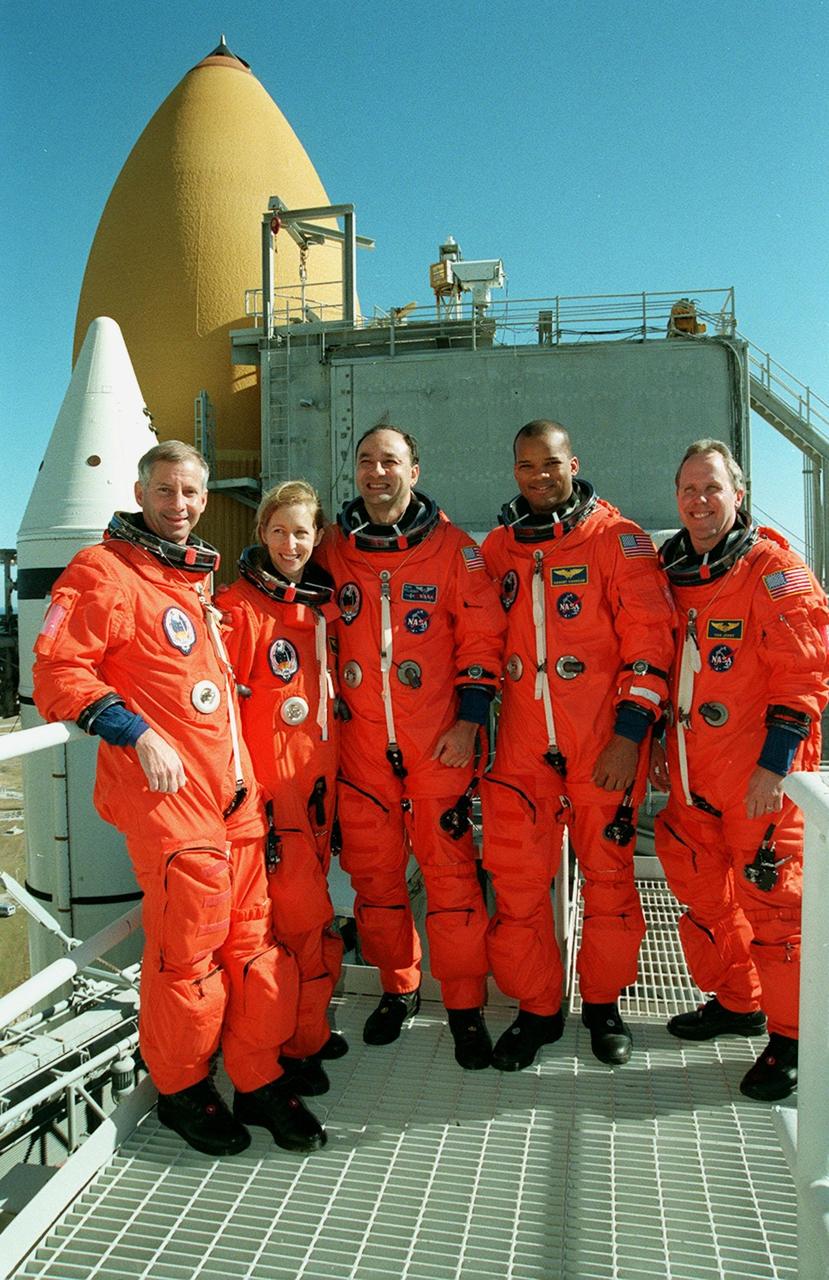
KENNEDY SPACE CENTER, FLA. -- The STS-98 crew poses for a group photo on the 215-foot level of the Fixed Service Structure at Launch Pad 39A. Dressed in their orange launch and entry suits are (left to right) Commander Ken Cockrell, Mission Specialist Marsha Ivins, Pilot Mark Polansky and Mission Specialists Robert Curbeam and Thomas Jones. Behind them can be seen the white nose cone of a solid rocket booster and the orange external tank on Space Shuttle Atlantis. The crew is taking part in emergency egress training and a simulated launch countdown as part of Terminal Countdown Demonstration Test activities. STS-98 is the seventh construction flight to the International Space Station, carrying as payload the U.S. Lab Destiny, a key element in the construction of the ISS. Launch of STS-98 is scheduled for Jan. 19 at 2:11 a.m. EST
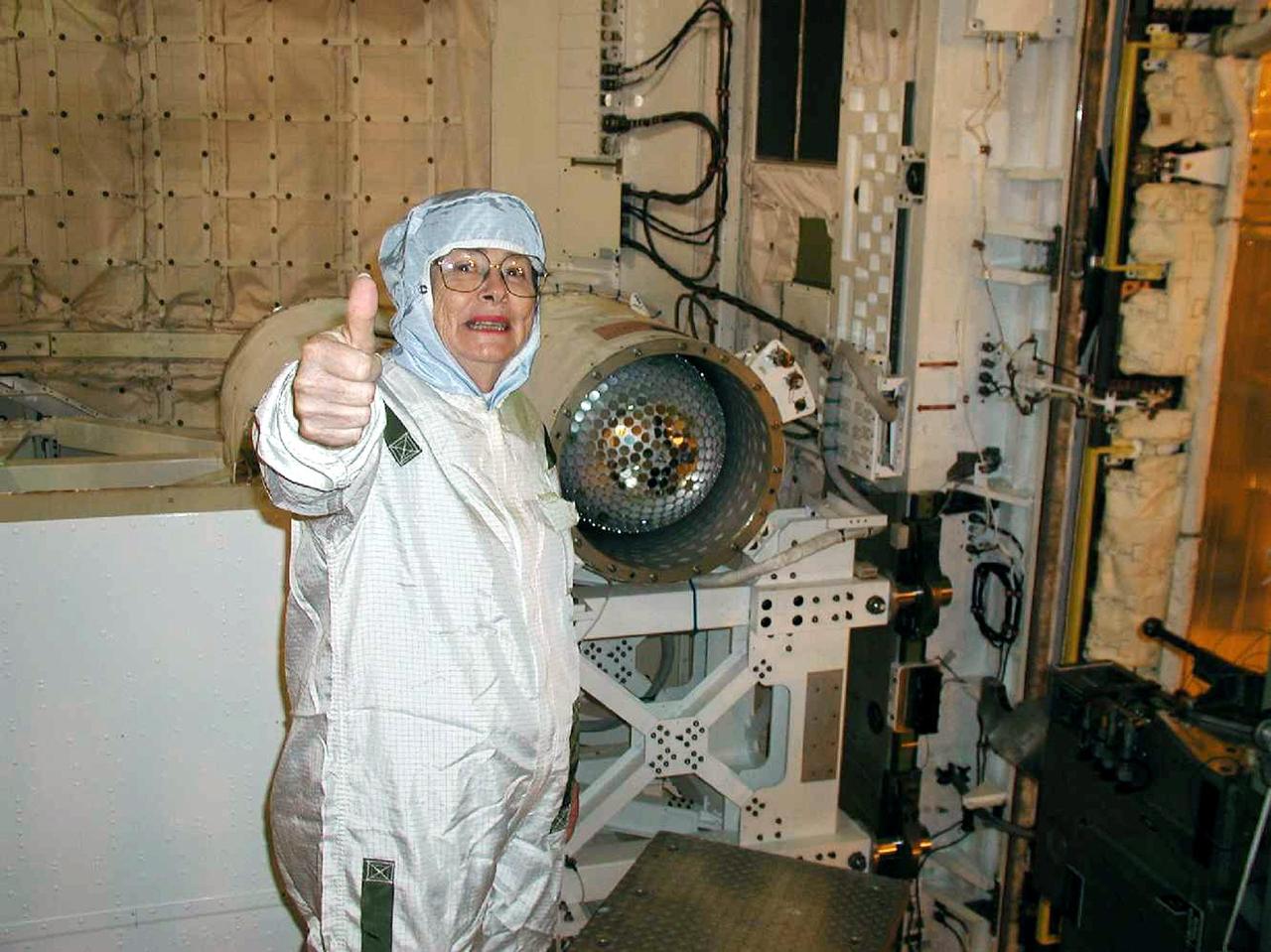
KENNEDY SPACE CENTER, Fla. -- From inside the payload bay of orbiter Endeavour, Phyllis Moore, co-director of Project Starshine, gives her final approval to flight of the Starshine-2 satellite. The deployable experiment is being carried on mission STS-108. Starshine-2's 800 aluminum mirrors were polished by more than 25,000 students from 26 countries. Top priorities for the STS-108 (UF-1) mission of Endeavour are rotation of the International Space Station Expedition Three and Expedition Four crews, bringing water, equipment and supplies to the station in the Multi-Purpose Logistics Module Raffaello, and completion of robotics tasks and a spacewalk to install thermal blankets over two pieces of equipment at the bases of the Space Station's solar wings. Liftoff of Endeavour on mission STS-108 is scheduled for 7:41 p.m. EST Nov. 29
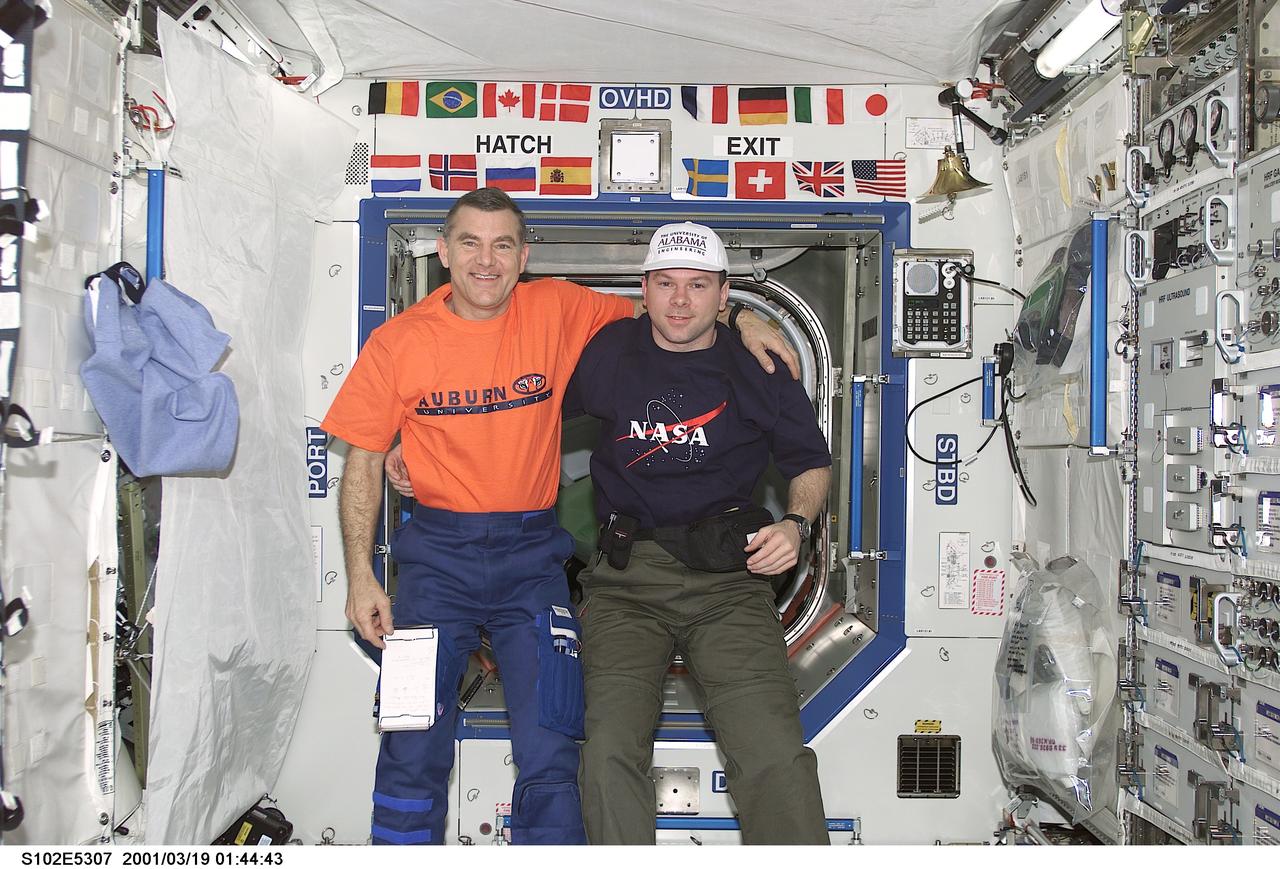
STS102-E-5307 (19 March 2001) --- Astronauts James S. Voss (left) and James M. Kelly share a friendly moment onboard the International Space Station's U.S. laboratory Destiny in spite of the long-standing academic/athletic rivalry between their respective alma maters--Auburn University and the University of Alabama. Voss, STS-102 mission specialist-turned Expedition Two flight engineer and a 1972 alumnus of Auburn with a bachelor of science degree in aerospace engineering, sports a T-shirt paying tribute to his university. Kelly, STS-102 pilot and masters of science degree graduate in aerospace engineering from the University of Alabama in 1996, is wearing a cap from that institution of higher learning.
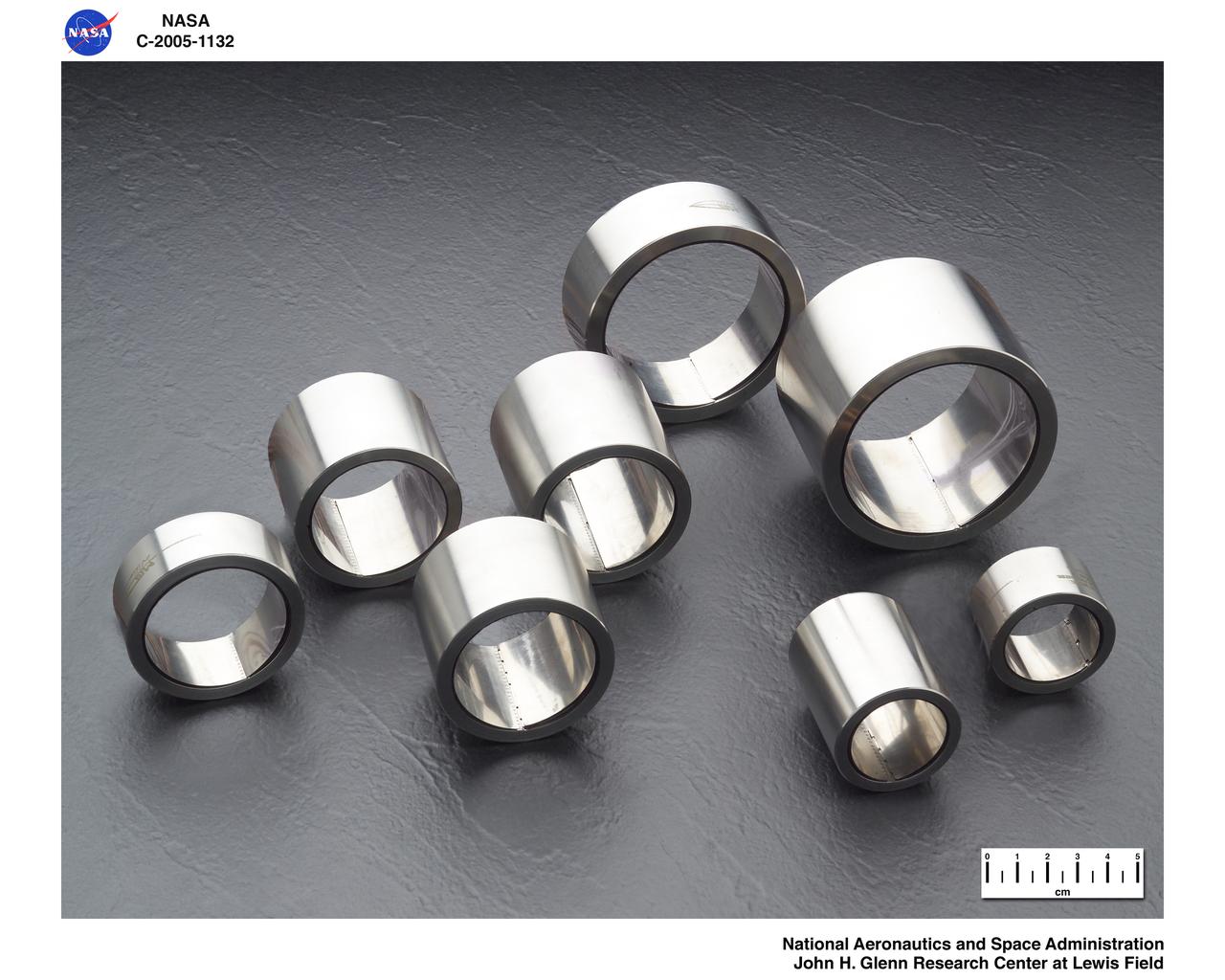
Foil Bearing Test Specimens

ISS003-E-6855 (23-31 October 2001) --- French Flight Engineer Claudie Haignere, works in the Zvezda Service Module on the International Space Station (ISS). Haignere represents ESA, carrying out a flight program for CNES, the French Space Agency, under a commercial contract with the Russian Aviation and Space Agency. This image was taken with a digital still camera.
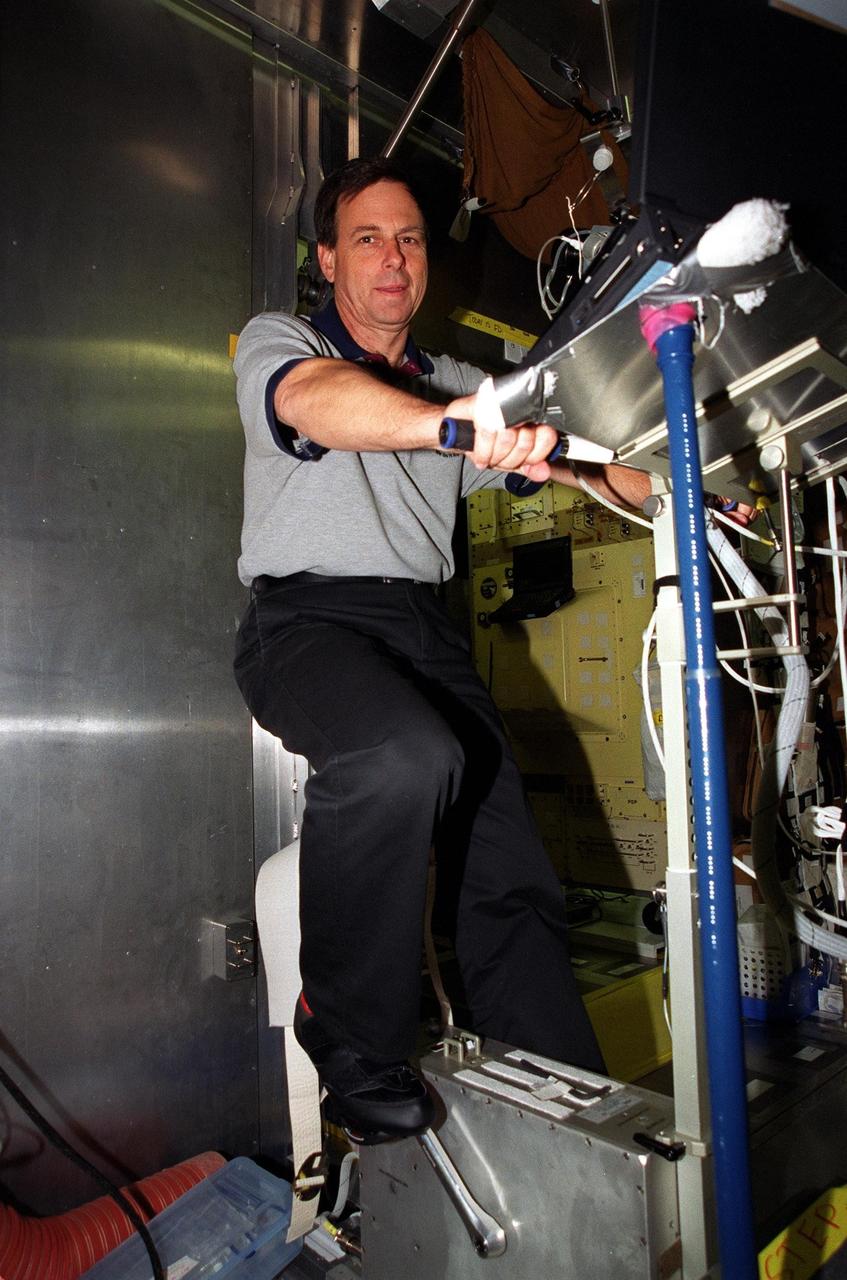
KENNEDY SPACE CENTER, Fla. -- STS-107 Payload Specialist Ilan Ramon, of Israel, trains on equipment in the training module at SPACEHAB, Cape Canaveral. Ramon and other crew members Commander Rick D. Husband, Pilot William C. McCool, Payload Commander Michael P. Anderson; and Mission Specialists Kalpana Chawla, Laurel Blair Salton Clark and David M. Brown are at SPACEHAB to take part in Crew Equipment Interface Test (CEIT) activities. The CEIT enables the crew to perform certain flight operations, operate experiments in a flight-like environment, evaluate stowage locations and obtain additional exposure to specific experiment operations. As a research mission, STS-107 will carry the SPACEHAB Double Module in its first research flight into space and a broad collection of experiments ranging from material science to life science. STS-107 is scheduled for launch May 23, 2002
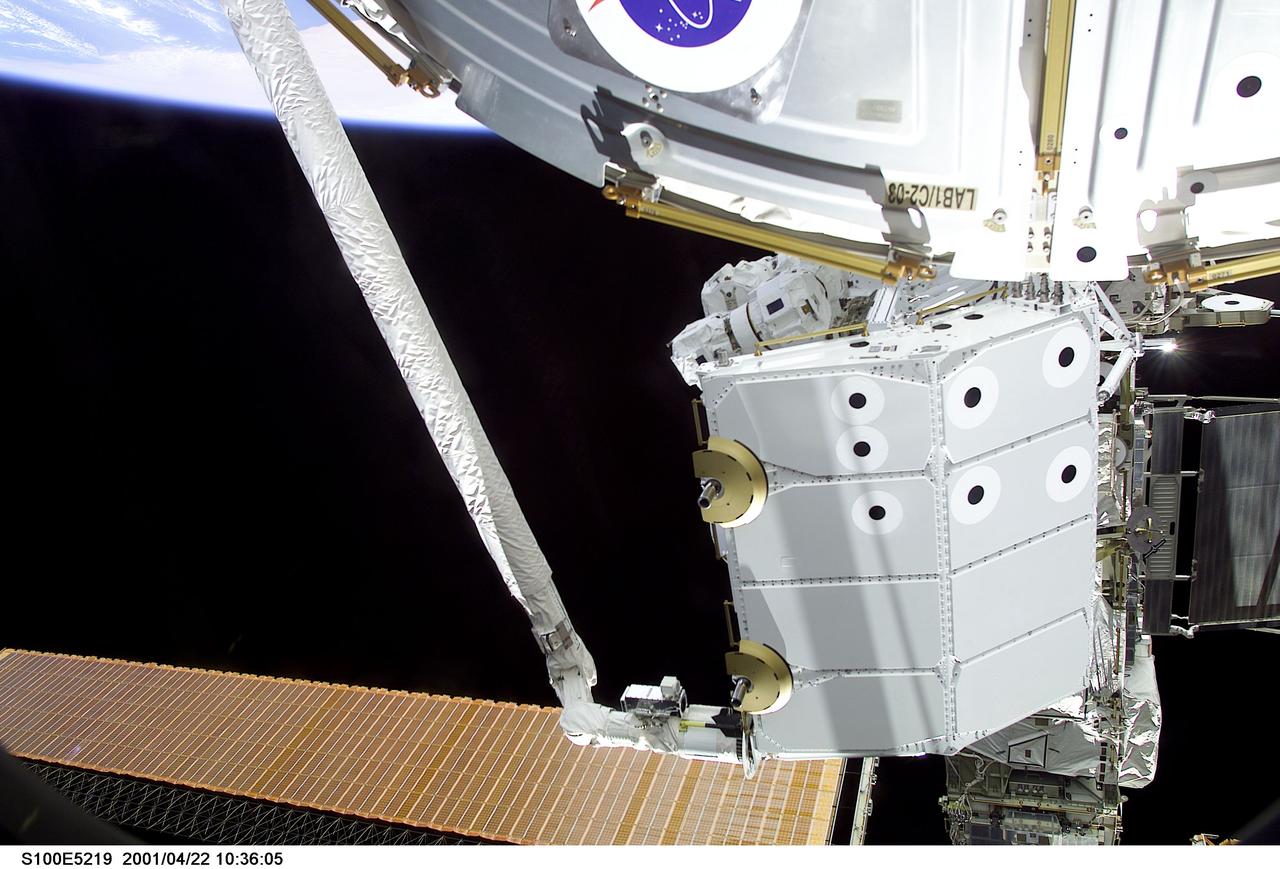
S100-E-5219 (22 April 2001) --- The Spacelab Pallet that contain Canadarm2 and the UHF antenna that are to be installed during the first scheduled space walk on STS-100 is seen in the grasp of the Canadian-built Remote Manipulator System (RMS) robot arm on the Space Shuttle Endeavour. The scene was recorded with a digital still camera.
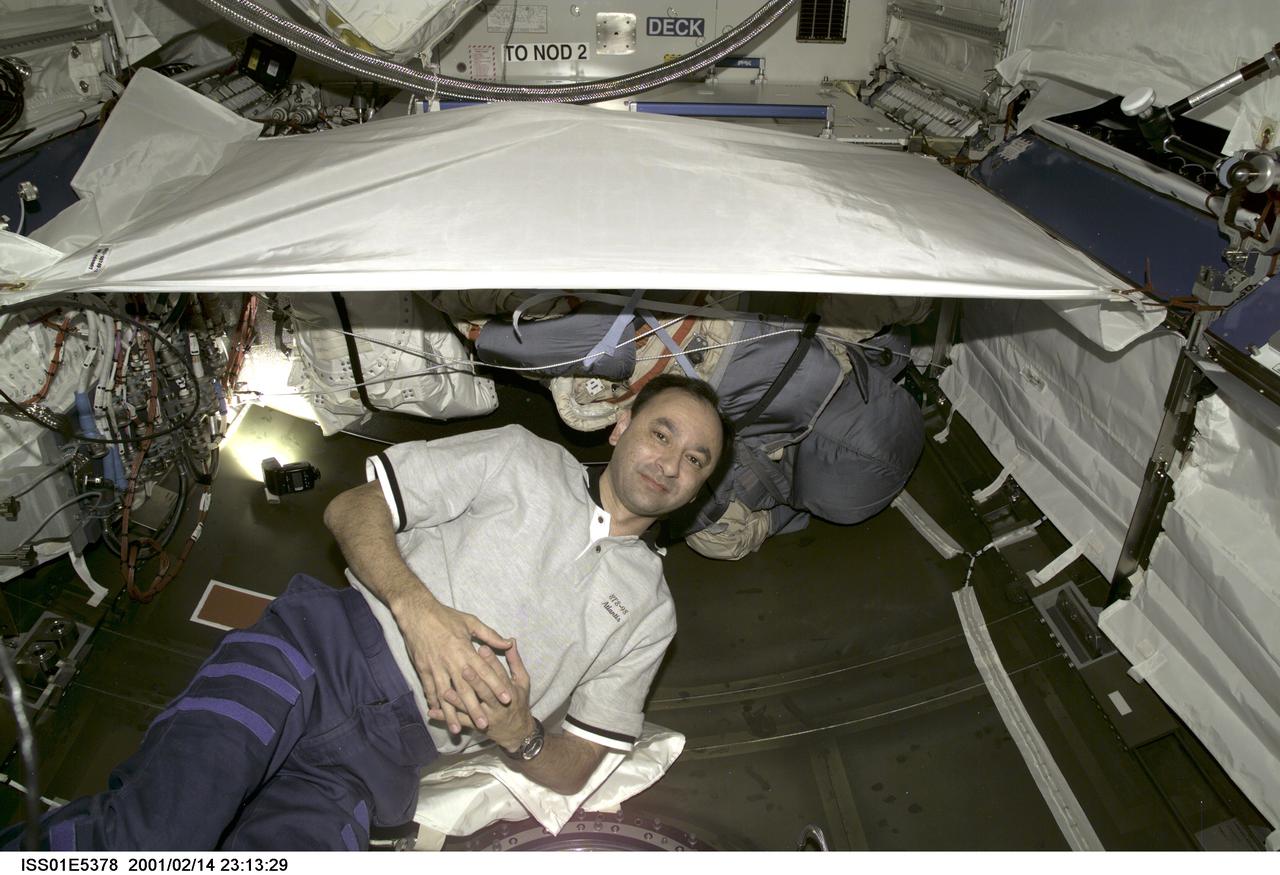
ISS01-E-5378 (14 February 2001) --- Astronaut Mark L. Polansky is pictured in the new Destiny laboratory. The STS-98 and Expedition One crews have been busy in the lab since its hatch was opened earlier in the week. This photo was taken with a digital still camera.
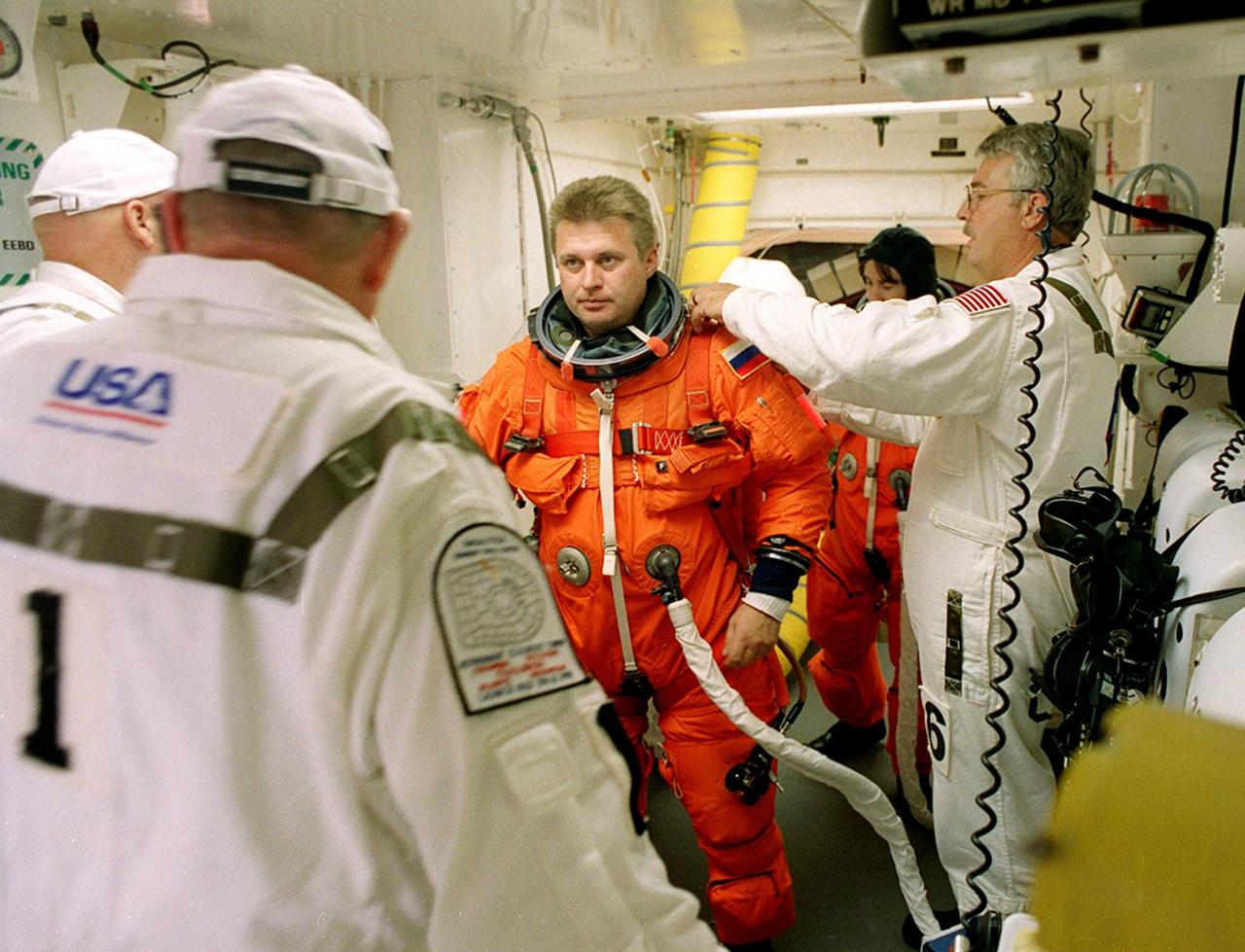
KENNEDY SPACE CENTER, Fla. - Expedition 4 Commander Yuri Onufrienko gets help with his launch and entry suit before entering Endeavour. The main goals of the mission are to carry the Expedition 4 crew to the International Space Station as replacement for Expedition 3; carry the Multi-Purpose Logistics Module Raffaello filled with water, equipment and supplies; and install thermal blankets over equipment at the base of the ISS solar wings. STS-108 is the final Shuttle mission of 2001 and the 107th Shuttle flight overall. It is the 12th flight to the Space Station. Launch is scheduled for 5:19 p.m. EST (22:19 GMT) Dec. 5, 2001, from Launch Pad 39B
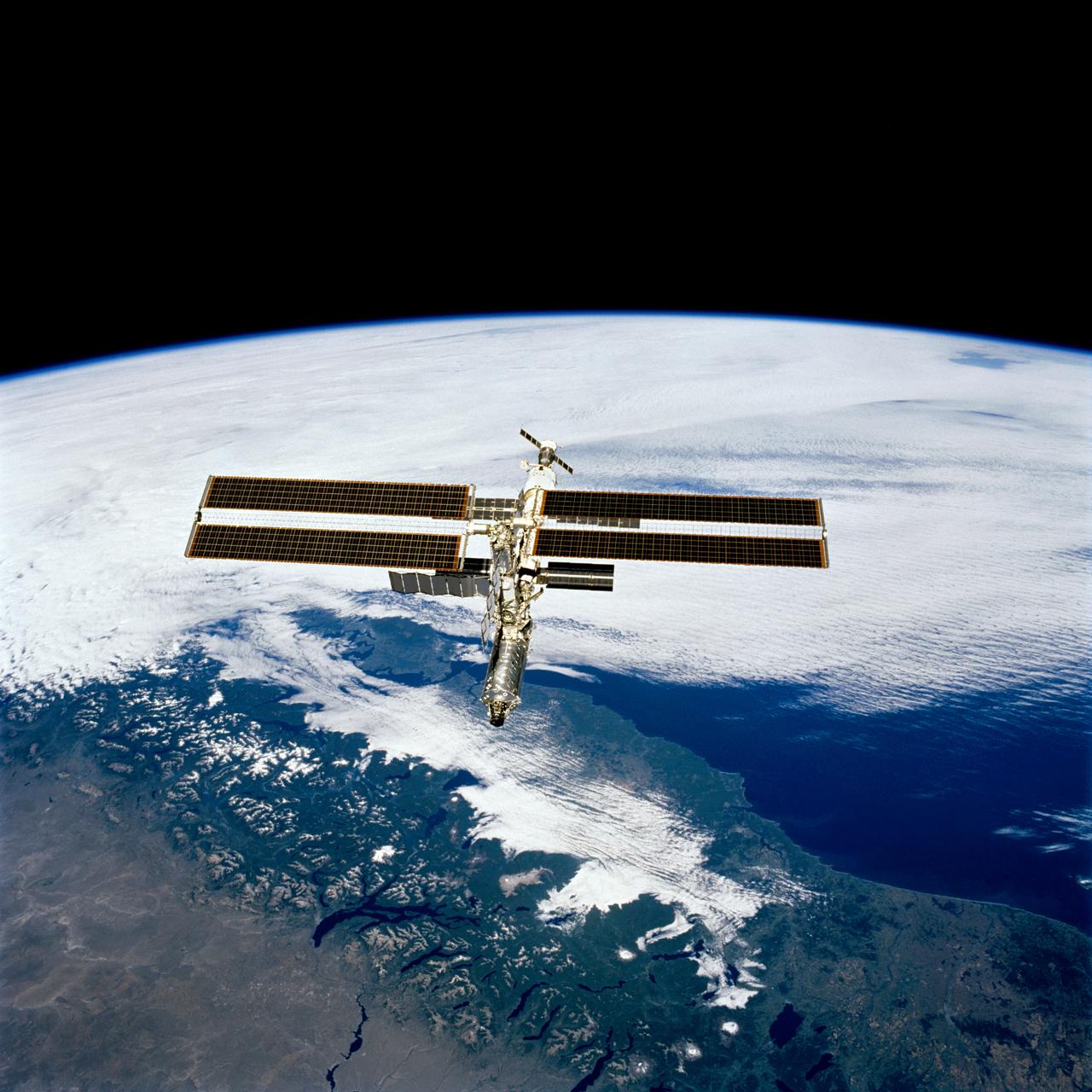
STS098-713a-019 (16 February 2001) --- The International Space Station is backdropped over clouds, water and land in South America. South central Chile shows up at bottom of the frame. Just below the Destiny laboratory, the Chacao Channel separates the large island of Chiloe from the mainland and connects the Gulf of Coronados on the Pacific side with the Gulf of Ancud southwest of the city of Puerto Montt. The crews of the Space Shuttle Atlantis and the International Space Station parted company at 8:06 a.m. (CST), February 16, as astronaut Mark L. Polansky, pilot, flew the shuttle halfway around the station and its new Destiny laboratory before moving off.
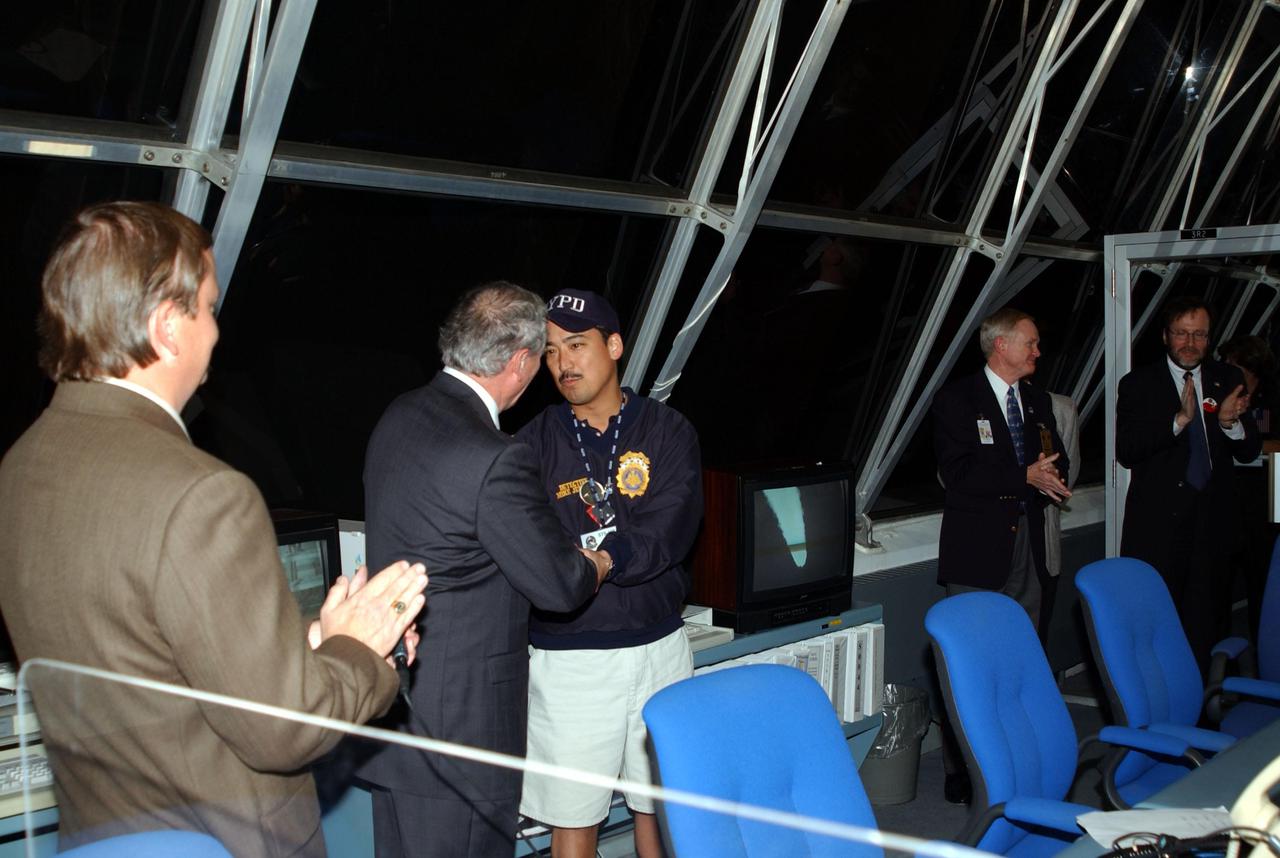
KENNEDY SPACE CENTER, Fla. -- New York Police Department Detective Michael Jermyn (center) is thanked for representing the New York Police and Fire Departments at the launch of Space Shuttle Endeavour on mission STS-108. Offering his handshake is NASA's Acting Administrator Daniel Mulville; Launch Director Mike Leinbach (left) applauds. At right is Center Director Roy Bridges Jr. Jermyn praised the efforts of the workers on the successful launch. Endeavour is carrying 6,000 flags that will be given to the families of those who died in the fall of the Twin Towers. Liftoff of Endeavour occurred at 5:19:28 p.m. EST (22:19.28 GMT). Endeavour will dock with the International Space Station on Dec. 7. STS-108 is the final Shuttle mission of 2001and the 107th Shuttle flight overall. It is the 12th flight to the Space Station. Landing of the orbiter at KSC's Shuttle Landing Facility is targeted for 1:05 p.m. EST (18:05 p.m. GMT) Dec. 16
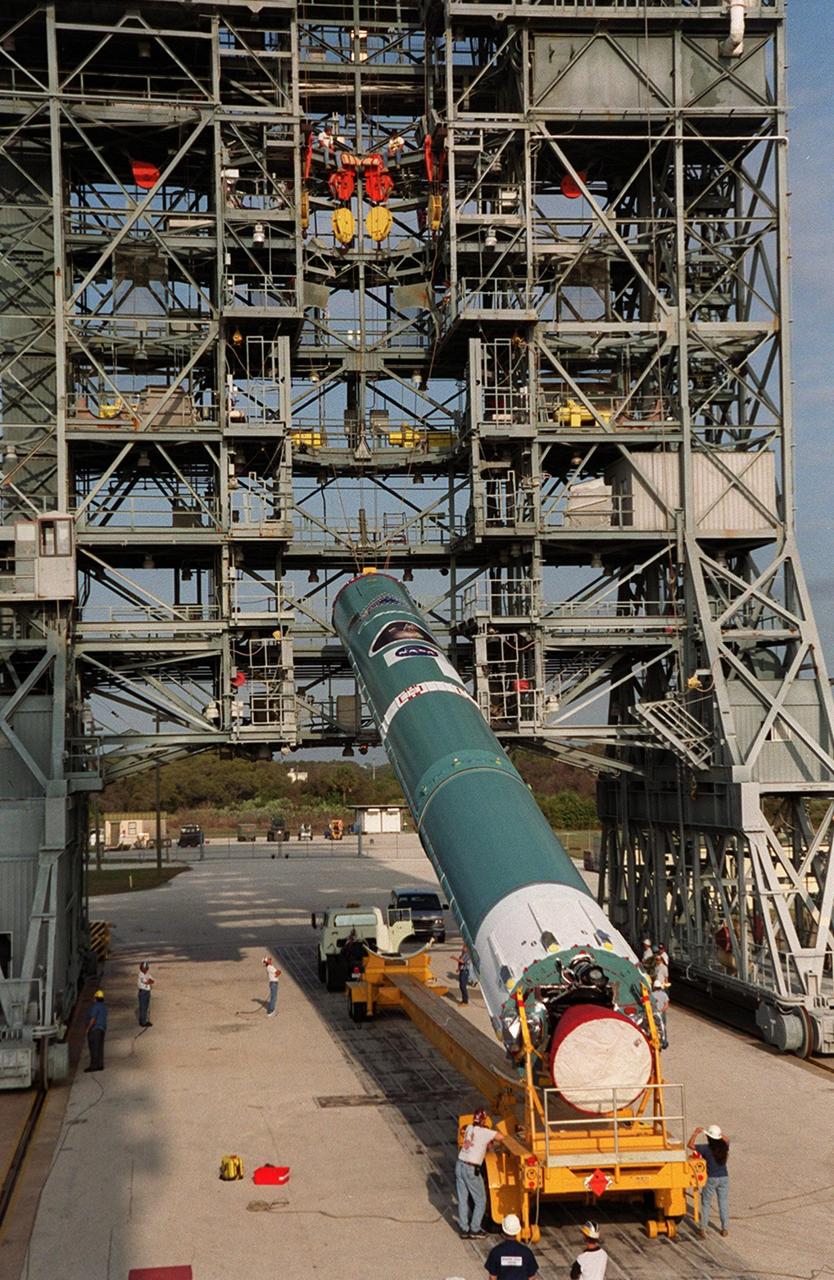
Cranes on the gantry on Launch Pad 17-A, Cape Canaveral Air Force Station, lift the first stage of a Boeing Delta rocket to a vertical position. The rocket will carry the 2001 Mars Odyssey Orbiter, scheduled for launch April 7, 2001. Mars Odyssey contains three science instruments: THEMIS, the Gamma Ray Spectrometer (GRS), and the Mars Radiation Environment Experiment (MARIE). THEMIS will map the mineralogy and morphology of the Martian surface using a high-resolution camera and a thermal infrared imaging spectrometer. The GRS will achieve global mapping of the elemental composition of the surface and determine the abundance of hydrogen in the shallow subsurface. The MARIE will characterize aspects of the near-space radiation environment with regards to the radiation-related risk to human explorers
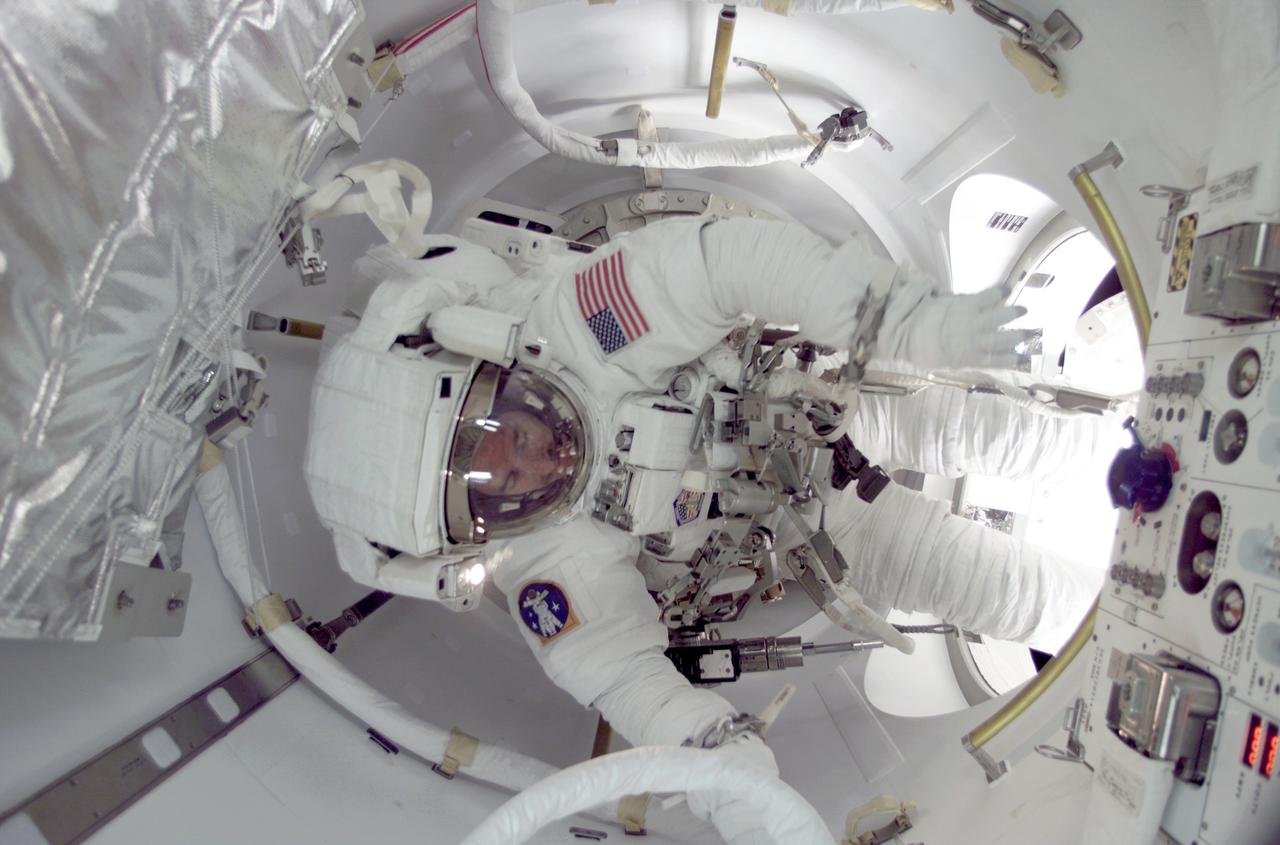
Astronaut James F. Reilly participated in the first ever space walk to egress from the International Space Station (ISS) by utilizing the newly-installed Joint Airlock Quest. The Joint Airlock is a pressurized flight element consisting of two cylindrical chambers attached end-to-end by a cornecting bulkhead and hatch. Once installed and activated, the ISS Airlock becomes the primary path for ISS space walk entry and departure for U.S. spacesuits, which are known as Extravehicular Mobility Units (EMUs). In addition, it is designed to support the Russian Orlan spacesuit for extravehicular activity (EVA). The Joint Airlock is 20-feet long, 13- feet in diameter and weighs 6.5 tons. It was built at the Marshall Space Flight Center (MSFC) by the Space Station prime contractor Boeing. The ISS Airlock has two main components: a crew airlock and an equipment airlock for storing EVA and EVA preflight preps. The Airlock was launched on July 21, 2001 aboard the Space Shuttle Orbiter Atlantis for the STS-104 mission.
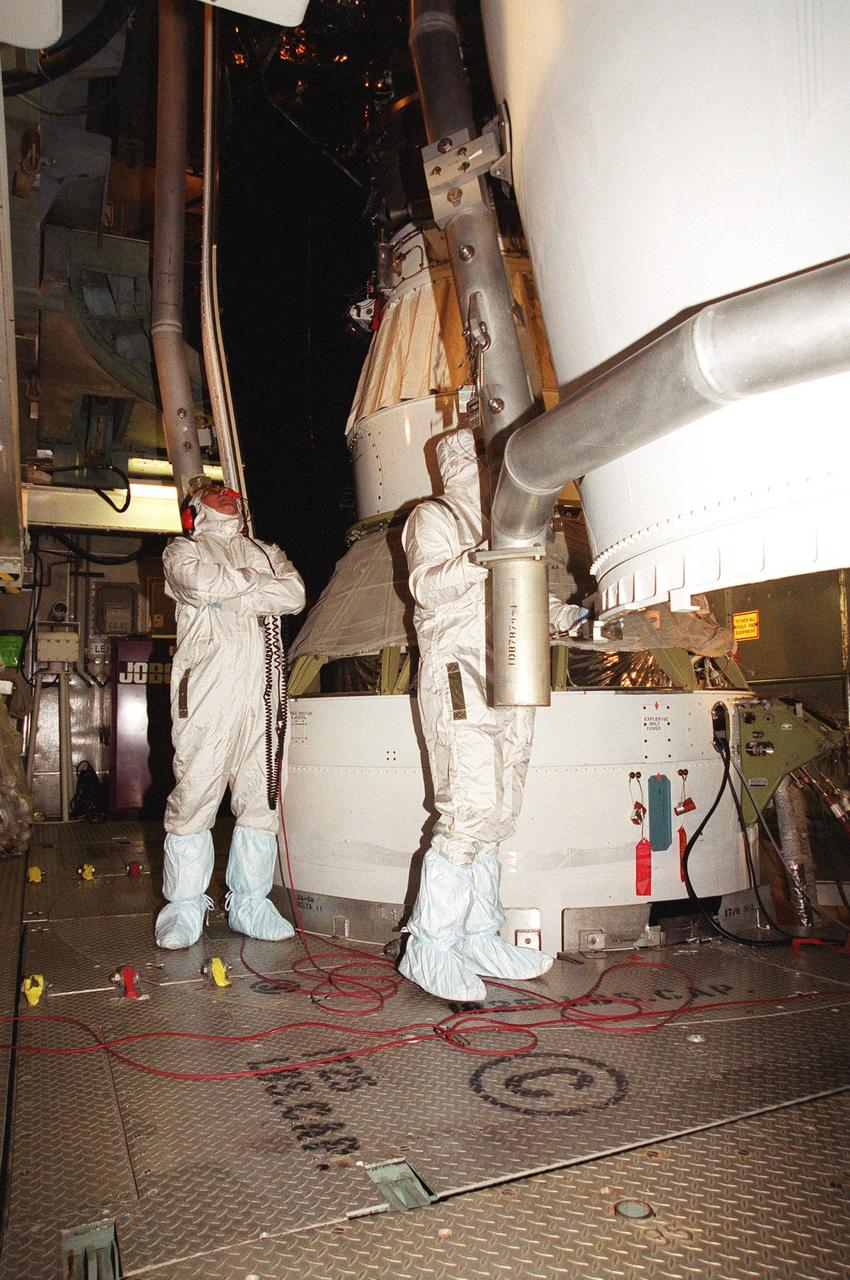
KENNEDY SPACE CENTER, Fla. -- Workers at Launch Complex 17-B, Cape Canaveral Air Force Station, oversee the fairing installation on the Microwave Anisotropy Probe (MAP) spacecraft. MAP is scheduled for launch on June 30 aboard a Boeing Delta II rocket. The launch will place MAP into a lunar-assisted trajectory to the Sun-Earth for a 27-month mission. The probe will measure small fluctuations in the temperature of the cosmic microwave background radiation to an accuracy of one millionth of a degree. These measurements should reveal the size, matter content, age, geometry and fate of the universe. They will also reveal the primordial structure that grew to form galaxies and will test ideas about the origins of these primordial structures. The MAP instrument will be continuously shaded from the Sun, Earth, and Moon by the spacecraft
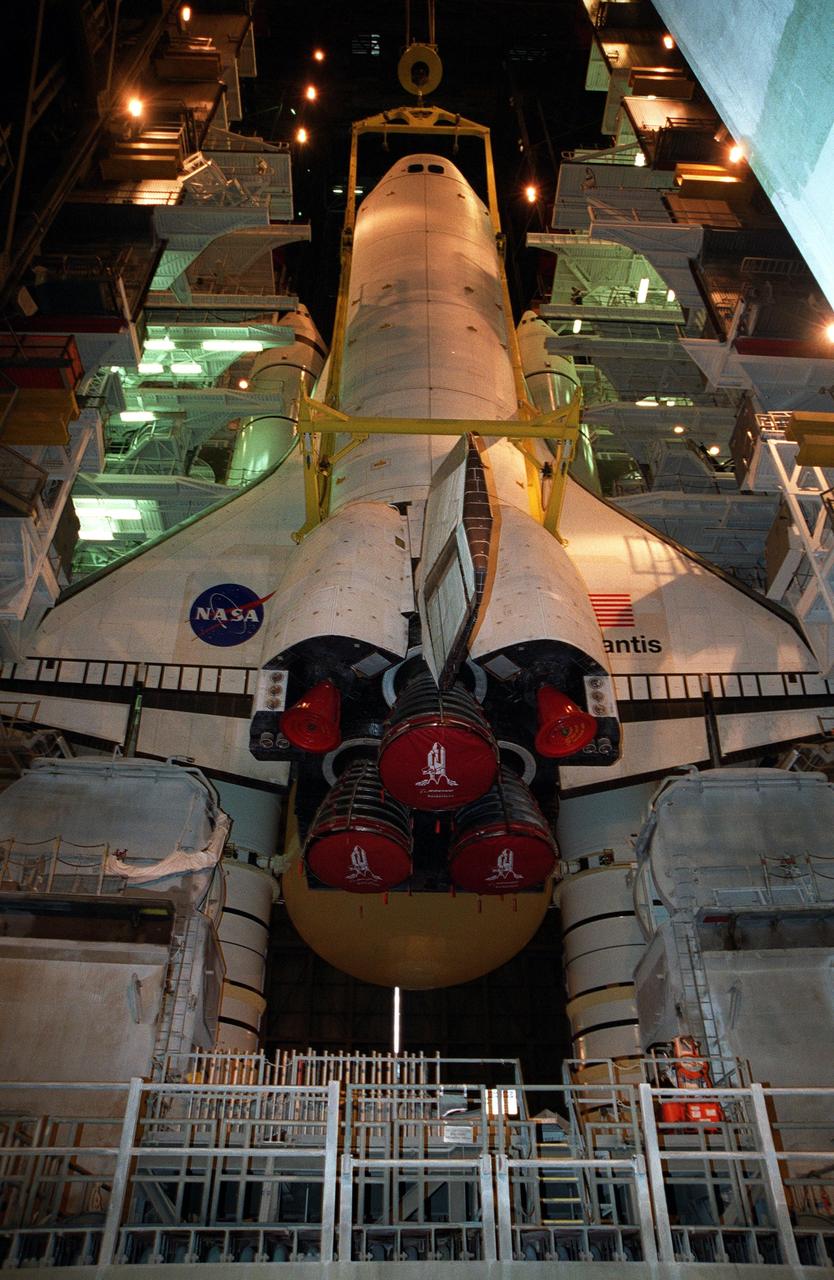
KENNEDY SPACE CENTER, FLA. -- In Vehicle Assembly Building high bay 1, the orbiter Atlantis is being lowered into position for mating to its external tank/solid rocket booster stack. Space Shuttle Atlantis is scheduled to launch on mission STS-104 in early July
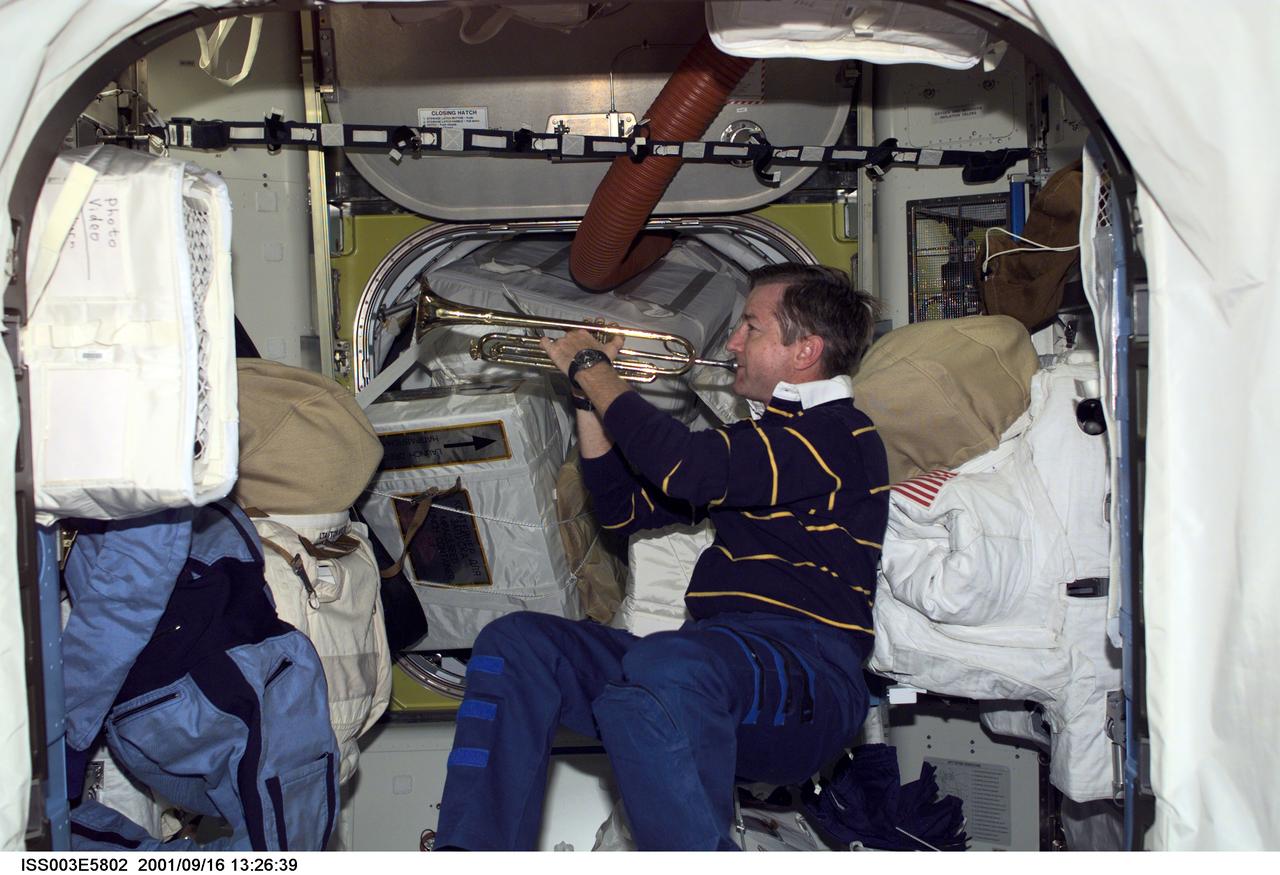
ISS003-E-5802 (16 September 2001) --- Astronaut Frank L. Culbertson, Jr., Expedition Three mission commander, takes a brief timeout from a busy day to play his trumpet in the Quest Airlock on the International Space Station (ISS). This image was taken with a digital still camera.
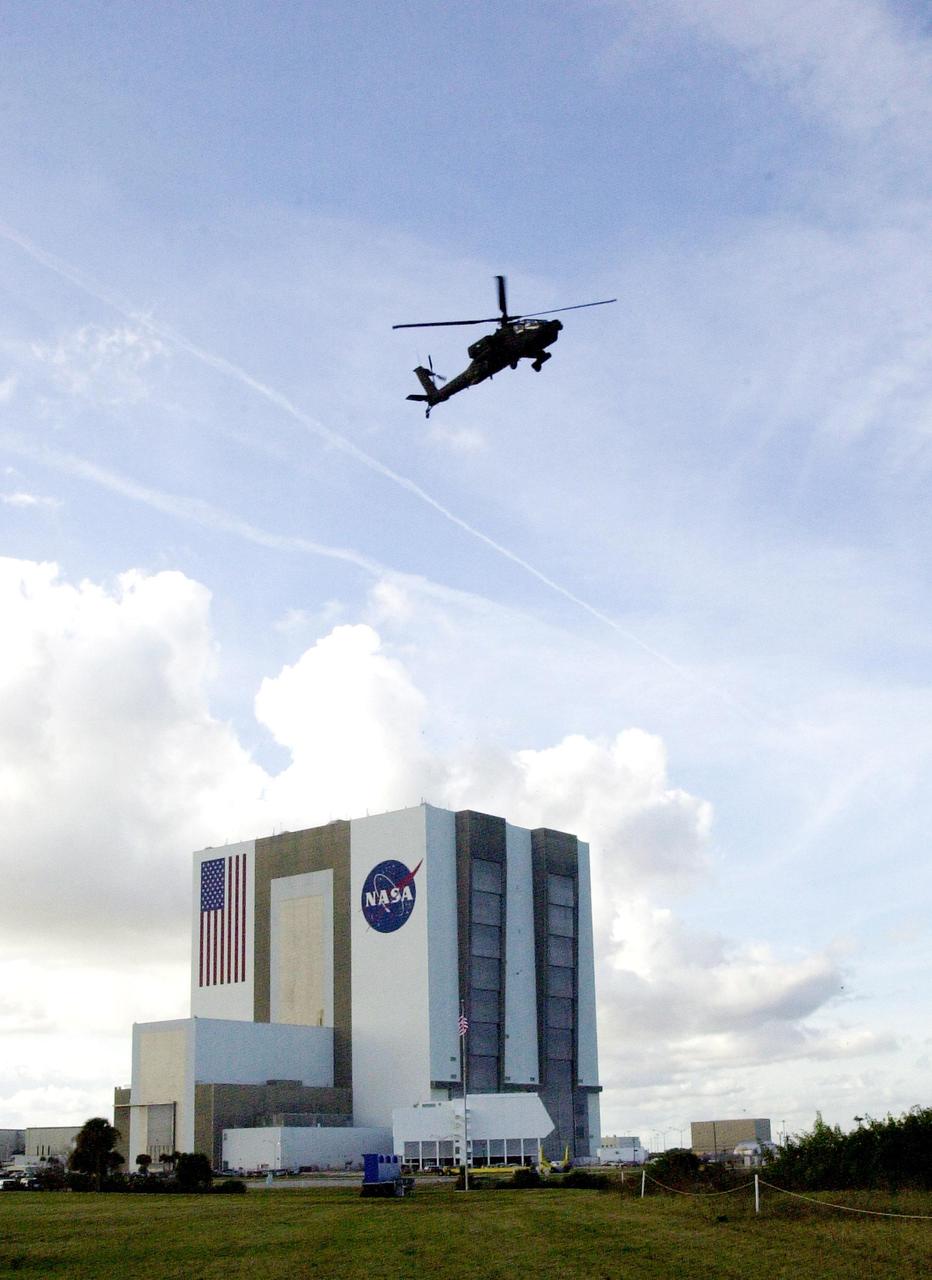
KENNEDY SPACE CENTER, FLA. -- A United States military Apache H64A helicopter patrols Kennedy Space Center airspace near the Vehicle Assembly Building as the launch of Space Shuttle Endeavour on mission STS-108 to the International Space Station approaches. Launch is scheduled for 7:41 p.m. EST on Nov. 29
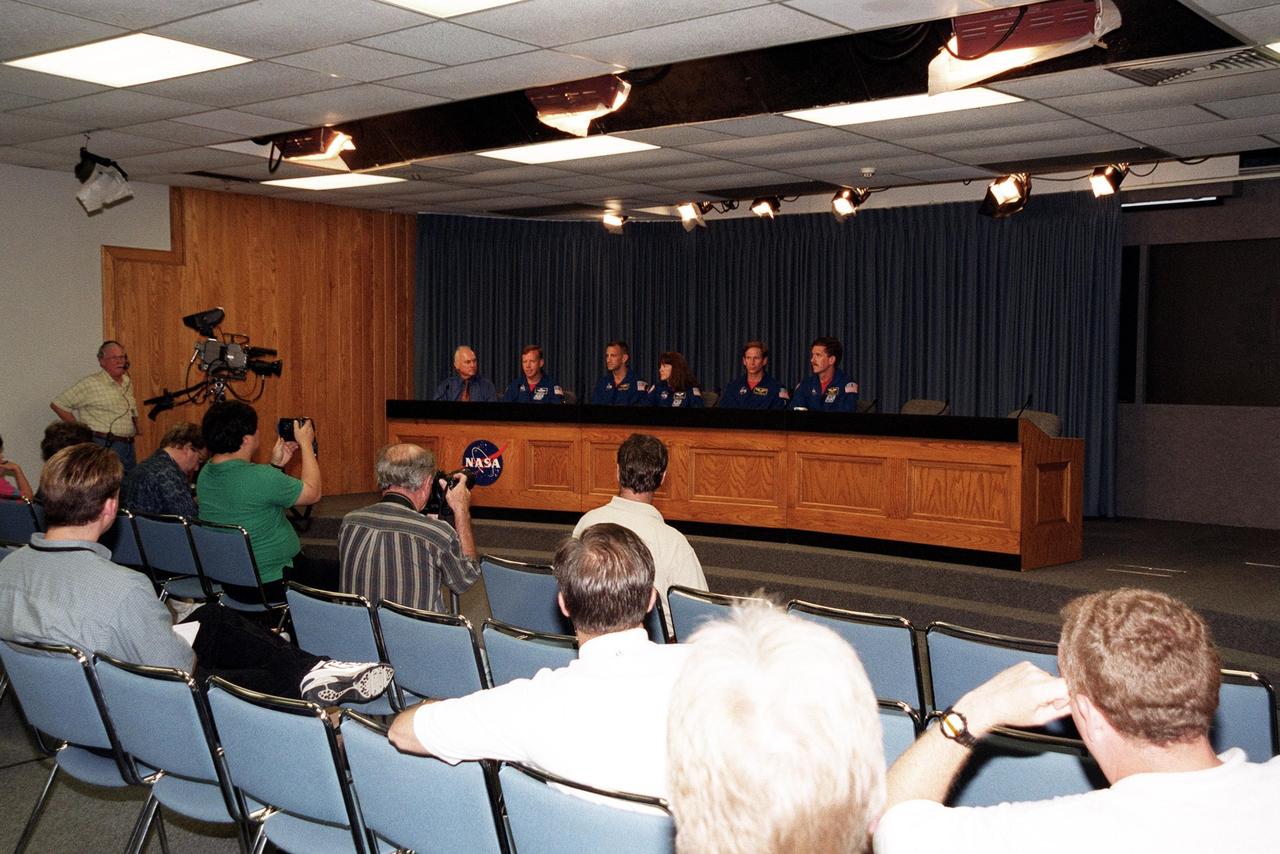
KENNEDY SPACE CENTER, Fla. -- The STS-104 crew responds to questions from the media in the television studio. Seated at far left is moderator Bill Johnson, NASA/KSC TV manager. Beside him, left to right, are Commander Steven W. Lindsey, Pilot Charles O. Hobaugh, and Mission Specialists Janet Lynn Kavandi, Michael L. Gernhardt and James F. Reilly. . The crew is taking part in Terminal Countdown Demonstration Test activities, which include emergency exit training from the orbiter, opportunities to inspect their mission payloads in the orbiter’s payload bay and simulated countdown exercises. The launch of Atlantis on mission STS-104 is scheduled July 12 from Launch Pad 39B. The mission is the 10th flight to the International Space Station and carries the Joint Airlock Module
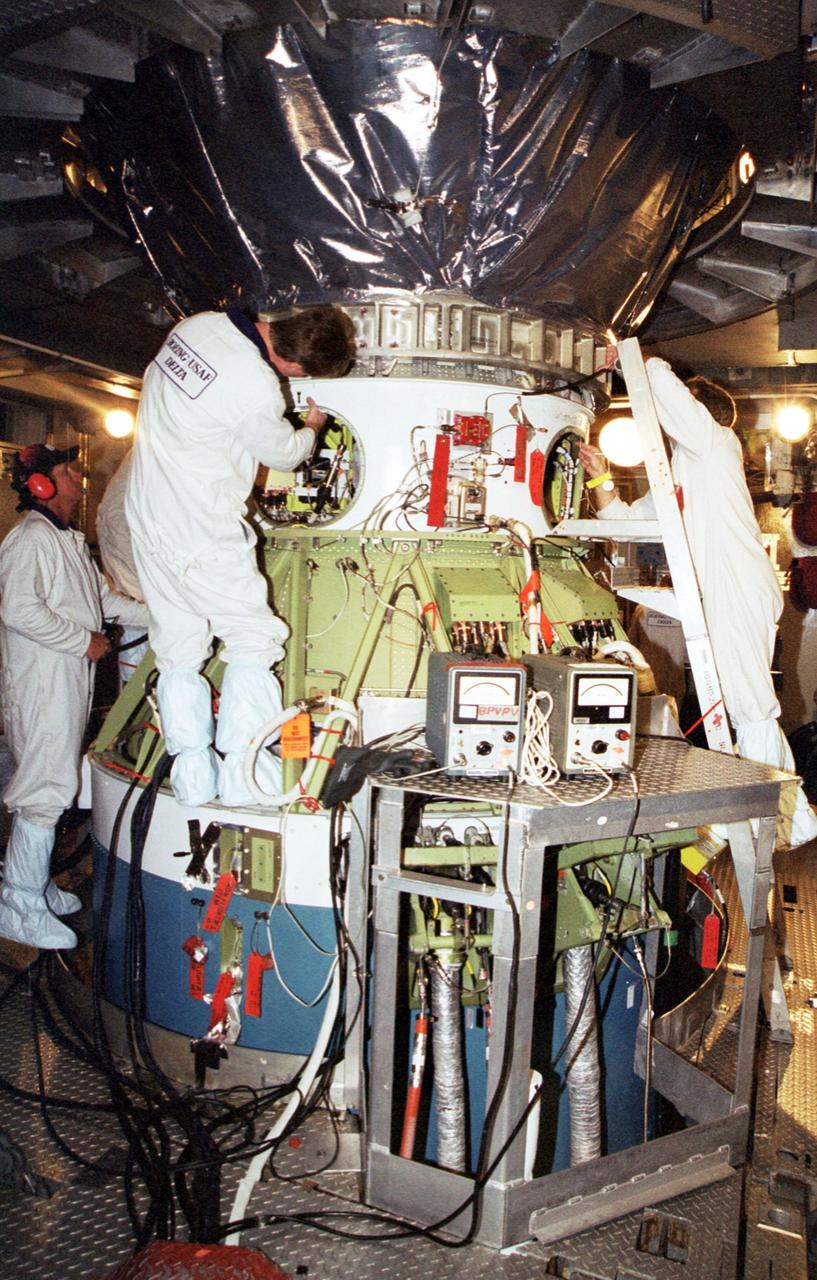
KENNEDY SPACE CENTER, Fla. -- At Launch Complex 17-A, Cape Canaveral Air Force Station, the Genesis spacecraft is lowered into place on the Boeing Delta II rocket. Genesis will be on a robotic NASA space mission to catch a wisp of the raw material of the Sun and return it to Earth with a spectacular mid-air helicopter capture. The sample return capsule is 4.9 feet (1.5 meters) in diameter and 52 inches (1.31 meters) tall. The mission’s goal is to collect and return to Earth just 10 to 20 micrograms -- or the weight of a few grains of salt -- of solar wind, invisible charged particles that flow outward from the Sun. This treasured smidgen of the Sun will be preserved in a special laboratory for study by scientists over the next century in search of answers to fundamental questions about the exact composition of our star and the birth of our solar system. The Genesis launch is scheduled for 12:36 p.m. EDT on July 30 from CCAFS
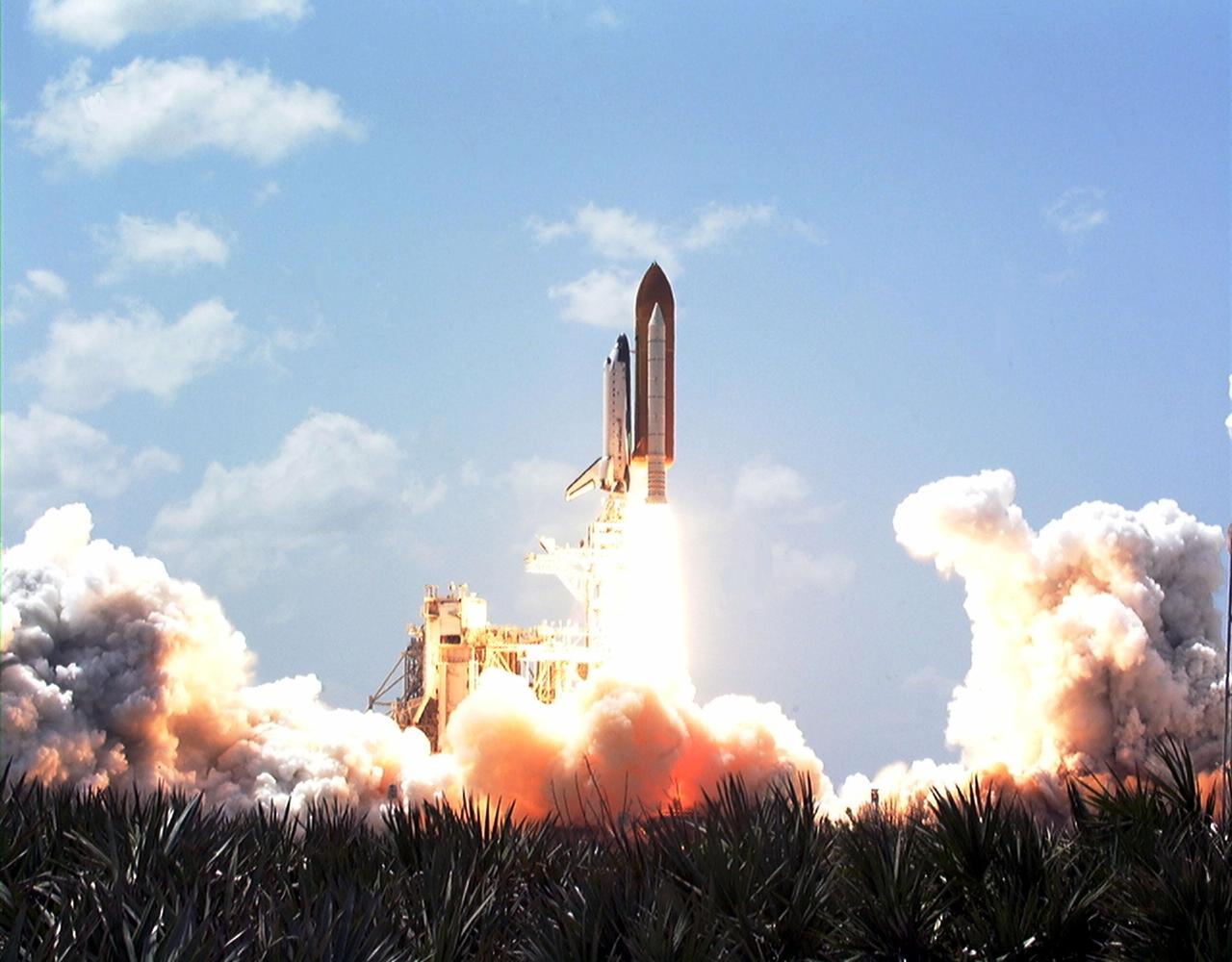
KENNEDY SPACE CENTER, FLA. -- Space Shuttle Endeavour roars into space, leaving orange-hued clouds of smoke and steam behind. Liftoff of the ninth flight to the International Space Station occurred at 2:40:42 p.m. EDT. The 11-day mission will deliver and integrate the Spacelab Logistics Pallet/Launch Deployment Assembly, which includes the Space Station Remote Manipulator System and the UHF Antenna. The mission includes two planned spacewalks for installation of the SSRMS on the Station. Also onboard is the Multi-Purpose Logistics Module Raffaello, carrying resupply stowage racks and resupply/return stowage platforms
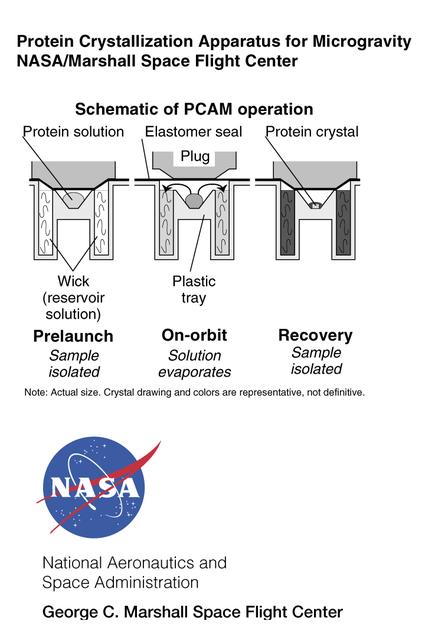
The Protein Crystallization for Microgravity (DCAM) was developed at NASA's Marshall Space Flight Center. A droplet of solution with protein molecules dissolved in it is isolated in the center of a small well. In orbit, an elastomer seal is lifted so the solution can evaporate and be absorbed by a wick material. This raises the concentration of the solution, thus prompting protein molecules in the solution to form crystals. The principal investigator is Dr. Dan Carter of New Century Pharmaceuticals in Huntsville, AL.
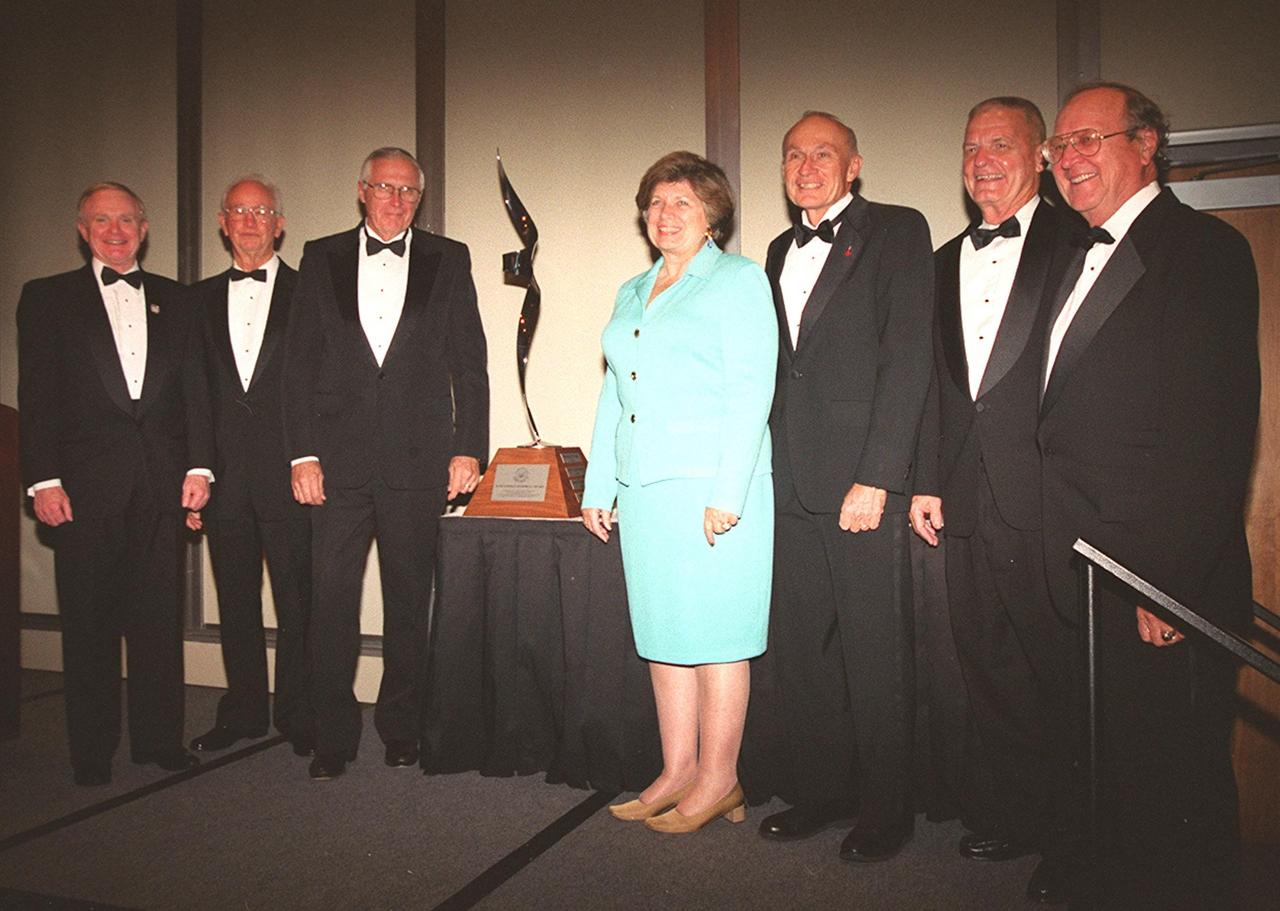
The 12th annual Dr. Kurt H. Debus Award Dinner gathered these distinguished guests: (from left), Center Director Roy Bridges, who received the 2001 Dr. Kurt H. Debus Award, Maxwell King, Lee Solid, JoAnn Morgan, Bob Sieck, Forrest McCartney and Ernie Briel. Solid is the former vice president and general manager of Space Systems Division, Florida Operations, Rockwell International. Morgan is the director of KSC’s External Relations & Business Development Directorate; Bob Sieck is the former director of Shuttle Processing at KSC. McCartney, center director of KSC from 1986-1991, received the first Debus award ever given to a KSC director. Bridges was given the honor for his progressive, visionary leadership and contributions to space technology and exploration. The Florida Committee of the National Space Club presented the award. The Debus Award was first given in 1980. Created to recognize significant achievements and contributions made in Florida to the American aerospace effort, the award is named for the KSC’s first Director, Dr. Kurt H. Debus

KENNEDY SPACE CENTER, FLA. -- With dust flying in the strong crosswinds at KSC’s Shuttle Landing Facility, a Shuttle Carrier Aircraft, carrying the orbiter Columbia on its back, lands on runway 33. Columbia arrives Facility after a protracted trip from California that began March 1. Unfavorable weather conditions kept it on the ground at Dyess AFB, Texas, until it could return to Florida on March 5 when it landed at the Cape Canaveral Air Force Station Skid Strip. Columbia had to wait for the orbiter Atlantis which had completed a ferry flight to KSC on March 5 to be towed from the SLF before making the final hop to KSC. Columbia is returning from a 17-month-long modification and refurbishment process as part of a routine maintenance plan. The orbiter will next fly on mission STS-107, scheduled Oct. 25
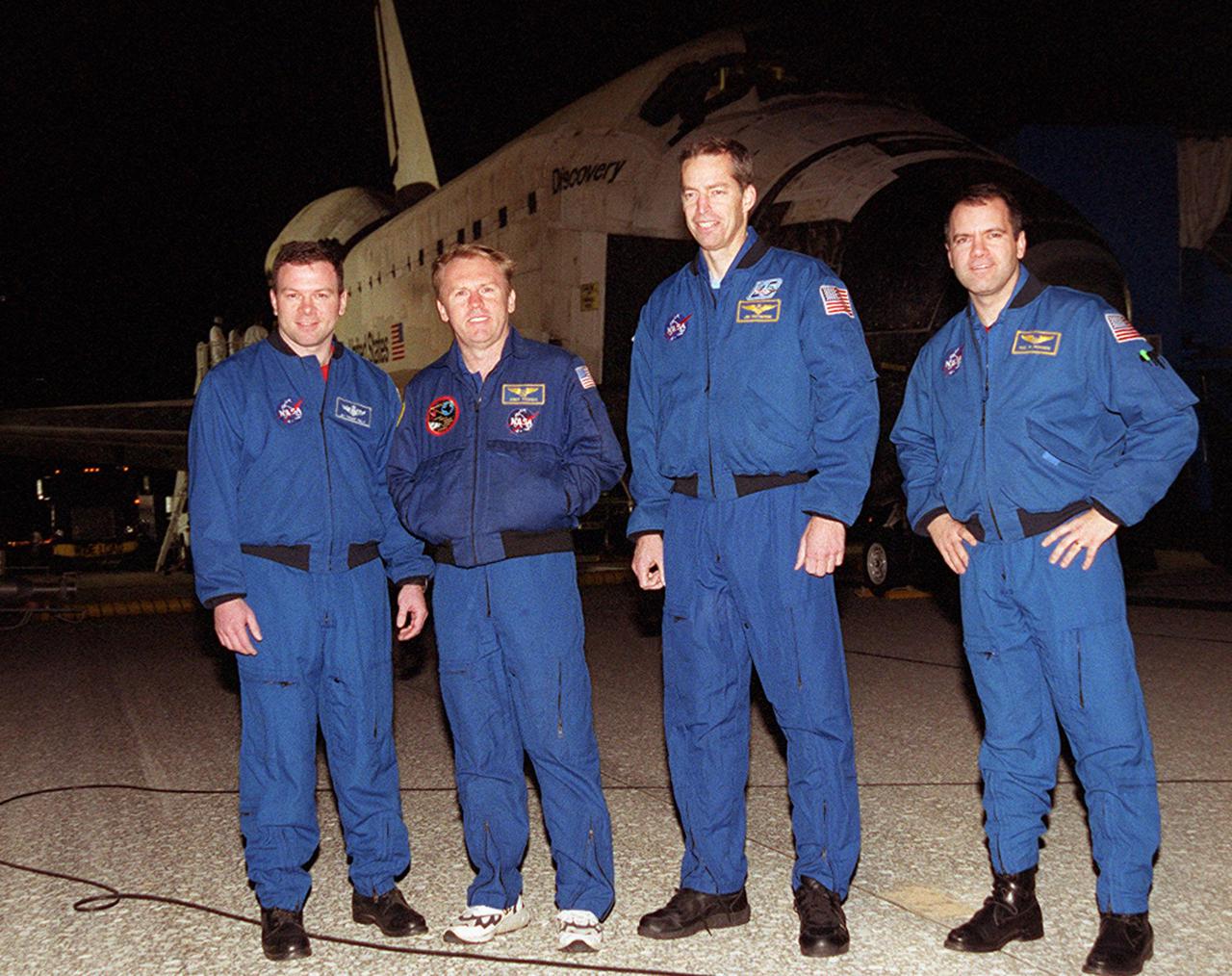
After exiting the Crew Transport Vehicle, the STS-102 crew gathers under Discovery for a walk-around. From left are Pilot James Kelly, Mission Specialist Andy Thomas, Commander James Wetherbee and Mission Specialist Paul Richards. The crew landed at the KSC Shuttle Landing Facility at 2:31 a.m. EST aboard Discovery following a 12-day, 19-hour, 49-minute mission to the International Space Station
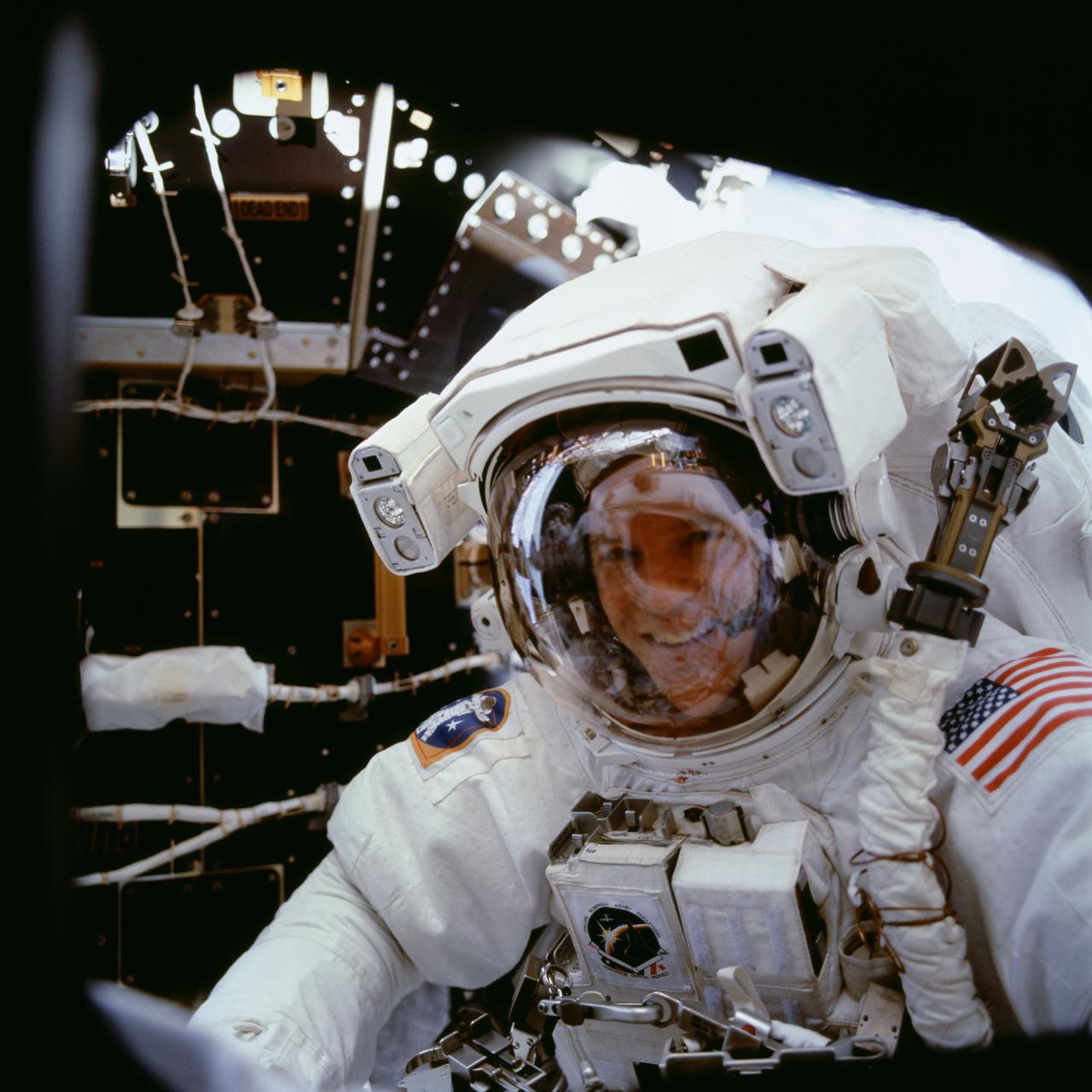
STS100-714-059 (19 April-1 May 2001) --- Astronaut Scott E. Parazynski, mission specialist, was photographed by a crew mate inside the Space Shuttle Endeavour in this close up view, during one of the two days of extravehicular activity (EVA) on the STS-100 mission.
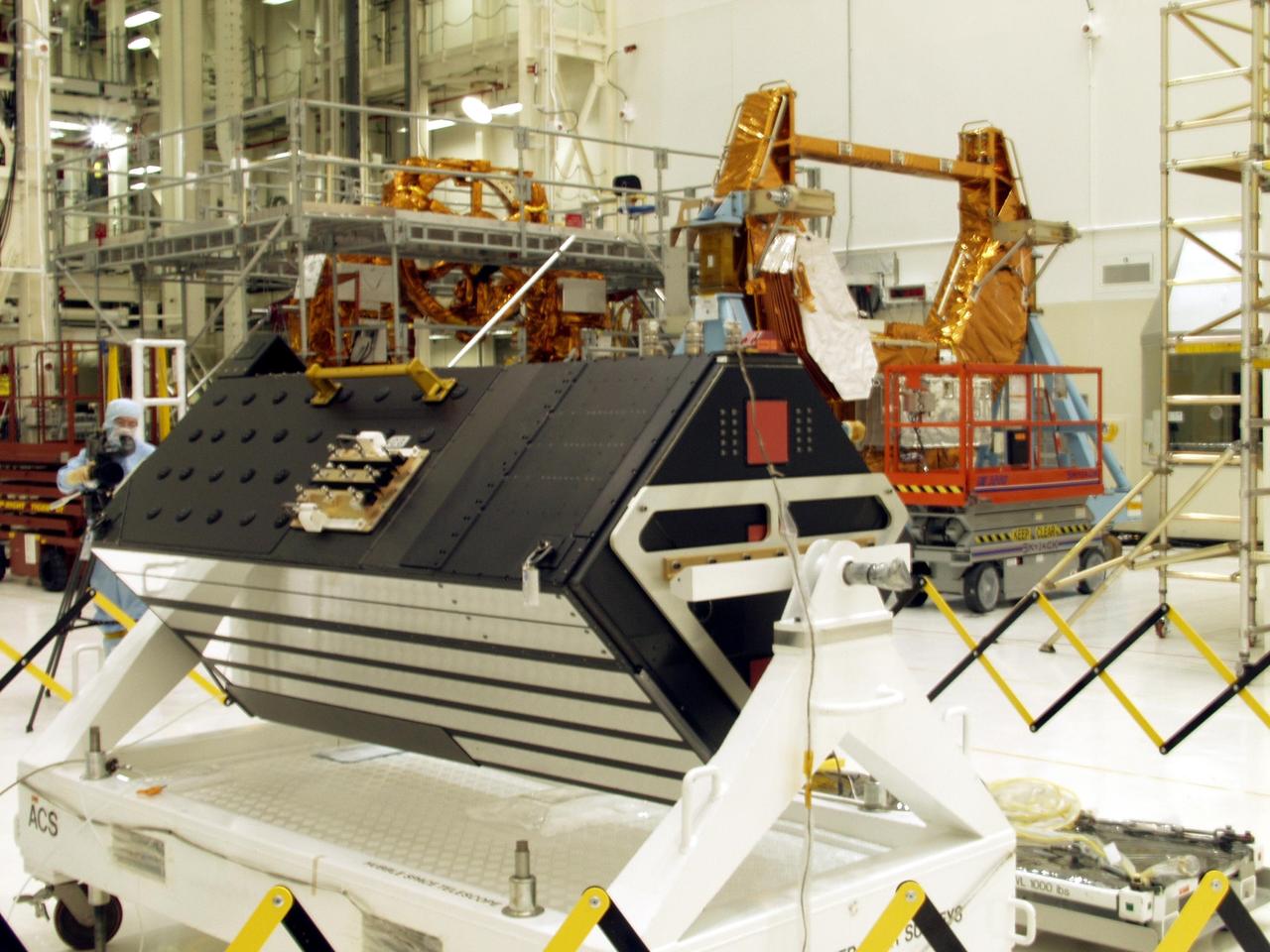
KENNEDY SPACE CENTER, FLA. -- The Advanced Camera for Surveys (ACS), foreground, is part of the STS-109 flight hardware for maintenance of the Hubble Space Telescope (HST). The ACS and other hardware, installed on four principle payload carriers, are being processed inside the clean room at the Vertical Processing Facility (VPF). The STS-109 launch aboard Columbia is targeted for Feb. 14, 2002, and will be the 108th flight in the Space Shuttle program
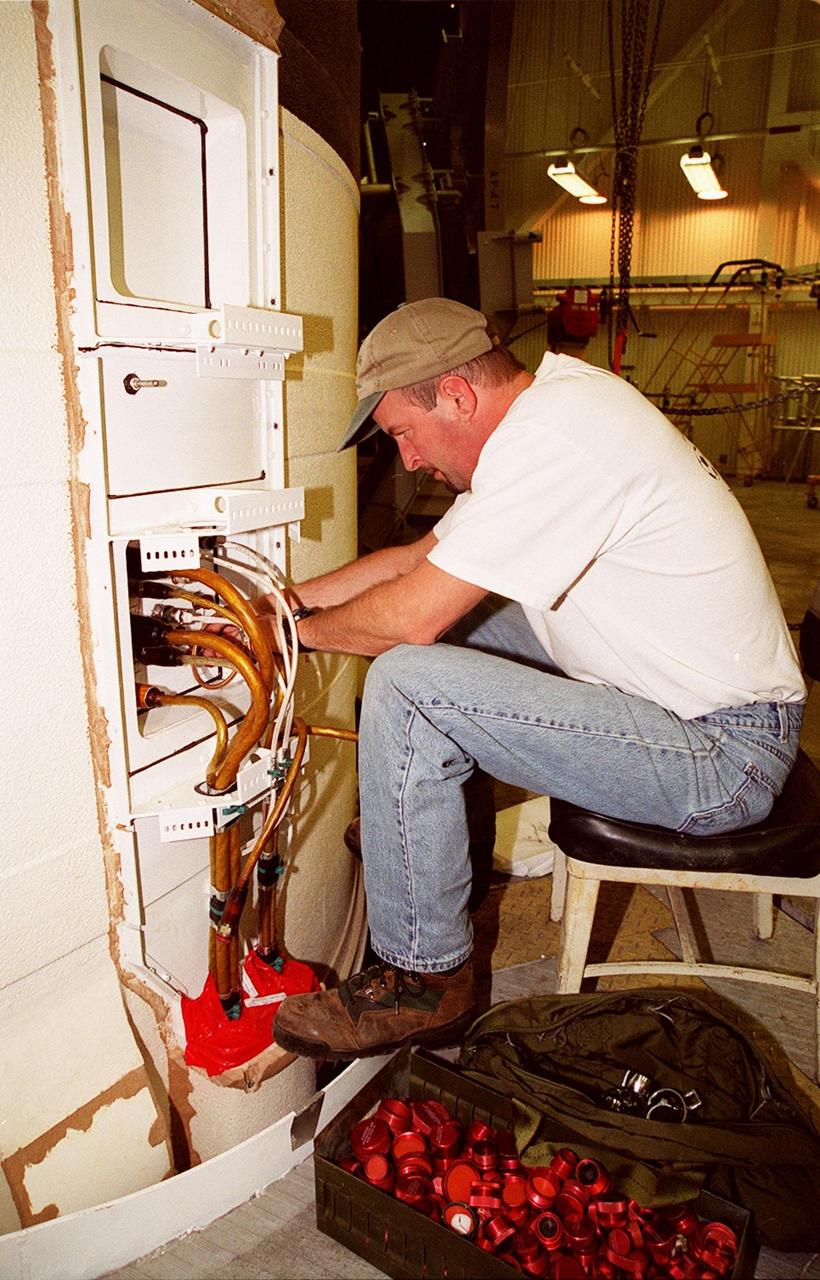
KENNEDY SPACE CENTER, FLA. -- In the Vehicle Assembly Building, United Space Alliance SRB technician Frank Meyer pulls cables out of the solid rocket booster system tunnel. Cable end covers are in a box near his feet. The SRB is part of Space Shuttle Atlantis, rolled back from Launch Pad 39A in order to conduct tests on the cables. A prior extensive evaluation of NASA’s SRB cable inventory on the shelf revealed conductor damage in four (of about 200) cables. Shuttle managers decided to prove the integrity of the system tunnel cables already on Atlantis before launching. Workers are conducting inspections, making continuity checks and conducting X-ray analysis on the cables. The launch has been rescheduled no earlier than Feb. 6. <br
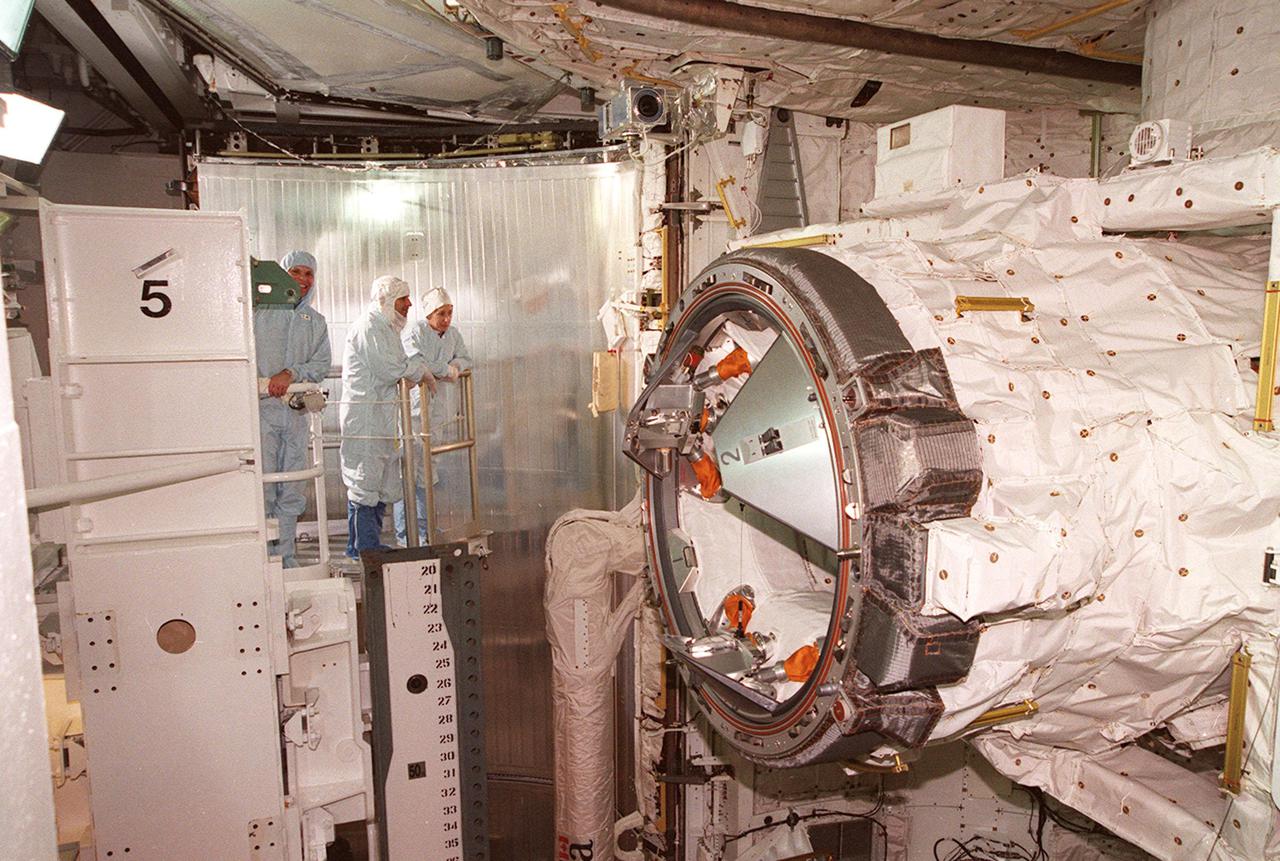
KENNEDY SPACE CENTER, FLA. -- Members of the STS-98 crew, along with Scott Thurston (left), with the VITT office, check out the U.S. Lab Destiny in the payload bay of the orbiter Atlantis. Wearing white caps are Commander Ken Cockrell (center) and Mission Specialist Marsha Ivins (right). The crew is at KSC for Terminal Countdown Demonstration Test activities, which include a simulated launch countdown. Destiny, a key element in the construction of the International Space Station, is a pressurized module designed to accommodate pressurized payloads. It has a capacity of 24 rack locations. Payload racks will occupy 13 locations especially designed to support experiments. The module already has five system racks installed inside. Launch of STS-98 on its 11-day mission is scheduled for Jan. 19 at 2:11 a.m. EST
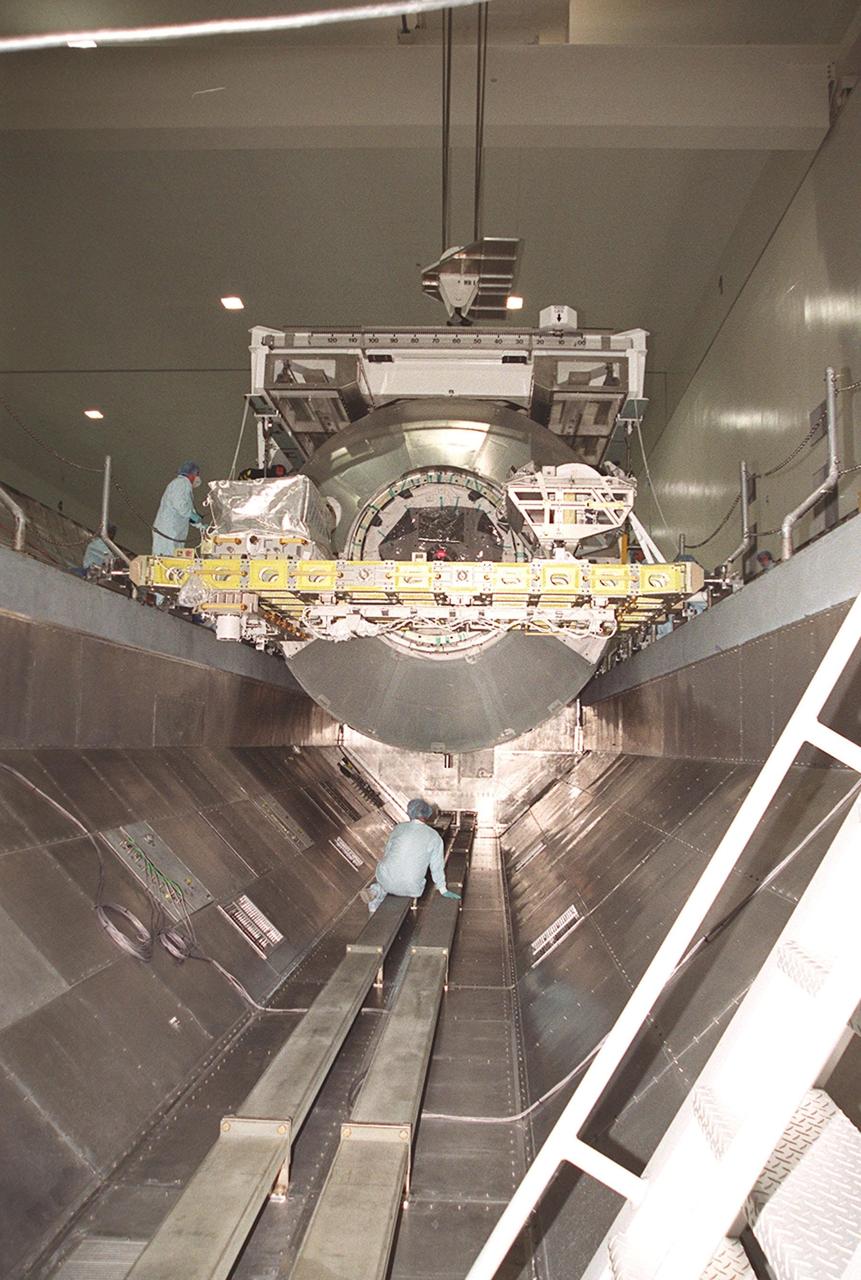
The Multi-Purpose Logistics Module Leonardo is placed inside the payload canister while workers below and on the side check its progress. The MPLM is being transferred to Launch Pad 39B for installation in Space Shuttle Discovery. Leonardo, one of Italy’s major contributions to the International Space Station program, is a reusable logistics carrier. It is the primary delivery system used to resupply and return Station cargo requiring a pressurized environment. Leonardo is the primary payload on mission STS-102 and will deliver up to 10 tons of laboratory racks filled with equipment, experiments and supplies for outfitting the newly installed U.S. Laboratory Destiny. STS-102 is scheduled to launch March 8 at 6:45 a.m. EST
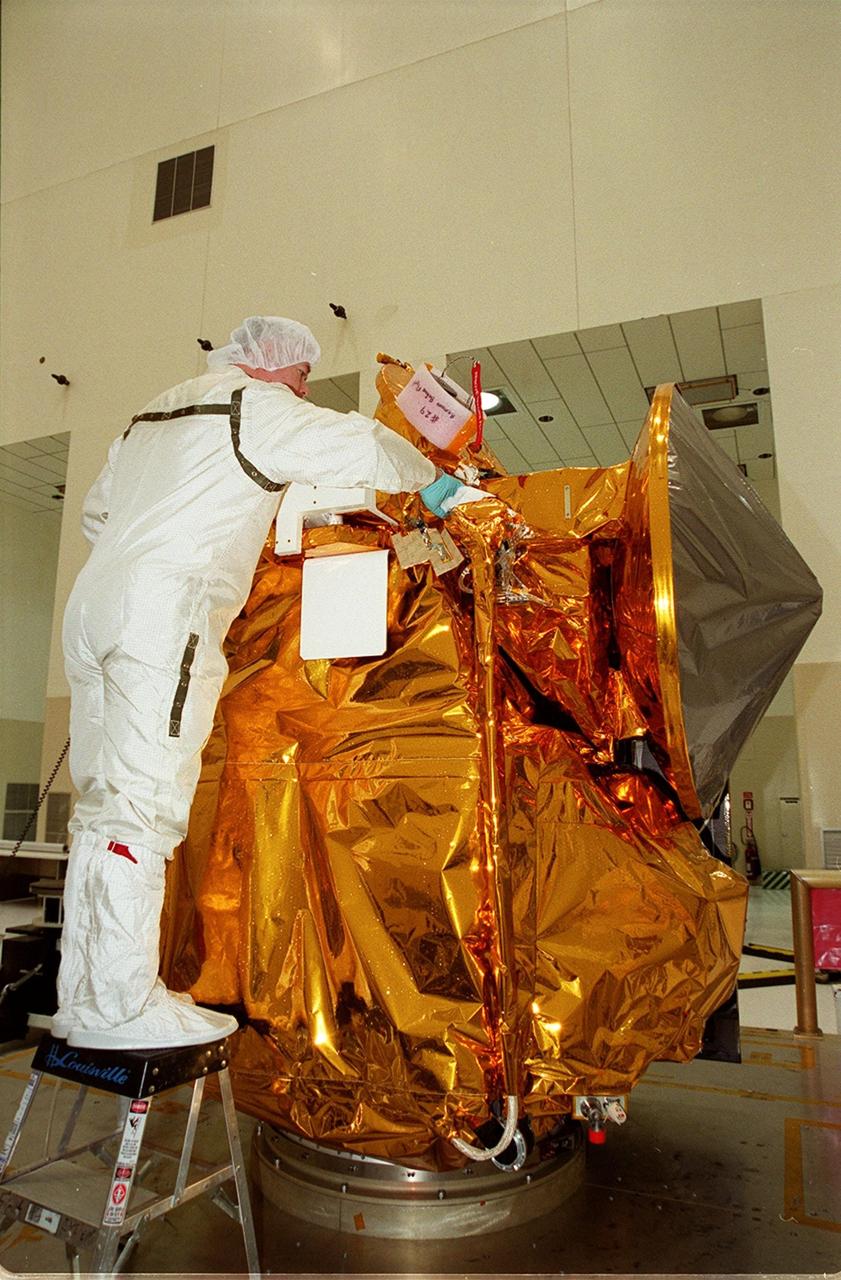
A worker in the Space Assembly and Encapsulation Facility 2 checks out the Mars Odyssey Orbiter before its move to the third stage of a Delta rocket. The Mars Odyssey is scheduled for launch on April 7, 2001, aboard a Delta II rocket from Launch Pad 17-A, Cape Canaveral Air Force Station
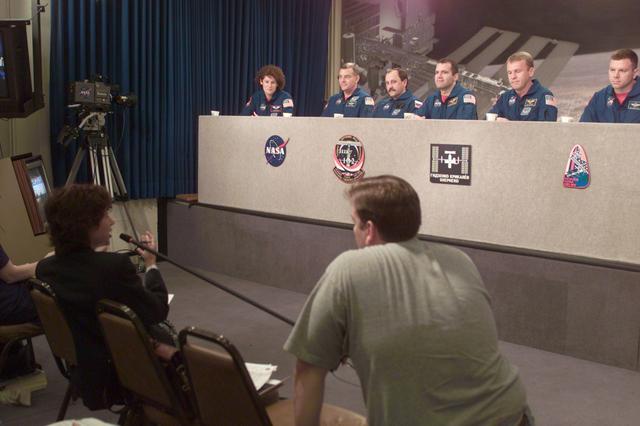
JSC2001-E-05534 (28 February 2001) --- The STS-102 crew fields questions from various news media representatives at a press briefing at the Johnson Space Center (JSC). From the right are astronauts James M. Kelly, pilot; and Andrew S.W. Thomas and Paul W. Richards, both mission specialists; cosmonaut Yury V. Usachev, and astronauts James S. Voss and Susan J. Helms, all mission specialists. Astronaut James D. Wetherbee, STS-102 commander, is out of frame at right. Expedition Two commander Usachev, representing Rosaviakosmos, will join Voss and Helms in the first crew exchange aboard the Earth-orbiting International Space Station (ISS) at some point following the docking of the outpost and the Space Shuttle Discovery.
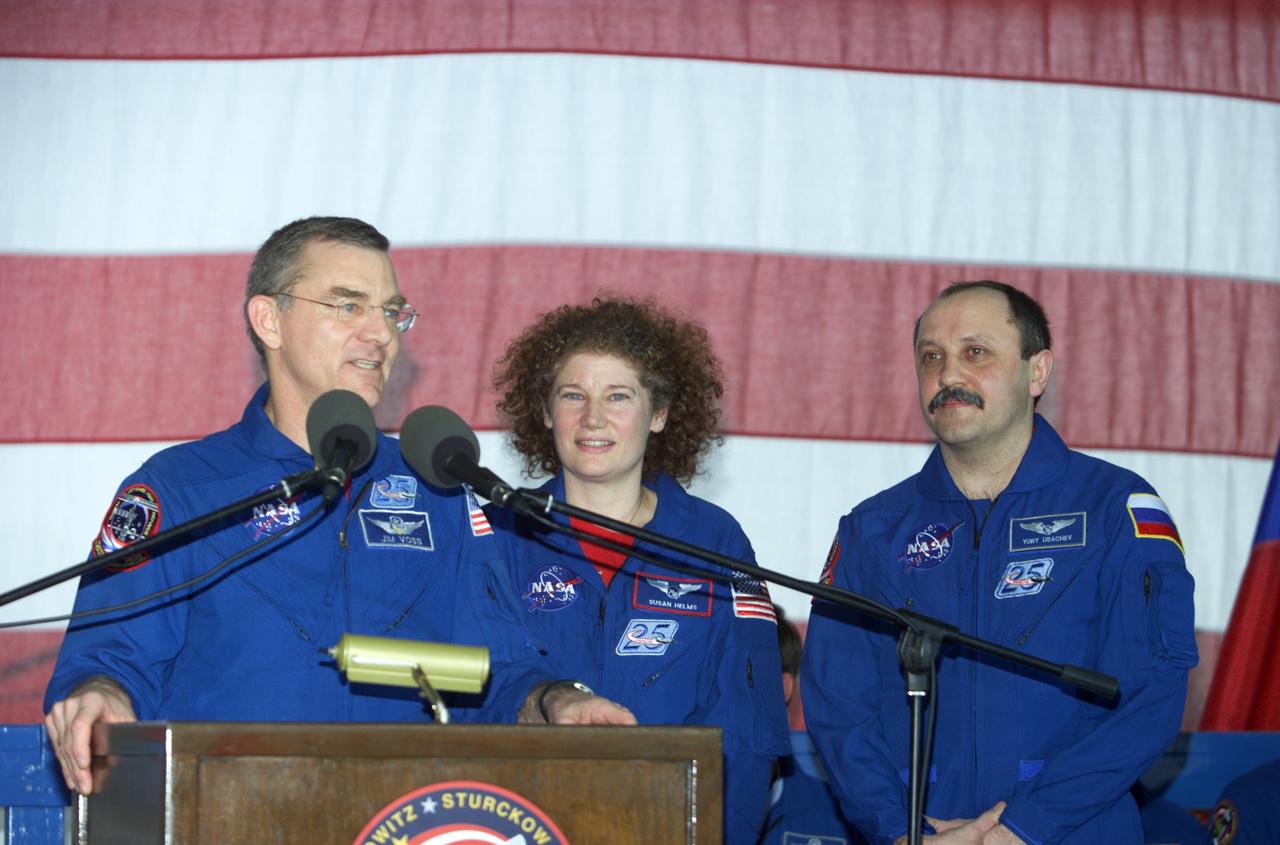
JSC2001-E-25815 (23 August 2001) --- The Expedition Two crew consisting of James S. Voss (left) and Susan J. Helms, flight engineers, and cosmonaut Yury V. Usachev, mission commander, field questions at the podium in Hangar 990 at Ellington Field during the STS-105 and Expedition Two crew return ceremonies. Voss, Helms and Usachev spent five months aboard the International Space Station (ISS).
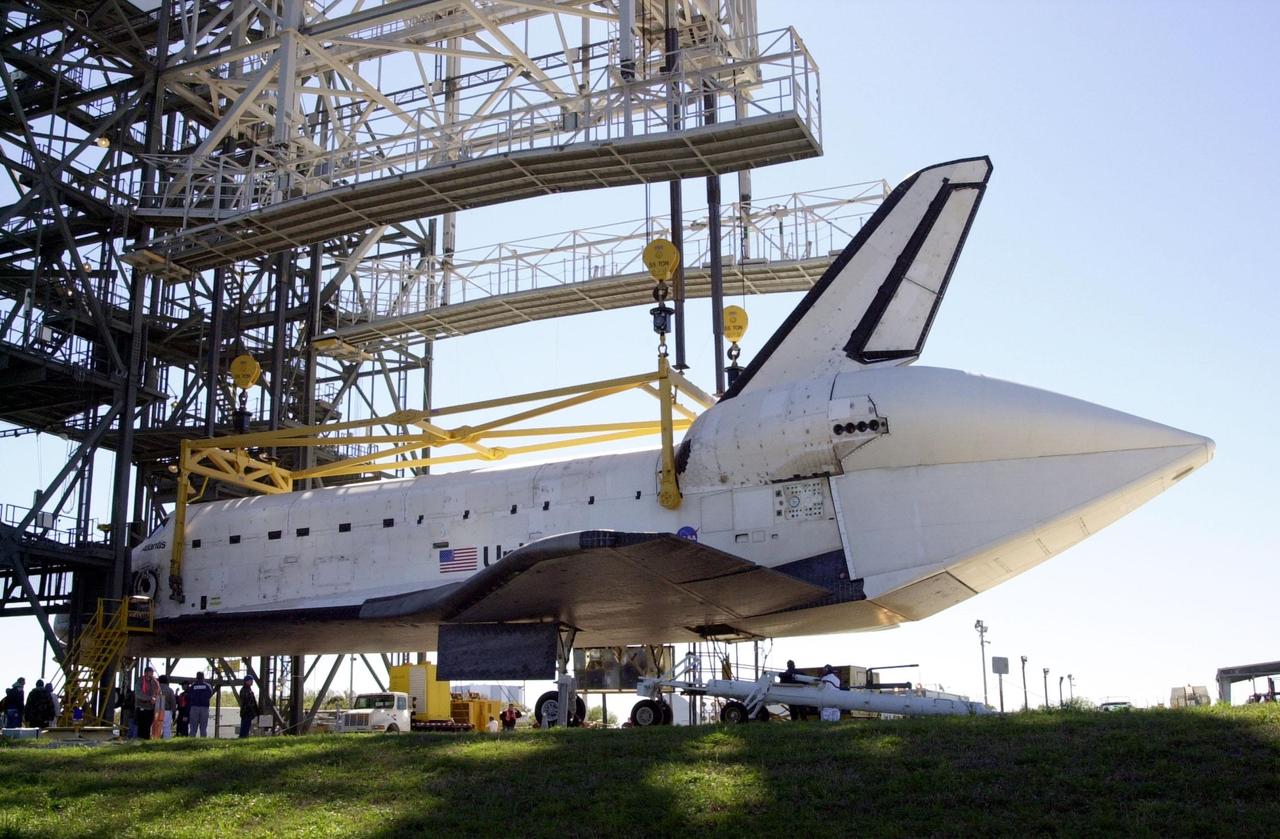
KENNEDY SPACE CENTER, FLA. -- Orbiter Atlantis is ready to have the overhead crane removed before transfer to the Orbiter Processing Facility. A tail cone covers the aft engines. Atlantis was removed from the back of a Shuttle Carrier Aircraft after a ferry flight from California. Atlantis landed Feb. 19 at Edwards Air Force Base concluding mission STS-98. The ferry flight began March 1; unfavorable weather conditions kept it on the ground at Altus AFB, Okla., until it could return to Florida. Atlantis will be transported to the Orbiter Processing Facility to prepare it for mission STS-104, the 10th construction flight to the International Space Station, scheduled to launch June 8
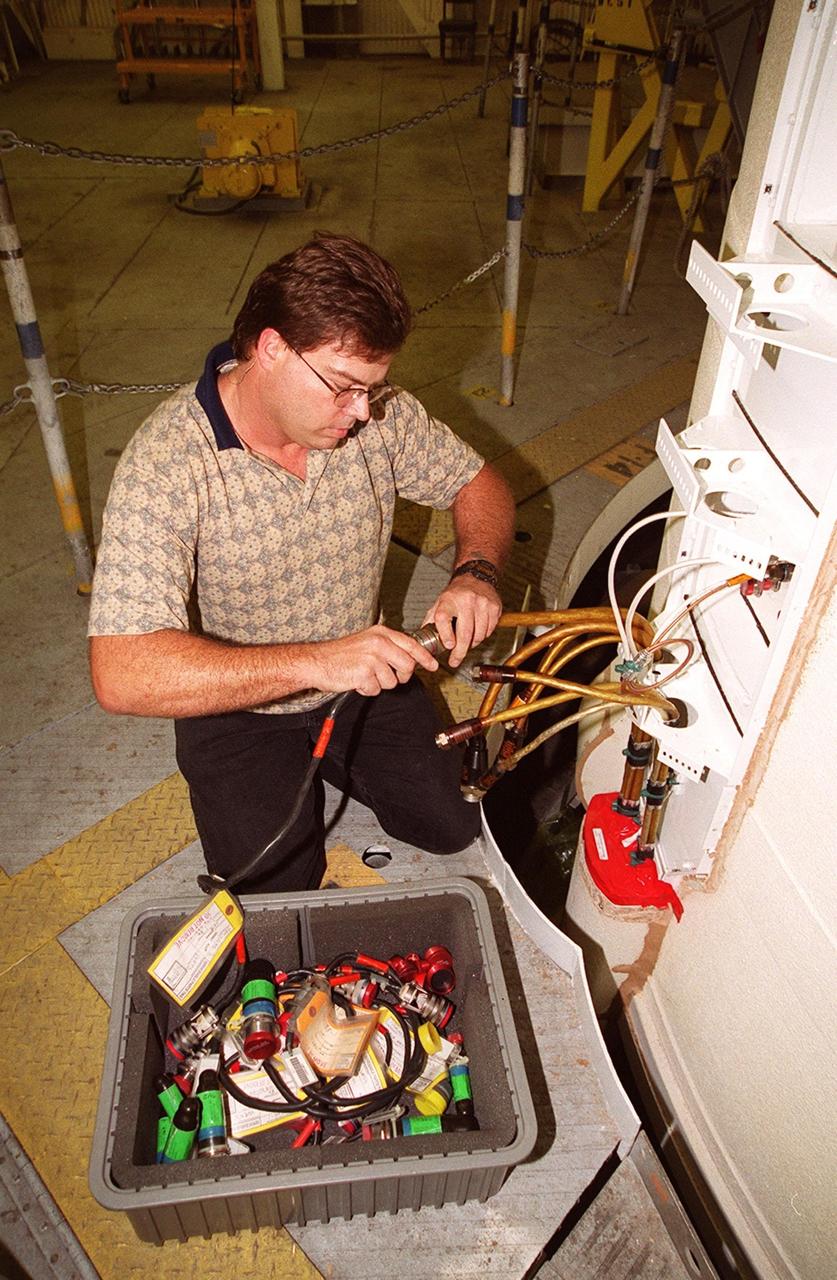
KENNEDY SPACE CENTER, FLA. -- United Space Alliance SRB technician Richard Bruns attaches a cable end cover to a cable pulled from the solid rocket booster on Space Shuttle Atlantis. The Shuttle was rolled back from Launch Pad 39A in order to conduct tests on the SRB cables. A prior extensive evaluation of NASA’s SRB cable inventory on the shelf revealed conductor damage in four (of about 200) cables. Shuttle managers decided to prove the integrity of the system tunnel cables already on Atlantis before launching. Workers are conducting inspections, making continuity checks and conducting X-ray analysis on the cables. The launch has been rescheduled no earlier than Feb. 6. <br
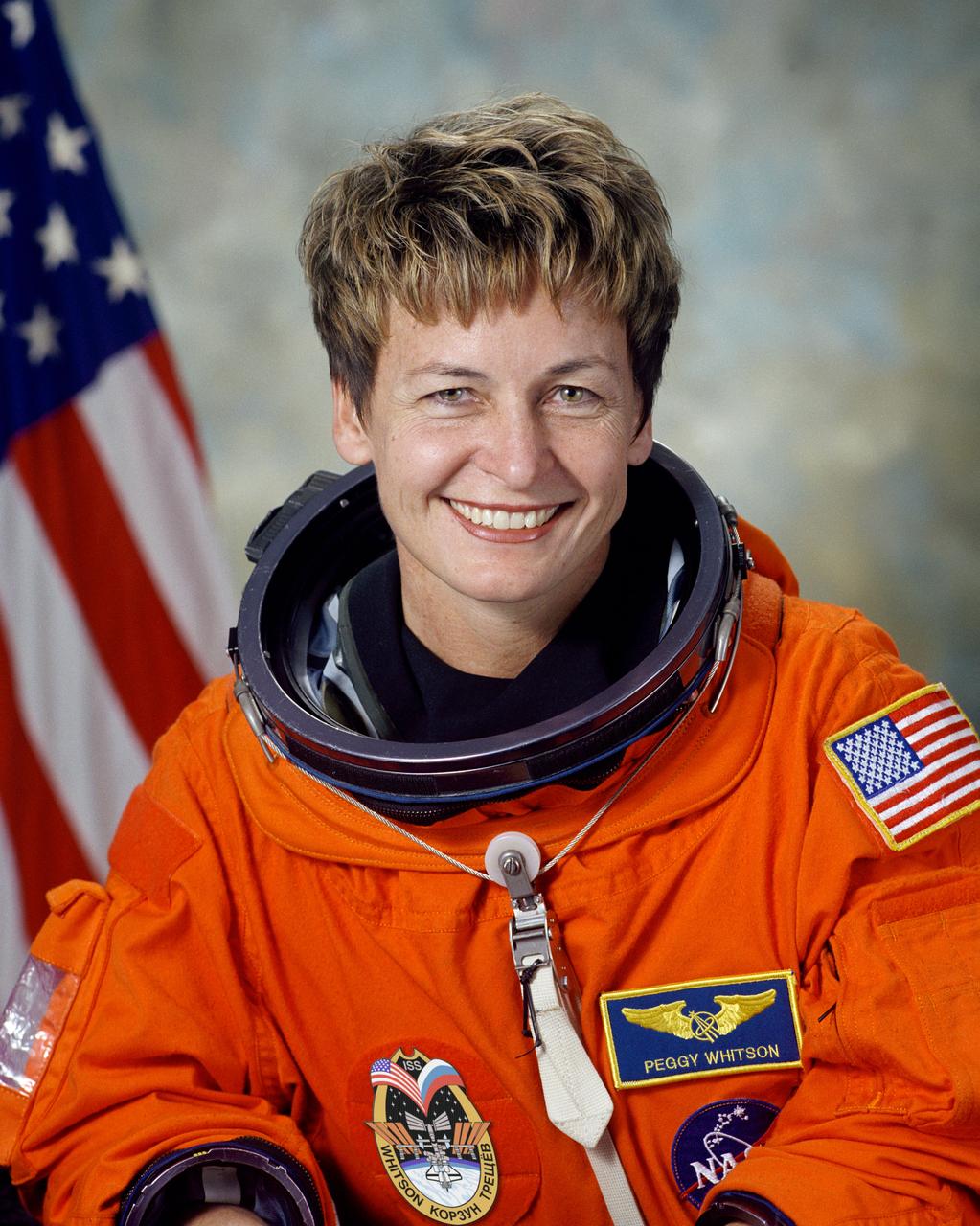
JSC2001-03044 (28 November 2001) --- Astronaut Peggy A. Whitson, mission specialist.

KENNEDY SPACE CENTER, Fla. -- The STS-105 and Expedition Three crews pose in front of the M-113 armored personnel carrier that is part of emergency egress training at the pad. From left to right, they are STS-105 Commander Scott Horowitz, Mission Specialist Daniel Barry, Pilot Rick Sturckow, and Mission Specialist Patrick Forrester; Expedition Three Commander Frank Culbertson and cosmonauts Mikhail Tyurin and Vladimir Nikolaevich Dezhurov. The training is part of Terminal Countdown Demonstration Test activities, which also include a simulated launch countdown and familiarization with the payload. Mission STS-105 will be transporting the Expedition Three crew, several payloads and scientific experiments to the International Space Station aboard Space Shuttle Discovery. The current Expedition Two crew members on the Station will return to Earth on Discovery. Launch of Discovery is scheduled no earlier than Aug. 9, 2001
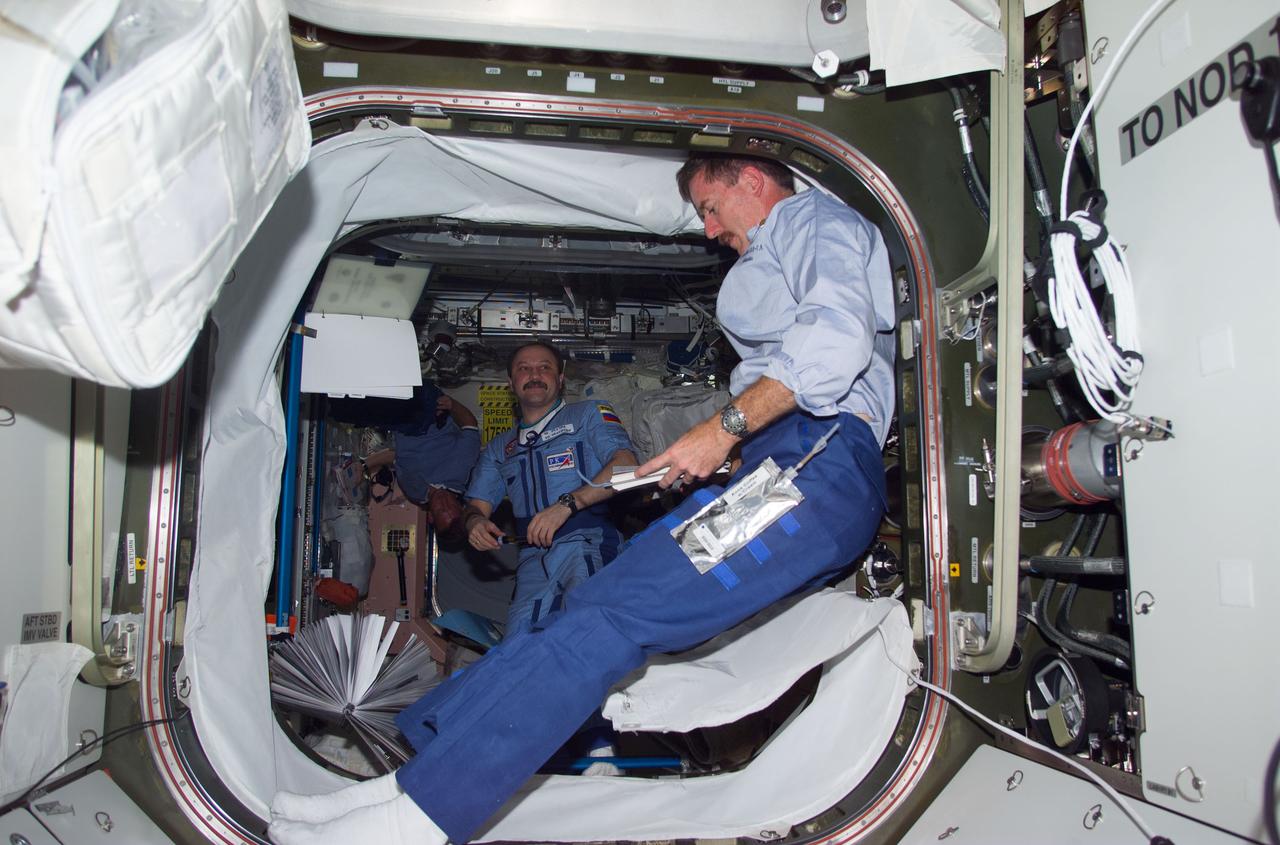
S104-E-5108 (16 July 2001) --- James F. Reilly, STS-104 mission specialist, reads over a checklist in the hatchway of the newly installed Quest Airlock. In the background, cosmonaut Yury V. Usachev of Rosaviakosmos, Expedition Two mission commander, is working in Unity Node 1.
![The <a href=http:__mars.jpl.nasa.gov_2001_>2001 Mars Odyssey Orbiter<_a> is safely placed on a workstand in the Spacecraft Assembly and Encapsulation Facility -2. The Mars Odyssey Orbiter carries three science instruments: the Thermal Emission Imaging System (THEMIS), the Gamma Ray Spectrometer (GRS), and the Mars Radiation Environment Experiment (MARIE). THEMIS will map the mineralogy and morphology of the Martian surface using a high-resolution camera and a thermal infrared imaging spectrometer. The GRS will achieve global mapping of the elemental composition of the surface and determine the abundance of hydrogen in the shallow subsurface. [The GRS is a rebuild of the instrument lost with the Mars Observer mission.] The MARIE will characterize aspects of the near-space radiation environment as related to the radiation-related risk to human explorers. The Mars Odyssey Orbiter is scheduled for launch on April 7, 2001, aboard a Delta 7925 rocket from Launch Pad 17-A, Cape Canaveral Air Force Station](https://images-assets.nasa.gov/image/01pp0103/01pp0103~medium.jpg)
The <a href=http:__mars.jpl.nasa.gov_2001_>2001 Mars Odyssey Orbiter<_a> is safely placed on a workstand in the Spacecraft Assembly and Encapsulation Facility -2. The Mars Odyssey Orbiter carries three science instruments: the Thermal Emission Imaging System (THEMIS), the Gamma Ray Spectrometer (GRS), and the Mars Radiation Environment Experiment (MARIE). THEMIS will map the mineralogy and morphology of the Martian surface using a high-resolution camera and a thermal infrared imaging spectrometer. The GRS will achieve global mapping of the elemental composition of the surface and determine the abundance of hydrogen in the shallow subsurface. [The GRS is a rebuild of the instrument lost with the Mars Observer mission.] The MARIE will characterize aspects of the near-space radiation environment as related to the radiation-related risk to human explorers. The Mars Odyssey Orbiter is scheduled for launch on April 7, 2001, aboard a Delta 7925 rocket from Launch Pad 17-A, Cape Canaveral Air Force Station
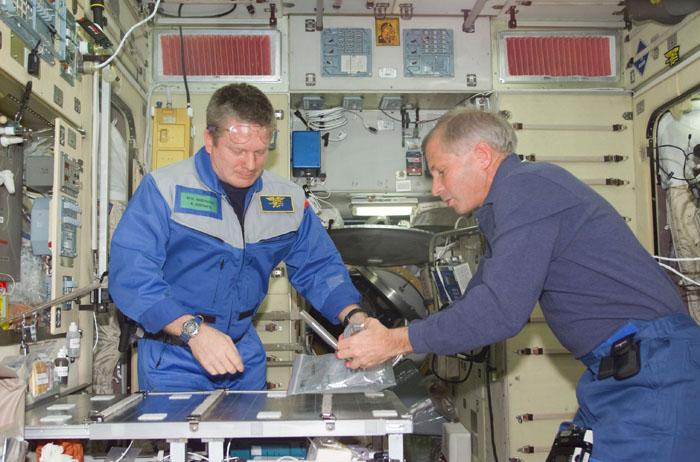
STS98-E-5062 (9 February 2001) --- The shuttle and station commanders are pictured at the "kitchen" table onboard the International Space Station in this digital still camera's view, recorded not long after the two crews reunited aboard the outpost. Astronaut William M. (Bill) Shepherd (left) is Expedition One commander and astronaut Kenneth D. Cockrell serves as mission commander for the five-member STS-98 crew.
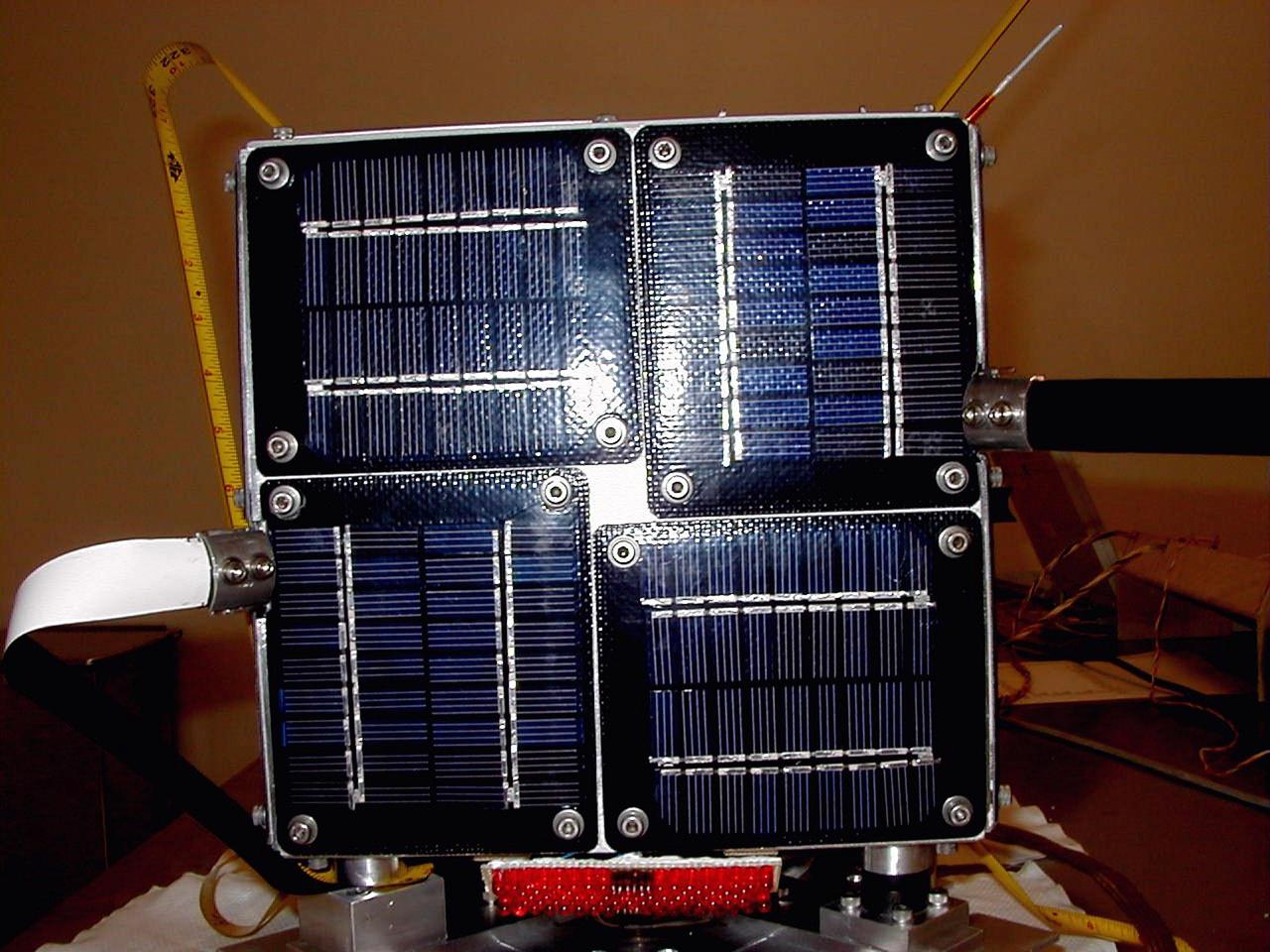
KODIAK ISLAND, Alaska -- The PCSat payload waits for its launch aboard the Athena 1 launch vehicle at Kodiak Island, Alaska, as preparations to launch Kodiak Star proceed. The first orbital launch to take place from Alaska's Kodiak Launch Complex, Kodiak Star is scheduled to lift off on a Lockheed Martin Athena I launch vehicle on Sept. 17 during a two-hour window that extends from 5 p.m. to 7 p.m. p.m. ADT. The payloads aboard include the Starshine 3, sponsored by NASA, and the PICOSat, PCSat and Sapphire, sponsored by the Department of Defense (DoD) Space Test Program.
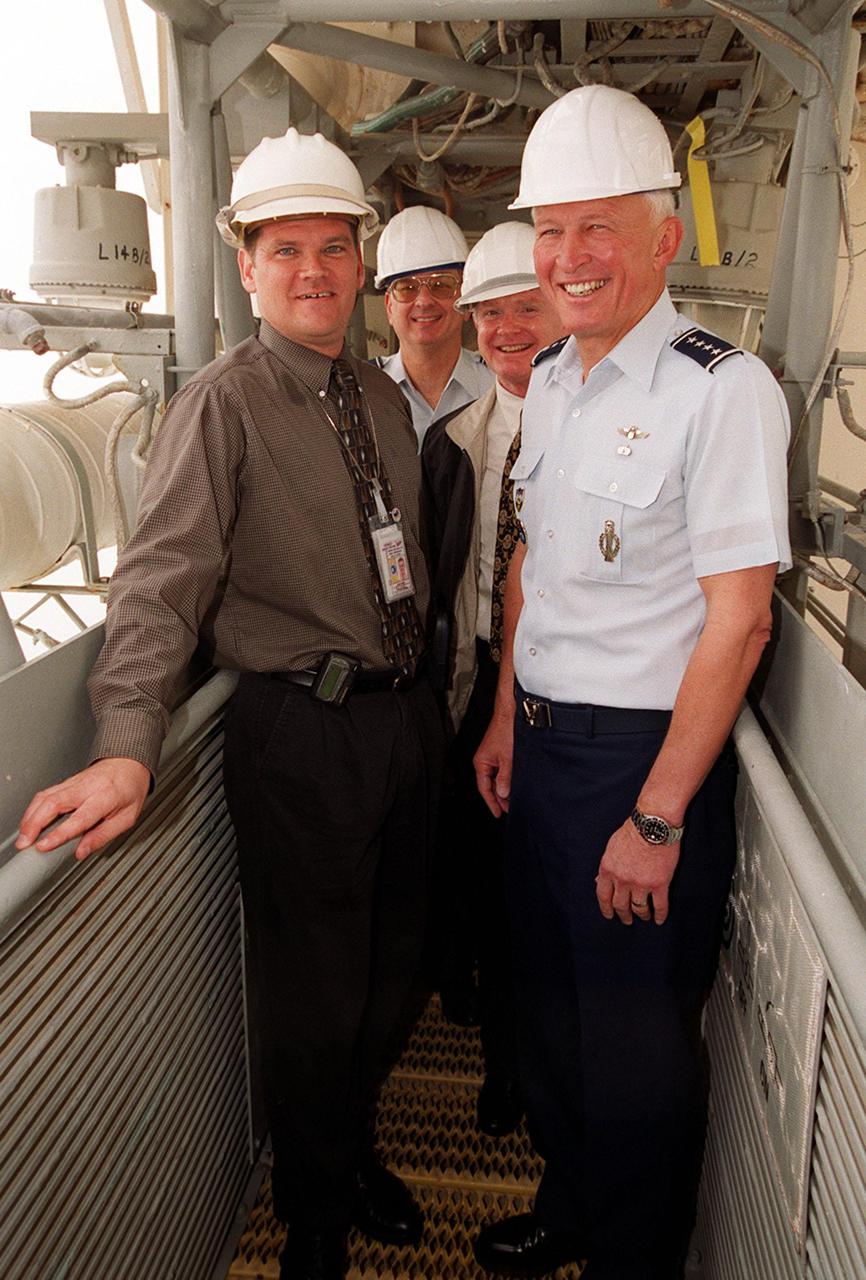
After the rollout of Space Shuttle Discovery, Brig. Gen. Donald Pettit (2nd from left), Center Director Roy Bridges, and Gen. Ralph Everhart take a look at the Fixed Service Structure on Launch Pad 39B. At far left is Dave Rainer. Gen. Everhart is Commander of the Space Command and Gen. Pettit is Commander of the 45th Space Wing, Cape Canaveral
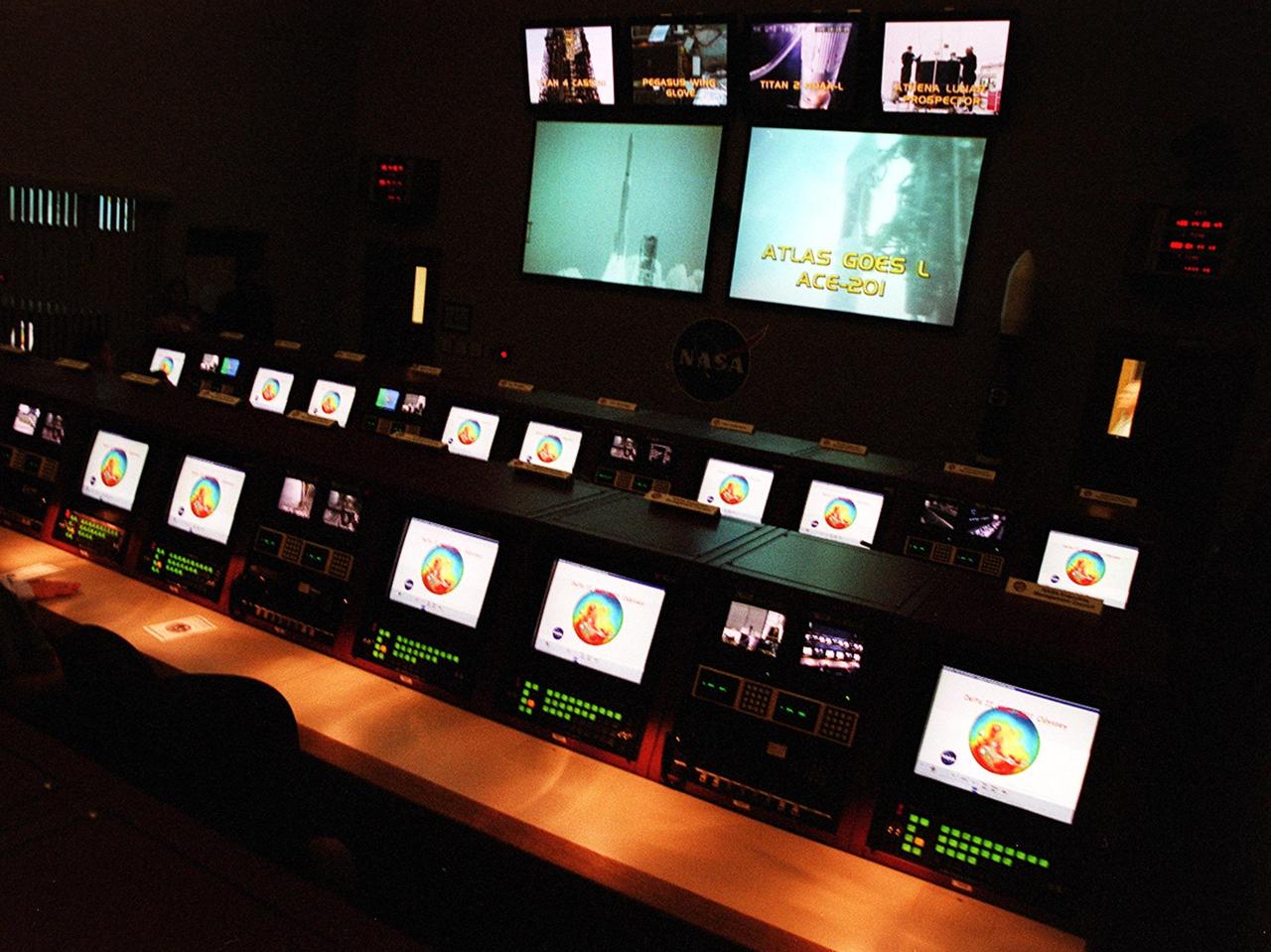
State-of-the-art displays shown here provide enhanced capability to engineers in the upgraded Launch Vehicle Data Center in Hangar AE, Cape Canaveral Air Force Station, Fla. The new facility’s three individual control rooms replace a single LVDC control room in use since the mid-1970s. Developed by NASA-KSC to support multiple test operations in parallel or a single large launch operation, the new LVDC allows up to 100 launch vehicle engineers to monitor the voice, data and video systems that support the checkout and launch of an expendable vehicle
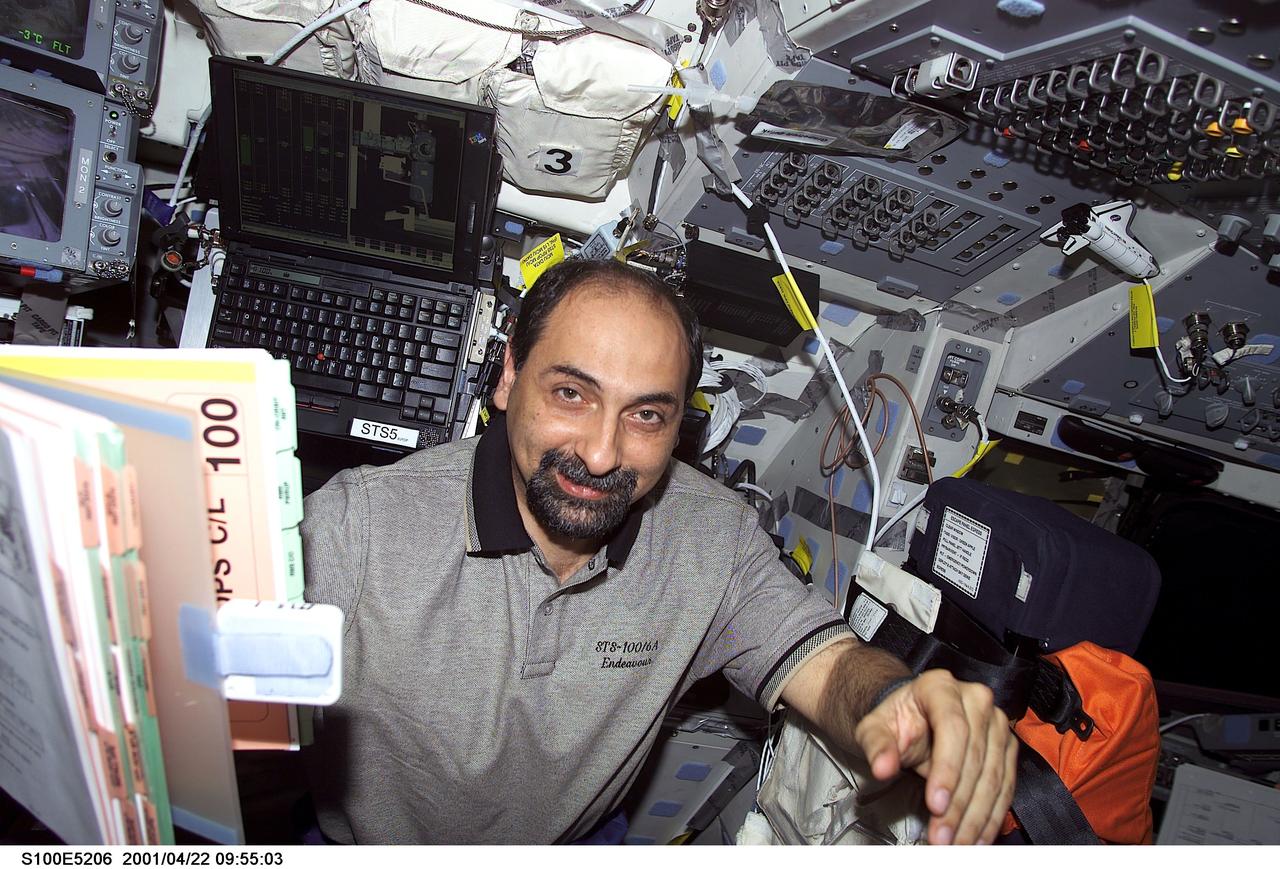
S100-E-5206 (22 April 2001) --- Astronaut Umberto Guidoni, STS-100 mission specialist representing the European Space Agency (ESA), remains on Endeavour's flight deck as two crew mates (out of frame) on the deck below get ready for space walk duty. The image was recorded with a digital still camera.
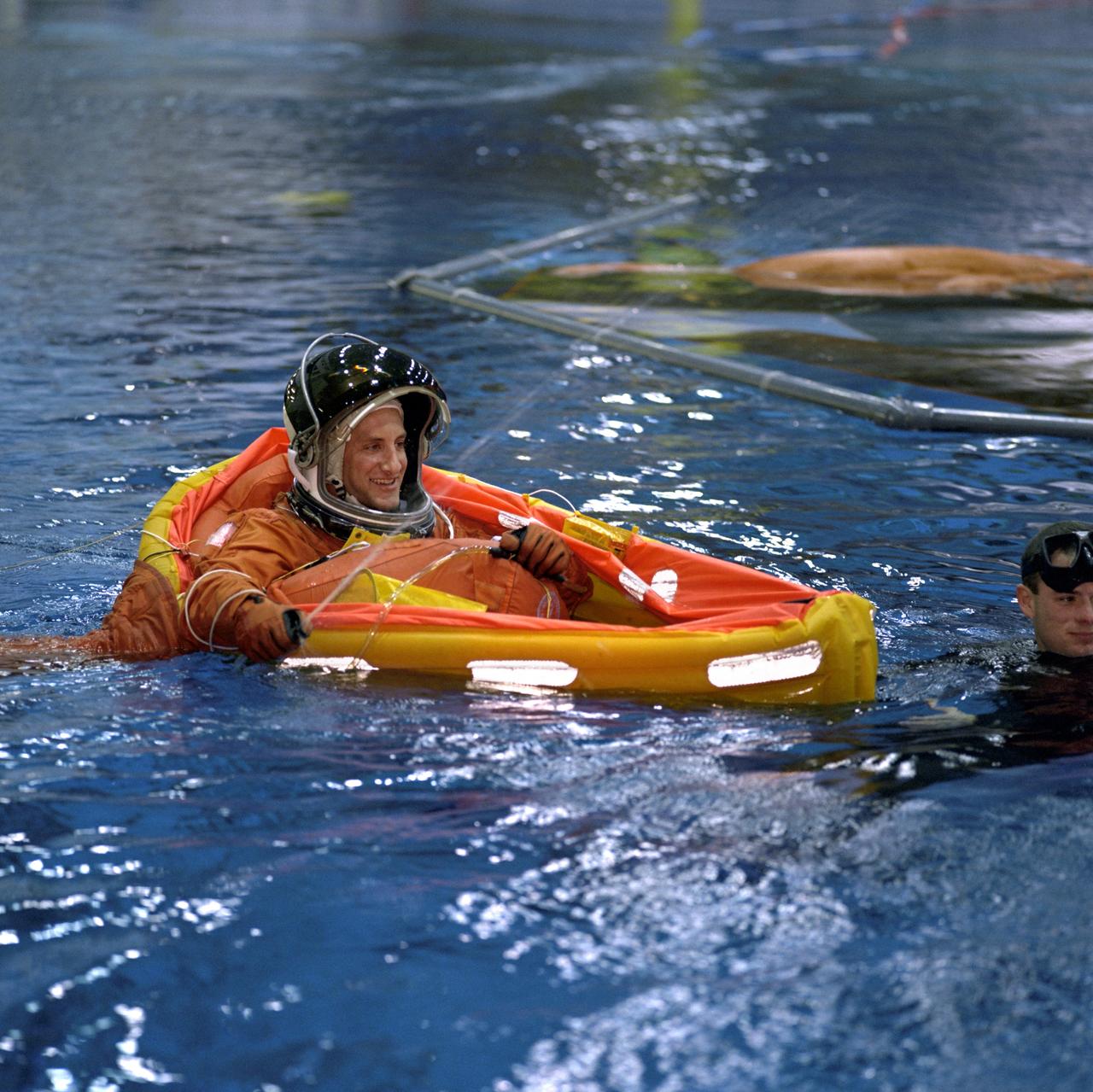
JSC2001-00012 (January 2001) --- Astronaut Charles O. Hobaugh, STS-104 pilot, floats in a small life raft during an emergency egress training session at the Neutral Buoyancy Laboratory (NBL) near the Johnson Space Center (JSC). Hobaugh will join four other astronauts for a June mission to the International Space Station (ISS).
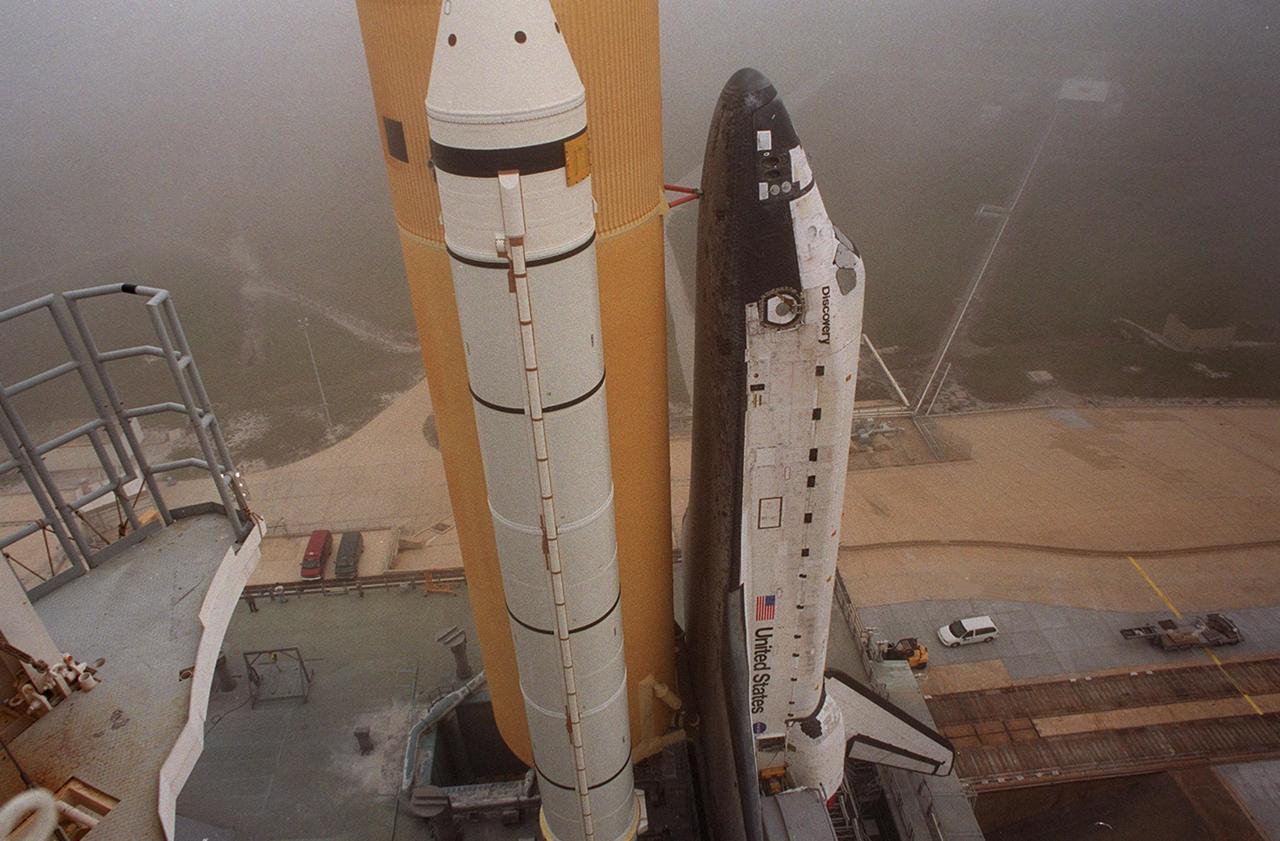
KENNEDY SPACE CENTER, Fla. -- Space Shuttle Discovery can still be seen clearly as it sits on Launch Pad 39B despite the fog that is rolling in, blurring the background. Discovery will be flying on mission STS-102 to the International Space Station. Its payload is the Multi-Purpose Logistics Module Leonardo, a “moving van,” to carry laboratory racks filled with equipment, experiments and supplies to and from the Space Station aboard the Space Shuttle. The flight will also carry the Expedition Two crew up to the Space Station, replacing Expedition One, who will return to Earth on Discovery. Launch is scheduled for March 8 at 6:45 a.m. EST
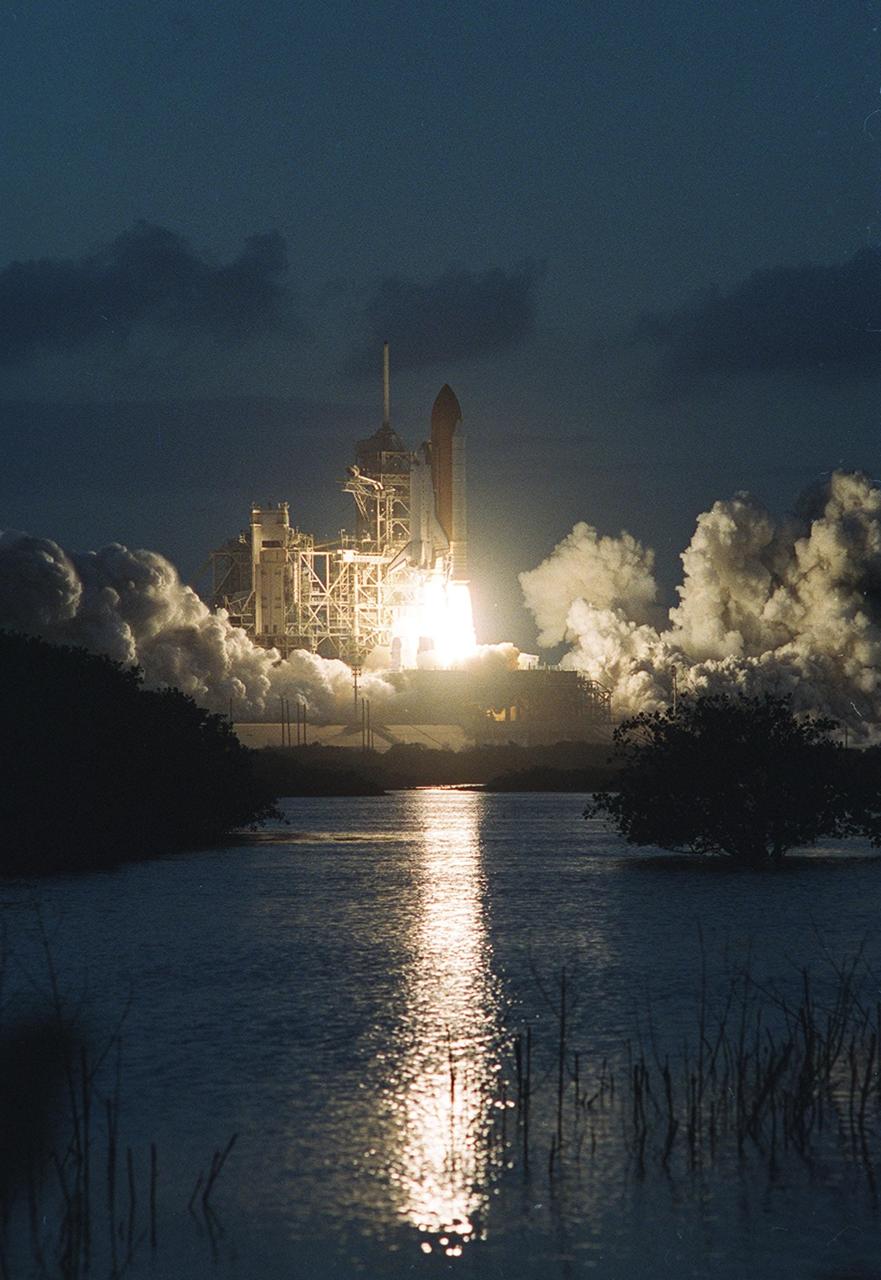
KENNEDY SPACE CENTER, Fla. - The reflection in water near Launch Pad 39B captures the brilliance of the flames trailing Space Shuttle Endeavour as it soars into the twilight sky on mission STS-108. Liftoff occurred at 5:19:28 p.m. EST (22:19 GMT) on this second launch attempt in two days. Endeavour will dock with the International Space Station on Dec. 7. STS-108 is the final Shuttle mission of 2001and the 107th Shuttle flight overall. It is the 12th flight to the Space Station. Landing of the orbiter at KSC's Shuttle Landing Facility is targeted for 1:05 p.m. EST (18:05 p.m. GMT) Dec. 16
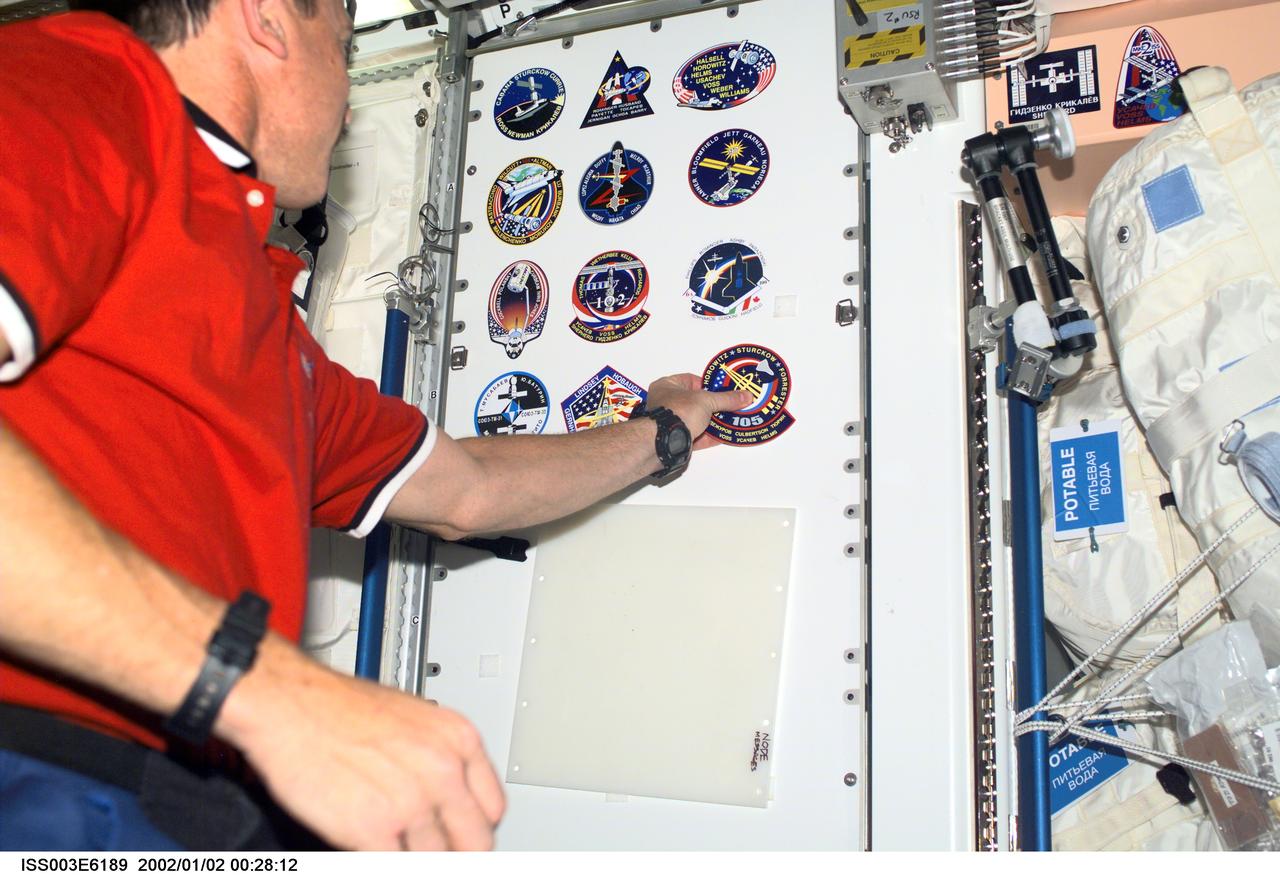
ISS003-E-6189 (August 2001) --- Astronaut Scott J. Horowitz, STS-105 mission commander, adds the STS-105 crew patch to the growing collection of those representing Shuttle crews who have worked on the International Space Station (ISS). This image was taken with a digital still camera.
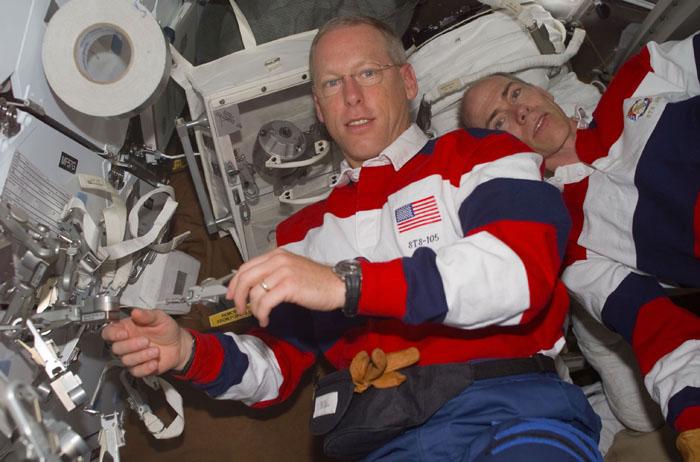
STS105-E-5217 (15 August 2001) --- Onboard the Space Shuttle Discovery, astronauts Patrick G. Forrester (left) and Daniel T. Barry check out some of the equipment they will be working with on their scheduled space walk in less than 24 hours. The image was recorded with a digital still camera.
![The <a href=http://mars.jpl.nasa.gov/2001/>2001 Mars Odyssey Orbiter </a>comes to rest on a workstand in the Spacecraft Assembly & Encapsulation Facility -2. Workers check the spacecraft’s position. The Mars Odyssey Orbiter carries three science instruments: the Thermal Emission Imaging System (THEMIS), the Gamma Ray Spectrometer (GRS), and the Mars Radiation Environment Experiment (MARIE). THEMIS will map the mineralogy and morphology of the Martian surface using a high-resolution camera and a thermal infrared imaging spectrometer. The GRS will achieve global mapping of the elemental composition of the surface and determine the abundance of hydrogen in the shallow subsurface. [The GRS is a rebuild of the instrument lost with the Mars Observer mission.] The MARIE will characterize aspects of the near-space radiation environment as related to the radiation-related risk to human explorers. The Mars Odyssey Orbiter is scheduled for launch on April 7, 2001, aboard a Delta 7925 rocket from Launch Pad 17-A, Cape Canaveral Air Force Station](https://images-assets.nasa.gov/image/KSC01pp0102/KSC01pp0102~medium.jpg)
The <a href=http://mars.jpl.nasa.gov/2001/>2001 Mars Odyssey Orbiter </a>comes to rest on a workstand in the Spacecraft Assembly & Encapsulation Facility -2. Workers check the spacecraft’s position. The Mars Odyssey Orbiter carries three science instruments: the Thermal Emission Imaging System (THEMIS), the Gamma Ray Spectrometer (GRS), and the Mars Radiation Environment Experiment (MARIE). THEMIS will map the mineralogy and morphology of the Martian surface using a high-resolution camera and a thermal infrared imaging spectrometer. The GRS will achieve global mapping of the elemental composition of the surface and determine the abundance of hydrogen in the shallow subsurface. [The GRS is a rebuild of the instrument lost with the Mars Observer mission.] The MARIE will characterize aspects of the near-space radiation environment as related to the radiation-related risk to human explorers. The Mars Odyssey Orbiter is scheduled for launch on April 7, 2001, aboard a Delta 7925 rocket from Launch Pad 17-A, Cape Canaveral Air Force Station
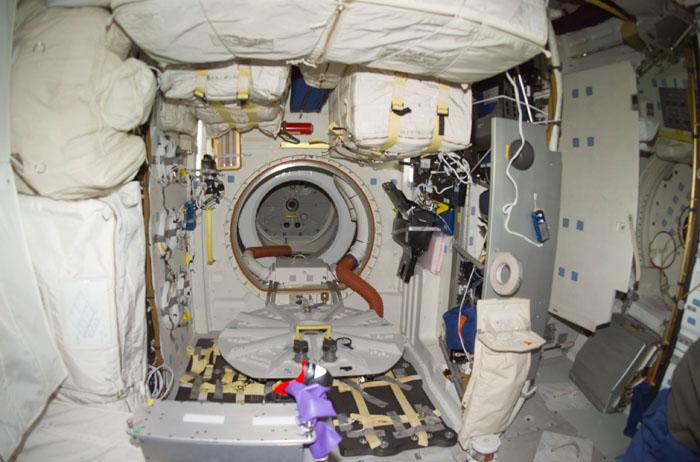
STS105-E-5045 (12 August 2001) --- One of the STS-105 crew members used a digital still camera to record this image of the middeck and airlock of the Space Shuttle Discovery prior to docking with the International Space Station (ISS).
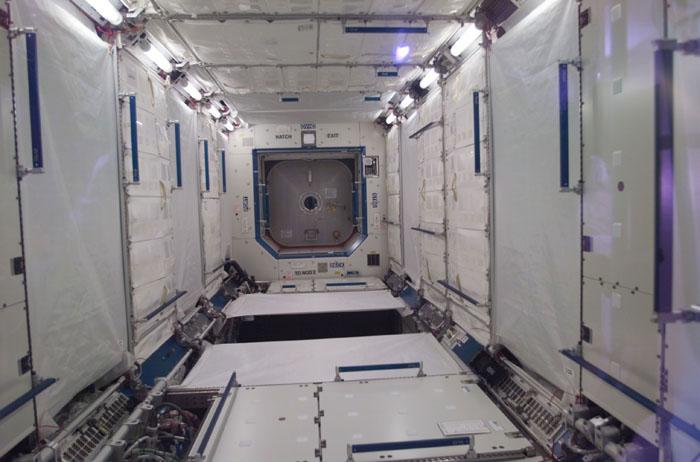
STS98-E-5113 (11 February 2001) --- This wide shot, photographed with a digital still camera, shows the interior of the newly attached Destiny laboratory. The crews of Atlantis and the International Space Station opened the laboratory on Feb. 11 and spent the first full day of what are planned to be years of work ahead inside the orbiting science and command center. Station commander William M. (Bill) Shepherd opened the Destiny hatch, and he and shuttle commander Kenneth D. Cockrell ventured inside at 8:38 a.m. (CST), Feb. 11. As depicted in subsequent digital images in this series, members of both crews went to work quickly inside the new module, activating air systems, fire extinguishers, alarm systems, computers and internal communications. The crew also continued equipment transfers from the shuttle to the station.
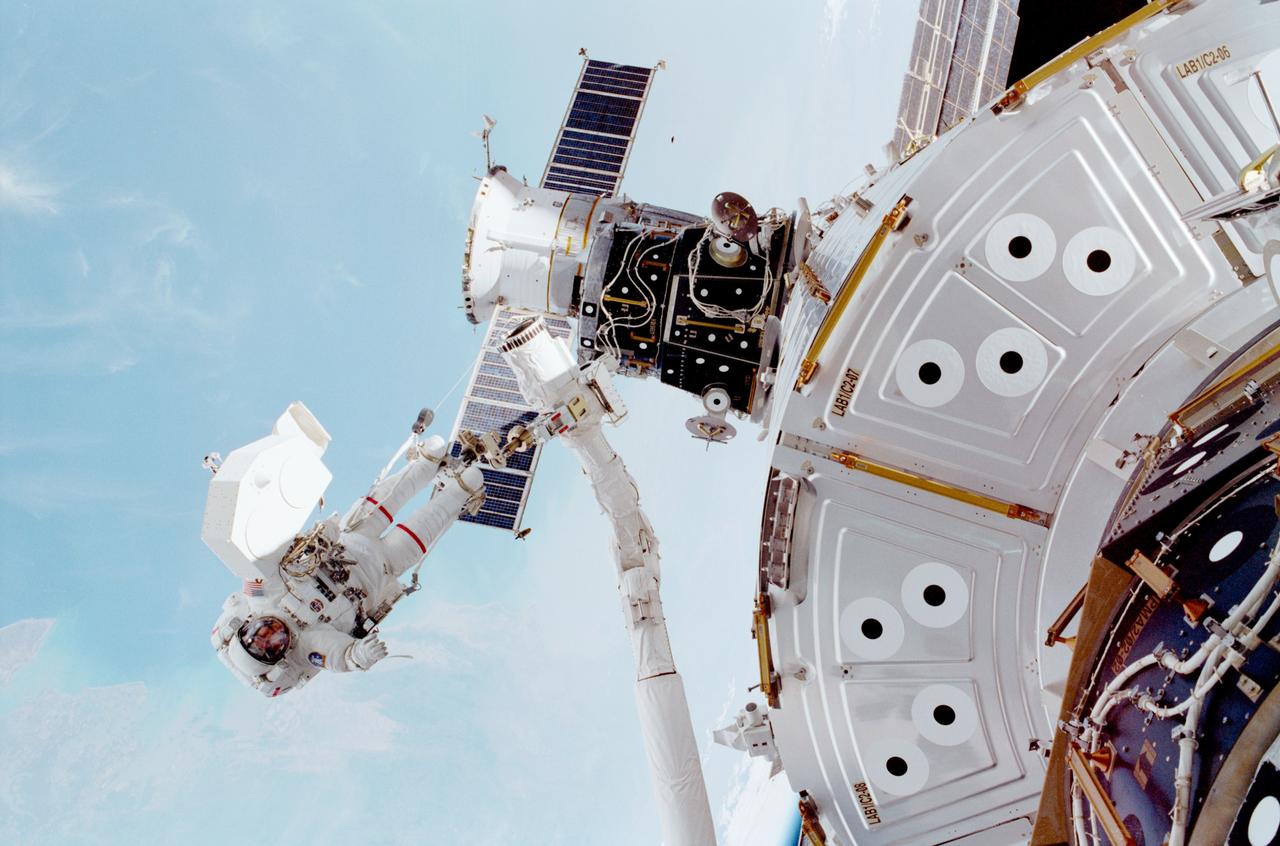
STS102-312-004 (11 March 2001) --- Astronaut James S. Voss works while anchored to the remote manipulator system (RMS) robot arm on the Space Shuttle Discovery. This extravehicular activity (EVA), on which Voss was joined by astronaut Susan J. Helms (out of frame), was the first of two scheduled STS-102 space walks. The pair, destined to become members of the Expedition Two crew aboard the station later in the mission, rode aboard Discovery into orbit and at the time of this EVA were still regarded as STS-102 mission specialists.
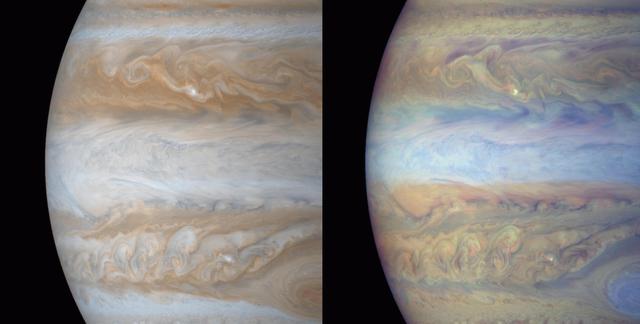
These color composite frames of the mid-section of Jupiter were of narrow angle images acquired on December 31, 2000, a day after Cassini's closest approach to the planet. The smallest features in these frames are roughly ~ 60 kilometers. The left is natural color, composited to yield the color that Jupiter would have if seen by the naked eye. The right frame is composed of 3 images: two were taken through narrow band filters centered on regions of the spectrum where the gaseous methane in Jupiter's atmosphere absorbs light, and the third was taken in a red continuum region of the spectrum, where Jupiter has no absorptions. The combination yields an image whose colors denote the height of the clouds. Red regions are deep water clouds, bright blue regions are high haze (like the blue covering the Great Red Spot). Small, intensely bright white spots are energetic lightning storms which have penetrated high into the atmosphere where there is no opportunity for absorption of light: these high cloud systems reflect all light equally. The darkest blue regions -- for example, the long linear regions which border the northern part of the equatorial zone, are the very deep "hot spots', seen in earlier images, from which Jovian thermal emission is free to escape to space. This is the first time that global images of Jupiter in all the methane and attendant continuum filters have been acquired by a spacecraft. From images like these, the stratigraphy of Jupiter's dynamic atmosphere will be determined. http://photojournal.jpl.nasa.gov/catalog/PIA02877
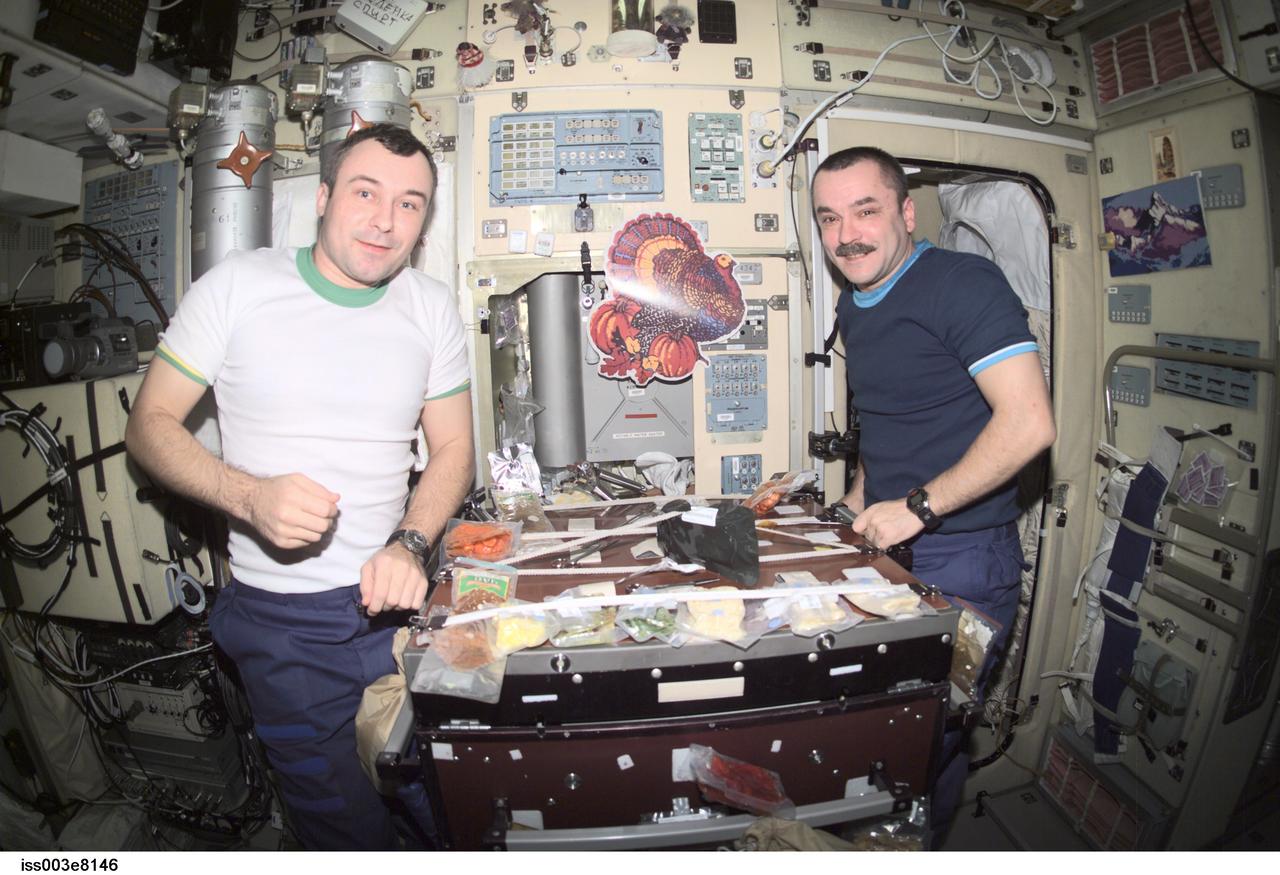
ISS003-E-08146 (22 November 2001) --- Cosmonauts Vladimir N. Dezhurov (left) and Mikhail Tyurin, both Expedition 3 flight engineers representing Rosaviakosmos, eat a Thanksgiving meal in the Zvezda Service Module on the International Space Station (ISS).
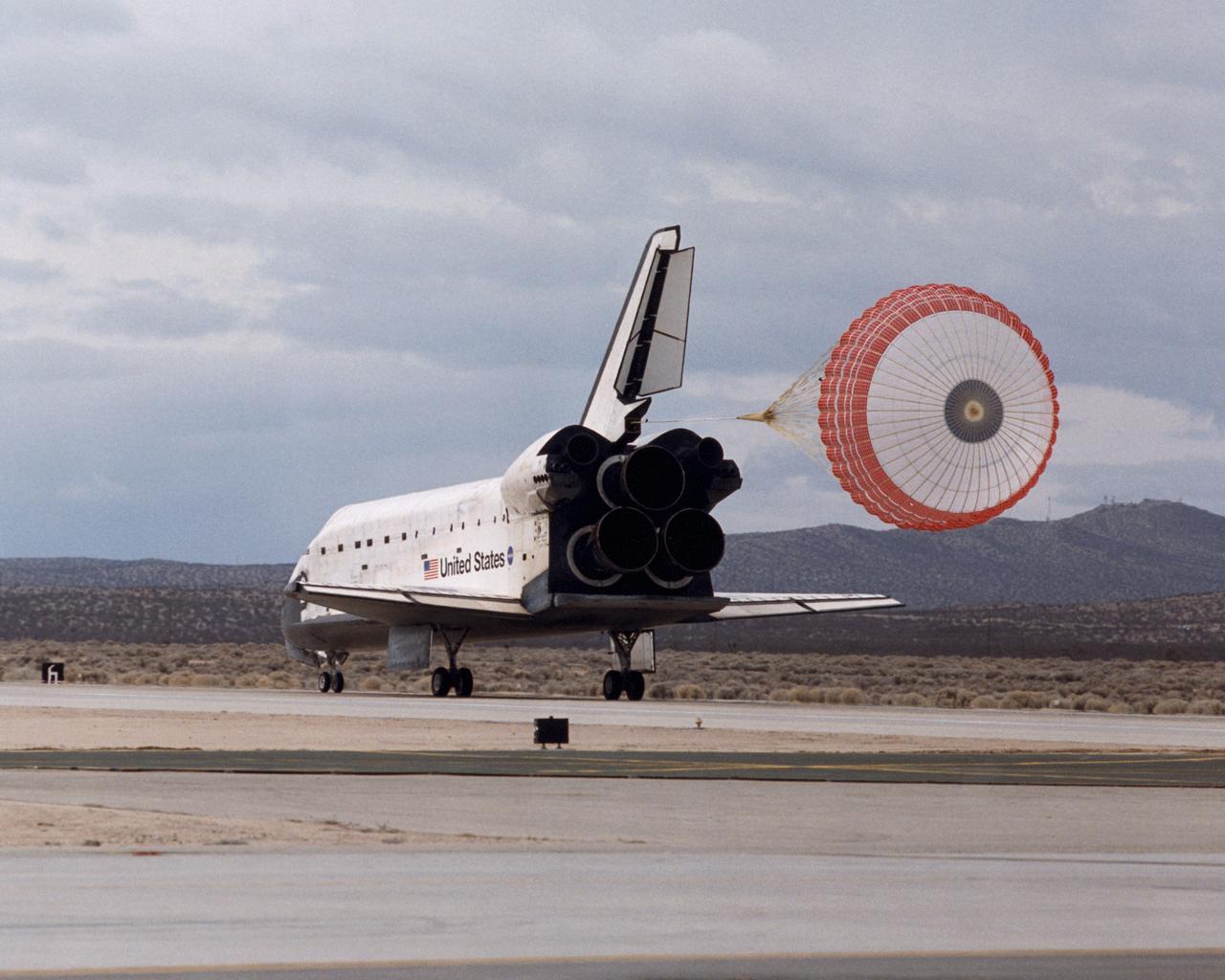
Space Shuttle Atlantis landed at 12:33 p.m. February 20 on the runway at Edwards Air Force Base, California, where NASA's Dryden Flight Research Center is located. The mission, which began February 7, logged 5.3 million miles as the shuttle orbited earth while delivering the Destiny science laboratory to the International Space Station. Inclement weather conditions in Florida prompted the decision to land Atlantis at Edwards. The last time a space shuttle landed at Edwards was Oct. 24, 2000.
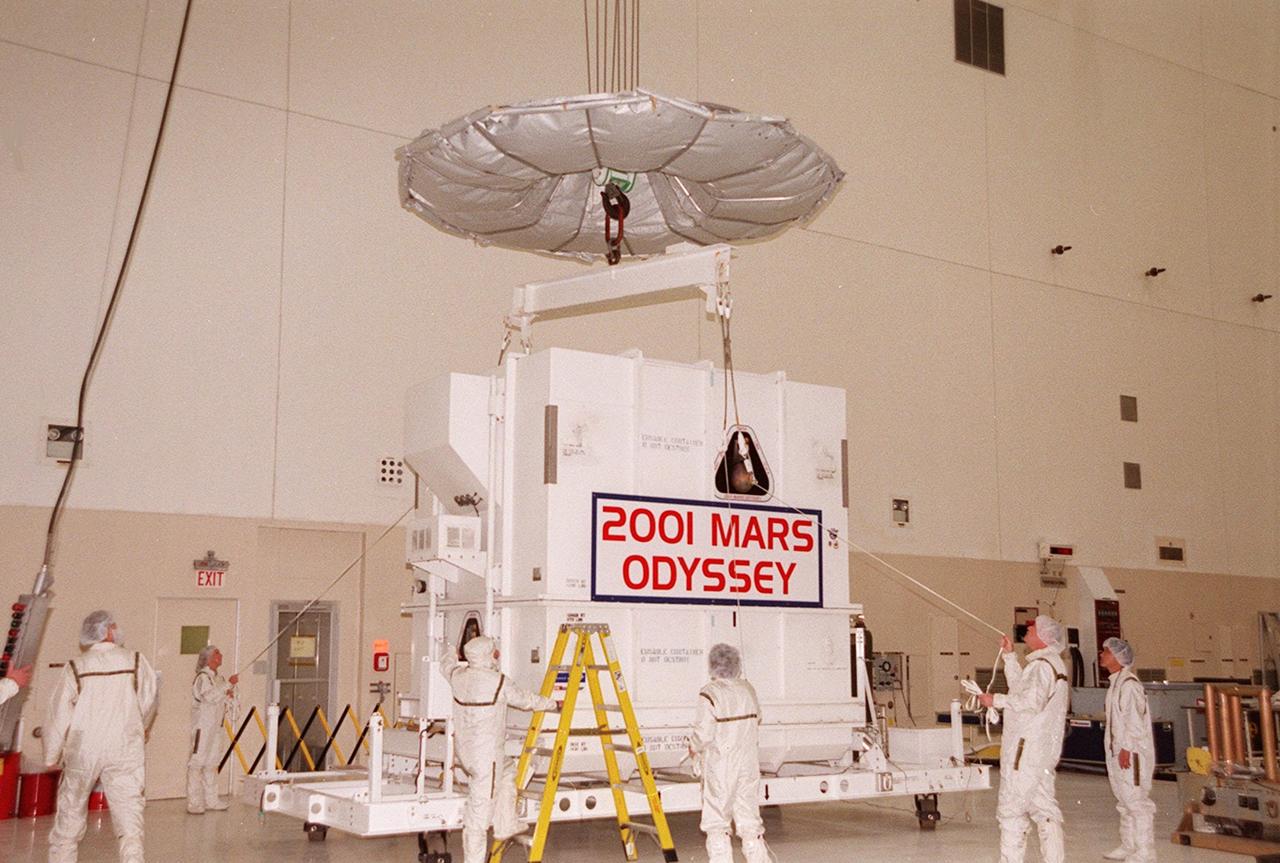
Workers in the Spacecraft Assembly and Encapsulation Facility 2 (SAEF-2)secure an overhead crane to the crate containing the Mars Odyssey spacecraft. The spacecraft will undergo final assembly and checkout, which includes installation of two of the three science instruments, integration of the three-panel solar array, and a spacecraft functional test. Launch aboard a Boeing Delta II launch vehicle from Pad A, Complex 17, CCAFS, is planned for April 7, 2001 the first day of a 21-day planetary window. The spacecraft will arrive at Mars on Oct. 20, 2001, for insertion into an initial elliptical capture orbit. Its final operational altitude will be a 250-mile-high, Sun-synchronous polar orbit. Mars Odyssey will spend two years mapping the planet’s surface and measuring its environment
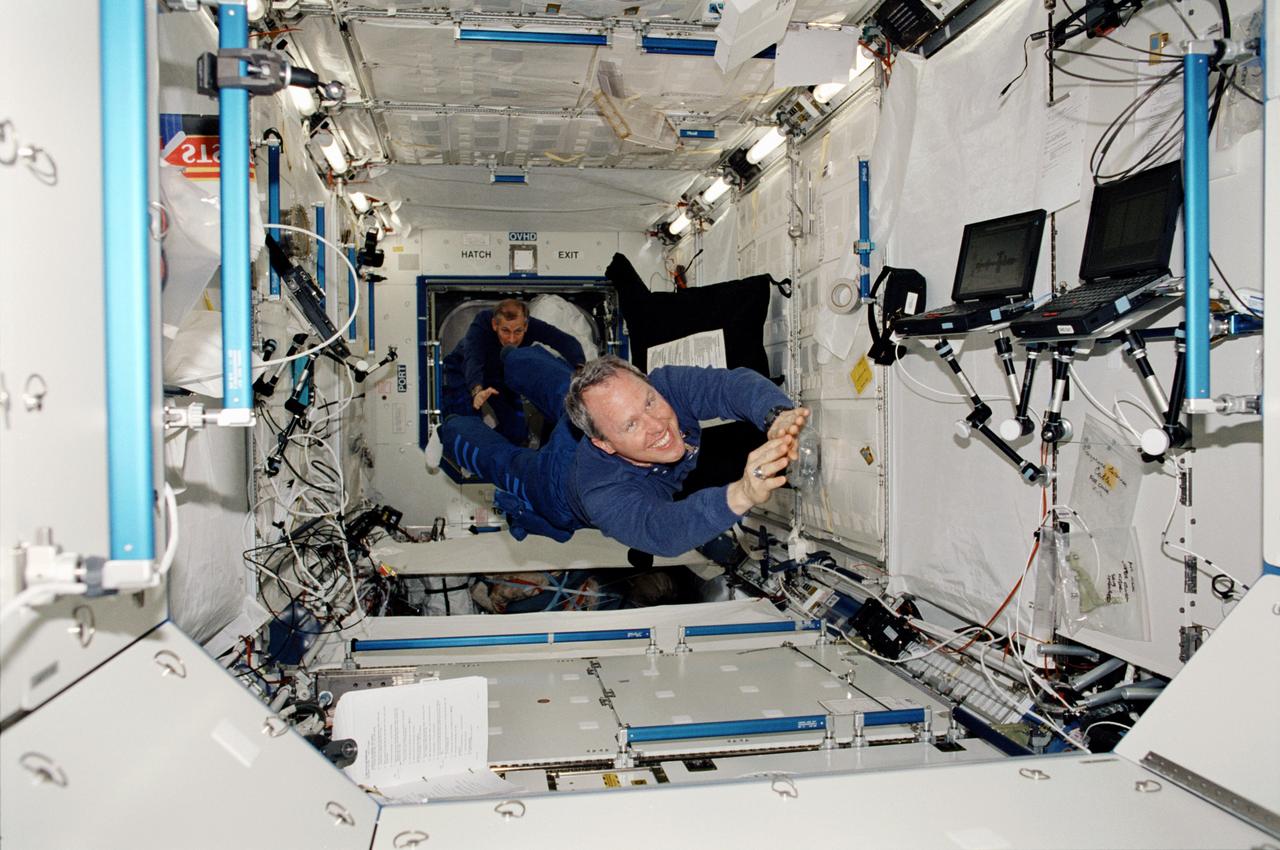
This STS-98 mission photograph shows astronauts Thomas D. Jones (foreground) and Kerneth D. Cockrell floating inside the newly installed Laboratory aboard the International Space Station (ISS). The American-made Destiny module is the cornerstone for space-based research aboard the orbiting platform and the centerpiece of the ISS, where unprecedented science experiments will be performed in the near-zero gravity of space. Destiny will also serve as the command and control center for the ISS. The aluminum module is 8.5-meters (28-feet) long and 4.3-meters (14-feet) in diameter. The laboratory consists of three cylindrical sections and two endcones with hatches that will be mated to other station components. A 50.9-centimeter (20-inch-) diameter window is located on one side of the center module segment. This pressurized module is designed to accommodate pressurized payloads. It has a capacity of 24 rack locations. Payload racks will occupy 15 locations especially designed to support experiments. The Destiny module was built by the Boeing Company under the direction of the Marshall Space Flight Center.
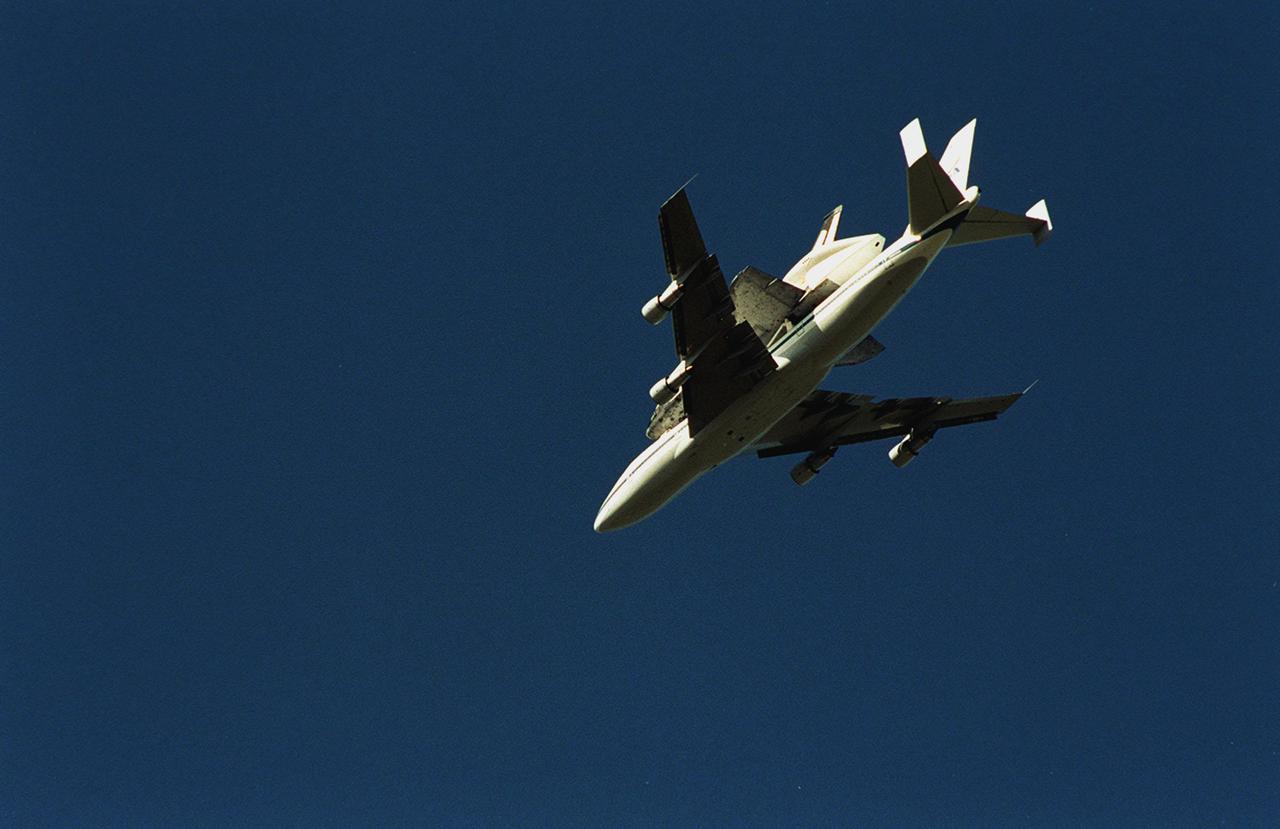
The Shuttle Carrier Aircraft with orbiter Columbia on top is viewed from underneath as it soars through the sky over the Space Coast of Florida as it returns to KSC from Cape Canaveral Air Force Station. The ferry flight began in California March 1. Unfavorable weather conditions kept it on the ground at Dyess AFB, Texas, until it could return to Florida. It landed temporarily at the CCAFS Skid Strip until Atlantis, which had already landed at the SLF, could be transferred. Columbia is returning from a 17-month-long modification and refurbishment process as part of a routine maintenance plan. The orbiter will next fly on mission STS-107, scheduled Oct. 25