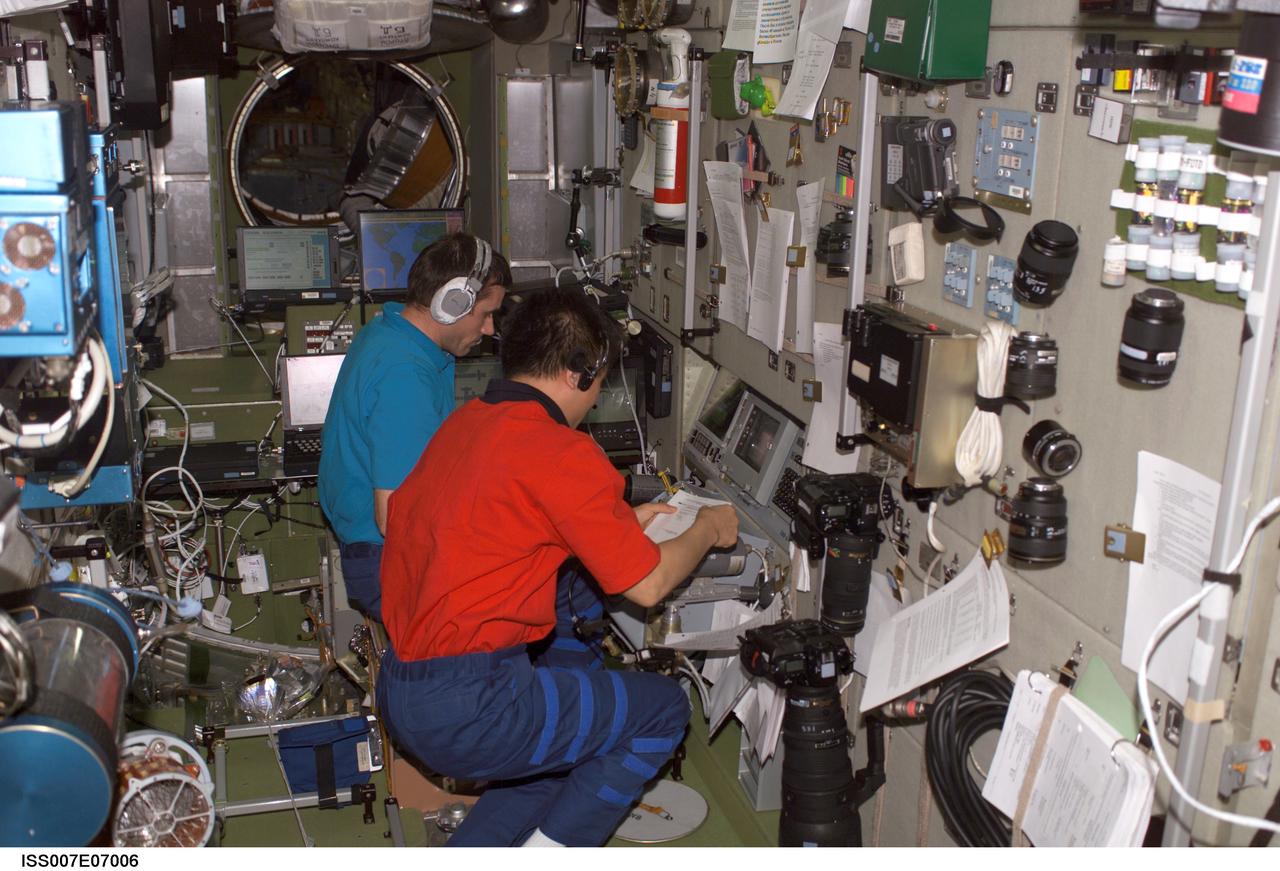
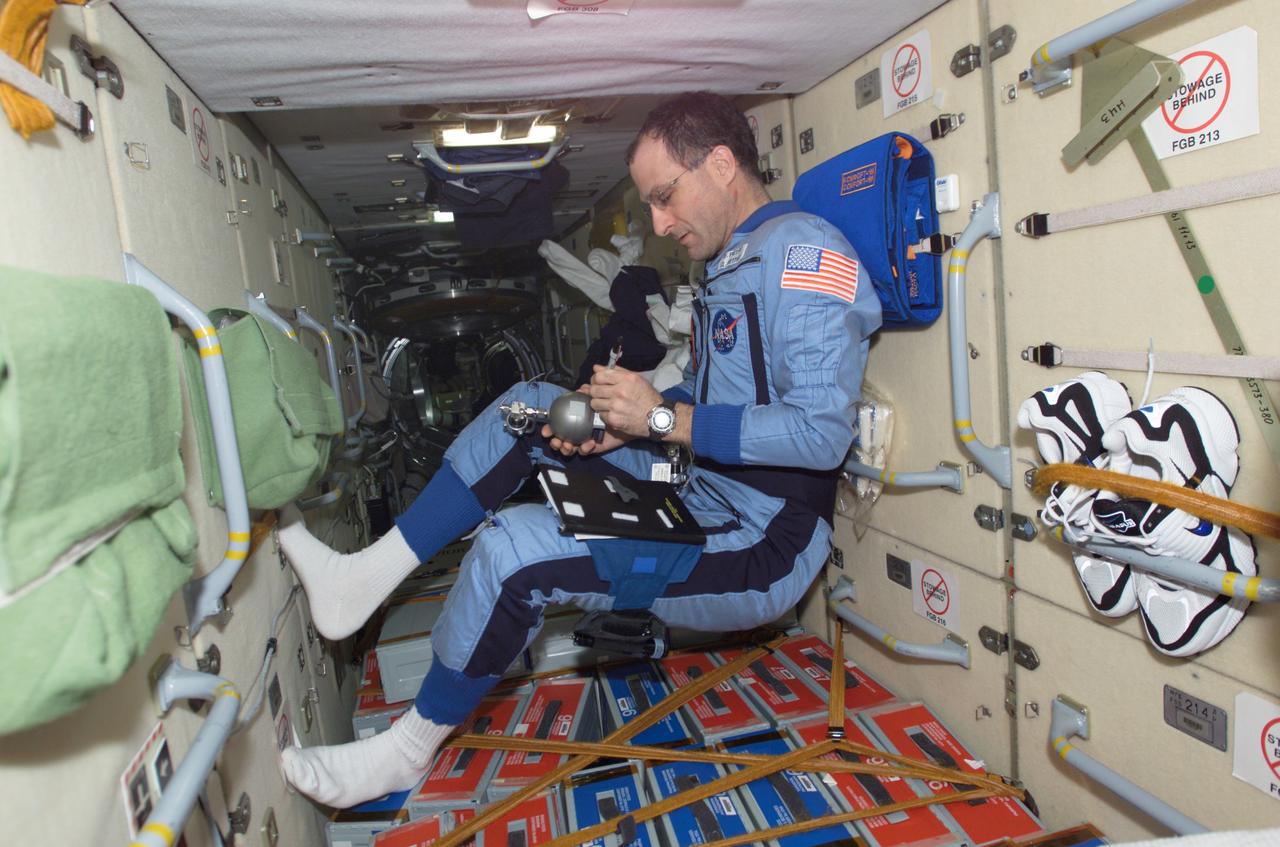
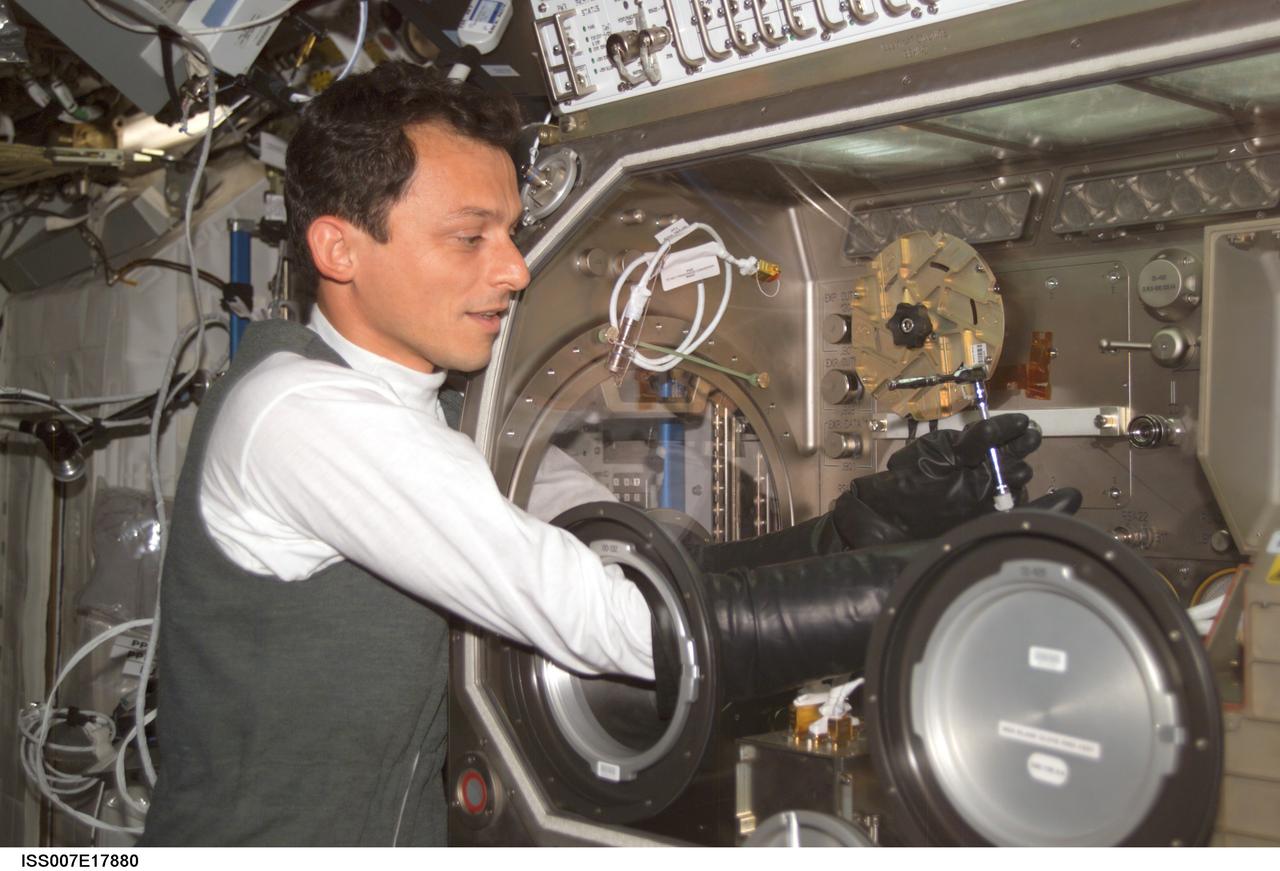
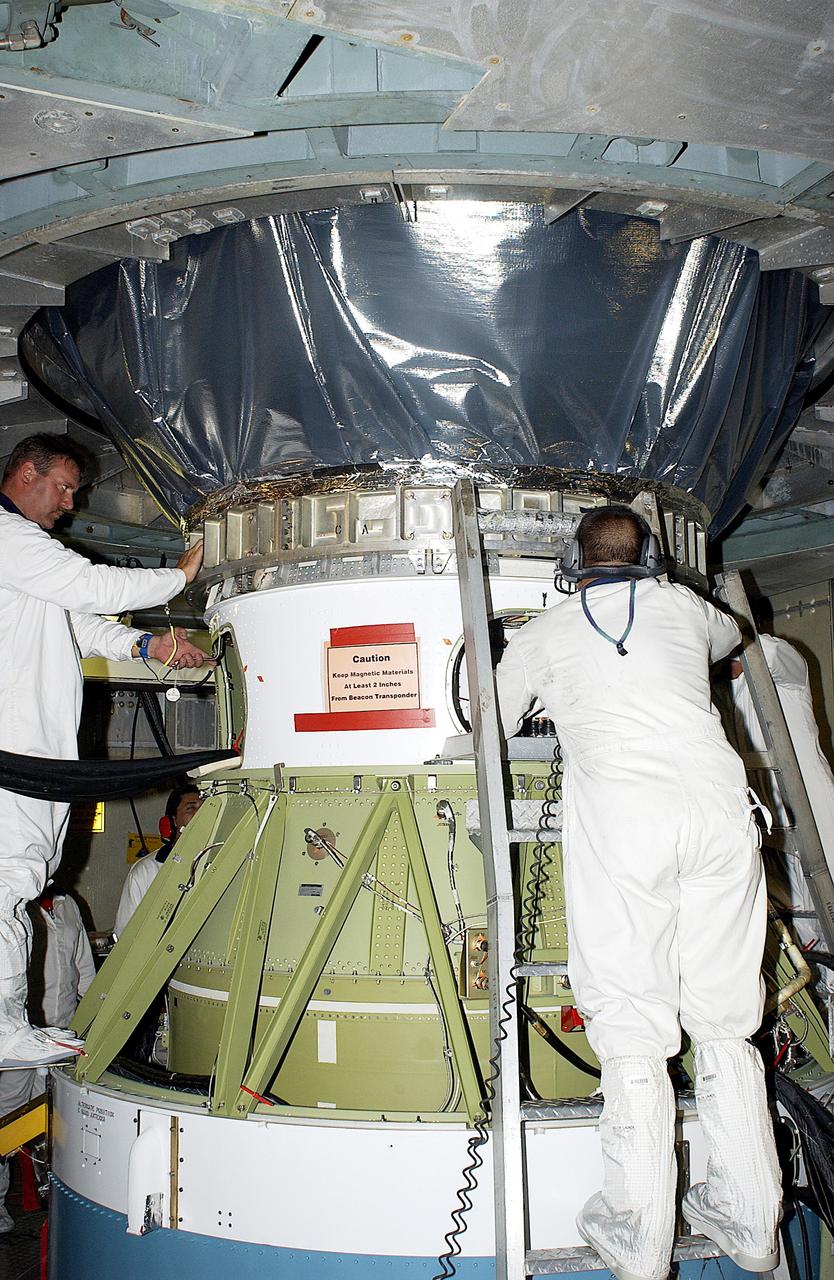
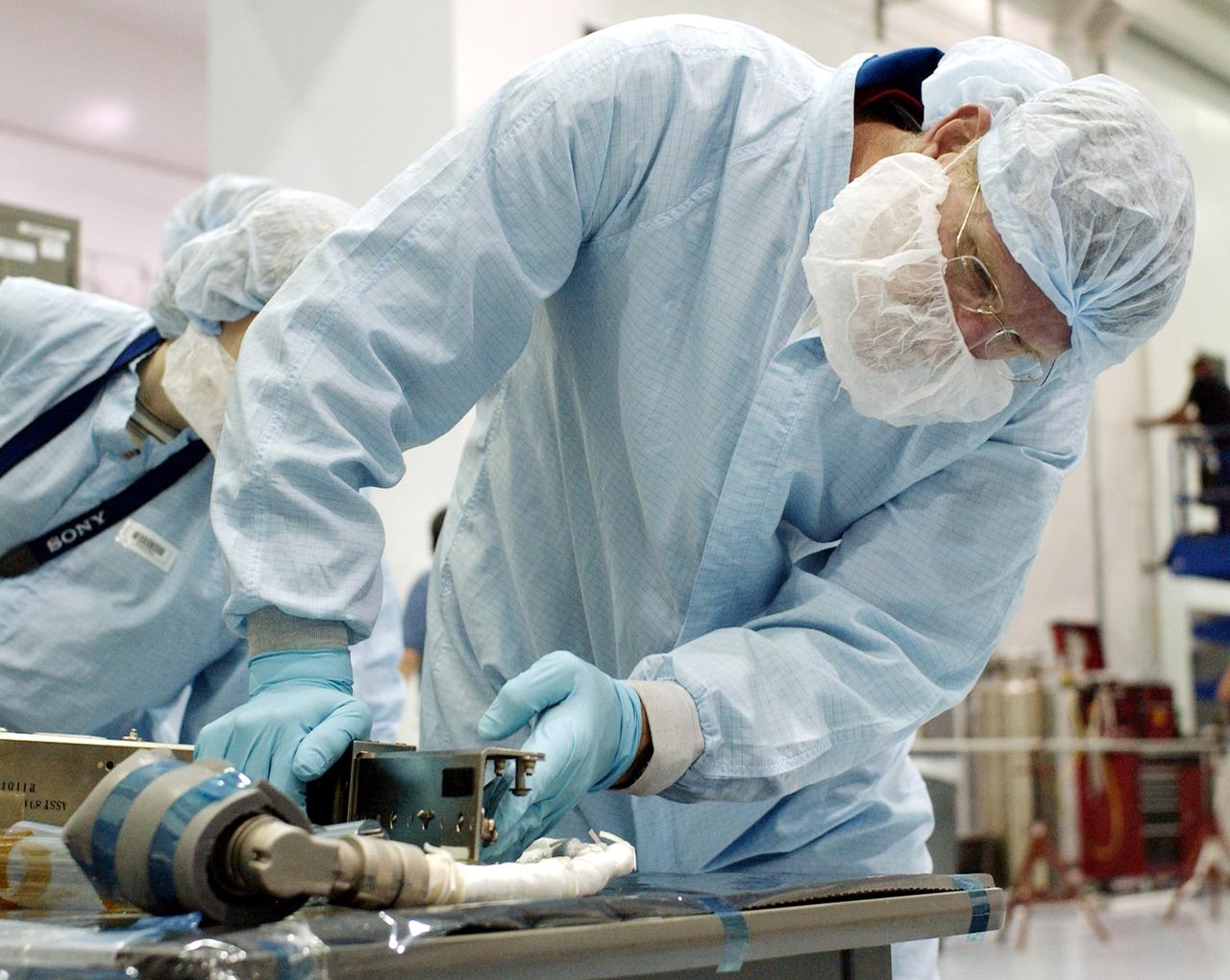
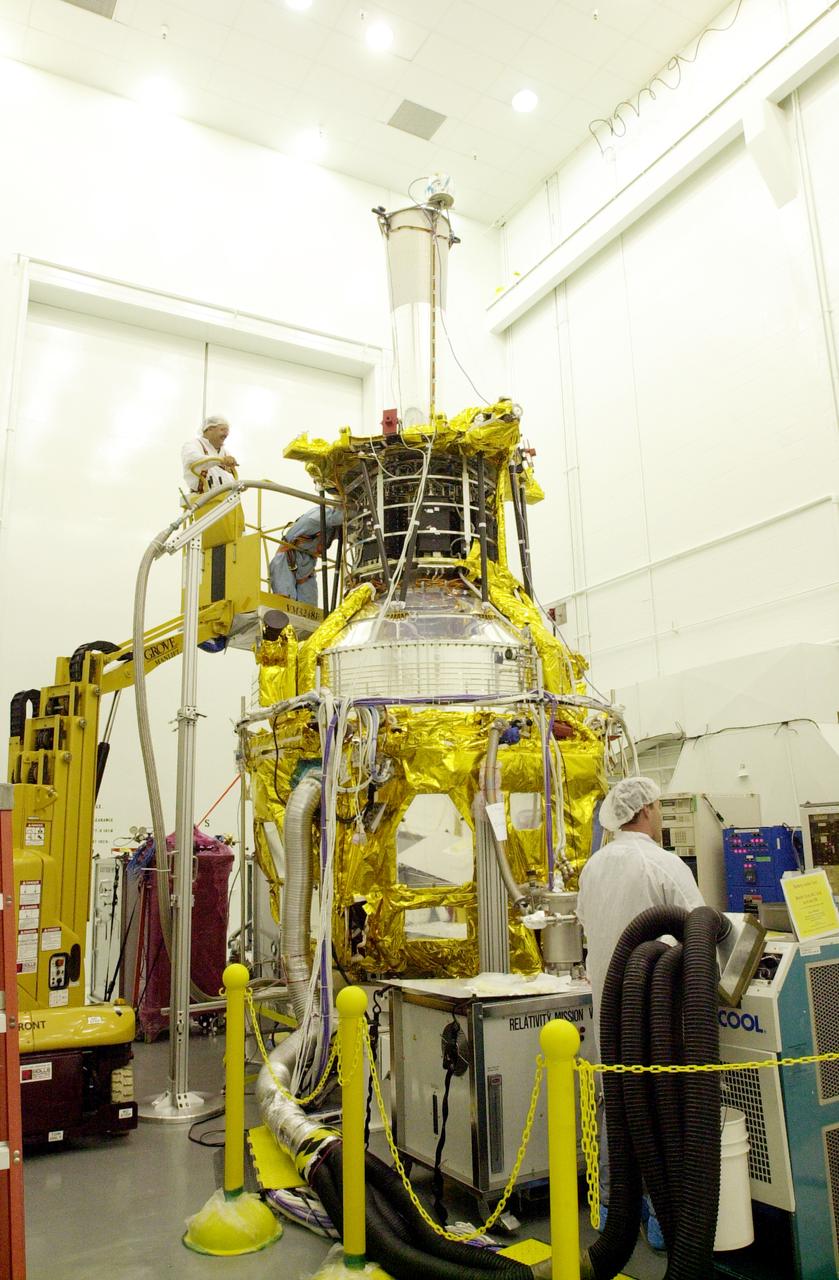
Aboard the International Space Station (ISS), the Tissue Culture Medium (TCM) is the bioreactor vessel in which cell cultures are grown.  With its two syringe ports, it is much like a bag used to administer intravenous fluid, except it allows gas exchange needed for life.  The TCM contains cell culture medium, and when frozen cells are flown to the ISS, they are thawed and introduced to the TCM through the syringe ports.  In the Cellular Biotechnology Operations Support System-Fluid Dynamics Investigation (CBOSS-FDI) experiment, several mixing procedures are being assessed to determine which method achieves the most uniform mixing of growing cells and culture medium.
Biotechnology
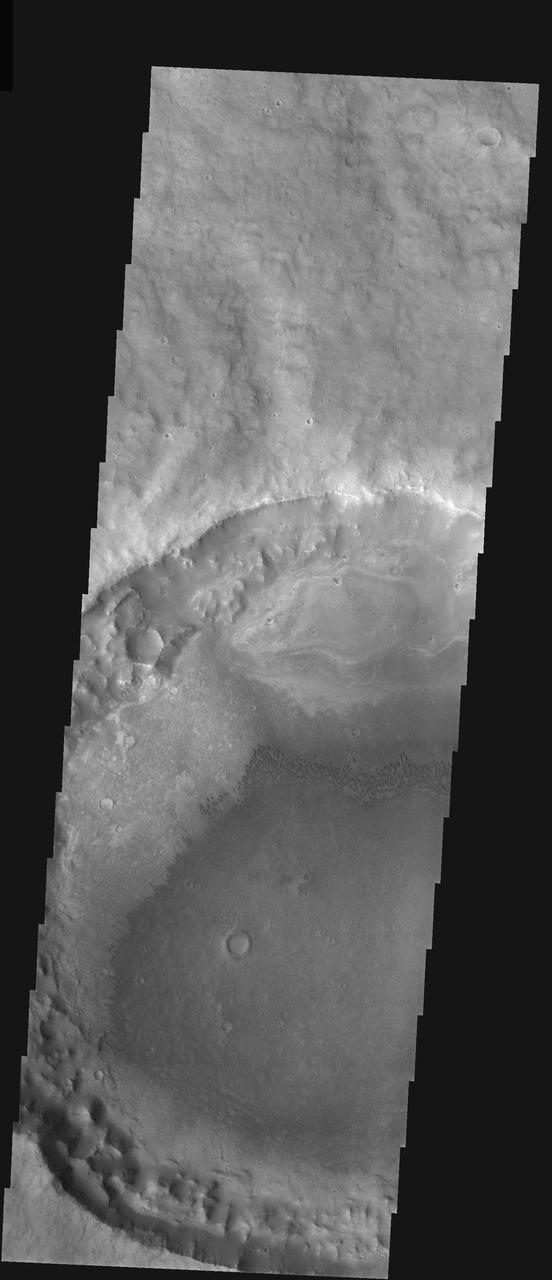
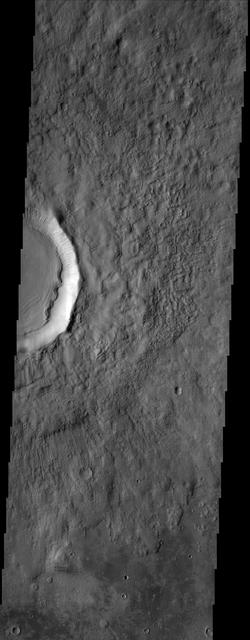
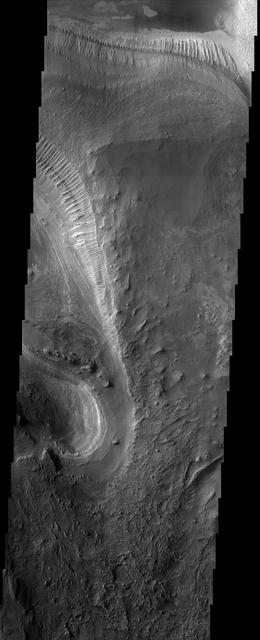
Crater in Syrtis Major
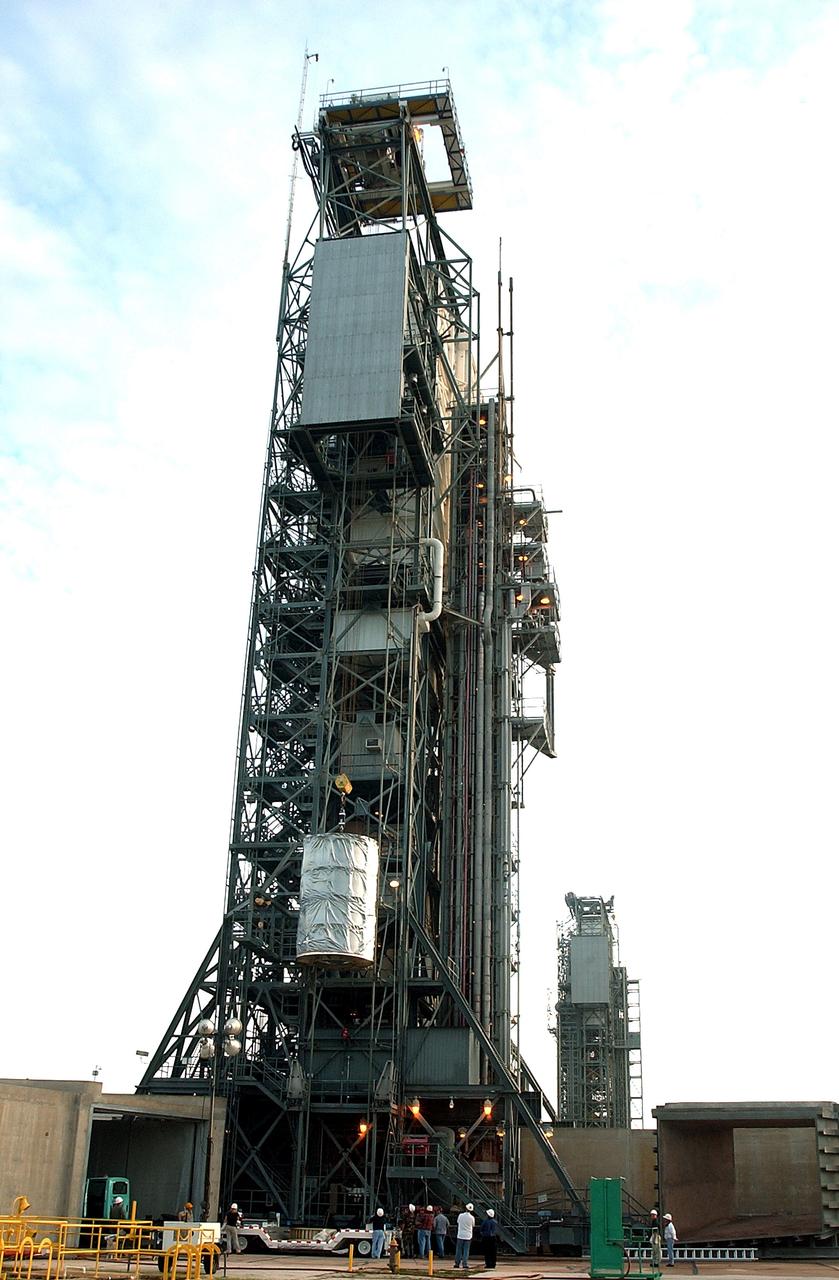
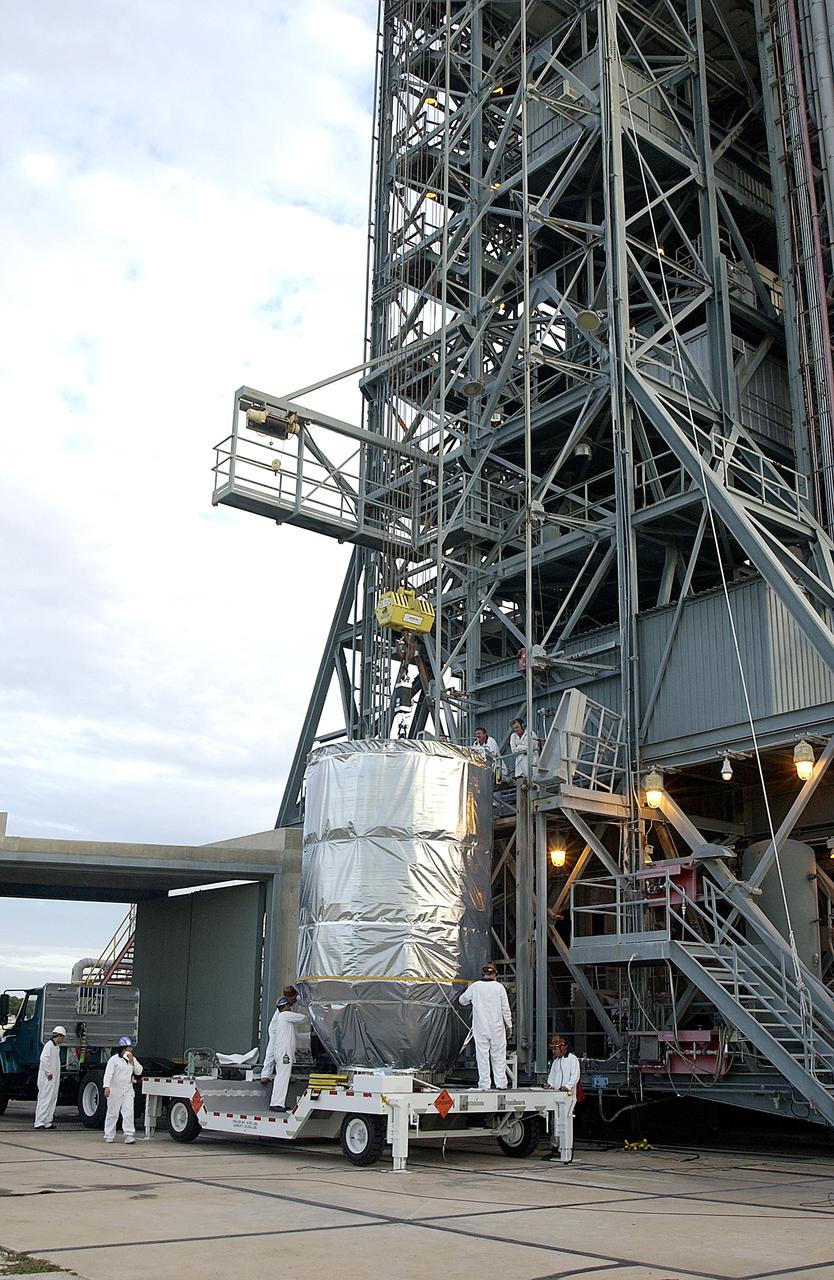
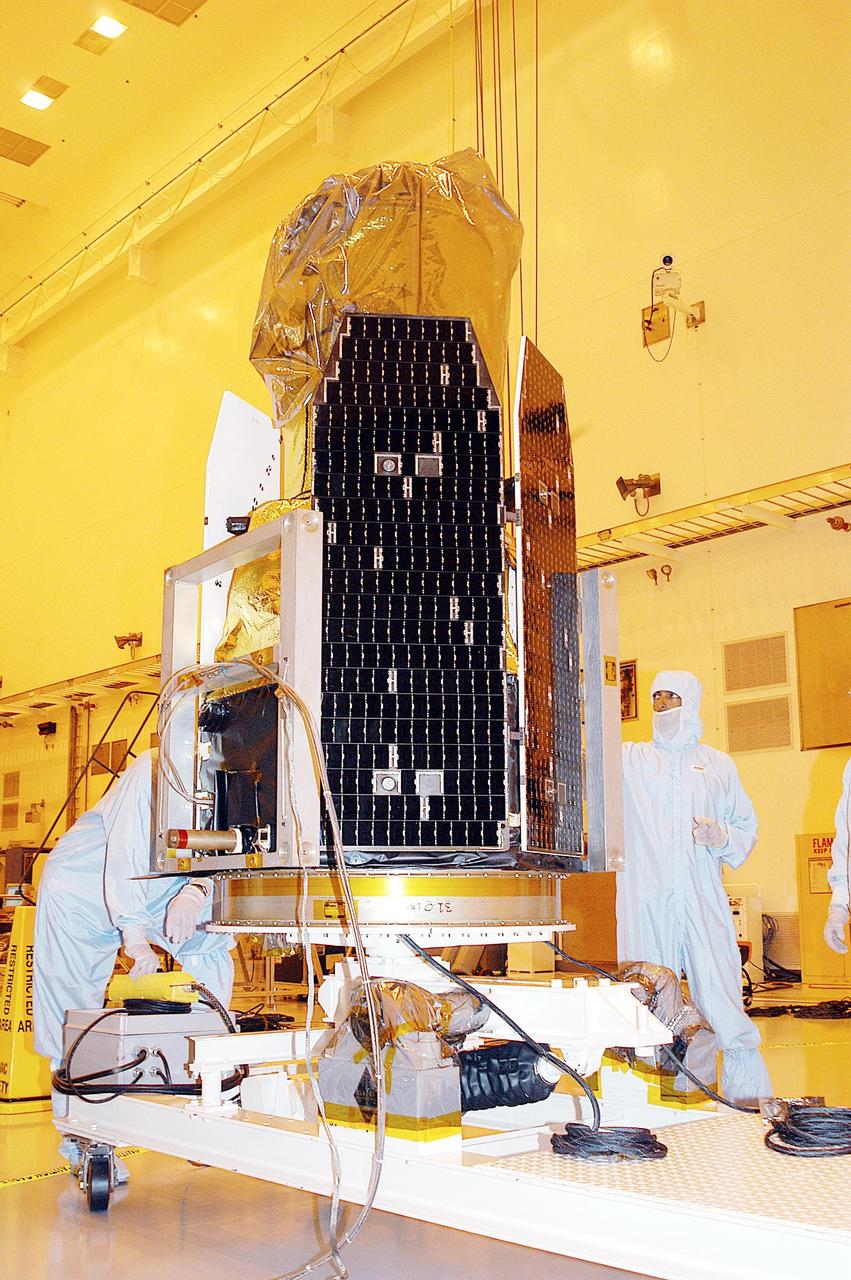
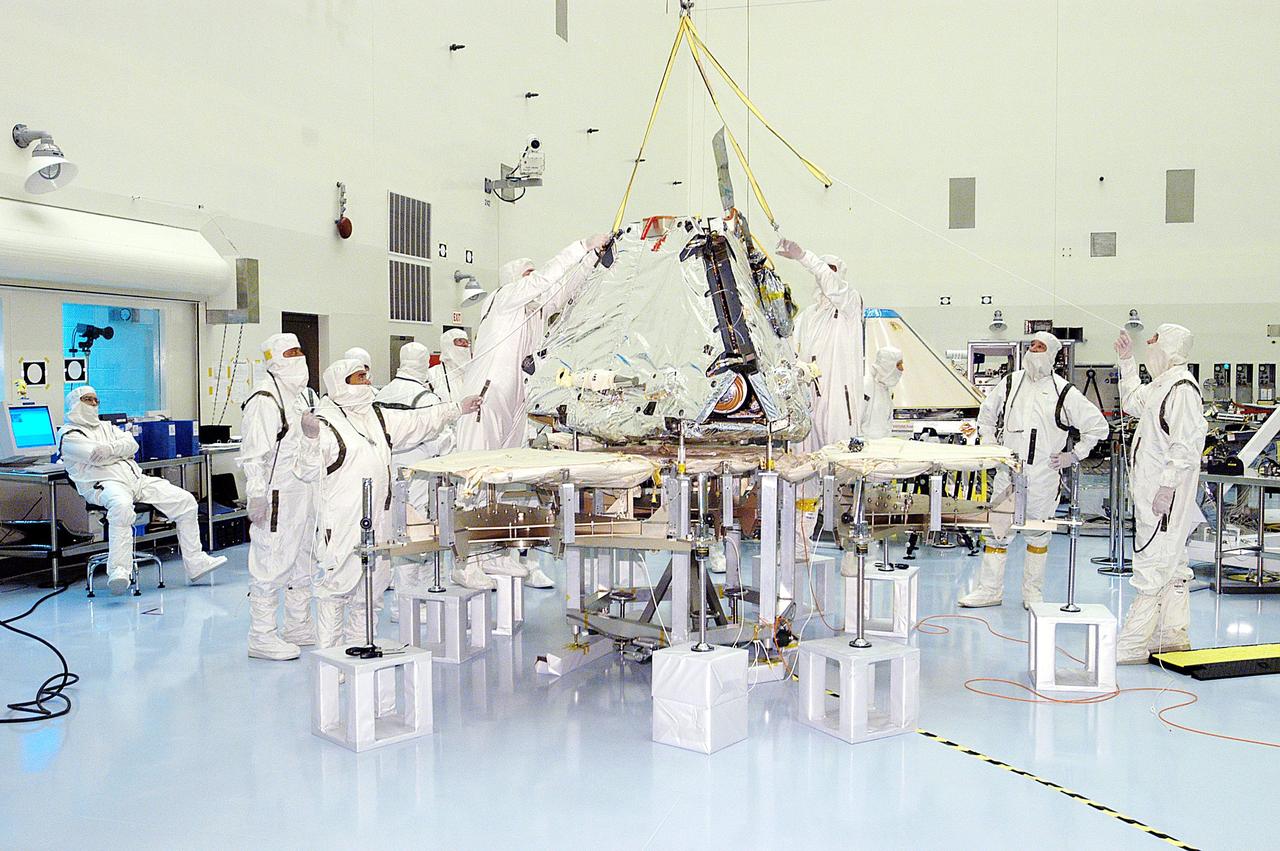
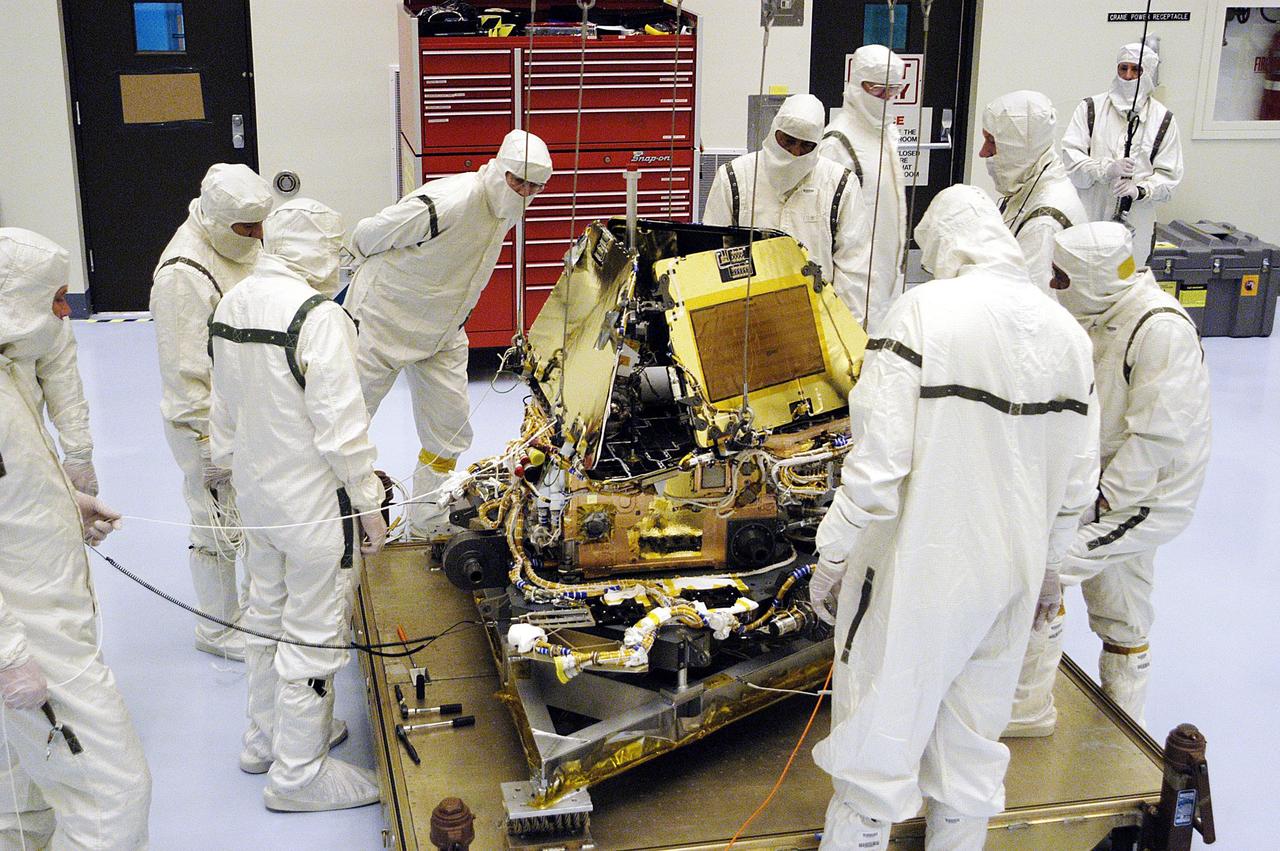
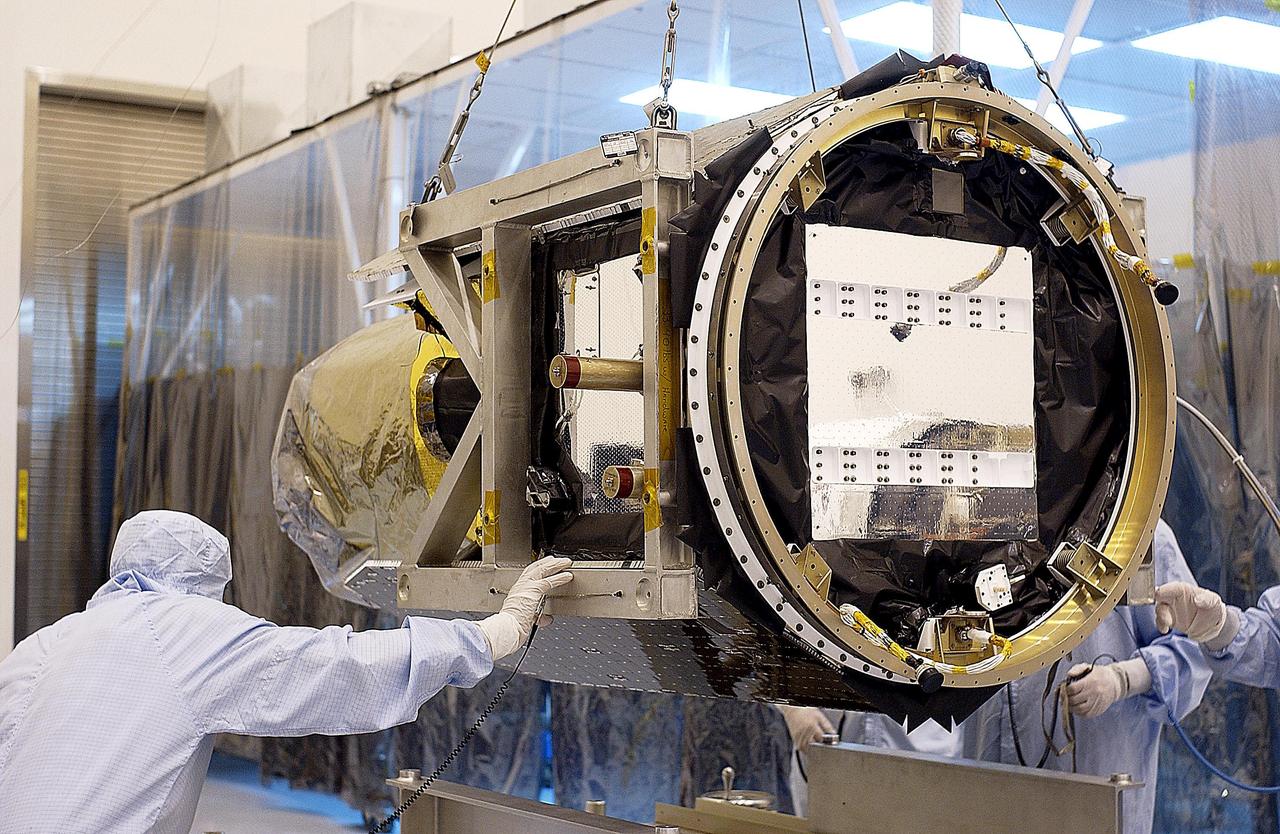
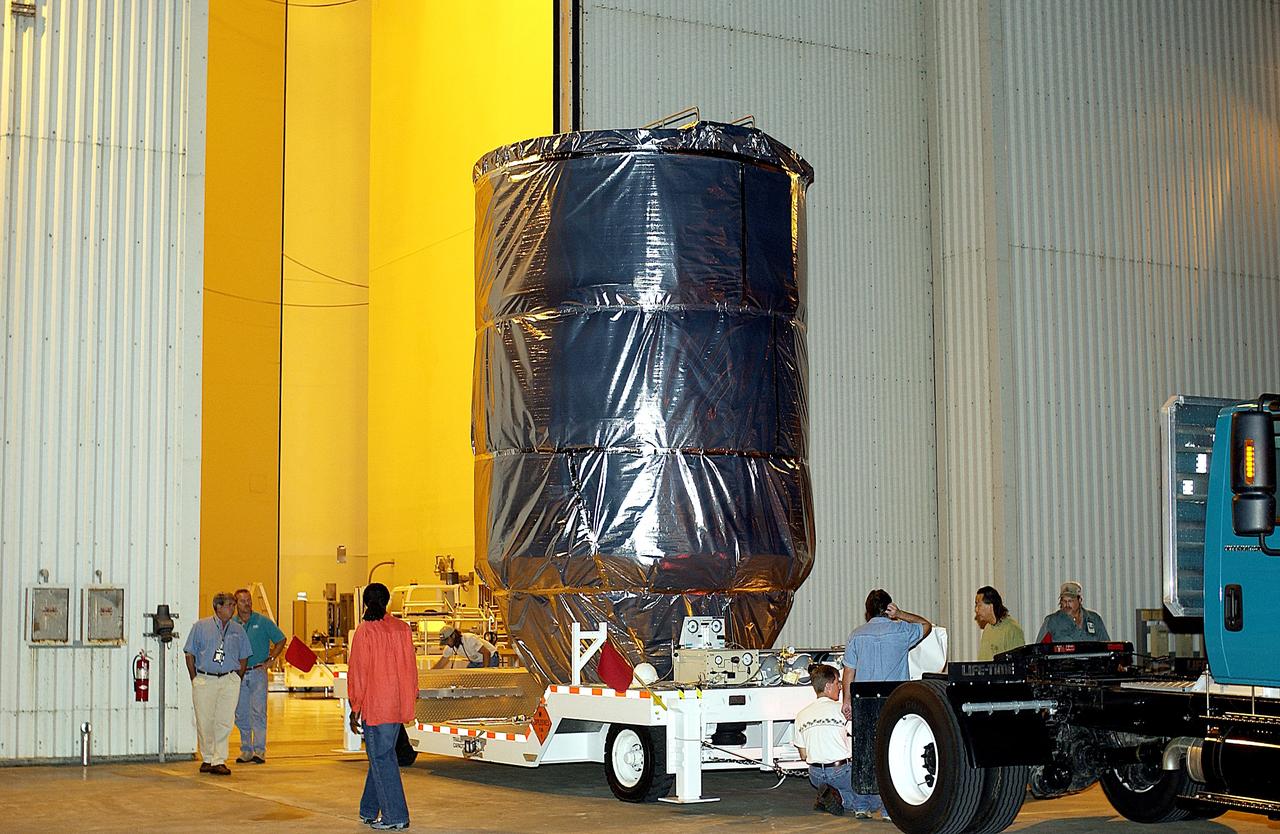
KENNEDY SPACE CENTER, FLA. -  In the Payload Hazardous Servicing Facility, an overhead crane is lifting the Mars Exploration Rover 2 (MER-2) to move it to a spin table.  NASA’s twin Mars Exploration Rovers are designed to study the history of water on Mars. These robotic geologists are equipped with a robotic arm, a drilling tool, three spectrometers, and four pairs of cameras that allow them to have a human-like, 3D view of the terrain. Each rover could travel as far as 100 meters in one day to act as Mars scientists' eyes and hands, exploring an environment where humans can’t yet go.  The MER-2 is scheduled to launch June 5 from Launch Pad 17-A, Cape Canaveral Air Force Station.
KENNEDY SPACE CENTER, FLA. - In the Payload Hazardous Servicing Facility, an overhead crane is lifting the Mars Exploration Rover 2 (MER-2) to move it to a spin table. NASA’s twin Mars Exploration Rovers are designed to study the history of water on Mars. These robotic geologists are equipped with a robotic arm, a drilling tool, three spectrometers, and four pairs of cameras that allow them to have a human-like, 3D view of the terrain. Each rover could travel as far as 100 meters in one day to act as Mars scientists' eyes and hands, exploring an environment where humans can’t yet go. The MER-2 is scheduled to launch June 5 from Launch Pad 17-A, Cape Canaveral Air Force Station.
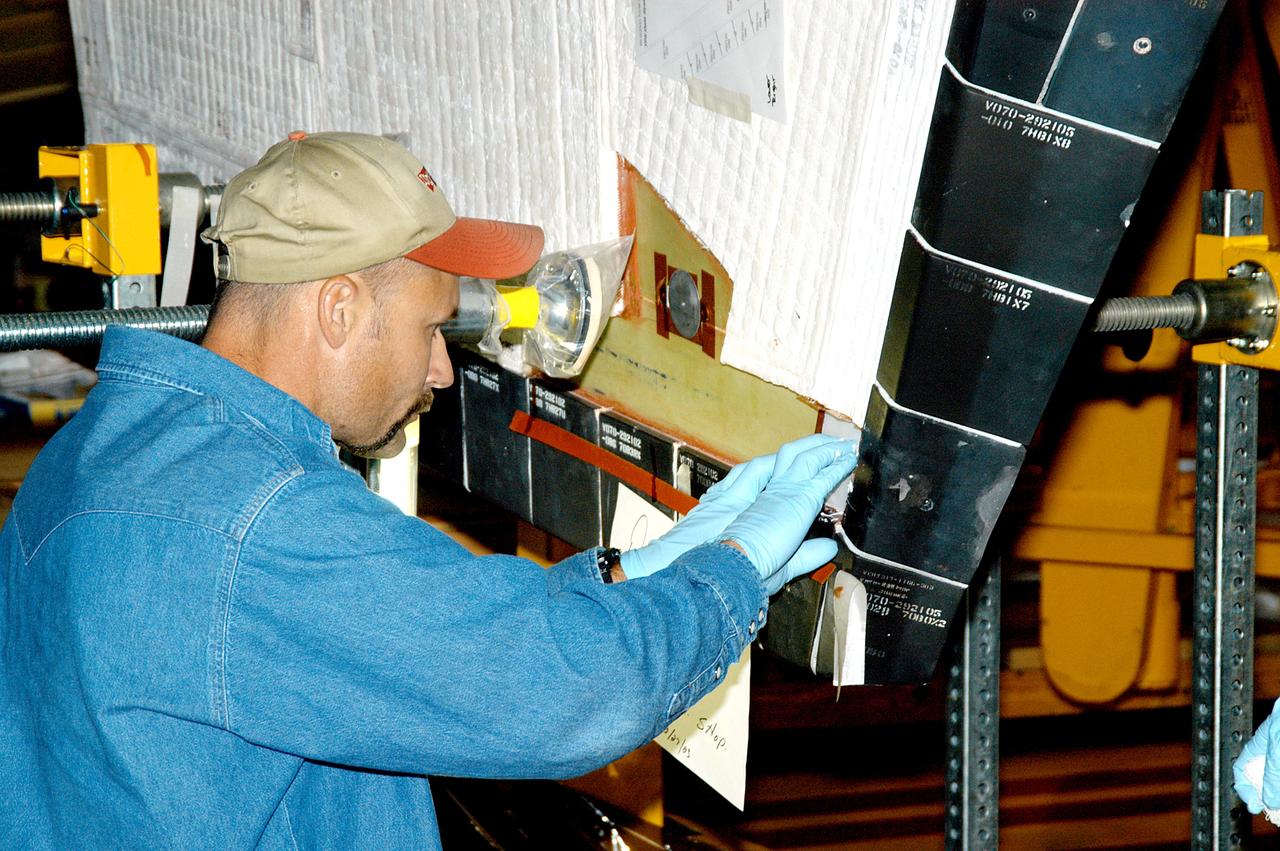
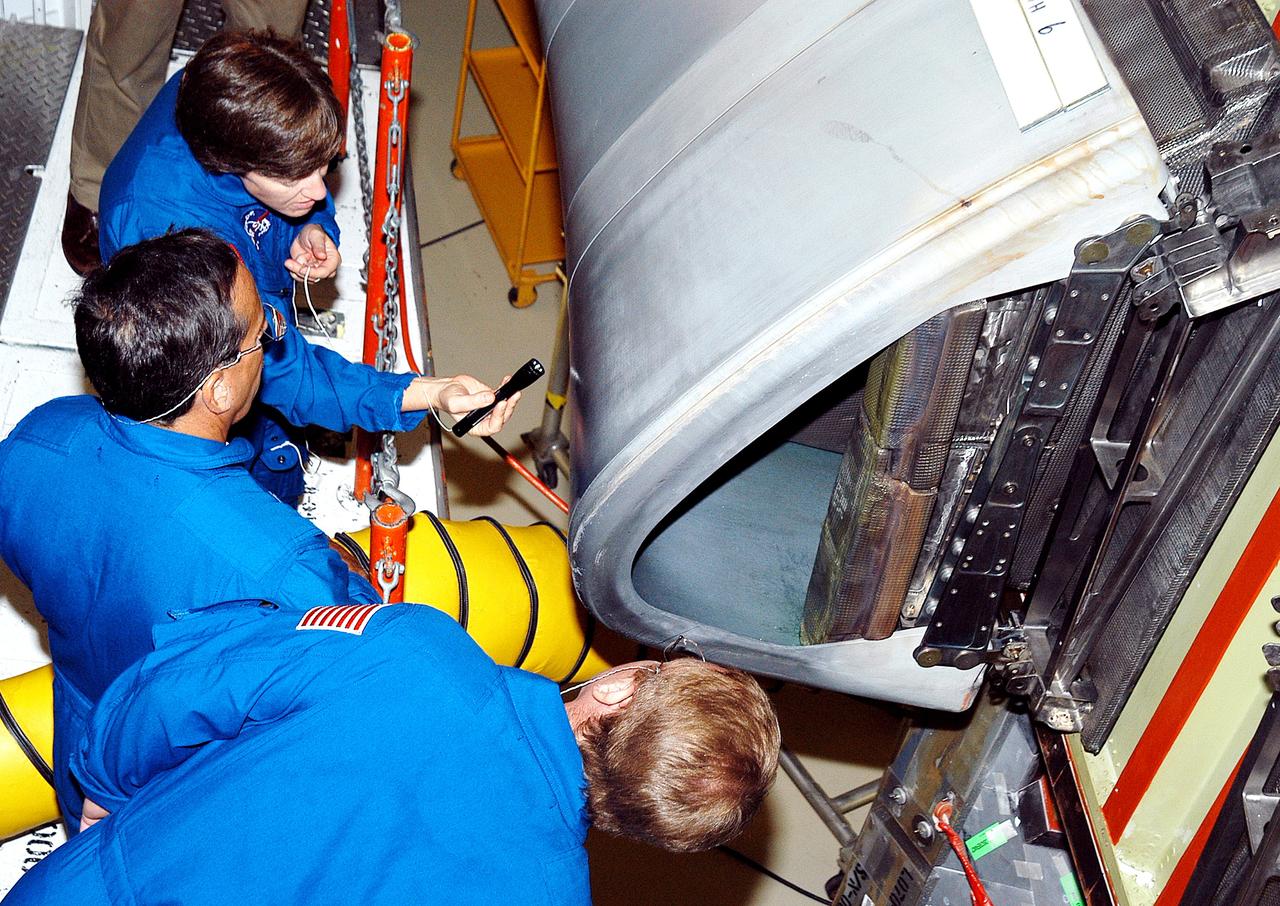
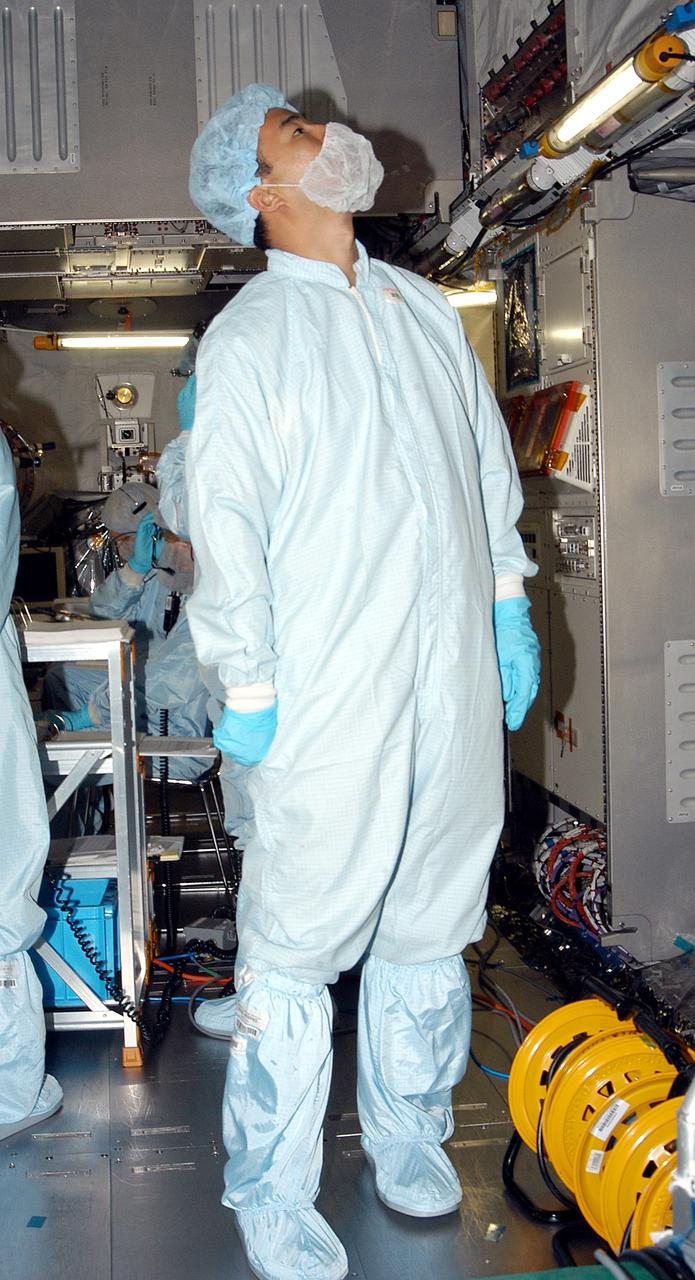
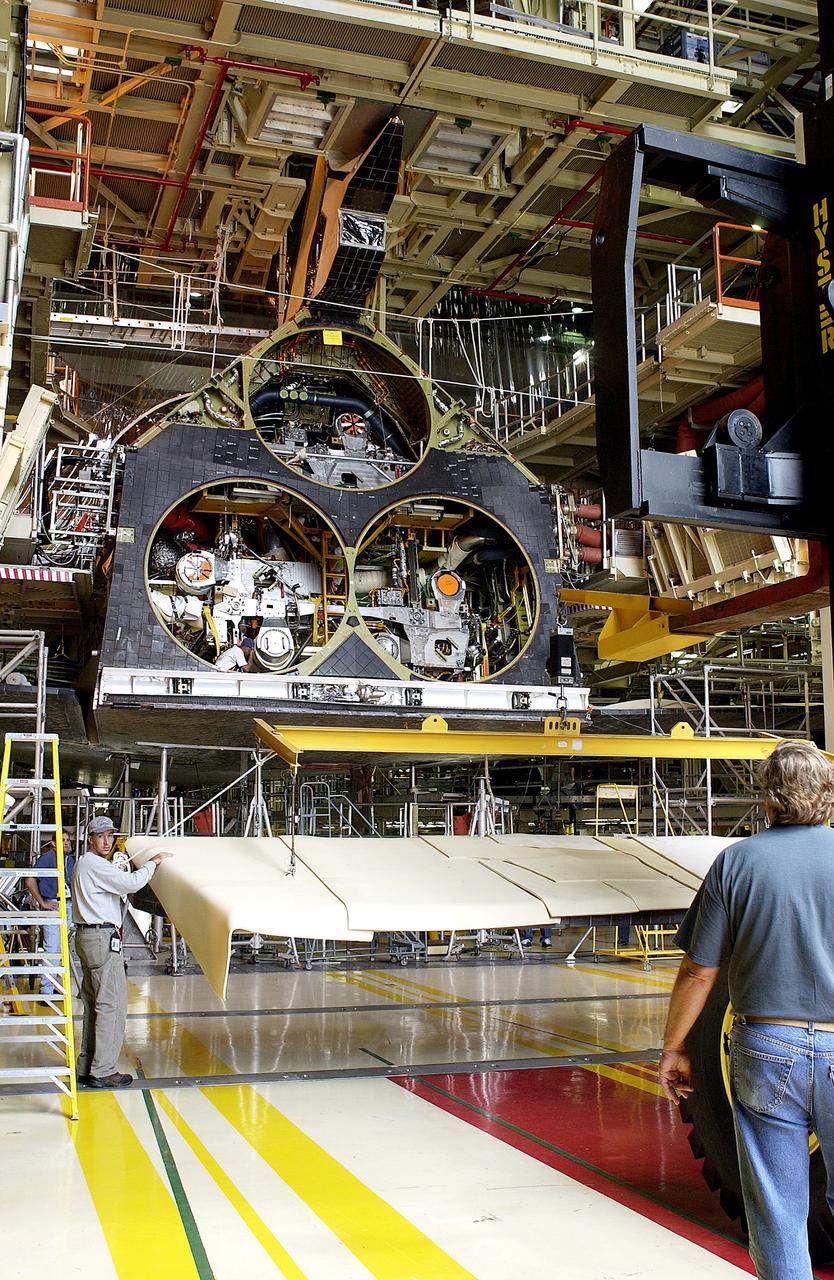
KENNEDY SPACE CENTER, FLA. -  William Gaetjens (background), with the Vehicle Integration Test Team (VITT) directs Japanese astronaut Koichi Wakata’s attention to the spars installed on the wing of the orbiter Atlantis.  Reinforced Carbon Carbon (RCC) panels are mechanically attached to the wing via the spars - a series of floating joints - to reduce loading on the panels caused by wing deflections. The aluminum and the metallic attachments are protected from exceeding temperature limits by internal insulation.
KENNEDY SPACE CENTER, FLA. - William Gaetjens (background), with the Vehicle Integration Test Team (VITT) directs Japanese astronaut Koichi Wakata’s attention to the spars installed on the wing of the orbiter Atlantis. Reinforced Carbon Carbon (RCC) panels are mechanically attached to the wing via the spars - a series of floating joints - to reduce loading on the panels caused by wing deflections. The aluminum and the metallic attachments are protected from exceeding temperature limits by internal insulation.
ISS008-S-001 (August 2003) --- This emblem represents the eighth long-duration expedition to the International Space Station. The banner encircling the Earth, as a stylized figure 8, combines the flags of the partner nations represented by the crew. The International Space Station is portrayed above the Earth in its assembly complete configuration. The names of the two crewmembers, Michael Foale and Alexander Kaleri, are depicted in the border.    The NASA insignia design for station space flights is reserved for use by the crewmembers and other official use as the NASA Administrator may authorize. Public availability has been approved only in the form of illustrations by the various news media. When and if there is any change in this policy, which is not anticipated, such will be publicly announced.
Expedition 8 patch
KENNEDY SPACE CENTER, FLA. - During their tour of KSC, members of the North American Treaty Organization (NATO) Parliamentary Assembly visit the Convoy Command Center, the prime vehicle to control critical communications between the orbiter, the crew and the Launch Control Center after a Shuttle landing, to monitor the health of the Shuttle Orbiter systems and to direct convoy operations at the Shuttle Landing Facility. The Parliamentarians are meeting in Orlando this year for their 49th annual gathering.  They chose to visit KSC with their families during their one-day excursion break from meetings.
KENNEDY SPACE CENTER, FLA. - During their tour of KSC, members of the North American Treaty Organization (NATO) Parliamentary Assembly visit the Convoy Command Center, the prime vehicle to control critical communications between the orbiter, the crew and the Launch Control Center after a Shuttle landing, to monitor the health of the Shuttle Orbiter systems and to direct convoy operations at the Shuttle Landing Facility. The Parliamentarians are meeting in Orlando this year for their 49th annual gathering. They chose to visit KSC with their families during their one-day excursion break from meetings.
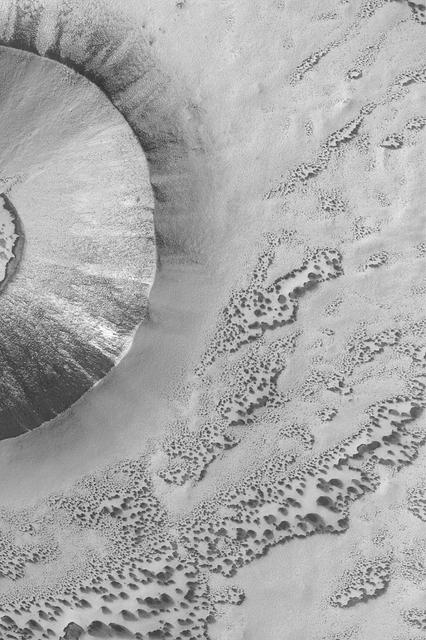
Pedestal Crater and Yardangs
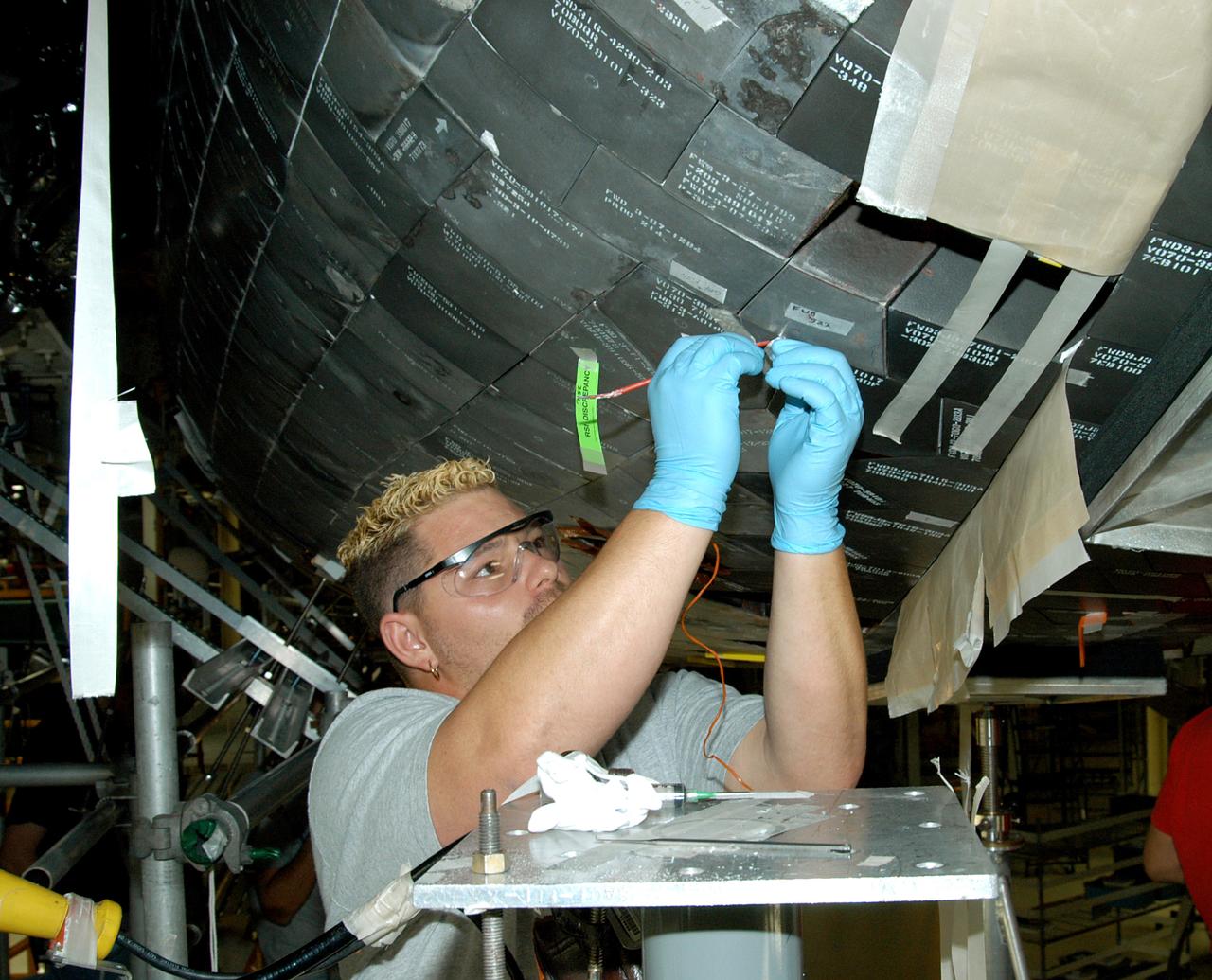
KENNEDY SPACE CENTER, FLA. -- In the Orbiter Processing Facility, United Space Alliance employee Dave Sanborn installs Thermal Protection System tiles on a main landing gear door of Space Shuttle orbiter Enterprise (OV-101).  Sections of Enterprise were borrowed from the Smithsonian Institution's Air and Space Museum where the orbiter is being stored at the Washington Dulles International Airport.  Enterprise was the first orbiter built in the Shuttle fleet and was used to conduct the Approach and Landing Test Program before the first powered Shuttle flight.  After the tile installation is complete, the sections will be transferred to the Southwest Research Institute for testing requested by the Columbia Accident Investigation Board.
KSC-03pd1081
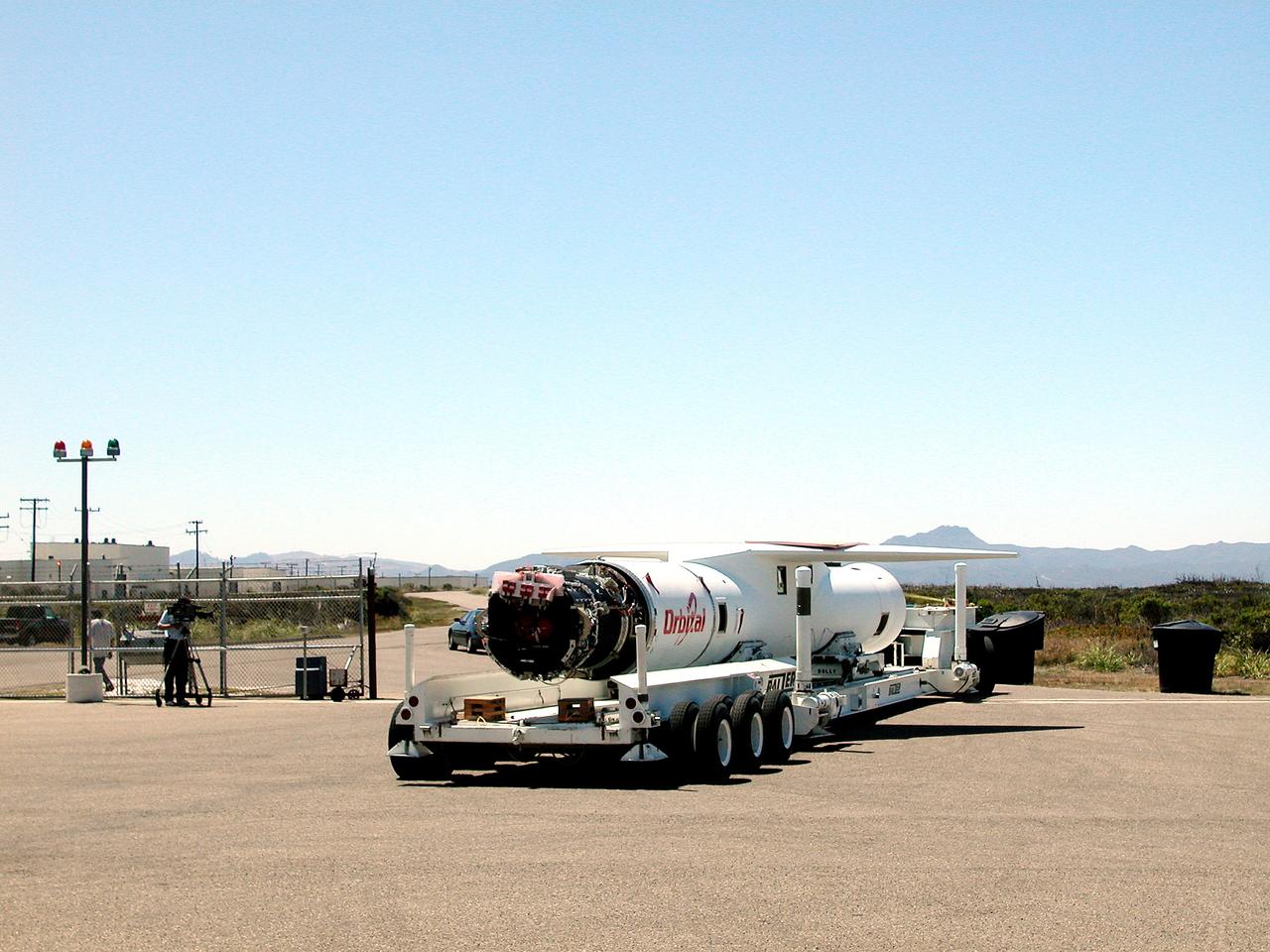
April 24, 2003, Baikonur Cosmodrome, Kazakhstan.  The Soyuz rocket is rolled out of the assembly building and travels via rail to the launch pad.  Expedition Seven is scheduled to launch onboard the Soyuz this Saturday April 26, 2003.  Photo Credit: "NASA/Scott Andrews"
03pd1271
KENNEDY SPACE CENTER, FLA. -  A soft-shell turtle with only three legs is seen crossing the tow-way at KSC.  The turtle is one of 65 amphibians and reptiles found in the Merritt Island National Wildlife Refuge, which surrounds KSC.  The Wildlife Refuge encompasses 92,000 acres that are also a habitat for more than 331 species of birds, 31 mammals and 117 fishes.  The marshes and open water of the refuge provide wintering areas for 23 species of migratory waterfowl, as well as a year-round home for great blue herons, great egrets, wood storks, cormorants, brown pelicans and other species of marsh and shore birds, plus a variety of insects.
KENNEDY SPACE CENTER, FLA. - A soft-shell turtle with only three legs is seen crossing the tow-way at KSC. The turtle is one of 65 amphibians and reptiles found in the Merritt Island National Wildlife Refuge, which surrounds KSC. The Wildlife Refuge encompasses 92,000 acres that are also a habitat for more than 331 species of birds, 31 mammals and 117 fishes. The marshes and open water of the refuge provide wintering areas for 23 species of migratory waterfowl, as well as a year-round home for great blue herons, great egrets, wood storks, cormorants, brown pelicans and other species of marsh and shore birds, plus a variety of insects.
NASA Rover 1 sits atop the deployed lander with its solar arrays and wheels stowed.
Rover 1 in Cruise Stage
KENNEDY SPACE CENTER, FLA. -  The crawler transporter slowly moves the Mobile Launcher Platform (MLP), carrying a set of twin solid rocket boosters, away from the Vehicle Assembly Building (VAB) in support of engineering analysis vibration tests on the crawler and MLP.   In the distance, at left, is Launch Pad 39A.  The water on the right of the crawlerway is the Banana River.  The crawler is moving at various speeds up to 1 mph in an effort to achieve vibration data gathering goals as it leaves the VAB and then returns.  The boosters are braced at the top for stability.  The primary purpose of these rollout tests is to gather data to develop future maintenance requirements on the transport equipment and the flight hardware. Various parts of the MLP and crawler transporter have been instrumented with vibration data collection equipment.
KENNEDY SPACE CENTER, FLA. - The crawler transporter slowly moves the Mobile Launcher Platform (MLP), carrying a set of twin solid rocket boosters, away from the Vehicle Assembly Building (VAB) in support of engineering analysis vibration tests on the crawler and MLP. In the distance, at left, is Launch Pad 39A. The water on the right of the crawlerway is the Banana River. The crawler is moving at various speeds up to 1 mph in an effort to achieve vibration data gathering goals as it leaves the VAB and then returns. The boosters are braced at the top for stability. The primary purpose of these rollout tests is to gather data to develop future maintenance requirements on the transport equipment and the flight hardware. Various parts of the MLP and crawler transporter have been instrumented with vibration data collection equipment.
NASA’s Virtual Glovebox (VGX) was developed to allow astronauts on Earth to train for complex biology research tasks in space.  The astronauts may reach into the virtual environment, naturally manipulating specimens, tools, equipment, and accessories in a simulated microgravity environment as they would do in space.  Such virtual reality technology also provides engineers and space operations staff with rapid prototyping, planning, and human performance modeling capabilities.  Other Earth based applications being explored for this technology include biomedical procedural training and training for disarming bio-terrorism weapons.
Space Science
KENNEDY SPACE CENTER, FLA.  - On a tour of the Orbiter Processing Facility, members of the Stafford-Covey Return to Flight Task Group (RTFTG) look at a Reinforced Carbon-Carbon panels with a T-seal held by Tom Roberts, with United Space Alliance.  From left are Richard O. Covey, former Space Shuttle commander, Dr. Kathryn Clark, James Adamson, Joe Engle, William Wegner and Dr. Amy Donahue.  Chairing the task group are Covey and Thomas P. Stafford, Apollo commander.  Chartered by NASA Administrator Sean O’Keefe, the task group will perform an independent assessment of NASA’s implementation of the final recommendations by the Columbia Accident Investigation Board.
KENNEDY SPACE CENTER, FLA. - On a tour of the Orbiter Processing Facility, members of the Stafford-Covey Return to Flight Task Group (RTFTG) look at a Reinforced Carbon-Carbon panels with a T-seal held by Tom Roberts, with United Space Alliance. From left are Richard O. Covey, former Space Shuttle commander, Dr. Kathryn Clark, James Adamson, Joe Engle, William Wegner and Dr. Amy Donahue. Chairing the task group are Covey and Thomas P. Stafford, Apollo commander. Chartered by NASA Administrator Sean O’Keefe, the task group will perform an independent assessment of NASA’s implementation of the final recommendations by the Columbia Accident Investigation Board.
KENNEDY SPACE CENTER, FLA. - Workers in the Payload Hazardous Servicing Facility guide the backshell being lowered over the Mars Exploration Rover 1 (MER-1).  The backshell is a protective cover for the rover.  NASA's twin Mars Exploration Rovers are designed to study the history of water on Mars. These robotic geologists are equipped with a robotic arm, a drilling tool, three spectrometers, and four pairs of cameras that allow them to have a human-like, 3D view of the terrain. Each rover could travel as far as 100 meters in one day to act as Mars scientists' eyes and hands, exploring an environment where humans can't yet go.  MER-1 is scheduled to launch June 25 as MER-B aboard a Delta II rocket from Cape Canaveral Air Force Station.
KENNEDY SPACE CENTER, FLA. - Workers in the Payload Hazardous Servicing Facility guide the backshell being lowered over the Mars Exploration Rover 1 (MER-1). The backshell is a protective cover for the rover. NASA's twin Mars Exploration Rovers are designed to study the history of water on Mars. These robotic geologists are equipped with a robotic arm, a drilling tool, three spectrometers, and four pairs of cameras that allow them to have a human-like, 3D view of the terrain. Each rover could travel as far as 100 meters in one day to act as Mars scientists' eyes and hands, exploring an environment where humans can't yet go. MER-1 is scheduled to launch June 25 as MER-B aboard a Delta II rocket from Cape Canaveral Air Force Station.
KENNEDY SPACE CENTER, FLA. -  With the Vehicle Assembly Building looming in the background, a Columbia Crew Memorial Service is held at the Shuttle Landing Facility for KSC employees and invited guests.  The Columbia and her crew of seven were lost on Feb. 1, 2003, over East Texas as they returned to Earth after a 16-day research mission.  Taking part in the service were NASA Administrator Sean O’Keefe, former KSC Director Robert Crippen, astronaut Jim Halsell, several employees, area clergymen, and members of Patrick Air Force Base.  The service concluded with a “Missing Man Formation Fly Over” by NASA T-38 jet aircraft.
KSC-03pd0310
KENNEDY SPACE CENTER, FLA. -   On Launch Pad 17-B, Cape Canaveral Air Force Station, the Mars Exploration Rover 1 (MER-B) arrives at the tower landing where it will be mated with the Delta rocket.  The second of twin rovers being sent to Mars, it is equipped with a robotic arm, a drilling tool, three spectrometers, and four pairs of cameras that allow it to have a human-like, 3D view of the terrain. Each rover could travel as far as 100 meters in one day to act as Mars scientists' eyes and hands, exploring an environment where humans can't yet go.  MER-B is scheduled to launch June 26 at one of two available times,  12:27:31 a.m. EDT or 1:08:45 a.m. EDT.
KENNEDY SPACE CENTER, FLA. - On Launch Pad 17-B, Cape Canaveral Air Force Station, the Mars Exploration Rover 1 (MER-B) arrives at the tower landing where it will be mated with the Delta rocket. The second of twin rovers being sent to Mars, it is equipped with a robotic arm, a drilling tool, three spectrometers, and four pairs of cameras that allow it to have a human-like, 3D view of the terrain. Each rover could travel as far as 100 meters in one day to act as Mars scientists' eyes and hands, exploring an environment where humans can't yet go. MER-B is scheduled to launch June 26 at one of two available times, 12:27:31 a.m. EDT or 1:08:45 a.m. EDT.
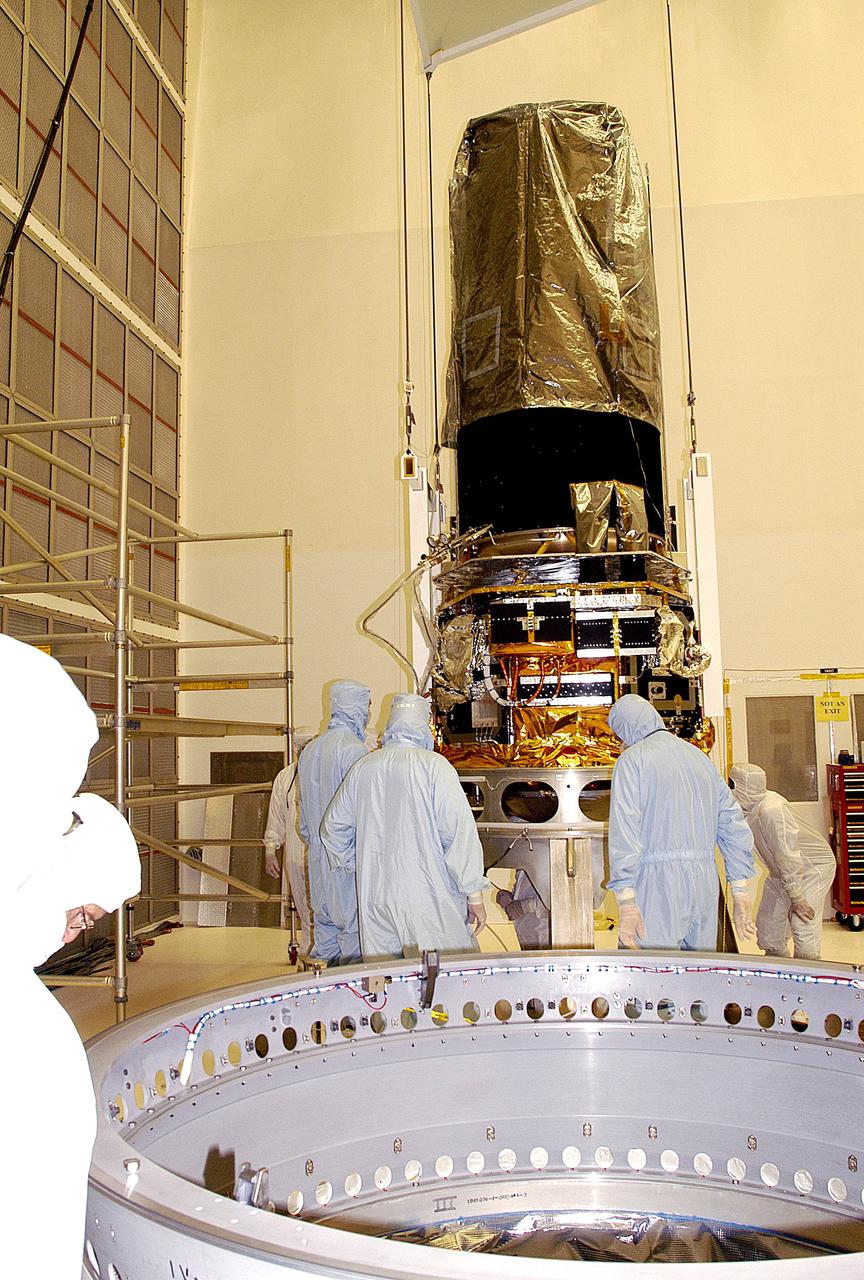
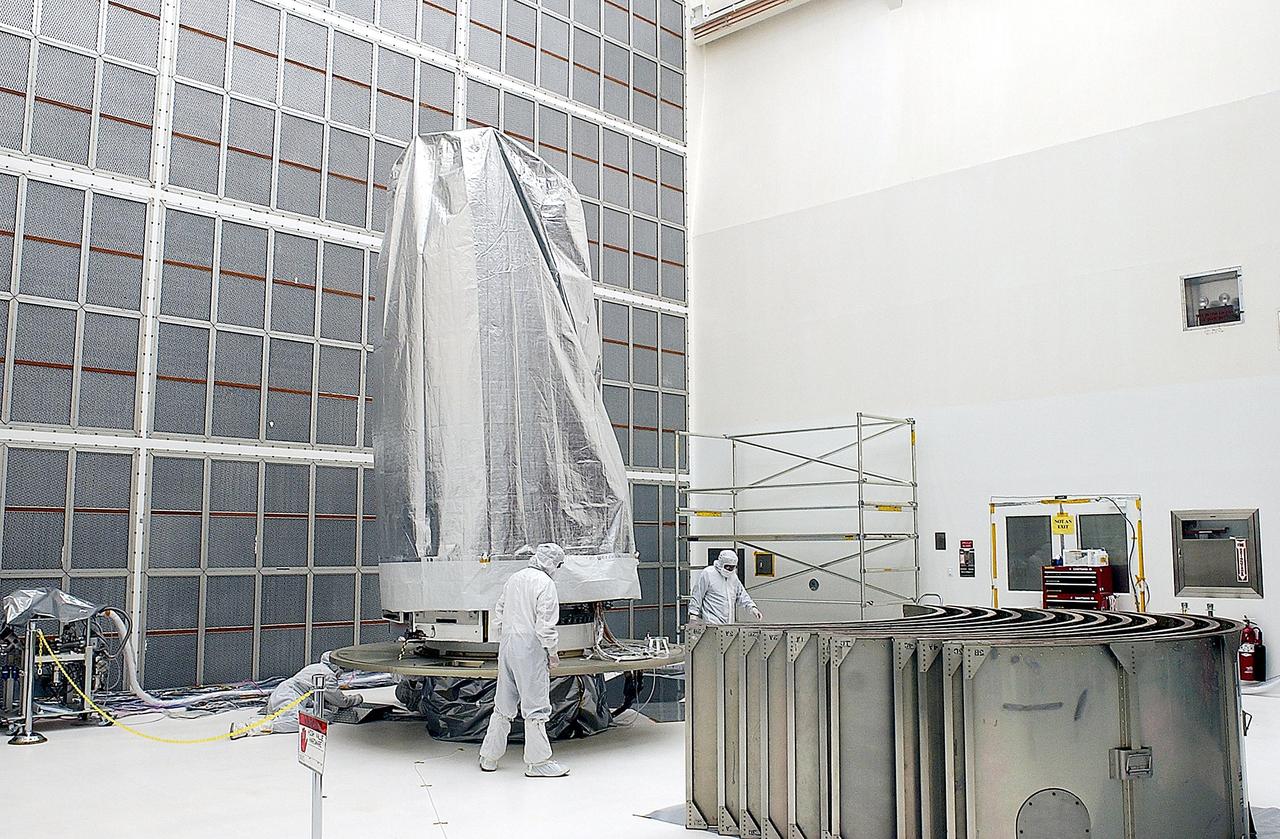
KENNEDY SPACE CENTER, FLA. -  Workers in NASA Spacecraft Hangar AE remove the protective cover from around the Space Infrared Telescope Facility (SIRTF), which has been returned to the hangar from the launch pad.   SIRTF will remain in the clean room until it returns to the pad in early August. One of NASA's largest infrared telescopes to be launched, SIRTF will obtain images and spectra by detecting the infrared energy, or heat, radiated by objects in space.
KENNEDY SPACE CENTER, FLA. - Workers in NASA Spacecraft Hangar AE remove the protective cover from around the Space Infrared Telescope Facility (SIRTF), which has been returned to the hangar from the launch pad. SIRTF will remain in the clean room until it returns to the pad in early August. One of NASA's largest infrared telescopes to be launched, SIRTF will obtain images and spectra by detecting the infrared energy, or heat, radiated by objects in space.
KENNEDY SPACE CENTER, FLA. - Large pieces of Columbia debris are stacked along a wall in the RLV Hangar at KSC.  The final shipment of debris arrived on this date - recovery efforts have been concluded in East Texas.  Prior to this final shipment, the total number of items at KSC is 82,567, weighing 84,800 pounds or 38 percent of the total dry weight of Columbia.  Of those items, 78,760 have been identified, with 753 placed on the left wing grid in the RLV Hangar.
KSC-03pd1419
KENNEDY SPACE CENTER, FLA. -  In the Orbiter Processing Facility, KSC employee Nadine Phillips prepares an area on the orbiter Discovery for blanket installation.  The blankets are part of the Orbiter Thermal Protection System, thermal shields to protect against temperatures as high as 3,000° Fahrenheit, which are produced during descent for landing. Discovery is scheduled to fly on mission STS-121 to the International Space Station.
KENNEDY SPACE CENTER, FLA. - In the Orbiter Processing Facility, KSC employee Nadine Phillips prepares an area on the orbiter Discovery for blanket installation. The blankets are part of the Orbiter Thermal Protection System, thermal shields to protect against temperatures as high as 3,000° Fahrenheit, which are produced during descent for landing. Discovery is scheduled to fly on mission STS-121 to the International Space Station.
KENNEDY SPACE CENTER, FLA. - Workers in the Payload Hazardous Servicing Facility help guide the Mars Exploration Rover (MER) aeroshell as it is lowered toward a rotation stand.  Set to launch in 2003, the MER Mission will consist of two identical rovers designed to cover roughly 110 yards (100 meters) each Martian day. Each rover will carry five scientific instruments that will allow it to search for evidence of liquid water that may have been present in the planet's past.  The rovers will be identical to each other, but will land at different regions of Mars.  The first rover has a launch window opening May 30, and the second rover a window opening June 25, 2003.
KSC-03pd0235
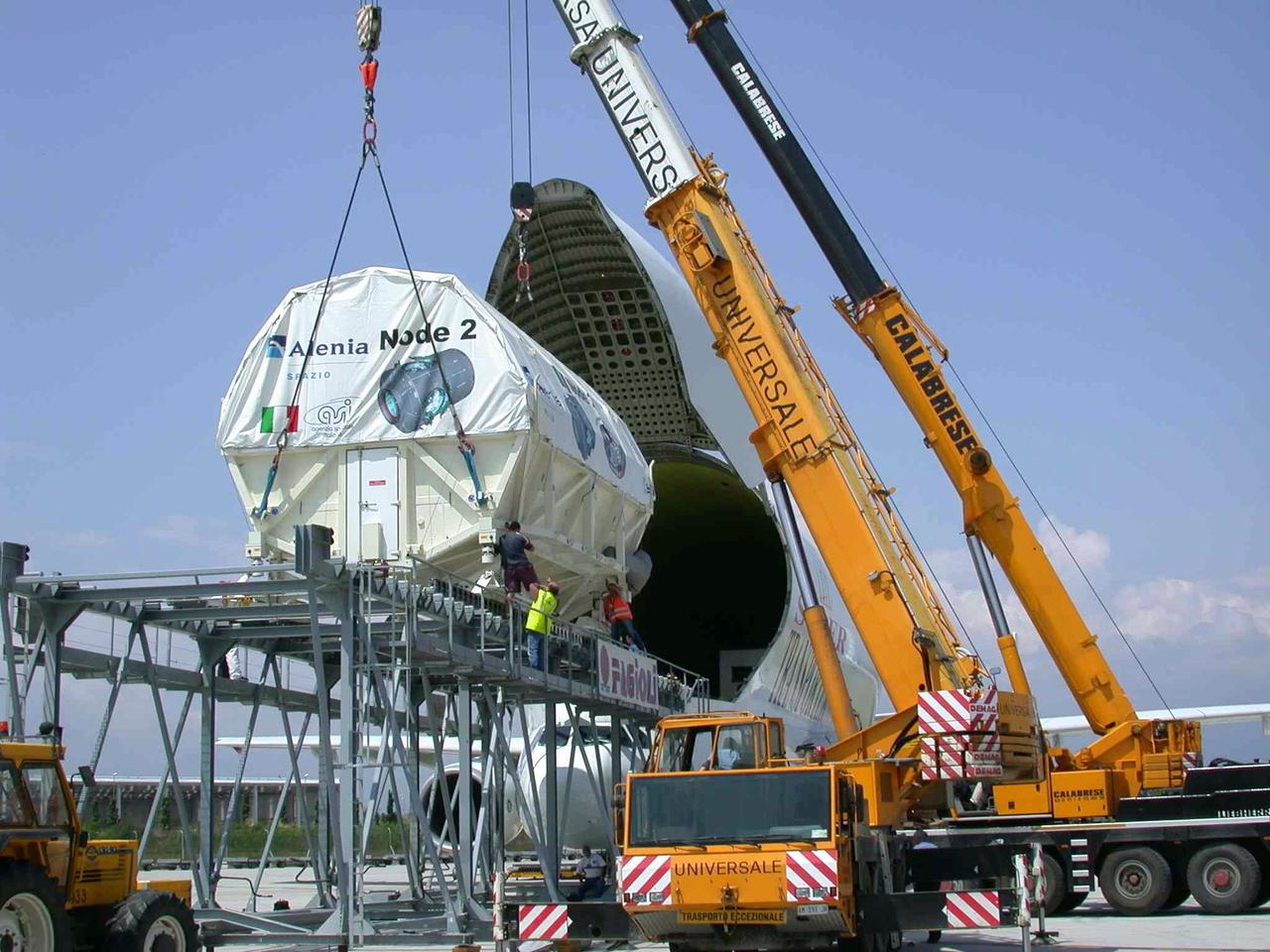
KENNEDY SPACE CENTER, FLA. -   STS-120 Mission Specialists Piers Sellers and Michael Foreman are in the Space Station Processing Facility for hardware familiarization.  The mission will deliver the second of three Station connecting modules, Node 2, which attaches to the end of U.S. Lab.  It will provide attach locations for the Japanese laboratory, European laboratory, the Centrifuge Accommodation Module and later Multi-Purpose Logistics Modules.  The addition of Node 2 will complete the U.S. core of the International Space Station.
KENNEDY SPACE CENTER, FLA. - STS-120 Mission Specialists Piers Sellers and Michael Foreman are in the Space Station Processing Facility for hardware familiarization. The mission will deliver the second of three Station connecting modules, Node 2, which attaches to the end of U.S. Lab. It will provide attach locations for the Japanese laboratory, European laboratory, the Centrifuge Accommodation Module and later Multi-Purpose Logistics Modules. The addition of Node 2 will complete the U.S. core of the International Space Station.
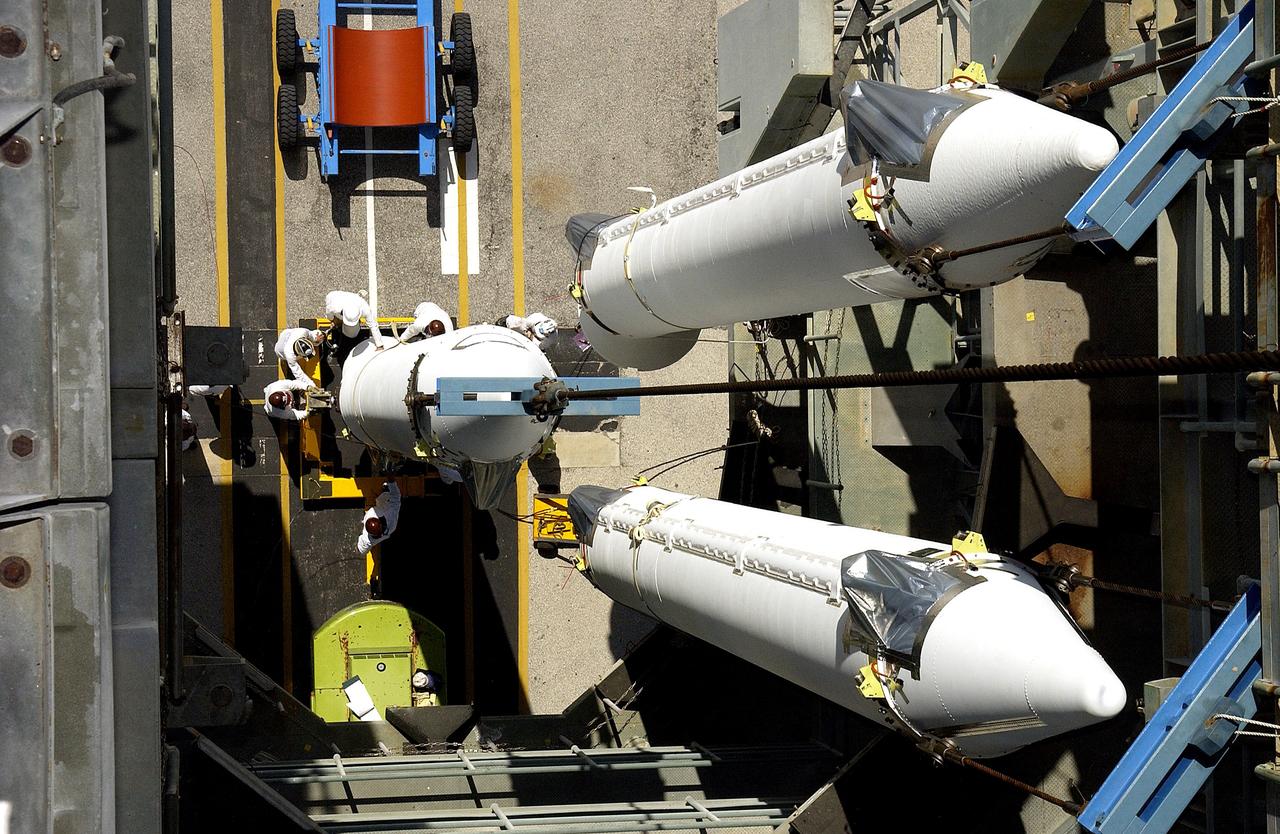
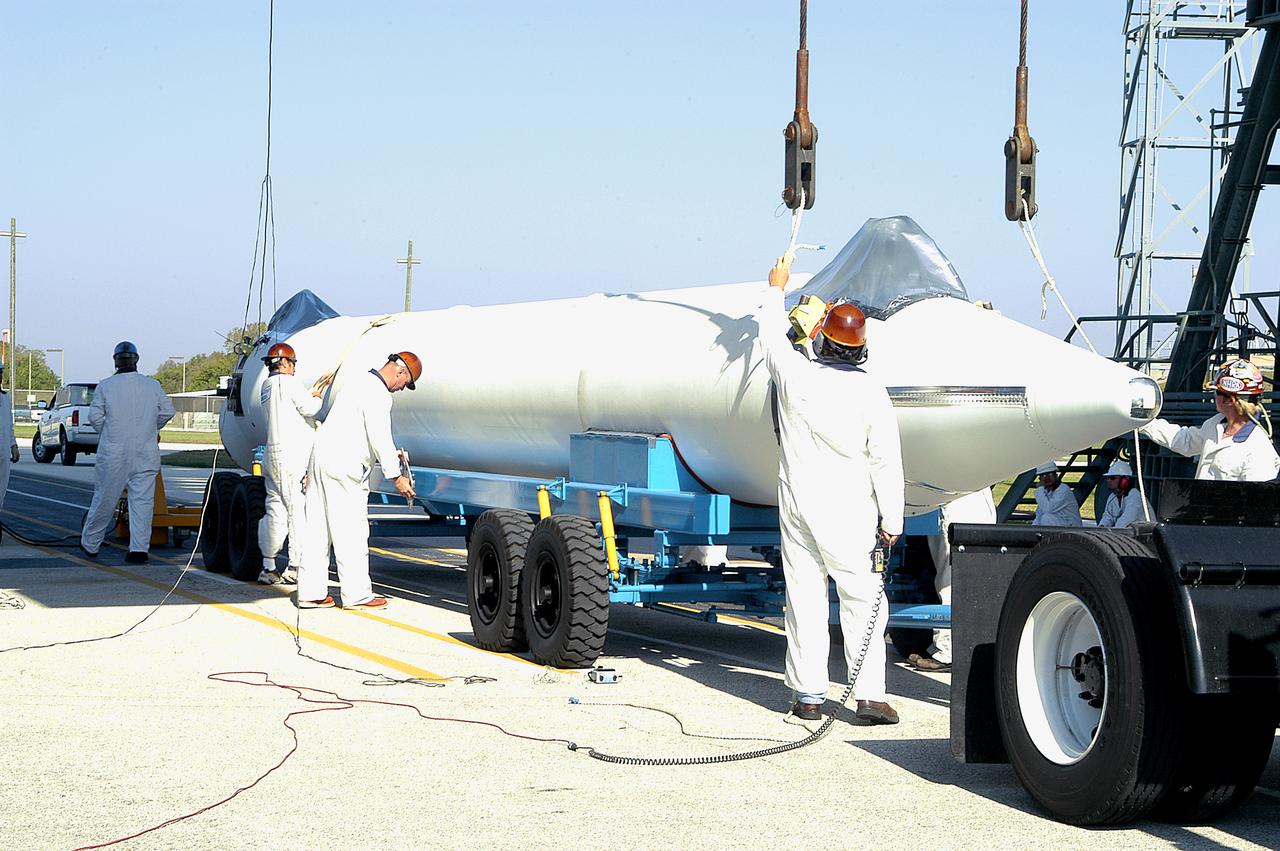
KENNEDY SPACE CENTER, FLA. -  Another solid rocket booster, in the foreground, is lifted off its transporter on Launch Complex 17-A, Cape Canaveral Air Force Station, for mating with the Delta II rocket in the background.  The SRB is one of nine that will help launch Mars Exploration Rover 2 (MER-2).  NASA’s twin Mars Exploration Rovers are designed to study the history of water on Mars. These robotic geologists are equipped with a robotic arm, a drilling tool, three spectrometers, and four pairs of cameras that allow them to have a human-like, 3D view of the terrain. Each rover could travel as far as 100 meters in one day to act as Mars scientists' eyes and hands, exploring an environment where humans can’t yet go.  MER-2 is scheduled to launch June 5 as MER-A.  MER-1 (MER-B) will launch June 25.
KENNEDY SPACE CENTER, FLA. - Another solid rocket booster, in the foreground, is lifted off its transporter on Launch Complex 17-A, Cape Canaveral Air Force Station, for mating with the Delta II rocket in the background. The SRB is one of nine that will help launch Mars Exploration Rover 2 (MER-2). NASA’s twin Mars Exploration Rovers are designed to study the history of water on Mars. These robotic geologists are equipped with a robotic arm, a drilling tool, three spectrometers, and four pairs of cameras that allow them to have a human-like, 3D view of the terrain. Each rover could travel as far as 100 meters in one day to act as Mars scientists' eyes and hands, exploring an environment where humans can’t yet go. MER-2 is scheduled to launch June 5 as MER-A. MER-1 (MER-B) will launch June 25.
KENNEDY SPACE CENTER, FLA. -- United Space Alliance (USA) technicians install thermal protection system tiles on Space Shuttle Discovery.  Discovery is undergoing its Orbiter Major Modification Period, a regularly scheduled structural inspection and modification downtime, which began in September 2002.      .
KSC-03pd0262
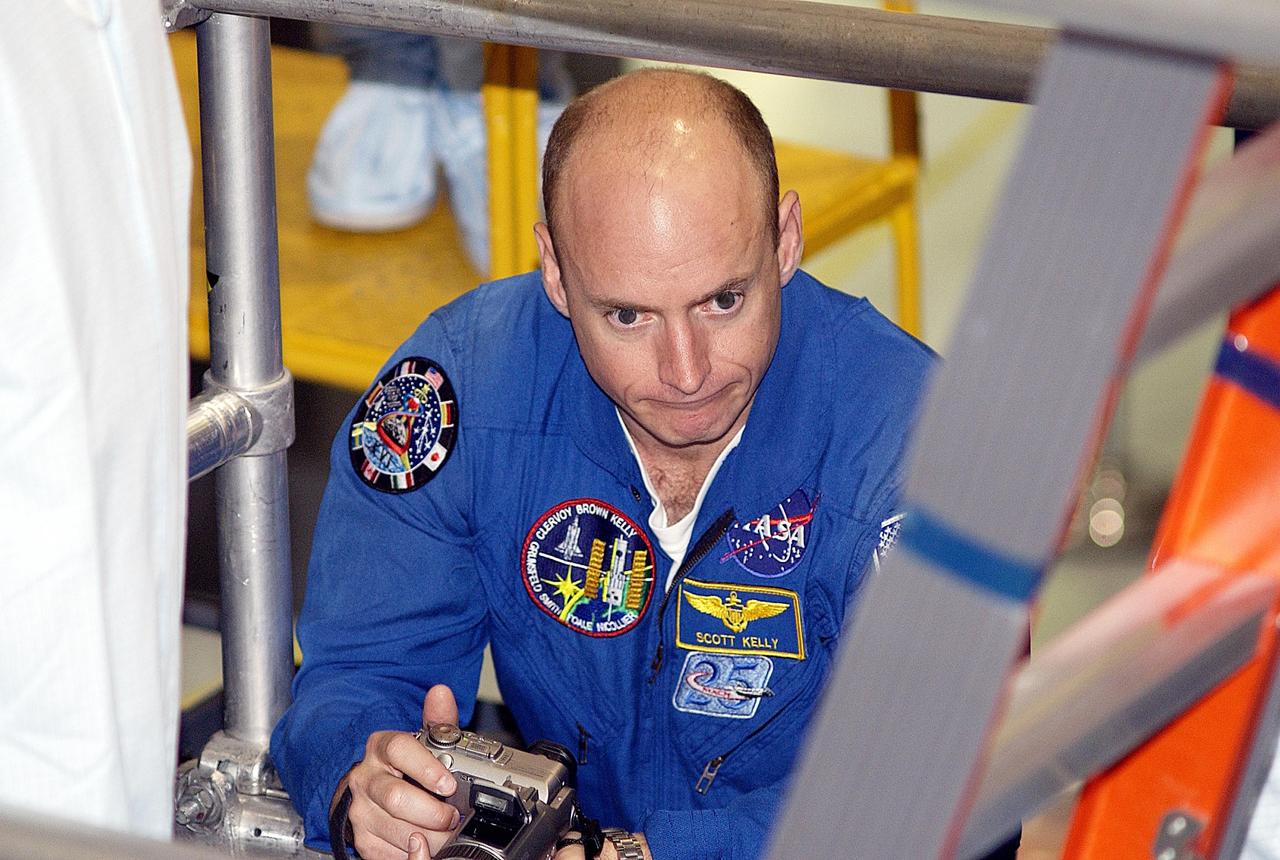
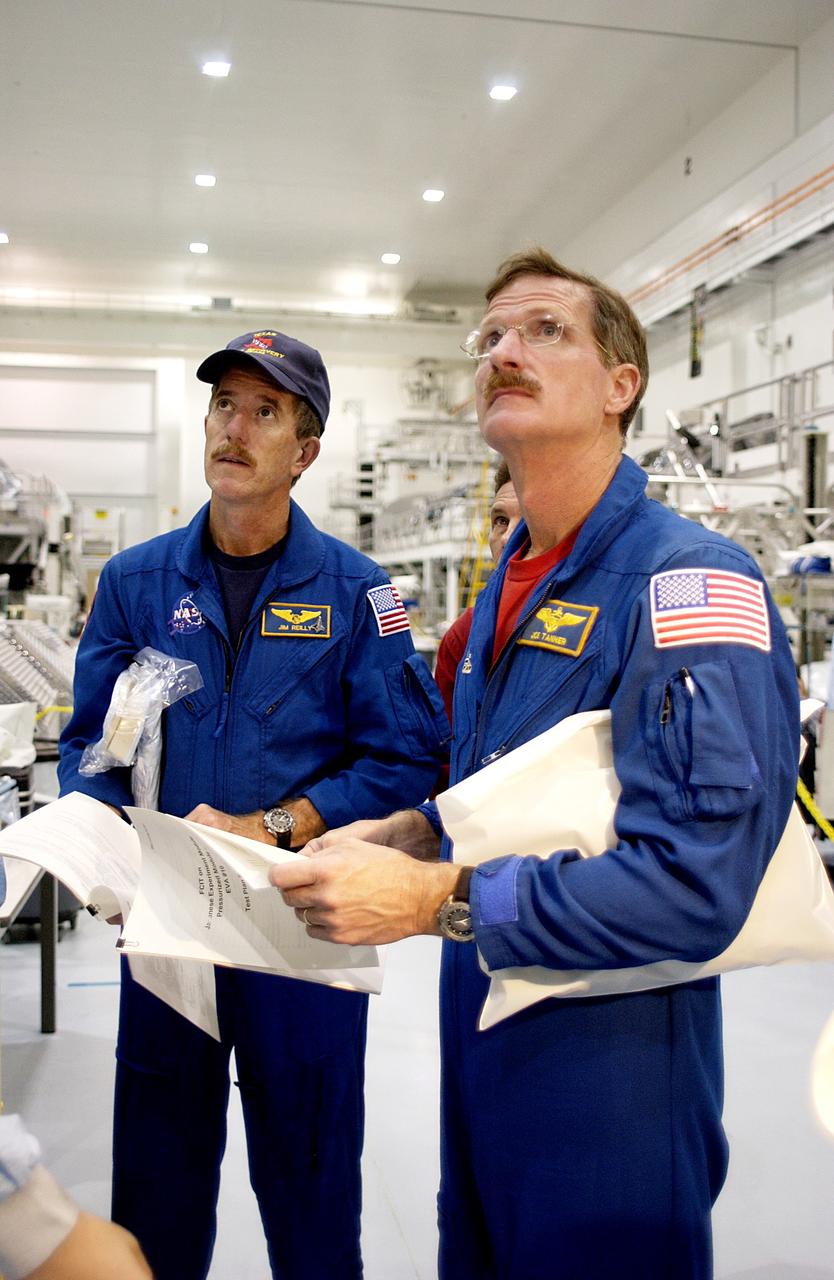
KENNEDY SPACE CENTER, FLA. - In the Space Station Processing Facility, STS-115 Mission Specialist Joseph Tanner (left) and STS-117 Mission Specialist James Reilly (right) talk after removing a cover from the Exposed Facility Berthing Mechanism (EFBM) on the Japanese Experiment Module (JEM) behind them. Equipment familiarization is a routine part of astronaut training and launch preparations.
KENNEDY SPACE CENTER, FLA. -- United Space Alliance (USA) Vice President and Space Shuttle Program Manager Howard DeCastro (left) and NASA Deputy Associate Administrator for Space Station and Shuttle Programs Michael Kostelnik (third from left) watch as a USA technician (right) creates a tile for use in the Shuttle's Thermal Protection System (TPS).  NASA and USA Space Shuttle program management are participating in a leadership workday.  The day is intended to provide management with an in-depth, hands-on look at Shuttle processing activities at KSC.
KENNEDY SPACE CENTER, FLA. -- United Space Alliance (USA) Vice President and Space Shuttle Program Manager Howard DeCastro (left) and NASA Deputy Associate Administrator for Space Station and Shuttle Programs Michael Kostelnik (third from left) watch as a USA technician (right) creates a tile for use in the Shuttle's Thermal Protection System (TPS). NASA and USA Space Shuttle program management are participating in a leadership workday. The day is intended to provide management with an in-depth, hands-on look at Shuttle processing activities at KSC.
ISS007-E-14892 (15 September 2003) --- This close-up view of the eye of Hurricane Isabel was taken by one of the Expedition 7 crewmembers onboard the International Space Station (ISS).
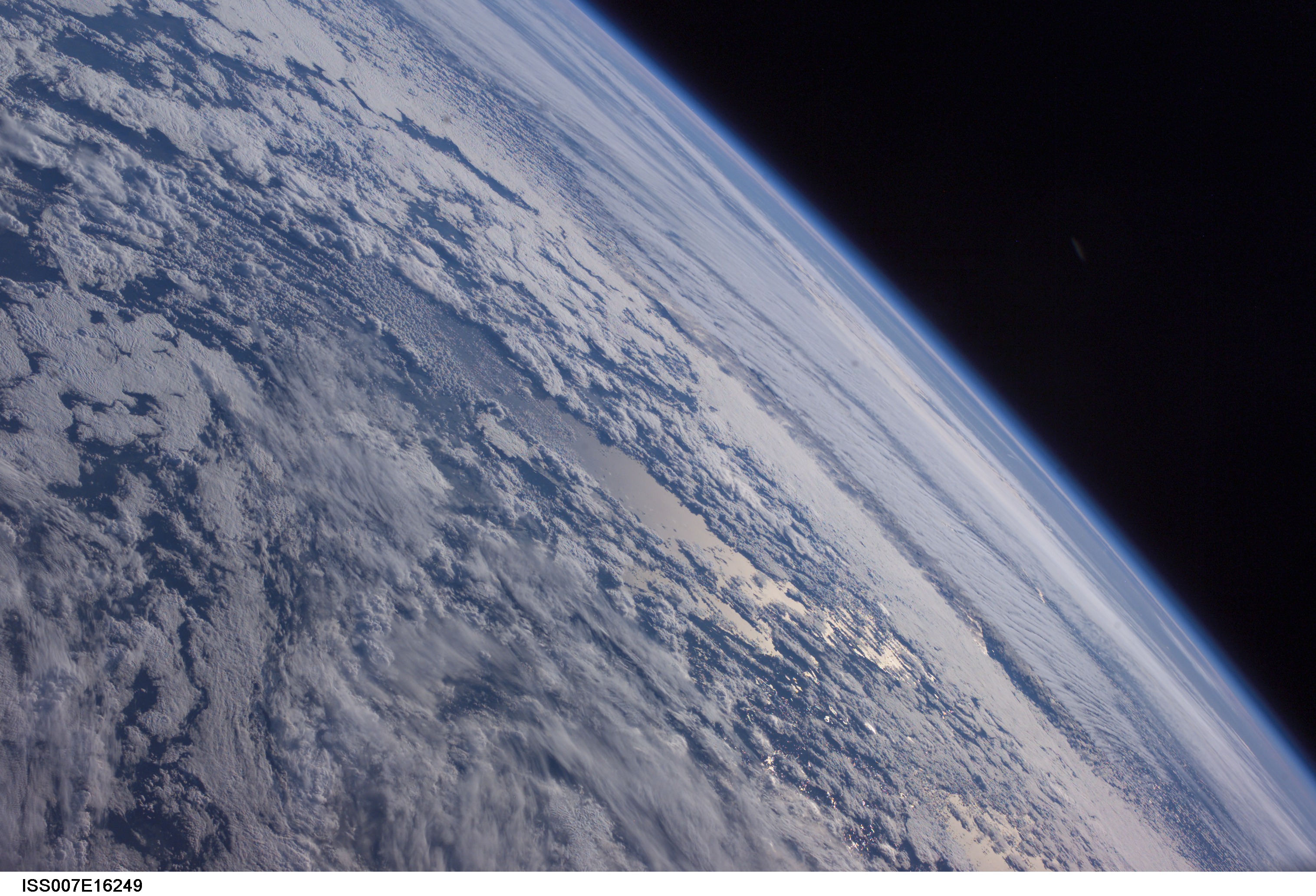
Earth observations taken by the Expedition Seven crew
KENNEDY SPACE CENTER, FLA. - In the Orbiter Processing Facility, Atlantis is seen after its nose cap was removed for routine inspection. The nose cap is made of reinforced carbon-carbon (RCC), which has an operating range of minus 250° F to about 3,000° F.
KENNEDY SPACE CENTER, FLA. - Technicians in the Payload Hazardous Servicing Facility prepare the cruise stage for Mars Exploration Rover 1 (MER-1) for integration with the aeroshell, the entry vehicle.   NASA’s twin Mars Exploration Rovers are designed to study the history of water on Mars. These robotic geologists are equipped with a robotic arm, a drilling tool, three spectrometers, and four pairs of cameras that allow them to have a human-like, 3D view of the terrain. Each rover could travel as far as 100 meters in one day to act as Mars scientists' eyes and hands, exploring an environment where humans can’t yet go.  The MER-1 is scheduled to launch June 25 from Launch Pad 17-A, Cape Canaveral Air Force Station.
KENNEDY SPACE CENTER, FLA. - Technicians in the Payload Hazardous Servicing Facility prepare the cruise stage for Mars Exploration Rover 1 (MER-1) for integration with the aeroshell, the entry vehicle. NASA’s twin Mars Exploration Rovers are designed to study the history of water on Mars. These robotic geologists are equipped with a robotic arm, a drilling tool, three spectrometers, and four pairs of cameras that allow them to have a human-like, 3D view of the terrain. Each rover could travel as far as 100 meters in one day to act as Mars scientists' eyes and hands, exploring an environment where humans can’t yet go. The MER-1 is scheduled to launch June 25 from Launch Pad 17-A, Cape Canaveral Air Force Station.
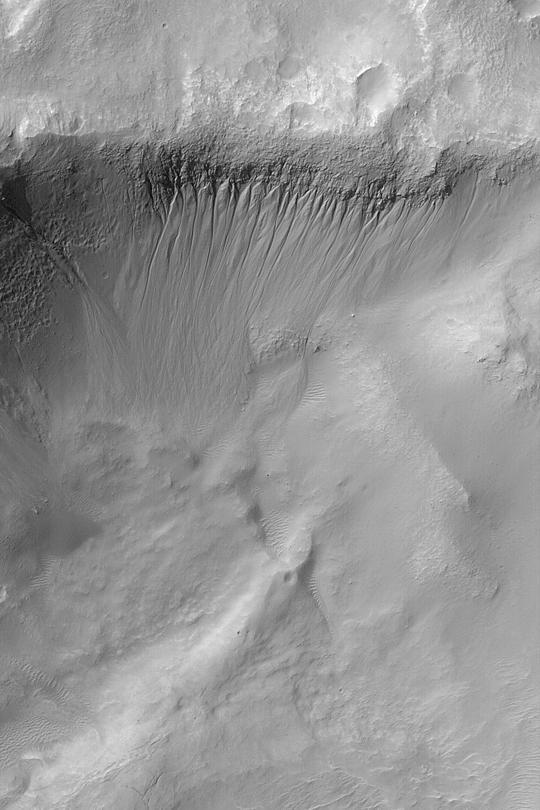
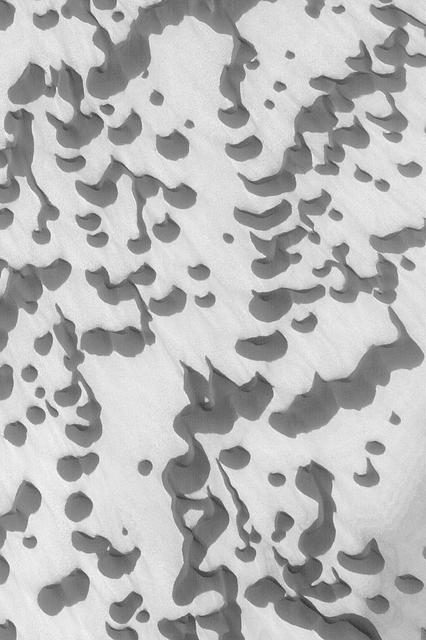
Amidst the hummocky topography produced by the ejecta from Lyot crater, smooth patches of material fill shallow depressions in this NASA Mars Odyssey image.
Is It Snow?
ISIS (Intelligent Spacecraft Interface Systems) Laboratory - Eric Colburn (test subject)
ARC-2003-ACD03-0171-005
KENNEDY SPACE CENTER, FLA. --  With the protective cover removed from the truck, workers at the RLV Hangar near the Shuttle Landing Facility are able to offload recovered Columbia debris transported from the collection point at Barksdale Air Force Base, Shreveport, La.  Workers in the RLV will attempt to reconstruct the orbiter as part of the ongoing investigation of the accident that destroyed the Columbia and claimed the lives of seven astronauts as they returned to Earth after a 16-day research mission, STS-107.
KSC-03pd0344
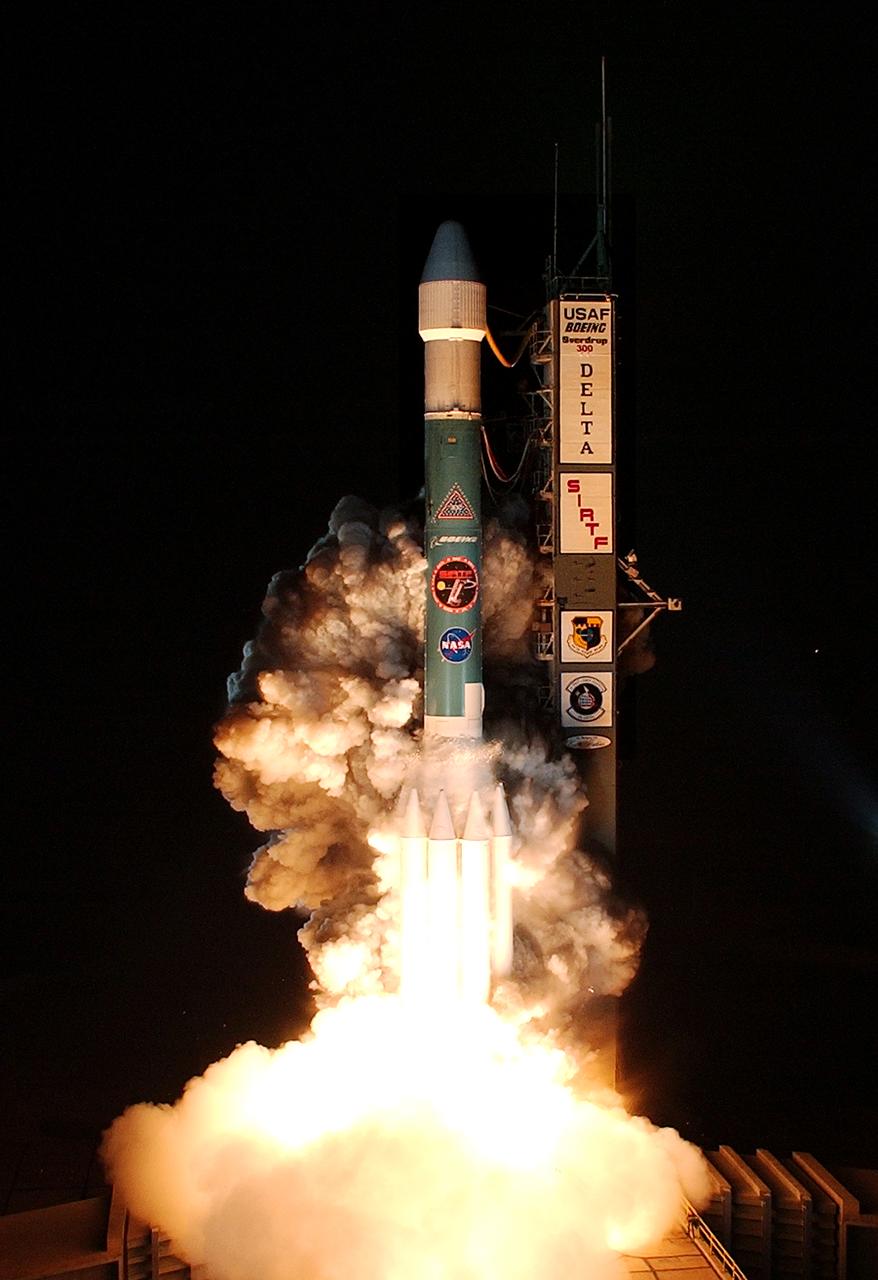
The mobile service tower is rolled back at Launch Pad 17-B, Cape Canaveral Air Force Station, to reveal NASA's Space Infrared Telescope Facility (SIRTF) ready for launch aboard a Delta II Heavy launch vehicle. Liftoff is scheduled for Aug. 25 at 1:35:39 a.m. EDT. SIRTF will obtain images and spectra by detecting the infrared energy, or heat, radiated by objects in space. Consisting of a 0.85-meter telescope and three cryogenically cooled science instruments, SIRTF will be the largest infrared telescope ever launched into space. It is the fourth and final element in NASA’s family of orbiting “Great Observatories.” Its highly sensitive instruments will give a unique view of the Universe and peer into regions of space that are hidden from optical telescopes.
Delta II SIRTF MST Rollback
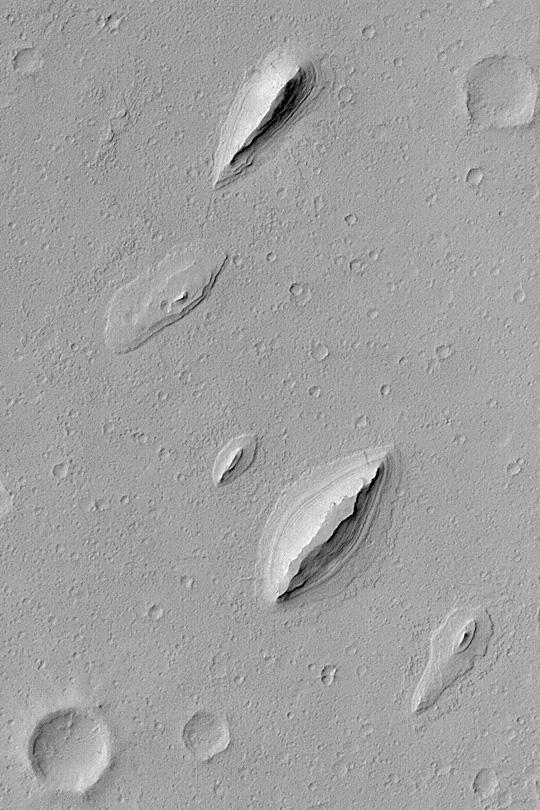
Aureum Chaos
Aureum Chaos
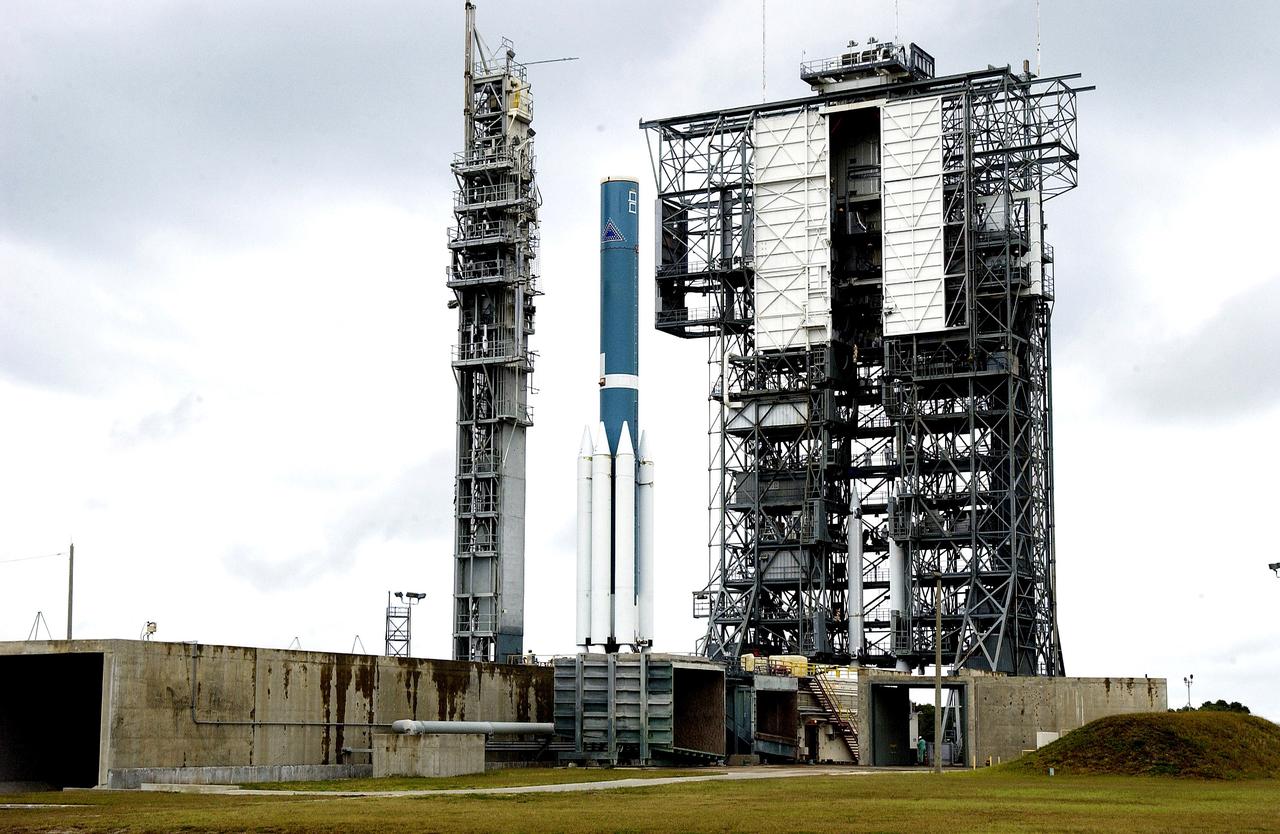
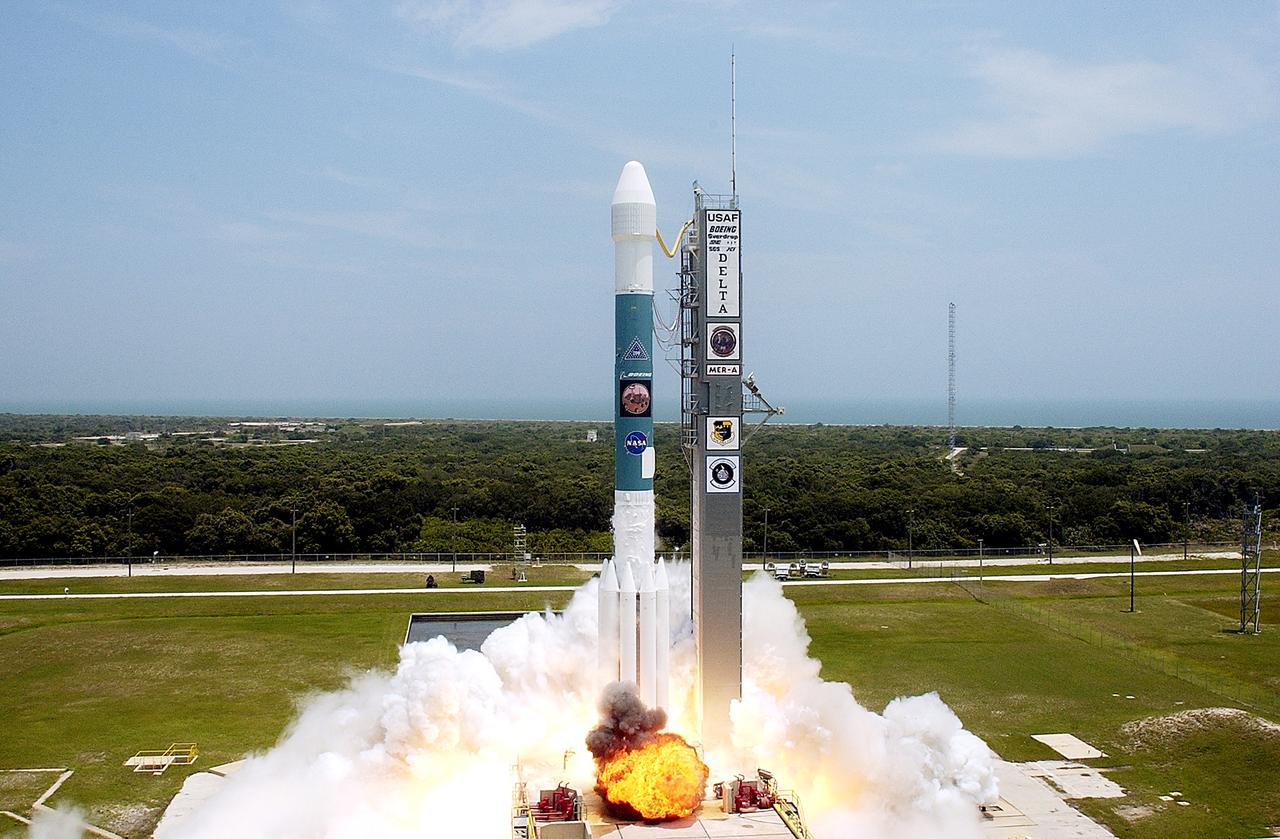
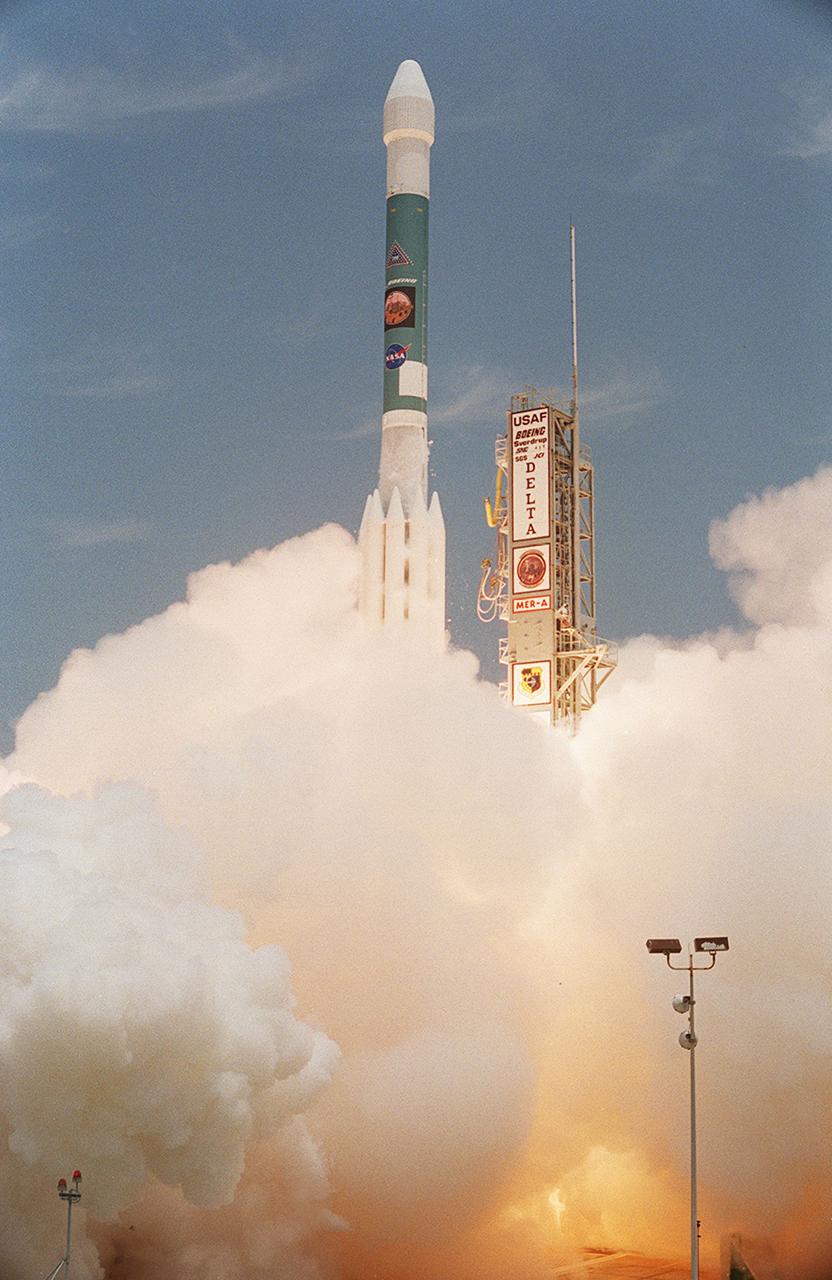
KENNEDY SPACE CENTER, FLA. -    The launch tower on Launch Complex 17-A, Cape Canaveral Air Force Station, clears the Boeing Delta II rocket and its Mars Exploration Rover (MER-A) payload in preparation for a second attempt at launch.  The first attempt on June 8, 2003, was scrubbed due to bad weather in the vicinity.  MER-A is the first of two rovers being launched to Mars.  When the two rovers arrive at Mars in 2004, they will bounce to airbag-cushioned landings at sites offering a balance of favorable conditions for safe landings and interesting science. The rovers see sharper images, can explore farther and examine rocks better than anything that has ever landed on Mars.  The designated site for MER-A mission is Gusev Crater, which appears to have been a crater lake.  The second rover, MER-B, is scheduled to launch June 25.
KENNEDY SPACE CENTER, FLA. - The launch tower on Launch Complex 17-A, Cape Canaveral Air Force Station, clears the Boeing Delta II rocket and its Mars Exploration Rover (MER-A) payload in preparation for a second attempt at launch. The first attempt on June 8, 2003, was scrubbed due to bad weather in the vicinity. MER-A is the first of two rovers being launched to Mars. When the two rovers arrive at Mars in 2004, they will bounce to airbag-cushioned landings at sites offering a balance of favorable conditions for safe landings and interesting science. The rovers see sharper images, can explore farther and examine rocks better than anything that has ever landed on Mars. The designated site for MER-A mission is Gusev Crater, which appears to have been a crater lake. The second rover, MER-B, is scheduled to launch June 25.
Columbia Reconstruction Project Team members study diagrams to aid in the placement of debris from the Space Shuttle Columbia in the RLV Hangar. The debris is being shipped to KSC from the collection point at Barksdale Air Force Base, Shreveport, La. As part of the ongoing investigation into the tragic accident that claimed Columbia and her crew of seven, workers will attempt to reconstruct the orbiter inside the hangar.
Columbia Reconstruction Project Team
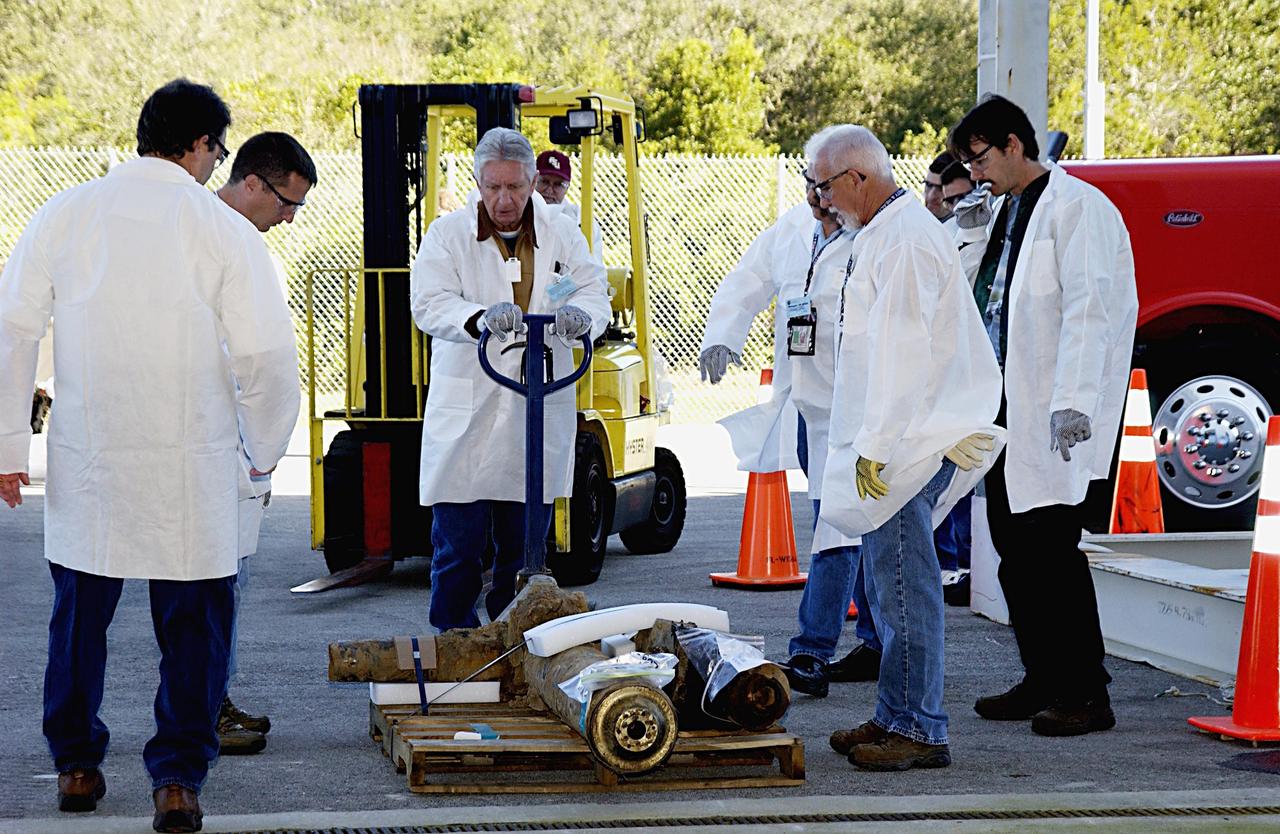
KENNEDY SPACE CENTER, FLA. - The Commercial ITA Biomedical Experiments payload retrieved from debris of Columbia is being dismantled at KSC.  Inside are several experiments carried on mission STS-107 that will be removed and transferred to alternate containers.  One experiment, the Growth of Bacterial Biofilm on Surfaces during Spaceflight (GOBBSS), was a Planetary Society-sponsored astrobiology experiment developed by the Israeli Aerospace Medical Institute and the Johnson Space Center Astrobiology Center, with joint participation of an Israeli and a Palestinian student.  The recovery team includes Eran Schenker of the Israeli Aerospace Medical Institute; David Warmflash of JSC, John Cassanto of ITA, and Louis Friedman, executive director of the Planetary Society.  The GOBBSS material will be sent to JSC where the science team will analyze the samples, studying the effects of spaceflight on bacterial growth.
KSC-03pd1391
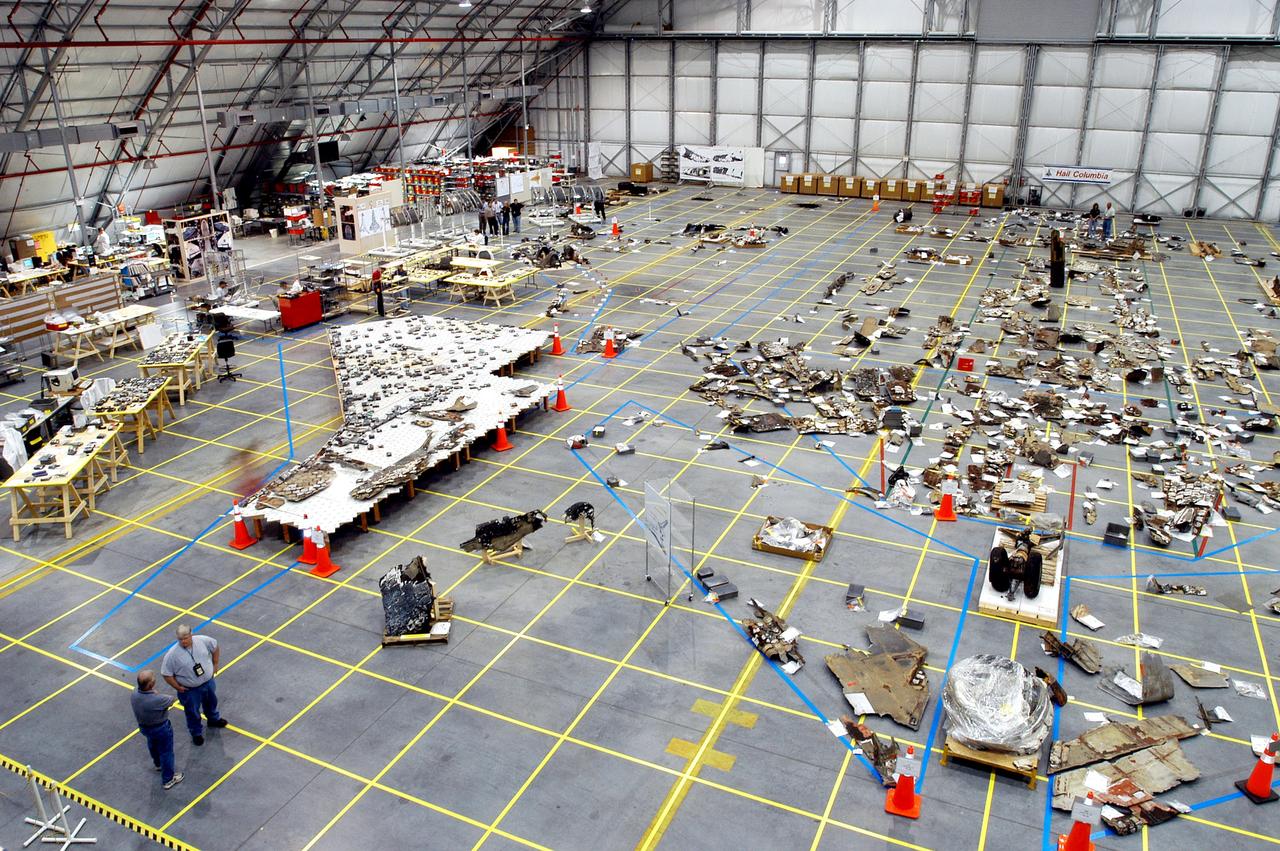
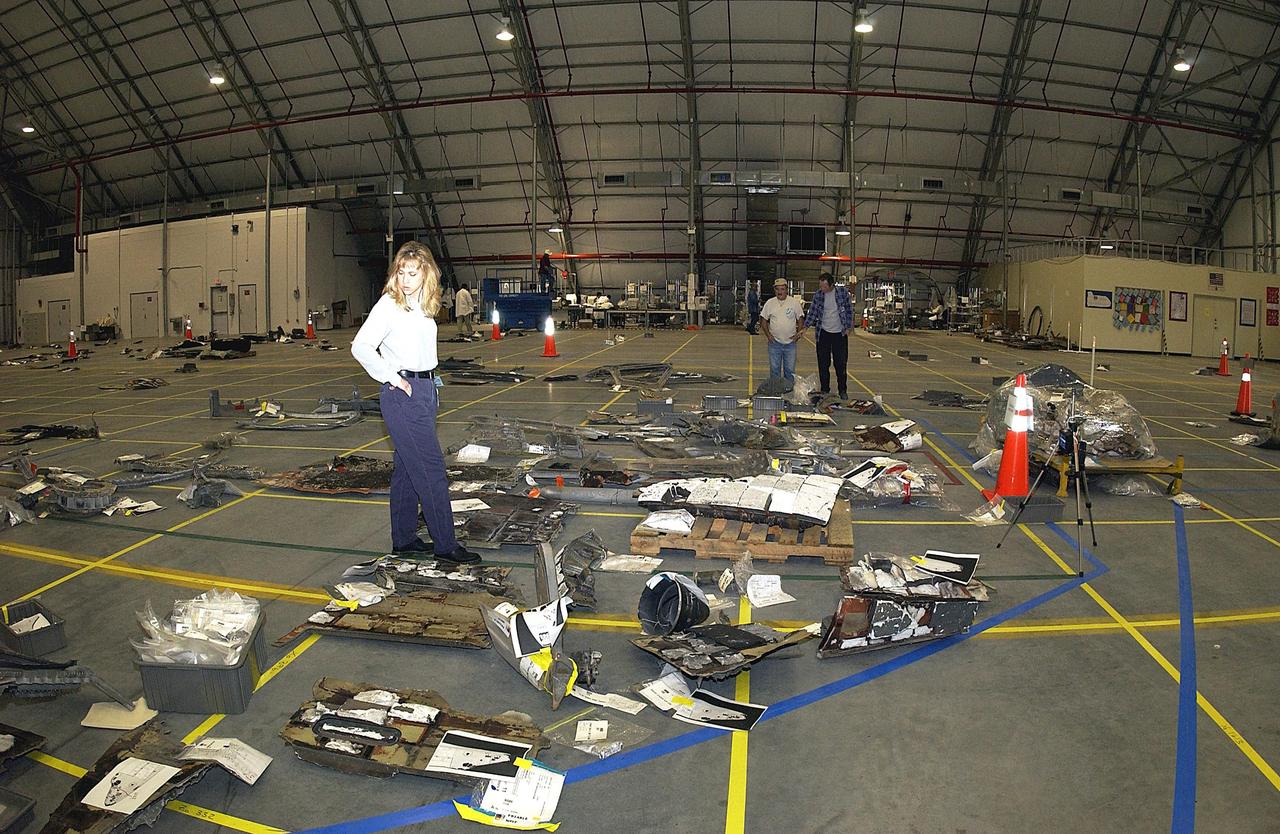
KENNEDY SPACE CENTER, FLA. -  The floor of the RLV Hangar is full of pieces of Columbia debris delivered from the search and recovery efforts in East Texas.  The items shipped to KSC number more than 82,000 and weigh 84,800 pounds or 38 percent of the total dry weight of Columbia. Of those items, 78,760 have been identified, with 753 placed on the left wing grid in the Hangar.
KENNEDY SPACE CENTER, FLA. - The floor of the RLV Hangar is full of pieces of Columbia debris delivered from the search and recovery efforts in East Texas. The items shipped to KSC number more than 82,000 and weigh 84,800 pounds or 38 percent of the total dry weight of Columbia. Of those items, 78,760 have been identified, with 753 placed on the left wing grid in the Hangar.
KENNEDY SPACE CENTER, Fla. -  With the solar arrays fully open on the Mars Exploration Rover-2 (MER-2), the low-gain and high-gain antennas can be seen.  Set to launch in Spring 2003, the MER Mission will consist of two identical rovers designed to cover roughly 110 yards each Martian day. Each rover will carry five scientific instruments that will allow it to search for evidence of liquid water that may have been present in the planet's past.  The rovers will be identical to each other, but will land at different regions of Mars.  The first rover has a launch window opening May 30, and the second rover a window opening June 25, 2003.
KSC-03pd0772
Sand and Water
Sand and Water
KENNEDY SPACE CENTER, FLA. -  In the Orbiter Processing Facility, KSC employee Duane Williams prepares the blanket insulation to be installed on the body flap on orbiter Discovery.  The blankets are part of the Orbiter Thermal Protection System, thermal shields to protect against temperatures as high as 3,000° Fahrenheit, which are produced during descent for landing. Discovery is scheduled to fly on mission STS-121 to the International Space Station.
KENNEDY SPACE CENTER, FLA. - In the Orbiter Processing Facility, KSC employee Duane Williams prepares the blanket insulation to be installed on the body flap on orbiter Discovery. The blankets are part of the Orbiter Thermal Protection System, thermal shields to protect against temperatures as high as 3,000° Fahrenheit, which are produced during descent for landing. Discovery is scheduled to fly on mission STS-121 to the International Space Station.
Northeast Hellas Landscape
Bob Mccall and NASA Dryden Director Kevin Petersen stand by "Celebrating One Hundred Years of Powered Flight, 1903-2003", in the artist's studio in Paradise Valley, Arizona. The mural was created to celebrate the achievements of Wilbur and Orville Wright and to commemorate a century of powered flight. Many of the epic flights represented in the painting took place in the skies over NASA Dryden Flight Research Center. An equally important goal of this celebration will be to encourage the values that have characterized 100 years of aviation history: ingenuity, inventiveness, persistence, creativity and courage. These values hold true not just for pioneers of flight, but also for all pioneers of invention and innovation, and they will remain an important part of America's future.  "Celebrating One Hundred Years of Powered Flight, 1903-2003", documents many significant achievements in aeronautics and space flight from the dawn of powered flight to the present.  Historic aircraft and spacecraft serve as the backdrop, highlighting six figures representing the human element that made these milestones possible. These figures stand, symbolically supported by the words of Wilbur Wright, "It is my belief that flight is possible…" The quote was taken from a letter written to his father on September 3rd, 1900, announcing Wilbur's intention to make "some experiments with a flying machine" at Kitty Hawk, North Carolina.  "This year, Bob is helping us commemorate the Centennial of Flight with a beautiful mural slated for placement in our Dryden Flight Research Center that documents the history of flight from the Wright Flyer to the International Space Station. We should all take note, I think, that in the grand scheme of things, one hundred years is a very short period of time. In that blink of an eye we've gone from Kitty Hawk to Tranquility Base and now look forward to our rovers traversing the surface of Mars. Despite the challenges we face, the future we envision, like the fu
Bob Mccall and NASA Dryden Center Director Kevin Petersen in the artist's studio in Paradise Valley, Arizona.
KENNEDY SPACE CENTER, FLA. - The Space Shuttle orbiter Atlantis approaches the Vehicle Assembly Building (VAB) high bay 4.  It is being towed from the Orbiter Processing Facility (OPF) to allow work to be performed in the bay that can only be accomplished while it is empty. Work scheduled in the processing facility includes annual validation of the bay's cranes, work platforms, lifting mechanisms, and jack stands. Atlantis will remain in the VAB for about 10 days, then return to the OPF as work resumes to prepare it for launch in September 2004 on the first return-to-flight mission, STS-114.
KENNEDY SPACE CENTER, FLA. - The Space Shuttle orbiter Atlantis approaches the Vehicle Assembly Building (VAB) high bay 4. It is being towed from the Orbiter Processing Facility (OPF) to allow work to be performed in the bay that can only be accomplished while it is empty. Work scheduled in the processing facility includes annual validation of the bay's cranes, work platforms, lifting mechanisms, and jack stands. Atlantis will remain in the VAB for about 10 days, then return to the OPF as work resumes to prepare it for launch in September 2004 on the first return-to-flight mission, STS-114.
KENNEDY SPACE CENTER, FLA. -- The Merritt Island and Edgewood Middle School students/Lockheed Martin team, participating in the 2003 Southeastern  Regional FIRST Robotic Competition, work on their team-built robot. The competition is being held at the University of Central Florida (UCF) in Orlando, March 20-23. Forty teams from around the country are participating in the event that pits team-built gladiator robots against each other in an athletic-style competition. The teams are sponsored by NASA-Kennedy Space Center, The Boeing Company/Brevard Community College, and Lockheed Martin Space Operations/Mission Systems for the nonprofit organization For Inspiration and Recognition of Science and Technology, known as FIRST. The vision of FIRST is to inspire in the youth of our nation an appreciation of science and technology and an understanding that mastering these disciplines can enrich the lives of all mankind.
KSC-03pd0902
KENNEDY SPACE CENTER, FLA. --  Retired Navy Admiral Harold W. Gehman Jr., chairman of the Columbia Accident Investigation Board, addresses the press at the Shuttle Landing Facility before departing KSC. Gehman and other members of the board visited sites at KSC to become familiar with Shuttle processing procedures. The independent board is charged with determining what caused the destruction of the Space Shuttle Columbia and the loss of its seven-member crew on Feb. 1 during reentry.
KSC-03pd0410
JSC2003-E-01127 (10 January 2003) --- Astronaut Soichi Noguchi, STS-114 mission specialist, participates in an Extravehicular Mobility Unit (EMU) spacesuit fit check in the Space Station Airlock Test Article (SSATA) in the Crew Systems Laboratory at the Johnson Space Center (JSC). Noguchi represents the Japanese Space Agency.
STS-114 SSATA Crew Training - Noguchi, STB-ST-621
KENNEDY SPACE CENTER, FLA. -   Astronaut Soichi Noguchi, with the National Space Development Agency of Japan (NASDA), works at a console during a Multi-Element Integrated Test (MEIT) of the U.S. Node 2 and the Japanese Experiment Module (JEM).  Noguchi is assigned to mission STS-114 as a mission specialist.   Node 2 attaches to the end of the U.S. Lab on the ISS and provides attach locations for the Japanese laboratory, European laboratory, the Centrifuge Accommodation Module and, eventually, Multipurpose Logistics Modules. It will provide the primary docking location for the Shuttle when a pressurized mating adapter is attached to Node 2.  Installation of the module will complete the U.S. Core of the ISS.   The JEM, developed by NASDA,  is Japan's primary contribution to the Station. It will enhance the unique research capabilities of the orbiting complex by providing an additional environment for astronauts to conduct science experiments.
KENNEDY SPACE CENTER, FLA. - Astronaut Soichi Noguchi, with the National Space Development Agency of Japan (NASDA), works at a console during a Multi-Element Integrated Test (MEIT) of the U.S. Node 2 and the Japanese Experiment Module (JEM). Noguchi is assigned to mission STS-114 as a mission specialist. Node 2 attaches to the end of the U.S. Lab on the ISS and provides attach locations for the Japanese laboratory, European laboratory, the Centrifuge Accommodation Module and, eventually, Multipurpose Logistics Modules. It will provide the primary docking location for the Shuttle when a pressurized mating adapter is attached to Node 2. Installation of the module will complete the U.S. Core of the ISS. The JEM, developed by NASDA, is Japan's primary contribution to the Station. It will enhance the unique research capabilities of the orbiting complex by providing an additional environment for astronauts to conduct science experiments.
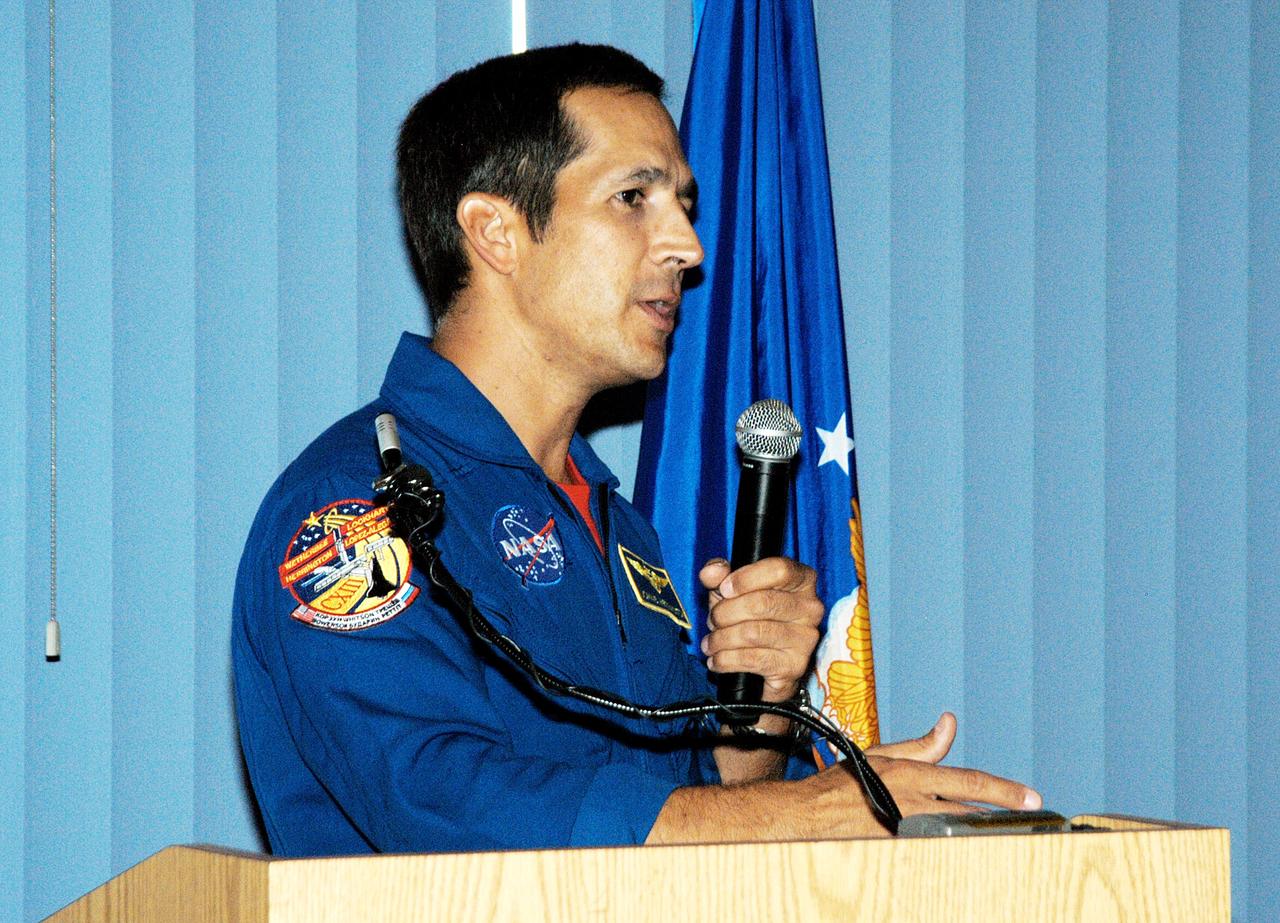
JSC2003-E-31751 (31 Jan. 2003) --- Astronaut Christer Fuglesang, mission specialist representing the European Space Agency (ESA)
Official portrait of Astronaut Christer Fuglesang.
KENNEDY SPACE CENTER, FLA. -- In the Orbiter Processing Facility, United Space Alliance employee Harrell Watts (right) installs Thermal Protection System tiles on a main landing gear  door of Space Shuttle orbiter Enterprise (OV-101).  Sections of Enterprise were borrowed from the Smithsonian Institution's Air and Space Museum where the orbiter is being stored at the Washington Dulles International Airport.  Enterprise was the first orbiter built in the Shuttle fleet and was used to conduct the Approach and Landing Test Program before the first powered Shuttle flight.  After the tile installation is complete, the sections will be transferred to the Southwest Research Institute for testing requested by the Columbia Accident Investigation Board.
KSC-03pd1079
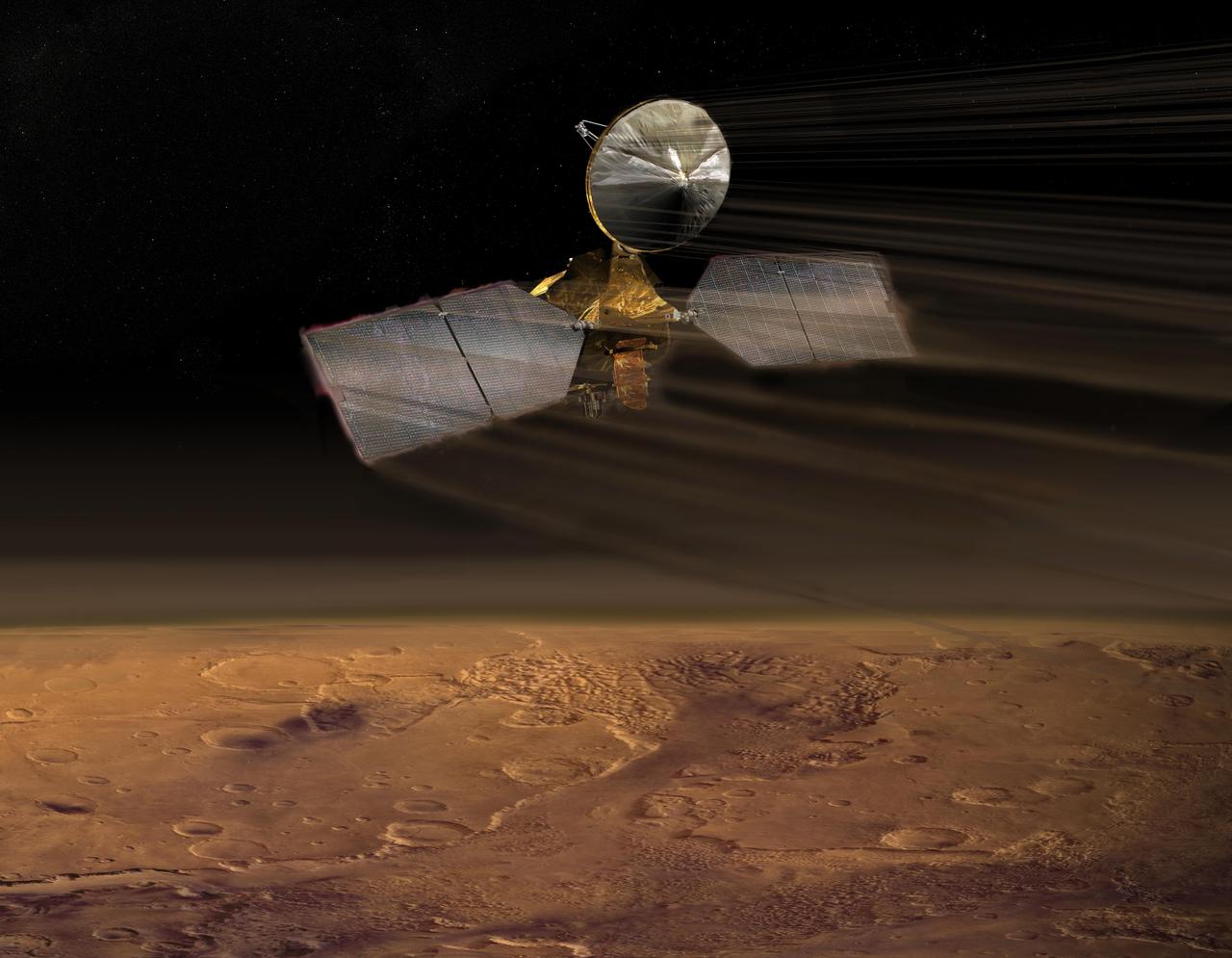
NASA Mars Reconnaissance Orbiter passes over the planet south polar region in this artist concept illustration.
Mars Reconnaissance Orbiter over Pole Artist Concept
KENNEDY SPACE CENTER, FLA. - Pictured is one of the microcapsules removed from the Commercial ITA Biomedical Experiments payload recovered during the search for Columbia debris.  The drug delivery system and spaceflight hardware was developed jointly by JSC, the Institute for Research Inc. and Instrumentation Technology Associates Inc. to conduct microencapsulation experiments under microgravity conditions.  This microcapsule contains an antibiotic for treating deep resistant pulmonary infections.  Dr. Dennis Morrison, senior biotech project scientist, is principle investigator on microencapsulation and urokinase crystal growth.
KSC-03pd1448
KENNEDY SPACE CENTER, FLA. -  Family members of the STS-107 astronauts and other dignitaries attend a dedication ceremony at the Space Mirror Memorial at the Kennedy Space Center Visitor Complex.  During this solemn event, the names of the STS-107 astronauts who lost their lives during the Columbia accident -- Rick Husband, Willie McCool, Laurel Clark, Michael Anderson, David Brown, Kalpana Chawla, and Ilan Ramon -- join the names of 17 other space heroes who gave their lives for the U.S. space program. The "Space Mirror," 42 1/2 feet high by 50 feet wide, illuminates the names of the fallen astronauts cut through the monument's black granite surface.
KENNEDY SPACE CENTER, FLA. - Family members of the STS-107 astronauts and other dignitaries attend a dedication ceremony at the Space Mirror Memorial at the Kennedy Space Center Visitor Complex. During this solemn event, the names of the STS-107 astronauts who lost their lives during the Columbia accident -- Rick Husband, Willie McCool, Laurel Clark, Michael Anderson, David Brown, Kalpana Chawla, and Ilan Ramon -- join the names of 17 other space heroes who gave their lives for the U.S. space program. The "Space Mirror," 42 1/2 feet high by 50 feet wide, illuminates the names of the fallen astronauts cut through the monument's black granite surface.
KENNEDY SPACE CENTER, FLA. - Retired Navy Admiral Harold W. Gehman Jr. (left), chairman of the Columbia Accident Investigation Board, is given a guided tour of the Space Shuttle Main Engine shop. Gehman and other members of the board are visiting sites at KSC to become familiar with the Shuttle launch process. The independent board is charged with determining what caused the destruction of the Space Shuttle Columbia and the loss of its seven-member crew on Feb. 1 during reentry.
KSC-03pd0365
Cadmium selenium Quantum Dots (QDs) are metal nanoparticles that fluoresce in a variety of colors determined by their size. QDs are solid state structures made of semiconductors or metals that confine a countable, small number of electrons into a small space. The confinement of electrons is achieved by the placement of some insulating material(s) around a central, well conducted region. Coupling QDs with antibodies can be used to make spectrally multiplexed immunoassays that test for a number of microbial contaminants using a single test.
n/a
KENNEDY SPACE CENTER, FLA. --  The driver in the foreground controls the rollback of the Rotating Service Structure from around Space Shuttle Columbia, which is bathed in shadows.  Visible are the orbiter access arm with the White Room extended to Columbia's cockpit, and at the top, the gaseous oxygen vent arm and cap, called the "beanie cap." Columbia is scheduled for launch Jan. 16 at 10:39 a.m. EST on mission STS-107.
KSC-03pd0073
KENNEDY SPACE CENTER, FLA. -  On Launch Complex 17-A, Cape Canaveral Air Force Station, the Boeing Delta II rocket and its Mars Exploration Rover (MER-A) payload are free of the tower  and ready for launch.  This will be the third launch attempt in as many days after weather concerns postponed the launches June 8 and June 9.  MER-A is the first of two rovers being launched to Mars.  When the two rovers arrive at Mars in 2004, they will bounce to airbag-cushioned landings at sites offering a balance of favorable conditions for safe landings and interesting science. The rovers see sharper images, can explore farther and examine rocks better than anything that has ever landed on Mars.  The designated site for MER-A mission is Gusev Crater, which appears to have been a crater lake.  The second rover, MER-B, is scheduled to launch June 25.
KENNEDY SPACE CENTER, FLA. - On Launch Complex 17-A, Cape Canaveral Air Force Station, the Boeing Delta II rocket and its Mars Exploration Rover (MER-A) payload are free of the tower and ready for launch. This will be the third launch attempt in as many days after weather concerns postponed the launches June 8 and June 9. MER-A is the first of two rovers being launched to Mars. When the two rovers arrive at Mars in 2004, they will bounce to airbag-cushioned landings at sites offering a balance of favorable conditions for safe landings and interesting science. The rovers see sharper images, can explore farther and examine rocks better than anything that has ever landed on Mars. The designated site for MER-A mission is Gusev Crater, which appears to have been a crater lake. The second rover, MER-B, is scheduled to launch June 25.
KENNEDY SPACE CENTER, FLA. -  Members of the Merritt Island and Edgewood Middle School students/Lockheed Martin team look over their robot.  They are participating in the 2003 Southeastern  Regional FIRST Robotic Competition being held at the University of Central Florida (UCF) in Orlando, March 20-23. Forty teams from around the country are participating in the event that pits team-built gladiator robots against each other in an athletic-style competition. The teams are sponsored by NASA-Kennedy Space Center, The Boeing Company/Brevard Community College, and Lockheed Martin Space Operations/Mission Systems for the nonprofit organization For Inspiration and Recognition of Science and Technology, known as FIRST. The vision of FIRST is to inspire in the youth of our nation an appreciation of science and technology and an understanding that mastering these disciplines can enrich the lives of all mankind.
KSC-03pd0904
During the last weeks of March 2003, unusually high and widespread aerosol pollution was detected over Europe by several satellite-borne instruments aboard NASA Terra satellite.
Aerosols over Central and Eastern Europe
ISS007-E-12270 (9 August 2003) --- View of a gibbous Moon photographed by an Expedition 7 crewmember onboard the International Space Station (ISS).
iss007e12270
KENNEDY SPACE CENTER, FLA. - Students from Columbia Elementary School in Palm Bay, Fla., place flowers at the Astronaut Memorial to honor the fallen crew of Space Shuttle Columbia. The students visited the Center to learn about the past, present and future of space exploration.  They also listened to Kirstie McCool Chadwick, the sister of Columbia astronaut William "Willie" J. McCool, and saw the 3-D IMAX film "Space Station."
KSC-03pd0473
KENNEDY SPACE CENTER, FLA. -  In the Payload Hazardous Servicing Facility, workers monitor the alignment of the Mars Exploration Rover-2 (MER-2) as it is lowered onto the base petal of its lander assembly. Set to launch in Spring 2003, the MER Mission will consist of two identical rovers designed to cover roughly 110 yards each Martian day over various terrain. Each rover will carry five scientific instruments that will allow it to search for evidence of liquid water that may have been present in the planet's past. The rovers will be identical to each other, but will land at different regions of Mars. The first rover has a launch window opening May 30, and the second rover, a window opening June 25.
KSC-03pd0882
KENNEDY SPACE CENTER, FLA. - Competing with the brilliant blue sky, flames behind Space Shuttle Columbia trail a column of smoke as the Shuttle hurtles toward space on mission STS-107. Following a flawless and uneventful countdown, liftoff occurred on-time at 10:39 a.m. EST.  The 16-day research mission will include FREESTAR (Fast Reaction Experiments Enabling Science, Technology, Applications and Research) and the SHI Research Double Module (SHI/RDM), known as SPACEHAB.  Experiments on the module range from material sciences to life sciences. Landing is scheduled at about 8:53 a.m. EST on Saturday, Feb. 1.  This mission is the first Shuttle mission of 2003. Mission STS-107 is the 28th flight of the orbiter Columbia and the 113th flight overall in NASA's Space Shuttle program.
KSC-03pd0118
KENNEDY SPACE CENTER, FLA. - In the Payload Hazardous Servicing Facility, workers help guide the cruise stage of Mars Exploration Rover 1 (MER-1) as it is lowered onto blocks.  The cruise stage will be integrated with the aeroshell, the entry vehicle.   NASA’s twin Mars Exploration Rovers are designed to study the history of water on Mars. These robotic geologists are equipped with a robotic arm, a drilling tool, three spectrometers, and four pairs of cameras that allow them to have a human-like, 3D view of the terrain. Each rover could travel as far as 100 meters in one day to act as Mars scientists' eyes and hands, exploring an environment where humans can’t yet go.  The MER-1 is scheduled to launch June 25 from Launch Pad 17-A, Cape Canaveral Air Force Station.
KENNEDY SPACE CENTER, FLA. - In the Payload Hazardous Servicing Facility, workers help guide the cruise stage of Mars Exploration Rover 1 (MER-1) as it is lowered onto blocks. The cruise stage will be integrated with the aeroshell, the entry vehicle. NASA’s twin Mars Exploration Rovers are designed to study the history of water on Mars. These robotic geologists are equipped with a robotic arm, a drilling tool, three spectrometers, and four pairs of cameras that allow them to have a human-like, 3D view of the terrain. Each rover could travel as far as 100 meters in one day to act as Mars scientists' eyes and hands, exploring an environment where humans can’t yet go. The MER-1 is scheduled to launch June 25 from Launch Pad 17-A, Cape Canaveral Air Force Station.
This image of the Globular cluster Messier 2 (M2) was taken by Galaxy Evolution Explorer on August 20, 2003. This image is a small section of a single All Sky Imaging Survey exposure of only 129 seconds in the constellation Aquarius. This picture is a combination of Galaxy Evolution Explorer images taken with the far ultraviolet (colored blue) and near ultraviolet detectors (colored red). Globular clusters are gravitationally bound systems of hundreds of thousands of stars that orbit in the halos of galaxies. The globular clusters in out Milky Way galaxy contain some of the oldest stars known. M2 lies 33,000 light years from our Sun with stars distributed in a spherical system with a radius of approximately 100 light years.   http://photojournal.jpl.nasa.gov/catalog/PIA04926
Globular Cluster Messier 2 in Aquarius
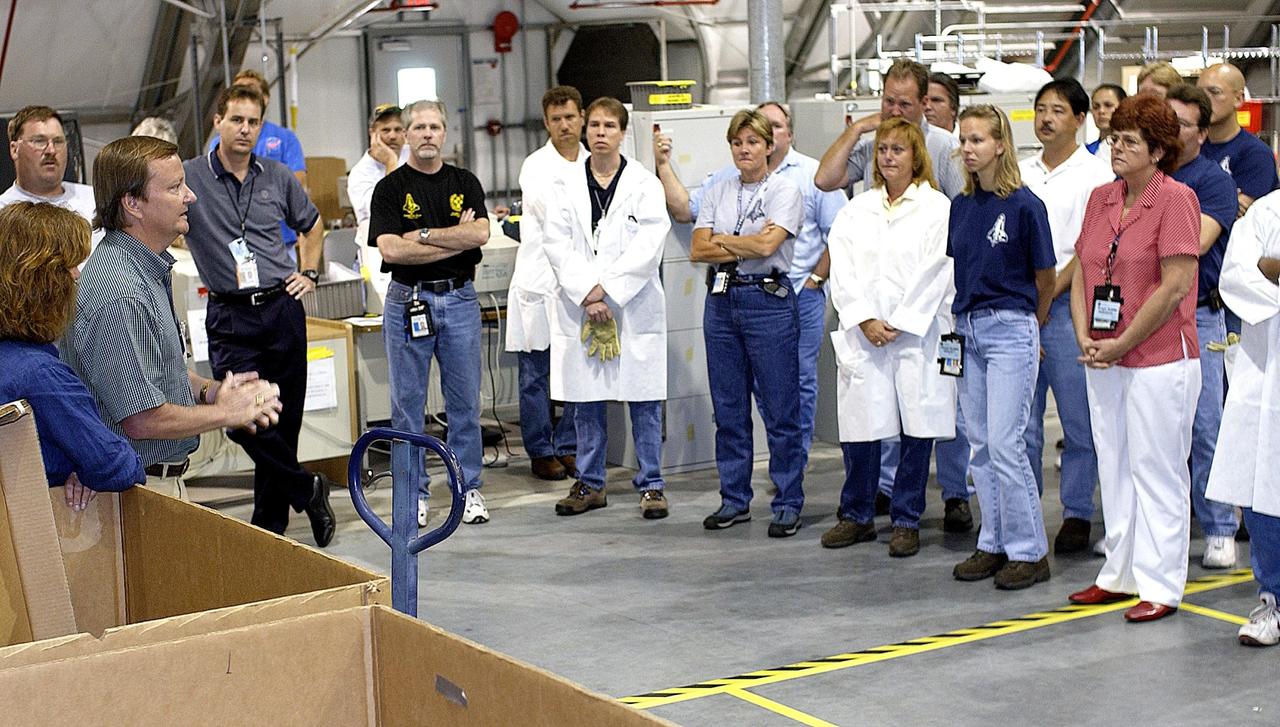
KENNEDY SPACE CENTER, FLA. -  Bill Pickavance, vice president and deputy program manager, Florida operations, United Space Alliance, speaks to employees during Center Director Jim Kennedy’s first all-hands meeting for employees.  Also on the agenda was Dr. Woodrow Whitlow Jr., KSC deputy director, and Tim Wilson, assistant chief engineer for Shuttle.  Representatives from the Shuttle program and contractor team were on hand to discuss the Columbia Accident Investigation Board report and where KSC stands in its progress toward return to flight.
KENNEDY SPACE CENTER, FLA. - Bill Pickavance, vice president and deputy program manager, Florida operations, United Space Alliance, speaks to employees during Center Director Jim Kennedy’s first all-hands meeting for employees. Also on the agenda was Dr. Woodrow Whitlow Jr., KSC deputy director, and Tim Wilson, assistant chief engineer for Shuttle. Representatives from the Shuttle program and contractor team were on hand to discuss the Columbia Accident Investigation Board report and where KSC stands in its progress toward return to flight.
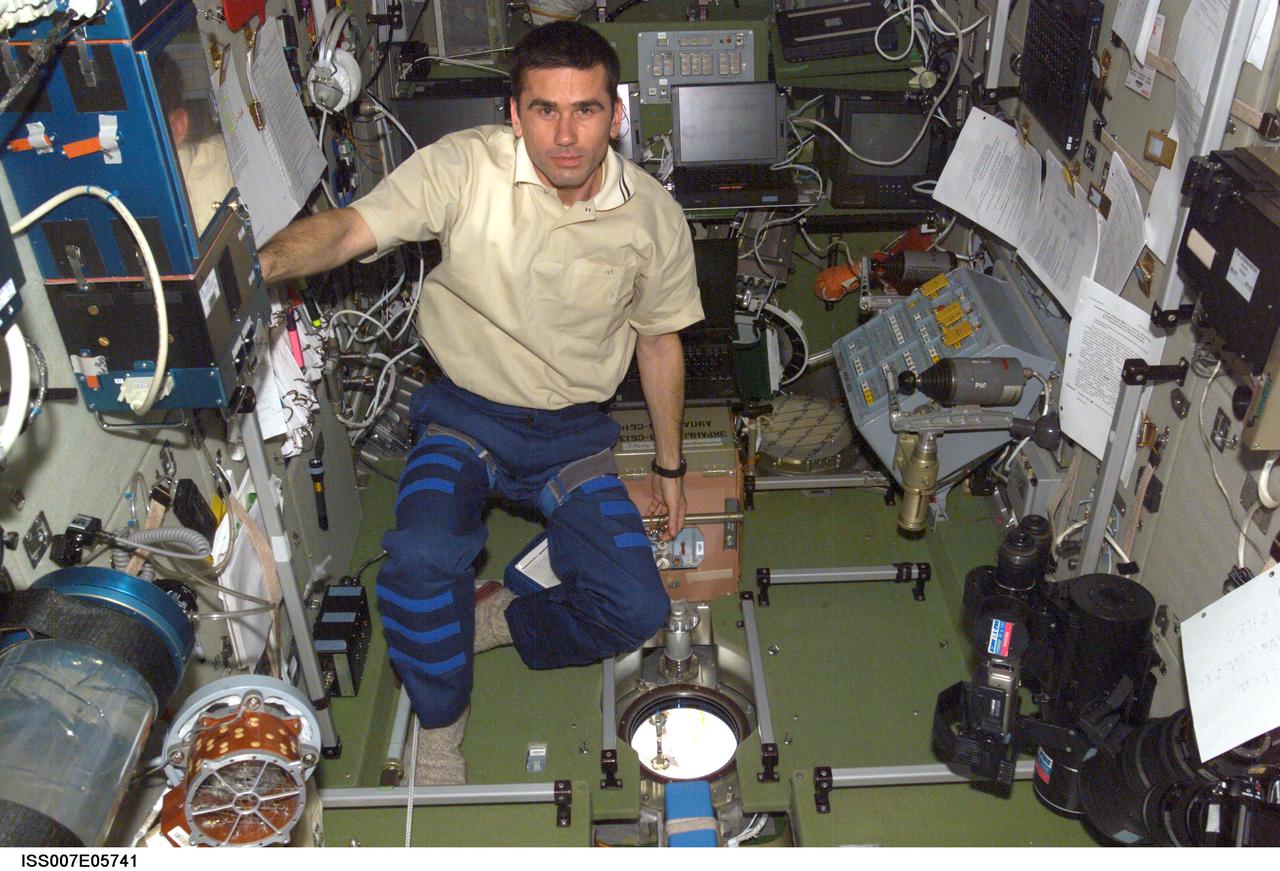
ISS007-E-11805 (3 August 2003) --- Cosmonaut Yuri I. Malenchenko, Expedition 7 mission commander representing Rosaviakosmos, floats into the Unity node on the International Space Station (ISS).
CDR Yuri Malenchenko flying through Node 1/Unity
KENNEDY SPACE CENTER, FLA. - In the Orbiter Processing Facility, United Space Alliance workers (left to right) Jim Landy, Dan Phillips, Paul Ogletree and Dan Kenna check results of flash thermography on the Reinforced Carbon Carbon panel on the table (foreground).  Attached to the leading edge of the wing of the orbiters,  the gray carbon composite RCC panels have sufficient strength to withstand the aerodynamic forces experienced during launch and reentry, which can reach as high as 800 pounds per square foot.  The operating range of RCC is from minus 250º F to about 3,000º F, the temperature produced by friction with the atmosphere during reentry.
KENNEDY SPACE CENTER, FLA. - In the Orbiter Processing Facility, United Space Alliance workers (left to right) Jim Landy, Dan Phillips, Paul Ogletree and Dan Kenna check results of flash thermography on the Reinforced Carbon Carbon panel on the table (foreground). Attached to the leading edge of the wing of the orbiters, the gray carbon composite RCC panels have sufficient strength to withstand the aerodynamic forces experienced during launch and reentry, which can reach as high as 800 pounds per square foot. The operating range of RCC is from minus 250º F to about 3,000º F, the temperature produced by friction with the atmosphere during reentry.
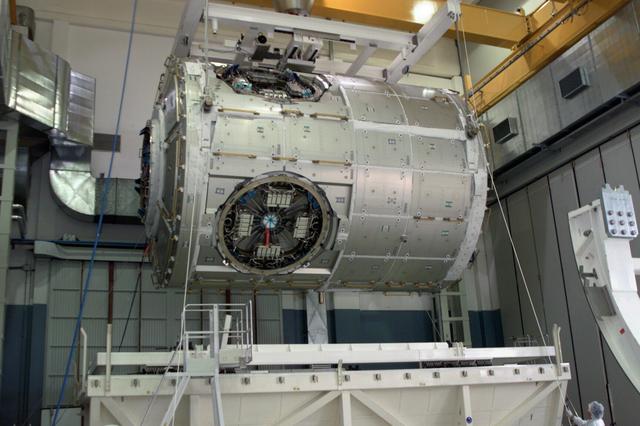
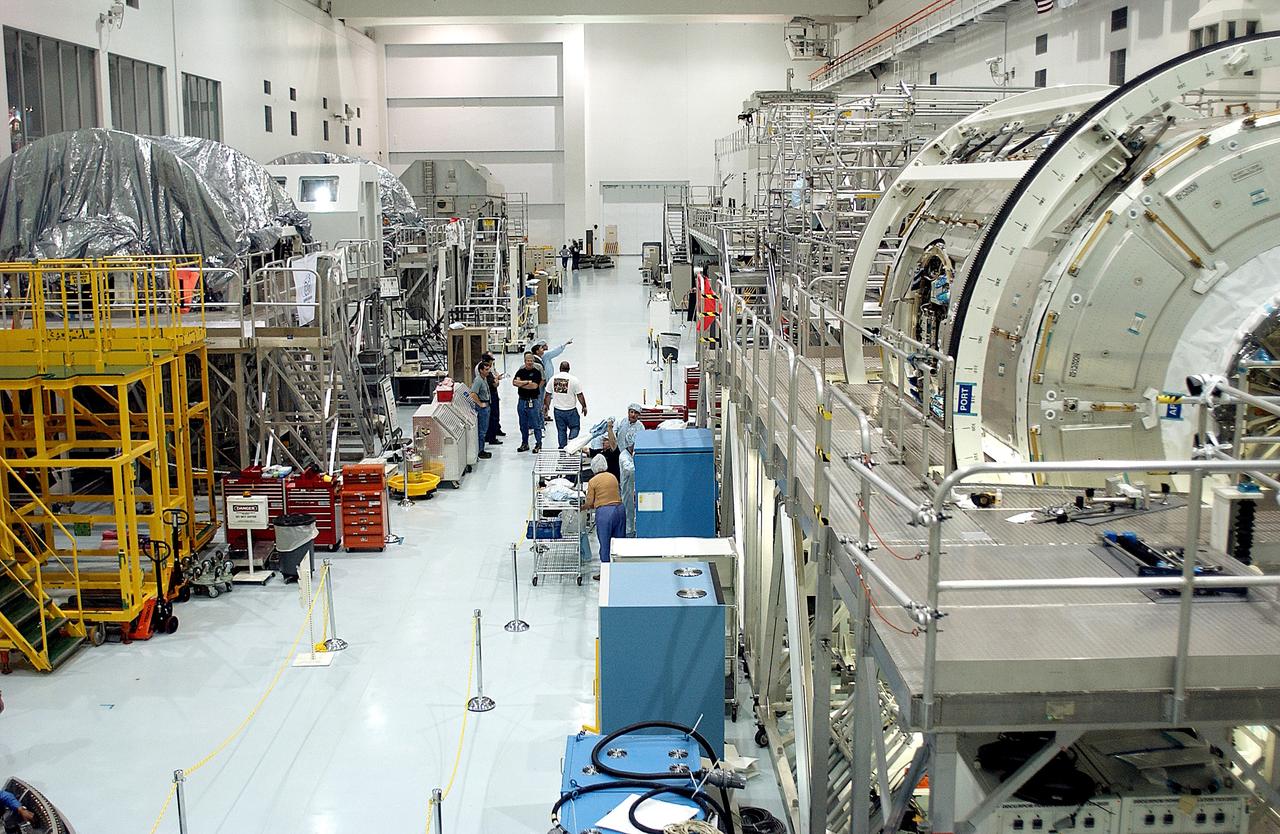
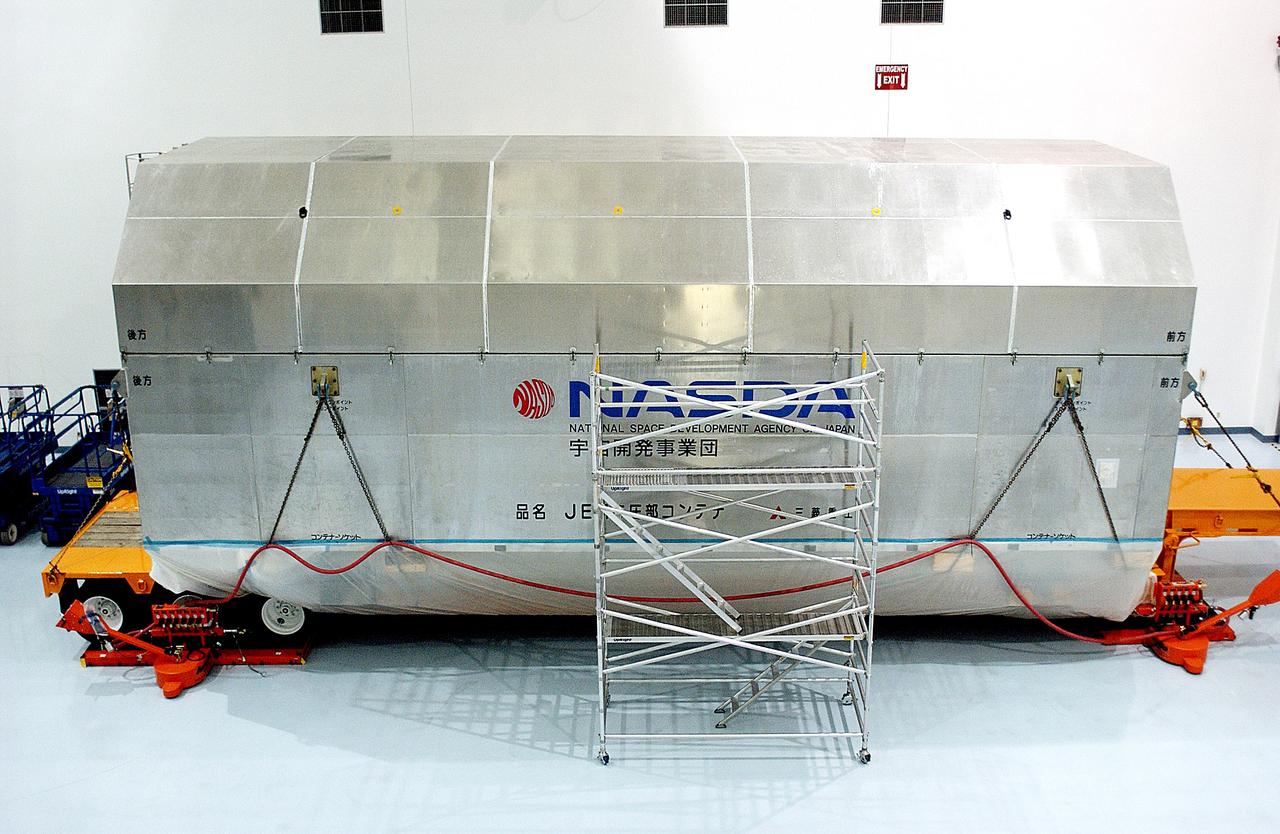
KENNEDY SPACE CENTER, FLA. -   In the Space Station Processing Facility, the lid is removed from the container with the Japanese Experiment Module (JEM) pressure module inside.  A research laboratory, the pressurized module is the first element of the JEM, named "Kibo" (Hope), to be delivered to KSC.   The National Space Development Agency of Japan (NASDA) developed the laboratory at the Tsukuba Space Center near Tokyo and is Japan's primary contribution to the Station. It will enhance the unique research capabilities of the orbiting complex by providing an additional environment for astronauts to conduct science experiments.  The JEM also includes an exposed facility (platform) for space environment experiments, a robotic manipulator system, and two logistics modules. The various JEM components will be  assembled in space over the course of three Shuttle missions.
KENNEDY SPACE CENTER, FLA. - In the Space Station Processing Facility, the lid is removed from the container with the Japanese Experiment Module (JEM) pressure module inside. A research laboratory, the pressurized module is the first element of the JEM, named "Kibo" (Hope), to be delivered to KSC. The National Space Development Agency of Japan (NASDA) developed the laboratory at the Tsukuba Space Center near Tokyo and is Japan's primary contribution to the Station. It will enhance the unique research capabilities of the orbiting complex by providing an additional environment for astronauts to conduct science experiments. The JEM also includes an exposed facility (platform) for space environment experiments, a robotic manipulator system, and two logistics modules. The various JEM components will be assembled in space over the course of three Shuttle missions.
Astronaut Edward T. Lu, NASA International Space Station Science Officer and Flight Engineer for Expedition 7, dons his Russian Sokol suit for the leak check, seat liner check and Soyuz inspection at the Soyuz Integration Facility at the Baikonur Cosmodrome in Baikonur, Kazakhstan, Thursday, April 10, 2003.  Photo Credit: (NASA/Bill Ingalls)
Expedition 7 Leak Check
KENNEDY SPACE CENTER, FLA. -  A grid on the floor of the RLV Hangar is filling up with pieces of Columbia debris that have been collected by workers in the field. The blue lines reflect the outline of the orbiter. The Columbia Reconstruction Project Team is identifying pieces and placing them on the grid approximating their location on the orbiter to facilitate the investigation into the accident that caused the destruction of Columbia and loss of its crew as it returned to Earth following mission STS-107. To date, about 25 percent of the orbiter has been delivered to the hangar.
KSC-03pd0875
ISS006-E-43973 (6 April 2003) --- Backdropped against a blue and white Earth, the Space Station Remote Manipulator System (SSRMS) or Canadarm2 is pictured in this digital still camera’s view taken from the International Space Station (ISS).
View of the SSRMS/Canadarm2 with blue and white Earth in the background during Expedition Six
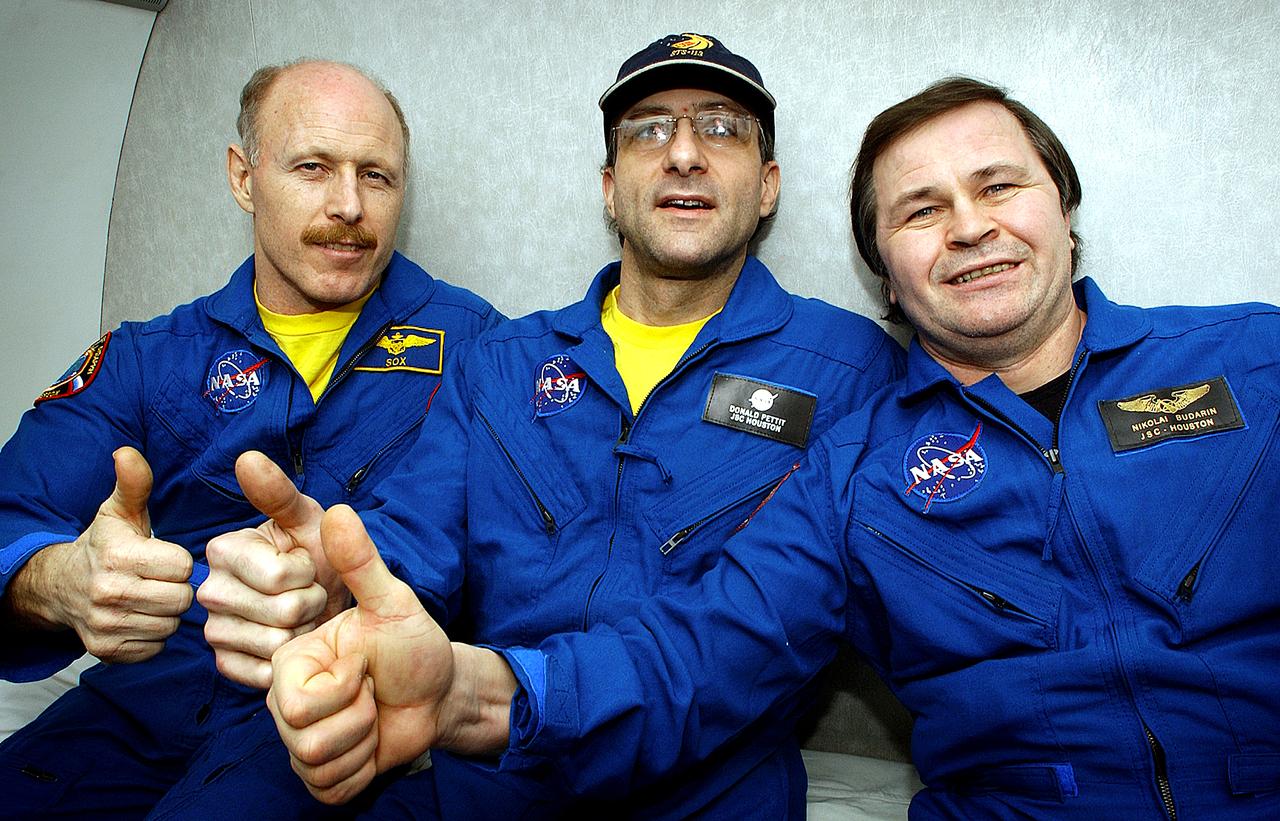
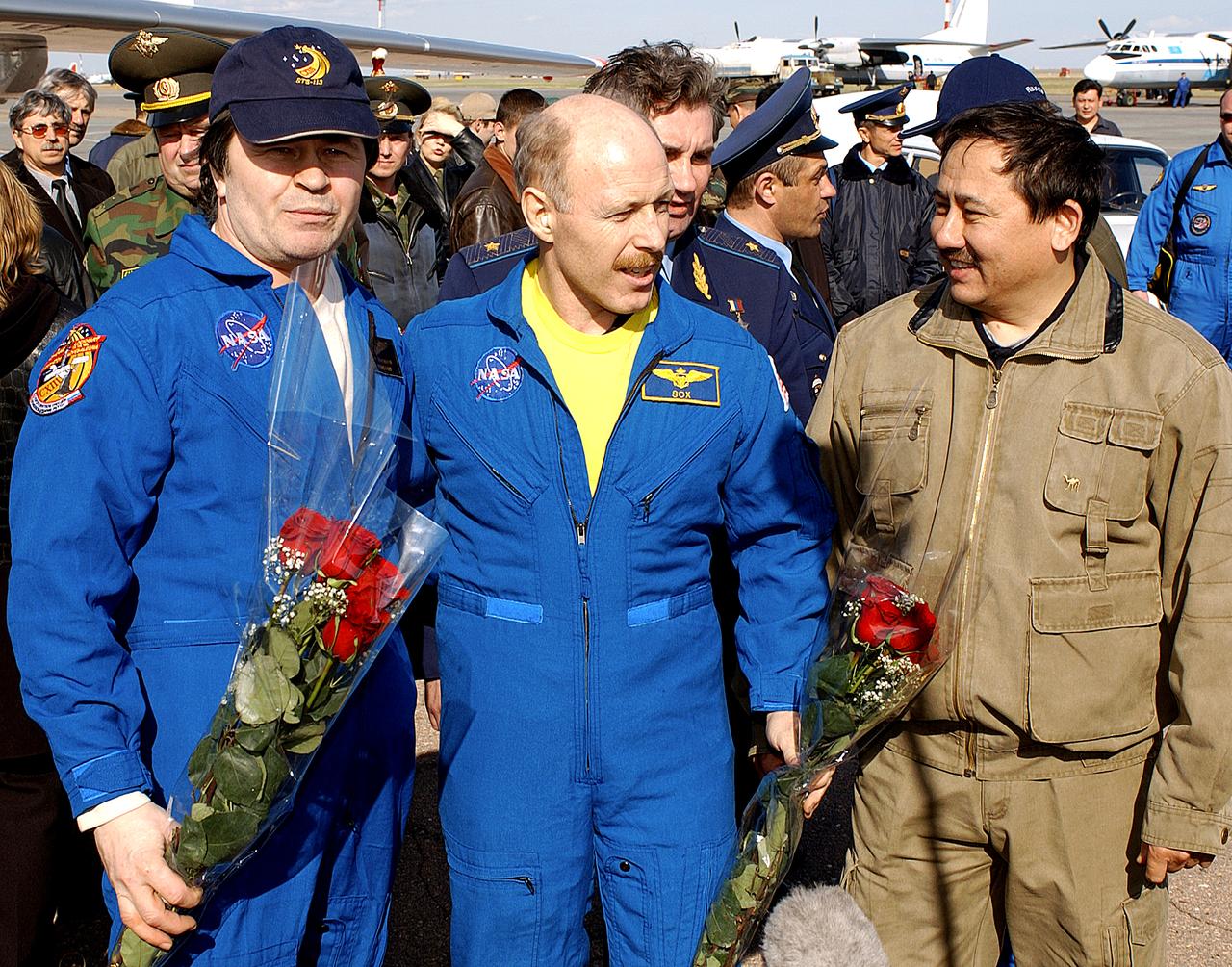
Expedition 6 Commander Ken Bowersox, left and NASA Internationl Space Station Science Officer Don Pettit talk about their landing during the flight from Kazakhstan to Moscow, Tuesday, May 4, 2003.   Photo Credit: (NASA/Bill Ingalls)
Expedition 6 Landing
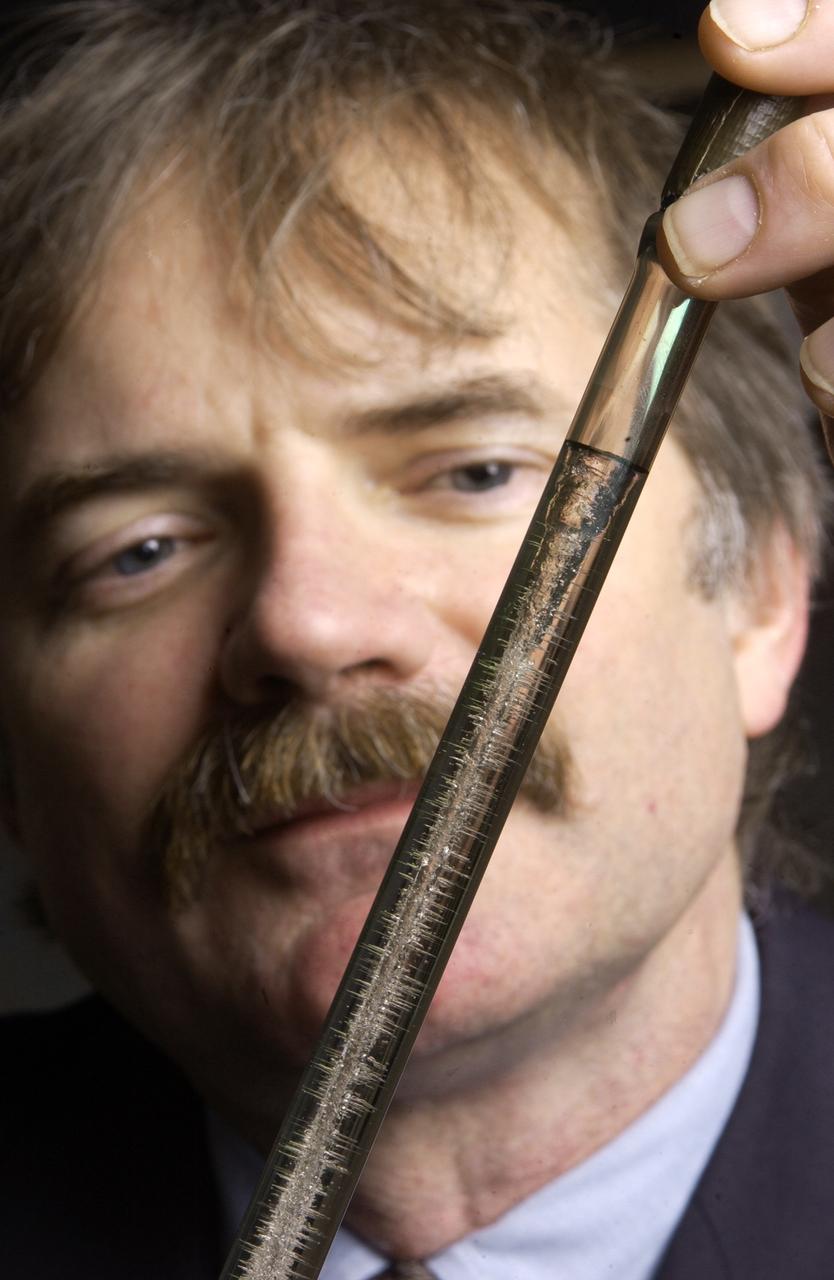
Video images sent to the ground allow scientists to watch the behavior of the bubbles as they control the melting and freezing of the material during the Pore Formation and Mobility Investigation (PFMI) in the Microgravity Science Glovebox aboard the International Space Station. While the investigation studies the way that metals behave at the microscopic scale on Earth -- and how voids form -- the experiment uses a transparent material called succinonitrile that behaves like a metal to study this problem. The bubbles do not float to the top of the material in microgravity, so they can study their interactions.
Material Science
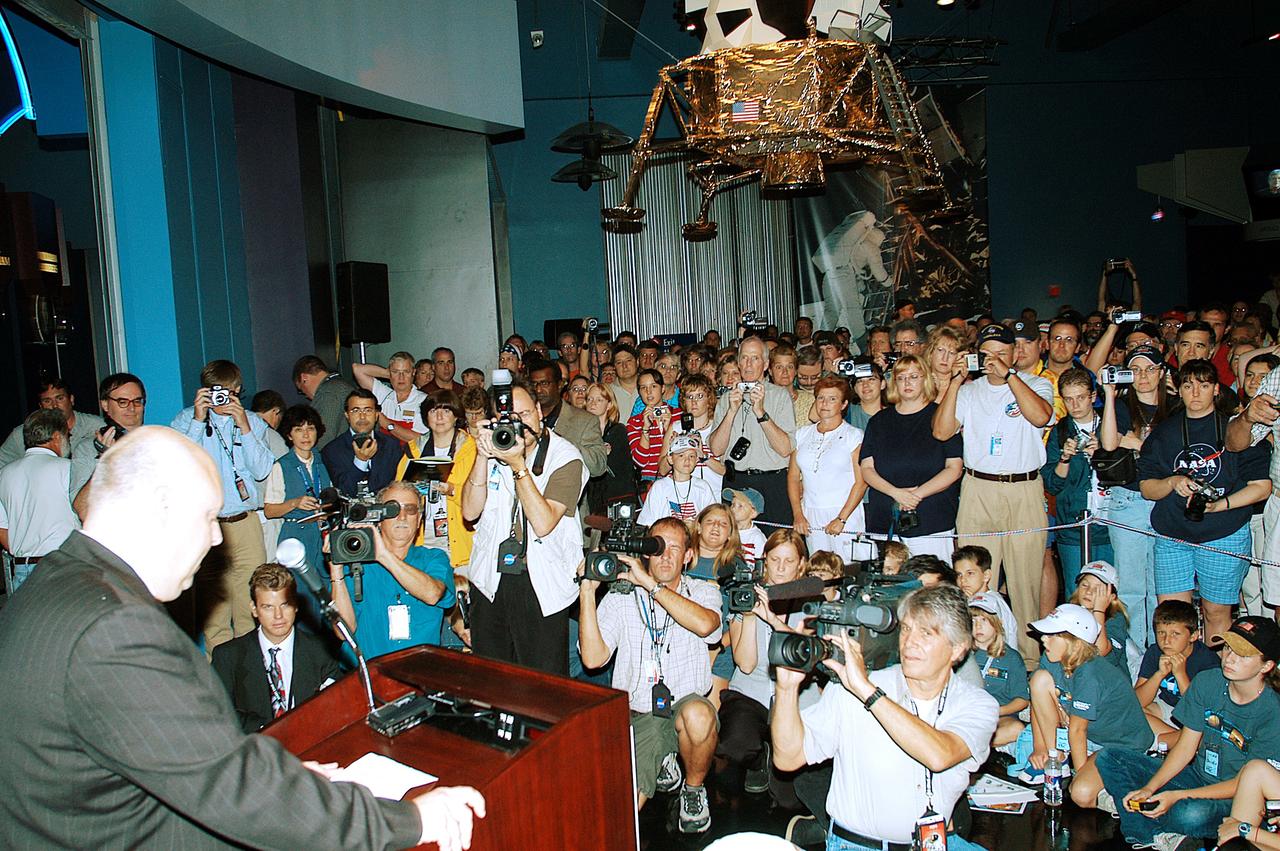
KENNEDY SPACE CENTER, FLA. - Center Director Roy Bridges speaks to attendees at the groundbreaking for the Operations Support Building II.  The audience included representatives of Governor Jeb Bush and the state of Florida.  The new building will replace modular housing constructed more than 20 years ago and house NASA and contractor support staff for shuttle operations.  The demolition of the modular buildings has begun and construction will immediately follow.  The new structure is projected to be ready in April 2005.
KSC-03pd0574
KENNEDY SPACE CENTER, FLA. -  Astronaut Pam Melroy speaks to members of the Columbia Reconstruction Team during transfer of debris from the Columbia Debris Hangar to its permanent storage site in the Vehicle Assembly Building.  More than 83,000 pieces of debris were shipped to KSC during search and recovery efforts in East Texas. That represents about 38 percent of the dry weight of Columbia, equaling almost 85,000 pounds.
KENNEDY SPACE CENTER, FLA. - Astronaut Pam Melroy speaks to members of the Columbia Reconstruction Team during transfer of debris from the Columbia Debris Hangar to its permanent storage site in the Vehicle Assembly Building. More than 83,000 pieces of debris were shipped to KSC during search and recovery efforts in East Texas. That represents about 38 percent of the dry weight of Columbia, equaling almost 85,000 pounds.
From the air, one of the new Launch Pad facilities building is seen. A mix of office and shop space, the pad facilities consolidate personnel into one site at each pad.
Aerial Views of KSC
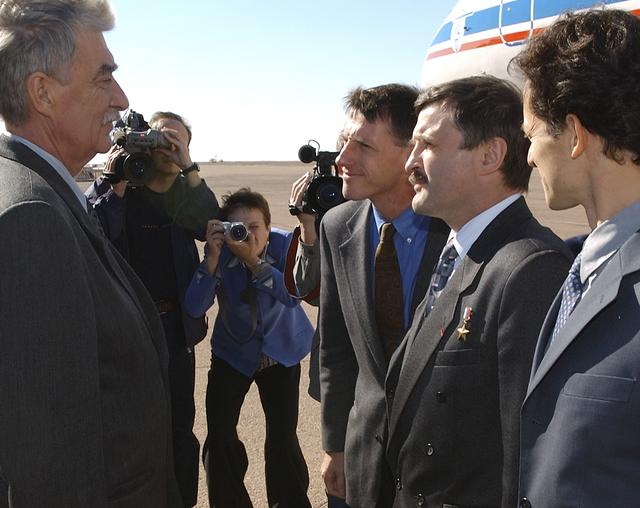
Expedition 8 Commander Michael Foale gives a thumbs up after he and his crew mates, Soyuz Flight Engineer Alexander Kaleri and European Space Agency astronaut Andre Kuipers, of the Netherlands, touched down in north central Kazakhstan, Friday, April 30, 2004, in their Soyuz TMA-3 capsule. Foale and Kaleri completed 195 days in space aboard the International Space Station, while Kuipers returned after an 11-day research mission as part of a commercial agreement between ESA and the Russian Federal Space Agency. Photo Credit (NASA/Bill Ingalls)
Expedition 8 Landing
KENNEDY SPACE CENTER, FLA.  -     Japanese girls from Urawa Daiichi Girls High School, Urawa, Japan, carry a floral tribute to the crew of Columbia to place at the STS-107 memorial stone at the Spacehab facility, Cape Canaveral, Fla.   The group was  awarded the trip to Florida when their experiments were chosen to fly on mission STS-107.  The group was also meeting with American students from Melbourne and Jacksonville, Fla.   The National Space Development  Agency of Japan (NASDA) and the KSC International Space Station and Payloads Processing Directorate worked with the NASA KSC Education Programs and University Research Division to coordinate the students’ visit.
KENNEDY SPACE CENTER, FLA. - Japanese girls from Urawa Daiichi Girls High School, Urawa, Japan, carry a floral tribute to the crew of Columbia to place at the STS-107 memorial stone at the Spacehab facility, Cape Canaveral, Fla. The group was awarded the trip to Florida when their experiments were chosen to fly on mission STS-107. The group was also meeting with American students from Melbourne and Jacksonville, Fla. The National Space Development Agency of Japan (NASDA) and the KSC International Space Station and Payloads Processing Directorate worked with the NASA KSC Education Programs and University Research Division to coordinate the students’ visit.
KENNEDY SPACE CENTER, FLA. -  Mobile Launcher Platform (MLP) number 3 and a set of twin solid rocket boosters bolted to it, atop the crawler-transporter, crawl to the intersection in the crawlerway in support of the second engineering analysis vibration test on the crawler and MLP.  In the background are Launch Pads 39A (right) and 39B (left).  The crawler is moving at various speeds up to 1 mph in an effort to achieve vibration data gathering goals as it leaves the VAB, travels toward Launch Pad 39A and then returns.  The boosters are braced at the top for stability.  The primary purpose of these rollout tests is to gather data to develop future maintenance requirements on the transport equipment and the flight hardware. Various parts of the MLP and crawler transporter have been instrumented with vibration data collection equipment.
KENNEDY SPACE CENTER, FLA. - Mobile Launcher Platform (MLP) number 3 and a set of twin solid rocket boosters bolted to it, atop the crawler-transporter, crawl to the intersection in the crawlerway in support of the second engineering analysis vibration test on the crawler and MLP. In the background are Launch Pads 39A (right) and 39B (left). The crawler is moving at various speeds up to 1 mph in an effort to achieve vibration data gathering goals as it leaves the VAB, travels toward Launch Pad 39A and then returns. The boosters are braced at the top for stability. The primary purpose of these rollout tests is to gather data to develop future maintenance requirements on the transport equipment and the flight hardware. Various parts of the MLP and crawler transporter have been instrumented with vibration data collection equipment.
Gullies in Crater in Hellas
JSC2003-E-42549 (For Release: 18 June 2003) --- The Experiment Logistics Modules-Exposed (ELM-ES) of the Japanese Experiment Module (JEM), Japan's primary contribution to the International Space Station (ISS), is shown in a processing facility. There are two JEM logistics modules, one each for the Pressurized Module and the Exposed Facility, that serve as on-orbit storage areas that house materials for experiments, maintenance tools and supplies. The ELM-ES is a pallet that can hold 3 experiment payloads for the JEM Exposed Facility. Photo Credit: NASDA
JEM ELM-ES
KENNEDY SPACE CENTER, FLA. - The mission patch for STS-107 is displayed, left, on the outside of the RLV Hangar at KSC. The hangar is the site of the Columbia Reconstruction Project, where pieces of debris from Columbia are being collected and identified as part of the mishap investigation.
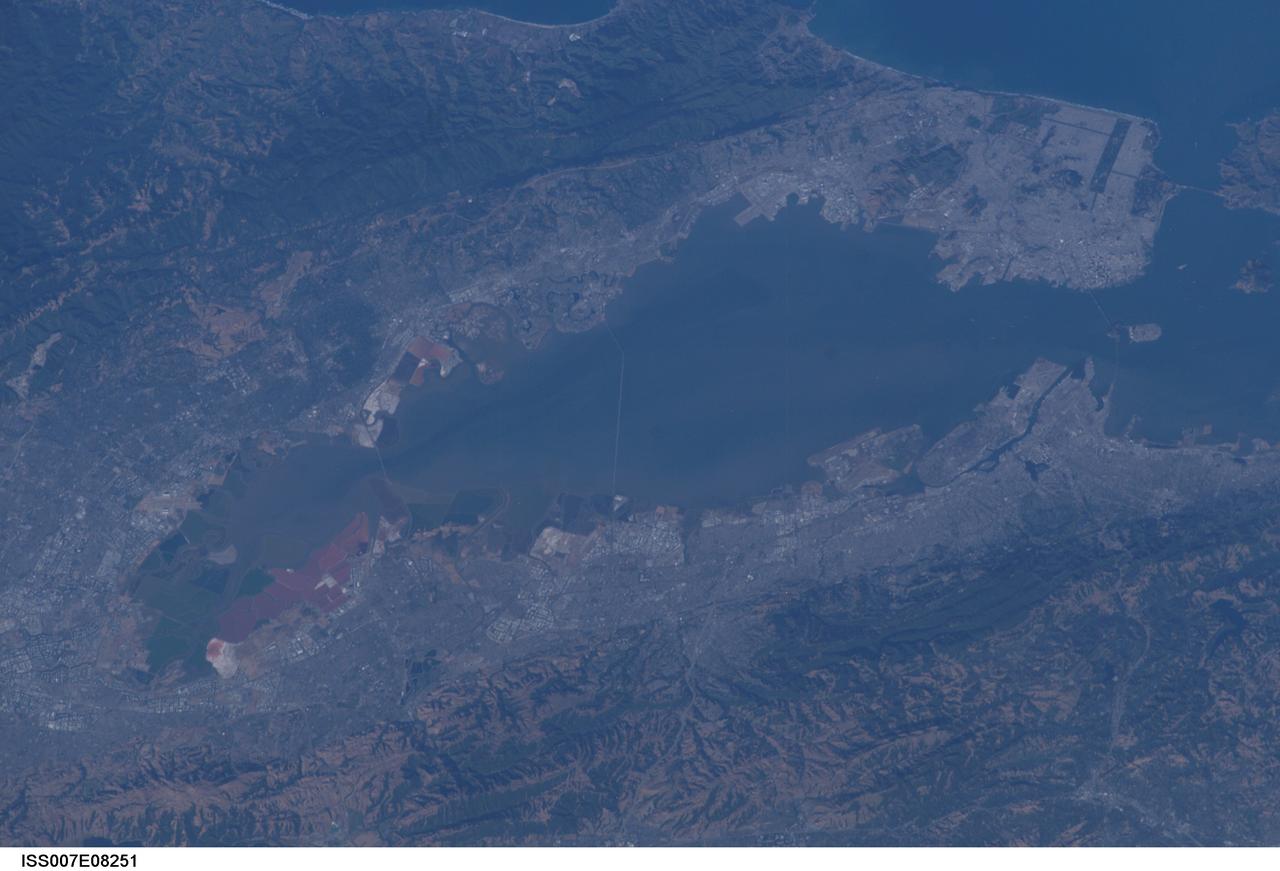
ISS007-E-08251 (25 June 2003) --- This photo featuring the San Francisco Bay area in California was photographed from the International Space Station (ISS) by astronaut Edward T. Lu, Expedition 7 NASA ISS science officer and flight engineer. The San Francisco Bay Bridge, Alcatraz Island, Golden Gate Bridge, and Golden Gate Park are visible at upper right. Stanford University and red salt ponds on the bay near Fremont at lower left.
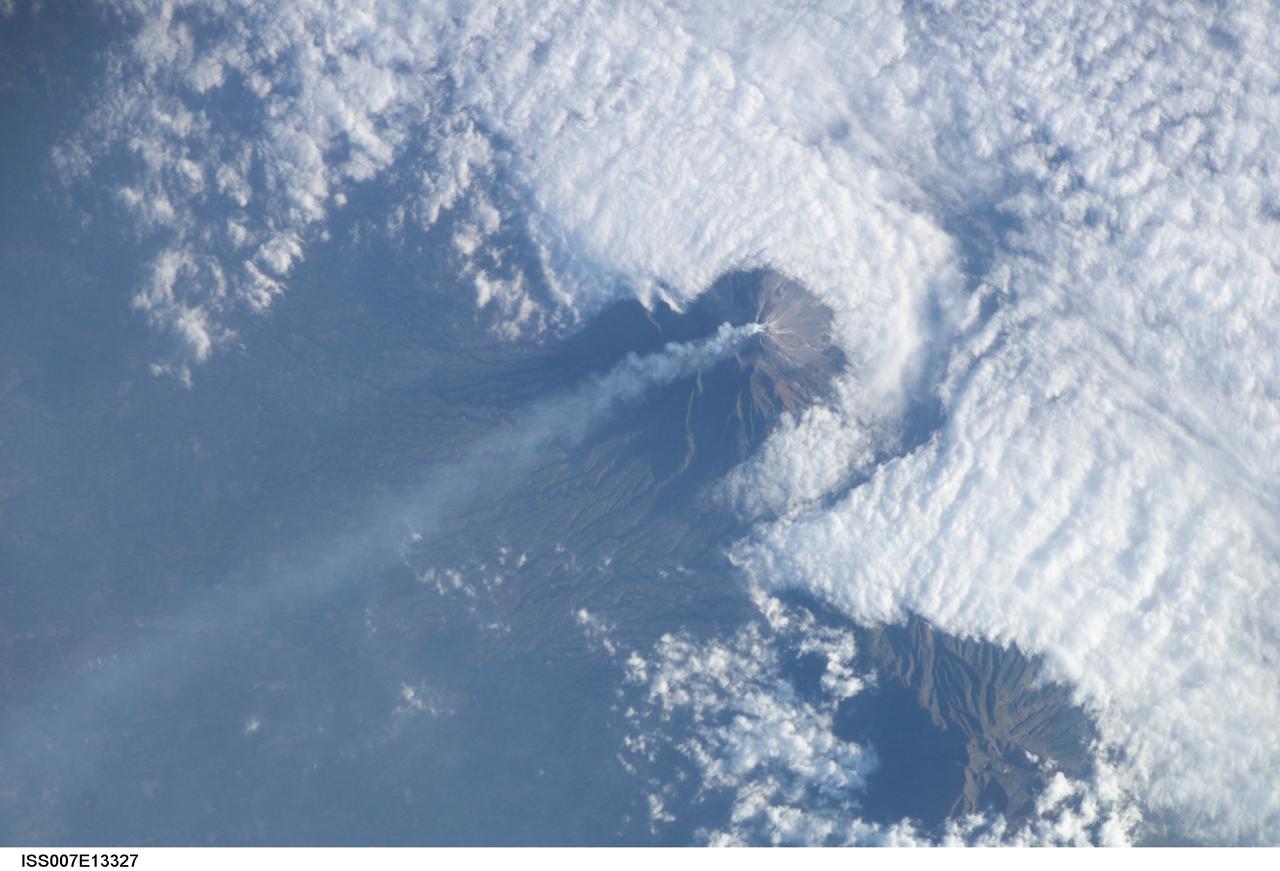
Earth Observations taken by the Expedition Seven crew
ISS008-E-05865 (12 November 2003) --- Cosmonaut Alexander Y. Kaleri, Expedition 8 flight engineer, moves a Zero-G Storage Rack (ZSR) in the Destiny laboratory on the International Space Station (ISS). Kaleri, who represents Rosaviakosmos, commanded the Soyuz flight that took the crew to the station last month.
Kaleri works with a ZSR in the Lab during Expedition 8
KENNEDY SPACE CENTER, FLA. -- Members of the Columbia Accident Investigation Board look over Space Shuttle Atlantis in the Vehicle Assembly Building.  The board is visiting sites at KSC to become familiar with the Shuttle launch process and elements. The independent board is charged with determining what caused the destruction of the Space Shuttle Columbia and the loss of its seven-member crew on Feb. 1 during reentry.
KSC-03pd0368
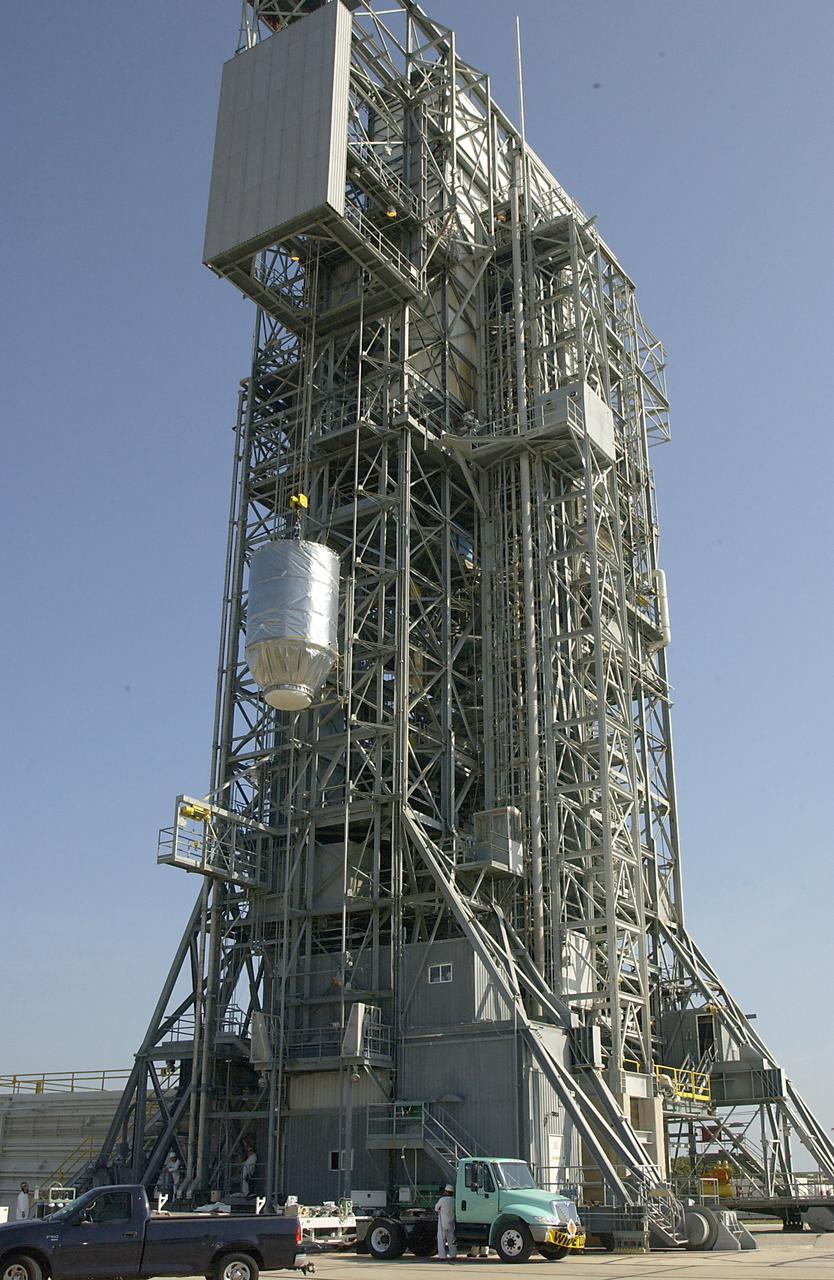
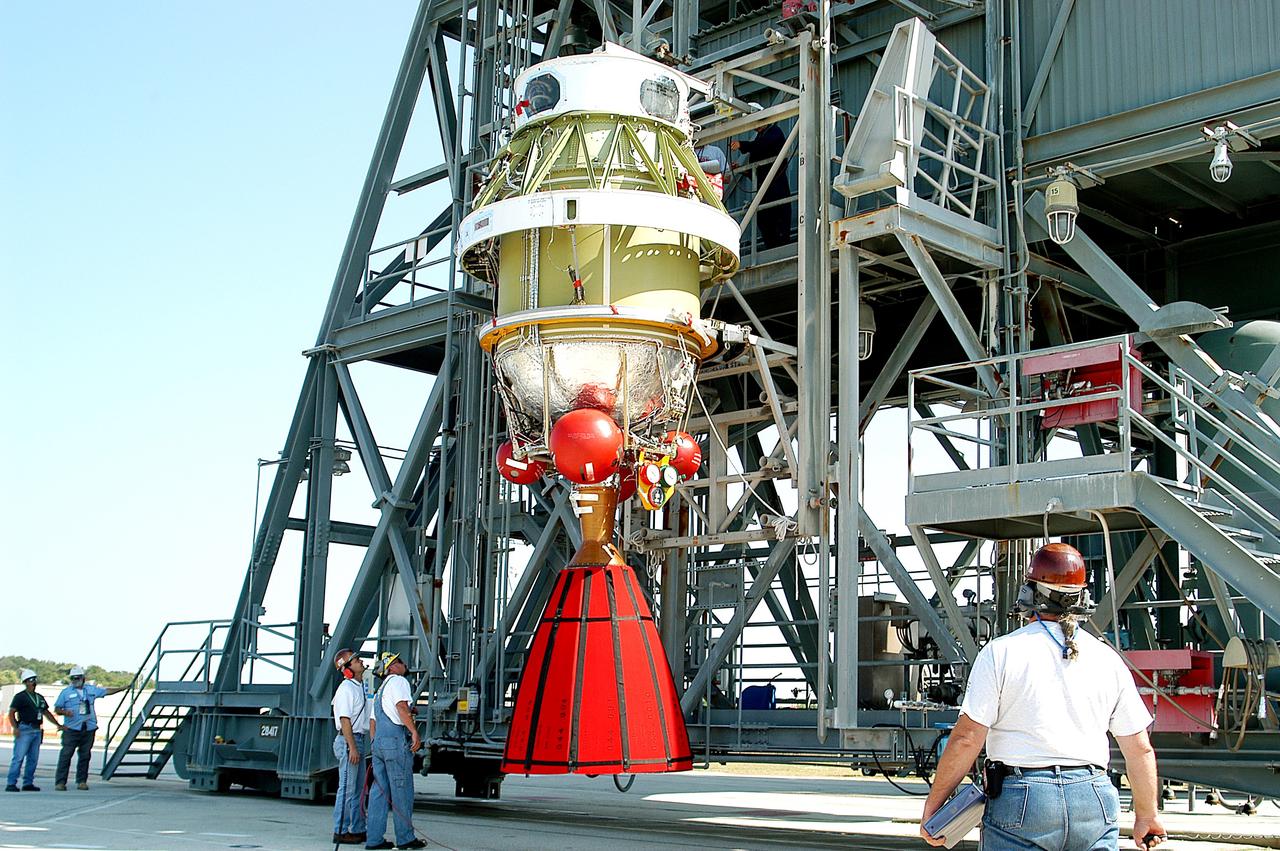
A booster rocket arrives at Launch Complex 17-B, Cape Canaveral Air Force Station. It is one of nine solid rocket boosters being erected and mated to the Delta II rocket for launch of the Space Infrared Telescope Facility. The second stage will later be hoisted atop the first stage. SIRTF will obtain images and spectra by detecting the infrared energy, or heat, radiated by objects in space. Most of this infrared radiation is blocked by the Earth's atmosphere and cannot be observed from the ground. Consisting of an 0.85-meter telescope and three cryogenically cooled science instruments, SIRTF is one of NASA's largest infrared telescopes to be launched. SIRTF is scheduled for launch April 15 at 4:34:07 a.m. EDT.
Delta II SIRTF Booster Lift & Mate
KENNEDY SPACE CENTER, FLA. - KSC Director Roy D. Bridges (second from left) inspects Columbia debris arriving at KSC from the collection point at Barksdale Air Force Base, Shreveport, La.  The debris is being collected at the RLV Hangar near the Shuttle Landing Facility.  Workers there will attempt to reconstruct the orbiter as part of the ongoing investigation of the accident that destroyed the Columbia and claimed the lives of seven astronauts as they returned to Earth after a 16-day research mission, STS-107.
KSC-03pd0352
KENNEDY SPACE CENTER, FLA. --  Two members of the STS-107 crew, Mission Specialist Laurel Clark (left) and Payload Specialist Ilan Ramon (right), talk after their arrival at KSC to Launch Director Mike Leinbach. Ramon is the first Israeli astronaut to fly on a Shuttle mission. STS-107 is a mission devoted to research and will include more than 80 experiments that will study Earth and space science, advanced technology development, and astronaut health and safety. The payload on Space Shuttle Columbia includes FREESTAR (Fast Reaction Experiments Enabling Science, Technology, Applications and Research) and the SHI Research Double Module (SHI/RDM), known as SPACEHAB.  Experiments on the module range from material sciences to life sciences.  Other crew members are Commander Rick Husband, Pilot William "Willie" McCool, Payload Commander Michael Anderson and Mission Specialists Kalpana Chawla and David Brown.  Launch of Columbia is targeted for Jan. 16 between 10 a.m. and 2 p.m.
KSC-03pd0051
KENNEDY SPACE CENTER, FLA. -  In the Orbiter Processing Facility,  while a few photographers (left) set up for photos, NASA Vehicle Manager Scott Thurston (right, with arm extended) talks about the Reinforced Carbon-Carbon panel at right.   The media was invited to see the orbiter Atlantis as it is being prepared for Return to Flight.  Both local and national reporters representing print and TV networks were able to see work in progress on Atlantis, including the reinstallation of the Reinforced Carbon-Carbon panels on the orbiter’s wing leading edge; wiring inspections; and checks of the engines in the Orbital Maneuvering System.
KENNEDY SPACE CENTER, FLA. - In the Orbiter Processing Facility, while a few photographers (left) set up for photos, NASA Vehicle Manager Scott Thurston (right, with arm extended) talks about the Reinforced Carbon-Carbon panel at right. The media was invited to see the orbiter Atlantis as it is being prepared for Return to Flight. Both local and national reporters representing print and TV networks were able to see work in progress on Atlantis, including the reinstallation of the Reinforced Carbon-Carbon panels on the orbiter’s wing leading edge; wiring inspections; and checks of the engines in the Orbital Maneuvering System.
KENNEDY SPACE CENTER, FLA. -  On Launch Complex 17-A, Cape Canaveral Air Force Station, the Boeing Delta II rocket and its Mars Exploration Rover (MER-A) payload are free of the tower  and ready for launch.  This will be the third launch attempt in as many days after weather concerns postponed the launches June 8 and June 9.  MER-A is the first of two rovers being launched to Mars.  When the two rovers arrive at the red planet in 2004, they will bounce to airbag-cushioned landings at sites offering a balance of favorable conditions for safe landings and interesting science. The rovers see sharper images, can explore farther and examine rocks better than anything that has ever landed on Mars.  The designated site for MER-A mission is Gusev Crater, which appears to have been a crater lake.  The second rover, MER-B, is scheduled to launch June 25.
KENNEDY SPACE CENTER, FLA. - On Launch Complex 17-A, Cape Canaveral Air Force Station, the Boeing Delta II rocket and its Mars Exploration Rover (MER-A) payload are free of the tower and ready for launch. This will be the third launch attempt in as many days after weather concerns postponed the launches June 8 and June 9. MER-A is the first of two rovers being launched to Mars. When the two rovers arrive at the red planet in 2004, they will bounce to airbag-cushioned landings at sites offering a balance of favorable conditions for safe landings and interesting science. The rovers see sharper images, can explore farther and examine rocks better than anything that has ever landed on Mars. The designated site for MER-A mission is Gusev Crater, which appears to have been a crater lake. The second rover, MER-B, is scheduled to launch June 25.
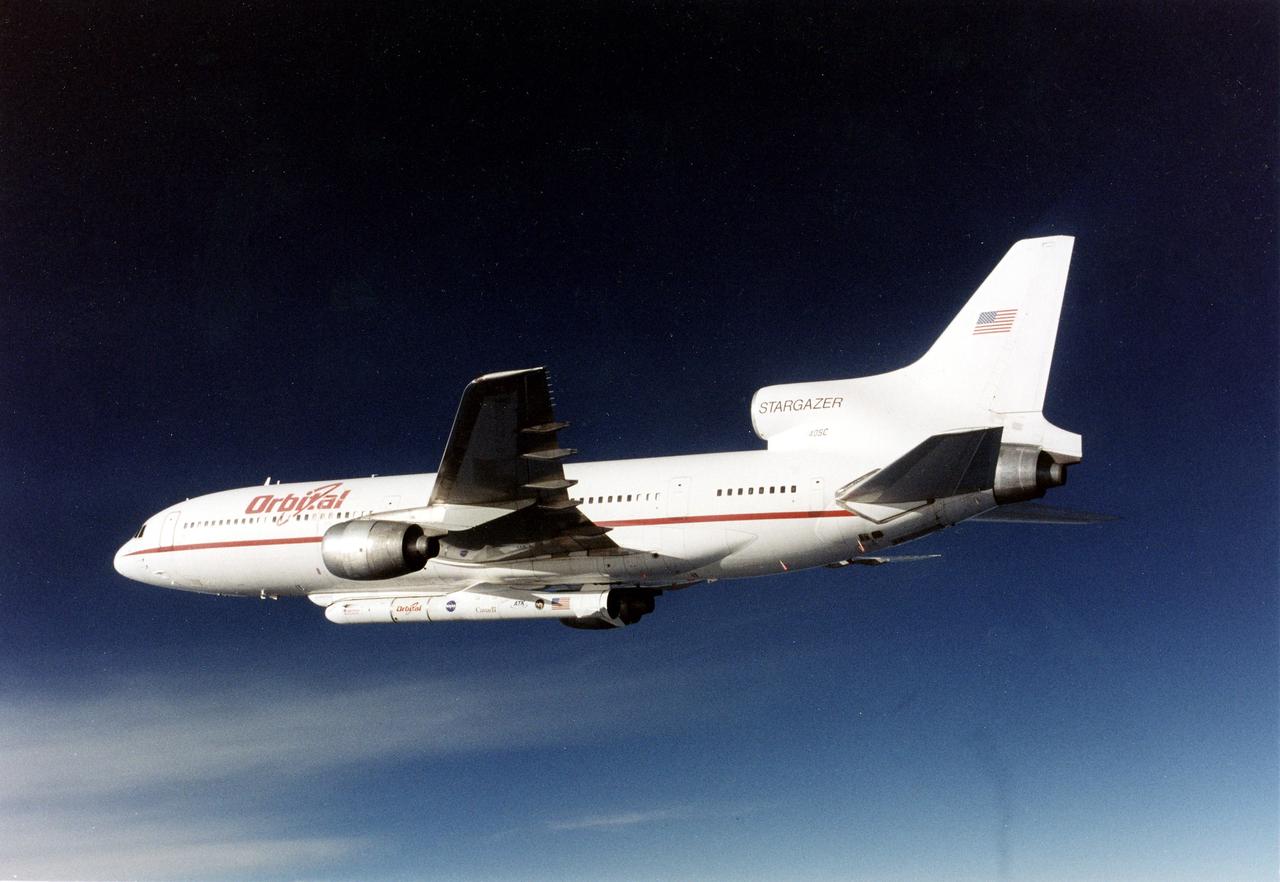
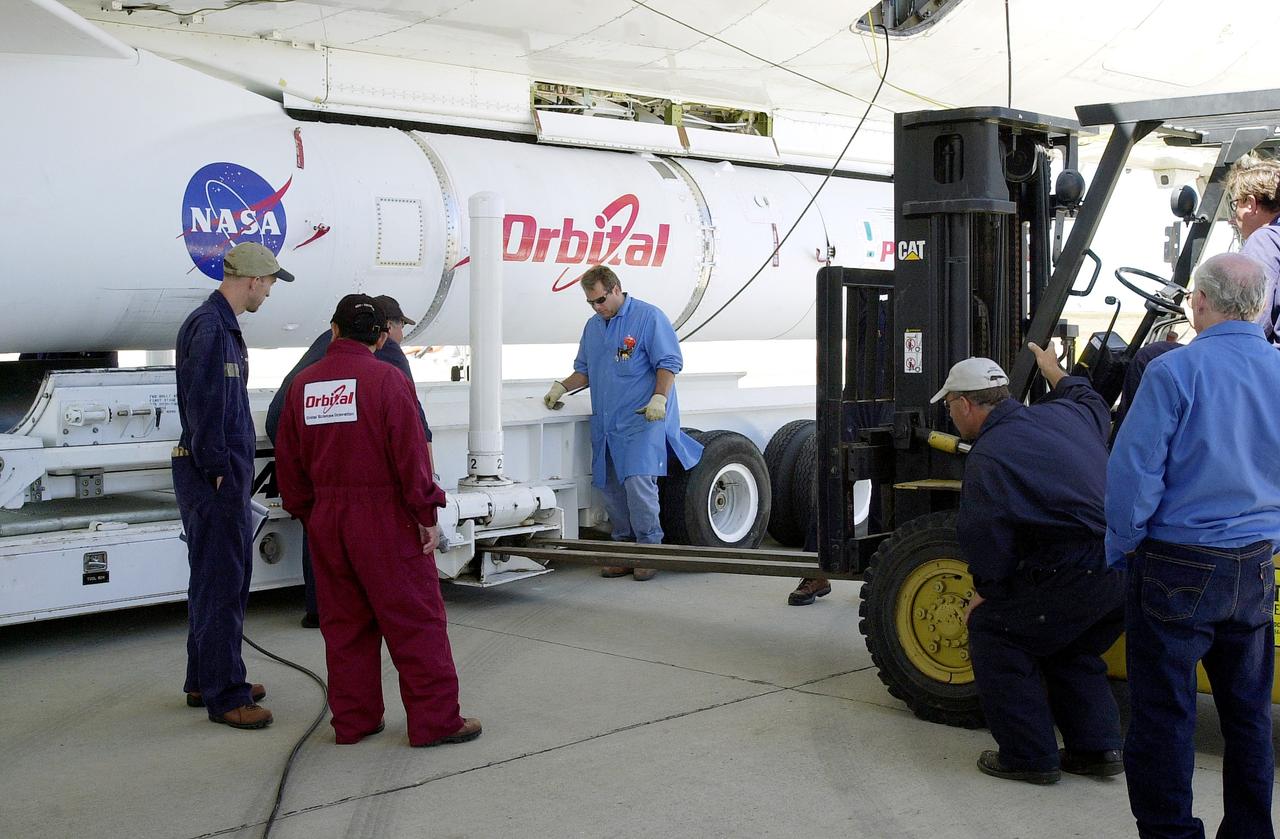
NASA's Ice, Cloud and Land Elevation satellite (ICESat) and Cosmic Hot Interstellar Spectrometer (CHIPS) satellite lifted off from Vandenberg Air Force Base, Calif at 4:45 p.m. PST aboard Boeing's Delta II rocket.  ICESat will examine the role that ice plays in global climate change, while CHIPS will explore the composition of our galaxy. Photo Credit: "NASA/Bill Ingalls"
03pd0061
KENNEDY SPACE CENTER, FLA. - In the Space Station Processing Facility, STS-117 Mission Specialist James Reilly (left) and STS-115 Mission Specialist Joseph Tanner (right) look over the Japanese Experiment Module (JEM).  Equipment familiarization is a routine part of astronaut training and launch preparations.
KENNEDY SPACE CENTER, FLA. - In the Space Station Processing Facility, STS-117 Mission Specialist James Reilly (left) and STS-115 Mission Specialist Joseph Tanner (right) look over the Japanese Experiment Module (JEM). Equipment familiarization is a routine part of astronaut training and launch preparations.
Troughs in Tempe Terra
KENNEDY SPACE CENTER, FLA. - At Launch Complex 17-A, Cape Canaveral Air Force Station, the first half of the fairing for the Mars Exploration Rover 2 (MER-2) closes in on the spacecraft.  MER-2 is one of NASA's twin Mars Exploration Rovers designed to study the history of water on Mars. These robotic geologists are equipped with a robotic arm, a drilling tool, three spectrometers, and four pairs of cameras that allow them to have a human-like, 3D view of the terrain. Each rover could travel as far as 100 meters in one day to act as Mars scientists' eyes and hands, exploring an environment where humans can't yet go.  MER-2 is scheduled to launch no earlier than June 8 as MER-A, with two launch opportunities each day during the launch period that closes on June 19.
KENNEDY SPACE CENTER, FLA. - At Launch Complex 17-A, Cape Canaveral Air Force Station, the first half of the fairing for the Mars Exploration Rover 2 (MER-2) closes in on the spacecraft. MER-2 is one of NASA's twin Mars Exploration Rovers designed to study the history of water on Mars. These robotic geologists are equipped with a robotic arm, a drilling tool, three spectrometers, and four pairs of cameras that allow them to have a human-like, 3D view of the terrain. Each rover could travel as far as 100 meters in one day to act as Mars scientists' eyes and hands, exploring an environment where humans can't yet go. MER-2 is scheduled to launch no earlier than June 8 as MER-A, with two launch opportunities each day during the launch period that closes on June 19.
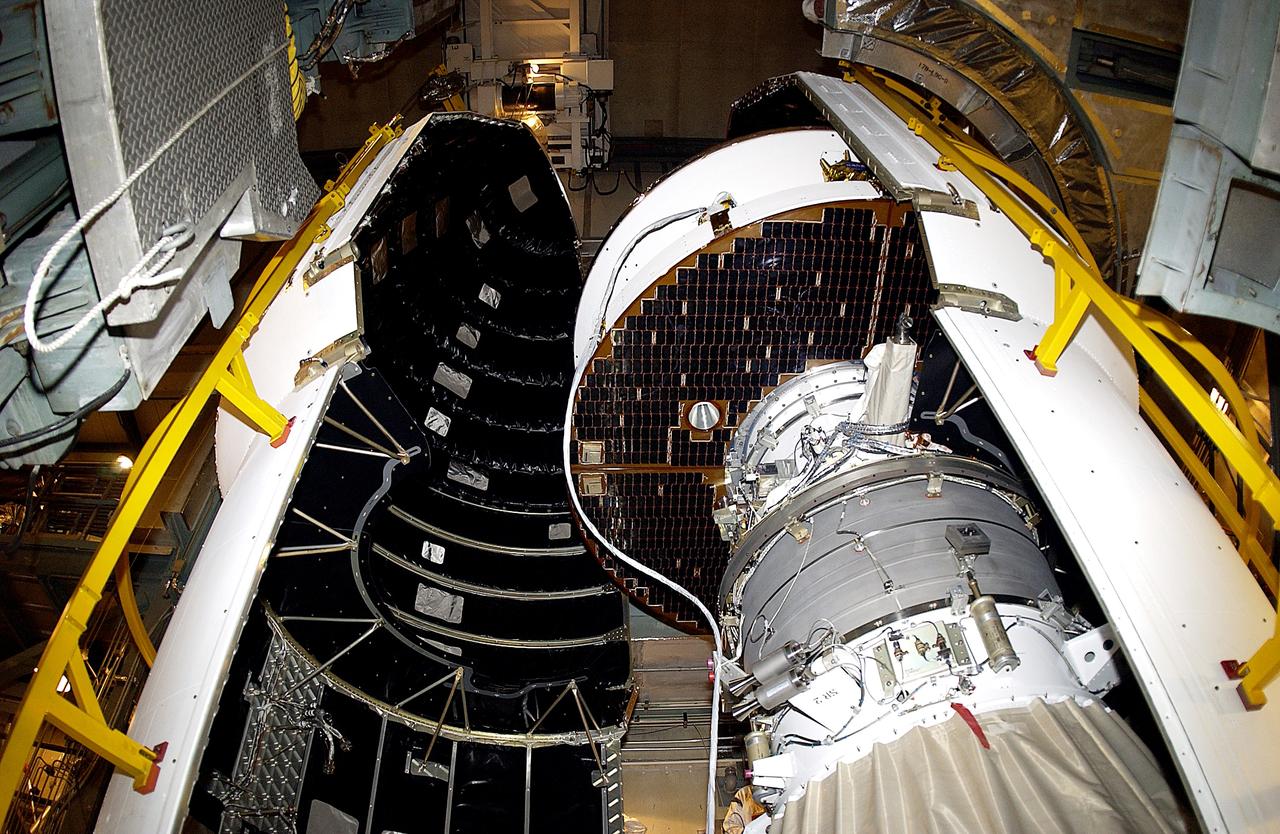
KENNEDY SPACE CENTER, FLA. - At Launch Complex 17-A, Cape Canaveral Air Force Station, the Mars Exploration Rover 2 (MER-2) is ready for installation of the fairing that will enclose it for launch. It is seen here already mated to the second stage of the Delta II rocket.  MER-2 is one of NASA's twin Mars Exploration Rovers designed to study the history of water on Mars. These robotic geologists are equipped with a robotic arm, a drilling tool, three spectrometers, and four pairs of cameras that allow them to have a human-like, 3D view of the terrain. Each rover could travel as far as 100 meters in one day to act as Mars scientists' eyes and hands, exploring an environment where humans can't yet go.  MER-2 is scheduled to launch no earlier than June 8 as MER-A, with two launch opportunities each day during the launch period that closes on June 19.
KENNEDY SPACE CENTER, FLA. - At Launch Complex 17-A, Cape Canaveral Air Force Station, the Mars Exploration Rover 2 (MER-2) is ready for installation of the fairing that will enclose it for launch. It is seen here already mated to the second stage of the Delta II rocket. MER-2 is one of NASA's twin Mars Exploration Rovers designed to study the history of water on Mars. These robotic geologists are equipped with a robotic arm, a drilling tool, three spectrometers, and four pairs of cameras that allow them to have a human-like, 3D view of the terrain. Each rover could travel as far as 100 meters in one day to act as Mars scientists' eyes and hands, exploring an environment where humans can't yet go. MER-2 is scheduled to launch no earlier than June 8 as MER-A, with two launch opportunities each day during the launch period that closes on June 19.
ISS007-E-07652 (July 2003) --- Part of Oshkosh, Wisconsin, site of a very popular air show, held around this time of year, was photographed by a crew member aboard the International Space Station during its seventh habitation mission.  The airfield near  Lake Winnebago hosts the mid-summer  fly-in event sponsored by the Experimental Aircraft Association (EAA).
Earth Observations taken by the Expedition Seven crew
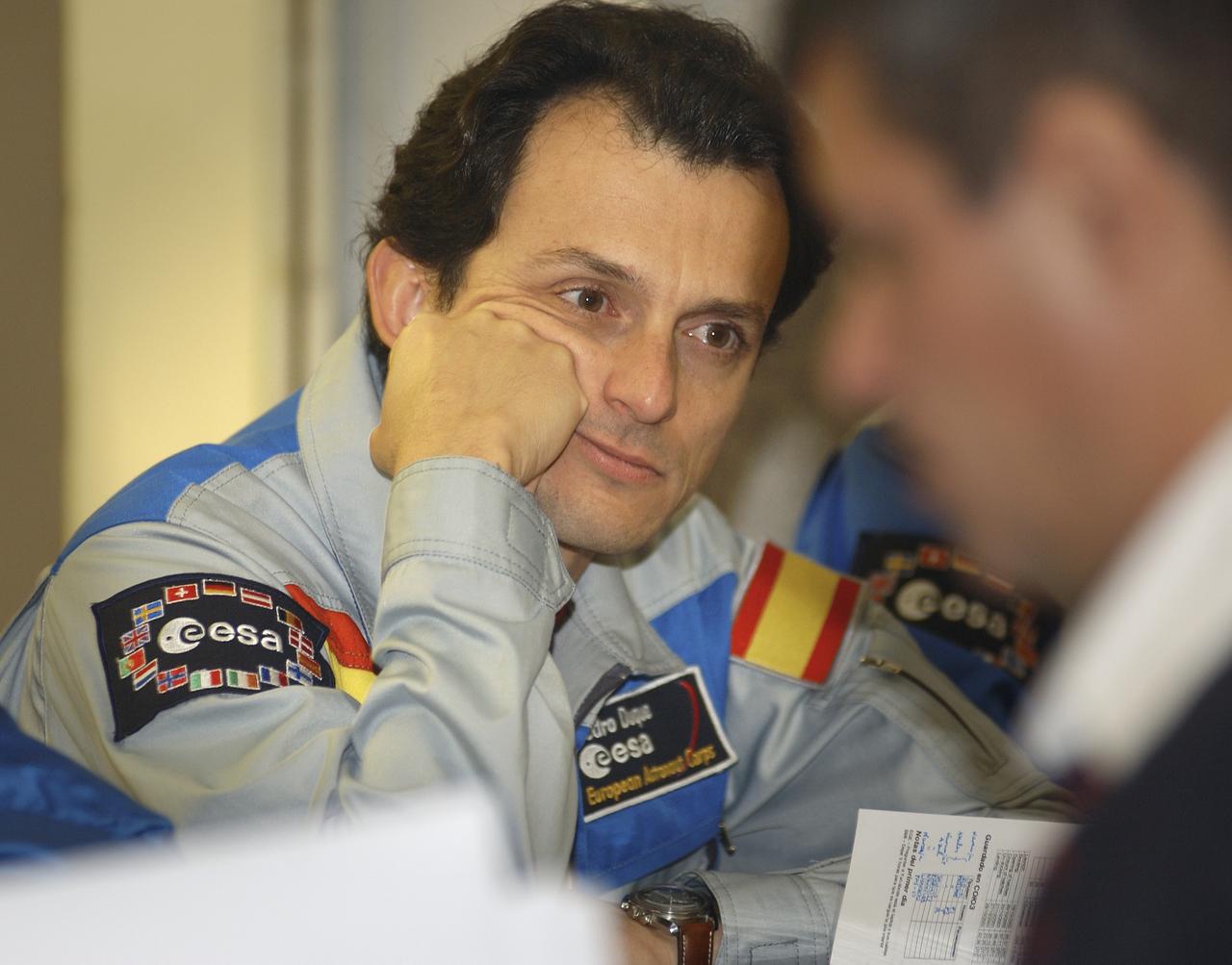
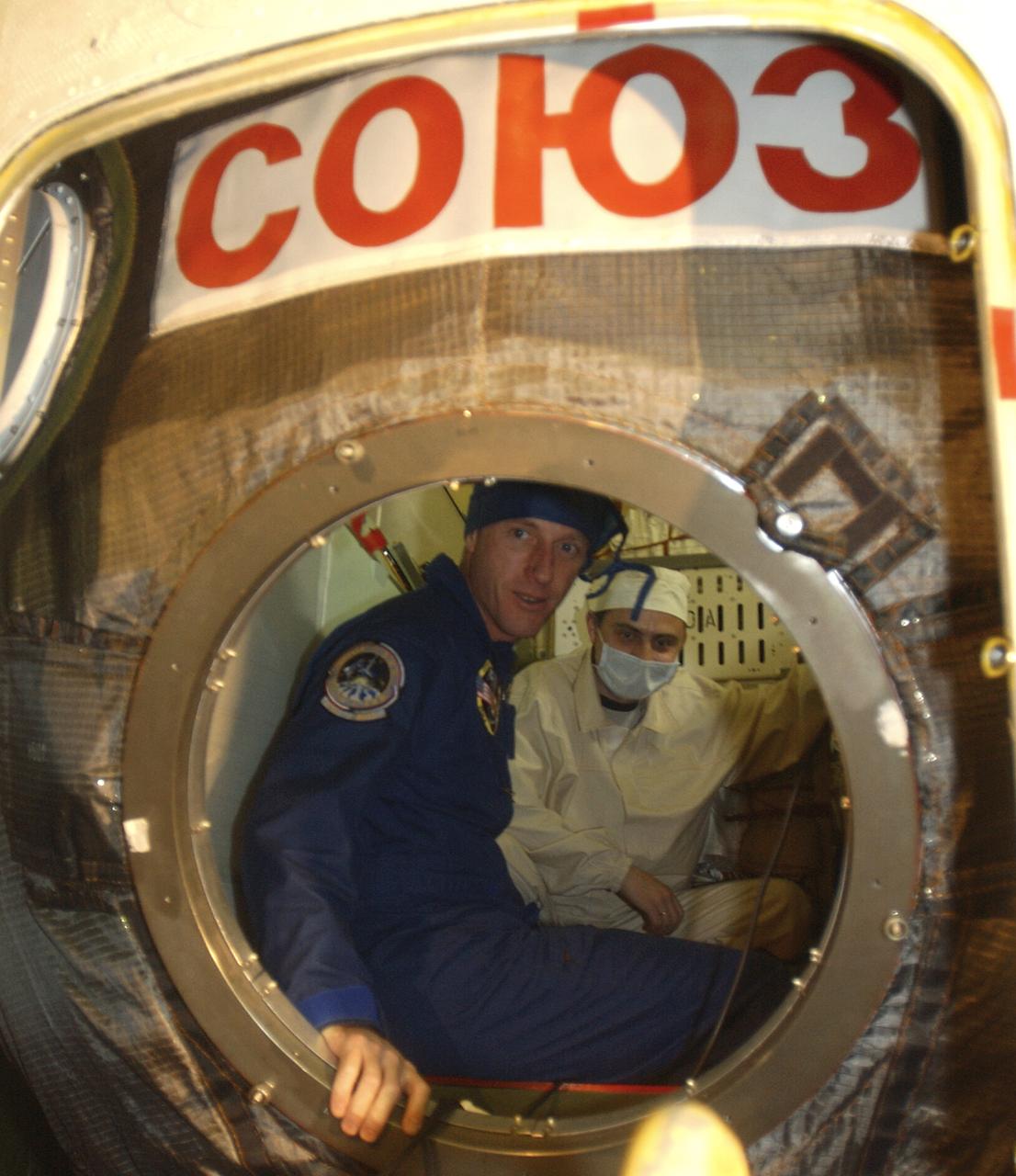
Expedition 8 Commander and NASA Science Officer Michael Foale completes suiting up at the Baikonur Cosmodrome in Kazakhstan, Saturday, Oct. 18, 2003, prior to departing for the launch pad with Expedition 8 Soyuz Commander Alexander Kaleri and European Space Agency astronaut Pedro Duque of Spain. The trio were launched on the Soyuz TMA-3 vehicle to the International Space Station, arriving on Oct. 20.Photo Credit (NASA/Bill Ingalls)
Expedition 8 Launch Day
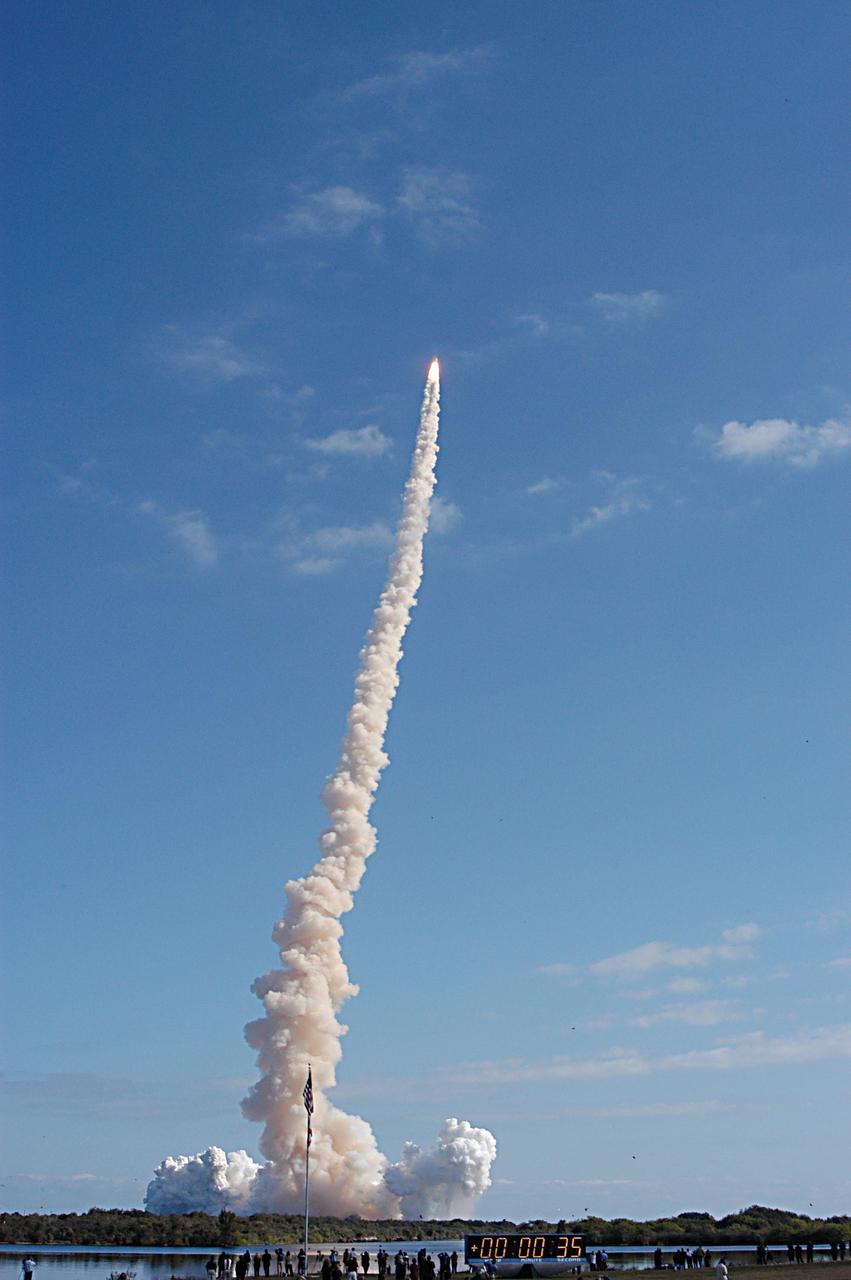
VANDENBERG AFB, Calif. --  A Boeing Delta II rocket soars above the clouds here today at Vandenberg AFB, Calif.  The NASA payloads aboard the rocket are the ICESat, an Ice Cloud and land Elevation Satellite, and CHIPSat, a Cosmic Hot Interstellar Plasma Spectrometer.  ICESat, a 661-pound satellite, is a benchmark satellite for the Earth Observing System that will help scientists determine if the global sea level is rising or falling.  It will observe the ice sheets that blanket the Earth’s poles to determine if they are growing or shrinking.  It will assist in developing an understanding of how changes in the Earth’s atmosphere and climate affect polar ice masses and global sea level.  The Geoscience Laser Altimeter System is the sole instrument on the satellite.  CHIPSat, a suitcase-size 131-pound satellite, will provide information about the origin, physical processes and properties of the hot gas contained in the interstellar medium.  This launch marks the first Delta from Vandenberg this year.  (USAF photo by: SSgt. Lee A Osberry Jr.)
KSC-03pd0069
KENNEDY SPACE CENTER, Fla. -  Mars Exploration Rover-1 is ready for prelaunch testing including deployment of the lander petals, the rover's solar arrays, camera mast and camera.  While at KSC, each of the rovers, their aeroshells and landers will undergo a full mission simulation. After spin balance testing,  each spacecraft will be mated to a solid propellant upper stage booster that will propel the spacecraft out of Earth orbit. Approximately 10 days before launch they will be transported to the launch pad for mating with their respective Boeing Delta II rockets. The rovers will serve as robotic geologists to seek answers about the evolution of Mars, particularly  for a history of water. The rovers are identical to each other, and will land at different regions of Mars.  Launch of the MER-1 is scheduled for May 30.  MER-2 will follow June 25.
KSC-03pd0723