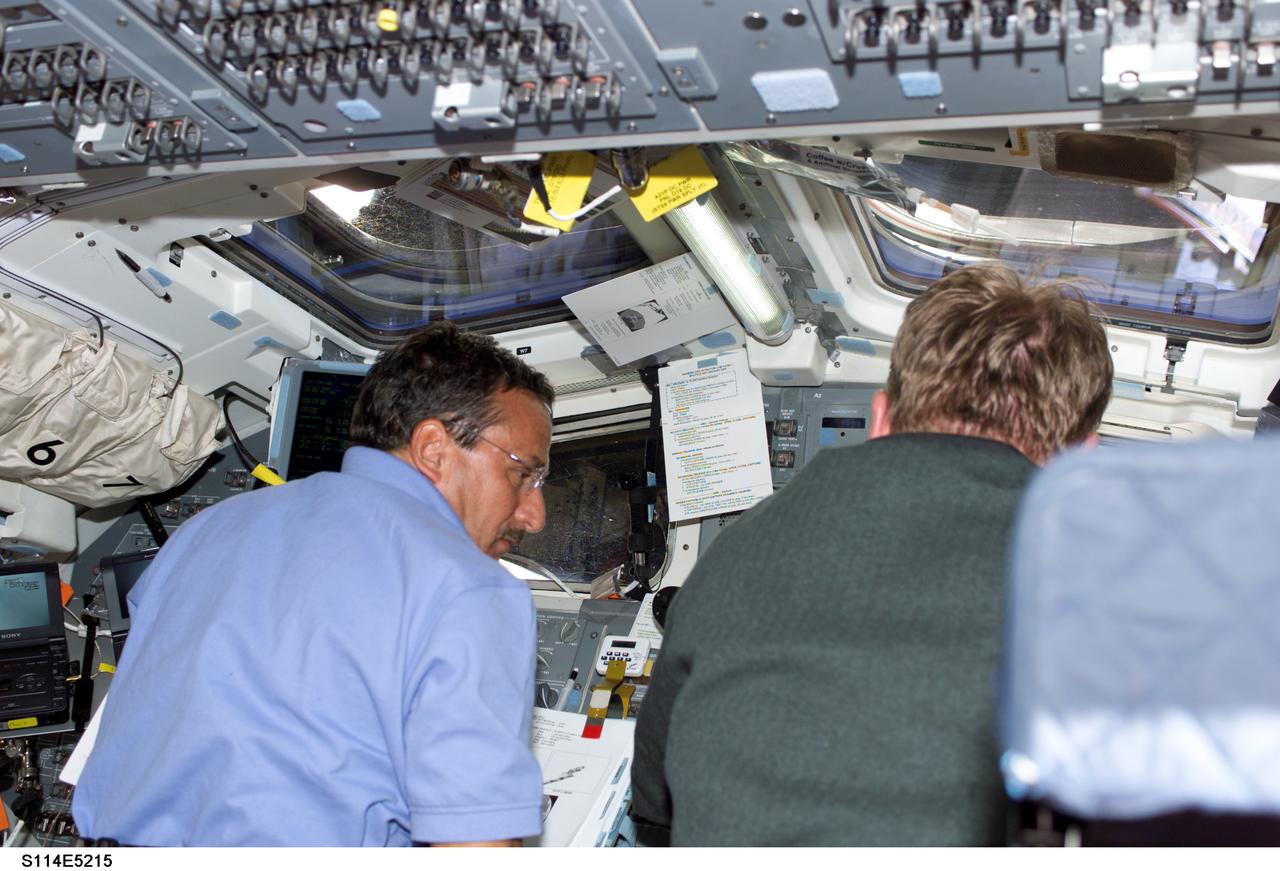
STS114-E-5215 (27 July 2005) --- Astronauts Charles J. Camarda (left) and Andrew S.W. Thomas on Discovery's aft flight deck.
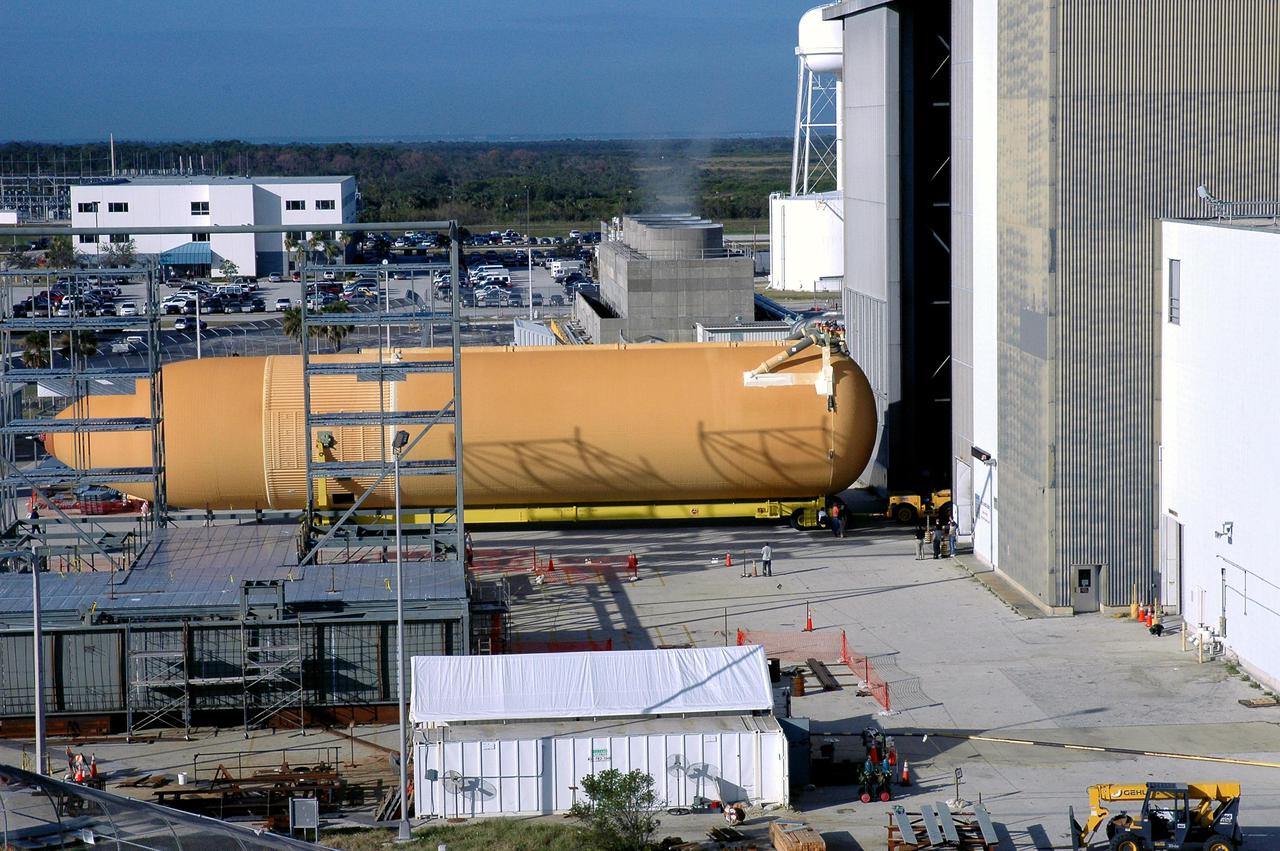
KENNEDY SPACE CENTER, FLA. - Viewed from the roof of the Launch Control Center in the Launch Complex 39 Area, the newly redesigned External Tank is seen moving into the Vehicle Assembly Building. In the transfer aisle of the VAB, the tank will be raised from a horizontal to a vertical position, then lifted high up into a storage cell, or “checkout cell,” where it will undergo inspections of the mechanical, electrical and thermal protection systems. New processing activities resulting from re-design of the tank include inspection of the bipod heater and External Tank separation camera, which includes charging the camera batteries. The tank will be then prepared for mating to the Solid Rocket Boosters. When preparations are complete, the tank will be lifted from the checkout cell, moved across the transfer aisle and into High Bay 1, where it will be lowered and attached to the boosters, which are sitting on the Mobile Launch Platform. The tank is designated for the Return to Flight mission, STS-114, targeted for a launch opportunity beginning in May. The seven-member Discovery crew will fly to the International Space Station primarily to test and evaluate new procedures for flight safety, including Space Shuttle inspection and repair techniques.
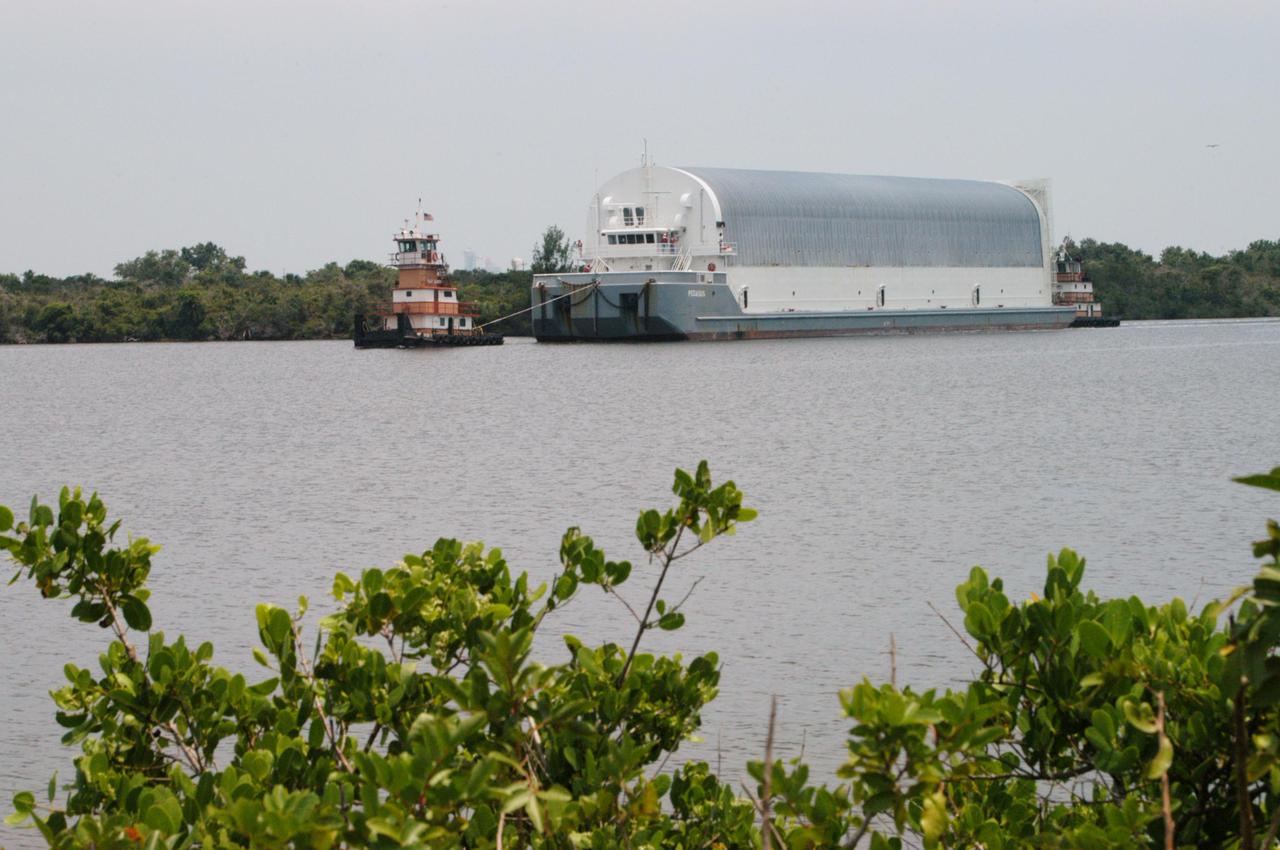
KENNEDY SPACE CENTER, FLA. - A barge carrying a new External Tank (ET) arrives at the Turn Basin in the Launch Complex 39 Area. Designated ET-119, the tank will be used on a future Space Shuttle launch. After being offloaded, the tank will be transported to the Vehicle Assembly Building. The barge was towed on a 900-mile journey at sea from the Michoud Assembly Facility in New Orleans by one of NASA’s Solid Rocket Booster Retrieval Ships.
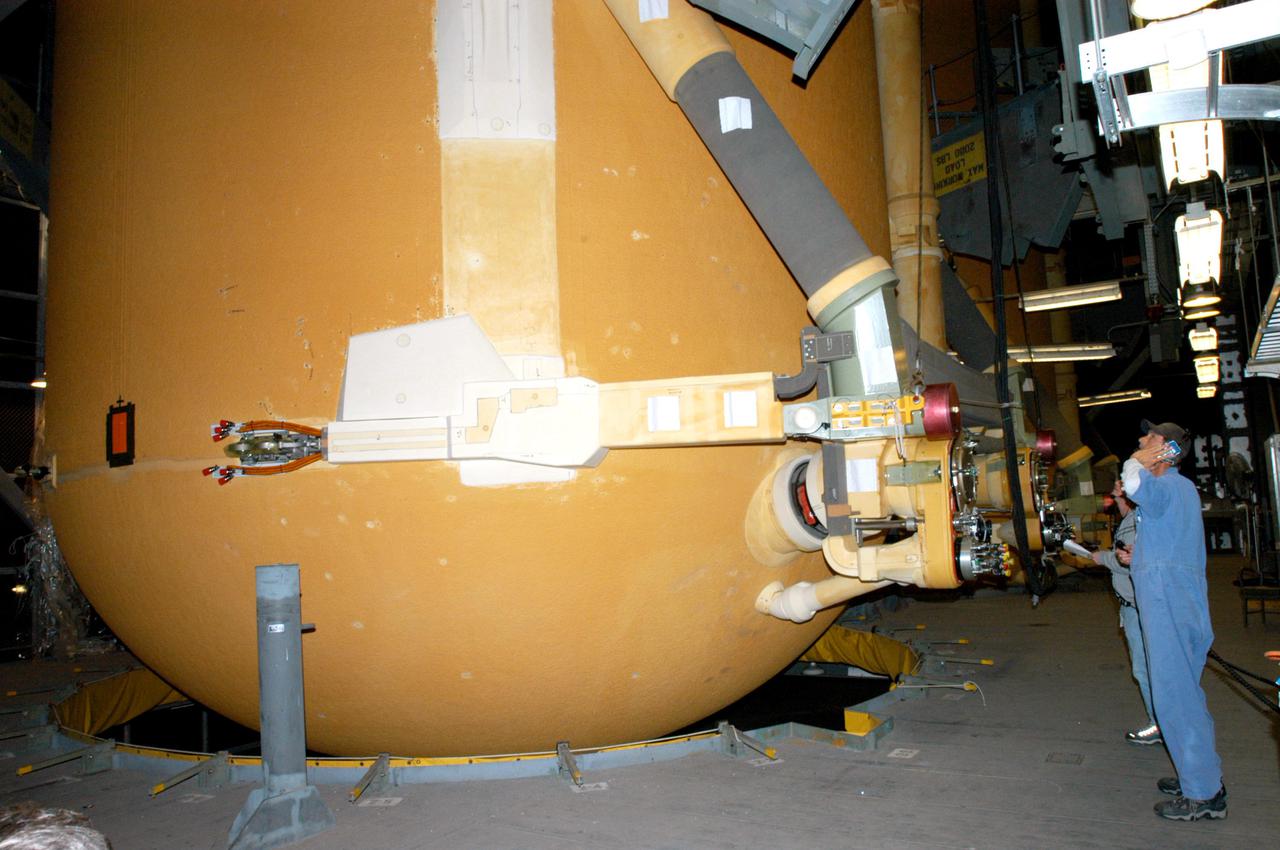
KENNEDY SPACE CENTER, FLA. - A technician watches as the External Tank (ET) designated to fly on Return to Flight mission STS-114 is prepared to be lifted from the checkout cell in the Vehicle Assembly Building. It will be mated with the Solid Rocket Boosters. The ET is recently redesigned to meet recommendations of the Columbia Accident Investigation Board before return to flight. Among dozens of changes is a redesigned forward bipod fitting to reduce the risk to the Space Shuttle from falling debris during ascent. Considered a test flight, STS-114 is scheduled to launch during a window extending May 15 to June 3. The Shuttle will carry supplies and equipment to the International Space Station.
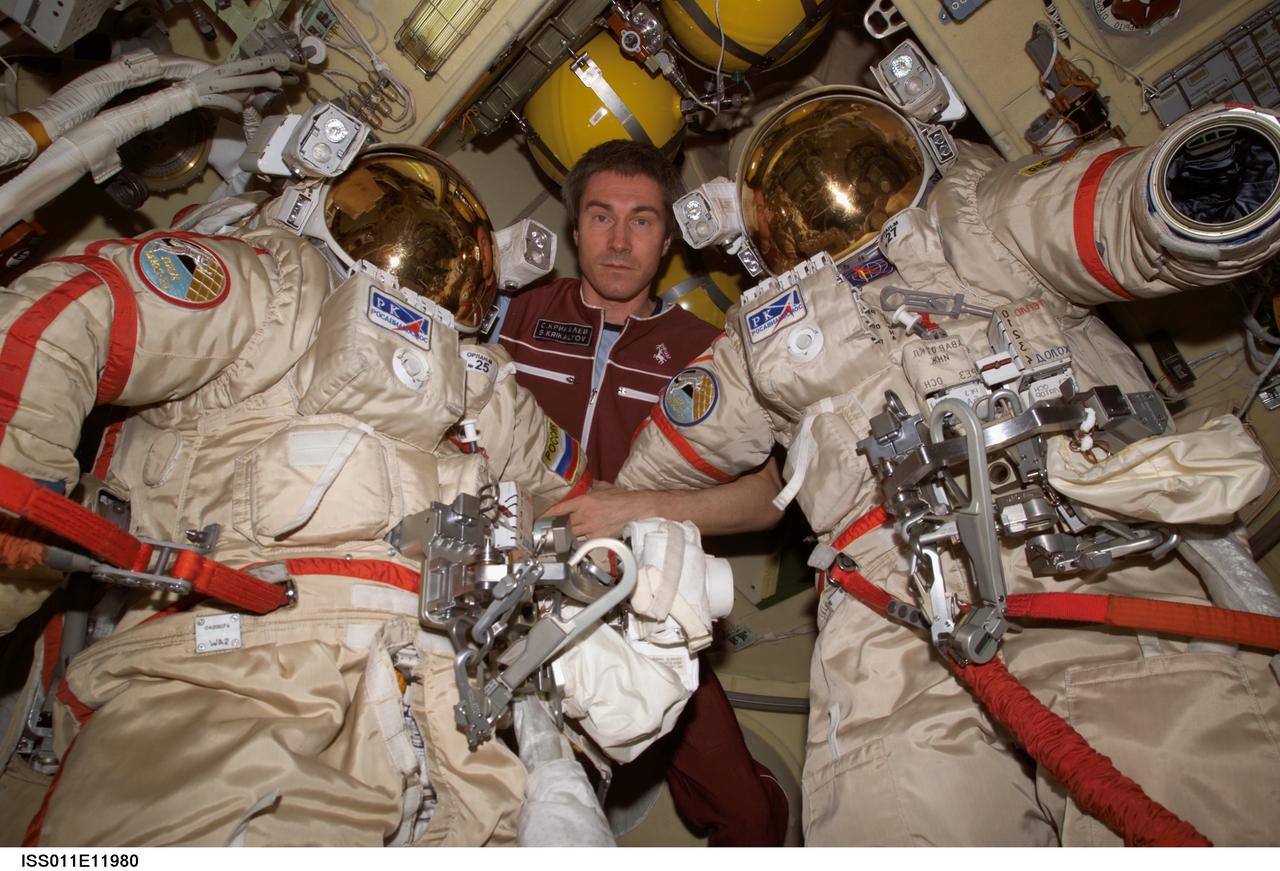
ISS011-E-11980 (17 August 2005) --- Cosmonaut Sergei K. Krikalev, Expedition 11 commander representing Russia's Federal Space Agency, poses with Russian Orlan spacesuits in the Pirs Docking Compartment of the International Space Station. The mission;s first spacewalk is scheduled for August 18.

KENNEDY SPACE CENTER, FLA. - Students from one of NASA’s Explorer Schools, Stewart Middle School in Tampa pose for a photo with other guests visiting the Museum of Science and Industry (MOSI) in Tampa. At left, in the back row, are former astronaut Dan Brandenstein, current vice president of Consolidated Space Operations Centers (CSOC), and KSC Deputy Director Dr. Woodrow Whitlow Jr. In the center is Ronte Smith, southeast regional sales manager for General Motors, and Gail Rymer, with Lockheed Martin. On the right are Dr. Adena Williams Loston, chief education officer at NASA Headquarters, and Wit Ostrenko, president of MOSI. The MOSI is featuring the space exhibits Space: A Journey to Our Future, an extraordinary, interactive exhibition designed to entertain, educate and inspire; and SPACE STATION, the first cinematic journey to the International Space Station (ISS), where audiences can experience for themselves life in zero gravity aboard the new station.

KENNEDY SPACE CENTER, FLA. - Monica Hagley, an avionic test engineer, places a refurbished, spare orbiter point sensor chassis on the table. Faulty readings in the liquid hydrogen tank low-level fuel cut-off sensor are being investigated because one of the four sensors failed a routine prelaunch check during the launch countdown July 13, causing mission managers to scrub Discovery's first launch attempt. The sensor protects the Shuttle's main engines by triggering their shutdown in the event fuel runs unexpectedly low. The sensor is one of four inside the liquid hydrogen section of the External Tank (ET).
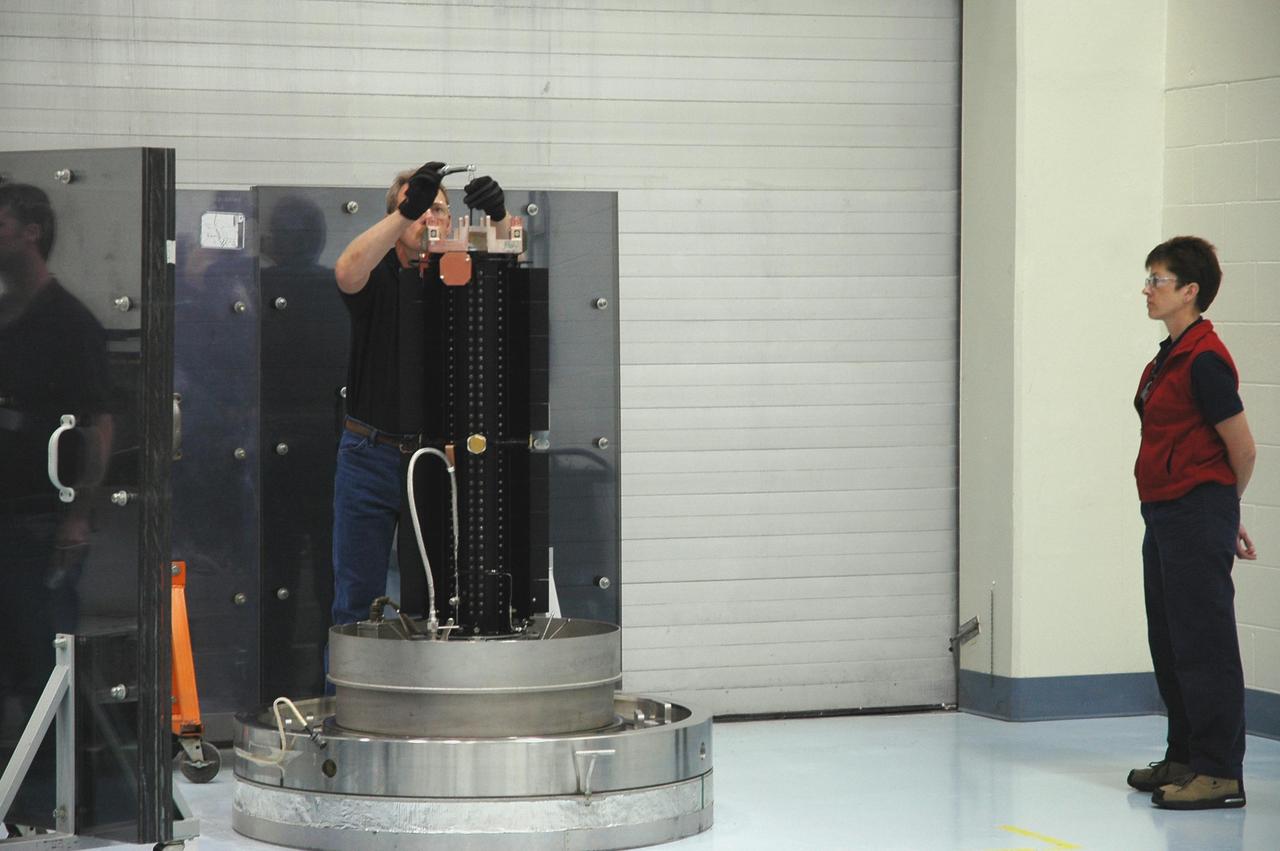
KENNEDY SPACE CENTER, FLA. - In the RTG Facility at Kennedy Space Center, Dan Brunson places a lift attachment onto the radioisotope thermoelectric generator (RTG) so it can be lifted off the stand. Watching at right is Amy Powell. The RTG is the baseline power supply for the NASA’s New Horizons spacecraft, scheduled to launch in January 2006 on a journey to Pluto and its moon, Charon. As it approaches Pluto, the spacecraft will look for ultraviolet emission from Pluto's atmosphere and make the best global maps of Pluto and Charon in green, blue, red and a special wavelength that is sensitive to methane frost on the surface. It will also take spectral maps in the near infrared, telling the science team about Pluto's and Charon's surface compositions and locations and temperatures of these materials. When the spacecraft is closest to Pluto or its moon, it will take close-up pictures in both visible and near-infrared wavelengths. It is expected to reach Pluto in July 2015.
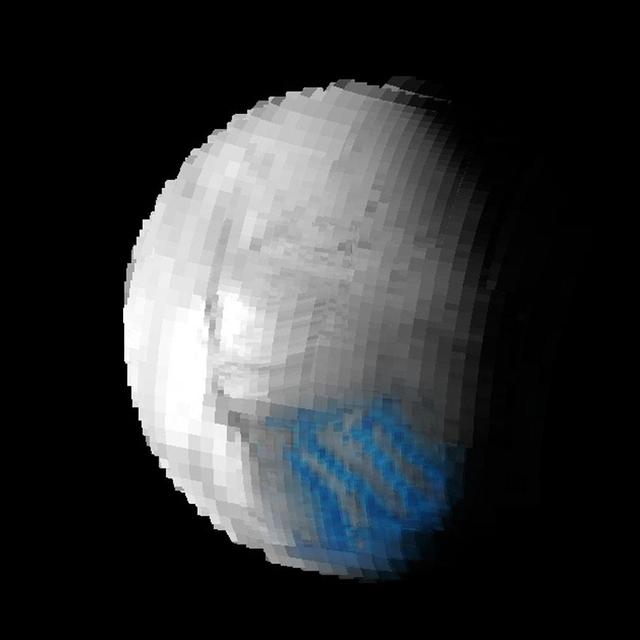
This visual and infrared mapping spectrometer image captured by NASA Cassini spacecraft of Saturn moon Enceladus, shows the dark cracks at the south pole dubbed tiger stripes for their distinct stripe-like appearance.

Dr. Michael Griffin testifies, Tuesday, April 12, 2005, during his confirmation hearing before the U.S. Senate Commerce Committee at the Russell Senate Office Building in Washington. If confirmed, Griffin, who currently heads the space department at the Johns Hopkins University Applied Physics Laboratory will become NASA's 11th administrator. Photo Credit (NASA/Renee Bouchard)
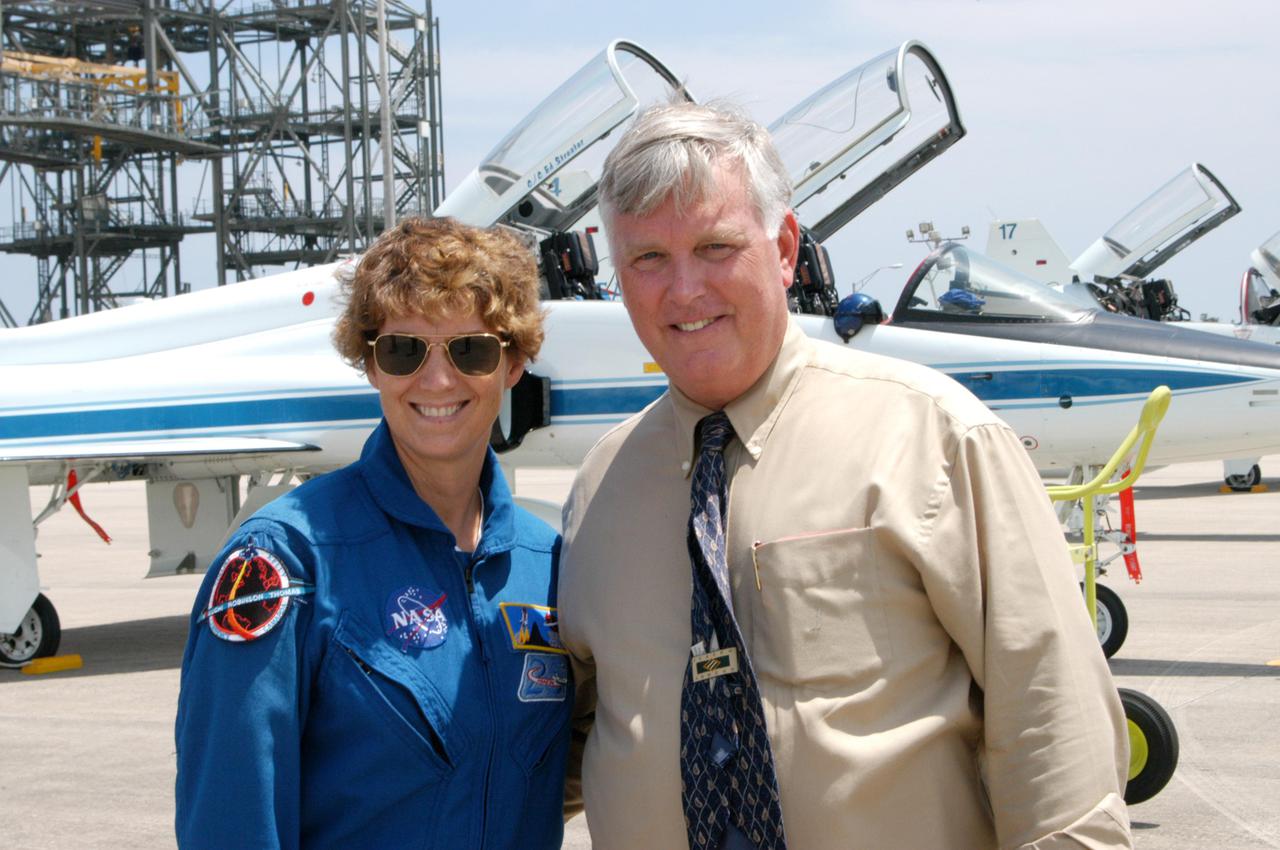
KENNEDY SPACE CENTER, FLA. - Center Director Jim Kennedy (right) greets STS-114 Mission Commander Eileen Collins after her arrival at NASA Kennedy Space Center aboard a T-38 jet aircraft. The Return to Flight STS-114 crew has returned to KSC to get ready for a second launch attempt aboard Space Shuttle Discovery. Collins later told the media who waited nearby that since the scrub on July 13, the crew has focused on the on-orbit part of the mission and training for night landings using the Shuttle Training Aircraft. She praised the engineers and technicians who have been troubleshooting the elusive sensor problem and thanked them. STS-114 is scheduled to launch July 26 at 10:39 a.m. EDT from Launch Pad 39B.
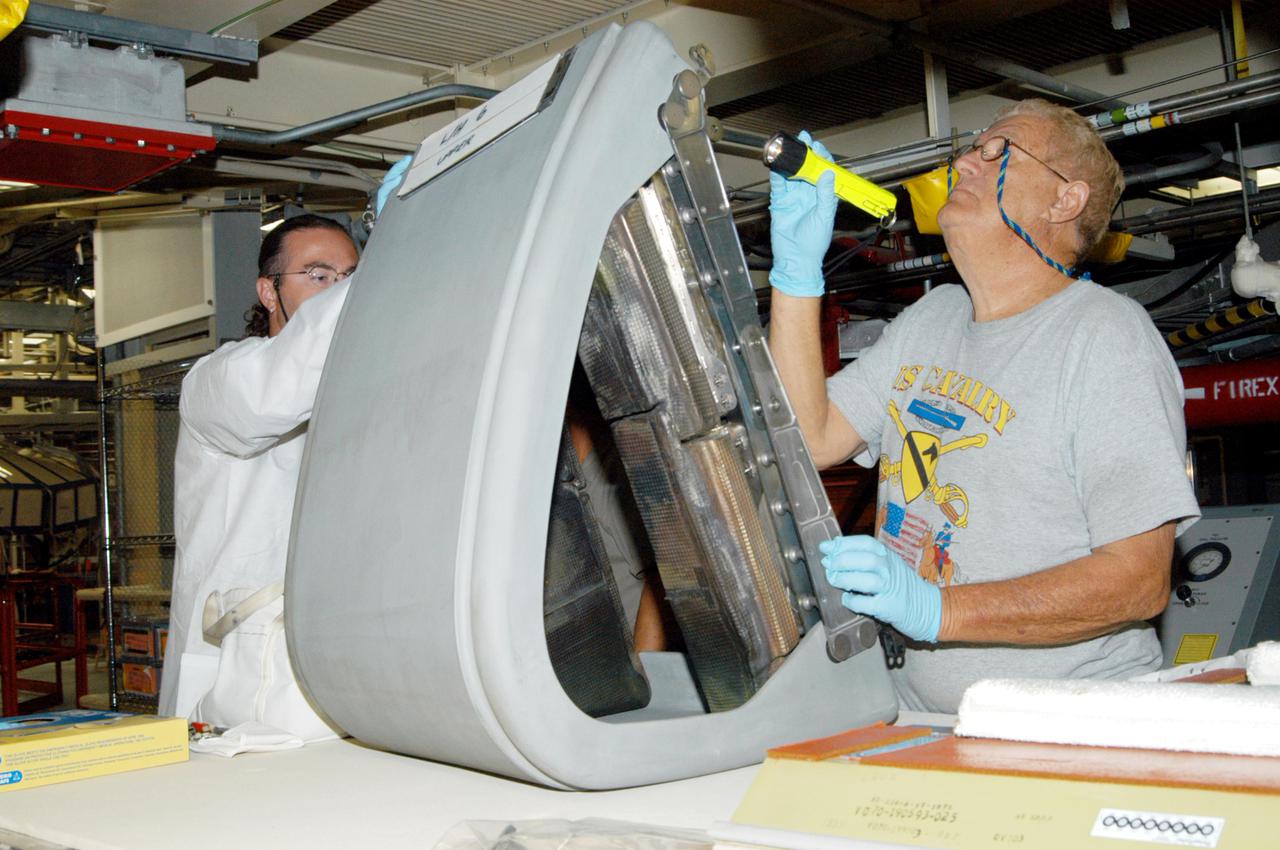
KENNEDY SPACE CENTER, FLA. - In the Orbiter Processing Facility, Matt Scott and Mel Romans (left and right), with United Space Alliance, closely inspect the final Reinforced Carbon-Carbon (RCC) panel to be installed on orbiter Discovery’s left wing. The leading edges of each of an orbiter’s wings have 22 RCC panels. They are light gray and made entirely of carbon composite material, which protect the orbiter during re-entry. The molded components are approximately 0.25- to 0.5-inch thick and capable of withstanding temperatures up to 3,220 degrees F. Following the Columbia accident in February 2002, which was caused by a breach in an RCC panel that allowed hot gases into the vehicle, each panel on Discovery was removed and thoroughly inspected before final reinstallation. Discovery is the designated orbiter to fly on the Return to Flight mission STS-114, the first Space Shuttle to launch since the accident. The launch window for the mission is May 12 to June 3, 2005.
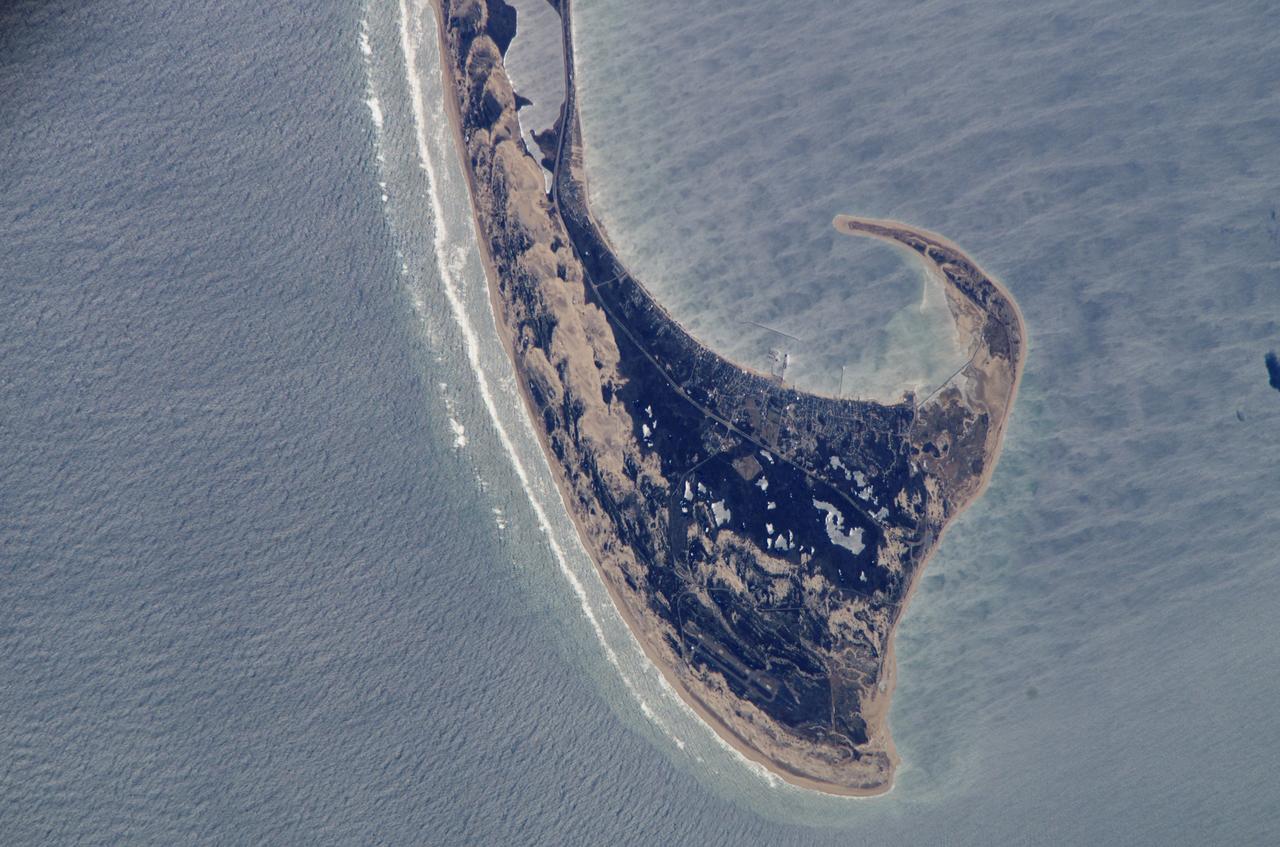
ISS010-E-21965 (30 March 2005) --- The northernmost parts of the Cape Cod National Seashore are featured in this image photographed by an Expedition 10 crewmember on the International Space Station.
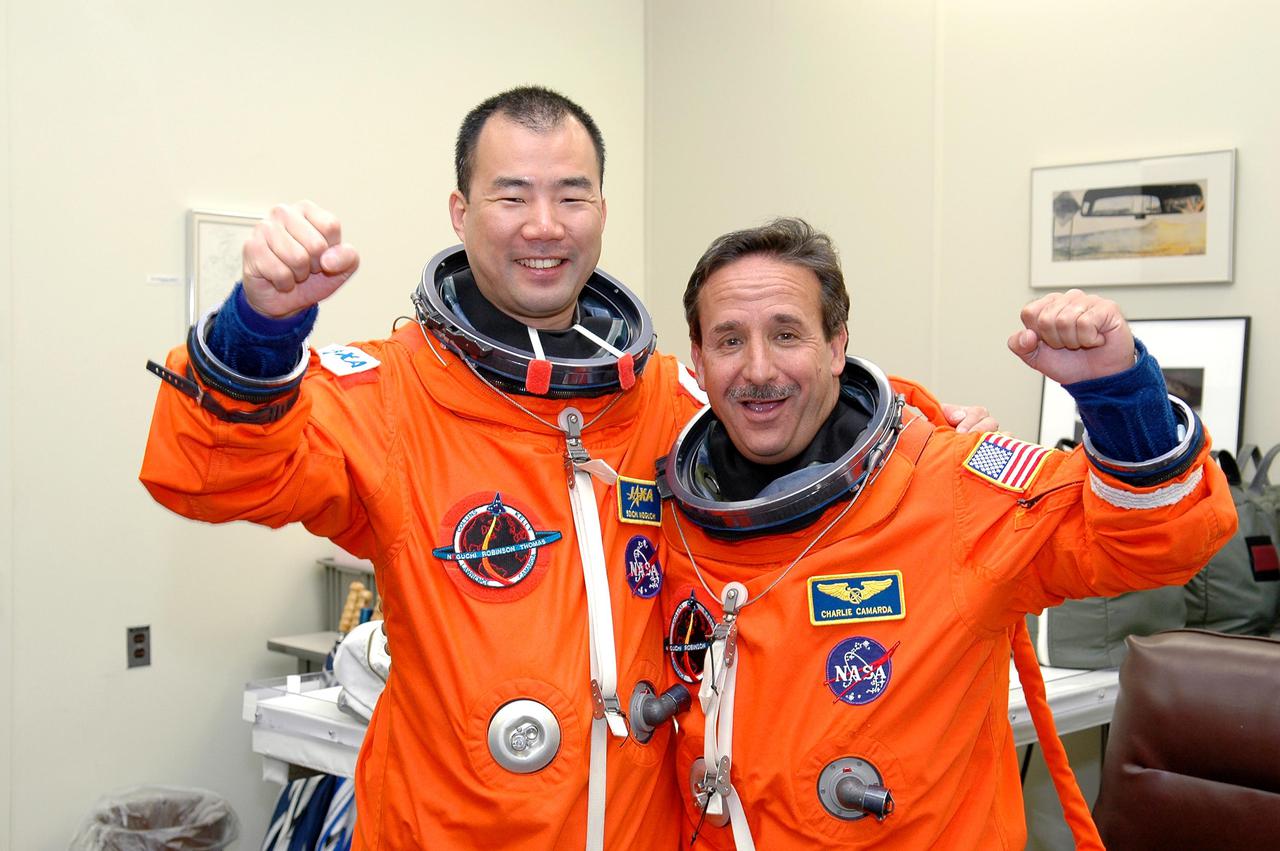
KENNEDY SPACE CENTER, FLA. - STS-114 Mission Specialists Soichi Noguchi (left) and Charles Camarda are suited up in the Operations and Checkout Building and ready for the trip to Launch Pad 39B for a mock launch countdown culminating in a simulated main engine cutoff. Noguchi is with the Japan Aerospace Exploration Agency. The dress rehearsal is part of Terminal Countdown Demonstration Test (TCDT) activities held prior to each Space Shuttle flight. It provides the crew of each mission an opportunity to participate in various simulated countdown activities, including equipment familiarization and emergency egress training. STS-114 is the first Return to Flight mission to the International Space Station. The launch window extends July 13 through July 31.
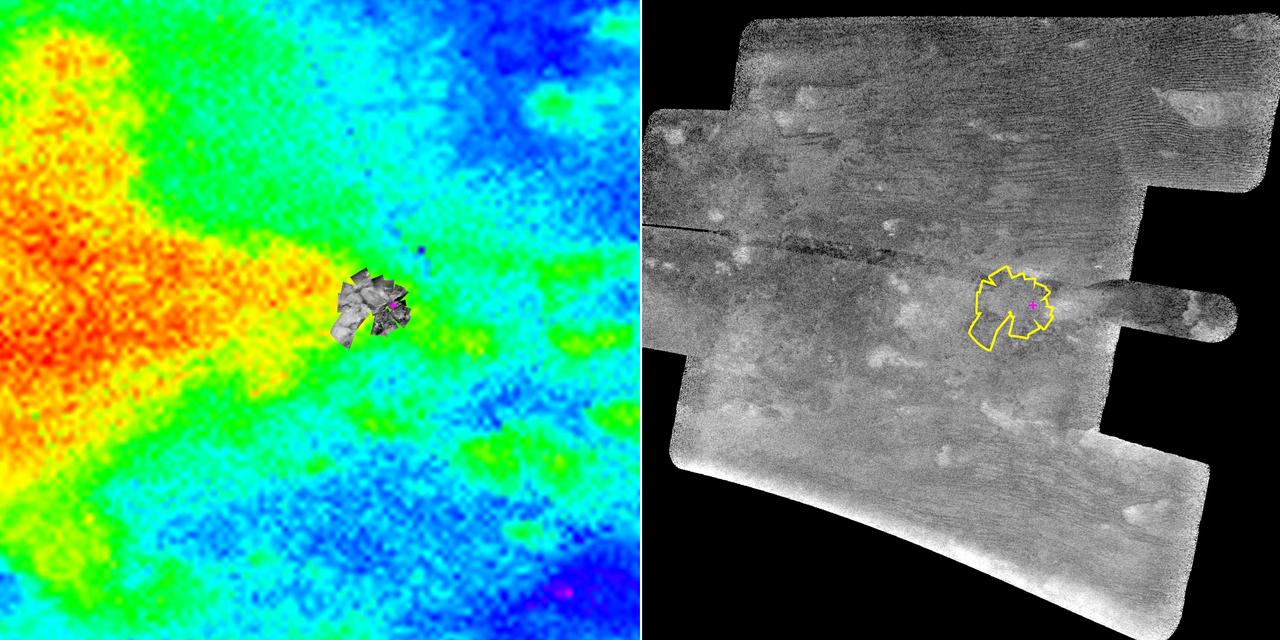
Pinpointing Huygens Landing Site
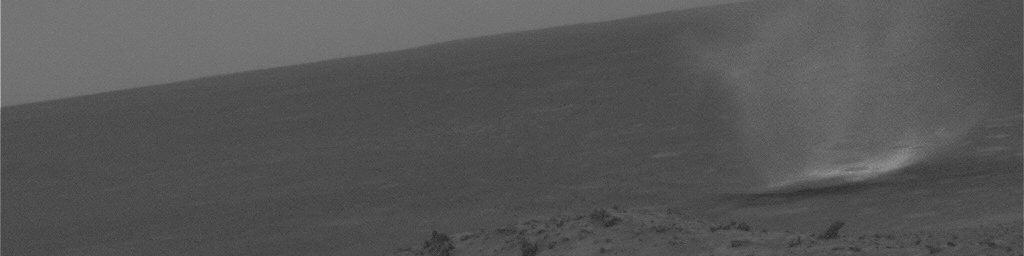
Gusev Dust Devil Movie, Sol 456 Enhanced
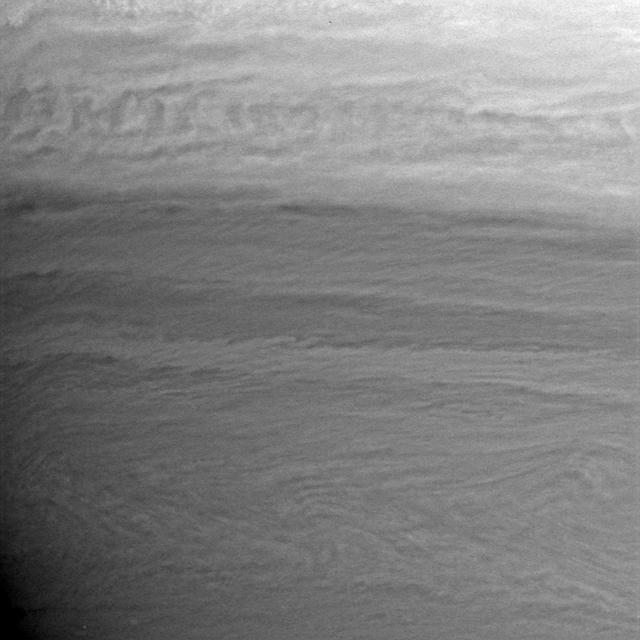
Waves on Saturn

KENNEDY SPACE CENTER, FLA. - The newly redesigned External Tank, designated for use on Return to Flight mission STS-114, moves slowly toward its destination, the dock at the Launch Complex 39 Area Turn Basin, propelled by two tugboats. At left in the background is Launch Pad 39A. The External Tank arrived safely early this morning at Port Canaveral, Fla., after an approximately 900-mile journey at sea. It departed from the Michoud Assembly Facility in New Orleans Dec. 31 and was transported on the Pegasus, NASA’s specially designed barge, pulled by Solid Rocket Booster retrieval ship Liberty Star. At the port, the barge was then hooked up to the tugs for the last part of the journey to the Turn Basin. Next, the External Tank will be off-loaded from the barge and transported to the Vehicle Assembly Building for its final checkout and mating to the twin Solid Rocket Boosters and orbiter Discovery. NASA and Lockheed Martin Corp. spent nearly two years modifying the 15-story, bronze-colored tank to make it safer for liftoff. Among dozens of changes is a redesigned forward bipod fitting -- a design that meets the recommendation of the Columbia Accident Investigation Board to reduce the risk to the Space Shuttle from falling debris during ascent. STS-114 is targeted for a launch opportunity beginning in May. The seven-member Discovery crew will fly to the International Space Station primarily to test and evaluate new procedures for flight safety, including Space Shuttle inspection and repair techniques.

Layered Trough Walls
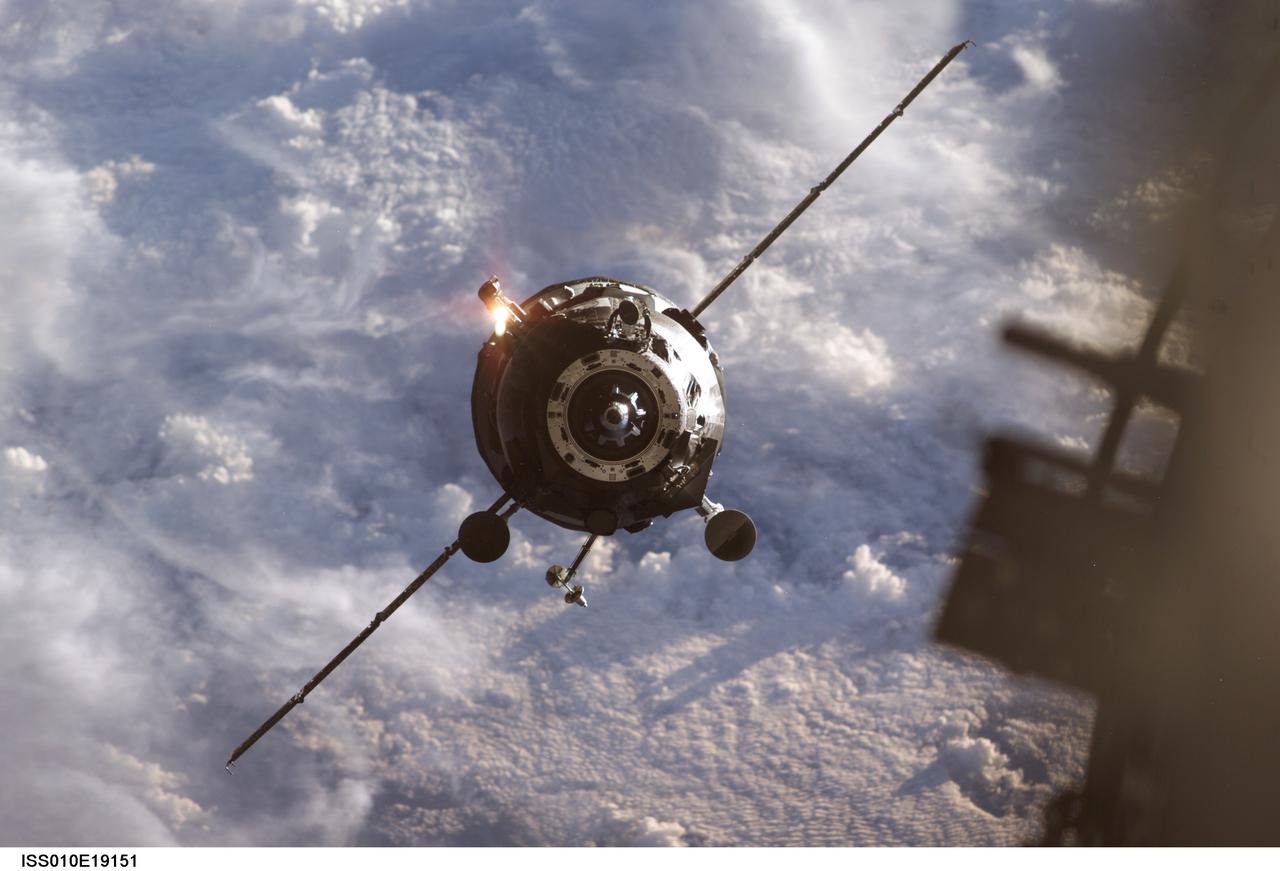
ISS010-E-19151 (2 March 2005) --- Backdropped by a blanket of clouds, an unpiloted Progress supply vehicle approaches the International Space Station (ISS). The Progress 17 resupply craft launched at 1:09 p.m. (CST) on February 28, 2005 from the Baikonur Cosmodrome in Kazakhstan to deliver two tons of supplies, food, water, fuel and equipment to the Expedition 10 crewmembers onboard the Station. Progress docked to the aft port of the Zvezda Service Module at 2:10 p.m. (CST) on March 2 as the Station flew 225 statute miles over the equator west of Africa.

Restless Atmosphere

Diverse Geology

ISS012-E-08797 (20 Nov. 2005) --- West Point, NY, home of the United States Military Academy since 1802, is featured in this electronic still image recorded from the International Space Station during Expedition 12. West Point is located on the high west bank of the Hudson River north of New York City. North is at the top in this almost vertical view.
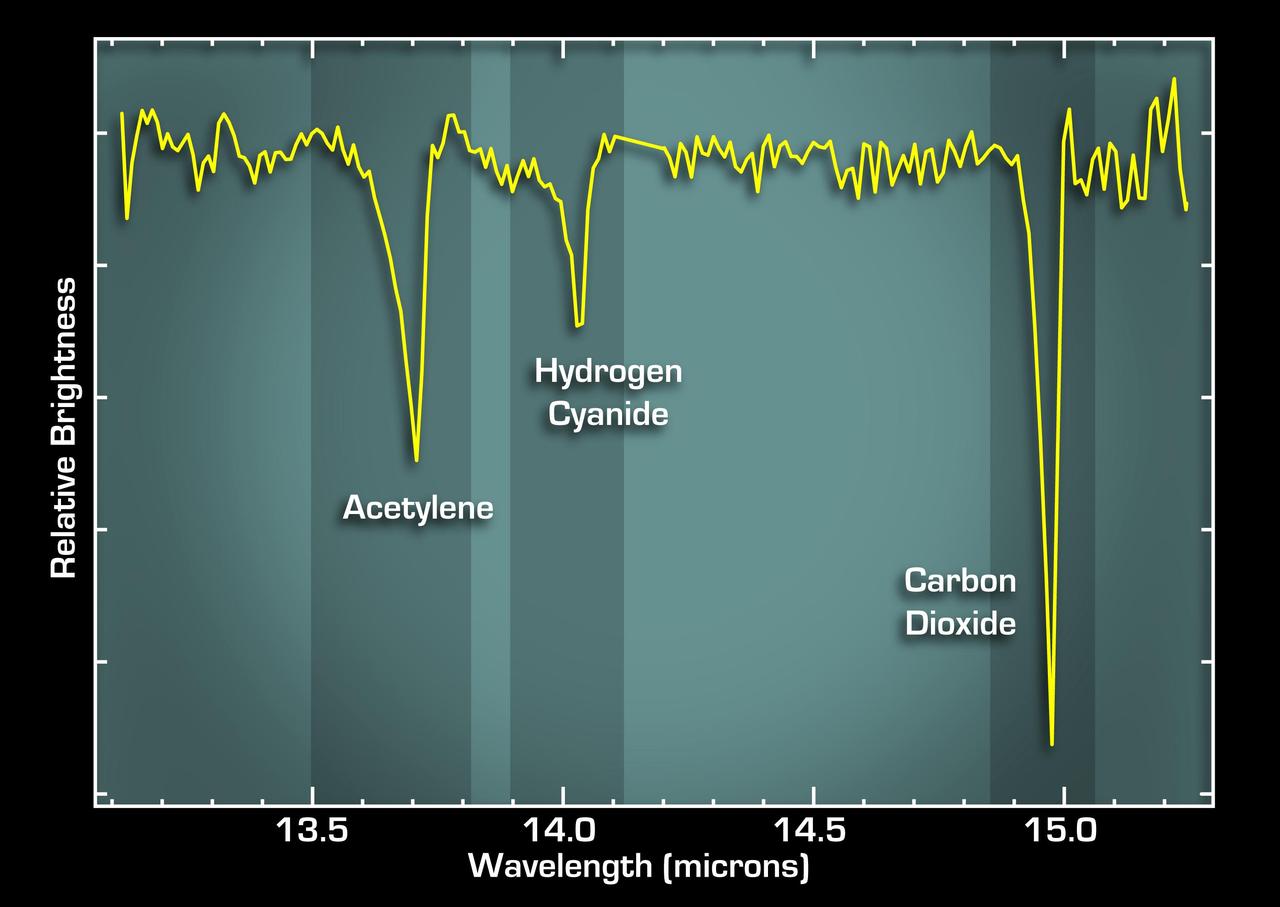
This graph, or spectrum, from NASA Spitzer Space Telescope tells astronomers that some of the most basic ingredients of DNA and protein are concentrated in a dusty planet-forming disk circling a young sun-like star called IRS 46.
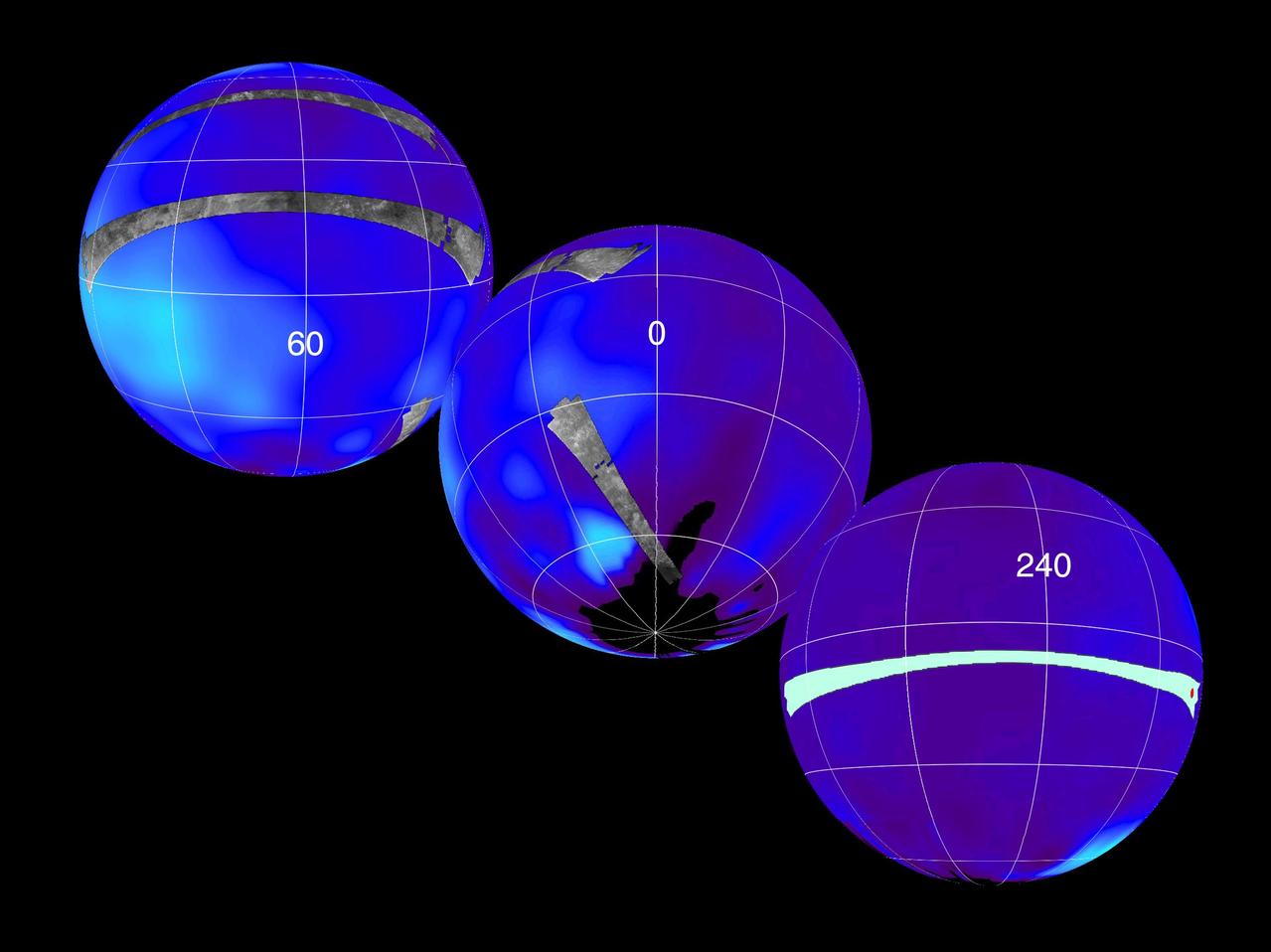
Titan Viewed by Cassini Radar

Saturn Derby

Still Giving Thanks for Good Health

Outsider Moon

STS114-S-015 (26 July 2005) --- Discovery and its seven-member crew launched at 10:39 a.m. EDT to begin the two-day journey to the International Space Station. Discovery is slated to dock with the ISS at 7:18 a.m. EDT Thursday.

NASA Administrator Michael Griffin talks with employees during a NASA Update program at NASA Headquarters, Tuesday, June 28, 2005, in Washington. Photo Credit: (NASA/Bill Ingalls)
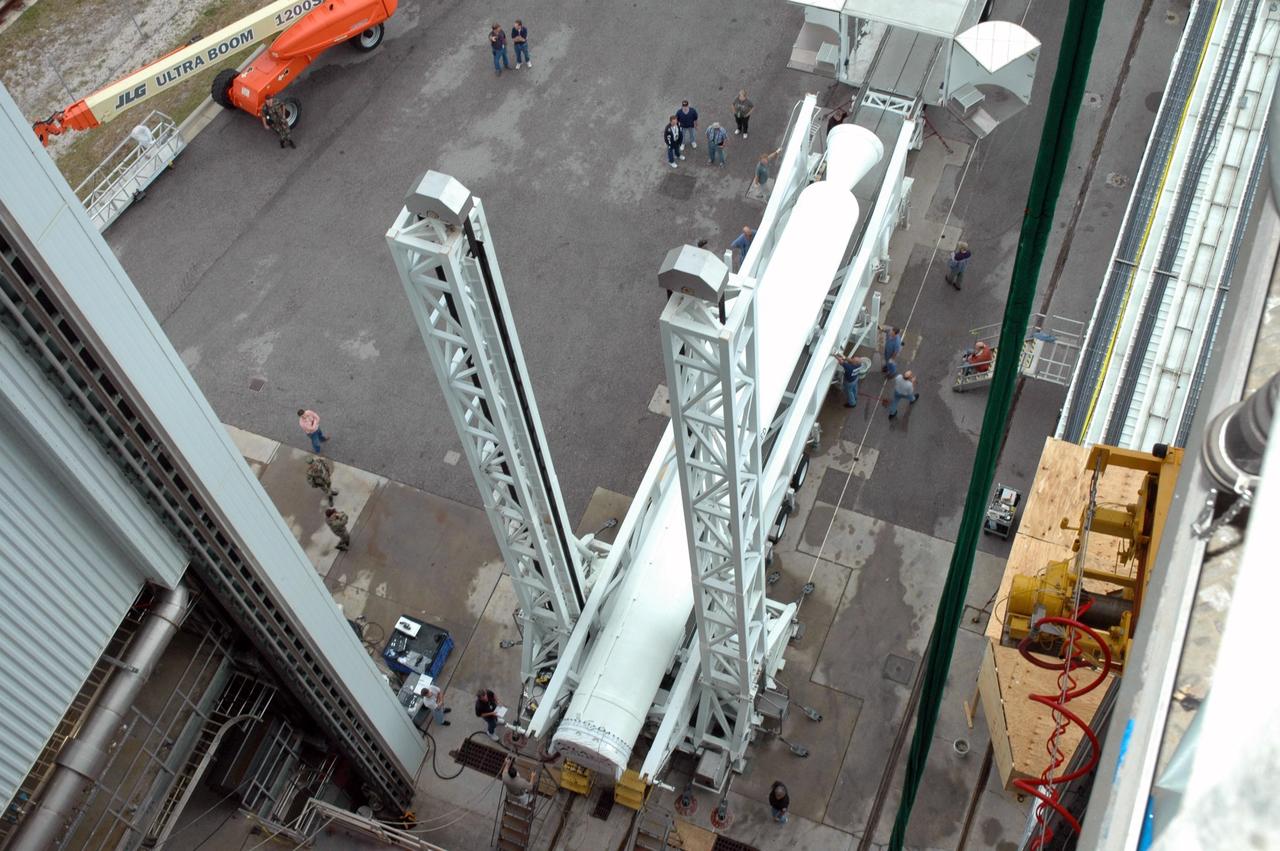
KENNEDY SPACE CENTER, FLA. - Viewed from high in the Vertical Integration Facility on Launch Complex 41 at Cape Canaveral Air Force Station in Florida, the fifth and final solid rocket booster is ready to be raised to vertical and lifted into the facility. It will be added to the other four already mated to the Lockheed Martin Atlas V rocket in the facility. The Atlas V is the launch vehicle for the Pluto-bound New Horizons spacecraft that will make the first reconnaissance of Pluto and its moon, Charon - a "double planet" and the last planet in our solar system to be visited by spacecraft. As it approaches Pluto, the spacecraft will look for ultraviolet emission from Pluto's atmosphere and make the best global maps of Pluto and Charon in green, blue, red and a special wavelength that is sensitive to methane frost on the surface. It will also take spectral maps in the near infrared, telling the science team about Pluto's and Charon’s surface compositions and locations and temperatures of these materials. When the spacecraft is closest to Pluto or its moon, it will take close-up pictures in both visible and near-infrared wavelengths. The mission will then visit one or more objects in the Kuiper Belt region beyond Neptune. New Horizons is scheduled to launch in January 2006, swing past Jupiter for a gravity boost and scientific studies in February or March 2007, and reach Pluto and Charon in July 2015.
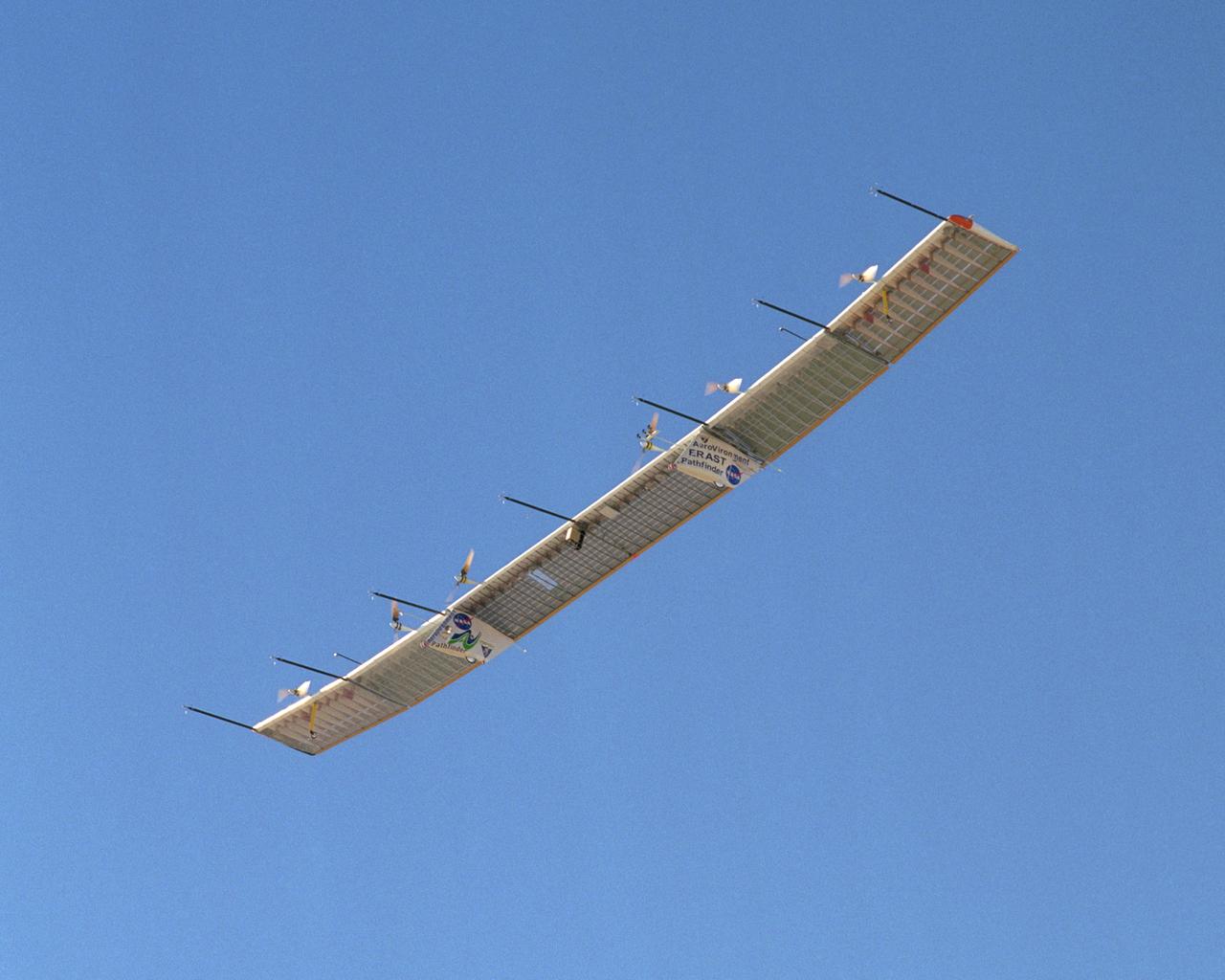
With its sensor booms projecting ahead of the wing, the Pathfinder-Plus solar-electric aircraft soars under a blue sky on a turbulence measurement research flight.
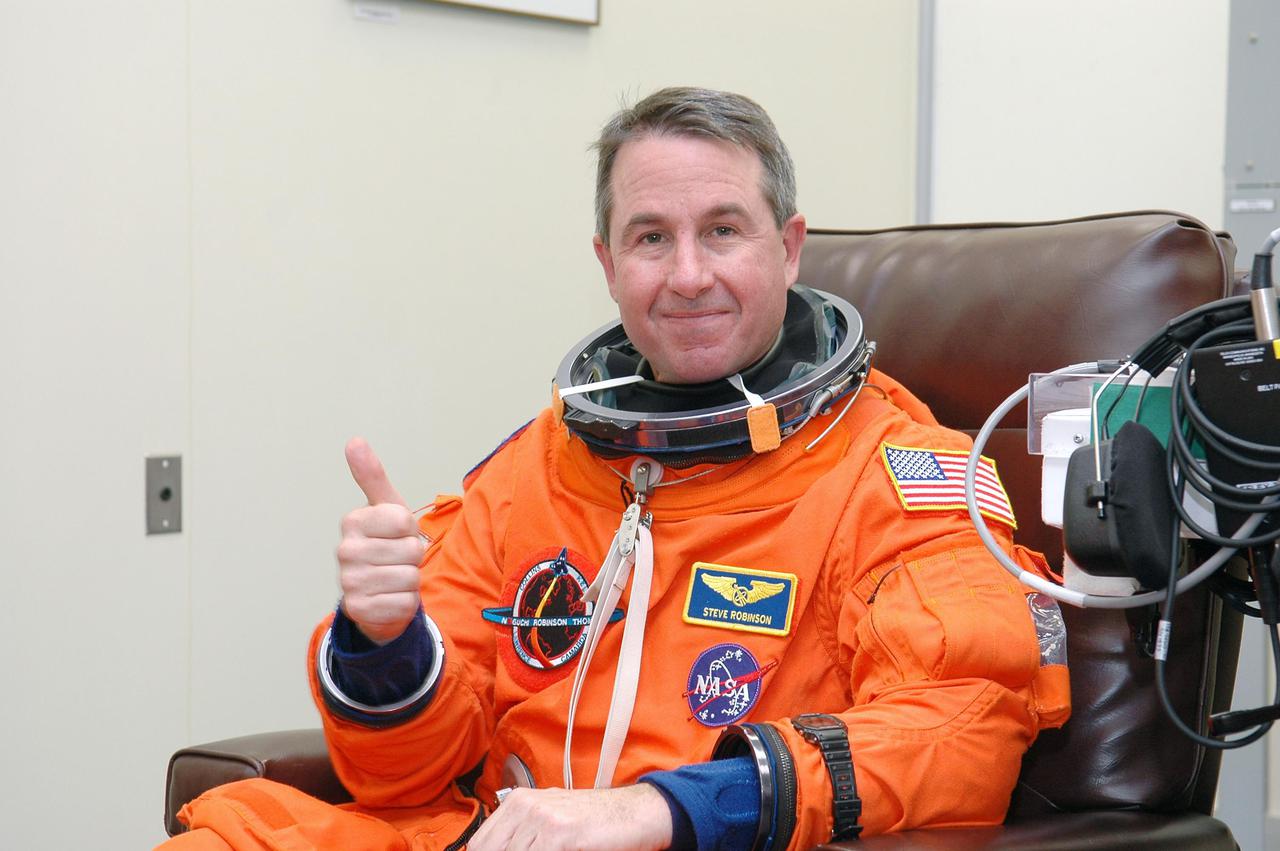
KENNEDY SPACE CENTER, FLA. - As part of pre-pack and fit check for Terminal Countdown Demonstration Test (TCDT) activities, STS-114 Mission Specialist Stephen Robinson signals okay for his launch suit check. The TCDT is held at KSC prior to each Space Shuttle flight. It provides the crew of each mission an opportunity to participate in simulated countdown activities. The test ends with a mock launch countdown culminating in a simulated main engine cutoff. The crew also spends time undergoing emergency egress training exercises at the launch pad. STS-114 is the first Return to Flight mission to the International Space Station. The launch window extends July 13 through July 31.
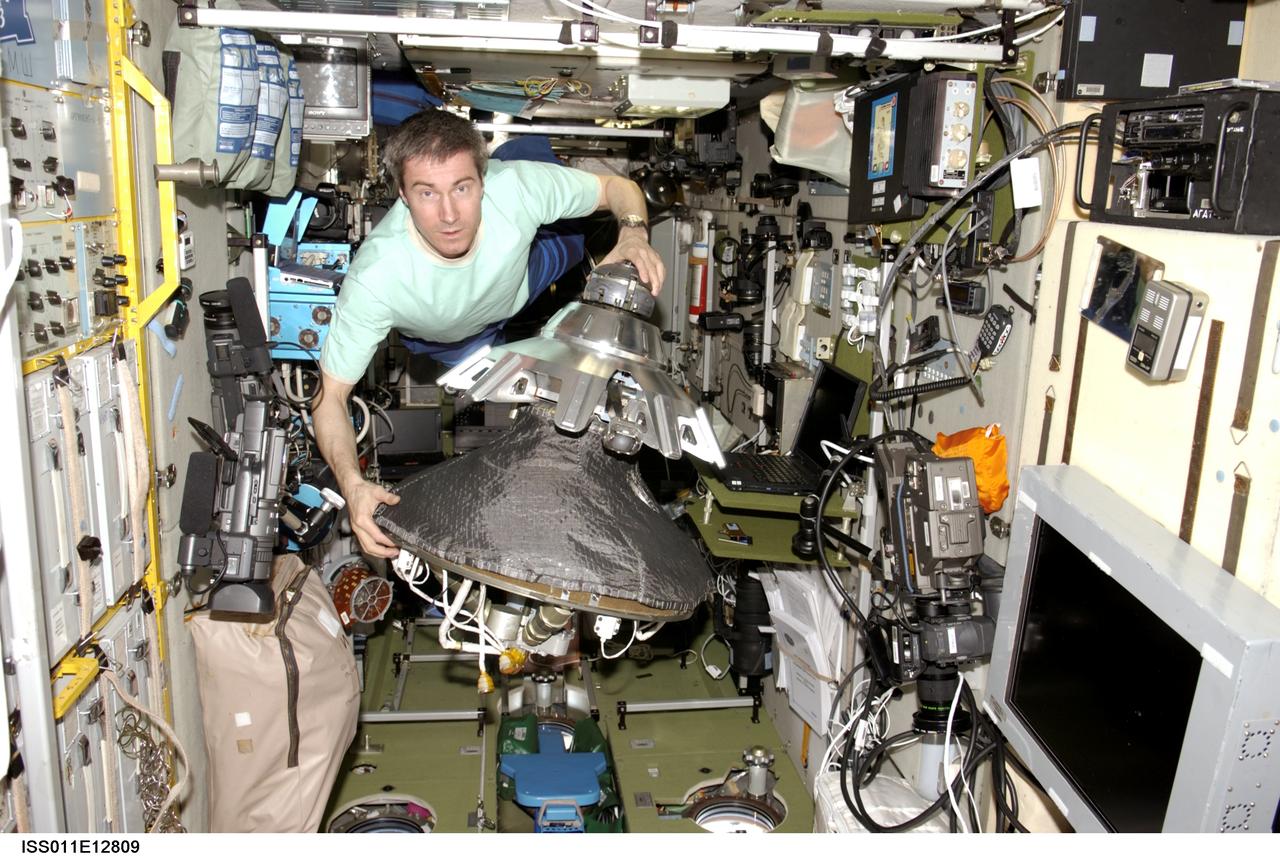
ISS011-E-12809 (10 September 2005) --- Cosmonaut Sergei K. Krikalev, Expedition 11 commander representing Russia's Federal Space Agency, holds the Progress supply vehicle probe-and-cone docking mechanism while floating in the Zvezda Service Module of the International Space Station.

KENNEDY SPACE CENTER, FLA. - After their arrival at NASA’s Kennedy Space Center, the Return to Flight mission STS-114 crew talked briefly to media. At the microphone is an enthusiastic Soichi Noguchi, mission specialist, who is with the Japan Aerospace Exploration Agency, JAXA. He also spoke in Japanese to the Japanese media who were present. The rest of the crew members are Mission Commander Eileen Collins, Pilot James Kelly, and Mission Specialists Andrew Thomas, Charles Camarda, Wendy Lawrence and Stephen Robinson. The crew arrived a day early due to weather concerns associated with Hurricane Dennis. This historic mission is the 114th Space Shuttle flight and the 17th U.S. flight to the International Space Station. STS-114 is scheduled to launch at 3:51 p.m. July 13 and last about 12 days with a planned KSC landing at about 11:01 a.m. EDT on July 25. On mission STS-114, the crew will perform inspections on orbit for the first time of all of the Reinforced Carbon-Carbon (RCC) panels on the leading edge of the wings and the Thermal Protection System tiles using the new Canadian-built Orbiter Boom Sensor System and the data from 176 impact and temperature sensors. Mission Specialists will also practice repair techniques on RCC and tile samples during a spacewalk in the payload bay. During two additional spacewalks, the crew will install the External Stowage Platform-2, equipped with spare part assemblies, and a replacement Control Moment Gyroscope contained in the Lightweight Multi-Purpose Experiment Support Structure.

Space Shuttle Discovery landed safely at NASA's Dryden Flight Research Center at Edwards Air Force Base in Calif. at 5:11 a.m. this morning, following the very successful 14-day STS-114 return to flight mission.
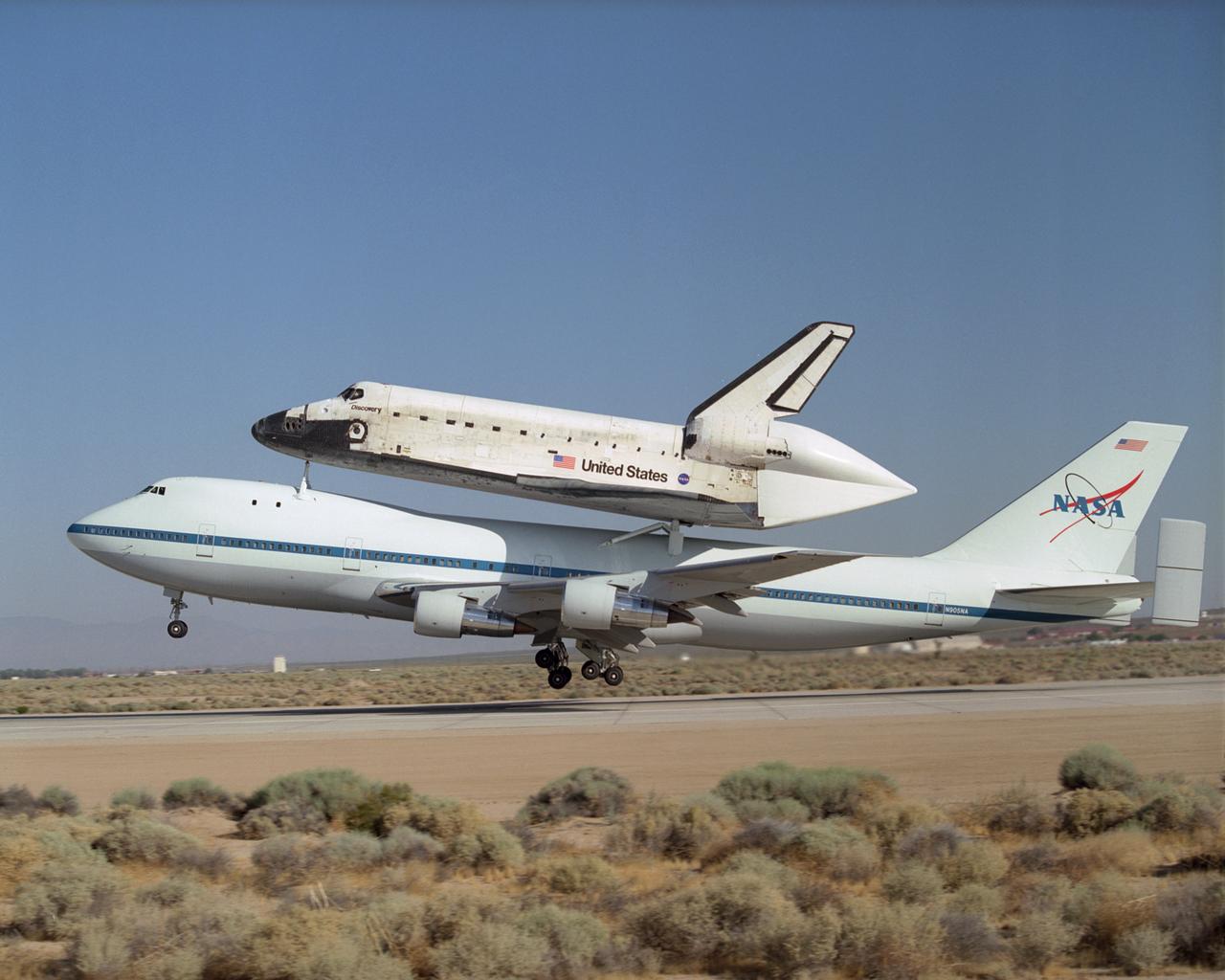
NASA's modified Boeing 747 Shuttle Carrier Aircraft with the Space Shuttle Discovery on top lifts off from Edwards Air Force Base to begin its ferry flight back to the Kennedy Space Center in Florida. The cross-country journey will take two days, with stops at several intermediate points for refueling. Space Shuttle Discovery landed safely at NASA's Dryden Flight Research Center at Edwards Air Force Base in California at 5:11:22 a.m. PDT, August 9, 2005, following the very successful 14-day STS-114 return to flight mission. During their two weeks in space, Commander Eileen Collins and her six crewmates tested out new safety procedures and delivered supplies and equipment the International Space Station. Discovery spent two weeks in space, where the crew demonstrated new methods to inspect and repair the Shuttle in orbit. The crew also delivered supplies, outfitted and performed maintenance on the International Space Station. A number of these tasks were conducted during three spacewalks. In an unprecedented event, spacewalkers were called upon to remove protruding gap fillers from the heat shield on Discovery's underbelly. In other spacewalk activities, astronauts installed an external platform onto the Station's Quest Airlock and replaced one of the orbital outpost's Control Moment Gyroscopes. Inside the Station, the STS-114 crew conducted joint operations with the Expedition 11 crew. They unloaded fresh supplies from the Shuttle and the Raffaello Multi-Purpose Logistics Module. Before Discovery undocked, the crews filled Raffeallo with unneeded items and returned to Shuttle payload bay. Discovery launched on July 26 and spent almost 14 days on orbit.
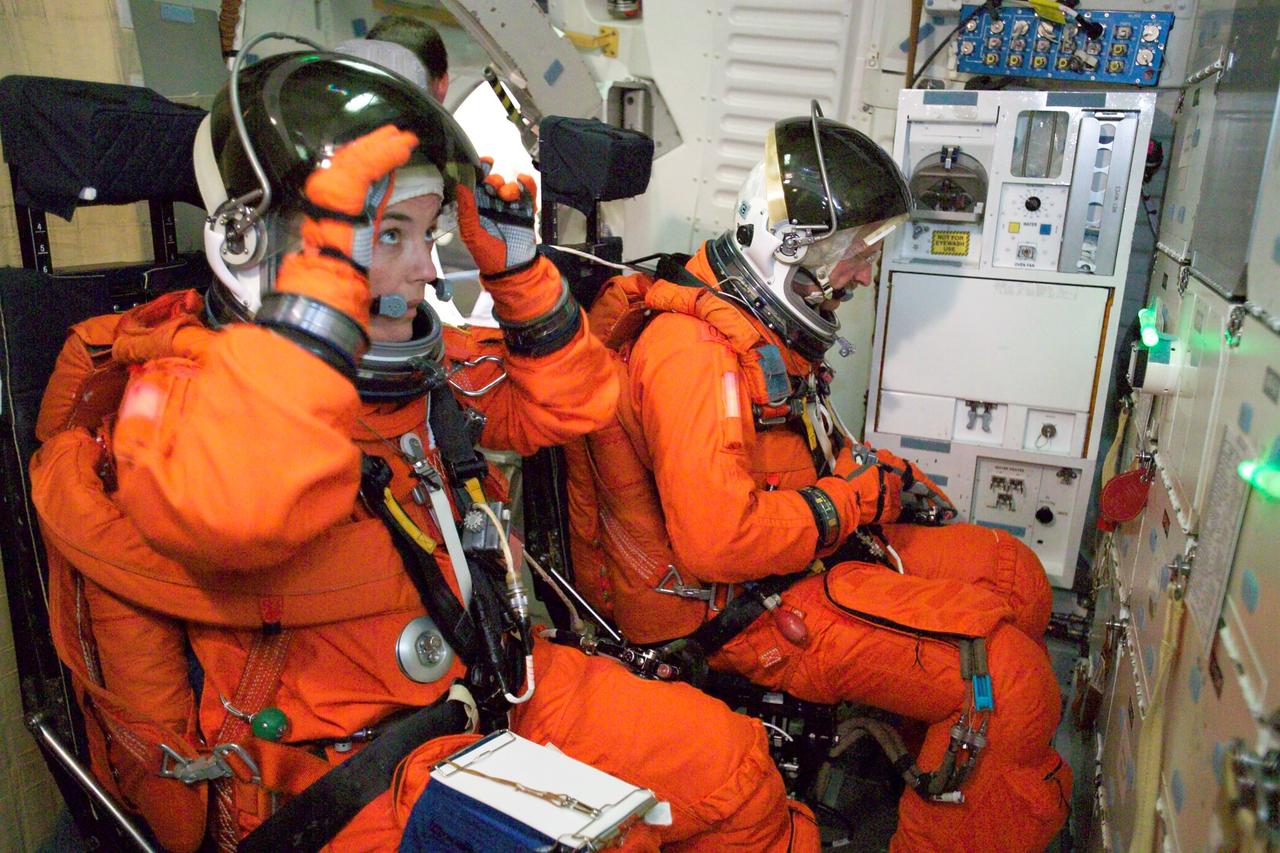
JSC2005-E-17438 (28 April 2005) --- Astronauts Heidemarie M. Stefanyshyn-Piper (foreground) and Joseph R. (Joe) Tanner, both STS-115 mission specialists, participate in a training session in one of the full-scale trainers in the Space Vehicle Mockup Facility at the Johnson Space Center. Attired in training versions of the shuttle launch and entry suit, the two are seated on the middeck for an emergency egress training session.
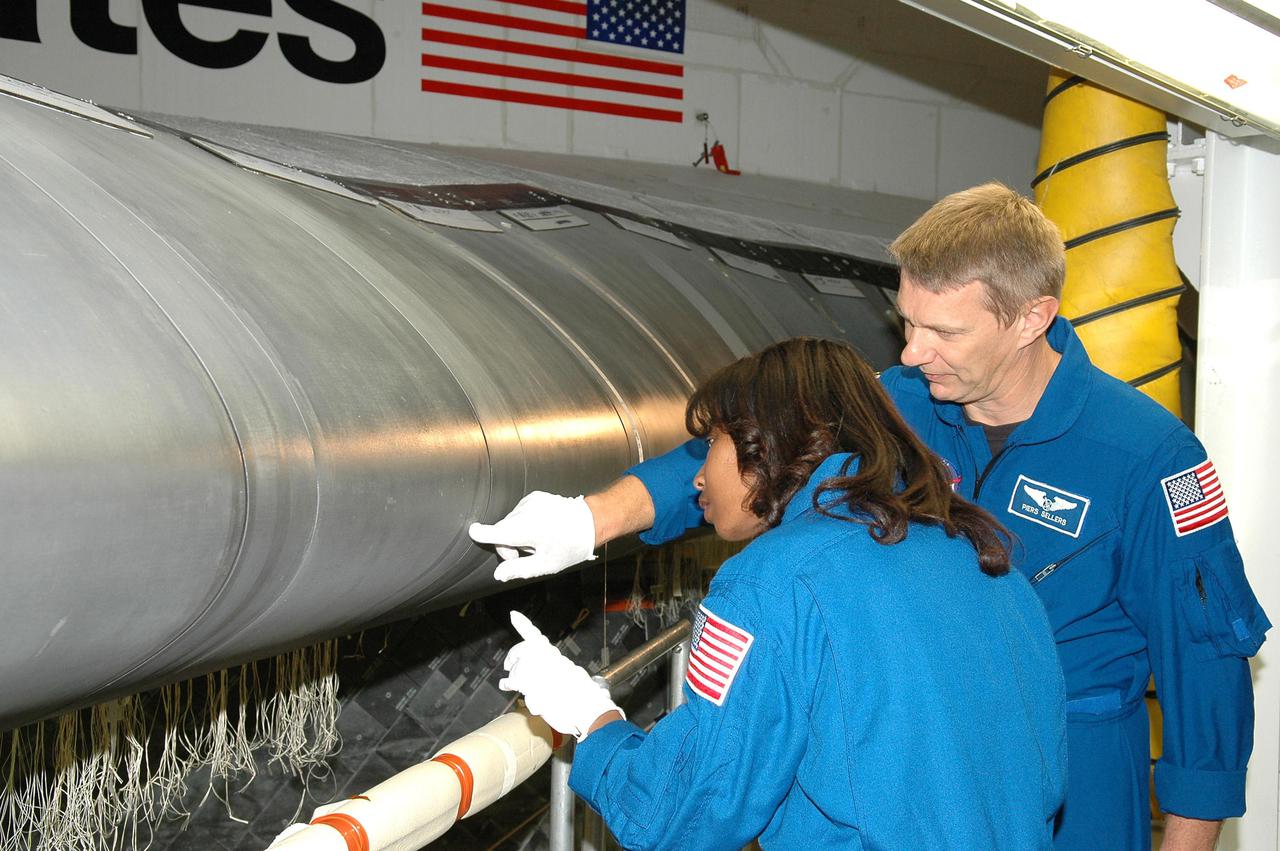
KENNEDY SPACE CENTER, FLA. - In the Orbiter Processing Facility, STS-121 Mission Specialists Stephanie D. Wilson (left) and Piers J. Sellers receive a briefing and up-close look at the wing leading edge of Space Shuttle Atlantis, the orbiter that will take them into space. The leading edge of each of the orbiters’ wings has 22 Reinforced Carbon-Carbon panels, made entirely of carbon composite material. The molded components are approximately 0.25-inch to 0.5-inch thick. The astronauts of the second Return to Flight mission, STS-121, are at Kennedy Space Center to participate in the Crew Equipment Interface Test (CEIT). During CEIT, the crew has an opportunity to get a hands-on look at the orbiter and equipment they will be working with on their mission. Mission STS-121 is scheduled to launch in July.
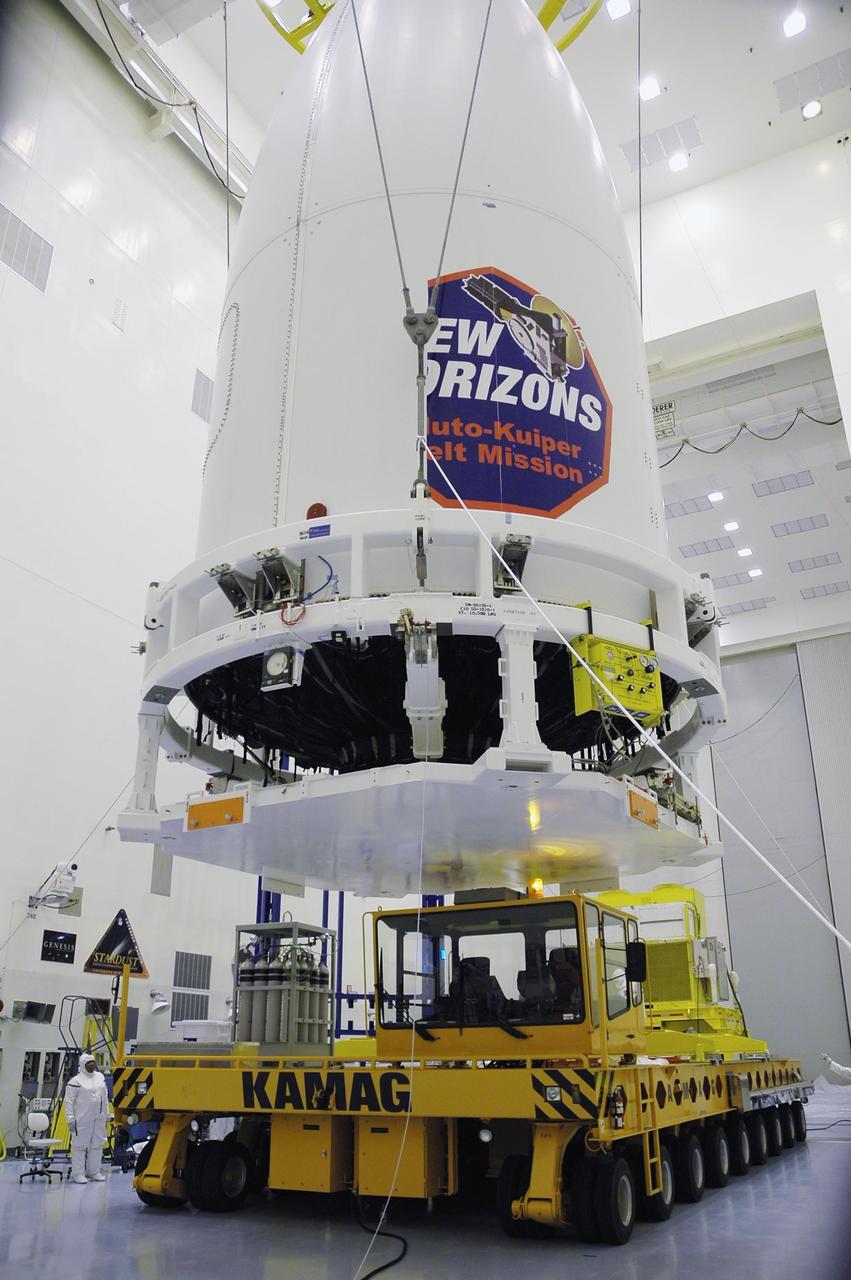
KENNEDY SPACE CENTER, FLA. - In the Payload Hazardous Servicing Facility, technicians lower New Horizons onto a transporter for its move to Complex 41 on Cape Canaveral Air Force Station. The last strip of the mission decal will be installed on the fairing after the spacecraft is delivered to the pad. New Horizons carries seven scientific instruments that will characterize the global geology and geomorphology of Pluto and its moon Charon, map their surface compositions and temperatures, and examine Pluto's complex atmosphere. After that, flybys of Kuiper Belt objects from even farther in the solar system may be undertaken in an extended mission. New Horizons is the first mission in NASA's New Frontiers program of medium-class planetary missions. The spacecraft, designed for NASA by the Johns Hopkins University Applied Physics Laboratory in Laurel, Md., will launch aboard a Lockheed Martin Atlas V rocket and fly by Pluto and Charon as early as summer 2015.
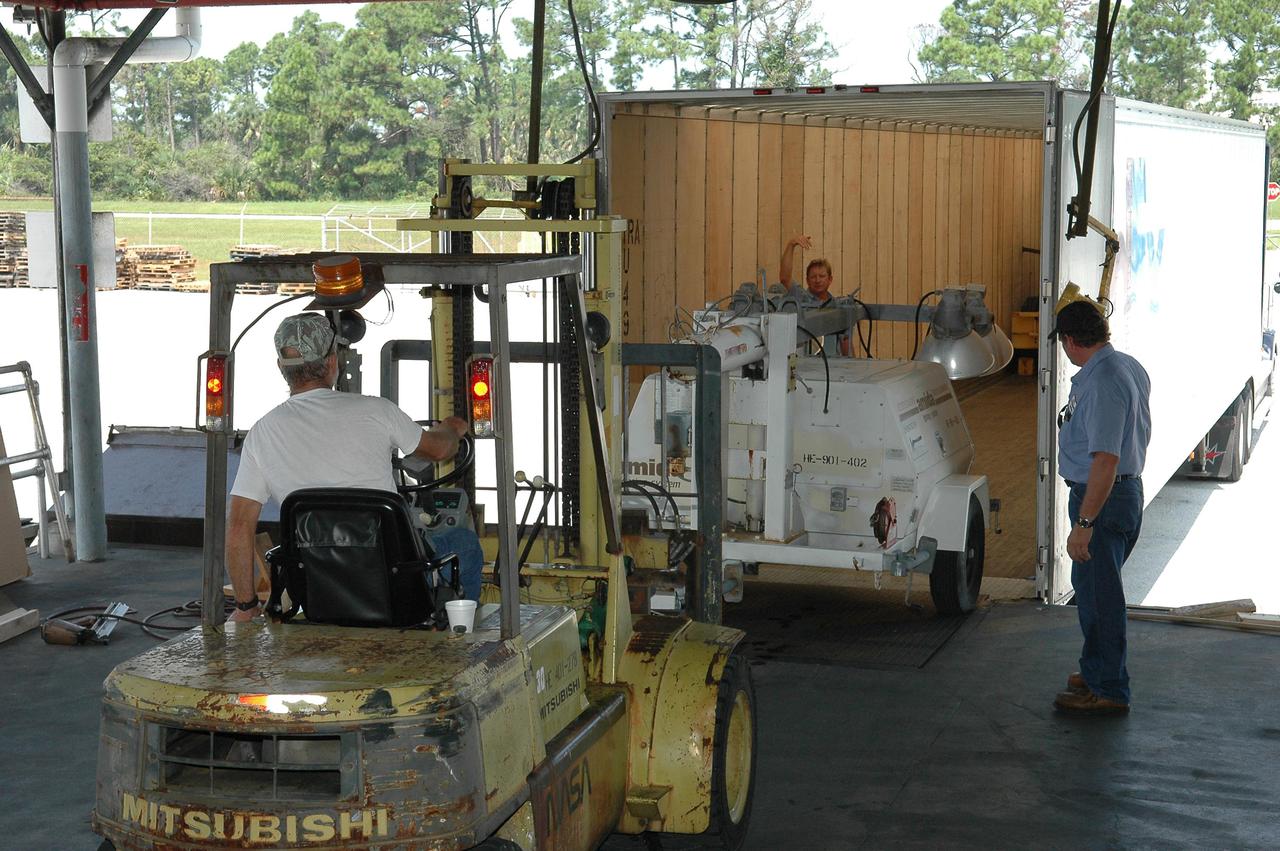
KENNEDY SPACE CENTER, FLA. - A lighting system is loaded onto a truck for a trip to Michoud Assembly Facility near New Orleans. Michoud was left without power following Hurricane Katrina. A NASA plane is carrying medical supplies, food and chain saws, as well as a physician and two high voltage technicians to Michoud to ensure the facility can safely receive power when the main electricity grid comes online. In addition, a 14-person security team is also going to Michoud to relieve the security professionals at that location. Stennis Space Center also suffered damage and power outages from Hurricane Katrina. KSC is sending a helicopter with medical supplies and an Emergency Medical Technician to Stennis, plus a 1-megawatt generator and 125- and 225-kilowatt generators, and 1,000 gallons of diesel fuel.
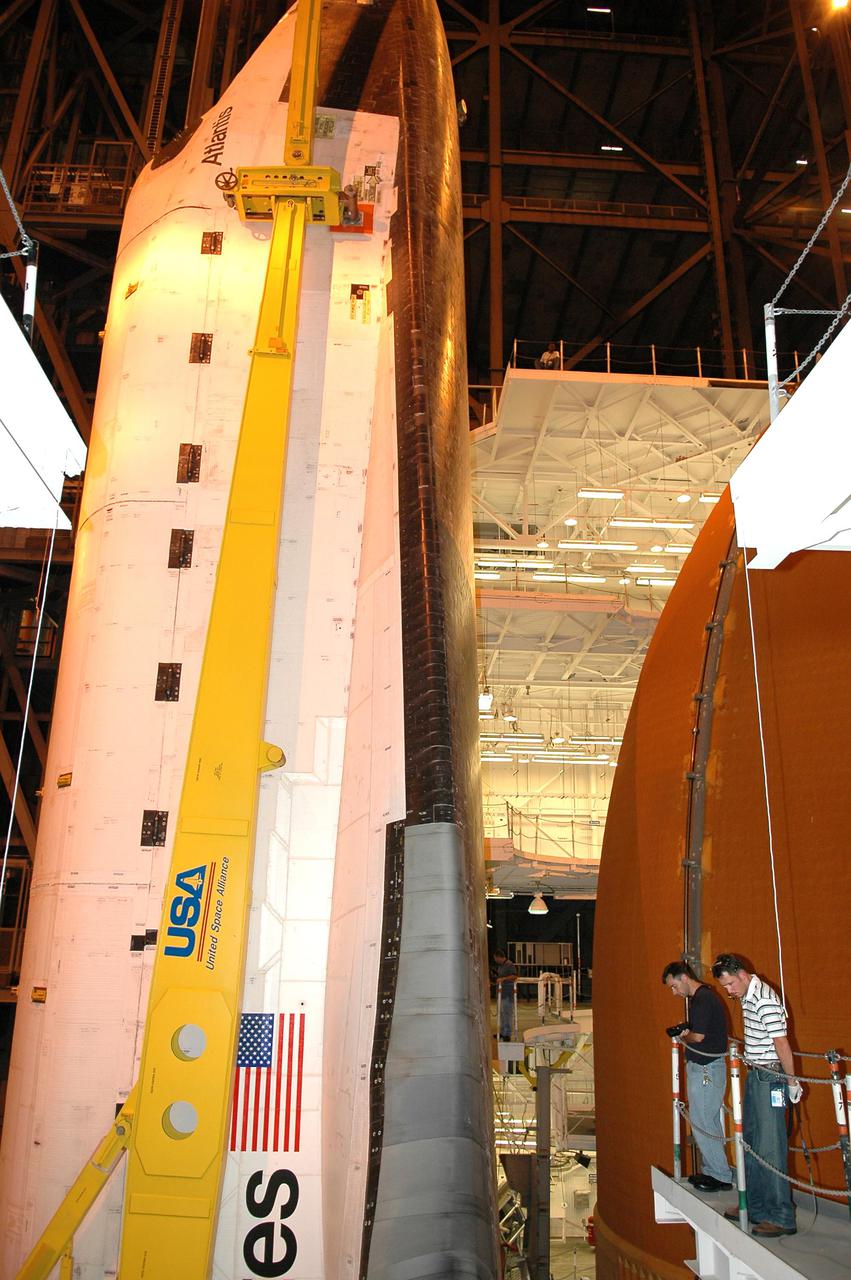
KENNEDY SPACE CENTER, FLA. - In the Vehicle Assembly Building, technicians spot for Space Shuttle Atlantis as it is demated from its External Tank_Solid Rocket Booster stack. The orbiter will be lowered into the transfer aisle and rolled back to Orbiter Processing Facility (OPF) bay 1. Once in the OPF, processing will begin for mission STS-115, the 19th flight to the International Space Station. The tank, ET-120, is the first redesigned ET to arrive at KSC and will undergo further testing before Return to Flight mission STS-121 next year.

This linear features near the South Polar Cap appeared during the height of southern summer
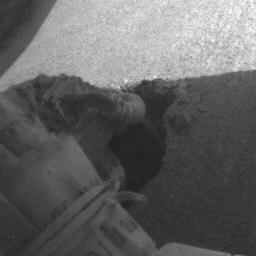
Slow Progress in Dune Right Rear Wheel
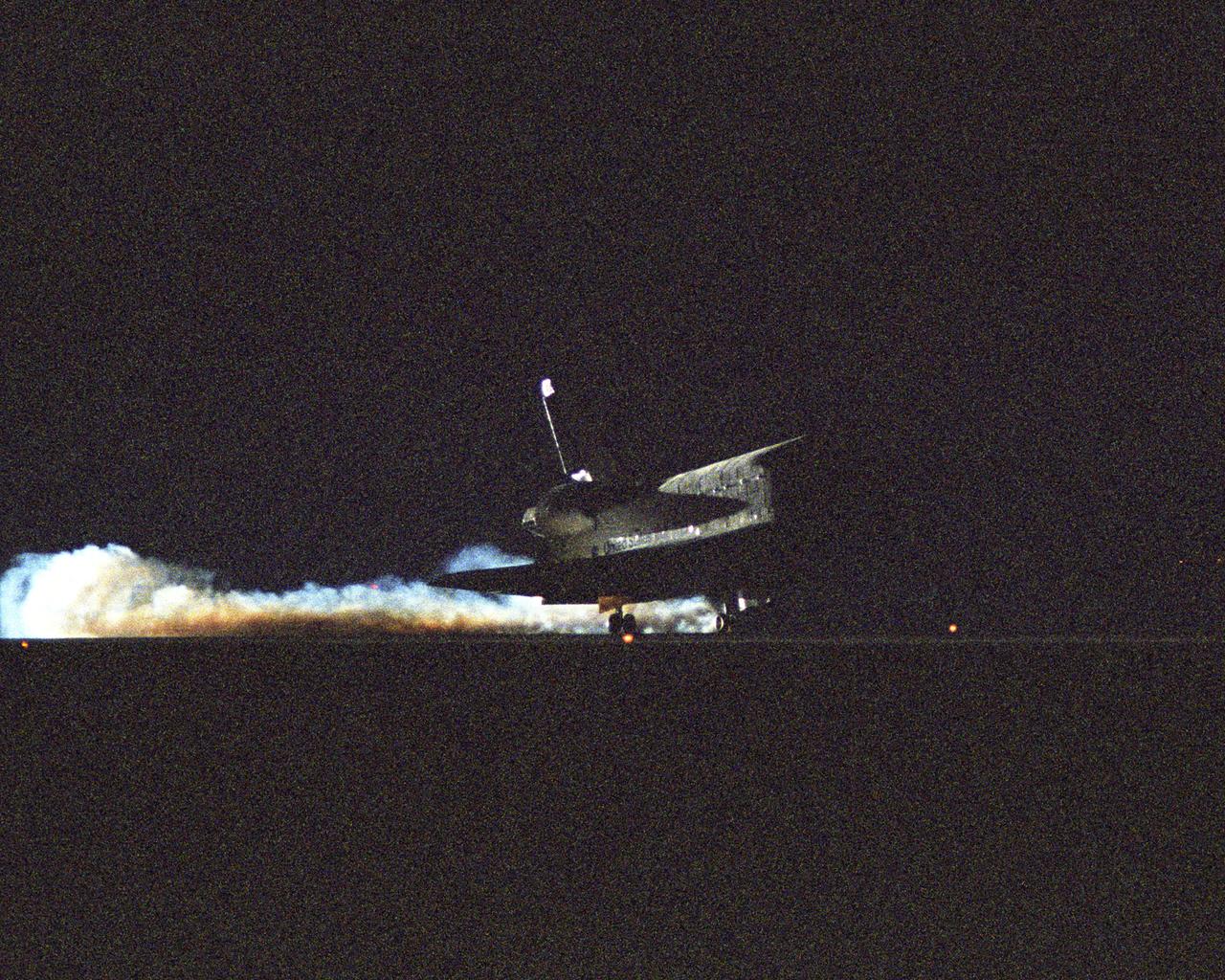
Space Shuttle Discovery landed safely at NASA's Dryden Flight Research Center at Edwards Air Force Base in Calif. at 5:11:22 a.m. PDT this morning, following the very successful 14-day STS-114 return to flight mission. During their two weeks in space, Commander Eileen Collins and her six crewmates tested out new safety procedures and delivered supplies and equipment the International Space Station. Discovery spent two weeks in space, where the crew demonstrated new methods to inspect and repair the Shuttle in orbit. The crew also delivered supplies, outfitted and performed maintenance on the International Space Station. A number of these tasks were conducted during three spacewalks. In an unprecedented event, spacewalkers were called upon to remove protruding gap fillers from the heat shield on Discovery's underbelly. In other spacewalk activities, astronauts installed an external platform onto the Station's Quest Airlock and replaced one of the orbital outpost's Control Moment Gyroscopes. Inside the Station, the STS-114 crew conducted joint operations with the Expedition 11 crew. They unloaded fresh supplies from the Shuttle and the Raffaello Multi-Purpose Logistics Module. Before Discovery undocked, the crews filled Raffeallo with unneeded items and returned to Shuttle payload bay. Discovery launched on July 26 and spent almost 14 days on orbit.

ISS010-E-17563 (11 February 2005) --- This is a late winter scene of the U.S./Canadian border, featuring Niagara Falls and other points as captured by an Expedition 10 crewmember on the International Space Station.

THEMIS Images As Art #29
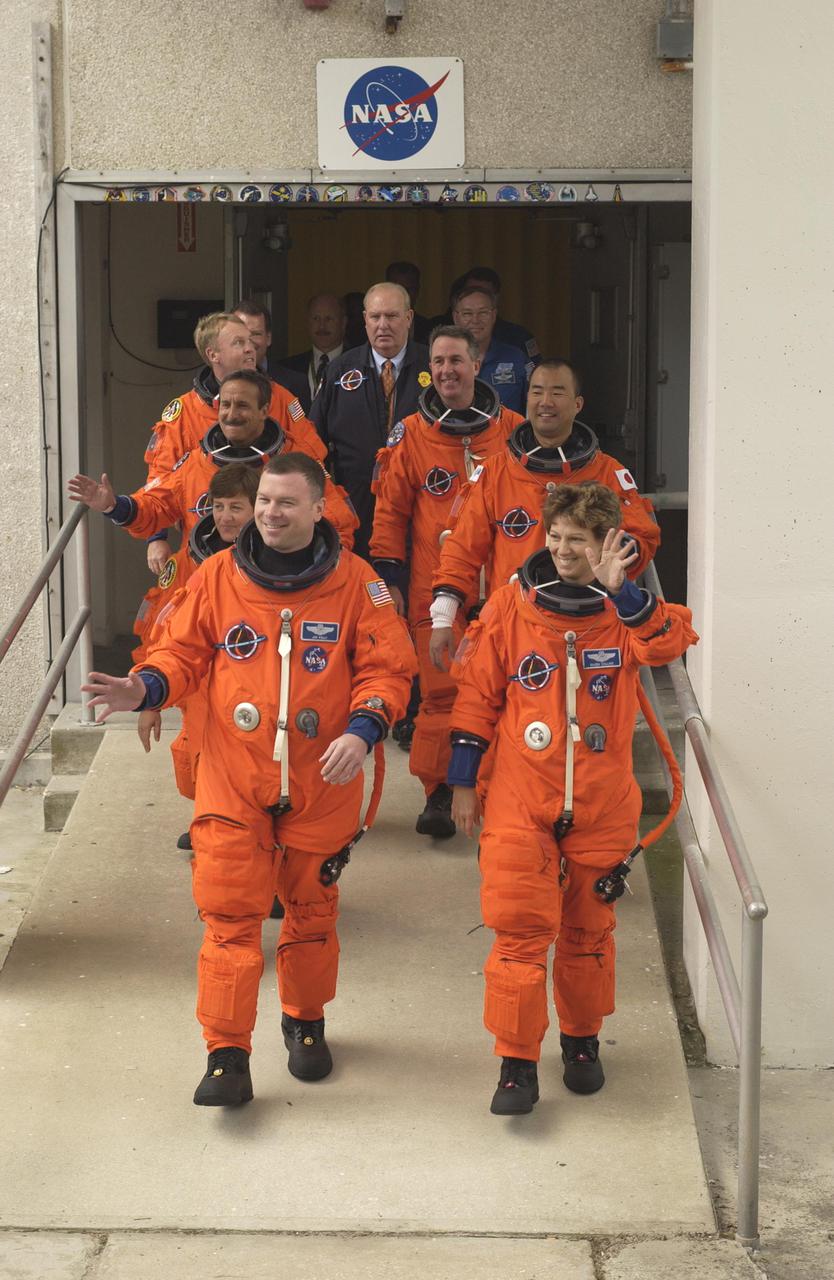
KENNEDY SPACE CENTER, FLA. - The Return to Flight STS-114 crew exits the Operations and Checkout Building for their ride to Launch Pad 39B. On the left column, front to back, are Pilot James Kelly and Mission Specialists Wendy Lawrence, Charles Camarda and Andrew Thomas. On the right column are Mission Commander Eileen Collins and Mission Specialists Soichi Noguchi and Stephen Robinson. The crew is scheduled to launch on this historic mission at 3:51 p.m. EDT today from Launch Pad 39B. It is the 114th Space Shuttle flight and the 31st for Discovery. The 12-day mission is expected to end with touchdown at the Shuttle Landing Facility at 11:06 a.m. July 25.

Central Peak Crater in Lunae Planum
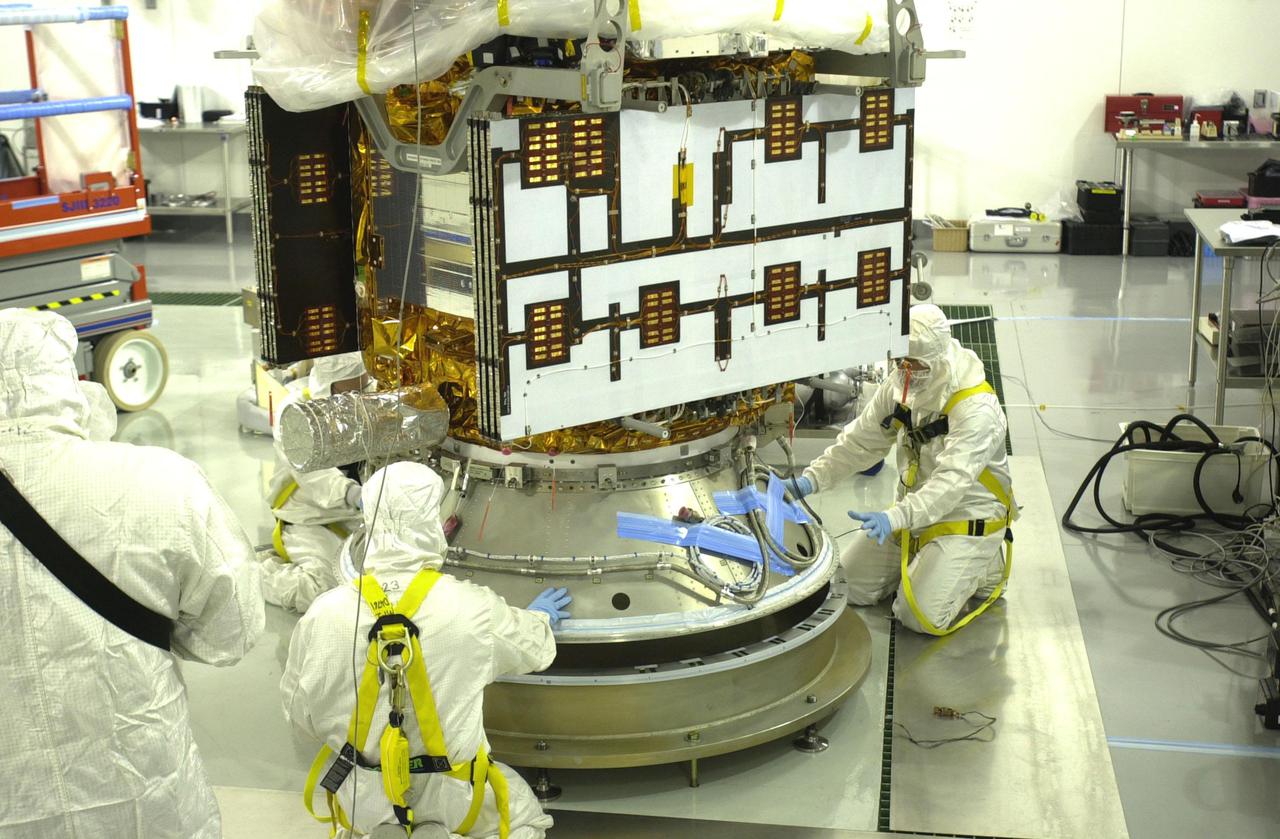
VANDENBERG AIR FORCE BASE, CALIF. - Inside the Astrotech Payload Processing Facility on Vandenberg Air Force Base in California, workers help guide the CALIPSO spacecraft as it is lowered onto a payload attach fitting. CALIPSO will be mated to the Lower Delta Payload Attach Fitting (LDPAF) that contains the CloudSat satellite. The PAF is the interface between the spacecraft and the second stage of the rocket. CALIPSO stands for Cloud-Aerosol Lidar and Infrared Pathfinder Satellite Observation. CALIPSO and CloudSat are highly complementary satellites that will provide never-before-seen 3-D perspectives of how clouds and aerosols form, evolve, and affect weather and climate. CALIPSO and CloudSat will fly in formation with three other satellites in the A-train constellation to enhance understanding of our climate system. Launch of CALIPSO_CloudSat aboard a Boeing Delta II rocket is scheduled for 3:01 a.m. PDT Sept. 29.
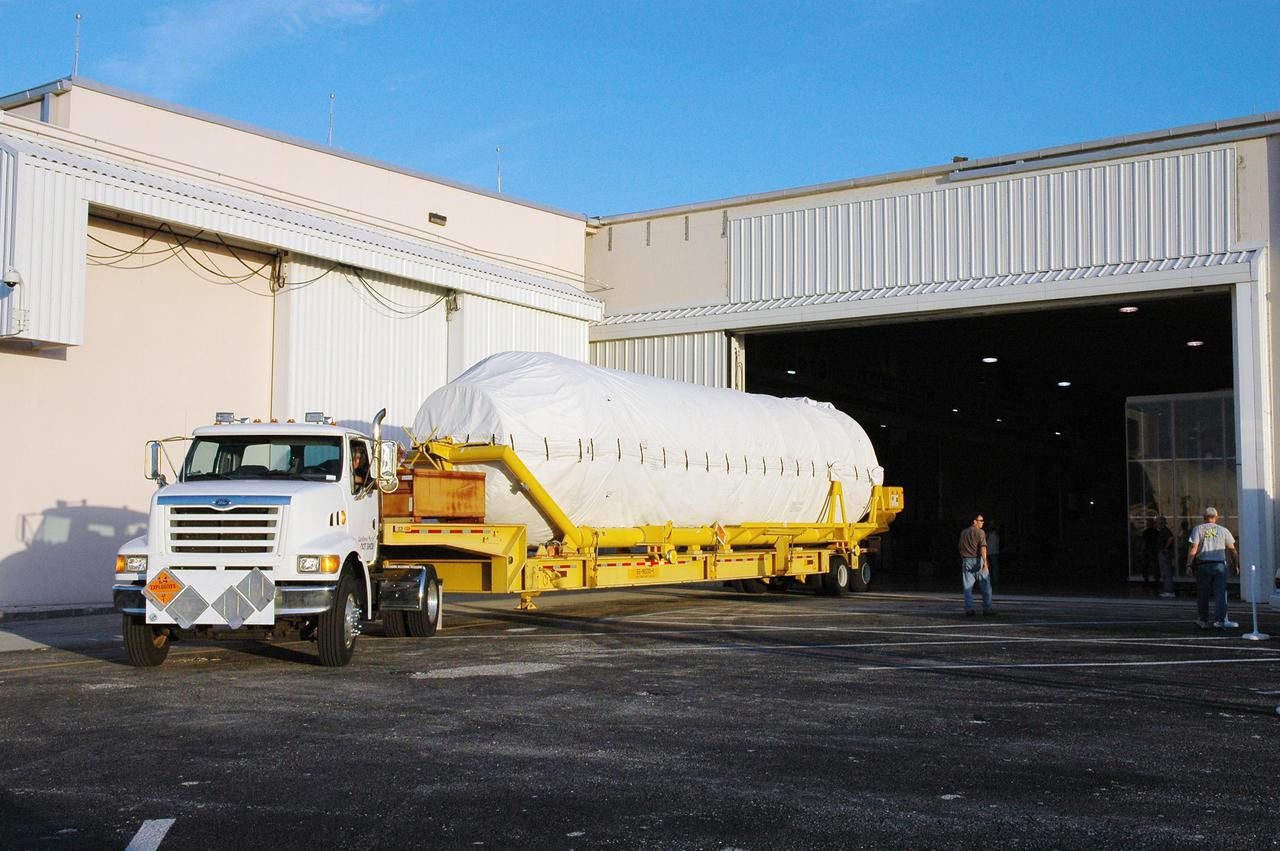
KENNEDY SPACE CENTER, FLA. - The Centaur (Block I) upper stage is rolled into the hangar of the Atlas Space Operations Center where it will be processed for mating with the Lockheed Martin Atlas V, designated AV-007, that is the launch vehicle for the Mars Reconnaissance Orbiter (MRO). The MRO is designed for a series of global mapping, regional survey and targeted observations from a near-polar, low-altitude Mars orbit. These observations will be unprecedented in terms of the spatial resolution and coverage achieved by the orbiter’s instruments as they observe the atmosphere and surface of Mars while probing its shallow subsurface as part of a “follow the water” strategy. The orbiter is undergoing environmental tests in facilities at Lockheed Martin Space Systems in Denver, Colo., and is on schedule for a launch window that begins Aug. 10. Launch will be from Launch Complex 41 at Cape Canaveral Air Force Station in Florida.

Arsia Mons Overlapping Flows
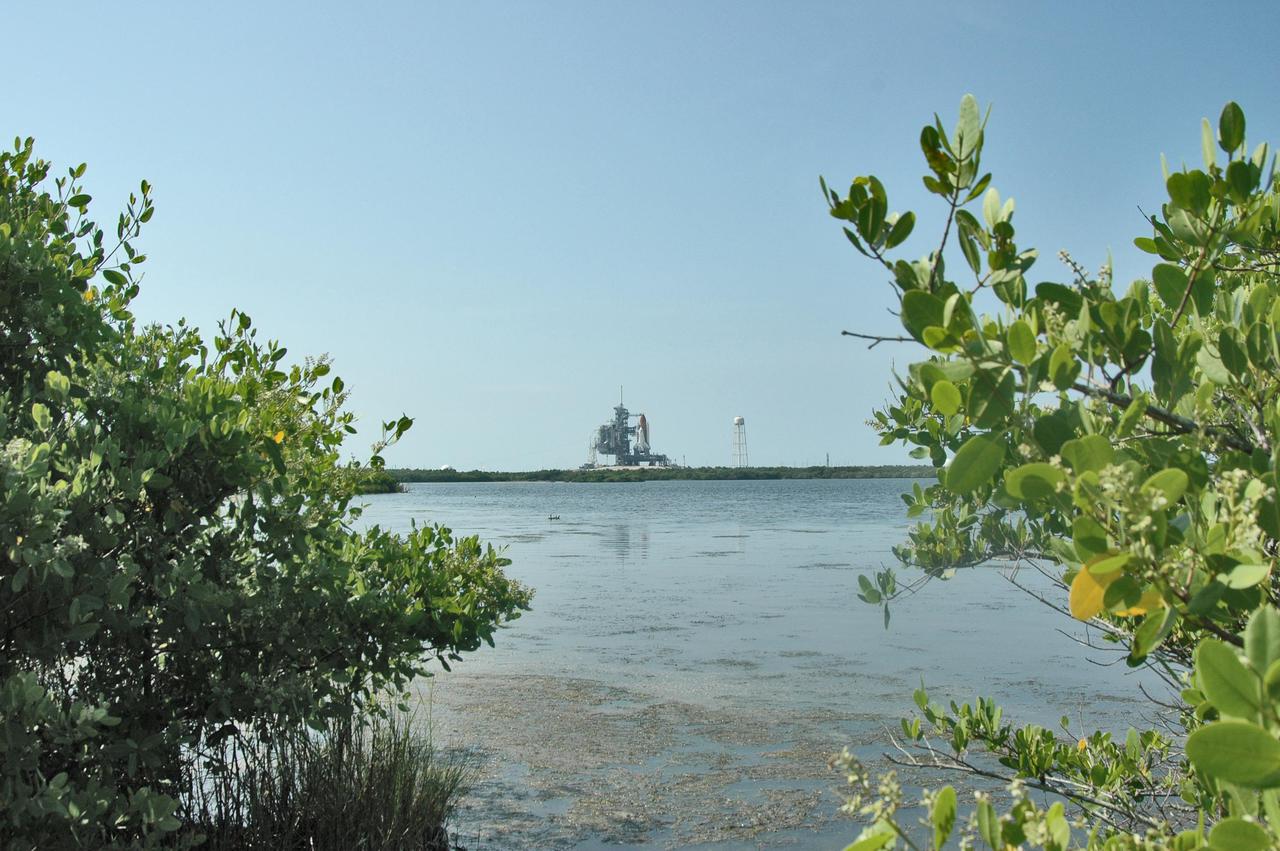
KENNEDY SPACE CENTER, FLA. - Seen after rollback of the Rotating Service Structure, and framed by marsh greenery, a fully revealed Space Shuttle Discovery on NASA Kennedy Space Center’s Launch Pad 39B rises from the horizon beyond the pond. Discovery is scheduled to lift off on the historic Return to Flight mission STS-114 at 10:39 a.m. EDT July 26 with a crew of seven. On the mission to the International Space Station the crew will perform inspections on orbit for the first time of all of the Reinforced Carbon-Carbon (RCC) panels on the leading edge of the wings and the Thermal Protection System tiles using the new Canadian-built Orbiter Boom Sensor System and the data from 176 impact and temperature sensors. Mission Specialists will also practice repair techniques on RCC and tile samples during a spacewalk in the payload bay. During two additional spacewalks, the crew will install the External Stowage Platform-2, equipped with spare part assemblies, and a replacement Control Moment Gyroscope contained in the Lightweight Multi-Purpose Experiment Support Structure.
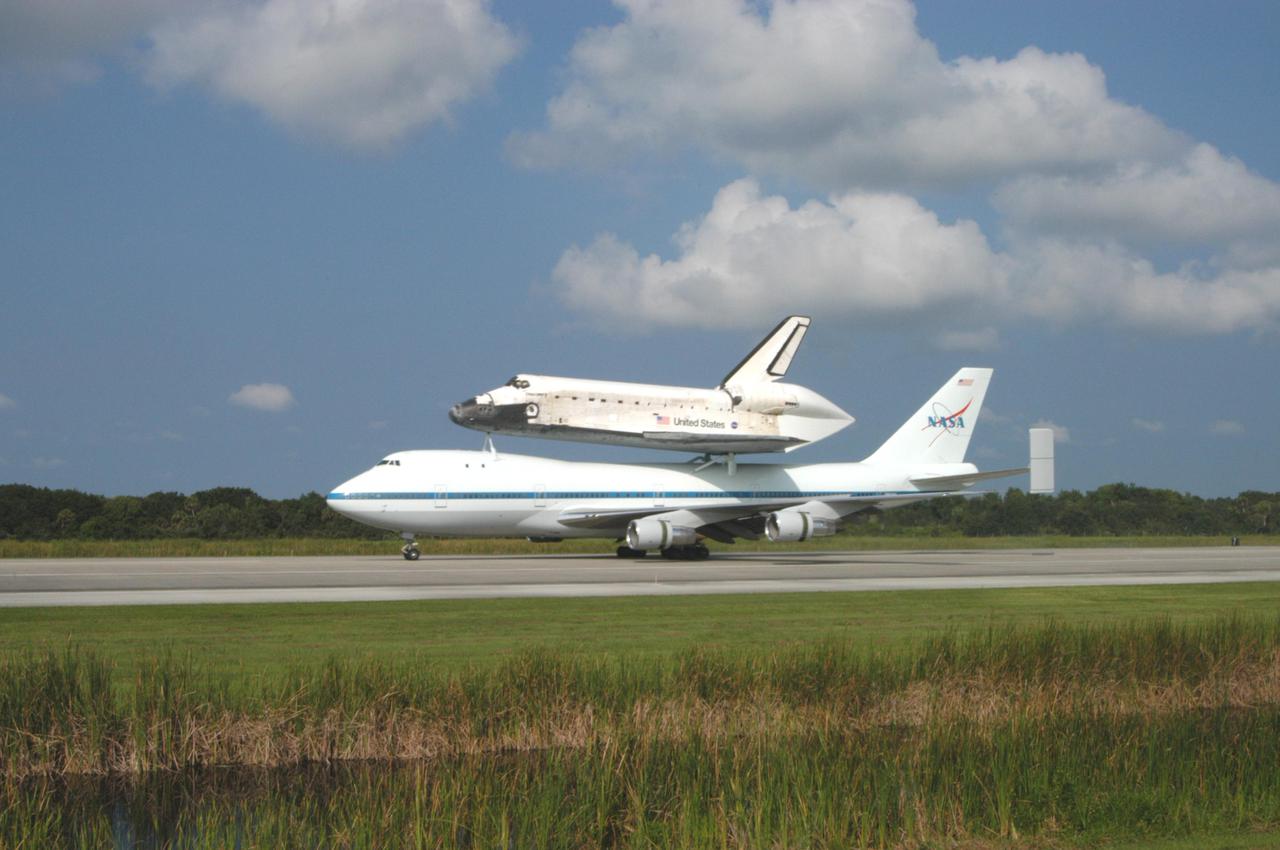
KENNEDY SPACE CENTER, FLA. - Space Shuttle Discovery, atop a modified Boeing 747 Shuttle Carrier Aircraft (SCA), lands on runway 15 at NASA Kennedy Space Center's Shuttle Landing Facility (SLF) at about 10:00 a.m. EDT. The cross-country ferry flight became necessary when two days of unfavorable weather conditions at KSC forced Discovery to land on runway 22 at Edwards Air Force Base, Calif., on Aug. 9 following mission STS-114. On the return trip, stops were made at Altus Air Force Base, Okla., and Barksdale Air Force Base, La., where Discovery stayed for two nights. The SCA and Discovery will be towed to the Mate_Demate Device at the SLF where a crane will lift Discovery from the SCA and place it on solid ground. Discovery will then be towed to the Orbiter Processing Facility where preparations will begin for its next flight, STS-121.
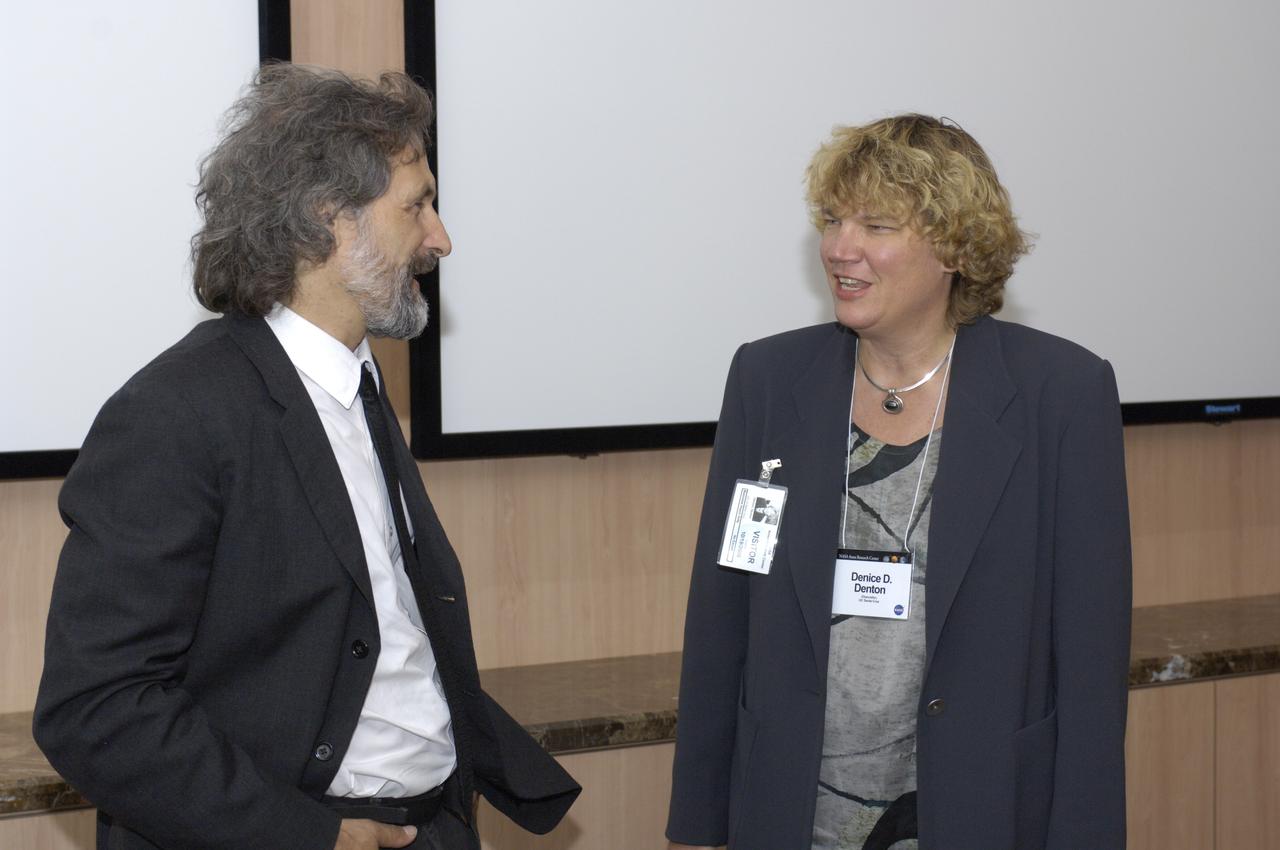
Universtiy of California Santa Cruz Chancellor Denice Denten (and other guests) visit NASA Ames Research Center to meet with Directors and have a briefing on Ames Projects and Programs. Jonathan Trent, Ames Research Scientist, Bioengineering Branch (L) and Denice Denton, Chancellor of UCSC (R)
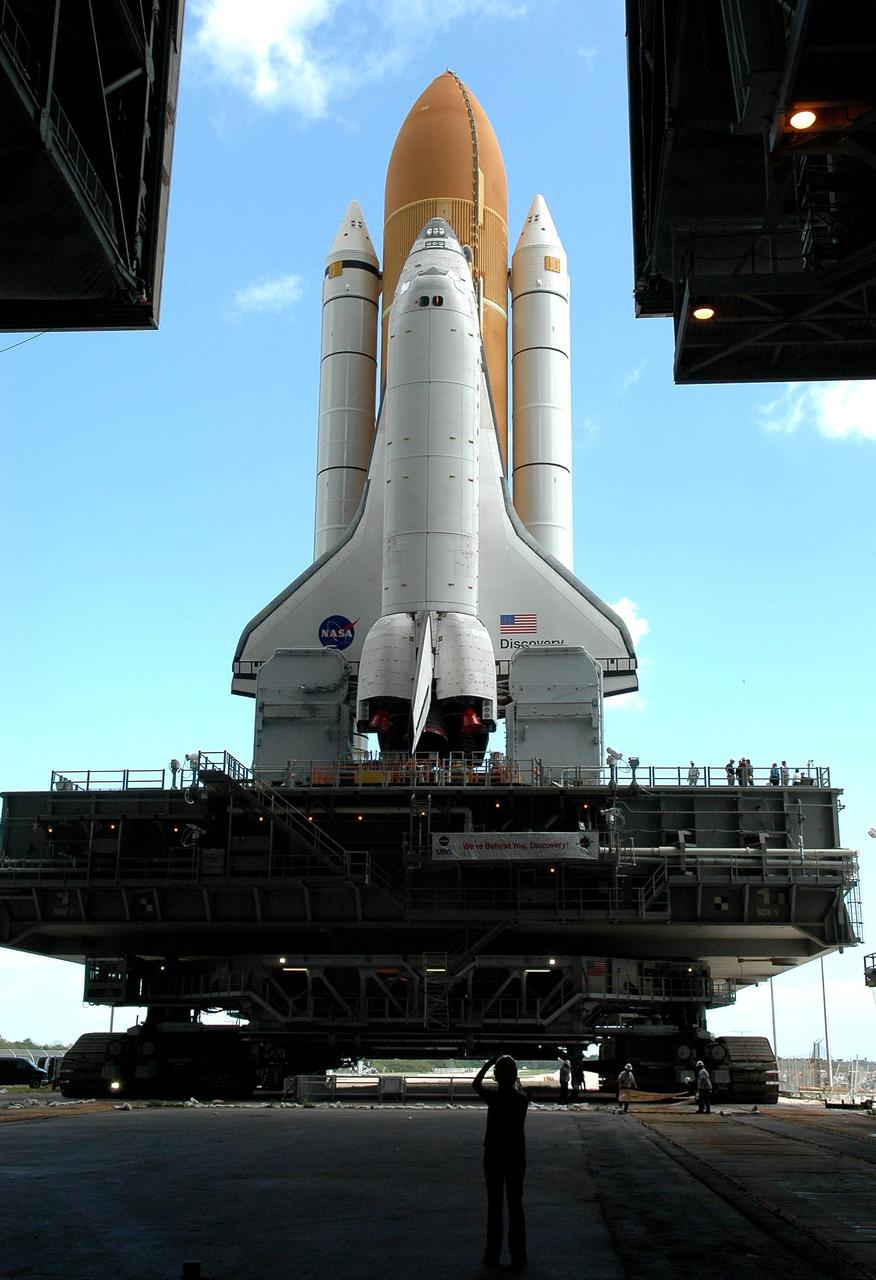
KENNEDY SPACE CENTER, FLA. - Framed in the open doors of the Vehicle Assembly Building (VAB) at NASA’s Kennedy Space Center, Space Shuttle Discovery is bathed in light as it begins its long, slow journey to Launch Pad 39B. The Space Shuttle rests on the Mobile Launcher Platform, which is moved by the Crawler-Transporter underneath. The Crawler is 20 feet high, 131 feet long and 114 feet wide. It moves on eight tracks, each containing 57 shoes, or cleats, weighing one ton each. Loaded with the Space Shuttle, the Crawler can move at a maximum speed of approximately 1 mile an hour. A leveling system in the Crawler keeps the Shuttle vertical while negotiating the 5 percent grade leading to the top of the launch pad. Launch of Discovery on its Return to Flight mission, STS-114, is targeted for May 15 with a launch window that extends to June 3. During its 12-day mission, Discovery’s seven-person crew will test new hardware and techniques to improve Shuttle safety, as well as deliver supplies to the International Space Station. Discovery was moved on March 29 from the Orbiter Processing Facility to the VAB and attached to its propulsion elements, a redesigned ET and twin SRBs.
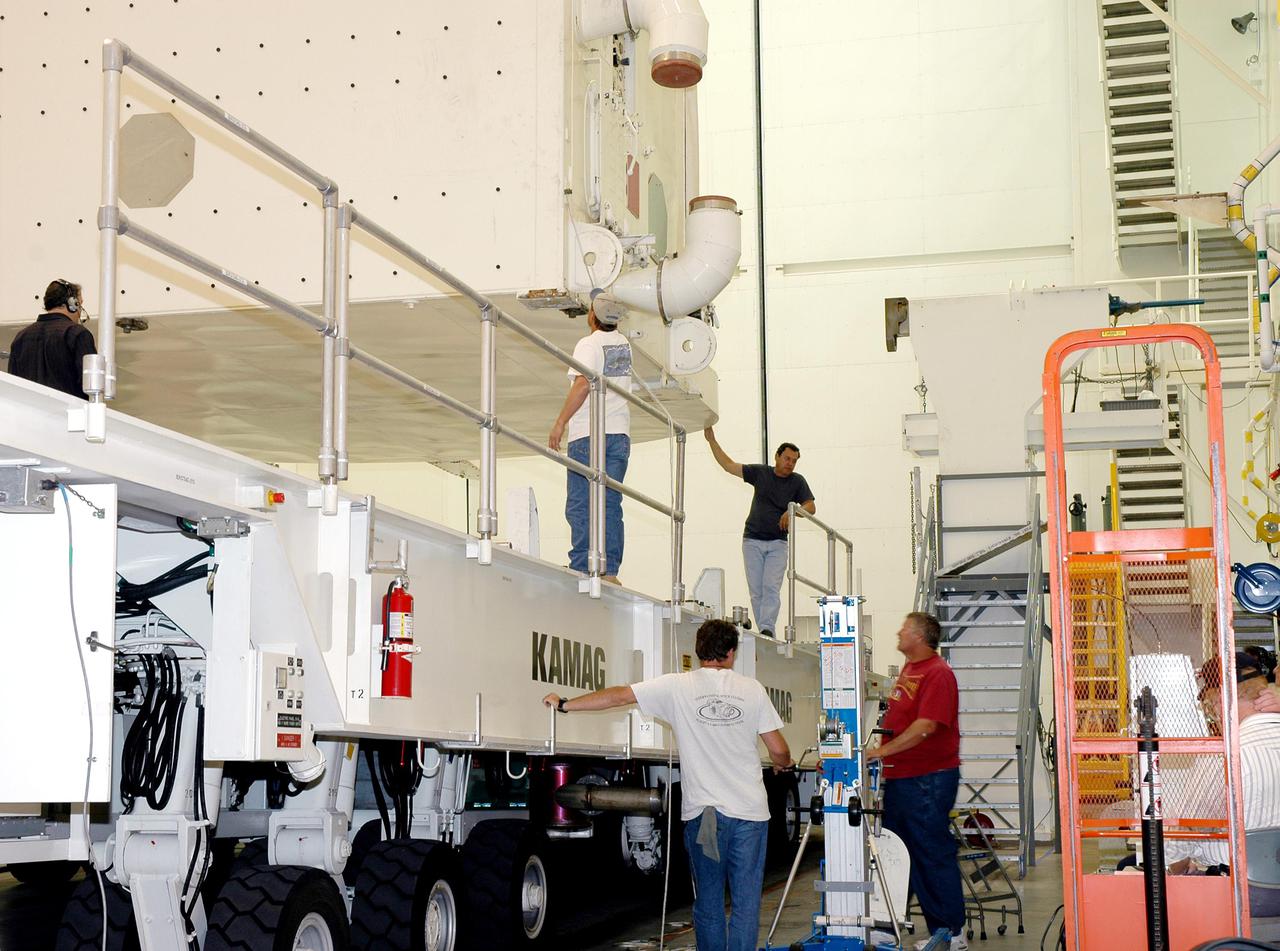
KENNEDY SPACE CENTER, FLA. - Workers in the Canister Rotation Facility at NASA’s Kennedy Space Center observe the Payload Canister after its rotation to a vertical position. The canister will be transported to Launch Pad 39B. The payloads inside, including the Multi-Purpose Logistics Module Raffaello and External Stowage Platform-2, will be moved into the Payload Changeout Room in the Rotating Service Structure and then installed in Discovery’s payload bay. Space Shuttle Discovery is scheduled to launch on Return to Flight mission STS-114 to the International Space Station. The launch window extends from May 22 to June 3.
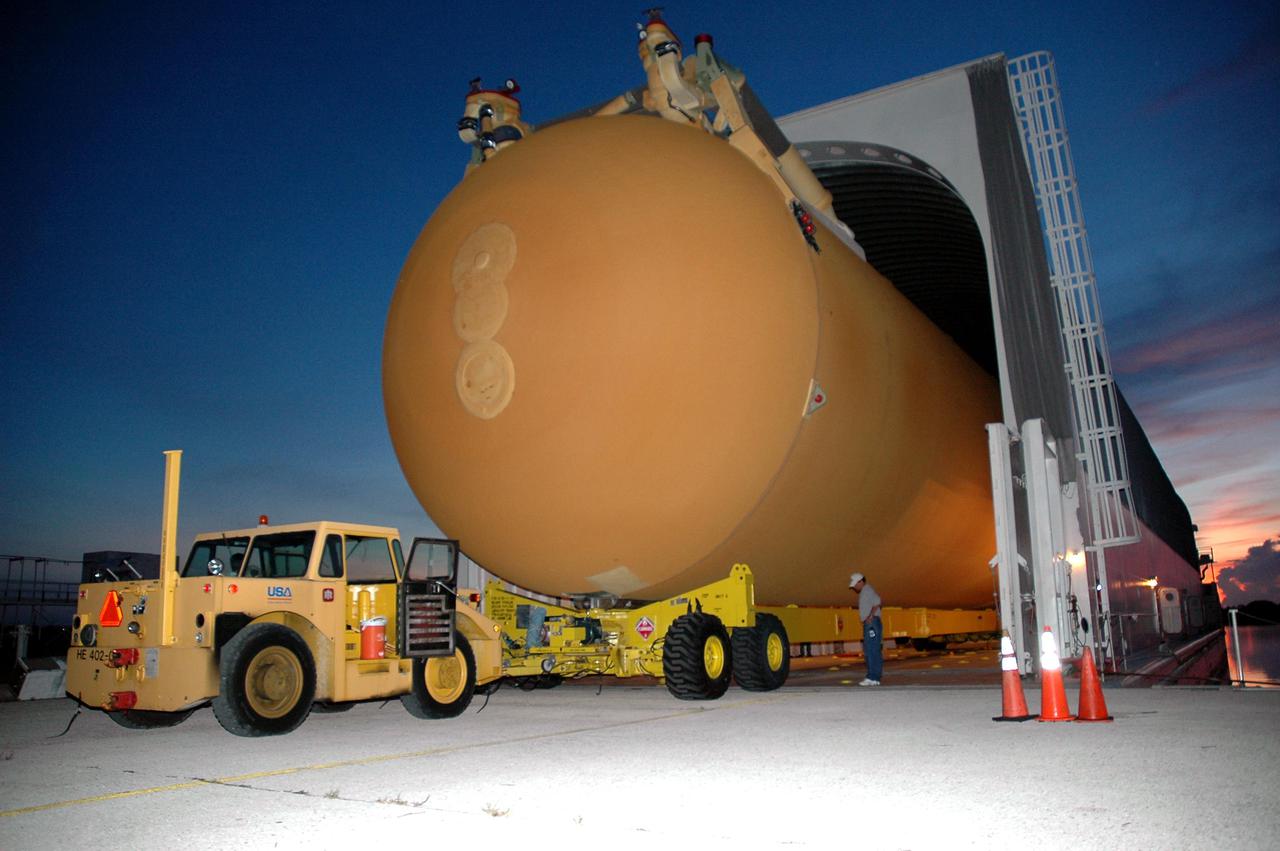
KENNEDY SPACE CENTER, FLA. - Under pre-dawn skies of blue and red, External Tank 119 is loaded onto the barge at the Turn Basin. The tank will embark on a voyage around the Florida peninsula to the Michoud Assembly Facility in New Orleans. Delivered to KSC in June, ET-119 is the third newly redesigned tank.
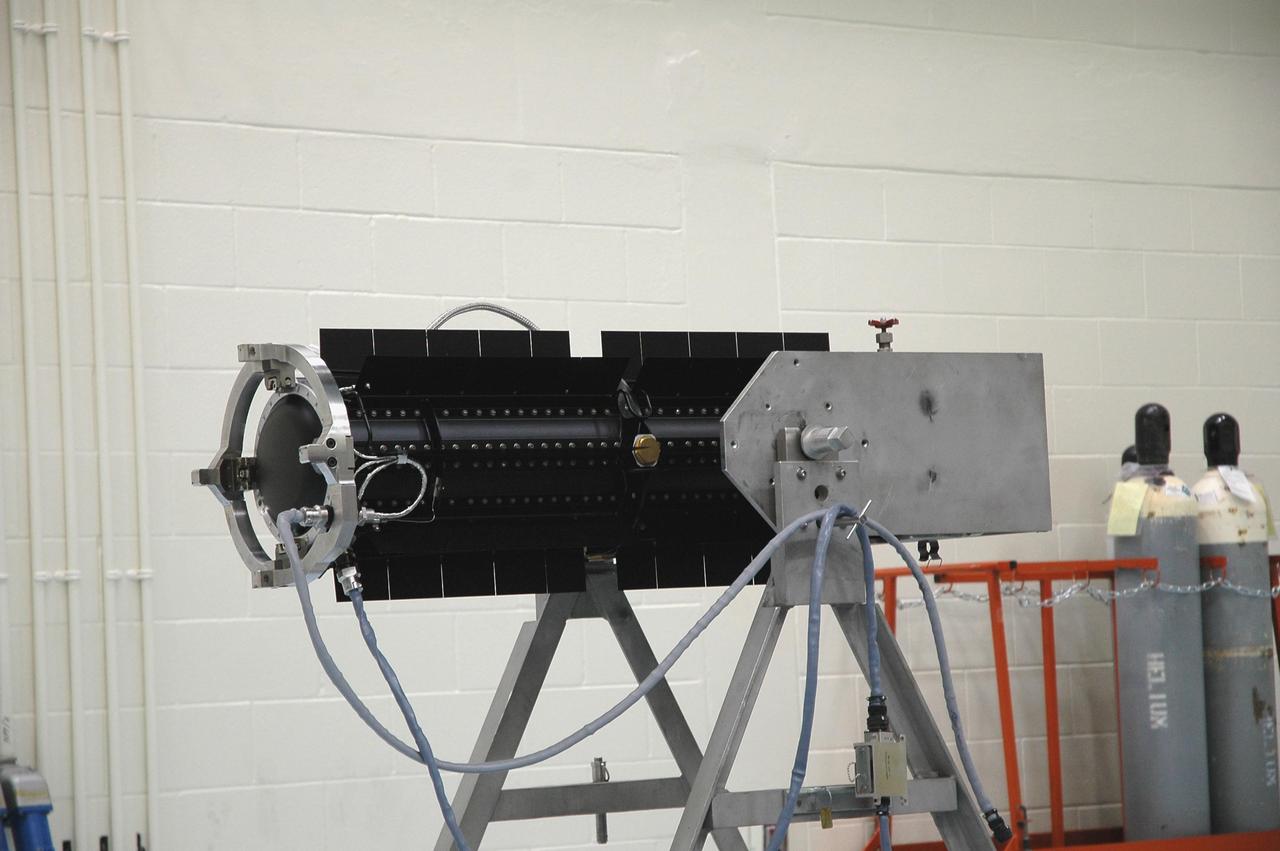
KENNEDY SPACE CENTER, FLA. - In the RTG Facility at Kennedy Space Center, the radioisotope thermoelectric generator (RTG) rests in a horizontal position. The RTG is the baseline power supply for the NASA’s New Horizons spacecraft, scheduled to launch in January 2006 on a journey to Pluto and its moon, Charon. As it approaches Pluto, the spacecraft will look for ultraviolet emission from Pluto's atmosphere and make the best global maps of Pluto and Charon in green, blue, red and a special wavelength that is sensitive to methane frost on the surface. It will also take spectral maps in the near infrared, telling the science team about Pluto's and Charon's surface compositions and locations and temperatures of these materials. When the spacecraft is closest to Pluto or its moon, it will take close-up pictures in both visible and near-infrared wavelengths. It is expected to reach Pluto in July 2015.
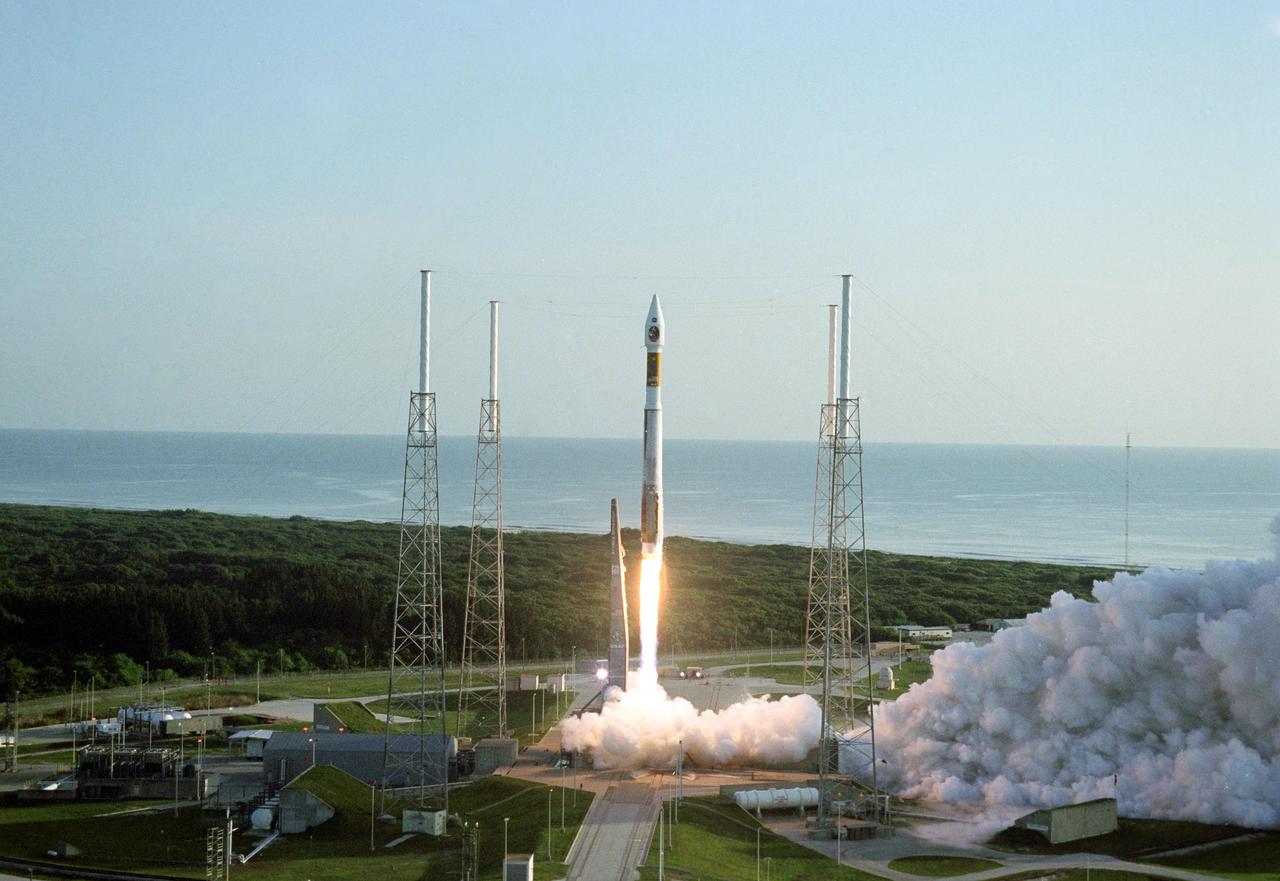
KENNEDY SPACE CENTER, FLA. - With the Atlantic Ocean as a backdrop, an Atlas V launch vehicle, 19 stories tall, with a two-ton Mars Reconnaissance Orbiter (MRO) on top, roars away from Launch Complex 41 at Cape Canaveral Air Force Station at 7:43 a.m. EDT. All systems performed nominally for NASA's first launch of an Atlas V on an interplanetary mission. MRO established radio contact with controllers 61 minutes after launch and within four minutes of separation from the upper stage. Initial contact came through an antenna at the Japan Aerospace Exploration Agency's Uchinoura Space Center in southern Japan. Mars is 72 million miles from Earth today, but the spacecraft will travel more than four times that distance on its outbound-arc trajectory to intercept the red planet on March 10, 2006. The orbiter carries six scientific instruments for examining the surface, atmosphere and subsurface of Mars in unprecedented detail from low orbit. NASA expects to get several times more data about Mars from MRO than from all previous Martian missions combined. Researchers will use the instruments to learn more about the history and distribution of Mars' water. That information will improve understanding of planetary climate change and will help guide the quest to answer whether Mars ever supported life. The orbiter will also evaluate potential landing sites for future missions. (Photo Credit: Pat Corkery/Lockheed Martin)
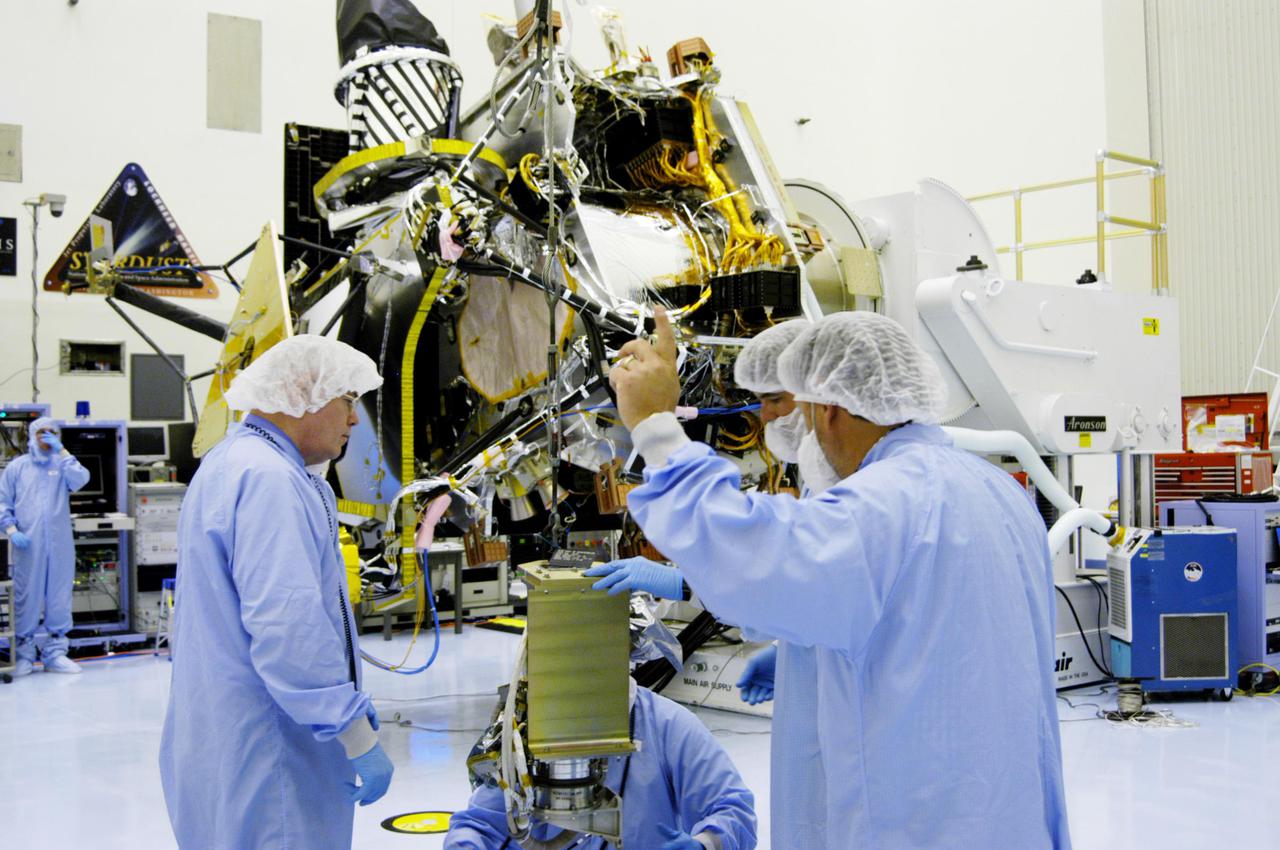
KENNEDY SPACE CENTER, FLA. - In the Payload Hazardous Servicing Facility at NASA’s Kennedy Space Center, engineers prepare to install the gimbal on the Mars Reconnaissance Orbiter (MRO) solar panel. A gimbal is an appliance that allows an object to remain horizontal even as its support tips. In the background is the orbiter. In the PHSF, the spacecraft will undergo multiple mechanical assembly operations and electrical tests to verify its readiness for launch. A major deployment test will check out the spacecraft’s large solar arrays. The MRO was built by Lockheed Martin for NASA’s Jet Propulsion Laboratory in California. It is the next major step in Mars exploration and scheduled for launch from Cape Canaveral Air Force Station in a window opening Aug. 10. The MRO is an important next step in fulfilling NASA’s vision of space exploration and ultimately sending human explorers to Mars and beyond.
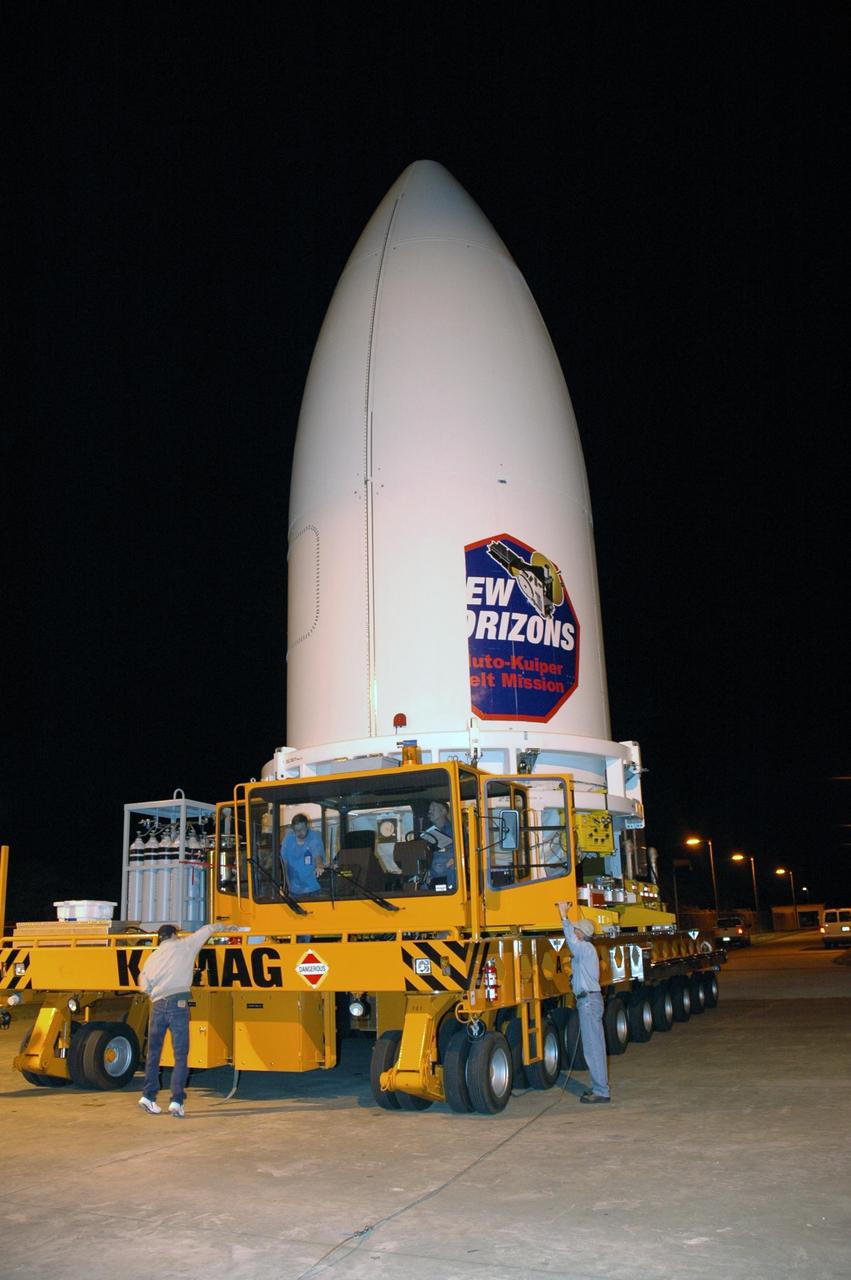
KENNEDY SPACE CENTER, FLA. - Technicians prepare to move New Horizons before dawn from the Payload Hazardous Servicing Facility to the Vertical Integration Facility at Complex 41 on Cape Canaveral Air Force Station. New Horizons carries seven scientific instruments that will characterize the global geology and geomorphology of Pluto and its moon Charon, map their surface compositions and temperatures, and examine Pluto's complex atmosphere. After that, flybys of Kuiper Belt objects from even farther in the solar system may be undertaken in an extended mission. New Horizons is the first mission in NASA's New Frontiers program of medium-class planetary missions. The spacecraft, designed for NASA by the Johns Hopkins University Applied Physics Laboratory in Laurel, Md., will launch aboard a Lockheed Martin Atlas V rocket and fly by Pluto and Charon as early as summer 2015.
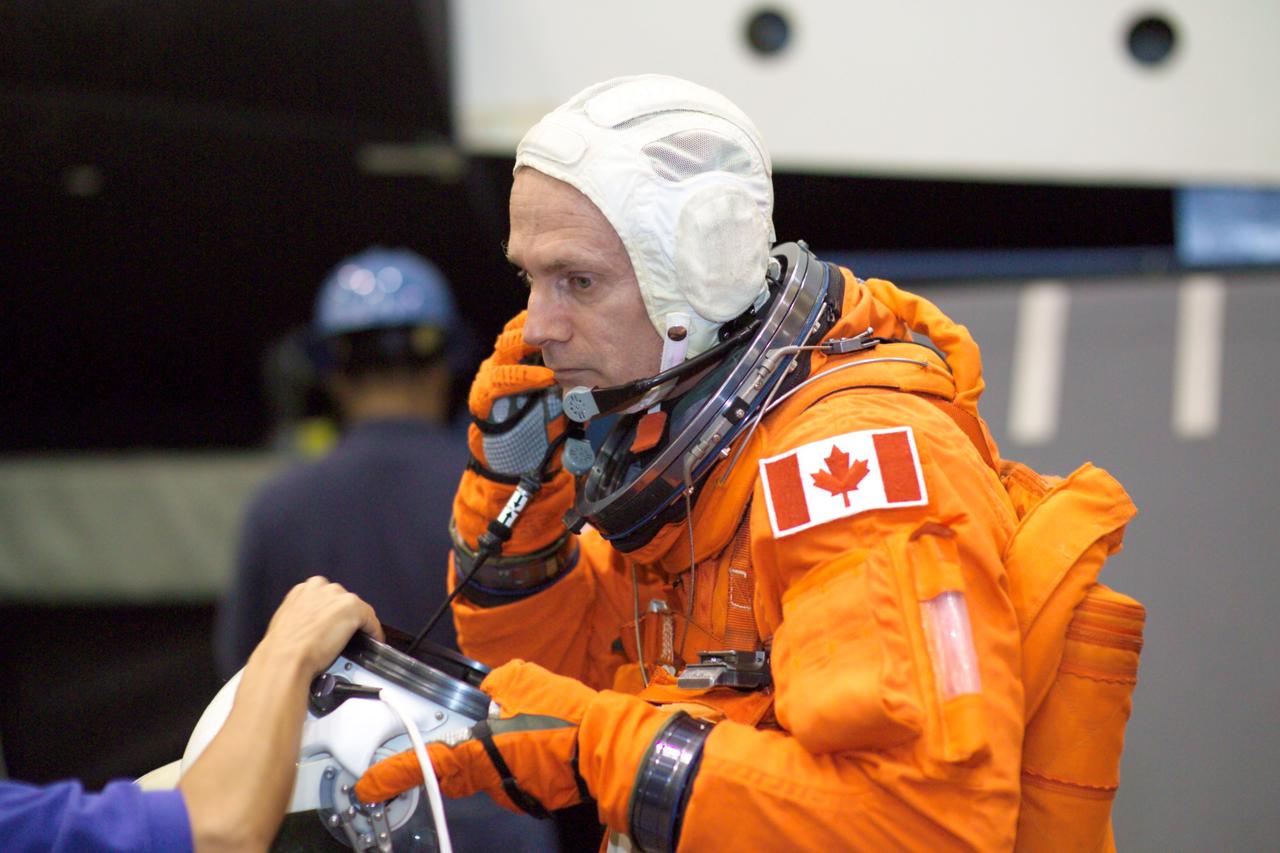
JSC2005-E-13822 (4 April 2005) --- Astronaut Steven G. MacLean, STS-115 mission specialist representing the Canadian Space Agency, dons a training version of the shuttle launch and entry suit prior to the start of an emergency egress training session in the Space Vehicle Mockup Facility at the Johnson Space Center.
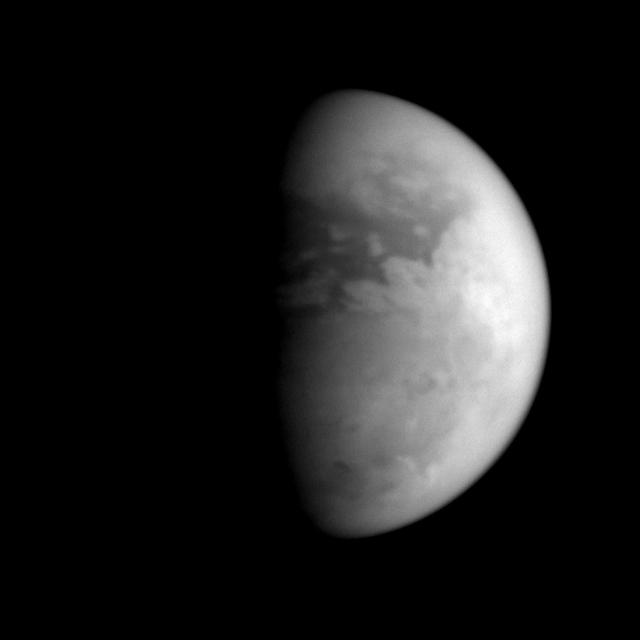
Dawn at the Huygens Site
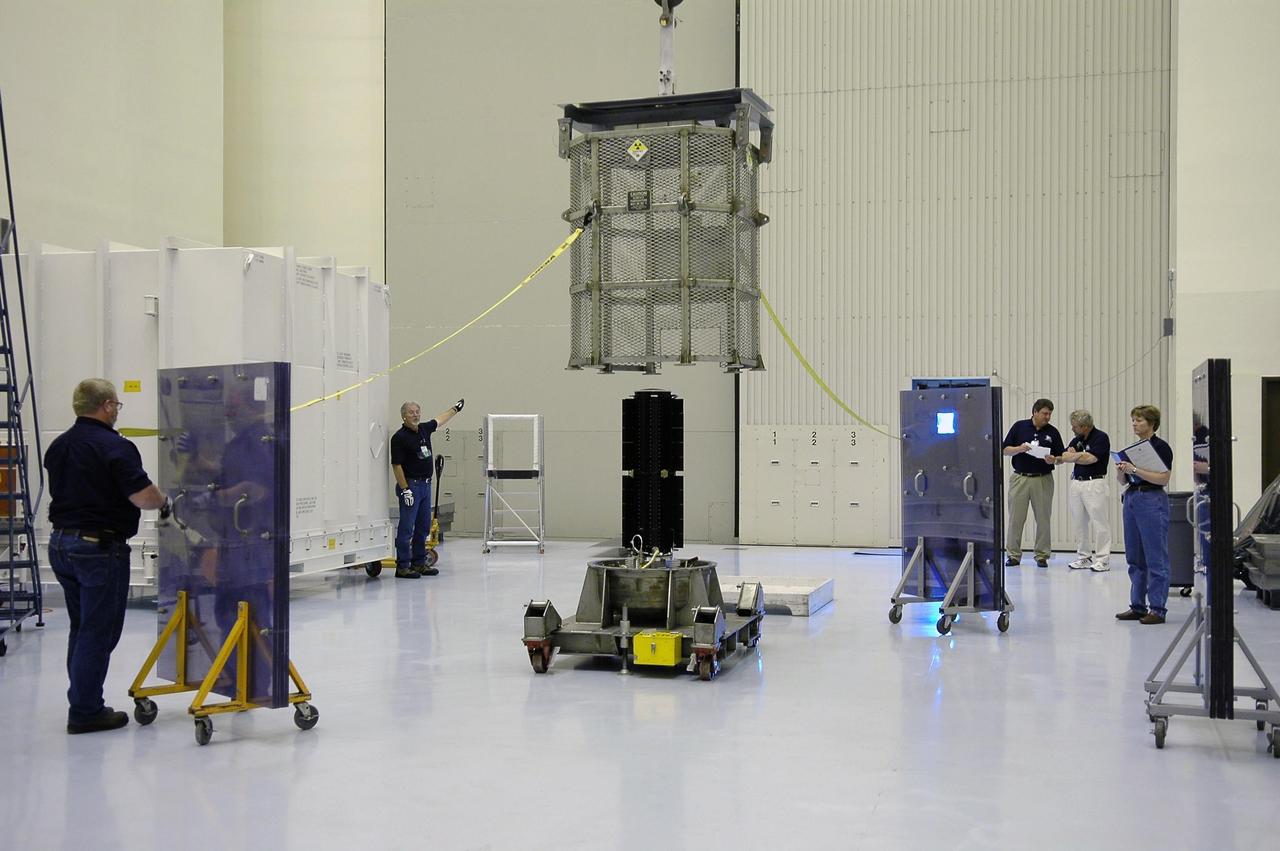
KENNEDY SPACE CENTER, FLA. - In NASA Kennedy Space Center’s Payload Hazardous Servicing Facility, the metal canister is lifted away from the radioisotope thermoelectric generator (RTG). Inside the facility, the RTG will be installed in the New Horizons spacecraft for a fit check. The RTG is the baseline power supply for New Horizons, scheduled to launch in January 2006 on a journey to Pluto and its moon, Charon. It is expected to reach Pluto in July 2015.
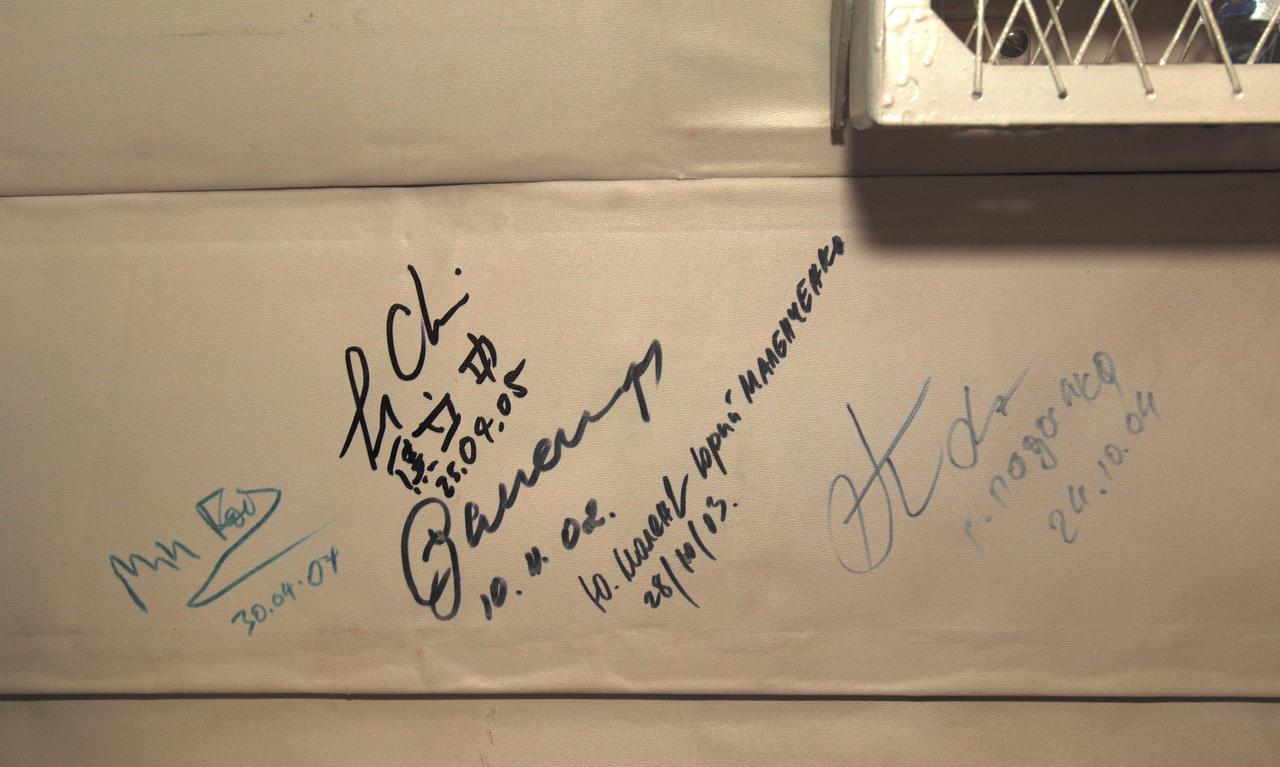
Signatures of astronauts and cosmonauts that have flown onboard this Russian helicopter are seen in this image, Monday, April 25, 2005, Kazakhstan. Expedition 10 Commander Leroy Chiao, Flight Engineer Salizhan Sharipov and European Space Agency astronaut Roberto Vittori brought their Soyuz TMA-5 capsule to a pre-dawn landing April 25 northeast of the town of Arkalyk to wrap up a six-month mission aboard the International Space Station for Chiao and Sharipov, and a ten-day mission for Vittori, who flew under a commercial contract between ESA and the Russian Federal Space Agency. Photo Credit: (NASA/Bill Ingalls)

Troughs in Tharsis
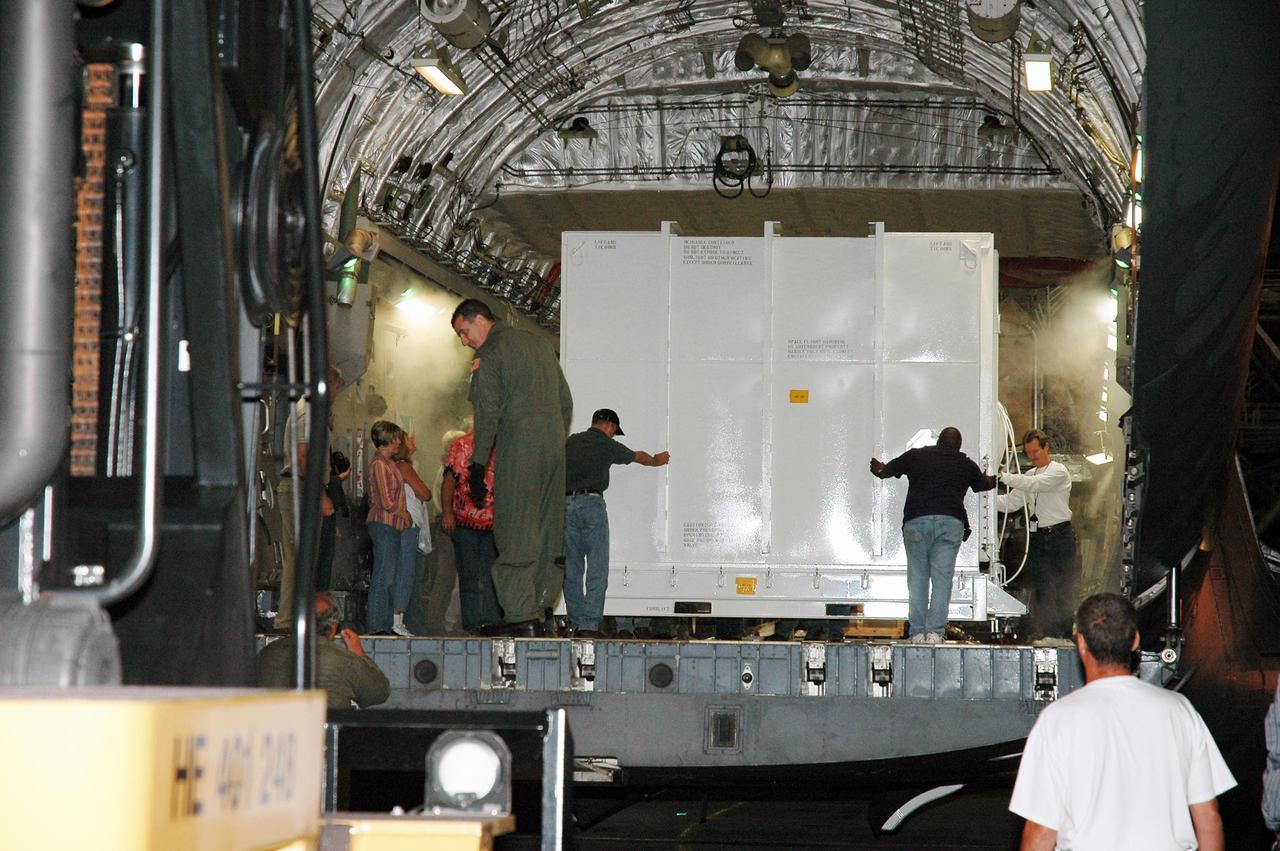
KENNEDY SPACE CENTER, FLA. - In the U.S. Air Force C-17 cargo plane at NASA Kennedy Space Center’s Shuttle Landing Facility, workers move the large shipping container with the New Horizons spacecraft inside. After it is unloaded, the spacecraft will be transported to the Payload Hazardous Servicing Facility. New Horizons is designed to help us understand worlds at the edge of our solar system by making the first reconnaissance of Pluto and Charon - a 'double planet' and the last planet in our solar system to be visited by spacecraft. The mission will then visit one or more objects in the Kuiper Belt region beyond Neptune. New Horizons is scheduled to launch in January 2006, swing past Jupiter for a gravity boost and scientific studies in February or March 2007, and reach Pluto and its moon, Charon, in July 2015.
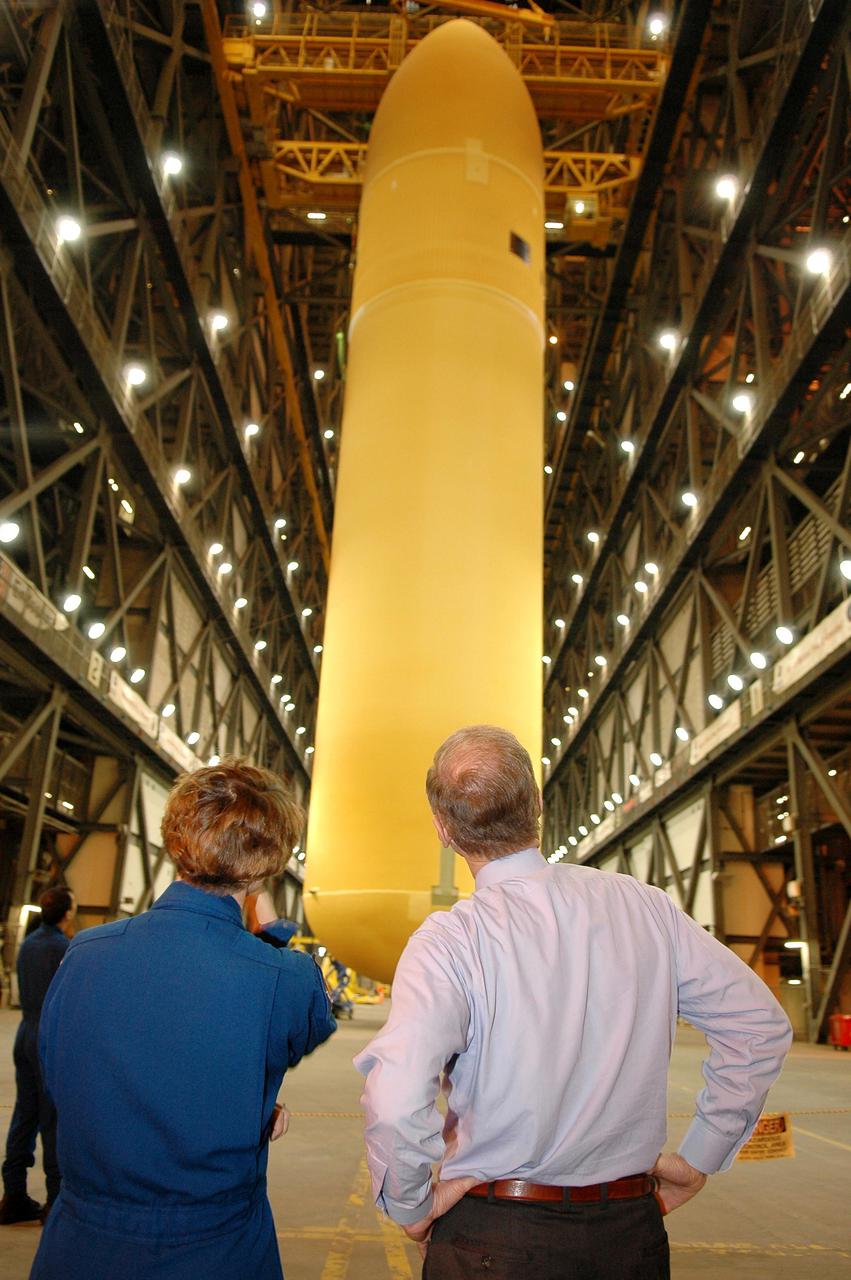
KENNEDY SPACE CENTER, FLA. - Mission STS-114 Commander Eileen Collins and Sen. Bill Nelson watch as the newly redesigned External Tank is lifted in the Vehicle Assembly Building to a “checkout cell” where the tank’s mechanical, electrical and thermal protection systems are inspected. The mission crew and Nelson are at Kennedy to observe tank activities. The tank will also undergo new processes resulting from its redesign, including inspection of the bipod heater and External Tank separation camera. The tank is designated to fly with Shuttle Discovery on Return to Flight mission STS-114. The launch window is May 12 to June 3, 2005.
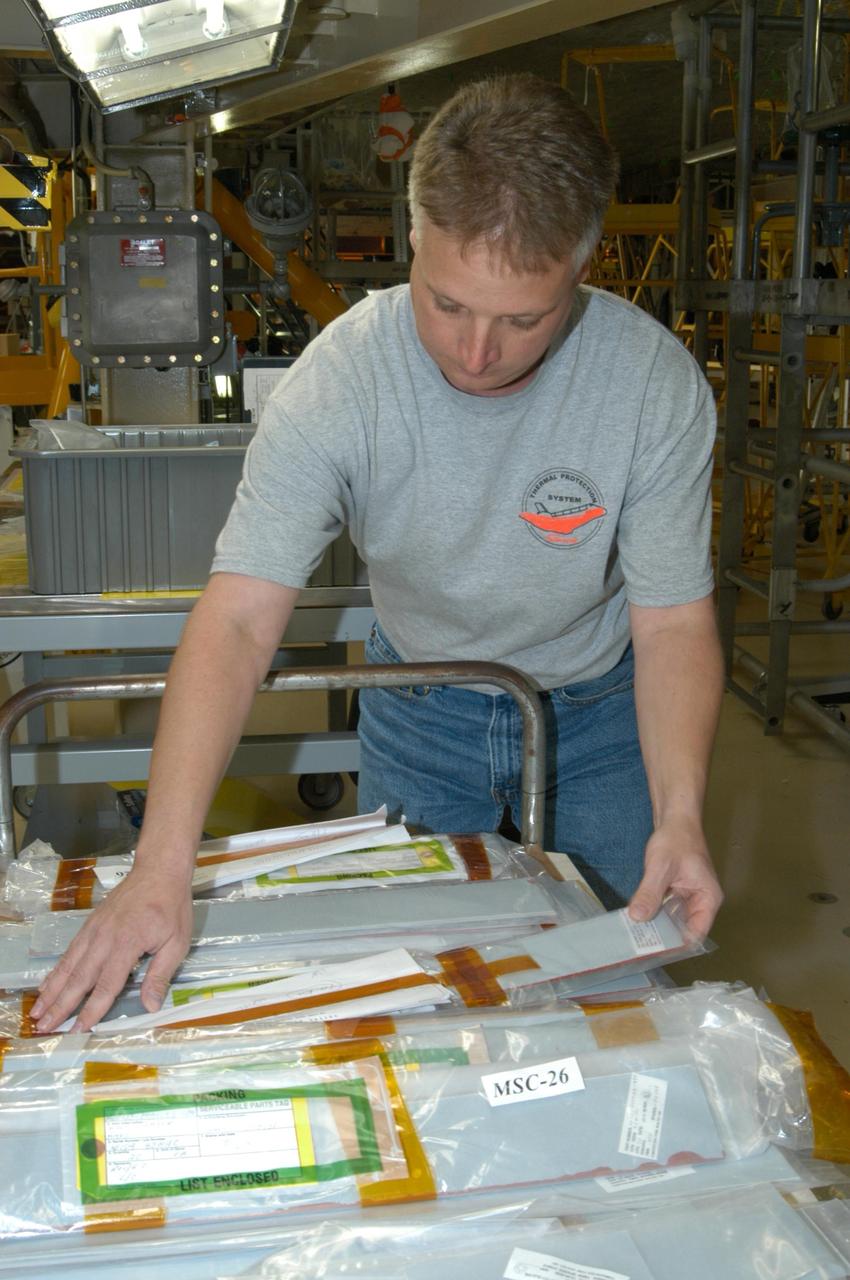
KENNEDY SPACE CENTER, FLA. -- United Space Alliance technician Larry Tanner pulls strips of gap filler to install on the orbiter Discovery, which is being processed in Orbiter Processing Facility Bay 3 at NASA’s Kennedy Space Center. This work is being performed due to two gap fillers that were protruding from the underside of Discovery on the first Return to Flight mission, STS-114. New installation procedures have been developed to ensure the gap fillers stay in place and do not pose any hazard during the shuttle's re-entry to the atmosphere. Discovery is the scheduled orbiter for the second space shuttle mission in the return-to-flight sequence.
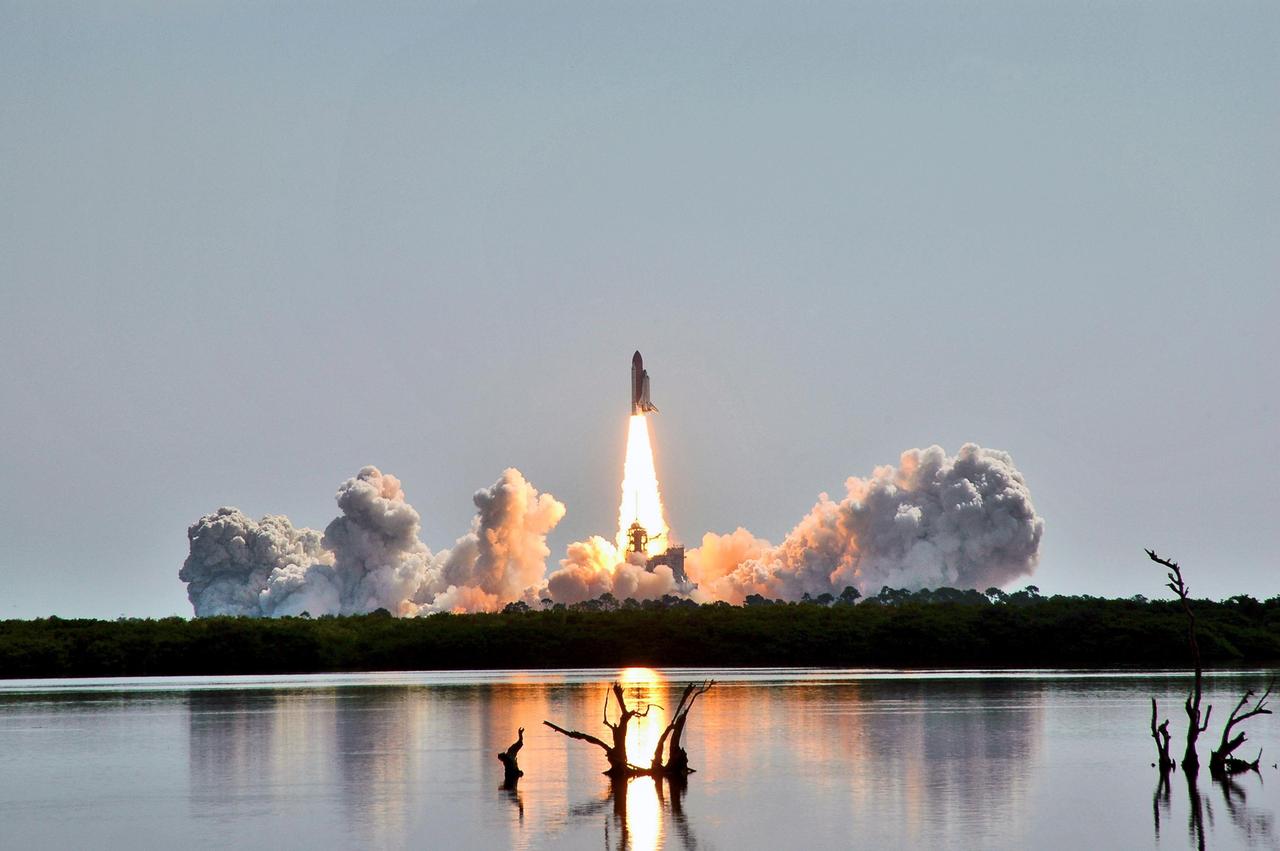
STS114-S-024 (26 July 2005) --- Space Shuttle Discovery and its seven-member crew launched at 10:39 a.m. (EDT) on July 26, 2005 to begin the two-day journey to the international space station on the historic STS-114 Return to Flight mission.
Daedalia Lavas
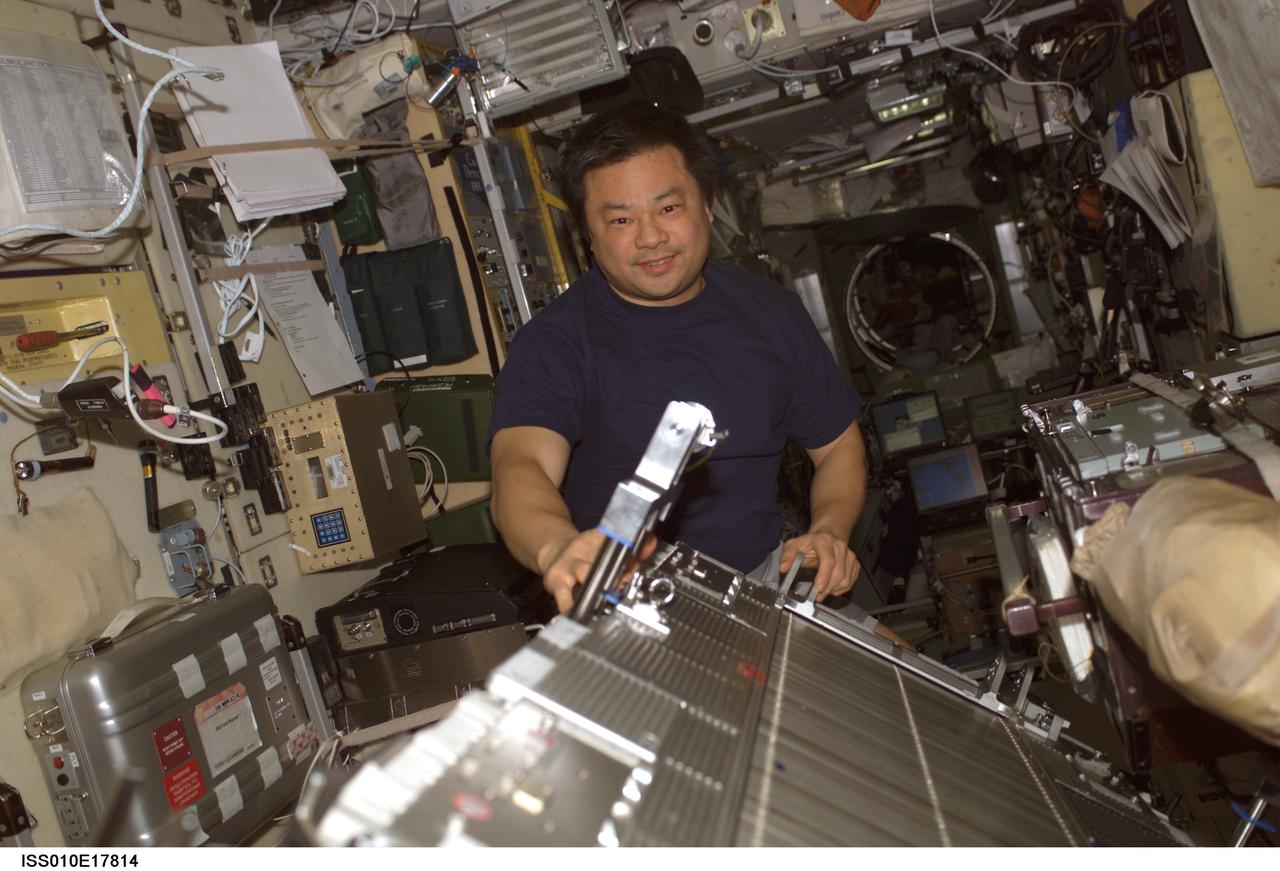
ISS010-E-17814 (15 February 2005) --- Astronaut Leroy Chiao, Expedition 10 commander and NASA ISS science officer, performs in-flight maintenance on the Treadmill Vibration Isolation System (TVIS) in the Zvezda Service Module of the International Space Station (ISS).
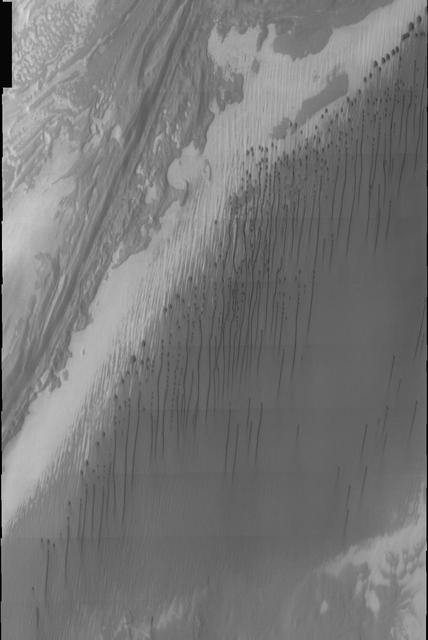
THEMIS Images as Art #42
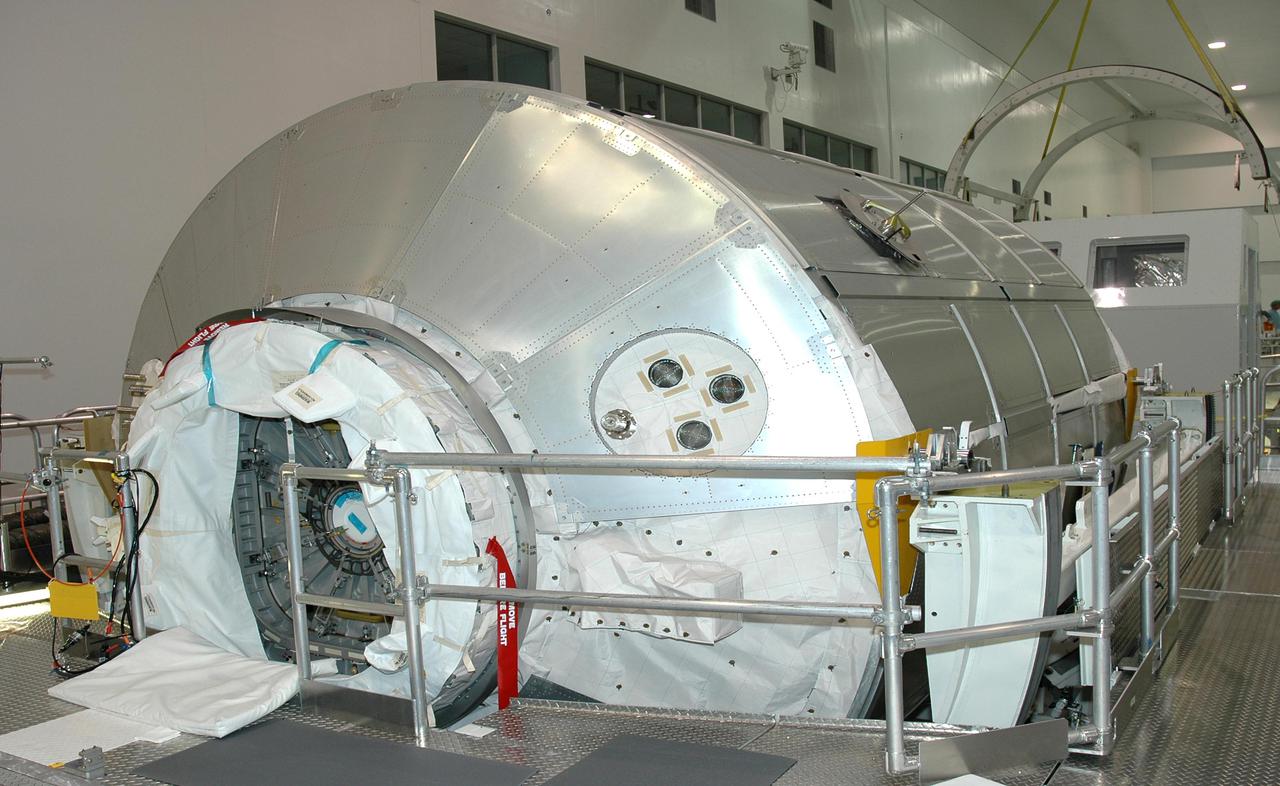
KENNEDY SPACE CENTER, FLA. -- In the Space Station Processing Facility, Italian-built Multi-Purpose Logistics Module Raffaello is closed and ready for transfer to a payload canister and trip to Launch Complex 39B for transfer to Space Shuttle Discovery. The module will travel to the International Space Station aboard Space Shuttle Discovery’s Return to Flight mission STS-114. Raffaello carries 12 racks of cargo, including food, clothing, spare parts and research equipment, to the Station. Shuttle Discovery is targeted for launch in a window extending May 15 through June 3.
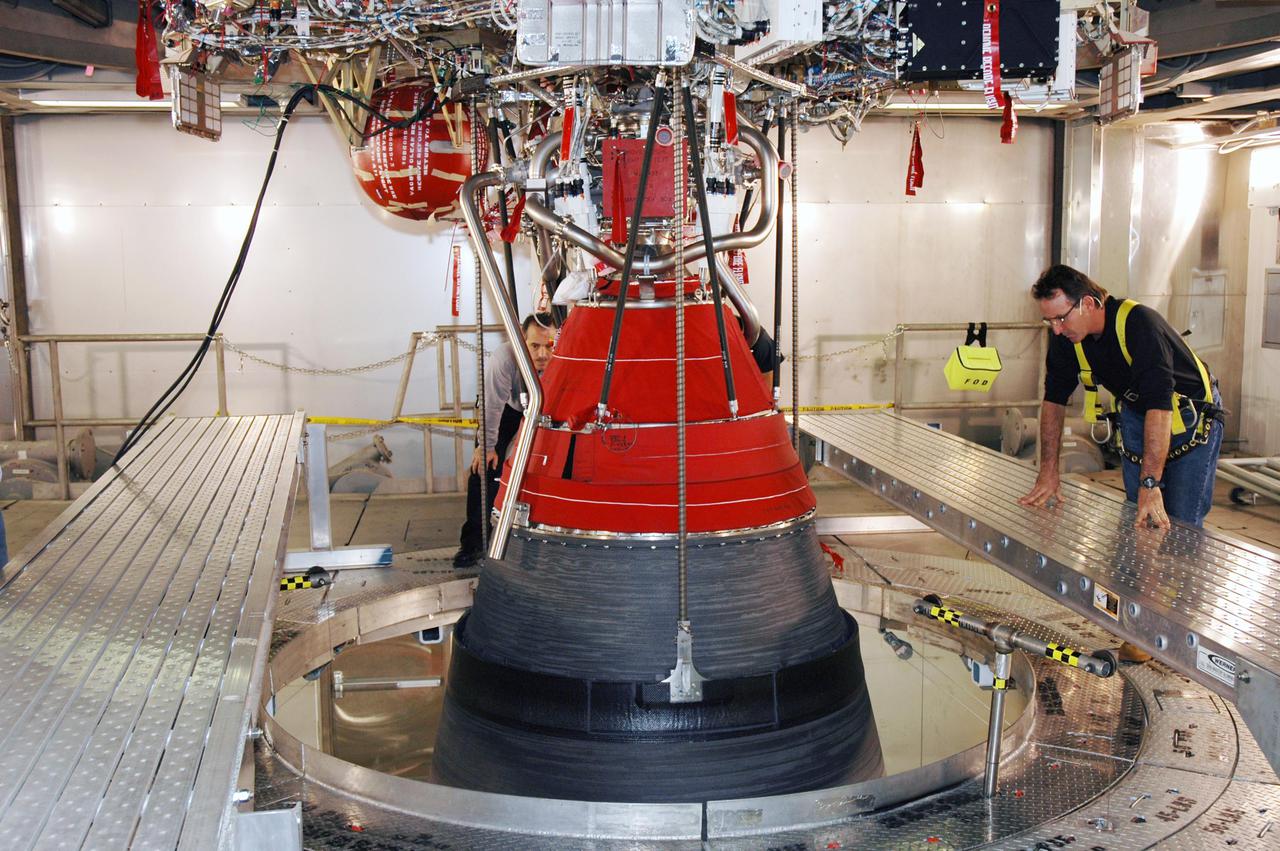
KENNEDY SPACE CENTER, FLA. - At the Delta Operations Center on Cape Canaveral Air Force Station, Fla., a technician monitors the Boeing Delta IV second stage nozzle extension during testing. The Delta IV is the launch vehicle for the GOES-N satellite. The Delta IV is the launch vehicle for GOES-N satellite. Geostationary Operational Environmental Satellites (GOES) are sponsored by the National Aeronautics and Space Administration (NASA) and the National Oceanic and Atmospheric Administration (NOAA). GOES-N is the first in the next series of GOES satellites, N-P. The multi-mission GOES series N-P will be a vital contributor to weather, solar and space operations and science. The GOES N-P series will aid activities ranging from severe storm warnings to resource management and advances in science. GOES-N is scheduled to launch May 4 from Cape Canaveral Air Force Station, Fla.
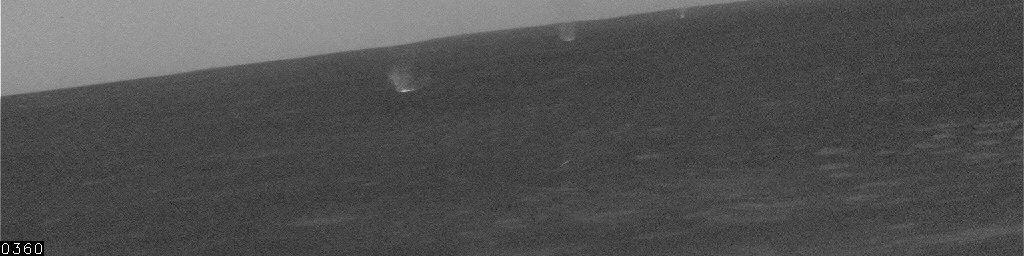
Dust Devils in Gusev Crater, Sol 463

ISS010-E-18818 (27 February 2005) --- Backdropped by a blanket of clouds, an unpiloted Progress 16 supply vehicle departs from the International Space Station (ISS) at 10:06 a.m. (CST) February 27, 2005, carrying its load of trash and unneeded equipment to be deorbited and burned up in Earth’s atmosphere. The undocking clears the way for the arrival of a new Progress 17, planned to launch February 28 and dock with the Station on March 2.

Dr. Michael Griffin testifies, Tuesday, April 12, 2005, during his confirmation hearing before the U.S. Senate Commerce Committee at the Russell Senate Office Building in Washington. If confirmed, Griffin, who currently heads the space department at the Johns Hopkins University Applied Physics Laboratory will become NASA's 11th administrator. Photo Credit (NASA/Renee Bouchard)

Sideways Shadow

ISS011-E-11806 (14 August 2005) --- Mount McKinley, Alaska is featured in this image photographed by an Expedition 11 crewmember on the international space station. This view – of the highest point in North America (20,230 feet) looks as if it were taken from an aircraft. The station crewmember took advantage of cloud free skies and the powerful 800 mm lens to photograph this peak, fully 800 miles to the north of the spacecraft, which was located over the Gulf of Alaska. The powerful lenses are difficult to use, requiring motion compensation by the astronaut, so that these kinds of detailed images of horizon detail are seldom taken. The rising sun casts long shadows across the Kahiltna Glacier that angles down from Mt. McKinley (lower left). Other glaciers with moraine lines appear at far left and far right. Despite the blueness inherent in images taken at great distance, this image also shows unusually dense atmospheric haze at lower altitudes: all the valleys in the foreground appear murky due to forest fire smoke.
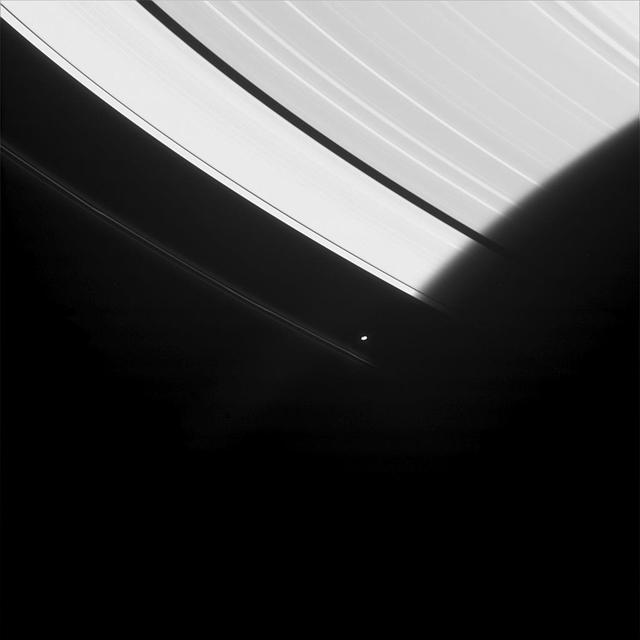
Solar Eclipses…Daily
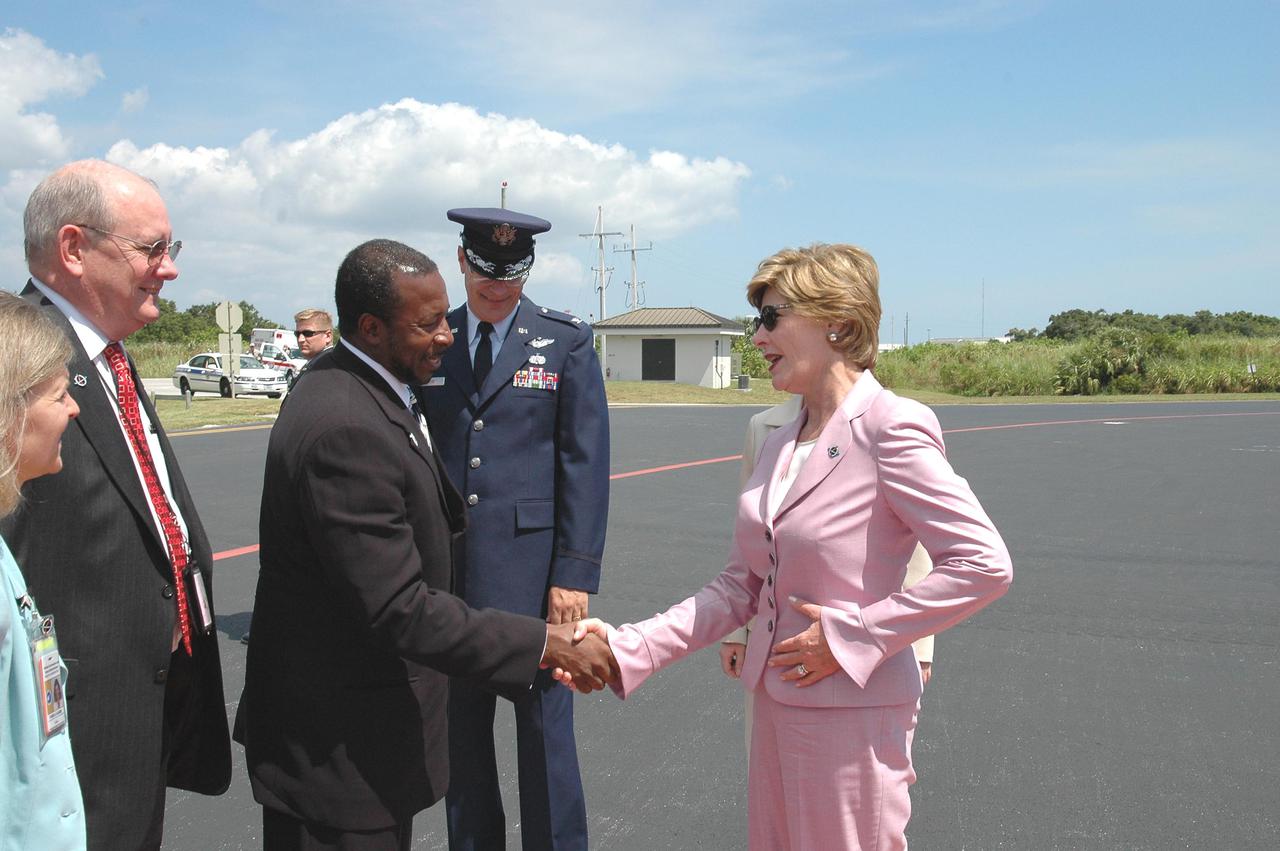
KENNEDY SPACE CENTER, FLA. - At the Skid Strip on Cape Canaveral Air Force Station, First Lady Laura Bush says farewell to KSC Deputy Director Woodrow Whitlow Jr. At left is Associate Director Jim Hattaway. Mrs. Bush witnessed the historic launch of Space Shuttle Discovery on Return to Flight mission STS-114. She is only the third First Lady to witness a Space Shuttle launch at KSC. On this mission to the International Space Station the crew will perform inspections on-orbit for the first time of all of the Reinforced Carbon-Carbon (RCC) panels on the leading edge of the wings and the Thermal Protection System tiles using the new Canadian-built Orbiter Boom Sensor System and the data from 176 impact and temperature sensors. Mission Specialists will also practice repair techniques on RCC and tile samples during a spacewalk in the payload bay. During two additional spacewalks, the crew will install the External Stowage Platform-2, equipped with spare part assemblies, and a replacement Control Moment Gyroscope contained in the Lightweight Multi-Purpose Experiment Support Structure. The 12-day mission is expected to end with touchdown at the Shuttle Landing Facility on Aug. 7.
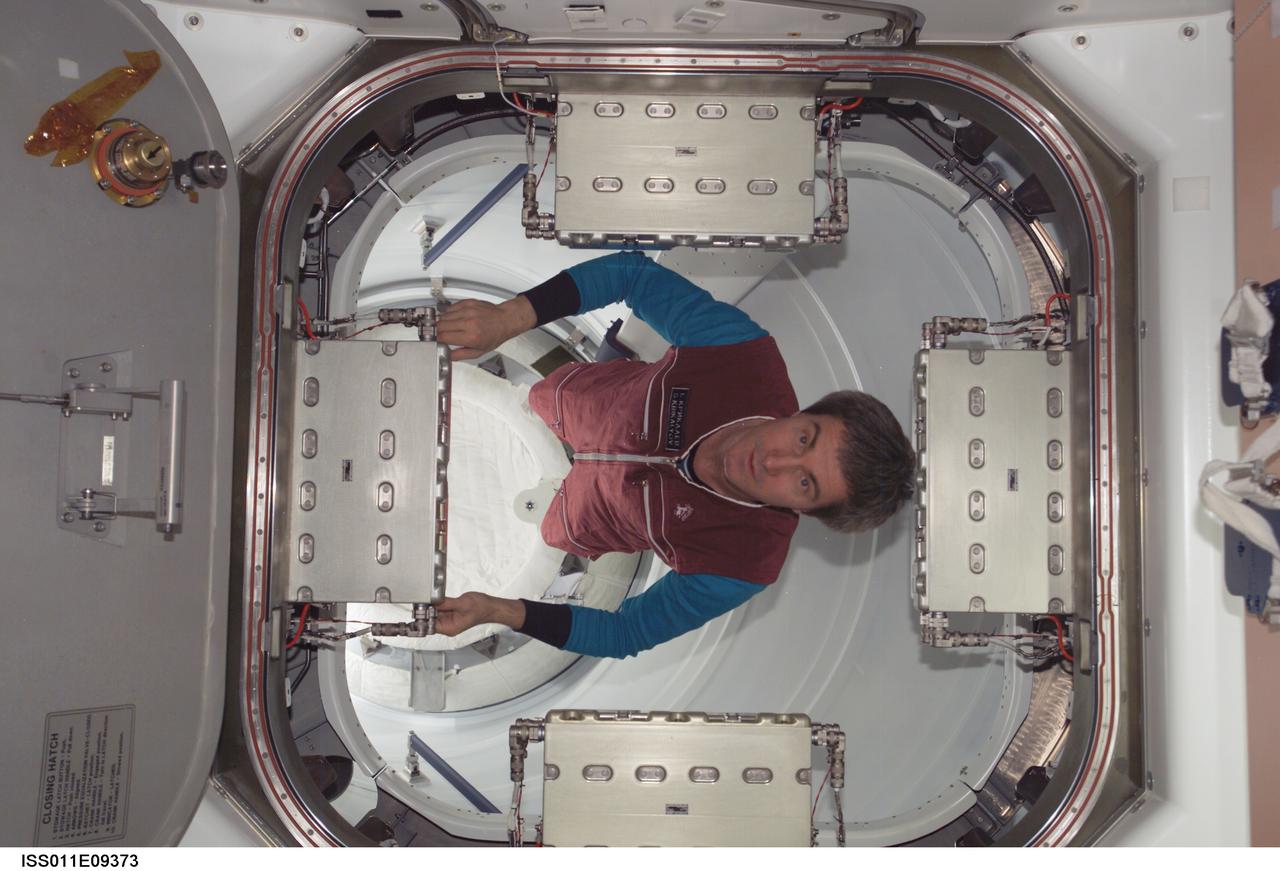
ISS011-E-09373 (21 June 2005) --- Cosmonaut Sergei K. Krikalev, Expedition 11 commander representing Russia's Federal Space Agency, prepares to uninstall two of the four Control Panel Assemblies (CPA) from the Unity node’s Common Berthing Assembly (CBA) on the International Space Station (ISS).
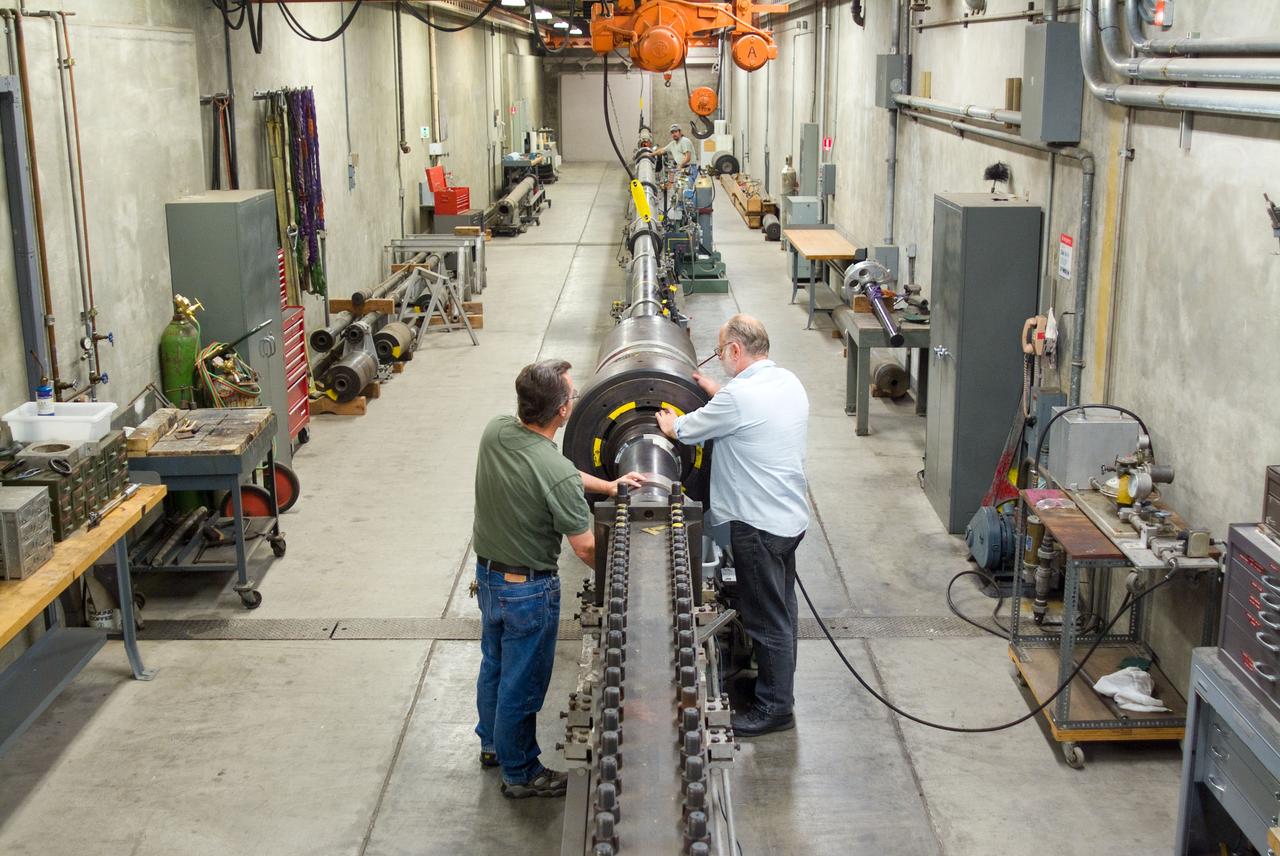
Overview of the light gas gun in the Ames Hypersonic Free Flgiht Aerodynamic Facility (HFFAF) with Don Bowling (l), Don Holt (r) and Rick Smythe (bkgrd).
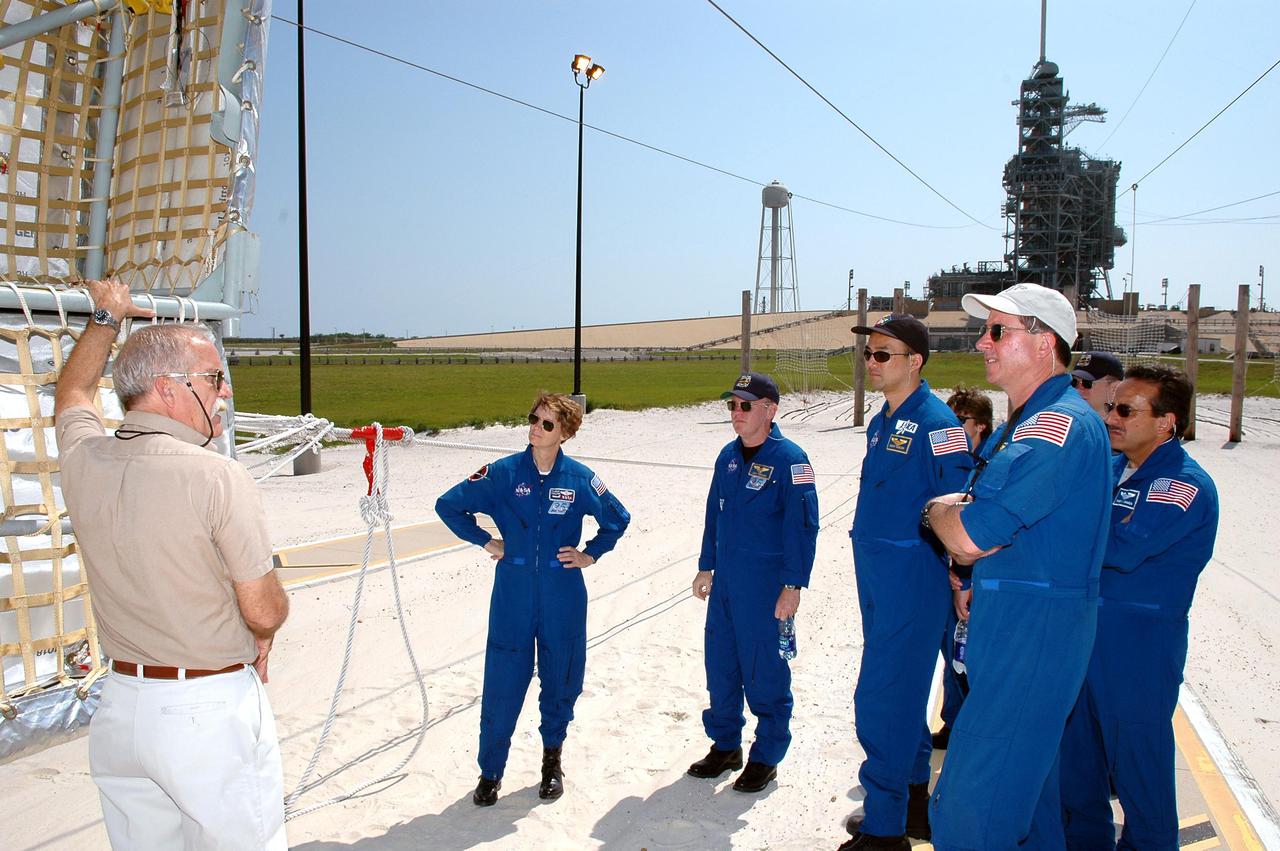
KENNEDY SPACE CENTER, FLA. - The STS-114 crew learn about exiting the slidewire basket at this landing area should they need to leave the Space Shuttle in an emergency situation while on the pad. Crew members seen here are (from left) Commander Eileen Collins and Mission Specialists Andrew Thomas, Soichi Noguchi, Wendy Lawrence, Stephen Robinson and Charles Camarda. Not pictured is Pilot James Kelly. Noguchi is with the Japan Aerospace Exploration Agency. The training is part of Terminal Countdown Demonstration Test activities. The TCDT is held at KSC prior to each Space Shuttle flight. It provides the crew of each mission an opportunity to participate in simulated countdown activities. The test ends with a mock launch countdown culminating in a simulated main engine cutoff. The crew also spends time undergoing emergency egress training exercises at the launch pad. STS-114 is designated the first Return to Flight mission, with a launch window extending from July 13 to July 31.
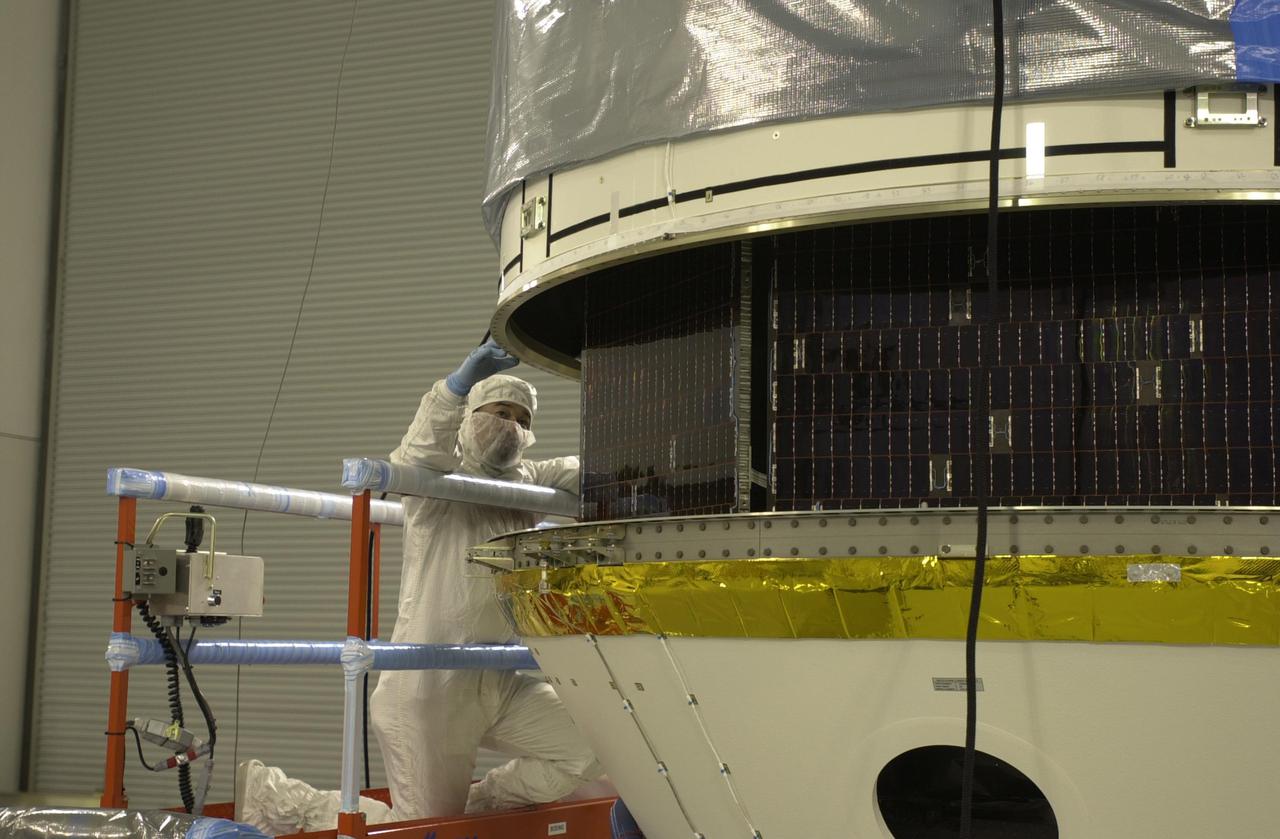
VANDENBERG AIR FORCE BASE, CALIF. - Inside the Astrotech Payload Processing Facility on Vandenberg Air Force Base in California, the upper Delta Payload Attach Fitting (UDPAF) is lowered toward the lower Delta Payload Attach Fitting (LDPAF). The LDPAF holds the CloudSat satellite and the UDPAF will hold the CALIPSO satellite. The two sections will be mated. CALIPSO stands for Cloud-Aerosol Lidar and Infrared Pathfinder Satellite Observation. CALIPSO and CloudSat are highly complementary satellites that will provide never-before-seen 3-D perspectives of how clouds and aerosols form, evolve, and affect weather and climate. CALIPSO and CloudSat will fly in formation with three other satellites in the A-train constellation to enhance understanding of our climate system. Launch of CALIPSO_CloudSat aboard a Boeing Delta II rocket is scheduled for 3:01 a.m. PDT Sept. 29.
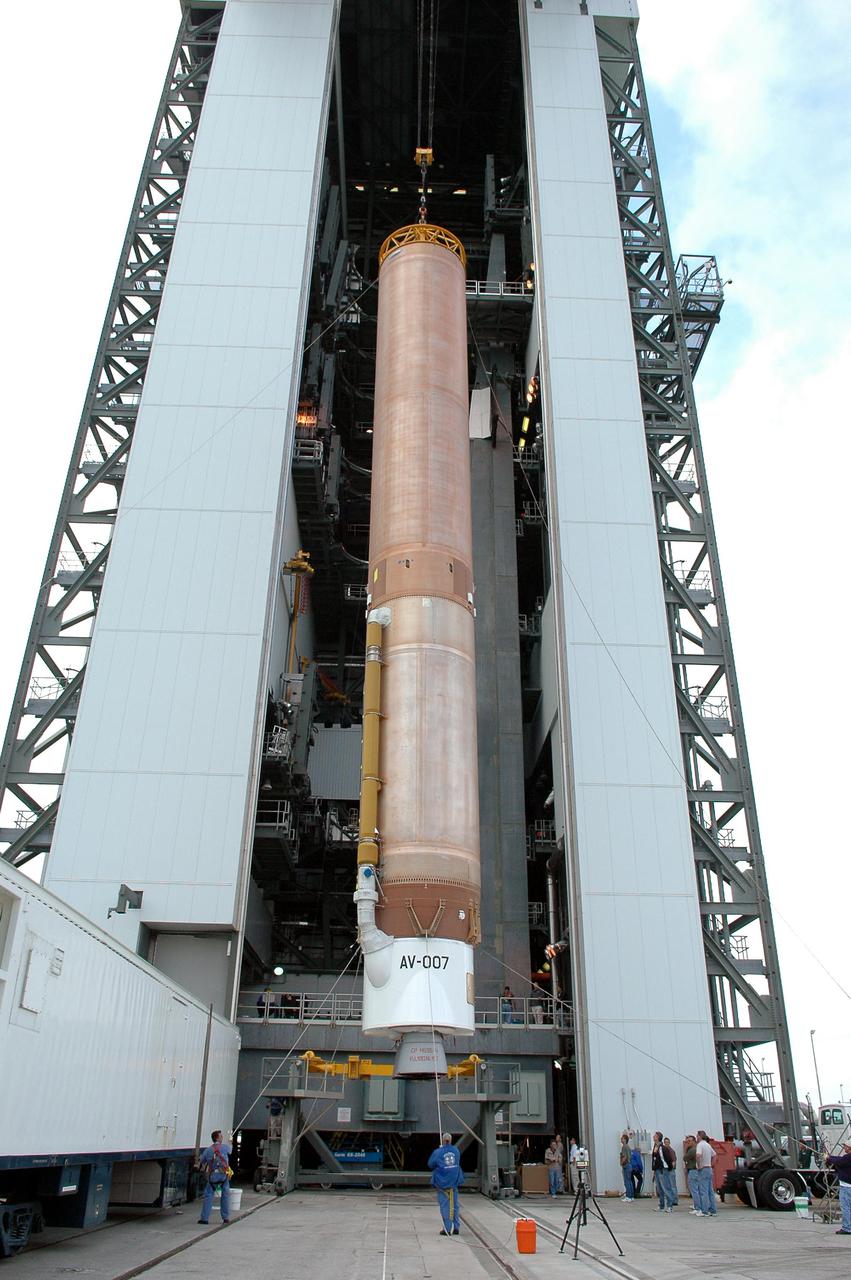
KENNEDY SPACE CENTER, FLA. - At Launch Complex 41 at Cape Canaveral Air Force Station in Florida, the first stage of the Atlas V rocket has been raised to vertical and will be lifted into the launch service tower and mated with the second stage, the Centaur. Designated AV-007, the Atlas V is the launch vehicle for the Mars Reconnaissance Orbiter (MRO). The MRO is designed for a series of global mapping, regional survey and targeted observations from a near-polar, low-altitude Mars orbit. These observations will be unprecedented in terms of the spatial resolution and coverage achieved by the orbiter’s instruments as they observe the atmosphere and surface of Mars while probing its shallow subsurface as part of a “follow the water” strategy. The orbiter is in KSC’s Payload Hazardous Servicing Facility for final assembly and testing. The launch window begins Aug. 10.

This spectrum shows the light from a dusty, distant galaxy located 11 billion light-years away. The galaxy is invisible to optical telescopes, but NASA Spitzer Space Telescope captured the light from it and dozens of other similar galaxies.
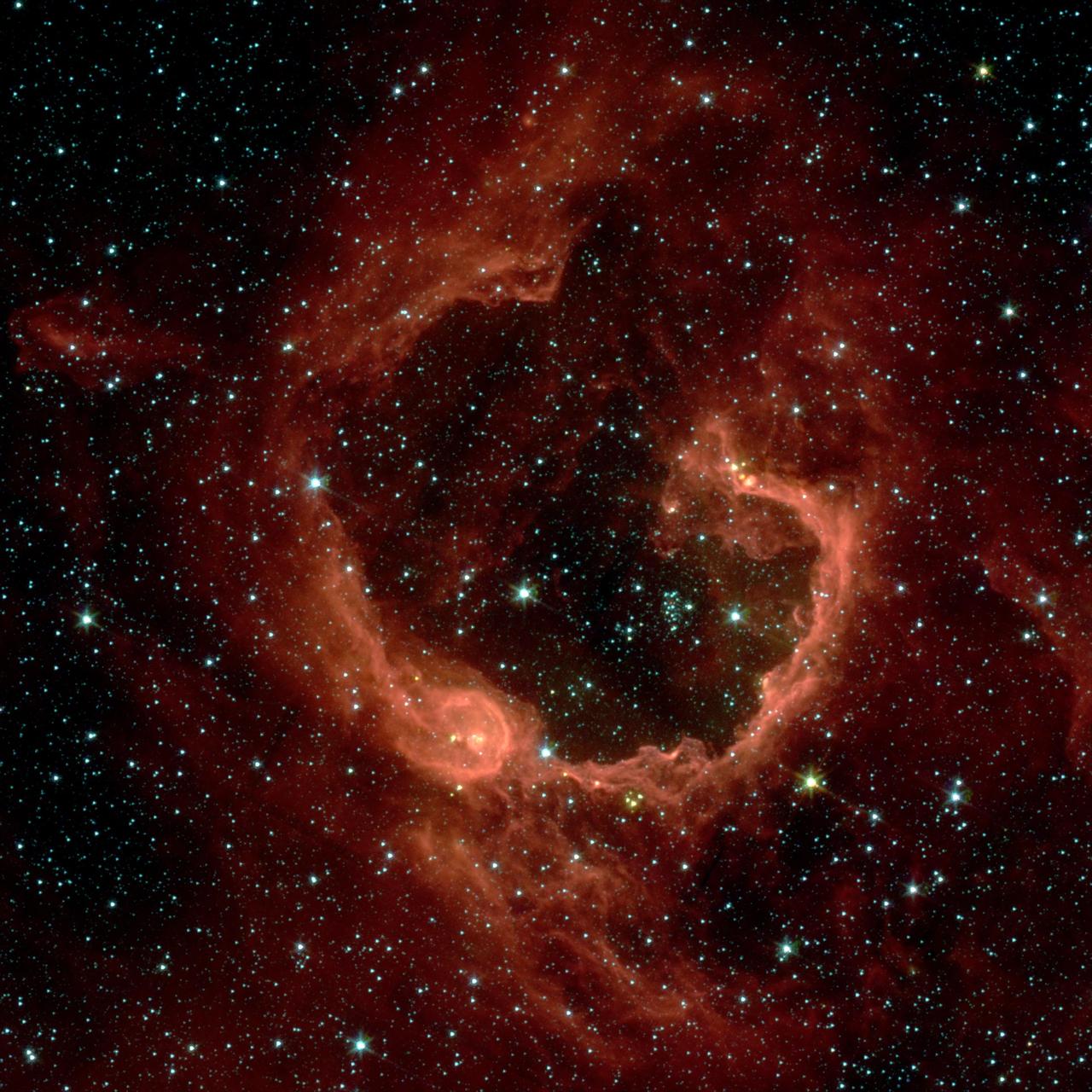
NASA Spitzer Space Telescope sees RCW 79 in the southern Milky Way, 17,200 light-years from Earth in the constellation Centaurus.
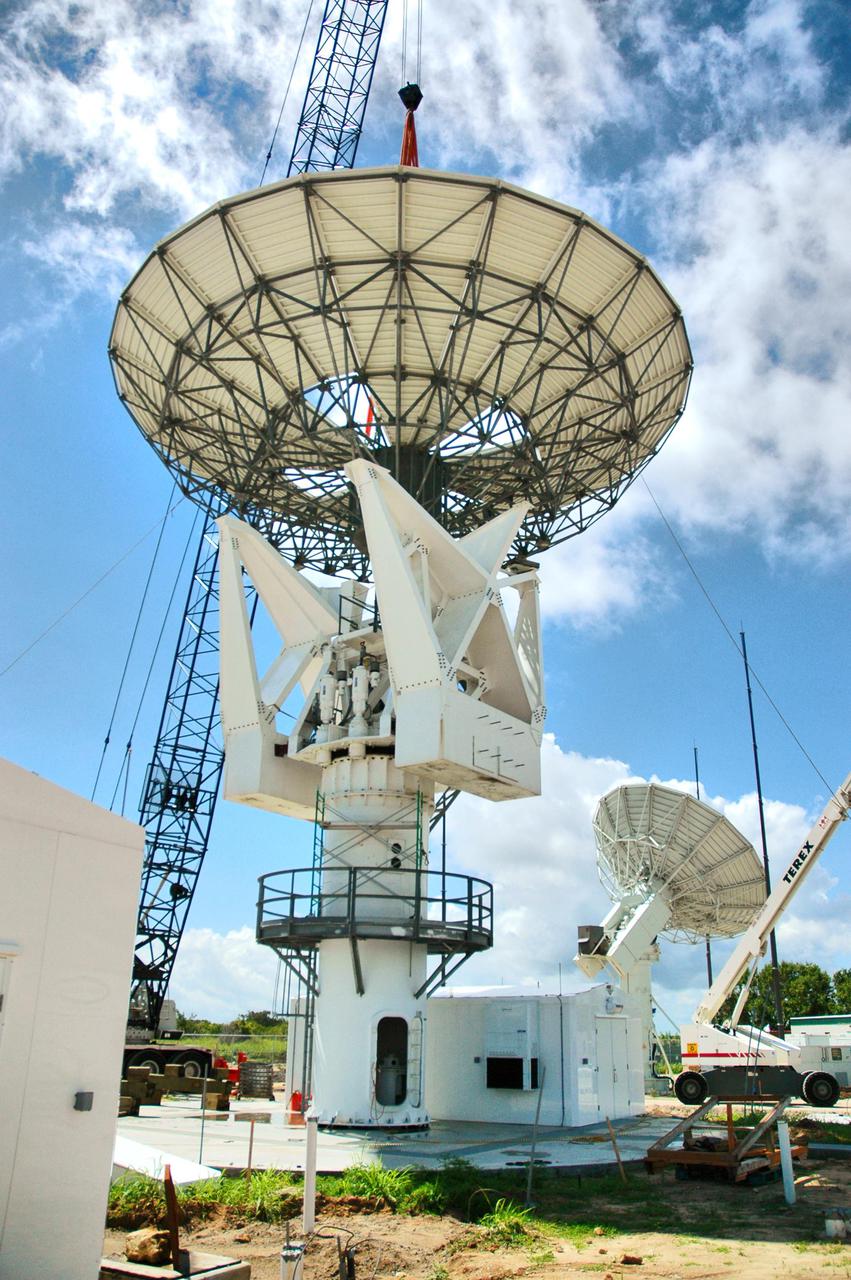
KENNEDY SPACE CENTER, FLA. - At a radar site on North Merritt Island, Fla., the 50-foot C-band radar antenna dish is lowered toward the top of the support structure. It will be placed on the counterweights installed there. The radar will be used for Shuttle missions to track the launches and observe possible debris coming from the Shuttle. It will be used for the first time on STS-114. The launch window for the first Return to Flight mission is July 13 to July 31.
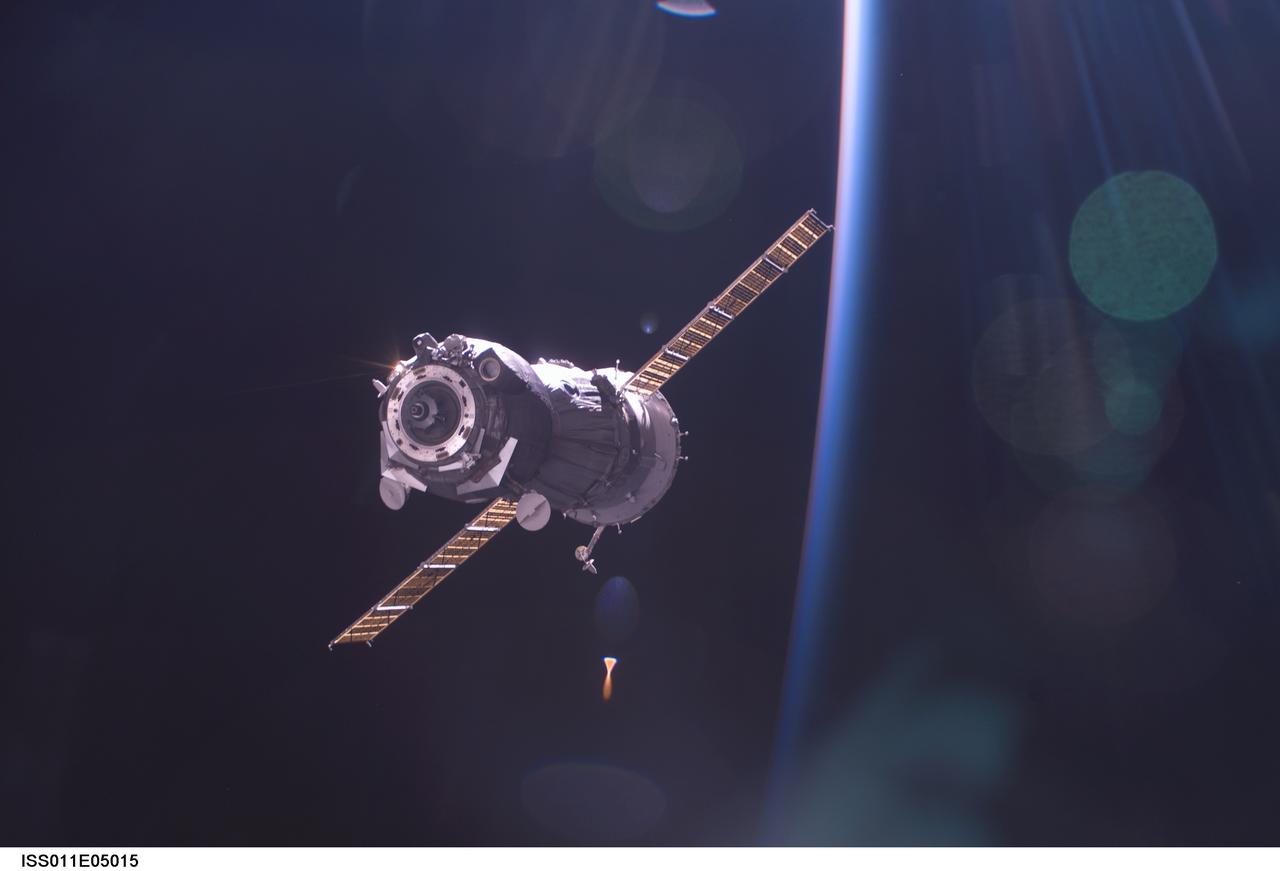
ISS011-E-05015 (24 April 2005) --- Backdropped by the blackness of space and airglow of Earth’s horizon, the Soyuz TMA-5 spacecraft departs from the International Space Station (ISS) carrying astronaut Leroy Chiao, Expedition 10 commander and NASA ISS science officer; cosmonaut Salizhan S. Sharipov, flight engineer representing Russia's Federal Space Agency; and European Space Agency (ESA) astronaut Roberto Vittori of Italy. Undocking occurred at 1:41 p.m. (CDT) on April 24.
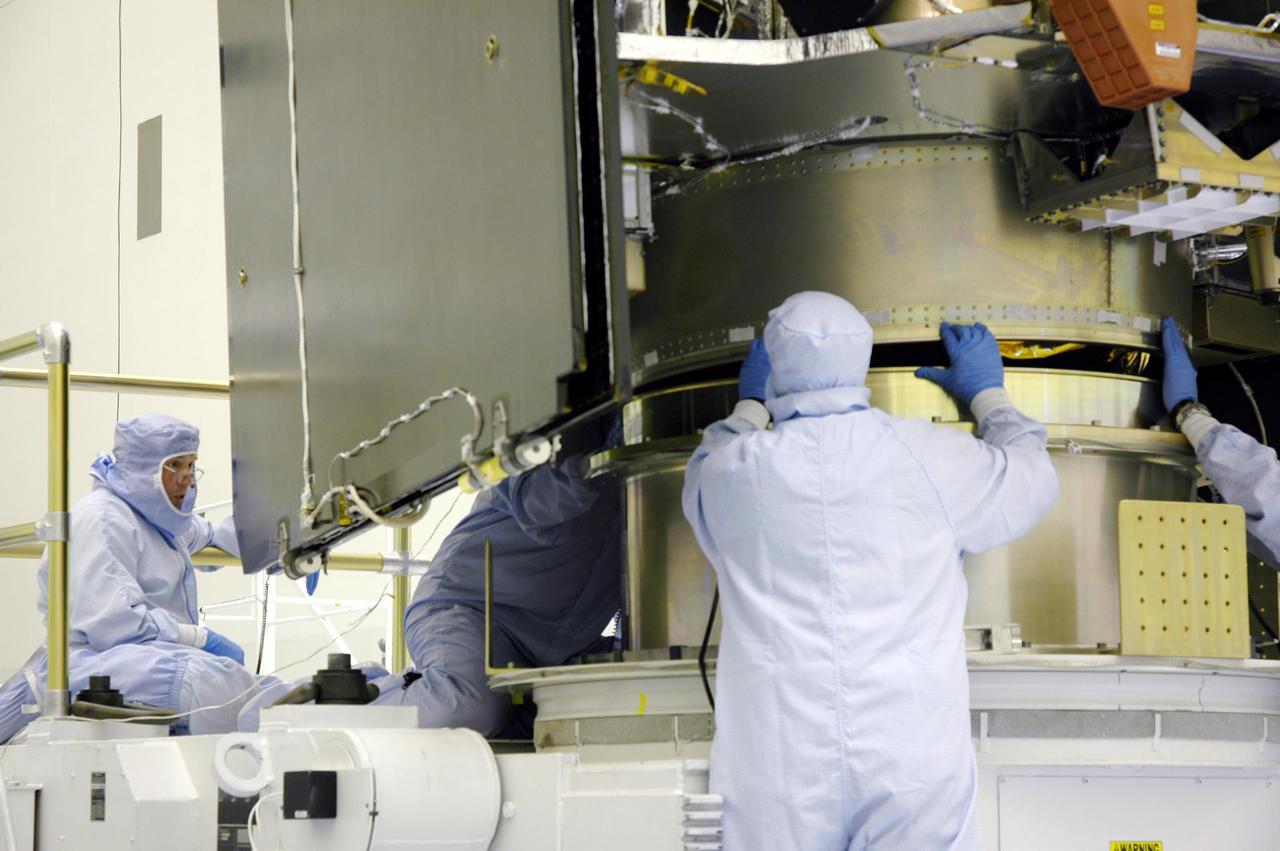
KENNEDY SPACE CENTER, FLA. - In a clean room inside the Payload Hazardous Servicing Facility (PHSF) at NASA's Kennedy Space Center, Lockheed Martin workers help guide the Mars Reconnaissance Orbiter onto the workstand for final assembly and testing. In the PHSF, the spacecraft will undergo multiple mechanical assembly operations and electrical tests to verify its readiness for launch. A test this month will verify the spacecraft's ability to communicate through NASA's Deep Space Network tracking stations. A June test will check the deployment of the spacecraft's high gain communications antenna. Another major deployment test will check out the spacecraft's large solar arrays. The MRO was built for NASA's Jet Propulsion Laboratory in California. It is the next major step in Mars exploration and scheduled for launch from Cape Canaveral Air Force Station in a window opening Aug. 10. The MRO is an important next step in fulfilling NASA's vision of space exploration and ultimately sending human explorers to Mars and beyond.

ISS011-E-09504 (24 June 2005) --- Ekuma River and Etosha Pan, Namibia are featured in this image photographed by an Expedition 11 crewmember on the International Space Station. Etosha Pan, northern Namibia, is a large (120 kilometers or 75 mile long) dry lakebed in the Kalahari Desert. The lake and surrounds are protected today as one of Namibia’s largest wildlife parks. Herds of elephants occupy the dense mopane woodland on the south side of the lake. Mopane trees are common throughout south-central Africa, and host the mopane worm (the larval form of the Mopane Emperor Moth)–an important source of protein for rural communities. According to scientists, about 16,000 years ago, when ice sheets were melting across Northern Hemisphere land masses, a wet climate phase in southern Africa filled Etosha Lake. Today, Etosha Pan is seldom seen with even a thin sheet of water covering the salt pan. Typically, little river water or sediment reaches the dry lake because water seeps into the riverbed along its 250 kilometers (155 miles) course, reducing discharge along the way.
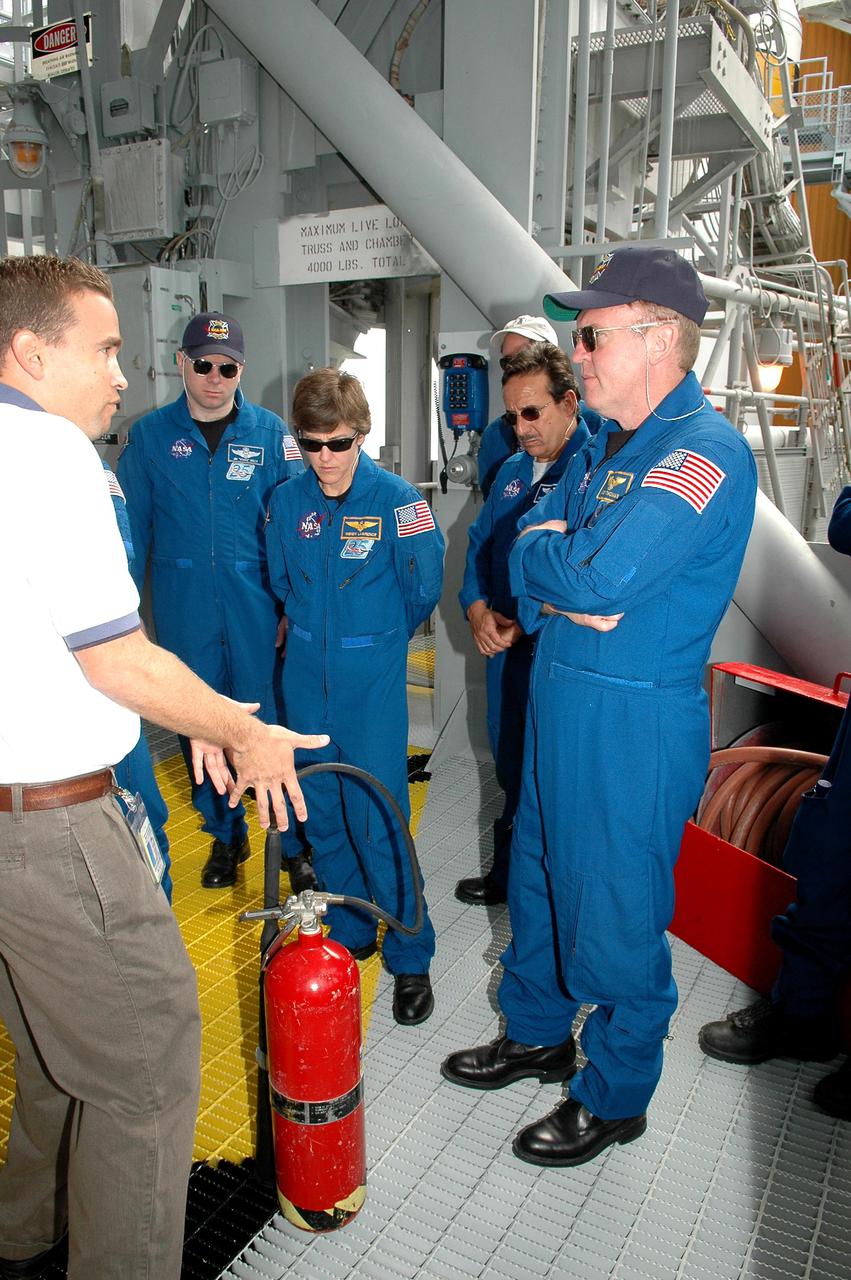
KENNEDY SPACE CENTER, FLA. - On the Fixed Service Structure at Launch Pad 39B, the STS-114 crew gets instructions about fire extinguisher use. The astronauts seen here are (from left) Pilot James Kelly, Commander Eileen Collins, and Mission Specialists Charles Camarda and Andrew Thomas. The training is part of Terminal Countdown Demonstration Test activities. The TCDT is held at KSC prior to each Space Shuttle flight. It provides the crew of each mission an opportunity to participate in simulated countdown activities. The test ends with a mock launch countdown culminating in a simulated main engine cutoff. The crew also spends time undergoing emergency egress training exercises at the launch pad. STS-114 is designated the first Return to Flight mission, with a launch window extending from July 13 to July 31.
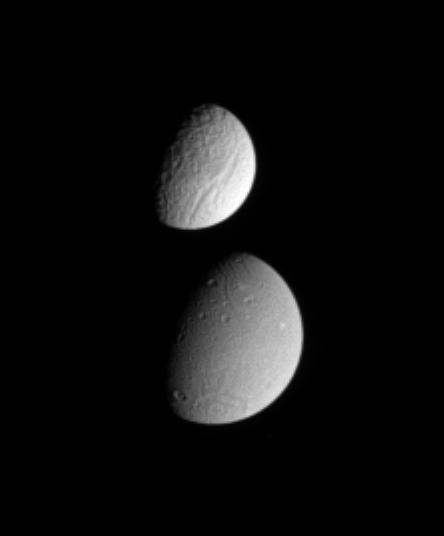
Tethys Meets Dione

S114-E-5746 (29 July 2005) --- A mass of storm clouds was photographed by a STS-114 crewmember onboard the Space Shuttle Discovery. Part of the Orbiter Boom Sensor system end effector is also visible in the frame.
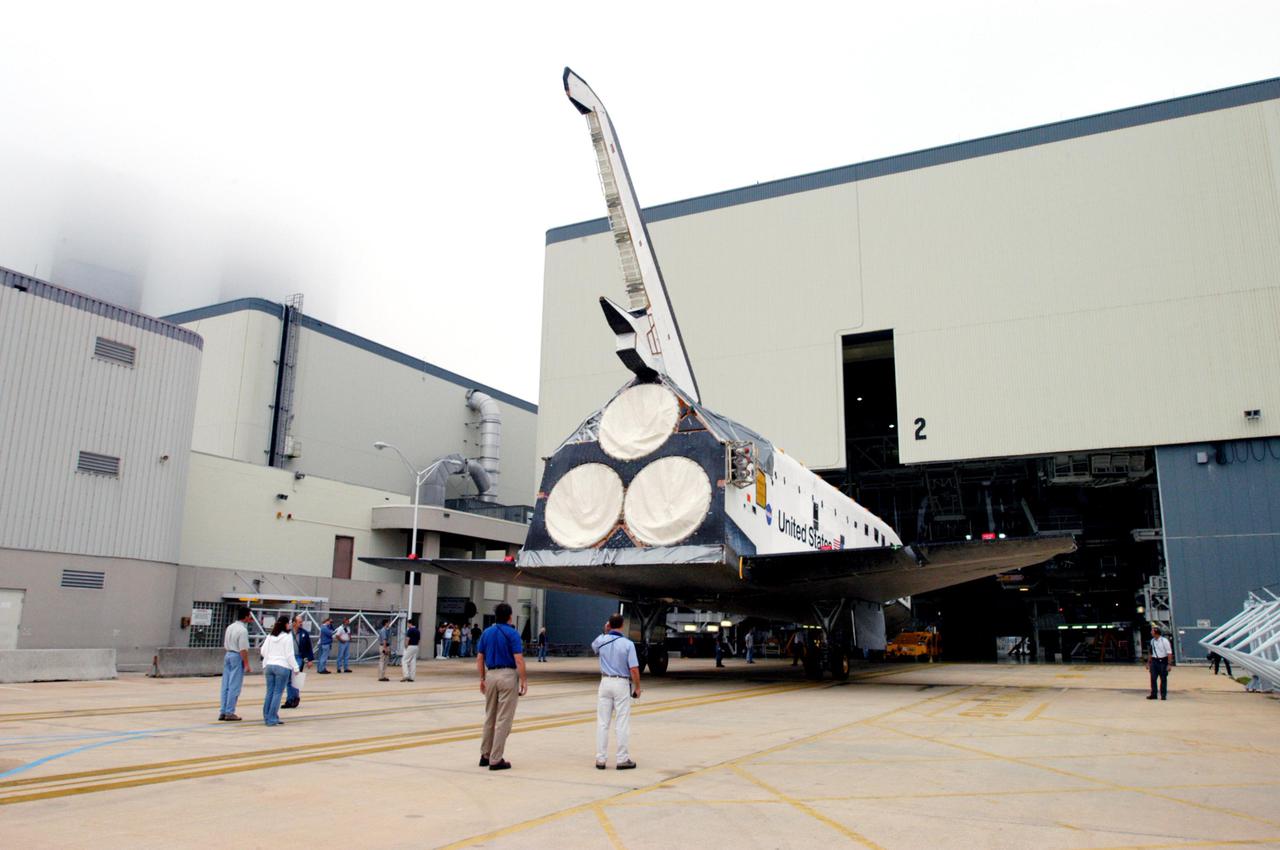
KENNEDY SPACE CENTER, FLA. - The orbiter Endeavour rolls out of the Orbiter Processing Facility. It is being moved to Florida Space Authority’s Reusable Launch Vehicle hangar for temporary storage. It left the Orbiter Processing Facility (OPF) to allow work to be performed in the OPF that can only be accomplished while the bay is empty. Work scheduled in the OPF includes modifications to the bay and platform validation in the bay. Endeavour will remain in the hangar for approximately 30 days, then return to the OPF. Endeavour was pulled out of service in December 2003 for Orbiter Major Modification (OMM). OMMs are scheduled at regular intervals to enhance safety and performance, infuse new technology, and, in this case, perform RTF modifications.

ISS011-E-12836 (11 September 2005, 19:31:17 GMT) --- This image of Hurricane Ophelia was captured by the Expedition 11 crew aboard the International Space Station on the afternoon September 11, 2005. The hurricane, located at 31.6 degrees north latitude and 75.8 degrees west longitude, was packing winds of 80 miles per hour when the photo was made. (Image credit: NASA)
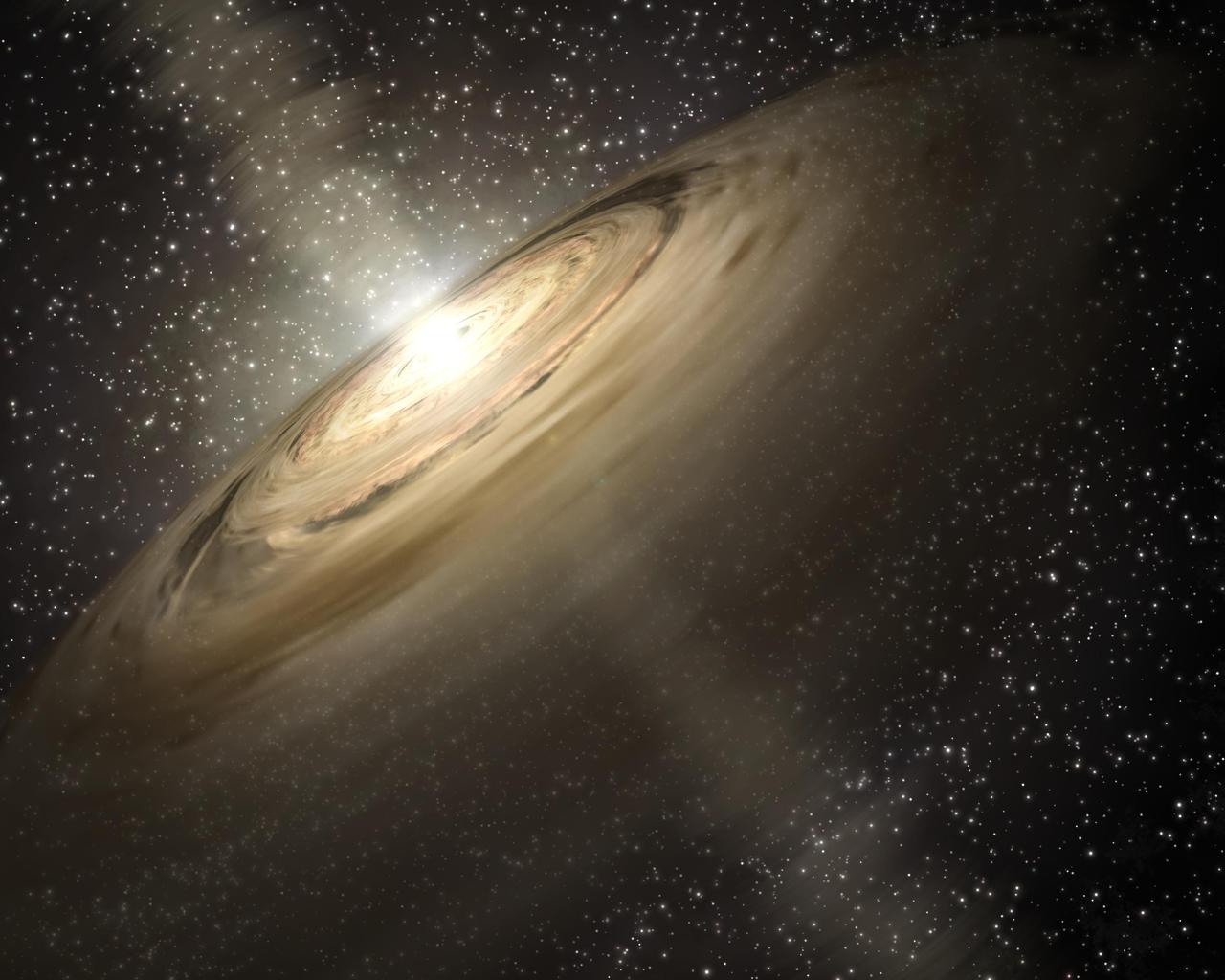
This artist concept illustrates a solar system that is a much younger version of our own. Dusty disks, like the one shown here circling the star, are thought to be the breeding grounds of planets, including rocky ones like Earth.