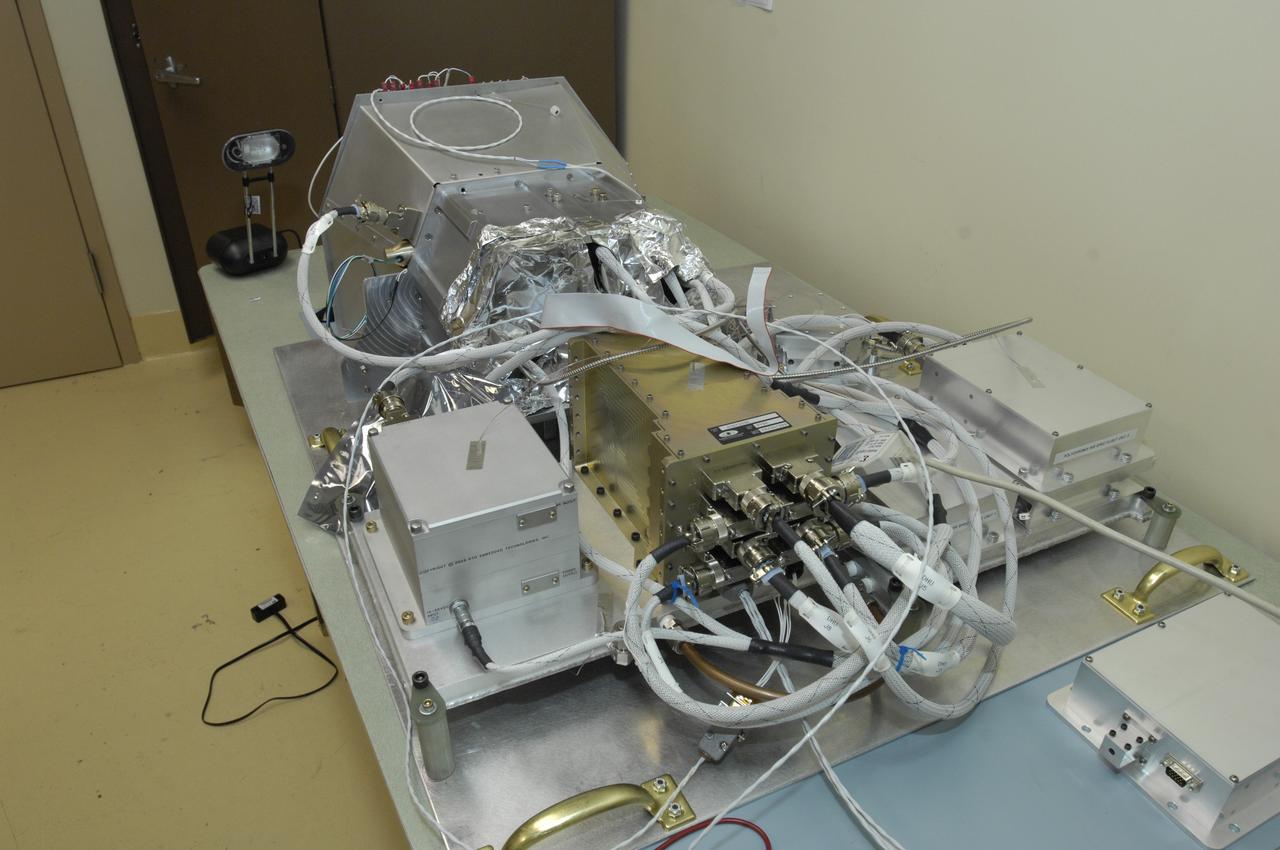
LCROSS in Clean Room at Ames Research Centeer - flight hardware in Thermal Cycle configuration with _______
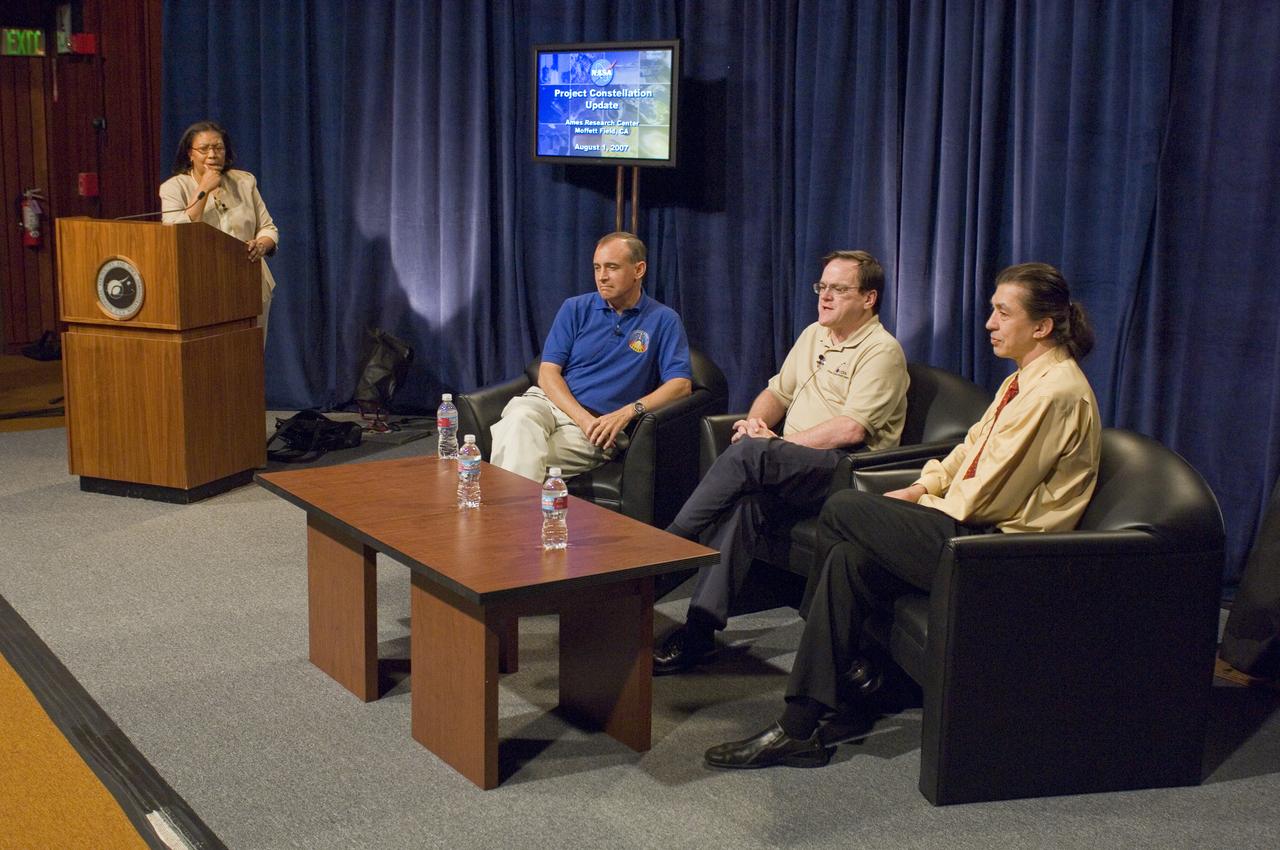
NASA Officials gather at Ames Research Center to discuss Spaceship development progress. Constellation is developing the Orion spacecraft and Ares rockets to support an American return to the moon by 2020.
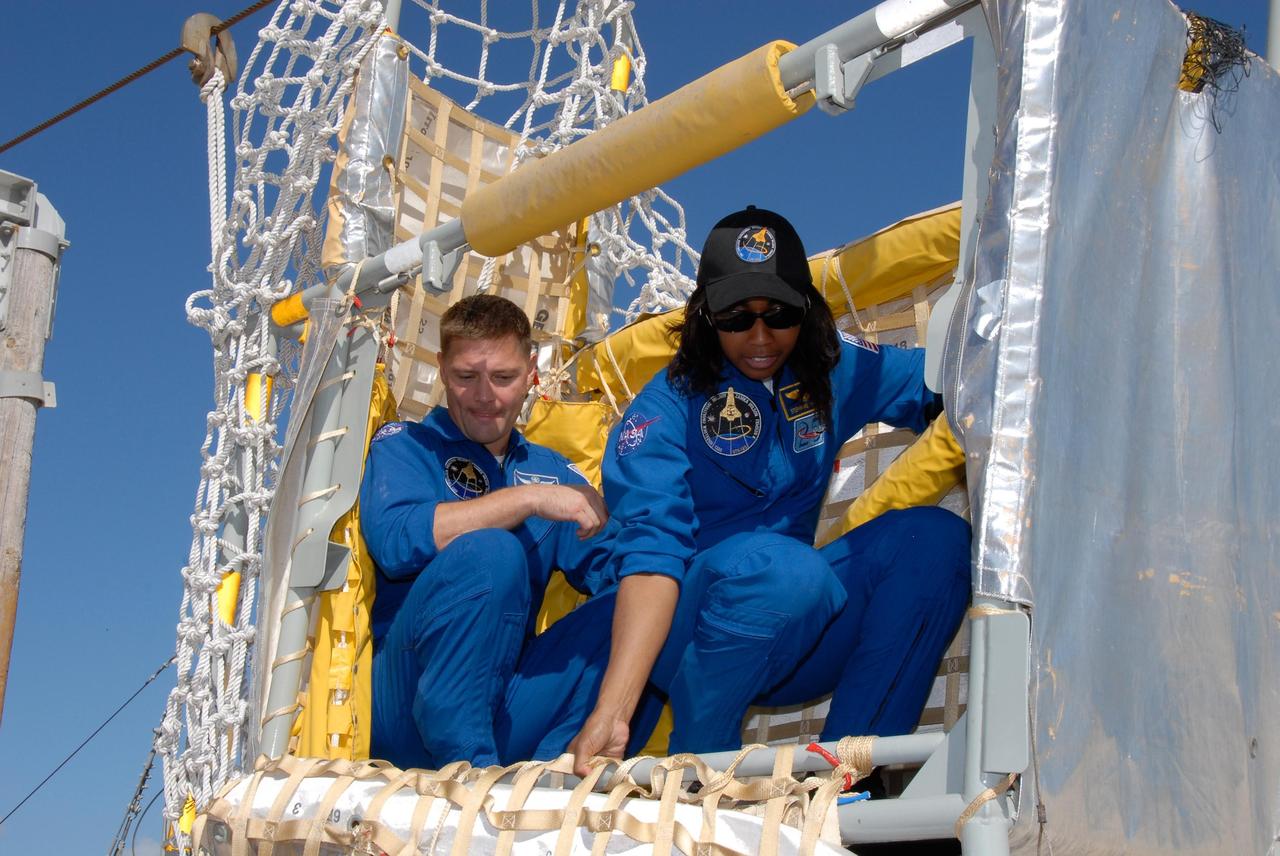
KENNEDY SPACE CENTER, FLA. -- During emergency egress training as part of the pre-launch terminal countdown demonstration test, or TCDT, STS-120 crew members learn how to get out of the slidewire basket at the landing site. In the basket are Mission Specialists Doug Wheelock and Stephanie Wilson. The TCDT provides astronauts and ground crews an opportunity to participate in various simulated countdown activities, including equipment familiarization and emergency training. The STS-120 mission will deliver the U.S. Node 2 module, named Harmony, aboard space shuttle Discovery to the International Space Station. Launch of Discovery on mission STS-120 is targeted for Oct. 23 at 11:38 a.m. EDT on a 14-day mission. Photo credit: NASA/Kim Shiflett

KENNEDY SPACE CENTER, FLA. -- Astronaut Clayton Anderson dons his helmet as he gets ready for launch of Space Shuttle Atlantis at 7:38 p.m. EDT from Launch Pad 39A. Anderson will join the Expedition 15 crew aboard the International Space Station, exchanging his seat on the return trip for Flight Engineer Suni Williams. The shuttle is delivering a new segment to the starboard side of the International Space Station's backbone, known as the truss. Three spacewalks are planned to install the S3/S4 truss segment, deploy a set of solar arrays and prepare them for operation. STS-117 is the 118th space shuttle flight, the 21st flight to the station, the 28th flight for Atlantis and the first of four flights planned for 2007. Photo credit: NASA/Kim Shiflett

Perseid Meteor flight on Google's Gulfstream Aircraft. P.I. Peter Jenniskens, SETI Group with Julian Nott, Santa Barbara
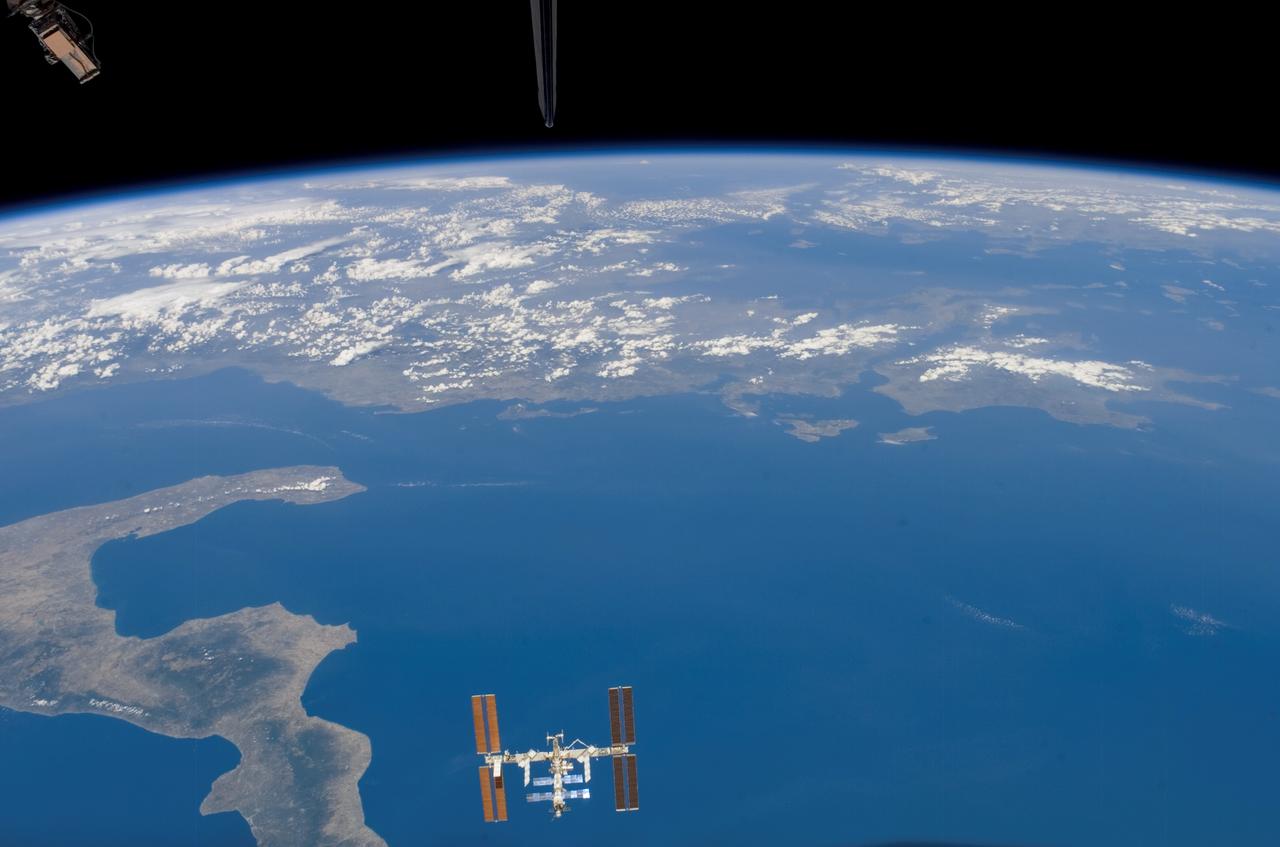
S118-E-09467 (19 Aug. 2007) --- The International Space Station is featured in this image photographed by a STS-118 crewmember on the Space Shuttle Endeavour following the undocking of the two spacecraft, which occurred at 6:56 a.m. (CDT) on Aug. 19, 2007. The image was acquired through one of the crew cabin windows, looking back over the length of the shuttle. Endeavour had undocked from the station, and the crew had begun late inspection of the orbiter's Thermal Protection System (wing leading edges, nosecap, and belly tiles) prior to landing. The late inspection is performed using sensors mounted on the Orbiter Boom Sensor System (OBSS) in order to assess whether micrometeorite or orbiting debris impacts had compromised the Thermal Protection System of the shuttle while it was docked with the station. This oblique image was acquired almost one hour after late inspection activities had begun. The sensor head of the OBSS is visible at top left. The entirety of the orbital outpost is visible at bottom center, set against the backdrop of the Ionian Sea approximately 330 kilometers below it. Other visible features of the southeastern Mediterranean region include the toe and heel features of Italy's "boot" at lower left, and the western coastlines of Albania and Greece extend across the center. Further towards the horizon, the Aegean and Black Seas are also visible.
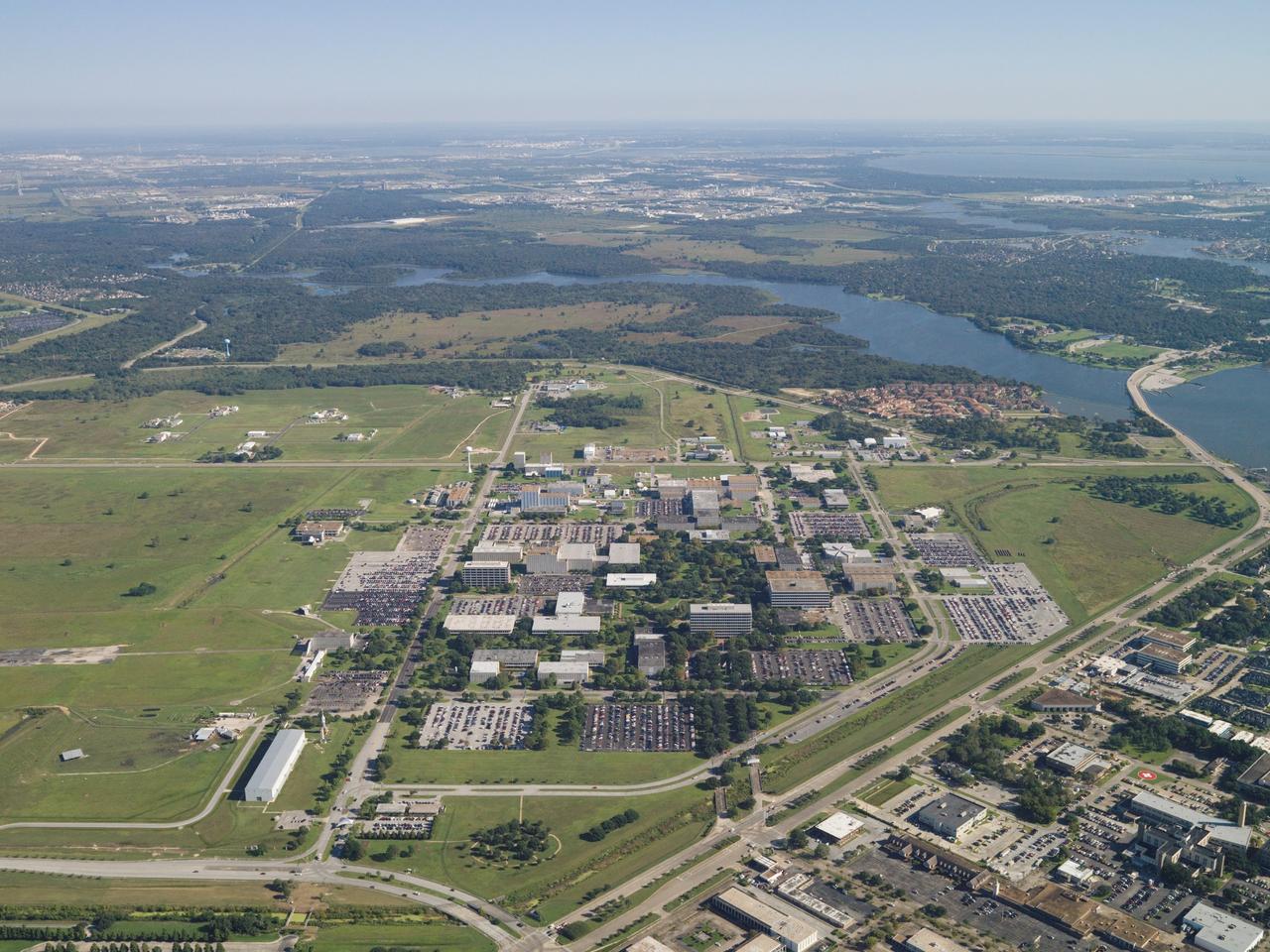
Aerial Photography of JSC. Overall view of JSC.
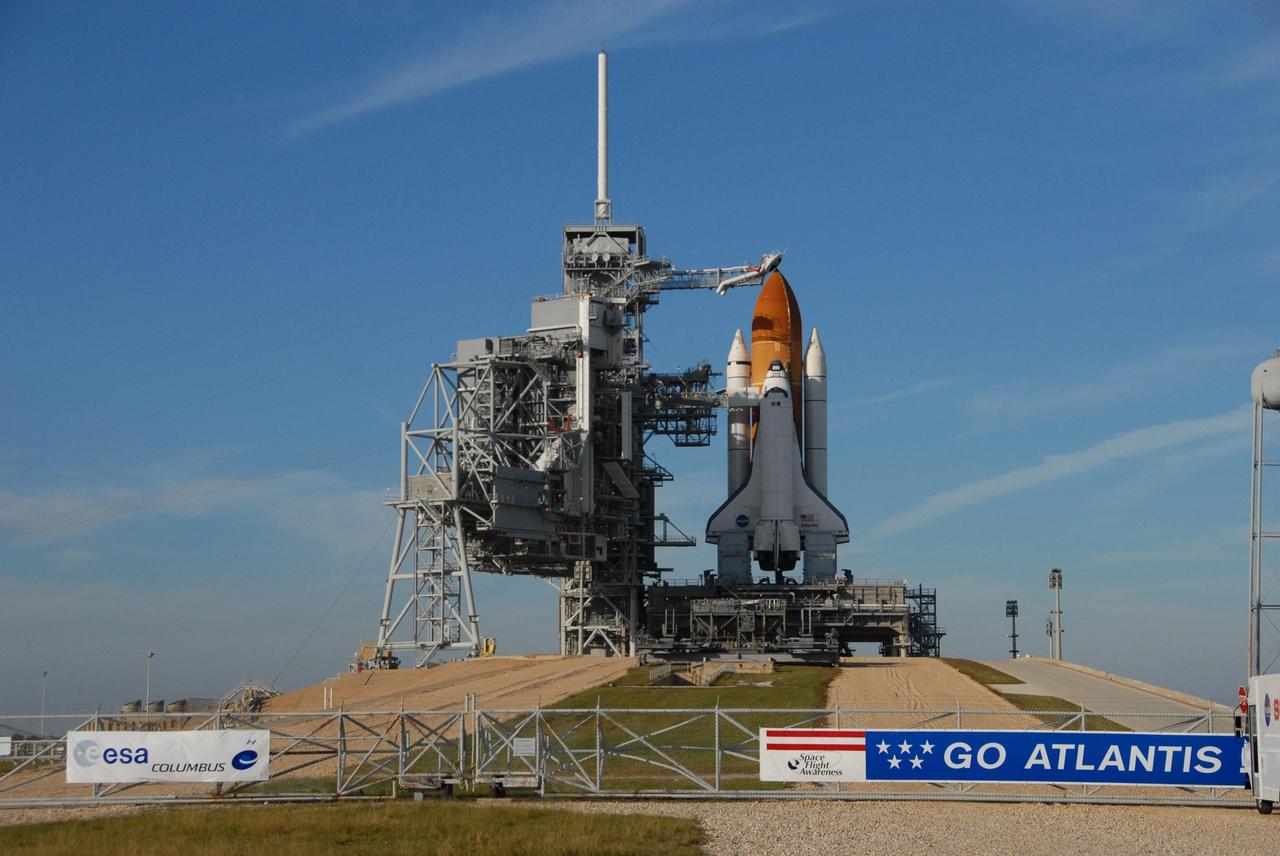
KENNEDY SPACE CENTER, FLA. -- Shadows spill across space shuttle Atlantis, still poised on the pad after its launch on mission STS-122 was postponed Thursday. It sits atop the mobile launcher platform. Shuttle program managers decided at 9:56 a.m. to postpone the launch because of an issue with a fuel cut-off sensor system inside the external fuel tank. This is one of several systems that protect the shuttle's main engines by triggering their shut down if fuel runs unexpectedly low. During countdown activities this morning, two sensors failed a routine prelaunch check. There are four engine cut-off, or ECO, sensors inside the liquid hydrogen section of the tank, and Launch Commit Criteria require three of the four sensor systems to be functioning properly. The tank's liquid oxygen and liquid hydrogen was drained from the tank, and preparations will begin for a possible launch attempt Friday. NASA's launch rules have a preplanned procedure that states in the case of ECO sensor system failure, engineers need to drain the tank and verify all the sensors are working as they go dry. Atlantis carries the Columbus Laboratory, the European Space Agency's largest contribution to the construction of the space station. When permanently attached to Node 2, the laboratory will carry out experiments in materials science, fluid physics and biosciences, as well as perform a number of technological applications, in a microgravity environment. Photo credit: NASA/George Shelton
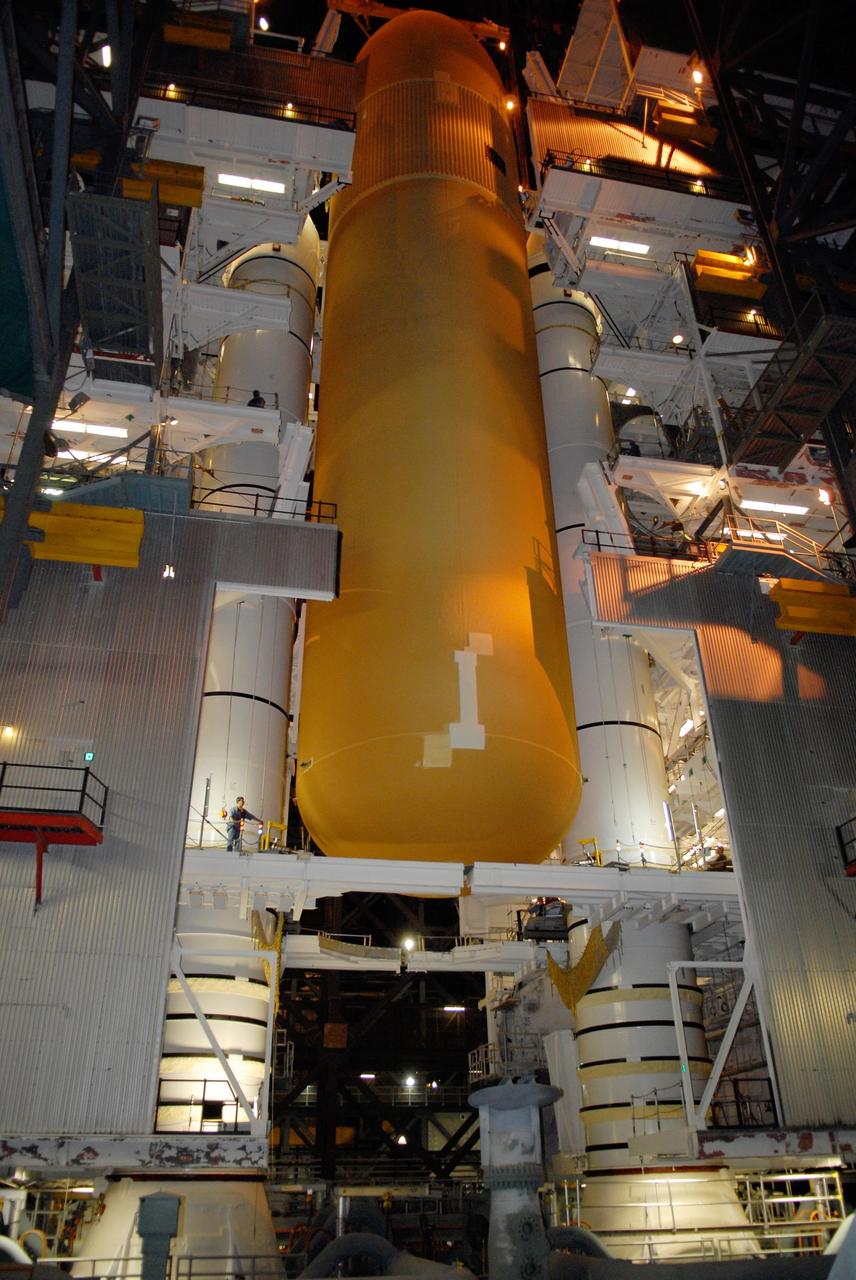
KENNEDY SPACE CENTER, FLA. -- In the Vehicle Assembly Building at NASA's Kennedy Space Center, the external tank is lowered between the solid rocket boosters on the mobile launcher platform below. After mating, the boosters-tank configuration will be used on space shuttle Atlantis for mission STS-122, which is targeted for launch on Dec. 6. Photo credit: Kim Shiflett
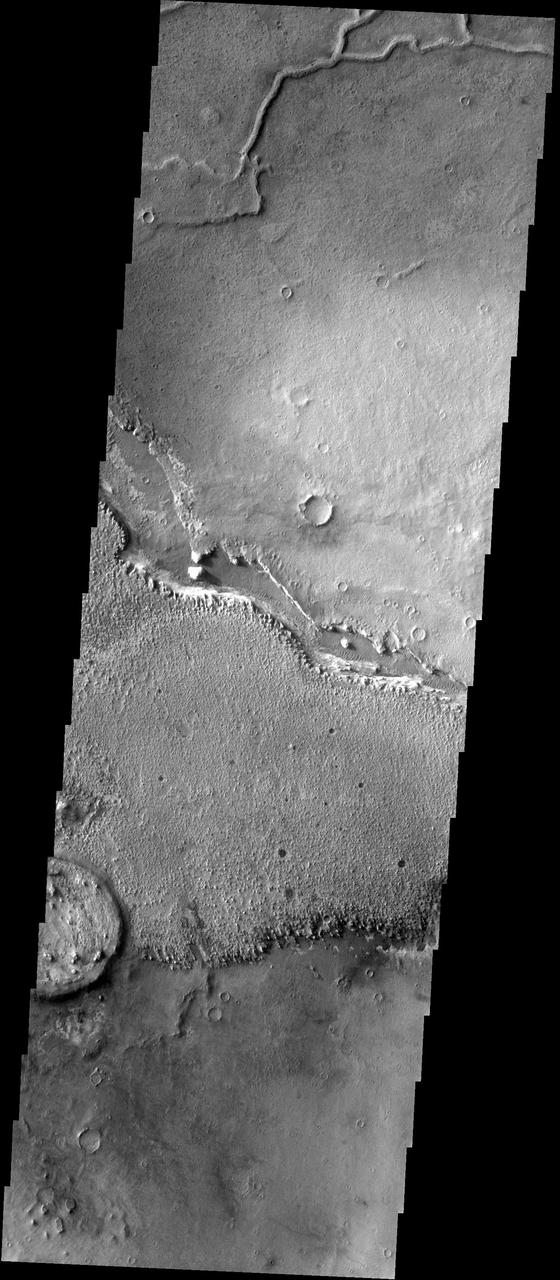
This type of feature is termed an inverted channel. One theory of how these features form is that rocky debris accumulates in channels of flowing water beneath glaciers
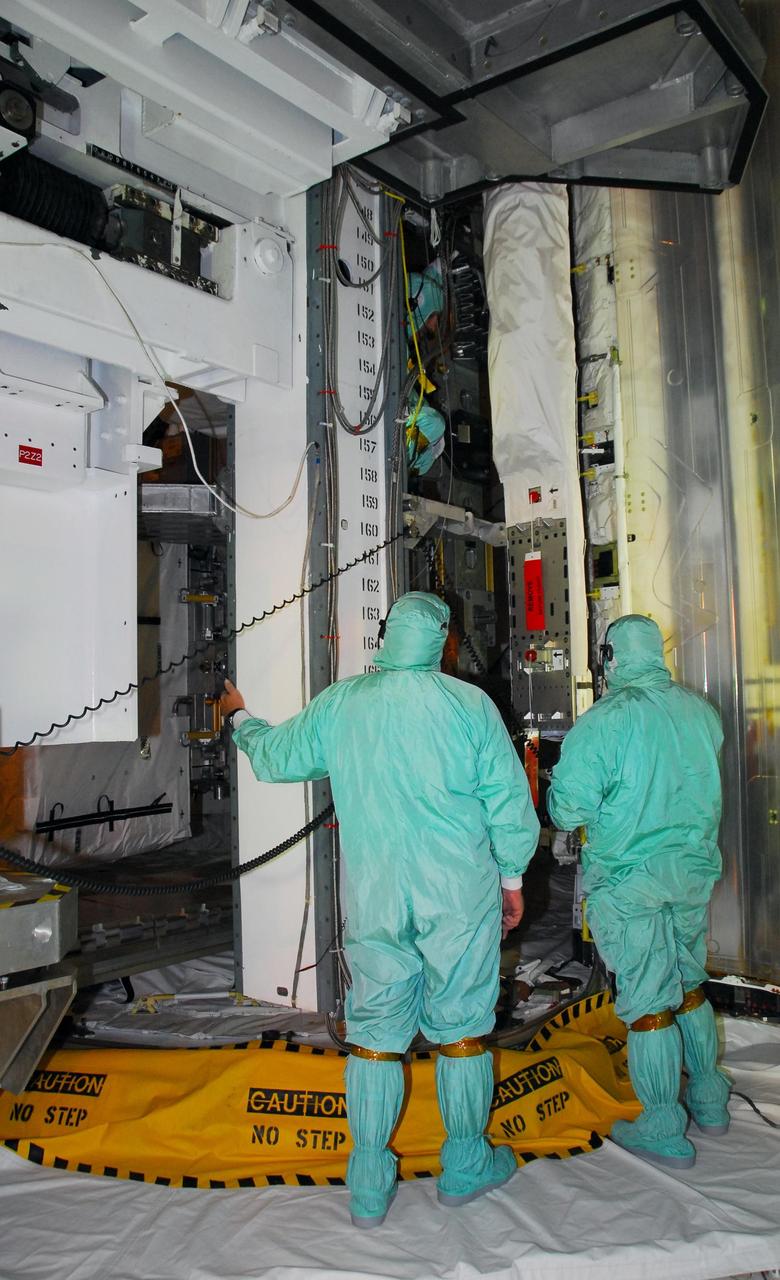
KENNEDY SPACE CENTER, FLA. -- On Launch Pad 39A, workers in the payload changeout room monitor the payload ground-handling mechanism as it transfers the mission STS-118 payload into the payload bay on Space Shuttle Endeavour. The payload includes the S5 truss, the SPACEHAB module and the external stowage platform 3. The mission is the 22nd flight to the International Space Station and is targeted for launch on Aug.7. Photo credit: NASA/Amanda Diller
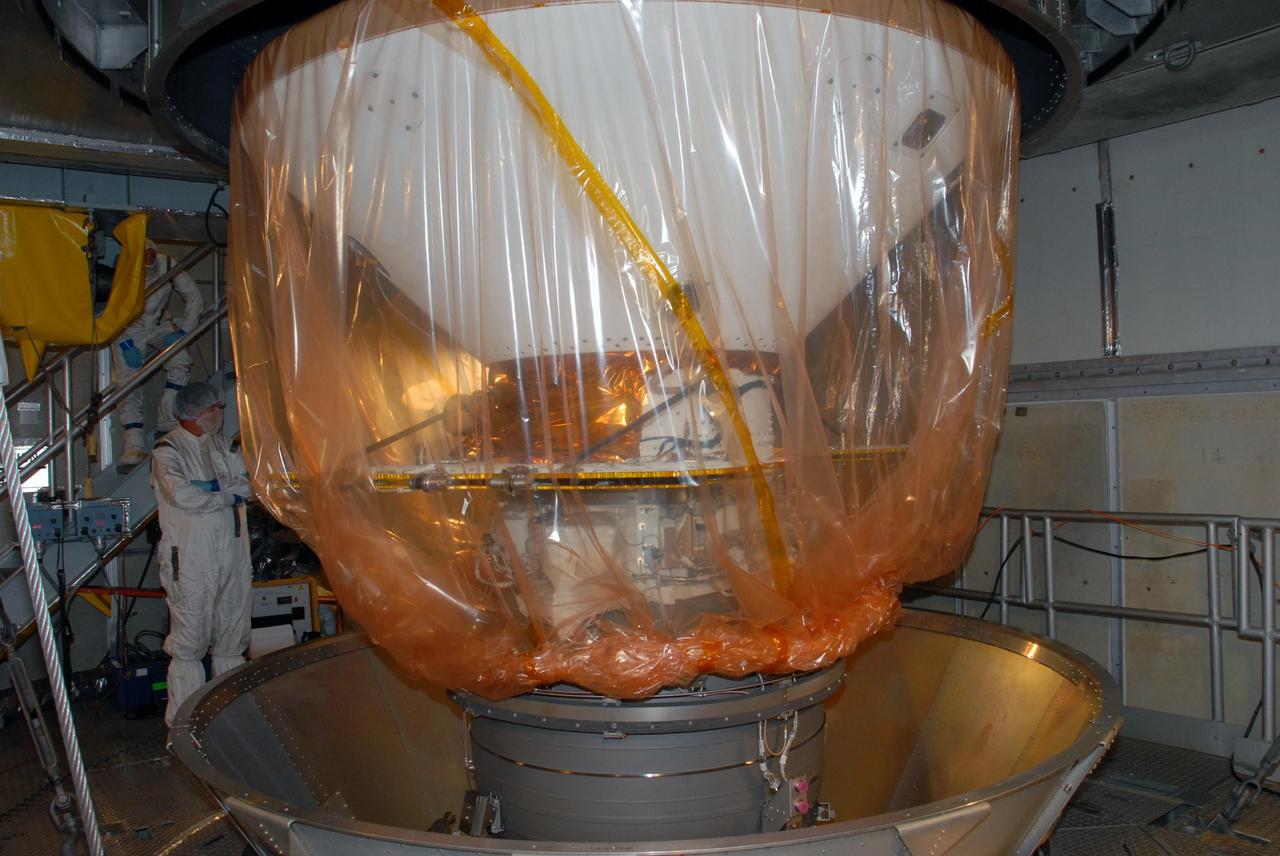
KENNEDY SPACE CENTER, FLA. -- Inside the mobile service tower of Launch Pad 17-A at Cape Canaveral Air Force Station in Florida, workers remove the container from NASA's Phoenix Mars Lander. Launch of Phoenix is scheduled to launch on the Delta II launch vehicle no earlier than Aug. 3. Phoenix will land in icy soils near the north polar permanent ice cap of Mars and explore the history of the water in these soils and any associated rocks, while monitoring polar climate. Landing on Mars is planned in May 2008 on arctic ground where a mission currently in orbit, Mars Odyssey, detected high concentrations of ice just beneath the top layer of soil. NASA/George Shelton

KENNEDY SPACE CENTER, FLA. -- A U.S. Air Force F-22 Raptor is parked on the Shuttle Landing Facility at NASA's Kennedy Space Center. The plane is participating in the World Space Expo being held from Nov. 1 to Nov. 4 at the NASA Kennedy Space Center Visitor Complex. Other aircraft joining in the salute include U.S. Air Force Thunderbirds Aerial Demonstration Squadron, U.S. Navy F-18 Super Hornets, the P-51 Mustang Heritage Flight and the U.S. Air Force 920th Rescue Wing, which was responsible for Mercury and Gemini capsule recovery. The U.S. Army Golden Knights also will demonstrate precision skydiving. The World Space Expo is an event to commemorate humanity's first 50 years in space while looking forward to returning people to the moon and exploring beyond. The expo will showcase various panels, presentations and educational programs. It also is a part of NASA's 50th anniversary celebrations, highlighting the 45th Anniversary of the Mercury Program celebration featuring original NASA astronauts John Glenn and Scott Carpenter and the Pioneering Women of Aerospace forum featuring Eileen Collins and other prominent female space veterans. The agency was founded Oct. 1, 1958. Photo credit: NASA/Jack Pfaller
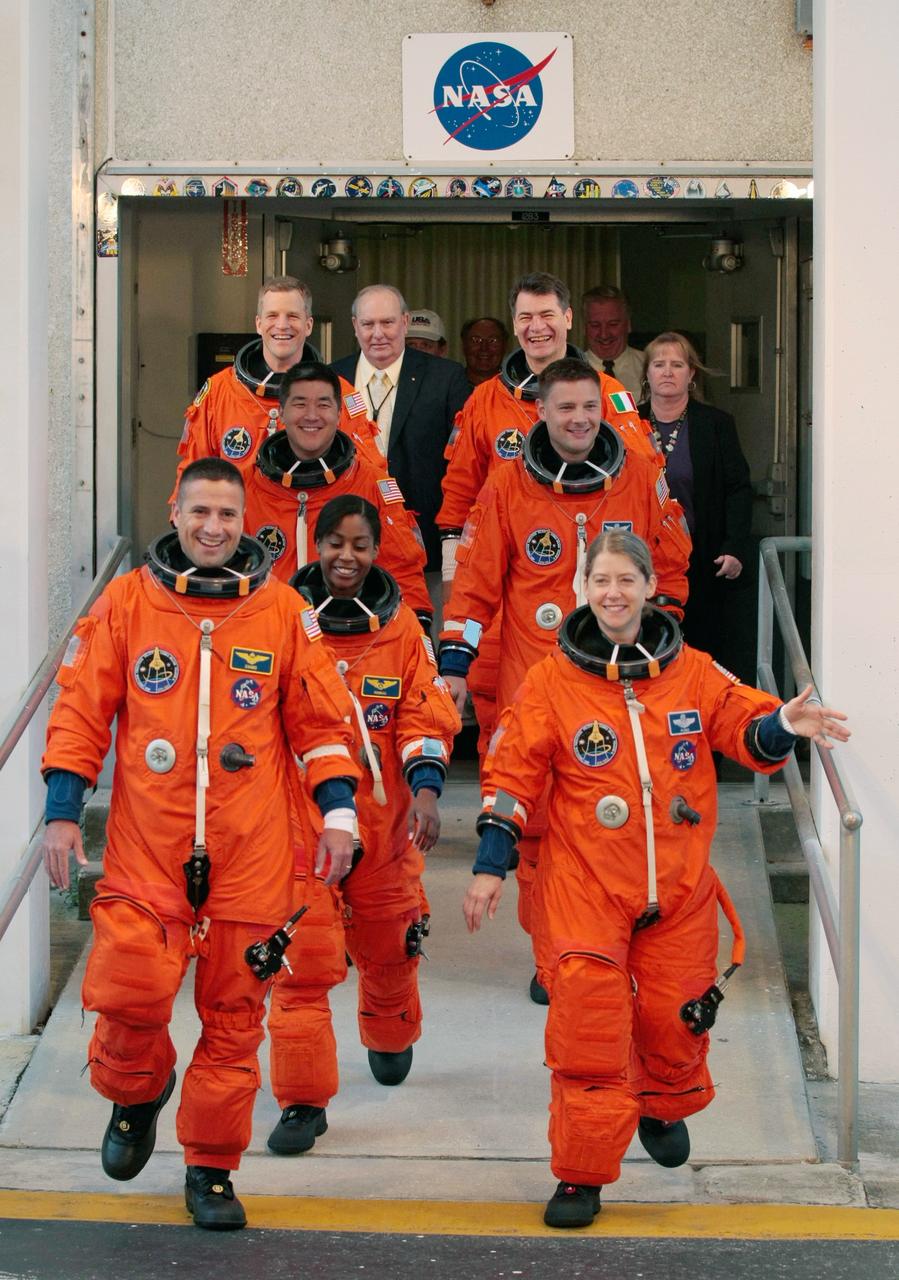
Crew members of space shuttle mission STS-120 prepare to board the bus that will transport them to Launch Pad 39A.
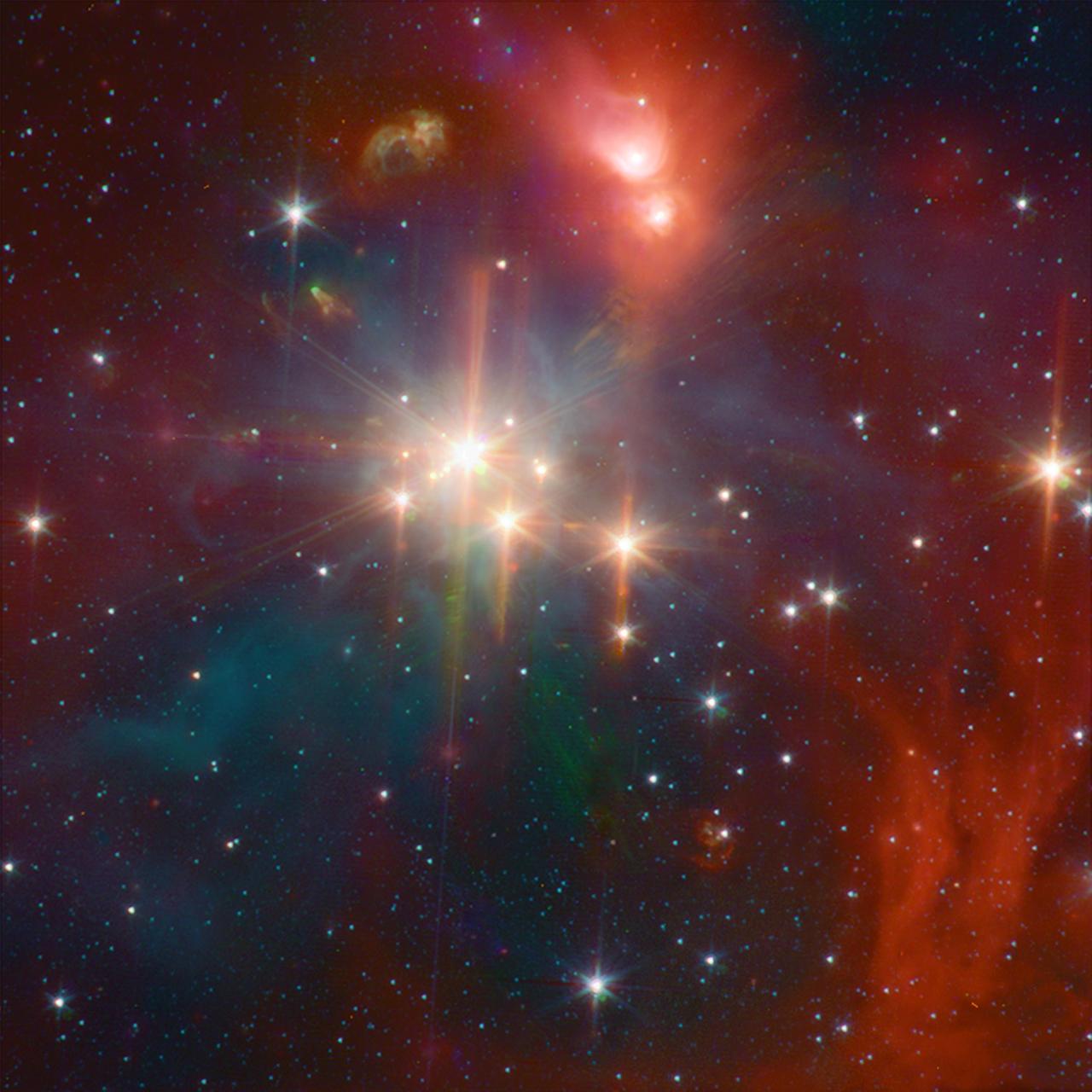
This image from NASA Spitzer Space Telescope shows young stars plus diffuse emission from dust. The Corona Australis region containing, at its heart, the Coronet cluster is one of the nearest and most active regions of ongoing star formation.
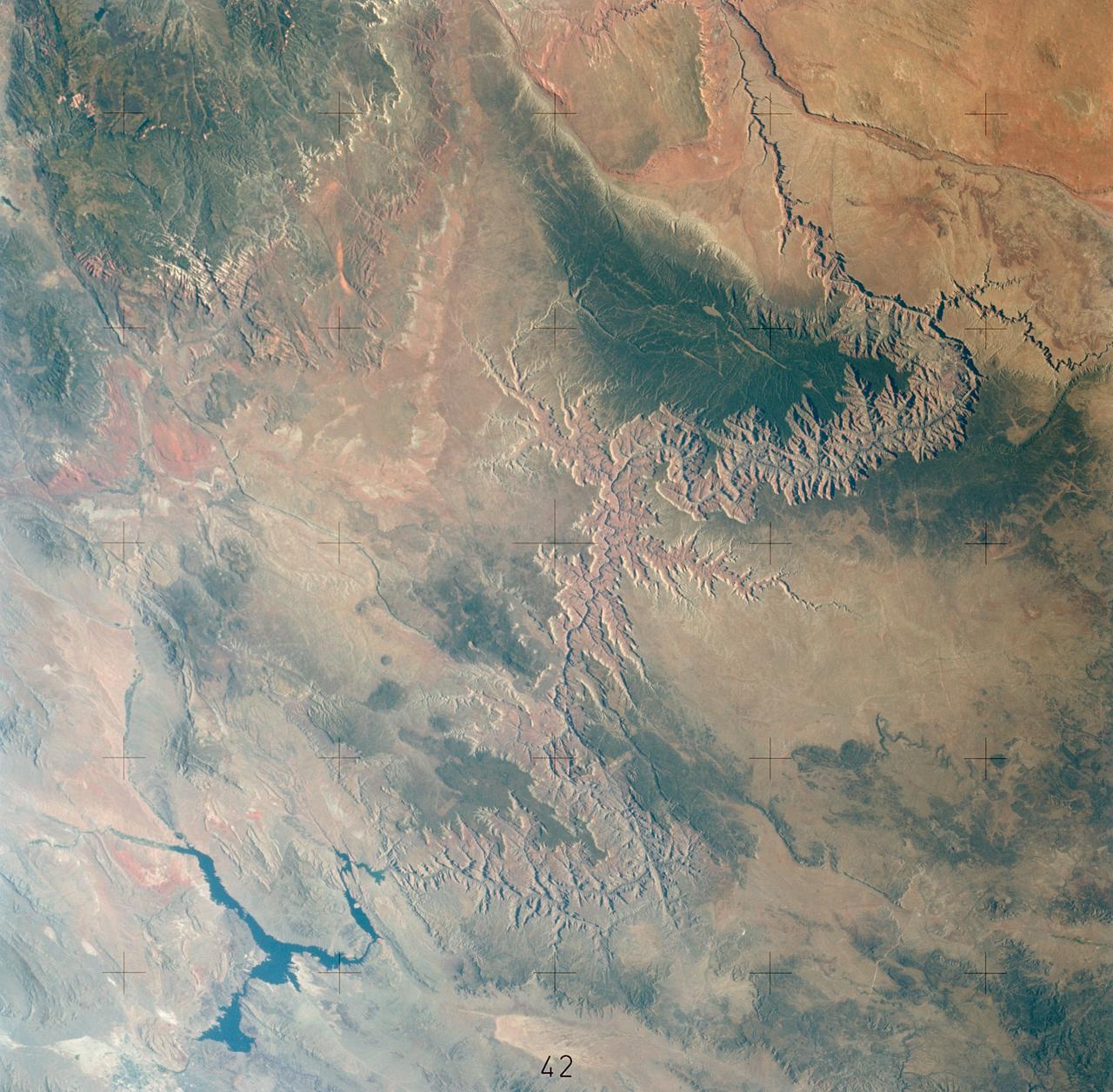
SL3-122-2581 (July-September 1973) --- Skylab 3 Earth view of the Grand Canyon, Lake Mead and Kaibab. Photo credit: NASA
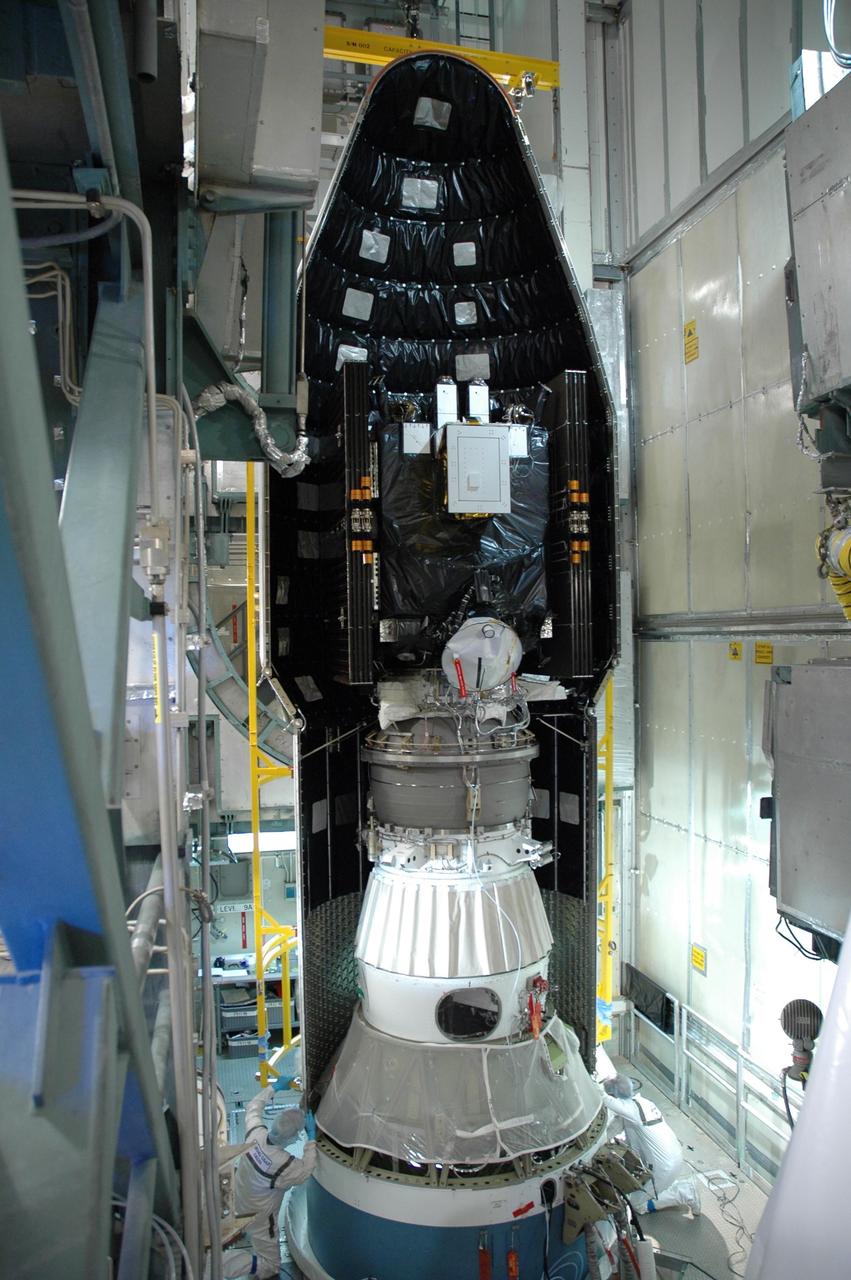
KENNEDY SPACE CENTER, FLA. -- Inside the mobile service tower on Launch Pad 17-B at Cape Canaveral Air Force Station, the first half of the fairing is moved into place around the Dawn spacecraft for installation. The fairing is a molded structure that fits flush with the outside surface of the Delta II upper stage booster and forms an aerodynamically smooth nose cone, protecting the spacecraft during launch and ascent. Dawn is scheduled to launch between 7:25 and 7:54 a.m. on Sept. 26 aboard a Delta II rocket. Photo credit: NASA/Jim Grossmann
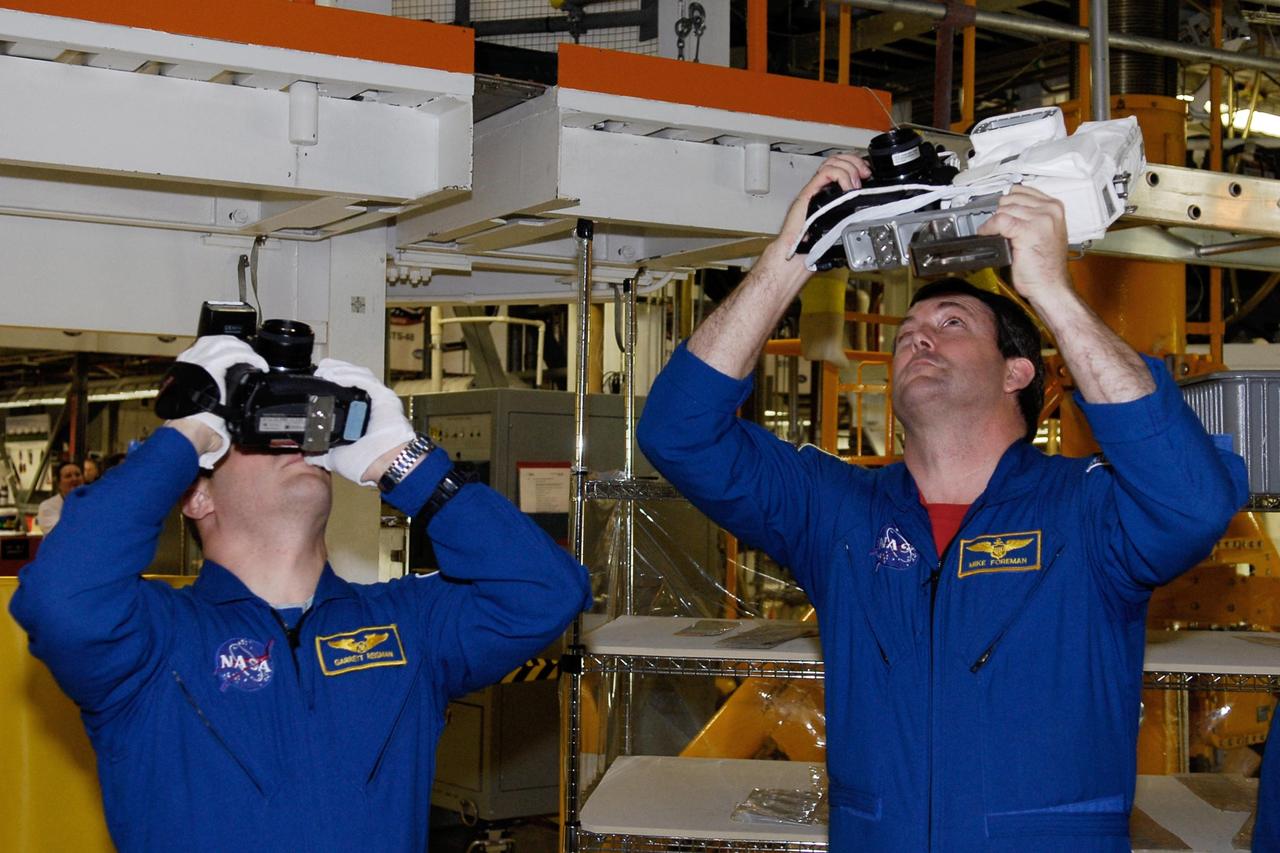
KENNEDY SPACE CENTER, FLA. -- In the Orbiter Processing Facility, STS-123 Mission Specialists Garrett Reisman and Michael Foreman practice using the cameras that will be on the mission. They and other crew members are at NASA's Kennedy Space Center for a crew equipment interface test, a process of familiarization with payloads, hardware and the space shuttle. Reisman will join the Expedition 16 crew on the International Space Station, replacing flight engineer Leopold Eyharts. The STS-123 mission is targeted for launch on space shuttle Endeavour on Feb. 14. It will be the 25th assembly flight of the station. Photo credit: NASA/Kim Shiflett
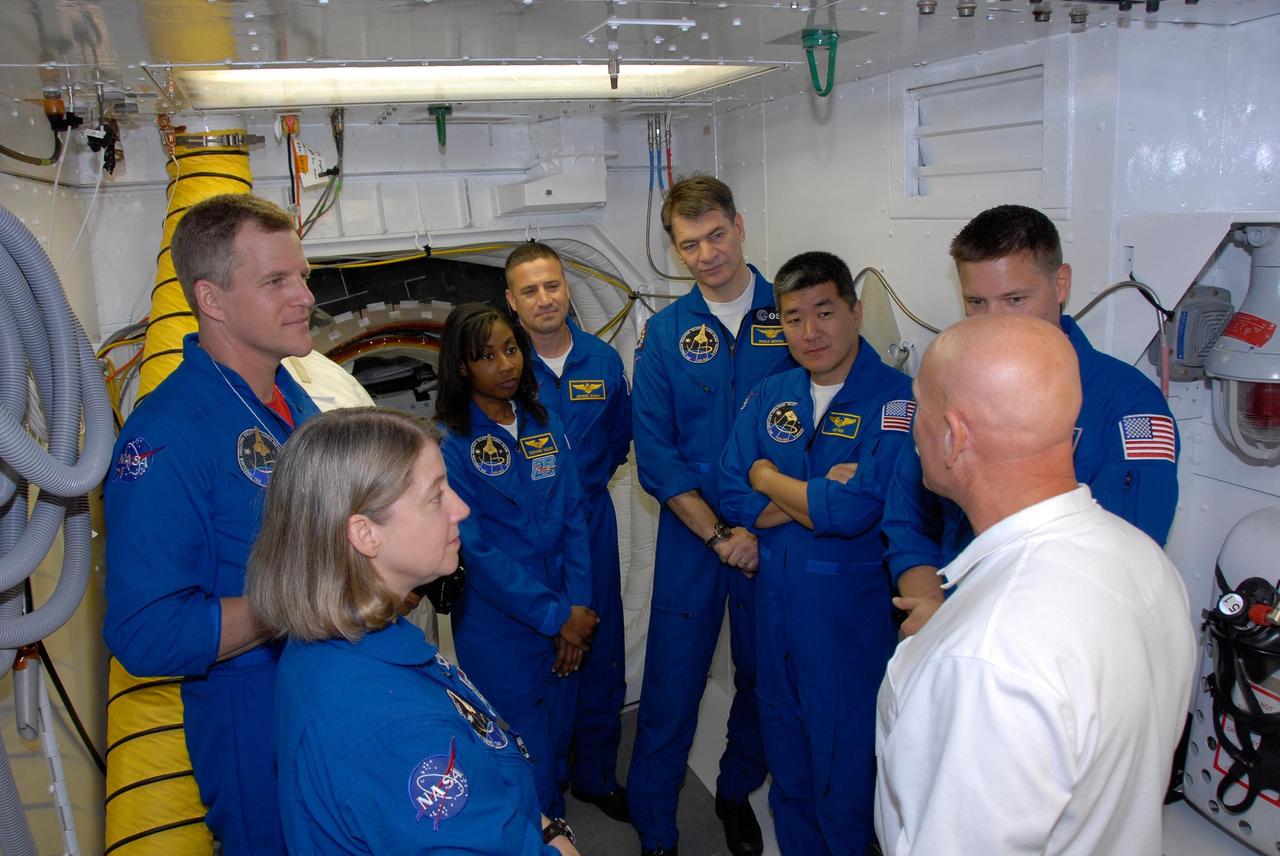
KENNEDY SPACE CENTER, FLA. -- The STS-120 crew is at NASA's Kennedy Space Center for the pre-launch terminal countdown demonstration test, or TCDT. Gathered in the white room on Launch Pad 39A, the crew gets instructions on emergency egress from the space shuttle. Clockwise from lower left are Commander Pamela Melroy, Mission Specialists Scott Parazynski and Stephanie Wilson, Pilot George Zamka, and Mission Specialists Paolo Nespoli, Daniel Tani and Doug Wheelock. Nespoli represents the European Space Agency. Tani will remain aboard the International Space Station and return with the STS-122 crew, targeted to launch Dec. 6. The TCDT provides astronauts and ground crews an opportunity to participate in various simulated countdown activities, including equipment familiarization and emergency training. The STS-120 mission will deliver the U.S. Node 2 module, named Harmony, aboard space shuttle Discovery to the International Space Station. Launch of Discovery on mission STS-120 is targeted for Oct. 23 at 11:38 a.m. EDT on a 14-day mission. Photo credit: NASA/Kim Shiflett
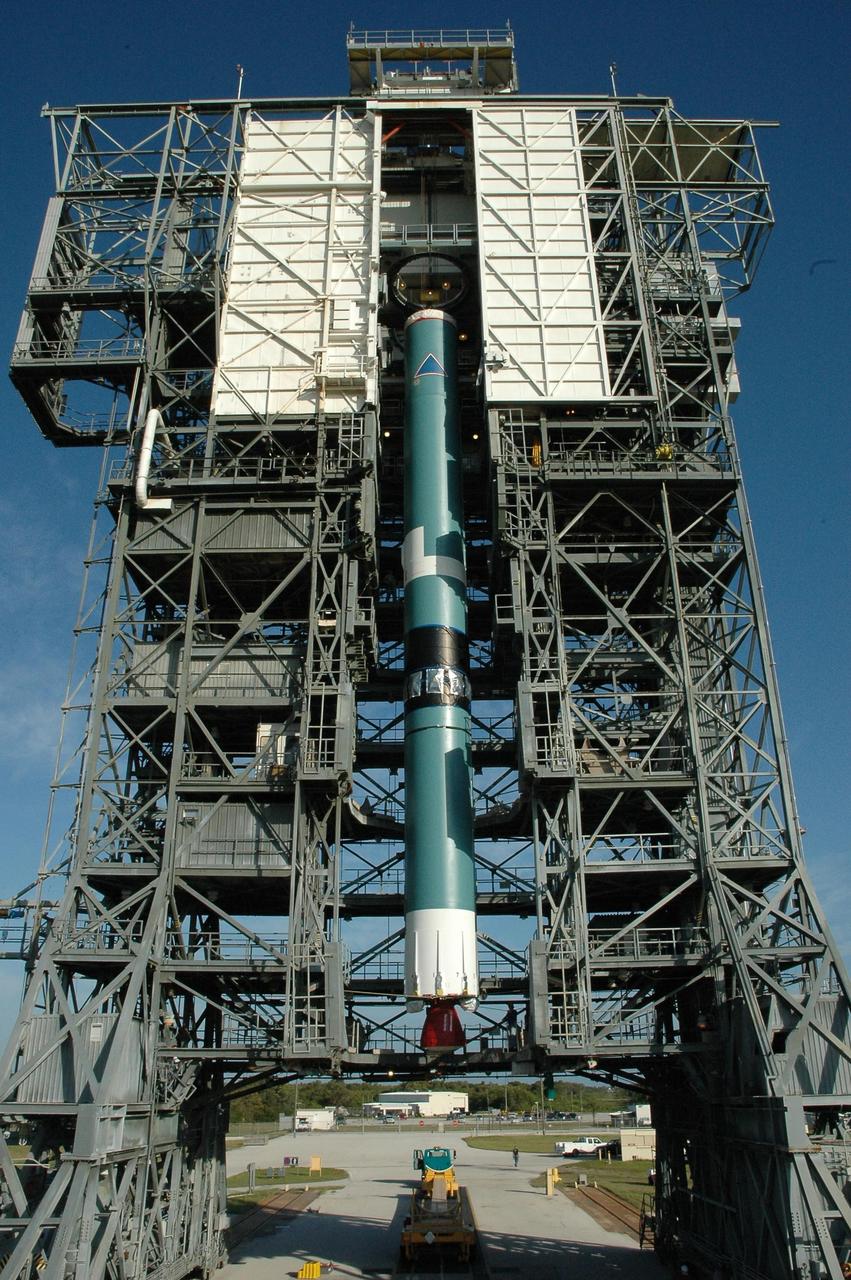
KENNEDY SPACE CENTER, FLA. -- On Launch Pad 17-B at Cape Canaveral Air Force Station, the first stage of a Delta II rocket is placed in the mobile service tower. The rocket is the launch vehicle for the Dawn spacecraft, targeted for liftoff on June 30. Dawn's mission is to explore two of the asteroid belt's most intriguing and dissimilar occupants: asteroid Vesta and the dwarf planet Ceres. Photo credit: NASA/Amanda Diller
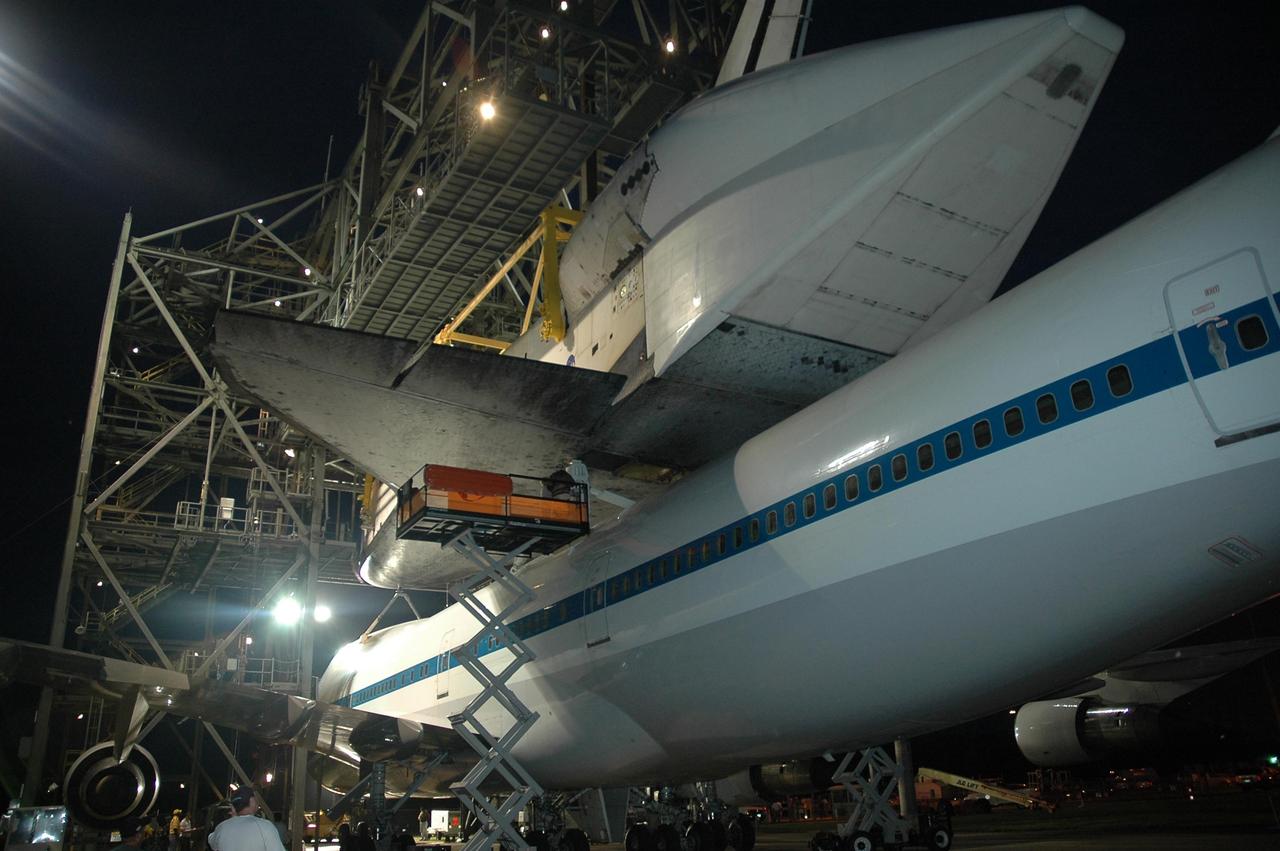
KENNEDY SPACE CENTER, FLA. -- At the mate/demate device at Kennedy Space Center's Shuttle Landing Facility, the lifting crane begins to lift Atlantis up from the shuttle carrier aircraft, or SCA, beneath it. Visible on Atlantis is the tail cone that covers and protects the main engines during the ferry flight. Technicians monitor the lifting process on a raised platform to the left. Atlantis arrived at Kennedy Space Center atop the SCA on July 3 after a three-day, cross-country flight due to fuel stops and weather delays. Touchdown was at 8:27 a.m. EDT. Atlantis landed at Edwards Air Force Base in California on June 22 to end mission STS-117. Photo credit: NASA/Jack Pfaller.
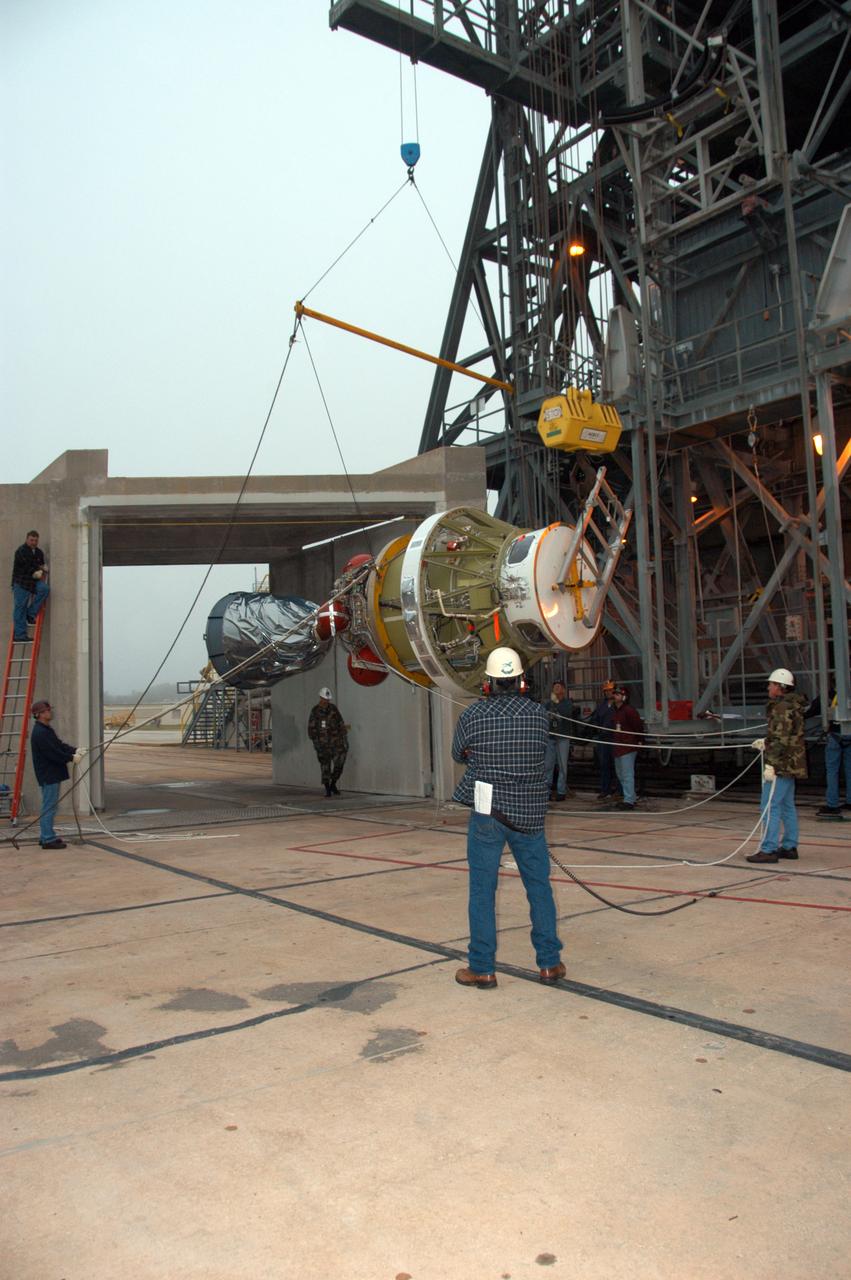
On Pad 17-B at Cape Canaveral Air Force Station, workers stand by while an overhead crane lifts the Delta II second stage to a vertical position. The second stage will be lifted into the mobile service tower and mated with the first stage already in place. The Delta II is the launch vehicle for the THEMIS spacecraft. THEMIS consists of five identical probes, the largest number of scientific satellites ever launched into orbit aboard a single rocket. This unique constellation of satellites will resolve the tantalizing mystery of what causes the spectacular sudden brightening of the aurora borealis and aurora australis - the fiery skies over the Earth's northern and southern polar regions. THEMIS is scheduled to launch Feb. 15 from Cape Canaveral Air Force Station.
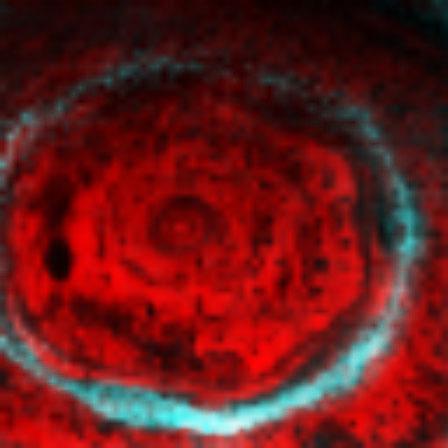
This nighttime view of Saturn north pole reveals a dynamic, active planet at least 75 kilometers 47 miles below the normal cloud tops seen in visible light. Clearly revealed is the bizarre six-sided hexagon feature present at the north pole
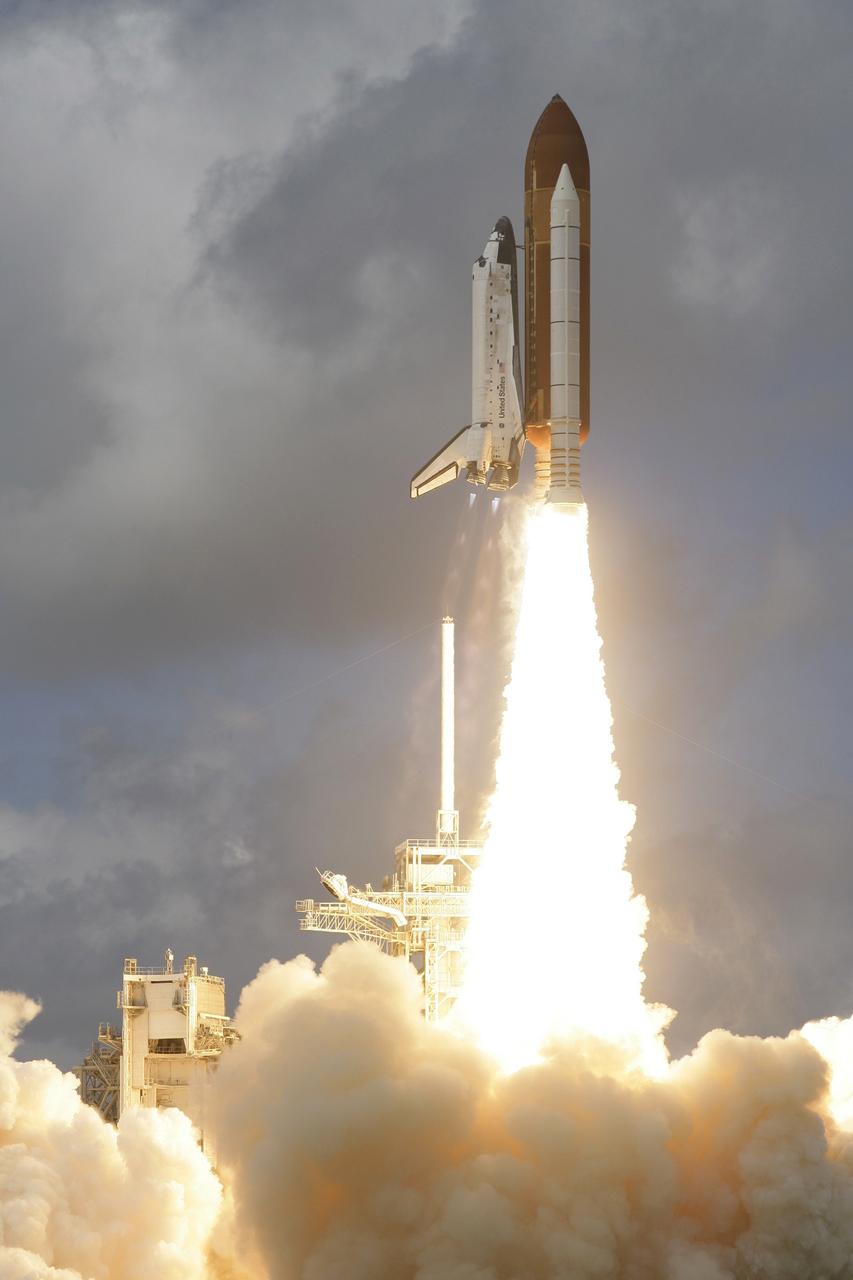
Space shuttle Discovery blasts off from its launch pad at the Kennedy Space Center in Cape Canaveral, Florida, October 23, 2007. Discovery is on a mission to the International Space Station.
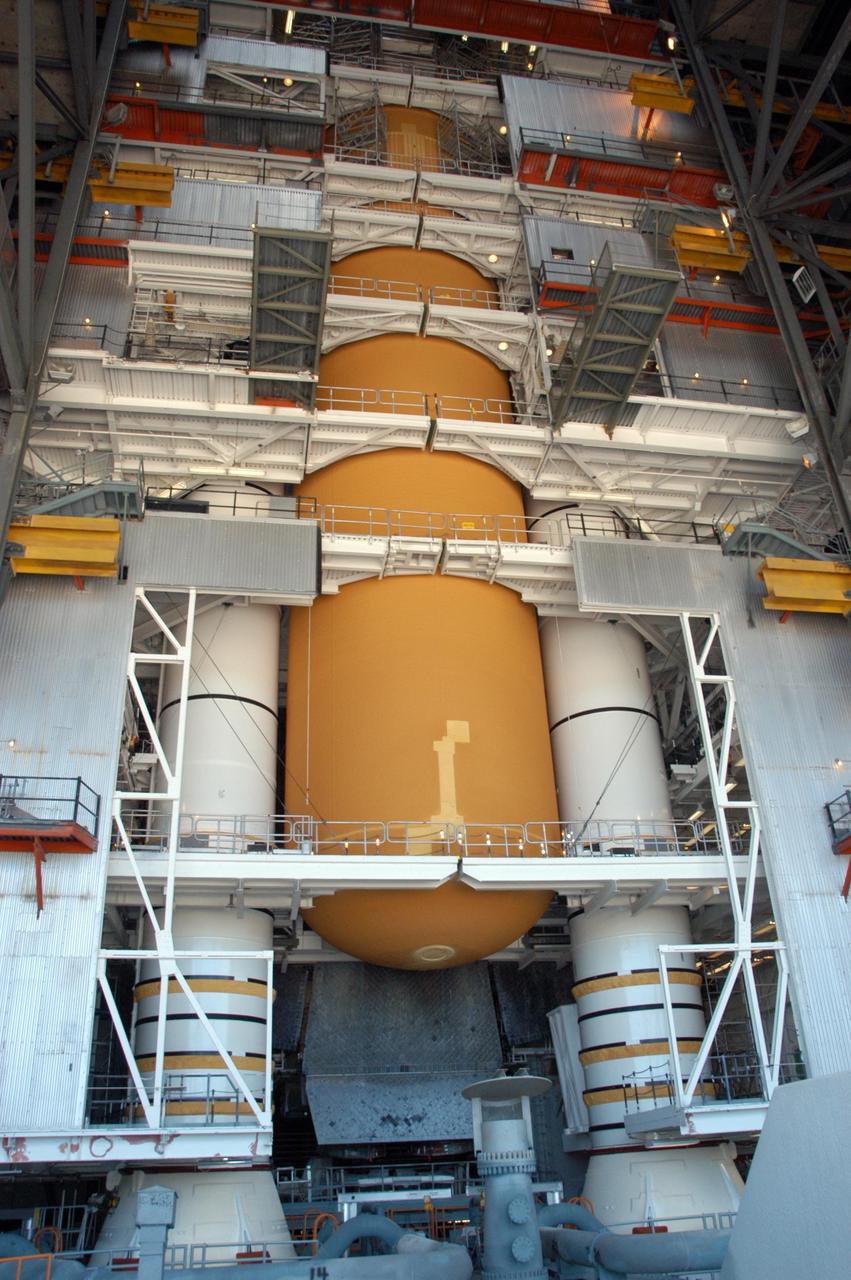
KENNEDY SPACE CENTER, FLA. -- In high bay 1 of the Vehicle Assembly Building, work is underway to repair the damage to Atlantis' external tank, seen here. Technicians will prepare the nose cone for future work. A severe thunderstorm with golf ball-sized hail caused visible divots in the giant tank's foam insulation and minor surface damage to about 26 heat shield tiles on the shuttle's left wing. Further evaluation of the tank is necessary to get an accurate accounting of foam damage and determine the type of repair required and the time needed for that work. A new target launch date has not been determined, but teams will focus on preparing Atlantis for liftoff in late April on mission STS-117. Photo credit: NASA/George Shelton
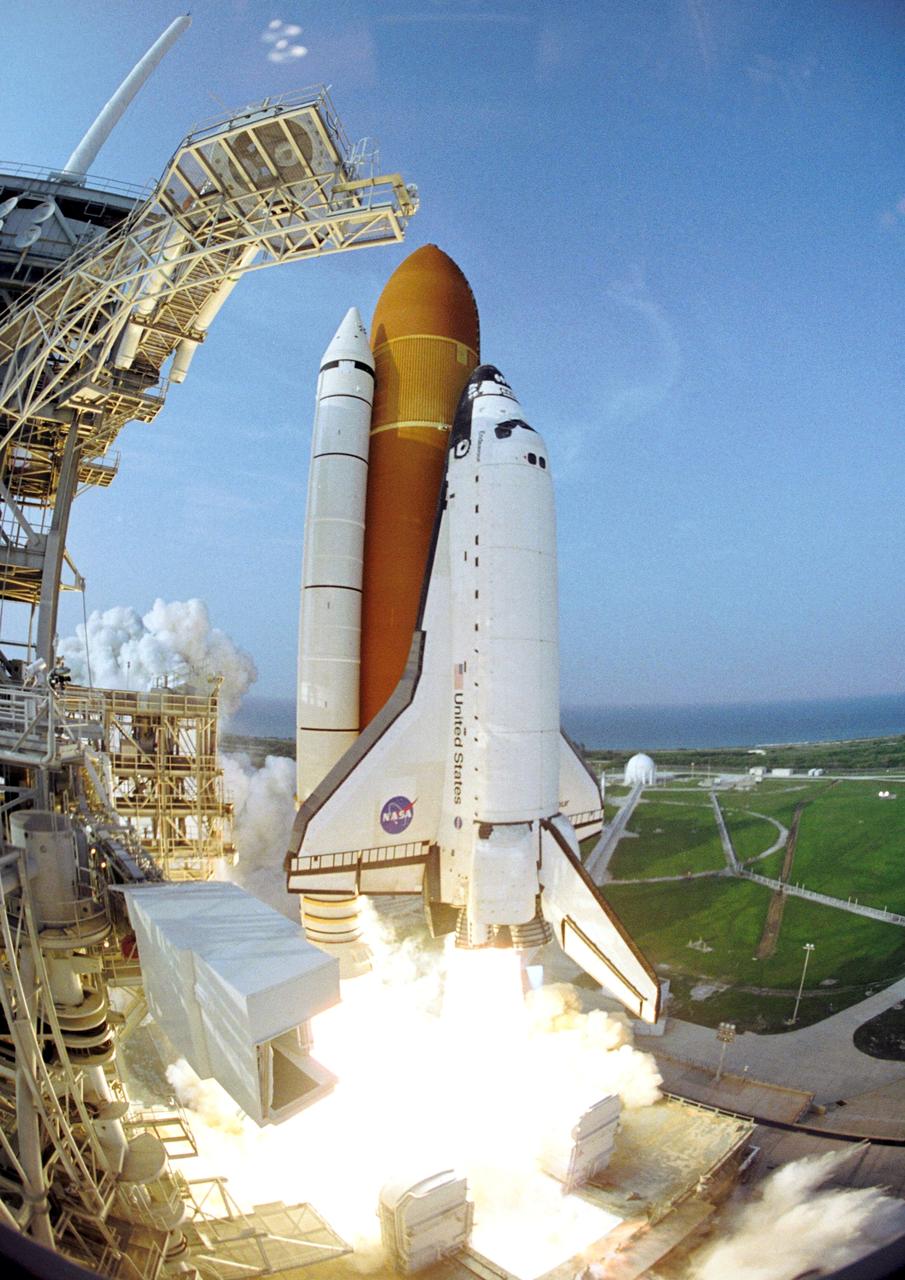
STS118-S-043 (8 Aug. 2007) --- The Space Shuttle Endeavour and its seven-member STS-118 crew head toward Earth-orbit and a scheduled link-up with the International Space Station. Liftoff from Kennedy Space Center's launch pad 39A occurred at 6:36 p.m. (EDT) on Aug. 8, 2007. Onboard are astronauts Scott Kelly, commander; Charlie Hobaugh, pilot; Tracy Caldwell, Rick Mastracchio, Canadian Space Agency's Dave Williams, Barbara R. Morgan and Alvin Drew, all mission specialists. Endeavour will link up with the International Space Station on Friday, Aug. 10, to begin a joint mission to continue construction by delivering a third starboard truss segment, S5, and other payloads such as the SPACEHAB module and the external stowage platform 3. The 11-day mission may be extended to as many as 14 depending on the test of the Station-to-Shuttle Power Transfer System that will allow the docked shuttle to draw electrical power from the station and extend its visits to the orbital complex.
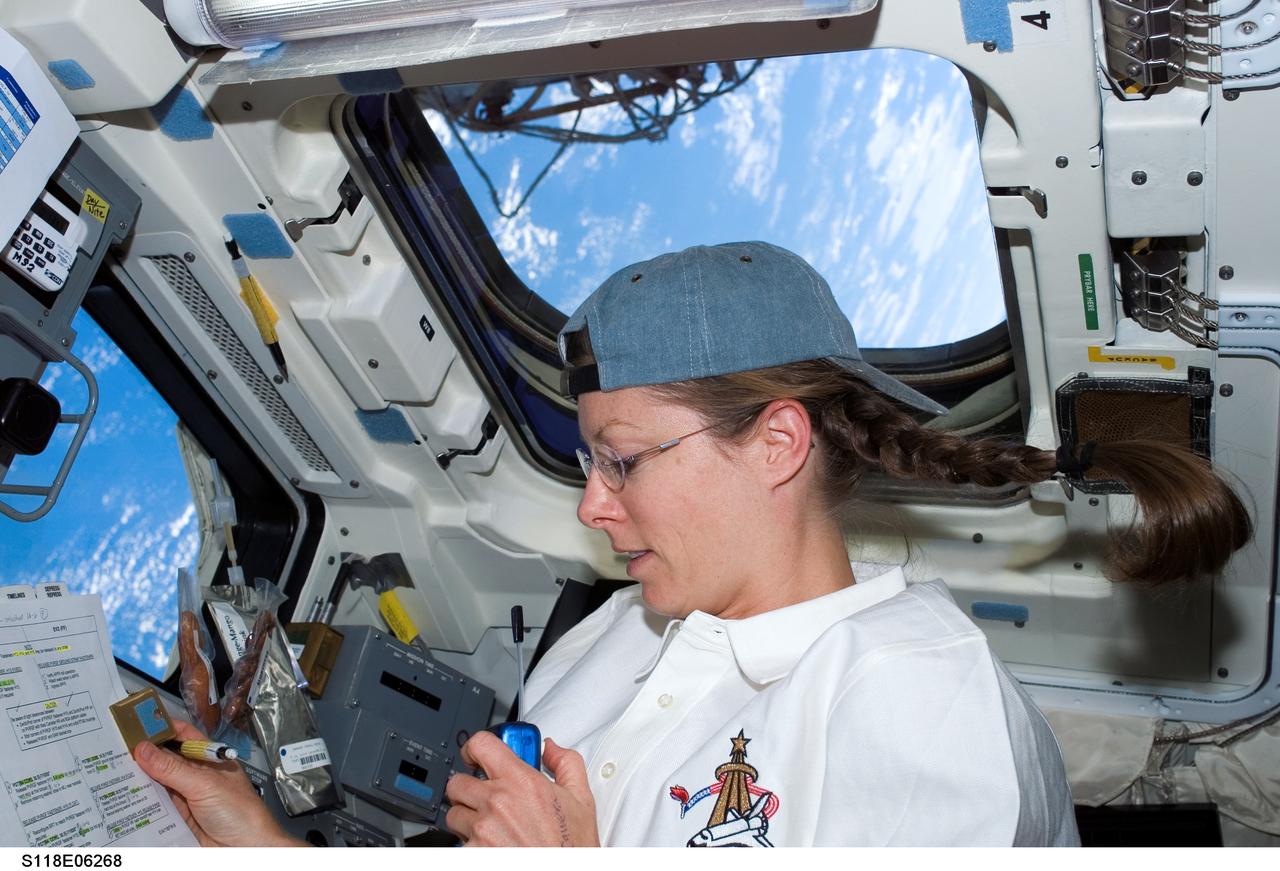
S118-E-06268 (11 Aug. 2007) --- Astronaut Tracy Caldwell, STS-118 mission specialist, uses a communication system on the aft flight deck of Space Shuttle Endeavour during flight day four activities.
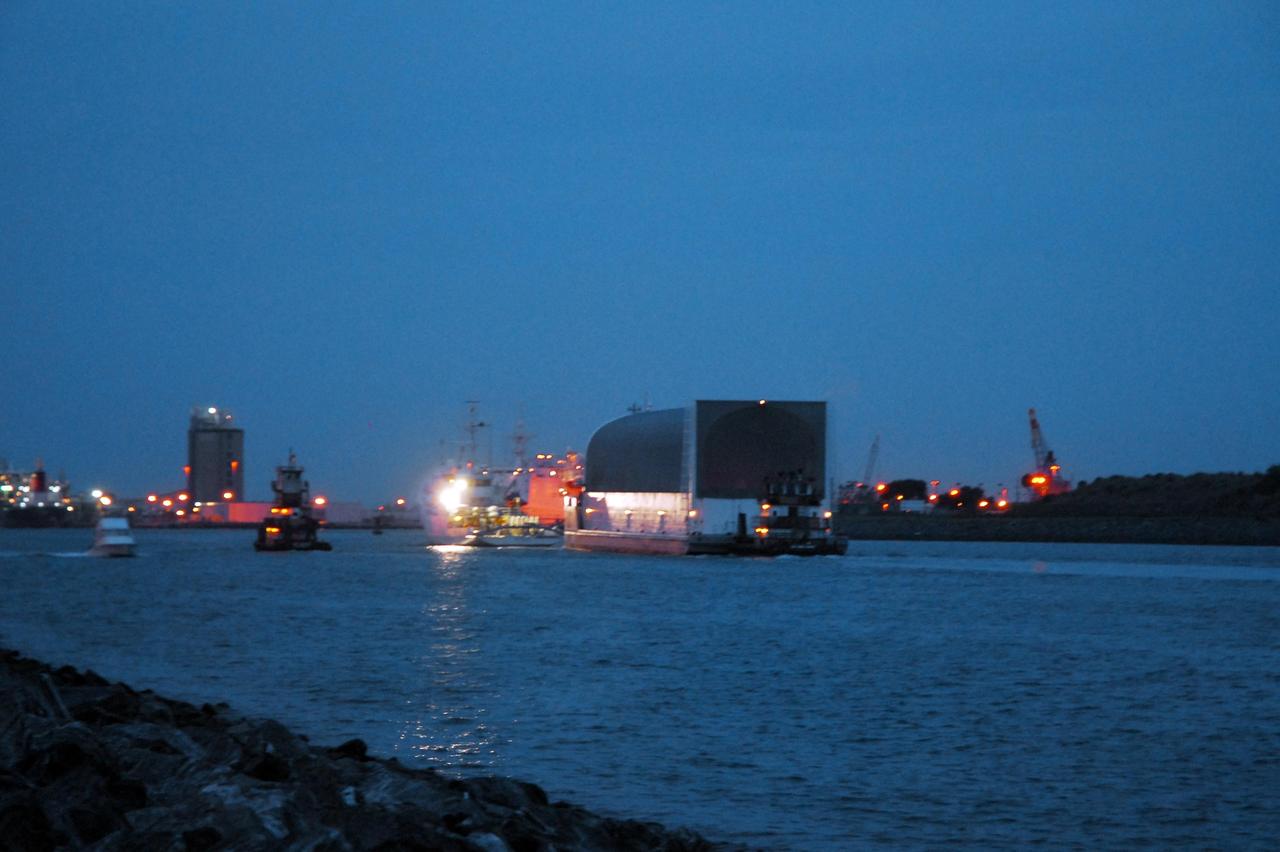
KENNEDY SPACE CENTER, FLA. -- The Pegasus barge arrives at Port Canaveral in Florida with its cargo of the external tank prepared for mission STS-118. The barge will be towed up the Banana River to the turn basin near the Vehicle Assembly Building where the tank will be offloaded and moved to the VAB. Photo credit: Jack Pfaller

KENNEDY SPACE CENTER, FLA. -- The ship carrying the Experiment Logistics Module Pressurized Section for the Japanese Experiment Module arrives at the Trident wharf after departing from Yokohama, Japan, Feb. 7. The logistics module will be offloaded and transported to the Space Station Processing Facility at NASA's Kennedy Space Center. The Japanese Experiment Module is composed of three segments and is known as Kibo, which means "hope" in Japanese. Kibo consists of six components: two research facilities -- the Pressurized Module and Exposed Facility; a Logistics Module attached to each of them; a Remote Manipulator System; and an Inter-Orbit Communication System unit. Kibo also has a scientific airlock through which experiments are transferred and exposed to the external environment of space. Kibo is Japan's first human space facility and its primary contribution to the station. Kibo will enhance the unique research capabilities of the orbiting complex by providing an additional environment in which astronauts can conduct science experiments. The various components of JEM will be assembled in space over the course of three Space Shuttle missions. The first of those three missions, STS-123, will carry the Experiment Logistics Module Pressurized Section aboard the Space Shuttle Endeavour, targeted for launch in 2007. Photo credit: NASA/Kim Shiflett
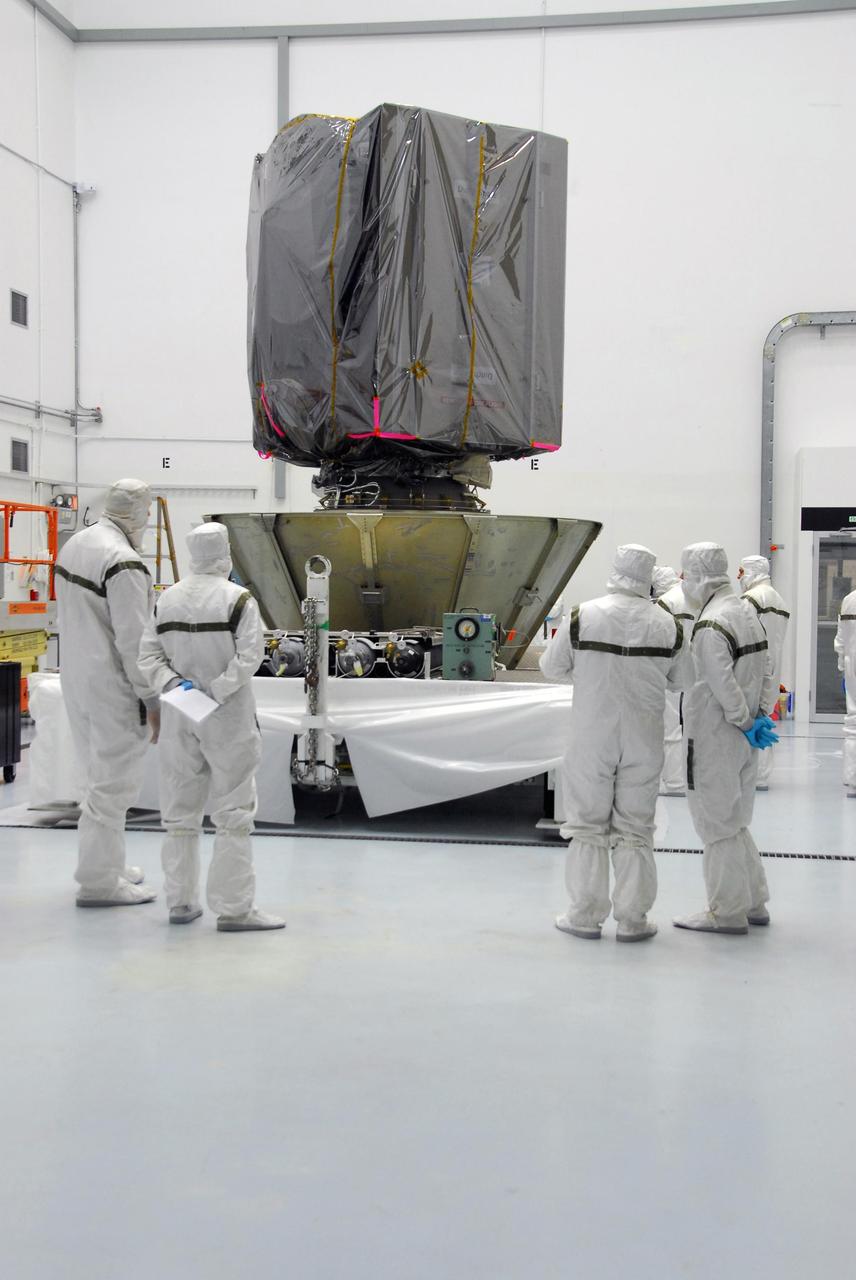
KENNEDY SPACE CENTER, FLA. -- At Astrotech, technicians examine the lower canister they placed around the bottom of the Dawn spacecraft. When enclosed in the canister, Dawn will be transported to Launch Pad 17-B and lifted into the mobile service tower for mating with the Delta II launch vehicle. The Delta II-Heavy, manufactured by the United Launch Alliance, is scheduled to launch the Dawn spacecraft on its 4-year flight to the asteroid belt. The Delta II-Heavy will use three stages and nine solid-fueled booster rockets to propel Dawn on its way. A 9.5-foot payload fairing will protect the spacecraft from the heat and stresses of launch. Dawn's goal is to characterize the conditions and processes of the solar system's earliest epoch by investigating in detail the largest protoplanets that have remained intact since their formations: asteroid Vesta and the dwarf planet Ceres. They reside in the extensive zone between Mars and Jupiter together with many other smaller bodies, called the asteroid belt. Dawn is scheduled to launch July 7. Photo credit: NASA/George Shelton
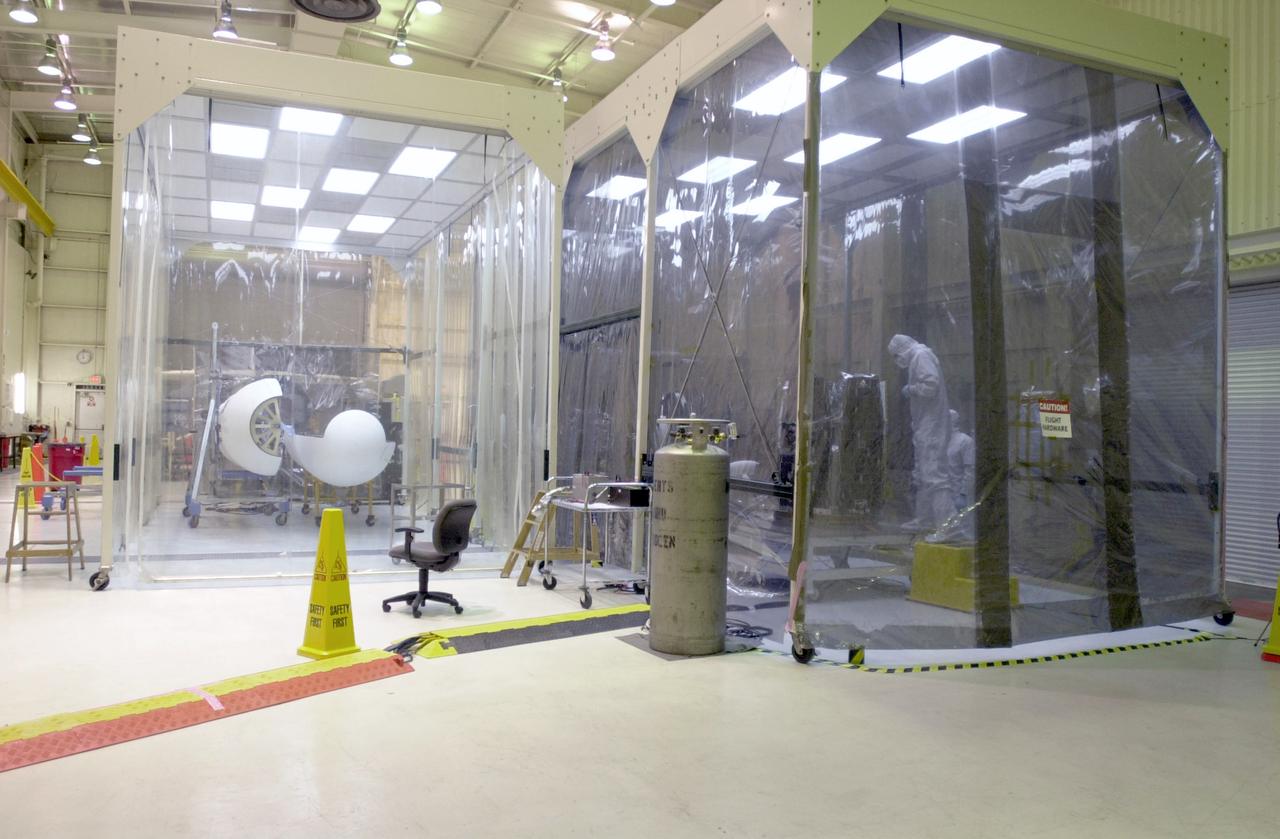
In a clean-room environment at North Vandenberg Air Force Base, technicians work on the AIM spacecraft. The AIM spacecraft will fly three instruments designed to study polar mesospheric clouds located at the edge of space, 50 miles above the Earth's surface in the coldest part of the planet's atmosphere. The mission's primary goal is to explain why these clouds form and what has caused them to become brighter and more numerous and appear at lower latitudes in recent years. AIM's results will provide the basis for the study of long-term variability in the mesospheric climate and its relationship to global climate change. AIM is scheduled to be mated to the Pegasus XL during the second week of April, after which final inspections will be conducted. Launch is scheduled for April 25.

KENNEDY SPACE CENTER, FLA. -- In the Space Station Processing Facility, an overhead crane moves the U.S. Node 2 module, known as Harmony, to the payload canister waiting at right. The canister will deliver Harmony to Launch Pad 39A for installation into space shuttle Discovery's payload bay. The Italian-built module is about 21 feet long and 14 feet in diameter. The pressurized module will act as an internal connecting port and passageway to additional international science labs and cargo spacecraft. In addition to increasing the living and working space inside the station, it also will serve as a work platform outside for the station's robotic arm. Harmony will be installed on the station during mission STS-120, targeted to launch Oct. 23. Photo credit: NASA/Amanda Diller
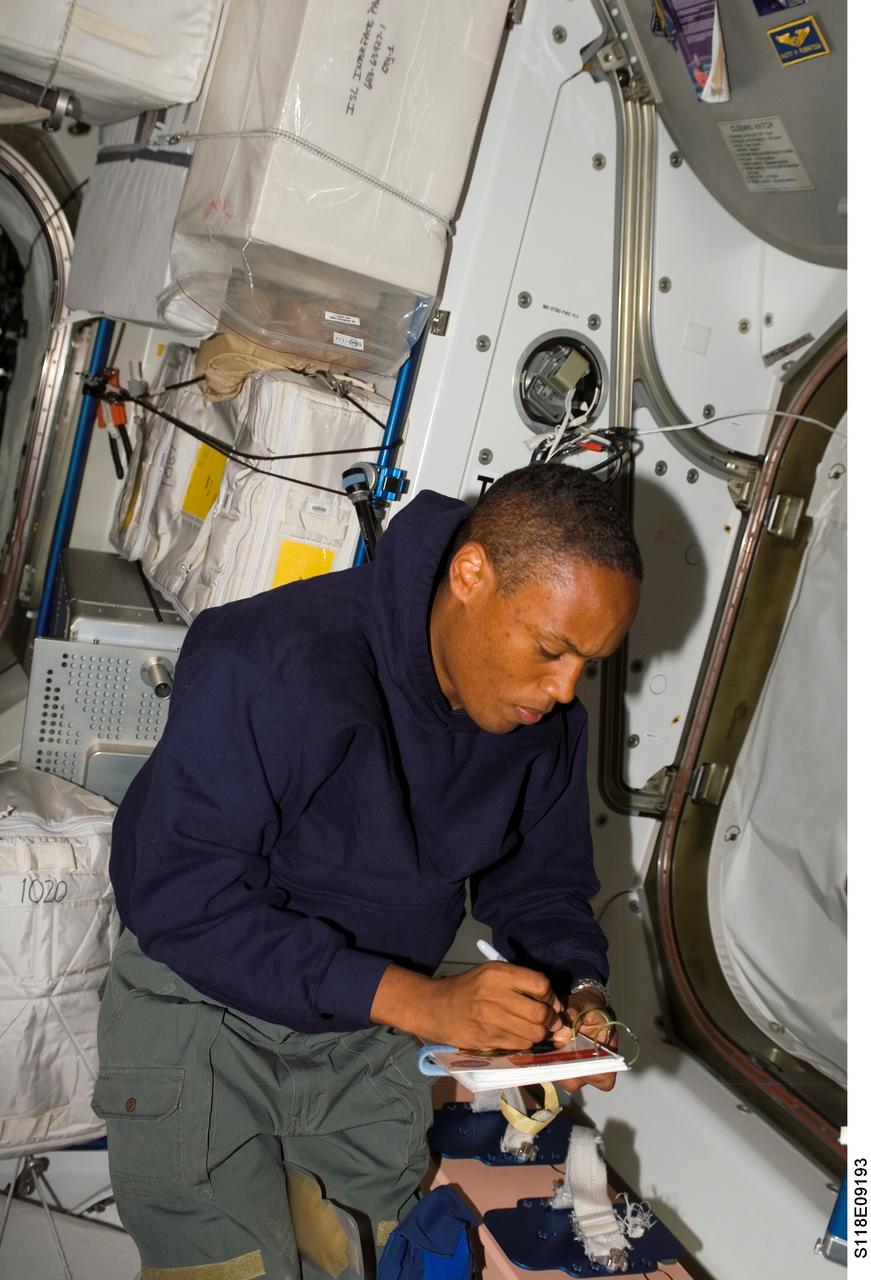
S118-E-09193 (18 Aug. 2007) --- Astronaut Alvin Drew, STS-118 mission specialist, works in the Unity node of the International Space Station while Space Shuttle Endeavour remains docked with the station.

KENNEDY SPACE CENTER, FLA. -- The Delta IV first stage that will be used to launch the GOES-O satellite arrives at Complex 37 on Cape Canaveral Air Force Station in Florida. The satellite is part of the series developed by the Geostationary Operational Environmental Satellite Program, a joint effort of NASA and the National Oceanic and Atmospheric Administration, known as NOAA. Currently, the GOES system consists of GOES-12 operating as GOES-East in the eastern part of the constellation at 75° west longitude, and GOES-10 operating as GOES-West at 135° west longitude. These spacecraft help meteorologists observe and predict local weather events, including thunderstorms, tornadoes, fog, flash floods, and other severe weather. In addition, GOES observations have proven helpful in monitoring dust storms, volcanic eruptions and forest fires. GOES-O is targeted for launch on July 20 aboard a Boeing Delta IV rocket. Photo credit: NASA/Jim Grossmann
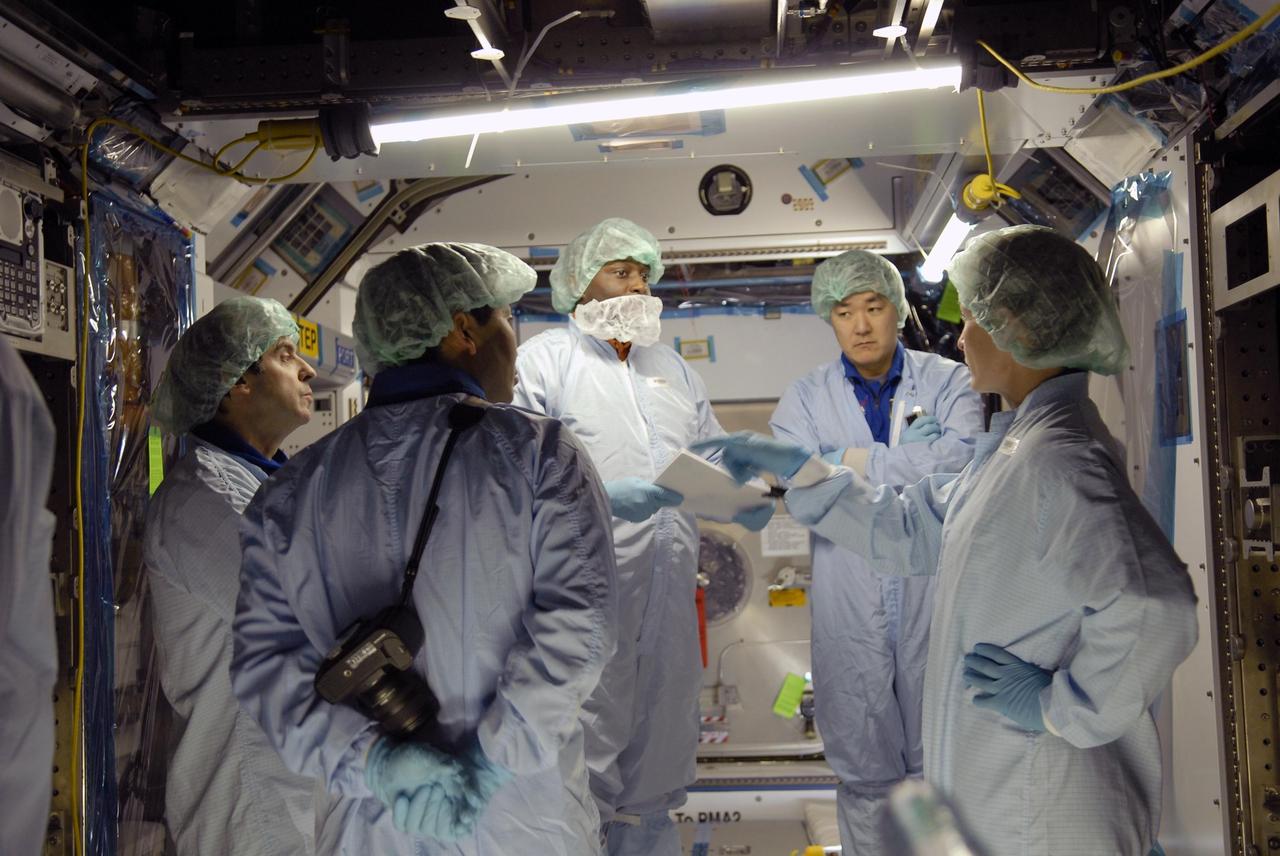
KENNEDY SPACE CENTER, FLA. -- In the Space Station Processing Facility, astronauts get data on the space station module they are in. At left is Leopold Eyharts; at right is Dan Tani and Peggy Whitson. With construction of the Space Station the primary focus of future shuttle missions, astronaut crews will be working with one or more of the elements and hardware already being processed in the SSPF. Photo credit: NASA/Kim Shiflett
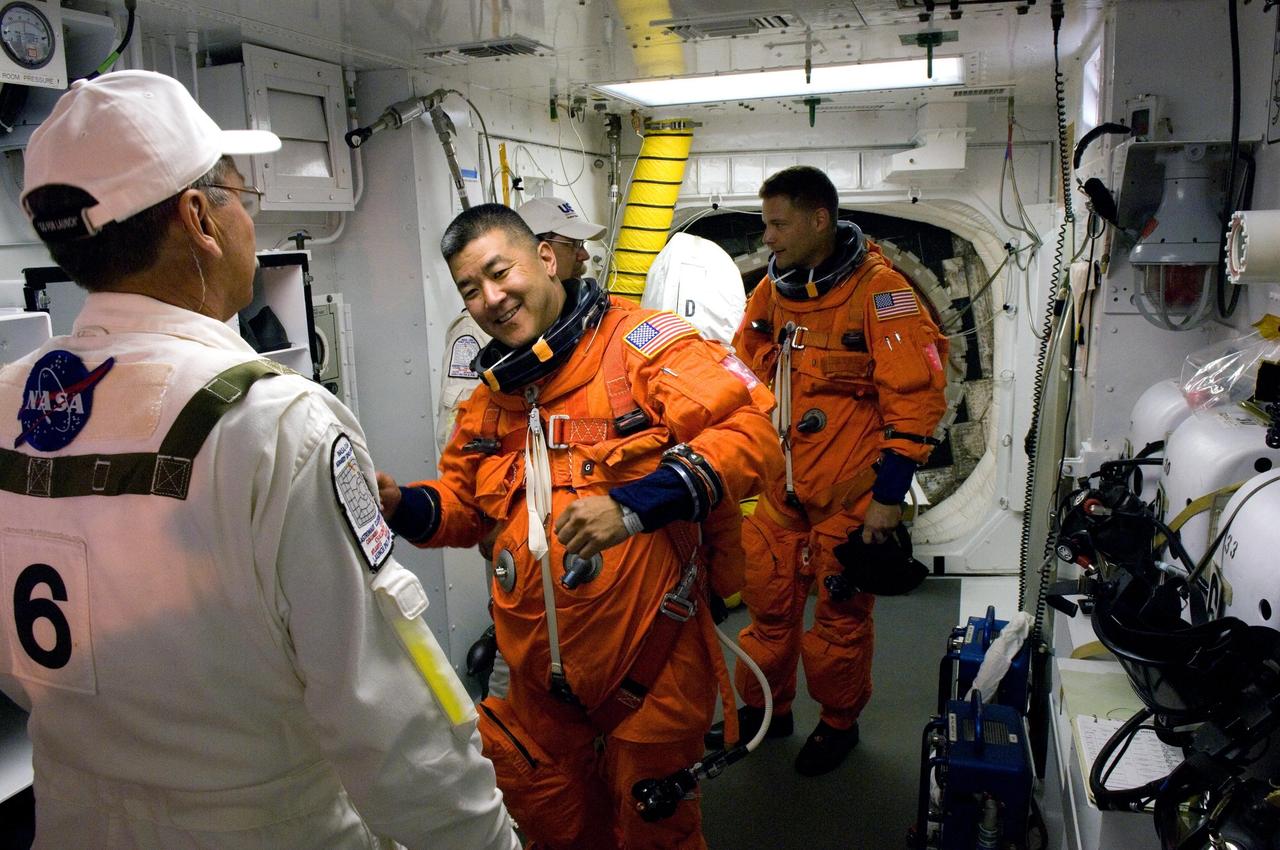
KENNEDY SPACE CENTER, FLA. -- In the White Room on Launch Pad 39A at NASA's Kennedy Space Center, STS-120 Mission Specialist Daniel Tani is helped by the closeout crew to put on a parachute and get ready to enter space shuttle Discovery for liftoff at 11:38 a.m. EDT. Behind him is Mission Specialist Doug Wheelock. At the end of the mission, Tani will remain behind on the International Space Station to join the Expedition 16 crew. The STS-120 mission will be the 23rd assembly flight to the space station and the 34th flight for Discovery. Payload on the mission is the Italian-built U.S. Node 2, called Harmony. During the 14-day mission, the crew will install Harmony and move the P6 solar arrays to their permanent position and deploy them. Discovery is expected to complete its mission and return home at 4:47 a.m. EST on Nov. 6. Photo credit: NASA/Scott Haun, Tom Farrar, Rafael Hernandez
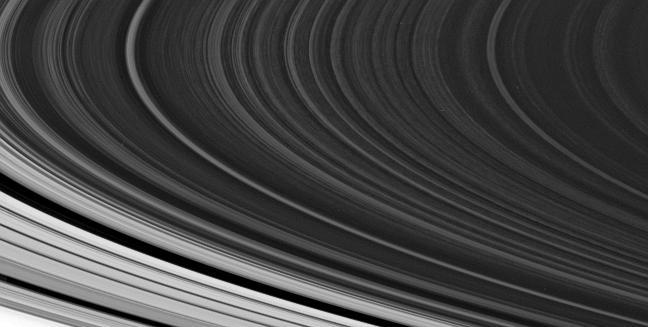
B Ring Irregularities

LCROSS flight hardware in clean room at Ames N-240. with P.I.'s Kim Ennico (frt) and Dana Lynch (bk) preforming tasks
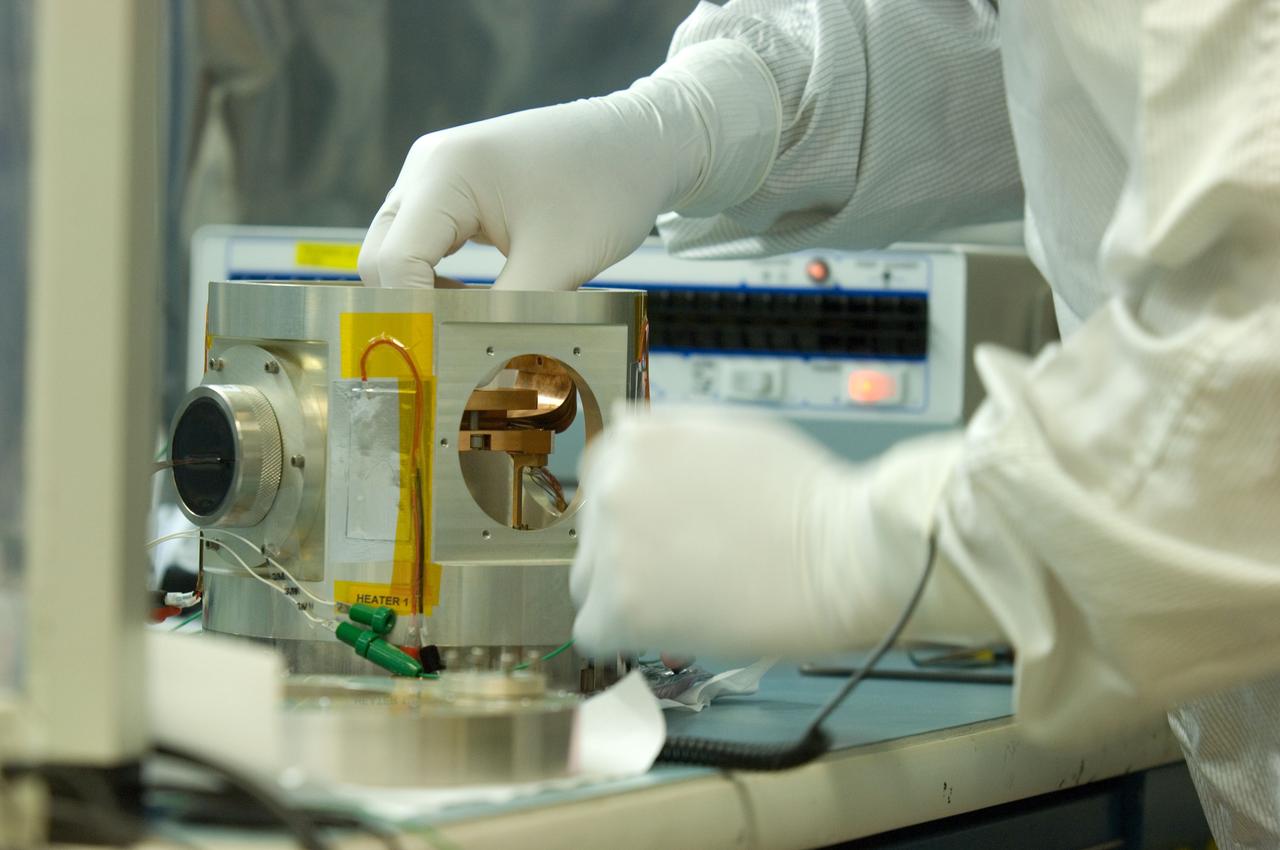
Kepler project; technicians from Ball Aerospace work on and in the test chamber assembled at Nasa Ames Research center testing components
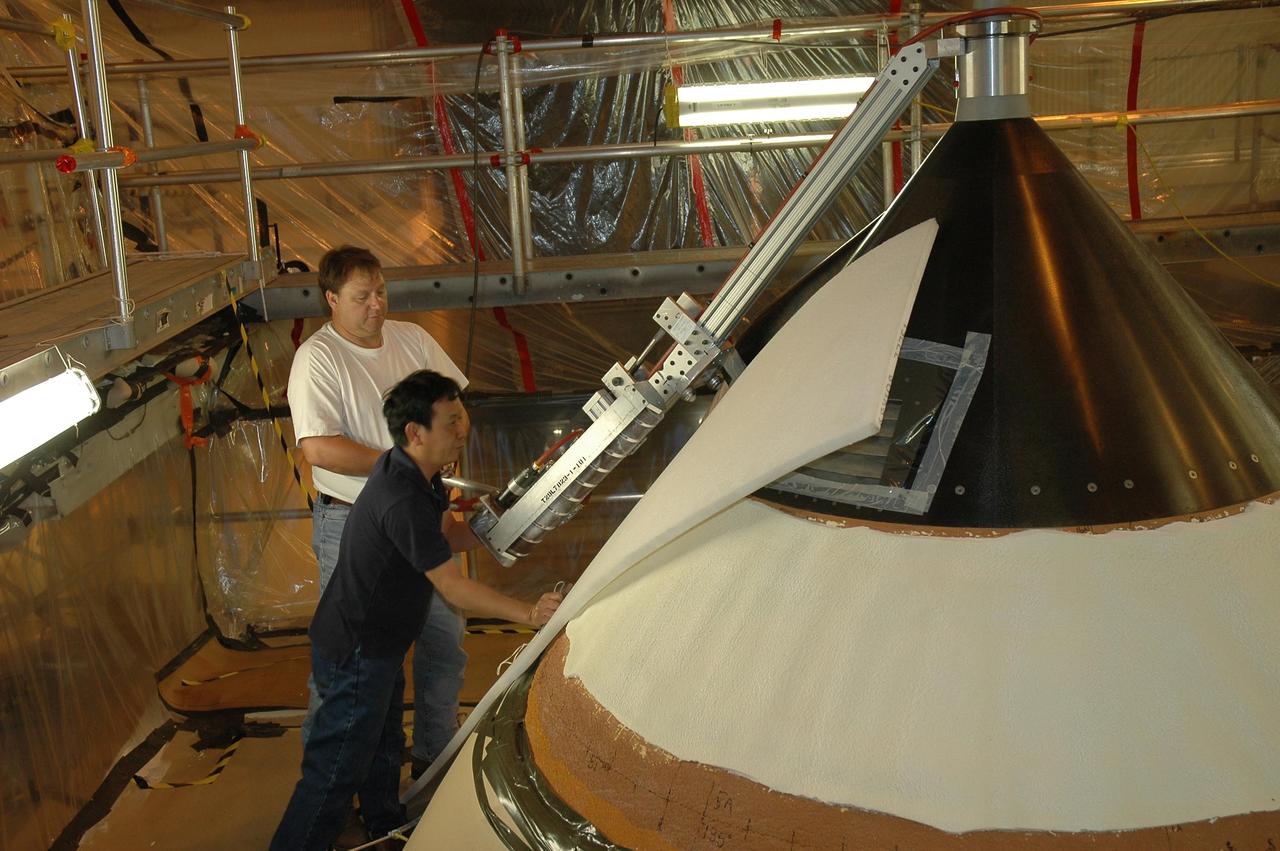
KENNEDY SPACE CENTER, FLA. -- In NASA Kennedy Space Center's Vehicle Assembly Building, one technician adjusts the sander while another observes as they work on repairing the hail damage to Atlantis' nose cone. In late February, Atlantis' external tank received hail damage during a severe thunderstorm that passed through the Kennedy Space Center Launch Complex 39 area. The hail caused visible divots in the giant tank's foam insulation as well as minor surface damage to about 26 heat shield tiles on the shuttle's left wing. The launch of Space Shuttle Atlantis on mission STS-117 now is targeted for June 8. Photo credit: NASA/Jack Pfaller
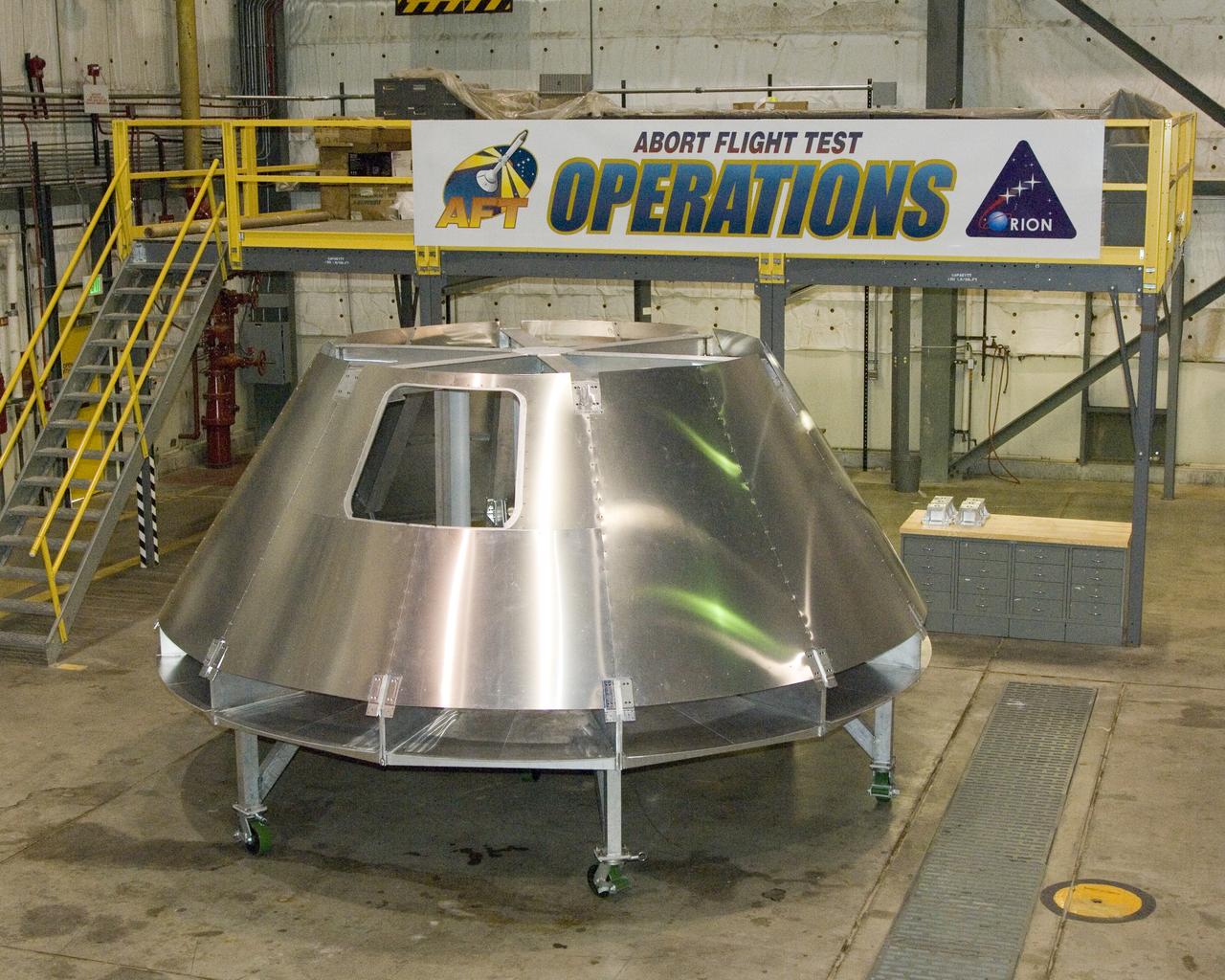
NASA Dryden's mockup Orion crew module is located in Dryden's Shuttle hangar, where abort flight test equipment is being positioned.
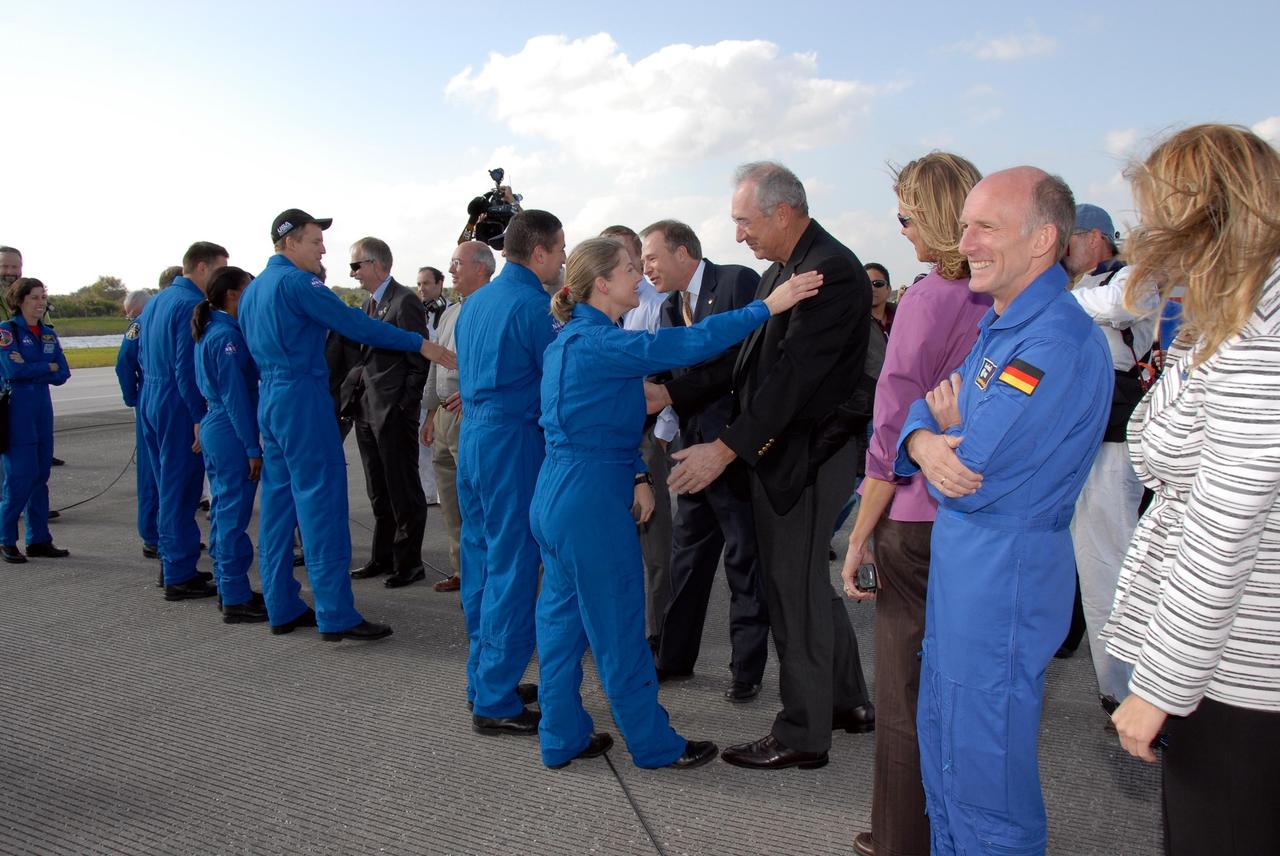
KENNEDY SPACE CENTER, FLA. -- The STS-120 crew members are greeted by NASA and Kennedy VIPs after completing their successful mission. From left are STS-120 mission specialists Doug Wheelock, Stephanie Wilson and Scott Parazynski, Pilot George Zamka and Commander Pamela Melroy. The NASA VIPs include NASA Administrator Mike Griffin, Associate Administrator for NASA Space Operations William Gerstenmaier and Shuttle Program Manager Wayne Hale. The lineup also includes Shuttle Launch Director Mike Leinbach. Melroy and the Discovery crew completed the 15-day mission STS-120, with an on-time landing at 1:01:16 p.m. Wheel stop was at 1:02:07 p.m. Mission elapsed time was 15 days, 2 hours, 24 minutes and 2 seconds. Mission elapsed time was 15 days, 2 hours, 24 minutes and 2 seconds. Mission STS-120 continued the construction of the station with the installation of the Harmony Node 2 module and the relocation of the P6 truss. Photo credit: NASA/Kim Shiflett
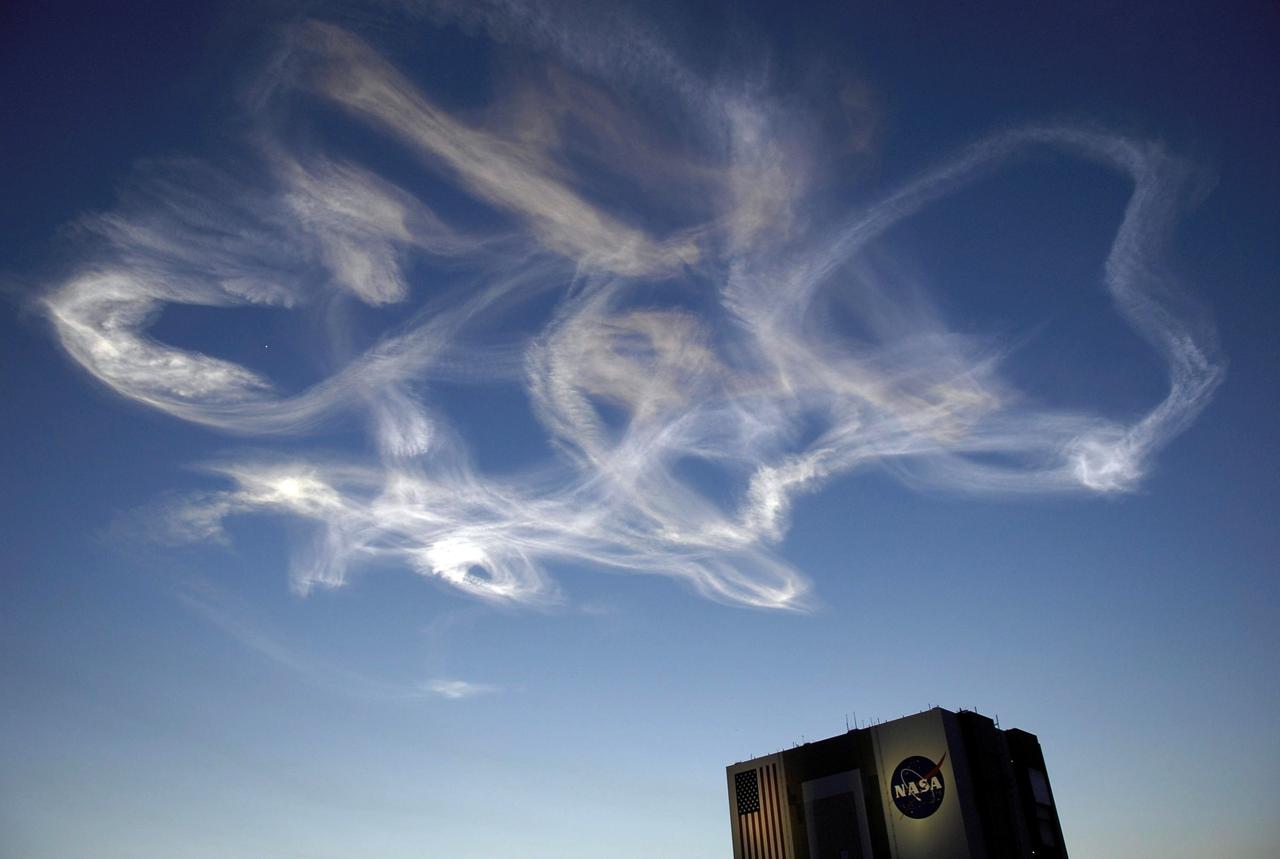
STS117-S-012 (8 June 2007) --- The drifting smoke plumes from the launch of Space Shuttle Atlantis (out of frame) swirl above the Vehicle Assembly Building near sunset. Atlantis and its seven-member STS-117 crew head toward Earth-orbit and a scheduled link-up with the International Space Station. Liftoff from Kennedy Space Center's launch pad 39A occurred at 7:38 p.m. (EDT) on June 8, 2007. Onboard are astronauts Rick Sturckow, commander; Lee Archambault, pilot; Jim Reilly, Patrick Forrester, John "Danny" Olivas, Steven Swanson and Clayton Anderson, all mission specialists. Anderson will join Expedition 15 in progress to serve as a flight engineer aboard the station. Atlantis will dock with the orbital outpost on Sunday, June 10, to begin a joint mission that will increase the complex's power generation capability. Using the shuttle and station robotic arms and conducting three scheduled spacewalks, the astronauts will install another set of giant solar array wings on the station and retract another array, preparing it for a future move.
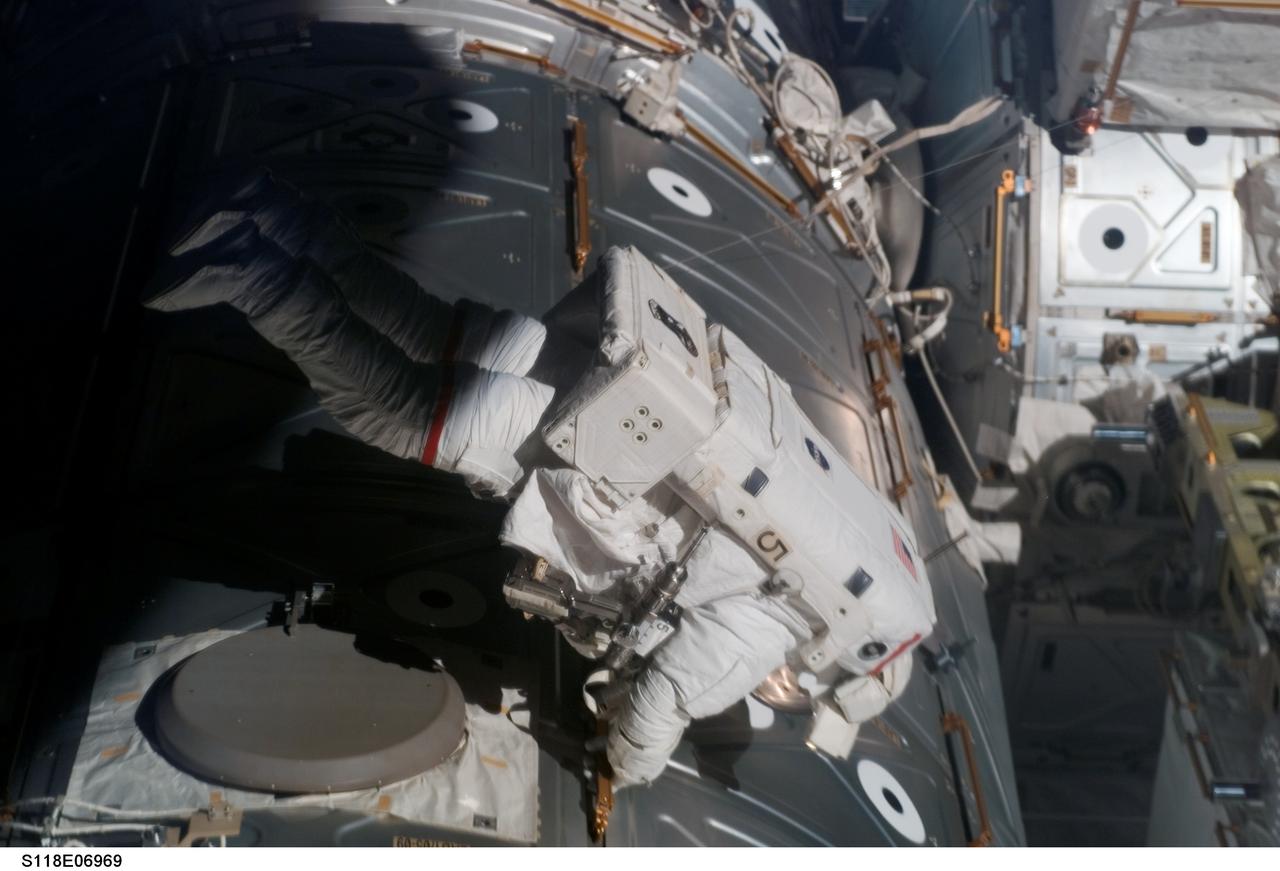
S118-E-06969 (13 Aug. 2007) --- Astronaut Rick Mastracchio, STS-118 mission specialist, participates in the mission's second planned session of extravehicular activity (EVA) as construction and maintenance continue on the International Space Station. During the 6-hour, 28-minute spacewalk, Mastracchio and astronaut Dave Williams (out of frame), mission specialist representing the Canadian Space Agency, removed a faulty control moment gyroscope (CMG-3) and installed a new CMG into the station's Z1 truss. The failed CMG will remain at its temporary stowage location on the station's exterior until it is returned to Earth on a later shuttle mission. The new gyroscope is one of four CMGs that are used to control the station's attitude in orbit.
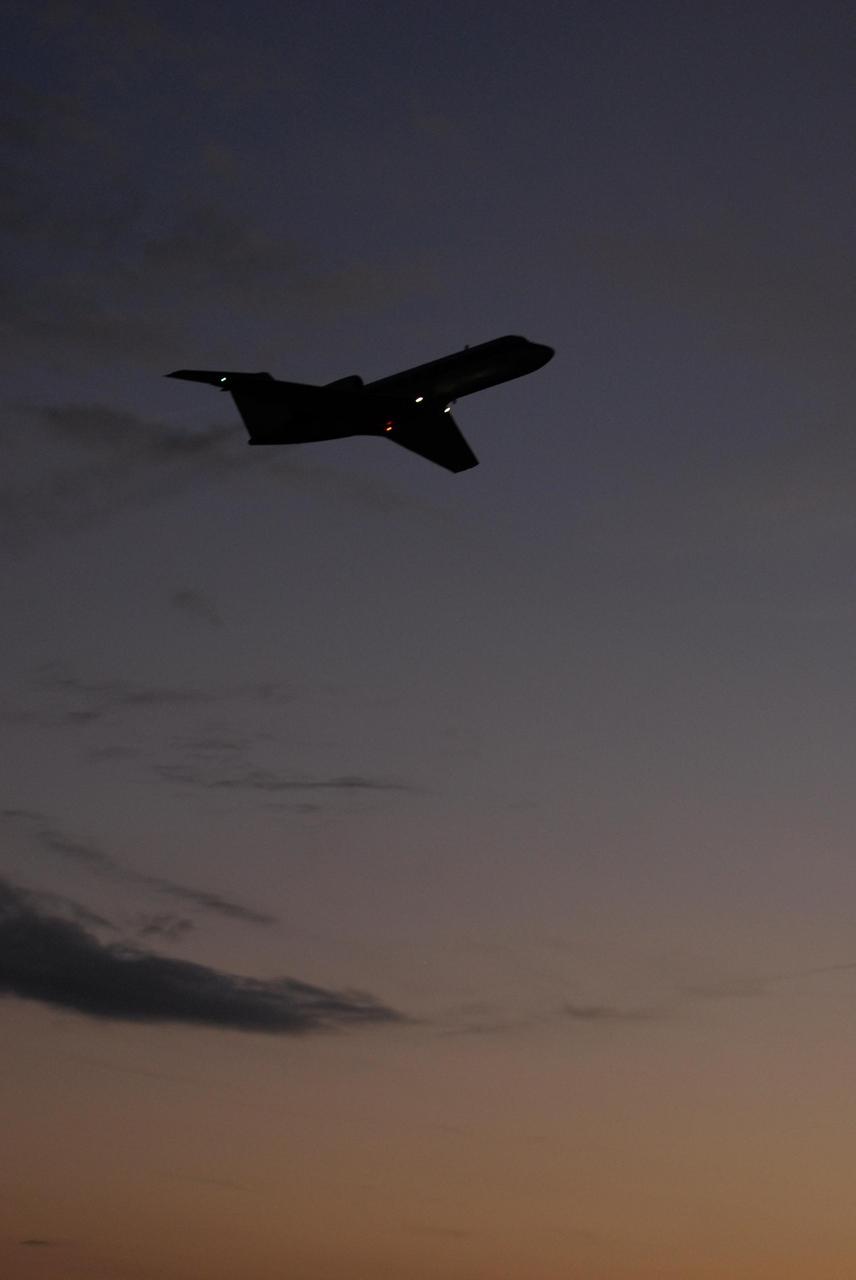
KENNEDY SPACE CENTER, FLA. -- A shuttle training aircraft, or STA, takes off from Kennedy Space Center's Shuttle Landing Facility at dusk. The STA is being used for practice flights by space shuttle Atlantis STS-122 Commander Steve Frick and Pilot Alan Poindexter. The STA is a Grumman American Aviation-built Gulf Stream II jet that was modified to simulate an orbiter's cockpit, motion and visual cues, and handling qualities. In flight, the STA duplicates the orbiter's atmospheric descent trajectory from approximately 35,000 feet altitude to landing on a runway. Because the orbiter is unpowered during re-entry and landing, its high-speed glide must be perfectly executed the first time. The training is part of terminal countdown demonstration test, or TCDT, activities. The TCDT provides astronauts and ground crews with equipment familiarization, emergency egress training and a simulated launch countdown. On mission STS-122, Atlantis will deliver the European Space Agency's Columbus module to the International Space Station. Columbus is a multifunctional, pressurized laboratory that will be permanently attached to U.S. Node 2, called Harmony, and will expand the research facilities aboard the station. Launch is targeted for Dec. 6. Photo credit: NASA/Kim Shiflett
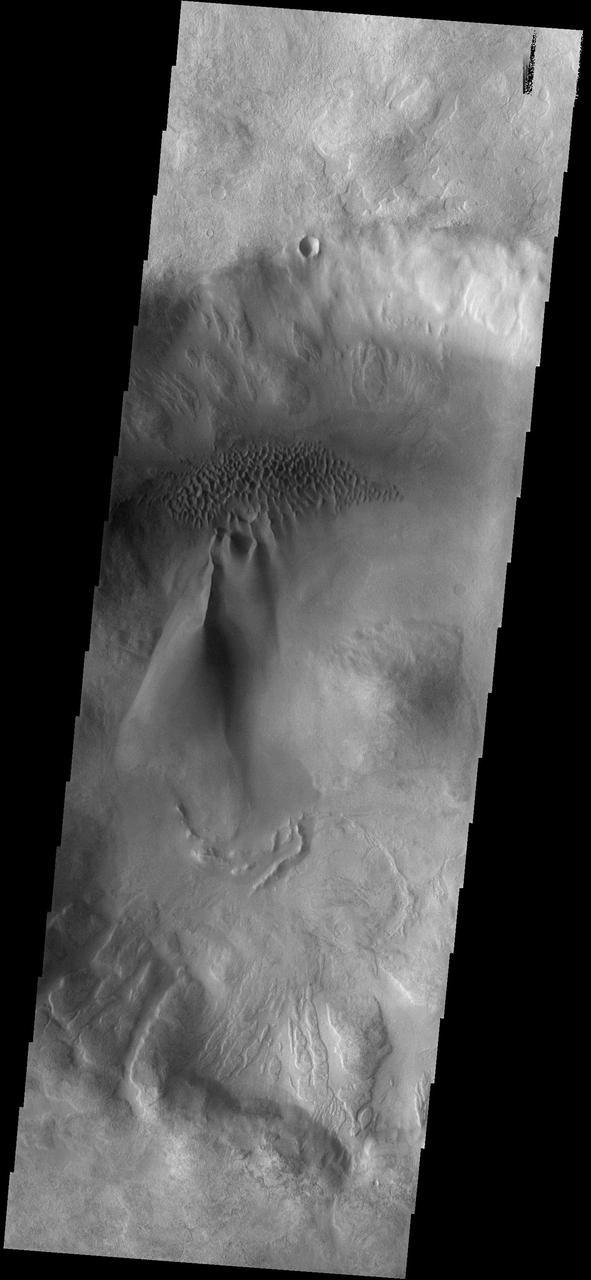
Dune Types
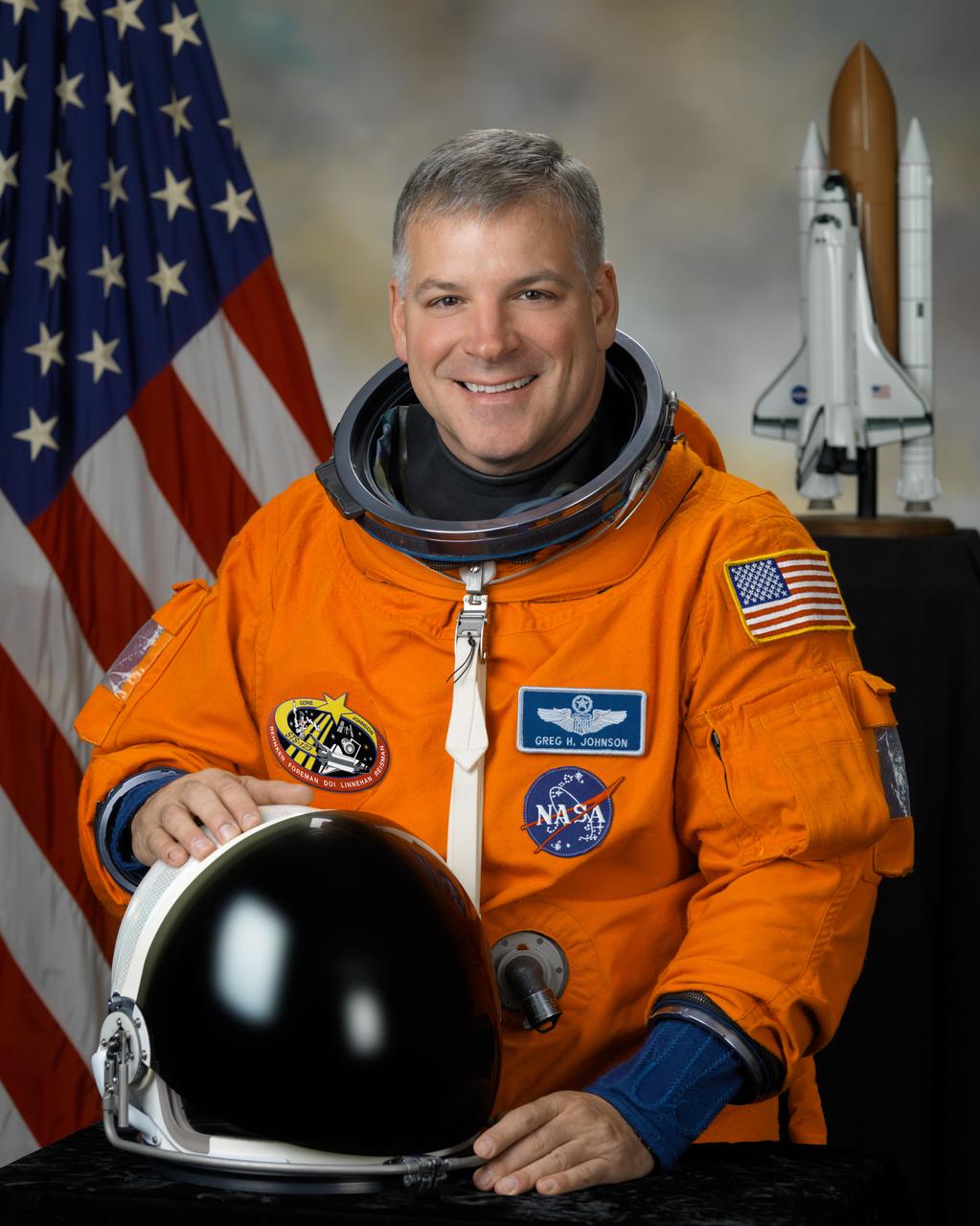
JSC2008-E-000184 (24 Oct. 2007) --- NASA astronaut Gregory H. Johnson, pilot. Photo credit: NASA or National Aeronautics and Space Administration
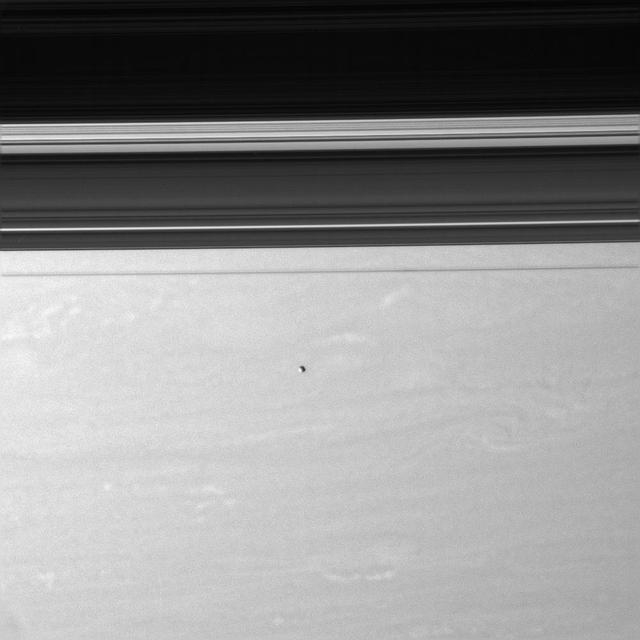
Epimetheus floats above Saturn swirling skies
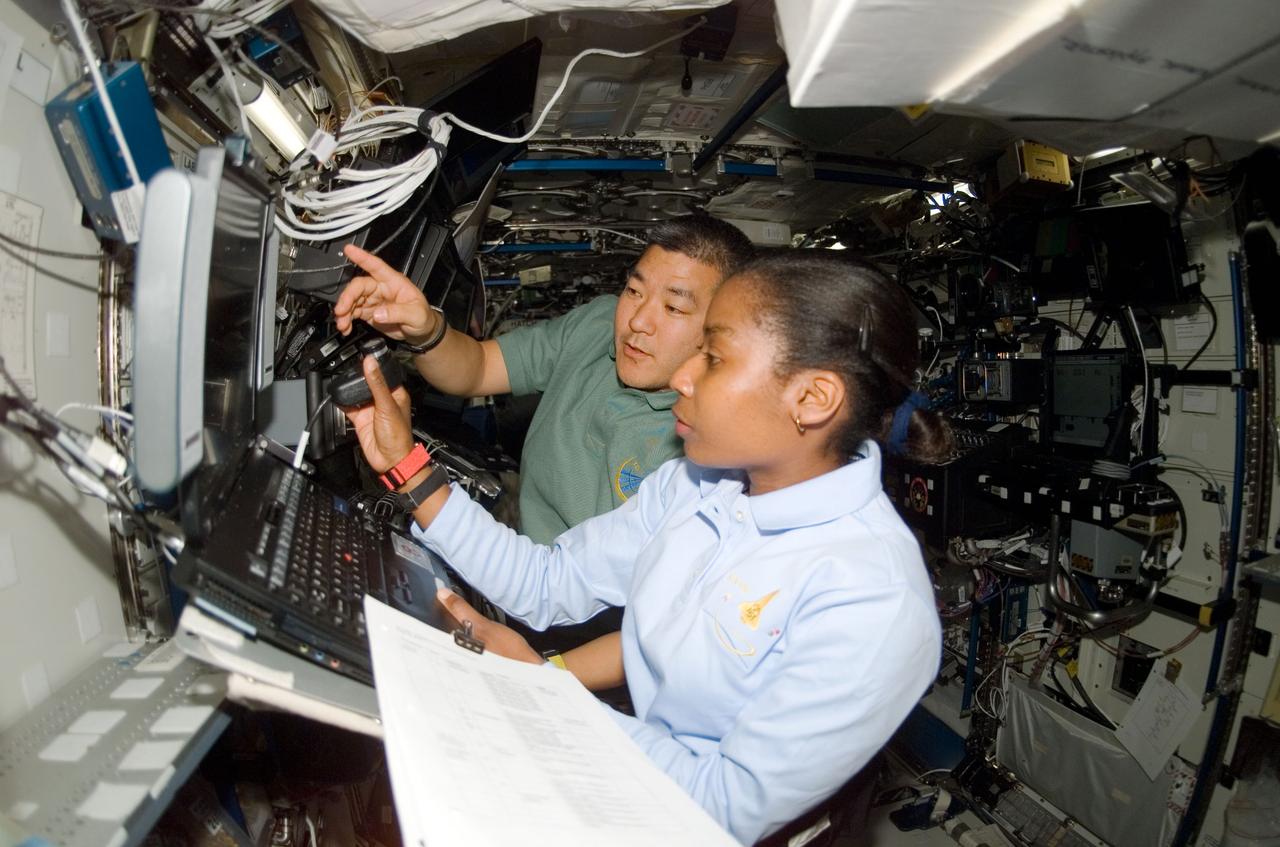
ISS016-E-008075 (30 Oct. 2007) --- Astronauts Stephanie Wilson, STS-120 mission specialist; and Daniel Tani, Expedition 16 flight engineer, work the controls of the Space Station Remote Manipulator System (SSRMS) or Canadarm2 in the Destiny laboratory of the International Space Station while Space Shuttle Discovery is docked with the station.
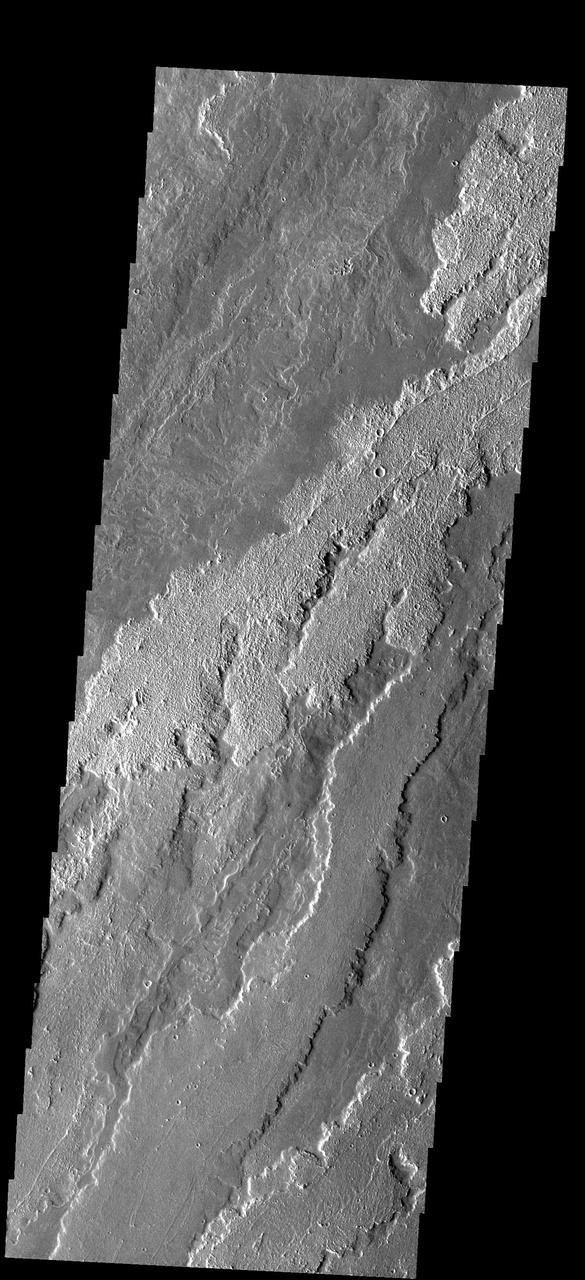
Arsia Mons Flows
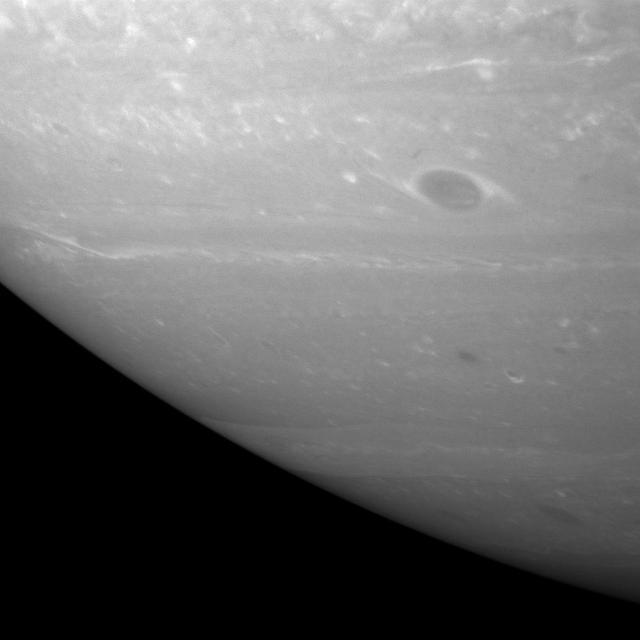
The Storms Within
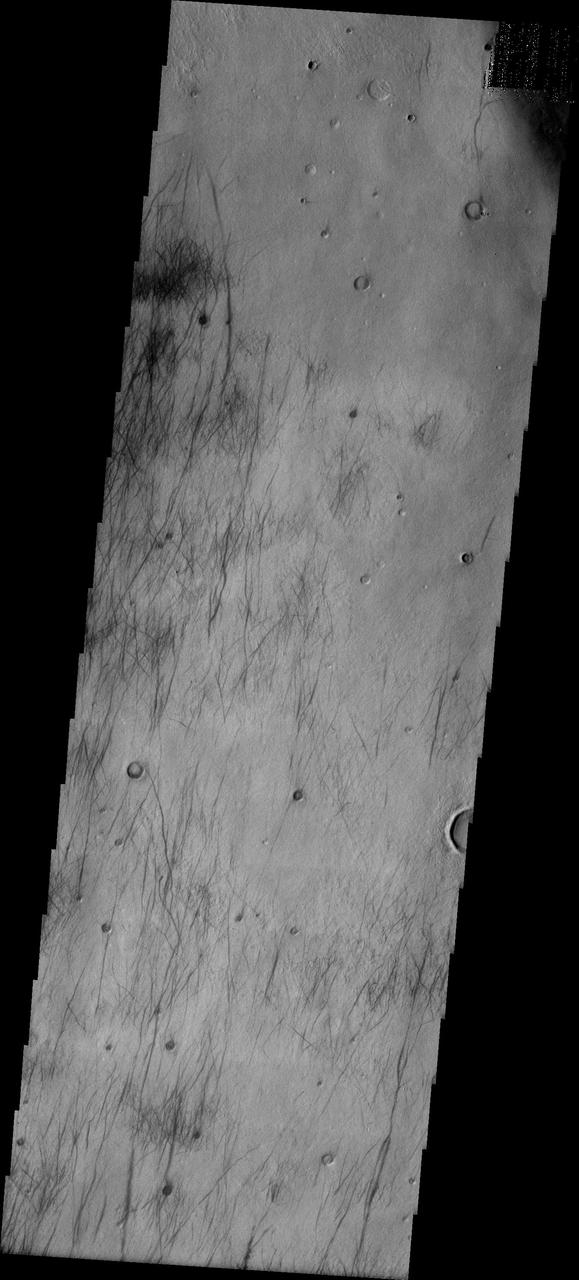
Dust Devil Tracks
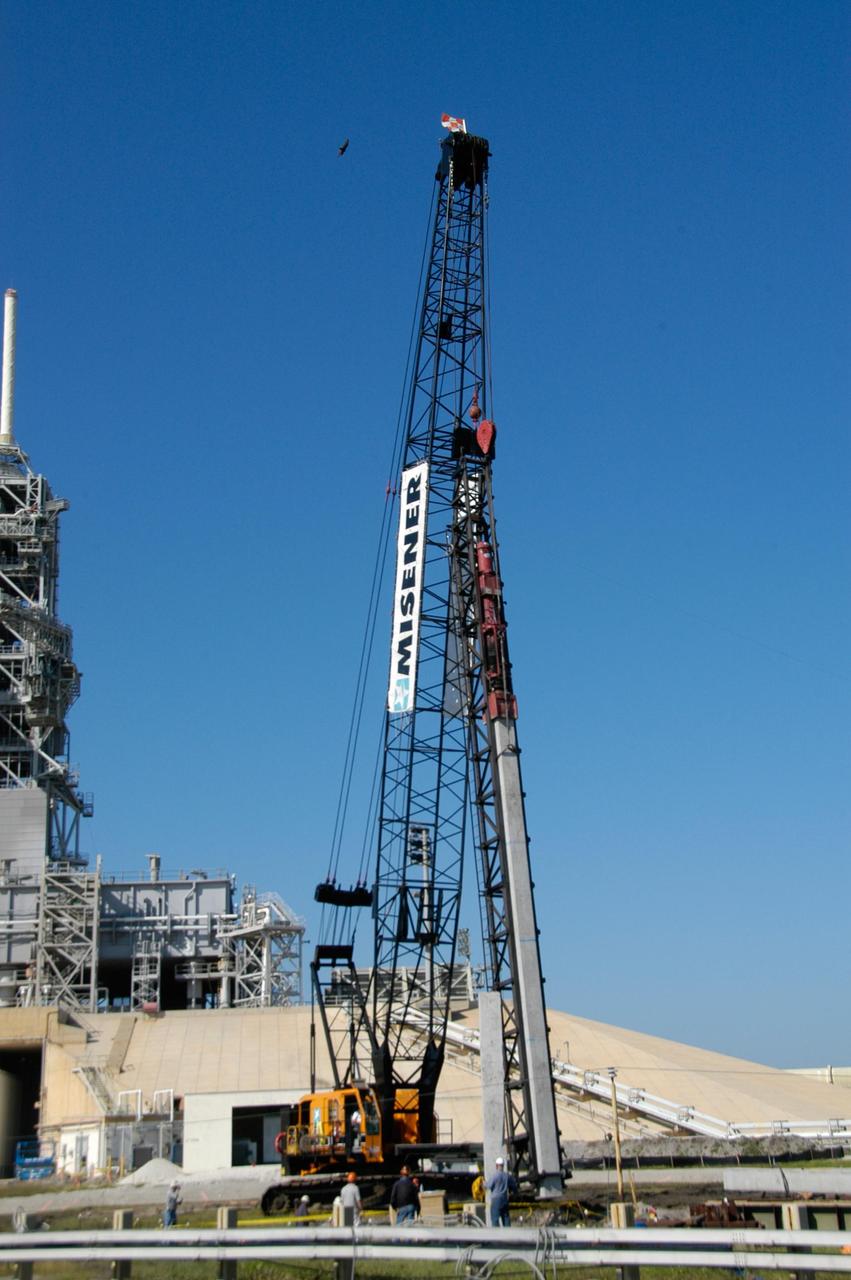
KENNEDY SPACE CENTER, FLA. -- On Launch Pad 39B at NASA's Kennedy Space Center, the crane crawler lifts a piling into place to be pounded into the ground to help construct lightning towers for the Constellation Program and Ares/Orion launches. Pad B will be the site of the first Ares vehicle launch, including Ares I-X which is scheduled for April 2009. Photo credit: NASA/George Shelton
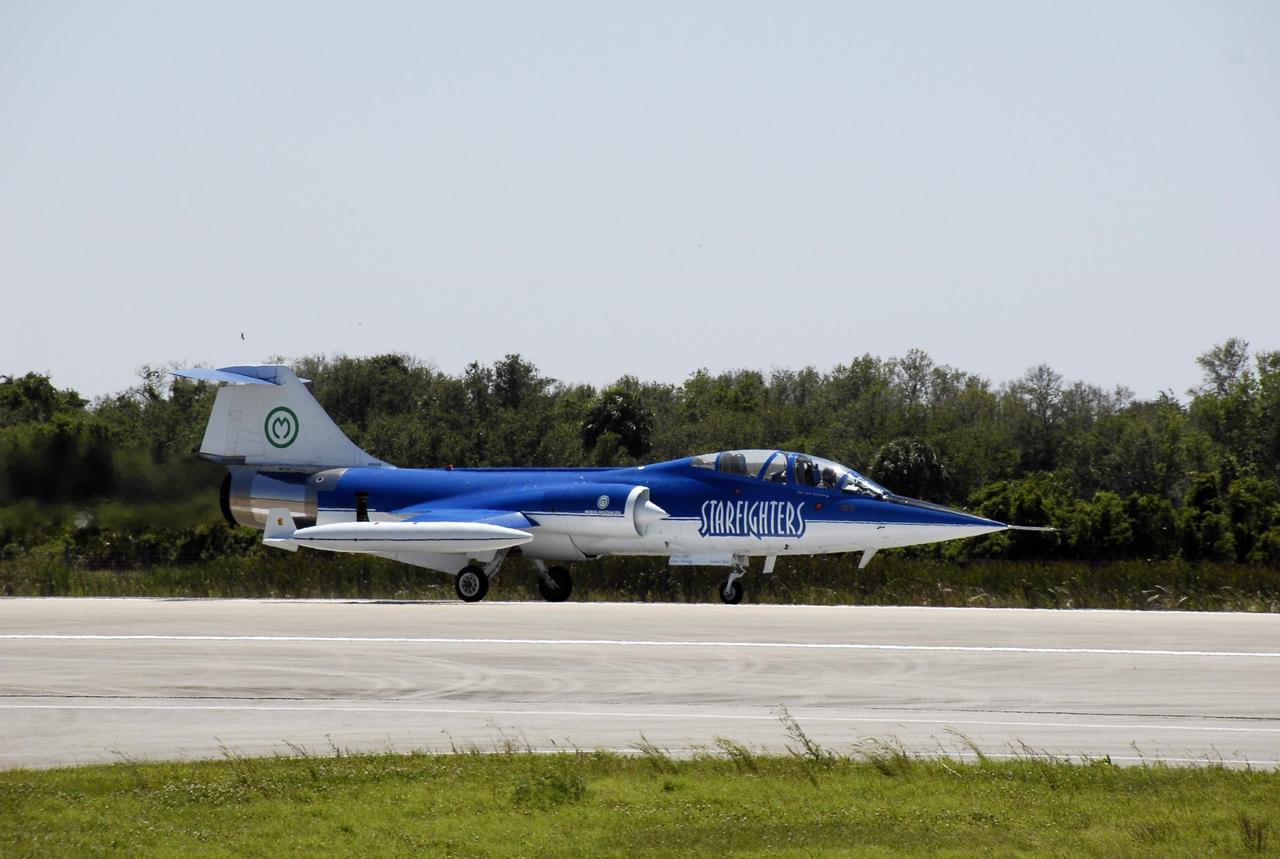
KENNEDY SPACE CENTER, FLA. -- A Starfighter F-104 piloted by Rick Svetkoff lands on the Shuttle Landing Facility at Kennedy Space Center. The aircraft will take part in a series of pathfinder test missions from the space shuttle runway. Two flights will generate test data to validate sonic boom assumptions about the potential impacts of suborbital and orbital commercial spaceflight from the facility. NASA is assessing the environmental impact of such flights. Starfighters Inc. of Clearwater, Fla., will perform the flights to help in assessing suborbital space launch trajectories from the runway and paving the way for future commercial space tourism and research flights from the facility. Photo credit: NASA/Kim Shiflett
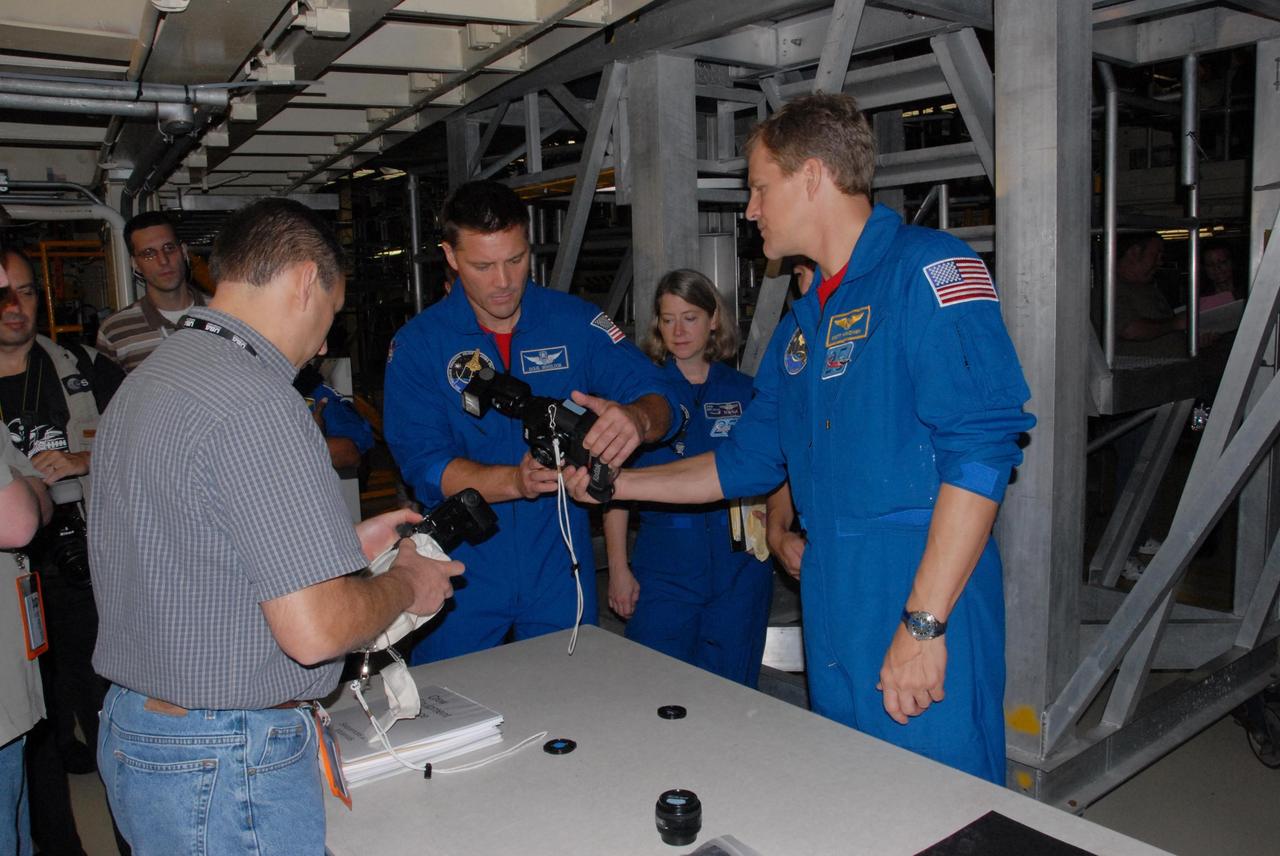
KENNEDY SPACE CENTER, FLA. - The STS-120 crew is at Kennedy for a crew equipment interface test, or CEIT. From left in blue flight suits, STS-120 Mission Specialist Douglas H. Wheelock, Commander Pamela A. Melroy and Mission Specialist Scott E. Parazynski receive instruction in Orbiter Processing Facility bay 3 on the operation of cameras that will fly on their mission. Among the activities standard to a CEIT are harness training, inspection of the thermal protection system and camera operation for planned extravehicular activities, or EVAs. The STS-120 mission will deliver the Harmony module, christened after a school contest, which will provide attachment points for European and Japanese laboratory modules on the International Space Station. Known in technical circles as Node 2, it is similar to the six-sided Unity module that links the U.S. and Russian sections of the station. Built in Italy for the United States, Harmony will be the first new U.S. pressurized component to be added. The STS-120 mission is targeted to launch on Oct. 20. Photo credit: NASA/George Shelton
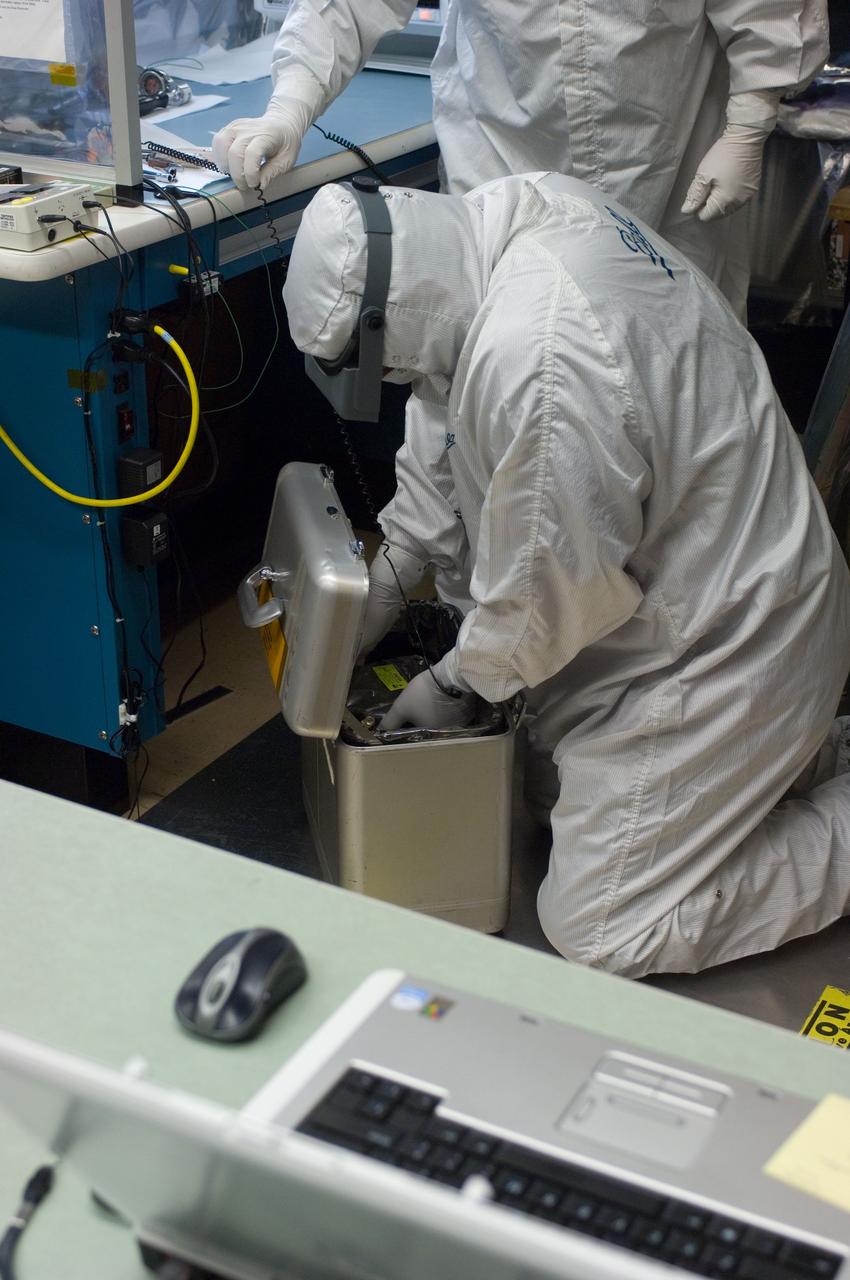
Kepler project; technicians from Ball Aerospace work on and in the test chamber assembled at Nasa Ames Research center testing components

KENNEDY SPACE CENTER, FLA. -- In Building 1555 on North Vandenberg Air Force Base in California, technicians look over the spacecraft handling fixture that will be used to lift the AIM spacecraft. AIM, which stands for Aeronomy of Ice in the Mesosphere, is being prepared for integrated testing and a flight simulation. The AIM spacecraft will fly three instruments designed to study polar mesospheric clouds located at the edge of space, 50 miles above the Earth's surface in the coldest part of the planet's atmosphere. The mission's primary goal is to explain why these clouds form and what has caused them to become brighter and more numerous and appear at lower latitudes in recent years. AIM's results will provide the basis for the study of long-term variability in the mesospheric climate and its relationship to global climate change. AIM is scheduled to be mated to its launch vehicle, Orbital Sciences' Pegasus XL, during the second week of April, after which final inspections will be conducted. Launch is scheduled for April 25.
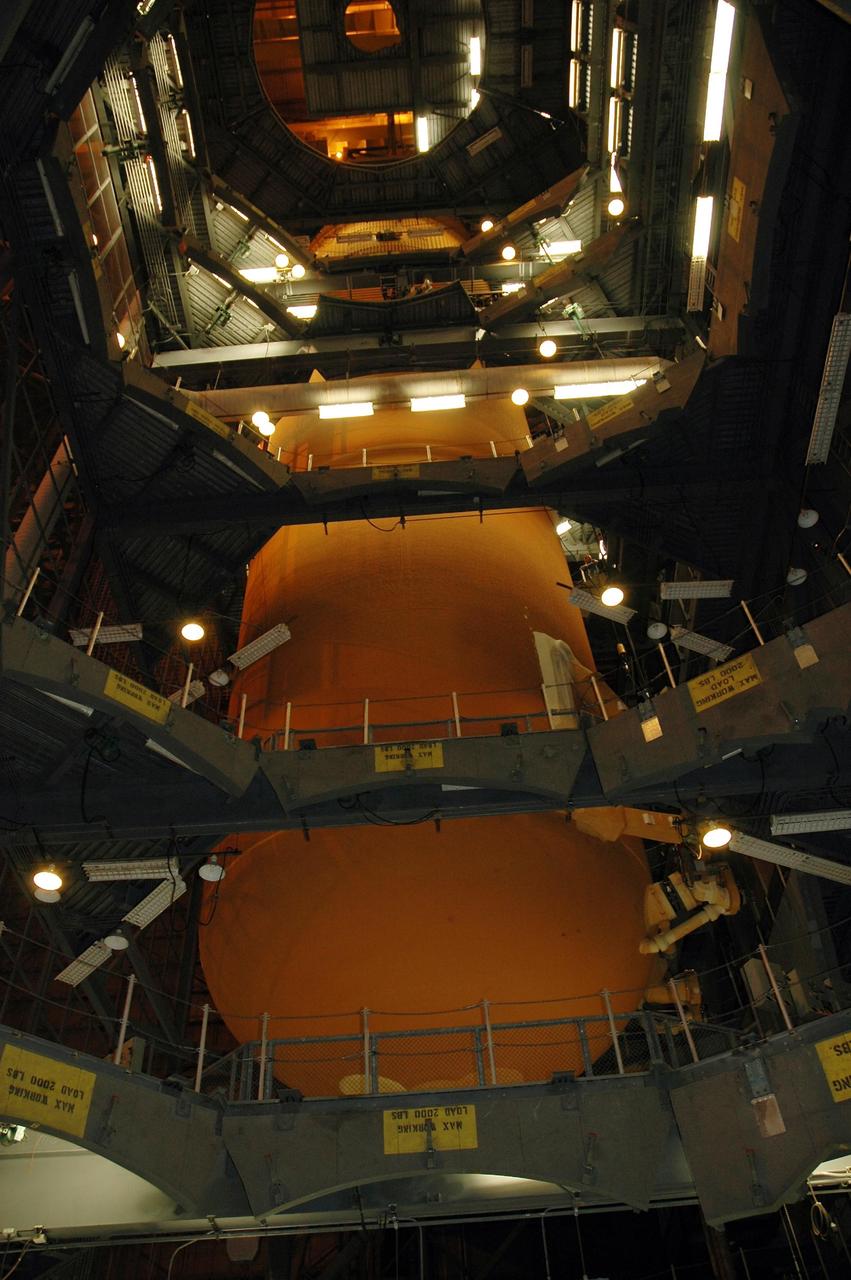
KENNEDY SPACE CENTER, FLA. -- The external tank for Endeavour is being lifted from the checkout cell inside the Vehicle Assembly Building for mating with the solid rocket boosters. Endeavour is currently targeted for rollover to the VAB July 5. Endeavour is the designated orbiter for mission STS-118, targeted for launch on Aug. 9 to the International Space Station. The mission will continue space station construction by delivering a third starboard truss segment, S5, as well as carrying the external stowage platform 3. Photo credit: NASA/Amanda Diller
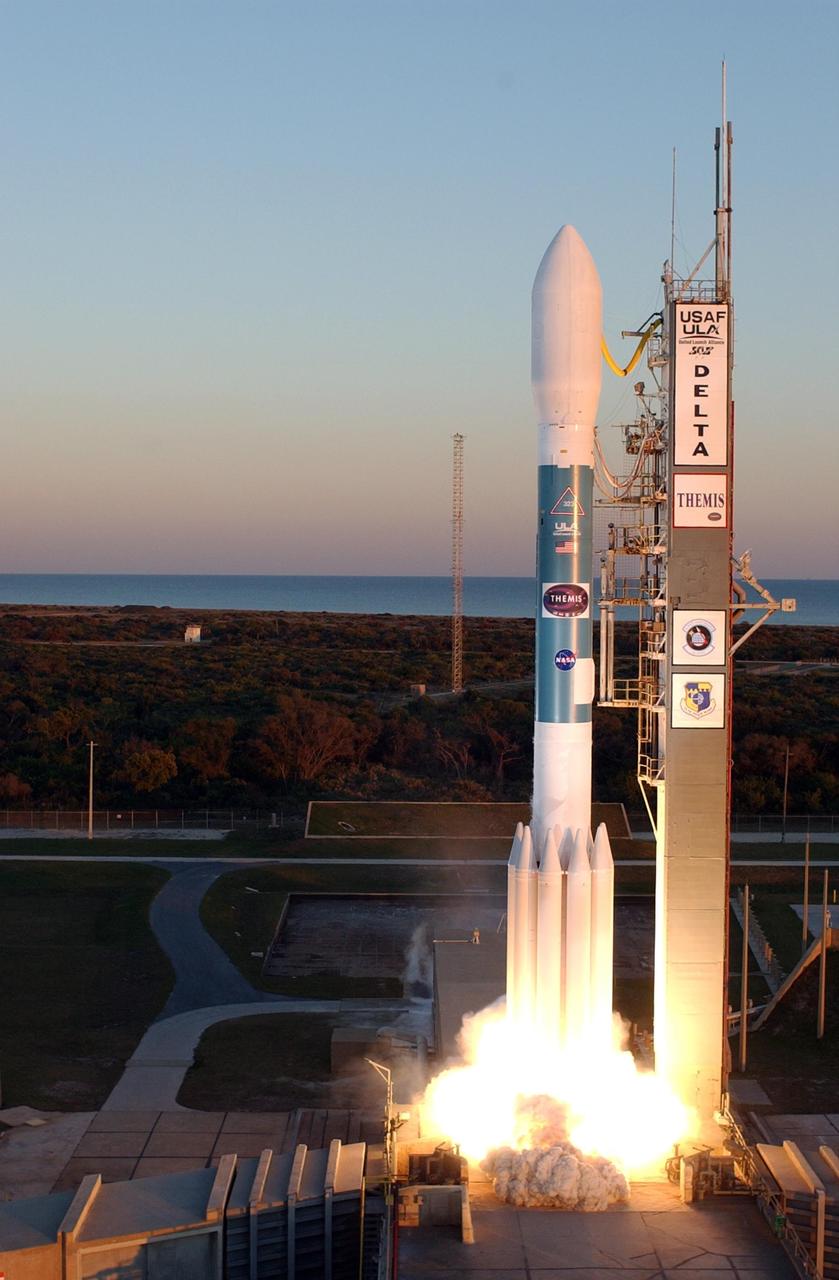
KENNEDY SPACE CENTER, FLA. -- At Cape Canaveral Air Force Station, the Delta II rocket with NASA's THEMIS spacecraft aboard begins its ascent from Pad 17-B, in sight of the Atlantic Ocean, at 6:01 p.m. EST. THEMIS, an acronym for Time History of Events and Macroscale Interactions during Substorms, consists of five identical probes that will track violent, colorful eruptions near the North Pole. This will be the largest number of scientific satellites NASA has ever launched into orbit aboard a single rocket. The THEMIS mission aims to unravel the mystery behind auroral substorms, an avalanche of magnetic energy powered by the solar wind that intensifies the northern and southern lights. The mission will investigate what causes auroras in the Earth’s atmosphere to dramatically change from slowly shimmering waves of light to wildly shifting streaks of bright color. Photo credit: NASA/Regina MItchell-Ryall, Robert Murray, Tony Gray
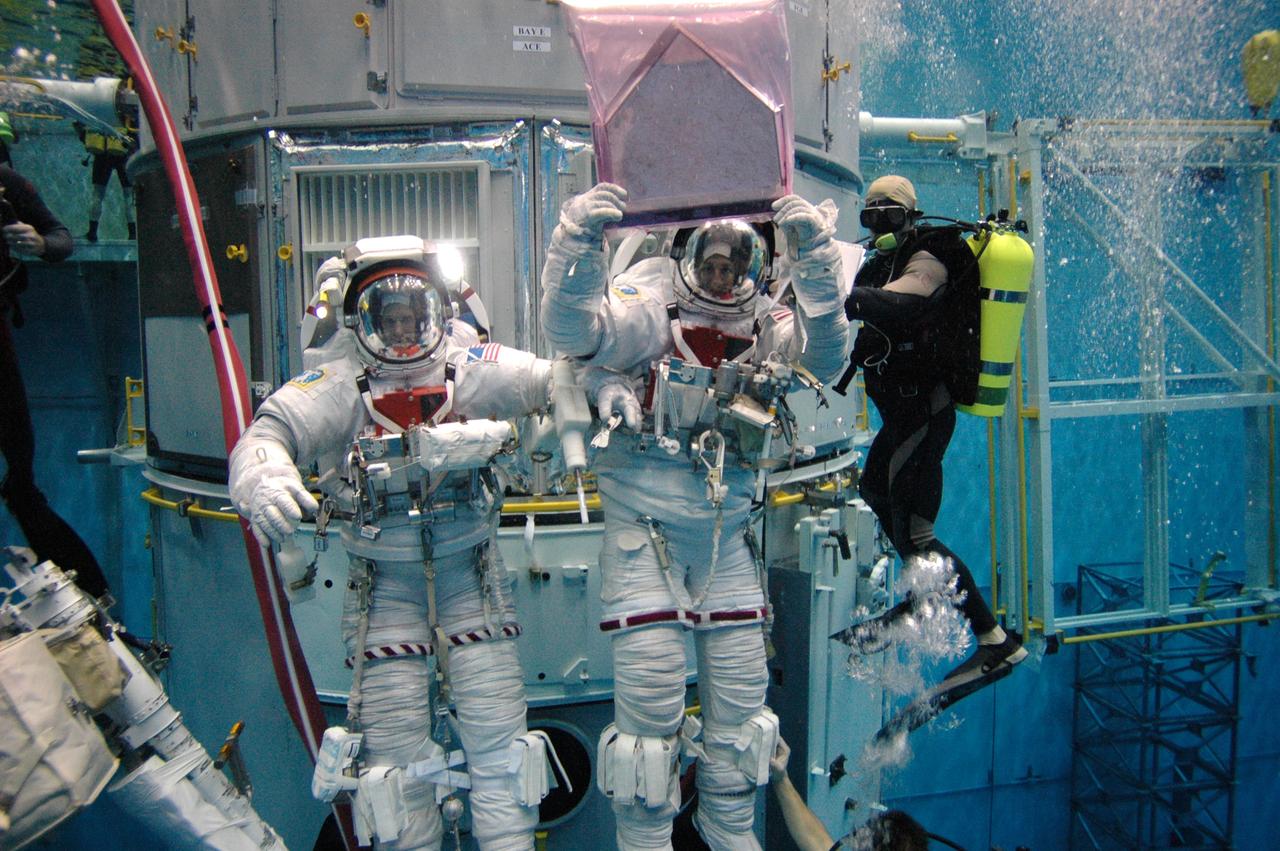
JSC2008-E-096965 (December 2007) --- Astronauts Mike Massimino (right) and Mike Good, STS-125 mission specialists, with home plate from New York City's Shea Stadium during a break from their training in the JSC Neutral Buoyancy Lab. The plate will fly with the STS-125 crew aboard the Space Shuttle Atlantis. (Photo Credit: NASA)

This unnamed channel complex in nothern Arabia Terra contains several different surface textures on the channel floor. The parallel ridges are unusally indicative of materials which contain volatiles
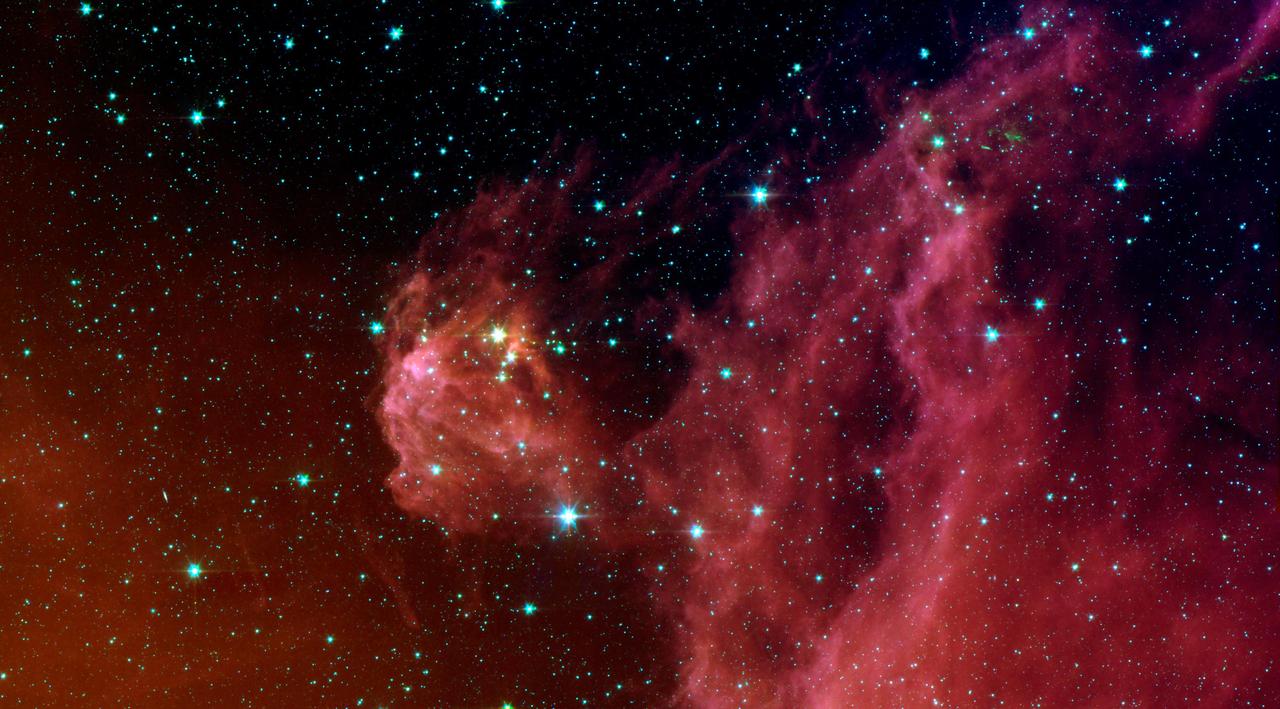
This image from NASA's Spitzer Space Telescope shows infant stars "hatching" in the head of the hunter constellation, Orion. Astronomers suspect that shockwaves from a supernova explosion in Orion's head, nearly three million years ago, may have initiated this newfound birth . The region featured in this Spitzer image is called Barnard 30. It is located approximately 1,300 light-years away and sits on the right side of Orion's "head," just north of the massive star Lambda Orionis. Wisps of red in the cloud are organic molecules called polycyclic aromatic hydrocarbons. These molecules are formed anytime carbon-based materials are burned incompletely. On Earth, they can be found in the sooty exhaust from automobile and airplane engines. They also coat the grills where charcoal-broiled meats are cooked. This image shows infrared light captured by Spitzer's infrared array camera. Light with wavelengths of 8 and 5.8 microns (red and orange) comes mainly from dust that has been heated by starlight. Light of 4.5 microns (green) shows hot gas and dust; and light of 3.6 microns (blue) is from starlight. http://photojournal.jpl.nasa.gov/catalog/PIA09412
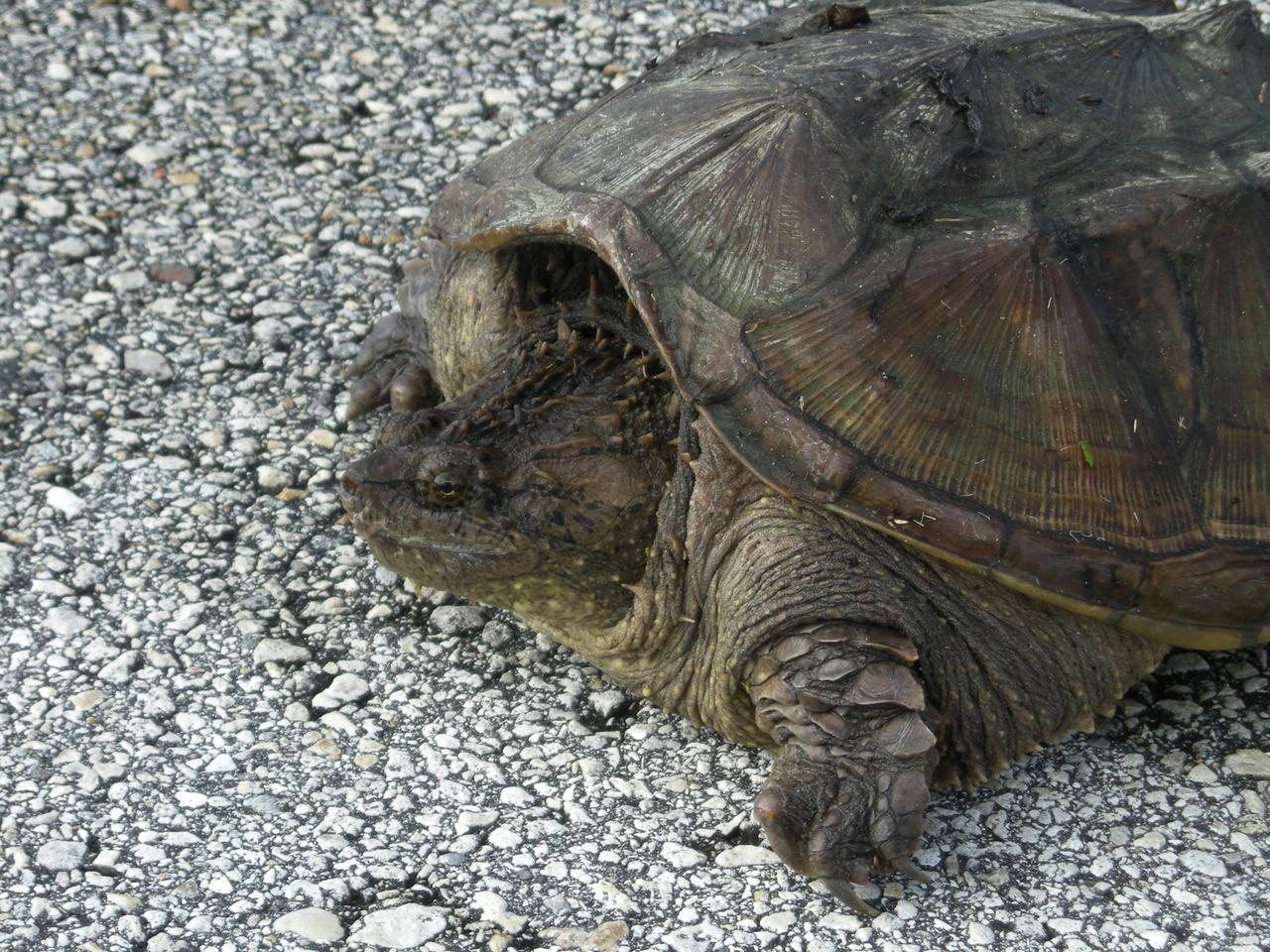
KENNEDY SPACE CENTER, FLA. -- A rare photo of a Florida snapping turtle out in the open on Beach Road, near NASA's Kennedy Space Center. Found only in Florida and Georgia, this species is related to the common snapping turtle. It is considered a dangerous turtle because it can snap very quickly with its extremely strong jaws. Its tail, which is almost as long as its shell, has saw-edges along the top. The shell also has rough points down the middle. The shell is tan to dark brown and may have green algae growing on it. It can grow to 17 inches long and weigh 45 pounds. Snapping turtles usually live in ponds under the shadows and don’t like to rest in the sun like most turtles. They eat almost anything: water bugs, fish, lizards, small birds, mice, plants and even dead animals. Photo credit: NASA/Kenny Allen
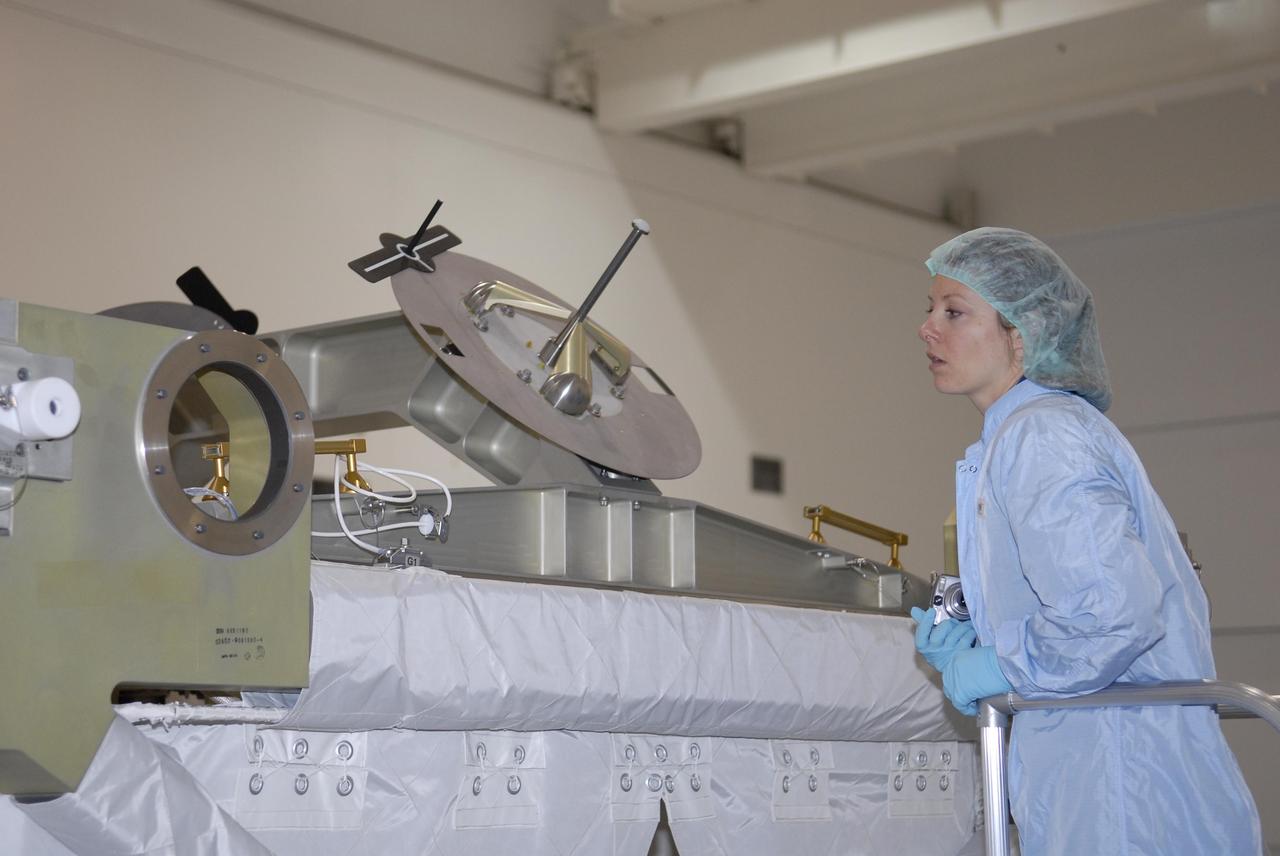
KENNEDY SPACE CENTER, FLA. -- The STS-118 crew members look over parts of the mission payload, the S5 integrated truss, in the Space Station Processing Facility during crew equipment interface test activities. Seen here is Mission Specialist Tracy Caldwell, who will be making her first space shuttle flight. The crew comprises Commander Scott Kelly, Pilot Charles Hobaugh, and Mission Specialists Dr. Dafydd Williams, Barbara Morgan, Richard Mastracchio, Caldwell and Benjamin Drew. Williams is with the Canadian Space Agency. The STS-118 mission will be delivering the third starboard truss segment, the ITS S5, to the International Space Station, and a SPACEHAB Single Cargo module with supplies and equipment. Launch aboard Space Shuttle Endeavour is targeted for August. Photo credit: NASA/Kim Shiflett
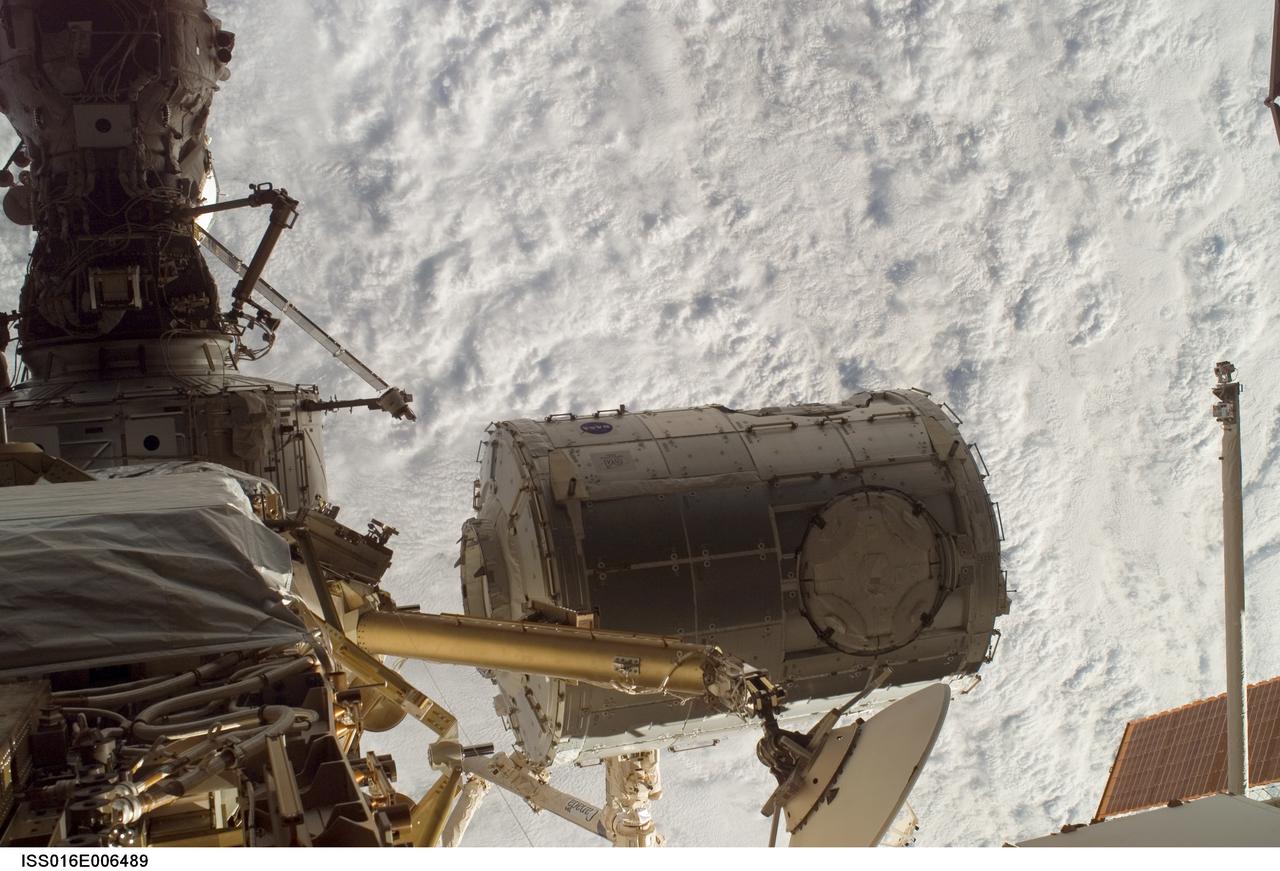
ISS016-E-006489 (26 Oct. 2007) --- In the grasp of the station's Canadarm2, the Harmony module (center) is moved from its stowage position in the cargo bay of the Space Shuttle Discovery (STS-120) to its temporary location on the International Space Station.

ISS015-E-11759 (10 June 2007) --- Backdropped by a blue and white Earth, the Space Shuttle Atlantis approaches the International Space Station during STS-117 rendezvous and docking operations. Docking occurred at 2:36 p.m. (CDT) on June 10, 2007. A pair of solar arrays and starboard truss segments (S3/S4), which are later to be attached to the station and outfitted during three spacewalks, can be seen in Atlantis' cargo bay. A docked Soyuz spacecraft is visible at top center.
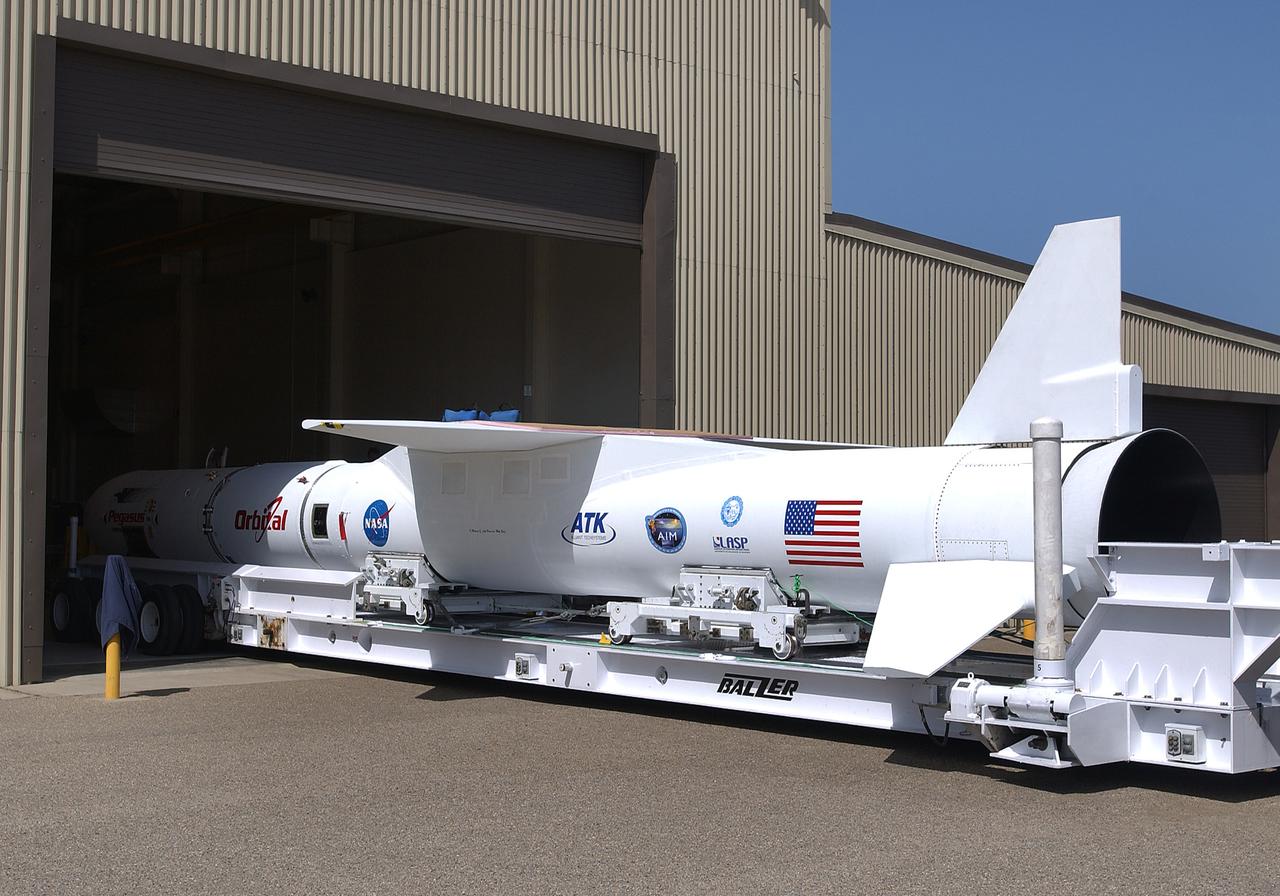
The mated Pegasus XL rocket - AIM spacecraft leaves Building 1655 at Vandenberg Air Force Base in California. The rocket will be transferred to a waiting Orbital Sciences Stargazer L-1011 aircraft for launch. AIM, which stands for Aeronomy of Ice in the Mesosphere, is being prepared for integrated testing and a flight simulation. The AIM spacecraft will fly three instruments designed to study polar mesospheric clouds located at the edge of space, 50 miles above the Earth's surface in the coldest part of the planet's atmosphere. The mission's primary goal is to explain why these clouds form and what has caused them to become brighter and more numerous and appear at lower latitudes in recent years. AIM's results will provide the basis for the study of long-term variability in the mesospheric climate and its relationship to global climate change. Launch is scheduled for April 25.
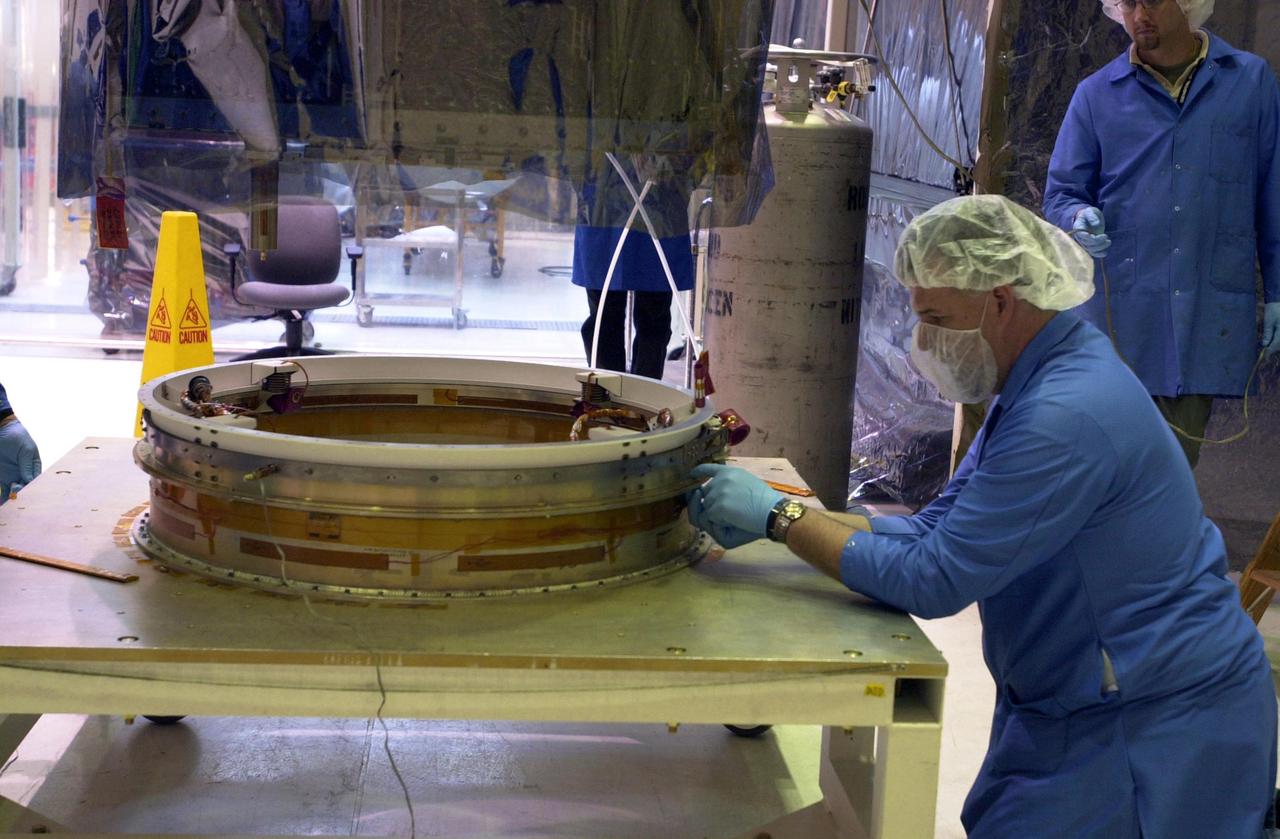
KENNEDY SPACE CENTER, FLA. -- In Building 1555 on North Vandenberg Air Force Base in California, technicians work on the separation system to be mated to the AIM spacecraft, hovering above it. AIM, which stands for Aeronomy of Ice in the Mesosphere, is being prepared for integrated testing and a flight simulation. The AIM spacecraft will fly three instruments designed to study polar mesospheric clouds located at the edge of space, 50 miles above the Earth's surface in the coldest part of the planet's atmosphere. The mission's primary goal is to explain why these clouds form and what has caused them to become brighter and more numerous and appear at lower latitudes in recent years. AIM's results will provide the basis for the study of long-term variability in the mesospheric climate and its relationship to global climate change. AIM is scheduled to be mated to its launch vehicle, Orbital Sciences' Pegasus XL, during the second week of April, after which final inspections will be conducted. Launch is scheduled for April 25.
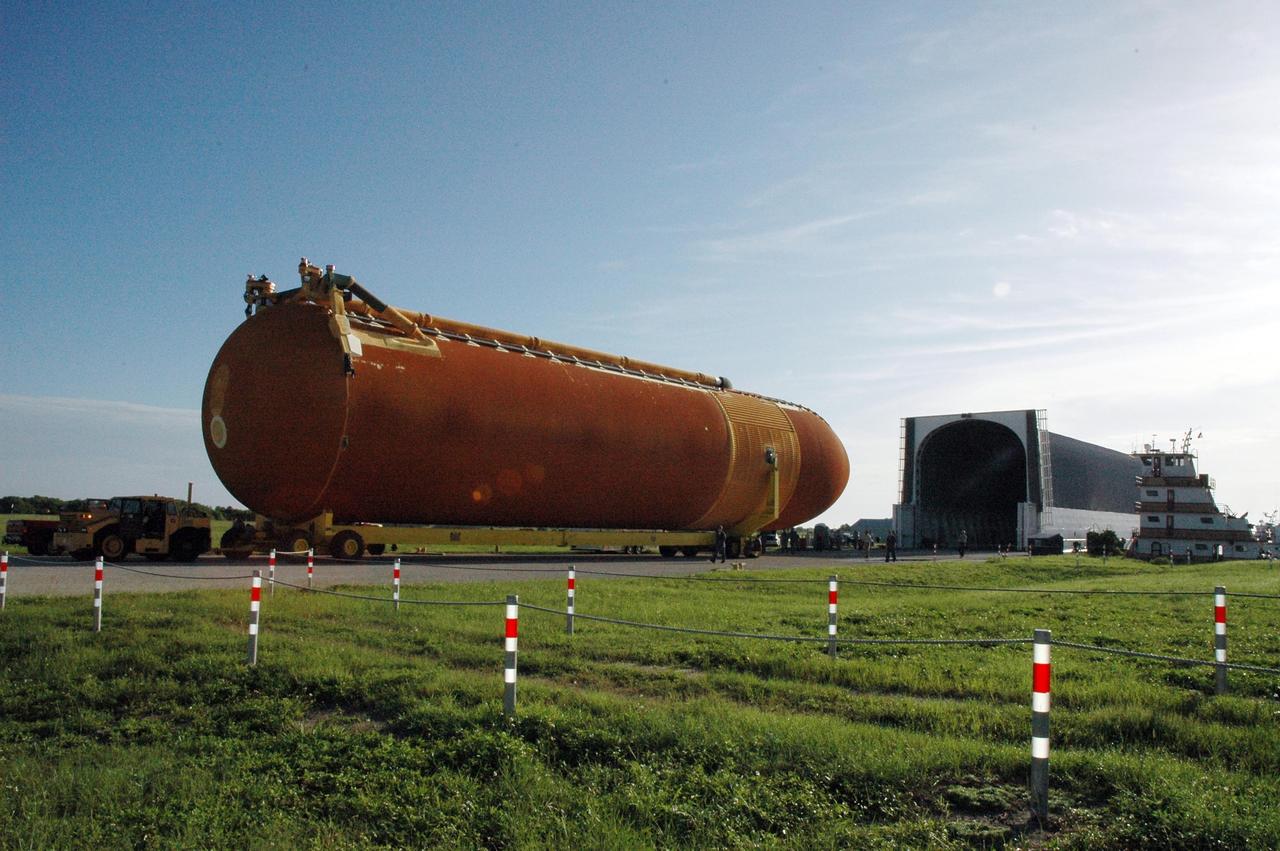
KENNEDY SPACE CENTER, FLA. -- A transporter moves external tank No. 120 away from the Pegasus barge, which is docked at the Launch Complex 39 Area turn basin. The tank is being moved to the Vehicle Assembly Building and will be lifted into a checkout cell. The barge carried the tank from the Michoud Assembly Facility near New Orleans, making the journey around the Florida peninsula in tow by the JA Bisso II tugboat, to Port Canaveral and Kennedy Space Center. ET-120 will be used for launching Space Shuttle Discovery on mission STS-120 in October. NASA/Amanda Diller
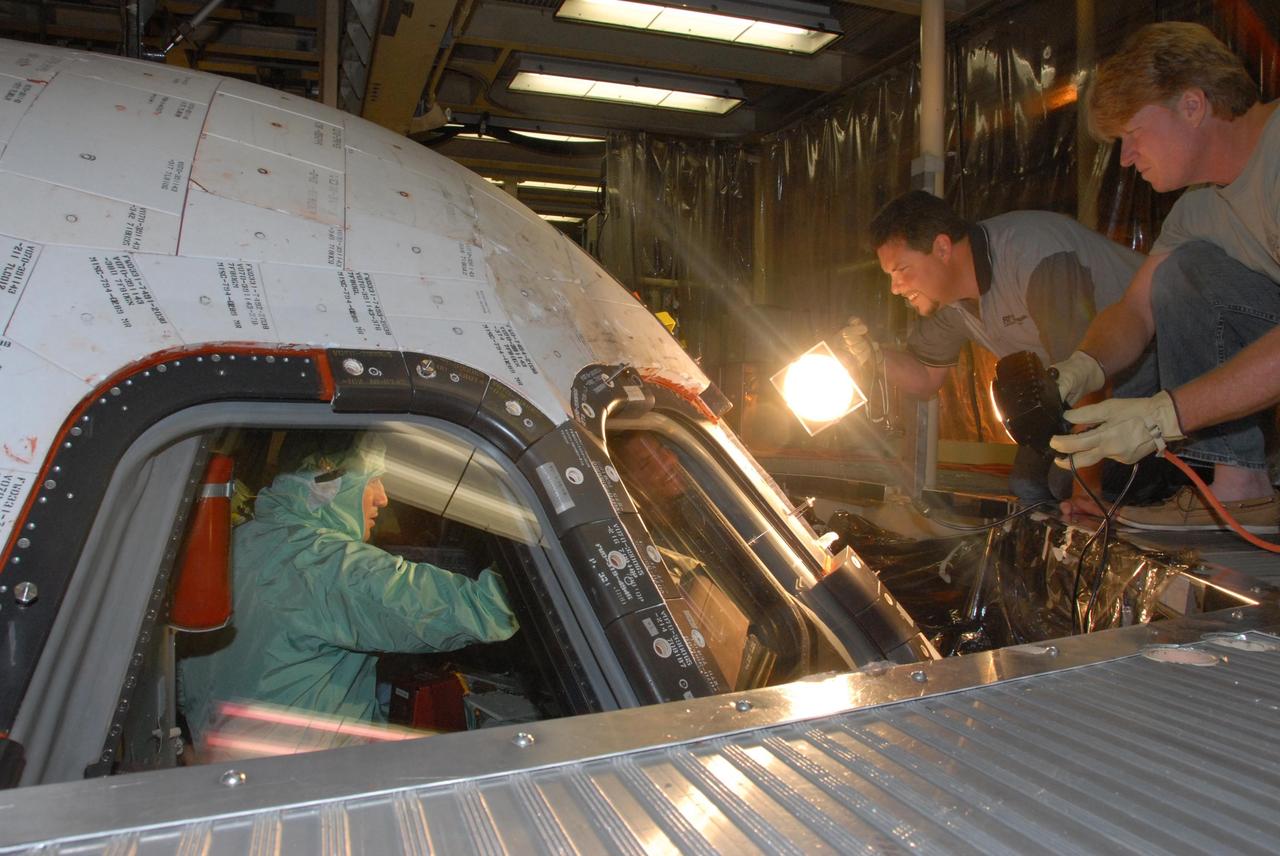
KENNEDY SPACE CENTER, FLA. - In the Orbiter Processing Facility bay 3, STS-120 Commander Pamela A. Melroy makes a close inspection of the cockpit window on the orbiter Discovery. The STS-120 crew is at Kennedy for a crew equipment interface test, or CEIT, which includes harness training, inspection of the thermal protection system and camera operation for planned extravehicular activities, or EVAs. The STS-120 mission will deliver the Harmony module, christened after a school contest, which will provide attachment points for European and Japanese laboratory modules on the International Space Station. Known in technical circles as Node 2, it is similar to the six-sided Unity module that links the U.S. and Russian sections of the station. Built in Italy for the United States, Harmony will be the first new U.S. pressurized component to be added. The STS-120 mission is targeted to launch on Oct. 20. Photo credit: NASA/George Shelton
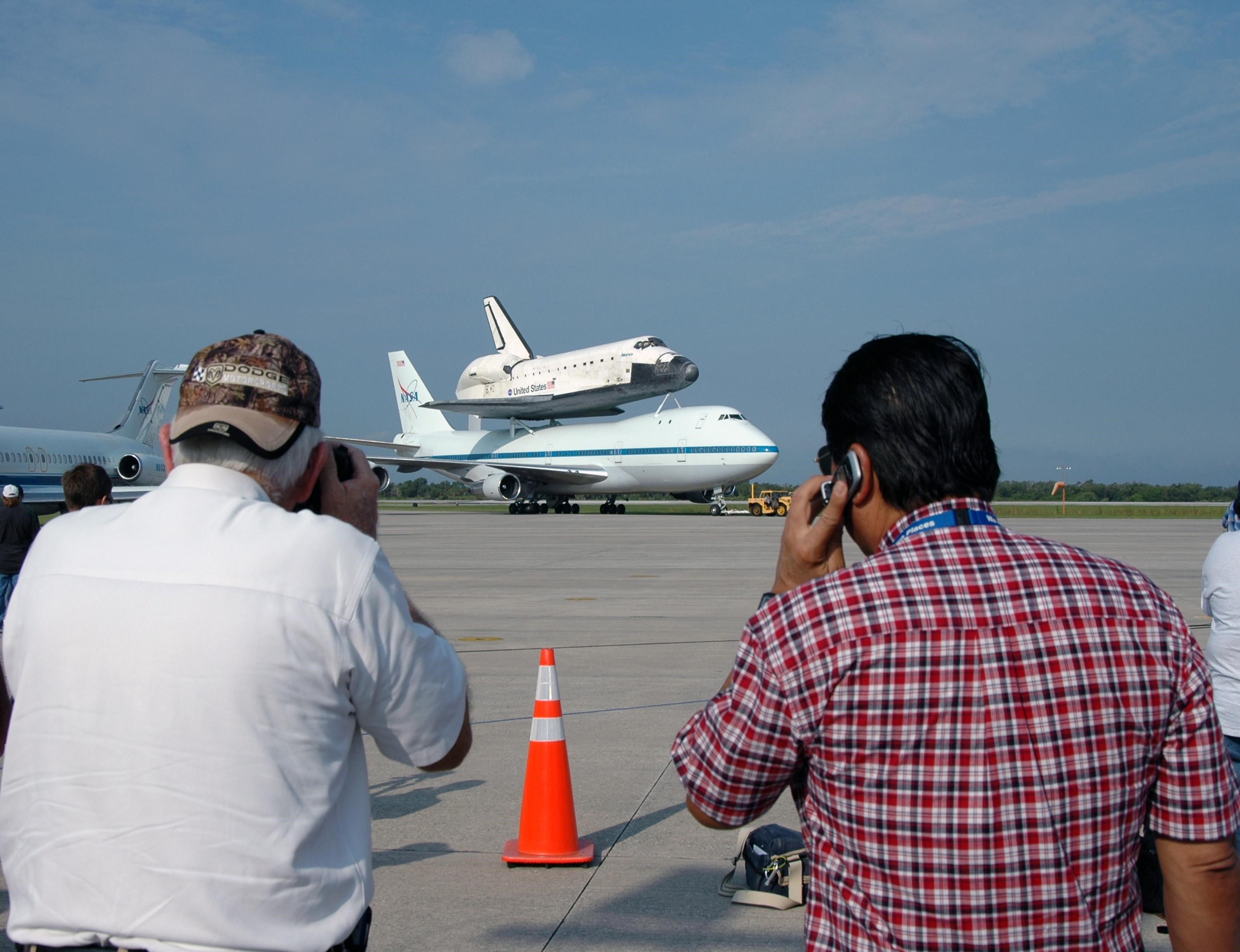
KENNEDY SPACE CENTER, FLA. -- Media are gathered at the KSC Shuttle Landing Facility to watch the arrival of the orbiter Atlantis on the back of the shuttle carrier aircraft, or SCA. Touchdown was at 8:27 a.m. EDT. The SCA is a modified Boeing 747 jetliner. Atlantis landed at Edwards Air Force Base in California to end mission STS-117. The return to KSC began July 1 and took three days after stops across the country for fuel. The last stop was at Ft. Campbell in Kentucky. Weather conditions over the last leg postponed the return trip until July 3. Atlantis will be removed from the back of the SCA via the mate/demate device at the SLF. It will then be towed to the Orbiter Processing Facility to begin processing for its next launch, mission STS-122 in December. Photo credit: NASA/Jim Grossmann
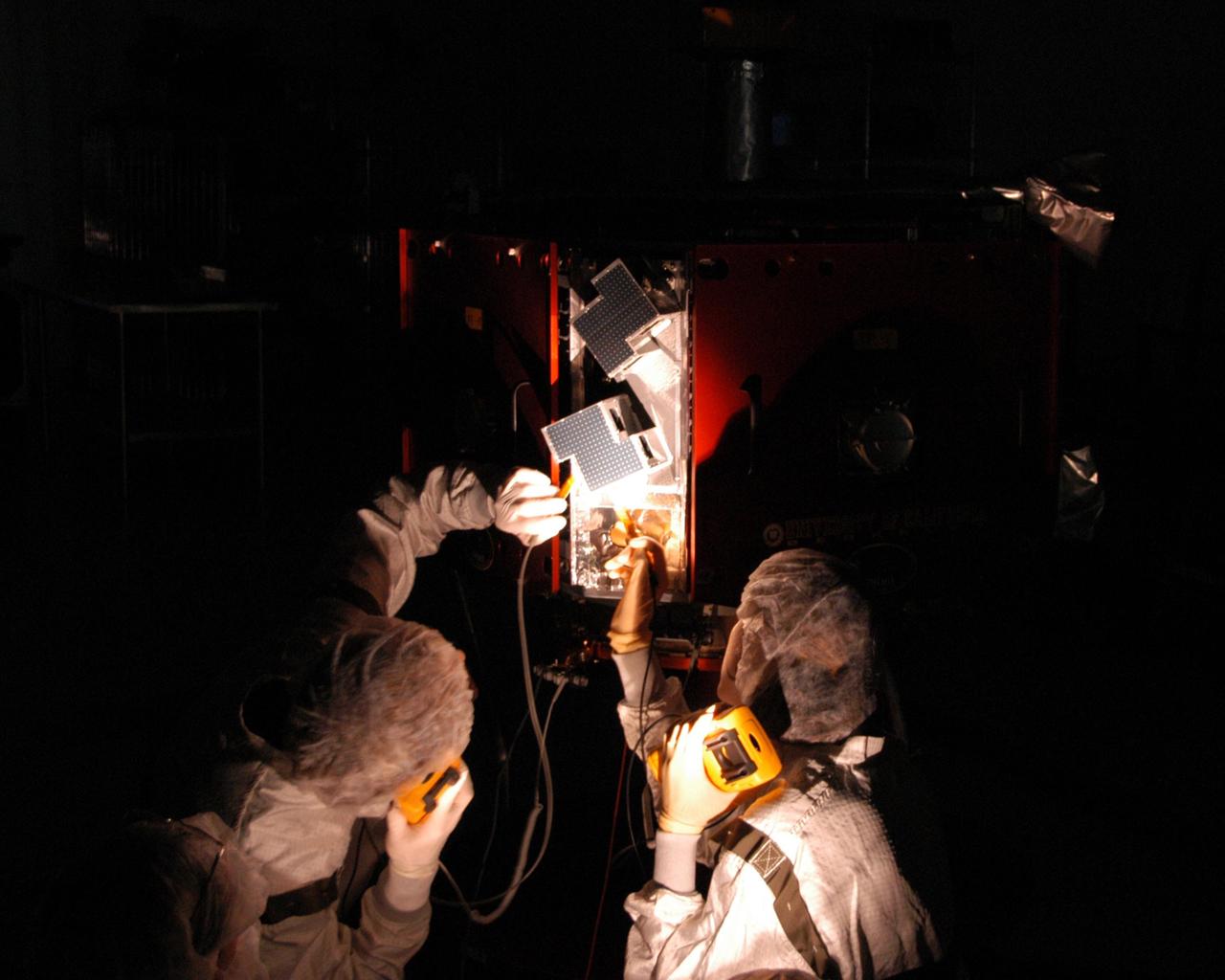
KENNEDY SPACE CENTER, FLA. -- At Astrotech Space Operations, technicians conduct white light inspection of the THEMIS probes. They will also undergo black light inspection. White light inspection assures the telemetry is operating. Black light inspection uses UVA fluorescence to detect possible particulate microcontamination, minute cracks or fluid leaks. THEMIS consists of five identical probes, the largest number of scientific satellites ever launched into orbit aboard a single rocket. This unique constellation of satellites will resolve the tantalizing mystery of what causes the spectacular sudden brightening of the aurora borealis and aurora australis - the fiery skies over the Earth's northern and southern polar regions. THEMIS is scheduled to launch Feb. 15 from Cape Canaveral Air Force Station. Photo credit: NASA/George Shelton
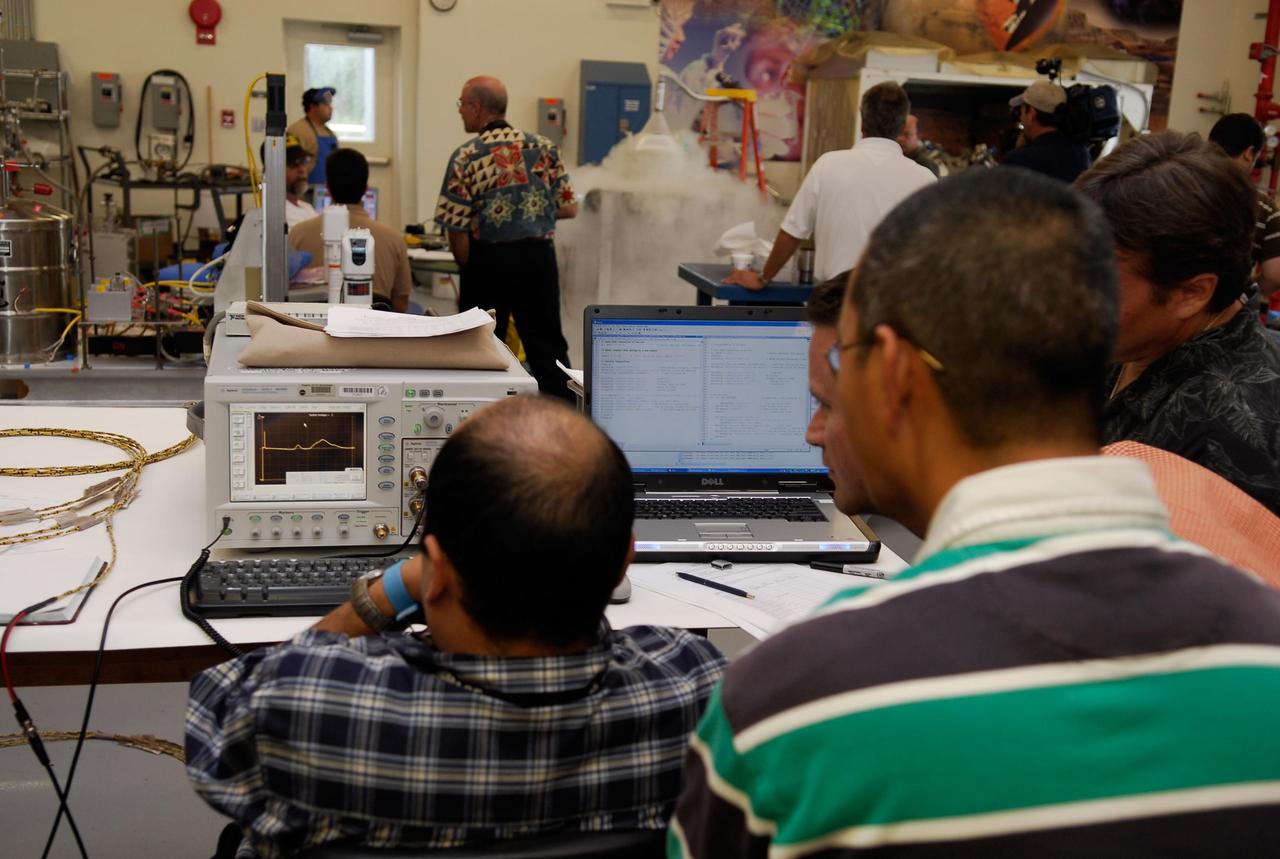
KENNEDY SPACE CENTER, FLA. -- In the cryogenic test bed facility at NASA's Kennedy Space Center, technicians monitor readings during a test exposing Time Domain Reflectometry, or TDR, instrumentation to "wet" super-cold temperatures for identifying the signature of a cryogenic environment and calibrating the TDR equipment. The equipment will be used at the launch pad to test a procedure identical to a tanking test on space shuttle Atlantis' external tank planned for Dec. 18. The shuttle's planned launches on Dec. 6 and Dec. 9 were postponed because of false readings from the part of the engine cut-off, or ECO, sensor system that monitors the liquid hydrogen section of the tank. The liftoff date from NASA's Kennedy Space Center, Florida, is now targeted for Jan. 10, depending on the resolution of the problem in the fuel sensor system. Photo credit: NASA/Kim Shiflett
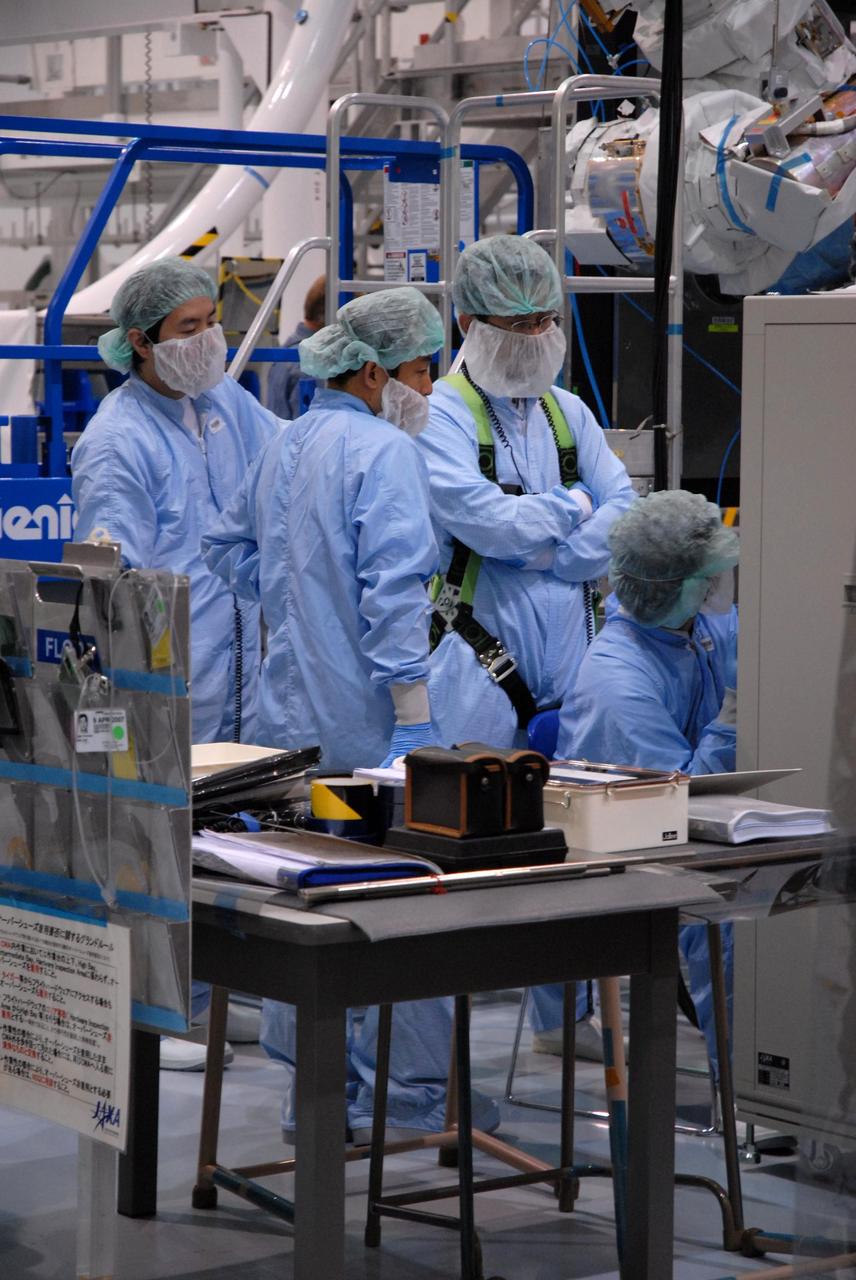
KENNEDY SPACE CENTER, FLA. -- Inside the Space Station Processing Facility at Kennedy Space Center, workers from the Japan Aerospace Exploration Agency watch from a control area as the Remote Manipulator System, or robotic arm, is attached to a hoisting device to prepare it for installation to the Japanese Experiment Module for testing. The RMS is one of the payloads scheduled to be delivered to the station on a future mission tentatively scheduled for 2008. The RMS is similar to the robotic arm already installed on the station's mobile base system. Photo credit: NASA/Amanda Diller

The first stage of a United Launch Alliance Delta II rocket moves into place in front of at the mobile service tower on Launch Pad 17-B at Cape Canaveral Air Force Station in Florida. The rocket will be raised to a vertical position and lifted into the tower. The rocket is the launch vehicle for the THEMIS spacecraft, consisting of five identical probes, the largest number of scientific satellites ever launched into orbit aboard a single rocket. This unique constellation of satellites will resolve the tantalizing mystery of what causes the spectacular sudden brightening of the aurora borealis and aurora australis - the fiery skies over the Earth's northern and southern polar regions. After the first stage is in the mobile service tower on the pad, nine solid rocket boosters will be placed around the base of the first stage and attached in sets of three. THEMIS is scheduled to launch aboard the Delta II at 6:07 p.m. EST on Feb. 15.

The Cassini spacecraft investigates the craters and deep valleys on Dione during a close approach in April 2007
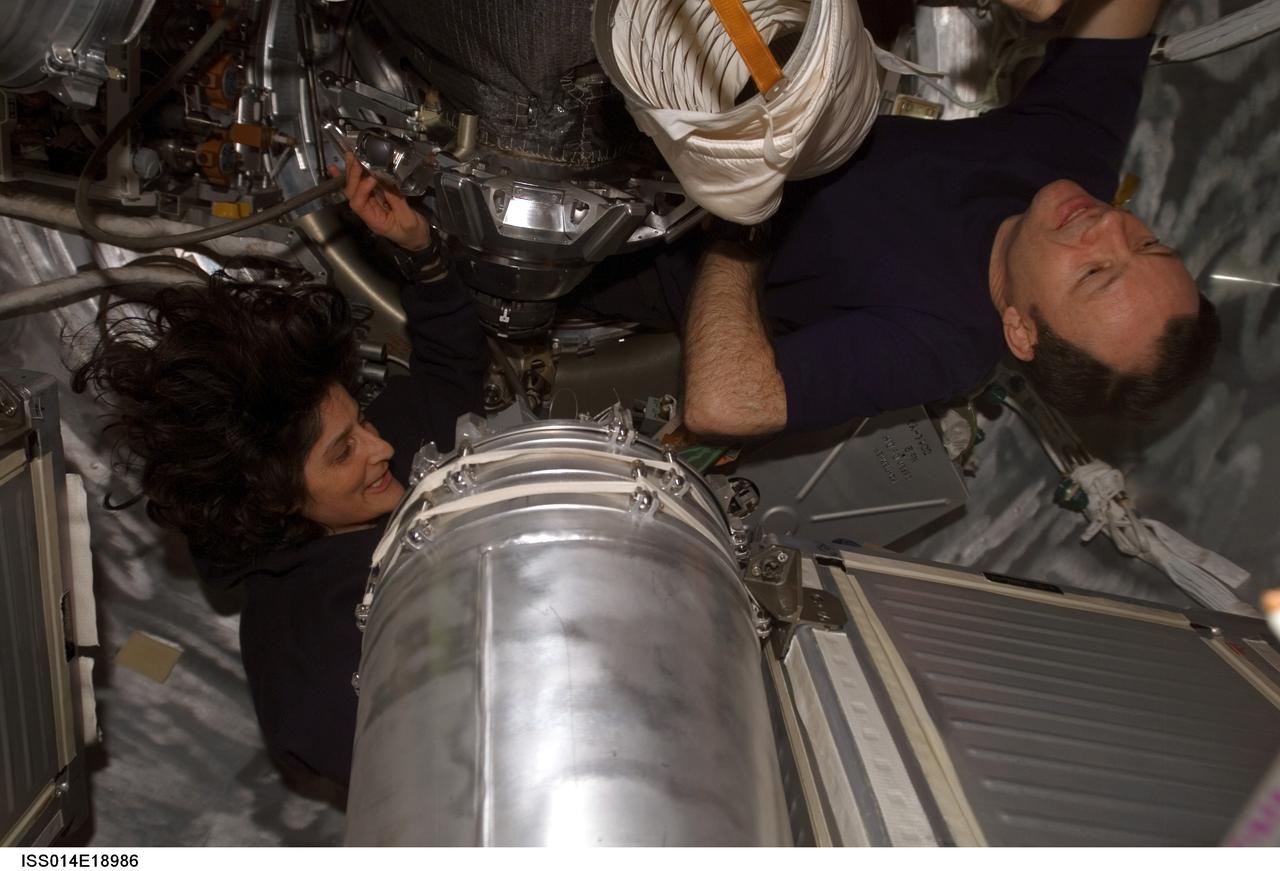
ISS014-E-18986 (5 April 2007) --- Astronauts Michael E. Lopez-Alegria (right), Expedition 14 commander and NASA space station science officer, and Sunita L. Williams, flight engineer, work with water tanks in the Progress 24 spacecraft docked to the International Space Station.

Handover of GeneSat 1 from NASA to Santa Clara University event L-R John Hines, NASA Ames to
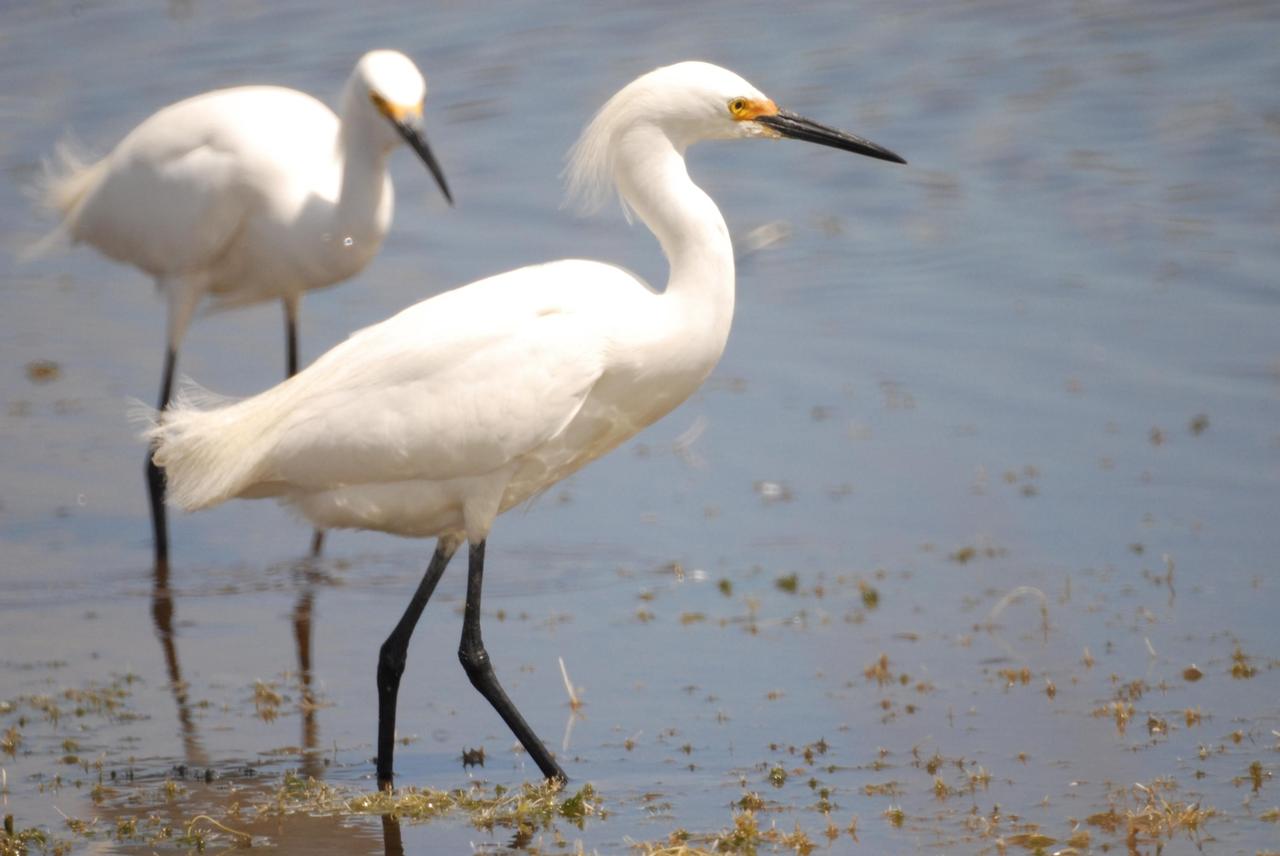
KENNEDY SPACE CENTER, FLA. -- Snowy egrets wade through a pond for their food. The pond is near Kennedy Space Center. This species inhabits salt marshes, ponds, rice field and shallow coastal bays along the coast from Maine to southern South America. They are also found in northern California, Texas and Oklahoma. KSC shares a boundary with the Merritt Island National Wildlife Refuge, which surrounds it. The refuge is a habitat for more than 310 species of birds, 25 mammals, 117 fishes and 65 amphibians and reptiles. In addition, the refuge supports 19 endangered or threatened wildlife species on Federal or State lists, more than any other single refuge in the U.S. Photo credit: NASA/Ken Thornsley
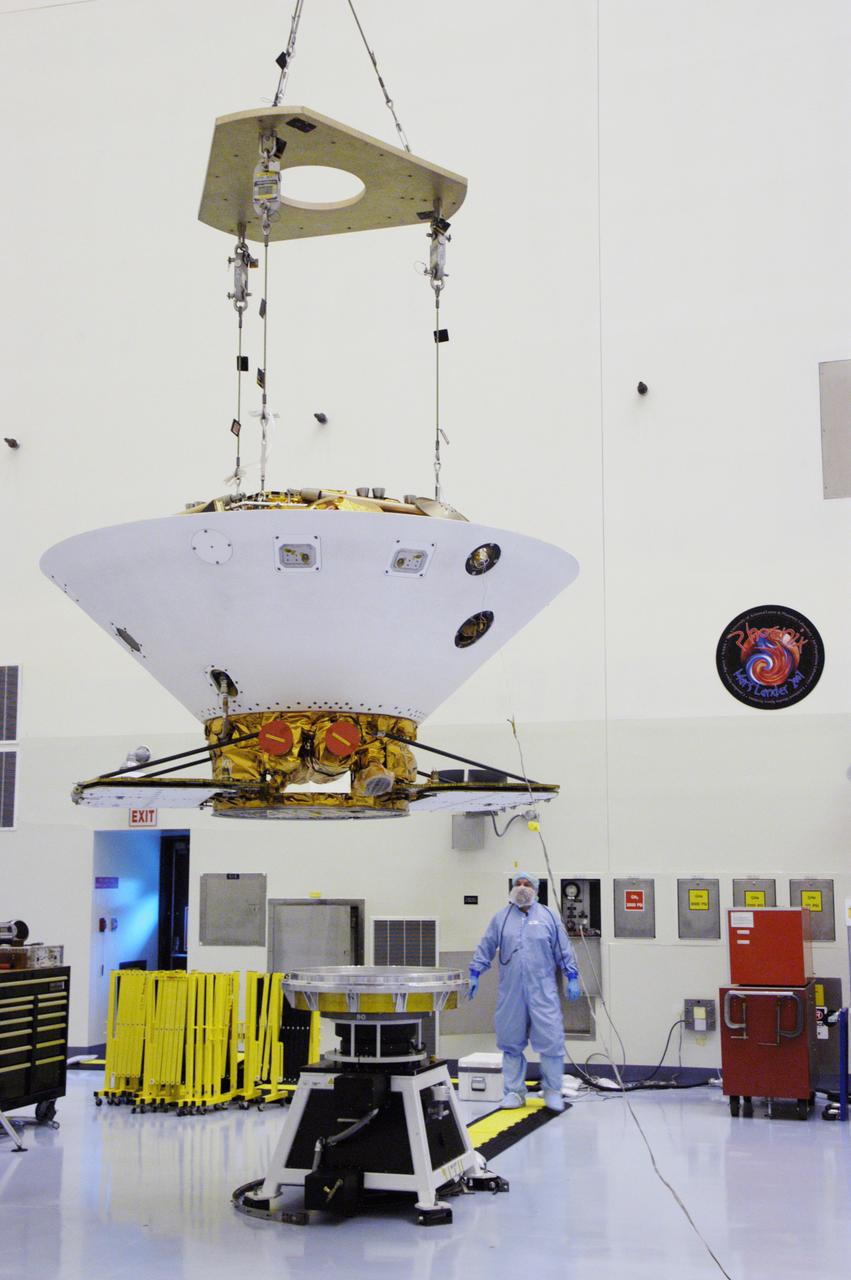
An overhead crane lowers the backshell with the Phoenix Mars Lander inside toward a spin table for spin testing in the Payload Hazardous Servicing Facility. The Phoenix mission is the first project in NASA's first openly competed program of Mars Scout missions. Phoenix will land in icy soils near the north polar permanent ice cap of Mars and explore the history of the water in these soils and any associated rocks, while monitoring polar climate. Landing is planned in May 2008 on arctic ground where a mission currently in orbit, Mars Odyssey, has detected high concentrations of ice just beneath the top layer of soil. It will serve as NASA's first exploration of a potential modern habitat on Mars and open the door to a renewed search for carbon-bearing compounds, last attempted with NASA’s Viking missions in the 1970s. A stereo color camera and a weather station will study the surrounding environment while the other instruments check excavated soil samples for water, organic chemicals and conditions that could indicate whether the site was ever hospitable to life. Microscopes can reveal features as small as one one-thousandth the width of a human hair. Launch of Phoenix aboard a Delta II rocket is targeted for Aug. 3 from Cape Canaveral Air Force Station in Florida.
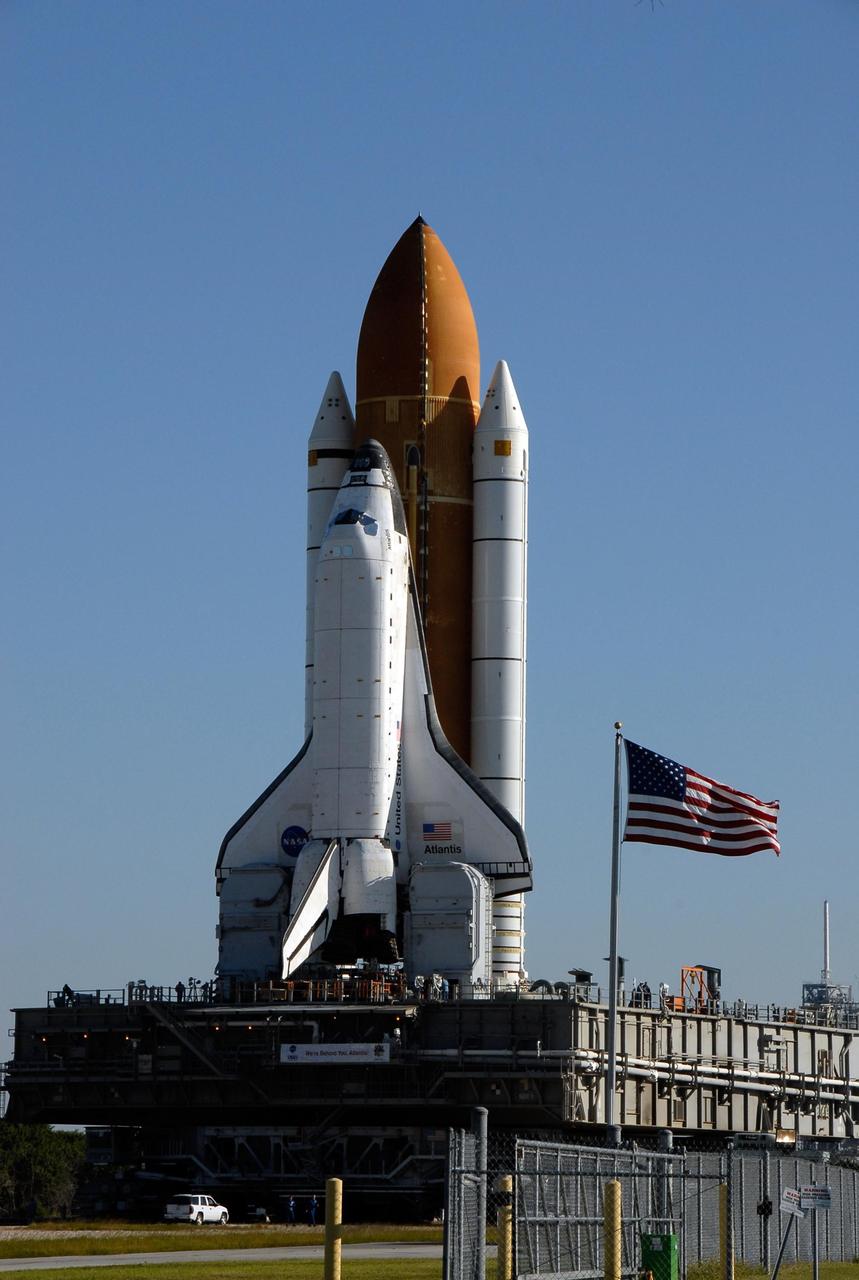
KENNEDY SPACE CENTER, FLA. -- Space Shuttle Atlantis, secured atop a mobile launch platform, passes by a United States flag on its way to Launch Pad 39A on a breezy Florida morning. The crawler transporter has a top speed of one mile per hour while it is moving the space shuttle. First motion out of the Vehicle Assembly Building was at 4:43 a.m. EST. Rollout is a milestone for Atlantis' launch to the International Space Station on mission STS-122, targeted for Dec. 6. On this mission, Atlantis will deliver the Columbus module to the International Space Station. The European Space Agency's largest contribution to the station, Columbus is a multifunctional, pressurized laboratory that will be permanently attached to U.S. Node 2, called Harmony. The module is approximately 23 feet long and 15 feet wide, allowing it to hold 10 large racks of experiments. The laboratory will expand the research facilities aboard the station, providing crew members and scientists from around the world the ability to conduct a variety of experiments in the physical, materials and life sciences. Photo credit: NASA/Kim Shiflett
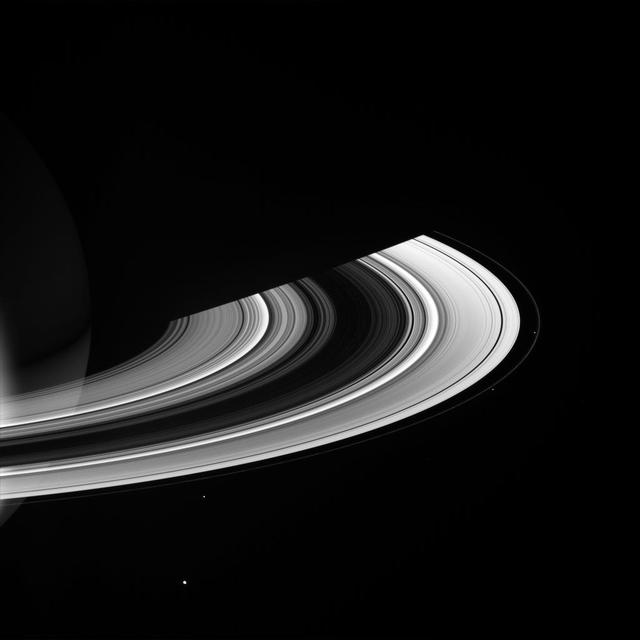
<p> The Cassini spacecraft looks toward the unilluminated side of Saturn rings to spy on the moon Pan as it cruises through the Encke Gap. </p> <p> This view looks toward the rings from about 13 degrees above the ringplane. At the top of the image
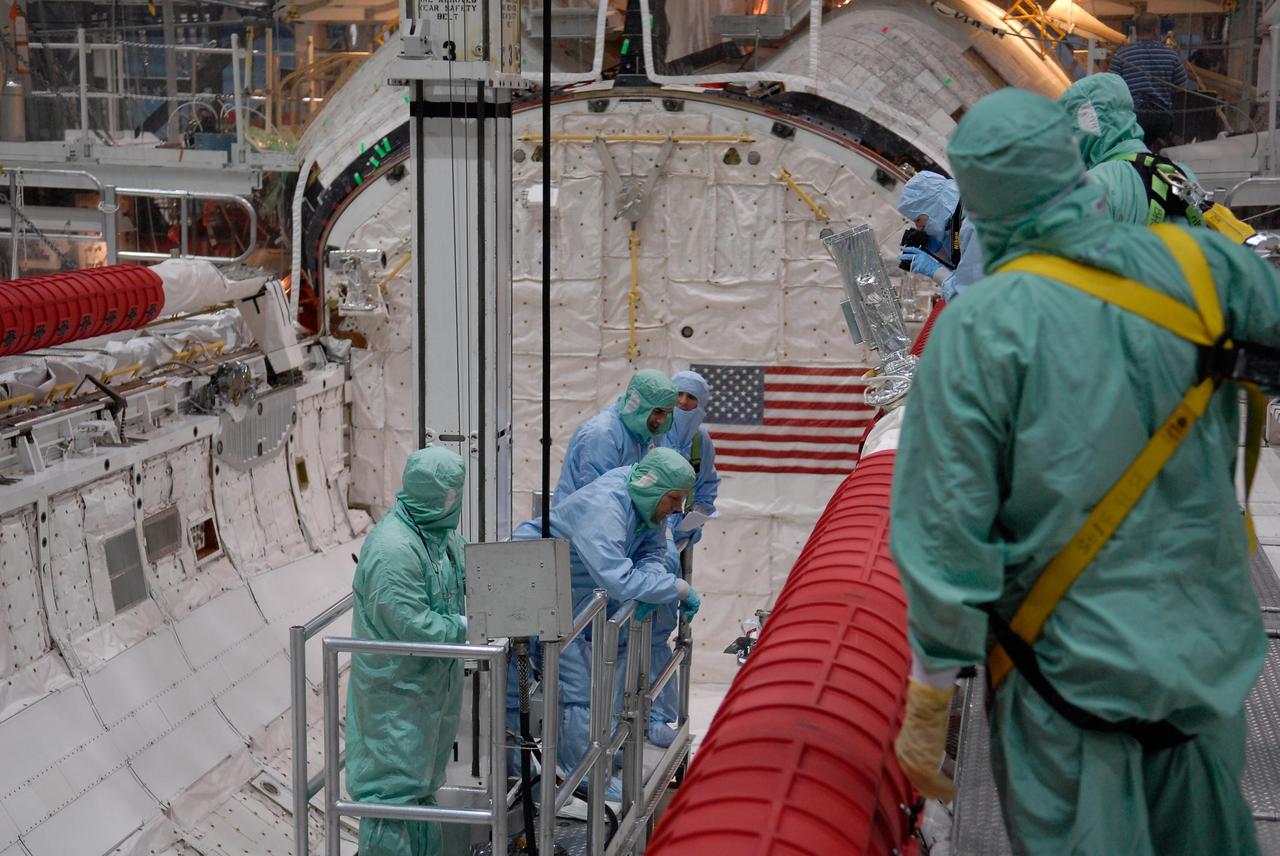
KENNEDY SPACE CENTER, FLA. -- STS-122 crew members get a close look at shuttle equipment from inside the payload bay of space shuttle Atlantis. The crew comprises six astronauts: Commander Stephen Frick, Pilot Alan Poindexter and Mission Specialists Rex Walheim, Stanley Love, Leland Melvin and Hans Schlegel, who represents the European Space Agency. A seventh astronaut is Leopold Eyharts, also with the ESA, who will join the Expedition 16 crew as flight engineer on the International Space Station. The mission will carry and install the Columbus Lab, a multifunctional, pressurized laboratory that will be permanently attached to Node 2 of the space station to carry out experiments in materials science, fluid physics and biosciences, as well as to perform a number of technological applications. It is Europe’s largest contribution to the construction of the International Space Station and will support scientific and technological research in a microgravity environment. STS-122 is targeted for launch in December. Photo credit: NASA/Kim Shiflett
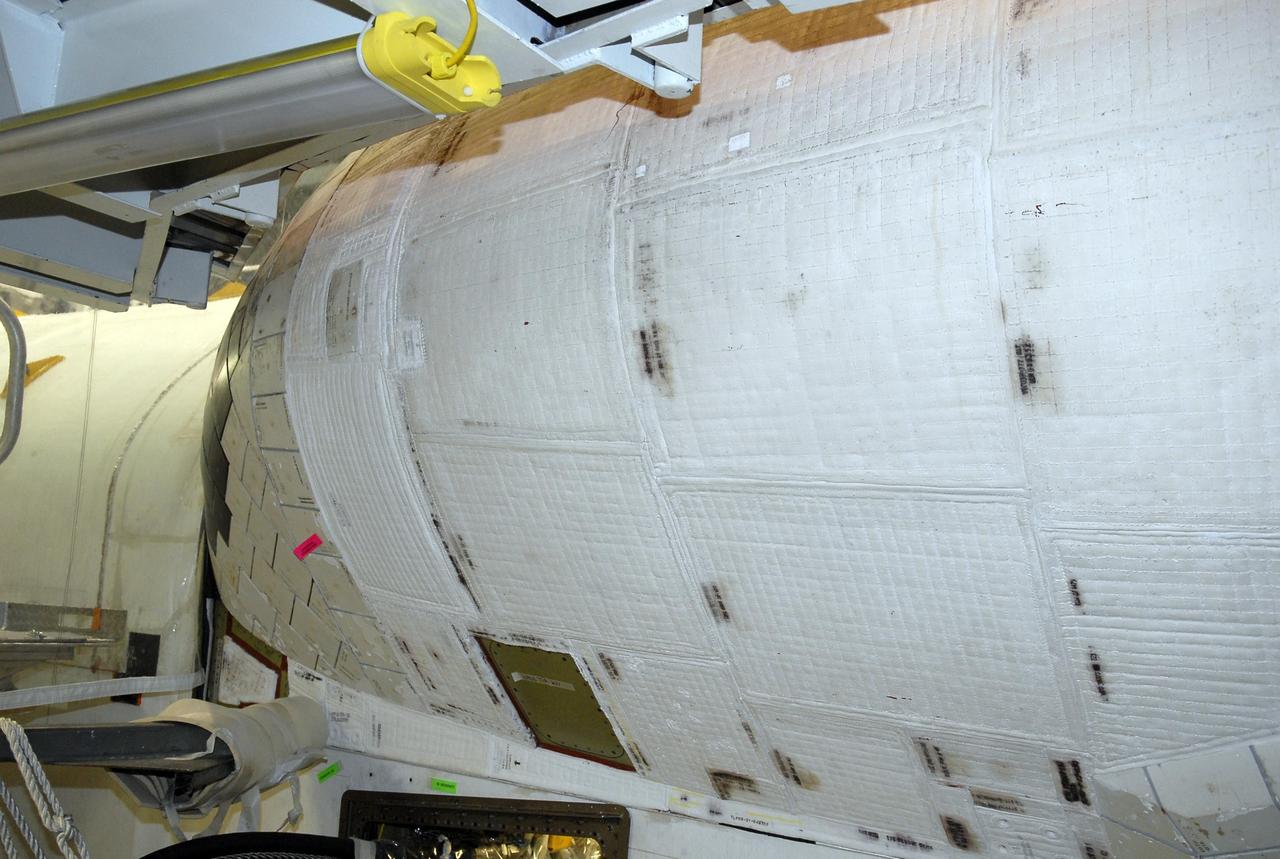
KENNEDY SPACE CENTER, FLA. -- Another view of the area of orbiter Endeavour's orbital maneuvering system, or OMS, pod where the tear occurred on Atlantis during launch of mission STS-117 on June 8, 2007. Repair is under consideration following testing at KSC and Houston. The test articles each feature three tiles (Low Temperature Reusable Surface Insulation, or LRSI) affixed next to two FIB blankets, simulating the thermal protection system set-up on Atlantis' OMS pod in the vicinity of the in-flight anomaly. These test articles were flown to Texas the morning of June 14. The TPS team at KSC has also provided a total of 22 FIB samples for other testing and analysis. Photo credit: NASA/Kim Shiflett
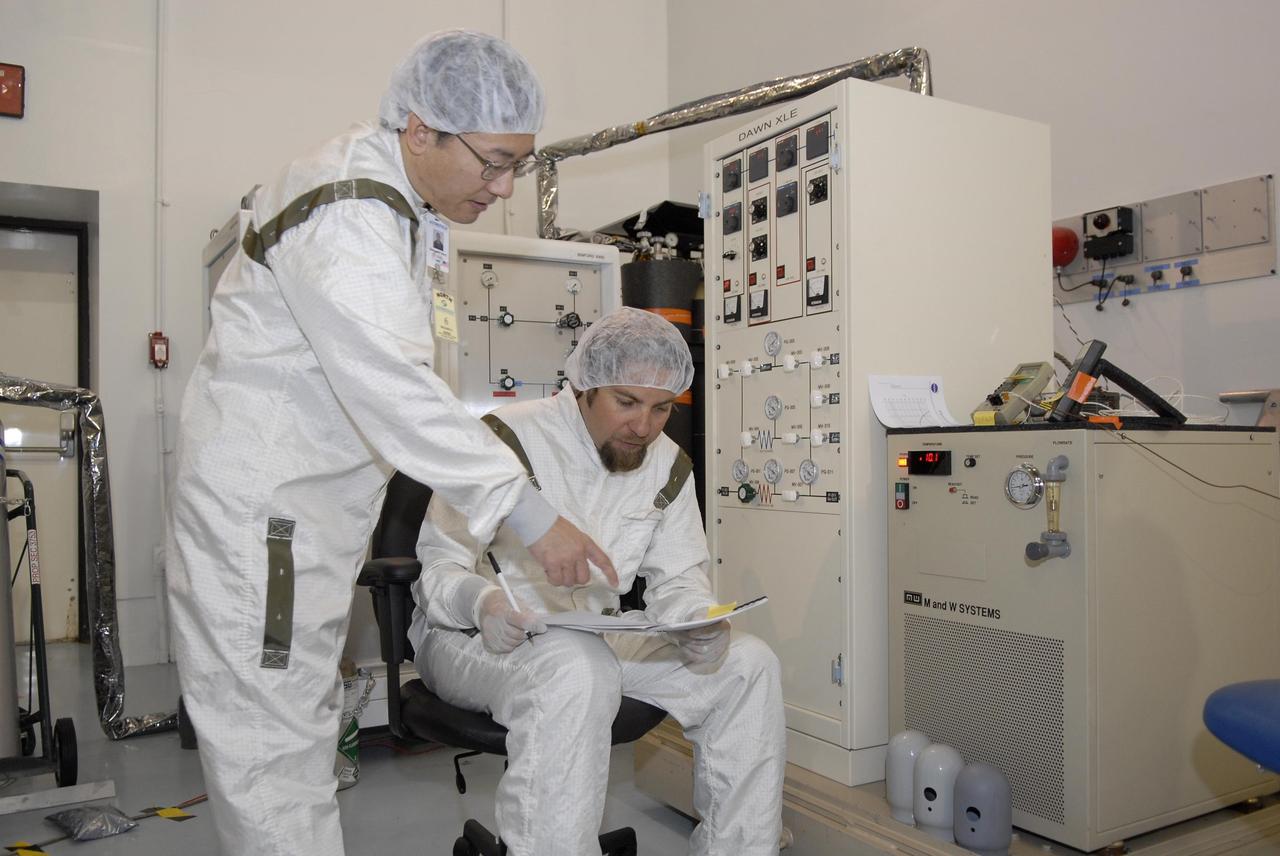
KENNEDY SPACE CENTER, FLA. -- In Astrotech's Hazardous Processing Facility, technicians check data during the loading of xenon for the ion propulsion system in the Dawn spacecraft. Dawn's mission is to explore two of the asteroid belt's most intriguing and dissimilar occupants: asteroid Vesta and the dwarf planet Ceres. The Dawn spacecraft uses ion propulsion to get the additional velocity needed to reach Vesta once it leaves the Delta rocket. It also uses ion propulsion to spiral to lower altitudes on Vesta, to leave Vesta and cruise to Ceres and to spiral to a low-altitude orbit at Ceres. Ion propulsion makes efficient use of the onboard fuel by accelerating it to a velocity 10 times that of chemical rockets. Dawn is scheduled to launch July 7aboard a Delta II rocket from Launch Complex 17-B at Cape Canaveral Air Force Station. Photo credit: NASA/Kim Shiflett
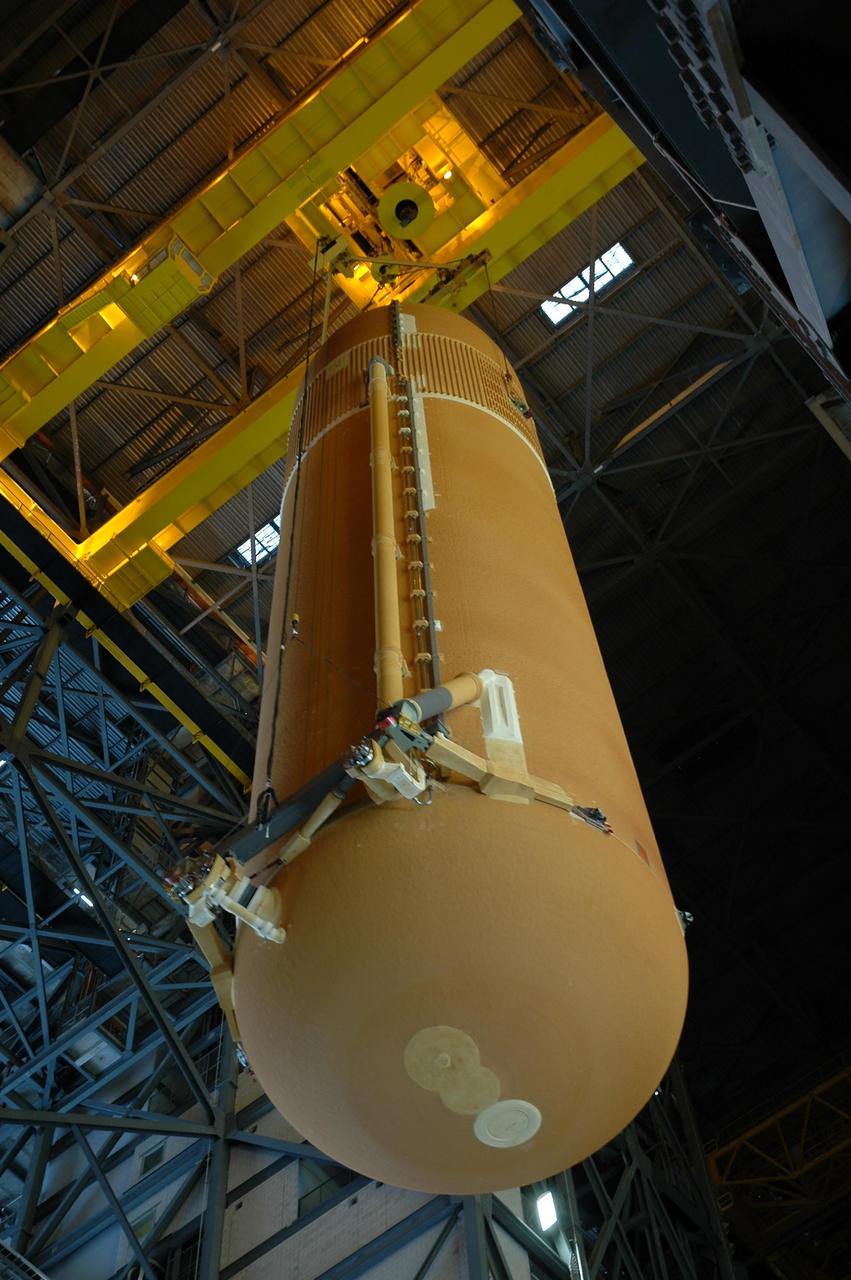
KENNEDY SPACE CENTER, FLA. -- Inside the Vehicle Assembly Building, the external tank for Endeavour is being lowered toward the mobile launcher platform for mating with the solid rocket boosters. Endeavour is currently targeted for rollover to the VAB July 5. On the lower end of the tank is seen the bipod fittings that connect the external tank to the orbiter through the shuttle's two forward attachment struts. Endeavour is the designated orbiter for mission STS-118, targeted for launch on Aug. 9 to the International Space Station. The mission will continue space station construction by delivering a third starboard truss segment, S5, as well as carrying the external stowage platform 3. Photo credit: NASA/Amanda Diller
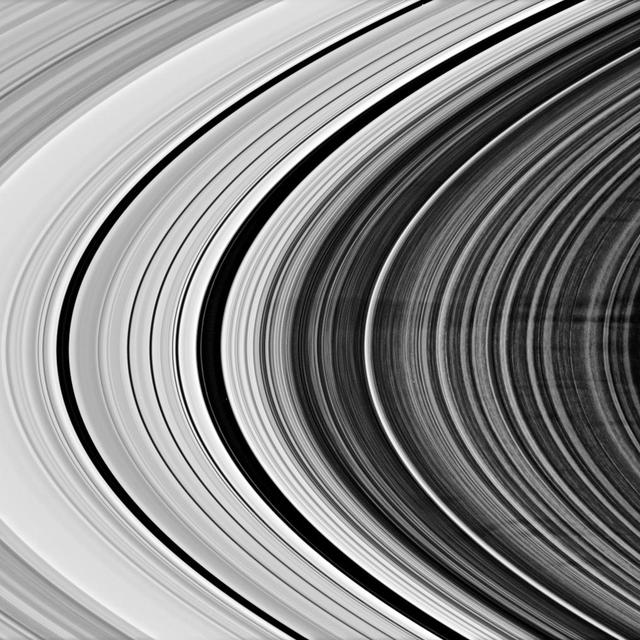
This Cassini spacecraft view shows a group of more than a dozen spokes in Saturn outer B ring. The B ring displays the azimuthal asymmetry, or variation with longitude around the planet, that is characteristic of the spoke-forming region
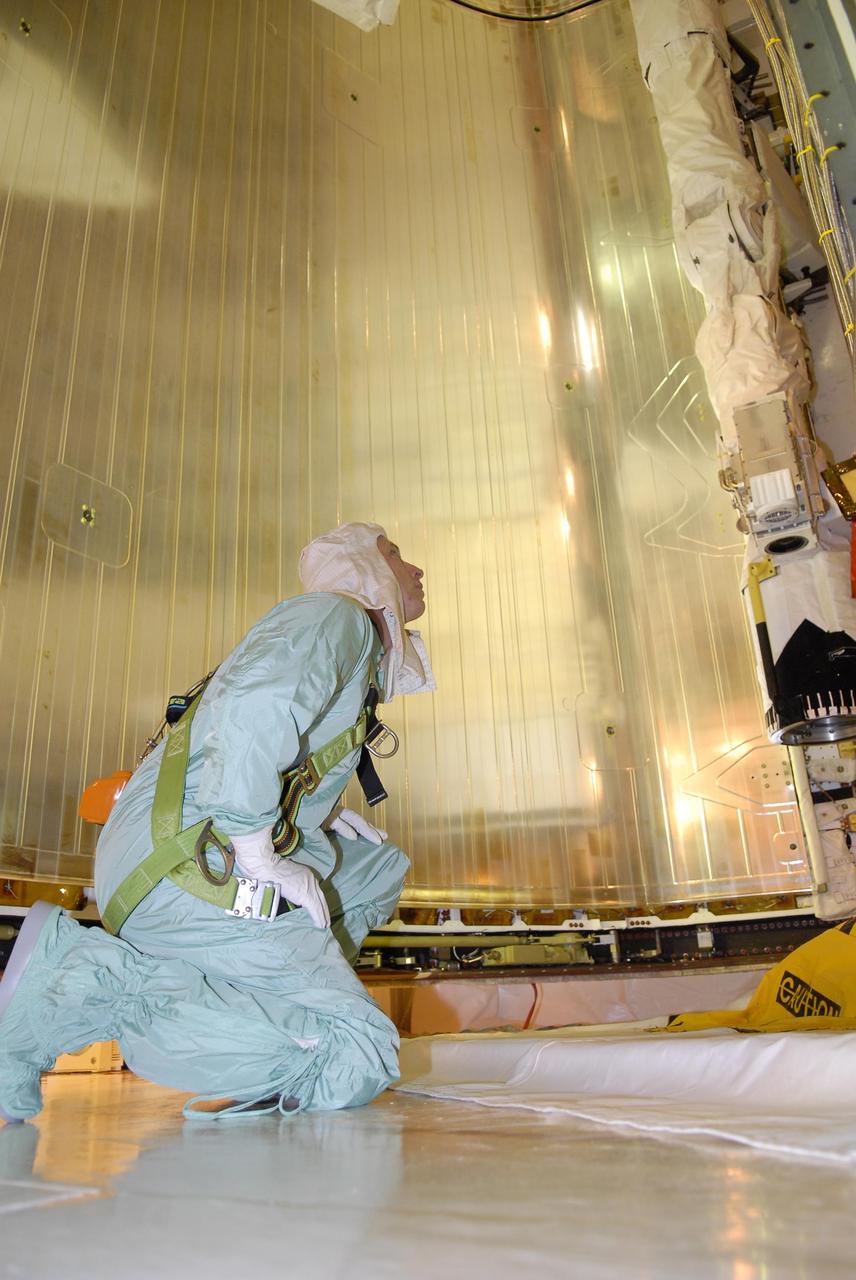
KENNEDY SPACE CENTER, FLA. -- After their arrival at KSC, STS-117 crew members take part in a payload bay walkdown on Launch Pad 39A to look at the cargo in Space Shuttle Atlantis. Seen here is Mission Specialist Patrick Forrester. The payload includes the S3/S4 integrated truss structure for the International Space Station. STS-117 is scheduled to launch at 7:38 p.m. June 8. During the 11-day mission and three spacewalks, the crew will work with flight controllers at NASA's Johnson Space Center in Houston to install the 17-ton segment on the station's girder-like truss and deploy the set of solar arrays, S3/S4. The mission will increase the space station's power capability in preparation for the arrival of new science modules from the European and Japanese space agencies. Photo credit: NASA/Kim Shiflett
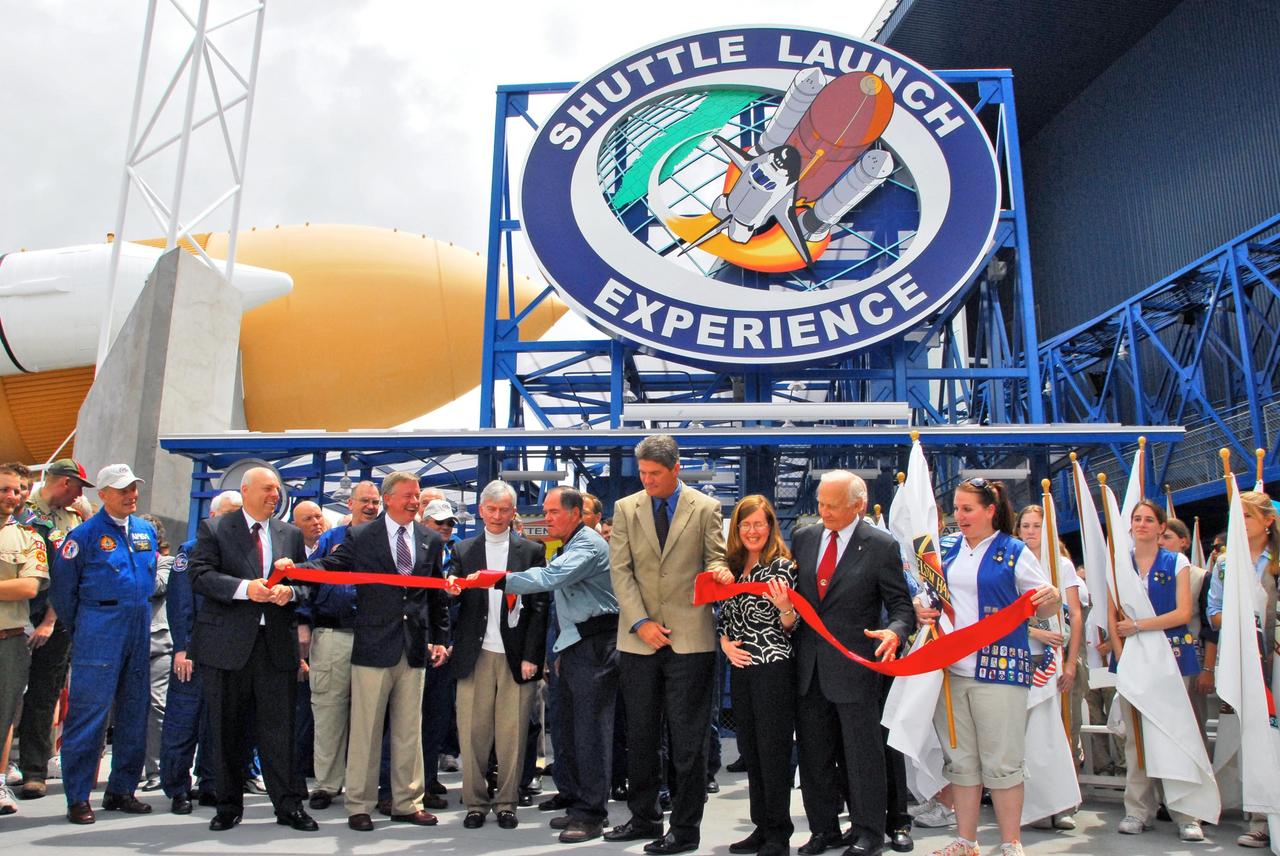
KENNEDY SPACE CENTER, FLA. -- NASA, Kennedy Space Center and State of Florida dignitaries helped launch the opening of the newest attraction at Kennedy Space Center's Visitor Complex, the Shuttle Launch Experience. Breaking the ribbon are (left to right) Dan LeBlanc, chief operating officer of the KSC Visitor Complex; Lt. Governor of Florida Jeff Kottkamp; former astronauts John Young and Bob Crippen; Center Director Bill Parsons; KSC Director of External Relations Lisa Malone; and former astronaut Buzz Aldrin. The attraction includes a simulated launch with the sights, sounds and sensations of launching into space. Find out more about the Visitor Complex and the Shuttle Launch Experience at <b>http://www.kennedyspacecenter.com/visitKSC/attractions/index.asp</b>. Photo credit: NASA/George Shelton
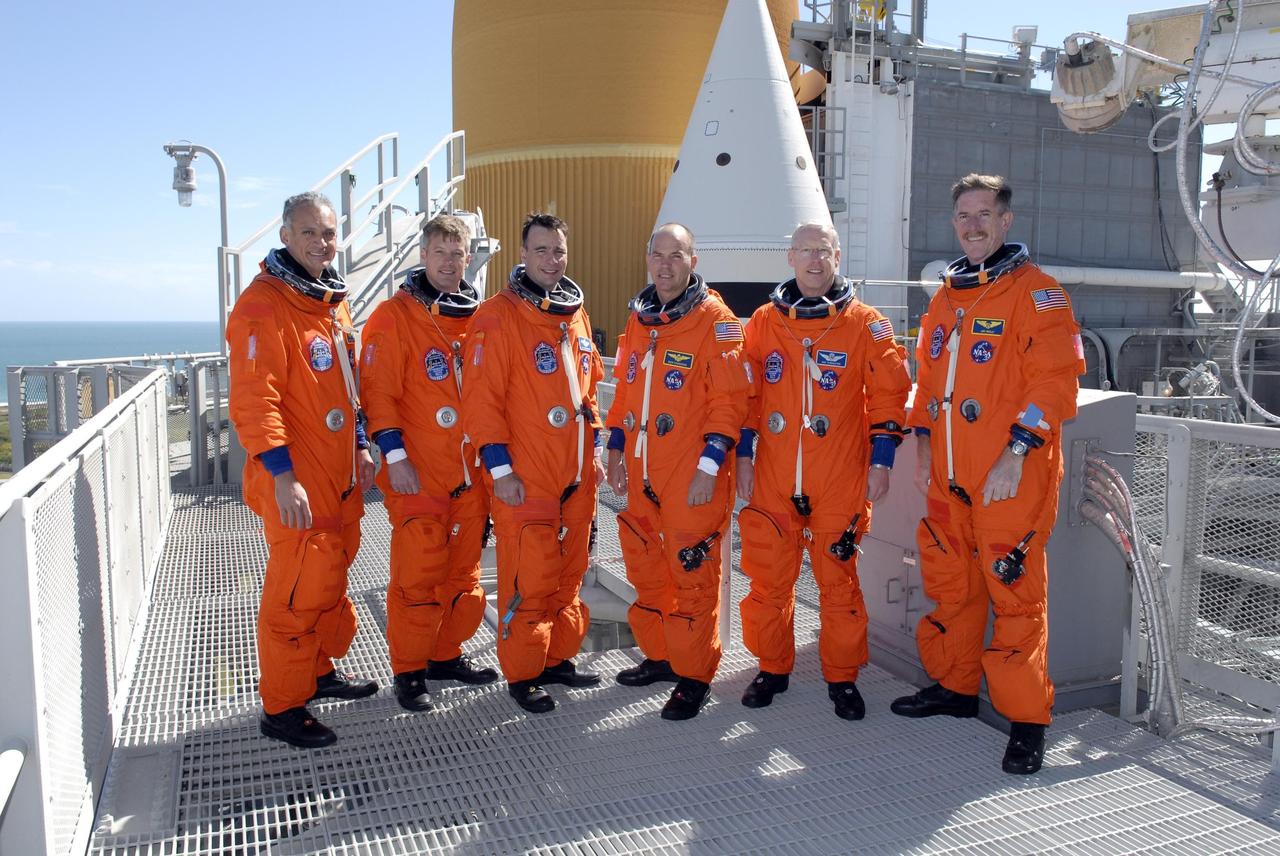
KENNEDY SPACE CENTER, FLA. -- On the 215-foot level of the fixed service structure on Launch Pad 39A, Mission STS-117 crew members gather for a photo near the solid rocket boosters and external tank of Space Shuttle Atlantis. They have just completed a simulated launch countdown and emergency egress from the orbiter, part of the terminal countdown demonstration test (TCDT). From left are Mission Specialists Danny Olivas and Steven Swanson, Pilot Lee Archambault, Commander Rick Sturckow, and Mission Specialists Patrick Forrester and James Reilly. The TCDT also includes M-113 armored personnel carrier training and payload familiarization. The STS-117 mission is No. 21 to the International Space Station. Mission payloads aboard Atlantis include the S3/S4 integrated truss structure, a third set of solar arrays and batteries. The crew of six astronauts will install the truss to continue assembly of the station. Launch is scheduled for no earlier than March 15. Photo credit: NASA/Kim Shiflett.
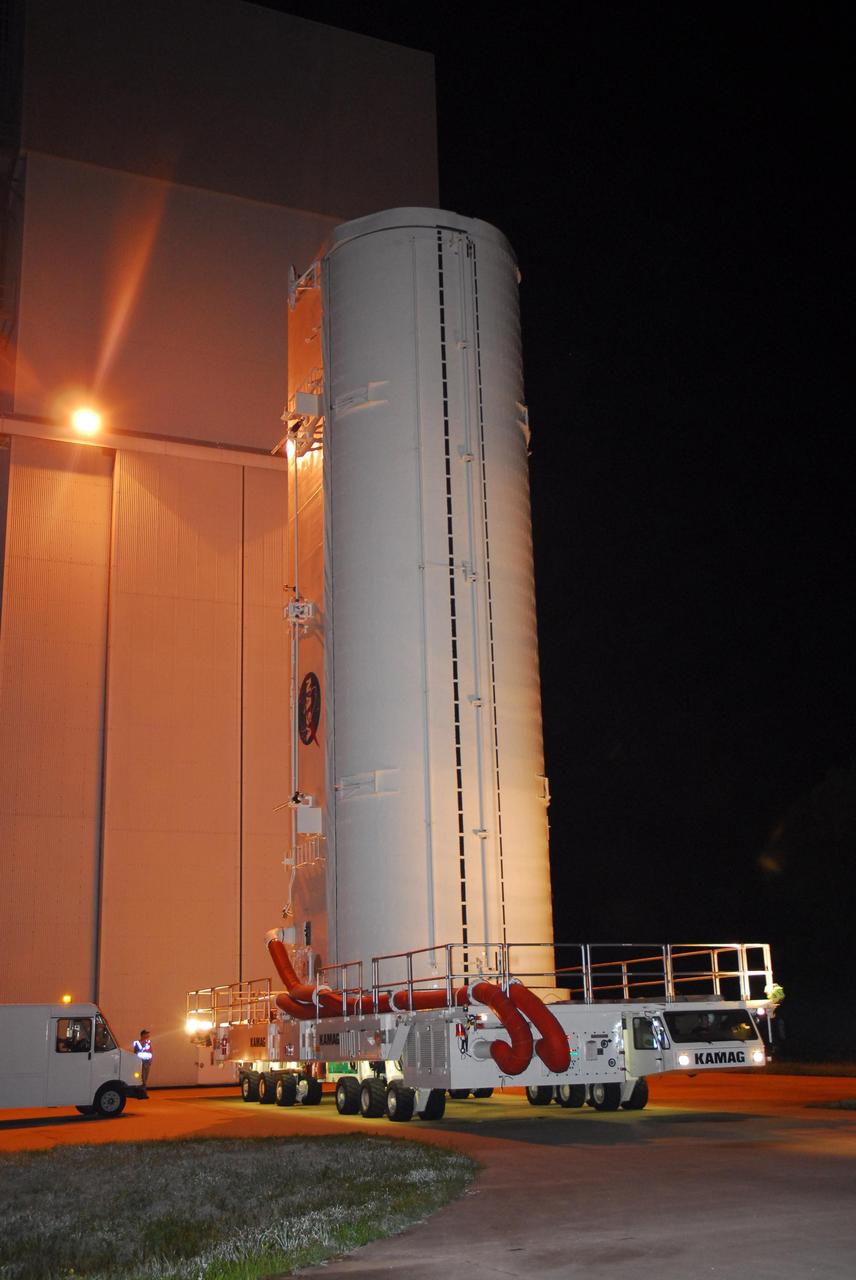
KENNEDY SPACE CENTER, FLA. -- The payload canister containing the Italian-built U.S. Node 2 module, called Harmony, begins taking its cargo to Launch Pad 39A. At the pad, the canister will be lifted to the payload changeout room and the module transferred inside. The payload will be installed in space shuttle Discovery's payload bay after the vehicle rolls out to the pad. Discovery is targeted for launch to the International Space Station for mission STS-120 on Oct. 23. The pressurized module will act as an internal connecting port and passageway to additional international science labs and cargo spacecraft. Photo credit: NASA/George Shelton
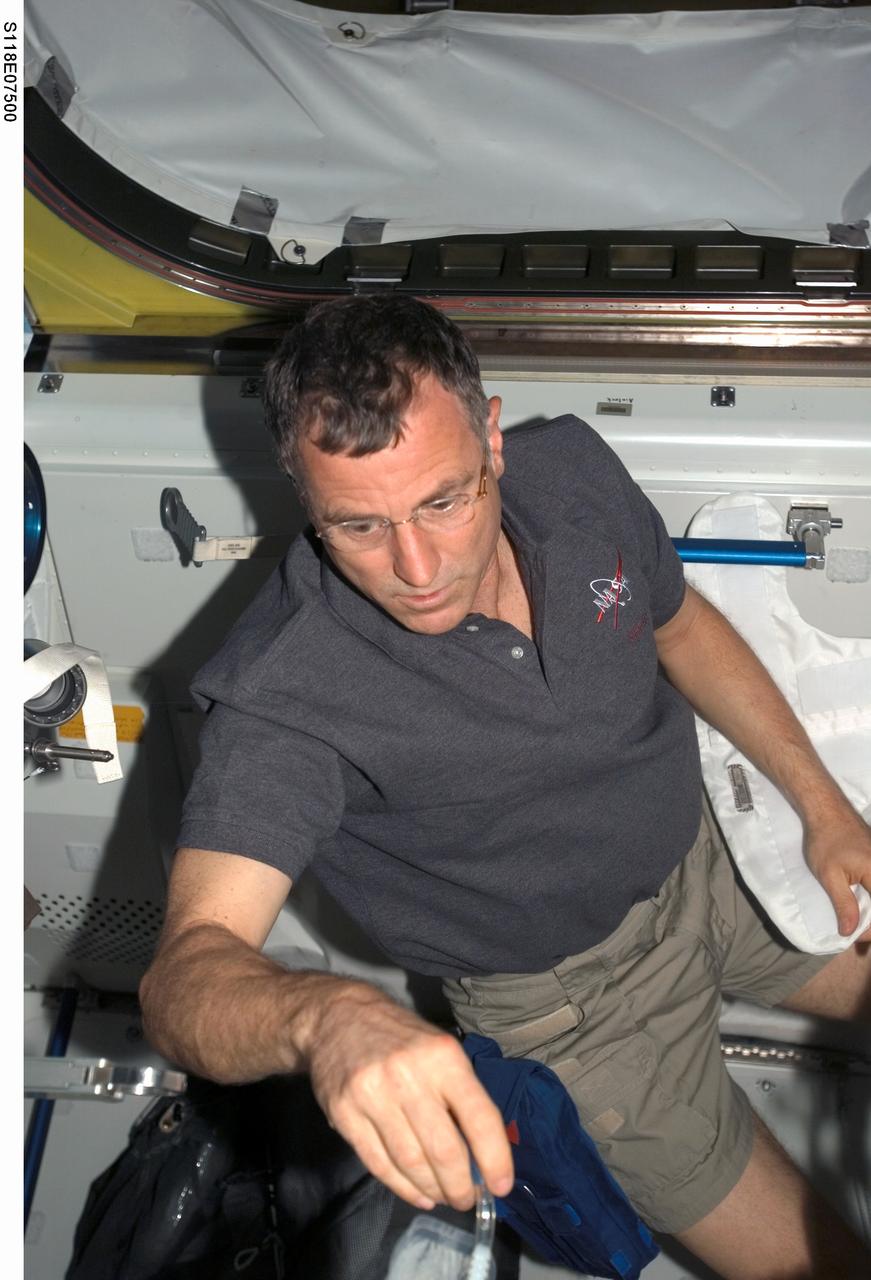
S118-E-07500 (14 Aug. 2007) --- Astronaut Dave Williams, STS-118 mission specialist representing the Canadian Space Agency, works in the Quest Airlock of the International Space Station while Space Shuttle Endeavour remains docked with the International Space Station.
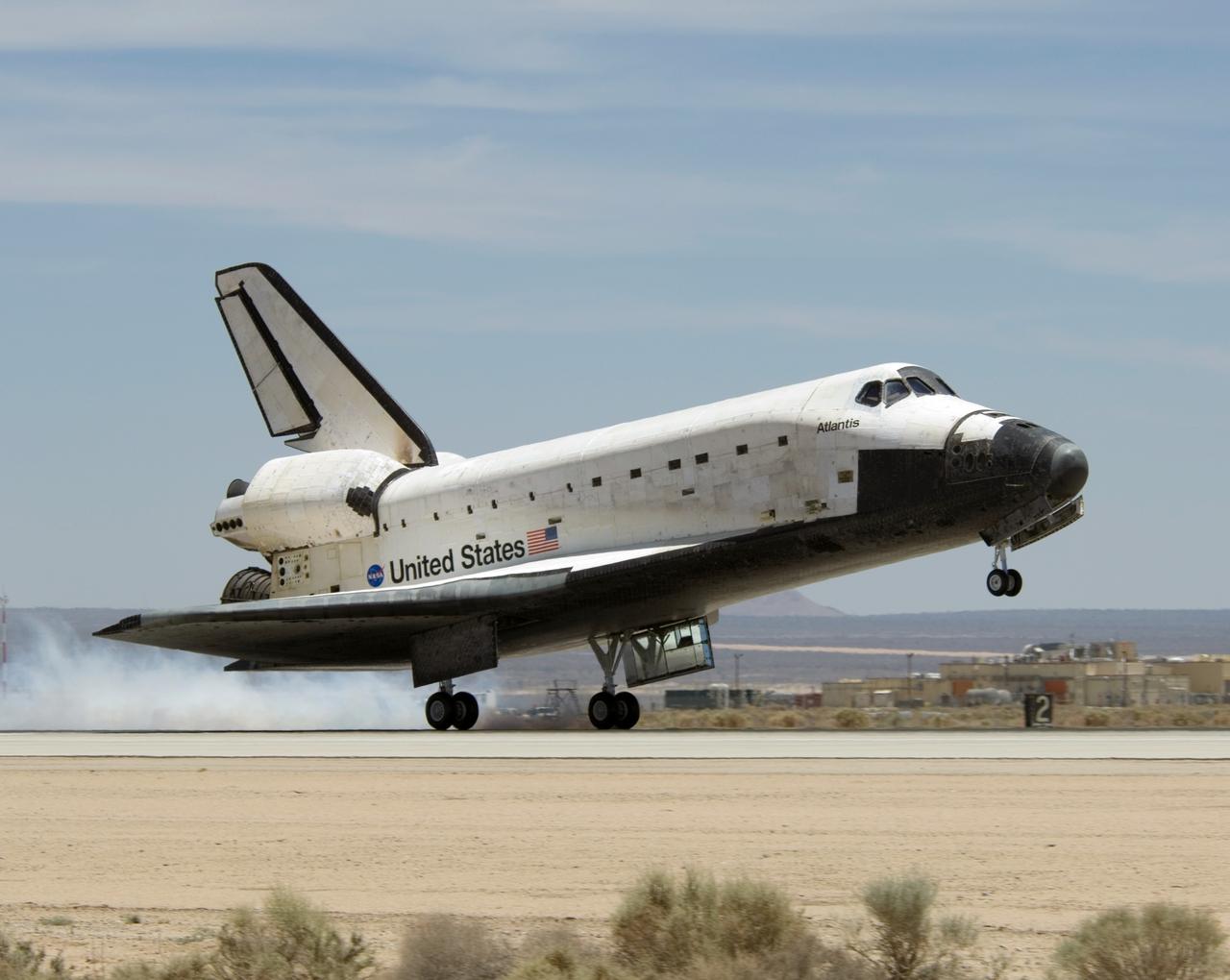
STS117-S-049 (22 June 2007) --- Space Shuttle Atlantis' main landing gear touches down on runway 22 at NASA's Dryden Flight Research Center at Edwards Air Force Base in California concluding a successful assembly mission to the International Space Station. Atlantis landed on orbit 219 after 13 days, 20 hours and 12 minutes in space. The landing was diverted to California due to marginal weather at the Kennedy Space Center. Main gear touchdown was at 12:49:38 p.m. (PDT). Nose gear touchdown was at 12:49:49 p.m. and wheel stop was at 12:50:48 p.m. This was the 51st landing for the Space Shuttle Program at Edwards Air Force Base. The mission to the station was a success, installing and activating the S3/S4 truss and retracting the P6 arrays. Onboard were astronauts Rick Sturckow, commander; Lee Archambault, pilot; Jim Reilly, Steven Swanson, Patrick Forrester and John "Danny" Olivas, all STS-117 mission specialists. Also onboard was astronaut Sunita Williams, who was flight engineer on the Expedition 15 crew. She achieved a new milestone, a record-setting flight at 194 days, 18 hours and 58 minutes, the longest single spaceflight ever by a female astronaut or cosmonaut.

Ulysses Patera
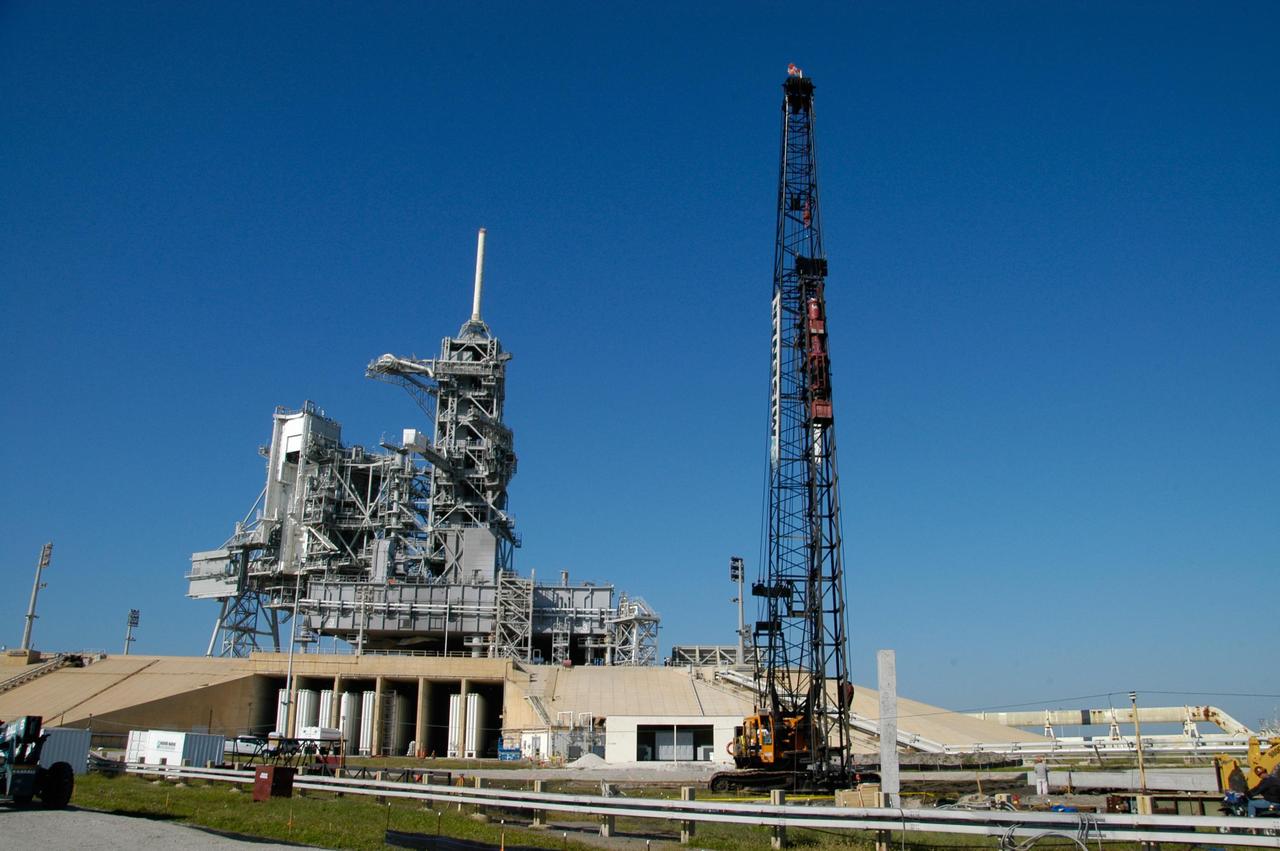
KENNEDY SPACE CENTER, FLA. -- On Launch Pad 39B at NASA's Kennedy Space Center, pilings are being pounded into the ground to help construct lightning towers for the Constellation Program and Ares/Orion launches. Pad B will be the site of the first Ares vehicle launch, including Ares I-X which is scheduled for April 2009. Photo credit: NASA/George Shelton
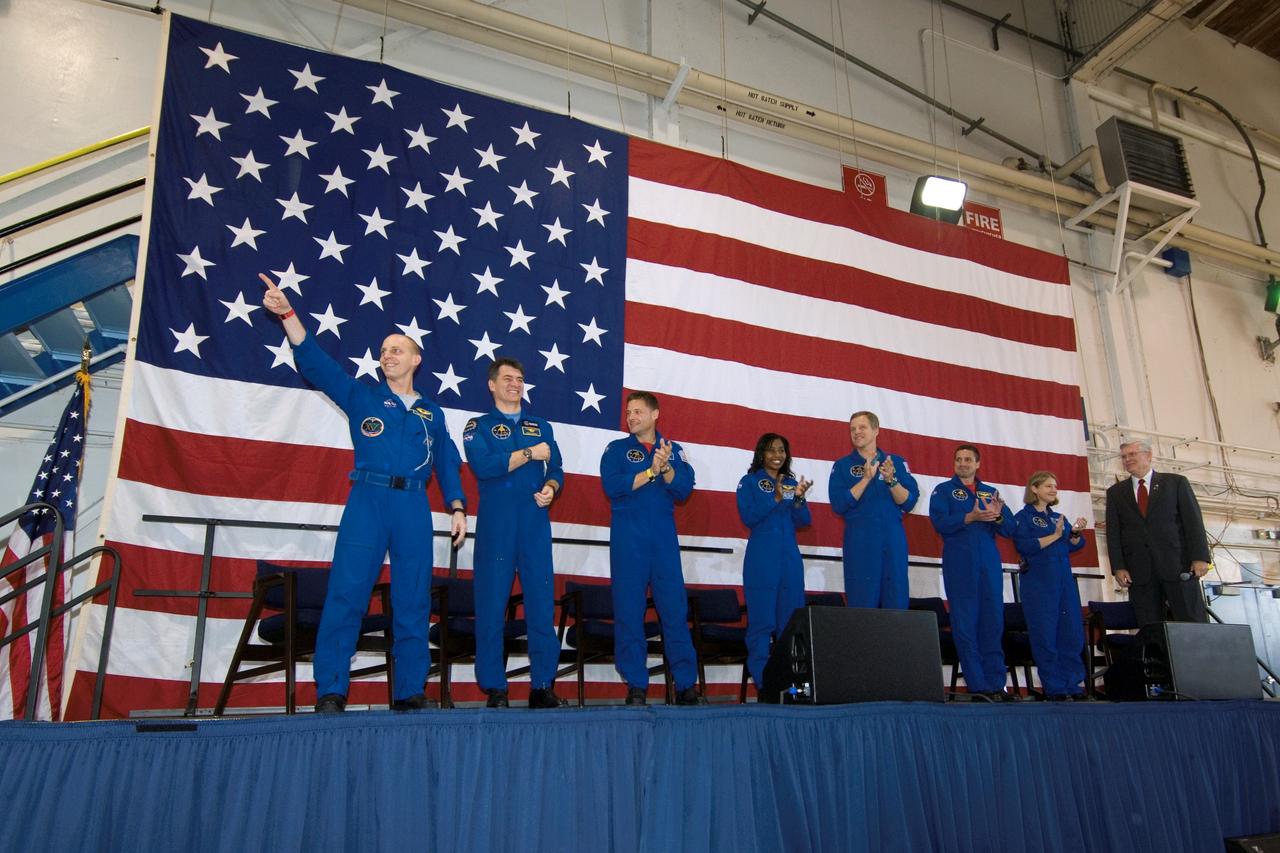
JSC2007-E-098002 (8 Nov. 2007) --- The crew of the STS-120 mission was welcomed home to Houston Nov. 8, following the landing of Space Shuttle Discovery in Florida on Nov. 7. Center Director Mike Coats, far right, introduced the crew to the crowd on hand at Ellington Field. From the right are STS-120 commander Pam Melroy, pilot George Zamka and mission specialists Scott Parazynski, Stephanie Wilson, Doug Wheelock, Paolo Nespoli (ESA) and Clay Anderson were welcomed by family and friends during the ceremony.
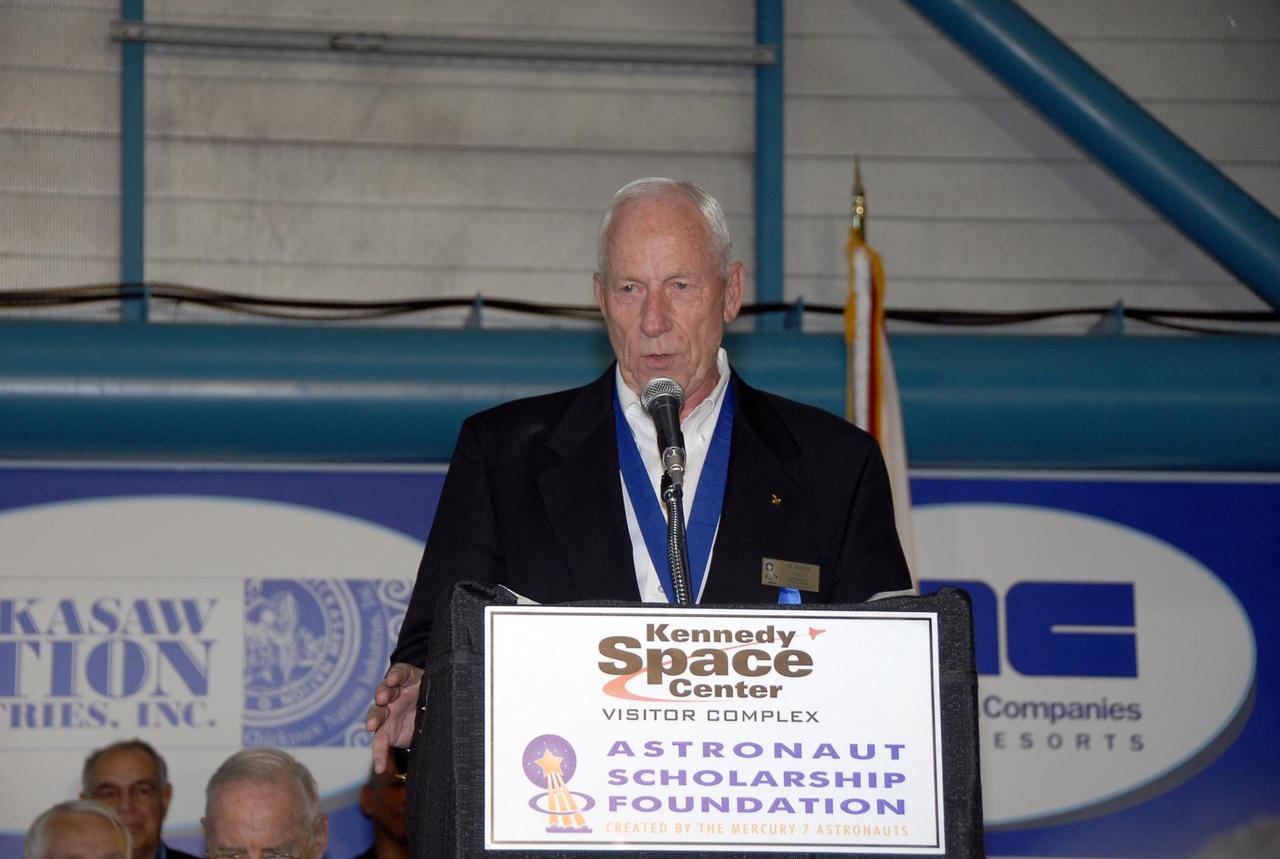
KENNEDY SPACE CENTER, FLA. -- U.S. Astronaut Hall of Fame member Al Worden speaks about the accomplishments of the newest inductees to the Hall of Fame. The May 5 induction added space shuttle commanders Michael L. Coats, Steven A. Hawley and Jeffrey A. Hoffman to the Hall of Fame. They grow the number of space explorers enshrined in the Hall of Fame to 66. These gentlemen have joined such American space heroes as Neil Armstrong, Glenn, Alan Shepard and Sally Ride. The ceremony was held at the Kennedy Space Center's Apollo/Saturn V Center. Photo credit: NASA/Kim Shiflett
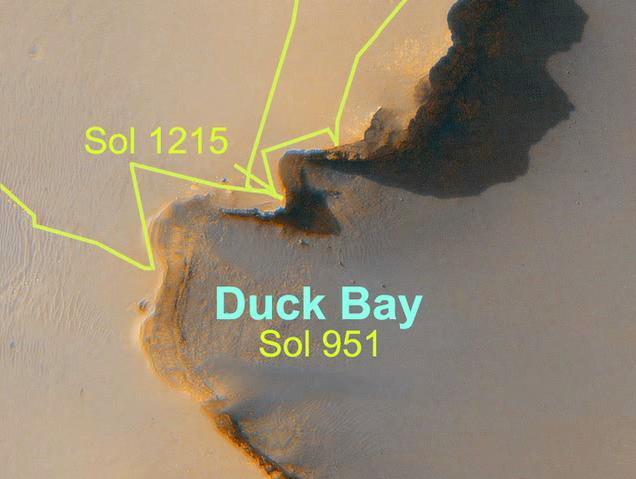
This image maps out the travels of NASA Mars Exploration Rover Opportunity, from is landing site at Eagle Crater to the rim of Victoria Crater about six miles 9.7 kilometers away in September of 2006.
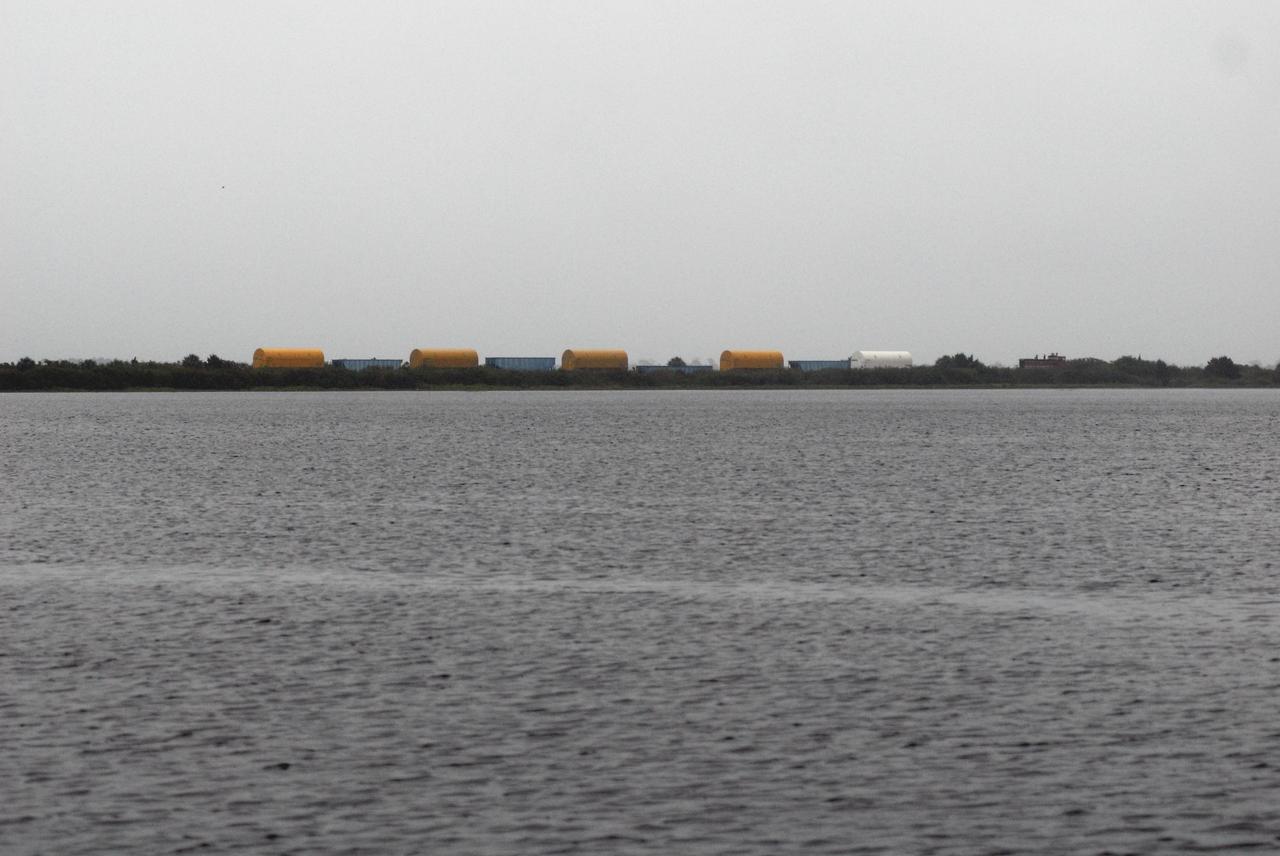
KENNEDY SPACE CENTER, FLA. -- Solid rocket motor segments and two aft exit cone segments arrive by rail at NASA's Kennedy Space Center. While enroute, solid rocket motor segments were involved in a derailment in Alabama. The rail cars carrying these segments remained upright and were undamaged. An inspection determined these segment cars could continue on to Florida. The segments themselves will undergo further evaluation at Kennedy before they are cleared for flight. Other segments involved in the derailment will be returned to a plant in Utah for further evaluation. Photo credit: NASA/Kim Shiflett

KENNEDY SPACE CENTER, FLA. -- In the Orbiter Processing Facility, the second of two Materials International Space Station Experiments, or MISSE, is lowered into space shuttle Endeavour's payload bay for installation. The MISSE is part of the payload onboard Endeavour for mission STS-123. The MISSE project is a NASA/Langley Research Center-managed cooperative endeavor to fly materials and other types of space exposure experiments on the International Space Station. The objective is to develop early, low-cost, non-intrusive opportunities to conduct critical space exposure tests of space materials and components planned for use on future spacecraft. Photo credit: NASA/Kim Shiflett