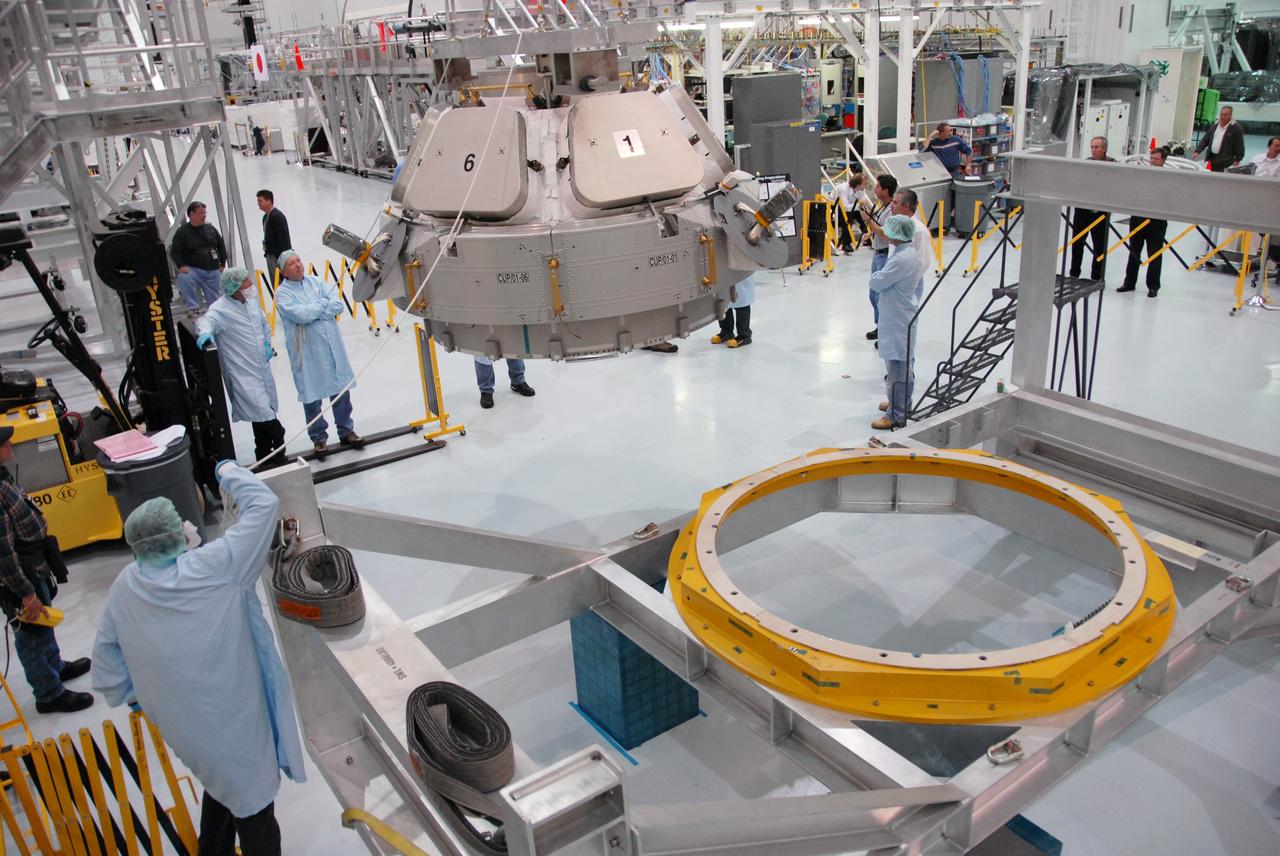
CAPE CANAVERAL, Fla. – Suspended by a crane in the Space Station Processing Facility at NASA's Kennedy Space Center in Florida, the Cupola module moves closer to the workstand at right. The module was delivered to Kennedy by the European Space Agency in 2004 from Alenia Spazio in Turin, Italy. Cupola will provide a 360-degree panoramic view of activities outside the station and spectacular views of the Earth. Cupola has the capability for command and control workstations to be installed to assist in space station remote manipulator system and extra vehicular activities. The final element of the space station core, Cupola is scheduled for launch on space shuttle Endeavour's STS-130 mission, targeted for Dec. 10, 2009. Photo credit: NASA/Cory Huston
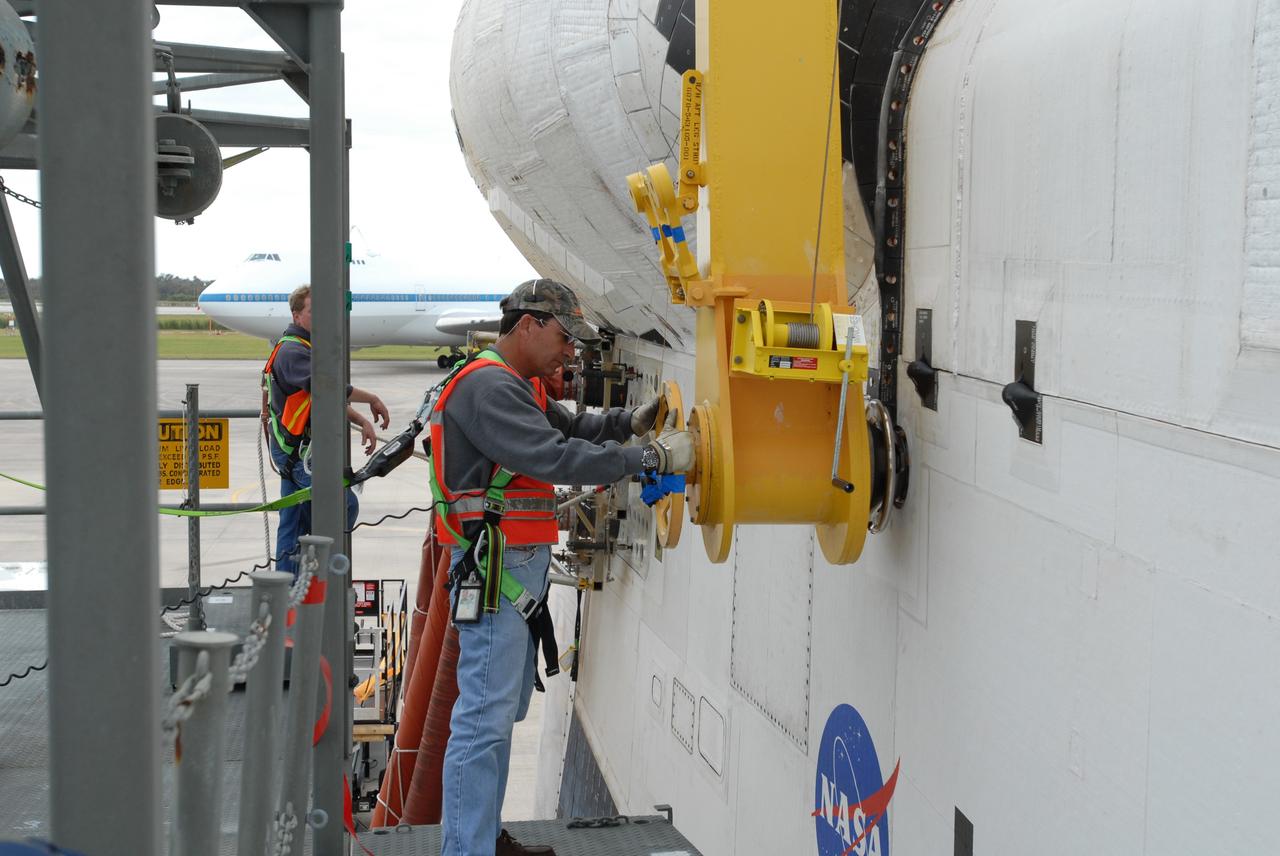
CAPE CANAVERAL, Fla. -- At the Shuttle Landing Facility, or SLF, at NASA's Kennedy Space Center in Florida, workers begin removing the sling from around space shuttle Endeavour. Part of the mate/demate device, the sling enabled Endeavour to be lifted away from shuttle carrier aircraft, or SCA, and lowered to the ground. The SCA carried the shuttle piggyback from California, where Endeavour landed Nov. 30 to end the STS-126 mission. Endeavour will be towed via the two-mile tow-way from the SLF by a diesel-powered tractor to the Orbiter Processing Facility where it will begin preparations for its next mission, STS-127, targeted for May 2009. Photo credit: NASA/Jim Grossmann

S124-E-006793 (6 June 2008) --- Astronaut Greg Chamitoff, Expedition 17 flight engineer, works in the newly installed Kibo Japanese Pressurized Module of the International Space Station while Space Shuttle Discovery (STS-124) is docked with the station.

CAPE CANAVERAL, Fla. -- In the Orbiter Processing Facility at NASA's Kennedy Space Center in Florida, STS-119 Pilot Tony Antonelli checks the cockpit window of space shuttle Discovery. He and other crew members are at Kennedy for a Crew Equipment Interface Test that provides experience handling tools, equipment and hardware they will use on the mission. On the STS-119 mission, space shuttle Discovery will carry the S6 truss segment to complete the 361-foot-long backbone of the International Space Station. The truss includes the fourth pair of solar array wings and electronics that convert sunlight to power for the orbiting laboratory. Discovery is targeted for launch on Feb. 12, 2009. Photo credit: NASA/Kim Shiflett
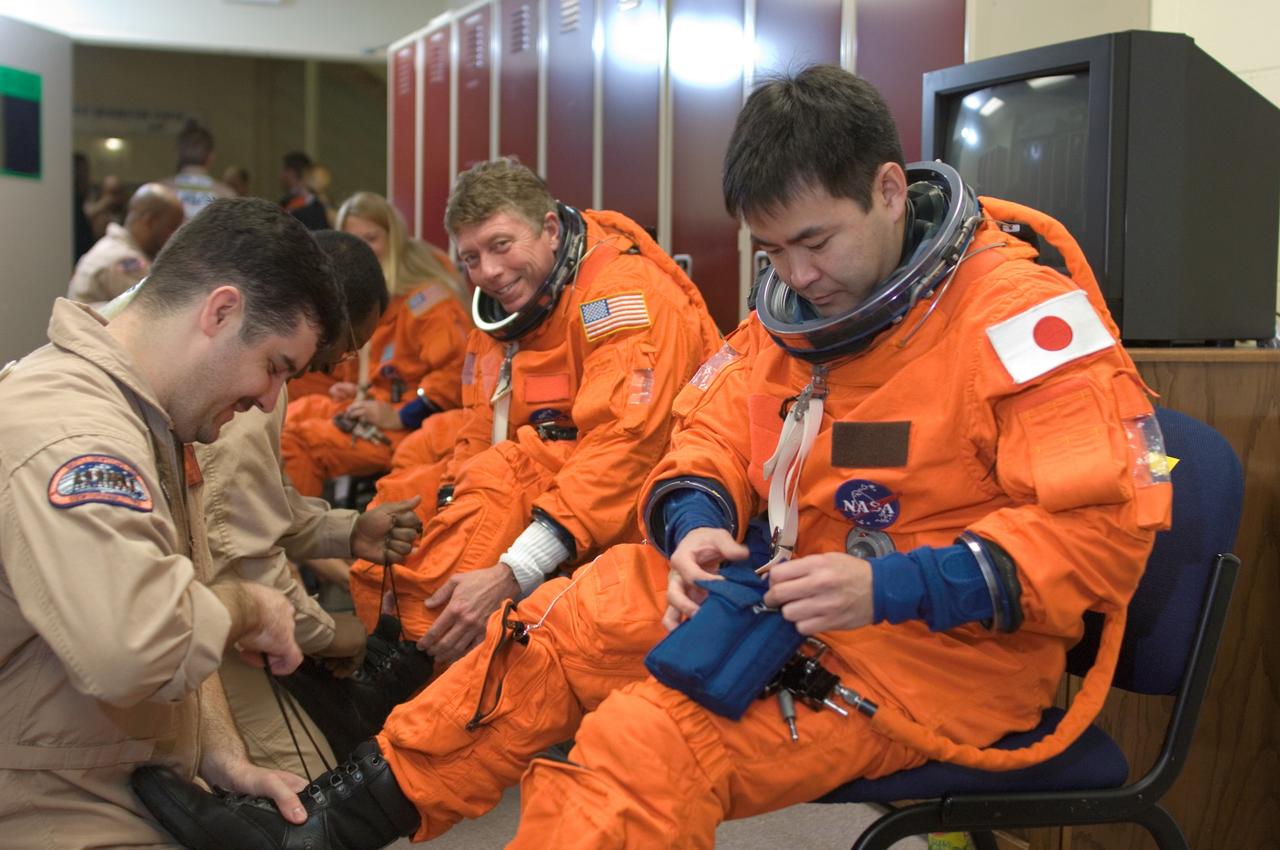
JSC2008-E-009419 (31 Jan. 2008) --- Japan Aerospace Exploration Agency (JAXA) astronaut Akihiko Hoshide (right), STS-124 mission specialist, dons a training version of his shuttle launch and entry suit in preparation for a training session in the Space Vehicle Mockup Facility at Johnson Space Center. United Space Alliance suit technician Carlos Ramos assisted Hoshide. Astronaut Michael E. Fossum, mission specialist, is also visible.
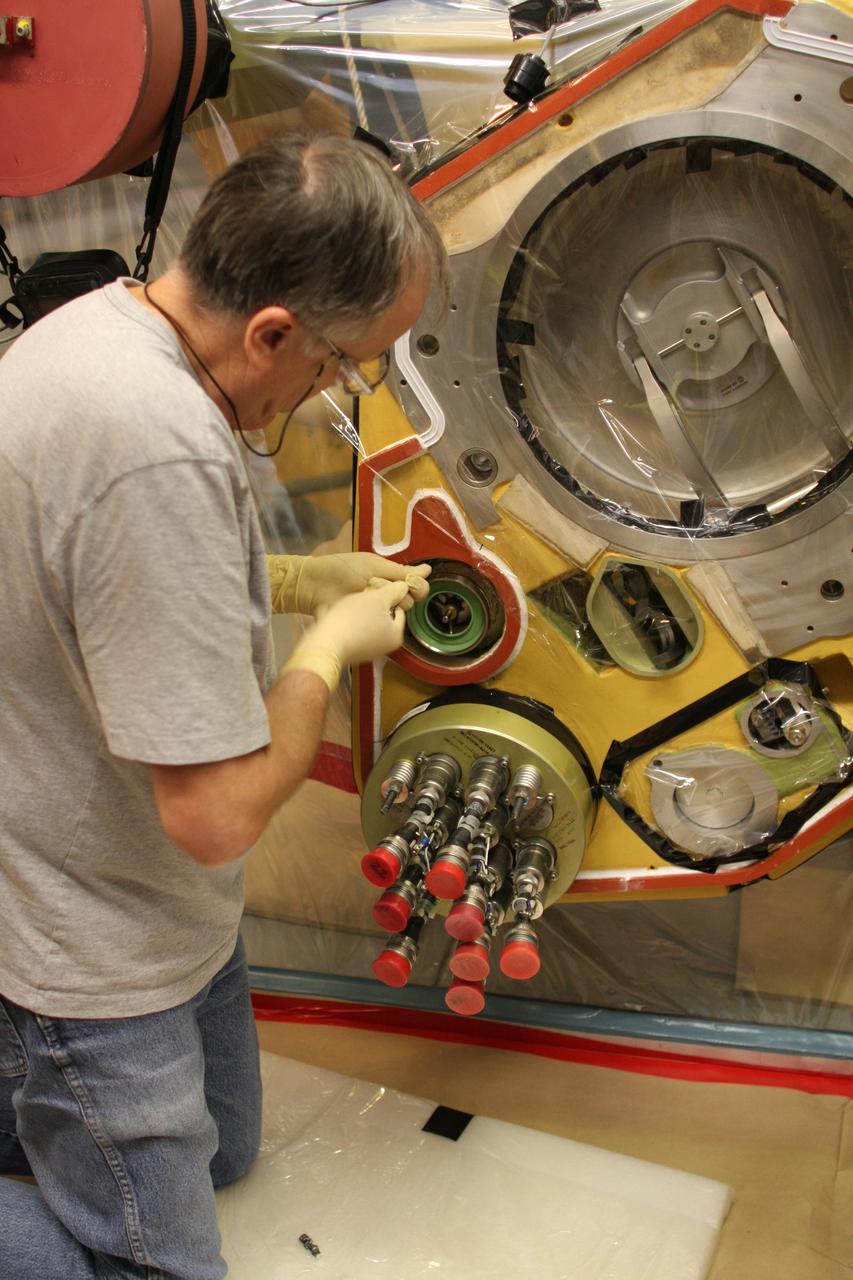
CAPE CANAVERAL, Fla. – Inside the Vehicle Assembly Building at NASA’s Kennedy Space Center, a technician removes a valve from Atlantis’ external tank after small dings were found on the sealing surface of the quick disconnect system that handles liquid-hydrogen fuel for the shuttle’s three main engines. The tank will be attached to the twin solid rocket boosters on Aug. 3 for the STS-125 mission, the fifth and final shuttle servicing mission to NASA’s Hubble Space Telescope. During the mission, the crew will install new instruments on the telescope, including the Cosmic Origins Spectrograph and the Wide Field Camera 3. A refurbished Fine Guidance Sensor will replace one unit of three now onboard. Mission specialists will also install new gyroscopes, batteries and thermal blankets on the telescope. Launch is targeted for Oct. 8. Photo credit: NASA/Dimitri Gerondidakis
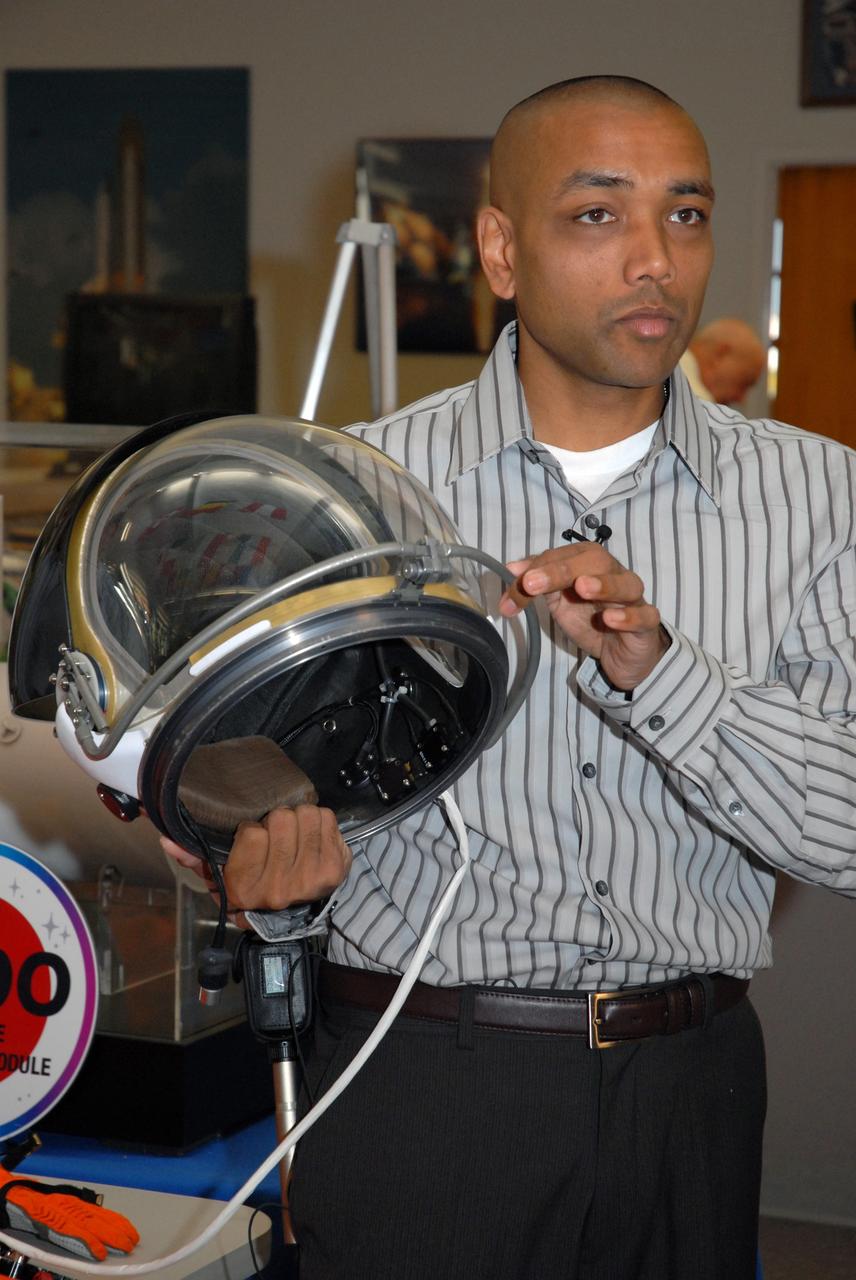
CAPE CANAVERAL, Fla. -- In the NASA News Center at NASA's Kennedy Space Center, Shuttle Crew Escape System Manager KC Chhipwadia describes for the media the elements of the helmet that is part of the launch and entry suit (seen on the table) used by shuttle crews during their missions. He is holding onto the bar that latches to secure the closed visor. The helmet provides oxygen when needed plus a communication system. Photo credit: NASA/Amanda Diller
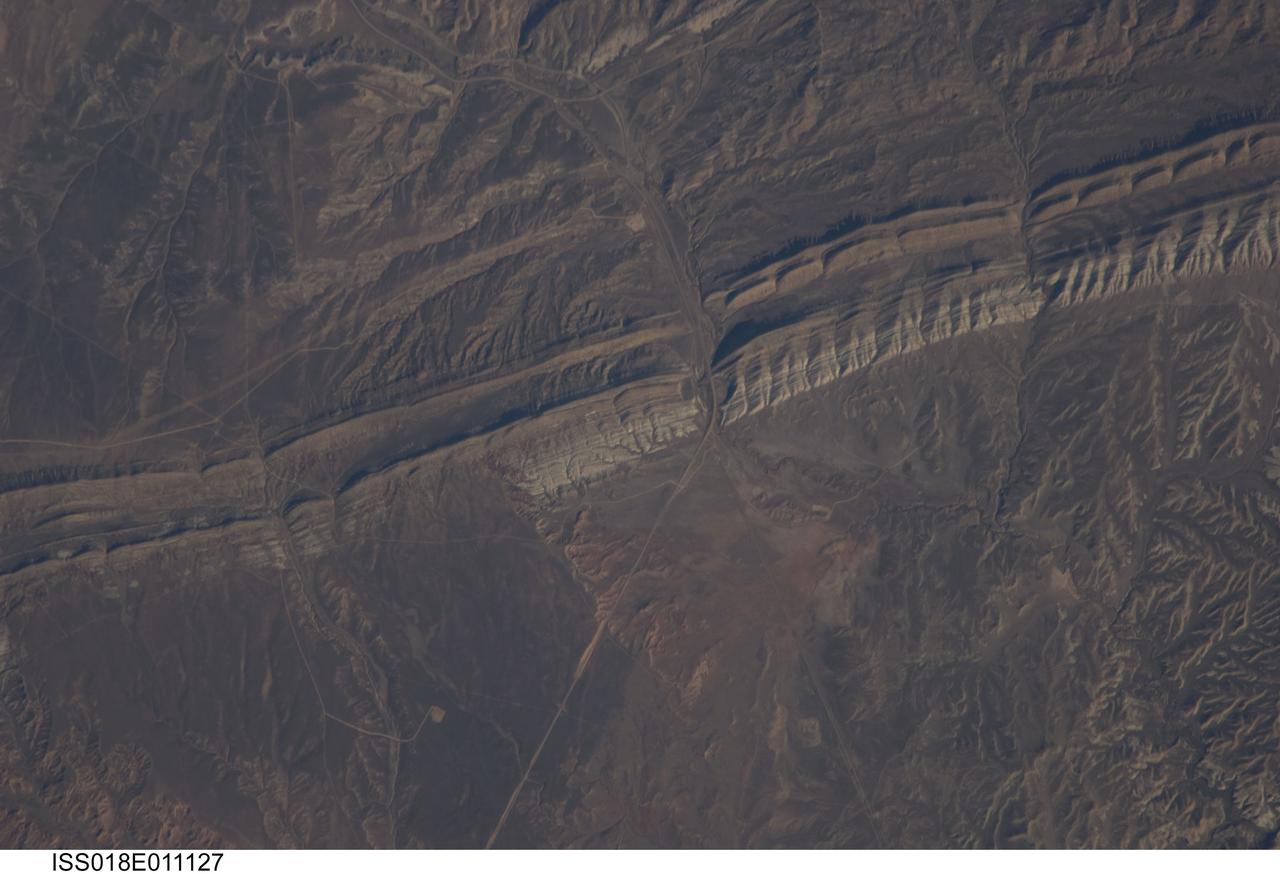
ISS018-E-011127 (6 Dec. 2008) --- Raven Ridge, Colorado is featured in this image photographed by an Expedition 18 crewmember on the International Space Station. An important way to unravel Earth?s history is to find and study old rocks that have been turned up and exposed on the surface through Earth?s tectonic activity. This image of Raven Ridge, Colorado provides a beautiful example of such a place that allows geologists to walk across rocks formed about 65 million years ago, now known as the ?K-T (or Cretaceous-Tertiary) Boundary?, according to scientists. The ridge is a dramatic topographic feature in northwestern Colorado formed by layered sedimentary rocks that span this boundary in geologic time. These sedimentary layers, originally deposited in a near-shore or marine environment as flat-lying beds, were later tilted on end to an almost vertical position by tectonic forces. The tilted beds are visible in this view as hard, resistant ridges of tan, buff, and white rocks, with a less resistant gray layer in the center of Raven Ridge (extending from left to right). The K-T Boundary is most famously known as the geological threshold where dinosaurs ? and a large number of other animal and plant species, both terrestrial and marine ? disappeared from the fossil record in a mass extinction event 66 ? 65 million years ago, according to scientists. Various hypotheses have been advanced to explain the mass extinction event - perhaps the best known being a large meteor impact that sparked widespread climate change or widespread volcanism that likewise produced significant climate change unfavorable for the existing plants and animals. The approximate location of the K-T Boundary is depicted in this image as a dotted white line ? rock layers to the south of the line belong to the Tertiary Period (lower half of image), while rocks to the north of the line are part of the Cretaceous and older Periods (upper half of image). A prominent topographic break in the ridgeline, Mormon Gap, provides road access across the Ridge. To the northwest of the Gap, several landslides formed in relatively soft Tertiary claystone, shale, and sandstone extend southwards from the crest of the Ridge.
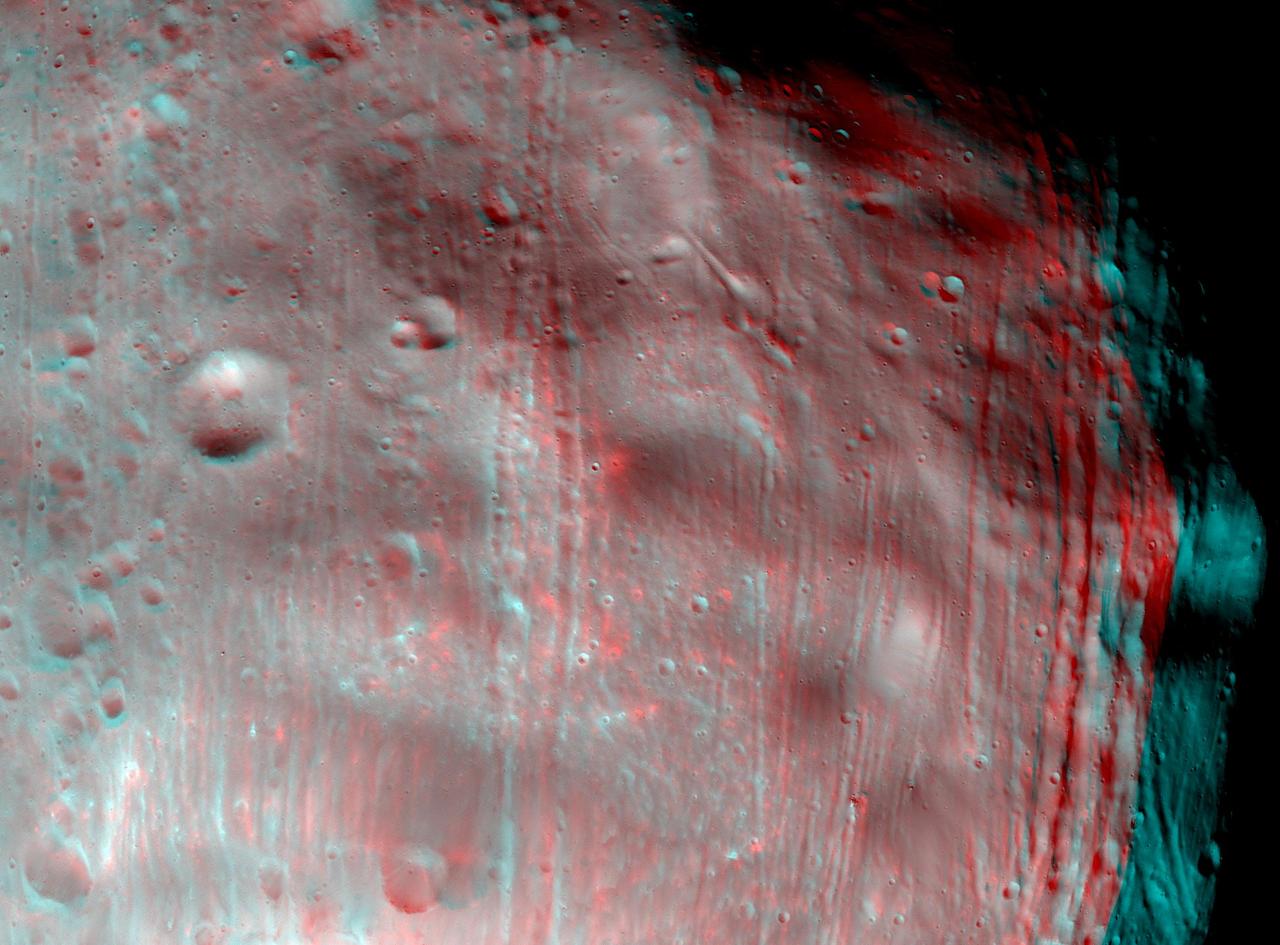
NASA Mars Reconnaissance Orbiter took two images of the larger of Mars two moons, Phobos, within 10 minutes of each other on March 23, 2008. 3D glasses are necessary to view this image.
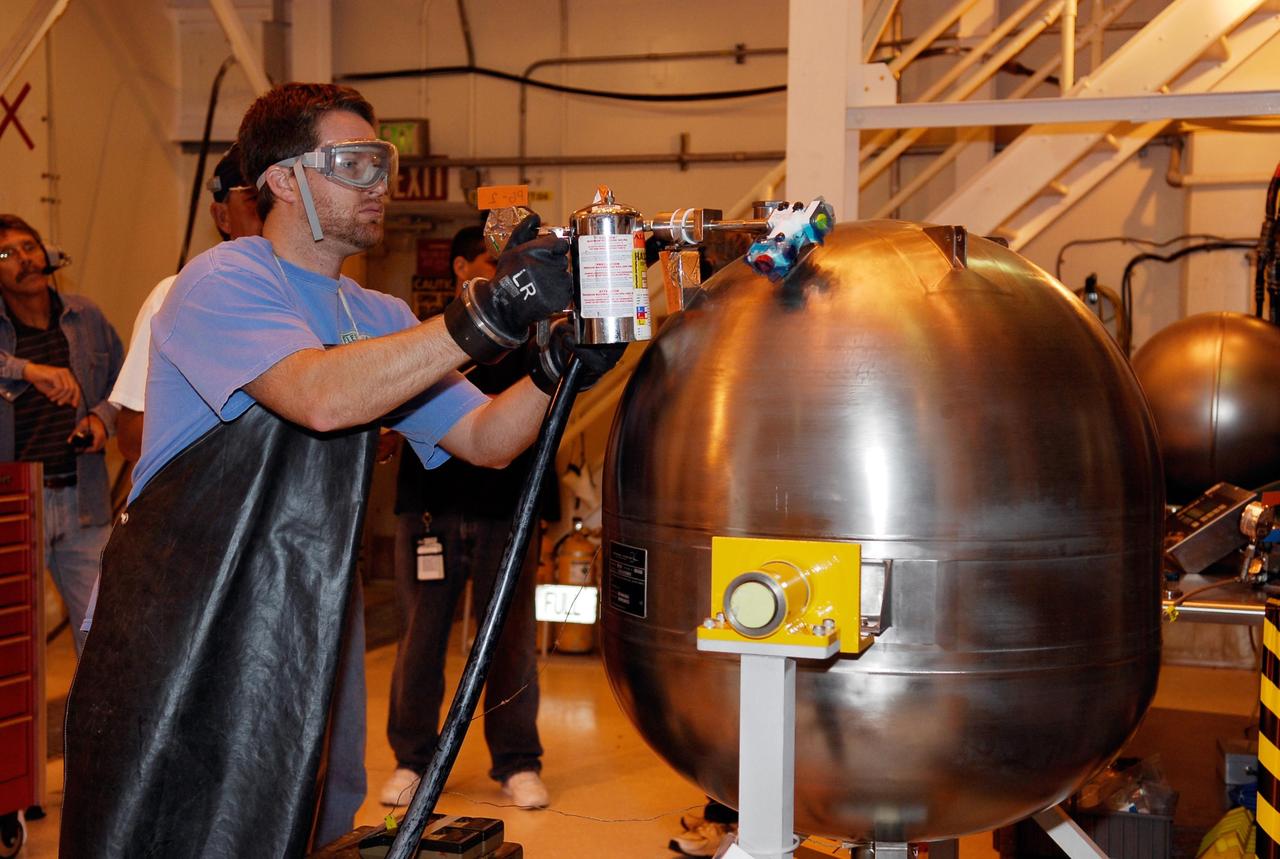
KENNEDY SPACE CENTER, FLA. -- In the hypergolic maintenance facility at NASA's Kennedy Space Center, a technician adjusts equipment during testing of the Ares I-X Roll Control System, or RoCS. The RoCS Servicing Simulation Test is to gather data that will be used to help certify the ground support equipment design and validate the servicing requirements and processes. The RoCS is part of the Interstage structure, the lowest axial segment of the Upper Stage Simulator. In an effort to reduce costs and meet the schedule, most of the ground support equipment that will be used for the RoCS servicing is of space shuttle heritage. This high-fidelity servicing simulation will provide confidence that servicing requirements can be met with the heritage system. At the same time, the test will gather process data that will be used to modify or refine the equipment and processes to be used for the actual flight element. Photo credit: NASA/Kim Shiflett
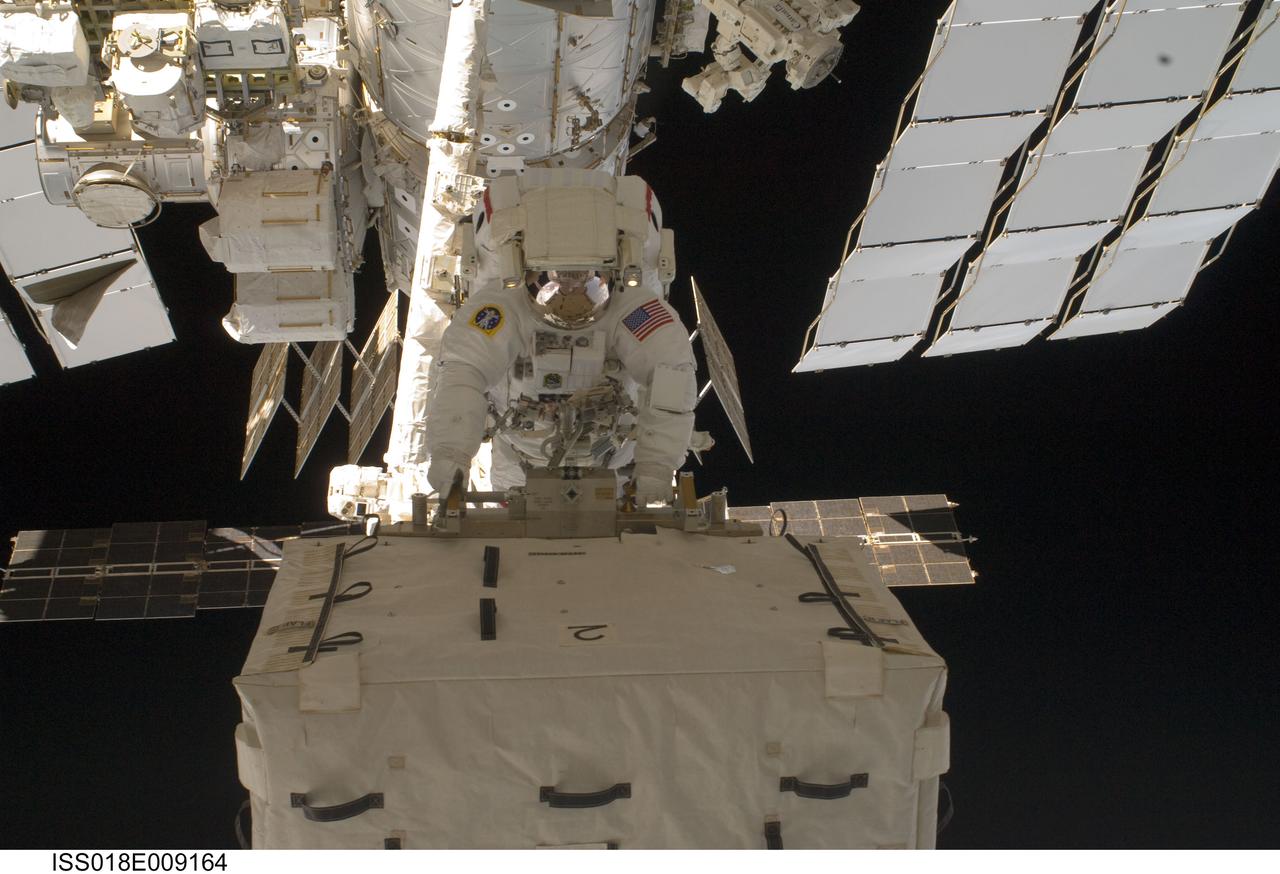
ISS018-E-009164 (18 Nov. 2008) --- Astronaut Heidemarie Stefanyshyn-Piper, STS-126 mission specialist, participates in the mission's first session of extravehicular activity (EVA) as construction and maintenance continue on the International Space Station. During the six-hour, 52-minute spacewalk, Piper and astronaut Steve Bowen (out of frame), mission specialist, worked to clean and lubricate part of the station's starboard Solar Alpha Rotary Joints (SARJ) and to remove two of SARJ's 12 trundle bearing assemblies. The spacewalkers also removed a depleted nitrogen tank from a stowage platform on the outside of the complex and moved it into Endeavour's cargo bay. They also moved a flex hose rotary coupler from the shuttle to the station stowage platform, as well as removing some insulation blankets from the common berthing mechanism on the Kibo laboratory.
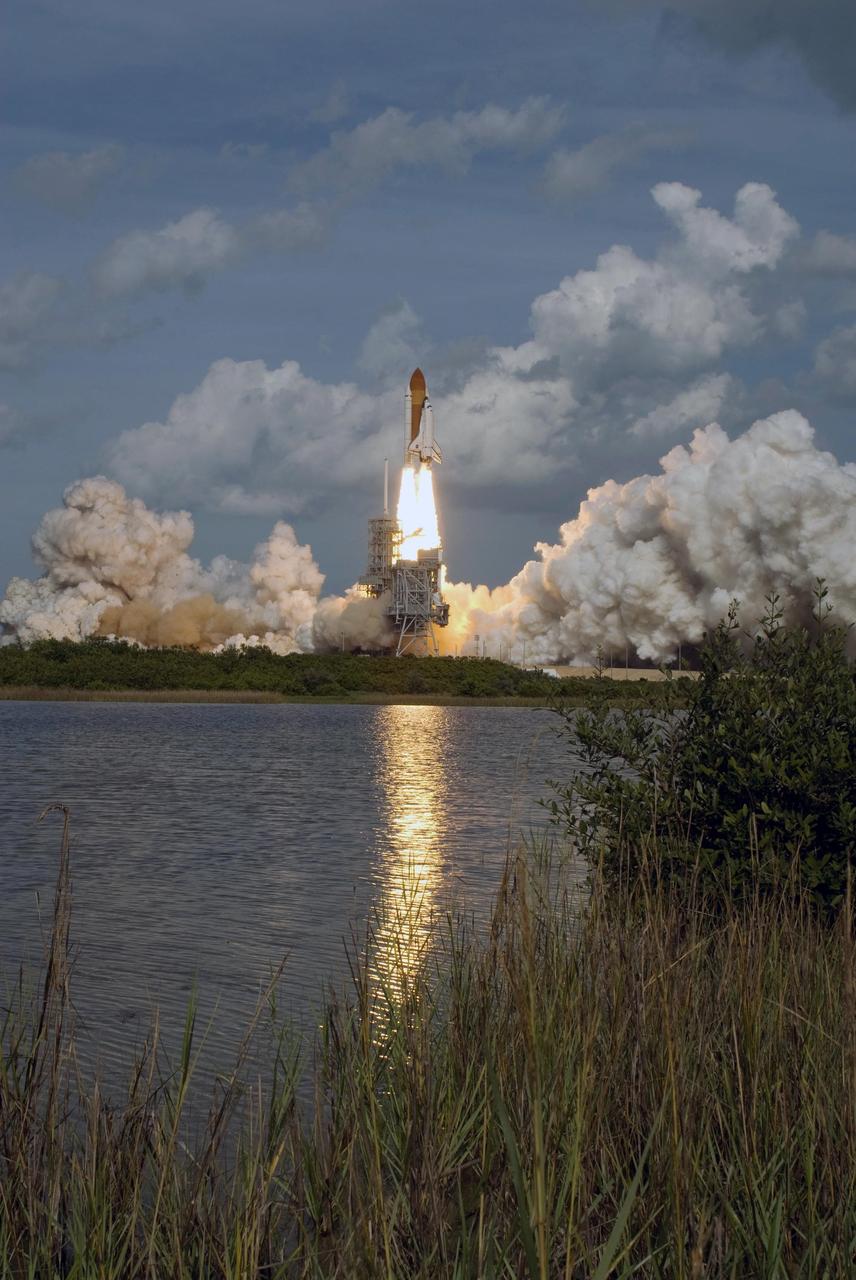
KENNEDY SPACE CENTER, FLA. -- Hurtling away from the clouds of smoke and steam, space shuttle Atlantis hurtles into the cloud-streaked sky on mission STS-122 to the International Space Station. Liftoff was on time at 2:45 p.m. EST. The launch is the third attempt for Atlantis since December 2007 to carry the European Space Agency's Columbus laboratory to the International Space Station. During the 11-day mission, the crew's prime objective is to attach the laboratory to the Harmony module, adding to the station's size and capabilities. Photo credit: NASA/Sandra Joseph, Tony Gray, Robert Murray
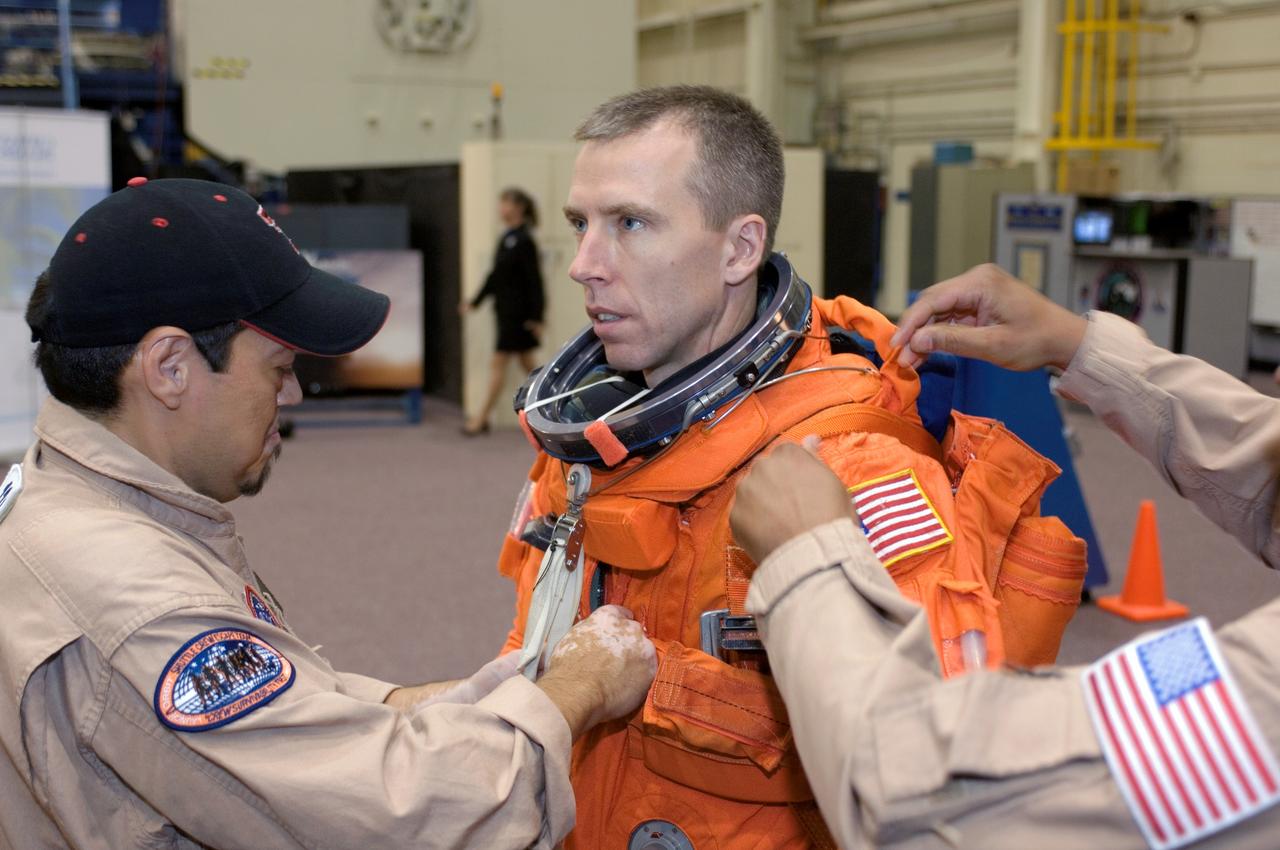
JSC2008-E-047965 (4 June 2008) --- Astronaut Andrew J. Feustel, STS-125 mission specialist, dons a training version of his shuttle launch and entry suit in preparation for a training session in the Space Vehicle Mockup Facility at NASA's Johnson Space Center. United Space Alliance suit technicians assisted Feustel.
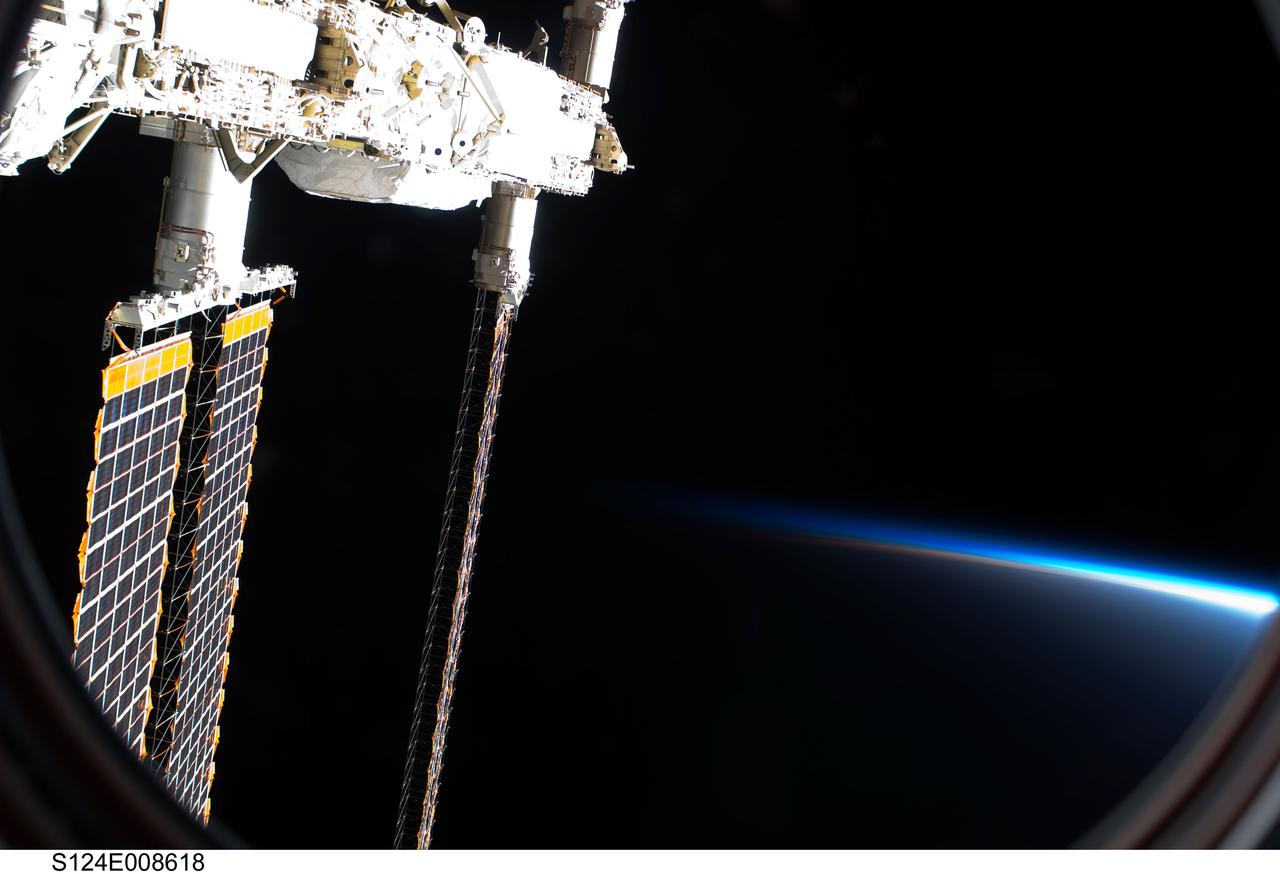
S124-E-008618 (10 June 2008) --- A partial view of International Space Station solar panels and Earth's atmosphere are photographed by a STS-124 crewmember on the International Space Station while Space Shuttle Discovery is docked with the station.

CAPE CANAVERAL, Fla. - At NASA's Kennedy Space Center in Florida, space shuttle Endeavour rolls off Launch Pad 39B for the 3.4-mile rollaround to Launch Pad 39A. First motion was at 8:28 a.m. EDT. Endeavour is targeted to launch Nov. 14 on the STS-126 mission. On this 27th mission to the International Space Station, Endeavour will carry the Lightweight Multi-Purpose Experiment Support Structure Carrier and the Multi-Purpose Logistics Module Leonardo that will hold supplies and equipment, including additional crew quarters, additional exercise equipment, spare hardware and equipment for the regenerative life support system. Photo credit: NASA/Troy Cryder
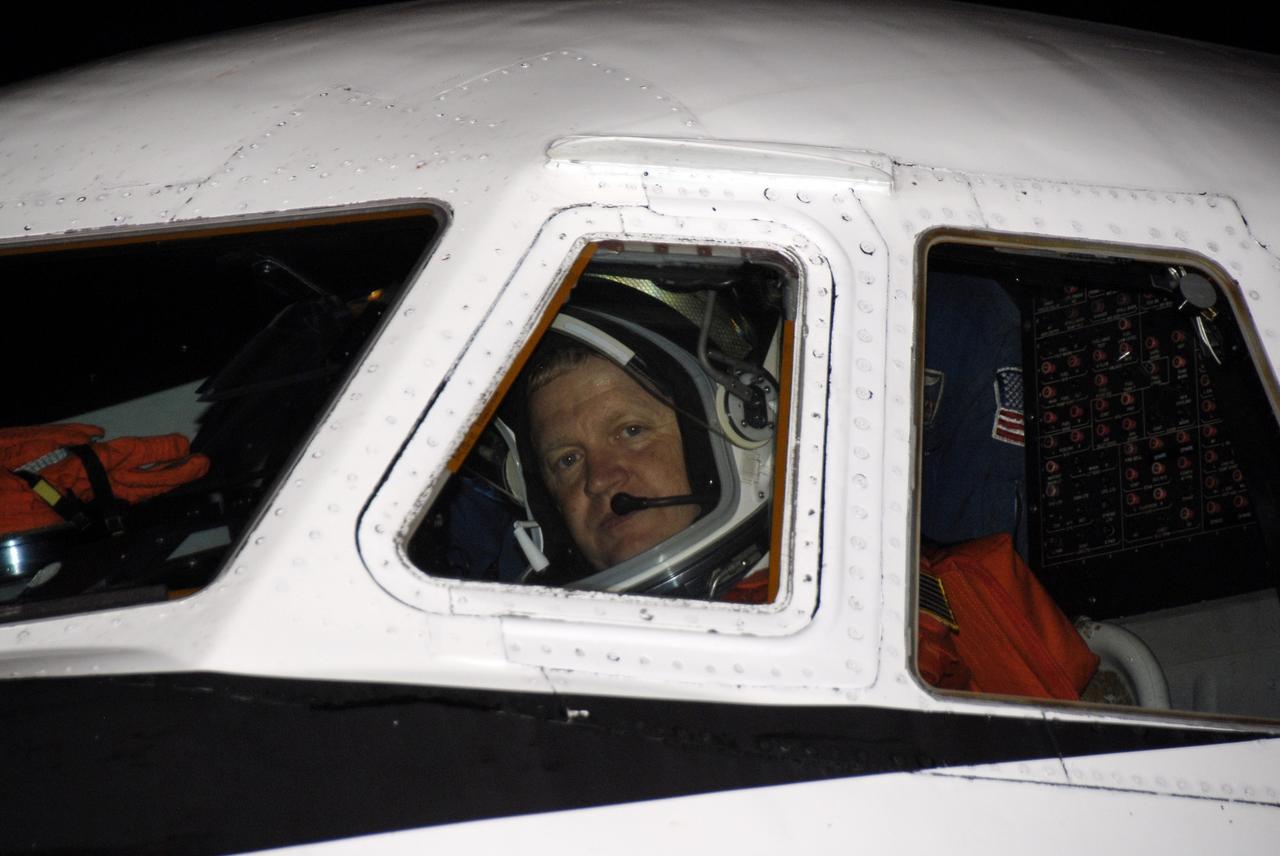
CAPE CANAVERAL, Fla. - At the Shuttle Landing Facility at NASA's Kennedy Space Center in Florida, STS-126 Pilot Eric Boe peers out the cockpit window of the Shuttle Training Aircraft, or STA, before taking off to practice shuttle landings. The STA is a Grumman American Aviation-built Gulf Stream II jet that was modified to simulate a shuttle’s cockpit, motion and visual cues, and handling qualities. In flight, the aircraft duplicates the shuttle’s atmospheric descent trajectory from approximately 35,000 feet to landing. The practice is part of the Terminal Countdown Demonstration Test, which includes equipment familiarization, emergency exit procedures and a simulated launch countdown. On the STS-126 mission, space shuttle Endeavour's crew will deliver equipment and supplies to the International Space Station in preparation for expansion from a three- to six-person resident crew aboard the complex. The mission also will include four spacewalks to service the station’s Solar Alpha Rotary Joints. Endeavour is targeted to launch Nov. 14. Photo credit: NASA/Kim Shiflett
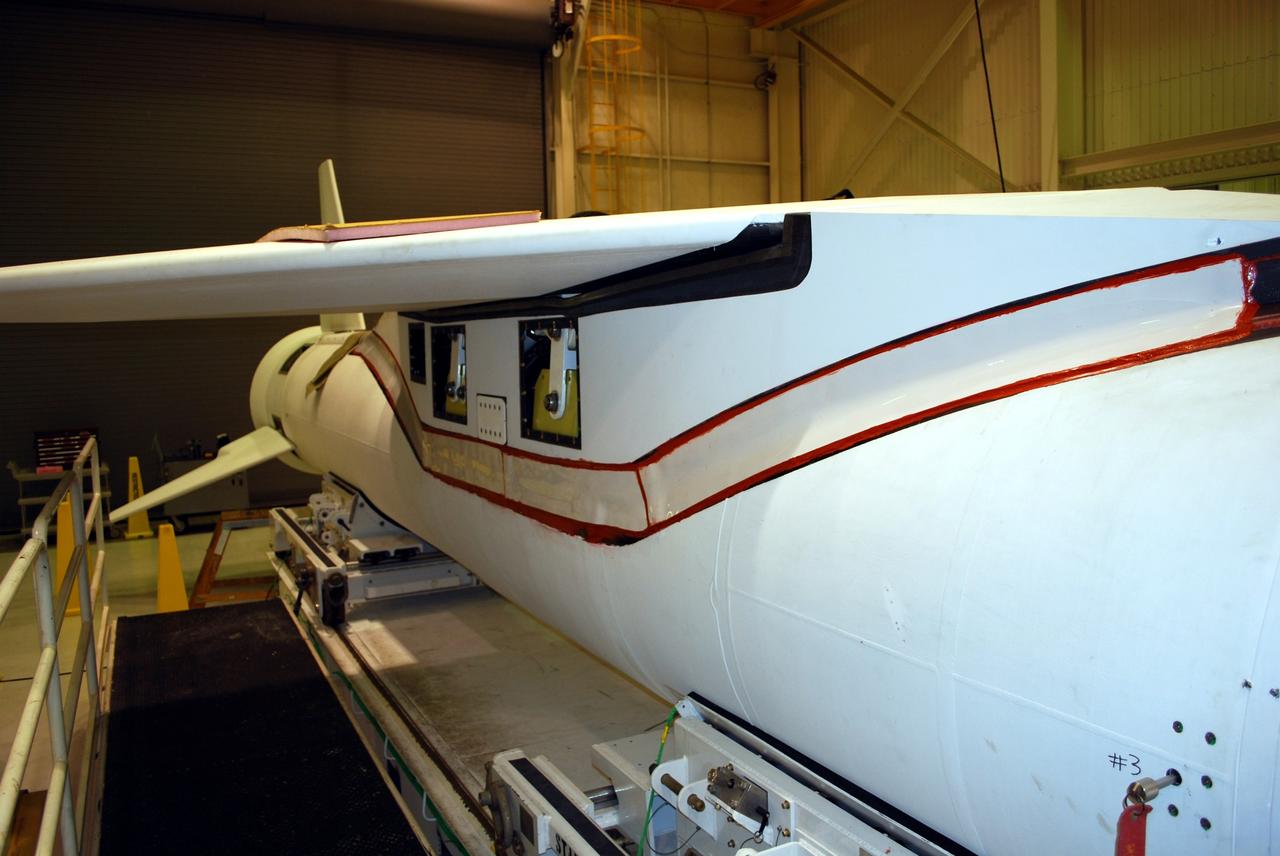
VANDENBERG AIR FORCE BASE, Calif. -- Avionics shelf flatness and fillet gap measurements are conducted on the wing of a Pegasus rocket in Building 1555 at Vandenberg AFB. The testing was performed by workers from Advanced Digital Measuring Works using an API laser tracker. The Pegasus will launch NASA's Interstellar Boundary Explorer Mission, or IBEX, satellite from Kwajalein Island in the Marshall Islands, South Pacific. IBEX will make the first map of the boundary between the solar system and interstellar space. IBEX is the first mission designed to detect the edge of the solar system. As the solar wind from the sun flows out beyond Pluto, it collides with the material between the stars, forming a shock front. IBEX contains two neutral atom imagers designed to detect particles from the termination shock at the boundary between the solar system and interstellar space. IBEX also will study galactic cosmic rays, energetic particles from beyond the solar system that pose a health and safety hazard for humans exploring beyond Earth orbit. IBEX will make these observations from a highly elliptical orbit that takes it beyond the interference of the Earth's magnetosphere. IBEX is targeted for launch in October 2008. Photo credit: NASA/Randy Beaudoin
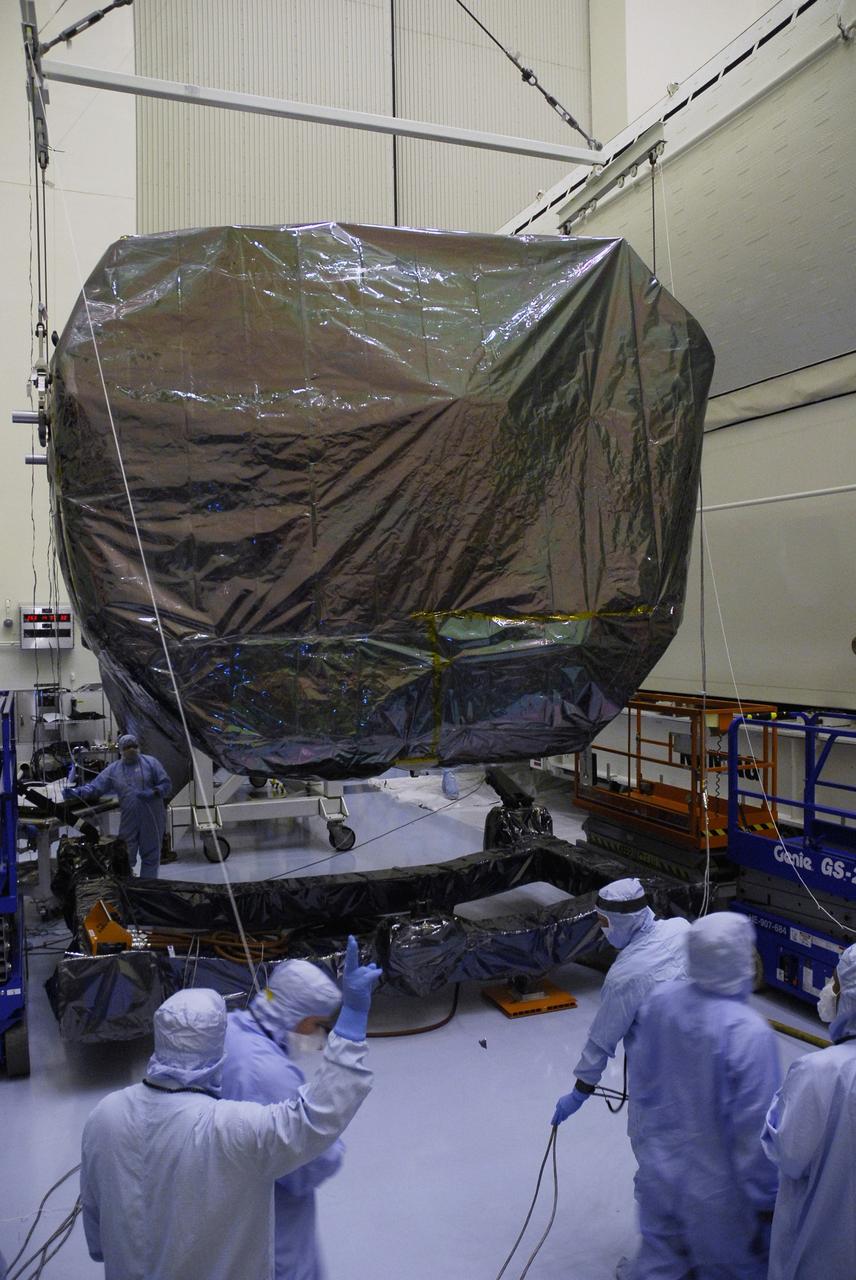
CAPE CANAVERAL, Fla. - In the Payload Hazardous Servicing Facility at NASA's Kennedy Space Center, workers are ready to lift the Orbital Replacement Unit Carrier, or ORUC, to the payload canister. The carrier is one of four associated with the STS-125 mission to service the Hubble Space Telescope. It will be installed in the payload canister for transfer to Launch Pad 39A. At the pad, all the carriers will be loaded into space shuttle Atlantis’ payload bay. Launch of Atlantis is targeted for Oct. 10. Photo credit: NASA/Jack Pfaller
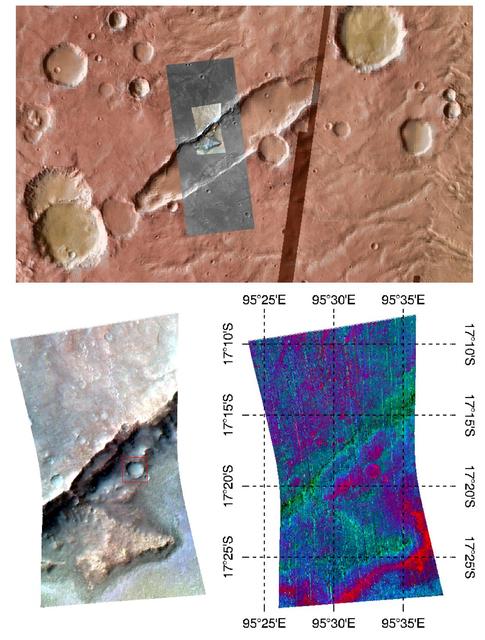
Durham, North Carolina, Students Study Martian Volcanism

KENNEDY SPACE CENTER, FLA. -- At NASA Kennedy Space Center's Launch Pad 39A, the crew for space shuttle Endeavour's STS-123 mission receives instruction on the slidewire basket system at the landing site for the baskets at the base of the pad during emergency egress training. The crew is at Kennedy for a full launch dress rehearsal, known as the terminal countdown demonstration test or TCDT. The terminal countdown demonstration test provides astronauts and ground crews with an opportunity to participate in various simulated countdown activities, including equipment familiarization and emergency training. Endeavour is targeted to launch March 11 at 2:28 a.m. EDT on a 16-day mission to the International Space Station. On the mission, Endeavour and its crew will deliver the first section of the Japan Aerospace Exploration Agency's Kibo laboratory and the Canadian Space Agency's two-armed robotic system, Dextre. Photo credit: NASA/Kim Shiflett
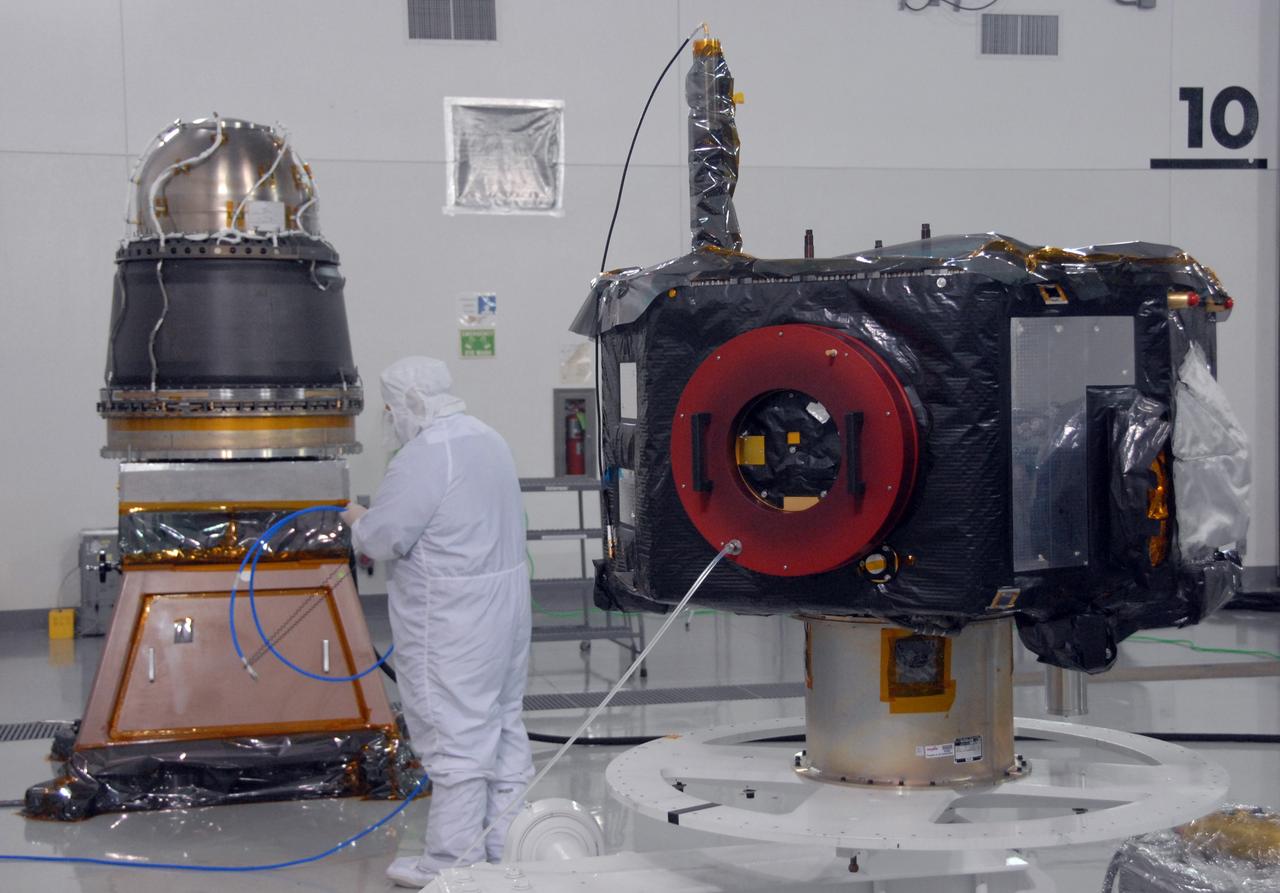
VANDENBERG AIR FORCE BASE, Calif. – At Vandenberg Air Force Base in California, at right is the NASA's Interstellar Boundary Explorer, or IBEX, spacecraft. At left are the Star-27 kick motor and nozzle for IBEX “on top” and the adapter cone, part of the IBEX flight system, underneath. The IBEX is being prepared for a spin balance test. The IBEX satellite will make the first map of the boundary between the Solar System and interstellar space. IBEX is the first mission designed to detect the edge of the Solar System. As the solar wind from the sun flows out beyond Pluto, it collides with the material between the stars, forming a shock front. IBEX contains two neutral atom imagers designed to detect particles from the termination shock at the boundary between the Solar System and interstellar space. IBEX also will study galactic cosmic rays, energetic particles from beyond the Solar System that pose a health and safety hazard for humans exploring beyond Earth orbit. IBEX will make these observations from a highly elliptical orbit that takes it beyond the interference of the Earth's magnetosphere. IBEX is targeted for launch from a Pegasus XL rocket on Oct. 5. Photo credit: NASA/VAFB

Craters in Caloris http://photojournal.jpl.nasa.gov/catalog/PIA10603
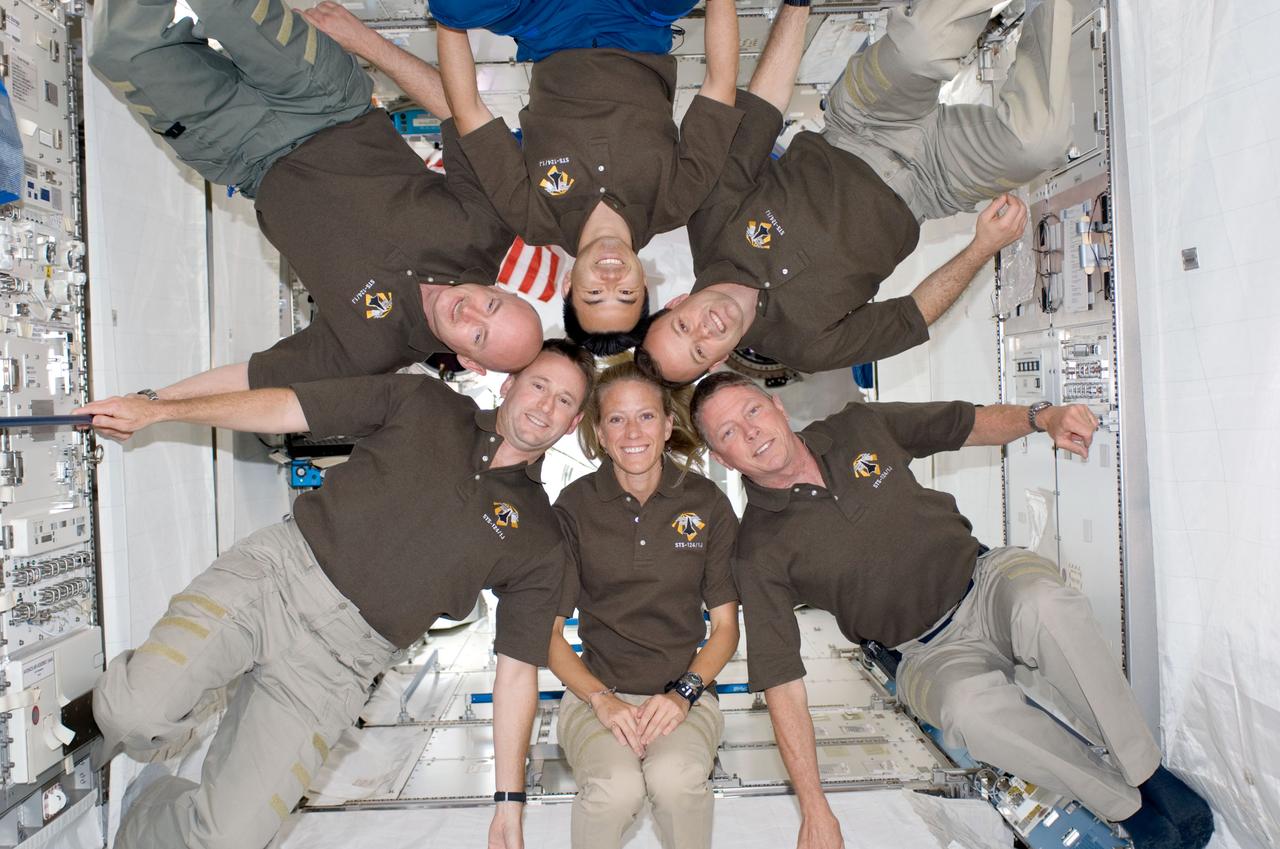
S124-E-007941 (9 June 2008) --- STS-124 crewmembers pose for a portrait following a joint news conference with the Expedition 17 crewmembers from the Kibo Japanese Pressurized Module of the International Space Station while Space Shuttle Discovery is docked with the station. Pictured (clockwise) from the bottom are NASA astronauts Karen Nyberg, mission specialists; Ken Ham, pilot; Mark Kelly, commander; Japan Aerospace Exploration Agency astronaut Akihiko Hoshide, NASA astronauts Ron Garan and Mike Fossum, all mission specialists.

Hooke Crater Dunes
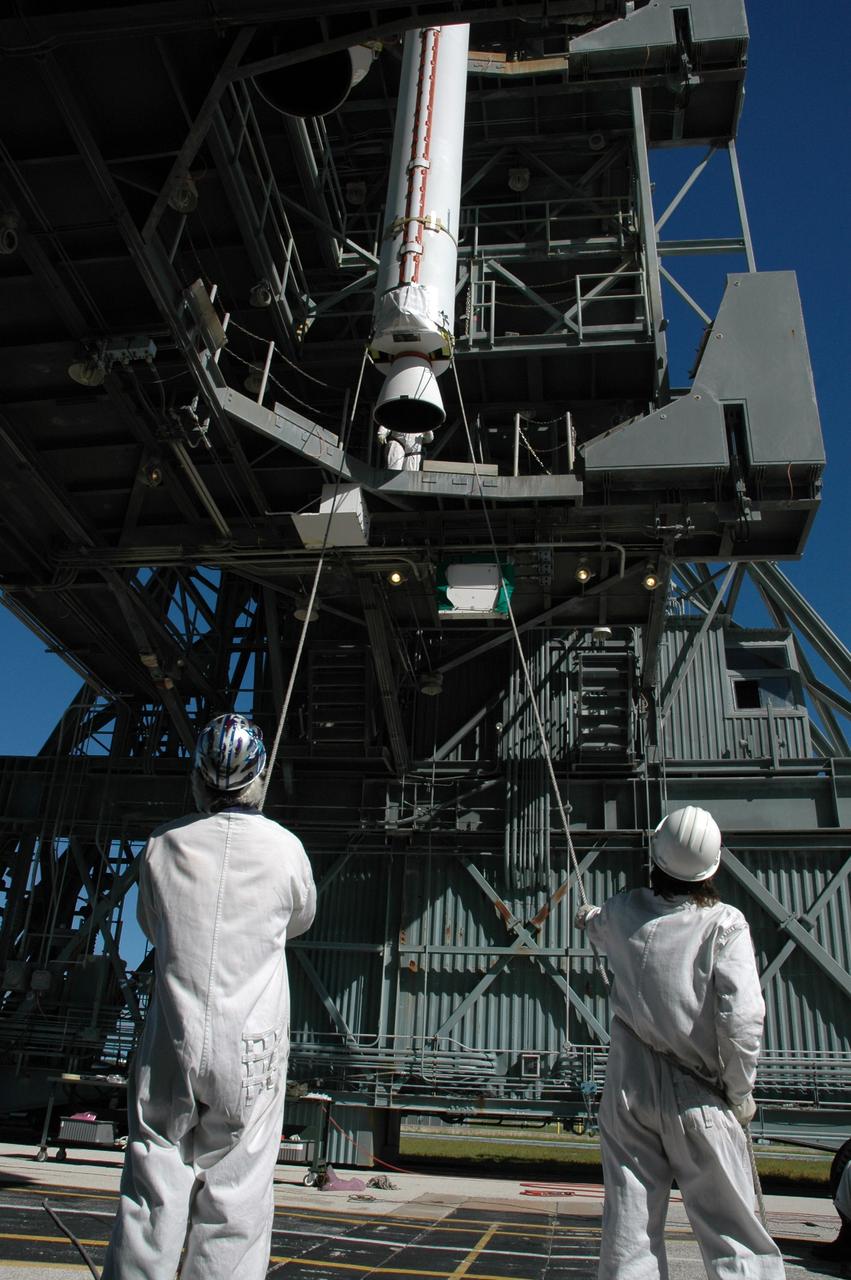
CAPE CANAVERAL, Fla. – On Launch Pad 17-B at Cape Canaveral Air Force Station in Florida, another solid rocket booster is being lifted into the mobile service tower for mating to the first stage of the Kepler's Delta 2 launch vehicle. The Kepler mission is specifically designed to survey our region of the Milky Way galaxy to discover hundreds of Earth-size and smaller planets in or near the habitable zone and determine how many of the billions of stars in our galaxy have such planets. Results from this mission will allow us to place our solar system within the continuum of planetary systems in the Galaxy. NASA's planet-hunting Kepler mission is scheduled to launch no earlier than March 5, 2009. Photo credit: NASA/Jim Grossmann
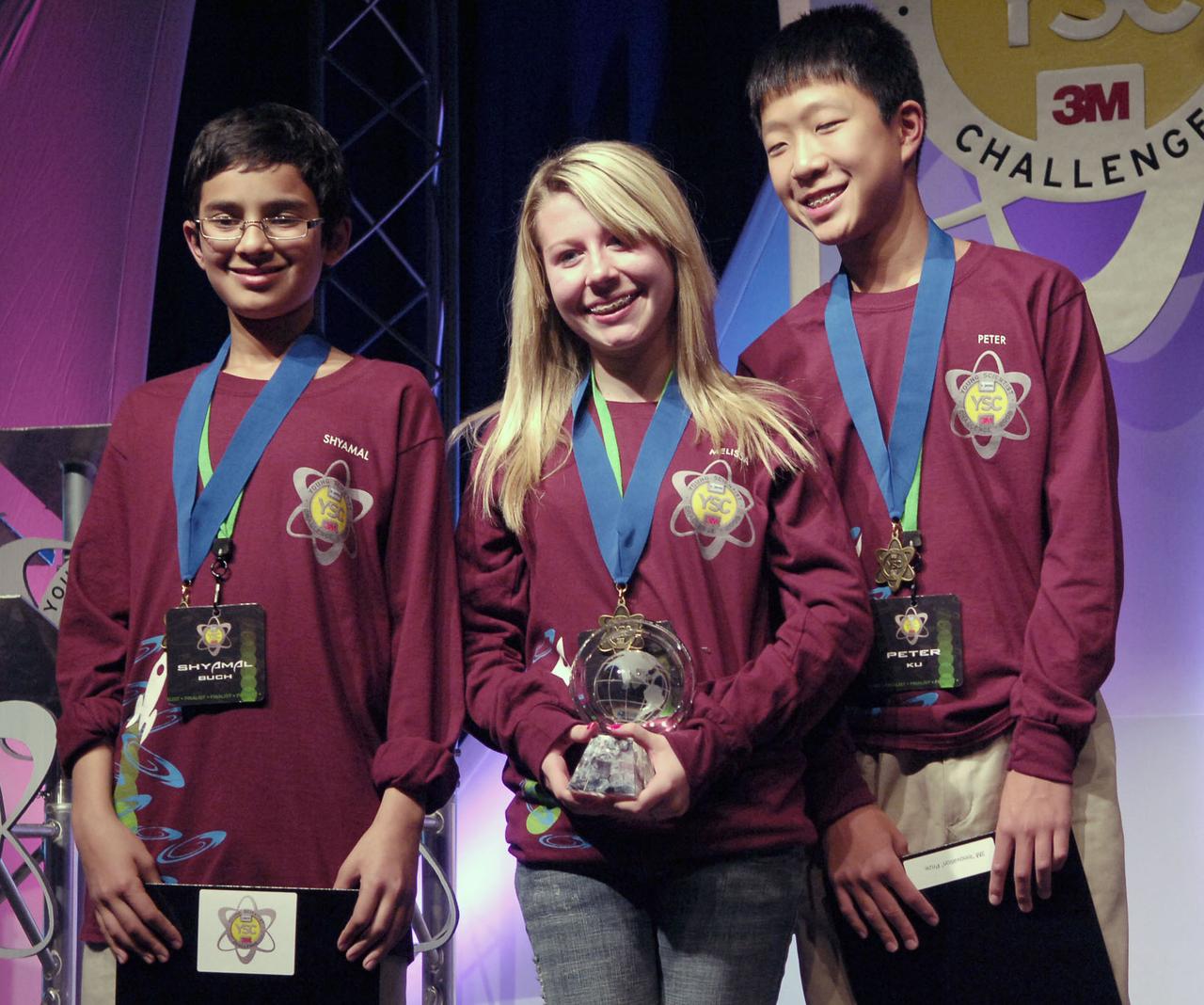
Young Scientist Challenge YSC was held at Goddard on October 5-6, 2008 sponsored by 3M. It gave students the opportunity to demonstrate their scientific and engineering skills by participating in live demonstrations. Top 3 winners
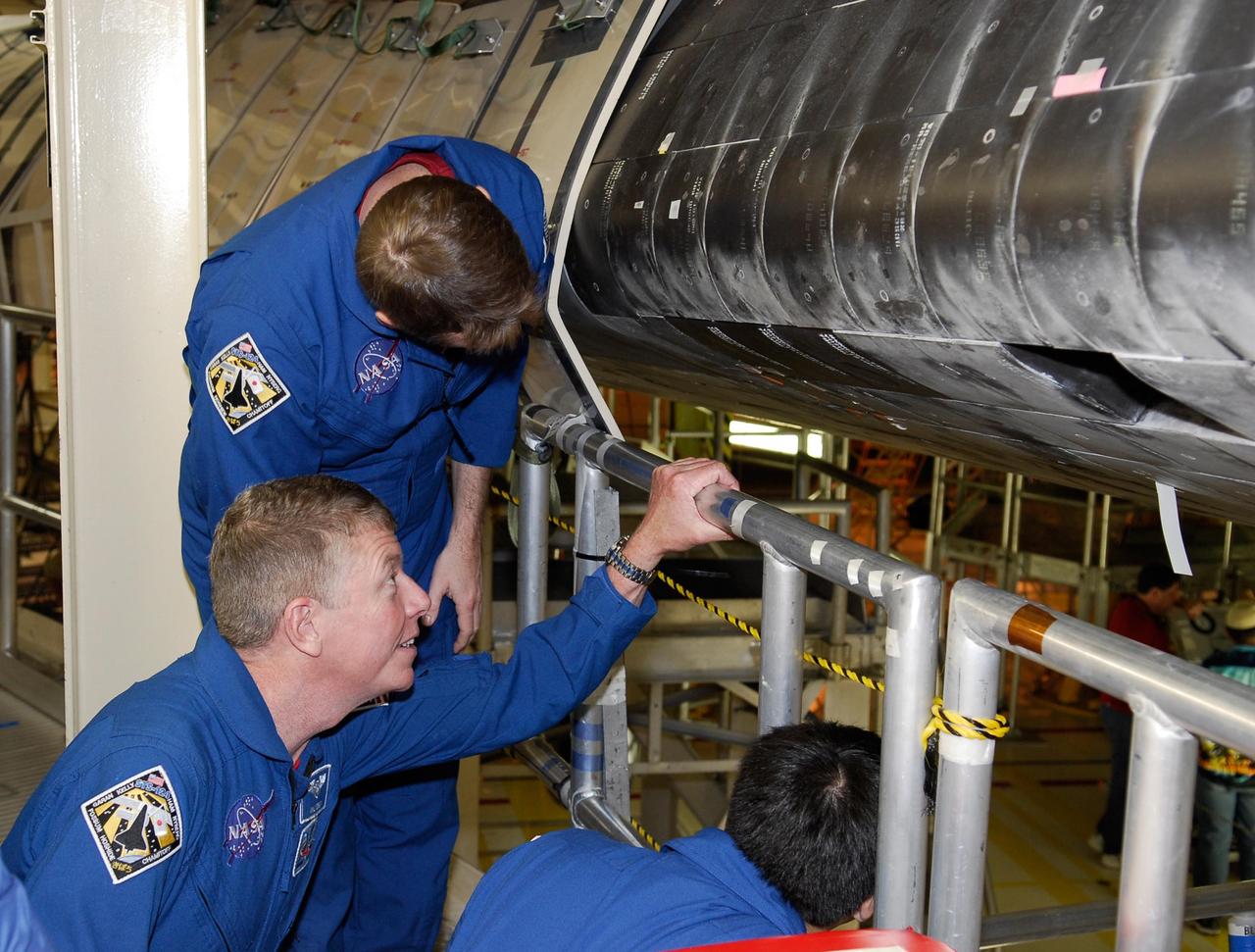
KENNEDY SPACE CENTER, FLA. -- In the Orbiter Processing Facility bay 3 at NASA's Kennedy Space Center, members of the STS-124 crew inspect space shuttle Discovery during a crew equipment interface test. Seen, top to bottom are Pilot Kenneth Ham and Mission Specialists Michael Fossum and Akihiko Hoshide, who represents the Japan Aerospace Exploration Agency, called JAXA. On the mission, Discovery will transport the Kibo Japanese Experiment Module - Pressurized Module (JEM-PM) and the Japanese Remote Manipulator System (JEM-RMS) to the International Space Station to complete the Kibo laboratory. The launch of Discovery is targeted for April 24. Photo credit: NASA/Kim Shiflett
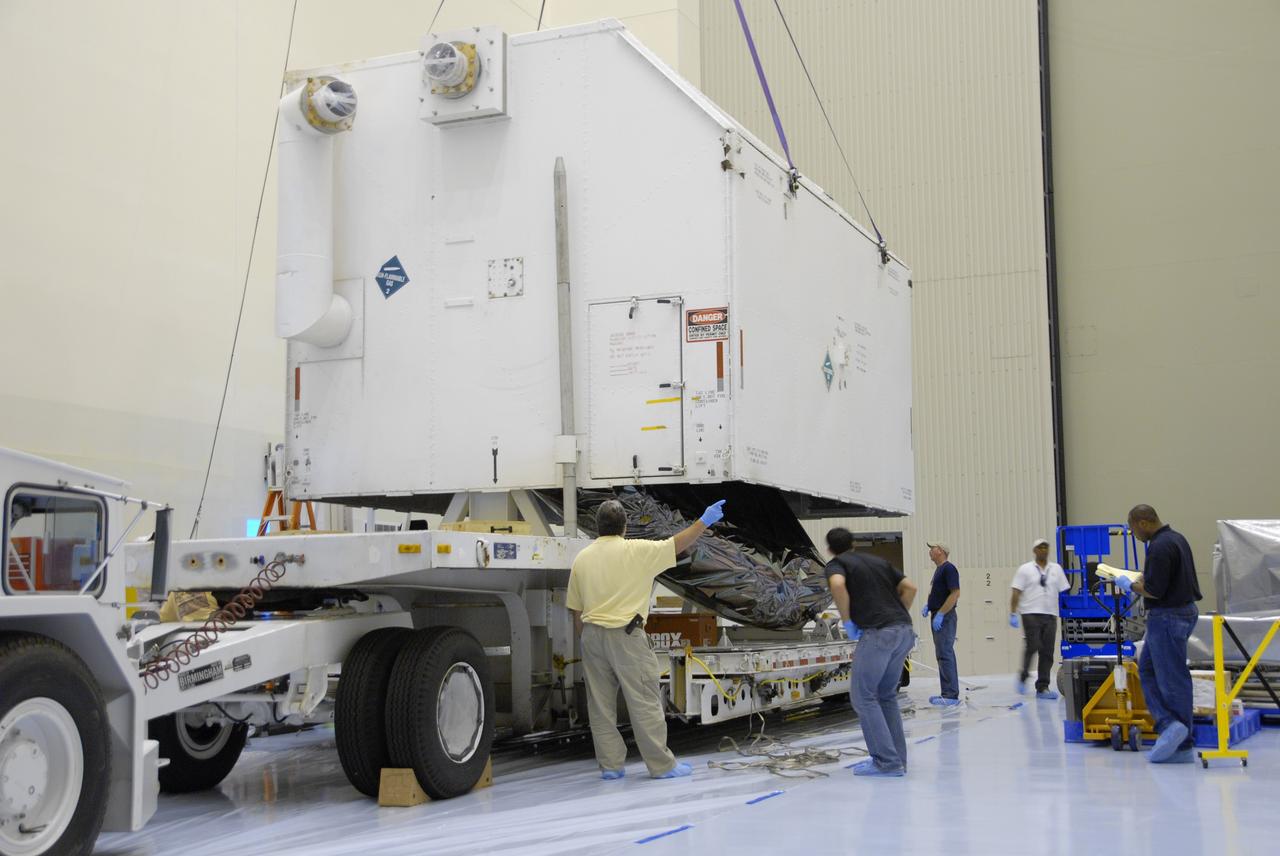
CAPE CANAVERAL, Fla. – In the Payload Hazardous Servicing Facility at NASA's Kennedy Space Center, the cover of the shipping container is lifted to reveal the Multi-Use Lightweight Equipment (MULE) carrier inside. The MULE is part of the payload for the fifth and final shuttle servicing mission to NASA's Hubble Space Telescope, STS-125. The MULE carrier will join the Flight Support System, the Super Lightweight Interchangeable Carrier and the Orbital Replacement Unit Carrier in the Payload Hazardous Servicing Facility where the Hubble payload is being prepared for launch. The Relative Navigation Sensors and the New Outer Blanket Layers will be on the MULE. The payload is scheduled to go to Launch Pad 39A in mid-September to be installed into Atlantis' payload bay. Atlantis is targeted to launch Oct. 8 at 1:34 a.m. EDT. .Photo credit: NASA/Amanda Diller
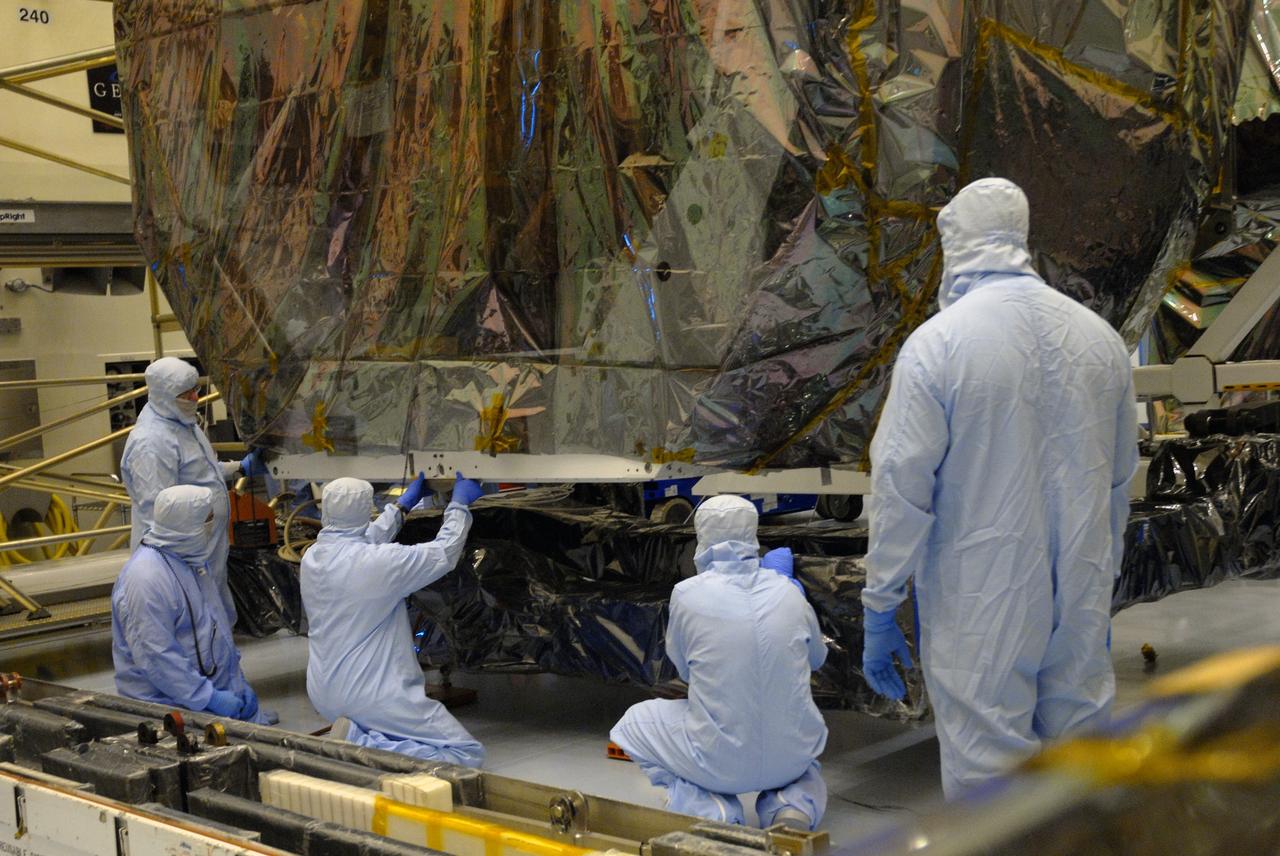
CAPE CANAVERAL, Fla. – In the high bay of the Payload Hazardous Servicing Facility at NASA's Kennedy Space Center, the Orbital Replacement Unit Carrier for the Hubble Space Telescope is secured on a work platform by workers from NASA's Goddard Space Flight Center. The Orbital Replacement Unit Carrier, or ORUC, is one of four carriers supporting hardware for space shuttle Atlantis' STS-125 mission to service the telescope. The Super Lightweight Interchangeable Carrier, or SLIC, and the Flight Support System, or FSS, have also arrived at Kennedy. The Multi-Use Lightweight Equipment carrier will be delivered in late July. The carriers will be prepared for the integration of telescope science instruments, both internal and external replacement components, as well as the flight support equipment to be used by the astronauts during the Hubble servicing mission, targeted for launch Oct. 8. Photo credit: NASA/Jack Pfaller
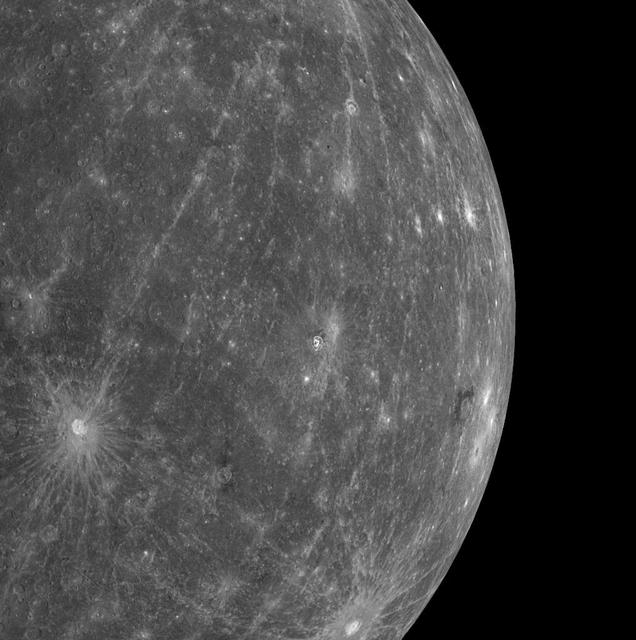
What a Difference a Week Can Make
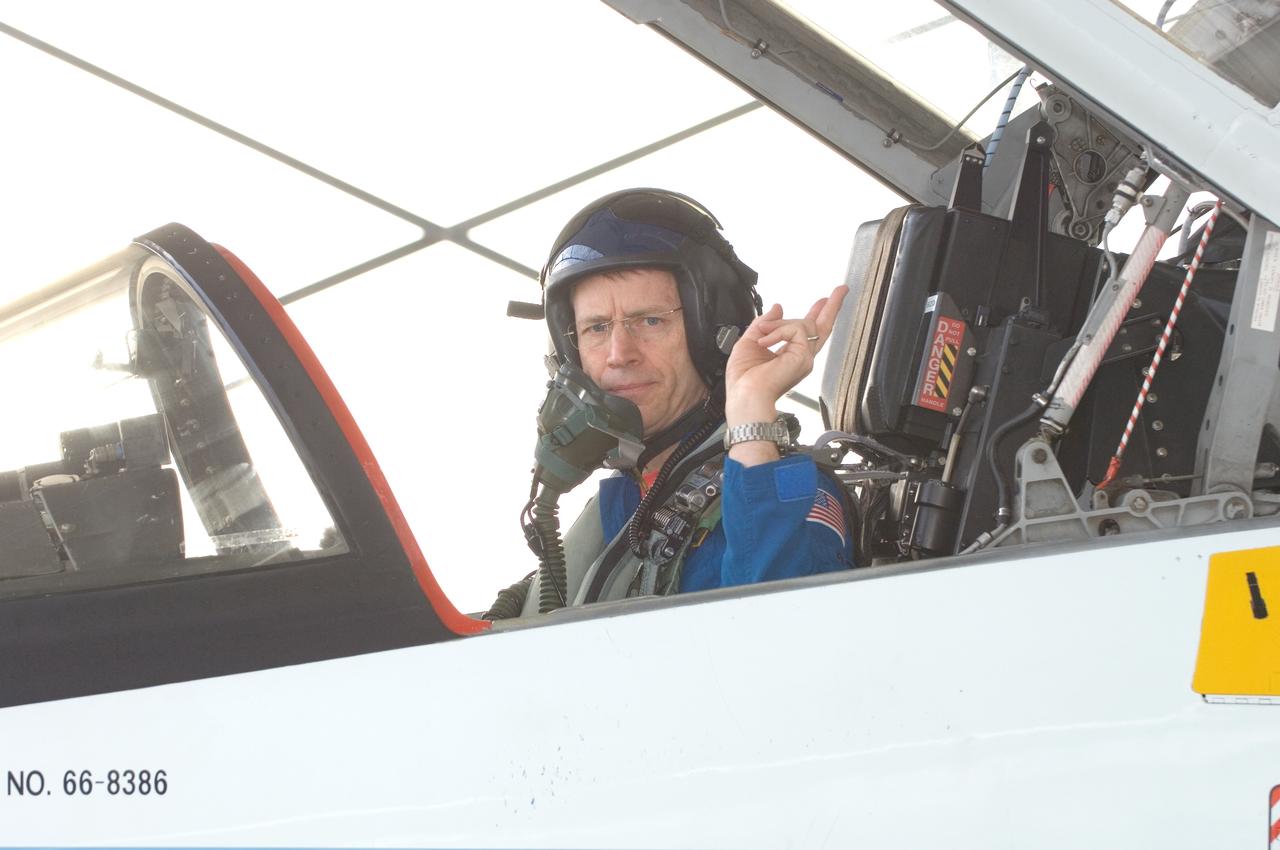
JSC2008-E-035366 (17 April 2008) --- Astronaut Gregory C. Johnson, STS-125 pilot, prepares for a flight in a NASA T-38 trainer jet at Ellington Field near NASA's Johnson Space Center.
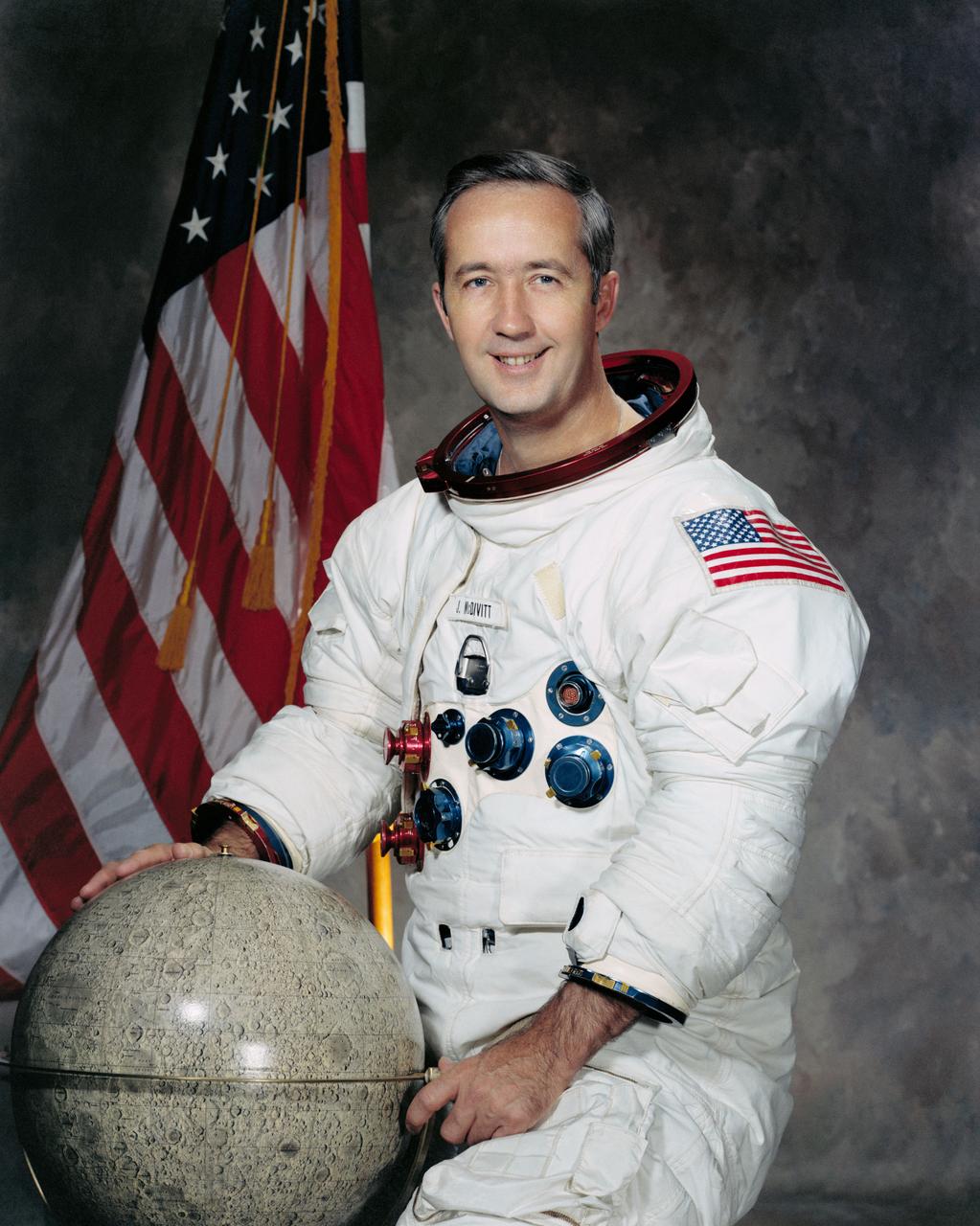
S71-59425 (1971) --- Astronaut James A. McDivitt
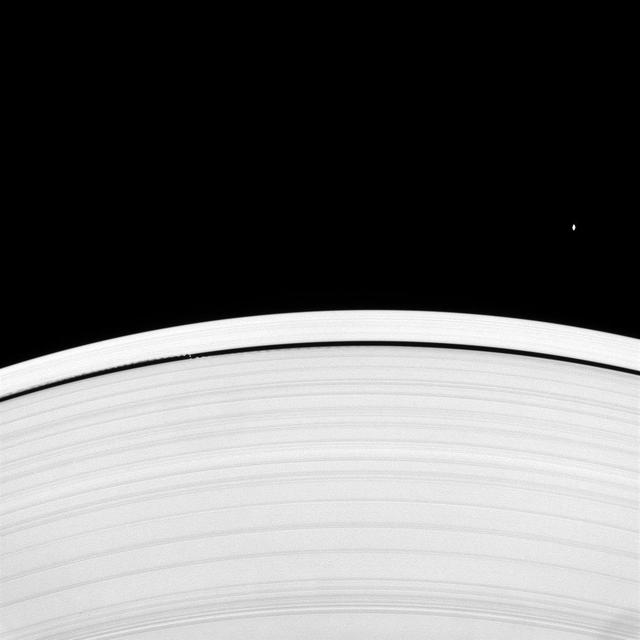
Looking upward from beneath the ringplane, the Cassini spacecraft spies Saturn's "wave maker" and "flying saucer" moons. Daphnis (8 kilometers, or 5 miles across at its widest point) and its gravitationally induced edge waves are seen at left within the Keeler Gap. The equatorial bulge on Atlas (30 kilometers, or 19 miles across at its widest point) is clearly visible here. See PIA06237 and PIA08405 for additional images and information about these two moons. This view looks toward the sunlit side of the rings from about 16 degrees below the ringplane. The image was taken in visible light with the Cassini spacecraft narrow-angle camera on April 22, 2008. The view was acquired at a distance of approximately 898,000 kilometers (558,000 miles) from Saturn. Image scale is about 5 kilometers (3 miles) per pixel. http://photojournal.jpl.nasa.gov/catalog/PIA09907
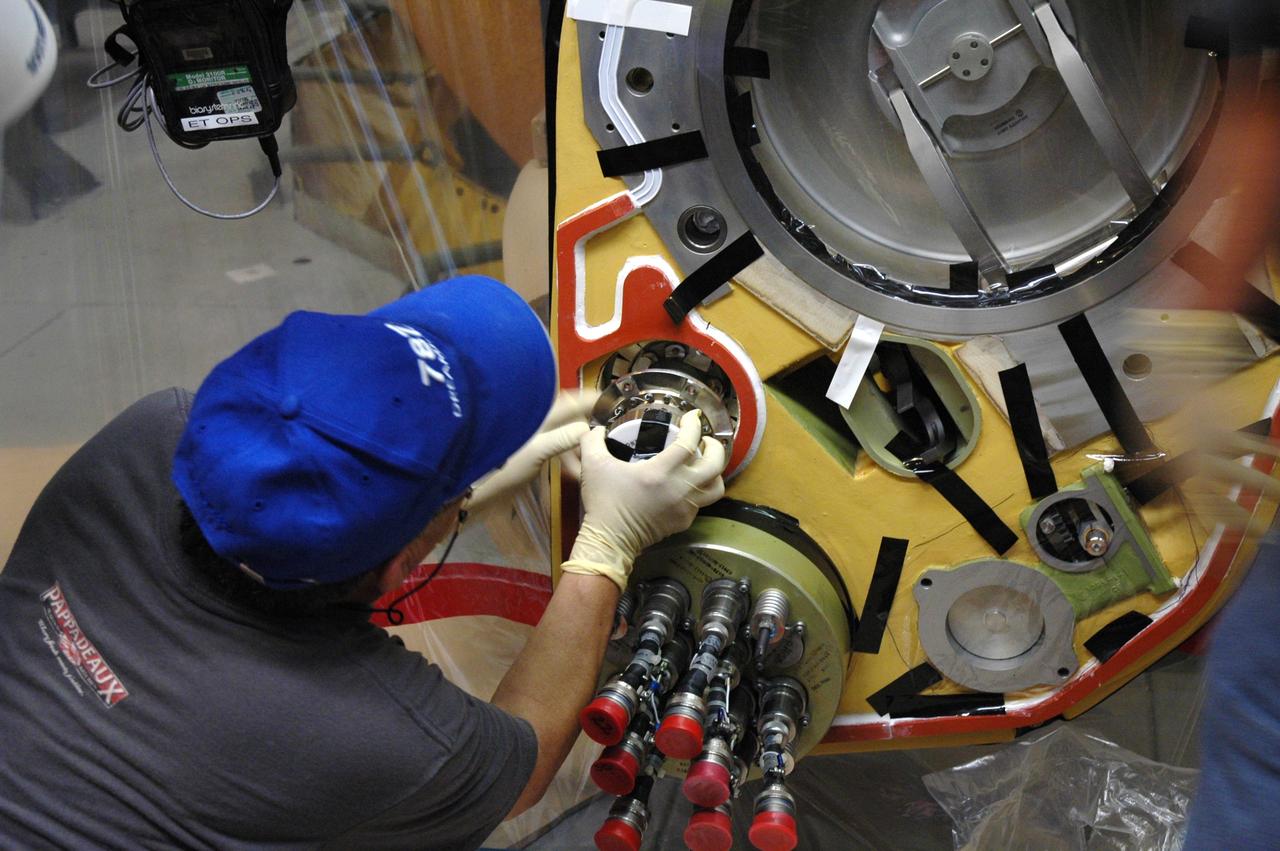
CAPE CANAVERAL, Fla. – Inside the Vehicle Assembly Building at NASA’s Kennedy Space Center, a technician installs a new valve on Atlantis’ external tank after small dings were found on the sealing surface of the quick disconnect system that handles liquid-hydrogen fuel for the shuttle’s three main engines. The tank will be attached to the twin solid rocket boosters on Aug. 3 for the STS-125 mission, the fifth and final shuttle servicing mission to NASA’s Hubble Space Telescope. During the mission, the crew will install new instruments on the telescope, including the Cosmic Origins Spectrograph and the Wide Field Camera 3. A refurbished Fine Guidance Sensor will replace one unit of three now onboard. Mission specialists will also install new gyroscopes, batteries and thermal blankets on the telescope. Launch is targeted for Oct. 8. Photo credit: NASA/Jim Grossmann
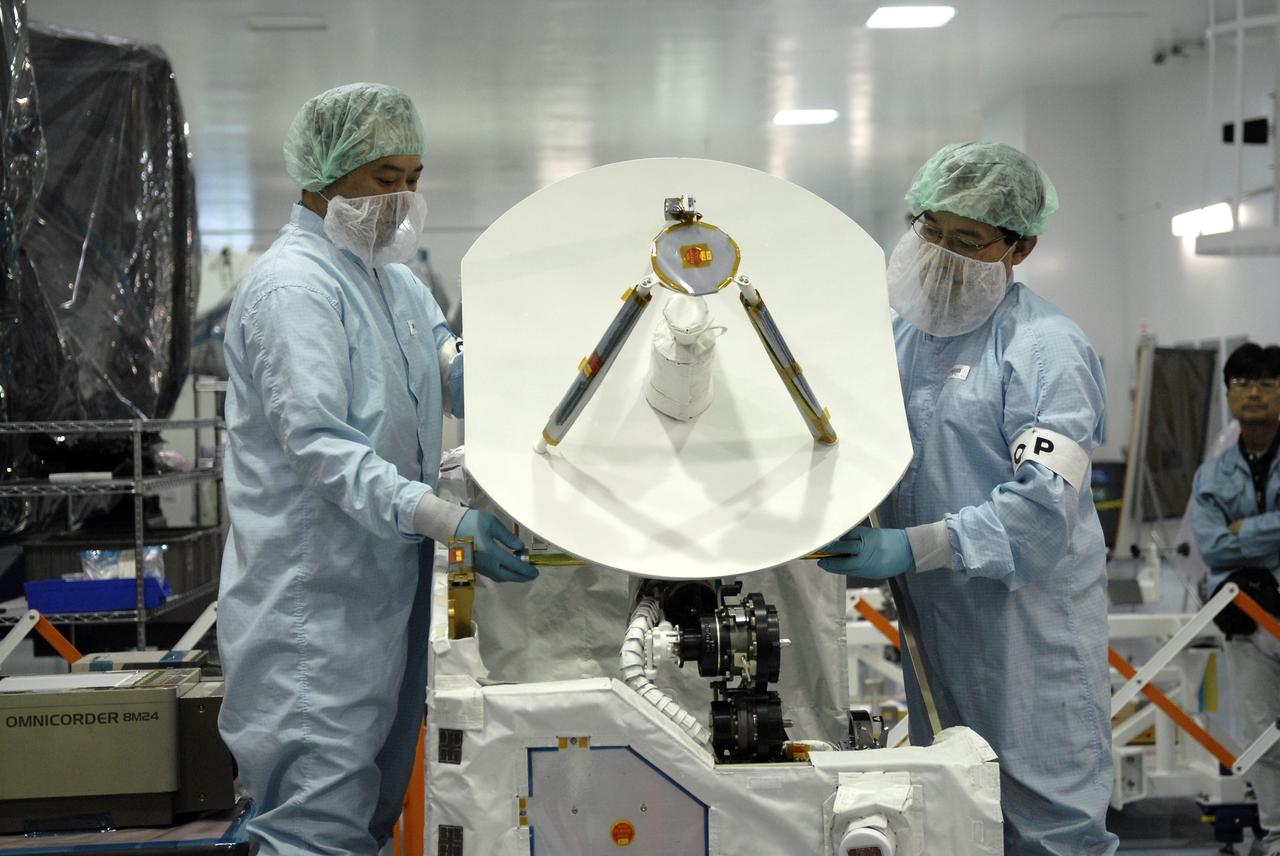
CAPE CANAVERAL, Fla. - In the Space Station Processing Facility at NASA's Kennedy Space Center in Florida, Japanese Aerospace Exploration Agency, or JAXA, technicians deploy an antenna from the Inter Orbit Communication System Extended Facility, or ICS-EF. The antenna and a pointing mechanism will be used to communicate with JAXA’s Data Relay Test Satellite, or DRTS. The ICS-EF will be launched, along with the Extended Facility and Experiment Logistics Module-Exposed Section, to the International Space Station aboard the space shuttle Endeavour on the STS-127mission targeted for launch on May 15, 2009. Photo credit: NASA/Kim Shiflett
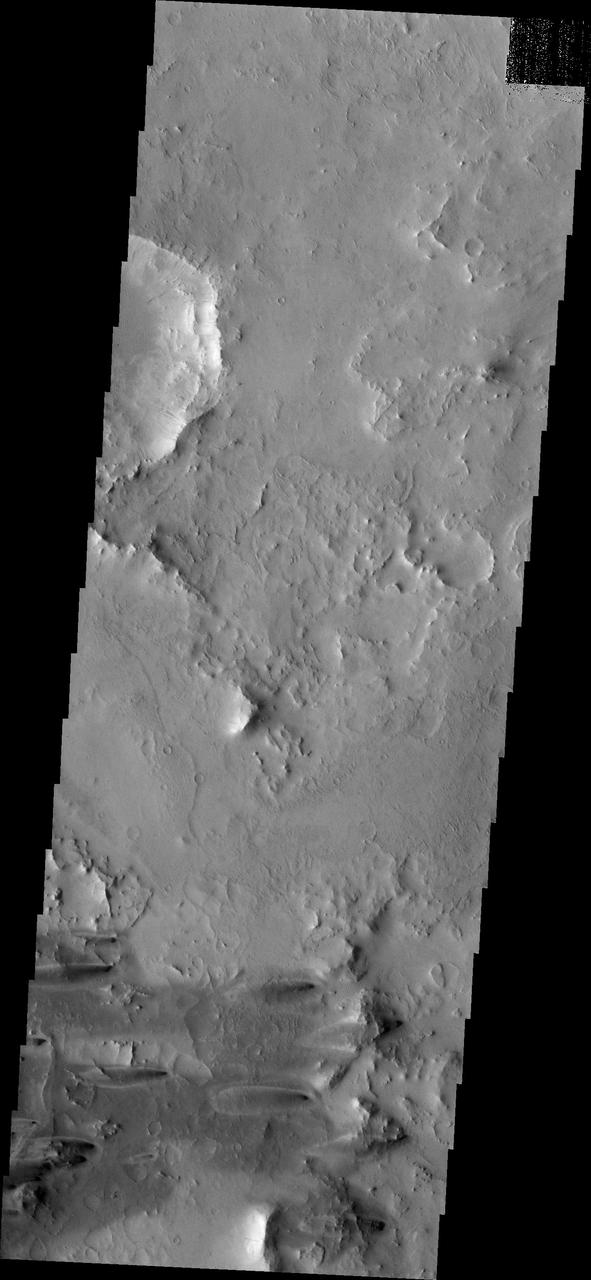
Windstreaks

CAPE CANAVERAL, Fla. - On Launch Pad 39A at NASA's Kennedy Space Center, the payload canister is ready to be lifted to the payload changeout room above. The canister contains four carriers holding various equipment for the STS-125 mission aboard space shuttle Atlantis to service NASA’s Hubble Space Telescope. At right is Atlantis atop the mobile launcher platform. The changeout room is the enclosed, environmentally controlled portion of the rotating service structure that supports cargo delivery to the pad and subsequent vertical installation into the shuttle’s payload bay. Launch of Atlantis is targeted for Oct. 10. Photo credit: NASA/Jack Pfaller
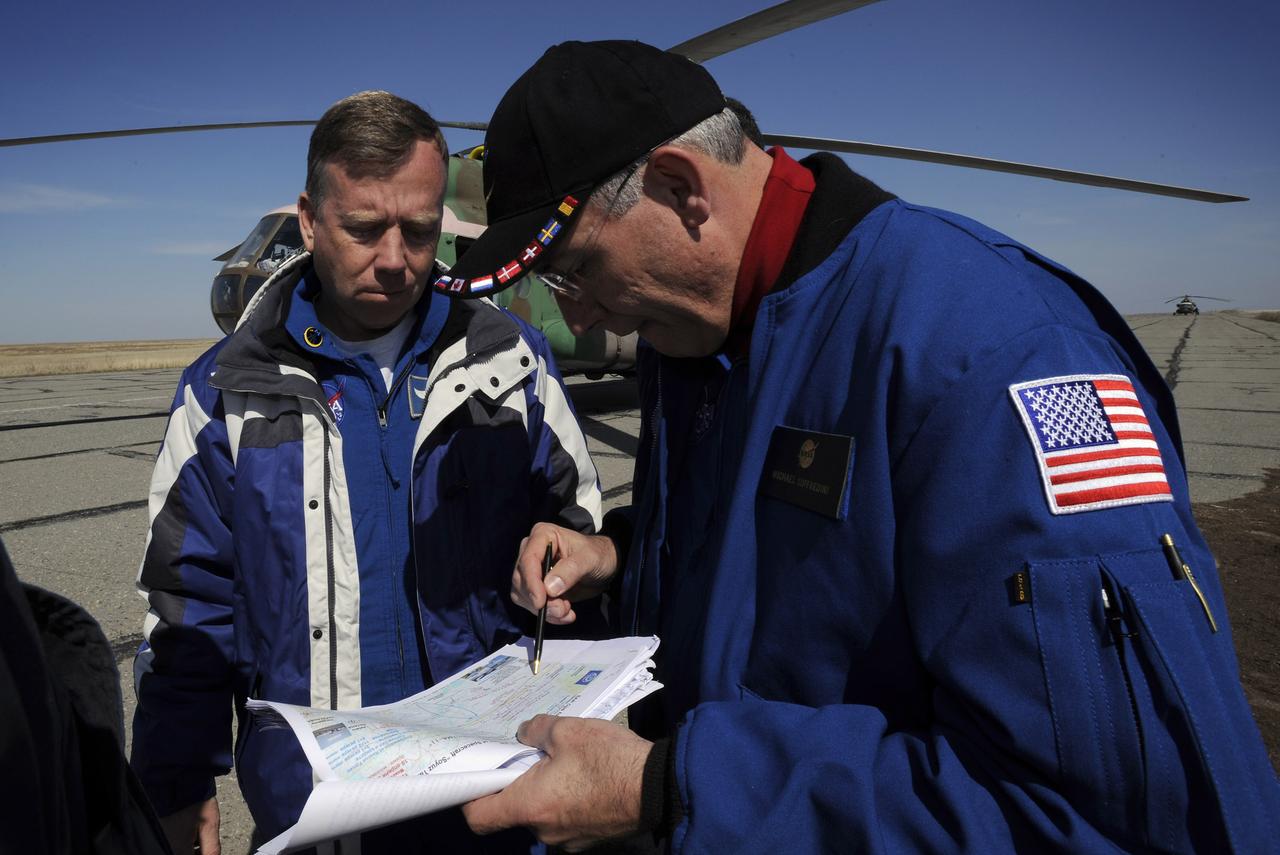
Steve Lindsey, Chief of NASA's Astronaut office, left, and Michael Sufferdini, International Station Program Manager, examine a map of central Kazakhstan as they received information at the Arkalyk airport April 19, 2008 on the landing of the Expedition 16 crew in the Soyuz TMA-11 capsule. The Soyuz made a ballistic landing, touching down more then 400 kilometers short of the intended target, but the crew reported by satellite phone to recovery forces that they were in good shape. Photo Credit: (NASA/Bill Ingalls)
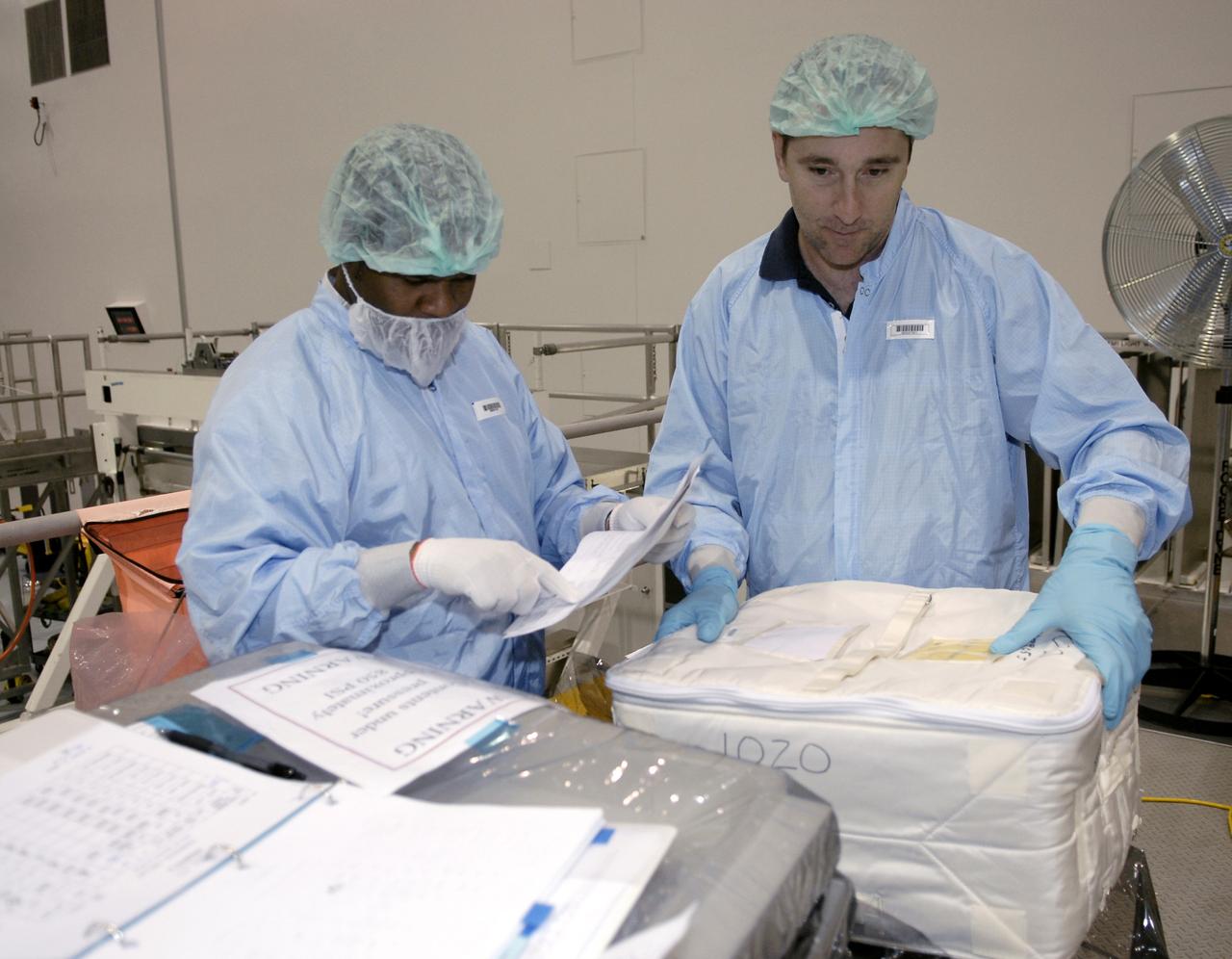
CAPE CANAVERAL, Fla. – In the Space Station Processing Facility at NASA's Kennedy Space Center in Florida, a worker, left, checks the manifest regarding the supply packages to be stowed in the Multi-Purpose Logistics Module Leonardo for the STS-126 mission to the International Space Station. The 15-day flight will deliver equipment and supplies to the International Space Station in preparation for expansion from a three- to six-person resident crew aboard the complex. The mission also will include four spacewalks to service the station Solar Alpha Rotary Joints. Leonardo holds supplies and equipment, including equipment for the regenerative life support system, additional crew quarters and exercise equipment and spare hardware. Photo credit: NASA/Kim Shiflett

ISS017-E-011566 (21 July 2008) --- Russian Federal Space Agency cosmonauts Sergei Volkov (foreground) and Oleg Kononenko (left background), Expedition 17 commander and flight engineer, respectively; along with NASA astronaut Greg Chamitoff, flight engineer, pose for a photo with a Russian Orlan spacesuit (left) and an Extravehicular Mobility Unit spacesuit in the Unity node of the International Space Station.
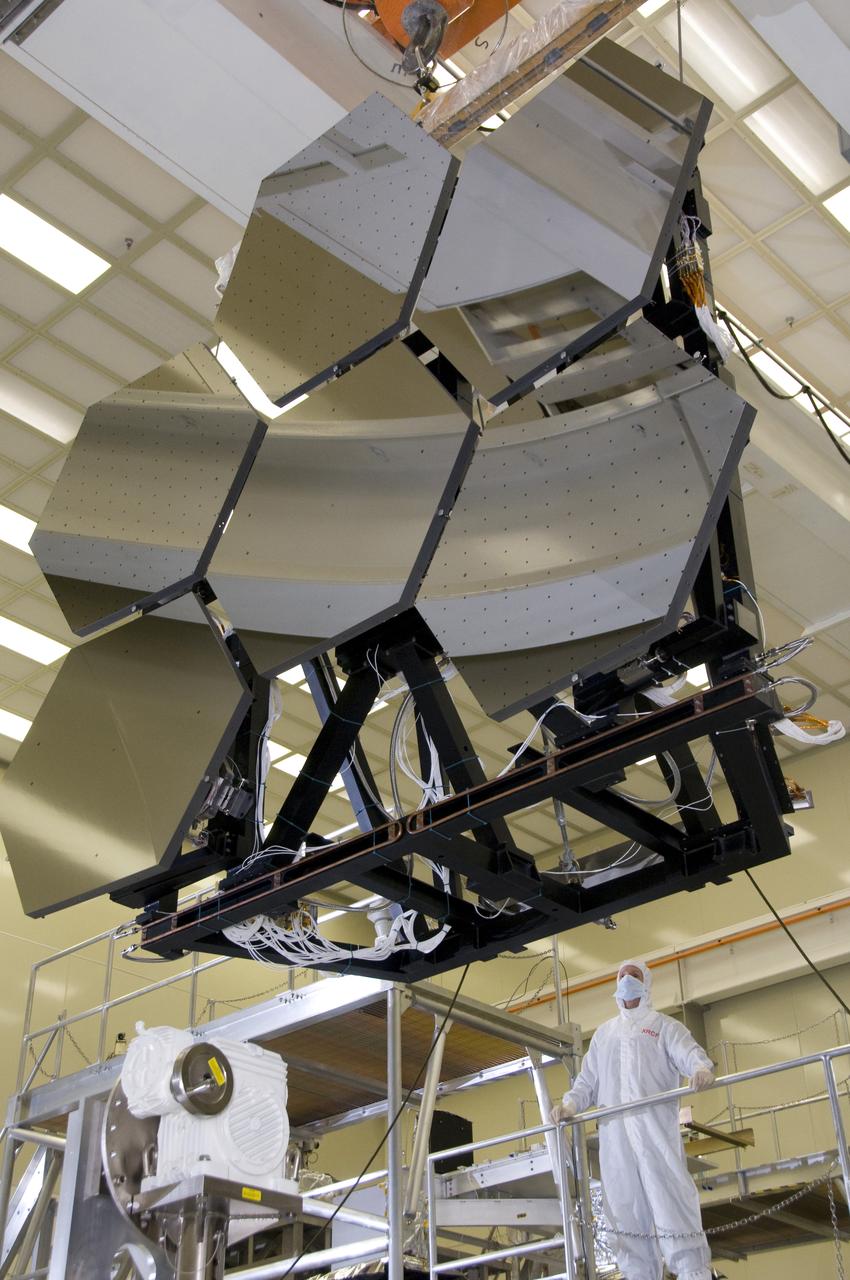
ERNIE WRIGHT, TEST DIRECTOR, MONITORS MOVE OF TEST STAND WITH SIX JWST (JAMES WEBB SPACE TELESCOPE) PRIMARY MIRROR SEGMENT ASSEMBLIES AT MARSHALL'S X-RAY AND CRYOGENIC FACILITY.
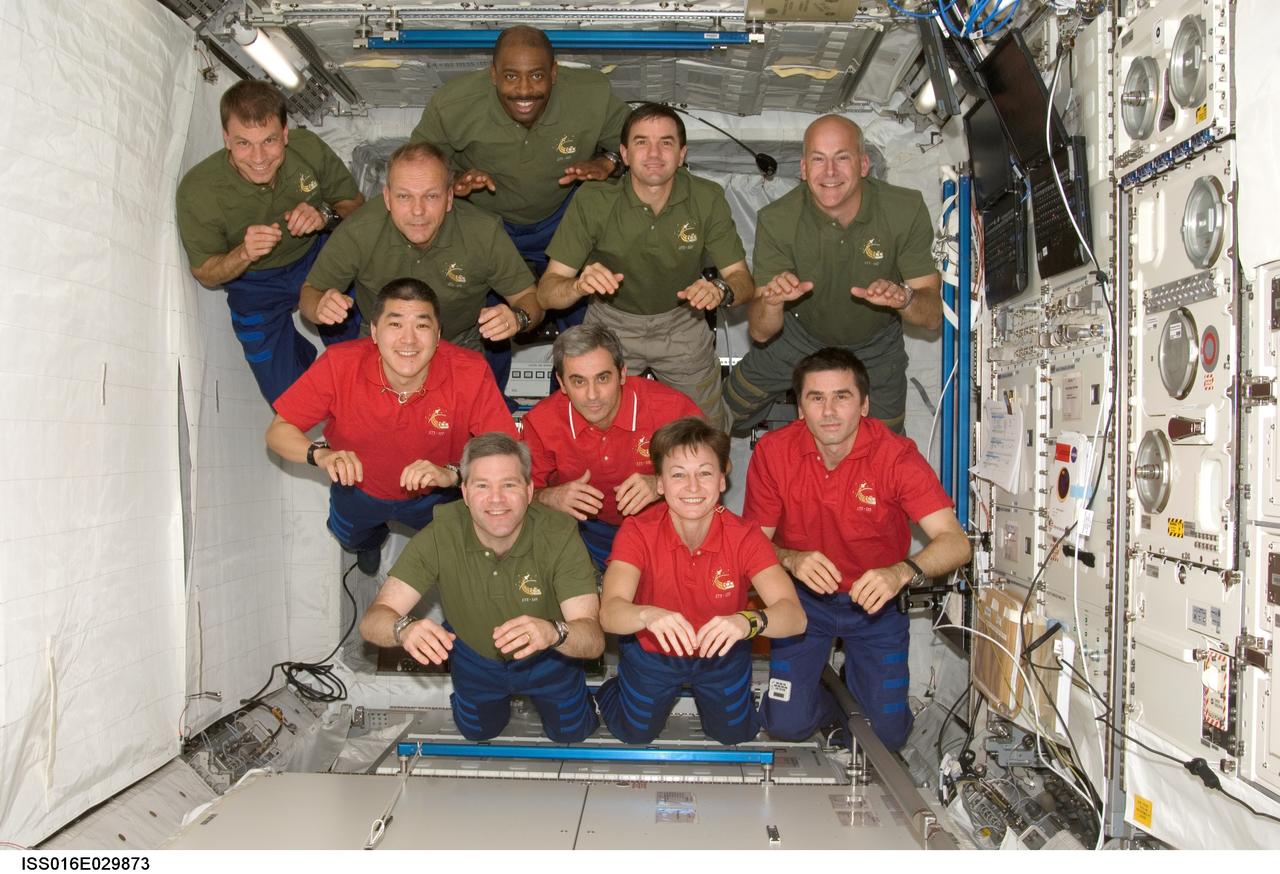
ISS016-E-029873 (16 Feb. 2008) --- STS-122 and Expedition 16 crewmembers pose for a group photo following a joint news conference in the Columbus laboratory of the International Space Station while Space Shuttle Atlantis is docked with the station. From the left (bottom) are NASA astronaut Steve Frick, STS-122 commander; and Peggy Whitson, Expedition 16 commander. From the left (middle row) are NASA astronaut Daniel Tani, STS-122 mission specialist; European Space Agency (ESA) astronaut Leopold Eyharts, Expedition 16 flight engineer; and cosmonaut Yuri Malenchenko, Expedition 16 flight engineer representing Russia's Federal Space Agency. From the left (top row) are NASA astronaut Stanley Love, ESA astronaut Hans Schlegel, NASA astronauts Leland Melvin, Rex Walheim, all STS-122 mission specialists; and Alan Poindexter, STS-122 pilot. Tani, who joined the station's Expedition 16 crew in October, is being replaced by Eyharts, who arrived at the station with the STS-122 crew.

CAPE CANAVERAL, Fla. – In the Space Station Processing Facility at NASA's Kennedy Space Center in Florida, a worker prepares the equipment to help close the hatch on the Multi-Purpose Logistics Module Leonardo before it is transferred to a payload canister. Leonardo is the payload for space shuttle Endeavour's STS-126 mission to the International Space Station. The 15-day mission will deliver equipment and supplies to the space station in preparation for expansion from a three- to six-person resident crew aboard the complex. Leonardo holds supplies and equipment, including additional crew quarters, equipment for the regenerative life support system and spare hardware. Endeavour is targeted for launch Nov. 14. Photo credit: NASA/Troy Cryder
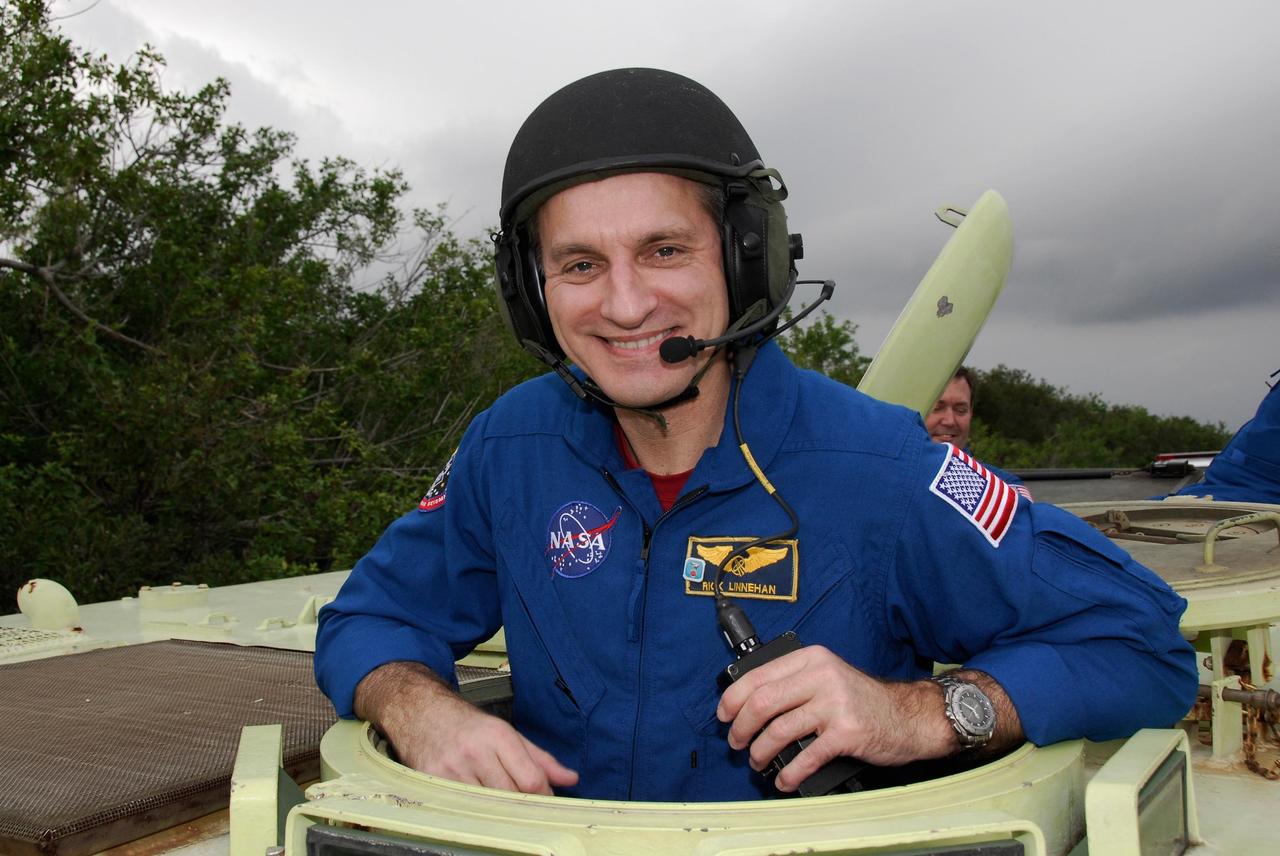
KENNEDY SPACE CENTER, FLA. -- At NASA Kennedy Space Center's Launch Complex 39, STS-123 Mission Specialist Rick Linnehan takes time out from driving practice of the M-113 armored personnel carrier to pose for a photo. The crew members of space shuttle Endeavour's STS-123 mission will each practice driving the M-113 in turn as part of his training on emergency egress procedures. An M-113 will be available to transport the crew to safety in the event of a contingency on the pad before their launch. The STS-123 crew is at Kennedy for a full launch dress rehearsal, known as the terminal countdown demonstration test or TCDT. Endeavour's seven astronauts arrived at Kennedy's Shuttle Landing Facility in their T-38 training aircraft between 10:45 and 10:58 a.m. EST. The terminal countdown demonstration test provides astronauts and ground crews with an opportunity to participate in various simulated countdown activities, including equipment familiarization and emergency training. Endeavour is targeted to launch March 11 at 2:28 a.m. EDT on a 16-day mission to the International Space Station. On the mission, Endeavour and its crew will deliver the first section of the Japan Aerospace Exploration Agency's Kibo laboratory and the Canadian Space Agency's two-armed robotic system, Dextre. Photo credit: NASA/Kim Shiflett
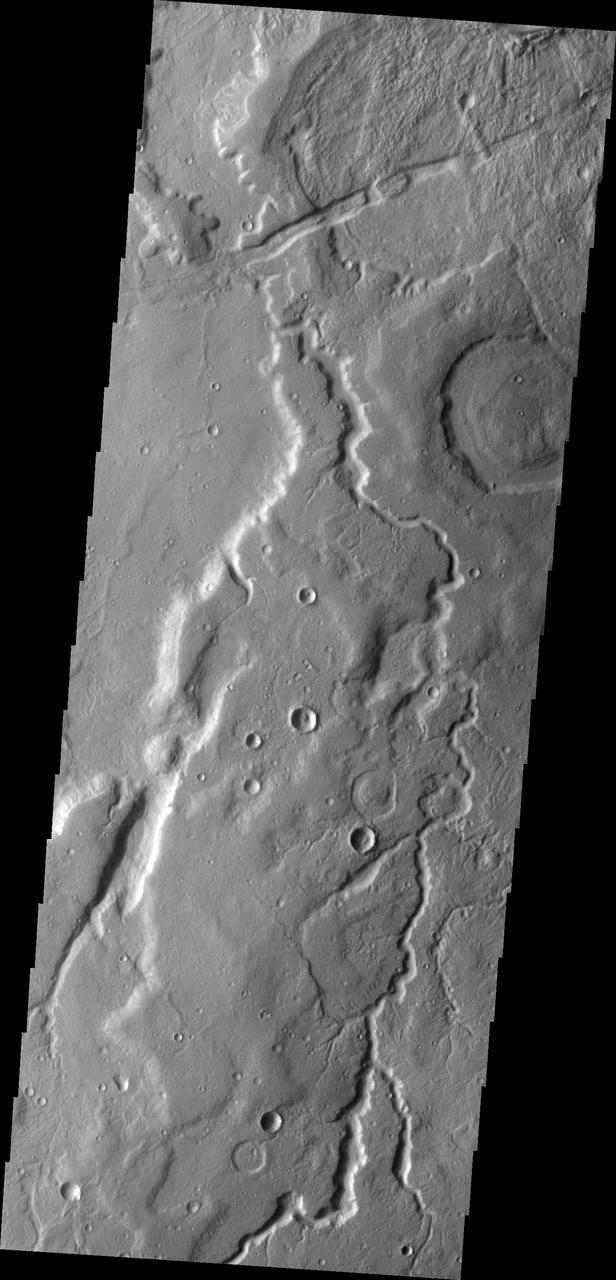
Tempe Terra

S123-E-005947 (13 March 2008) --- In the grasp of the International Space Station's (ISS) robotic Canadarm2, the Canadian-built Dextre robotic system is moved to its place on a station truss while Space Shuttle Endeavour is docked with the ISS. The blackness of space and Earth's horizon provide the backdrop for the scene.
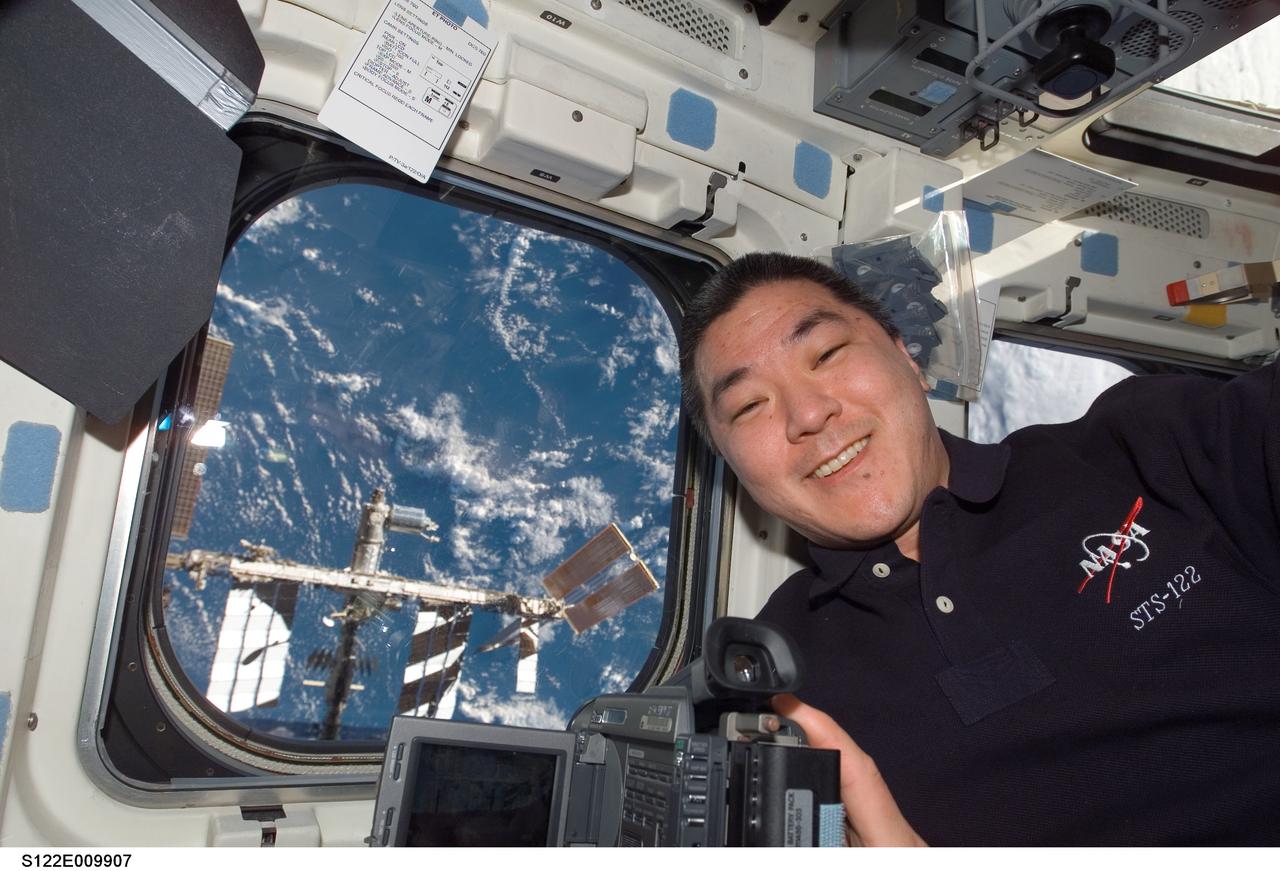
S122-E-009907 (18 Feb. 2008) --- Astronaut Daniel Tani, STS-122 mission specialist, poses for a photo near a window on the aft flight deck of Space Shuttle Atlantis shortly after undocking from the International Space Station, which is visible through the window.
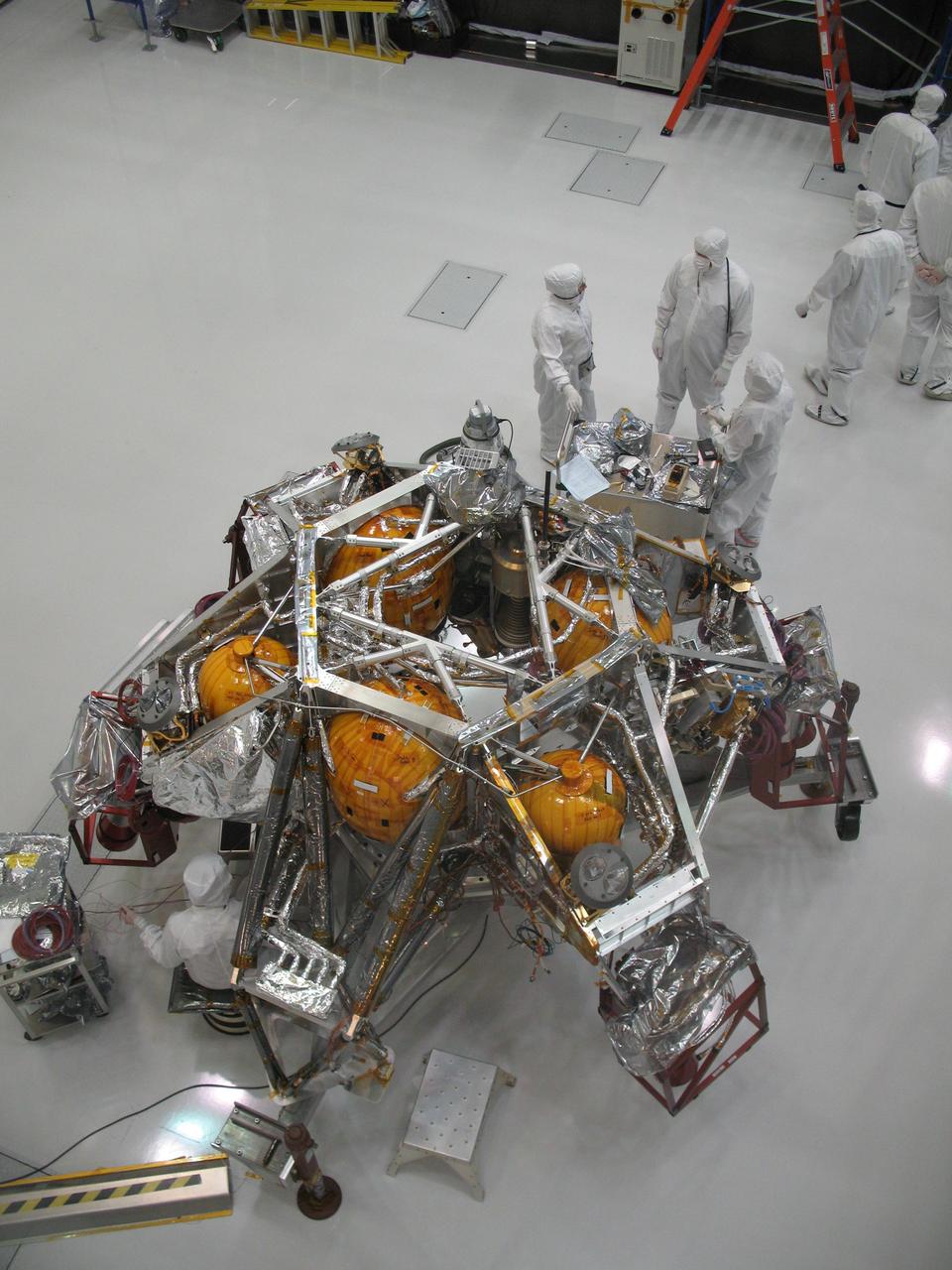
This image from early October 2008 shows personnel working on the descent stage of NASA Mars Science Laboratory inside the Spacecraft Assembly Facility at NASA Jet Propulsion Laboratory, Pasadena, Calif.
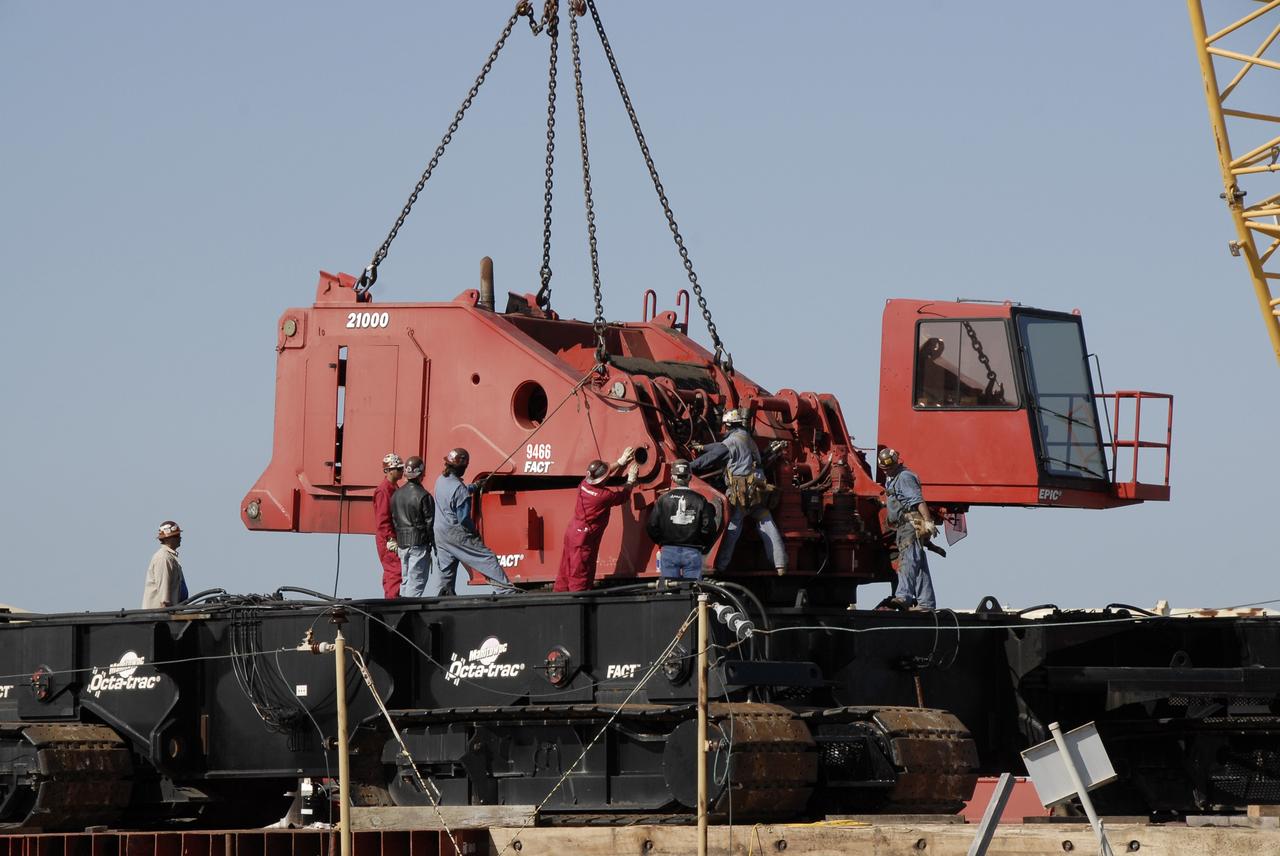
CAPE CANAVERAL, Fla. -- On Launch Pad 39B at NASA’s Kennedy Space Center in Florida, equipment is moved that will be used to continue erecting the lightning towers. Each of the three new lightning towers will be 500 feet tall with an additional 100-foot fiberglass mast atop supporting a wire catenary system. This improved lightning protection system allows for the taller height of the Ares I compared to the space shuttle. Pad B will be the site of the first Ares vehicle launch, including Ares I-X which is targeted for summer of 2009, as part of NASA’s Constellation Program. Photo credit: NASA/Kim Shiflett
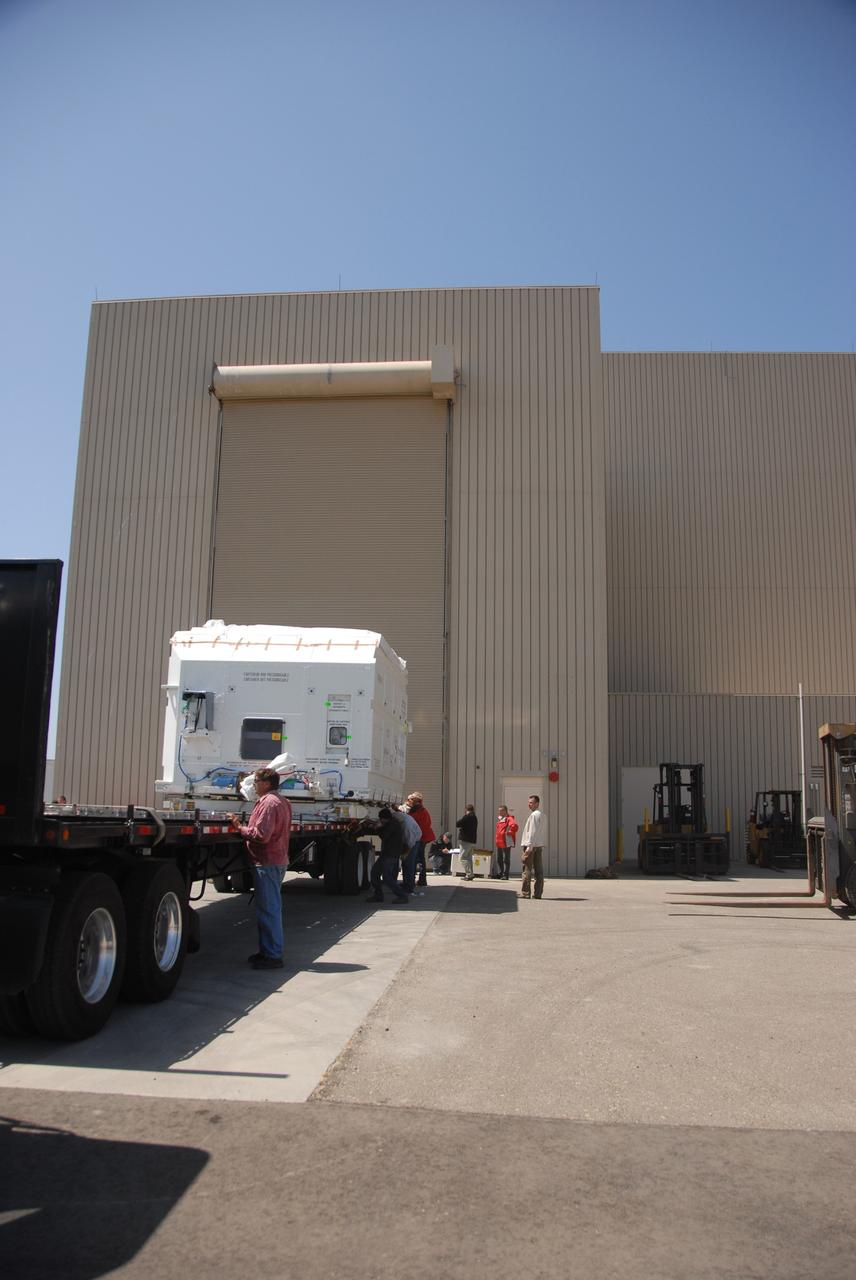
VANDENBERG AIR FORCE BASE, Calif. -- At Vandenberg Air Force Base, the truck carrying the OSTM/Jason-2 satellite arrives at the Astrotech processing facility. The OSTM, or Ocean Topography Mission, on the Jason-2 satellite is a follow-on to Jason-1. It will take oceanographic studies of sea surface height into an operational mode for continued climate forecasting research and science and industrial applications. This satellite altimetry data will help determine ocean circulation, climate change and sea-level rise. OSTM is a joint effort by the National Oceanic and Atmospheric Administration, NASA, France’s Centre National d’Etudes Spatiales and the European Meteorological Satellite Organisation. OSTM/Jason-2 will be launched aboard a United Launch Alliance Delta II 7320 from Vandenberg on June 15. Photo credit: NASA/Dan Liberotti
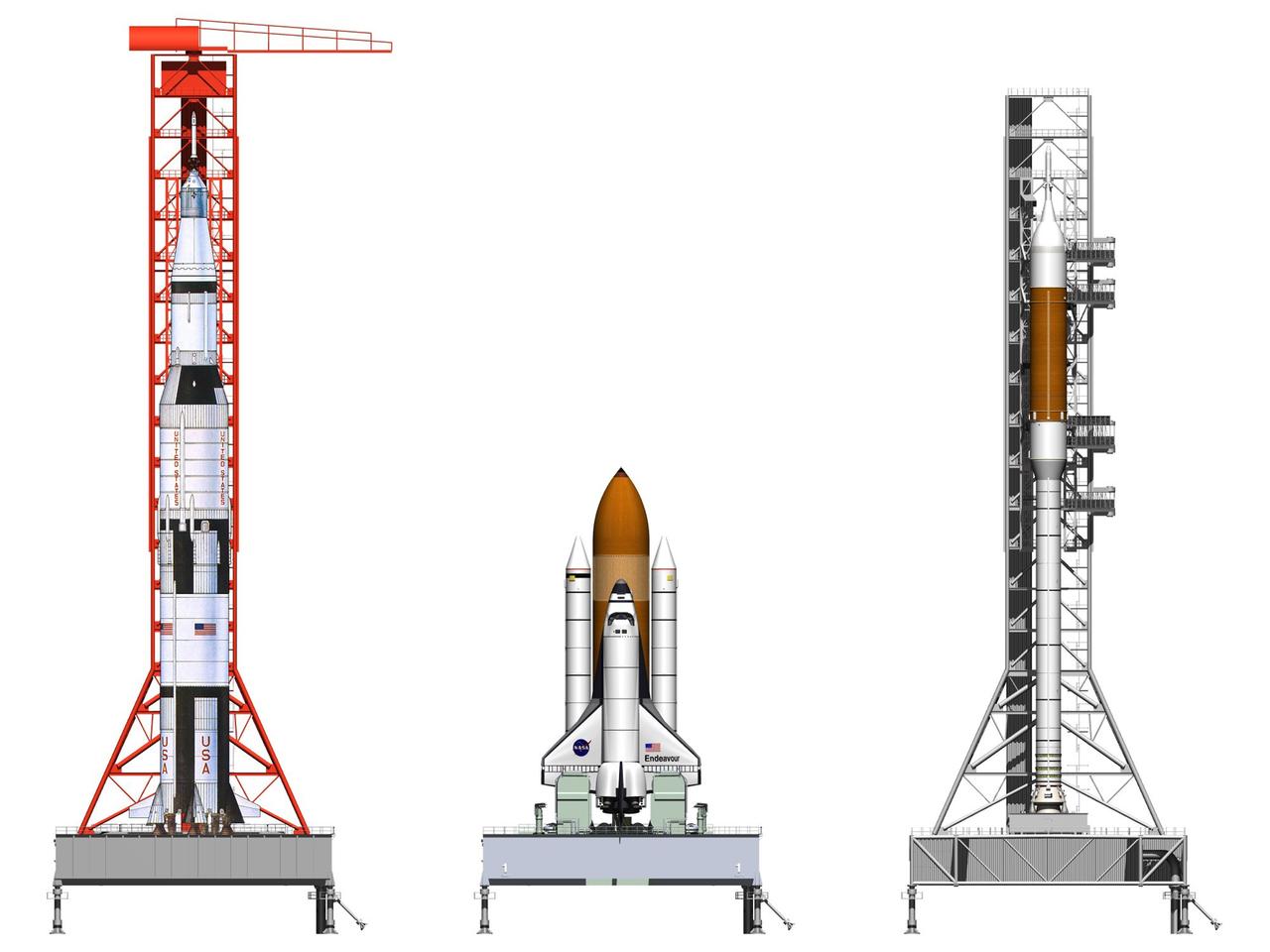
CAPE CANAVERAL, Fla. -- Artist's rendering of the Constellation Program's Ares V rocket on the mobile launcher platform (left) and the Ares I rocket on the platform (right) with the space shuttle in between for comparison. The tower of the mobile launcher will have multiple platforms for personnel access and will be approximately 390 feet tall. The tower will be used in the assembly, testing and servicing of the Ares rockets at Kennedy and will also transport the Ares rockets to the launch pad and provide ground support for launches.
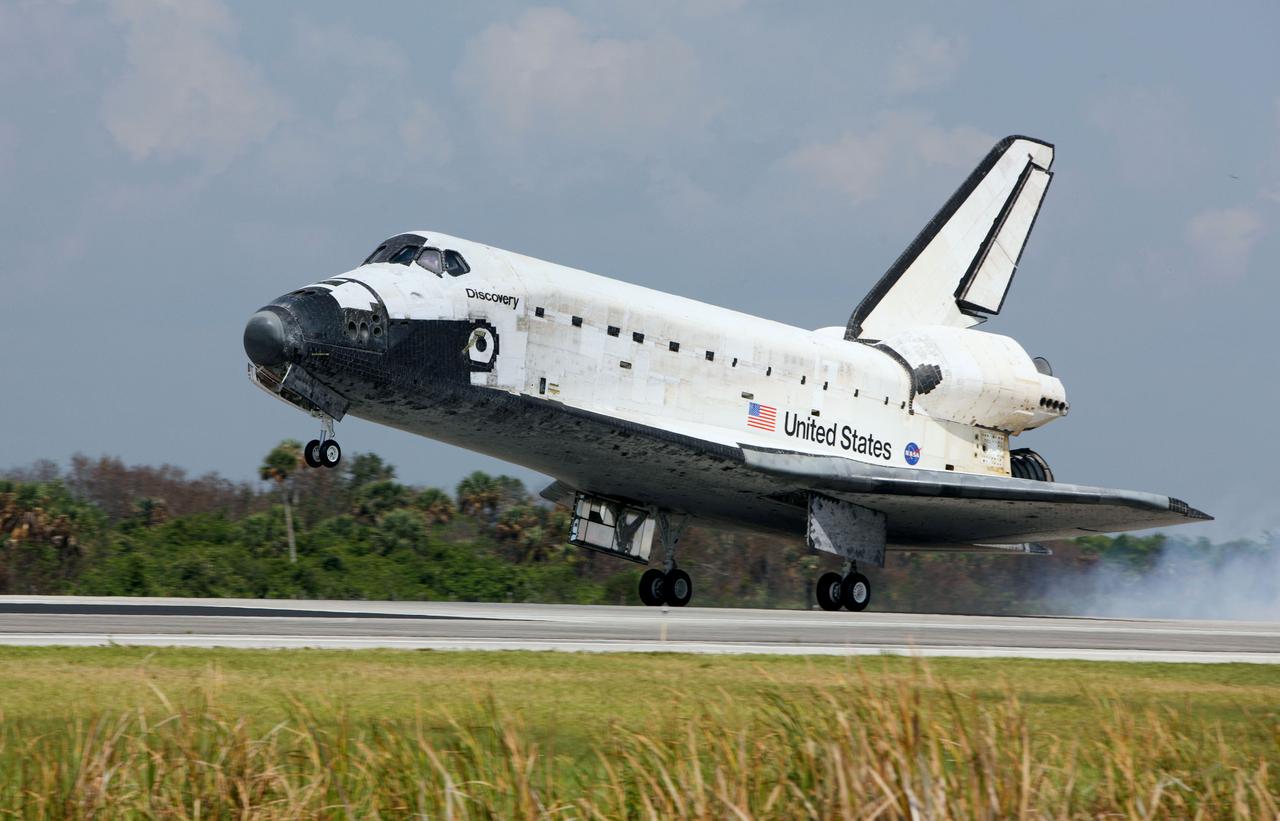
STS124-S-062 (14 June 2008) --- Space Shuttle Discovery touches down on runway 15 of the Shuttle Landing Facility at NASA's Kennedy Space Center, concluding the 14-day STS-124 mission to the International Space Station. Onboard are NASA astronauts Mark Kelly, commander; Ken Ham, pilot; Mike Fossum, Ron Garan, Karen Nyberg, Garrett Reisman and Japan Aerospace Exploration Agency astronaut Akihiko Hoshide, all mission specialists. The main landing gear touched down at 11:15:19 a.m. (EDT) on June 14, 2008. The nose landing gear touched down at 11:15:30 a.m. and wheel stop was at 11:16:19 a.m. During the mission, Discovery's crew installed the Japan Aerospace Exploration Agency's large Kibo laboratory and its remote manipulator system leaving a larger space station and one with increased science capabilities.
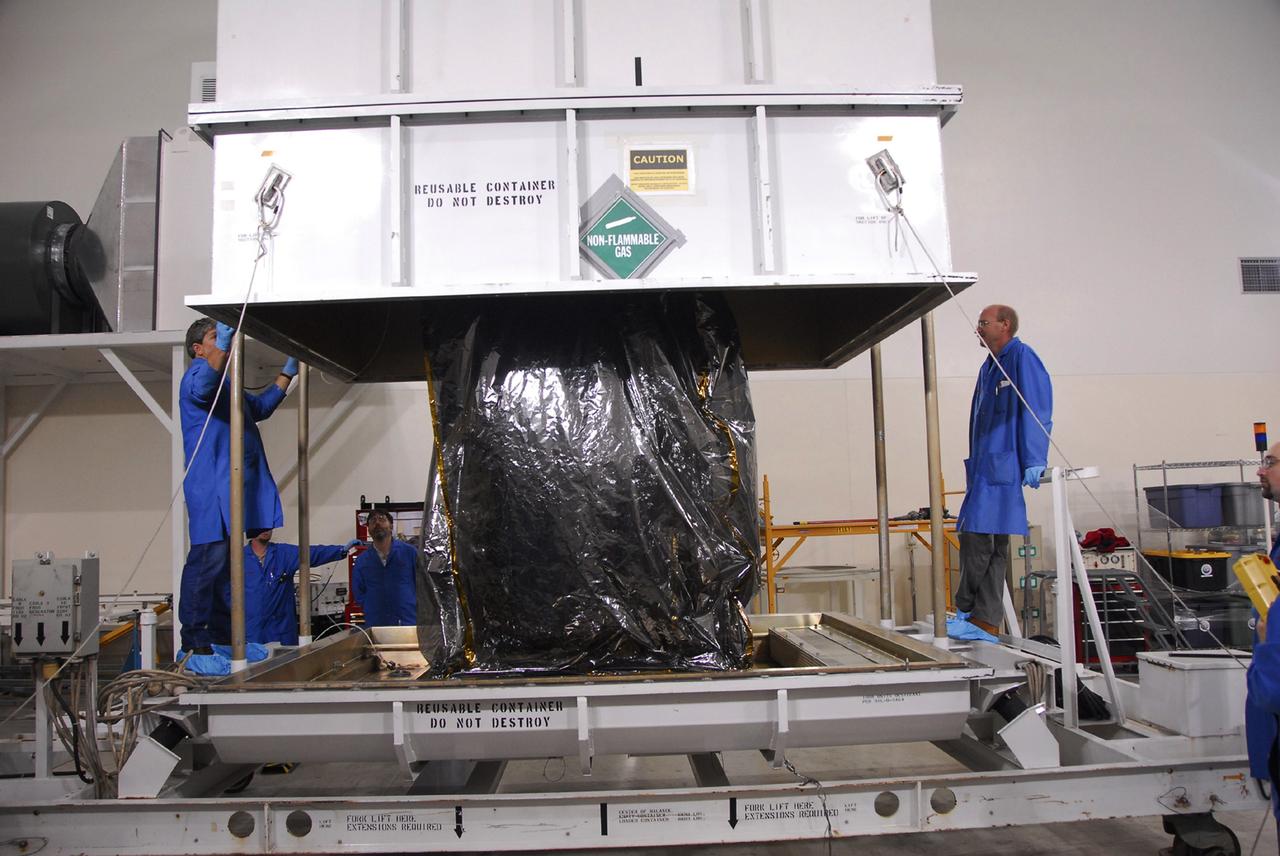
VANDENBERG AIR FORCE BASE, Calif. -- Inside the Astrotech payload processing facility, building 1032, at Vandenberg Air Force Base in California, workers remove the shipping container cover over the Orbiting Carbon Observatory, or OCO, spacecraft, delivered from spacecraft facilities in Dulles, Va., by Orbital Sciences. After the protective coverings over the spacecraft are removed, blanket preparations and edge taping will be done, followed by mechanical preparations and work on the electronic ground support equipment. The OCO is a new Earth-orbiting mission sponsored by NASA's Earth System Science Pathfinder Program. The observatory is targeted to launch Jan. 15 from Space Launch Complex 576-E at Vandenberg. Photo credit: NASA/Robert Hargreaves Jr., VAFB
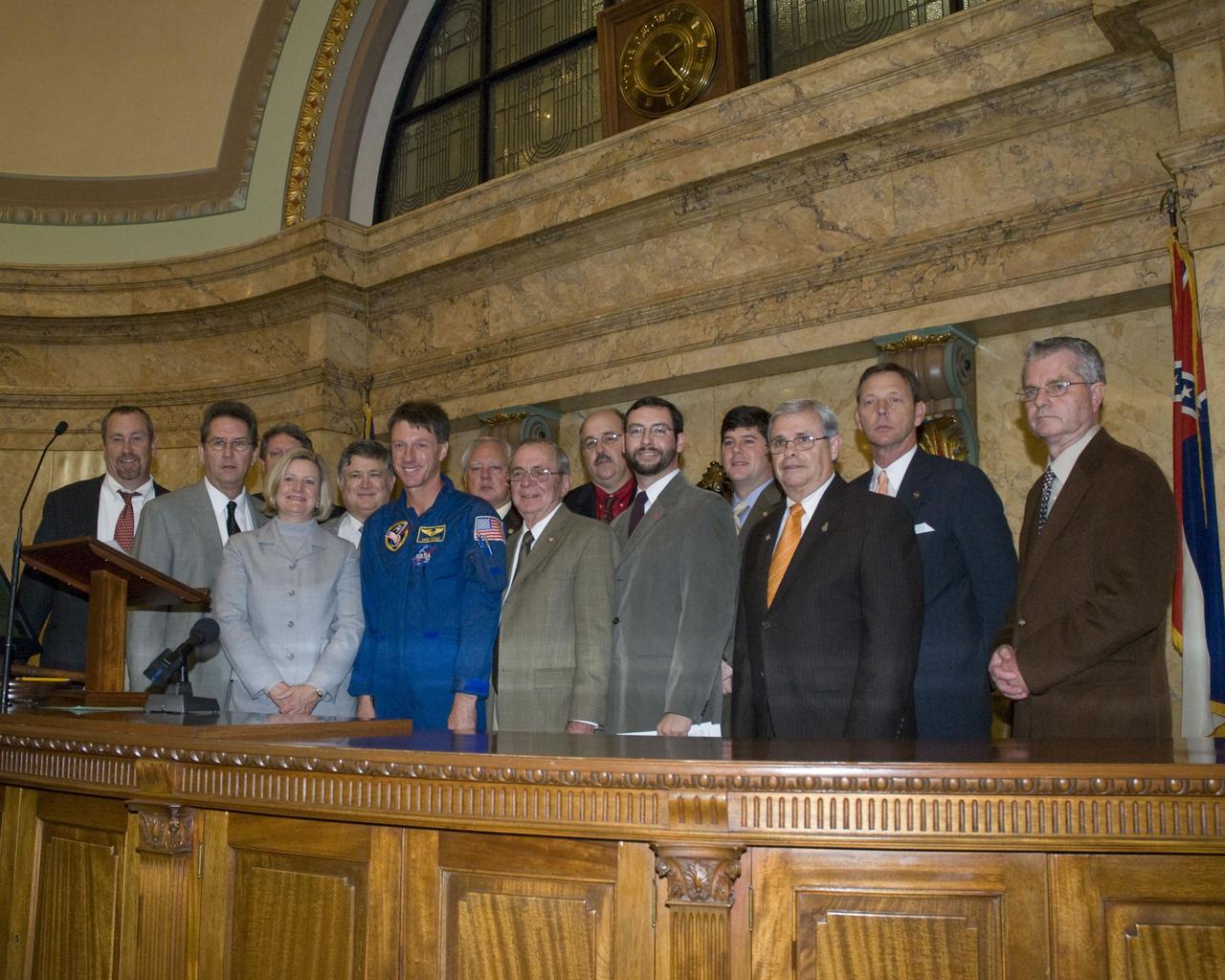
Astronaut Michael Foale (center) and Stennis Space Center officials met with Mississippi House of Representatives Gulf Coast delegation, including Speaker William 'Billy' McCoy (far right), during NASA Space Day in Mississippi on January 30.
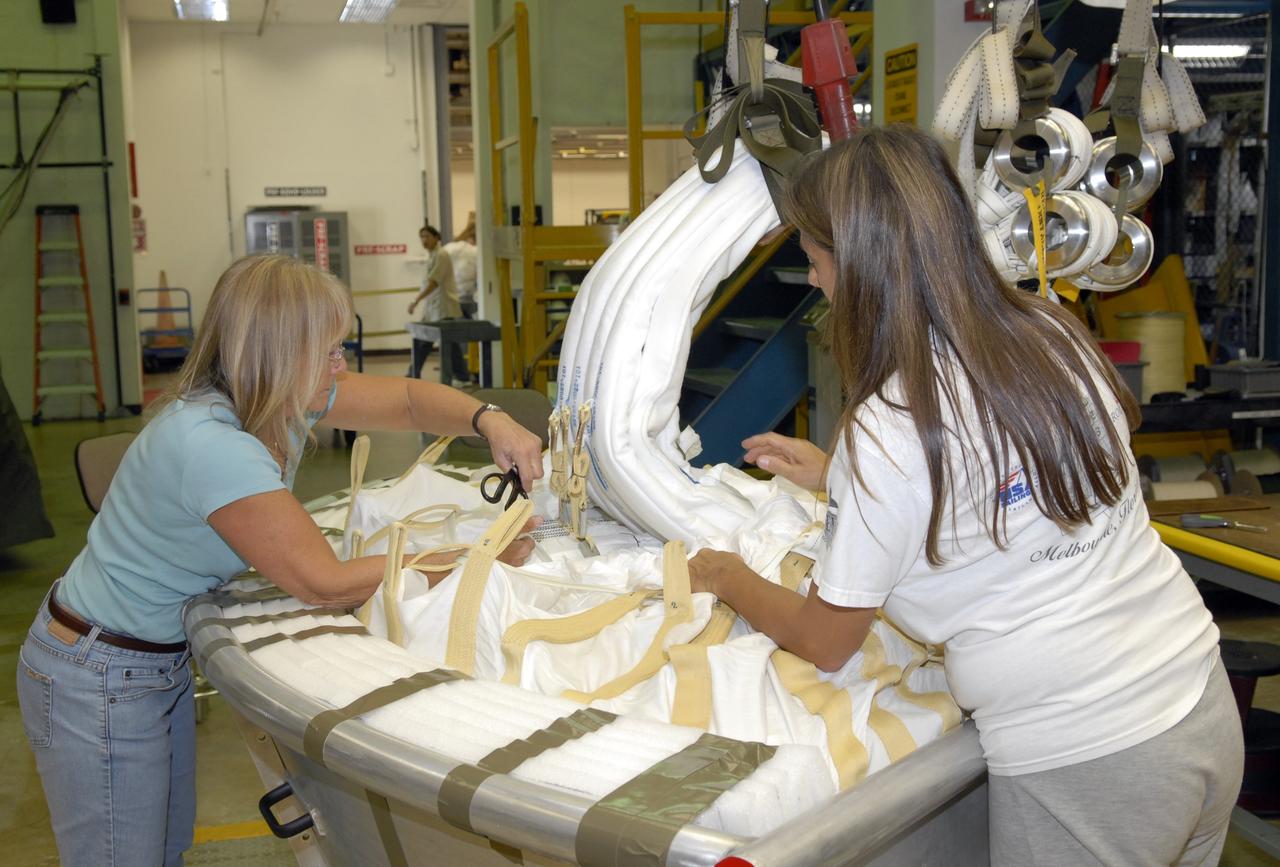
CAPE CANAVERAL, Fla. -- In the Parachute Refurbishment Facility at NASA's Kennedy Space Center in Florida, workers pack the parachutes that will be used in the Ares I-X development flight in July 2009. The first stage of the new Ares I rocket and Orion spacecraft will use parachutes to return to Earth. Ares I-X is the test vehicle for the Ares I, which is part of the Constellation Program to return men to the moon and beyond. Ares I is the essential core of a safe, reliable, cost-effective space transportation system that eventually will carry crewed missions back to the moon, on to Mars and out into the solar system. Ares I may also use its 25-ton payload capacity to deliver resources and supplies to the International Space Station, or to "park" payloads in orbit for retrieval by other spacecraft bound for the moon or other destinations. Photo credit: NASA/Jack Pfaller

CAPE CANAVERAL, Fla. - From the Shuttle Landing Facility at NASA's Kennedy Space Center in Florida, the Shuttle Training Aircraft, or STA, with STS-126 Commander Chris Ferguson and Pilot Eric Boe on board, takes off. Ferguson and Boe will practice shuttle landings on the STA, a Grumman American Aviation-built Gulf Stream II jet that was modified to simulate a shuttle’s cockpit, motion and visual cues, and handling qualities. In flight, the aircraft duplicates the shuttle’s atmospheric descent trajectory from approximately 35,000 feet to landing. The practice is part of the Terminal Countdown Demonstration Test, which includes equipment familiarization, emergency exit procedures and a simulated launch countdown. On the STS-126 mission, space shuttle Endeavour's crew will deliver equipment and supplies to the International Space Station in preparation for expansion from a three- to six-person resident crew aboard the complex. The mission also will include four spacewalks to service the station’s Solar Alpha Rotary Joints. Endeavour is targeted to launch Nov. 14. Photo credit: NASA/Kim Shiflett
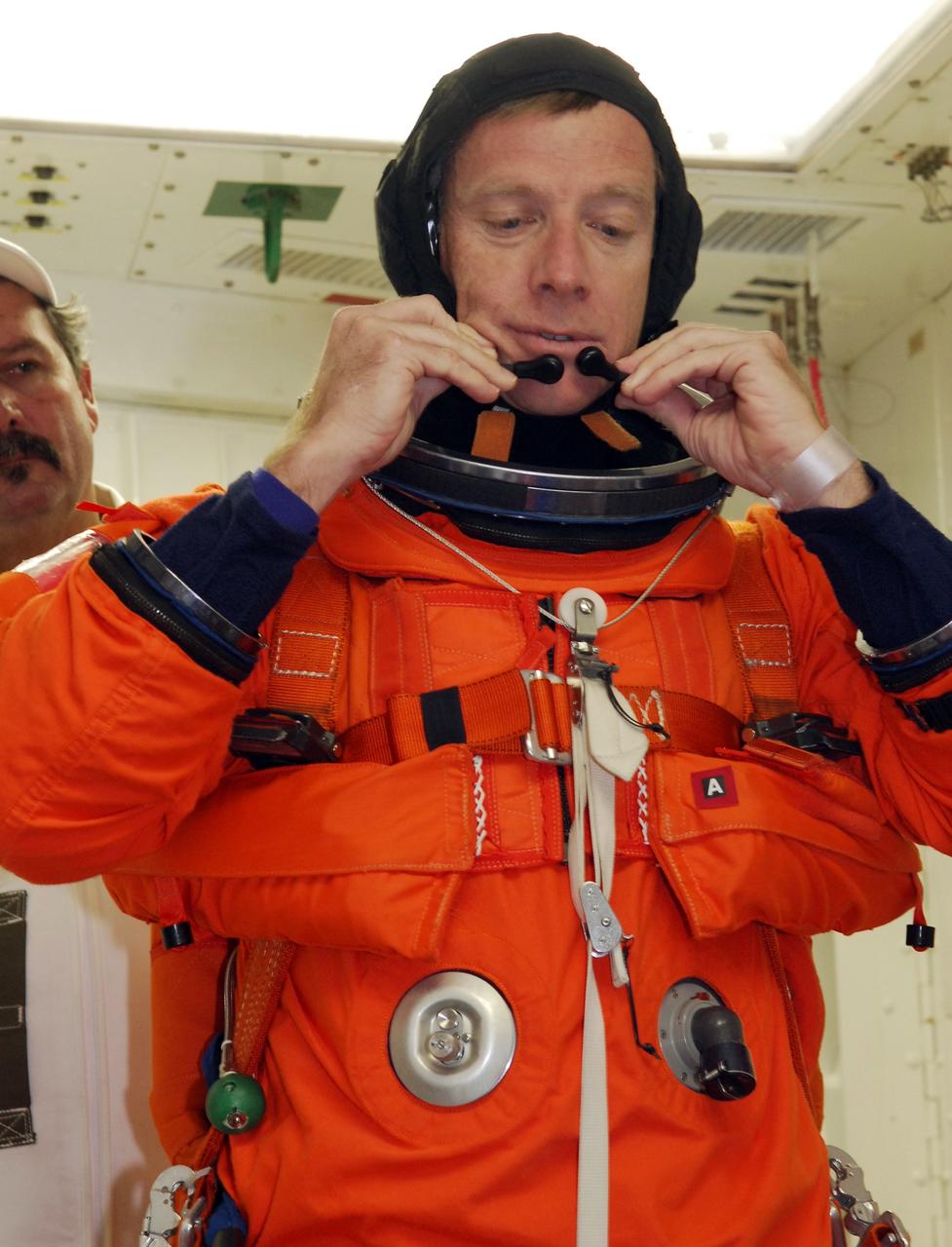
CAPE CANAVERAL, Fla. – In the White Room on Launch Pad 39A at NASA's Kennedy Space Center in Florida, STS-126 Commander Chris Ferguson adjusts his headset before donning his helmet. He will enter space shuttle Endeavour to take part in a simulated launch countdown with the other crew members. The crew is at Kennedy to take part in the Terminal Countdown Demonstration Test, which includes equipment familiarization, emergency exit training and the simulated countdown. On the STS-126 mission, space shuttle Endeavour's crew will deliver equipment and supplies to the International Space Station in preparation for expansion from a three- to six-person resident crew aboard the complex. The mission also will include four spacewalks to service the station’s Solar Alpha Rotary Joints. Endeavour is targeted to launch Nov. 14. Photo credit: NASA/Troy Cryder

KENNEDY SPACE CENTER, FLA. -- In the Space Station Processing Facility at NASA's Kennedy Space Center, an overhead crane places the Experiment Logistics Module Pressurized Section, or ELM-PS, of the Japanese Experiment Module, called Kibo, into position in a payload canister for eventual transfer to Launch Pad 39A. The ELM-PS is the primary payload for space shuttle Endeavour's STS-123 mission, which is targeted for launch to the International Space Station on March 11. Photo credit: NASA/George Shelton, Troy Cryder

NASA Day at AT&T Park: NASA and the San Francisco Giants share a day to celebrate the 50 year anniversaries.
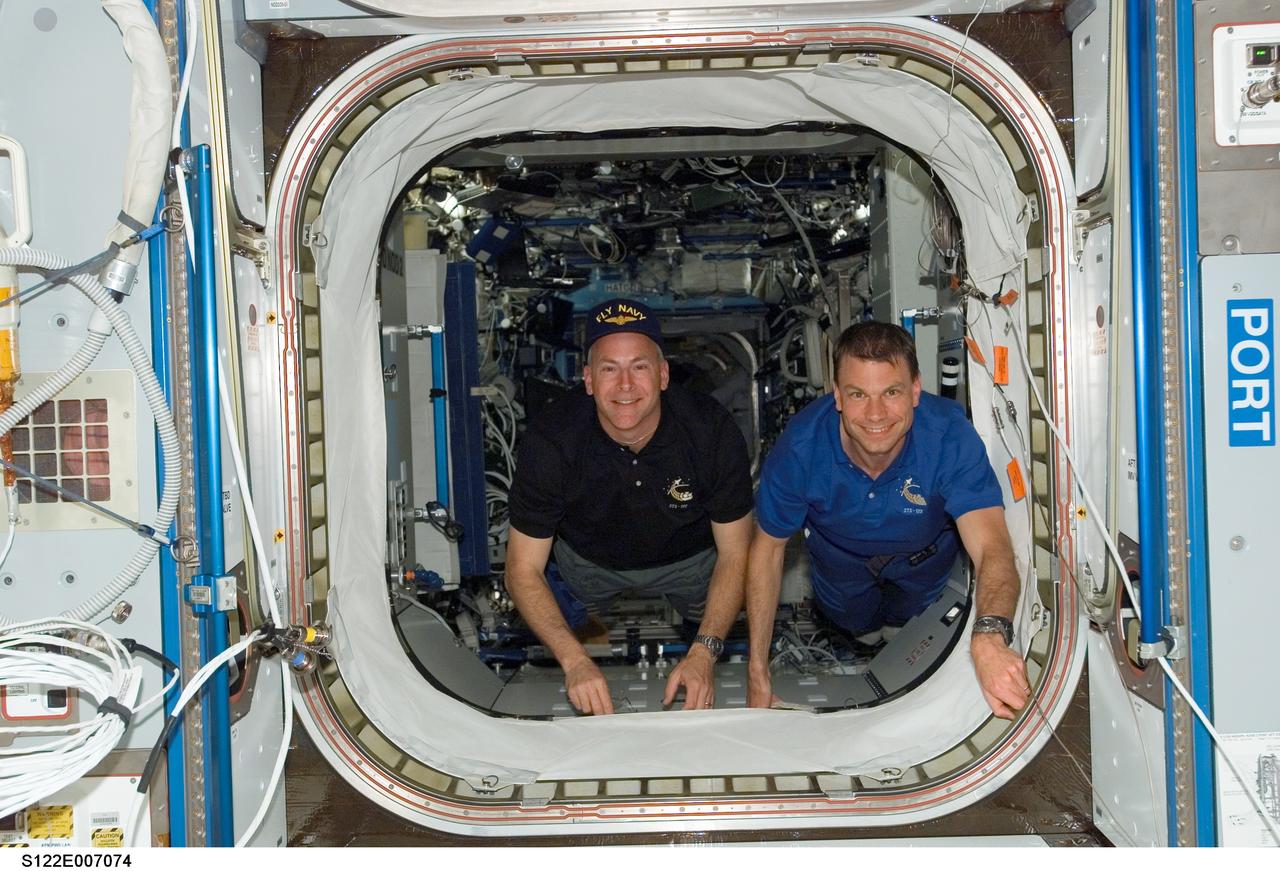
S122-E-007074 (9 Feb. 2008) --- Astronauts Alan Poindexter (left), pilot for the Space Shuttle Atlantis' STS-122 crew, and Stanley Love, mission specialist, appear to enjoy the view aboard the International Space Station shortly after ingress on docking day.

CAPE CANAVERAL, Fla. – In the Orbiter Processing Facility at NASA's Kennedy Space Center, STS-125 crew members are lowered into space shuttle Atlantis' payload bay for a close look at the hardware. Equipment familiarization is part of the crew equipment interface test, which provides hands-on experience with hardware and equipment for the mission. Crew members are Commander Scott Altman, Pilot Gregory C. Johnson, and Mission Specialists Michael Good, Megan McArthur, John Grunsfeld, Mike Massimino and Andrew Feustel. Atlantis is targeted to launch Oct. 8 on the STS-125 mission to service the Hubble Space Telescope. The mission crew will perform history-making, on-orbit “surgery” on two important science instruments aboard the telescope. After capturing the telescope, two teams of spacewalking astronauts will perform the repairs during five planned spacewalks. Photo credit: NASA/Kim Shiflett
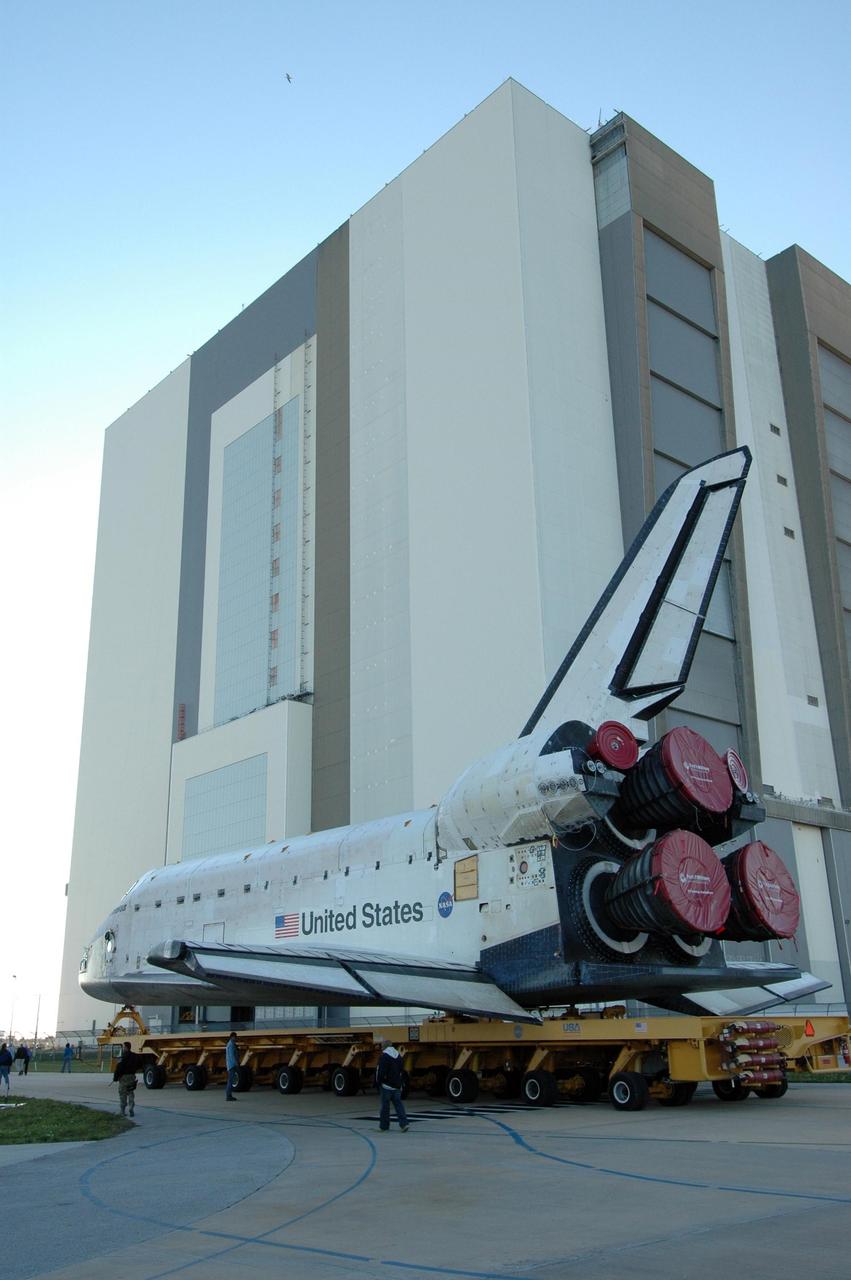
KENNEDY SPACE CENTER, FLA. -- On its transporter, space shuttle Endeavour rolls toward the Vehicle Assembly Building after leaving the Orbiter Processing Facility. In high bay 1 of the VAB, Endeavour will be attached to its external fuel tank and solid rocket boosters in preparation for its upcoming mission, STS-123, to the International Space Station targeted for March 11. The mission will deliver the first section of the Japan Aerospace Exploration Agency's Kibo laboratory and the Canadian Space Agency's two-armed robotic system, Dextre. Photo credit: NASA/Jim Grossmann

Expedition 18 Flight Engineer Yuri V. Lonchakov waves farewell as he and fellow crew members Expedition 18 Commander Michael Fincke and American spaceflight participant Richard Garriott depart the Cosmonaut Hotel for the bus ride to building 254 where the crew will don their spacesuits, Sunday, Oct. 12, 2008, in Baikonur, Kazakhstan. The three crew members are scheduled to dock with the International Space Station on Oct. 14. Fincke and Lonchakov will spend six months on the station, while Garriott will return to Earth Oct. 24 with two of the Expedition 17 crew members currently on the International Space Station. Photo Credit: (NASA/Victor Zelentsov)
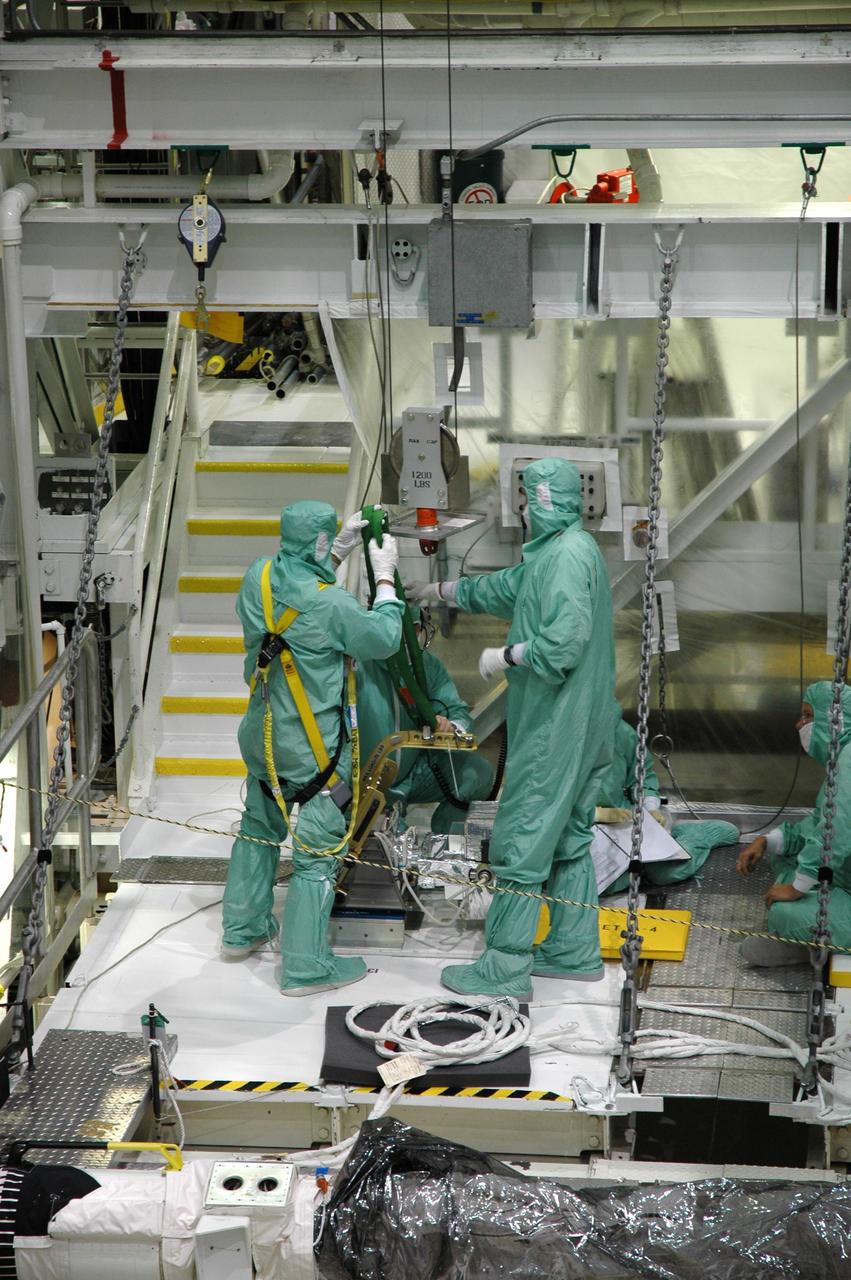
CAPE CANAVERAL, Fla. – In the Orbiter Processing Facility bay 2 at NASA's Kennedy Space Center, workers prepare to install a camera pack on the orbiter boom sensor system in space shuttle Endeavour's payload bay. The scheduled launch vehicle for the STS-126 missions, Endeavour will deliver a multi-purpose logistics module to the International Space Station. Launch is targeted for Nov. 10. Endeavour is also the backup shuttle, if needed for rescue, for the STS-125 mission in October that will make repairs on NASA's Hubble Space Telescope. For that purpose, it is designated STS-400. Photo credit: NASA/Jim Grossmann
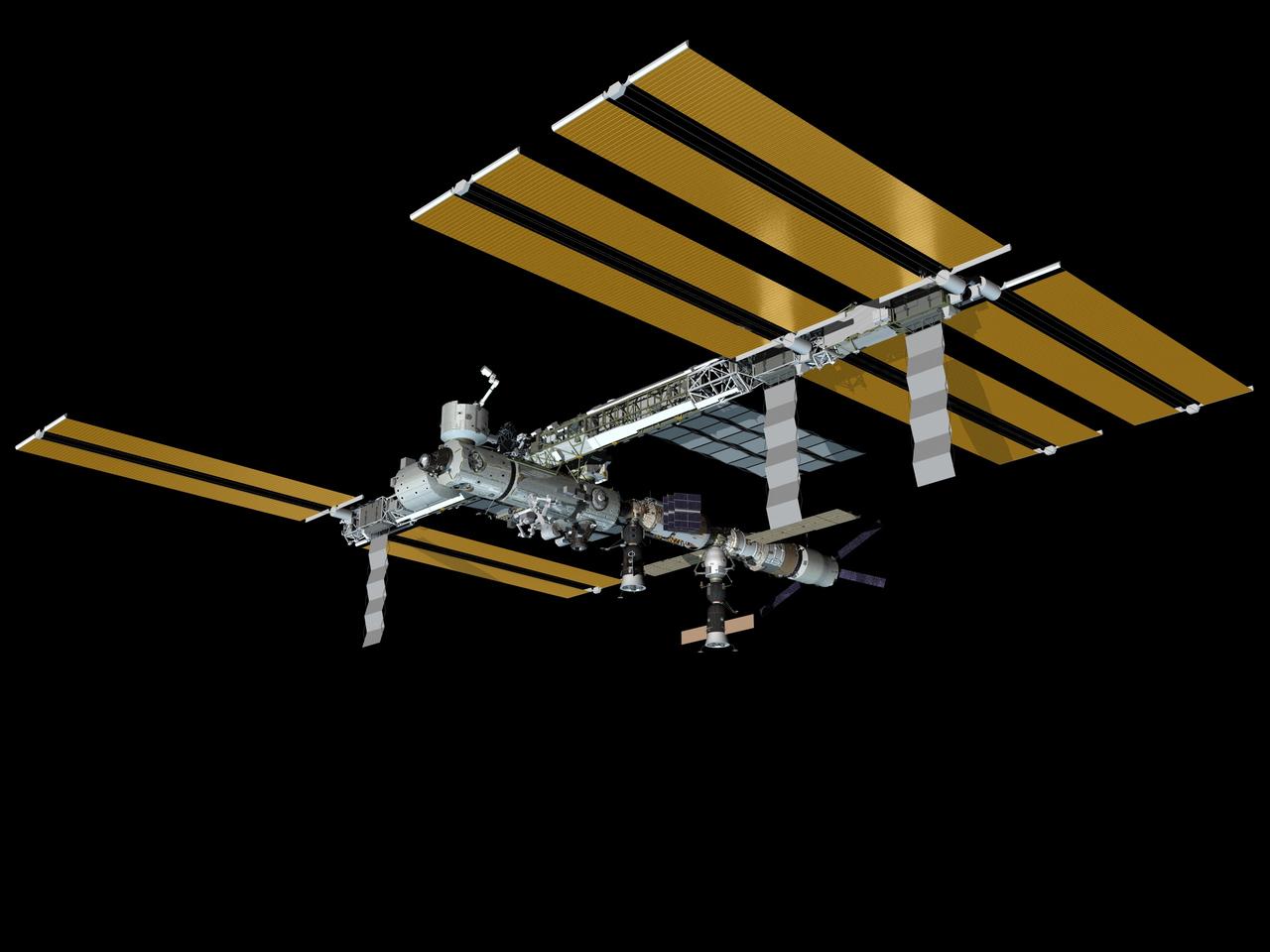
JSC2008-E-032251 (April 2008) --- Computer-generated artist's rendering of the International Space Station as of April 10, 2008. Soyuz 16 (TMA-12) docks to the Pirs Docking Compartment, carrying the Expedition 17 crew and spaceflight participant. Soyuz 15 (TMA-11) is linked at the Zarya nadir port and the Jules Verne Automated Transfer Vehicle (ATV-1) remains docked to the Zvezda Service Module aft port.
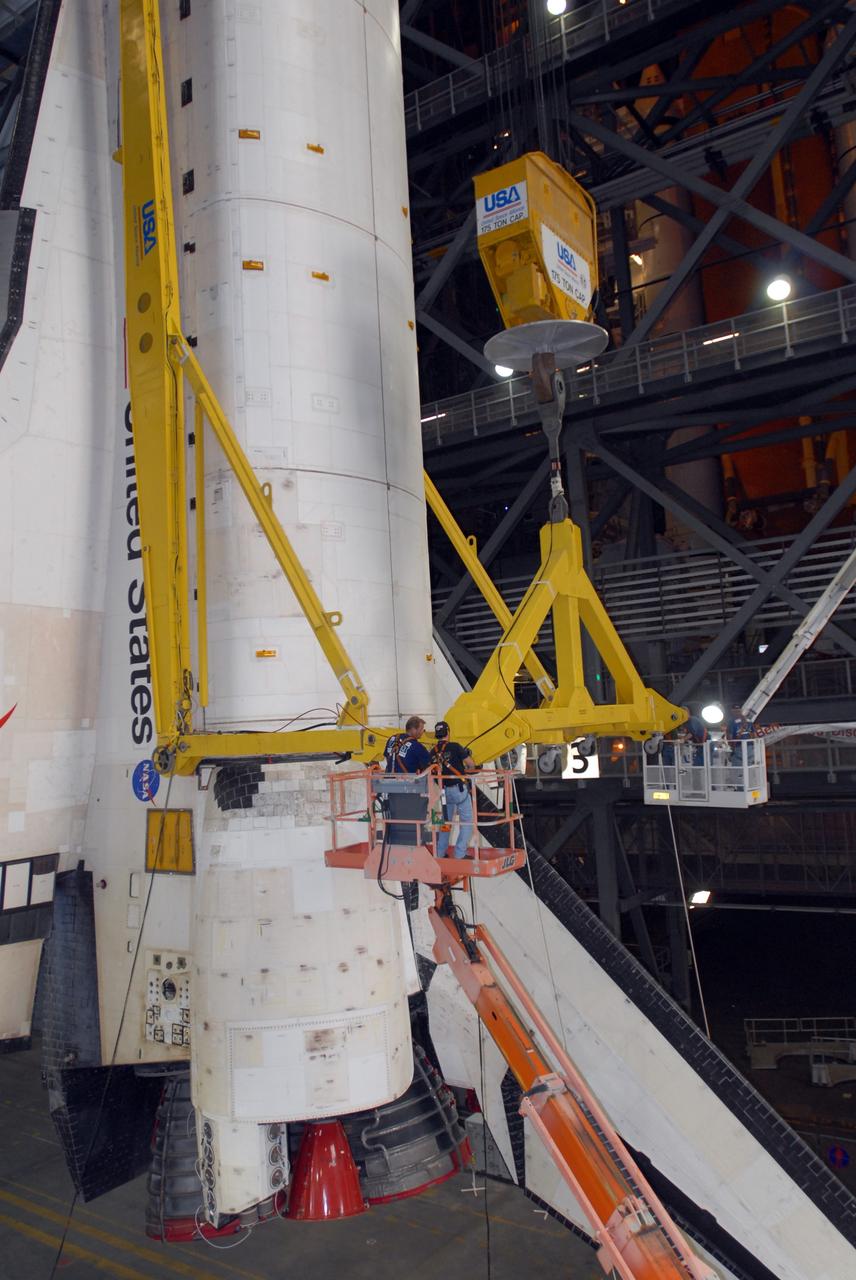
CAPE CANAVERAL, Fla. – As it hangs suspended in the Vehicle Assembly Building at NASA's Kennedy Space Center in Florida, space shuttle Atlantis is being fitted with an apparatus that will help lower it to a horizontal position. Atlantis has been taken off its external fuel tank and solid rocket boosters stack after of the delay of its STS-125 mission to NASA's Hubble Space Telescope. Atlantis will be returned to the Orbiter Processing Facility. Atlantis' targeted launch on Oct. 14 was delayed when a system that transfers science data from the orbiting observatory to Earth malfunctioned on Sept. 27. The new target launch date is under review. Photo credit: NASA/Jim Grossmann
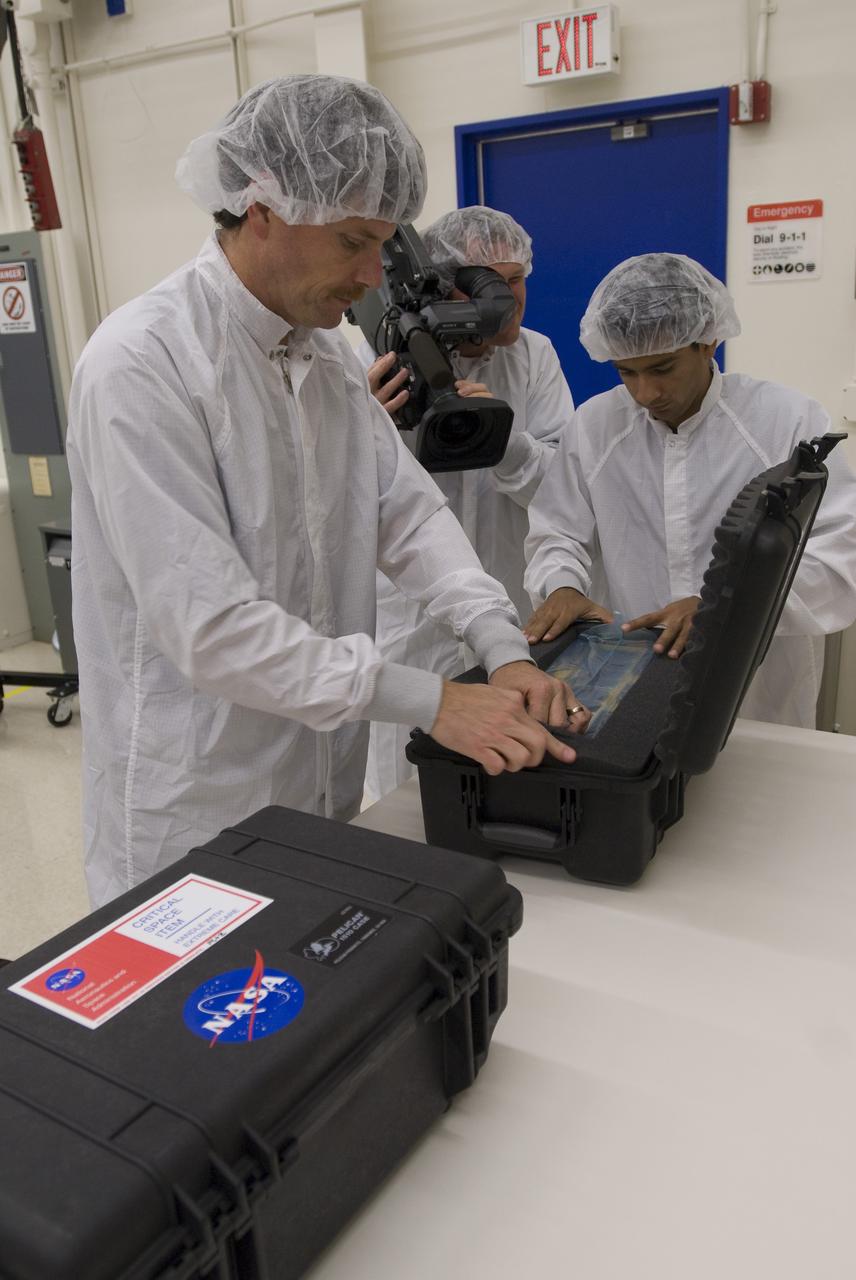
PreSat (satellite) in N-240 high bay packing for shipment
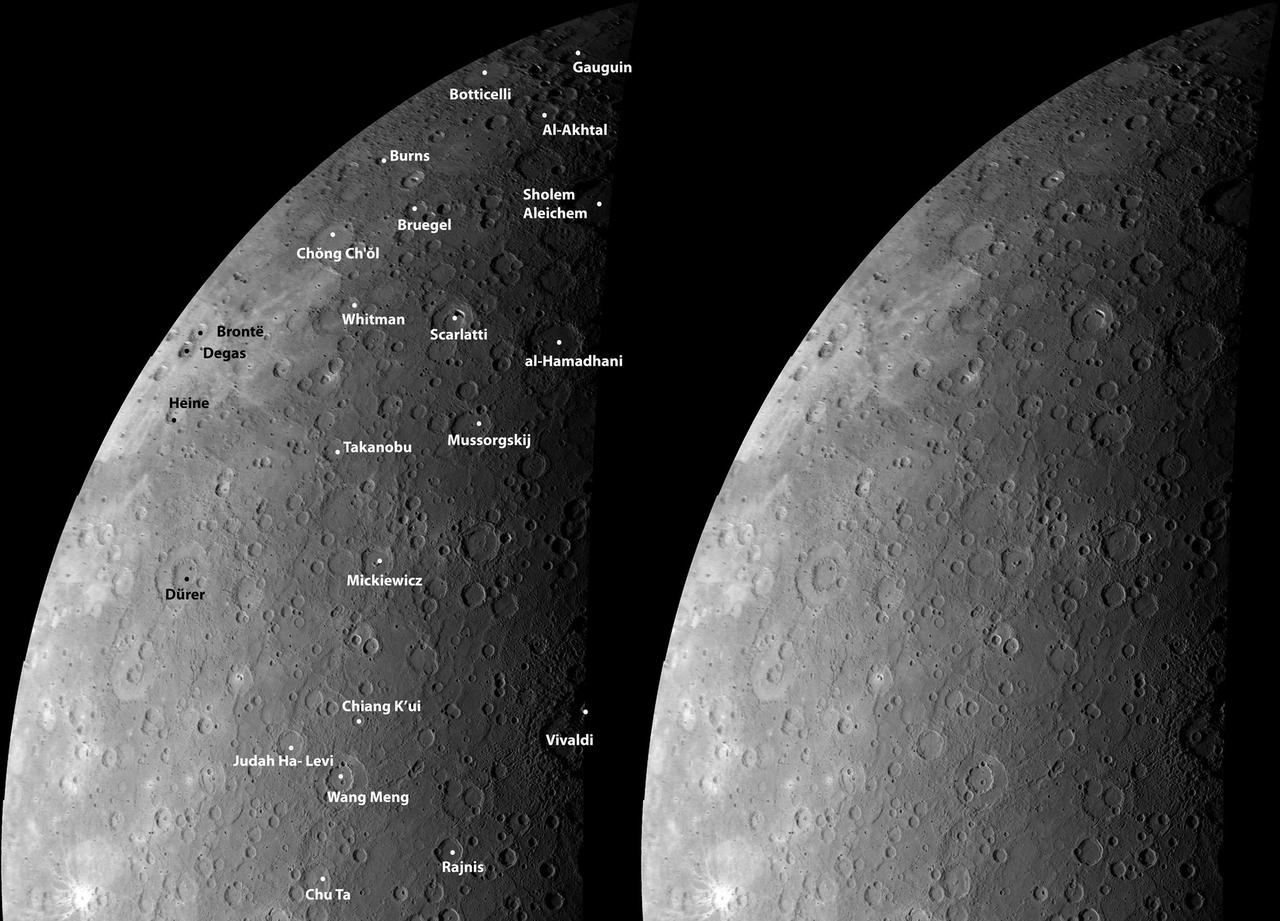
Mercury Craters from a New Perspective
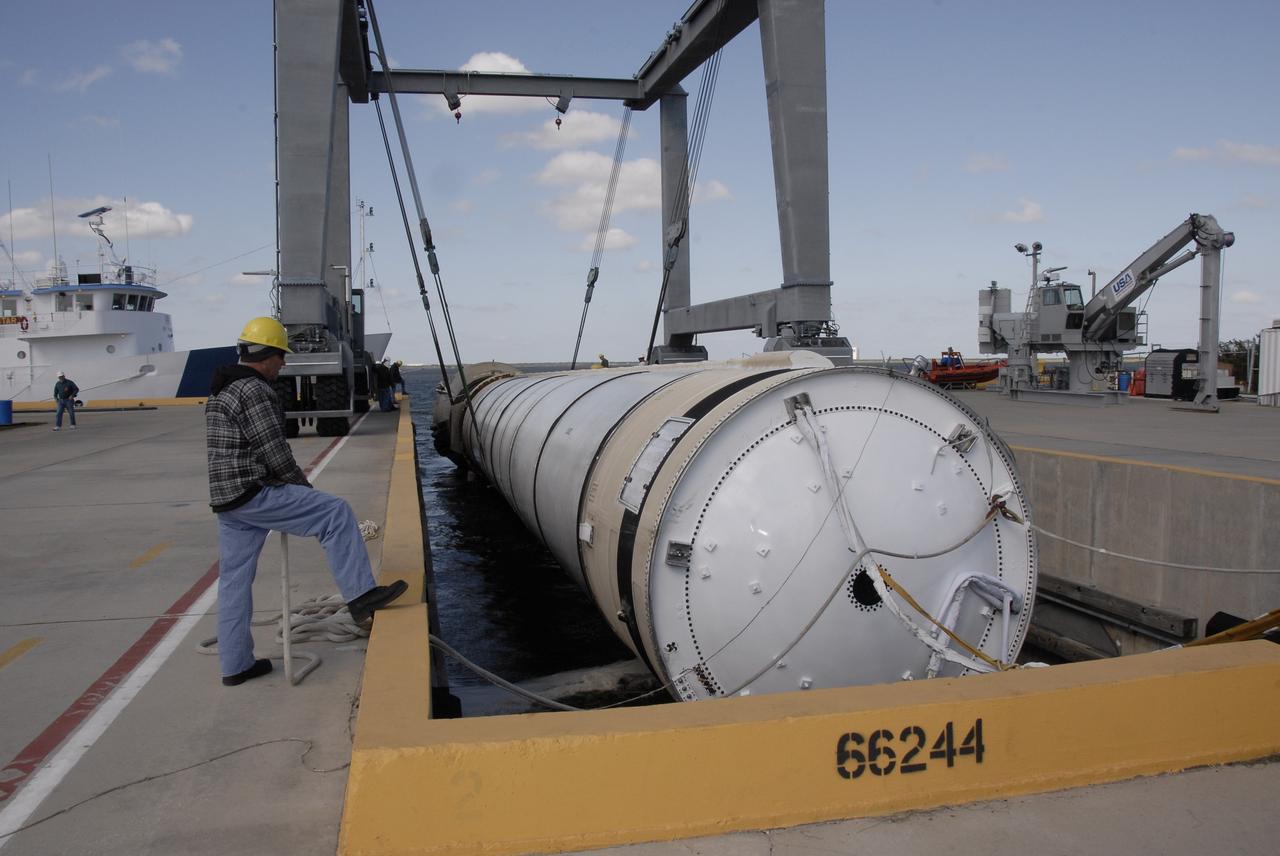
CAPE CANAVERAL, Fla. – At the dock at Hangar AF at Cape Canaveral Air Force Station in Florida, workers move the spent solid rocket booster to an area beneath the straddle crane that will lift it out of the water. The booster is from space shuttle Endeavour, which launched Nov. 14 on the STS-126 mission. The space shuttle’s solid rocket booster casings and associated flight hardware are recovered at sea. The spent rocket was recovered by NASA's Solid Rocket Booster Retrieval Ship Freedom Star. The boosters impact the Atlantic Ocean approximately seven minutes after liftoff. The splashdown area is a square of about six by nine nautical miles located about 140 nautical miles downrange from the launch pad. The retrieval ships are stationed approximately 8 to 10 nautical miles from the impact area at the time of splashdown. As soon as the boosters enter the water, the ships accelerate to a speed of 15 knots and quickly close on the boosters. The pilot chutes and main parachutes are the first items to be brought on board. With the chutes and frustum recovered, attention turns to the boosters. The ship’s tow line is connected and the booster is returned to the Port and, after transfer to a position alongside the ship, to Hangar AF. There, the expended boosters are disassembled, refurbished and reloaded with solid propellant for reuse. Photo credit: NASA/Kim Shiflett
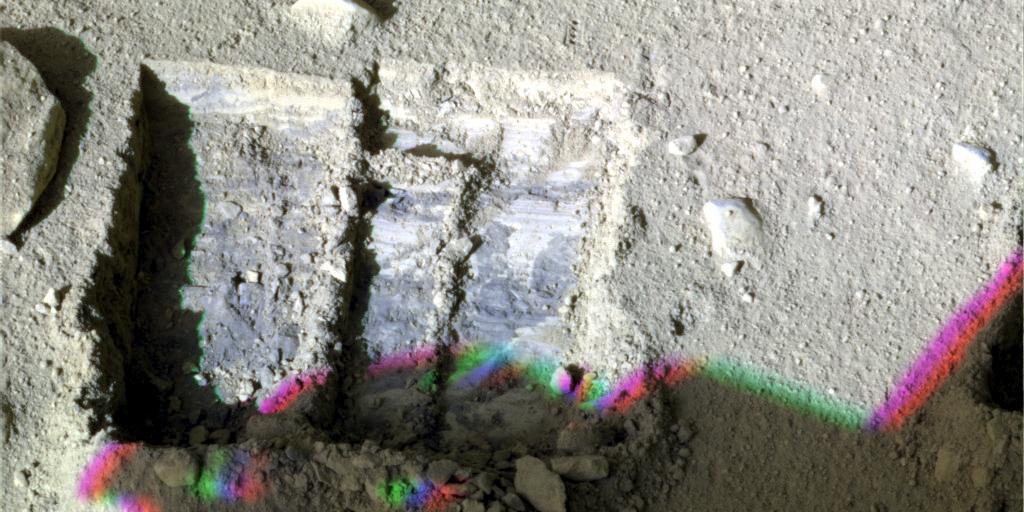
Phoenix La Mancha Trench
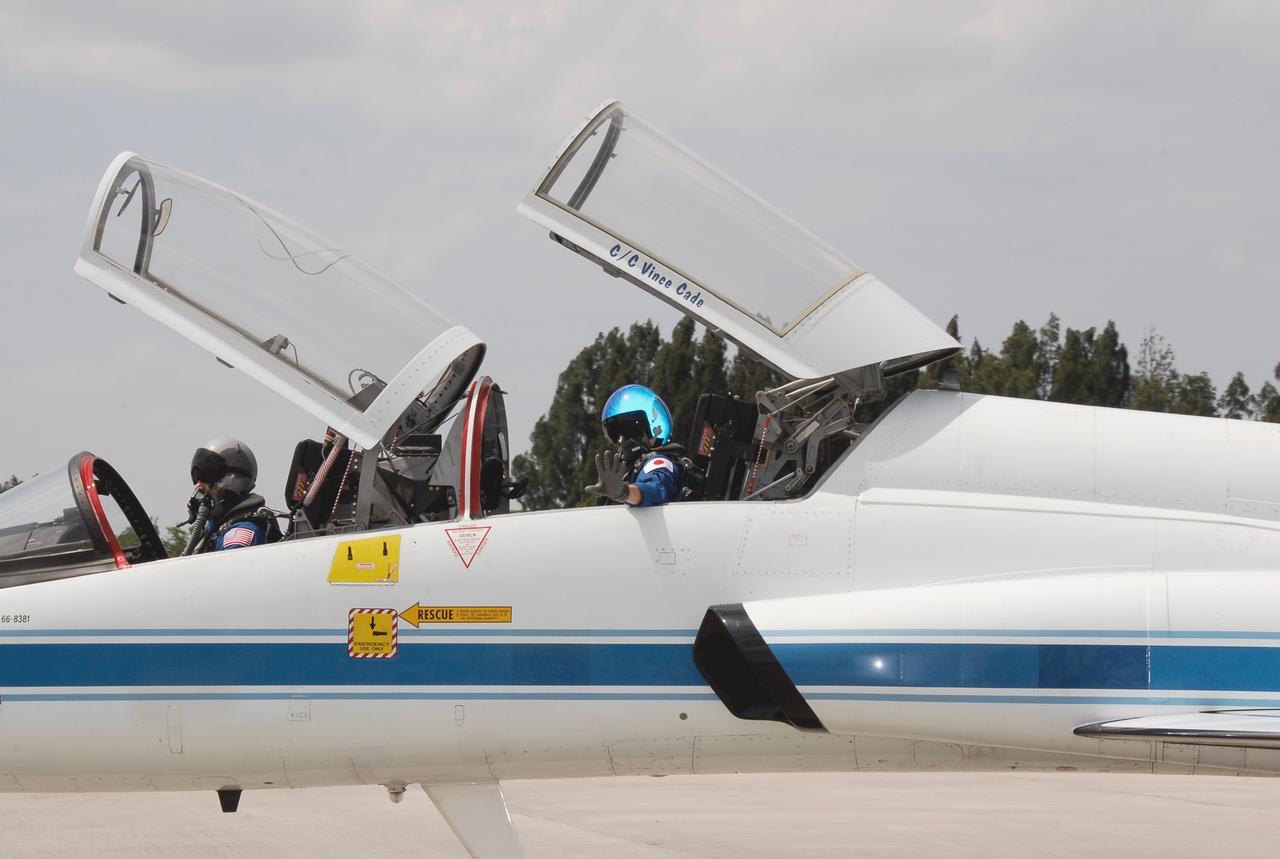
CAPE CANAVERAL, Fla. -- Two of the crewmembers for the STS-124 mission, Pilot Ken Ham and Mission Specialist Akihiko Hoshide, depart NASA's Kennedy Space Center in a T-38 training jet after a successful launch dress rehearsal called the terminal countdown demonstration test. The crew is expected to return in late May for the May 31 launch of space shuttle Discovery. On the STS-124 mission, the crew will deliver and install the Japanese Experiment Module – Pressurized Module and Japanese Remote Manipulator System. Photo credit: NASA/Kim Shiflett
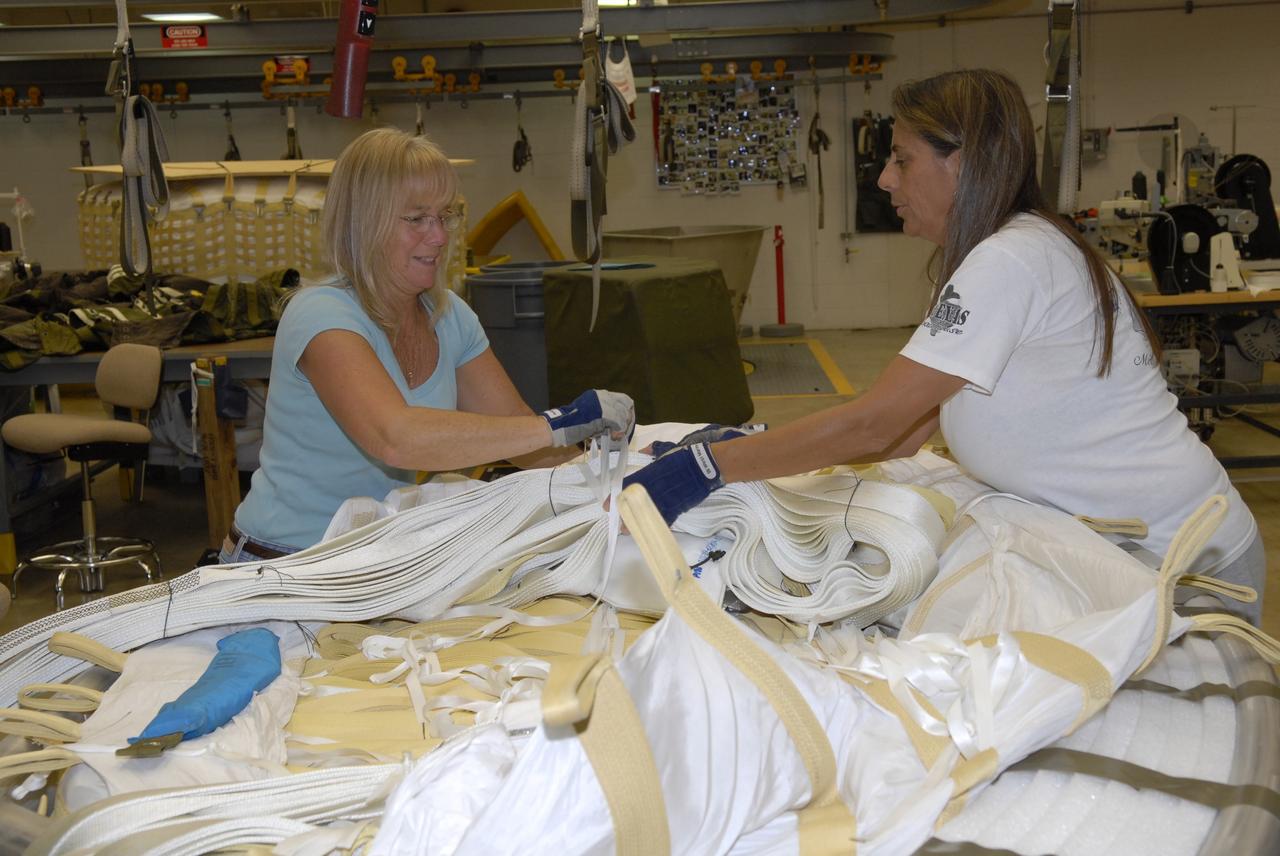
CAPE CANAVERAL, Fla. -- In the Parachute Refurbishment Facility at NASA's Kennedy Space Center in Florida, workers pack the parachutes that will be used in the Ares I-X development flight in July 2009. The first stage of the new Ares I rocket and Orion spacecraft will use parachutes to return to Earth. Ares I-X is the test vehicle for the Ares I, which is part of the Constellation Program to return men to the moon and beyond. Ares I is the essential core of a safe, reliable, cost-effective space transportation system that eventually will carry crewed missions back to the moon, on to Mars and out into the solar system. Ares I may also use its 25-ton payload capacity to deliver resources and supplies to the International Space Station, or to "park" payloads in orbit for retrieval by other spacecraft bound for the moon or other destinations. Photo credit: NASA/Jack Pfaller
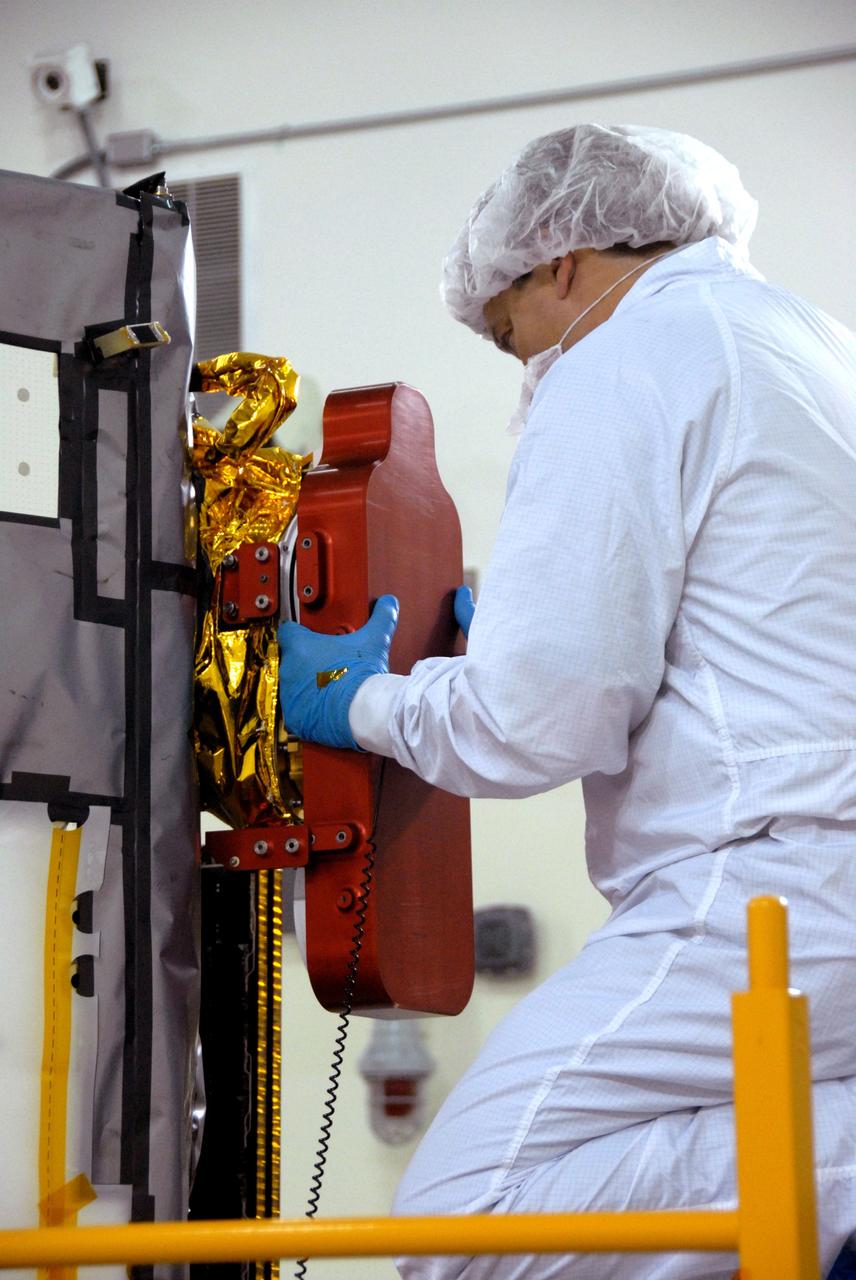
VANDENBERG AIR FORCE BASE, Calif. -- Inside the Astrotech payload processing facility, building 1032, at Vandenberg Air Force Base in California, workers check the Orbiting Carbon Observatory, or OCO. After the protective coverings over the spacecraft are removed, blanket preparations and edge taping will be done, followed by mechanical preparations and work on the electronic ground support equipment. The OCO is a new Earth-orbiting mission sponsored by NASA's Earth System Science Pathfinder Program. The observatory is targeted to launch Jan. 15 from Space Launch Complex 576-E at Vandenberg. Photo credit: NASA/Robert Hargreaves Jr., VAFB
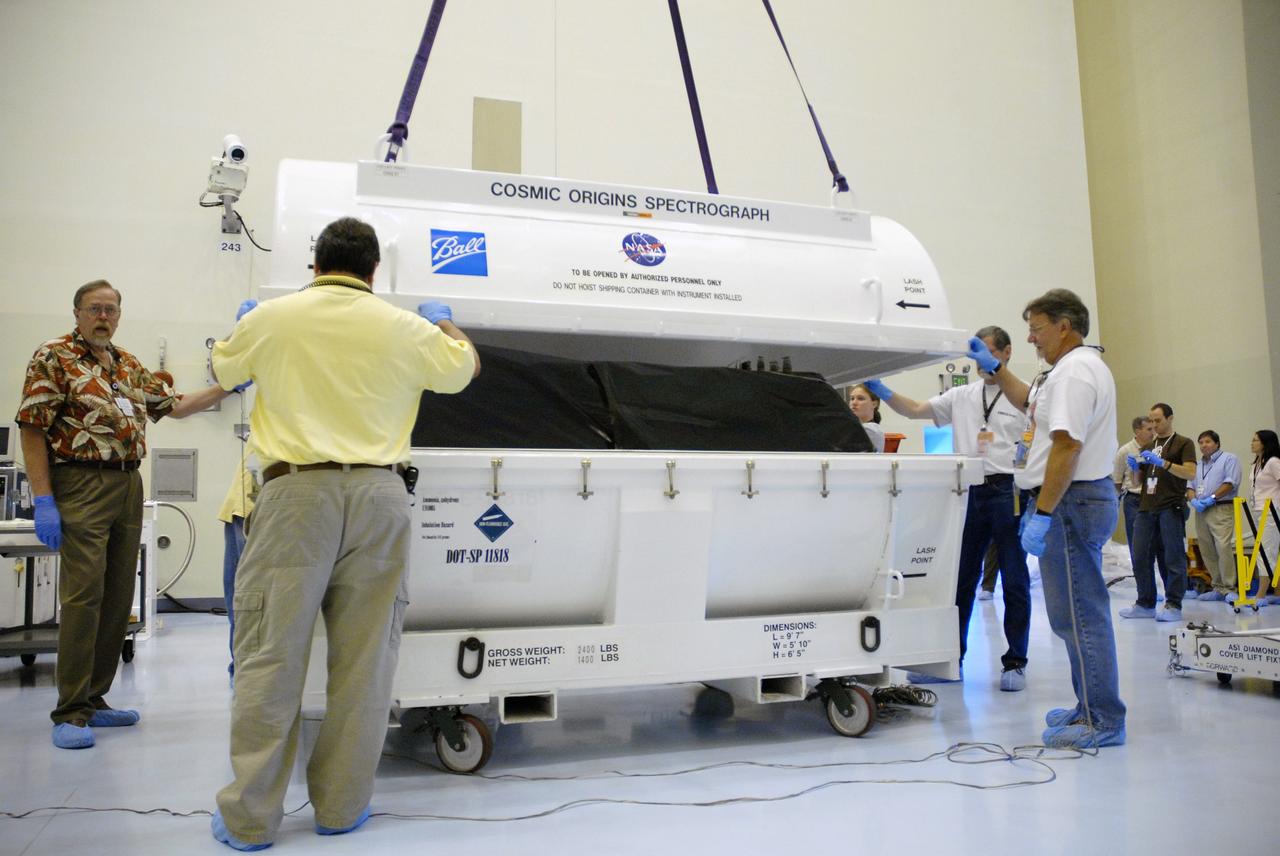
CAPE CANAVERAL, Fla. – In the airlock of the Payload Hazardous Servicing Facility at NASA's Kennedy Space Center, workers from NASA's Goddard Space Flight Center open the transportation canister in which the Cosmic Origins Spectrograph, or COS, is protected. The COS will be installed on the Hubble Space Telescope on space shuttle Atlantis' STS-125 mission. COS will be the most sensitive ultraviolet spectrograph ever flown on Hubble and will probe the "cosmic web" - the large-scale structure of the universe whose form is determined by the gravity of dark matter and is traced by galaxies and intergalactic gas. COS's far-ultraviolet channel has a sensitivity 30 times greater than that of previous spectroscopic instruments for the detection of extremely low light levels. Launch of STS-125 is targeted for Oct. 8. Photo credit: NASA/Jack Pfaller
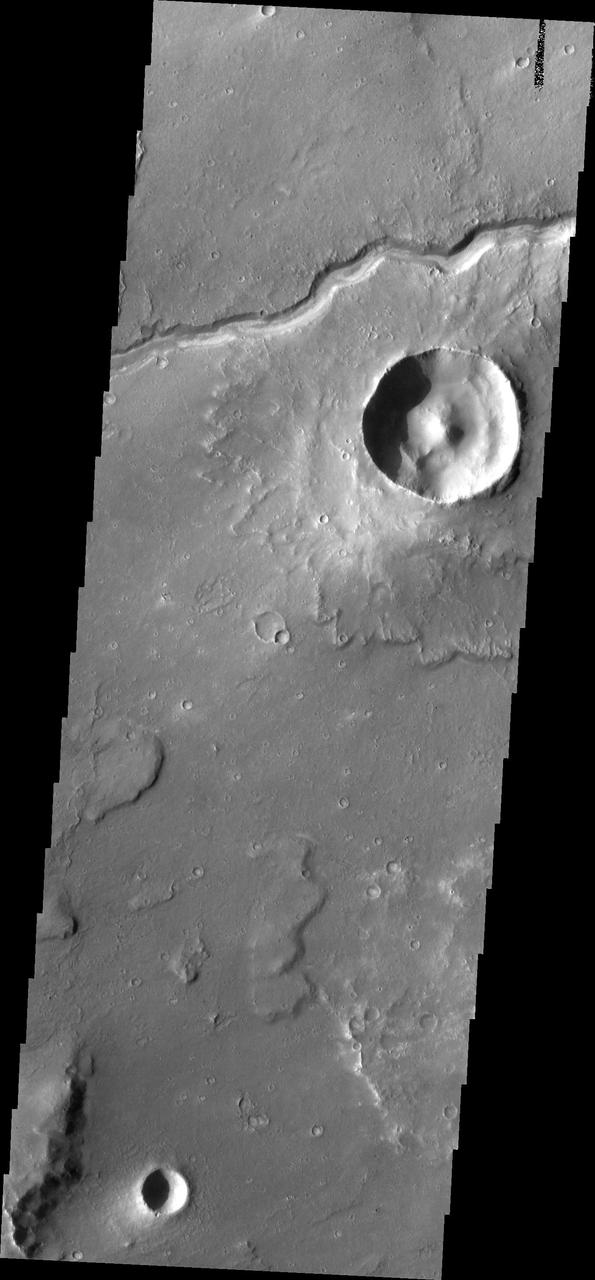
Lunae Planum
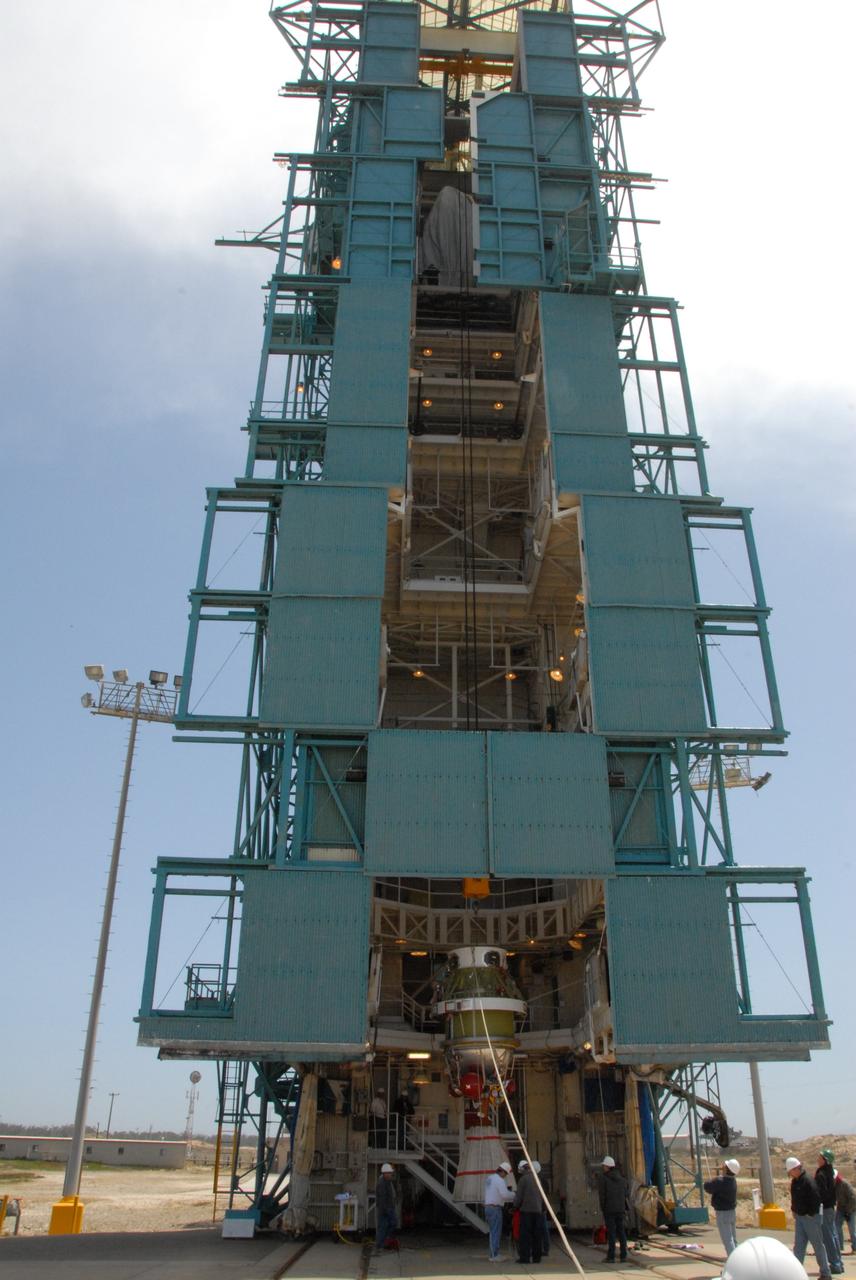
VANDENBERG AIR FORCE BASE, Calif. -- On Space Launch Complex 2 at Vandenberg Air Force Base in California, the Delta II second stage is ready to be lifted into the mobile service tower for installation on the first stage for launch of the OSTM/Jason-2 spacecraft. The OSTM, or Ocean Topography Mission, on the Jason-2 satellite is a follow-on to Jason-1. It will take oceanographic studies of sea surface height into an operational mode for continued climate forecasting research and science and industrial applications. This satellite altimetry data will help determine ocean circulation, climate change and sea-level rise. OSTM is a joint effort by the National Oceanic and Atmospheric Administration, NASA, France’s Centre National d’Etudes Spatiales and the European Meteorological Satellite Organisation. OSTM/Jason-2 will be launched on June 20. Photo credit: NASA
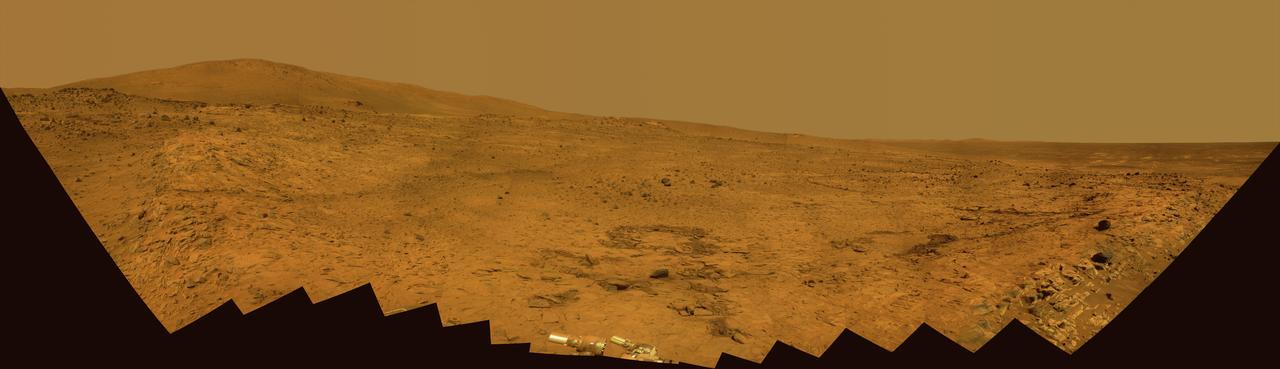
Southern Half of Spirit Bonestell Panorama
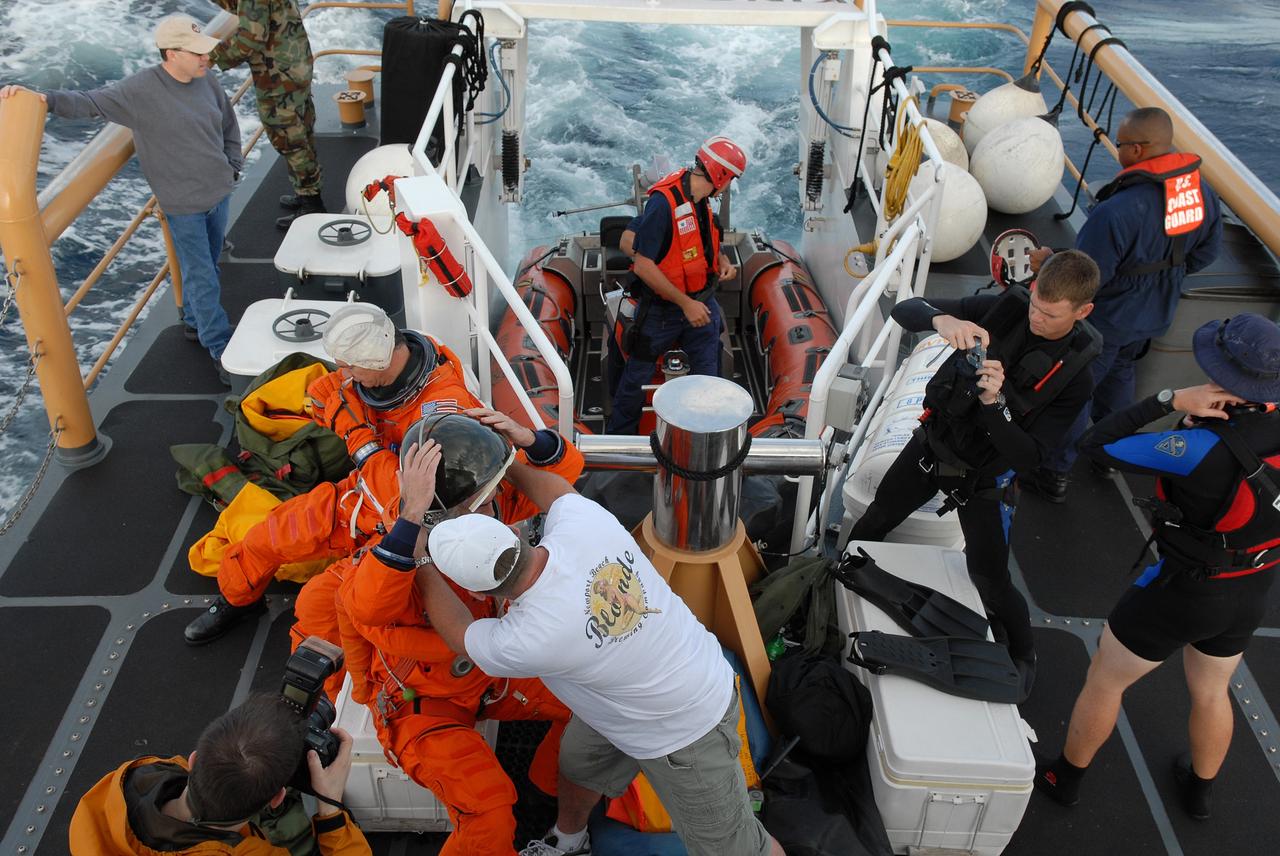
CAPE CANAVERAL, Fla. -- In a U.S. Coast Guard rescue boat off Florida's central east coast, participants in a rescue training exercise, known as Mode VIII, put on astronauts' launch-and-entry suits. In support of, and with logistical support from, NASA, USSTRATCOM is hosting a major exercise involving Department of Defense, Department of Homeland Security, search and rescue (SAR) forces, including the 45th Space Wing at Patrick Air Force Base, which support space shuttle astronaut bailout contingency operations, known as Mode VIII. This exercise tests SAR capabilities to locate, recover and provide medical treatment for astronauts following a space shuttle launch phase open-ocean bailout. Participants include members of the U.S. Navy, U.S. Coast Guard, U.S. Air Force, and NASA's Kennedy Space Center and Johnson Space Center. Photo credit: NASA/Dimitri Gerondidakis
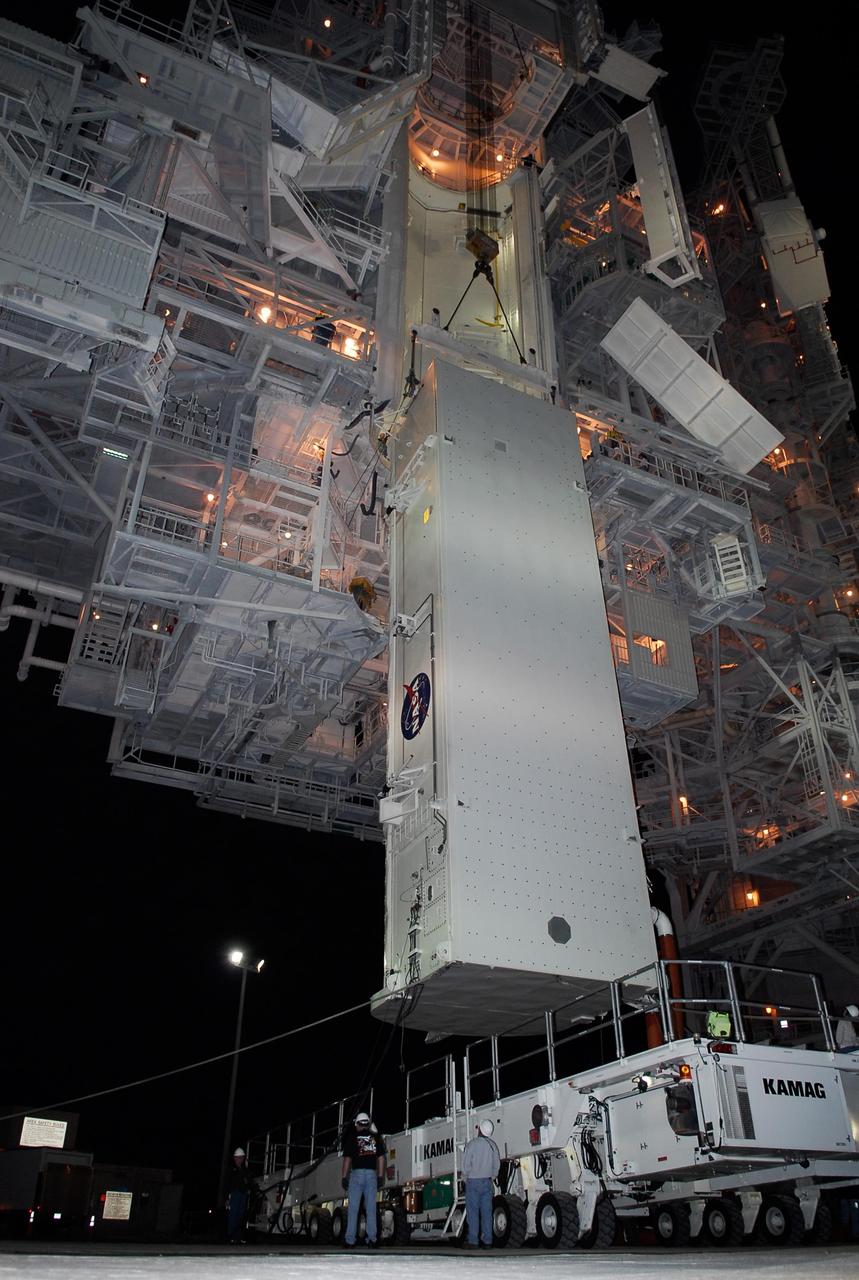
KENNEDY SPACE CENTER, FLA. -- On Launch Pad 39A at NASA's Kennedy Space Center, the payload canister containing the first section of the Japan Aerospace Exploration Agency's Kibo laboratory and the Canadian Space Agency's two-armed robotic system, Dextre, is lifted up toward the payload changeout room in the rotating service structure. The changeout room is the enclosed, environmentally controlled portion of the rotating service structure that supports cargo delivery to the pad and subsequent vertical installation into an orbiter's payload bay. The payload will be installed into Endeavour for launch on the STS-123 mission targeted for March 11. Photo credit: NASA/Kim Shiflett
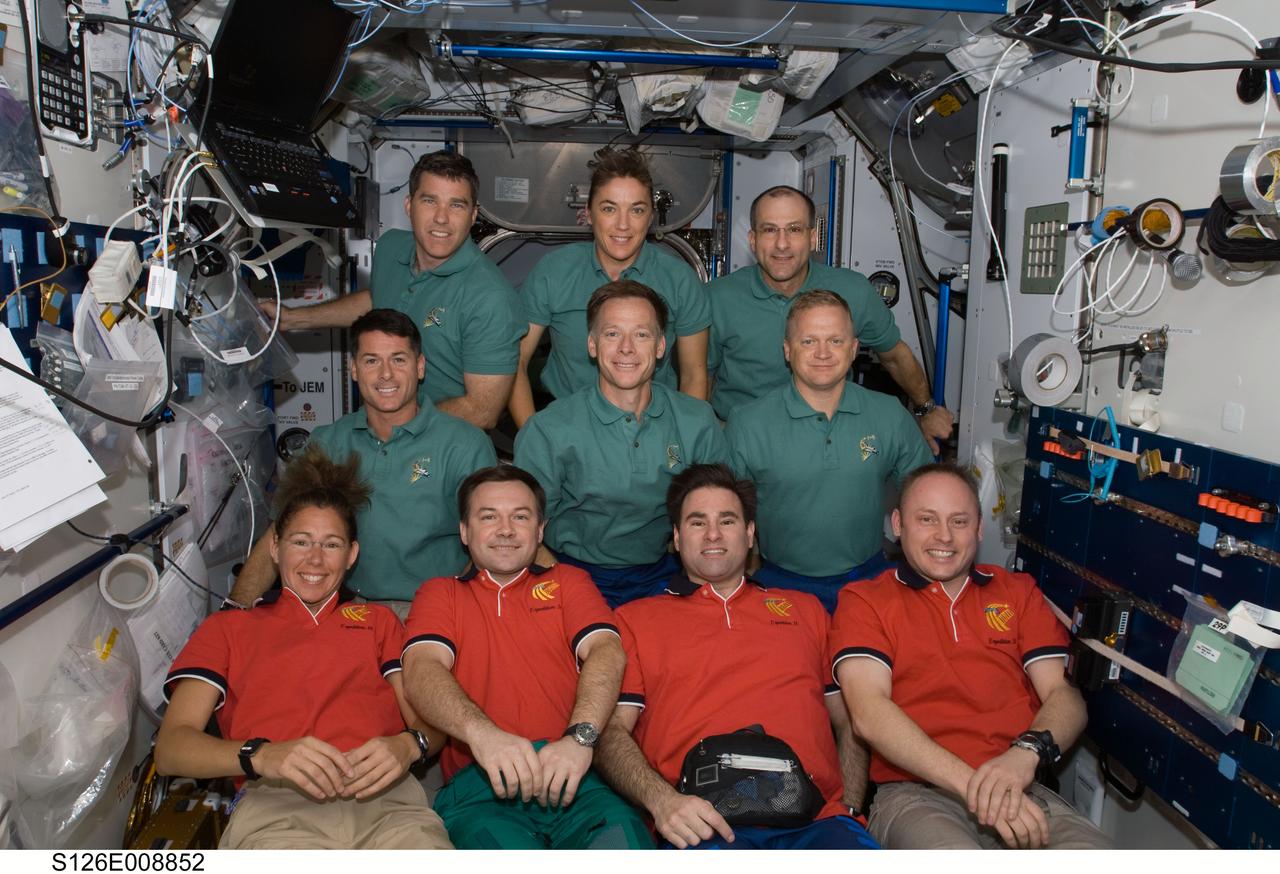
S126-E-008852 (21 Nov. 2008) --- Following a space-to-Earth press conference, members of the International Space Station and Space Shuttle Endeavour crews posed for a group portrait on the orbital outpost. From left, bottom row, are astronaut Sandra Magnus, cosmonaut Yury Lonchakov, and astronauts Gregory Chamitoff and Michael Fincke. From left, middle row, are astronauts Shane Kimbrough, Chris Ferguson and Eric Boe. From left, top row, are astronauts Steve Bowen, Heidemarie Stefanyshyn-Piper and Donald Pettit.
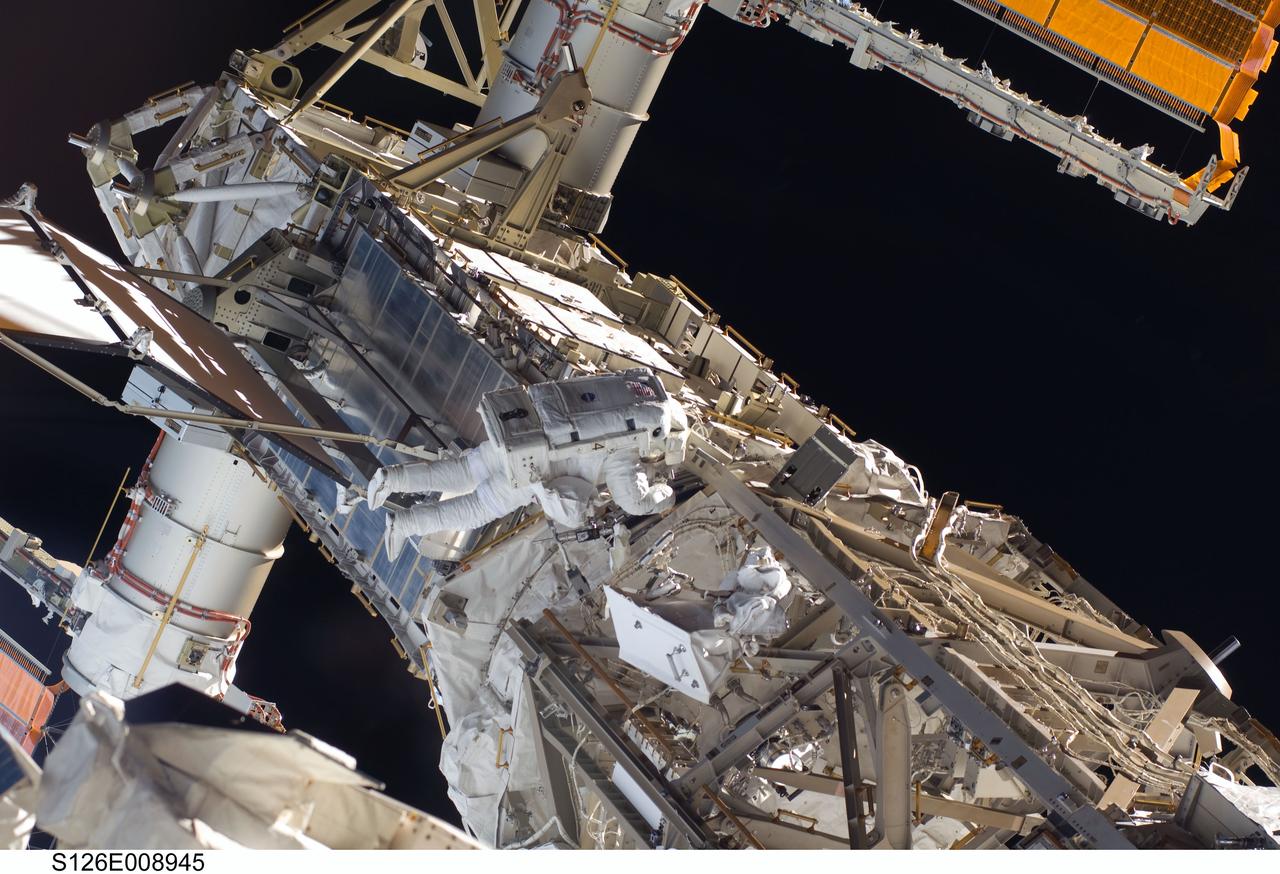
S126-E-008945 (22 Nov. 2008) --- Astronaut Steve Bowen, STS-126 mission specialist, participates in the mission's third scheduled session of extravehicular activity (EVA) as construction and maintenance continue on the International Space Station. During the six-hour, 57-minute spacewalk, Bowen and astronaut Heidemarie Stefanyshyn-Piper (out of frame), mission specialist, focused their efforts on the continued cleaning of the station's starboard solar alpha rotary joint (SARJ) and the removal and replacement of trundle bearing assemblies (TBA). Bowen and Piper also cleaned the area around the SARJ's drive lock assemblies, which help the joint to rotate and lock into place.
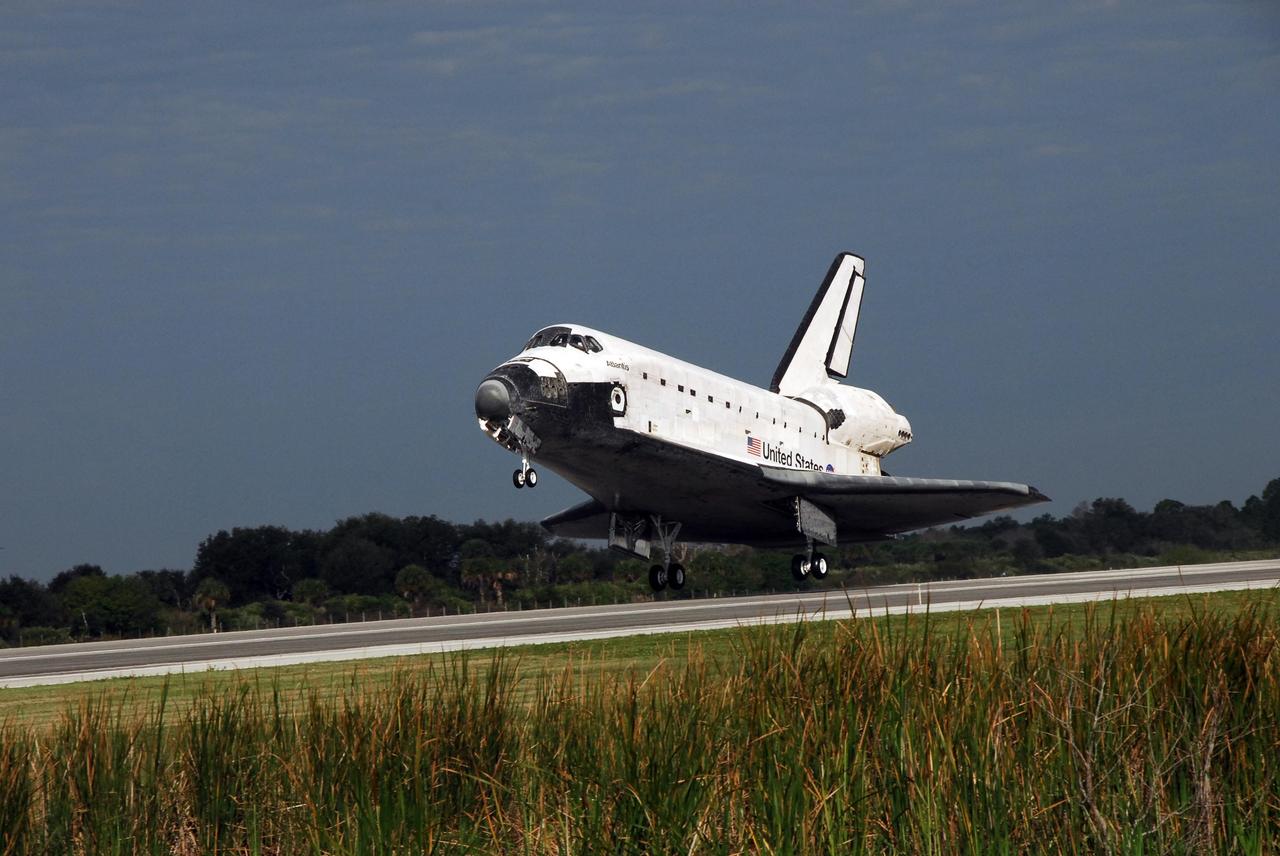
KENNEDY SPACE CENTER, FLA. -- The space shuttle Atlantis approaches touch down on Runway 15 of the Shuttle Landing Facility at NASA's Kennedy Space Center. The shuttle landed on orbit 202 to complete the 13-day STS-122 mission. Main gear touchdown was 9:07:10 a.m. Nose gear touchdown was 9:07:20 a.m. Wheel stop was at 9:08:08 a.m. Mission elapsed time was 12 days, 18 hours, 21 minutes and 44 seconds. During the mission, Atlantis' crew installed the new Columbus laboratory, leaving a larger space station and one with increased science capabilities. The Columbus Research Module adds nearly 1,000 cubic feet of habitable volume and affords room for 10 experiment racks, each an independent science lab. Photo credit: NASA/Jack Pfaller
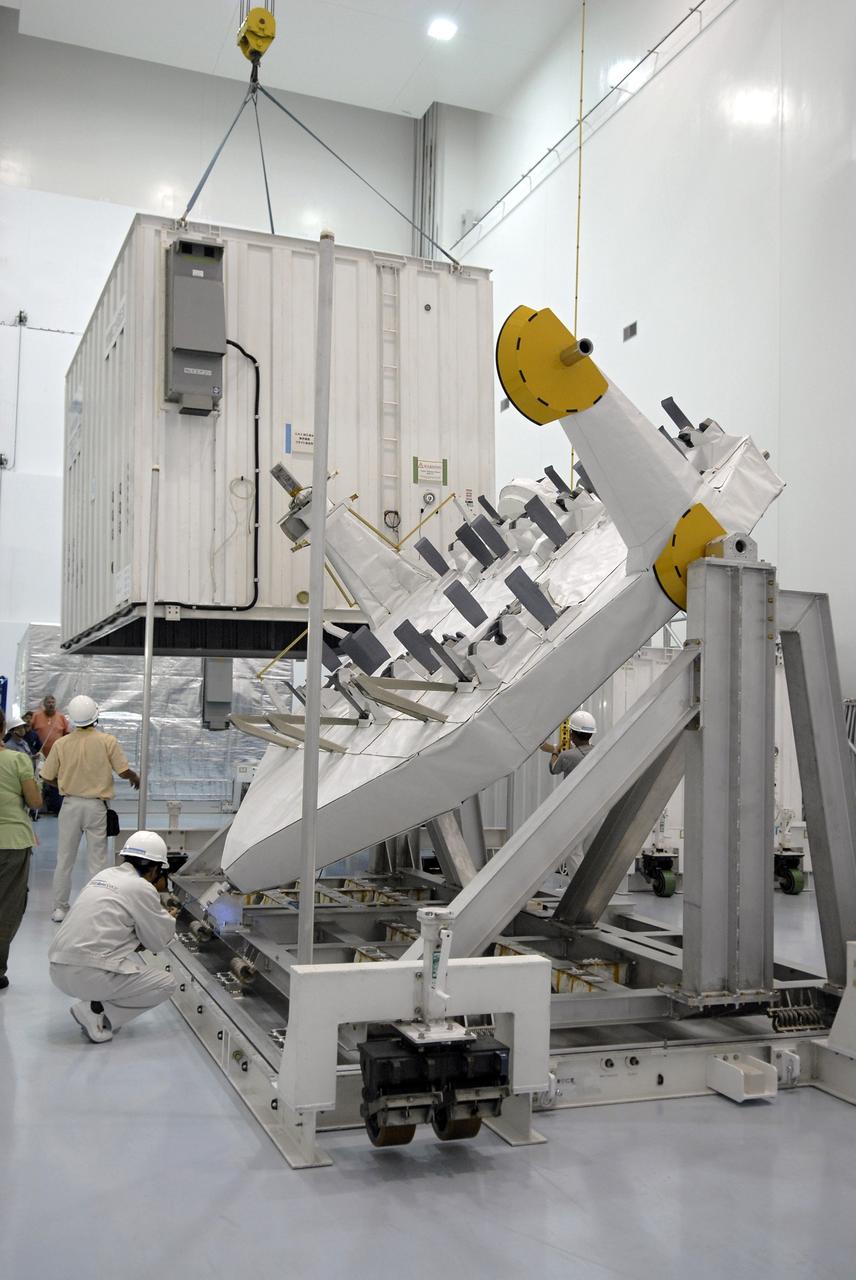
CAPE CANAVERAL, Fla. - The shipping container is moved away from the Kibo Experiment Logistics Module Exposed Section, or ELM-ES, in the Space Station Processing Facility at NASA's Kennedy Space Center in Florida. The ELM-ES is one of the final components of the Japan Aerospace Exploration Agency's Kibo laboratory for the International Space Station. It can provide payload storage space and can carry up to three payloads at launch. In addition, the ELM-ES provides a logistics function where it can be returned to the ground aboard the space shuttle. The ELM-ES will be carried aboard space shuttle Endeavour on the STS-127 mission targeted for launch May 15, 2009. Photo credit: NASA/Kim Shiflett
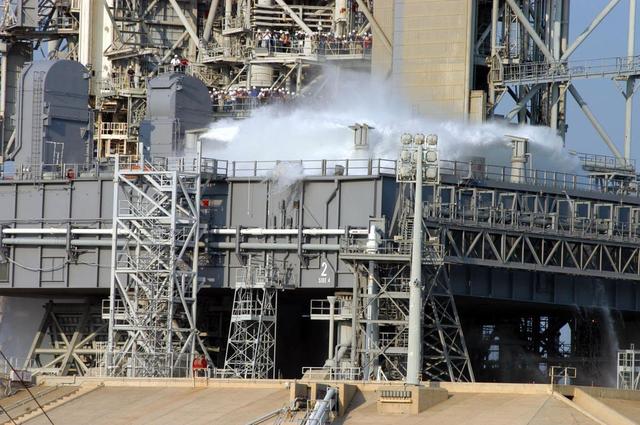
Exterior view of Mobile Launcher Platform
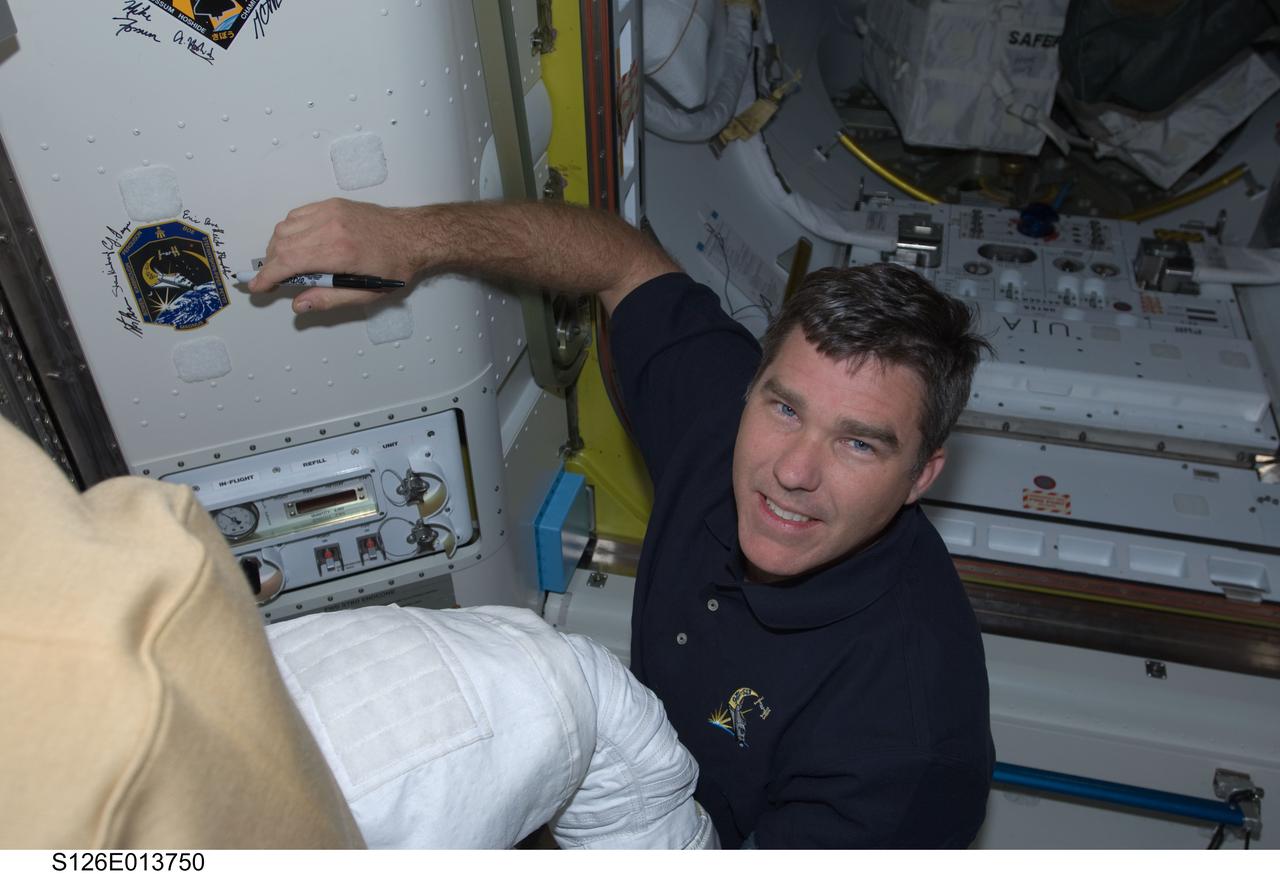
S126-E-013750 (27 Nov. 2008) --- Astronaut Steve Bowen, STS-126 mission specialist, signs Endeavour's crew patch in the Quest Airlock of the International Space Station on Thanksgiving Day. One more day remains for the Space Shuttle Endeavour to be docked with the station.
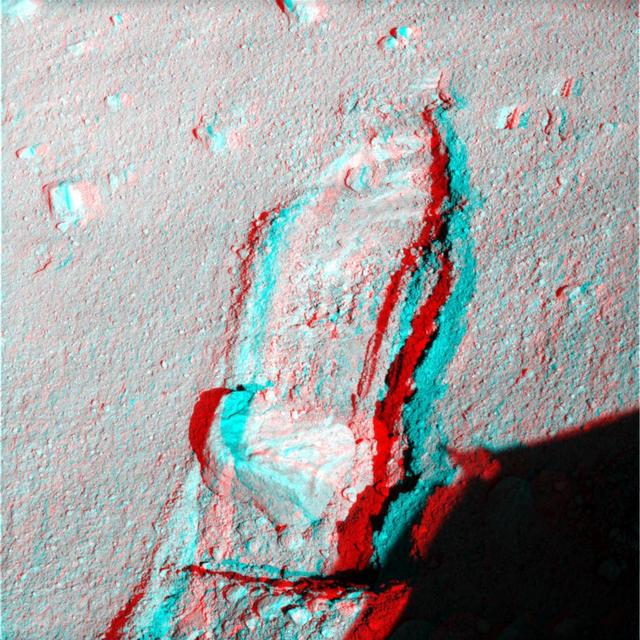
The robotic arm on NASA Phoenix Mars Lander slid a rock out of the way on Sept. 22, 2008 to gain access to soil that had been underneath the rock. 3D glasses are necessary to view this image.
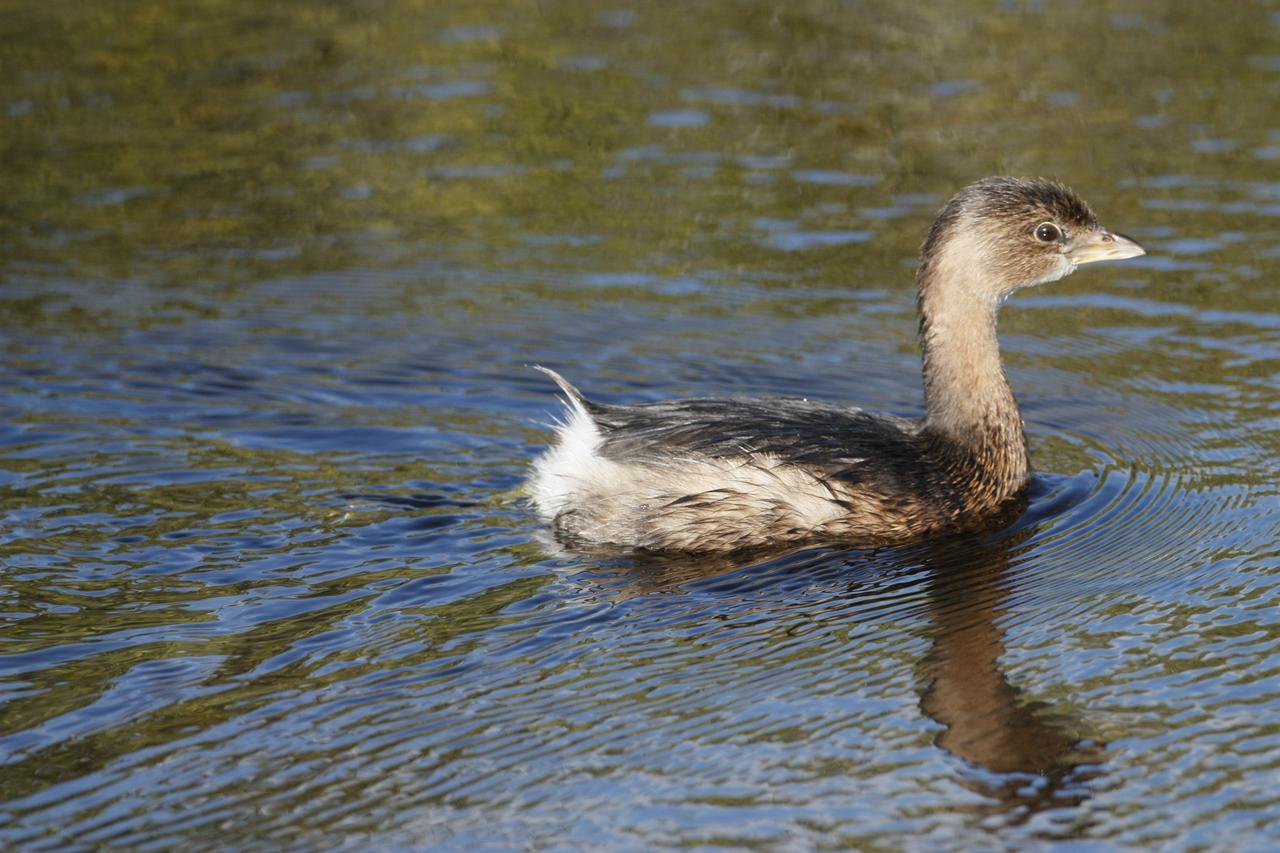
CAPE CANAVERAL, Fla. – Near NASA's Kennedy Space Center in Florida, a pied-billed Grebe swims on a pond in the Merritt island National Wildlife Refuge. The normal black band on its bill is lacking in winter. The most common grebe in eastern North America, the pied-billed Grebe inhabits marshes and ponds, eating small fish, crustaceans, especially crayfish, and aquatic insects. The center shares a boundary with the refuge that includes salt-water estuaries, brackish marshes, hardwood hammocks and pine flatwoods. The diverse landscape provides habitat for more than 310 species of birds, 25 mammals, 117 fishes and 65 amphibians and reptiles. Photo credit: NASA/Jim Grossmann
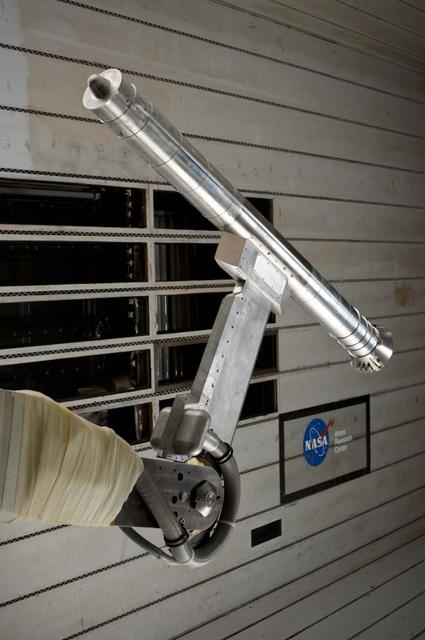
2.8% Scale Ares I acoustic model re-entry model in Ames 11ft. Supersonic Wind Tunnel test-11-0192
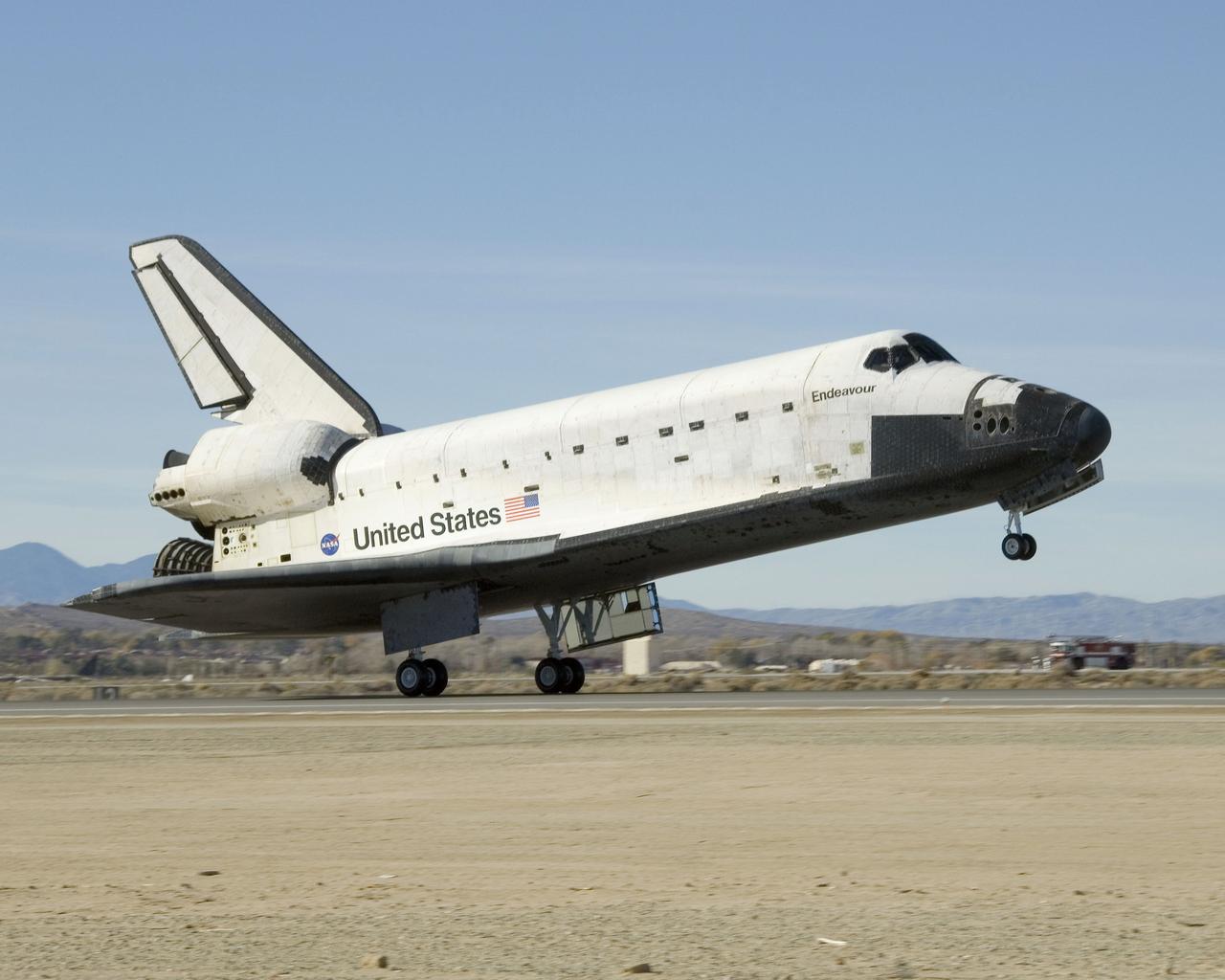
STS126-S-047 (30 Nov. 2008) --- Space Shuttle Endeavour's main landing gear touches down at NASA's Dryden Flight Research Center at Edwards Air Force Base in California, concluding a successful mission to the International Space Station. Endeavour landed at 1:25 p.m. (PST) on Nov. 30, 2008 to end the STS-126 mission, completing its 16-day journey of over 6.6 million miles in space. The landing was diverted to California due to marginal weather at the Kennedy Space Center. The main landing gear touched down at 1:25:06 p.m. (PST). The nose landing gear touched down at 1:25:21 p.m. and wheel stop was at 1:26:03 p.m. The STS-126 mission was the 27th flight to the International Space Station, carrying equipment and supplies in the Multi-Purpose Logistics Module Leonardo. The mission featured four spacewalks and work to prepare the space station to house six crewmembers for long-duration missions. Onboard were astronauts Chris Ferguson, commander; Eric Boe, pilot; Heidemarie Stefanyshyn-Piper, Donald Pettit, Steve Bowen, Shane Kimbrough and Greg Chamitoff, all mission specialists.
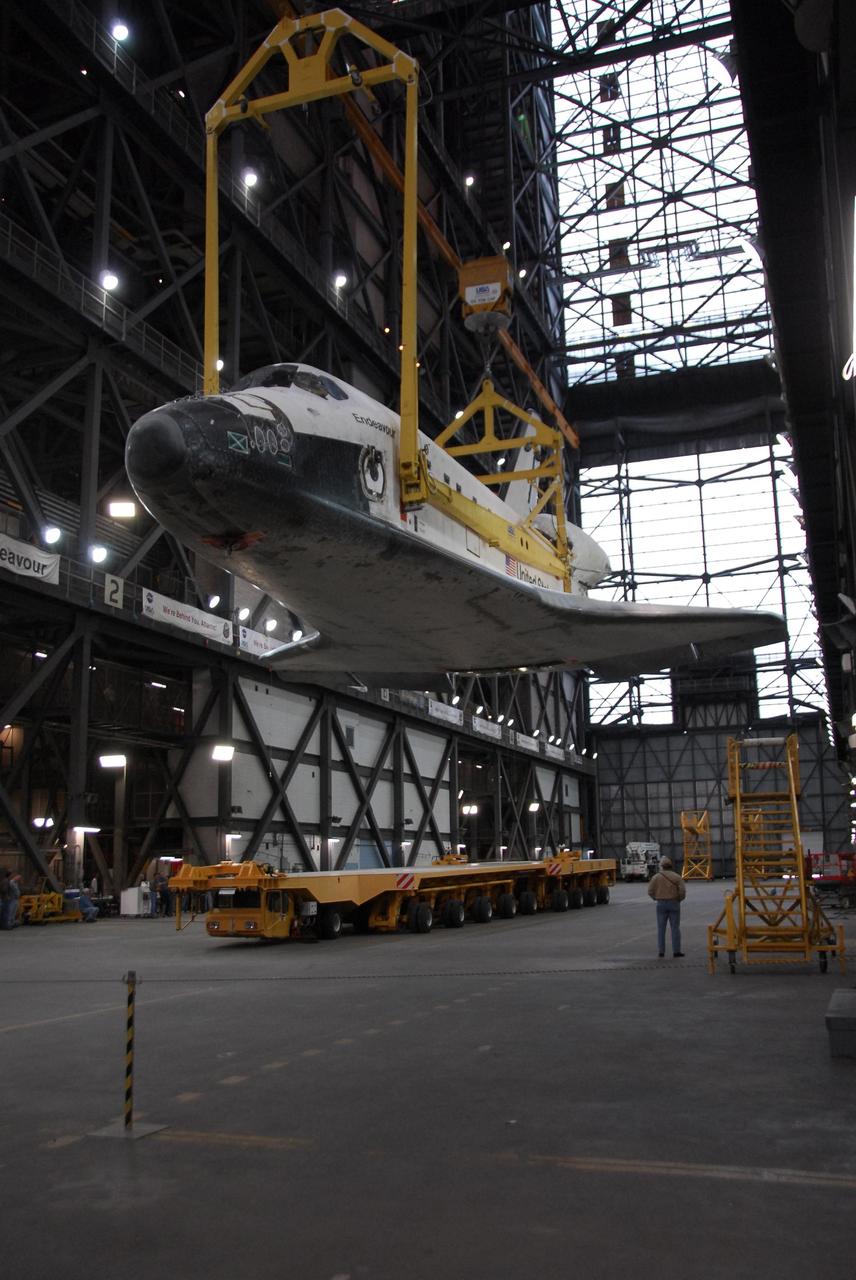
KENNEDY SPACE CENTER, FLA. -- In the transfer aisle of the Vehicle Assembly Building, space shuttle Endeavour is lifted off its transporter. The shuttle will be raised to a vertical position and lifted up into high bay 1 to be attached to its external fuel tank and solid rocket boosters in preparation for launch on the STS-123 mission, targeted for March 11. The mission will deliver the first section of the Japan Aerospace Exploration Agency's Kibo laboratory and the Canadian Space Agency's two-armed robotic system, Dextre. Photo credit: NASA/Dimitri Gerondidakis
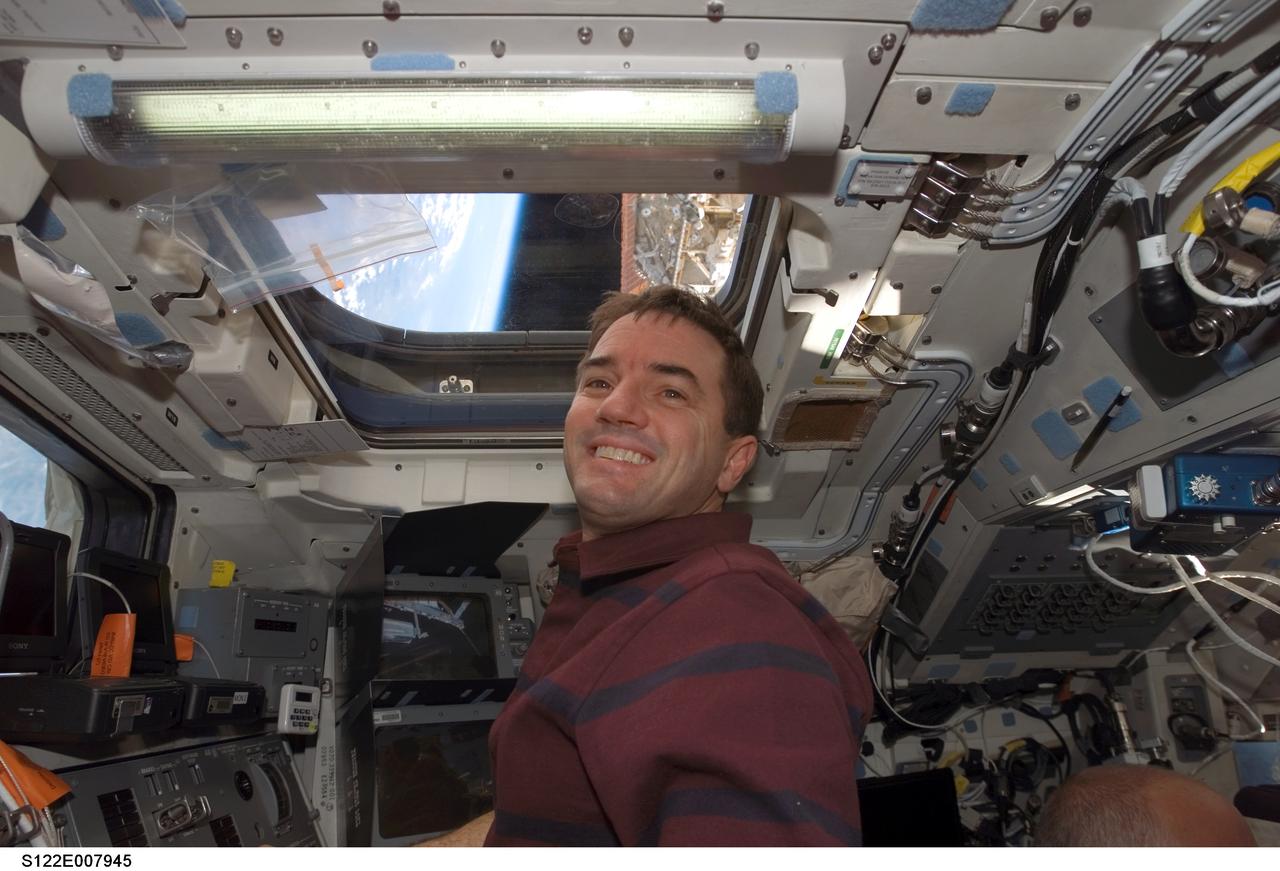
S122-E-007945 (12 Feb.2008) --- Astronaut Rex Walheim, STS-122 mission specialist, is pictured on the aft flight deck of Space Shuttle Atlantis during flight day six activities while docked with the International Space Station.
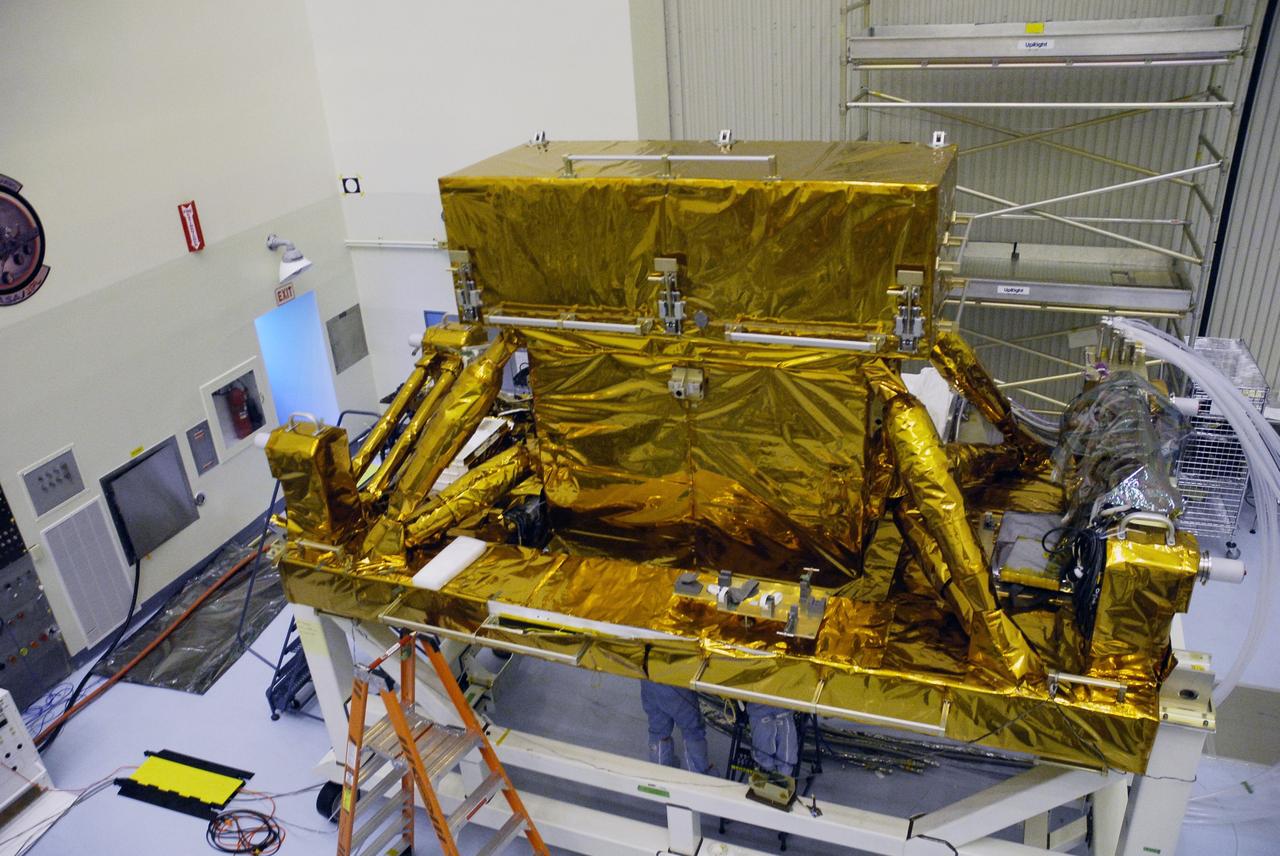
CAPE CANAVERAL, Fla. – Components comprising the payload for space shuttle Atlantis on the STS-125 mission to service the Hubble Space Telescope are on display in the Payload Hazardous Servicing Facility at NASA's Kennedy Space Center. Seen here is the box containing the Cosmic Origins Spectrograph, or COS, on the orbital replacement unit carrier. Over 11 days and five spacewalks, Atlantis’ crew will make repairs and upgrades to the telescope, leaving it better than ever and ready for at least another five years – or more – of research. Launch of Atlantis is targeted for Oct. 10. Photo credit: NASA/Troy Cryder
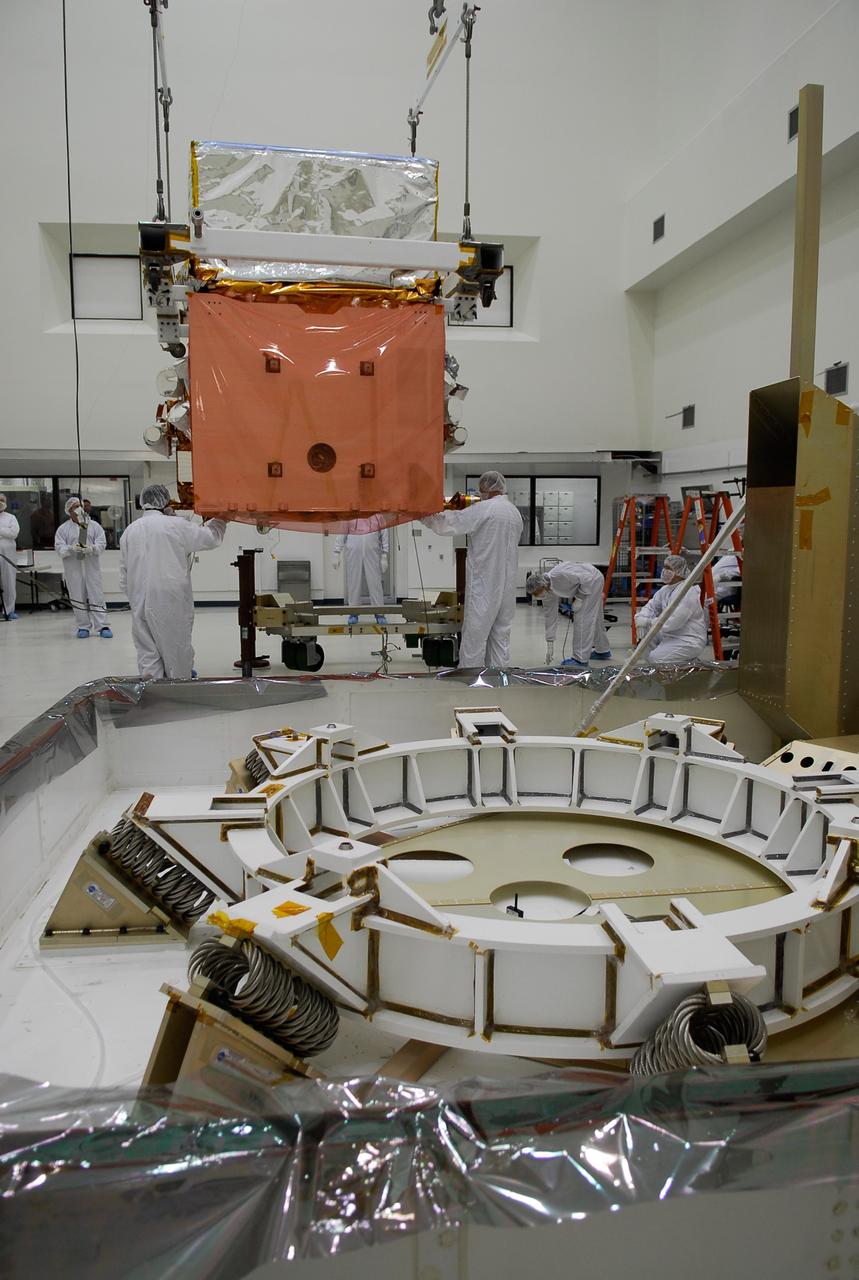
KENNEDY SPACE CENTER, FLA. -- In the Astrotech payload processing facility, General Dynamics technicians keep watch as NASA's Gamma-Ray Large Area Space Telescope, or GLAST, is moved toward a work stand (at left) in the facility. There GLAST will undergo a complete checkout of the scientific instruments aboard. The telescope will launch aboard a Delta II rocket May 16 from Launch Pad 17-B on Cape Canaveral Air Force Station. A powerful space observatory, the GLAST will explore the most extreme environments in the universe, and answer questions about supermassive black hole systems, pulsars and the origin of cosmic rays. It also will study the mystery of powerful explosions known as gamma-ray bursts. Photo credit: NASA/Kim Shiflett

The Southern Hemisphere of Enceladus

CAPE CANAVERAL, Fla. – In the White Room on Launch Pad 39A at NASA's Kennedy Space Center in Florida, STS-126 Mission Specialist Donald Pettit fits the cap worn under the helmet. In the background is the hatch for entry into space shuttle Endeavour. STS-126 is the 124th space shuttle flight and the 27th flight to the International Space Station. The mission will feature four spacewalks and work that will prepare the space station to house six crew members for long- duration missions. Liftoff is scheduled for 7:55 p.m. EST Nov. 14. Photo credit: NASA/Sandra Joseph-Kevin O'Connell
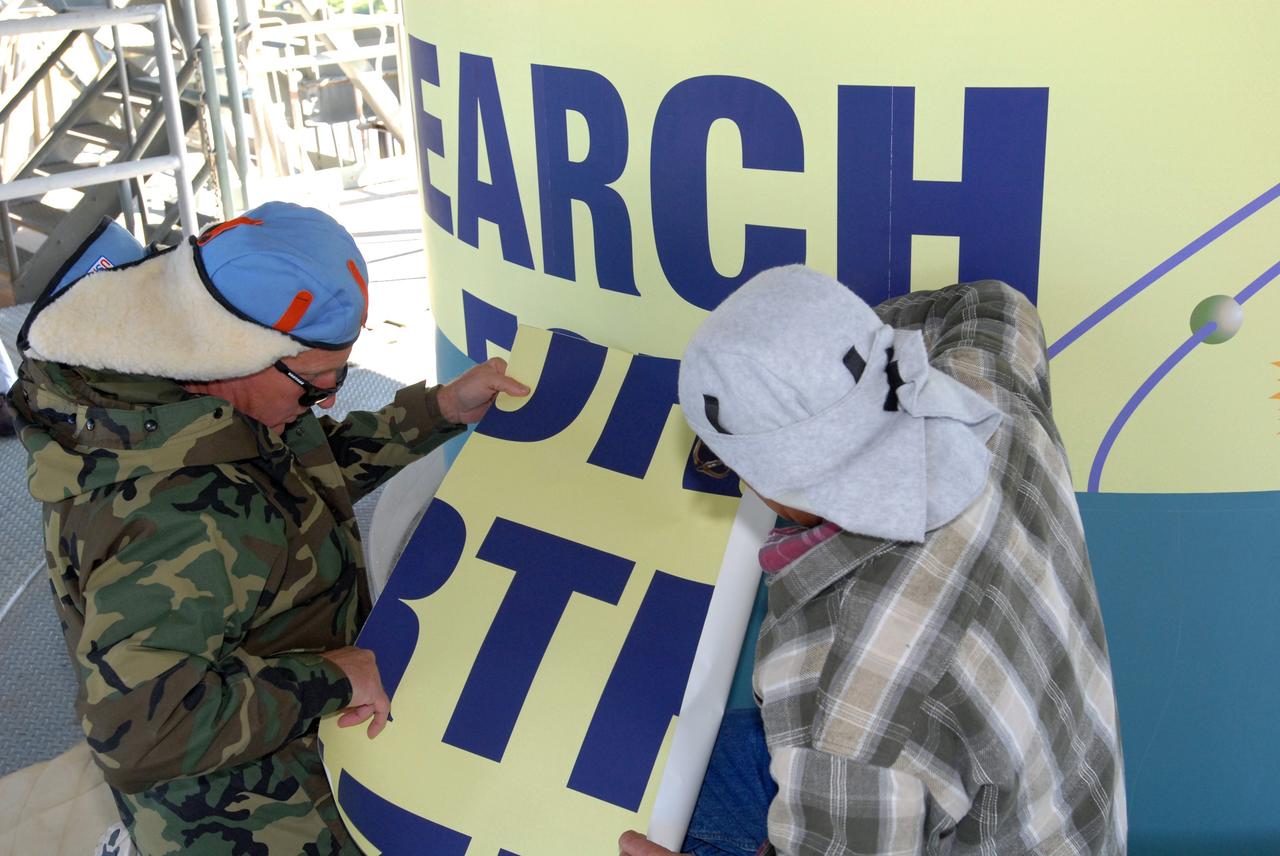
CAPE CANAVERAL, Fla. – Workers at Launch Complex 17-B on Cape Canaveral Air Force Station in Florida place sections of the large patch that describes the Kepler spacecraft mission to be launched by the Delta 2 rocket. The Kepler mission is specifically designed to survey our region of the Milky Way galaxy to discover hundreds of Earth-size and smaller planets in or near the habitable zone and determine how many of the billions of stars in our galaxy have such planets. Results from this mission will allow us to place our solar system within the continuum of planetary systems in the Galaxy. Photo credit: NASA/Jim Grossmann

S124-E-005620 (2 June 2008) --- Russian Federal Space Agency cosmonauts Sergei Volkov (right) and Oleg Kononenko (center), Expedition 17 commander and flight engineer, respectively; NASA astronauts Ron Garan (left), STS-124 mission specialist; Garrett Reisman, Expedition 17 flight engineer; and Greg Chamitoff (background right), STS-124 mission specialist, are pictured in the Destiny laboratory shortly after Space Shuttle Discovery and the International Space Station docked in space and the hatches were opened on June 2, 2008.
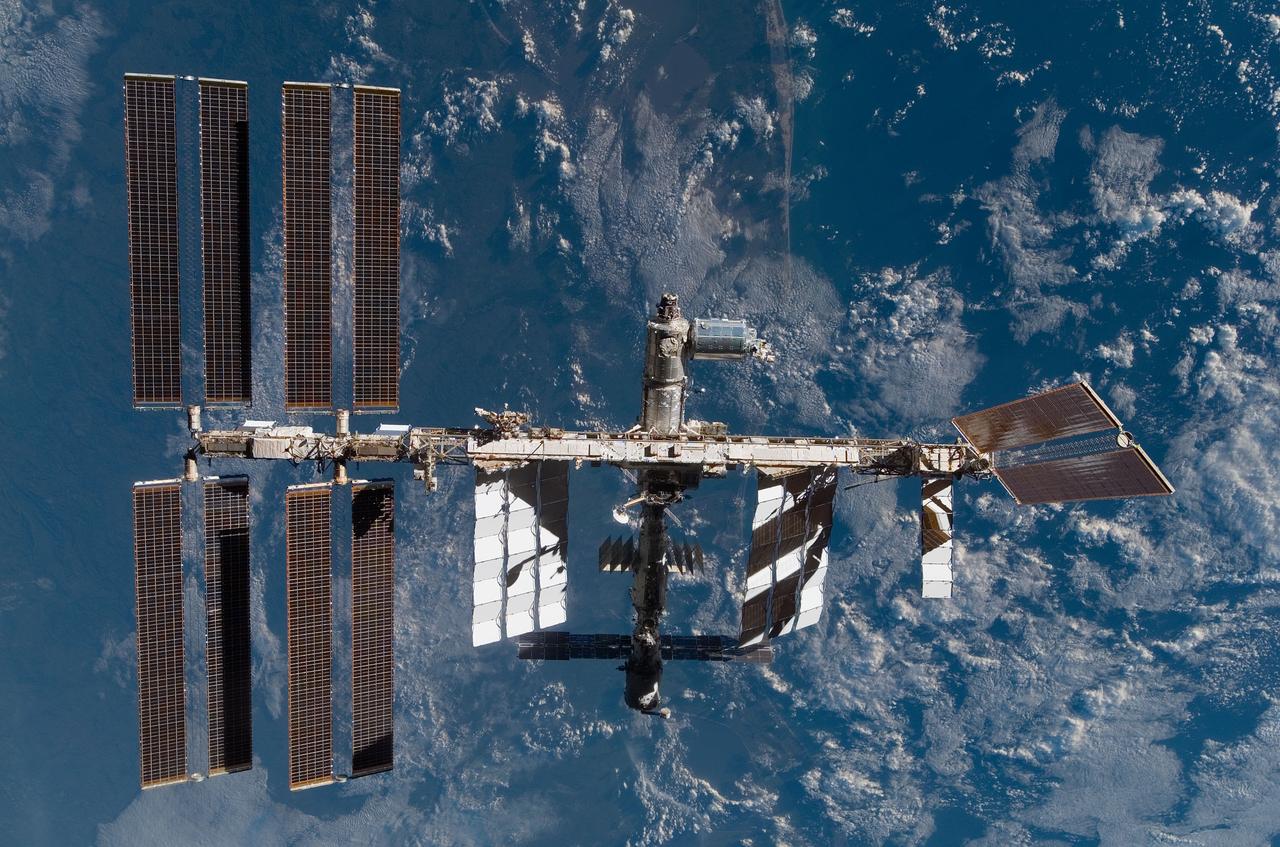
S122-E-009900 (18 Feb. 2008) --- Backdropped by a blue and white Earth, the International Space Station is seen from Space Shuttle Atlantis as the two spacecraft begin their relative separation. Earlier the STS-122 and Expedition 16 crews concluded almost nine days of cooperative work onboard the shuttle and station. Undocking of the two spacecraft occurred at 3:24 a.m. (CST) on Feb. 18, 2008.
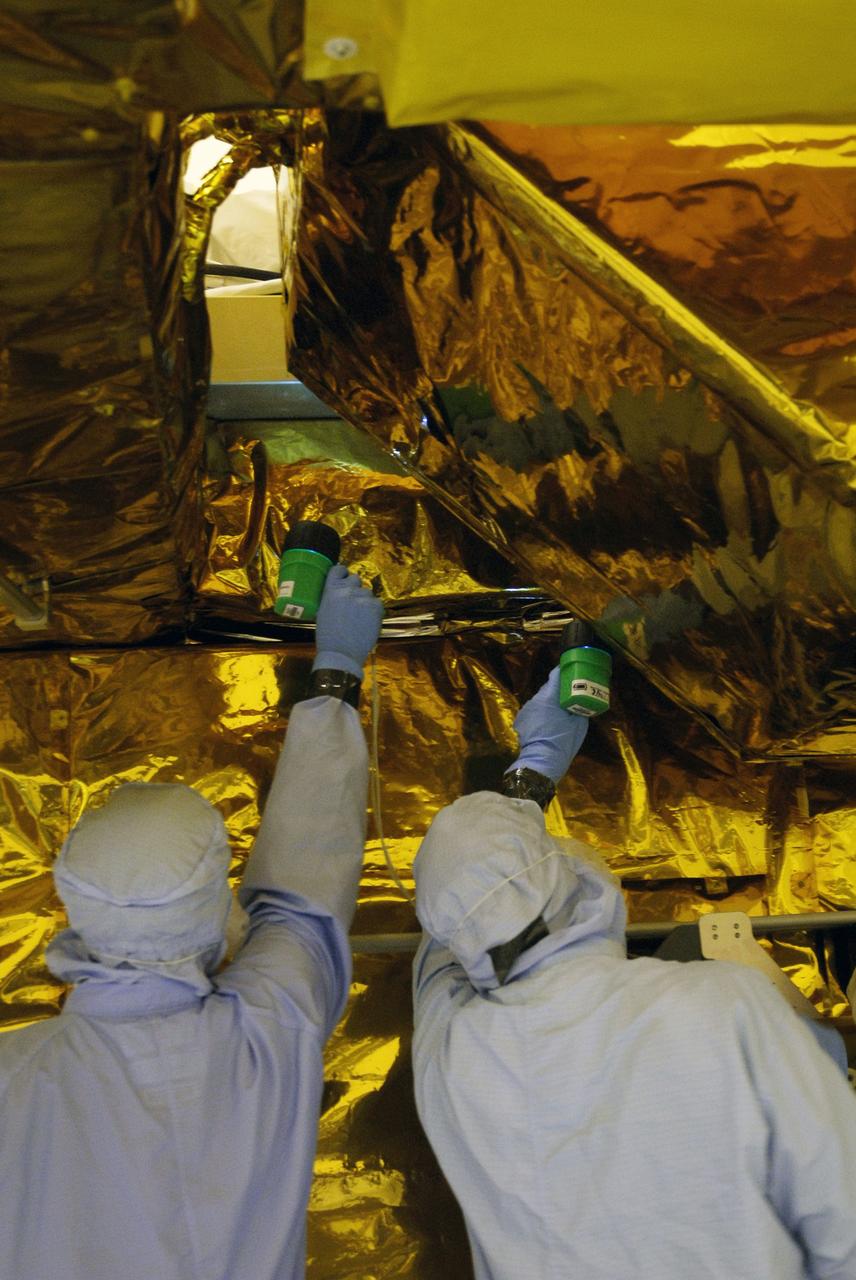
CAPE CANAVERAL, Fla. - In the Payload Hazardous Servicing Facility at NASA's Kennedy Space Center, technicians inspect areas of the Super Lightweight Interchangeable Carrier, or SLIC, for contamination. Contamination discovered Sept. 17 during preparations to deliver NASA's Hubble Space Telescope servicing payload to Launch Pad 39A will be removed. Cleanliness is extremely important for space shuttle Atlantis’ STS-125 mission to Hubble, and the teams have insured that the SLIC is ready to fly. The SLIC, which holds battery module assemblies for servicing of the Hubble Space Telescope on the STS-125 mission, is built with state-of-the-art, lightweight, composite materials - carbon fiber with a cyanate ester resin and a titanium metal matrix composite. These composites have greater strength-to-mass ratios than the metals typically used in spacecraft design. The carrier is one of four being transferred to Launch Pad 39A. At the pad, the carriers will be loaded into Atlantis’ payload bay. Launch of Atlantis is targeted for Oct. 10. Photo credit: NASA/Jack Pfaller
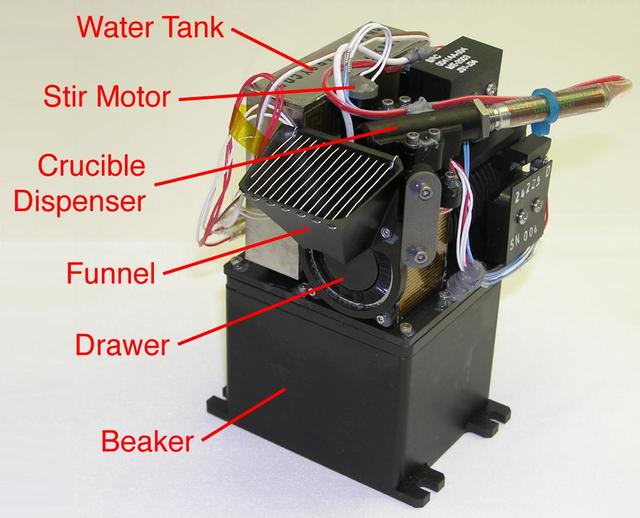
This picture of NASA Phoenix Mars Lander Wet Chemistry Laboratory WCL cell is labeled with components responsible for mixing Martian soil with water from Earth, adding chemicals and measuring the solution chemistry.