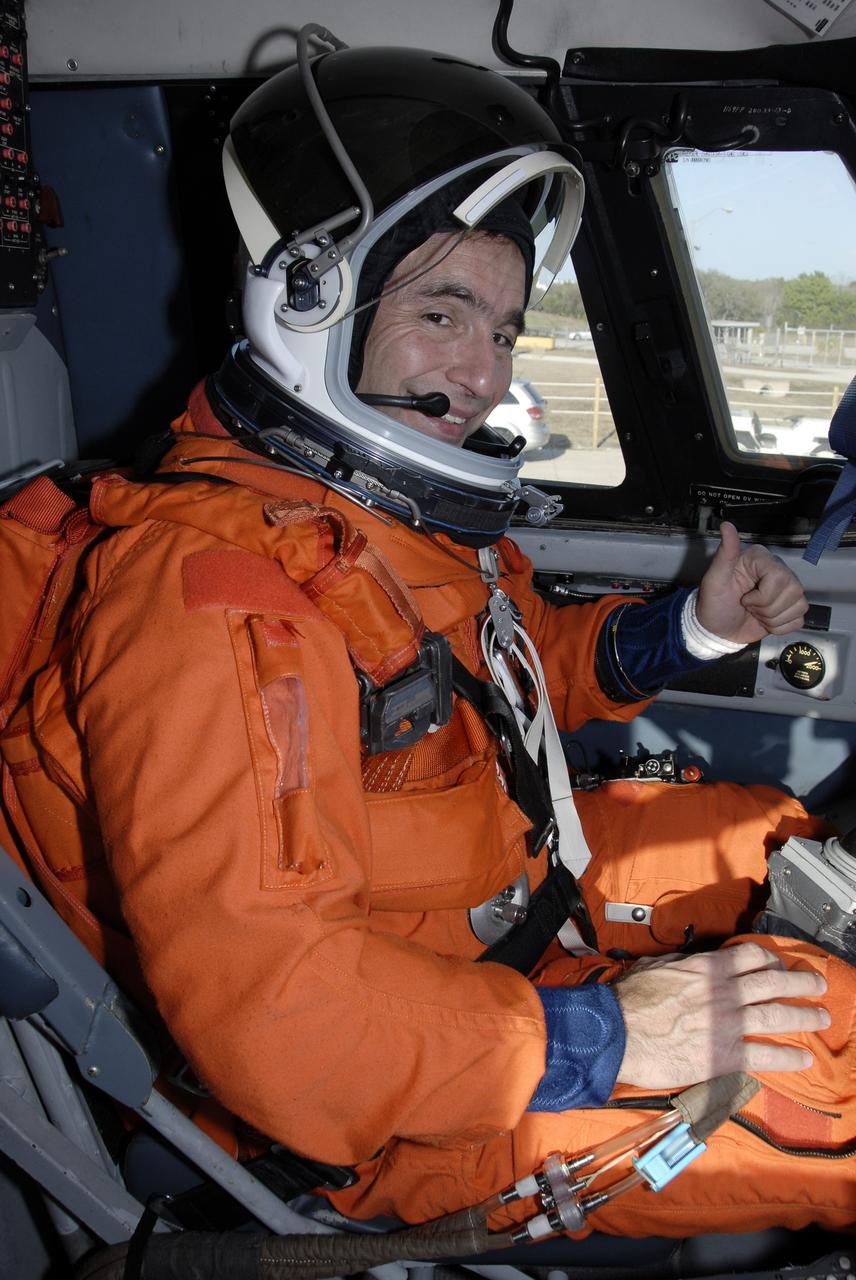
CAPE CANAVERAL, Fla. – On the Shuttle Landing Facility at NASA's Kennedy Space Center in Florida, STS-119 Commander Lee Archambault is seated in the Shuttle Training Aircraft to practice shuttle landings. The mission crew members arrived in the afternoon at Kennedy to prepare for launch. The mission is the 28th to the International Space Station and the 125th space shuttle flight. Space shuttle Discovery will deliver the final pair of power-generating solar array wings and truss element, S6. Photo credit: NASA/Kim Shiflett

ISS018-E-017243 (2 Jan. 2009) --- Astronaut Michael Fincke, Expedition 18 commander, performs in-flight maintenance on the Mass Constituents Analyzer (MCA) in the Destiny laboratory of the International Space Station.
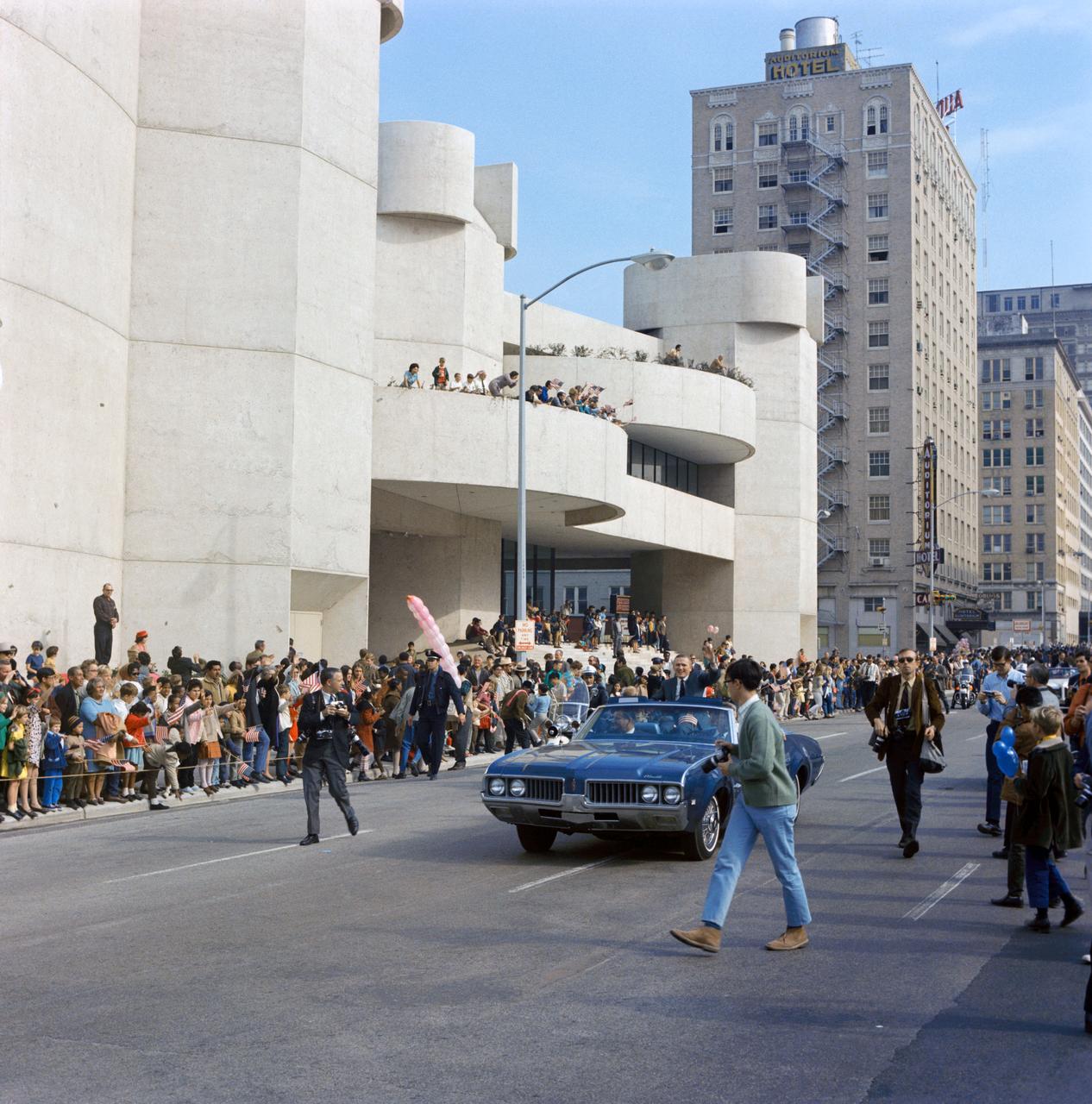
Astronaut Frank Borman, commander; and family are photographed during parade through Houston at the end of the Apollo VIII flight.
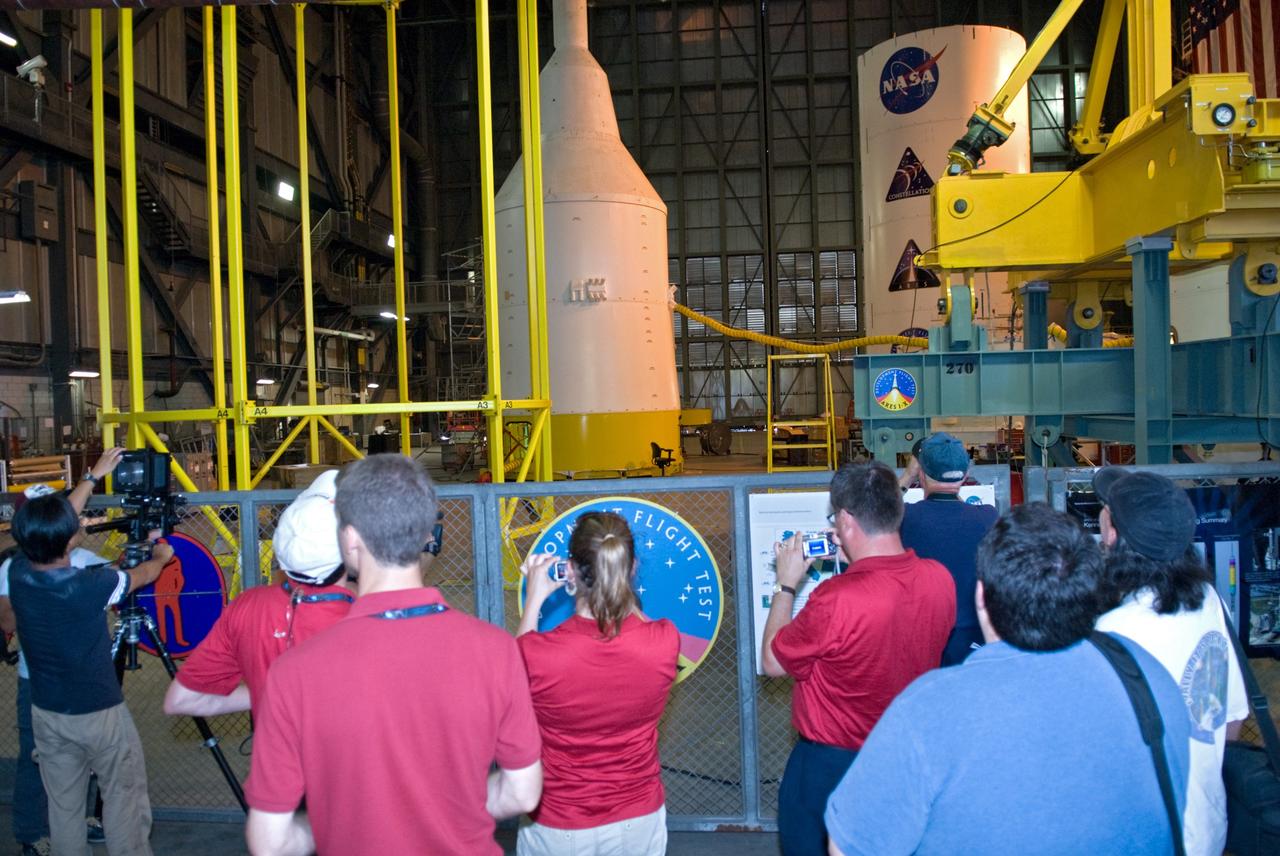
CAPE CANAVERAL, Fla. – In the Vehicle Assembly Building at NASA's Kennedy Space Center in Florida, media get a close look at various segments for the Ares I-X rocket being assembled in High Bay 4. In front at left is the yellow crane known as the "birdcage" that is used to lift the crew module-launch abort system. Ares I-X is the test vehicle for the Ares I, which is part of the Constellation Program to return men to the moon and beyond. Ares I-X is targeted for launch in August 2009. Photo credit: NASA/Kim Shiflett
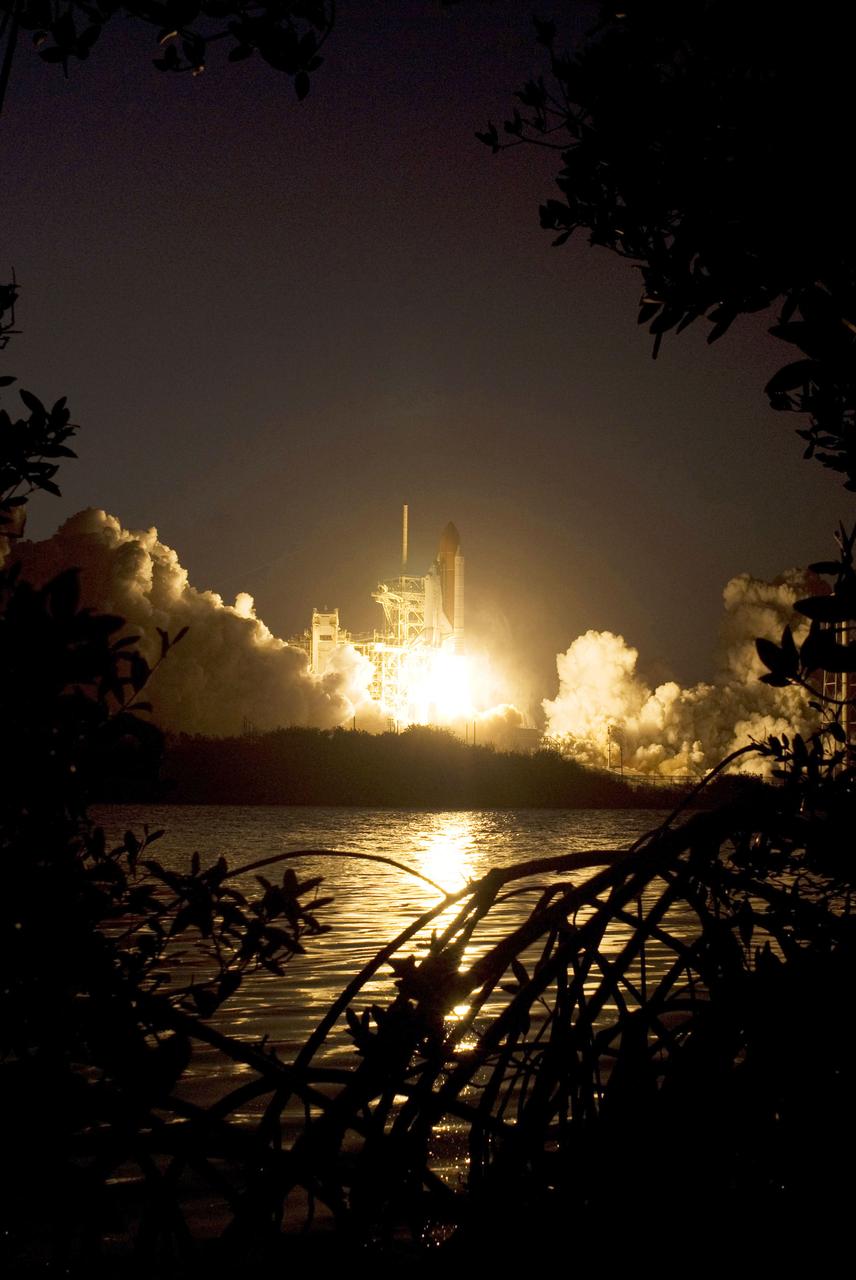
STS119-S-038 (15 March 2009) --- The Space Shuttle Discovery and its seven-member STS-119 crew head toward Earth orbit and a scheduled link-up with the International Space Station. Liftoff was on time at 7:43 p.m. (EDT) on March 15, 2009 from launch pad 39A at NASA’s Kennedy Space Center. Onboard are astronauts Lee Archambault, commander; Tony Antonelli, pilot; Joseph Acaba, Steve Swanson, Richard Arnold, John Phillips and Japan Aerospace Exploration Agency’s Koichi Wakata, all mission specialists. Wakata will join Expedition 18 in progress to serve as a flight engineer aboard the space station. Discovery will deliver the final pair of power-generating solar array wings and the S6 truss segment. Installation of S6 will signal the station's readiness to house a six-member crew for conducting increased science.

CAPE CANAVERAL, Fla. – At Astrotech Space Operations in Titusville, Fla., NASA's Solar Dynamics Observatory, or SDO, remains on the transporter after the shipping cover was removed. SDO is the first space weather research network mission in NASA's Living With a Star Program. The spacecraft's long-term measurements will give solar scientists in-depth information about changes in the sun's magnetic field and insight into how they affect Earth. In preparation for its anticipated November launch, engineers will perform a battery of comprehensive tests to ensure SDO can withstand the stresses and vibrations of the launch itself, as well as what it will encounter in the space environment after launch. Photo credit: NASA/Tim Jacobs
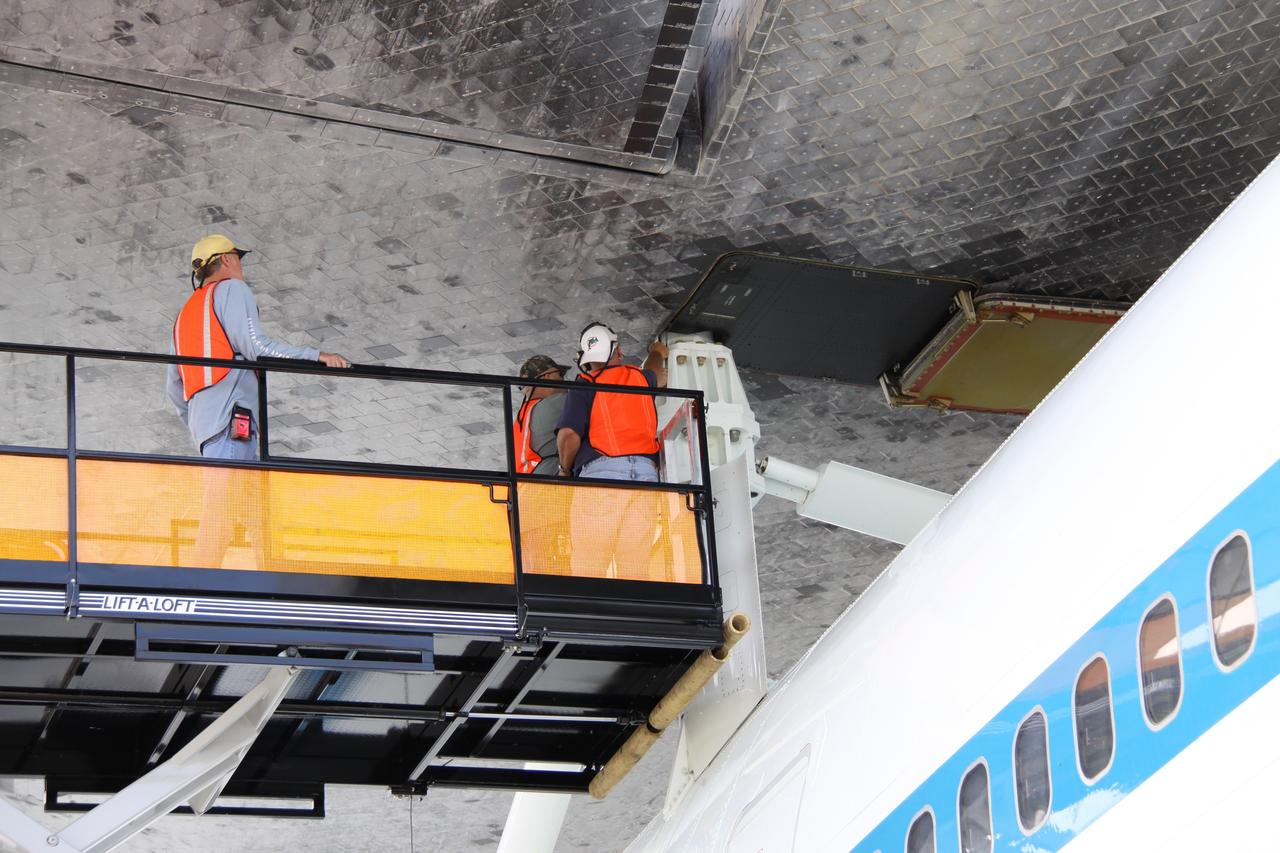
CAPE CANAVERAL, Fla. – Work is under way to separate space shuttle Atlantis from the Shuttle Carrier Aircraft, or SCA, underneath via the mate/demate device on the Shuttle Landing Facility at NASA's Kennedy Space Center in Florida. Workers are removing the struts that attached Atlantis to the SCA. A hoist attached to Atlantis will suspend the shuttle while the SCA is moved away. Atlantis returned from California atop the SCA, a modified Boeing 747, after its May 24 landing at Edwards Air Force Base, concluding mission STS-125. The ferry flight from Edwards Air Force Base began June 1. Atlantis' next assignment is the STS-129 mission, targeted to launch in November 2009. Photo credit: NASA/Jack Pfaller
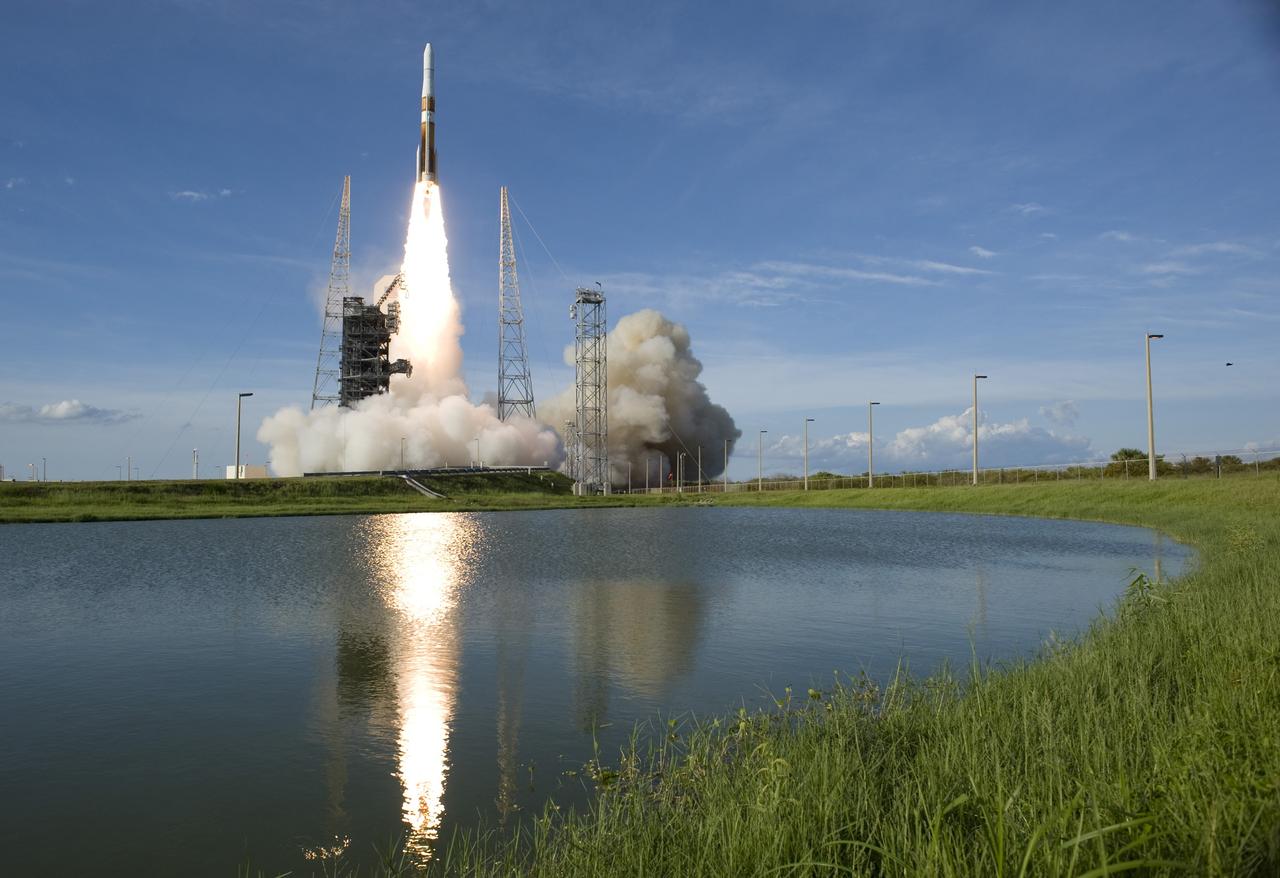
CAPE CANAVERAL, Fla. – The light from engine ignition is reflected in the water near Launch Complex 37 at Cape Canaveral Air Force Station in Florida as a Delta IV rocket clears the tower with the GOES-O satellite aboard. Liftoff was at 6:51 p.m. EDT. The first attempt to launch GOES-O, on June 26, was scrubbed due to thunderstorms in the vicinity of Cape Canaveral. The latest Geostationary Operational Environmental Satellite, GOES-O was developed by NASA for the National Oceanic and Atmospheric Administration, or NOAA. Each of the GOES satellites continuously provides observations of 60 percent of the Earth including the continental United States, providing weather monitoring and forecast operations as well as a continuous and reliable stream of environmental information and severe weather warnings. Once in orbit, GOES-O will be designated GOES-14, and NASA will provide on-orbit checkout and then transfer operational responsibility to NOAA. Photo credit: NASA/Tom Farrar, Sandy Joseph
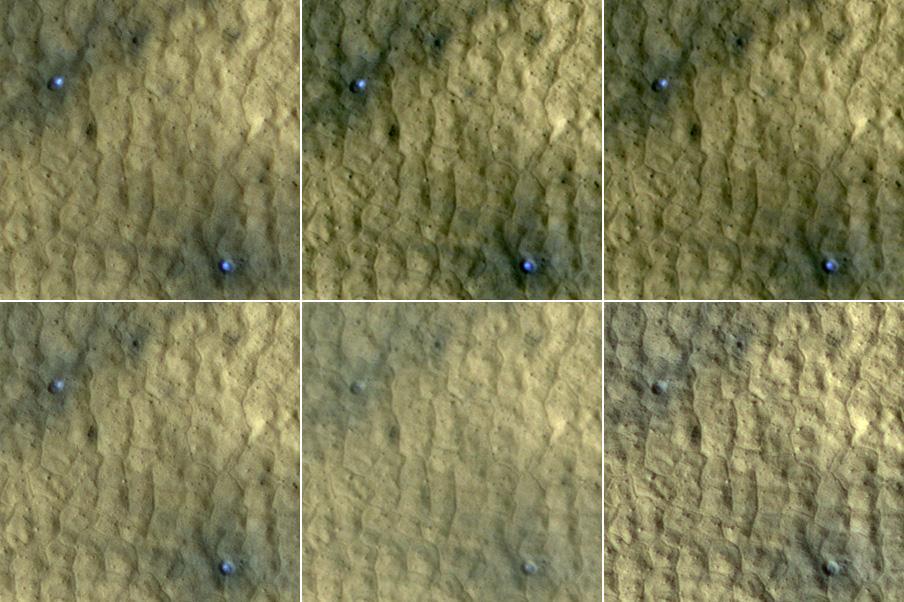
This series of images spanning a period of 15 weeks shows a pair of fresh craters taken by NASA Mars Reconnaissance Orbiter. Bright, bluish material apparent in the earliest images disappears by the later ones.
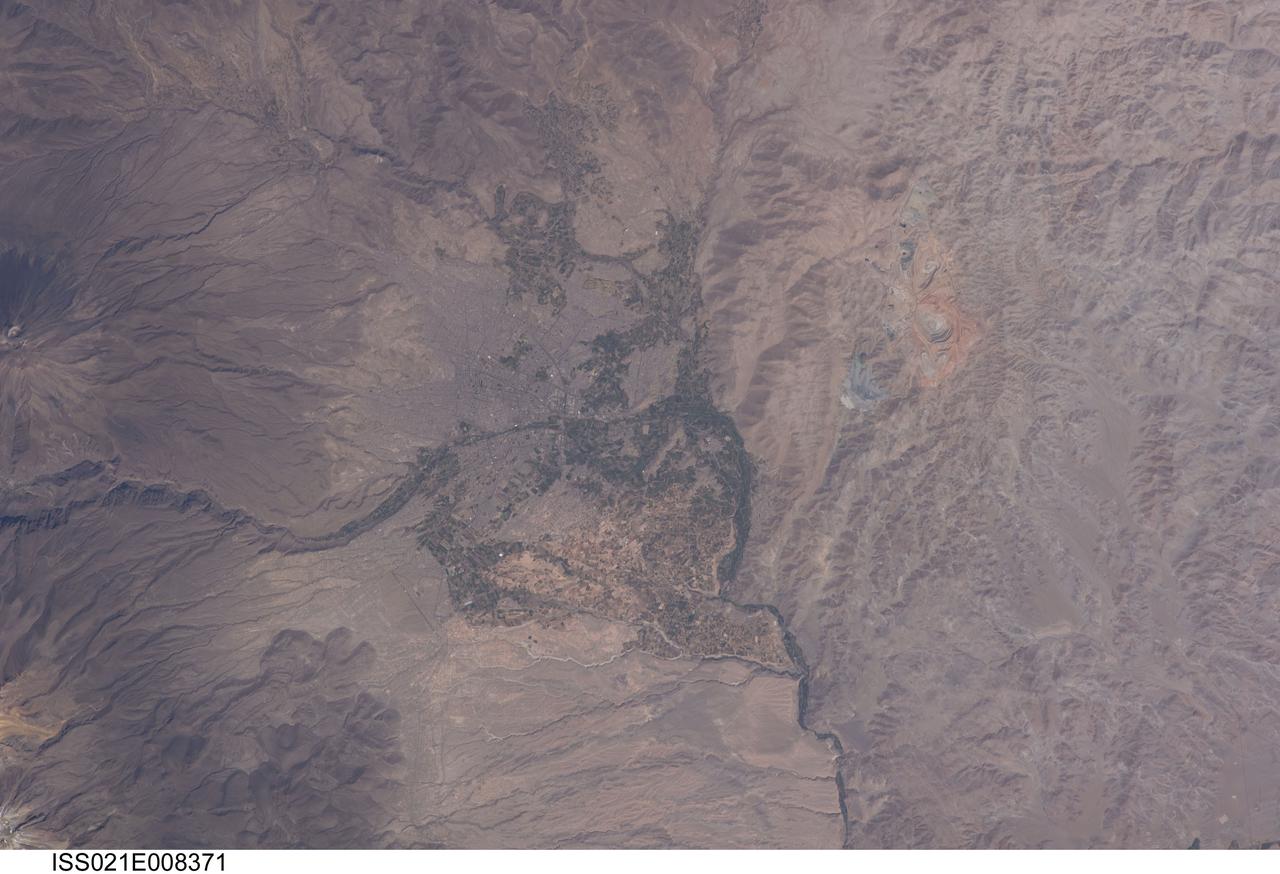
ISS021-E-008371 (16 Oct. 2009) --- The city of Arequipa, Peru is featured in this image photographed by an Expedition 21 crew member on the International Space Station. Several Latin American cities have grown up on the flanks of active volcanoes. The city center of Arequipa, Peru lies only 17 kilometers away from the summit of El Misti volcano (partially out of frame at left); the gray urban area is bordered by green agricultural fields. With almost one million residents in 2009, it is the second city of Peru in terms of population. Much of the building stone for Arequipa, known locally as sillar, is quarried from nearby pyroclastic flow deposits that are white in color. Arequipa is known as ?the White City? because of the prevalence of this building material. The Chili River extends northeastwards from the city center, and flows through a canyon (left) between El Misti volcano and Nevado Chachani to the north.
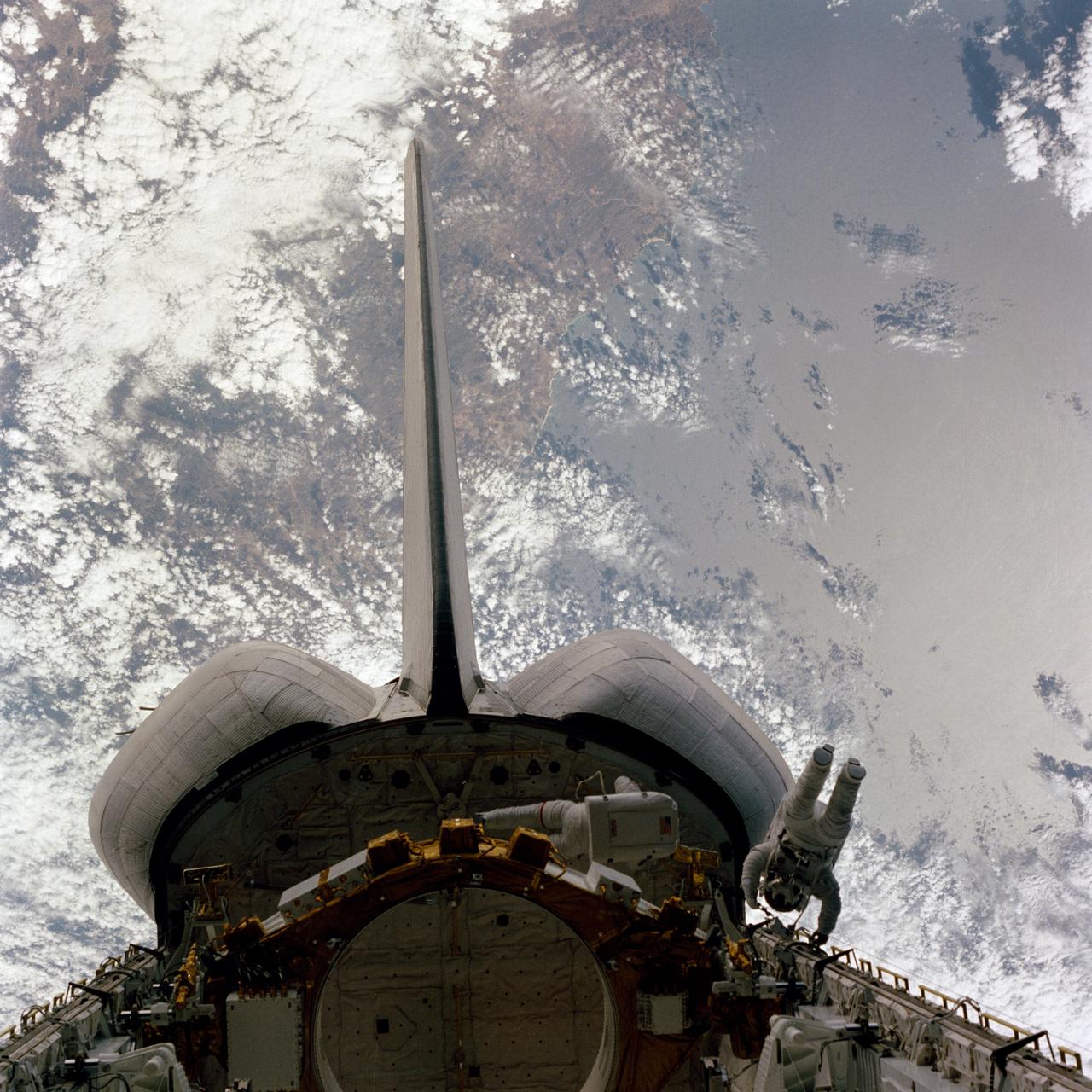
STS006-45-111 (7 April 1983) --- Astronaut Donald H. Peterson (port side) and F. Story Musgrave, STS-6 mission specialists, evaluate the handrail system on the starboard longeron and aft bulkhead, respectively, during a long extravehicular activity (EVA) aboard the Earth-orbiting space shuttle Challenger. The vertical stabilizer and orbital maneuvering system (OMS) pods frame a portion of Mexico?s state of Jalisco below. Punta Farallon and Sahta da Tencatita, about 120 kilometers (75 miles) south of Puerto Vallarta, are visible. Pacific waters form about half of the backdrop for this scene, photographed by one of two crew members who remained inside the spacecraft during the EVA. Astronaut Karol J. Bobko, pilot, took a number of pictures of his fellow crew members during their outside tasks and astronaut Paul J. Weitz, commander, took some photographs while remaining in command of the reusable vehicle. Photo credit: NASA

CAPE CANAVERAL, Fla. – At the Astrotech Space Operations facility in Titusville, Fla., spacecraft technicians lower one of the solar panels on the Solar Dynamics Observatory, or SDO, toward the spacecraft following testing to verify the spacecraft's readiness for launch. SDO is the first space weather research network mission in NASA's Living With a Star Program. The spacecraft's long-term measurements will give solar scientists in-depth information about changes in the sun's magnetic field and insight into how they affect Earth. Liftoff on an Atlas V rocket is scheduled for Feb. 3, 2010. For information on SDO, visit http://www.nasa.gov/sdo. Photo credit: NASA/Jack Pfaller
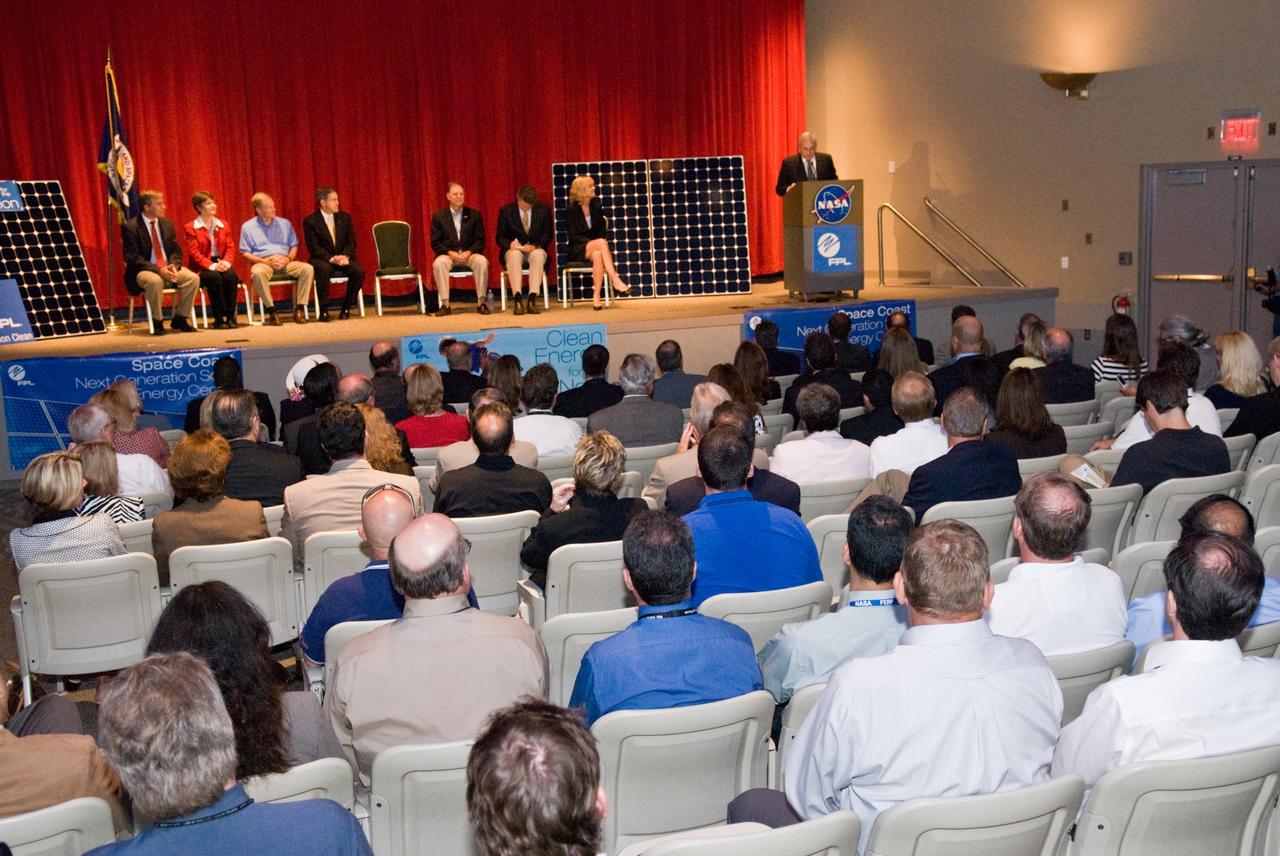
CAPE CANAVERAL, Fla. – Armando Olivera, president and CEO of Florida Power & Light, or FPL, speaks to guests at the groundbreaking ceremony for the joint NASA and FPL solar power project at NASA's Kennedy Space Center. Others on the stage are, from left, Ed Smeloff with SunPower Corporation, Florida Rep. Suzanne Kosmas, Sen. Bill Nelson, Center Director Bob Cabana, Florida Rep. Bill Posey, Eric Draper, deputy director of Audubon of Florida, and Pam Rauch, vice president of External Affairs for FPL. FPL, Florida's largest electric utility, will build and maintain two solar photovoltaic power generation systems at Kennedy. One will produce an estimated 10 megawatts of emissions-free power for FPL customers, which is enough energy to serve roughly 1,100 homes. The second is a one-megawatt solar power facility that will provide renewable energy directly to Kennedy. The FPL facilities at NASA will help provide Florida residents and America's space program with new sources of clean energy that will cut reliance on fossil fuels and improve the environment by reducing greenhouse gas emissions. The one megawatt facility also will help NASA meet its goal for use of power generated from renewable energy. Photo credit: NASA/Kim Shiflett
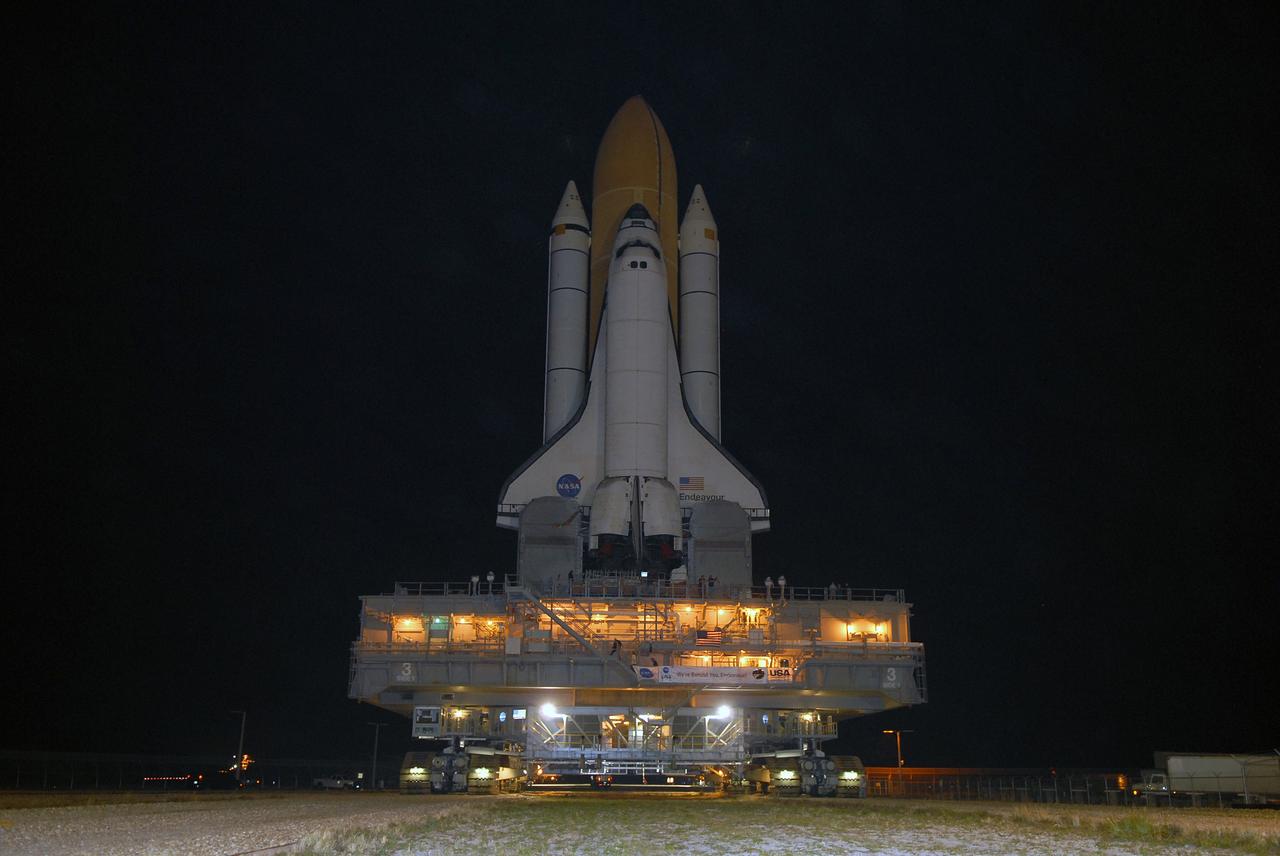
CAPE CANAVERAL, Fla. – Space shuttle Endeavour, installed on the mobile launcher platform atop the crawler-transporter, moves along the crawlerway at NASA's Kennedy Space Center in Florida as it rolls out to Launch Pad 39B. First motion was at 11:57 p.m. EDT April 16. The 4.2-mile journey is expected to take approximately 7 hours. Endeavour will be prepared on the pad for liftoff in the unlikely event that a rescue mission is necessary following space shuttle Atlantis' launch on the STS-125 mission to service NASA's Hubble Space Telescope. After Atlantis is cleared to land, Endeavour will move to Launch Pad 39A for its upcoming STS-127 mission to the International Space Station, targeted to launch June 13. Photo credit: NASA/Jack Pfaller
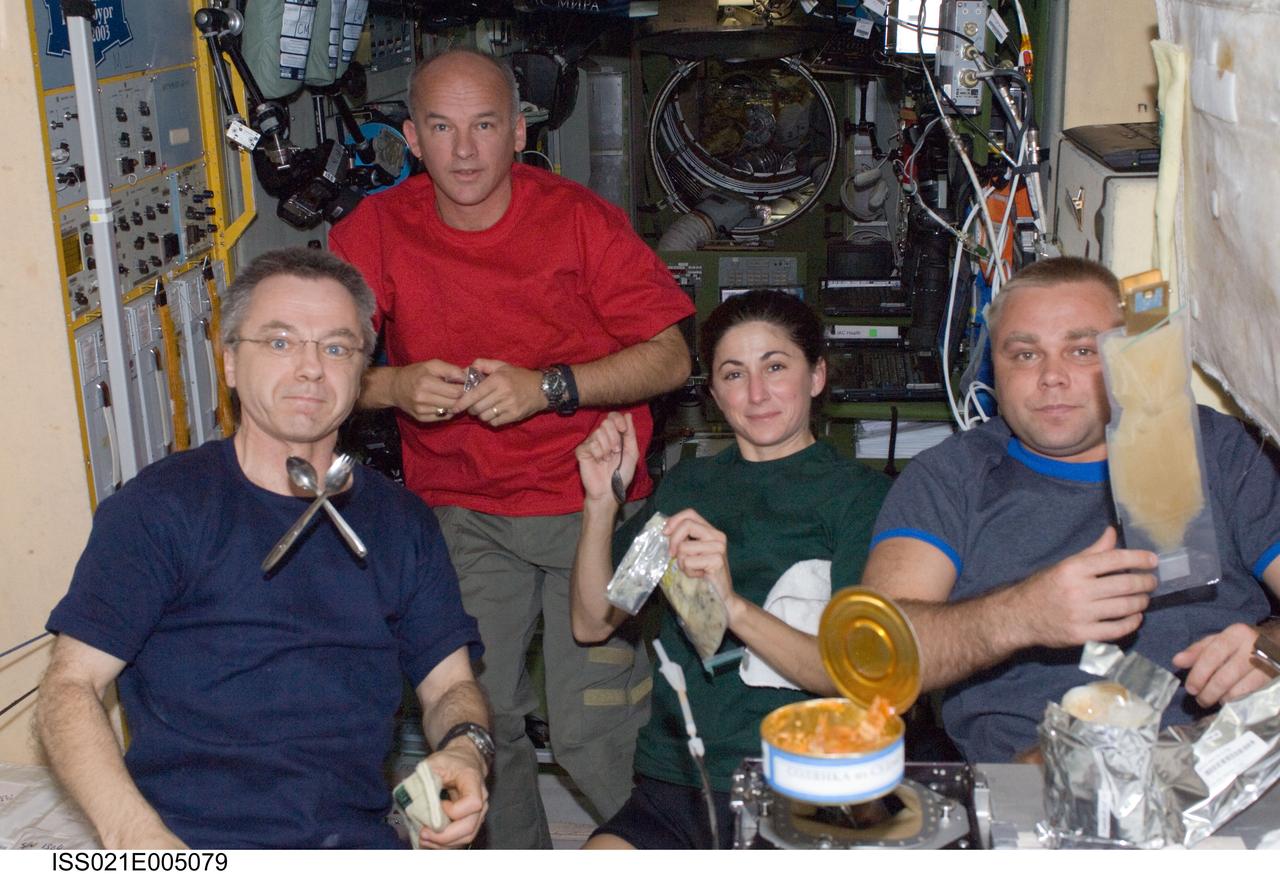
ISS021-E-005079 (12 Oct. 2009) --- Canadian Space Agency astronaut Robert Thirsk (left), NASA astronauts Jeffrey Williams and Nicole Stott; along with Russian cosmonaut Maxim Suraev, all Expedition 21 flight engineers, share a meal at the galley in the Zvezda Service Module of the International Space Station.

CAPE CANAVERAL, Fla. – Media representatives and the public are gathered in the Hilton Hotel in Cocoa Beach, Fla., to question the Augustine Commission meeting there. At the request of the Office of Science and Technology Policy, NASA established the Review of U.S. Human Space Flight Plans Committee, known as the Augustine Commission. Chaired by Norman R. Augustine, retired chairman and CEO of Lockheed Martin Corp., the committee is conducting an independent review of ongoing U.S. human spaceflight plans and programs, as well as alternatives, to ensure the nation is pursuing the best trajectory for the future of human space flight - one that is safe, innovative, affordable, and sustainable. Photo credit: NASA/Kim Shiflett
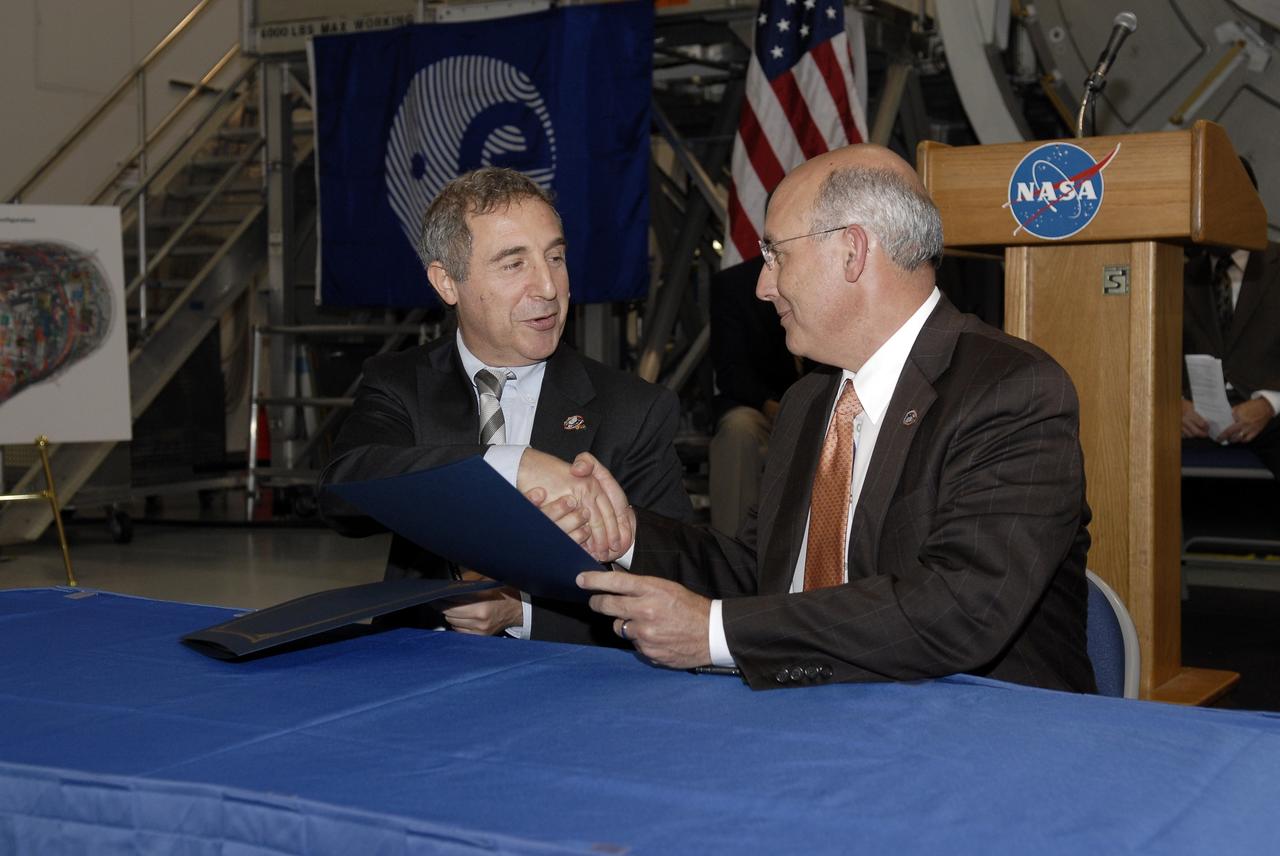
CAPE CANAVERAL, Fla. – In the Space Station Processing Facility at NASA's Kennedy Space Center in Florida, Bernardo Patti, at left, head of International Space Station, Program Department, European Space Agency, congratulates Michael Suffredini, program manager, International Space Station, NASA, upon transfer of the ownership of node 3 for the International Space Station from the European Space Agency, or ESA, to NASA. Node 3 is named "Tranquility" after the Sea of Tranquility, the lunar landing site of Apollo 11. The payload for the STS-130 mission, Tranquility is a pressurized module that will provide room for many of the International Space Station's life support systems. The module was built for ESA by Thales Alenia Space in Turin, Italy. Attached to one end of Tranquility is a cupola, a unique work station with six windows on its sides and one on top. The cupola resembles a circular bay window and will provide a vastly improved view of the station's exterior. Just under 10 feet in diameter, the module will accommodate two crew members and portable workstations that can control station and robotic activities. The multi-directional view will allow the crew to monitor spacewalks and docking operations, as well as provide a spectacular view of Earth and other celestial objects. Space shuttle Endeavour's STS-130 mission is targeted to launch Feb. 4, 2010. Photo credit: NASA/Kim Shiflett
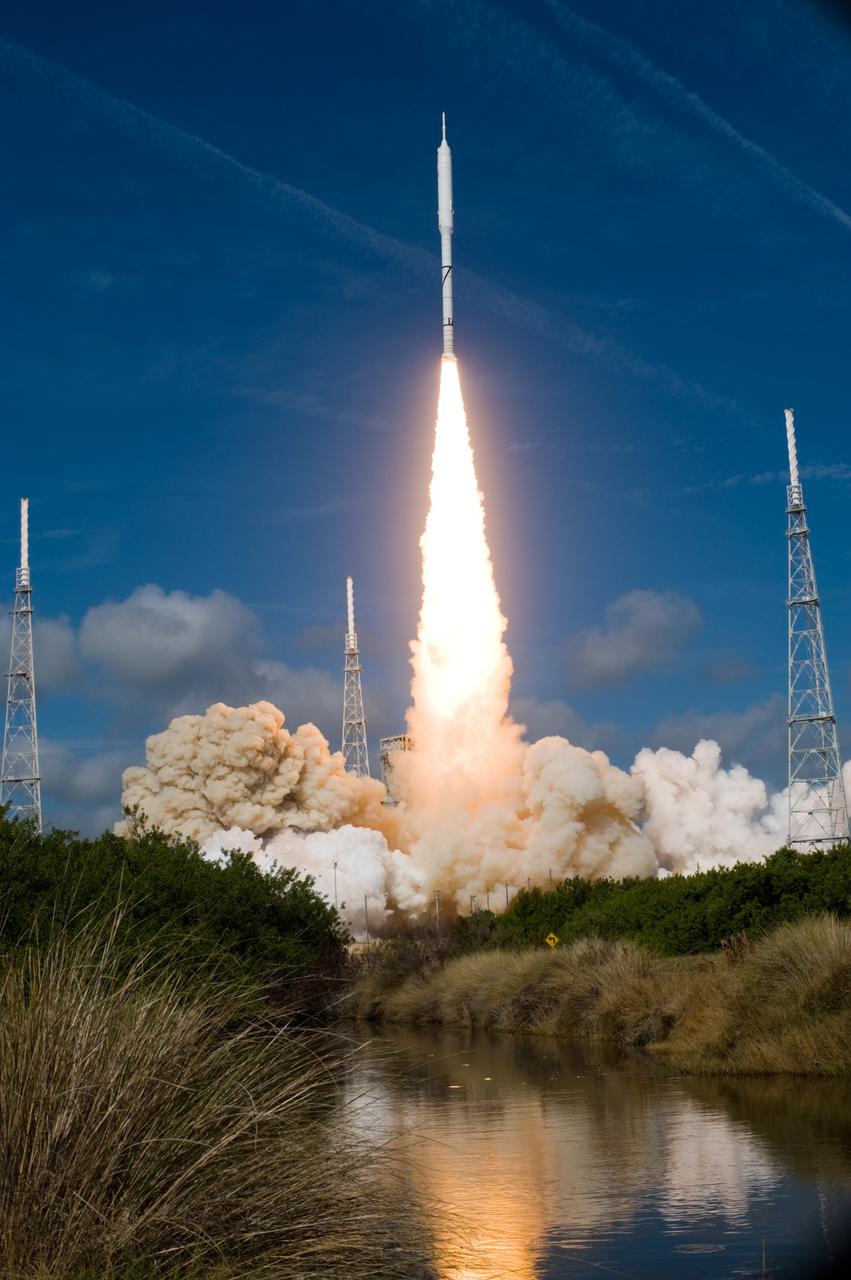
CAPE CANAVERAL, Fla. – NASA’s Ares I-X test rocket clears the tower at Launch Pad 39B at NASA's Kennedy Space Center in Florida at 11:30 a.m. EDT on Oct. 28. The rocket produces 2.96 million pounds of thrust at liftoff and reaches a speed of 100 mph in eight seconds. This was the first launch from Kennedy's pads of a vehicle other than the space shuttle since the Apollo Program's Saturn rockets were retired. The parts used to make the Ares I-X booster flew on 30 different shuttle missions ranging from STS-29 in 1989 to STS-106 in 2000. The data returned from more than 700 sensors throughout the rocket will be used to refine the design of future launch vehicles and bring NASA one step closer to reaching its exploration goals. For information on the Ares I-X vehicle and flight test, visit http://www.nasa.gov/aresIX. Photo credit: NASA/ Sandra Joseph and Kevin O'Connell
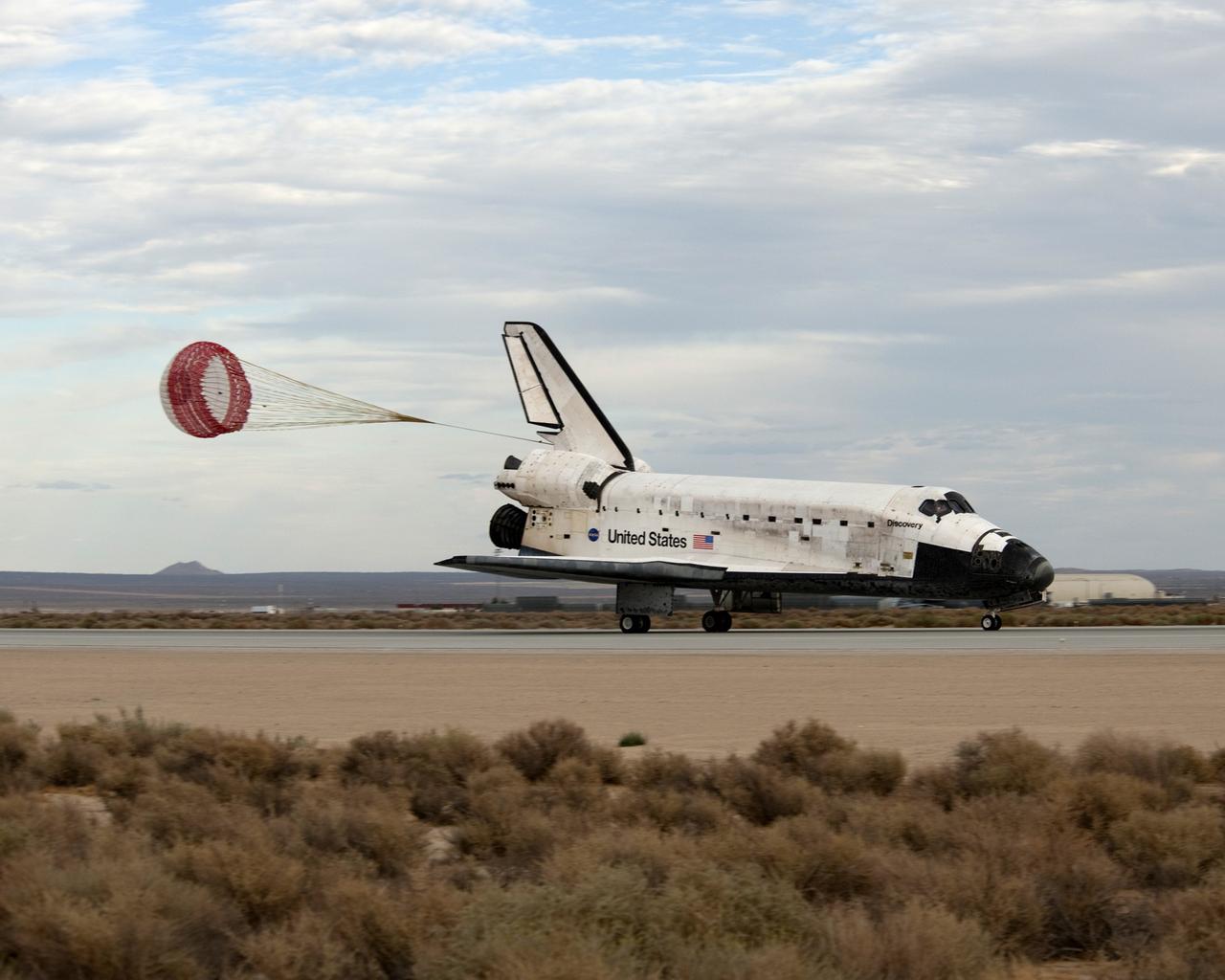
EDWARDS AIR FORCE BASE, Calif. -- (ED09-0253-04) Trailing its drag chute, Space Shuttle Discovery slows to a stop after landing at Edwards Air Force Base to conclude its almost 14-day, 5.7-million-mile journey to the International Space Station on mission STS-128 (NASA photo / Tony Landis)
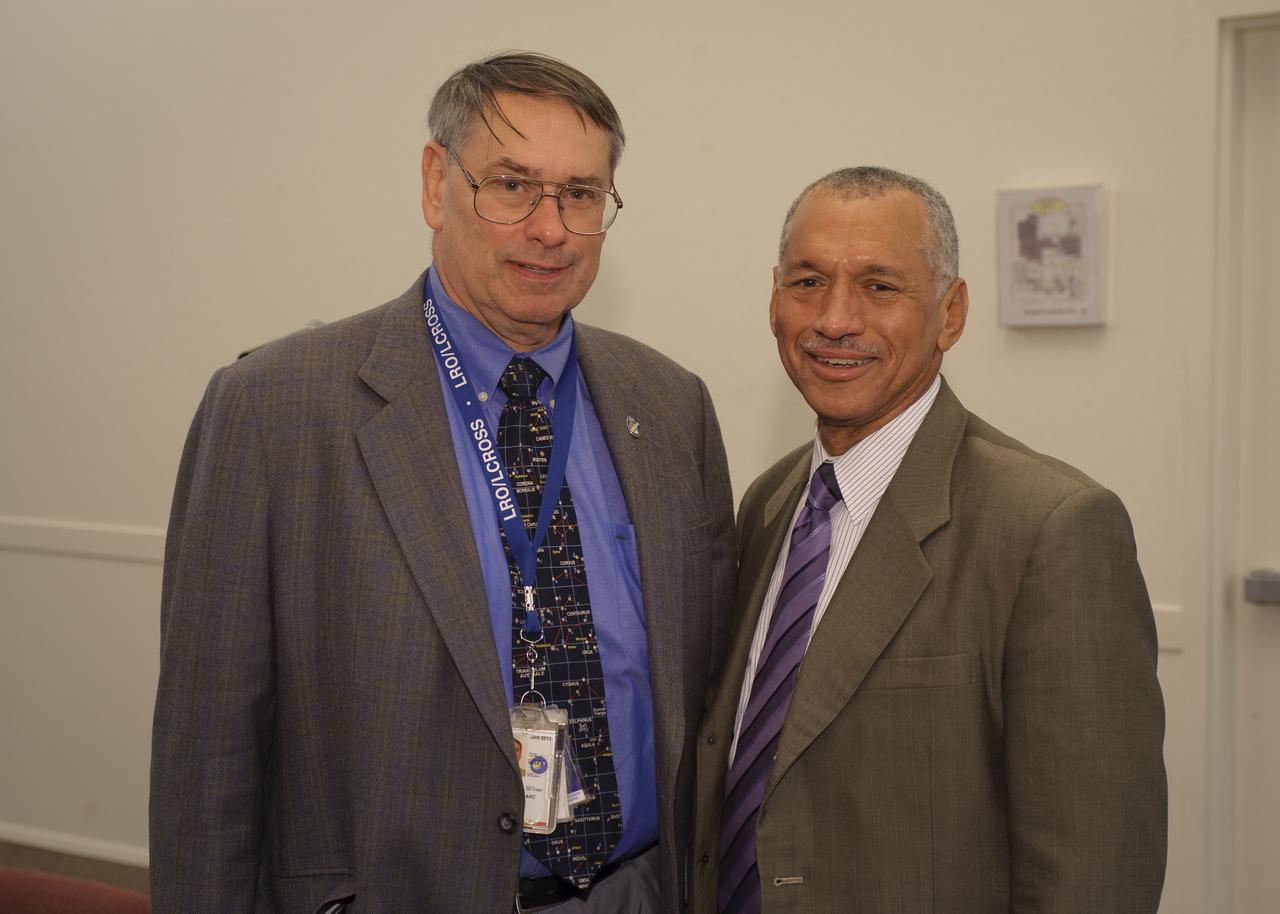
NASA Advisory Council Meeting at NASA Ames Research Center NRP Conference Center. Charlie Bolden, NASA Administrator (right) with Pete Worden, NASA Ames Director (left)
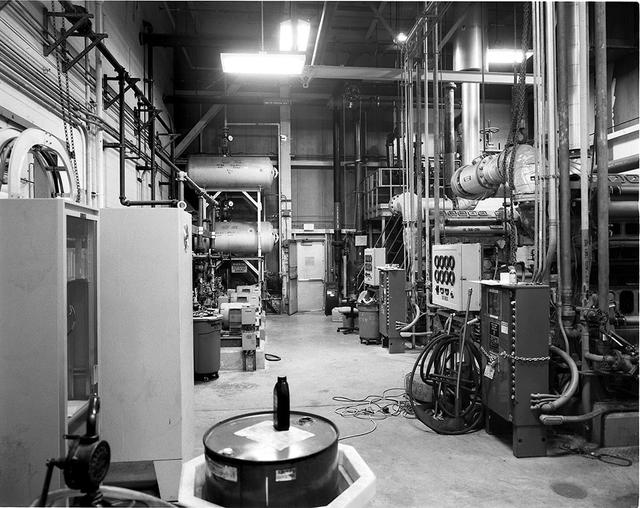
Internal view of the VAB Utility Annex
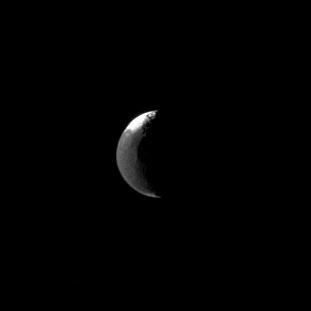
Distant Crescent
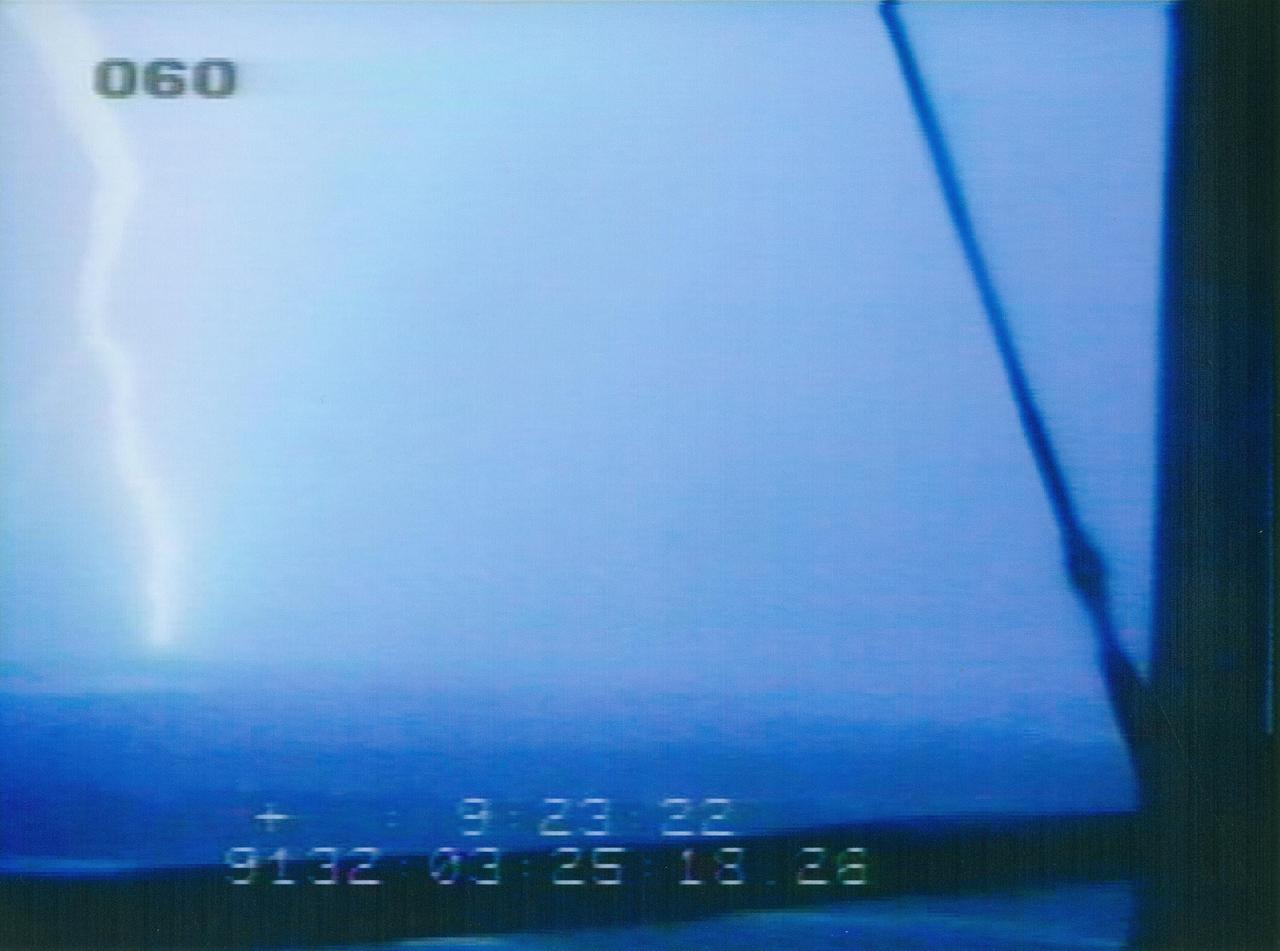
CAPE CANAVERAL, Fla. – This photo taken from Launch Pad 39A at NASA's Kennedy Space Center in Florida shows one of two lightning strikes that occurred on May 11 around 11 p.m. within a third of a mile of space shuttle Endeavour on Launch Pad 39B. Engineers and safety personnel evaluated data and performed a walkdown of the pad and determined there is no damage to the vehicle or the pad. The images are from Kennedy's Operational Television cameras which can be used to triangulate the location of lightning strikes. Other detection systems include the Cloud-To-Ground Lightning Surveillance System, Strikenet/National Lightning Detection Network, Lightning Induced Voltage Instrumentation System and the Catenary Wire Lightning Instrumentation System. Endeavour is standing by on the pad, prepared for liftoff in the unlikely event that a rescue mission is necessary during space shuttle Atlantis' STS-125 mission to service NASA's Hubble Space Telescope. Photo credit: NASA
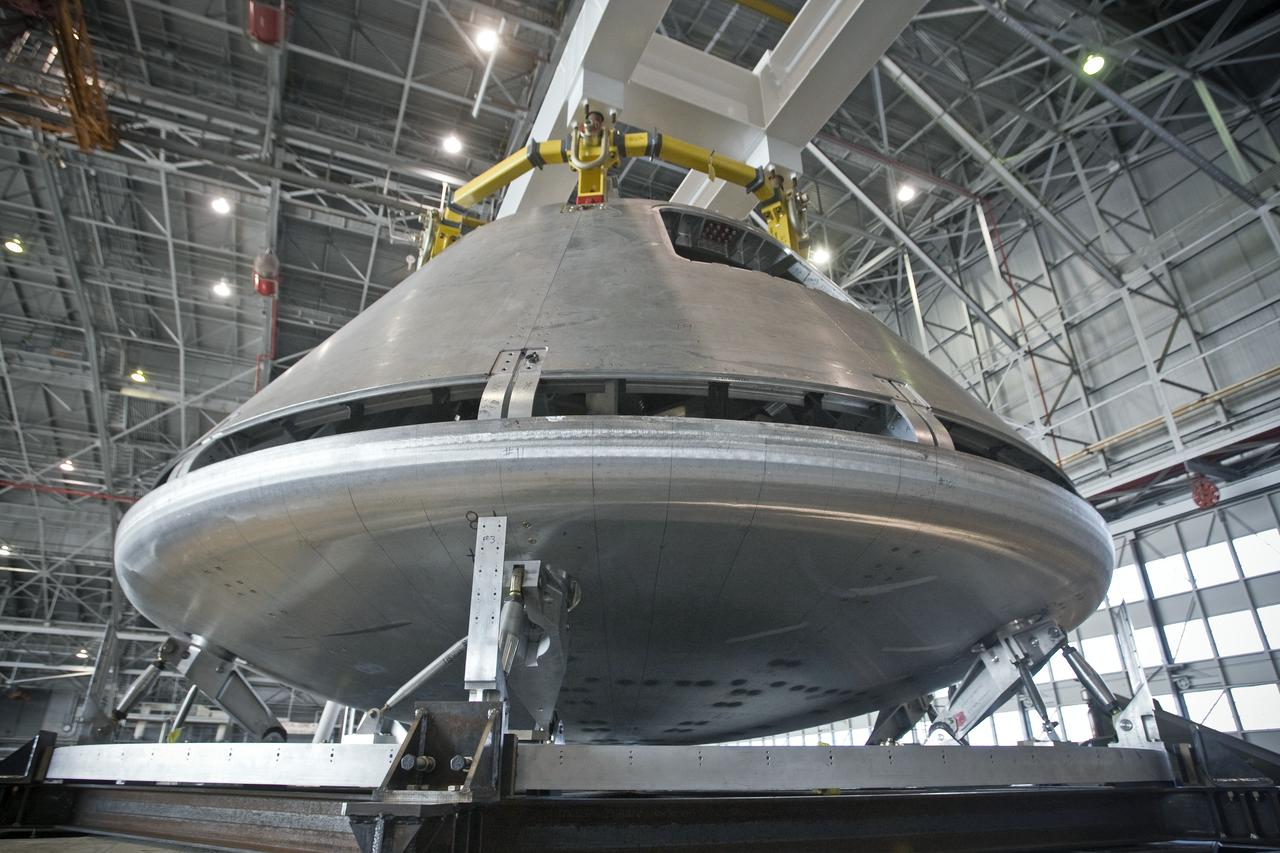
CM SepRing Integration work being done in NASA's Langley Hanger
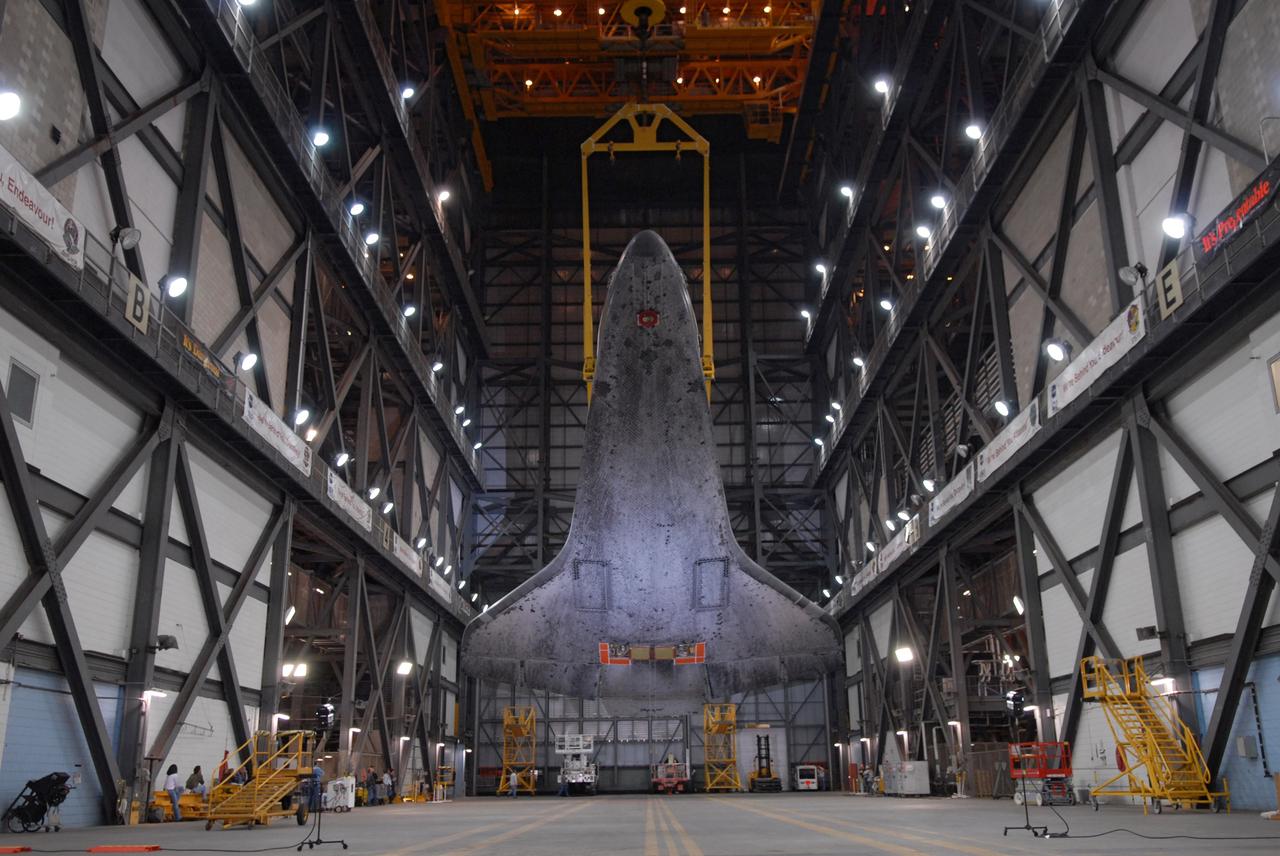
CAPE CANAVERAL, Fla. – In the Vehicle Assembly Building at NASA's Kennedy Space Center in Florida, space shuttle Atlantis is rotated by the crane toward a vertical position above the transfer aisle. The shuttle will be lifted into High Bay 3 where it will be attached to its external fuel tank and solid rocket boosters on the mobile launcher platform. After additional preparations are made, the shuttle will be rolled out to Launch Pad 39A for a targeted launch on May 12 on the STS-125 Hubble servicing mission. Photo credit: NASA/Cory Huston
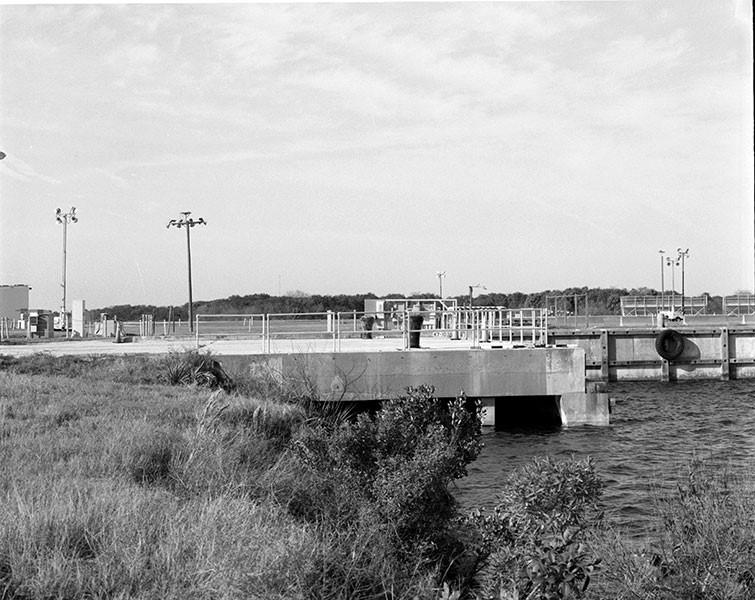
View of the Barge Terminal Facility
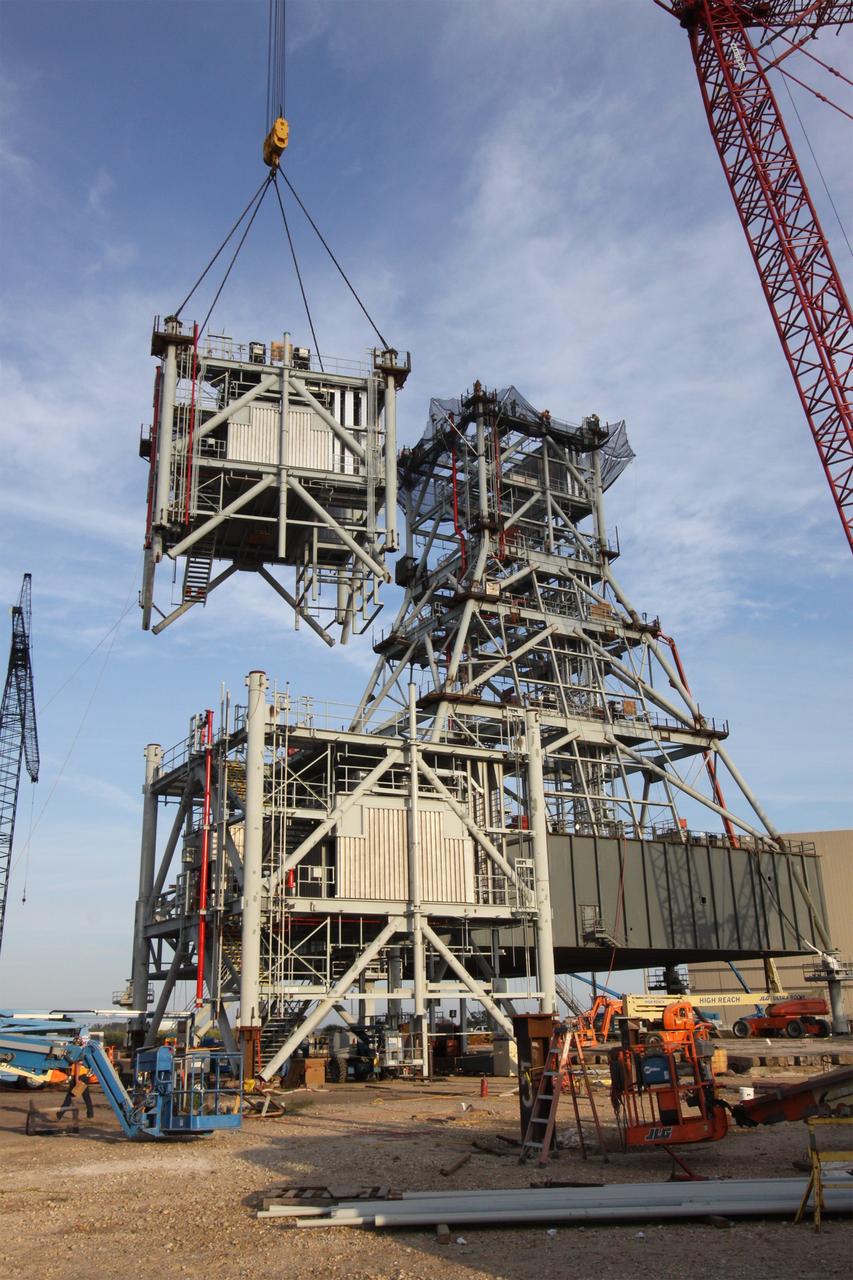
CAPE CANAVERAL, Fla. – At NASA's Kennedy Space Center in Florida, a crane lifts a fifth tower segment toward four segments already secured to a new mobile launcher, or ML, being constructed to support the Constellation Program. When completed, the tower will be approximately 345 feet tall and have multiple platforms for personnel access. The construction is under way at the mobile launcher park site area north of Kennedy's Vehicle Assembly Building. The launcher will provide a base to launch the Ares I rocket, designed to transport the Orion crew exploration vehicle, its crew and cargo to low Earth orbit. Its base is being made lighter than space shuttle mobile launcher platforms so the crawler-transporter can pick up the heavier load of the tower and taller rocket. For information on the Ares I, visit http://www.nasa.gov/ares. Photo credit: NASA/Jack Pfaller

JSC2009-E-049944 (February 2009) --- Attired in Russian Sokol launch and entry suits, European Space Agency (ESA) astronaut Frank De Winne (right), Expedition 20 flight engineer and Expedition 21 commander; cosmonaut Roman Romanenko (center) and Canadian Space Agency astronaut Robert Thirsk, both Expedition 20/21 flight engineers, take a break from training in Star City, Russia to pose for a portrait. Photo credit: Gagarin Cosmonaut Training Center
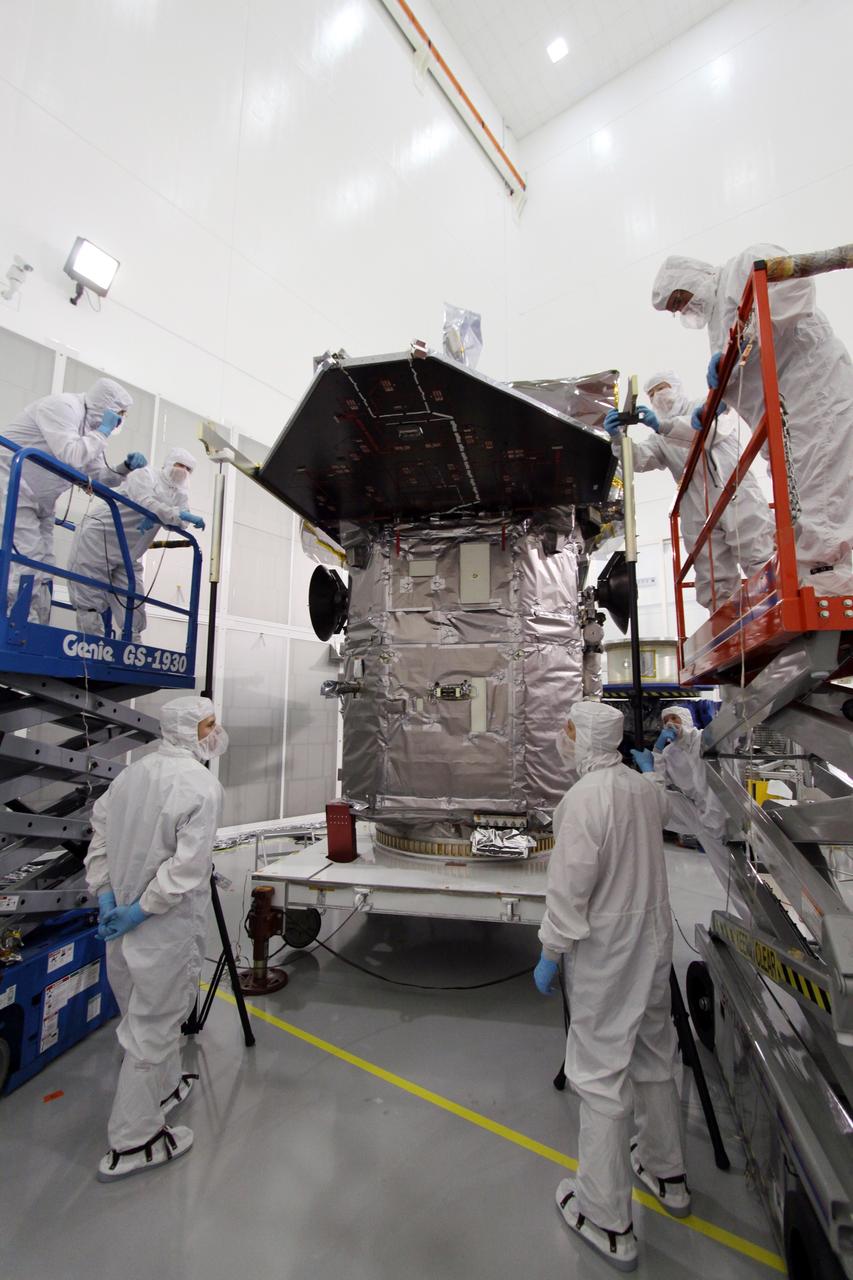
CAPE CANAVERAL, Fla. – At the Astrotech Space Operations facility in Titusville, Fla., spacecraft technicians have manually deployed the solar arrays on the Solar Dynamics Observatory, or SDO, during preparations to test the release mechanism sequence for the arrays using signal commands. SDO is the first space weather research network mission in NASA's Living With a Star Program. The spacecraft's long-term measurements will give solar scientists in-depth information about changes in the sun's magnetic field and insight into how they affect Earth. Liftoff on an Atlas V rocket is scheduled for Feb. 3, 2010. Photo credit: NASA/Jack Pfaller
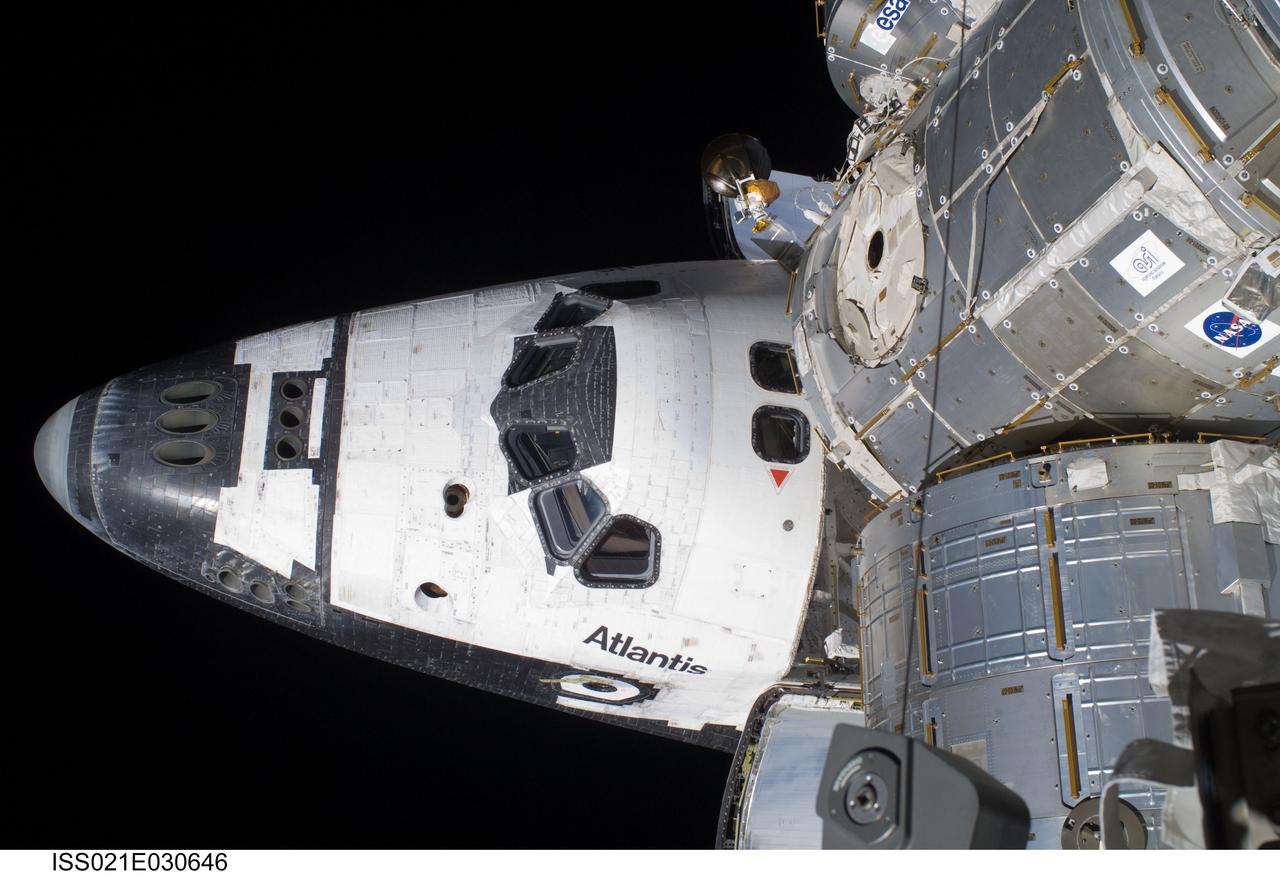
ISS021-E-30646 (21 Nov. 2009) --- This is a high-angle view of the crew cabin of the space shuttle Atlantis during the second space walk of Atlantis' visit to the International Space Station.
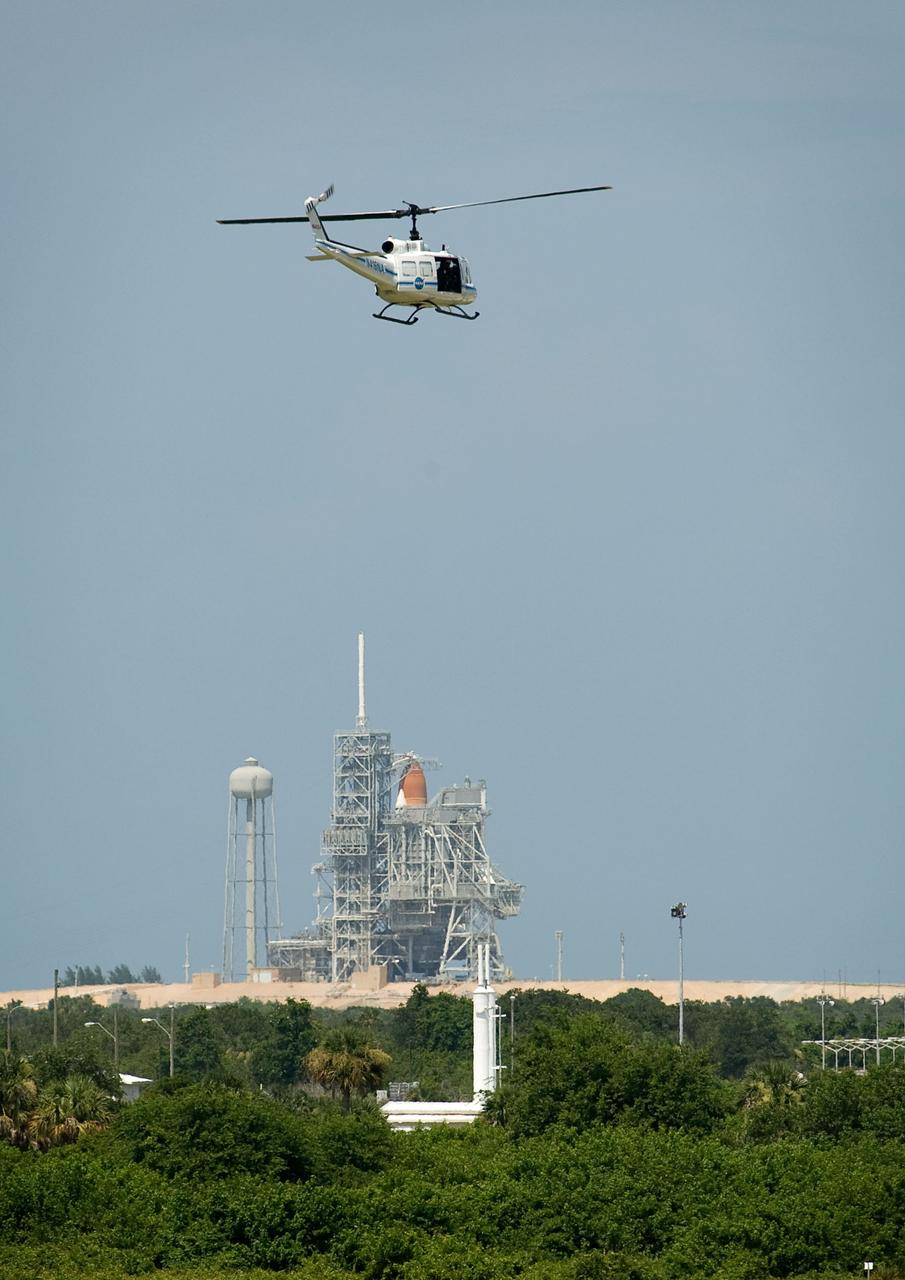
A NASA Security helicopter watches over the Astrovan as it takes the crew of STS-127 to the space shuttle Endeavour at pad 39a at NASA's Kennedy Space Center in Cape Canaveral, Florida, Saturday, July 12, 2009. Endeavour is set to launch at 7:13p.m. EDT with the crew of STS-127 and start a 16-day mission that will feature five spacewalks and complete construction of the Japan Aerospace Exploration Agency's Kibo laboratory. Photo Credit: (NASA/Bill Ingalls)
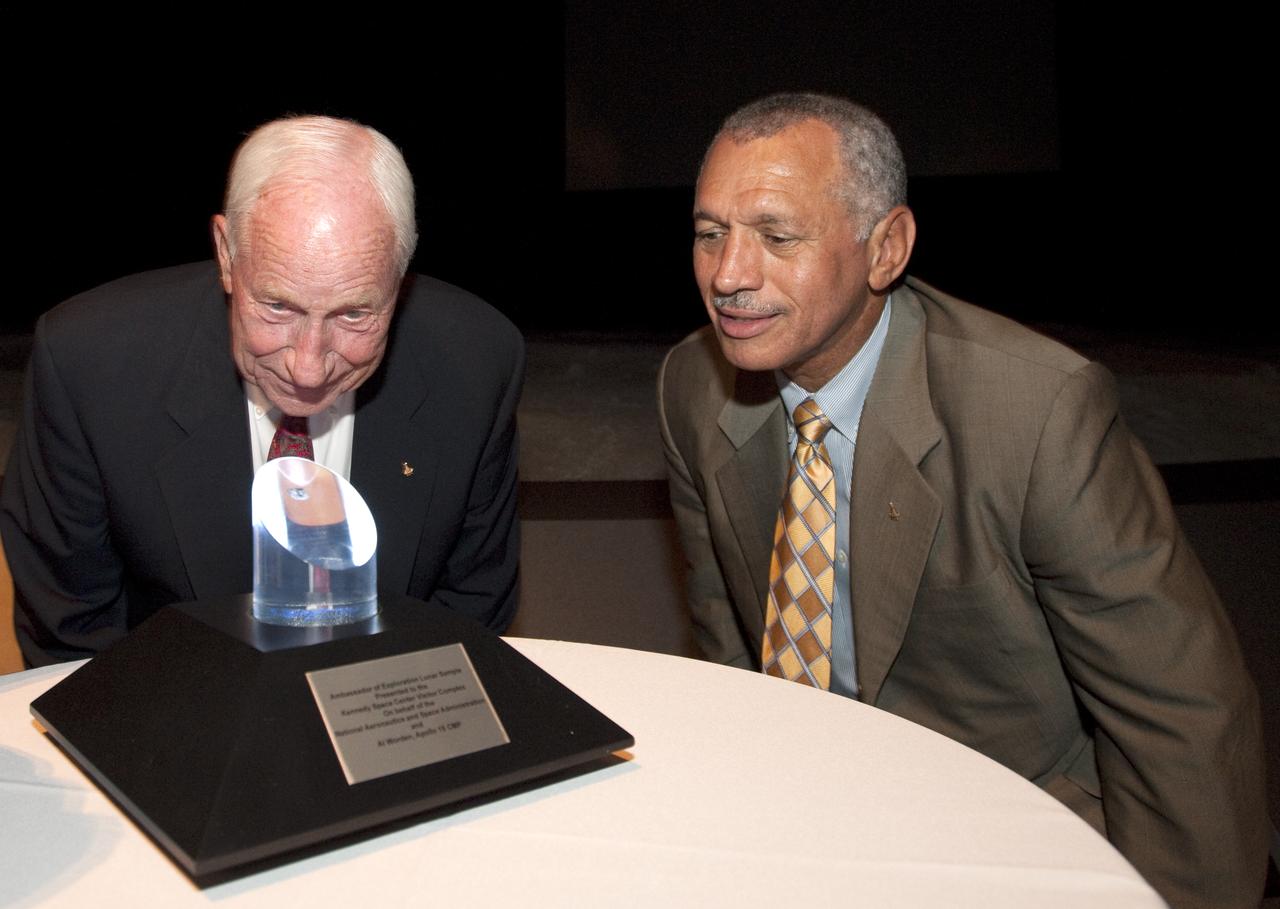
Apollo astronaut Al Worden, left, and NASA Administrator Charles Bolden, take a close look at Worden's Ambassador of Exploration Award for his contributions to the U.S. space program following a ceremony, Thursday, July 30, 2009, where Worden was honored with the presentation of the award at Kennedy Space Center, Fla. Worden served as command module pilot for the Apollo 15 mission. Photo Credit: (NASA/Bill Ingalls)

ISS020-E-021255 (15 July 2009) --- NASA astronaut Michael Barratt, Expedition 20 flight engineer, holds storage containers with his legs while floating freely in the Kibo laboratory of the International Space Station.

Kepler Project Team member Jason Rowe
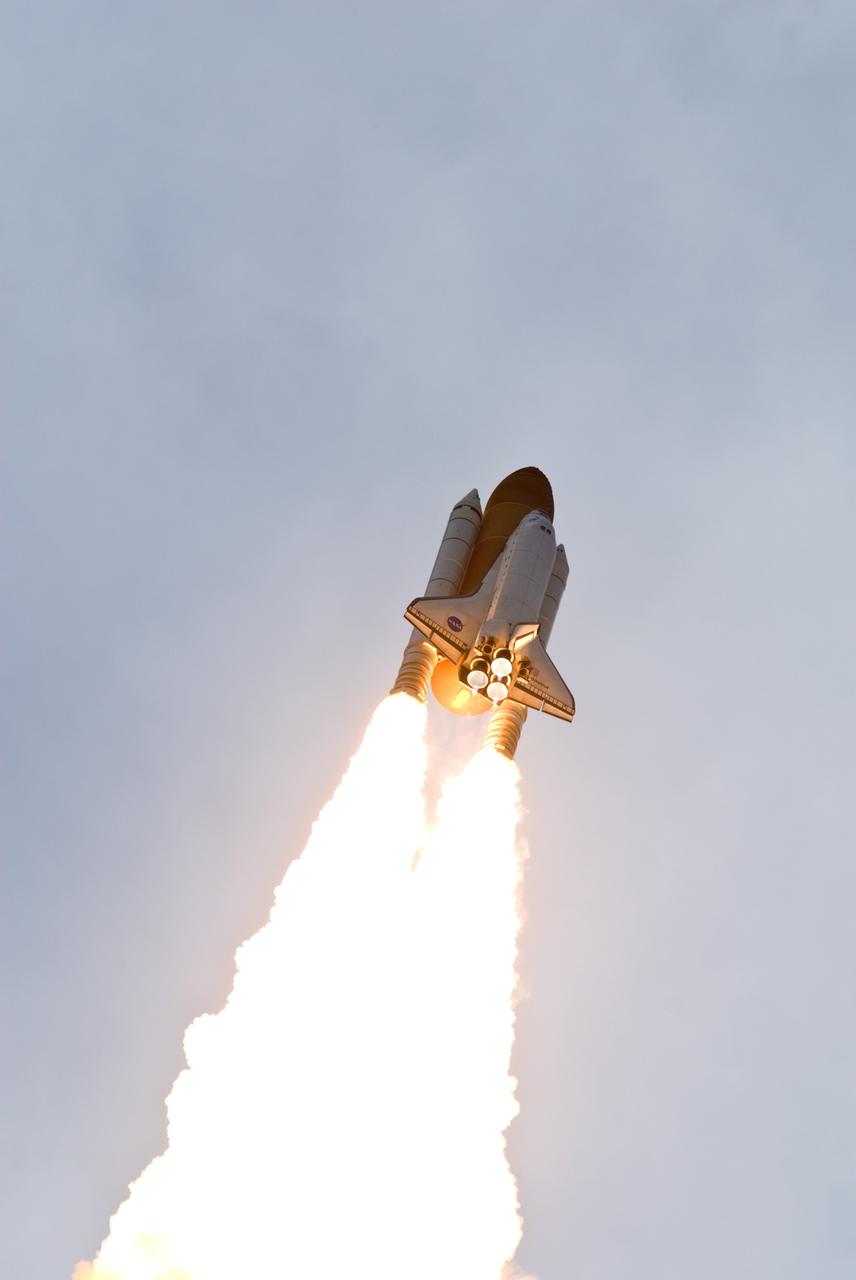
CAPE CANAVERAL, Fla. – The fiery columns from the solid rocket boosters help hurtle space shuttle Endeavour into space on the STS-127 mission. Liftoff from NASA Kennedy Space Center's Launch Pad 39A was on-time at 6:03 p.m. EDT. This was the sixth launch attempt for the STS-127 mission. The launch was scrubbed on June 13 and June 17 when a hydrogen gas leak occurred during tanking due to a misaligned Ground Umbilical Carrier Plate. The mission was postponed July 11, 12 and 13 due to weather conditions near the Shuttle Landing Facility at Kennedy that violated rules for launching, and lightning issues. Endeavour will deliver the Japanese Experiment Module's Exposed Facility and the Experiment Logistics Module-Exposed Section in the final of three flights dedicated to the assembly of the Japan Aerospace Exploration Agency's Kibo laboratory complex on the International Space Station. Photo credit: NASA/Mike Gayle, Rusty Backer
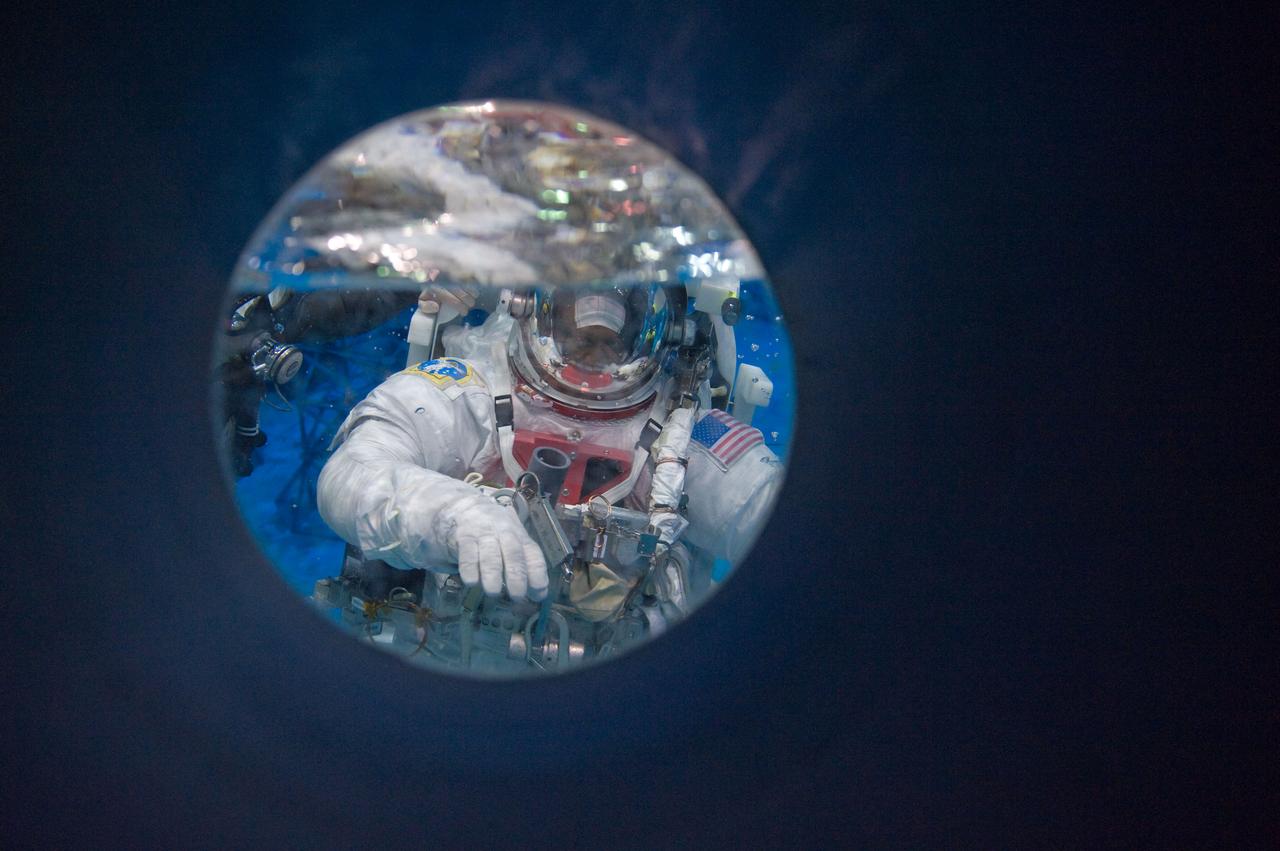
PHOTO DATE: 04-10-09 LOCATION: NBL - Pool Topside and Control Room SUBJECT: STS-129 crew members Michael Foreman and Robert Satcher during STS-129 ULF3 EVA 1 92027 training. Photograph preparations, getting in suit, working with suit techs, being lowered into water, other crew members in control room PHOTOGRAPHER: Devin Boldt
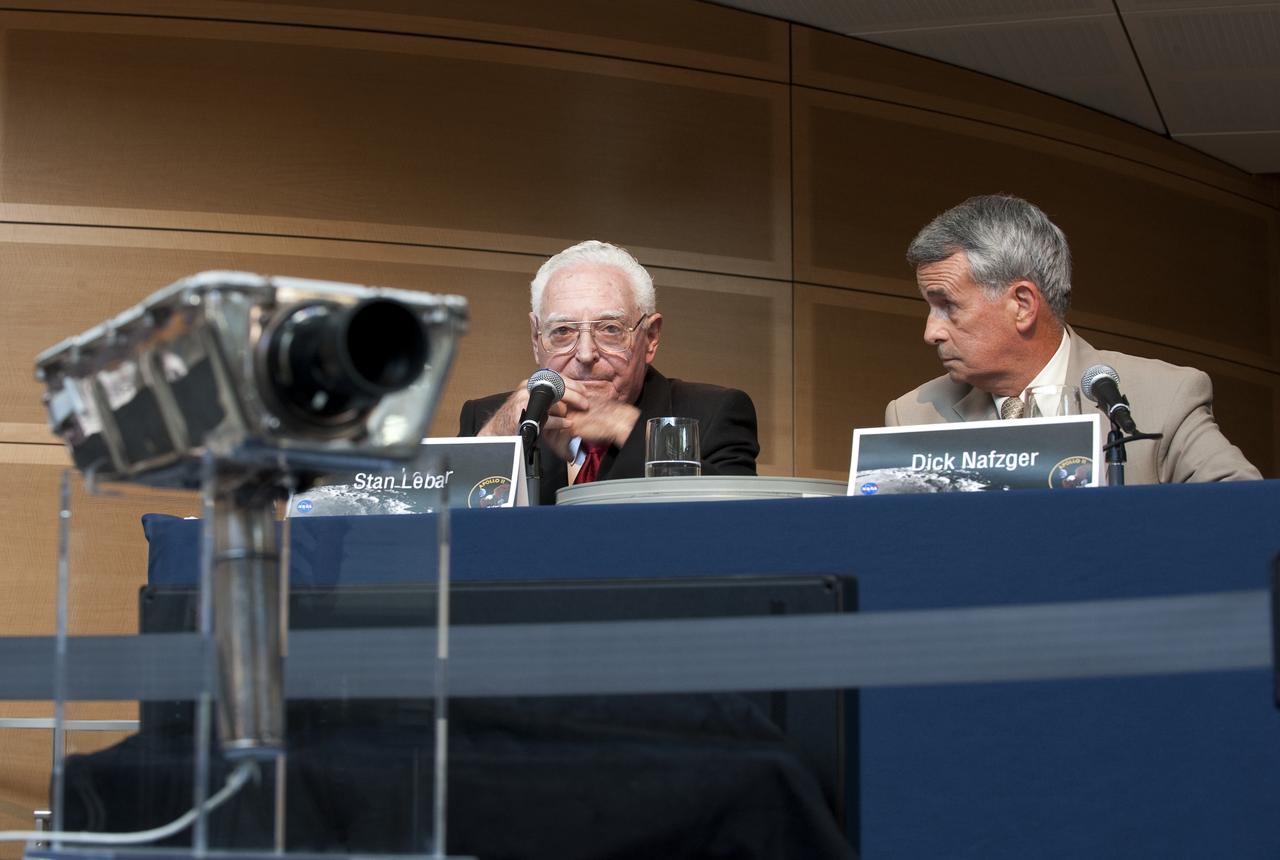
Stan Lebar, former Westinghouse Electric program manager, left, talks about the Apollo era TV cameras such as the one on display in the foreground as Richard Nafzger, team lead and Goddard engineer, listens at NASA's briefing where restored Apollo 11 moonwalk footage was revealed for the first time at the Newseum, Thursday, July 16, 2009, in Washington, DC. Photo Credit: (NASA/Bill Ingalls)
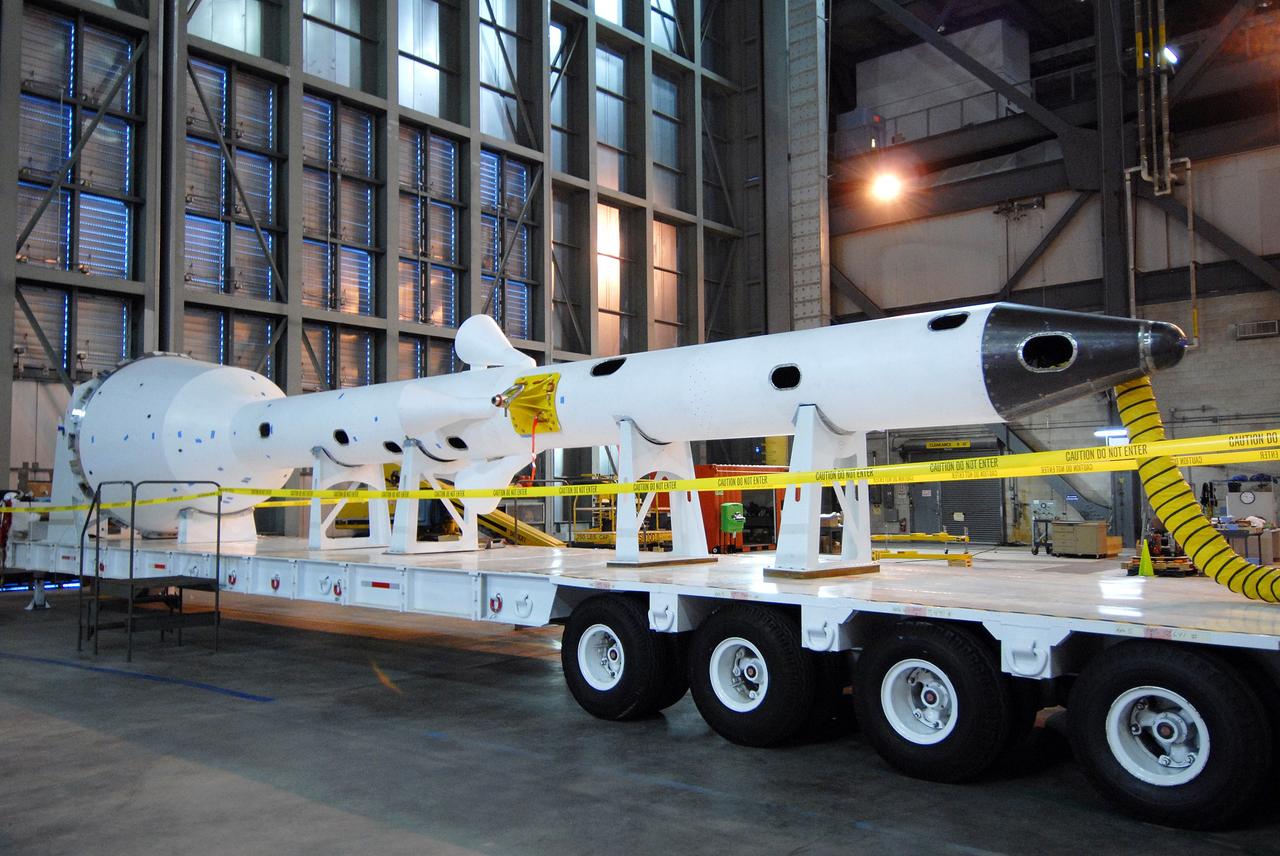
CAPE CANAVERAL, Fla. – The Ares I-X launch abort system that will form the tip of the Ares rocket arrives in the Vehicle Assembly Building at NASA's Kennedy Space Center in Florida. The launch abort system will provide safe evacuation if a launch vehicle failure occurs. Ares I-X is the test vehicle for the Ares I, which is part of the Constellation Program to return men to the moon and beyond. Ares I is the essential core of a safe, reliable, cost-effective space transportation system that eventually will carry crewed missions back to the moon, on to Mars and out into the solar system. Ares I-X is targeted for launch in July 2009. Photo credit: NASA/Jack Pfaller
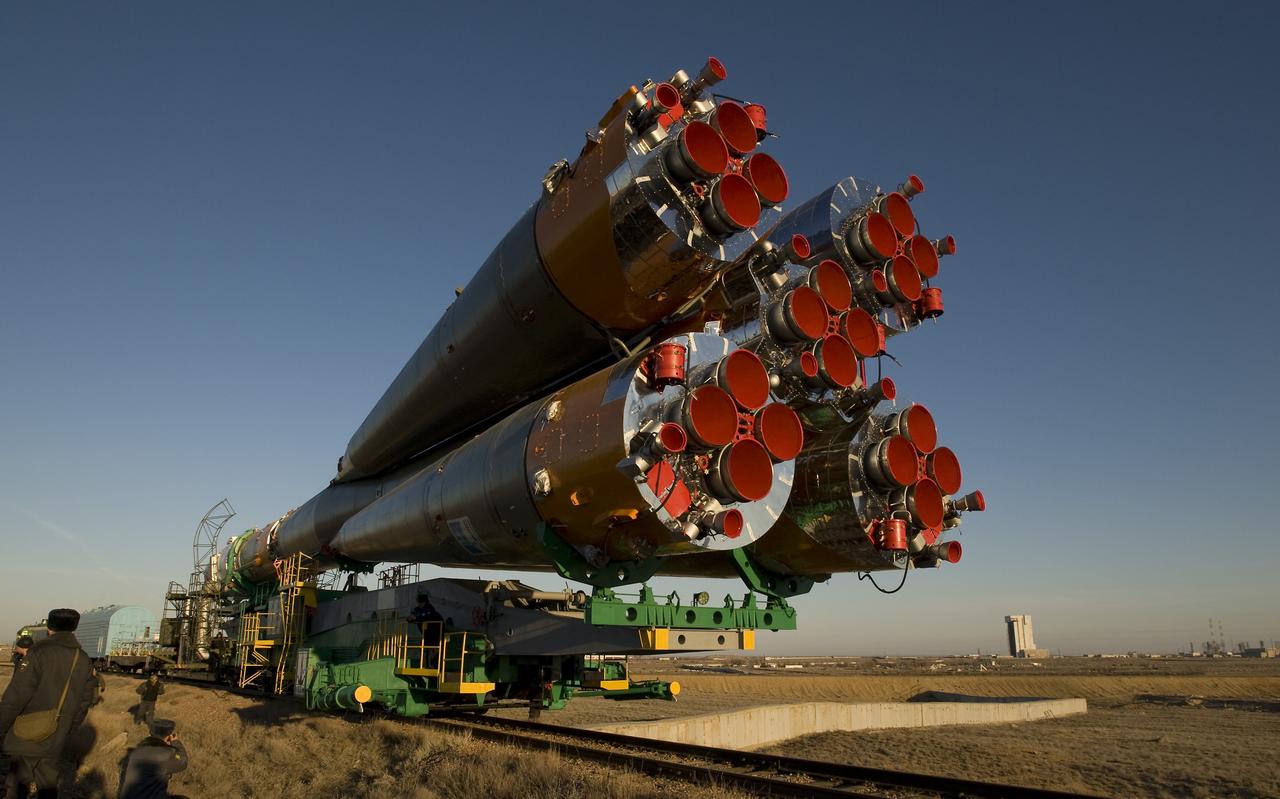
The Soyuz rocket is rolled out to the launch pad Tuesday, March 24, 2009 at the Baikonur Cosmodrome in Kazakhstan. The Soyuz is scheduled to launch the crew of Expedition 19 and a spaceflight participant on March 26, 2009. Photo Credit: (NASA/Bill Ingalls)

CAPE CANAVERAL, Fla. – In the Operations and Checkout Building at NASA's Kennedy Space Center in Florida, STS-128 crew members put on their launch-and-entry suits before heading to the Astrovan for the 3.4-mile drive to Launch Pad 39A. There, crew members will complete their suit-up and enter space shuttle Discovery for the 11:59 p.m. EDT liftoff. Seen here, Pilot Kevin Ford is ready for launch. The first launch attempt on Aug. 24 was postponed due to unfavorable weather conditions. The second attempt on Aug. 25 also was postponed due to an issue with a valve in space shuttle Discovery's main propulsion system. The 13-day mission will deliver more than 7 tons of supplies, science racks and equipment, as well as additional environmental hardware to sustain six crew members on the International Space Station. The equipment includes a freezer to store research samples, a new sleeping compartment and the COLBERT treadmill. The mission is the 128th in the Space Shuttle Program, the 37th flight of Discovery and the 30th station assembly flight. Photo credit: NASA/Kim Shiflett
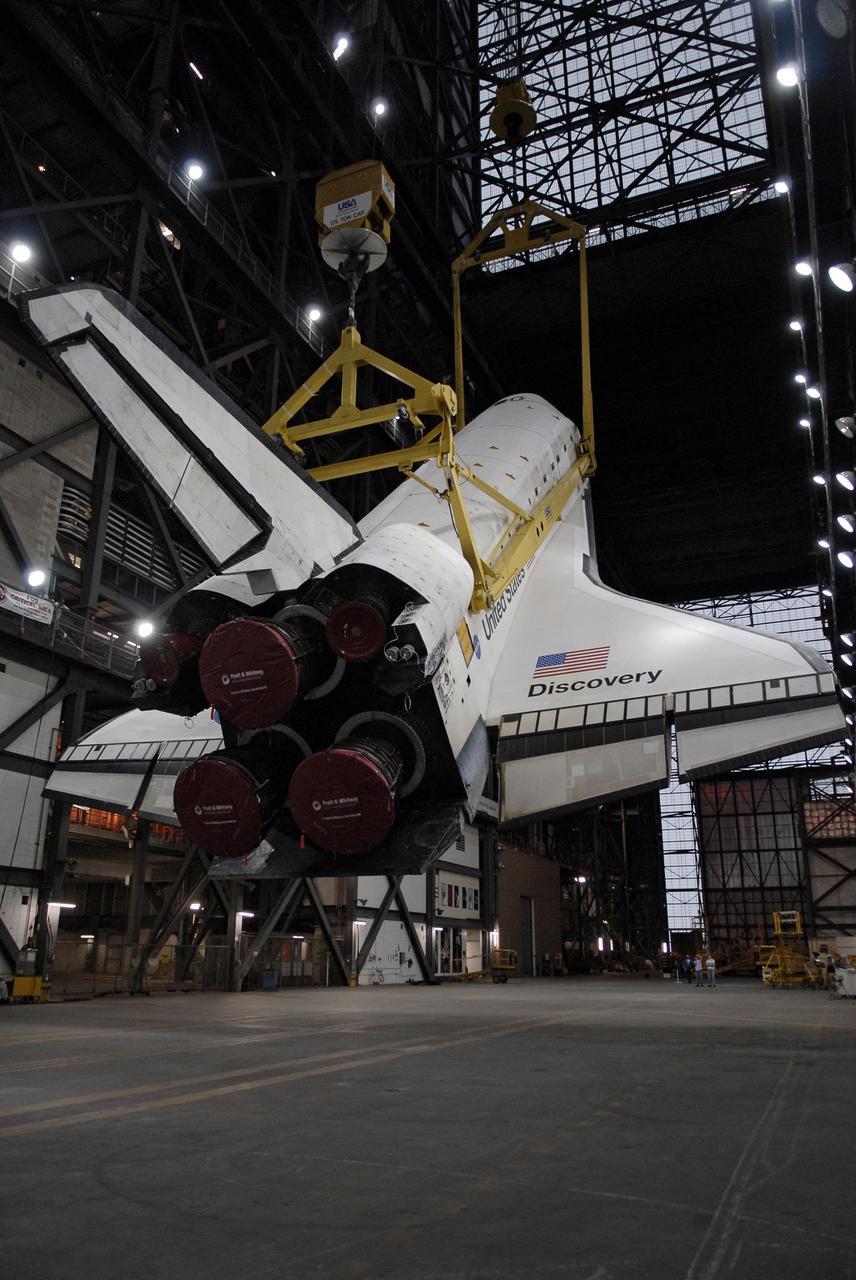
CAPE CANAVERAL, Fla. – After rollover from Orbiter Processing Facility 3 at NASA's Kennedy Space Center, Fla., to the transfer aisle of the Vehicle Assembly Building, space shuttle Discovery is being raised to vertical. It will be lifted into High Bay 1 where it will be mated to the external fuel tank and solid rocket boosters already installed on the mobile launcher platform. The shuttle is scheduled to roll out to Launch Pad 39A the first week of August to prepare for the STS-128 mission to the International Space Station. Discovery will carry the Leonardo Multi-Purpose Logistics Module containing life support racks and science racks and the Lightweight Multi-Purpose Experiment Support Structure Carrier in its payload bay. Launch of Discovery is targeted for late August. Photo credit: NASA/Kim Shiflett
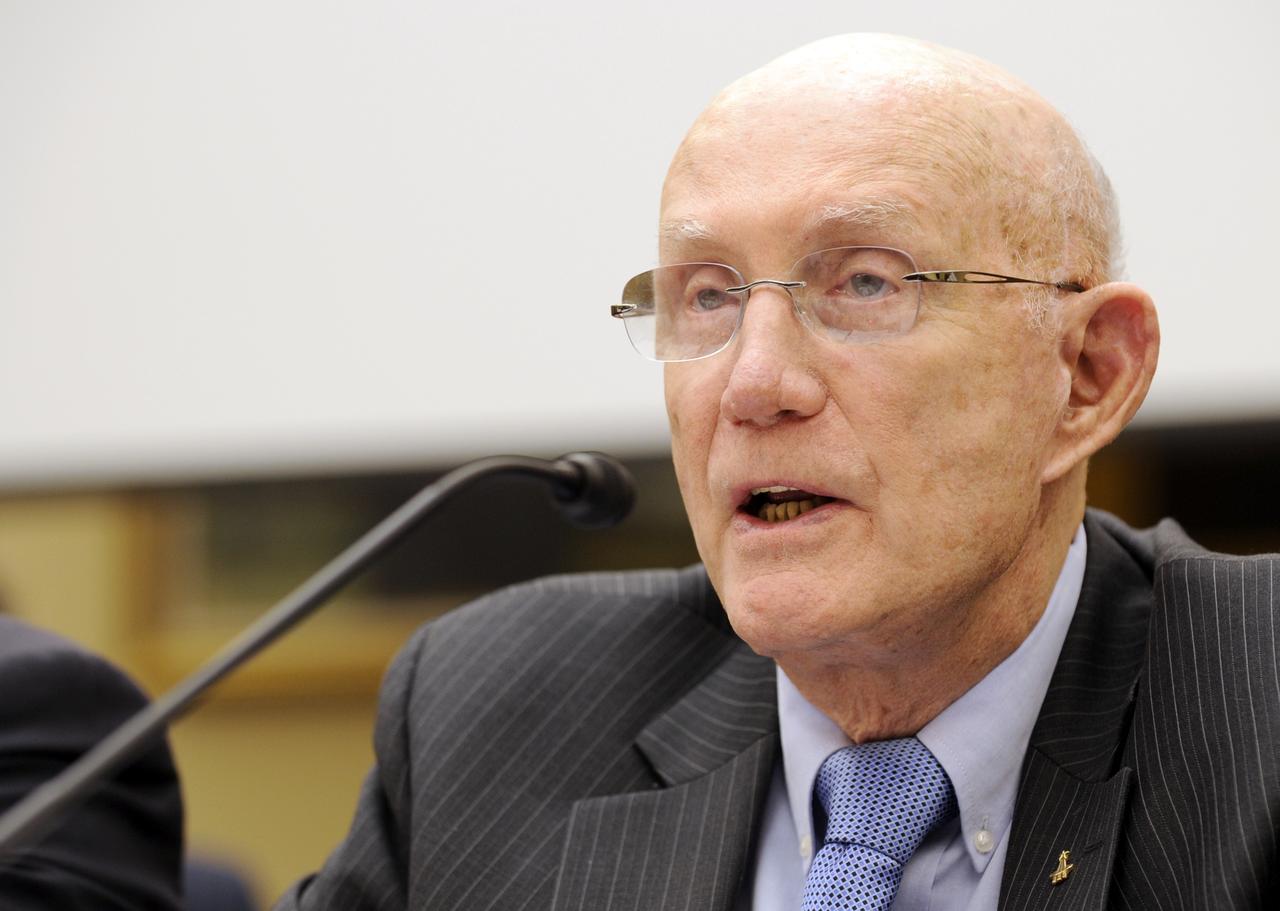
Reitred astronaut Lt. Gen. Thomas Stafford testifies during a hearing before the House Subcommitte on Space and Aeronautics regarding Safety of Human Spaceflight on Capitol Hill, Wednesday, Dec. 2, 2009, in Washington. Photo Credit: (NASA/Bill Ingalls)
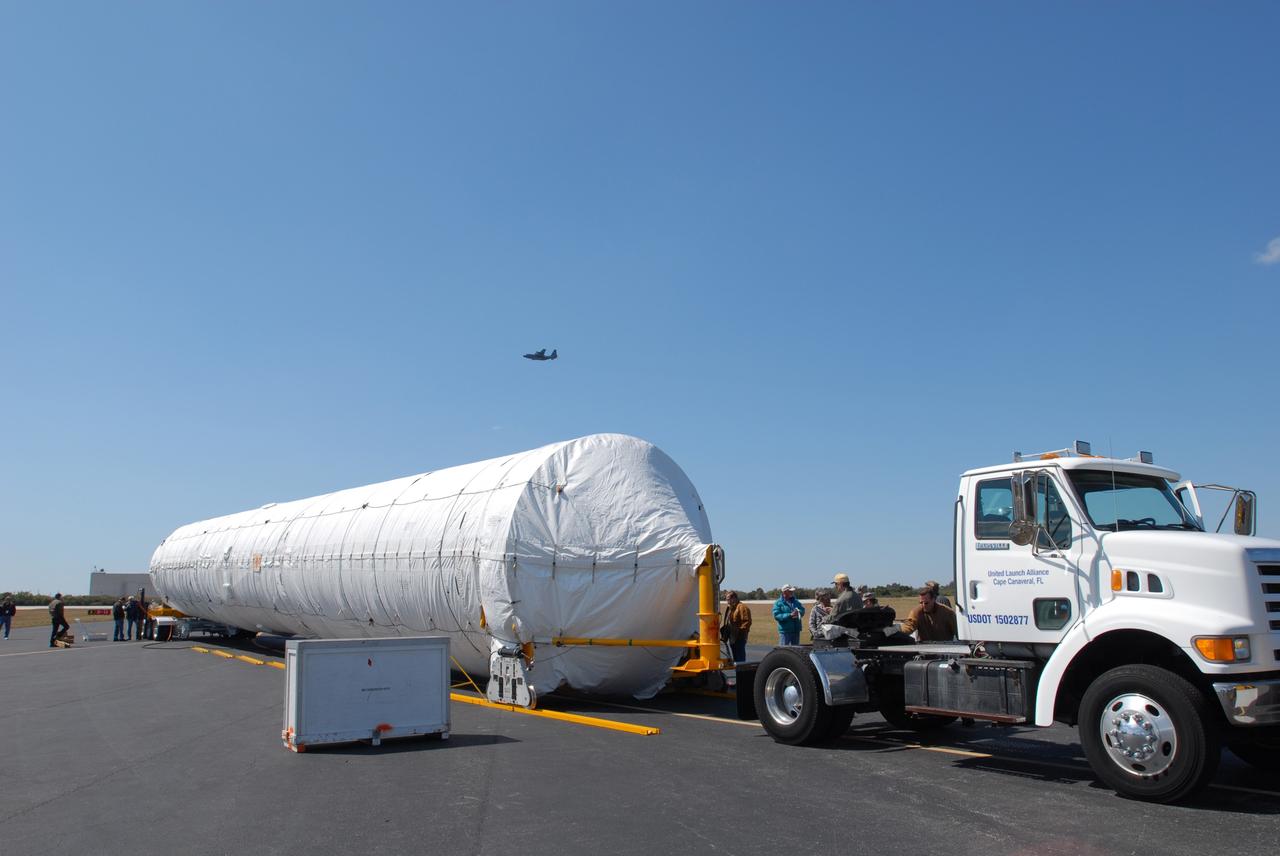
CAPE CANAVERAL, Fla. – On Cape Canaveral Air Force Station's skid strip in Florida, the shrouded Atlas V first stage booster is being prepared for its move to the Atlas Space Operations Center on CCAFS. The Atlas V is the launch vehicle for NASA's Lunar Reconnaissance Orbiter, or LRO, and NASA's Lunar CRater Observation and Sensing Satellite, known as LCROSS. Launch is scheduled no earlier than May 20. LCROSS and LRO are the first missions in NASA's plan to return humans to the moon and begin establishing a lunar outpost by 2020. Photo credit: NASA/Jim Grossmann

This vertical profile view from the Tropospheric Emission Spectrometer TES instrument on NASA Aura satellite depicts the distribution of water vapor molecules over Earth tropics across one transect of the satellite orbit on January 6, 2006.
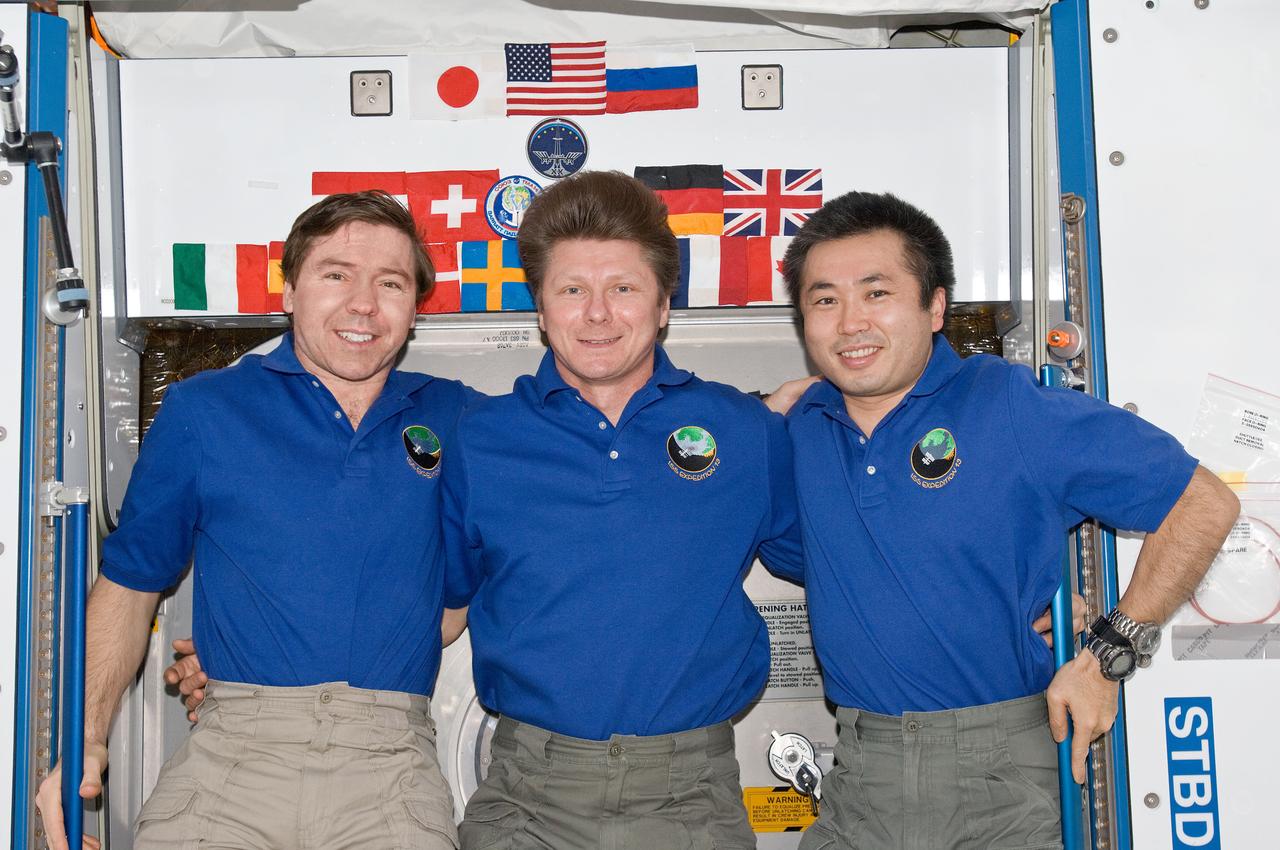
ISS020-E-008884 (14 June 2009) --- Cosmonaut Gennady Padalka (center), Expedition 19/20 commander; along with NASA astronaut Michael Barratt (left) and Japan Aerospace Exploration Agency (JAXA) astronaut Koichi Wakata, both Expedition 19/20 flight engineers, pose for a photo in the Harmony node of the International Space Station.

Miles O'Brien, a member of the NASA Advisory Council responible for Edcuation and Public Outreach, listens to discussion at an Education Summitt, Monday, Nov. 2, 2009, at NASA Headquarters in Washington. Photo Credit: (NASA/Paul E. Alers)
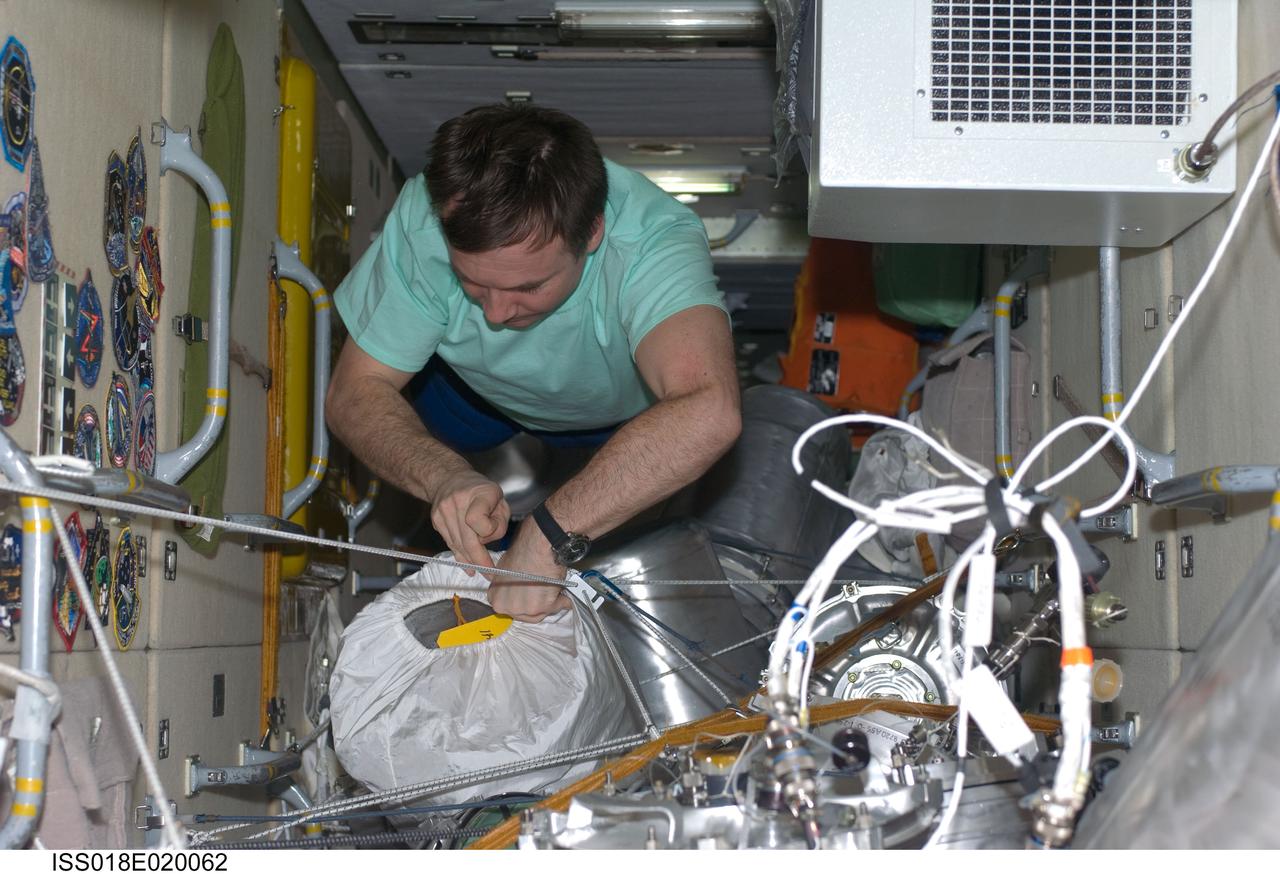
ISS018-E-020062 (14 Jan. 2009) --- Cosmonaut Yury Lonchakov, Expedition 18 flight engineer, works with supplies and equipment stowed in the functional cargo block (FGB) or Zarya of the International Space Station.
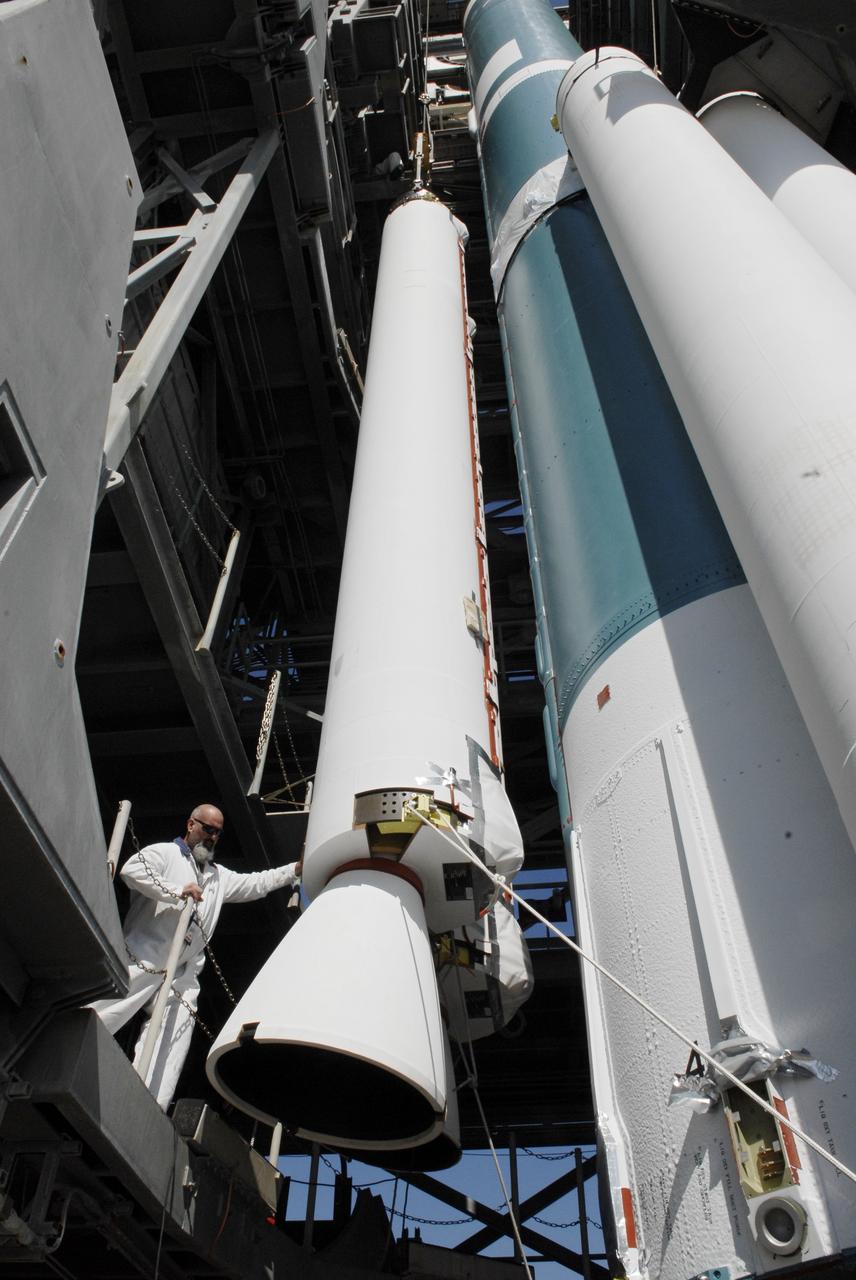
CAPE CANAVERAL, Fla. – On Launch Pad 17-B at Cape Canaveral Air Force Station, a worker monitors the placement of a solid rocket booster on a Delta II rocket for launch of the STSS Demonstrator spacecraft. The spacecraft is a midcourse tracking technology demonstrator, part of an evolving ballistic missile defense system. STSS is capable of tracking objects after boost phase and provides trajectory information to other sensors. It will be launched by NASA for the Missile Defense Agency on July 29. Photo credit: NASA/Kim Shiflett

CAPE CANAVERAL, Fla. – At NASA's Kennedy Space Center in Florida, the Atlantic Ocean is backdrop for space shuttle Endeavour as it reaches the hardstand on Launch Pad 39A. First motion of the 3.4-mile rollaround from Launch Pad 39B was at 3:16 a.m. EDT, and the shuttle was secured to Launch Pad 39A at 11:42 a.m. EDT. Endeavour was on standby on Pad 39B to be used in the unlikely event that a rescue mission was necessary during space shuttle Atlantis' STS-125 mission to NASA's Hubble Space Telescope. The payload on Endeavour's next mission, STS-127, includes the Japan Aerospace Exploration Agency's Kibo Exposed Facility and the Experiment Logistics Module Exposed Section of the International Space Station. They will be installed on the Kibo laboratory already on the station. Launch of STS-127 is targeted for June 13. Photo credit: NASA/Kim Shiflett
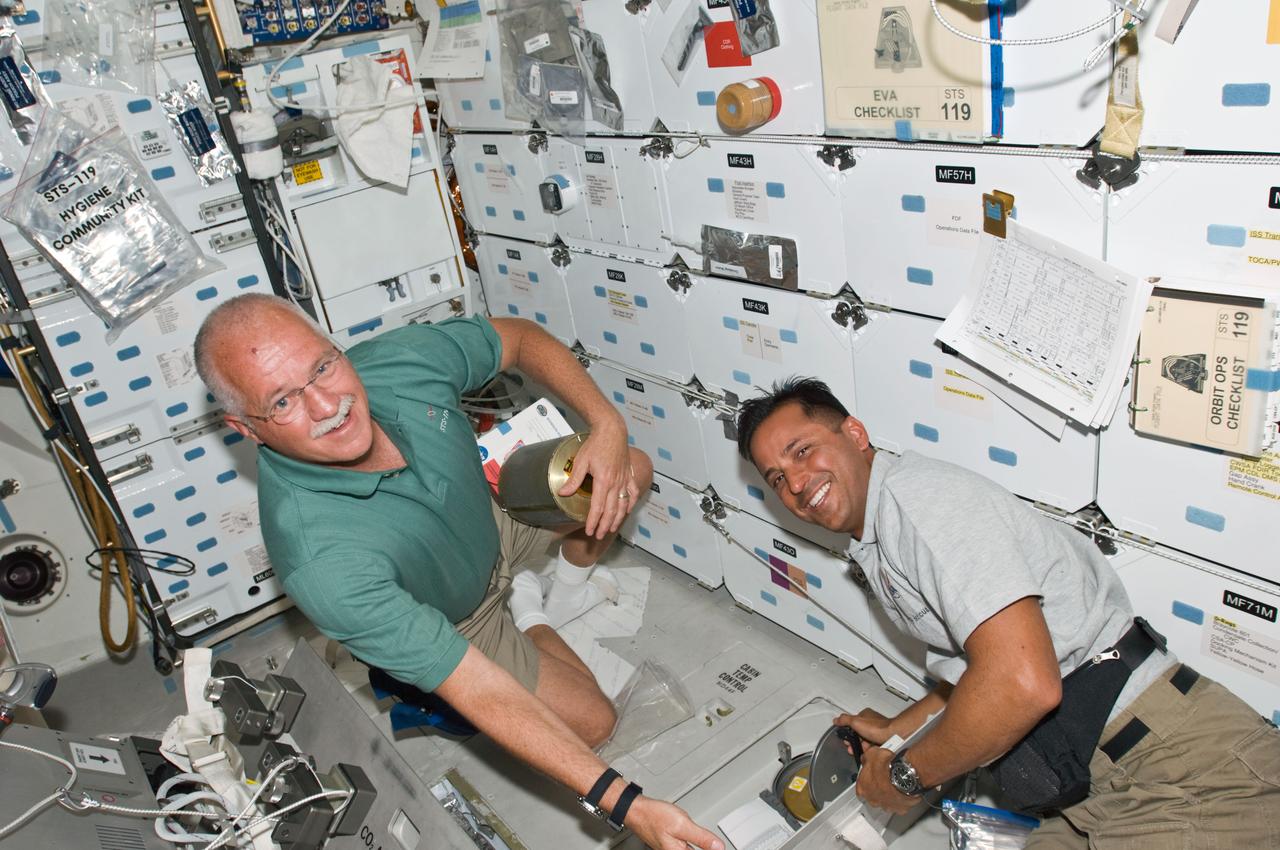
S119-E-006645 (19 March 2009) --- Astronauts John Phillips (left) and Joseph Acaba, both STS-119 mission specialists, work with the lithium hydroxide (LiOH) canisters beneath Space Shuttle Discovery's middeck while docked with the International Space Station.
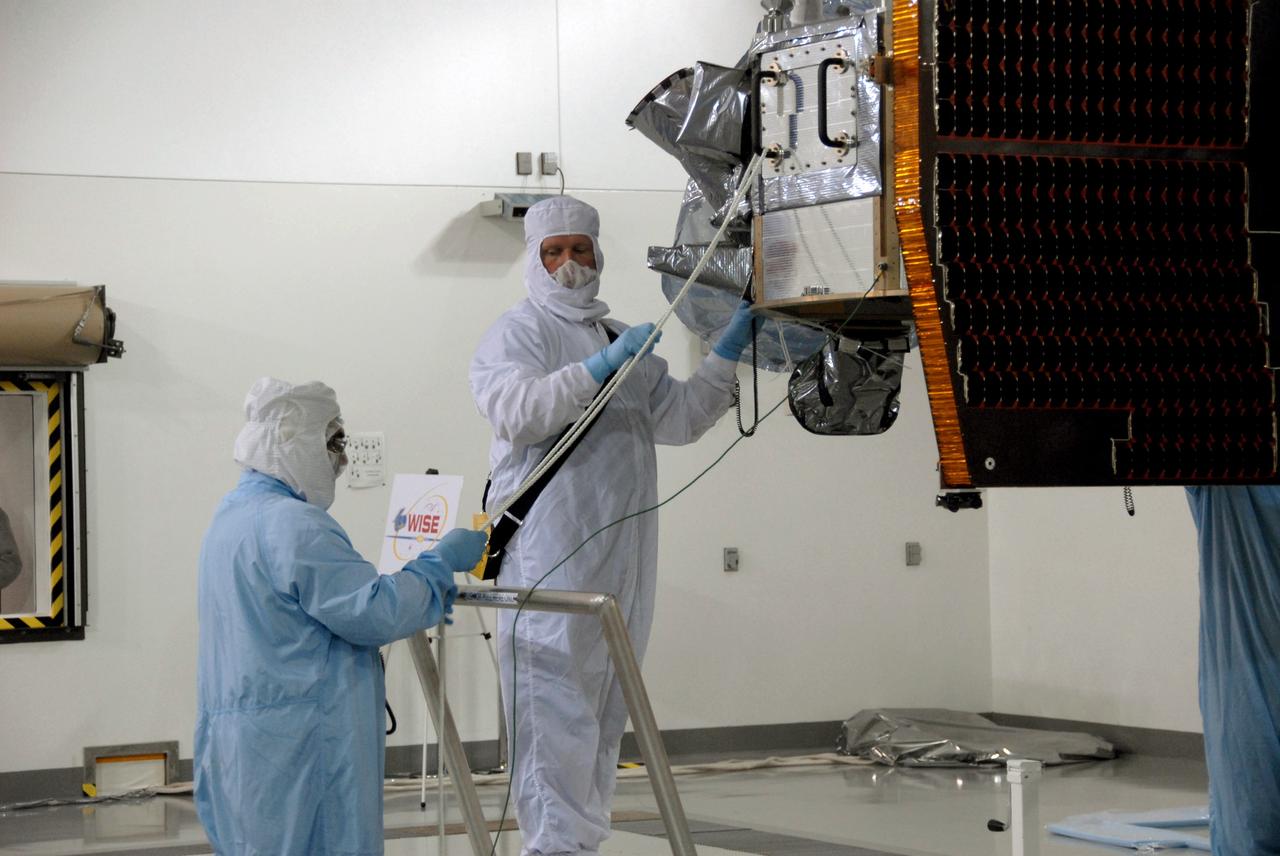
VANDENBERG AIR FORCE BASE, Calif. -- At Vandenberg Air Force Base's Astrotech processing facility in California, technicians help guide NASA's Wide-field Infrared Survey Explorer, or WISE, spacecraft to the flight conical adapter and test stand. The satellite will survey the entire sky at infrared wavelengths, creating a cosmic clearinghouse of hundreds of millions of objects, which will be catalogued, providing a vast storehouse of knowledge about the solar system, the Milky Way, and the universe. Launch is scheduled no earlier than Dec. 7. Photo credit: NASA/Doug Kolkow
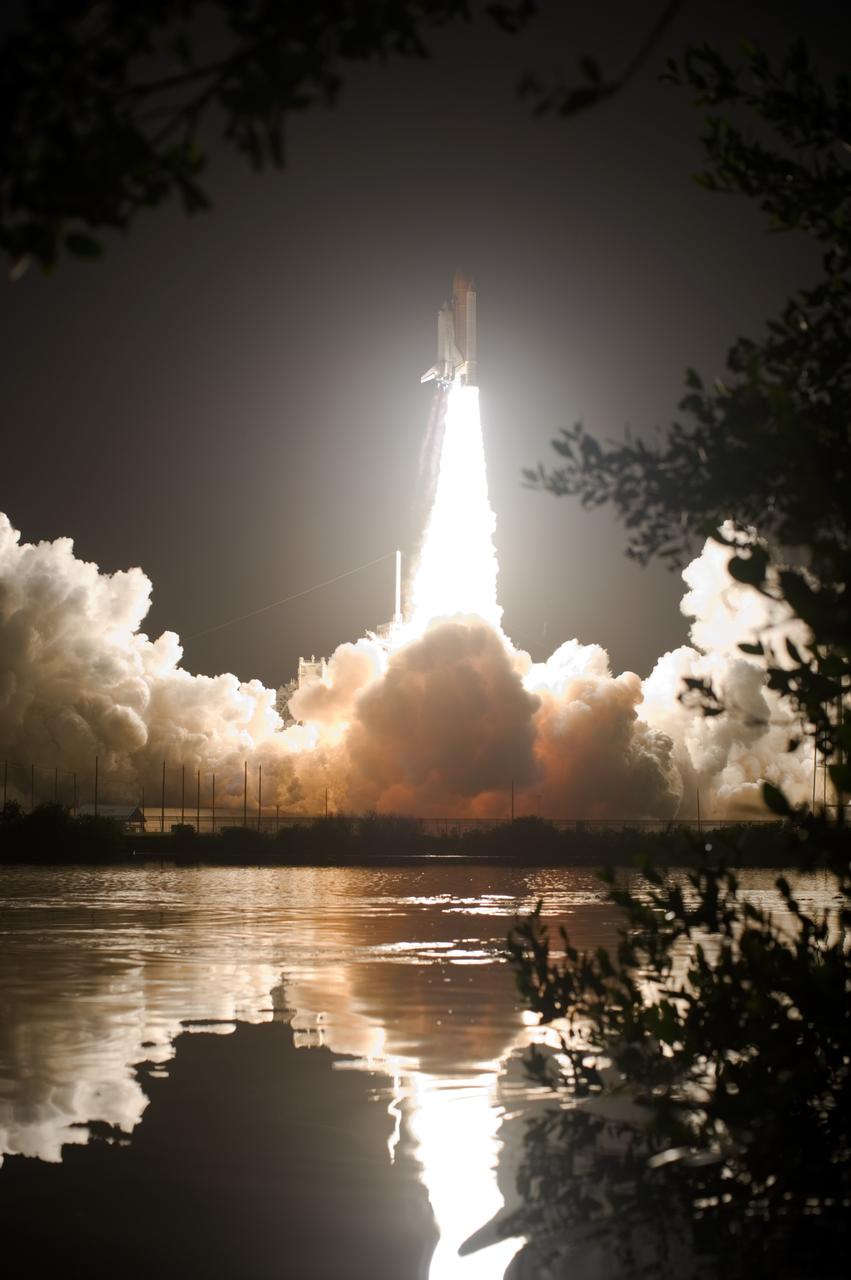
CAPE CANAVERAL, Fla. – Racing to space atop a tower of flame, space shuttle Discovery lights the night sky at liftoff, all captured in the water near Launch Pad 39A at NASA's Kennedy Space Center in Florida. Liftoff from Launch Pad 39A on the STS-128 mission was on time at 11:59 p.m. EDT. The first launch attempt on Aug. 24 was postponed due to unfavorable weather conditions. The second attempt on Aug. 25 also was postponed due to an issue with a valve in space shuttle Discovery's main propulsion system. The STS-128 mission is the 30th International Space Station assembly flight and the 128th space shuttle flight. The 13-day mission will deliver more than 7 tons of supplies, science racks and equipment, as well as additional environmental hardware to sustain six crew members on the International Space Station. The equipment includes a freezer to store research samples, a new sleeping compartment and the COLBERT treadmill. Photo credit: NASA/Tony Gray-Tom Farrar
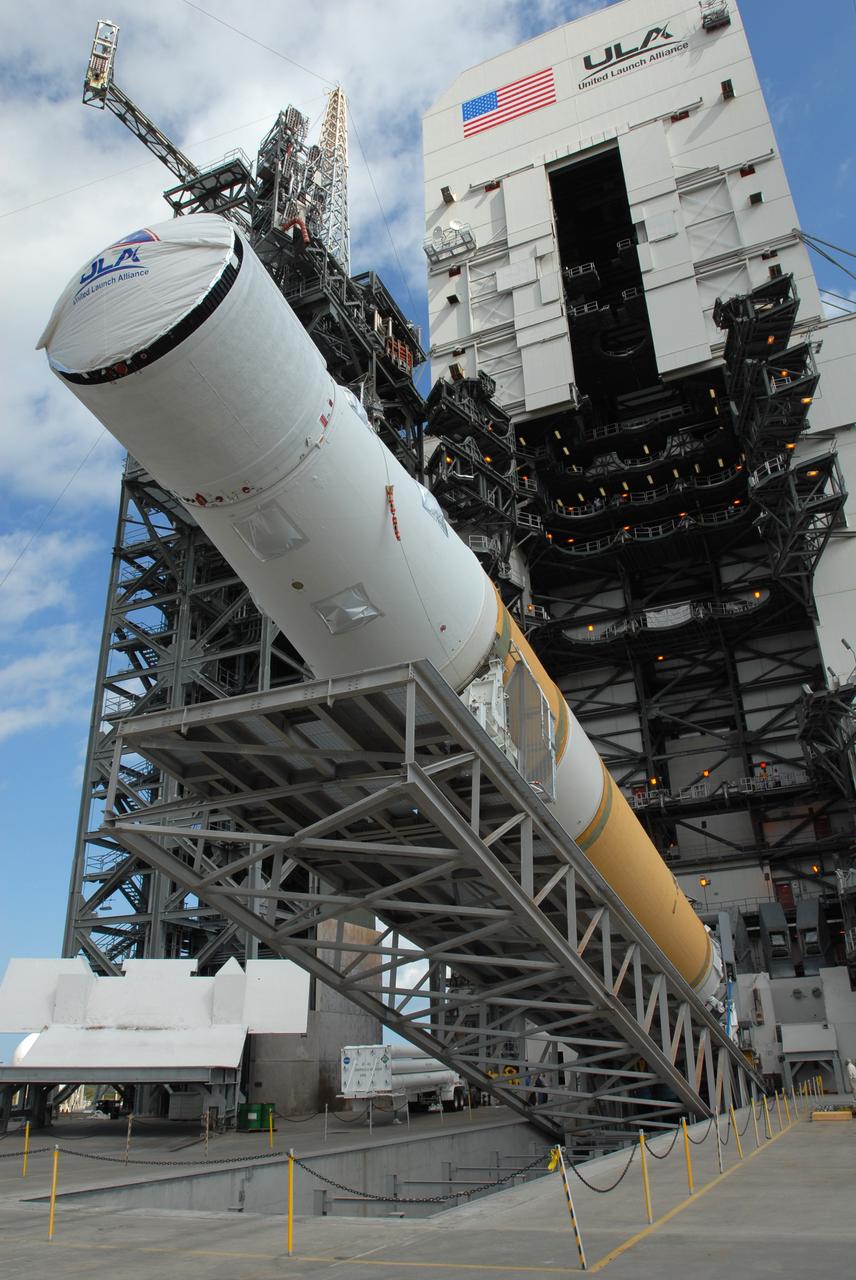
CAPE CANAVERAL, Fla. – On Launch Pad 37 at Cape Canaveral Air Force Station in Florida, the GOES-O and Delta IV upper stage are being raised to vertical. They will be moved into the mobile service tower for prelaunch preparations. GOES–O is one of a series of Geostationary Operational Environmental Satellites. The multi-mission GOES series N-P will be a vital contributor to weather, solar and space operations and science. NASA and the National Oceanic and Atmospheric Administration, or NOAA, are actively engaged in a cooperative program to expand the existing GOES system with the launch of the GOES N-P satellites. Launch of the GOES-O is targeted for no earlier than April 2009. Photo credit: NASA/Jim Grossmann
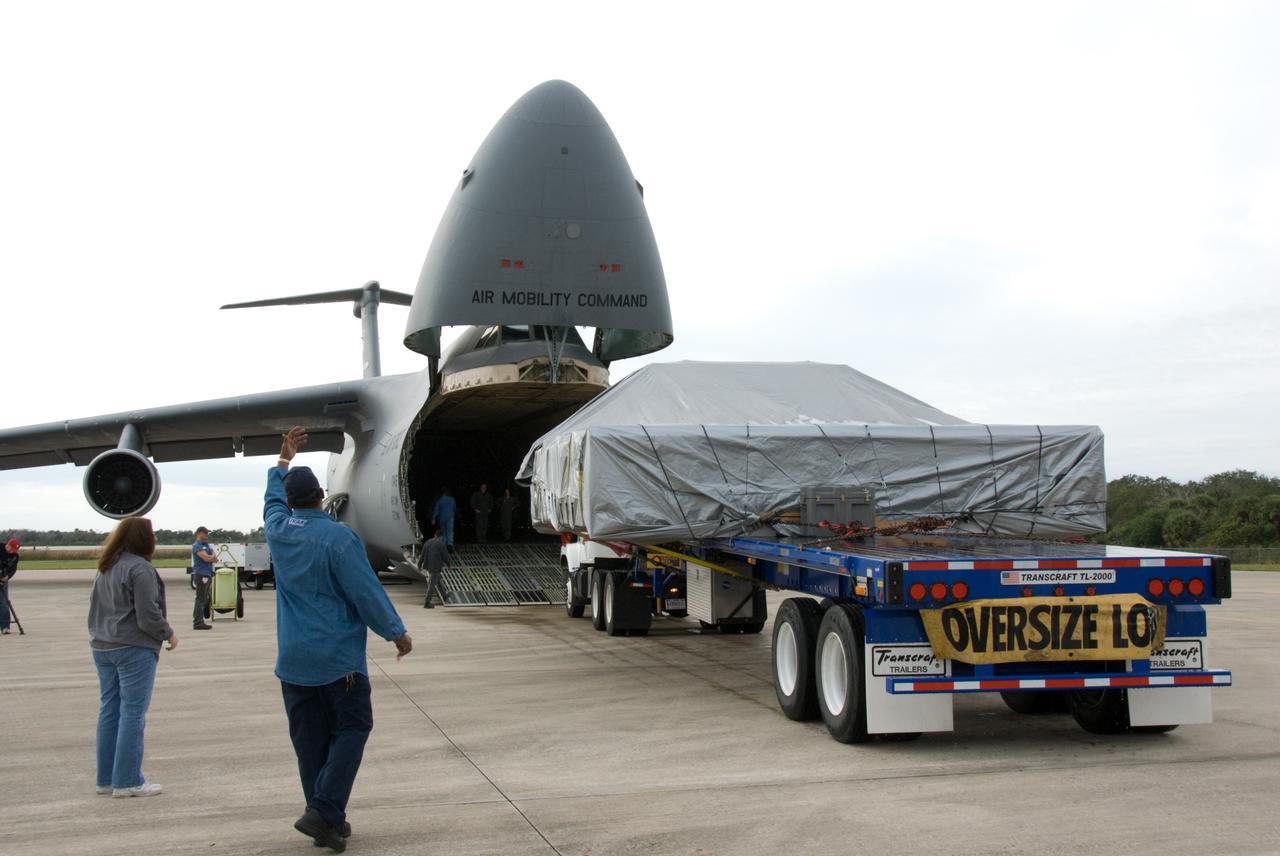
CAPE CANAVERAL, Fla. - At the Shuttle Landing Facility at NASA's Kennedy Space Center in Florida, the ExPRESS Logistics Carrier 3, or ELC-3, is removed from the cargo compartment of a U.S. Air Force C-5 aircraft. ELC-3 and the Alpha Magnetic Spectrometer are the primary payloads for space shuttle Endeavour's STS-134 mission to the International Space Station. The STS-134 crew will also deliver spare parts including two S-band communications antennas, a high pressure gas tank, additional spare parts for Dextre and micrometeoroid debris shields. Endeavour's launch is targeted for July 29, 2010. For information on the STS-134 mission objectives and crew, visit http://www.nasa.gov/shuttle. Photo credit: NASA/Kim Shiflett

SSATA Crew Training and EMU Verification for STS-128 crew member Danny Olivas during suited dry run. Test Directors: Cristina Anchondo and Laura Campbell. Photo Date: April 22, 2009. Location: Building 7 - SSATA Chamber. Photographer: Robert Markowitz
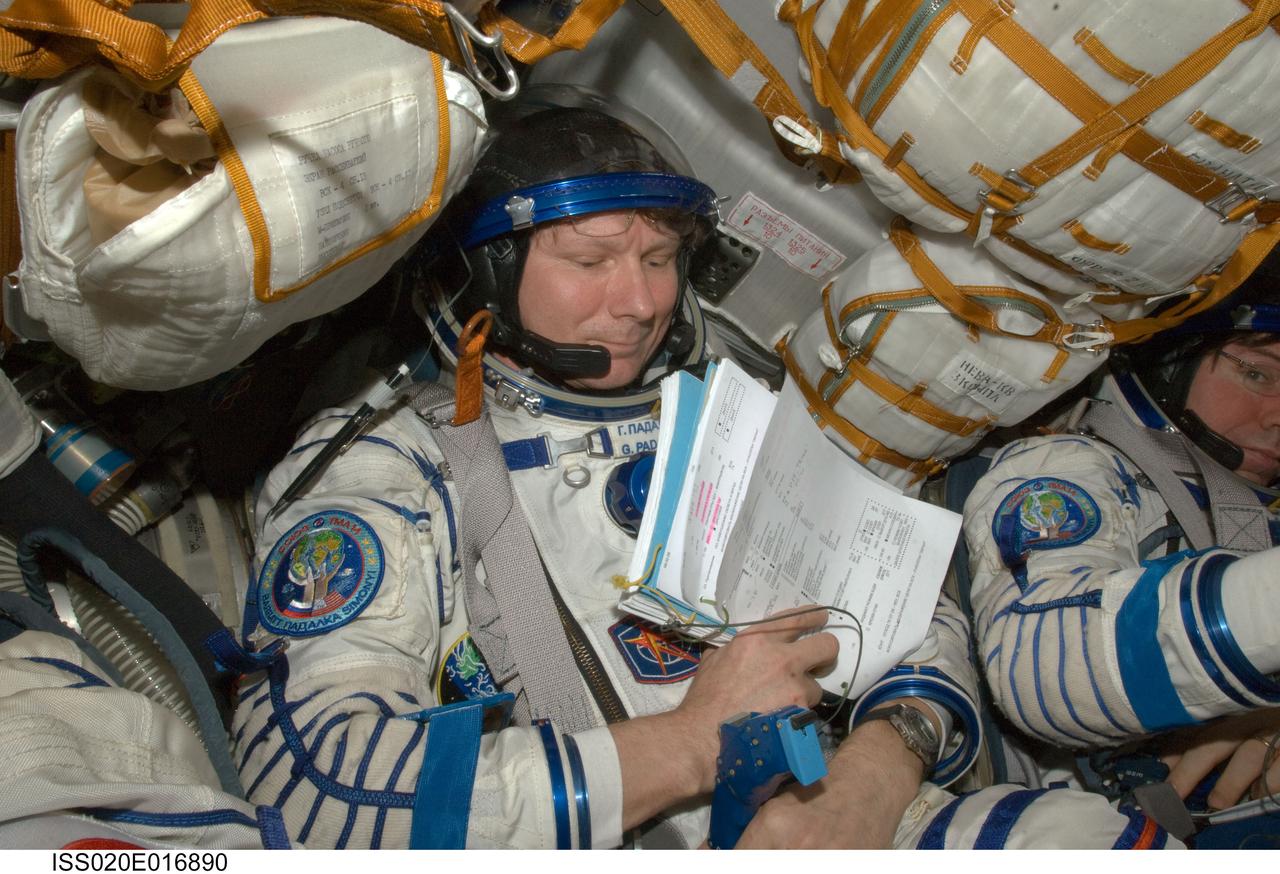
ISS020-E-016890 (2 July 2009) --- Cosmonaut Gennady Padalka, Expedition 20 commander, attired in a Russian Sokol launch and entry suit, occupies his seat in the Soyuz TMA-14 during final preparations for the relocation of the Soyuz from the Zvezda Service Module’s aft port to the Pirs Docking Compartment of the International Space Station.

ISS018-E-038072 (4 March 2009) --- Cosmonaut Yury Lonchakov, Expedition 18 flight engineer, eats a meal near the galley in the Zvezda Service Module of the International Space Station.
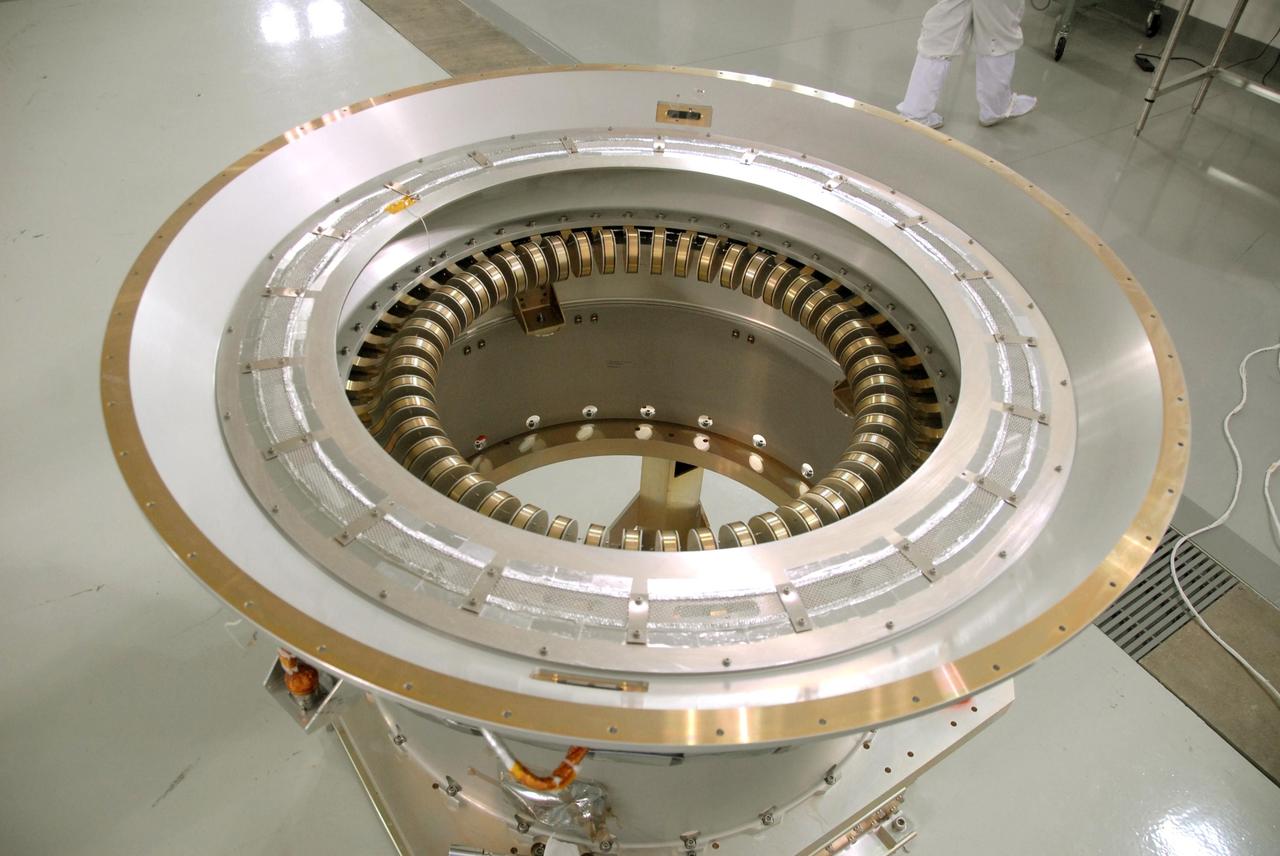
A view of the flexure springs in the soft ride being mated to the payload attach fitting for NASA Wide-field Infrared Survey Explorer, or WISE, spacecraft.
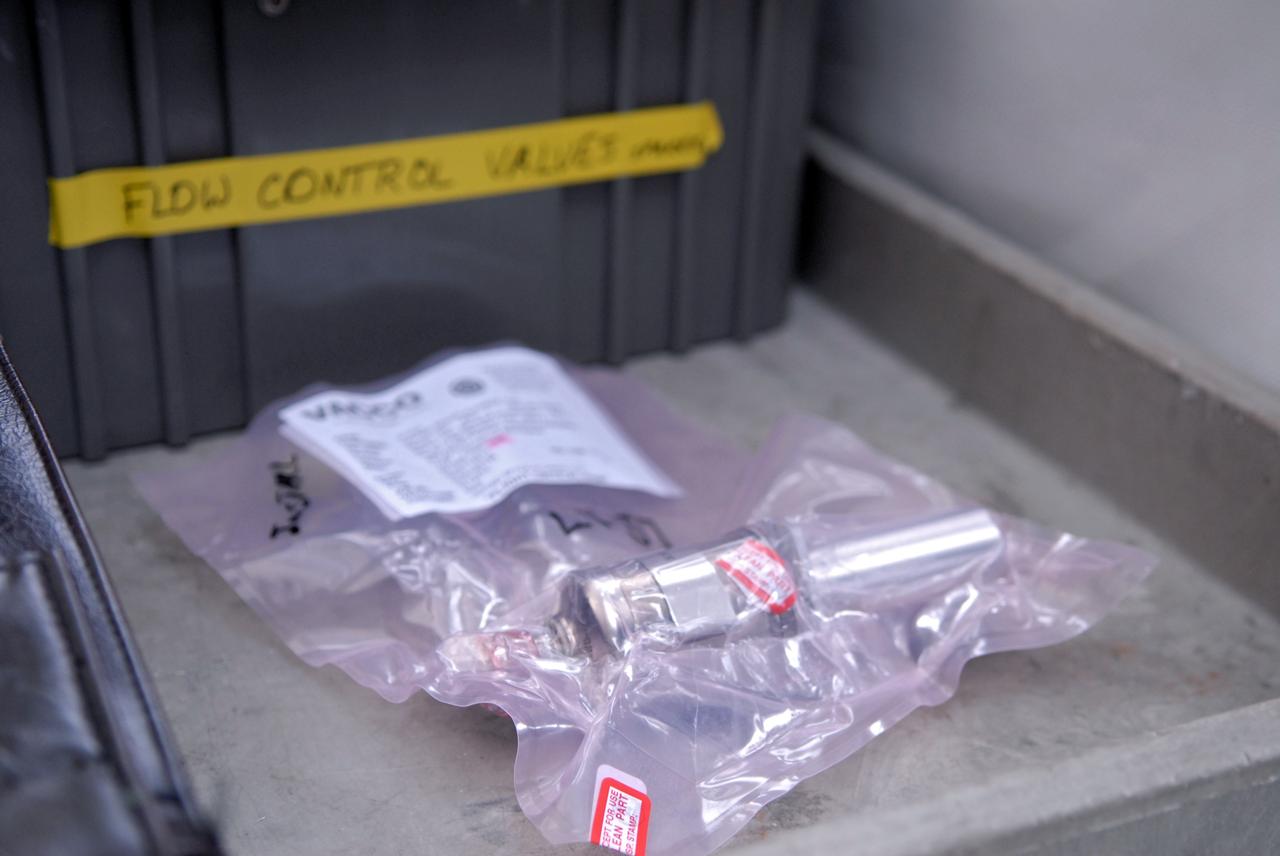
CAPE CANAVERAL, Fla. – One of the three thoroughly inspected gaseous hydrogen flow control valves is shown after its arrival at NASA's Kennedy Space Center in Florida. Technicians installed and retested them in space shuttle Discovery. Part of the main propulsion system, the valves channel gaseous hydrogen from the main engines to the external tank. NASA and contractor teams have worked to identify what caused damage to a flow control valve on shuttle Endeavour during its November 2008 flight. Space Shuttle Program managers decided to replace Discovery's valves with others that have undergone a detailed eddy current inspection. Program managers will review the testing and determine whether to meet on March 6 for the Flight Readiness Review for the STS-119 mission. Launch of Discovery tentatively is targeted for March 12. Photo credit: NASA/Chris Rhodes
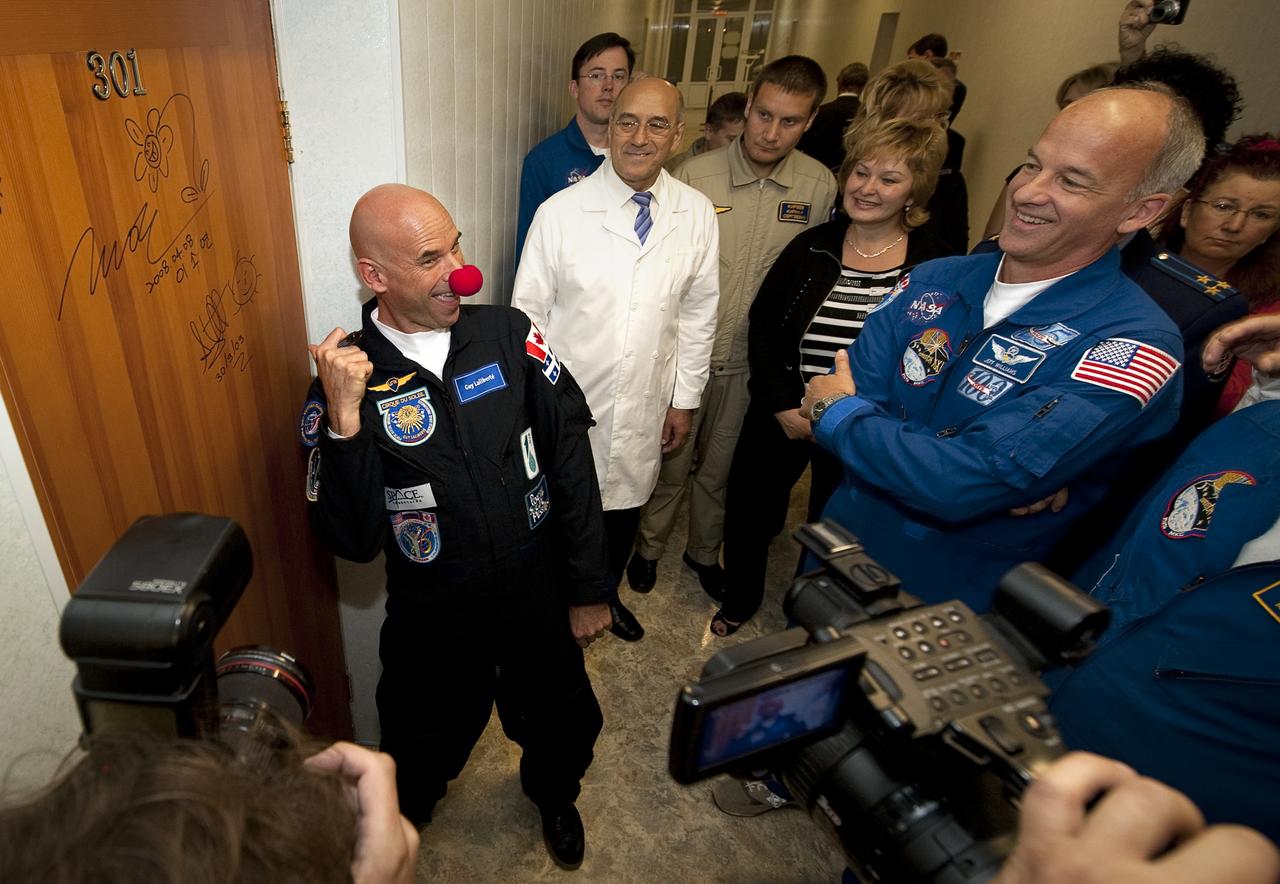
Spaceflight Participant Guy Laliberté jokes after performing the traditional door signing Wednesday, Sept. 30, 2009 at the Cosmonaut Hotel in Baikonur, Kazakhstan. Lalibreté was launched onboard the Soyuz rocket later that day with Expedition 21 Flight Engineer Expedition 21 Flight Engineer Jeffrey N. Williams and Expedition 21 Flight Engineer Maxim Suraev and on a mission to the International Space Station (ISS). Photo Credit: (NASA/Bill Ingalls)

Vandenberg Air Force Base, Calif. – In the Astrotech Payload Processing Facility at Vandenberg Air Force Base in California, a technician monitors data during fueling of NASA's Orbiting Carbon Observatory, or OCO, with hydrazine thruster control propellant. The OCO is a new Earth-orbiting mission sponsored by NASA's Earth System Science Pathfinder Program. The OCO mission will collect precise global measurements of carbon dioxide (CO2) in the Earth's atmosphere. Scientists will analyze OCO data to improve our understanding of the natural processes and human activities that regulate the abundance and distribution of this important greenhouse gas. This improved understanding will enable more reliable forecasts of future changes in the abundance and distribution of CO2 in the atmosphere and the effect that these changes may have on the Earth's climate. The launch of OCO is scheduled for Feb. 23 from Vandenberg. Photo credit: Robert Hargreaves Jr., VAFB
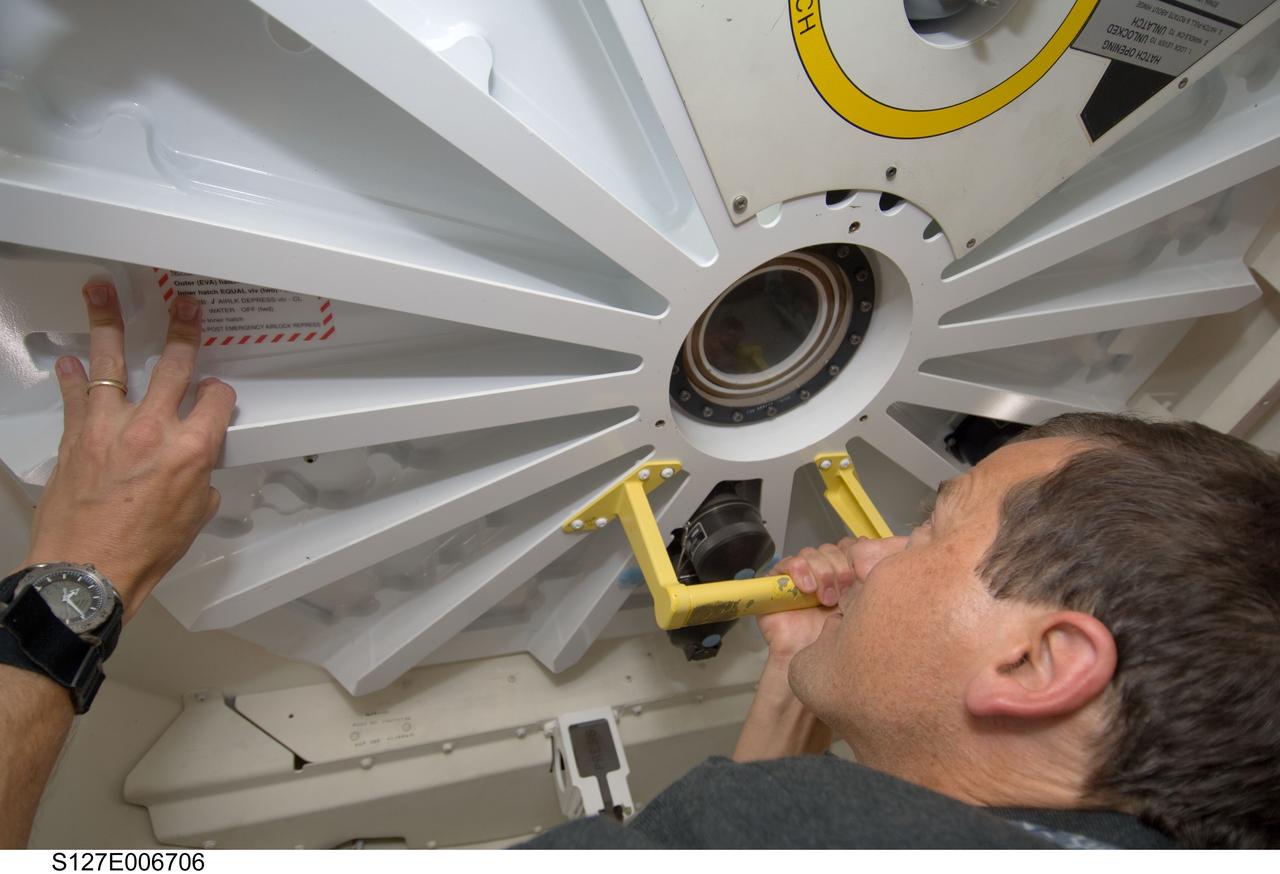
S127-E-006706 (17 July 2009) --- Astronaut Tom Marshburn, STS-127 mission specialist, peers through a window in the hatch that separates seven Endeavour crewmembers from six International Space Station inhabitants. But the separation wasn't for long, as soon afterward the hatch was opened and the visitors from Earth moved onto the station to set the population record at 13. More importantly, over a week's worth of joint activities lies ahead for the two crews.
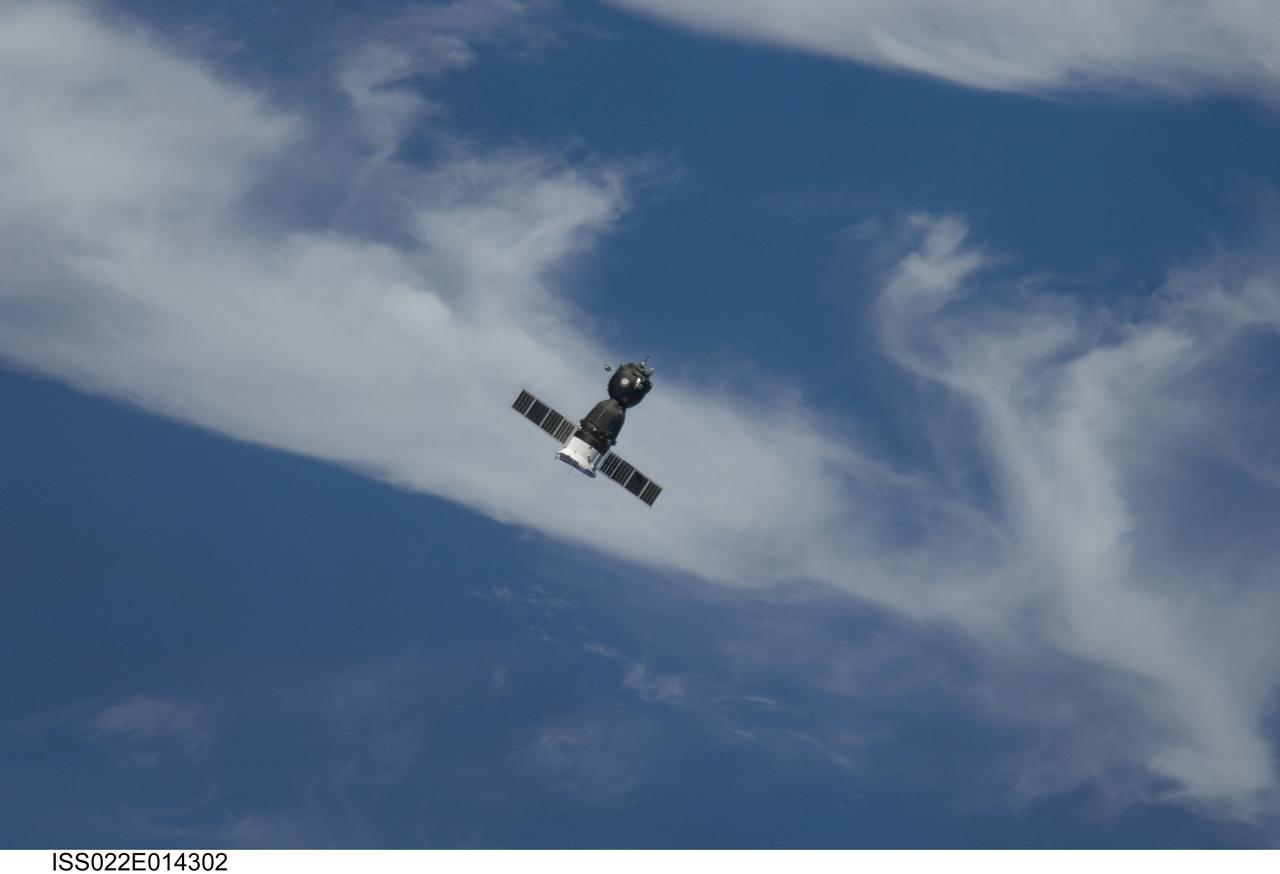
ISS022-E-014302 (22 Dec. 2009) --- The Soyuz TMA-17 spacecraft approaches the International Space Station, carrying Russian cosmonaut Oleg Kotov, Soyuz commander and Expedition 22 flight engineer; along with NASA astronaut T.J. Creamer and Japan Aerospace Exploration Agency astronaut Soichi Noguchi, both flight engineers. Docking to the Zarya nadir port occurred at 4:48 p.m. (CST) on Dec. 22, 2009. The trio launched aboard the Soyuz TMA-17 spacecraft at 3:52 p.m. on Dec. 20 from the Baikonur Cosmodrome in Kazakhstan.
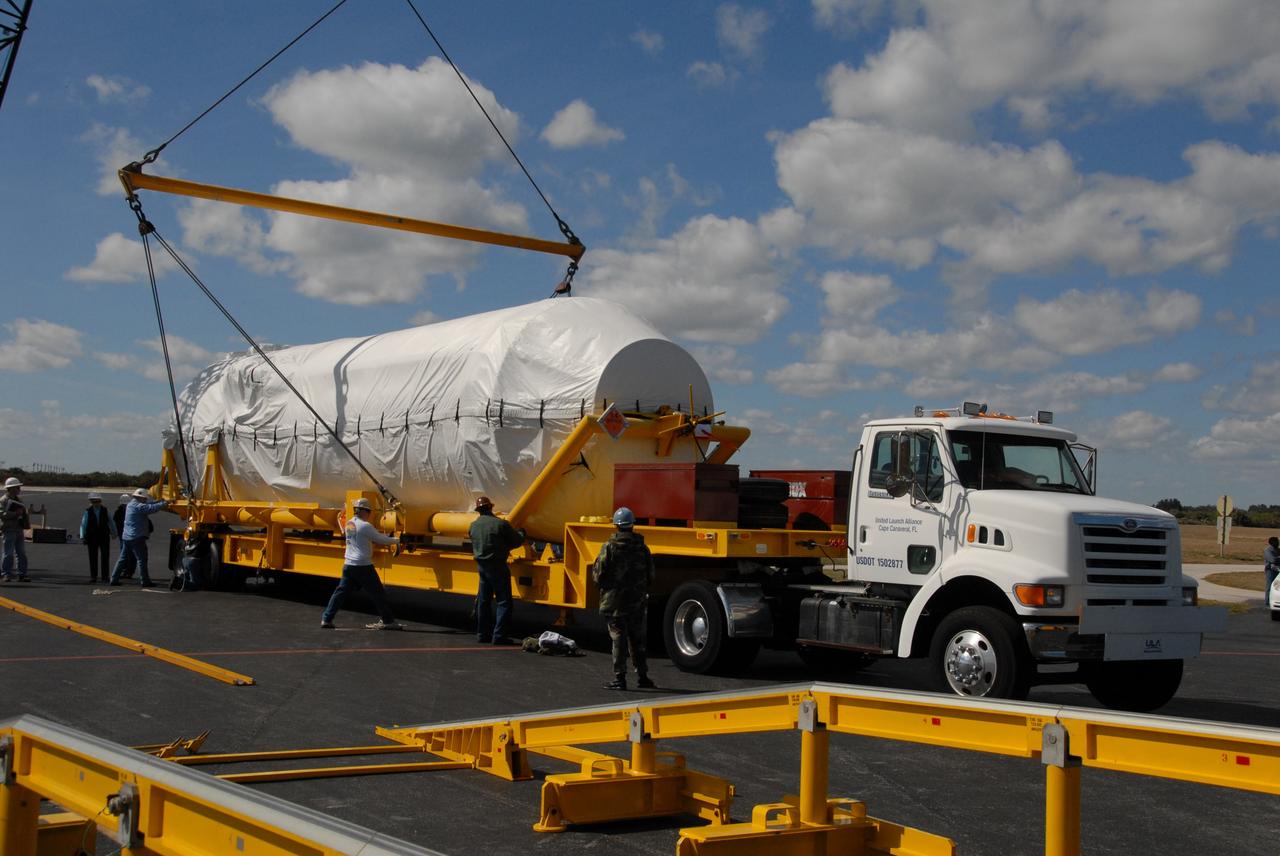
CAPE CANAVERAL, Fla. – With workers assisting, a crane places the Centaur stage of the Atlas V rocket on a flatbed truck on Cape Canaveral Air Force Station's skid strip in Florida. The Centaur will be transported to the Astrotech facility in Titusville, Fla. The Atlas V will launch NASA's Lunar Reconnaissance Orbiter, or LRO, and NASA's Lunar CRater Observation and Sensing Satellite, known as LCROSS. The two spacecraft will be integrated with the Atlas V and tested for final flight worthiness. Launch is scheduled for the spring. LCROSS and LRO are the first missions in NASA's plan to return humans to the moon and begin establishing a lunar outpost by 2020. Photo credit: NASA/Cory Huston

S127-E-007978 (22 July 2009) Astronauts Christopher Cassidy (left) and Dave Wolf work with the Integrated Cargo Carrier-VLD, as they remove and replace batteries on the P6 truss during STS-127's third session of extravehicular activity.
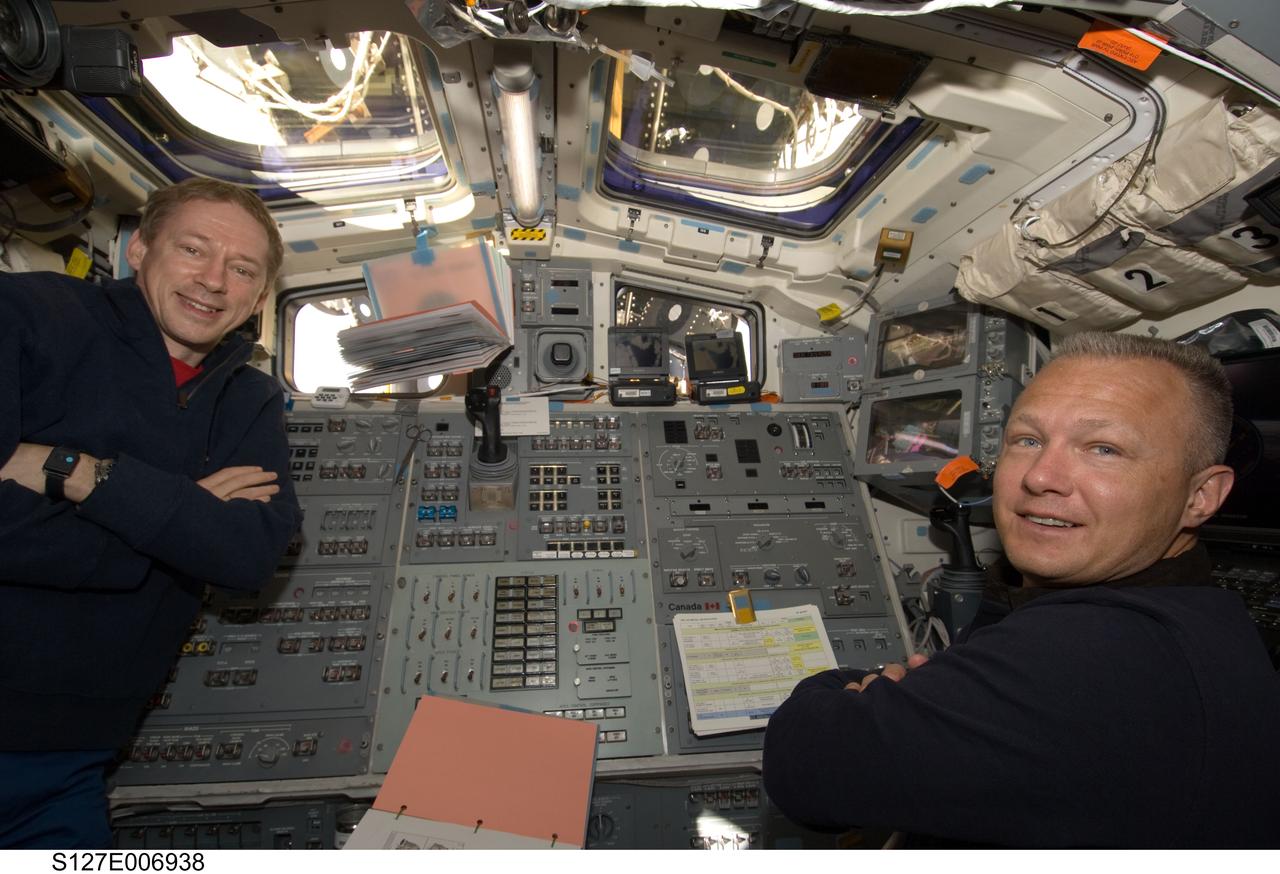
S127-E-006938 (19 July 2009) --- European Space Agency astronaut Frank De Winne (left), Expedition 20 flight engineer, and Doug Hurley, STS-127 pilot, are pictured at Endeavour's aft flight deck controls during flight day five operations with hardware on the International Space Station. The hardware moves conducted by astronauts Mark Polansky (out of frame), commander, and Hurley, in tandem with crew members onboard the station, will enable the second pair of spacewalkers--mission specialists Dave Wolf and Tom Marshburn--to perform its spacewalk assignment on July 20.
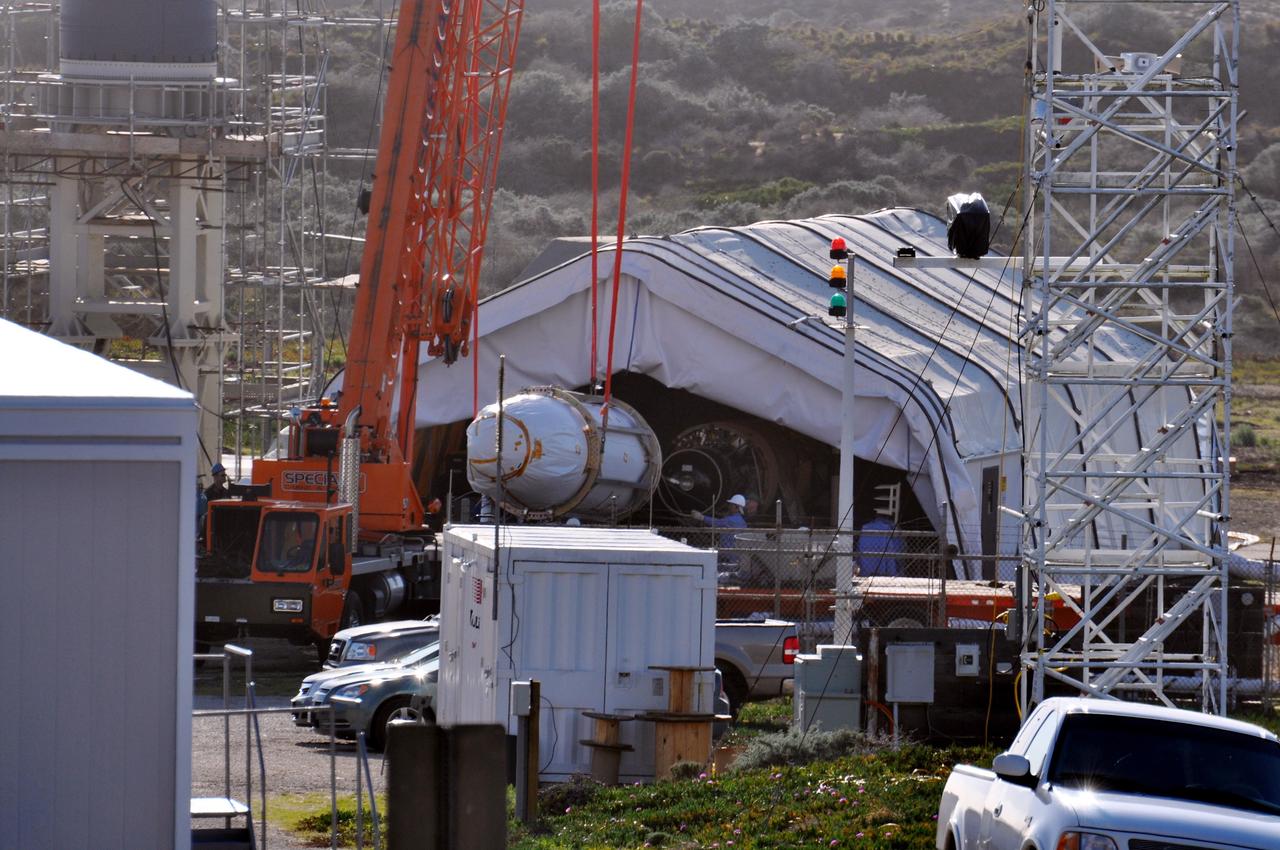
VANDENBERG AIR FORCE BASE, Calif. -- The Encapsulated Cargo Element (ECE) containing NASA's Orbiting Carbon Observatory, or OCO, is lowered to a horizontal position after arrival at Space Launch Complex 576-E at Vandenberg Air Force Base in California. The spacecraft is scheduled for launch aboard Orbital Sciences' Taurus XL rocket on Feb. 23 from Vandenberg. The spacecraft will collect precise global measurements of carbon dioxide (CO2) in the Earth's atmosphere. Scientists will analyze OCO data to improve our understanding of the natural processes and human activities that regulate the abundance and distribution of this important greenhouse gas. This improved understanding will enable more reliable forecasts of future changes in the abundance and distribution of CO2 in the atmosphere and the effect that these changes may have on the Earth's climate. Photo credit: NASA/Randy Beaudoin, VAFB

CAPE CANAVERAL, Fla. – In the Space Station Processing Facility at NASA's Kennedy Space Center in Florida, the Multi-Purpose Logistics Module Leonardo moves above the floor toward the payload canister, just visible at far right. The canister will transport the module to Launch Pad 39A for installation in space shuttle Discovery for the STS-128 mission. The module will carry science and storage racks to the International Space Station. Launch is targeted for Aug. 18. Photo credit: NASA/Jack Pfaller
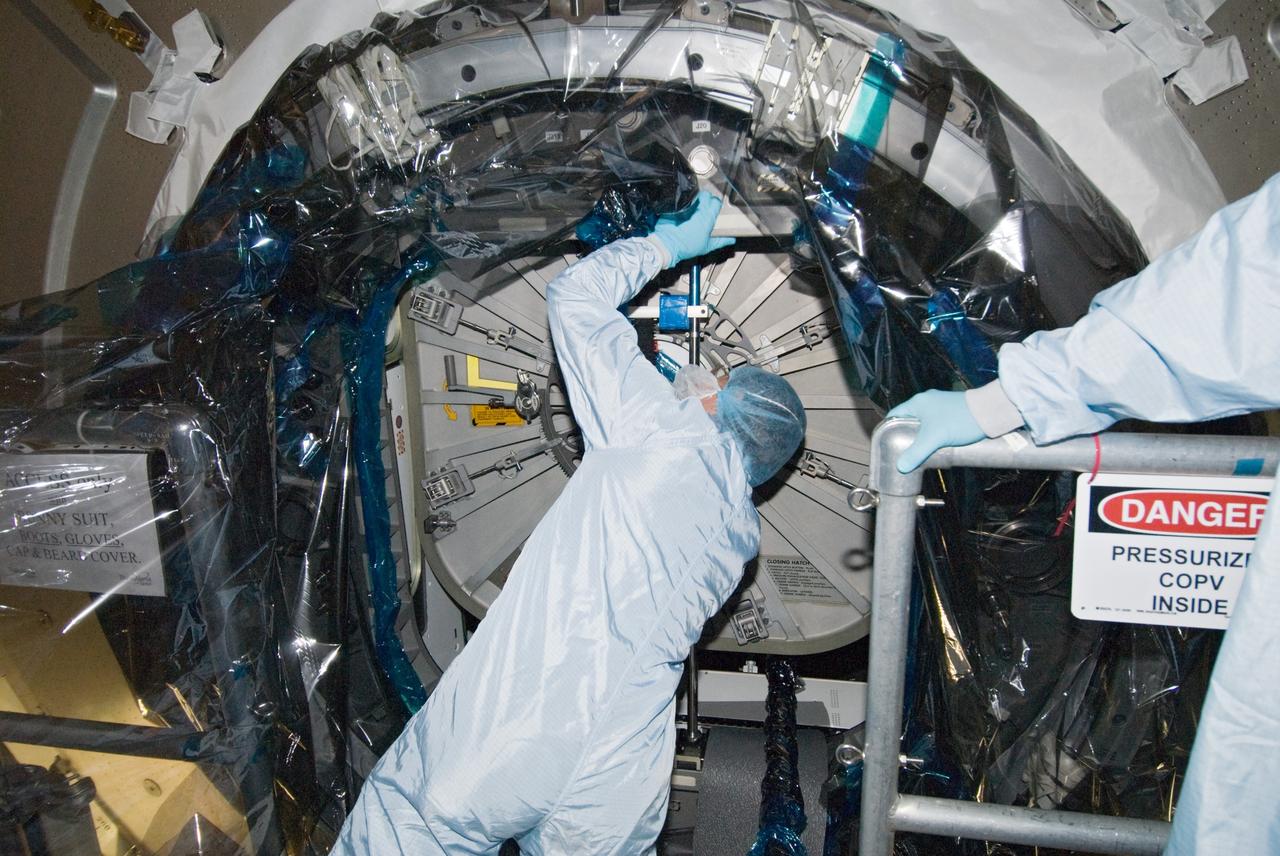
CAPE CANAVERAL, Fla. – In the Space Station Processing Facility at NASA's Kennedy Space Center in Florida, a payload technician dressed in clean room attire, known as a bunny suit, secures the hatch on the International Space Station's Node 3, named Tranquility. Hatch closure follows the completion of preparations for the node's transport to the pad and is a significant milestone in launch processing activities. The primary payload for the STS-130 mission, Tranquility is a pressurized module that will provide room for many of the space station's life support systems. Attached to one end of Tranquility is a cupola, a unique work area with six windows on its sides and one on top. The cupola resembles a circular bay window and will provide a vastly improved view of the station's exterior. The multi-directional view will allow the crew to monitor spacewalks and docking operations, as well as provide a spectacular view of Earth and other celestial objects. The module was built in Turin, Italy, by Thales Alenia Space for the European Space Agency. Space shuttle Endeavour's STS-130 mission is targeted for launch in early February 2010. For information on the STS-130 mission and crew, visit http://www.nasa.gov/mission_pages/shuttle/shuttlemissions/sts130/index.html. Photo credit: NASA/Amanda Diller

CAPE CANAVERAL, Fla. – At Astrotech Space Operations in Titusville, Fla., workers move a work stand into position to hold NASA's Solar Dynamics Observatory, or SDO, in the background. SDO is the first space weather research network mission in NASA's Living With a Star Program. The spacecraft's long-term measurements will give solar scientists in-depth information about changes in the sun's magnetic field and insight into how they affect Earth. In preparation for its anticipated November launch, engineers will perform a battery of comprehensive tests to ensure SDO can withstand the stresses and vibrations of the launch itself, as well as what it will encounter in the space environment after launch. Photo credit: NASA/Cory Huston
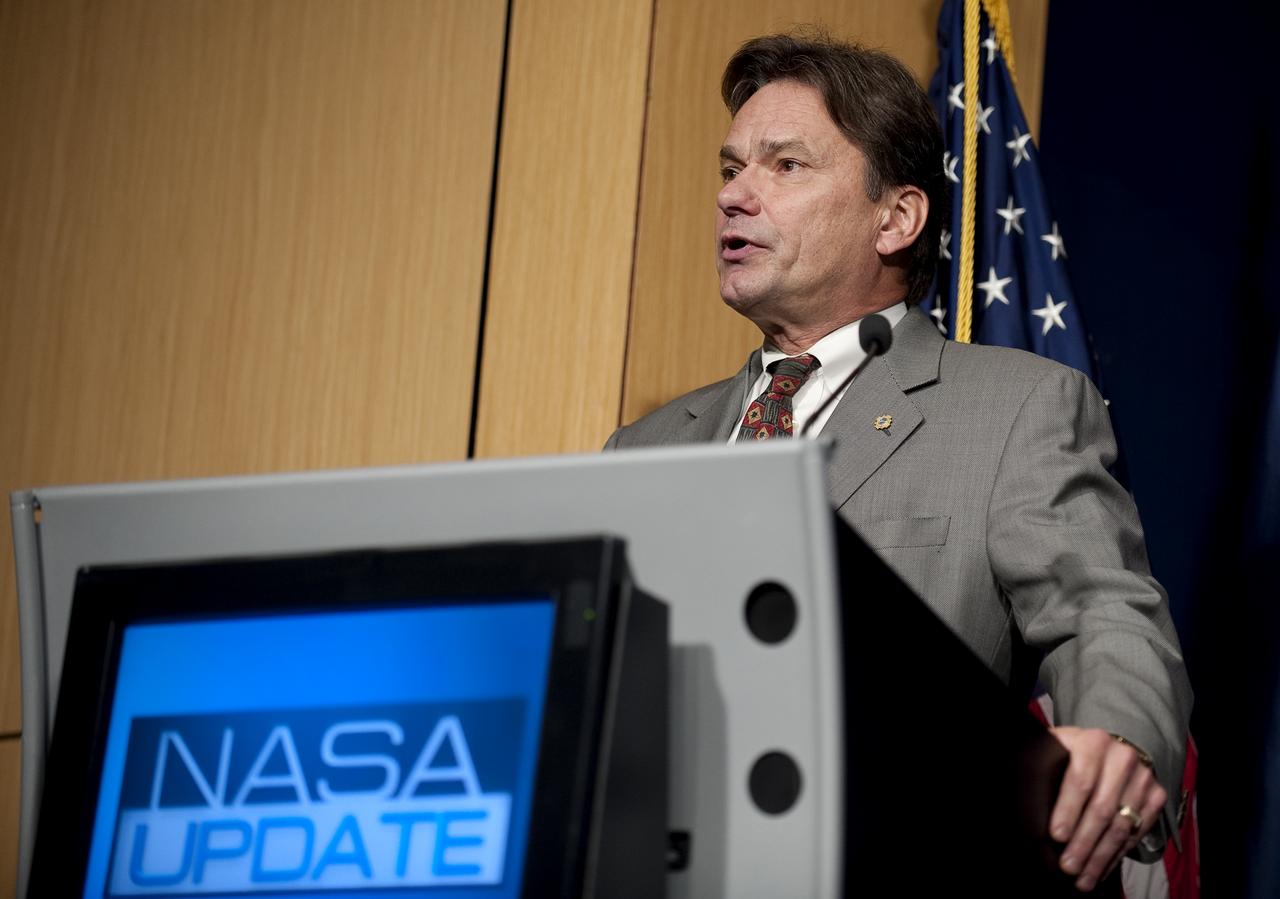
Alan Ladwig, Senior Advisor to the NASA Administrator, introduces Administrator Charles F. Bolden Jr. and Deputy Administrator Lori Garver at a NASA Update,Tuesday, July 21, 2009, at NASA Headquarters in Washington. Bolden, the agency's 12th Administrator and Garver took the time to introduce themselves and outline their vision for the agency going forward. No questions were taken during the session. Photo Credit: (NASA/Bill Ingalls)
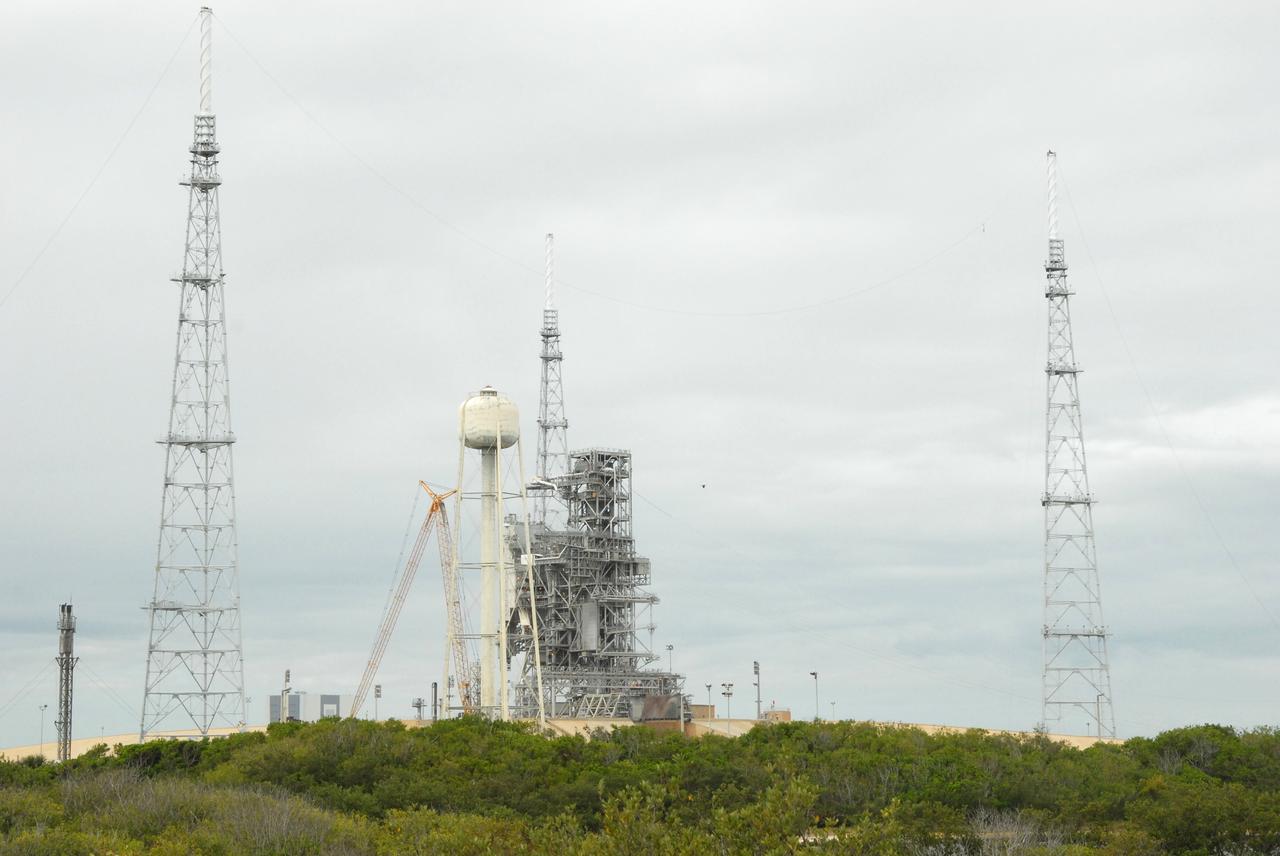
CAPE CANAVERAL, Fla. – On Launch Pad 39B at NASA's Kennedy Space Center in Florida, catenary wires are being suspended from the lighting masts on the lightning towers. The catenary wire system under development for the Constellation Program’s next-generation vehicles will significantly increase the shielding level, providing better protection, and further separate the electrical current from vital launch hardware. The system will help avoid delays to the launch schedule by collecting more information on the strike for analysis by launch managers. Photo credit: NASA/Jack Pfaller
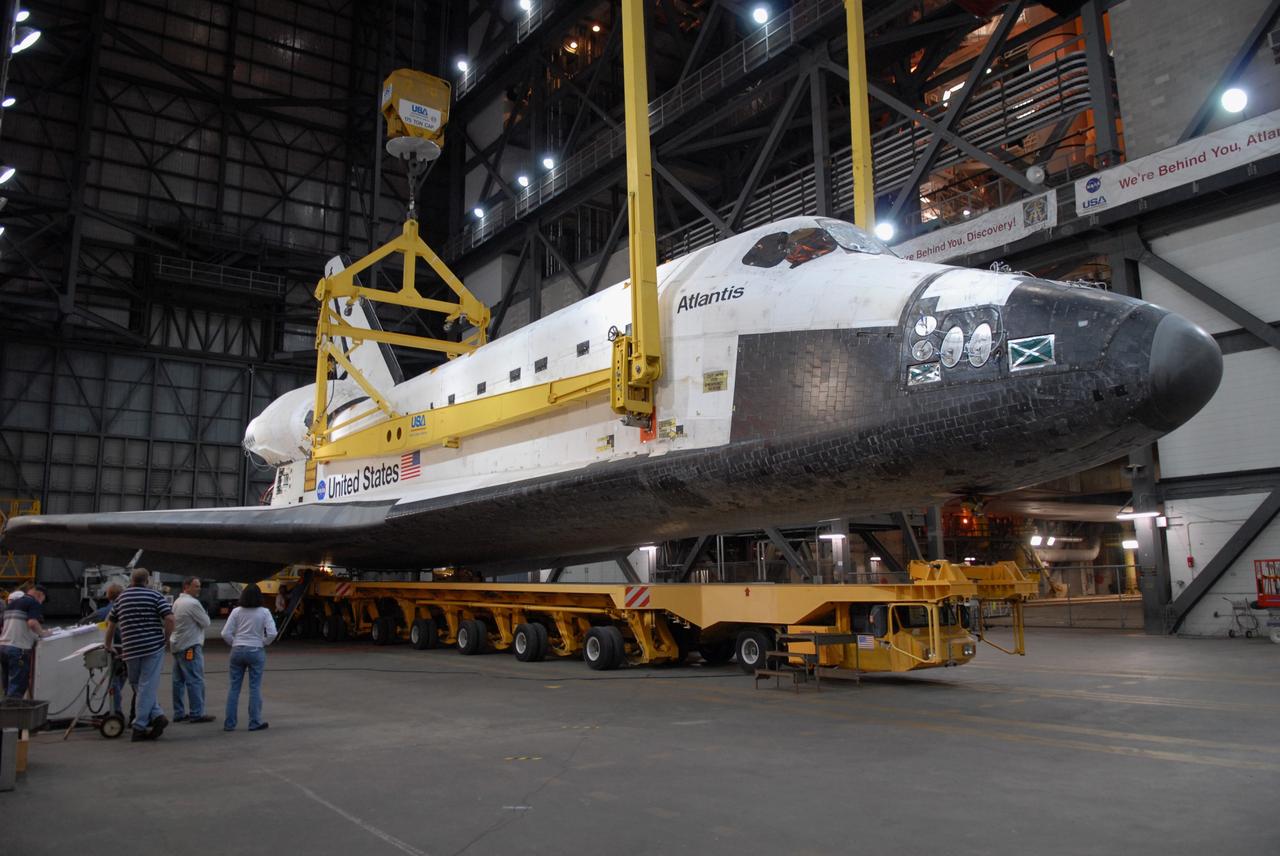
CAPE CANAVERAL, Fla. – In the Vehicle Assembly Building at NASA's Kennedy Space Center in Florida, space shuttle Atlantis is lifted off its transporter in the transfer aisle. The shuttle will be raised to a vertical position and lifted into High Bay 3 where it will be attached to its external fuel tank and solid rocket boosters on the mobile launcher platform. After additional preparations are made, the shuttle will be rolled out to Launch Pad 39A for a targeted launch on May 12 on the STS-125 Hubble servicing mission. Photo credit: NASA/Cory Huston
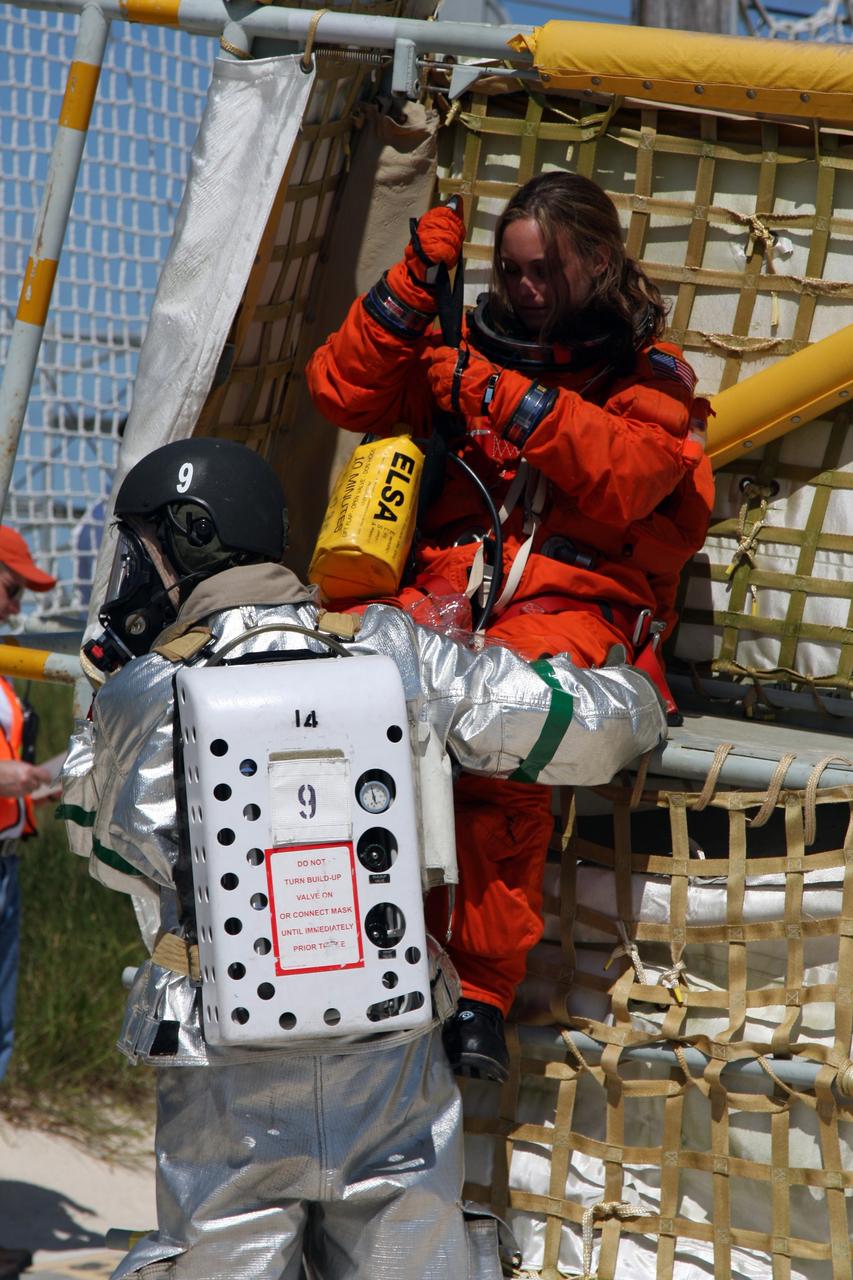
CAPE CANAVERAL, Fla. – At the Launch Pad 39A slidewire basket landing site at NASA's Kennedy Space Center in Florida, a Mode II-IV exercise is underway, involving NASA fire rescue personnel, volunteers portraying astronauts with simulated injuries, helicopters and personnel from the Air Force’s 920th Rescue Wing and medical trauma teams at three central Florida hospitals. The drill allows teams to practice an emergency response at Pad 39A, including helicopter evacuation to local hospitals. The Space Shuttle Program and U.S. Air Force are conducting the emergency simulation. Photo credit: NASA/Dimitri Gerondidakis
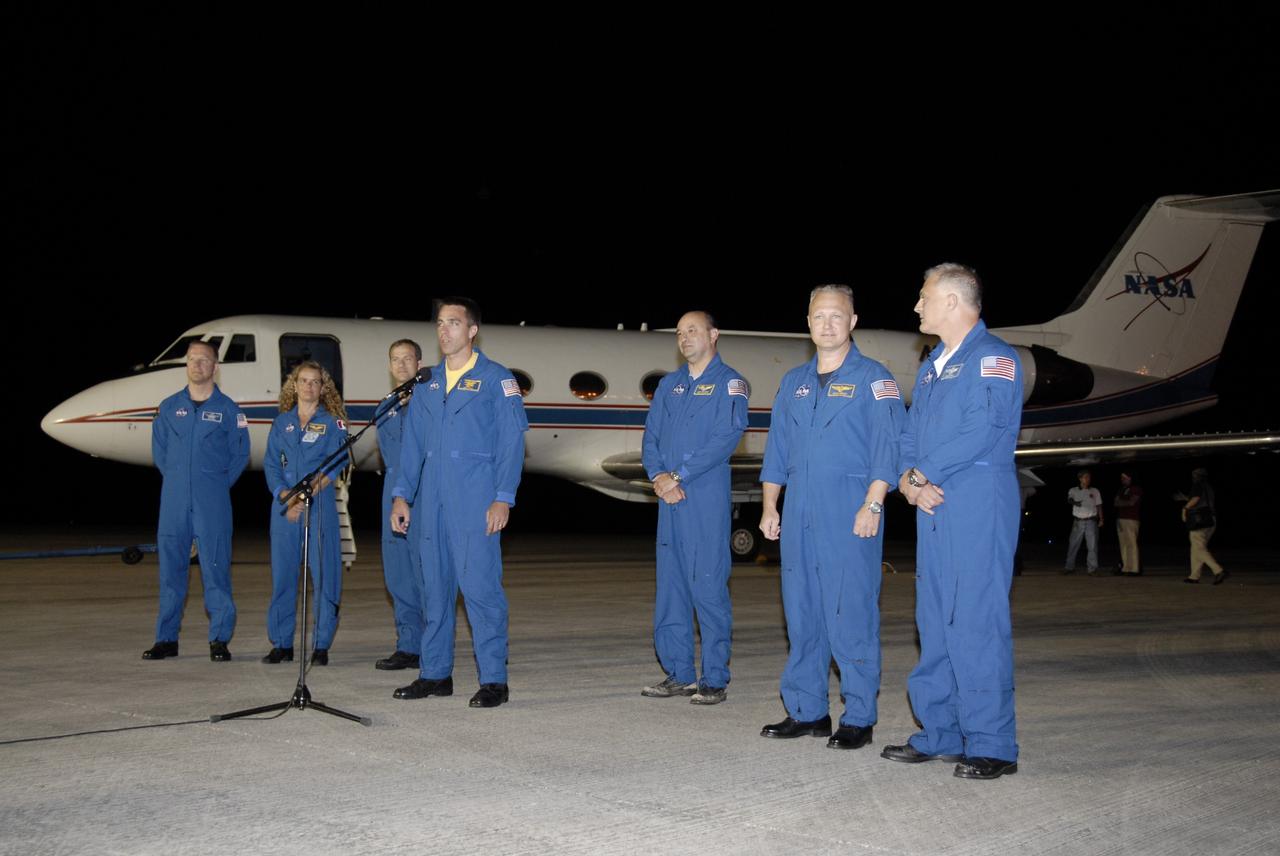
CAPE CANAVERAL, Fla. – At the Shuttle Landing Facility, STS-127 Mission Specialist Christopher Cassidy, at microphone, addresses the media and those on hand to welcome the STS-127 crew to NASA's Kennedy Space Center in Florida. Cassidy and the other members of the crew arrived from Houston aboard the Shuttle Training Aircraft in the background to get ready for launch on space shuttle Endeavour on June 13. From left are Mission Specialists Tim Kopra, Julie Payette of the Canadian Space Agency, and Tom Marshburn; Mission Specialist Christopher Cassidy; Commander Mark Polansky; Pilot Doug Hurley; and Mission Specialist Dave Wolf. The STS-127 mission is the final of three flights dedicated to the assembly of the Japan Aerospace Exploration Agency's Kibo laboratory complex on the International Space Station. Endeavour will deliver the Japanese Experiment Module's Exposed Facility, or JEM-EF, and the Experiment Logistics Module-Exposed Section, or ELM-ES, to the space station on STS-127. Photo credit: NASA/Kim Shiflett
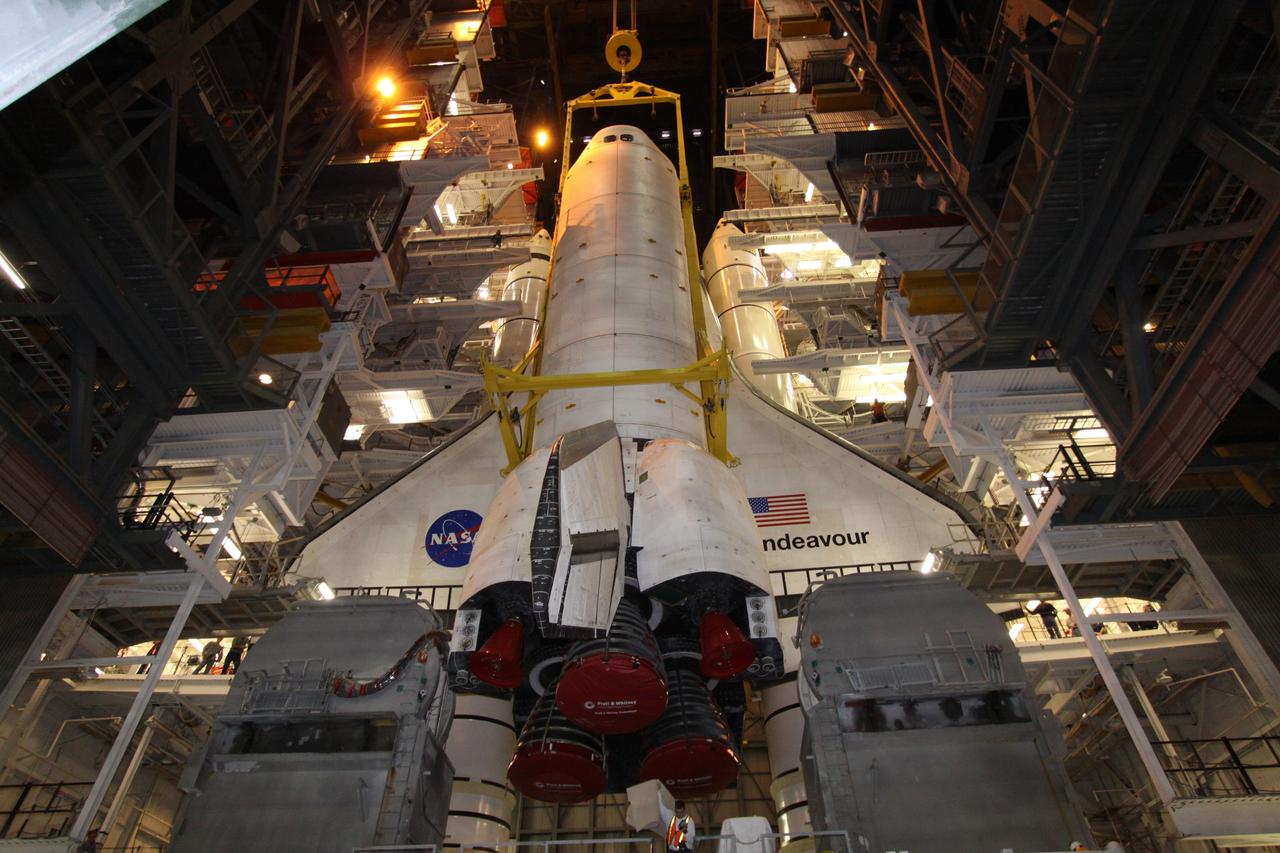
CAPE CANAVERAL, Fla. – In High Bay 1 in the Vehicle Assembly Building at NASA's Kennedy Space Center in Florida, space shuttle Endeavour hovers over the mobile launcher platform to which its external fuel tank and solid rocket boosters are secured. Next, Endeavour will be attached to the tank to complete the shuttle stack. Rollout of the stack to Kennedy’s Launch Pad 39A, a significant milestone in launch processing activities, is planned for early January 2010. The Italian-built Tranquility module, the primary payload for Endeavour's STS-130 mission, will be installed in the payload bay after the shuttle arrives at the pad. Launch is targeted for early February. For information on the STS-130 mission and crew, visit http://www.nasa.gov/mission_pages/shuttle/shuttlemissions/sts130/index.html. Photo credit: NASA/Jack Pfaller

S128-E-010157 (9 Sept. 2009) --- The thin line of Earth's atmosphere and the setting sun are featured in this image photographed by an STS-128 crew member on the Earth-orbiting Space Shuttle Discovery.
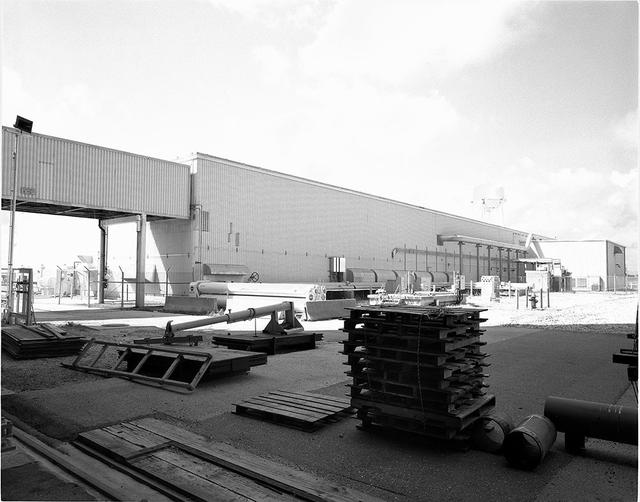
External view of the VAB Utility Annex

JSC2009-E-286678 (21 Dec. 2009) --- Astronaut Nicholas Patrick, STS-130 mission specialist, attired in a training version of his shuttle launch and entry suit, participates in a training session in the Mission Simulation Development Facility at NASA's Johnson Space Center.
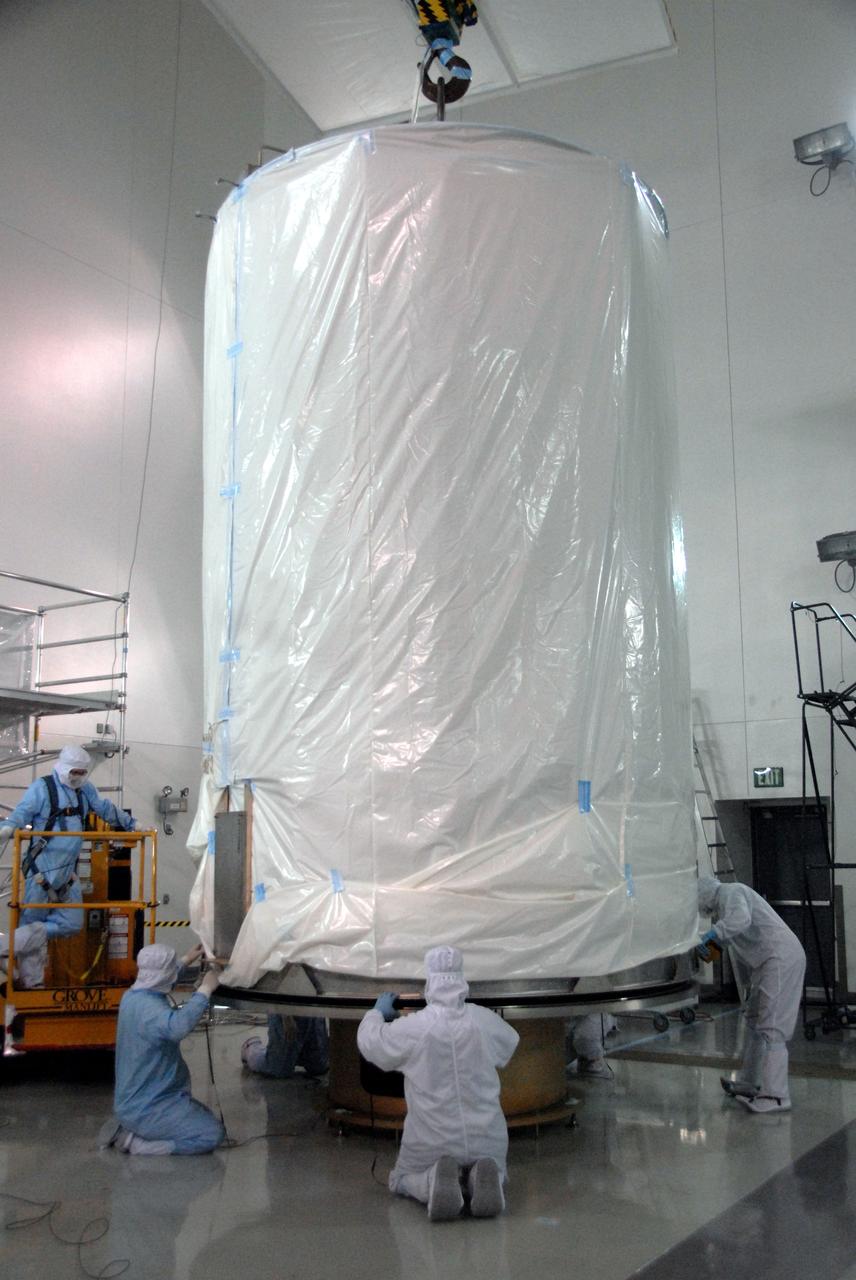
VANDENBERG AIR FORCE BASE, Calif. - At the Astrotech payload processing facility at Vandenberg Air Force Base in California, spacecraft technicians secure the transportation canister, in which NASA's Wide-field Infrared Survey Explorer, or WISE, is enclosed, to the direct mate adapter, a transport fixture, for the spacecraft's move to Space Launch Complex 2. WISE will survey the entire sky at infrared wavelengths, creating a cosmic clearinghouse of hundreds of millions of objects which will be catalogued and provide a vast storehouse of knowledge about the solar system, the Milky Way, and the universe. Launch aboard a United Launch Alliance Delta II rocket is scheduled for Dec. 9. For additional information, visit http://www.nasa.gov/wise. Photo credit: NASA/Daniel Liberotti, VAFB
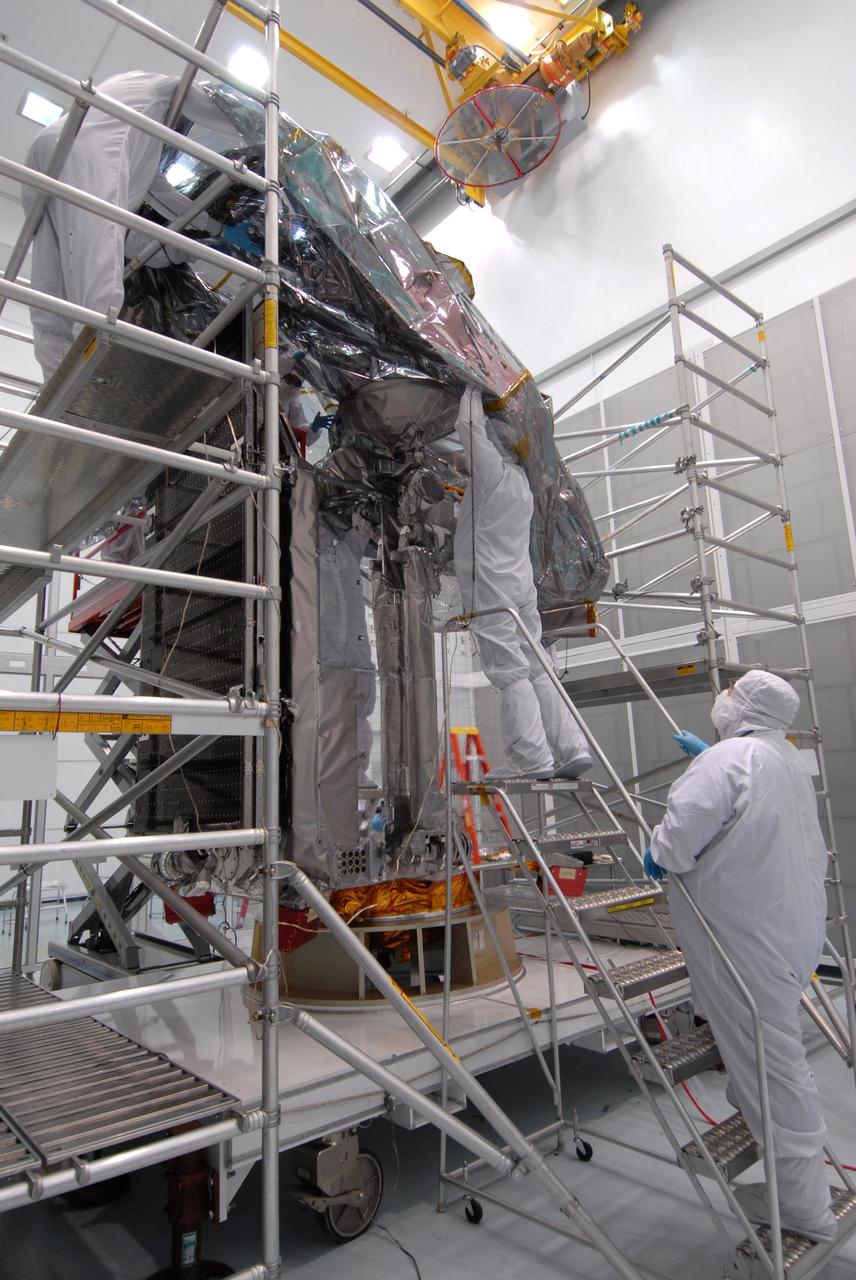
CAPE CANAVERAL, Fla. – At Astrotech Space Operations in Titusville, Fla., technicians begin placing the protective bag around the Lunar Reconnaissance Orbiter, or LRO, before it is mated with NASA's Lunar CRater Observation and Sensing Satellite, known as LCROSS, spacecraft. The satellite's primary mission is to search for water ice on the moon in a permanently shadowed crater near one of the lunar poles. LCROSS is a low-cost, accelerated-development, companion mission to NASA's Lunar Reconnaissance Orbiter, or LRO. LCROSS and LRO are the first missions in NASA's plan to return humans to the moon and begin establishing a lunar outpost by 2020. Launch is targeted for no earlier than June 2 from Cape Canaveral Air Force Station in Florida. Photo credit: NASA/Jack Pfaller
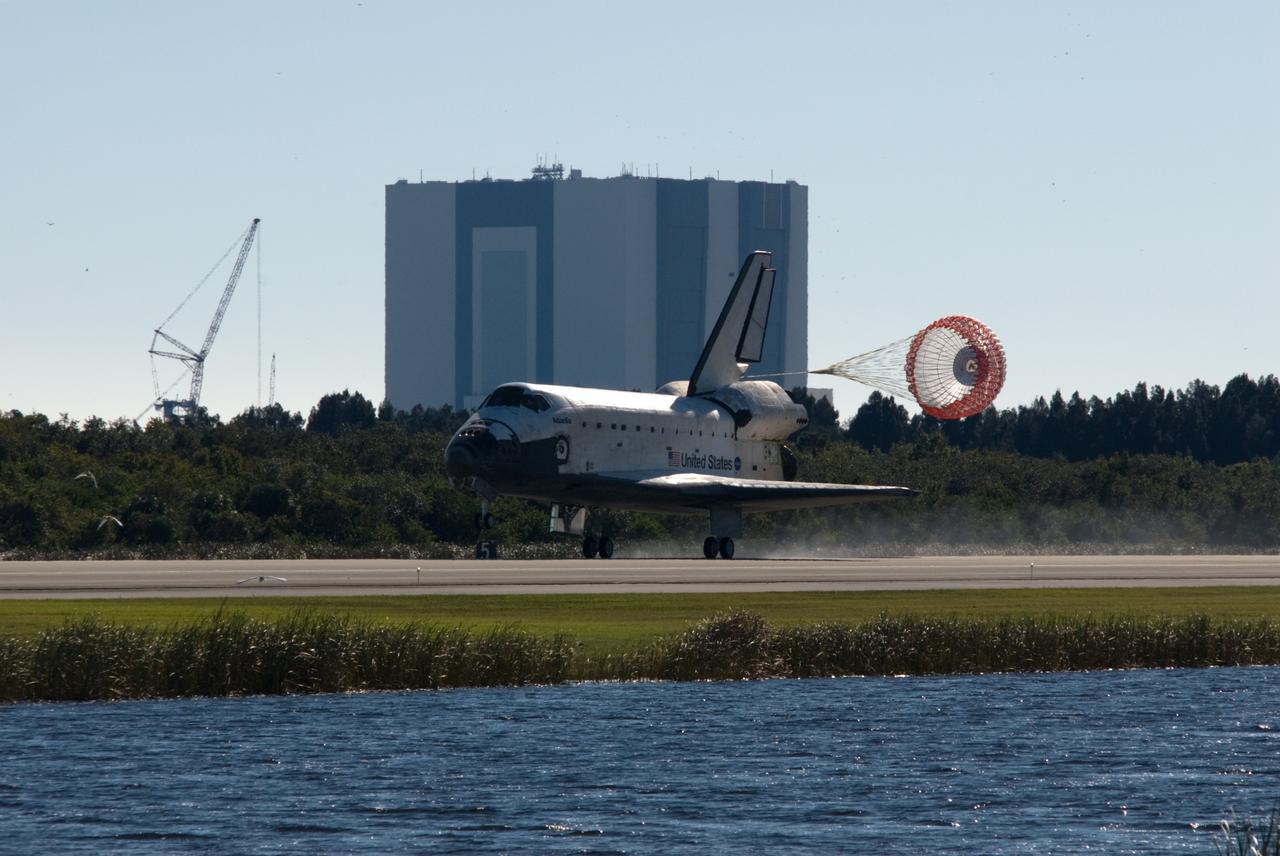
CAPE CANAVERAL, Fla. - With its drag chute unfurled, space shuttle Atlantis touches down on Runway 33 at the Shuttle Landing Facility at NASA's Kennedy Space Center in Florida after 11 days in space, completing the 4.5-million mile STS-129 mission on orbit 171. In the background are the 525-foot-tall Vehicle Assembly Building and a crane being used to construct a new mobile launcher to support the Constellation Program's Ares I rocket. Main gear touchdown was at 9:44:23 a.m. EST. Nose gear touchdown was at 9:44:36 a.m., and wheels stop was at 9:45:05 a.m. Aboard Atlantis are Commander Charles O. Hobaugh; Pilot Barry E. Wilmore; Mission Specialists Leland Melvin, Randy Bresnik, Mike Foreman and Robert L. Satcher Jr.; and Expedition 20 and 21 Flight Engineer Nicole Stott who spent 87 days aboard the International Space Station. STS-129 is the final space shuttle Expedition crew rotation flight on the manifest. On STS-129, the crew delivered 14 tons of cargo to the orbiting laboratory, including two ExPRESS Logistics Carriers containing spare parts to sustain station operations after the shuttles are retired next year. For information on the STS-129 mission and crew, visit http://www.nasa.gov/mission_pages/shuttle/shuttlemissions/sts129/index.html. Photo credit: NASA/Tim Terry
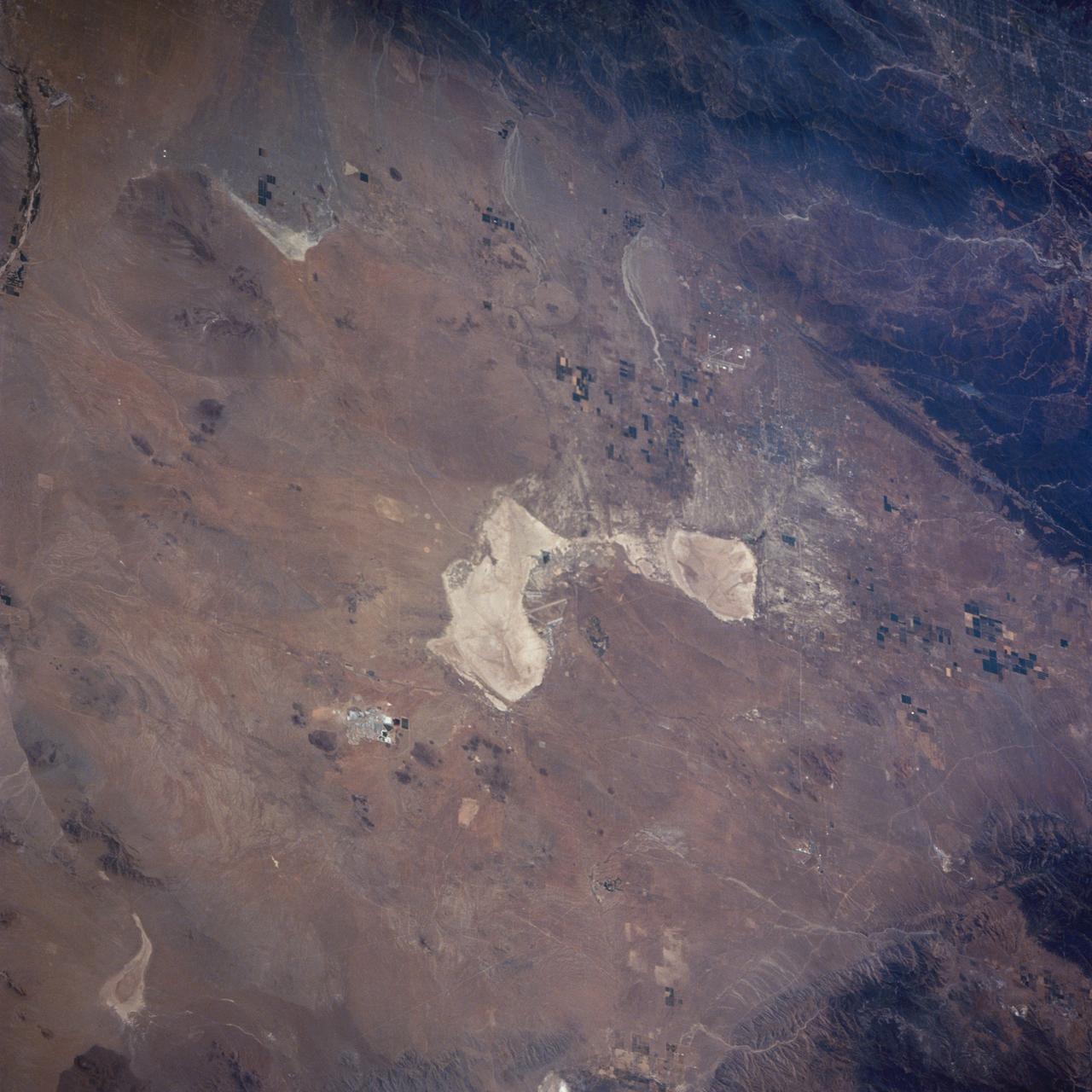
51F-46-100 (29 July-6 Aug 1985) --- The remarkable 51-F mission would end at Edwards Air Force Base, lakebed runway 23 at the center of the photograph. The San Andres Fault gashes across the lower left corner of the photo as does the Garlock fault at the upper left corner. The California Aqueduct can be traced from left center to lower right corner.
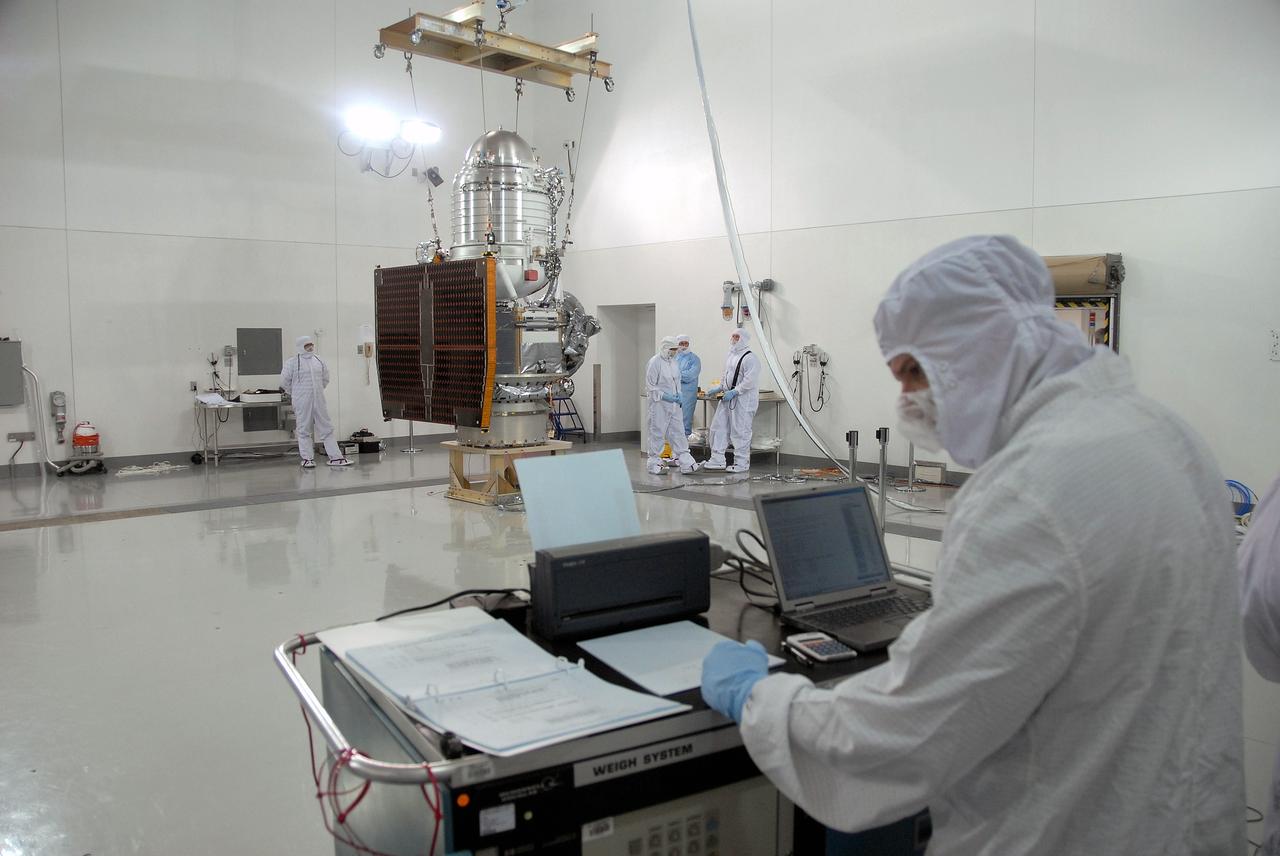
VANDENBERG AIR FORCE BASE, Calif. -- At the Astrotech processing facility on Vandenberg Air Force Base in California, a worker monitors the data received during the lift of NASA's Wide-field Infrared Survey Explorer, or WISE, to determine its exact weight. The satellite will survey the entire sky at infrared wavelengths, creating a cosmic clearinghouse of hundreds of millions of objects which will be catalogued and provide a vast storehouse of knowledge about the solar system, the Milky Way, and the universe. Launch is scheduled for Dec. 7. Photo credit: NASA/Doug Kolkow
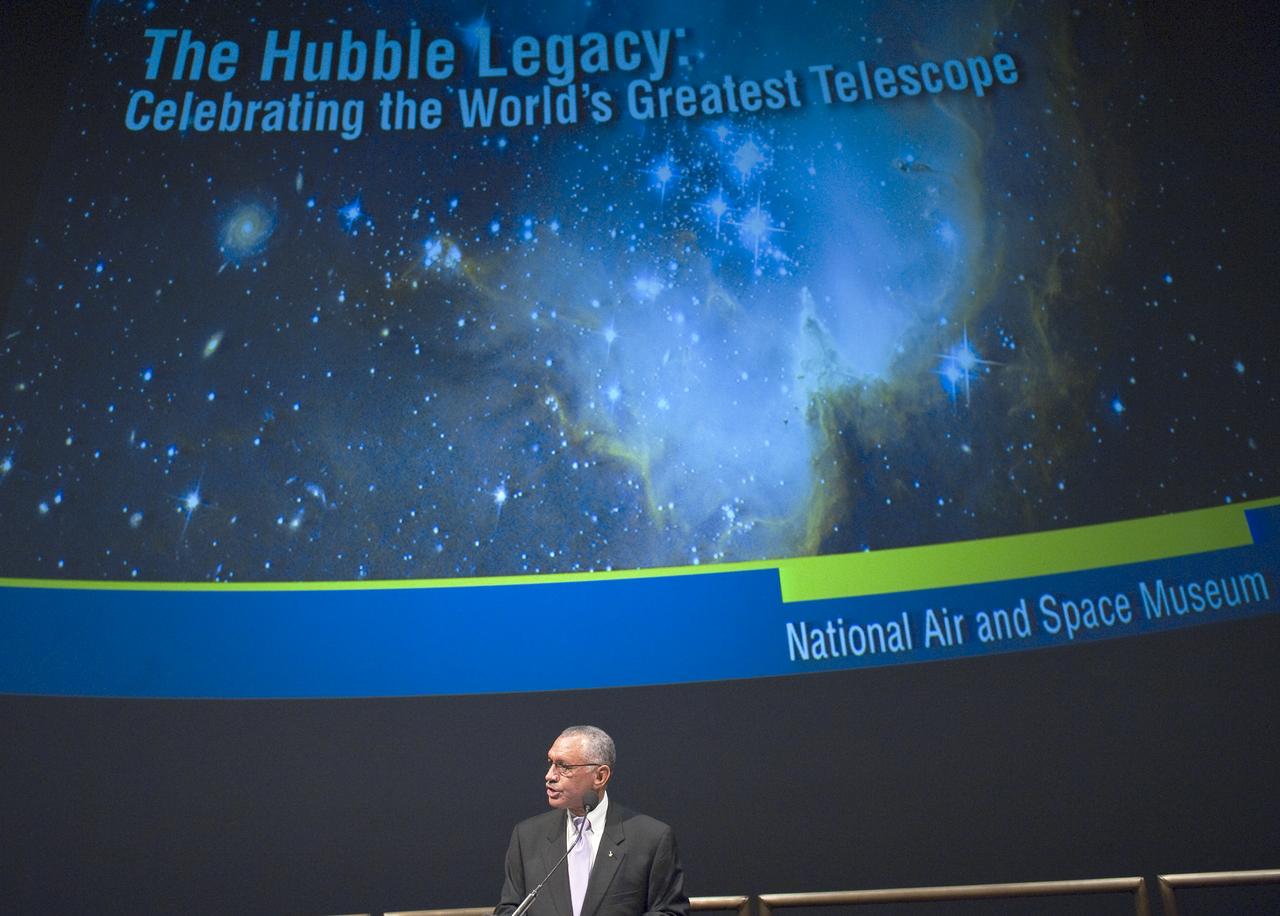
NASA Administrator Charles F. Bolden, speaks, Wednesday evening, Sept. 9, 2009, during a celebration of the Hubble Legacy at the National Air and Space Museum in Washington. Astronomers declared NASA's Hubble Space Telescope a fully rejuvenated observatory with the release Wednesday of observations from four of its six operating science instruments. Photo Credit: (NASA/Bill Ingalls)
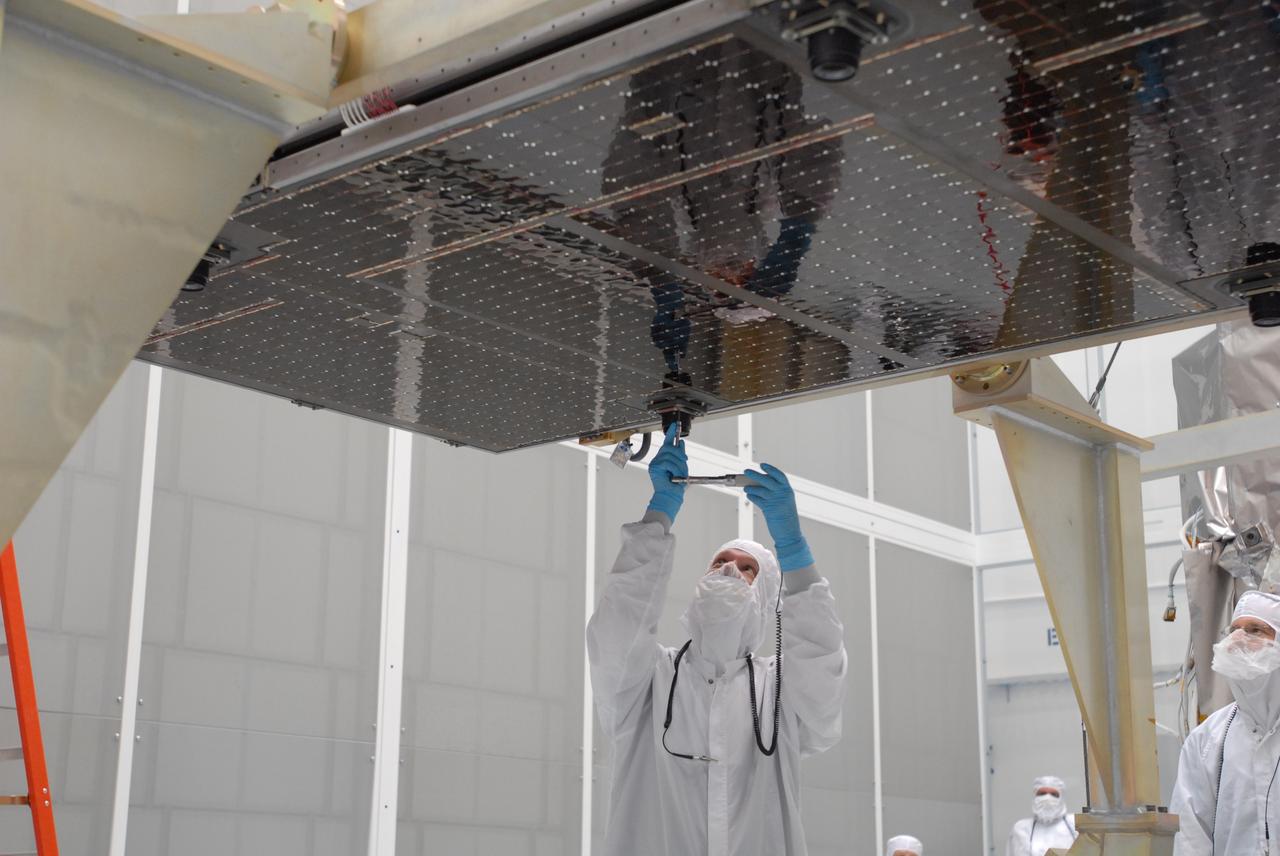
CAPE CANAVERAL, Fla. –– At Astrotech Space Operations in Titusville, Fla., technicians prepare the solar array panel for installation on the Lunar Reconnaissance Orbiter, or LRO. The orbiter will carry seven instruments to provide scientists with detailed maps of the lunar surface and enhance our understanding of the moon's topography, lighting conditions, mineralogical composition and natural resources. Information gleaned from LRO will be used to select safe landing sites, determine locations for future lunar outposts and help mitigate radiation dangers to astronauts. The polar regions of the moon are the main focus of the mission because continuous access to sunlight may be possible and water ice may exist in permanently shadowed areas of the poles. Launch of LRO is targeted for June 2. Photo credit: NASA/Jim Grossmann
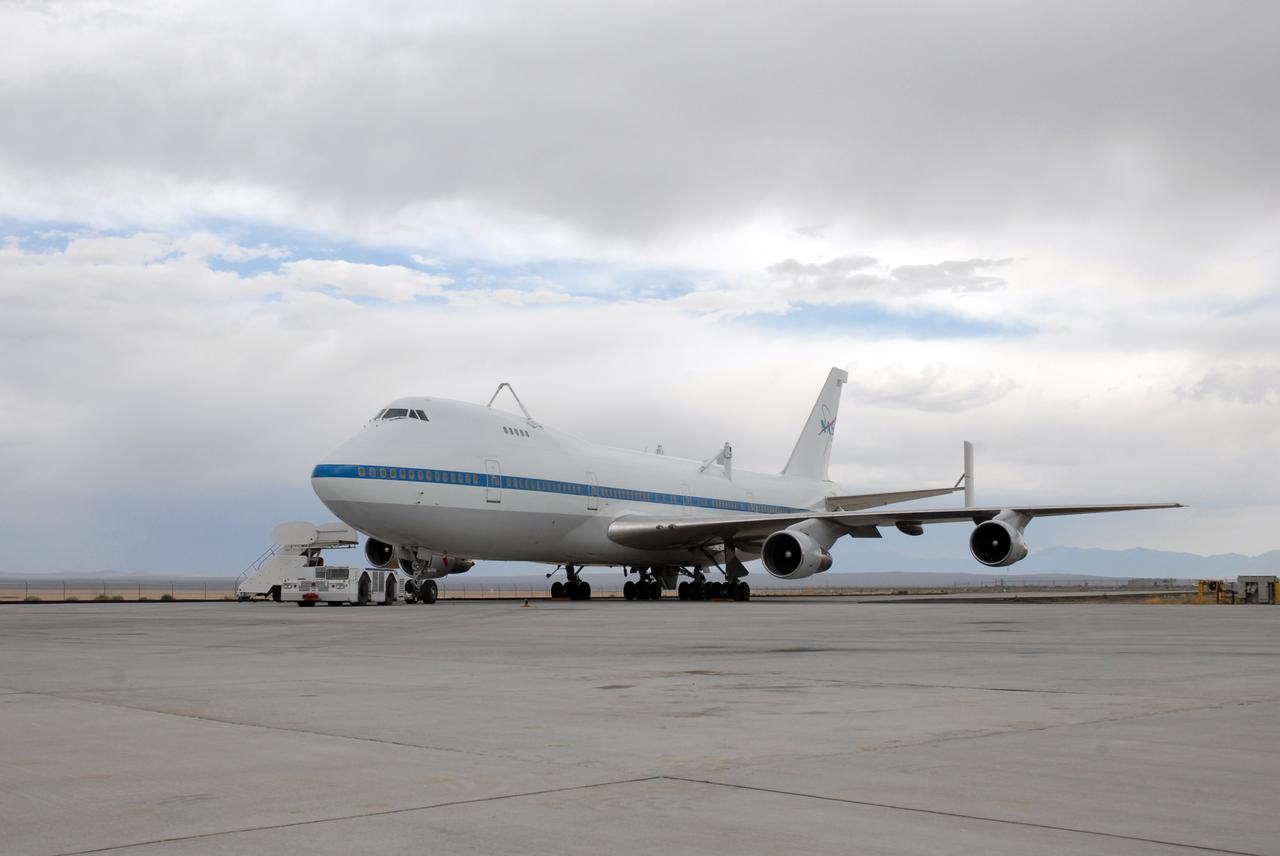
CAPE CANAVERAL, Fla. – This Shuttle Carrier Aircraft, or SCA, a modified Boeing 747, is fitted with struts on top that will attach to space shuttle Atlantis for a piggyback flight. Atlantis landed at Edwards on May 24, which concluded mission STS-125, after two landing opportunities at Kennedy were waved off due to weather concerns. Atlantis is being returned to Florida on a ferry flight on the SCA. Atlantis' next assignment is the STS-129 mission, targeted to launch in November 2009. Photo credit: NASA/Ben Smegelsky
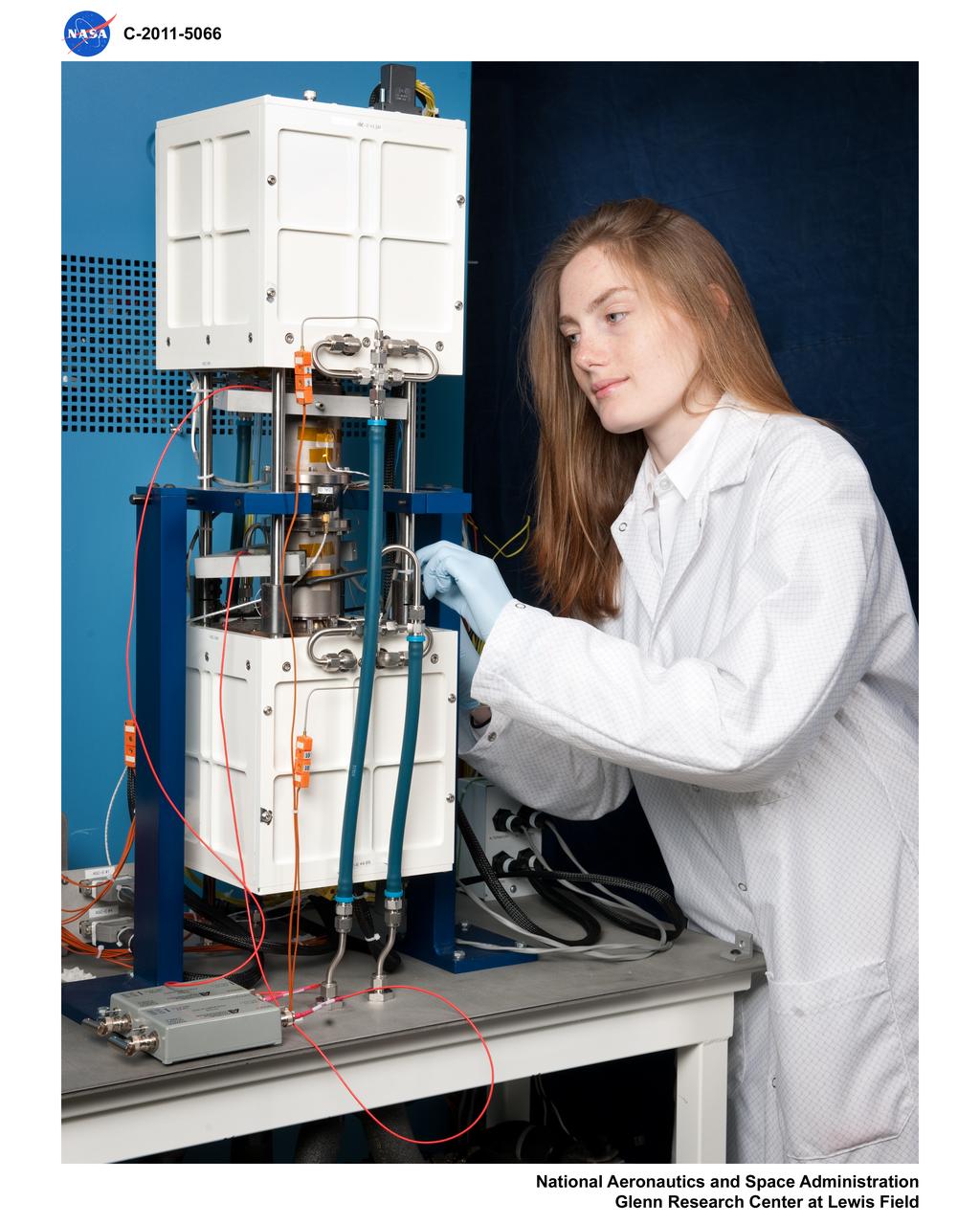
Advanced Stirling Converter

ISS020-E-024040 (22 July 2009) --- This is an oblique horizon view taken from the Inernational Sapce Station at 220 miles above a partially cloud-covered Earth clearly showing the home planet's atmophere. As the Space Shuttle Endeavour and the orbital outpost are linked together for more than a week, 13 internationally-represented astronauts and cosmonauts continue work toward its completion.
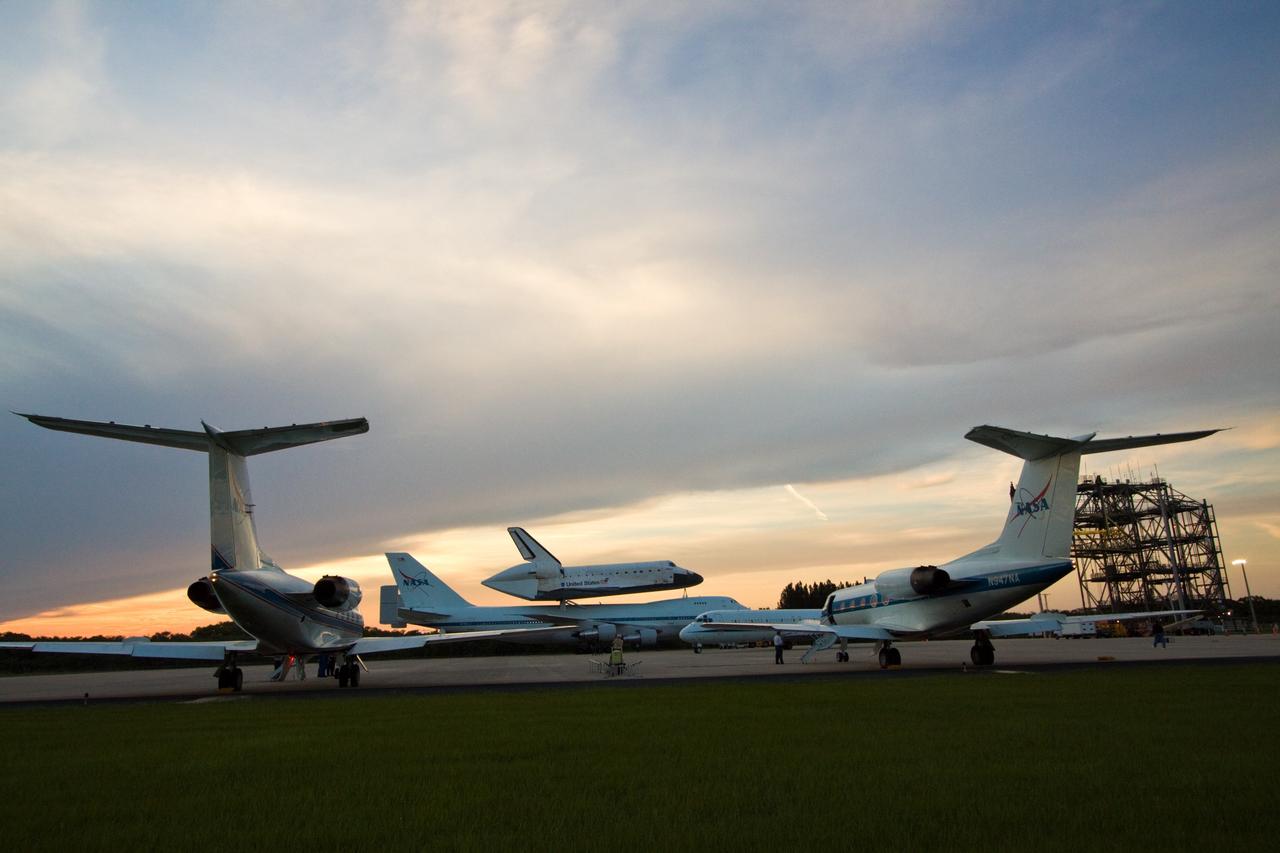
CAPE CANAVERAL, Fla. – Under a dimming sky, space shuttle Atlantis, atop a Shuttle Carrier Aircraft, or SCA, is framed between two Shuttle Training Aircraft on the Shuttle Landing Facility at NASA's Kennedy Space Center in Florida. The SCA is a modified Boeing 747 jetliner. The SCA and Atlantis are being towed the mate/demate device (at far right) on the Shuttle Landing Facility where Atlantis will be lifted from the SCA and placed on the ground. Atlantis returned from California atop the SCA after its May 24 landing at Edwards Air Force Base, concluding mission STS-125. The ferry flight from Edwards Air Force Base began June 1. Atlantis' next assignment is the STS-129 mission, targeted to launch in November 2009. Photo credit: NASA/Jack Pfaller
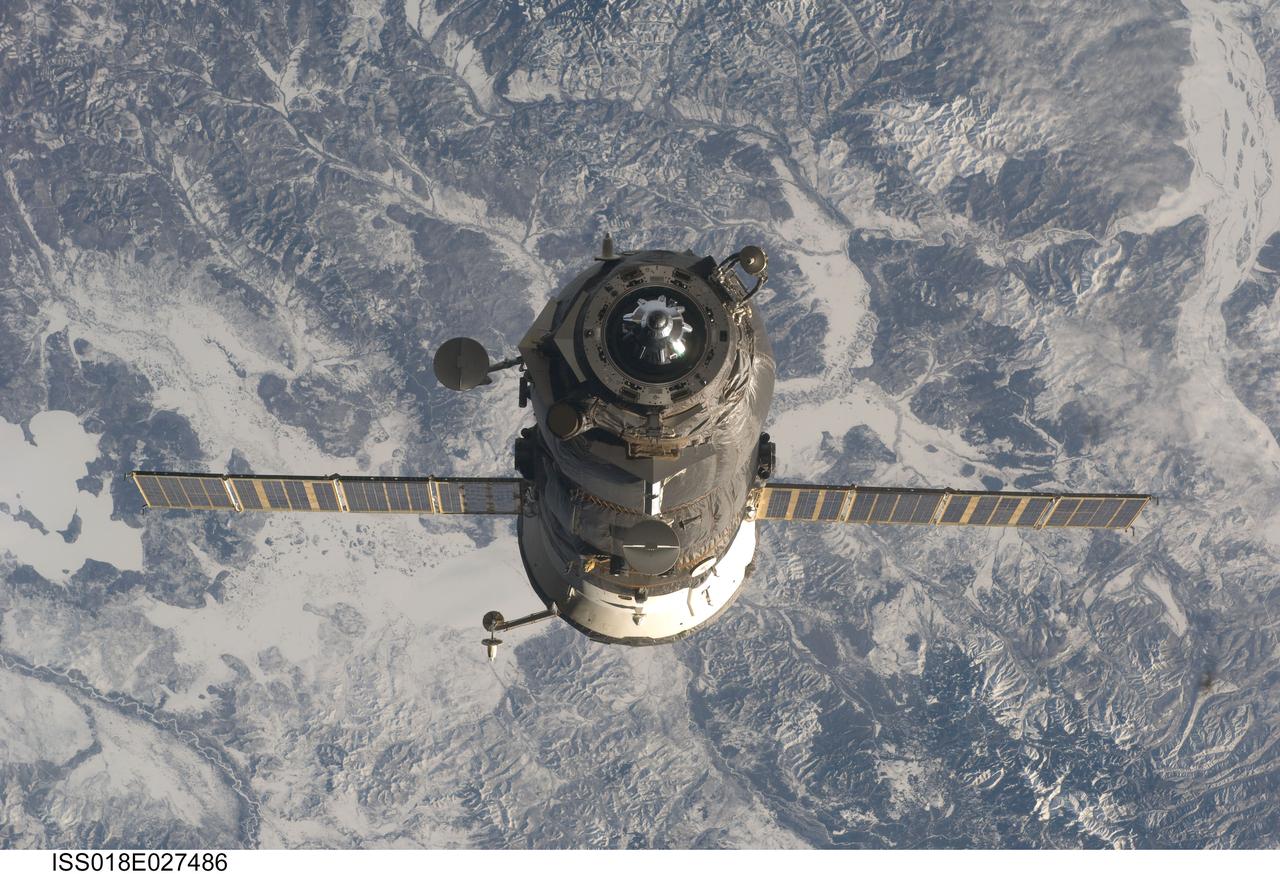
ISS018-E-027486 (5 Feb. 2009) --- An unpiloted ISS Progress 31 cargo craft, filled with trash and unneeded items, departs from the International Space Station’s Pirs Docking Compartment at 10:10:44 p.m. (CST) on Feb. 5, 2009. The Progress fired its thrusters to back away from the station for a little over two days of free flight to support engineering tests by Russian flight controllers. It will be commanded into a destructive reentry in Earth's atmosphere high above the Pacific Ocean at 1:32 a.m. (CST) on Feb 8. The departure clears the way for the arrival of the Progress 32 resupply vehicle, which is scheduled to link up to Pirs on Feb. 13.
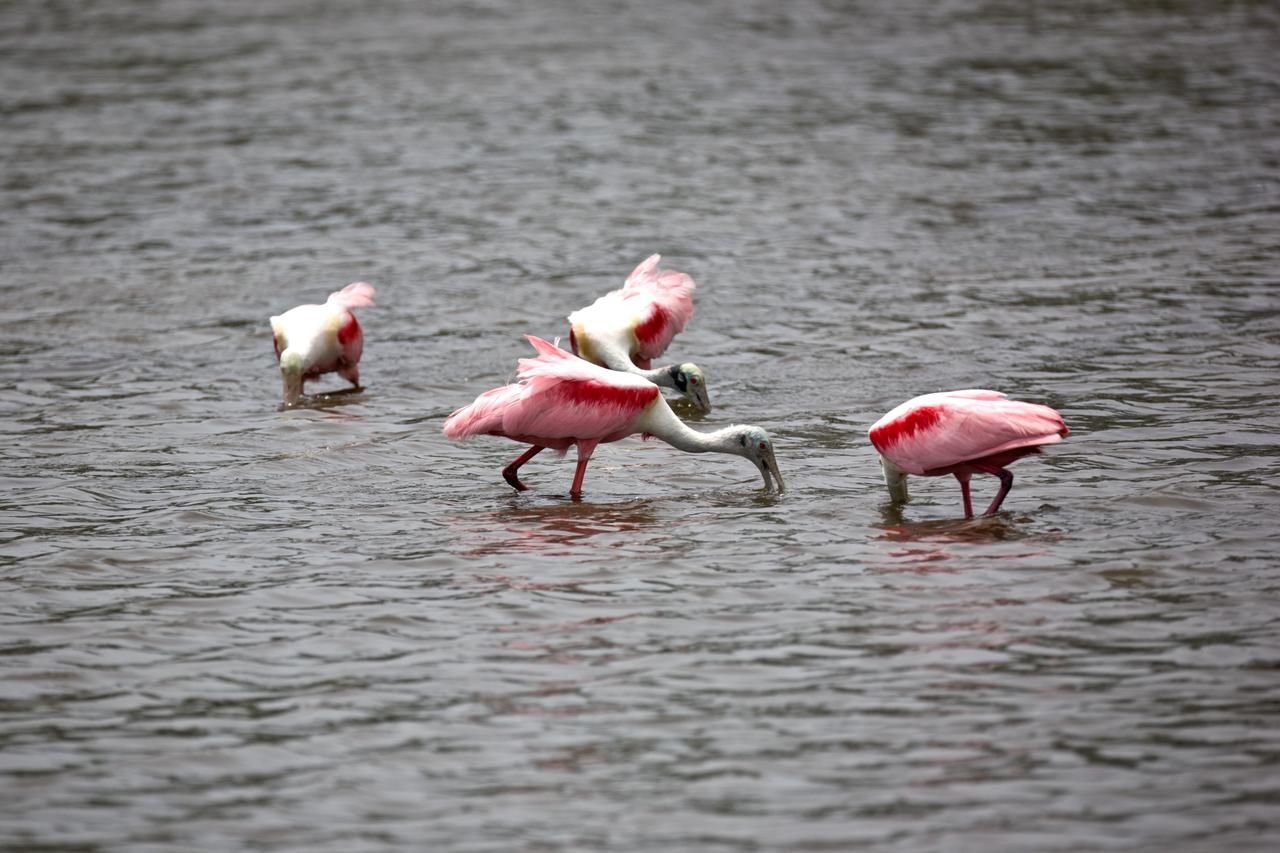
CAPE CANAVERAL, Fla. –– On NASA's Kennedy Space Center in Florida, scarlet-feathered roseate spoonbills feed in the water. Spoonbills inhabit areas of mangrove such as on the coasts of southern Florida and Texas. These birds feed on shrimps and fish in the shallow water, sweeping their bills from side to side. This and other wildlife abound throughout Kennedy as the center shares a boundary with the Merritt Island National Wildlife Refuge. The marshes and open water of the refuge provide wintering areas for 23 species of migratory waterfowl, as well as a year-round home for great blue herons, great egrets, wood storks, cormorants, brown pelicans and other species of marsh and shore birds. Photo credit: NASA/Dimitri Gerondidakis
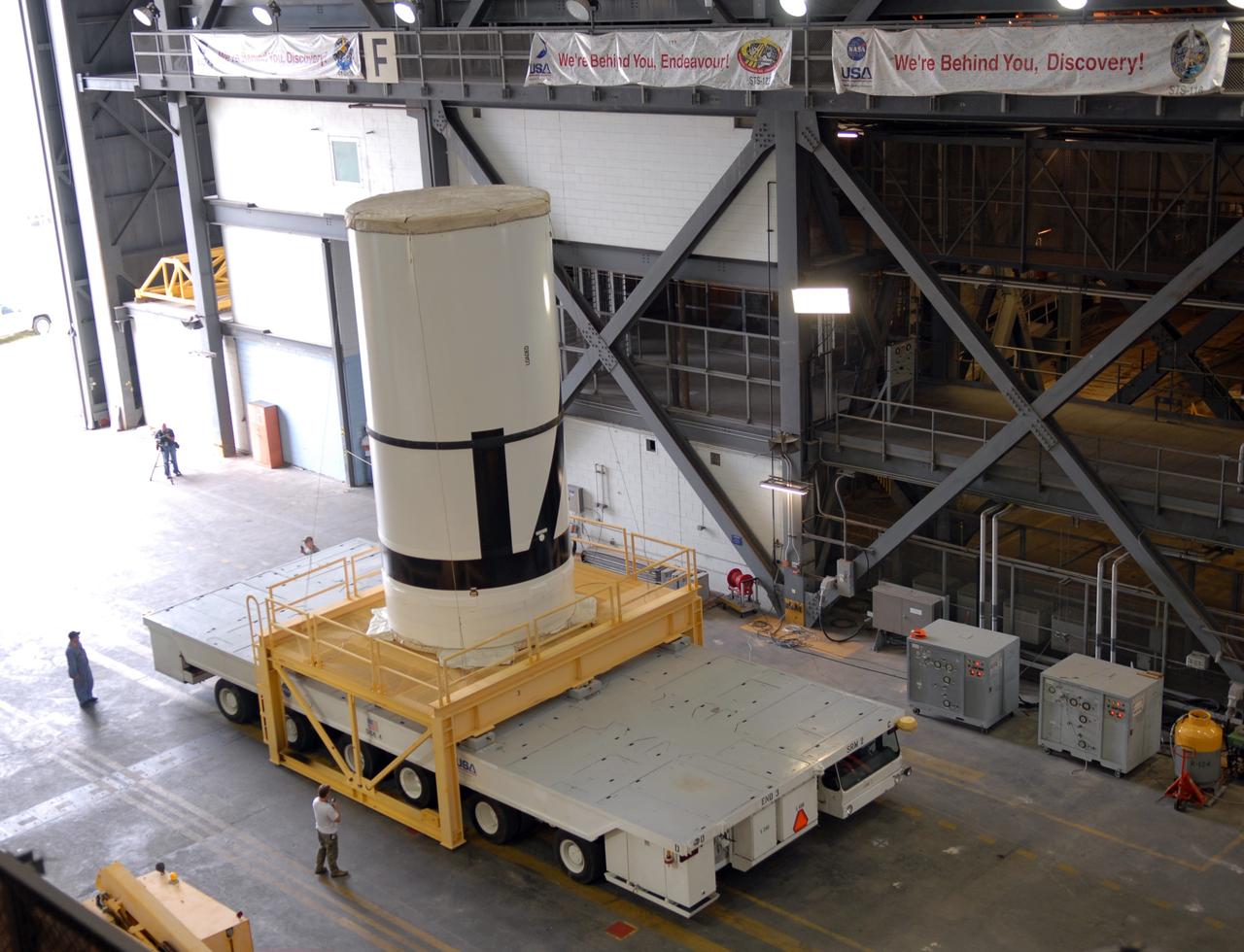
CAPE CANAVERAL, Fla. – The Ares I-X aft center booster segment arrives in the transfer aisle of the Vehicle Assembly Building at NASA's Kennedy Space Center in Florida. The Ares I-X launch vehicle segments are being stacked in the VAB. Part of the Constellation Program, the Ares I-X is the test vehicle for the Ares I, which is the essential core of a space transportation system that eventually will carry crewed missions back to the moon, on to Mars and out into the solar system. Launch is targeted for no earlier than Aug. 30 from Launch Pad 39B. Photo credit: NASA/Jim Grossmann
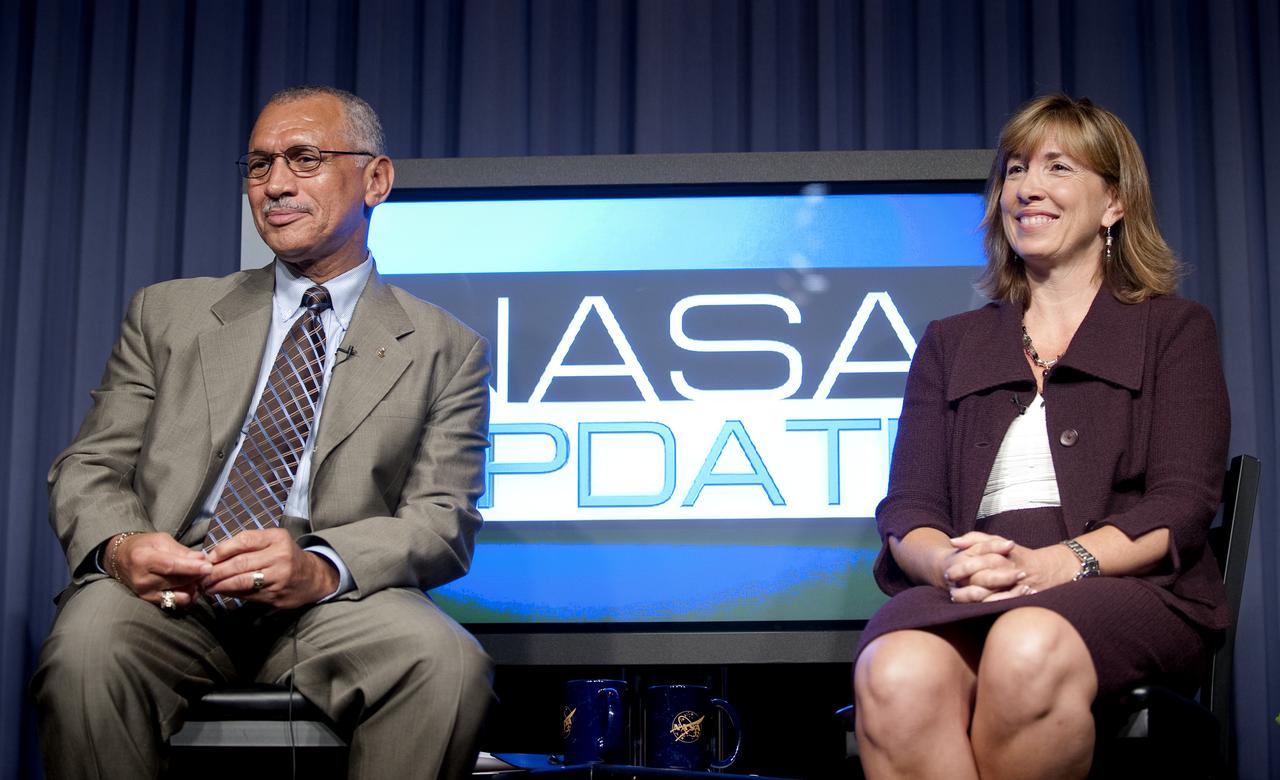
NASA Administrator Charles F. Bolden Jr. left, and Deputy Administrator Lori Garver are seen during their first NASA Update,Tuesday, July 21, 2009, at NASA Headquarters in Washington. Bolden, NASA's 12th Administrator and Garver took the time to introduce themselves and outline their vision for the agency going forward. No questions were taken during the session. Photo Credit: (NASA/Bill Ingalls)
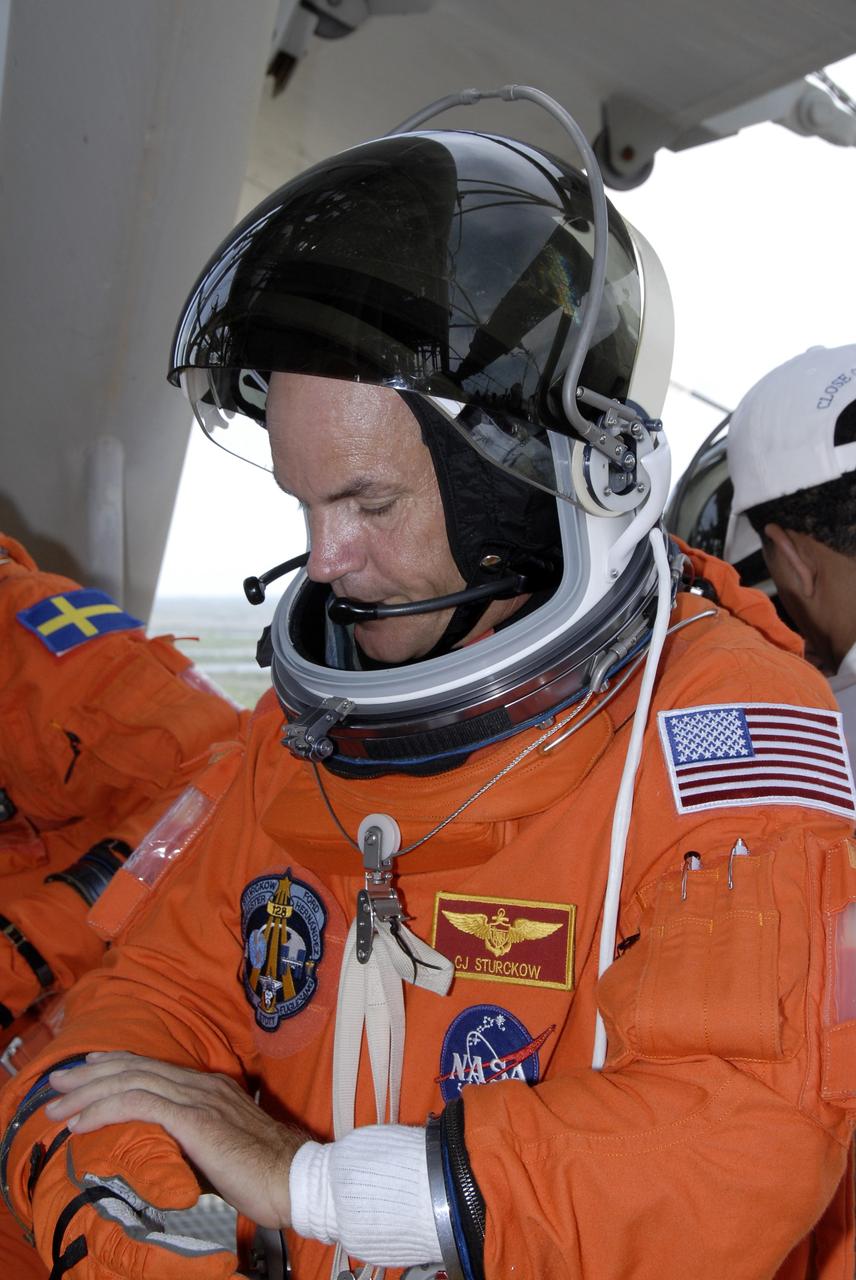
CAPE CANAVERAL, Fla. – After completing emergency exit practice from NASA Kennedy Space Center's fixed service structure, STS-128 Commander Rick Sturckow removes his gloves. Mission crew members are at Kennedy to take part in the terminal countdown demonstration test, or TCDT, which includes emergency exit training and culminates in the simulated countdown. On the STS-128 mission, Discovery will deliver 33,000 pounds of equipment to the station, including science and storage racks, a freezer to store research samples, a new sleeping compartment and the COLBERT treadmill. Launch is targeted for late August. Photo credit: NASA/Kim Shiflett
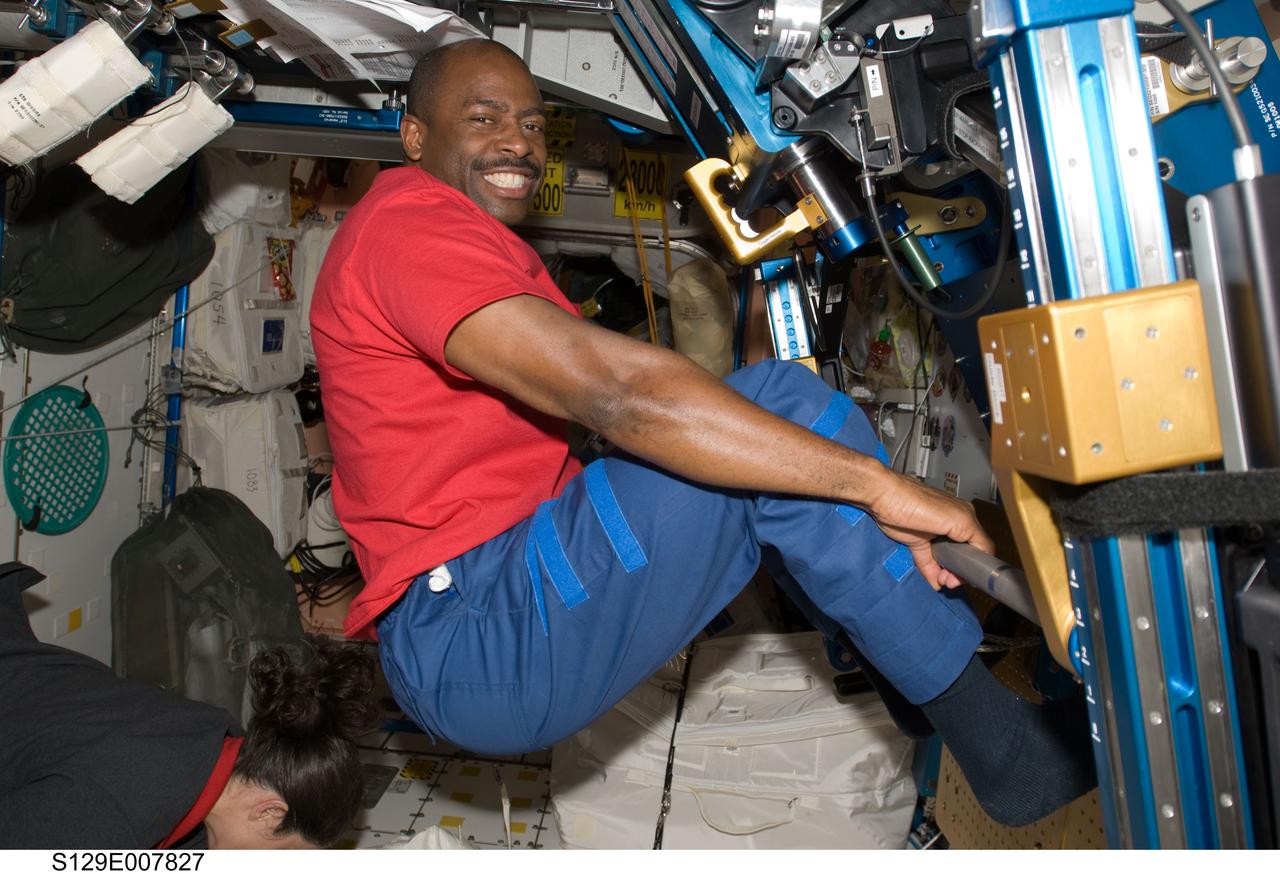
S129-E-007827 (22 Nov. 2009) --- Astronaut Leland Melvin, STS-129 mission specialist, exercises using the advanced Resistive Exercise Device (aRED) in the Unity node of the International Space Station while space shuttle Atlantis remains docked with the station.
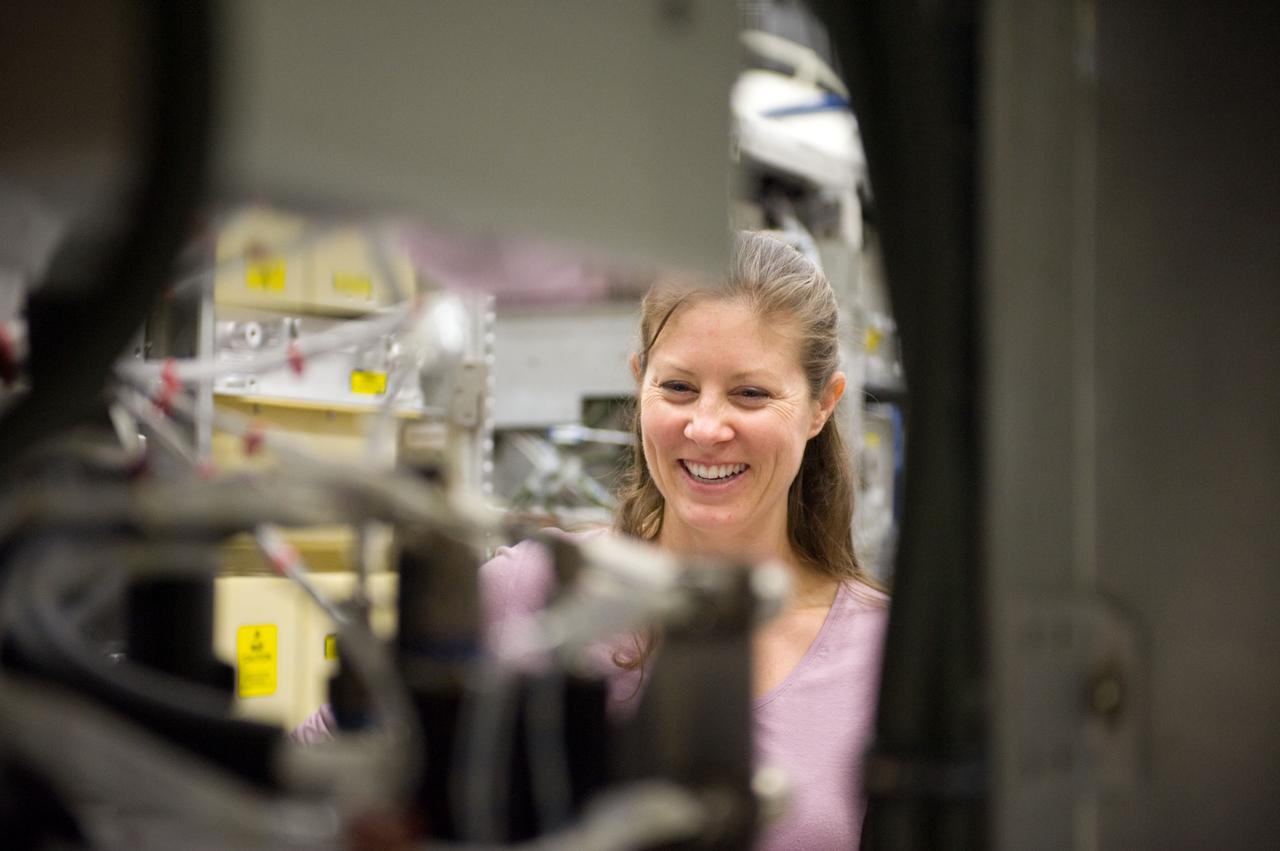
PHOTO DATE: 10-27-09 LOCATION: Bldg 9NW, ISS Mockup SUBJECT: Expedition 23 astronaut Tracy Caldwell during Regenerative ECLSS training with instructor Cindy Koester. PHOTOGRAPHER: James Blair
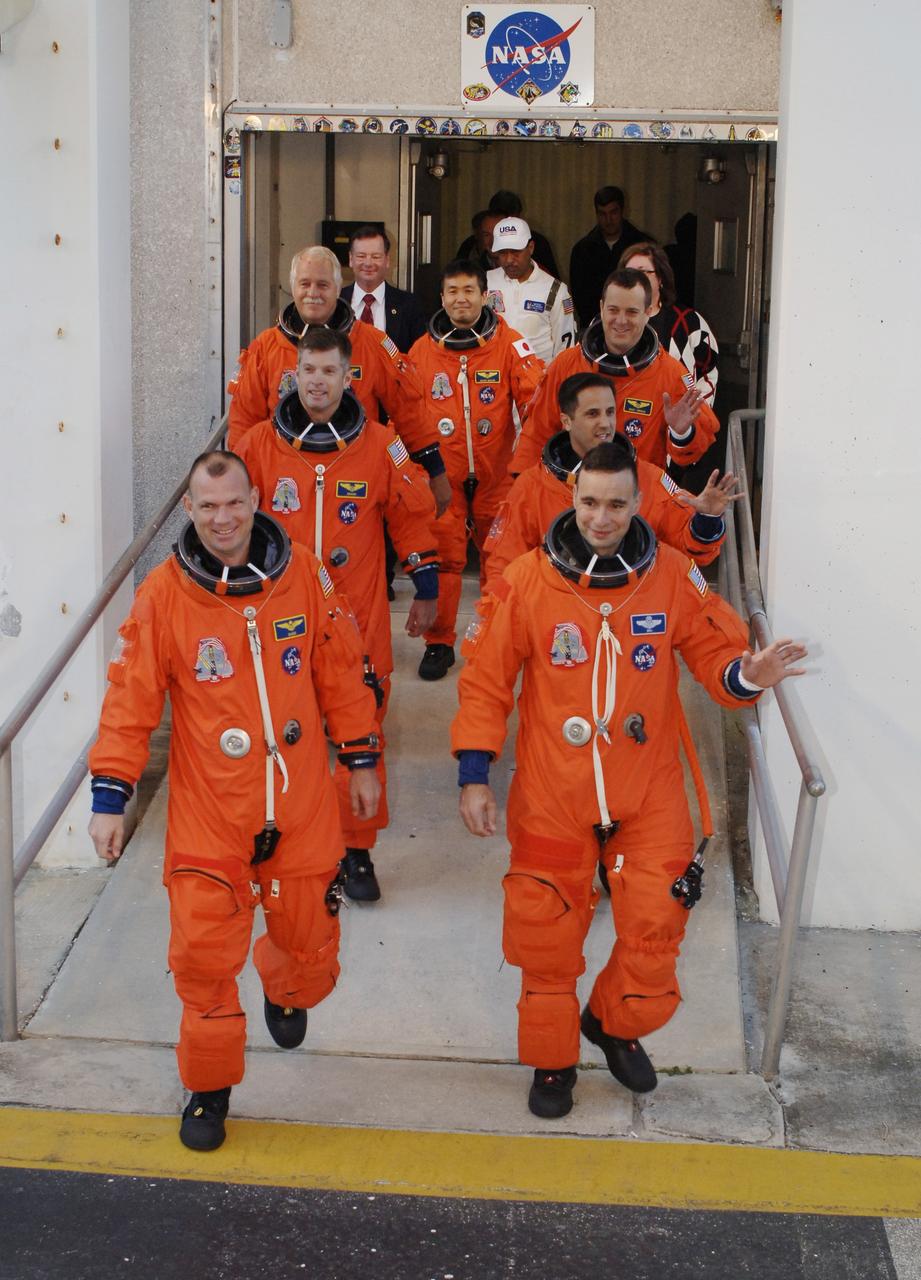
CAPE CANAVERAL, Fla. – Wearing their launch-and-entry suits, the STS-119 crew members leave the Operations and Checkout Building at NASA's Kennedy Space Center in Florida to head for Launch Pad 39A and a simulated launch countdown. Clockwise from left are Pilot Tony Antonelli, Mission Specialists Steve Swanson, John Phillips, Koichi Wakata, Richard Arnold and Joseph Acaba, and Commander Lee Archambault. The astronauts are at Kennedy to prepare for launch through Terminal Countdown Demonstration Test activities. The TCDT includes equipment familiarization and emergency egress training. The crew is targeted to launch on the STS-119 mission Feb. 12 on space shuttle Discovery. During the 14-day mission, the crew will install the S6 truss segment and solar arrays to the starboard side of the International Space Station, completing the station's truss, or backbone. Photo credit: NASA/Kim Shiflett
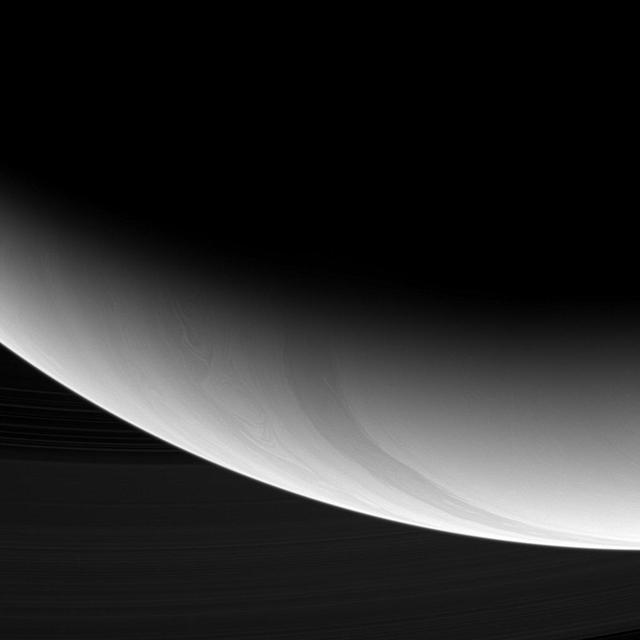
Southern Storms
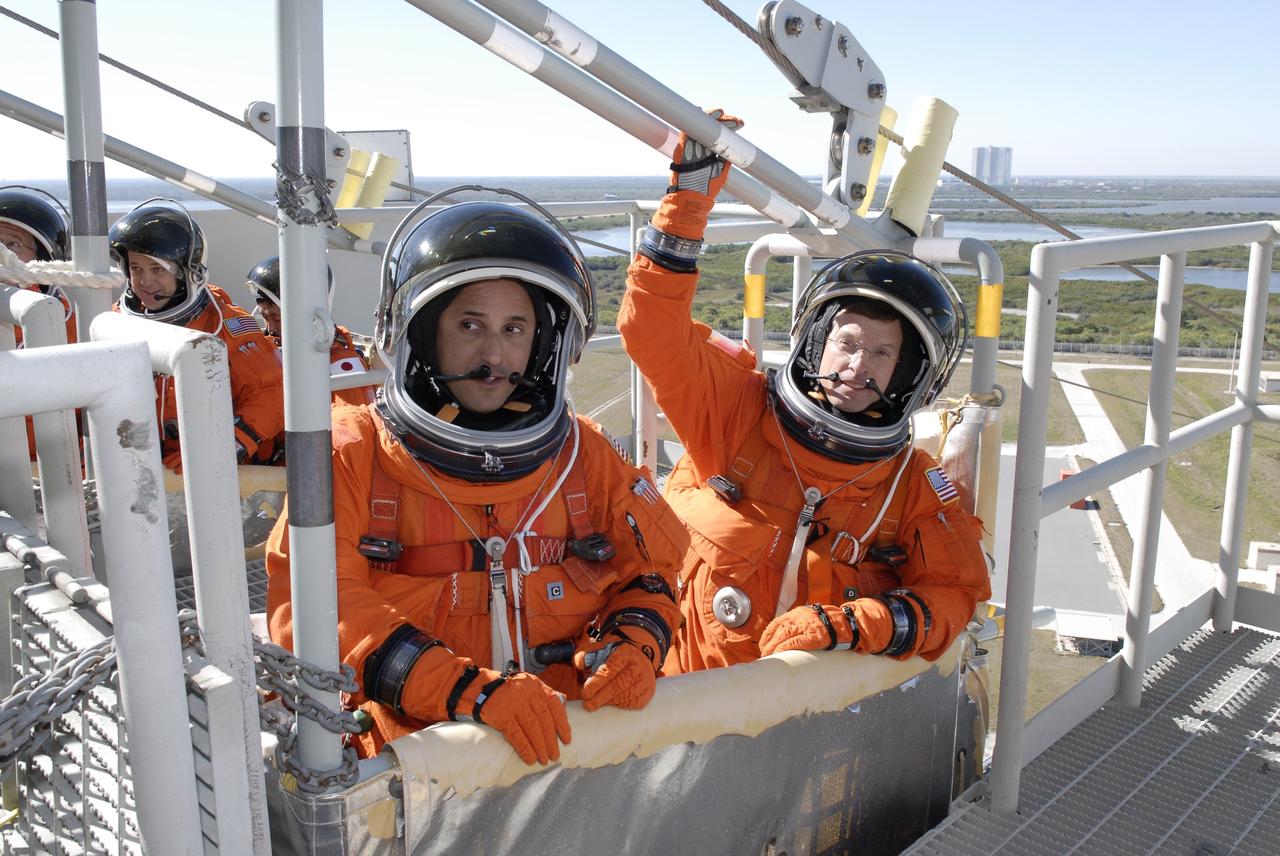
CAPE CANAVERAL, Fla. – Following the simulated launch countdown on Launch Pad 39A at NASA's Kennedy Space Center in Florida, STS-119 Mission Specialists Joseph Acaba (left) and Richard Arnold are seated in a slidewire basket that could propel them to a landing area below. The slidewire basket is used for emergency egress from the pad. In the background at left are Mission Specialists Richard Arnold and Koichi Wakata. The countdown and emergency egress are part of the prelaunch preparation known as Terminal Countdown Demonstration Test. The TCDT also includes equipment familiarization. Discovery is targeted to launch on the STS-119 mission Feb. 12. During the 14-day mission, the crew will install the S6 truss segment and solar arrays to the starboard side of the International Space Station, completing the station's truss, or backbone. Photo credit: NASA/Kim Shiflett