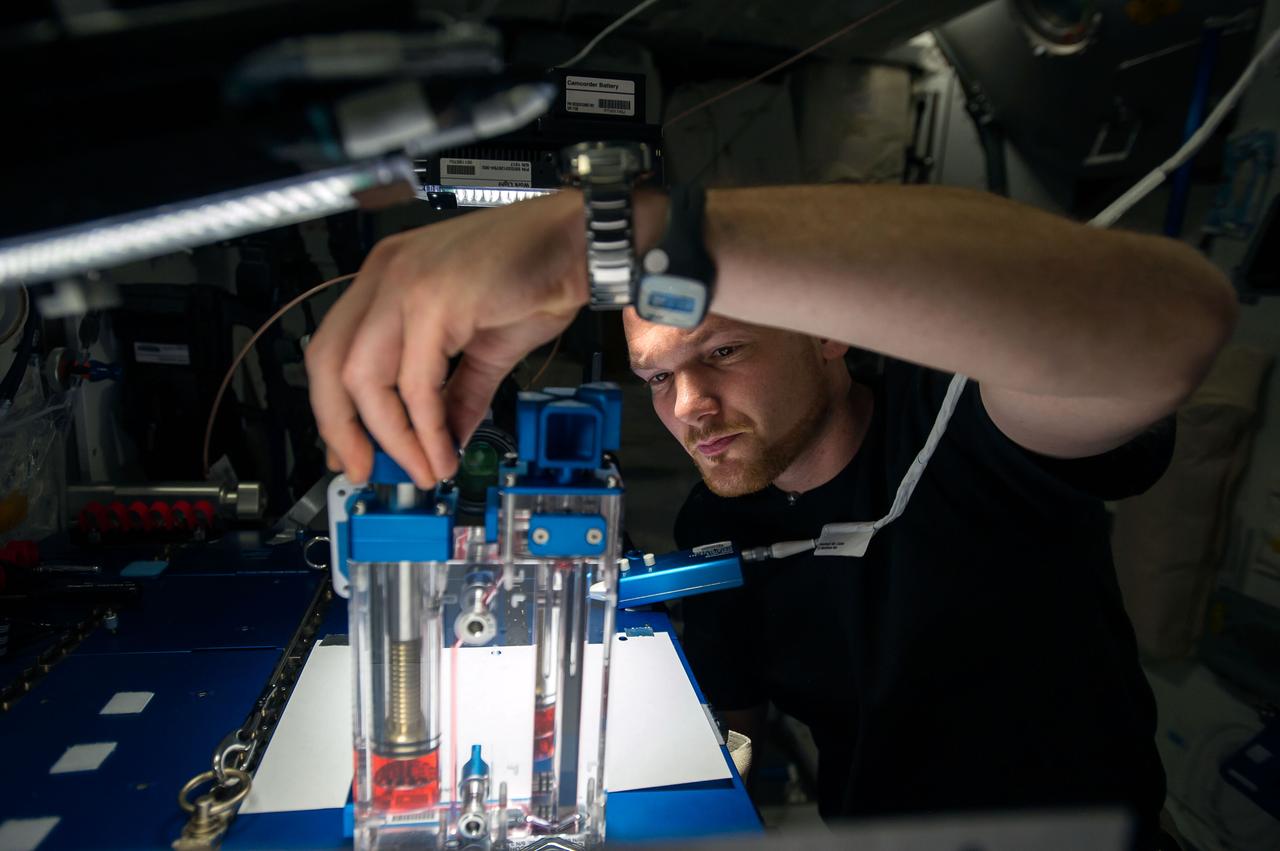
ISS040-E-015536 (19 June 2014) --- European Space Agency astronaut Alexander Gerst, Expedition 40 flight engineer, conducts a session with the Capillary Flow Experiment (CFE-2) in the Harmony node of the International Space Station. CFE is a suite of fluid physics experiments that investigate how fluids behave in microgravity which could benefit water and fuel delivery systems on future spacecraft. Scientists designed the CFE-2 to study properties of fluids and bubbles inside containers with a specific 3-D geometry.
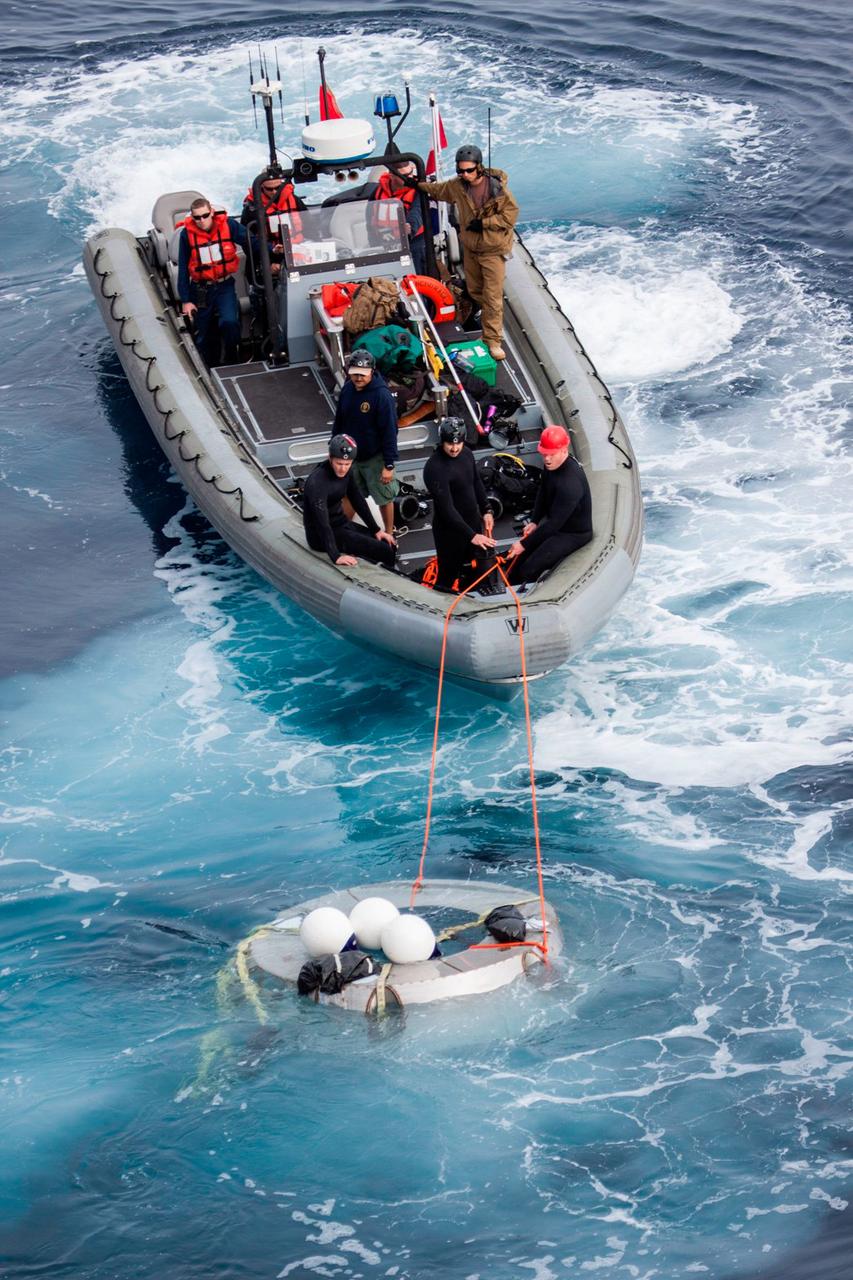
Members of the Orion recovery team work to retrieve a test version of Orion's forward bay cover, a protective shell that fits on top of the crew module, from the Pacific Ocean on Feb. 18, 2014, during an Underway Recovery Test. NASA and U.S. Navy personnel came together on board the USS San Diego, off the coast of California, to practice the processes they used to recover Orion after its splashdown following Exploration Flight Test-1 (EFT-1). Part of Batch image transfer from Flickr.
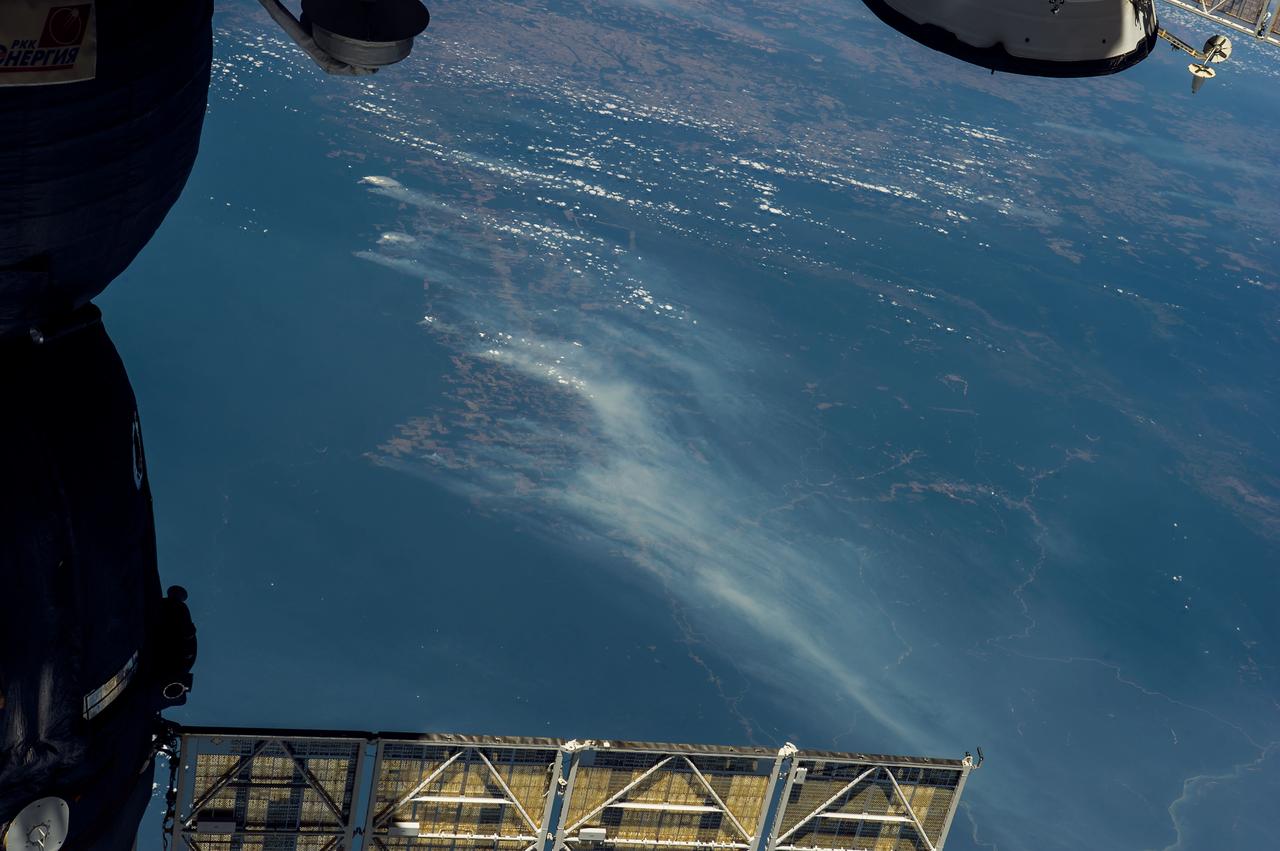
ISS040-E-103496 (19 Aug. 2014) --- On an unusually cloud-free day at the height of the dry season in Amazonia, several fires were burning, giving rise to a broad smoke pall easily seen from the International Space Station, photographed by an Expedition 40 crew member. Parts of the space station appear along the margins of the image. Against the backdrop of the dark green rainforest, several fires follow the major highway BR 163 (lower center of the image to the top left). Fires are set to clear patches of forest for agriculture, a process that reveals red-brown soils. A long line of new cleared patches snakes east from BR 163 towards the remote valley of the Rio Crepori. Extensive deforested areas in Brazil?s state of Mato Grosso appear as tan areas across the top of the image. Fires show the advance of deforestation into the state of Para, the area shown in most of this view. Para is now second after Mato Grosso in terms of deforestation acreage.

The Magnetospheric Multiscale spacecraft, enclosed in a protective shipping container, are delivered by truck to the Astrotech payload processing facility in Titusville, Florida, near Kennedy Space Center. MMS is a Solar Terrestrial Probes mission comprising four identically instrumented spacecraft that will use Earth’s magnetosphere as a laboratory to study the microphysics of three fundamental plasma processes: magnetic reconnection, energetic particle acceleration and turbulence. Launch aboard a United Launch Alliance Atlas V rocket from Space Launch Complex 41 on Cape Canaveral Air Force Station is targeted for March 12, 2015.
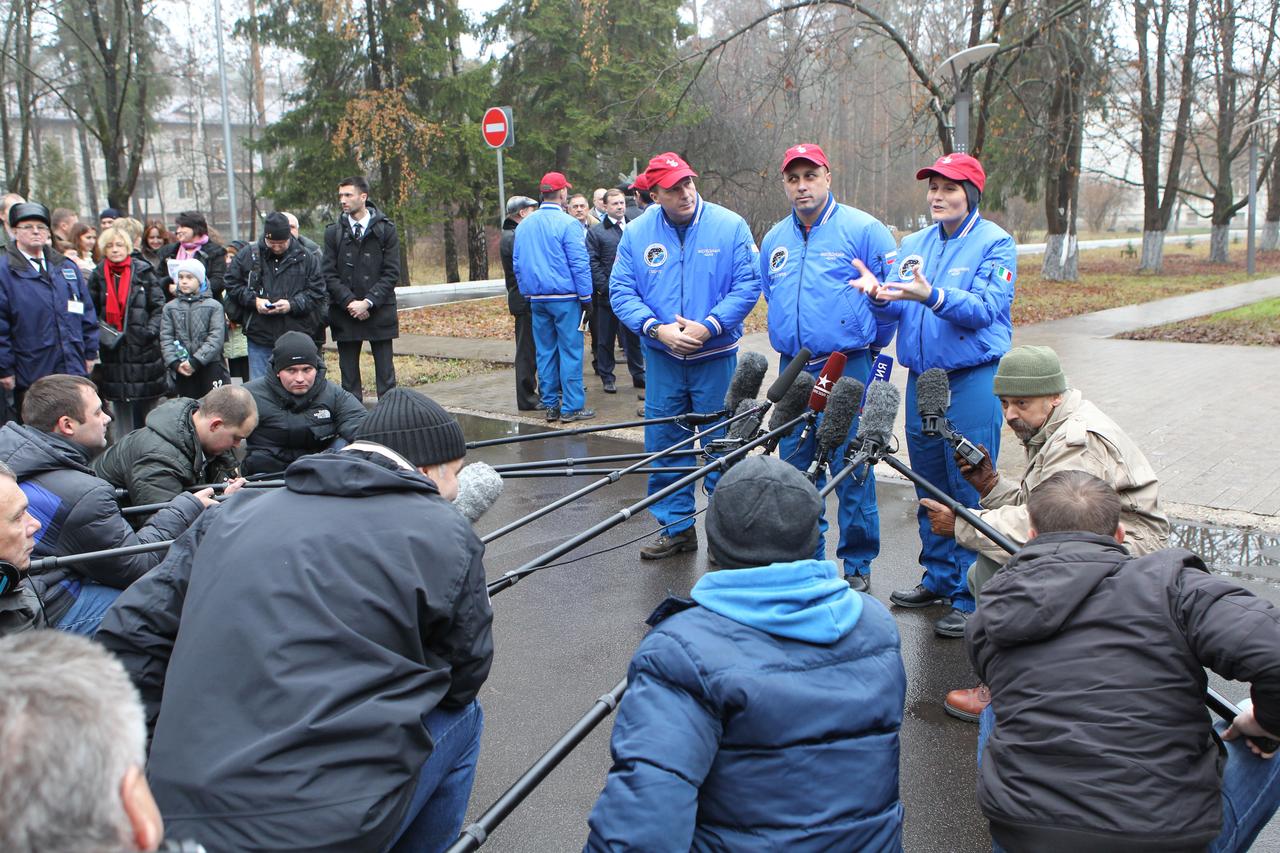
4515: At the Gagarin Cosmonaut Training Center in Star City, Russia, Expedition 42/43 crewmember Samantha Cristoforetti of the European Space Agency (right) answers a reporter’s question Nov. 11 while her crewmates, Terry Virts of NASA (left) and Anton Shkaplerov of the Russian Federal Space Agency (Roscosmos, center) look on. Virts, Shkaplerov and Cristoforetti later flew to the Baikonur Cosmodrome in Kazakhstan where they will launch Nov. 24, Kazakh time in their Soyuz TMA-15M spacecraft for a five and a half month mission on the International Space Station. NASA/Stephanie Stoll
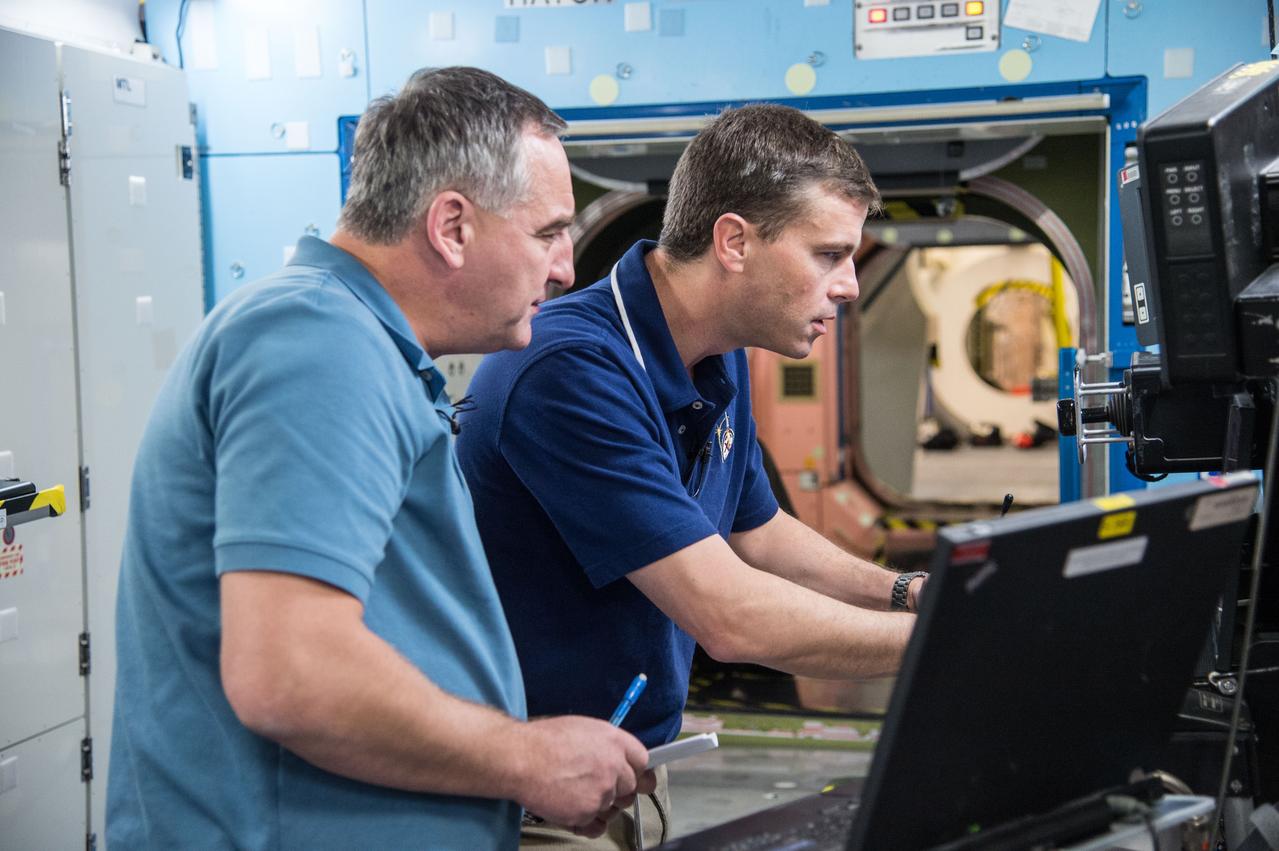
PHOTO DATE: 01-17-14 LOCATION: Bldg. 9NW - ISS Mockups SUBJECT: Expedition 40 6-person crew emergency scenarios. Crewmembers: 38S/Swanson, Skvortsov and Artemiev, along with 39S/Suraev, Wiseman and Gerst. PHOTOGRAPHER: BILL STAFFORD
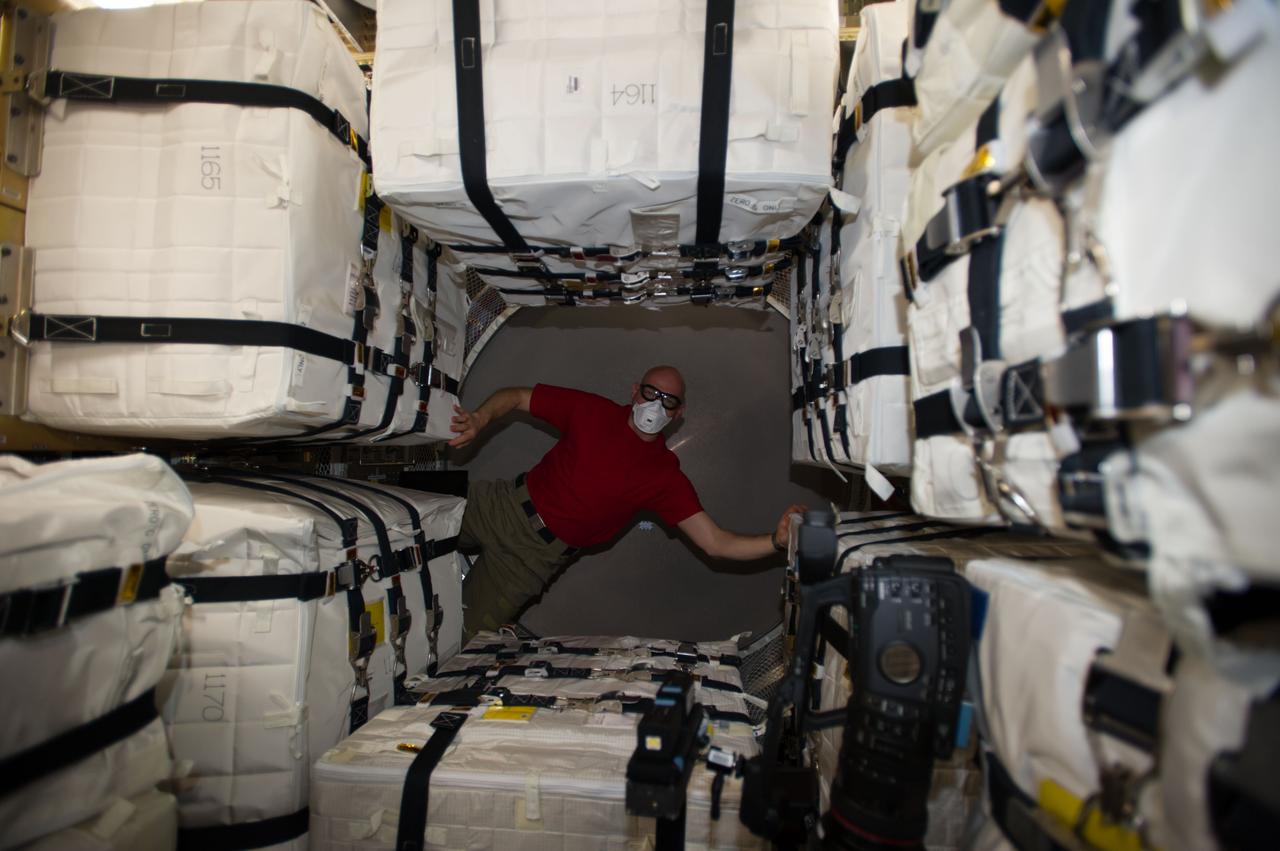
ISS040-E-091969 (13 Aug. 2014) --- Surrounded by stowage containers, European Space Agency astronaut Alexander Gerst, Expedition 40 flight engineer, is pictured in the newly-attached "Georges Lemaitre" Automated Transfer Vehicle-5 (ATV-5) of the International Space Station.
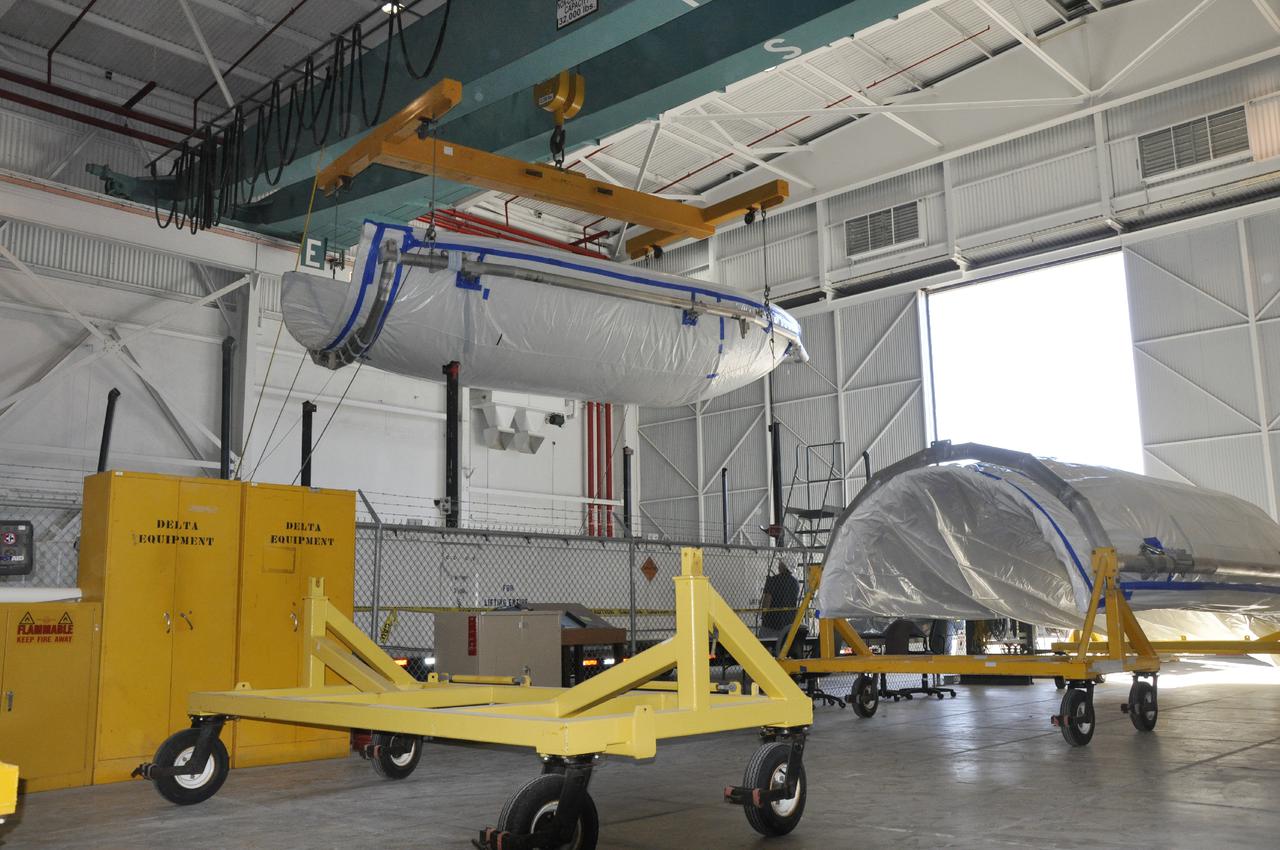
VANDENBERG AIR FORCE BASE, Calif. – A section of the fairing for NASA's Orbiting Carbon Observatory-2 mission, or OCO-2, is lifted from its shipping container in the NASA Building 836 high bay at Vandenberg Air Force Base in California. The fairing will protect OCO-2 during launch aboard a United Launch Alliance Delta II rocket from Space Launch Complex 2 in July. OCO-2 will collect precise global measurements of carbon dioxide in the Earth's atmosphere and provide scientists with a better idea of the chemical compound's impacts on climate change. Scientists will analyze this data to improve our understanding of the natural processes and human activities that regulate the abundance and distribution of this important atmospheric gas. To learn more about OCO-2, visit http:__oco.jpl.nasa.gov. Photo credit: NASA_Randy Beaudoin
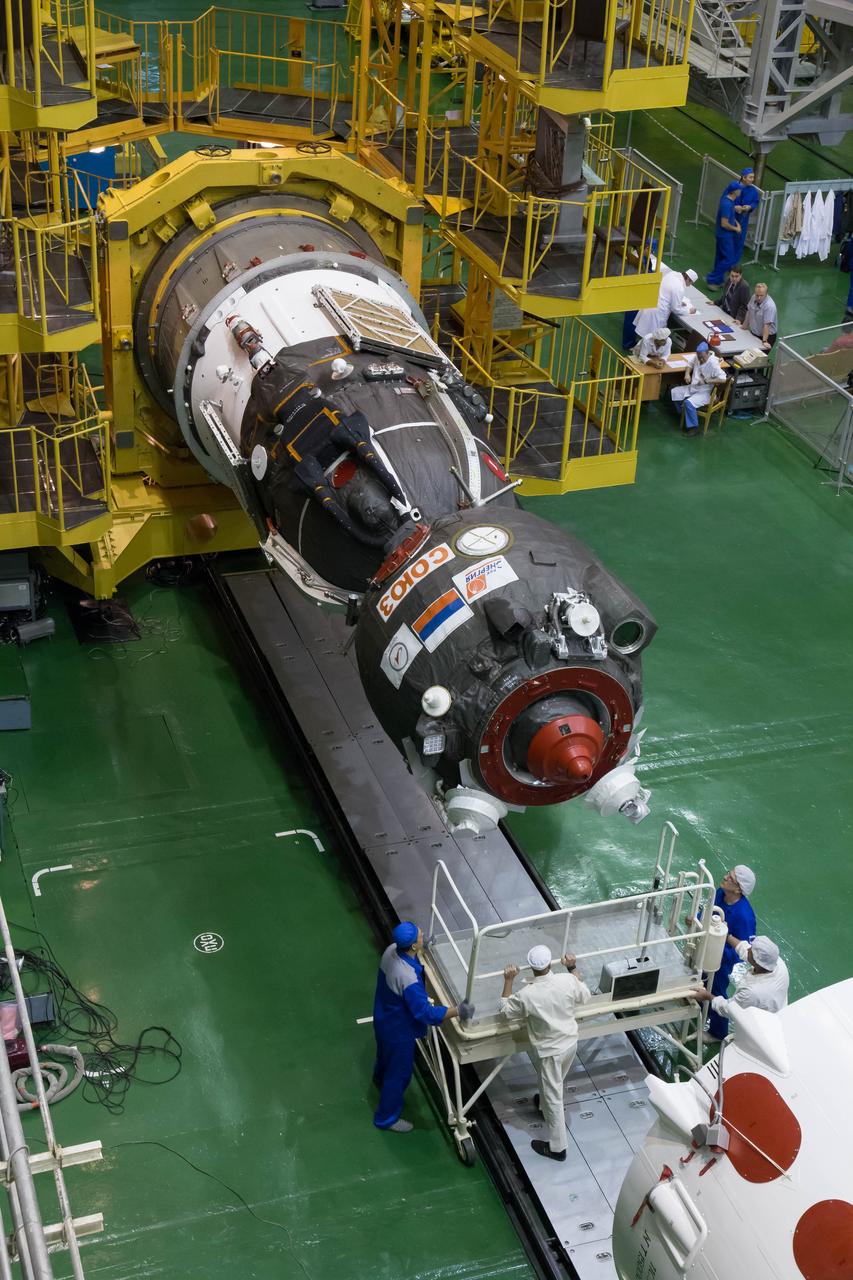
2014-09-18-12-03-22 At the Integration Facility at the Baikonur Cosmodrome in Kazakhstan, the Soyuz TMA-14M spacecraft is rotated to a horizontal position for its encapsulation in the upper stage of the Soyuz booster rocket Sept. 18 that will propel it into orbit. The Soyuz will arrive at its launch pad on Sept. 23 for final pre-launch preparations. Expedition 41/42 Flight Engineer Barry Wilmore of NASA, Soyuz Commander Alexander Samokutyaev of the Russian Federal Space Agency (Roscosmos) and Flight Engineer Elena Serova of Roscosmos will launch aboard the Soyuz Sept. 26, Kazakh time, to begin a 5 ½ month mission on the International Space Station. Serova will become the fourth Russian woman to fly in space and the first Russian woman to live and work on the station. NASA/Victor Zelentsov
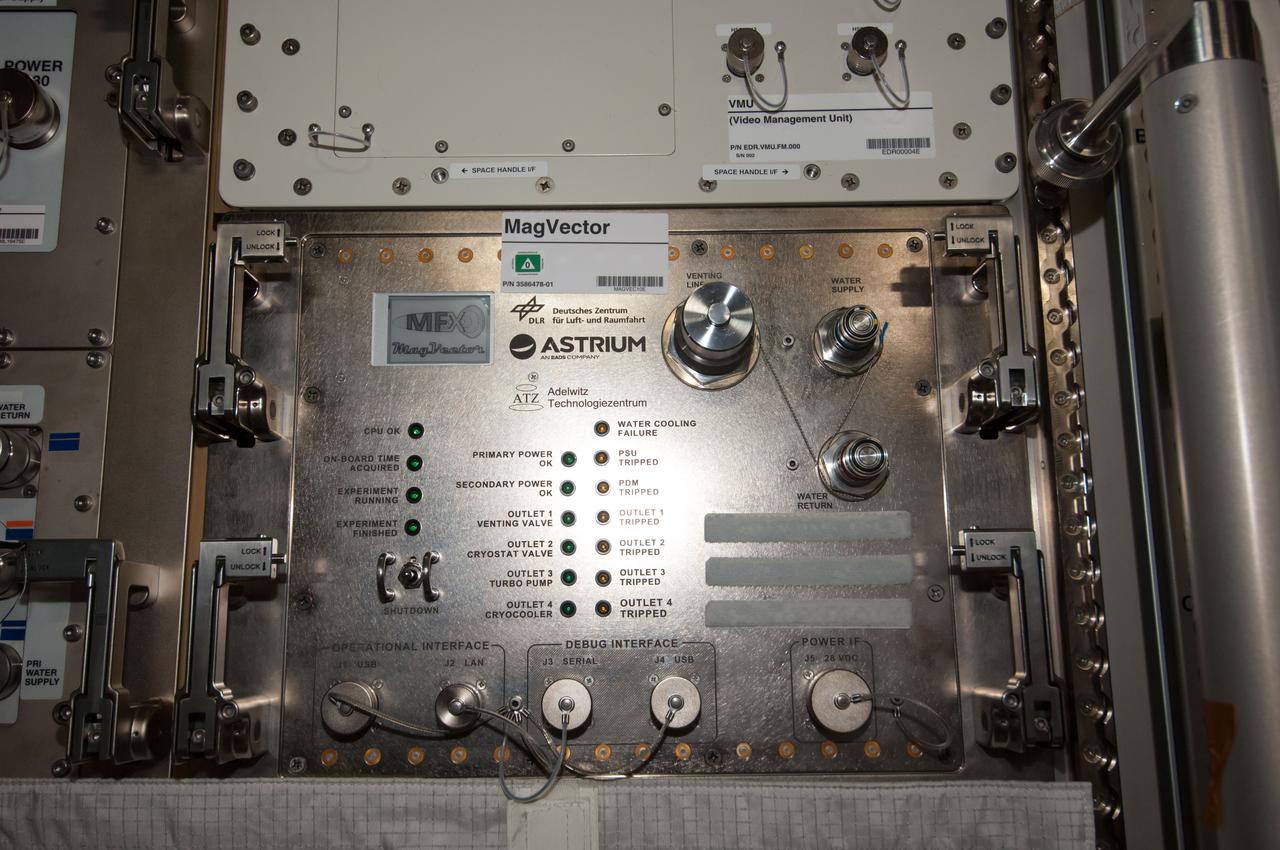
iss040e108291 (8/26/2014) --- Photographic documentation of final installation of MAGVECTOR hardware in the Columbus module aboard the International Space Station (ISS). MAGVECTOR qualitatively investigates the interaction between a moving magnetic field and an electrical conductor. The set up will provide initial insights regarding the principal feasibility on board the ISS,future improvements and phenomenological trends and dependencies. The expected changes in the magnetic field structure on the Ram and Wake side of the electrical conductor are of interest for technical applications as well as for astrophysical research.
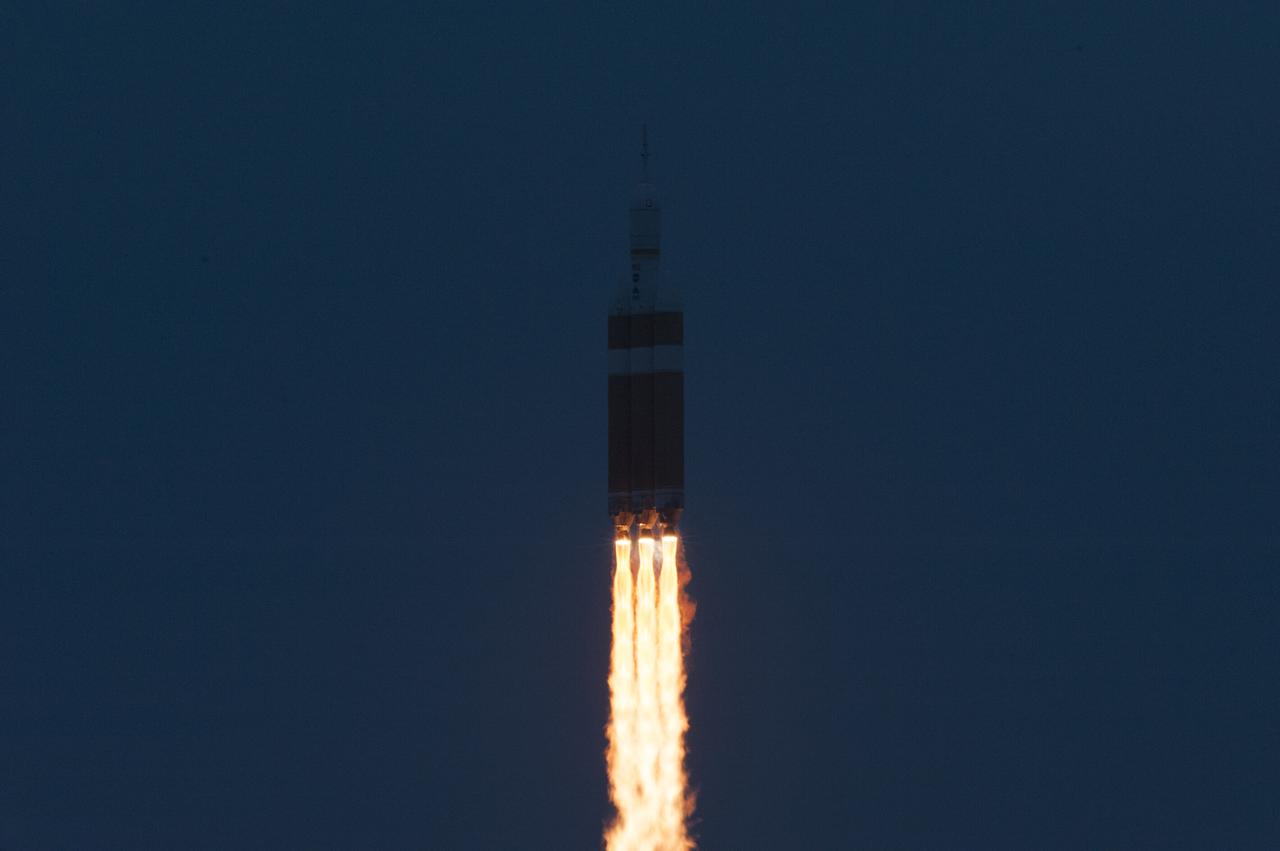
A Delta IV Heavy rocket soars after liftoff from Space Launch Complex 37 at Cape Canaveral Air Force Station in Florida carrying NASA's Orion spacecraft on an unpiloted flight test to Earth orbit. Liftoff was at 7:05 a.m. EST. During the two-orbit, four-and-a-half hour mission, engineers will evaluate the systems critical to crew safety, the launch abort system, the heat shield and the parachute system.
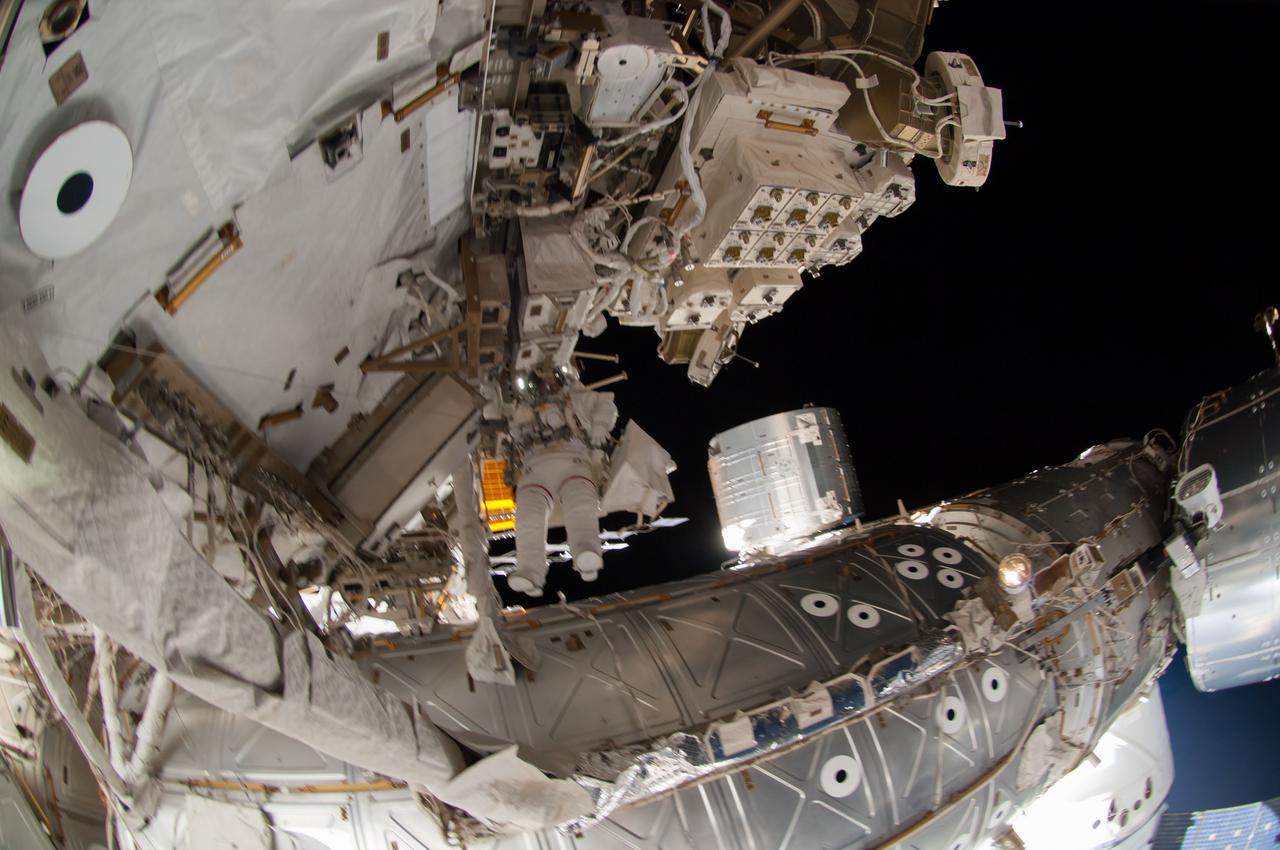
ISS041-E-067002 (7 Oct. 2014) --- NASA astronaut Reid Wiseman, Expedition 41 flight engineer, participates in a session of extravehicular activity (EVA) as work continues on the International Space Station. During the six-hour, 13-minute spacewalk, Wiseman and European Space Agency astronaut Alexander Gerst (out of frame), flight engineer, worked outside the space station's Quest airlock relocating a failed cooling pump to external stowage and installing gear that provides back up power to external robotics equipment.
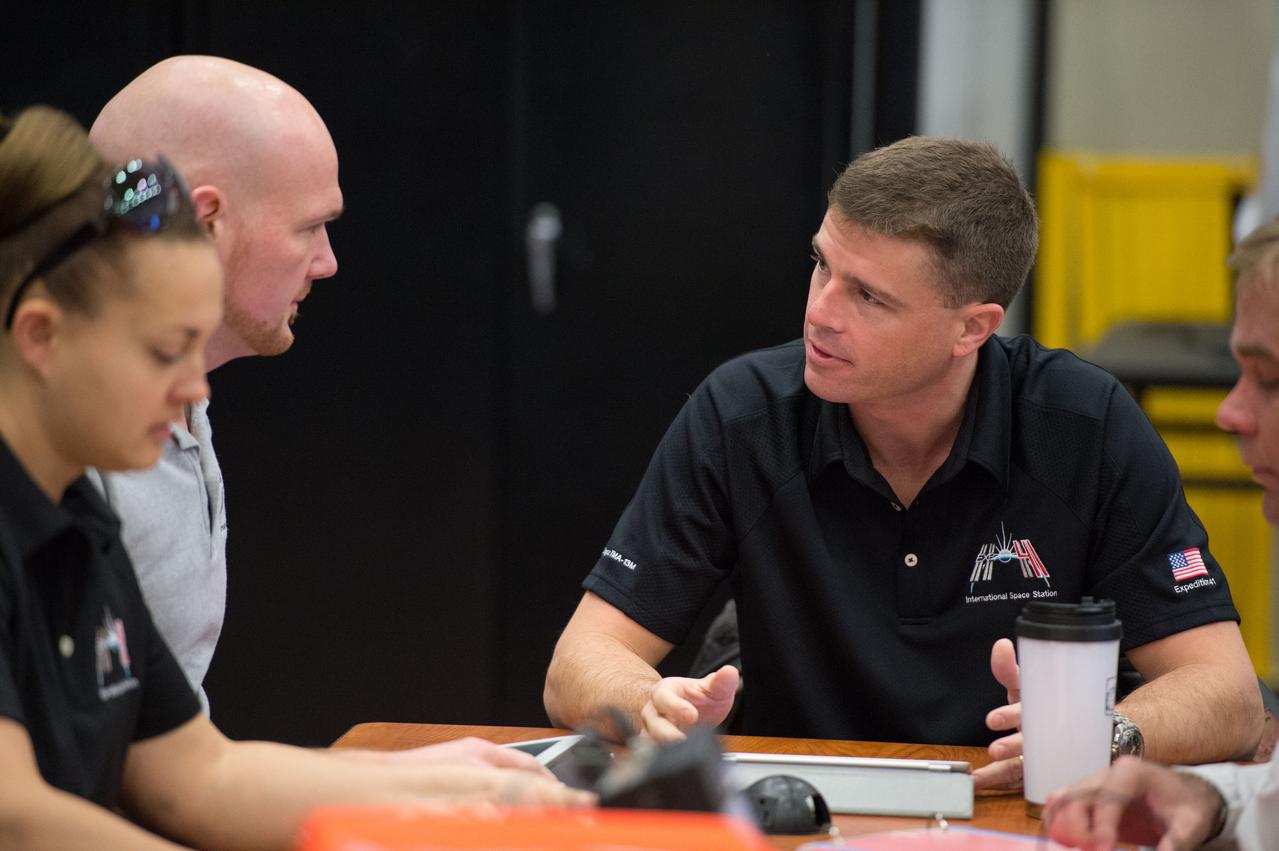
PHOTO DATE: 21 January 2014 LOCATION: Bldg. 9NW, Space Vehicle Mockup Training Facility - ISS Mockups SUBJECT: Expedition 41 six person crew emergency training scenarios. Crewmembers: 39S/Suraev, Wiseman and Gerst along with 40S/Wilmore, Samokutyaev, and Serova. PHOTOGRAPHER: Mark Sowa
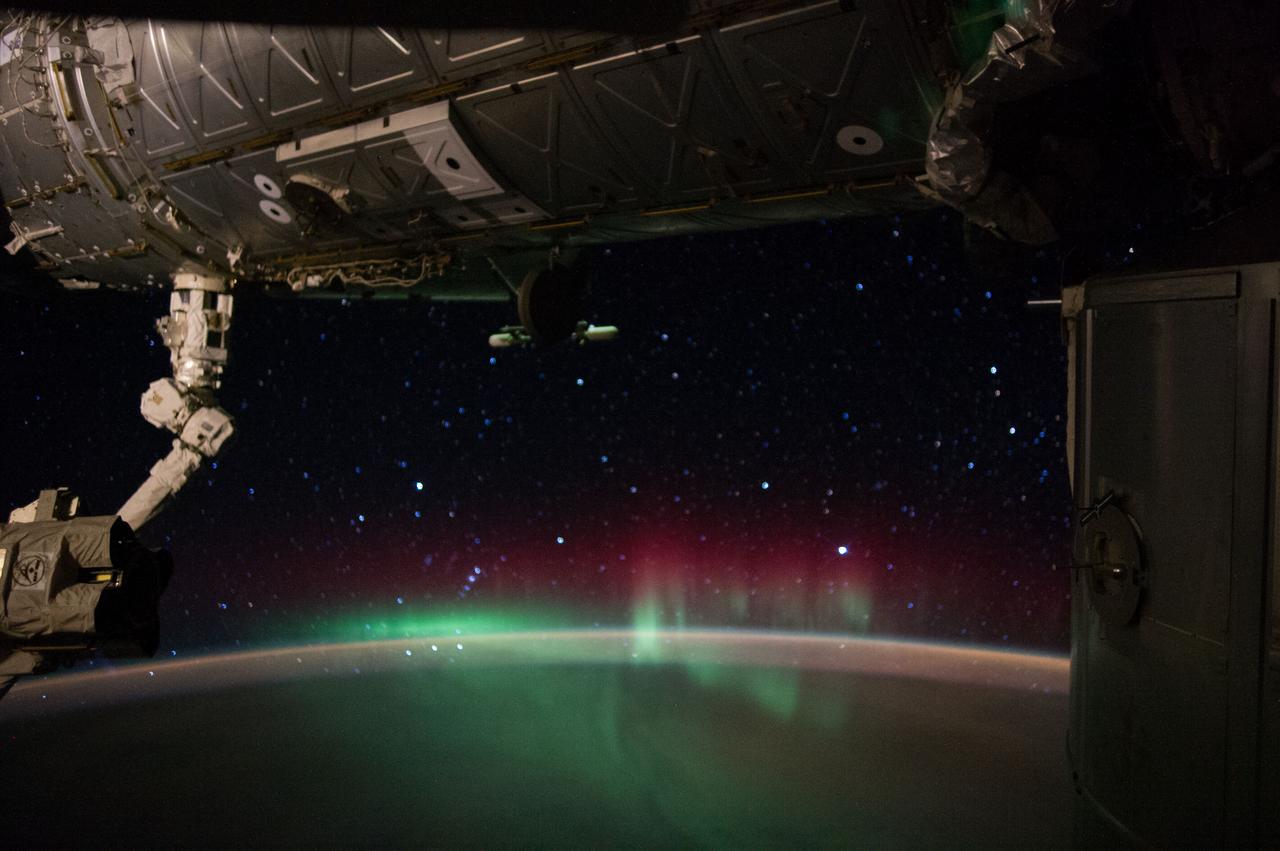
Earth Observation taken during a night pass by the Expedition 40 crew aboard the International Space Station (ISS). Folder lists this as: night, Auroras, long shutters. Part of the Space Station Remote Manipulator System (SSRMS) arm is visible.
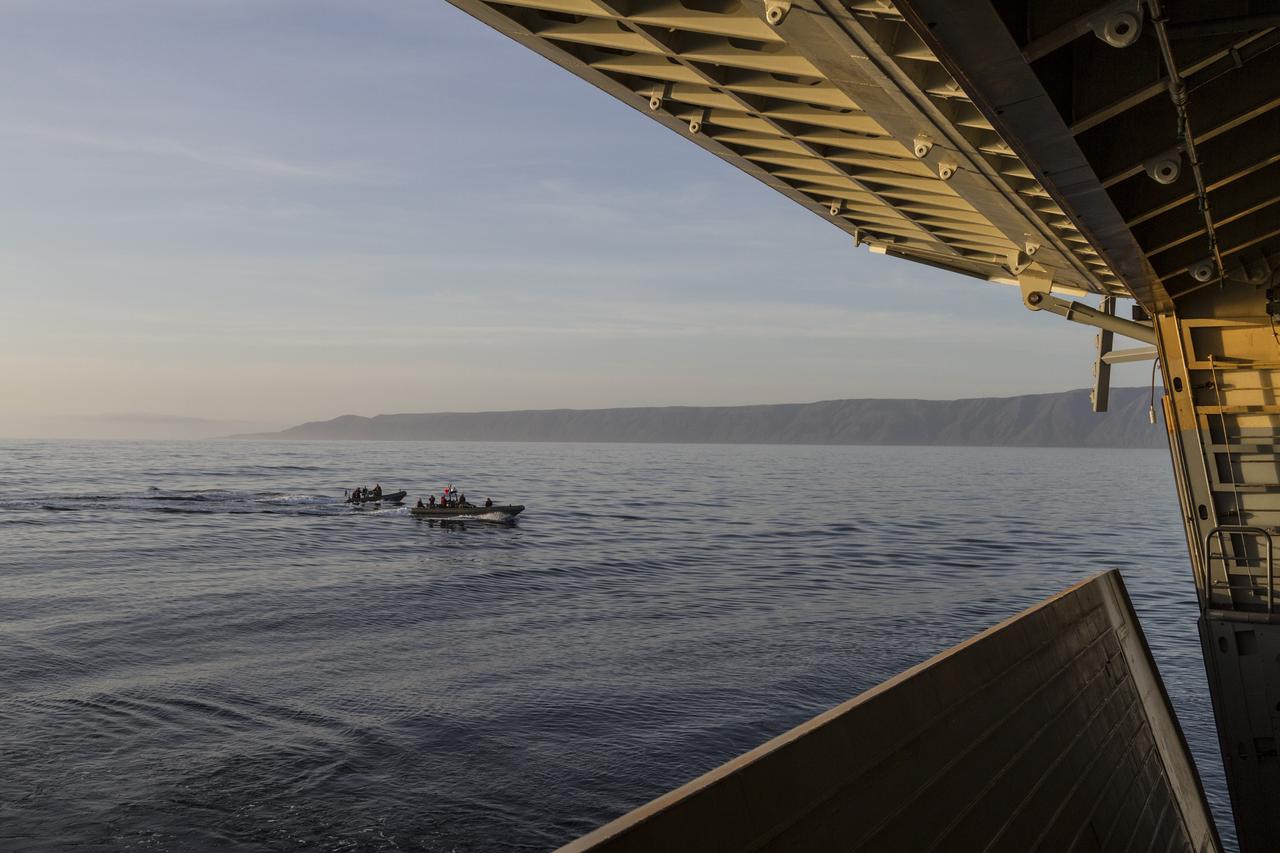
SAN DIEGO, Calif. – The U.S. Navy uses two rigid hull inflatable boats to practice Orion underway recovery test procedures near the USS San Diego, in the Pacific Ocean near the coast of San Diego. The Orion boilerplate test vehicle and other hardware are in its well deck for the test. For the test, the ship traveled about 100 miles offshore. NASA and the U.S. Navy conducted the tests to prepare for recovery of the Orion crew module, forward bay cover and parachutes on its return from a deep space mission. The underway recovery test allowed the teams to demonstrate and evaluate the recovery processes, procedures, hardware and personnel in open waters. During the testing, the tether lines were unable to support the tension caused by crew module motion that was driven by wave turbulence in the well deck of the ship. NASA and the U.S. Navy are reviewing the testing data collected to evaluate the next steps. The Ground Systems Development and Operations Program conducted the underway recovery tests. Orion is the exploration spacecraft designed to carry astronauts to destinations not yet explored by humans, including an asteroid and Mars. It will have emergency abort capability, sustain the crew during space travel and provide safe re-entry from deep space return velocities. The first unpiloted test flight of the Orion is scheduled to launch in 2014 atop a Delta IV rocket and in 2017 on NASA’s Space Launch System rocket. For more information, visit http://www.nasa.gov/orion. Photo credit: NASA/Cory Huston
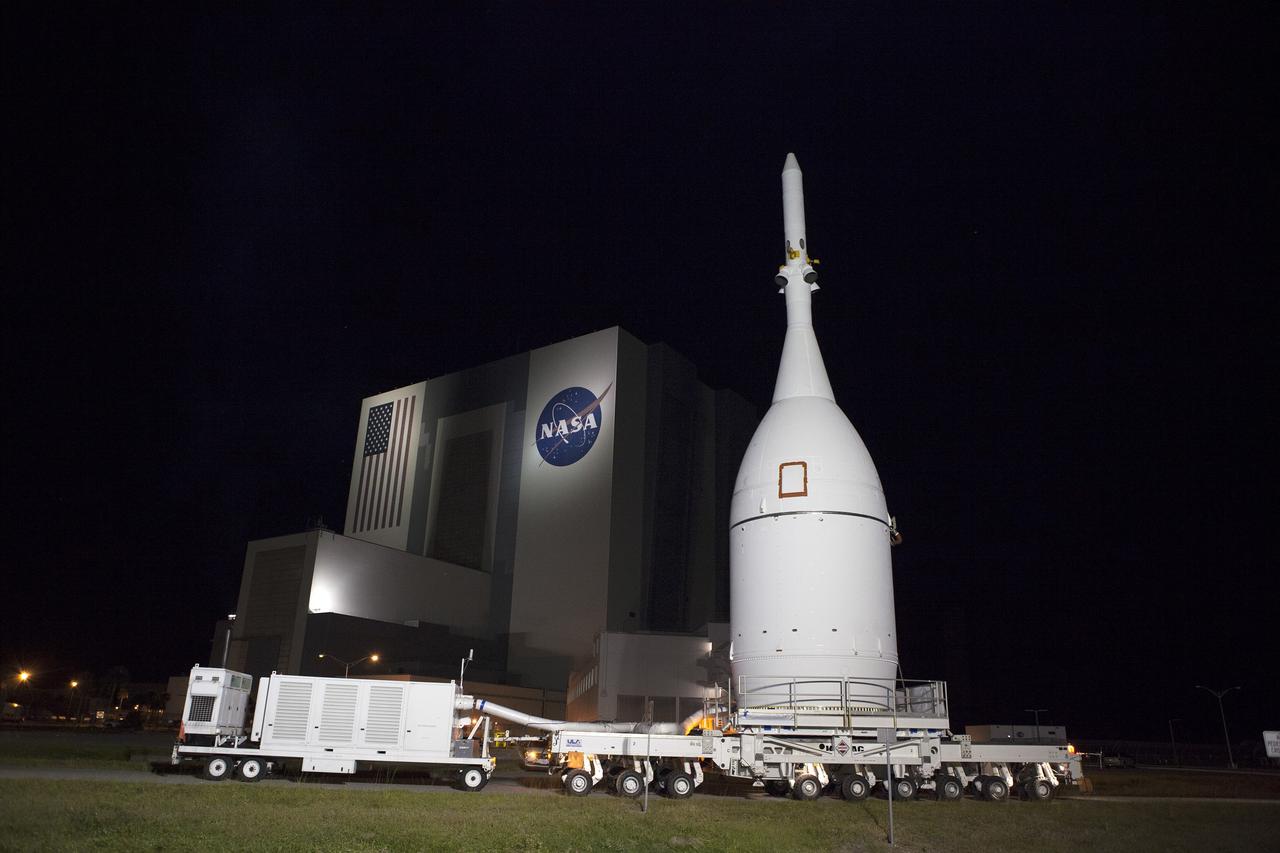
CAPE CANAVERAL, Fla. – At NASA's Kennedy Space Center in Florida, the agency's Orion spacecraft passes the spaceport's iconic Vehicle Assembly Building as it is transported to Launch Complex 37 at Cape Canaveral Air Force Station. After arrival at the launch pad, United Launch Alliance engineers and technicians will lift Orion and mount it atop its Delta IV Heavy rocket. Orion is the exploration spacecraft designed to carry astronauts to destinations not yet explored by humans, including an asteroid and Mars. It will have emergency abort capability, sustain the crew during space travel and provide safe re-entry from deep space return velocities. The first unpiloted flight test of Orion is scheduled to launch Dec. 4, 2014 atop a United Launch Alliance Delta IV Heavy rocket, and in 2018 on NASA’s Space Launch System rocket. For more information, visit www.nasa.gov/orion Photo credit: NASA/Frankie Martin
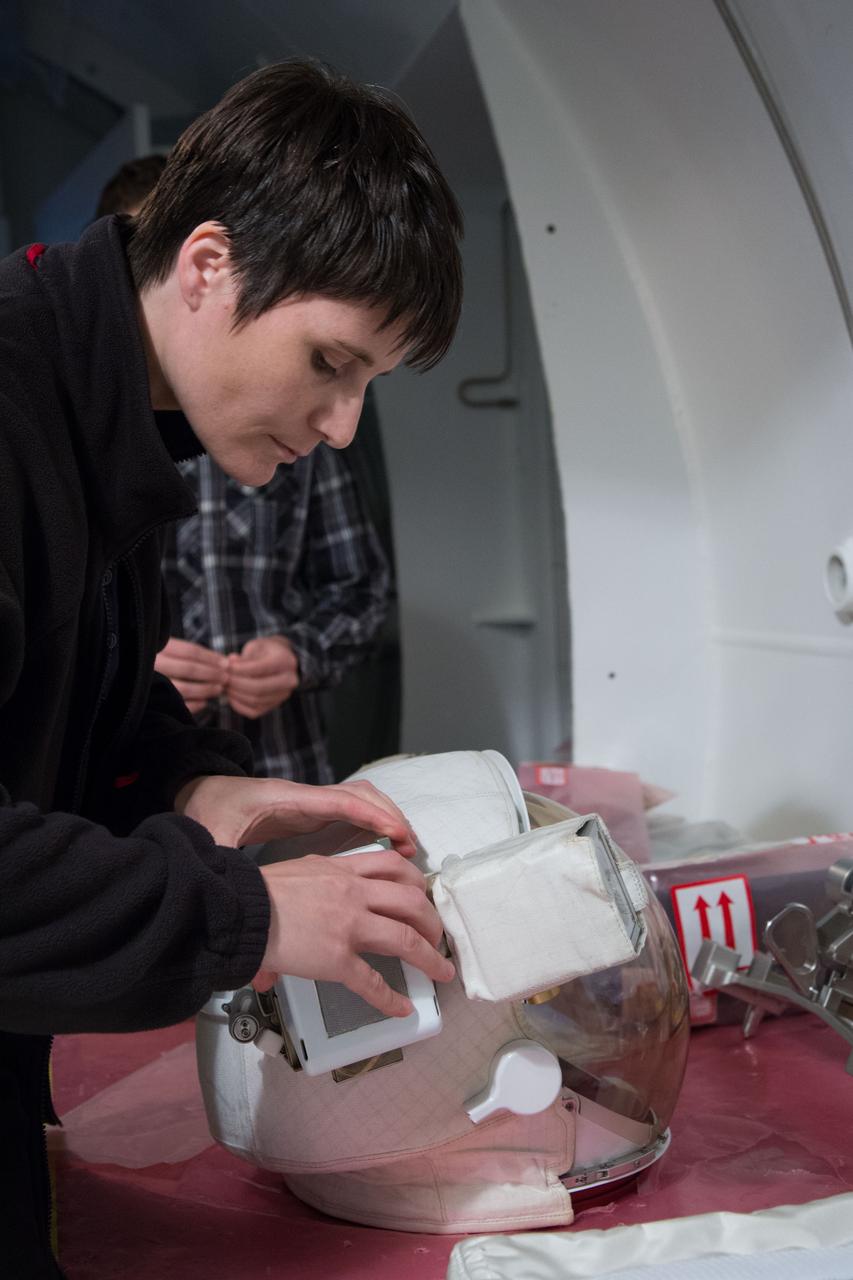
Date: 07-14-14 Location: Bldg 7, SSATA Subject: SSATA Crew Training for Increment-41 ESA astronaut Samantha Cristoforetti Photographer: James Blair
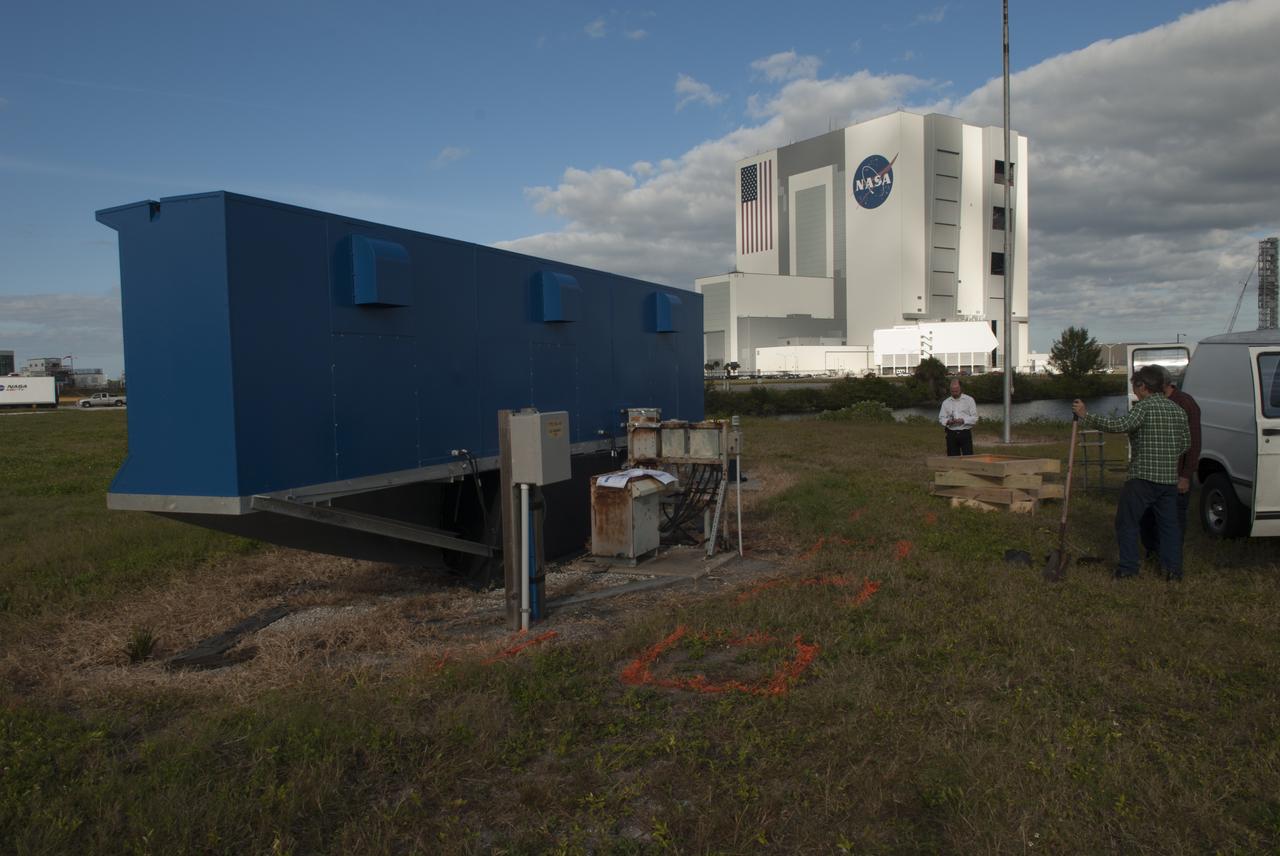
At NASA's Kennedy Space Center in Florida, Kennedy TV senior systems engineer Ronald Gonser, left, Jeff Pratt and Frank Morse with Abacus Technology prep the area behind the current countdown clock for the groundbreaking ceremony for the new countdown clock. The old timepiece was designed by Kennedy engineers and built by Kennedy technicians in 1969. Not including the triangular concrete and aluminum base, the famous landmark is nearly 6 feet 70 inches high, 26 feet 315 inches wide and 3 feet deep. The new display will be similar in size, with the screen being nearly 26 feet wide by 7 feet high.
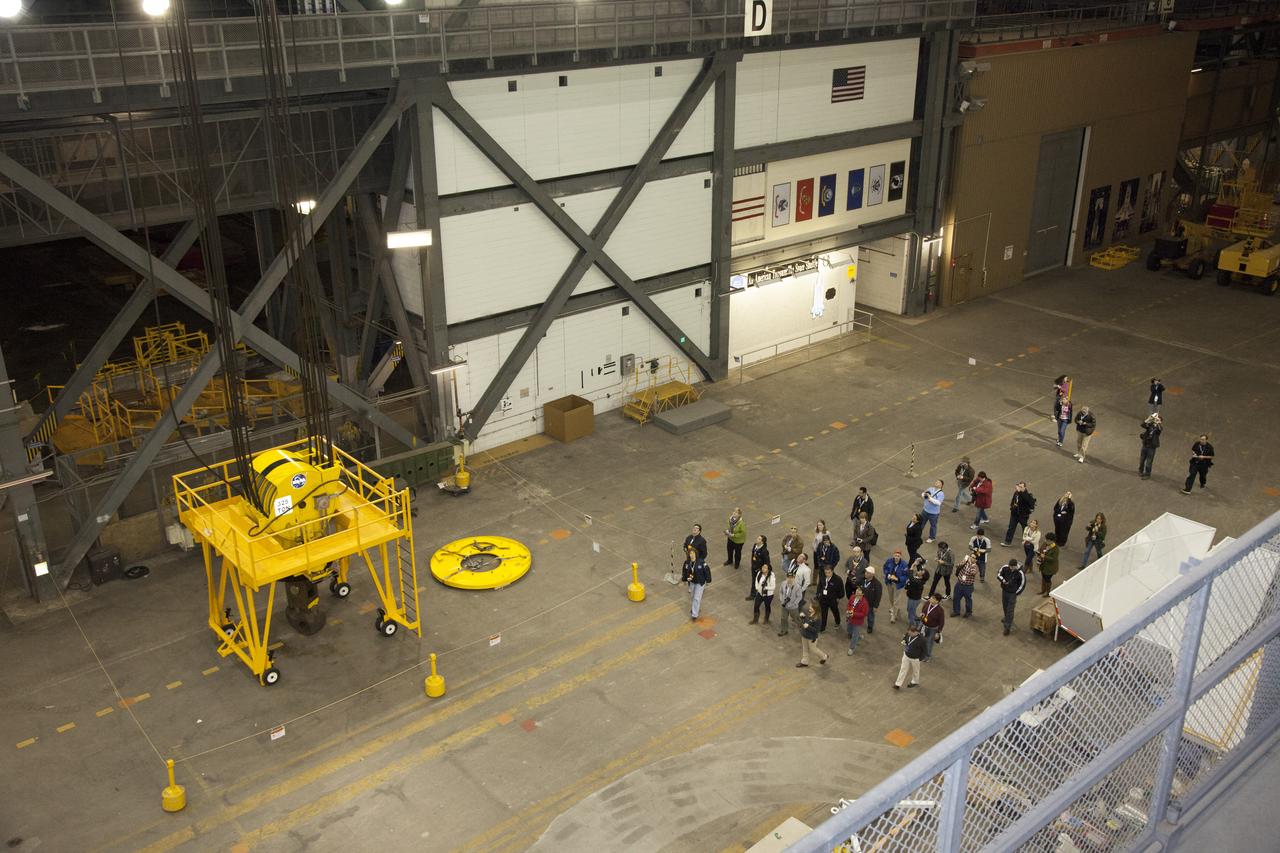
CAPE CANAVERAL, Fla. -- At NASA's Kennedy Space Center in Florida, social media participants were given an opportunity to go inside the spaceport's Vehicle Assembly Building. After serving through the Apollo and Space Shuttle Programs, the structure now is undergoing renovations to accommodate future launch vehicles and to continue as a major part of America's efforts to explore space. The social media participants gathered at the Florida spaceport for the launch of the Tracking and Data Relay Satellite, or TDRS-L spacecraft. Their visit included tours of key facilities and participating in presentations by key NASA leaders who updated the space agency's current efforts. Photo credit: NASA/Dan Casper
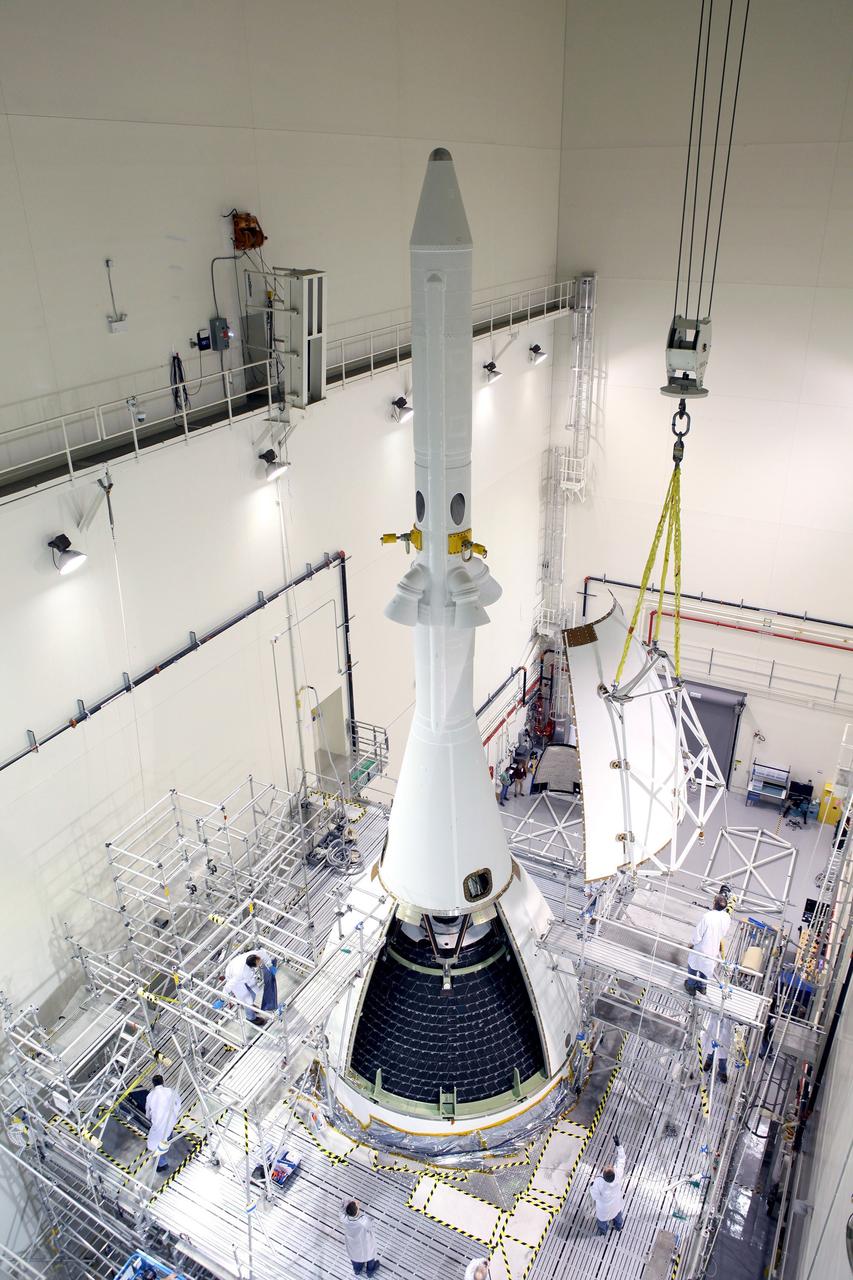
CAPE CANAVERAL, Fla. – Inside the Launch Abort System Facility at NASA's Kennedy Space Center in Florida, a crane brings the third of four Ogive panels closer for installation on Orion's Launch Abort System. The panels will smooth the airflow over the conical spacecraft to limit sound and vibration, which will make for a much smoother ride for the astronauts who will ride inside Orion in the future. The work marked the final major assembly steps for the spacecraft before it is transported to Space Launch Complex 37 at Cape Canaveral Air Force Station in November. Orion is the exploration spacecraft designed to carry astronauts to destinations not yet explored by humans, including an asteroid and Mars. It will have emergency abort capability, sustain the crew during space travel and provide safe re-entry from deep space return velocities. The first unpiloted flight test of Orion is scheduled to launch in December 2014 atop a United Launch Alliance Delta IV Heavy rocket, and in 2018 on NASA’s Space Launch System rocket. For more information, visit www.nasa.gov/orion. Photo credit: Ben Smegelsky
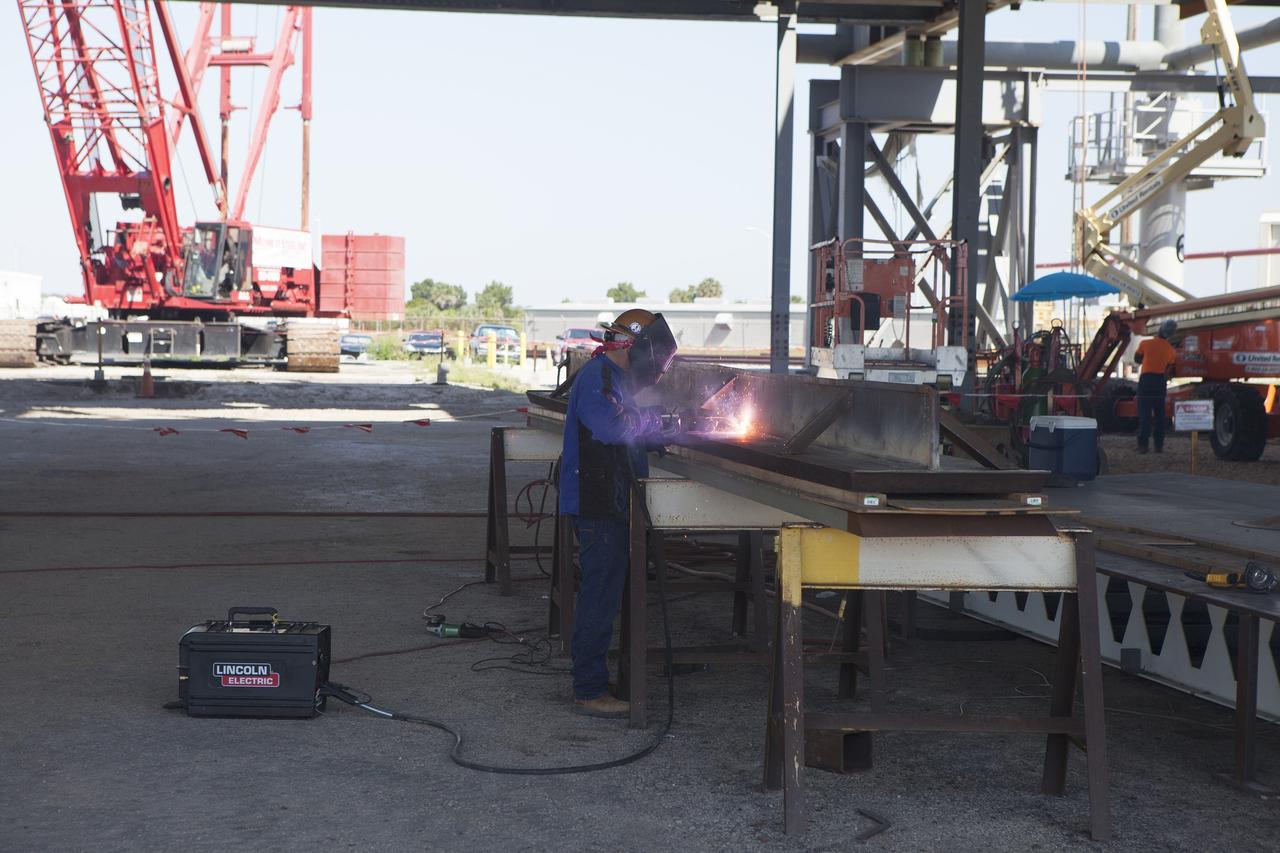
CAPE CANAVERAL, Fla. – Modifications continue on the Mobile Launcher, or ML, at the Mobile Launcher Park Site at NASA’s Kennedy Space Center in Florida. A construction worker welds a section of a steel beam. The ML is being modified and strengthened to accommodate the weight, size and thrust at launch of NASA's Space Launch System and Orion spacecraft. In 2013, the agency awarded a contract to J.P. Donovan Construction Inc. of Rockledge, Fla., to modify the ML, which is one of the key elements of ground support equipment that is being upgraded by the Ground Systems Development and Operations Program office at Kennedy. The existing 24-foot exhaust hole is being enlarged and strengthened for the larger, heavier SLS rocket. The ML will carry the SLS rocket and Orion spacecraft to Launch Pad 39B for its first mission, Exploration Mission-1, in 2017. Photo credit: NASA/Daniel Casper
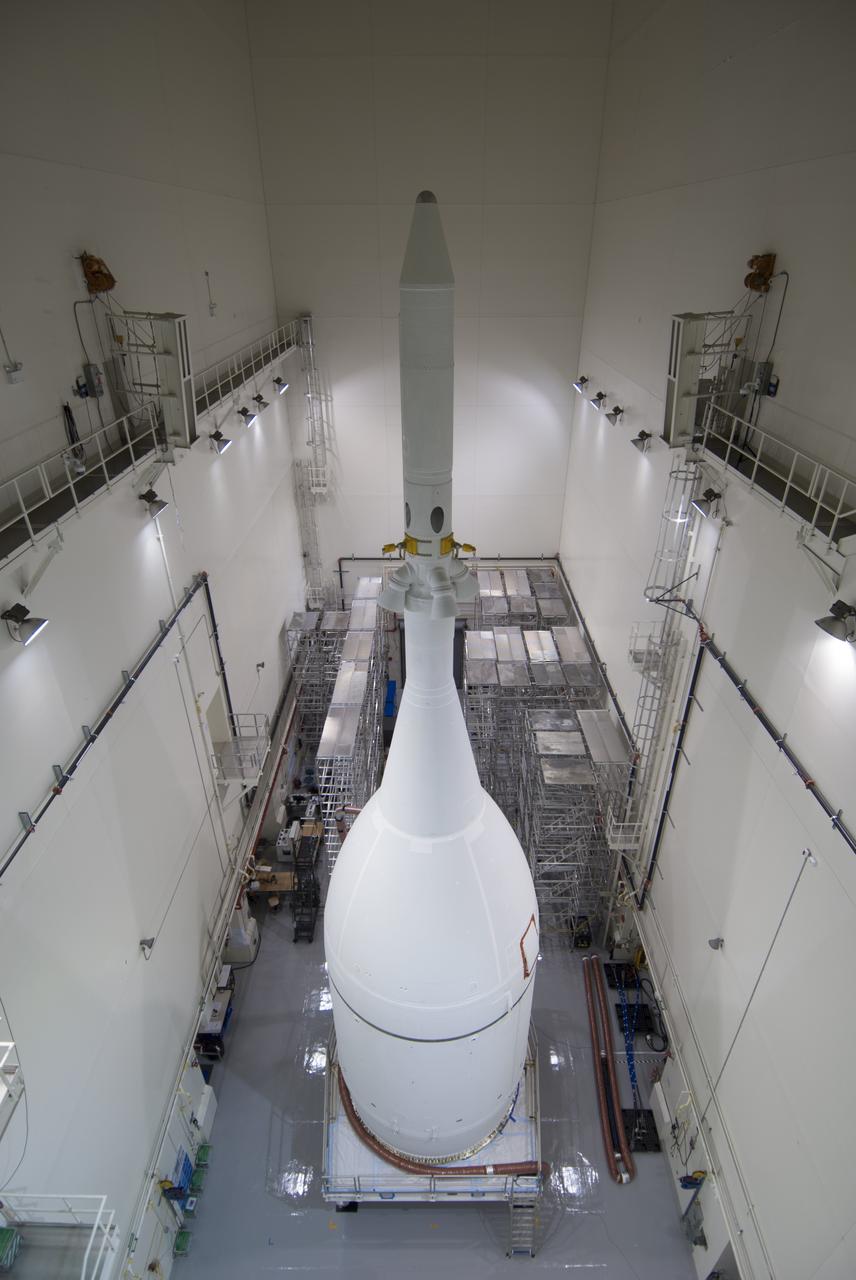
The Orion spacecraft sits inside the Launch Abort System Facility at NASA's Kennedy Space Center in Florida. The Ogive panels have been installed around the launch abort system. The panels will smooth the airflow over the conical spacecraft to limit sound and vibration, which will make for a much smoother ride for the astronauts who will ride inside Orion in the future. The spacecraft is being readied for its move to Space Launch Complex 37 at Cape Canaveral Air Force Station for its flight test. Orion is the exploration spacecraft designed to carry astronauts to destinations not yet explored by humans, including an asteroid and Mars. It will have emergency abort capability, sustain the crew during space travel and provide safe re-entry from deep space return velocities. The first unpiloted flight test of Orion is scheduled to launch in December 2014 atop a United Launch Alliance Delta IV Heavy rocket, and in 2018 on NASA’s Space Launch System rocket.
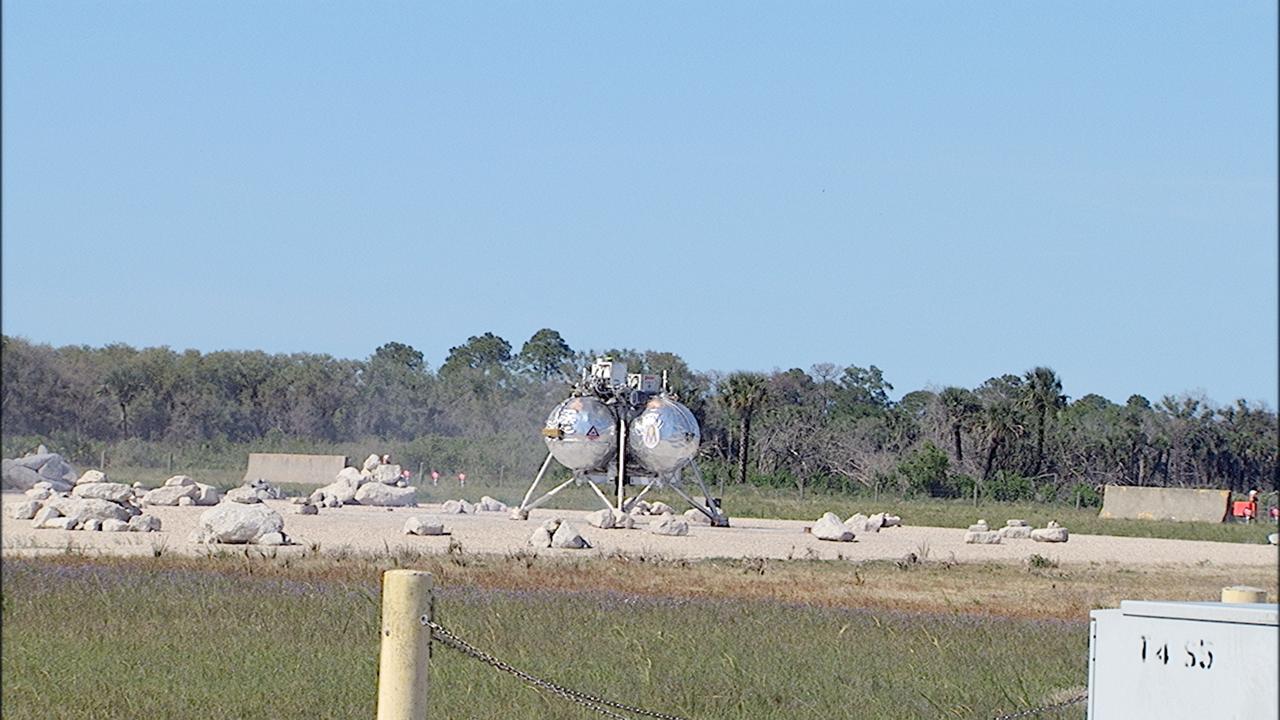
CAPE CANAVERAL, Fla. – NASA's Project Morpheus prototype lander lands inside the autonomous landing and hazard avoidance technology, or ALHAT, hazard field after a free flight test at the north end of the Shuttle Landing Facility at NASA's Kennedy Space Center in Florida. The 96-second test began at 4:21 p.m. EDT with the Morpheus lander launching from the ground over the flame trench at a new launch site and ascending more than 800 feet at a peak speed of 36 mph. The vehicle with its recently installed autonomous landing and hazard avoidance technology, or ALHAT, sensors surveyed the hazard field to determine safe landing sites. Morpheus then flew forward and downward covering 1,300 feet while performing a 78-foot divert to simulate a hazard avoidance maneuver. The lander descended and landed on a dedicated pad inside the ALHAT field. Project Morpheus tests NASA’s ALHAT, and an engine that runs on liquid oxygen and methane, or green propellants, into a fully-operational lander that could deliver cargo to other planetary surfaces. The landing facility provides the lander with the kind of field necessary for realistic testing, complete with rocks, craters and hazards to avoid. Morpheus’ ALHAT payload allows it to navigate to clear landing sites amidst rocks, craters and other hazards during its descent. Project Morpheus is being managed under the Advanced Exploration Systems, or AES, Division in NASA’s Human Exploration and Operations Mission Directorate. The efforts in AES pioneer new approaches for rapidly developing prototype systems, demonstrating key capabilities and validating operational concepts for future human missions beyond Earth orbit. For more information on Project Morpheus, visit http://morpheuslander.jsc.nasa.gov/. Photo credit: NASA/Frankie Martin
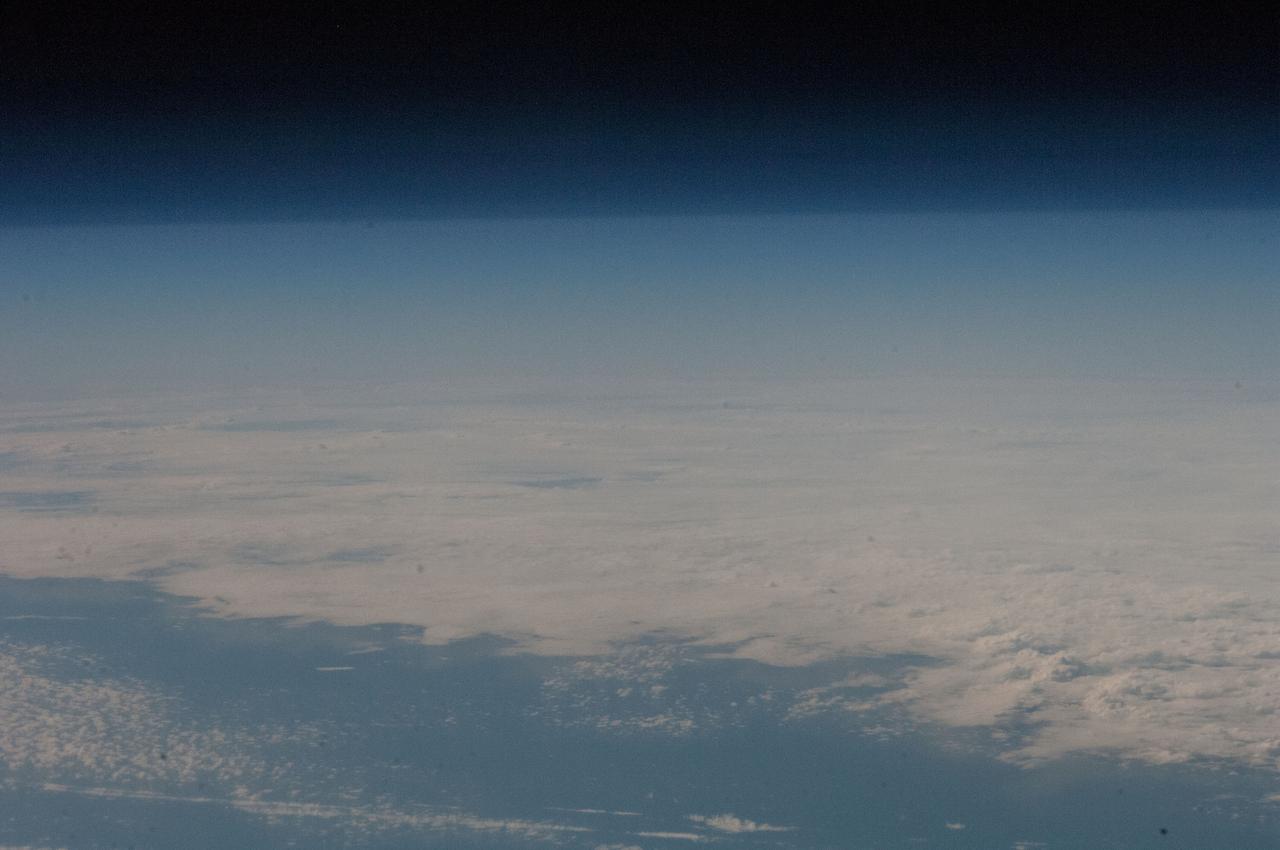
Earth Observation taken during a day pass by the Expedition 40 crew aboard the International Space Station (ISS). Folder lists this as: misc clouds.
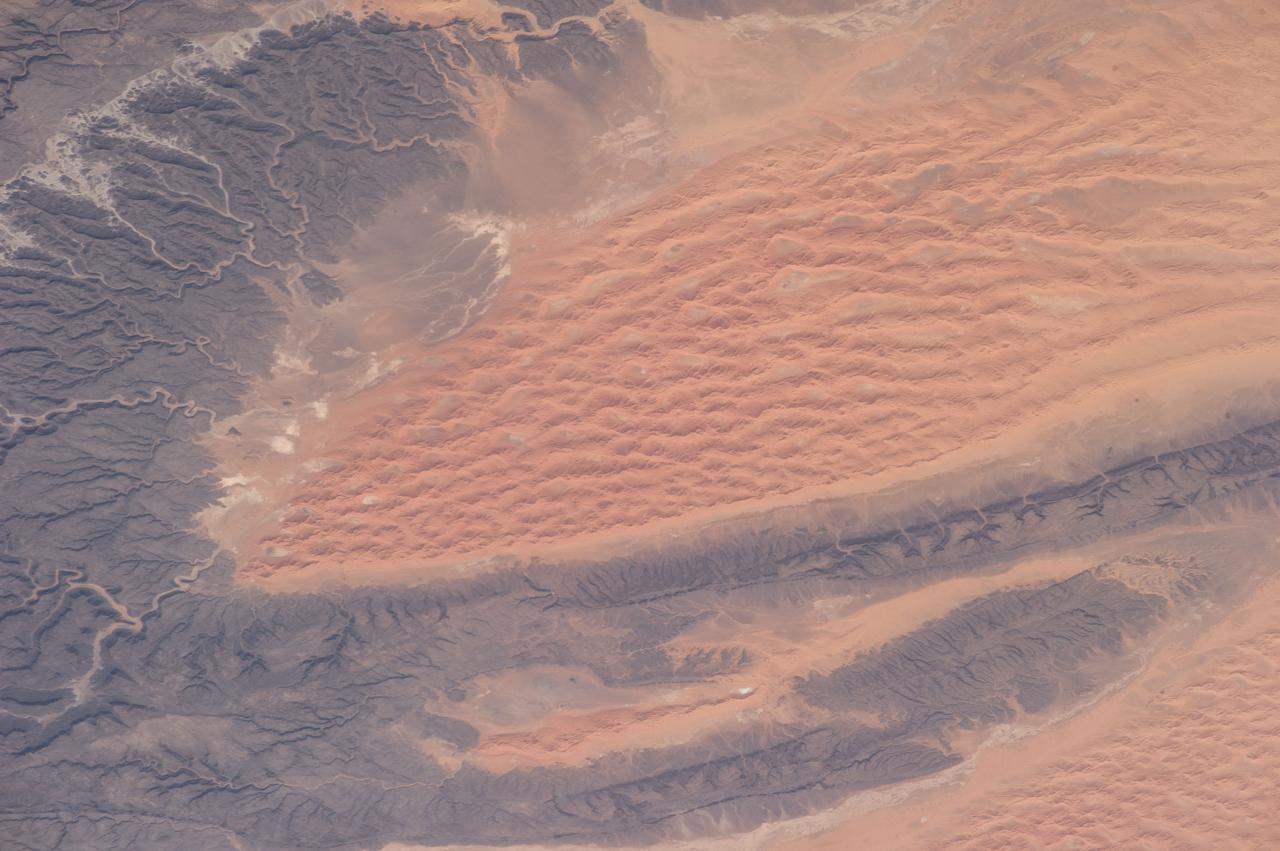
ISS040-E-081008 (25 July 2014) --- One of the Expedition 40 crew members aboard the International Space Station, flying 225 nautical miles above Earth, photographed this image of the Tifernine dunes and the Tassili Najjer Mountains in Algeria. The area is about 800 miles south, southeast of Algiers, the capital of Algeria. The dunes are in excess of 1,000 feet in height.
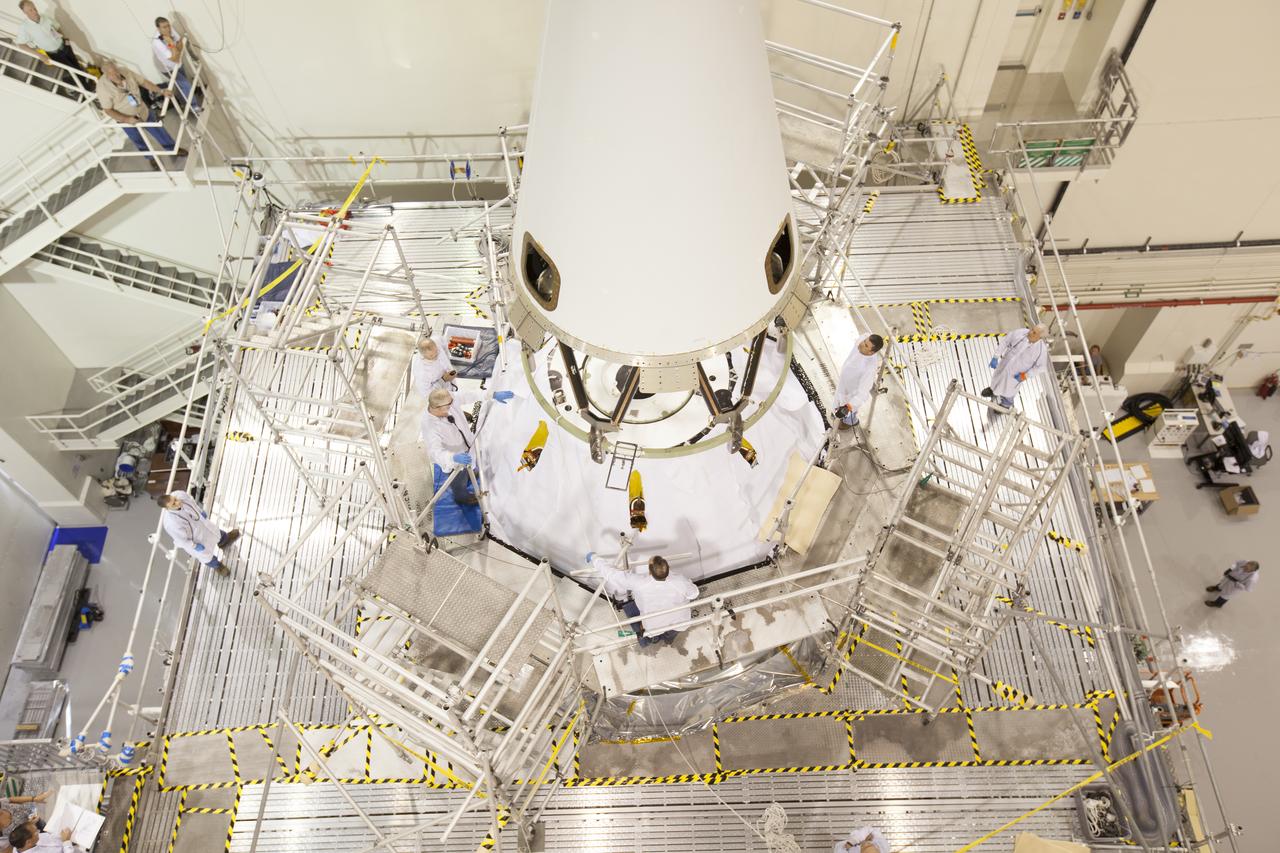
The launch abort system is lowered by crane for installation on the Orion spacecraft for Exploration Flight Test-1 inside the Launch Abort System Facility, or LASF, at NASA's Kennedy Space Center in Florida. The completed crew and service modules will be tested and verified together with the launch abort system. Orion will remain inside the LASF until mid-November, when the United Launch Alliance Delta IV Heavy rocket is ready for integration with the spacecraft. Orion is the exploration spacecraft designed to carry astronauts to destinations not yet explored by humans, including an asteroid and Mars. It will have emergency abort capability, sustain the crew during space travel and provide safe re-entry from deep space return velocities. The first unpiloted test flight of the Orion is scheduled to launch in December atop the Delta IV Heavy rocket from Cape Canaveral Air Force Station in Florida to an altitude of 3,600 miles above the Earth's surface. The two-orbit, four-hour flight test will help engineers evaluate the systems critical to crew safety including the heat shield, parachute system and launch abort system.
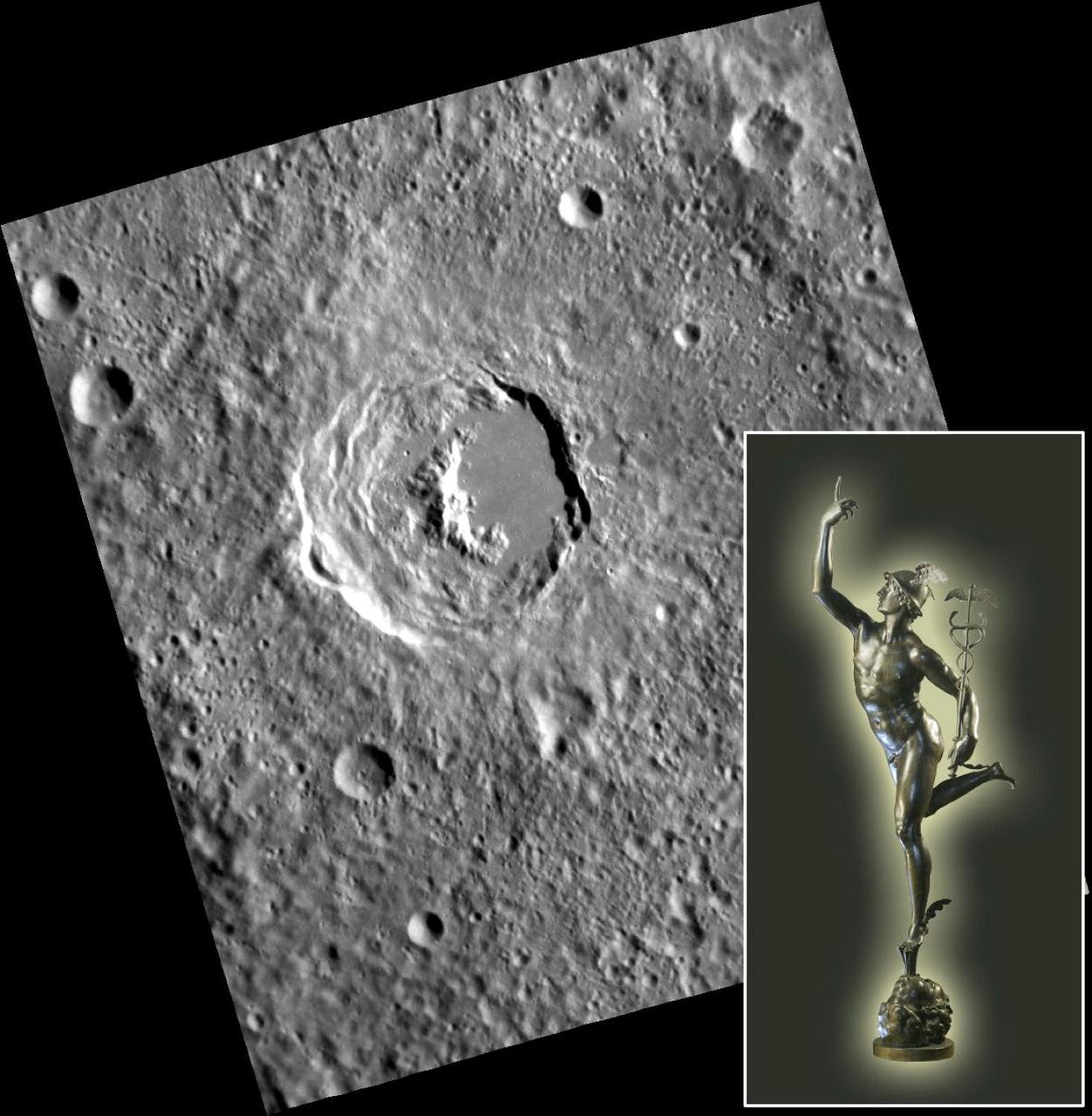
Mercury in Bronze
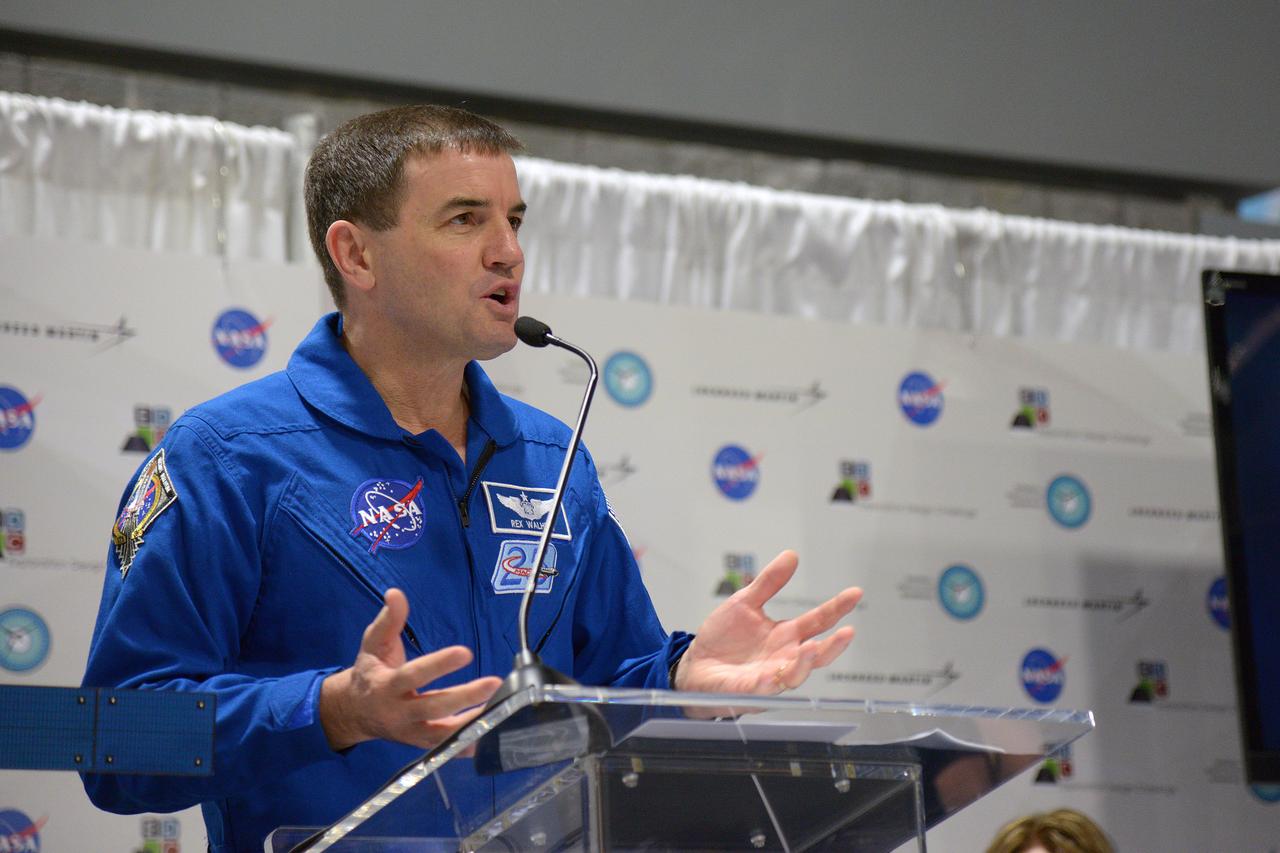
The winner of the high school portion of the Exploration Design Challenge is announced at the USA Science and Engineering Festival in Washington on April 25, 2014. Astronaut Rex Walheim speaks from podium. Part of Batch image transfer from Flickr.
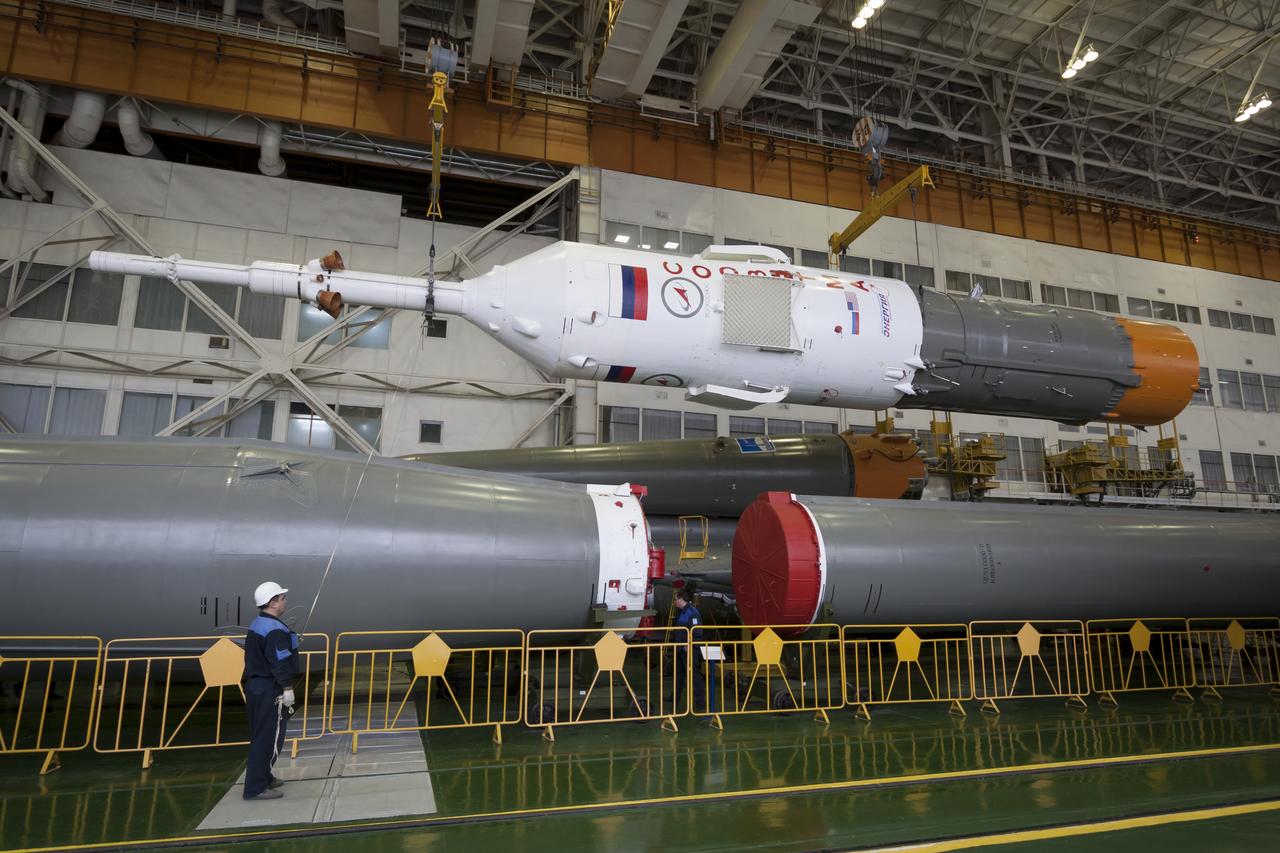
The Soyuz rocket and Soyuz TMA-12M spacecraft are assembled at Building 112 on the Baikonur Cosmodrome on Saturday, March 22, 2014 in Baikonur, Kazakhstan. Launch of the Soyuz is scheduled for March 26 and will send Expedition 39 Soyuz Commander Alexander Skvortsov of the Russian Federal Space Agency, Roscosmos, Flight Engineer Steven Swanson of NASA, and Flight Engineer Oleg Artemyev of Roscosmos on a six month mission to the International Space Station. Photo Credit: (NASA/Victor Zelentsov)
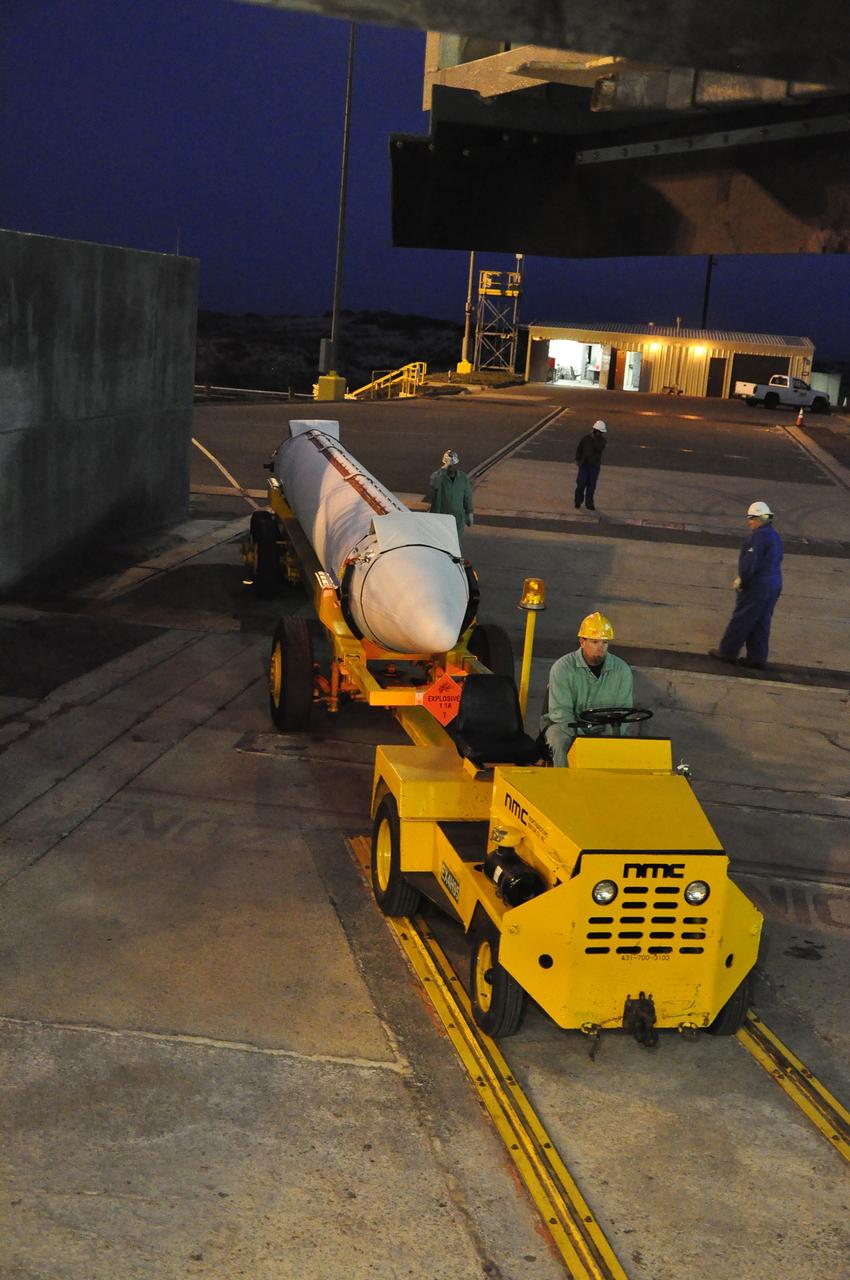
VANDENBERG AIR FORCE BASE, Calif. – A solid rocket motor for the Delta II rocket for NASA's Soil Moisture Active Passive mission, or SMAP, is delivered to the mobile service tower at Space Launch Complex 2 on Vandenberg Air Force Base in California. SMAP will be launched on a Delta II 7320 configuration vehicle featuring a United Launch Alliance first stage booster powered by an Aerojet Rocketdyne RS-27A main engine and three Alliant Techsystems, or ATK, strap-on solid rocket motors. Once on station in Earth orbit, SMAP will provide global measurements of soil moisture and its freeze/thaw state. These measurements will be used to enhance understanding of processes that link the water, energy and carbon cycles, and to extend the capabilities of weather and climate prediction models. SMAP data also will be used to quantify net carbon flux in boreal landscapes and to develop improved flood prediction and drought monitoring capabilities. Launch is scheduled for no earlier than November 2014. To learn more about SMAP, visit http://smap.jpl.nasa.gov. Photo credit: NASA/Randy Beaudoin
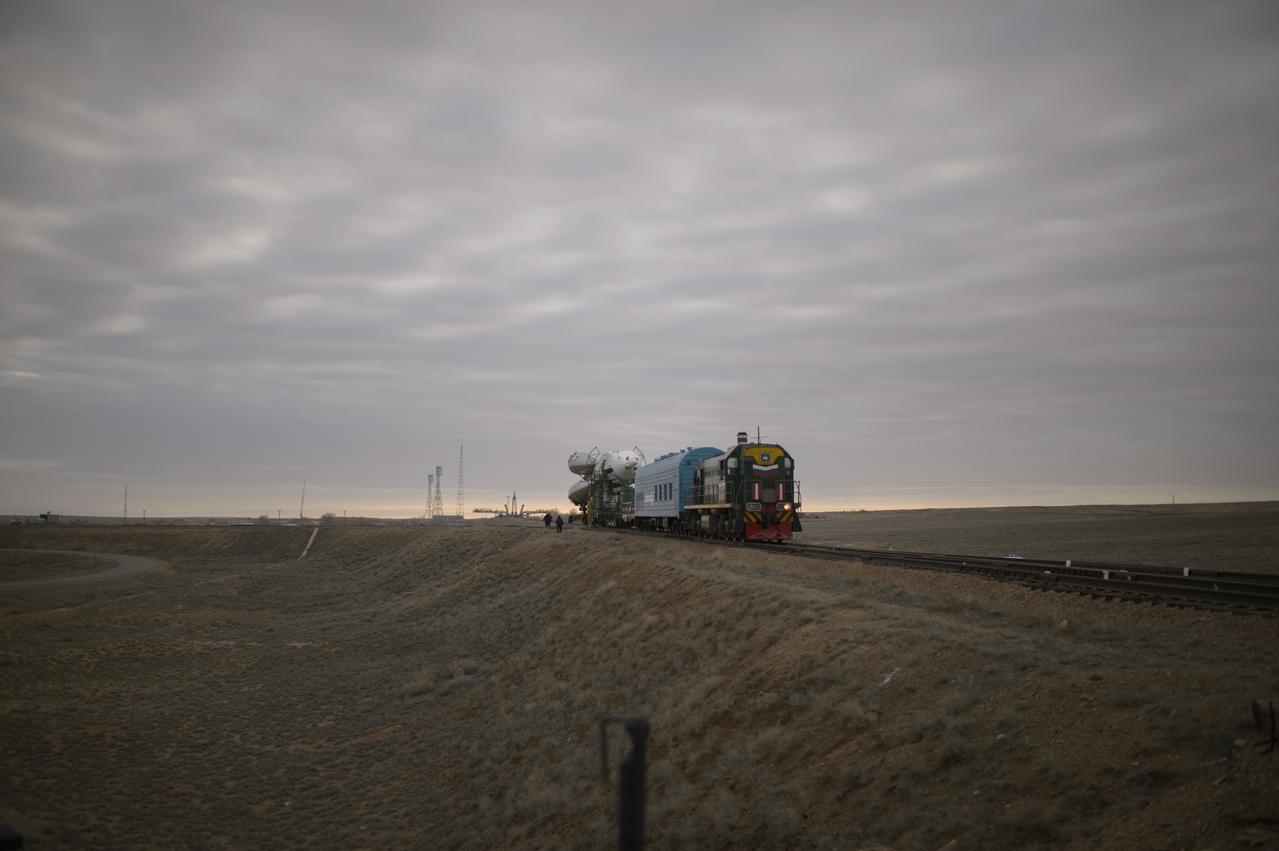
The Soyuz TMA-12M spacecraft is rolled out to the launch pad by train on Sunday, March 23, 2014, at the Baikonur Cosmodrome in Kazakhstan. Launch of the Soyuz rocket is scheduled for March 26 and will send Expedition 39 Soyuz Commander Alexander Skvortsov of the Russian Federal Space Agency, Roscosmos, Flight Engineer Steven Swanson of NASA, and Flight Engineer Oleg Artemyev of Roscosmos on a six-month mission aboard the International Space Station. Photo Credit: (NASA/Joel Kowsky)
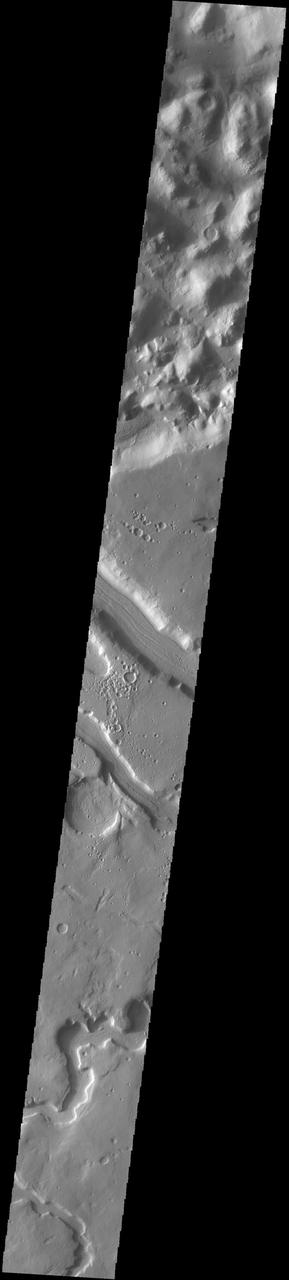
The sinuous channel at the bottom of this image captured by NASA 2001 Mars Odyssey spacecraft is called Anio Valles.
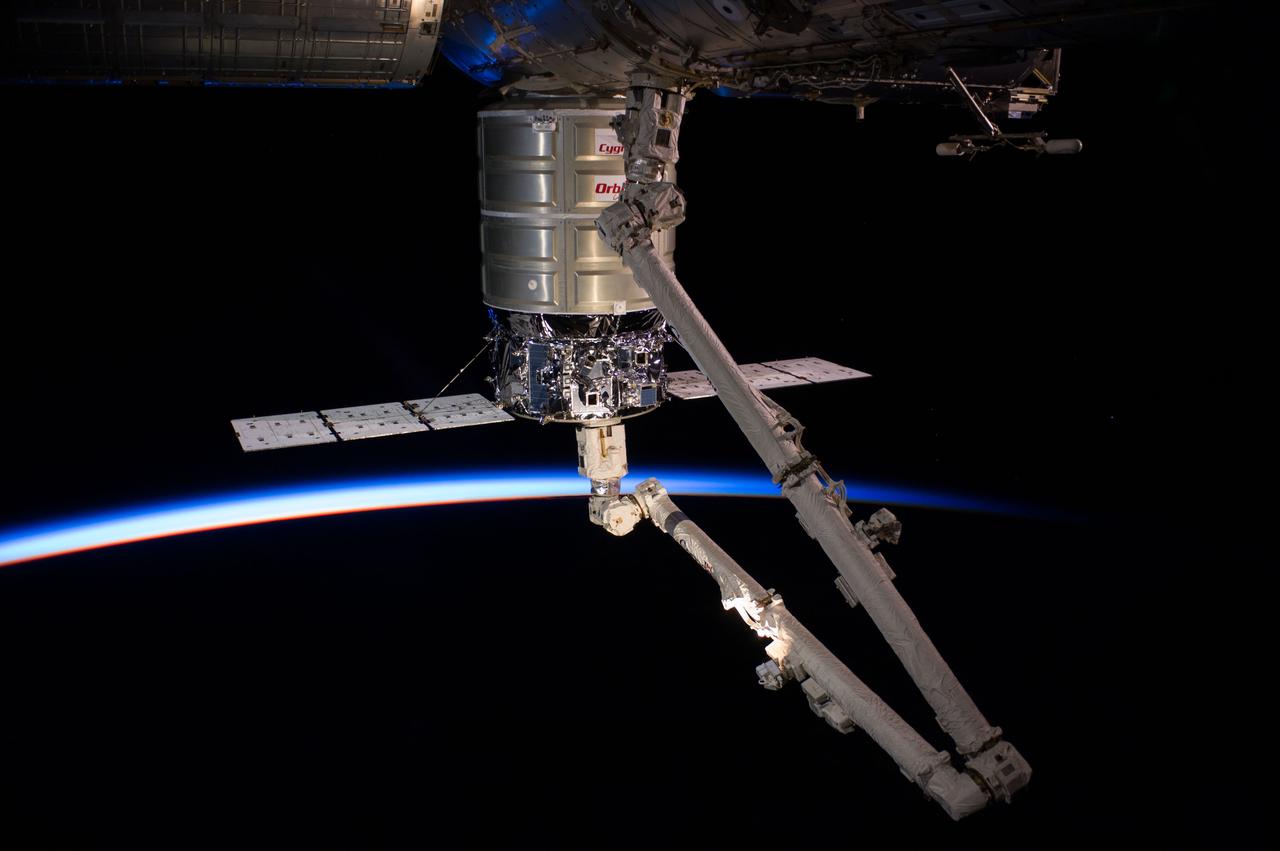
ISS040-E-069182 (16 July 2014) --- Intersecting the thin line of Earth’s atmosphere, the Orbital Sciences’ Cygnus cargo craft attached to the end of the Canadarm2 robotic arm is berthed to the nadir port of the Harmony node of the International Space Station.
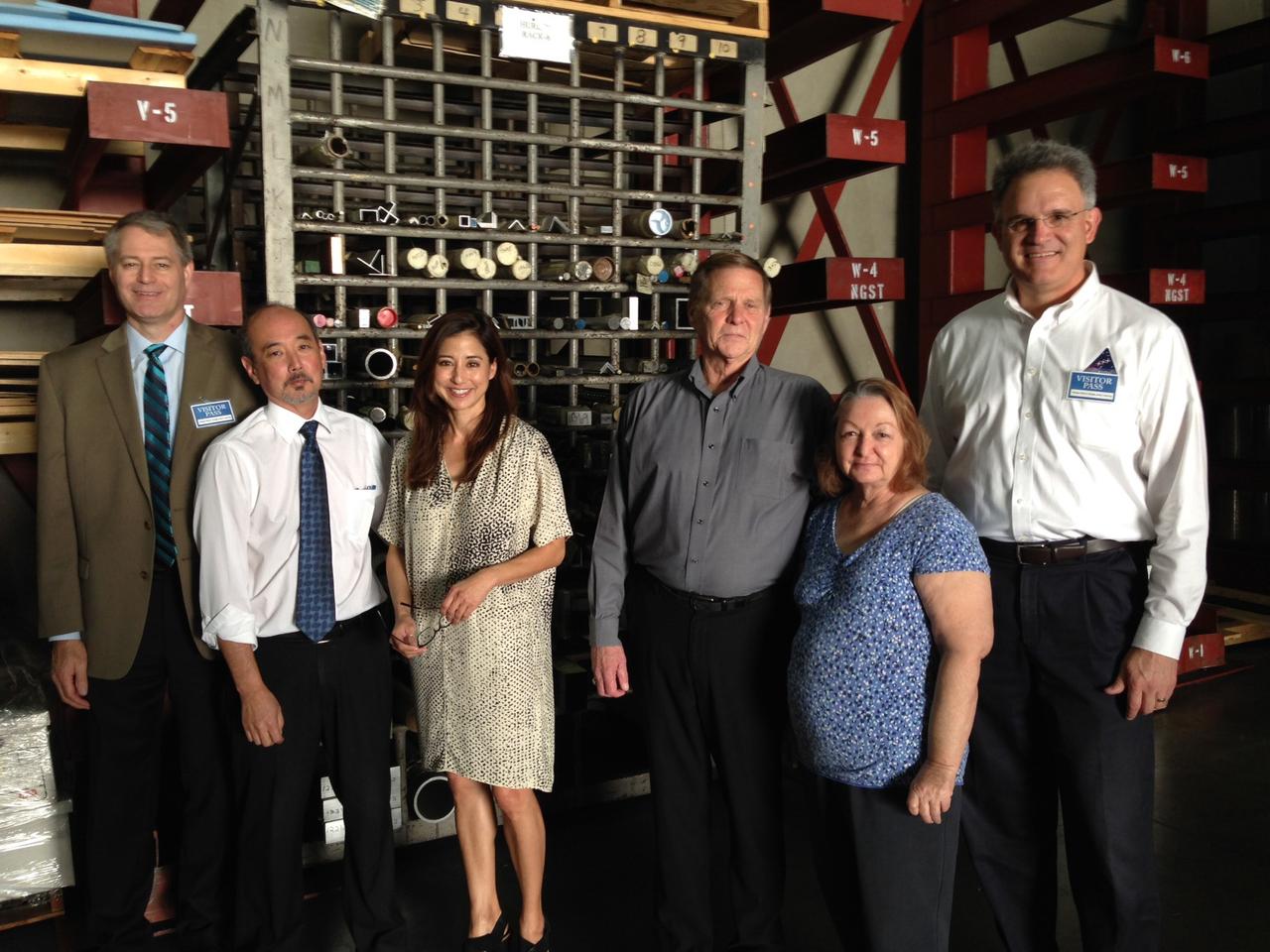
The Orion team visits Hurlen Corporation in Santa Fe Springs, CA on Jan. 29, 2014. Part of Batch image transfer from Flickr.
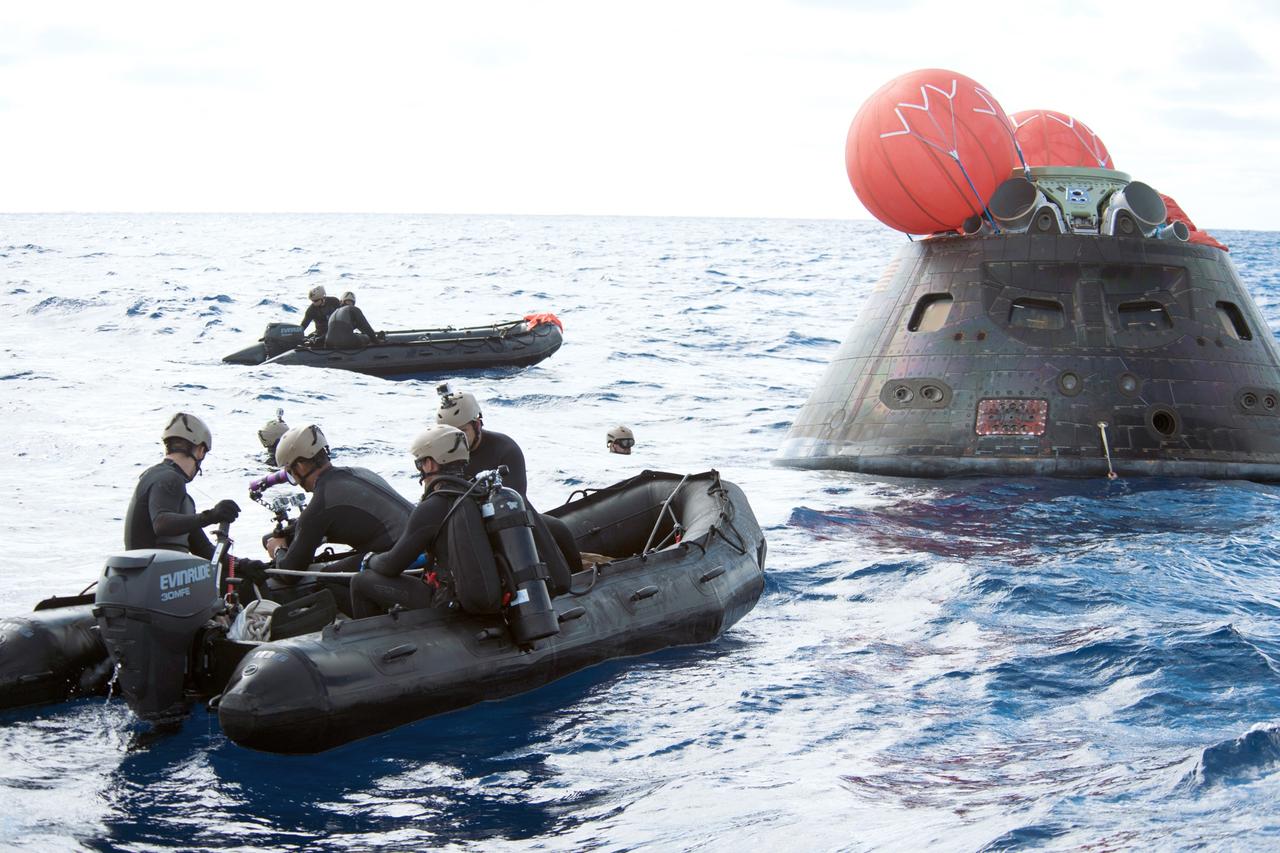
SAN DIEGO, Calif. -- NASA's Orion spacecraft splashed down in the Pacific Ocean after its first flight test atop a Delta IV Heavy rocket from Space Launch Complex 37 at Cape Canaveral Air Force Station in Florida. U.S. Navy divers in Zodiac boats prepare to recover Orion and tow her in to the well deck of the USS Anchorage. NASA's Orion spacecraft completed a two-orbit, four-and-a-half hour mission to test systems critical to crew safety, including the launch abort system, the heat shield and the parachute system. The Ground Systems Development and Operations Program is leading the recovery efforts. For more information, visit www.nasa.gov/orion Photo credit: Courtesy of U.S. Navy
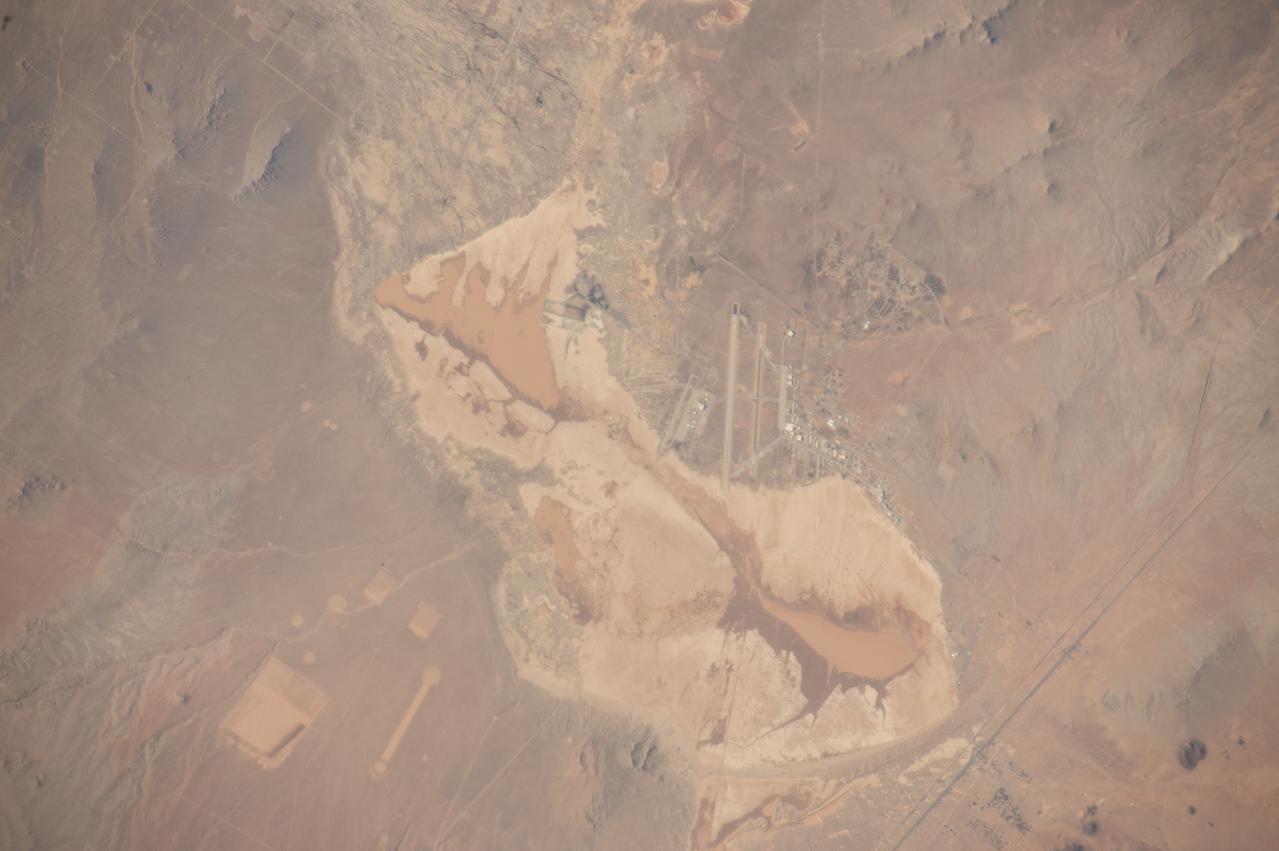
GMT363_21_19_Terry Virts_LA san fran EDW LSV grand canyon_131
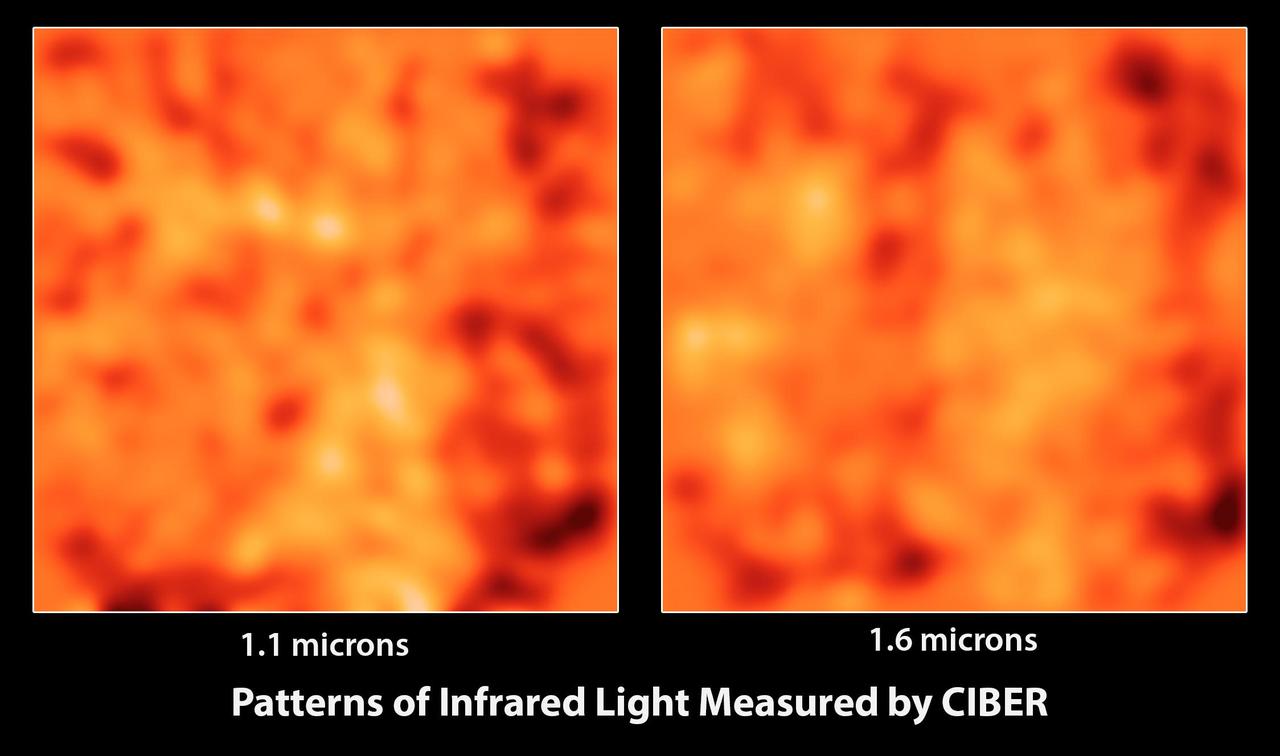
These images from the Cosmic Infrared Background Experiment, or CIBER, show large patches of the sky at two different infrared wavelengths 1.1 microns and 1.6 microns after all known galaxies have been subtracted out and the images smoothed.
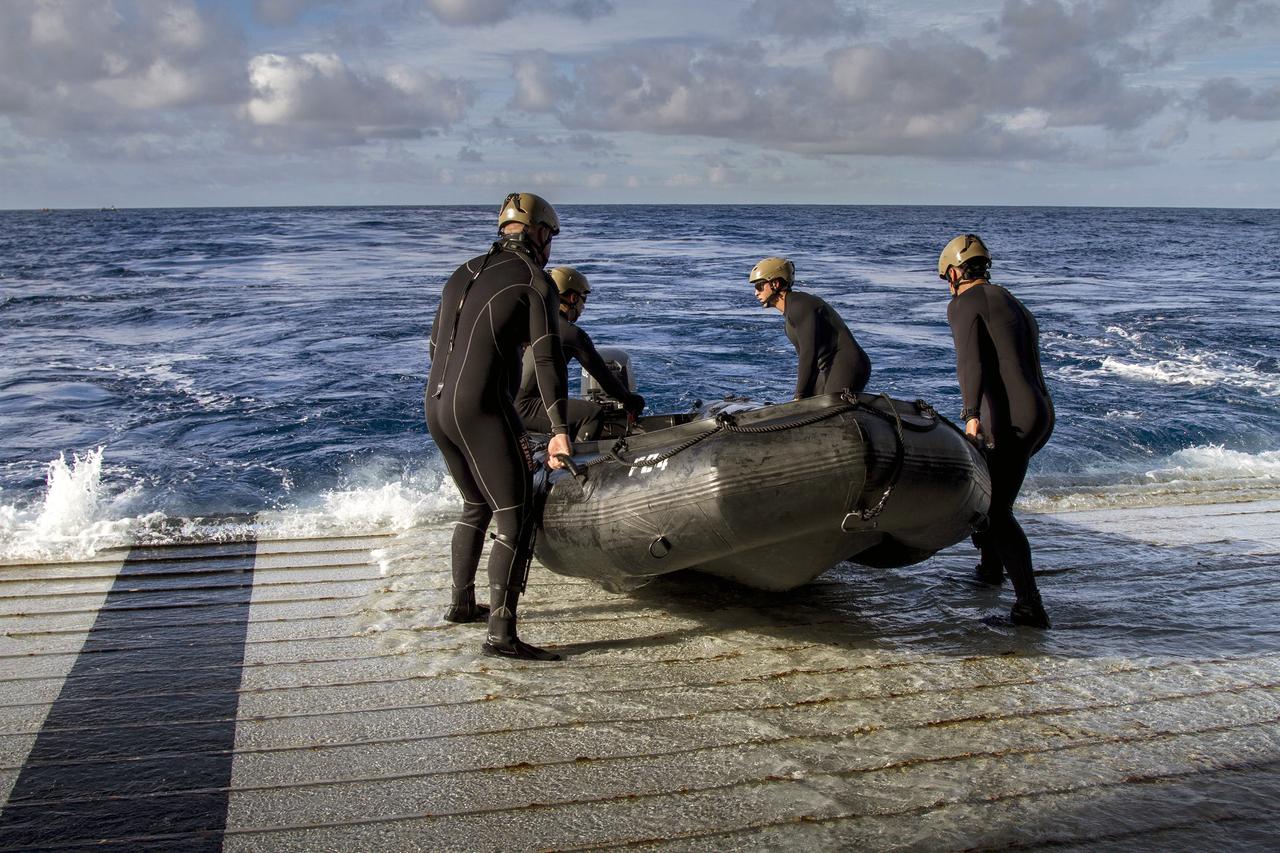
SAN DIEGO, Calif. – On the third day of preparations for recovery of Orion after its splashdown in the Pacific Ocean, U.S. Navy Divers prepare to embark from the well deck of the USS Anchorage in a rigid hull Zodiac boat about 600 miles off the coast of Baja, California. NASA, Lockheed Martin and U.S. Navy personnel are preparing for recovery of the crew module, forward bay cover and parachutes on its return from space and splashdown in the Pacific Ocean. The Ground Systems Development and Operations Program is leading the recovery efforts. The first unpiloted flight test of Orion is scheduled to launch Dec. 4 atop a United Launch Alliance Delta IV Heavy rocket. During its two-orbit, 4.5-hour flight, Orion will venture 3,600 miles in altitude and travel nearly 60,000 miles before returning to Earth for a splashdown in the Pacific Ocean. For more information, visit http://www.nasa.gov/orion. Photo credit: NASA/Cory Huston
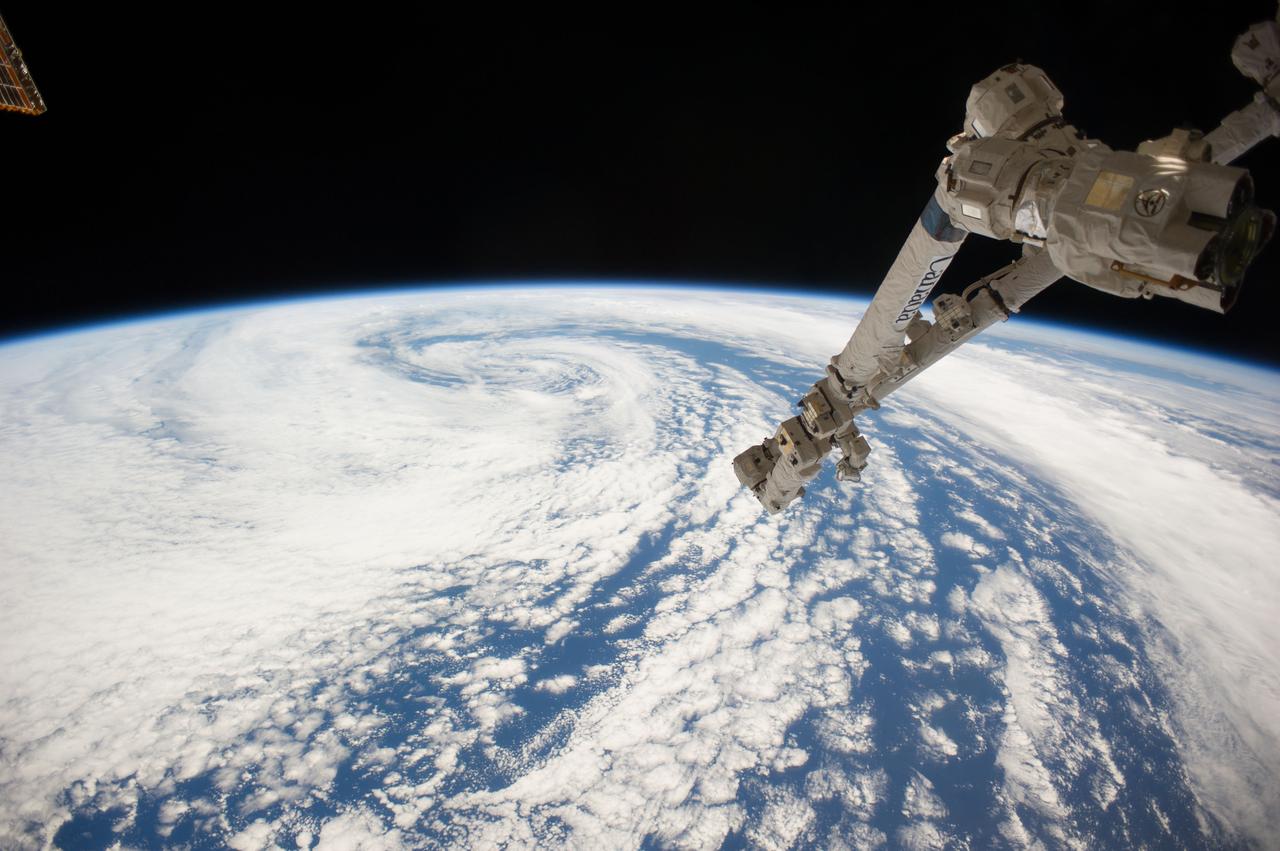
Earth Observation taken during a day pass by the Expedition 40 crew aboard the International Space Station (ISS).
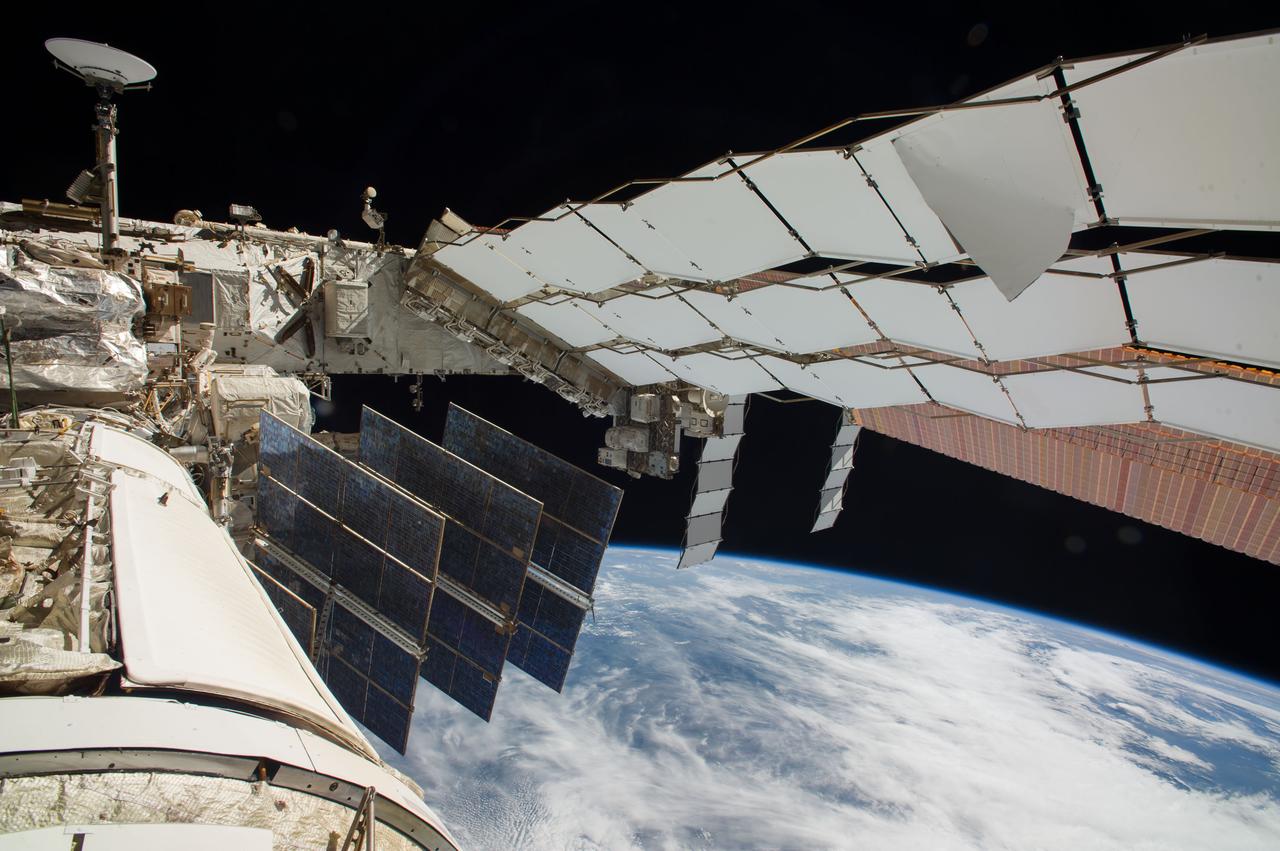
ISS040-E-123158 (2 Sept. 2014) --- A portion of the Russian segment of the International Space Station is featured in this image photographed by an Expedition 40 crew member onboard the station. A blue and white part of Earth and the blackness of space provide the backdrop for the scene.
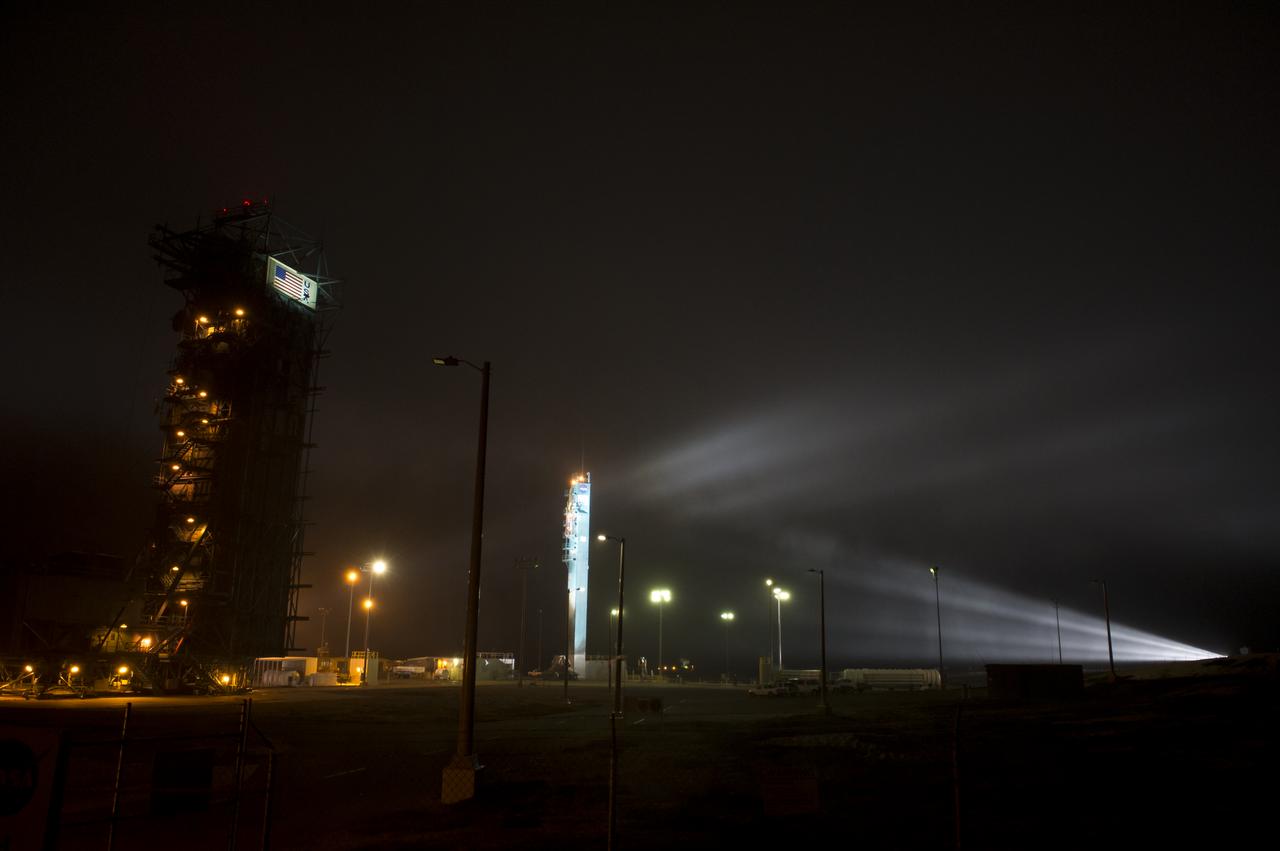
Lights shine on the umbilical tower shortly after a United Launch Alliance Delta II rocket launched with the Orbiting Carbon Observatory-2 (OCO-2)satellite onboard from Space Launch Complex 2 at Vandenberg Air Force Base, Calif. on Wednesday, July 2, 2014. OCO-2 will measure the global distribution of carbon dioxide, the leading human-produced greenhouse gas driving changes in Earth’s climate. Photo Credit: (NASA/Bill Ingalls)

This image from NASA Mars Curiosity rover shows the Amargosa Valley, on the slopes leading up to Mount Sharp on Mars. The rover is headed toward the Pahrump Hills outcrop.
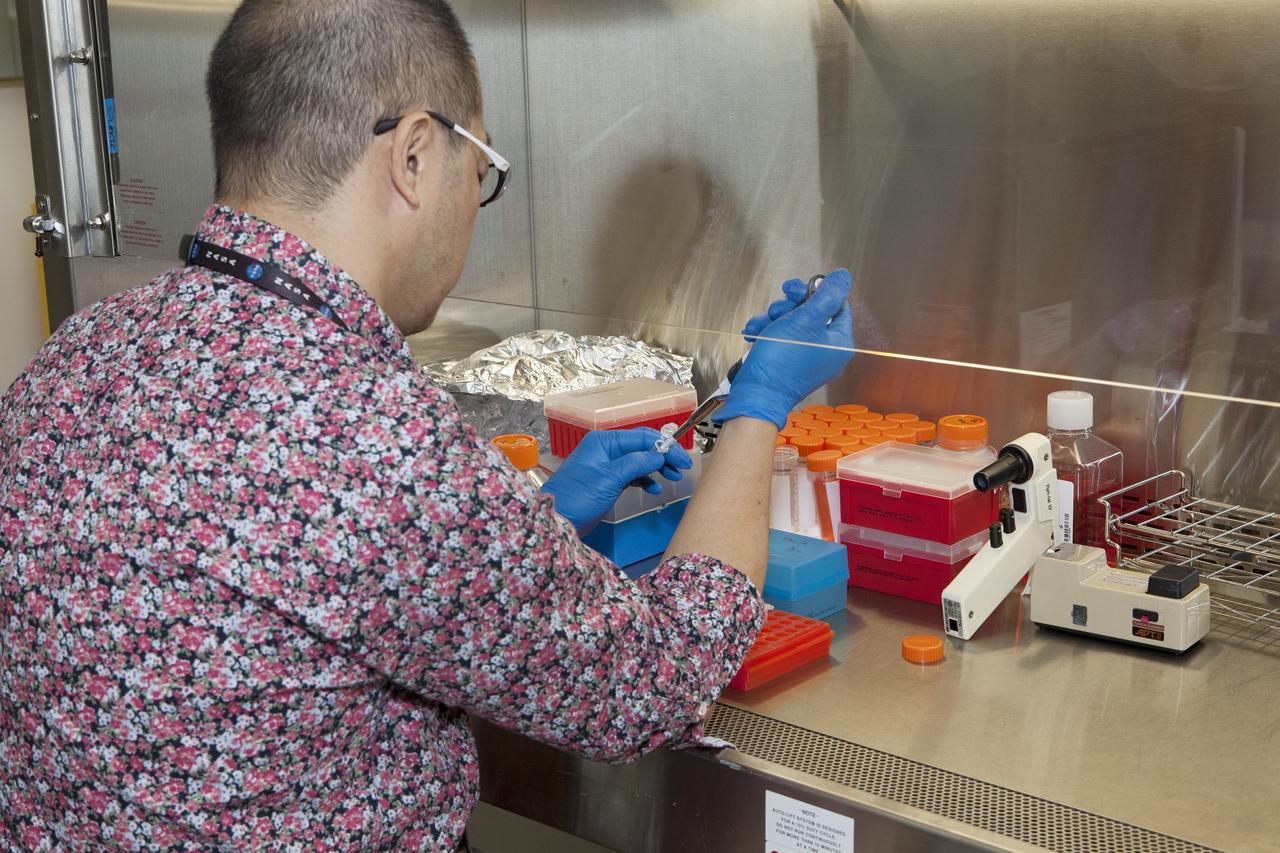
CAPE CANAVERAL, Fla. – Inside a laboratory in the Space Station Processing Facility at NASA's Kennedy Space Center in Florida, Dr. Takeshi Kobayashi, an assistant professor at Nagoya University in Japan, prepares samples for the Cell-Mechanosensing 2 experiment for the Japan Aerospace Exploration Agency. The experiment is one of many that will be delivered to the International Space Station on the SpaceX-4 commercial cargo resupply mission. Kennedy's ISS Ground Processing and Research Project Office is providing the necessary laboratories, equipment, supplies and consumables for 61 principal investigators, including 17 from other countries, as they prepare their science experiments for flight. The SpaceX-4 flight is targeted to launch in September 2014. Photo credit: NASA/Dimitri Gerondidakis
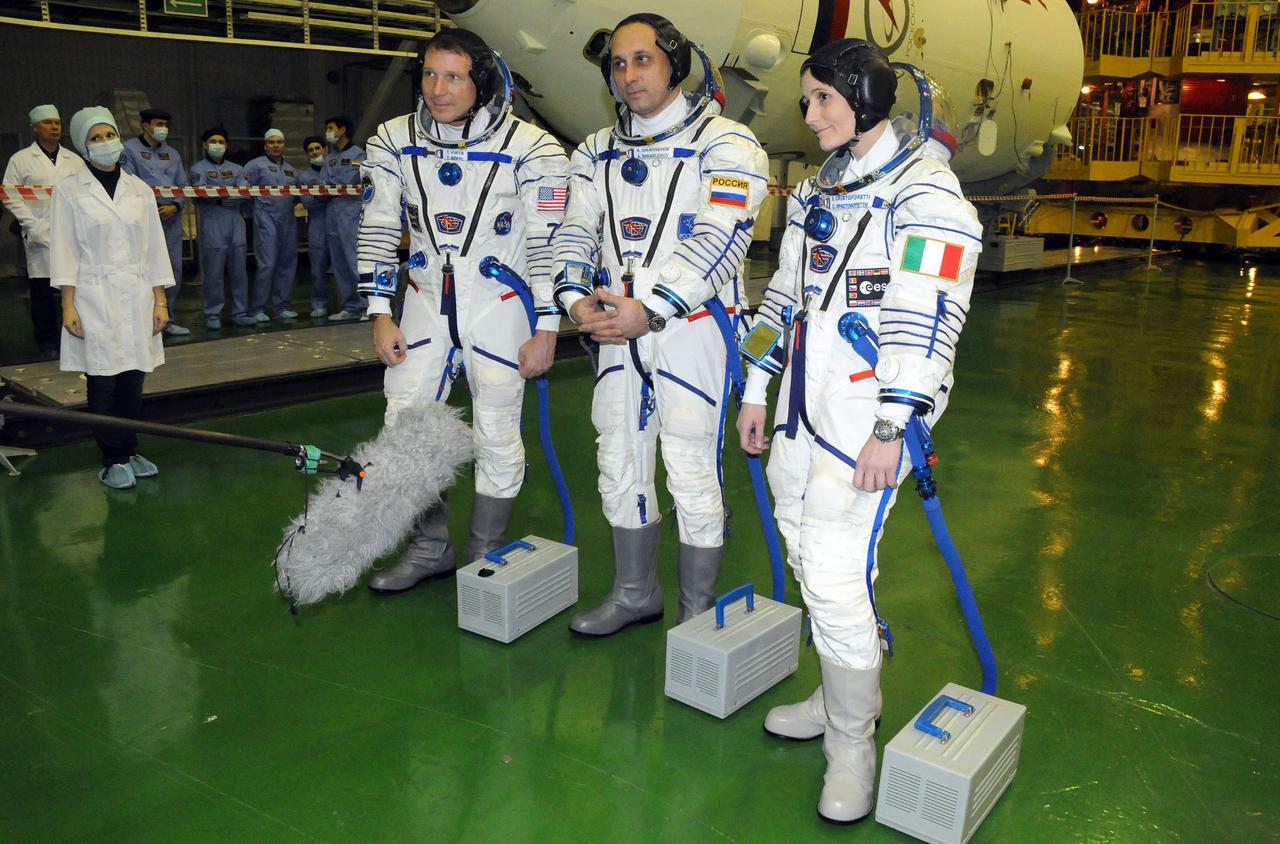
5473: In the Integration Facility at the Baikonur Cosmodrome in Kazakhstan, Expedition 42/43 crewmembers Terry Virts of NASA (left), Anton Shkaplerov of the Russian Federal Space Agency (Roscosmos, center) and Samantha Cristoforetti of the European Space Agency (right) listen to reporters’ questions Nov. 12 during a “fit check” dress rehearsal. The trio will launch Nov. 24, Kazakh time, from Baikonur in the Soyuz TMA-15M spacecraft for a 5 ½ month mission on the International Space Station. NASA/Victor Ivanov

GMT344_01_22_Samantha Cristoforetti_Moon_131
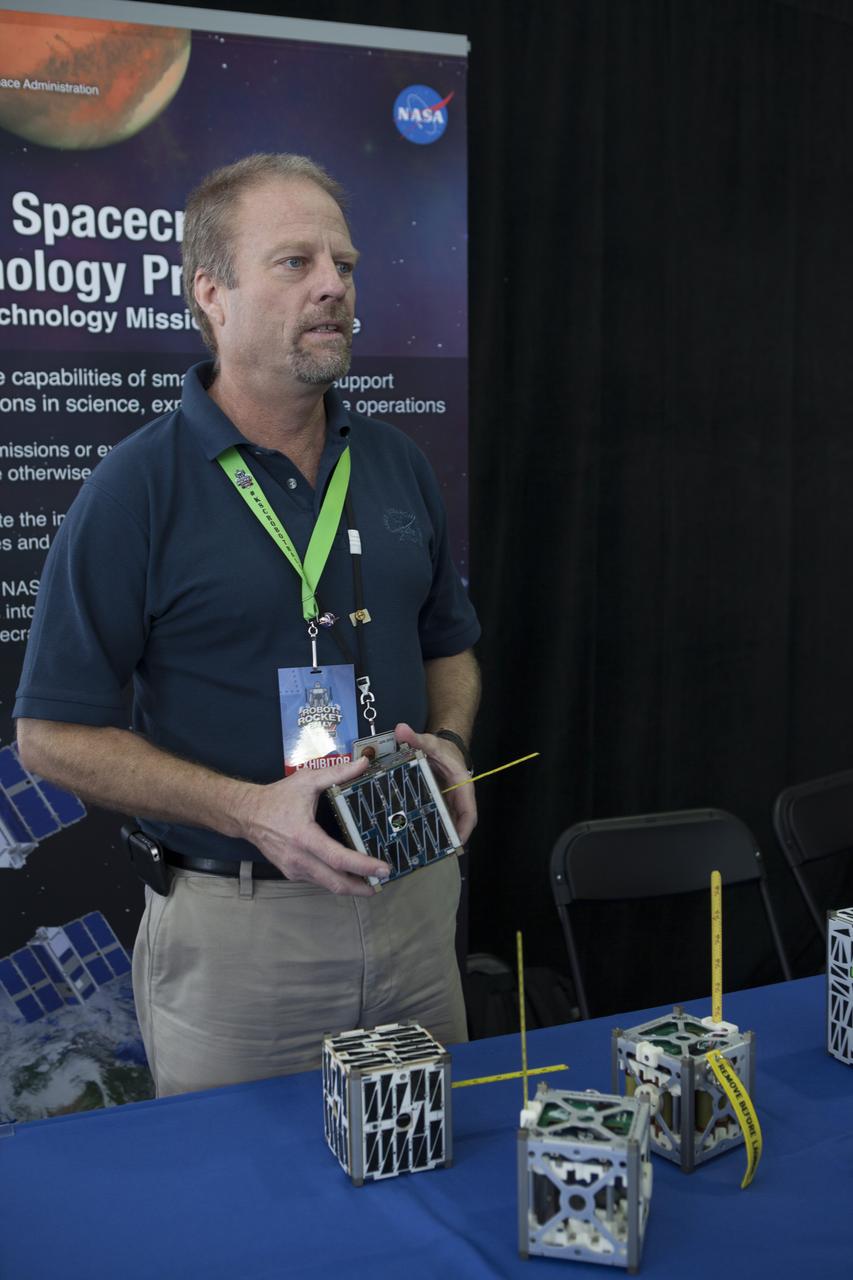
CAPE CANAVERAL, Fla. – Bruce Yost of NASA's Ames Research Center discusses a small satellite, known as PhoneSat, during the Robot Rocket Rally. The three-day event at Florida's Kennedy Space Center Visitor Complex is highlighted by exhibits, games and demonstrations of a variety of robots, with exhibitors ranging from school robotics clubs to veteran NASA scientists and engineers. Photo credit: NASA/Kim Shiflett
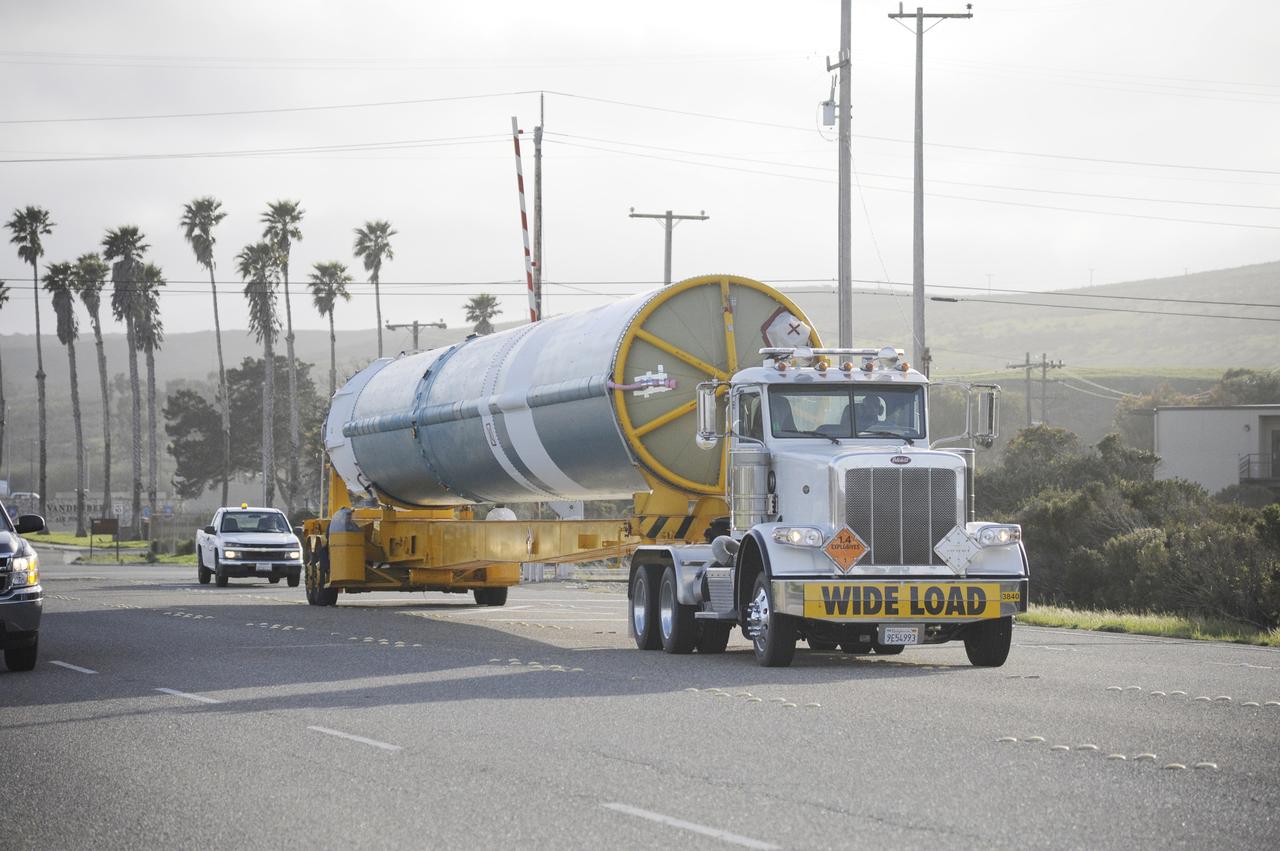
VANDENBERG AIR FORCE BASE, Calif. – The Delta first-stage booster for NASA's Orbiting Carbon Observatory-2 mission, or OCO-2, makes its way along the roads at Vandenberg Air Force Base in California on its move from the Building 836 hangar to the Horizontal Processing Facility at Space Launch Complex 2. OCO-2 is scheduled to launch aboard a United Launch Alliance Delta II rocket on July 1, 2014. The observatory will collect precise global measurements of carbon dioxide in the Earth's atmosphere and provide scientists with a better idea of the chemical compound's impacts on climate change. Scientists will analyze this data to improve our understanding of the natural processes and human activities that regulate the abundance and distribution of this important atmospheric gas. To learn more about OCO-2, visit http://oco.jpl.nasa.gov. Photo credit: NASA/D. Liberotti, 30th Space Wing, VAFB

GMT348_21_48_Terry Virts_DM CB East coast zoom sunrise vine_129
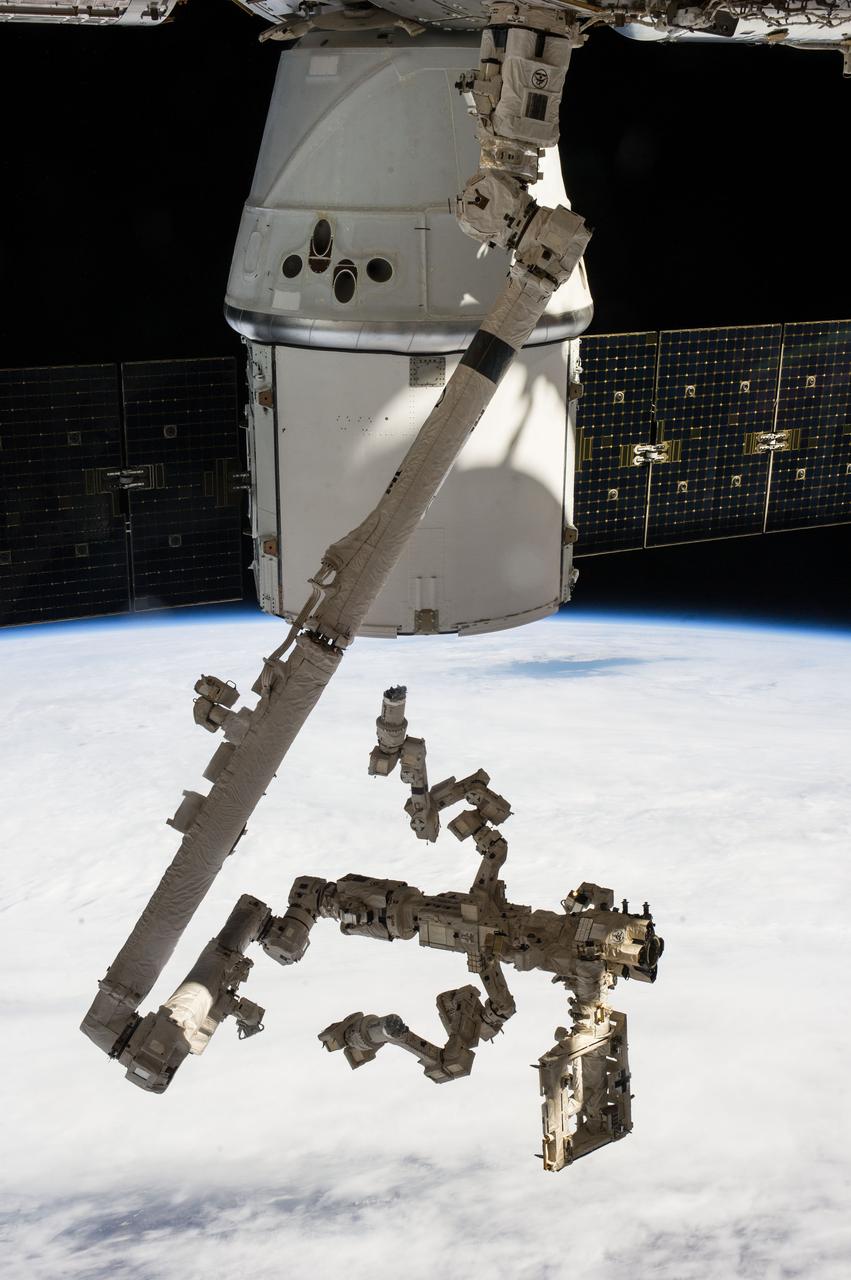
ISS039-E-016800 (30 April 2014) --- Backdropped against a cloudy portion of Earth, the Special Purpose Dexterous Manipulator -- the Canadian Space Agency’s robotic “handyman” AKA Dextre -- and the Canadarm2 or Space Station Remote Manipulator System arm take a "rest" after completing a task 225 miles above the home planet. Robotic ground controllers used the Canadarm2 and Dextre to remove the High Definition Earth Viewing (HDEV) payload from the trunk of the SpaceX Dragon, seen in the top portion of the photo. HDEV was installed on the nadir adapter on the European Space Agency's Columbus exposed facility (out of frame).
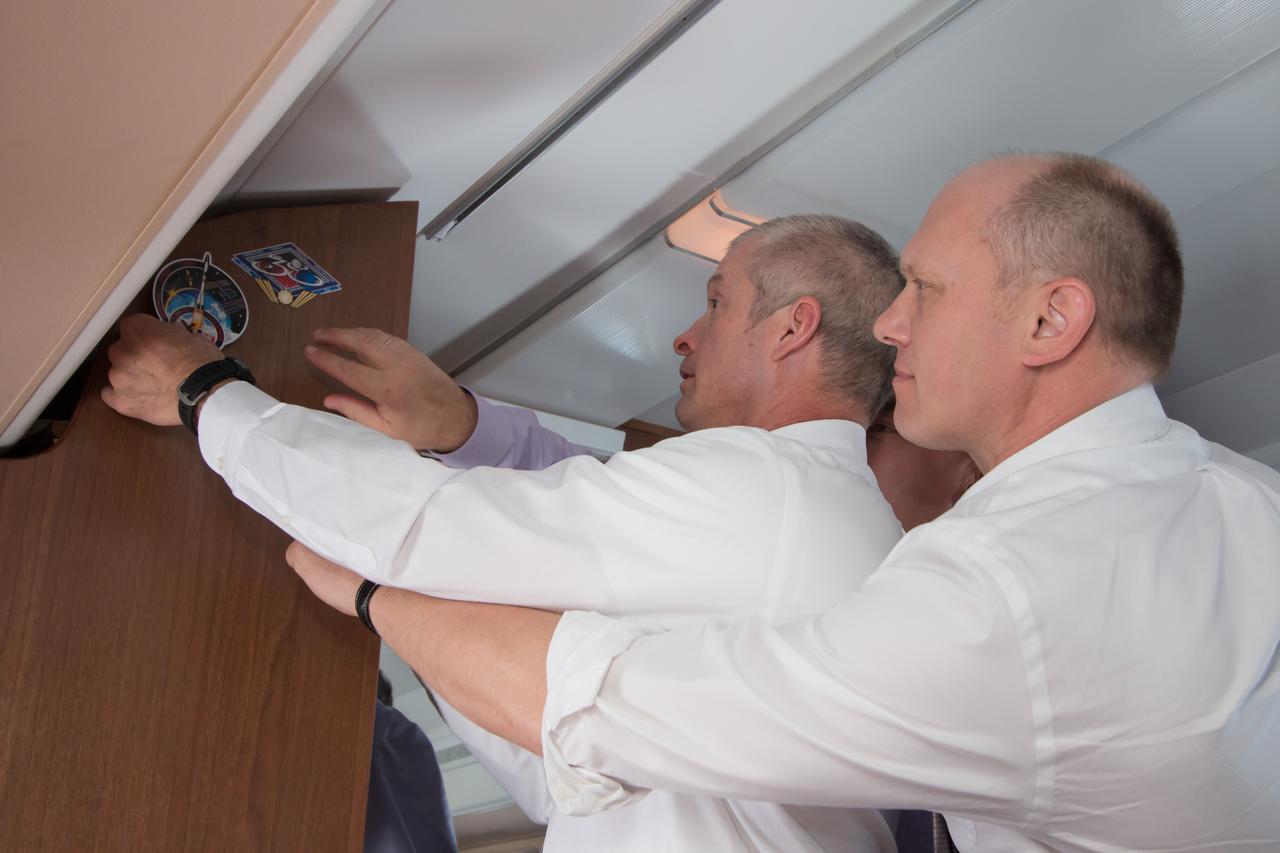
Flying from their training base in Star City, Russia to their launch site at the Baikonur Cosmodrome in Kazakhstan, Expedition 39/40 Flight Engineer Steve Swanson of NASA (left) and Flight Engineer Oleg Artemyev of the Russian Federal Space Agency (Roscosmos; right) apply a sticker bearing their mission insignia to the wall of their plane March 13. Swanson, Artemyev and Soyuz Commander Alexander Skvortsov of Roscosmos (hidden) are preparing for their launch to the International Space Station March 26, Kazakh time, in their Soyuz TMA-12M spacecraft for a six-month mission. NASA/Victor Zelentsov
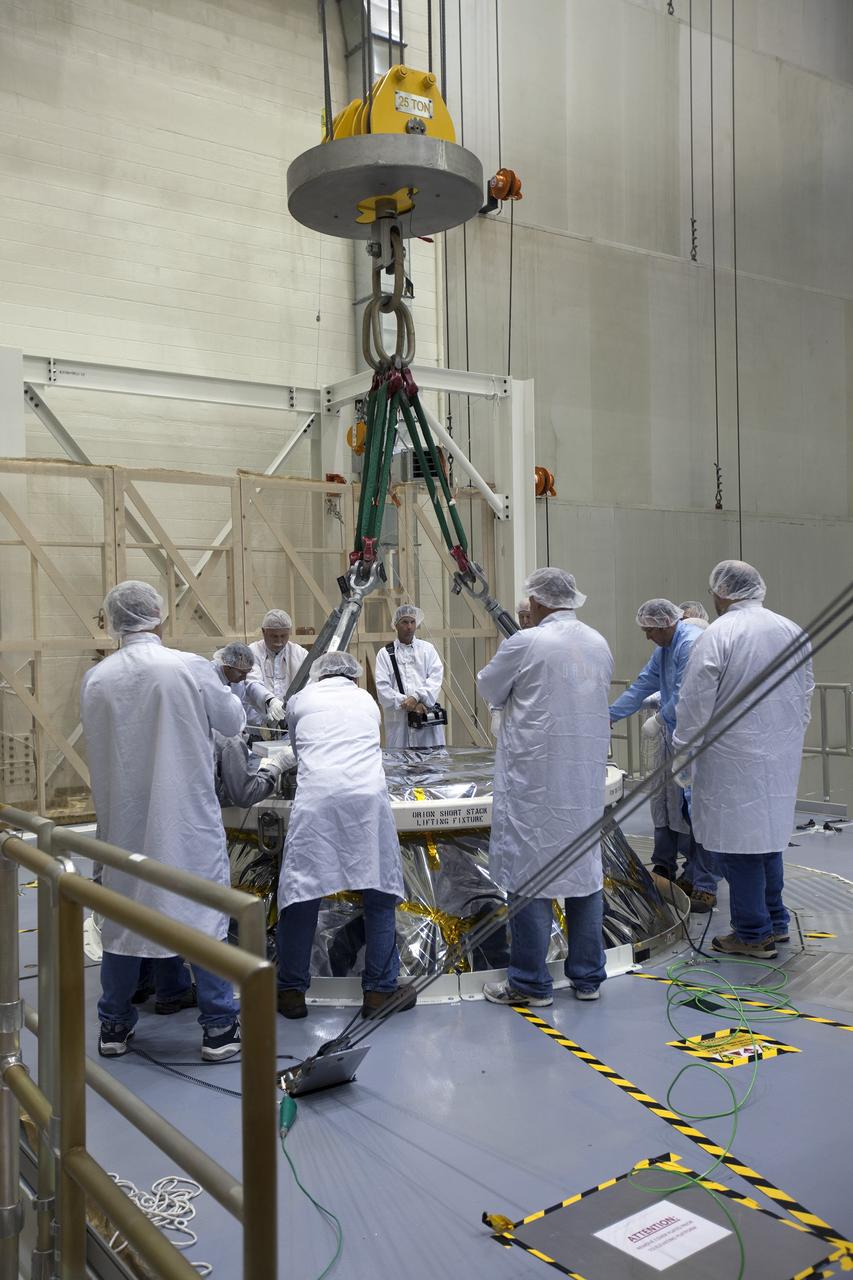
CAPE CANAVERAL, Fla. – Inside the Neil Armstrong Operations and Checkout Building high bay at NASA's Kennedy Space Center in Florida, technicians dressed in clean room suits attach a crane to the Orion crew and service module stack for Exploration Flight Test-1. Orion will be lifted out of the test cell and transferred to a mating device. Orion is the exploration spacecraft designed to carry astronauts to destinations not yet explored by humans, including an asteroid and Mars. It will have emergency abort capability, sustain the crew during space travel and provide safe re-entry from deep space return velocities. The first unpiloted test flight of the Orion is scheduled to launch later this year atop a Delta IV Heavy rocket from Cape Canaveral Air Force Station in Florida to an altitude of 3,600 miles above the Earth's surface. The two-orbit, four-hour flight test will help engineers evaluate the systems critical to crew safety including the heat shield, parachute system and launch abort system. For more information, visit http://www.nasa.gov/orion. Photo credit: NASA/Ben Smegelsky
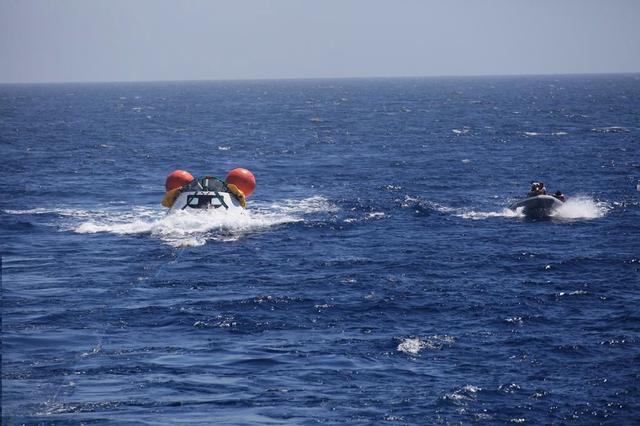
Orion recovery training and operations continue in the Pacific Ocean on Sept. 14, 2014. NASA and the Navy team on board the USS Salvor are evaluating procedures for pulling a test version of the spacecraft out of the ocean using the ship's crane. Part of Batch image transfer from Flickr.
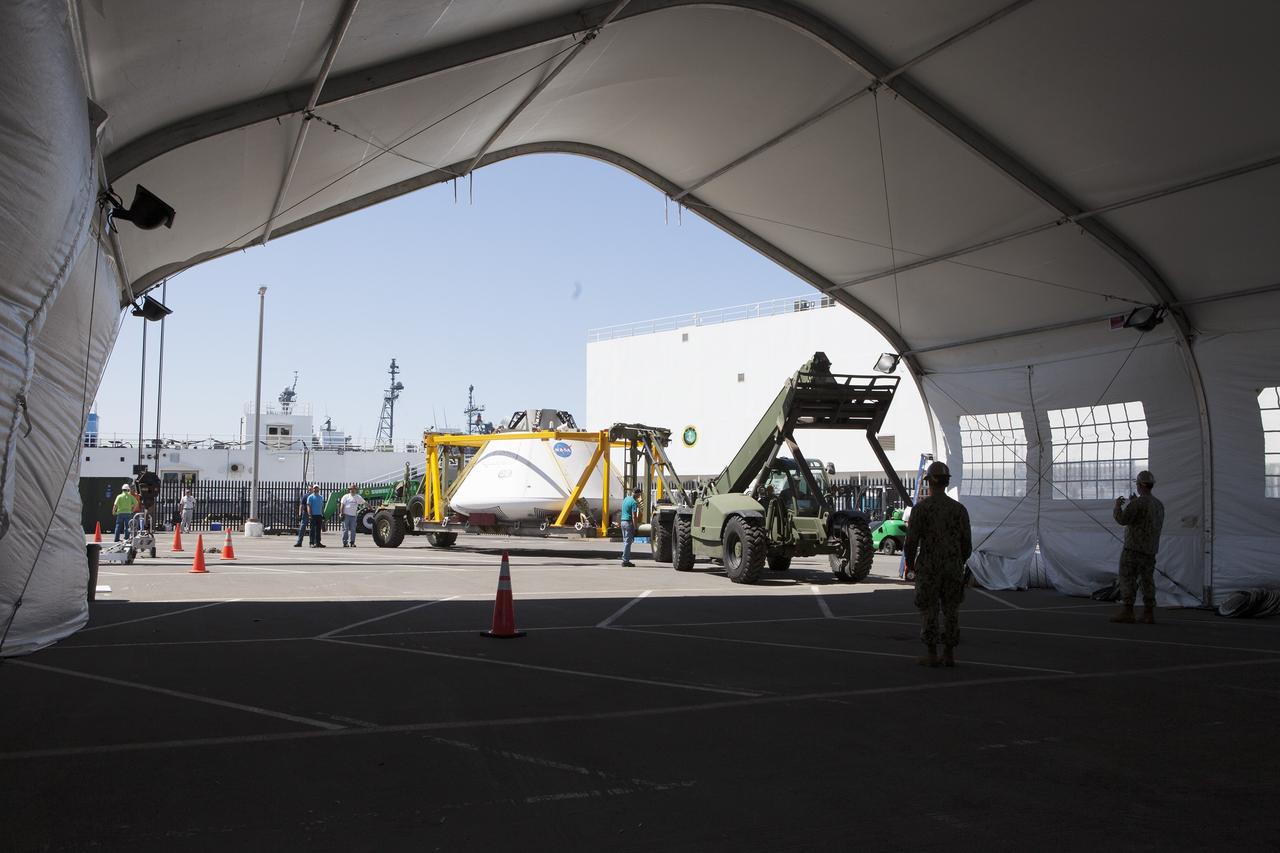
SAN DIEGO, Calif. – The Orion boilerplate test vehicle is being moved into a protective structure at the Mole Pier at the Naval Base San Diego in California for a simulated fit check of the hatch cover. The test vehicle is attached to the crew module recovery cradle. The Ground Systems Development and Operations Program, Lockheed Martin and the U.S. Navy are evaluating the hardware and processes for preparing the Orion crew module for Exploration Flight Test-1, or EFT-1, for overland transport from the naval base to NASA's Kennedy Space Center in Florida. Orion is the exploration spacecraft designed to carry astronauts to destinations not yet explored by humans, including an asteroid and Mars. It will have emergency abort capability, sustain the crew during space travel and provide safe re-entry from deep space return velocities. The first unpiloted test flight of the Orion is scheduled to launch later this year atop a Delta IV rocket from Cape Canaveral Air Force Station in Florida to an altitude of 3,600 miles above the Earth's surface. The two-orbit, four-hour flight test will help engineers evaluate the systems critical to crew safety including the heat shield, parachute system and launch abort system. For more information, visit http://www.nasa.gov/orion. Photo credit: NASA/Kim Shiflett
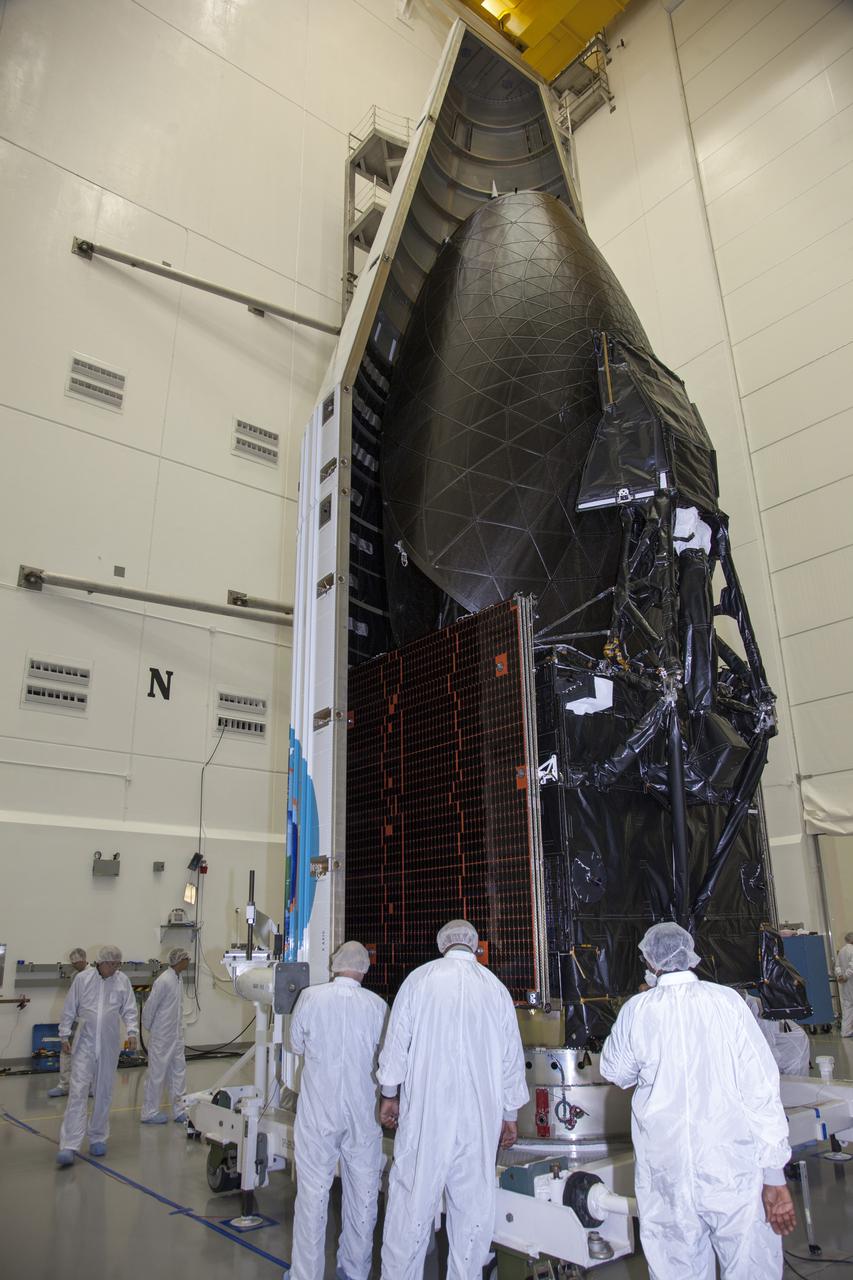
TITUSVILLE, Fla. – Inside the Astrotech payload processing facility in Titusville, United Launch Alliance engineers and technicians encapsulate the Tracking and Data Relay Satellite, or TDRS-L, spacecraft in its payload fairing. TDRS-L will then be transported to Launch Complex 41 at Cape Canaveral Air Force Station. The TDRS-L satellite will be a part of the second of three next-generation spacecraft designed to ensure vital operational continuity for the NASA Space Network. It is scheduled to launch from Cape Canaveral's Space Launch Complex 41 atop a United Launch Alliance Atlas V rocket on January 23, 2014. The current Tracking and Data Relay Satellite system consists of eight in-orbit satellites distributed to provide near continuous information relay contact with orbiting spacecraft ranging from the International Space Station and Hubble Space Telescope to the array of scientific observatories. For more information, visit: http://www.nasa.gov/mission_pages/tdrs/home/index.html
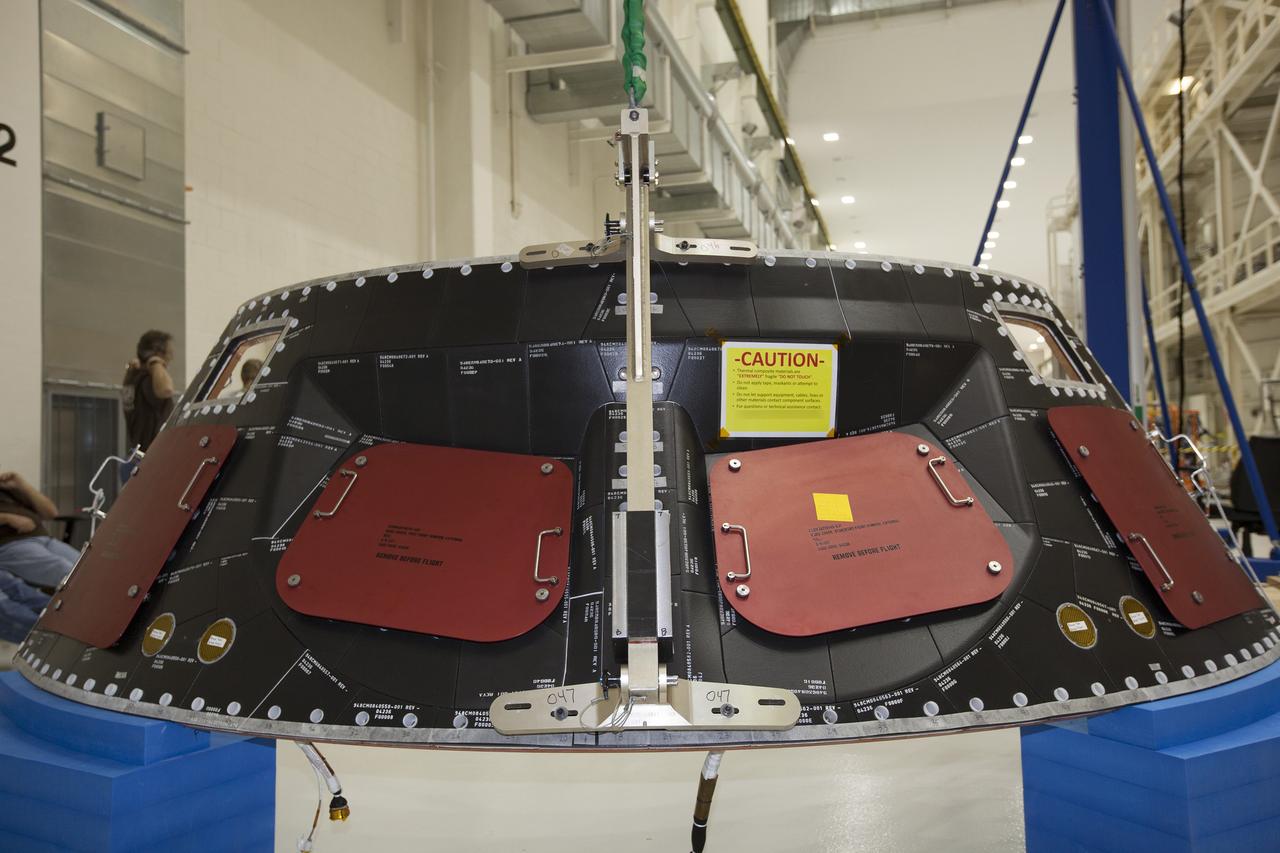
CAPE CANAVERAL, Fla. – Inside the Operations and Checkout Building high bay at NASA's Kennedy Space Center in Florida, a crane is attached to the middle back shell tile panel in order to lift it for installation on the Orion crew module. Preparations are underway for Exploration Flight Test-1, or EFT-1. Orion is the exploration spacecraft designed to carry astronauts to destinations not yet explored by humans, including an asteroid and Mars. It will have emergency abort capability, sustain the crew during space travel and provide safe re-entry from deep space return velocities. The first unpiloted test flight of the Orion is scheduled to launch later this year atop a Delta IV rocket from Cape Canaveral Air Force Station in Florida to an altitude of 3,600 miles above the Earth's surface. The two-orbit, four-hour flight test will help engineers evaluate the systems critical to crew safety including the heat shield, parachute system and launch abort system. For more information, visit http://www.nasa.gov/orion. Photo credit: NASA/Dimitri Gerondidakis
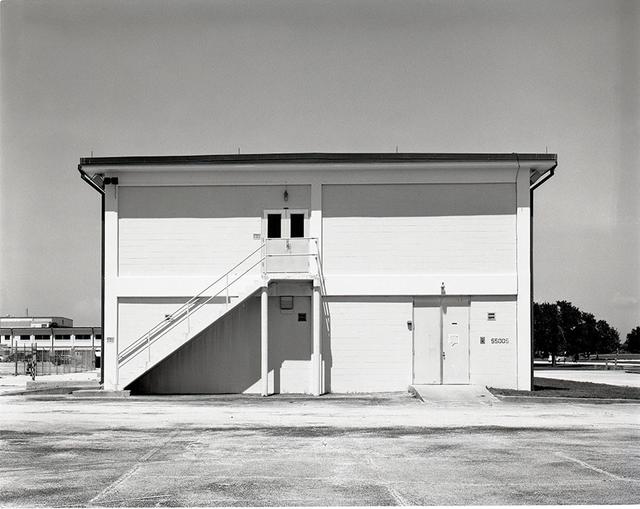
Exterior View of Hangar M Annex
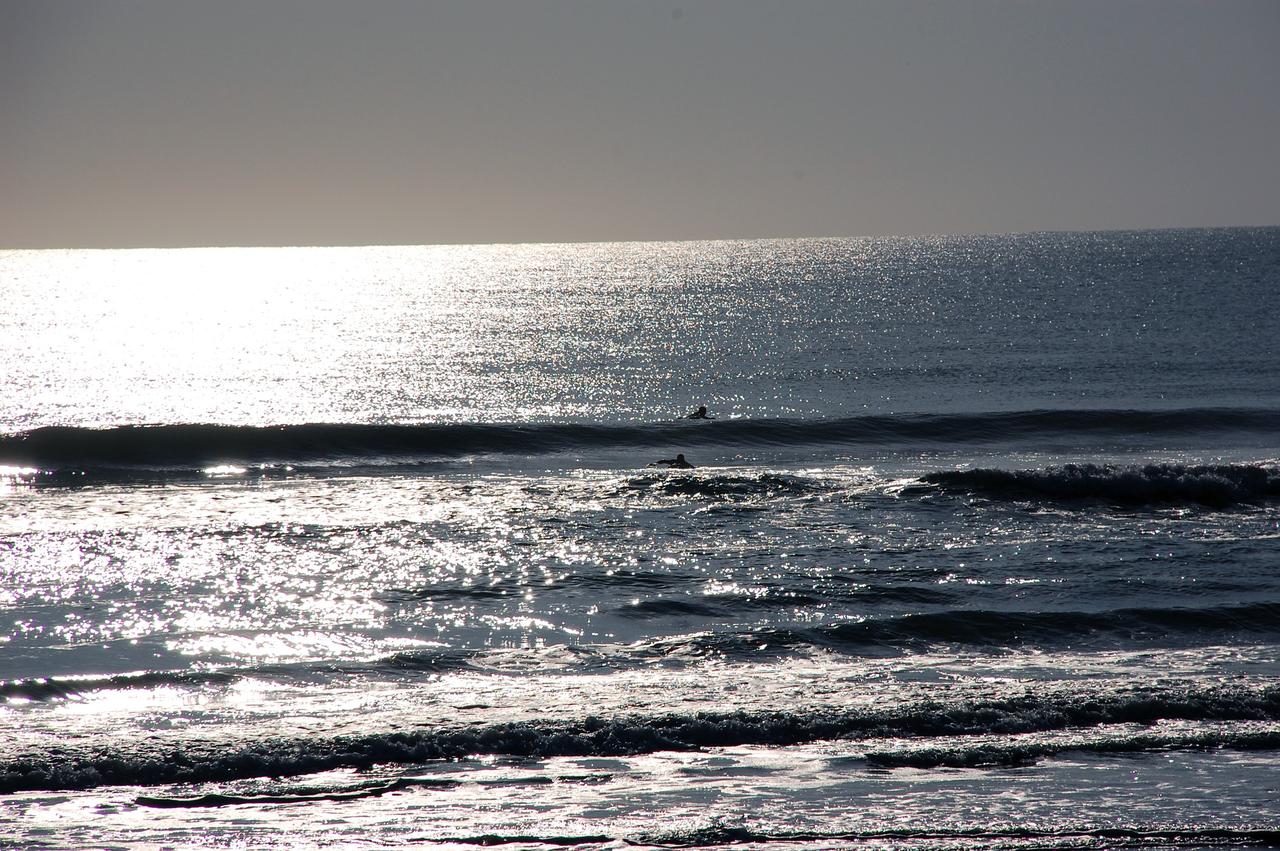
CAPE CANAVERAL, Fla. -- A balmy May morning finds surfers out to catch the waves at Playalinda Beach in Florida. The beach borders NASA's Kennedy Space Center to the north. On this particular morning, preparations are underway for a launch from Space Launch Complex-41 on Cape Canaveral Air Force Station, a part of the spaceport which neighbors Kennedy Space Center. For more information, visit http://www.nasa.gov/centers/kennedy. Photo credit: NASA/Ben Smegelsky
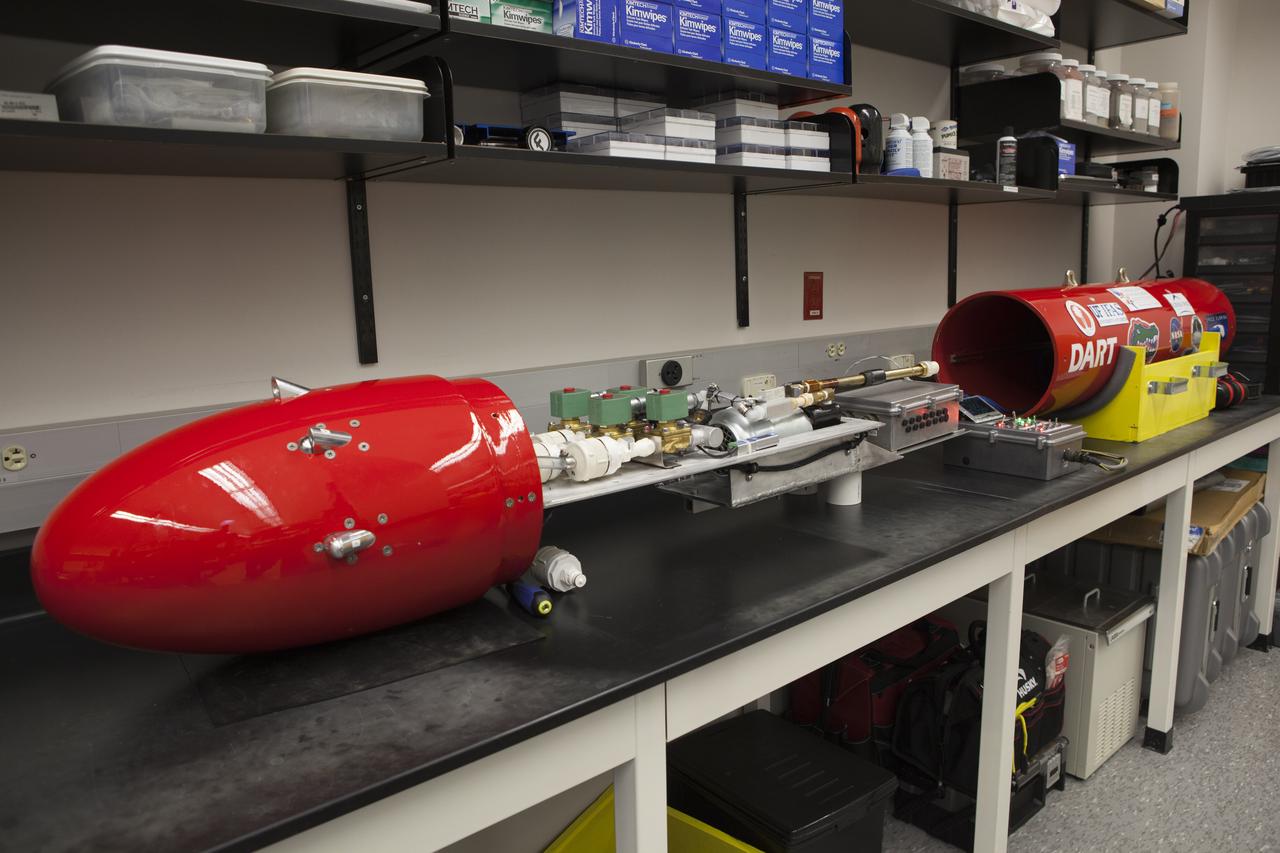
The Dust Atmospheric Recovery Technology, or DART, spacecraft is being assembled in a laboratory inside the Space Life Sciences Lab at NASA’s Kennedy Space Center in Florida. DART will characterize the dust loading and microbial diversity in the atmosphere over Florida during summer months with a special emphasis on their interactions during an African dust storm. DART will be used to collect atmospheric aerosols and suspended microbial cells over Florida and Kennedy. Results will help predict the risks of excessive microbial contamination adhering to spacecraft surfaces.

Lozenge-shaped crystals are evident in this magnified view of a Martian rock target called Mojave, taken on Nov. 15, 2014, by NASA Curiosity Mars rover. These features record concentration of dissolved salts, possibly in a drying lake.
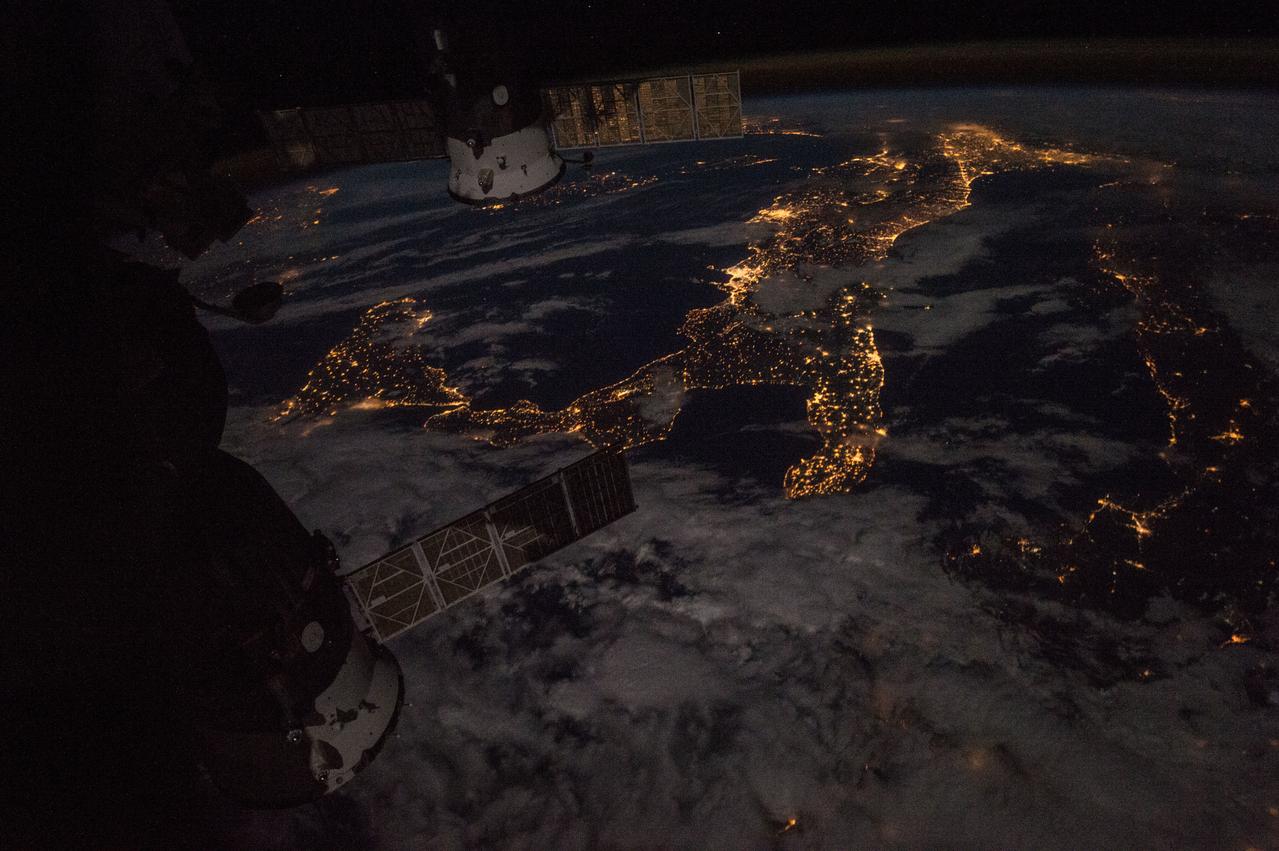
GMT344_23_19_Terry Virts_night wide mexico europe sequence1_cb_131
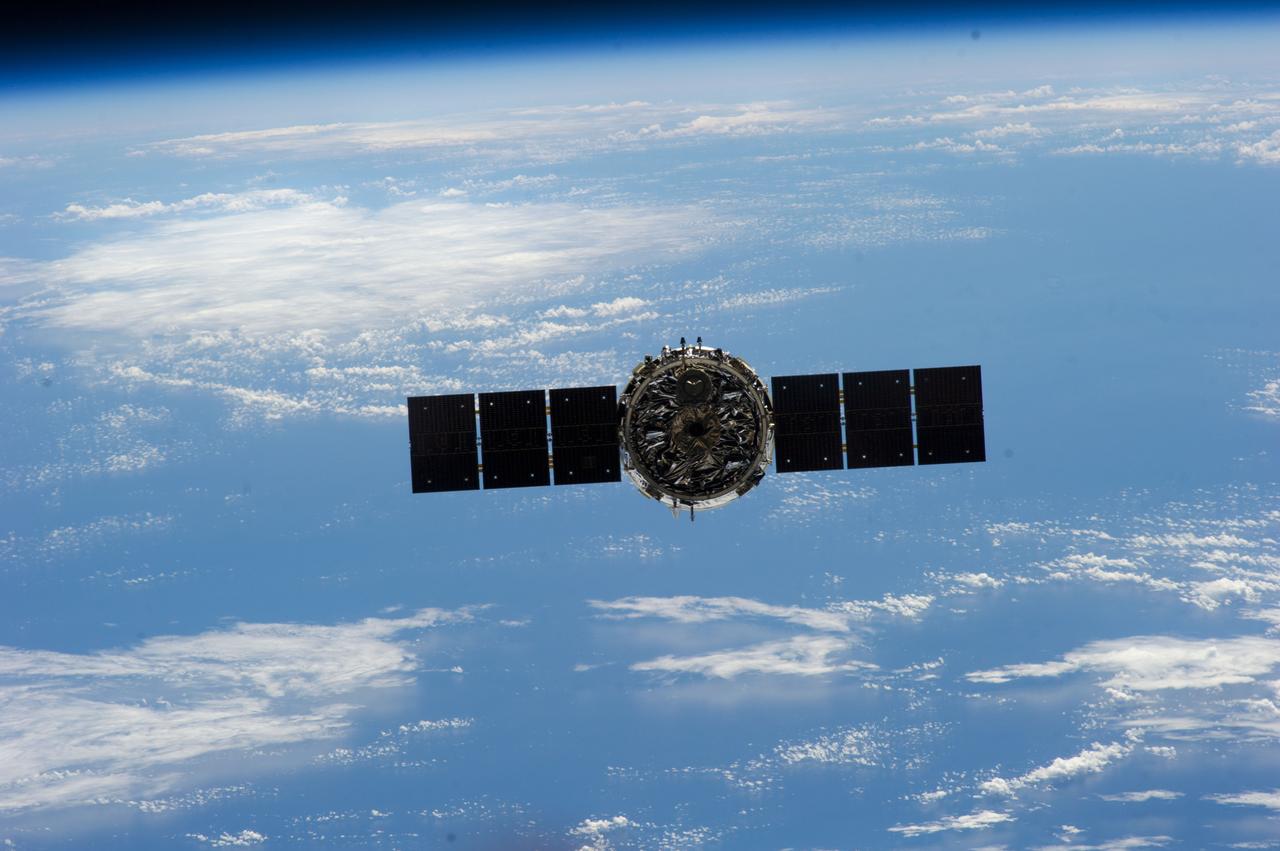
ISS038-E-050755 (18 Feb. 2014) --- The Orbital Sciences Corporation's Cygnus spacecraft begins its relative separation from the International Space Station after several weeks at the station. NASA astronaut Mike Hopkins, with assistance from Japan Aerospace Exploration Agency astronaut Koichi Wakata, both Expedition 38 flight engineers, used the station's 57-foot Canadarm2 robotic arm to detach Cygnus from the Earth-facing port of the Harmony node at 5:15 a.m. (EST) on Feb. 18, 2014. While Wakata monitored data and kept in contact with the team at Houston's Mission Control Center, Hopkins released Cygnus from the robotic arm at 6:41 a.m. A blue and white part of Earth provides the backdrop for the scene.
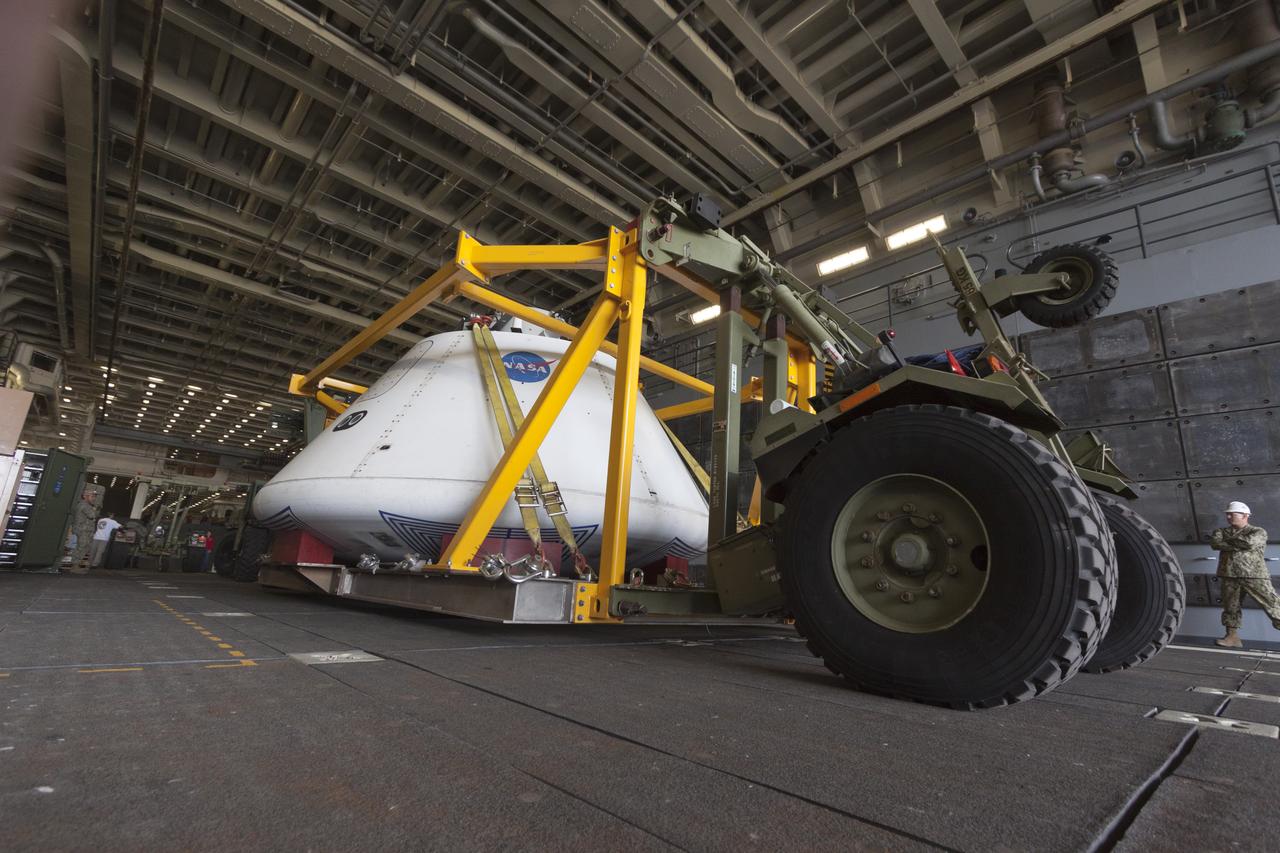
SAN DIEGO, Calif. – The Orion boilerplate test vehicle arrived at the U.S. Naval Base San Diego in California, and was loaded aboard the USS San Diego. Orion was transported in the ship’s well deck about 100 miles offshore for an underway recovery test. NASA and the U.S. Navy are conducting tests to prepare for recovery of the Orion crew module, forward bay cover and parachutes on its return from a deep space mission. The underway recovery test will allow the teams to demonstrate and evaluate the recovery processes, procedures, hardware and personnel in open waters. The Ground Systems Development and Operations Program Orion is the exploration spacecraft designed to carry astronauts to destinations not yet explored by humans, including an asteroid and Mars. It will have emergency abort capability, sustain the crew during space travel and provide safe re-entry from deep space return velocities. The first unpiloted test flight of the Orion is scheduled to launch in 2014 atop a Delta IV rocket and in 2017 on NASA’s Space Launch System rocket. For more information, visit http://www.nasa.gov/orion. Photo credit: NASA/Cory Huston
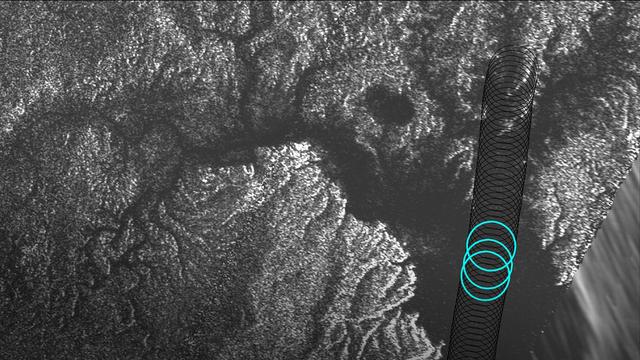
Radar data from NASA's Cassini spacecraft reveal the depth of liquid methane/ethane seas on Saturn's moon Titan. Cassini's Titan flyby on August 21, 2014, included a segment designed to collect altimetry (or height) data, using the spacecraft's radar instrument, along a 120-mile (200-kilometer) shore-to-shore track on Kraken Mare, Titan's largest hydrocarbon sea. For a 25-mile (40-kilometer) stretch of this data, along the sea's eastern shoreline, Cassini's radar beam bounced off the sea bottom and back to the spacecraft, revealing the sea's depth in that area. Observations in this region, near the mouth of a large, flooded river valley, showed depths ranging from 66 to 115 feet (20 to 35 meters). Plots of three radar echoes are shown at left, indicating depths of 89 feet (27 meters), 108 feet (33 meters) and 98 feet (30 meters), respectively. The altimetry echoes show the characteristic double-peaked returns of a bottom-reflection. The tallest peak represents the sea surface; the shorter of the pair represents the sea bottom. The distance between the two peaks is a measure of the liquid's depth. The Synthetic Aperture Radar (SAR) image at right shows successive altimetry observations as black circles. The three blue circles indicate the locations of the three altimetry echoes shown in the plots at left. http://photojournal.jpl.nasa.gov/catalog/PIA19046
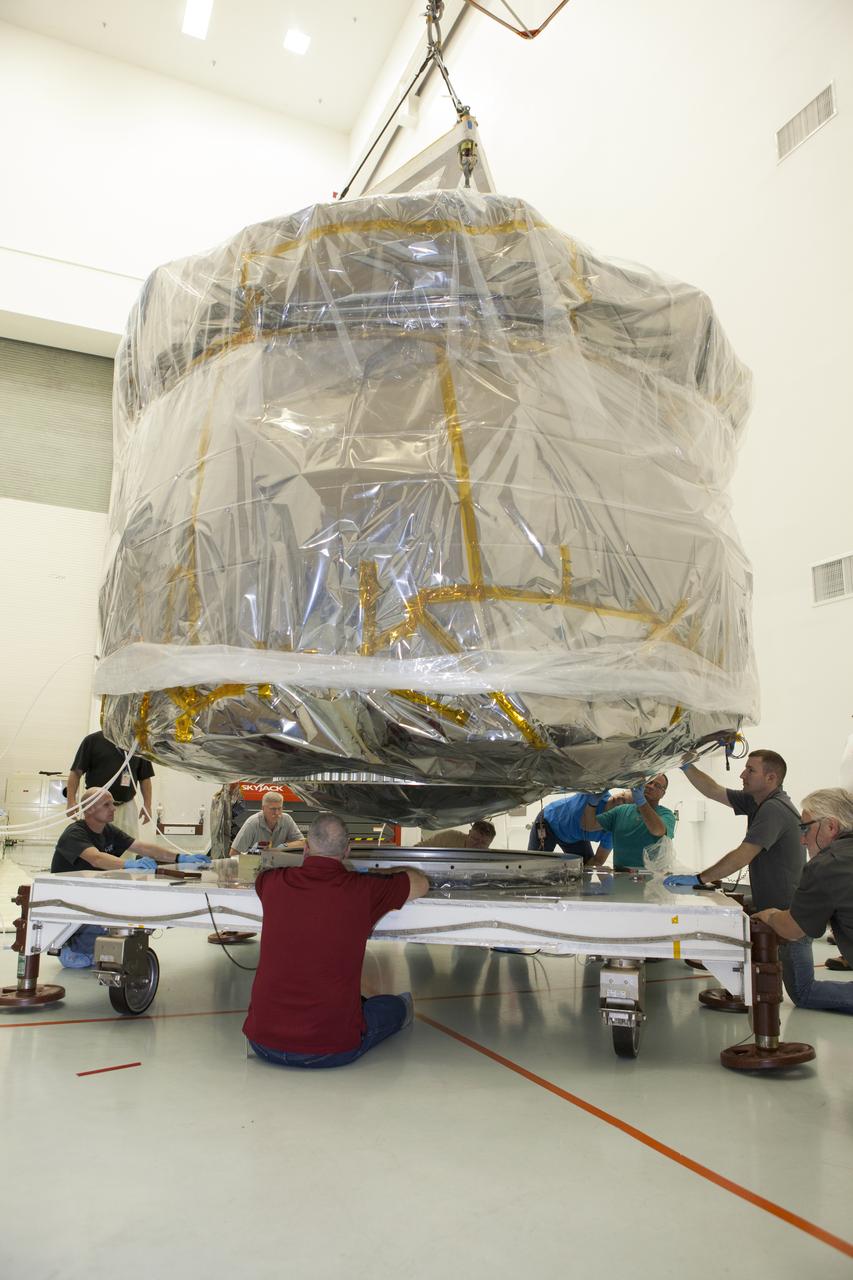
Workers position two of the observatories, the lower stack, mini-stack number 1 for NASA's Magnetospheric Multiscale Observatory, or MMS, onto a payload dolly in the Building 2 south encapsulation bay at the Astrotech payload processing facility in Titusville, Florida, near Kennedy Space Center. The MMS upper stack, mini-stack number 2, is scheduled to arrive in about two weeks. MMS is a Solar Terrestrial Probes mission comprising four identically instrumented spacecraft that will use Earth’s magnetosphere as a laboratory to study the microphysics of three fundamental plasma processes: magnetic reconnection, energetic particle acceleration and turbulence. Launch aboard a United Launch Alliance Atlas V rocket from Space Launch Complex 41 on Cape Canaveral Air Force Station is targeted for March 12, 2015.
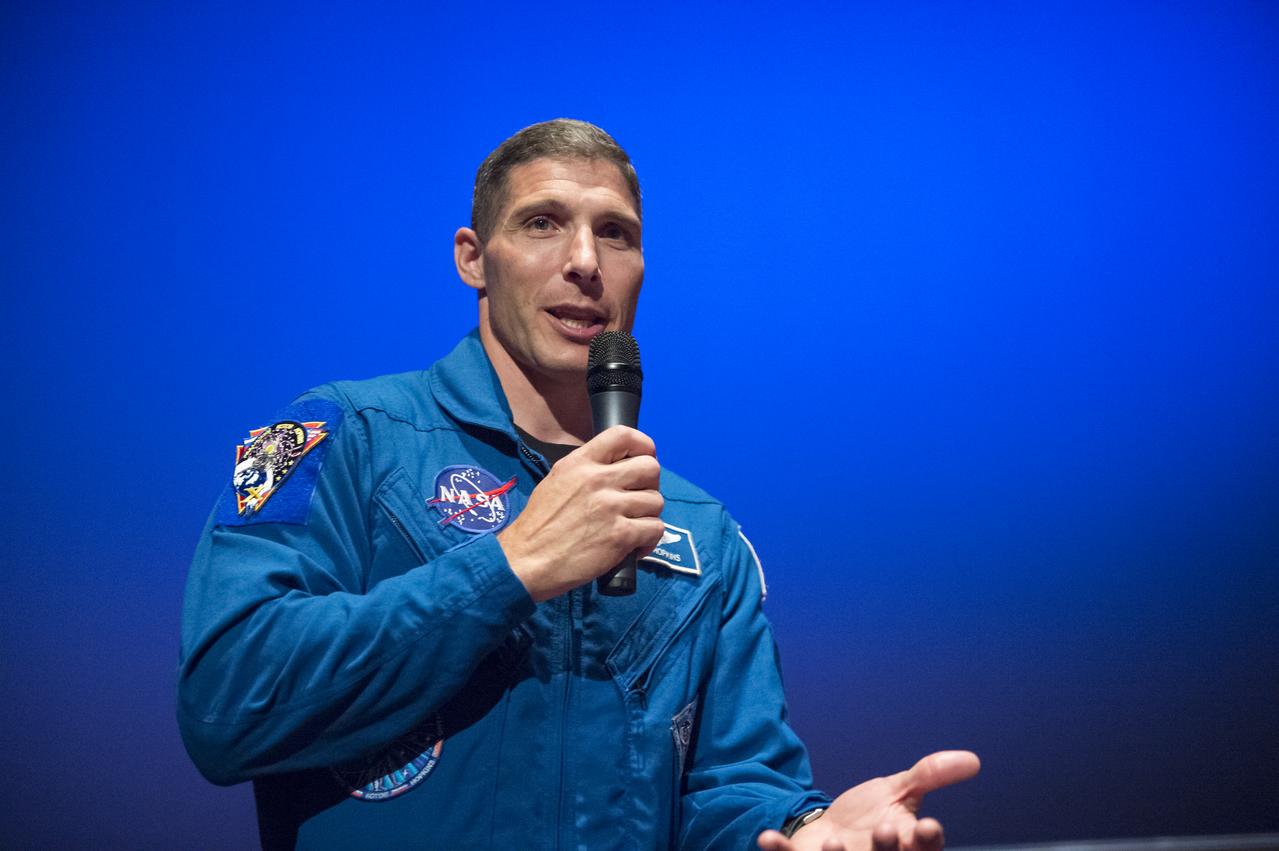
NASA Astronaut Mike Hopkins explains what it was like to live on the International Space Station for 6 months to seventh graders from Clear Spring Middle School at the Maryland Science Center in Baltimore, MD on Monday, June 9, 2014. Hopkins served on Expeditions 37 and 38 with Russian cosmonauts Oleg Kotov and Sergey Ryazanskiy and returned home in March, 2014. (Photo Credit: NASA/Aubrey Gemignani)

GMT334_11_14_Terry Virts_USA night FL sunrise atlantic clouds_123

Earth observation taken during a night pass by the Expedition 40 crew aboard the International Space Station (ISS). Folder lists this as: Taiwan, Japan, and fishing boats at night.
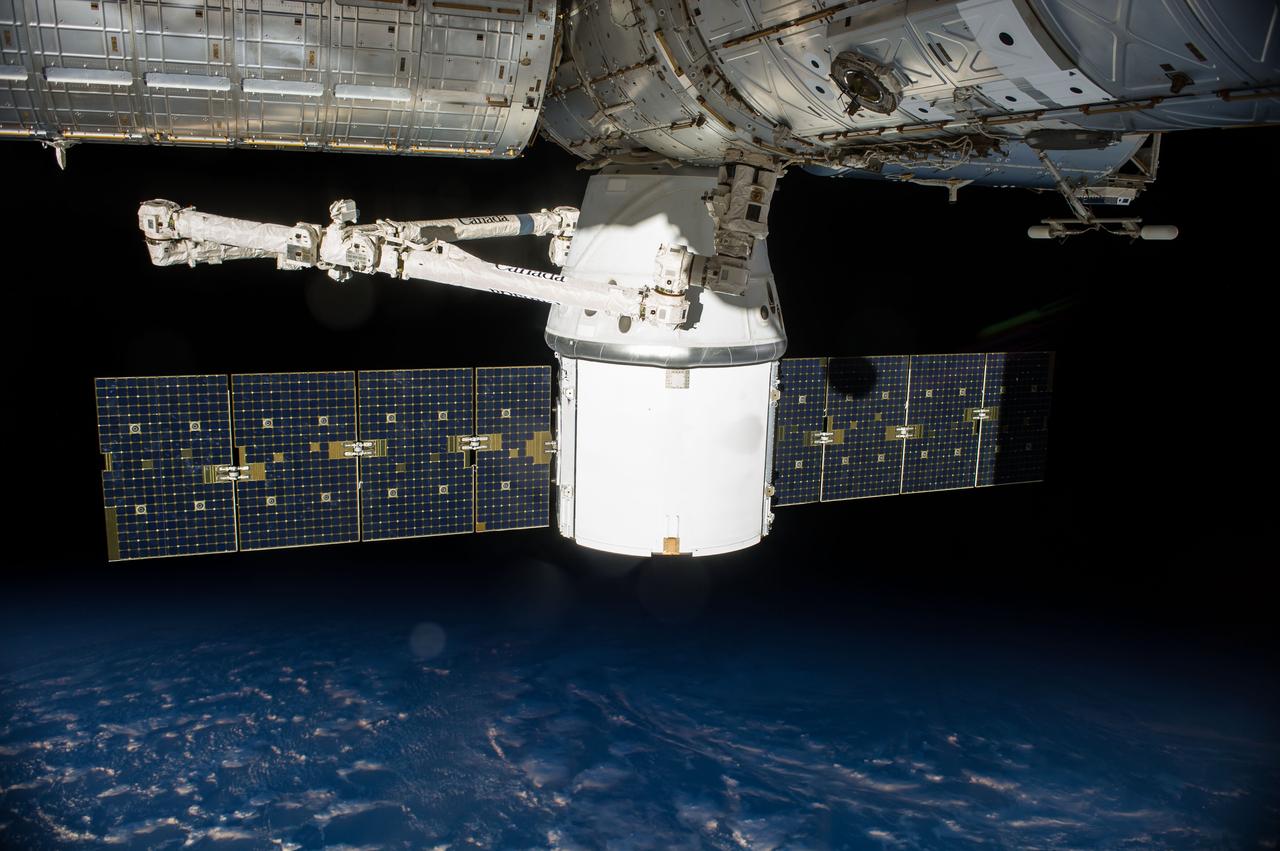
ISS041-E-033463 (24 Sept. 2014) --- SpaceX's uncrewed Dragon cargo spacecraft is docked to the International Space Station after arriving on Sept. 23 with a load of supplies and equipment for the three crew members currently onboard the orbital outpost and the three who will join them soon.
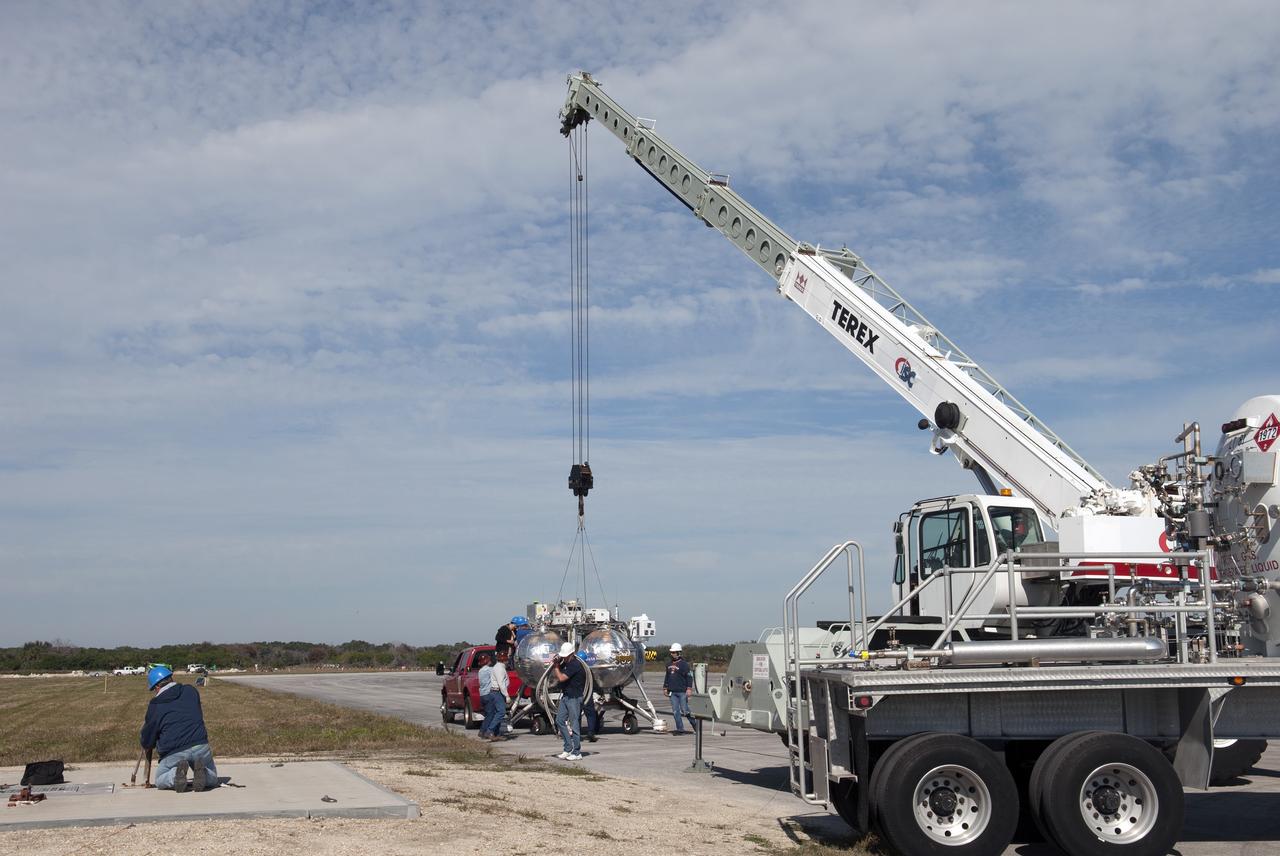
CAPE CANAVERAL, Fla. – NASA Project Morpheus prototype lander is being lifted by crane during preparations for free flight test number 15 at the north end of the Shuttle Landing Facility at NASA’s Kennedy Space Center in Florida. The lander will take off from the ground over a flame trench and use its autonomous landing and hazard avoidance technology, or ALHAT sensors, to survey the hazard field to determine safe landing sites. Project Morpheus tests NASA’s ALHAT and an engine that runs on liquid oxygen and methane, which are green propellants. These new capabilities could be used in future efforts to deliver cargo to planetary surfaces. Project Morpheus is being managed under the Advanced Exploration Systems, or AES, Division in NASA’s Human Exploration and Operations Mission Directorate. For more information on Project Morpheus, visit http://morpheuslander.jsc.nasa.gov/. Photo credit: NASA/Jim Grossmann
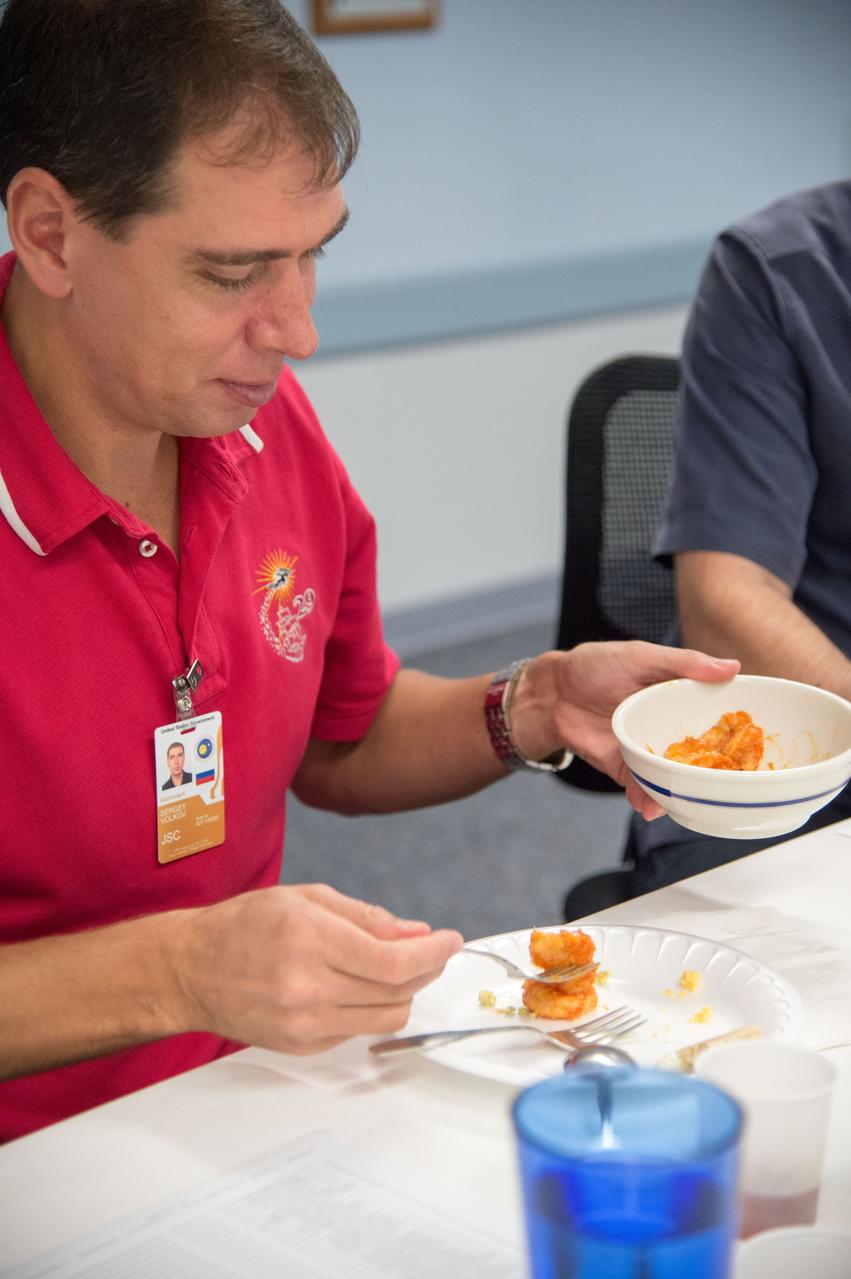
PHOTO DATE: 9-26-14 LOCATION: Bldg. 17, Room 1070 - Food Lab. SUBJECT: Expedition 45 and Soyuz 44 cosmonaut Sergei Volkov with Yuri Malenchenko during Food Tasting in JSC Food Lab. PHOTOGRAPHER: Lauren Harnett
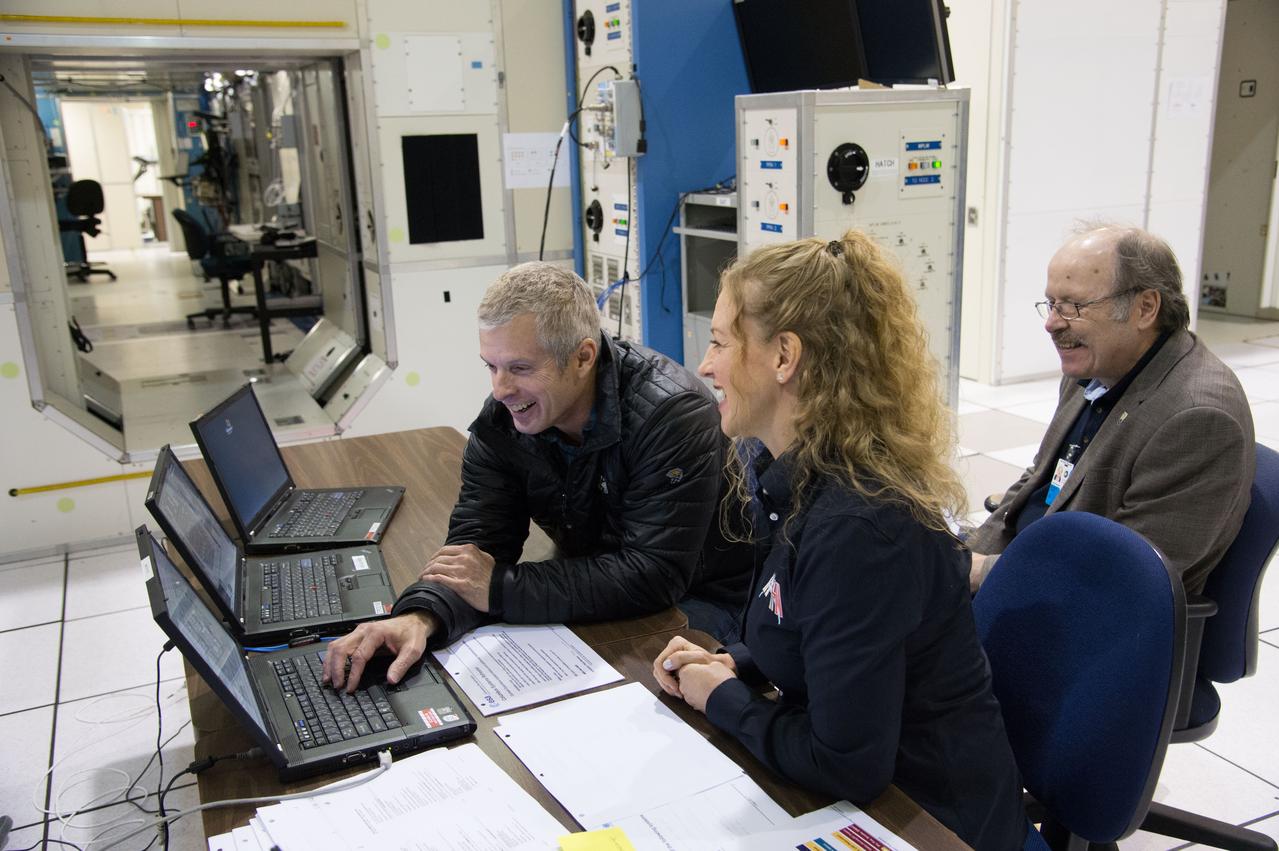
Expedition 40 crew member Steve Swanson with instructor Michaela Benda during crew training. Photo Date: January 8, 2014. Location: Building 5, SSTF. Photographer: Robert Markowitz
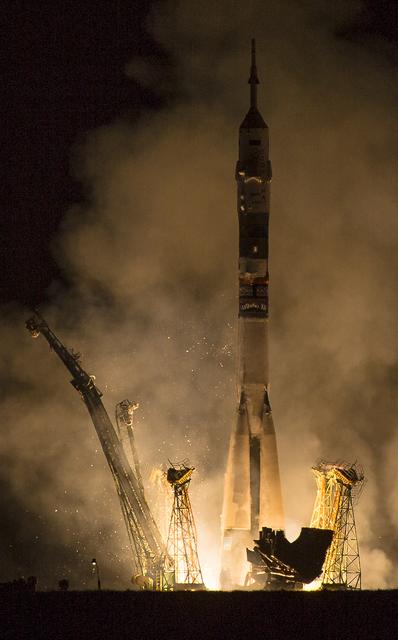
The Soyuz TMA-14M rocket is launched with Expedition 41 Soyuz Commander Alexander Samokutyaev of the Russian Federal Space Agency (Roscosmos) Flight Engineer Elena Serova of Roscosmos, and Flight Engineer Barry Wilmore of NASA, Friday, September 26, 2014 at the Baikonur Cosmodrome in Kazakhstan. Samokutyaev, Serova, and Wilmore will spend the next five and a half months aboard the International Space Station. Serova will become the fourth Russian woman to fly in space and the first Russian woman to live and work on the station. Photo Credit: (NASA/Joel Kowsky)
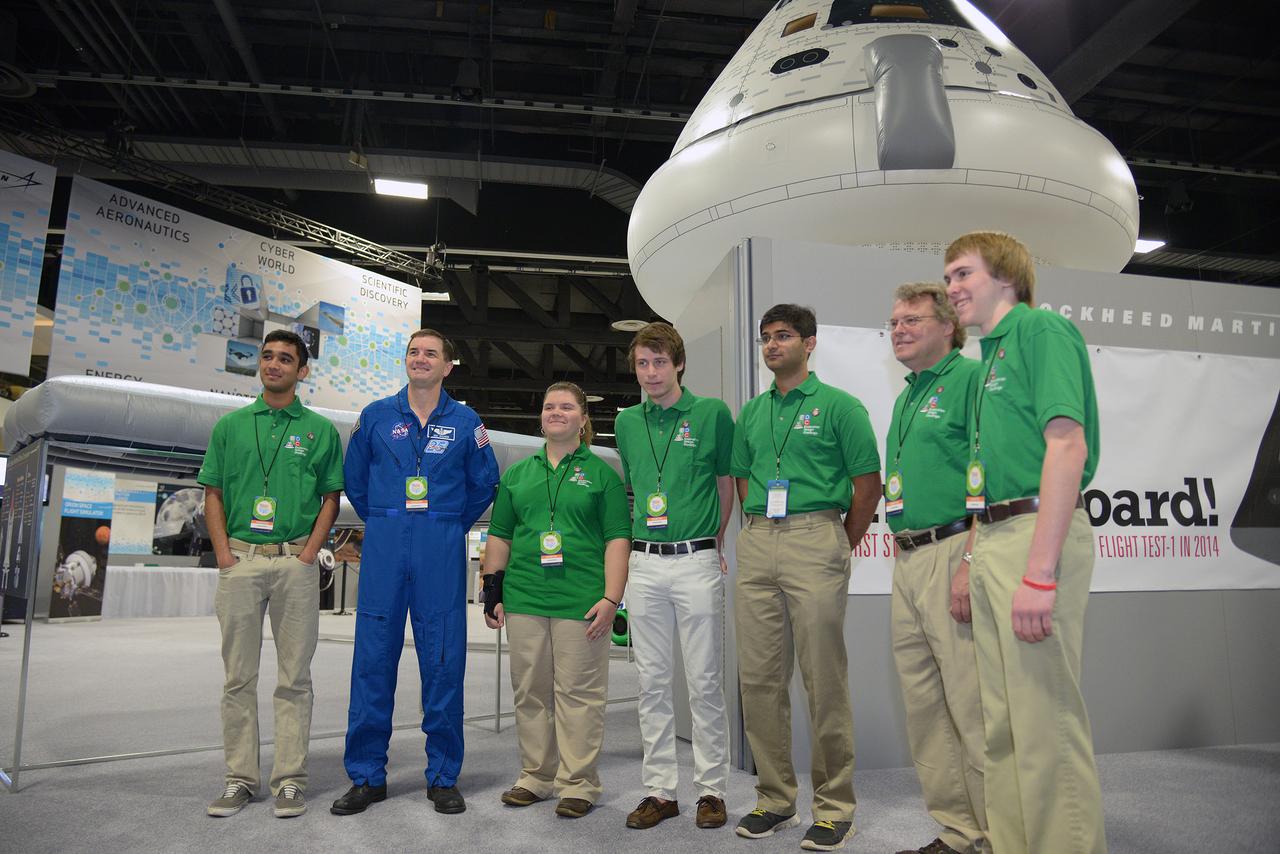
The winner of the high school portion of the Exploration Design Challenge is announced at the USA Science and Engineering Festival in Washington on April 25, 2014. Astronaut Rex Walheim poses for photo with students. Part of Batch image transfer from Flickr.
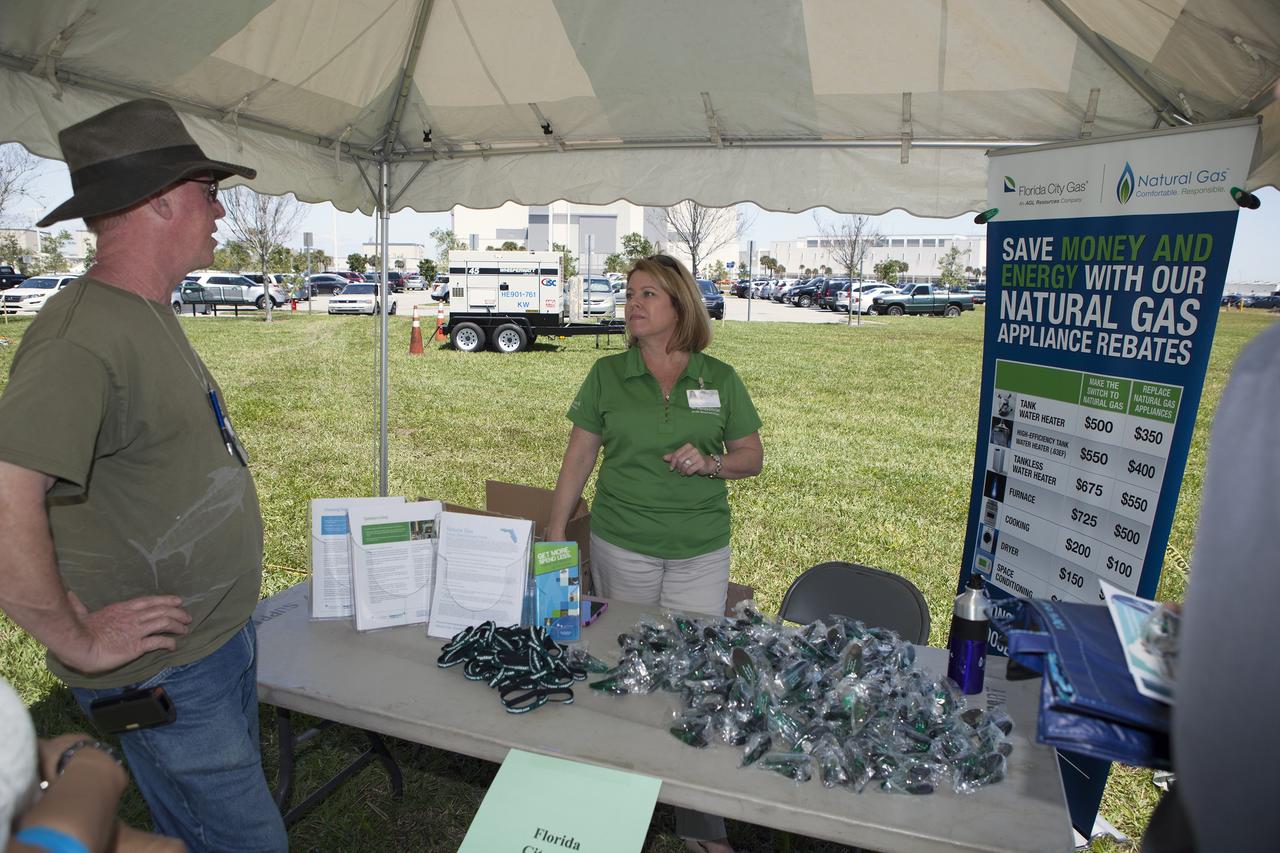
CAPE CANAVERAL, Fla. -- NASA's Kennedy Space Center in Florida hosts a Sustainability Fair in observance of Earth Day. The fair was held adjacent to the Pathfinder Fitness Trail across the street from the 525-foot-tall Vehicle Assembly Building in Launch Complex 39. Kennedy Earth Day events included booths by a dozen sustainable companies and environmental organizations, displays on organic gardening, recycling, sustainable materials, alternative fuels and wildlife, and test-drives of several alternative-fuel vehicles. In keeping with the national theme, "Green Cities," the fair provided employees with the opportunity to learn how to do their parts in securing a healthy and sustainable future for their cities and the planet. The space center's sustainability objective is to "promote, maintain and pioneer green practices in all aspects of our mission, striving to be an agency leader in everything we do." For more information on Kennedy's sustainability policy, visit http://www.nasa.gov/centers/kennedy/about/sustainability. Photo credit: NASA/Dimitri Gerondidakis
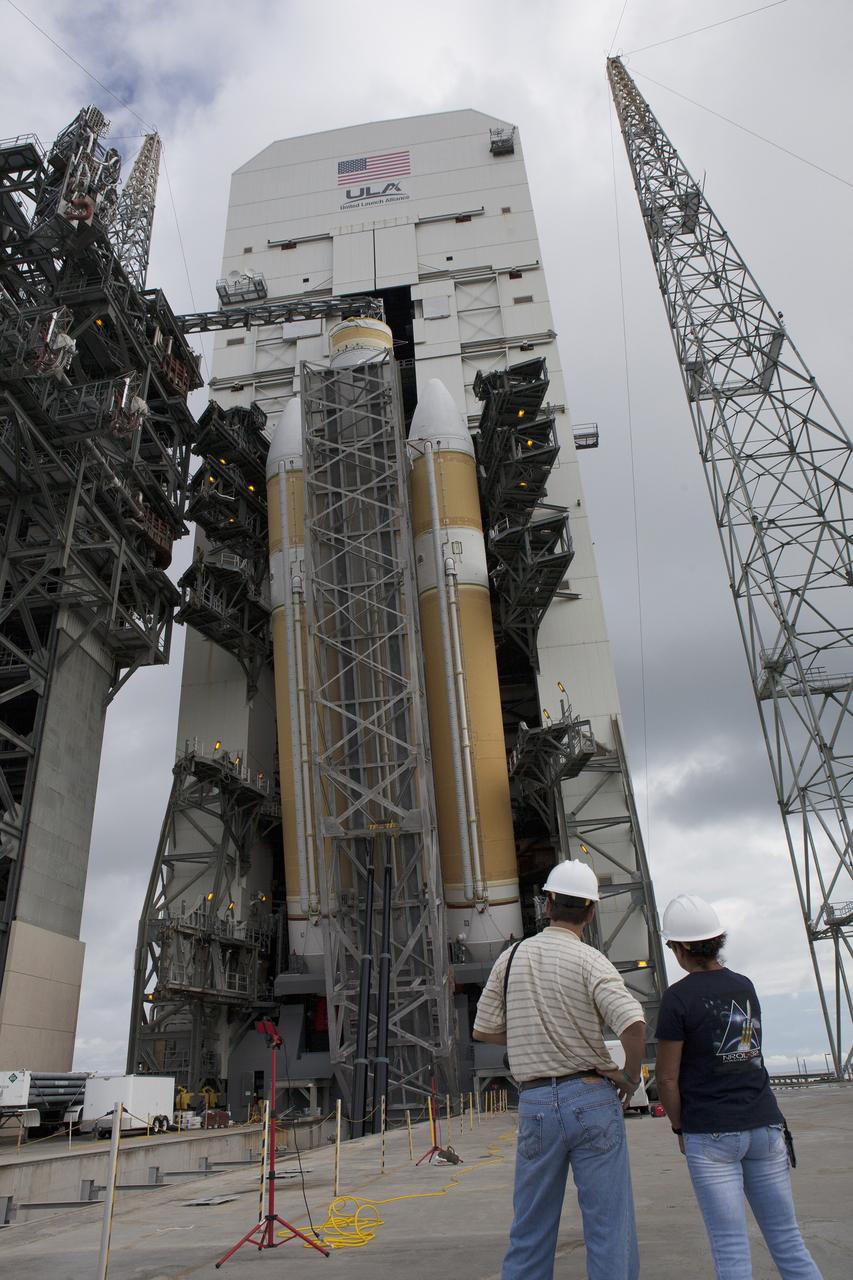
CAPE CANAVERAL, Fla. – United Launch Alliance, or ULA, workers monitor the progress as the ULA Delta IV Heavy rocket for Exploration Flight Test-1 is lifted to the vertical position in the mobile service tower on the pad at Space Launch Complex 37 at Cape Canaveral Air Force Station in Florida. The Delta IV Heavy is being readied to launch Orion on its first flight test. During its first flight test, Orion will travel farther into space than any human spacecraft has gone in more than 40 years. The data gathered during the flight will influence design decisions, validate existing computer models and innovative new approaches to space systems development, as well as reduce overall mission risks and costs for later Orion flights. Liftoff of Orion on the first flight test is planned for December 2014. Photo credit: NASA/Daniel Casper
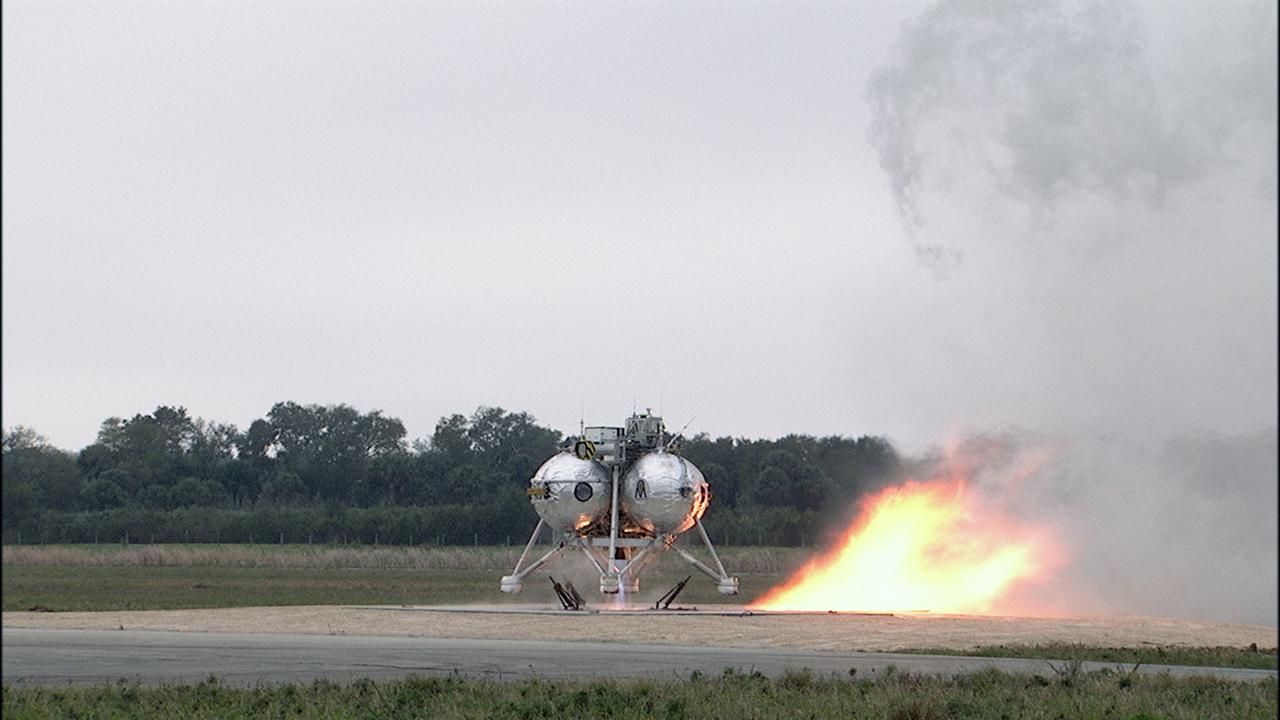
CAPE CANAVERAL, Fla. – The Project Morpheus prototype lander begins to ascend on its sixth free flight test at the north end of the Shuttle Landing Facility at NASA’s Kennedy Space Center in Florida. The 82-second test began at 11:32 a.m. EST with the Morpheus lander launching from the ground over a flame trench and ascending to 465 feet. The lander flew forward, covering 633 feet while performing a 55-foot divert to emulate a hazard avoidance maneuver before descending and landing on a dedicated pad inside the automated landing and hazard avoidance technology, or ALHAT, hazard field. Morpheus landed 10 inches west of its intended target. Project Morpheus tests NASA’s ALHAT and an engine that runs on liquid oxygen and methane, or green propellants, into a fully-operational lander that could deliver cargo to other planetary surfaces. The landing facility provides the lander with the kind of field necessary for realistic testing, complete with rocks, craters and hazards to avoid. Morpheus’ ALHAT payload allows it to navigate to clear landing sites amidst rocks, craters and other hazards during its descent. Project Morpheus is being managed under the Advanced Exploration Systems, or AES, Division in NASA’s Human Exploration and Operations Mission Directorate. The efforts in AES pioneer new approaches for rapidly developing prototype systems, demonstrating key capabilities and validating operational concepts for future human missions beyond Earth orbit. For more information on Project Morpheus, visit http://morpheuslander.jsc.nasa.gov/. Photo credit: NASA/Frankie Martin
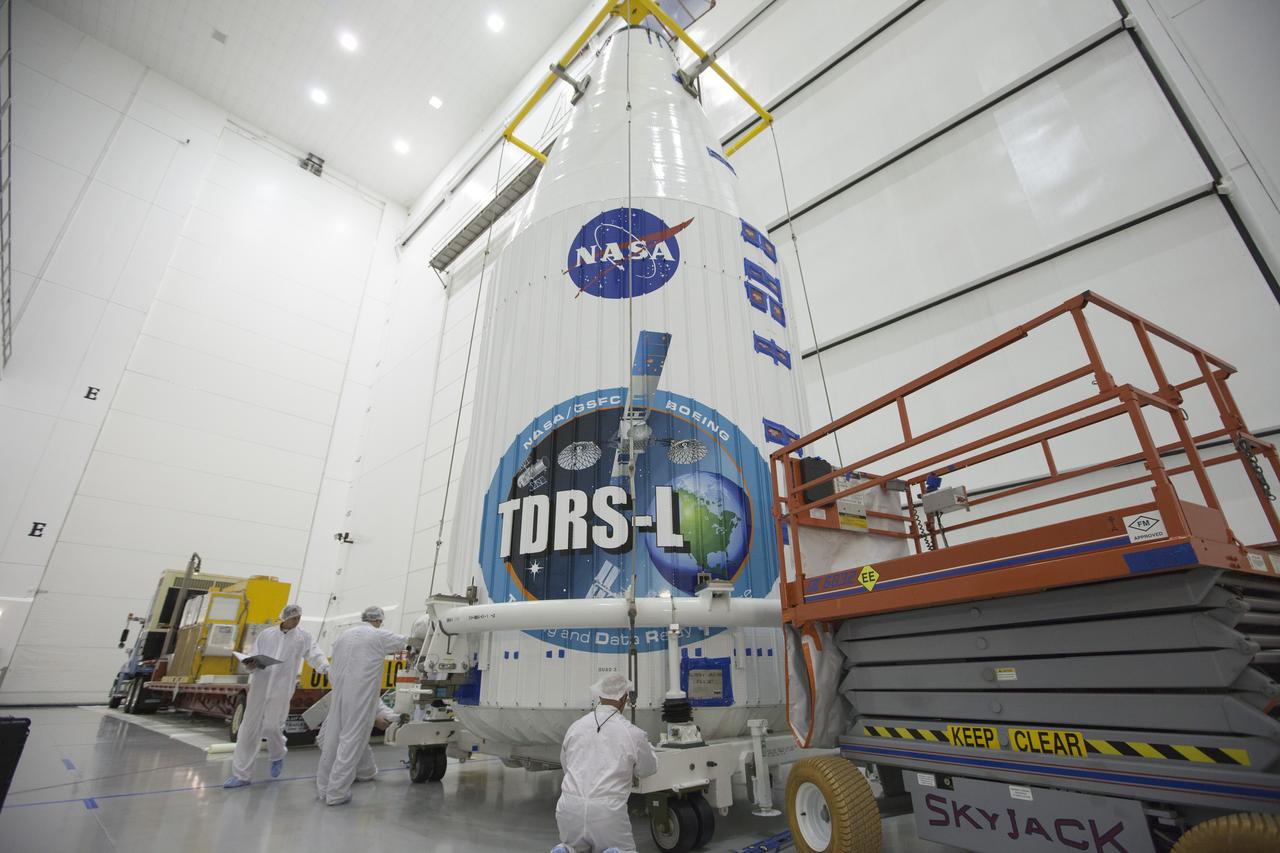
TITUSVILLE, Fla. – Under the watchful eyes of United launch Alliance engineers and technicians at the Astrotech payload processing facility in Titusville, the Tracking and Data Relay Satellite, or TDRS-L, spacecraft is being encapsulated in its payload fairing. It is about to be lifted by crane for mounting on a transporter for its trip to Launch Complex 41 at Cape Canaveral Air Force Station. The TDRS-L satellite will be a part of the second of three next-generation spacecraft designed to ensure vital operational continuity for the NASA Space Network. It is scheduled to launch from Cape Canaveral's Space Launch Complex 41 atop a United Launch Alliance Atlas V rocket on January 23, 2014. The current Tracking and Data Relay Satellite system consists of eight in-orbit satellites distributed to provide near continuous information relay contact with orbiting spacecraft ranging from the International Space Station and Hubble Space Telescope to the array of scientific observatories. For more information, visit: http://www.nasa.gov/mission_pages/tdrs/home/index.html Photo credit: NASA/Kim Shiflett
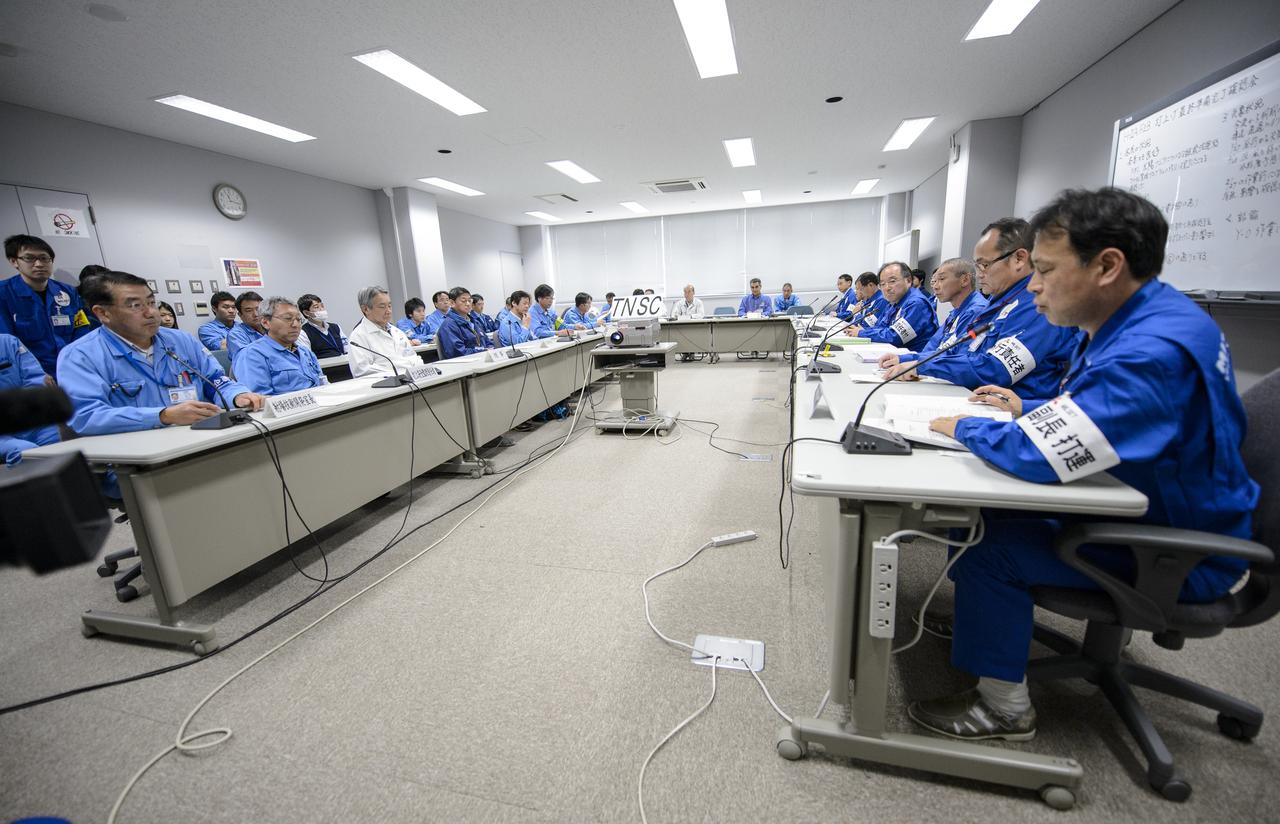
Chief officers from Mitsubishi Heavy Industries, Ltd., the Japan Aerospace Exploration Agency (JAXA) and NASA met on Wednesday, Feb. 26, 2014 in the Range Control Center (RCC) of the Tanegashima Space Center, Japan, to review the readiness of the Global Precipitation Measurement (GPM) Core Observatory for launch. The spacecraft is scheduled to launch aboard an H-IIA rocket early on the morning of Feb. 28 Japan time. Once launched, the GPM spacecraft will collect information that unifies data from an international network of existing and future satellites to map global rainfall and snowfall every three hours. Photo Credit: (NASA/Bill Ingalls)
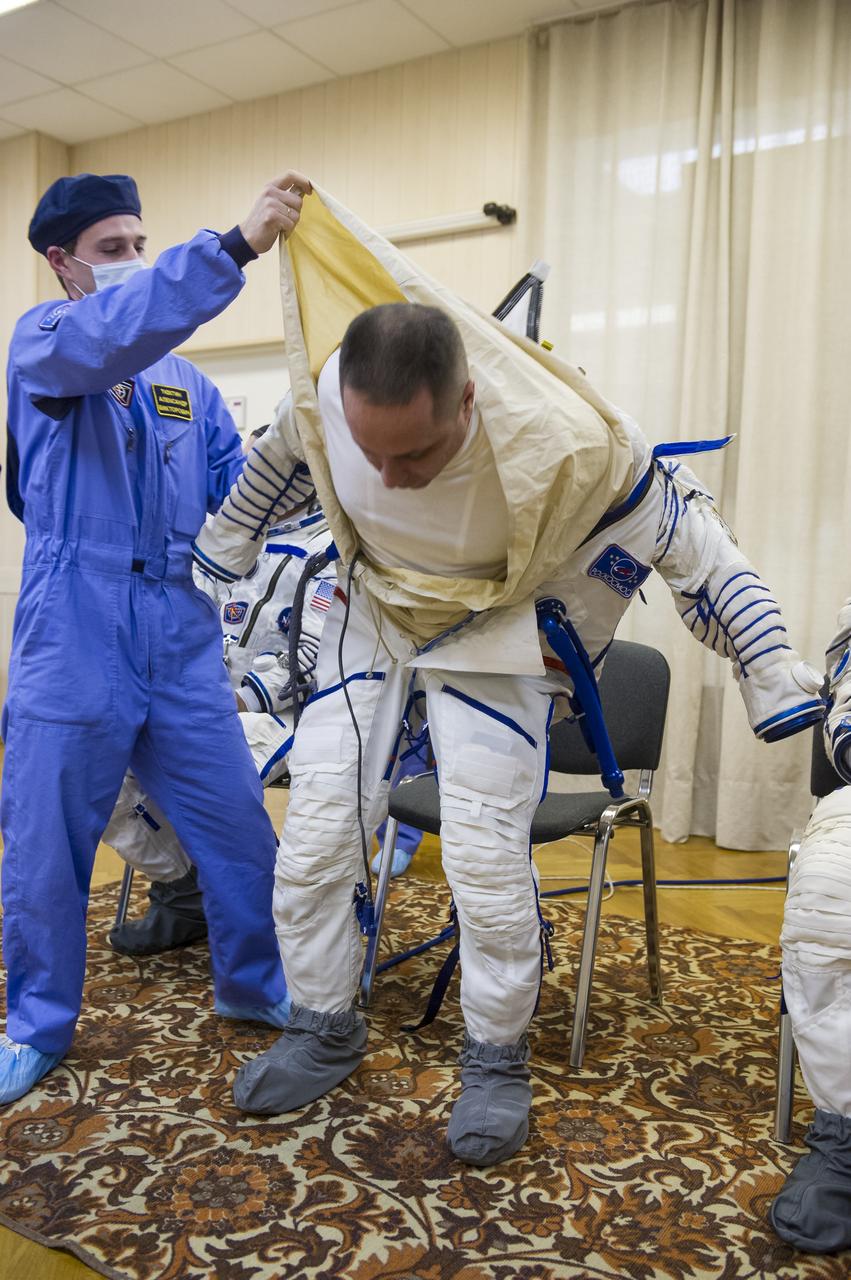
Expedition 42 Soyuz Commander Anton Shkaplerov of the Russian Federal Space Agency (Roscosmos) is helped into his Russian Sokol suit as he and fellow crewmates, Flight Engineer Samantha Cristoforetti of the European Space Agency (ESA), and Flight Engineer Terry Virts of NASA prepare for their Soyuz launch to the International Space Station, on Sunday, Nov. 23, 2014, at the Baikonur Cosmodrome in Baikonur, Kazakhstan. Launch of the Soyuz rocket is scheduled for the early hours of Nov. 24 and will carry Shkaplerov, Virts, and Cristoforetti into orbit to begin their five and a half month mission on the International Space Station. Photo Credit: (NASAGCTC/Andrey Shelepin)
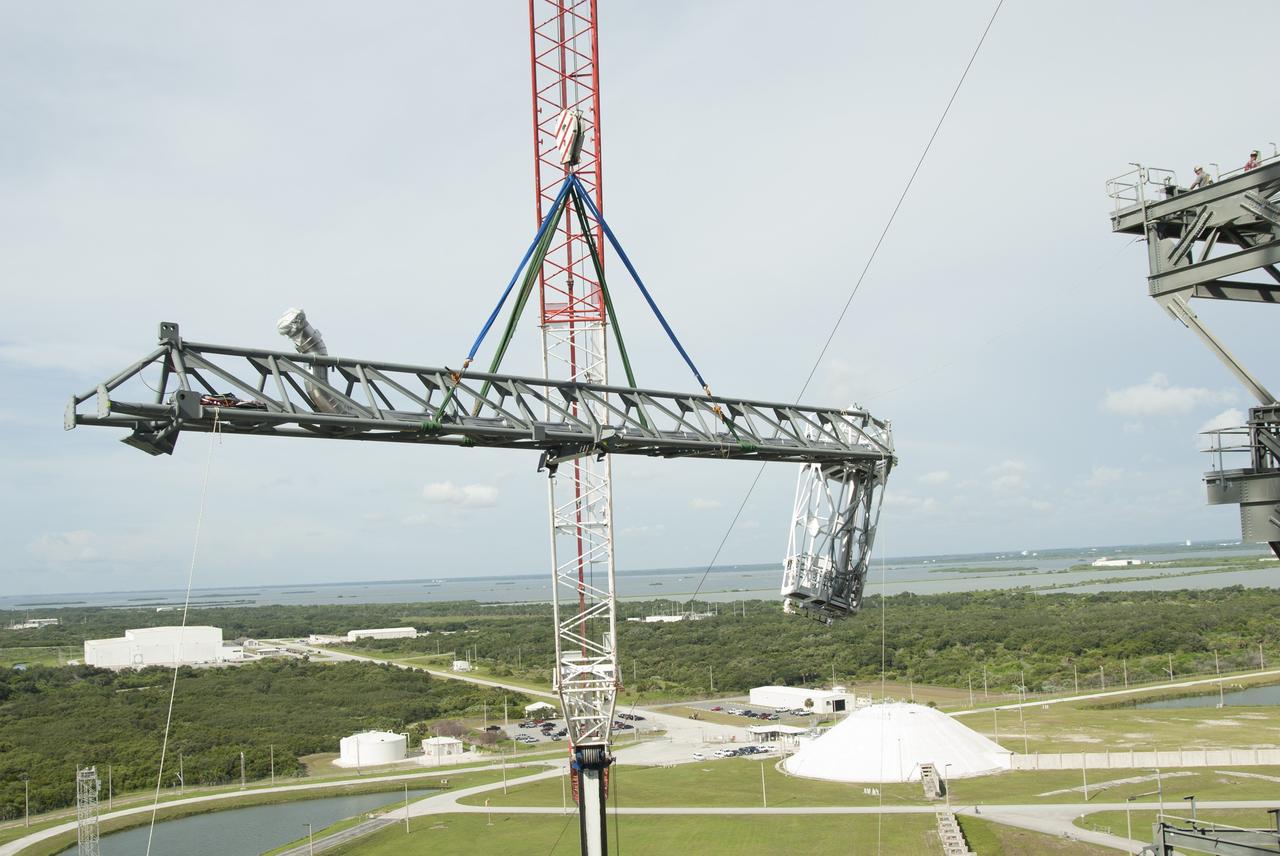
CAPE CANAVERAL, Fla. – The umbilical swing arm for Exploration Flight Test 1, or EFT-1, is lifted high by crane for installation on the fixed umbilical tower at Space Launch Complex 37 at Cape Canaveral Air Force Station in Florida. The swing arm is the uppermost of three swing arms that will be attached to the fixed umbilical tower. The swing arm will carry umbilicals that will be mated to Orion's launch abort system and environmental control system. During launch, the umbilicals will pull away from Orion and the United Launch Alliance Delta IV Heavy rocket at T-0. During the EFT-1 mission, Orion will travel farther into space than any human spacecraft has gone in more than 40 years. The data gathered during the flight will influence design decisions, validate existing computer models and innovative new approaches to space systems development, as well as reduce overall mission risks and costs for later Orion flights. Liftoff of Orion on its first flight test is planned for fall 2014. Photo credit: NASA/Jim Grossmann
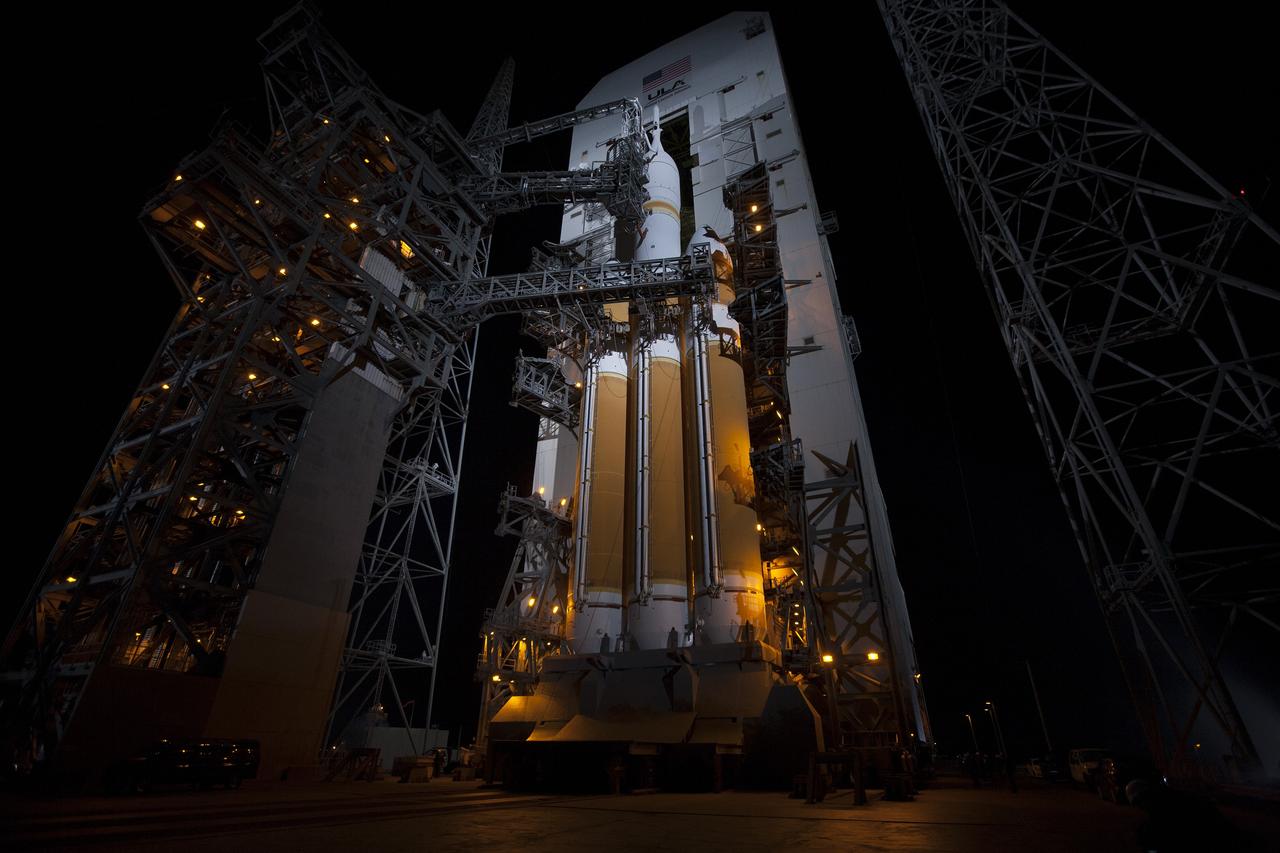
CAPE CANAVERAL, Fla. – The launch gantry is rolled back to reveal NASA's Orion spacecraft mounted atop a United Launch Alliance Delta IV Heavy rocket at Cape Canaveral Air Force Station's Space Launch Complex 37. Orion is NASA’s new spacecraft built to carry humans, designed to allow us to journey to destinations never before visited by humans, including an asteroid and Mars. For more information, visit www.nasa.gov/orion Photo credit: NASA/Kim Shiflett
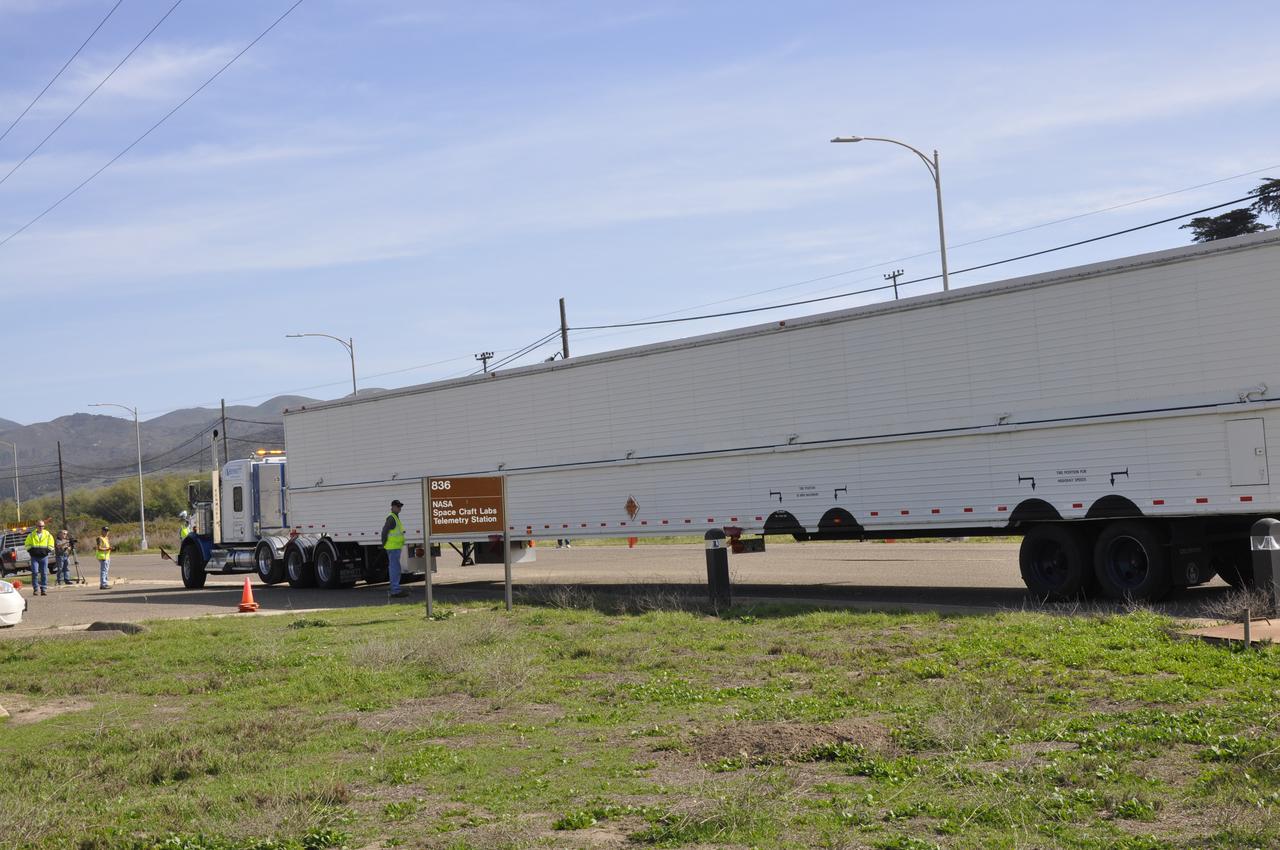
VANDENBERG AIR FORCE BASE, Calif. – The truck transporting the Delta first-stage booster for NASA's Orbiting Carbon Observatory-2 mission, or OCO-2, arrives outside the Building 836 hangar at Space Launch Complex 2 on Vandenberg Air Force Base in California. OCO-2 is scheduled to launch aboard a United Launch Alliance Delta II rocket in July. The observatory will collect precise global measurements of carbon dioxide in the Earth's atmosphere and provide scientists with a better idea of the chemical compound's impacts on climate change. Scientists will analyze this data to improve our understanding of the natural processes and human activities that regulate the abundance and distribution of this important atmospheric gas. To learn more about OCO-2, visit http://oco.jpl.nasa.gov. Photo credit: NASA/Randy Beaudoin

CAPE CANAVERAL, Fla. – United Launch Alliance, or ULA, workers monitor the progress as the ULA Delta IV Heavy rocket for Exploration Flight Test-1 is lifted to the vertical position in the mobile service tower on the pad at Space Launch Complex 37 at Cape Canaveral Air Force Station in Florida. The Delta IV Heavy is being readied to launch Orion on its first flight test. During its first flight test, Orion will travel farther into space than any human spacecraft has gone in more than 40 years. The data gathered during the flight will influence design decisions, validate existing computer models and innovative new approaches to space systems development, as well as reduce overall mission risks and costs for later Orion flights. Liftoff of Orion on the first flight test is planned for December 2014. Photo credit: NASA/Daniel Casper

The component images for this 360-degree panorama were taken by NASA Mars Exploration Rover Opportunity after the rover drove about 97 feet southeastward on April 22, 2014. The location is on the western rim of Endeavour Crater.
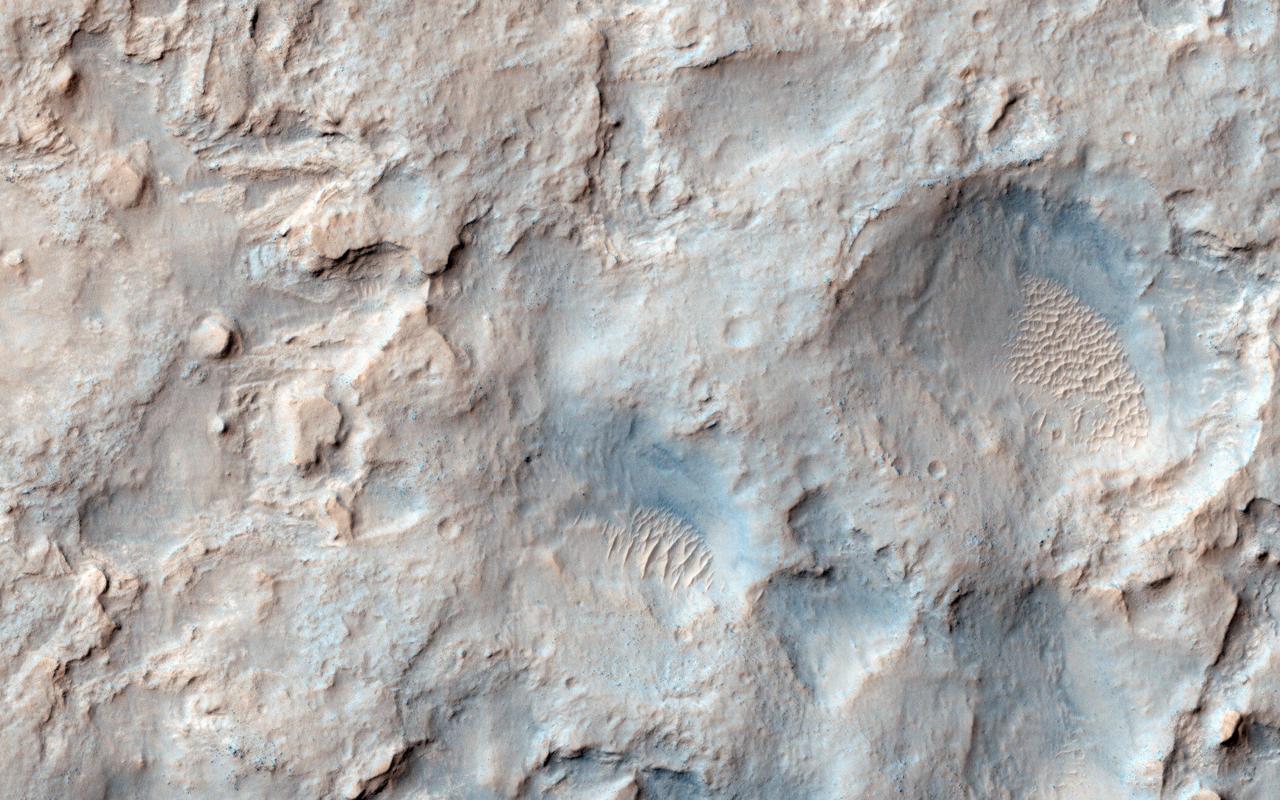
NASA Mars Reconnaissance Orbiter saw the saddle between two valleys named Dingo Gap-in Gale Crater-where the rover Curiosity just traversed. The gap is spanned by a single dune visible both from the ground and from orbit.
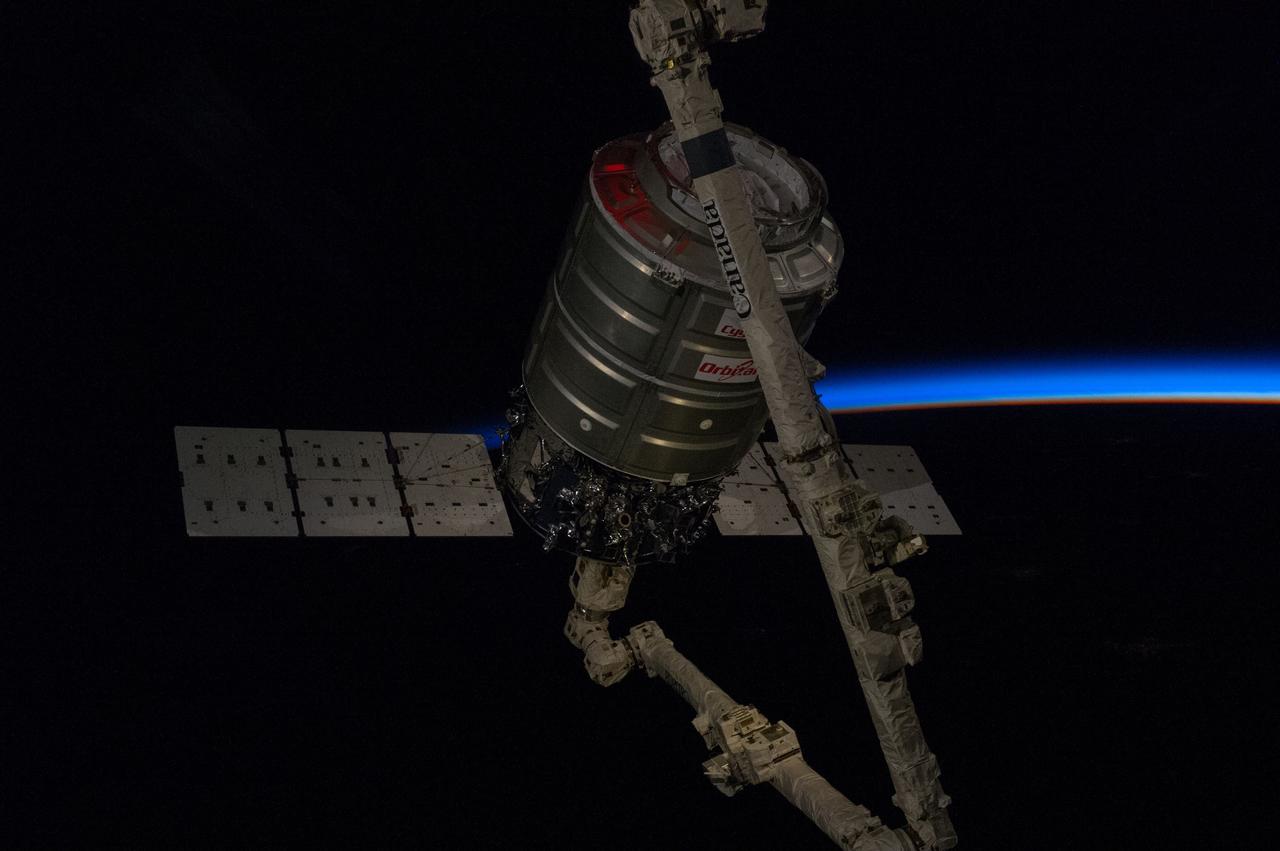
ISS038-E-028055 (12 Jan. 2014) --- Intersecting the thin line of Earth's atmosphere, the Orbital Sciences Corp. Cygnus commercial cargo craft attached to the end of the Canadarm2 robotic arm of the International Space Station is photographed by an Expedition 38 crew member during rendezvous and berthing operations on Jan. 12, 2014.
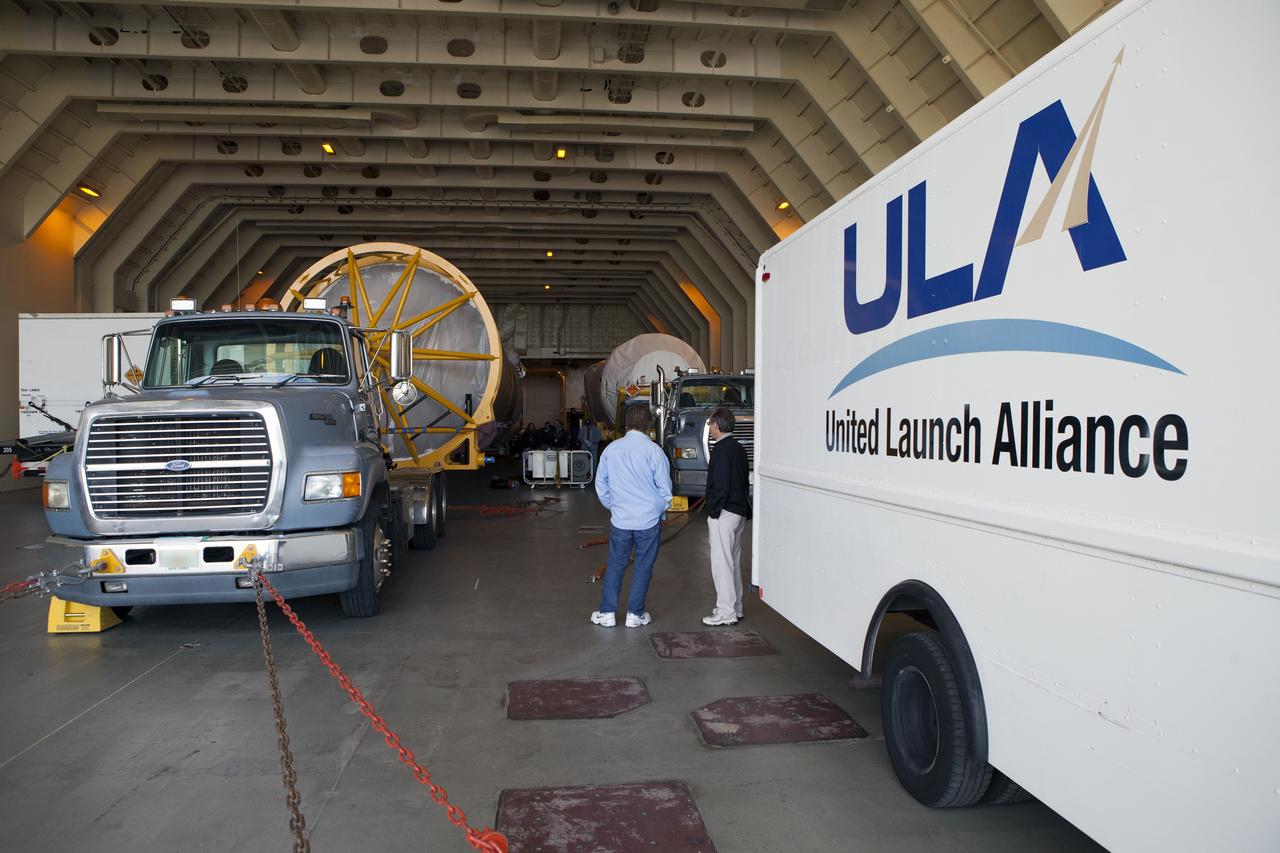
CAPE CANAVERAL, Fla. – Trucks inside the United Launch Alliance Delta Mariner prepare to transport the Atlas V rocket and Centaur upper stage that will be used to launch NASA's Magnetospheric Multiscale mission. To learn about the MMS, go to http://go.nasa.gov/1GUbzxb. Photo credit: NASA/Ben Smegelsky
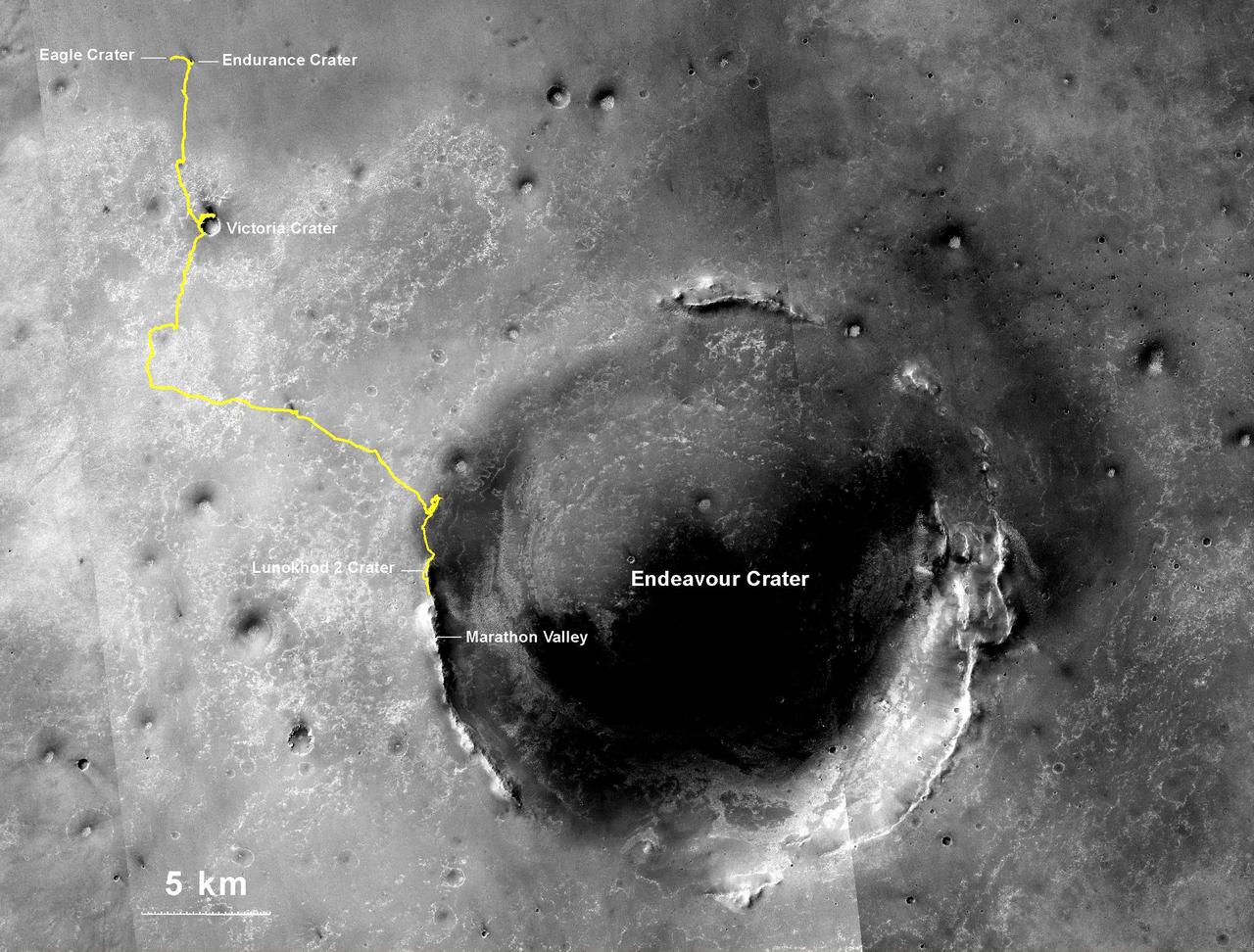
NASA Opportunity rover, working on Mars since January 2004, passed 25 miles of total driving on the July 27, 2014. The gold line on this map shows Opportunity route from the landing site inside Eagle Crater, in upper left.

CAPE CANAVERAL, Fla. – Inside the Neil Armstrong Operations and Checkout Building high bay at NASA's Kennedy Space Center in Florida, the Orion crew and service module stack for Exploration Flight Test-1 was lifted by crane out of the test cell and is being moved along the center aisle. Orion will be transferred to a mating device. Orion is the exploration spacecraft designed to carry astronauts to destinations not yet explored by humans, including an asteroid and Mars. It will have emergency abort capability, sustain the crew during space travel and provide safe re-entry from deep space return velocities. The first unpiloted test flight of the Orion is scheduled to launch later this year atop a Delta IV Heavy rocket from Cape Canaveral Air Force Station in Florida to an altitude of 3,600 miles above the Earth's surface. The two-orbit, four-hour flight test will help engineers evaluate the systems critical to crew safety including the heat shield, parachute system and launch abort system. For more information, visit http://www.nasa.gov/orion. Photo credit: NASA/Ben Smegelsky

TRACT 2 Frame Drop Test AT NASA Langley Research Center's Landing and Impact Research (LandIR) Facility
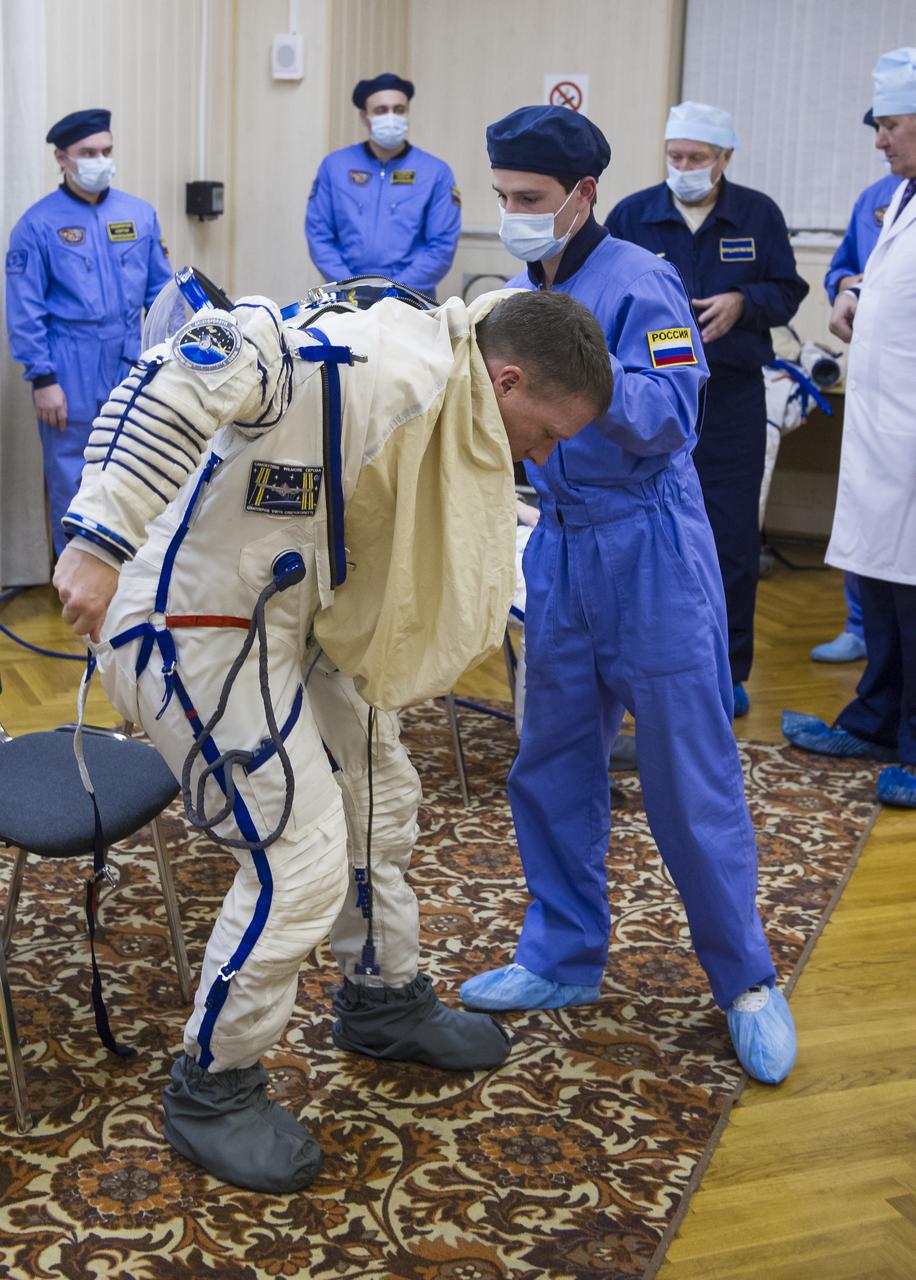
Expedition 42 Flight Engineer Terry Virts of NASA is helped into his Russian Sokol suit as he and fellow crewmates, Flight Engineer Samantha Cristoforetti of the European Space Agency (ESA), and Soyuz Commander Anton Shkaplerov of the Russian Federal Space Agency (Roscosmos), prepare for their Soyuz launch to the International Space Station, on Sunday, Nov. 23, 2014, at the Baikonur Cosmodrome in Baikonur, Kazakhstan. Launch of the Soyuz rocket is scheduled for the early hours of Nov. 24 and will carry Virts, Cristoforetti, and Shkaplerov into orbit to begin their five and a half month mission on the International Space Station. Photo Credit: (NASA/GCTC/Andrey Shelepin)
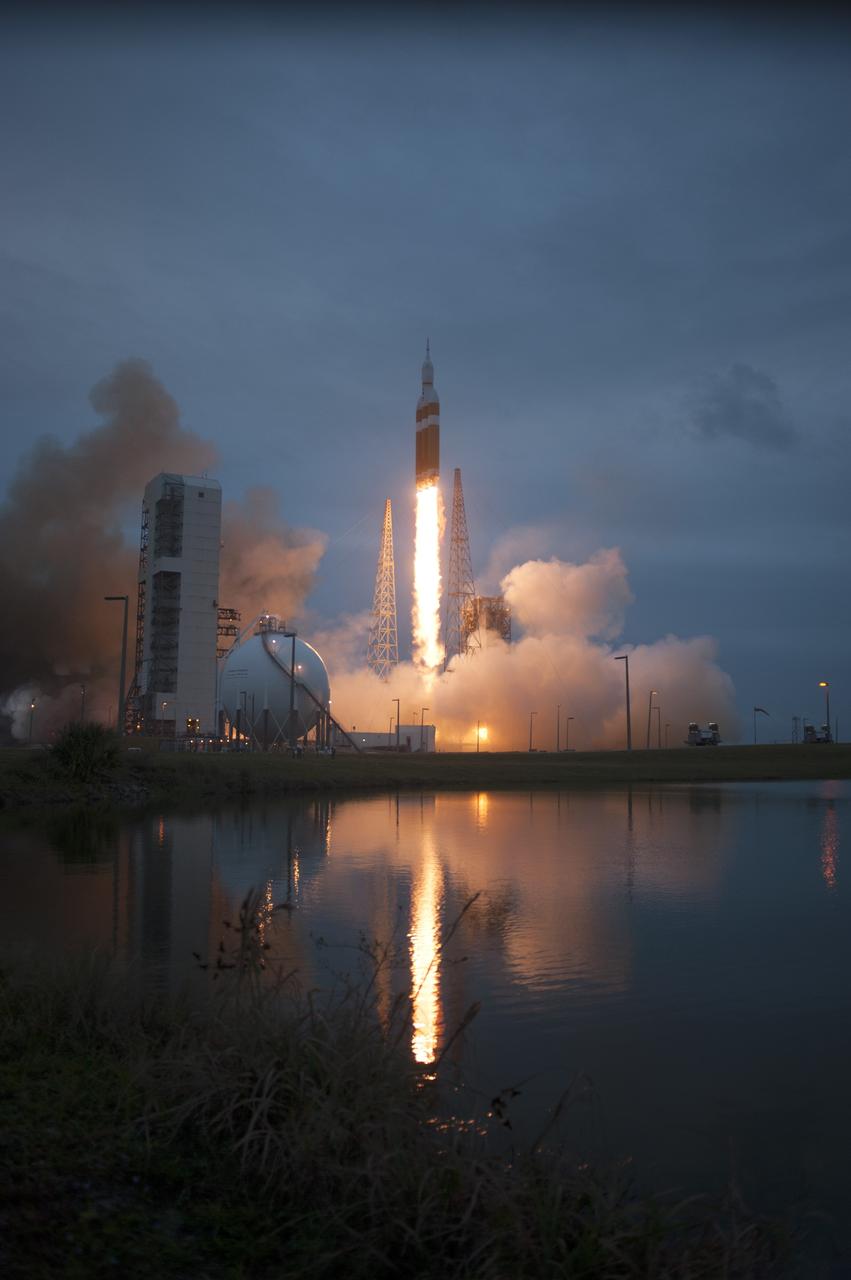
CAPE CANAVERAL, Fla. -- A Delta IV Heavy rocket lifts off from Space Launch Complex 37 at Cape Canaveral Air Force Station in Florida carrying NASA's Orion spacecraft on an unpiloted flight test to Earth orbit. Liftoff was at 7:05 a.m. EST. During the two-orbit, four-and-a-half hour mission, engineers will evaluate the systems critical to crew safety, the launch abort system, the heat shield and the parachute system. For more information, visit www.nasa.gov/orion Photo credit: NASA/ Sandy Joseph/Kevin O’Connell
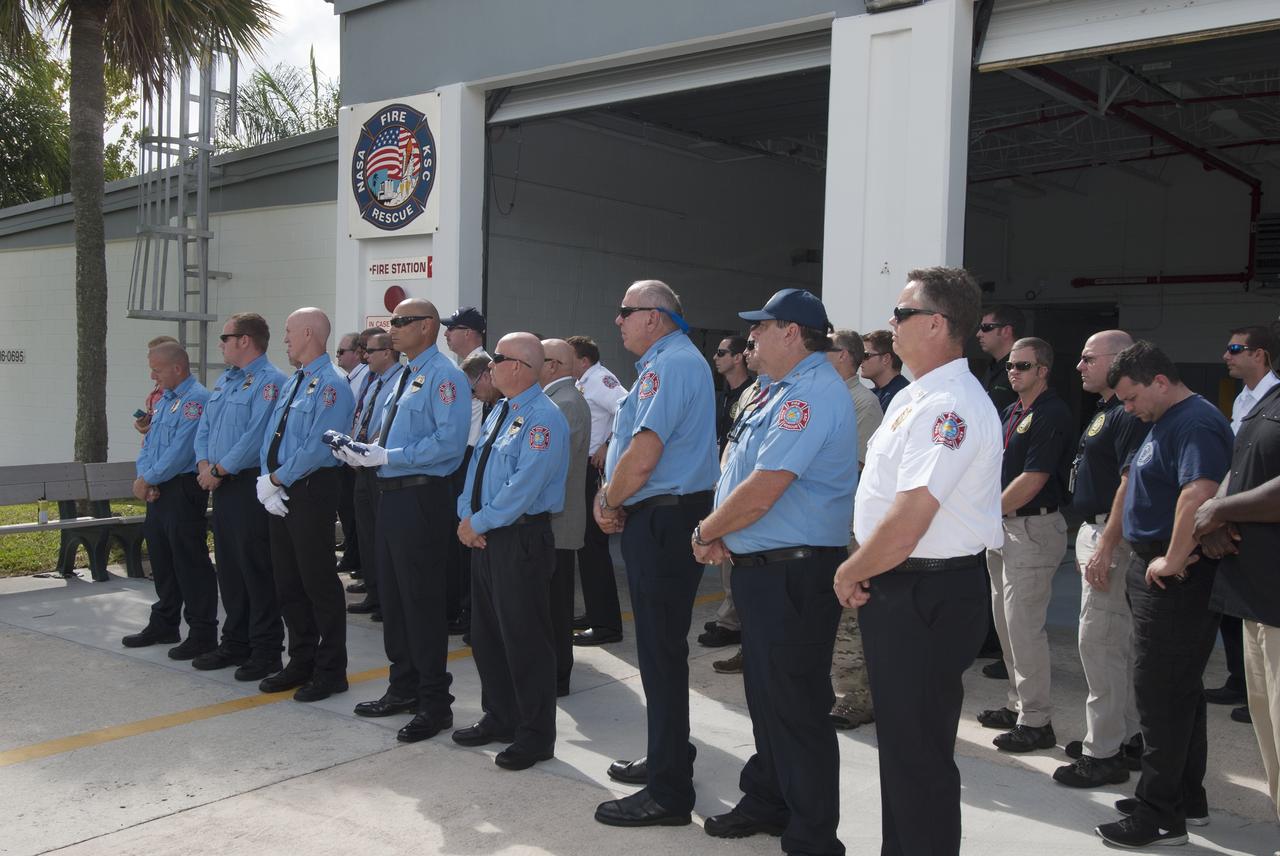
Cape Canaveral, Fla. – At Fire Station 1 at NASA’s Kennedy Space Center in Florida, Fire and Rescue personnel pause for a moment of silence during a ceremony commemorating the 13th anniversary of 9/11 at 10:28 a.m., which was the moment of collapse of the north tower of the World Trade Center. Photo credit: Jim Grossmann
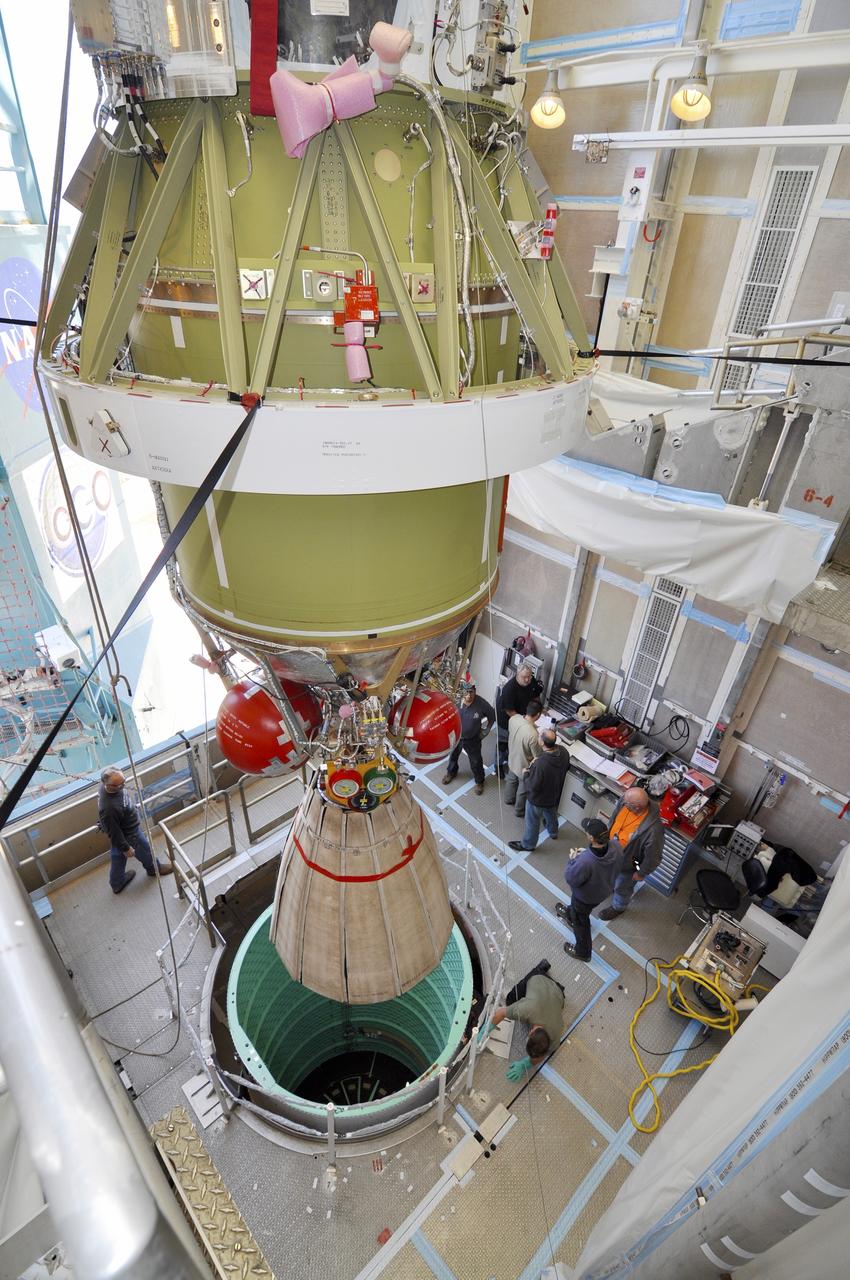
VANDENBERG AIR FORCE BASE, Calif. – The second stage of the Delta II rocket for NASA's Soil Moisture Active Passive mission, or SMAP, is lowered onto the rocket's first stage in the mobile service tower at Space Launch Complex 2 on Vandenberg Air Force Base in California. Operations are underway to install the second stage atop the rocket's first stage. SMAP will launch on a Delta II 7320 configuration vehicle featuring a United Launch Alliance first stage booster powered by an Aerojet Rocketdyne RS-27A main engine and three Alliant Techsystems, or ATK, strap-on solid rocket motors. Once on station in Earth orbit, SMAP will provide global measurements of soil moisture and its freeze/thaw state. These measurements will be used to enhance understanding of processes that link the water, energy and carbon cycles, and to extend the capabilities of weather and climate prediction models. SMAP data also will be used to quantify net carbon flux in boreal landscapes and to develop improved flood prediction and drought monitoring capabilities. Launch is scheduled for no earlier than November 2014. To learn more about SMAP, visit http://smap.jpl.nasa.gov. Photo credit: NASA/Randy Beaudoin
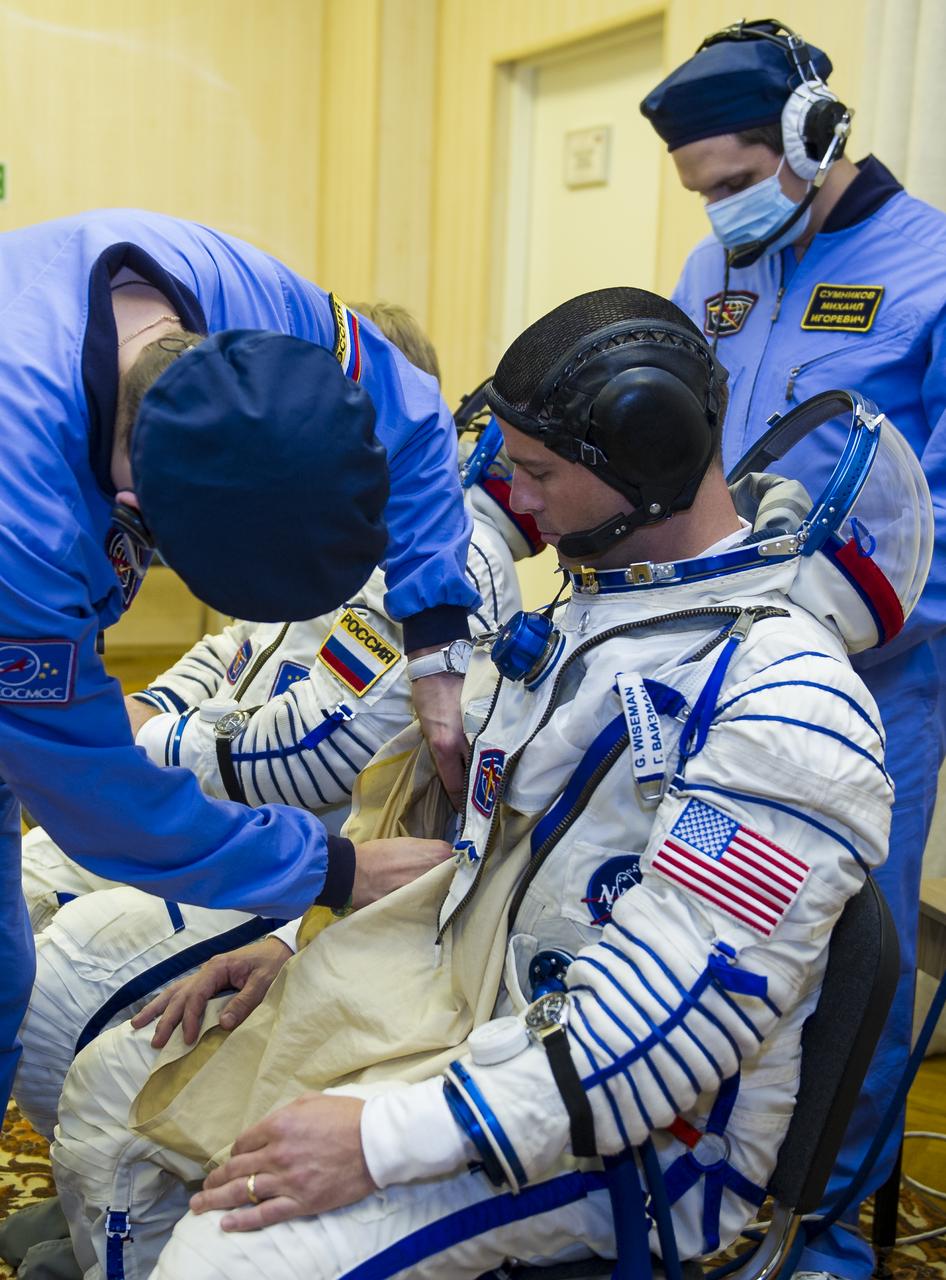
Expedition 40 Flight Engineer Reid Wiseman of NASA is helped into his Russian Sokol suit as he and fellow cremates, Soyuz Commander Maxim Suraev of the Russian Federal Space Agency, Roscosmos, and Flight Engineer Alexander Gerst of the European Space Agency, ESA, prepare for their Soyuz launch to the International Space Station, on Wednesday, May 28, 2014, in Baikonur, Kazakhstan. Launch of the Soyuz rocket will send Wiseman, Suraev, and Gerst on a five and a half month mission aboard the International Space Station. Photo Credit: (NASA/GCTC/Irina Peshkova)
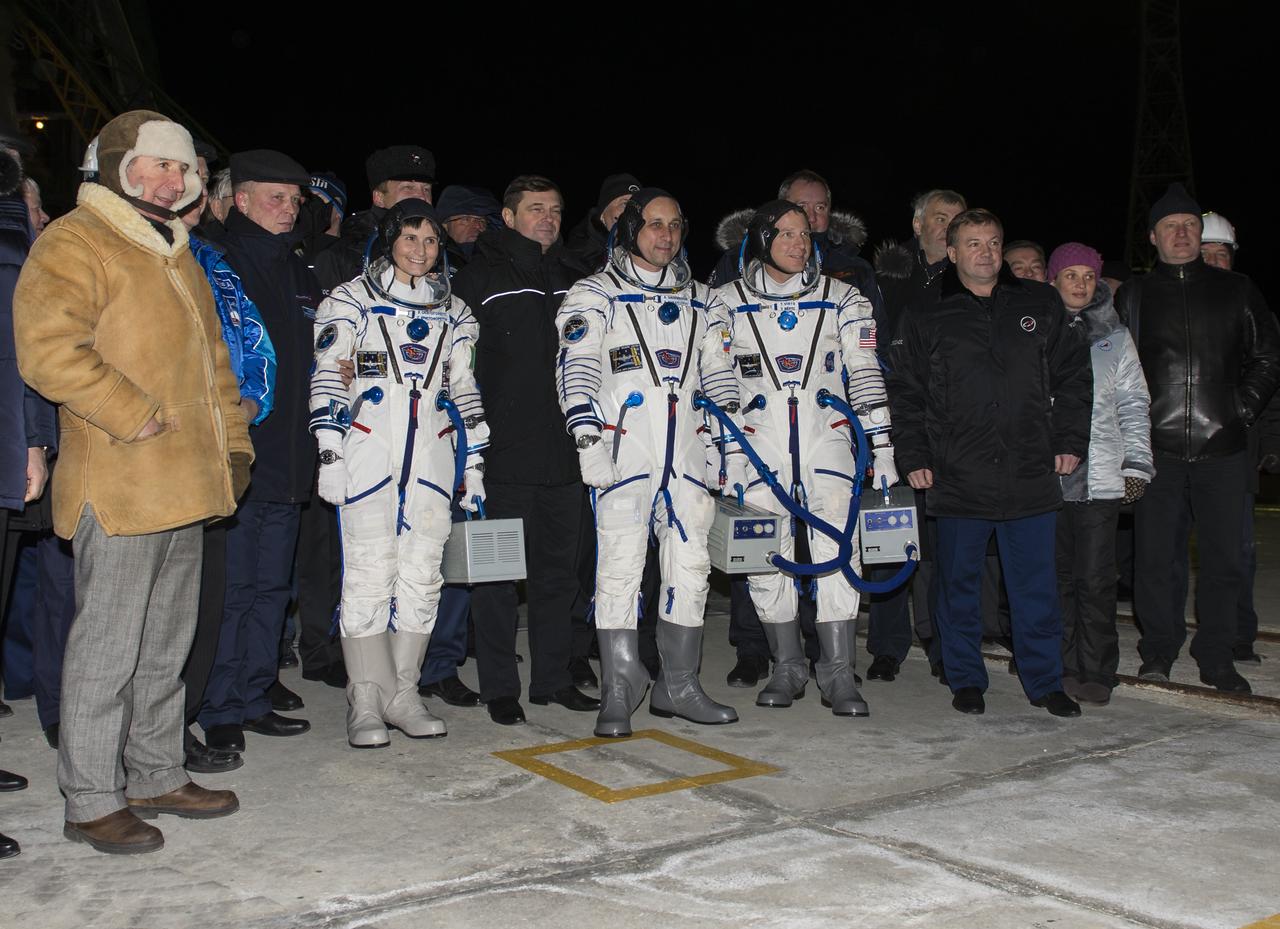
Expedition 42 Flight Engineer Samantha Cristoforetti, of the European Space Agency (ESA), left, Soyuz Commander Anton Shkaplerov of the Russian Federal Space Agency (Roscosmos), center, and Flight Engineer Terry Virts of NASA, right, pose for a photo with senior officials of Roscosmos, NASA, and ESA prior to boarding the Soyuz TMA-15M spacecraft for launch, Monday, Nov. 24, 2014 at the Baikonur Cosmodrome in Kazakhstan. Cristoforetti, Virts, and Shkaplerov will spend the next five and a half months aboard the International Space Station. Photo Credit: (NASA/Aubrey Gemignani)
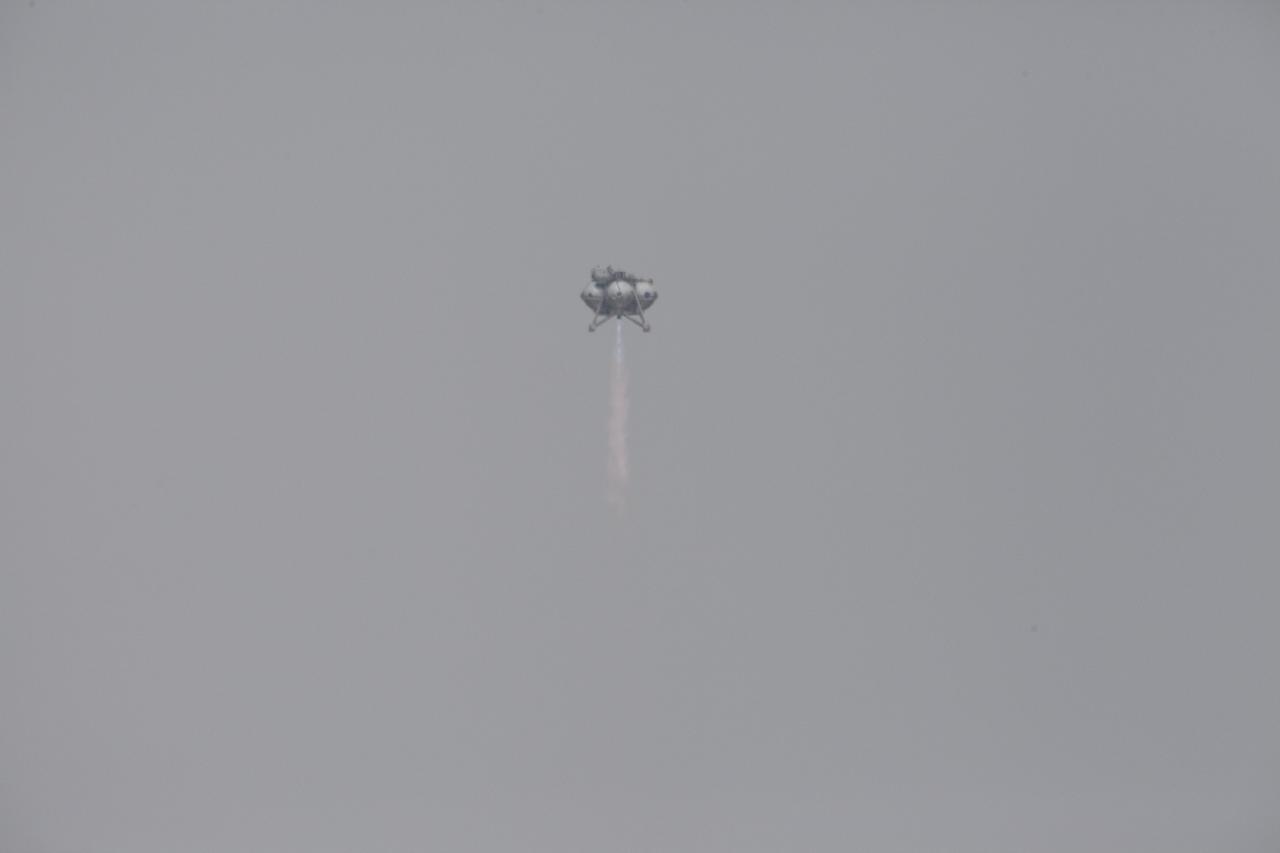
CAPE CANAVERAL, Fla. – The Project Morpheus prototype lander soars high after launching on its sixth free flight test at the north end of the Shuttle Landing Facility at NASA’s Kennedy Space Center in Florida. The 82-second test began at 11:32 a.m. EST with the Morpheus lander launching from the ground over a flame trench and ascending to 465 feet. The lander flew forward, covering 633 feet while performing a 55-foot divert to emulate a hazard avoidance maneuver before descending and landing on a dedicated pad inside the automated landing and hazard avoidance technology, or ALHAT, hazard field. Morpheus landed 10 inches west of its intended target. Project Morpheus tests NASA’s ALHAT and an engine that runs on liquid oxygen and methane, or green propellants, into a fully-operational lander that could deliver cargo to other planetary surfaces. The landing facility provides the lander with the kind of field necessary for realistic testing, complete with rocks, craters and hazards to avoid. Morpheus’ ALHAT payload allows it to navigate to clear landing sites amidst rocks, craters and other hazards during its descent. Project Morpheus is being managed under the Advanced Exploration Systems, or AES, Division in NASA’s Human Exploration and Operations Mission Directorate. The efforts in AES pioneer new approaches for rapidly developing prototype systems, demonstrating key capabilities and validating operational concepts for future human missions beyond Earth orbit. For more information on Project Morpheus, visit http://morpheuslander.jsc.nasa.gov/. Photo credit: NASA/Kim Shiflett
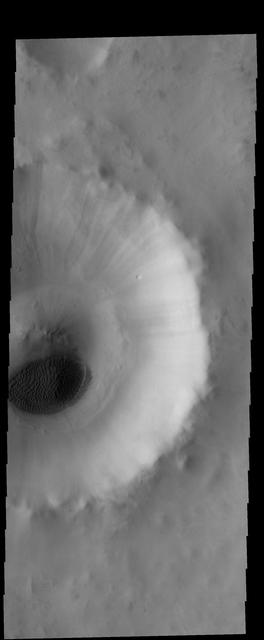
A sand sheet with surface dune forms covers part of the floor of this unnamed crater, as shown in this image from NASA 2001 Mars Odyssey spacecraft. This crater is located in Acidalia Planitia.
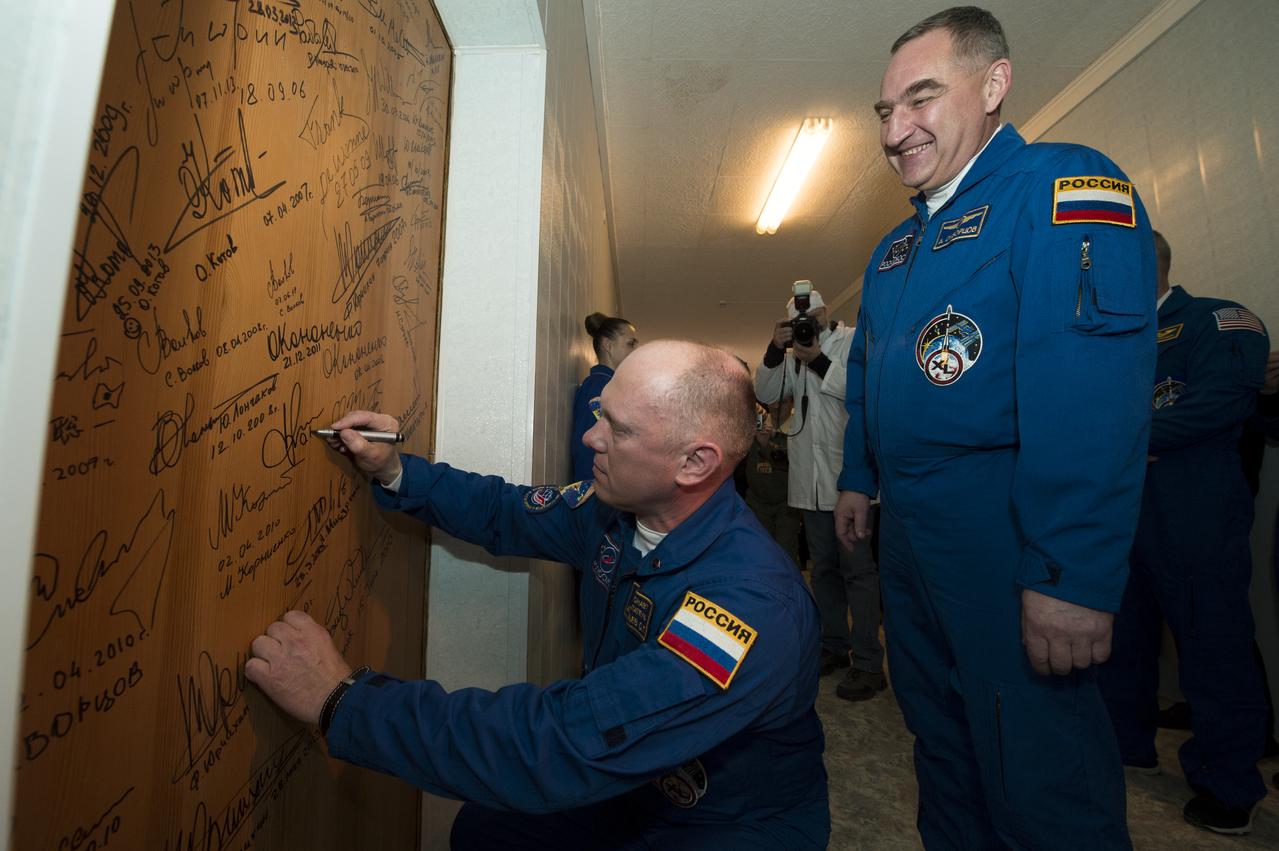
Expedition 39 Flight Engineer Oleg Artemyev, left, of the Russian Federal Space Agency, Roscosmos, performs the traditional door signing at the Cosmonaut hotel as Soyuz Commander Alexander Skvortsov of Roscosmos, looks on, Tuesday, March 25, 2014, in Baikonur, Kazakhstan. Artemyev, Skvortsov, and fellow crew member Flight Engineer Steve Swanson of NASA will launch in their Soyuz TMA-12M spacecraft to the International Space Station to begin a six-month mission. Photo Credit (NASA/Joel Kowsky)
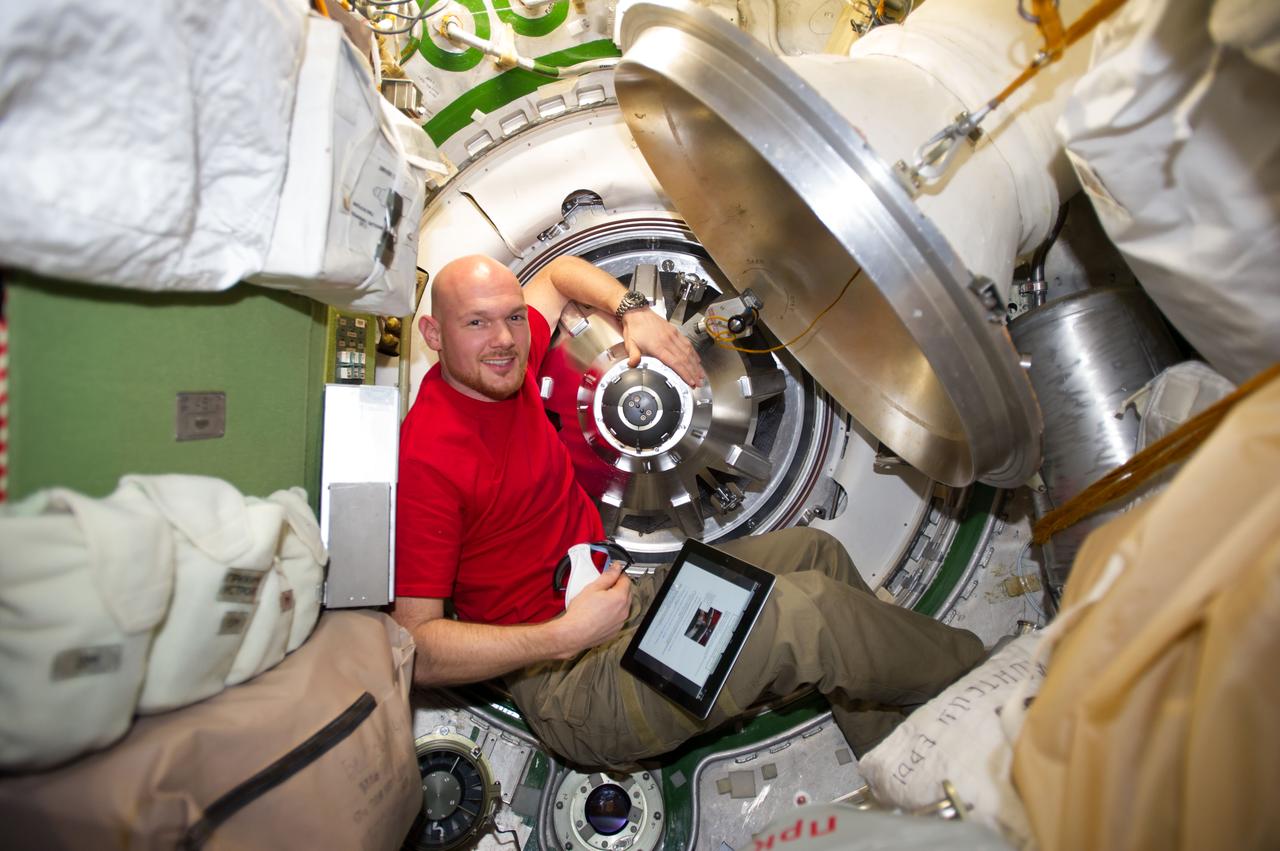
ISS040-E-091918 (13 Aug. 2014) --- European Space Agency astronaut Alexander Gerst, Expedition 40 flight engineer, prepares to remove the docking mechanism to gain access to the hatch of the newly attached "Georges Lemaitre" Automated Transfer Vehicle-5 (ATV-5).