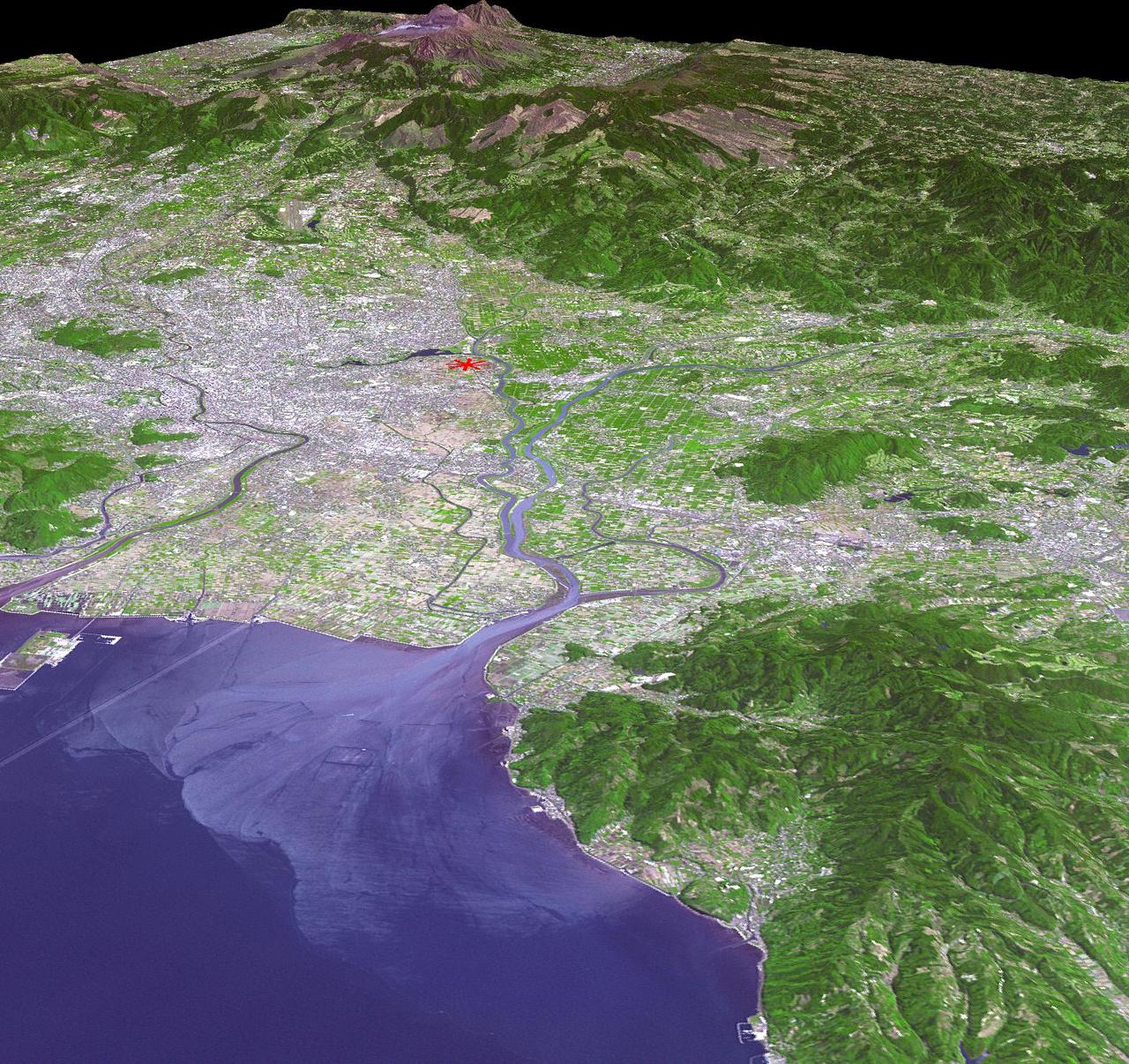
This image from NASA Terra spacecraft shows a perspective view, looking toward the Aso volcanic caldera, which indicates the epicenter with a red star.
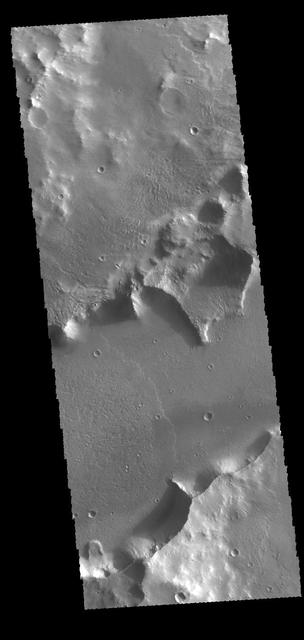
The channel feature in this image from NASA 2001 Mars Odyssey spacecraft is called Mangala Fossa. This feature was formed by tectonic activity, with the walls being faults that allowed the central portion to slide downward forming a graben.
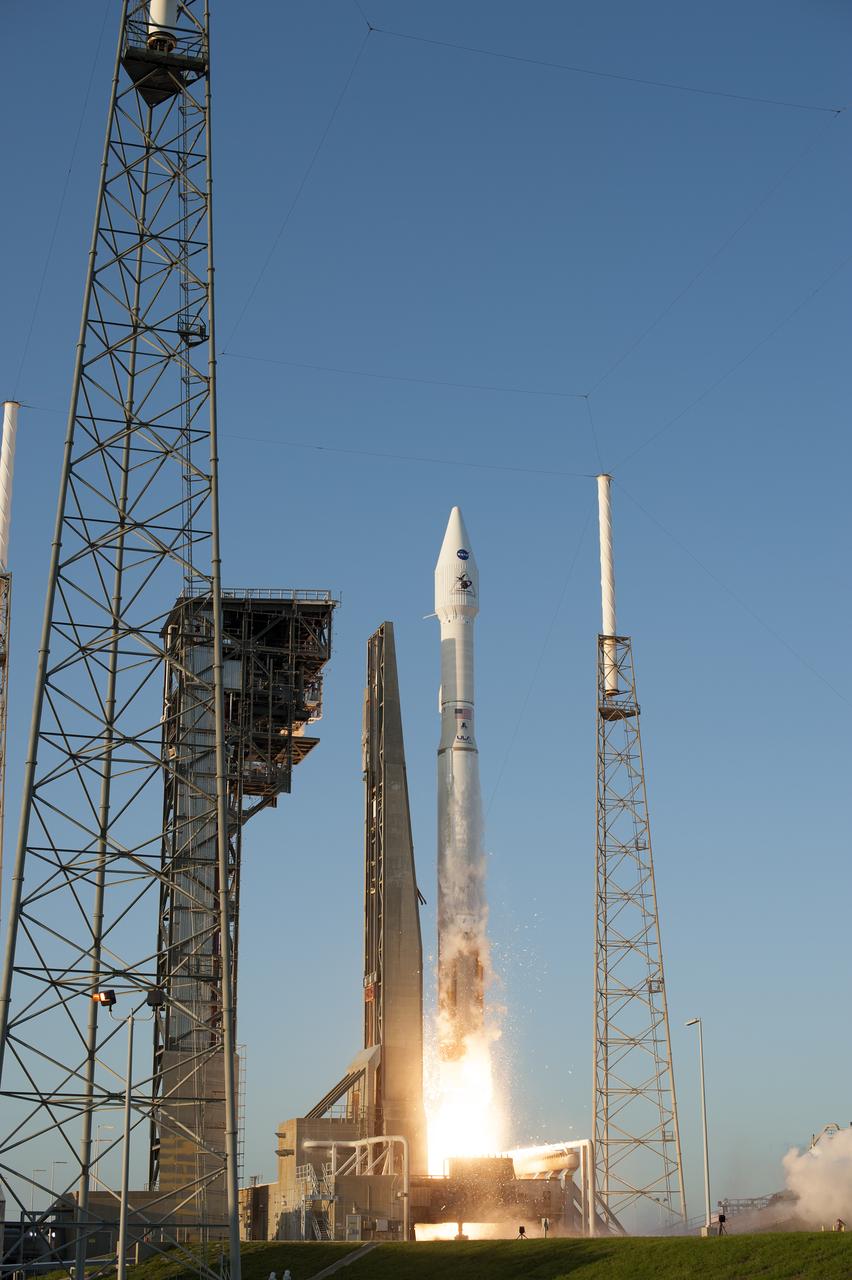
Liftoff of OSIRA United Launch Alliance Atlas V rocket lifts off from Space Launch Complex 41 at Cape Canaveral Air Force Station carrying NASA’s Origins, Spectral Interpretation, Resource Identification, Security-Regolith Explorer, or OSIRIS-REx spacecraft on the first U.S. mission to sample an asteroid, retrieve at least two ounces of surface material and return it to Earth for study. Liftoff was at 7:05 p.m. EDT. The asteroid, Bennu, may hold clues to the origin of the solar system and the source of water and organic molecules found on Earth.
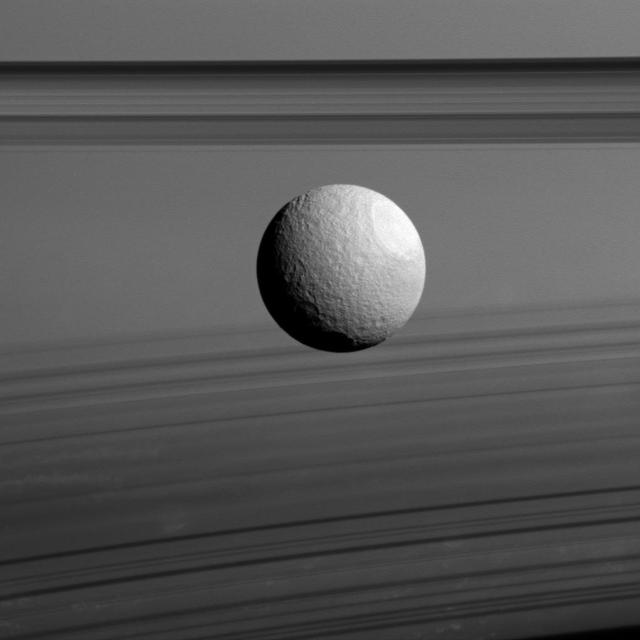
Saturn moon Tethys appears to float between two sets of rings in this view from NASA Cassini spacecraft, but it just a trick of geometry. The rings, which are seen nearly edge-on, are the dark bands above Tethys.
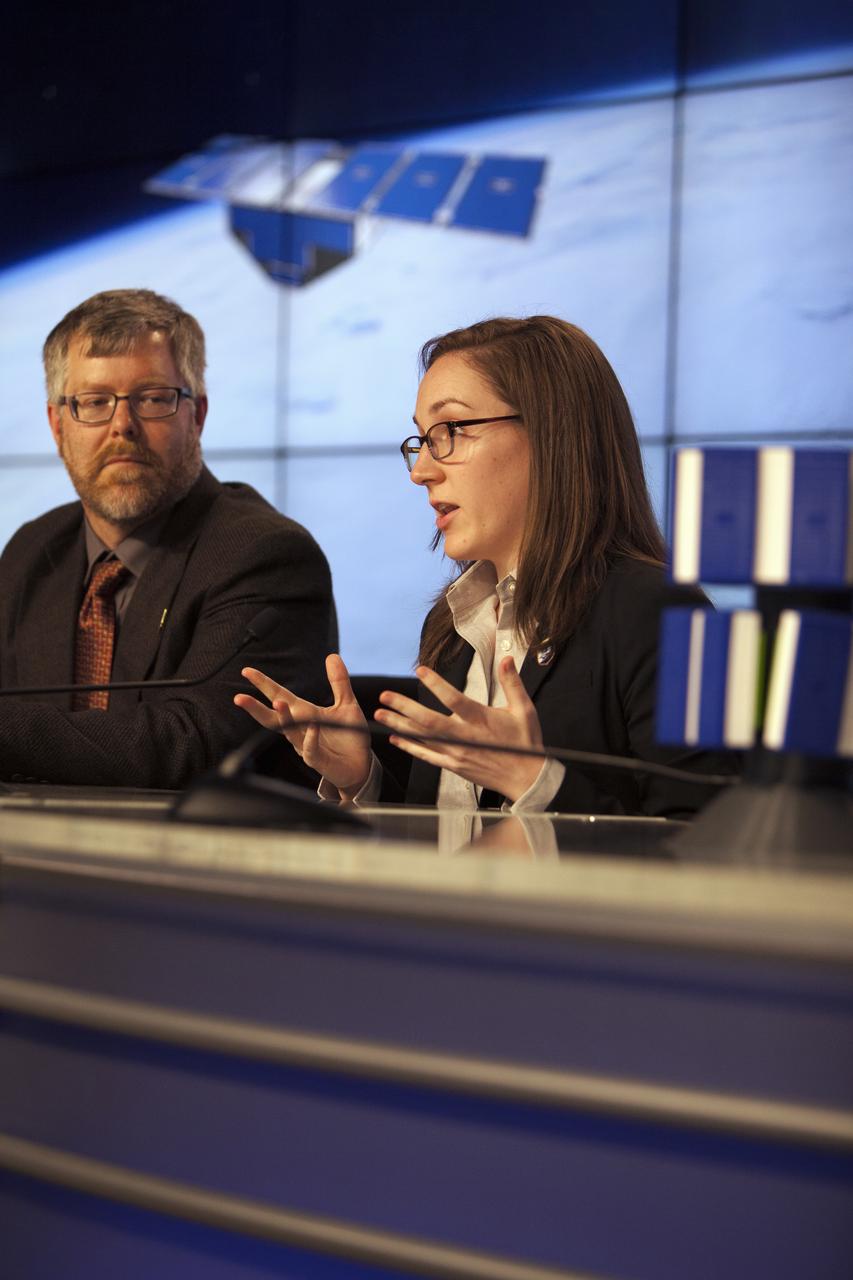
In the Kennedy Space Center’s Press Site auditorium, NASA and industry leaders speak to members of the media during a mission science briefing for the agency’s Cyclone Global Navigation Satellite System, or CYGNSS, spacecraft. From left are: Aaron Ridley, CYGNSS constellation scientist in the Climate and Space Department at the University of Michigan in Ann Arbor, Michigan; and Mary Morris, doctoral student in the Department of Climate and Space Sciences and Engineering at the University of Michigan. The eight CYGNSS satellites will make frequent and accurate measurements of ocean surface winds throughout the life cycle of tropical storms and hurricanes. The data will help scientists probe key air-sea interaction processes that take place near the core of storms, which are rapidly changing and play a crucial role in the beginning and intensification of hurricanes.
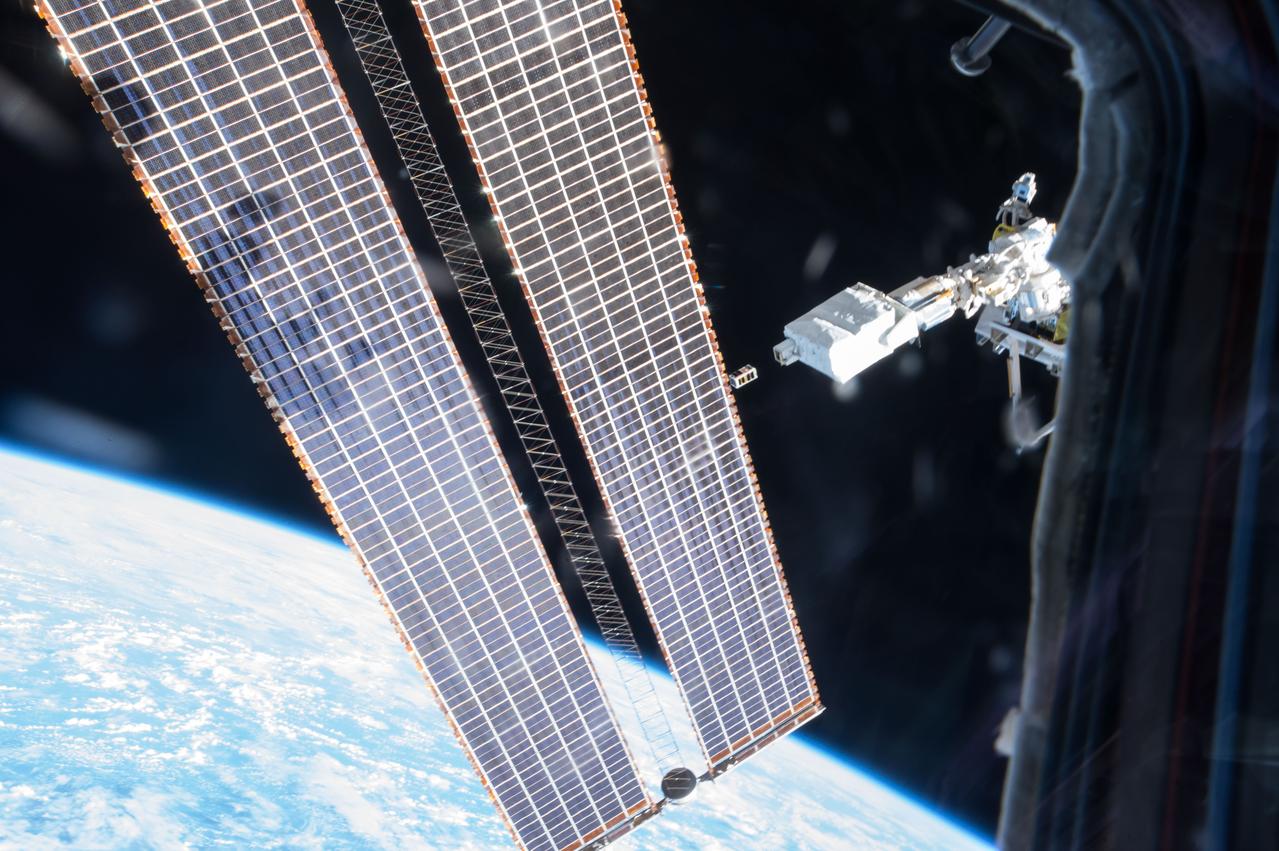
iss050e017076 (12/19/2016) --- A view after Japanese Experiment Module Remote Manipulator System (JEMRMS) Small Satellite Deployment called Space Tethered Autonomous Robotic satellite (STARS-C).
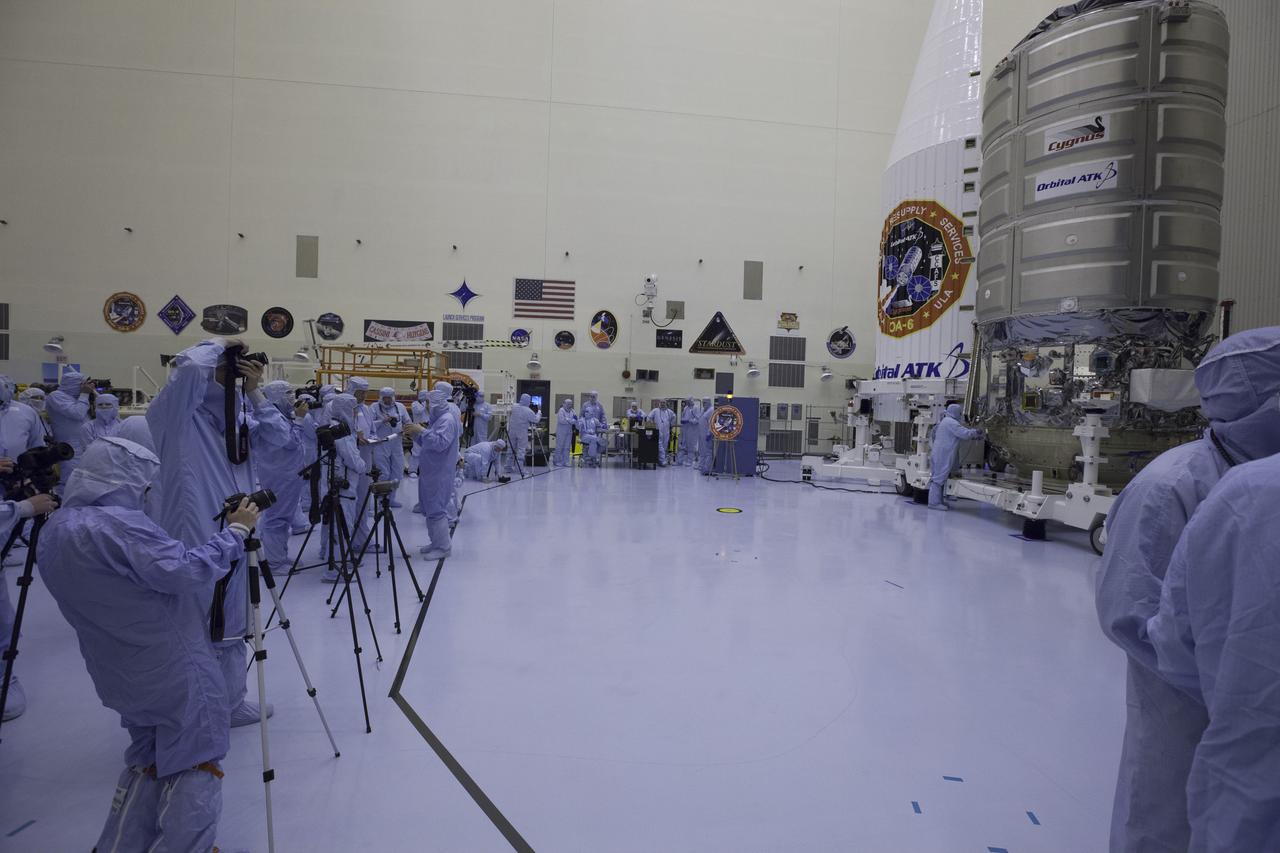
Inside the Payload Hazardous Servicing Facility at NASA's Kennedy Space Center in Florida, members of the news media get a close-up view of a Cygnus cargo vessel. The spacecraft is scheduled for the upcoming Orbital ATK Commercial Resupply Services-6 mission to deliver hardware and supplies to the International Space Station. Reporters, technicians and engineers are clad in "bunny suits." The cleanroom garments are worn to prevent contamination in the controlled environment. The Cygnus is scheduled to lift off atop a United Launch Alliance Atlas V rocket on March 22.
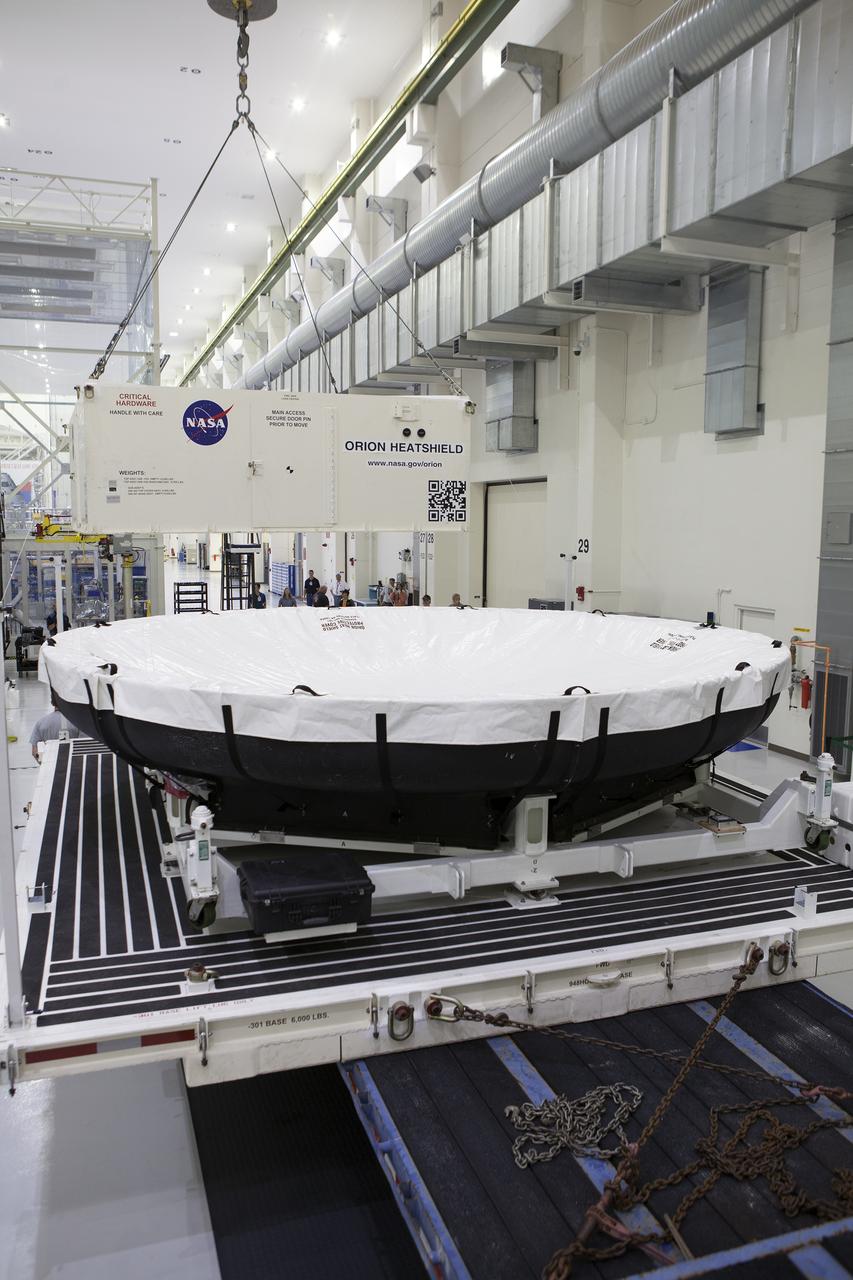
Inside the Neil Armstrong Operations and Checkout Building high bay at NASA’s Kennedy Space Center in Florida, a crane removes the top of the shipping container carrying the Orion heat shield for Exploration Mission 1 (EM-1) The heat shield arrived aboard the agency’s Super Guppy aircraft at the Shuttle Landing Facility, managed and operated by Space Florida, from Lockheed Martin’s manufacturing facility near Denver. The heat shield will be offloaded and moved into the high bay for processing. The Orion spacecraft will launch atop NASA’s Space Launch System rocket on EM-1, an uncrewed test flight, in 2018.
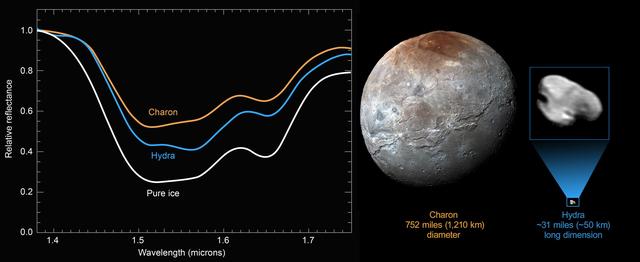
The surface of Hydra, Pluto outermost small moon, is dominated by nearly pristine water ice confirming hints that scientists picked up in NASA New Horizons images showing Hydra highly reflective surface.
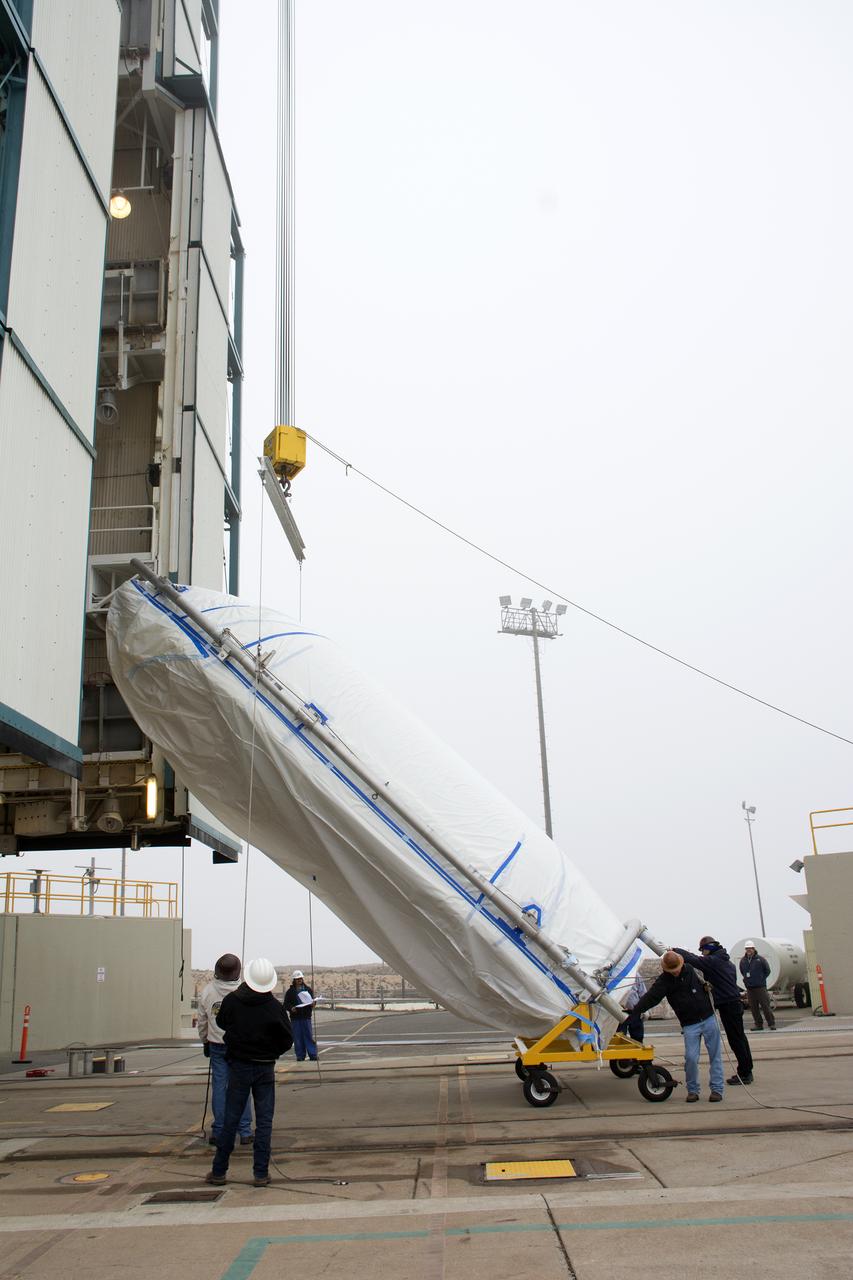
A bi-sector half of the payload fairing for a United Launch Alliance Delta II rocket is lifted upright for its move into the mobile service tower on Space Launch Complex 2 at Vandenberg Air Force Base in California. Preparations are underway for launch of the Joint Polar Satellite System (JPSS-1) spacecraft in 2017. JPSS-1 is part of the next-generation environmental satellite system, a collaborative program between the National Oceanic and Atmospheric Administration (NOAA) and NASA. To learn more about JPSS-1, visit http://www.jpss.noaa.gov.
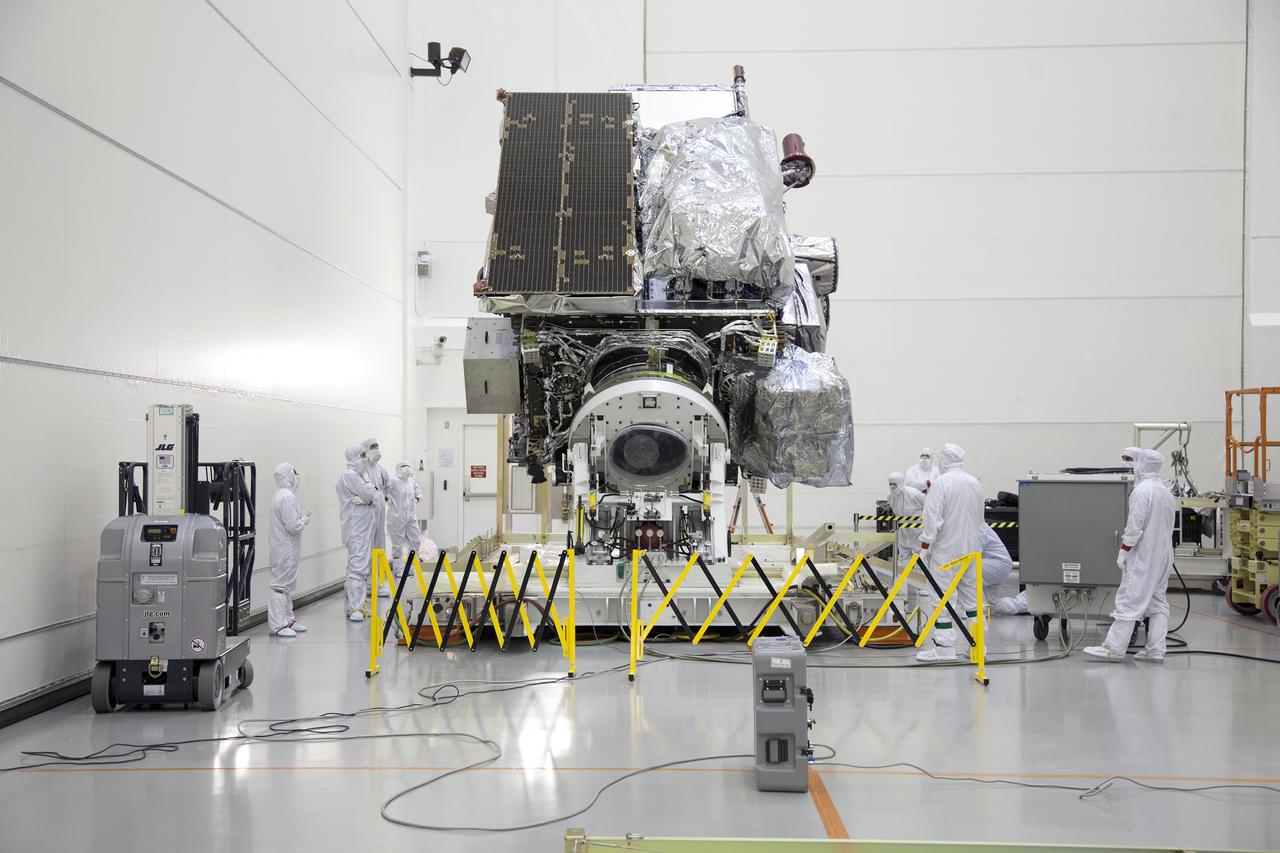
Team members monitor progress as the GOES-R spacecraft is lifted from horizontal to vertical inside the Astrotech payload processing facility in Titusville, Florida near NASA’s Kennedy Space Center. GOES-R will be the first satellite in a series of next-generation NOAA Geostationary Operational Environmental Satellites. The spacecraft is to launch aboard a United Launch Alliance Atlas V rocket in November.
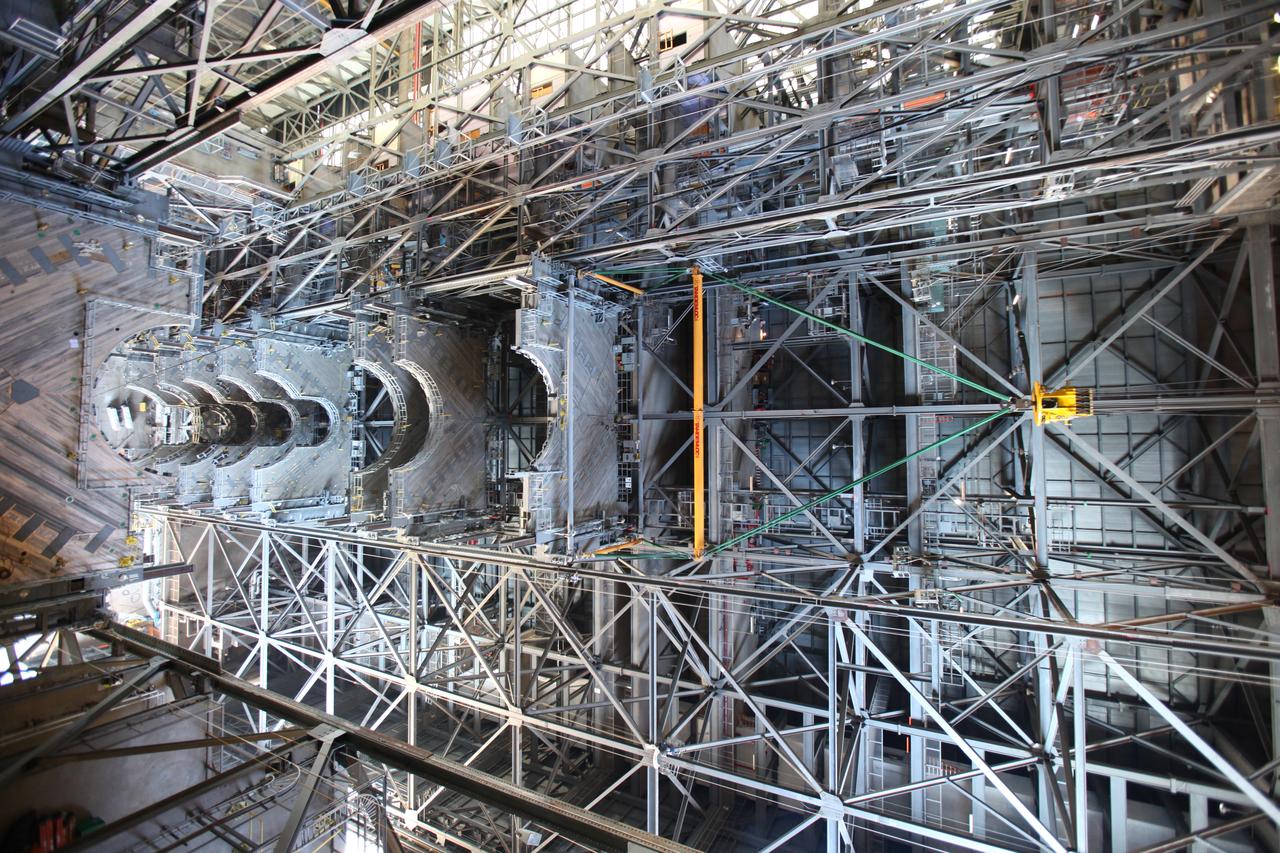
Inside the Vehicle Assembly Building at NASA’s Kennedy Space Center in Florida, the second half of the C-level work platforms, C north, for NASA’s Space Launch System (SLS) rocket, is lowered into position for installation on the north side of High Bay 3. In view below are the seven levels of previously installed platforms. The C platforms are the eighth of 10 levels of work platforms that will surround and provide access to the SLS rocket and Orion spacecraft for Exploration Mission 1. The Ground Systems Development and Operations Program is overseeing upgrades and modifications to VAB High Bay 3, including installation of the new work platforms, to prepare for NASA’s Journey to Mars.
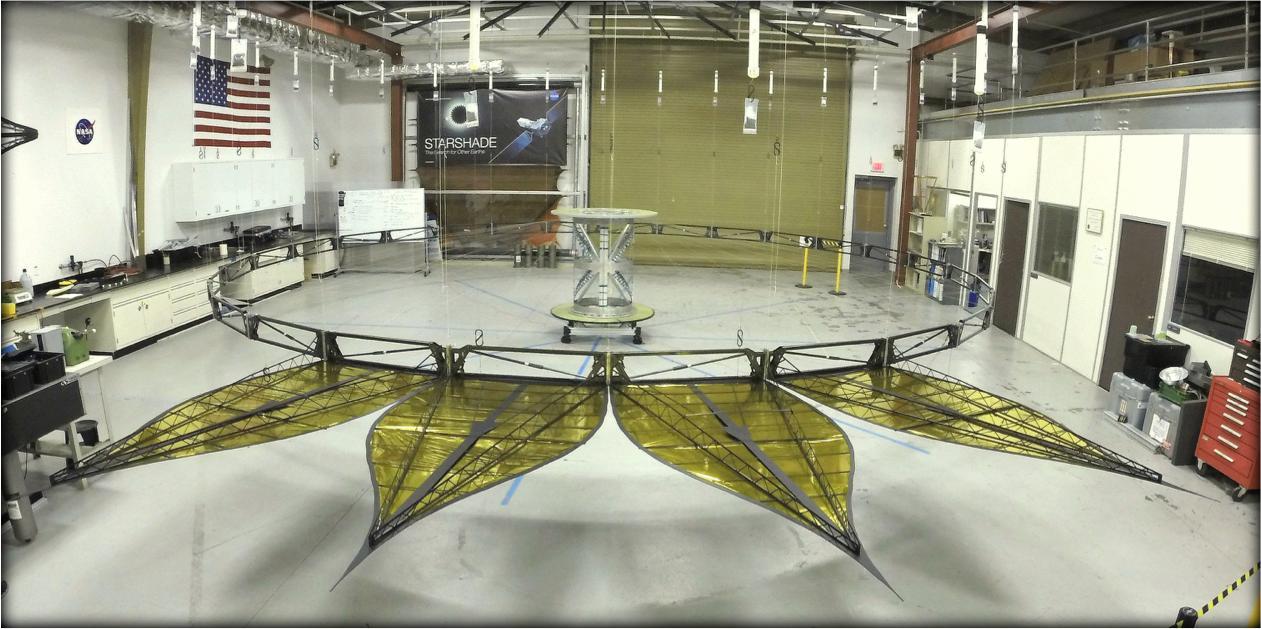
is image shows a deployed half-scale starshade with four petals at NASA's Jet Propulsion Laboratory, Pasadena, California in 2014. The full-scale of this starshade (not shown) will measure at 111 feet (34 meters). The flower-like petals of the starshade are designed to diffract bright starlight away from telescopes seeking the dim light of exoplanets. The starshade was re-designed from earlier models to allow these petals to furl, or wrap around the spacecraft, for launch into space. Each petal is covered in a high-performance plastic film that resembles gold foil. On a starshade ready for launch, the thermal gold foil will only cover the side of the petals facing away from the telescope, with black on the other, so as not to reflect other light sources such as the Earth into its lens. The starshade is light enough for space and cannot support its own weight on Earth. Is it shown offloaded with counterweights, much like an elevator. Starlight-blocking technologies such as the starshade are being developed to help image exoplanets, with a focus on Earth-sized, habitable worlds. http://photojournal.jpl.nasa.gov/catalog/PIA20909
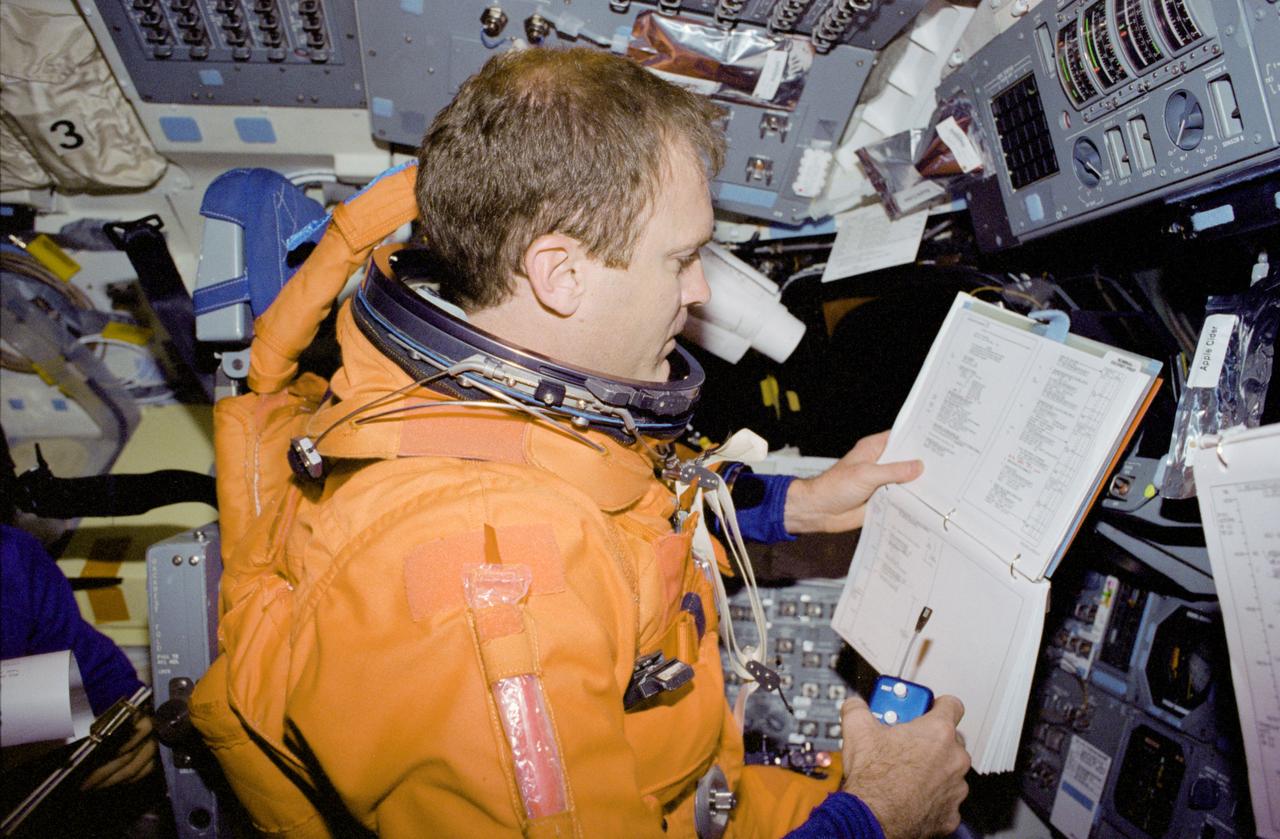
STS083-448-025 (8 April 1997) --- Partially suited in the partial-pressure launch and entry garment, astronaut James D. Halsell, Jr., mission commander, goes over a checklist prior to entry. Halsell, along with four other NASA astronauts and two payload specialists supporting the Microgravity Sciences Laboratory (MSL-1) mission were less than a fourth of the way through a scheduled 16-day flight when a power problem cut short their planned stay.
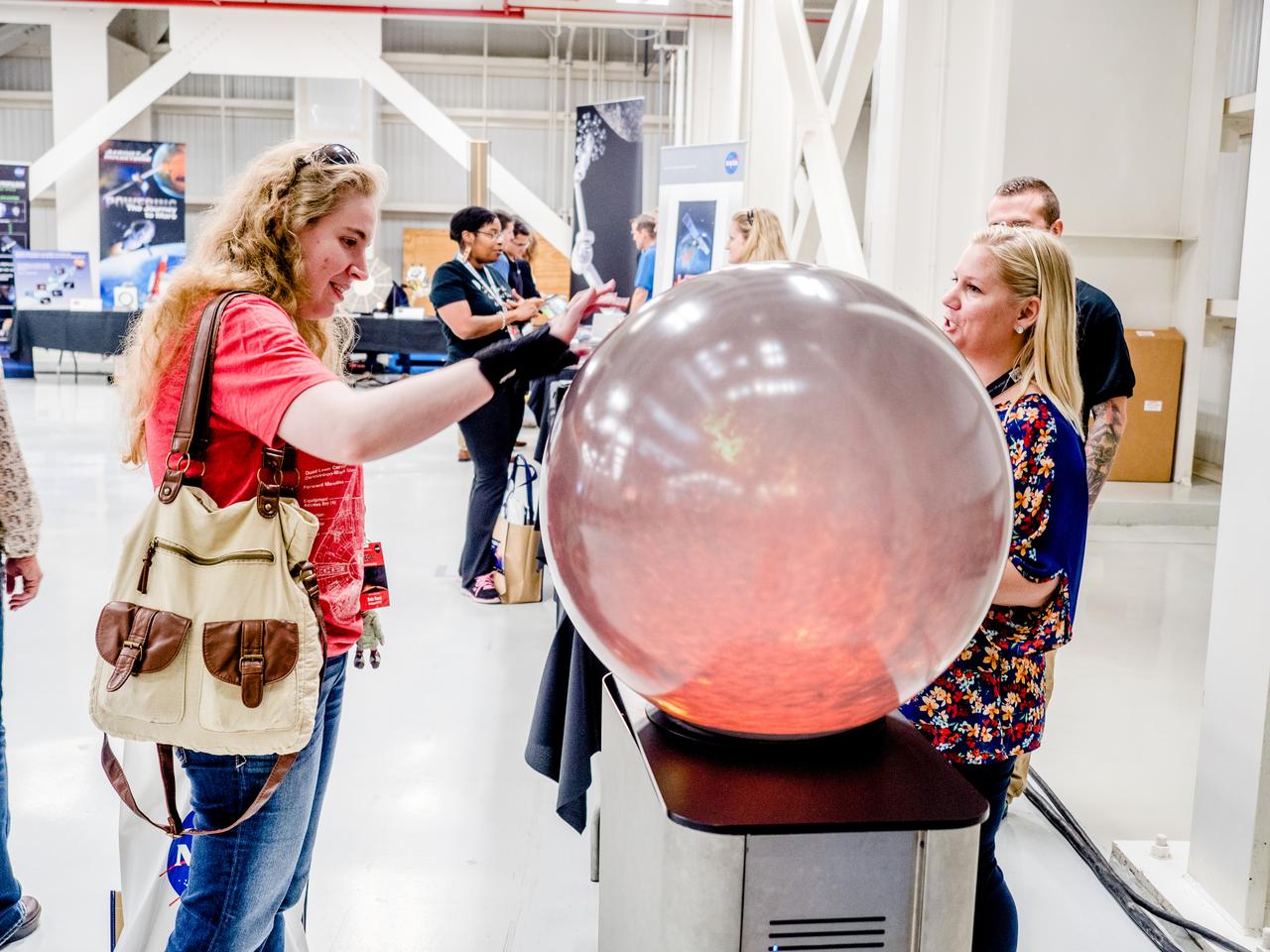
#NASAMarsDay
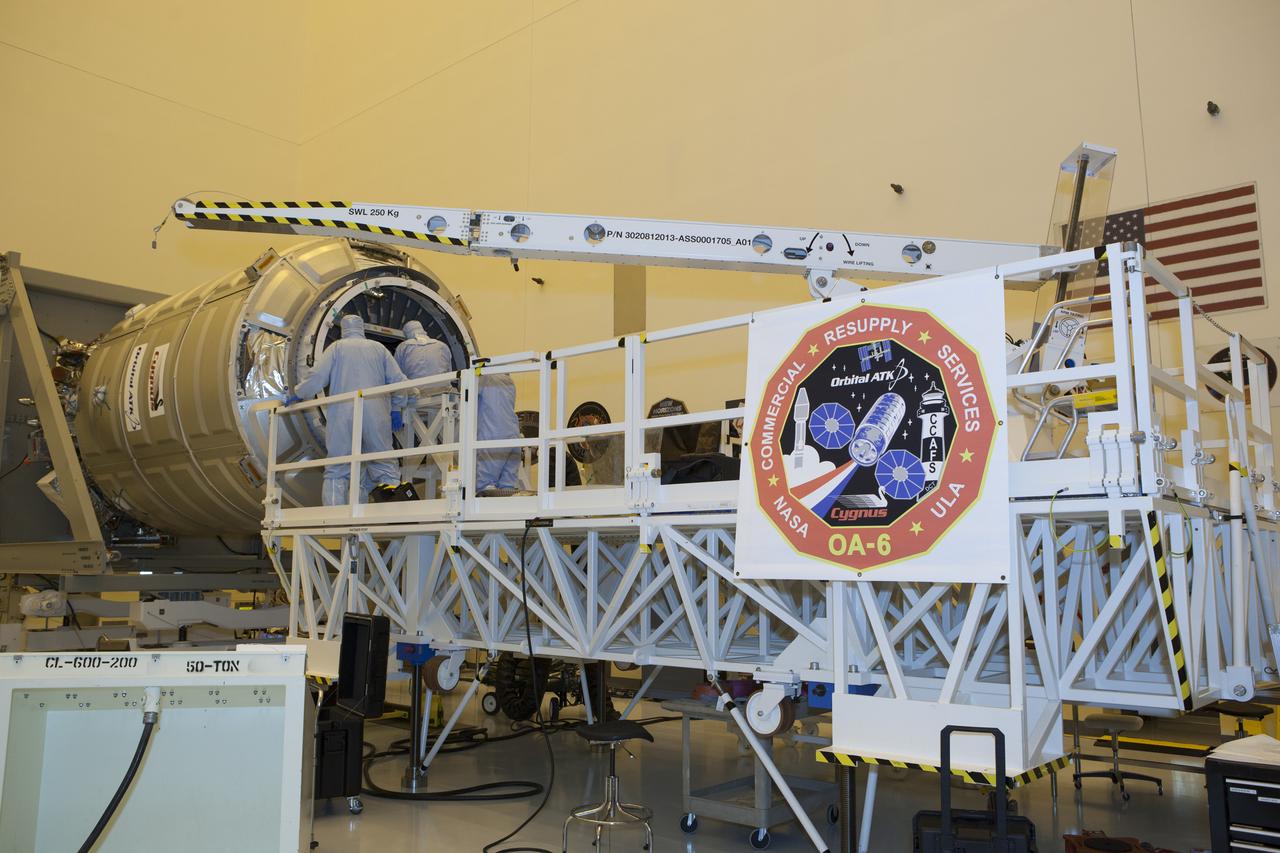
Inside the Payload Hazardous Servicing Facility at NASA's Kennedy Space Center in Florida, the hatch is closed for the upcoming flight of a Cygnus cargo vessel. The spacecraft is scheduled for the upcoming Orbital ATK Commercial Resupply Services-6 mission to deliver hardware and supplies to the International Space Station. The Cygnus is scheduled to lift off atop a United Launch Alliance Atlas V rocket on March 22.
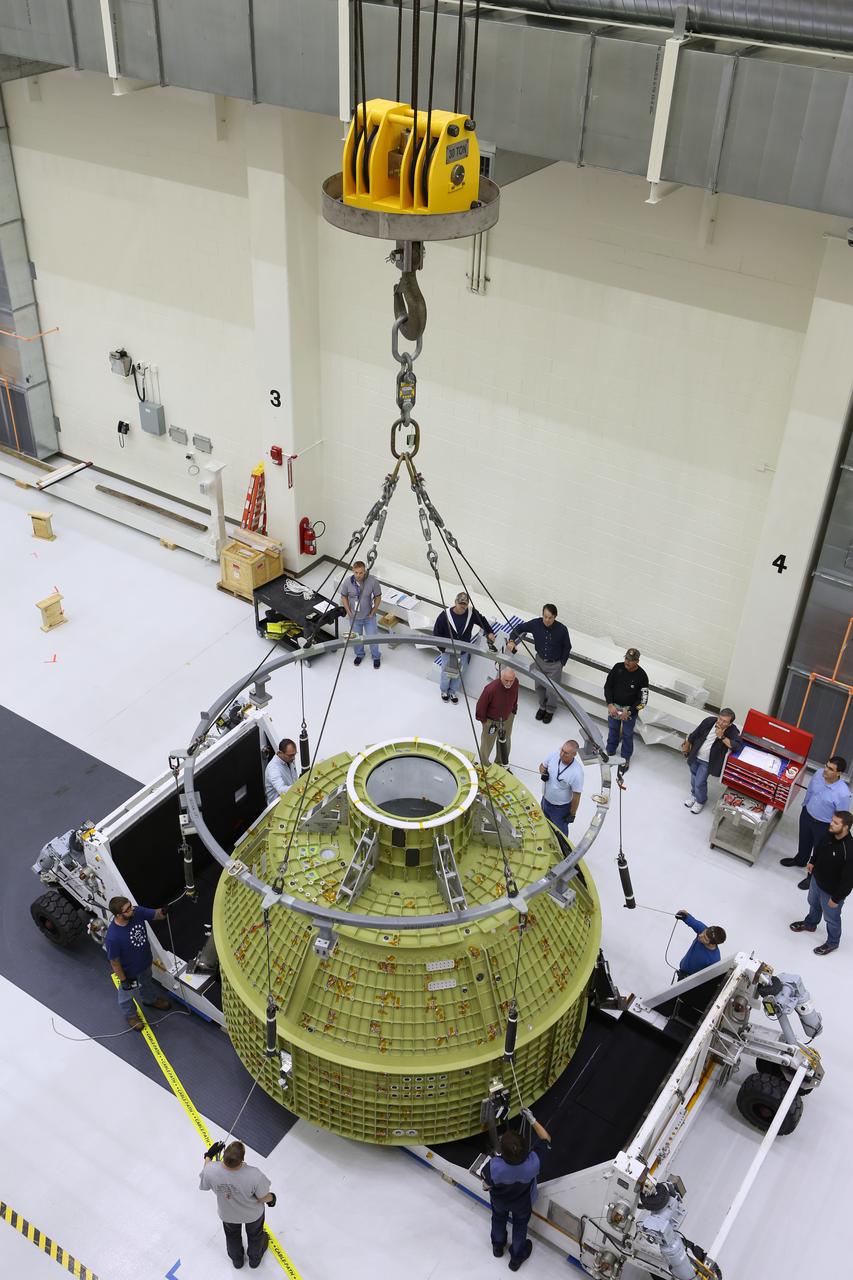
Inside the Neil Armstrong Operations and Checkout Building at NASA’s Kennedy Space Center in Florida, Lockheed Martin technicians attach lines from a crane to the Orion crew module structural test article (STA). The STA arrived aboard NASA's Super Guppy aircraft at the Shuttle Landing Facility operated by Space Florida. The test article will be lifted out of its container and moved to a test tool called the birdcage for further testing. The Orion spacecraft will launch atop NASA’s Space Launch System rocket on EM-1, its first deep space mission, in late 2018.
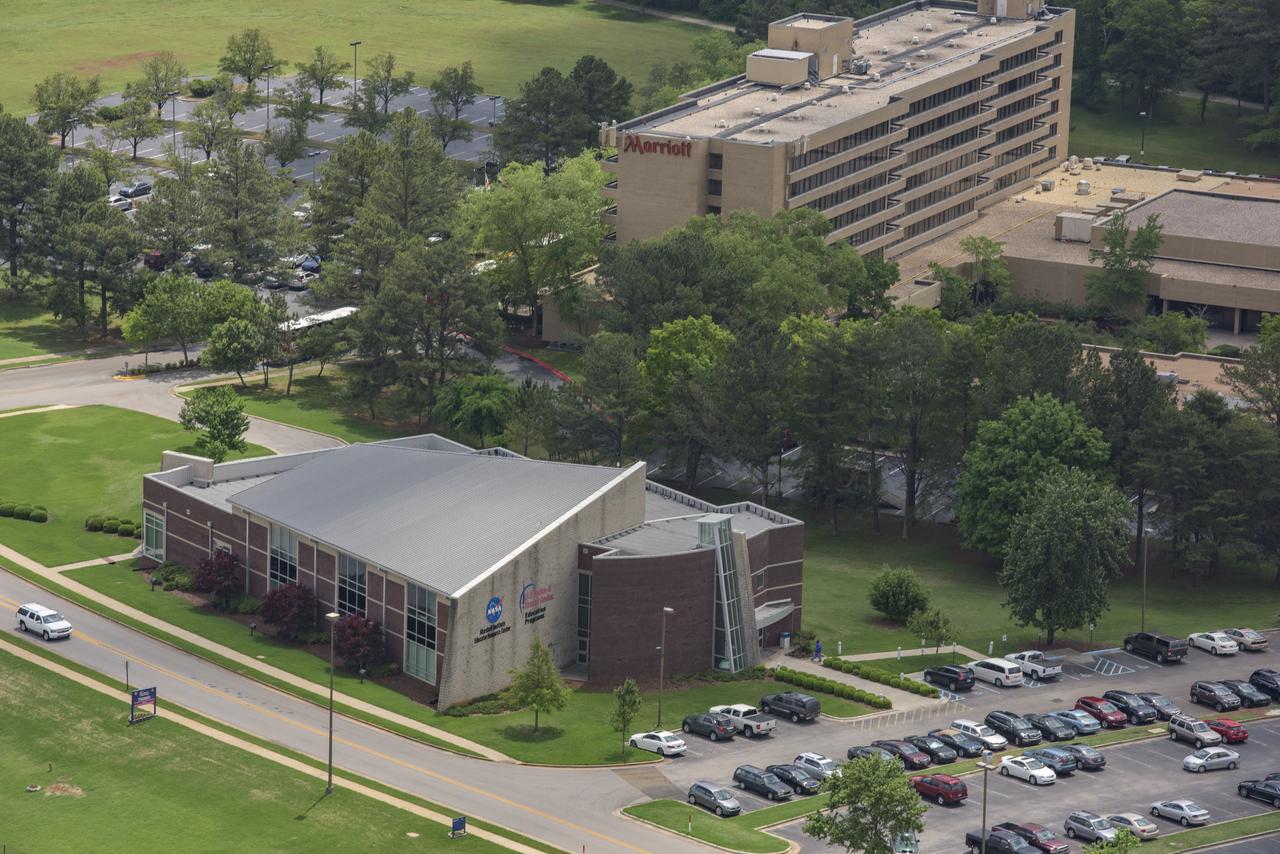
AERIAL PHOTOGRAPHS OF MSFC-EDUCATOR RESOURCE CENTER (ERC)
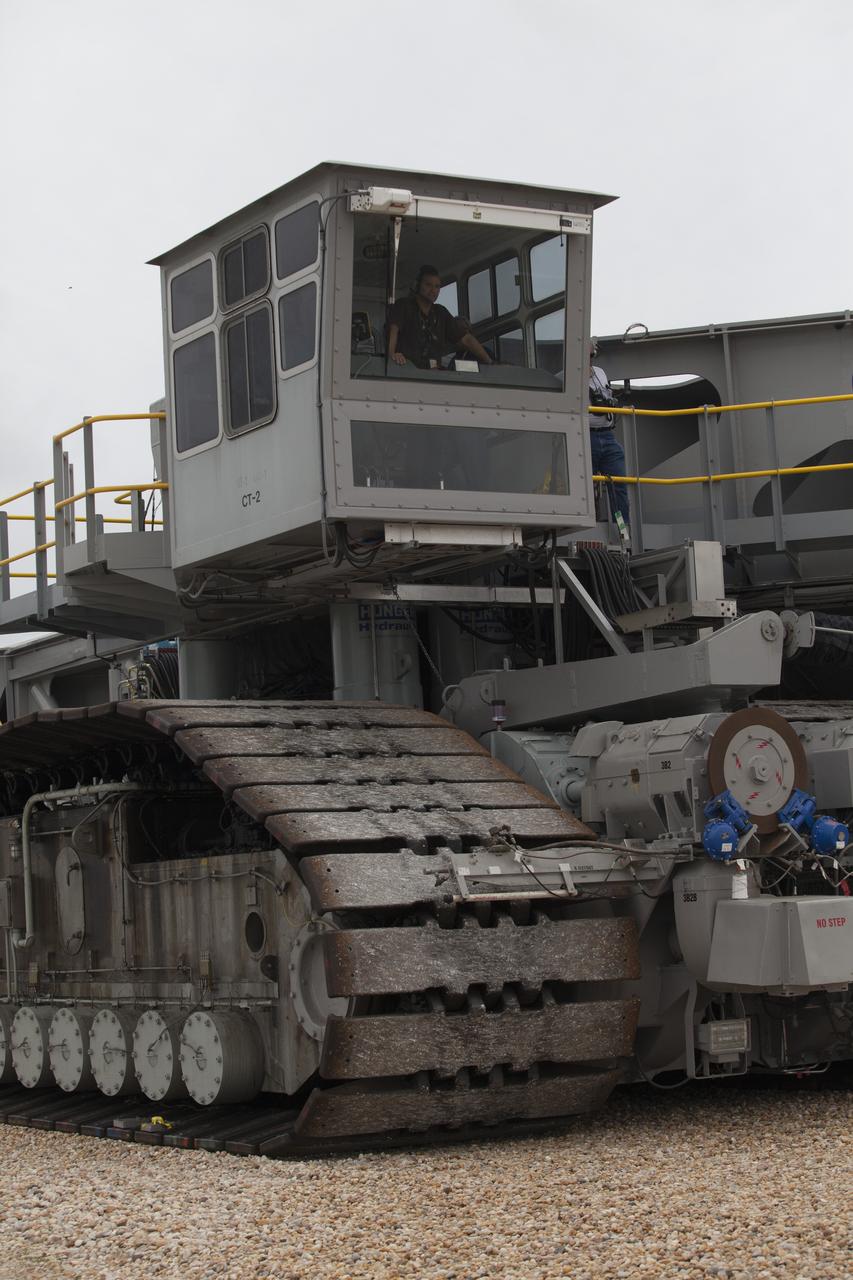
NASA’s upgraded crawler-transporter 2 (CT-2) returns to the Vehicle Assembly Building (VAB) from its trek to Launch Pad 39B at the agency’s Kennedy Space Center in Florida. CT-2 was driven along the crawlerway and onto Pad 39B to test recently completed upgrades and modifications for NASA’s journey to Mars. The Ground Systems Development and Operations Program at Kennedy oversaw upgrades to the crawler in the VAB. The crawler will carry the mobile launcher with Orion atop the Space Launch System rocket to Pad 39B for Exploration Mission 1.
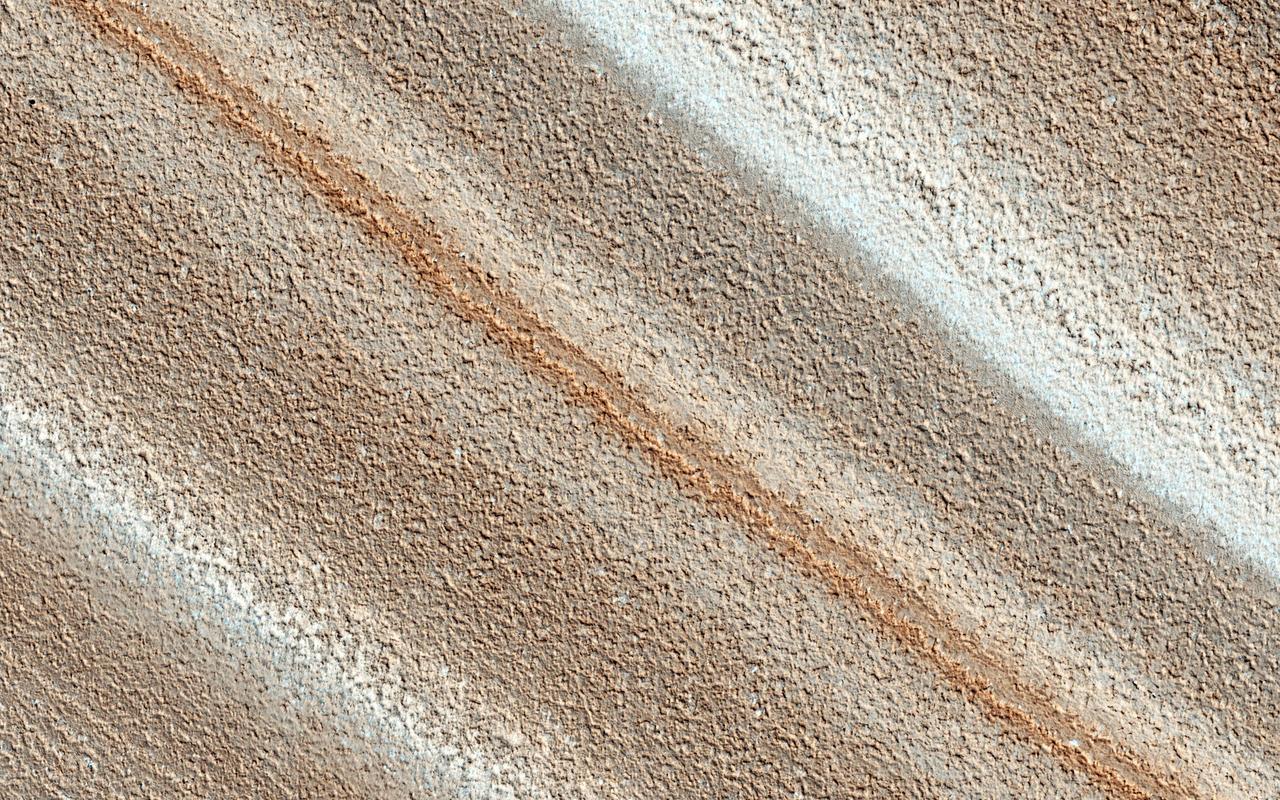
The North Polar layered deposits provide a record of recent climate changes on Mars as seen by NASA Mars Reconnaissance Orbiter spacecraft. Color variations between layers are due to differences in composition of the dust.
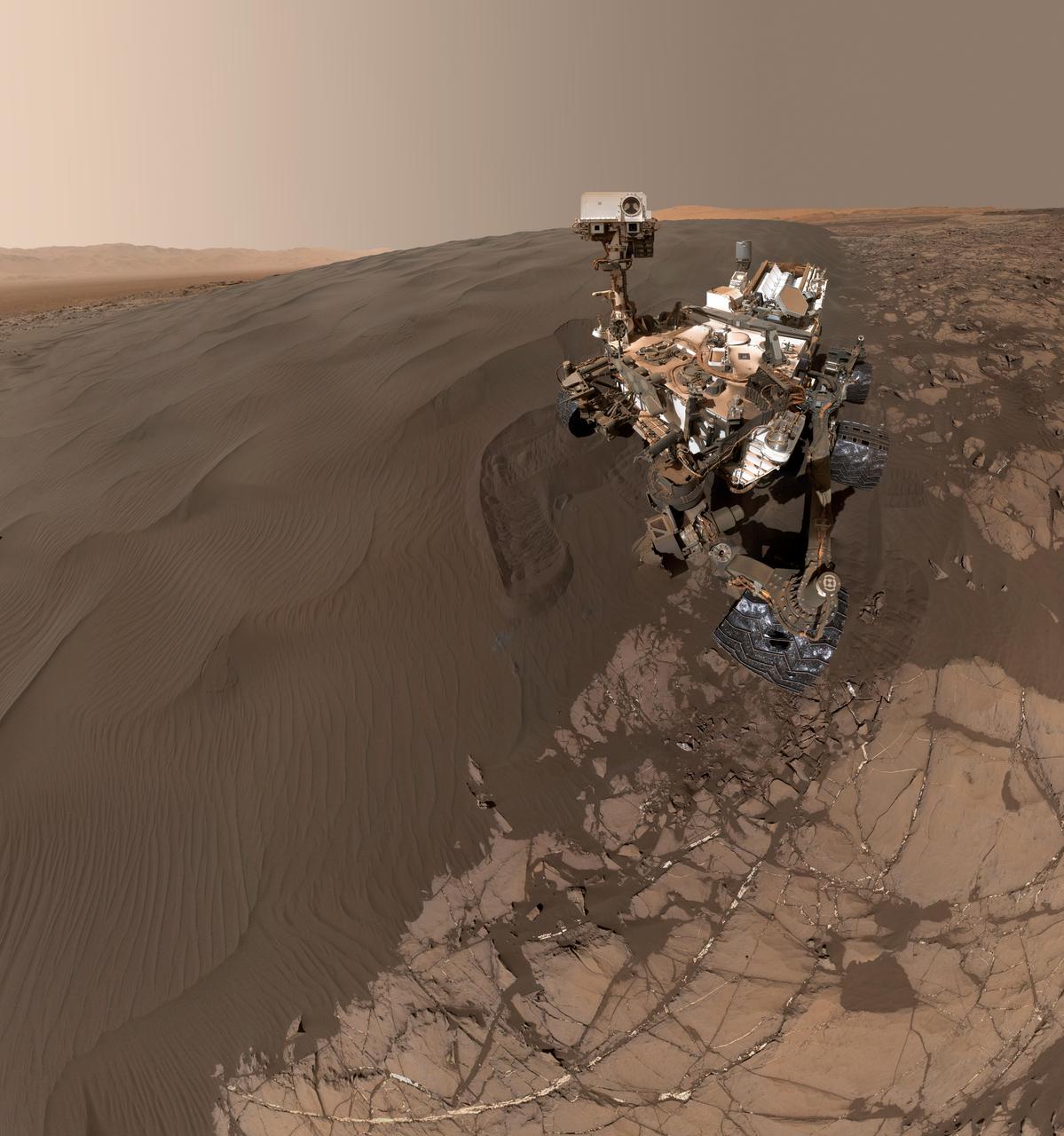
This self-portrait of NASA's Curiosity Mars rover shows the vehicle at "Namib Dune," where the rover's activities included scuffing into the dune with a wheel and scooping samples of sand for laboratory analysis. The scene combines 57 images taken on Jan. 19, 2016, during the 1,228th Martian day, or sol, of Curiosity's work on Mars. The camera used for this is the Mars Hand Lens Imager (MAHLI) at the end of the rover's robotic arm. Namib Dune is part of the dark-sand "Bagnold Dune Field" along the northwestern flank of Mount Sharp. Images taken from orbit have shown that dunes in the Bagnold field move as much as about 3 feet (1 meter) per Earth year. The location of Namib Dune is show on a map of Curiosity's route at http://mars.nasa.gov/msl/multimedia/images/?ImageID=7640. The relationship of Bagnold Dune Field to the lower portion of Mount Sharp is shown in a map at PIA16064. The view does not include the rover's arm. Wrist motions and turret rotations on the arm allowed MAHLI to acquire the mosaic's component images. The arm was positioned out of the shot in the images, or portions of images, that were used in this mosaic. This process was used previously in acquiring and assembling Curiosity self-portraits taken at sample-collection sites, including "Rocknest" (PIA16468), "Windjana" (PIA18390) and "Buckskin" (PIA19807). For scale, the rover's wheels are 20 inches (50 centimeters) in diameter and about 16 inches (40 centimeters) wide. Other Curiosity self-portraits are available at http://photojournal.jpl.nasa.gov/catalog/PIA20316
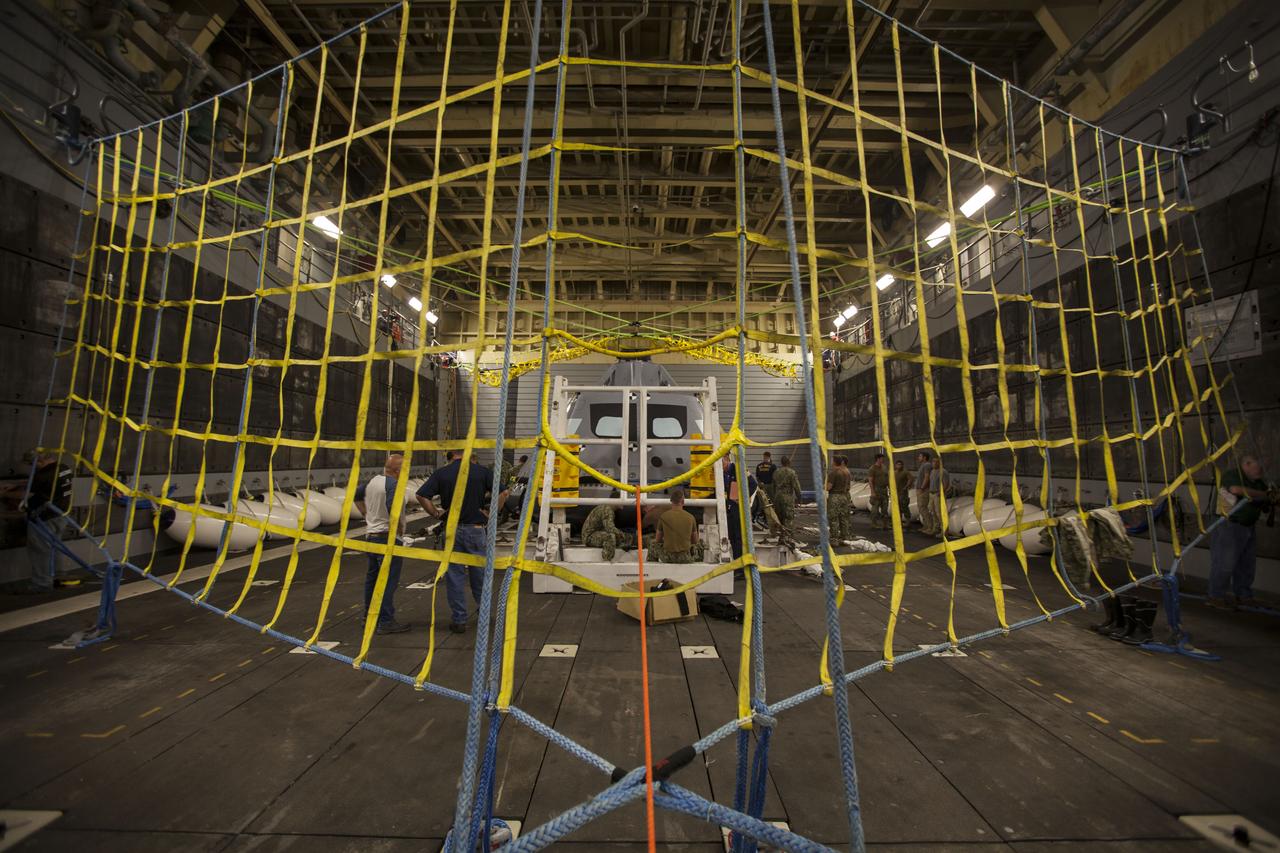
A test version of the Orion crew module is secured in the well deck of the USS San Diego for Underway Recovery Test 5. NASA's Ground Systems Development and Operations Program and the U.S. Navy will conduct a series of tests using the ship's well deck, the test module, various watercraft and equipment to prepare for recovery of Orion on its return from deep space missions. The test will allow the team to demonstrate and evaluate recovery processes, procedures, hardware and personnel in open waters. Orion is the exploration spacecraft designed to carry astronauts to destinations not yet explored by humans, including an asteroid and NASA's Journey to Mars. It will have emergency abort capability, sustain the crew during space travel and provide safe re-entry from deep space return velocities. Orion is scheduled to launch on NASA's Space Launch System in late 2018. For more information, visit http://www.nasa.gov/orion.
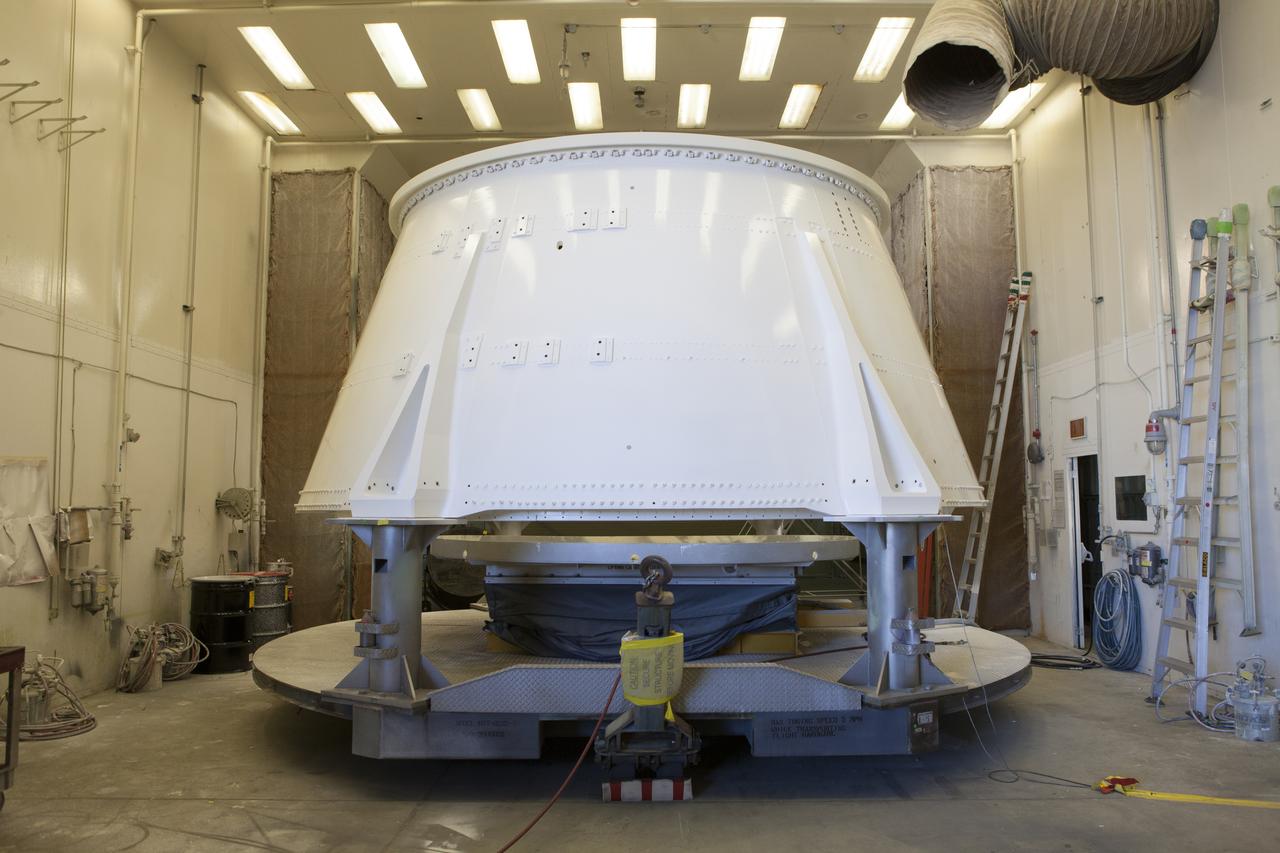
The right hand aft skirt for NASA's Space Launch System (SLS) rocket has been refurbished and painted and is in a drying cell in a support building at the Hangar AF facility at Cape Canaveral Air Force Station in Florida. The space shuttle-era aft skirt will be used on the right hand booster of the SLS for Exploration Mission 1 (EM-1). NASA is preparing for EM-1, deep space missions, and the Journey to Mars.
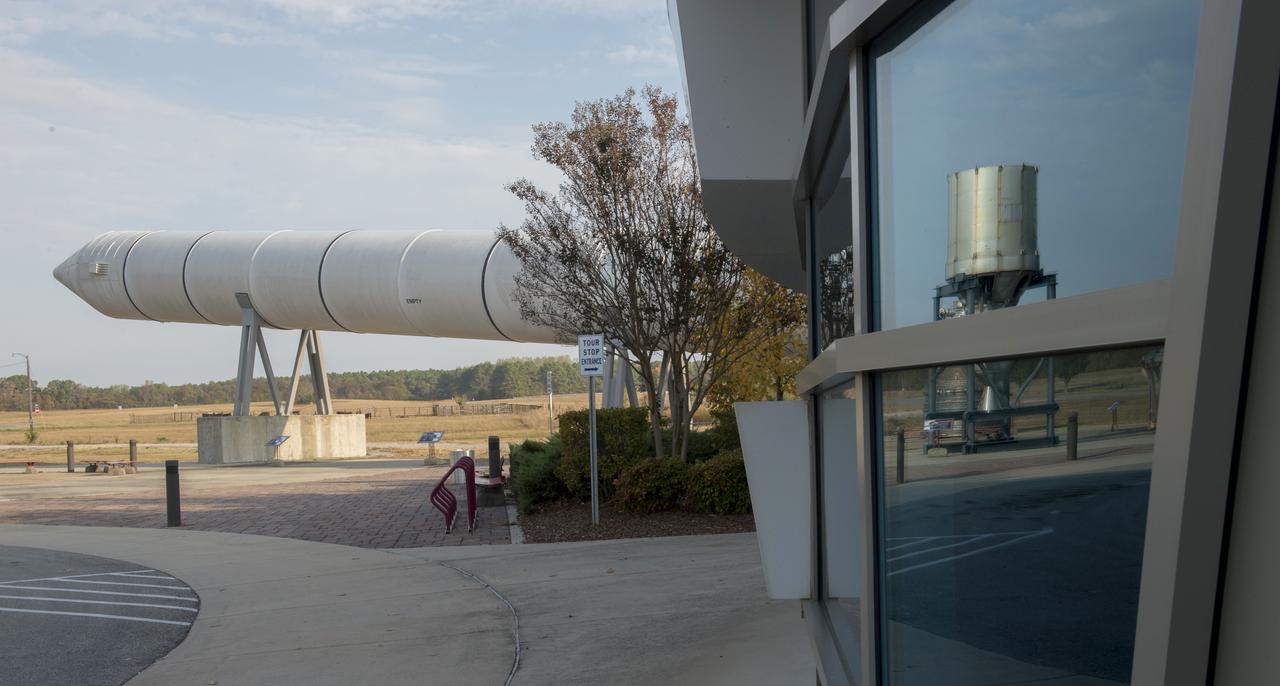
BUILDING 4205 GALLERY, EXTERIOR AND INTERIOR VIEWS
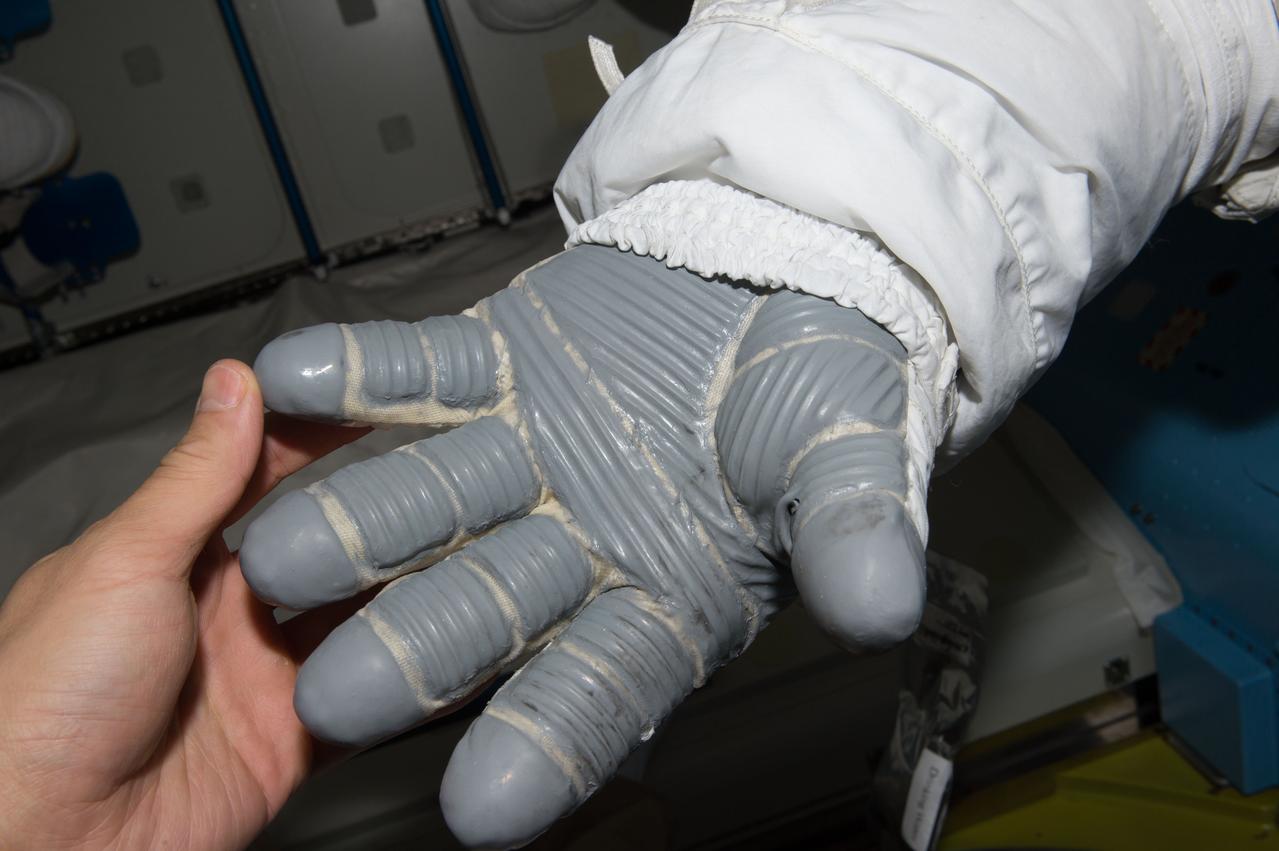
ss048e061332 (08/19/2016) --- Checking the space gloves before and after a spacewalk is part of the detailed check list astronauts go through to provide absolute safety. Both NASA astronaut Jeff Williams and Kate Rubens took part in the important inspections before and after their 19 Aug 2016 spacewalk to install a new docking adapter . A cut in the glove could subject the astronaut to the extreme temperatures of outer space and the escape of oxygen, both of which could be fatal.
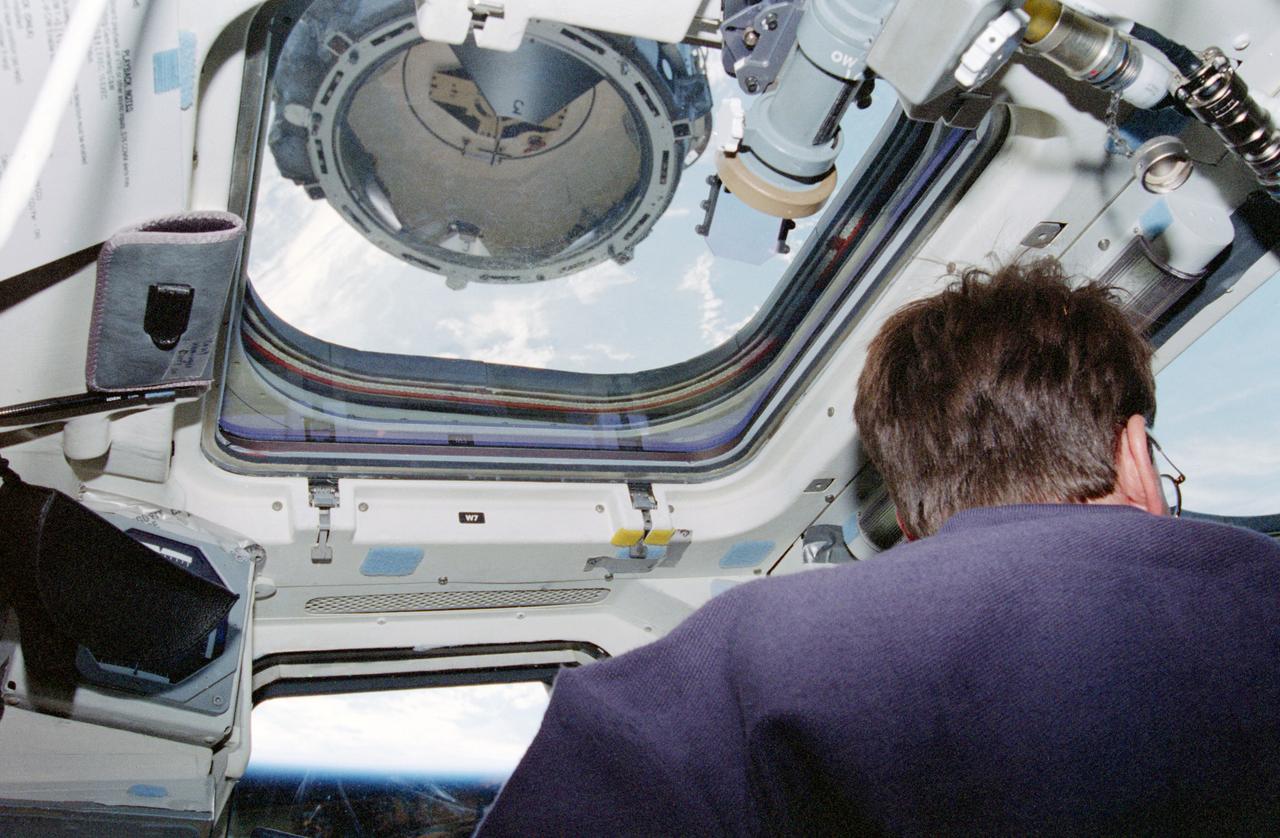
STS096-361-025 (29 May 1999) --- Astronaut Kent V. Rominger, mission commander, is about to accomplish the successful docking of Discovery to the International Space Station (ISS). Rominger is at the shuttle's controls on the aft flight deck. The docking mechanism of the approaching station is just a few meters away on the other side of the overhead window. Rominger was joined by four other American astronauts, a Canadian astronaut and a Russian cosmonaut for almost ten days in space, most of which were devoted to preparing the ISS.
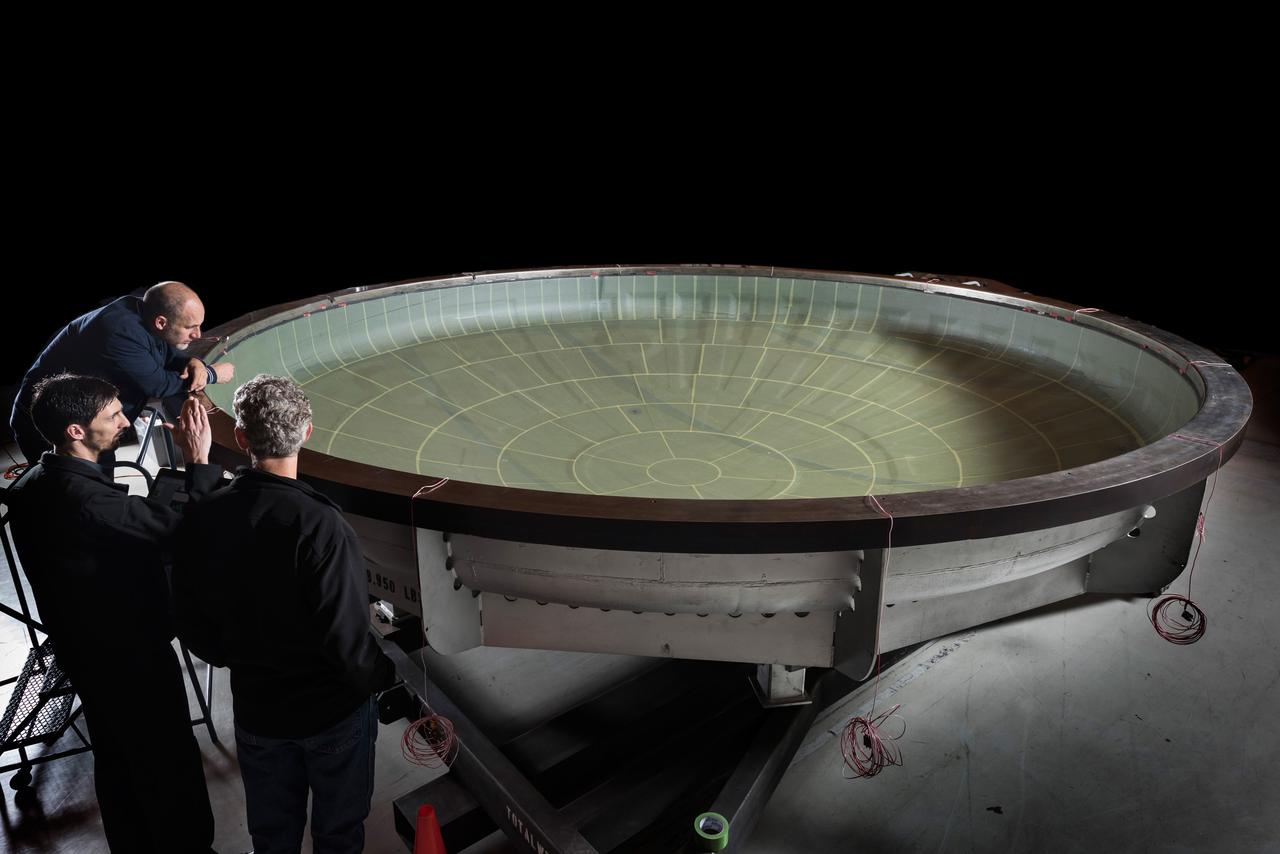
The NASA Super Guppy arrived at Moffett Field on Jan. 7, 2016, carrying the Artemis I Orion heat shield skin. The heat shield is being primarily built at Lockheed Martin’s Littleton, Colo. facility, and it was temporarily sent to Lockheed Martin’s Sunnyvale, Calif. facility for an autoclave cure (shown here). The heat shield is a stiffened skin design, and this cure process is the last step prior to attaching titanium stiffeners to the interior surface. Once the skin and stiffeners are attached, ablative material is applied to the exterior. Part of Batch image transfer from Flickr.
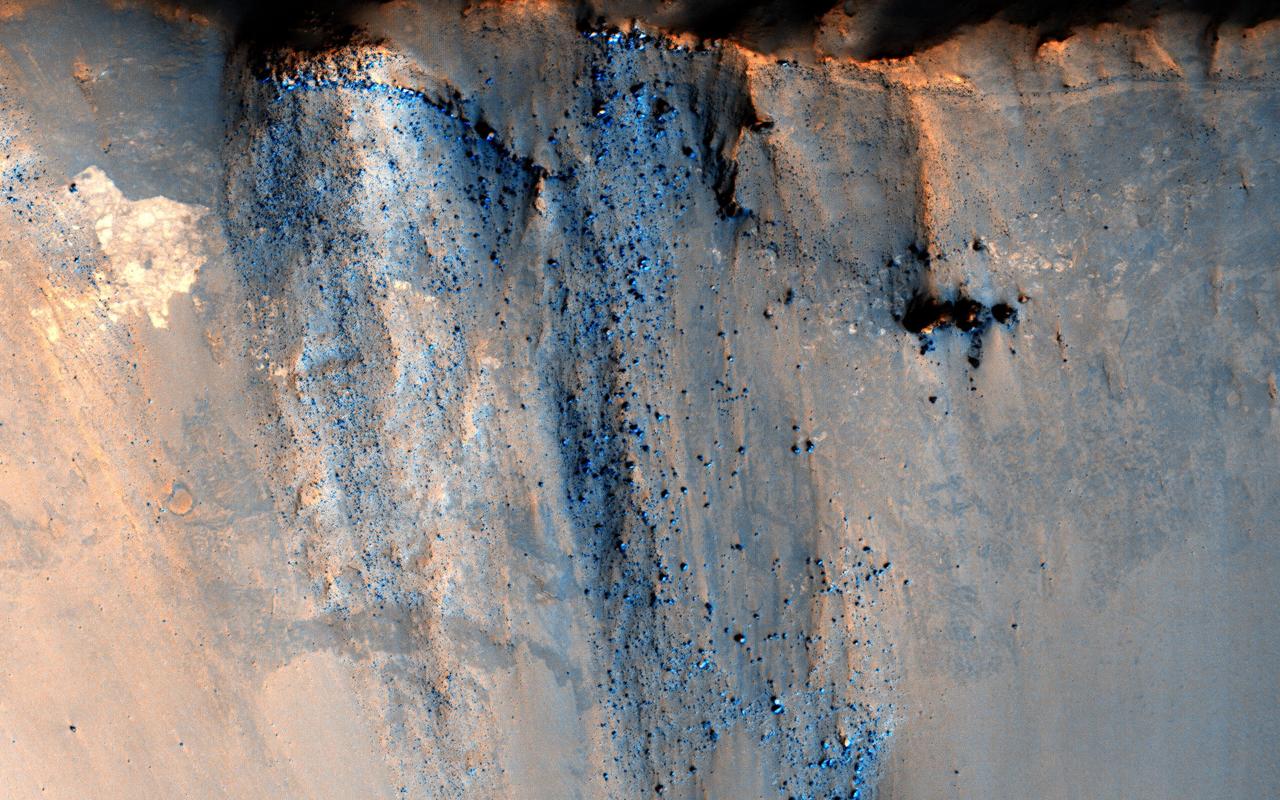
This image captured by NASA Mars Reconnaissance Orbiter spacecraft targets a 3-kilometer diameter crater that occurs within the ejecta blanket of the much older Bakhuysen Crater, a 150-kilometer diameter impact crater in Noachis Terra. Impact craters are interesting because they provide a mechanism to uplift and expose underlying bedrock, allowing for the study of the subsurface and the geologic past. An enhanced color image shows the wall of the crater, which exposes layering as well as blocks of rock. There is a distinctive large block in the upper left of the crater wall, generally referred to as a "mega-block."Â It is an angular, light-toned, highly fragmented block, about 100 meters across. Several smaller light-toned blocks are also in the crater wall, possibly of the same rock type as the "mega-block." Ejecta blocks are thrown outward during the initial excavation of a crater, or are deposited as part of the ground-hugging flows of which the majority of the ejecta blanket is comprised. Through images like these, we are able to study the deeper subsurface of Mars that is not otherwise exposed. http://photojournal.jpl.nasa.gov/catalog/PIA20728
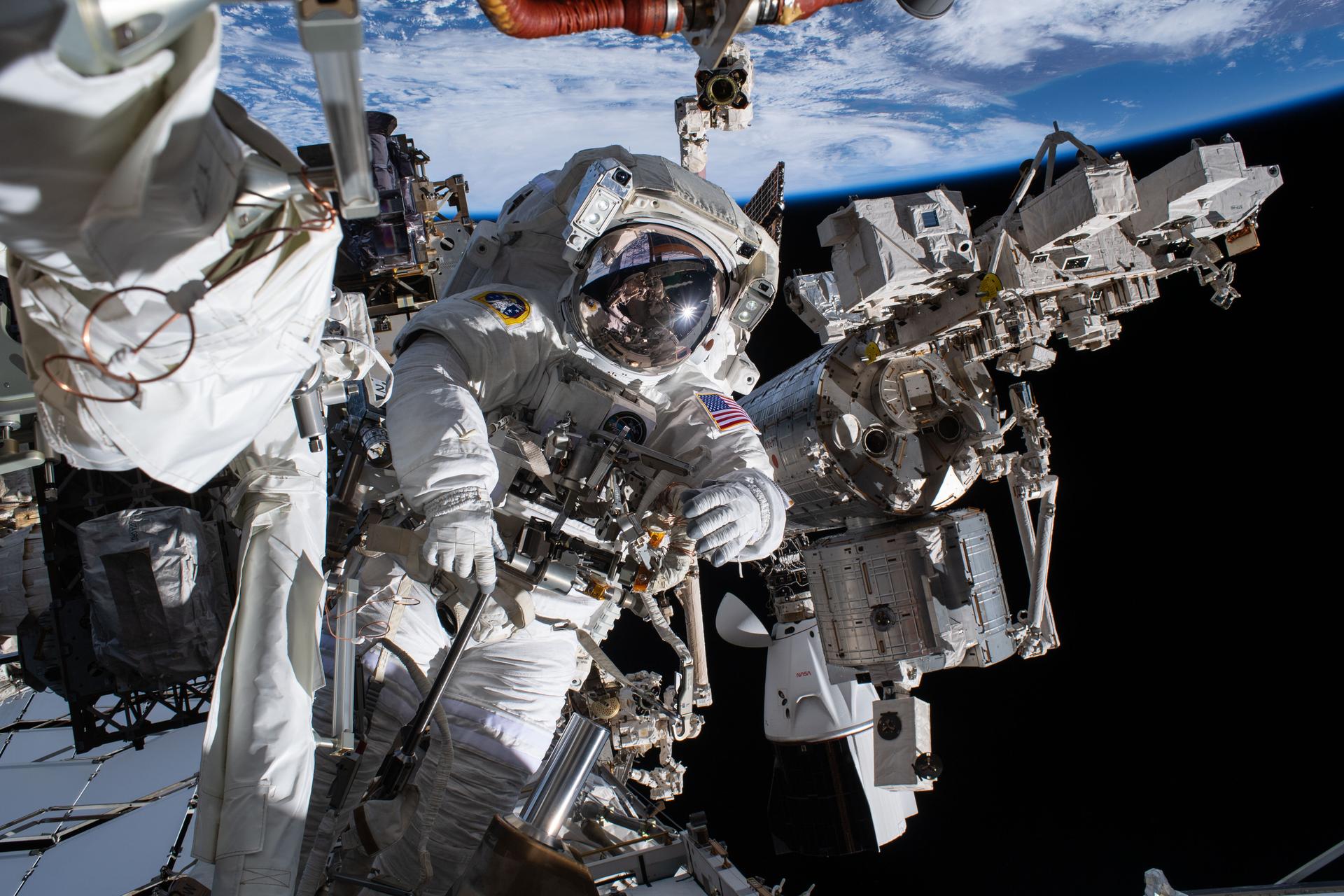
iss074e0402919 (March 18, 2026) -- NASA astronaut Chris Williams is pictured outside the International Space Station during a spacewalk to complete the build and installation of a modification kit ahead of future solar array installation on the 2A power channel of the space station. It was William’s first spacewalk of his career, and the 278th in support of space station maintenance, upgrades, and assembly. Credit: NASA/Jessica Meir

Expedition 50 NASA astronaut Peggy Whitson smiles as she listens to a reporter's question ahead of the final qualification exams with fellow crew mates Russian cosmonaut Oleg Novitskiy of Roscosmos and ESA astronaut Thomas Pesquet, Tuesday, Oct. 25, 2016, at the Gagarin Cosmonaut Training Center (GCTC) in Star City, Russia. Photo Credit: (NASA/Bill Ingalls)
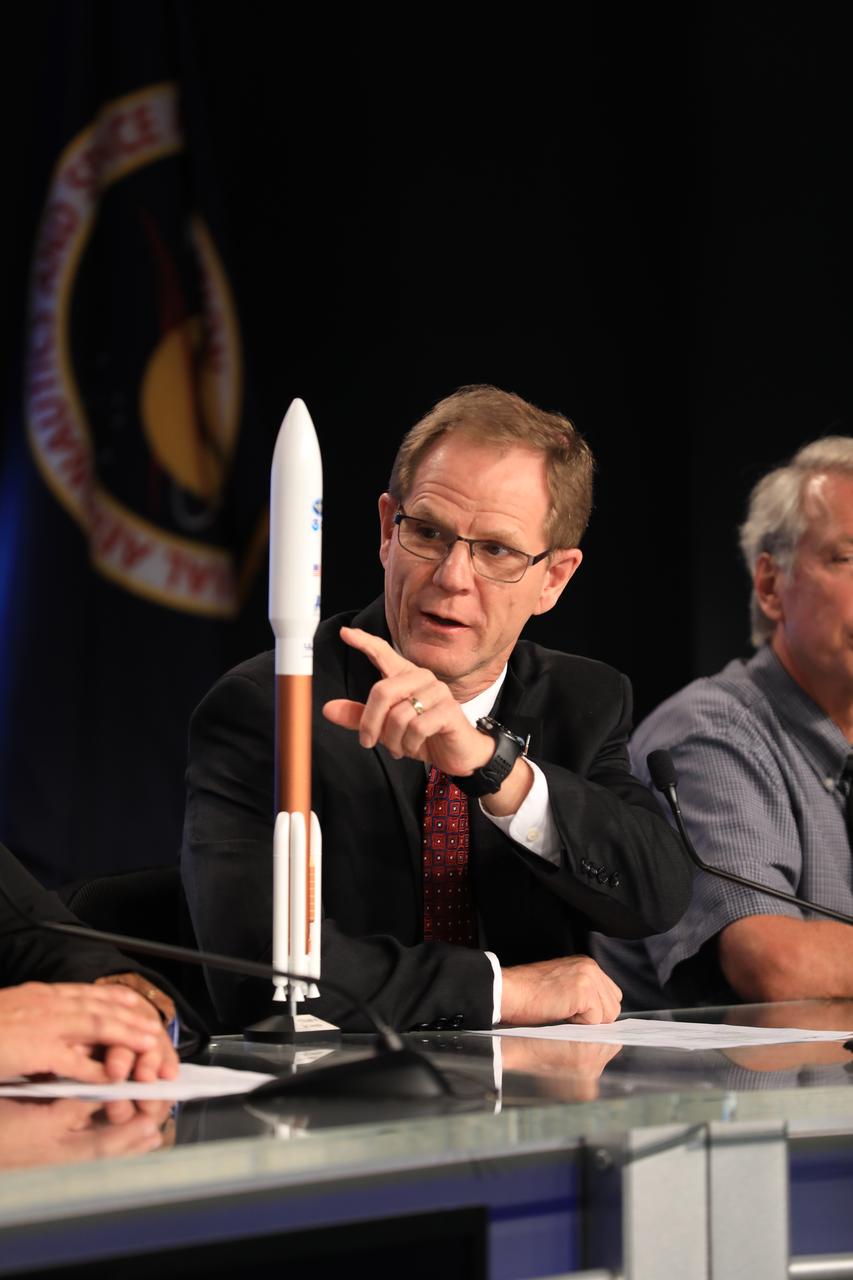
Scott Messer, program manager, NASA Missions, United Launch Alliance, speak to members of the news media during a Geostationary Operational Environmental Satellite (GOES-R) prelaunch news conference in the Kennedy Space Center's Press Site auditorium in Florida.
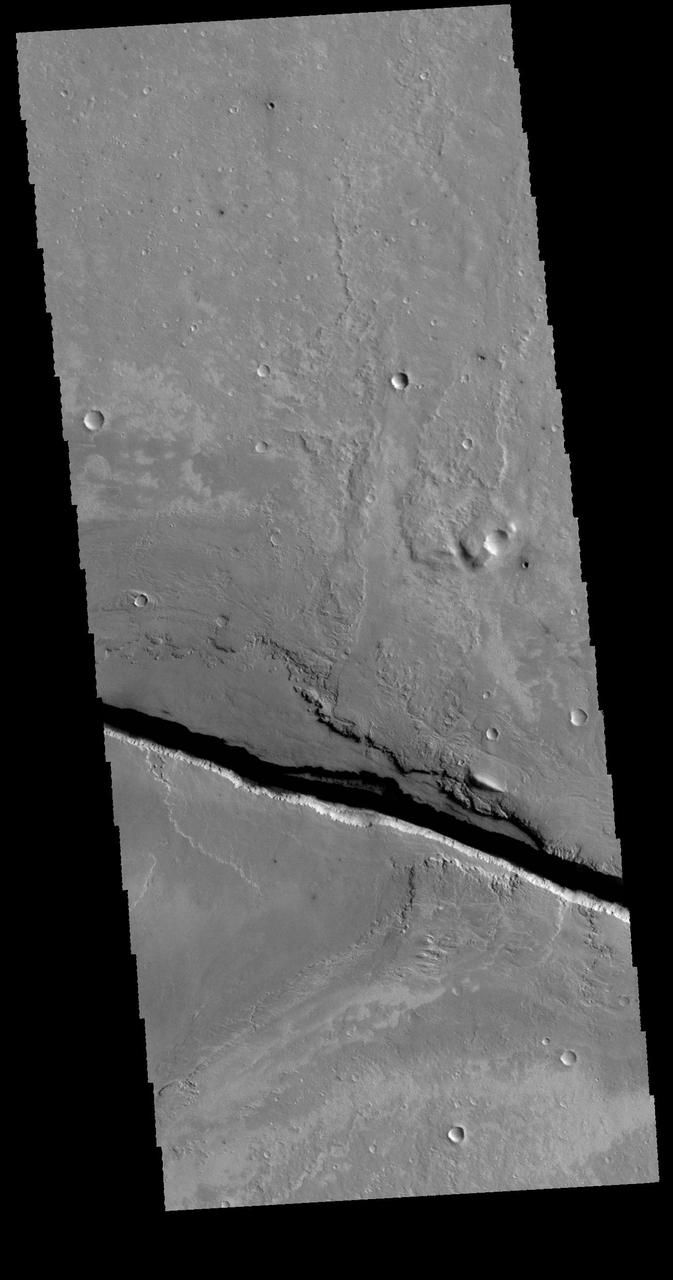
This image captured by NASA 2001 Mars Odyssey spacecraft shows a portion of Cerberus Fossae, a set of linear graben located south of Tartarus Montes.
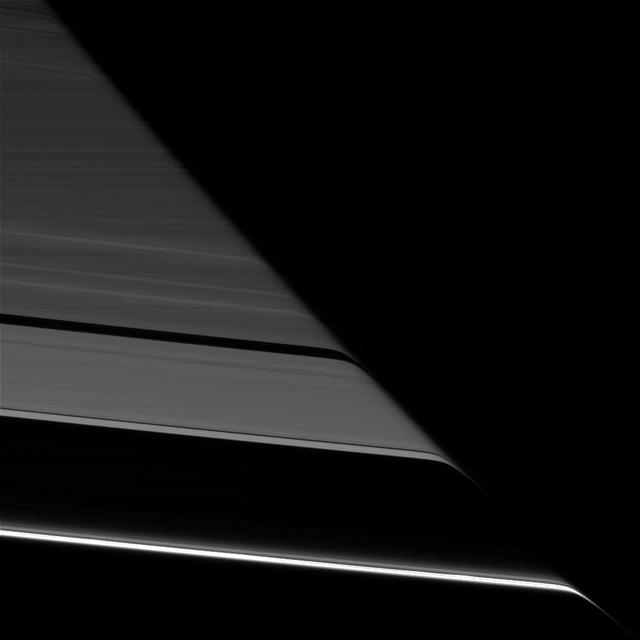
Saturn's rings appear to bend as they pass behind the planet's darkened limb due to refraction by Saturn's upper atmosphere. The effect is the same as that seen in an earlier Cassini view (see PIA20491), except this view looks toward the unlit face of the rings, while the earlier image viewed the rings' sunlit side. The difference in illumination brings out some noticeable differences. The A ring is much darker here, on the rings' unlit face, since its larger particles primarily reflect light back toward the sun (and away from Cassini's cameras in this view). The narrow F ring (at bottom), which was faint in the earlier image, appears brighter than all of the other rings here, thanks to the microscopic dust that is prevalent within that ring. Small dust tends to scatter light forward (meaning close to its original direction of travel), making it appear bright when backlit. (A similar effect has plagued many a driver with a dusty windshield when driving toward the sun.) This view looks toward the unilluminated side of the rings from about 19 degrees below the ring plane. The image was taken in red light with the Cassini spacecraft narrow-angle camera on July 24, 2016. The view was acquired at a distance of approximately 527,000 miles (848,000 kilometers) from Saturn and at a sun-Saturn-spacecraft, or phase, angle of 169 degrees. Image scale is 3 miles (5 kilometers) per pixel. http://photojournal.jpl.nasa.gov/catalog/PIA20497
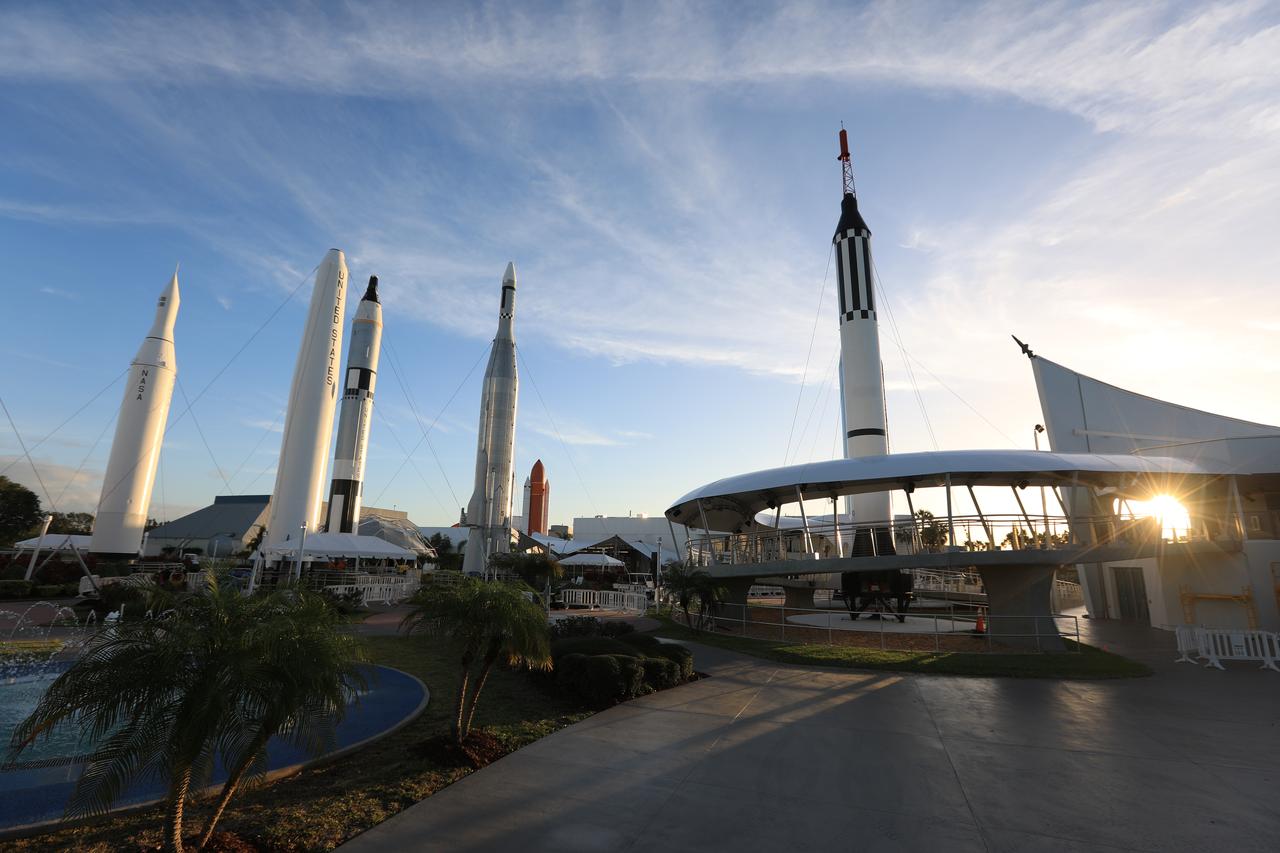
Entrance to the Heroes and Legends attraction at the Kennedy Space Center Visitor Complex is by way of a sweeping ramp designed to simulate a journey to the stars by way of the "Rocket Garden." The new facility includes the U.S. Astronaut Hall of Fame and looks back to the pioneering efforts of Mercury, Gemini and Apollo. It sets the stage by providing the background and context for space exploration and the legendary men and women who pioneered the nation's journey into space.
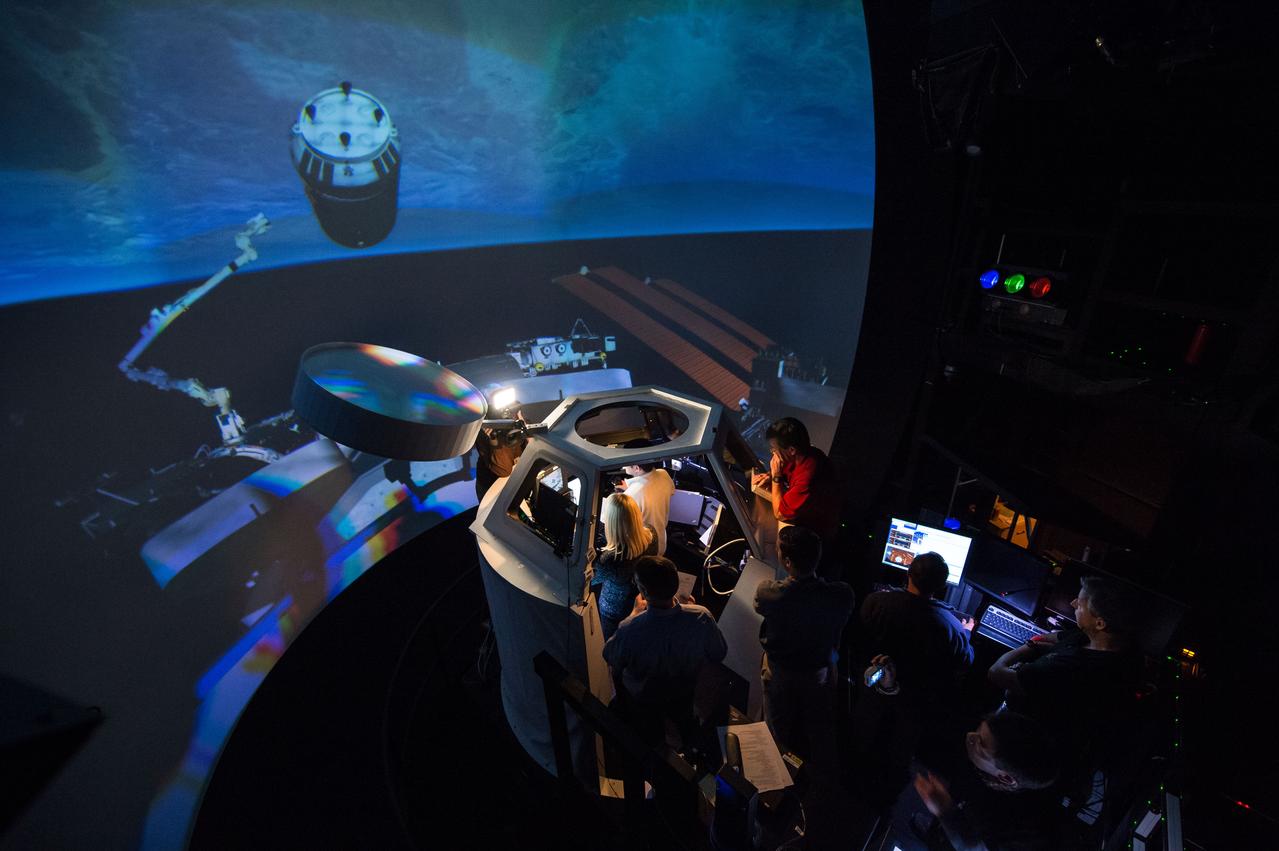
Date: 01-08-16 Location: Bldg 16N, SES Cupola Subject: Expedition 49 crew members Kate Rubins, Takuya Onishi and Shane Kimbrough during ROBO FS training. Photographer: James Blair
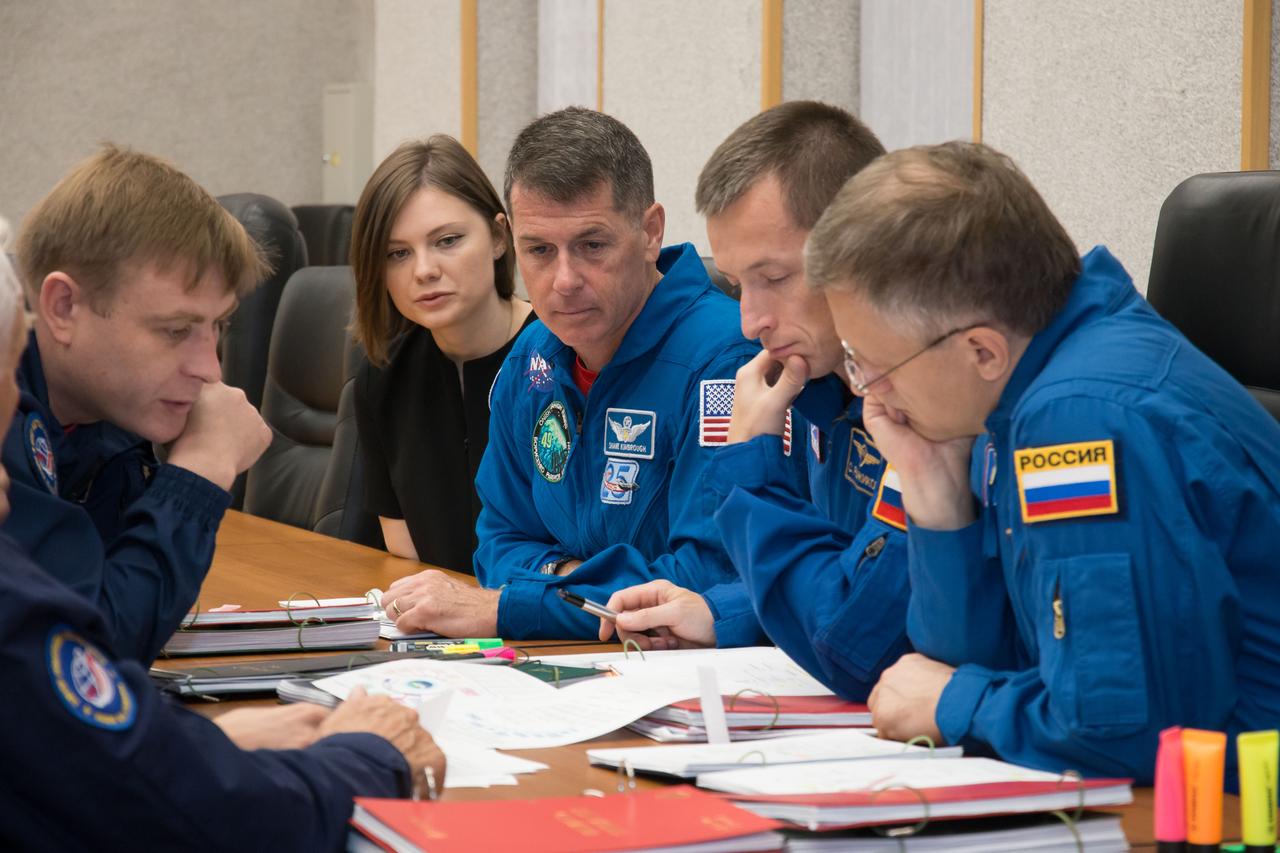
Expedition 49 flight engineer Shane Kimbrough of NASA, left, Soyuz commander Sergey Ryzhikov of Roscosmos, center, and flight engineer Andrey Borisenko of Roscosmos, right, attend a training briefing at the Cosmonaut Hotel on Friday, Sept. 16, 2016 in Baikonur, Kazakhstan. Kimbrough, Ryzhikov, and Borisenko are scheduled to launch to the International Space Station aboard the Soyuz MS-02 spacecraft from the Baikonur Cosmodrome on September 24 Kazakh time. Photo Credit: (NASA/Victor Zelentsov)
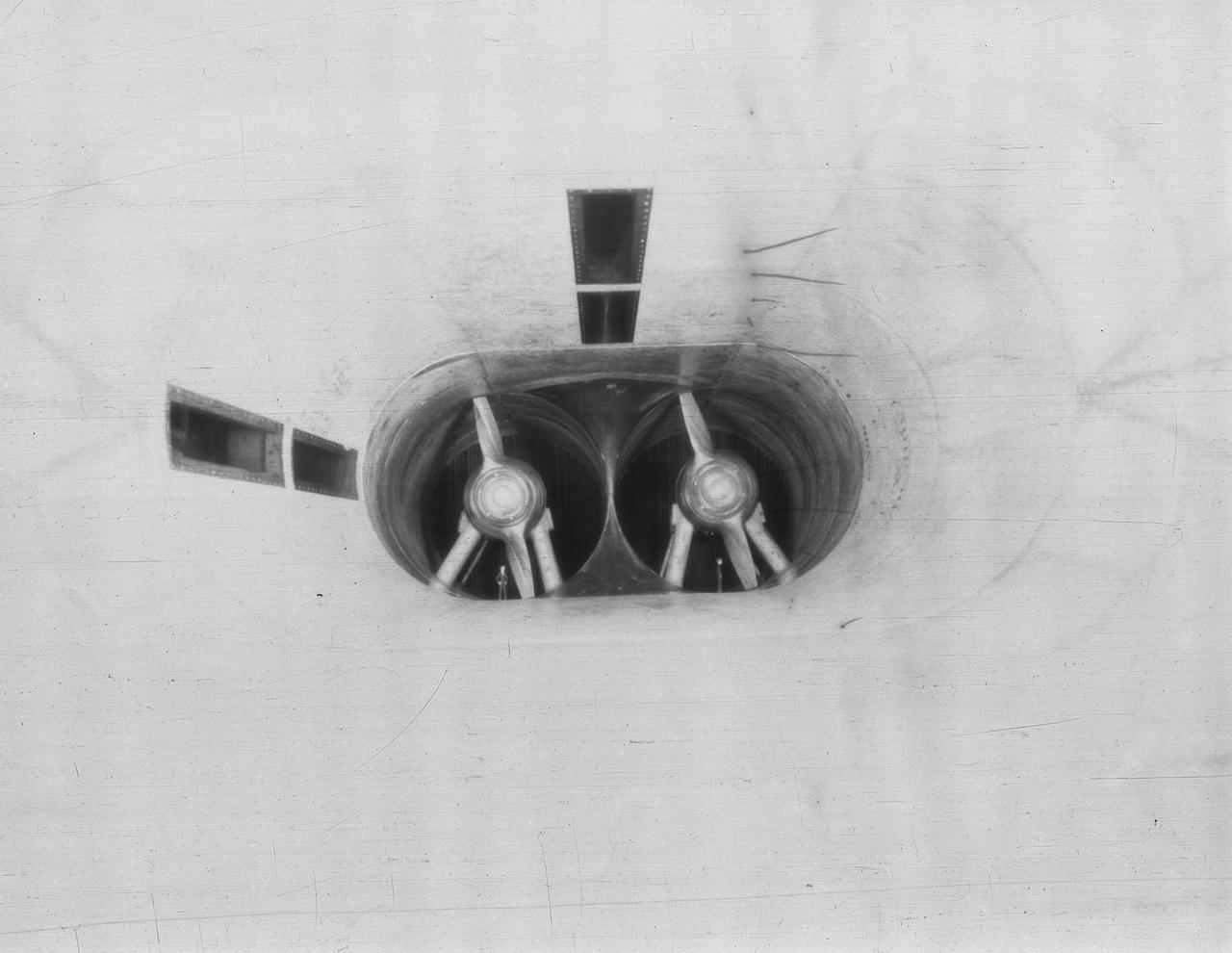
Smoke Flow Investigation XF7C-1 (Cowling Exhaust J.1 Type)
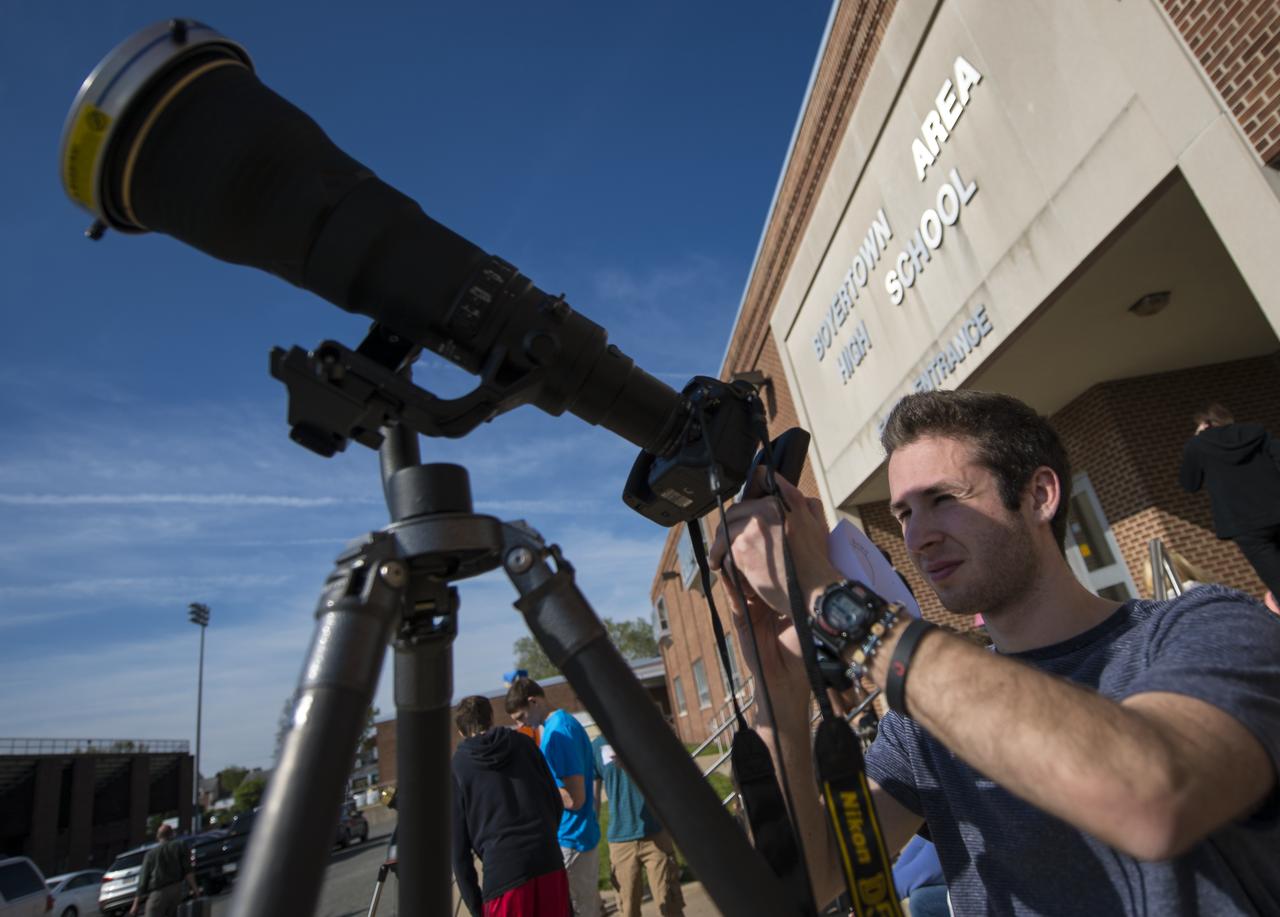
Boyertown Area High School 12th grade student Ben Maurer uses his smartphone and a photographers lens with a solar filter to make a photograph of the planet Mercury transitting the sun, Monday, May 9, 2016, Boyertown area High School, Boyertown, Pennsylvania. Mercury passes between Earth and the sun only about 13 times a century, with the previous transit taking place in 2006. Photo Credit: (NASA/Bill Ingalls)
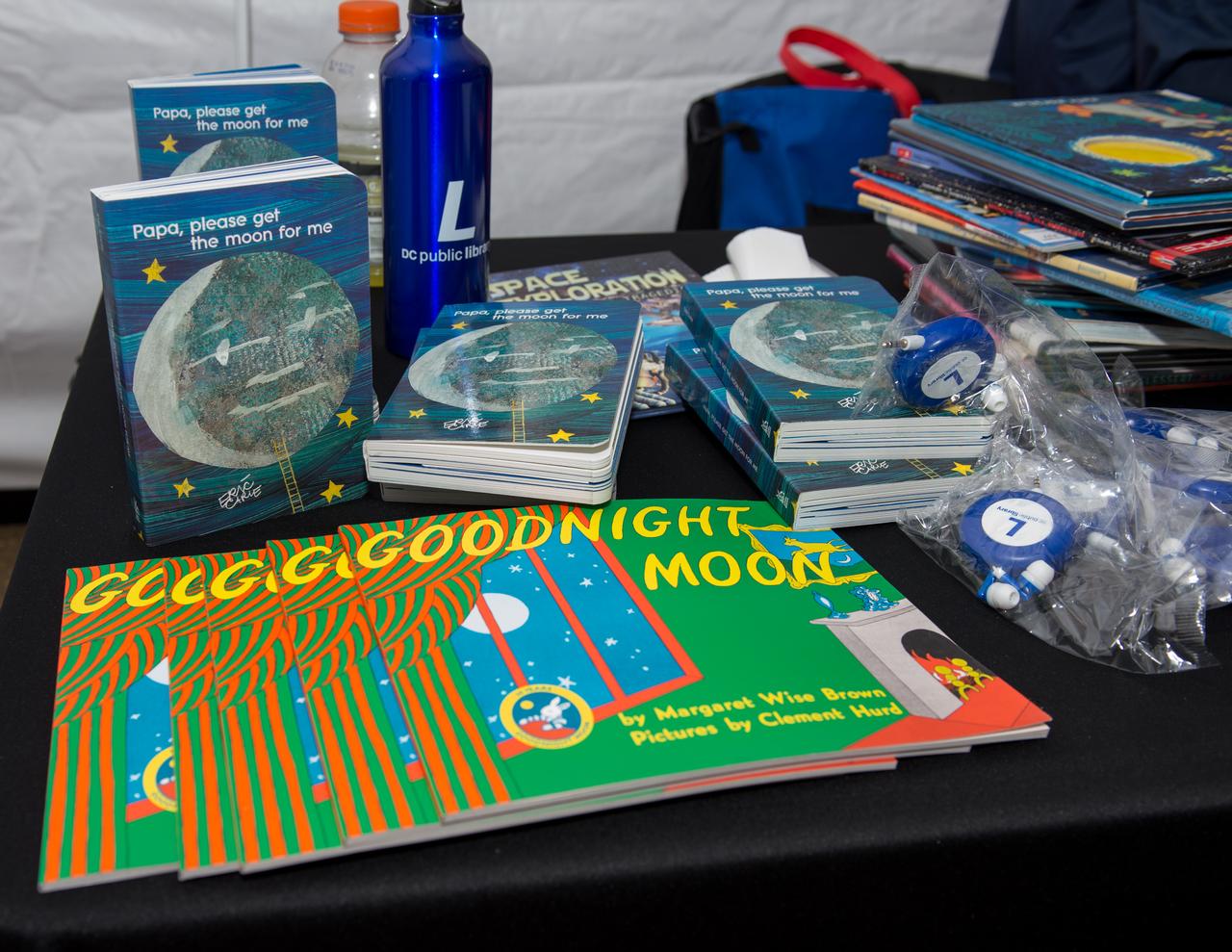
International Observe the Moon Night at the Goddard Visitor Center
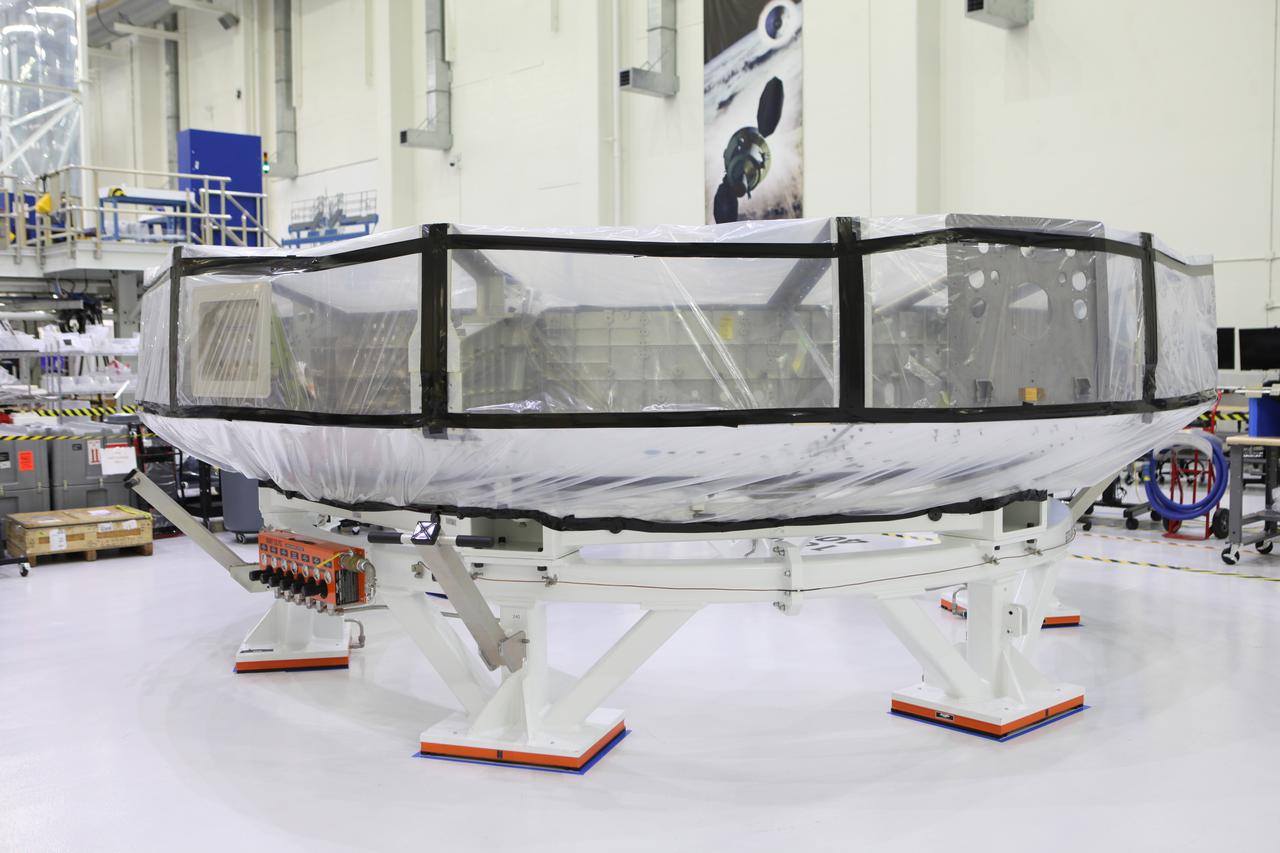
Inside the Neil Armstrong Operations and Checkout Building high bay at NASA’s Kennedy Space Center in Florida, a protective cover is installed around the Orion crew module adapter (CMA) for Exploration Mission 1 (EM-1) for its move to a clean room. The CMA will undergo propellant and environmental control and life support system tube installation and welding. The adapter will connect the Orion crew module to the European Space Agency-provided service module. The Orion spacecraft will launch atop NASA’s Space Launch System rocket on EM-1, its first deep space mission, in late 2018.

This view of Ceres from NASA Dawn spacecraft, taken on May 29, 2016, features a small crater at upper left that adjoins Messor Crater. Dawn took this image on May 29, 2016, from its low-altitude mapping orbit, at a distance of about 240 miles (385 kilometers) above the surface. The image resolution is 120 feet (35 meters) per pixel. http://photojournal.jpl.nasa.gov/catalog/PIA20924

NASA Administrator Charlie Bolden at the National Air and Space Museum (NASM) event sponsored by Goddard Space Flight Center and the Maryland Space Business Roundtable (MSBR).
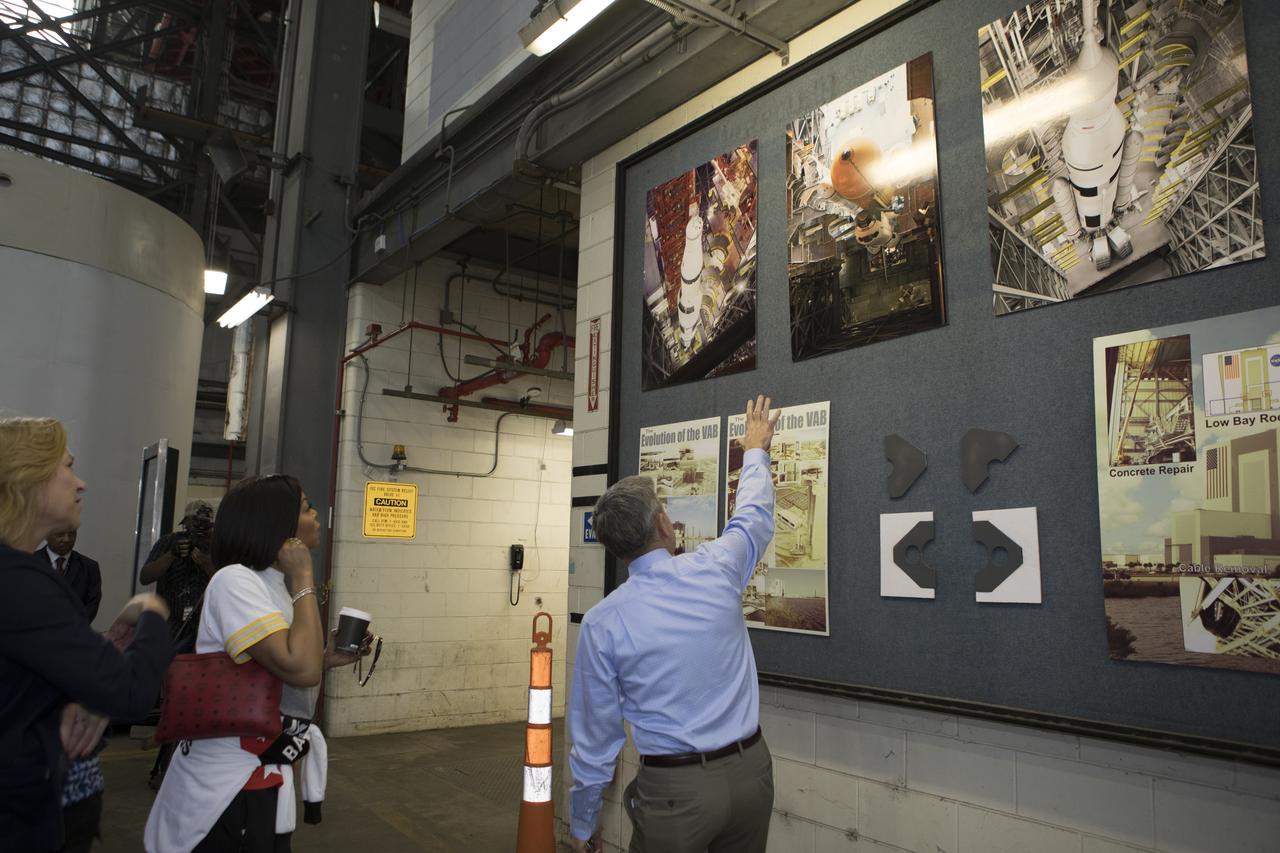
Kennedy Space Center Director Bob Cabana points to a display during a tour for cast and crew members of the upcoming motion picture "Hidden Figures." The group is walking thought the transfer aisle of the Vehicle Assembly Building. The movie is based on the book of the same title, by Margot Lee Shetterly. It chronicles the lives of Katherine Johnson, Dorothy Vaughan and Mary Jackson, three African-American women who worked for NASA as human "computers.” Their mathematical calculations were crucial to the success of Project Mercury missions including John Glenn’s orbital flight aboard Friendship 7 in 1962. The film is due in theaters in January 2017.
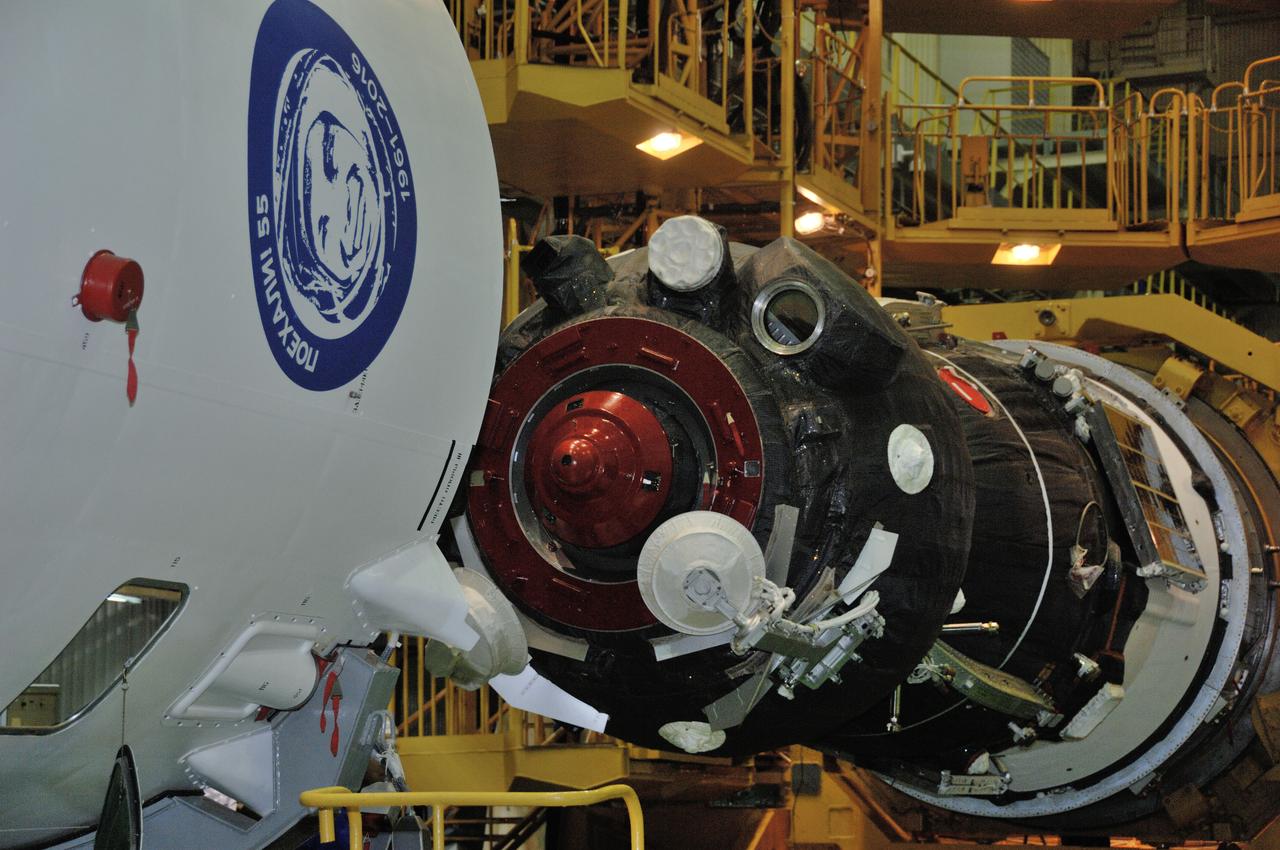
In the Integration Facility at the Baikonur Cosmodrome in Kazakhstan, the Soyuz MS-03 spacecraft begins its encapsulation into the upper stage of its Soyuz booster Nov. 9. Expedition 50-51 crewmembers Peggy Whitson of NASA, Oleg Novitskiy of the Russian Federal Space Agency (Roscosmos) and Thomas Pesquet of the European Space Agency will launch on the Soyuz Nov. 18, Baikonur time, for a six-month mission on the International Space Station. NASA/Alexander Vysotsky
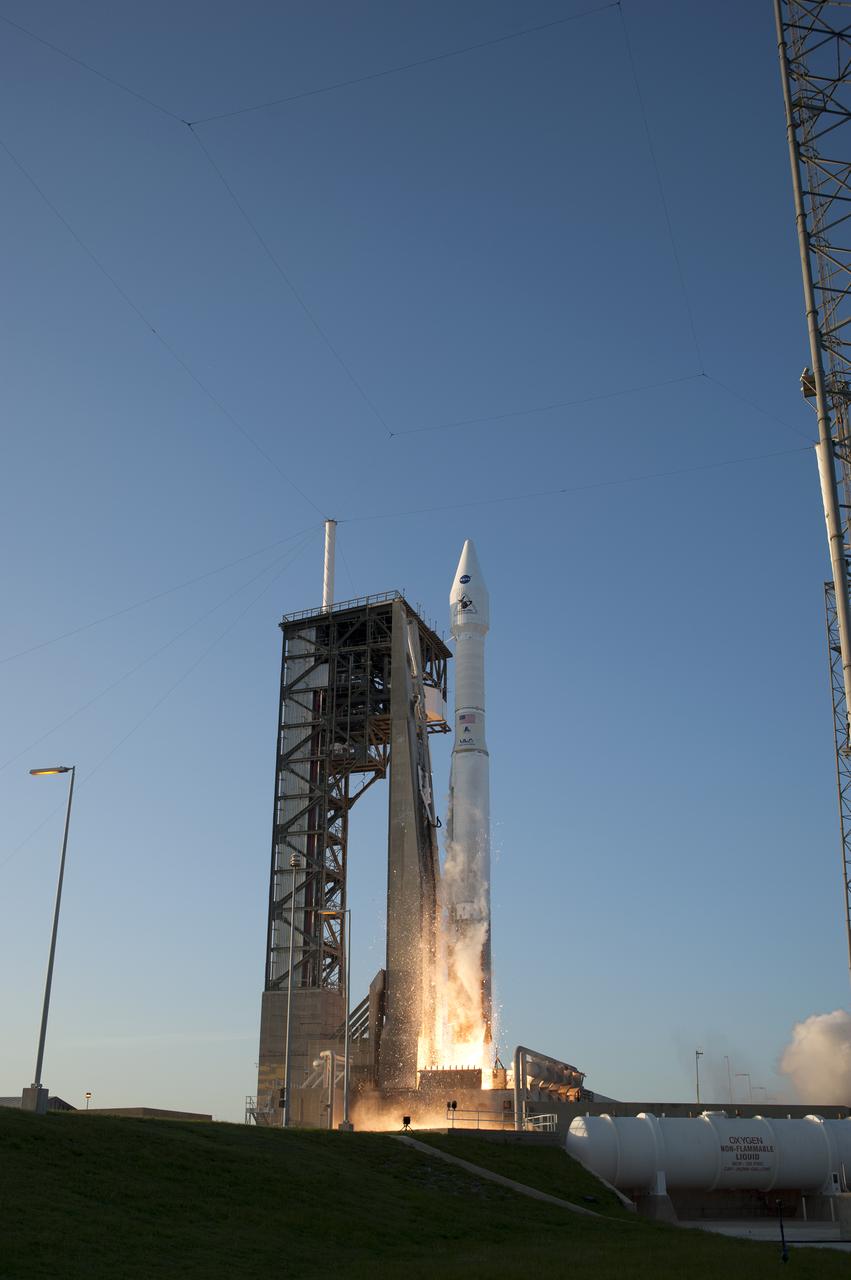
A United Launch Alliance Atlas V rocket lifts off from Space Launch Complex 41 at Cape Canaveral Air Force Station carrying NASA’s Origins, Spectral Interpretation, Resource Identification, Security-Regolith Explorer, or OSIRIS-REx spacecraft on the first U.S. mission to sample an asteroid, retrieve at least two ounces of surface material and return it to Earth for study. Liftoff was at 7:05 p.m. EDT. The asteroid, Bennu, may hold clues to the origin of the solar system and the source of water and organic molecules found on Earth.

NASA Ames Deputy Director of Exploration Technology Aga M. Goodsell, sat for an on camera interview for the NASA Hidden Figures Project, in front of the Hyperwall (N-252).
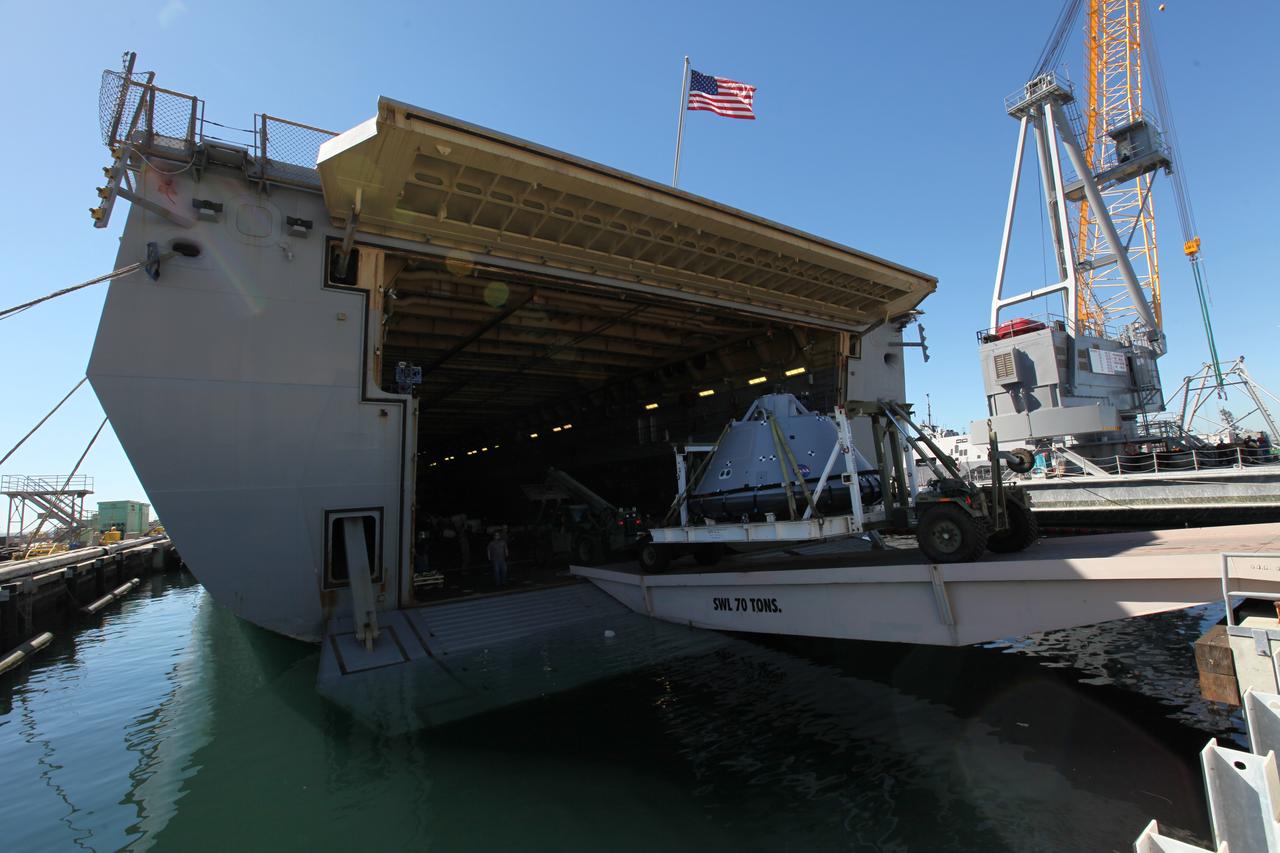
The test version of the Orion crew module is transported into the well deck of the USS San Diego at Naval Base San Diego in California. NASA, Orion manufacturer Lockheed Martin and the U.S. Navy will head out to sea with the Orion test spacecraft aboard for Underway Recovery Test 5 (URT-5) in the Pacific Ocean off the coast of California. During URT-5, the team will demonstrate and evaluate the recovery processes, procedures, hardware and personnel necessary for recovery of Orion on its return from a deep space mission. Orion is the exploration spacecraft designed to carry astronauts to destinations not yet explored by humans, including an asteroid and NASA Journey to Mars. It will have emergency abort capability, sustain the crew during space travel and provide safe re-entry from deep space return velocities. Orion is scheduled to launch atop NASA’s Space Launch System rocket in 2018. For more information, visit http://www.nasa.gov/orion.
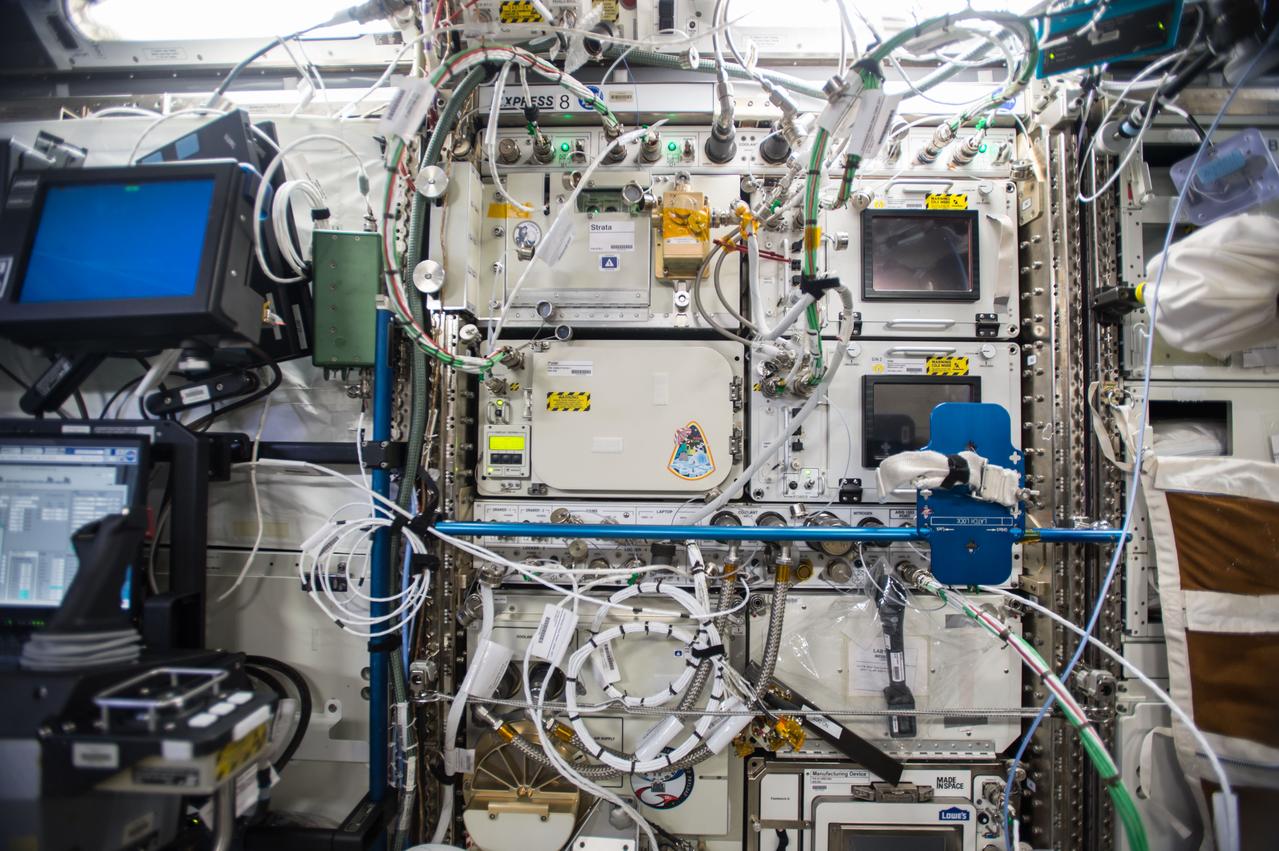
iss048e042382 (7/21/2016) --- Documentation of Polar facility 2 installed in ExPRESS (Expedite the Processing of Experiments to Space Station) Rack 8, LAB1P4, in the Destiny U.S. Laboratory. The newly-installed Space Automated Bioproduct Laboratories (SABL) 1 and 2 are also in view.
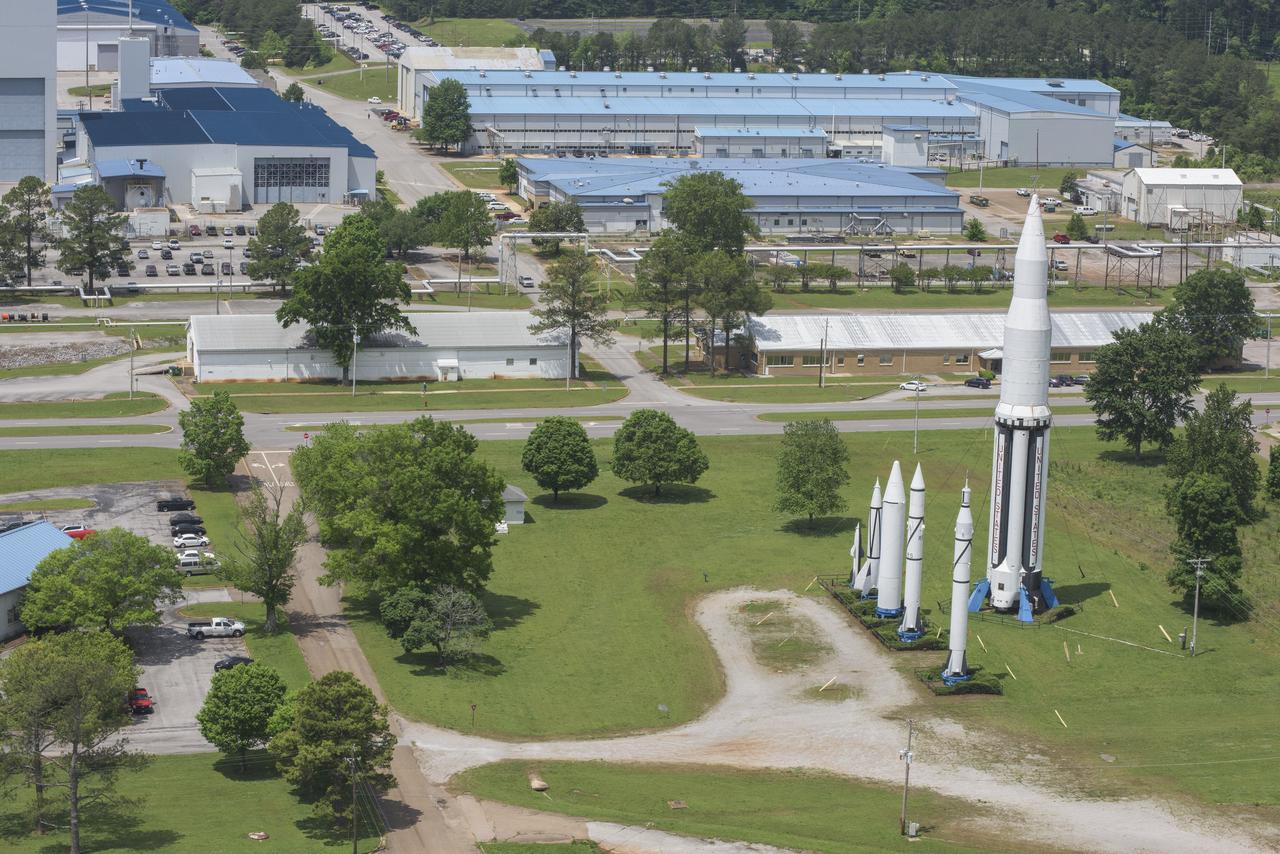
AERIAL PHOTOGRAPHS OF MSFC-ROCKET PARK
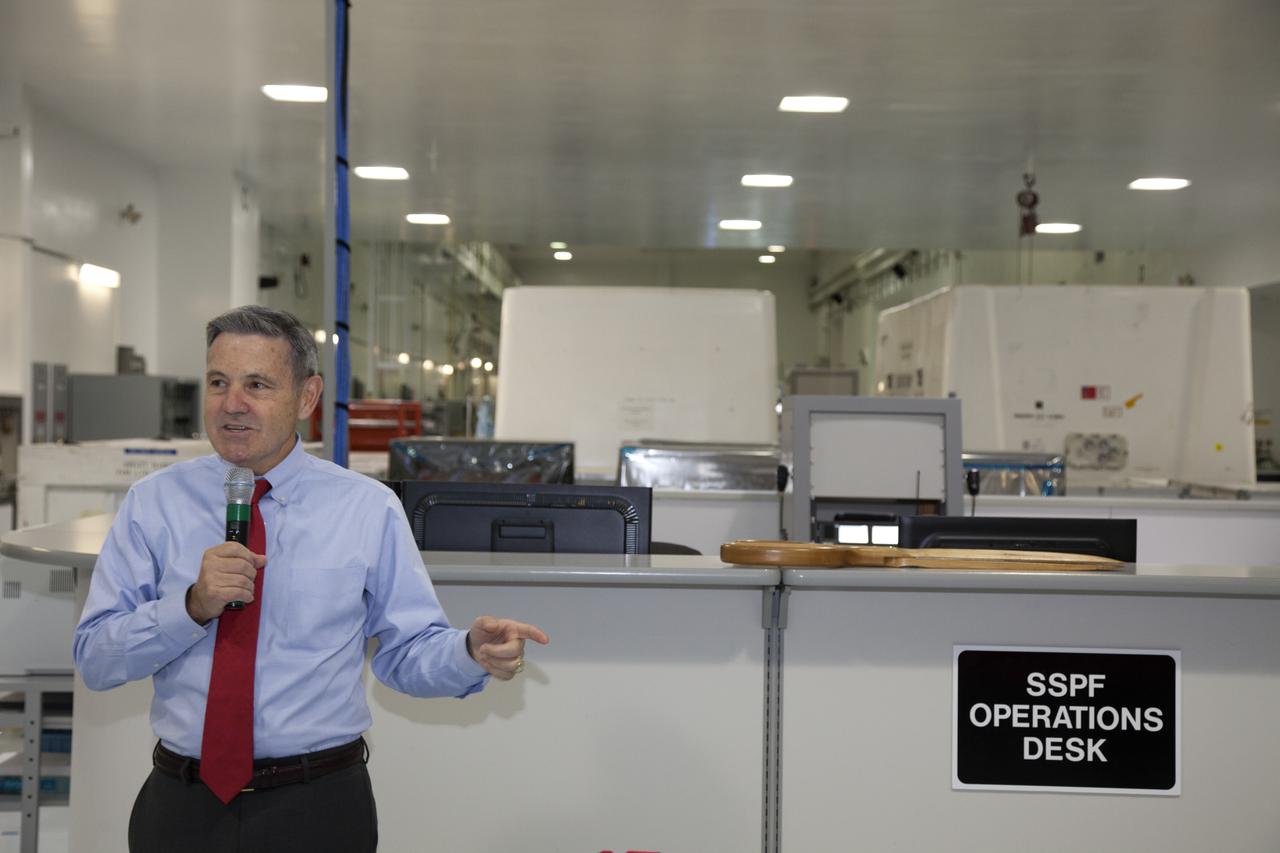
Kennedy Space Center Director Bob Cabana speaks to guests during a ribbon cutting ceremony in the high bay of the Space Station Processing Facility at the Florida spaceport. The event celebrated completion of facility modifications to improve processing and free up zones tailored to a variety of needs supporting a robust assortment of space-bound hardware including NASA programs and commercial space companies.
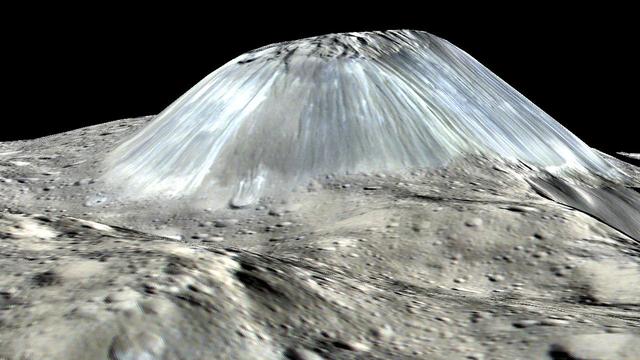
Ceres' lonely mountain, Ahuna Mons, is seen in this simulated perspective view. The elevation has been exaggerated by a factor of two. The view was made using enhanced-color images from NASA's Dawn mission. Images taken using blue (440 nanometers), green (750 nanometers) and infrared (960 nanometers) spectral filters were combined to create the view. The spacecraft's framing camera took the images from Dawn's low-altitude mapping orbit, from an altitude of 240 miles (385 kilometers) in August 2016. The resolution of the component images is 120 feet (35 meters) per pixel. http://photojournal.jpl.nasa.gov/catalog/PIA20915
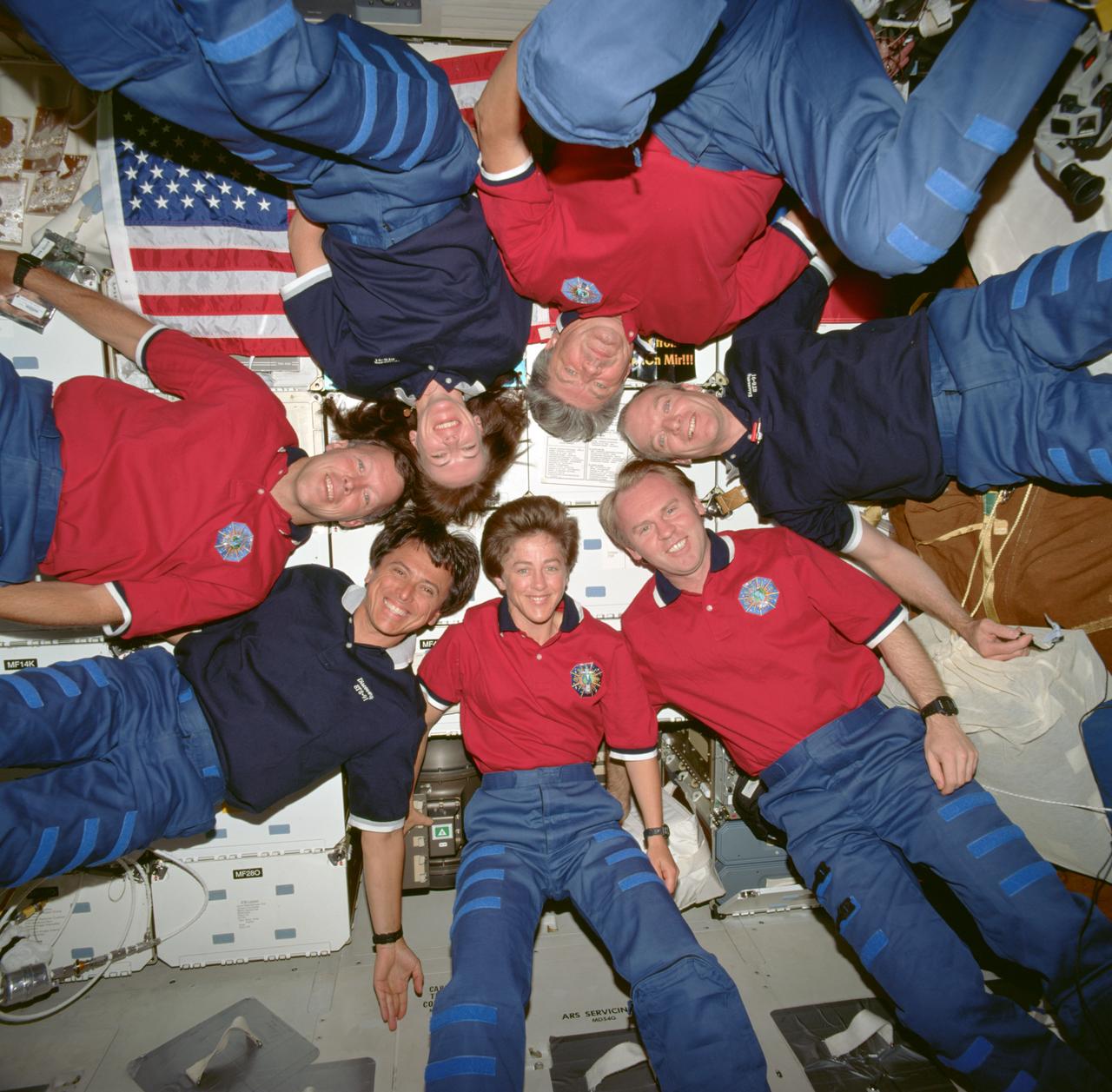
STS091-718-012 (2-12 June 1998) --- The seven crew members of STS-91 assume a "star burst" pose for their traditional in-flight crew portrait aboard the Space Shuttle Discovery. (For orientation, picture should be held with U.S. flag in upper left corner) Astronaut Wendy B. Lawrence, mission specialist, is at bottom center. Others are (counter-clockwise from Lawrence) Andrew S.W. Thomas, mission specialist; Charles J. Precourt, mission commander; Valery V. Ryumin, mission specialist representing the Russian Aviation and Space Agency; Janet L. Kavandi, mission specialist; Dominic C. Gorie, pilot; and Franklin R. Chang-Diaz, payload commander. A pre-set 70mm camera recorded the portrait.

On the same day it arrived, the Atlas V Centaur stage is moved into the Atlas Spaceflight Operations Center near Space Launch Complex 41 at Cape Canaveral Air Force Station in Florida. The Geostationary Operational Environmental Satellite (GOES-R) will launch aboard the Atlas V rocket in November. GOES-R will be the first satellite in a series of next-generation NOAA GOES Satellites.
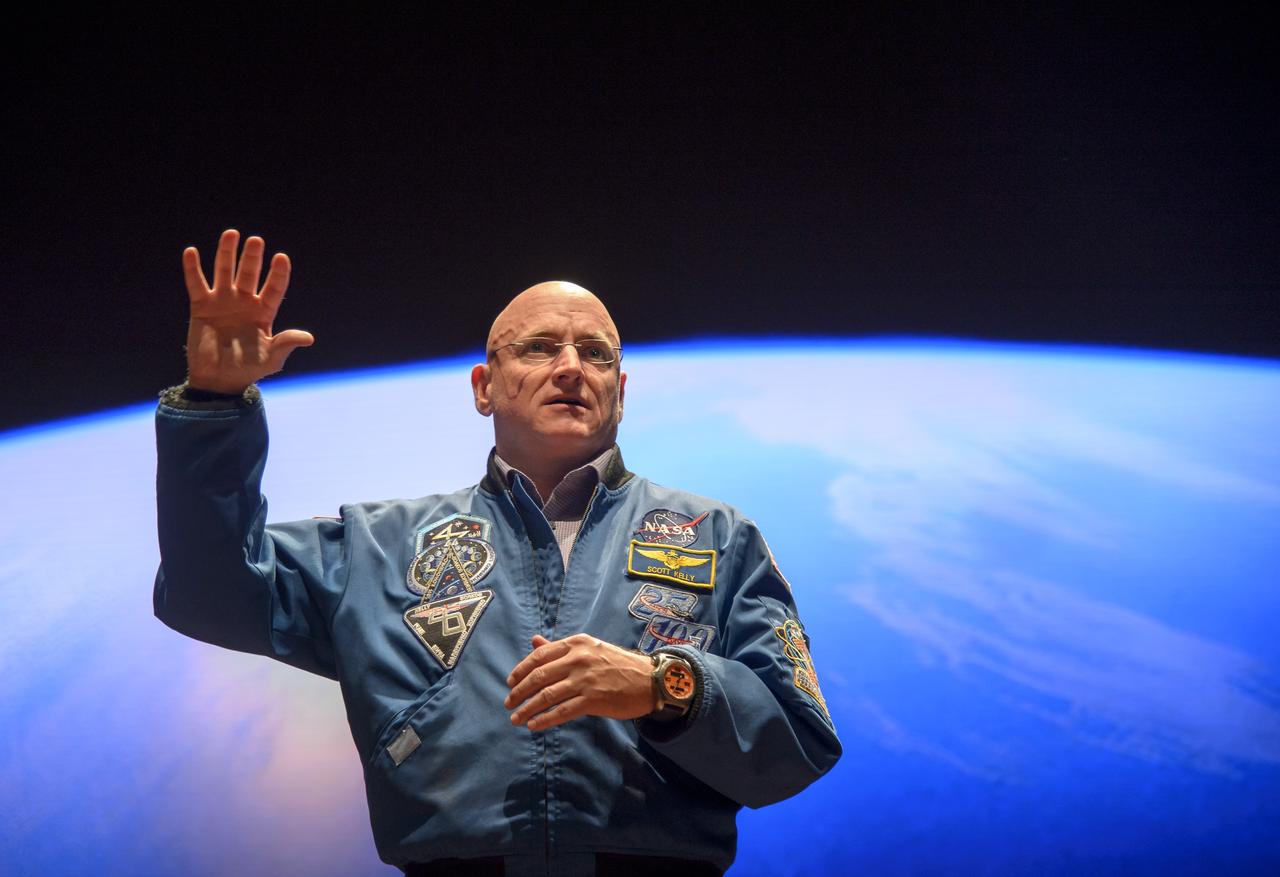
Former NASA astronaut Scott Kelly speaks during an event at the United States Capitol Visitor Center, Wednesday, May 25, 2016, in Washington. Photo Credit: (NASA/Bill Ingalls)
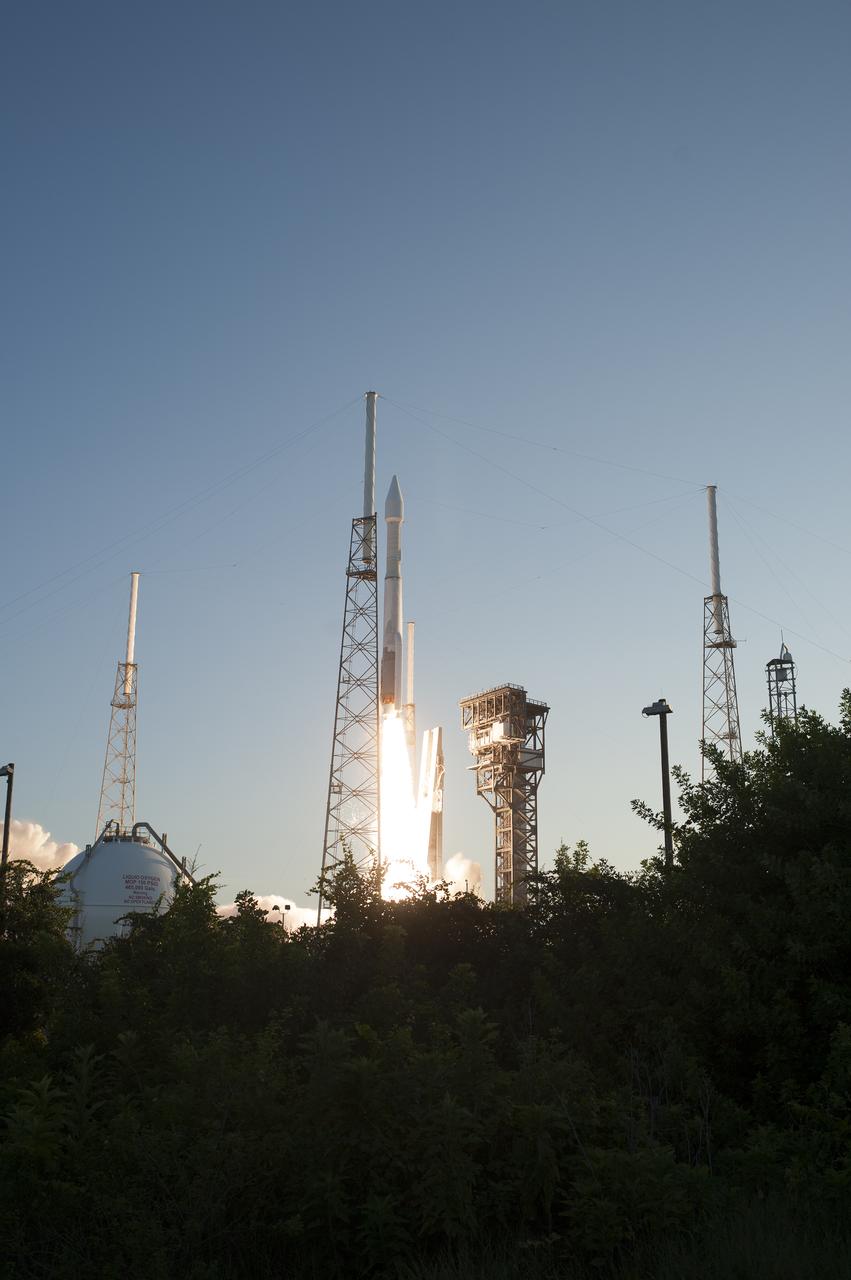
A United Launch Alliance Atlas V rocket lifts off from Space Launch Complex 41 at Cape Canaveral Air Force Station carrying NASA’s Origins, Spectral Interpretation, Resource Identification, Security-Regolith Explorer, or OSIRIS-REx spacecraft on the first U.S. mission to sample an asteroid, retrieve at least two ounces of surface material and return it to Earth for study. Liftoff was at 7:05 p.m. EDT. The asteroid, Bennu, may hold clues to the origin of the solar system and the source of water and organic molecules found on Earth.
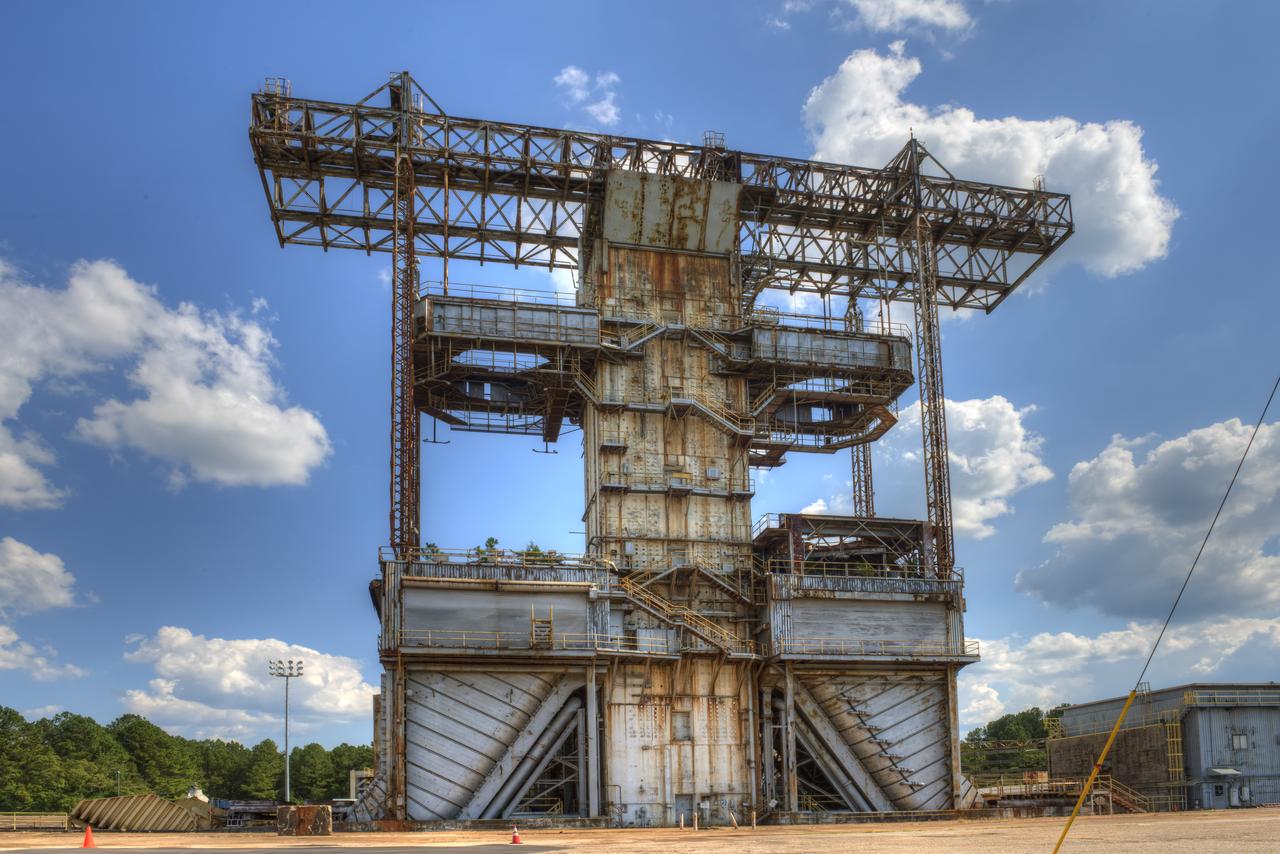
PROPULSION AND STRUCTURAL TEST FACILITY (BUILDING 4572) AT THE GEORGE C. MARSHALL SPACE FLIGHT CENTER IN HUNTSVILLE, ALABAMA
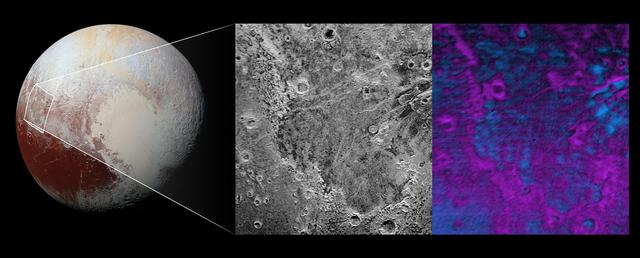
Scientists on NASA's New Horizons mission have discovered what looks like a giant bite-mark on the planet's surface. In this image, north is up. The southern portion of the left inset above shows the cratered plateau uplands informally named Vega Terra (note that all feature names are informal). This terrain is separated from the young, nearly uncratered, mottled plains of Piri Planitia in the center of the image by a generally north-facing jagged scarp called Piri Rupes. The scarp breaks up into isolated mesas in several places. Cutting diagonally across Piri Planitia is the long extensional fault of Inanna Fossa, which stretches eastward 370 miles (600 kilometers) from here to the western edge of the great nitrogen ice plains of Sputnik Planum. Compositional data from the New Horizons spacecraft's Ralph/Linear Etalon Imaging Spectral Array (LEISA) instrument, shown in the right inset, indicate that the plateau uplands south of Piri Rupes are rich in methane ice (shown in false color as purple). Scientists speculate that sublimation of methane may be causing the plateau material to erode along the face of the scarp cliffs, causing them to retreat south and leave the plains of Piri Planitia in their wake. Compositional data also show that the surface of Piri Planitia is more enriched in water ice (shown in false color as blue) than the plateau uplands, which may indicate that Piri Planitia's surface is made of water ice bedrock, on top of which the layer of retreating methane ice had been sitting. Because the surface of Pluto is so cold, the water ice behaves like rock and is immobile. The light/dark mottled pattern of Piri Planitia in the left inset is reflected in the composition map, with the lighter areas corresponding to areas richer in methane – these may be remnants of methane that have not yet sublimated away entirely. The inset at left shows about 650 feet (200 meters) per pixel; the image measures approximately 280 miles (450 kilometers) long by 255 miles (410 kilometers) wide. It was obtained by New Horizons at a range of approximately 21,100 miles (33,900 kilometers) from Pluto, about 45 minutes before the spacecraft's closest approach to Pluto on July 14, 2015.The LEISA data at right was gathered when the spacecraft was about 29,000 miles (47,000 kilometers) from Pluto; best resolution is 1.7 miles (2.7 kilometers) per pixel. http://photojournal.jpl.nasa.gov/catalog/PIA20531
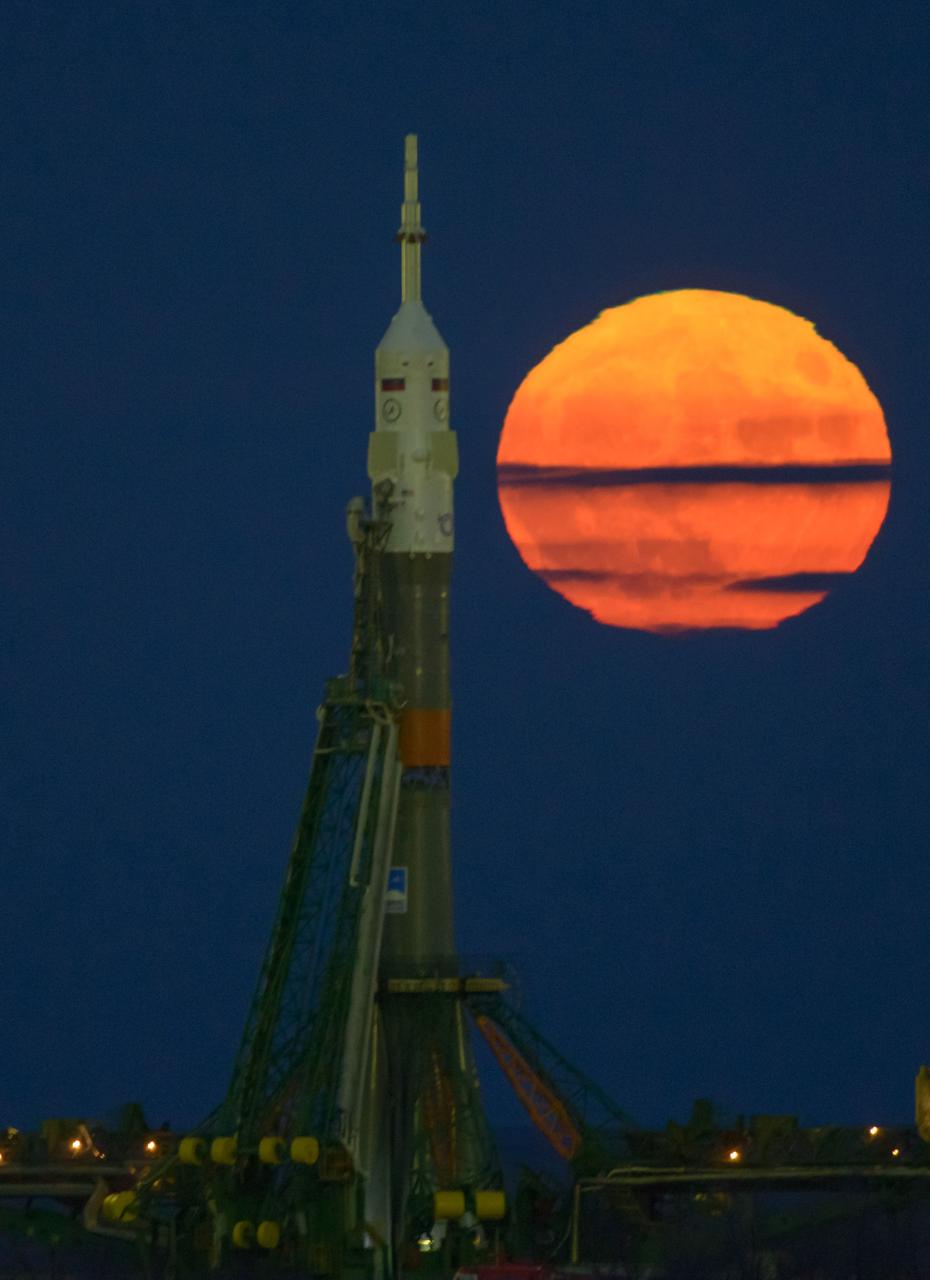
nhq201611140001 (Nov. 14, 2018) --- The Moon, or supermoon, is seen rising behind the Soyuz rocket at the Baikonur Cosmodrome launch pad in Kazakhstan, Monday, Nov. 14, 2016. NASA astronaut Peggy Whitson, Russian cosmonaut Oleg Novitskiy of Roscosmos, and ESA astronaut Thomas Pesquet will launch from the Baikonur Cosmodrome in Kazakhstan the morning of November 18 (Kazakh time.) All three will spend approximately six months on the orbital complex. A supermoon occurs when the moon’s orbit is closest (perigee) to Earth. Photo Credit: (NASA/Bill Ingalls)
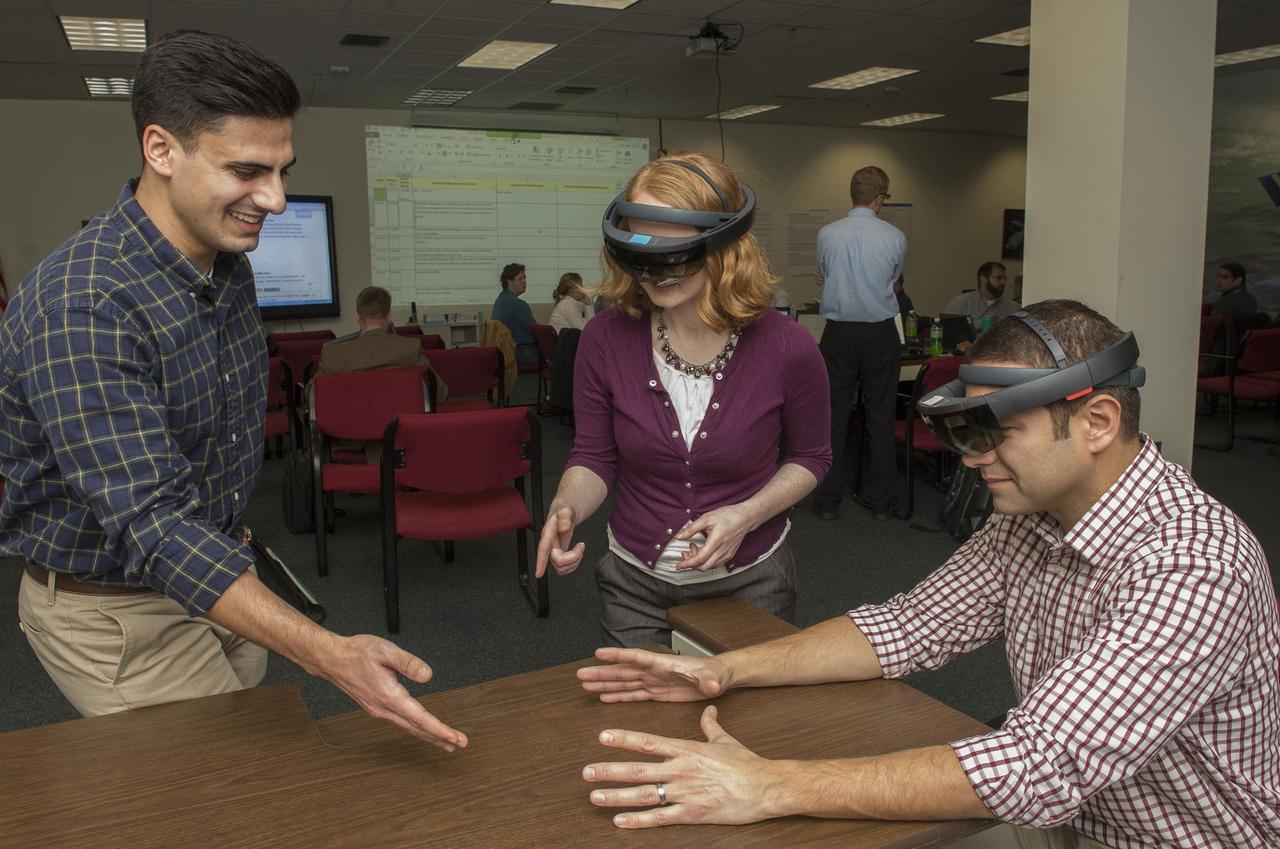
BOEING AND MARSHALL ENGINEERS SHARE VIRTUAL REALITY TECHNOLOGY FOR SLS DESIGN PLANNING.
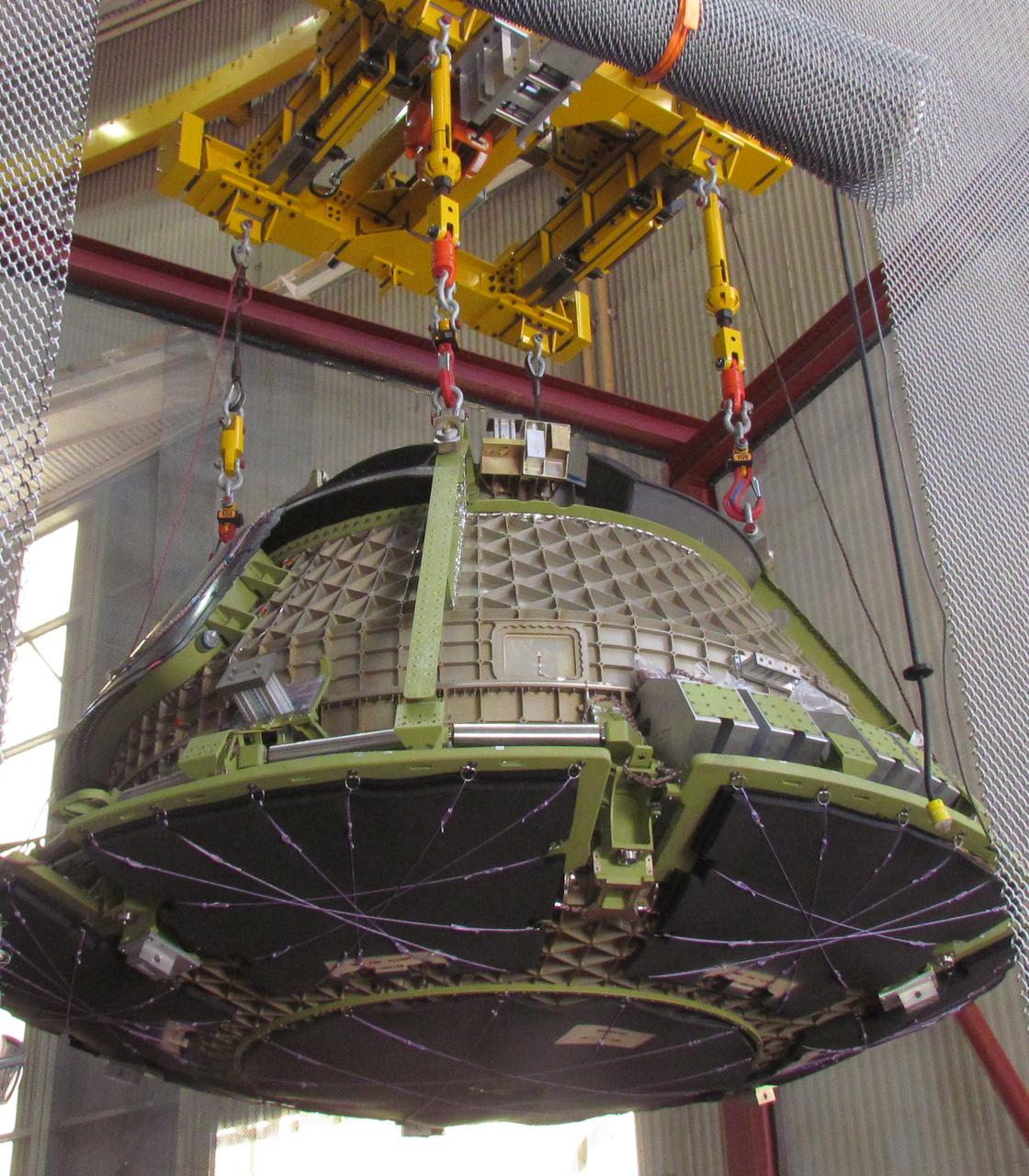
Boeing’s Structural Test Article of its CST-100 Starliner spacecraft arrives at the company’s Huntington Beach, California, facilities for evaluations. Built to the specifications of an operational spacecraft, the STA is intended to be evaluated through a series of thorough testing conditions.
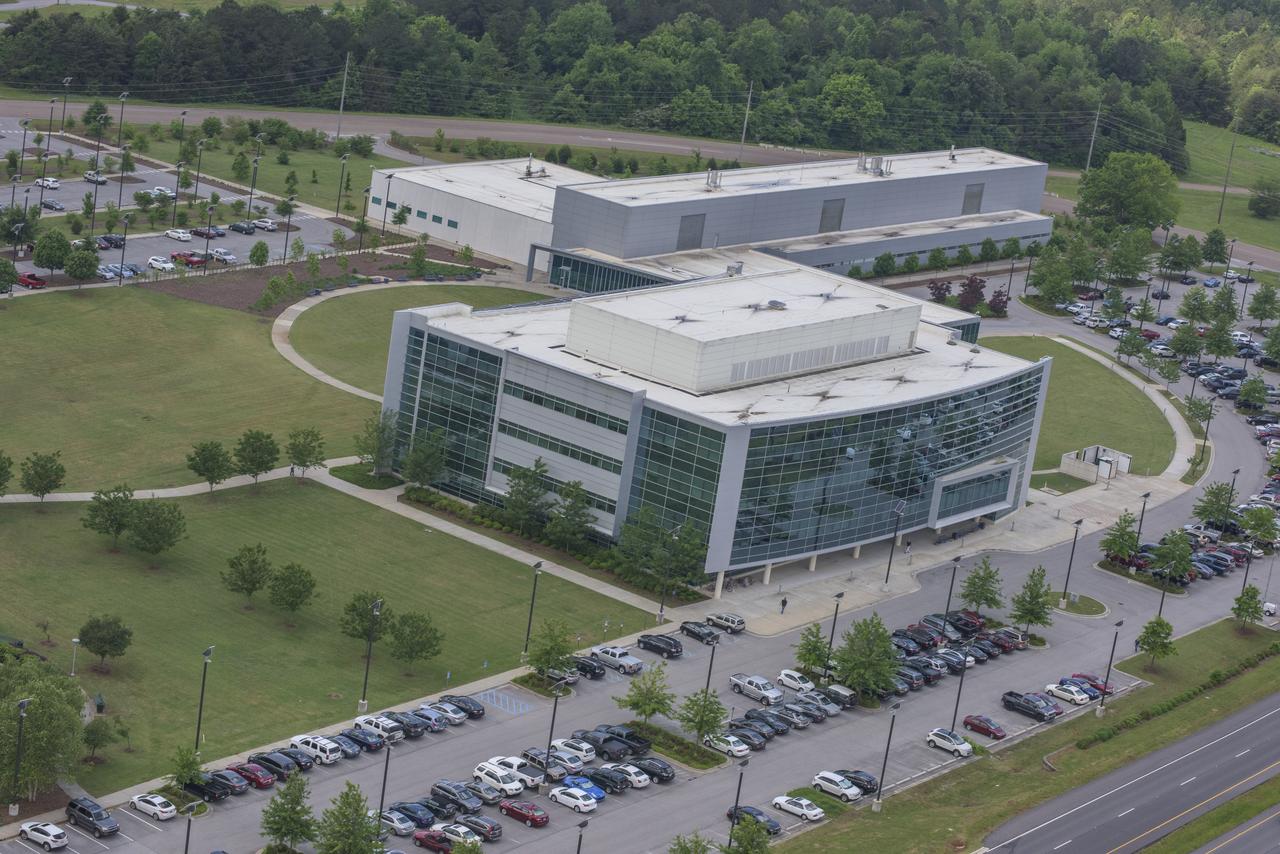
AERIAL PHOTOGRAPHS OF MSFC-4600 COMPLEX

On Jan. 13, 2016, technicians at Michoud Assembly Facility in New Orleans finished welding together the primary structure of the Orion spacecraft destined for deep space on Artemis I, marking another important step on the journey to Mars.
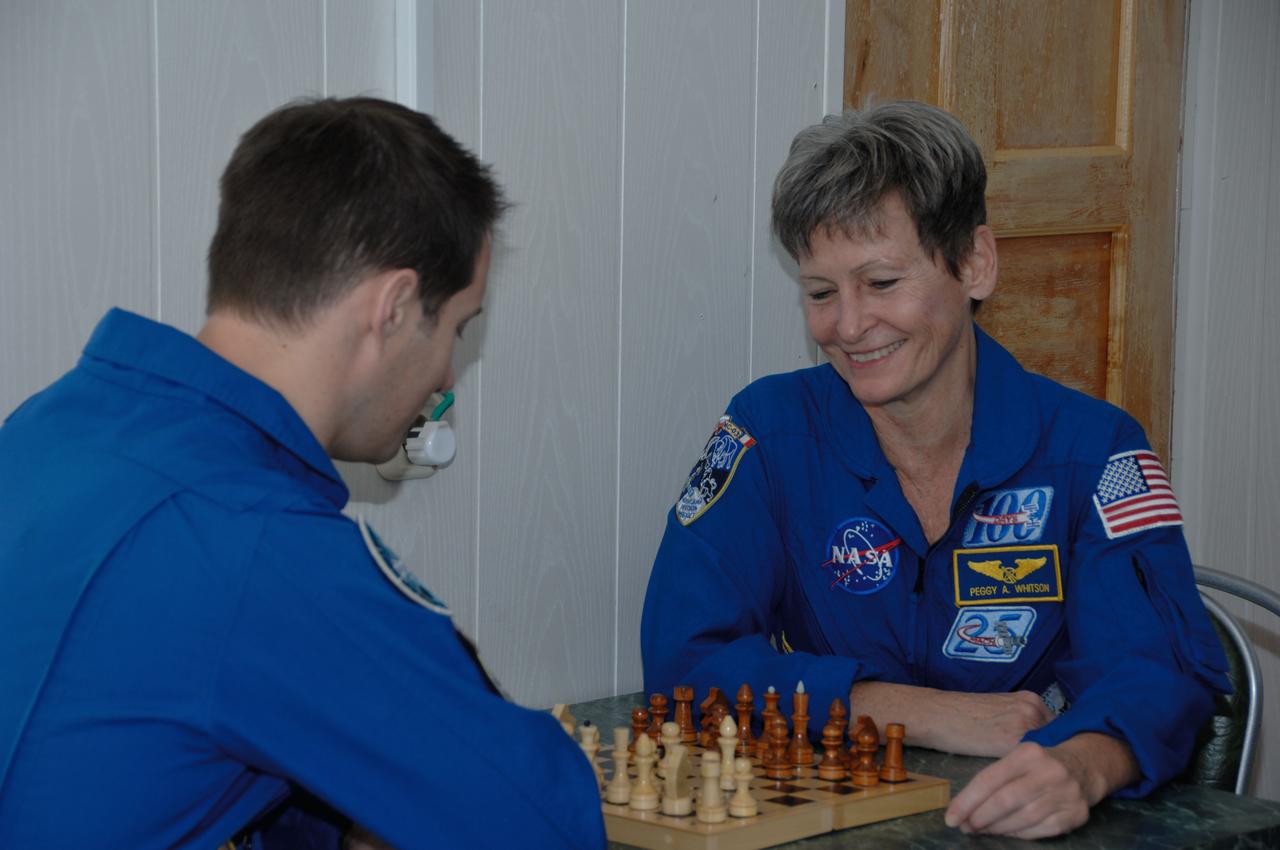
At their Cosmonaut Hotel crew quarters in Baikonur, Kazakhstan, Expedition 50-51 crewmembers Thomas Pesquet of the European Space Agency (left) and Peggy Whitson of NASA (right) try their hand at a game of chess Nov. 10 as part of their preflight activities. Pesquet, Whitson and Oleg Novitskiy of the Russian Federal Space Agency (Roscosmos) will launch Nov. 18, Baikonur time, on the Soyuz MS-03 spacecraft for a six-month mission on the International Space Station. NASA/Alexander Vysotsky
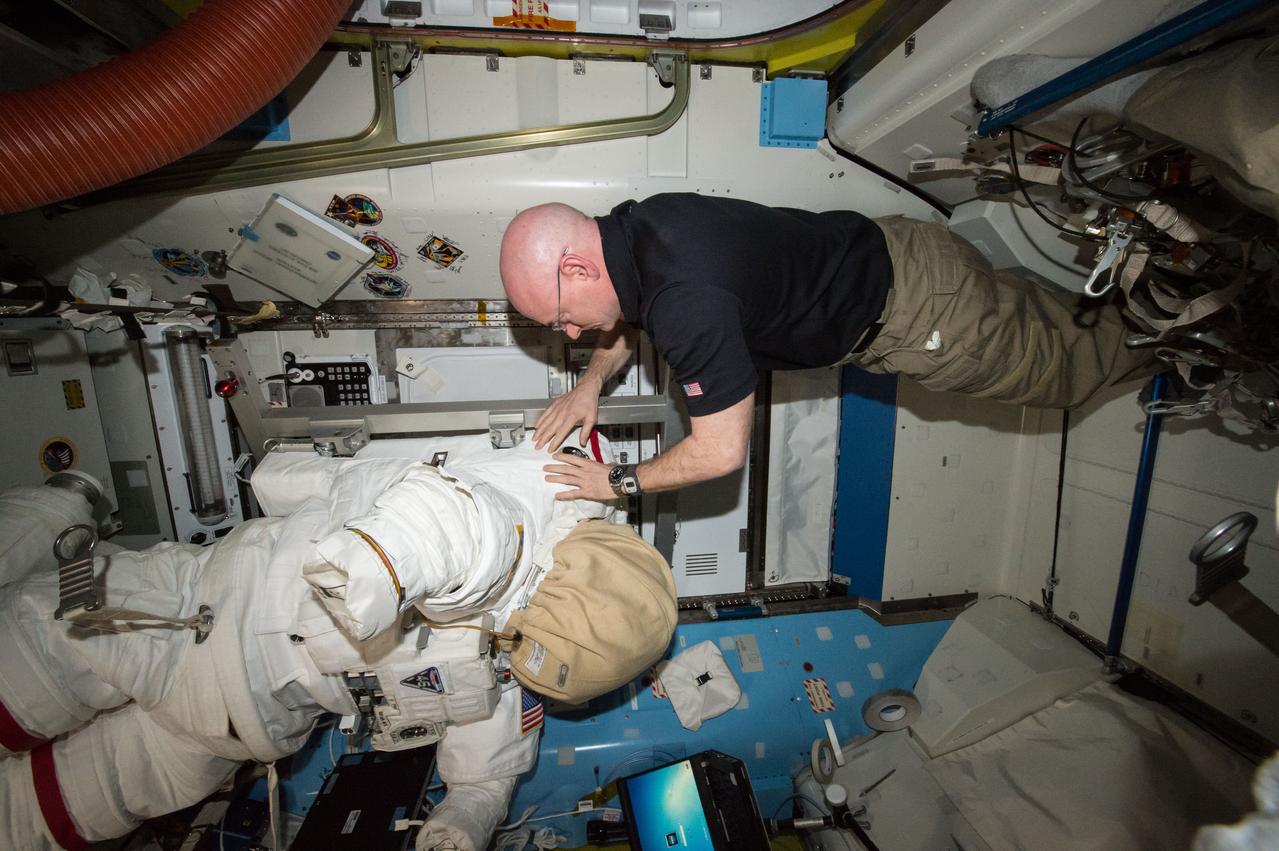
ISS046e025801 (01/27/2016) --- NASA astronaut Scott Kelly relocates spacewalk hardware and suits inside the Quest airlock on Jan. 27, 2016.
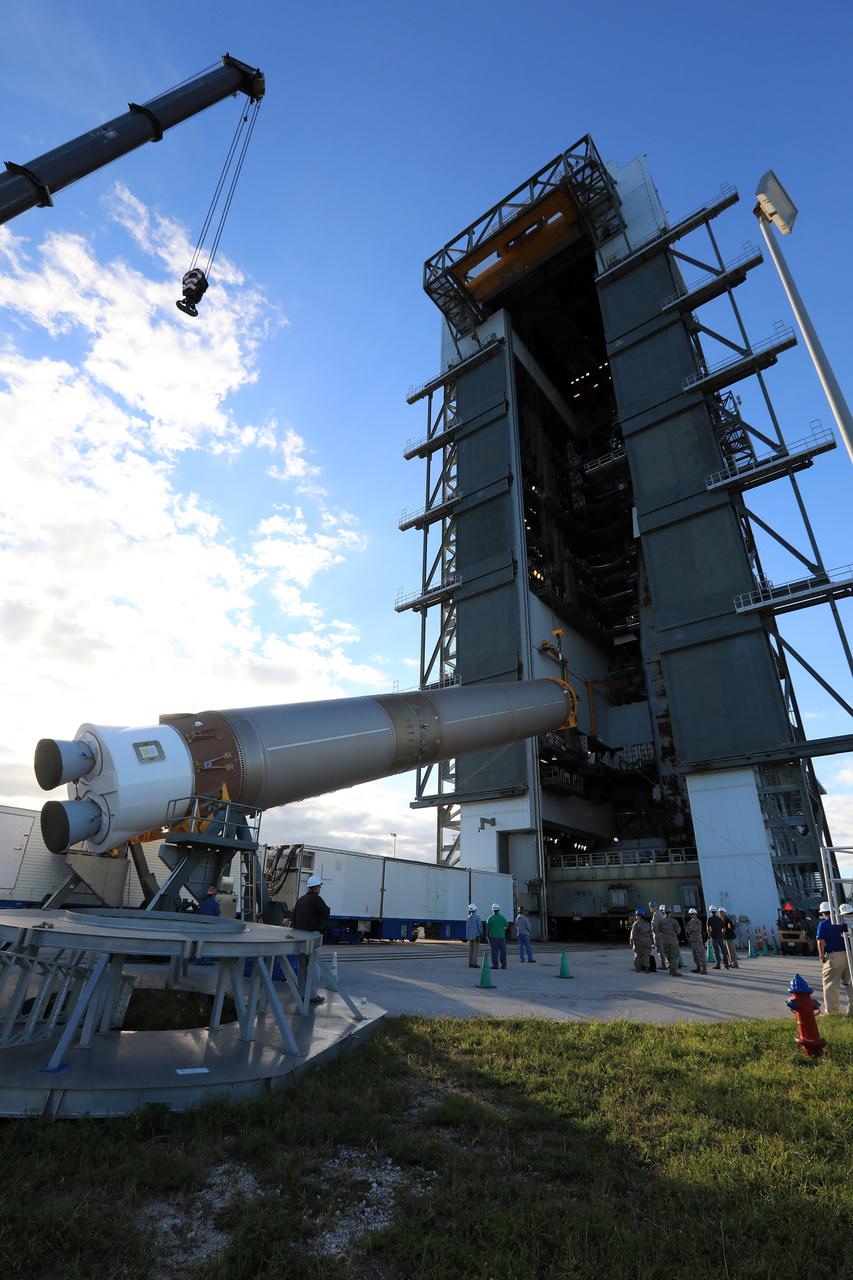
United Launch Alliance team members monitor the progress as the operation begins to lift the Atlas V first stage to the vertical position at the Vertical Integration Facility at Space Launch Complex 41 at Cape Canaveral Air Force Station in Florida. The Geostationary Operational Environmental Satellite (GOES-R) will launch aboard the Atlas V rocket in November. GOES-R will be the first satellite in a series of next-generation NOAA GOES Satellites.

Apollo 11 astronaut Buzz Aldrin tries out Microsoft HoloLens mixed reality headset during a preview of the new Destination: Mars experience at the Kennedy Space Center Visitor Complex. Destination: Mars gives guests an opportunity to “visit” several sites on Mars using real imagery from NASA’s Curiosity Mars Rover. Based on OnSight, a tool created by NASA’s Jet Propulsion Laboratory in Pasadena, California, the experience brings guests together with a holographic version of Aldrin as they are guided to Mars using the headset. Photo credit: NASA/Charles Babir

The Soyuz MS-02 spacecraft is seen as the work platforms around it are closed following encapsulation in its fairing on Thursday, Tuesday, Oct. 11, 2016 at the Baikonur Cosmodrome in Kazakhstan. Expedition 49 flight engineer Shane Kimbrough of NASA, flight engineer Andrey Borisenko of Roscosmos, and Soyuz commander Sergey Ryzhikov of Roscosmos are scheduled to launch from the Baikonur Cosmodrome in Kazakhstan on Oct. 19. Photo Credit: (NASA/Victor Zelentsov)
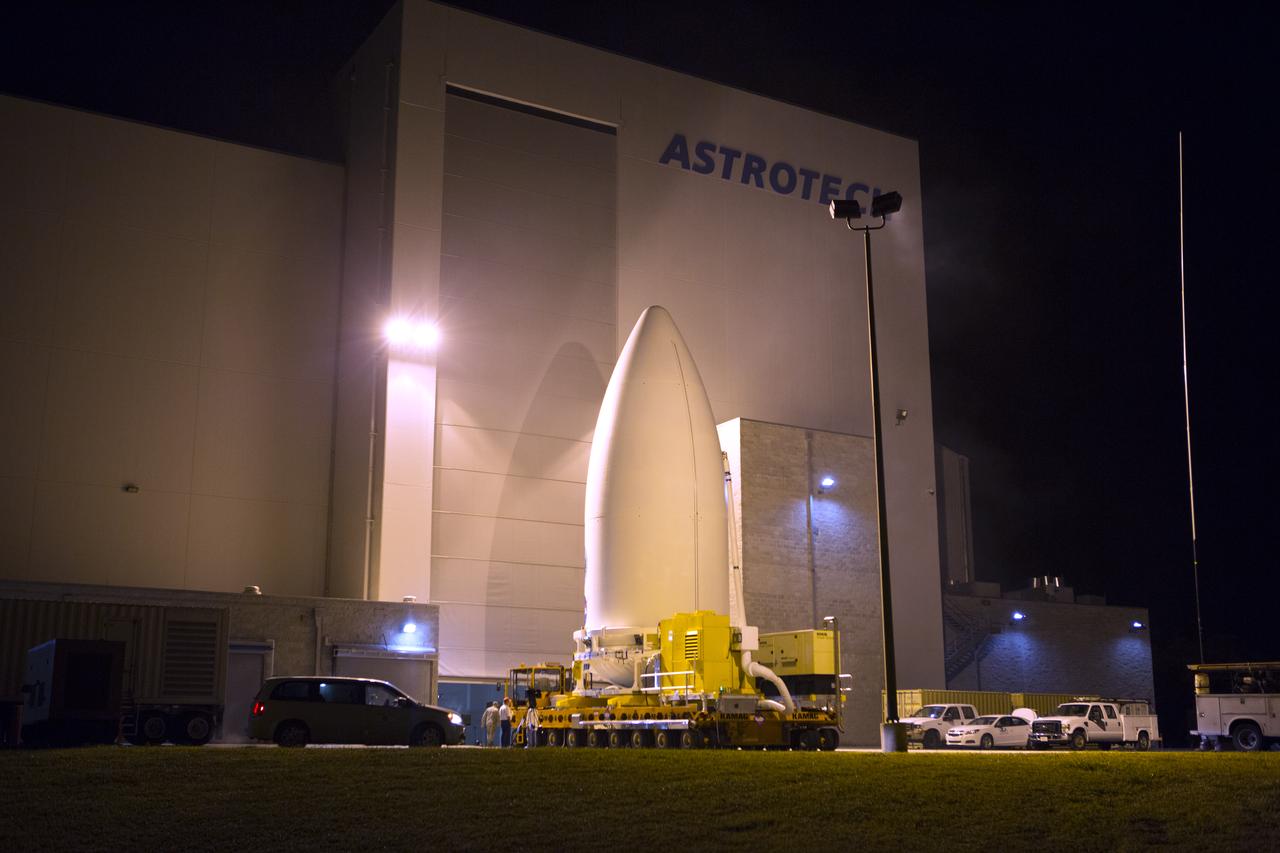
Enclosed in its payload fairing, NOAA's Geostationary Operational Environmental Satellite (GOES-R) departs from the Astrotech payload processing facility in Titusville, Florida, near NASA's Kennedy Space Center. GOES-R will be transported to the Vertical Integration Facility at Space Launch Complex 41 at Cape Canaveral Air Force Station. The satellite will launch aboard a United Launch Alliance Atlas V rocket in November. GOES-R is the first satellite in a series of next-generation NOAA GOES Satellites.
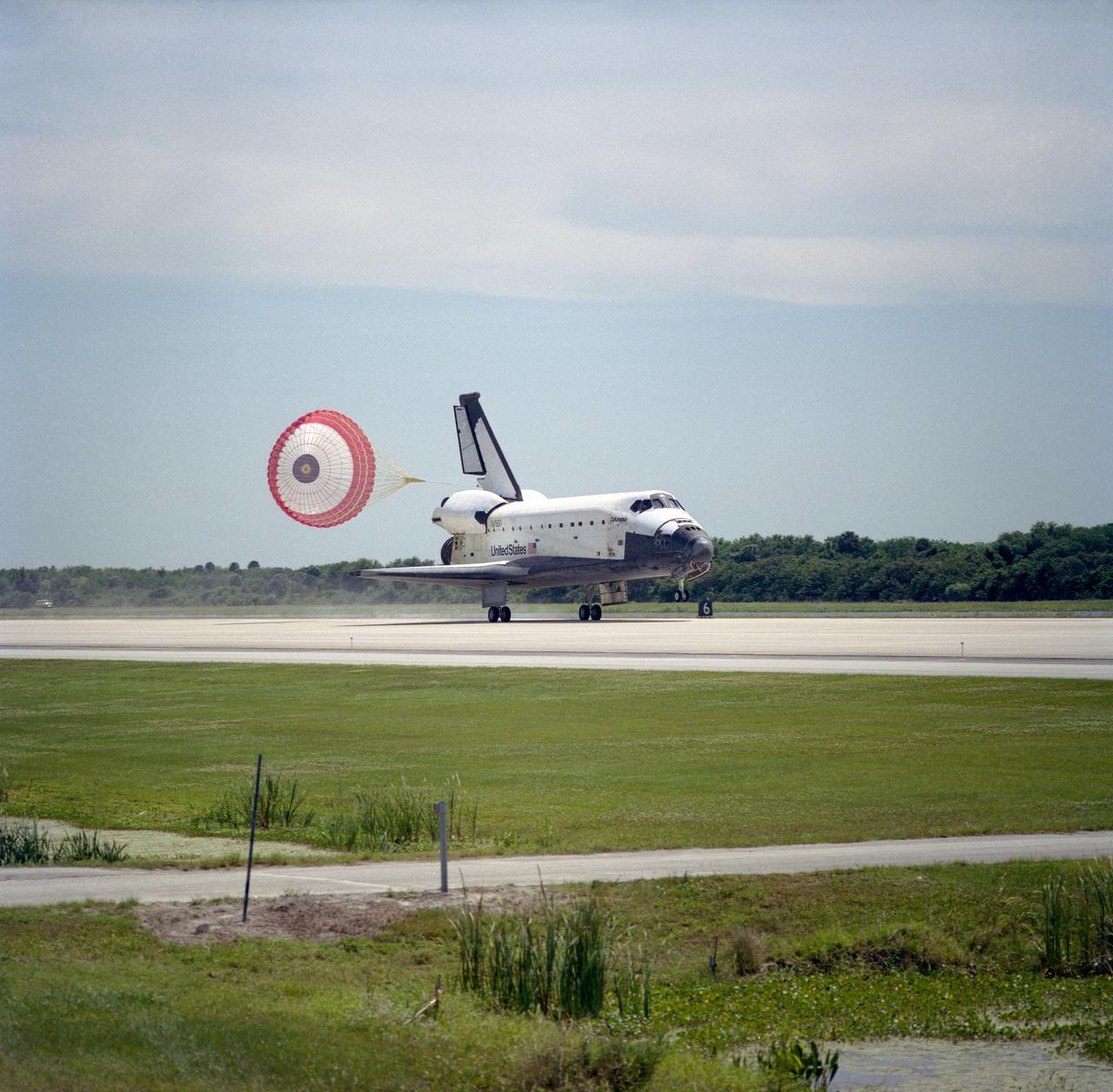
STS083-S-001 008
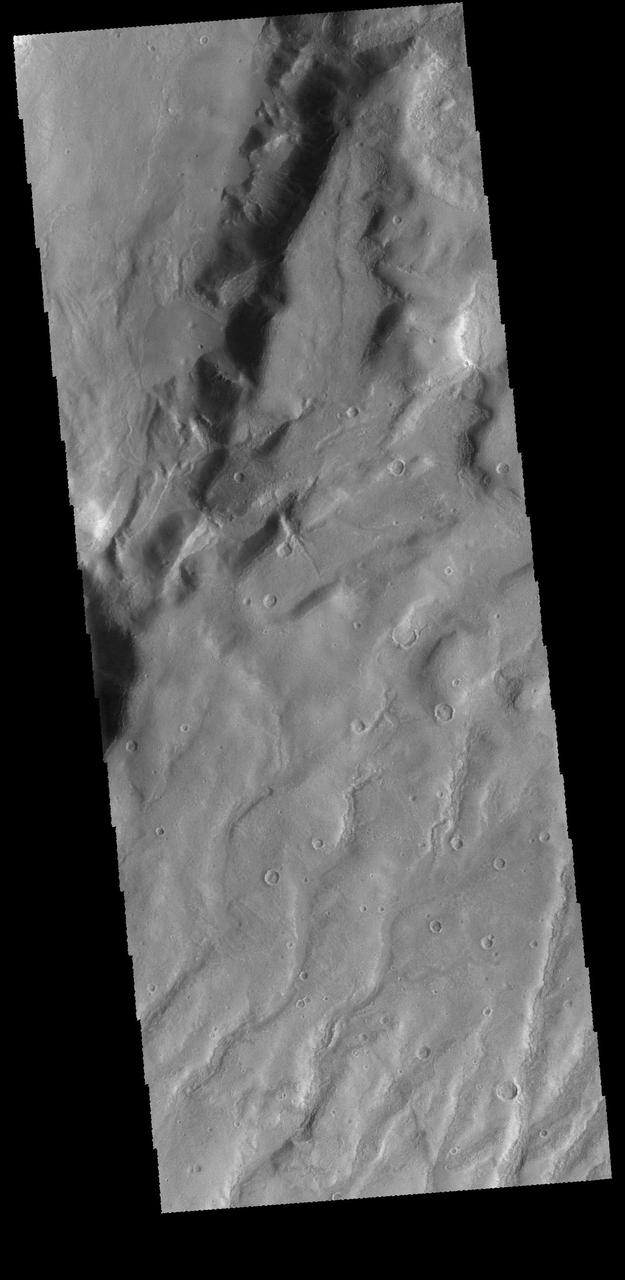
This VIS image shows several channels dissecting the higher elevations of Claritas Fossae. Orbit Number: 65209 Latitude: -40.6523 Longitude: 266 Instrument: VIS Captured: 2016-08-26 03:33 http://photojournal.jpl.nasa.gov/catalog/PIA21005

Inside Building 1555 at Vandenberg Air Force Base in California, technicians and engineers perform final wing installations on the Orbital ATK Pegasus XL rocket which will launch eight NASA Cyclone Global Navigation Satellite System, or CYGNSS, spacecraft. When preparations are completed at Vandenberg, the rocket, with CYGNSS in its payload fairing, will be attached to the Orbital ATK L-1011 carrier aircraft and transported to NASA’s Kennedy Space Center in Florida. On Dec. 12, 2016, the carrier aircraft is scheduled to take off from the Skid Strip at Cape Canaveral Air Force Station and CYGNSS will launch on the Pegasus XL rocket with the L-1011 flying off shore. CYGNSS will make frequent and accurate measurements of ocean surface winds throughout the life cycle of tropical storms and hurricanes. The data that CYGNSS provides will enable scientists to probe key air-sea interaction processes that take place near the core of storms, which are rapidly changing and play a critical role in the beginning and intensification of hurricanes.
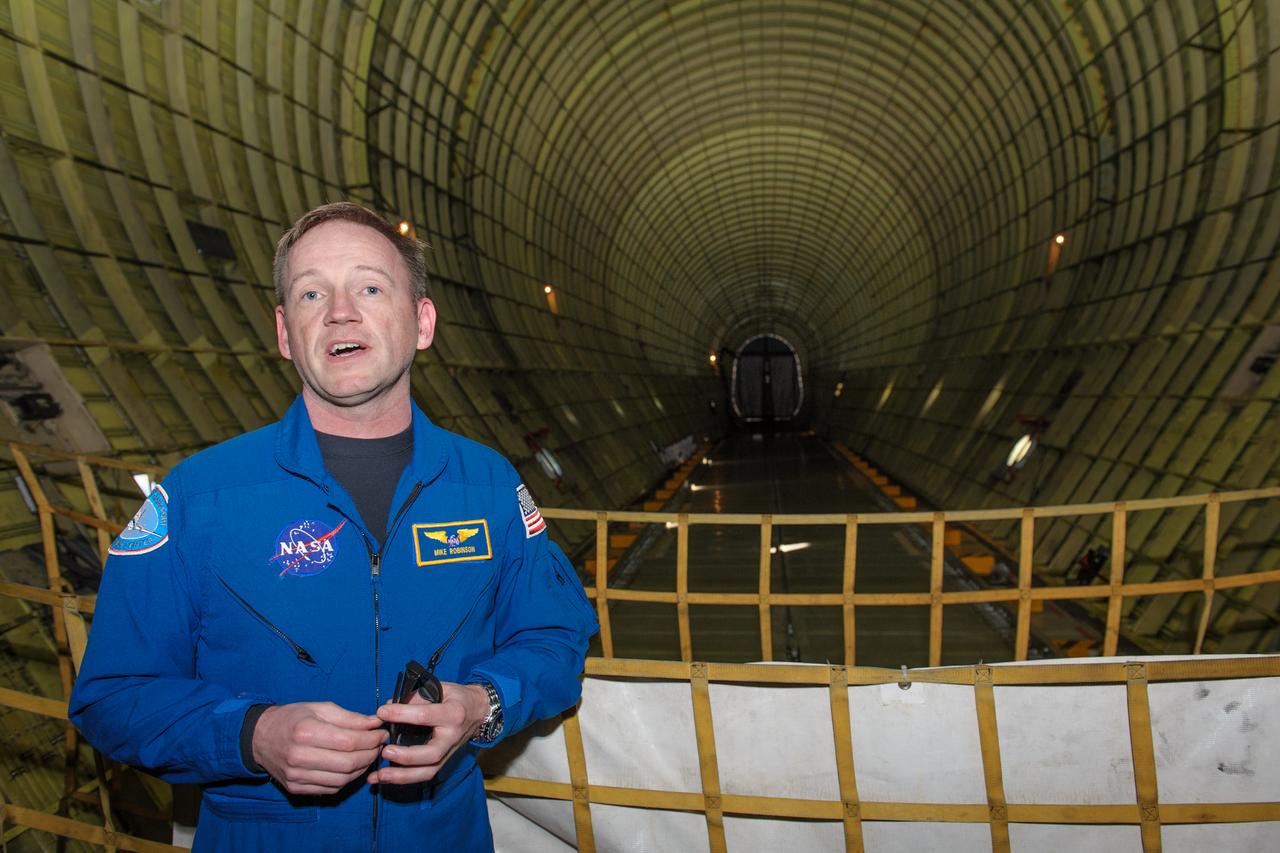
Super Guppy Flight Engineer Michael Robinson inside the Cargo Hold. The Super Guppy's cargo hold has a useable volume of 39,000 cubic feet and can fly up to 52,000 pounds as far as 564 miles and has a cruising speed of 290 MPH.
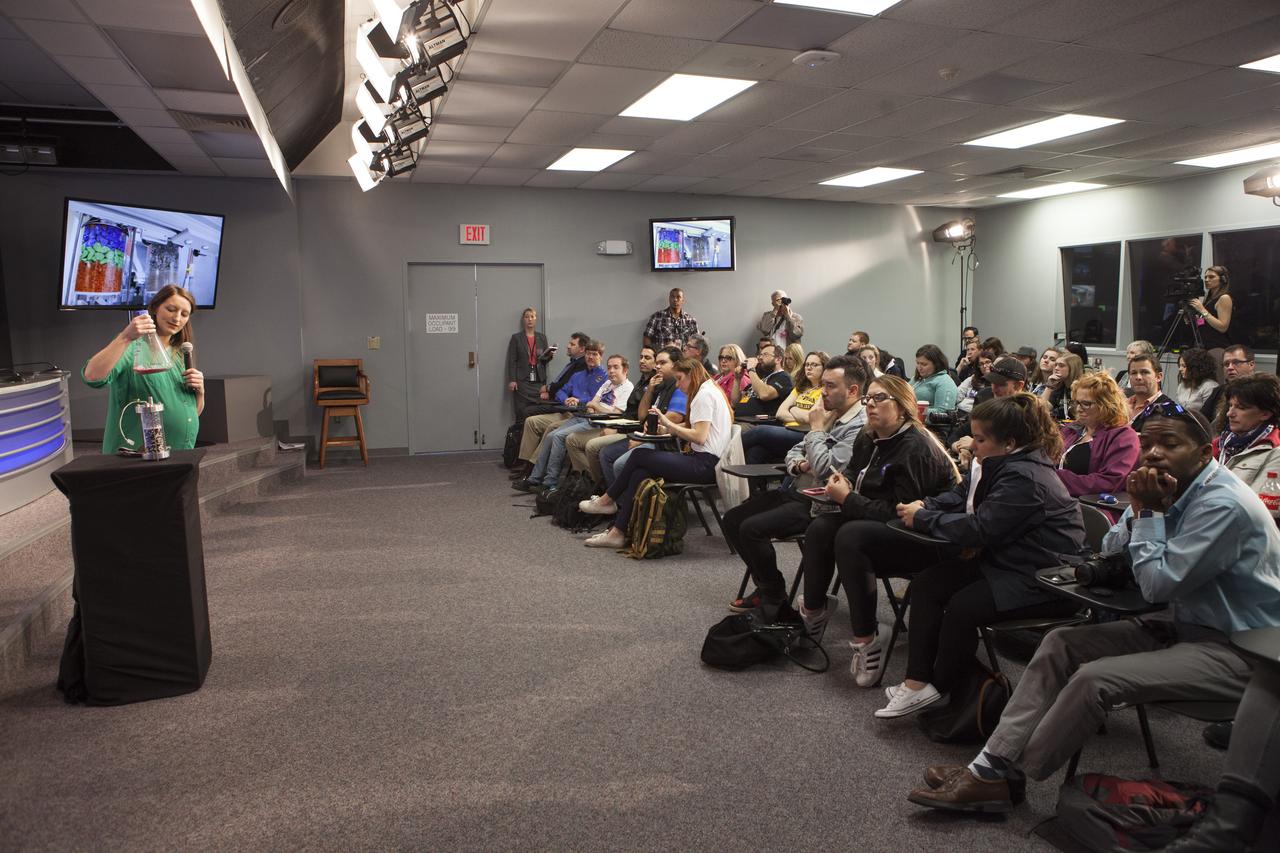
Dr. Kristen John, deputy project manager and co-investigator for the Strata-1 experiment at the Johnson Space Center in Houston , speaks to members of the media in the Kennedy Space Center’s Press Site auditorium. The briefing focused on science research and technology work planned for the International Space Station, or ISS, following the arrival of a Cygnus spacecraft. The Cygnus is scheduled to be launched March 22 atop a United Launch Alliance Atlas V rocket on the Orbital ATK CRS-6 commercial resupply services mission.
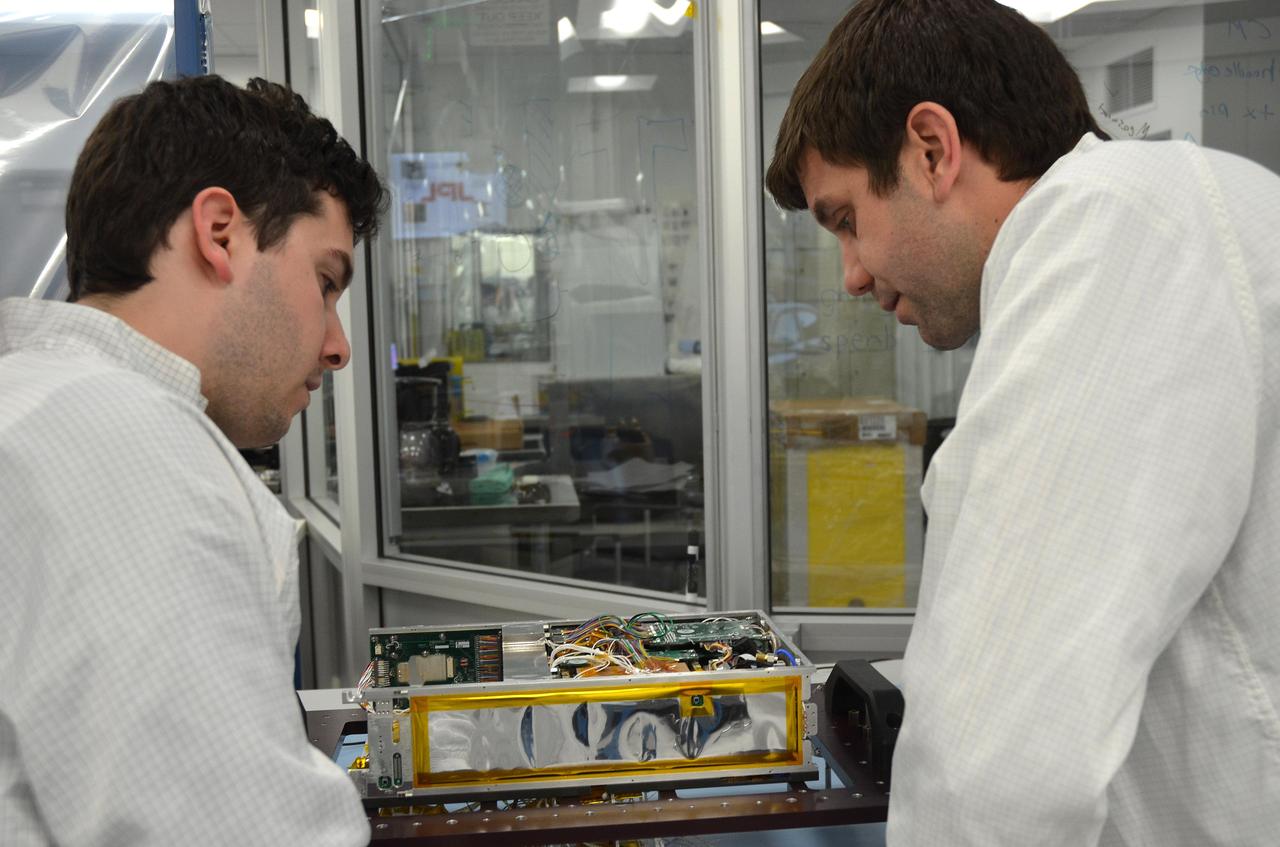
Engineers for NASA's MarCO (Mars Cube One) technology demonstration inspect one of the two MarCO CubeSats. Cody Colley, MarCO integration and test deputy, left, and Andy Klesh, MarCO chief engineer, are on the team at NASA's Jet Propulsion Laboratory, Pasadena, California, preparing twin MarCO CubeSats. The briefcase-size MarCO twins were designed to ride along with NASA's next Mars lander, InSight. Its planned March 2016 launch was suspended. InSight -- an acronym for Interior Exploration using Seismic Investigations, Geodesy and Heat Transport -- will study the interior of Mars to improve understanding of the processes that formed and shaped rocky planets, including Earth. Note: After thorough examination, NASA managers have decided to suspend the planned March 2016 launch of the Interior Exploration using Seismic Investigations Geodesy and Heat Transport (InSight) mission. The decision follows unsuccessful attempts to repair a leak in a section of the prime instrument in the science payload. http://photojournal.jpl.nasa.gov/catalog/PIA20342
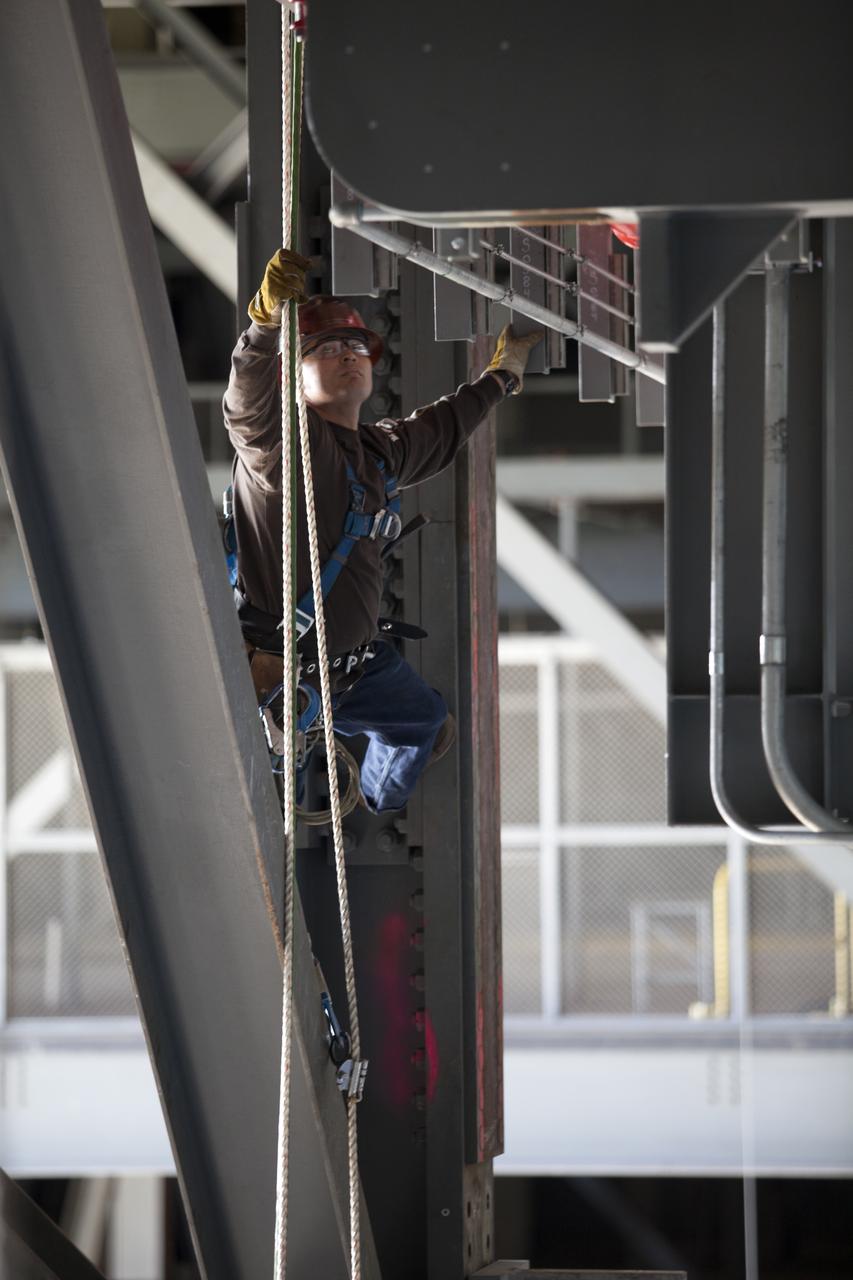
A construction worker wearing a safety harness and tethered lines prepares to assist with the installation of the second half of the B-level work platforms, B north, for NASA’s Space Launch System (SLS) rocket, high up in the Vehicle Assembly Building (VAB) at NASA’s Kennedy Space Center in Florida. The B platform will be installed on the north side of High Bay 3. The B platforms are the ninth of 10 levels of work platforms that will surround and provide access to the SLS rocket and Orion spacecraft for Exploration Mission 1. The Ground Systems Development and Operations Program is overseeing upgrades and modifications to VAB High Bay 3, including installation of the new work platforms, to prepare for NASA’s Journey to Mars.
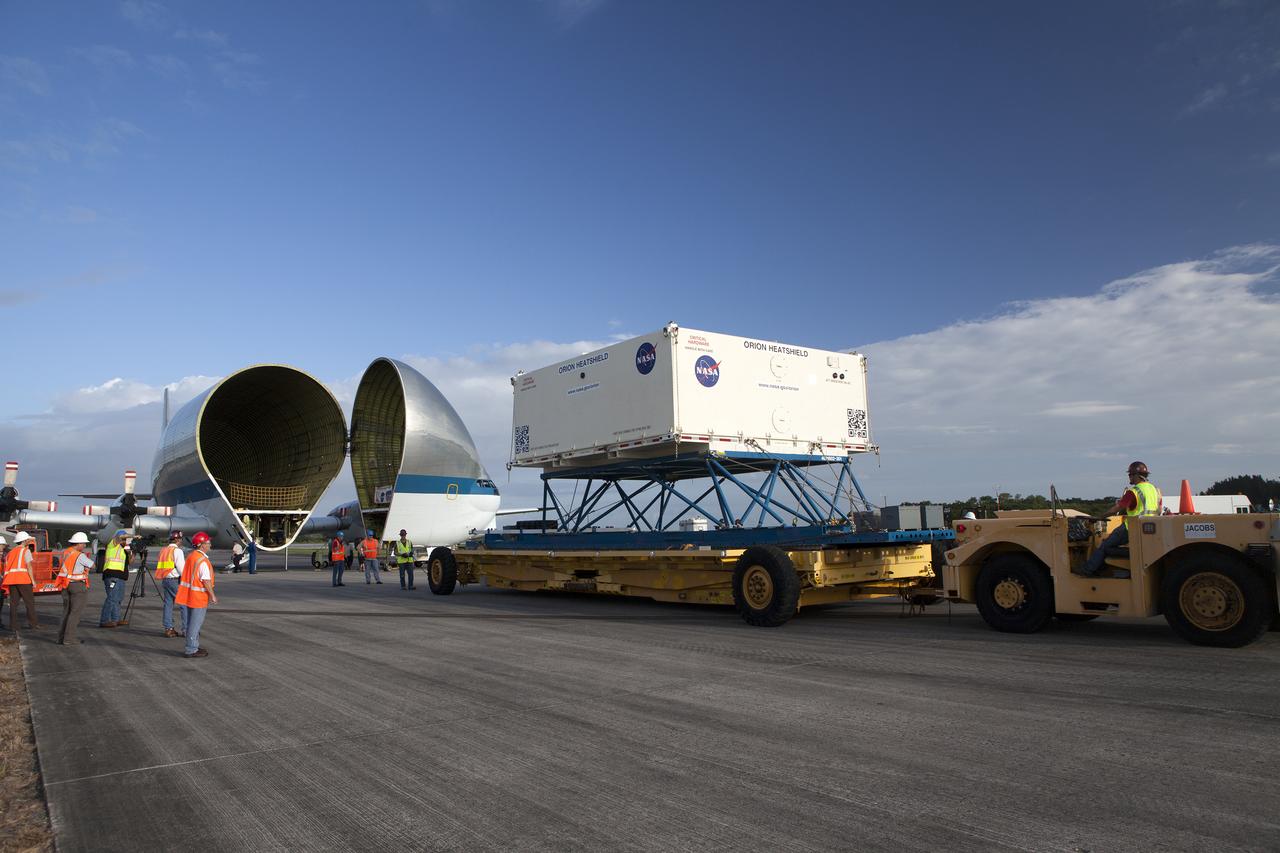
The shipping container carrying the Orion heat shield for Exploration Mission 1 (EM-1) was offloaded from NASA’s Super Guppy aircraft at the Shuttle Landing Facility, managed and operated by Space Florida, at the agency’s Kennedy Space Center in Florida. The heat shield will be transported to the Neil Armstrong Operations and Checkout Building high bay for processing. The heat shield arrived from Lockheed Martin’s manufacturing facility near Denver. The Orion spacecraft will launch atop NASA’s Space Launch System rocket on EM-1, an uncrewed test flight, in 2018.
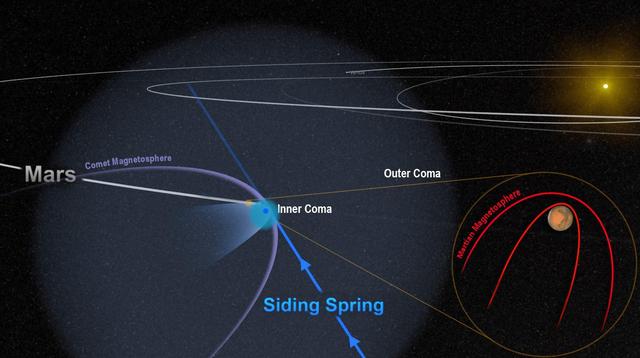
This artist depiction shows the close encounter between comet Siding Sprng and Mars in 2014. The comet powerful magnetic field temporarily merged with, and overwhelmed, the planet weak magnetic field.
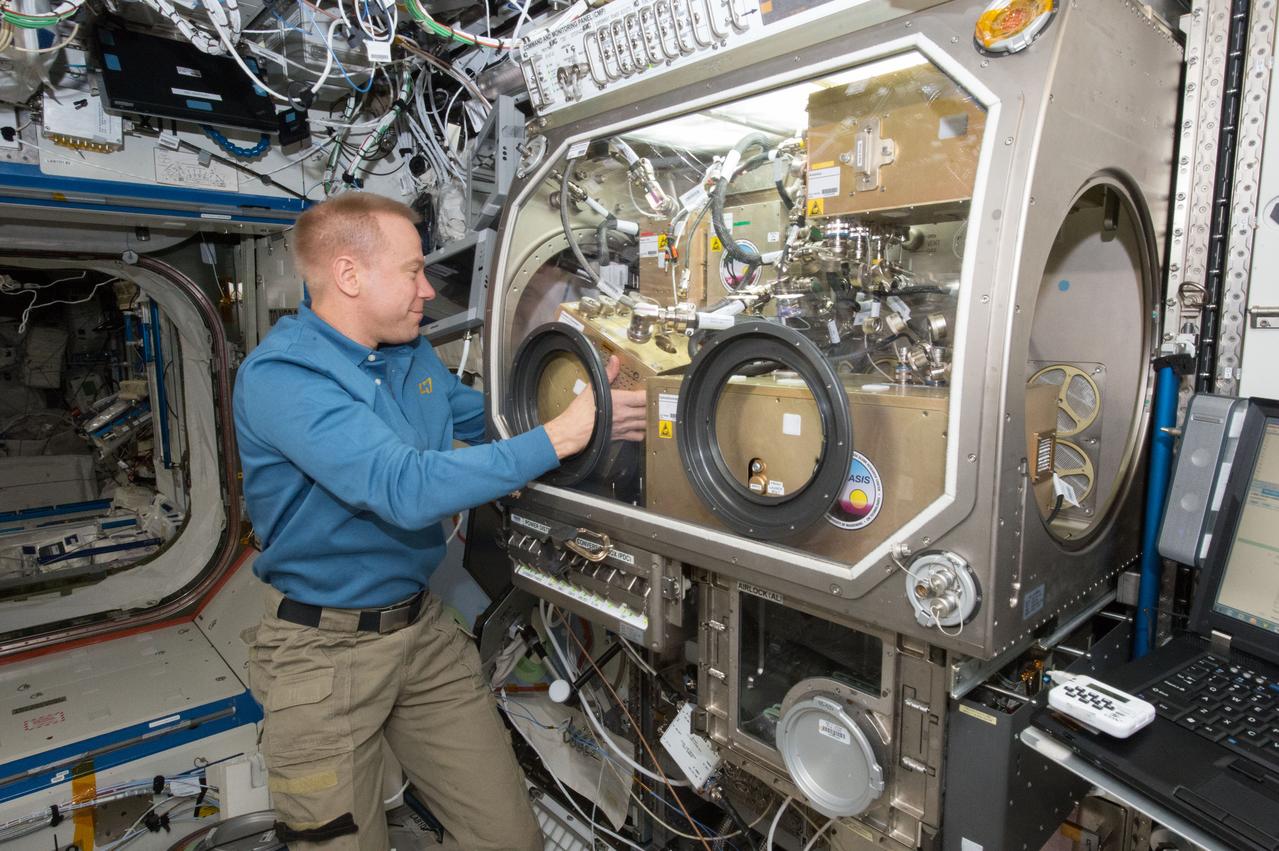
iss047e012491 (03/21/2016) --- NASA astronaut Tim Kopra stows hardware from the OASIS experiment aboard the International Space Station. OASIS, which stands for Observation and Analysis of Smectic Islands In Space, studies the unique behavior of liquid crystals in microgravity.
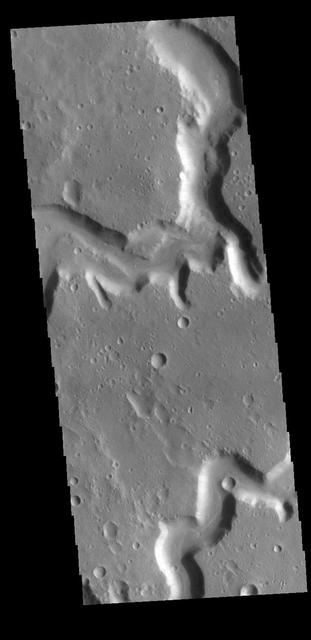
This image captured by NASA 2001 Mars Odyssey spacecraft shows both branches of Nanedi Valles, close to the point where they join to form a single channel.
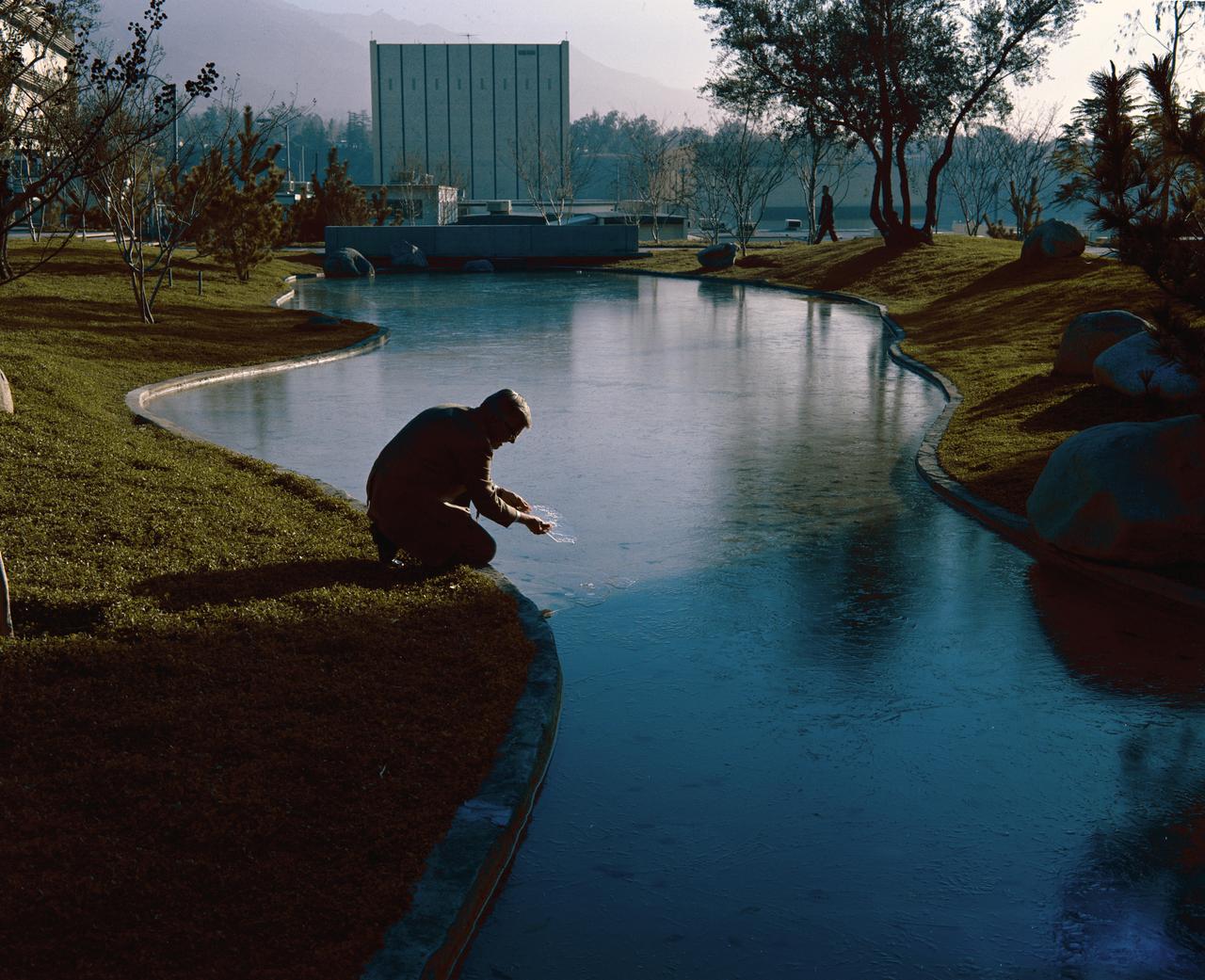
This archival image was released as part of a gallery comparing JPL's past and present, commemorating the 80th anniversary of NASA's Jet Propulsion Laboratory on Oct. 31, 2016. This photograph from 1971 shows the open-air gathering area at NASA's Jet Propulsion Laboratory known as "The Mall." It looks east towards the Applied Mechanics building (the blocky white building now numbered 157). The person in the foreground is Robert Steinbacher, the project scientist for the Mariner 9 mission to Mars. The concrete bridge crossing the ponds remains, even though the ponds have been removed. Many trees and another building, the Central Engineering Building (301), block the view to Building 157 now. http://photojournal.jpl.nasa.gov/catalog/PIA21125
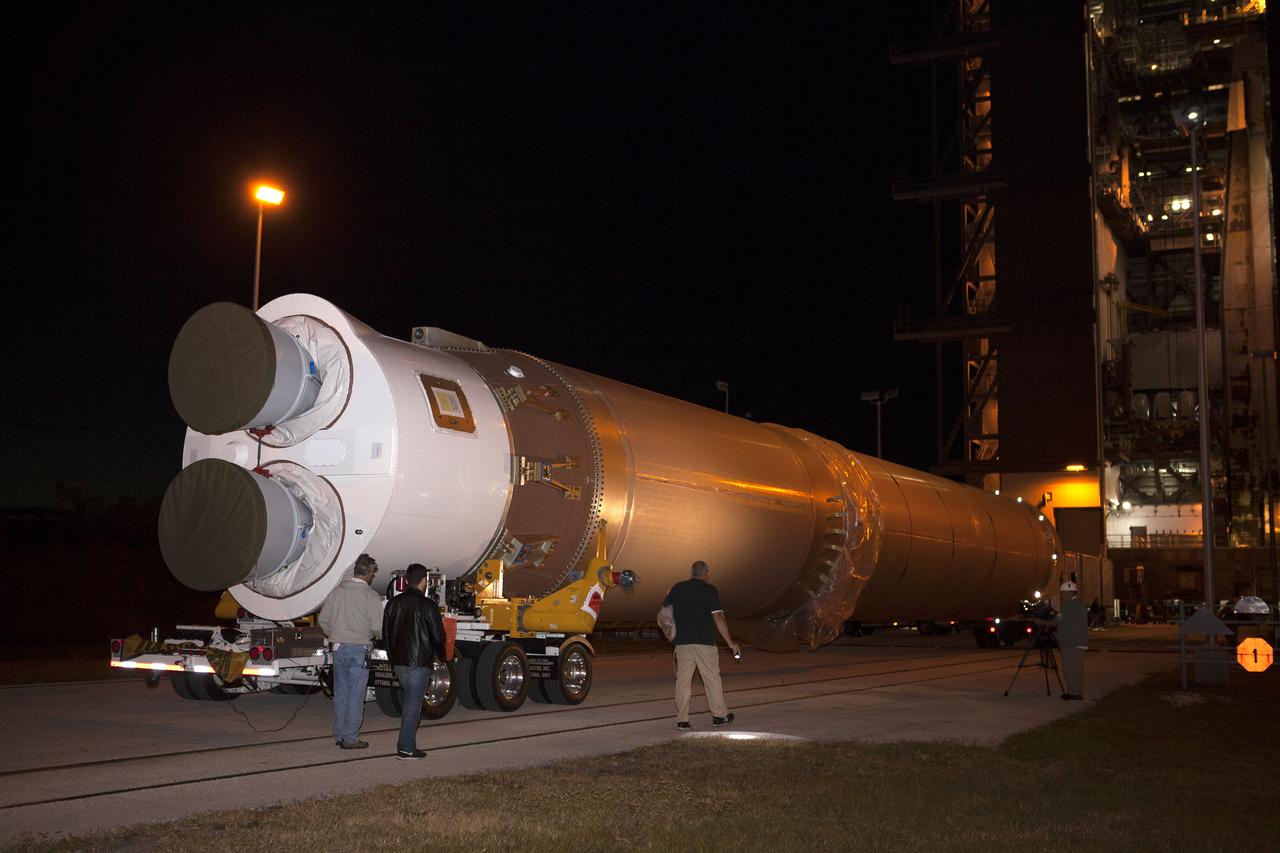
The United Launch Alliance Atlas V first stage arrives at the Vertical Integration Facility at Space Launch Complex 41 at Cape Canaveral Air Force Station in Florida. The Geostationary Operational Environmental Satellite (GOES-R) will launch aboard the Atlas V rocket in November. GOES-R will be the first satellite in a series of next-generation NOAA GOES Satellites.
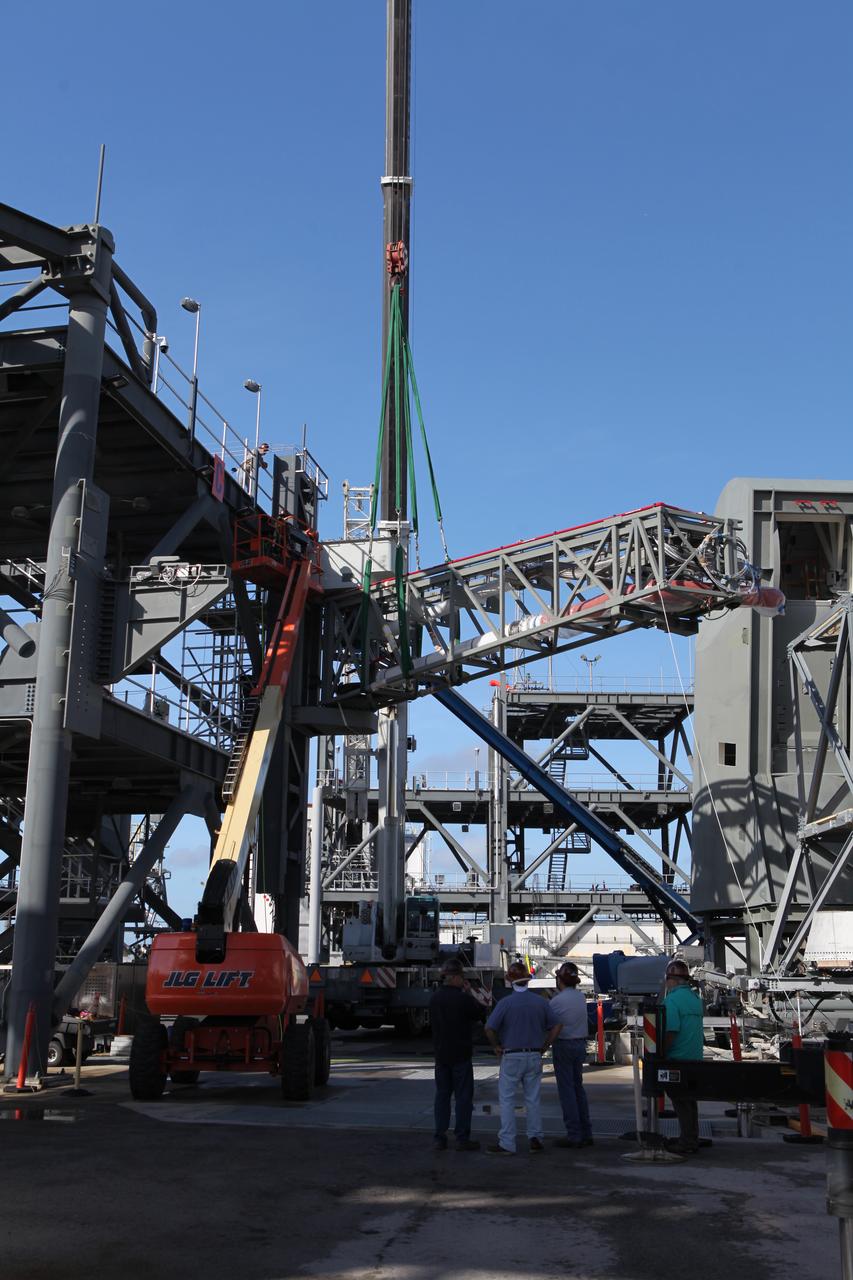
A crane moves the Core State Inter-tank Umbilical (CSITU) for NASA's Space Launch System (SLS) closer for attachment to the "C" tower of the Vehicle Motion Simulator 2 test fixture at the Launch Equipment Test Facility at the agency's Kennedy Space Center in Florida. The umbilical will undergo a series of tests to confirm it is functioning properly and ready to support the SLS rocket for launch. The CSITU is a swing arm umbilical that will connect to the SLS core stage inter-tank. The umbilical's main function is to vent gaseous hydrogen from the core stage. The arm also provides conditioned air, pressurized gases, and power and data connection to the core stage. The center’s Engineering Directorate and the Ground Systems Development and Operations Program are overseeing processing and testing of the umbilicals.

STS083-712-063 (4-8 April 1997) --- Northern half of Long Island, Bahamas. The vivid blues of the Bahamas stand out from space. Long Island and Great Exuma Island, which extends from the west north west into the photo, is on the eastern side of the Great Bahama Bank and form the borders of Exuma Sound. This photograph provides a rare opportunity to observe a natural chemical laboratory at work. Limestone of quite a different sort from that forming the Great Barrier Reef is actually in the process of formation. Long Island itself is little more than a sandbar rising just a few meters (about 30 to 50 meters) above sea level but it separates the deep, dark blue waters of the Atlantic on the right from the 10-meter (33 feet) shallows of the Great Bahama Bank (left). Details of the topography of the bank are visible through the clear waters. The shallow waters are warm and become extremely salty. Crystals of aragonite, a calcium carbonate mineral, are precipitated and formed into spherical sand-sized oolites as the tidal currents swirl back and forth. Lithification of the carbonate sands produces an oolithic limestone. Although the water is warm and clear, corals do not live in the shallows, probably because of the elevated salt content. Although chemically similar, the oolithic limestone forming Long Island is very different from coral reef limestone. An airfield is visible at the northern and central (bottom of photo) part of the island.
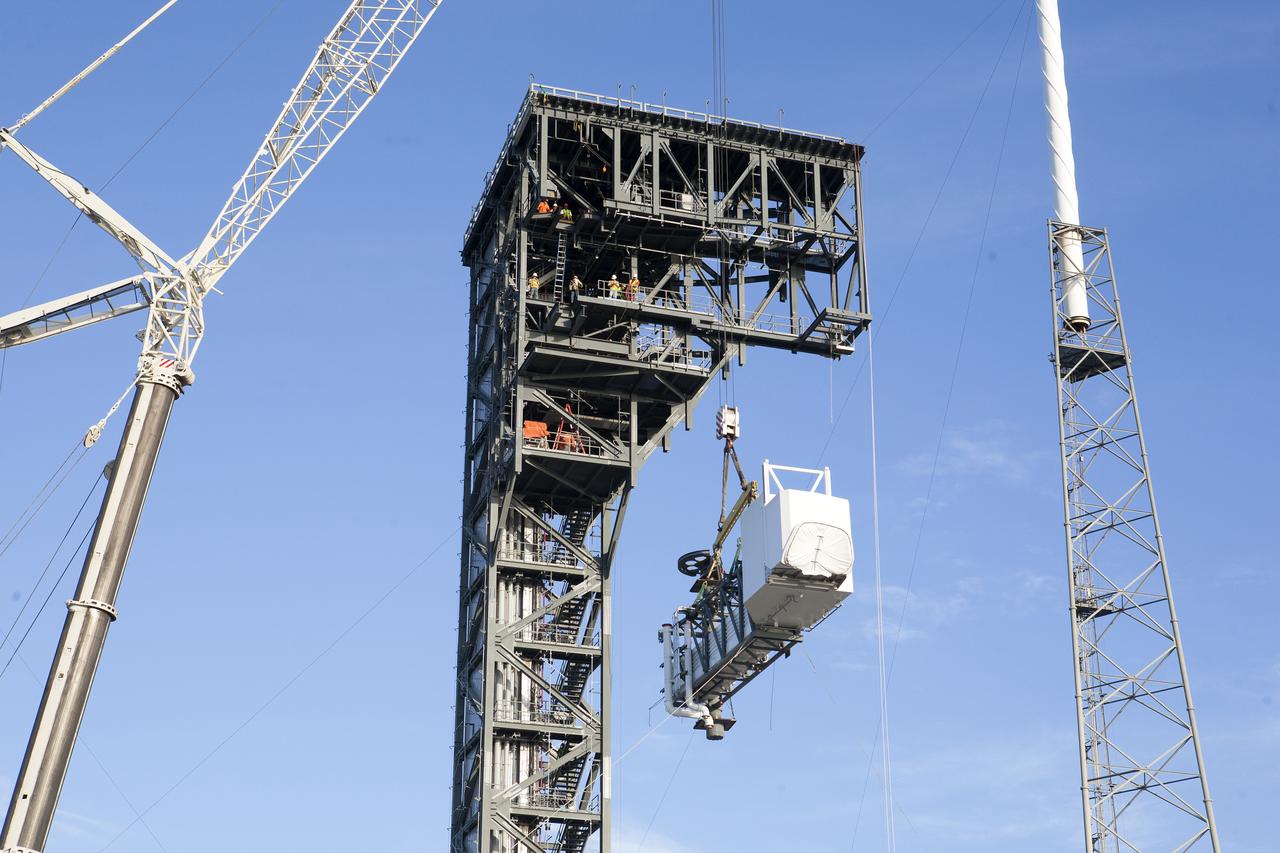
A crane lifts the Crew Access Arm and White Room for Boeing's CST-100 Starliner spacecraft to be attached to the Crew Access Tower at Cape Canaveral Air Force Station’s Space Launch Complex 41. When attached to the 200-foot tall Crew Access Tower, the arm will serve as the connection that astronauts will walk through prior to boarding the Starliner spacecraft when stacked atop a United Launch Alliance Atlas V rocket. This installation completes the major construction of the first new Crew Access Tower to be built at the Cape since the Apollo era. Under a Commercial Crew Transportation Capability (CCtCap) contract with NASA, Boeing’s Starliner system will be certified by NASA's Commercial Crew Program to fly crews to and from the International Space Station.
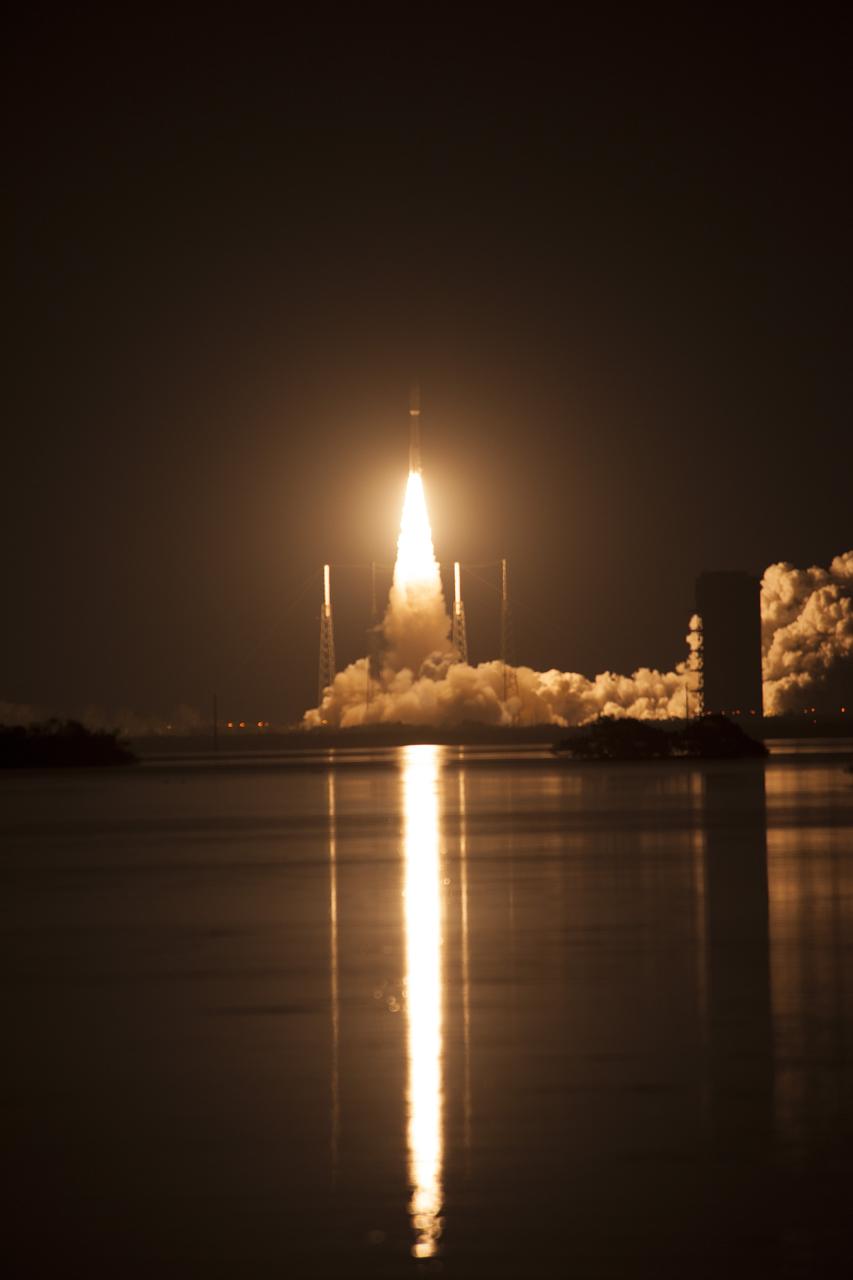
At Cape Canaveral Air Force Station's Space Launch Complex 41, an Atlas V rocket with NOAA's Geostationary Operational Environmental Satellite, or GOES-R, lifts off at 6:42 p.m. EST. GOES-R is the first satellite in a series of next-generation GOES satellites for NOAA, the National Oceanographic and Atmospheric Administration. It will launch to a geostationary orbit over the western hemisphere to provide images of storms and help meteorologists predict severe weather conditionals and develop long-range forecasts.
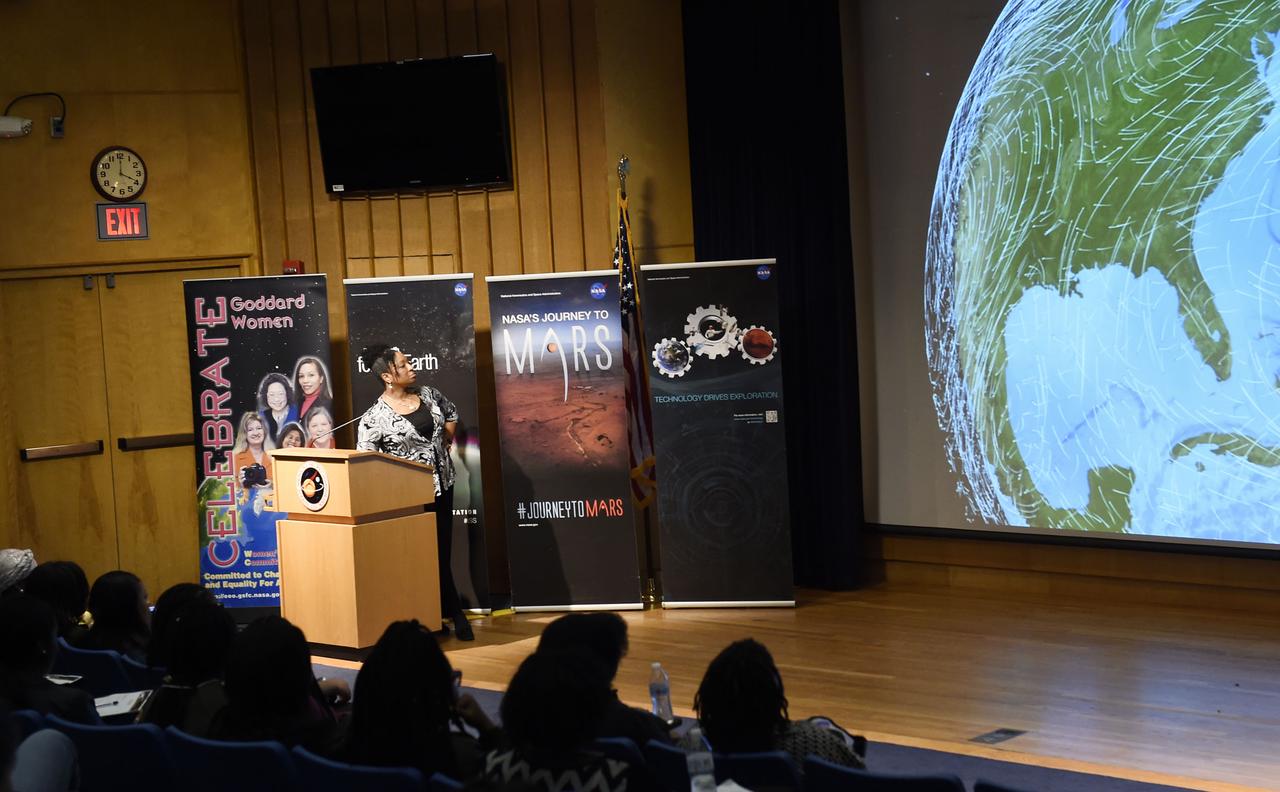
Girls Night In was held at Goddard on Nov 4-5, 2016. This is a pilot program which reinvigorates, inspires, and engages high school girls who may be struggling or not fully engaged in STEM (Science, Technology Engineering and Math) education. The program allowed NASA women to share and demonstrate the work they do, provide the girls an opportunity to completely immerse themselves in Goddard science, technology, engineering and math as well as provide them activities that will challenge and promote knowledge and discovery. Goddard invites other NASA centers tolearn from this pilot program and work towards a simultaneous multicenter event in the future. Participating schools were: DuVal, Crossland, Flowers, High Point, Northwestern and Oxon Hill
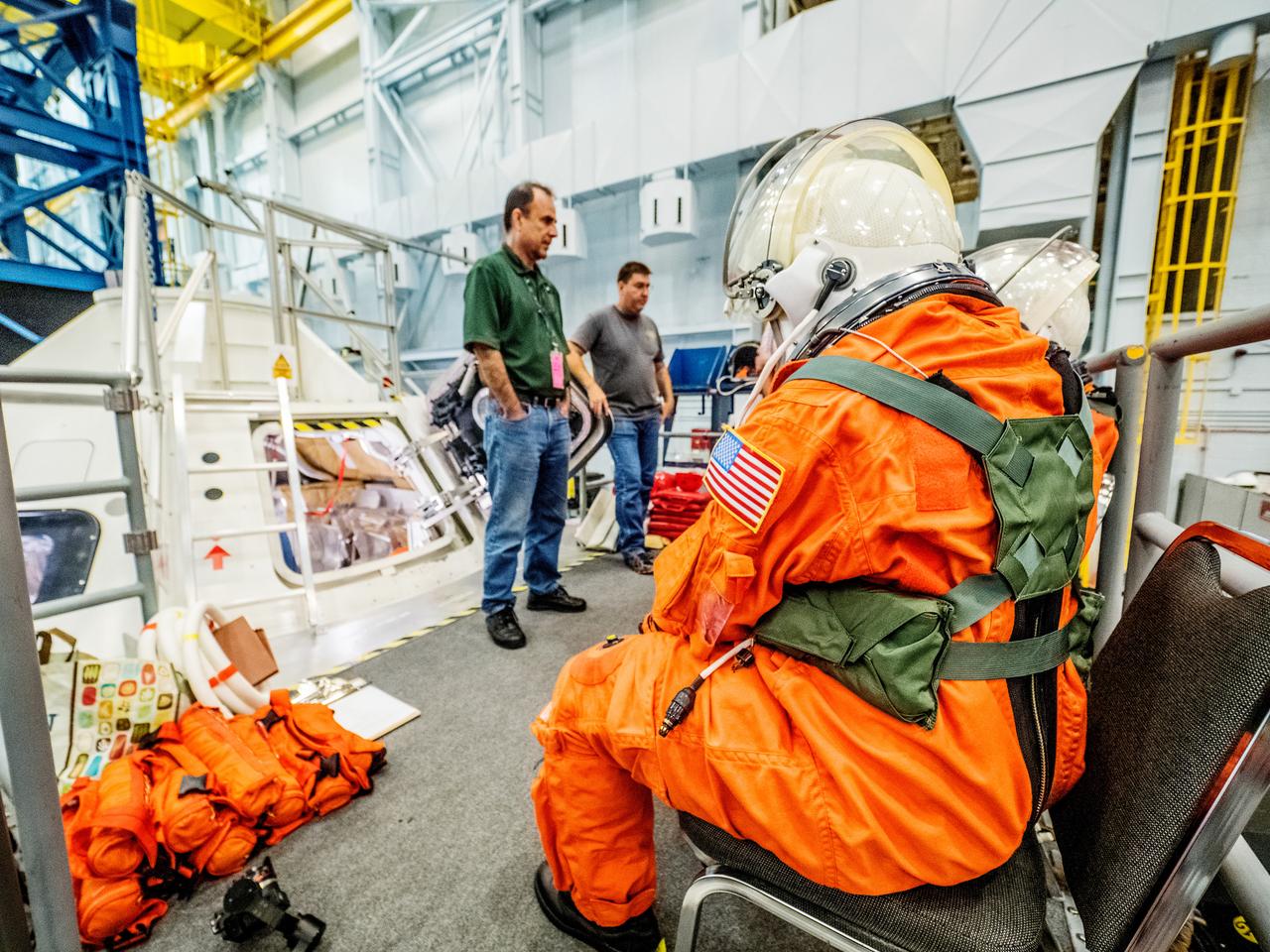
Engineers and astronauts conduct testing in a representative model of the Orion spacecraft at NASA’s Johnson Space Center in Houston on July 28, 2016 to gather the crew's feedback on the design of the docking hatch and on post-landing equipment operations. ..While the crew will primarily use the side hatch for entry and exit on Earth and the docking hatch to travel between Orion and a habitation module on long-duration deep space missions, the crew will need to be able to exit out of the docking hatch if wave heights in the Pacific Ocean upon splashdown are too high. The work is being done to help ensure all elements of Orion's design are safe and effective for the crew to use on future missions on the journey to Mars.
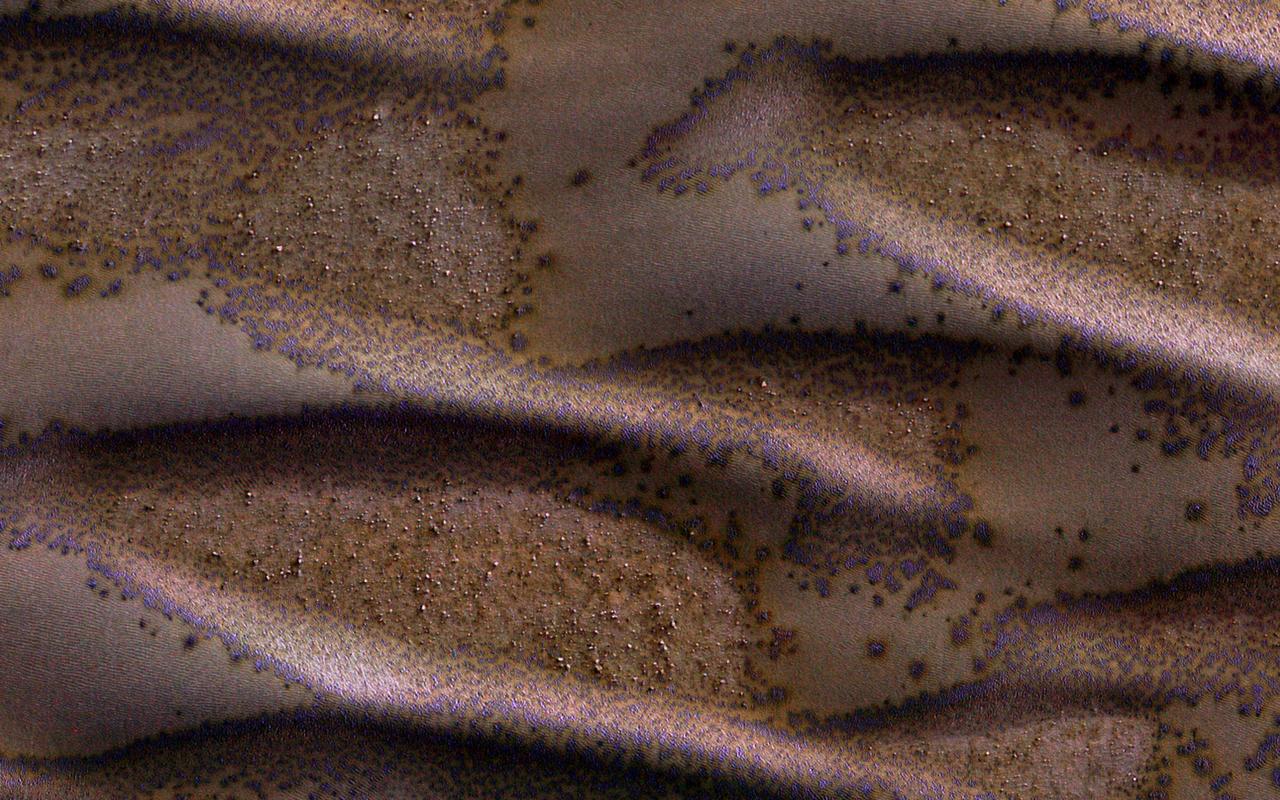
Sand dunes cover much of this terrain, which has large boulders lying on flat areas between the dunes in this image captured by NASA Mars Reconnaissance Orbiter spacecraft.
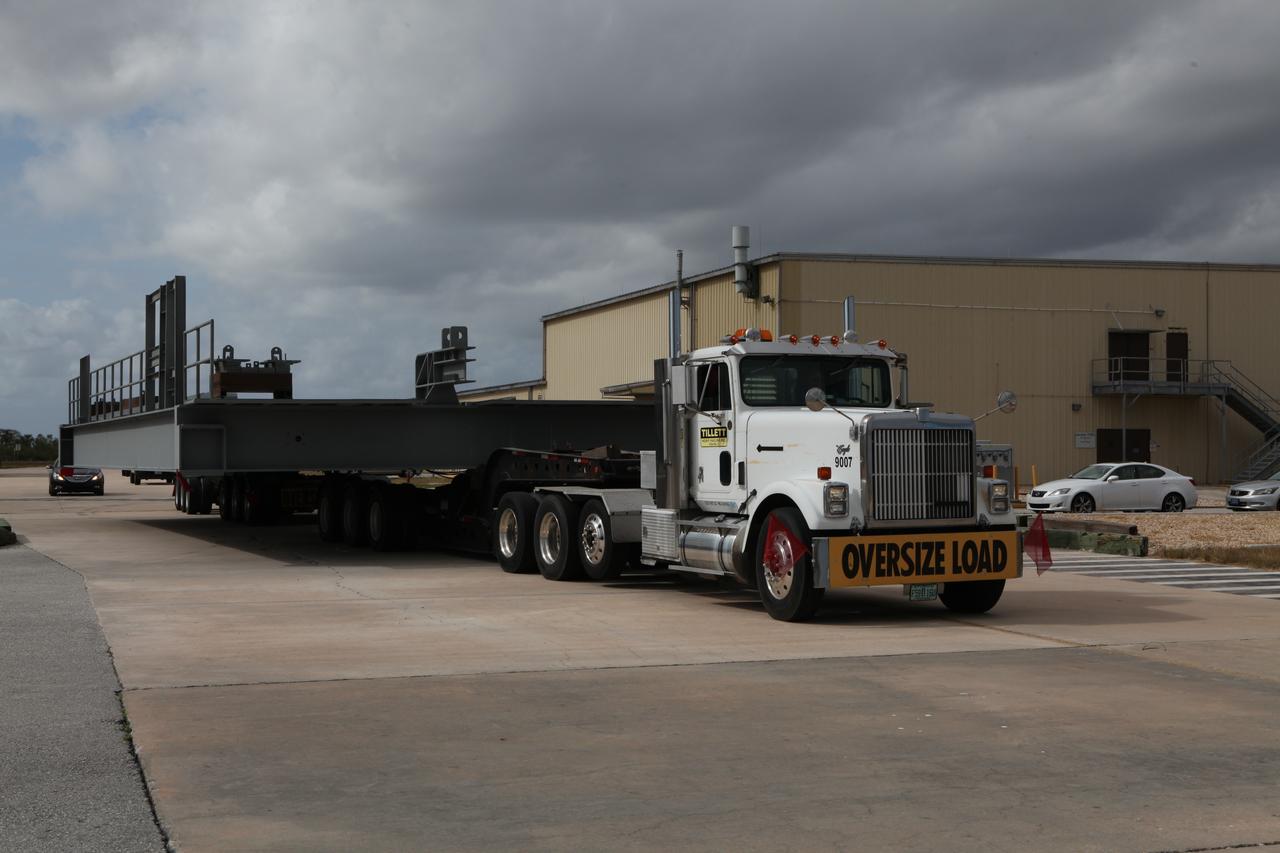
A heavy load transport truck from Tillett Heavy Hauling in Titusville, Florida, arrives at NASA’s Kennedy Space Center in Florida, carrying the first half of the A-level work platforms, A south, for the agency’s Space Launch System (SLS) rocket. The A-level platforms are the topmost platforms for High Bay 3 in the Vehicle Assembly Building (VAB). The platform will be delivered to the VAB staging area in the west parking lot. The Ground Systems Development and Operations Program is overseeing upgrades and modifications to High Bay 3 to support processing of the SLS and Orion spacecraft. A total of 10 levels of new platforms, 20 platform halves altogether, will surround the SLS rocket and Orion spacecraft and provide access for testing and processing.
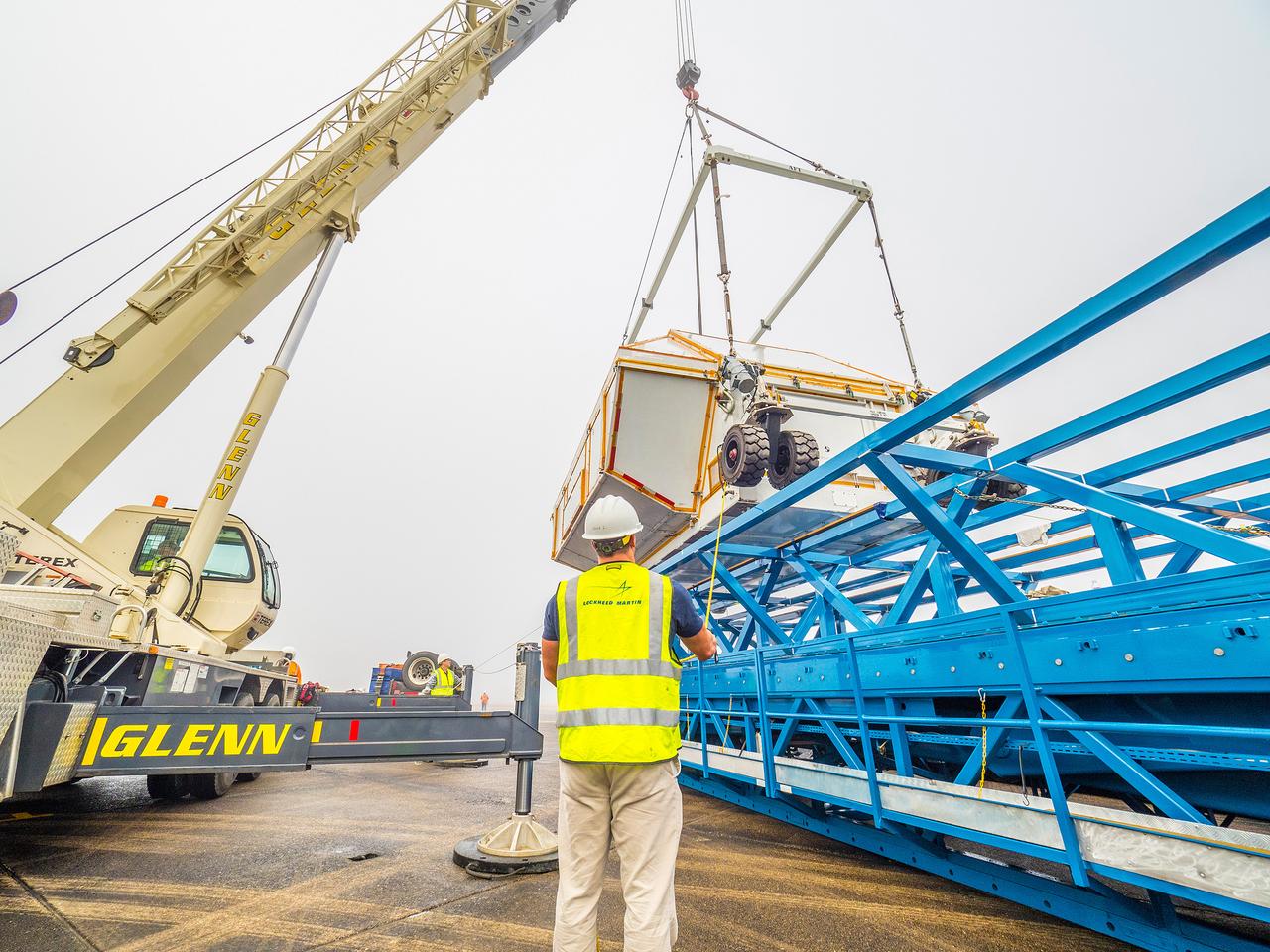
The Artemis I Orion crew module pressure vessel is loaded on NASA's Super Guppy plane in New Orleans for transport to Kennedy Space Center on Feb. 1, 2016. Part of Batch image transfer from Flickr.
#NASAMarsDay
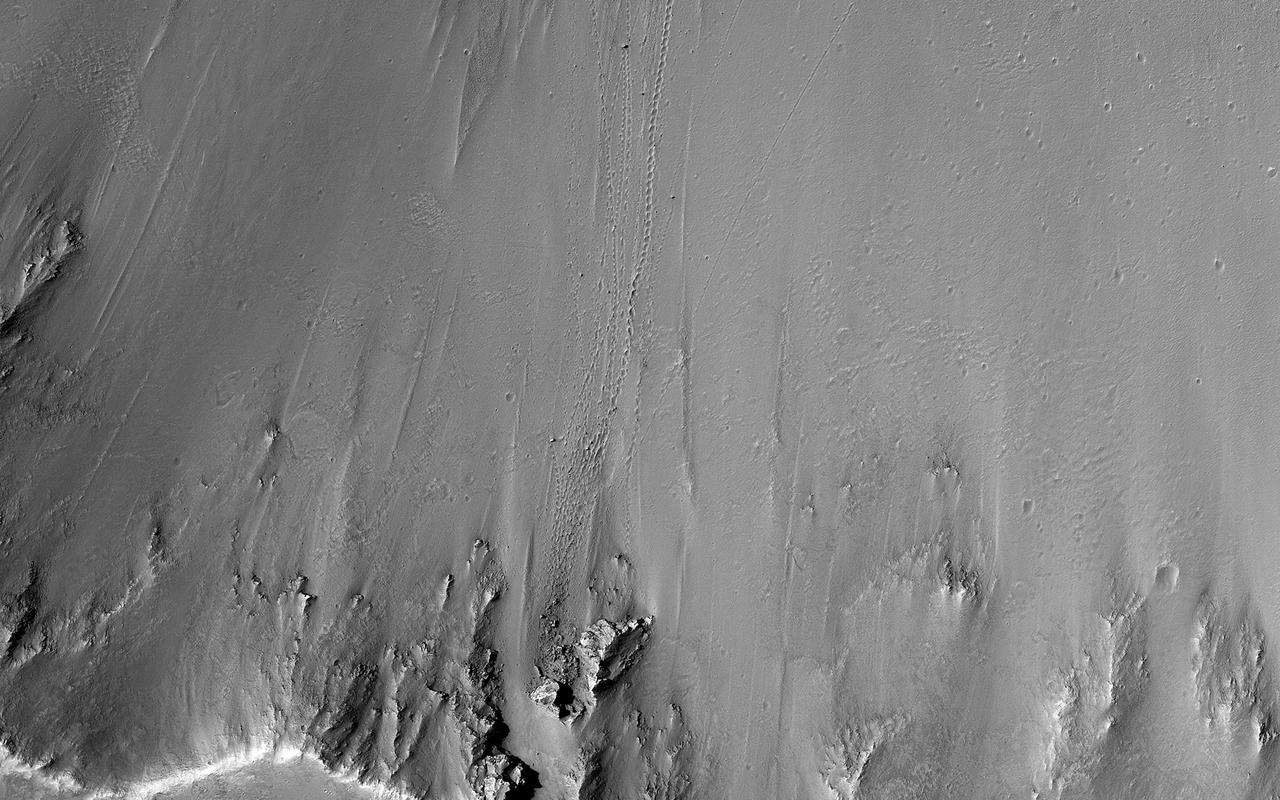
One small section of this image shows boulders that have rolled down the slope of a crater wall. The boulders vary in size, with the largest one approximately 6 meters across. Unlike the boulder in a previous image, this one is not standing on end. We can tell by using the sun angle and shadow length to figure out the height and then comparing that to its other measurements. We can determine the origin of the boulders by tracing their up-slope tracks. They appear to come from one small part of the crater wall that is less stable than surrounding materials. It is likely that there have been numerous rockfall events from this area, as suggested by the many boulders down-slope of this area, some with clear tracks and others with indistinct or no tracks visible. http://photojournal.jpl.nasa.gov/catalog/PIA20744
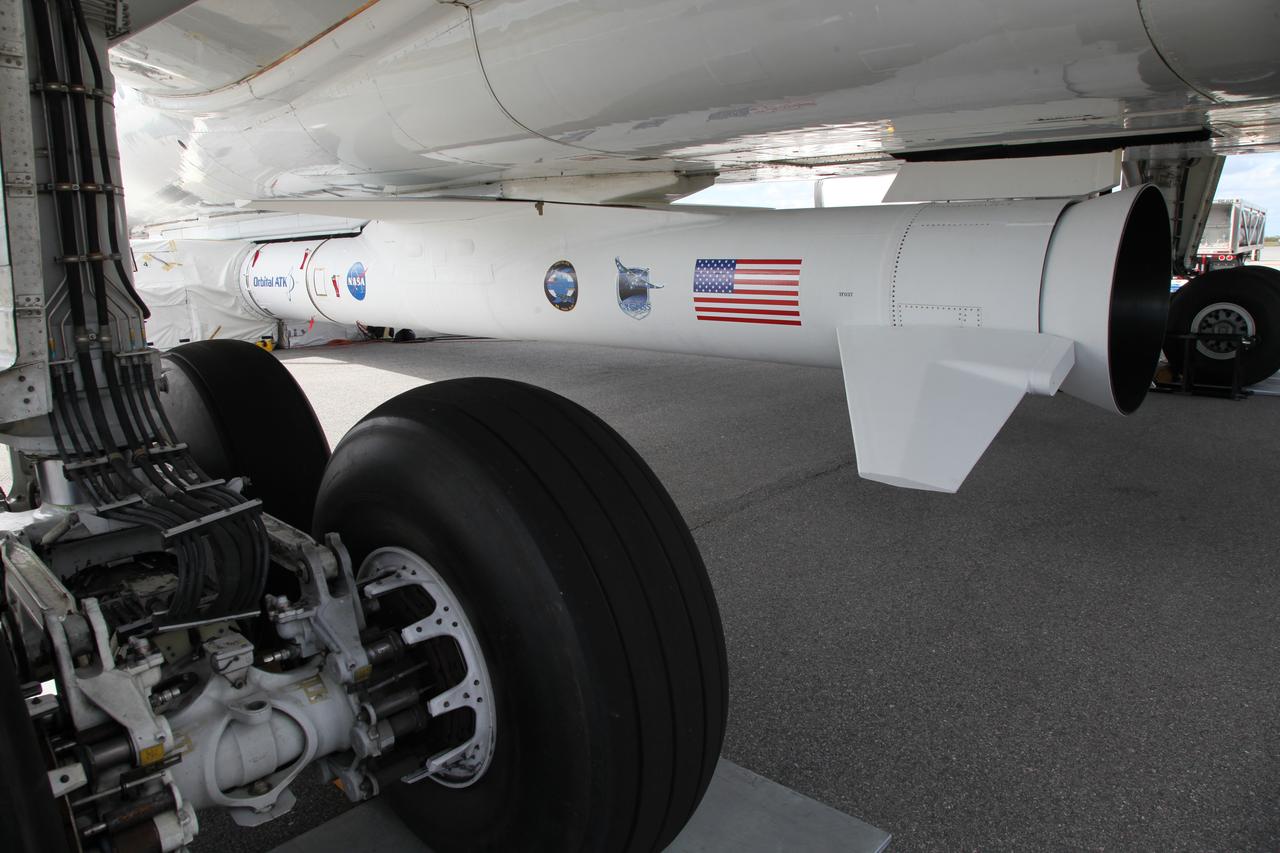
At Cape Canaveral Air Force Station's Skid Strip the Orbital ATK L-1011 Stargazer aircraft is being prepared to launch NASA's Cyclone Global Navigation Satellite System, or CYGNSS, spacecraft. The eight micro satellites are aboard an Orbital ATK Pegasus XL rocket strapped to the underside of the Stargazer. CYGNSS is scheduled for its airborne launch aboard the Pegasus XL rocket from the Skid Strip on Dec. 12. CYGNSS will make frequent and accurate measurements of ocean surface winds throughout the life cycle of tropical storms and hurricanes. The data that CYGNSS provides will enable scientists to probe key air-sea interaction processes that take place near the core of storms, which are rapidly changing and play a critical role in the beginning and intensification of hurricanes.
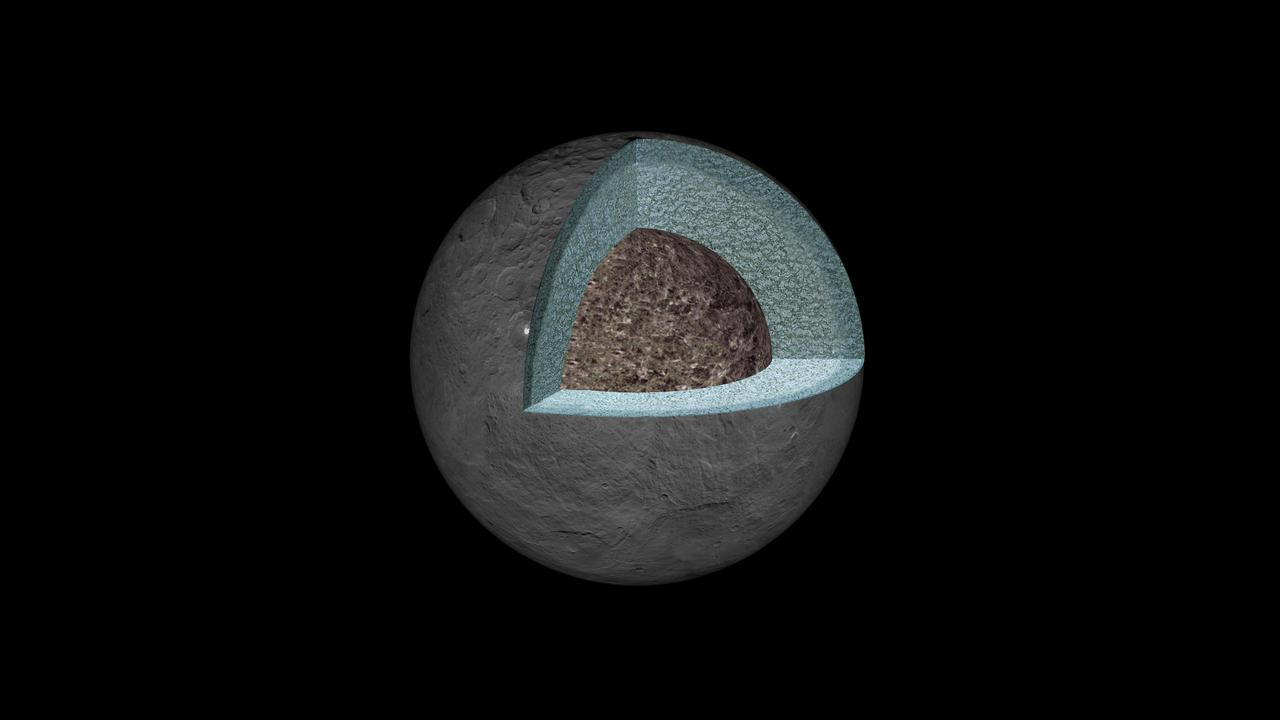
This artist's concept shows a diagram of how the inside of Ceres could be structured, based on data about the dwarf planet's gravity field from NASA's Dawn mission. Using information about Ceres' gravity and topography, scientists found that Ceres is "differentiated," which means that it has compositionally distinct layers at different depths. The densest layer is at the core, which scientists suspect is made of hydrated silicates. Above that is a volatile-rich shell, topped with a crust of mixed materials. This research teaches scientists about what internal processes could have occurred during the early history of Ceres. It appears that, during a heating phase early in the history of Ceres, water and other light materials partially separated from rock. These light materials and water then rose to the outer layer of Ceres. http://photojournal.jpl.nasa.gov/catalog/PIA20867
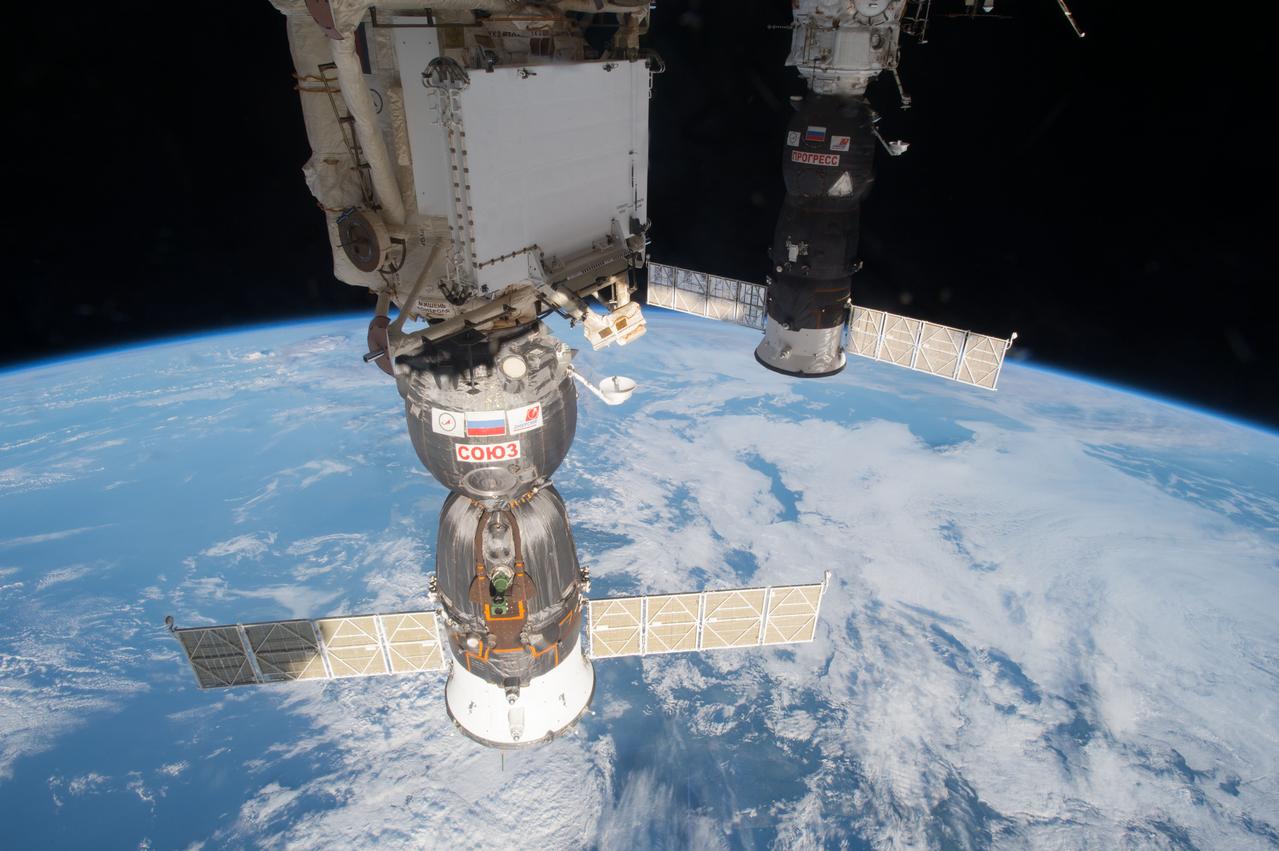
View of the docked Soyuz MS-01 (47S) and Progress 64P spacecraft against a backdrop of Earth and space.

NASA Honors awards medal - Silver Achievement
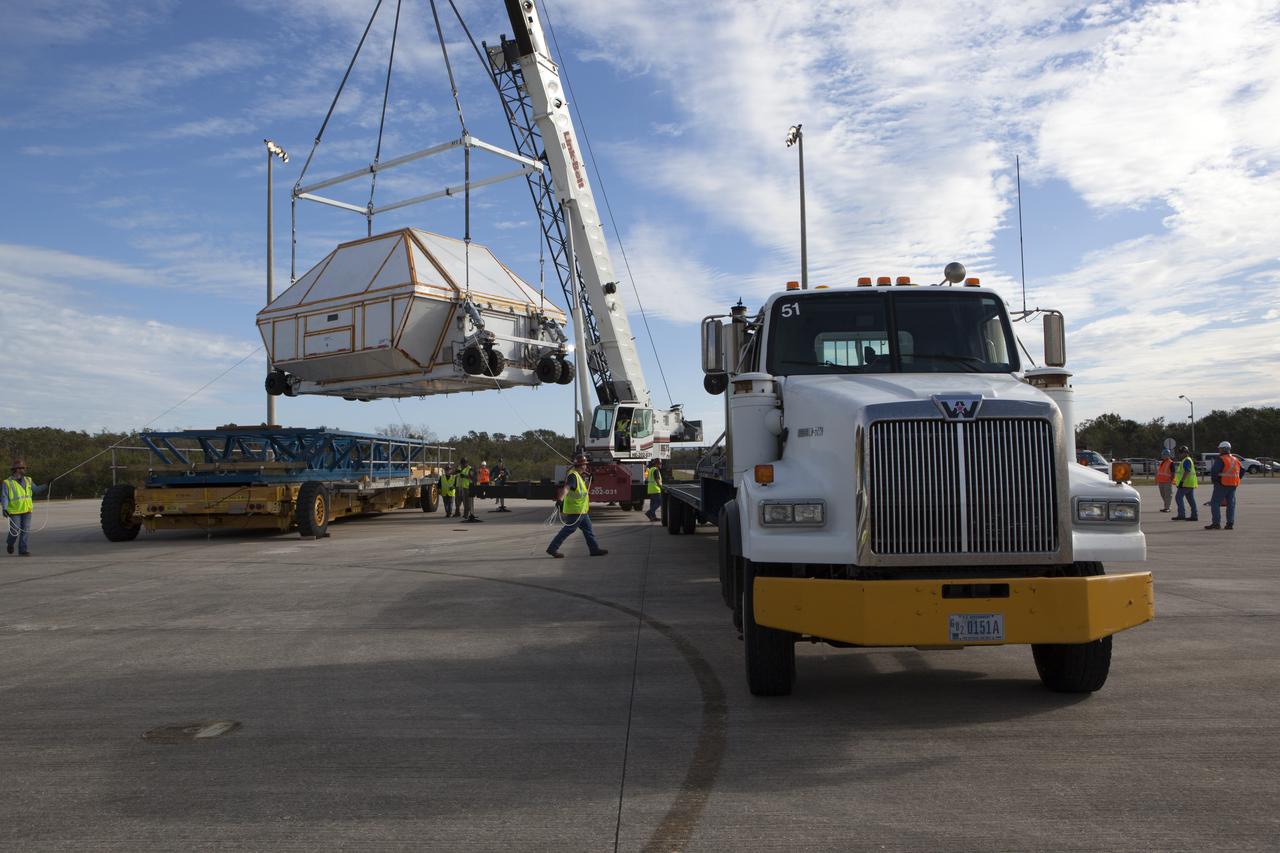
After arriving at the Shuttle Landing Facility operated by Space Florida at NASA's Kennedy Space Center in Florida, the agency's Super Guppy aircraft was opened and the container holding the Orion crew module structural test article (STA) was offloaded. A crane has lifted the container for placement on a transporter. The test article will be moved to the Neil Armstrong Operations and Checkout Building high bay for further testing. The Orion spacecraft will launch atop NASA’s Space Launch System rocket on EM-1, its first deep space mission, in late 2018.
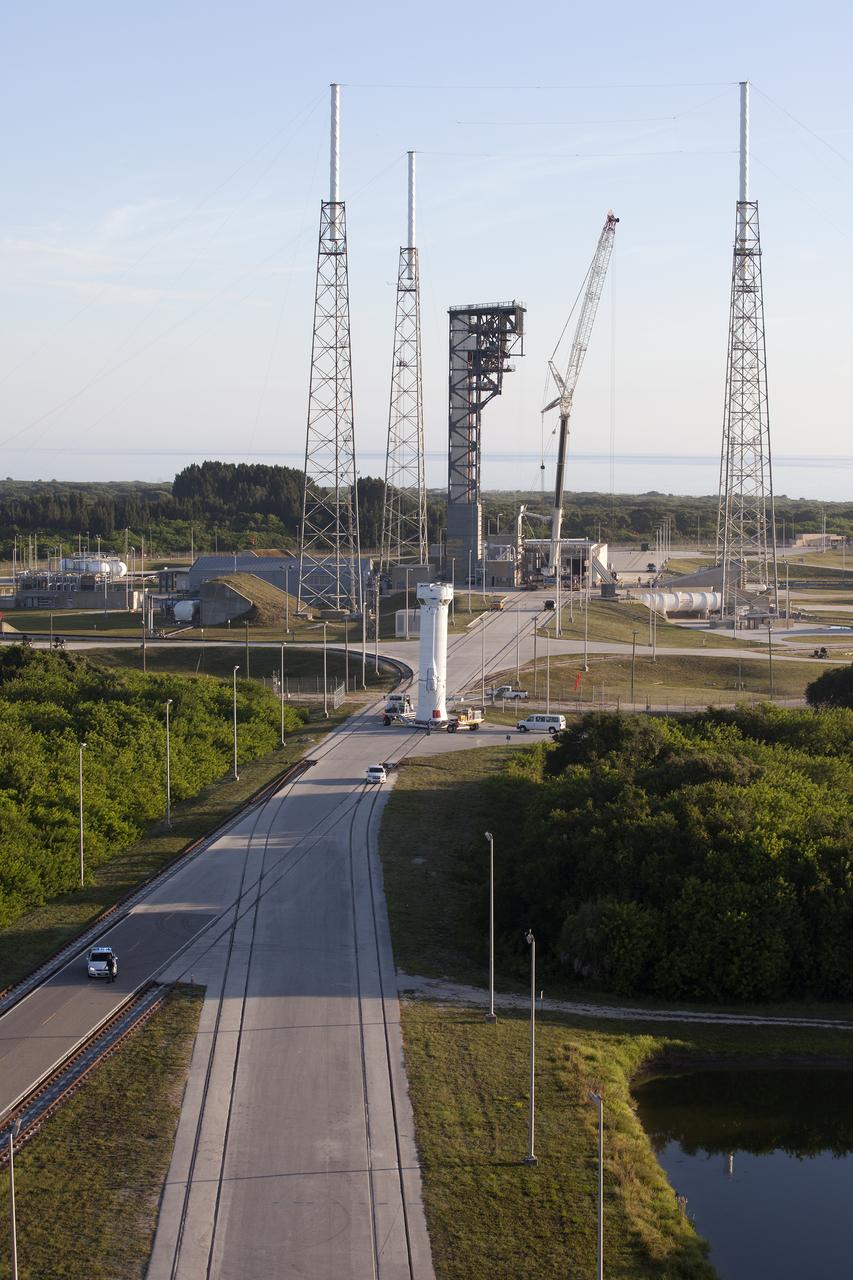
A Centaur upper stage, standing upright on a transporter, arrives at Space Launch Complex 41 on Florida’s Cape Canaveral Air Force Station, where it will be attached to the United Launch Alliance Atlas V rocket first stage booster. The rocket will boost NASA’s Origins, Spectral Interpretation, Resource Identification, Security-Regolith Explorer, or OSIRIS-REx spacecraft. Targeted for liftoff Sept. 8, 2016, OSIRIS-Rex will be the first U.S. mission to sample an asteroid, retrieve at least two ounces of surface material and return it to Earth for study. The asteroid, Bennu, may hold clues to the origin of the solar system and the source of water and organic molecules found on Earth.
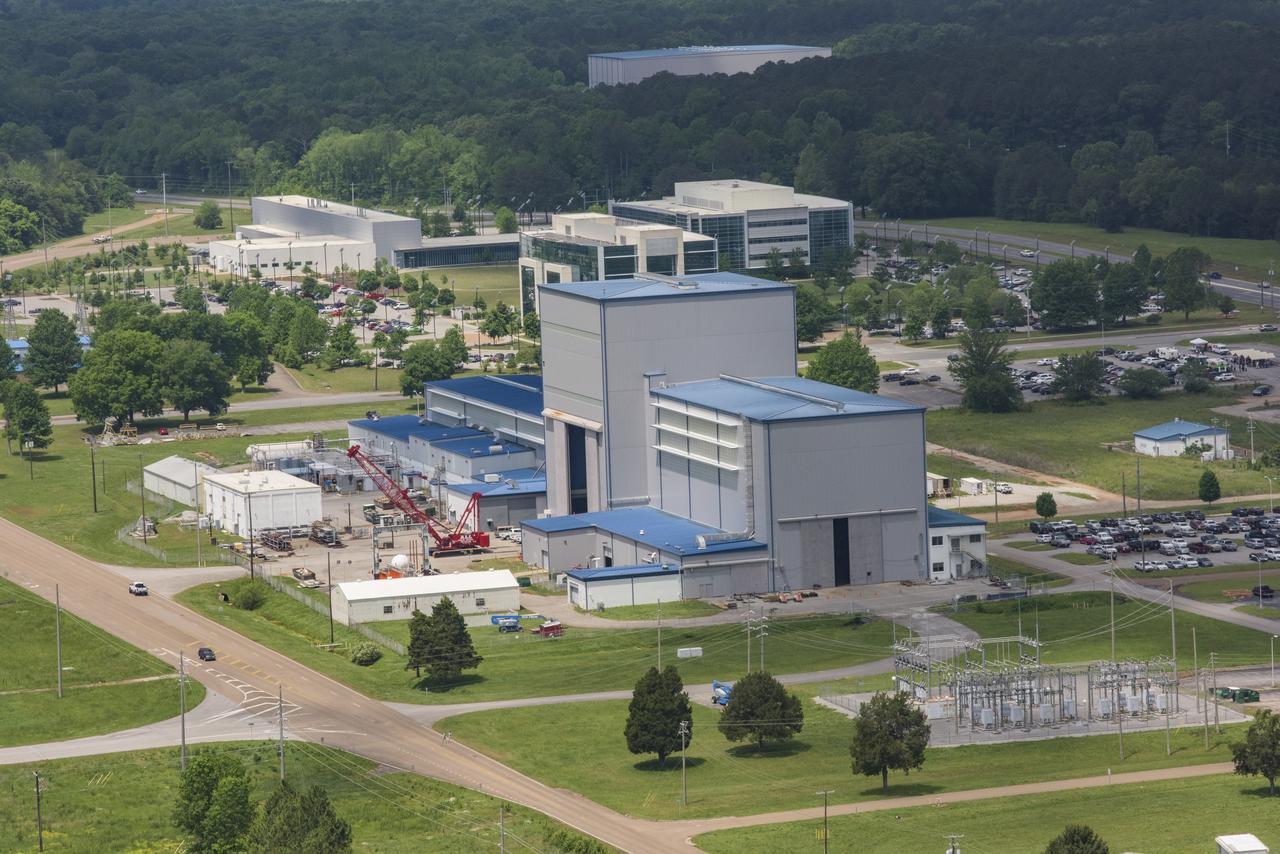
AERIAL PHOTOGRAPHS OF MSFC-4619
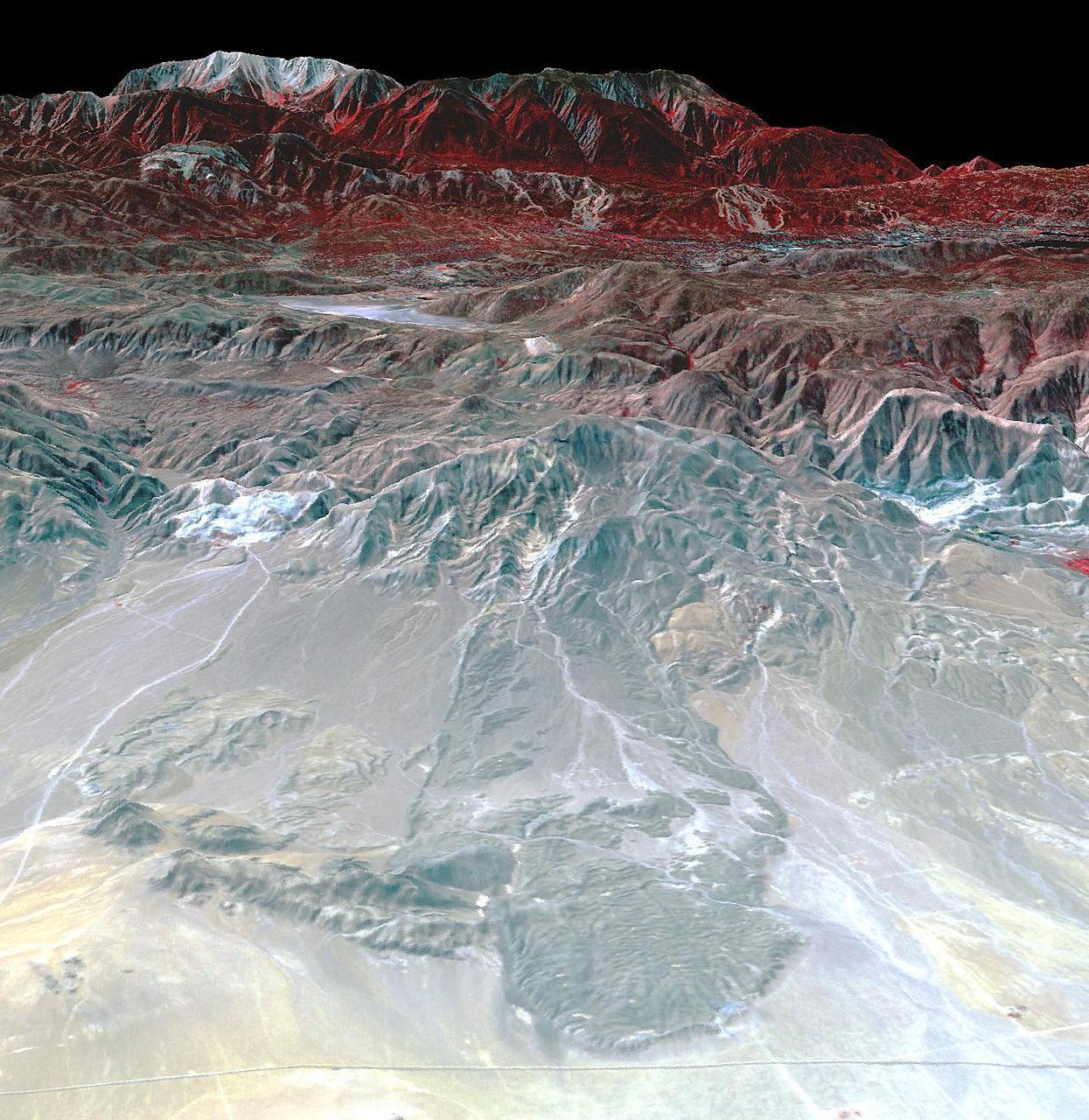
The Blackhawk landslide, Lucerne Valley, California, is a lobe of marble breccia, 10 to 30 m thick, 3 km wide, and nearly 8 km long. Geologic evidence shows that the rockslide came down the gently inclined slope as a nearly monolithic sheet moving more than 100 km per hour. The accepted hypothesis is that the slide was lubricated by a layer of compressed air. At least two earlier similar but smaller rockslides have occurred in the area. The south-looking perspective view image was acquired on September 22, 2014, and is located at 34.4 degrees north, 116.7 degrees west. http://photojournal.jpl.nasa.gov/catalog/PIA21008