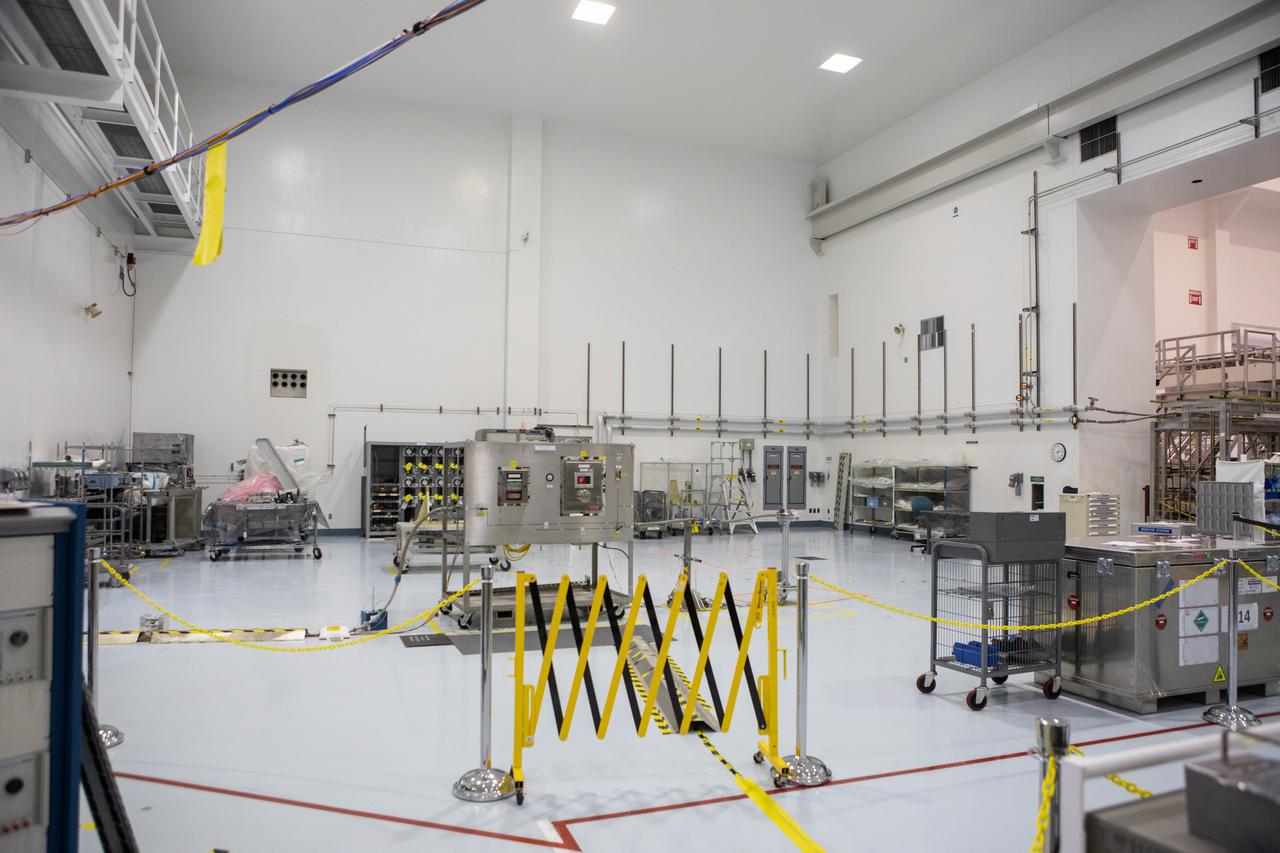
A Nitrogen Oxygen Recharge System (NORS) for the International Space Station is in view, center, in the high bay of the Space Station Processing Facility (SSPF) at NASA's Kennedy Space Center in Florida, on May 16, 2019. NORS are tanks that are used to fill the oxygen and nitrogen tanks that supply the needed gases to the station’s airlock for spacewalks and also are used as a secondary method to replenish the atmosphere inside the space station. The center is celebrating the SSPF’s 25th anniversary. The SSPF was built to process elements for the space station. Now it is providing support for current and future NASA and commercial provider programs, including Commercial Resupply Services, Artemis 1, sending the first woman and next man to the Moon, and deep space destinations including Mars.
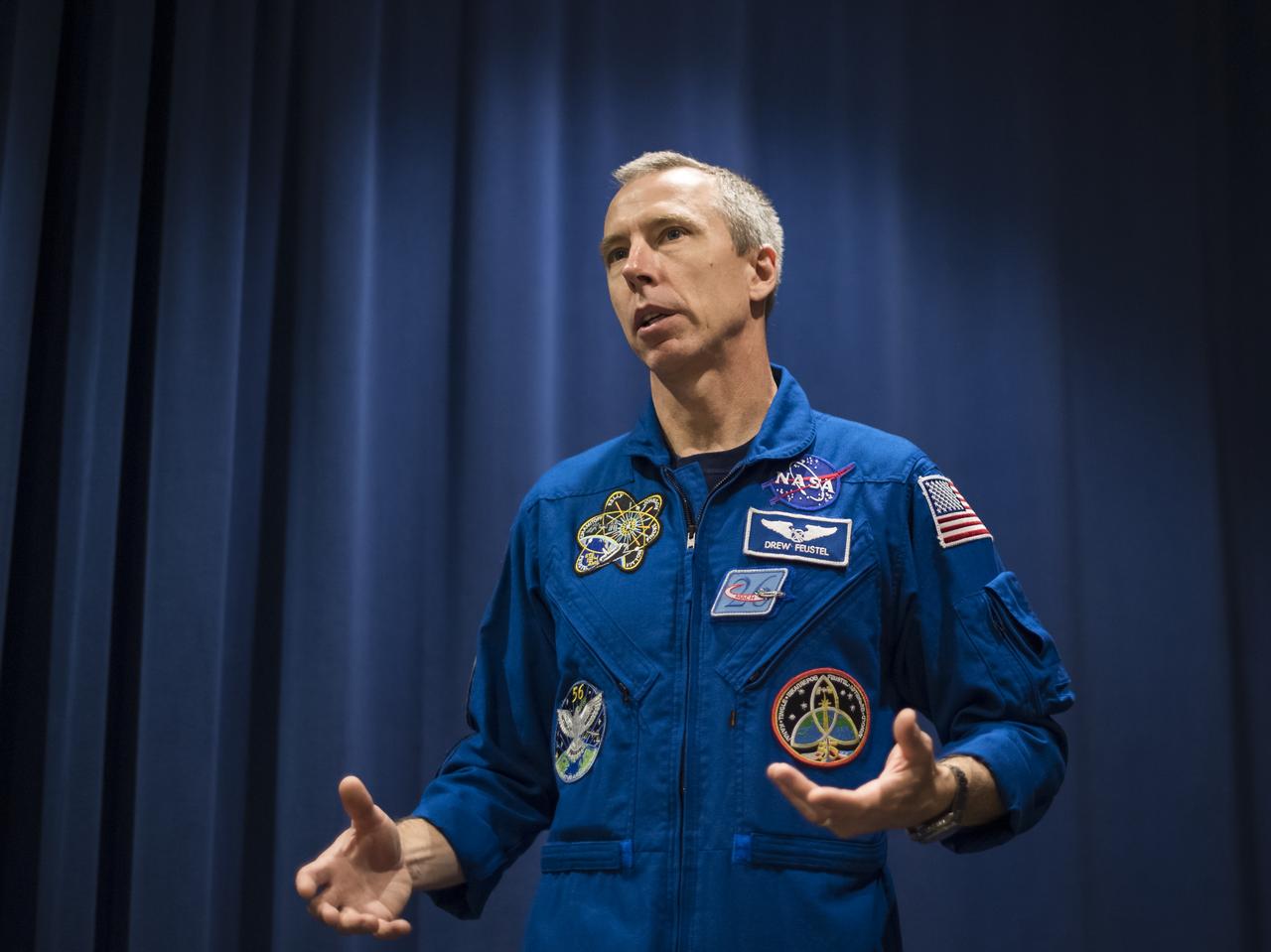
NASA astronaut Drew Feustel speaks about his experience on two shuttle missions, STS-125 and STS-134, as well as Expeditions 55 and 56 on the International Space Station, at the Embassy of Canada, Monday, May 6, 2019 in Washington. Photo Credit: (NASA/Aubrey Gemignani)
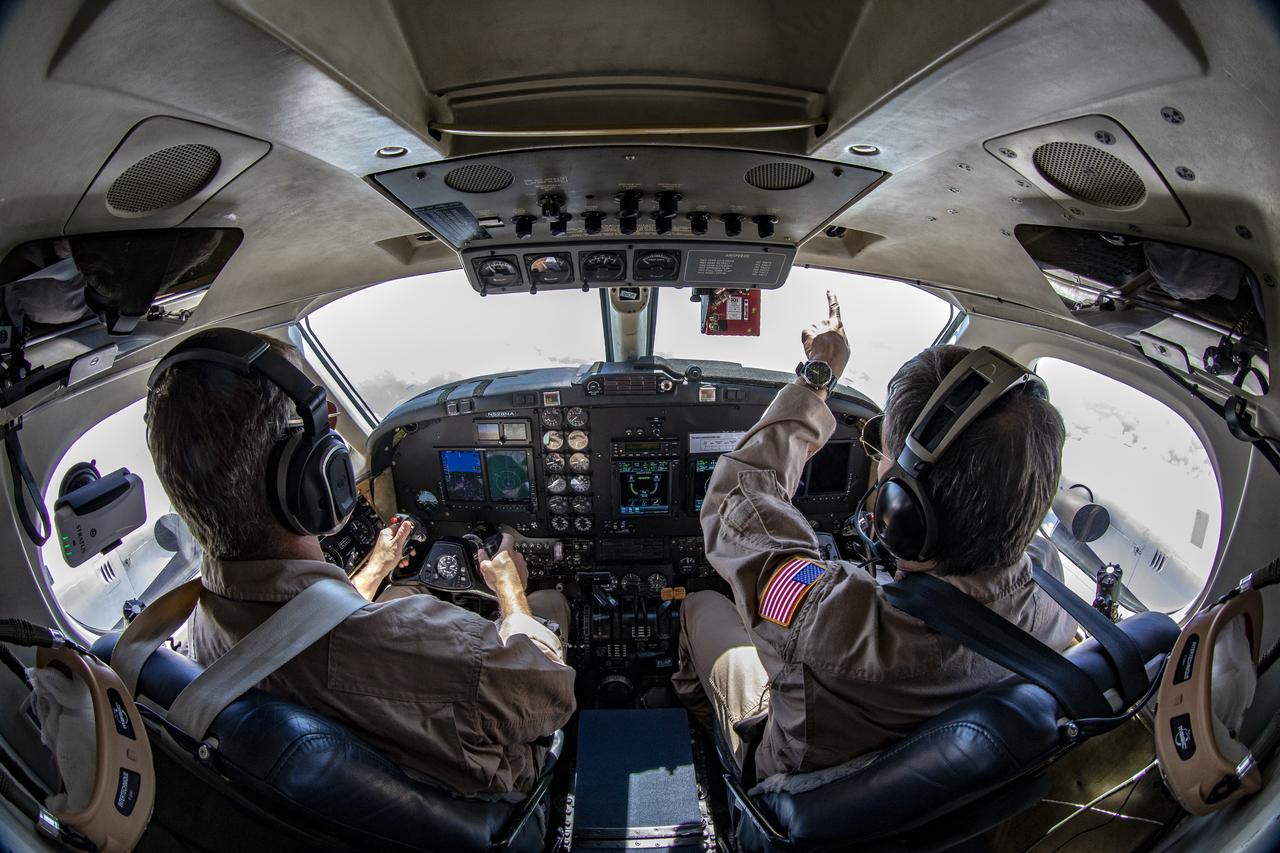
Testing the External Vision System (XVS) software on the B200 King Air. Pilots, Peter Coen and Wayne Ringelberg attempt to spot an incoming aircraft on the XVS monitor.
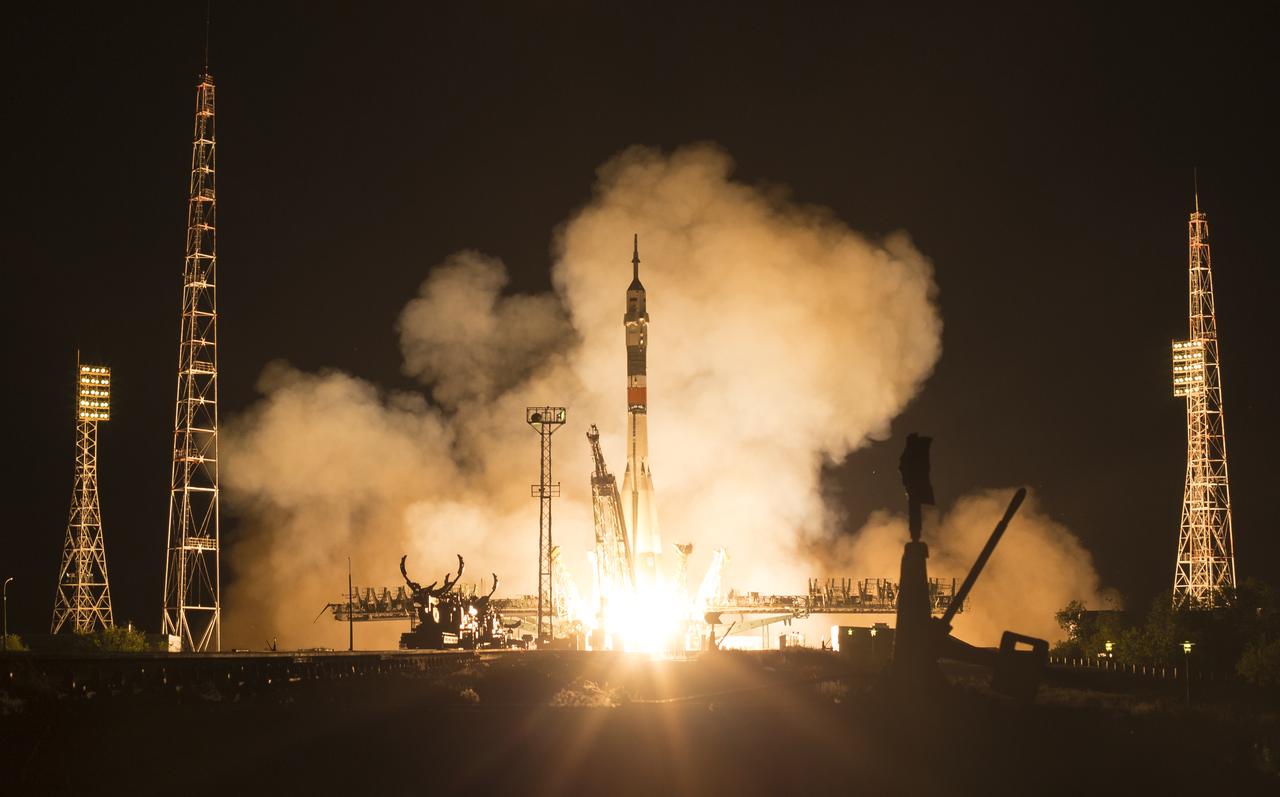
The Soyuz MS-13 rocket is launched with Expedition 60 Soyuz Commander Alexander Skvortsov of Roscosmos, flight engineer Andrew Morgan of NASA, and flight engineer Luca Parmitano of ESA (European Space Agency), Saturday, July 20, 2019 at the Baikonur Cosmodrome in Kazakhstan. Skvortsov, Morgan, and Parmitano launched at 12:28 p.m. Eastern time (9:28 p.m. Baikonur time) to begin their mission to the International Space Station. Photo Credit: (NASA/Joel Kowsky)
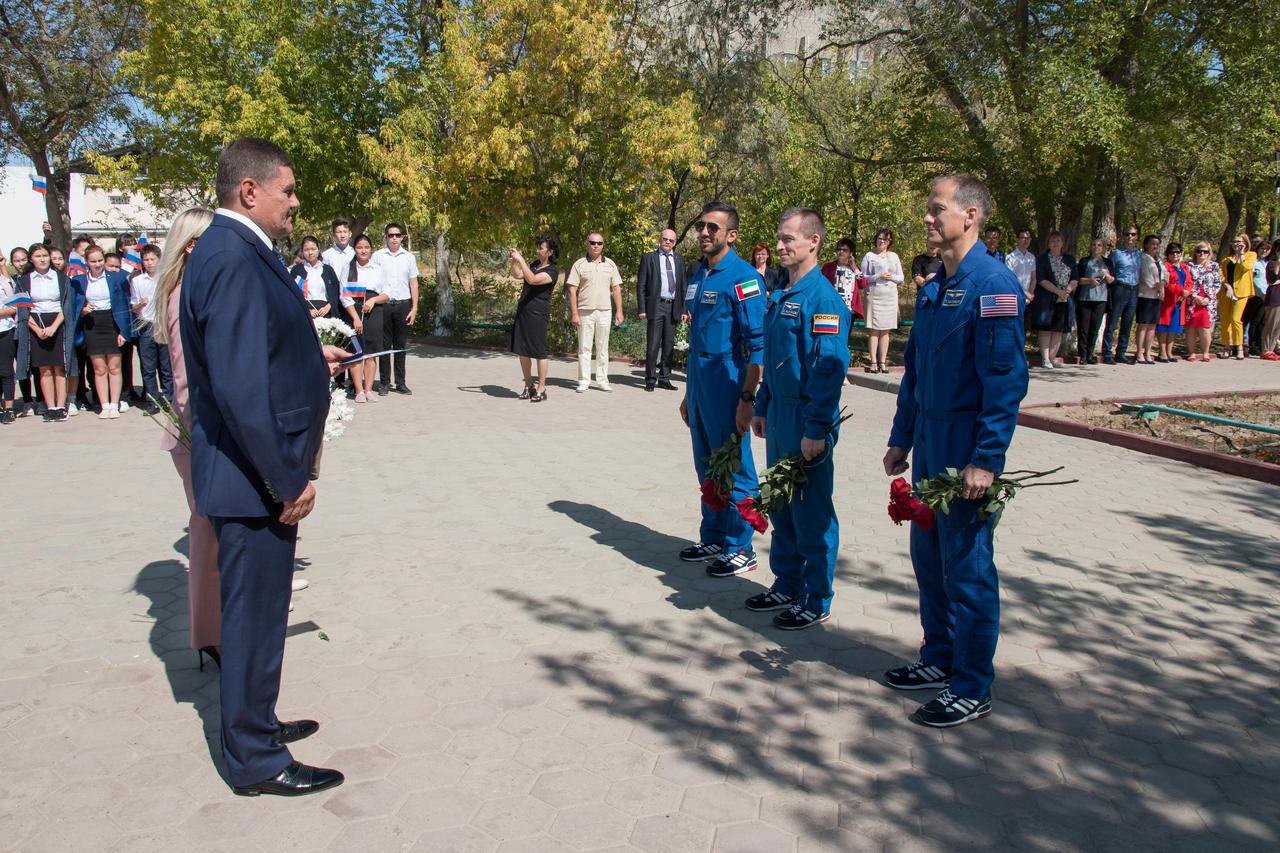
jsc2019e052903 - At their Cosmonaut Hotel crew quarters in Baikonur, Kazakhstan, the backup crewmembers for the next launch to the International Space Station meet with local Kazakh officials Sept. 12 as part of traditional pre-launch activities. On the right are backup spaceflight participant Sultan Al-Neyadi of the United Arab Emirates, Sergey Ryzhikov of Roscosmos and Tom Marshburn of NASA. They are the backups to the prime Expedition 61 crew, Oleg Skripochka of Roscosmos and Jessica Meir of NASA and spaceflight participant Hazzaa Ali Almansoori of the United Arab Emirates, who will launch Sept. 25 on the Soyuz MS-15 spacecraft for a mission on the International Space Station...NASA/Victor Zelentsov.
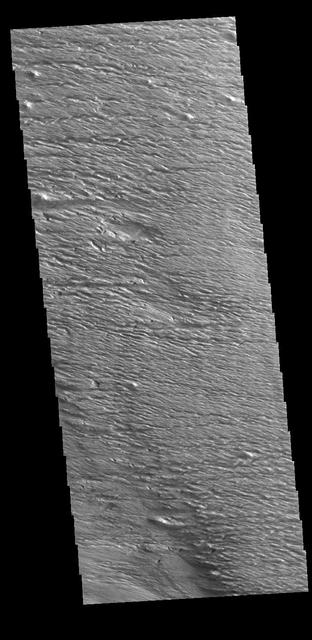
Wind is one of the remaining active processes altering the surface of Mars. In regions of long term unidirectional winds, the dust and sand is winnowed away. In places with poorly cemented surface materials the wind and entrained sand with blast the surface causing linear erosion like that seen in today's VIS image. This image is located at the equator near Gordii Dorsum. Orbit Number: 77484 Latitude: 5.04807 Longitude: 213.038 Instrument: VIS Captured: 2019-06-03 08:10 https://photojournal.jpl.nasa.gov/catalog/PIA23334
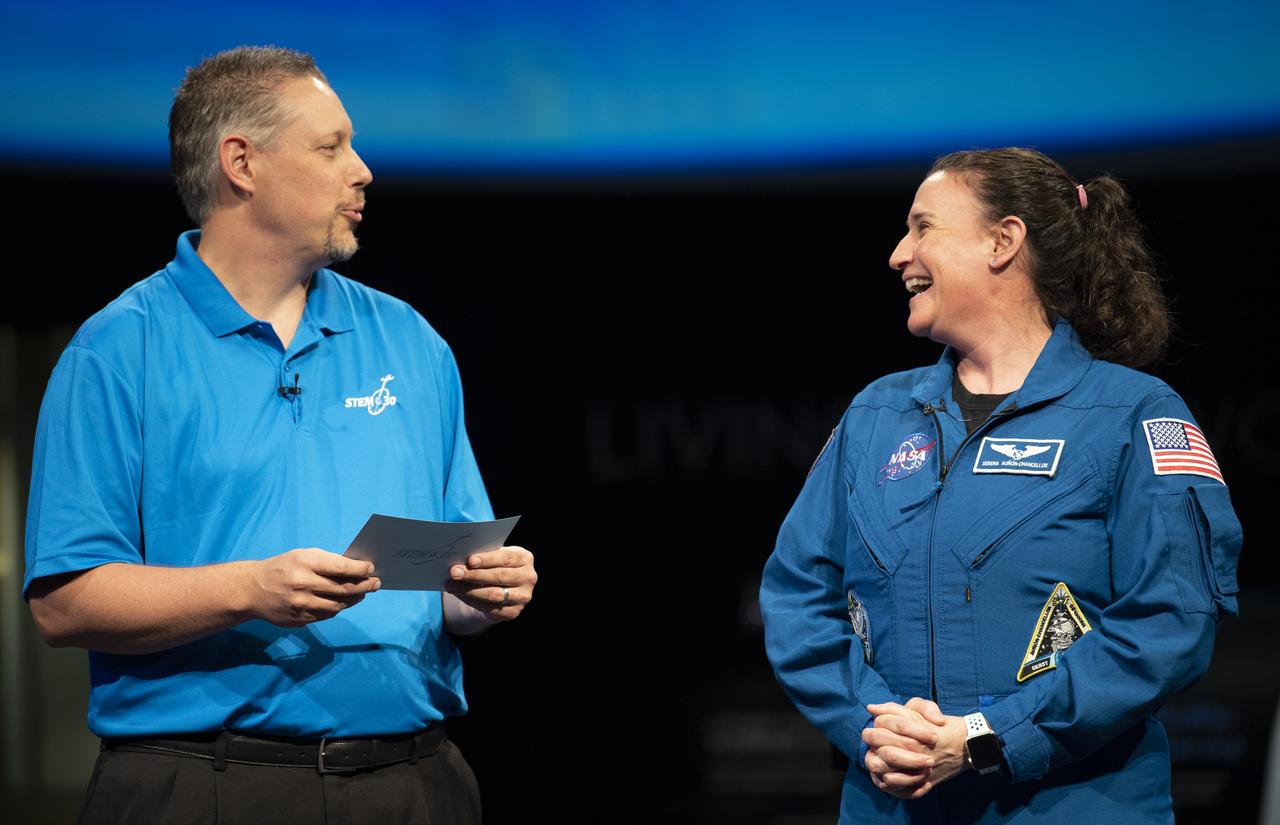
Marty Kelsey of the Smithsonian National Air and Space Museum asks NASA astronaut Serena Auñón-Chancellor questions about being in middle school for a short video, Friday, June 14, 2019 the Smithsonian's National Air and Space Museum in Washington, DC. Auñón-Chancellor spent 197 days living and working onboard the orbital laboratory as part of Expeditions 56 and 57, contributing to hundreds of experiments in biology, biotechnology, physical science, and Earth science while there. She began her career at NASA as a flight surgeon before being selected as an astronaut in 2009. Photo Credit: (NASA/Joel Kowsky)
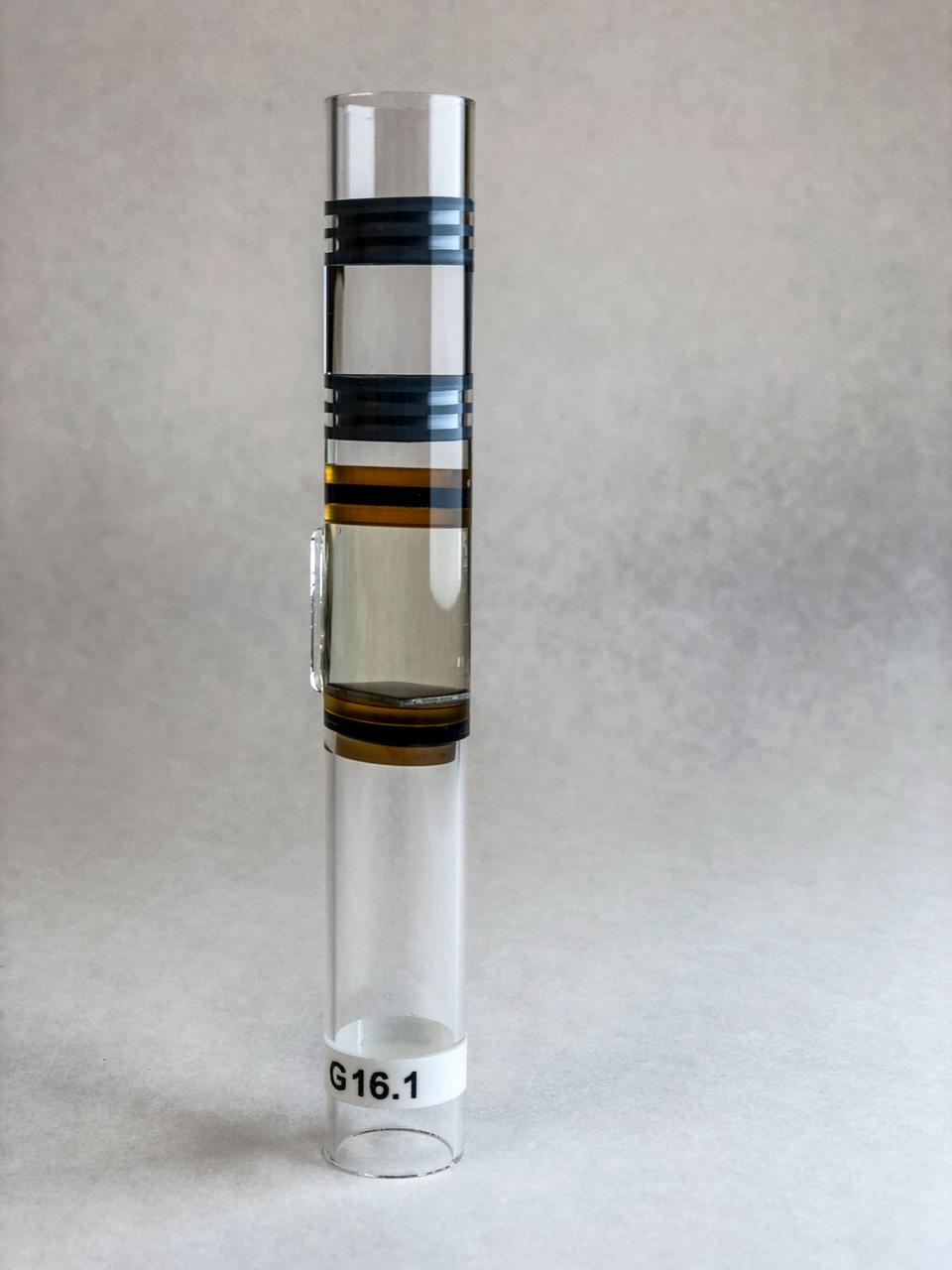
jsc2020e003405 (10/30/2019) --- A preflight view of BioServe’s Fluid Processing Apparatus (FPA) in a three-chamber configuration. From bottom to top: sterile growth medium and 1 cm2 material coupon, bacteria in stasis (inoculum), and fixative for controlled experiment termination. FPAs were used to house the bacterial component of this experiment, where six different materials were tested. The Characterization of Biofilm Formation, Growth, and Gene Expression on Different Materials and Environmental Conditions in Microgravity (Space Biofilms) investigation characterizes the mass, thickness, structure, and associated gene expression of biofilms that form in space by analyzing different microbial species grown on different materials. Biofilm formation can cause equipment malfunction and human illnesses, and could be a serious problem on future long-term human space missions.

Today's VIS image shows part of the south polar cap. This image was taken at the end of southern summer. Orbit Number: 76263 Latitude: -85.7084 Longitude: 307.344 Instrument: VIS Captured: 2019-02-22 18:27 https://photojournal.jpl.nasa.gov/catalog/PIA23258
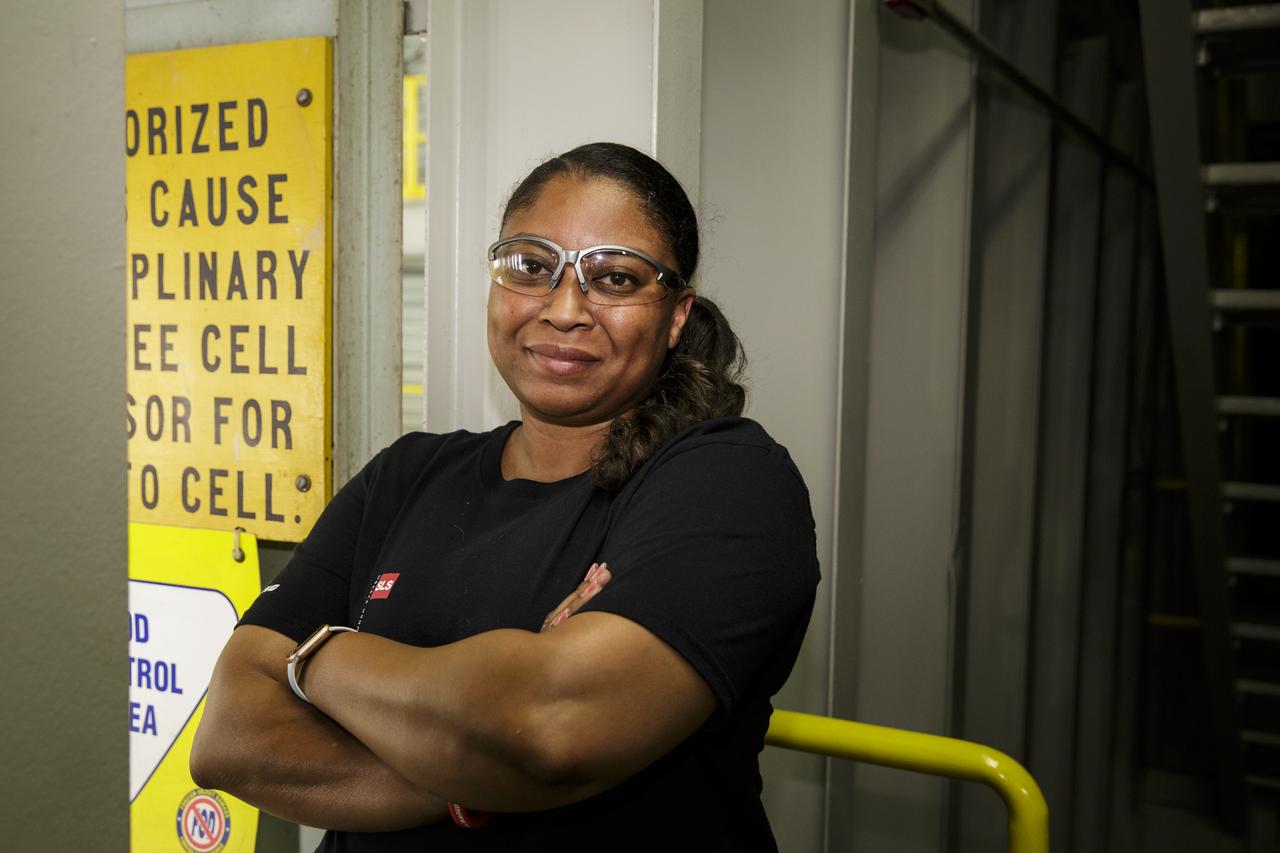
"On my first day, I felt like I did not belong. I felt like I was unqualified. That’s the thing: the people around here, I don’t know if it’s just the culture or the area where we are, but these people around here, they just encourage you: 'You can do it!' and 'Let me show you this, there’s nothing to it!' I mean, really, they forced me out of my element, even into where I am right now. I belong now. I definitely belong now. I don’t feel out of place. I feel like I have a better handle on things compared to when I was younger and easily intimidated. I feel like I belong now. "My goal right now is to find a need and fill it. That’s my thing. And that’s all through life. Any job, any position. That’s the goal. Find the need. Find what you’re good at. And you fill that need." Candis Hills, Facilities and Asset Management, Boeing, Friday, June 28, 2019 at Michoud Assembly Facility, New Orleans, LA. Photo Credit: (NASA/Aubrey Gemignani)
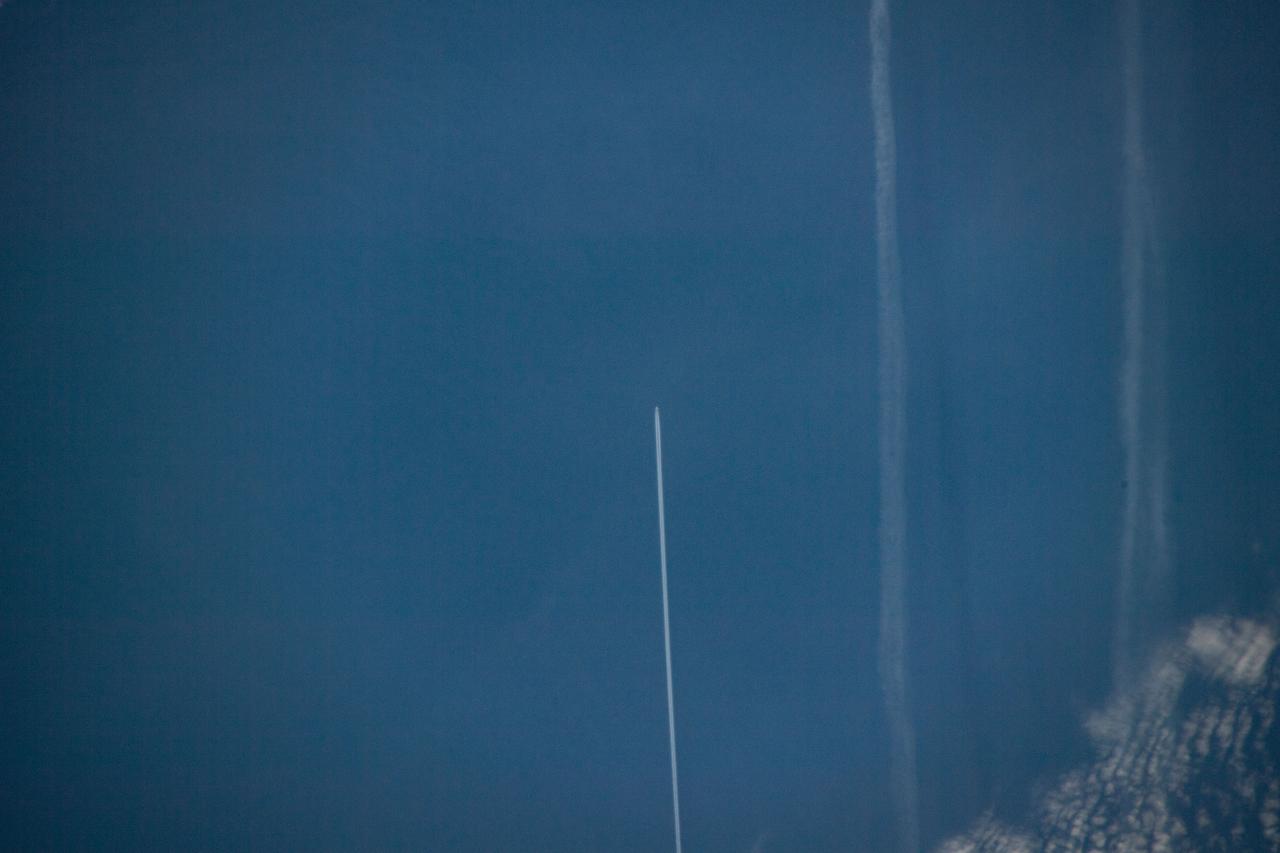
iss059e042046 (May 3, 2019) --- 258 miles above the North Atlantic Ocean an Expedition 59 crewmember photographed the contrail of an aircraft flying below as the International Space Station approached the coast of Ireland.
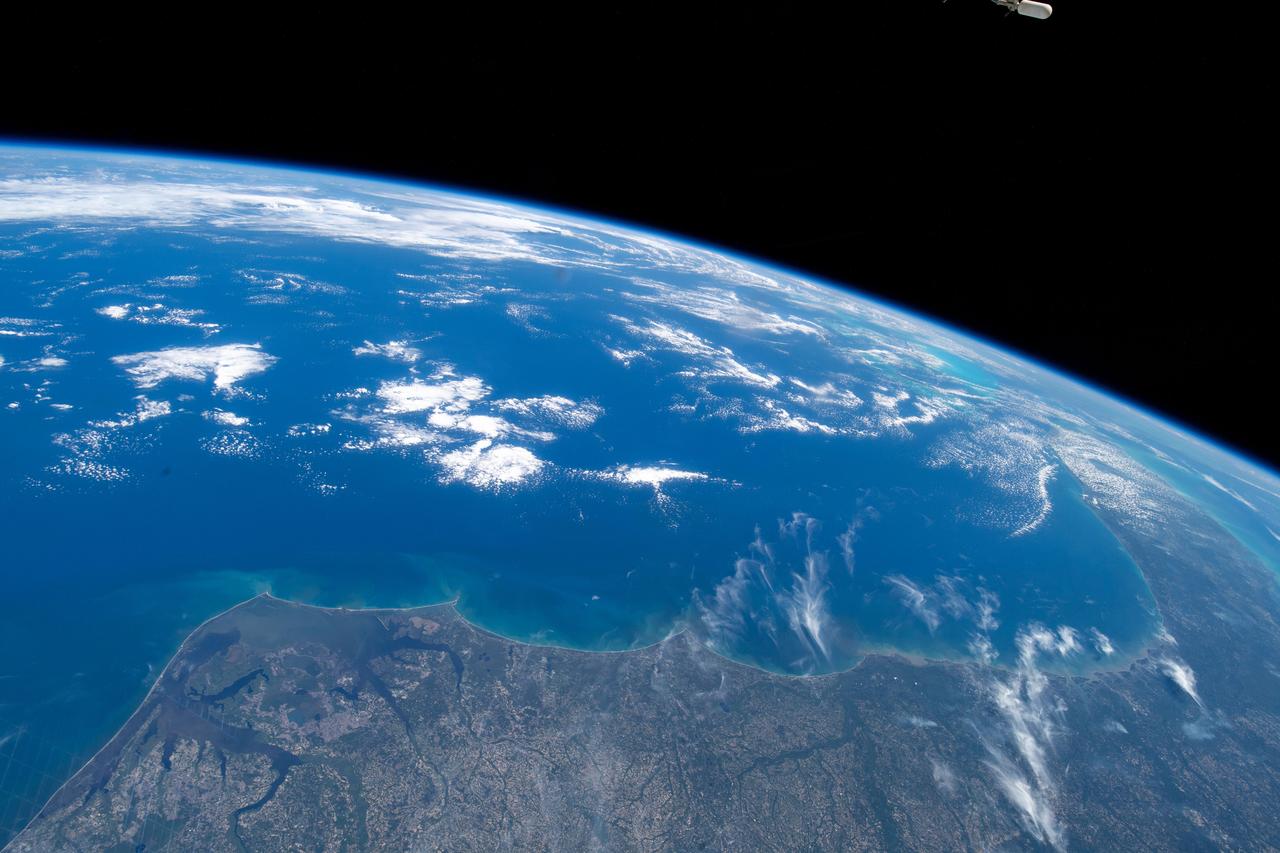
iss059e034778 (April 23, 2019) --- This view of the eastern coast of the United States looks from (bottom left to right center) Virginia Beach, Virginia, all the way to Miami, Florida. The International Space Station was orbiting 256 miles above North America about to cross the Atlantic Ocean when an Expedition 59 crew member took this photograph.
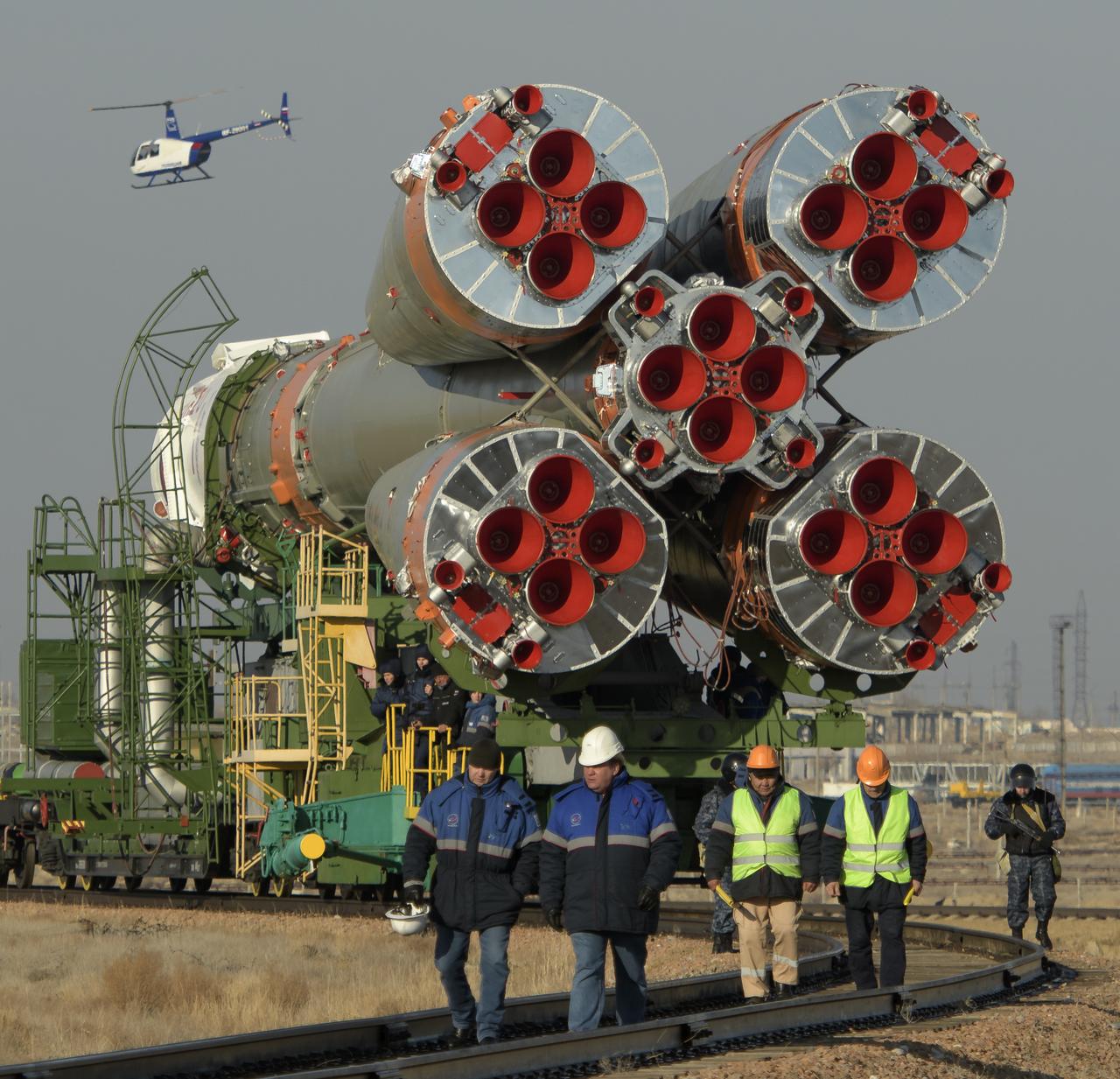
The Soyuz rocket is transported by train to the launch pad, Tuesday, March 12, 2019 at the Baikonur Cosmodrome in Kazakhstan. Expedition 59 crewmembers Nick Hague and Christina Koch of NASA, along with Alexey Ovchinin of Roscosmos, will launch March 14, U.S. time, on the Soyuz MS-12 spacecraft from the Baikonur Cosmodrome for a six-and-a-half month mission on the International Space Station. Photo Credit: (NASA/Bill Ingalls)
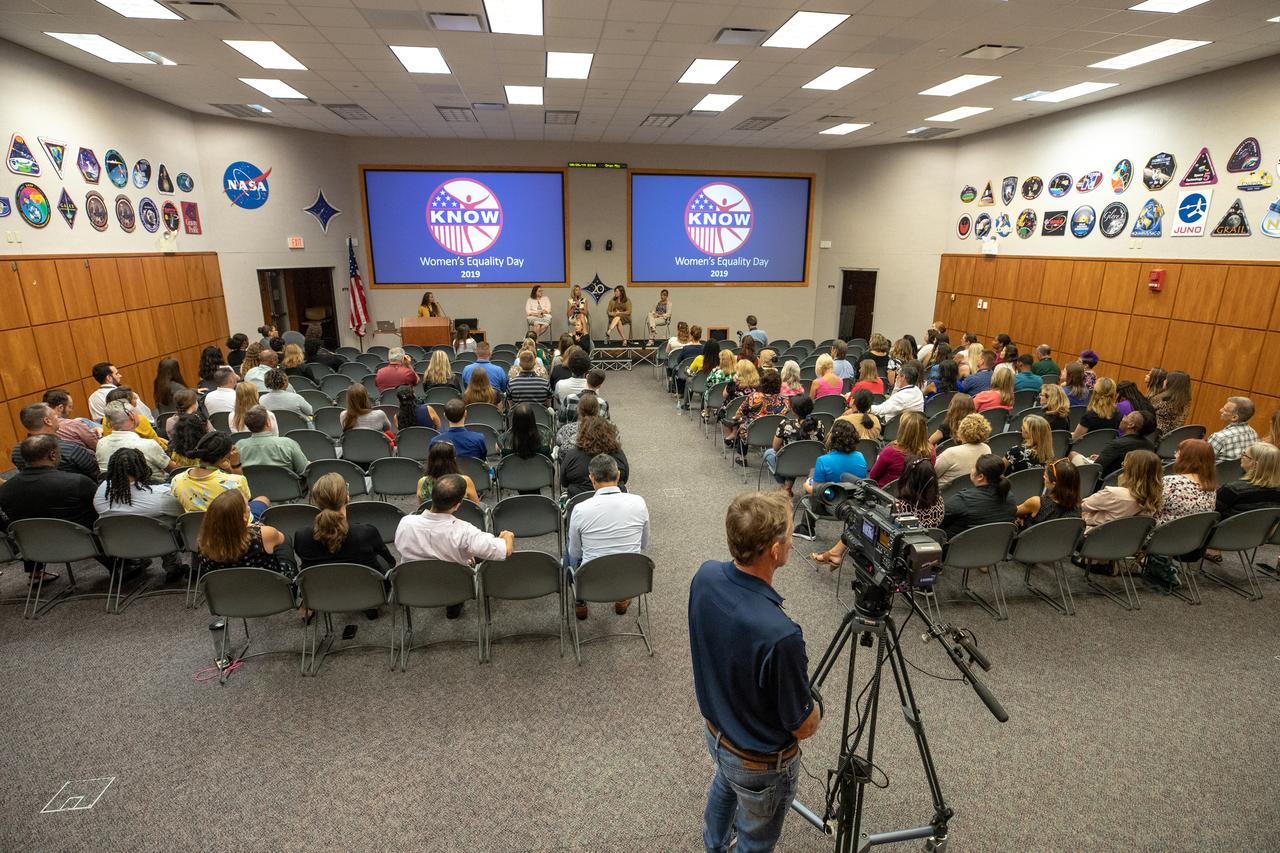
A panel discussion, featuring women in leadership roles at NASA’s Kennedy Space Center in Florida, is held on Aug. 26, 2019, to celebrate Women’s Equality Day. The event, sponsored by the Kennedy Networking Opportunities for Women (KNOW) employee resource group, honored the 100th anniversary of the passing of the 19th amendment guaranteeing all American women the right to vote. Seated in front from left, are Digna Carballosa, director of the Human Resources Office; Nancy Bray, director of Spaceport Integration and Services; Jennifer Kunz, director of Safety and Mission Assurance; and Amanda Mitskevich, Launch Services Program manager. At far left is Ashley Nelsen, Launch Service Program information manager and panel discussion moderator. The purpose of KNOW is to provide focus on issues such as employment, retention, promotion, training, career and personal development, education, and identify and eliminate barriers that hinder the advancement of women in the workforce.
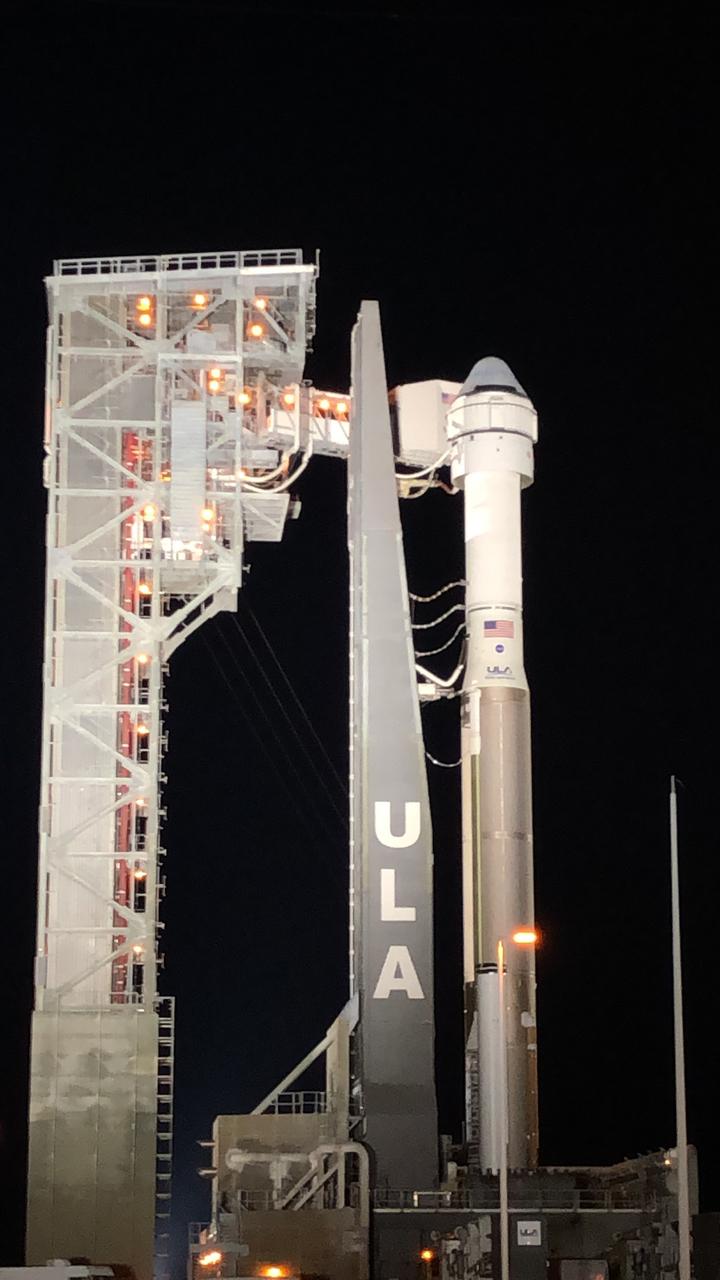
A United Launch Alliance Atlas V rocket, topped by the Boeing CST-100 Starliner spacecraft, stand on Space Launch Complex 41 at Florida’s Cape Canaveral Air Force Station on Dec. 3, 2019. The vehicle was in place on the launch pad in preparation for Boeing’s wet dress rehearsal ahead of the upcoming Orbital Flight Test, an uncrewed mission to the International Space Station for NASA’s Commercial Crew Program.
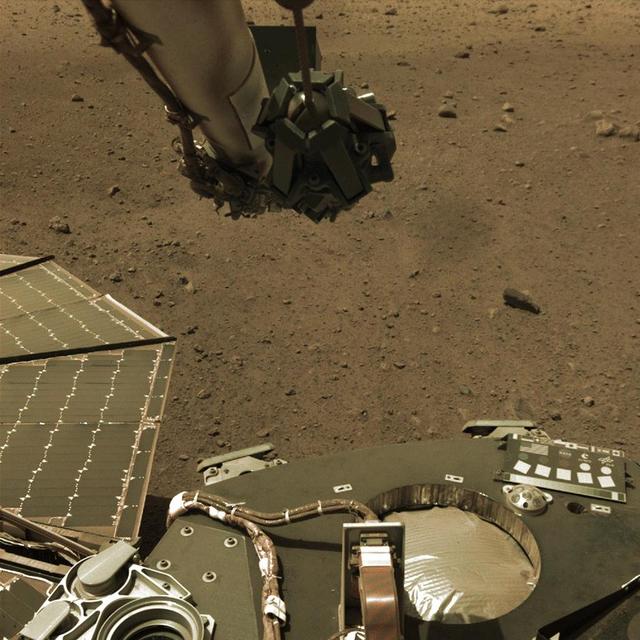
NASA's InSight lander took this series of images on Tuesday, March 5, 2019, capturing the moment when Phobos, one of Mars' moons, crossed in front of the Sun and darkened the ground around the lander. The images were taken by InSight's Instrument Deployment Camera (IDC), located on the lander's robotic arm. The images were taken at intervals of about 50 seconds in order to capture the eclipse, which on this day lasted 24.3 seconds. In the lower right corner of the frame, the shadow of the robotic arm can be seen moving to the right before the entire scene darkened during the moment of the eclipse. Movie available at https://photojournal.jpl.nasa.gov/catalog/PIA23049
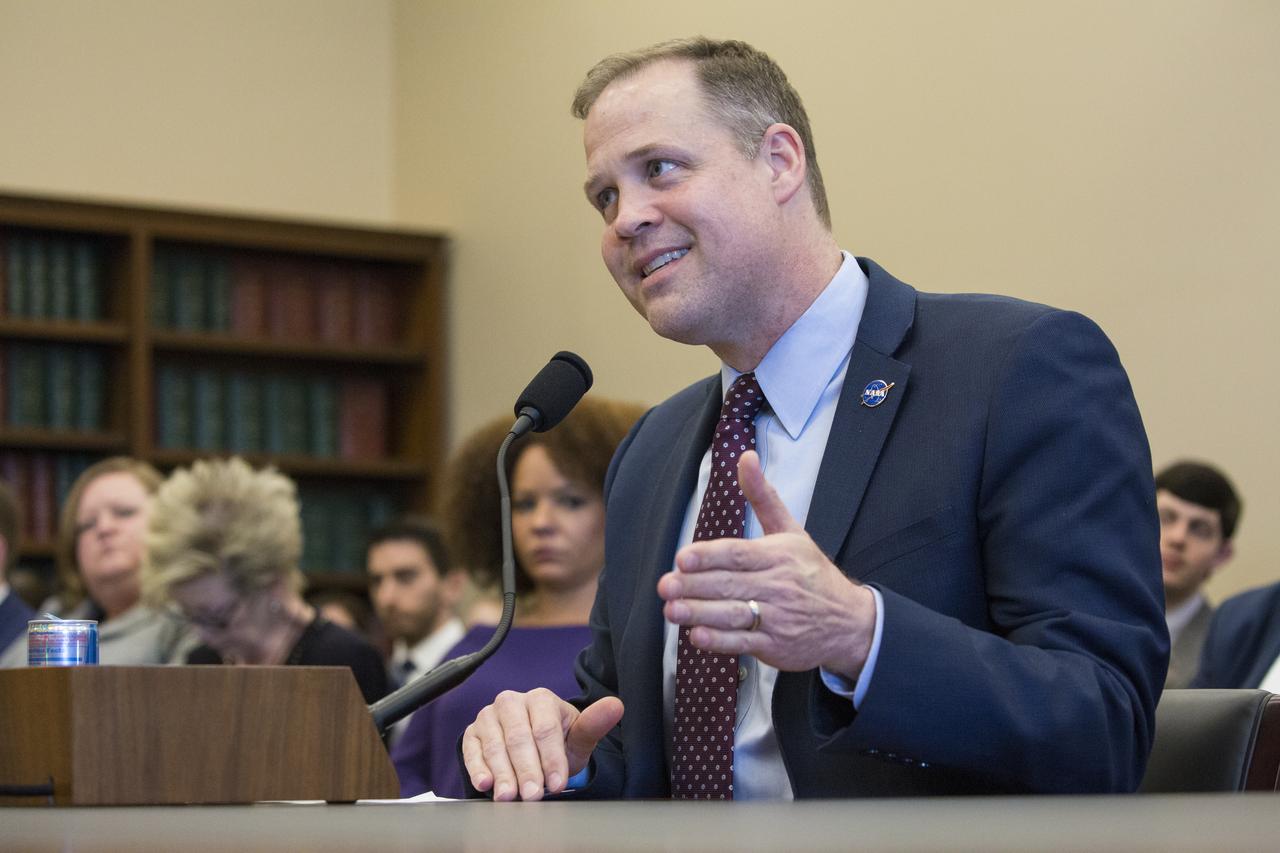
NASA Administrator Jim Bridenstine testifies before the House Appropriations Committee's Commerce, Justice, Science, and Related Agencies Subcommittee during a hearing to review the Fiscal Year 2020 funding request and budget justification for the agency, Wednesday, March 27, 2019 in the Rayburn House Office Building in Washington. Photo Credit: (NASA/Joel Kowsky)
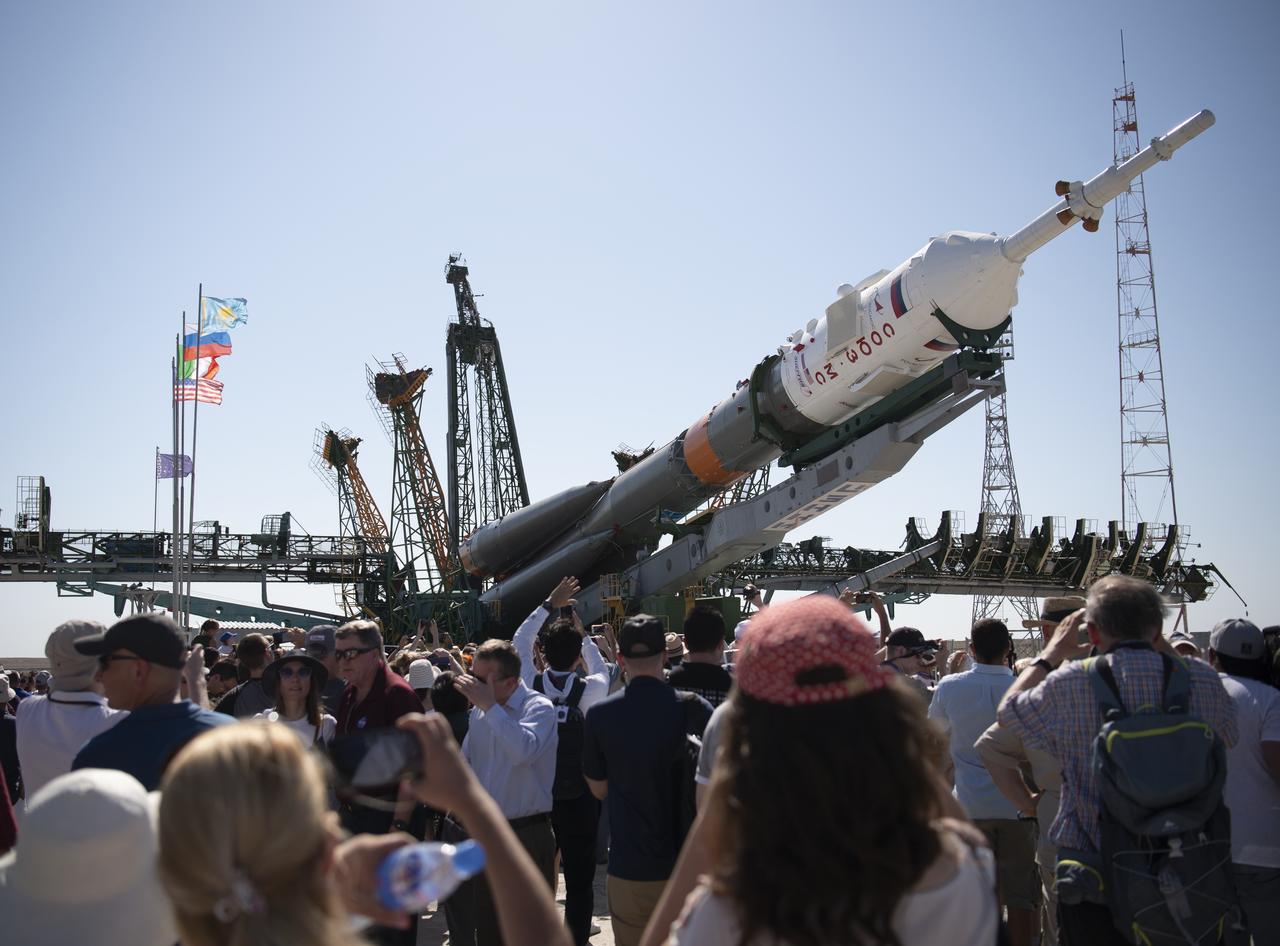
The Soyuz rocket is seen as it is raised into a vertical position on the launch pad, Thursday, July 18, 2019 at the Baikonur Cosmodrome in Kazakhstan. Expedition 60 Soyuz Commander Alexander Skvortsov of Roscosmos, flight engineer Andrew Morgan of NASA, and flight engineer Luca Parmitano of ESA (European Space Agency) are scheduled to launch aboard their Soyuz MS-13 spacecraft at 12:28 p.m. Eastern time (9:28 p.m. Baikonur time) , on Saturday, July 20. Photo Credit: (NASA/Joel Kowsky)
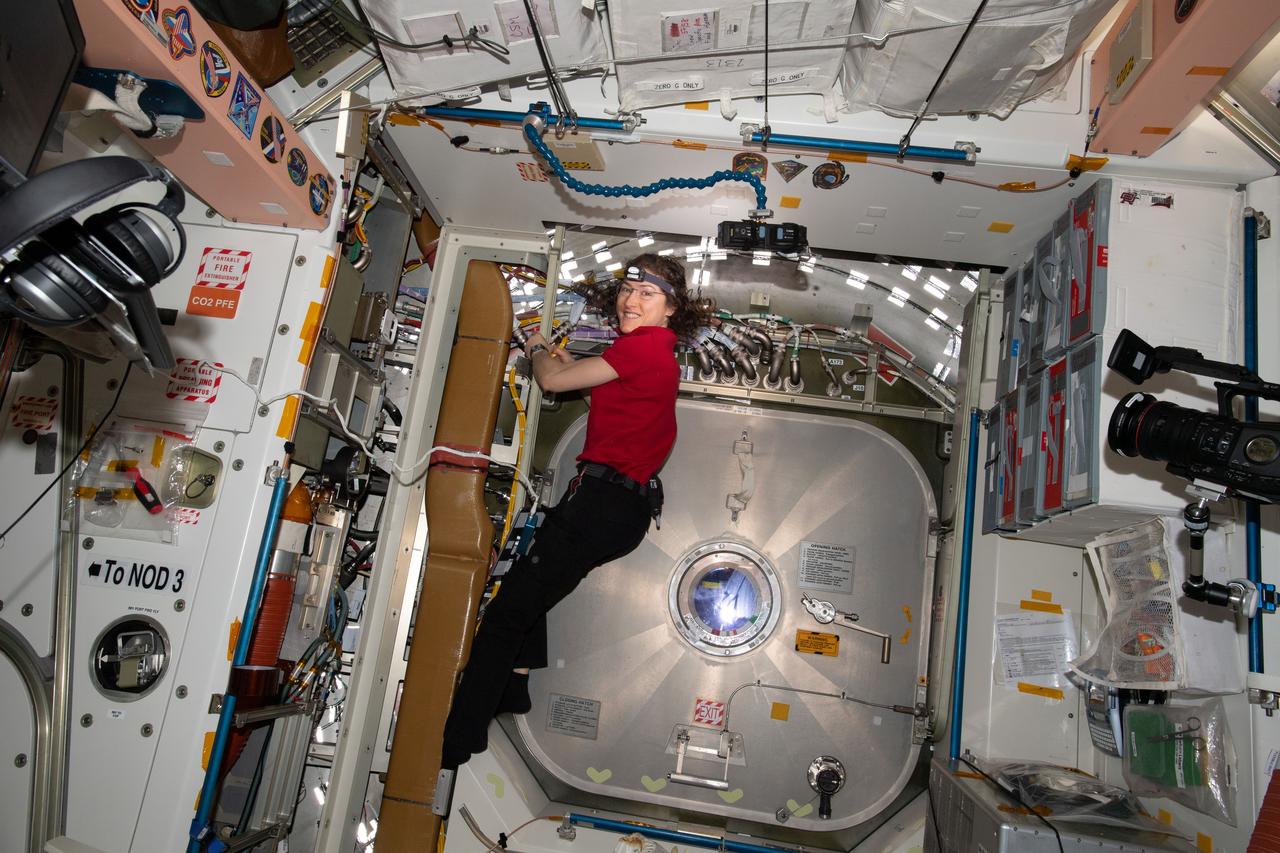
iss060e001460 (June 28, 2019) --- Expedition 60 Flight Engineer Christina Koch of NASA partially installs cables inside the Unity module to support Canadarm2 robotic arm operations aboard the International Space Station.
This series of images shows the Martian moon Deimos as it crossed in front of the Sun, as seen by NASA's Curiosity Mars rover on Sunday, March 17, 2019 (the 2,350th Martian day, or sol, of the mission). The images were captured by Curiosity's telephoto-lens camera, called its Mast Camera pair (right Mastcam). The images have been sped up by a factor of 10. Deimos is small enough that scientists consider it a transit rather than an eclipse. The Deimos transit lasted several minutes. Movie available at https://photojournal.jpl.nasa.gov/catalog/PIA23134
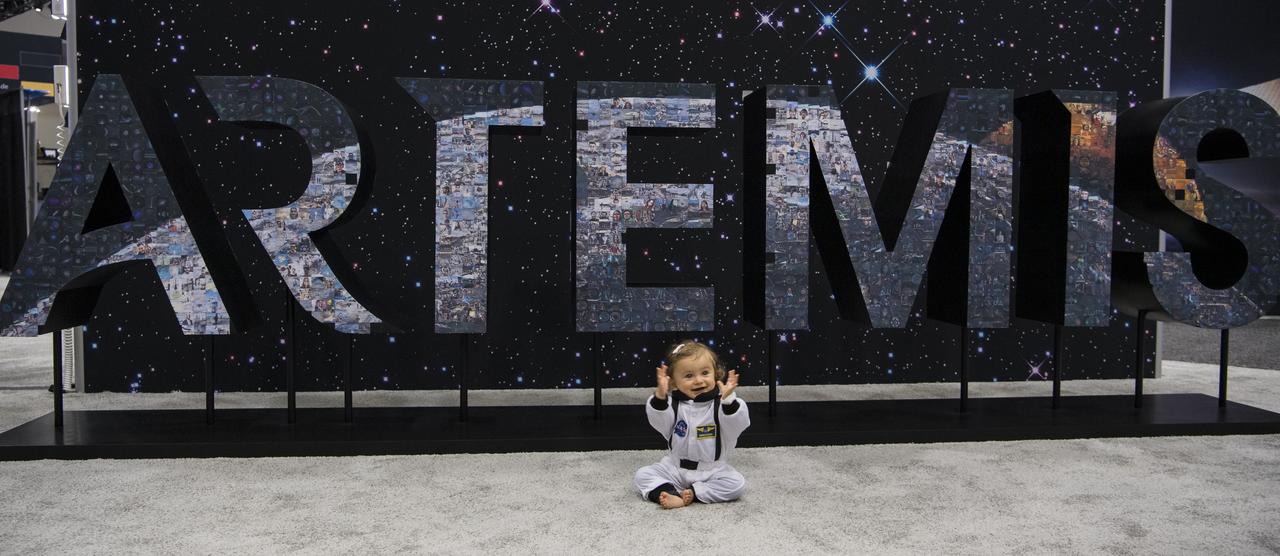
A baby in a flight suit sits in front of the Artemis sign at the NASA exhibit during the 70th International Astronautical Congress, Friday, Oct. 25, 2019, at the Walter E. Washington Convention Center in Washington. Photo credit: (NASA/Aubrey Gemignani)

iss058e015351 (Feb. 17, 2019) --- A pair of spacesuits are pictured during servicing work inside the International Space Station's Quest airlock where U.S. spacewalks are staged.
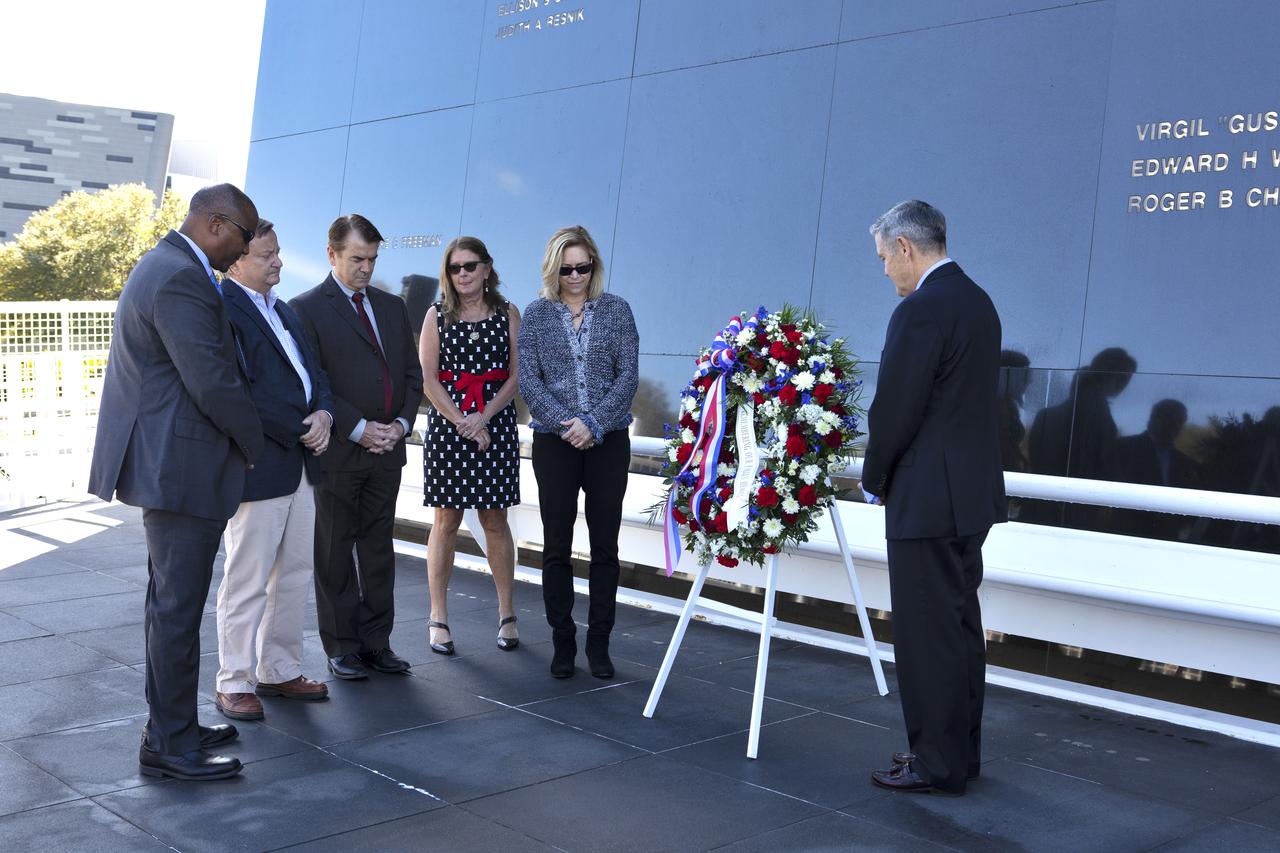
During this year’s Day of Remembrance ceremony at the Kennedy Space Center Visitor Complex, from left, Kennedy Associate Director Kelvin Manning, former Shuttle Launch Director Michael Leinbach, President and Chief Executive Officer of the Astronauts Memorial Foundation (AMF) Thad Altman, AMF Vice Chair Sheryl Chaffee, Kennedy Deputy Director Janet Petro, and Kennedy Center Director Bob Cabana stand in a moment of silence after placing a memorial wreath in front of the Space Mirror Memorial. Each year, Kennedy employees and guests gather with others throughout NASA to honor those astronauts who have fallen in the pursuit of space exploration.
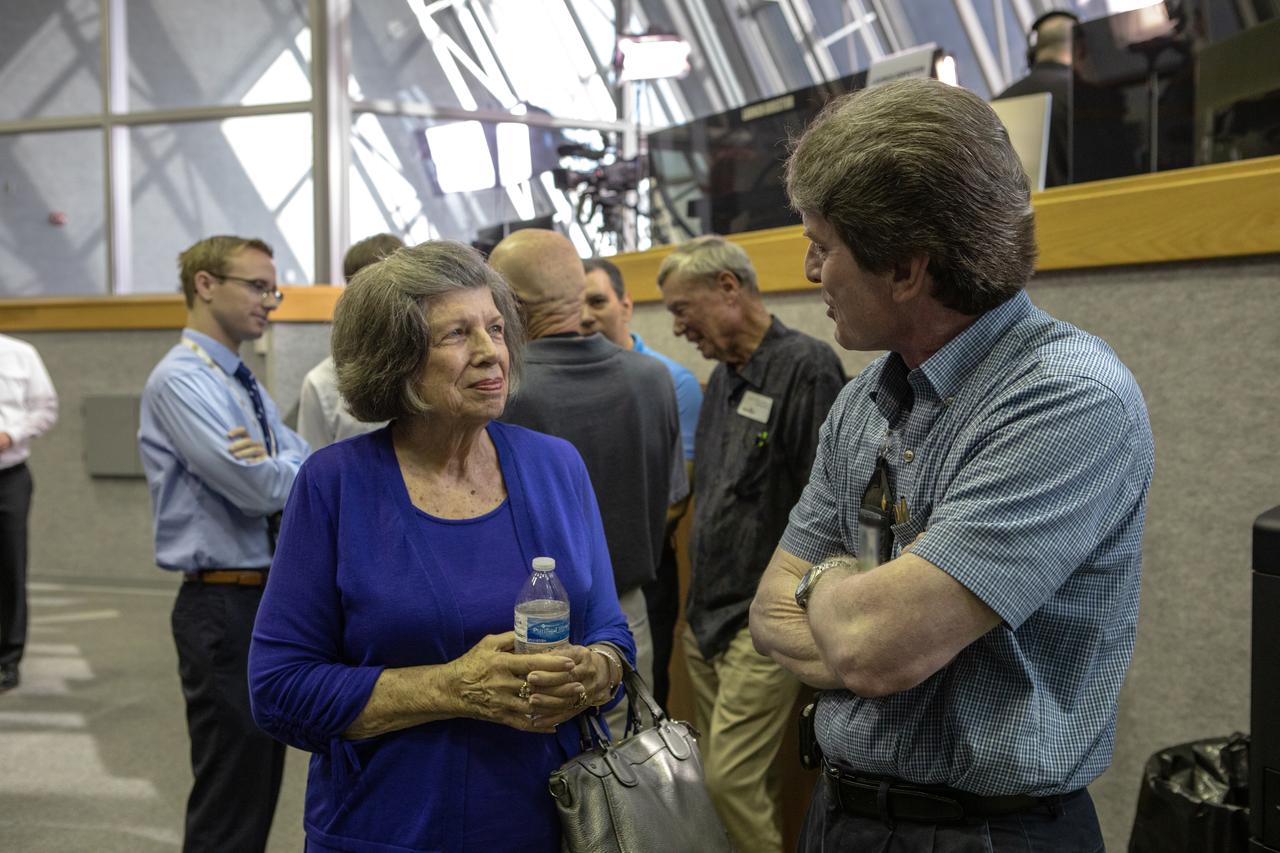
On July 16, 2019, the 50th anniversary of the Apollo 11 launch to the Moon, Apollo-era launch team member JoAnn Morgan, left, talks with an Artemis 1 launch team member in Launch Control Center Firing Room 1 at NASA's Kennedy Space Center in Florida. Morgan was the only female launch team member in the firing room during Apollo 11 launch countdown activities.
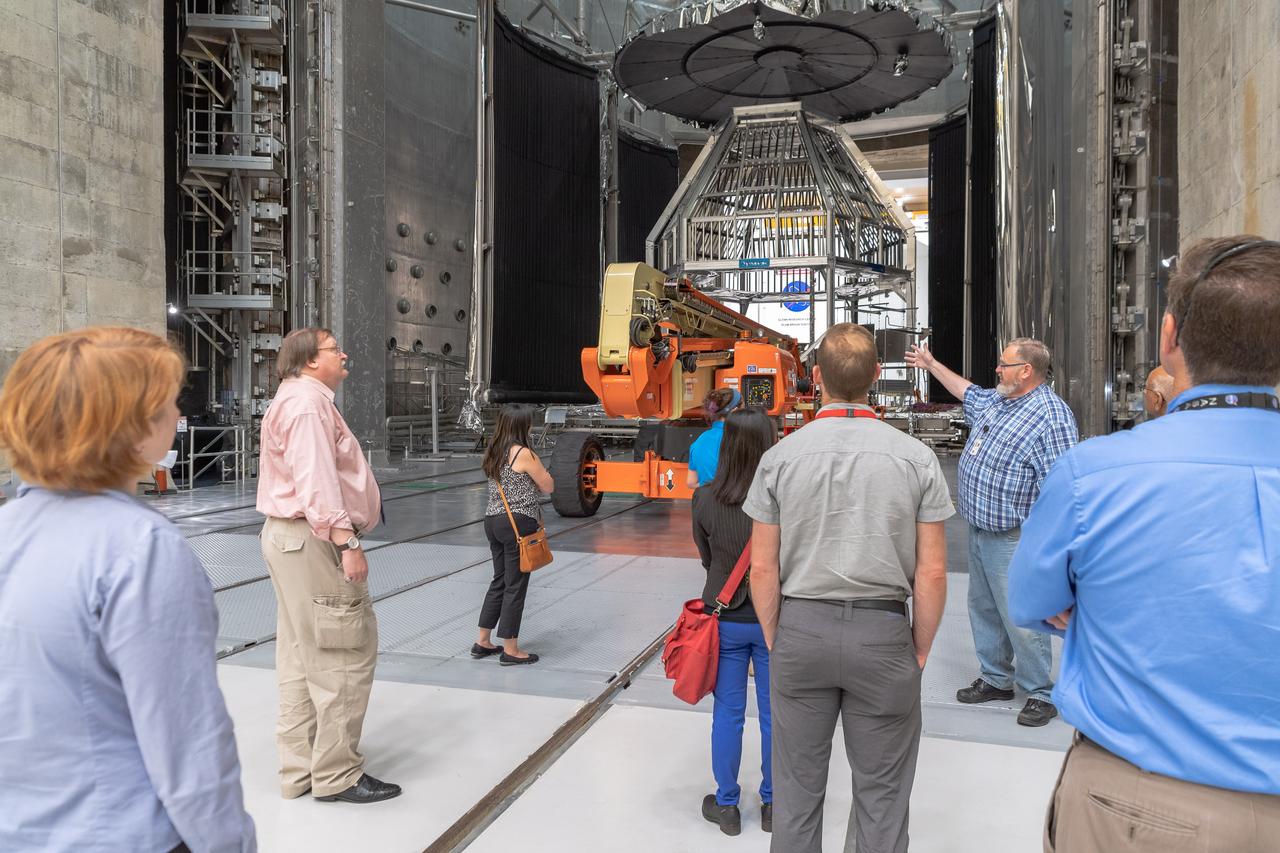
The inaugural Glenn Symposium focused on advancements in aerospace technology including power and propulsion, autonomy and communications, low boom supersonics, hypersonics, and more. Discussion also encompassed humans returning to the moon, including challenges associated with the 2024 mission.
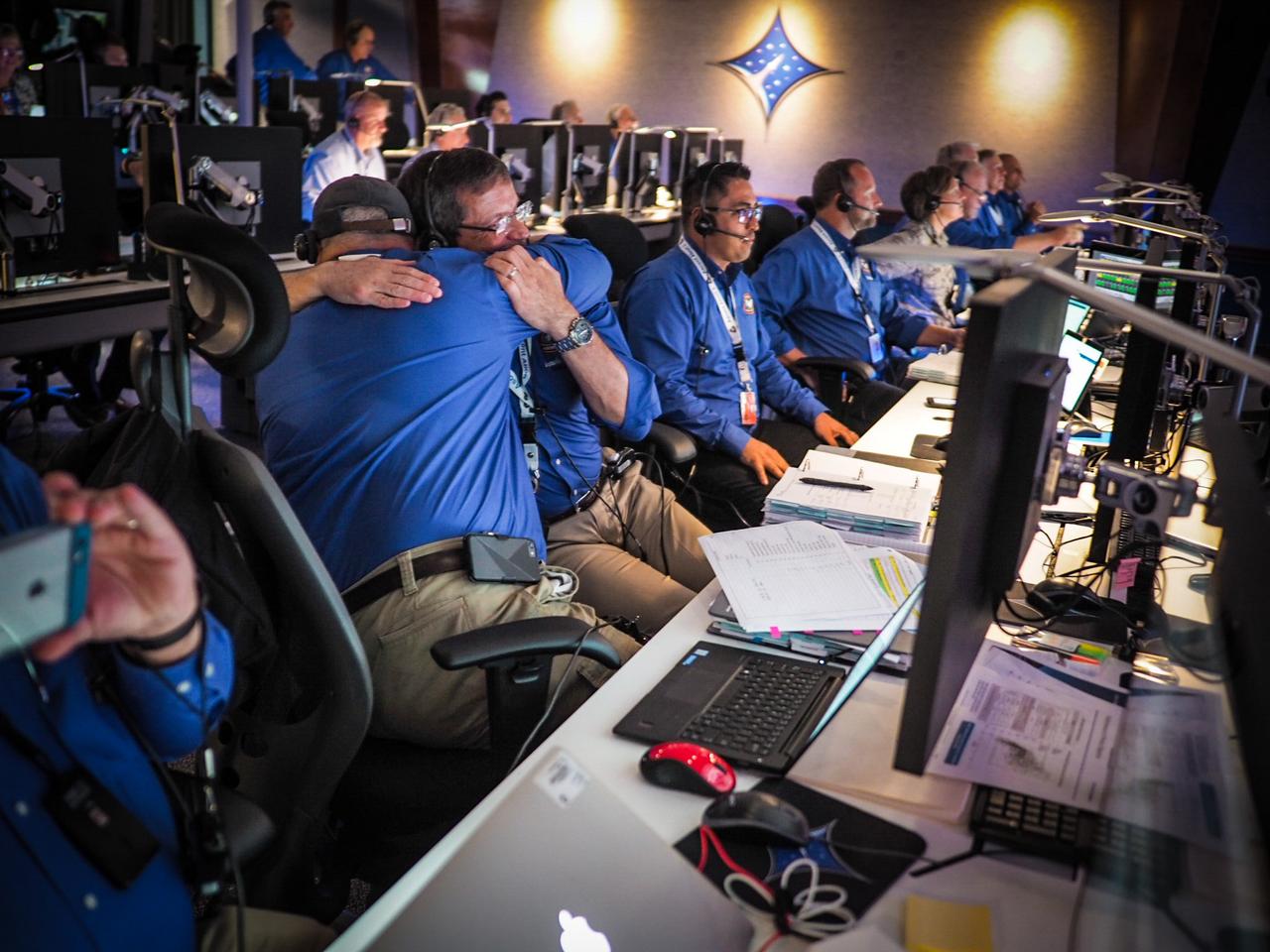
From Hangar AE at Cape Canaveral Air Force Station, the Orion team conducted the successful flight test of the Launch Abort System on Ascent Abort-2 (AA-2) on July 2, 2019.
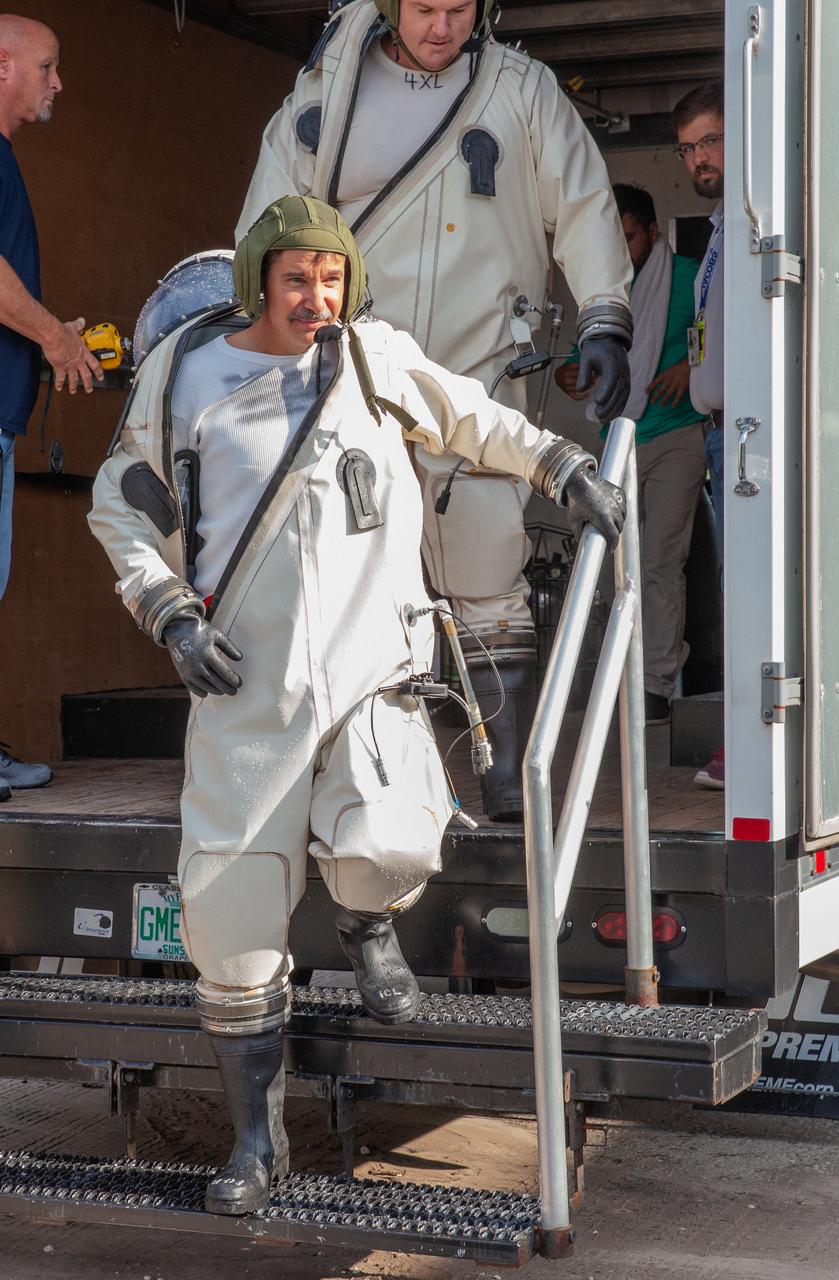
Technicians in Self-Contained Atmospheric Protective Ensemble (SCAPE) suits exit a truck near the Multi-Payload Processing Facility (MPPF) at NASA’s Kennedy Space Center in Florida, for a test simulation of loading propellants into a replicated test tank for Orion on Aug. 16, 2019. Exploration Ground Systems is preparing for Artemis 1 with a series of hazardous hyper test events at the MPPF. The technicians will complete a tanking to test the system before Orion arrives for processing. During preparations for launch, these teams will be responsible for loading the Orion vehicle with propellants prior to transportation to the Vehicle Assembly Building, where it will be secured atop the Space Launch System rocket. SCAPE suits are used in operations involving toxic propellants and are supplied with air either through a hardline or through a self-contained environmental control unit.
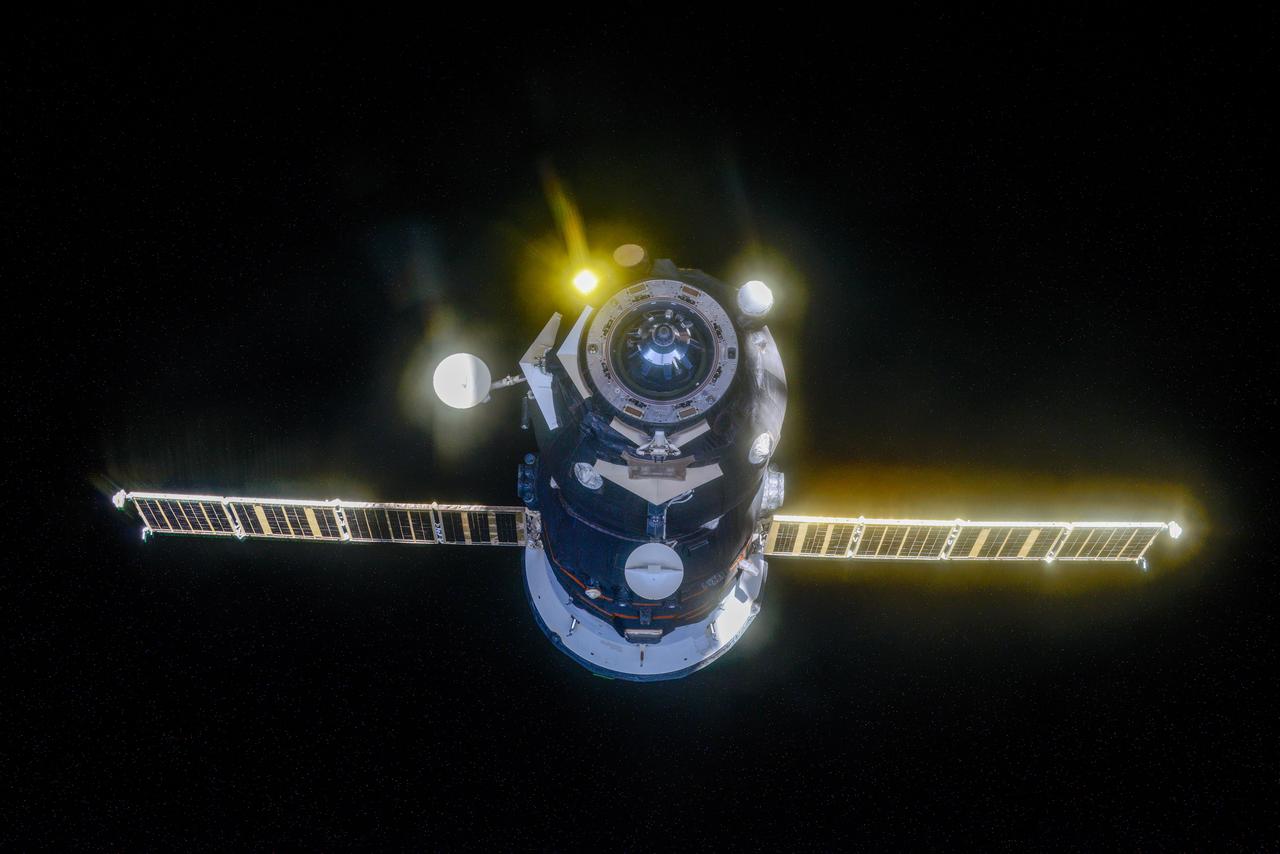
iss061e061561 (Nov. 29, 2019) --- Russia's Progress 73 (73P) cargo craft is pictured departing the International Space Station after undocking from the Pirs docking compartment. Loaded with trash, the 73P was deorbited a few hours later and burned up safely over the Pacific Ocean.
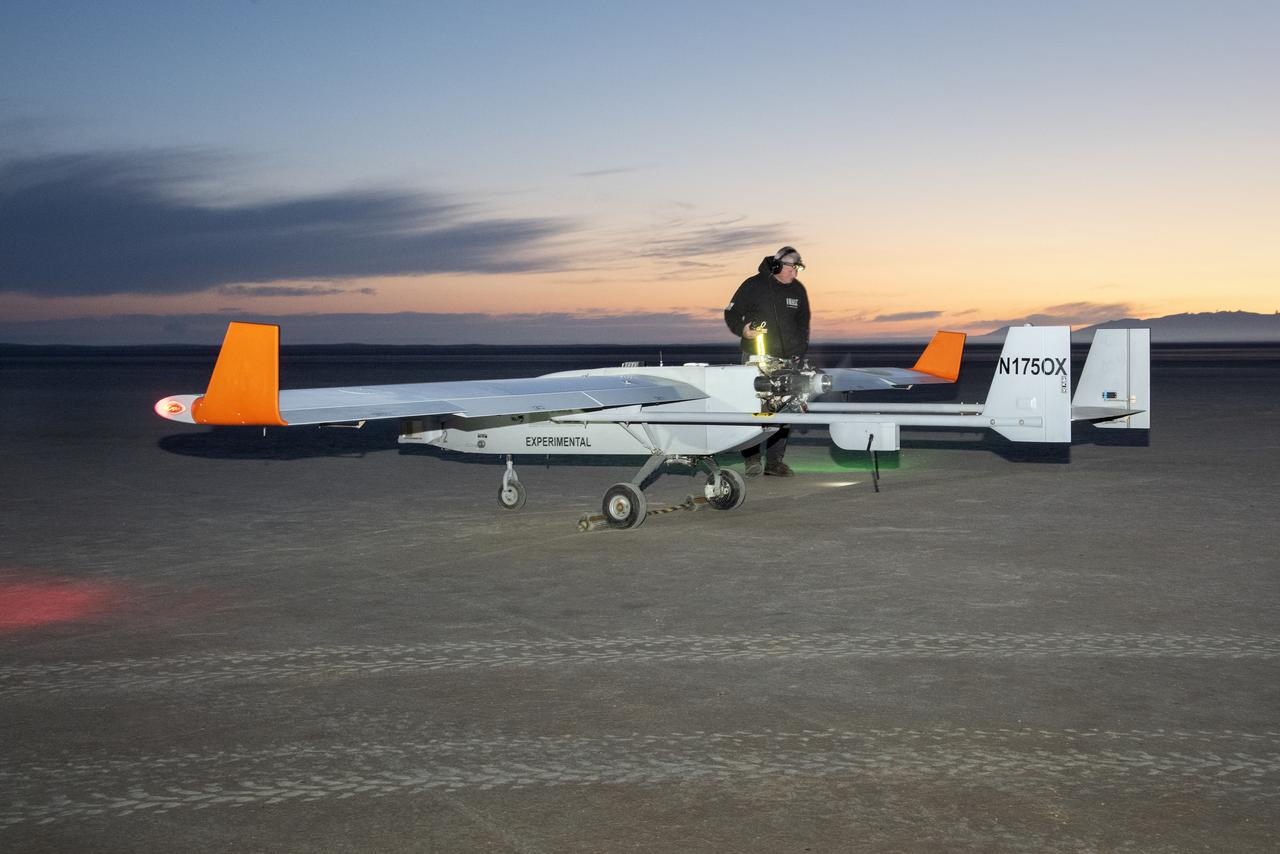
The Navmar Applied Sciences Corporation’s TigerShark prepares for its final takeoff at Edwards Air Force Base for the Unmanned Aircraft Systems integration in the National Airspace Systems, Flight Test Series Six (FT6) project. FT6 flight tests took place at NASA’s Armstrong Flight Research Center in California and focused on low size weight and power sensors for Detect and Avoid (DAA) operations in controlled airspace to inform the FAA through the RTCA Special Committee DAA Working Group on the phase 2 minimum operational performance standards for DAA and air-to-air radar.
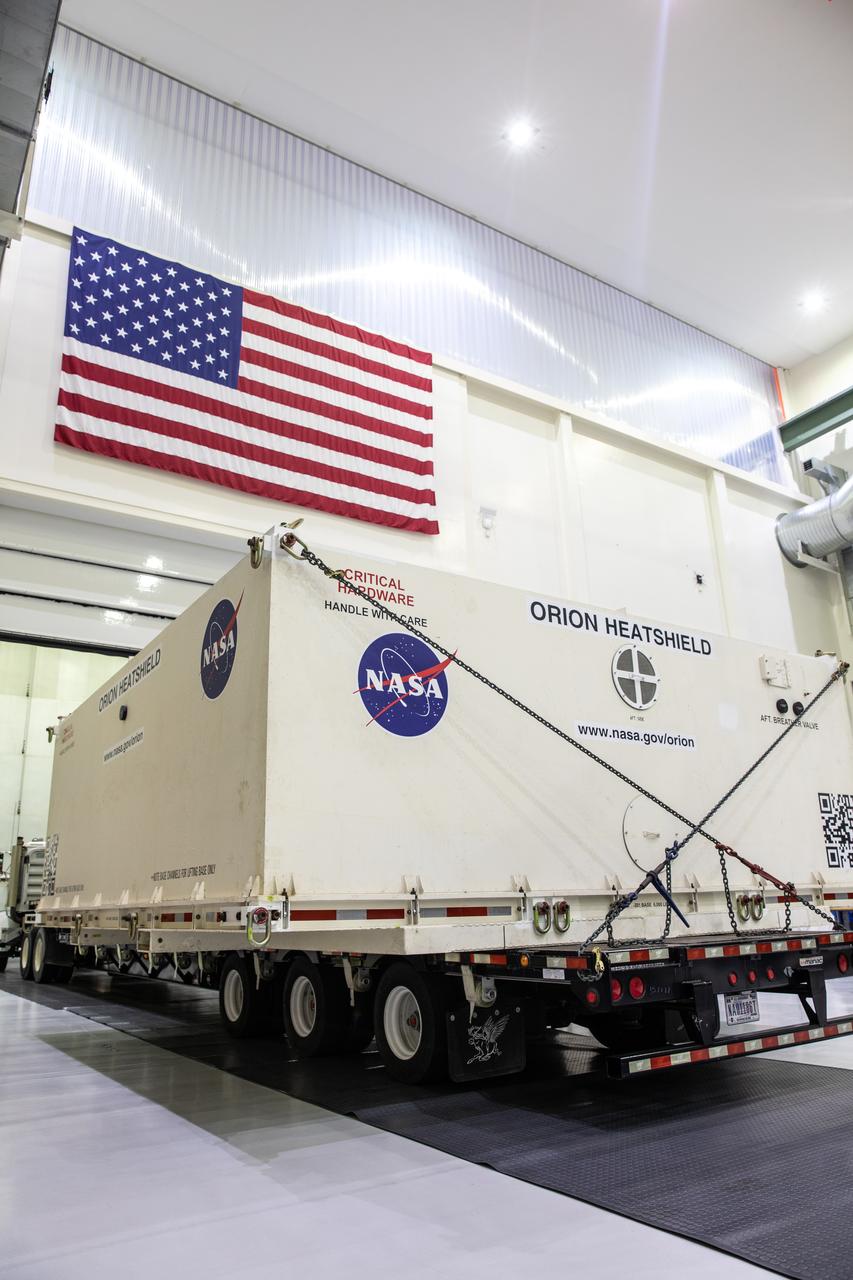
A flatbed truck with the shipping container carrying the heat shield for Orion’s Artemis 2 mission, NASA’s first crewed mission, moves into the Neil Armstrong Operations and Checkout Building high bay at the agency’s Kennedy Space Center in Florida on July 9, 2019. The heat shield, measuring roughly 16 feet in diameter, will protect astronauts upon re-entry on the second mission of Artemis. The heat shield arrived from Lockheed Martin’s manufacturing facility near Denver aboard NASA’s Super Guppy Aircraft. The heat shield is a base titanium truss structure. Over the next several months, technicians will apply Avcoat, an ablative material that will provide the thermal protection. Artemis 2 will confirm all of the spacecraft’s systems operate as designed in the actual environment of deep space with astronauts aboard.

Evening With The Stars - 2019
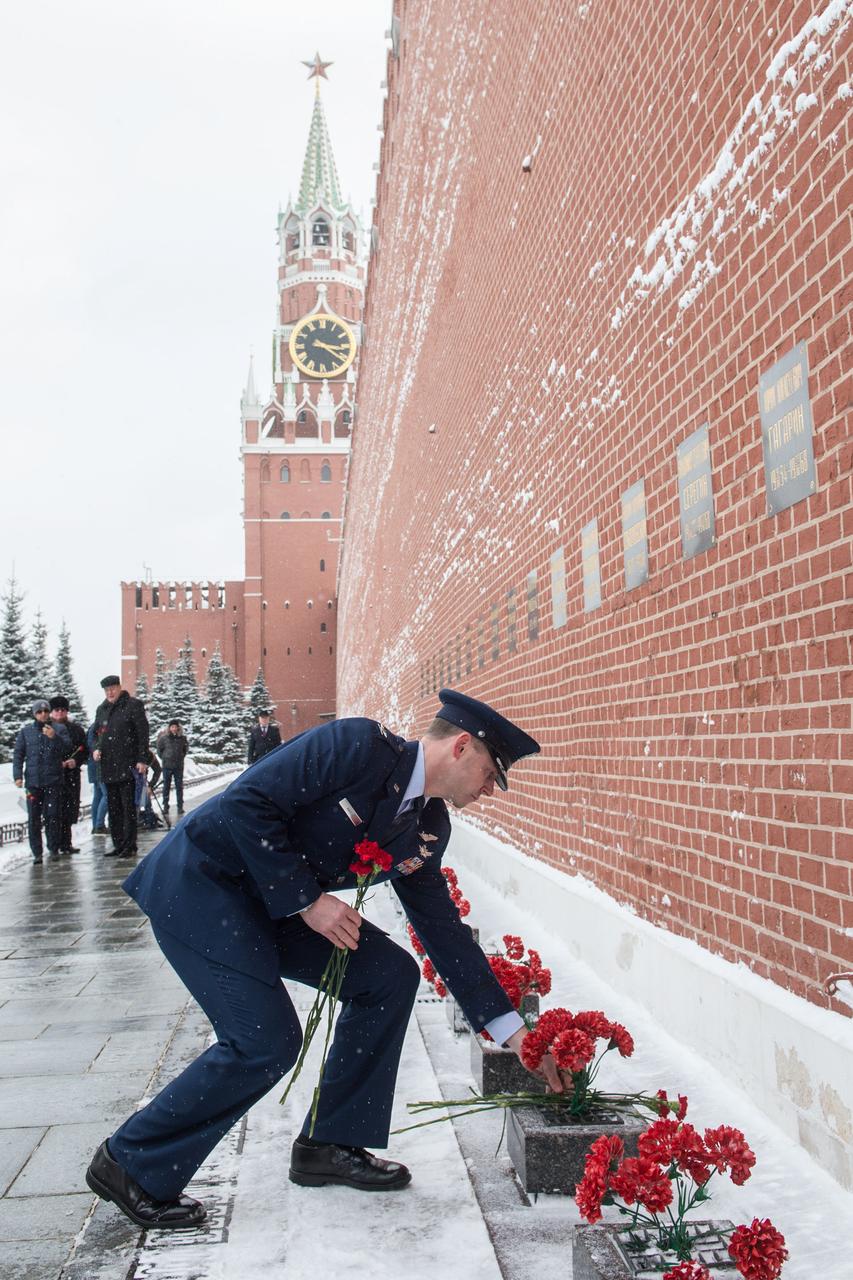
At the Kremlin Wall in Moscow, Expedition 59 crewmember Nick Hague of NASA lays flowers where Russian space icons are interred in traditional ceremonies Feb. 21. Hague, Alexey Ovchinin of Roscosmos and Christina Koch of NASA will launch March 14, U.S. time, on the Soyuz MS-12 spacecraft from the Baikonur Cosmodrome in Kazakhstan for a six-and-a-half month mission on the International Space Station. Andrey Shelepin/Gagarin Cosmonaut Training Center
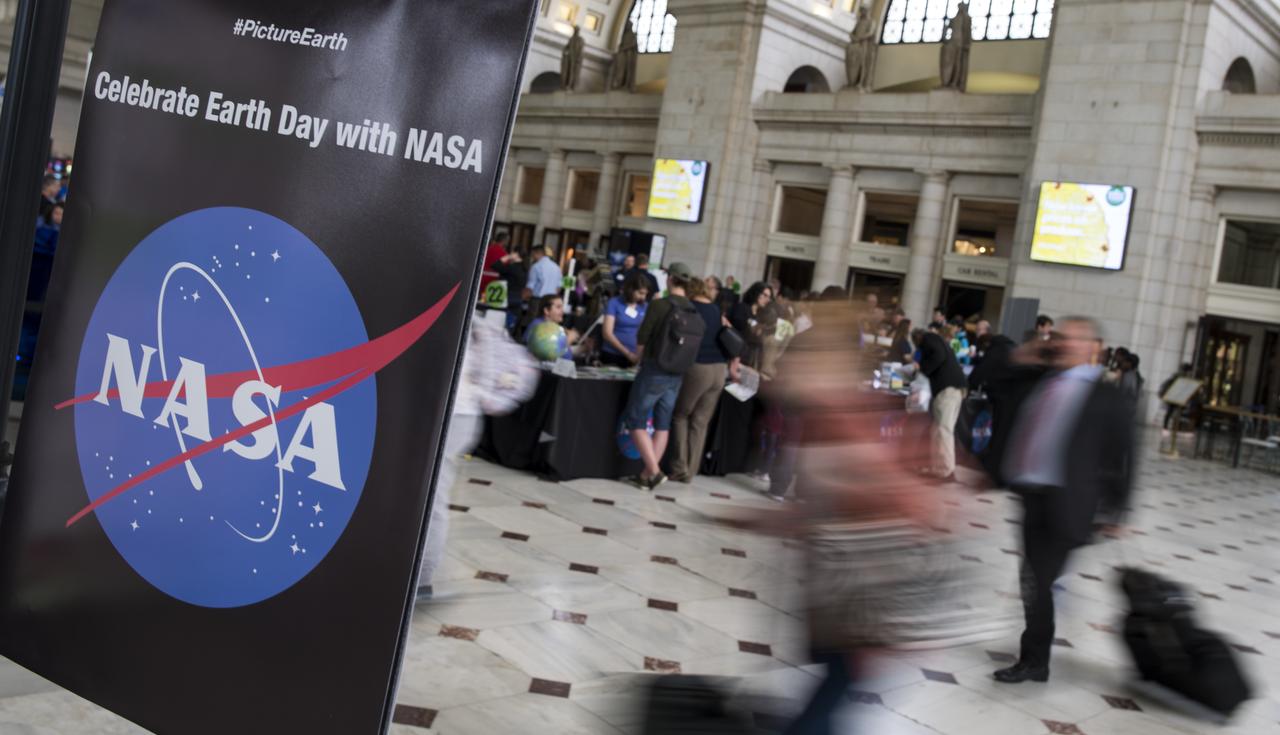
Travelers walk past NASA's exhibits at the Earth Day event held at Union Station on Monday, April 22, 2019, Washington, D.C. Photo Credit: (NASA/Joel Kowsky)
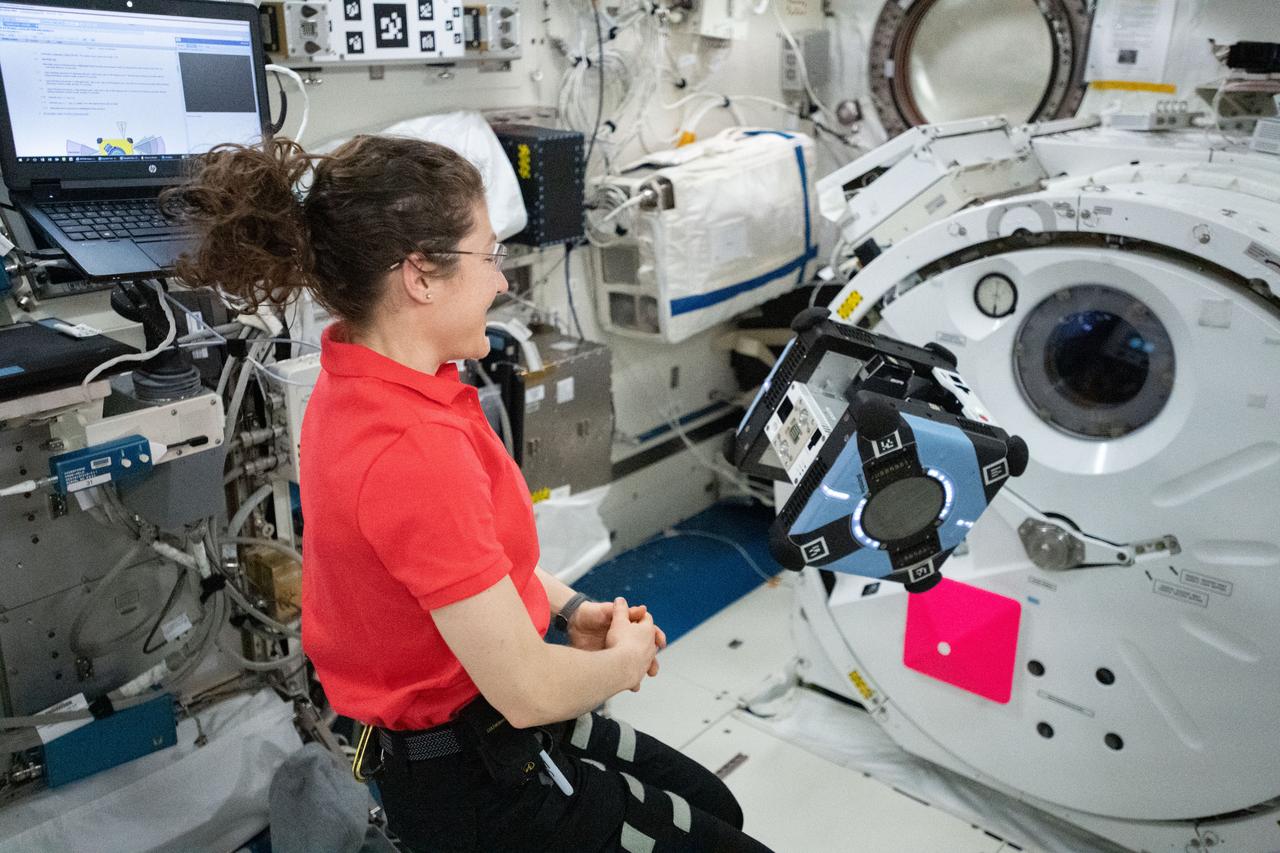
iss060e007162 (July 12, 2020) --- NASA astronaut and Expedition 60 Flight Engineer Christina Koch tests the mobility of the free-flying Astrobee robotic assistant inside the Kibo laboratory module. Astrobee consists of three self-contained, free flying robots and a docking station inside the International Space Station.
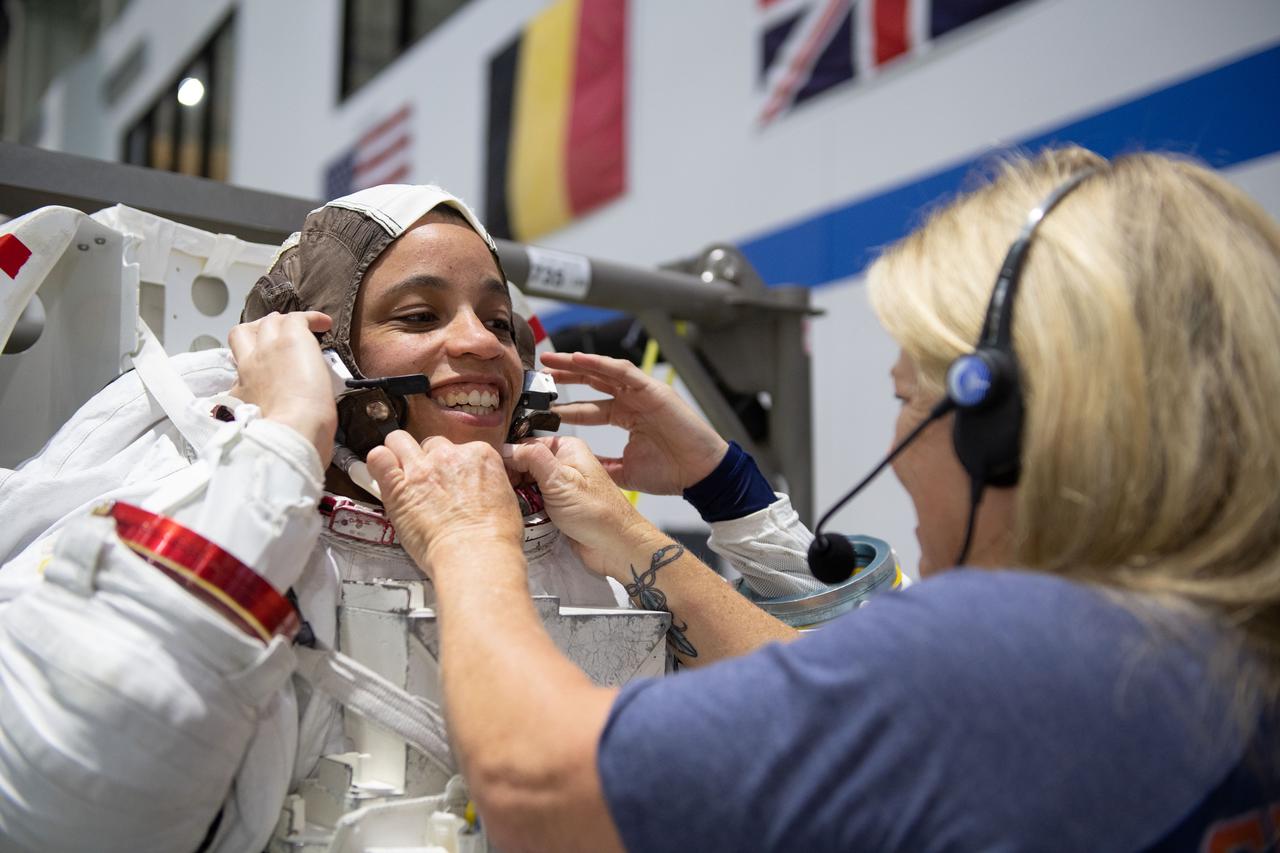
jsc2019e030024 (05-22-19) --- 2017 NASA astronaut candidate Jessica Watkins is helped into a spacesuit prior to underwater spacewalk training at NASA Johnson Space Center’s Neutral Buoyancy Laboratory in Houston. Photo Credit: (NASA/David DeHoyos)
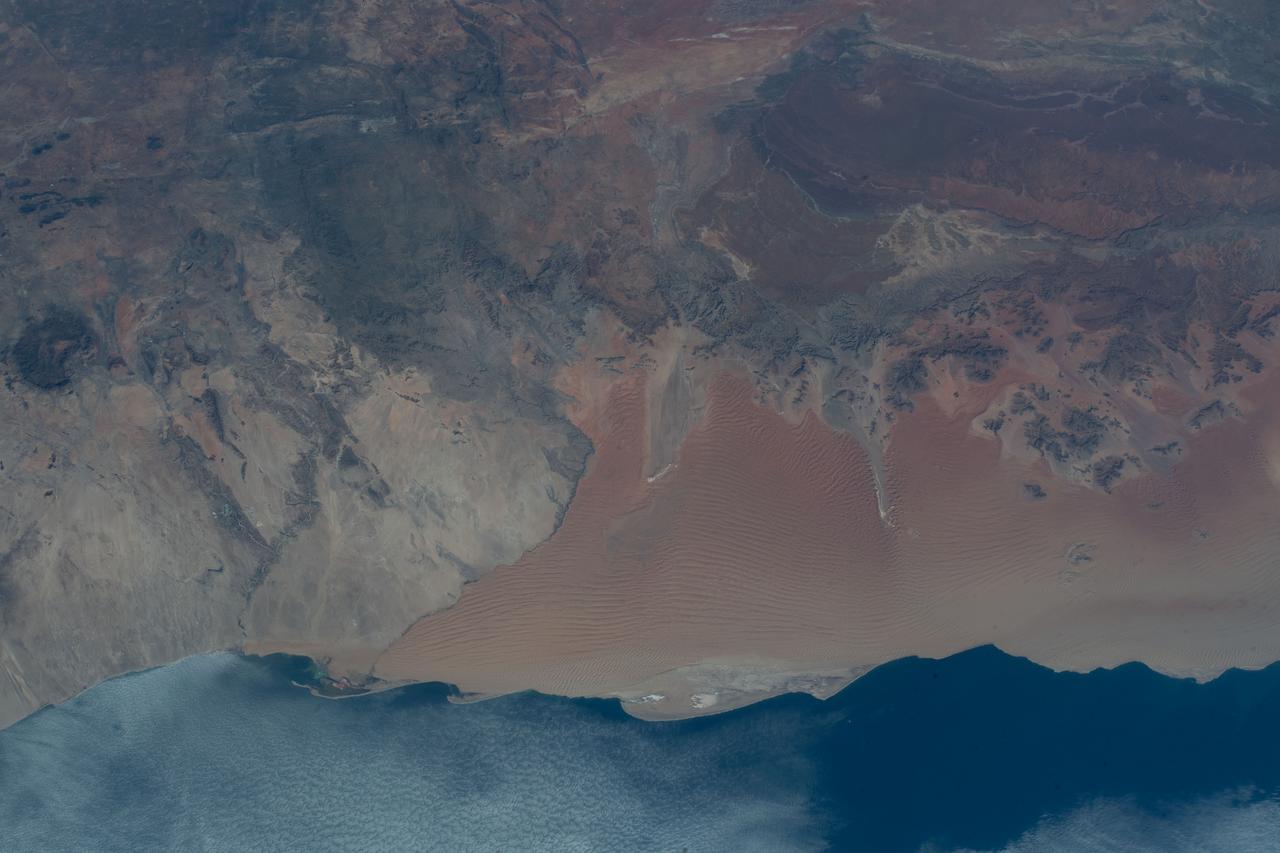
iss059e061447 (May 13, 2019) --- The Namib Desert on the Atlantic Coast of Namibia is photographed from an altitude of 259 miles as the International Space Station orbited off the coast of the southwestern Africa nation.
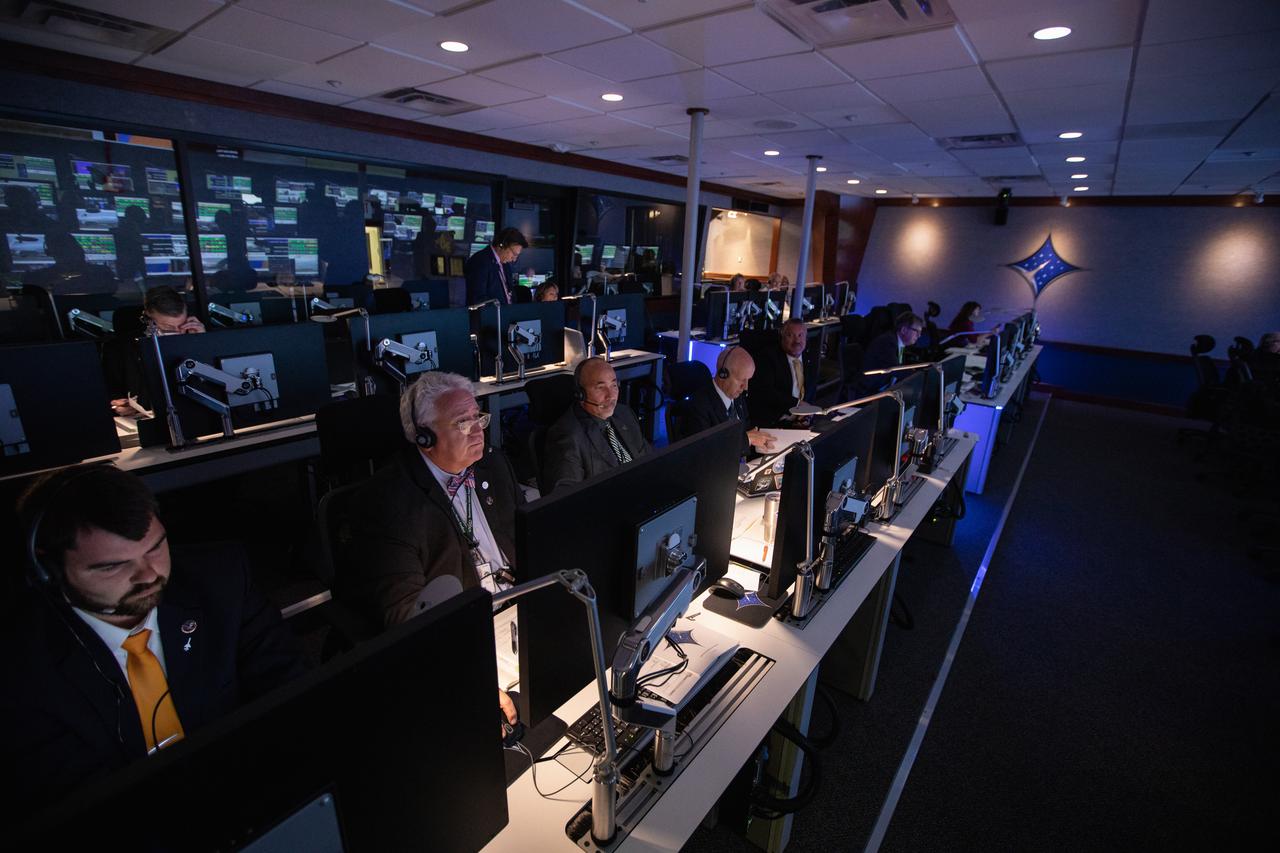
Inside Hangar AE’s Mission Director’s Center at Cape Canaveral Air Force Station (CCAFS), members of the launch team monitor the launch of NASA’s Ionospheric Connection Explorer (ICON) satellite. The Northrop Grumman Pegasus XL rocket carrying ICON was released from the company’s L-1011 Stargazer aircraft at 9:59 p.m. EDT on Oct. 10, 2019, over the Atlantic Ocean about 50 miles from Daytona Beach, Florida, following takeoff from CCAFS. ICON will spend two years studying the Earth’s ionosphere – the dynamic zone in our atmosphere where terrestrial weather from below meets space weather from above. The launch was managed by the agency’s Launch Services Program.
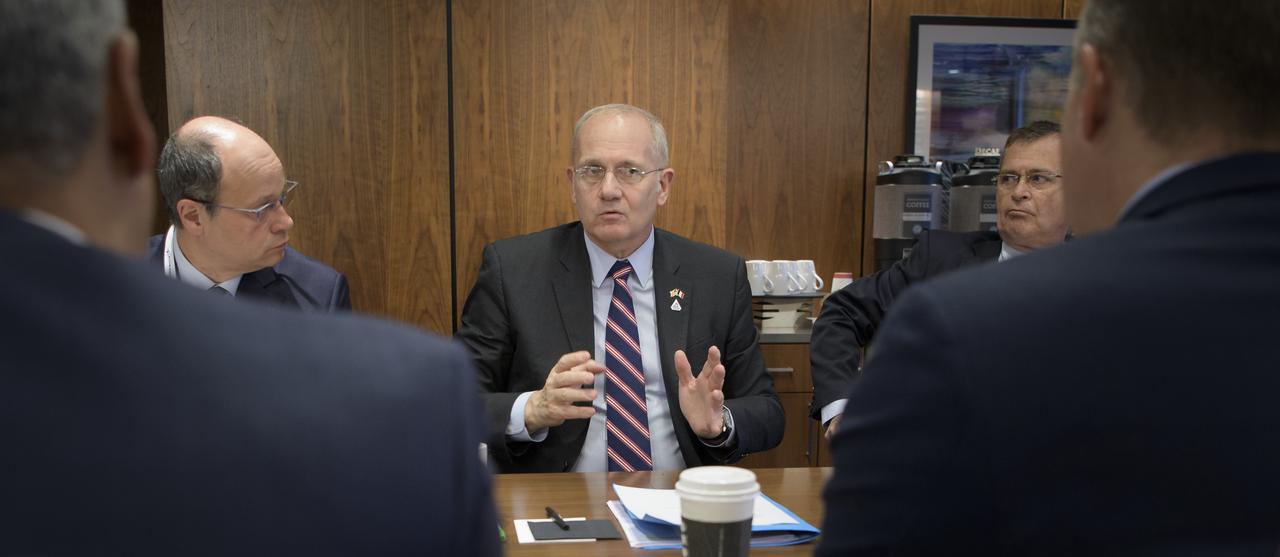
Jean-Yves Le Gall, President of the Centre National d’Études Spatiales (CNES) talks with NASA Administrator Jim Bridenstine during a meeting at the 70th International Astronautical Congress, Thursday, Oct. 24, 2019, in Washington. Photo Credit: (NASA/Bill Ingalls)
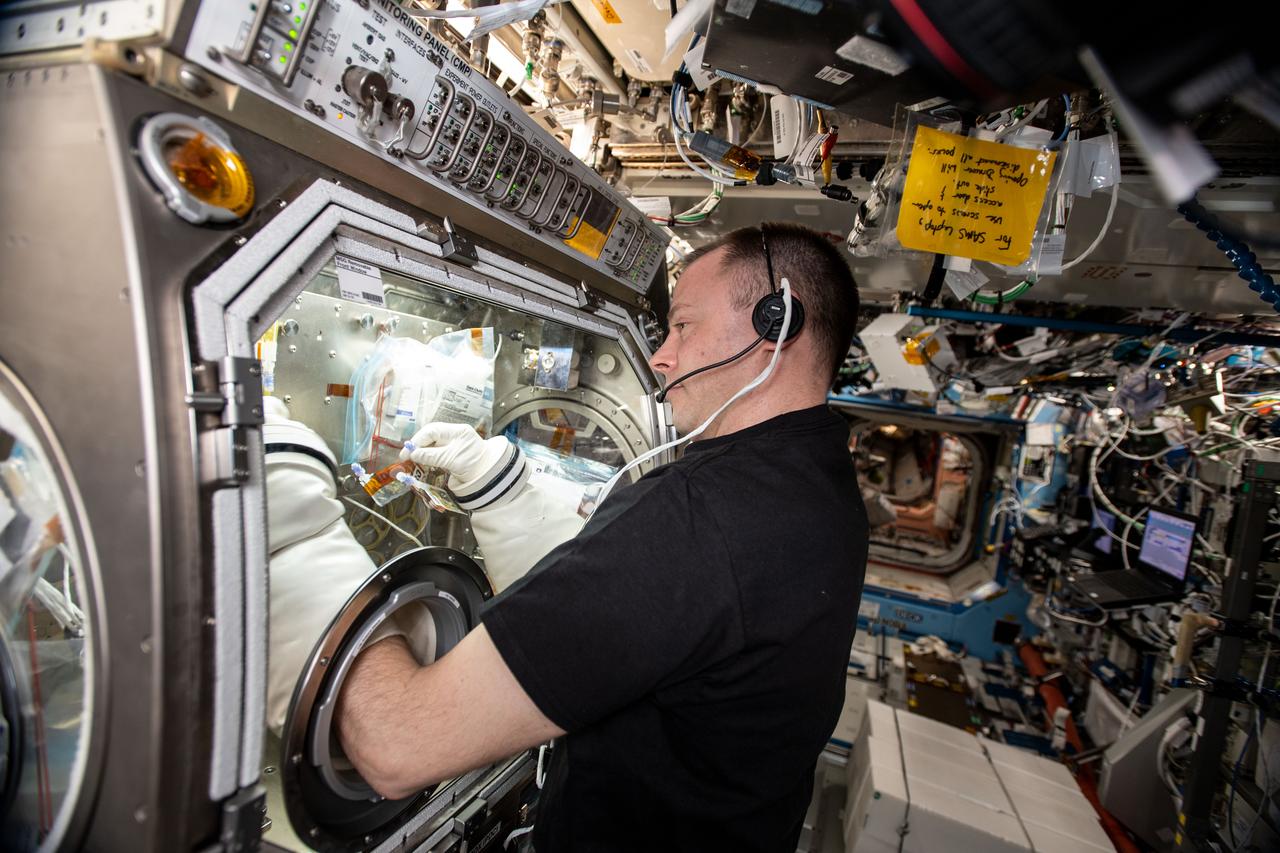
iss059e061522 (May 14, 2019) --- NASA astronaut Nick Hague conducts research operations in the U.S. Destiny laboratory module's Microgravity Sciences Glovebox. Hague is exploring why pathogens become more virulent in the weightless environment of outer space posing a flight risk to astronauts.
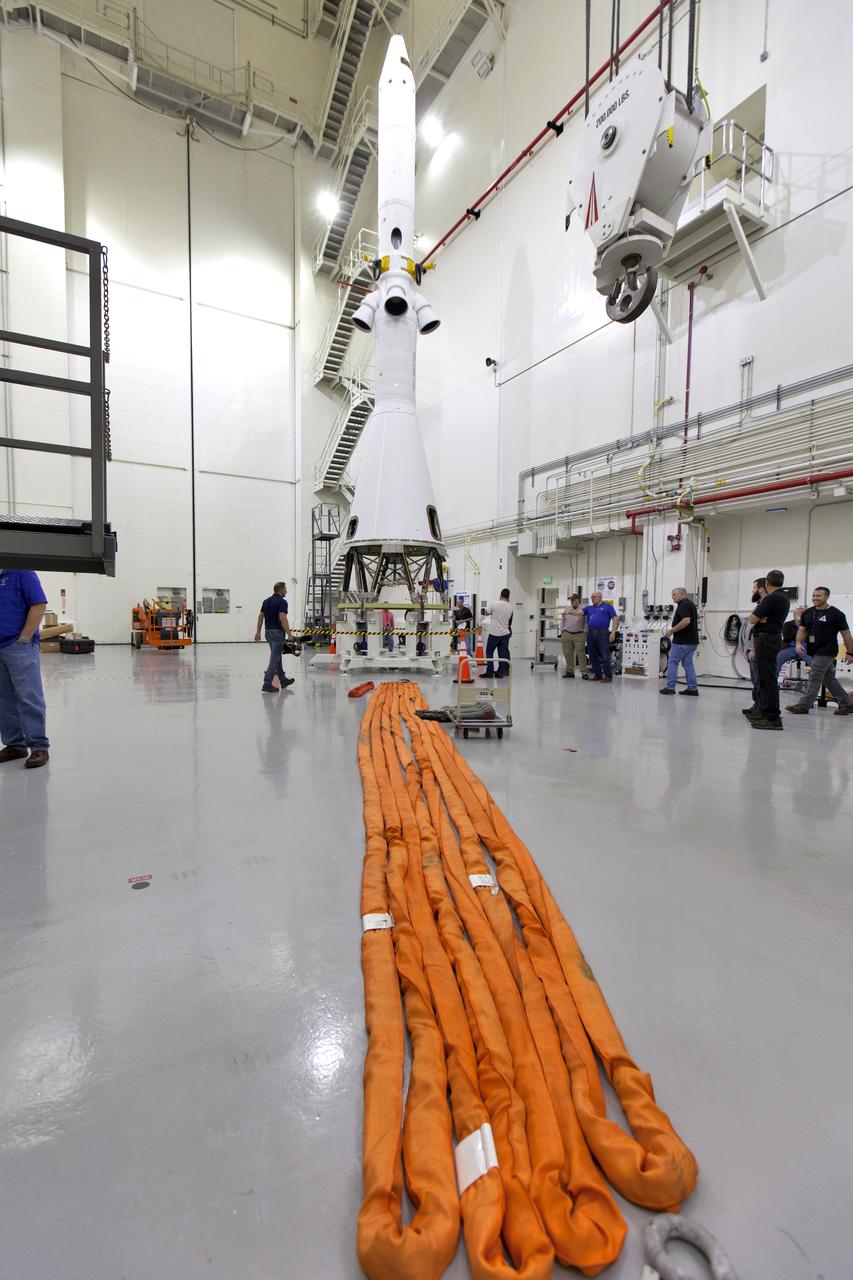
Inside the Launch Abort System Facility (LASF) at NASA’s Kennedy Space Center in Florida, workers are preparing to integrate a test version of the Orion crew module with the Launch Abort System (LAS) on March 13, 2019. The test vehicle and the LAS will be used for the Orion Ascent Abort-2 (AA-2) Flight Test. AA-2 is a full-stress test of the LAS, scheduled for spring 2019. AA-2 will launch from Space Launch Complex 46, carrying a fully functional LAS and a 22,000-pound Orion test vehicle to an altitude of 31,000 feet and traveling at more than 1,000 miles an hour. The test will verify the LAS can steer the crew module and astronauts aboard to safety in the event of an issue with the Space Launch System (SLS) rocket when the spacecraft is under the highest aerodynamic loads it will experience during a rapid climb into space. NASA's Orion and Exploration Ground Systems programs and contractors from Jacob's and Northrop Grumman in conjunction with the Air Force Space and Missile Center's Launch Operations branch are performing flight operations for AA-2.

jsc2019e052243 - With St. Basil’s Cathedral serving as a backdrop, the next crew to launch to the International Space Station and their backups walk through Red Square in Moscow Sept. 5 as part of traditional pre-launch activities. From right to left are Expedition 61 crewmembers Jessica Meir of NASA and Oleg Skripochka of Roscosmos, spaceflight participant Hazzaa Ali Almansoori of the United Arab Emirates and backups, Tom Marshburn of NASA and Sultan Al-Neyadi of the United Arab Emirates. Meir, Skripochka and Almansoori will launch Sept. 25 from the Baikonur Cosmodrome in Kazakhstan on the Soyuz MS-15 spacecraft for a mission on the International Space Station...Andrey Shelepin/Gagarin Cosmonaut Training Center.

Team AI. SpaceFactory's printer autonomously inserts a window into their 3D-printed subscale habitat structure at NASA's 3D-Printed Habitat Challenge, held at the Caterpillar Edwards Demonstration & Learning Center in Edwards, Illinois, May 1-4, 2019. The habitat print is the final level of the multi-phase competition, which began in in 2015. The 3D-Printed Habitat Challenge is a competition to create sustainable shelters suitable for the Moon, Mars or beyond using resources available on-site in these locations. The challenge is managed by NASA's Centennial Challenges program, and partner Bradley University of Peoria, Illinois.
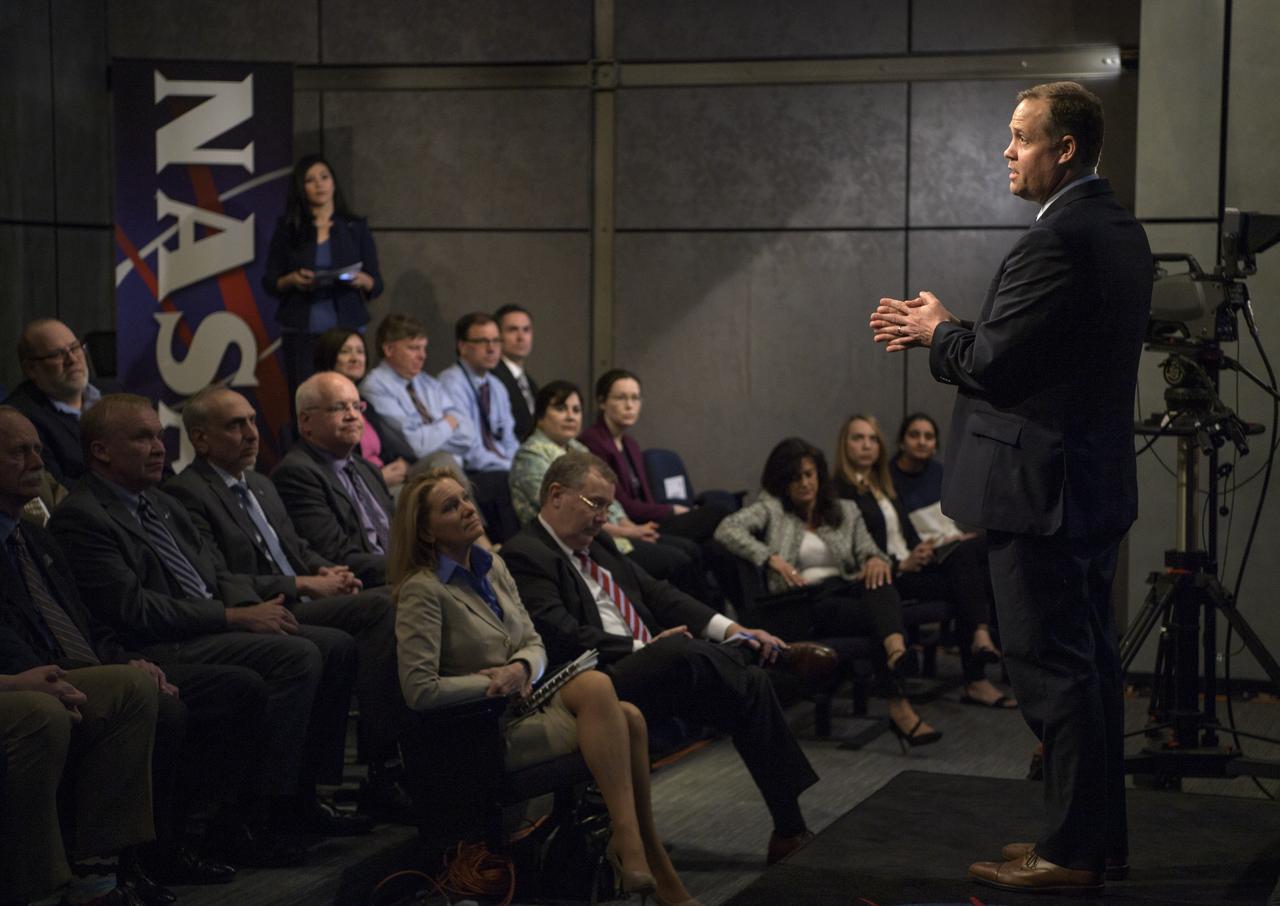
NASA Administrator Jim Bridenstine is seen during a NASA town hall event, Monday, April 1, 2019 at NASA Headquarters in Washington. Photo Credit: (NASA/Bill Ingalls)
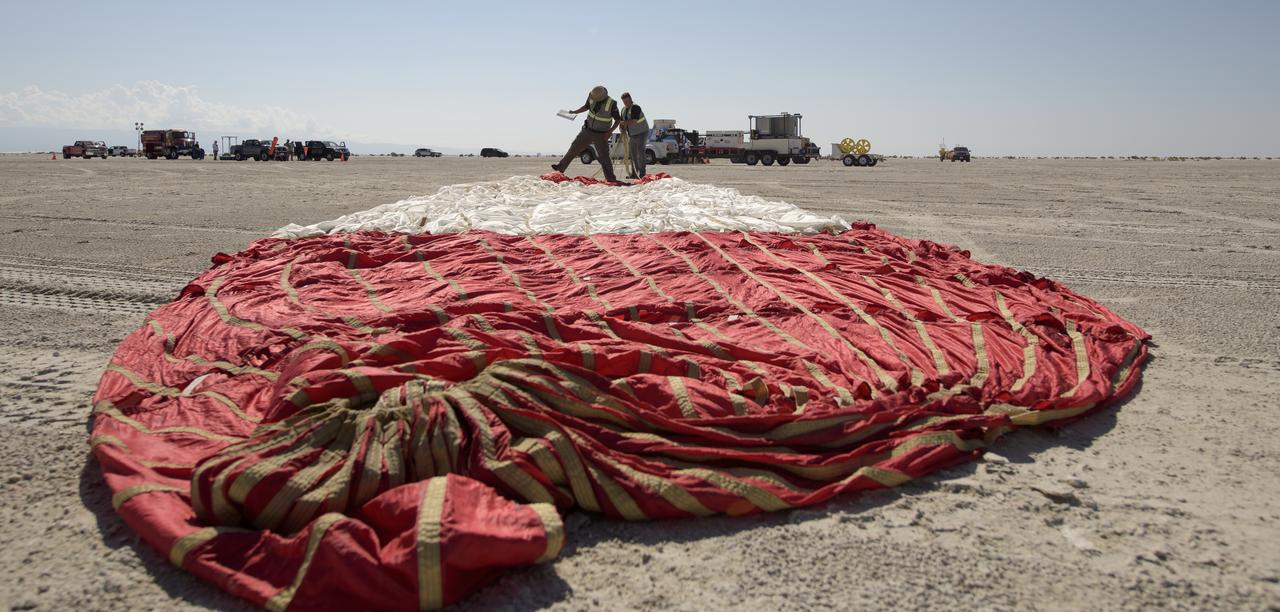
Teams from NASA, Boeing and the White Sands Missile Range, rehearse landing and crew extraction from Boeing’s CST-100 Starliner, which will be used to carry humans to the International Space Station, on Tuesday, Sept. 10, 2019 at the White Sands Missile Range outside Las Cruces, New Mexico. Using a convoy of vehicles Boeing uses to recover their spacecraft after landing and a boiler plate test article of the Starliner capsule, the teams worked through the steps necessary to safe the vehicle and get future crew members out of the Starliner to return home. NASA astronauts Mike Fincke and Nicole Mann and Boeing astronaut Chris Ferguson will fly to the space station aboard the Starliner for the Boeing Crew Flight Test mission. Photo Credit: (NASA/Bill Ingalls)
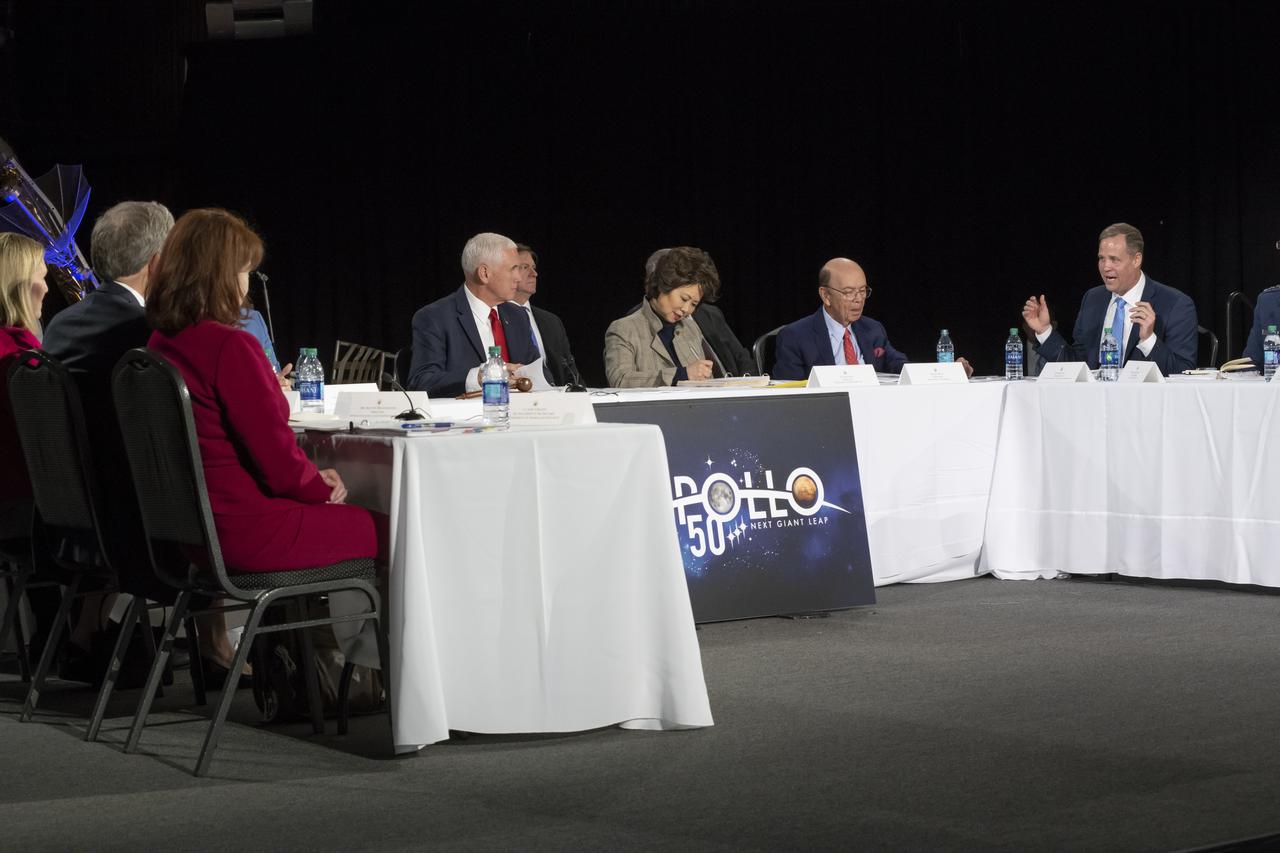
The National Space Council meet in Huntsville, Alabama at the U.S. Space and Rocket Center’s Davidson Center. The meeting was chaired by Vice President Mike Pence with members of the local community, NASA Marshall members and area media in attendance. NASA Administrator Jim Bridenstine addressed the Vice President and the Council on upcoming plans for NASA and the space program.

Teams from NASA’s Exploration Ground Systems and Space Launch System (SLS) practice SLS booster stacking with pathfinders inside Kennedy Space Center’s Vehicle Assembly Building on Nov. 19, 2019. Using overhead cranes and booster handling activities, the teams focused on procedures for mating a center segment onto a cylinder that simulated another segment. The exercise was performed around the clock, operating three shifts per day. SLS will launch the first woman and next man to the Moon by 2024 through the Artemis program.
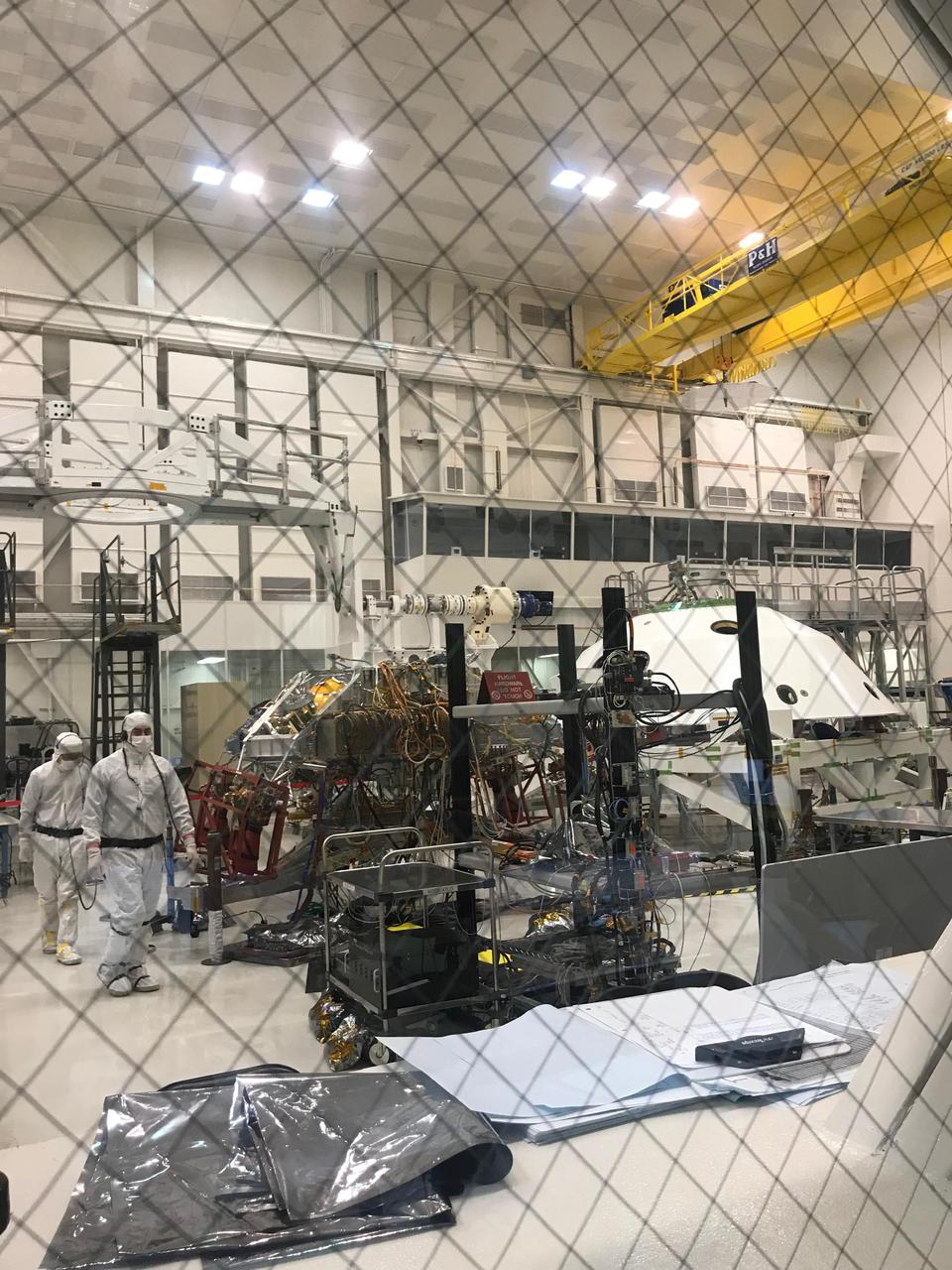
Technicians working Mars 2020's System's Test 1 approach their workstation in the Spacecraft Assembly Facility at NASA's Jet Propulsion Laboratory in Pasadena, Calif. Over two weeks in January 2019, 72 engineers and technicians assigned to the 2020 mission took over the High Bay 1 cleanroom in JPL's Spacecraft Assembly Facility to put the software and electrical systems aboard the mission's cruise, entry capsule, descent stage and rover through their paces. https://photojournal.jpl.nasa.gov/catalog/PIA23097

NASA Administrator Jim Bridenstine's hands are seen as he testifies during a House Committee on Science, Space, and Technology hearing to review the Fiscal Year 2020 budget request for the National Aeronautics and Space Administration, Tuesday, April 2, 2019 at the Rayburn House Office Building in Washington. Photo Credit: (NASA/Aubrey Gemignani)
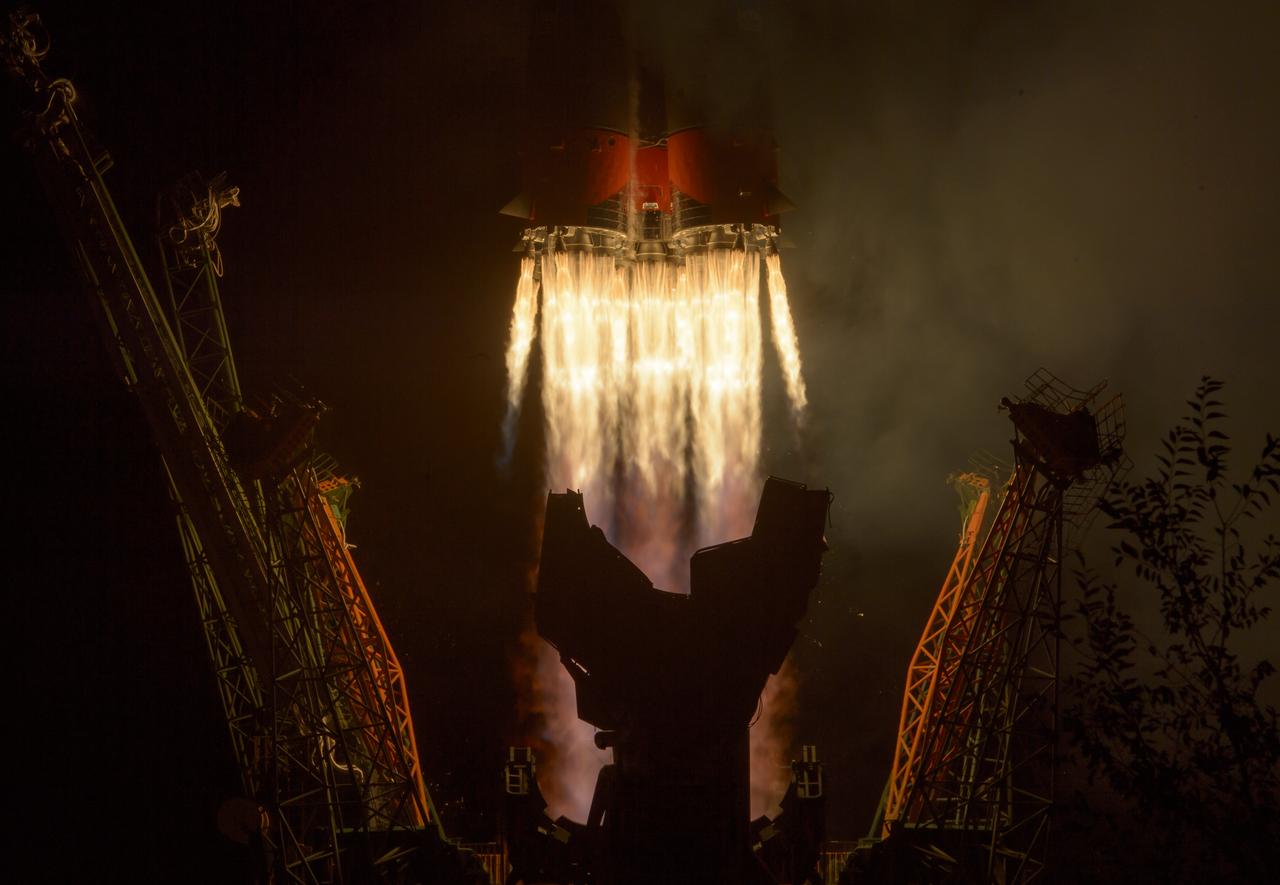
The Soyuz MS-15 spacecraft is launched with Expedition 61 crewmembers Jessica Meir of NASA and Oleg Skripochka of Roscosmos, and spaceflight participant Hazzaa Ali Almansoori of the United Arab Emirates Wednesday, Sept. 25, 2019 from the Baikonur Cosmodrome in Kazakhstan. Photo Credit: (NASA/Bill Ingalls)
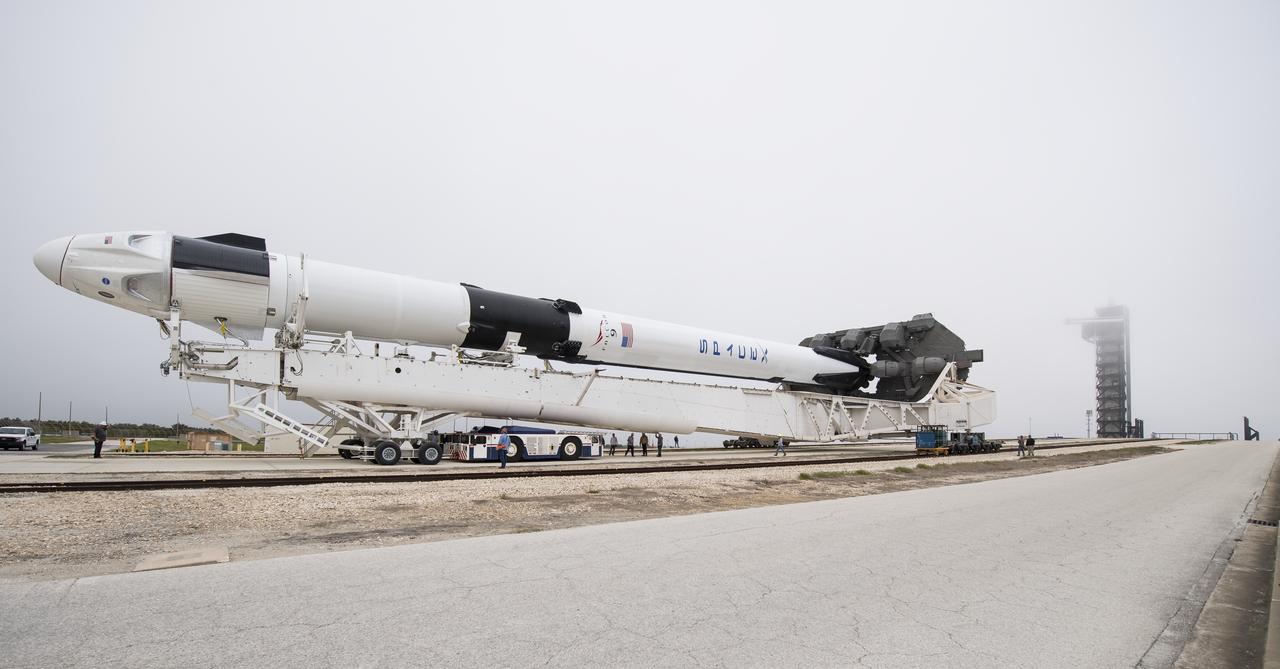
A SpaceX Falcon 9 rocket with the company's Crew Dragon spacecraft onboard is seen as it is rolled out of the horizontal integration facility at Launch Complex 39A as preparations continue for the Demo-1 mission, Feb. 28, 2019 at the Kennedy Space Center in Florida. The Demo-1 mission will be the first launch of a commercially built and operated American spacecraft and space system designed for humans as part of NASA's Commercial Crew Program. The mission, currently targeted for a 2:49am launch on March 2, will serve as an end-to-end test of the system's capabilities. Photo Credit: (NASA/Joel Kowsky)
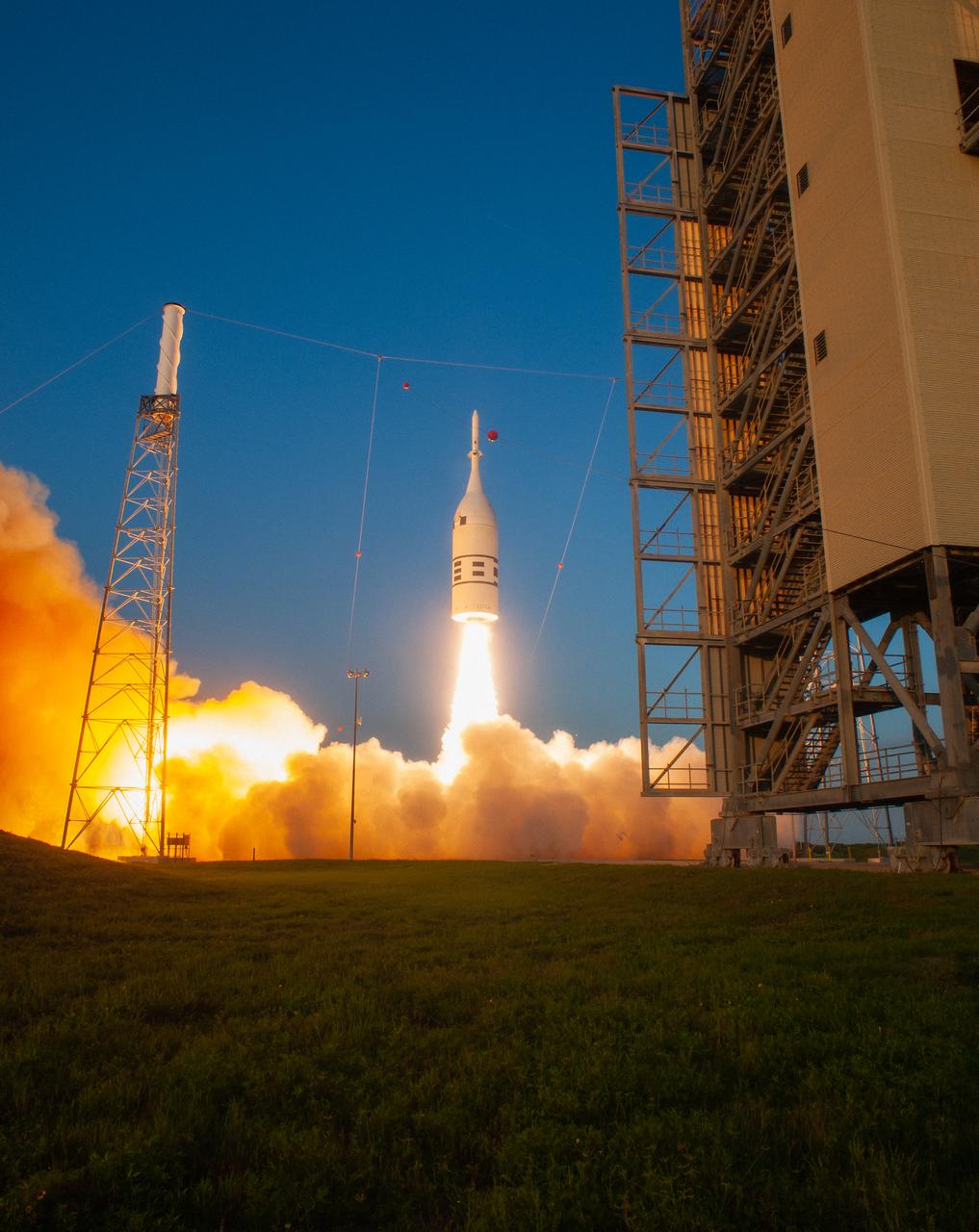
A fully functional Launch Abort System (LAS) with a test version of Orion attached, launches on NASA’s Ascent Abort-2 (AA-2) atop a Northrop Grumman provided booster on July 2, 2019, at 7 a.m. EDT, from Launch Pad 46 at Cape Canaveral Air Force Station in Florida. During AA-2, the booster will send the LAS and Orion to an altitude of 31,000 feet, traveling at Mach 1.15 (more than 1,000 mph). The LAS’ three motors will work together to pull the crew module away from the booster and prepare it for splashdown in the Atlantic Ocean. The flight test will prove that the abort system can pull crew to safety in the unlikely event of an emergency during ascent.
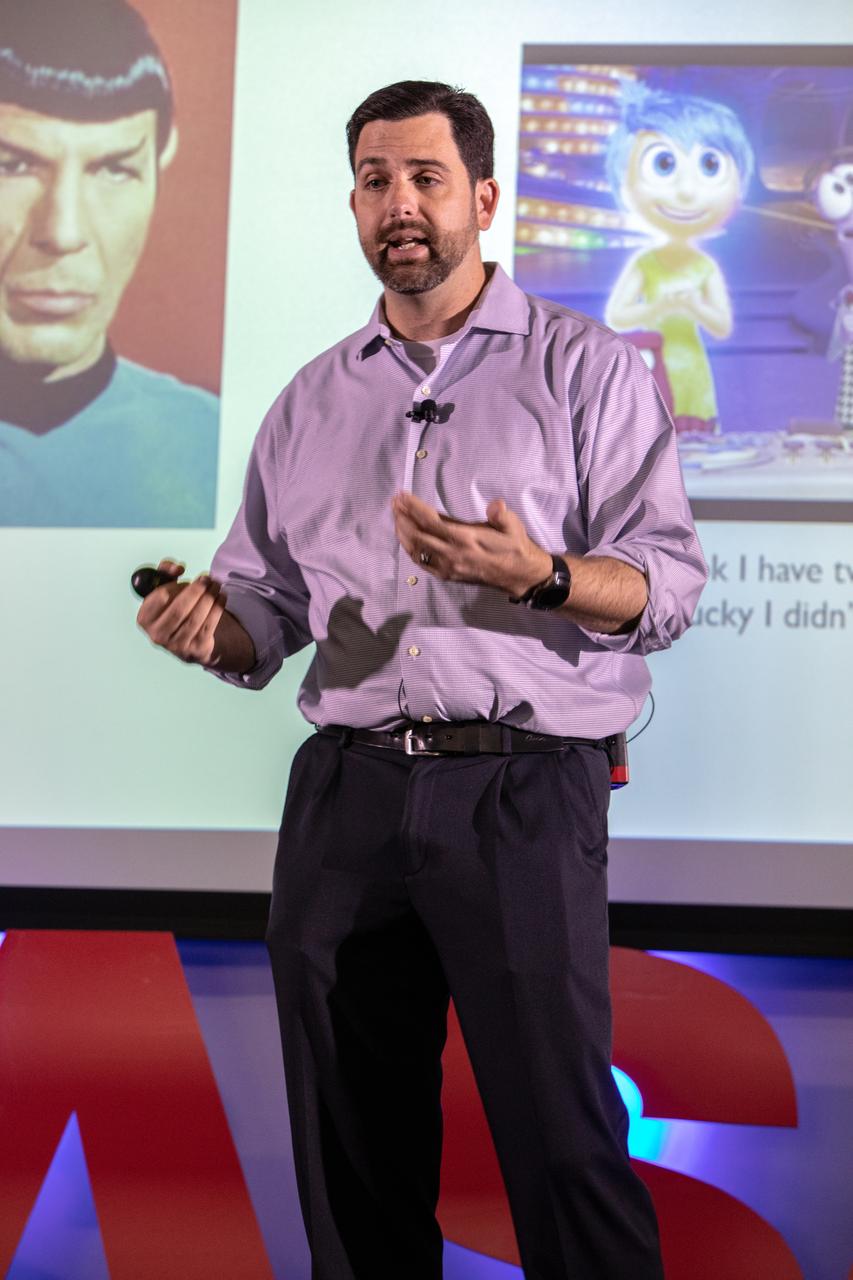
Jeremy Parsons, deputy manager of NASA’s Exploration Ground Systems at the agency’s Kennedy Space Center in Florida, speaks at the fourth in a series of five TED Talk-style informational sessions on Oct. 31, 2019, in the Kennedy Learning Institute. Sponsored by Kennedy’s Launching Leaders and Leadership for the Future, NASAtalks focuses on the topic of intentional careers and aims to provide employees with tools and knowledge that can be utilized for career growth. The theme of this fourth session was employees, and additional speakers included Kennedy’s Johnny Nguyen and Tony Derbyshire, with a skill-building section on vulnerability, authentic self and diverse inclusion by Ronnie Rodriguez.
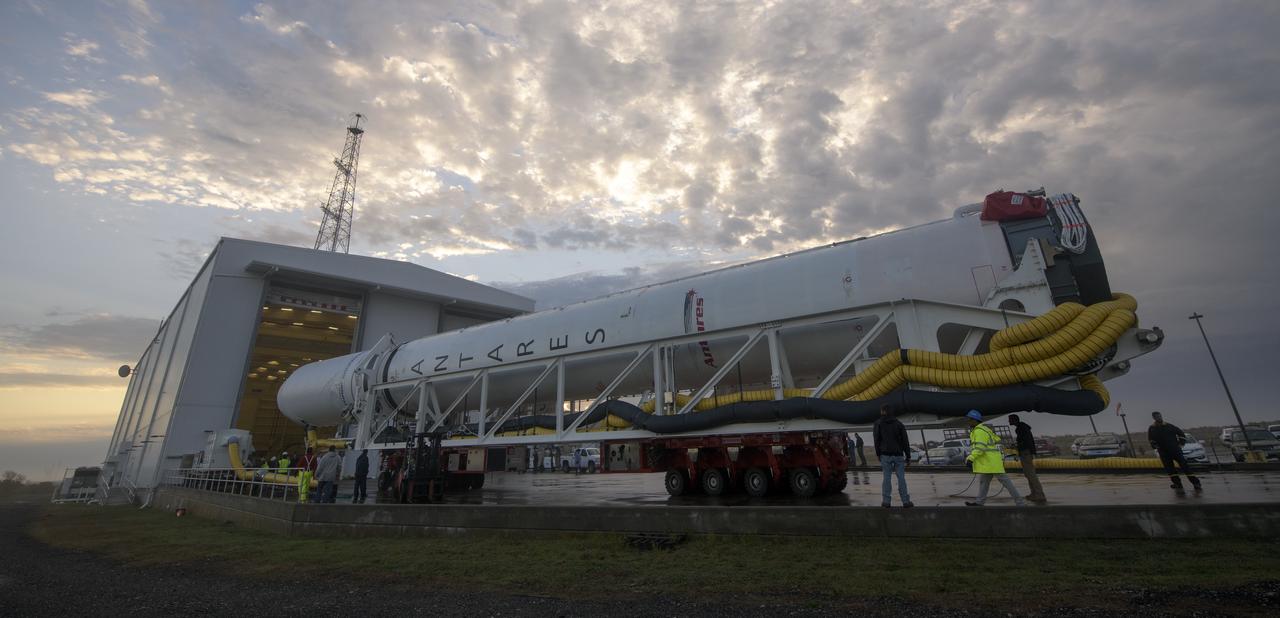
A Northrop Grumman Antares rocket is seen as it rolls out to Pad-0A, Monday, April 15, 2019 at NASA's Wallops Flight Facility in Virginia. Northrop Grumman’s 11th contracted cargo resupply mission with NASA to the International Space Station will deliver about 7,600 pounds of science and research, crew supplies and vehicle hardware to the orbital laboratory and its crew. Photo Credit: (NASA/Bill Ingalls)
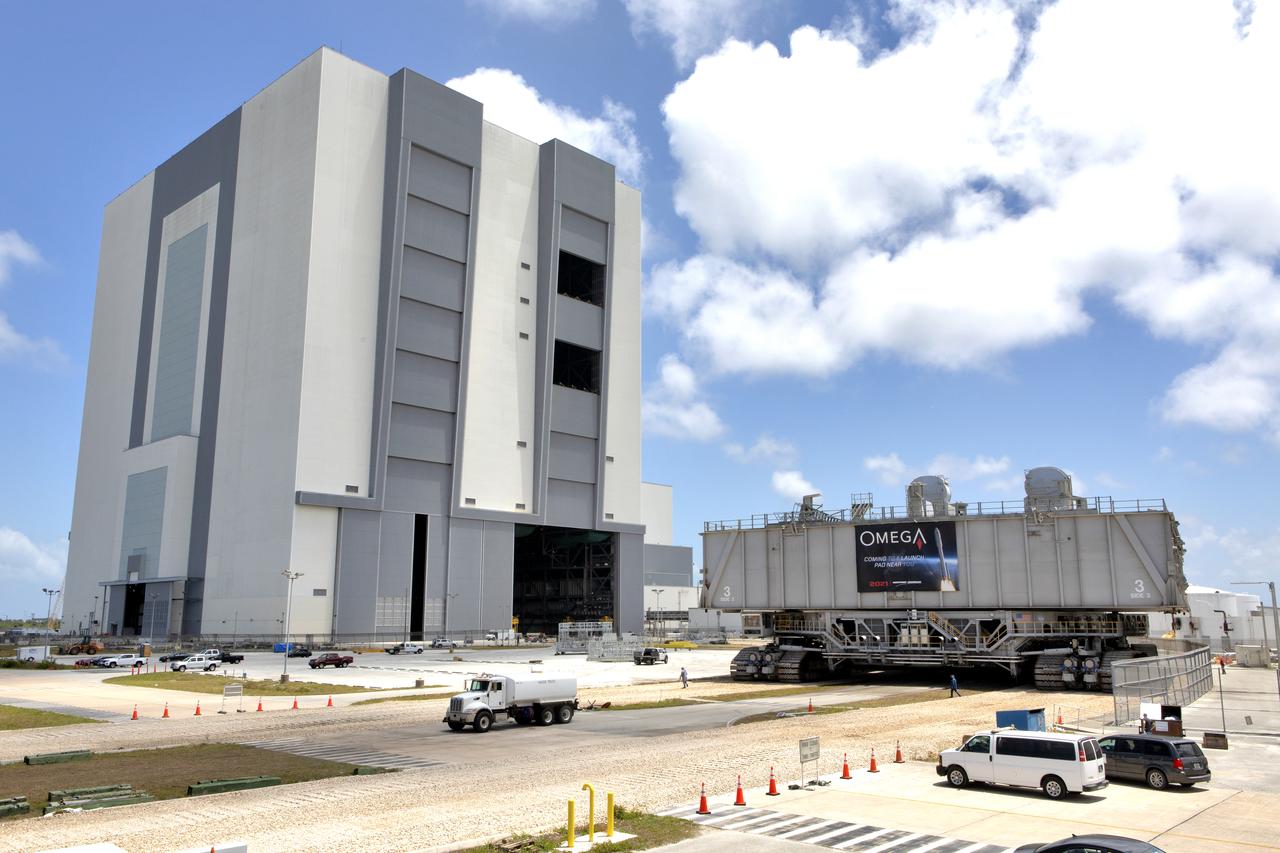
During a practice run, crawler-transporter 2 (CT-2), with the space shuttle-era mobile launch platform-3 (MLP-3) on top, has exited High Bay 2 of the Vehicle Assembly Building (VAB) and moves slowly along the crawlerway at NASA’s Kennedy Space Center in Florida on May 1, 2019. The VAB is getting its first commercial tenant. Northrop Grumman signed a Reimbursable Space Act Agreement with NASA for use of the facilities. The company will assemble and test its new OmegA rocket inside the massive facility’s High Bay 2. The company also will modify MLP-3 to serve as the launch vehicle’s assembly and launch platform. Northrop Grumman is developing the OmegA rocket, an intermediate/heavy-class launch vehicle, as part of a launch services agreement with the U.S. Air Force.
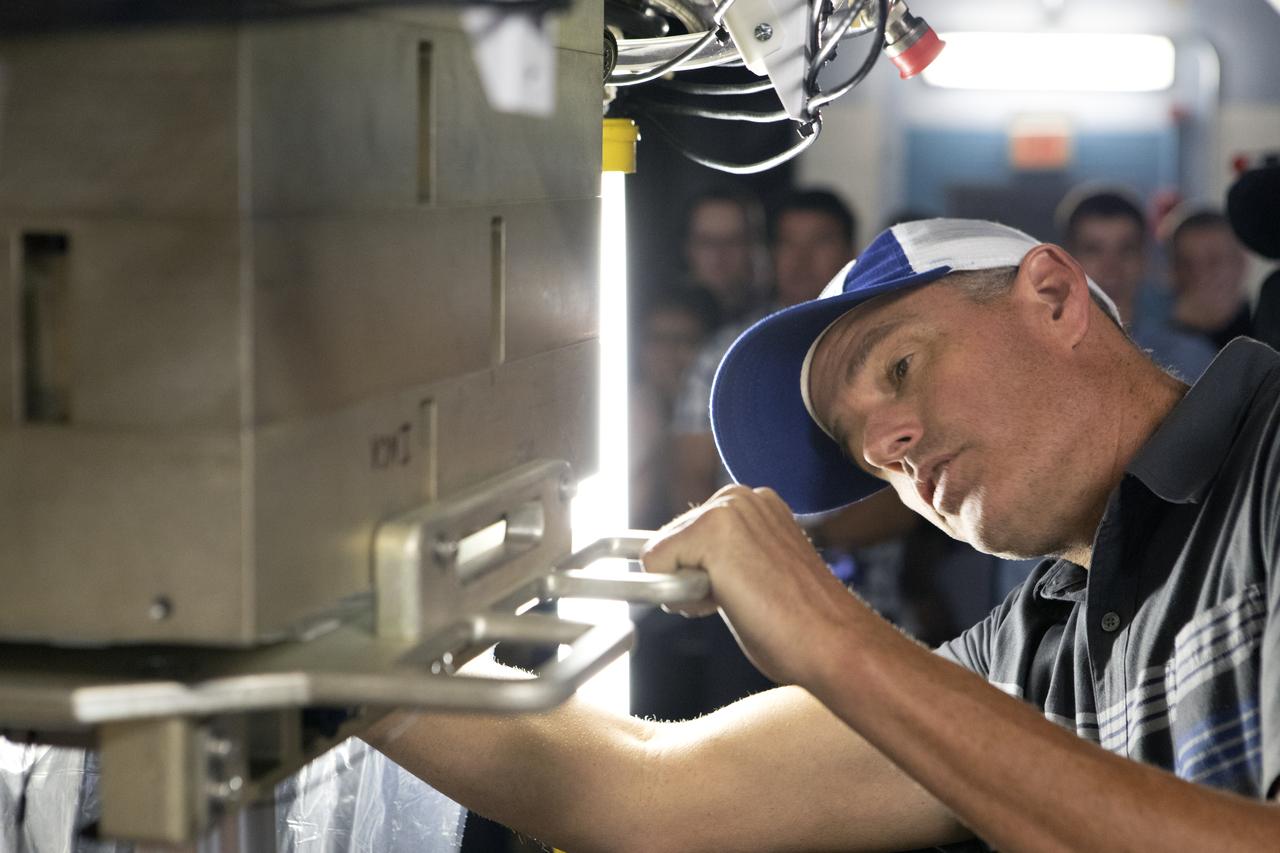
A Space Launch System (SLS) avionics handling tool demonstration takes place inside Kennedy Space Center’s Vehicle Assembly Building on April 4, 2019. The demonstration showed that avionics boxes could be successfully and safely mounted into the SLS rocket’s upper stage — called the Interim Cryogenic Propulsion Stage, or ICPS — with low risk of damaging a closely located hydrazine tank. Avionics boxes include the Inertial Navigation and Control Assembly and flight batteries. The actual installation will take place just weeks before NASA’s SLS rocket and uncrewed Orion spacecraft lift off on Exploration Mission-1 from Launch Pad 39B at Kennedy.
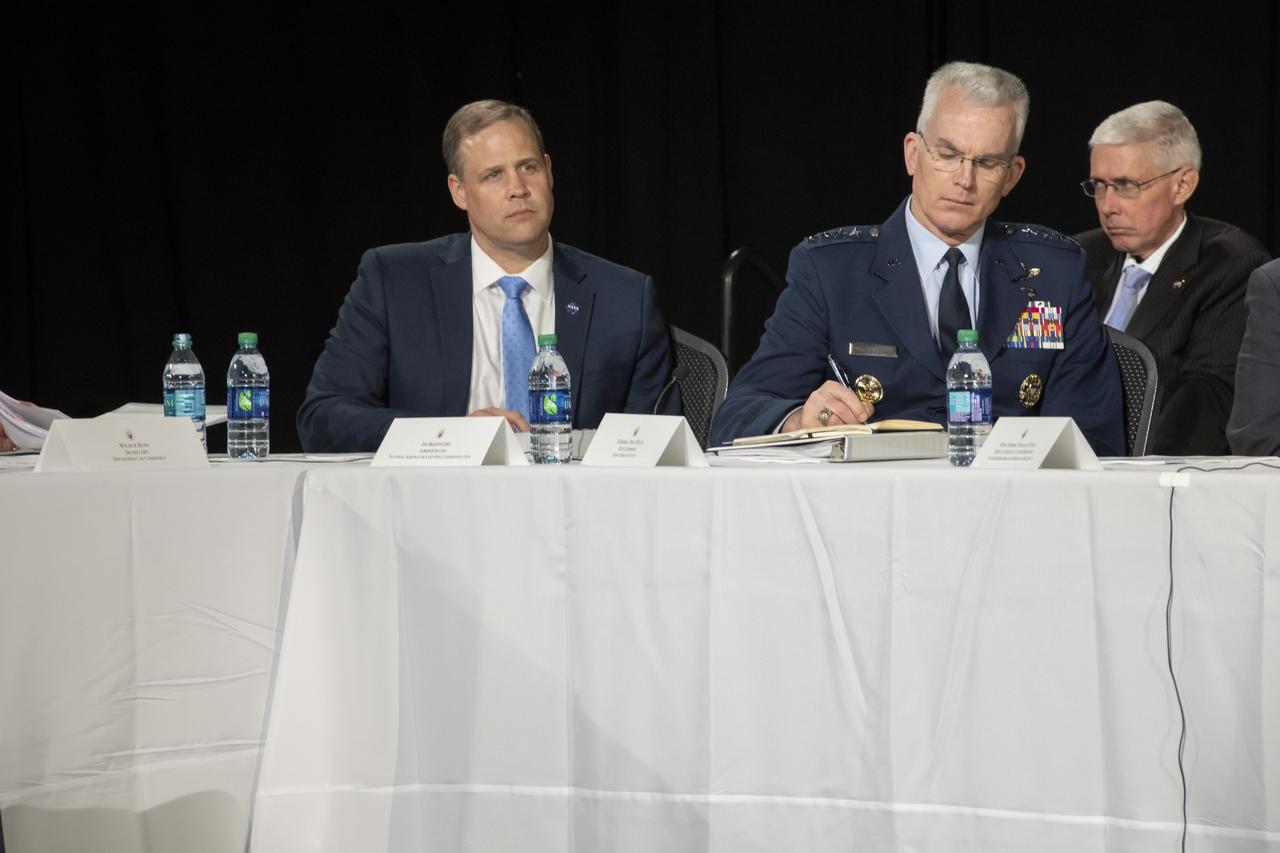
The National Space Council meet in Huntsville, Alabama at the U.S. Space and Rocket Center’s Davidson Center. The meeting was chaired by Vice President Mike Pence with members of the local community, NASA Marshall members and area media in attendance. NASA Administrator Jim Bridenstine addressed the Vice President and the Council on upcoming plans for NASA and the space program.
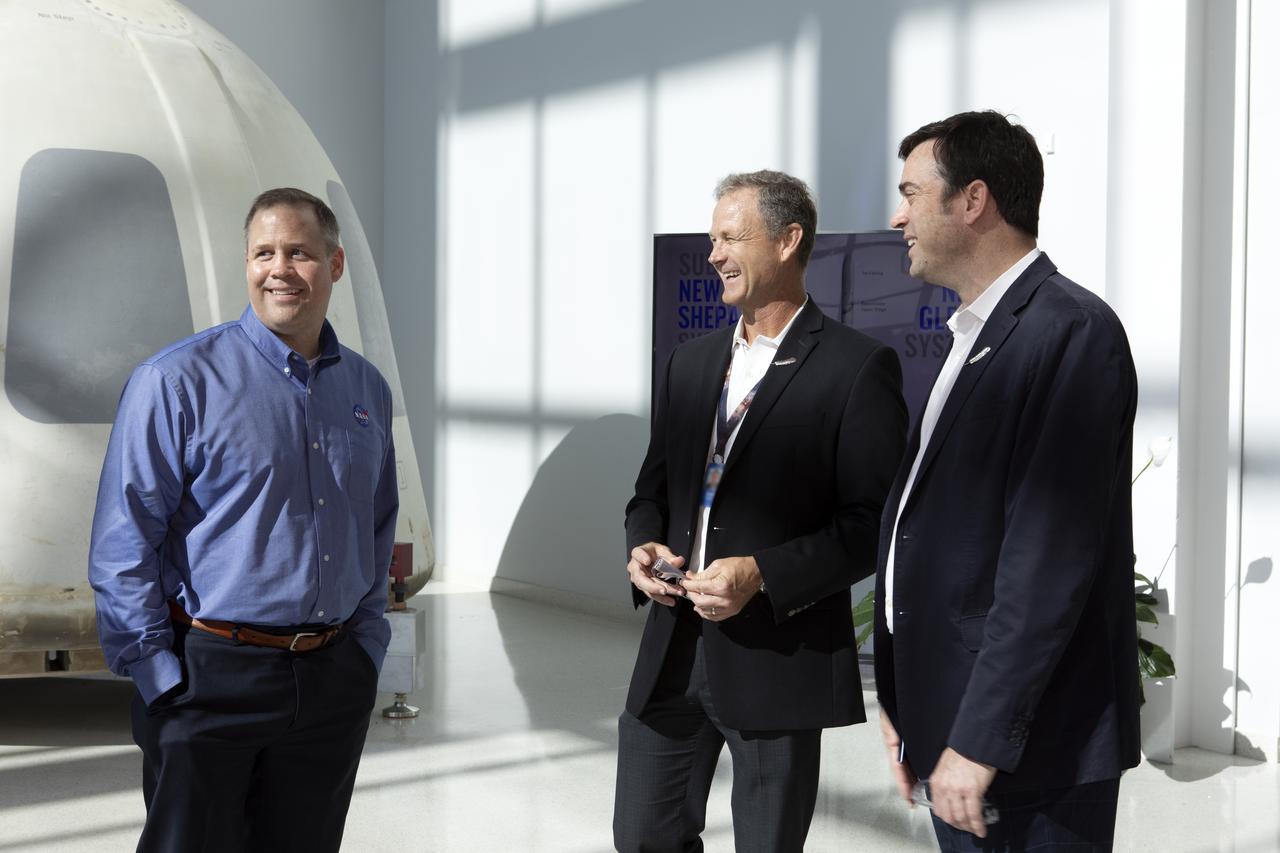
NASA Administrator Jim Bridenstine, at left, tours the Blue Origin facilities near the agency’s Kennedy Space Center in Florida on May 23, 2019. Bridenstine viewed the New Shepard booster and crew capsule that flew to space and back five times.
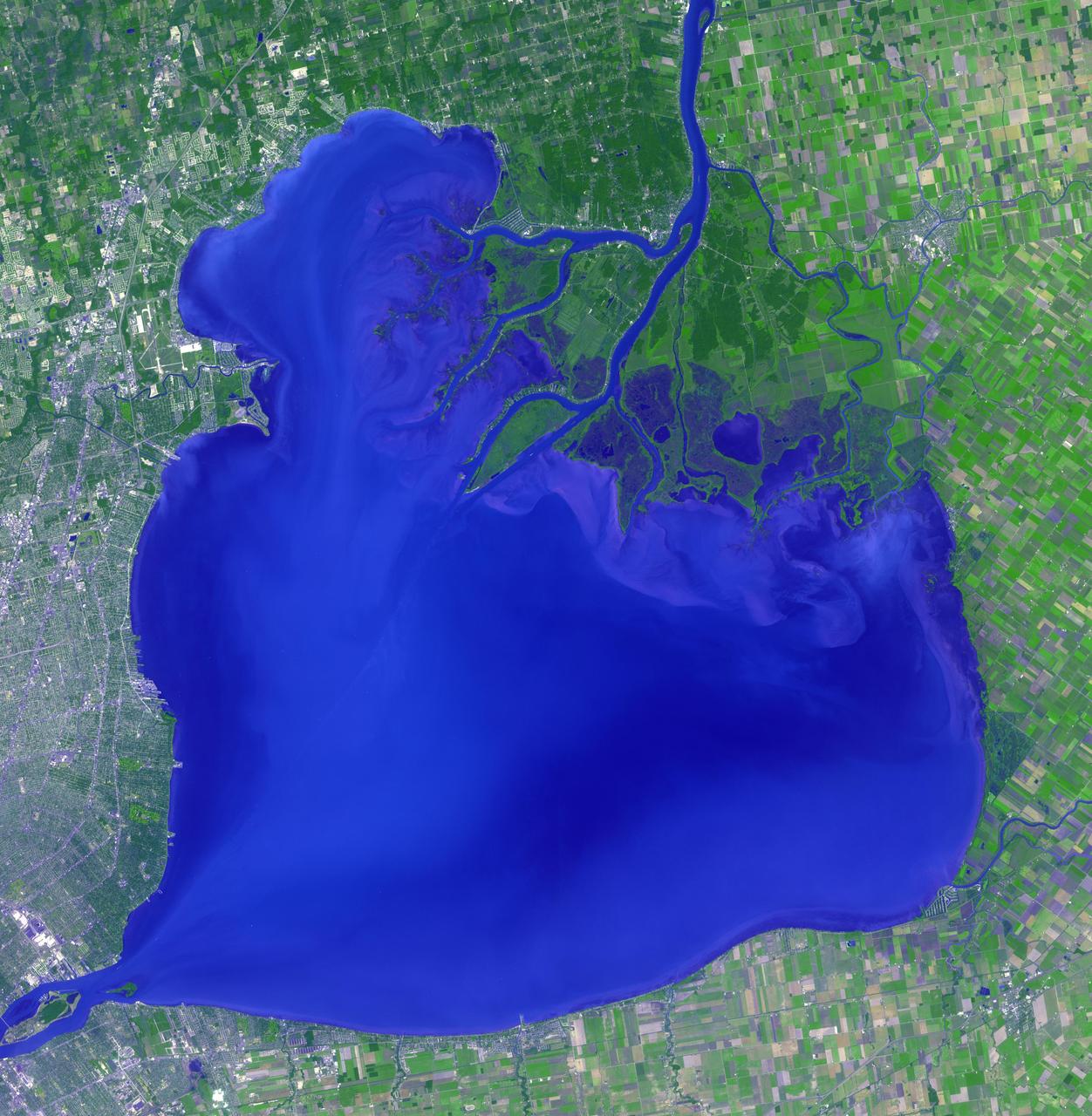
Lake St. Clair connects Lake Huron, via the St. Clair River, to Lake Erie, via the Detroit River. It is named after Claire of Assisi, on whose feast day it was first navigated by French explorers in 1679. The lake covers an area of about 1100 square kilometers, with an average depth of 3.5 meters. Both the U.S. and Canada maintain a deep shipping channel through the lake. The image was acquired September 9, 2002, covers an area of 51.4 by 52.5 kilometers, and is located at 42.5 degrees north, 82.7 degrees west. https://photojournal.jpl.nasa.gov/catalog/PIA23234

jsc2019e052236 - With St. Basil’s Cathedral serving as a backdrop, the next crew to launch to the International Space Station and their backups walk through Red Square in Moscow Sept. 5 as part of traditional pre-launch activities. From right to left are Expedition 61 crewmembers Jessica Meir of NASA and Oleg Skripochka of Roscosmos, spaceflight participant Hazzaa Ali Almansoori of the United Arab Emirates and backups, Tom Marshburn of NASA, Sultan Al-Neyadi of the United Arab Emirates and Sergey Ryzhikov of Roscosmos. Meir, Skripochka and Almansoori will launch Sept. 25 from the Baikonur Cosmodrome in Kazakhstan on the Soyuz MS-15 spacecraft for a mission on the International Space Station...Andrey Shelepin/Gagarin Cosmonaut Training Center.
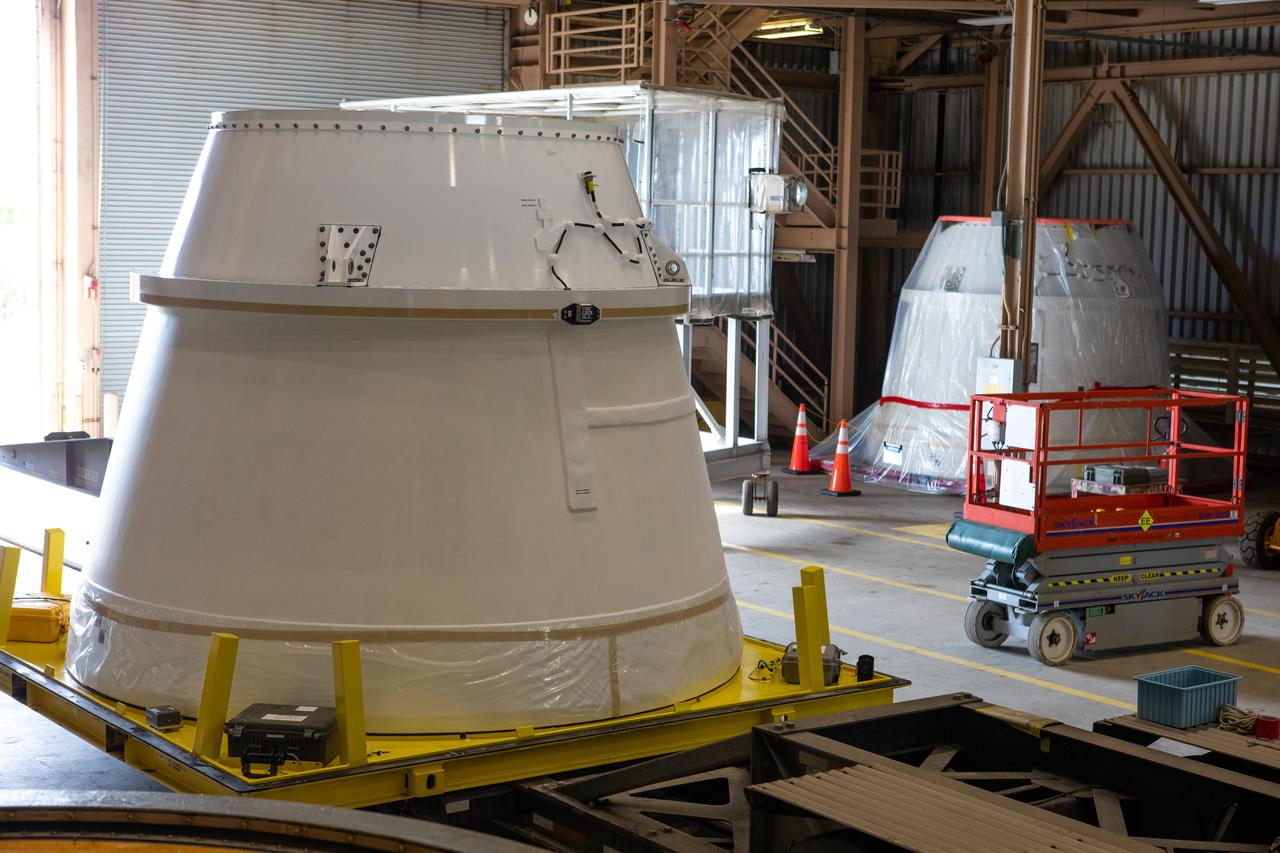
Both of the Northrop Grumman-manufactured aft exit cones for the Space Launch System’s solid rocket boosters are in view inside the Rotation, Processing and Surge Facility at NASA’s Kennedy Space Center in Florida on Dec. 9, 2019. Both arrived from Promontory, Utah. The right aft exit cone is in the foreground, and the left aft exit cone is in the background. They will be checked out and prepared for the Artemis I uncrewed test flight. The aft exit cones sit at the bottommost part of the twin boosters. The cones help provide added thrust for the boosters, while protecting the aft skirts from the thermal environment during launch.
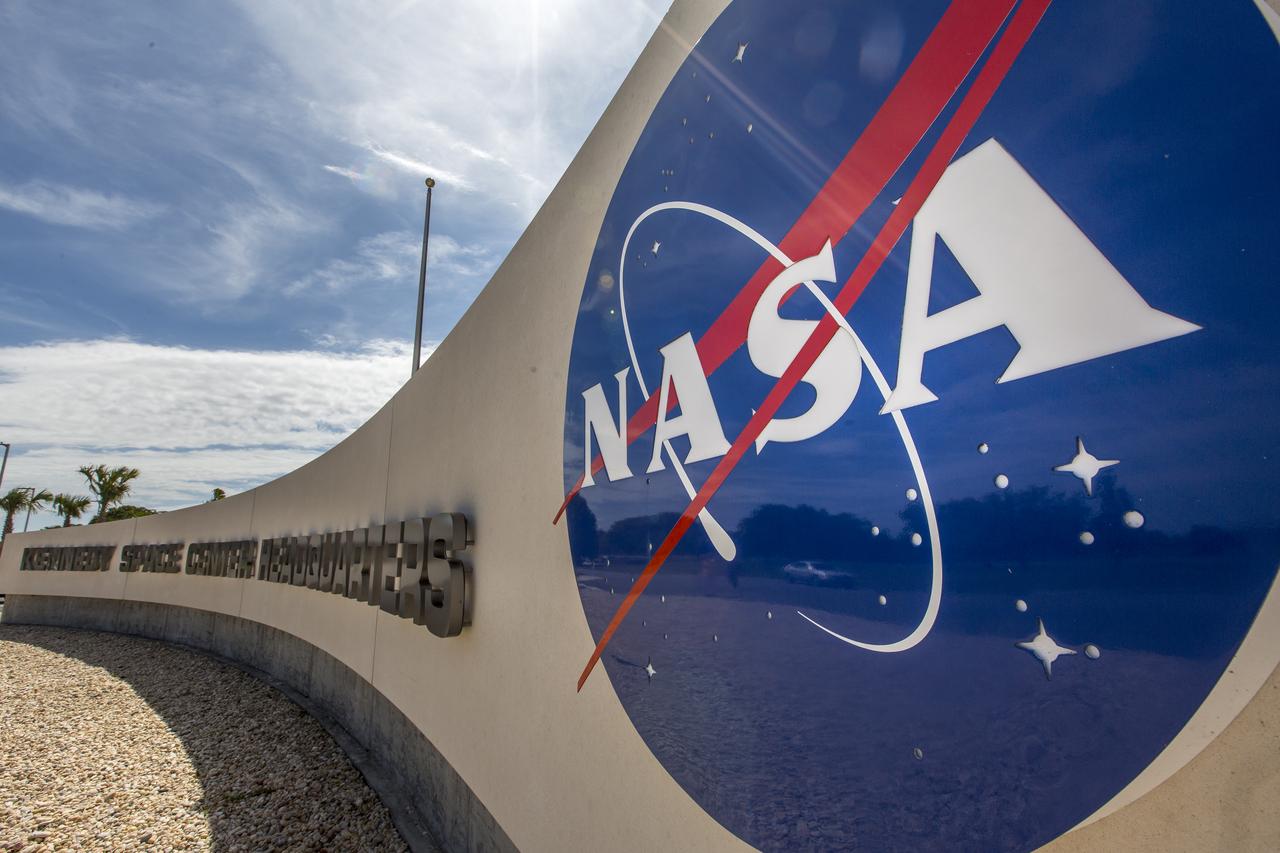
A close-up view the NASA insignia in front of the entrance to the new headquarters building on April 3, 2019, at NASA’s Kennedy Space Center in Florida. The newly constructed facility anchors the multi-user spaceport’s Central Campus. More than 500 civil service and contractor employees will be based in the 200,000-square-foot building. The facility earned the U.S. Green Building Council’s Leadership in Energy and Environmental Design (LEED) Gold designation. Features include LED lighting throughout, along with occupancy sensors to turn off unneeded lights; windows, screens and shades designed to maximize natural light; chilled beam HVAC technology reducing the need for ductwork, and more.
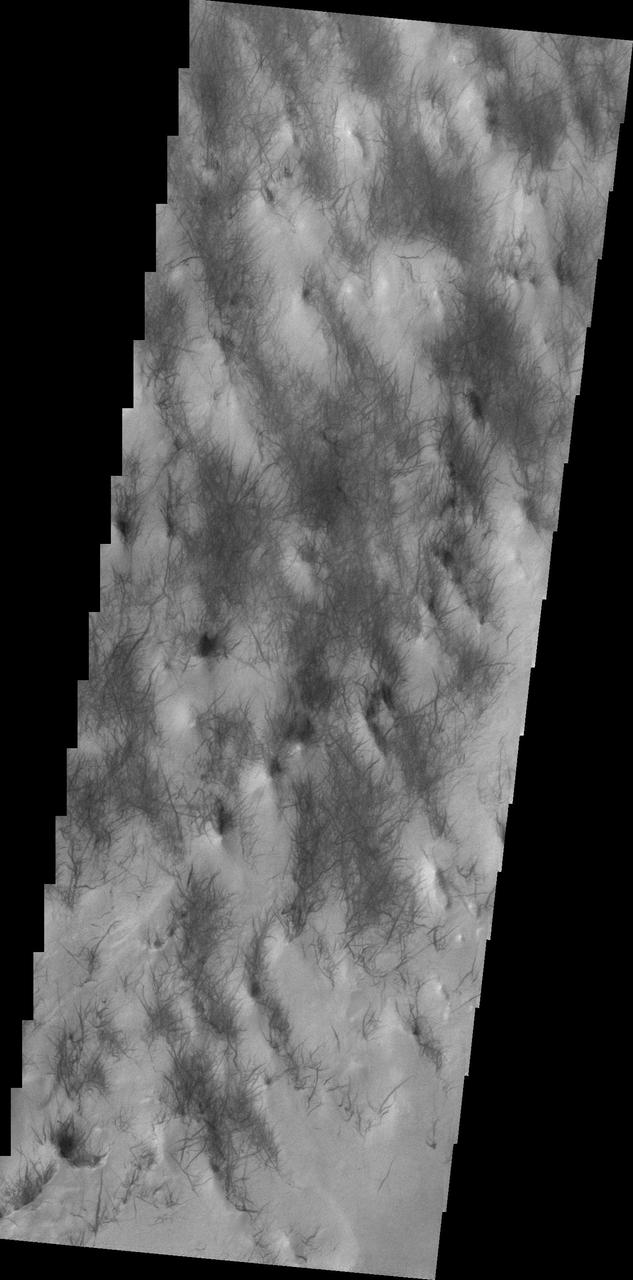
Wind is one of the most active processes on Mars today. This image was taken near Hooke Crater on the margin of Argyre Planitia. Wind is moving along the surface between the hills and valleys of the crater ejecta, picking up the surface dust and leaving the dust free darker rock exposed. Orbit Number: 42358 Latitude: -47.7019 Longitude: 317.797 Instrument: VIS Captured: 2011-07-03 00:45 https://photojournal.jpl.nasa.gov/catalog/PIA23291
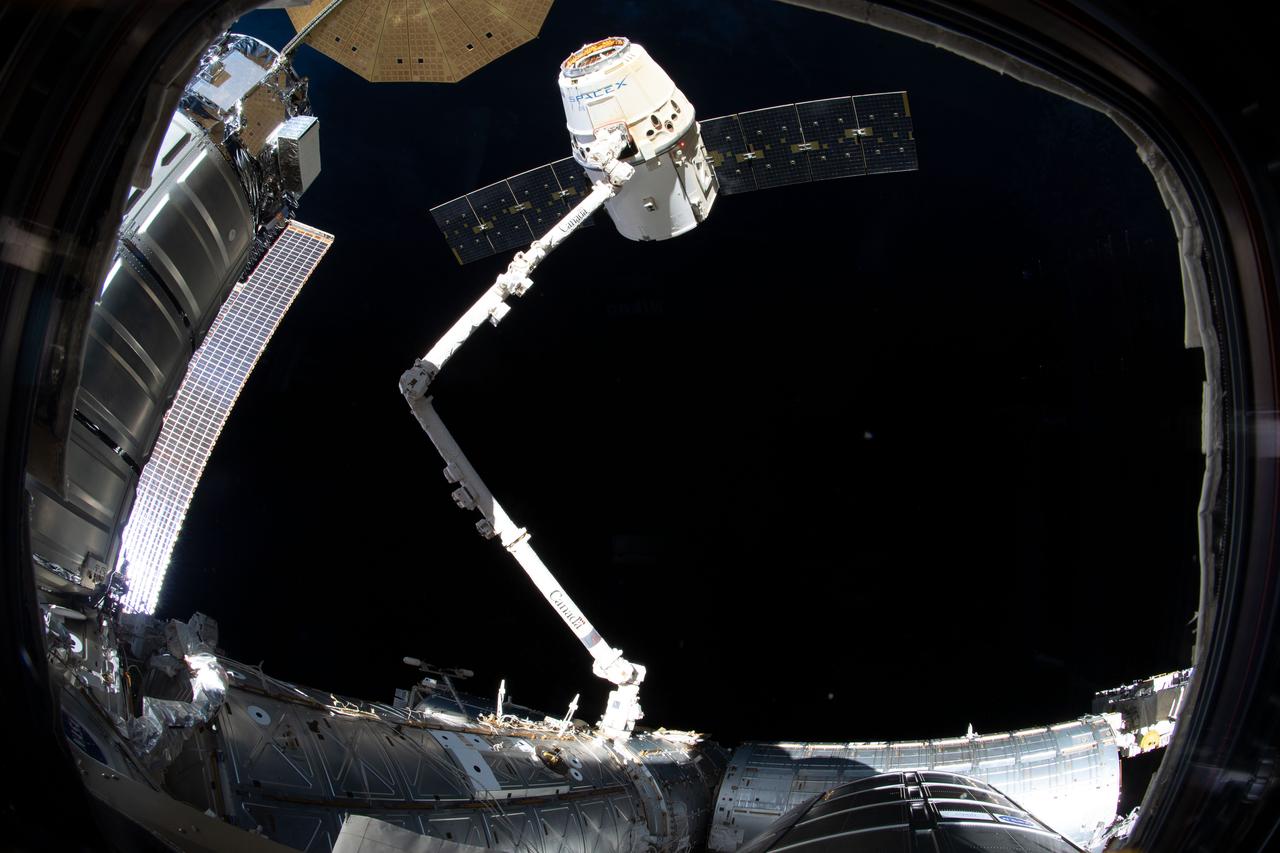
iss059e089342 (June 3, 2019) --- The SpaceX Dragon cargo craft on its 17th contracted mission to resupply mission to the International Space Station is in the grips of the Canadarm2 robotic arm moments before being released.
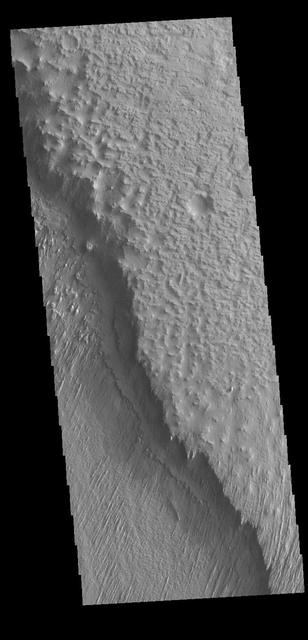
The lower elevation on the left side of this VIS image is part of Memnonia Sucli. The higher elevations to the right are on the upper part of a mesa that bounds the sulci. The image shows some of the extensive wind etched terrain in Memnonia Sulci, located south west of Olympus Mons. The linear ridges are called yardangs and form by wind removal of semi-cemented material. The ridges are parallel to wind direction, so the predominate winds that created the yardangs in this image blew NE/SW. Orbit Number: 78296 Latitude: -7.8302 Longitude: 186.694 Instrument: VIS Captured: 2019-08-09 04:54 https://photojournal.jpl.nasa.gov/catalog/PIA23471

NASA astronaut Nicole Mann listens during a briefing at the agency’s Kennedy Space Center in Florida following launch of Boeing’s Orbital Flight Test, Dec. 20, 2019. Boeing’s CST-100 Starliner spacecraft launched atop a United Launch Alliance Atlas V rocket from Space Launch Complex 41 at Cape Canaveral Air Force Station at 6:36 a.m. EST. The uncrewed Orbital Flight Test is the Starliner’s first flight for NASA’s Commercial Crew Program.
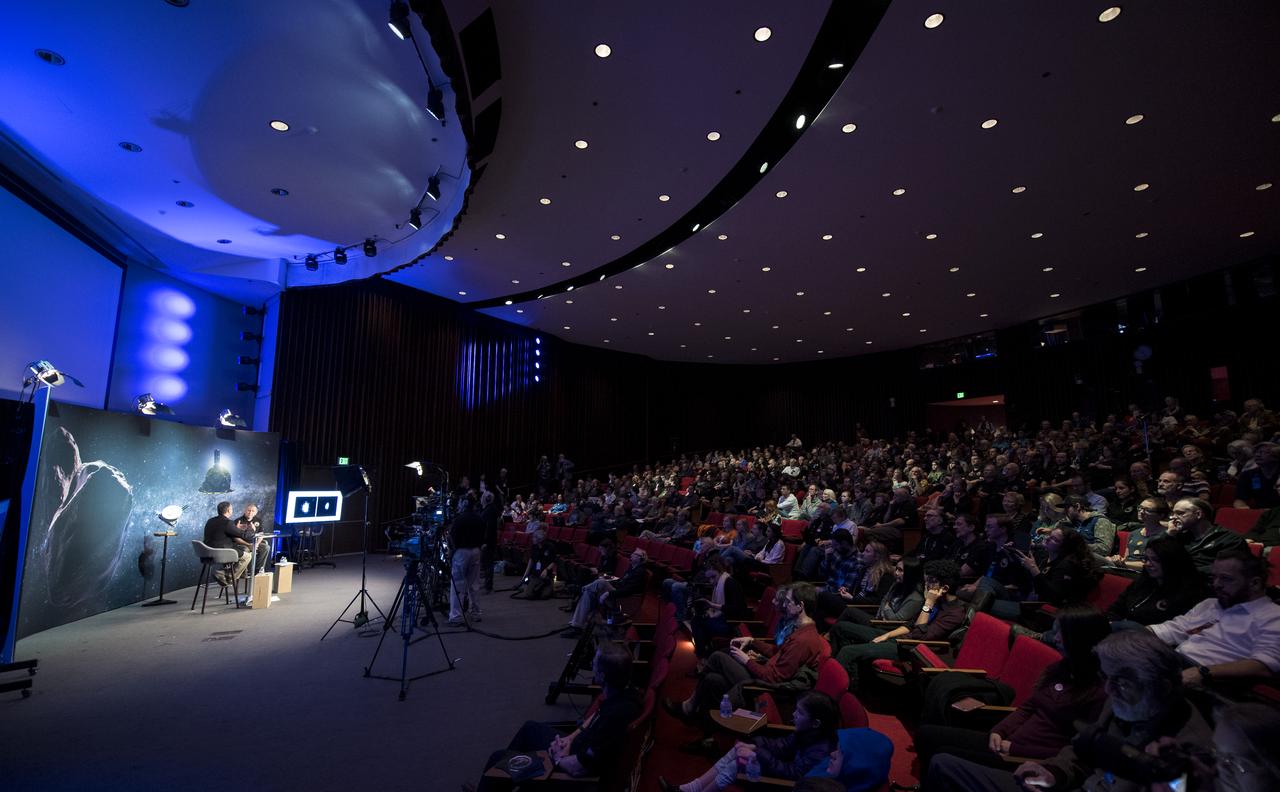
New Horizons team members and guests watch a live feed of the Mission Operations Center (MOC) as the team waits to receive confirmation from the spacecraft that it has completed the flyby of Ultima Thule, Tuesday, Jan. 1, 2019 at Johns Hopkins University Applied Physics Laboratory (APL) in Laurel, Maryland. Photo Credit: (NASA/Joel Kowsky)
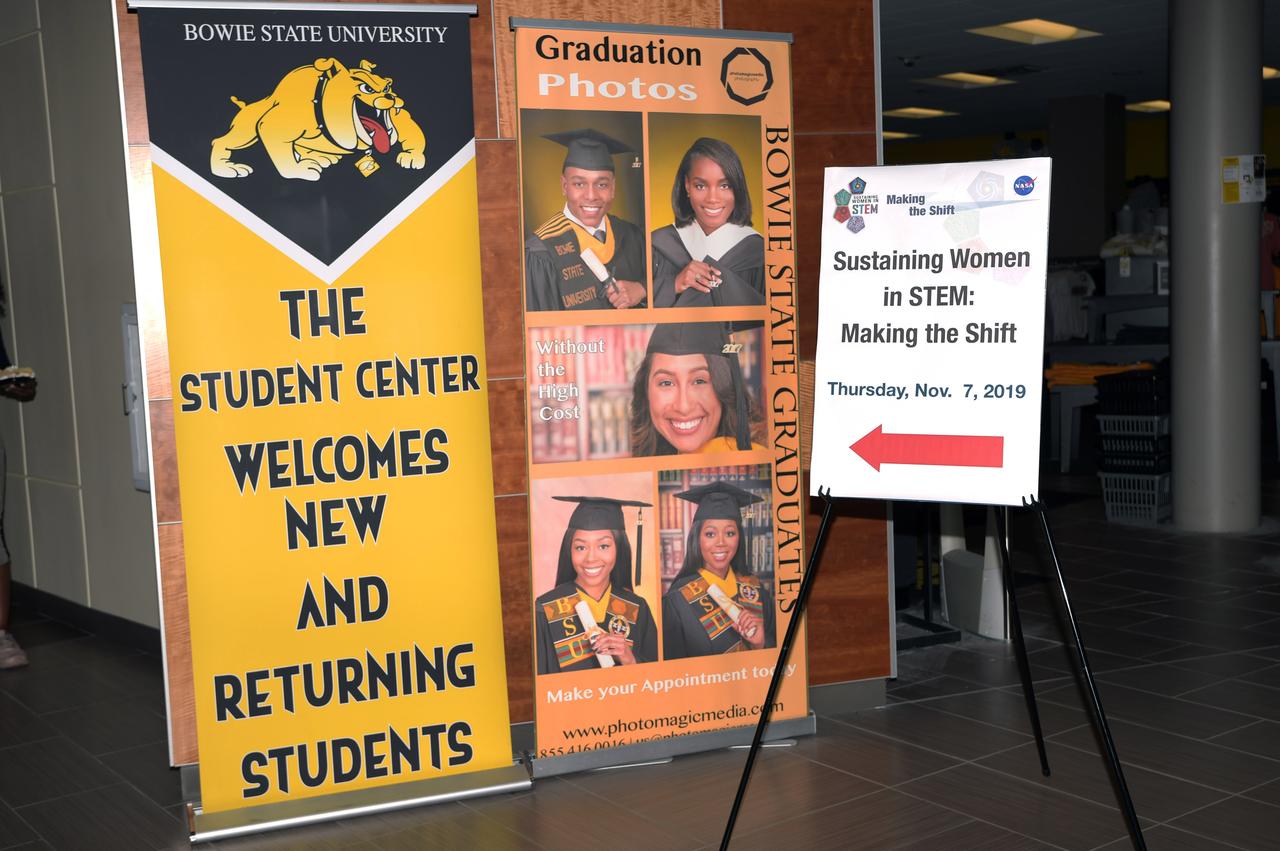
Sustaining Women in STEM Making the Shift SWIS Nov 7, 2019 at Bowie State University. Chrystal Johnson hosted event with panel discussion, speakers and breakout sessions

The Space Launch System (SLS) rocket’s liquid oxygen tank structural test article was manufactured and stacked in June 2019 at NASA’s Michoud Assembly Facility in New Orleans. To construct the test article, Boeing technicians at Michoud moved the liquid oxygen tank to the Vertical Assemby Building stacking and integration area. Here, they added simulators to mimic the two structures that connect to the tank, the intertank and the forward skirt. This structural hardware for the SLS core stage for America’s new deep space rocket is structurally identical to the flight version of the tank. It will be shipped on the Pegasus barge to NASA’s Marshall Space Flight Center in Hunstville, Alabama, where it will undergo a series of tests that simulate the stresses and loads of liftoff and flight. These tests will help ensure designs are adequate for successful SLS missions to the Moon and beyond. The flight liquid oxygen tank along with the liquid hydrogen tank supplies more than 500,000 gallons of propellant to the core stages four RS-25 engines, which produce 2 million pounds of thrust to help send the SLS rocket to space.
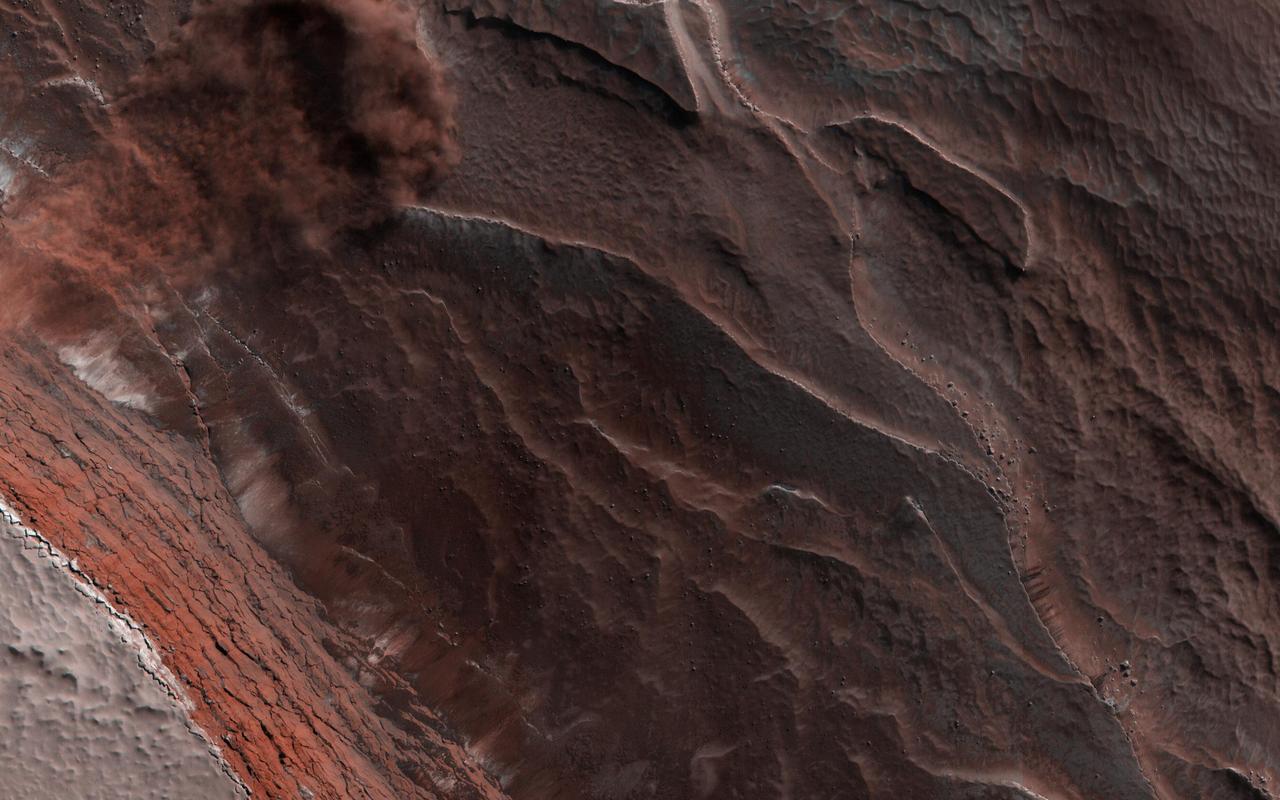
Every spring the sun shines on the side of the stack of layers at the North Pole of Mars known as the north polar layered deposits. The warmth destabilizes the ice and blocks break loose. When they reach the bottom of the more than 500 meter tall cliff face, the blocks kick up a cloud of dust. (In the cutout, the top layer of the north polar cap is to the lower left.) The layers beneath are different colors and textures depending on the amount of dust mixed with ice. https://photojournal.jpl.nasa.gov/catalog/PIA23453
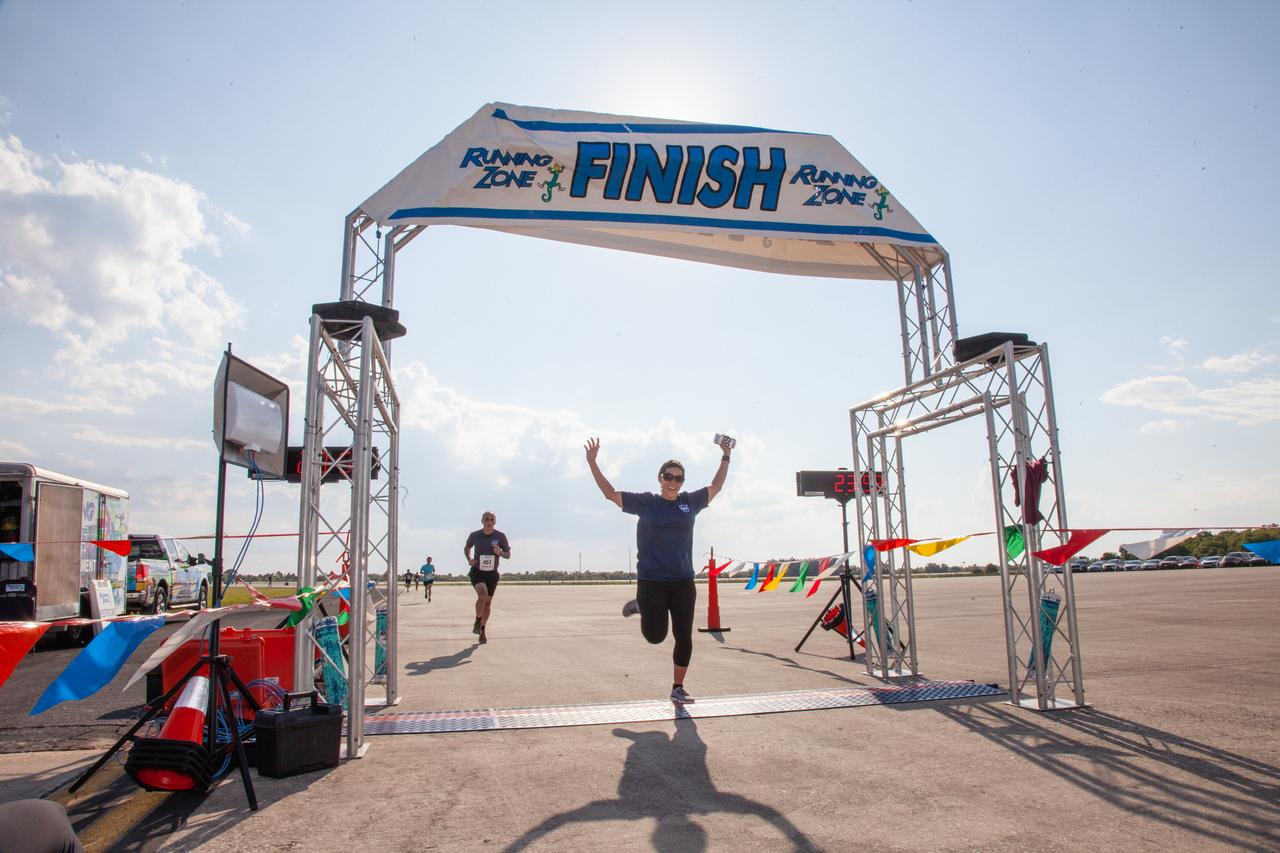
Kennedy Space Center employees and guests cross the finish line during the Florida spaceport’s annual KSC Walk Run on March 26, 2019. Part of Kennedy’s Safety and Health Days, the event takes place at the Shuttle Landing Facility runway and offers participants the chance to partake in a two-mile walk or run, a 5K or a 10K.
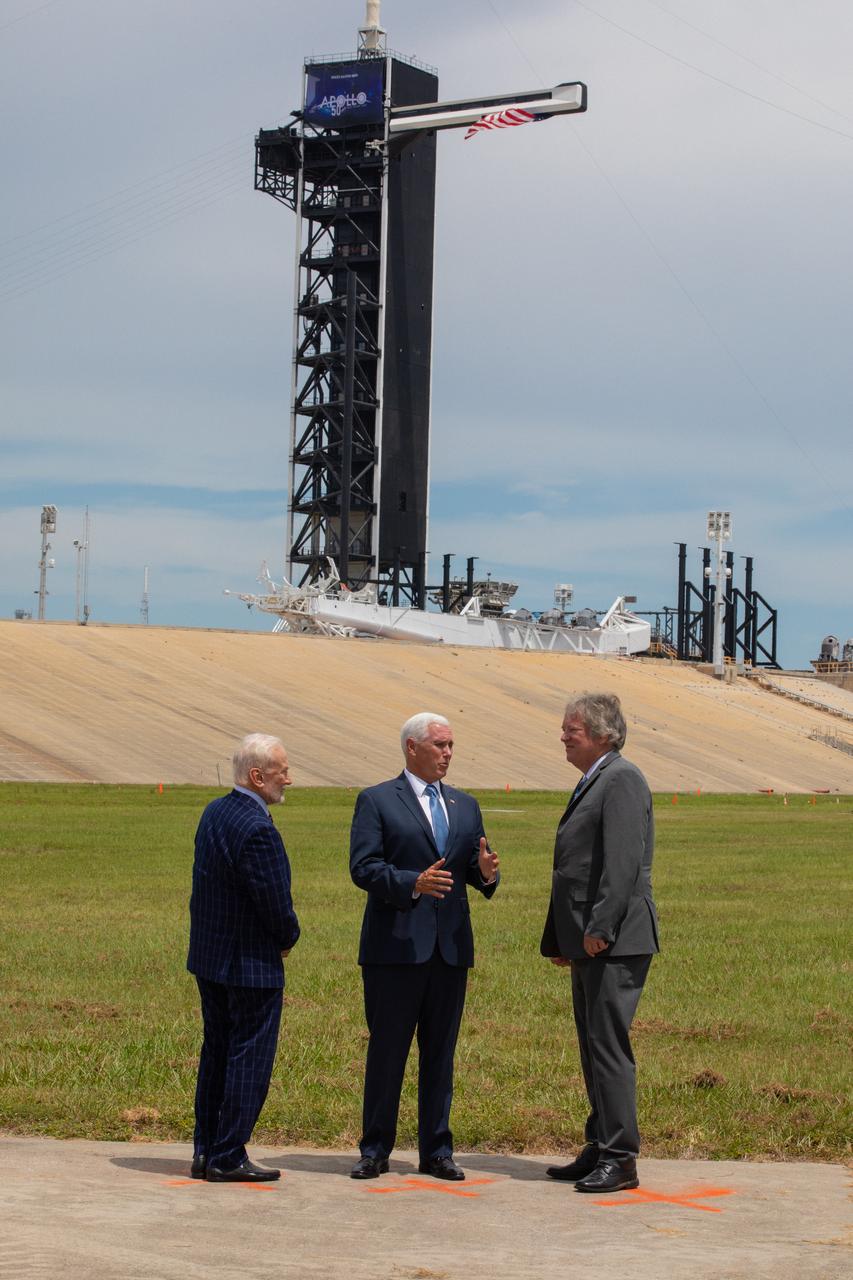
Vice President Mike Pence, center, celebrates the 50th anniversary of the Apollo 11 Moon landing during a visit to Kennedy Space Center’s Launch Complex 39A on July 20, 2019. Neil Armstrong, Buzz Aldrin and Michael Collins launched from Pad 39A aboard a Saturn V rocket on July 16, 1969. Four days later, Armstrong and Aldrin landed the Apollo Lunar Module Eagle on the Moon, becoming the first two humans to walk on the lunar surface. Pence recognized the extraordinary achievements of the Apollo 11 team, while looking forward to NASA’s plans to return to the Moon and on to Mars. At left is Apollo 11 Lunar Module Pilot Buzz Aldrin. At right is Rick Armstrong, Apollo 11 Commander Neil Armstrong's son.
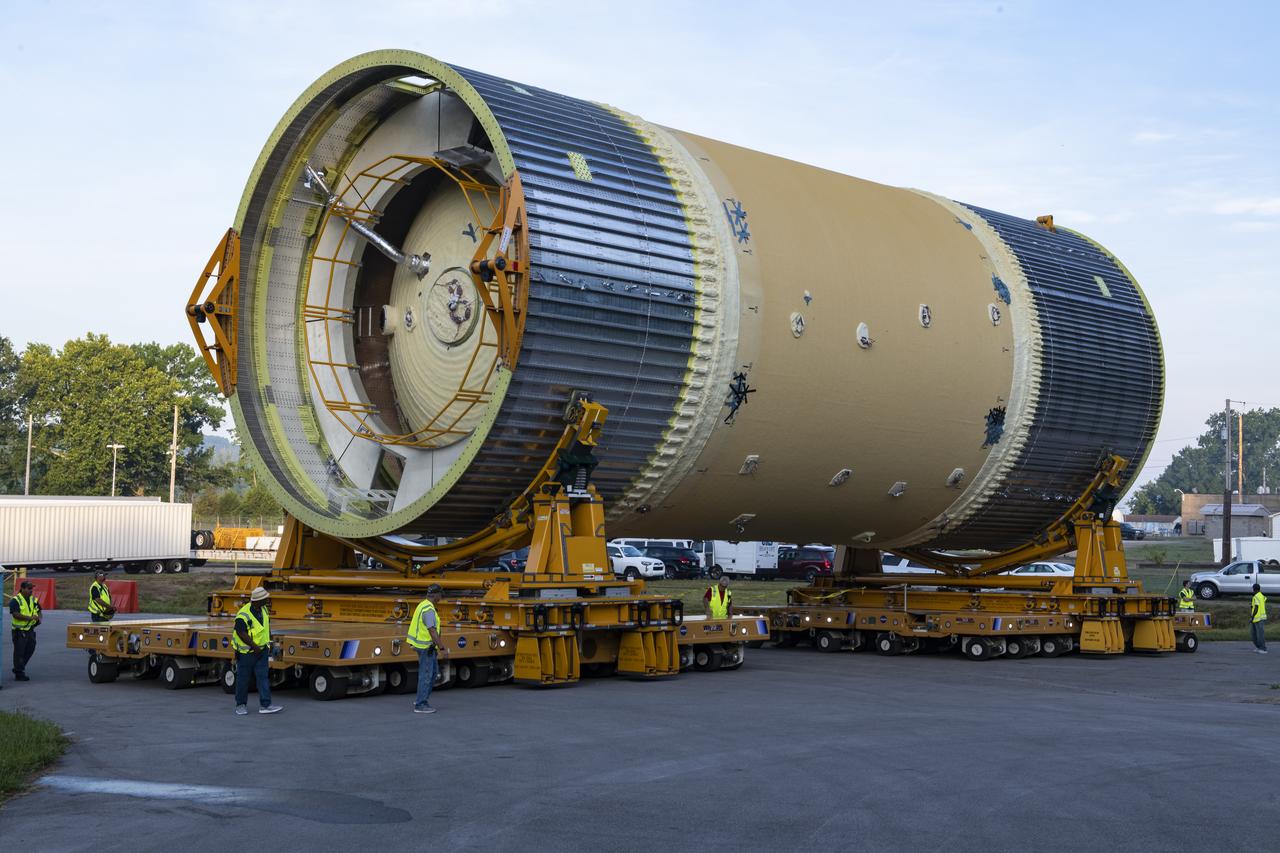
The Liquid Oxygen (LOX) tank was moved from the Pegasus barge to the west test area for placement in test stand.
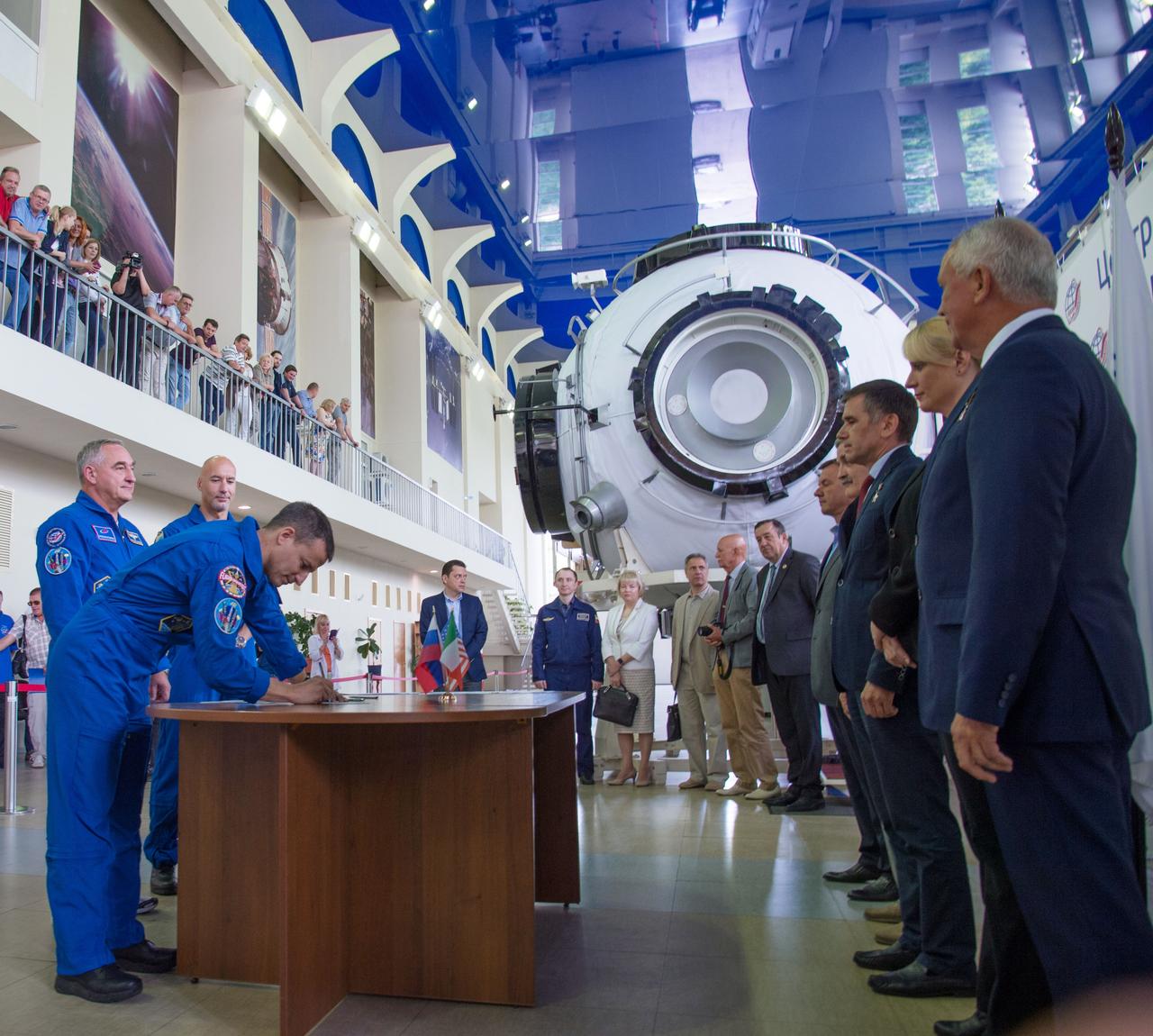
jsc2019e035255 - At the Gagarin Cosmonaut Training Center in Star City, Russia, Expedition 60 crewmember Drew Morgan of NASA signs in June 26 for the first day of final qualification exams. Looking on are crewmates Alexander Skvortsov of Roscosmos and Luca Parmitano of the European Space Agency. They will launch July 20 on the Soyuz MS-13 spacecraft from the Baikonur Cosmodrome in Kazakhstan for a mission on the International Space Station...NASA/Beth Weissinger.
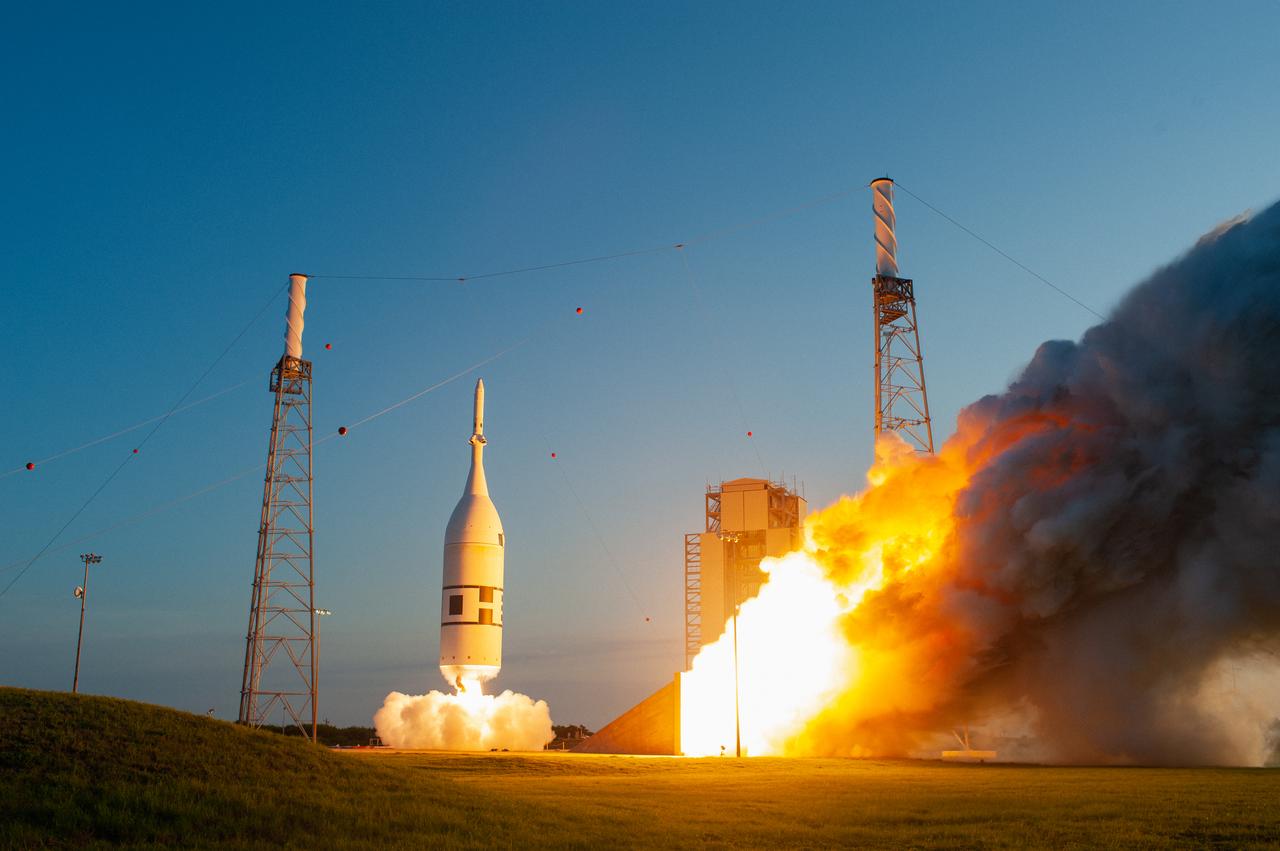
A fully functional Launch Abort System (LAS) with a test version of Orion attached, launches on NASA’s Ascent Abort-2 (AA-2) atop a Northrop Grumman provided booster on July 2, 2019, at 7 a.m. EDT, from Launch Pad 46 at Cape Canaveral Air Force Station in Florida. During AA-2, the booster will send the LAS and Orion to an altitude of 31,000 feet, traveling at Mach 1.15 (more than 1,000 mph). The LAS’ three motors will work together to pull the crew module away from the booster and prepare it for splashdown in the Atlantic Ocean. The flight test will prove that the abort system can pull crew to safety in the unlikely event of an emergency during ascent.
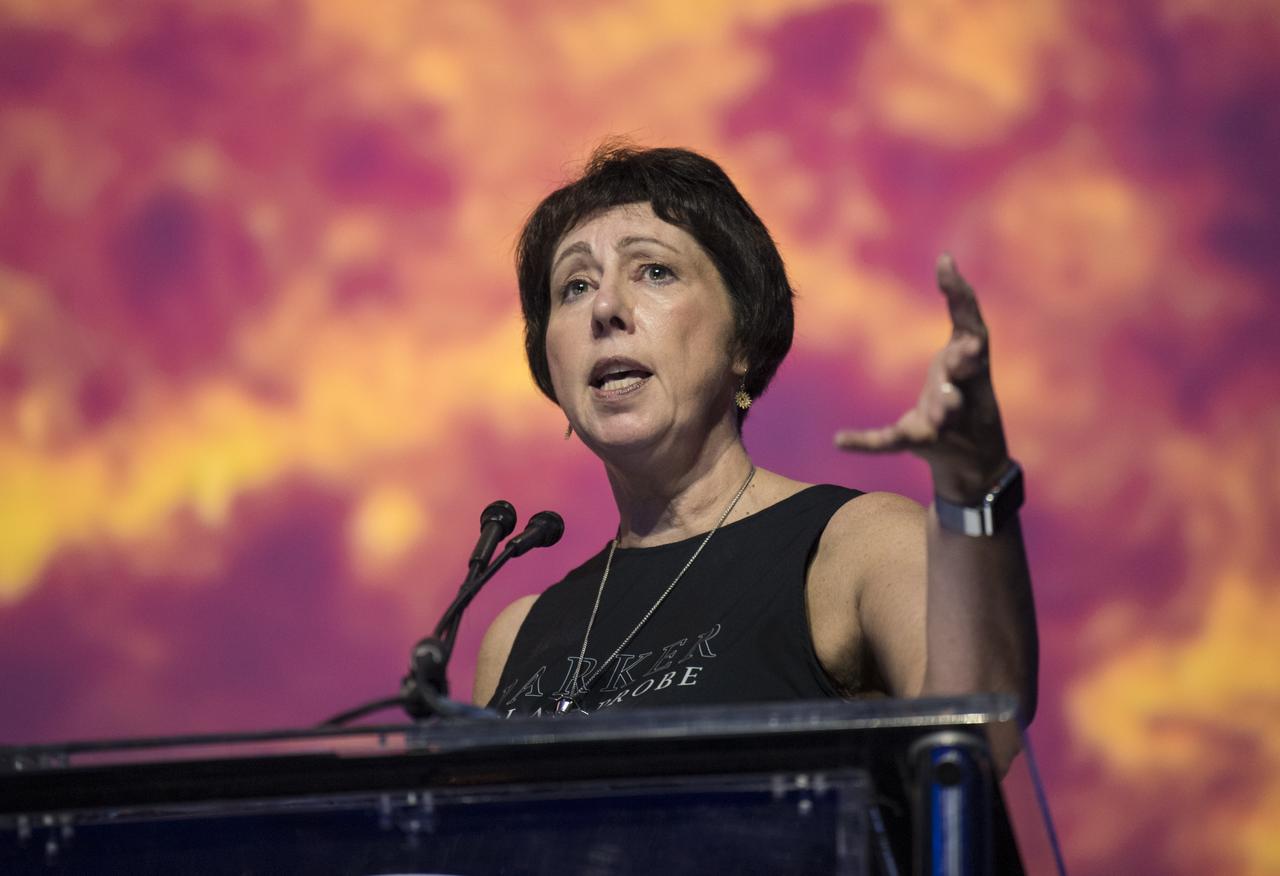
NASA director of Heliophysics division, Science Mission Directorate, Nicola Fox, speaks at a presentation titled, “The Challenge of Exploring Our Sun - the 60-Year Odyssey to Parker Solar Probe,” during the 70th International Astronautical Congress, Wednesday, Oct. 23, 2019, at the Walter E. Washington Convention Center in Washington. Photo credit: (NASA/Aubrey Gemignani)

Testing of the External Vision System (EVS) Software on the B200 King Air
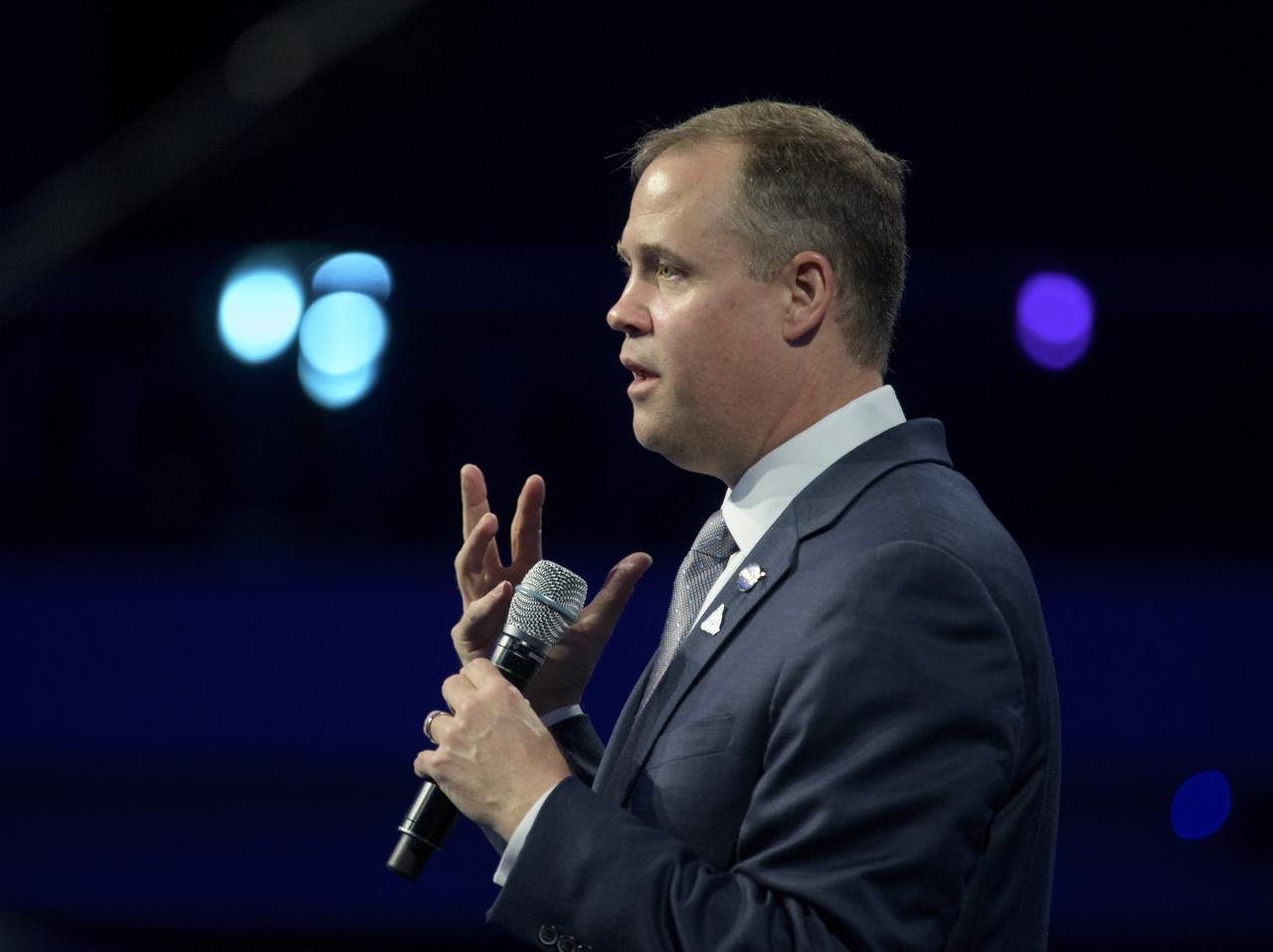
NASA Administrator Jim Bridenstine gives an update on the agency’s Artemis program and the critical role international partnerships have in returning astronauts to the Moon and going on to Mars at the 70th International Astronautical Congress, Friday, Oct. 25, 2019, in Washington. Photo Credit: (NASA/Bill Ingalls)
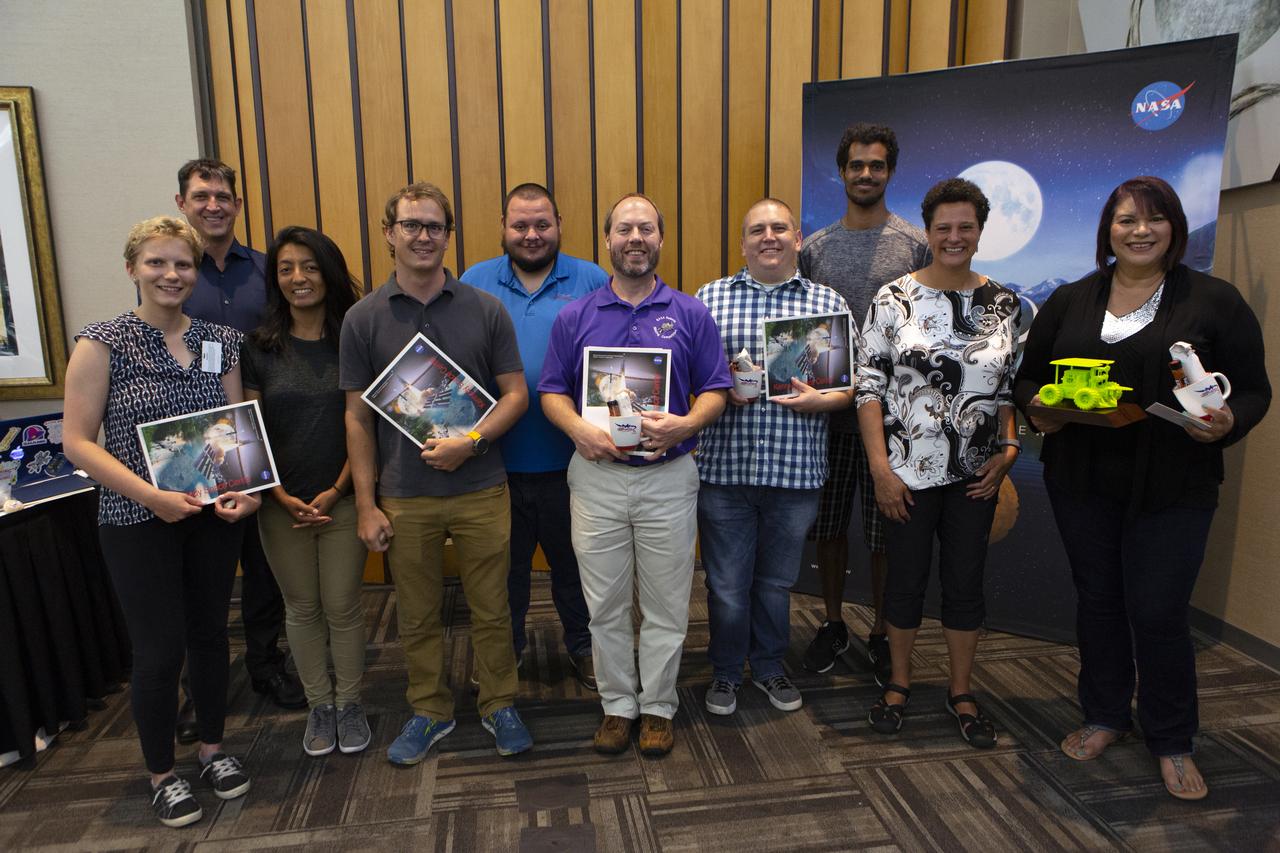
During an awards ceremony on June 12, 2019 at the Kennedy Space Center Visitor Complex in Florida, mentors and volunteers from Kennedy received certificates of recognition for the NASA Swarmathon 2019 University Challenge. Second from right is Melanie Moses, a professor of computer science at the Swarmathon host location, University of New Mexico. At far right is Theresa Martinez, engagement manager of the Minority University Research and Education Program, managed at Kennedy. University students and their mentors were at Kennedy to participate in a student/mentor panel, hear from speakers, get a behind-the-scenes tour of Kennedy Space Center, dine with an astronaut and receive awards. During Swarmathon University Challenge IV, students developed algorithms for robotic swarms that are robust and adaptable like the foraging strategies of ant colonies. The fourth and final Swarmathon was a combined virtual and physical competition.

NASA astronaut Dr. Serena Auñón-Chancellor speaks about her experience on Expeditions 56 and 57 onboard the International Space Station (ISS) at Excel Academy Public Charter School, Monday, June 10, 2019 in Washington, DC. Auñón-Chancellor spent 197 days living and working onboard the ISS and contributed to hundreds of experiments in biology, biotechnology, physical science, and Earth science while there. She is also a doctor and started her career with NASA as a flight surgeon in 2006. Photo Credit: (NASA/Aubrey Gemignani)
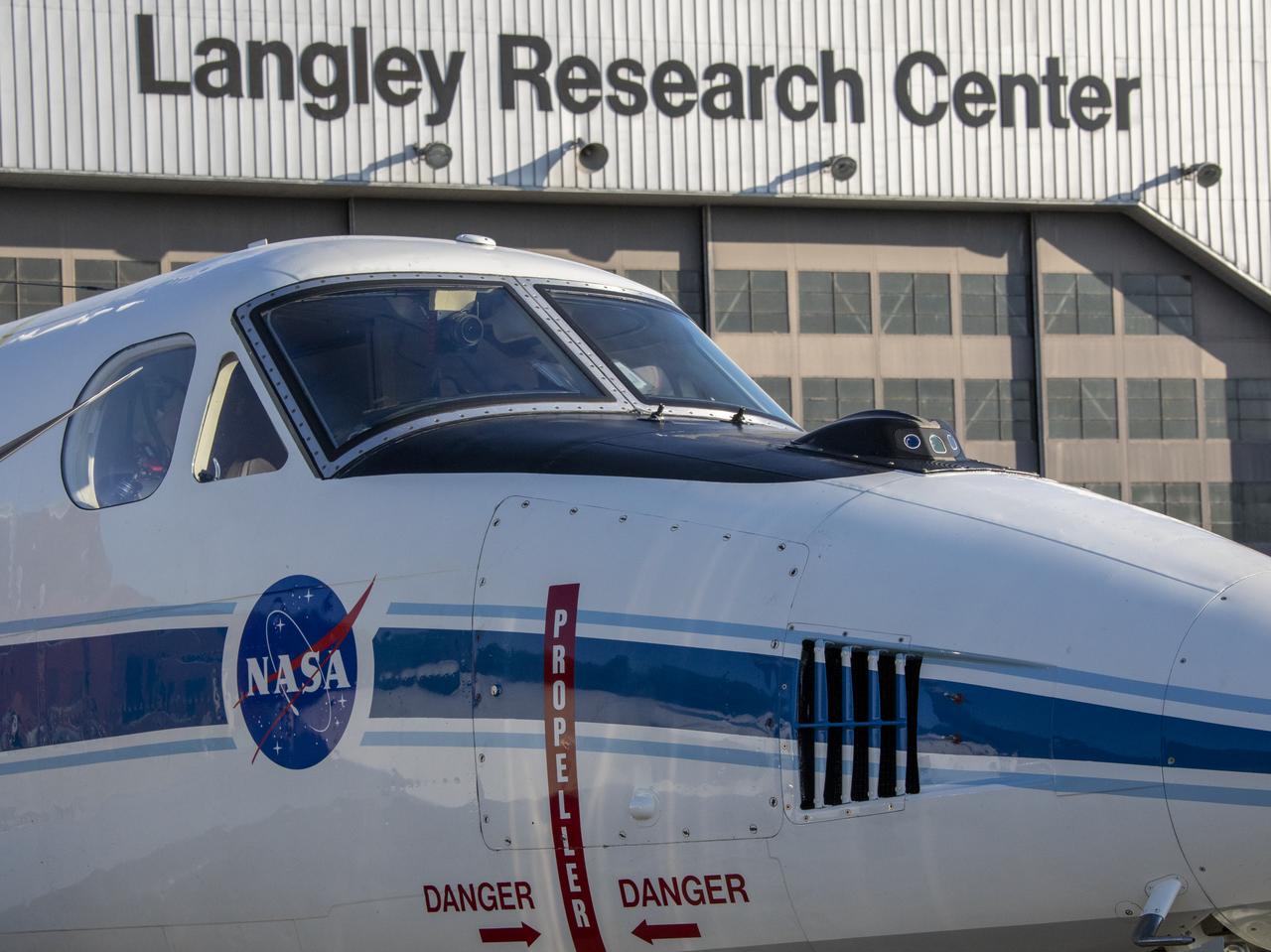
First test flight testing the visual display for the X59. The XVS display is aboard the B200 and the camera is mounted on the nose of the aircraft and inside the cockpit.
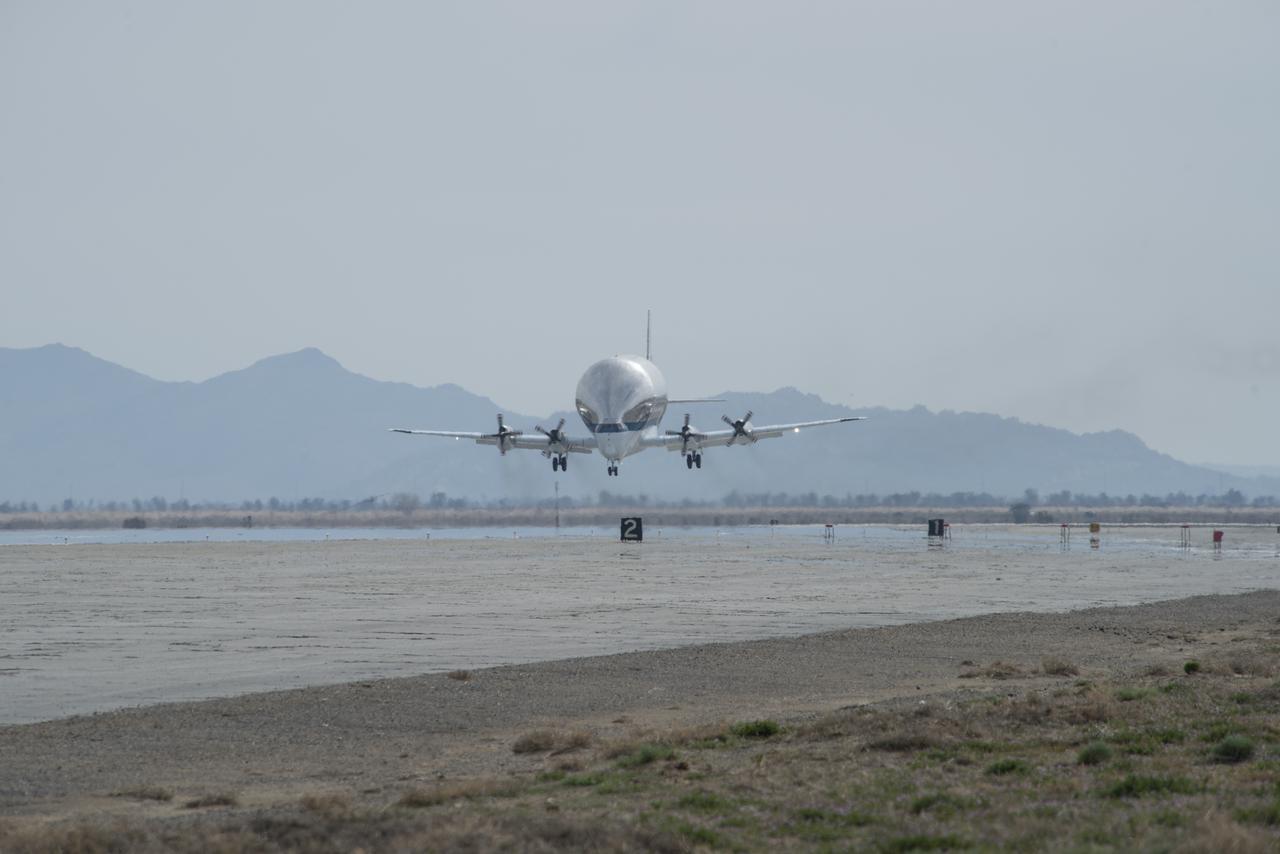
NASA's Super Guppy cargo transport aircraft coming in for landing at Plant 42 in Palmdale, California on April 1, 2019.
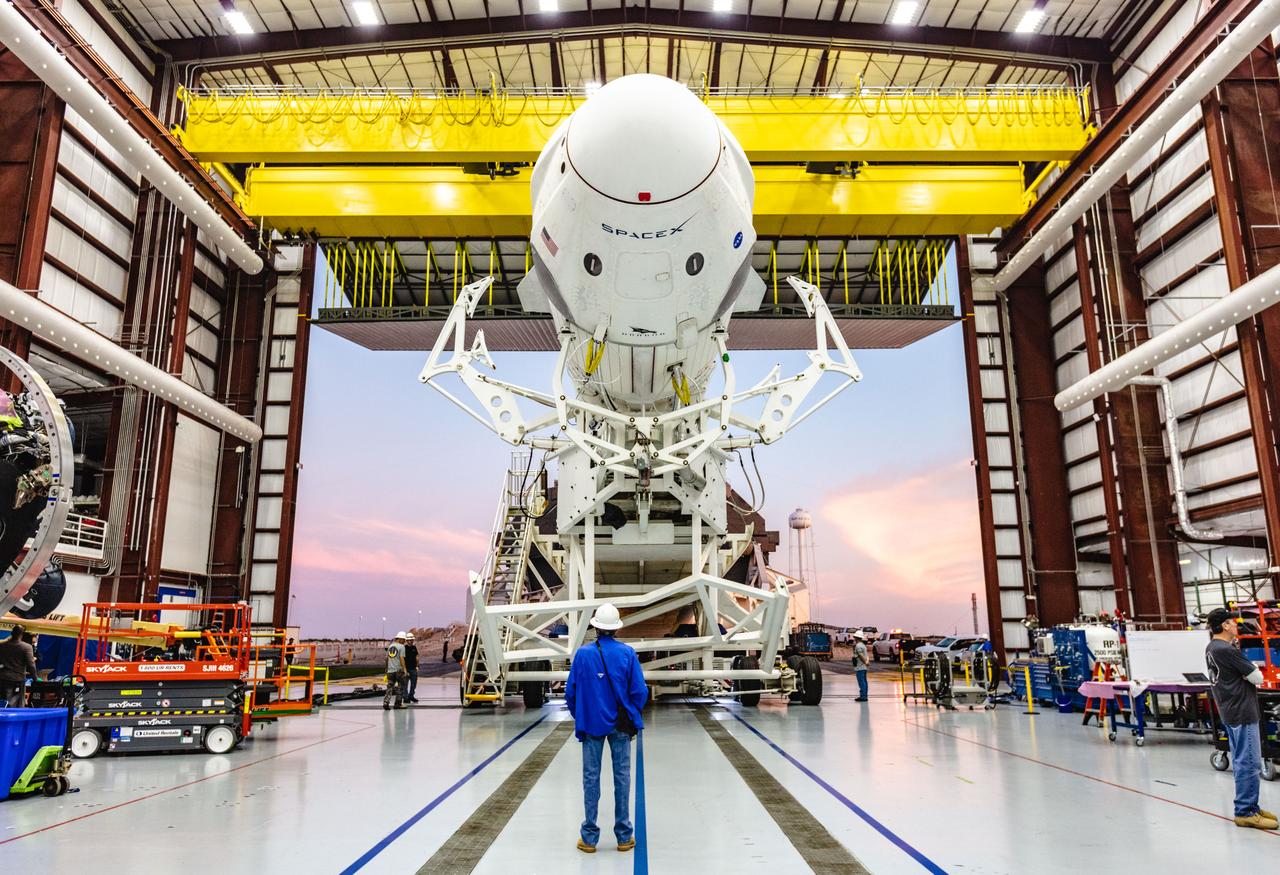
A SpaceX Falcon 9 rocket with the company’s Crew Dragon attached, rolls out of the company’s hangar at NASA Kennedy Space Center’s Launch Complex 39A on Jan. 3, 2019. The rocket will undergo checkouts prior to the liftoff of Demo-1, the inaugural flight of one of the spacecraft designed to take NASA astronauts to and from the International Space Station. NASA has worked with SpaceX and Boeing in developing Commercial Crew Program spacecraft to facilitate new human spaceflight systems launching from U.S. soil with the goal of safe, reliable and cost-effective access to low-Earth orbit destinations such as the space station.
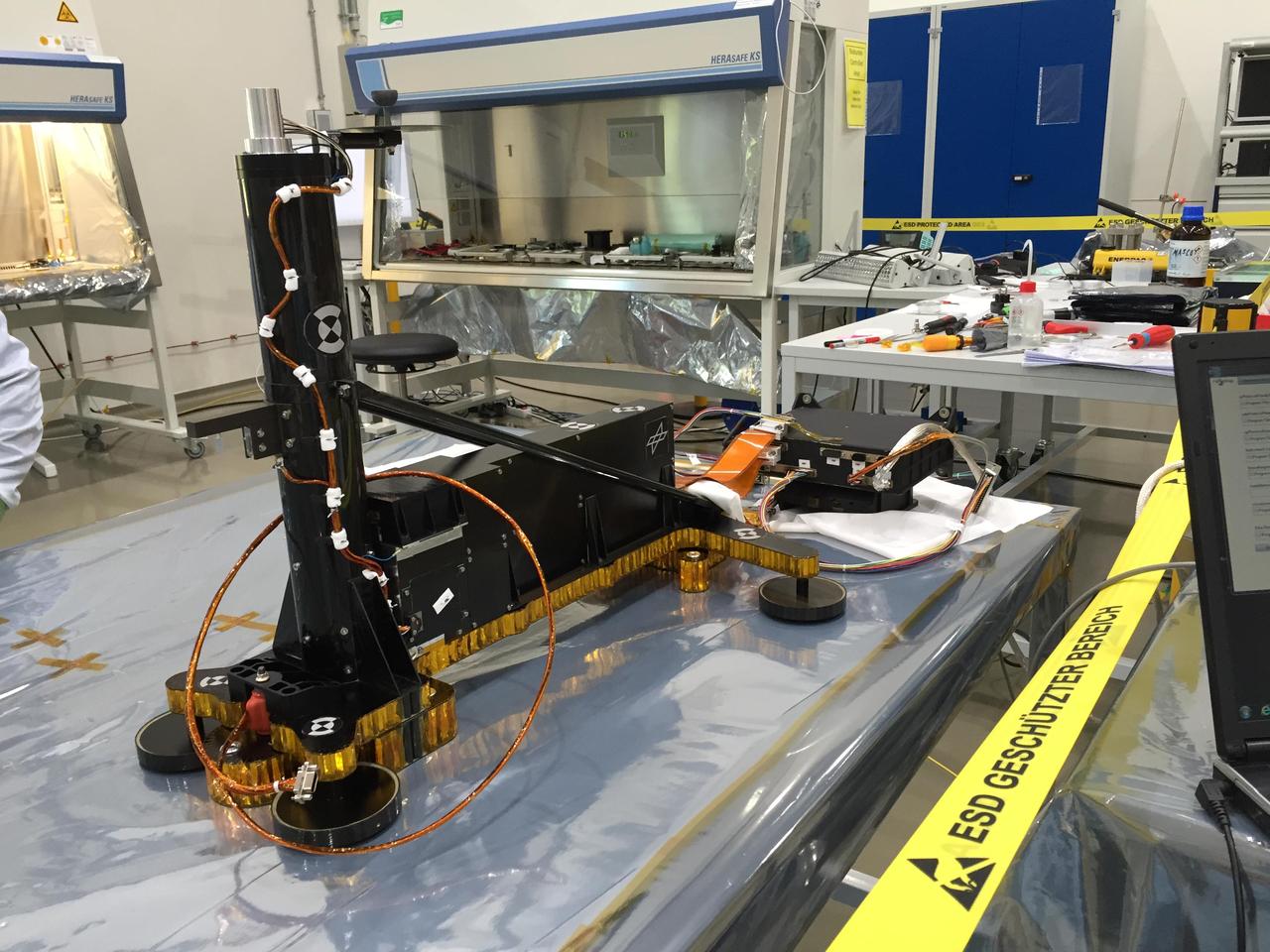
InSight's heat probe, called the Heat and Physical Properties Package (HP3). This image was taken while the heat probe was being tested in Germany, before InSight's launch. https://photojournal.jpl.nasa.gov/catalog/PIA23044
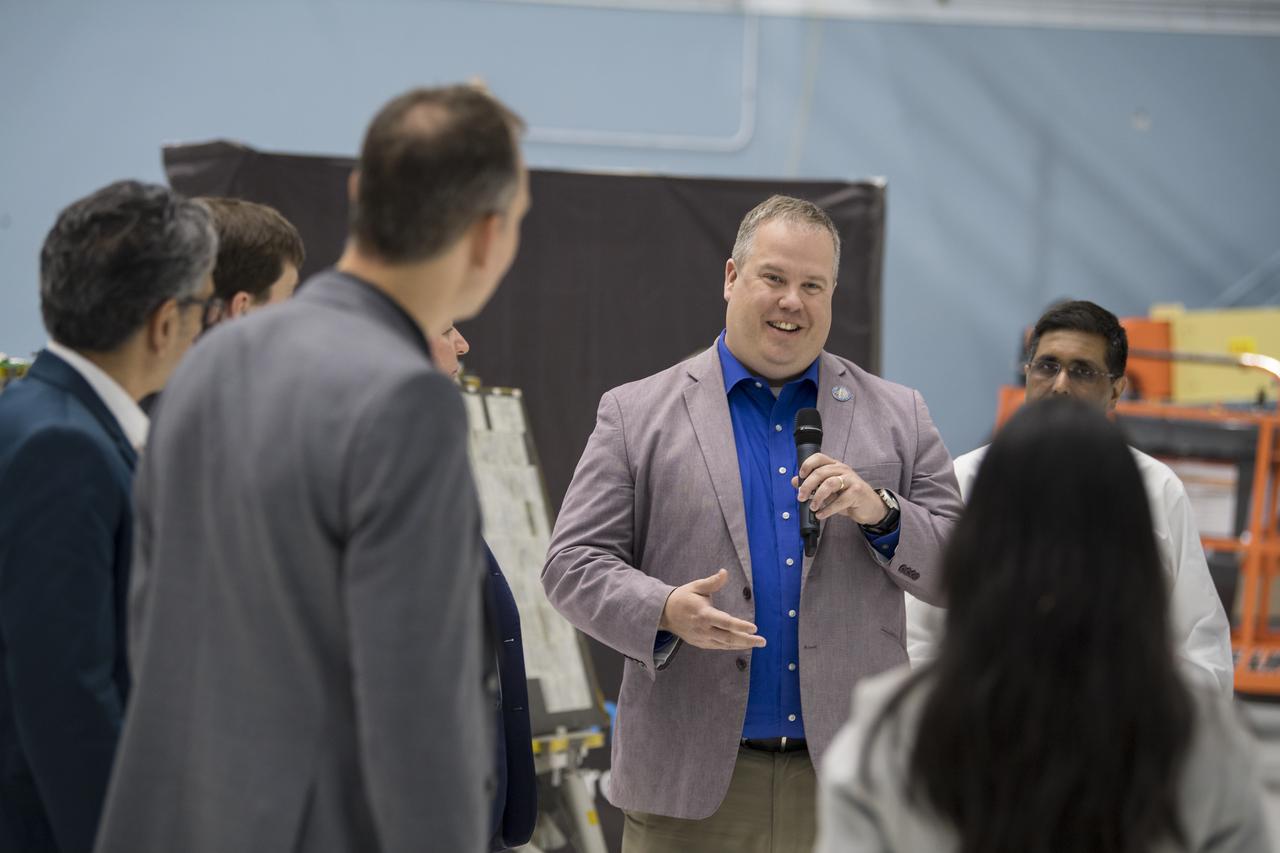
Vice President of Research and Development of Intuitive Machines, Tim Crain, second from right, speaks about their lunar lander, Friday, May 31, 2019, at Goddard Space Flight Center in Md. Astrobotic, Intuitive Machines, and Orbit Beyond have been selected to provide the first lunar landers for the Artemis program's lunar surface exploration. Photo credit: (NASA/Aubrey Gemignani)
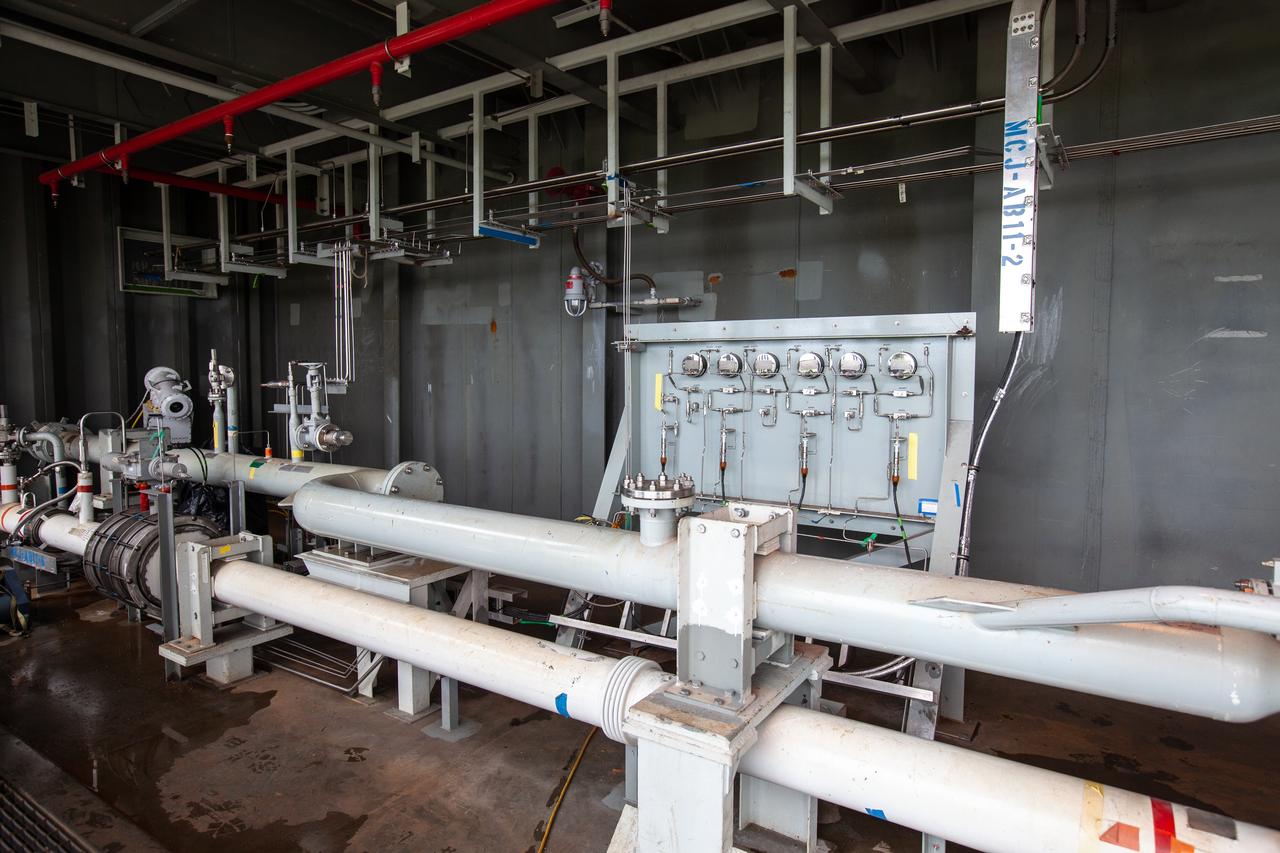
The control panel that will direct and control the flow of liquid oxygen, referred to as a skid, is photographed at Launch Pad 39B on Nov. 8, 2019, at NASA’s Kennedy Space Center in Florida. The agency’s Exploration Ground Systems oversaw testing of the pad’s cryogenic systems – the infrastructure that will support the flow of liquid hydrogen and liquid oxygen from the storage tanks, located near the pad, to the Space Launch System (SLS) rocket – in preparation for the launch of SLS with the Orion spacecraft atop for the uncrewed Artemis I mission. Each of the liquid oxygen and liquid hydrogen tanks can hold more than 800,000 gallons of propellant. The liquid oxygen will require the use of pumps to push it from the tank to the rocket, while the lighter liquid hydrogen will make its way up to the pad using gaseous hydrogen to pressurize the sphere.
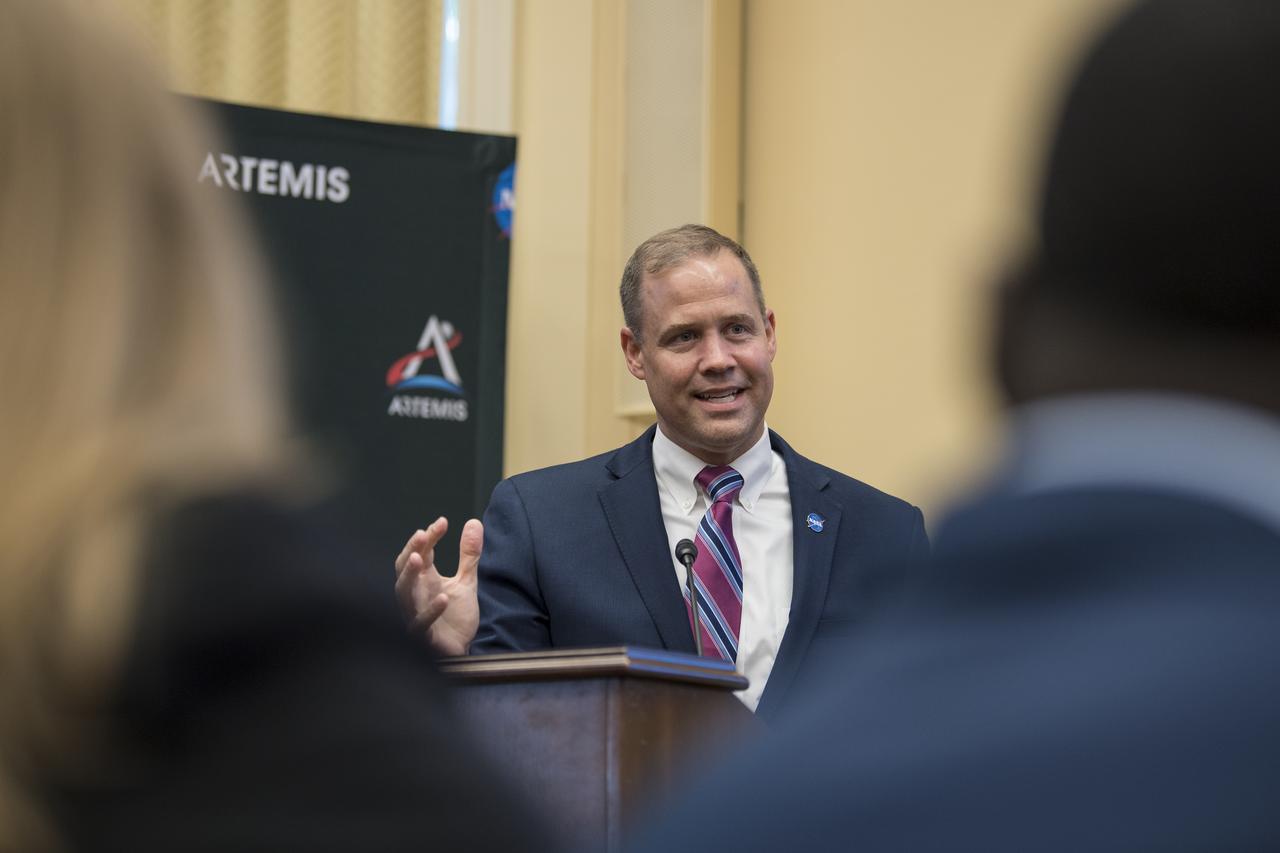
NASA Administrator Jim Bridenstine provides remarks at a bipartisan Congressional Caucus for Women’s Issues briefing on NASA’s Artemis lunar exploration program, Wednesday, September 11, 2019 at the Rayburn House Office Building in Washington. Photo Credit: (NASA/Aubrey Gemignani)
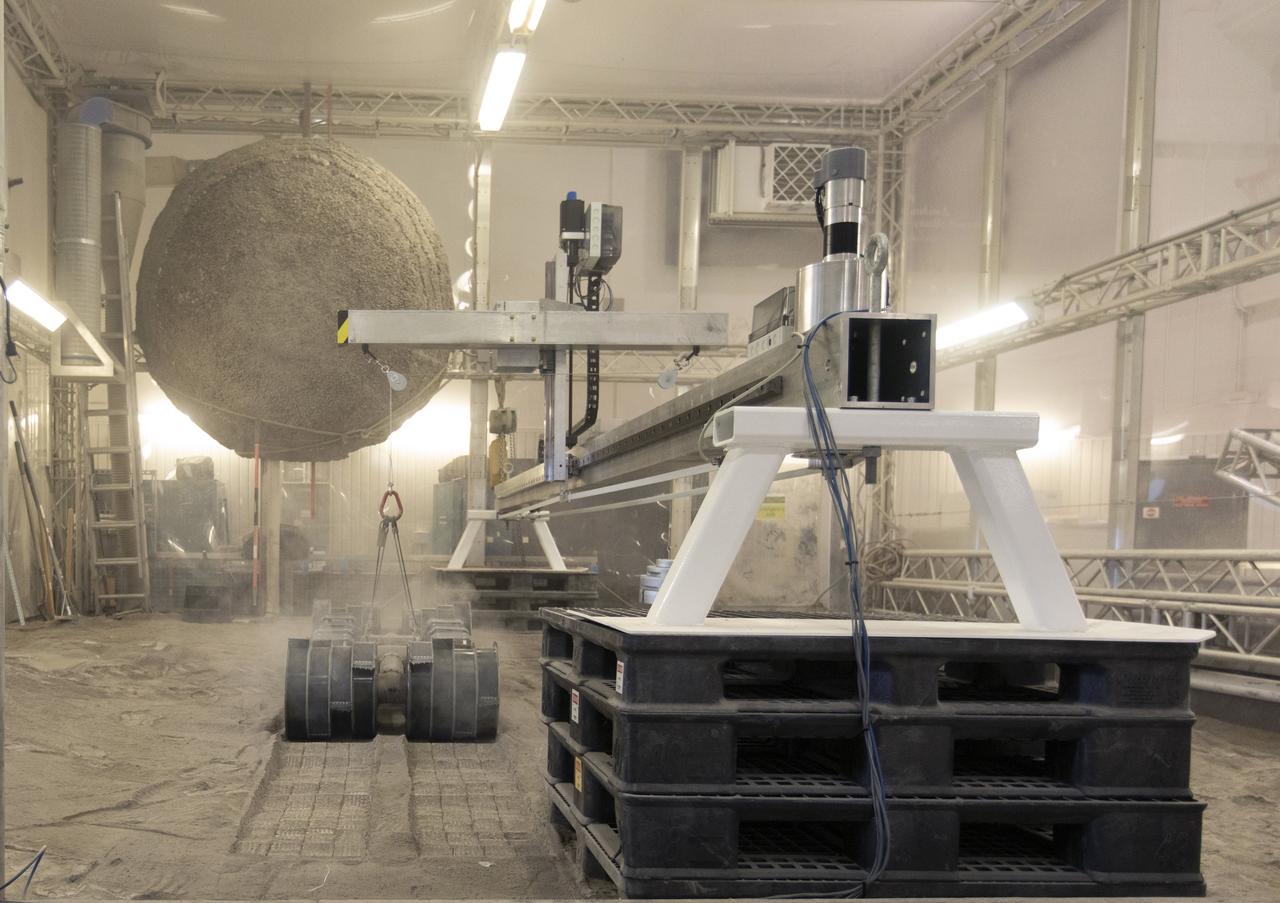
A team from the Granular Mechanics and Regolith Operations Lab tests the Regolith Advanced Surface Systems Operations Robot (RASSOR) in the regolith bin inside Swamp Works at NASA’s Kennedy Space Center in Florida on June 5, 2019. Tests use a gravity assist offload system to simulate reduced gravity conditions found on the Moon. On the surface of the Moon, mining robots like RASSOR will excavate the regolith and take the material to a processing plant where usable elements such as hydrogen, oxygen and water can be extracted for life support systems. RASSOR can scoop up icy regolith which can be used to make operations on the Moon sustainable.
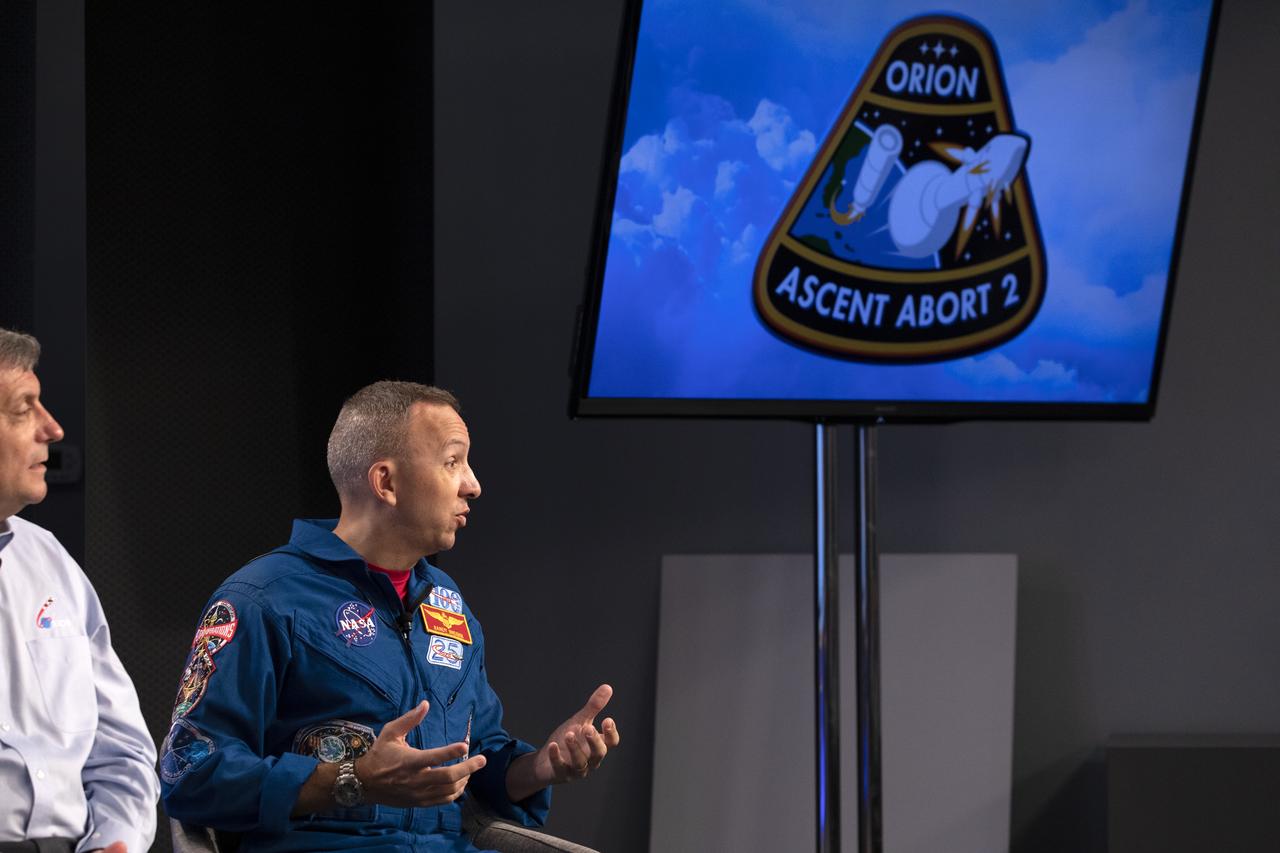
From left, Mark Kirasich, Orion Program manager; and Randy Bresnik, NASA astronaut, participate in a prelaunch news conference for NASA’s Ascent Abort-2 (AA-2) flight test at the agency’s Kennedy Space Center in Florida on July 1, 2019. For AA-2, a test version of the Orion spacecraft attached to a fully functional Launch Abort System (LAS) will launch atop a Northrop Grumman provided booster on July 2, 2019, from Launch Pad 46 at Cape Canaveral Air Force Station in Florida. During AA-2, the booster will send the LAS and Orion to an altitude of 31,000 feet, traveling at more than 1,000 mph. The LAS’ three motors will work together to pull the crew module away from the booster and prepare it for splashdown in the Atlantic Ocean. The flight test will prove that the abort system can pull crew to safety in the unlikely event of an emergency during ascent.

Technicians extend the solar array on NASA's Ionospheric Connection Explorer (ICON) during a deployment test inside Building 1555 at Vandenberg Air Force Base in California on Aug. 10, 2019. ICON will launch on a Pegasus XL rocket, attached beneath the company's L-1011 Stargazer aircraft, from the Skid Strip at Cape Canaveral Air Force Station in Florida. Launch is scheduled for Oct. 10. ICON will study the frontier of space - the dynamic zone high in Earth's atmosphere where terrestrial weather from below meets space weather above. The explorer will help determine the physics of Earth's space environment and pave the way for mitigating its effects on our technology and communications systems.
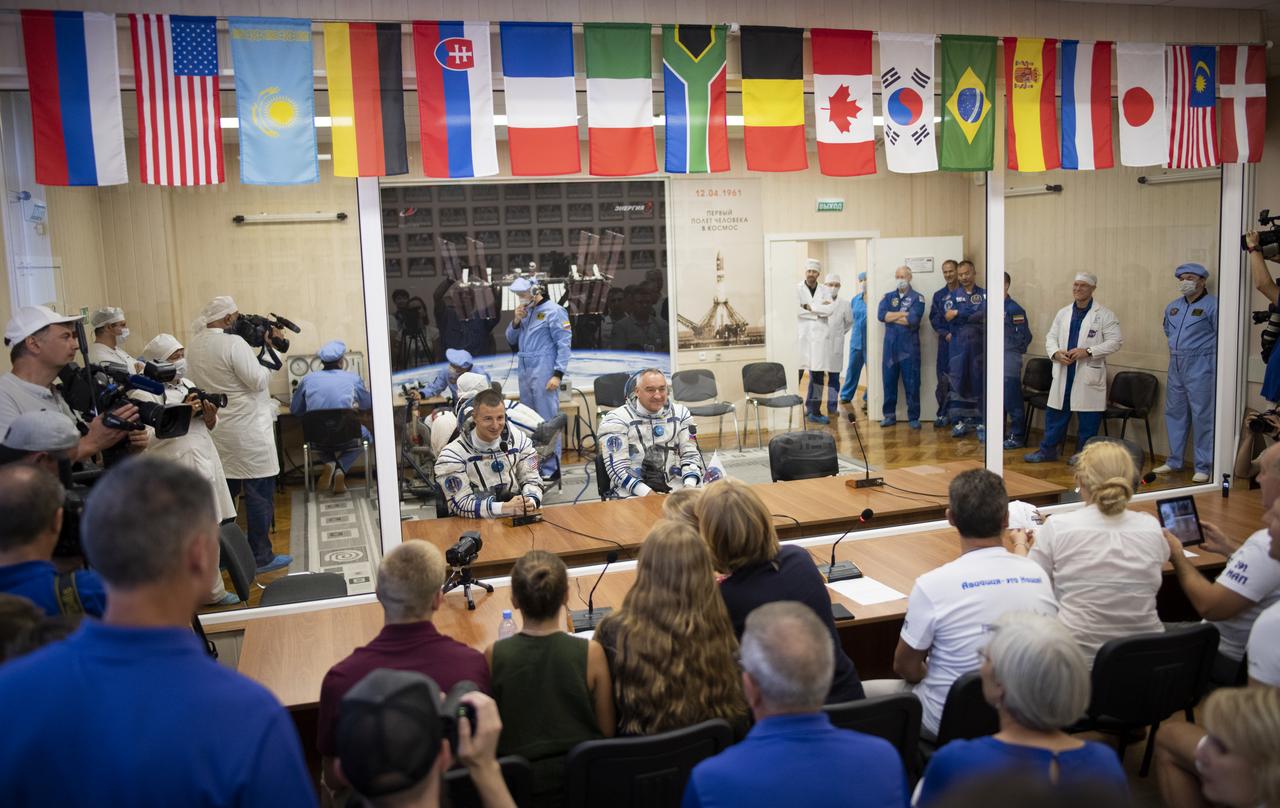
Expedition 60 flight engineer Andrew Morgan of NASA, left, and Soyuz Commander Alexander Skvortsov of Roscosmos, right, speaks with family as flight engineer Luca Parmitano of ESA (European Space Agency) has his Russian Sokol suit pressure checked in preparation for launch aboard the Soyuz MS-13 spacecraft, Saturday, July 20, 2019 at the Baikonur Cosmodrome in Kazakhstan. Morgan, Skvortsov, and Parmitano launched aboard the Soyuz MS-13 spacecraft at 12:28 p.m. Eastern time (9:28 p.m. Baikonur time) on July 20 to begin their journey to the International Space Station. Photo Credit: (NASA/Joel Kowsky)
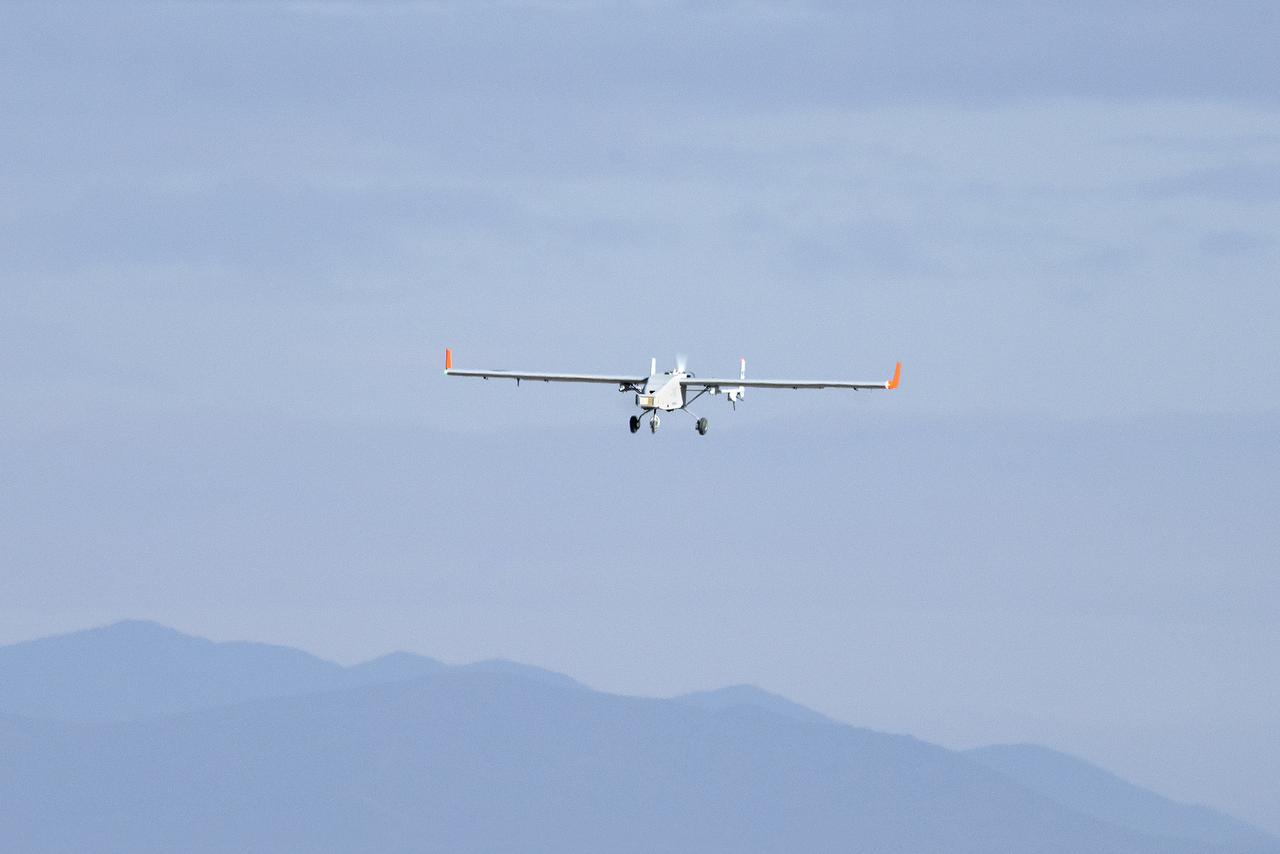
The TigerShark unmanned aircraft by Navmar Applied Sciences Corporation flew over the skies at NASA’s Armstrong Flight Research Center for the Unmanned Aircraft Systems integration in the National Airspace Systems, Flight Test Series Six (FT6) project. FT6 focused on low size weight and power sensors for Detect and Avoid (DAA) operations in controlled airspace to inform the FAA through the RTCA Special Committee DAA Working Group on the phase 2 minimum operational performance standards for DAA and air-to-air radar.
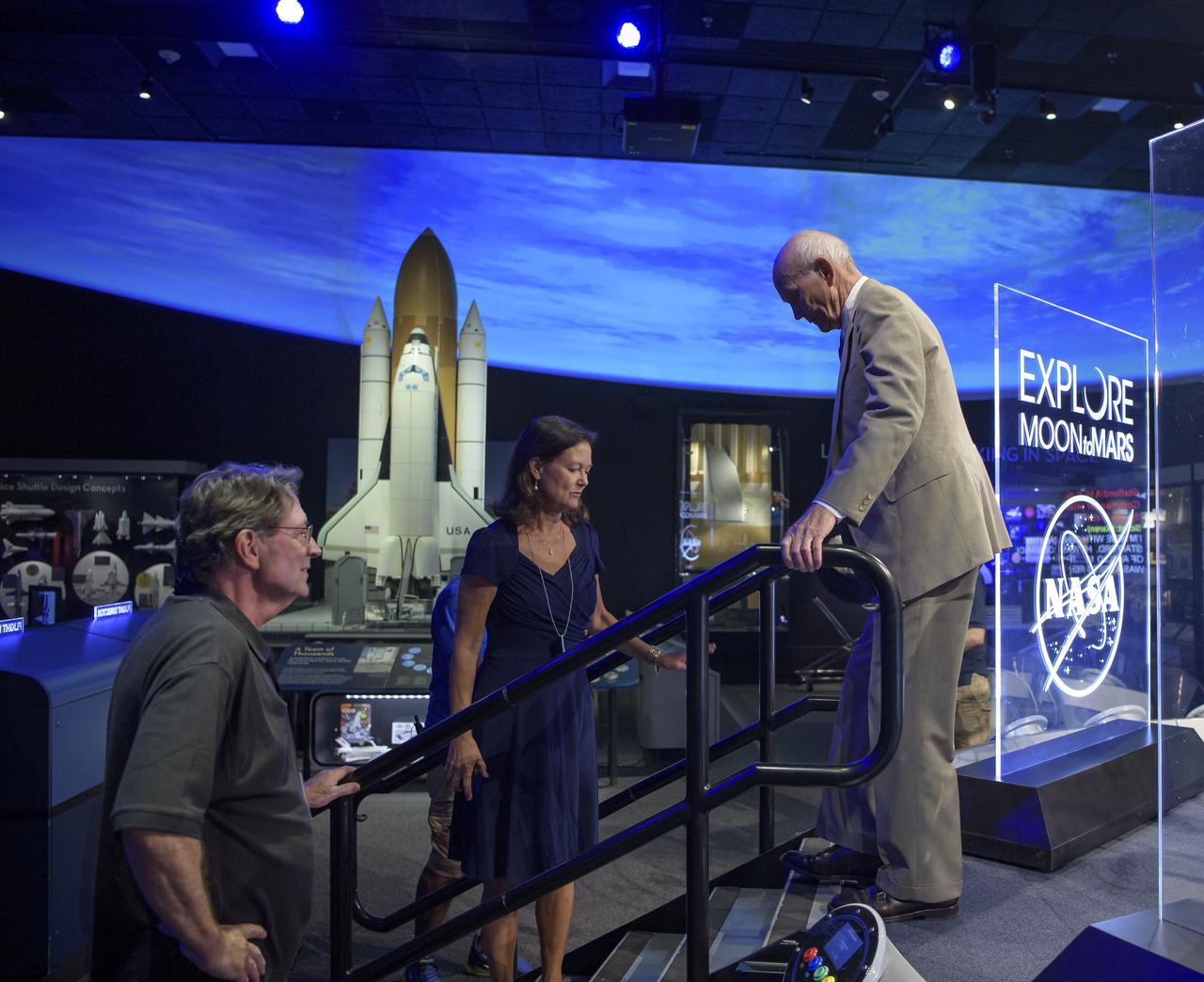
Apollo 11 astronaut Mike Collins leaves the stage after appearing on a live television program titled “NASA’s Giant Leaps: Past and Future," Friday, July 19, 2019 at the Smithsonian National Air and Space Museum in Washington. NASA and the world are recognizing the 50th anniversary of Apollo 11, in which astronauts Neil Armstrong, Michael Collins, and Buzz Aldrin crewed the first mission to land astronauts on the Moon. Photo Credit: (NASA/Bill Ingalls)
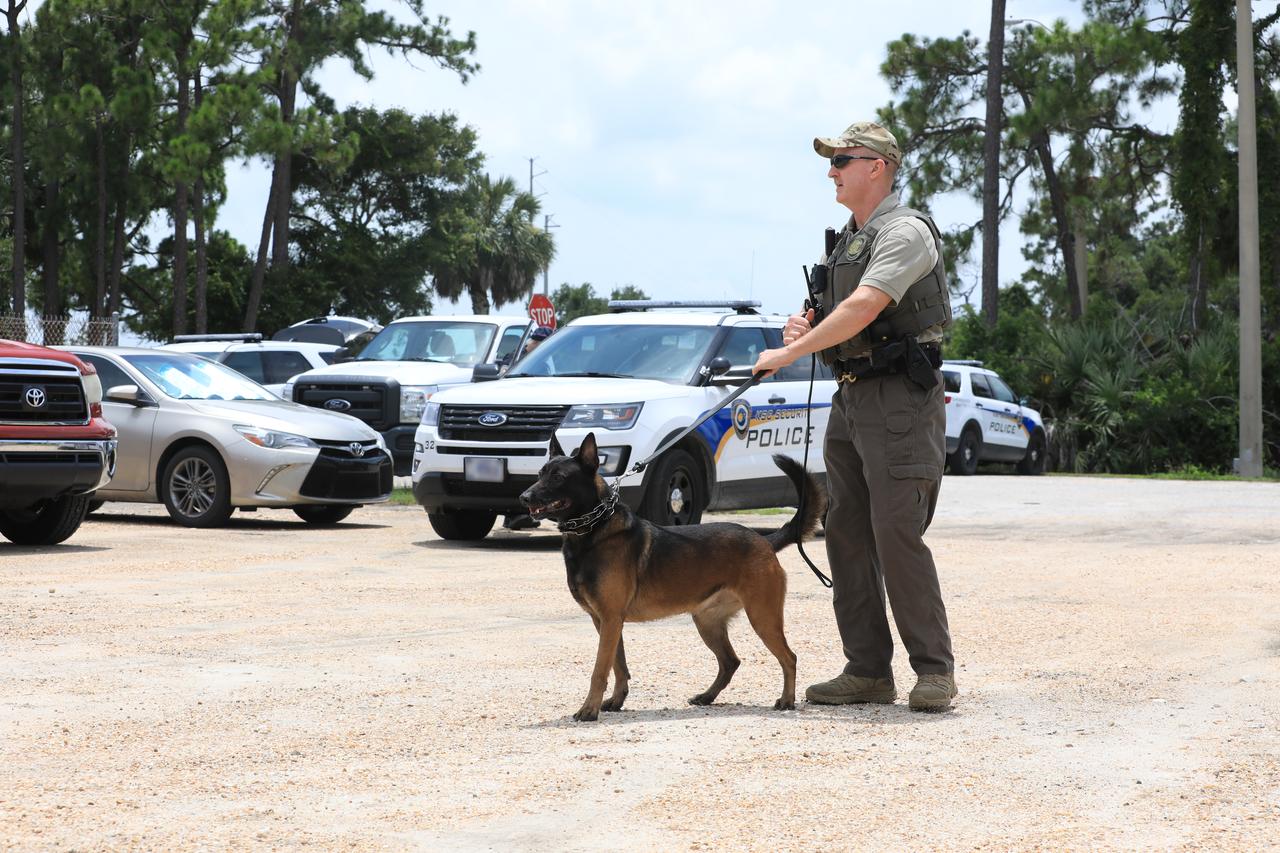
K-9 Spike stands alert and ready for the next training exercise with his Handler Officer John McGee at Kennedy Space Center’s Protective Services Office in Florida on July 10, 2019. The center’s specially trained K-9s support the center 24/7, 365 days. Their main goal is to protect the Kennedy workforce and assets. Normal activities include sweeps of designated facilities, parking lots and random vehicle inspections at entrance gates. During rocket launches, they are out and about performing sweeps of facilities and launch site viewing areas. They cover Kennedy and the Merritt Island National Wildlife Refuge.
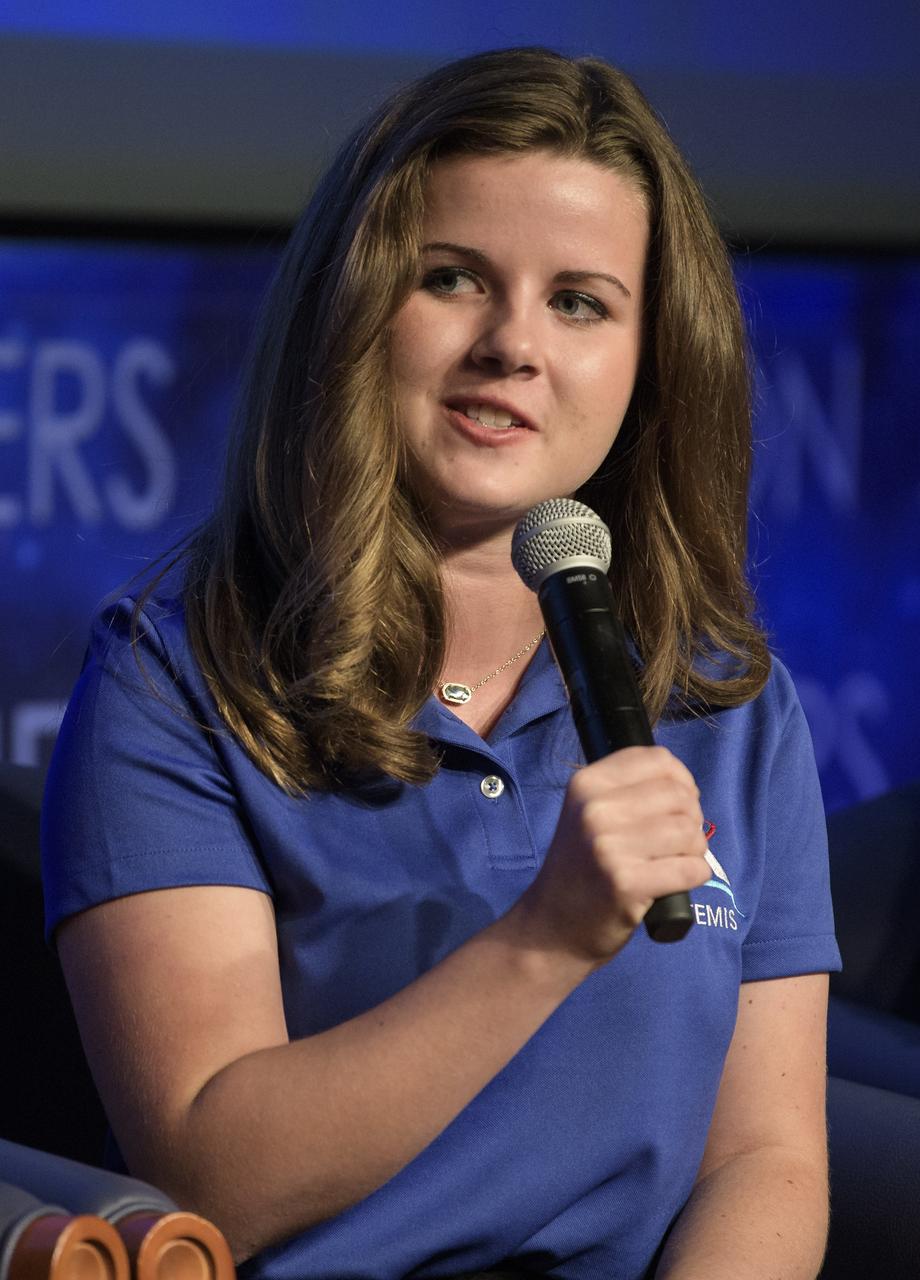
Alexis Vance, a Pathways student engineering trainee at NASA’s Johnson Space Center, speaks about being an intern at NASA’s Johnson Space Center during an interactive STEM discussion with students attending the 70th International Astronautical Congress, Wednesday, Oct. 23, 2019, at NASA Headquarters in Washington. Photo Credit: (NASA/Joel Kowsky)
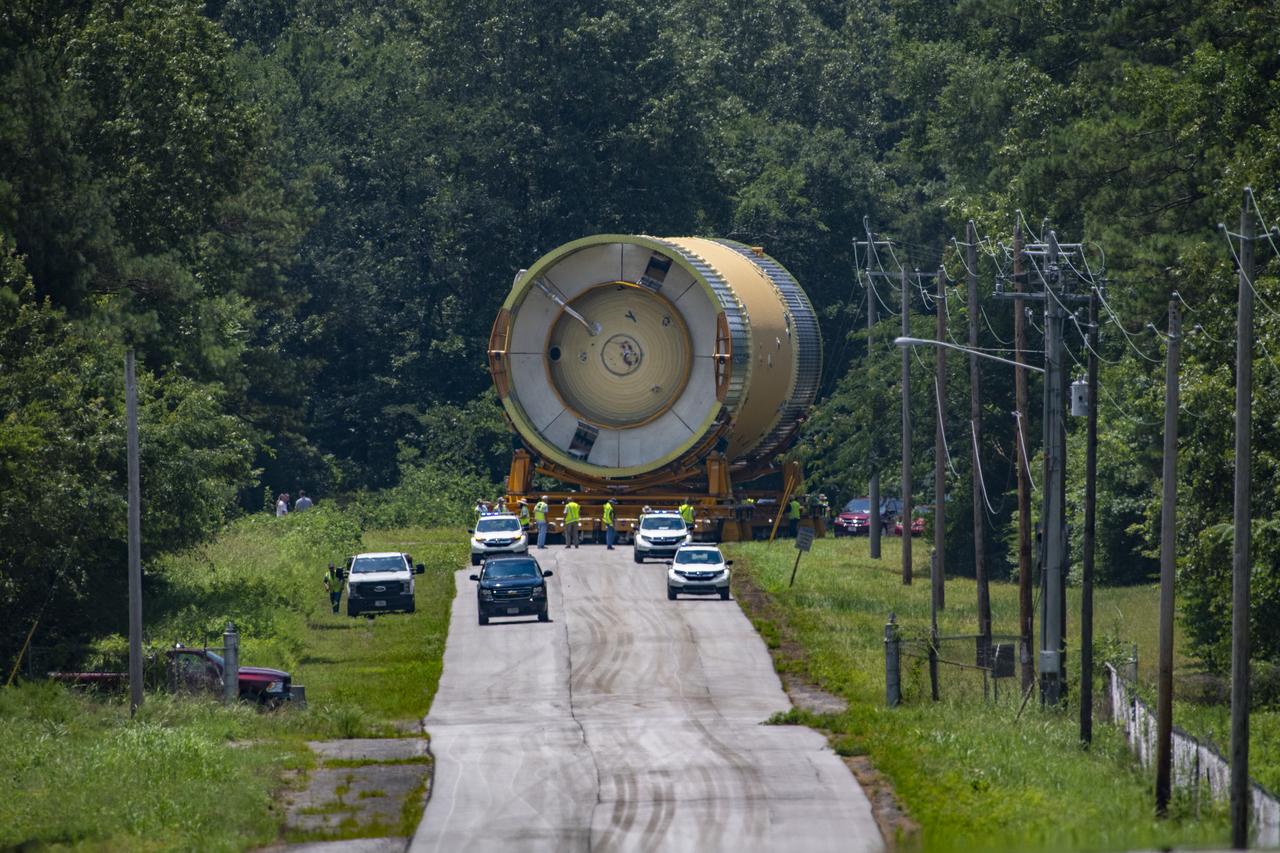
The Liquid Oxygen (LOX) tank was moved from the Pegasus barge to the west test area for placement in test stand 4697.

NASA, CSA, Roscosmos, and Russian Search and Recovery Forces meet at the Cosmonaut Hotel in Karaganda, Kazakhstan to discuss the readiness for the landing of Expedition 59 crew members Anne McClain of NASA, David Saint-Jacques of the Canadian Space Agency, and Oleg Kononenko of Roscosmos, Sunday, June 23, 2019. McClain, Saint-Jacques, and Kononenko are returning after 204 days in space where they served as members of the Expedition 58 and 59 crews onboard the International Space Station. Photo Credit: (NASA/Bill Ingalls)
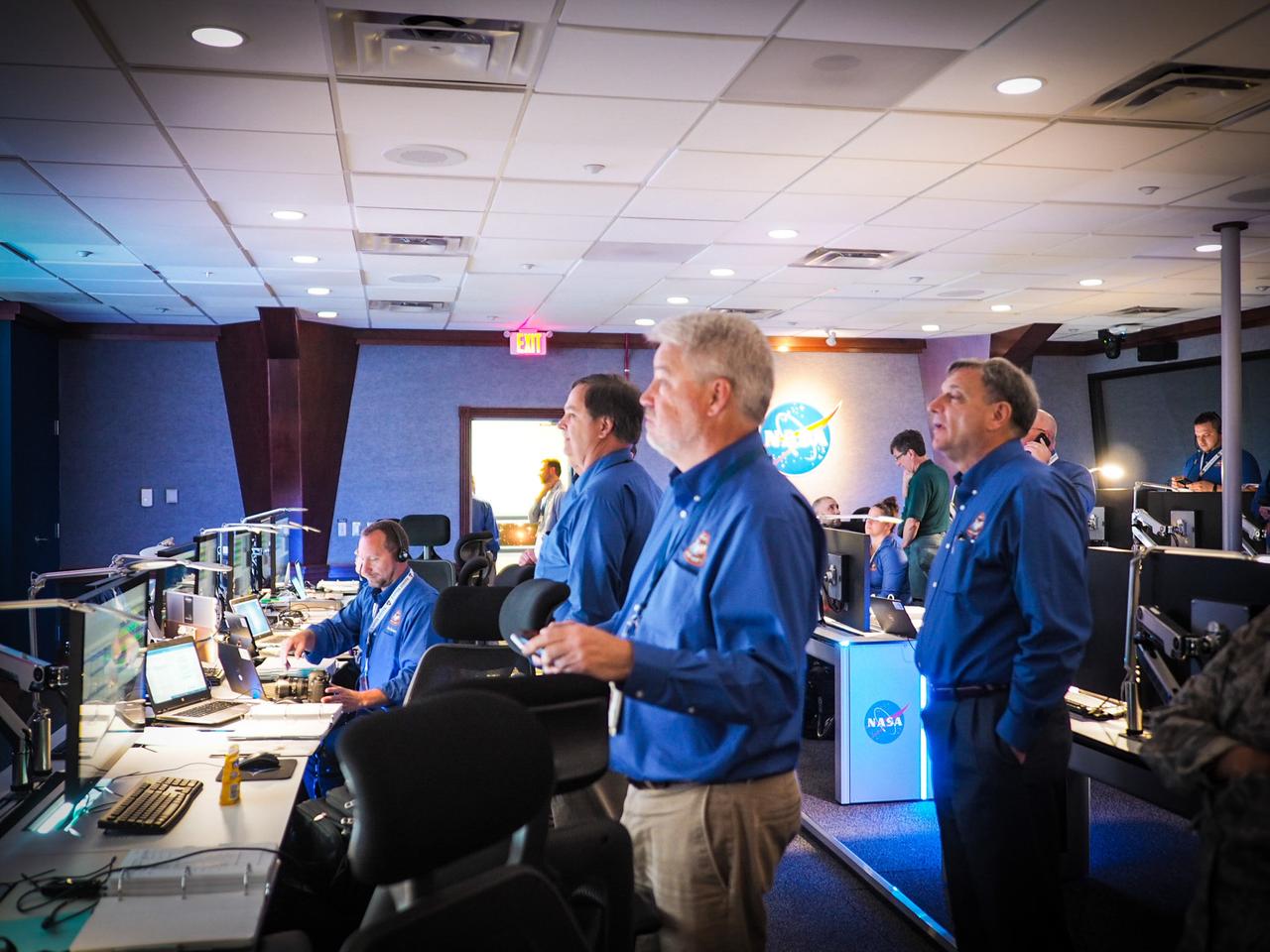
From Hangar AE at Cape Canaveral Air Force Station, the Orion team conducted the successful flight test of the Launch Abort System on Ascent Abort-2 (AA-2) on July 2, 2019.
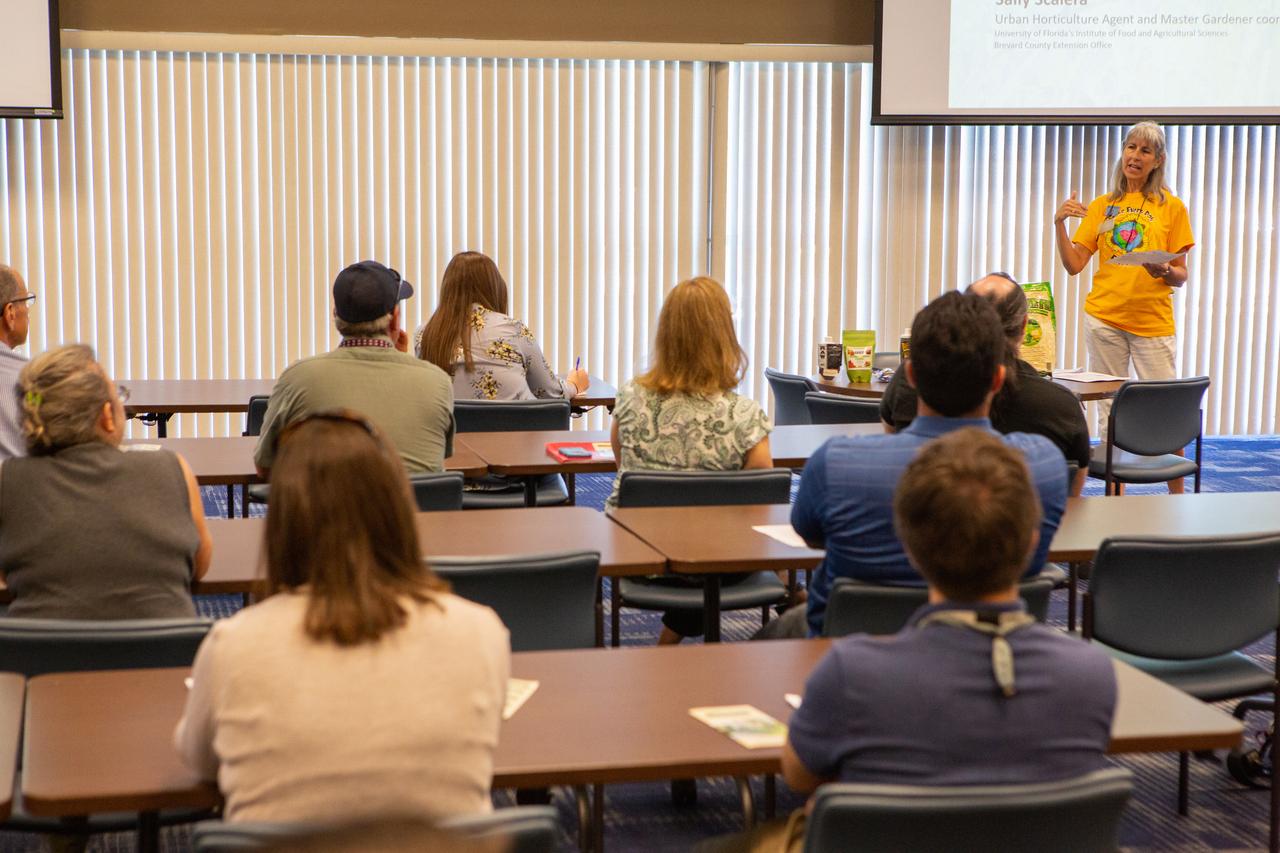
Sally Scalera, urban horticulture agent and master gardener coordinator from the University of Florida’s Institute of Food and Agricultural Sciences Brevard Extension Office, presents some sustainable tips and tricks for a healthy yard and garden to Kennedy Space Center employees on April 24, 2019. Held inside the Florida spaceport’s Space Station Processing Facility Conference Center, Scalera also provided information on Florida-friendly landscaping practices. The lunch and learn was available for employees to attend as part of Kennedy’s Earth Day events.
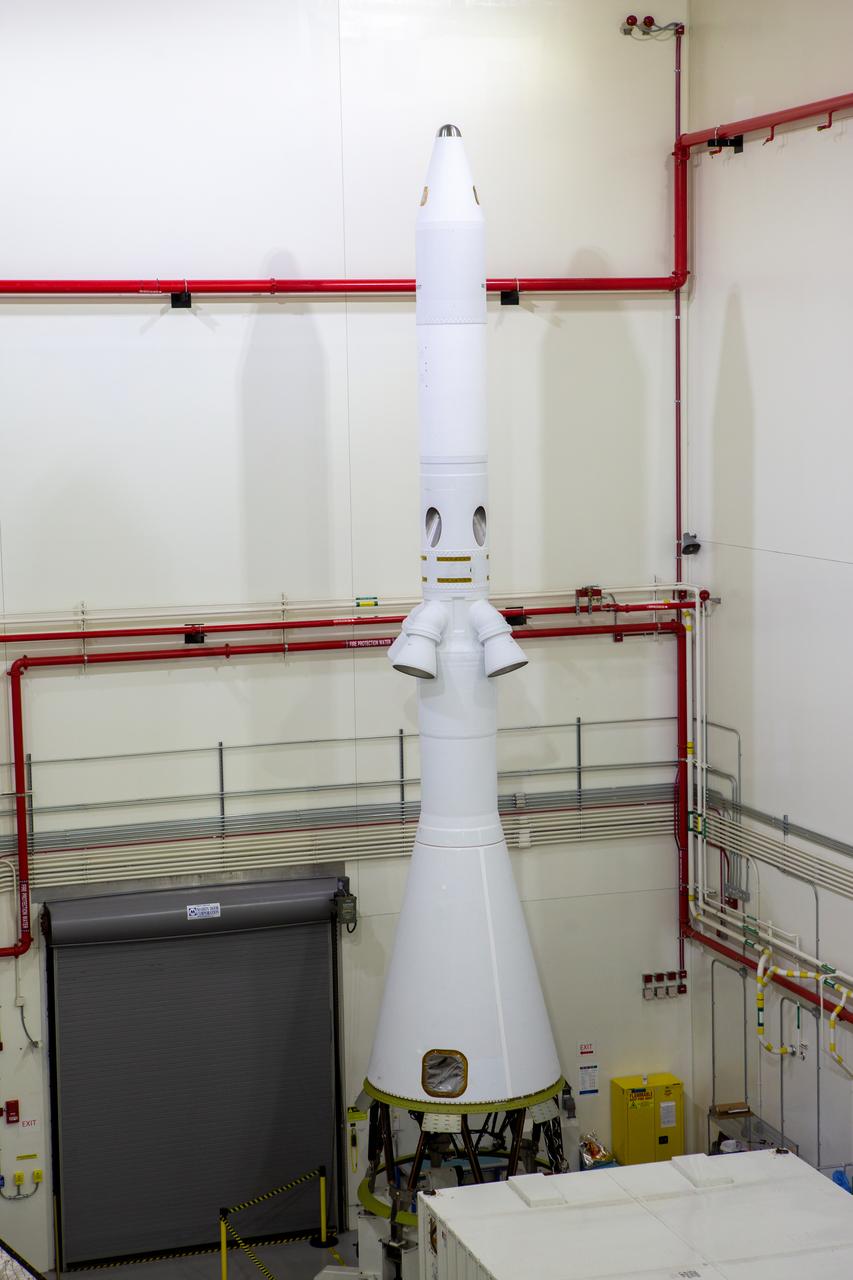
Inside the Launch Abort System Facility (LASF) at NASA’s Kennedy Space Center in Florida, the Launch Abort System (LAS) for the Orion spacecraft that will launch on Artemis I, the first of the Artemis series, awaits final processing with the spacecraft. The LAS was processed and prepared inside the LASF. During crewed launches of the Orion spacecraft atop the Space Launch System rocket, the LAS will protect the crew module and astronauts aboard to safety if an emergency occurs during launch.
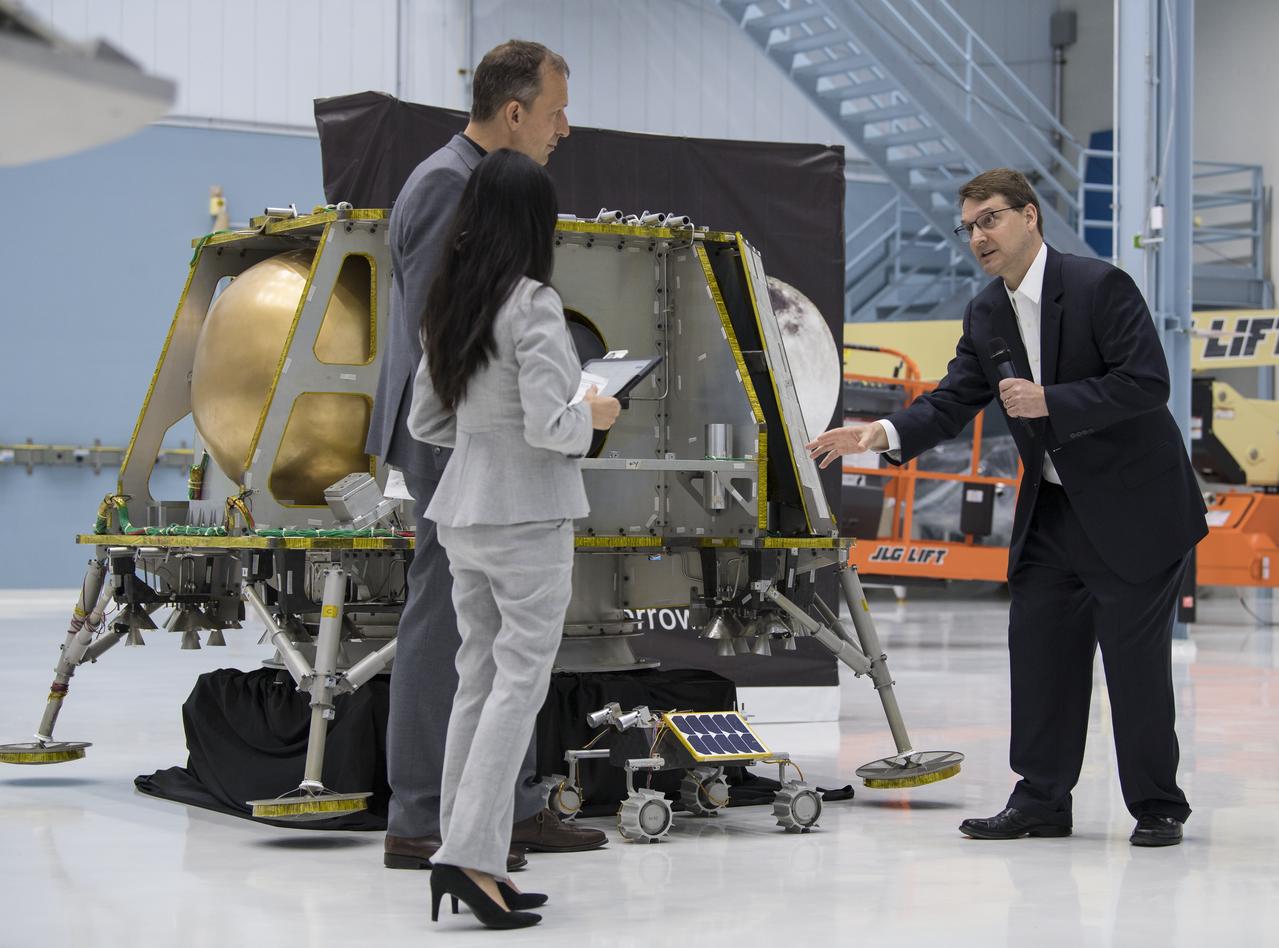
NASA Associate Administrator, Science Mission Directorate, Thomas Zurbuchen, second left, listens as Chief Science Officer, OrbitBeyond, Jon Morse, speaks about their lunar lander, Friday, May 31, 2019, at Goddard Space Flight Center in Md. Astrobotic, Intuitive Machines, and OrbitBeyond have been selected to provide the first lunar landers for the Artemis program's lunar surface exploration. Photo credit: (NASA/Aubrey Gemignani)