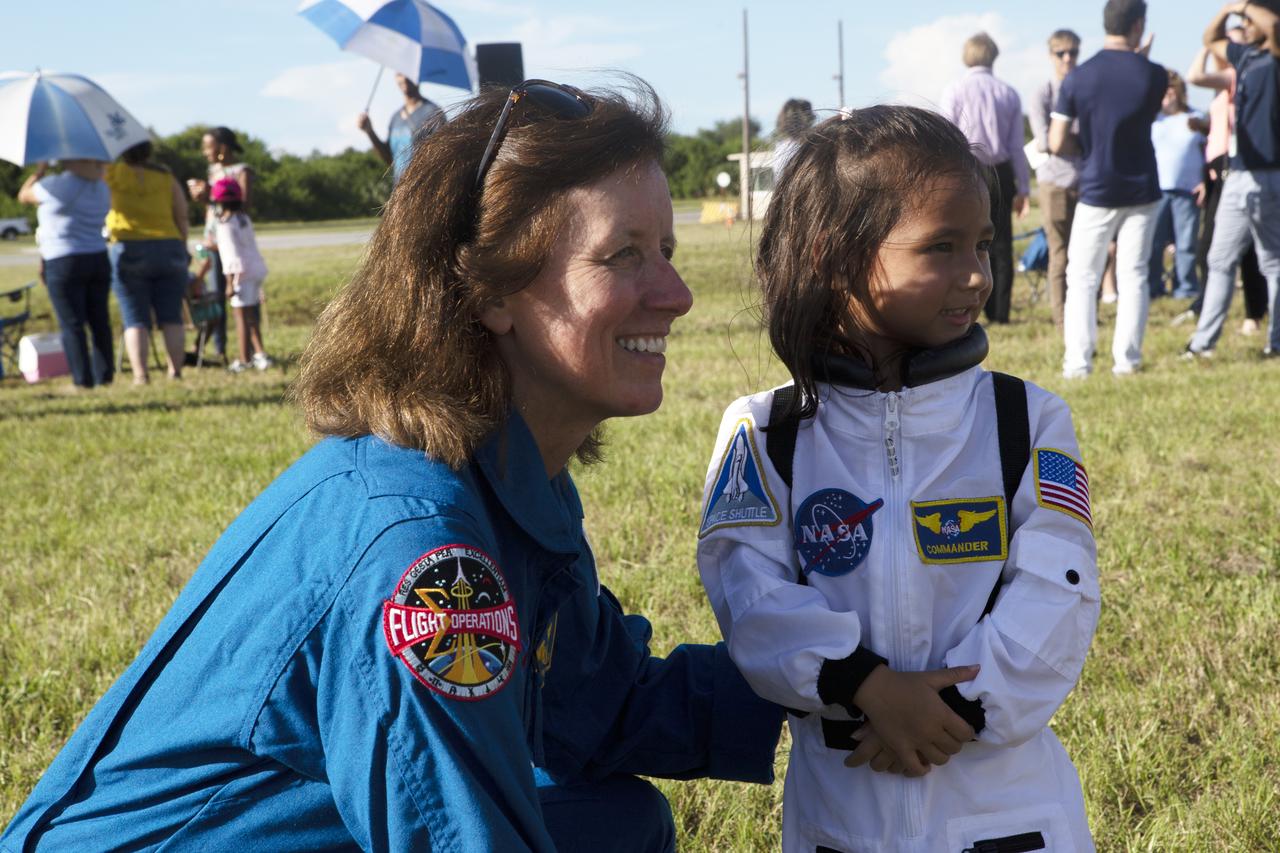
NASA astronaut Shannon Walker visits with a future astronaut during an employee event for workers and their guests for the mobile launcher move to the Vehicle Assembly Building (VAB) on Sept. 7, 2018, at NASA's Kennedy Space Center in Florida. The mobile launcher, atop crawler-transporter 2, began its trek from Launch Pad 39B along the crawlerway after undergoing a fit check and several days of systems testing with the pad. This is the first time that the modified mobile launcher made the trip to the pad. The 380-foot-tall mobile launcher is equipped with the crew access arm and several umbilicals that will provide power, environmental control, pneumatics, communication and electrical connections to the agency's Space Launch System and Orion spacecraft. The mobile launcher will spend seven months in the VAB undergoing testing. Exploration Ground Systems is preparing the ground systems necessary to launch SLS and Orion on Exploration Mission-1, missions to the Moon and on to Mars.
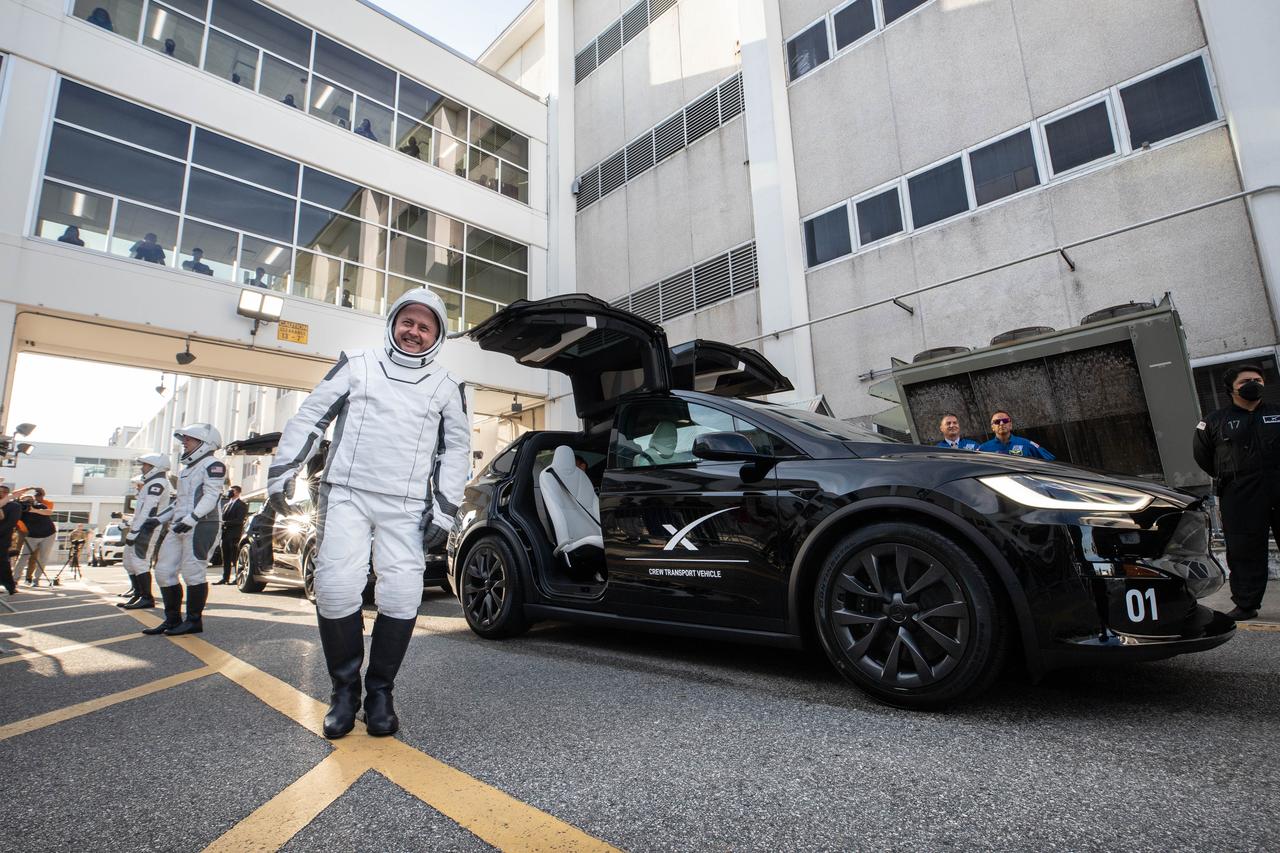
From right to left NASA astronauts Mike Fincke and Zena Cardman, along with JAXA (Japan Aerospace Exploration Agency) astronaut Kimiya Yui and Roscosmos cosmonaut Oleg Platonov walk out of the Neil A. Armstrong Operations and Checkout Building at the agency’s Kennedy Space Center in Florida on Friday, Aug. 1, 2025, during the second attempt of NASA’s SpaceX Crew-11 mission to the International Space Station. The crew is scheduled to lift off aboard SpaceX’s Dragon spacecraft and Falcon 9 rocket for its second attempt at 11:43 a.m. EDT from Launch Complex 39A at NASA Kennedy.
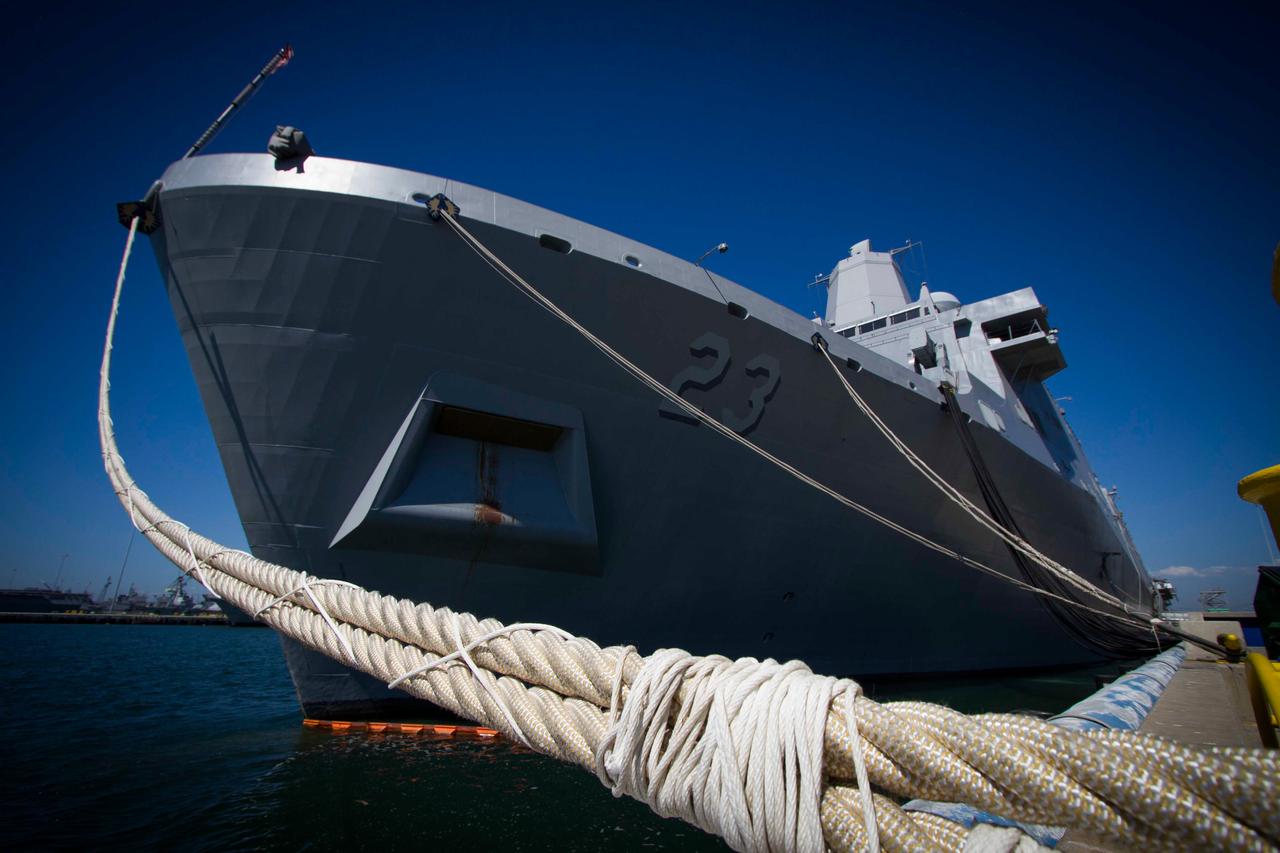
The Navy's USS Anchorage is used to test Orion recovery tools and techniques in the Pacific Ocean off the coast of San Diego on Sept. 12, 2014. Part of Batch image transfer from Flickr.
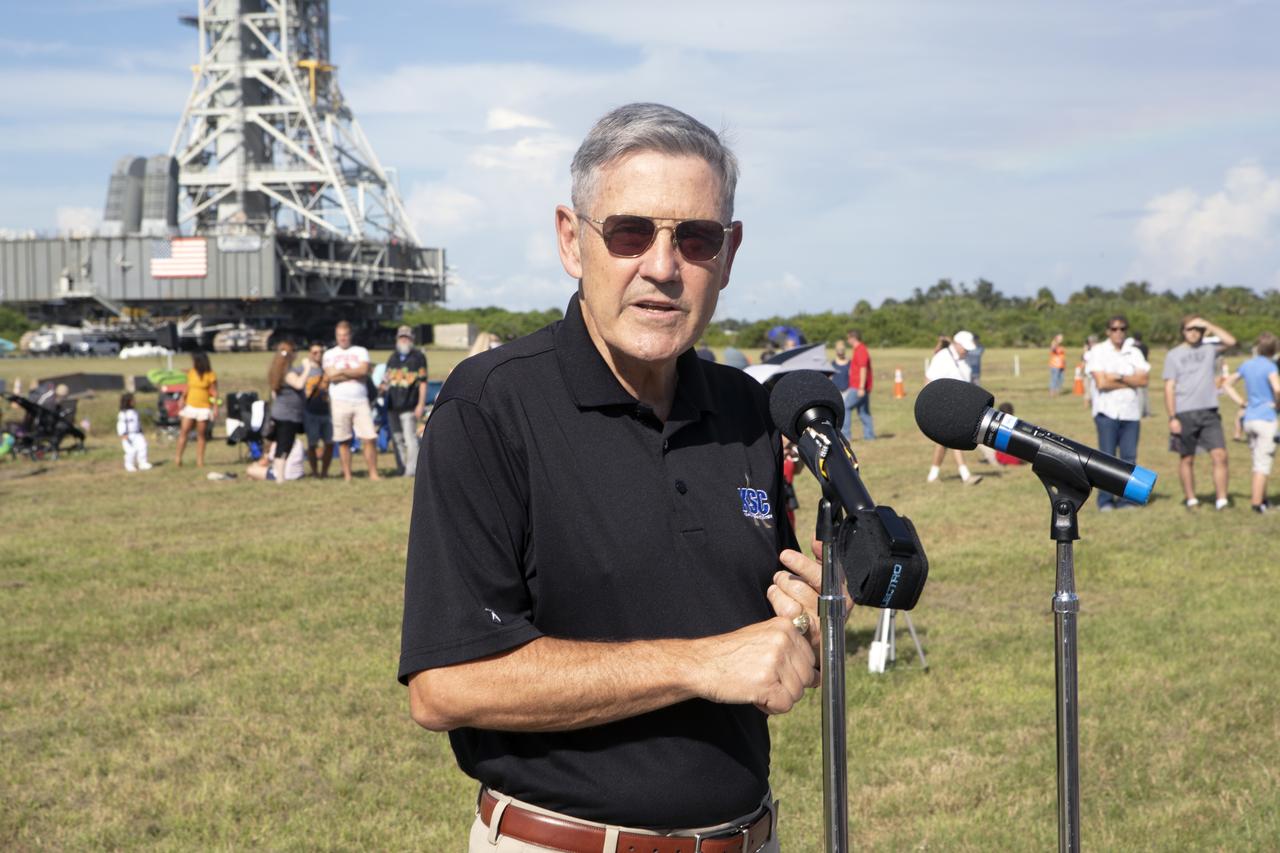
Kennedy Space Center Director Bob Cabana speaks to workers and guests during an employee event for the mobile launcher move to the Vehicle Assembly Building (VAB) on Sept. 7, 2018, at NASA's Kennedy Space Center in Florida. The mobile launcher, atop crawler-transporter 2, began its trek from Launch Pad 39B along the crawlerway after undergoing a fit check and several days of systems testing with the pad. This is the first time that the modified mobile launcher made the trip to the pad. The 380-foot-tall mobile launcher is equipped with the crew access arm and several umbilicals that will provide power, environmental control, pneumatics, communication and electrical connections to the agency's Space Launch System and Orion spacecraft. The mobile launcher will spend seven months in the VAB undergoing testing. Exploration Ground Systems is preparing the ground systems necessary to launch SLS and Orion on Exploration Mission-1, missions to the Moon and on to Mars.
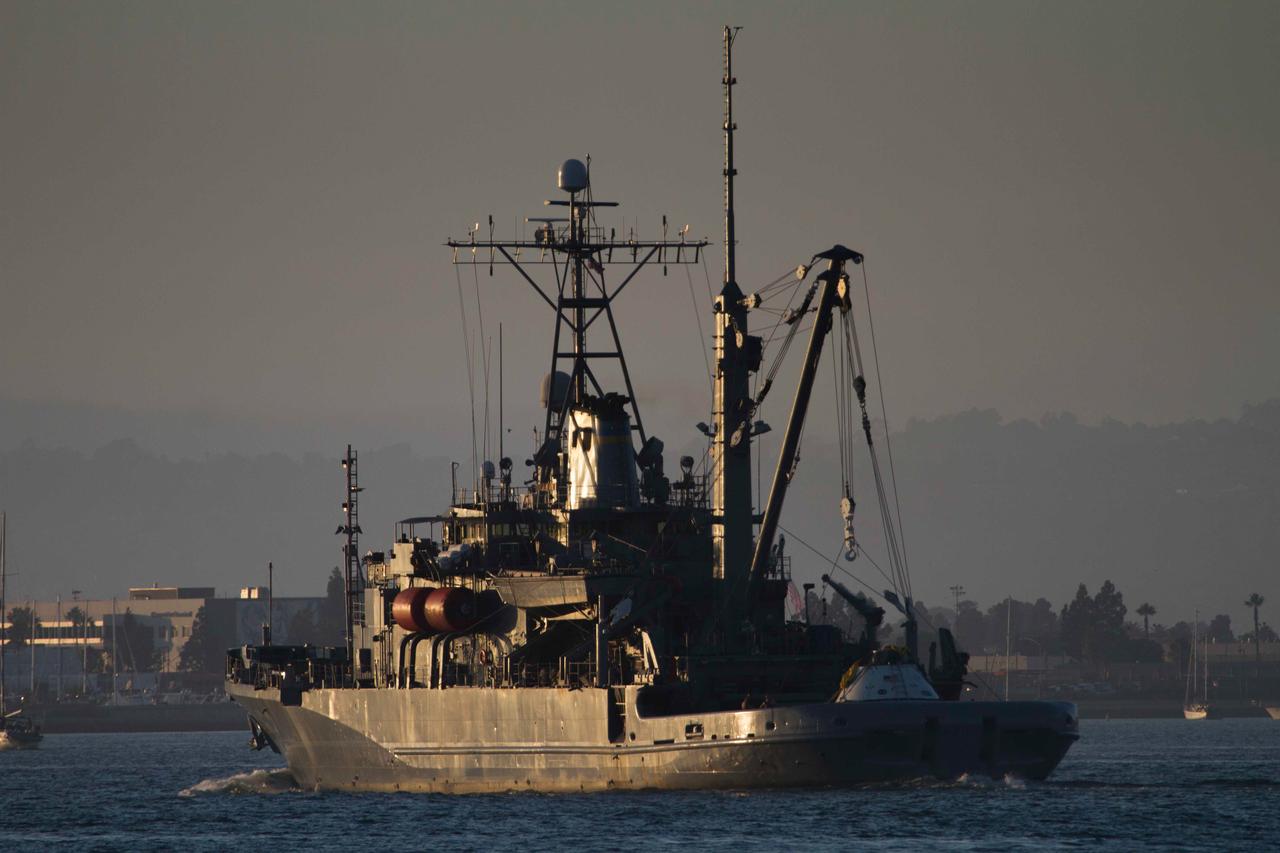
The Navy's USS Salvor makes its way out to sea with a test version of Orion on deck on Sept. 12, 2014. NASA and Navy personnel on board the Salvor used the ship's crane to test recovery techniques prior to Orion's first launch on Exploration Flight Test-1 (EFT-1). Part of Batch image transfer from Flickr.
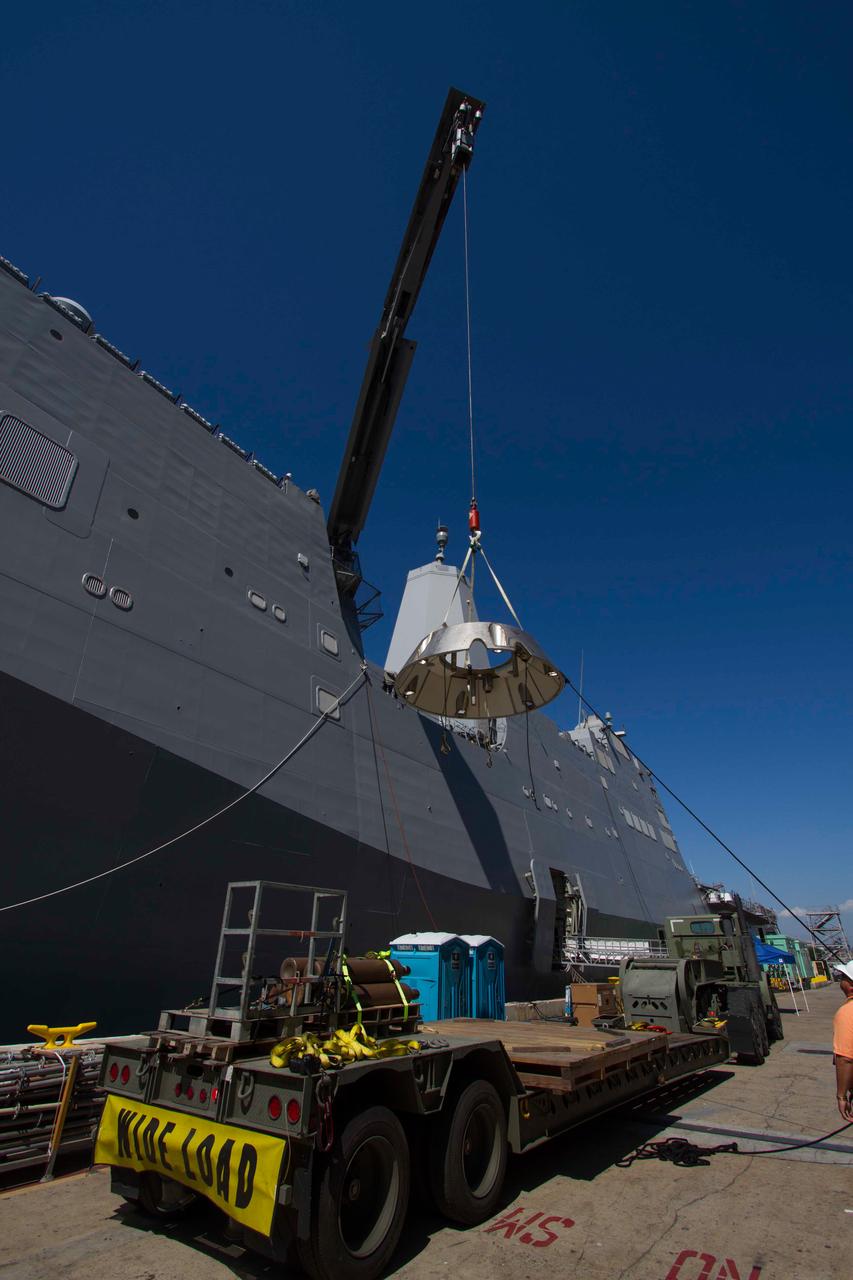
A test version of Orion's forward bay cover is loaded onto the Navy's USS Anchorage in preparation for testing Orion recovery tools and techniques in the Pacific Ocean off the coast of San Diego on Sept. 12, 2014. The forward bay cover protects the top section of Orion's crew module until the spacecraft is almost ready to land. It is jettisoned to allow Orion's parachutes to deploy and must be recovered separately from the crew module. Part of Batch image transfer from Flickr.
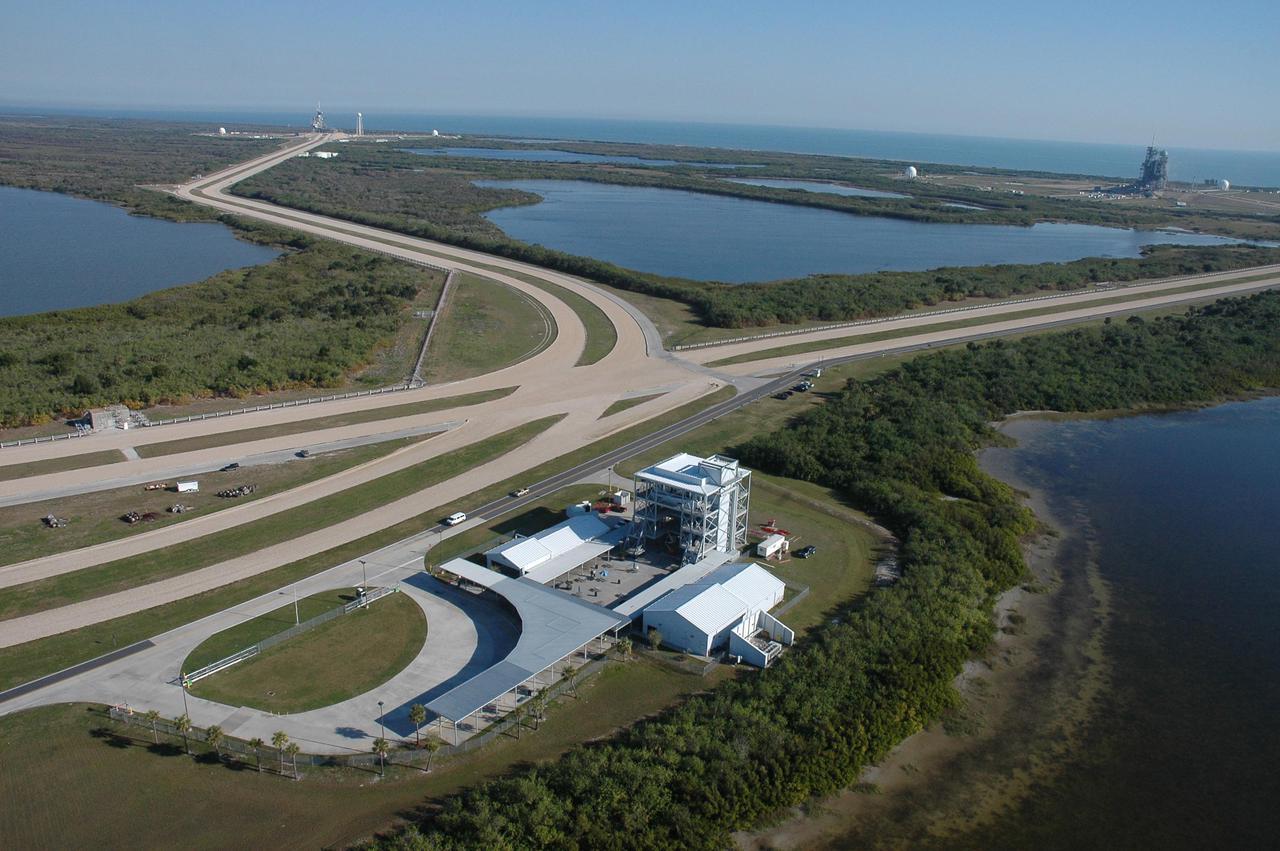
KENNEDY SPACE CENTER, FLA. - This aerial view on NASA's Kennedy Space Center shows the Launch Complex 39 Observation Gantry in the foreground, the crawlerways leading to the launch pads, and space shuttle Launch Complex 39 Pad A (left) and Pad B in the background, silhouetted by the Atlantic Ocean. Photo credit: Cory Huston
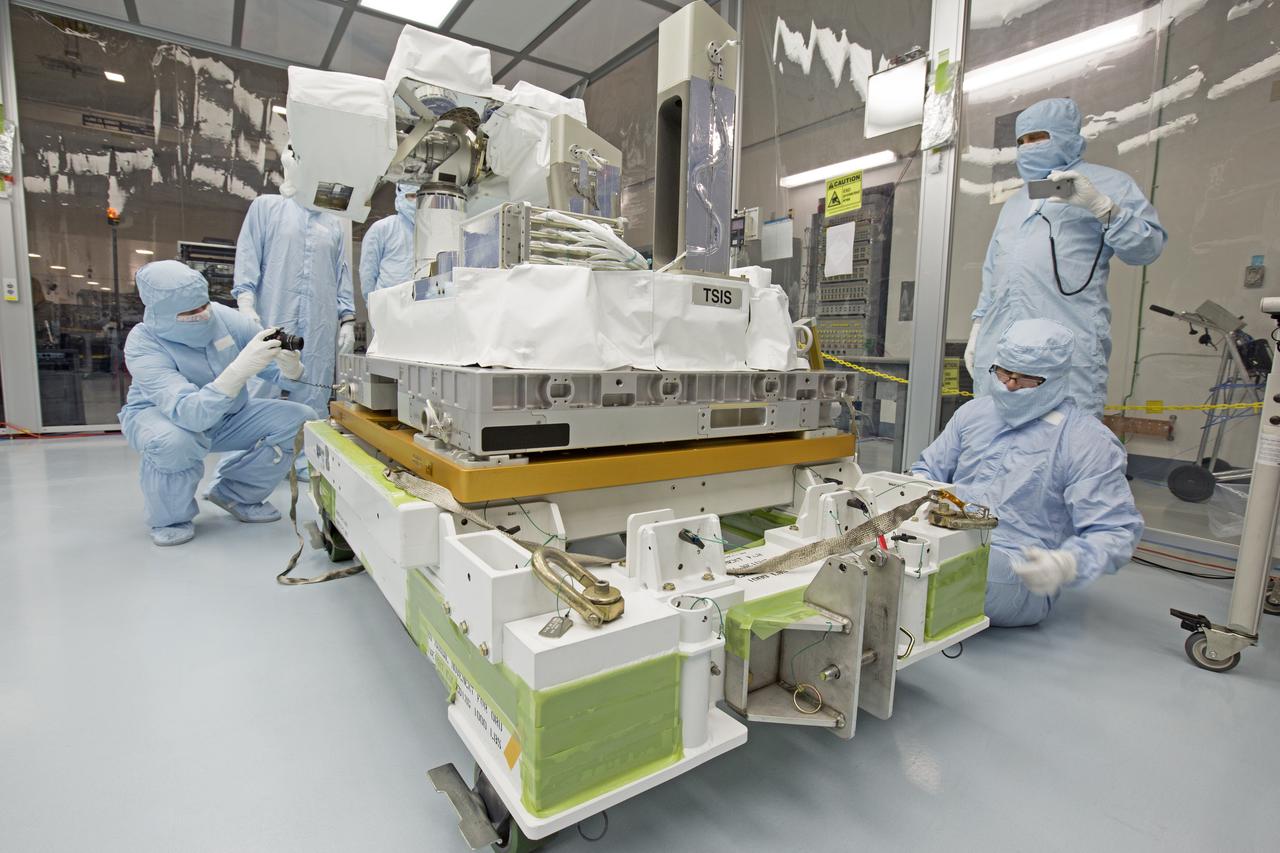
In the high bay of Kennedy Space Center's Space Station Processing Facility, Chris Hardcastle, left, of Stinger-Ghaffarian Technologies, and other payload team members performs spacewalk tool fit-checks of the integrated Total and Spectral Solar Irradiance Sensor-1 (TSIS-1) payload and the EXPRESS Pallet Adapter. TSIS-1 is designed to measure the Sun's energy input into Earth by seeing how it is distributed across different wavelengths of light. These measurements help scientists establish Earth's total energy and how our planet's atmosphere responds to changes in the Sun's energy output. TSIS-1 will launch on SpaceX's 13th commercial resupply mission to the International Space Station.
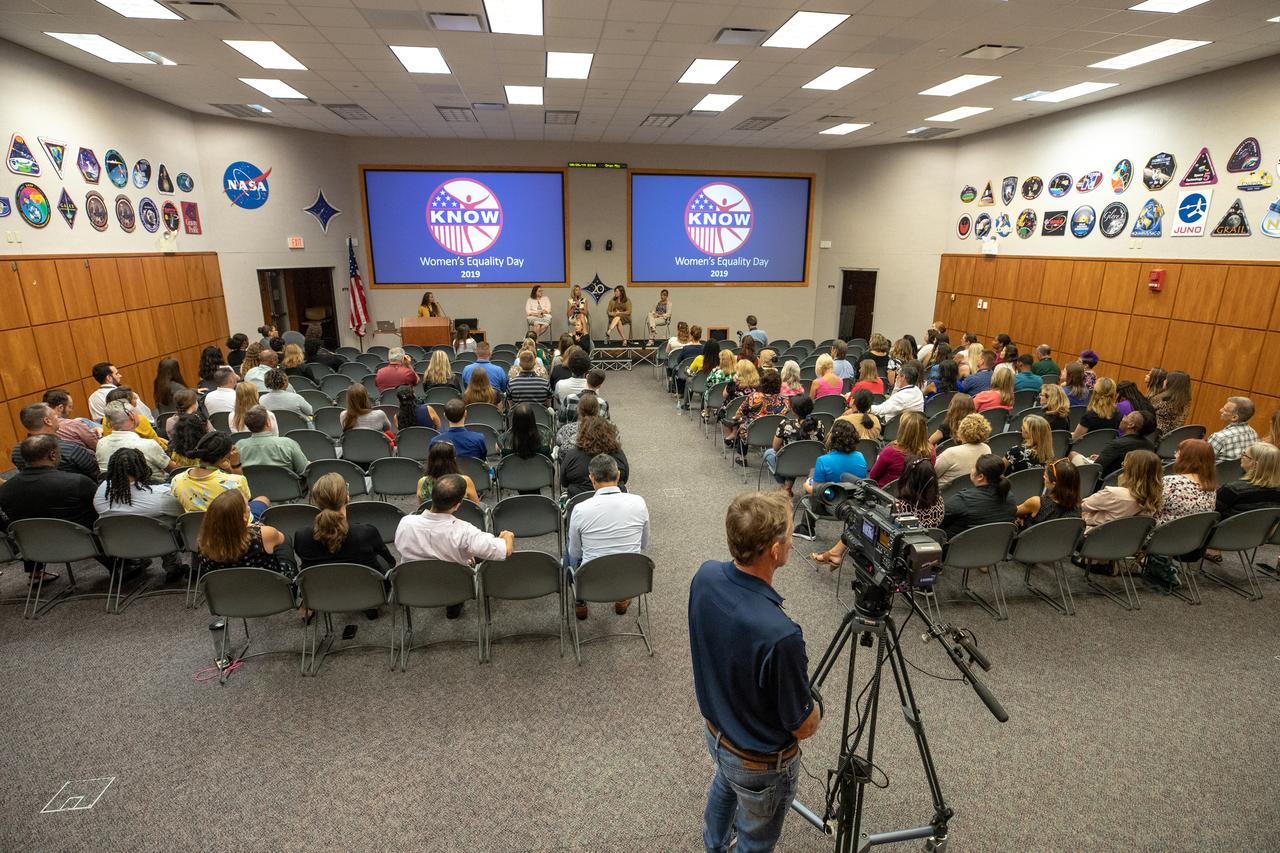
A panel discussion, featuring women in leadership roles at NASA’s Kennedy Space Center in Florida, is held on Aug. 26, 2019, to celebrate Women’s Equality Day. The event, sponsored by the Kennedy Networking Opportunities for Women (KNOW) employee resource group, honored the 100th anniversary of the passing of the 19th amendment guaranteeing all American women the right to vote. Seated in front from left, are Digna Carballosa, director of the Human Resources Office; Nancy Bray, director of Spaceport Integration and Services; Jennifer Kunz, director of Safety and Mission Assurance; and Amanda Mitskevich, Launch Services Program manager. At far left is Ashley Nelsen, Launch Service Program information manager and panel discussion moderator. The purpose of KNOW is to provide focus on issues such as employment, retention, promotion, training, career and personal development, education, and identify and eliminate barriers that hinder the advancement of women in the workforce.
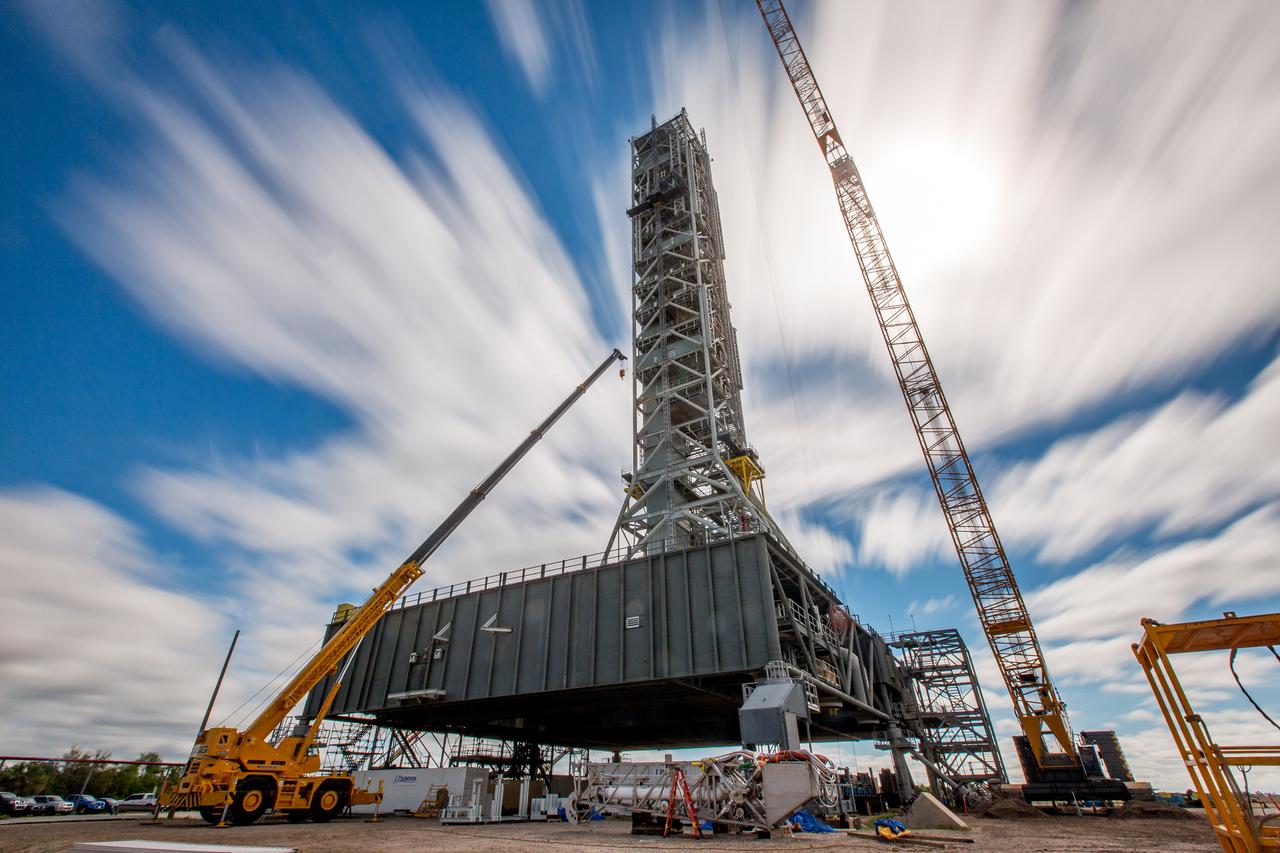
A long-exposure view of the mobile launcher at NASA's Kennedy Space Center in Florida. Cranes and rigging are being used to lift the bracket for the Orion Service Module Umbilical (OSMU) up for installation on the mobile launcher tower. The tower will be equipped with a number of lines, called umbilicals, that will connect to the Space Launch System rocket and Orion spacecraft for Exploration Mission-1 (EM-1). The OSMU will be located high on the mobile launcher tower and, prior to launch, will transfer liquid coolant for the electronics and air for the Environmental Control System to the Orion service module that houses these critical systems to support the spacecraft. EM-1 is scheduled to launch in 2018. The Ground Systems Development and Operations Program is overseeing installation of the umbilicals.
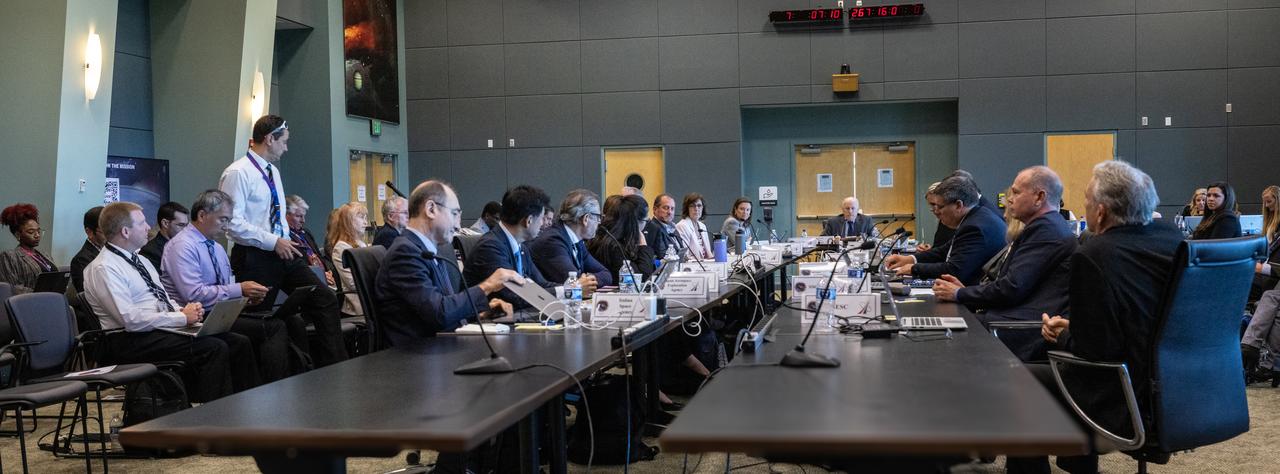
Managers with NASA and SpaceX, along with international partners, participate in NASA’s SpaceX Crew-9 Flight Readiness Review at the agency’s Kennedy Space Center in Florida on Monday, Sept. 23, 2024. Launch is targeted for 2:05 p.m. EDT Sept. 26, 2024, from Space Launch Complex-40 at Cape Canaveral Space Force Station in Florida. NASA astronaut Nick Hague and Roscosmos cosmonaut Aleksandr Gorbunov will launch to the International Space Station aboard SpaceX’s Dragon spacecraft and Falcon 9 rocket on the company’s ninth crew rotation mission for NASA as part of the agency’s Commercial Crew Program.
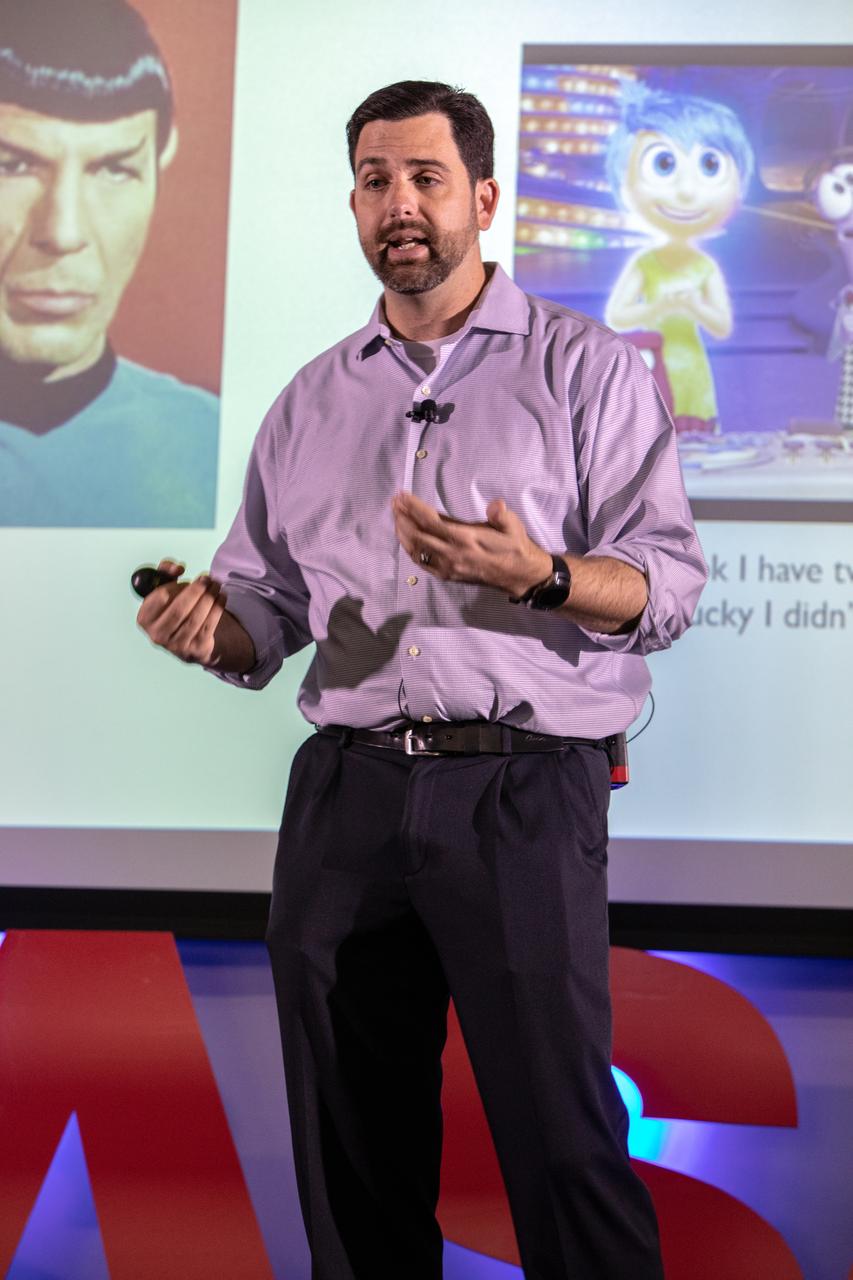
Jeremy Parsons, deputy manager of NASA’s Exploration Ground Systems at the agency’s Kennedy Space Center in Florida, speaks at the fourth in a series of five TED Talk-style informational sessions on Oct. 31, 2019, in the Kennedy Learning Institute. Sponsored by Kennedy’s Launching Leaders and Leadership for the Future, NASAtalks focuses on the topic of intentional careers and aims to provide employees with tools and knowledge that can be utilized for career growth. The theme of this fourth session was employees, and additional speakers included Kennedy’s Johnny Nguyen and Tony Derbyshire, with a skill-building section on vulnerability, authentic self and diverse inclusion by Ronnie Rodriguez.
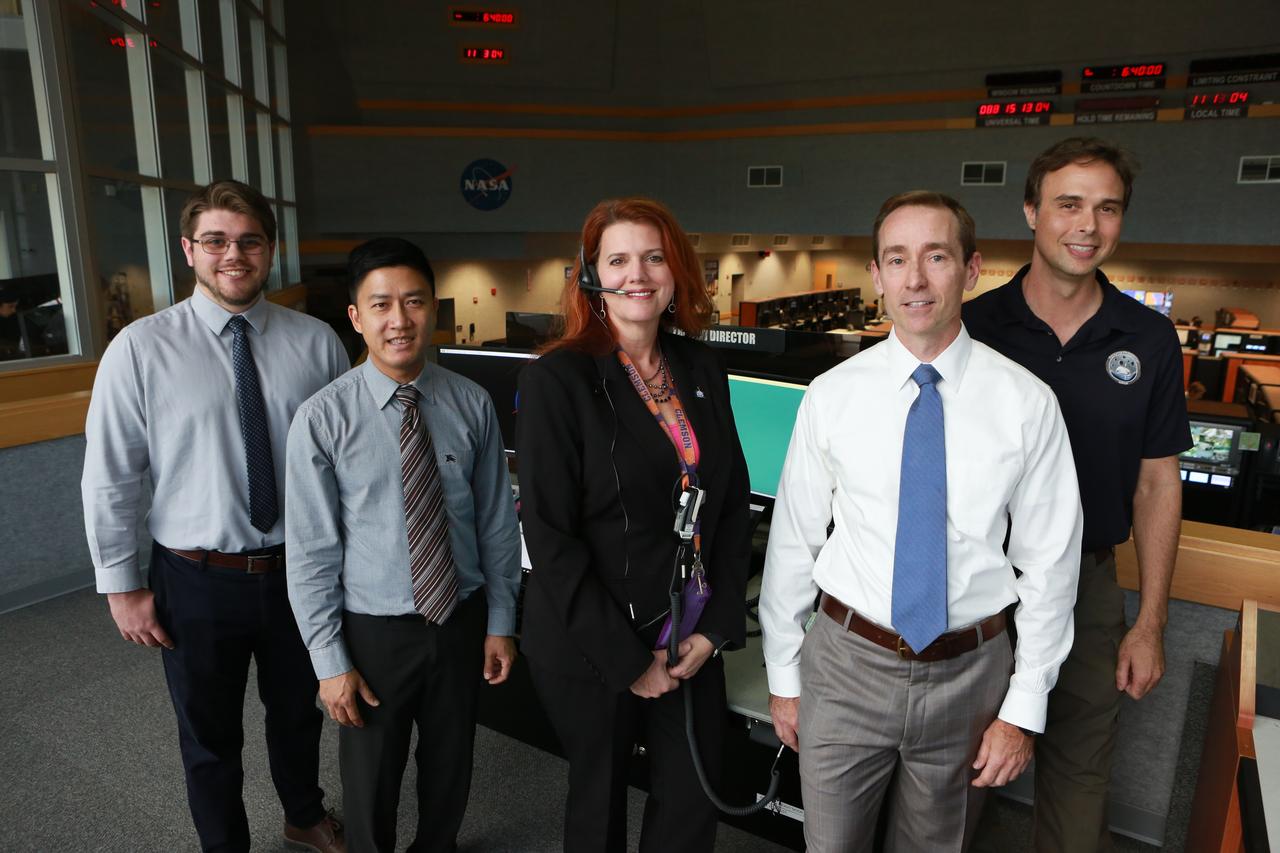
NASA Launch Director Charlie Blackwell-Thompson, center, stands next to her console in Firing Room 1 at the Kennedy Space Center's Launch Control Center. With her, from the left, are NASA intern Justin Connolly, NASA Engineering Project Manager Dan Tran, Blackwell-Thompson, Shawn Reverter, Project Manager for Red Canyon Software, Inc., and NASA Structures and Mechanisms Design Branch Chief Adam Dokos, during a countdown simulation for Exploration Mission 1. It was the agency's first simulation of a portion of the countdown for the first launch of a Space Launch System rocket and Orion spacecraft that will eventually take astronauts beyond low-Earth orbit to destinations such as the Moon and Mars.
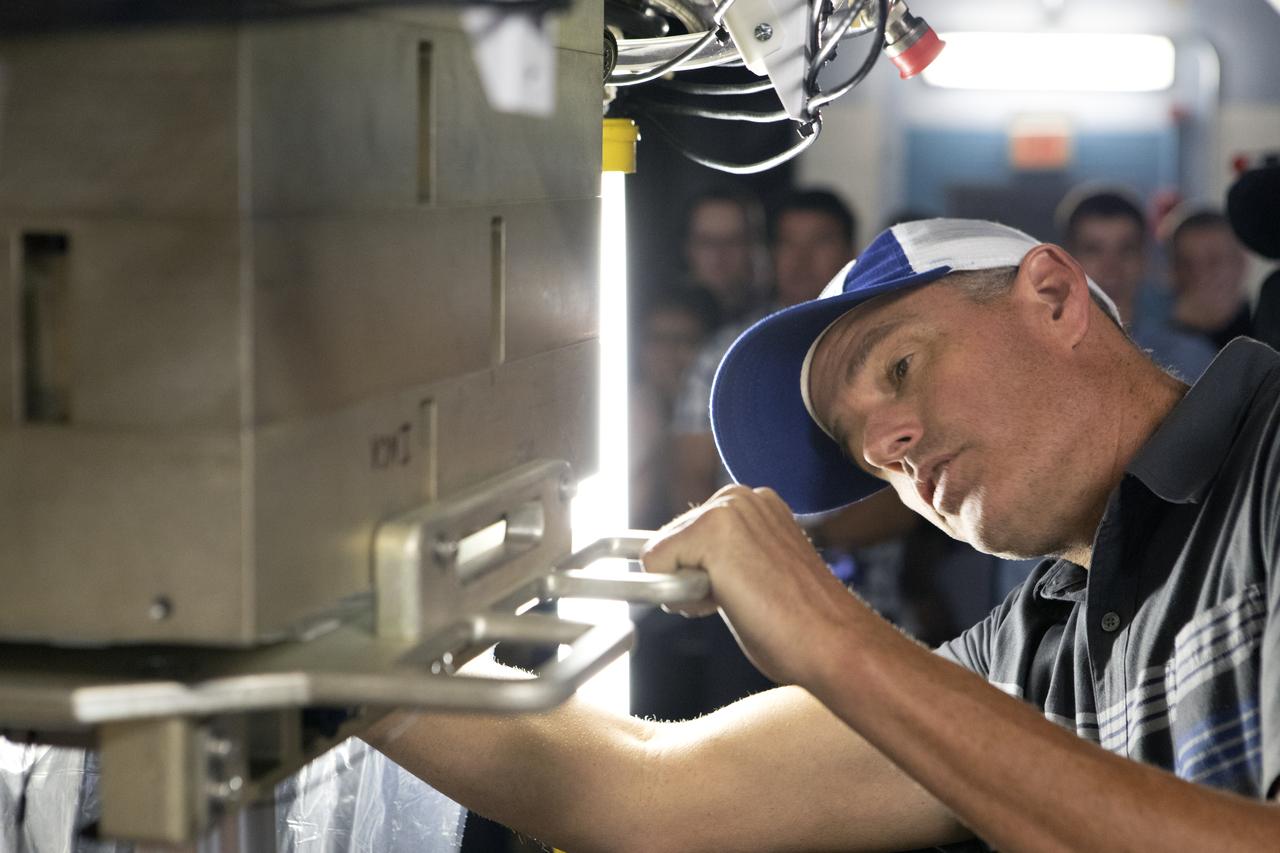
A Space Launch System (SLS) avionics handling tool demonstration takes place inside Kennedy Space Center’s Vehicle Assembly Building on April 4, 2019. The demonstration showed that avionics boxes could be successfully and safely mounted into the SLS rocket’s upper stage — called the Interim Cryogenic Propulsion Stage, or ICPS — with low risk of damaging a closely located hydrazine tank. Avionics boxes include the Inertial Navigation and Control Assembly and flight batteries. The actual installation will take place just weeks before NASA’s SLS rocket and uncrewed Orion spacecraft lift off on Exploration Mission-1 from Launch Pad 39B at Kennedy.
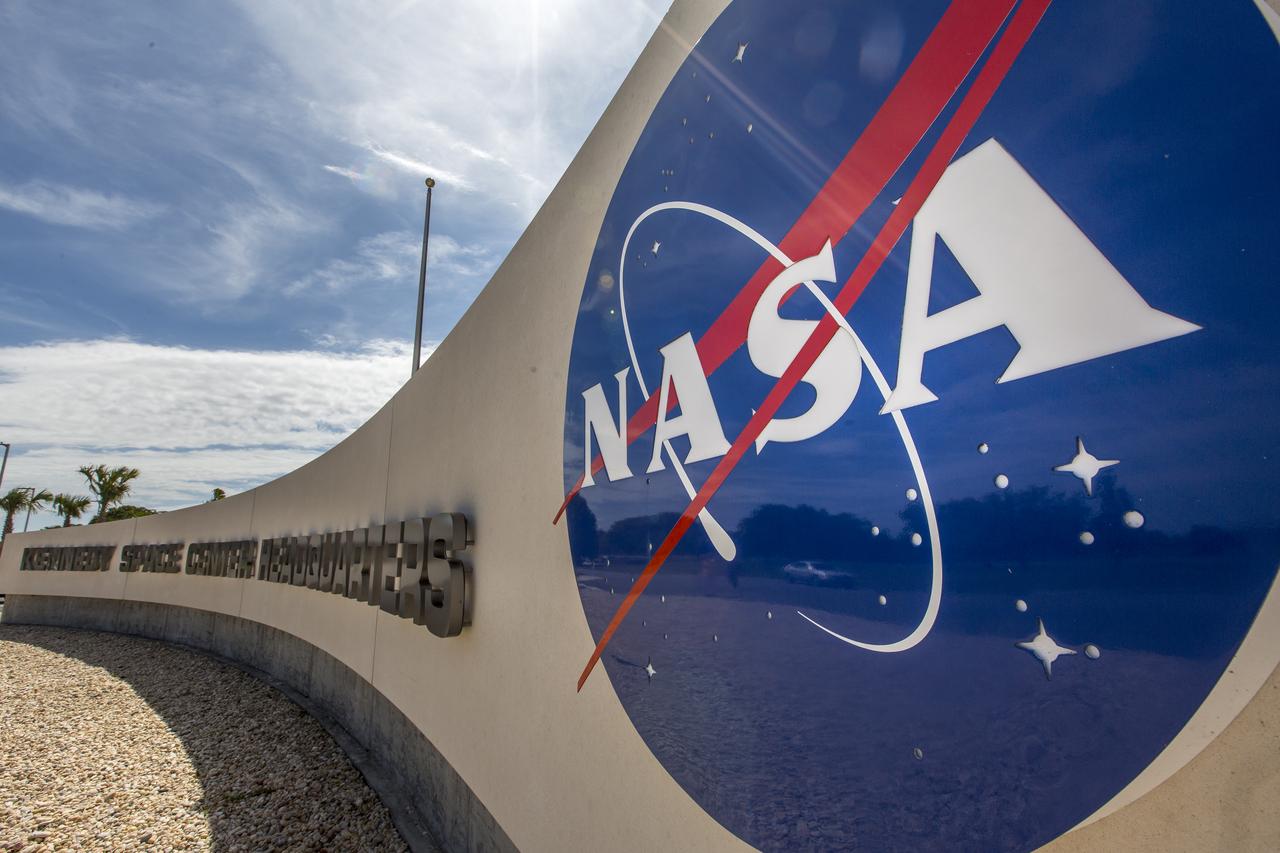
A close-up view the NASA insignia in front of the entrance to the new headquarters building on April 3, 2019, at NASA’s Kennedy Space Center in Florida. The newly constructed facility anchors the multi-user spaceport’s Central Campus. More than 500 civil service and contractor employees will be based in the 200,000-square-foot building. The facility earned the U.S. Green Building Council’s Leadership in Energy and Environmental Design (LEED) Gold designation. Features include LED lighting throughout, along with occupancy sensors to turn off unneeded lights; windows, screens and shades designed to maximize natural light; chilled beam HVAC technology reducing the need for ductwork, and more.

Hal Weaver, L'LORRI Instrument Principal Investigator, Johns Hopkins Applied Physics Laboratory, is introduced during a science briefing for the Lucy mission held inside the TV Auditorium at NASA’s Kennedy Space Center in Florida on Oct. 14, 2021. The mission is scheduled to launch at 5:34 a.m. EDT Saturday, Oct. 16, on a United Launch Alliance Atlas V 401 rocket from Space Launch Complex 41 at Cape Canaveral Space Force Station. NASA’s Launch Services Program, based at Kennedy, is managing the launch. During its 12-year primary mission, Lucy will explore a record-breaking number of asteroids, flying by one asteroid in the solar system’s main belt and seven Trojan asteroids. Additionally, Lucy’s path will circle back to Earth three times for gravity assists, making it the first spacecraft to return to the vicinity of Earth from the outer solar system.
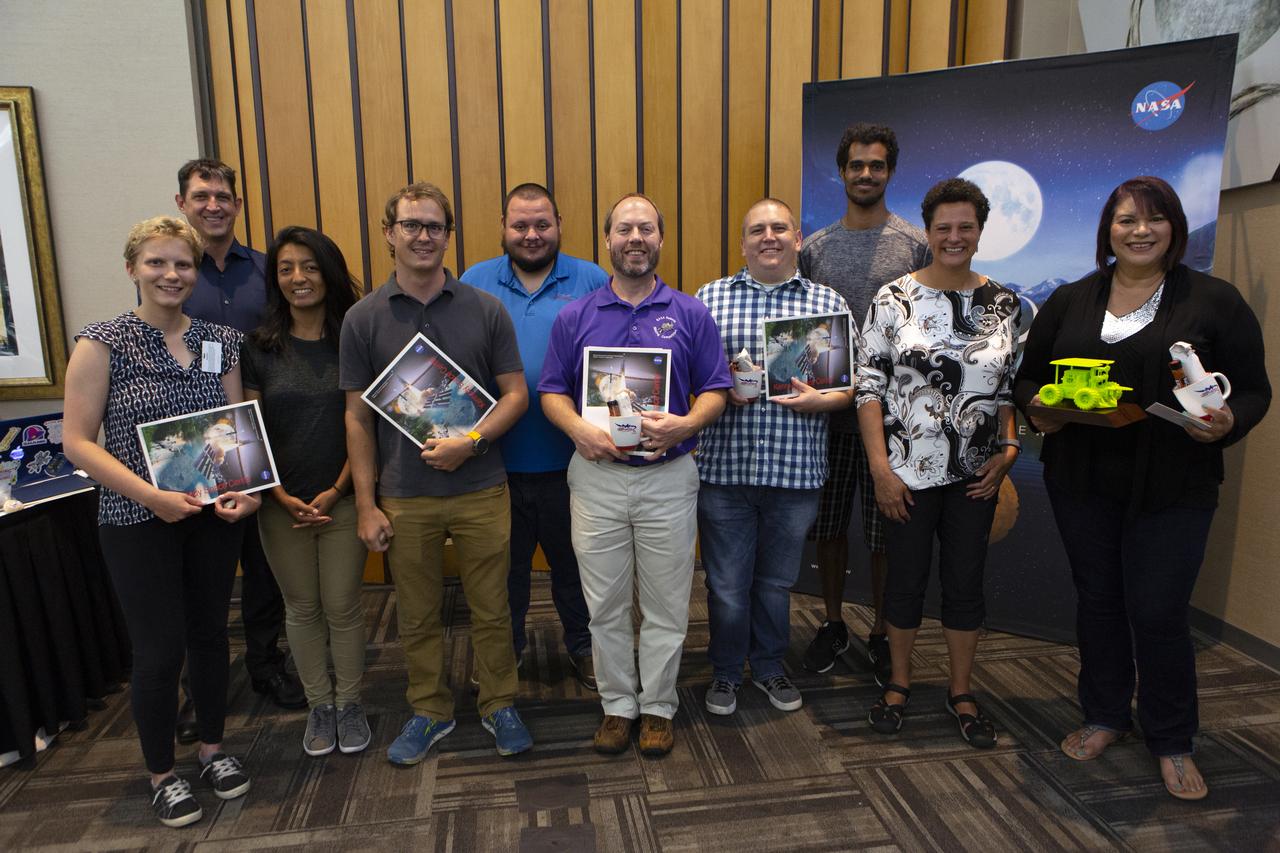
During an awards ceremony on June 12, 2019 at the Kennedy Space Center Visitor Complex in Florida, mentors and volunteers from Kennedy received certificates of recognition for the NASA Swarmathon 2019 University Challenge. Second from right is Melanie Moses, a professor of computer science at the Swarmathon host location, University of New Mexico. At far right is Theresa Martinez, engagement manager of the Minority University Research and Education Program, managed at Kennedy. University students and their mentors were at Kennedy to participate in a student/mentor panel, hear from speakers, get a behind-the-scenes tour of Kennedy Space Center, dine with an astronaut and receive awards. During Swarmathon University Challenge IV, students developed algorithms for robotic swarms that are robust and adaptable like the foraging strategies of ant colonies. The fourth and final Swarmathon was a combined virtual and physical competition.
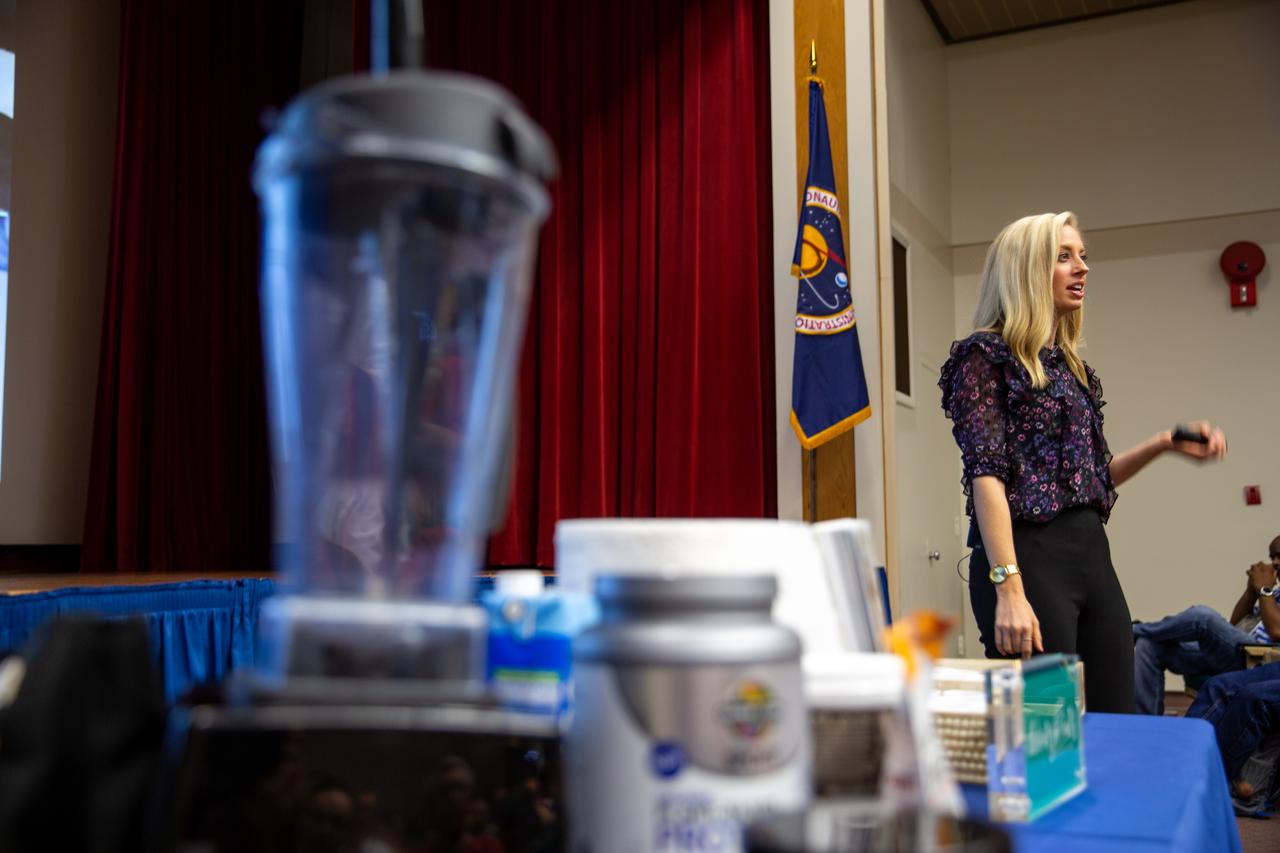
Carly Paige, an integrative nutrition health coach and chef, speaks to Kennedy Space Center employees inside the Florida spaceport’s Training Auditorium on March 5, 2020, during the center’s annual Safety and Health Days. Taking place March 2 through March 6, Safety and Health Days provides Kennedy employees with a variety of presentations to attend – all of which focus on how to maintain a safe and healthy workforce. Paige’s presentation included information on simple swaps that can be made to incorporate healthier habits on a daily basis.

Steve Volz, assistant administrator, NOAA’s Satellite and Information Service, participates in a prelaunch news conference on Monday, June 24, 2024, at NASA’s Kennedy Space Center in Florida to discuss National Oceanic and Atmospheric Administration (NOAA) GOES-U (Geostationary Operational Environmental Satellite U) mission. The GOES-U satellite is the final addition to GOES-R series, which serves a critical role in providing continuous coverage of the Western Hemisphere, including monitoring tropical systems in the eastern Pacific and Atlantic oceans. The two-hour launch window opens at 5:16 p.m. EDT Tuesday, June 25, for the satellite’s launch on a SpaceX Falcon Heavy rocket from Launch Complex 39A at NASA’s Kennedy Space Center in Florida.
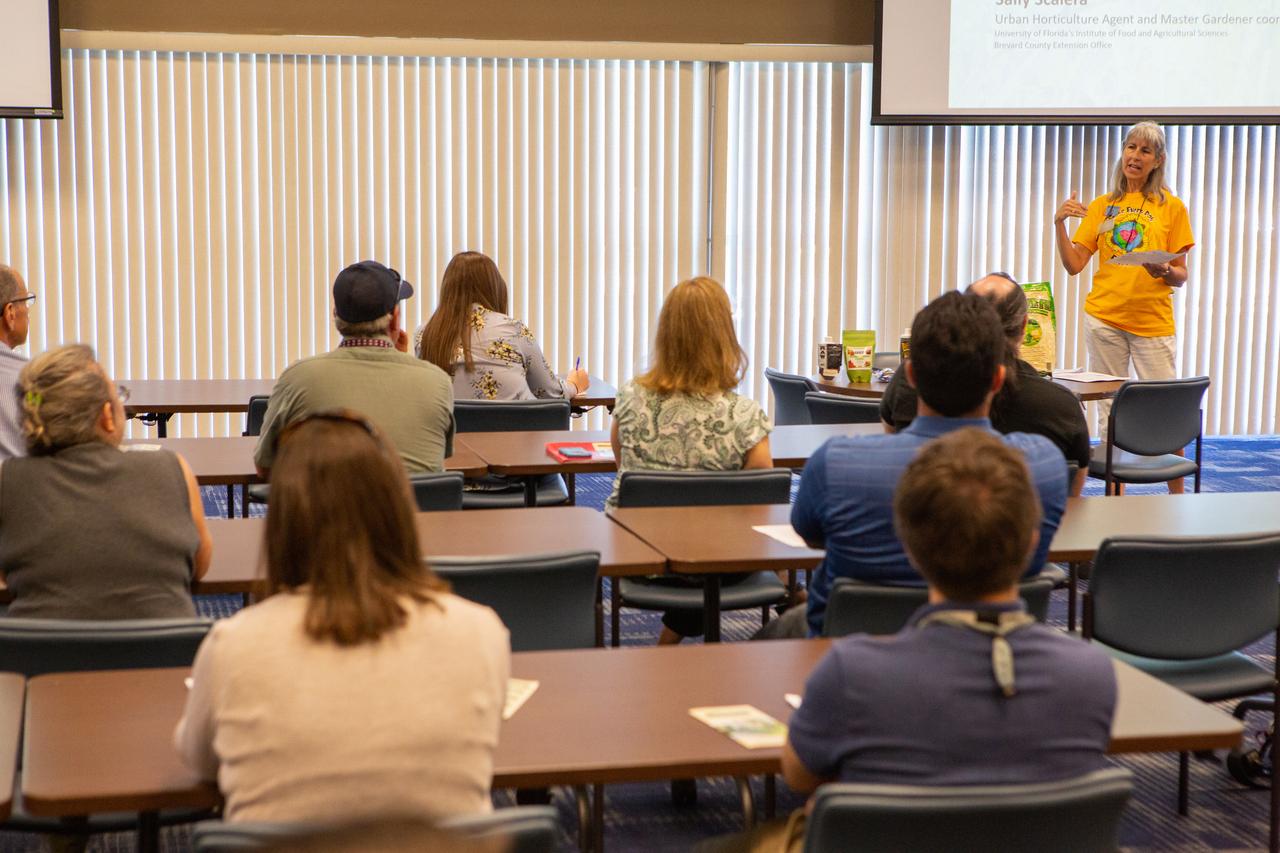
Sally Scalera, urban horticulture agent and master gardener coordinator from the University of Florida’s Institute of Food and Agricultural Sciences Brevard Extension Office, presents some sustainable tips and tricks for a healthy yard and garden to Kennedy Space Center employees on April 24, 2019. Held inside the Florida spaceport’s Space Station Processing Facility Conference Center, Scalera also provided information on Florida-friendly landscaping practices. The lunch and learn was available for employees to attend as part of Kennedy’s Earth Day events.
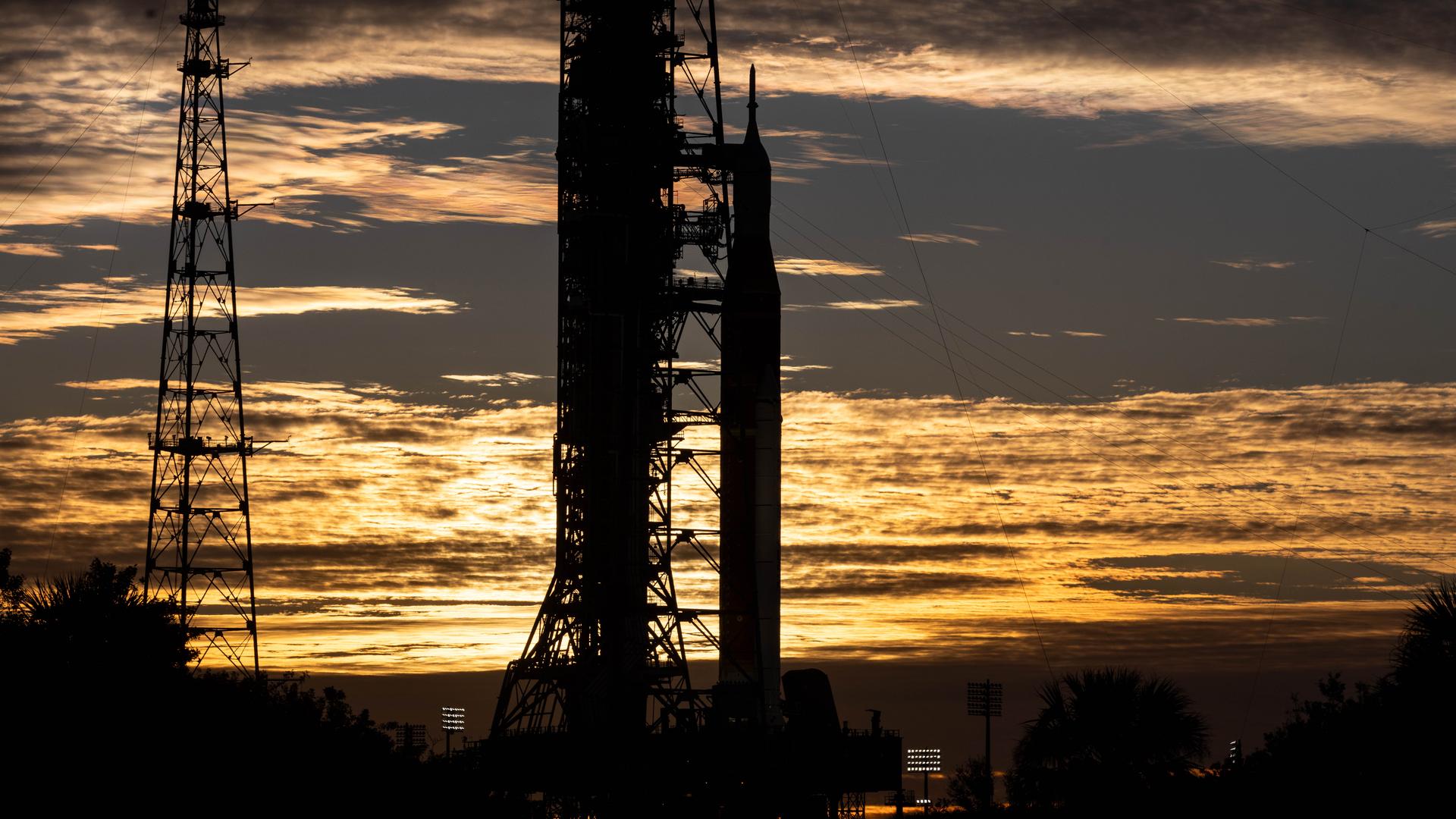
Clouds and the Sun illuminate the sky on Wednesday, Jan. 28, 2026, as NASA’s Artemis II SLS (Space Launch System) rocket and Orion spacecraft stand vertical at Launch Complex 39B at NASA’s Kennedy Space Center in Florida. The Artemis II test flight will take Commander Reid Wiseman, Pilot Victor Glover, and Mission Specialist Christina Koch from NASA and Mission Specialist Jeremy Hansen from the CSA (Canadian Space Agency), around the Moon and back to Earth no later than April 2026.

Consoles in the Radiological Control Center at NASA's Kennedy Space Center are seen during ceremonies to name the facility in honor of Randy Scott. A professional health physicist of more than 40 years, Scott served as the Florida spaceport's Radiation Protection Officer for 14 years until his death June 17, 2016. Located in the Neil Armstrong Operations and Checkout building, the Randall E. Scott Radiological Control Center is staffed by technical and radiological experts from NASA, the U.S. Department of Energy, the U.S. Air Force 45th Space Wing and the state of Florida. The group performs data collection and assessment functions supporting launch site and field data collection activities.
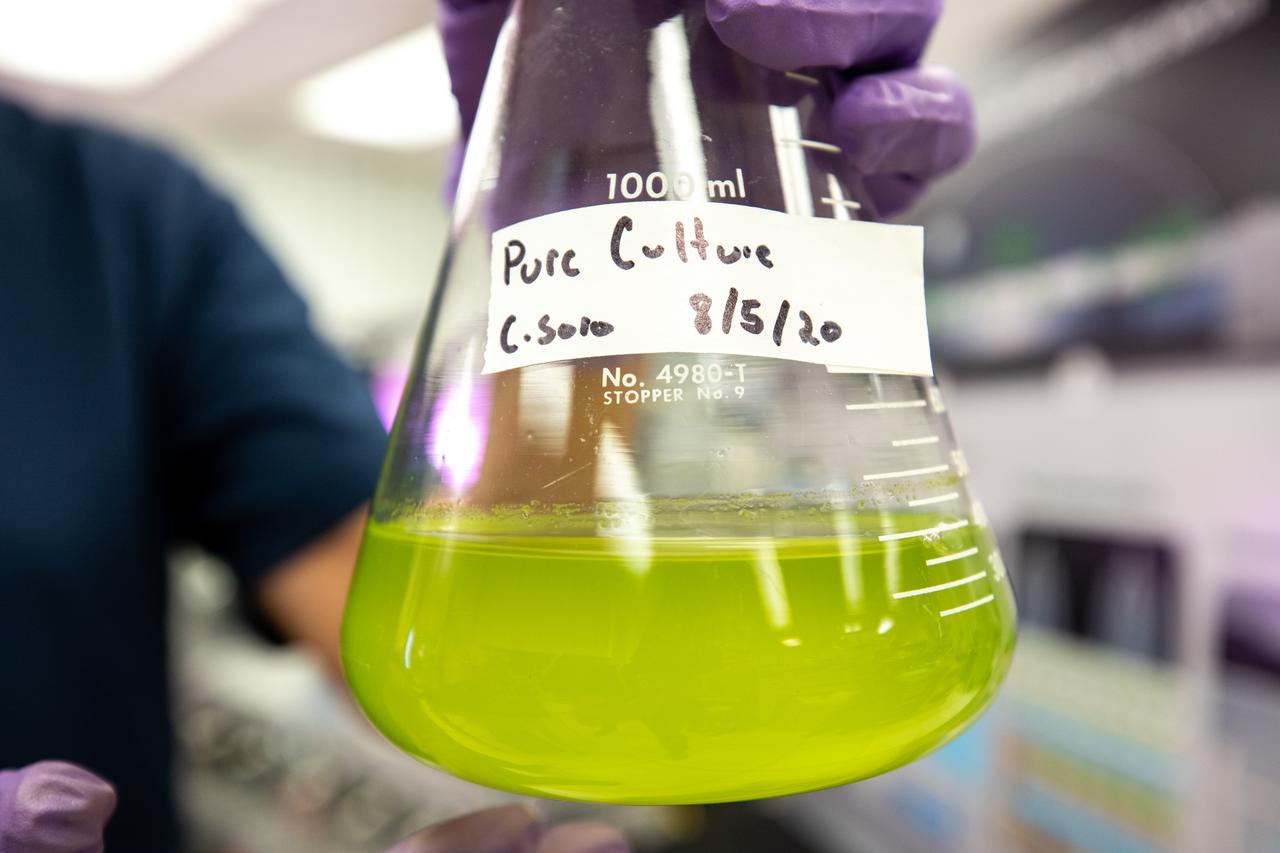
A prototype of Organic Processor Assembly (OPA) – technology capable of treating mixed organic wastes – arrives at the Neil Armstrong Operations and Checkout Building at NASA’s Kennedy Space Center in Florida on Aug. 19, 2020. At the heart of the OPA is an anaerobic membrane bioreactor – a hybrid technology that couples anaerobic digestion with membrane filtration. Developed through a collaboration between Kennedy’s Dr. Luke Roberson and the University of South Florida’s Dr. Daniel Yeh, the OPA was designed for an early planetary base scenario to help close the resource recovery loop, decreasing the agency’s dependence on resupply missions.
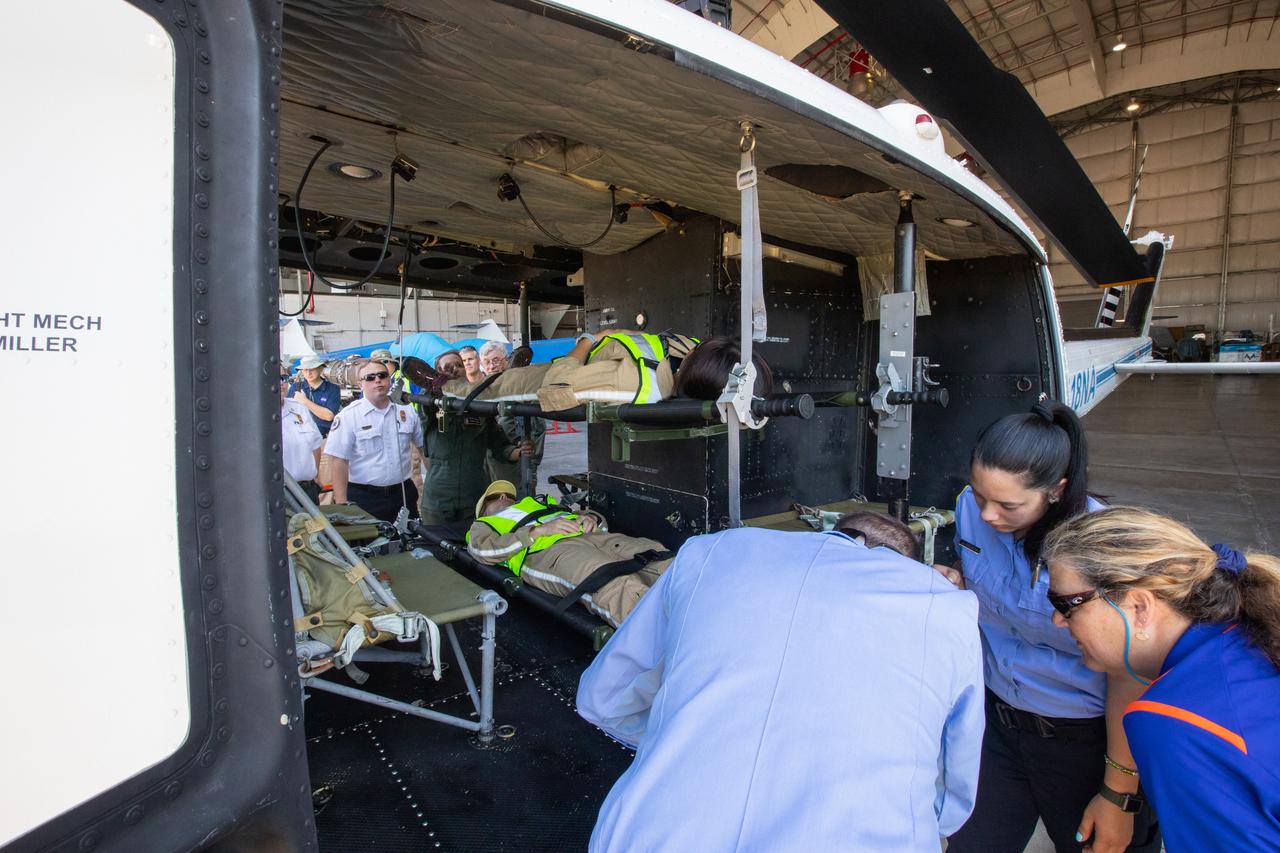
Kennedy Space Center personnel and American Medical Response (AMR) contractor paramedics gather around a “patient,” a KEMCON Fitness Center staff member, during a medical support training course in the Space Florida hangar at the spaceport’s Shuttle Landing Facility on May 17, 2019. The course was designed to familiarize the AMR paramedics with the center’s Triage Forces deployment, which included medical team members, fire/rescue personnel, environmental health specialists and flight operations crew members, as well as a helicopter, Mine Resistant Ambush Protected (MRAP) tactical vehicle, fire pumper truck and triage vehicles. The AMR paramedics will assist the agency in contingency planning for the return of human spaceflight from Kennedy.
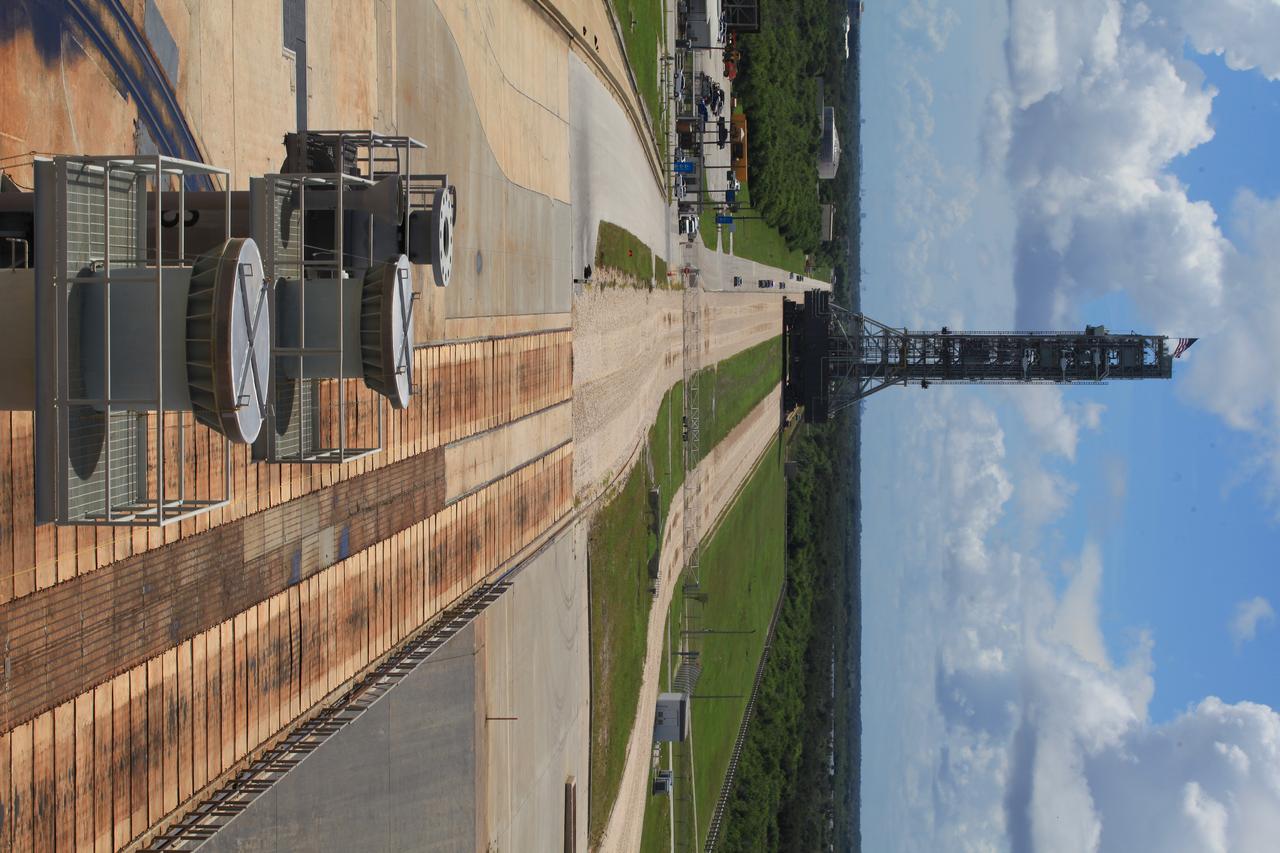
NASA's mobile launcher atop crawler-transporter 2 begins its trek off of Launch Pad 39B on Sept. 7, 2018, at NASA's Kennedy Space Center in Florida. After undergoing a fit check and several days of systems testing with the pad, the mobile launcher is on its way to the Vehicle Assembly Building. This is the first time that the modified mobile launcher made the trip to the pad. The 380-foot-tall mobile launcher is equipped with the crew access arm and several umbilicals that will provide power, environmental control. Pneumatics, communication and electrical connections to the agency's Space Launch System and Orion spacecraft. Exploration Ground Systems is preparing the ground systems necessary to launch SLS and Orion on Exploration Mission-1, missions to the Moon and on to Mars.
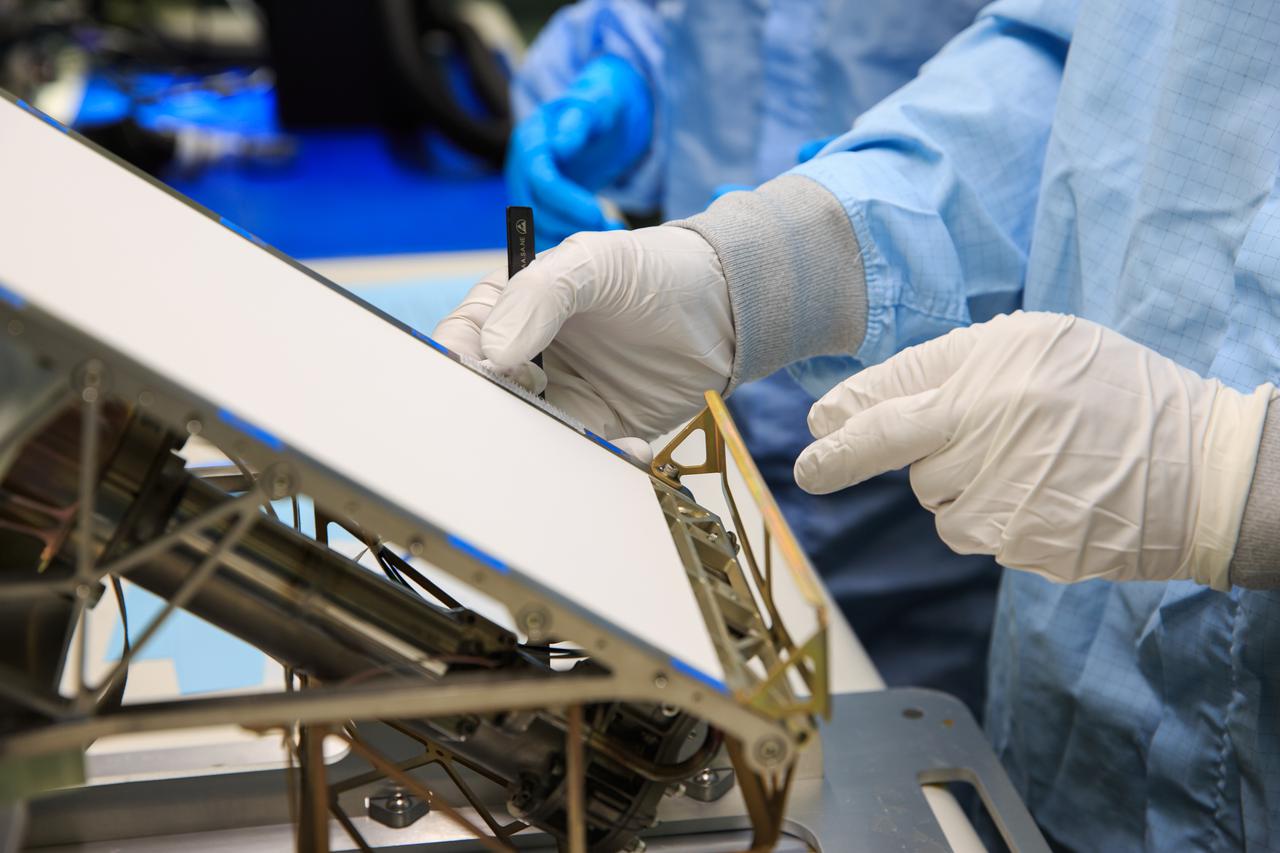
Team members working inside the Space Station Processing Facility at NASA’s Kennedy Space Center in Florida, on Sept. 23, 2021, meticulously assemble ground support equipment that will protect shipment of the Mass Spectrometer observing lunar operations (MSolo) flight hardware for preparations before it launches in 2022. MSolo is a commercial off-the-shelf mass spectrometer modified to work in space and it will help analyze the chemical makeup of landing sites on the Moon, as well as study water on the lunar surface. MSolo, scheduled to first launch in 2022, is part of four of the agency’s Commercial Lunar Payload Delivery Service missions where under the Artemis program, commercial deliveries will include science experiments, testing of technologies and demonstrations of capabilities to help NASA explore the Moon and prepare for human missions.
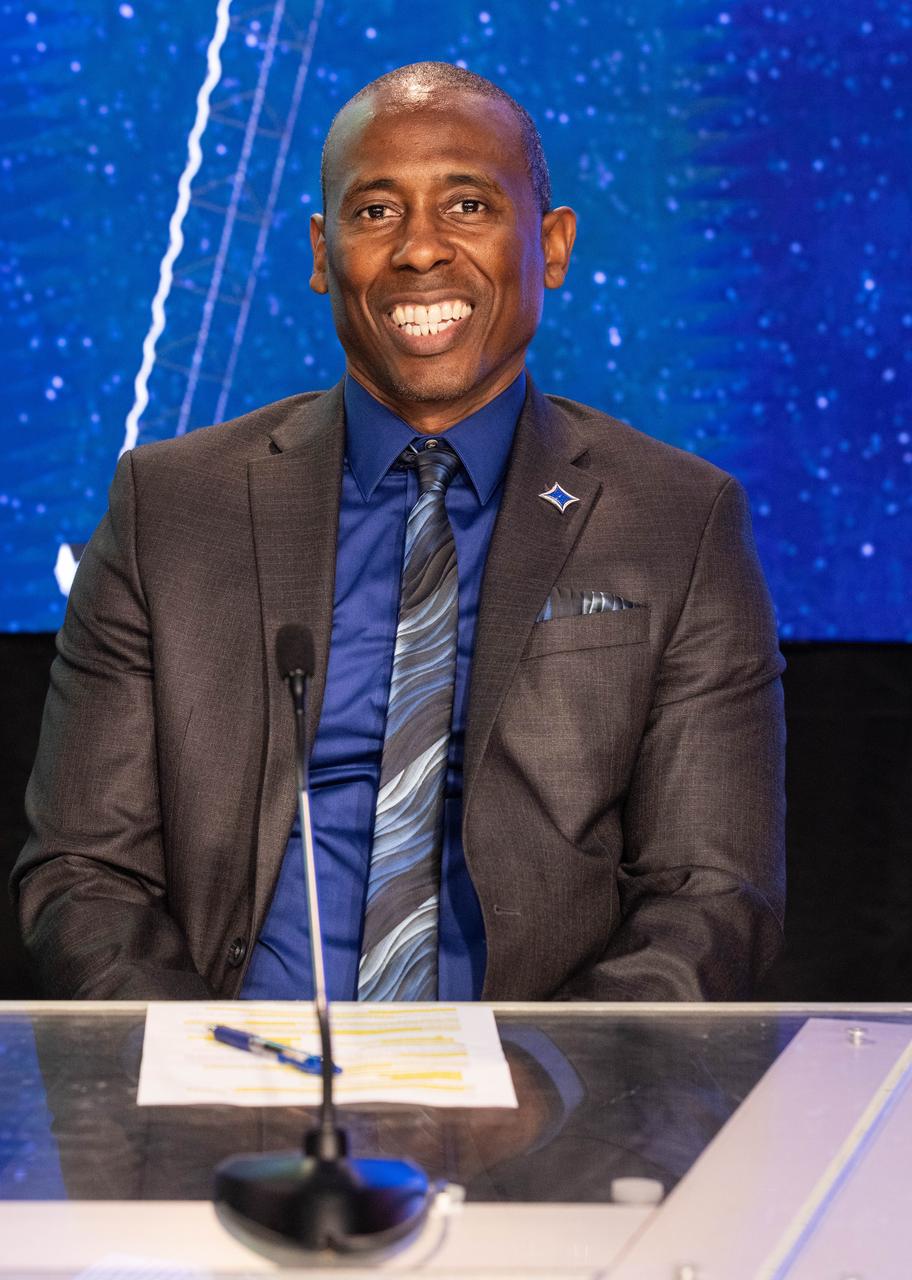
Dr. Denton Gibson, launch director, NASA’s Launch Services Program, participates in a prelaunch news conference on Sunday, Sept. 21, 2025, at the agency’s Kennedy Space Center in Florida for NASA's IMAP (Interstellar Mapping and Acceleration Probe) mission. NASA’s IMAP will use 10 science instruments to study and map the heliosphere, a vast magnetic bubble surrounding the Sun protecting our solar system from radiation incoming from interstellar space. This mission and its two rideshares – NASA’s exosphere-studying Carruthers Geocorona Observatory and National Oceanic and Atmospheric Administration’s (NOAA) Space Weather Follow On–Lagrange 1 (SWFO-L1) observatory – will orbit the Sun near Lagrange point 1, about one million miles from Earth. Launch is targeting 7:32 a.m. EDT, Tuesday, Sept. 23, from Launch Complex 39A at NASA Kennedy.
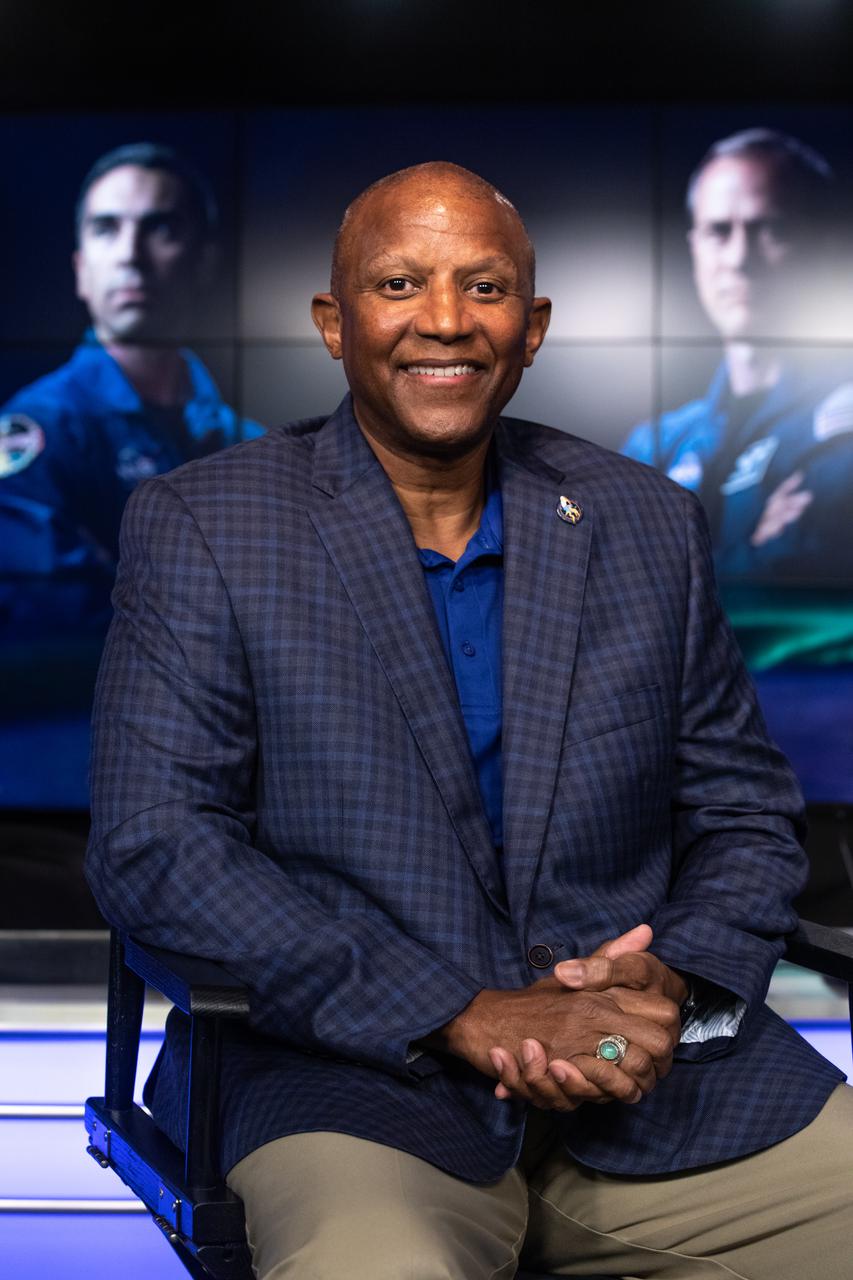
Kennedy Space Center Deputy Director Kelvin Manning participates in a NASA Social Live event at the center in Florida on Oct. 29, in advance of NASA’s SpaceX Crew-3 mission to the International Space Station as part of NASA’s Commercial Crew Program. Launch is currently targeted for 2:21 a.m. EDT Sunday, Oct. 31. The SpaceX Dragon spacecraft, named Endurance by the Crew-3 astronauts, will launch on a Falcon 9 rocket from Launch Complex 39A at Kennedy Space Center. The Crew-3 flight will carry NASA astronauts Raja Chari, mission commander, Tom Marshburn, pilot, and Kayla Barron, mission specialist and ESA (European Space Agency) astronaut Matthias Maurer, also a mission specialist, to the space station for a six-month science mission.
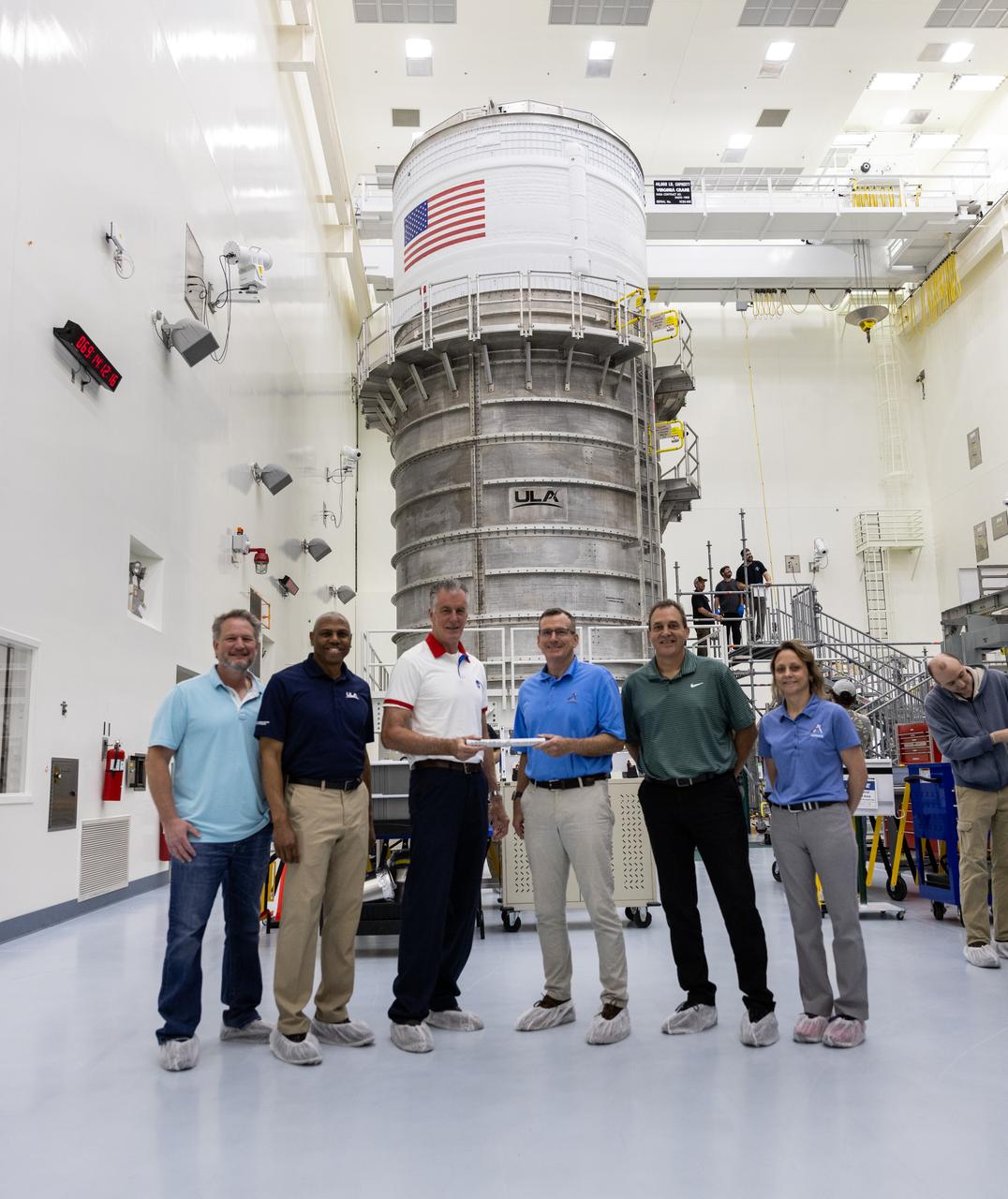
Managers from NASA and industry partners for NASA’s SLS (Space Launch System) rocket upper stage hand off the baton to managers from the agency’s Exploration Ground Systems (EGS) are shown with the SLS interim cryogenic propulsion stage inside the Multi-Payload Processing Facility at NASA’s Kennedy Space Center in Florida on Monday, March 10, 2025, after being transported from United Launch Alliance’s (ULA) Delta Operations Center at nearby Cape Canaveral Space Force Station. From left to right are Jim Bonato, ICPS Mission Manager, ULA; Ron Fortson, Director and General Manager, ULA; Chris Calfee, Spacecraft/Payload Integration and Evolution element manager, SLS; Cliff Lanham, senior vehicle operations manager, EGS; Todd Lamond, Strategic Planning and Integration, Amentum; and Natasha Wiest, Interim Director, Boeing Core Stage Integrated Product Team; The interim cryogenic propulsion stage is a liquid oxygen and liquid hydrogen-based system that will fire its RL10 engine to give the Orion spacecraft the big in-space push needed to fly around the Moon and back.
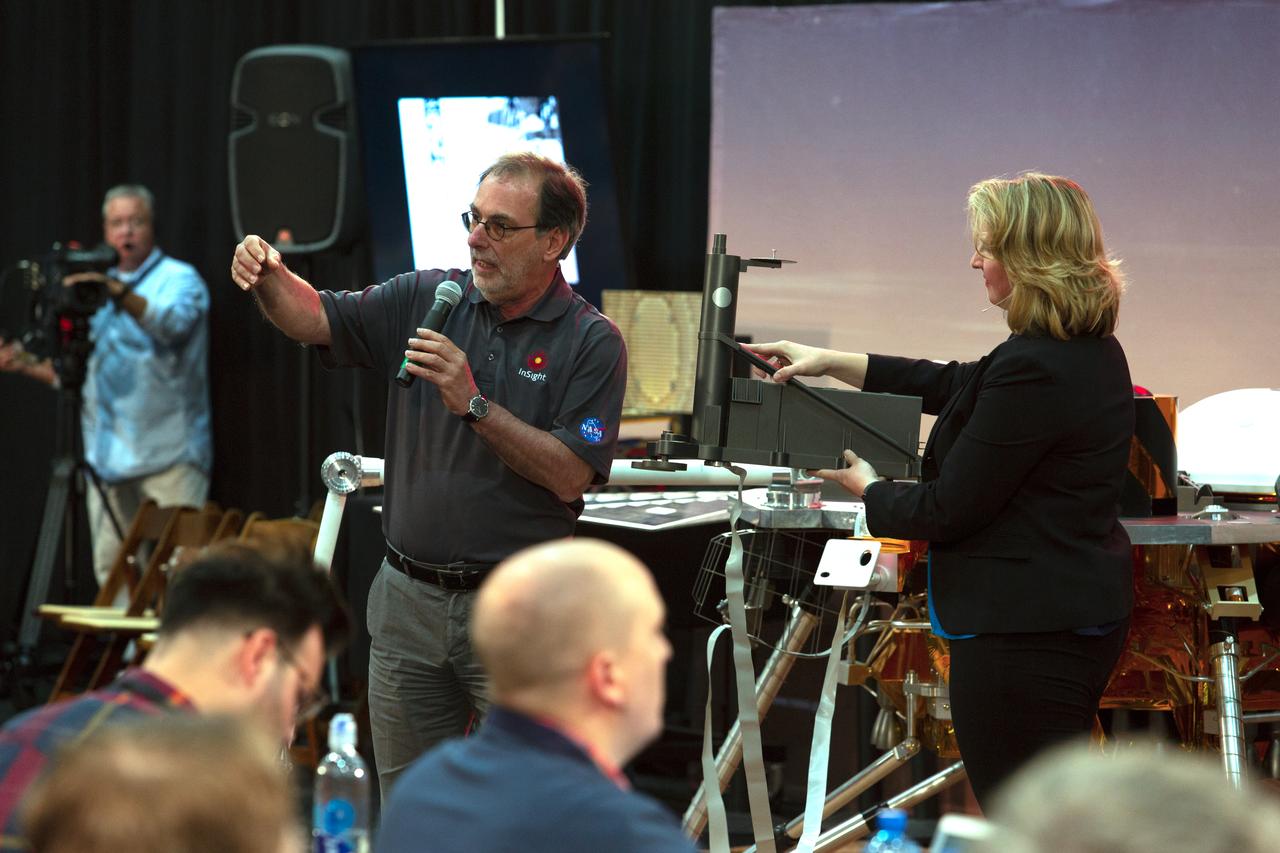
During a prelaunch briefing at Vandenberg Air Force Base in California, Tilman Spohn, HP3 Investigation Lead with the Institute of Planetary Research at the German Aerospace Center, speaks to members of the media. The presentation focused on NASA's Interior Exploration using Seismic Investigations, Geodesy and Heat Transport, or InSight, Mars lander. InSight is scheduled for liftoff May 5, 2018, atop a United Launch Alliance (ULA) Atlas V rocket from Space Launch Complex 3 at Vandenberg. The spacecraft will be the first mission to look deep beneath the Martian surface studying the planet's interior by measuring its heat output and listen for marsquakes.
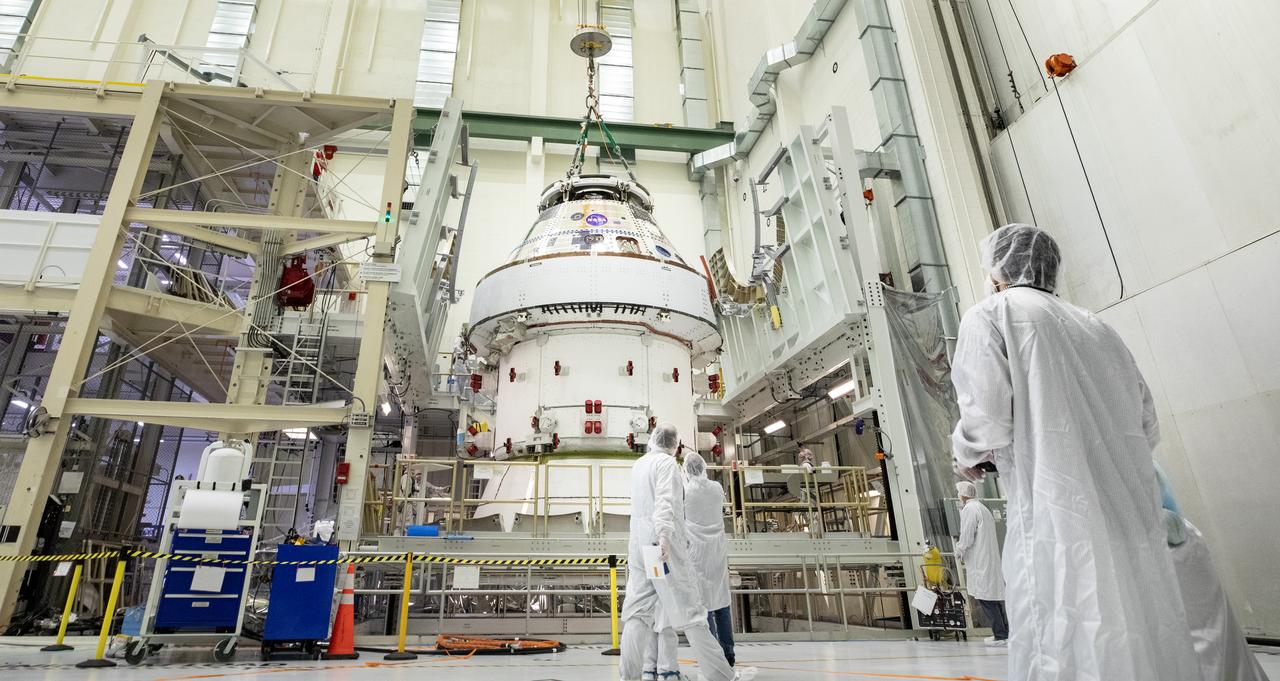
Technicians with NASA and Lockheed Martin operate a 30-ton crane to move NASA’s Artemis II Orion spacecraft out of the Final Assembly and System Testing cell inside the Neil A. Operations and Checkout Building at NASA’s Kennedy Space Center in Florida on Saturday, Feb. 22, 2025. The move prepares for the upcoming installation of four solar array wings and spacecraft adapter jettison fairings for the agency’s first crewed flight test under the Artemis campaign.
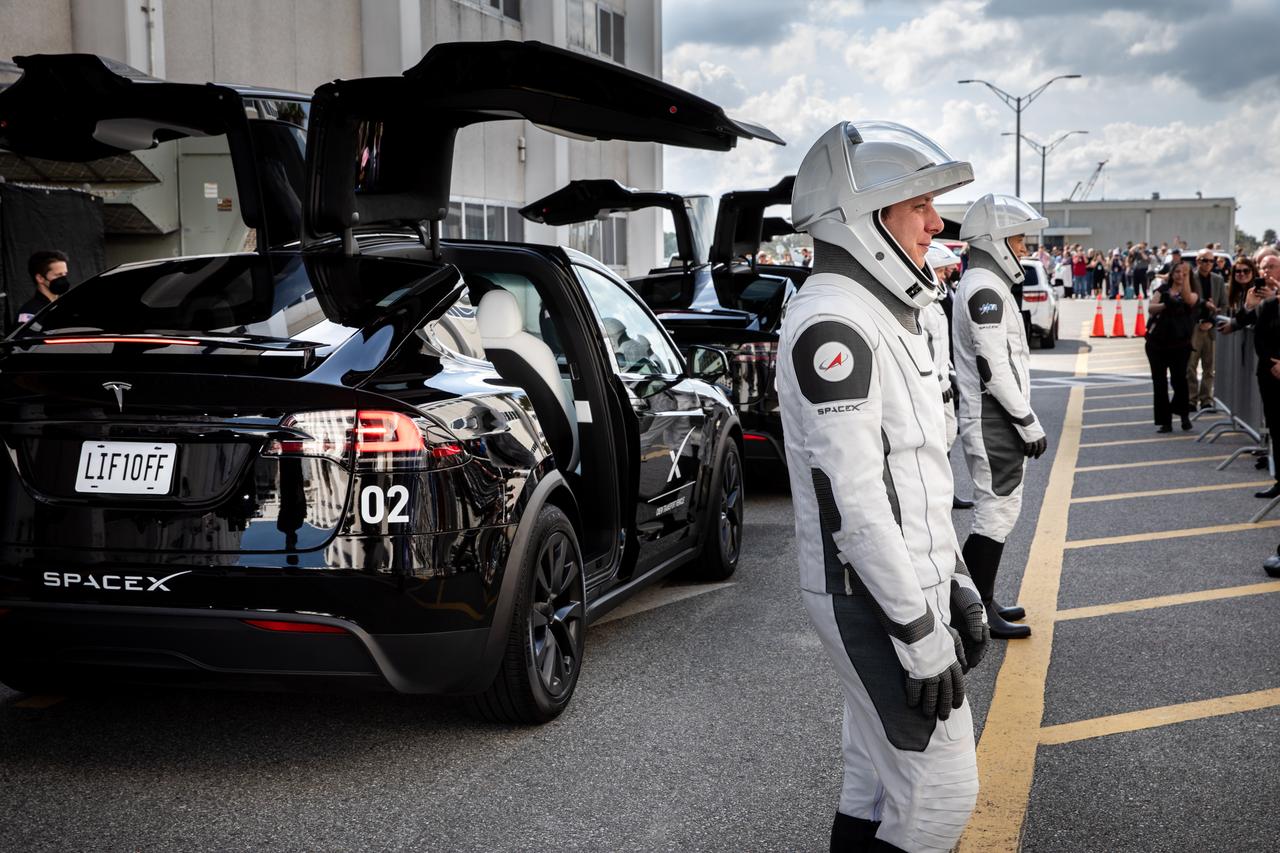
NASA’s SpaceX Crew-10 crew members prepare to enter the convoy carrying that will take them from the Neil A. Armstrong Operations and Checkout Building at the agency’s Kennedy Space Center in Florida to nearby Launch Complex 39A ahead of launch on Friday, March 14, 2025. NASA astronauts Anne McClain and Nichole Ayers, along with JAXA (Japan Aerospace Exploration Agency) astronaut Takuya Onishi and Roscosmos cosmonaut Kirill Peskov are scheduled to lift off aboard SpaceX’s Dragon spacecraft and Falcon 9 rocket at 7:03 p.m. EDT. Crew-10 is the 10th crew rotation mission with SpaceX to the space station as part of the agency’s Commercial Crew Program.
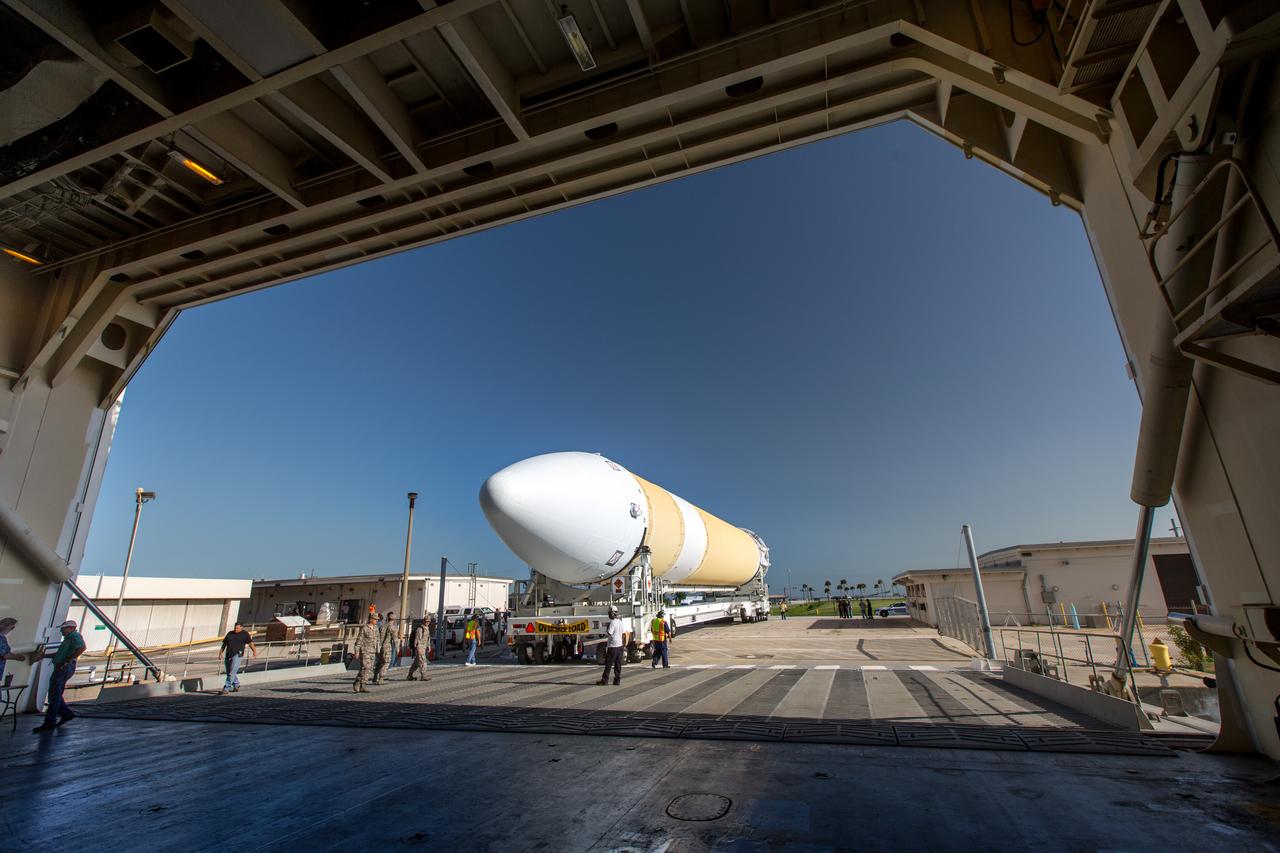
A United Launch Alliance Delta IV Heavy common booster core is offloaded from the company's Mariner ship at Port Canaveral in Florida. The Delta IV Heavy will launch NASA's upcoming Parker Solar Probe mission. The mission will perform the closest-ever observations of a star when it travels through the Sun's atmosphere, called the corona. The probe will rely on measurements and imaging to revolutionize our understanding of the corona and the Sun-Earth connection. Liftoff atop the Delta IV Heavy rocket is scheduled to take place from Cape Canaveral's Space Launch Complex 37 in summer 2018.
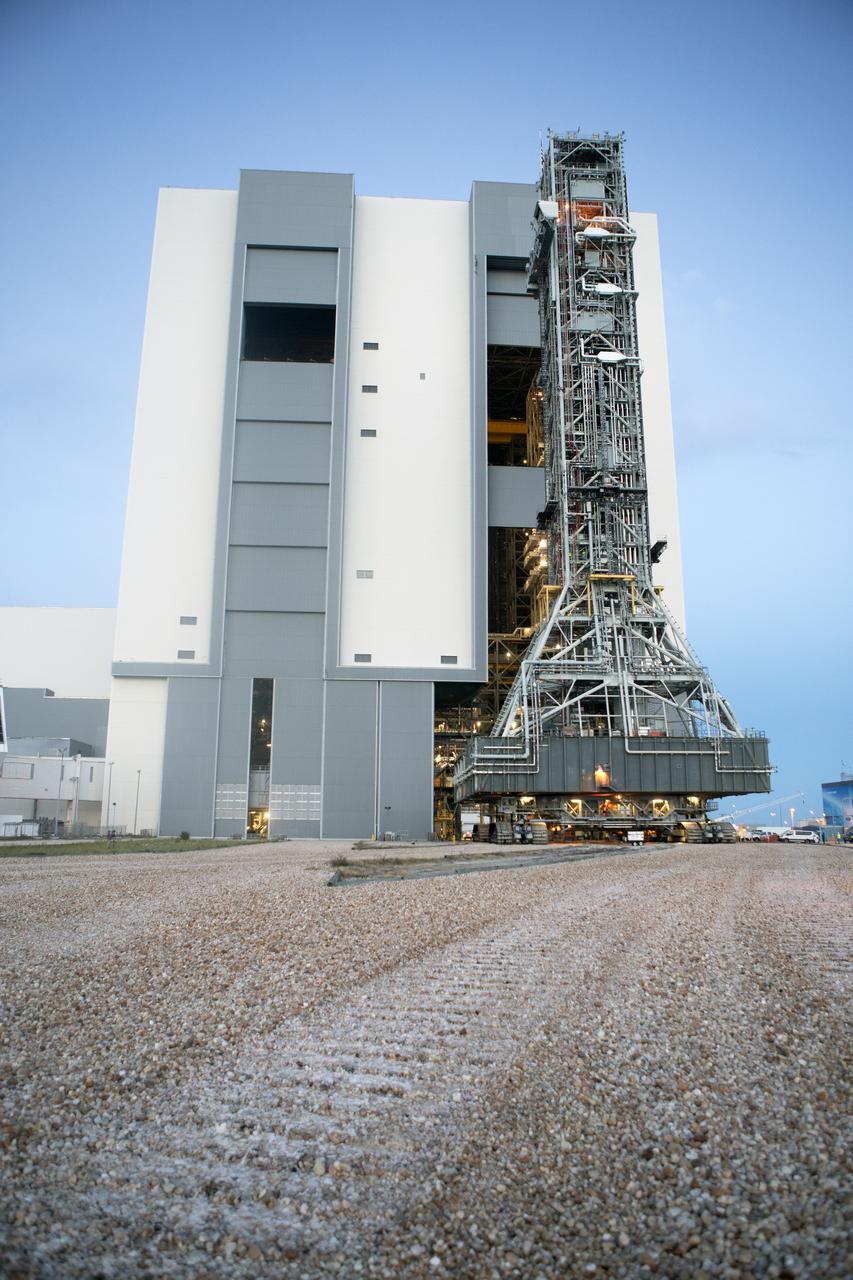
NASA's mobile launcher, atop crawler-transporter 2, is at the entrance to High Bay 3 at the Vehicle Assembly Building (VAB) on Sept. 8, 2018, at NASA's Kennedy Space Center in Florida. The mobile launcher departed Launch Pad 39B after several days of testing with the pad. This is the first time that the modified mobile launcher made the trip to the pad and the VAB. The mobile launcher will spend seven months in the VAB undergoing testing. The 380-foot-tall structure is equipped with the crew access arm and several umbilicals that will provide power, environmental control, pneumatics, communication and electrical connections to the agency's Space Launch System and Orion spacecraft. Exploration Ground Systems is preparing the ground systems necessary to launch SLS and Orion on Exploration Mission-1, missions to the Moon and on to Mars.
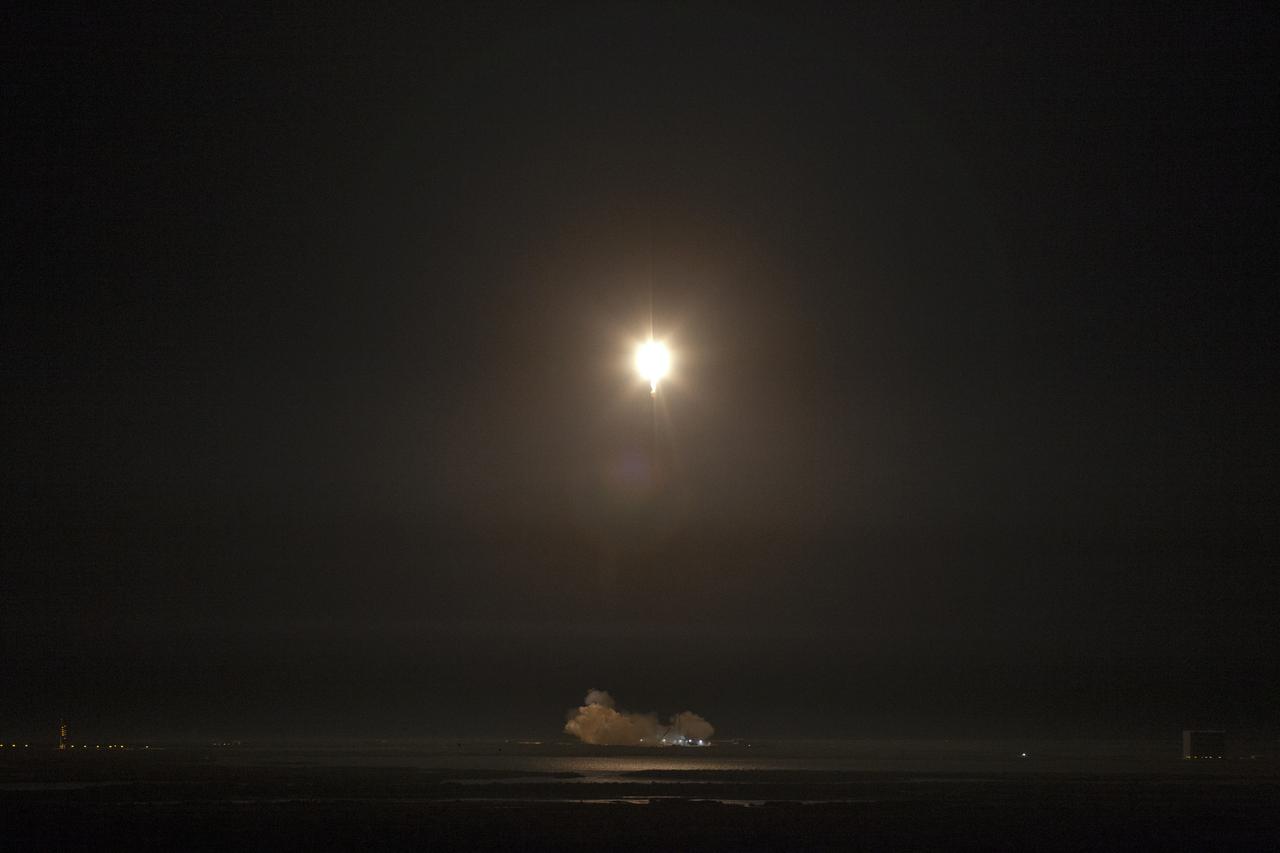
The SpaceX Falcon 9 rocket with the Dragon cargo module climbs upward after liftoff from Space Launch Complex 40 on Cape Canaveral Air Force Station in Florida in the early morning May 4, 2019. Liftoff was at 2:48 a.m. EDT. This is SpaceX’s 17th Commercial Resupply Services (CRS-17) mission for NASA to the International Space Station. The Dragon cargo module will deliver about 5,500 pounds of science and research, crew supplies and vehicle hardware to the orbital laboratory and its crew.
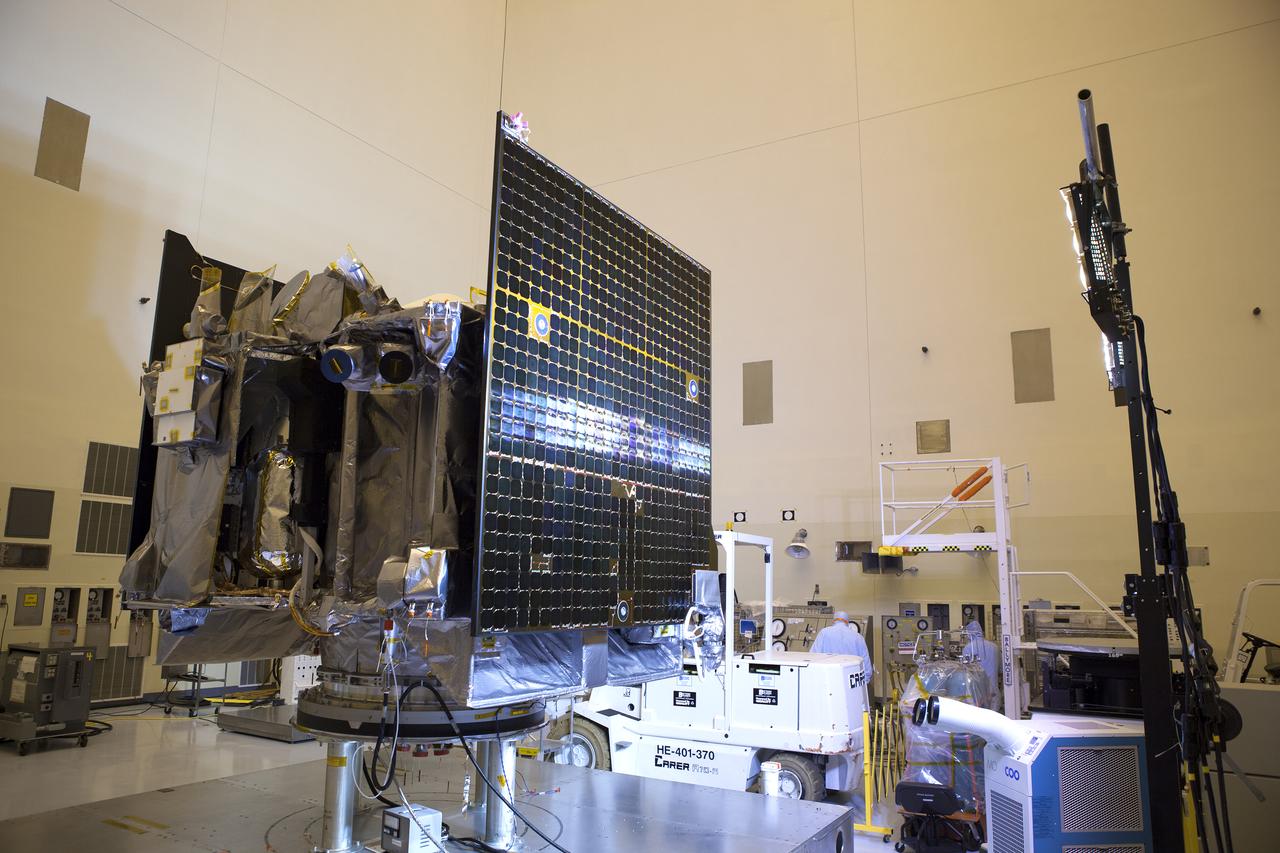
Inside the Payload Hazardous Servicing Facility at NASA's Kennedy Space Center in Florida, illumination testing is underway on the power-producing solar arrays for the agency’s Origins, Spectral Interpretation, Resource Identification, Security-Regolith Explorer, or OSIRIS-REx spacecraft. Targeted for liftoff Sept. 8, 2016, OSIRIS-Rex will be the first U.S. mission to sample an asteroid, retrieve at least two ounces of surface material and return it to Earth for study. The asteroid, Bennu, may hold clues to the origin of the solar system and the source of water and organic molecules found on Earth.

Lashelle Spencer, plant scientist with the Laboratory Support Services and Operations (LASSO) contract at NASA’s Kennedy Space Center in Florida, takes measurements on ‘Red Robin’ dwarf tomato plants, Jan. 10, 2020, inside a laboratory in the spaceport’s Space Station Processing Facility. The tomatoes are growing from seeds that have been exposed to simulated solar particle radiation. The plants’ edible mass and nutrients will be measured and compared to those of a control crop, grown from non-irradiated seeds. The project was designed to confirm that nutritious, high-quality produce can be reliably grown in deep space, or to provide a baseline to guide development of countermeasures to protect future crop foods from radiation during missions beyond low-Earth orbit. The investigation on space radiation impact on seeds and crop production also will be carried on the Materials International Space Station Experiment (MISSE) platform outside the station, supported NASA’s Space Technology Mission Directorate and the Space Biology Program, and potentially on future beyond-low-Earth platforms.
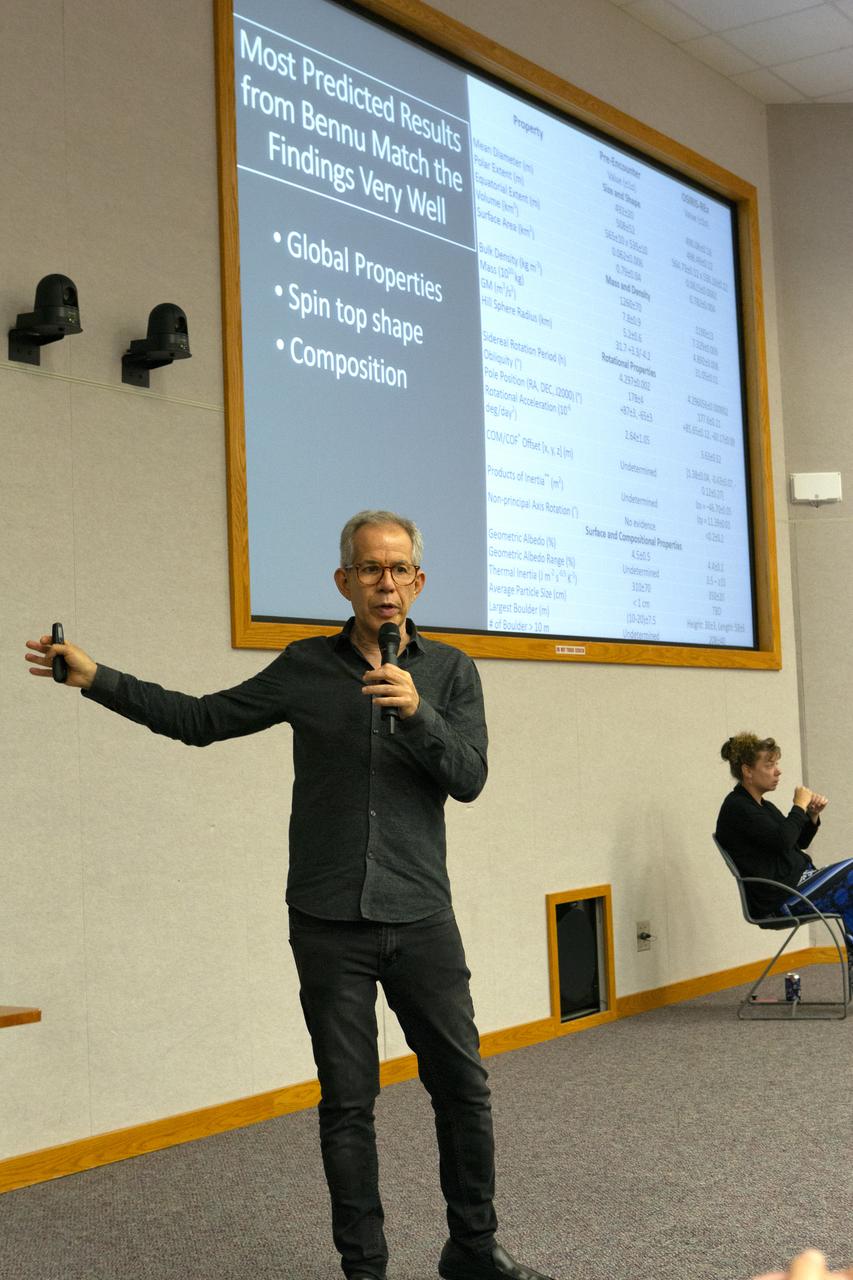
Dr. Humberto Campins from the University of Central Florida speaks to Kennedy Space Center employees in the Florida spaceport’s Neil Armstrong O&C Mission Briefing Room on April 16, 2019, to give a status update on NASA’s Origins, Spectral Interpretation, Resource Identification, Security-Regolith Explorer (OSIRIS-REx). The first U.S. mission to sample an asteroid, OSIRIS-REx launched from Cape Canaveral Air Force Station on Sept. 8, 2016 aboard a United Launch Alliance Atlas V rocket. Management of the launch service for OSIRIS-REx was the responsibility of NASA’s Launch Services Program, based at Kennedy.
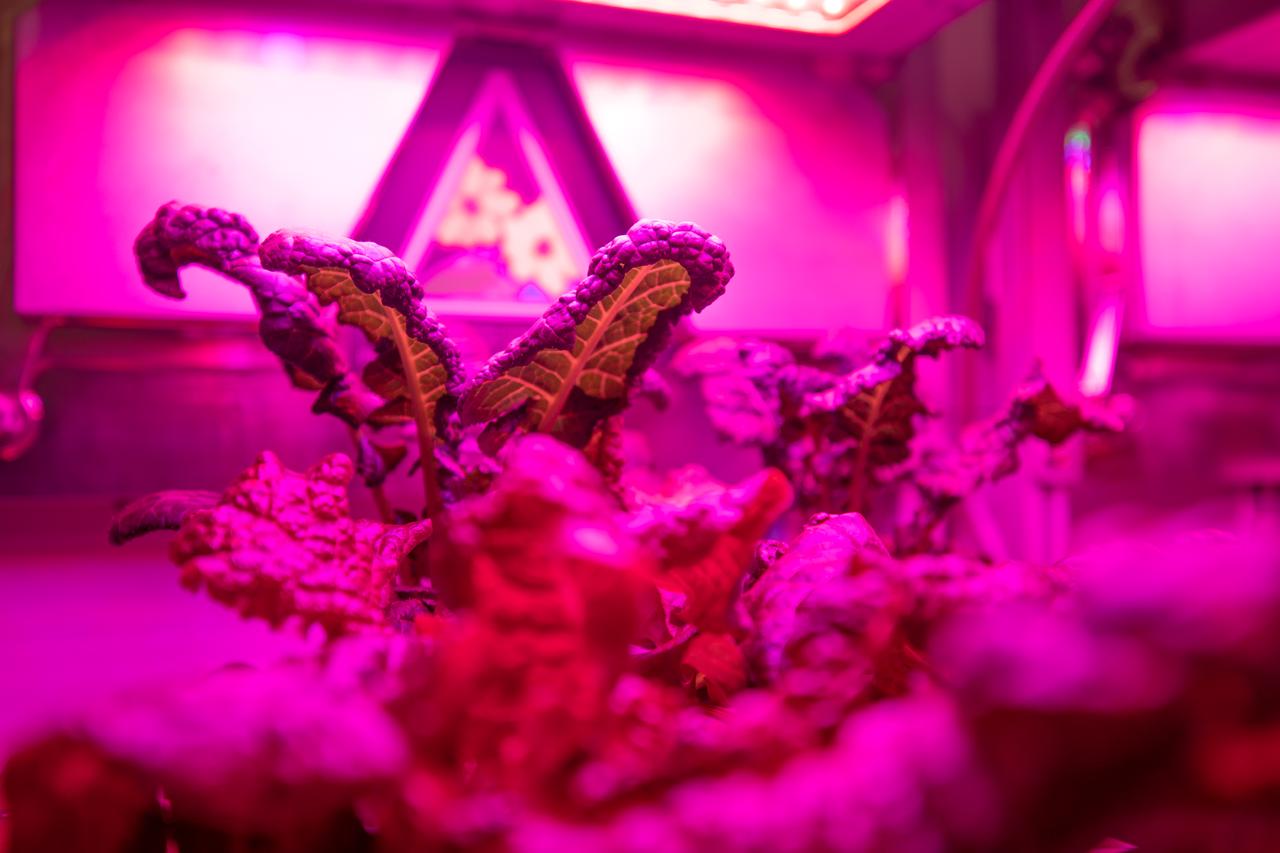
Three crops grown under a test condition representative of the International Space Station are photographed moments before harvest for a science verification test (SVT) in the Space Station Processing Facility at NASA’s Kennedy Space Center in Florida on Sept. 30, 2019. The SVT will study the potential of the three plant cultivars to grow in space. The harvest included ‘outredgeous’ red romaine lettuce, which has been grown in space before, and two new plant cultivars – amara mustard and shungiku, an Asian green comparable to an edible chrysanthemum. All three lettuce plants were grown from seed film, making this the first SVT with this new plant growth material. Earlier this year, the amara mustard and shungiku plants were grown for the first time using seed bags – referred to as pillows – during the Sustained Veggie project, a study funded by the Human Research Program.
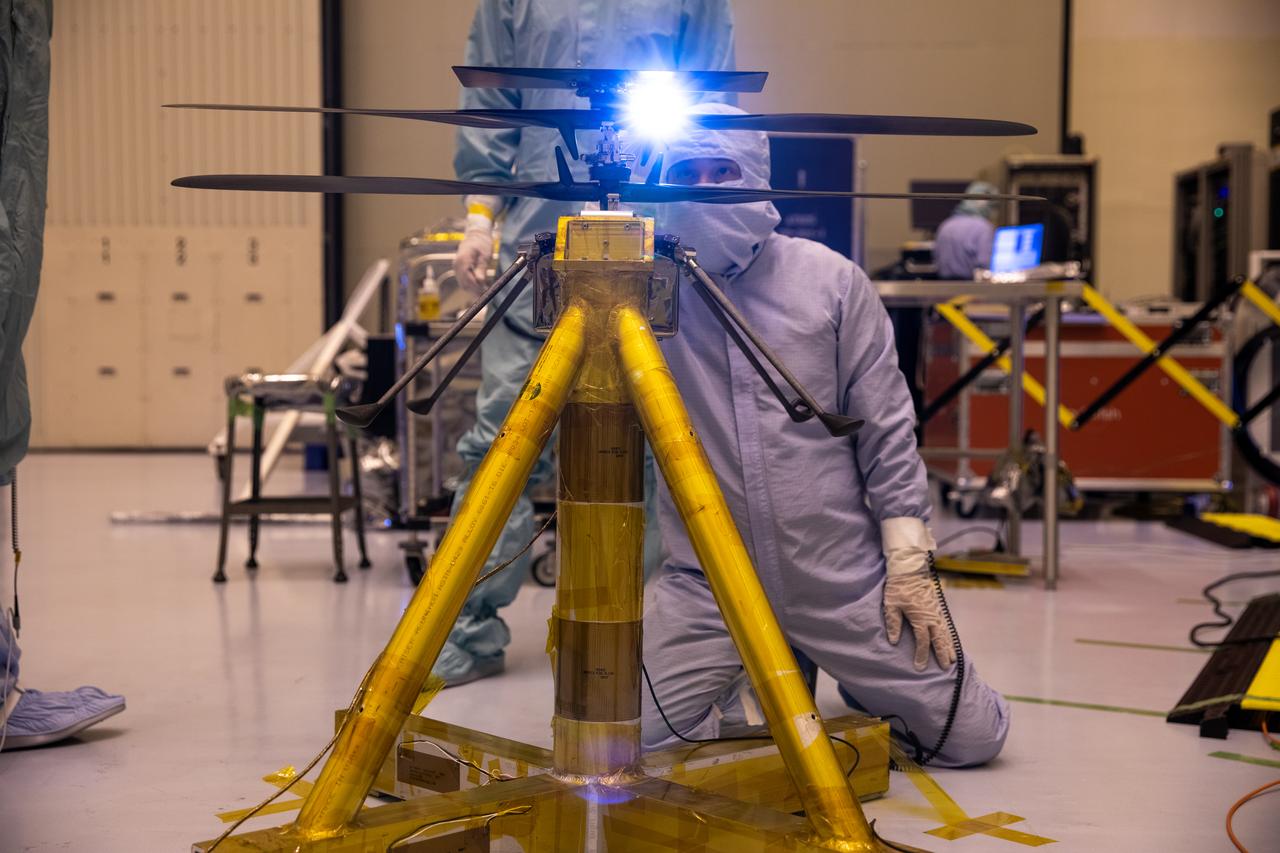
Functional testing of NASA’s Mars Helicopter and its cruise stage occurred in the airlock inside Kennedy Space Center’s Payload Hazardous Servicing Facility on March 10, 2020. The helicopter was tested on a stand while the cruise stage was tested on the rotation fixture. The helicopter will be attached to the Mars Perseverance rover during its mission, which is part of NASA's Mars Exploration Program. Perseverance will land on the Red Planet on Feb. 18, 2021. Liftoff aboard a United Launch Alliance Atlas V 541 rocket is targeted for mid-July from Cape Canaveral Air Force Station. NASA’s Launch Services Program based at Kennedy is managing the launch.
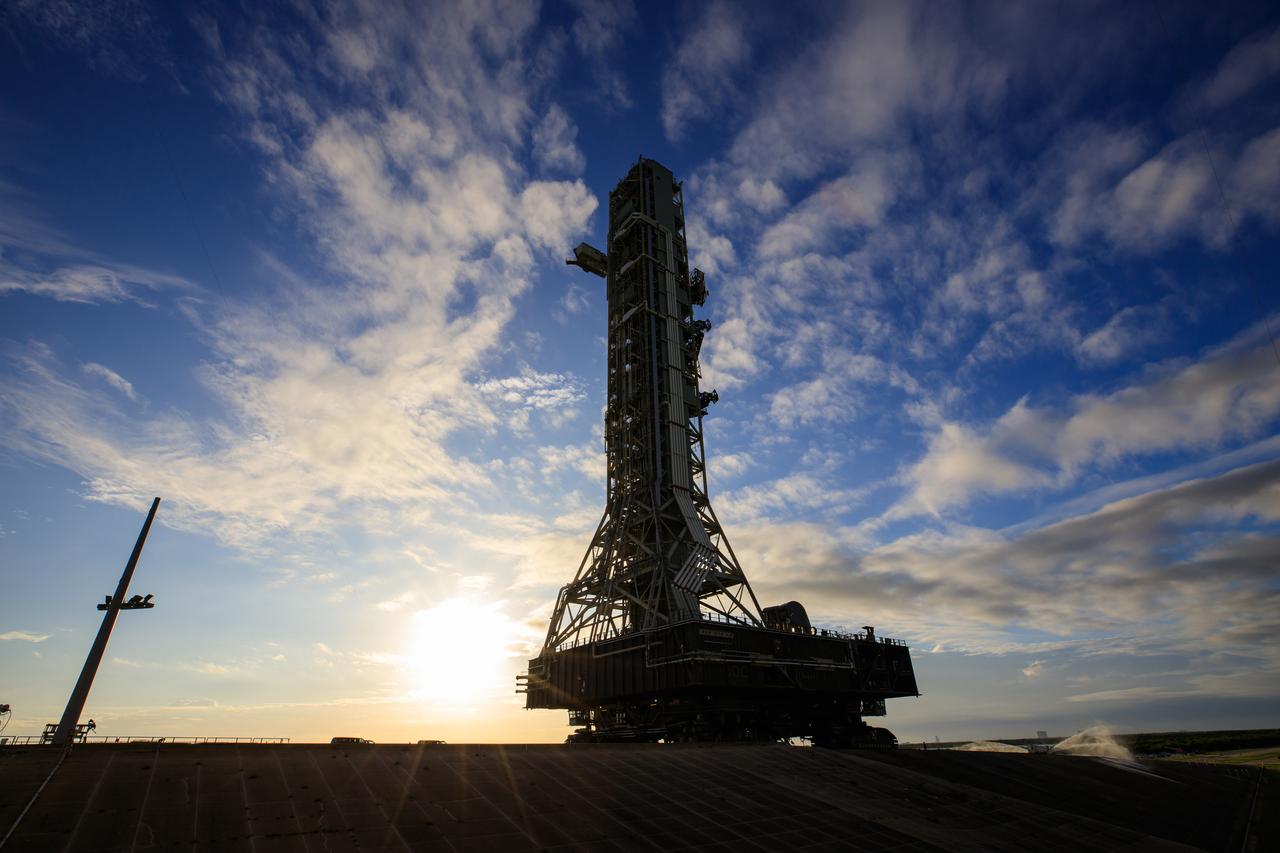
During sunrise on Oct. 30, 2020, the mobile launcher for the Artemis I mission, atop crawler-transporter 2, departs Launch Pad 39B and moves slowly along the crawlerway to return to the Vehicle Assembly Building at NASA’s Kennedy Space Center in Florida. The nearly 400-foot-tall mobile launcher was at the pad for 10 days, while engineers with Exploration Ground Systems and Jacobs performed several tasks, including a timing test to validate the launch team’s countdown timeline, and a thorough, top-to-bottom wash down of the mobile launcher to remove any debris remaining from construction and installation of the umbilical arms. Artemis I will test the Orion spacecraft and Space Launch System as an integrated system ahead of crewed flights to the Moon. Under the Artemis program, NASA will land the first woman and the next man on the Moon in 2024.
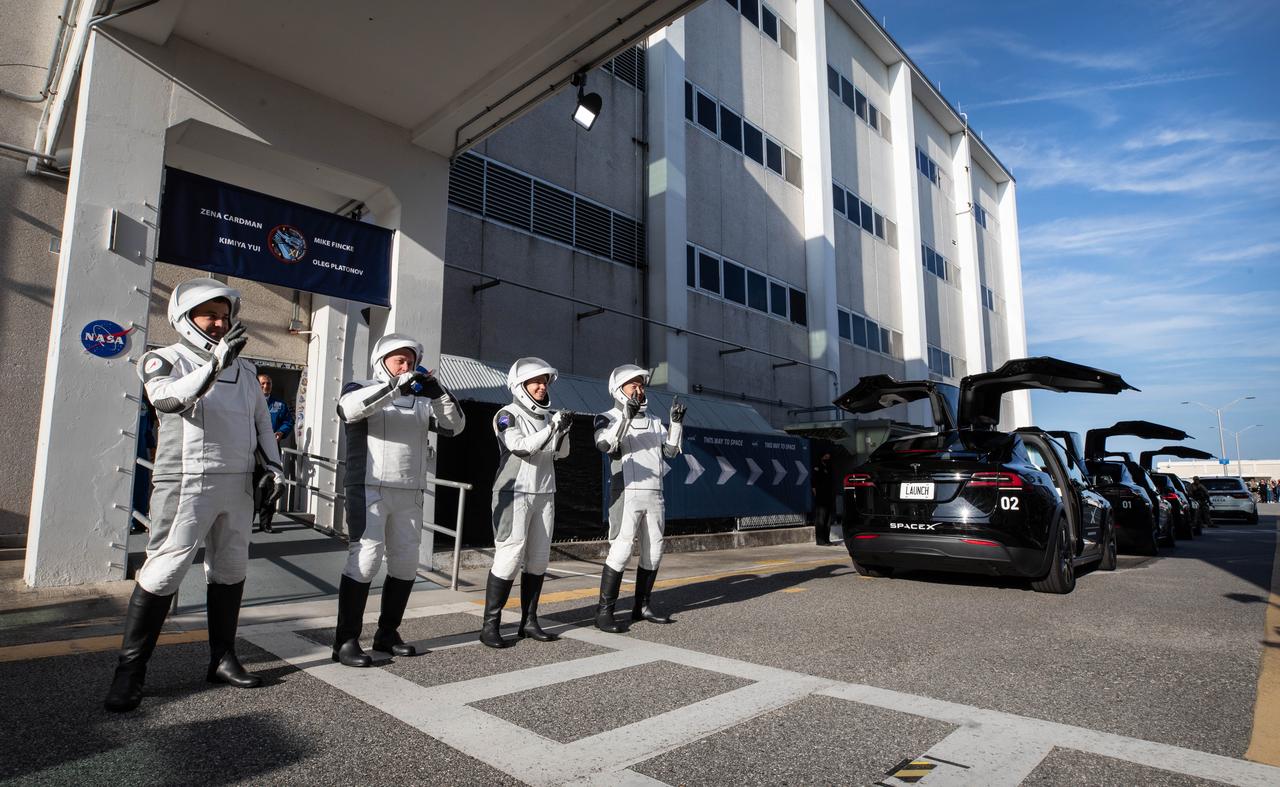
From right to left, JAXA (Japan Aerospace Exploration Agency) astronaut Kimiya Yui, NASA astronauts Zena Cardman and Mike Fincke, along with and Roscosmos cosmonaut Oleg Platonov wave to family and friends as they walk out of the Neil A. Armstrong Operations and Checkout Building at the agency’s Kennedy Space Center in Florida during the second launch attempt of NASA’s SpaceX Crew-11 mission to the International Space Station on Friday, Aug. 1, 2025. Crew-11 is scheduled to lift off aboard SpaceX’s Dragon spacecraft and Falcon 9 rocket at 11:43 a.m. EDT, from Launch Complex 39A at NASA Kennedy.
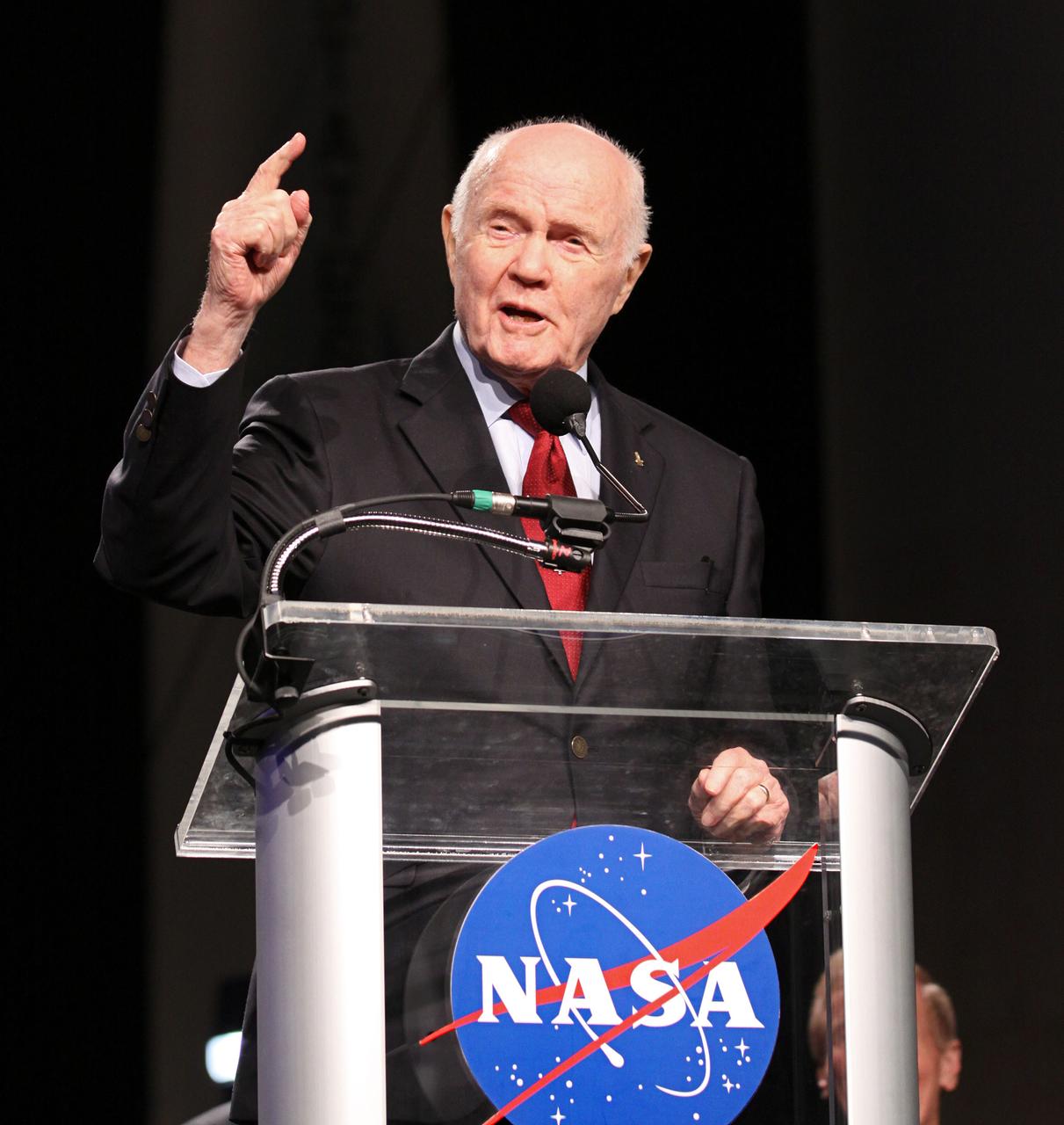
Mercury astronaut John Glenn speaks during the "On Shoulders of Giants" program celebrating 50 years of Americans in orbit, an era which began with Glenn's MA-6 mission on Feb. 20, 1962. The event was conducted in the Rocket Garden at the Kennedy Space Center Visitor Complex in Florida a few miles from the launch pad where Glenn and Scott Carpenter took flight in Mercury spacecraft. Glenn's launch aboard an Atlas rocket took with it the hopes of an entire nation and ushered in a new era of space travel that eventually led to Americans walking on the moon by the end of the 1960s. Glenn soon was followed into orbit by Scott Carpenter, Walter Schirra and Gordon Cooper. Their fellow Mercury astronauts Alan Shepard and Virgil "Gus" Grissom flew earlier suborbital flights. Deke Slayton, a member of NASA's original Mercury 7 astronauts, was grounded by a medical condition until the Apollo-Soyuz Test Project in 1975.
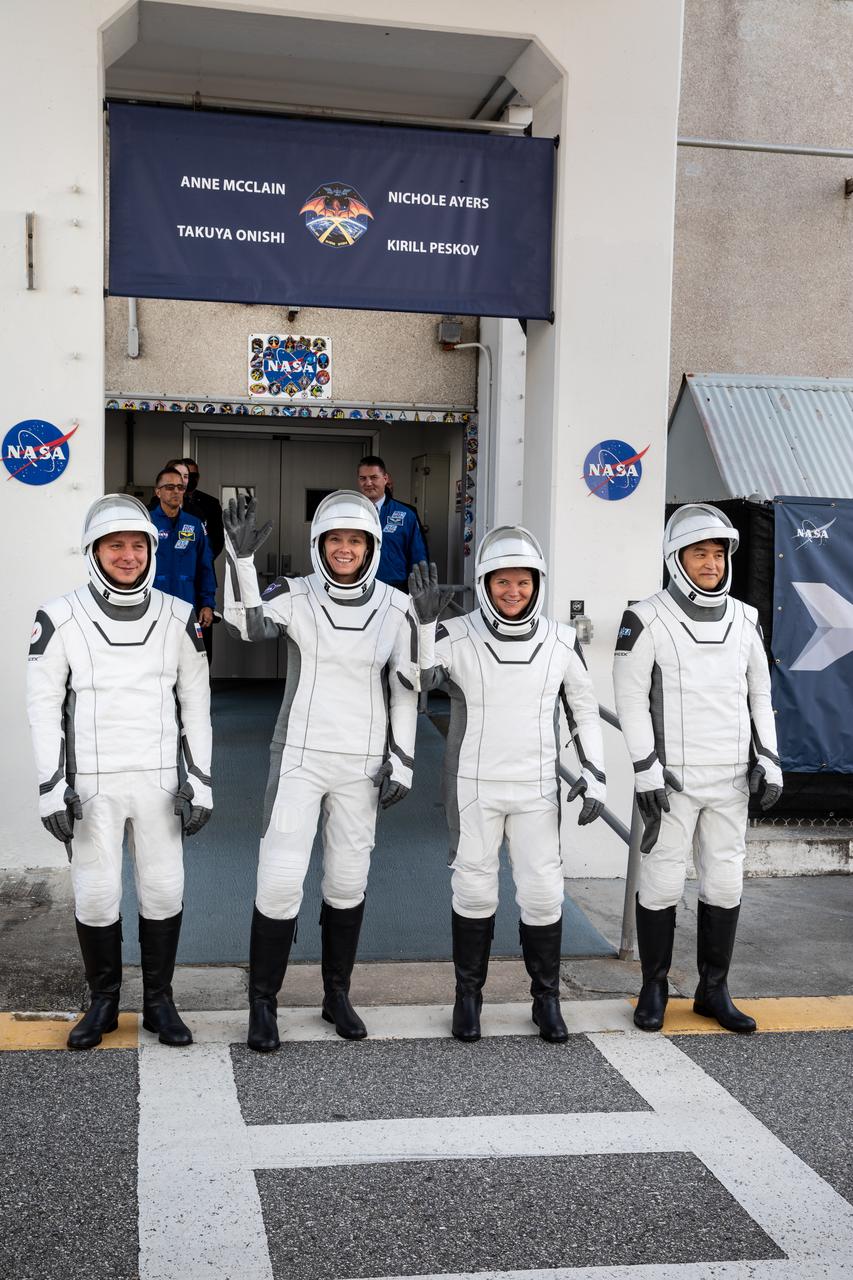
NASA’s SpaceX Crew-10 crew members pose for a photo after walking out of the Neil A. Armstrong Operations and Checkout Building at the agency’s Kennedy Space Center in Florida ahead of launch of the Crew-10 mission on Friday, March 14, 2025. From left to right, Roscosmos cosmonaut Kirill Peskov, NASA astronauts Anne McClain and Nichole Ayers, along with JAXA (Japan Aerospace Exploration Agency) astronaut Takuya Onishi are scheduled to lift off aboard SpaceX’s Dragon spacecraft and Falcon 9 rocket at 7:03 p.m. EDT, from Launch Complex 39A at NASA Kennedy. Crew-10 is the 10th crew rotation mission with SpaceX to the space station as part of the agency’s Commercial Crew Program.
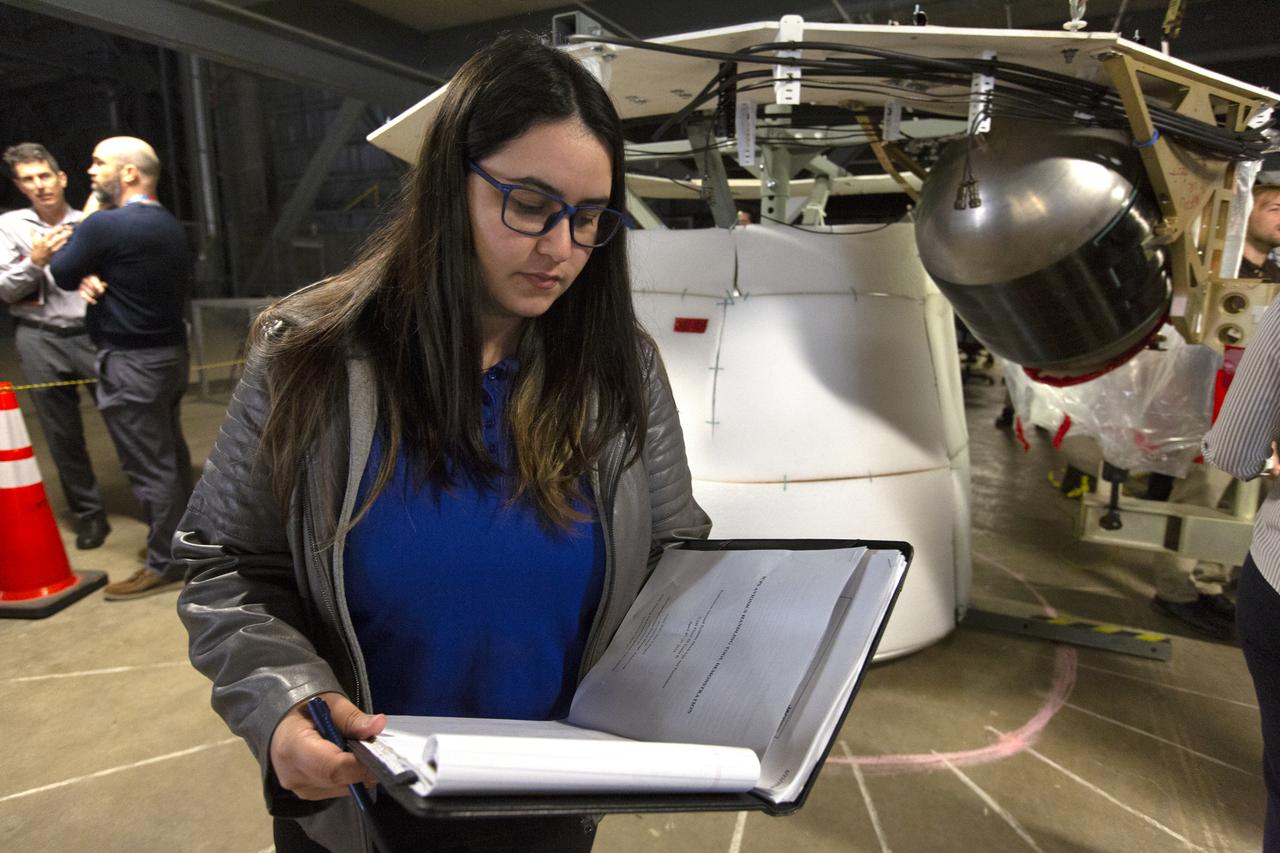
NASA Flight Systems Engineer Sherild Rivera Melendez takes notes during the Space Launch System avionics handling tool demonstration inside Kennedy Space Center’s Vehicle Assembly Building on April 4, 2019. The demonstration showed that avionics boxes could be successfully and safely mounted into the SLS rocket’s upper stage — called the Interim Cryogenic Propulsion Stage, or ICPS — with low risk of damaging a closely located hydrazine tank. Avionics boxes include the Inertial Navigation and Control Assembly and flight batteries. Rivera Melendez coordinated multiple human factors teams, focusing on life cycle reviews and impact risks during installation of the avionics.
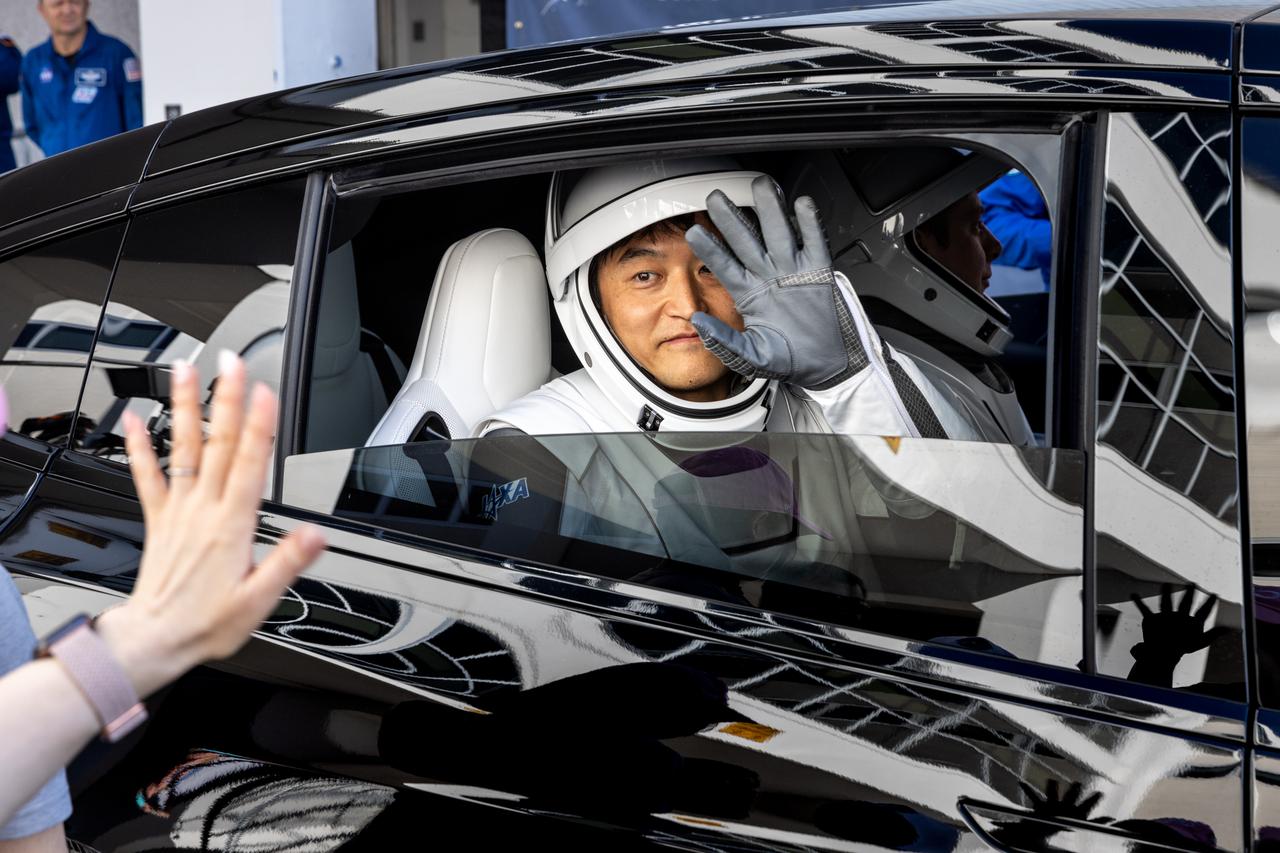
JAXA (Japan Aerospace Exploration Agency) astronaut Takuya Onishi waves from the convoy carrying NASA’s SpaceX Crew-10 from the Neil A. Armstrong Operations and Checkout Building at the agency’s Kennedy Space Center in Florida to nearby Launch Complex 39A ahead of launch on Wednesday, March 12, 2025. NASA astronauts Anne McClain and Nichole Ayers, along with Onishi and Roscosmos cosmonaut Kirill Peskov are scheduled to lift off aboard SpaceX’s Dragon spacecraft and Falcon 9 rocket at 7:48 p.m. EDT. Crew-10 is the 10th crew rotation mission with SpaceX to the space station as part of the agency’s Commercial Crew Program.
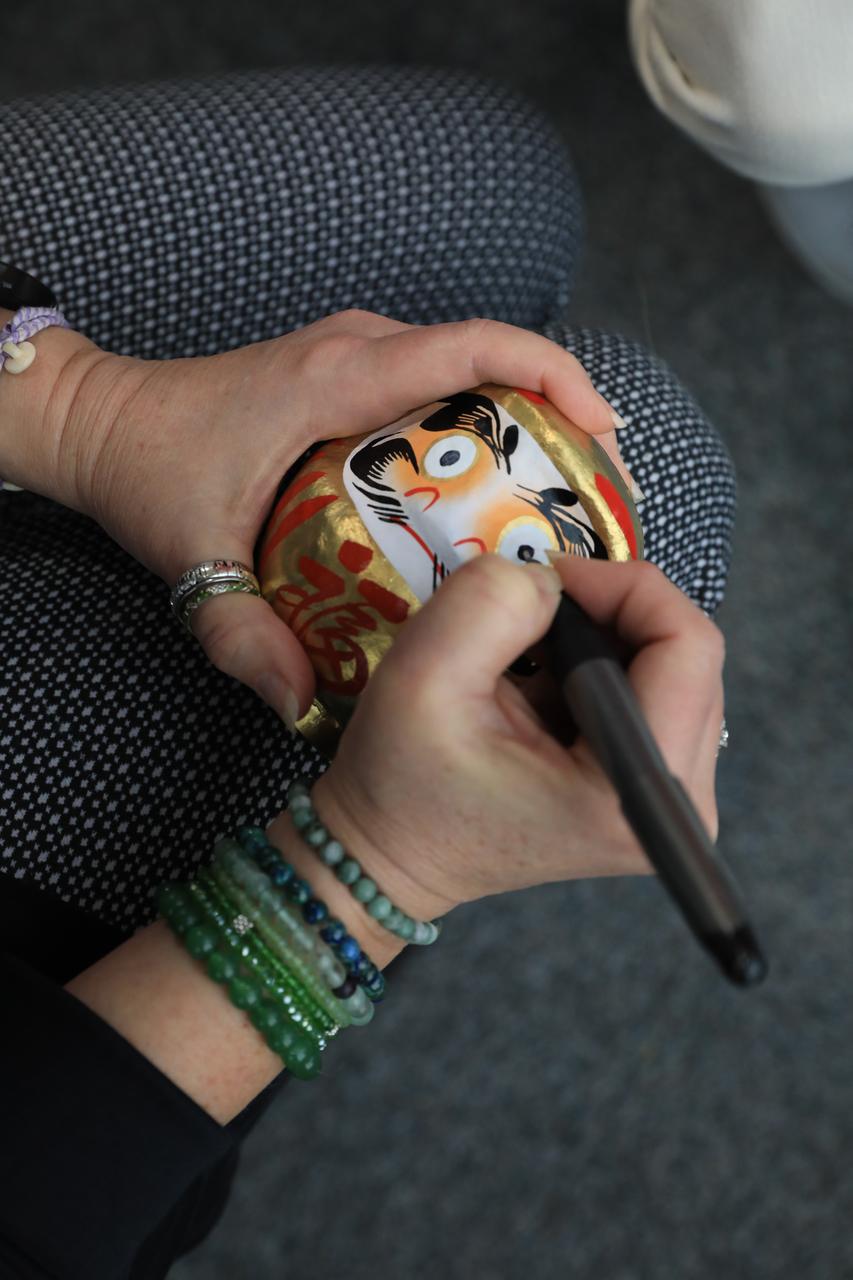
Artemis launch director, Charlie Blackwell-Thompson and associate administrator of NASA’s Space Operations Mission Directorate, Kathryn Lueders finish coloring in the other eye of the Japanese Daruma doll to highlight the successful Artemis I mission on Dec. 20, 2022 in Firing Room 1 of the Rocco A. Petrone Launch Control Center at NASA’s Kennedy Space Center in Florida. The Japan Aerospace Exploration Agency gave a Daruma doll to both Lueders and associate administrator for the Exploration Systems Development Mission Directorate, Jim Free as a token of good luck prior to the Artemis I launch. Free filled in his eye on Dec. 11, 2022, with Artemis I Ascent and Entry Flight Director Judd Frieling in Mission Control Center at NASA’s Johnson Space Center in Houston, Texas.
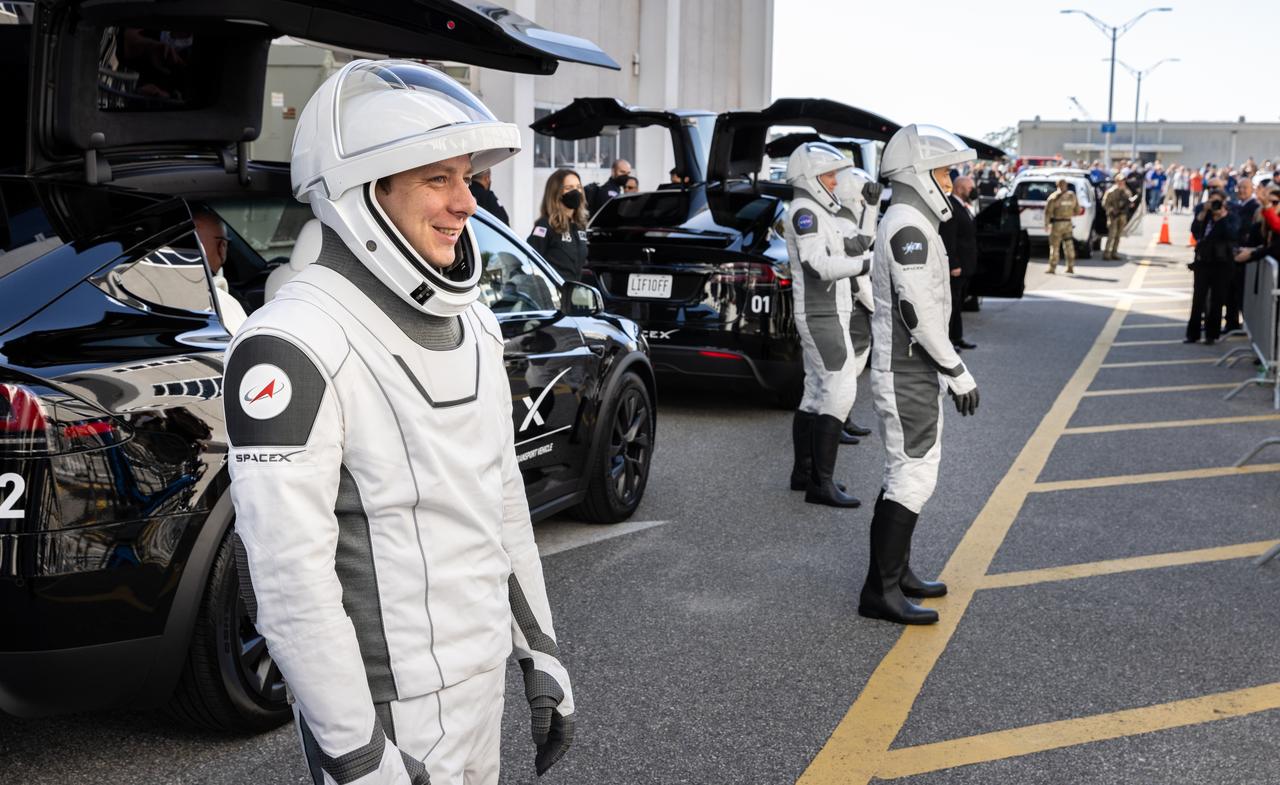
NASA’s SpaceX Crew-10 crew members wave to family and friends as they prepare to depart the Neil A. Armstrong Operations and Checkout Building at the agency’s Kennedy Space Center in Florida for nearby Launch Complex 39A for launch of Crew-10 on Wednesday, March 12, 2025. NASA astronauts Anne McClain and Nichole Ayers, along with JAXA (Japan Aerospace Exploration Agency) astronaut Takuya Onishi and Roscosmos cosmonaut Kirill Peskov are scheduled to lift off aboard SpaceX’s Dragon spacecraft and Falcon 9 rocket at 7:48 p.m. EDT. Crew-10 is the 10th crew rotation mission with SpaceX to the space station as part of the agency’s Commercial Crew Program.
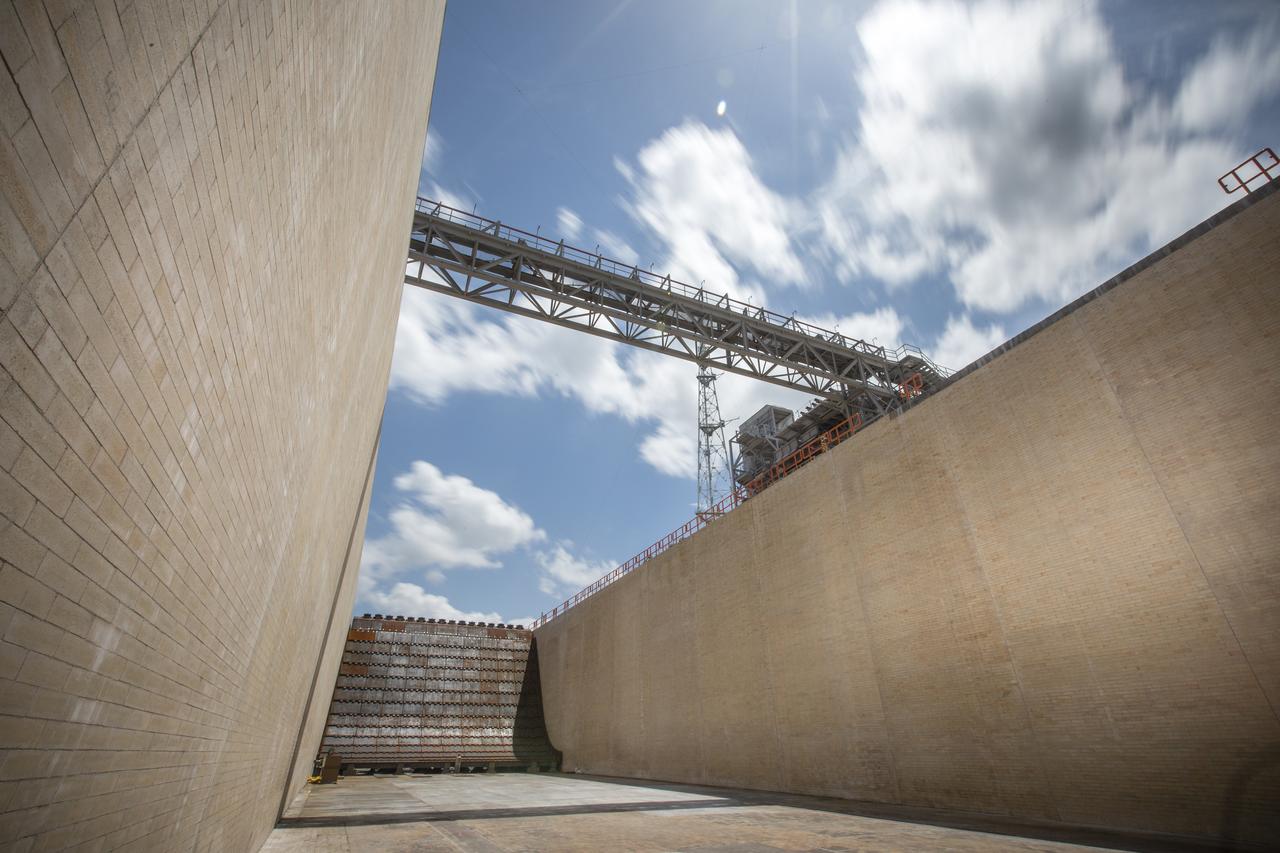
A close-up view of the flame trench and flame deflector at Launch Pad 39B at NASA's Kennedy Space Center in Florida on July 26, 2018. The launch pad has undergone upgrades and modifications to accommodate NASA's Space Launch System and Orion spacecraft for Exploration Mission-1 and other deep space missions. New heat-resistant bricks have been installed on the walls and a new flame deflector is in place. The clean pad concept is designed to support NASA and commercial launch providers at the multi-user spaceport.
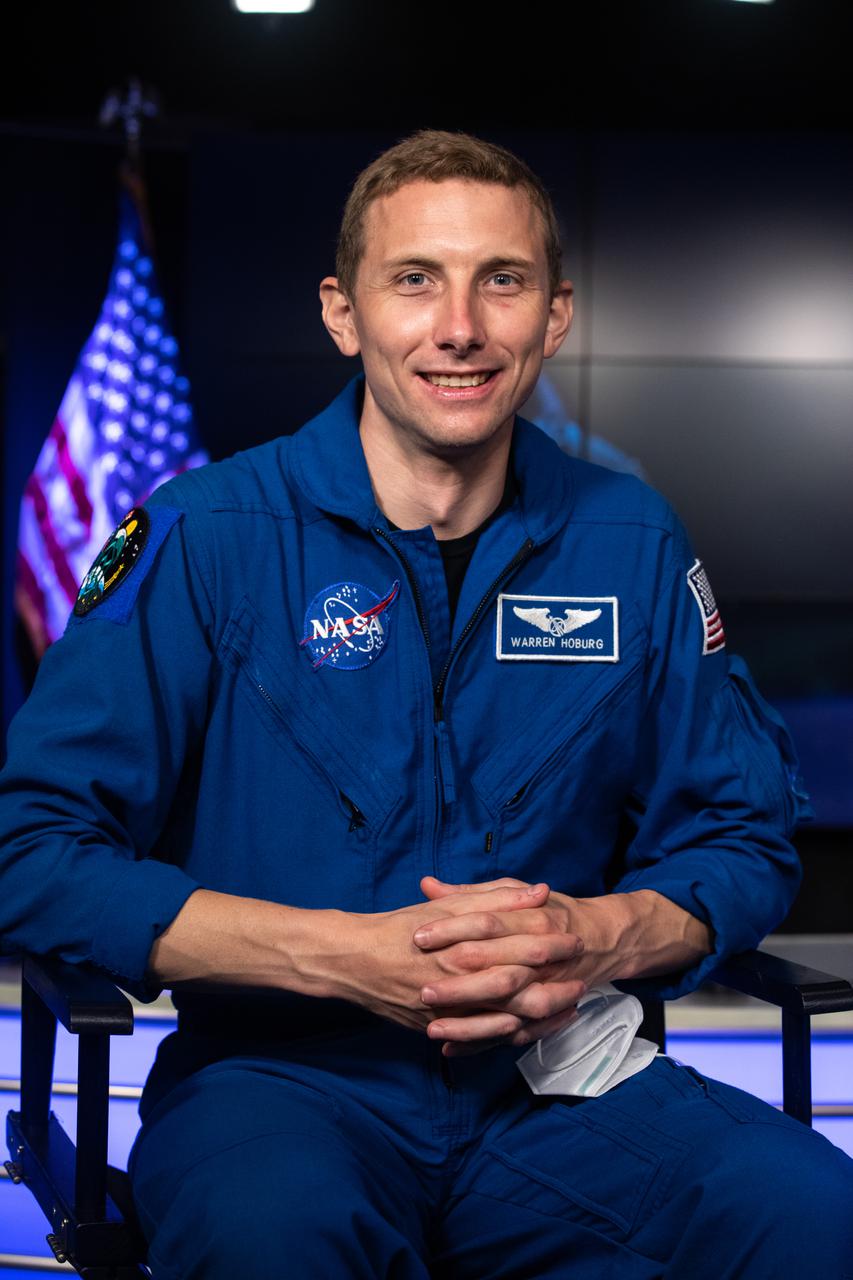
NASA astronaut Woody Hoburg participates in a NASA Social Live event at the agency’s Kennedy Space Center in Florida on Oct. 29, in advance of NASA’s SpaceX Crew-3 mission to the International Space Station as part of NASA’s Commercial Crew Program. Launch is currently targeted for 2:21 a.m. EDT Sunday, Oct. 31. The SpaceX Dragon spacecraft, named Endurance by the Crew-3 astronauts, will launch on a Falcon 9 rocket from Launch Complex 39A at Kennedy Space Center. The Crew-3 flight will carry NASA astronauts Raja Chari, mission commander, Tom Marshburn, pilot, and Kayla Barron, mission specialist and ESA (European Space Agency) astronaut Matthias Maurer, also a mission specialist, to the space station for a six-month science mission.
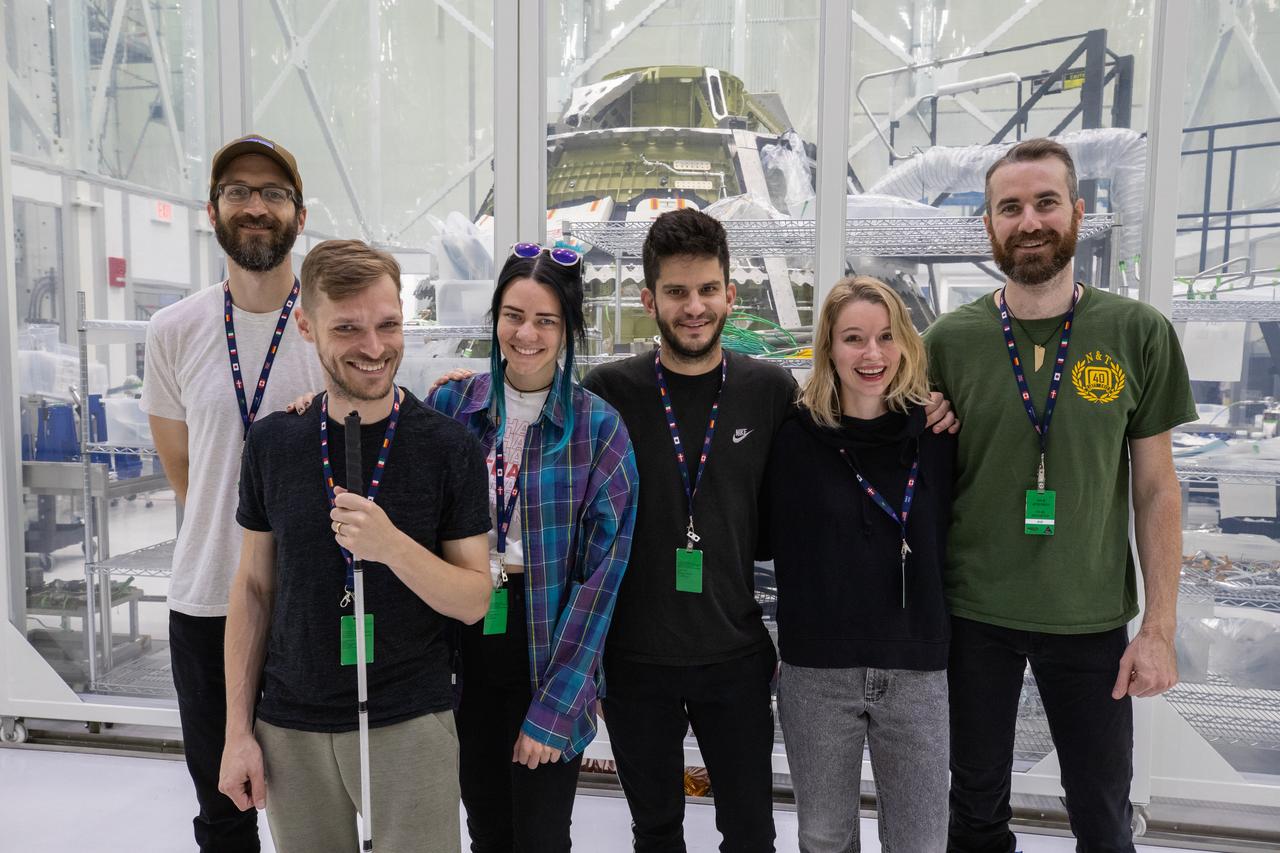
The rock band X Ambassadors is photographed in front of NASA’s Artemis II Orion crew module inside the Neil Armstrong Operations and Checkout (O&C) Building high bay at the agency’s Kennedy Space Center in Florida. X Ambassadors visited Kennedy on Oct. 21, 2019, and had the opportunity to tour areas around the multi-user spaceport such as the O&C, Launch Complex 39B and Swamp Works. The title of the band’s latest album, Orion, led them to an up-close look at the spacecraft that will take humans farther than they’ve ever gone before.
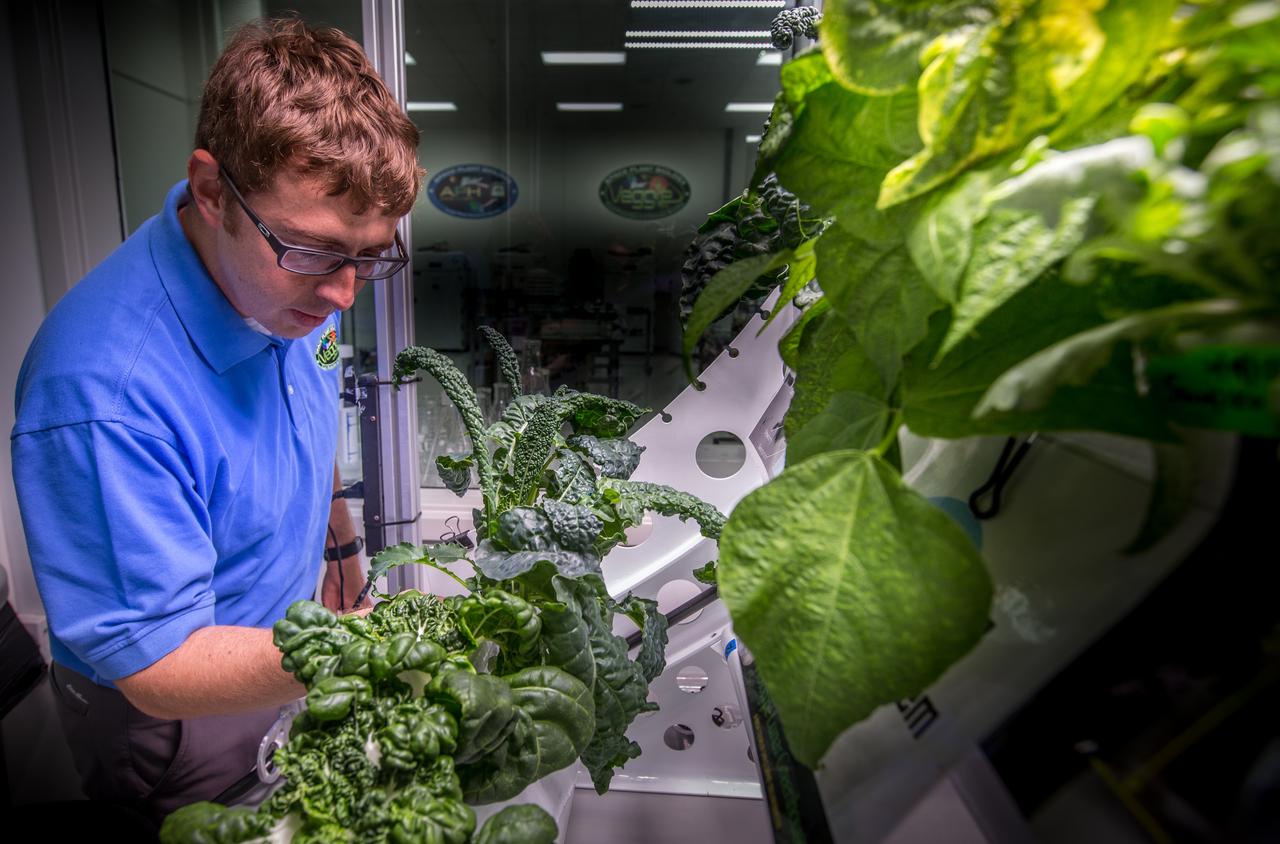
NASA's Matt Romeyn in the Veggie Lab of the Space Station Processing Facility at the agency's Kennedy Space Center in Florida.
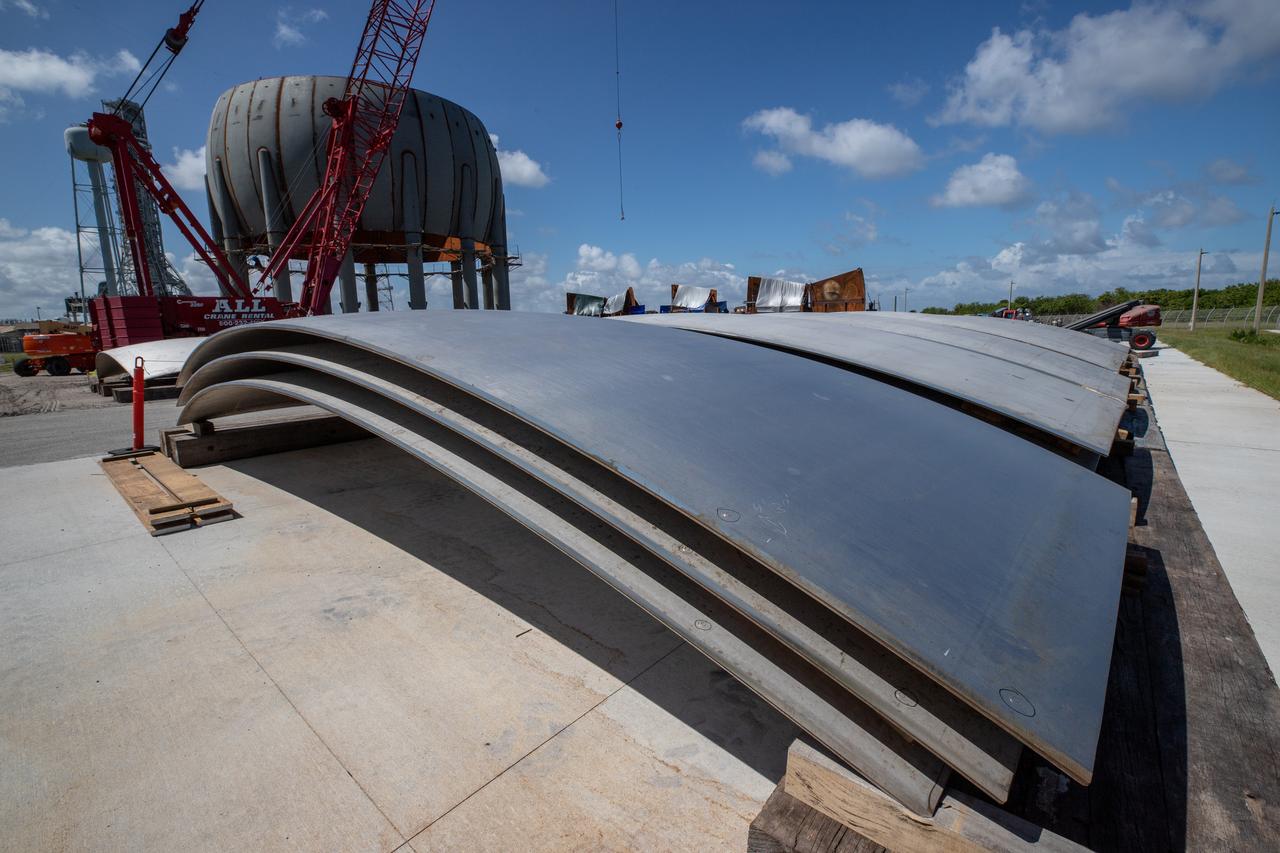
Build-up of a new liquid hydrogen (LH2) storage tank is in progress on Oct. 1, 2019, at Launch Complex 39B at NASA's Kennedy Space Center in Florida. The new tank will hold 1.25 million gallons of usable LH2 to support future launches from the pad, including Artemis missions to the Moon and on to Mars.
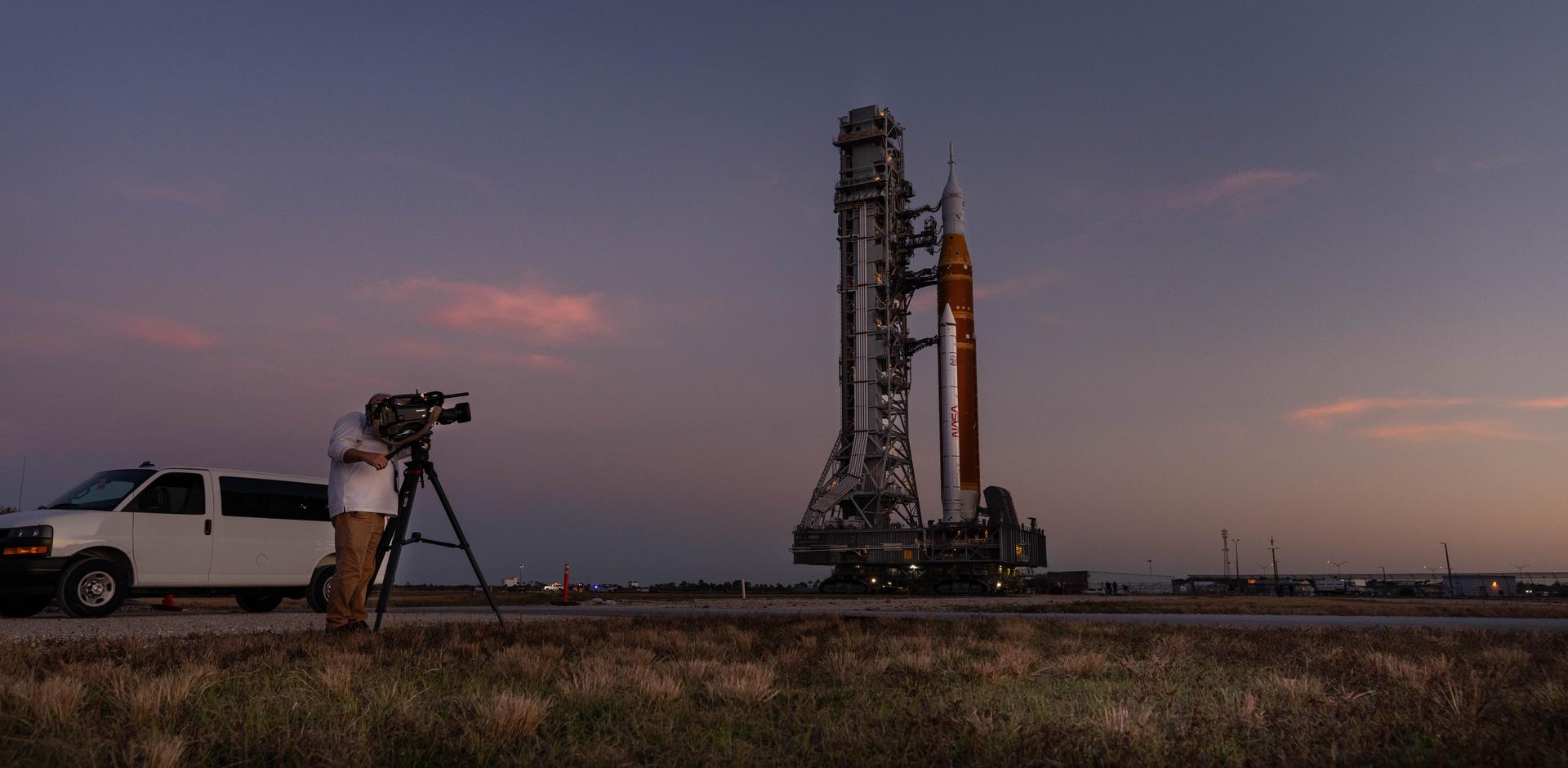
NASA’s crawler-transporter 2, carrying NASA’s Artemis II SLS (Space Launch System) rocket with the Orion spacecraft secured to mobile launcher 1, rolls back Wednesday, Feb. 25, 2026, to the Vehicle Assembly Building at NASA’s Kennedy Space Center in Florida to troubleshoot the flow of helium to the rocket’s upper stage, the interim cryogenic propulsion stage. Once complete, the SLS rocket will roll back to Launch Complex 39B to prepare to launch four astronauts around the Moon and back for the Artemis II test flight.
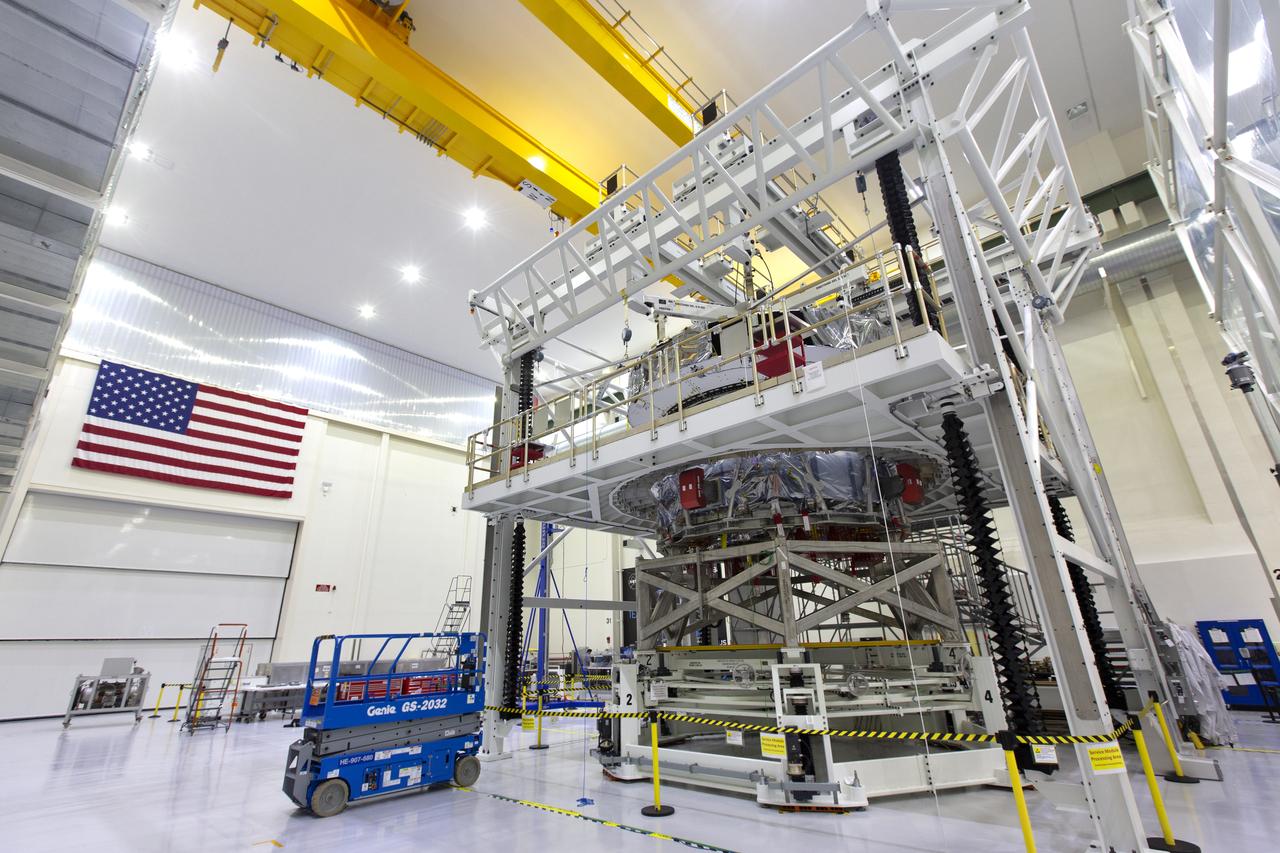
Inside the Neil Armstrong Operations and Checkout Building high bay at NASA's Kennedy Space Center in Florida, Orion's crew module adapter is mated to the European Service Module on Nov. 16, 2018. For the first time, NASA will use a European-built system as a critical element to power an American spacecraft, extending the international cooperation of the International Space Station into deep space. The European Service Module is a unique collaboration across space agencies and industry including ESA's prime contractor, Airbus, and 10 European countries. The completion of service module work in Europe and shipment to Kennedy signifies a major milestone toward NASA's deep space exploration missions to the Moon and beyond.

A view of the Vehicle Assembly Building (VAB) at NASA’s Kennedy Space Center in Florida, during sunrise on Jan. 19, 2022. Inside the VAB, NASA’s Space Launch System (SLS) and Orion spacecraft are stacked in High Bay 3 in preparation for the agency’s Artemis I mission. Artemis I will be the first integrated test of the SLS and Orion spacecraft. In later missions, NASA will land the first woman and the first person of color on the surface of the Moon, paving the way for a long-term lunar presence and serving as a steppingstone on the way to Mars.
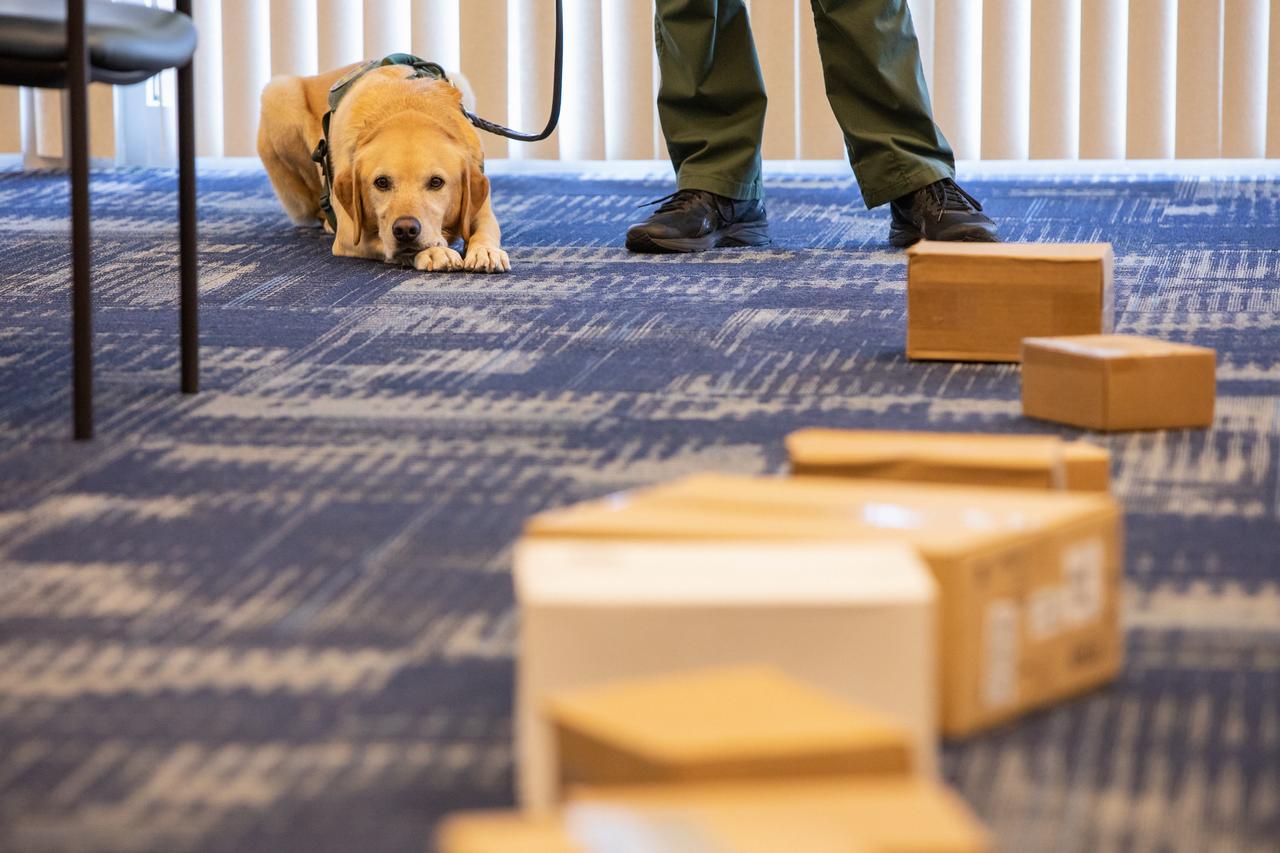
Fish and Wildlife Conservation Commission (FWC) K9 Harry rests during FWC Officer Jeff Sidor’s presentation on the commission’s Port K9 Program to Kennedy Space Center employees on April 23, 2019. Following the presentation in the Florida spaceport’s Space Station Processing Facility Conference Center, Officer Sidor demonstrated how FWC is using specially trained dogs such as Harry in airports, seaports and mail facilities to detect illegal and invasive fish and wildlife species shipping into Florida. The demonstration involved Harry distinguishing which box, among many, contained a turtle shell. This lunch and learn was available for employees to attend as part of Kennedy’s Earth Day events.
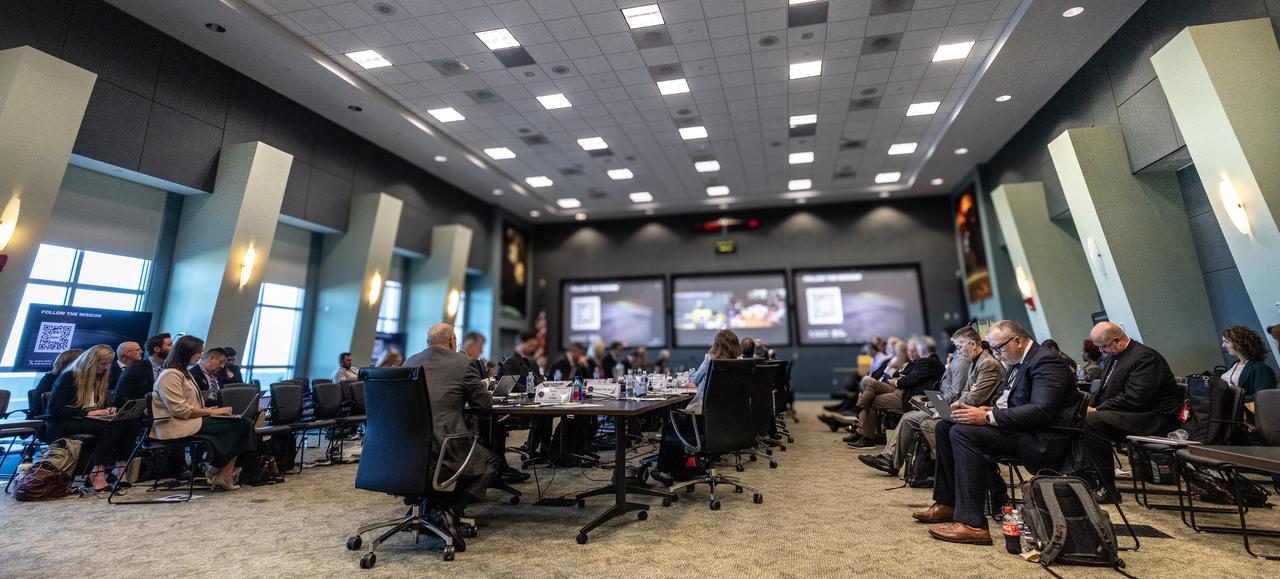
Managers with NASA and SpaceX, along with international partners, participate in NASA’s SpaceX Crew-9 Flight Readiness Review at the agency’s Kennedy Space Center in Florida on Monday, Sept. 23, 2024. Launch is targeted for 2:05 p.m. EDT Sept. 26, 2024, from Space Launch Complex-40 at Cape Canaveral Space Force Station in Florida. NASA astronaut Nick Hague and Roscosmos cosmonaut Aleksandr Gorbunov will launch to the International Space Station aboard SpaceX’s Dragon spacecraft and Falcon 9 rocket on the company’s ninth crew rotation mission for NASA as part of the agency’s Commercial Crew Program.
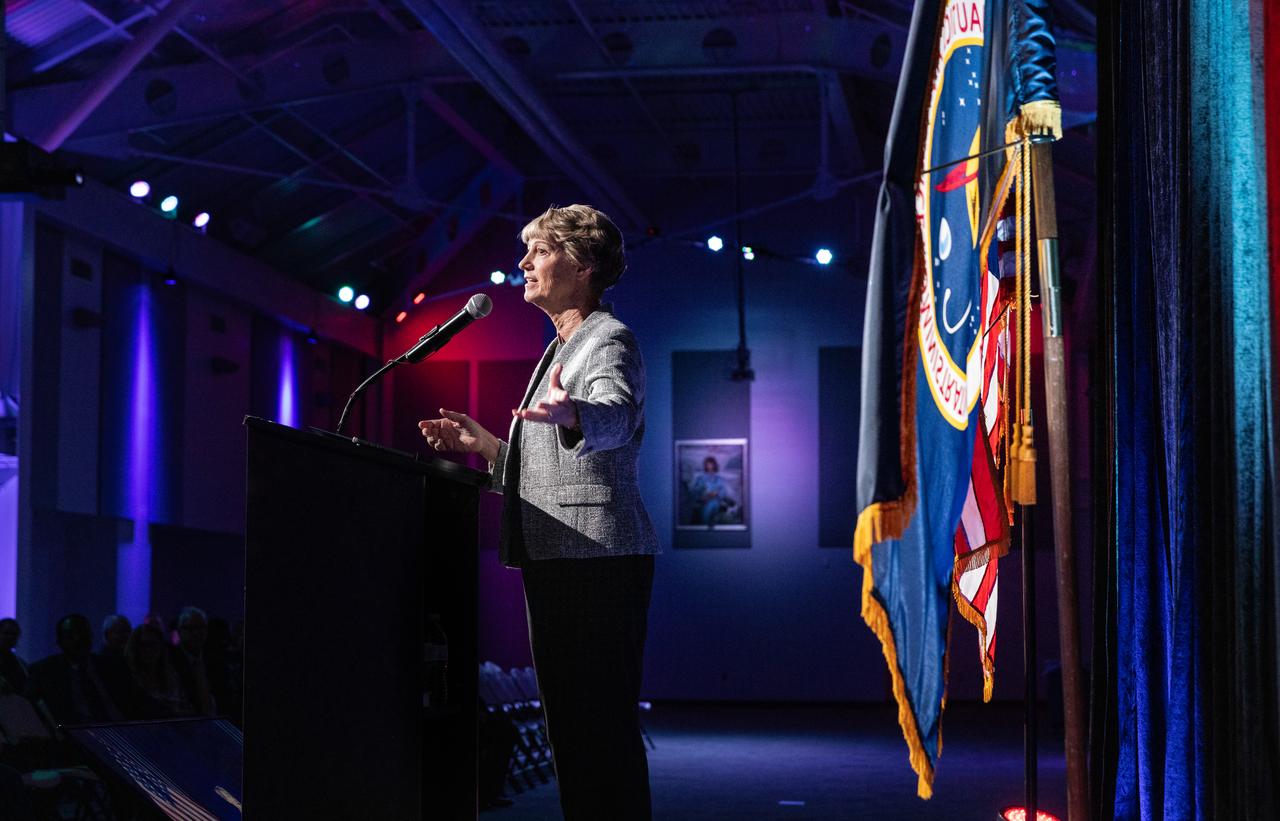
Retired NASA astronaut Eileen Collins speaks during NASA’s Day of Remembrance ceremony on Thursday, Jan. 23, 2025, inside the Center for Space Education at the Kennedy Space Center Visitor Complex in Florida. The annual event honors the crews of Apollo 1 and space shuttles Challenger and Columbia, as well as other astronauts who lost their lives in the pursuit of spaceflight. This year’s ceremony was hosted by the Astronauts Memorial Foundation, which was founded after the shuttle Challenger accident in 1986 to honor the sacrifices of fallen astronauts each year.
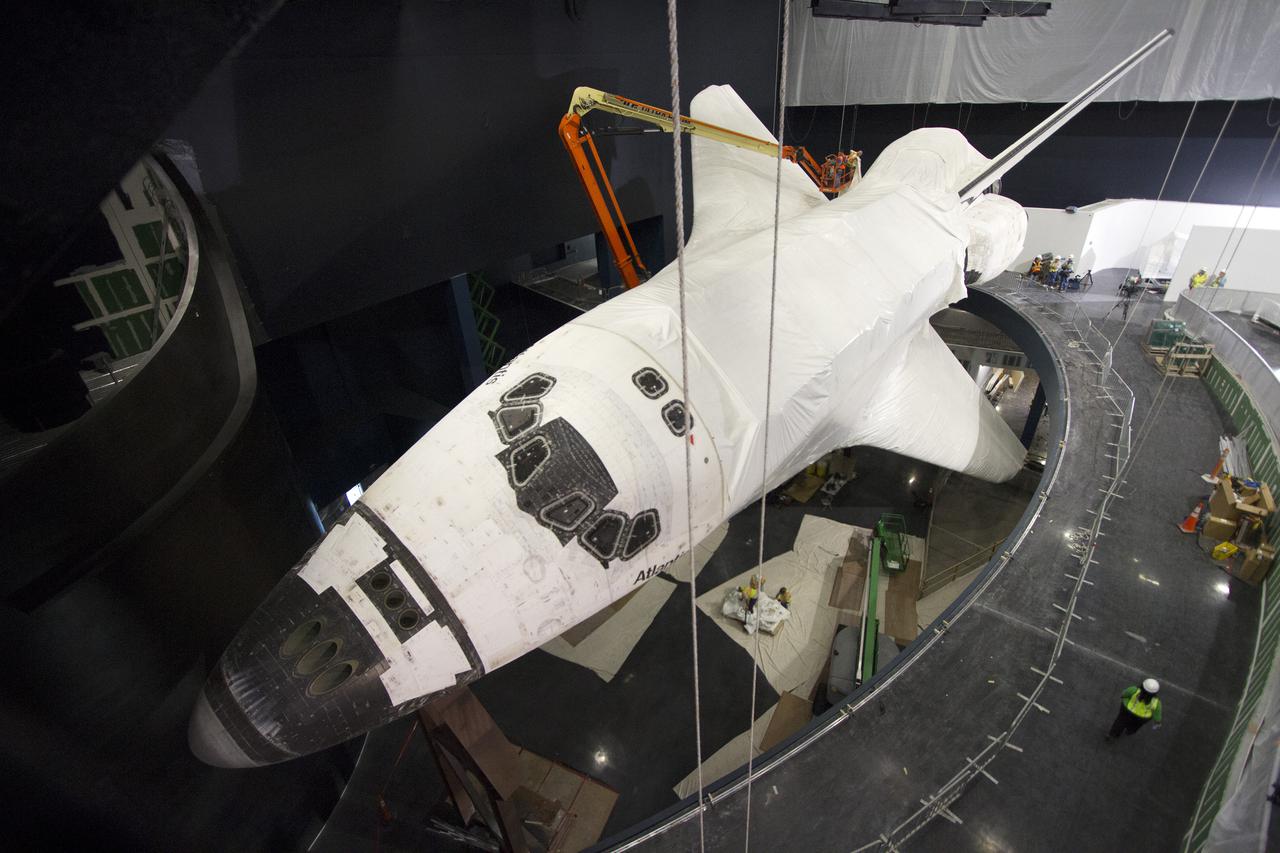
CAPE CANAVERAL, Fla. -- At the Kennedy Space Center Visitor Complex in Florida, construction crews remove 16,000 square feet of plastic shrink-wrap from the space shuttle Atlantis. The spacecraft was enclosed in the plastic shrink-wrap since November of last year to protect the artifact from dust and debris during construction of the 90,000-square-foot facility. Last November, the space shuttle Atlantis made its historic final journey to its new home, traveling 10 miles from the Kennedy Space Center's Vehicle Assembly Building to the spaceport's visitor complex. The new $100 million 'Space Shuttle Atlantis' facility will include interactive exhibits that tell the story of the 30-year Space Shuttle Program and highlights the future of space exploration. The 'Space Shuttle Atlantis' exhibit scheduled to open June 29, 2013.Photo credit: NASA_ Cory Huston
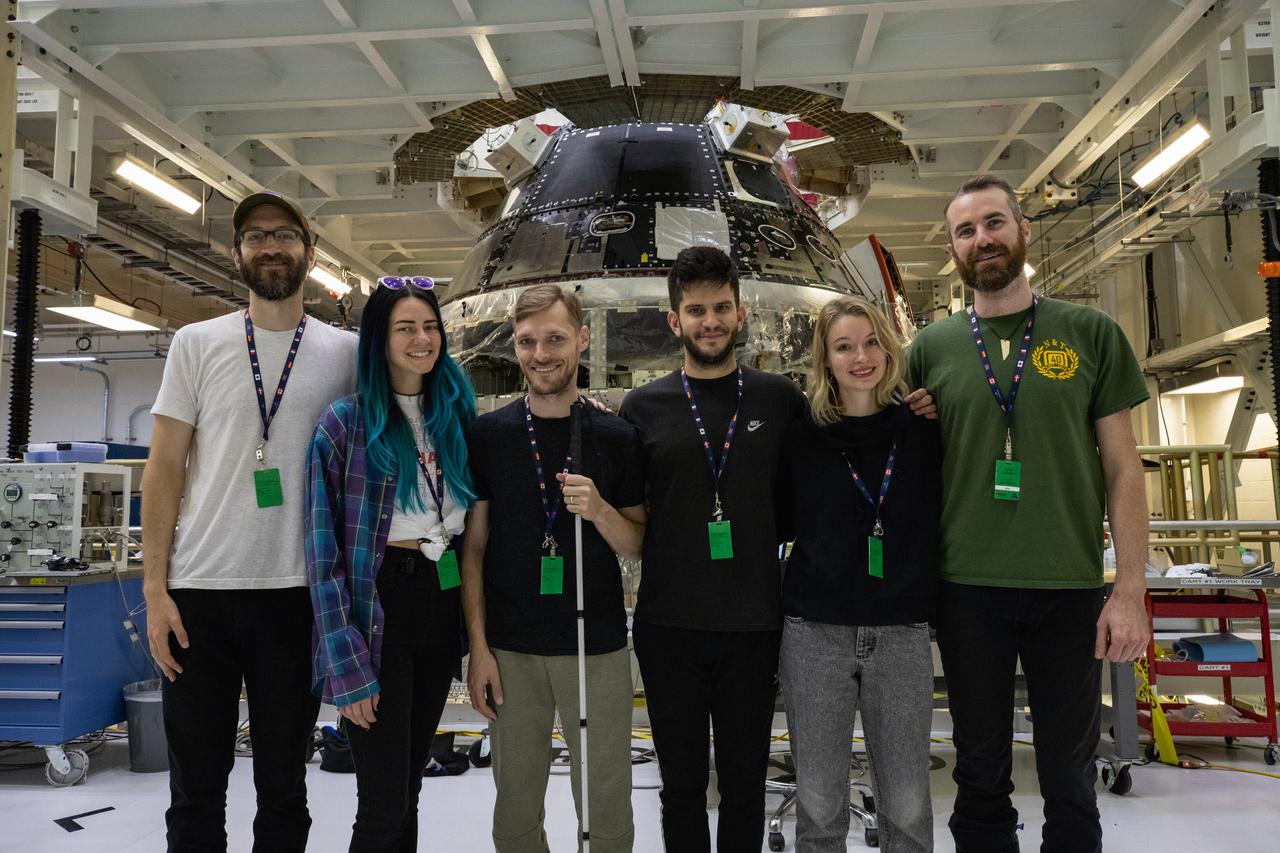
The rock band X Ambassadors is photographed in front of NASA’s Artemis I Orion spacecraft inside the Neil Armstrong Operations and Checkout (O&C) Building high bay at the agency’s Kennedy Space Center in Florida. X Ambassadors visited Kennedy on Oct. 21, 2019, and had the opportunity to tour areas around the multi-user spaceport such as the O&C, Launch Complex 39B and Swamp Works. The title of the band’s latest album, Orion, led them to an up-close look at the spacecraft that will take humans farther than they’ve ever gone before.
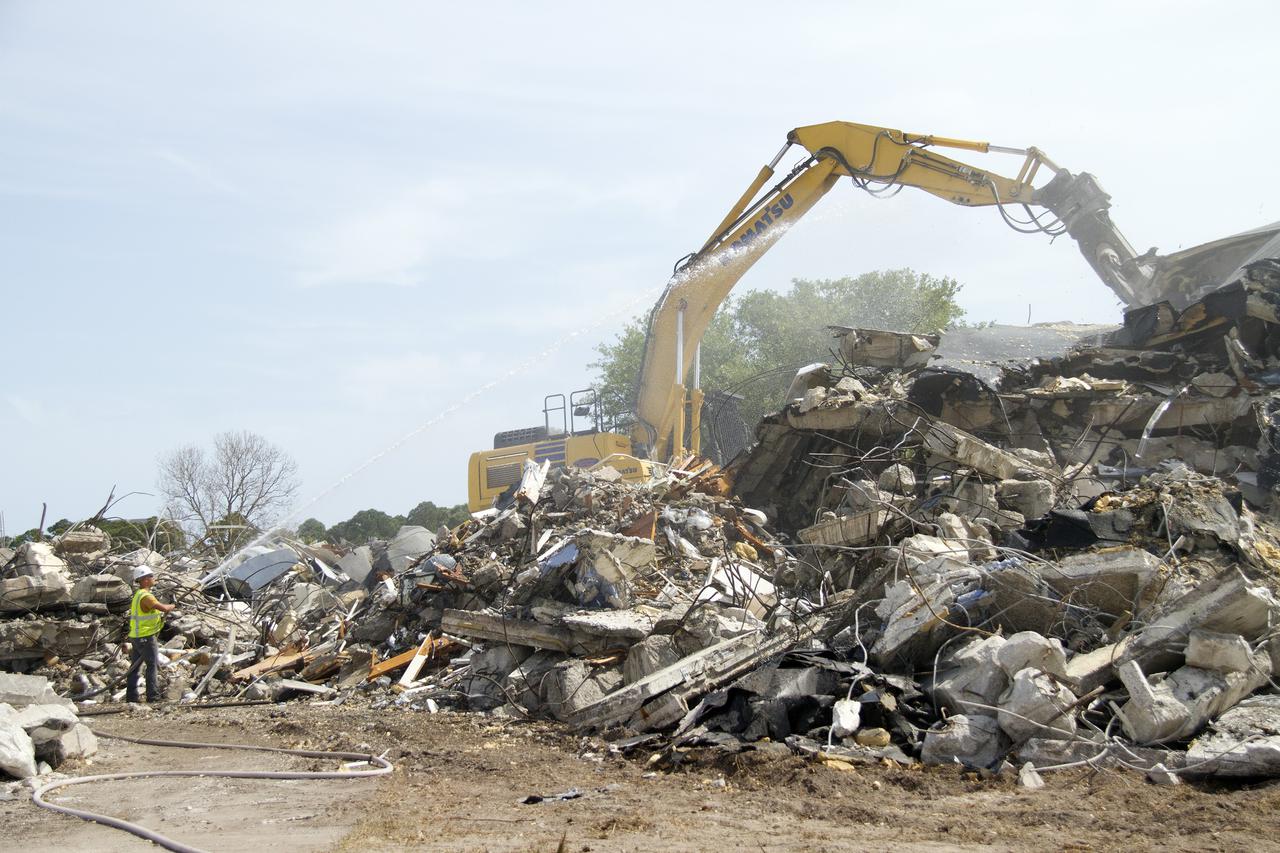
CAPE CANAVERAL, Fla. -- At NASA’s Kennedy Space Center in Florida, demolition is underway on the Base Operations Building, or BOB, in the Industrial Area. Water is being sprayed in the area to control the dust created during the demolition process. The two-story BOB was constructed in 1965 as office space for workers. Kennedy is demolishing some of the older facilities due to their age and to reduce maintenance and repair costs. Photo credit: NASA_ Cory Huston
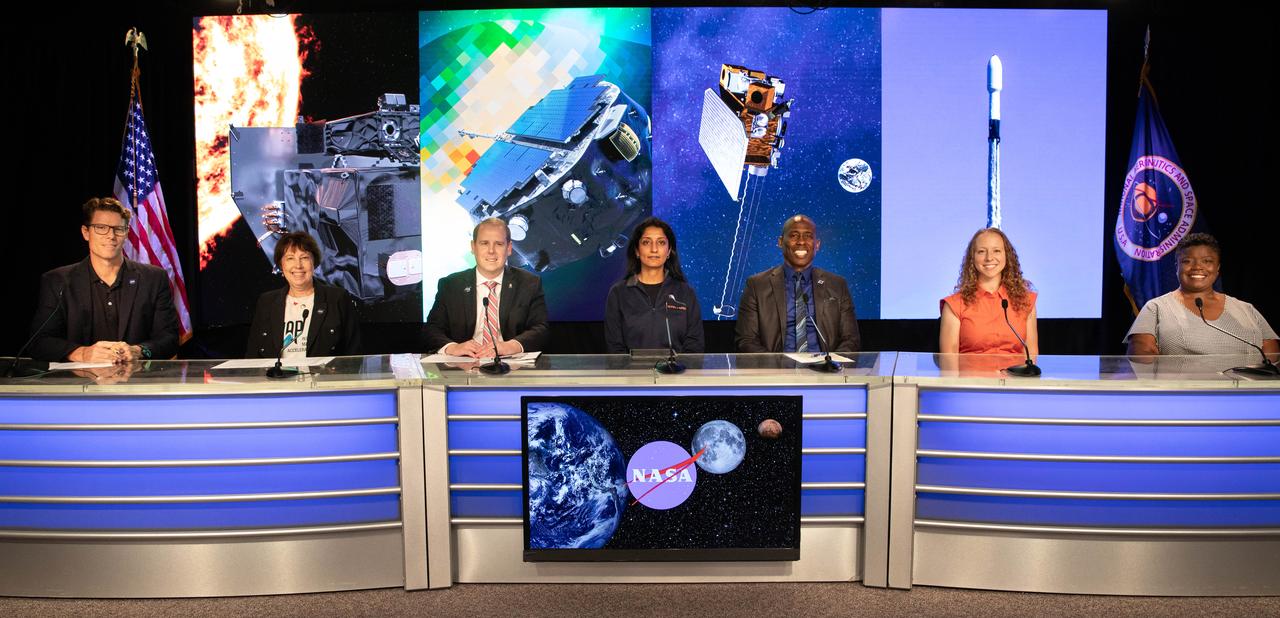
NASA, mission, and partner leaders participate in prelaunch news conference on Sunday, Sept. 21, 2025, at the agency’s Kennedy Space Center in Florida for NASA’s IMAP (Interstellar Mapping and Acceleration Probe) mission. From left are: Derrol Nail, NASA Communications; Nicky Fox, associate administrator, Science Mission Directorate, NASA Headquarters in Washington; Brad Williams, IMAP program executive, NASA Headquarters; Irene Parker, deputy assistant administrator for Systems for NOAA’s National Environmental Satellite, Data, and Information Service; Denton Gibson, launch director, NASA’s Launch Services Program, NASA Kennedy; Julianna Scheiman, director, NASA Science Missions, SpaceX; Arlena Moses, launch weather officer, 45th Weather Squadron, U.S. Space Force. The IMAP mission and its two rideshares – NASA’s exosphere-studying Carruthers Geocorona Observatory and National Oceanic and Atmospheric Administration’s (NOAA) Space Weather Follow On–Lagrange 1 (SWFO-L1) observatory – will orbit the Sun near Lagrange point 1, about one million miles from Earth, where it will scan the heliosphere, analyze the composition of charged particles, and investigate how those particles move through the solar system. Launch is targeted for 7:32 a.m. EDT, Tuesday, Sept. 23, from Launch Complex 39A at NASA Kennedy.
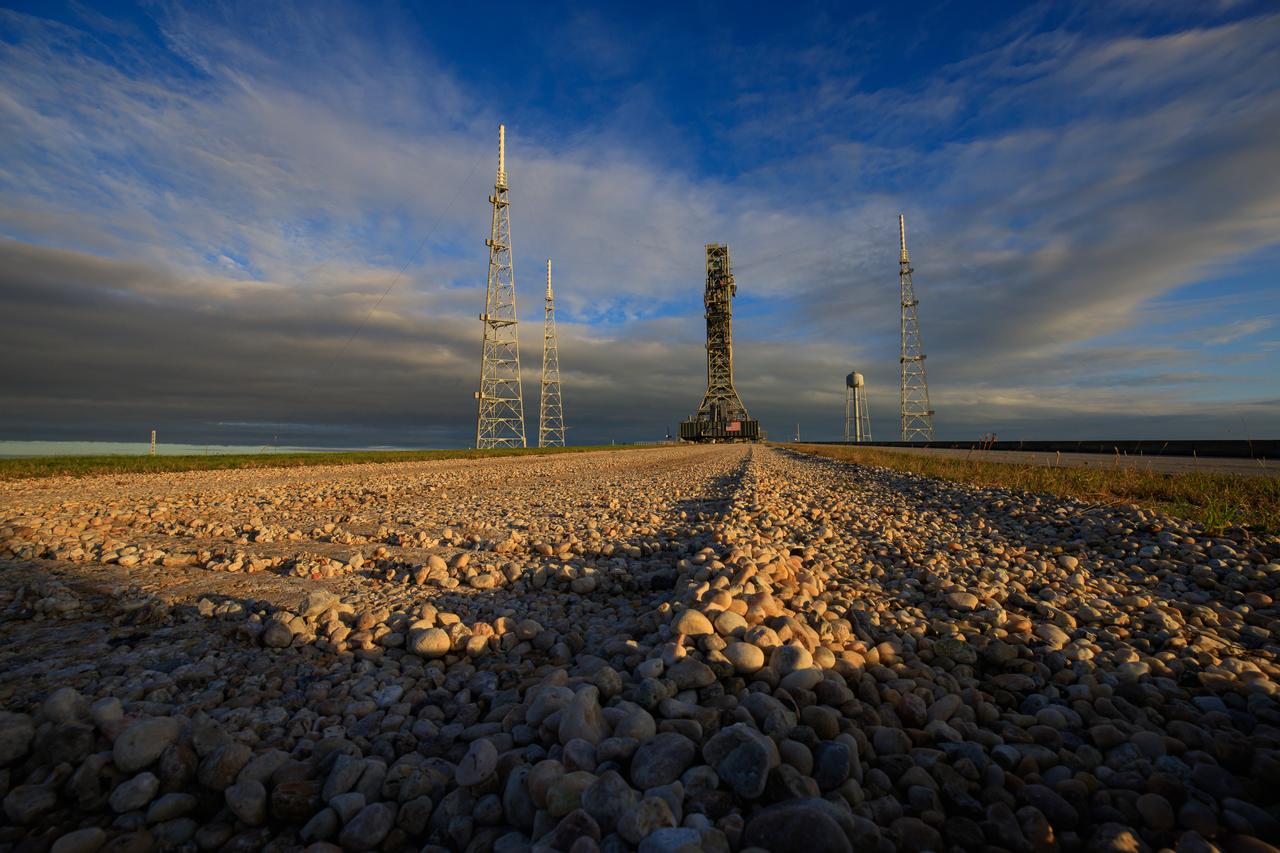
During sunrise on Oct. 30, 2020, the mobile launcher for the Artemis I mission, atop crawler-transporter 2, departs Launch Pad 39B and moves slowly along the crawlerway to return to the Vehicle Assembly Building at NASA’s Kennedy Space Center in Florida. The nearly 400-foot-tall mobile launcher was at the pad for 10 days, while engineers with Exploration Ground Systems and Jacobs performed several tasks, including a timing test to validate the launch team’s countdown timeline, and a thorough, top-to-bottom wash down of the mobile launcher to remove any debris remaining from construction and installation of the umbilical arms. Artemis I will test the Orion spacecraft and Space Launch System as an integrated system ahead of crewed flights to the Moon. Under the Artemis program, NASA will land the first woman and the next man on the Moon in 2024.
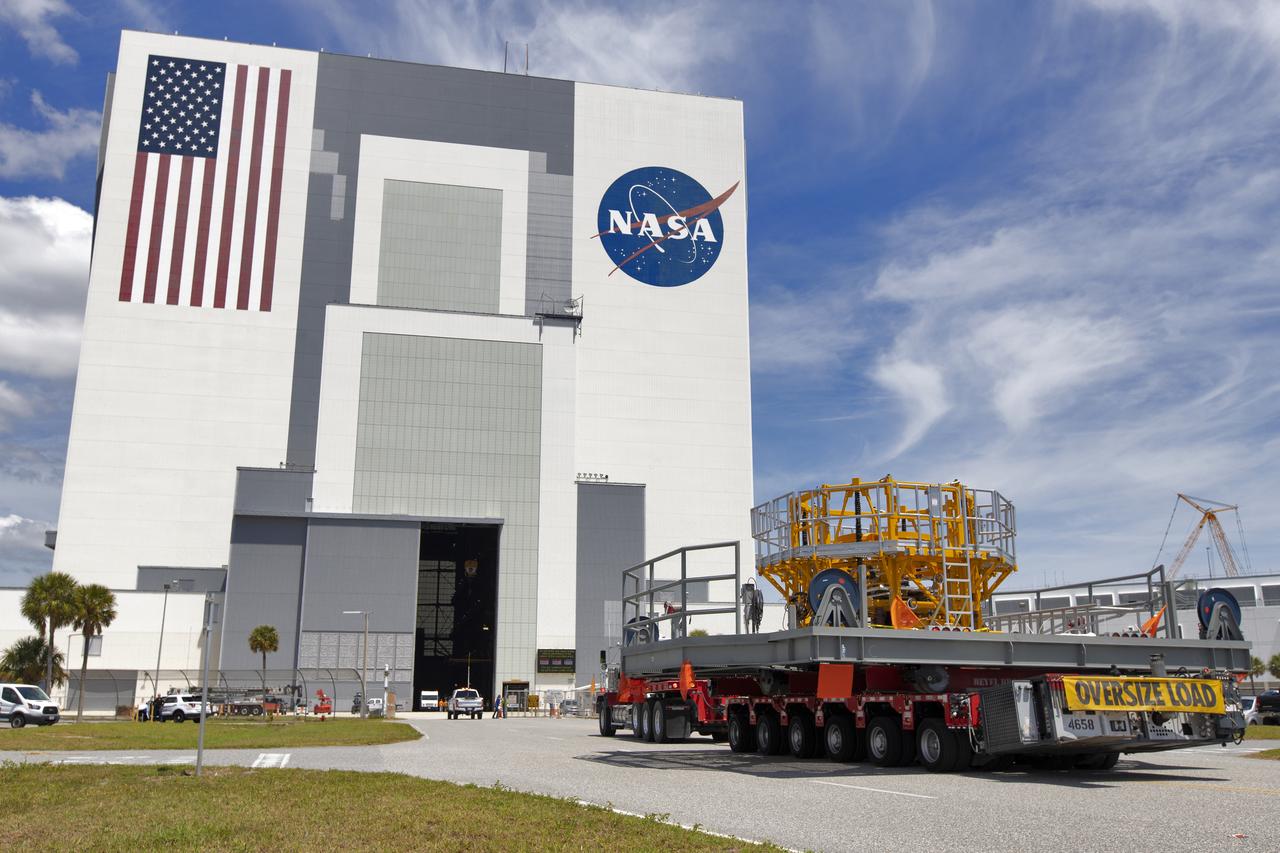
The engine vertical installer for NASA’s Space Launch System (SLS) arrives at the Vehicle Assembly at NASA’s Kennedy Space Center in Florida on April 25, 2019. The engine installer arrived from the manufacturer, Precision Fabrication and Cleaning in Canaveral Groves, Florida. The new ground support equipment will be ready for preflight processing in the event one of the four RS-25 engines on the core stage of the SLS rocket needs to be replaced. During launch of the SLS and Orion spacecraft, the four core stage engines will provide the thrust needed to lift the rocket and Orion spacecraft off Launch Pad 39B at Kennedy for Exploration Mission-1. The uncrewed Orion will travel on a three-week test mission thousands of miles beyond the Moon and back to Earth for a splashdown in the Pacific Ocean.
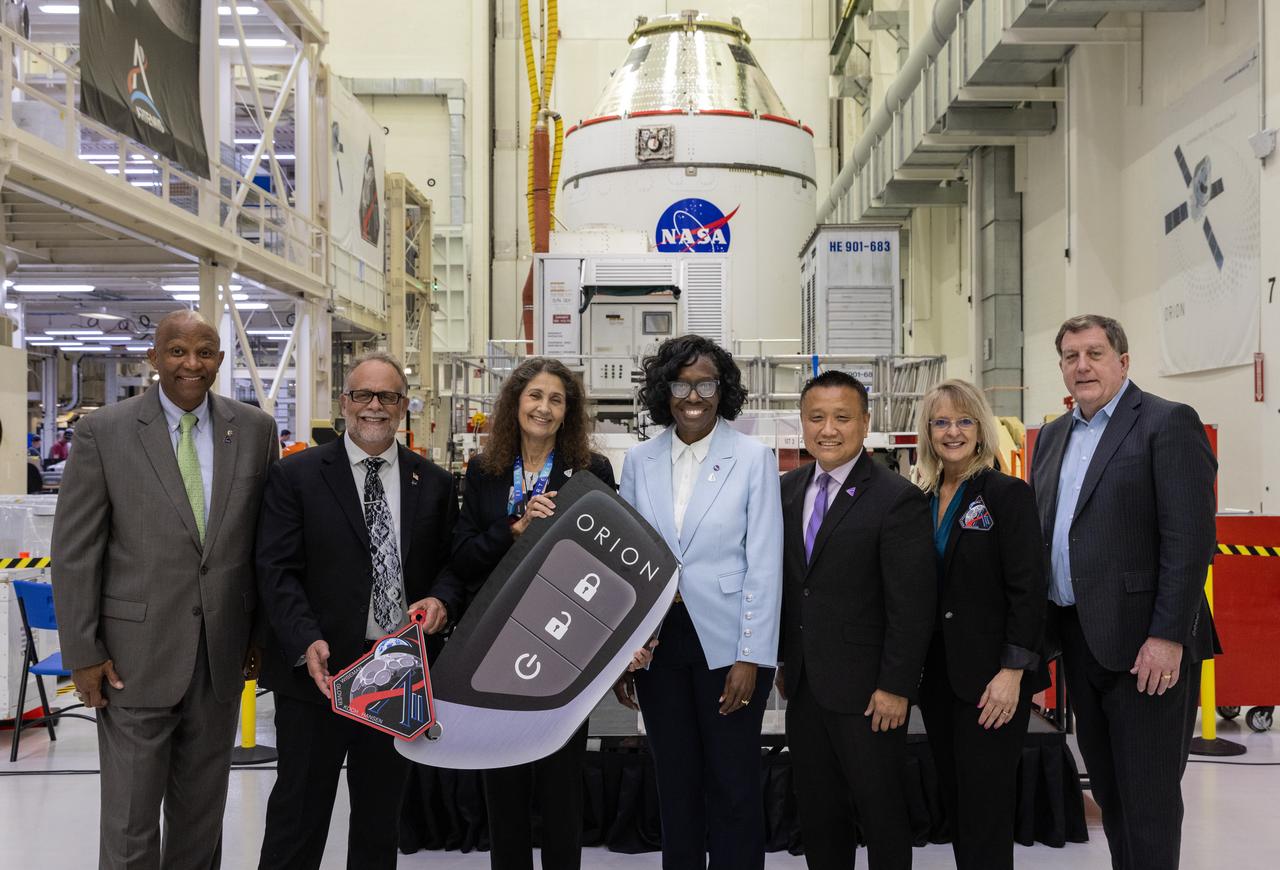
From left, Kelvin Manning, acting center director, NASA’s Kennedy Space Center; Shawn Quinn, Exploration Ground Systems program manager; Lorna Kenna, Amentum Vice President and program manager; Lakiesha Hawkins, assistant deputy associate administrator, Moon to Mars Program office; Howard Hu, Orion program manager; Debbie Korth, Orion deputy program manager; Keith Shireman Lockheed Martin Vice President of Lunar Exploration Campaign, participate in a handover ceremony of NASA’s Artemis II Orion spacecraft to crews with the agency’s Exploration Ground Systems Program at the Neil A. Armstrong Operations and Checkout Building at NASA’s Kennedy Space Center in Florida on Thursday, May 1, 2025. The spacecraft will be transported to the Multi-Payload Processing Facility to undergo fueling and processing for prelaunch operations. The Artemis II test flight is the first crewed flight under NASA’s Artemis campaign and is another step toward missions on the lunar surface and helping the agency prepare for future human missions to Mars.
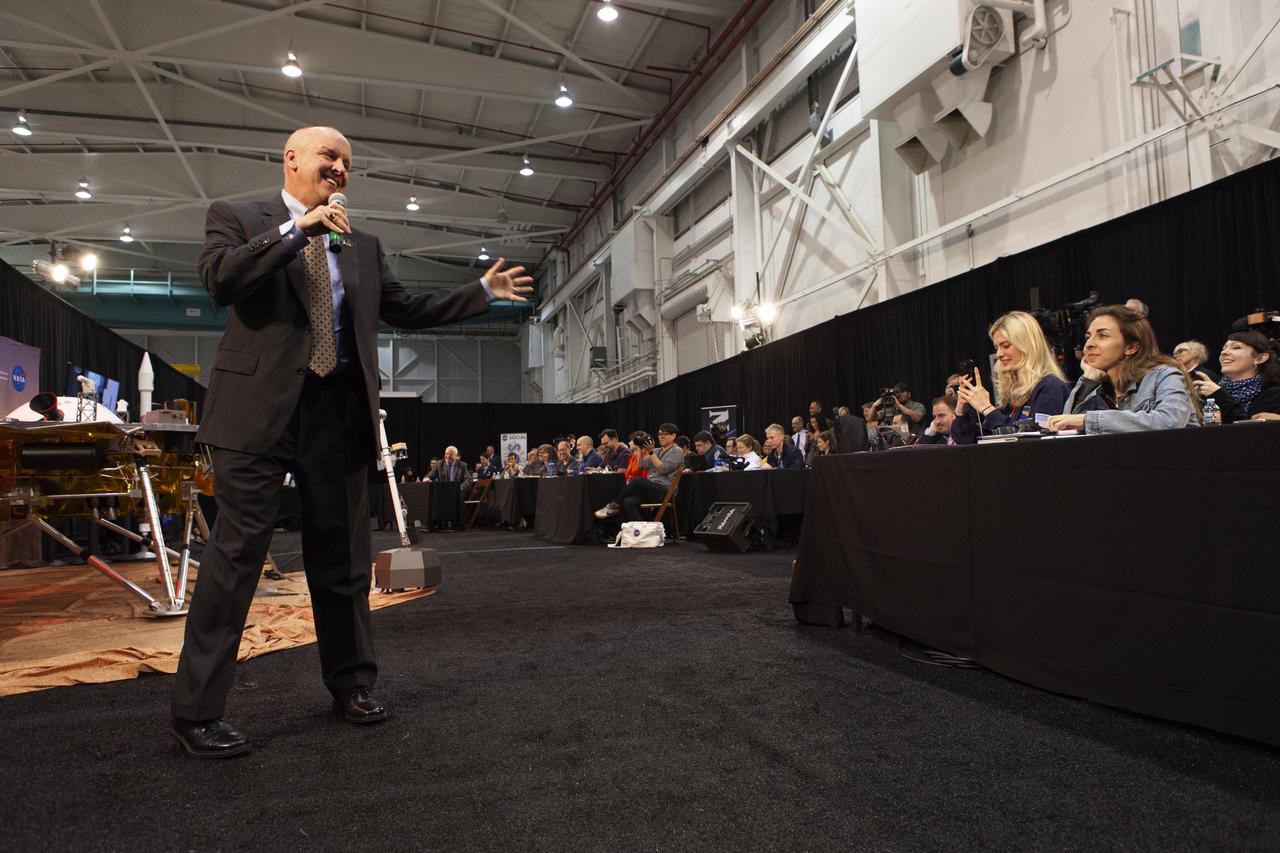
During a prelaunch briefing at Vandenberg Air Force Base in California, Tim Dunn, Launch Director for NASA's Launch Services Program, speaks to members of the media. The presentation focused on NASA's Interior Exploration using Seismic Investigations, Geodesy and Heat Transport, or InSight, Mars lander. InSight is scheduled for liftoff May 5, 2018, atop a United Launch Alliance (ULA) Atlas V rocket from Space Launch Complex 3 at Vandenberg. The spacecraft will be the first mission to look deep beneath the Martian surface studying the planet's interior by measuring its heat output and listen for marsquakes.

Technicians with NASA and Lockheed Martin operate a 30-ton crane to move NASA’s Artemis II Orion spacecraft out of the Final Assembly and System Testing cell inside the Neil A. Operations and Checkout Building at NASA’s Kennedy Space Center in Florida on Saturday, Feb. 22, 2025. The move prepares for the upcoming installation of four solar array wings and spacecraft adapter jettison fairings for the agency’s first crewed flight test under the Artemis campaign.
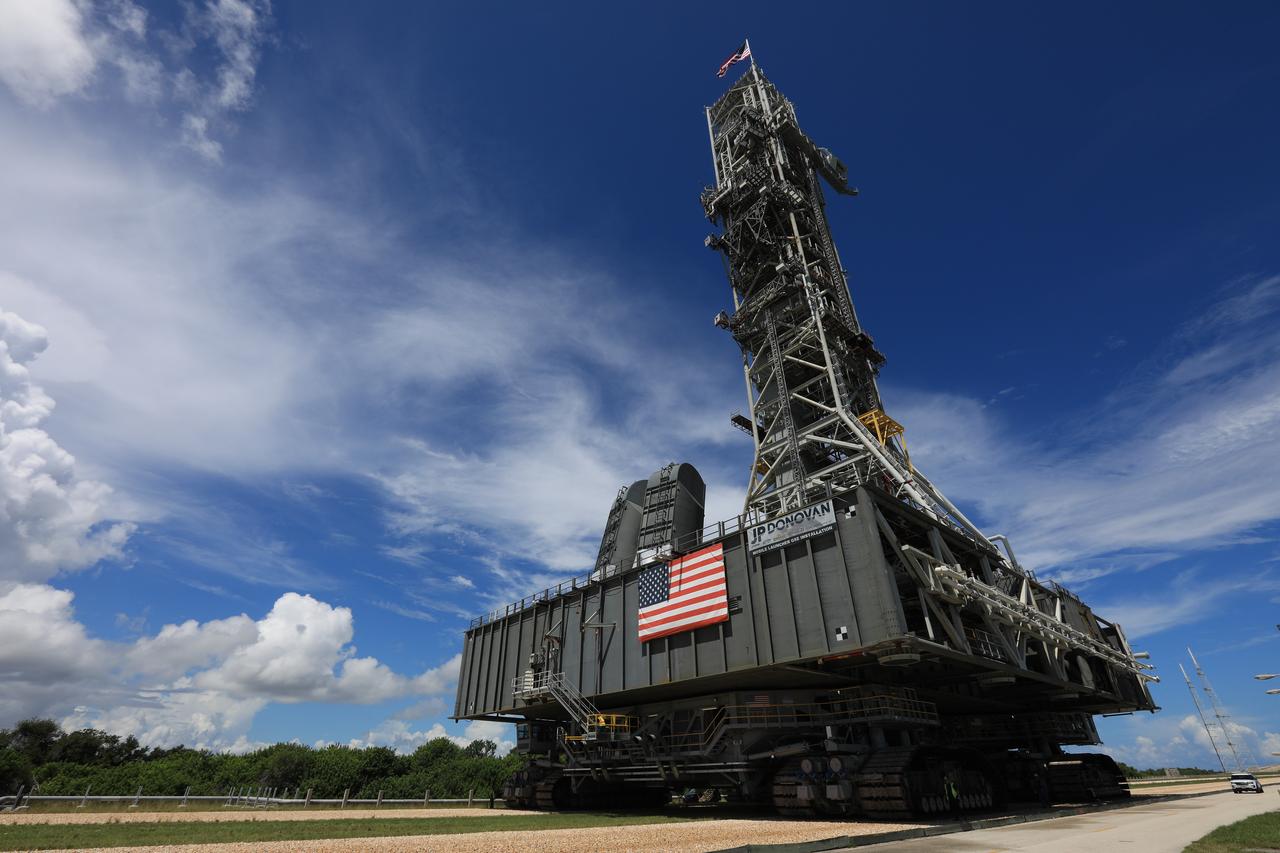
NASA's mobile launcher atop crawler-transporter 2 travels slowly along the crawlerway on Sept. 7, 2018, on its way to the Vehicle Assembly Building at NASA's Kennedy Space Center in Florida. The 380-foot-tall mobile launcher is equipped with the crew access arm and several umbilicals that will provide power, environmental control. Pneumatics, communication and electrical connections to the agency's Space Launch System and Orion spacecraft. Exploration Ground Systems is preparing the ground systems necessary to launch SLS and Orion on Exploration Mission-1, missions to the Moon and on to Mars.
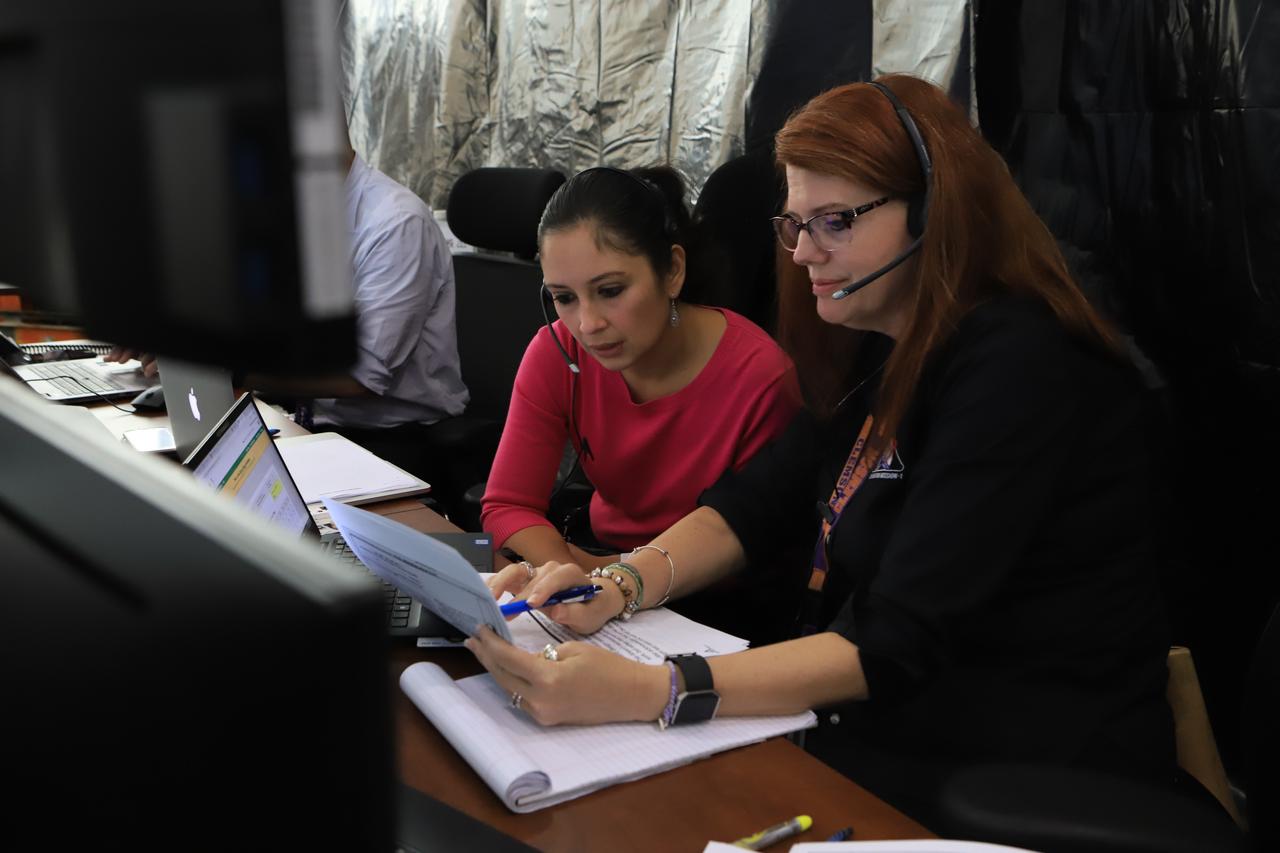
Charlie Blackwell-Thompson, right, Exploration Mission-1 (EM-1) launch director, reviews procedures during a countdown demonstration event of cryogenic propellant loading April 12, 2019, inside Firing Room 2 in the Launch Control Center at NASA’s Kennedy Space Center in Florida. The practice simulation involved loading of liquid hydrogen and liquid oxygen into the Space Launch System rocket’s core and upper stages to prepare for EM-1. During the tanking exercise, the team worked through surprise issues in real-time. The practice countdown events are training opportunities coordinated by Blackwell-Thompson with Exploration Ground Systems.
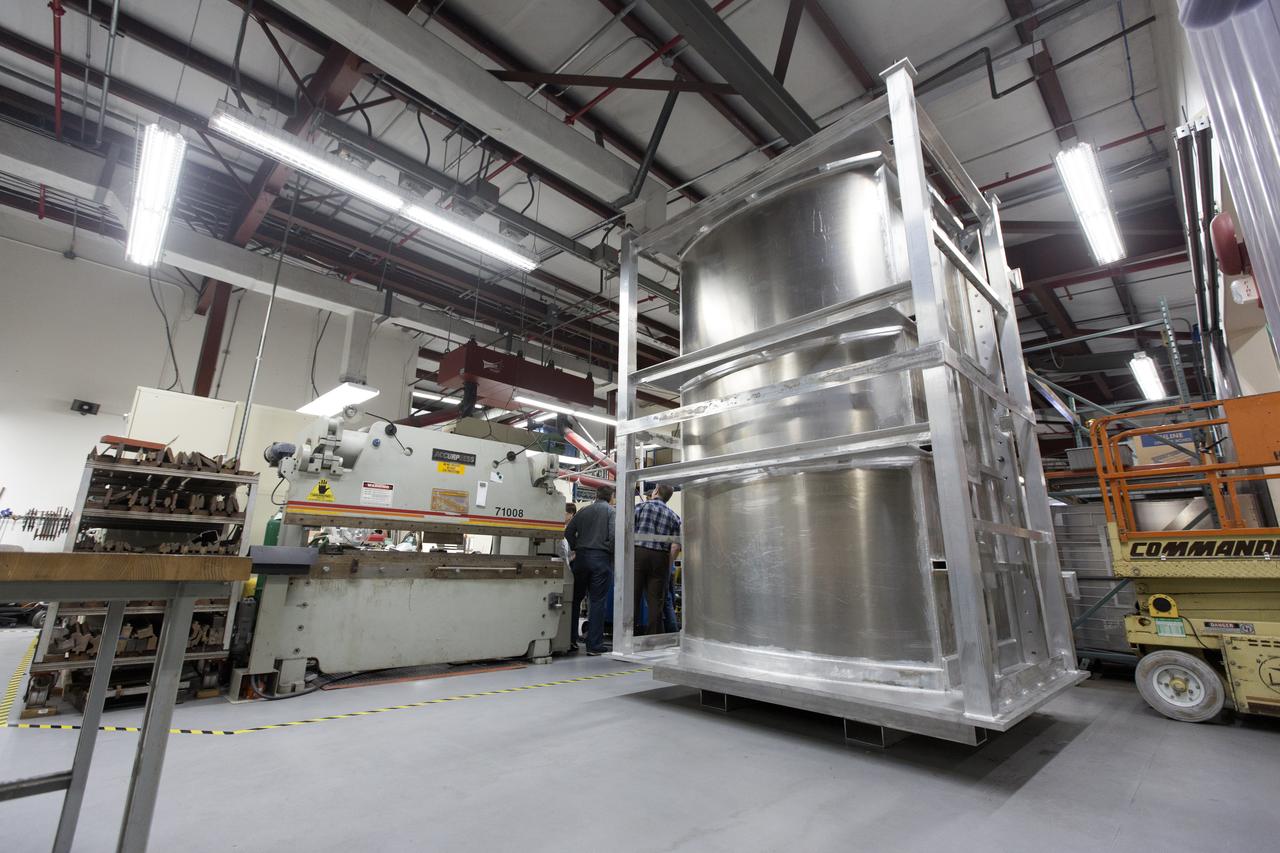
A liquid oxygen test tank was completed in the Prototype Development Laboratory at NASA's Kennedy Space Center in Florida. A banner signing event marked the successful delivery of the tank called Tardis. Engineers and technicians worked together to develop the tank and build it at the lab to support cryogenic testing at Johnson Space Center's White Sands Test Facility in Las Cruces, New Mexico. The 12-foot-tall, 3,810-pound aluminum tank will be shipped to White Sands for testing.
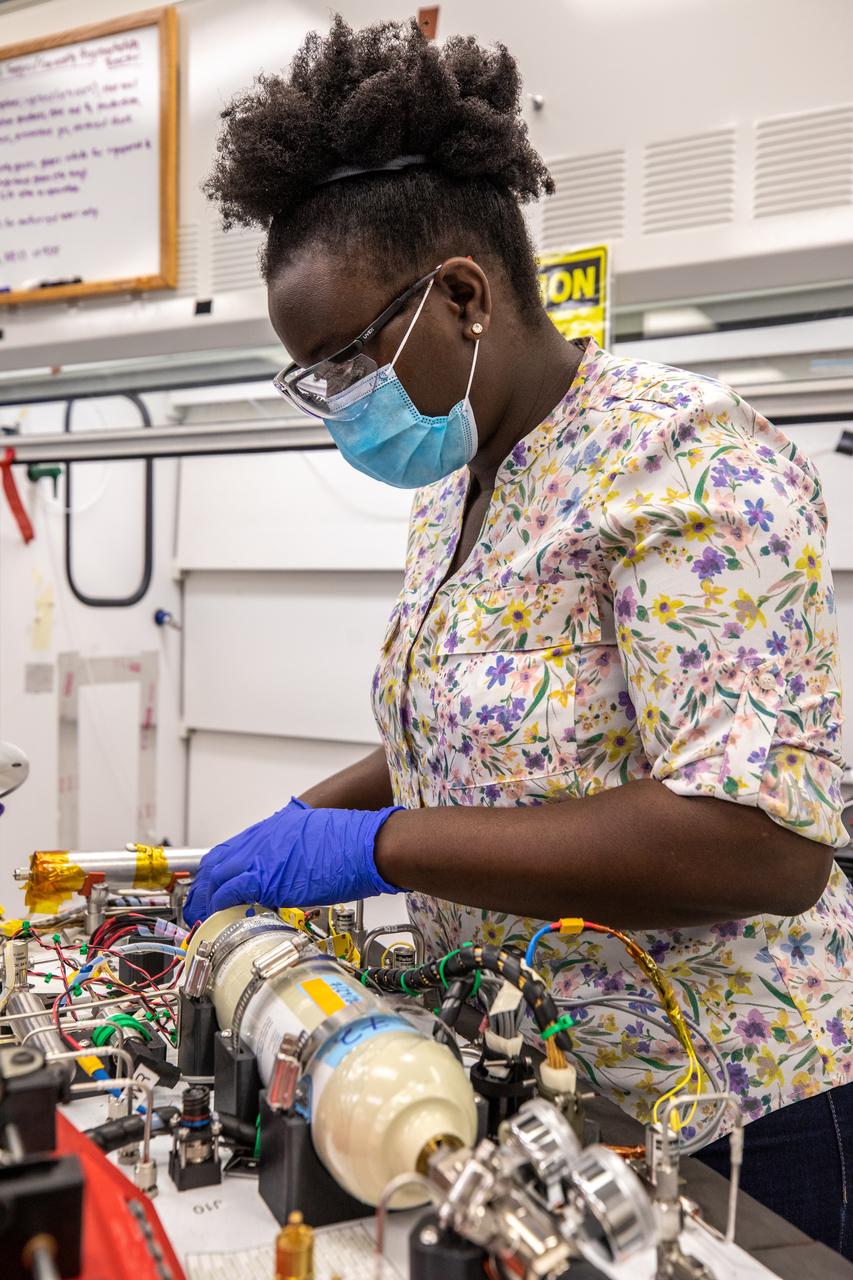
Technicians wearing protective equipment perform work for a future mission on flight hardware for NASA’s Orbital Syngas Commodity Augmentation Reactor, or OSCAR, at the Neil Armstrong Operations and Checkout Facility at the agency’s Kennedy Space Center in Florida on Aug. 10, 2020. OSCAR began as an Early Career Initiative project at the spaceport that studies technology to convert trash and human waste into useful gasses such as methane, hydrogen, and carbon dioxide. By processing small pieces of trash in a high-temperature reactor, OSCAR is advancing new and innovative technology for managing waste in space.

Veteran NASA astronauts James Buchli and Janet Kavandi were inducted into the U.S. Astronaut Hall of Fame in a public ceremony at Kennedy Space Center Visitor Complex in the Space Shuttle Atlantis attraction on April 6, 2019.
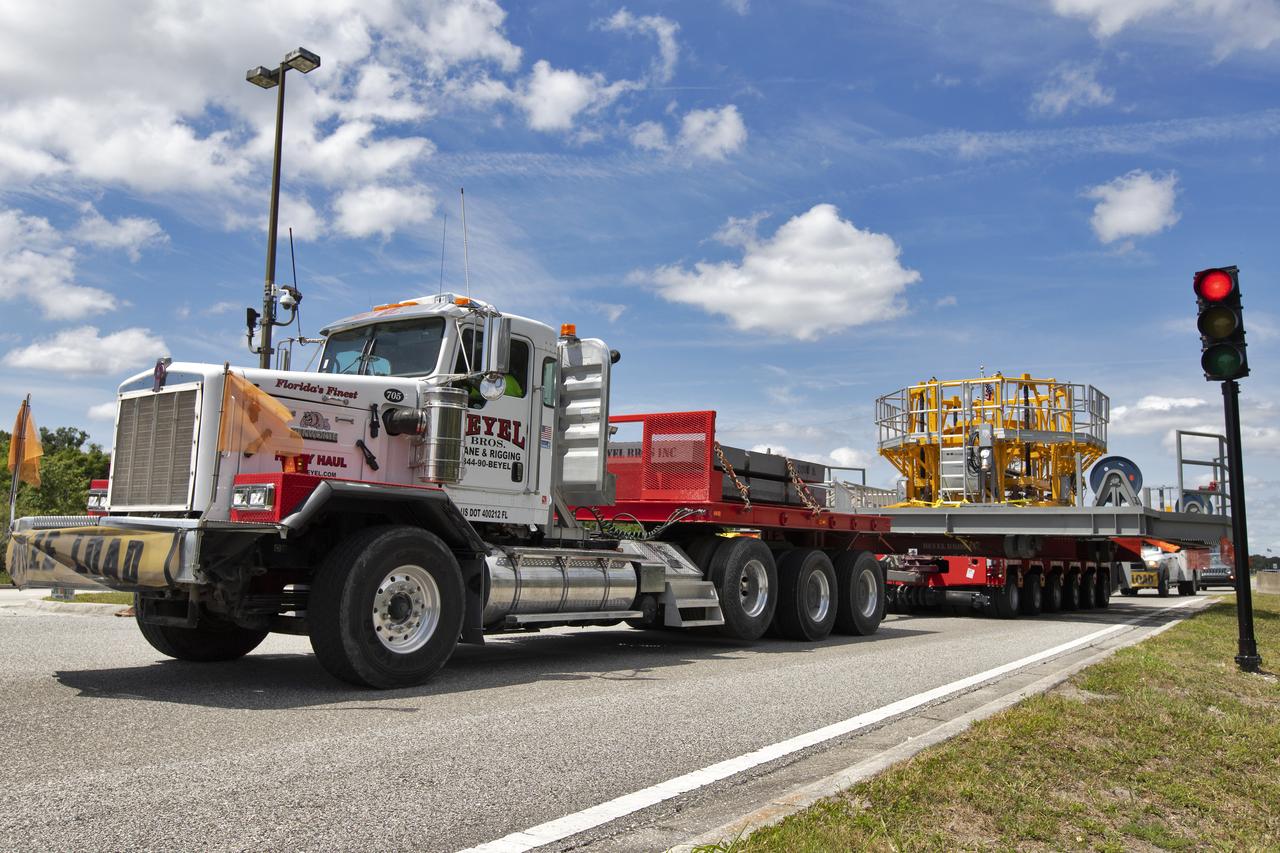
The engine vertical installer for NASA’s Space Launch System (SLS) arrives by large transport truck at NASA’s Kennedy Space Center in Florida on April 25, 2019. The engine installer arrived from the manufacturer, Precision Fabrication and Cleaning in Canaveral Groves, Florida. The new ground support equipment will be delivered to the Vehicle Assembly where it will be ready for preflight processing in the event one of the four RS-25 engines on the core stage of the SLS rocket needs to be replaced. During launch of the SLS and Orion spacecraft, the four core stage engines will provide the thrust needed to lift the rocket and Orion spacecraft off Launch Pad 39B at Kennedy for Exploration Mission-1. The uncrewed Orion will travel on a three-week test mission thousands of miles beyond the Moon and back to Earth for a splashdown in the Pacific Ocean.
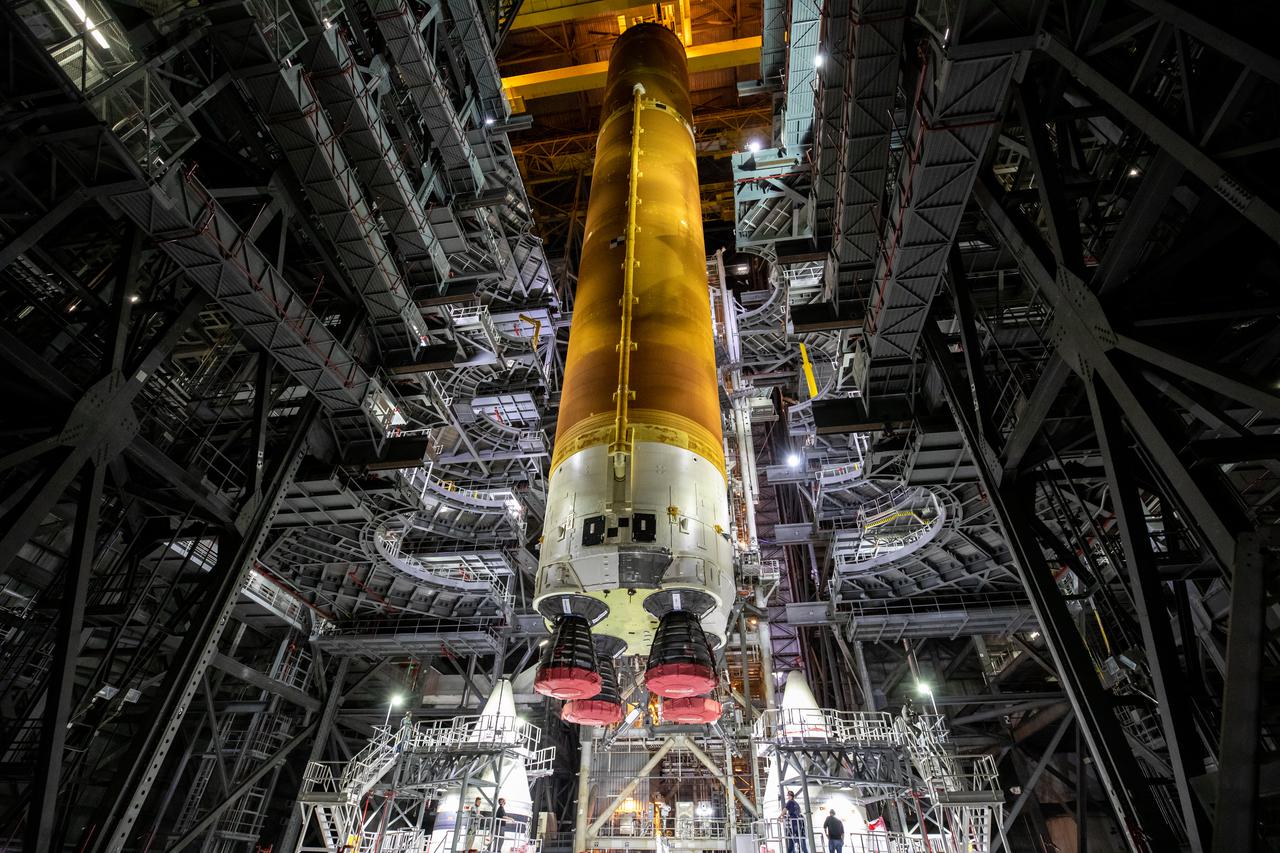
Teams with NASA’s Exploration Ground Systems and contractor Jacobs prepare to lower the Space Launch System (SLS) core stage – the largest part of the rocket – onto the mobile launcher, in between the twin solid rocket boosters, inside High Bay 3 of the Vehicle Assembly Building at NASA’s Kennedy Space Center in Florida on June 12, 2021. The 188,000-pound core stage, with its four RS-25 engines, will provide more than 2 million pounds of thrust during launch and ascent, and coupled with the boosters, will provide more than 8.8 million pounds of thrust to send the Artemis I mission to space. Under the Artemis program, NASA will land the first woman and first person of color on the Moon, as well as establish a sustainable presence on the lunar surface in preparation for human missions to Mars.
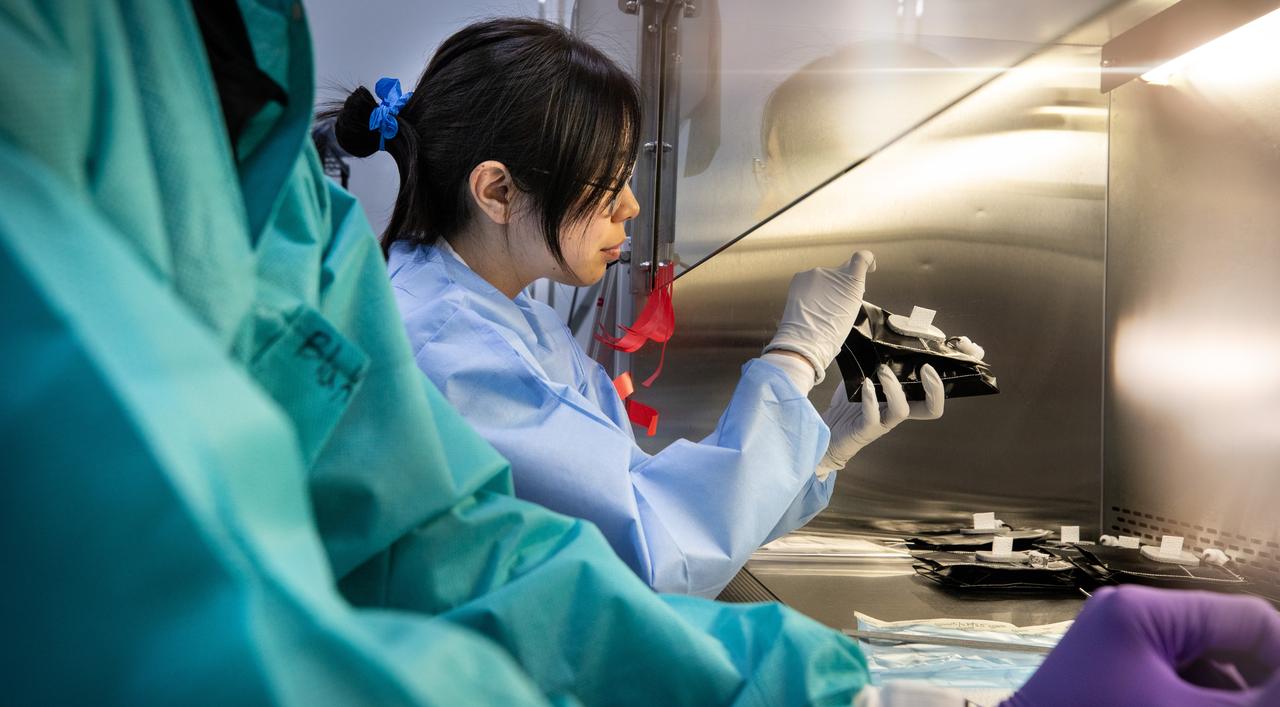
A member of the space crop production team pours substrate and controlled release fertilizer into a Veggie plant pillow on Thursday, May 29, 2025, inside the Space Systems Processing Facility at NASA’s Kennedy Space Center in Florida. The plant pillows, along with Veg-03 MNO seed films, which will carry seeds of Red Russian kale, Wasabi mustard greens, and Dragoon lettuce, are set to fly aboard NASA’s SpaceX Crew-11 mission to the International Space Station to grow in the space environment to study how microgravity impacts crop development compared to ground-grown plants. Seed films enable seed handling and planting of seeds into plant pillows allowing for astronaut choice of crops to grow. Plants can provide whole food nutrition, improve menu variety, and positively impact behavioral health of astronauts on long duration missions to the Moon and Mars and space crop research aboard the orbiting laboratory is enabled by NASA’s Biological and Physical Sciences Division and the International Space Station Program.
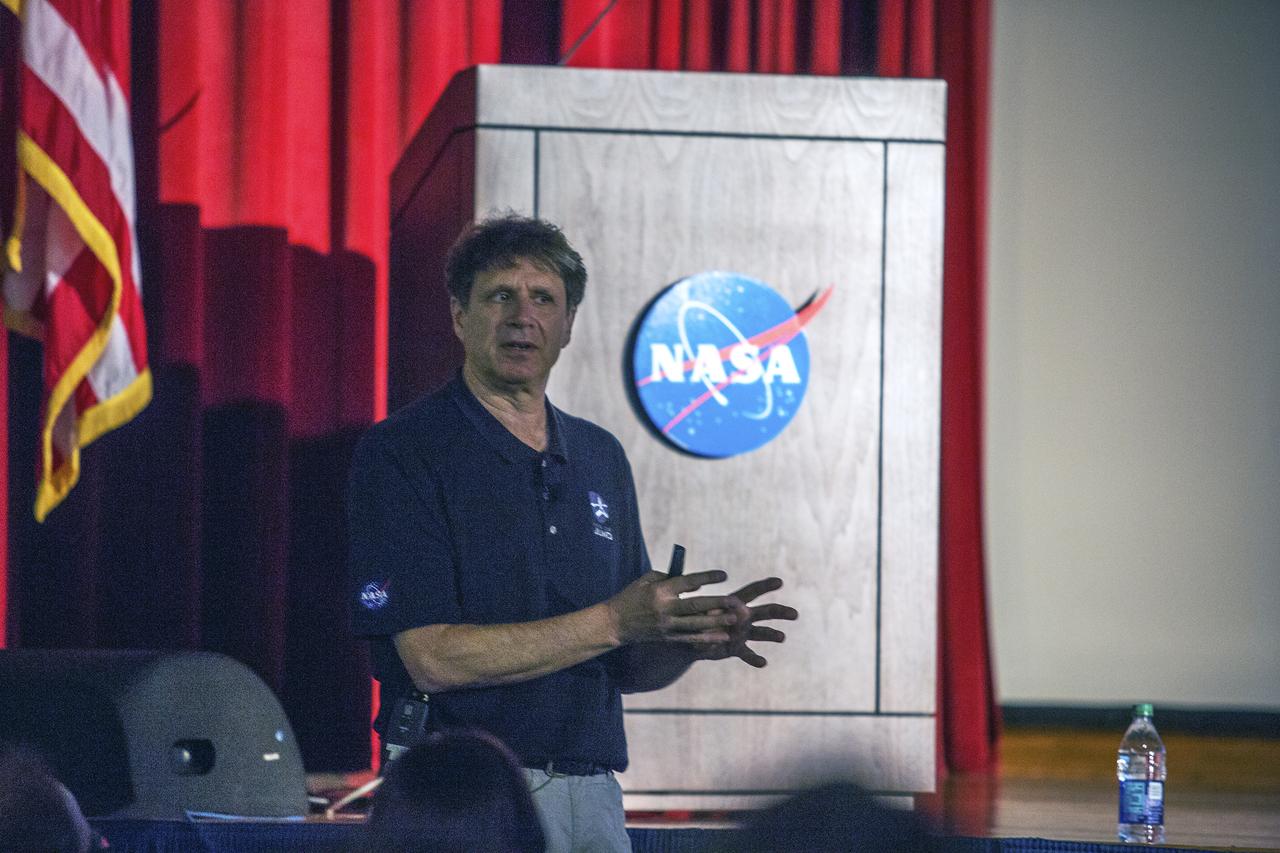
Scott Bolton briefs employees at NASA’s Kennedy Space Center on the progress of the Juno mission to the planet Jupiter. Bolton is the principal investigator for Juno at the Southwest Research Institute in San Antonio, Texas. NASA’s Launch Services Program, which is based at Kennedy, led the successful launch of the Juno spacecraft aboard a United Launch Alliance Atlas V rocket Aug. 5, 2011 from nearby Space Launch Complex 41. Juno arrived at Jupiter on July 4, 2016, and will study our solar system’s largest planet until February 2018. Photo credit: NASA/Cory Huston
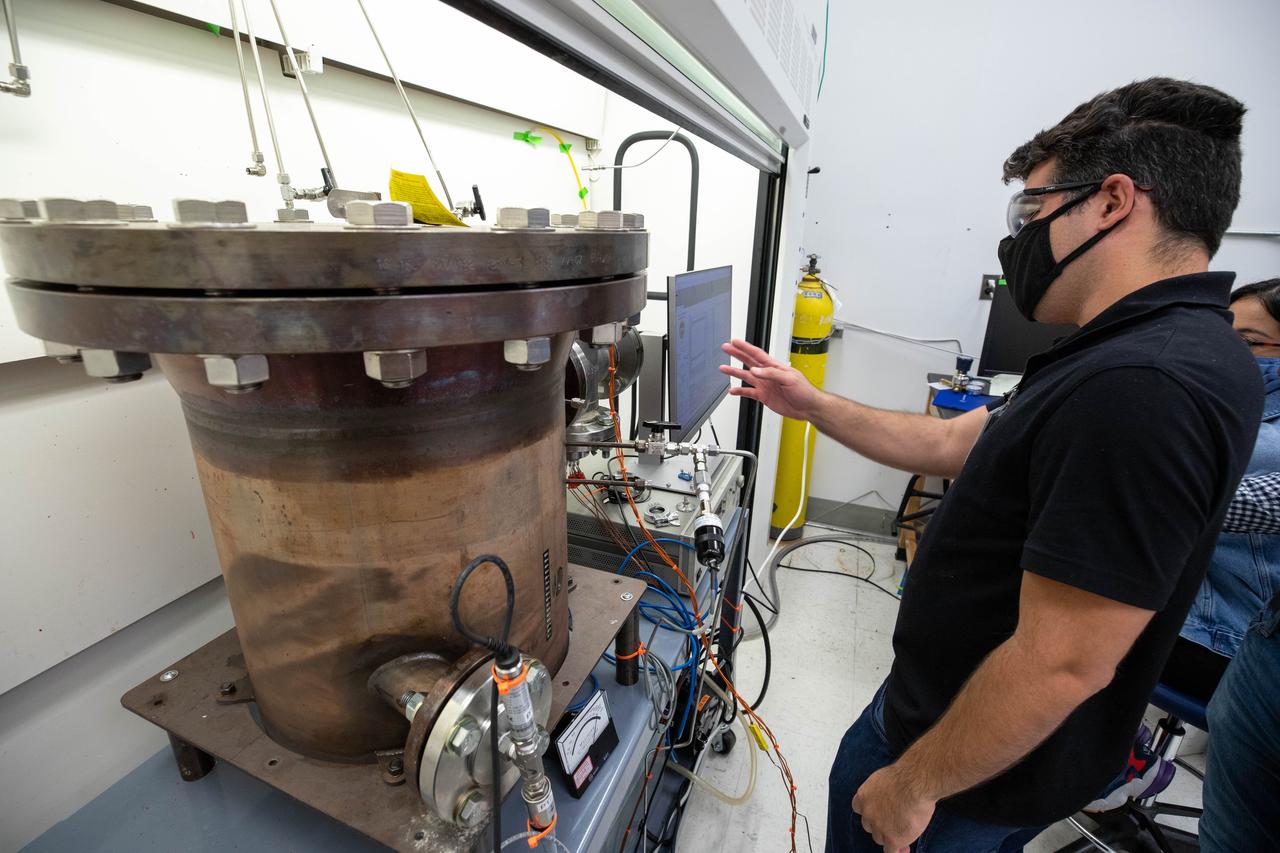
Jaime Toro, a mechanical engineer supporting the Gaseous Lunar Oxygen from Regolith Electrolysis (GaLORE) project at NASA’s Kennedy Space Center in Florida, checks the hardware that will be used to melt lunar regolith – dirt and dust on the Moon made from crushed rock – simulants during a test inside a laboratory at Kennedy’s Neil Armstrong Operations and Checkout Building on Oct. 29, 2020. GaLORE was selected as an Early Career Initiative project by the agency’s Space Technology Mission directorate, and the team was tasked with developing a device that could melt lunar regolith and turn it into oxygen. As NASA prepares to land the first woman and the next man on the Moon in 2024 as part of the Artemis program, technology such as this can assist with sustainable human lunar exploration and long-duration missions to Mars.
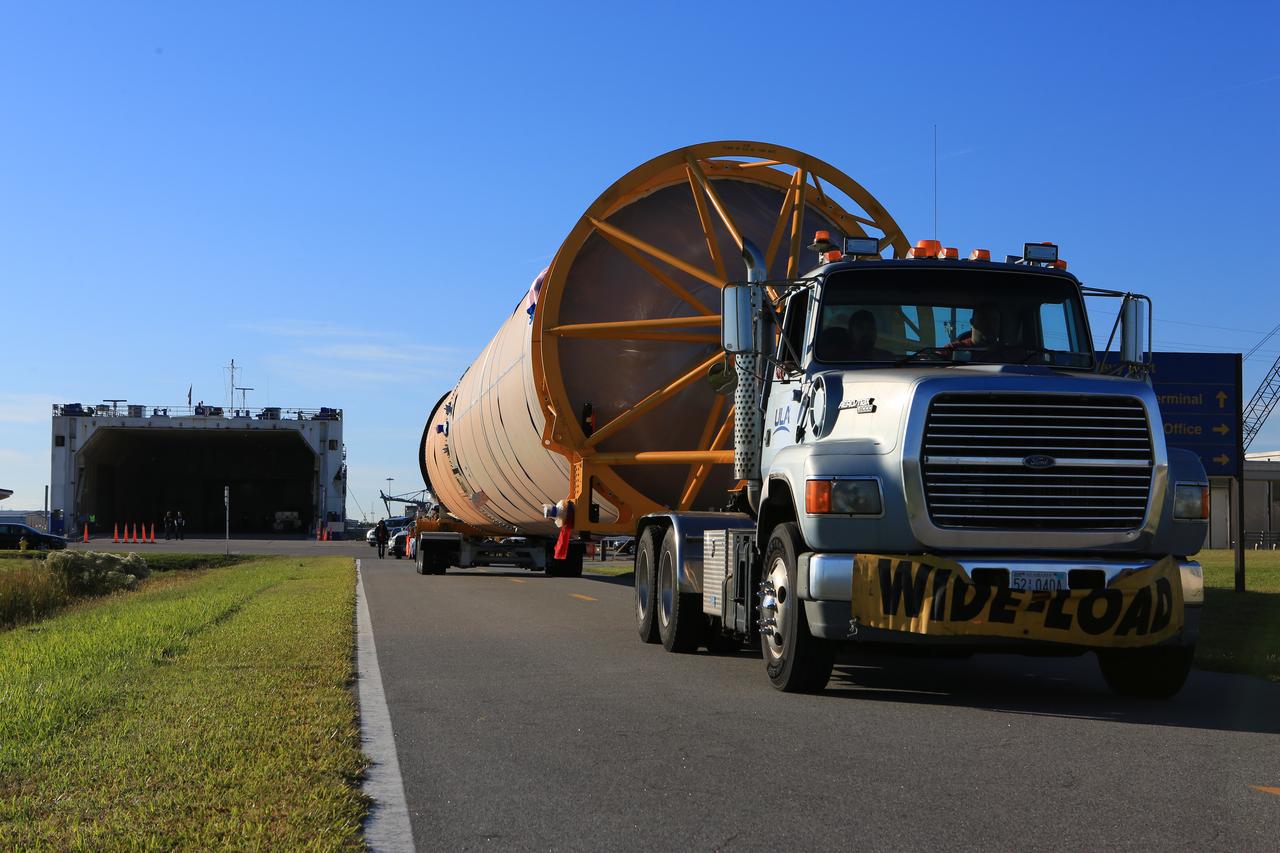
The first stage of the rocket that will launch Boeing's CST-100 Starliner spacecraft to the International Space Station on the company's uncrewed Orbital Flight Test arrives at Cape Canaveral Air Force Station in Florida on Dec. 7, 2018. The United Launch Alliance (ULA) Atlas V first stage booster was shipped aboard ULA's Mariner cargo vessel from the company's manufacturing plant in Decatur, Alabama. It is the final piece of hardware that ULA needs to launch the first Boeing Starliner. The booster will be transported to the Atlas Spaceflight Operations Center for receiving inspections and checkout.
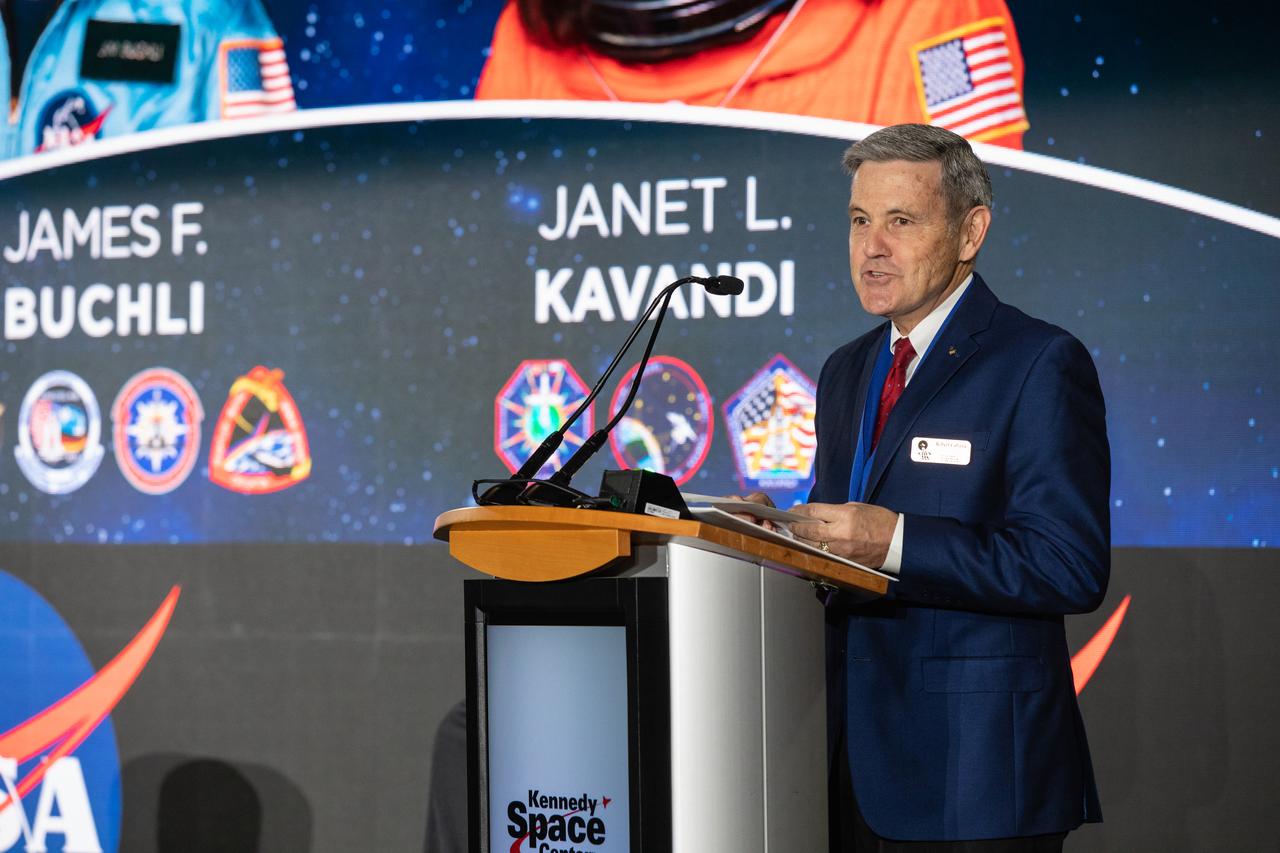
Veteran NASA astronauts James Buchli and Janet Kavandi were inducted into the U.S. Astronaut Hall of Fame in a public ceremony at Kennedy Space Center Visitor Complex in the Space Shuttle Atlantis attraction on April 6, 2019.

Teams with NASA’s Exploration Ground Systems and contractor Jacobs lower the Space Launch System (SLS) core stage – the largest part of the rocket – onto the mobile launcher, in between the twin solid rocket boosters, inside High Bay 3 of the Vehicle Assembly Building at NASA’s Kennedy Space Center in Florida on June 12, 2021. The 188,000-pound core stage, with its four RS-25 engines, will provide more than 2 million pounds of thrust during launch and ascent, and coupled with the boosters, will provide more than 8.8 million pounds of thrust to send the Artemis I mission to space. Under the Artemis program, NASA will land the first woman and first person of color on the Moon, as well as establish a sustainable presence on the lunar surface in preparation for human missions to Mars.
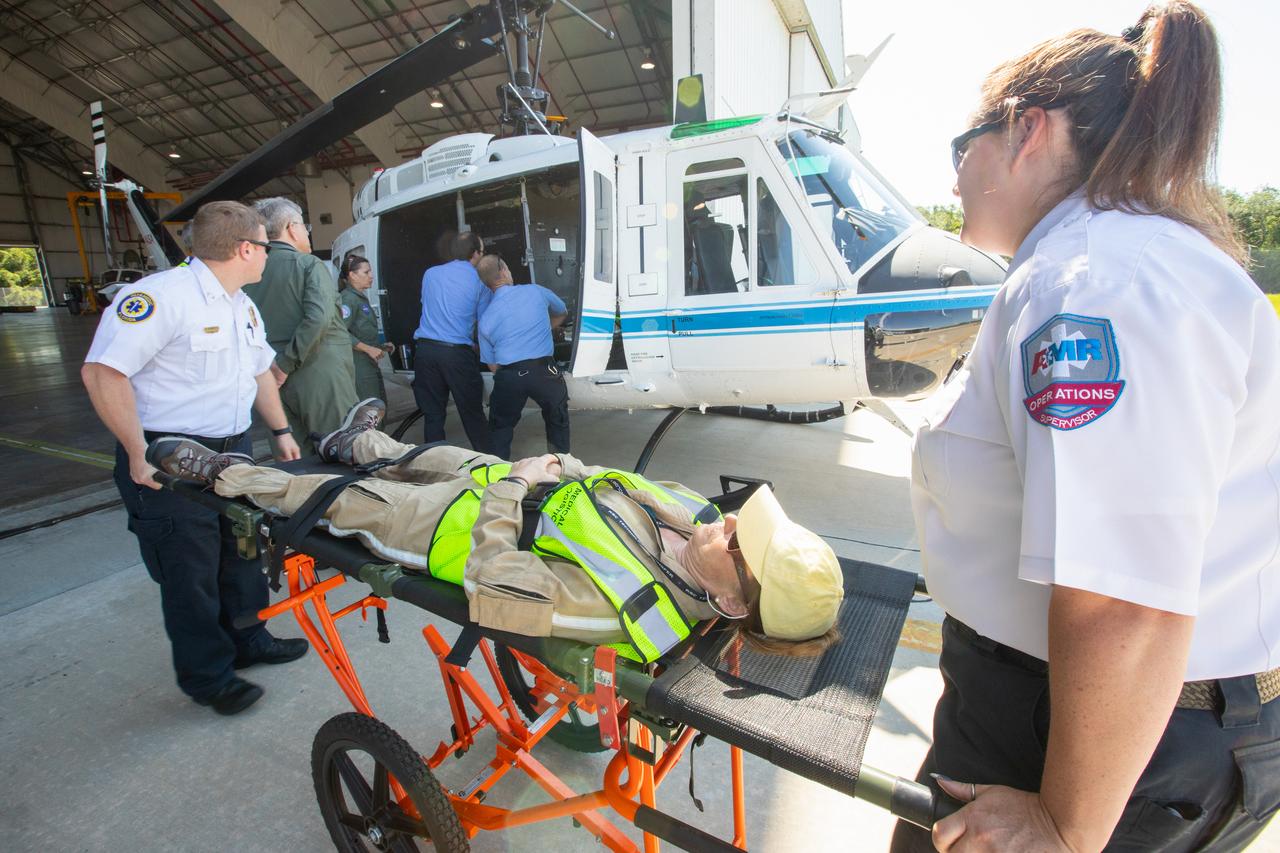
Kennedy Space Center personnel and American Medical Response (AMR) contractor paramedics prepare to load a “patient,” a KEMCON Fitness Center staff member, into a NASA helicopter during a medical support training course in the Space Florida hangar at the spaceport’s Shuttle Landing Facility on May 17, 2019. The course was designed to familiarize the AMR paramedics with the center’s Triage Forces deployment, which included medical team members, fire/rescue personnel, environmental health specialists and flight operations crew members, as well as a helicopter, Mine Resistant Ambush Protected (MRAP) tactical vehicle, fire pumper truck and triage vehicles. The AMR paramedics will assist the agency in contingency planning for the return of human spaceflight from Kennedy.
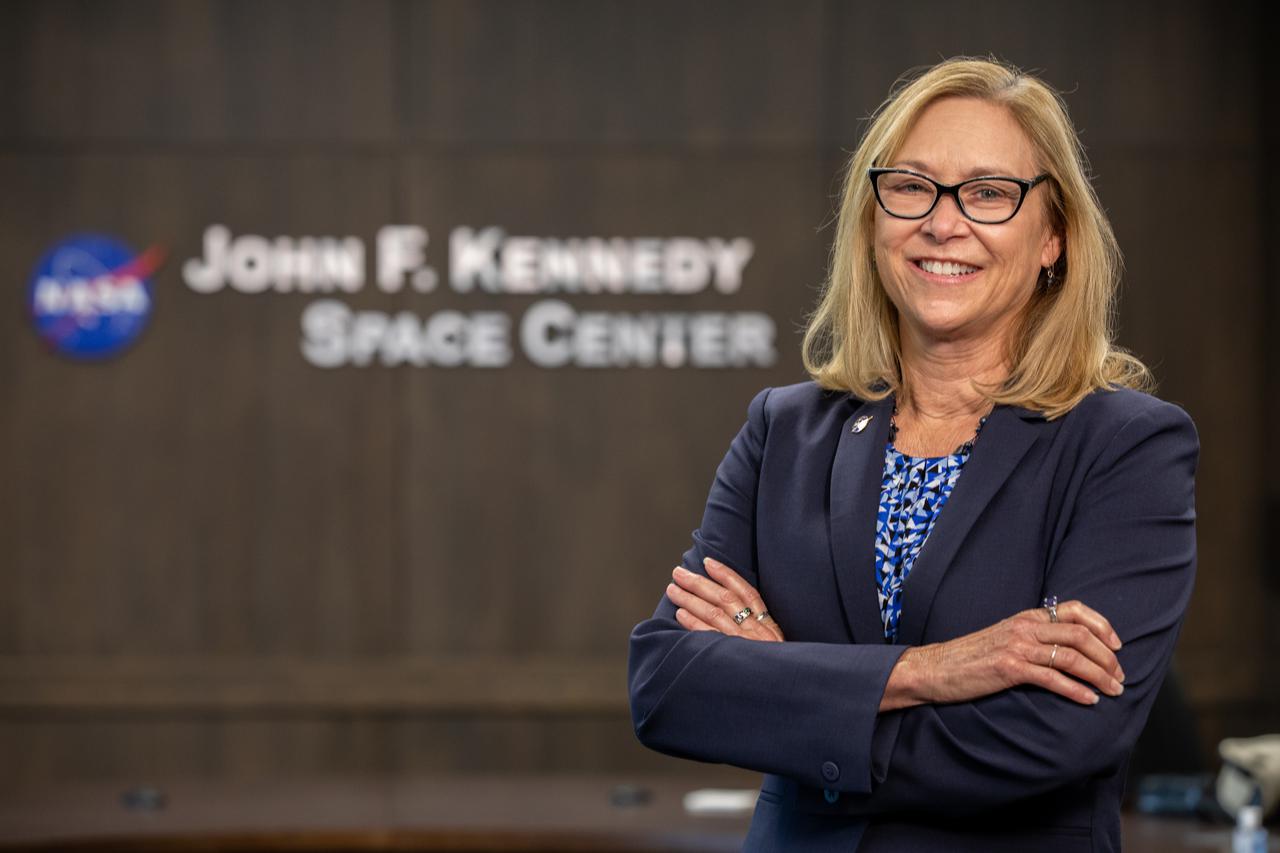
NASA Kennedy Space Center Director Janet Petro.
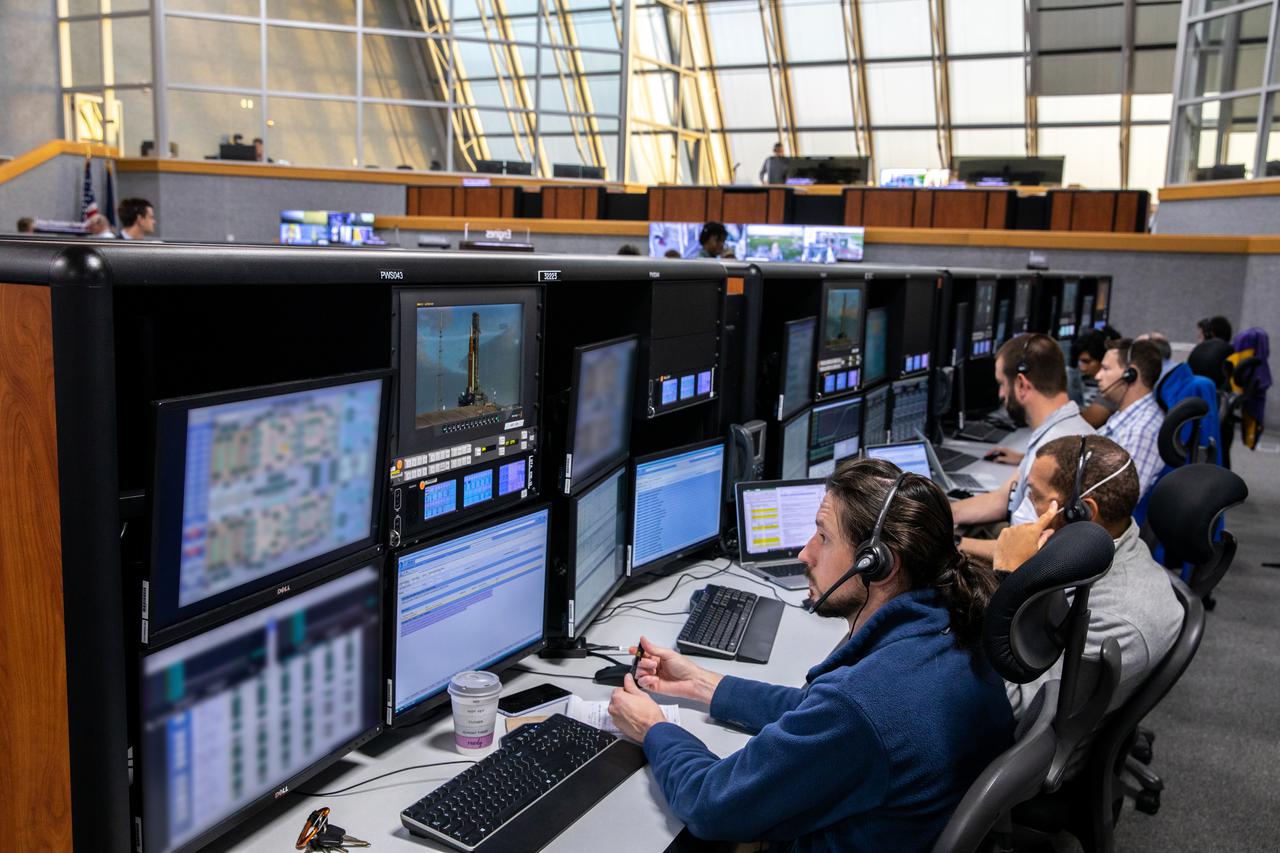
Members of the Artemis I launch team participate in a wet dress rehearsal for the Artemis I mission on April 14, 2022, inside the Launch Control Center at NASA’s Kennedy Space Center in Florida. The wet dress rehearsal is the final major test before launch and allows the team to run through all countdown operations prior to liftoff. The first in an increasingly complex series of missions, Artemis I will test NASA’s Space Launch System rocket and Orion spacecraft as an integrated system prior to crewed flights to the Moon.
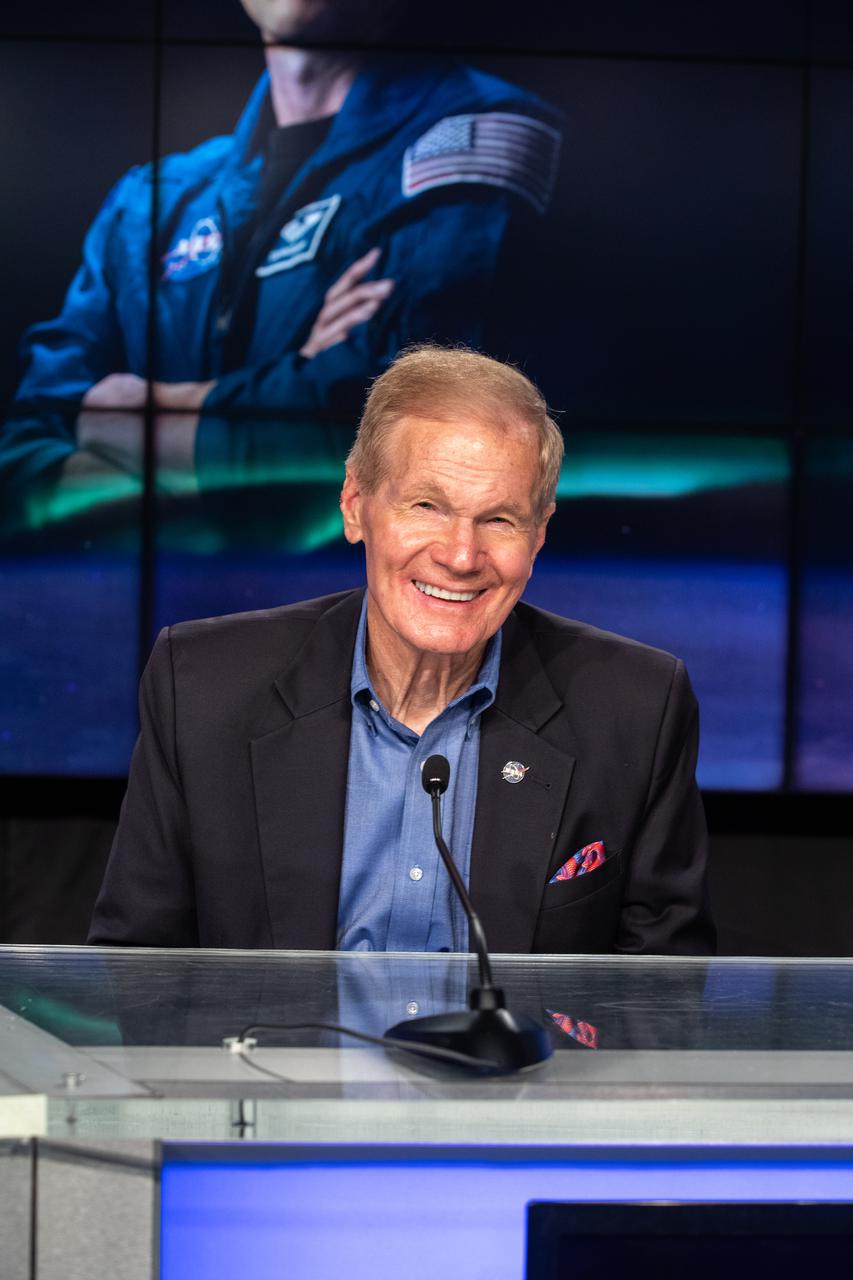
NASA Administrator Bill Nelson speaks during a briefing for the upcoming SpaceX Crew-3 mission at the agency’s Kennedy Space Center in Florida on Oct. 29, 2021. The SpaceX Falcon 9 with Crew Dragon atop is scheduled to launch Oct. 31 at 2:21 a.m. EDT from Launch Complex 39A at Kennedy. Crew Dragon will carry four astronauts to the International Space Station for NASA’s Commercial Crew Program. Crew-3 is the third crew rotation flight to the space station, and the first flight of a new Crew Dragon spacecraft.
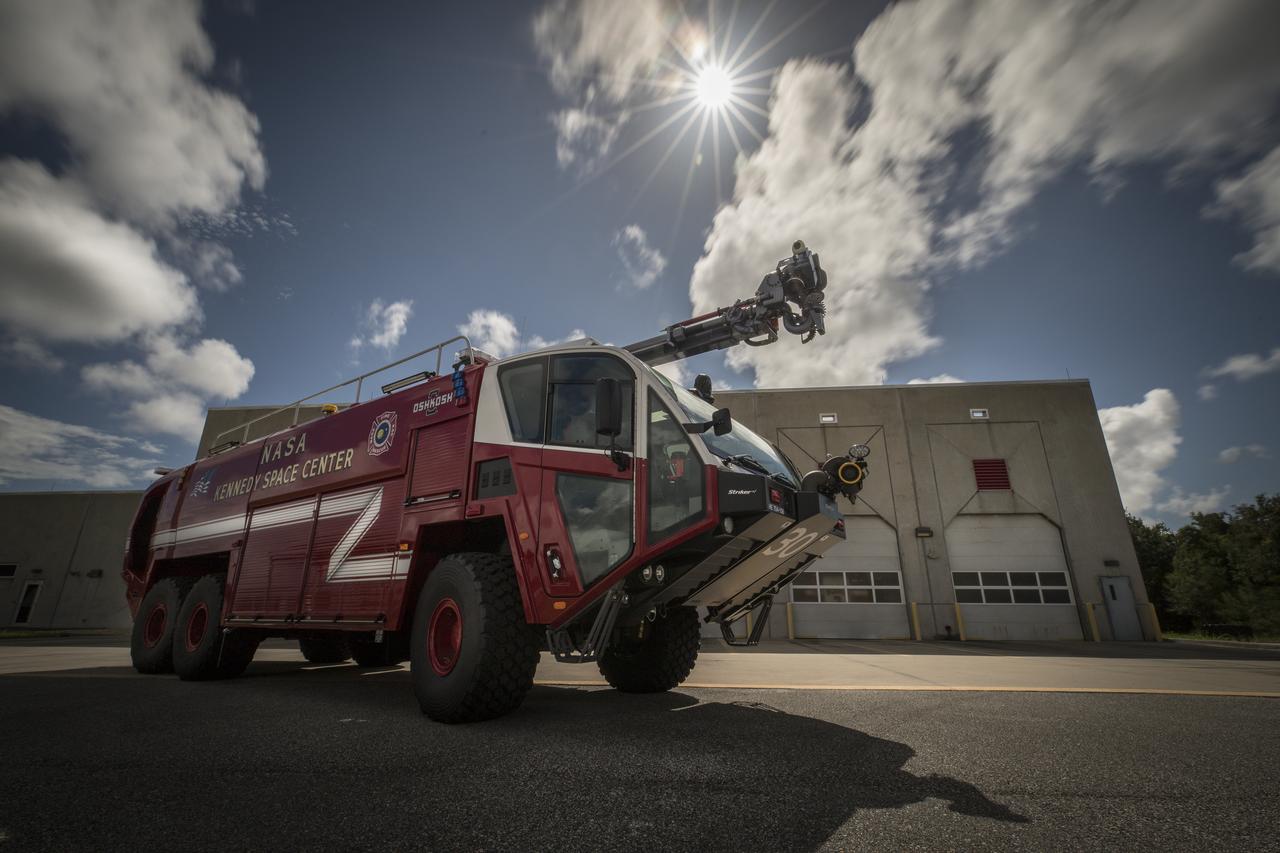
A new Aircraft Rescue and Fire Fighting vehicle is photographed in front of Fire Station No. 2 near the Shuttle Landing Facility runway at NASA’s Kennedy Space Center in Florida. The state-of-the-art truck replaces a 28-year-old vehicle. Kennedy is upgrading its fleet of emergency vehicles to enhance its safety and security posture at the growing, multi-user spaceport.
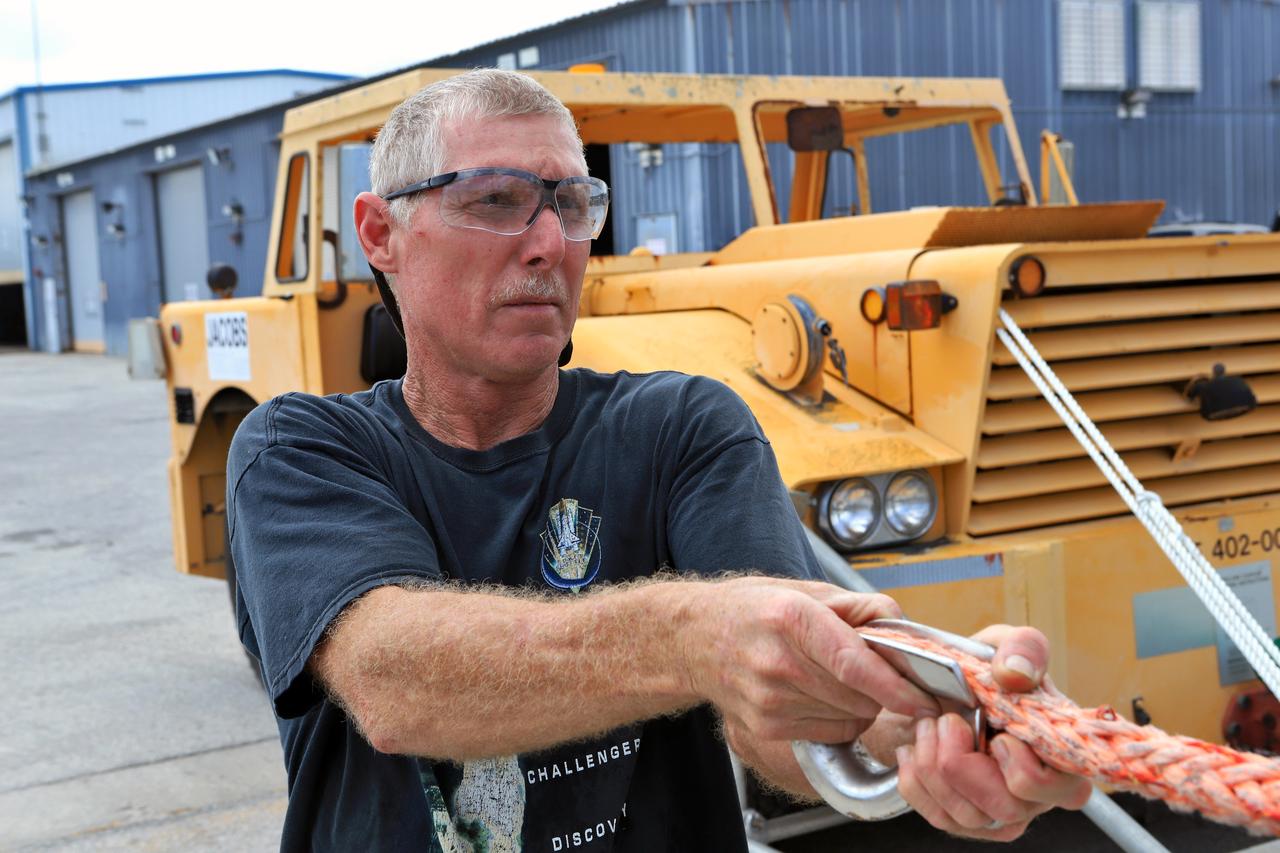
Orion Landing and Recovery team member John Stirling, with Jacobs, practices using a winch to prepare for Underway Recovery Test 7 ( URT-7) on Sept. 5, 2018, in the heavy equipment yard at NASA's Kennedy Space Center in Florida. During URT-7, the recovery team, including Exploration Ground Systems and the U.S. Navy, will practice recovering a test version of the Orion crew module in the Pacific Ocean, off the coast of California, and guiding it into the well deck of a ship. Over several days, the team will demonstrate and evaluate new recovery processes, procedures, hardware and personnel in open waters. Orion is the exploration spacecraft designed to carry astronauts to deep space destinations, including the Moon and on to Mars. Orion will have emergency abort capability, sustain the crew during space travel and provide safe re-entry from deep space return velocities.

The second of two Tail Service Mast Umbilicals (TSMU), at left, is lowered for installation on the 0-level deck of the mobile launcher on July 27, at NASA's Kennedy Space Center in Florida. The 35-foot-tall umbilical will connect to NASA's Space Launch System (SLS) rocket core stage aft section and provide liquid hydrogen and electrical cable connections to the core stage engine section to support propellant handling during prelaunch operations. In view at right is the TSMU that will provide liquid oxygen and electrical cable connections to the core stage engine section. The installation brings Exploration Ground Systems one step closer to supporting prelaunch operations for the agency's SLS rocket and Orion spacecraft on Exploration Mission-1 and deep space destinations.
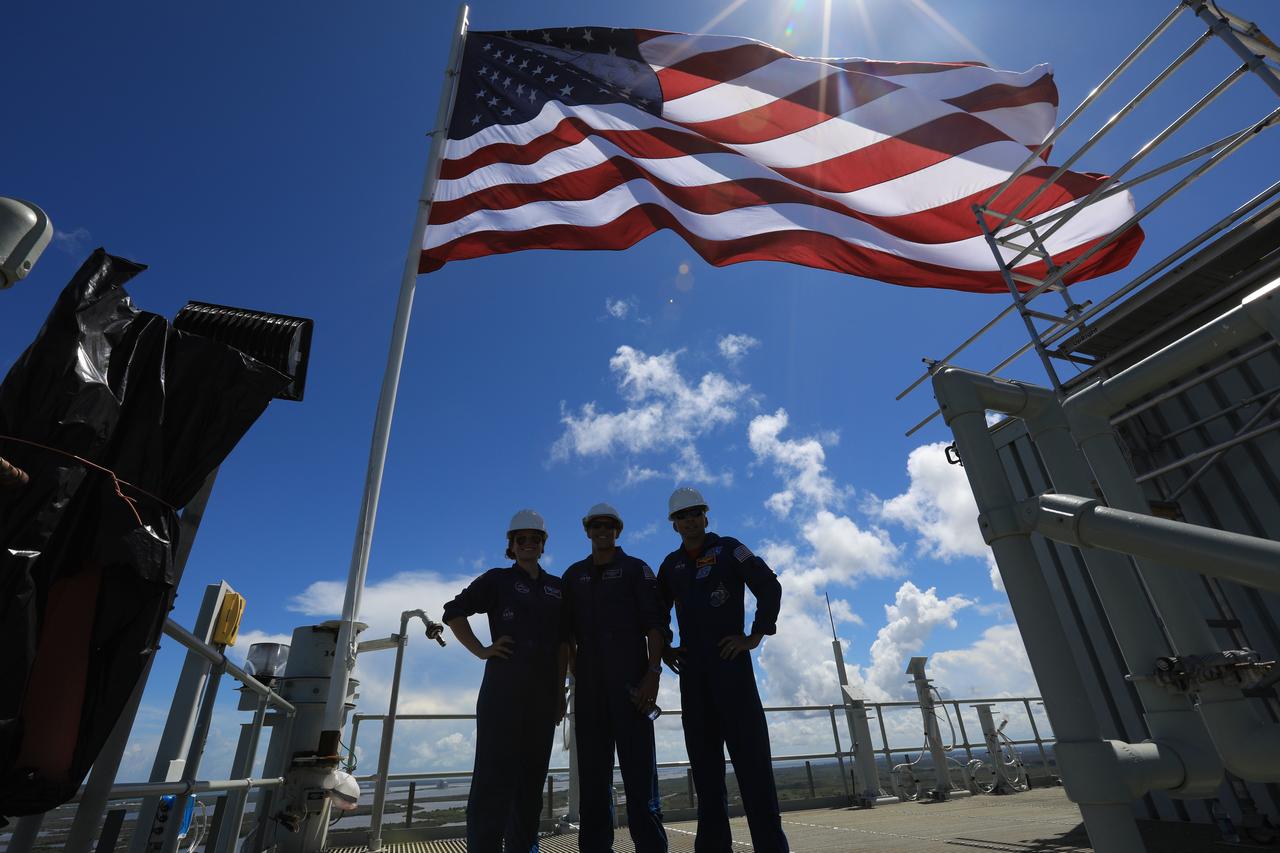
NASA's mobile launcher atop crawler-transporter 2 travels slowly along the crawlerway on Sept. 7, 2018, on its way to the Vehicle Assembly Building at NASA's Kennedy Space Center in Florida. During a portion of the trek, several NASA astronauts were aboard the mobile launcher for a bird’s eye view. The 380-foot-tall mobile launcher is equipped with the crew access arm and several umbilicals that will provide power, environmental control. Pneumatics, communication and electrical connections to the agency's Space Launch System and Orion spacecraft. Exploration Ground Systems is preparing the ground systems necessary to launch SLS and Orion on Exploration Mission-1, missions to the Moon and on to Mars.

NASA interns Jessica Scotten, left, and Ayla Grandpre water plants in the Veggie hardware in NASA Kennedy Space Center's ISS environment simulator chamber. Mizuna mustard, Outredgeous lettuce and Waldmann's green lettuce are growing in Veggie. Growth in the chamber mimics the growth of plant experiments in the Veggie plant growth system on the International Space Station.
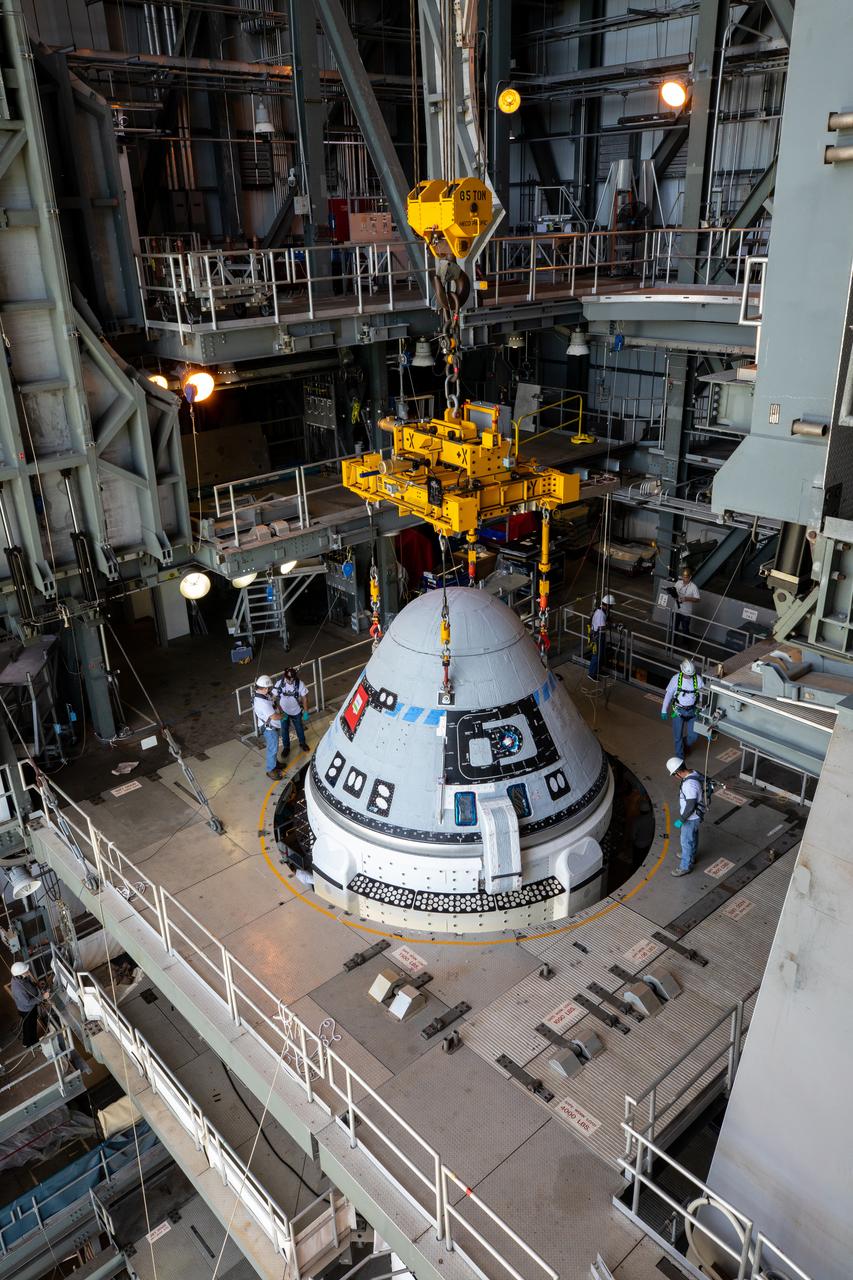
The Boeing CST-100 Starliner spacecraft is secured atop a United Launch Alliance Atlas V rocket at the Vertical Integration Facility at Space Launch Complex 41 at Florida’s Cape Canaveral Air Force Station on Nov. 21, 2019. Starliner will launch on the Atlas V for Boeing’s Orbital Flight Test to the International Space Station for NASA’s Commercial Crew Program. The spacecraft rolled out from Boeing’s Commercial Crew and Cargo Processing Facility at NASA’s Kennedy Space Center earlier in the day.
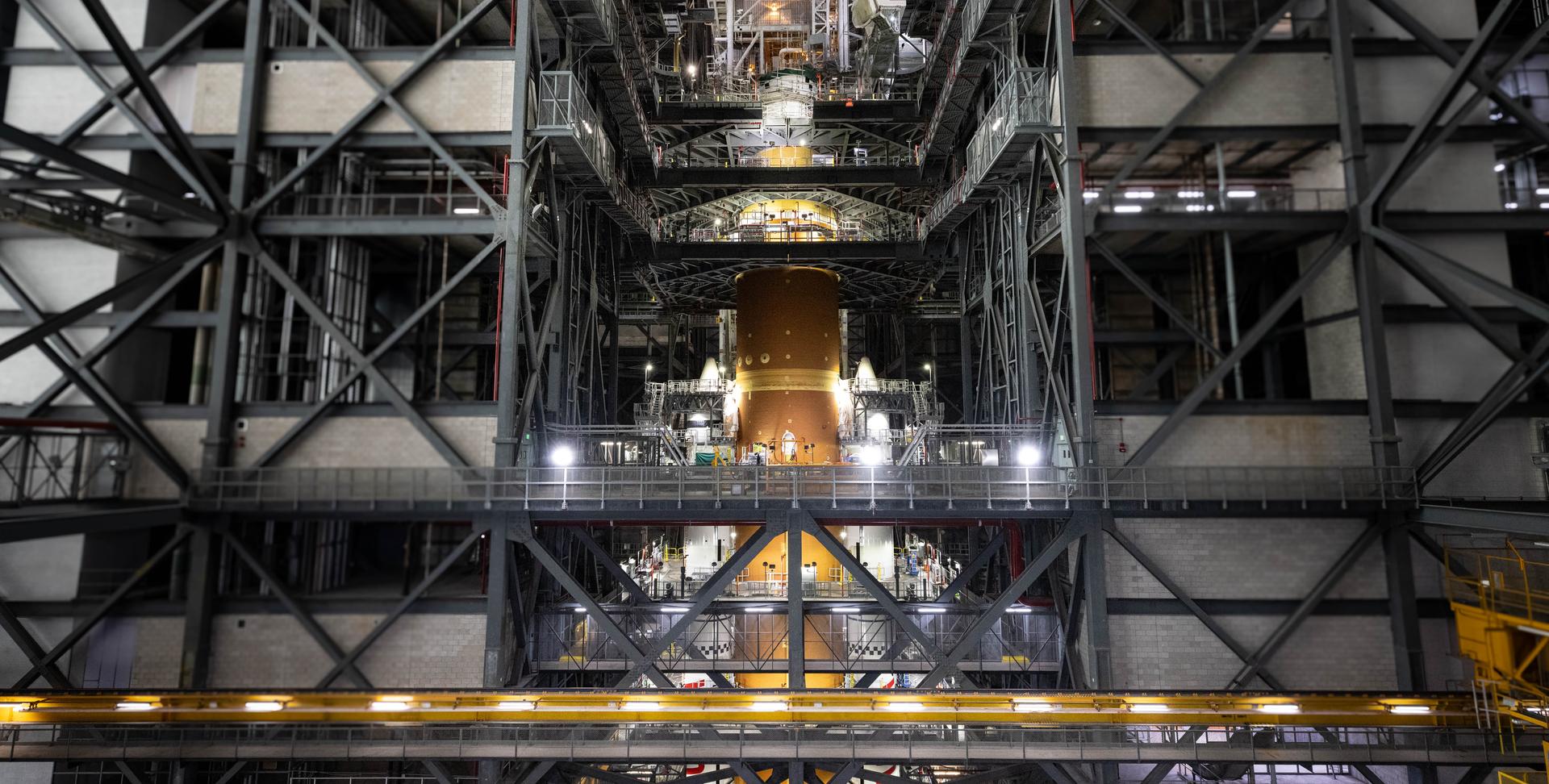
Technicians with NASA’s Exploration Ground Systems Program attach the Orion stage adapter to the interim cryogenic propulsion stage atop the agency’s SLS (Space Launch System) Moon rocket inside Vehicle Assembly Building at NASA’s Kennedy Space Center on Wednesday, Sept. 30, 2025. During the Artemis II test flight, the Orion stage adapter separates from the interim cryogenic propulsion stage, deploying four science payloads into high-Earth orbit. Up next, the Orion spacecraft and its launch abort system will stack atop the Orion stage adapter to complete integration and prepare for the launch of four astronauts around the Moon and back in early 2026.
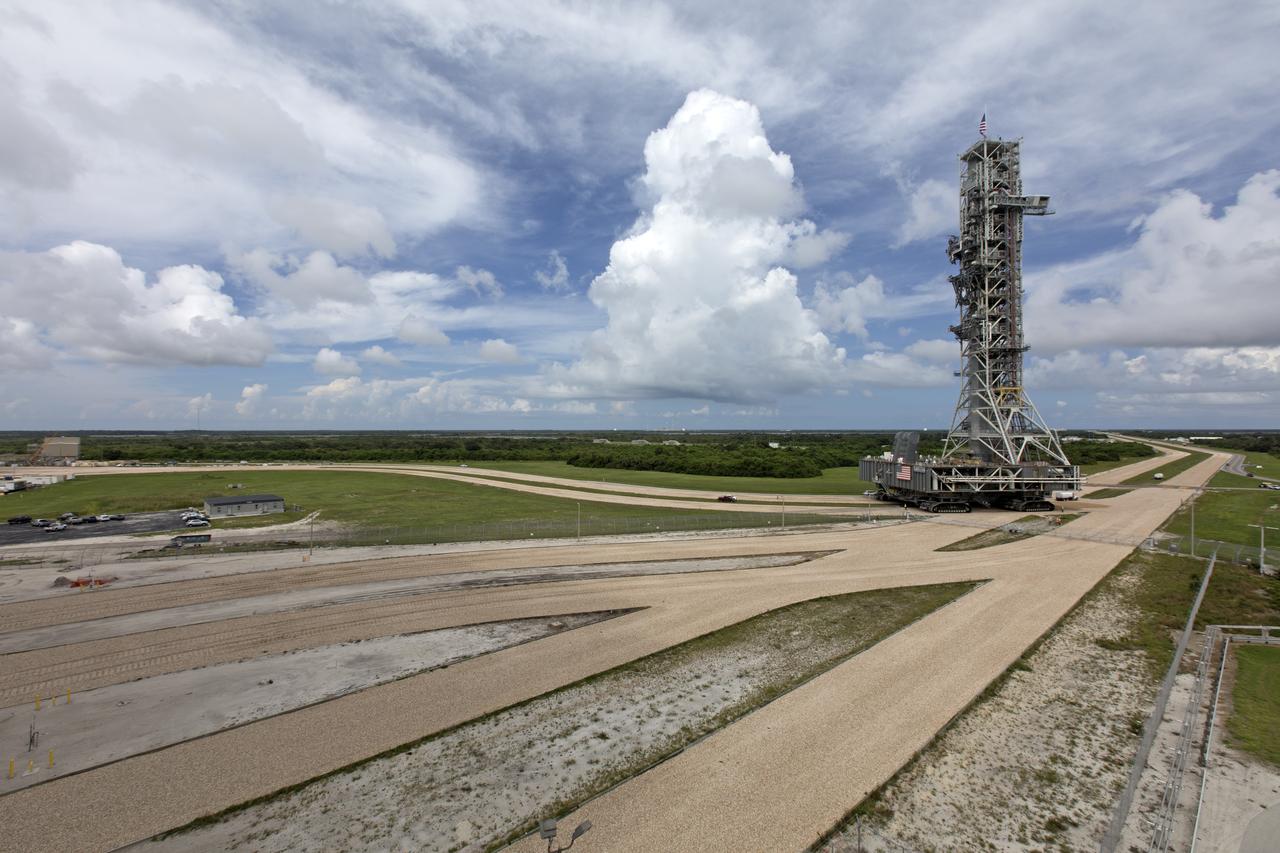
NASA's mobile launcher (ML) atop crawler-transporter 2 (CT-2) moves along the crawlerway on its trek to Launch Pad 39B on Aug. 31, 2018, at the agency's Kennedy Space Center in Florida. CT-2 will move the ML up to the surface of the pad where it will undergo a fit check, followed by several days of systems testing. The 380-foot-tall mobile launcher is equipped with the crew access arm and several umbilicals that will provide power, environmental control, pneumatics, communication and electrical connections to NASA's Space Launch System (SLS) and Orion spacecraft. Exploration Ground Systems is preparing the ground systems necessary to launch SLS and Orion on Exploration Mission-1, missions to the Moon and on to Mars.
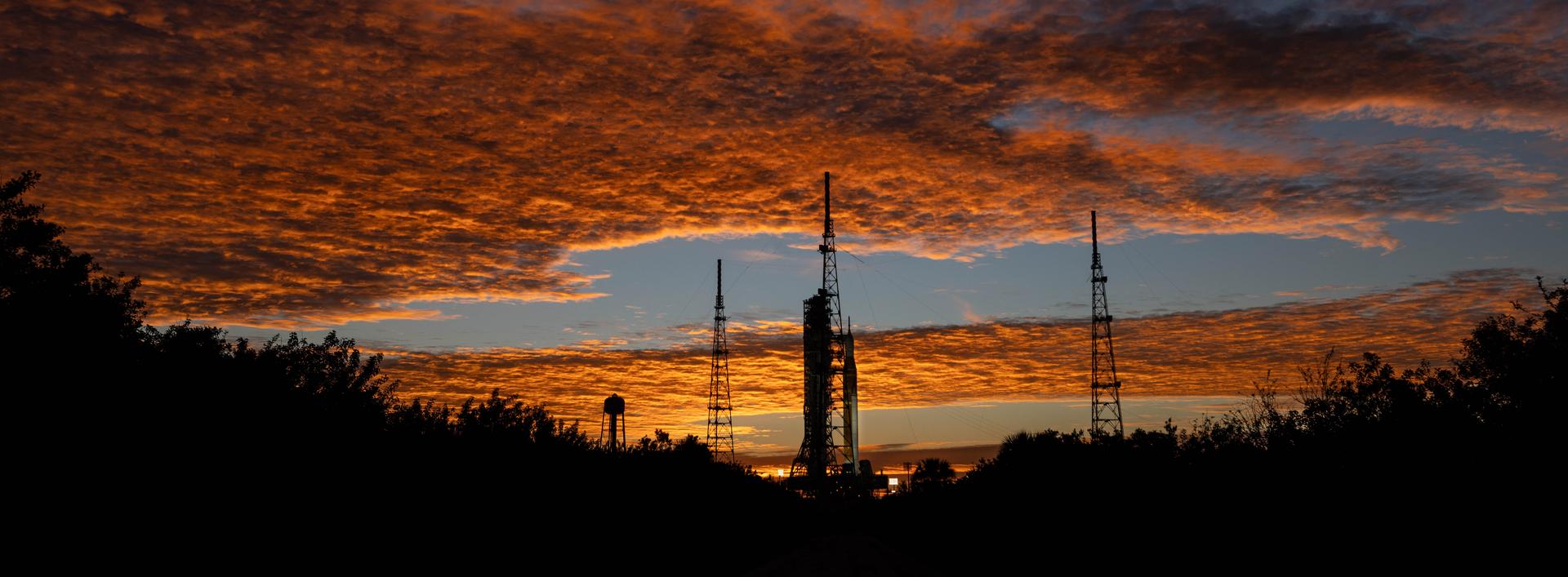
Clouds and the Sun illuminate the sky on Wednesday, Jan. 28, 2026, as NASA’s Artemis II SLS (Space Launch System) rocket and Orion spacecraft stand vertical at Launch Complex 39B at NASA’s Kennedy Space Center in Florida. The Artemis II test flight will take Commander Reid Wiseman, Pilot Victor Glover, and Mission Specialist Christina Koch from NASA and Mission Specialist Jeremy Hansen from the CSA (Canadian Space Agency), around the Moon and back to Earth no later than April 2026.
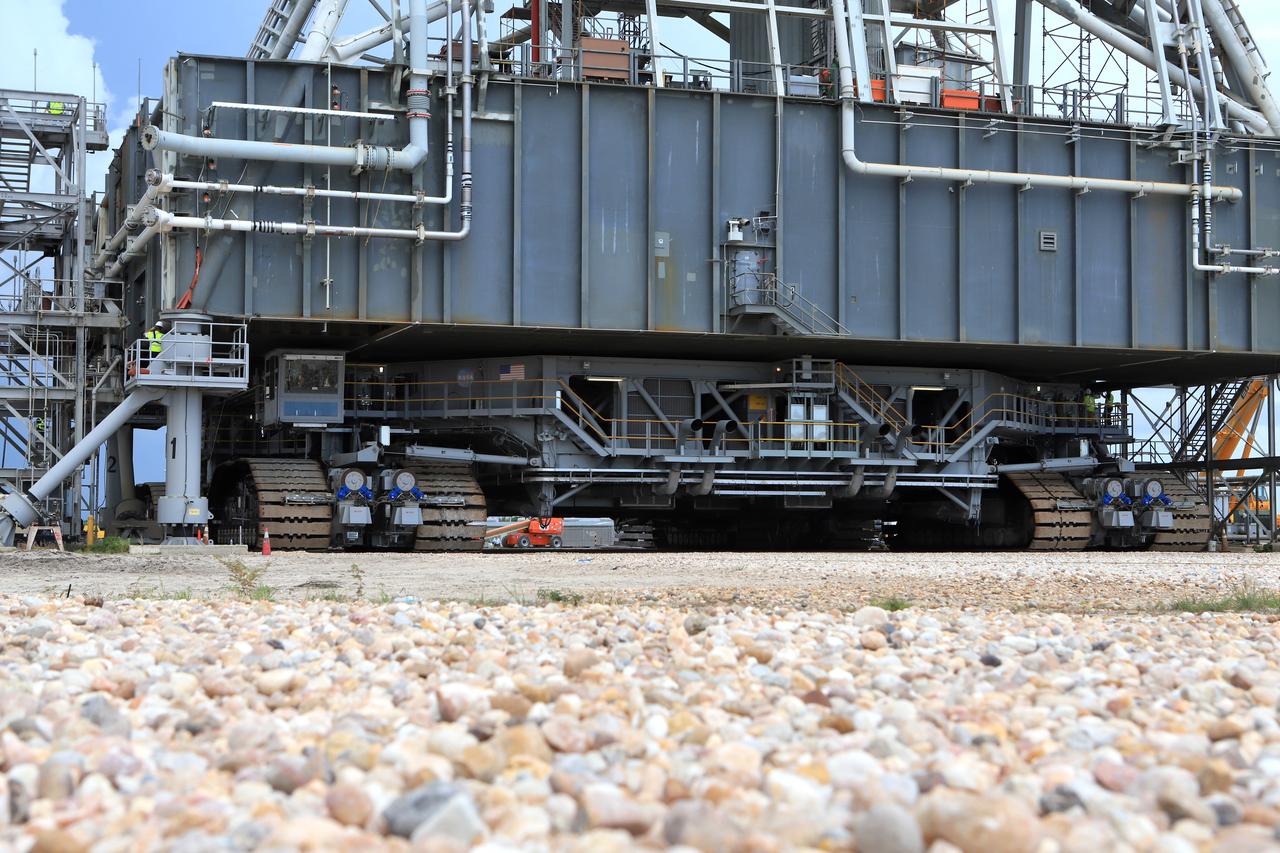
A close-up view of NASA's crawler-transporter 2 (CT-2) with the mobile launcher (ML) atop as it slowly moves along the crawlerway on its trek to Launch Pad 39B on Aug. 30, 2018, at the agency's Kennedy Space Center in Florida. CT-2 will move the ML up to the surface of the pad where it will undergo a fit check, followed by several days of systems testing. The 380-foot-tall mobile launcher is equipped with the crew access arm and several umbilicals that will provide power, environmental control, pneumatics, communication and electrical connections to NASA's Space Launch System (SLS) and Orion spacecraft. Exploration Ground Systems is preparing the ground systems necessary to launch SLS and Orion on Exploration Mission-1, missions to the Moon and on to Mars.
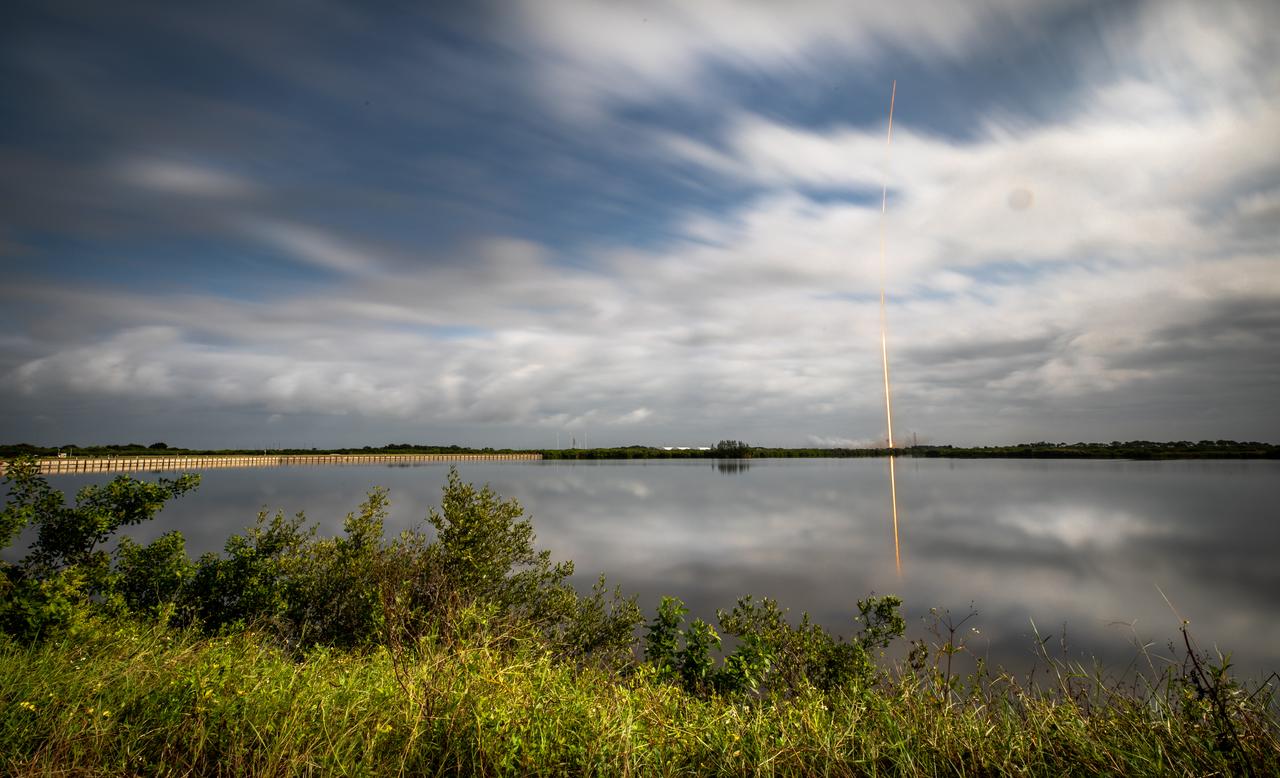
NASA’s Psyche spacecraft, atop a SpaceX Falcon Heavy rocket, soars into the sky after lifting off from Kennedy Space Center’s historic Launch Complex 39A in Florida at 10:19 a.m. EDT on Friday, Oct. 13, 2023. This daytime long exposure photo was taken from Kennedy’s Press Site near the historic countdown clock. The Psyche mission will study a metal-rich asteroid with the same name, located in the main asteroid belt between Mars and Jupiter. This is NASA’s first mission to study an asteroid that has more metal than rock or ice. Riding with Psyche is a pioneering technology demonstration – NASA’s Deep Space Optical Communications (DSOC) experiment – which will be the first test of laser communications beyond the Moon.

Brandon Marsell, deputy technical fellow for Cryogenics in NASA’s Engineering and Safety Center Technical Discipline Team at Kennedy Space Center in Florida, poses for a photograph on Wednesday, Aug. 20, 2025.
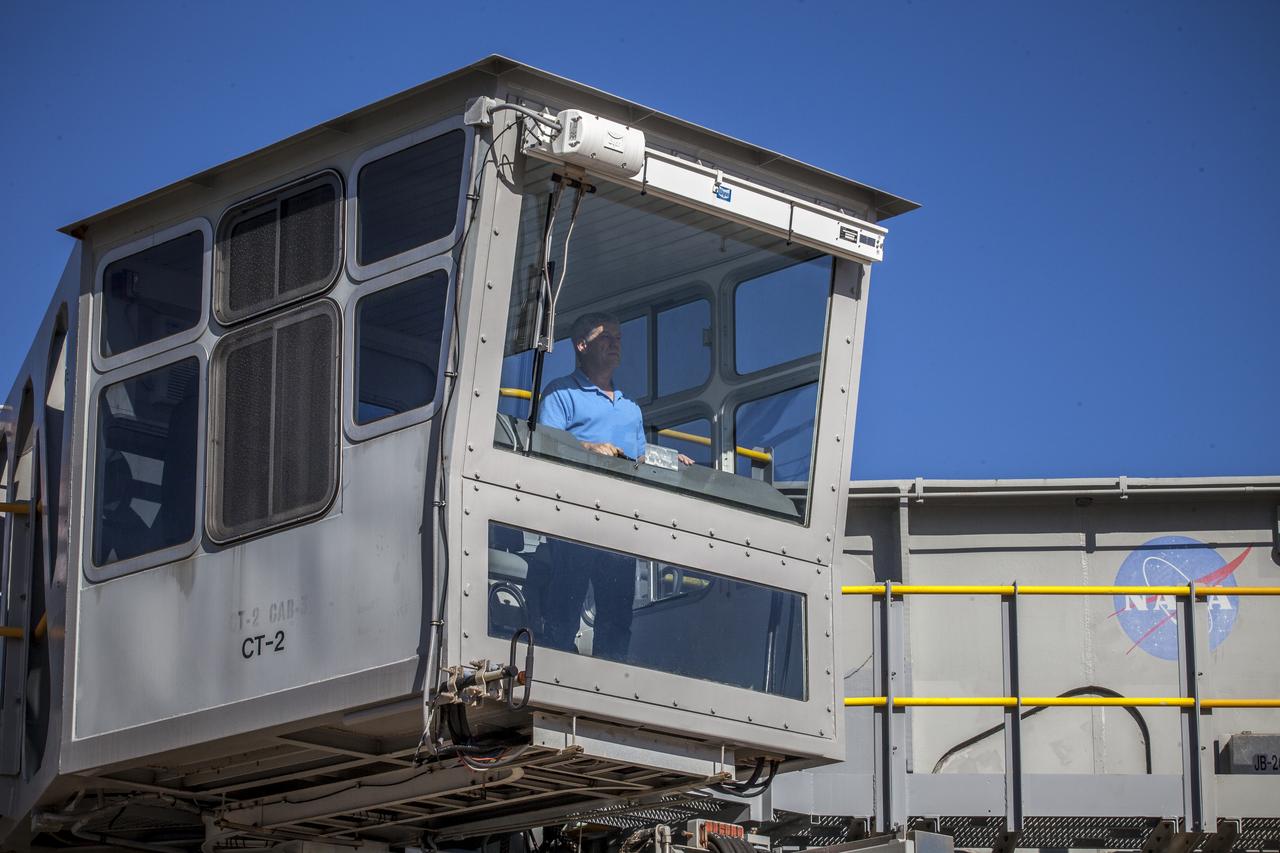
Sam Dove, a crawler-transporter engineer with Jacobs on the Test and Operations Support Contract, is inside the operator cab of crawler-transporter 2 on the crawlerway at NASA's Kennedy Space Center in Florida, on Aug. 27, 2018. CT-2 will carry the mobile launcher for the first time to Launch Pad 39B for a fit check of key systems that will support the launch of the agency's Space Launch System rocket and Orion spacecraft on Exploration Mission-1. The crawler also will carry the mobile launcher to the Vehicle Assembly Building for system checks and fit checks with the 10 levels of new platforms in High Bay 3.
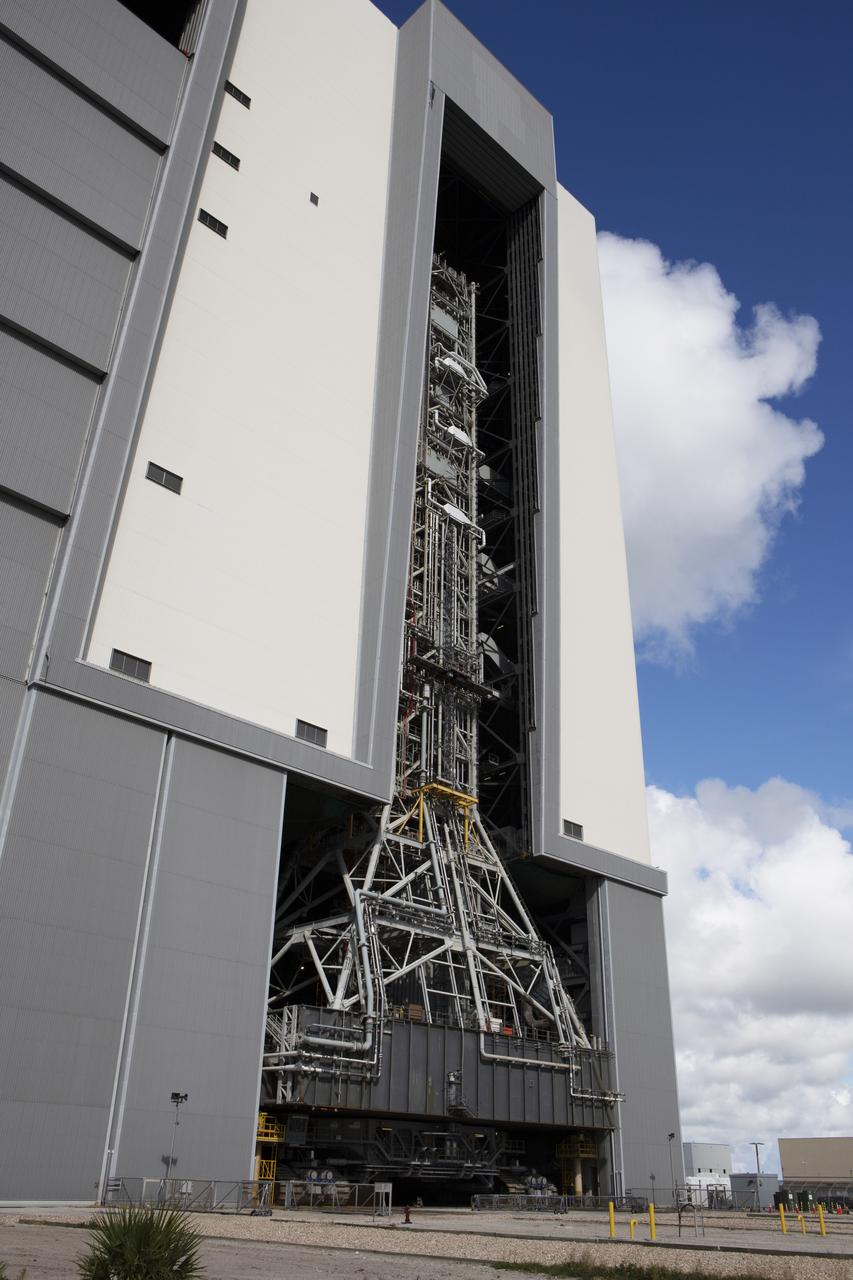
NASA's mobile launcher, atop crawler-transporter 2, moves slowly into High Bay 3 at the Vehicle Assembly Building (VAB) on Sept. 8, 2018, at NASA's Kennedy Space Center in Florida. The mobile launcher departed Launch Pad 39B after several days of testing with the pad. This is the first time that the modified mobile launcher made the trip to the pad and the VAB. The mobile launcher will spend seven months in the VAB undergoing testing. The 380-foot-tall structure is equipped with the crew access arm and several umbilicals that will provide power, environmental control, pneumatics, communication and electrical connections to the agency's Space Launch System and Orion spacecraft. Exploration Ground Systems is preparing the ground systems necessary to launch SLS and Orion on Exploration Mission-1, missions to the Moon and on to Mars.
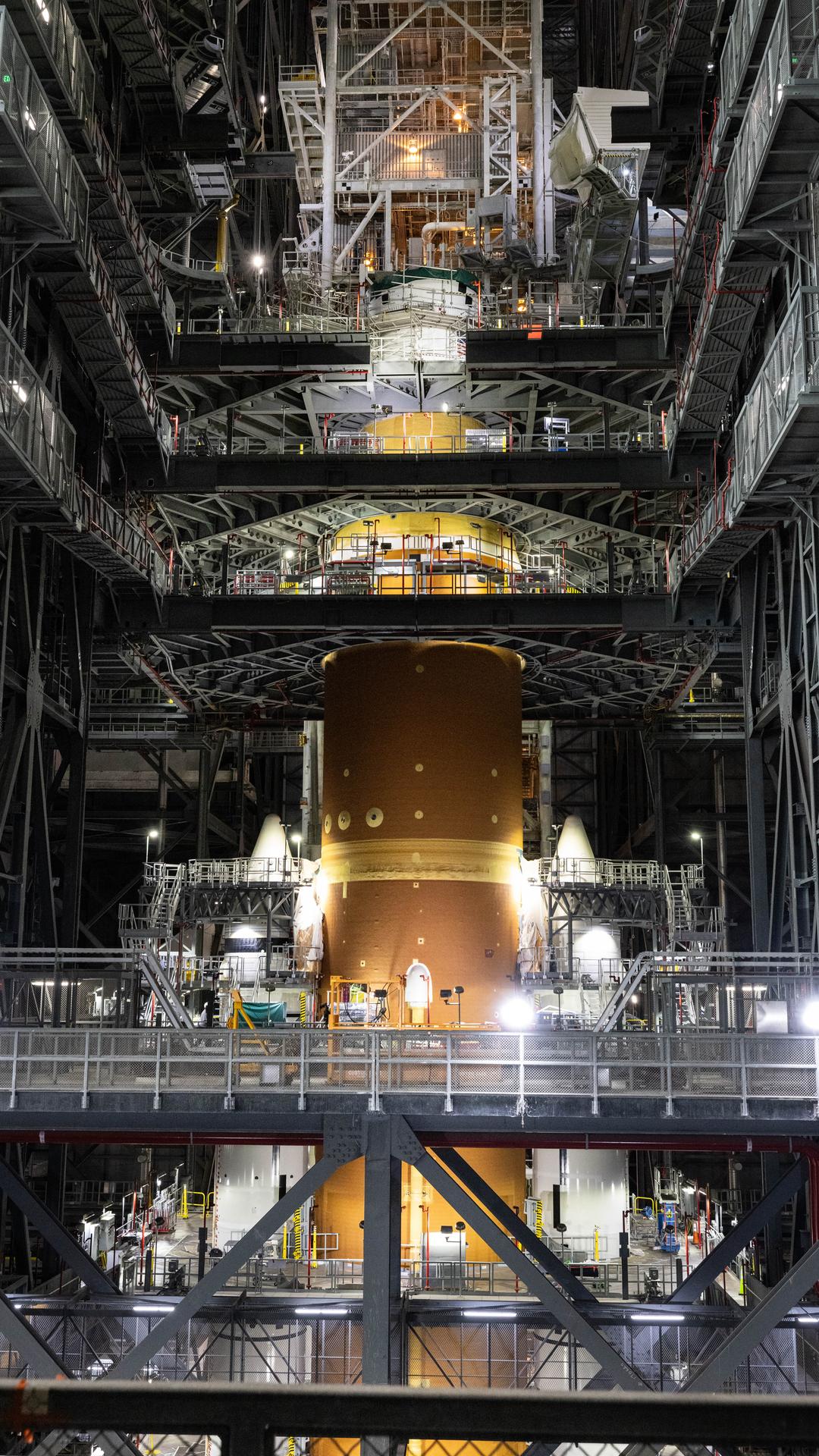
Technicians with NASA’s Exploration Ground Systems Program attach the Orion stage adapter to the interim cryogenic propulsion stage atop the agency’s SLS (Space Launch System) Moon rocket inside Vehicle Assembly Building at NASA’s Kennedy Space Center on Wednesday, Sept. 30, 2025. During the Artemis II test flight, the Orion stage adapter separates from the interim cryogenic propulsion stage, deploying four science payloads into high-Earth orbit. Up next, the Orion spacecraft and its launch abort system will stack atop the Orion stage adapter to complete integration and prepare for the launch of four astronauts around the Moon and back in early 2026.