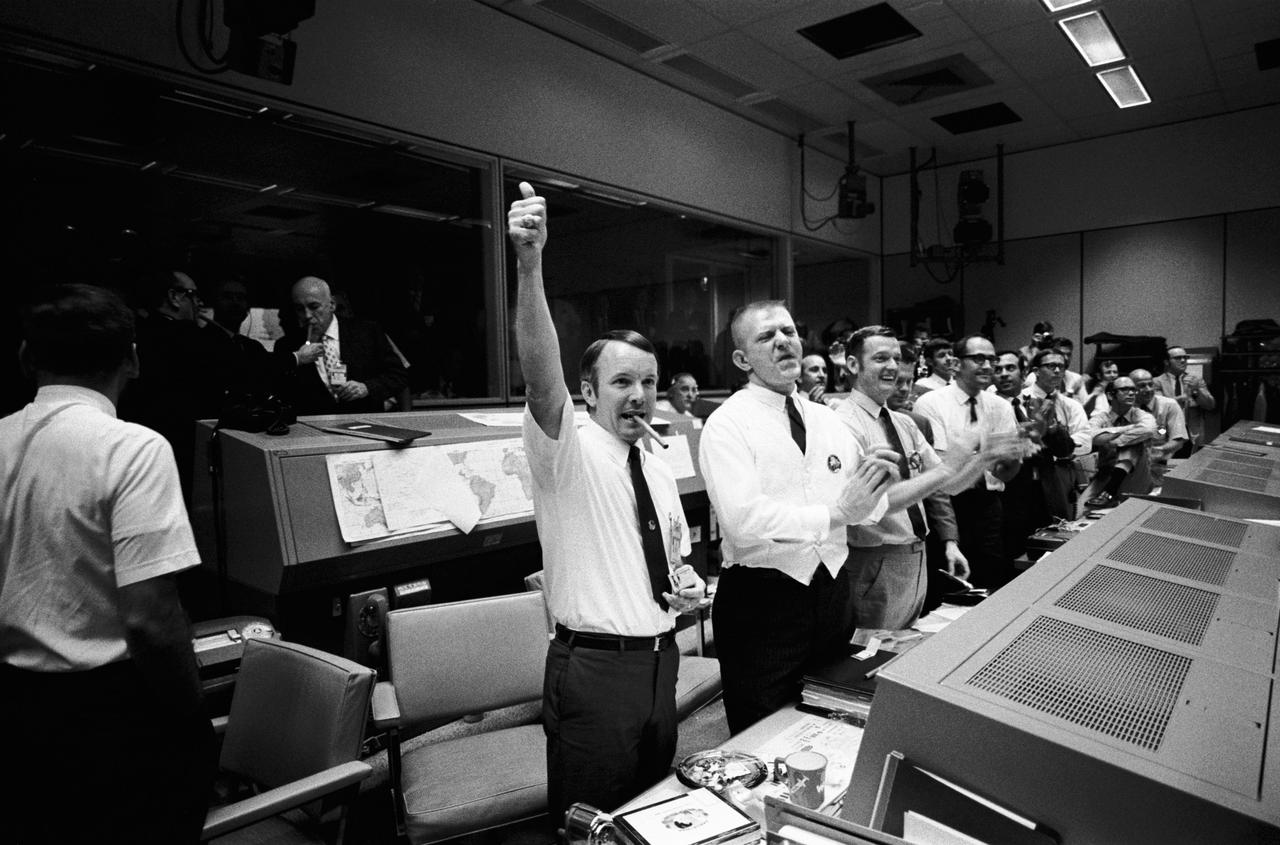
MCC DURING RECOVERY
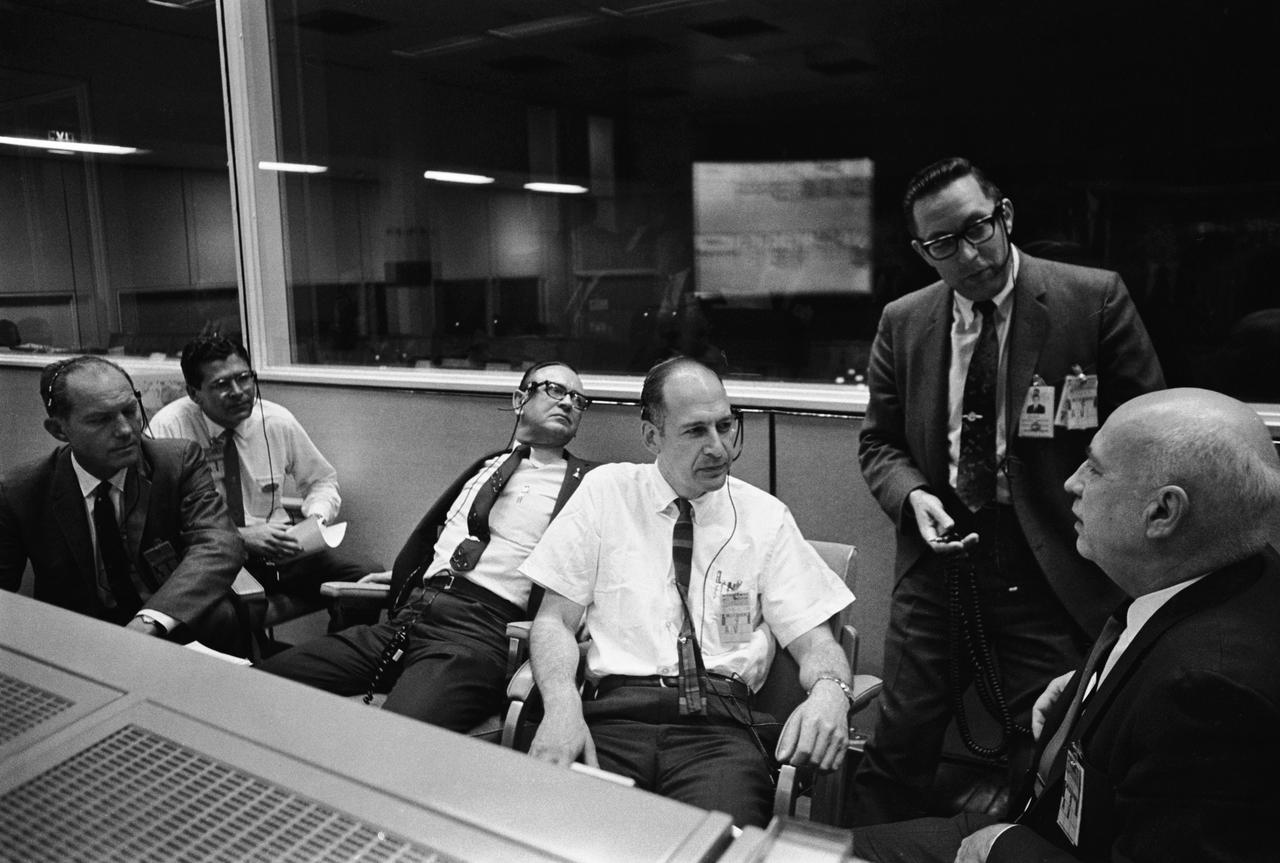
MCC activities during the Apollo IX Mission. MSC, HOUSTON, TX
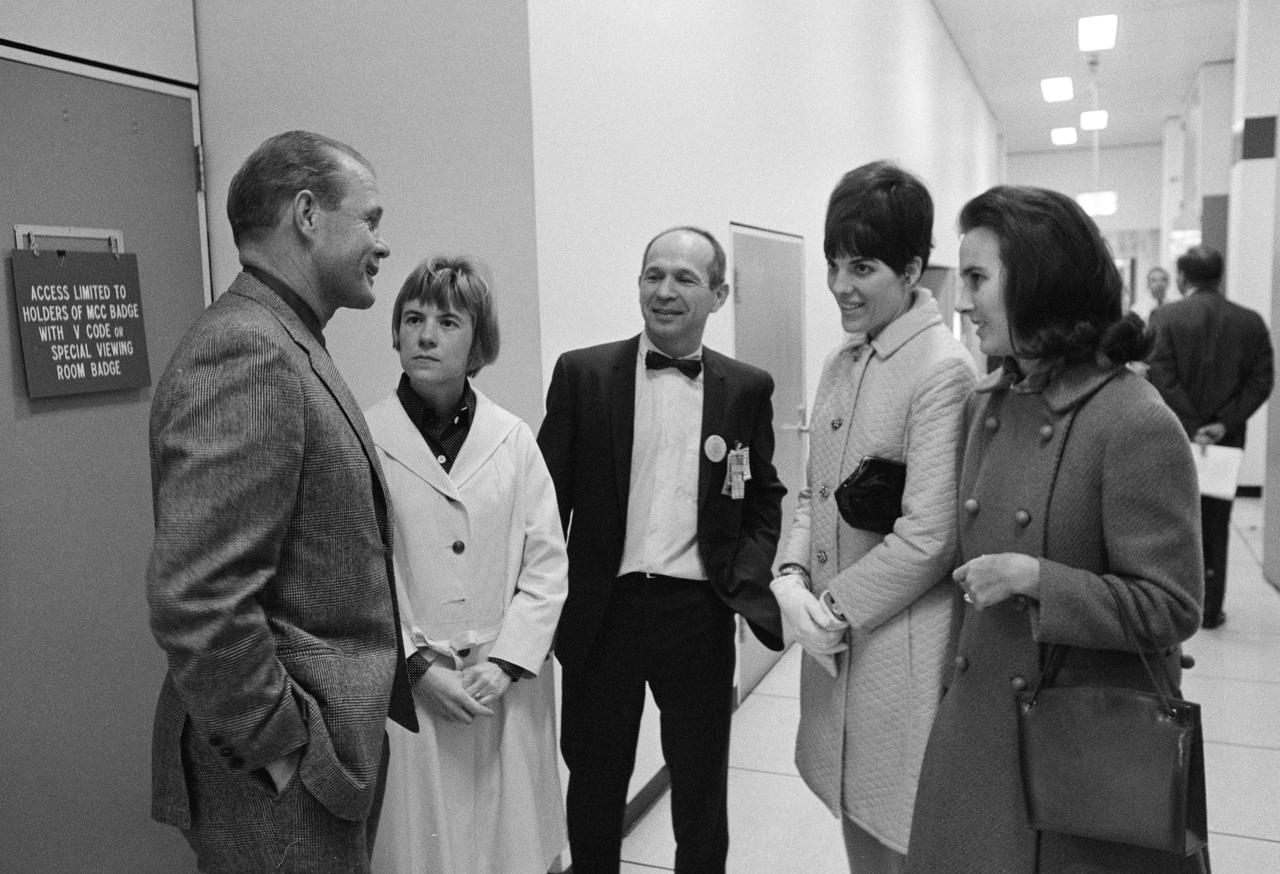
MCC activities during the Apollo IX Mission. MSC, HOUSTON, TX
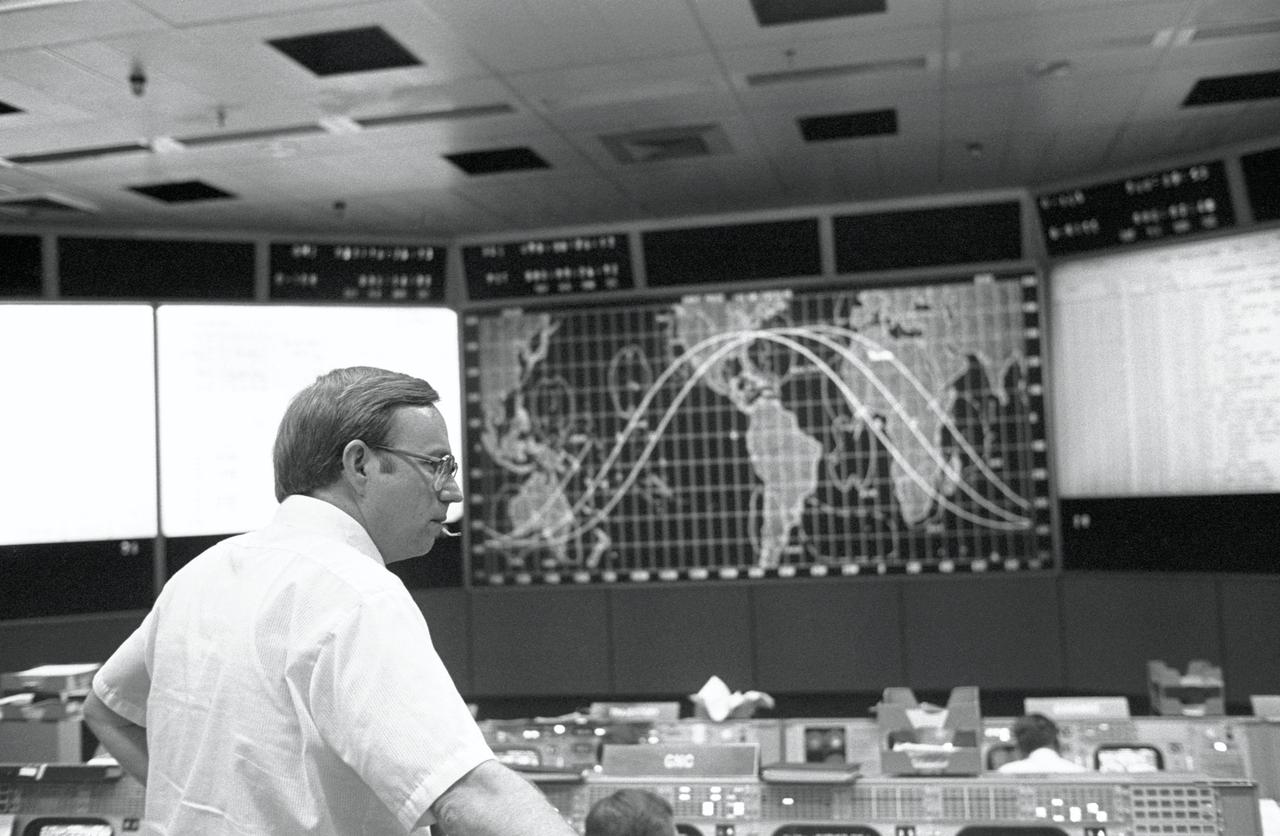
Mission Operations Control Room (MOCR) during Day-1 of the STS-3 Mission. 1. HOLLOWAY, TOMMY W. - MCC 2. MCC - STS-3 3. STS-3 - INFLIGHT JSC, HOUSTON, TX
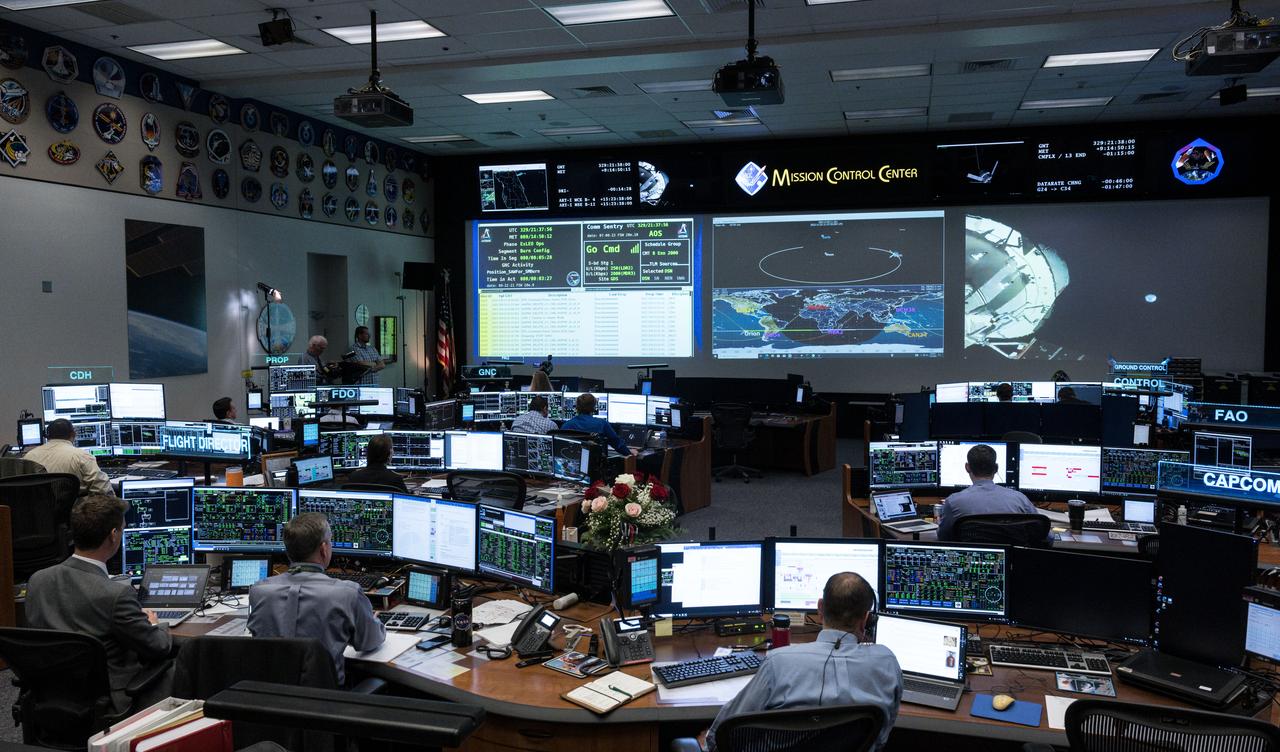
(jsc2022e089780) (Nov.25, 2022) During flight day 10 of the 25.5-day Artemis I mission, flight controllers monitor the progress of the Distant Retrograde Orbit Insertion (DRI) burn. The Distant Retrograde Orbit Insertion (DRI) burn, inserted Orion into a Distant Retrograde Orbit (DRO), which at its furthest distance, Orion will be nearly 270,00 miles from Earth.
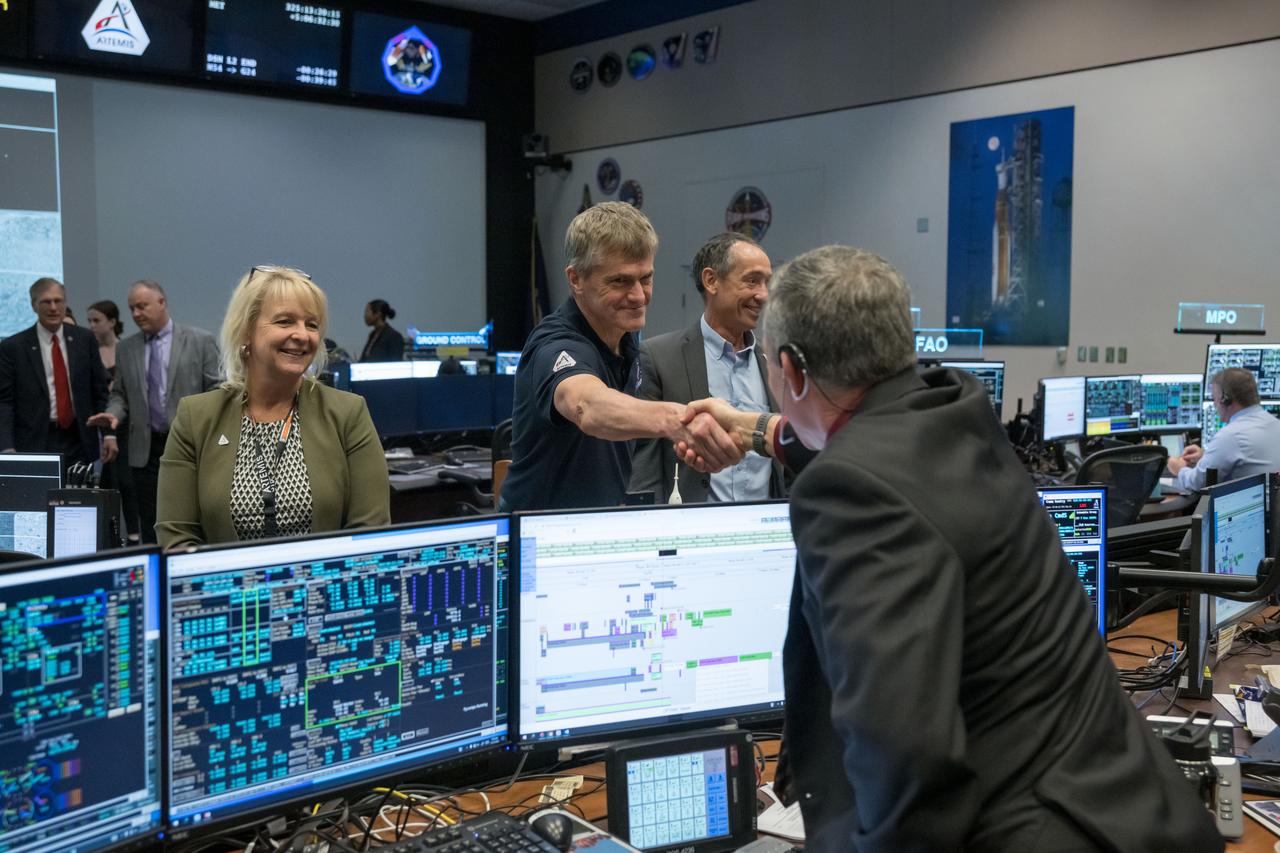
jsc2022e089183 (Nov. 21, 2022) During flight day 6 of the 25.5-day mission, Orion program managers greet Artemis I Lead Flight Director Rick LaBrode in the White Flight Control Room at the Johnson Space Center in Houston. The visit followed during the Outbound Powered Flyby (OPF) burn, which set Orion on a course to fly by the Moon at a closest distance of 81 miles (130.5 kilometers).
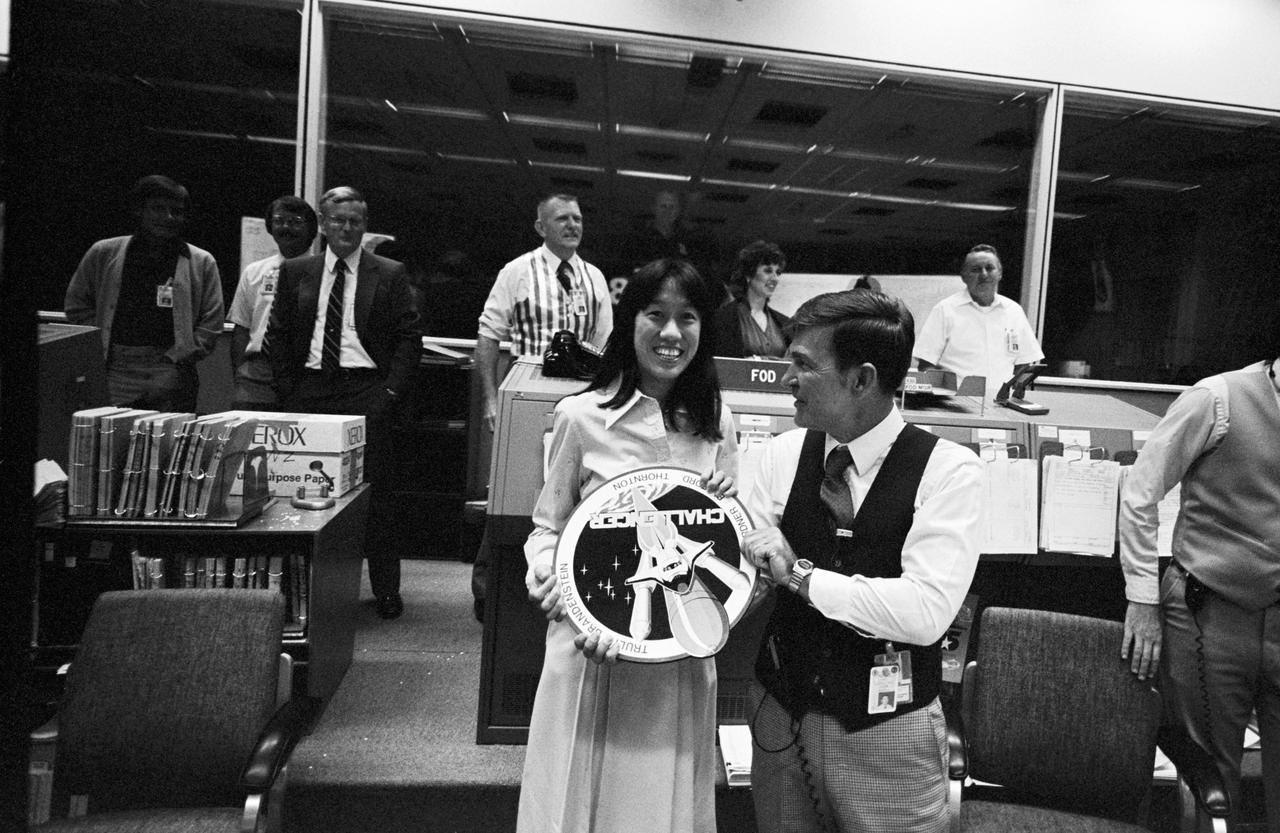
STS-8 MCC Activities, Day 6 CapComs, Astronaut Bill Fisher and Flight Director Harold Draughon. 1. INFLIGHT - STS-8 (MCC) 2. FISHER, ANNA - STS-8 (MCC) 3. FISHER, BILL - STS-8 (MCC) JSC, HOUSTON, TX Also available in 35 CN
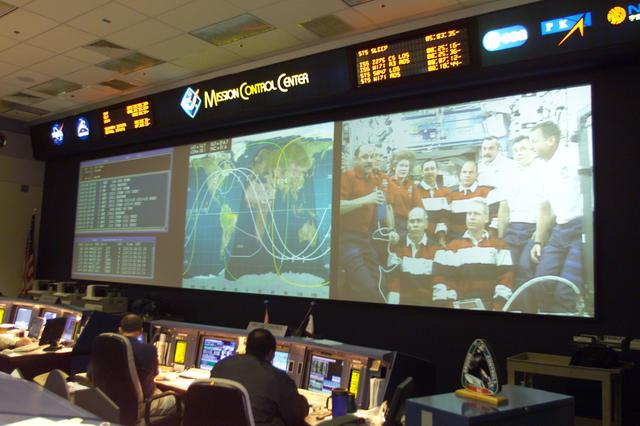
JSC2001-E-25405 (17 August 2001) --- An overall shot in Houston’s Mission Control Center (MCC) shows the crews of STS-105, Expedition Two and Three on the big screen during an in-flight press conference.
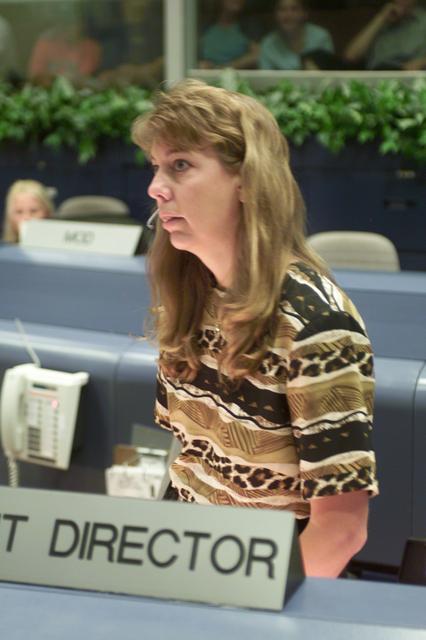
JSC2001-E-25399 (17 August 2001) --- Flight director Kelly Beck monitors data at her console in the shuttle flight control room (WFCR) in Houston’s Mission Control Center (MCC).
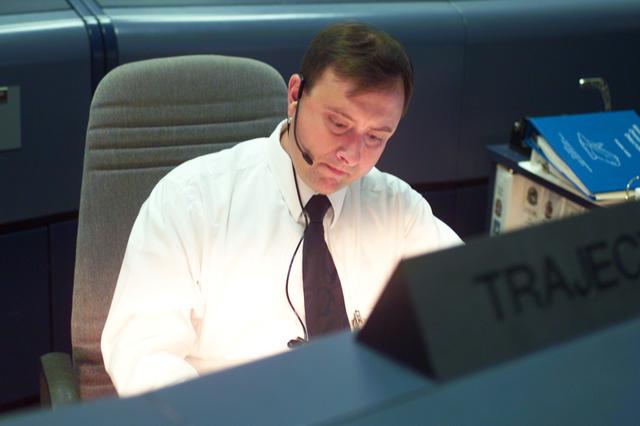
JSC2001-E-25391 (17 August 2001) --- Darrin Leleux, STS-105 trajectory officer, studies data at his console in the shuttle flight control room (WFCR) in Houston’s Mission Control Center (MCC).
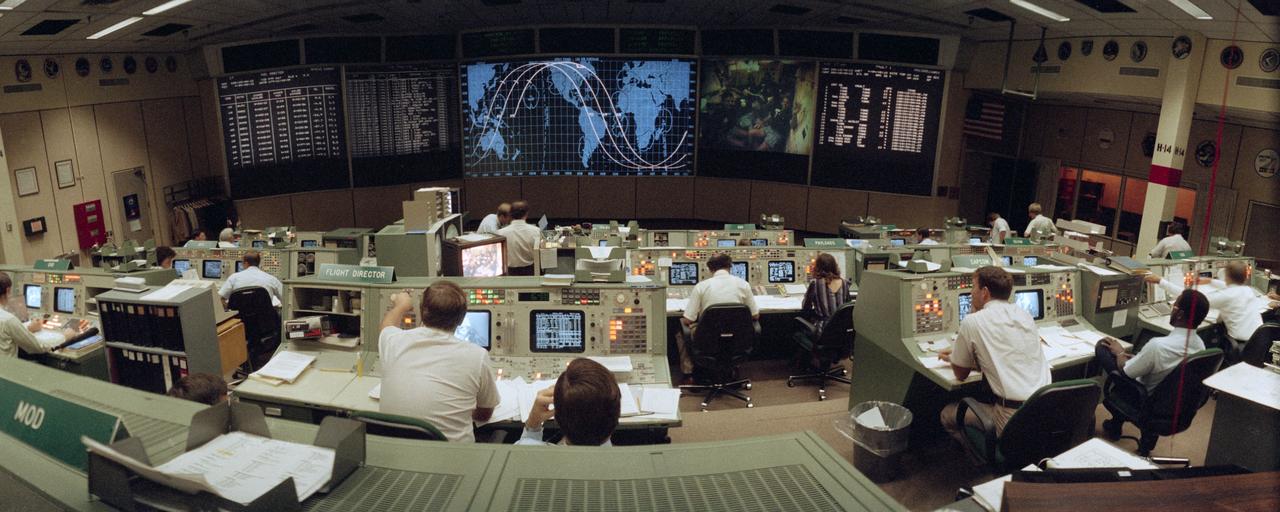
Fisheye view from the back of the Flight Control Room (FCR) of the Mission Control Center (MCC). Visible are the Flight Directors console (left front), the CAPCOM console (right front) and the Payloads console. Some of the STS 41-G crew can be seen on a large screen at the front of the MCC along with a map tracking the progress of the orbiter.
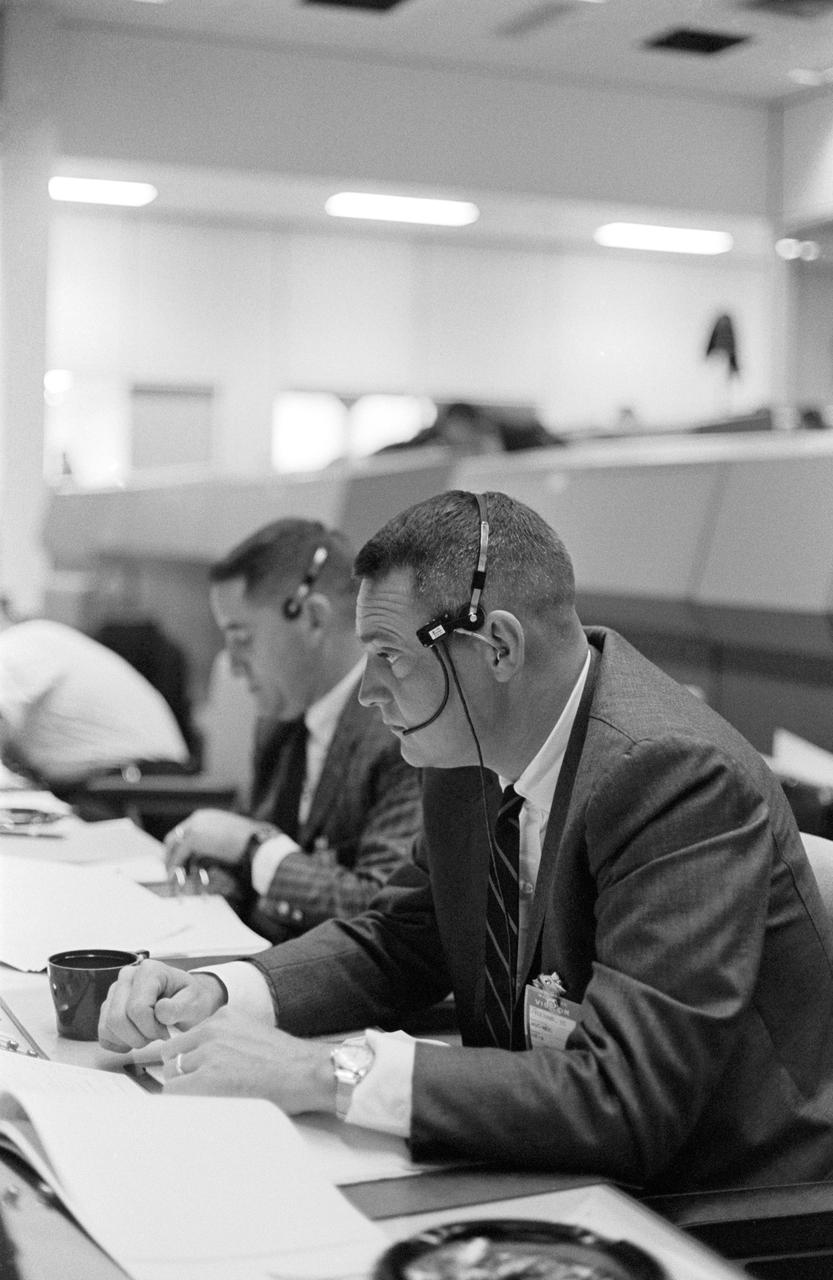
S65-18063 (23 March 1965) --- Astronaut Clifton C. Williams is shown at console in the Mission Control Center (MCC) in Houston, Texas during the Gemini-Titan 3 flight. The GT-3 flight was monitored by the MCC in Houston, but was controlled by the MCC at Cape Kennedy.
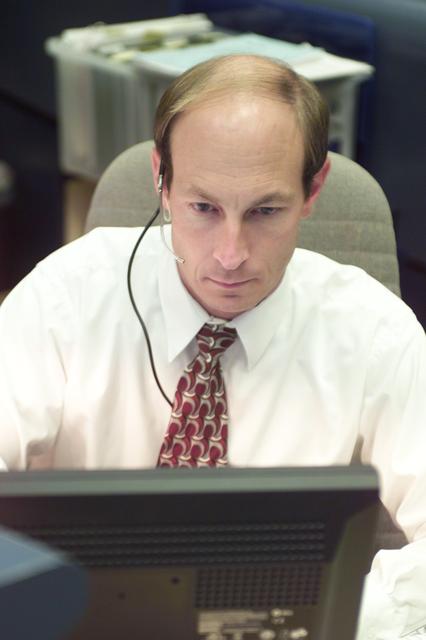
JSC2001-E-25422 (17 August 2001) --- Gary Ford, assembly and check-out officer, intently studies data at his console in the shuttle flight control room (WFCR) in Houston's Mission Control Center (MCC) during the STS-105 mission.
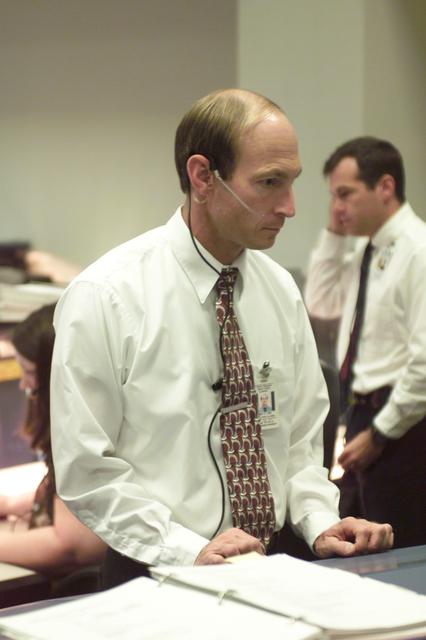
JSC2001-E-25412 (17 August 2001) --- Gary Ford, assembly and check-out officer, intently studies data at his console in the shuttle flight control room (WFCR) in Houston's Mission Control Center (MCC) during the STS-105 mission.
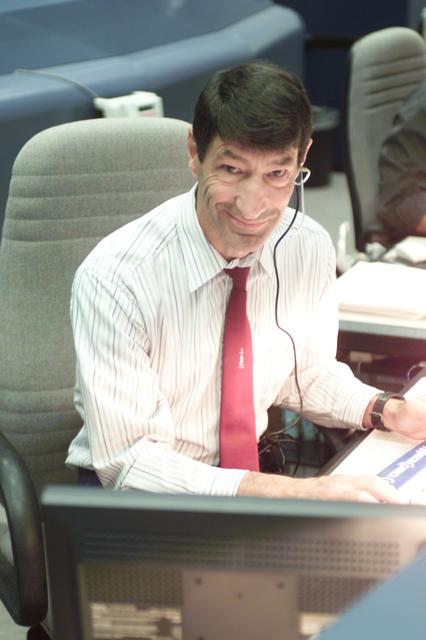
JSC2001-E-25401 (17 August 2001) --- Astronaut Mario Runco Jr., STS-105 spacecraft communicator (CAPCOM), monitors data at his console in the shuttle flight control room (WFCR) in Houston's Mission Control Center (MCC).
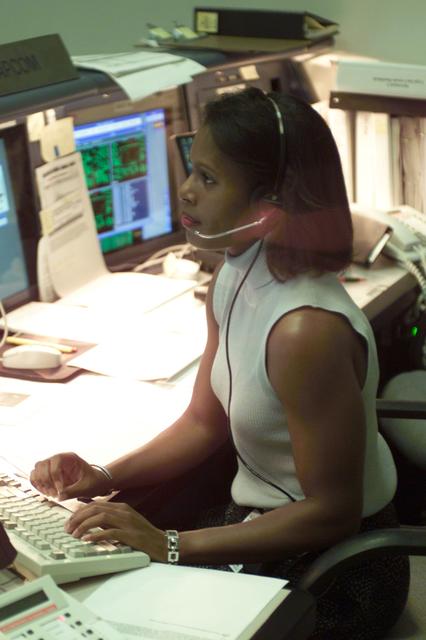
JSC2001-E-25411 (17 August 2001) --- Astronaut Joan E. Higginbotham, ISS spacecraft communicator (CAPCOM), inputs data into her computer at her console in the station flight control room (BFCR) in Houston's Mission Control Center (MCC) during the STS-105 mission.
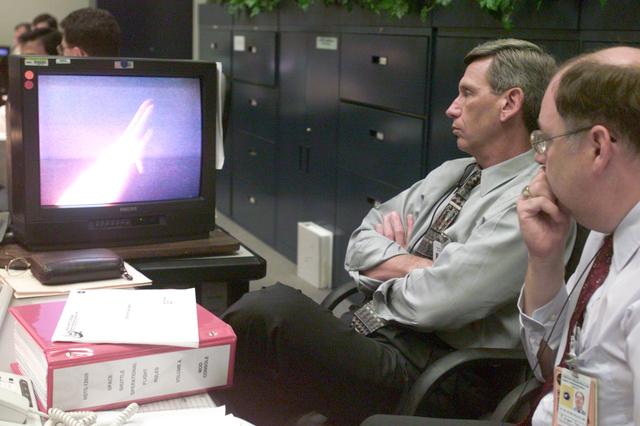
JSC2001-E-24999 (10 August 2001) --- Lawrence Bourgeois (left) and Wayne Hale watch the launch of the Space Shuttle Discovery at the Mission Operations Directorate (MOD) console in the shuttle flight control room (WFCR) in Houston's Mission Control Center (MCC). As soon as the vehicle cleared the tower in Florida, the Houston-based team of flight controllers took over the ground control of the flight.
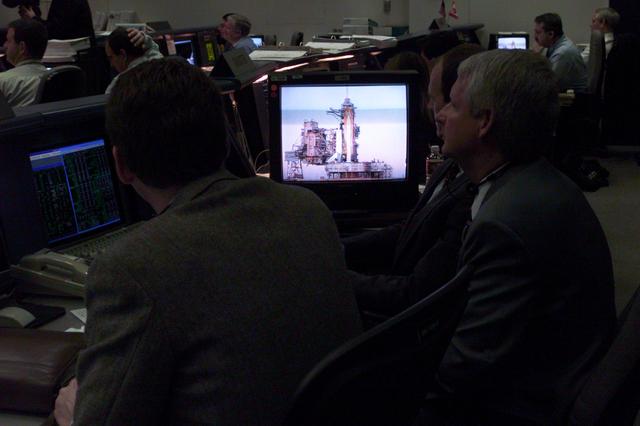
JSC2001-E-06216 (8 March 2001) --- In Houston's Mission Control Center (MCC), the silhouette of astronaut Steven A. Hawley of the Flight Crew Operations Directorate appears just to the right of the monitor displaying the Space Shuttle Discovery's pre-launch activities several hundred miles away in Florida.

JSC2001-E-06207 (8 March 2001) --- Lead STS-102 flight director John Shannon discusses a mission detail with John Guidi, temporarily assigned at JSC from the Kennedy Space Center (KSC). The two are awaiting the launch of the Space Shuttle Discovery at the Flight Director console in JSC's Mission Control Center (MCC).

S98-16081 (10-29-98) --- Profile view of rear of Mission Control Center (MCC) featuring Mission Operations Director (MOD) console (foreground) and Spacecraft Communicator (CAPCOM) and Flight Director (FD) consoles (left background). Astronaut Linda M. Godwin is at lower right foreground.
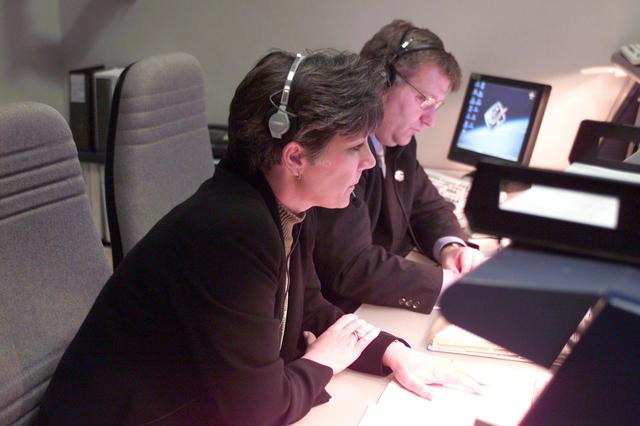
JSC2001-E-06218 (8 March 2001) --- Eileen Hawley and Daniel K. Carpenter look over launch data at the Public Affairs Officer (PAO) console in Houston's Mission Control Center (MCC). Hawley is the ascent commentator for PAO and Carpenter is JSC Director of Public Affairs.
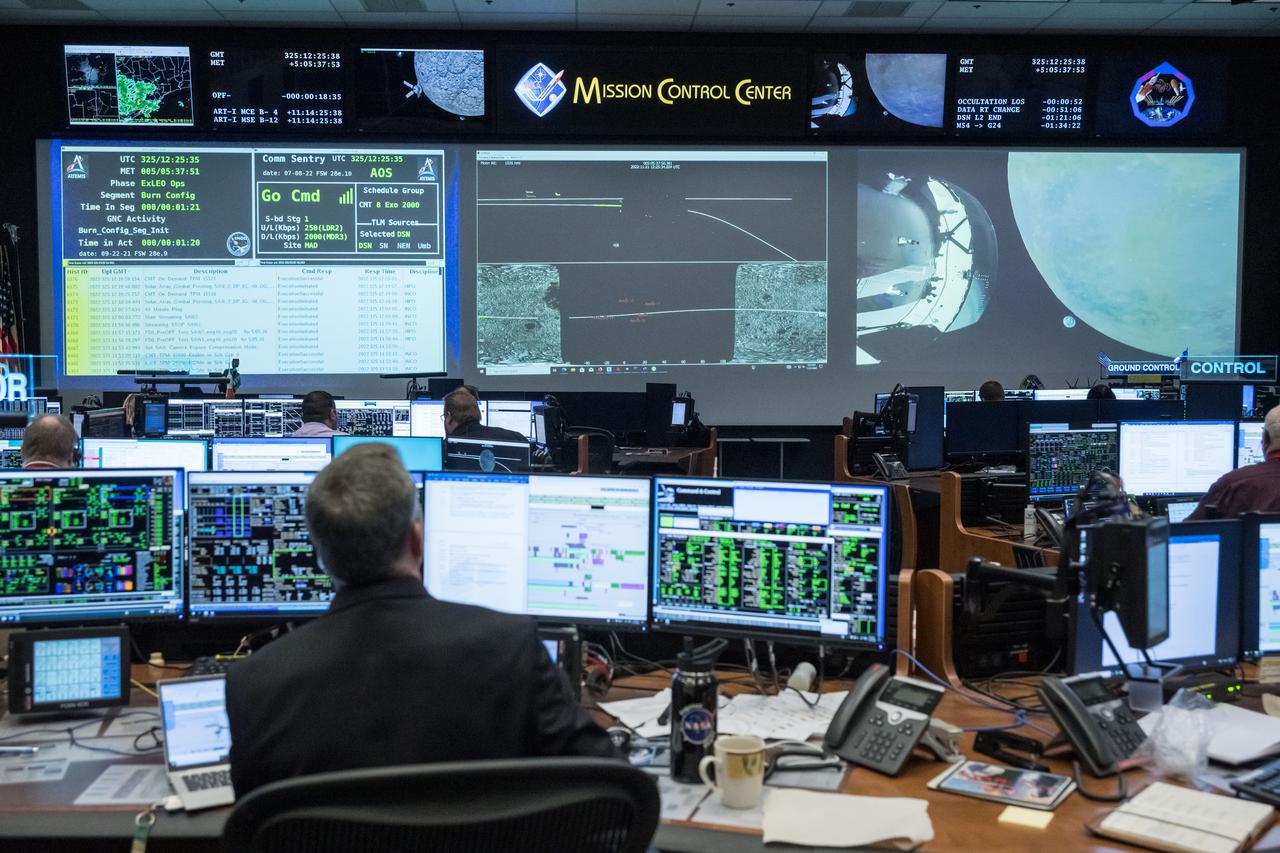
jsc2022e089168 (Nov. 21, 2022) During flight day 6 of the 25.5-day Artemis I mission, Lead Flight Director Rick LaBrode monitors the progress of the Outbound Powered Flyby (OPF) in the White Flight Control Room at Johnson Space Center in Houston. burn monitored by. The OPF burn set Orion on a course to fly by the Moon at a closest distance of 81 miles (130.5 kilometers).
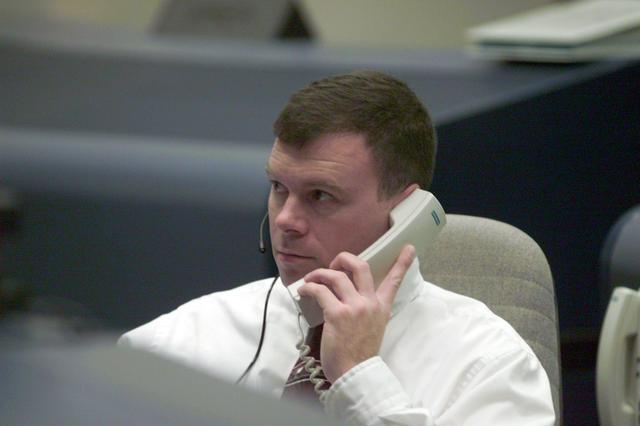
JSC2001-E-24995 (10 August 2001) --- Astronaut James M. Kelly, STS-105 spacecraft communicator (CAPCOM) for weather issues, monitors pre-flight data at his console in the shuttle flight control room (WFCR) in Houston's Mission Control Center (MCC). Several hundred miles away in Florida, the STS-105 and Expedition Three crew members were awaiting countdown in the crew cabin of the Space Shuttle Discovery on the launch pad at the Kennedy Space Center (KSC). As soon as the vehicle cleared the tower in Florida, the Houston-based team of flight controllers took over the ground control of the flight.
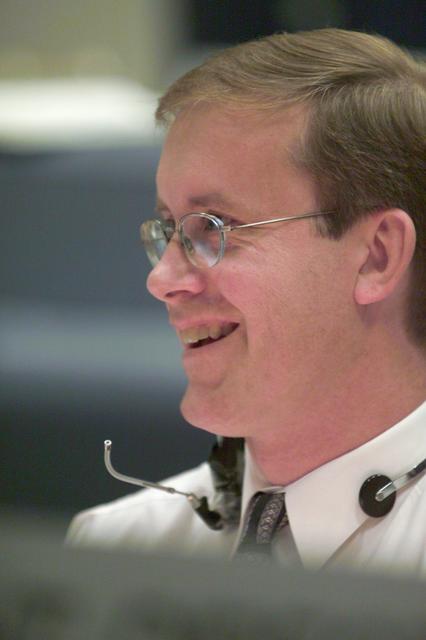
JSC2001-E-24994 (10 August 2001) --- Flight director John Shannon finds a moment of levity while working at his console in the shuttle flight control room (WFCR) in Houston's Mission Control Center (MCC). Several hundred miles away in Florida, the STS-105 and Expedition Three crew members were awaiting countdown in the crew cabin of the Space Shuttle Discovery on the launch pad at the Kennedy Space Center (KSC). As soon as the vehicle cleared the tower in Florida, the Houston-based team of flight controllers took over the ground control of the flight.
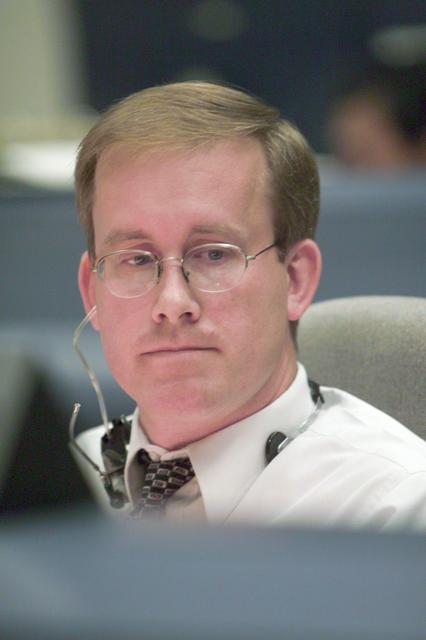
JSC2001-E-24998 (10 August 2001) --- Flight director John Shannon studies pre-flight data at his console in the shuttle flight control room (WFCR) in Houston's Mission Control Center (MCC) prior to the launch of Space Shuttle Discovery. Several hundred miles away in Florida, the STS-105 and Expedition Three crew members were awaiting countdown in the crew cabin of the Space Shuttle Discovery on the launch pad at the Kennedy Space Center (KSC). As soon as the vehicle cleared the tower in Florida, the Houston-based team of flight controllers took over the ground control of the flight.
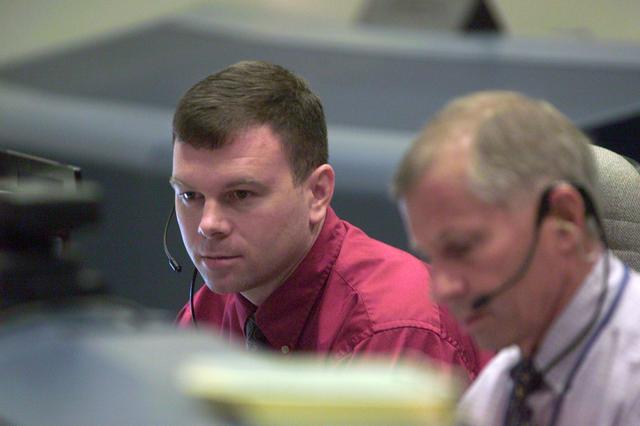
JSC2001-E-24997 (10 August 2001) --- Astronaut James M. Kelly, STS-105 spacecraft communicator (CAPCOM) for weather issues, monitors pre-flight data at his console in the shuttle flight control room (WFCR) in Houston's Mission Control Center (MCC). Several hundred miles away in Florida, the STS-105 and Expedition Three crew members were awaiting countdown in the crew cabin of the Space Shuttle Discovery on the launch pad at the Kennedy Space Center (KSC). As soon as the vehicle cleared the tower in Florida, the Houston-based team of flight controllers took over the ground control of the flight.
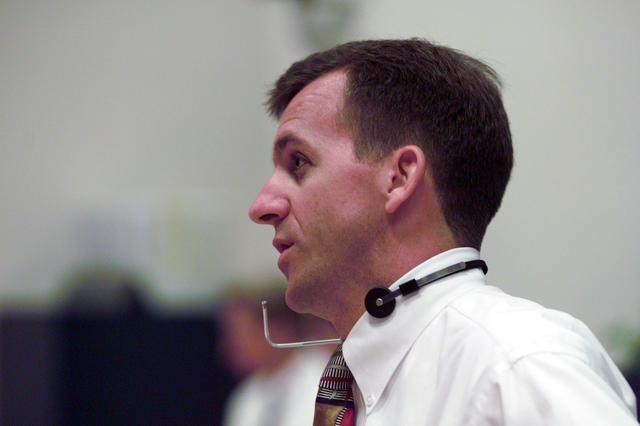
JSC2001-E-12116 (19 April 2001) --- LeRoy Cain, at the Flight Director console, peruses information on large screens in front of the flight control room in the Johnson Space Center's Mission Control Center (MCC) as countdown for the Space Shuttle Endeavour launch of STS-100 continues several hundred miles away in Florida. Cain is both ascent and entry flight director for the flight.
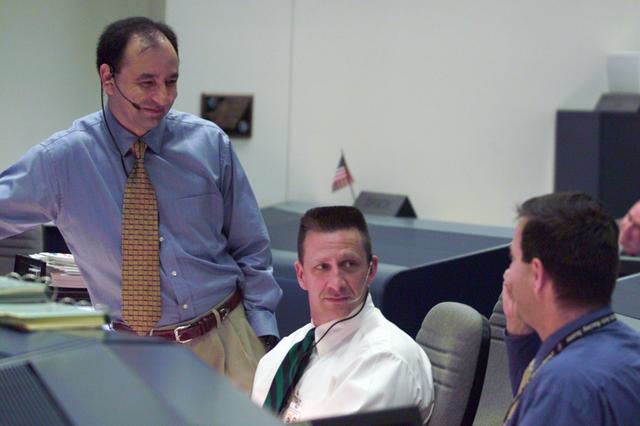
JSC2001-E-12125 (19 April 2001) --- Astronauts Mark L. Polansky, from the left, Christopher J. (Gus) Loria, and Scott D. Altman discuss the approaching STS-100 launch at their positions at the Spacecraft Communicator console in Houston's Mission Control Center (MCC). Loria's position addresses weather issues, of which there were few on this particular launch. He will also be assigned to weather matters for the entry phase of the flight.
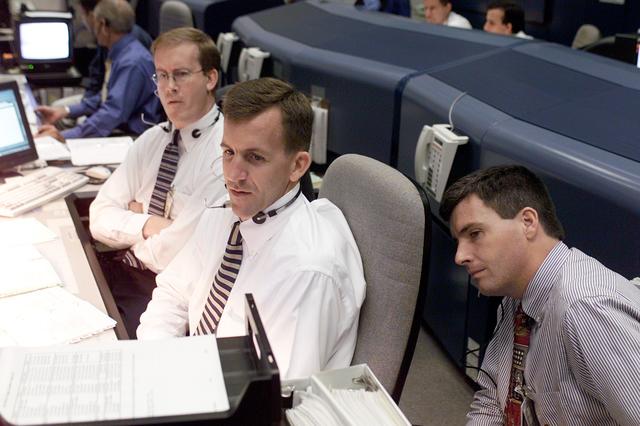
JSC2001-E-25520 (22 August 2001) --- Flight directors John Shannon (left), LeRoy Cain, and Steve Stich monitor data at their consoles in the shuttle flight control room (WFCR) in Houston’s Mission Control Center (MCC). At the time this photo was taken the Space Shuttle Discovery was about to land at Kennedy Space Center, Florida, to mark the end of a successful mission to the International Space Station (ISS).
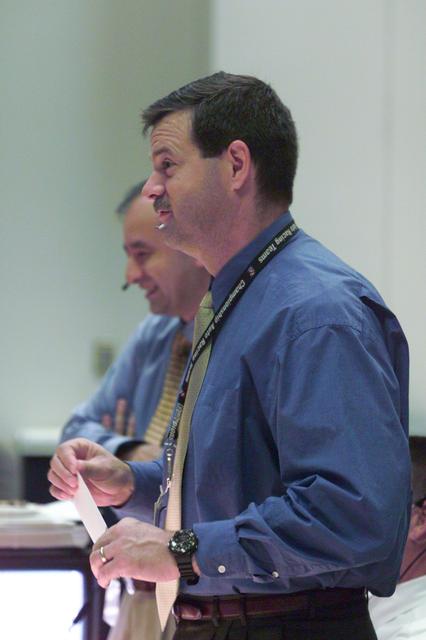
JSC2001-E-12122 (19 April 2001) --- Astronaut Scott D. Altman (foreground), STS-100 ascent spacecraft communicator (CAPCOM), stays on top of pre-launch activities at his console in the shuttle flight control room of Houston's Mission Control Center (MCC). Astronaut Mark L. Polansky stands beside Altman. Six astronauts and a cosmonaut, meanwhile, were strapped into their seats in the crew cabin of the Space Shuttle Endeavour several hundred miles away in Florida.
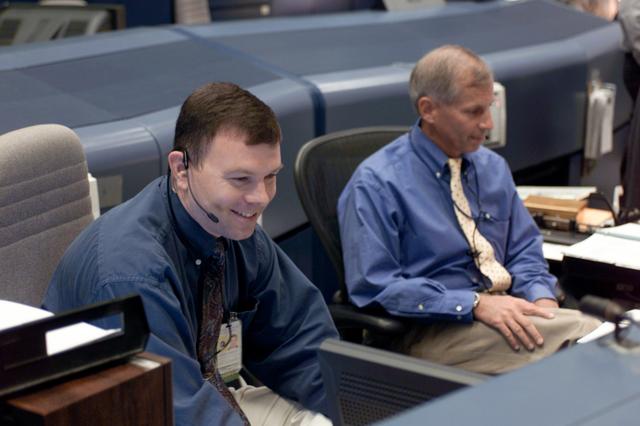
JSC2001-E-25513 (22 August 2001) --- Astronauts James M. Kelly (left) and Kenneth D. Cockrell, both spacecraft communicators (CAPCOM), monitor data at their consoles in the shuttle flight control room (WFCR) in Houston’s Mission Control Center (MCC). At the time this photo was taken the Space Shuttle Discovery was about to land at Kennedy Space Center, Florida, to mark the end of a successful mission to the International Space Station (ISS).
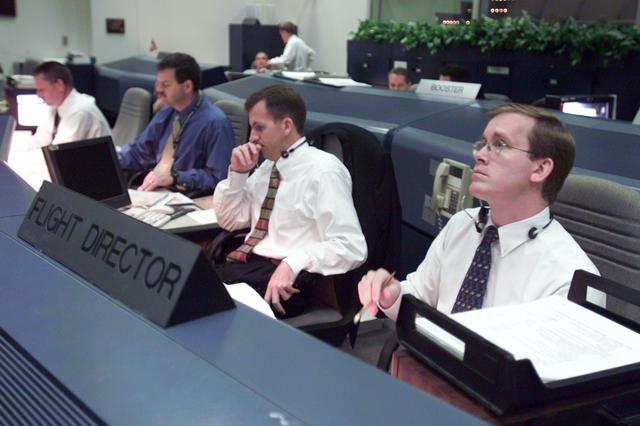
JSC2001-E-12118 (19 April 2001) --- Left to right, astronaut Christopher J. (Gus) Loria, astronaut Scott D. Altman, flight director LeRoy Cain and flight director John Shannon keep up with STS-100 pre-launch activities from their consoles in the shuttle flight control room in Houston's Mission Control Center (MCC). Altman is ascent spacecraft communicator (CAPCOM) and is assisted by Loria, CAPCOM specializing in weather issues. Cain is ascent flight director.
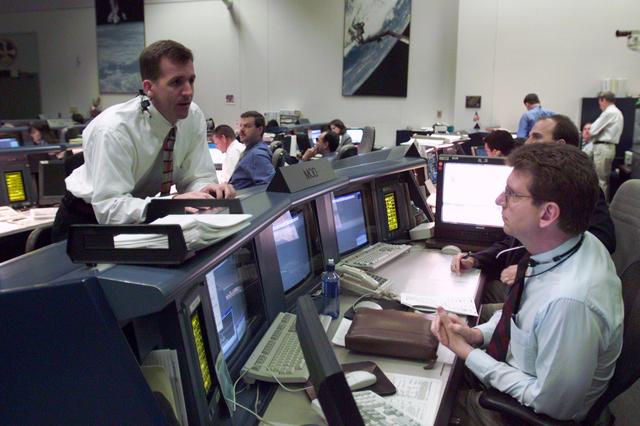
JSC2001-E-12120 (19 April 2001) --- STS-100 ascent flight director LeRoy Cain (left) leans over the Mission Operations Directorate (MOD) console for a word with Jeffrey Bantle in the shuttle flight control room of Houston's Mission Control Center (MCC). Six astronauts and a cosmonaut, meanwhile, were strapped into their seats in the crew cabin of the Space Shuttle Endeavour several hundred miles away in Florida.
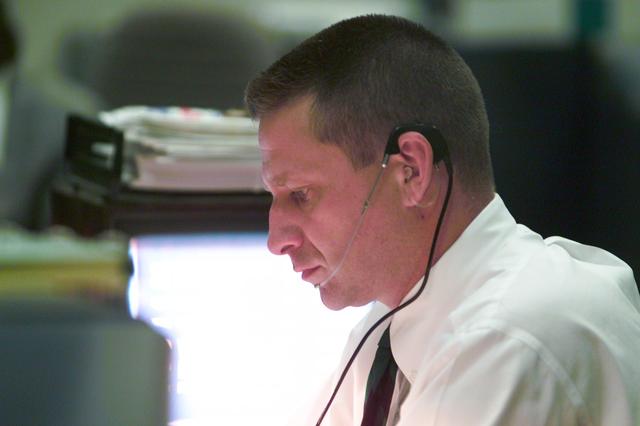
JSC2001-E-12117 (19 April 2001) --- Astronaut Christopher J. (Gus) Loria, at the Spacecraft Communicator (CAPCOM) console, peruses information on monitors and displays at his console in the flight control room in the Johnson Space Center's Mission Control Center (MCC) as countdown for the Space Shuttle Endeavour launch of STS-100 continues several hundred miles away in Florida. Loria deals with weather issues in the respective areas for both ascent and entry phases of the STS-100 mission.
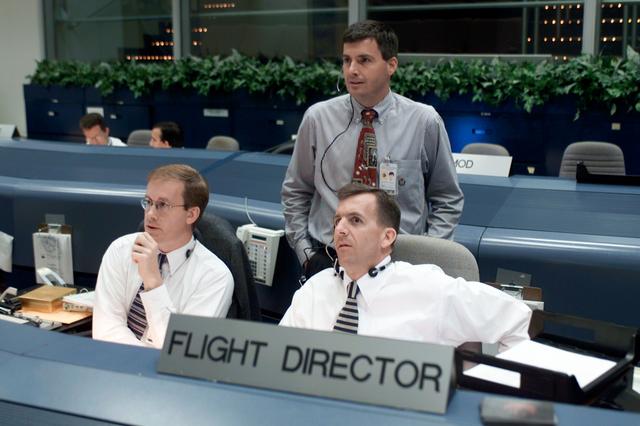
JSC2001-E-25512 (22 August 2001) --- Flight directors John Shannon (left), Steve Stich, and LeRoy Cain watch the large screens from their consoles in the shuttle flight control room (WFCR) in Houston’s Mission Control Center (MCC). At the time this photo was taken the Space Shuttle Discovery was about to land at Kennedy Space Center, Florida, to mark the end of a successful mission to the International Space Station (ISS).
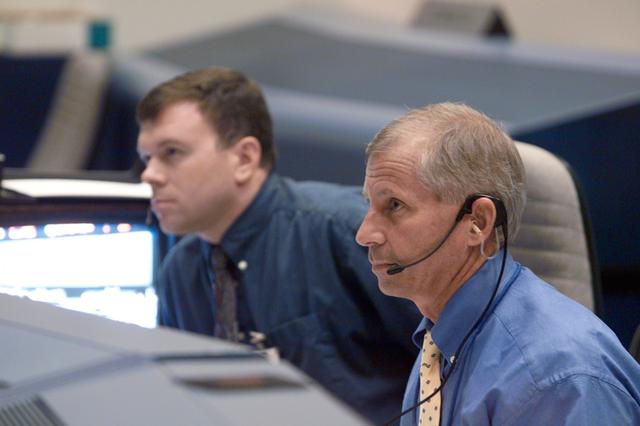
JSC2001-E-25519 (22 August 2001) --- Astronauts James M. Kelly and Kenneth D. Cockrell, both STS-105 spacecraft communicators (CAPCOM), watch the large screens from their consoles in the shuttle flight control room (WFCR) in Houston’s Mission Control Center (MCC). At the time this photo was taken the Space Shuttle Discovery was about to land at Kennedy Space Center, Florida, to mark the end of a successful mission to the International Space Station (ISS).
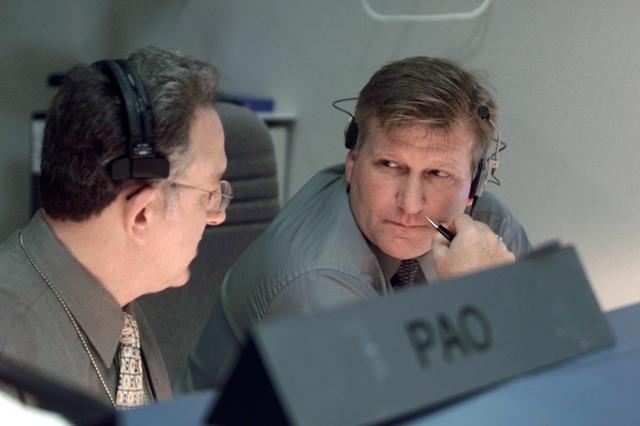
JSC2001-E-25518 (22 August 2001) --- Rob Navias (left), Public Affairs Officer (PAO), and Dan Carpenter, director of the Public Affairs Office, are photographed at their consoles in the shuttle flight control room (WFCR) in Houston’s Mission Control Center (MCC). At the time this photo was taken the Space Shuttle Discovery was about to land at Kennedy Space Center, Florida, to mark the end of a successful mission to the International Space Station (ISS).
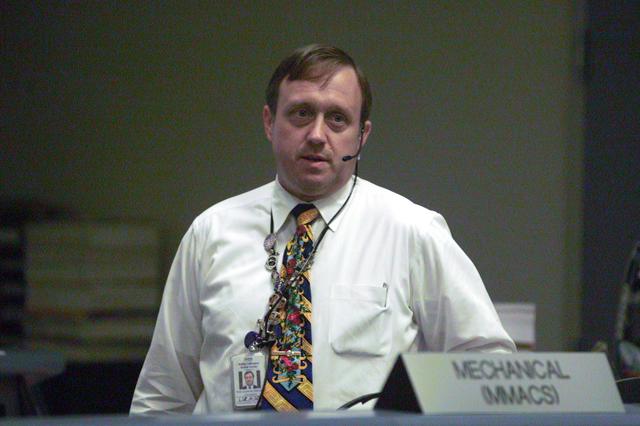
JSC2001-E-12141 (19 April 2001) --- William M. (Bill) Foster, one of the Ground Controllers (GC) for ascent in the flight control room in the Johnson Space Center's Mission Control Center (MCC), discusses a data communications issue with Flight Director LeRoy Cain (not shown) over the voice loops. He is standing in front of the Mechanical (MMACS) console, which is directly behind the GC console, as he faces the rear of the room to talk with Flight.
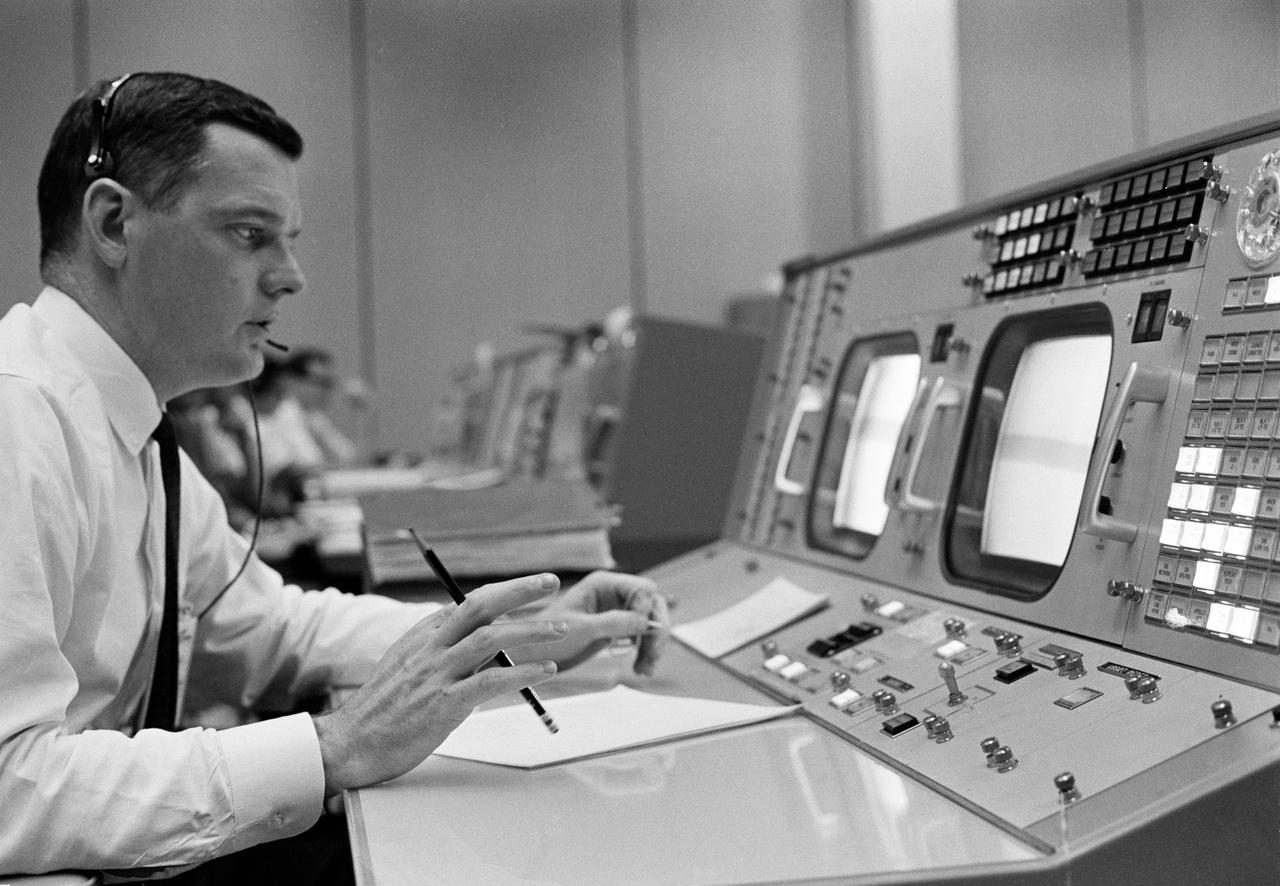
Glynn S. Lunney at his console in the MCC during an Apollo simulation exercise. MSC, Houston, TX
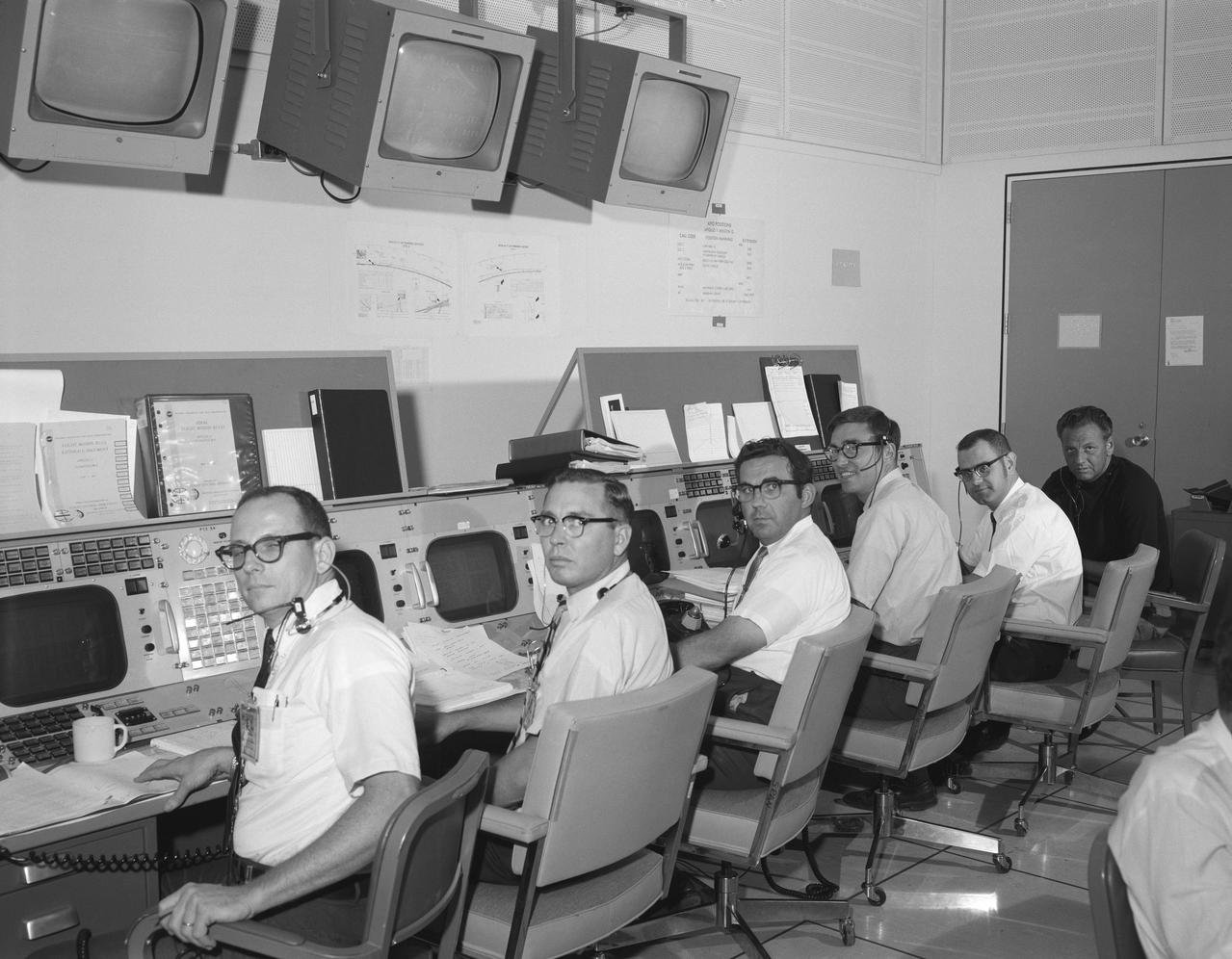
Documentary views of the SPAN preparations in the MCC during the Apollo 11 Mission. MSC, Houston, TX
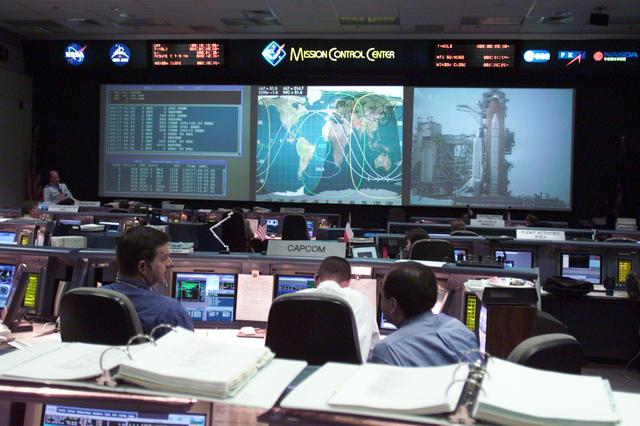
JSC2001-E-12130 (19 April 2001) --- Astronauts Scott D. Altman (left) and Mark L. Polansky (right) discuss the approaching STS-100 launch while staffing the Spacecraft Communicator (CAPCOM) console in Houston's Mission Control Center (MCC). Christopher J. (Gus) Loria (center) studies launch data at his console. Loria's CAPCOM position addresses weather issues, of which there were few on this particular launch. He will also be assigned to weather matters for the entry phase of the flight. The Space Shuttle Endeavour appears on the large screen in the front of the flight control room as liftoff countdown continues several hundred miles away at the Kennedy Space Center (KSC) in Florida.
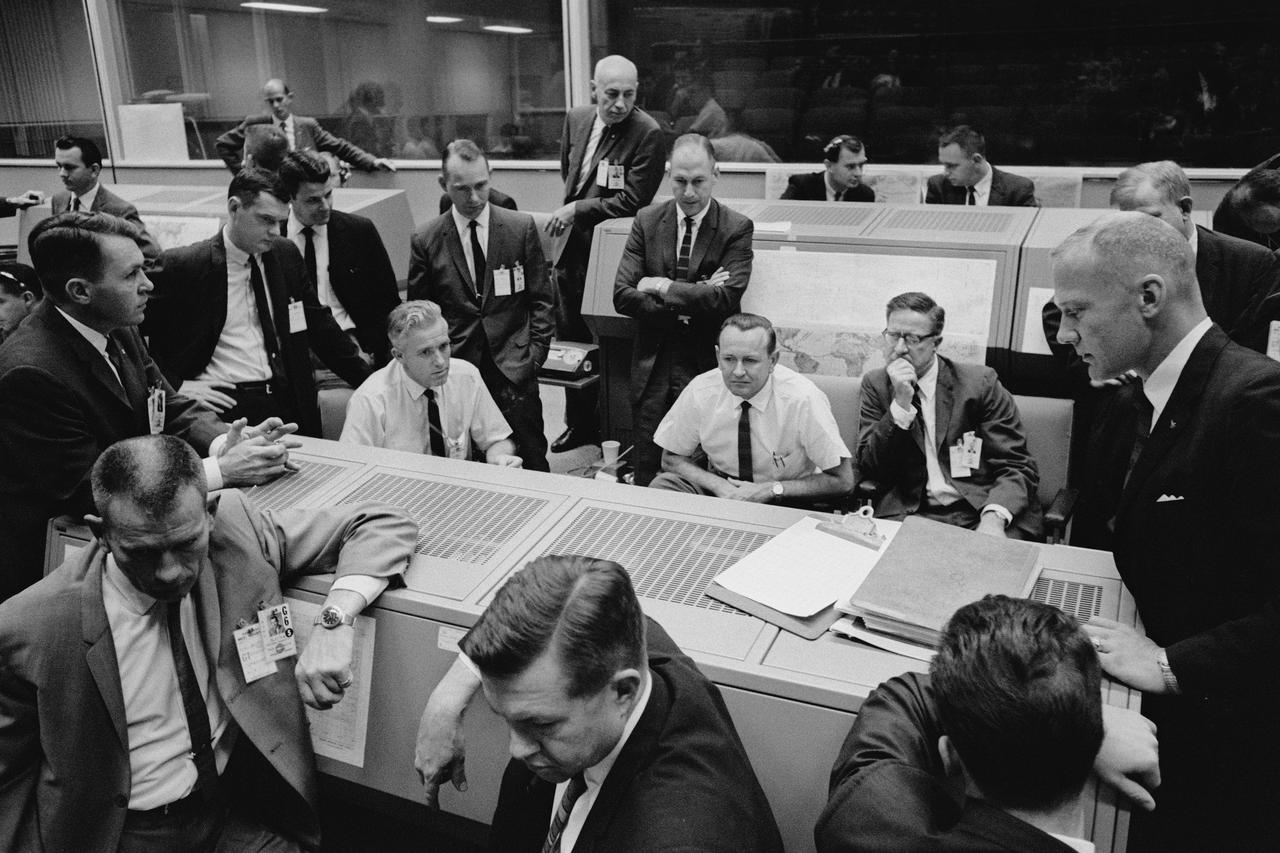
S65-44401 (1965) --- A group of National Aeronautics and Space Administration (NASA) and Manned Spacecraft Center (MSC) officials and personnel watch a Cape Kennedy press conference being telecast in the Mission Control Center (MCC) after the Gemini-6 mission was scrubbed due to the apparent failure of the Agena Target Vehicle to attain orbit.
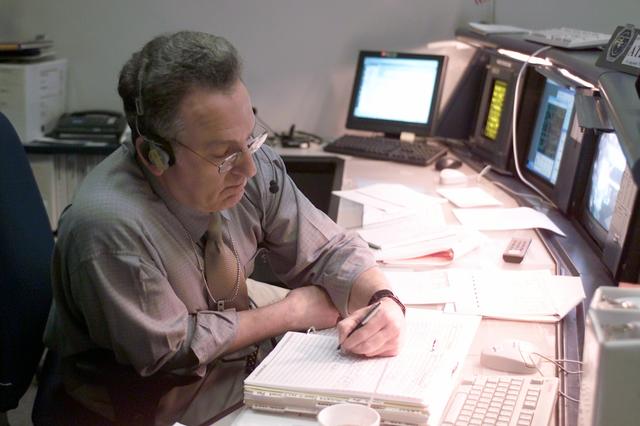
JSC2002-E-41241 (9 October 2002) --- Rob Navias, Public Affairs Office (PAO) commentator, is pictured at his console in the shuttle flight control room (WFCR) in Houston’s Mission Control Center (MCC) during the STS-112 mission.
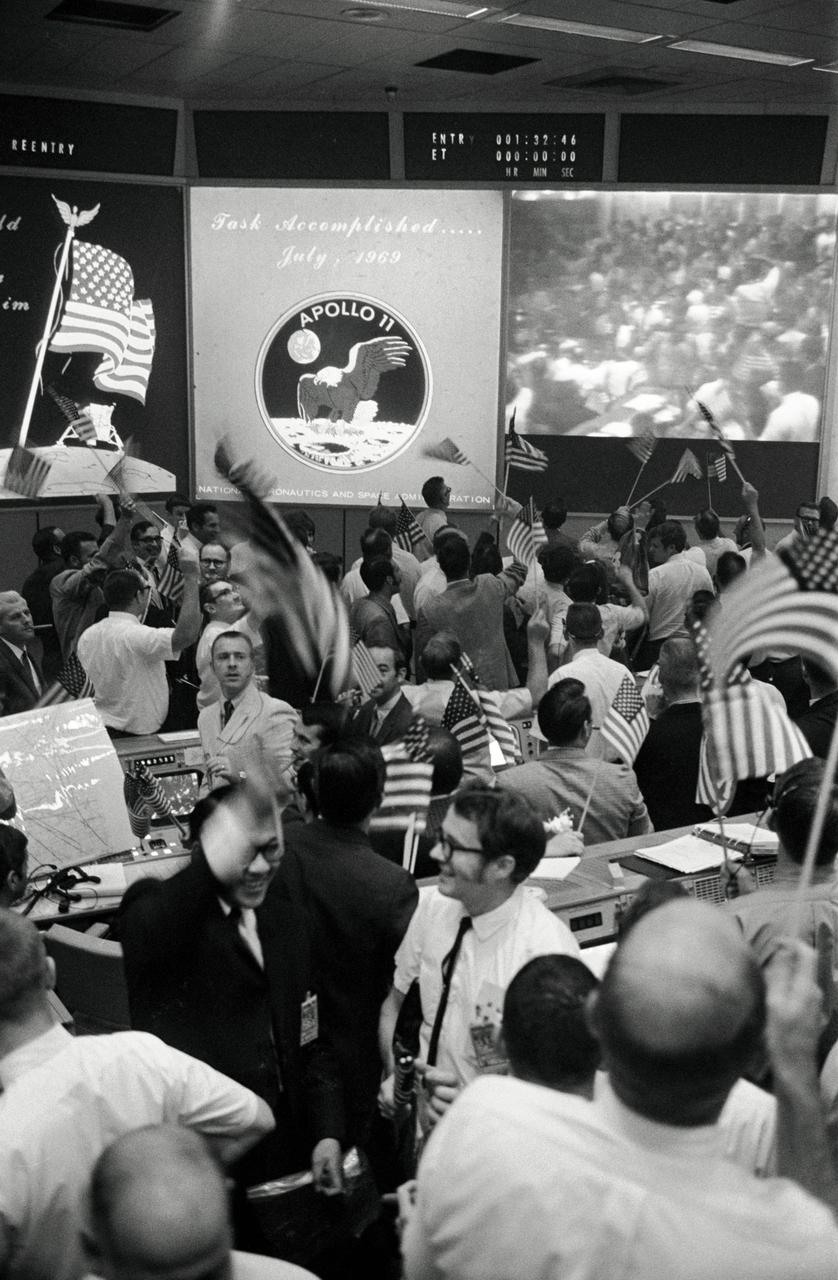
S69-40023 (24 July 1969) --- Overall view of the Mission Operations Control Room (MOCR) in the Mission Control Center (MCC), Building 30, Manned Spacecraft Center (MSC), showing the flight controllers celebrating the successful conclusion of the Apollo 11 lunar landing mission.
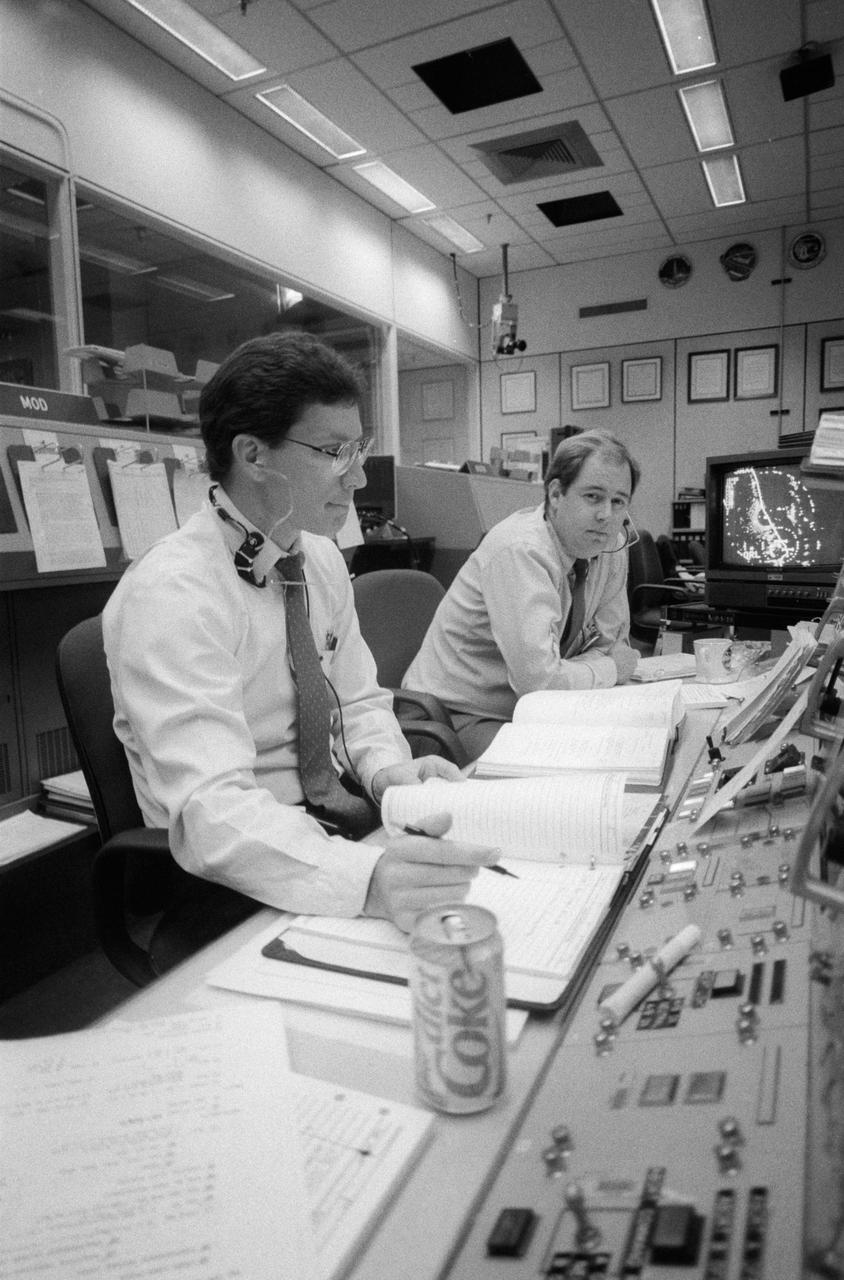
During STS-34, flight directors Robert E. Castle, Jr (left) and Ronald D. Dittemore review checklists and monitor displays at their console in JSC's Mission Control Center (MCC) Bldg 30 flight control room (FCR).
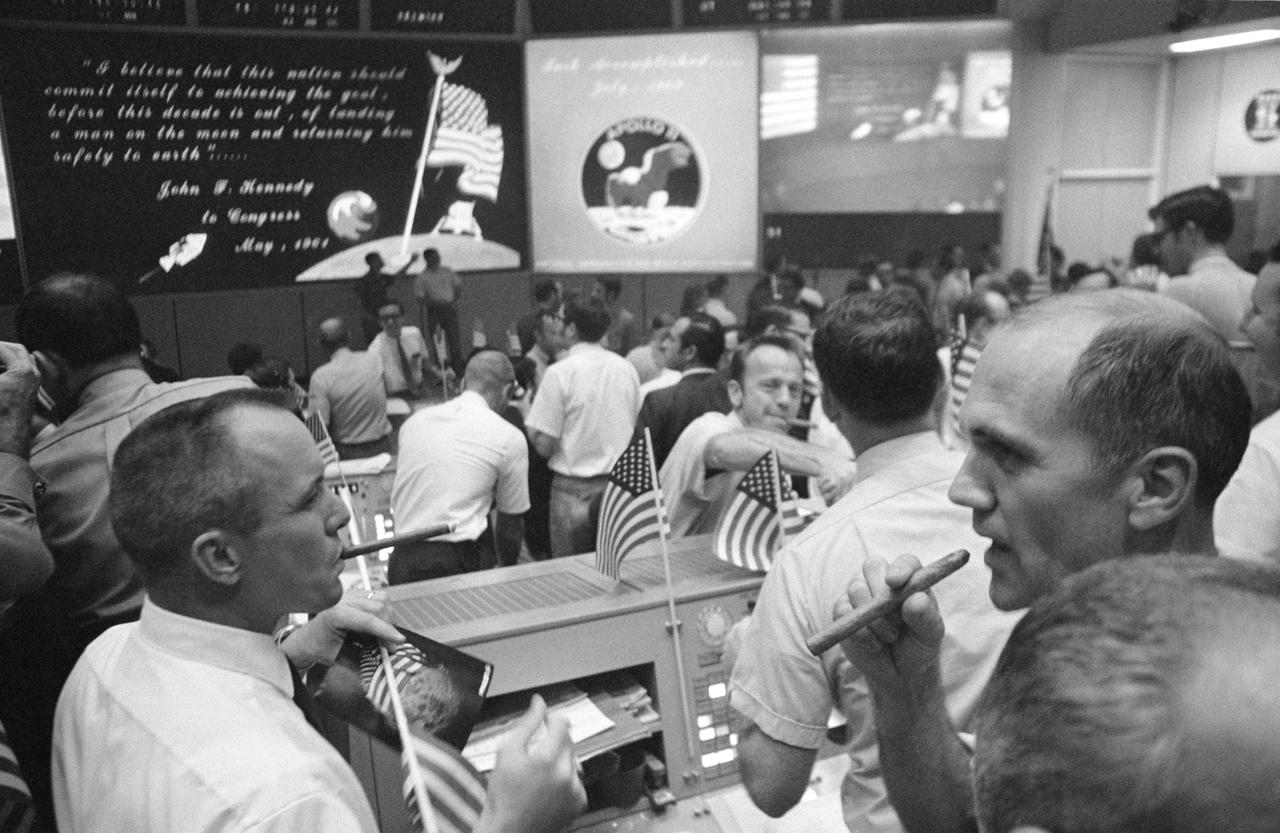
S69-40025 (24 July 1969) --- Overall view of the Mission Operations Control Room (MOCR) in the Mission Control Center (MCC), Building 30, Manned Spacecraft Center (MSC), showing the flight controllers celebrating the successful conclusion of the Apollo 11 lunar landing mission.
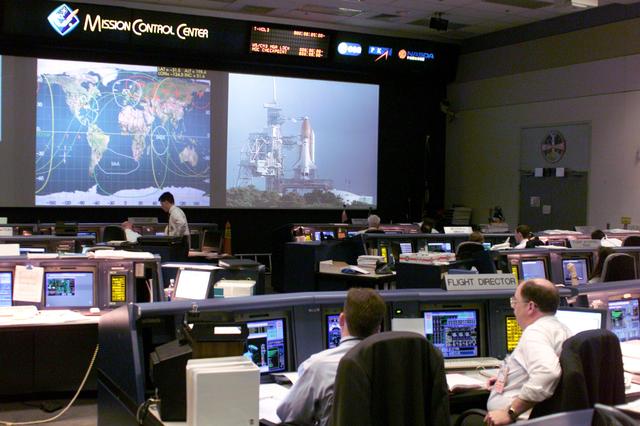
JSC2000-E-22286 (8 September 2000) --- An overall shot in Houston's Mission Control Center (MCC) shows flight controllers awaiting the launch of the Space Shuttle Atlantis from the Kennedy Space Center (KSC) in Florida. The vehicle later launched on schedule, at 8:46 a.m. (EDT), September 8, 2000, as the Johnson Space Center (JSC) flight control team took the baton from KSC's launch controllers. According to flight director Bill Reeves, "The picture referenced was taken less than an hour before launch for STS-106, before we changed the front screens for ascent operations. Wayne Hale (in glasses) is the Flight director for ascent and LeRoy Cain seated to his left was serving as "Weather Flight" for Wayne. The console in the front right corner of the room next to the screens is the Ground Control position, where I was supporting at this time. The man with white hair is Norn Talbott, who will be retiring after this flight with more than 35 years at NASA. Ray Grossman is next to him, who is training to take his place on the GC Ascent Team. I am in fron of and slightly to the right of Ray. As you can see by the boxes at the consoel behind us (Mechanical), we come well prepared for all contingencies, including donuts for early morning shifts. We were on console by 2:00 am central time for the 7:45 am launch." Reference: https://spaceflight.nasa.gov/feedback/expert/answer/mcc/sts-106/09_14_09_35_19.html
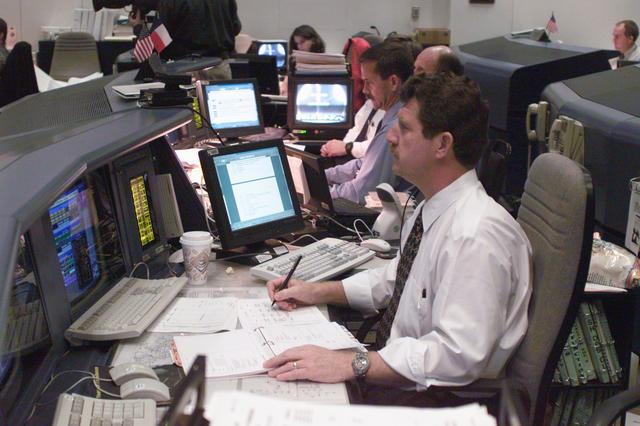
JSC2000-E-22726 (10 Sept. 2000) --- From his console in Houston's Mission Control Center (MCC), lead Flight Director Phil Engelauf intently watches a monitor during the rendezvous operations between the Space Shuttle Atlantis and the International Space Station in Earth orbit. Partially visible in the background are astronauts Gerhard P.J. Thiele and Chris A. Hadfield, at the Spacecraft Communicator (CAPCOM) console.
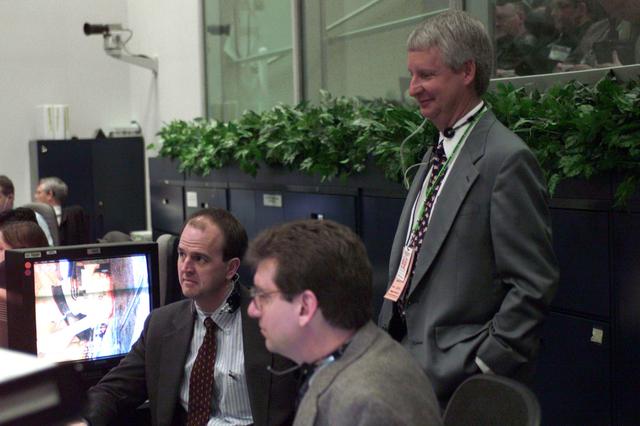
JSC2001-E-06209 (8 March 2001) --- At the Mission Operations Directorate (MOD) console in Houston's Mission Control Center (MCC), (from the left) Robbie D. Gest, Jeffrey W. Bantle and Steven A. Hawley monitor pre-launch activity for STS-102. Gest is Project Leader for Mission Operations for the United Space Alliance (USA); Bantle is with the Flight Director Office in MOD; and Hawley is with the Flight Crew Operations Directorate.
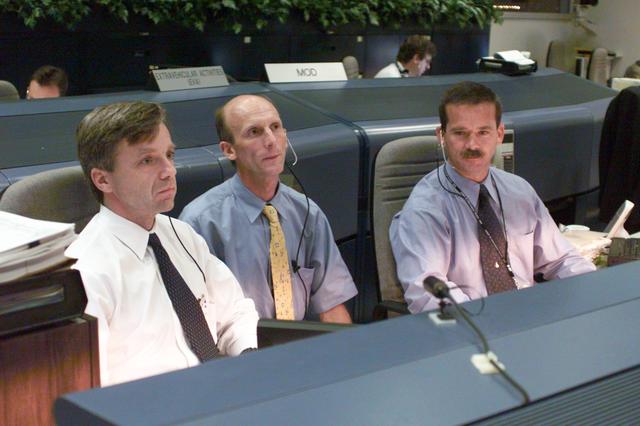
JSC2000-E-22725 (10 September 2000) --- The Spacecraft Communicator (CAPCOM) console in Houston's Mission Control Center (MCC) has an international flavor in this scene, photographed during the docking of the Space Shuttle Atlantis and the International Space Station (ISS). From the left are astronauts Robert B. Thirsk, Gerhard P.J. Thiele and Chris A. Hadfield. Thirsk and Hadfield represent the Canadian Space Agency (CSA), while Thiele is with the European Space Agency (ESA).
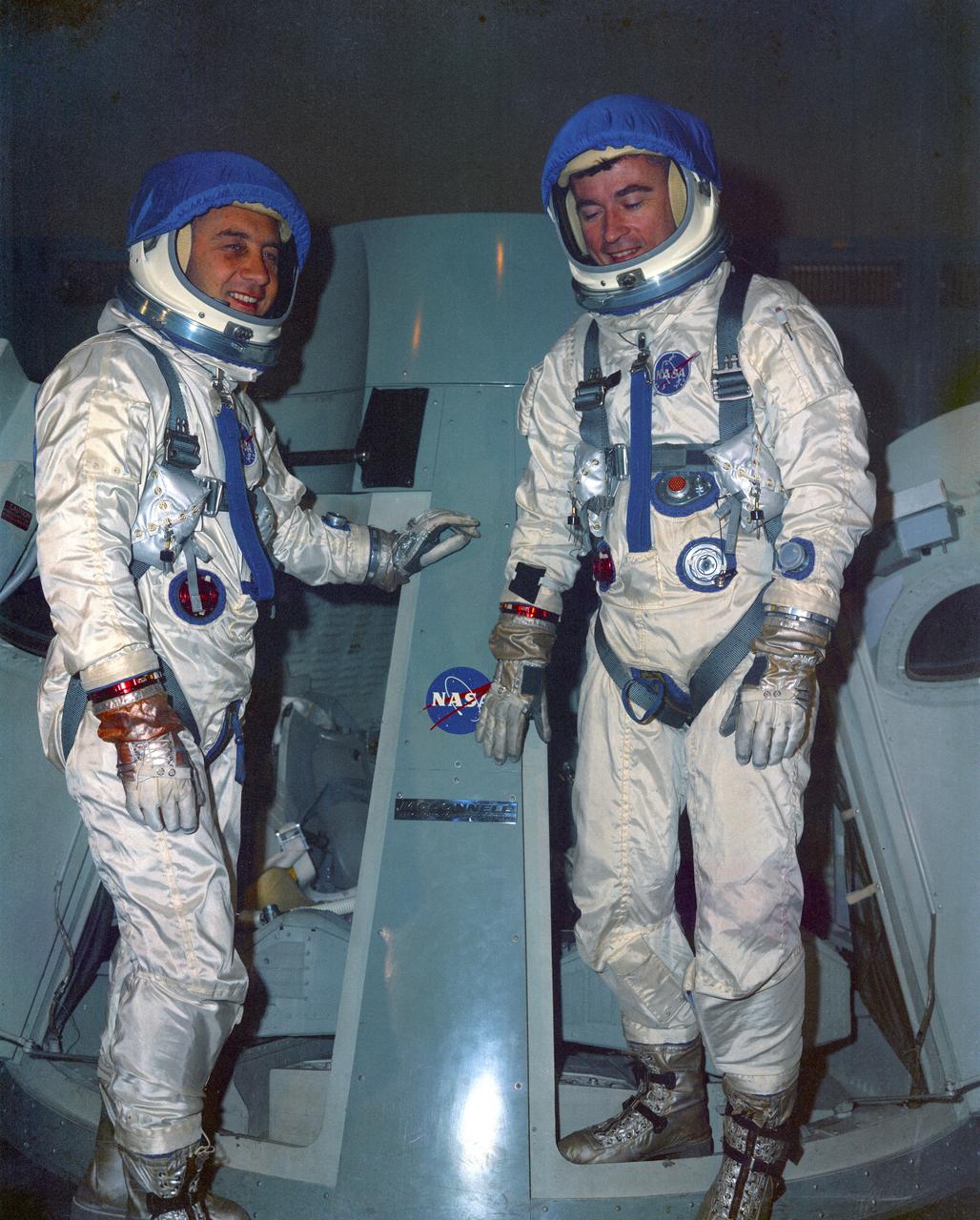
Seen in this view left to right Astronauts Virgil I. Grissom and John Young stand in front of Gemini trainer prior to test, MCC. MSC, HOUSTON, TX CN
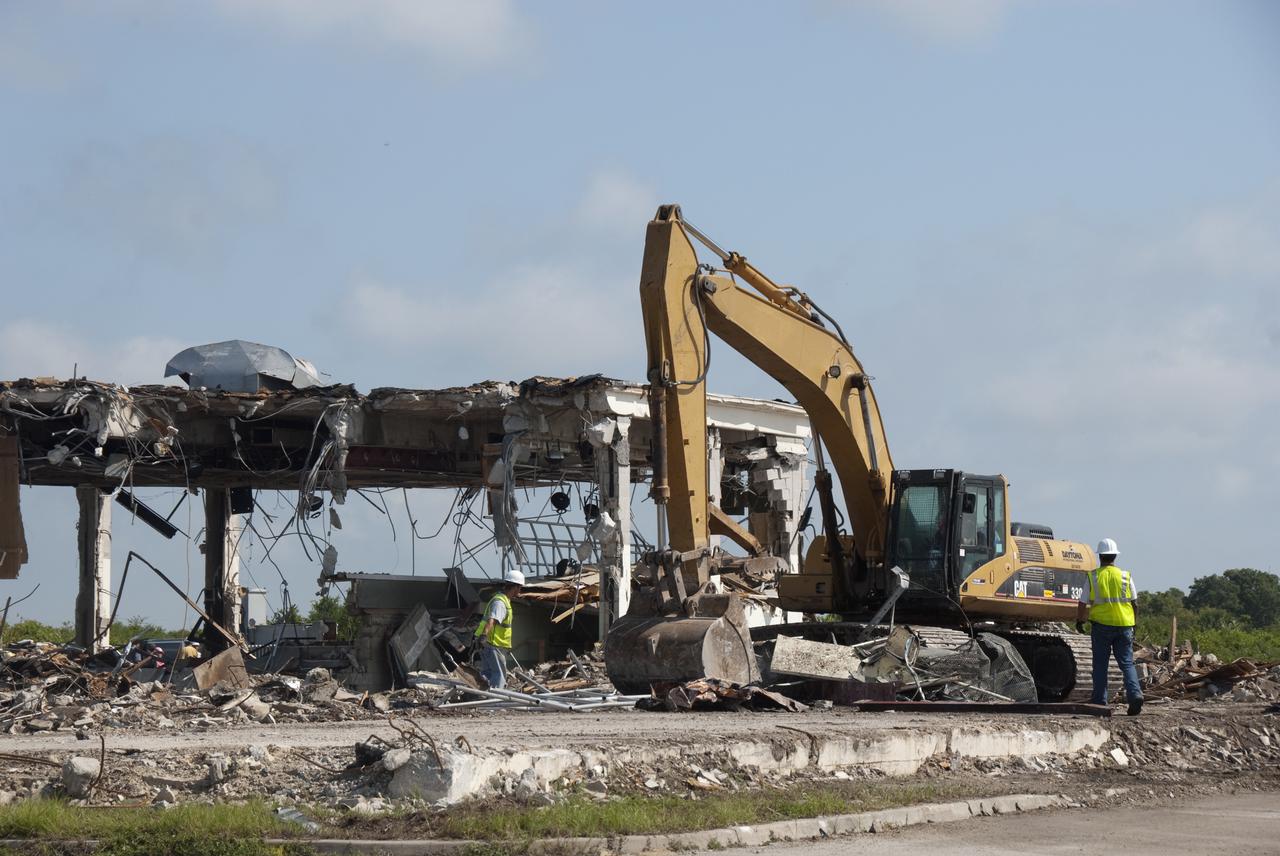
CAPE CANAVERAL, Fla. – At Cape Canaveral Air Force Station in Florida, workers take time out from operation of a Caterpillar 330 track-hoe and the demolition of NASA's Mercury Mission Control Center to determine their next steps. The deconstruction project began on April 28. The original building, constructed between 1956 and 1958, was last modified in 1963. The center succumbed to the two worst enemies of structures along the space coast - time and salt air - necessitating that it be demolished as a safety measure. The facility served as mission control during all the Project Mercury missions, as well as the first three flights of the Gemini Program. The center housed the flight controllers whose duty was to take over flight control after liftoff and follow it through until splashdown. Additionally, it supported vehicle checkout, spacecraft tracking, and astronaut training. With Gemini IV, mission control moved to Houston, and the facility took on the roles of launch control and tracking station. In 1999, much of the equipment and furnishings from the flight control area was moved to Kennedy Space Center's Visitor Complex. A re-created mission control room currently is on display in the complex's Dr. Kurt H. Debus Conference Facility. Speegle II of Cocoa, Fla., was awarded the contract for the deconstruction project. Frank-Lin Excavating is performing the demolition for Sunrise Systems of Brevard, a subcontractor to Speegle II. Photo credit: NASA_Jack Pfaller
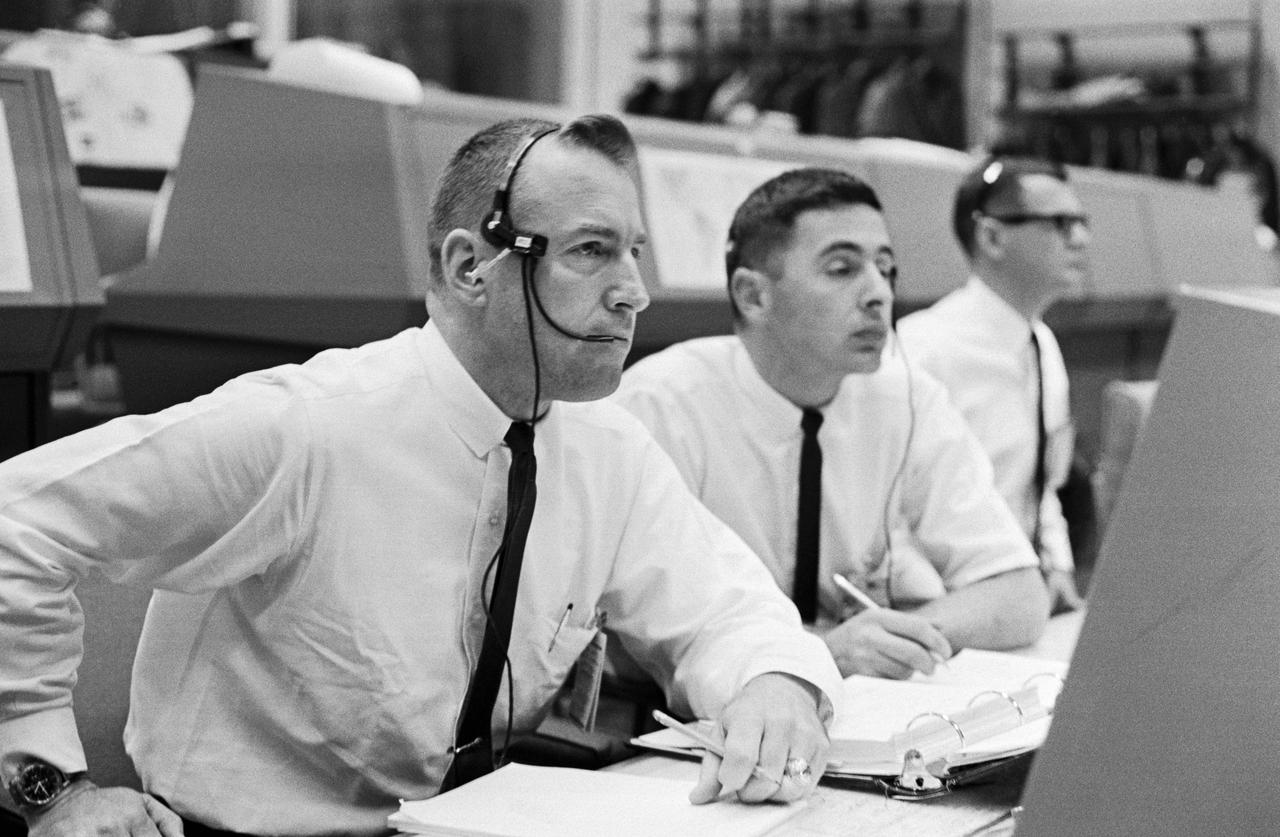
S66-24805 (16 March 1966) --- Personnel in Mission Control watch Gemini-8 launch on their screens. Photo credit: NASA
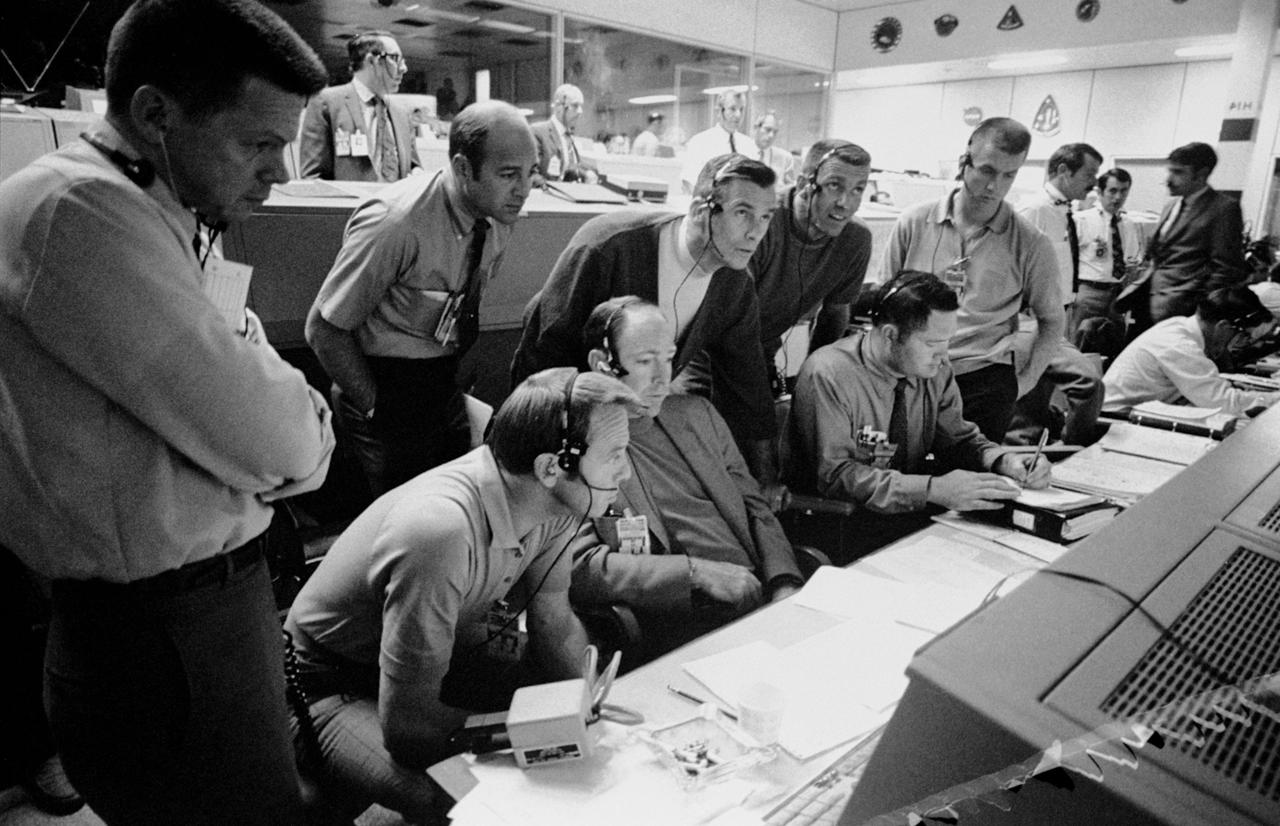
S70-34986 (14 April 1970) --- A group of six astronauts and two flight controllers monitor the console activity in the Mission Operations Control Room (MOCR) of the Mission Control Center (MCC) during the problem-plagued Apollo 13 lunar landing mission. Seated, left to right, are MOCR Guidance Officer Raymond F. Teague; astronaut Edgar D. Mitchell, Apollo 14 prime crew lunar module pilot; and astronaut Alan B. Shepard Jr., Apollo 14 prime crew commander. Standing, left to right, are scientist-astronaut Anthony W. England; astronaut Joe H. Engle, Apollo 14 backup crew lunar module pilot; astronaut Eugene A. Cernan, Apollo 14 backup crew commander; astronaut Ronald E. Evans, Apollo 14 backup crew command module pilot; and M.P. Frank, a flight controller. When this picture was made, the Apollo 13 moon landing had already been canceled, and the Apollo 13 crew men were in trans-Earth trajectory attempting to bring their damaged spacecraft back home.
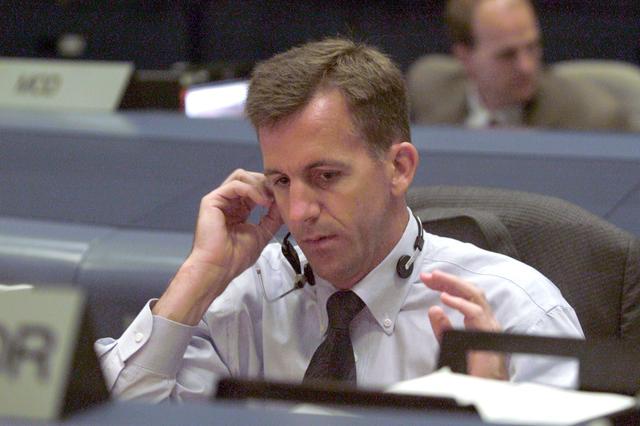
JSC2001-E-21328 (12 July 2001) --- Flight director LeRoy Cain directs his attention to data related to the Space Shuttle Atlantis and its impending launch from the Kennedy Space Center (KSC) several hundred miles away from this Houston setting at the Johnson Space Center's Mission Control Center (MCC). As soon as the vehicle cleared the tower in Florida, the Houston-based team of flight controllers took over the ground control of the flight.
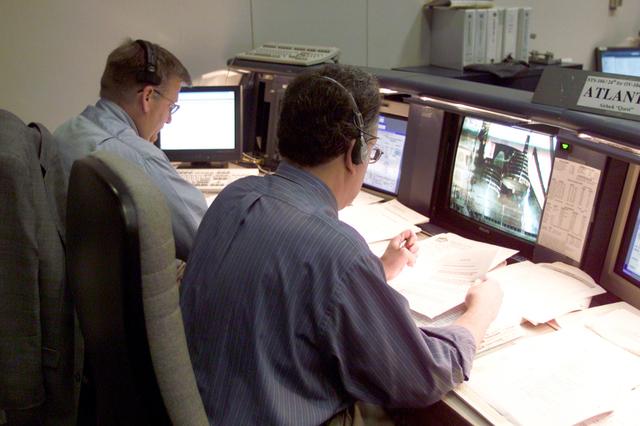
JSC2001-E-21337 (12 July 2001) --- Rob Navias (right), at the Public Affairs Officer (PAO) console in Houston's Mission Control Center (MCC), awaits to do his commentary as he views the firing of Space Shuttle Atlantis' main engines on his monitor just seconds before launch and the beginning of the STS-104 mission. Daniel K. Carpenter, director of the Public Affairs Office, looks on.
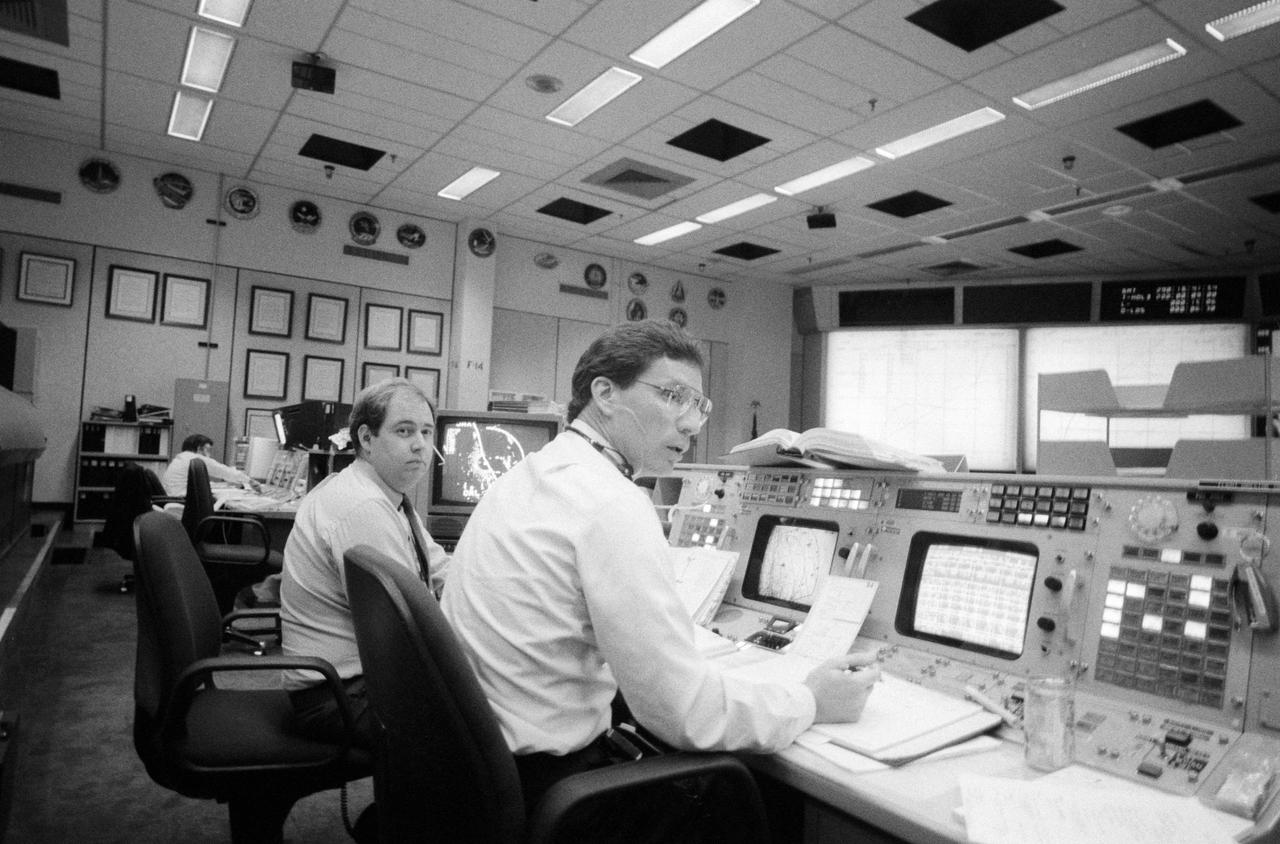
Flight directors Robert E. Castle, Jr (left) and Ronald D. Dittemore monitor console displays during STS-34 mission. Castle and Dittemore will oversee flight activities from their stations in JSC's Mission Control Center (MCC) Bldg 30 flight control room (FCR). In the background are the FCR large screens which display flight data.
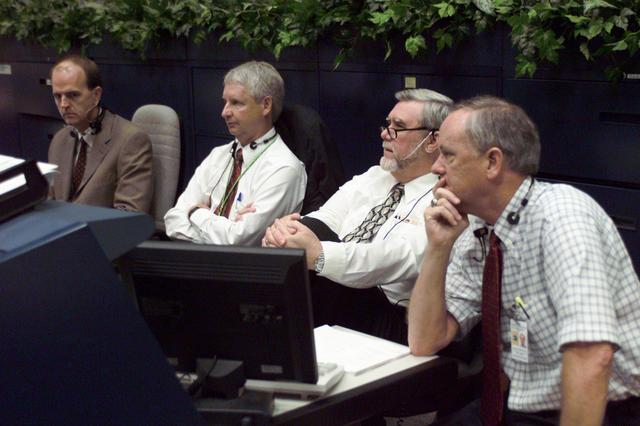
JSC2001-E-21323 (12 July 2001) --- From left to right, Robert Gest with United Space Alliance; Steven A. Hawley, deputy director of Flight Crew Operations; Alan L. (Lee) Briscoe, chief engineer for the Mission Operations Directorate (MOD); and J. Milton (Milt) Heflin, chief of the Flight Director's Office, watch the monitor at the MOD console during the pre-launch activity for the STS-104 mission in the shuttle flight control room (WFCR) of Houston's Mission Control Center (MCC).
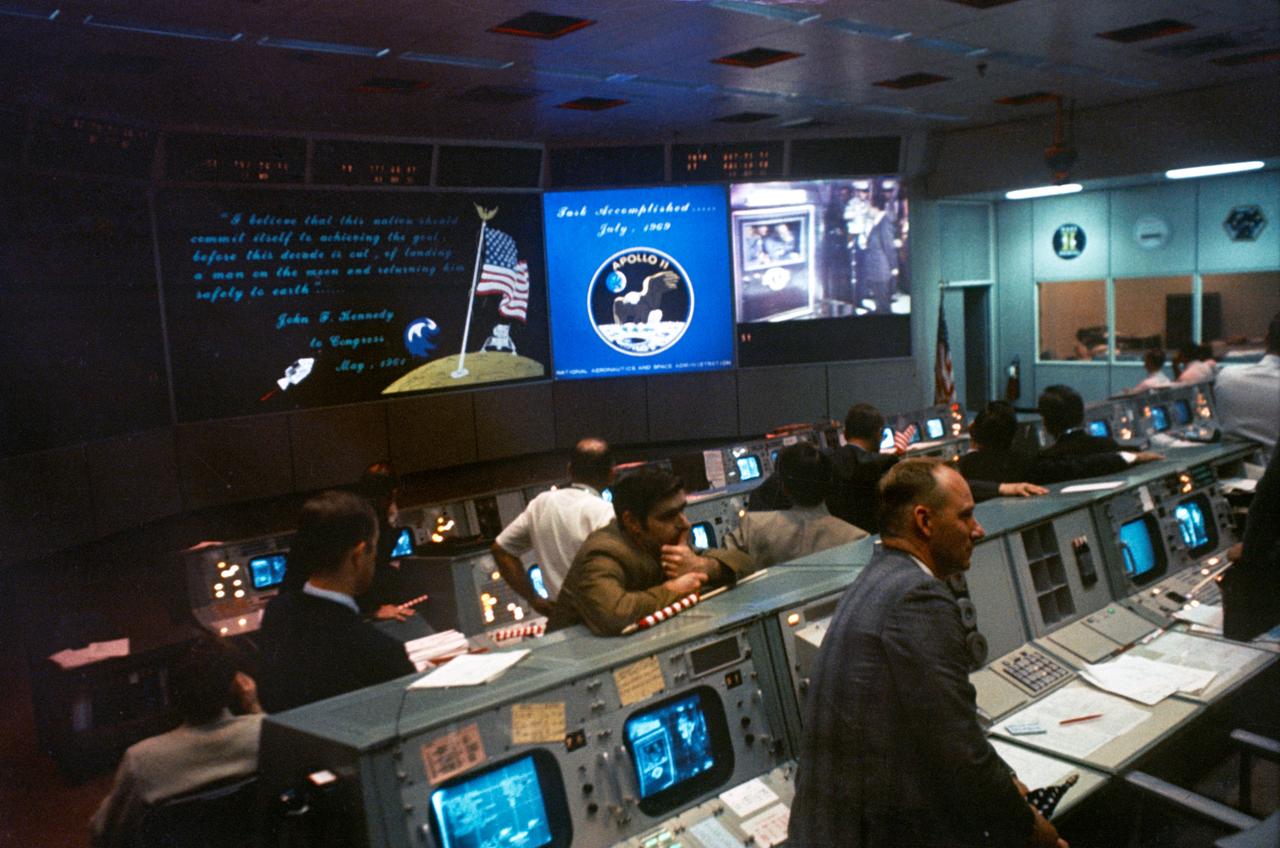
S69-40301 (24 July 1969) --- Overall view of the Mission Operations Control Room (MOCR) in the Mission Control Center (MCC), Building 30, Manned Spacecraft Center (MSC), at the conclusion of the Apollo 11 lunar landing mission. The television monitor shows President Richard M. Nixon greeting the Apollo 11 astronauts aboard the USS Hornet in the Pacific recovery area. Astronauts Neil A. Armstrong, Michael Collins, and Edwin E. Aldrin Jr. are inside the Mobile Quarantine Facility (MQF).
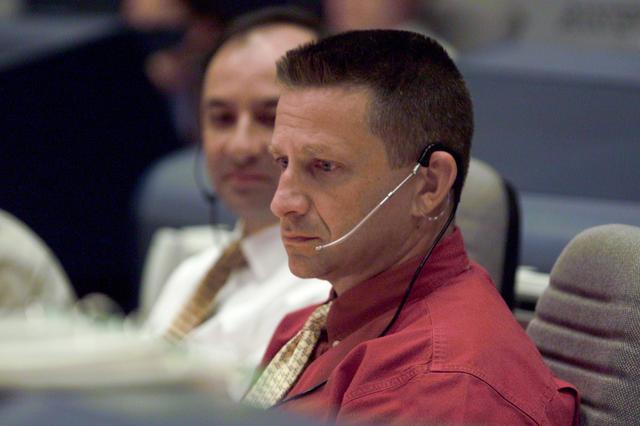
JSC2001-E-21329 (12 July 2001) --- Astronaut Christopher J. (Gus) Loria, STS-104 spacecraft communicator (CAPCOM), intently studies pre-flight data at his console in the shuttle flight control room (WFCR) in Houston's Mission Control Center (MCC) prior to the launch of Space Shuttle Atlantis. Fellow astronaut Mark L. Polansky monitors weather issues in the background.
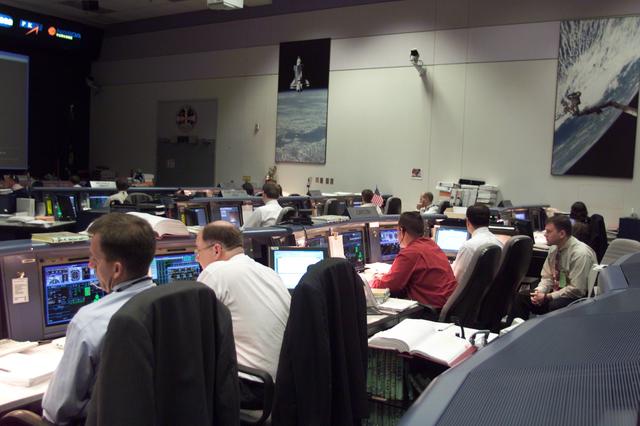
JSC2001-E-21341 (12 July 2001) --- From a familiar setting near the rear of shuttle flight control room (WFCR) at Houston's Mission Control Center (MCC), Wayne Hale (second left), ascent flight director for STS-104, pays close attention to new data related to the Space Shuttle Atlantis and its impending launch from the Kennedy Space Center (KSC) in Florida. Several other flight controllers are visible in the wide shot.
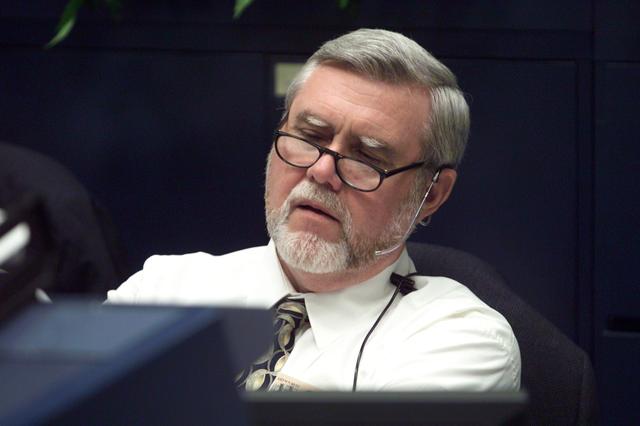
JSC2001-E-21331 (12 July 2001) --- Alan L. (Lee) Briscoe, chief engineer for the Mission Operations Directorate, looks over pre-flight data at the MOD console in the shuttle flight control room (WFCR) in Houston's Mission Control Center (MCC) during the countdown leading up to the launch of the Space Shuttle Atlantis and the beginning of the STS-104 mission.
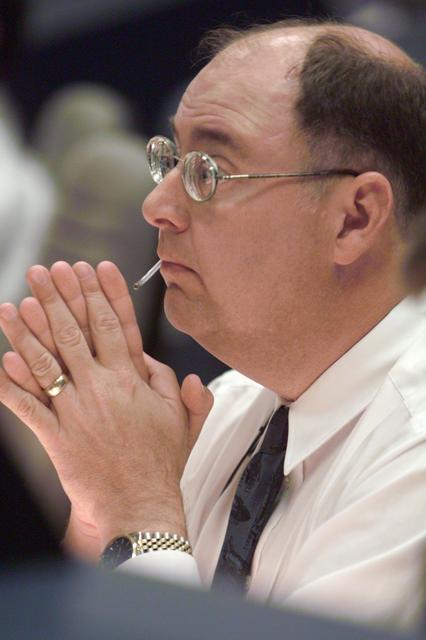
JSC2001-E-21333 (12 July 2001) --- From a familiar setting in the shuttle flight control room (WFCR) at Houston's Mission Control Center (MCC), Wayne Hale, ascent flight director for STS-104, pays close attention to new data related to the Space Shuttle Atlantis and its impending launch from the Kennedy Space Center (KSC) in Florida.
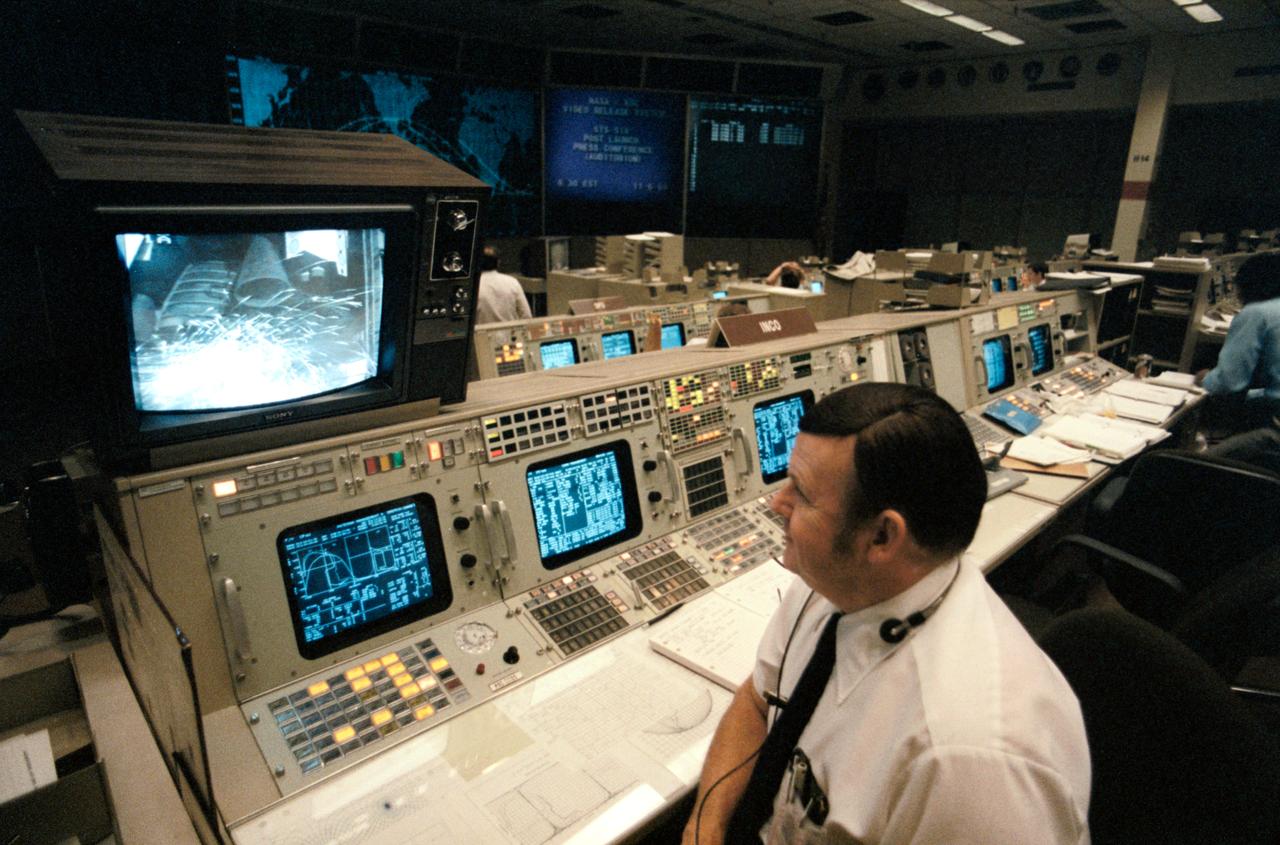
51A-90016 (8 Nov 1984) --- J. E. Conner, on duty at the integrated communcations officer console in the second floor Flight Control Room (FCR) of the Johnson Space Center's (JSC) Mission Control Center (MCC), watches engine ignition of Discovery on a nearby TV monitor. Moments later, the Houston FCR took over control of the scheduled eight day mission 51-A.
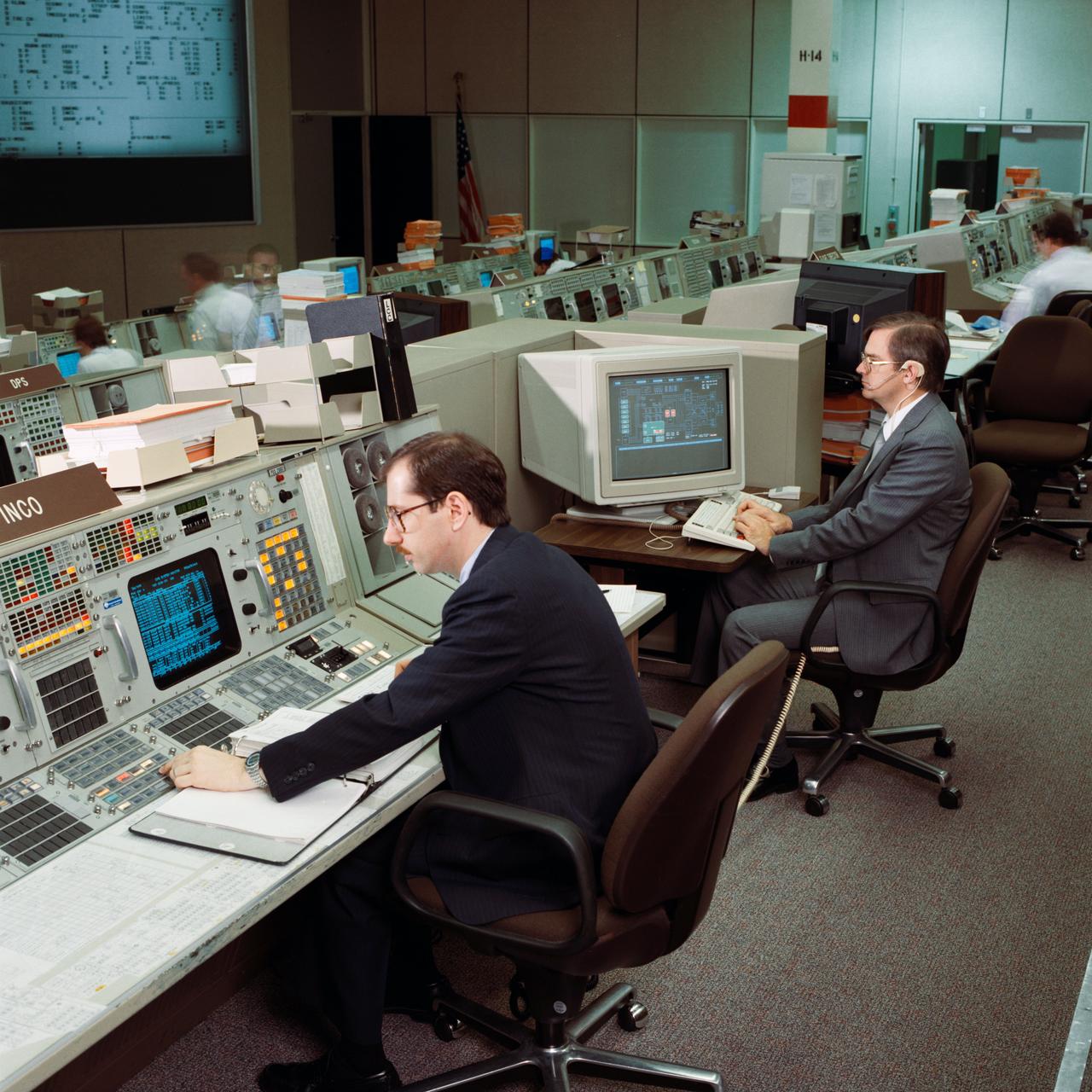
Instrumentation and Communications Officer (INCO) John F. Muratore monitors conventional workstation displays during an STS-26 simulation in JSC Mission Control Center (MCC) Bldg 30 Flight Control Room (FCR). Next to Muratore an operator views the real time data system (RTDS), an expert system. During the STS-29 mission two conventional monochrome console display units will be removed and replaced with RTDS displays. View is for the STS-29 press kit from Office of Aeronautics and Space Technology (OAST) RTDS.
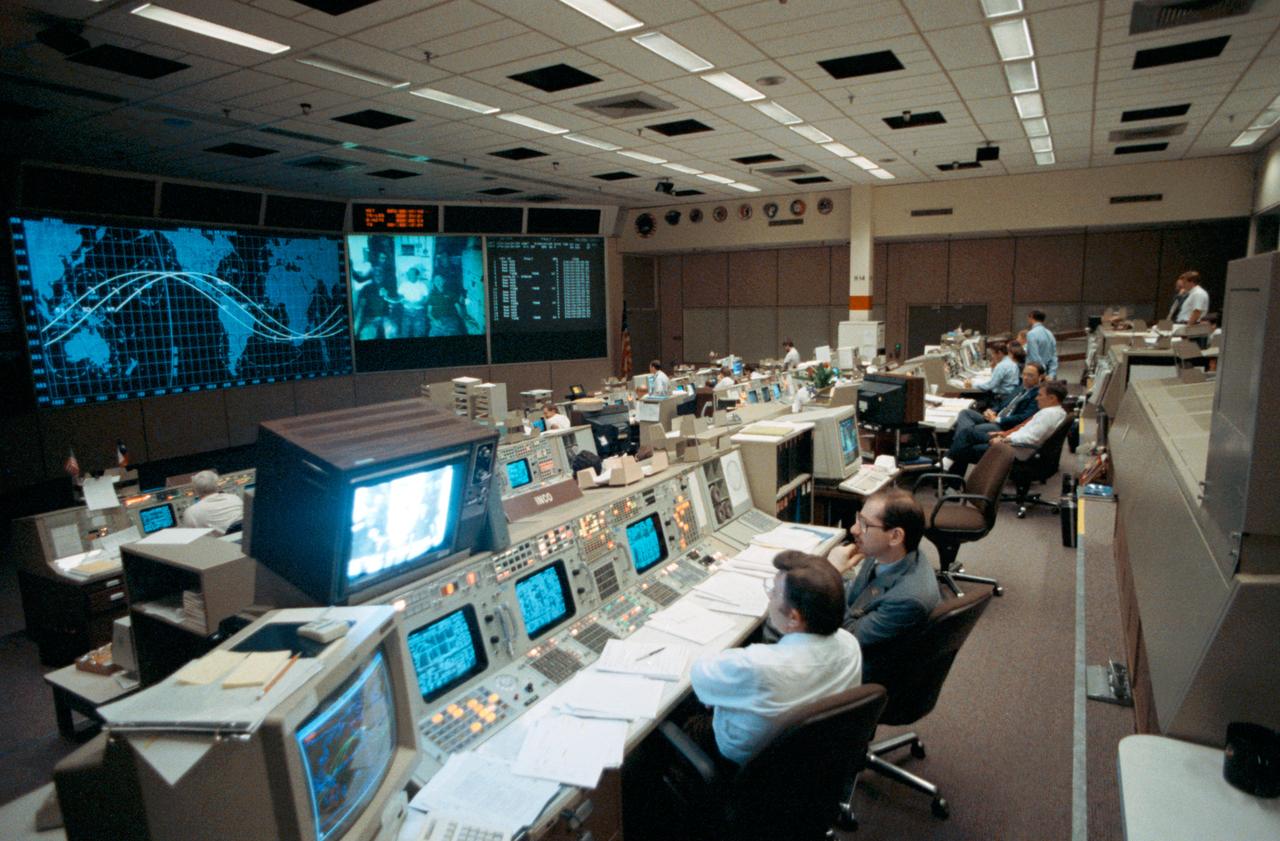
Flight controllers in JSC's Mission Control Center (MCC) Bldg 30 flight control room (FCR) listen to a presentation by STS-26 crewmembers on the fourth day of Discovery's, Orbiter Vehicle (OV) 103's, orbital mission. Instrumentation and Communications Officers (INCOs) Harold Black (left foreground) and John F. Muratore and other controllers view a television (TV) transmission of the crew on a screen in front of the FCR as each member relates some inner feelings while paying tribute to the 51L Challenger crew.

JSC2000-01071 (31 January 2000) --- Astronaut Joe F. Edwards, Jr., spacecraft communicator (CAPCOM), looks over notes at his console in Houston's Mission Control Center (MCC) while awaiting word regarding STS-99's launch status at Florida's Kennedy Space Center (KSC), several hundred miles away.
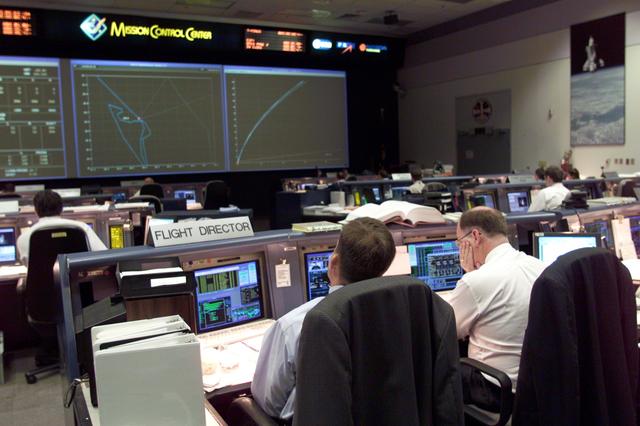
JSC2001-E-21333 (12 July 2001) --- From a familiar setting in the shuttle flight control room (WFCR)at Houston's Mission Control Center (MCC), Wayne Hale, ascent flight director for STS-104, pays close attention to new data related to the Space Shuttle Atlantis and its impending launch from the Kennedy Space Center (KSC) in Florida.
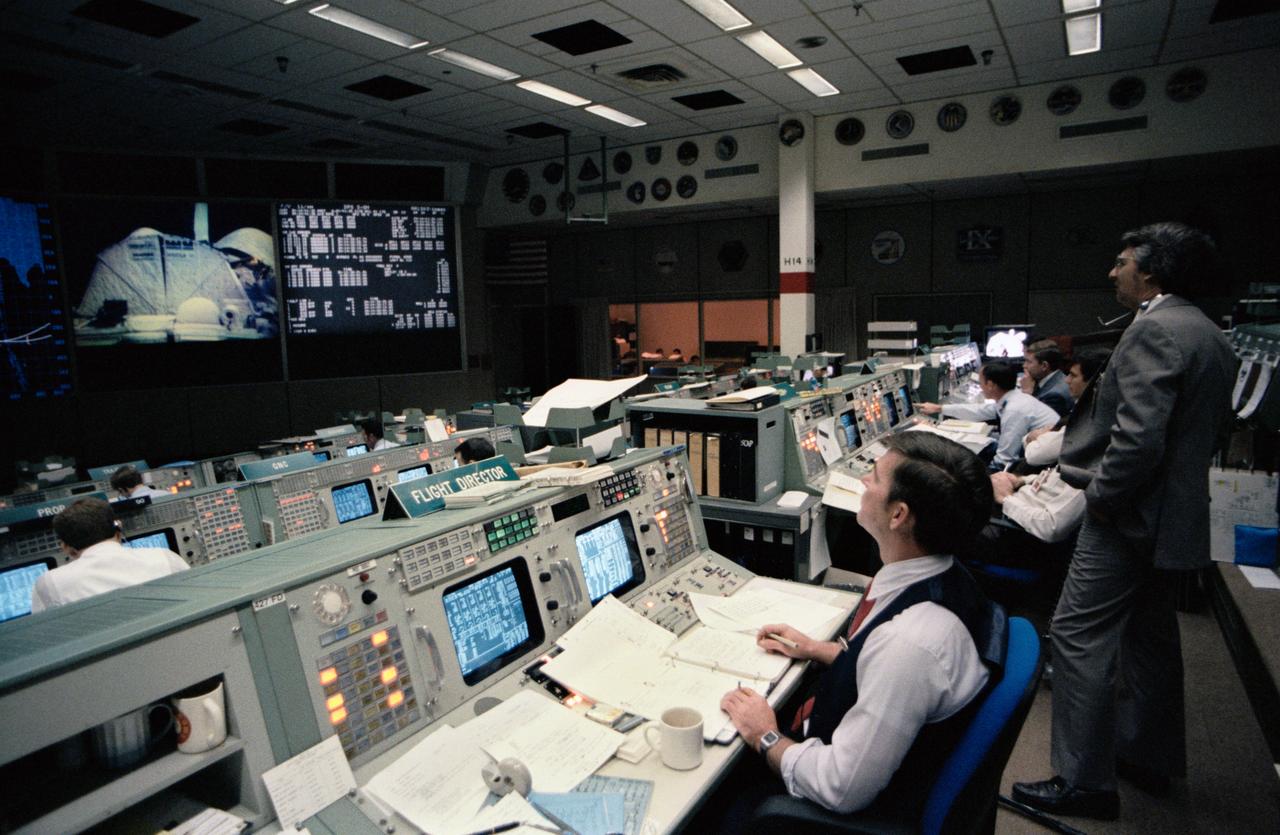
S84-26333 (6 Feb 1984) --- Robert E. Castle, integrated communications officer (INCO), is seated at the INCO console in the mission operations control room (MOCR) of Johnson Space Center's (JSC) mission control center (MCC). He is responsible for ground controlled television from the orbiter on his shift. On the screen at the front of the room the Westar VI satellite is seen in the cargo bay just after opening the payload bay doors.
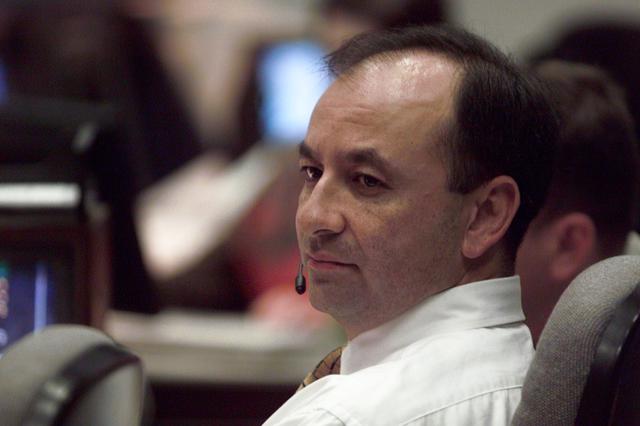
JSC2001-E-21326 (12 July 2001) --- Astronaut Mark L. Polansky, STS-104 spacecraft communicator (CAPCOM) for weather issues, monitors pre-flight data at his console in the shuttle flight control room (WFCR) in Houston's Mission Control Center (MCC). Several hundred miles away in Florida, five astronauts were awaiting countdown in the crew cabin of the Space Shuttle Atlantis on the launch pad at the Kennedy Space Center (KSC).
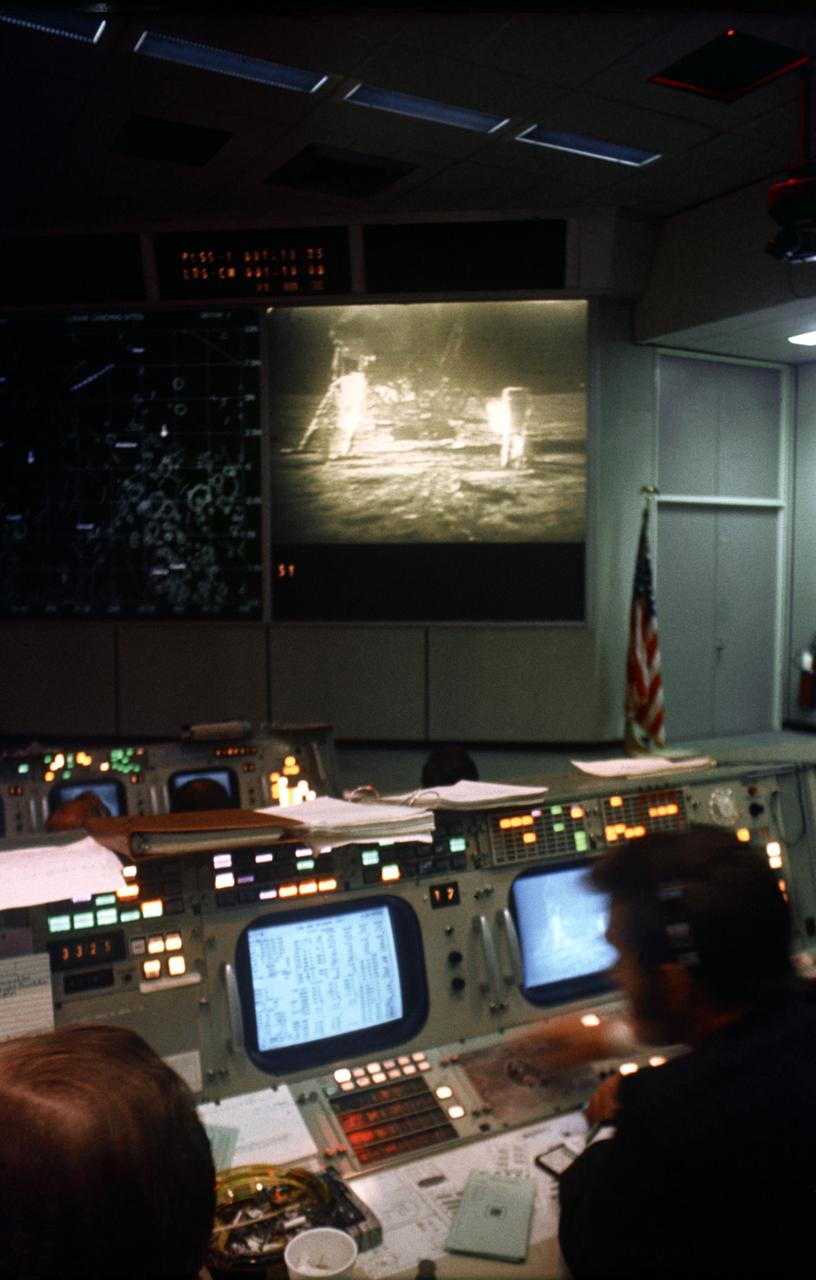
S69-39815 (20 July 1969) --- Interior view of the Mission Operations Control Room (MOCR) in the Mission Control Center (MCC) during the Apollo 11 lunar extravehicular activity (EVA). The television monitor shows astronauts Neil A. Armstrong and Edwin E. Aldrin Jr. on the surface of the moon.
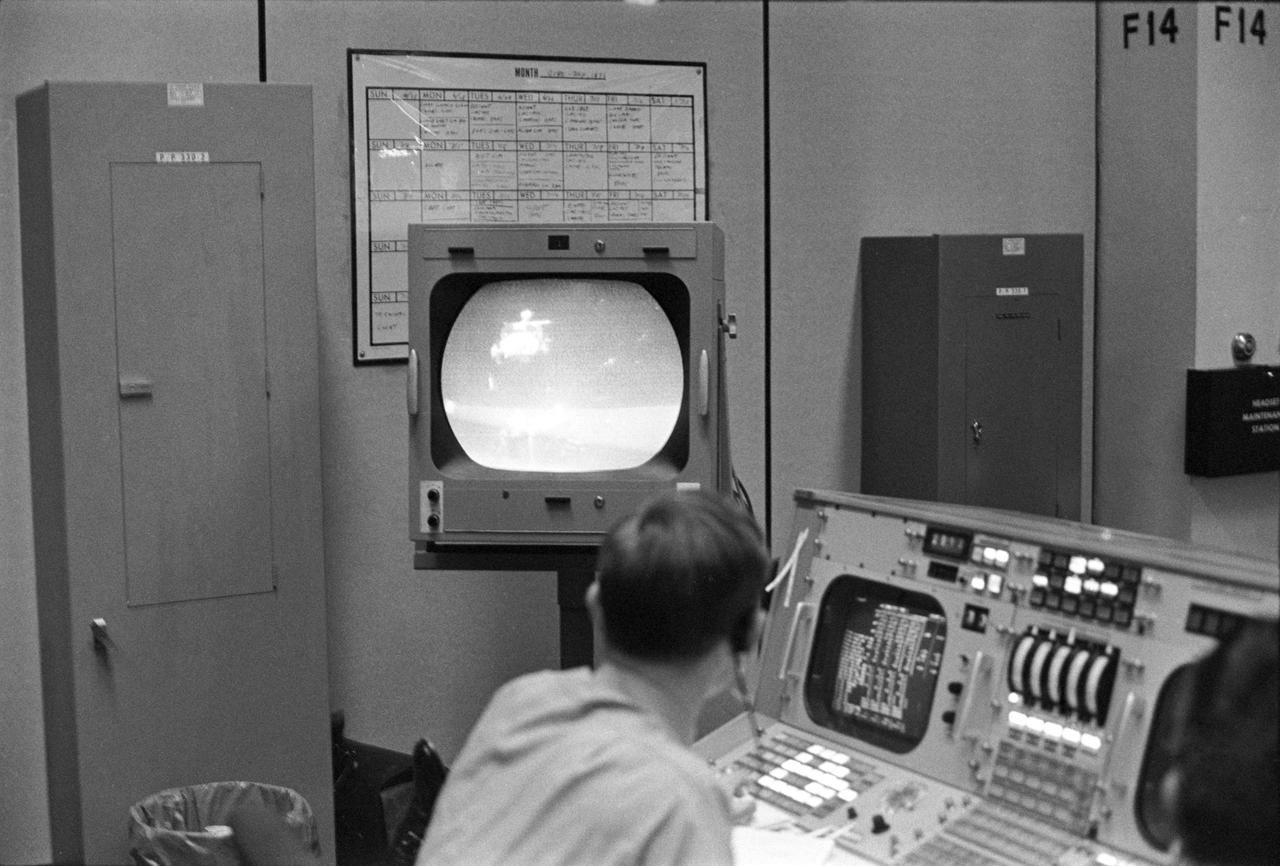
View of a photograph of the television (TV) monitor in the MCC showing a picture being transmitted from the color TV camera mounted on the parked Lunar Roving Vehicle (LRV) at the Hadley-Apennine Landing Site showing the liftoff of the Apollo 15 Lunar Module (LM) Ascent Stage from the Lunar surface. MSC, Houston, TX
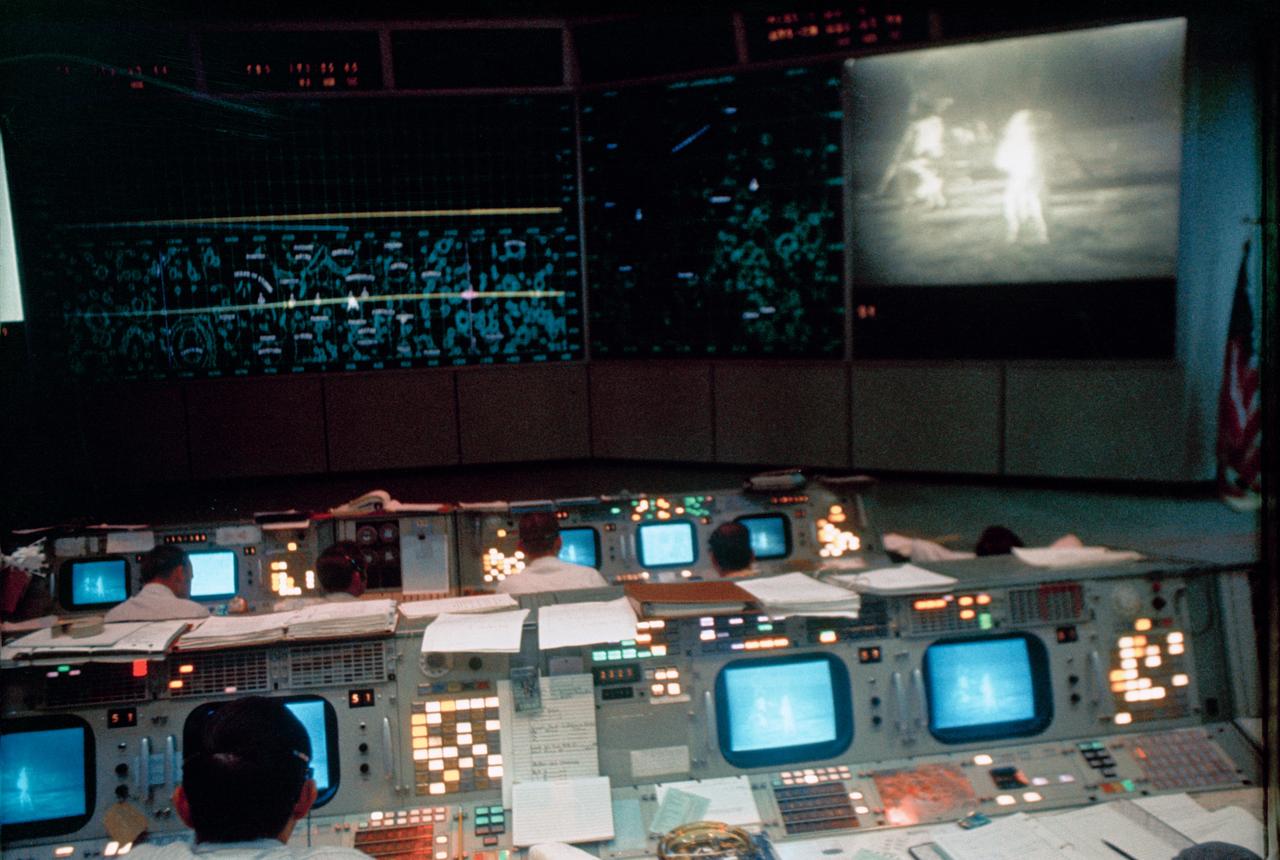
S69-39817 (20 July 1969) --- Interior view of the Mission Operations Control Room (MOCR) in the Mission Control Center (MCC), Building 30, during the Apollo 11 lunar extravehicular activity (EVA). The television monitor shows astronauts Neil A. Armstrong and Edwin E. Aldrin Jr. on the surface of the moon.
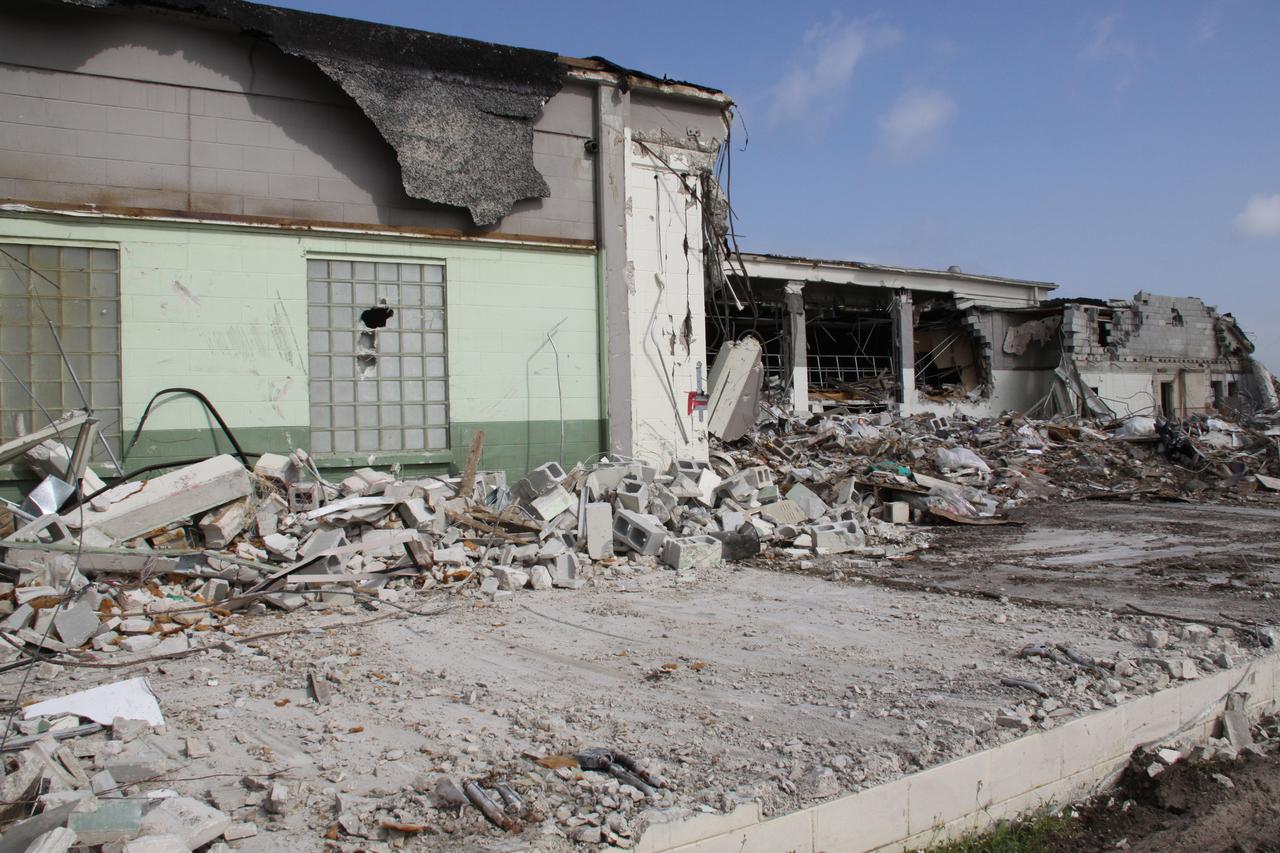
MCC Demolition
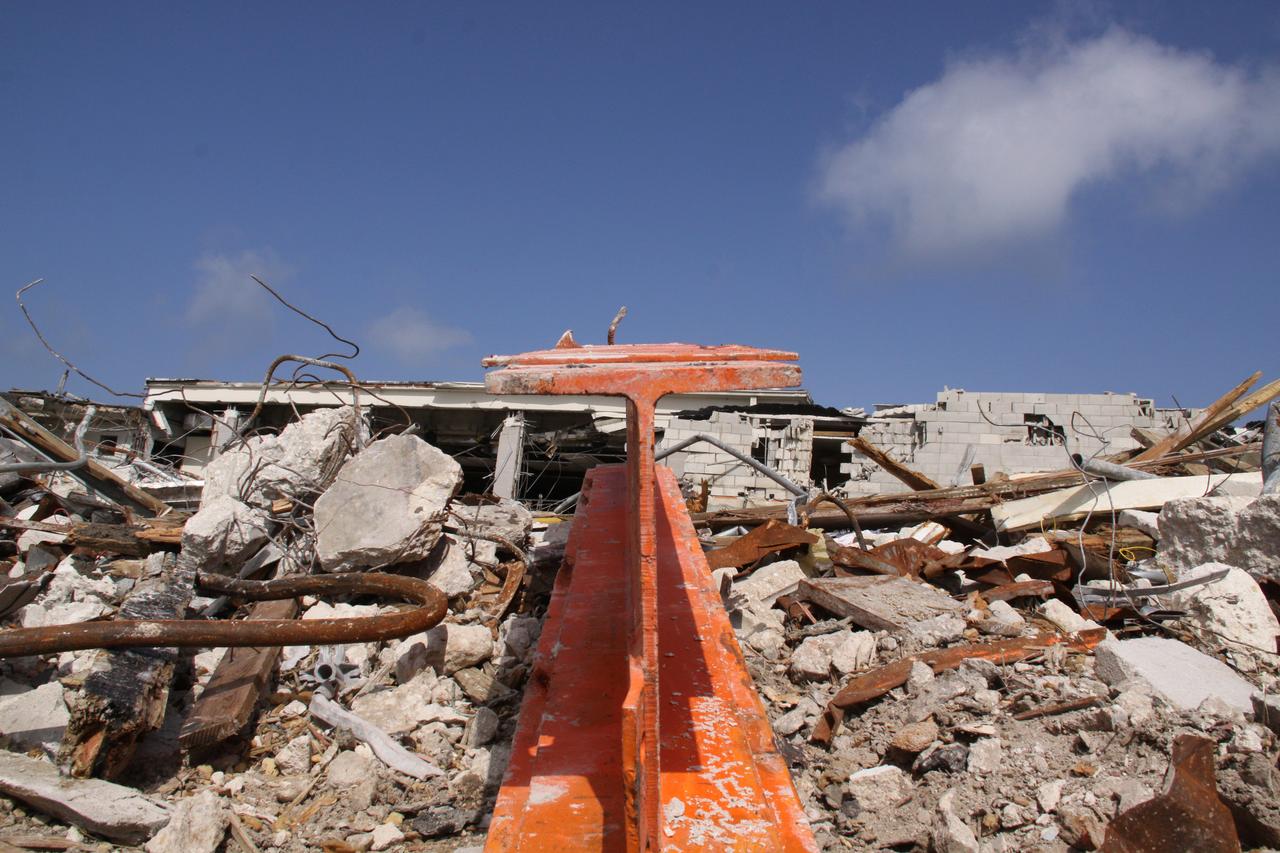
MCC Demolition
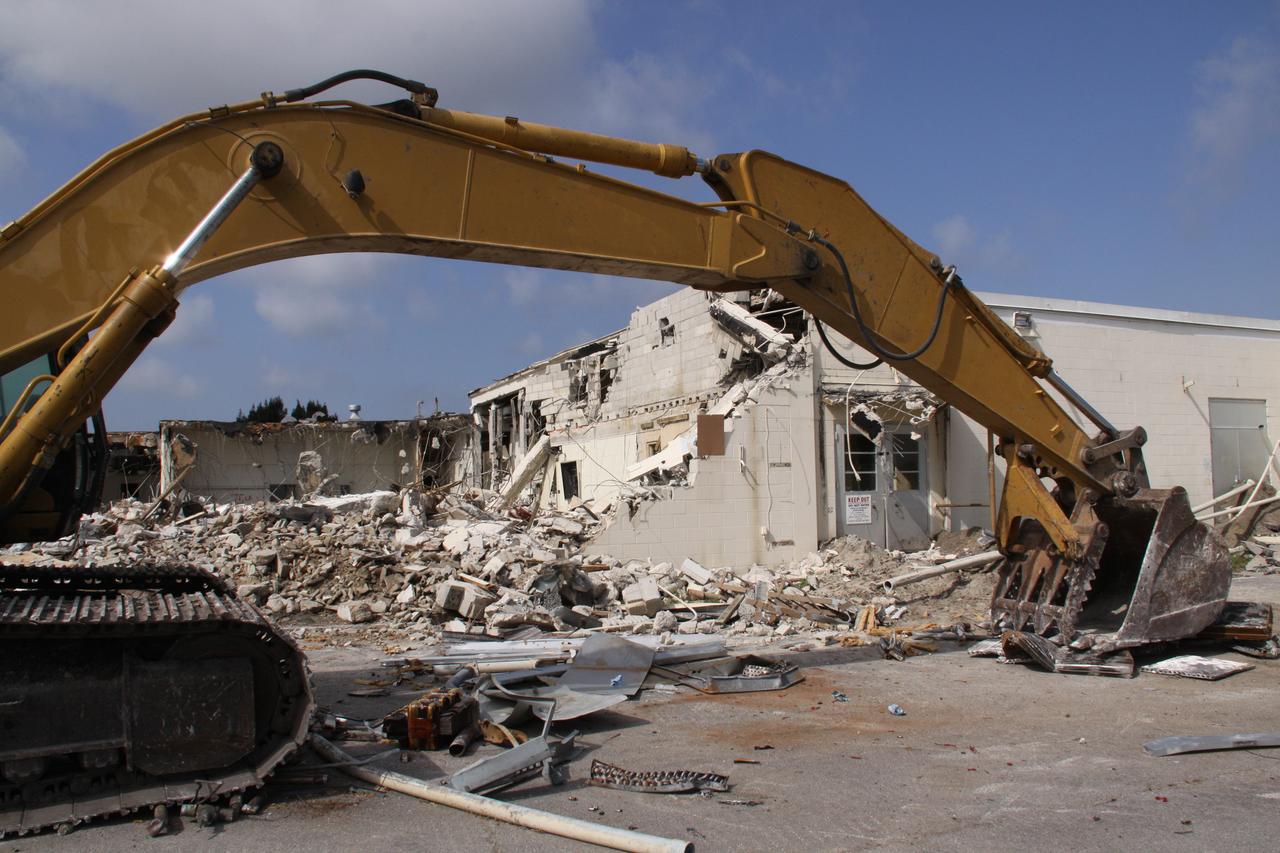
MCC Demolition
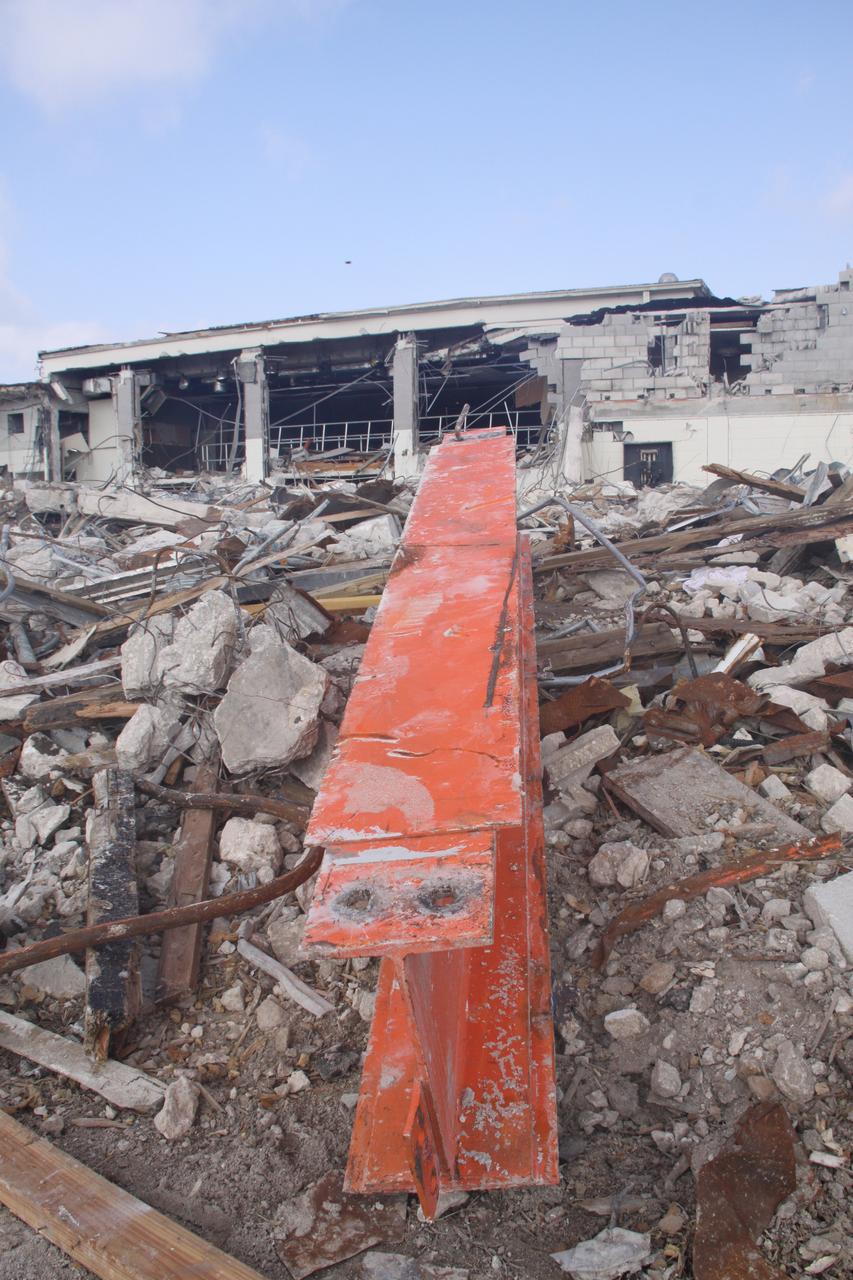
MCC Demolition
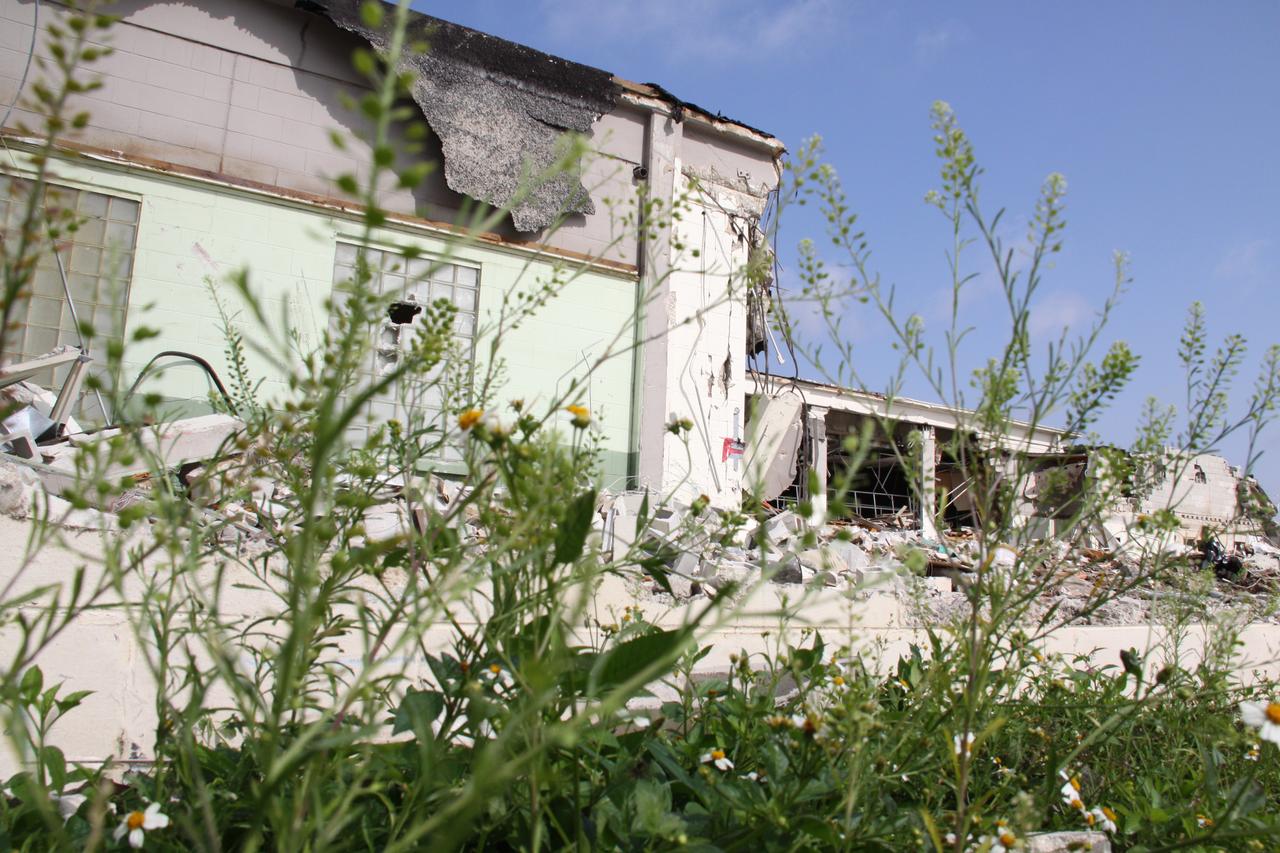
MCC Demolition
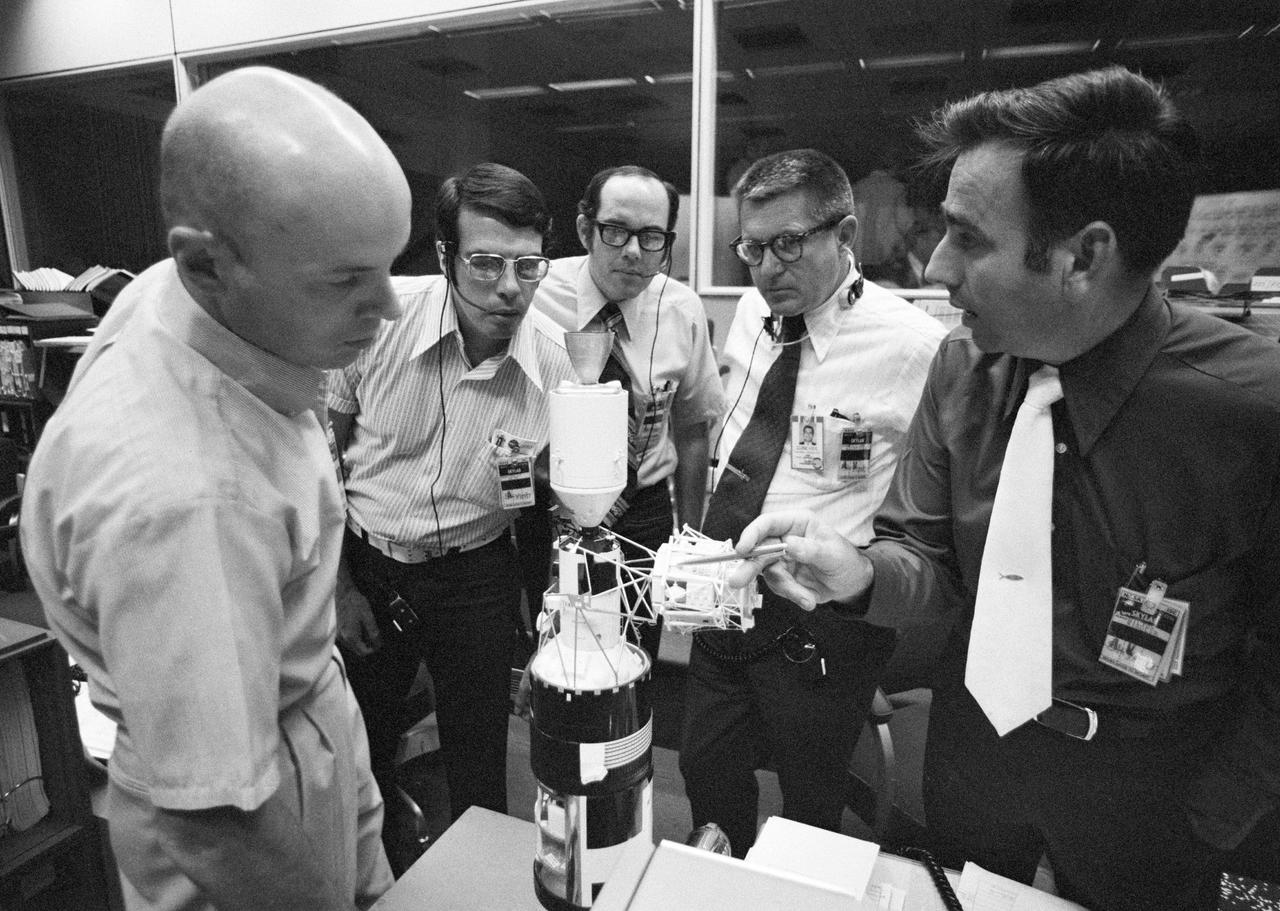
S73-31964 (5 August 1973) --- This group of flight controllers discuss today's approaching extravehicular activity (EVA) to be performed by the Skylab 3 crewmen. They are, left to right, scientist-astronaut Story Musgrave, a Skylab 3 spacecraft communicator; Robert Kain and Scott Millican, both of the Crew Procedures Division, EVA Procedures Section; William C. Schneider, Skylab Program Director, NASA Headquarters; and Milton Windler, flight director. Windler points to the model of the Skylab space station cluster to indicate the location of the ATM's film magazines. The group stands near consoles in the Mission Operations Control Room (MOCR) of the JSC Mission Control Center (MCC). Photo credit: NASA
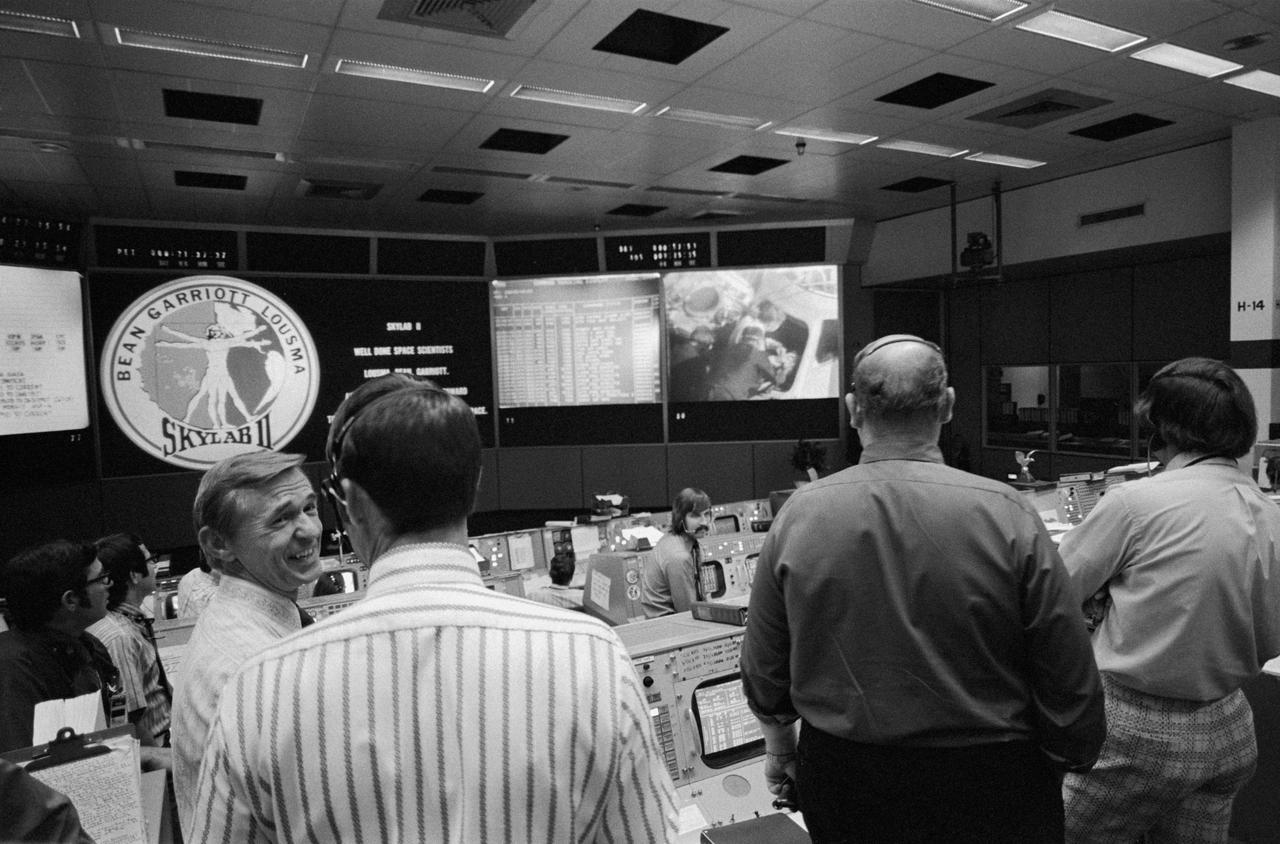
S73-34553 (25 Sept. 1973) --- Skylab flight directors (foreground) and flight controllers (background) view the large screen in the Mission Operations Control Room (MOCR) in the Mission Control Center (MCC) at JSC during recovery operations of the second manned Skylab mission. From left to right in the foreground are flight directors Charles R. Lewis, Donald R. Puffy, Phillip Shaffer and Neil B. Hutchinson. The Skylab 3 crewmen were preparing to egress the spacecraft aboard the USS New Orleans. Television cameras aboard the New Orleans recorded post-recovery activity. Photo credit: NASA
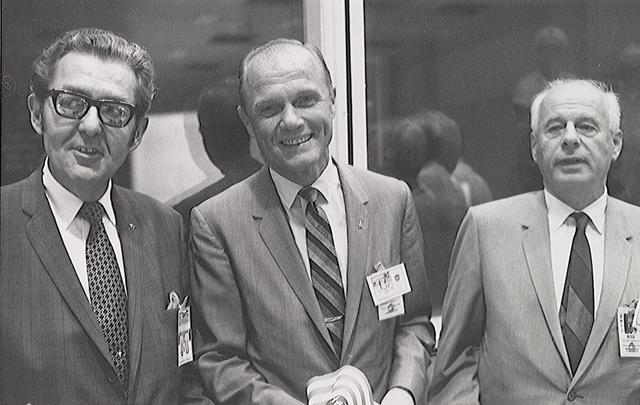
S69-44022 (7-24-69) --- On hand in Houston's mission control center to witness activity associated with the landing and recovery operations for the Apollo 11 mission were, from the left, Bob Kline, chief of the Mission Operations Procurement Branch at the Manned Spacecraft Center (MSC); astronaut John H. Glenn Jr.; and Eberhard Rees, deputy director of the Marshall Space Flight Center (MSFC). They were among a large number of personnel on hand in the MCC's mission operations control room (MOCR). Glenn holds one of the dozens of flags that were handed out for the return's celebration.
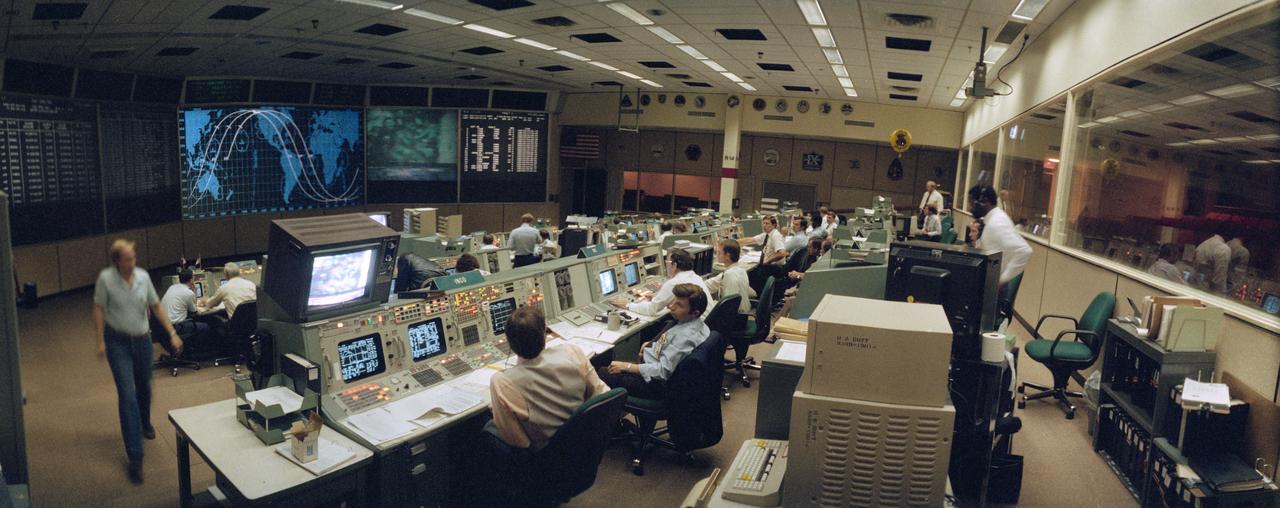
Wide angle view of the flight control room (FCR) of the Mission Control Center (MCC). Some of the STS 41-G crew can be seen on a large screen at the front of the MCC along with a map tracking the progress of the orbiter.
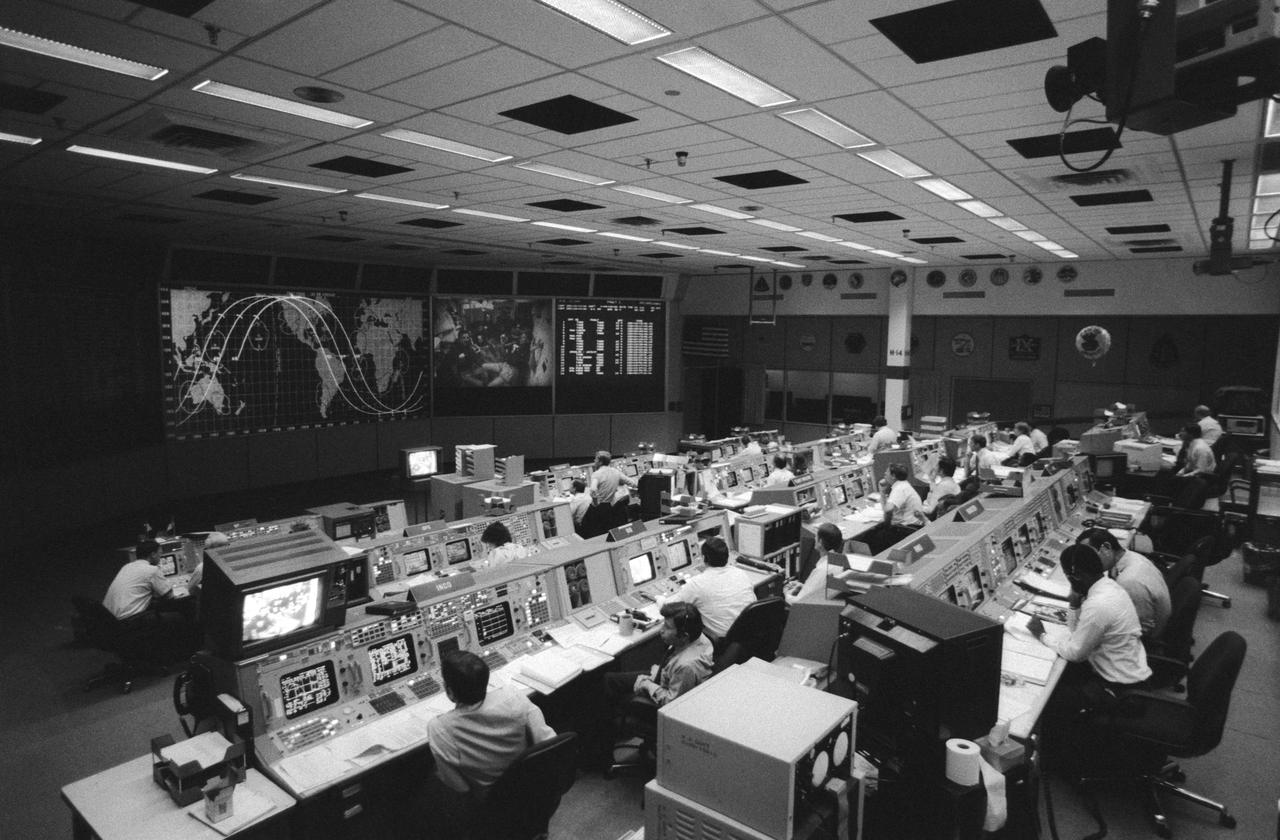
Wide angle view of the flight control room (FCR) of the Mission Control Center (MCC). Some of the STS 41-G crew can be seen on a large screen at the front of the MCC along with a map tracking the progress of the orbiter.
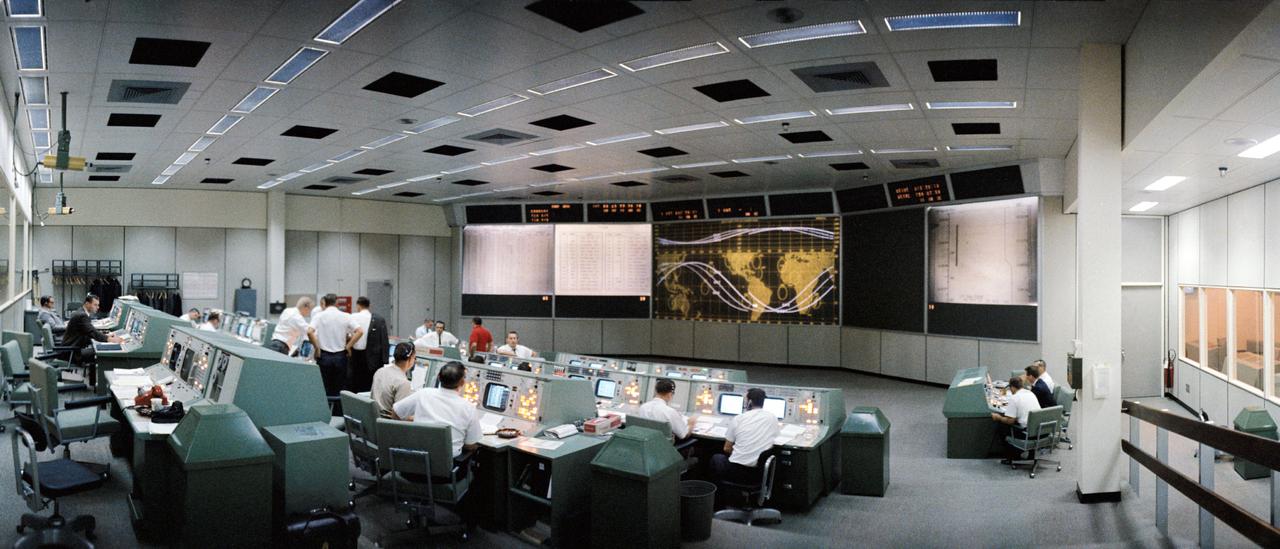
S65-45280 (21-29 Aug. 1965) --- Overall view of the Mission Control Center (MCC), Houston, Texas, during the Gemini-5 flight. Note the screen at the front of the MCC which is used to track the progress of the Gemini spacecraft.

MISSION CONTROL CENTER (MCC) DEMOLITION
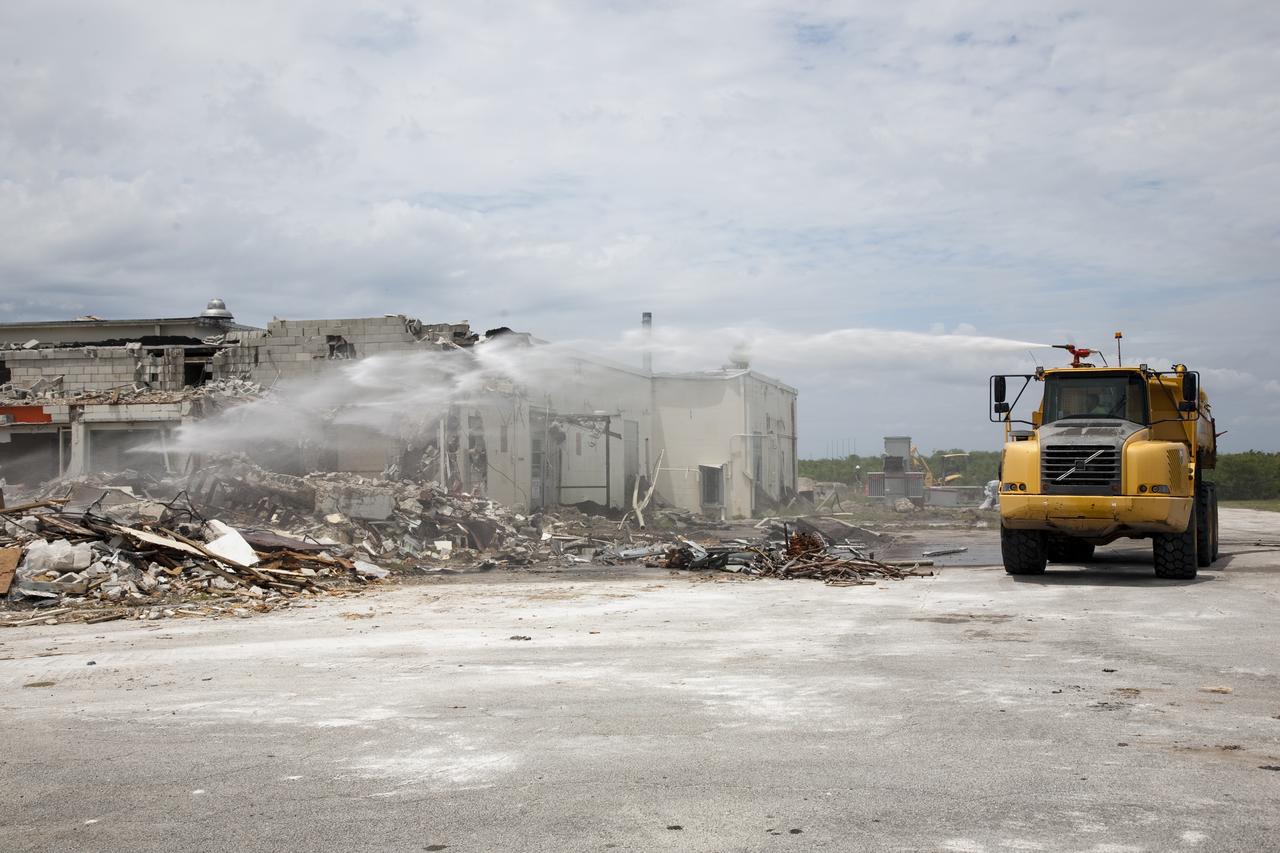
MISSION CONTROL CENTER (MCC) DEMOLITION
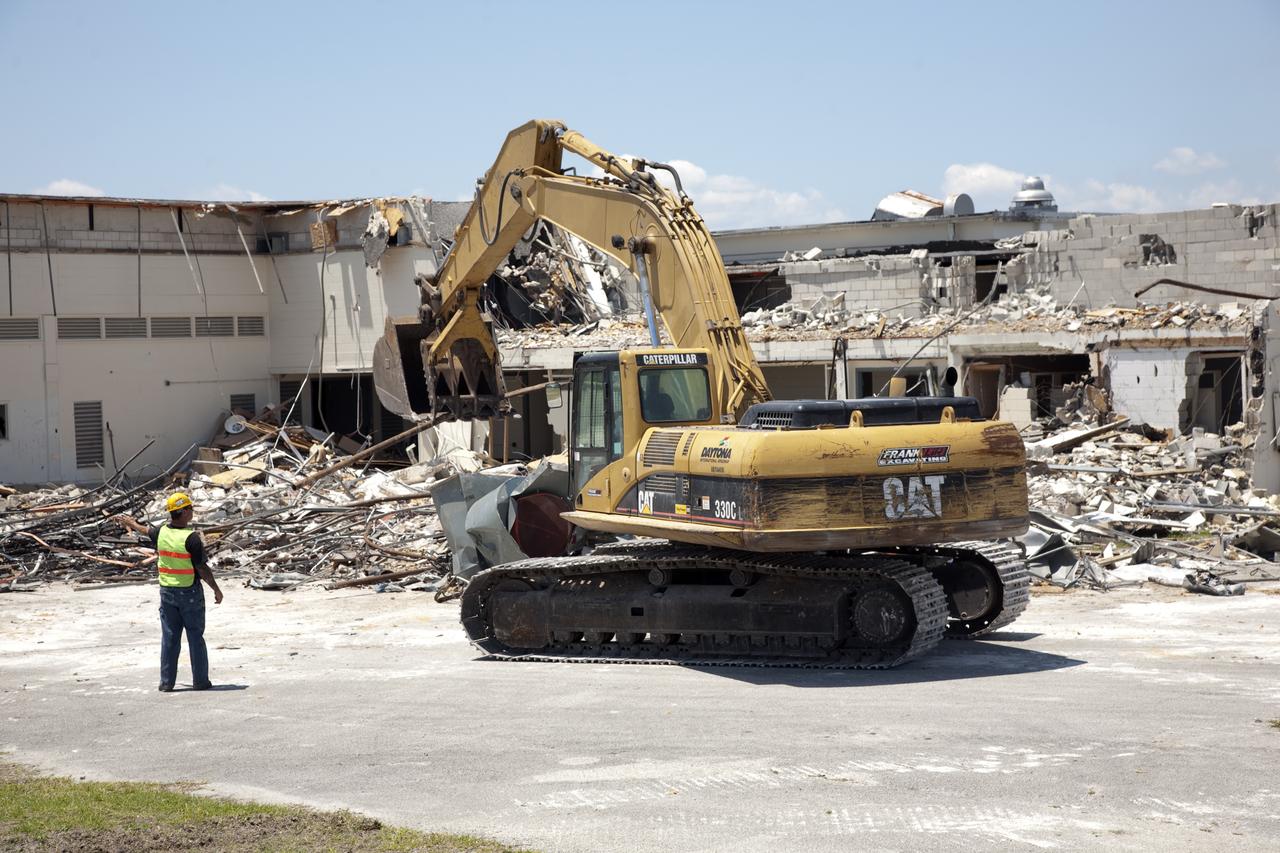
MISSION CONTROL CENTER (MCC) DEMOLITION
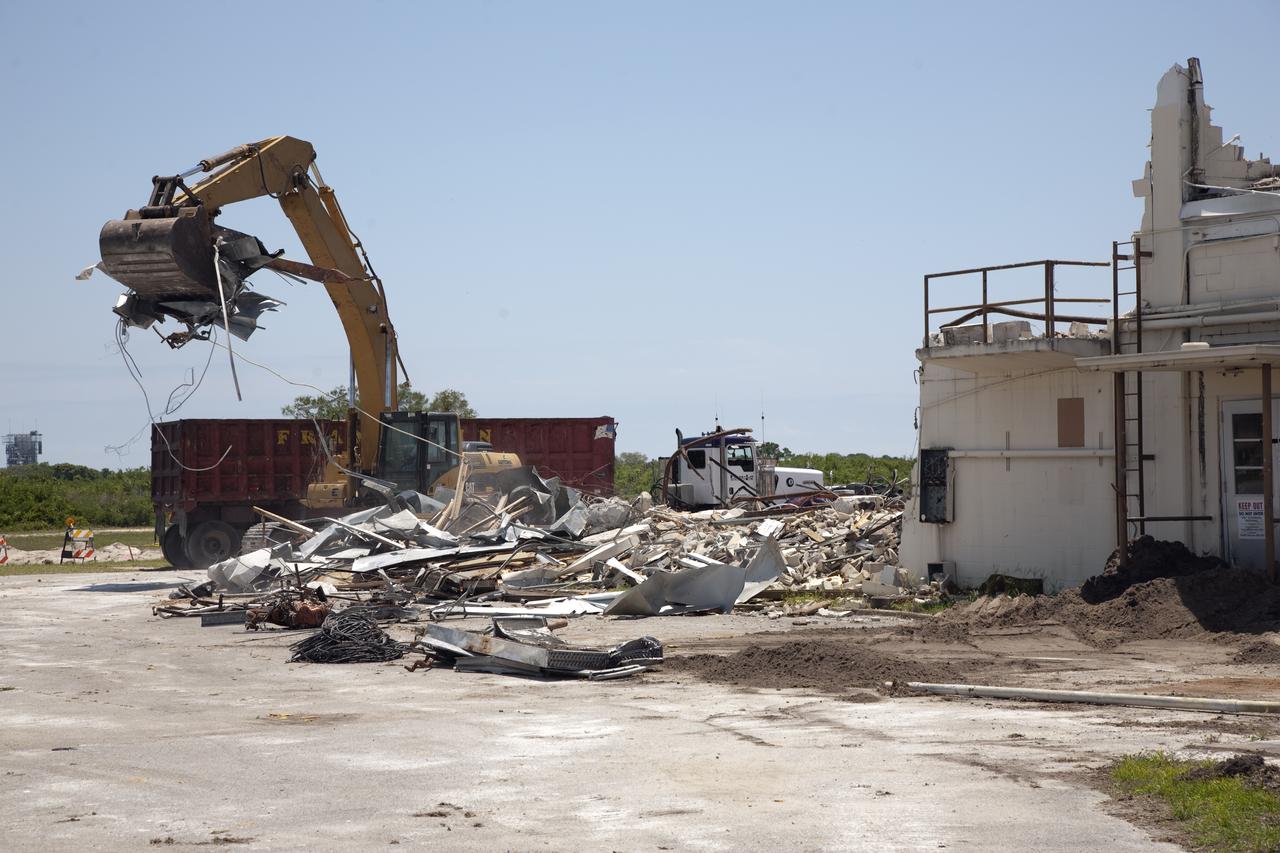
MISSION CONTROL CENTER (MCC) DEMOLITION
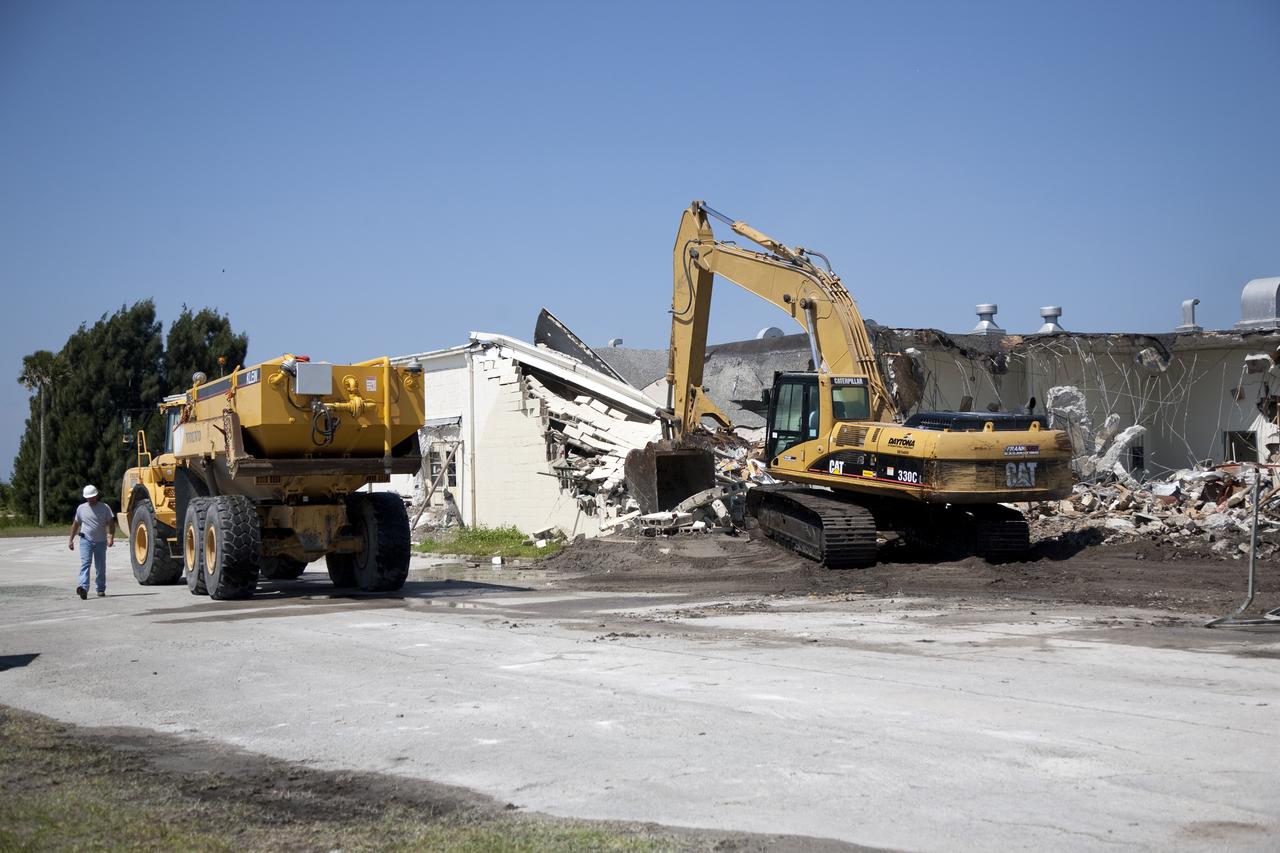
MISSION CONTROL CENTER (MCC) DEMOLITION
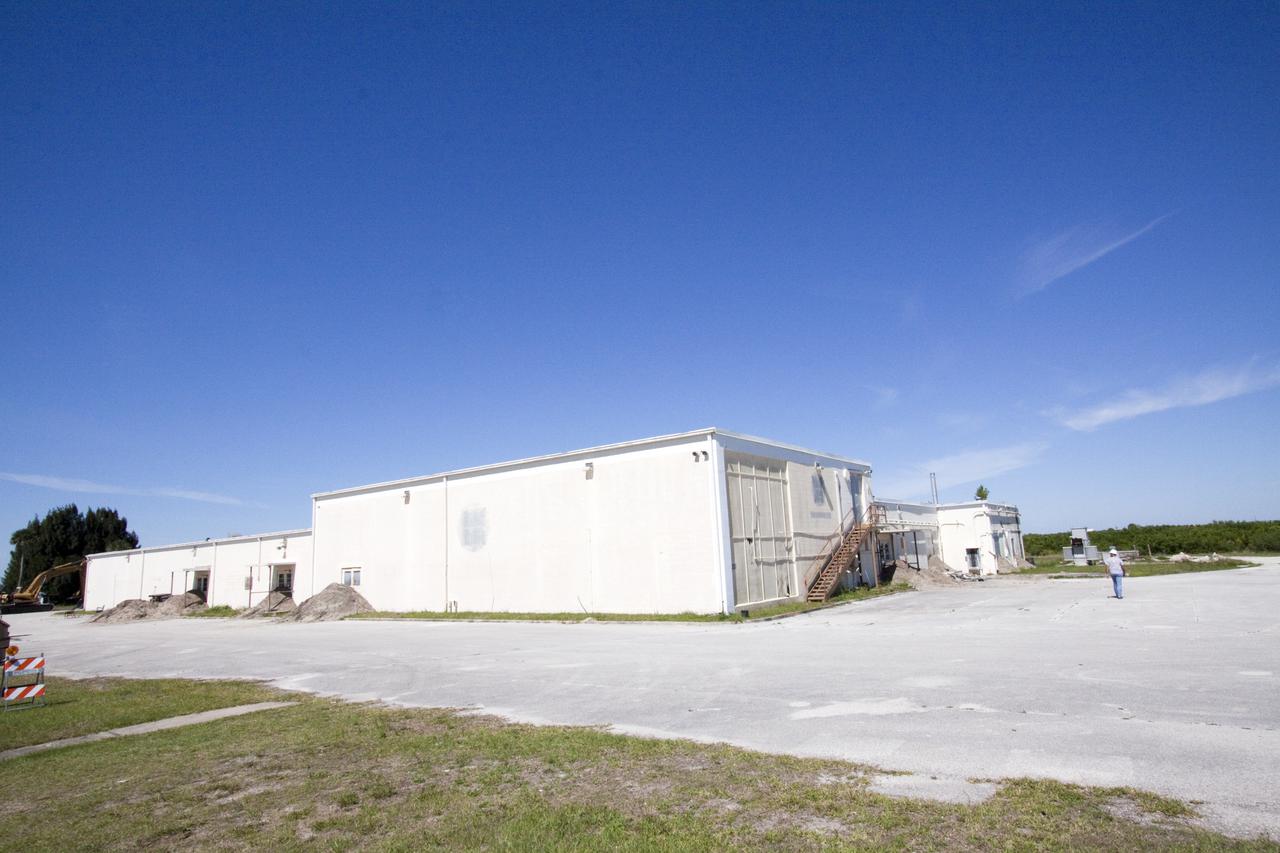
CAPE CANAVERAL, Fla. – At Cape Canaveral Air Force Station in Florida, preparations are under way to tear down the Mercury Mission Control Center. The original building, constructed between 1956 and 1958, was last modified in 1963. The center succumbed to the two worst enemies of structures along the space coast - time and salt air - necessitating that it be demolished as a safety measure. The facility served as mission control during all the Project Mercury missions, as well as the first three flights of the Gemini Program. The center housed the flight controllers whose duty was to take over flight control after liftoff and follow it through until splashdown. Additionally, it supported vehicle checkout, spacecraft tracking, and astronaut training. With Gemini IV, mission control moved to Houston, and the facility took on the roles of launch control and tracking station. In 1999, much of the equipment and furnishings from the flight control area was moved to Kennedy Space Center's Visitor Complex. A re-created mission control room currently is on display in the complex's Dr. Kurt H. Debus Conference Facility. Speegle II of Cocoa, Fla., was awarded the contract for the deconstruction project. Frank-Lin Excavating is performing the demolition for Sunrise Systems of Brevard, a subcontractor to Speegle II. Photo credit: NASA_Jack Pfaller
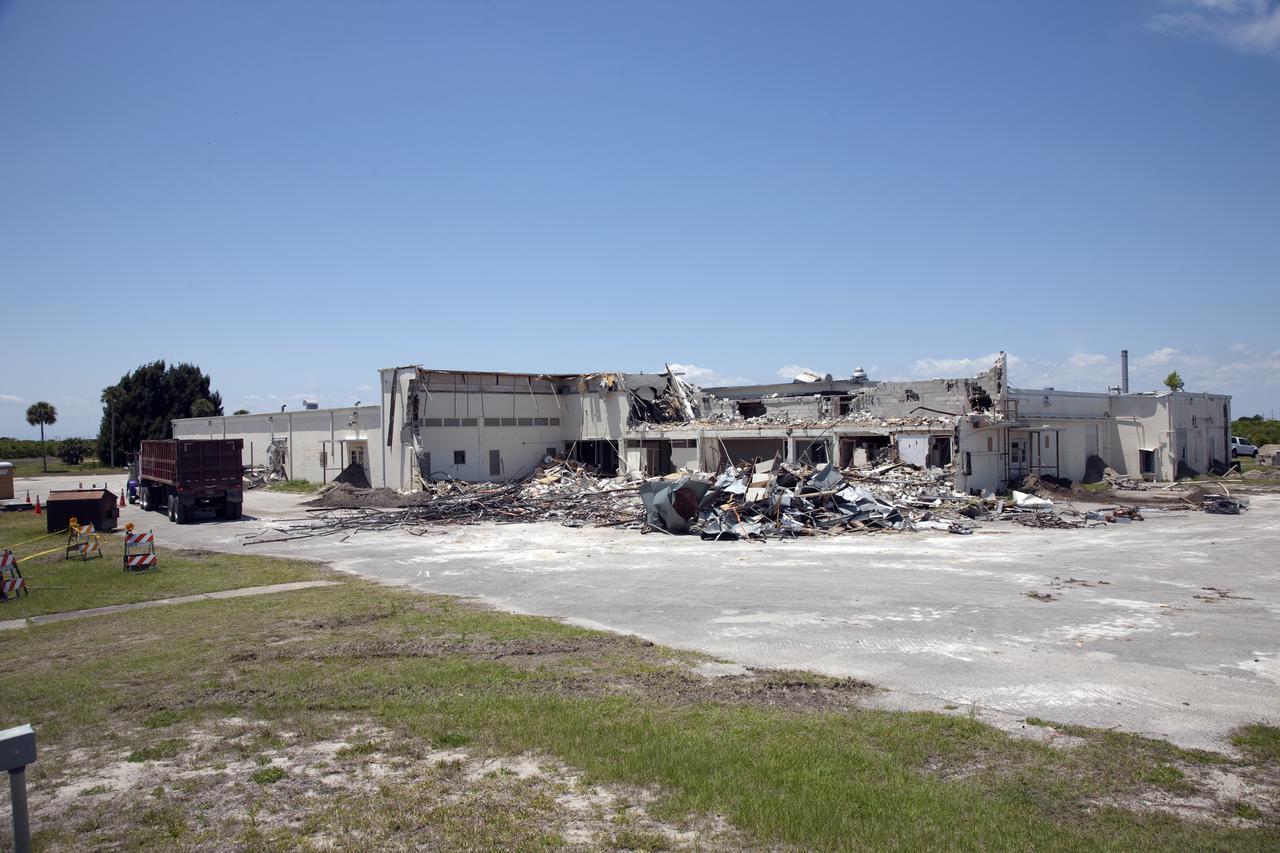
CAPE CANAVERAL, Fla. – At Cape Canaveral Air Force Station in Florida, deconstruction of the Mercury Mission Control Center is under way. The original building, constructed between 1956 and 1958, was last modified in 1963. The center succumbed to the two worst enemies of structures along the space coast - time and salt air - necessitating that it be demolished as a safety measure. The facility served as mission control during all the Project Mercury missions, as well as the first three flights of the Gemini Program. The center housed the flight controllers whose duty was to take over flight control after liftoff and follow it through until splashdown. Additionally, it supported vehicle checkout, spacecraft tracking, and astronaut training. With Gemini IV, mission control moved to Houston, and the facility took on the roles of launch control and tracking station. In 1999, much of the equipment and furnishings from the flight control area was moved to Kennedy Space Center's Visitor Complex. A re-created mission control room currently is on display in the complex's Dr. Kurt H. Debus Conference Facility. Speegle II of Cocoa, Fla., was awarded the contract for the deconstruction project. Frank-Lin Excavating is performing the demolition for Sunrise Systems of Brevard, a subcontractor to Speegle II. Photo credit: NASA_Dimitri Gerondidakis
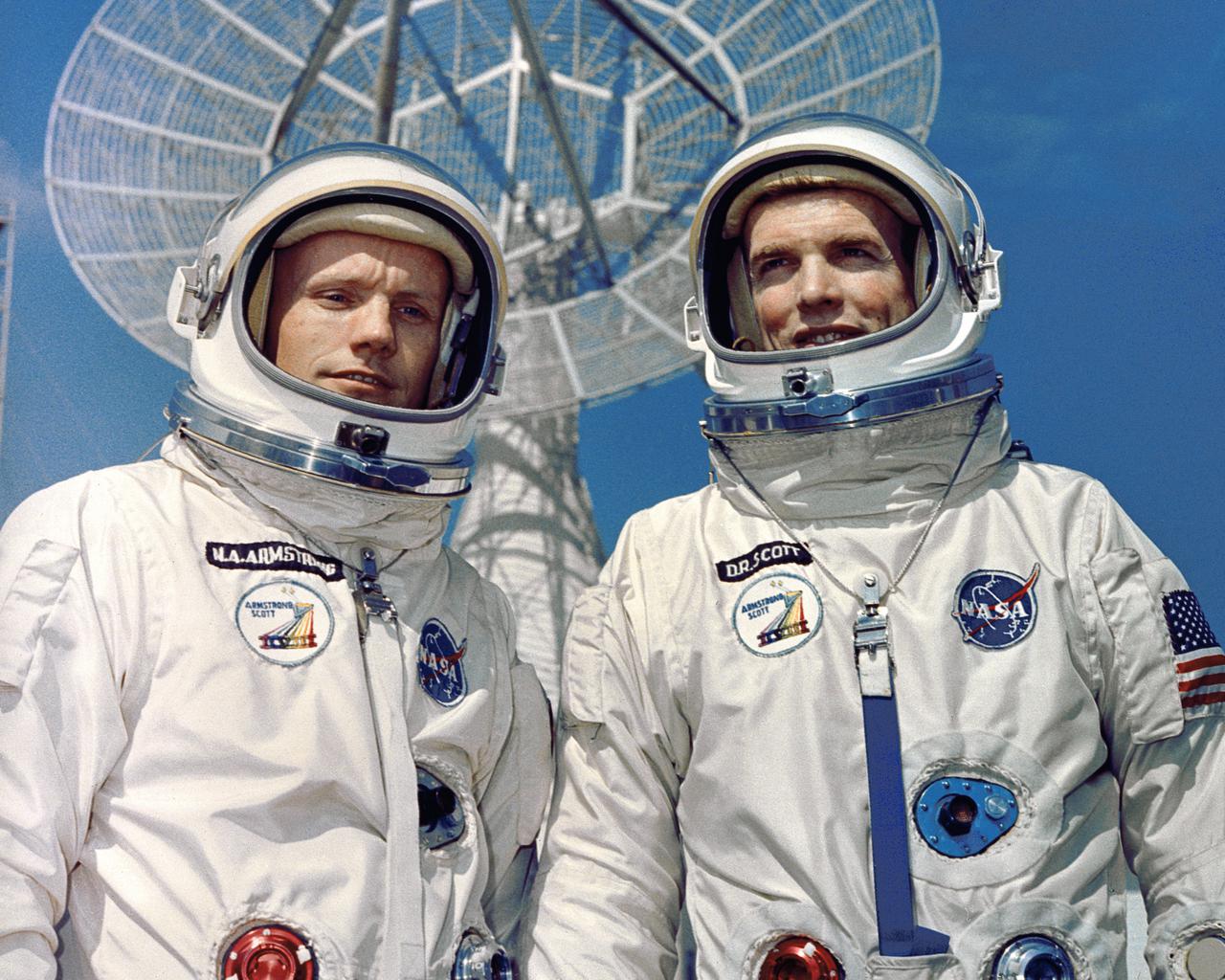
CAPE CANAVERAL, Fla. – Gemini 8 astronauts Neil A. Armstrong, command pilot, and David R. Scott, pilot, during a photosSession for the press outside Mission Control Center, Cape Kennedy. Photo credit: NASA
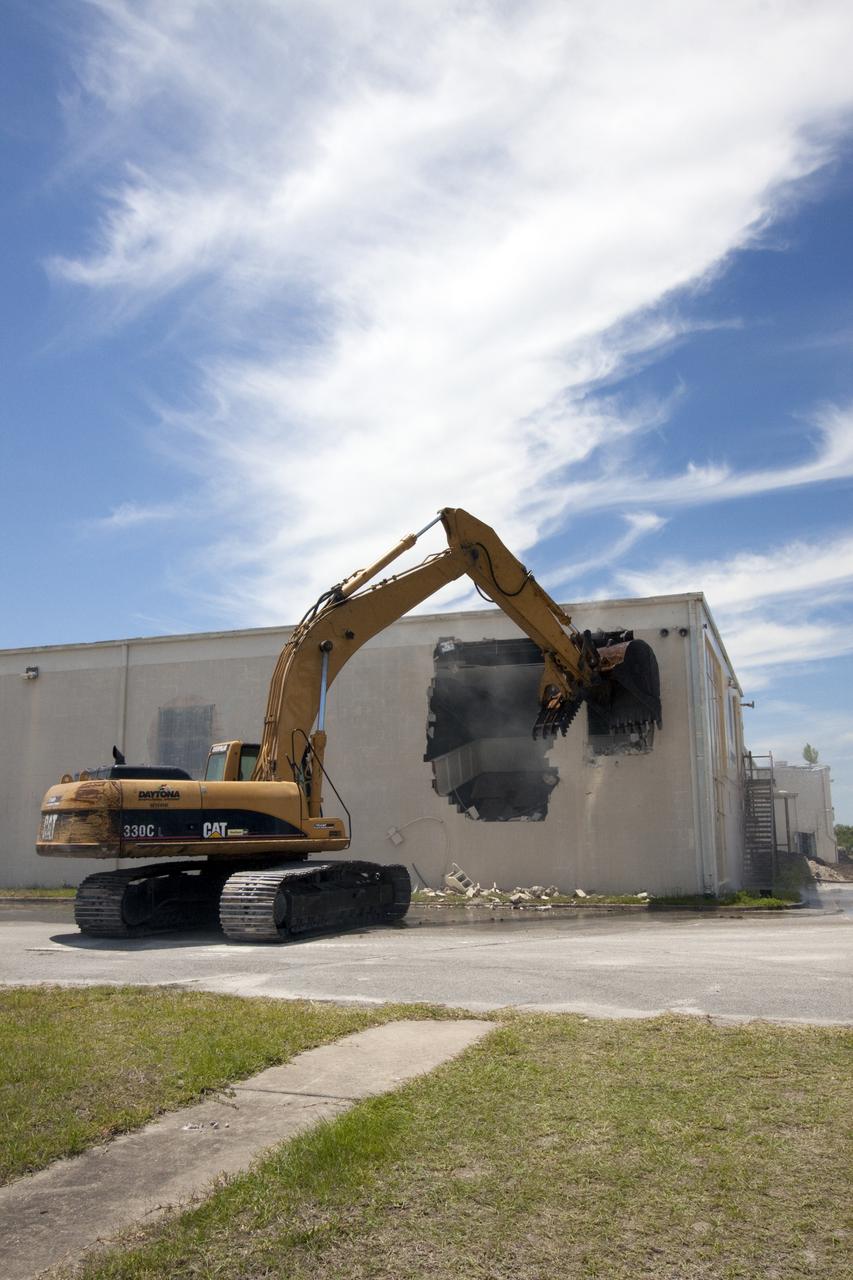
CAPE CANAVERAL, Fla. – At Cape Canaveral Air Force Station in Florida, a Caterpillar 330 track-hoe knocks down the Mercury Mission Control Center. The original building, constructed between 1956 and 1958, was last modified in 1963. The center succumbed to the two worst enemies of structures along the space coast - time and salt air - necessitating that it be demolished as a safety measure. The facility served as mission control during all the Project Mercury missions, as well as the first three flights of the Gemini Program. The center housed the flight controllers whose duty was to take over flight control after liftoff and follow it through until splashdown. Additionally, it supported vehicle checkout, spacecraft tracking, and astronaut training. With Gemini IV, mission control moved to Houston, and the facility took on the roles of launch control and tracking station. In 1999, much of the equipment and furnishings from the flight control area was moved to Kennedy Space Center's Visitor Complex. A re-created mission control room currently is on display in the complex's Dr. Kurt H. Debus Conference Facility. Speegle II of Cocoa, Fla., was awarded the contract for the deconstruction project. Frank-Lin Excavating is performing the demolition for Sunrise Systems of Brevard, a subcontractor to Speegle II. Photo credit: NASA_Jack Pfaller
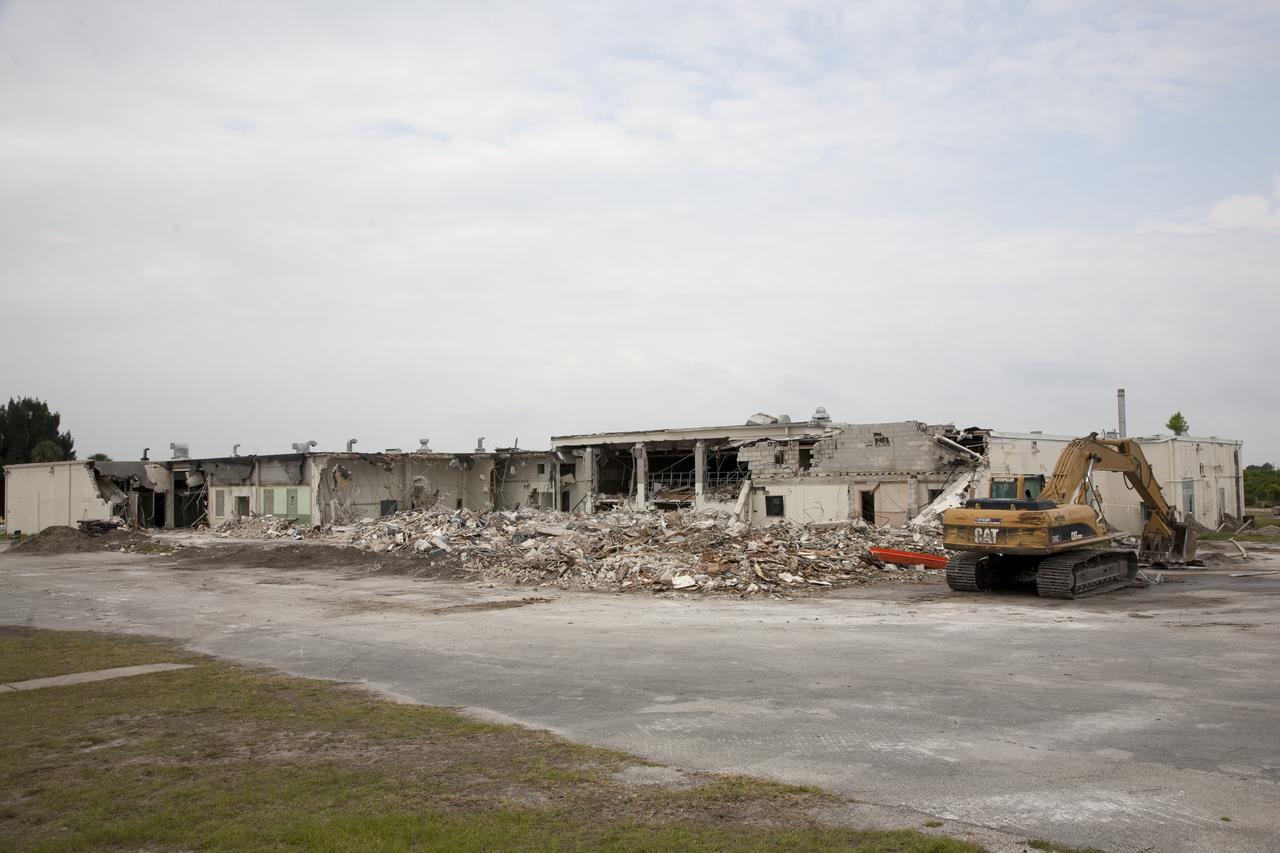
CAPE CANAVERAL, Fla. – At Cape Canaveral Air Force Station in Florida, the control room of the Mercury Mission Control Center is exposed to the elements during the deconstruction of the dilapidated facility. The original building, constructed between 1956 and 1958, was last modified in 1963. The center succumbed to the two worst enemies of structures along the space coast - time and salt air - necessitating that it be demolished as a safety measure. The facility served as mission control during all the Project Mercury missions, as well as the first three flights of the Gemini Program. The center housed the flight controllers whose duty was to take over flight control after liftoff and follow it through until splashdown. Additionally, it supported vehicle checkout, spacecraft tracking, and astronaut training. With Gemini IV, mission control moved to Houston, and the facility took on the roles of launch control and tracking station. In 1999, much of the equipment and furnishings from the flight control area was moved to Kennedy Space Center's Visitor Complex. A re-created mission control room currently is on display in the complex's Dr. Kurt H. Debus Conference Facility. Speegle II of Cocoa, Fla., was awarded the contract for the deconstruction project. Frank-Lin Excavating is performing the demolition for Sunrise Systems of Brevard, a subcontractor to Speegle II. Photo credit: NASA_Dimitri Gerondidakis
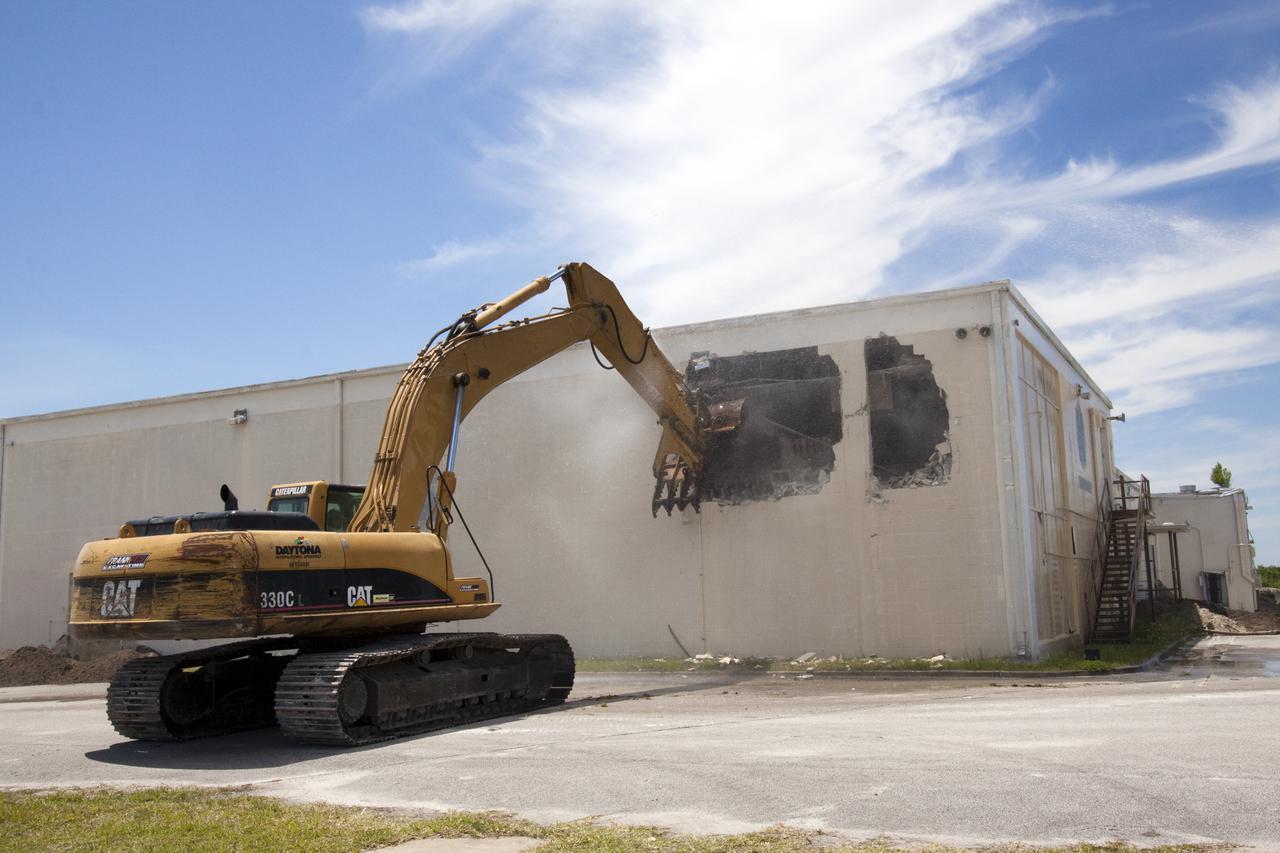
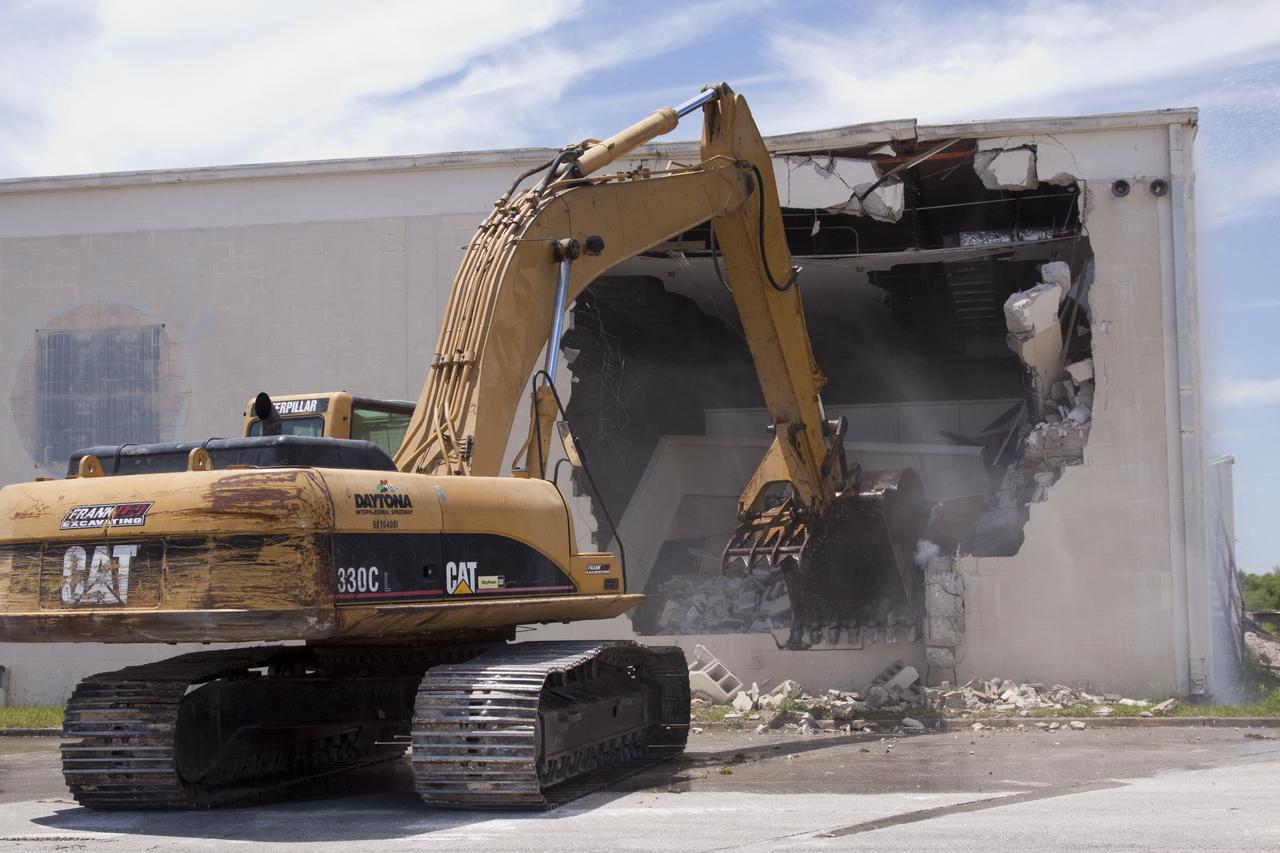
CAPE CANAVERAL, Fla. – At Cape Canaveral Air Force Station in Florida, a Caterpillar 330 track-hoe punches a hole in the wall of the Mercury Mission Control Center. The original building, constructed between 1956 and 1958, was last modified in 1963. The center succumbed to the two worst enemies of structures along the space coast - time and salt air - necessitating that it be demolished as a safety measure. The facility served as mission control during all the Project Mercury missions, as well as the first three flights of the Gemini Program. The center housed the flight controllers whose duty was to take over flight control after liftoff and follow it through until splashdown. Additionally, it supported vehicle checkout, spacecraft tracking, and astronaut training. With Gemini IV, mission control moved to Houston, and the facility took on the roles of launch control and tracking station. In 1999, much of the equipment and furnishings from the flight control area was moved to Kennedy Space Center's Visitor Complex. A re-created mission control room currently is on display in the complex's Dr. Kurt H. Debus Conference Facility. Speegle II of Cocoa, Fla., was awarded the contract for the deconstruction project. Frank-Lin Excavating is performing the demolition for Sunrise Systems of Brevard, a subcontractor to Speegle II. Photo credit: NASA_Jack Pfaller
CAPE CANAVERAL, Fla. – At Cape Canaveral Air Force Station in Florida, a Caterpillar 330 track-hoe rips through the wall of the Mercury Mission Control Center. The original building, constructed between 1956 and 1958, was last modified in 1963. The center succumbed to the two worst enemies of structures along the space coast - time and salt air - necessitating that it be demolished as a safety measure. The facility served as mission control during all the Project Mercury missions, as well as the first three flights of the Gemini Program. The center housed the flight controllers whose duty was to take over flight control after liftoff and follow it through until splashdown. Additionally, it supported vehicle checkout, spacecraft tracking, and astronaut training. With Gemini IV, mission control moved to Houston, and the facility took on the roles of launch control and tracking station. In 1999, much of the equipment and furnishings from the flight control area was moved to Kennedy Space Center's Visitor Complex. A re-created mission control room currently is on display in the complex's Dr. Kurt H. Debus Conference Facility. Speegle II of Cocoa, Fla., was awarded the contract for the deconstruction project. Frank-Lin Excavating is performing the demolition for Sunrise Systems of Brevard, a subcontractor to Speegle II. Photo credit: NASA_Jack Pfaller
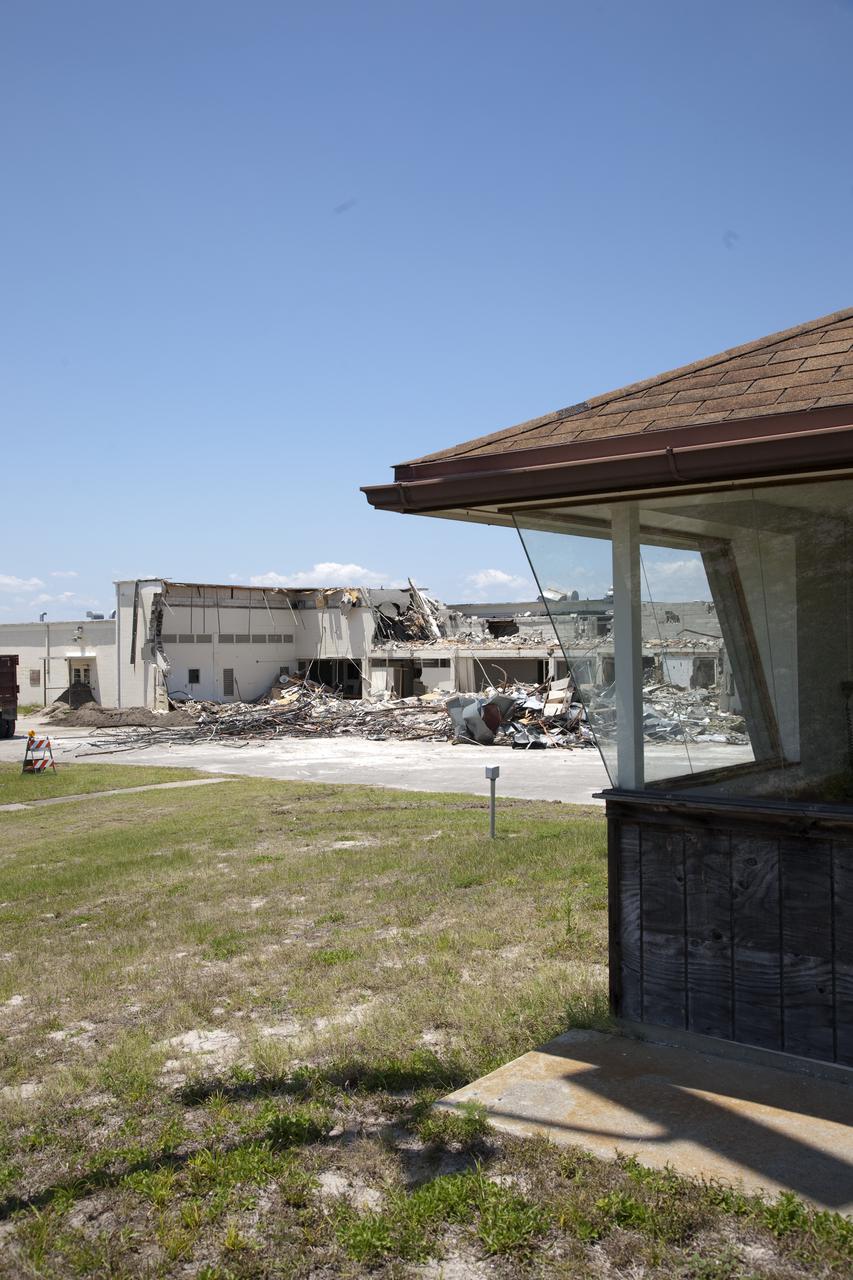
CAPE CANAVERAL, Fla. – At Cape Canaveral Air Force Station in Florida, demolition of the Mercury Mission Control Center has begun. The original building, constructed between 1956 and 1958, was last modified in 1963. The center succumbed to the two worst enemies of structures along the space coast - time and salt air - necessitating that it be demolished as a safety measure. The facility served as mission control during all the Project Mercury missions, as well as the first three flights of the Gemini Program. The center housed the flight controllers whose duty was to take over flight control after liftoff and follow it through until splashdown. Additionally, it supported vehicle checkout, spacecraft tracking, and astronaut training. With Gemini IV, mission control moved to Houston, and the facility took on the roles of launch control and tracking station. In 1999, much of the equipment and furnishings from the flight control area was moved to Kennedy Space Center's Visitor Complex. A re-created mission control room currently is on display in the complex's Dr. Kurt H. Debus Conference Facility. Speegle II of Cocoa, Fla., was awarded the contract for the deconstruction project. Frank-Lin Excavating is performing the demolition for Sunrise Systems of Brevard, a subcontractor to Speegle II. Photo credit: NASA_Dimitri Gerondidakis
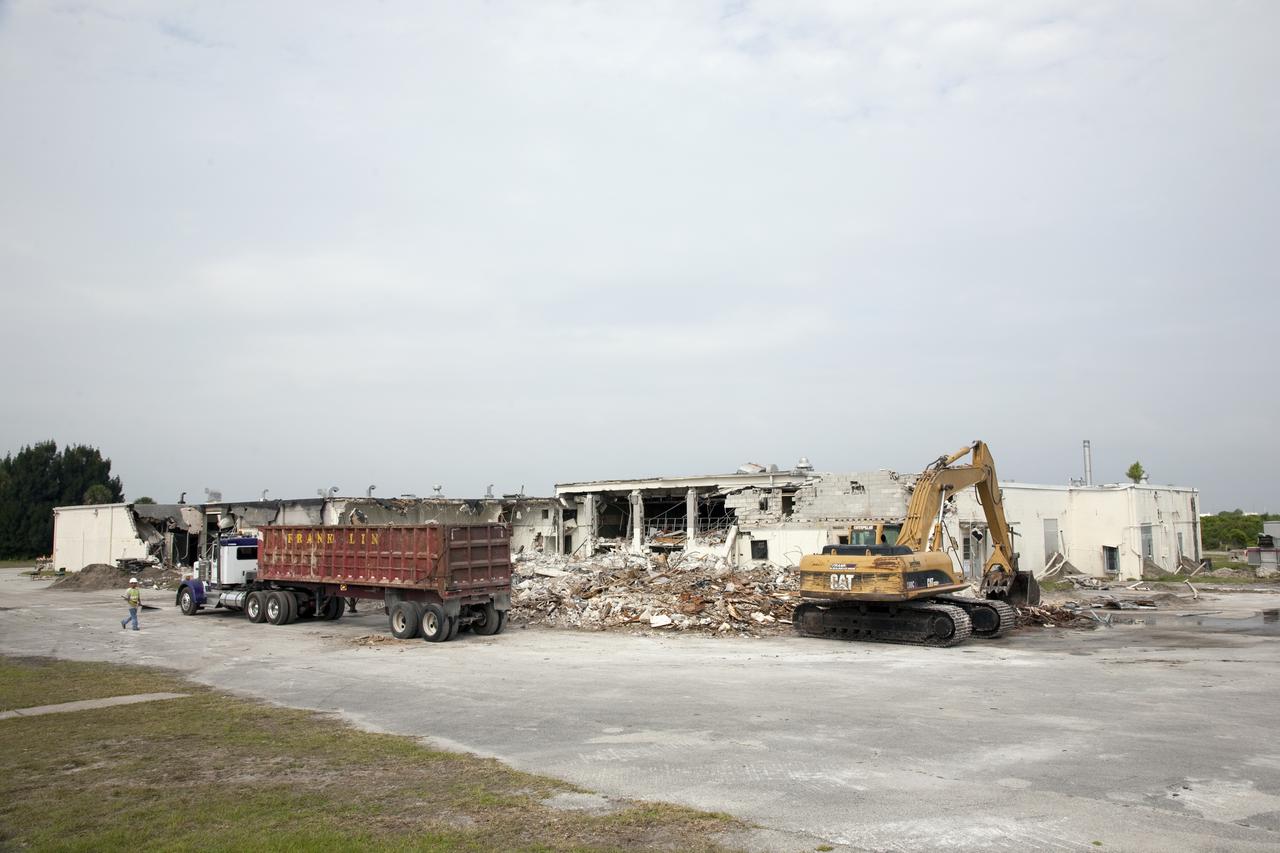
CAPE CANAVERAL, Fla. – At Cape Canaveral Air Force Station in Florida, a Caterpillar 330 track-hoe, at right, cleans up the rubble it has made of the Mercury Mission Control Center during its deconstruction. The original building, constructed between 1956 and 1958, was last modified in 1963. The center succumbed to the two worst enemies of structures along the space coast - time and salt air - necessitating that it be demolished as a safety measure. The facility served as mission control during all the Project Mercury missions, as well as the first three flights of the Gemini Program. The center housed the flight controllers whose duty was to take over flight control after liftoff and follow it through until splashdown. Additionally, it supported vehicle checkout, spacecraft tracking, and astronaut training. With Gemini IV, mission control moved to Houston, and the facility took on the roles of launch control and tracking station. In 1999, much of the equipment and furnishings from the flight control area was moved to Kennedy Space Center's Visitor Complex. A re-created mission control room currently is on display in the complex's Dr. Kurt H. Debus Conference Facility. Speegle II of Cocoa, Fla., was awarded the contract for the deconstruction project. Frank-Lin Excavating is performing the demolition for Sunrise Systems of Brevard, a subcontractor to Speegle II. Photo credit: NASA_Dimitri Gerondidakis
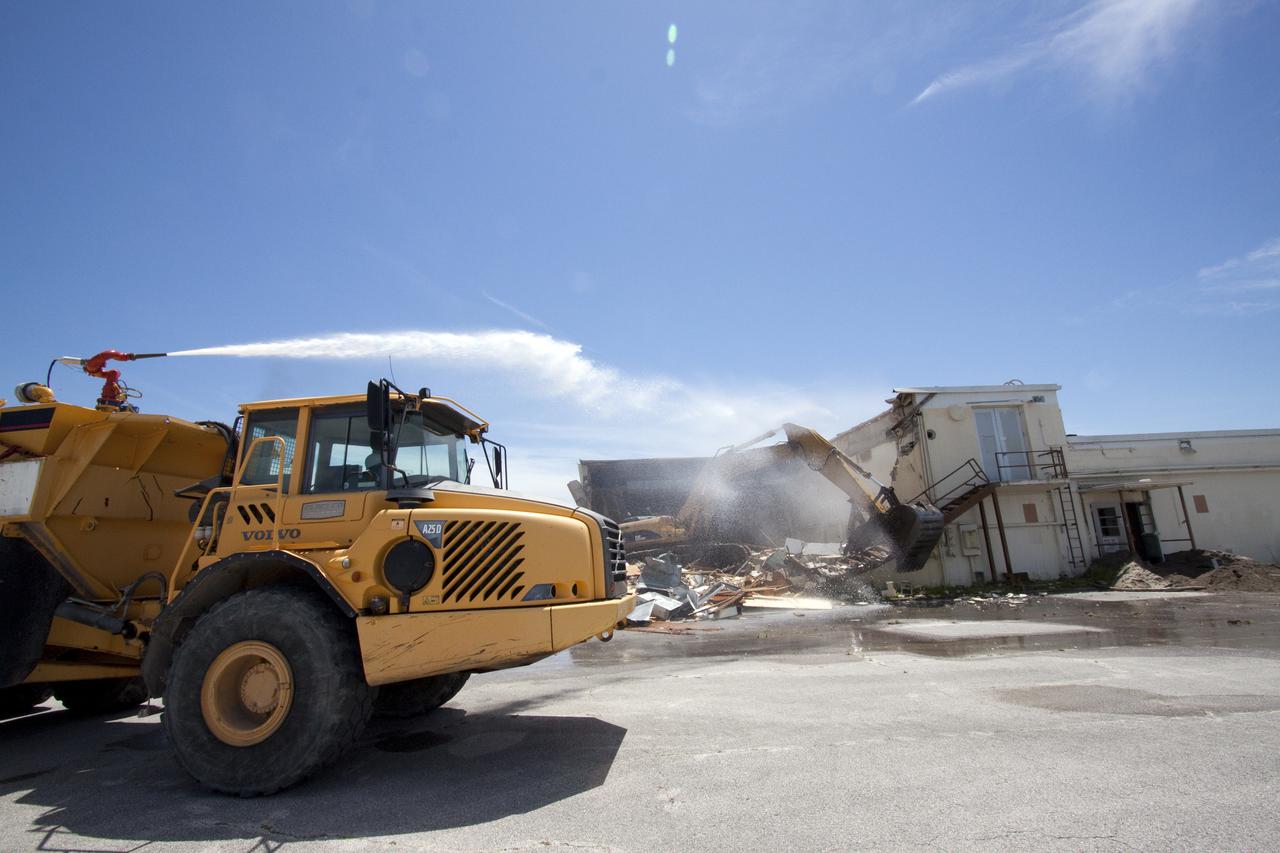
CAPE CANAVERAL, Fla. – At Cape Canaveral Air Force Station in Florida, a custom-built end dump truck spews water over the Mercury Mission Control Center to reduce the particles dispensed into the air by a Caterpillar 330 track-hoe tearing down the building. The truck's operator controls the water spray using joy sticks installed in the cab of the truck. The original building, constructed between 1956 and 1958, was last modified in 1963. The center succumbed to the two worst enemies of structures along the space coast - time and salt air - necessitating that it be demolished as a safety measure. The facility served as mission control during all the Project Mercury missions, as well as the first three flights of the Gemini Program. The center housed the flight controllers whose duty was to take over flight control after liftoff and follow it through until splashdown. Additionally, it supported vehicle checkout, spacecraft tracking, and astronaut training. With Gemini IV, mission control moved to Houston, and the facility took on the roles of launch control and tracking station. In 1999, much of the equipment and furnishings from the flight control area was moved to Kennedy Space Center's Visitor Complex. A re-created mission control room currently is on display in the complex's Dr. Kurt H. Debus Conference Facility. Speegle II of Cocoa, Fla., was awarded the contract for the deconstruction project. Frank-Lin Excavating is performing the demolition for Sunrise Systems of Brevard, a subcontractor to Speegle II. Photo credit: NASA_Jack Pfaller
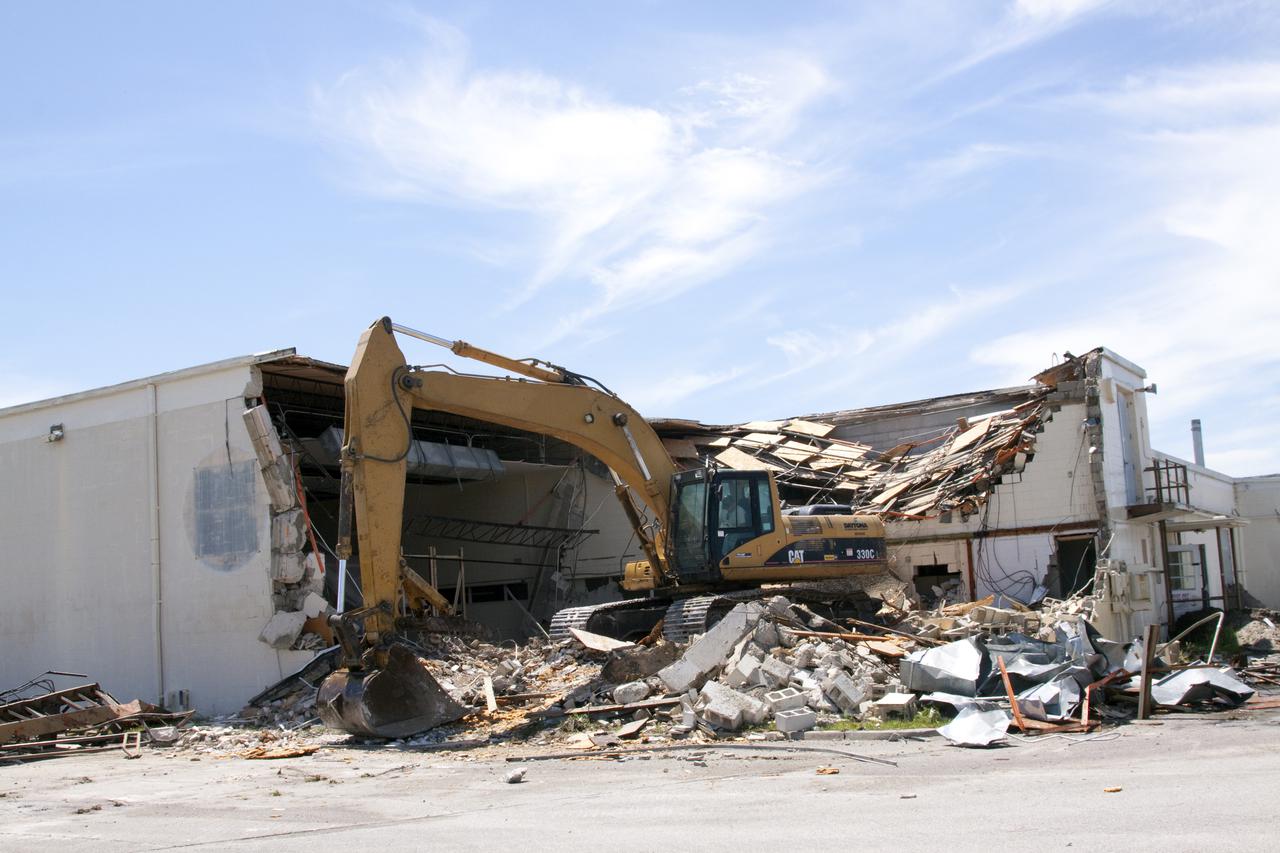
CAPE CANAVERAL, Fla. – At Cape Canaveral Air Force Station in Florida, the walls of the Mercury Mission Control Center tumble down under the careful guidance of a Caterpillar 330 track-hoe. The original building, constructed between 1956 and 1958, was last modified in 1963. The center succumbed to the two worst enemies of structures along the space coast - time and salt air - necessitating that it be demolished as a safety measure. The facility served as mission control during all the Project Mercury missions, as well as the first three flights of the Gemini Program. The center housed the flight controllers whose duty was to take over flight control after liftoff and follow it through until splashdown. Additionally, it supported vehicle checkout, spacecraft tracking, and astronaut training. With Gemini IV, mission control moved to Houston, and the facility took on the roles of launch control and tracking station. In 1999, much of the equipment and furnishings from the flight control area was moved to Kennedy Space Center's Visitor Complex. A re-created mission control room currently is on display in the complex's Dr. Kurt H. Debus Conference Facility. Speegle II of Cocoa, Fla., was awarded the contract for the deconstruction project. Frank-Lin Excavating is performing the demolition for Sunrise Systems of Brevard, a subcontractor to Speegle II. Photo credit: NASA_Jack Pfaller