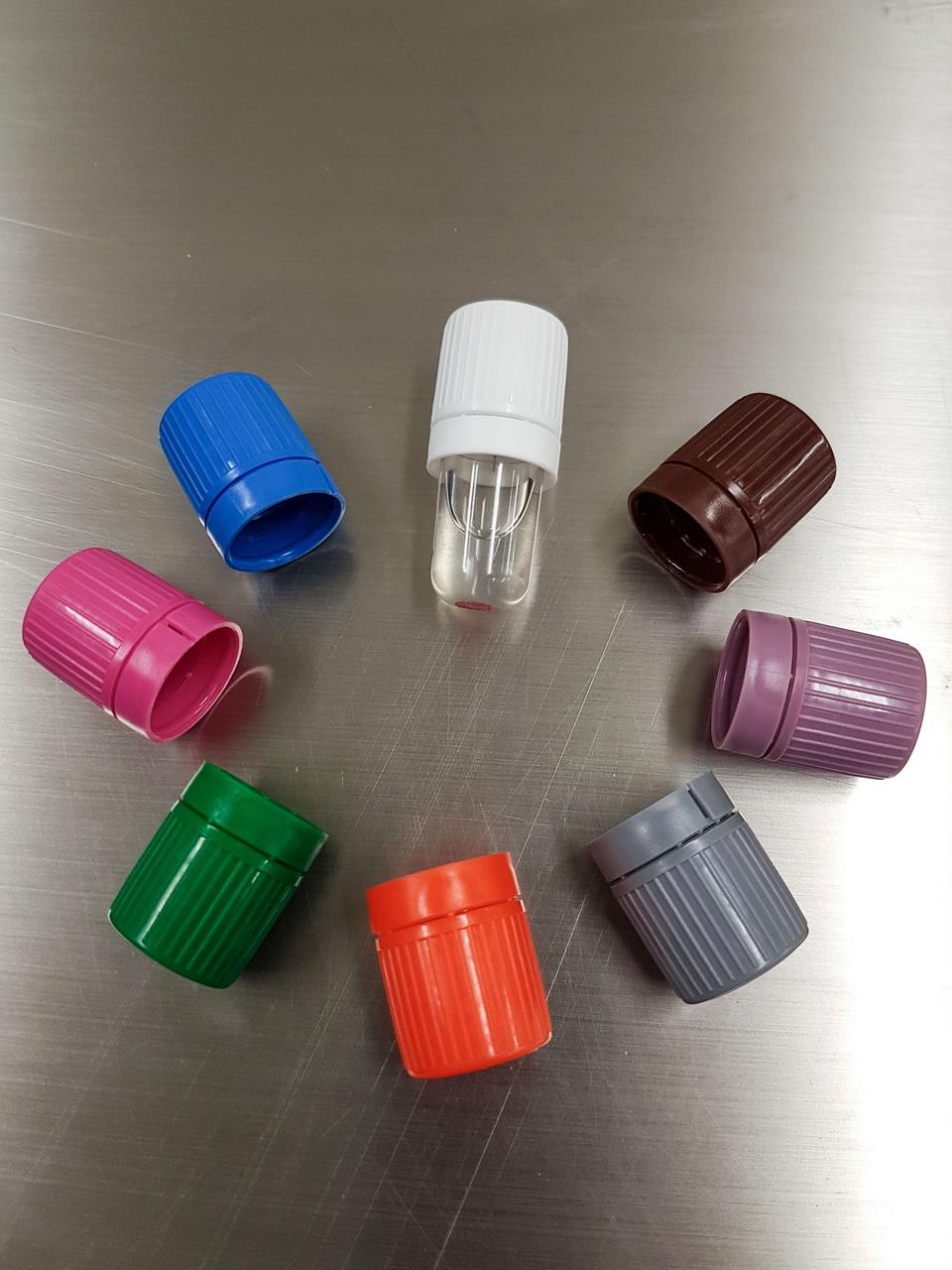
jsc2019e039817 (7/16/2019) --- A preflight view of an Amyloid Aggregation White Jar and different colored caps, used to distinguish within several incubation times by means of color code. The aim of the Amyloid Aggregation investigation is to assess if amyloid fibrils aggregation is affected by microgravity in order to identify a possible professional risk in astronauts spending long periods on board the International Space Station (ISS). (Image Courtesy of: ASI)
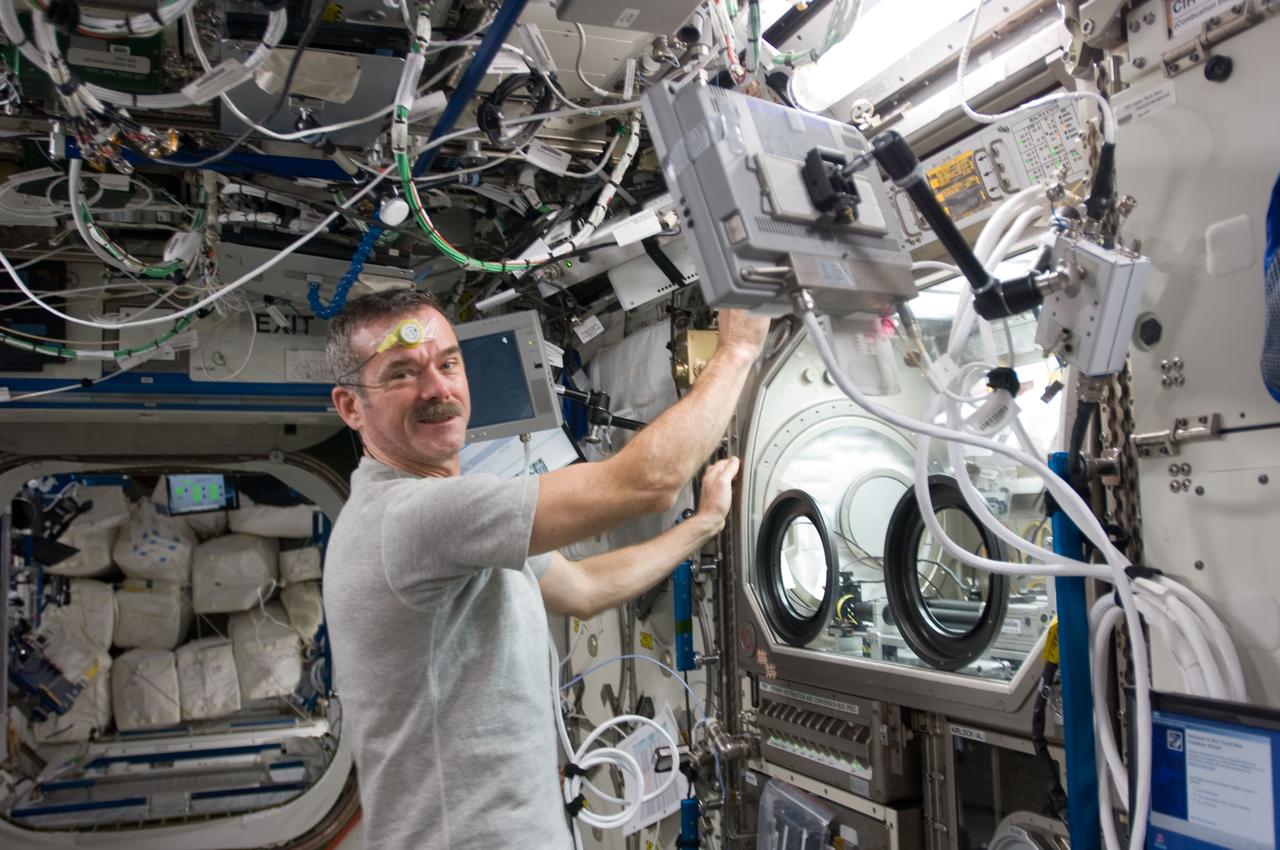
View of Canadian Space Agency (CSA) Chris Hadfield,Expedition 34 Flight Engineer (FE), during the Investigating the Structure of Paramagnetic Aggregates from Colloidal Emulsions 3 (InSPACE-3) experiment. InSPACE-3 collects and records data on fluids containing ellipsoid-shaped particles that change the physical properties of the fluids in response to magnetic fields. Photo was taken during Expedition 34.
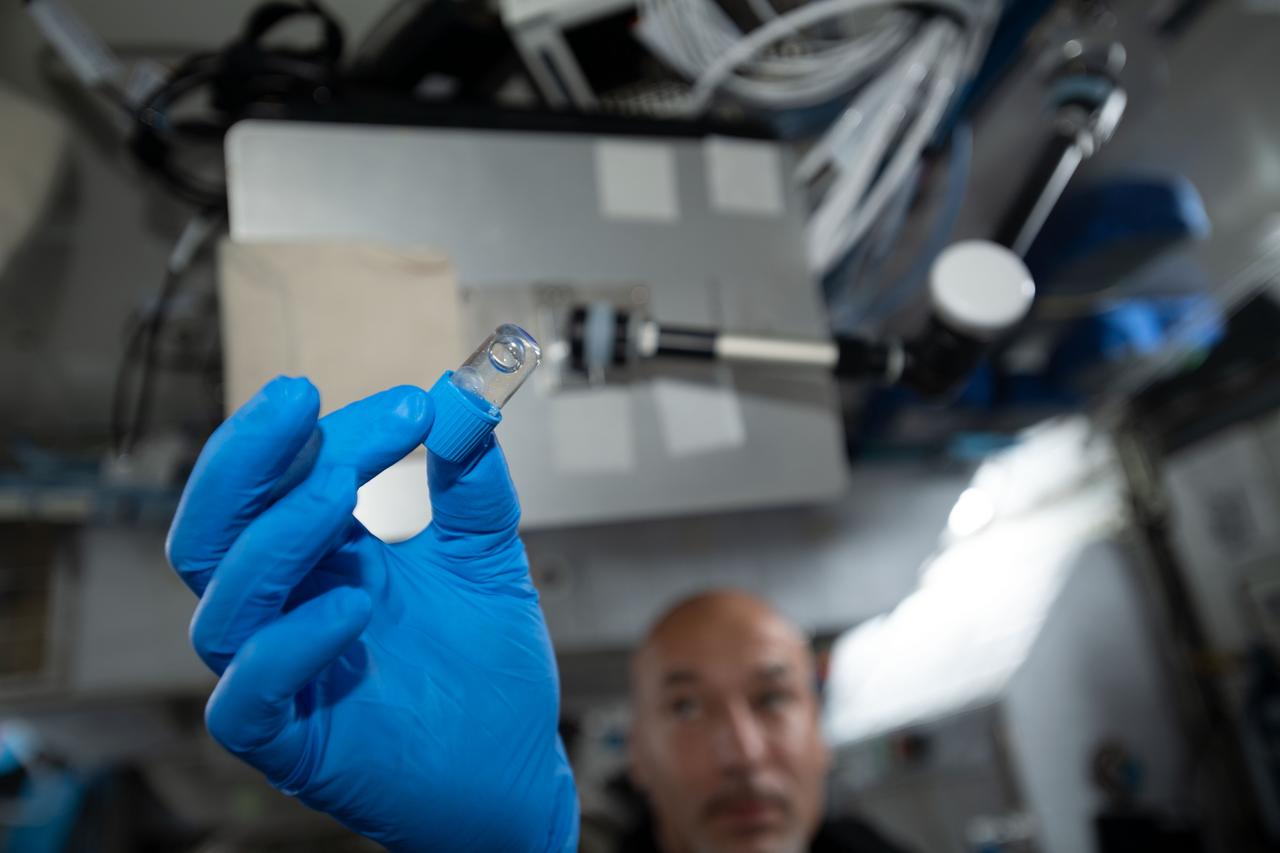
iss060e023994 (8/7/2019) --- European Space Agency (ESA) astronaut Luca Parmitano is shown holding a Amyloid Aggregation Blue Jar. The cap colors are used to distinguish the incubation times. The aim of the Amyloid Aggregation investigation is to assess if amyloid fibrils aggregation is affected by microgravity in order to identify a possible professional risk in astronauts spending long periods on board the ISS. The knowledge gained could contribute to the designing of innovative therapeutic strategies for the treatment of Alzheimer’s Disease and for other diseases characterized by protein accumulation.
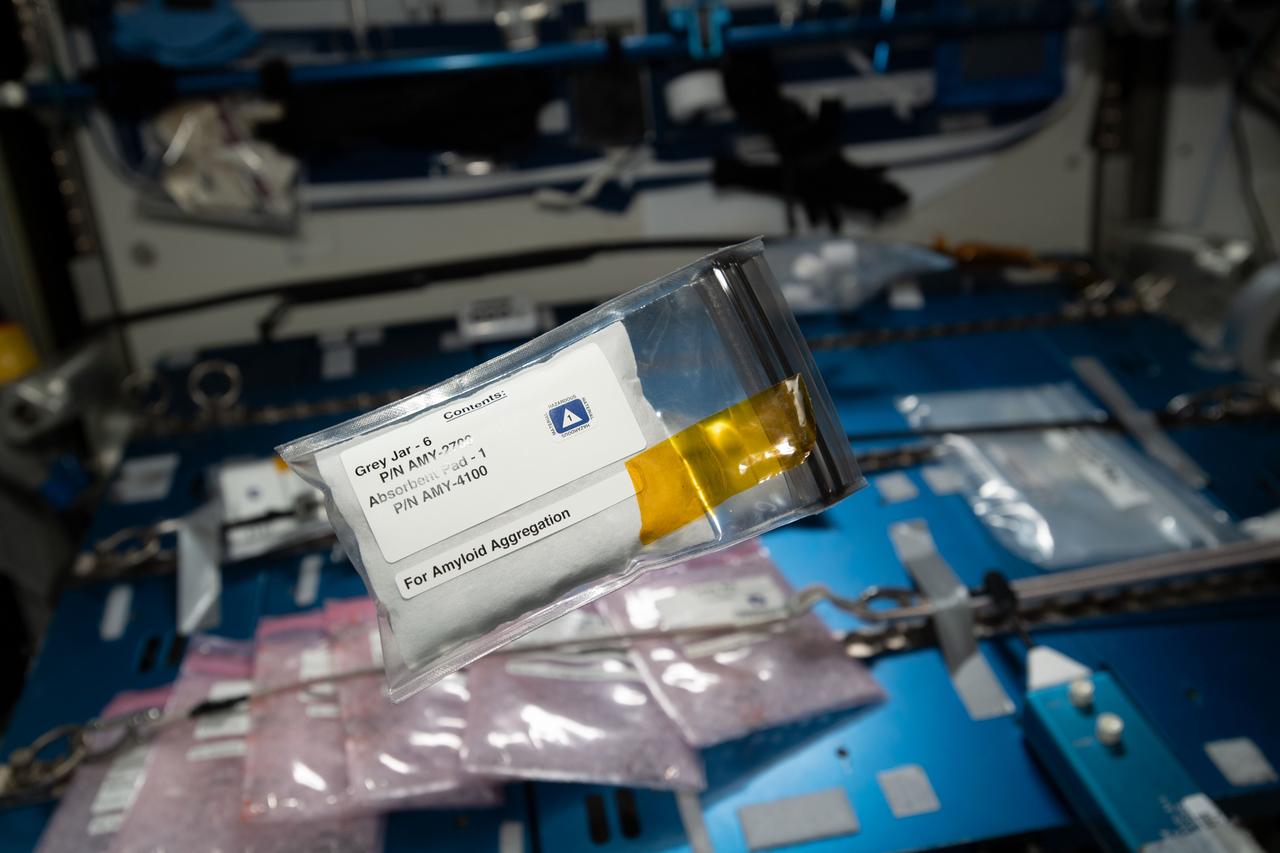
iss060e023981 (8/7/2019) --- Photo documentation of an Amyloid Aggregation Grey Jar sample pack, aboard the International Space Station (ISS). The cap colors are used to distinguish the incubation times. The aim of the Amyloid Aggregation investigation is to assess if amyloid fibrils aggregation is affected by microgravity in order to identify a possible professional risk in astronauts spending long periods on board the ISS. The knowledge gained could contribute to the designing of innovative therapeutic strategies for the treatment of Alzheimer’s Disease and for other diseases characterized by protein accumulation.
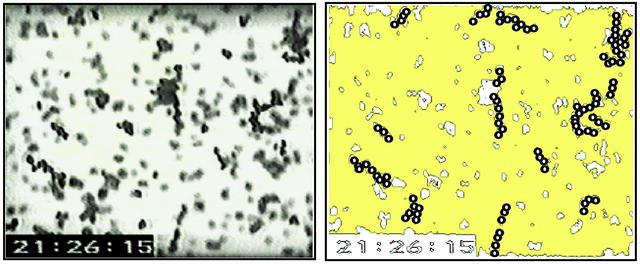
John Marshall, an investigator at Ames Research Center and a principal investigator in the microgravity fluid physics program, is studying the adhesion and cohesion of particles in order to shed light on how granular systems behave. These systems include everything from giant dust clouds that form planets to tiny compressed pellets, such as the ones you swallow as tablets. This knowledge should help us control the grains, dust, and powders that we encounter or use on a daily basis. Marshall investigated electrostatic charge in microgravity on the first and second U.S. Microgravity Laboratory shuttle missions to see how grains aggregate, or stick together. With gravity's effects eliminated on orbit, Marshall found that the grains of sand that behaved ever so freely on Earth now behaved like flour. They would just glom together in clumps and were quite difficult to disperse. That led to an understanding of the prevalence of the electrostatic forces. The granules wanted to aggregate as little chains, like little hairs, and stack end to end. Some of the chains had 20 or 30 grains. This phenomenon indicated that another force, what Marshall believes to be an electrostatic dipole, was at work.(The diagram on the right emphasizes the aggregating particles in the photo on the left, taken during the USML-2 mission in 1995.)
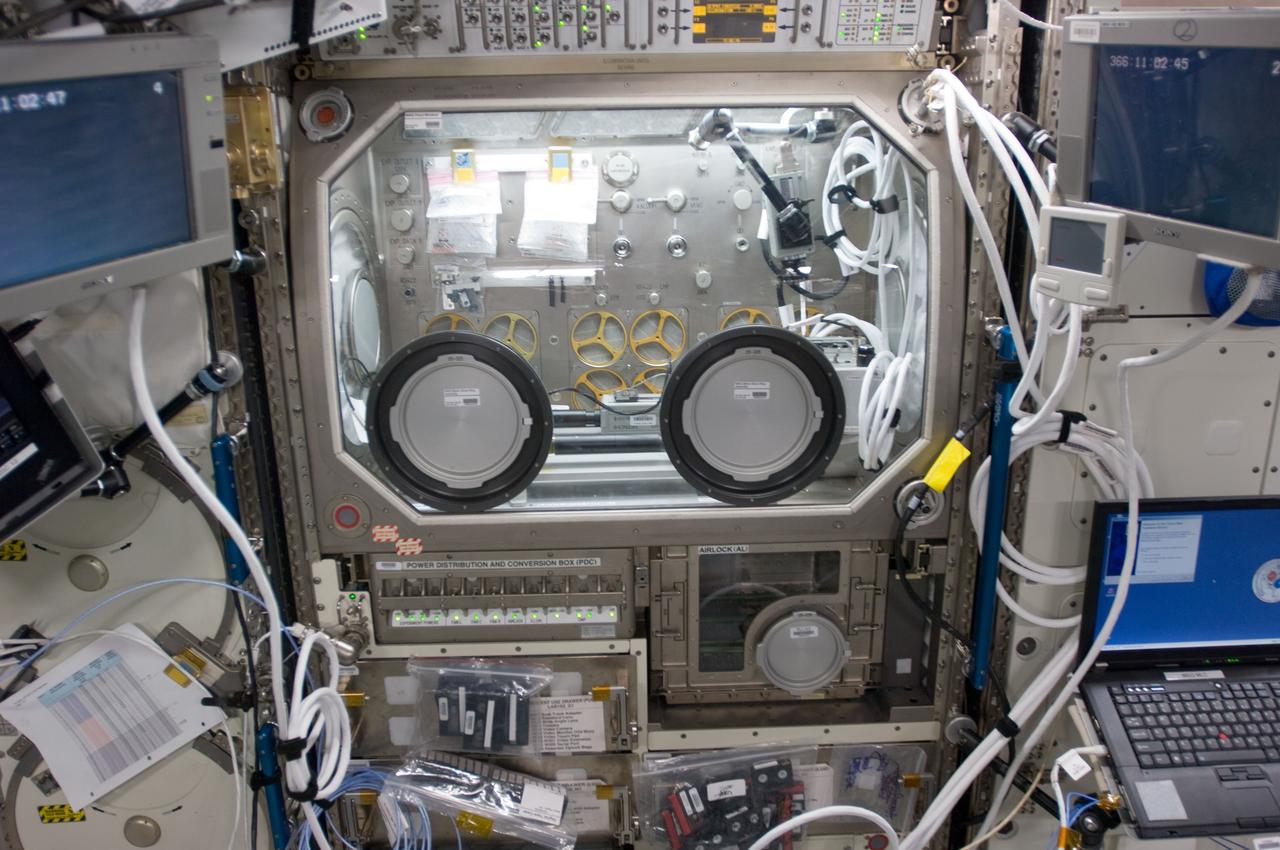
View of Command and Monitoring Panel (CMP),and Power Distribution and Conversion Box (PDC),on the Microgravity Science Glovebox (MSG) rack during Investigating the Structure of Paramagnetic Aggregates from Colloidal Emulsions 3 (InSPACE-3) Experiment,in the U.S. Laboratory. Photo was taken during Expedition 34.
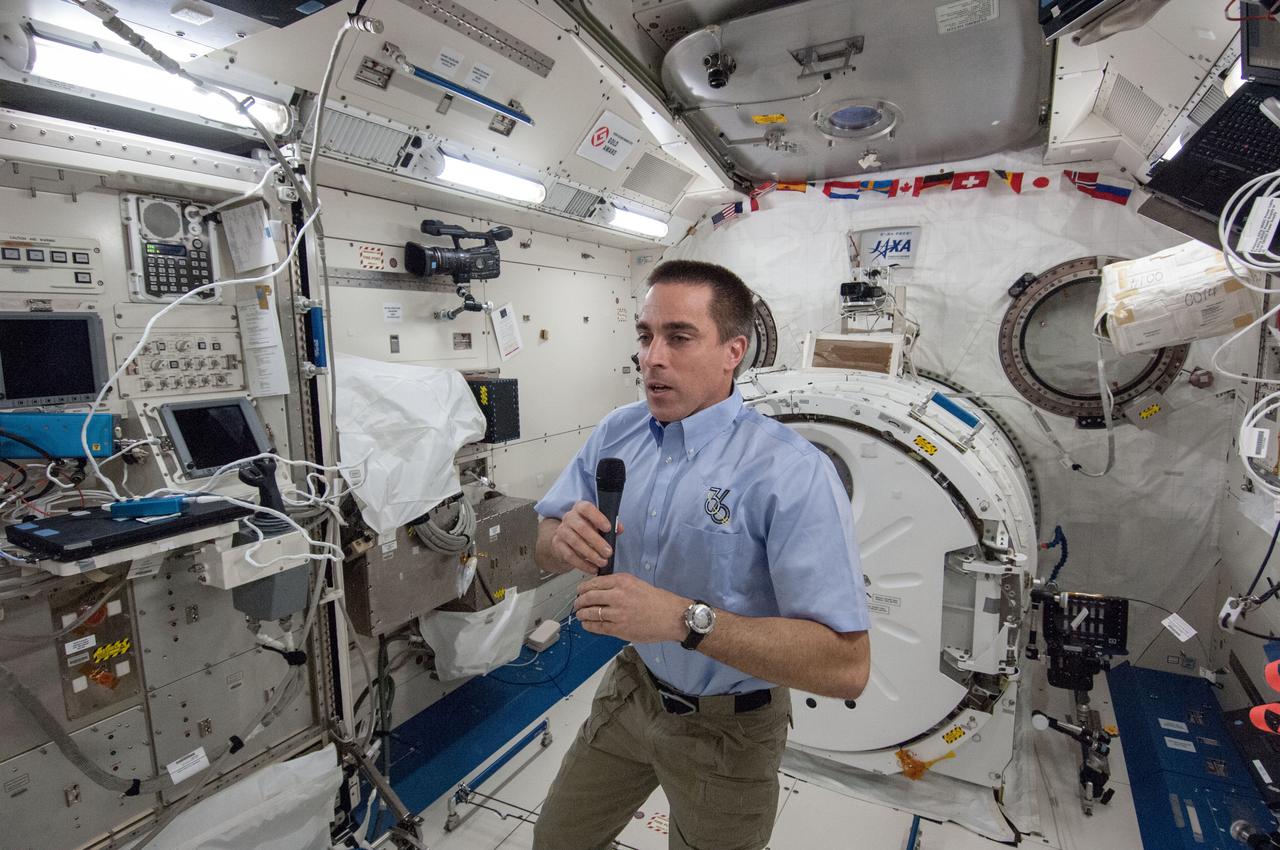
ISS036-E-003252 (22 May 2013) --- In the JAXA Kibo lab of the International Space Station, Expedition 35 Flight Engineer Chris Cassidy of NASA speaks with an aggregate of Florida students and a Florida reporter and an educator during an event that allowed a series of questions and answers on May 22, 2013.
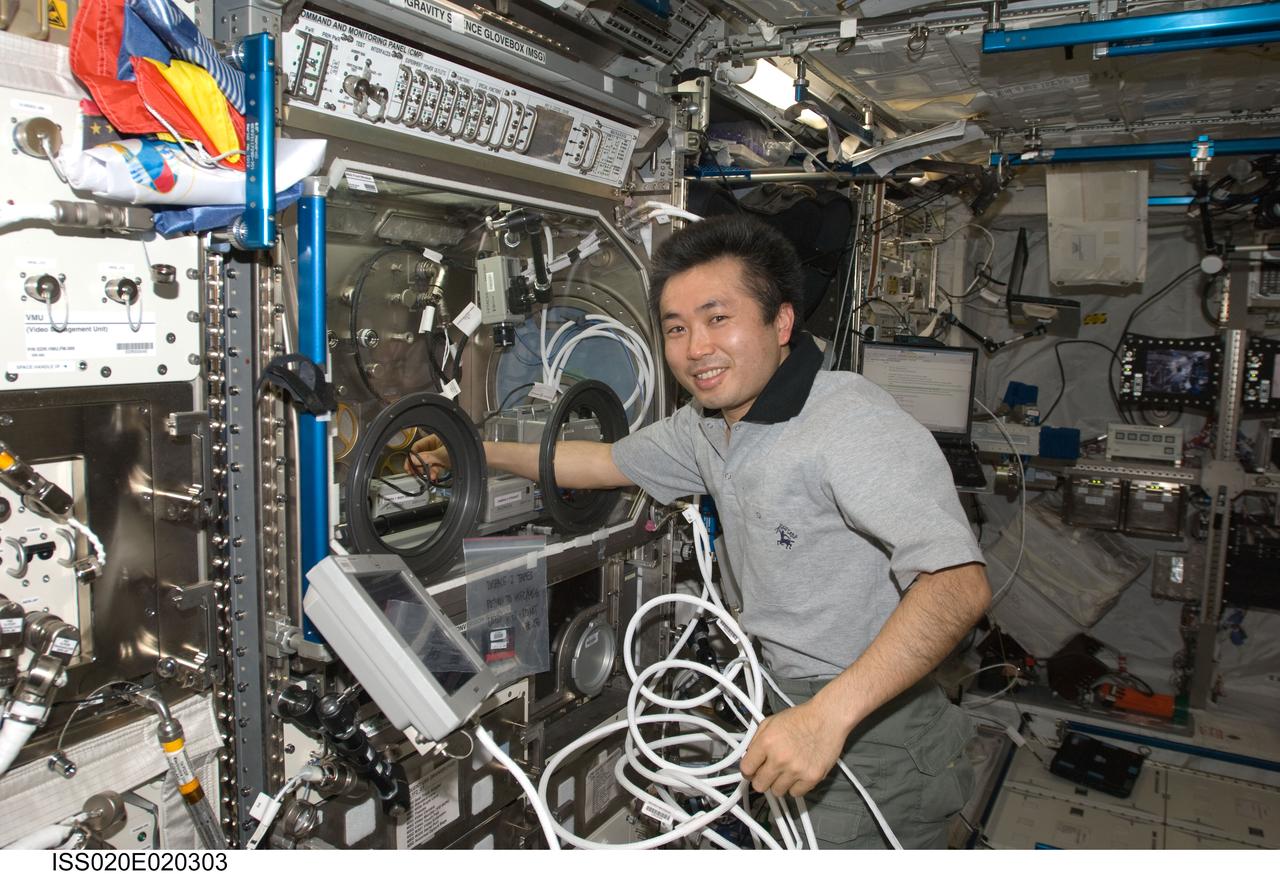
ISS020-E-020303 (14 July 2009) --- Japan Aerospace Exploration Agency (JAXA) astronaut Koichi Wakata, Expedition 20 flight engineer, works with the Investigating the Structure of Paramagnetic Aggregates from Colloidal Emulsions (InSPACE) experiment in the Microgravity Science Glovebox (MSG) in the Columbus laboratory of the International Space Station.
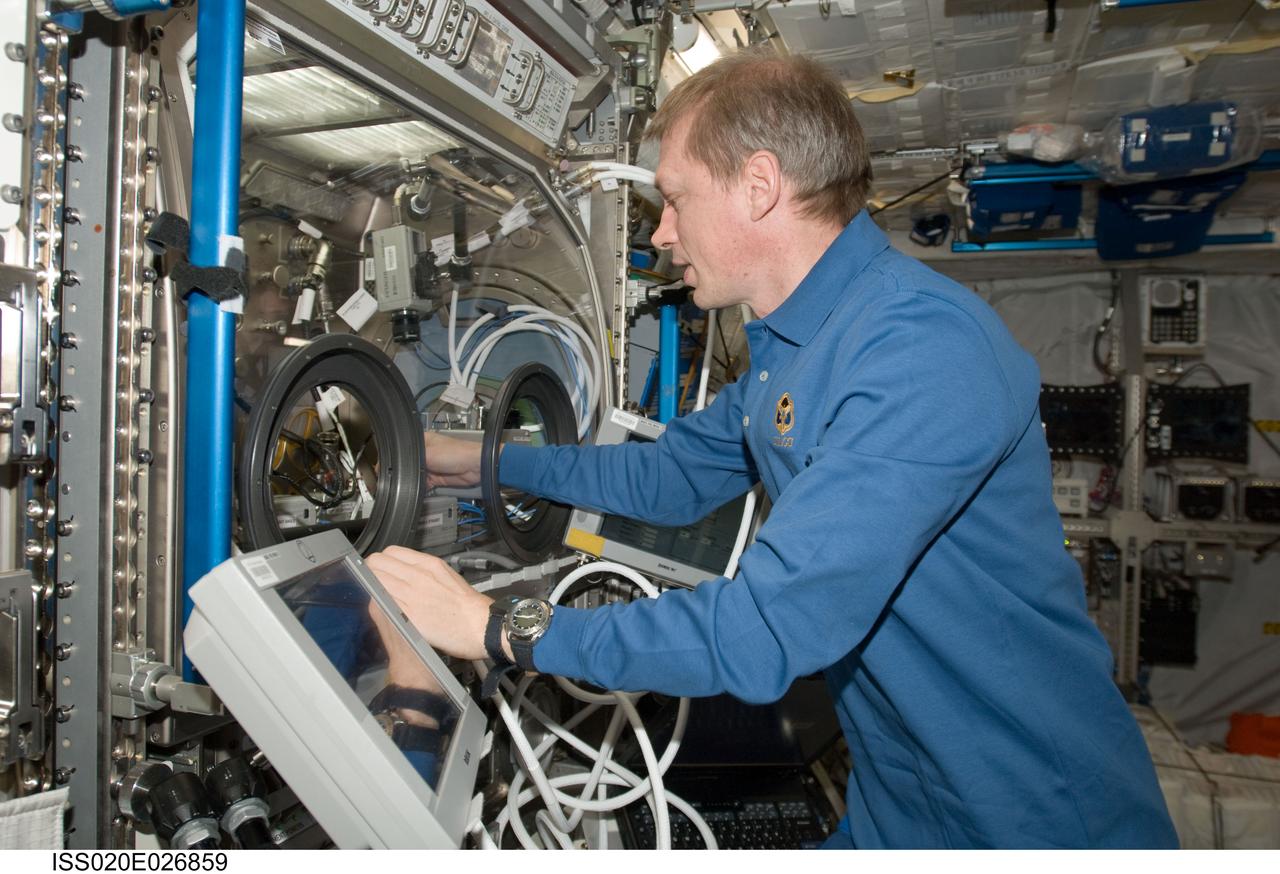
ISS020-E-026859 (1 Aug. 2009) --- European Space Agency astronaut Frank De Winne, Expedition 20 flight engineer, works with the Investigating the Structure of Paramagnetic Aggregates from Colloidal Emulsions (InSPACE) experiment in the Microgravity Science Glovebox (MSG) in the Columbus laboratory of the International Space Station.
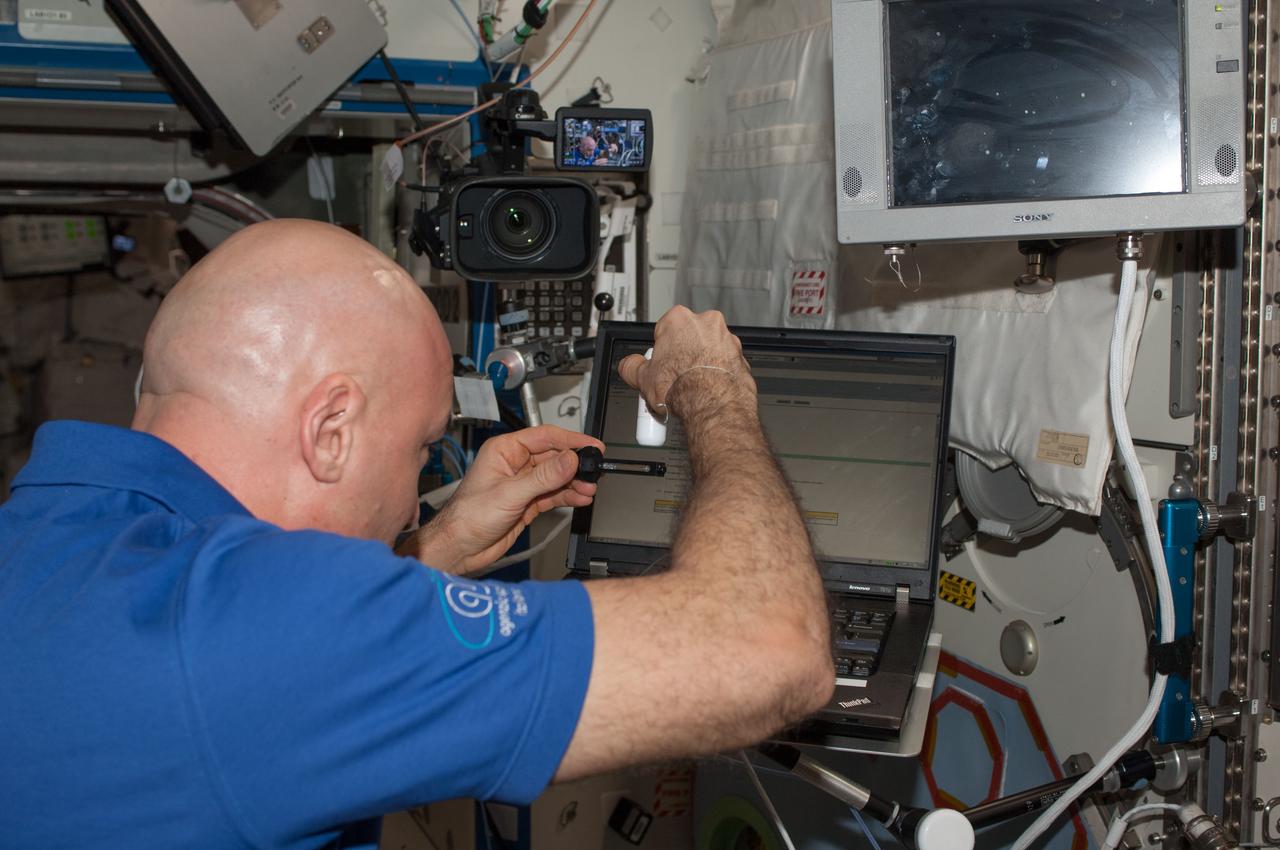
ISS037-E-010695 (14 Oct. 2013) --- European Space Agency astronaut Luca Parmitano, Expedition 37 flight engineer, works with the Investigating the Structure of Paramagnetic Aggregates from Colloidal Emulsions - 3 (InSPACE-3) experiment in the Destiny laboratory of the International Space Station.
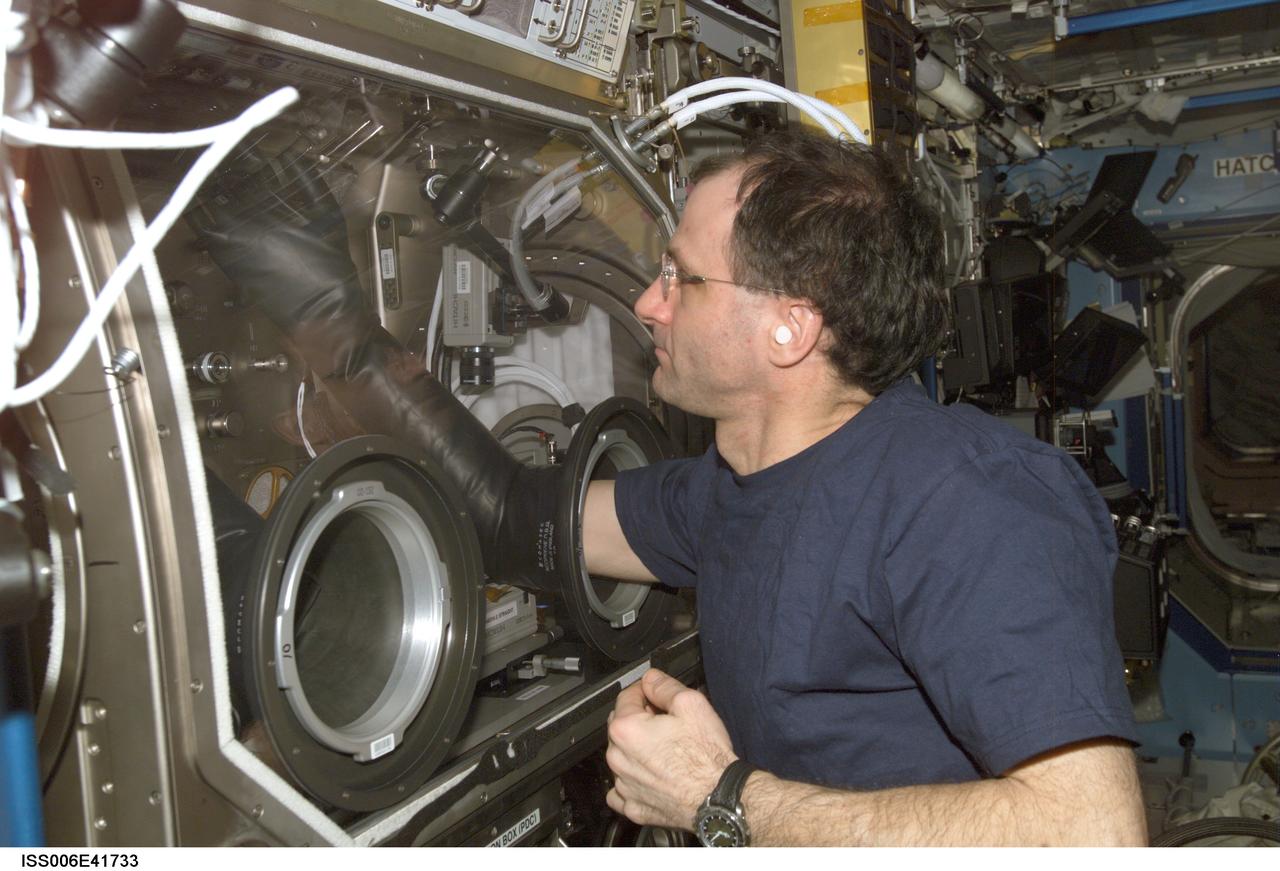
ISS006-E-41733 (1 April 2003) --- Astronaut Donald R. Pettit, Expedition Six NASA ISS science officer, works with the InSpace (Investigating the Structure of Paramagnetic Aggregates from Colloidal Emulsions) experiment in the Microgravity Science Glovebox (MSG) in the Destiny laboratory on the International Space Station (ISS).
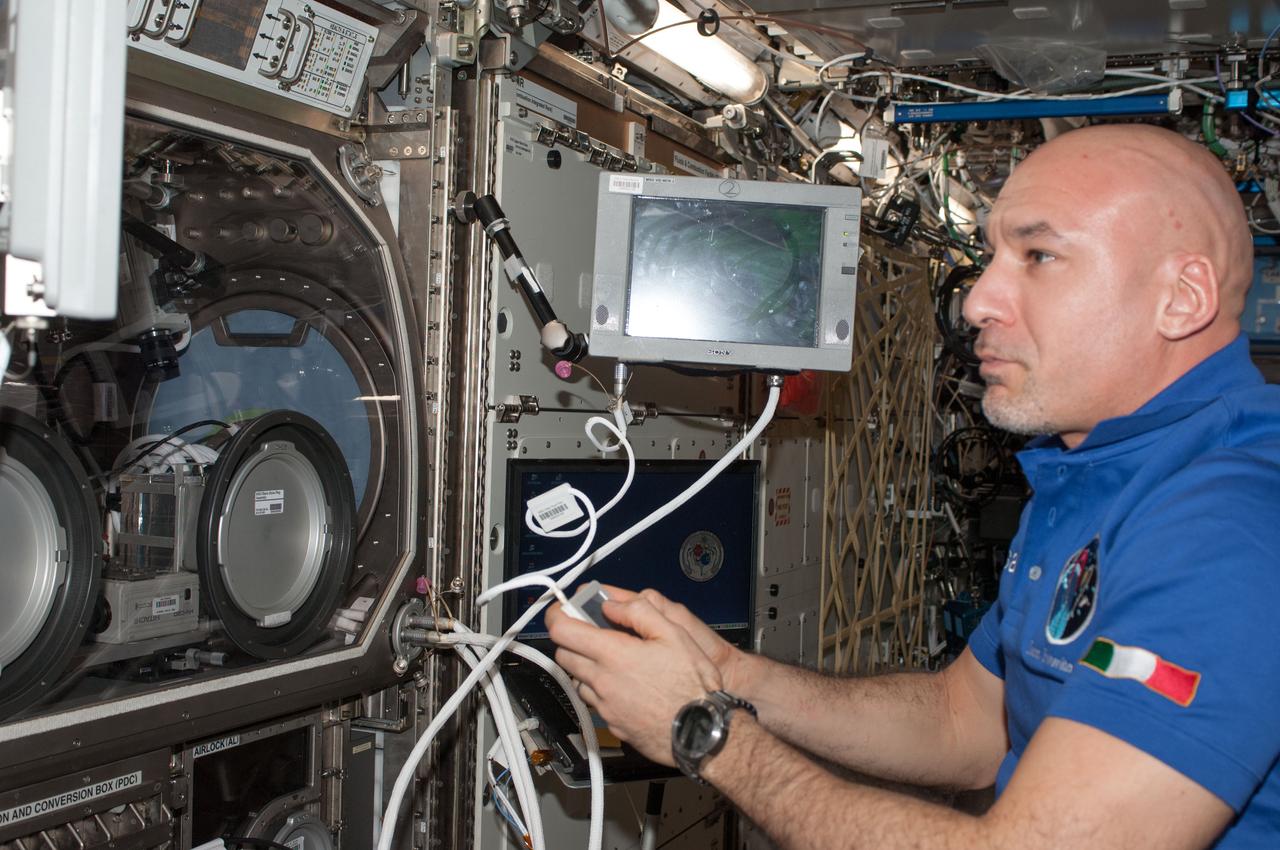
ISS037-E-010698 (14 Oct. 2013) --- European Space Agency astronaut Luca Parmitano, Expedition 37 flight engineer, works with the Investigating the Structure of Paramagnetic Aggregates from Colloidal Emulsions - 3 (InSPACE-3) experiment in the Destiny laboratory of the International Space Station.
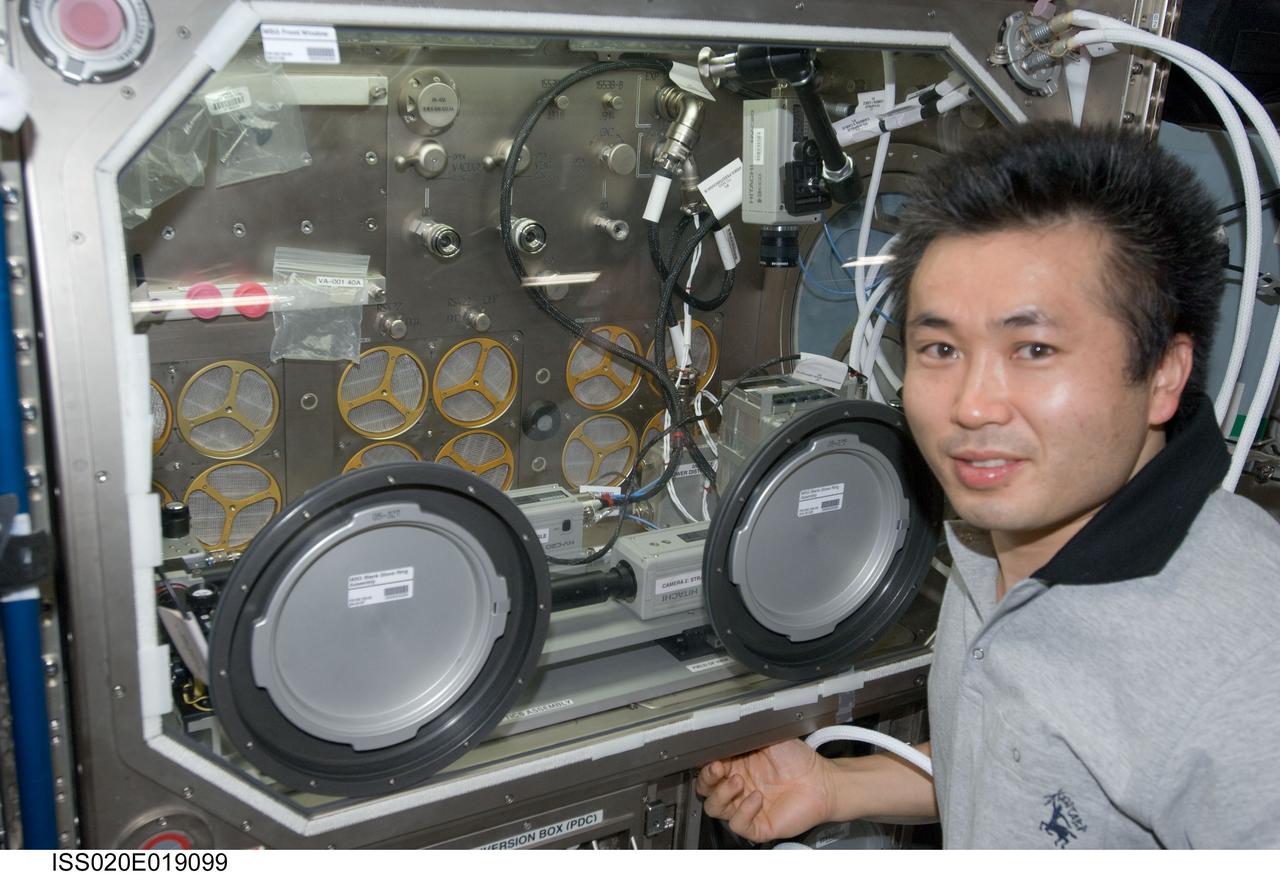
ISS020-E-019099 (13 July 2009) --- Japan Aerospace Exploration Agency (JAXA) astronaut Koichi Wakata, Expedition 20 flight engineer, works with the Investigating the Structure of Paramagnetic Aggregates from Colloidal Emulsions (InSPACE) experiment in the Microgravity Science Glovebox (MSG) in the Columbus laboratory of the International Space Station.
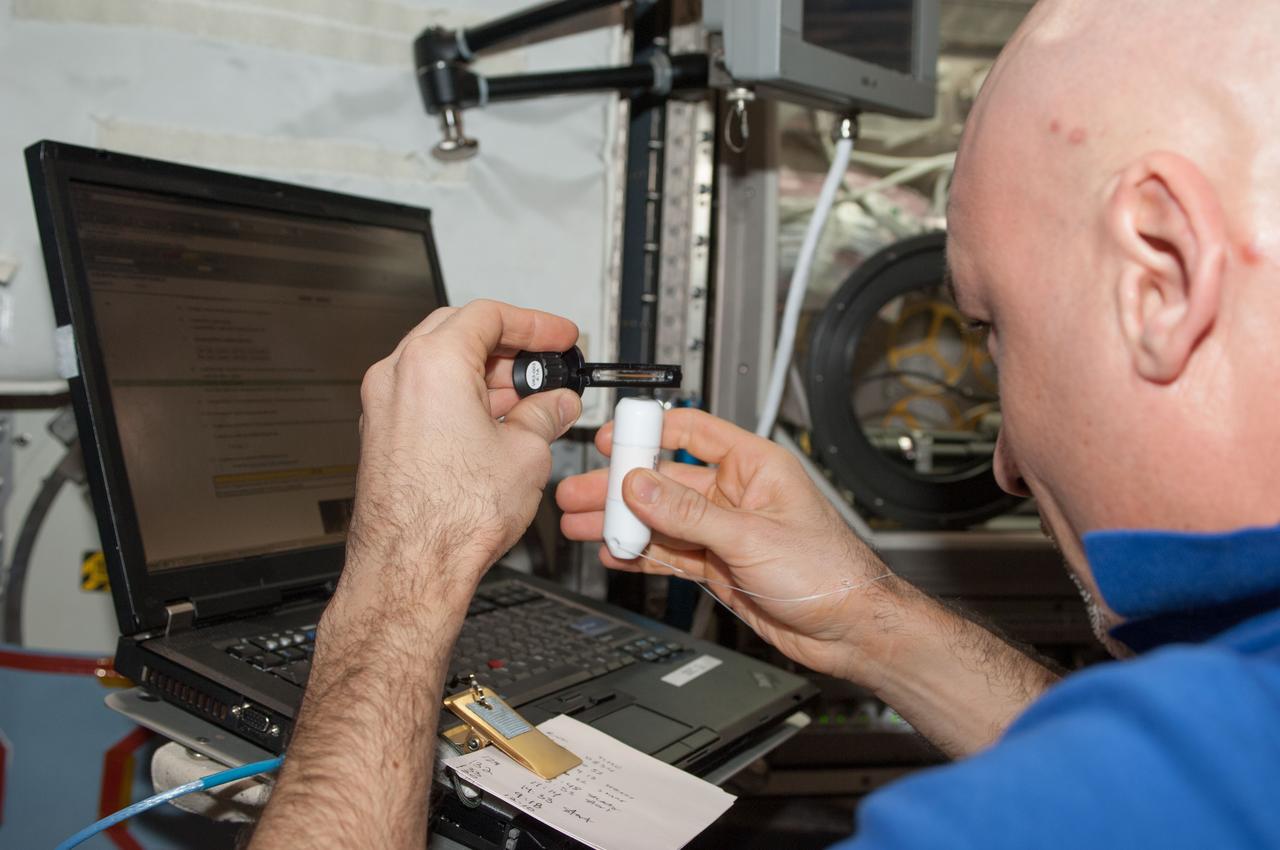
ISS037-E-010697 (14 Oct. 2013) --- European Space Agency astronaut Luca Parmitano, Expedition 37 flight engineer, works with the Investigating the Structure of Paramagnetic Aggregates from Colloidal Emulsions - 3 (InSPACE-3) experiment in the Destiny laboratory of the International Space Station.
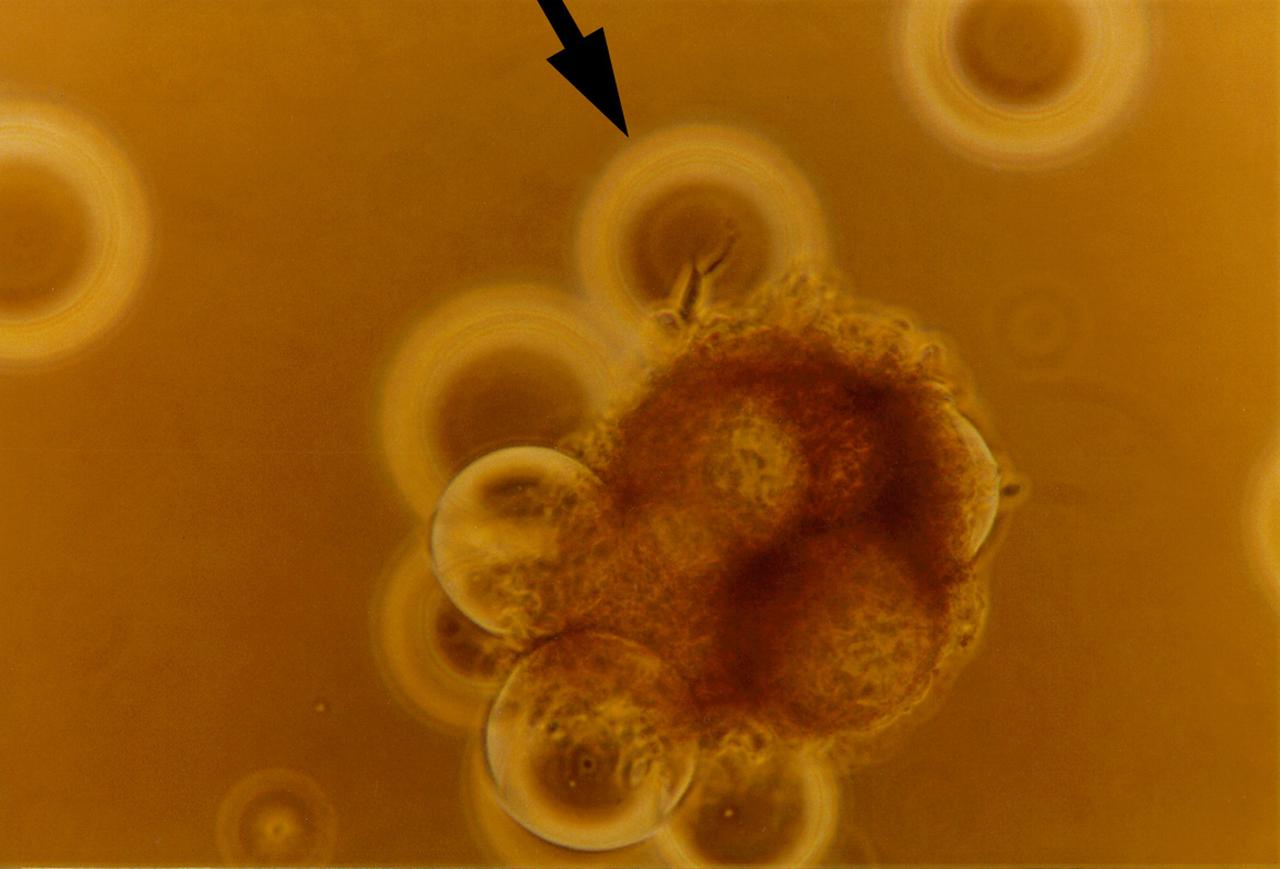
High magnification of view of tumor cells aggregate on microcarrier beads, illustrting breast cells with intercellular boundaires on bead surface and aggregates of cells achieving 3-deminstional growth outward from bead after 56 days of culture in a NASA Bioreactor. NASA's Marshall Space Flight Center (MSFC) is sponsoring research with Bioreactors, rotating wall vessels designed to grow tissue samples in space, to understand how breast cancer works. This ground-based work studies the growth and assembly of human mammary epithelial cell (HMEC) from breast cancer susceptible tissue. Radiation can make the cells cancerous, thus allowing better comparisons of healthy vs. tunorous tissue. Credit: Dr. Jearne Becker, University of South Florida.
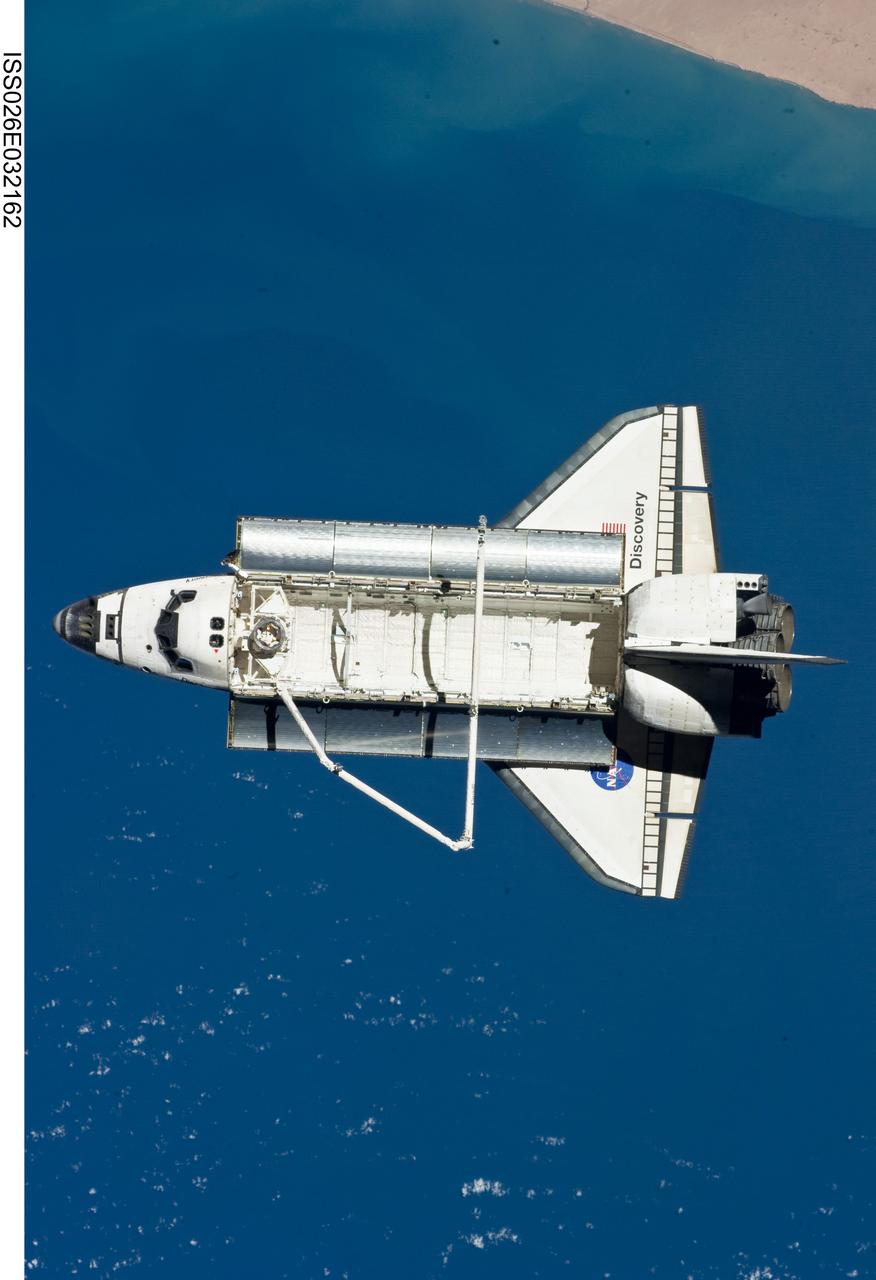
ISS026-E-032162 (7 March 2011) --- The space shuttle Discovery is seen from the International Space Station as the two orbital spacecraft accomplish their relative separation on March 7 after an aggregate of 12 astronauts and cosmonauts worked together for over a week. The area below is in the northern Atlantic. During a post undocking fly-around, the crew members aboard the two spacecraft collected a series of photos of each other’s vehicle.
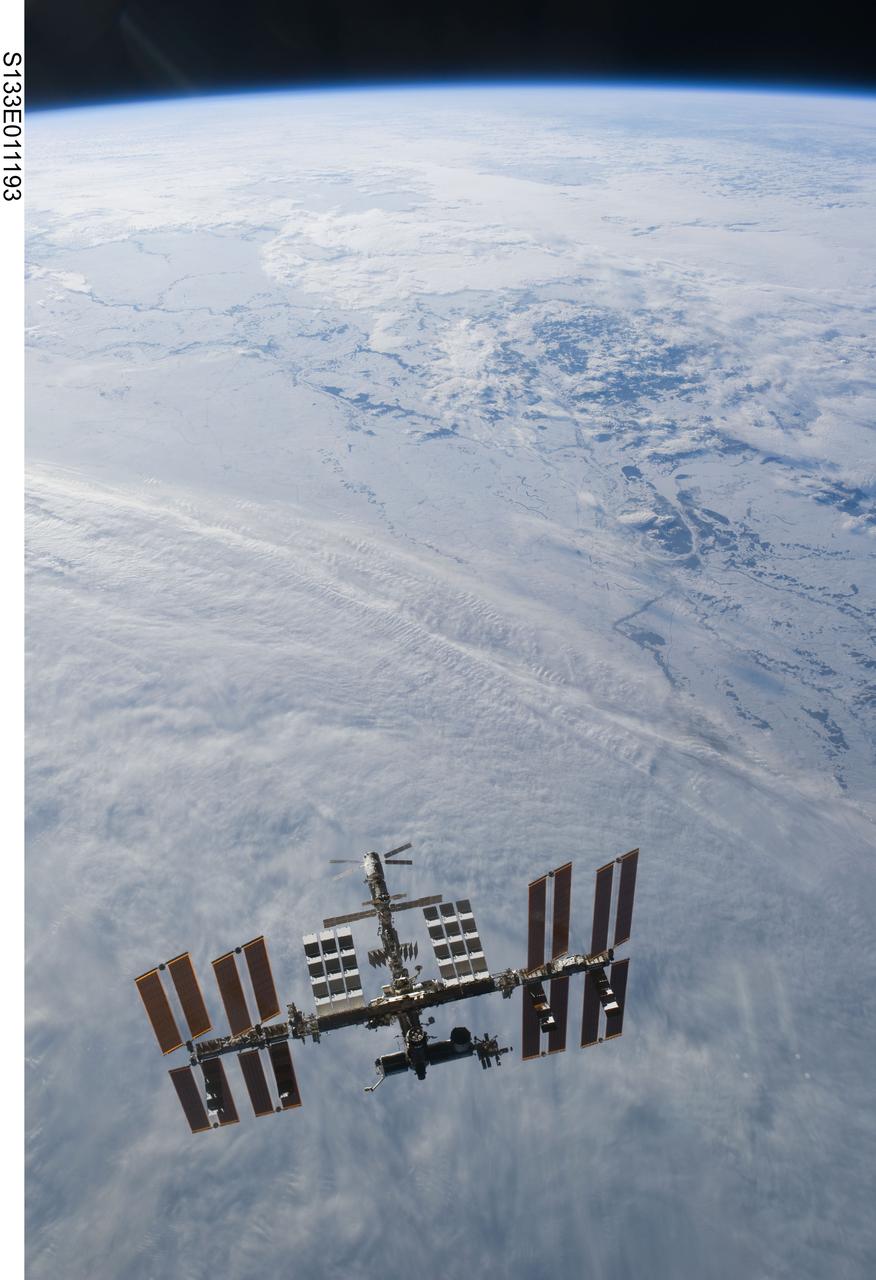
S133-E-011193(7 March 2011) --- Backdropped against clouds over Earth, the International Space Station is seen from Discovery as the two orbital spacecraft accomplish their relative separation on March 7 after an aggregate of 12 astronauts and cosmonauts worked together for over a week. During a post undocking fly-around, the crew members aboard the two spacecraft collected a series of photos of each other’s vehicle. Photo credit: NASA or National Aeronautics and Space Administration
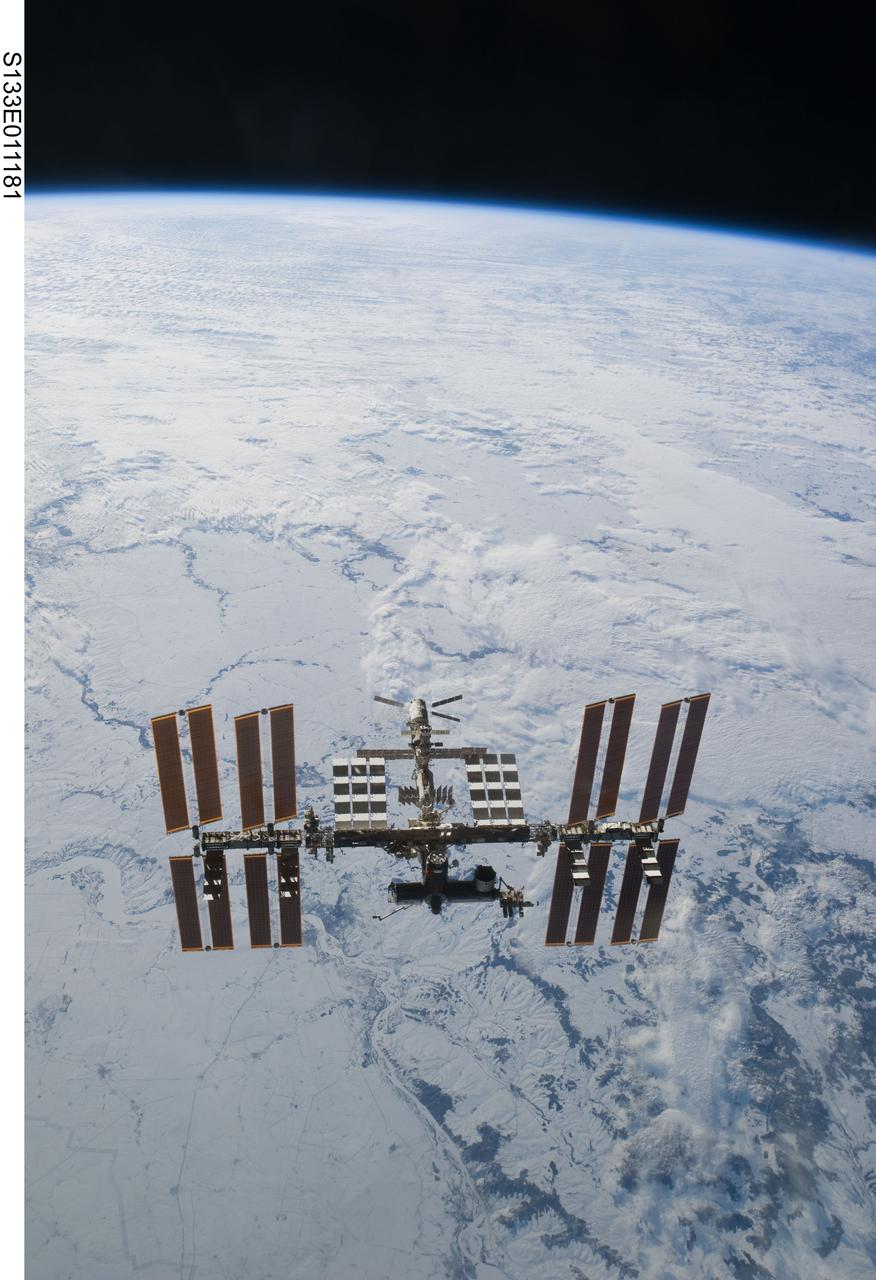
S133-E-011181 (7 March 2011) --- Backdropped against clouds over Earth, the International Space Station is seen from Discovery as the two orbital spacecraft accomplish their relative separation on March 7 after an aggregate of 12 astronauts and cosmonauts worked together for over a week. During a post undocking fly-around, the crew members aboard the two spacecraft collected a series of photos of each other’s vehicle. Photo credit: NASA or National Aeronautics and Space Administration
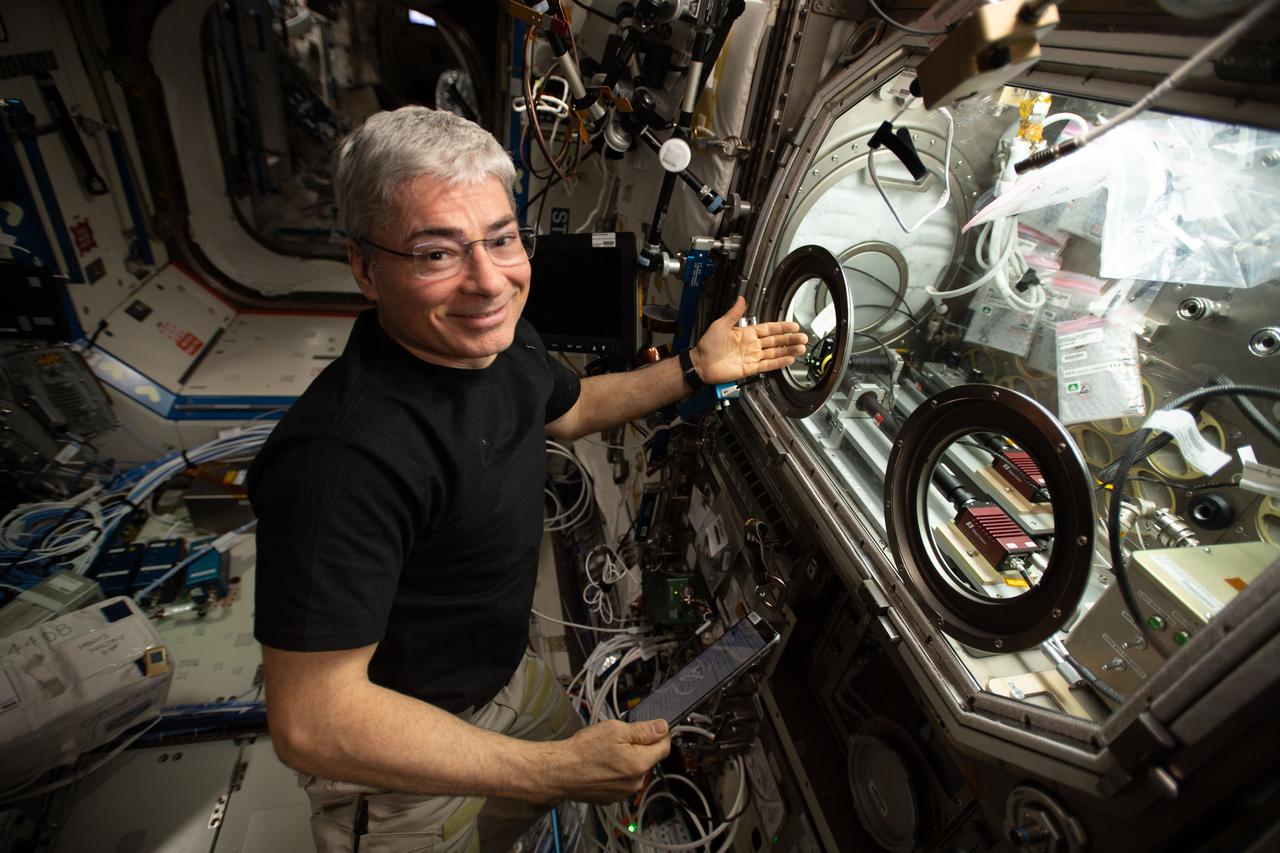
iss066e081677 (Nov. 23, 2021) --- NASA astronaut and Expedition 66 Flight Engineer Mark Vande Hei sets up hardware inside the Microgravity Science Glovebox for the InSPACE-4 space physics experiment. Results from InSPACE-4, or Investigating the Structure of Paramagnetic Aggregates from Colloidal Ellipsoids, could provide insight into how to harness nanoparticles to fabricate and manufacture new materials for Earth and space applications.
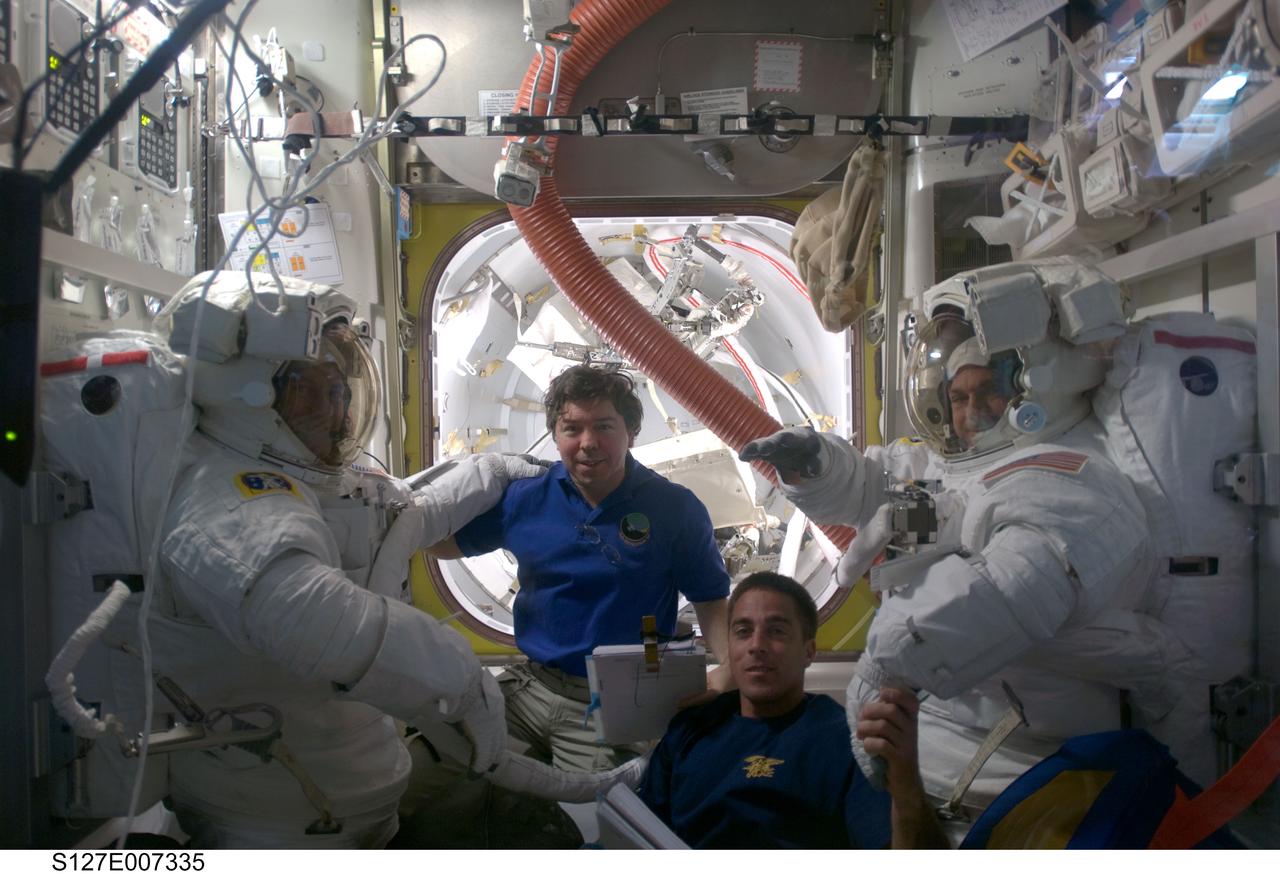
S127-E-007335 (20 July 2009) --- Two members of the flight day six spacewalk crew--the second one of five scheduled for the joint aggregation of shuttle and space station crewmembers--go through the final touches on the donning of their spacesuits prior to egressing the joint airlock of the orbital outpost. Suited astronauts Dave Wolf (left) and Tom Marshburn (right)are assisted by astronauts Mike Barratt (center frame), Expedition 20 flight engineer, and Christopher Cassidy (bottom), STS-127 mission specialist.
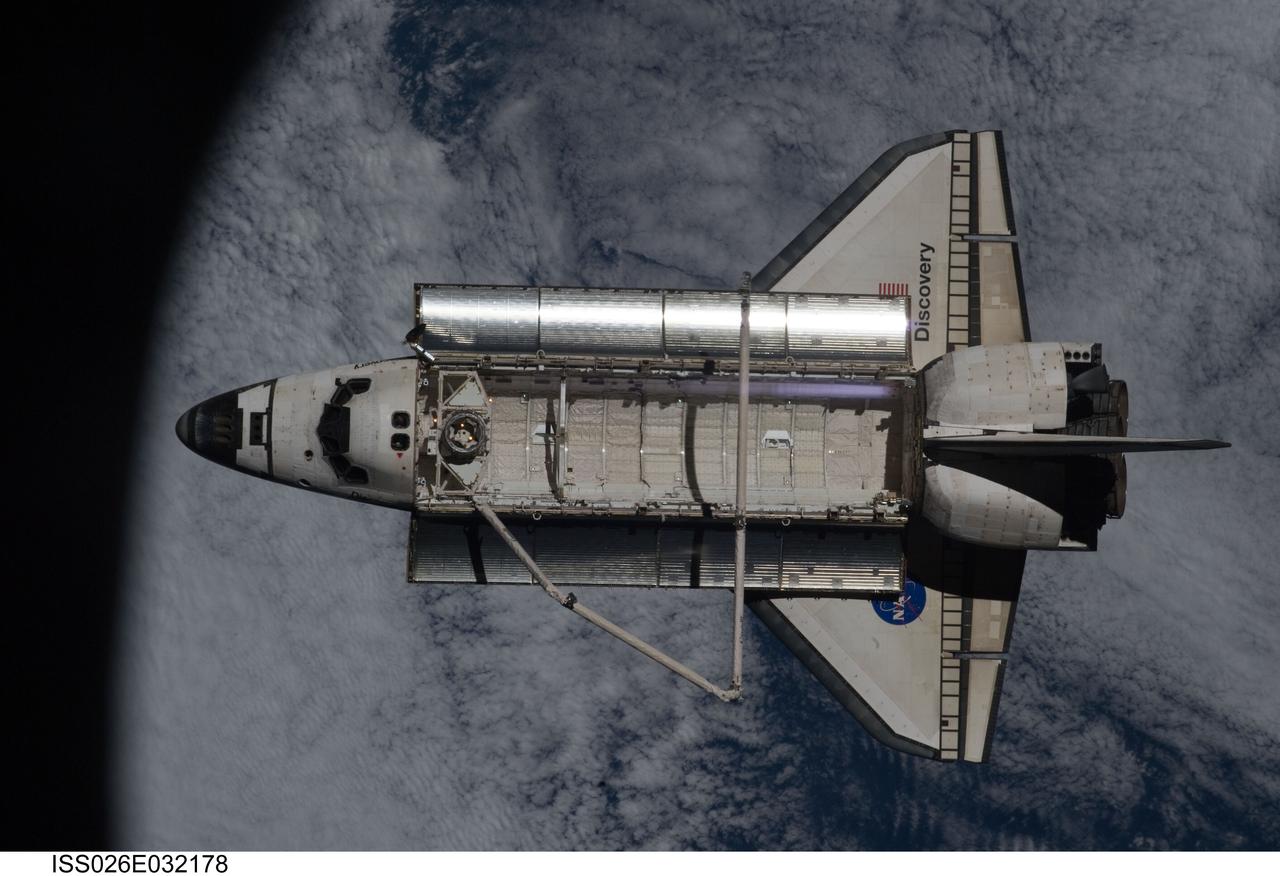
ISS026-E-032178 (7 March 2011) --- The space shuttle Discovery is seen from the International Space Station as the two orbital spacecraft accomplish their relative separation on March 7 after an aggregate of 12 astronauts and cosmonauts worked together for over a week. During a post undocking fly-around, the crew members aboard the two spacecraft collected a series of photos of each other’s vehicle.
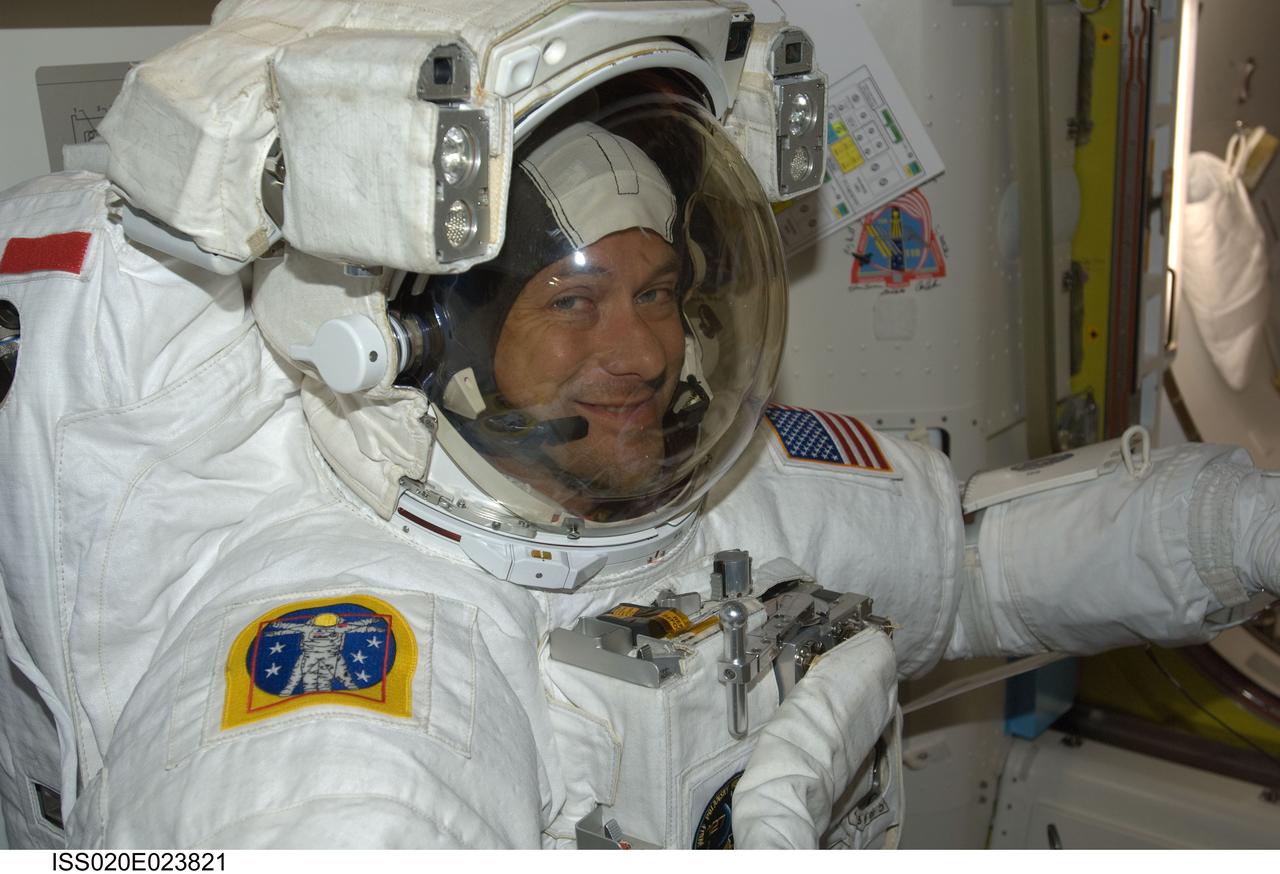
ISS020-E-023821 (24 July 2009) ---Astronaut Tom Marshburn stands suited and almost ready to participate in the July 24 flight day 10 spacewalk. He and astronaut Christopher Cassidy (out of frame) are also scheduled to wrap up the EVA work with a fifth overall session on July 27. The two mission specialists are part of a 13-member aggregation of astronauts and cosmonauts currently onboard the orbital outpost while its crew of six plays host to Endeavour's crew of seven.
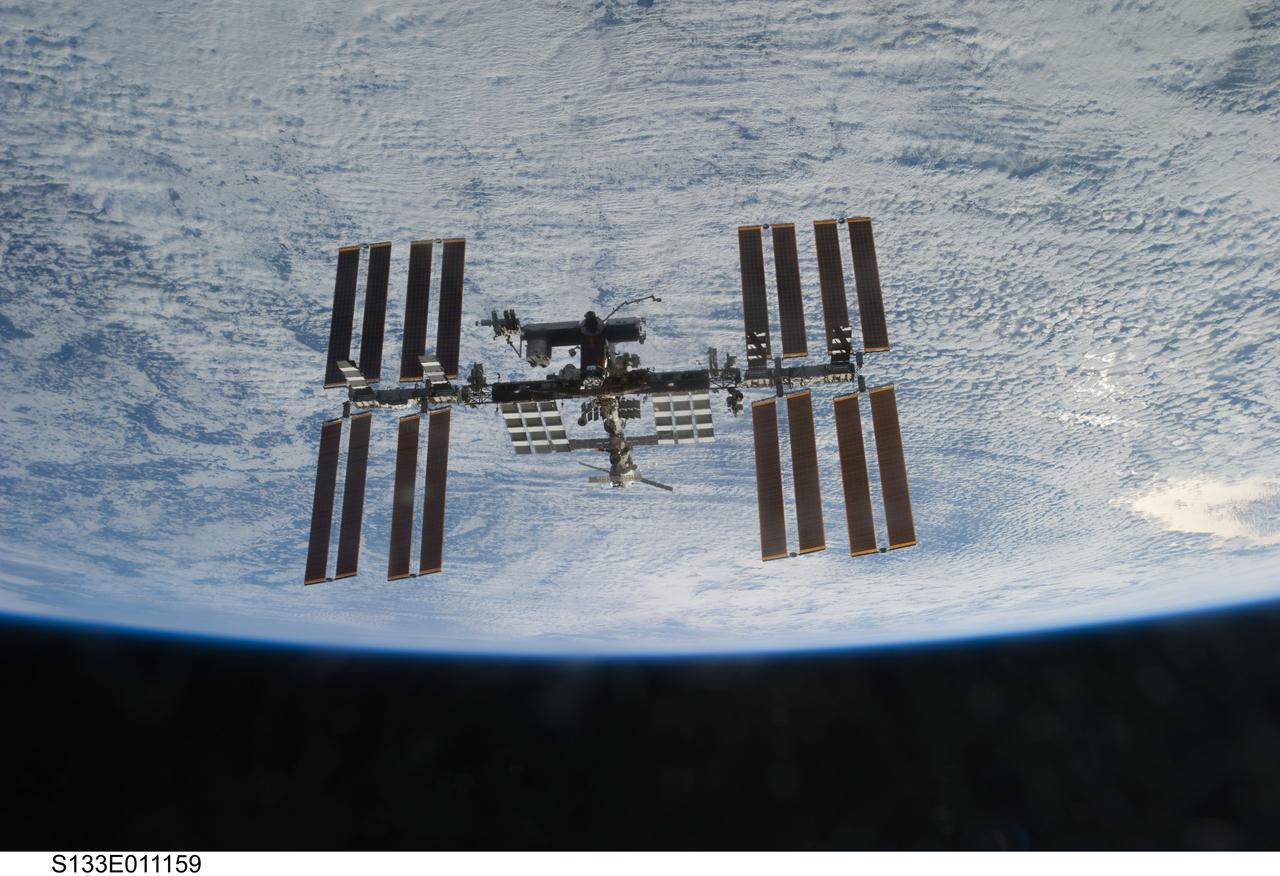
S133-E-011159 (7 March 2011) --- Backdropped against clouds over Earth, the International Space Station is seen from Discovery as the two orbital spacecraft accomplish their relative separation on March 7 after an aggregate of 12 astronauts and cosmonauts worked together for over a week. During a post undocking fly-around, the crew members aboard the two spacecraft collected a series of photos of each other’s vehicle. Photo credit: NASA or National Aeronautics and Space Administration
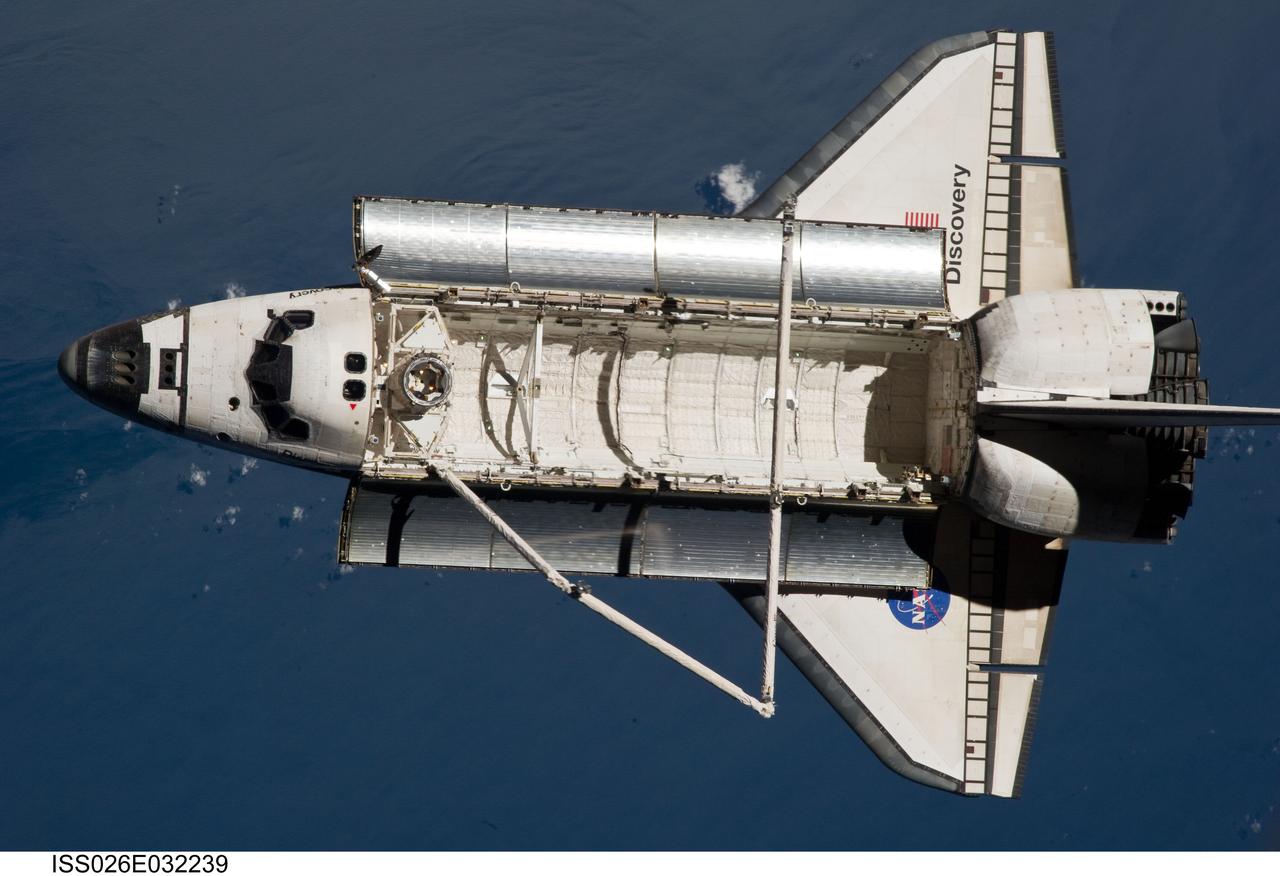
ISS026-E-032239 (7 March 2011) --- The space shuttle Discovery is seen from the International Space Station as the two orbital spacecraft accomplish their relative separation on March 7 after an aggregate of 12 astronauts and cosmonauts worked together for over a week. The blue water below is in the northern Atlantic. During a post undocking fly-around, the crew members aboard the two spacecraft collected a series of photos of each other’s vehicle.
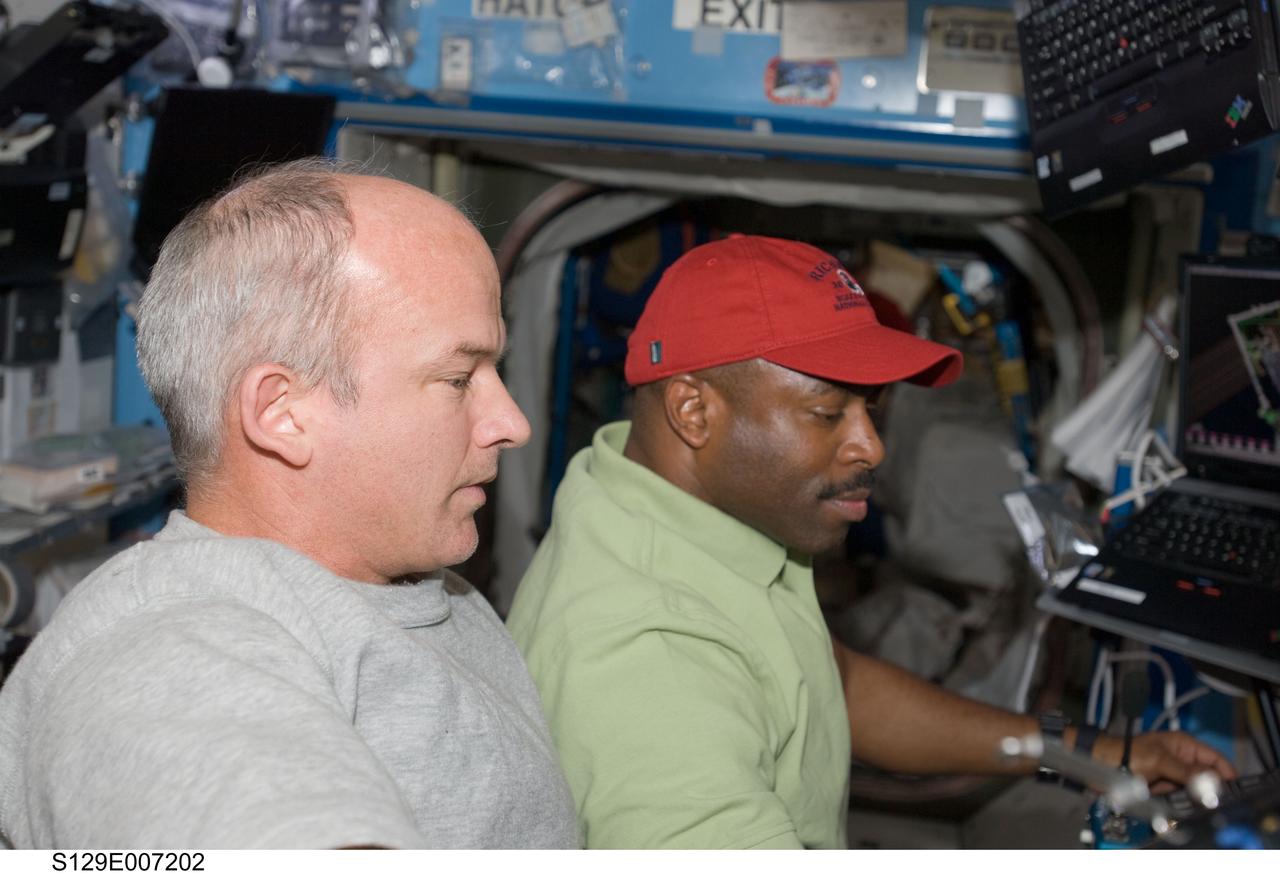
S129-E-007202 (21 Nov. 2009) --- NASA astronauts Jeffrey Williams (left), Expedition 21 flight engineer, and Leland Melvin, STS-129 mission specialist, support the extravehicular activity of astronauts Mike Foreman and Randy Bresnik from the shirt sleeve environment of the International Space Station. While Foreman and Bresnik worked outside, an aggregation of ten internationally-represented astronauts and cosmonauts worked onboard both the space shuttle Atlantis and the International Space Station to support their tasks.
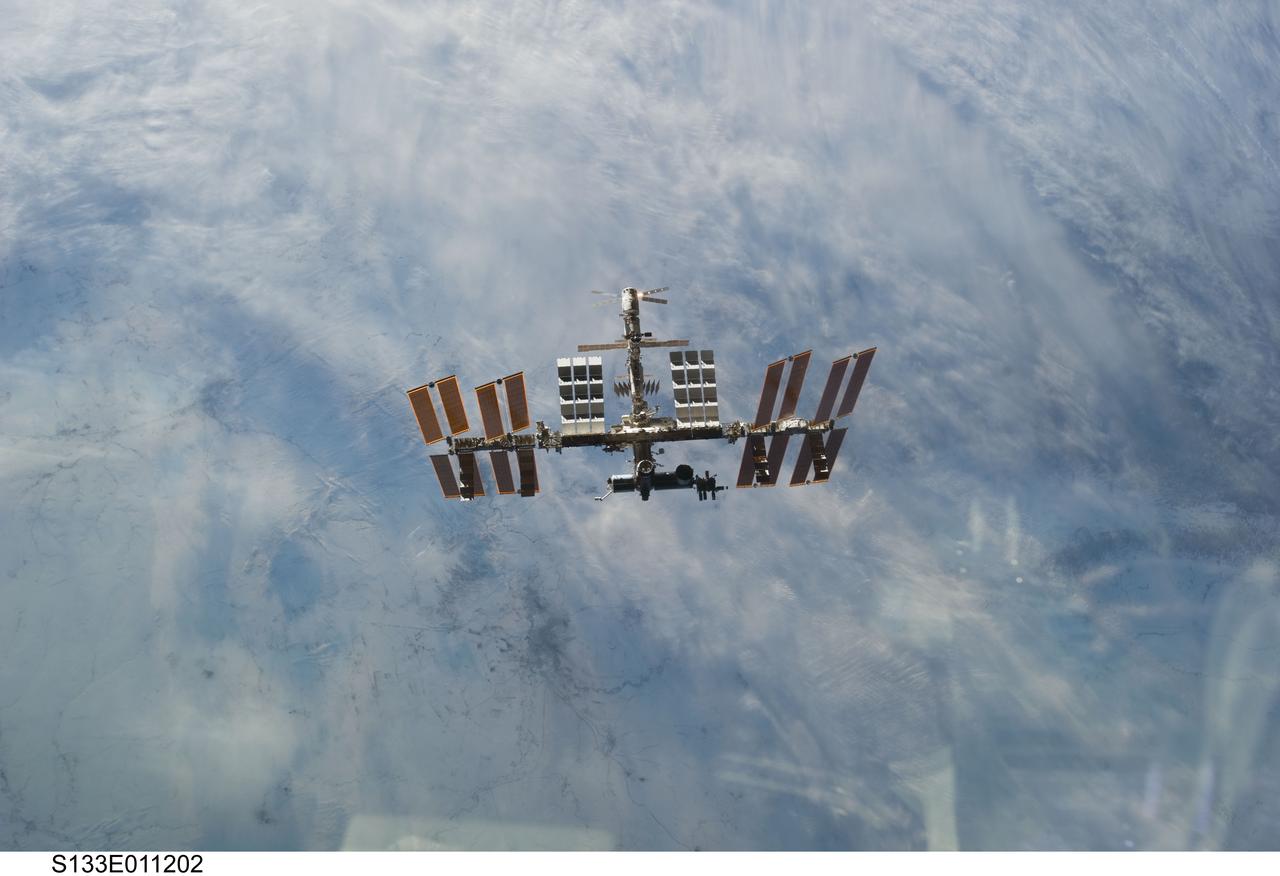
S133-E-011202 (7 March 2011) --- Backdropped against clouds over Earth, the International Space Station is seen from Discovery as the two orbital spacecraft accomplish their relative separation on March 7 after an aggregate of 12 astronauts and cosmonauts worked together for over a week. During a post undocking fly-around, the crew members aboard the two spacecraft collected a series of photos of each other’s vehicle. Photo credit: NASA or National Aeronautics and Space Administration

ISS039-E-005744 (30 March 2014) --- By the rationale of some observers, this image of Expedition 39 Flight Engineer Steve Swanson could be titled "Return to the Old Stomping Grounds, Five Years Hence," except for the fact that it is difficult to stomp in a weightless environment and the fact that the Cupola was not part of the orbital outpost in March of 2009, the last time Swanson visited it. The NASA astronaut and two Russian cosmonauts arrived at the station on March 27, 2014, and this image of a jubilant Swanson was one of the first showing members of the second aggregate of the Expedition 39 crew.

S127-E-007079 (29 July 2009) --- Astronaut Christopher Cassidy is pictured on the flight deck of the Space Shuttle Endeavour during the July 20 spacewalk of astronauts Dave Wolf and Tom Marshburn. Cassidy, Wolf and Marshburn, all three mission specialists, are part of a 13-member station population for now -- an aggregation made up of seven shuttle astronauts and six Expedition 20 crew members.
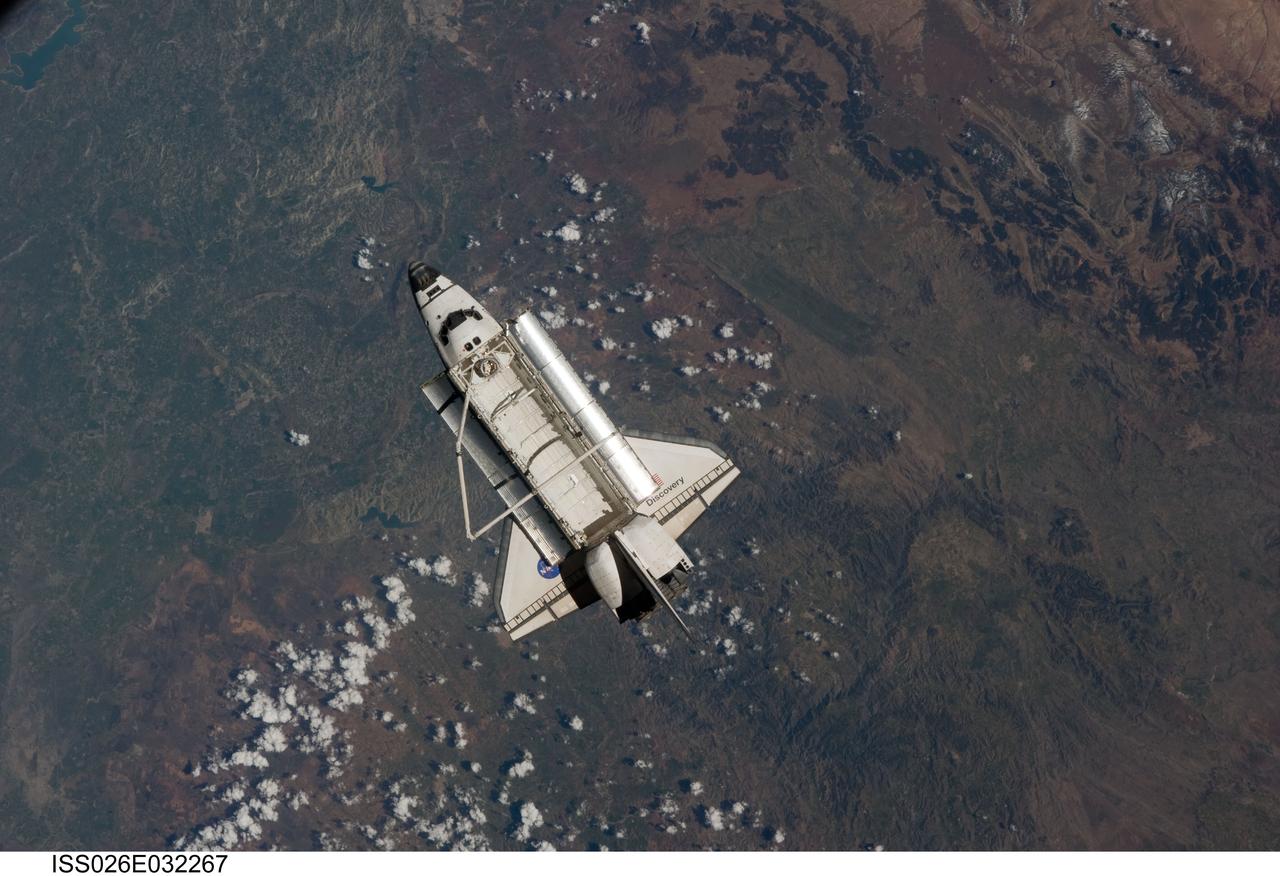
ISS026-E-032267 (7 March 2011) --- The space shuttle Discovery is seen from the International Space Station as the two orbital spacecraft accomplish their relative separation on March 7 after an aggregate of 12 astronauts and cosmonauts worked together for over a week. During a post undocking fly-around, the crew members aboard the two spacecraft collected a series of photos of each other’s vehicle.
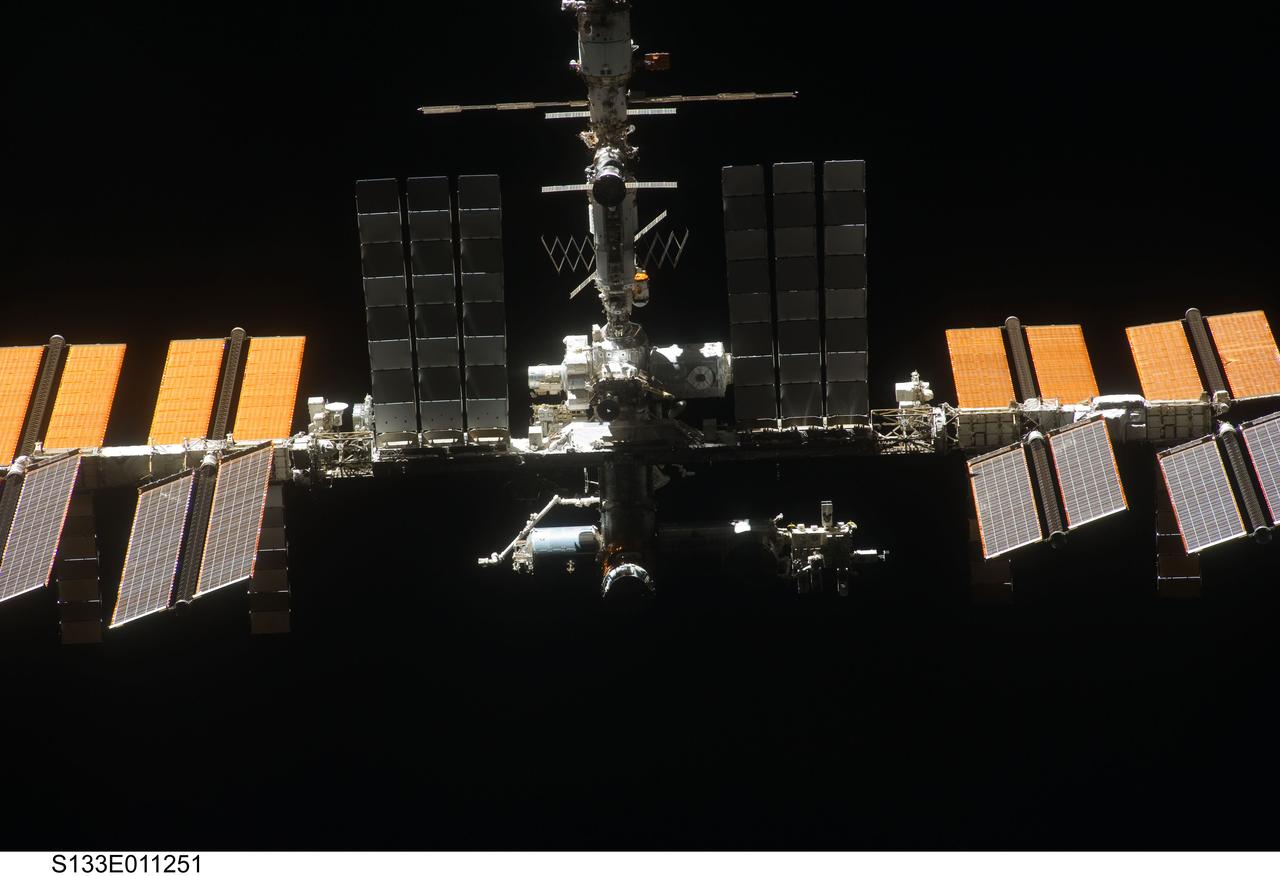
S133-E-011251 (7 March 2011) --- Backdropped against the blackness of space, the International Space Station is seen from Discovery as the two orbital spacecraft accomplish their relative separation on March 7 after an aggregate of 12 astronauts and cosmonauts worked together for over a week. During a post undocking fly-around, the crew members aboard the two spacecraft collected a series of photos of each other?s vehicle. Photo credit: NASA or National Aeronautics and Space Administration
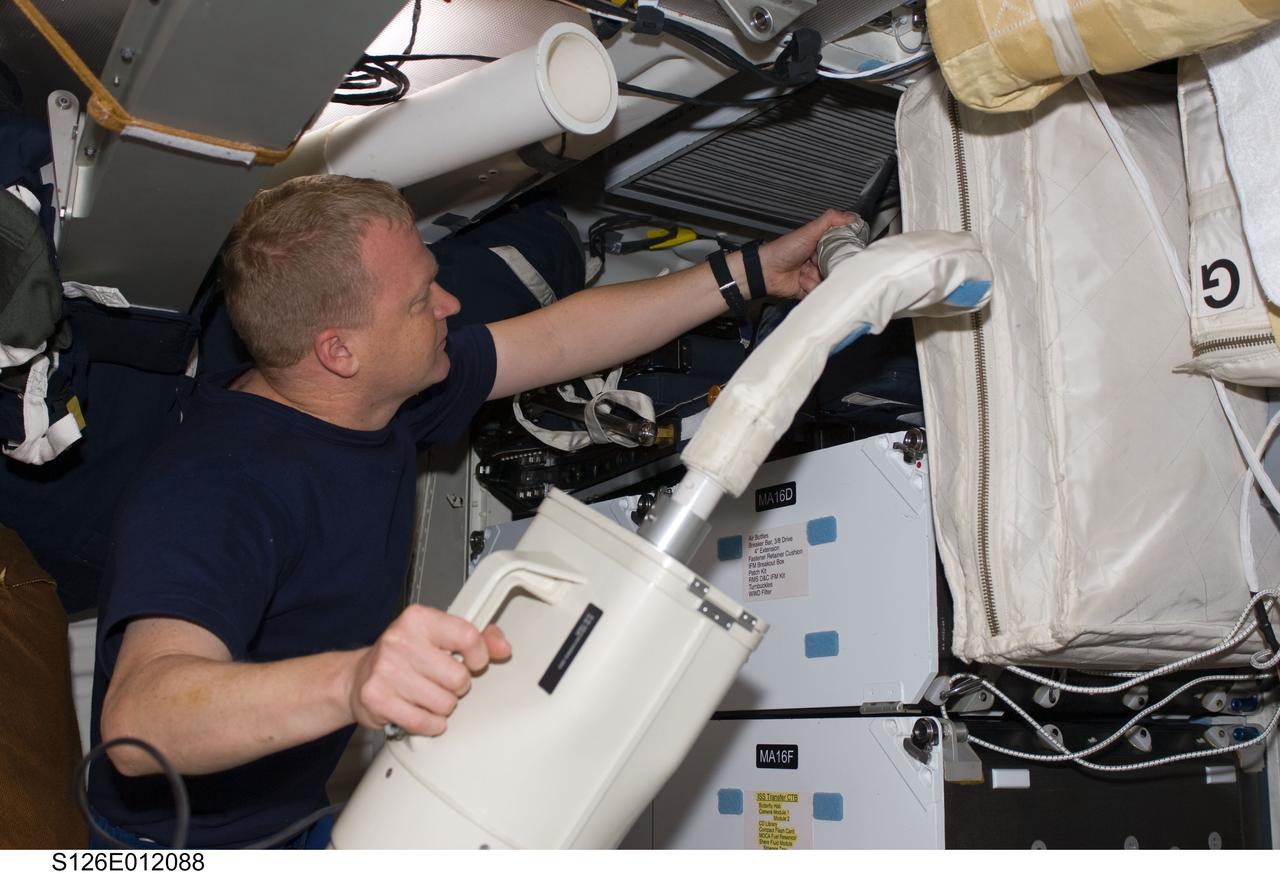
S126-E-012088 (27 Nov. 2008) --- Having completed the current home improvement project with other members of the joint space shuttle-International Space Station aggregation aboard the orbital outpost, astronaut Eric Boe turns to housekeeping chores aboard Endeavour. The pilot uses a vacuum cleaner to remove dust particles from the air filter system on the shuttle's middeck.

ISS028-E-016239 (12 July 2011) --- A crew member on the joint STS-135/Expedition 28 aggregation photographed this image of parts of Mexico, including Baja California the Gulf of Cortez. Ten astronauts and cosmonauts are currently aboard the joint Atlantis/station complex sharing chores. This photo opportunity presented itself on July 12 -- a very busy spacewalk day.
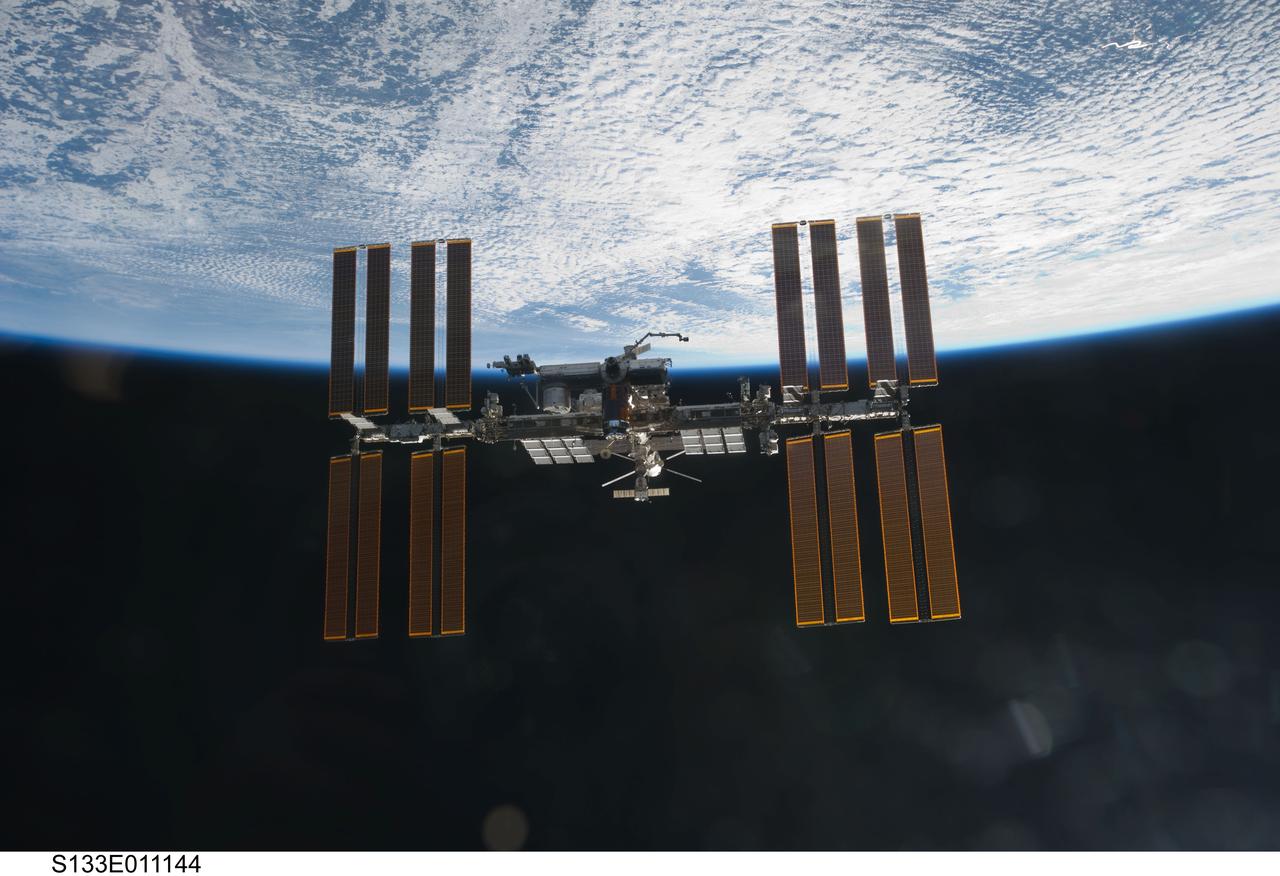
S133-E-011144 (7 March 2011) --- Backdropped against the blackness of spaec and clouds over Earth, the International Space Station is seen from Discovery as the two orbital spacecraft accomplish their relative separation on March 7 after an aggregate of 12 astronauts and cosmonauts worked together for over a week. During a post undocking fly-around, the crew members aboard the two spacecraft collected a series of photos of each other’s vehicle. Photo credit: NASA or National Aeronautics and Space Administration
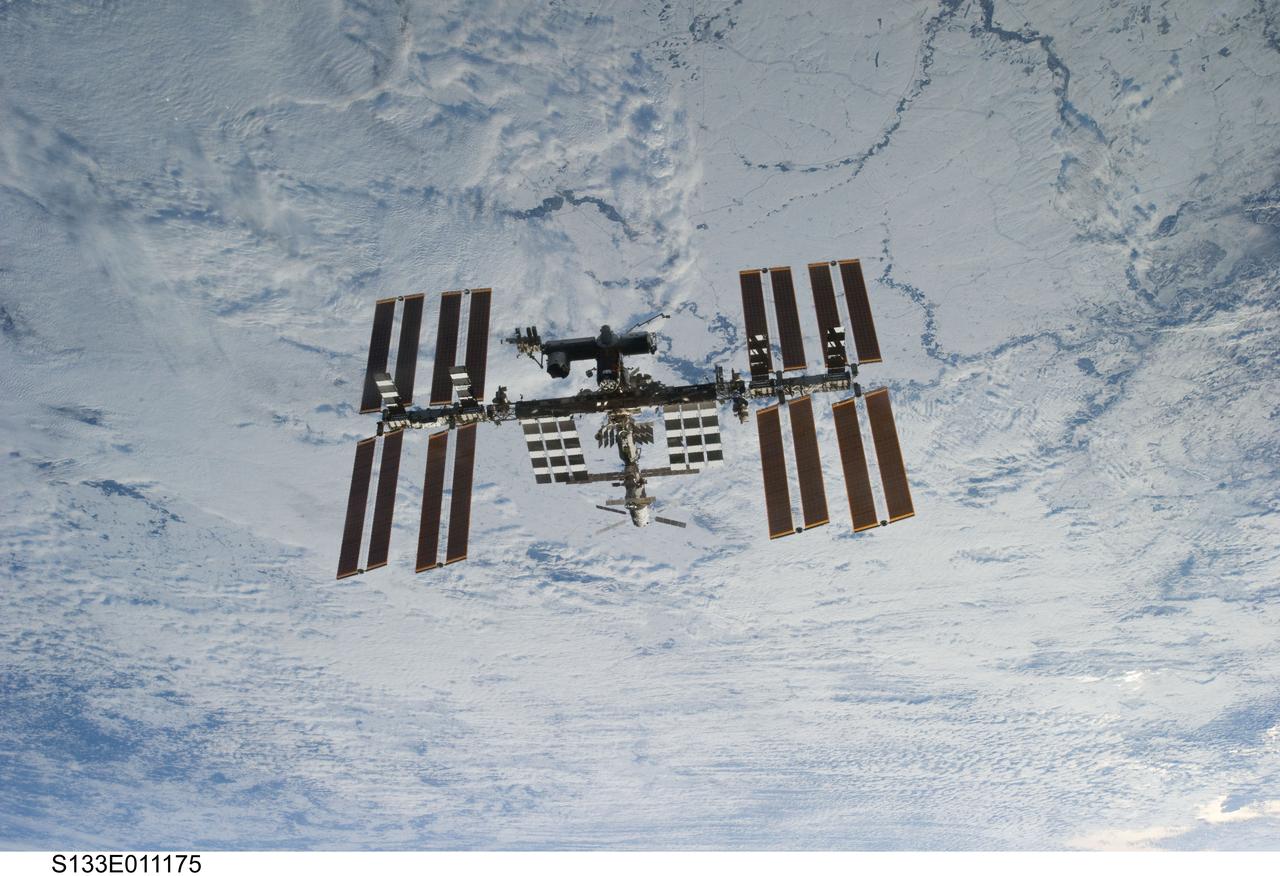
S133-E-011175 (7 March 2011) --- Backdropped against clouds over Earth, the International Space Station is seen from Discovery as the two orbital spacecraft accomplish their relative separation on March 7 after an aggregate of 12 astronauts and cosmonauts worked together for over a week. During a post undocking fly-around, the crew members aboard the two spacecraft collected a series of photos of each other’s vehicle. Photo credit: NASA or National Aeronautics and Space Administration
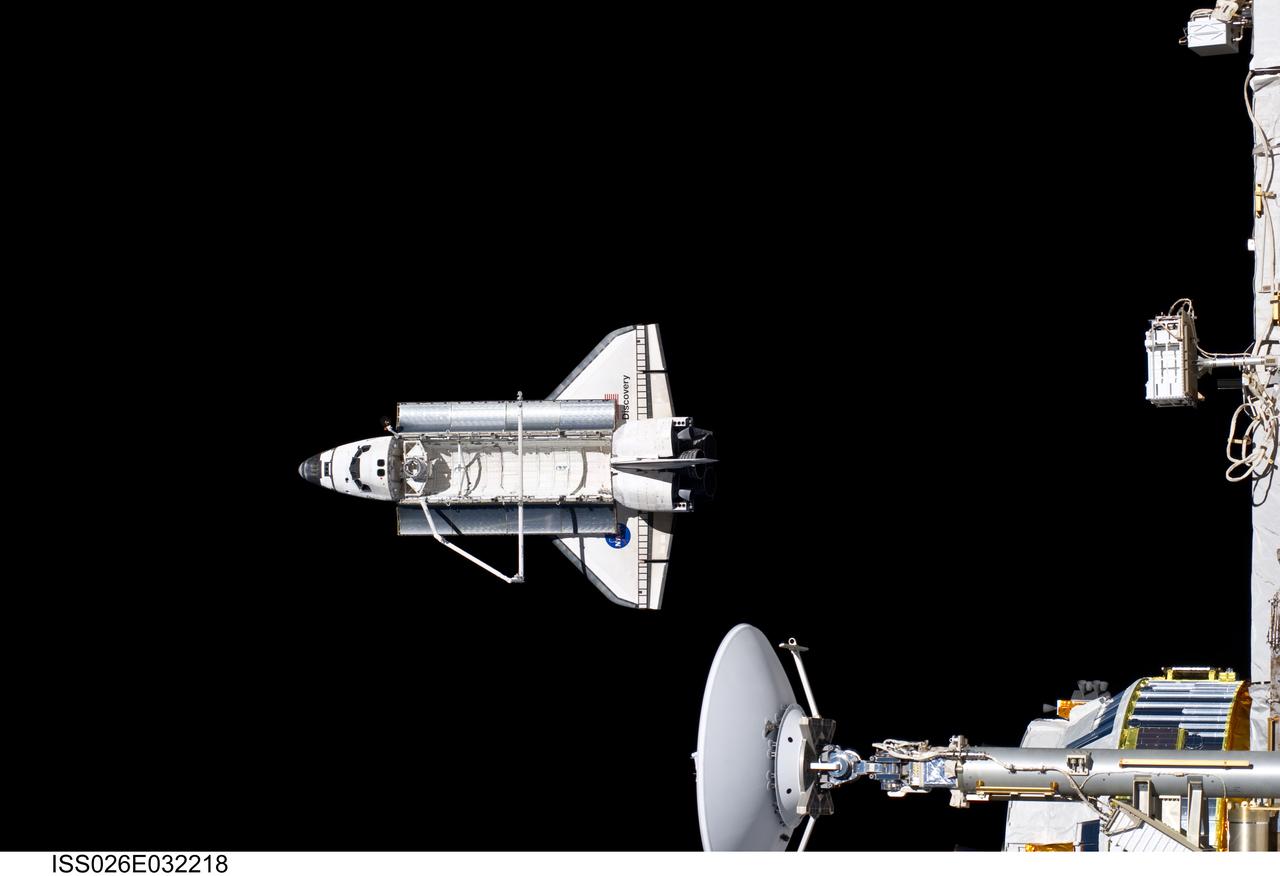
ISS026-E-032218 (7 March 2011) --- Backdropped against the blackness of space, Discovery is seen from the International Space Station as the two orbital spacecraft accomplish their relative separation on March 7 after an aggregate of 12 astronauts and cosmonauts worked together for over a week. During a post undocking fly-around, the crew members aboard the two spacecraft collected a series of photos of each other’s vehicle.
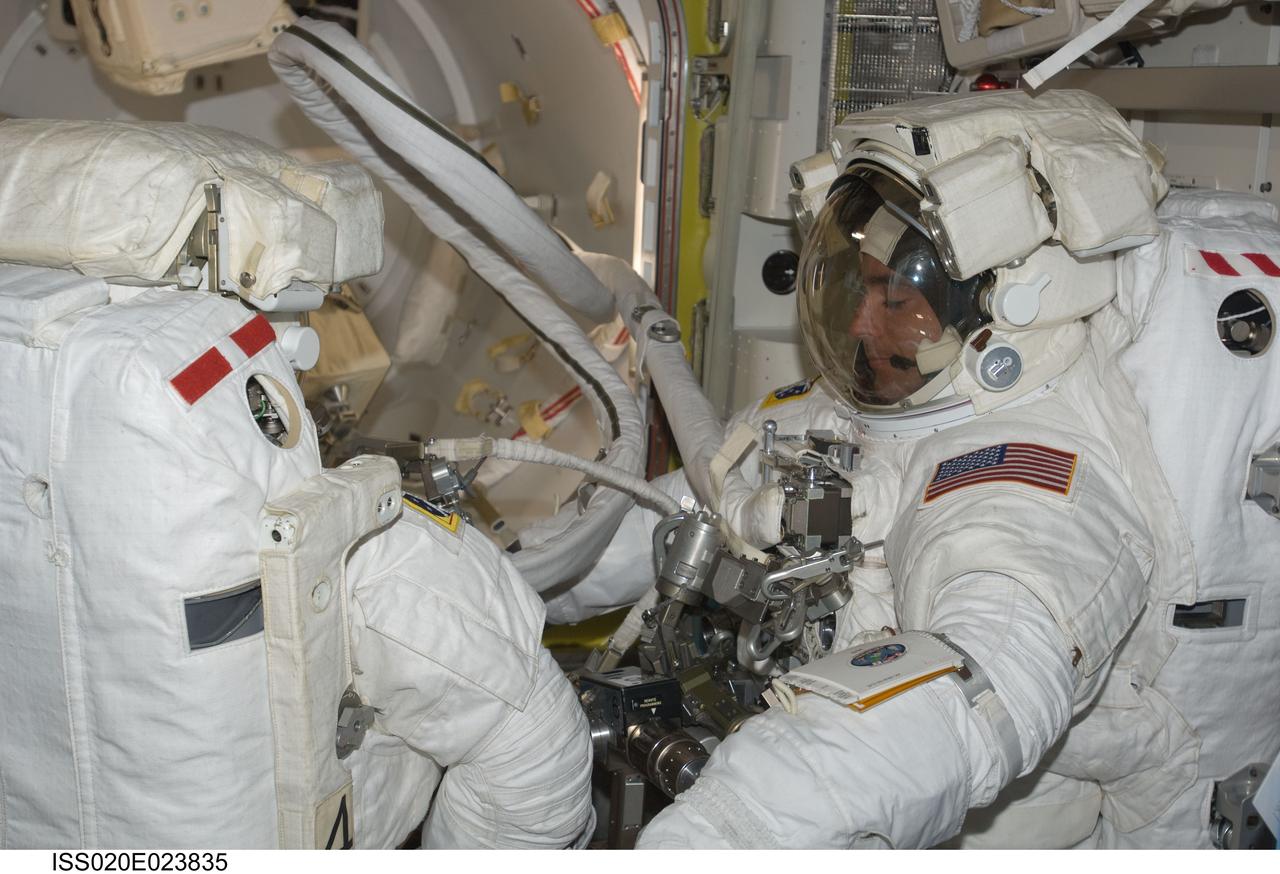
ISS020-E-023835 (24 July 2009) --- Astronauts Tom Marshburn (left) and Christopher Cassidy stand suited and almost ready to participate in the July 24 flight day 10 spacewalk. The two are scheduled to wrap up the EVA work with a fifth overall session on July 27. The mission specialists are part of a 13-member aggregation of astronauts and cosmonauts currently onboard the orbital outpost while its crew of six plays host to Endeavour's crew of seven.
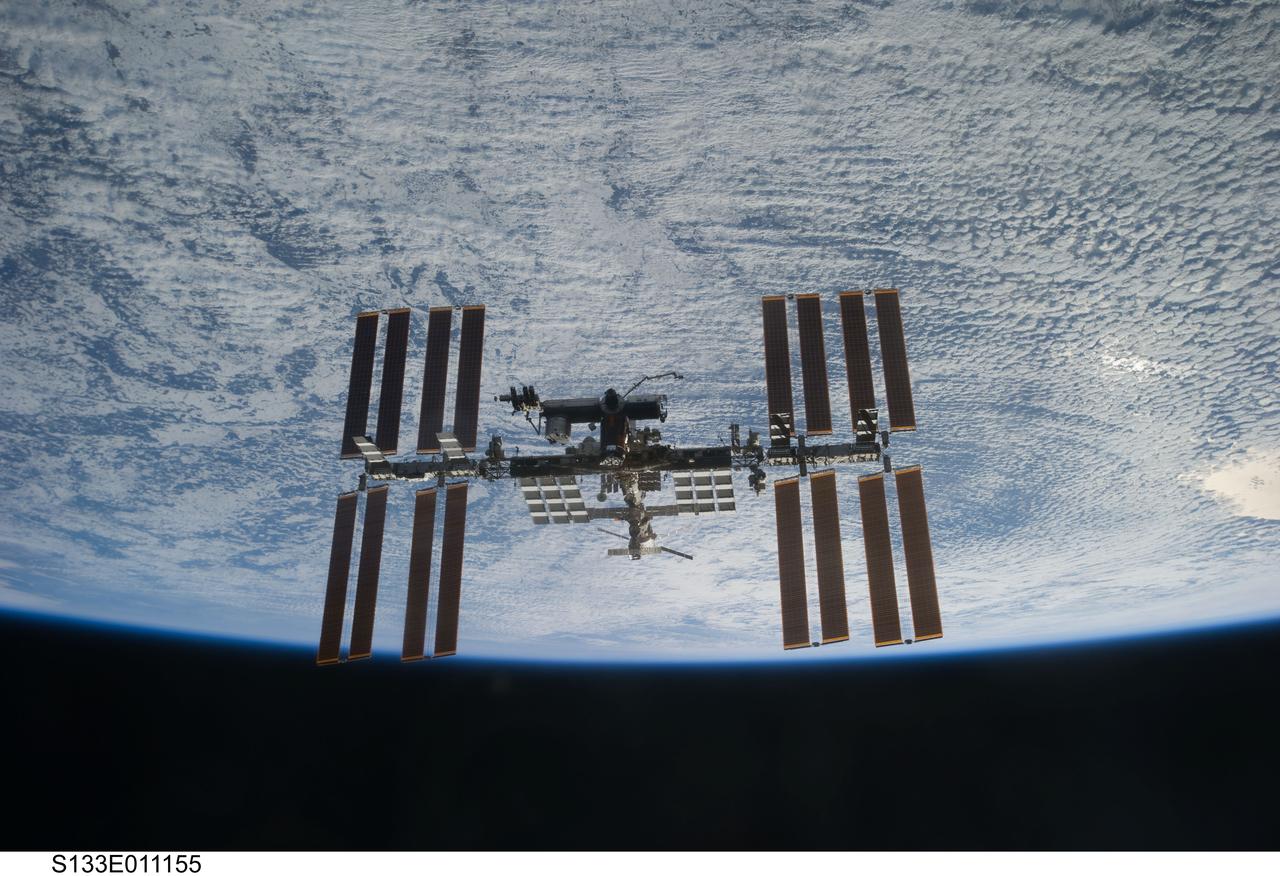
S133-E-011155 (7 March 2011) --- Backdropped against clouds over Earth, the International Space Station is seen from Discovery as the two orbital spacecraft accomplish their relative separation on March 7 after an aggregate of 12 astronauts and cosmonauts worked together for over a week. During a post undocking fly-around, the crew members aboard the two spacecraft collected a series of photos of each other’s vehicle. Photo credit: NASA or National Aeronautics and Space Administration
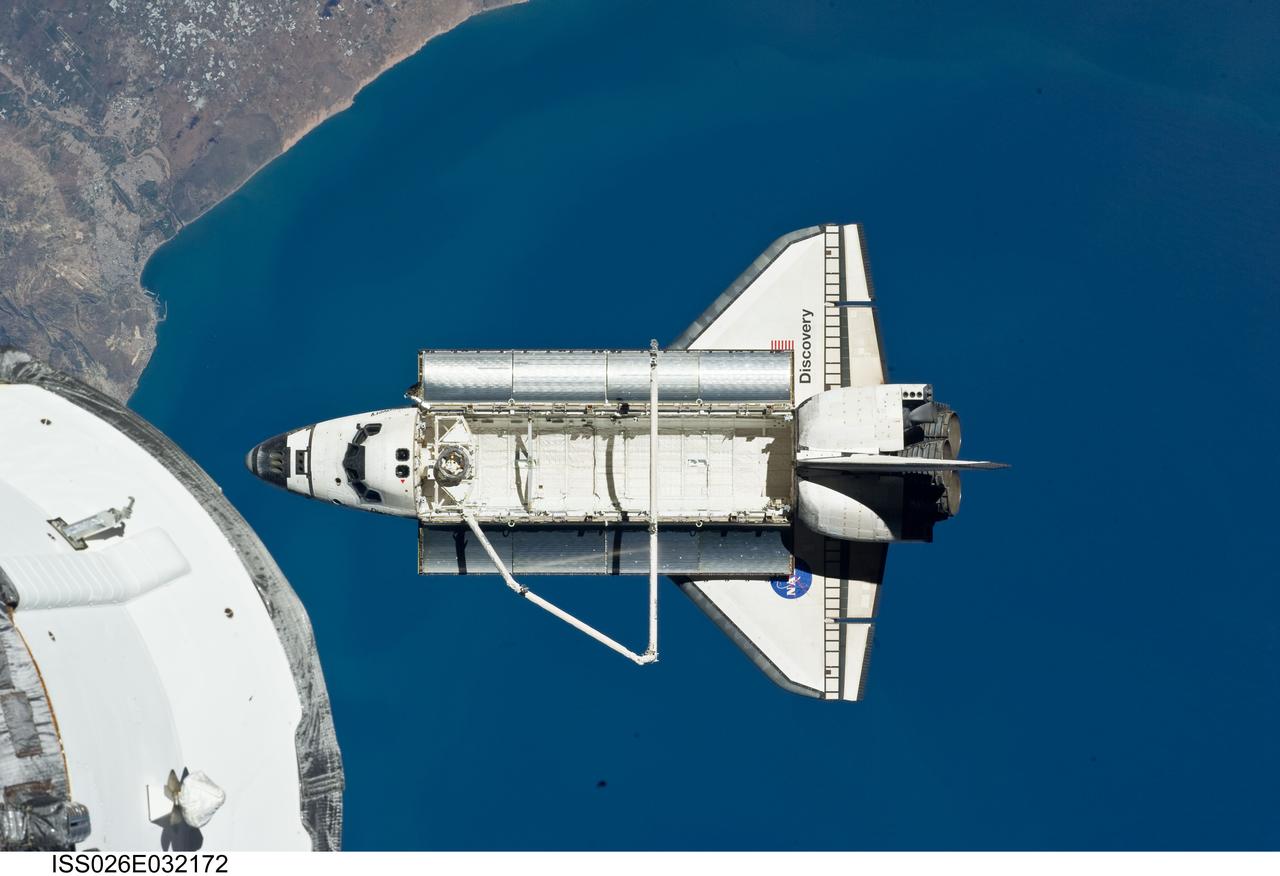
ISS026-E-032172 (7 March 2011) --- The space shuttle Discovery is seen from the International Space Station as the two orbital spacecraft accomplish their relative separation on March 7 after an aggregate of 12 astronauts and cosmonauts worked together for over a week. The area below is the coast of Morocco in the northern Atlantic. During a post undocking fly-around, the crew members aboard the two spacecraft collected a series of photos of each other’s vehicle.
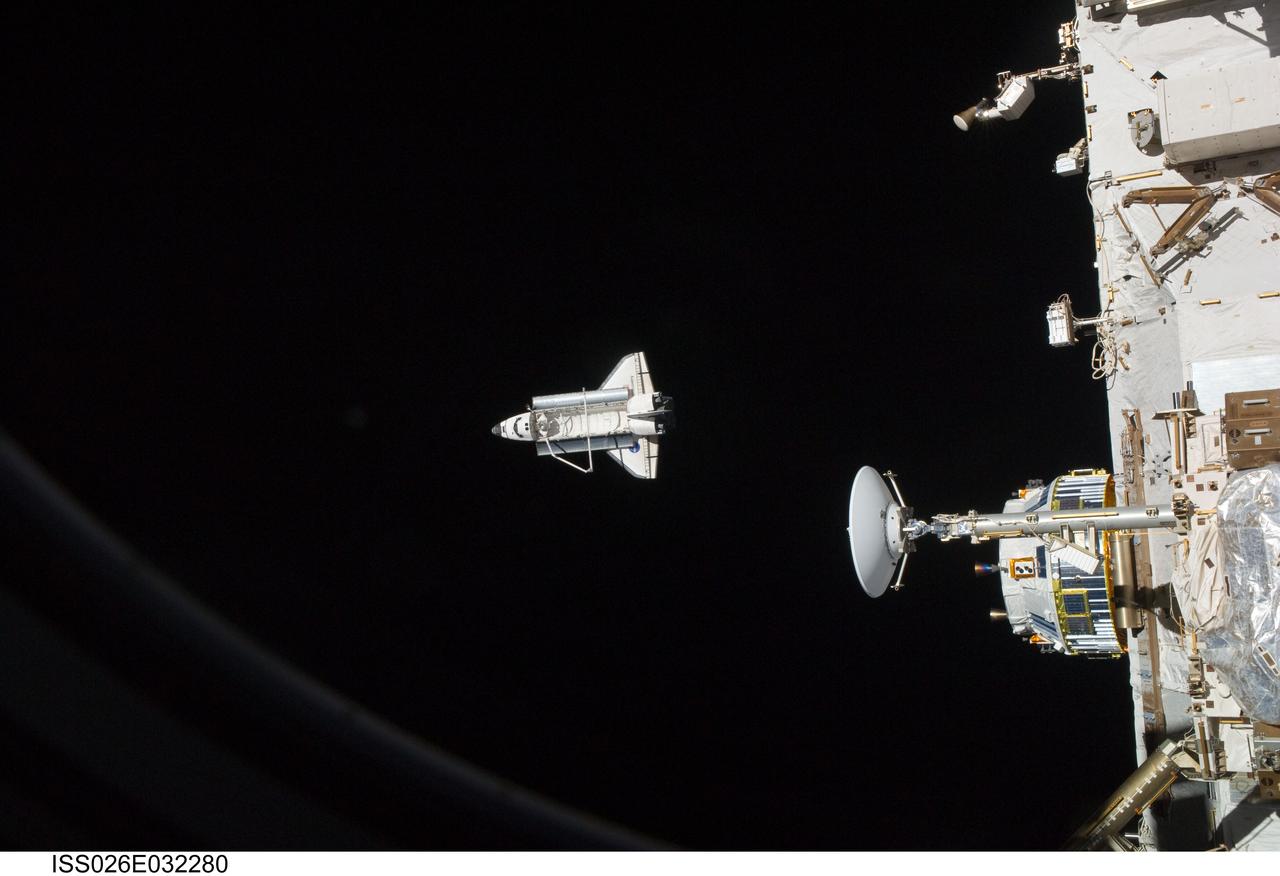
ISS026-E-032280 (7 March 2011) --- The space shuttle Discovery is seen from the International Space Station as the two orbital spacecraft accomplish their relative separation on March 7 after an aggregate of 12 astronauts and cosmonauts worked together for over a week. During a post undocking fly-around, the crew members aboard the two spacecraft collected a series of photos of each other’s vehicle.
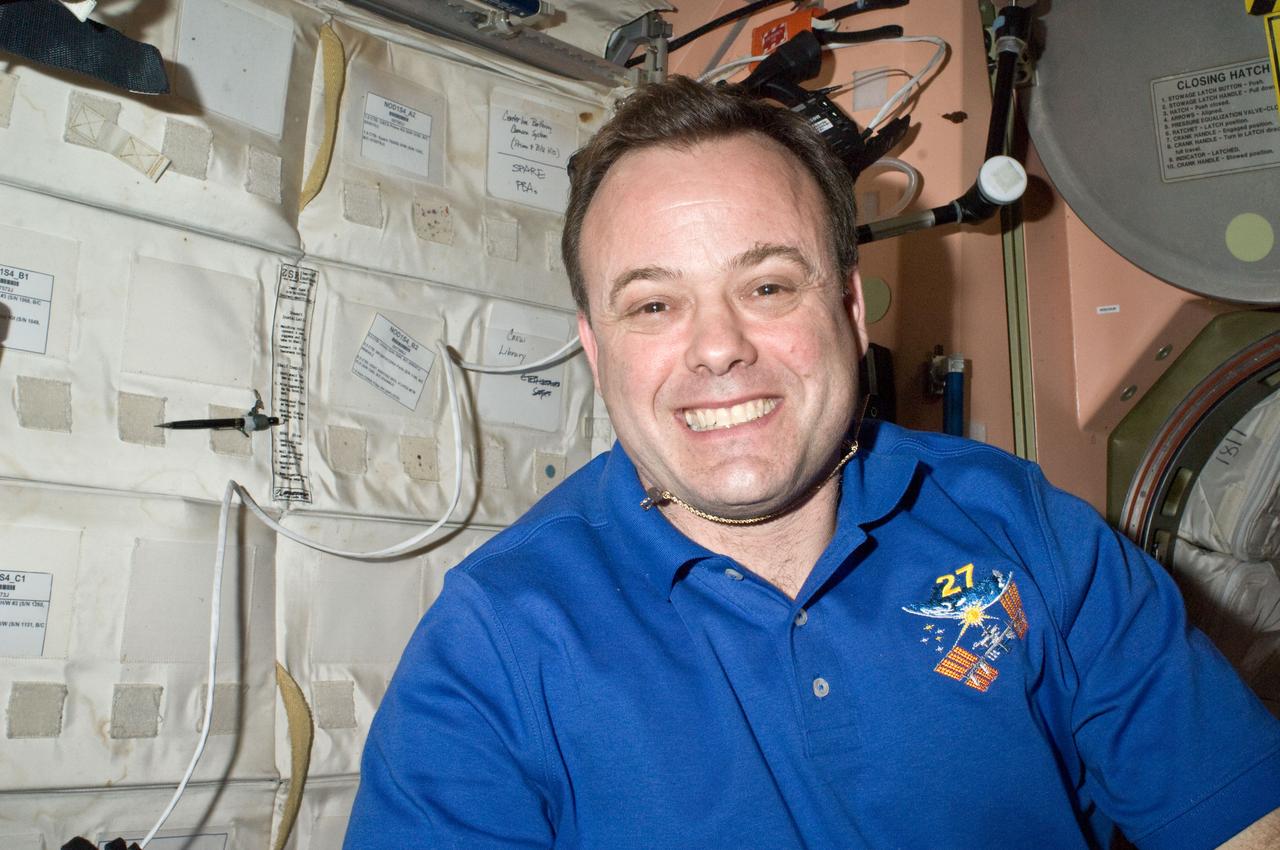
ISS027-E-035564 (21 May 2011) --- Astronaut Ron Garan, Expedition 27 flight engineer, appears to appreciate the progress being made by an aggregation of twelve astronauts and cosmonauts (including six Endeavour "guests") currently sharing work on the International Space Station (ISS). Today is a work day in between the first two spacewalk days on the joint Endeavour/ISS complex.
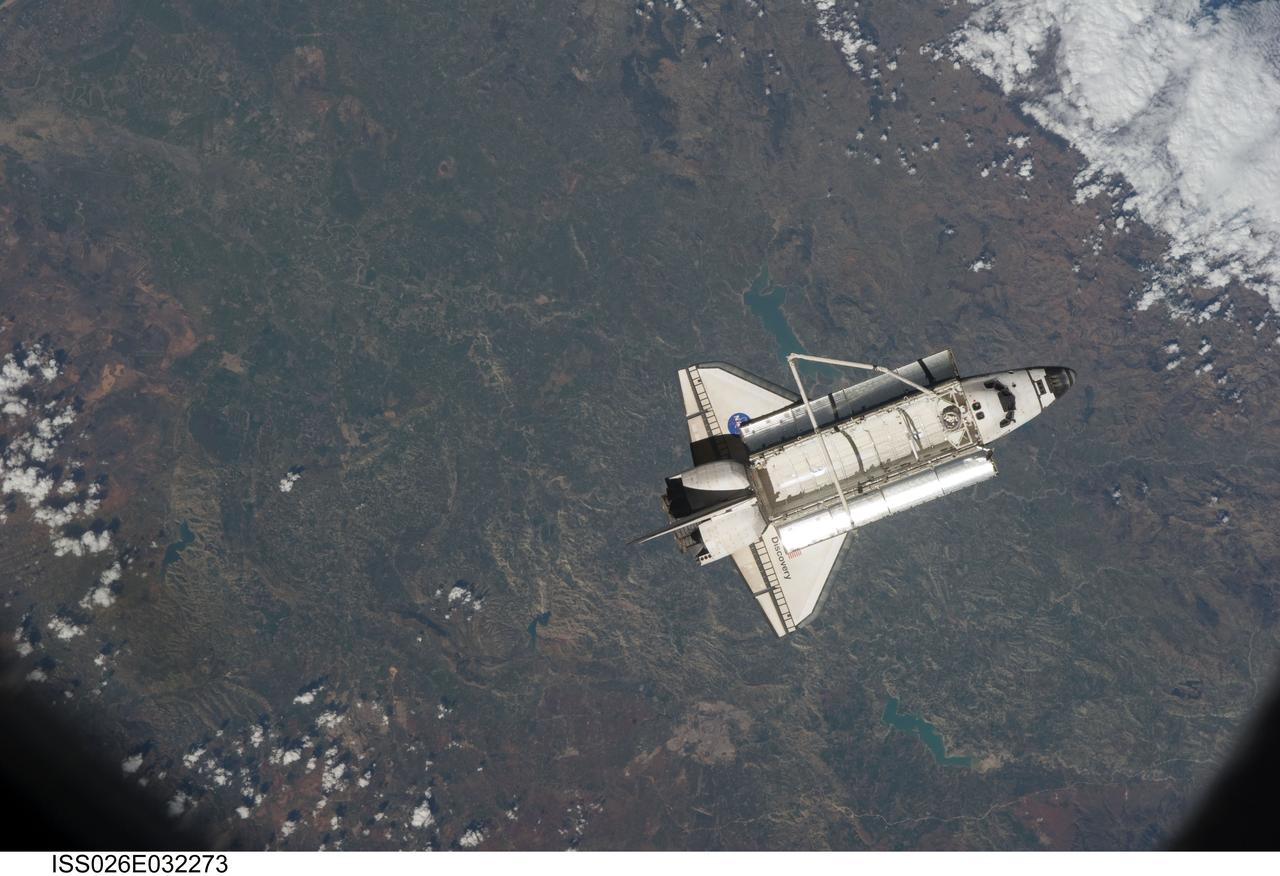
ISS026-E-032273 (7 March 2011) --- The space shuttle Discovery is seen from the International Space Station as the two orbital spacecraft accomplish their relative separation on March 7 after an aggregate of 12 astronauts and cosmonauts worked together for over a week. During a post undocking fly-around, the crew members aboard the two spacecraft collected a series of photos of each other’s vehicle.
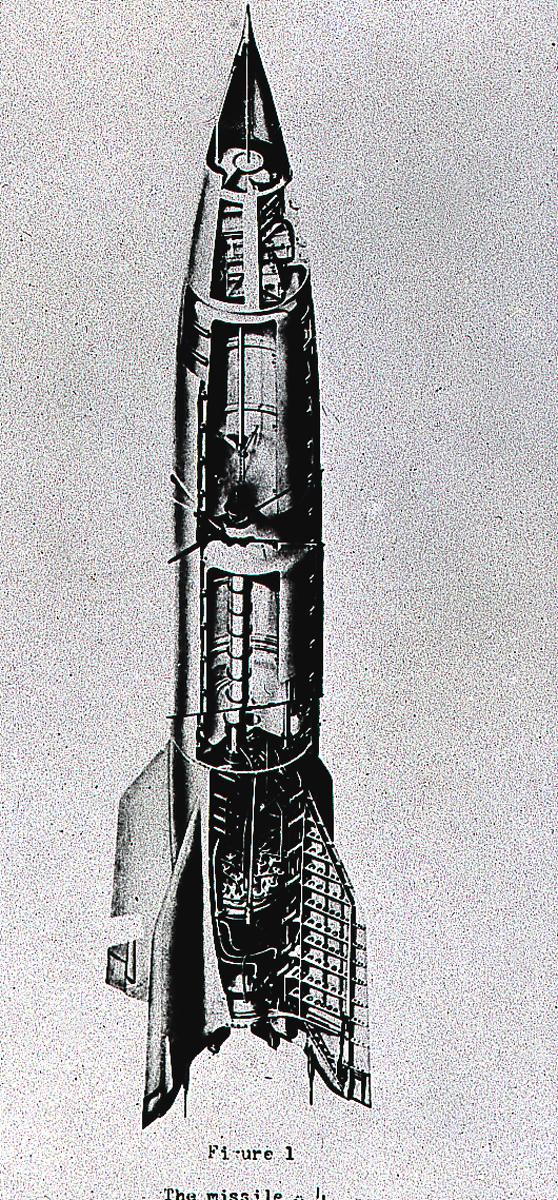
The cutaway drawing of the A-4 (Aggregate-4) rocket. Later renamed the V-2 (Vengeance Weapon-2), The rocket was developed by Dr. Wernher von Braun and the German rocket team at Peenemuende, Germany on the Baltic Sea. At the end of World War II, the team of German engineers and scientists came to the United States and continued rocket research for the Army at Fort Bliss, Texas, and Redstone Arsenal in Huntsville, Alabama.
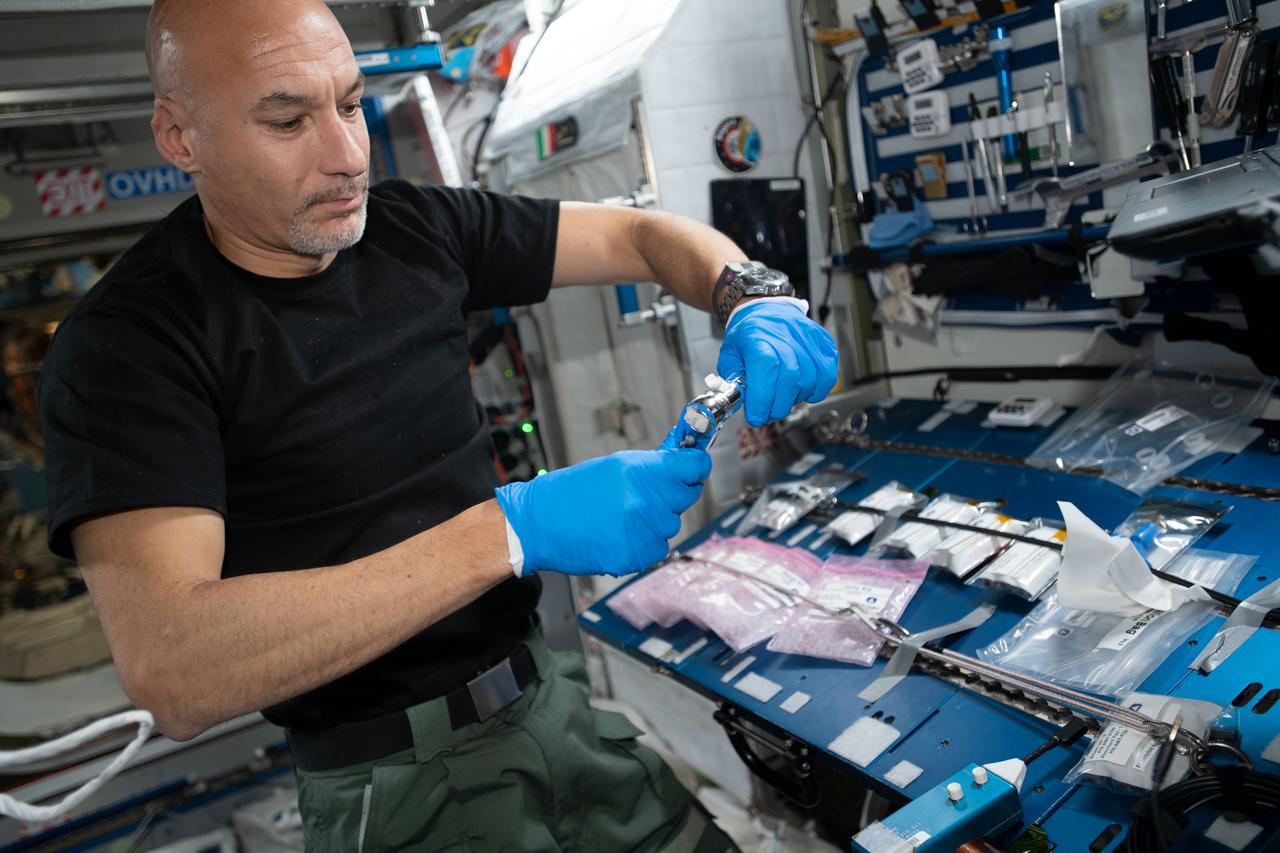
iss060e023992 (Aug. 7, 2019) --- European Space Agency astronaut Luca Parmitano is researching possible causes for neurodegenerative conditions such as Alzheimer’s disease. Parmitano was performing operations for the Amyloid Aggregation investigation examining protein samples for amyloid formation that differ from samples observed on Earth. Results may inform preventative therapies for Earthlings and astronauts on long-term missions.
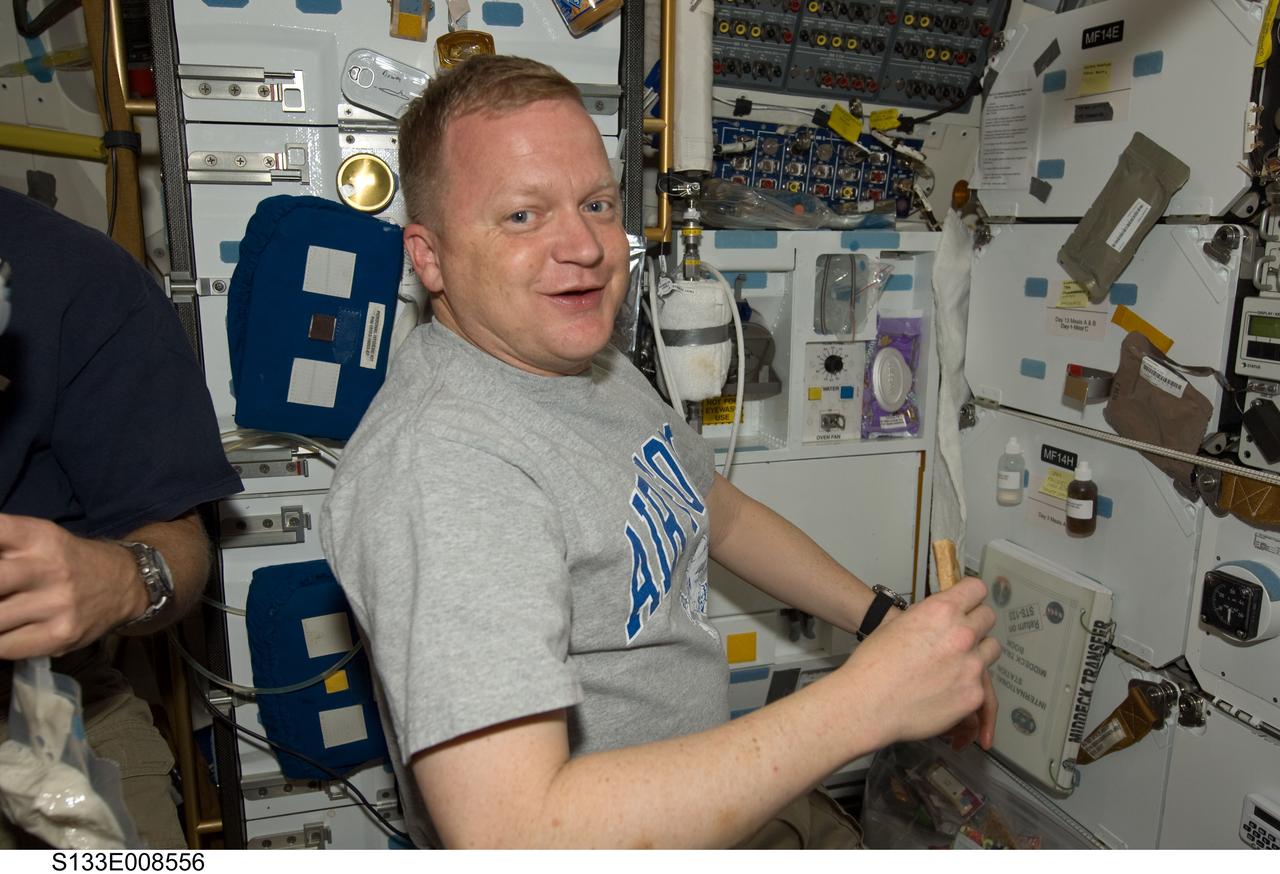
S133-E-008556 (4 March 2011) --- Astronaut Eric Boe, STS-133 pilot, grabs a snack on the middeck of space shuttle Discovery, currently docked to the International Space Station. An aggregate of 12 astronauts and Russian cosmonauts are working on the orbital outpost to mostly accomplish moving and packing of supplies and hardware. Photo credit: National Aeronautics and Space Administration
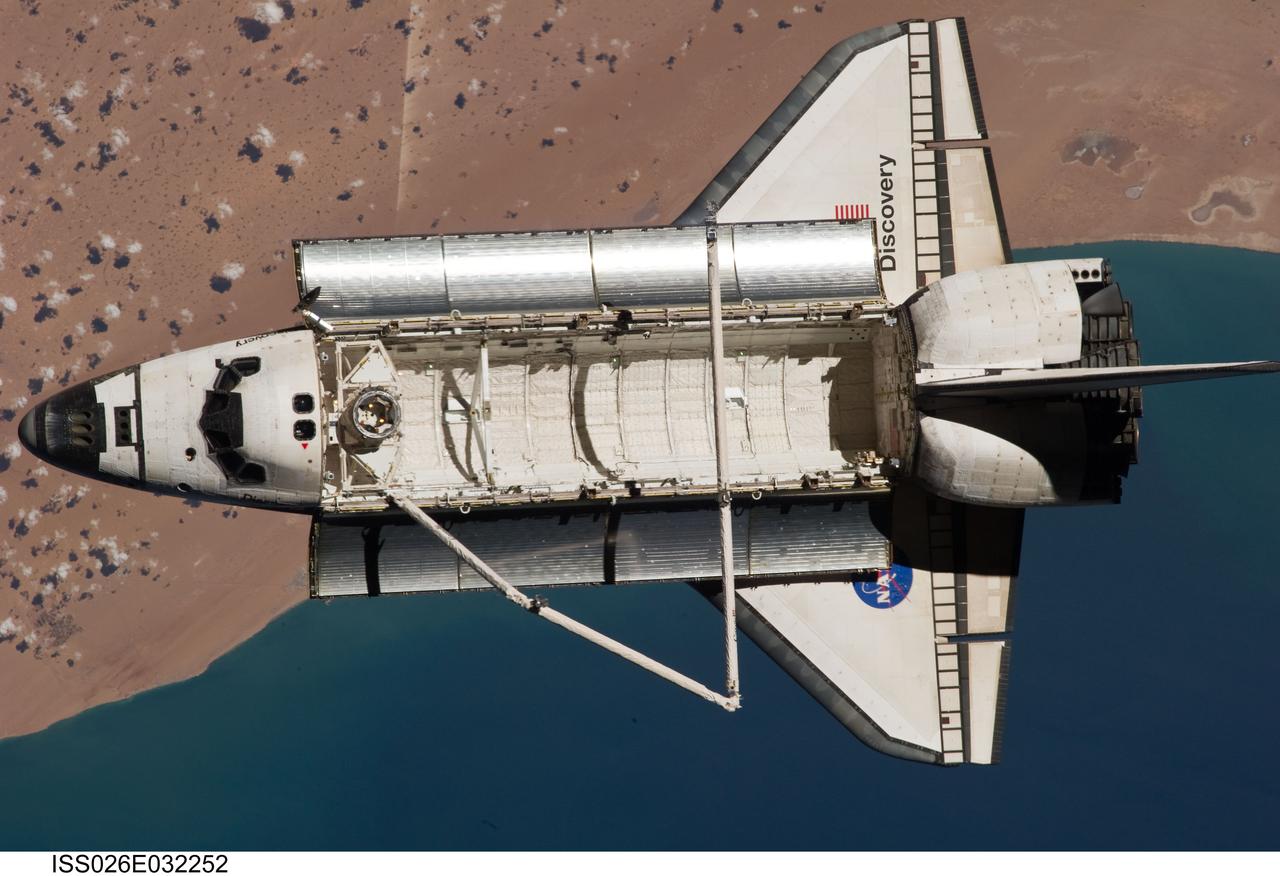
ISS026-E-032252 (7 March 2011) --- The space shuttle Discovery is seen from the International Space Station as the two orbital spacecraft accomplish their relative separation on March 7 after an aggregate of 12 astronauts and cosmonauts worked together for over a week. The area below is the southwestern coast of Morocco in the northern Atlantic. During a post undocking fly-around, the crew members aboard the two spacecraft collected a series of photos of each other’s vehicle.
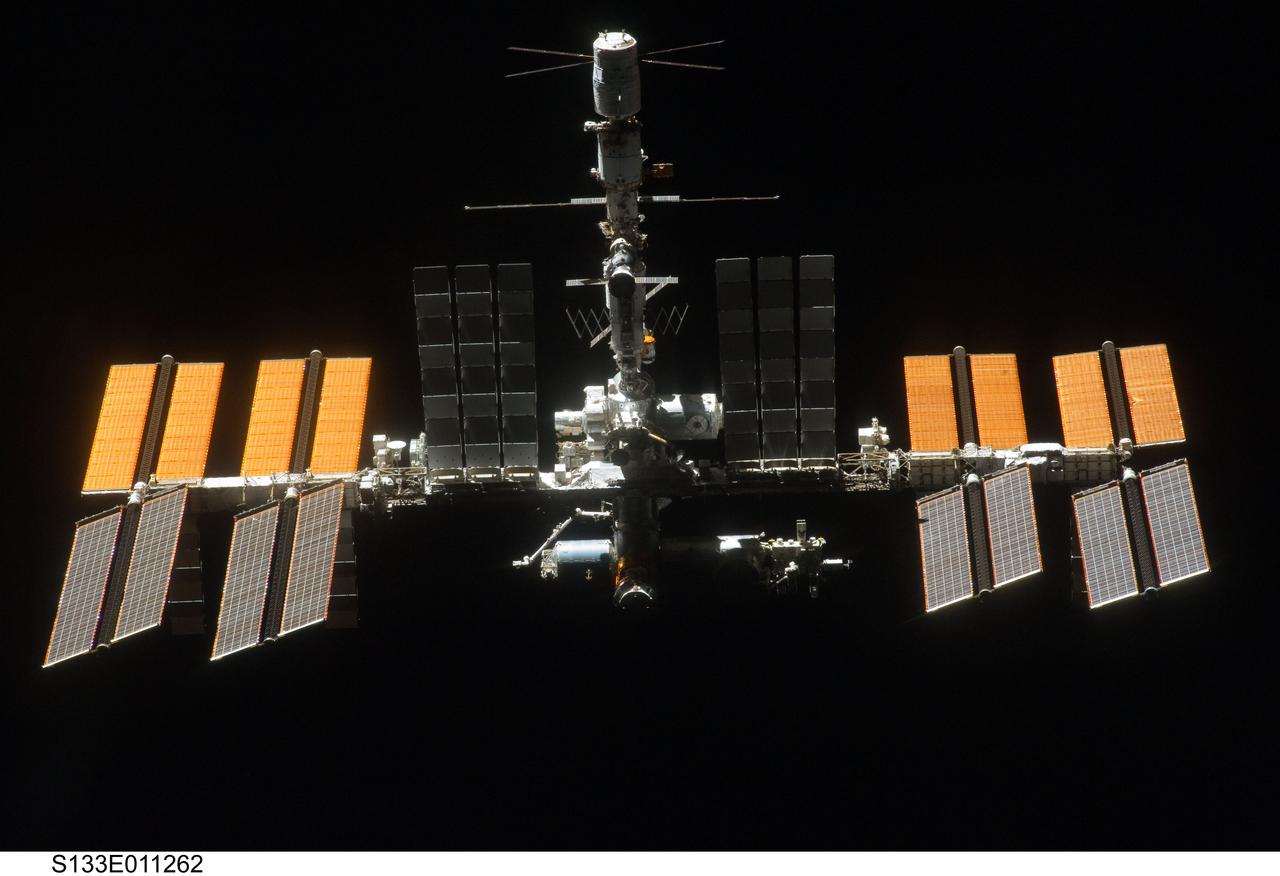
S133-E-011262 (7 March 2011) --- Backdropped against the blackness of space, the International Space Station is seen from Discovery as the two orbital spacecraft accomplish their relative separation on March 7 after an aggregate of 12 astronauts and cosmonauts worked together for over a week. During a post undocking fly-around, the crew members aboard the two spacecraft collected a series of photos of each other?s vehicle. Photo credit: NASA or National Aeronautics and Space Administration
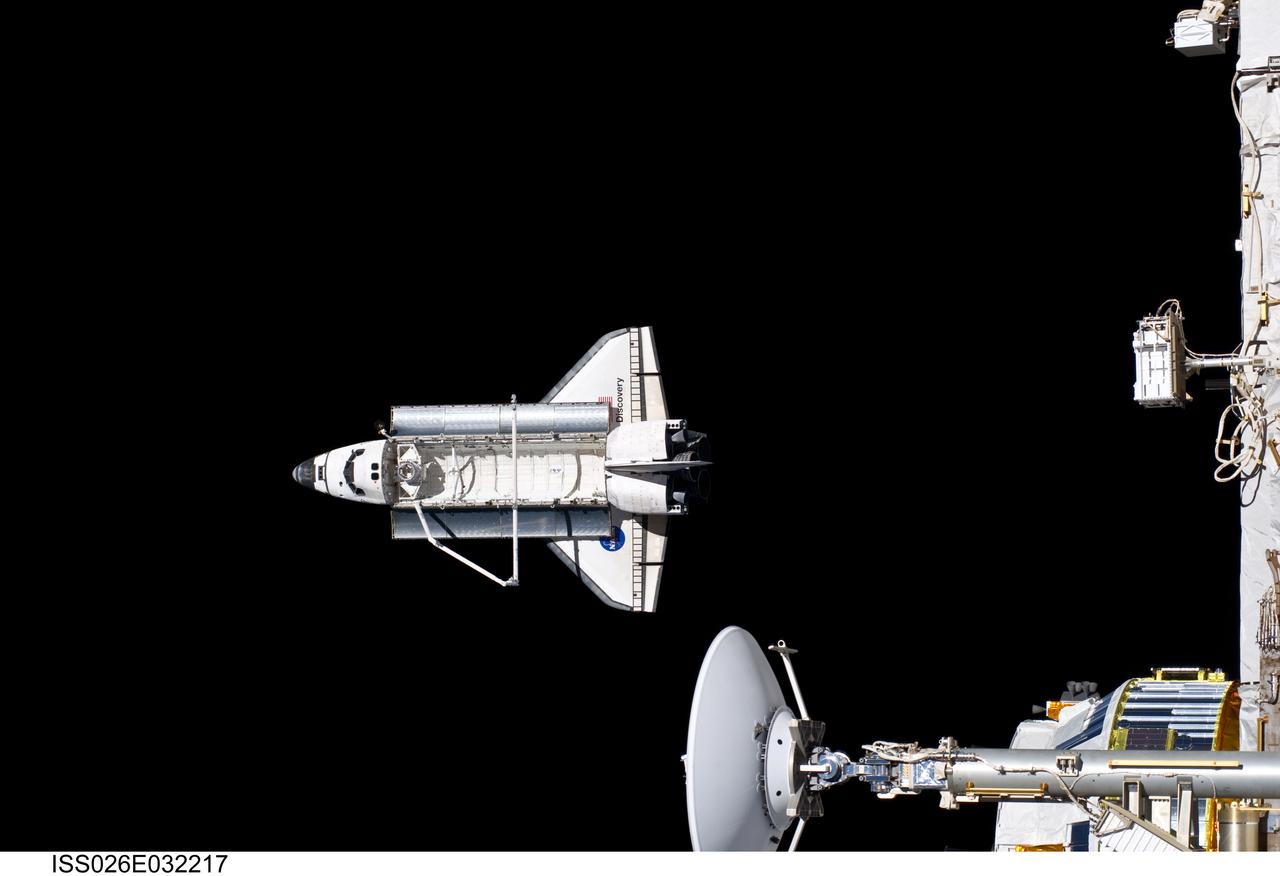
ISS026-E-032217 (7 March 2011) --- Backdropped against the blackness of space, Discovery is seen from the International Space Station as the two orbital spacecraft accomplish their relative separation on March 7 after an aggregate of 12 astronauts and cosmonauts worked together for over a week. During a post undocking fly-around, the crew members aboard the two spacecraft collected a series of photos of each other’s vehicle.
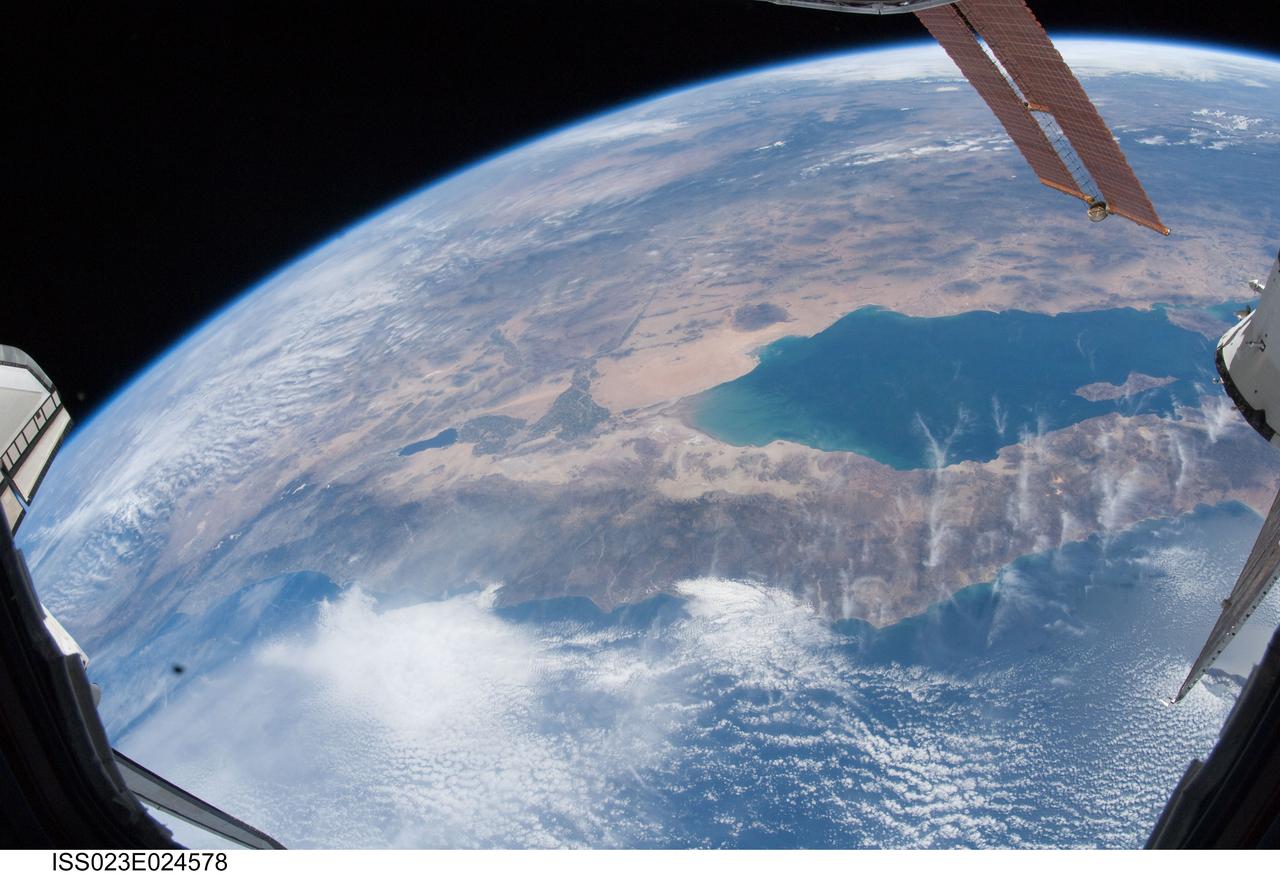
ISS023-E-024578 (15 April 2010) --- The Gulf of California (also known as the Sea of Cortez) and the Salton Sea, share this scene with a tiny part of the space shuttle Discovery (starboard wing at left) and the International Space Station (solar panels, upper right). The two spacecraft have been docked for several days as an aggregation of 13 astronauts and cosmonauts continue work on the orbital outpost. They will undock over the weekend and the shuttle is scheduled to return its crew of seven back home on Earth on April 19.
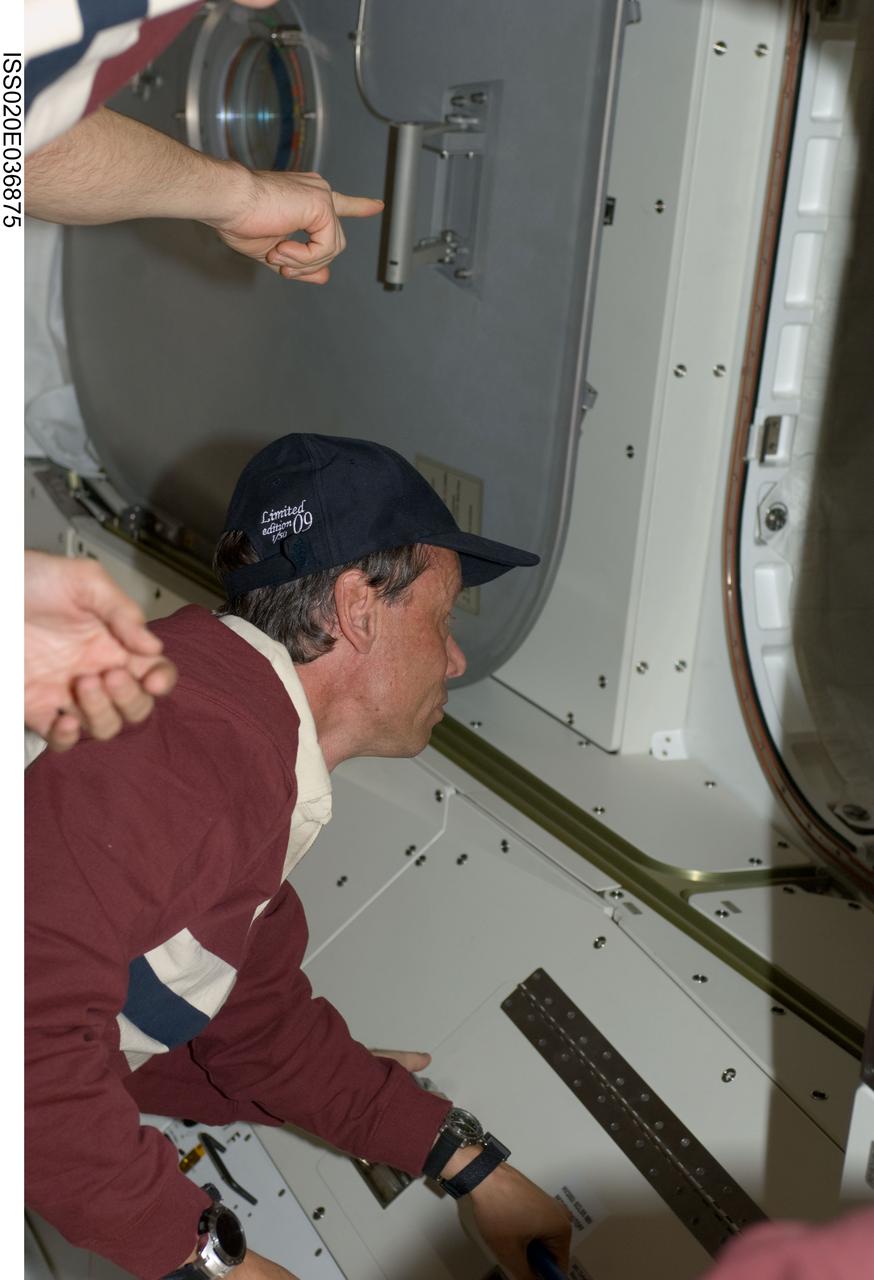
ISS020-E-036875 (30 Aug. 2009) --- This is one of a series of digital still images that were recorded shortly after the STS-128 and Expedition 20 crewmembers reunited in space and not long after the Space Shuttle Discovery and the International Space Station joined up in Earth orbit to form the second consecutive 13 person aggregation to perform more work on the orbital outpost. Pictured near a hatch way is European Space Agency astronaut Christer Fugelsang, STS-128 mission specialist.
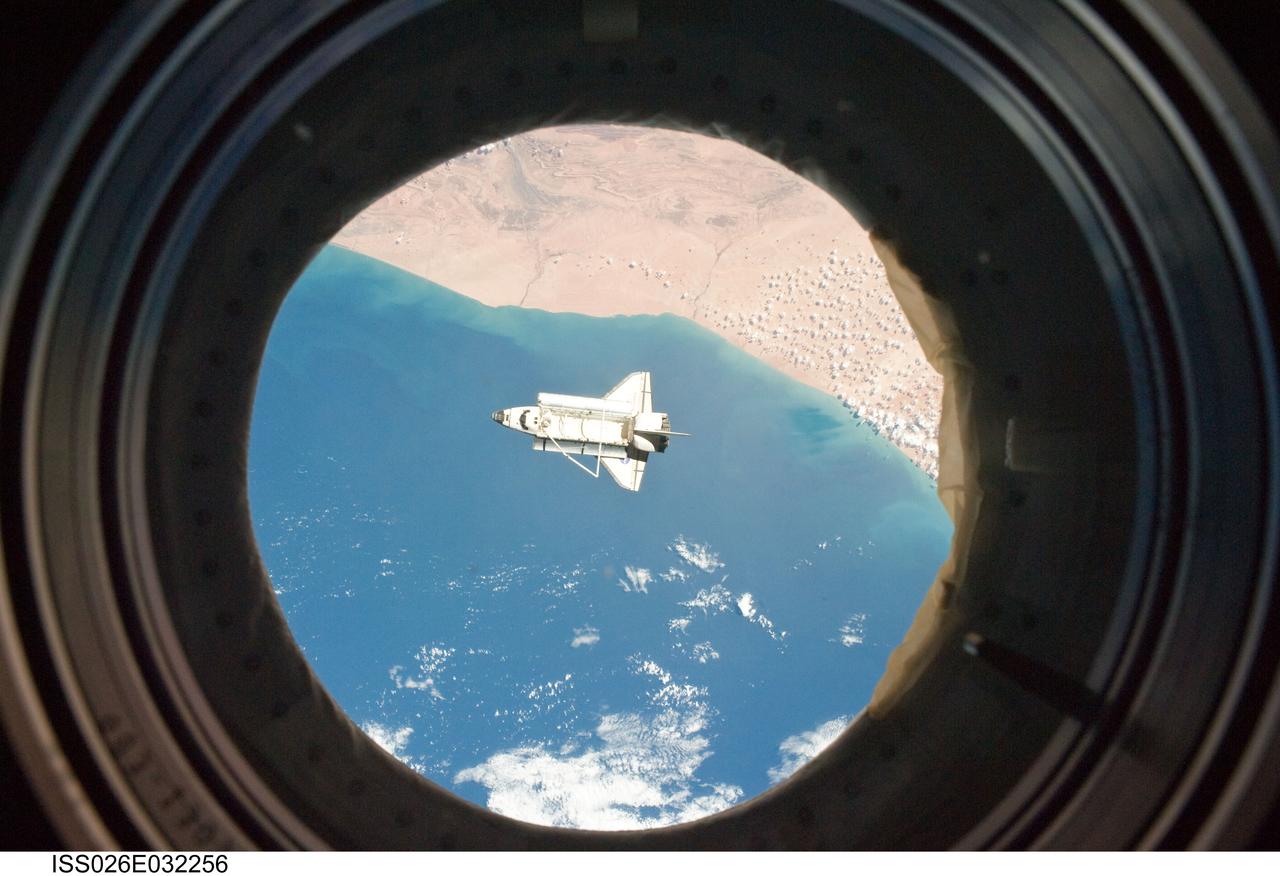
ISS026-E-032256 (7 March 2011) --- The space shuttle Discovery is seen from the International Space Station as the two orbital spacecraft accomplish their relative separation on March 7 after an aggregate of 12 astronauts and cosmonauts worked together for over a week. The area below is the southwestern coast of Morocco in the northern Atlantic. During a post undocking fly-around, the crew members aboard the two spacecraft collected a series of photos of each other’s vehicle.
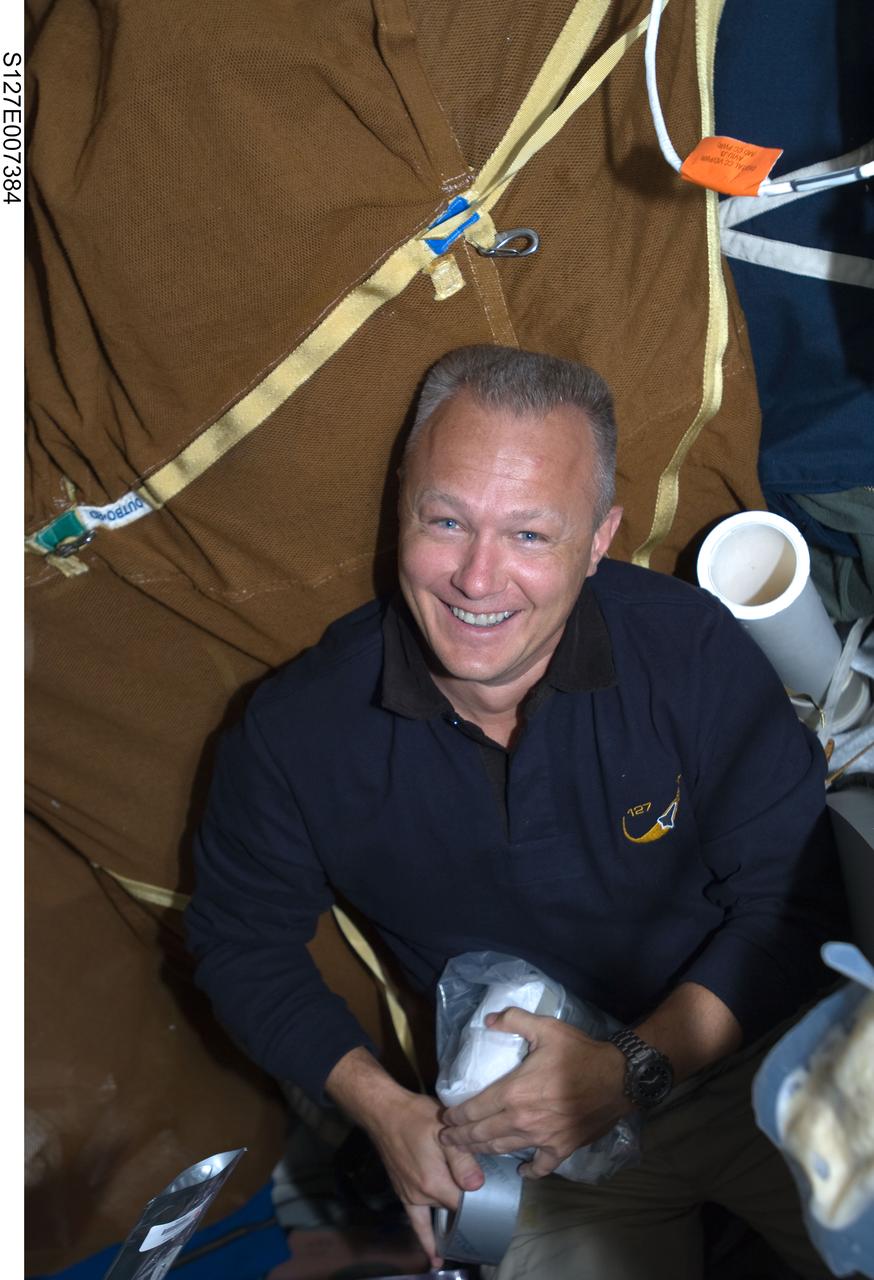
S127-E-007384 (21 July 2009) --- Judging by the countenance of astronaut Doug Hurley, things are going relatively well for the 13 crew members of the joint station-shuttle aggregation. Hurley, STS-127 pilot, is pictured on Endeavour's mid deck while most of the crewmembers are busy on the orbital outpost. Crew members worked a great deal of robotics issues on this day, working from inside to move hardware around on the outside.
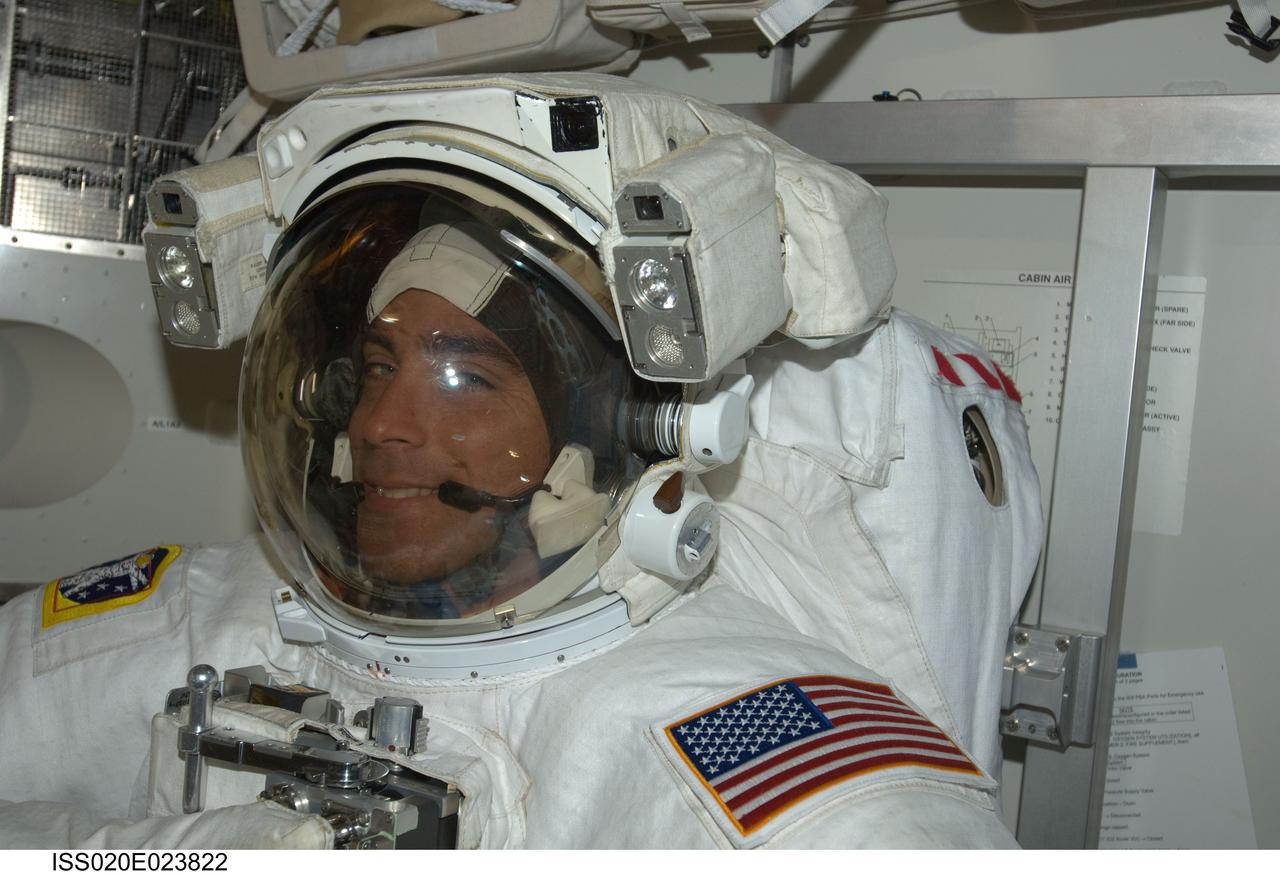
ISS020-E-023822 (24 July 2009) ---Astronaut Christopher Cassidy stands suited and almost ready to participate in the July 24 flight day 10 spacewalk. He and astronaut Tom Marshburn (out of frame) are also scheduled to wrap up the EVA work with a fifth overall session on July 27. The two mission specialists are part of a 13-member aggregation of astronauts and cosmonauts currently onboard the orbital outpost while its crew of six plays host to Endeavour's crew of seven.

ISS026-E-032253 (7 March 2011) --- The space shuttle Discovery is seen from the International Space Station as the two orbital spacecraft accomplish their relative separation on March 7 after an aggregate of 12 astronauts and cosmonauts worked together for over a week. The area below is the southwestern coast of Morocco in the northern Atlantic. During a post undocking fly-around, the crew members aboard the two spacecraft collected a series of photos of each other’s vehicle.
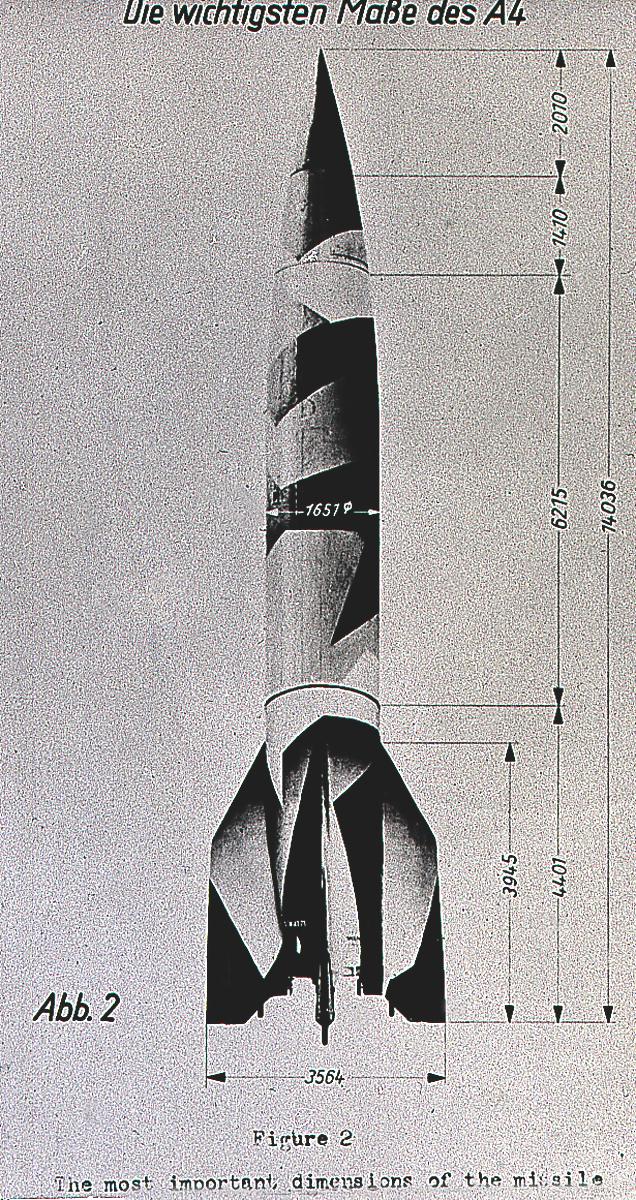
This drawing illustrates the vital dimensions of the A-4 (Aggregate-4). Later renamed the V-2 (Vengeance Weapon-2), the rocket was developed by Dr. Wernher von Braun and the German rocket team at Peenemuende, Germany on the Baltic Sea. At the end of World War II, the team of German engineers and scientists came to the United States and continued rocket research for the Army at Fort Bliss, Texas, and Redstone Arsenal in Huntsville, Alabama.
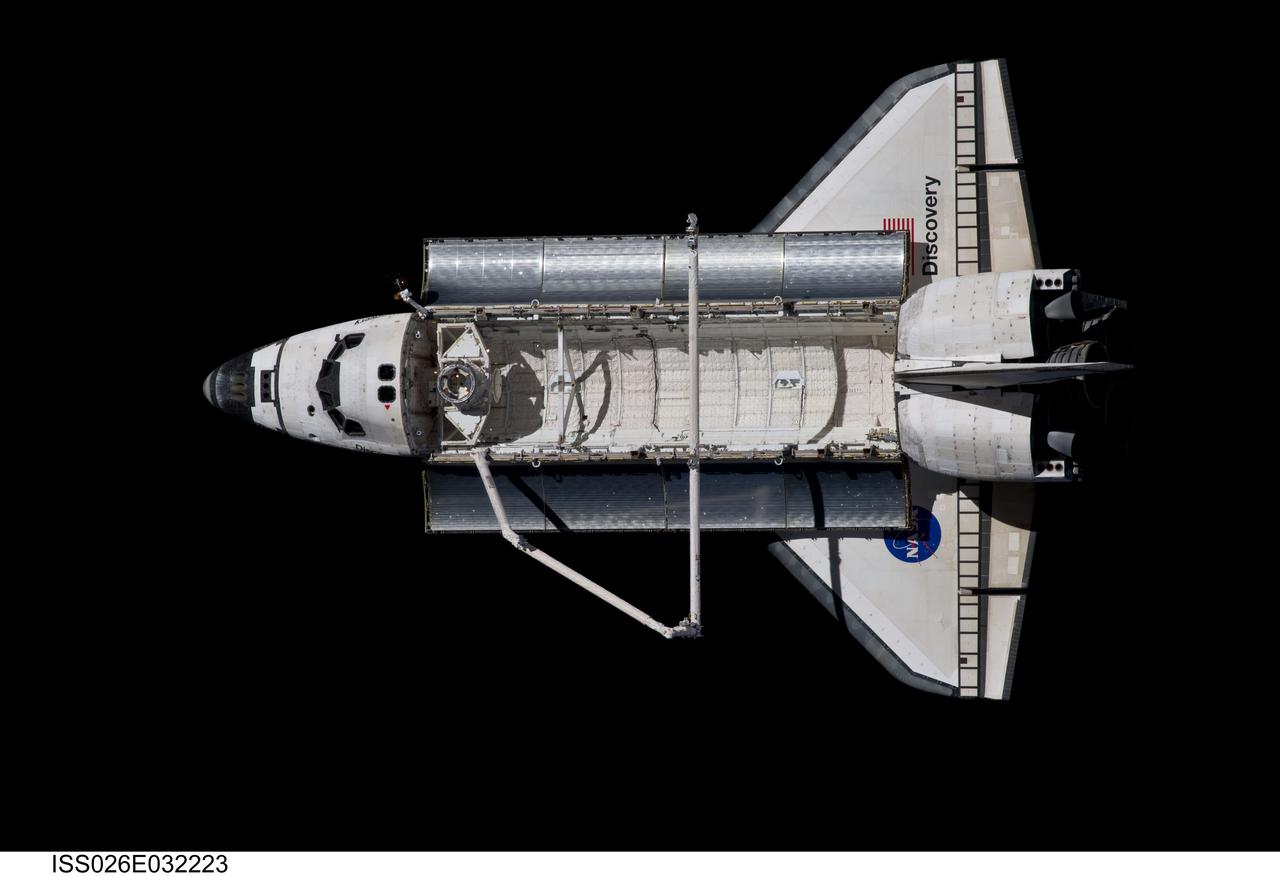
ISS026-E-032223 (7 March 2011) --- Backdropped against the blackness of space, Discovery is seen from the International Space Station as the two orbital spacecraft accomplish their relative separation on March 7 after an aggregate of 12 astronauts and cosmonauts worked together for over a week. During a post undocking fly-around, the crew members aboard the two spacecraft collected a series of photos of each other’s vehicle.
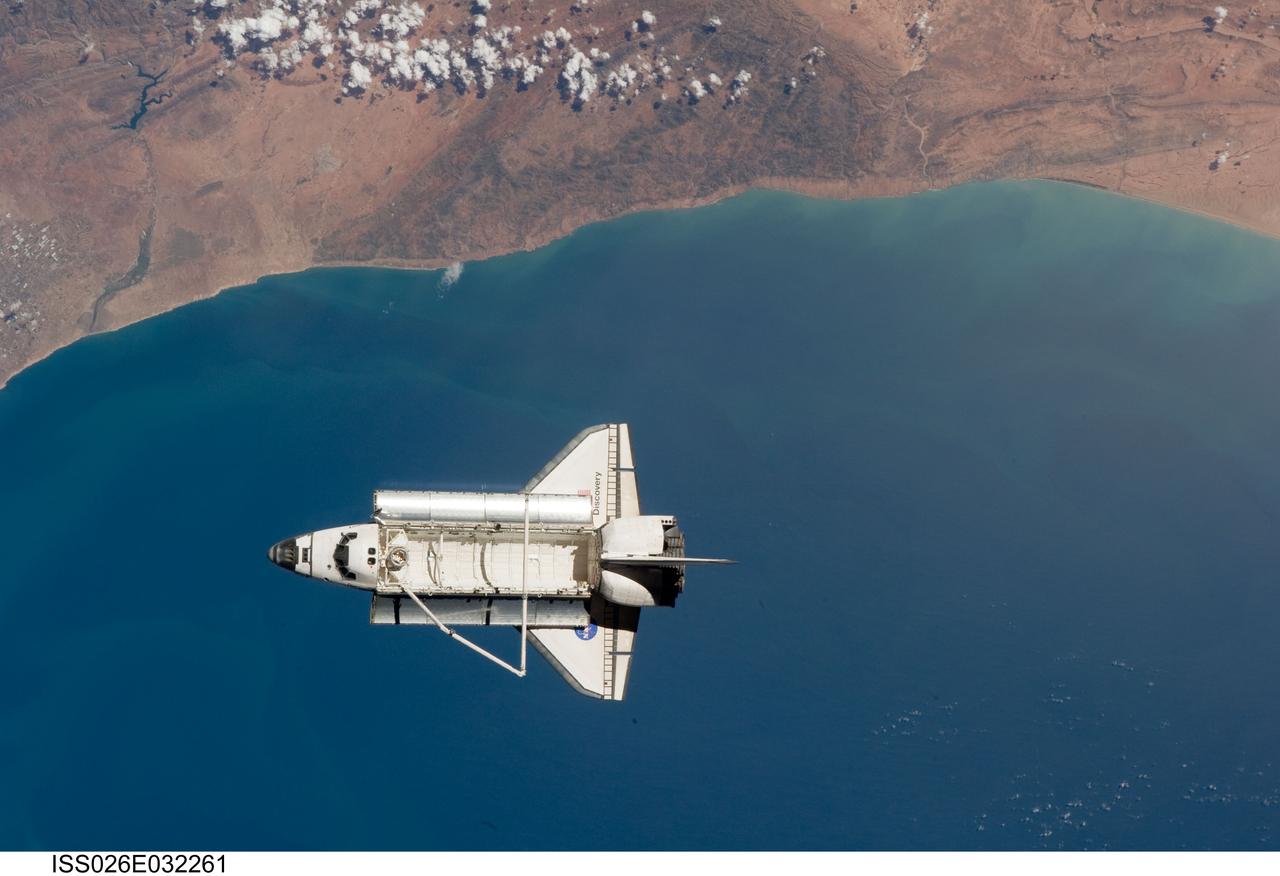
ISS026-E-032261 (7 March 2011) --- The space shuttle Discovery is seen from the International Space Station as the two orbital spacecraft accomplish their relative separation on March 7 after an aggregate of 12 astronauts and cosmonauts worked together for over a week. The area below is the southwestern coast of Morocco in the northern Atlantic. During a post undocking fly-around, the crew members aboard the two spacecraft collected a series of photos of each other’s vehicle.
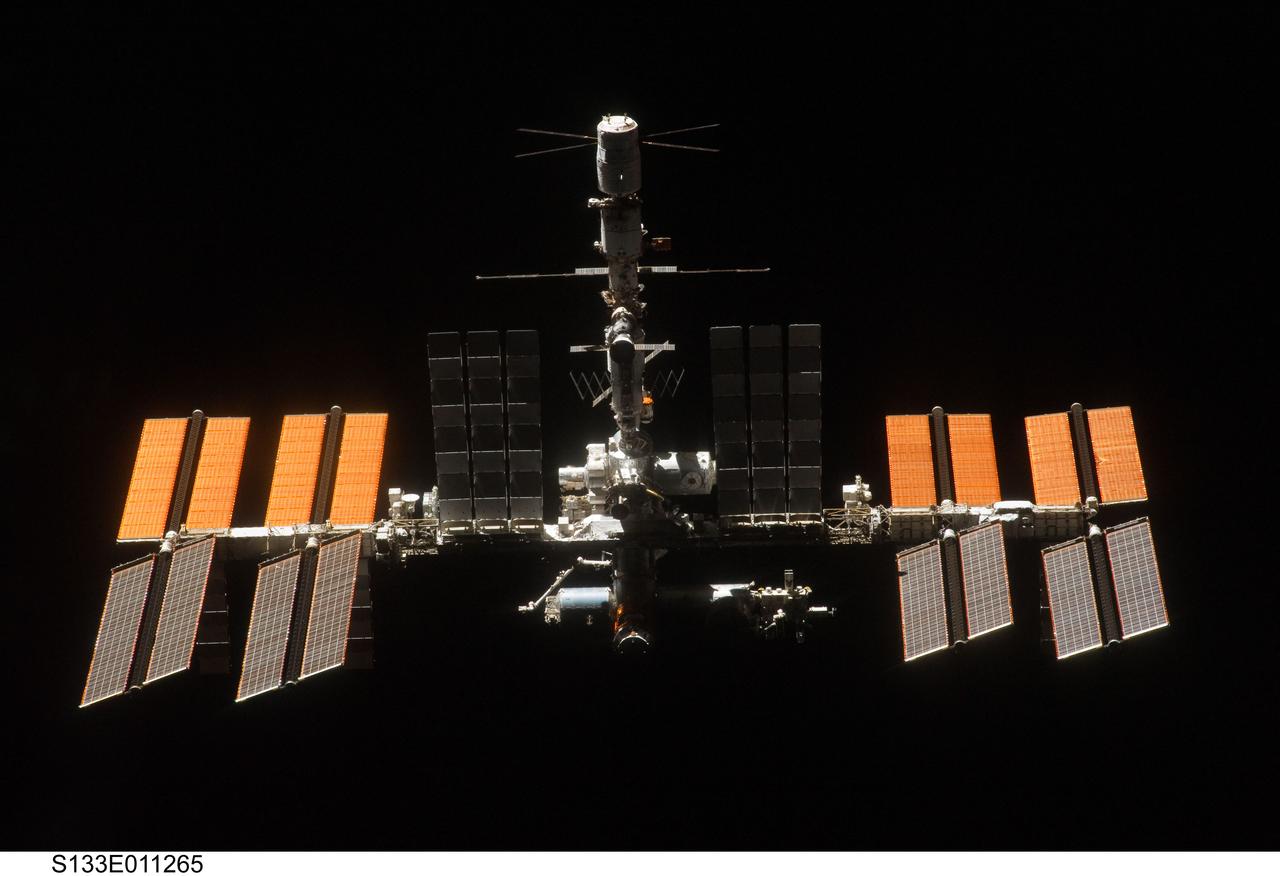
S133-E-011265 (7 March 2011) --- Backdropped against the blackness of space, the International Space Station is seen from Discovery as the two orbital spacecraft accomplish their relative separation on March 7 after an aggregate of 12 astronauts and cosmonauts worked together for over a week. During a post undocking fly-around, the crew members aboard the two spacecraft collected a series of photos of each other?s vehicle. Photo credit: NASA or National Aeronautics and Space Administration
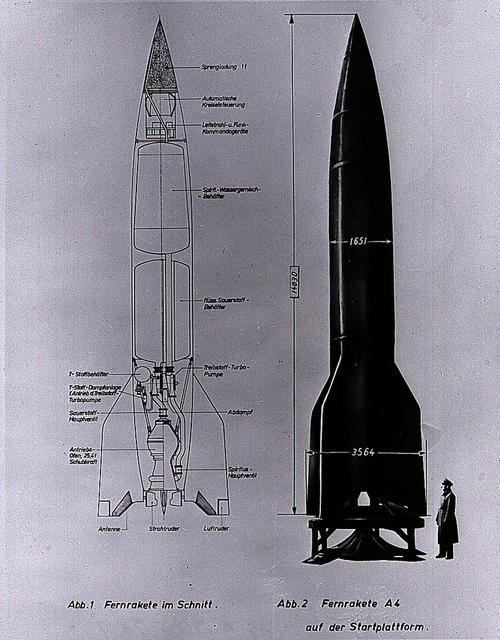
This German cutaway drawing of the Aggregate-4 (A-4) illustrates the dimensions and internal workings of the rocket. Later renamed the V-2, the rocket was developed by Dr. Wernher von Braun and the German Rocket Team at Peenemuende on the Baltic Sea. At the end of World War II, the team of German engineers and scientists came to the United States to work for the Army at Fort Bliss, Texas, and Redstone Arsenal in Huntsville, Alabama.
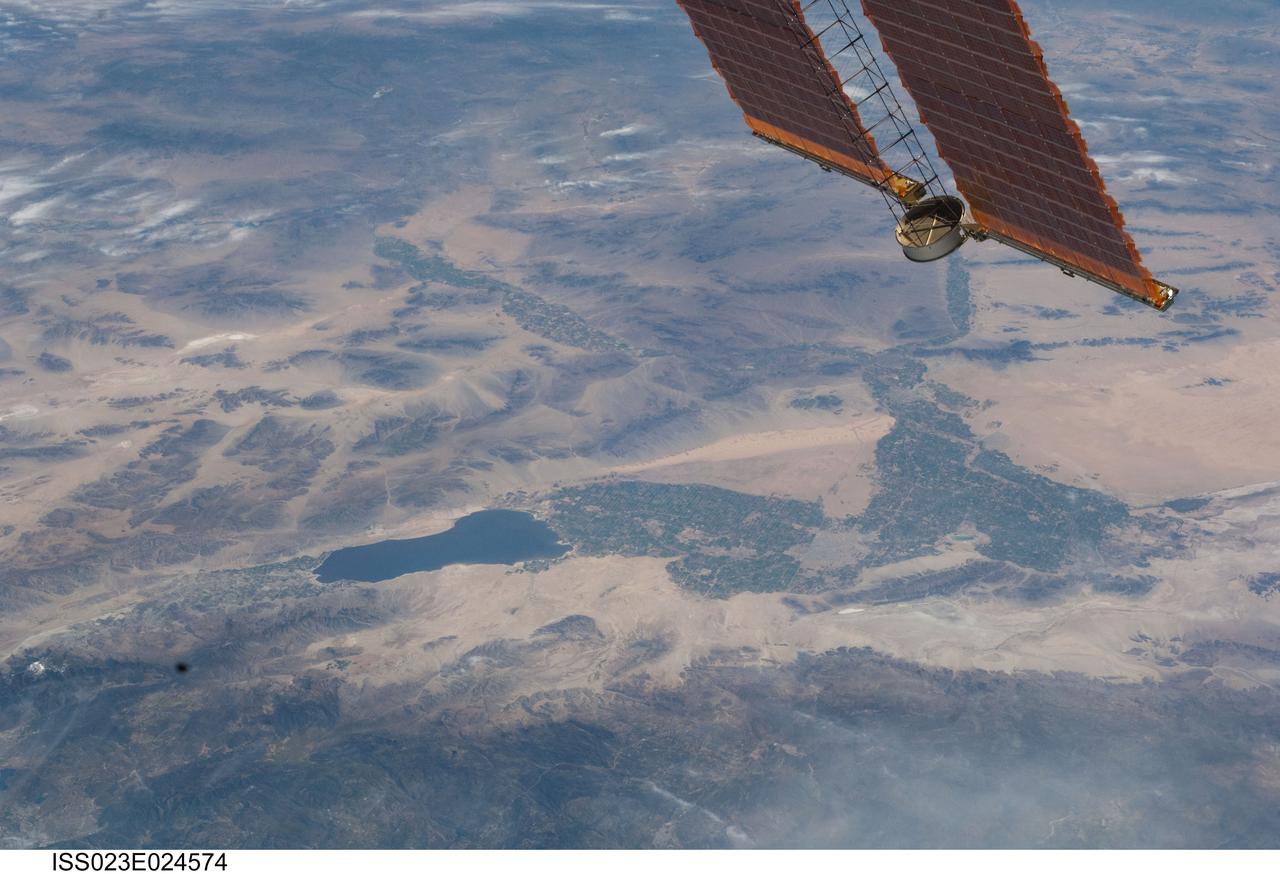
ISS023-E-024574 (15 April 2010) --- The Salton Sea and Imperial Valley are in the center of this scene photographed from the International Space Station (note solar panels, upper right). The orbital outpost and space shuttle Discovery have been docked for several days as an aggregation of 13 astronauts and cosmonauts continue work on the station. The two spacecraft will undock over the weekend and the shuttle is scheduled to return its crew of seven back home on Earth on April 19.
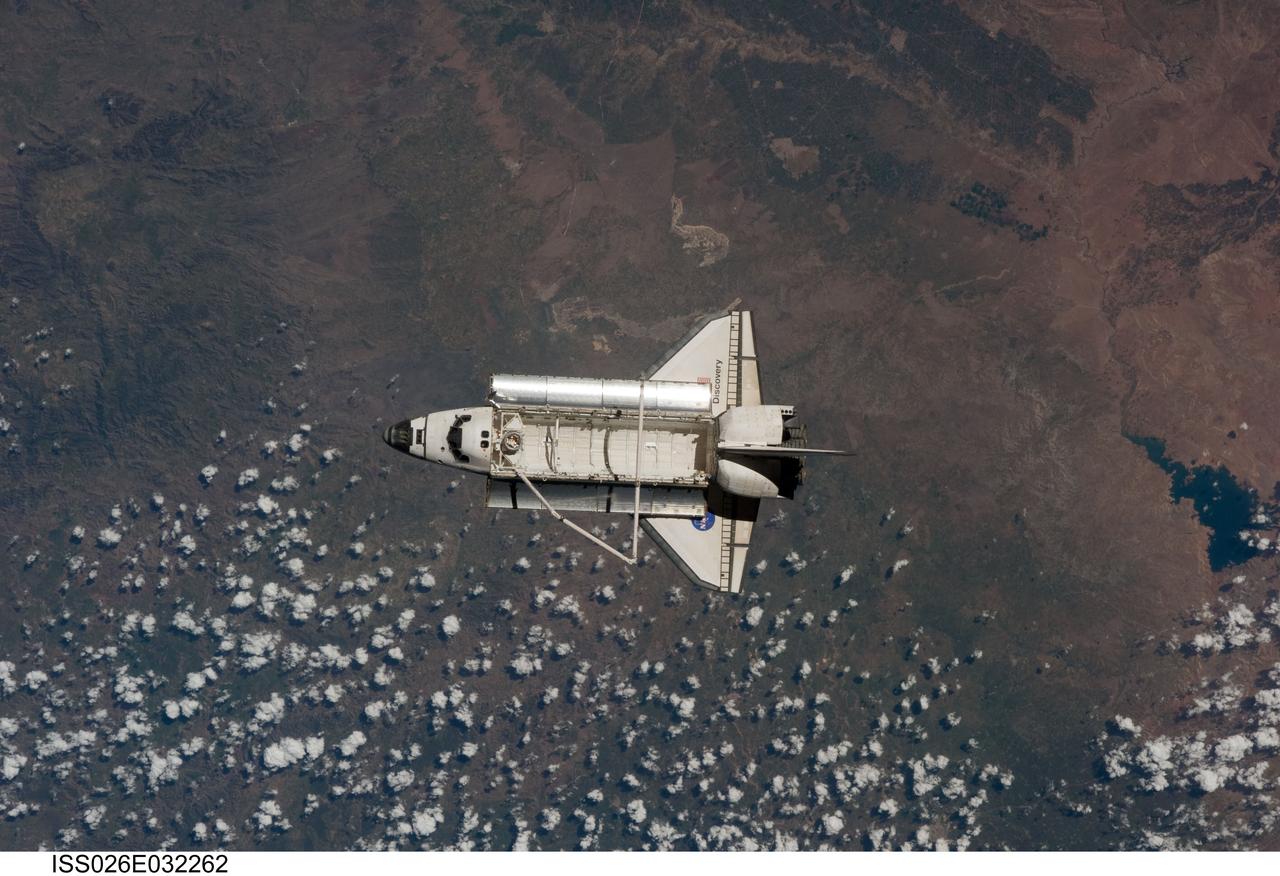
ISS026-E-032262 (7 March 2011) --- The space shuttle Discovery is seen from the International Space Station as the two orbital spacecraft accomplish their relative separation on March 7 after an aggregate of 12 astronauts and cosmonauts worked together for over a week. During a post undocking fly-around, the crew members aboard the two spacecraft collected a series of photos of each other’s vehicle.
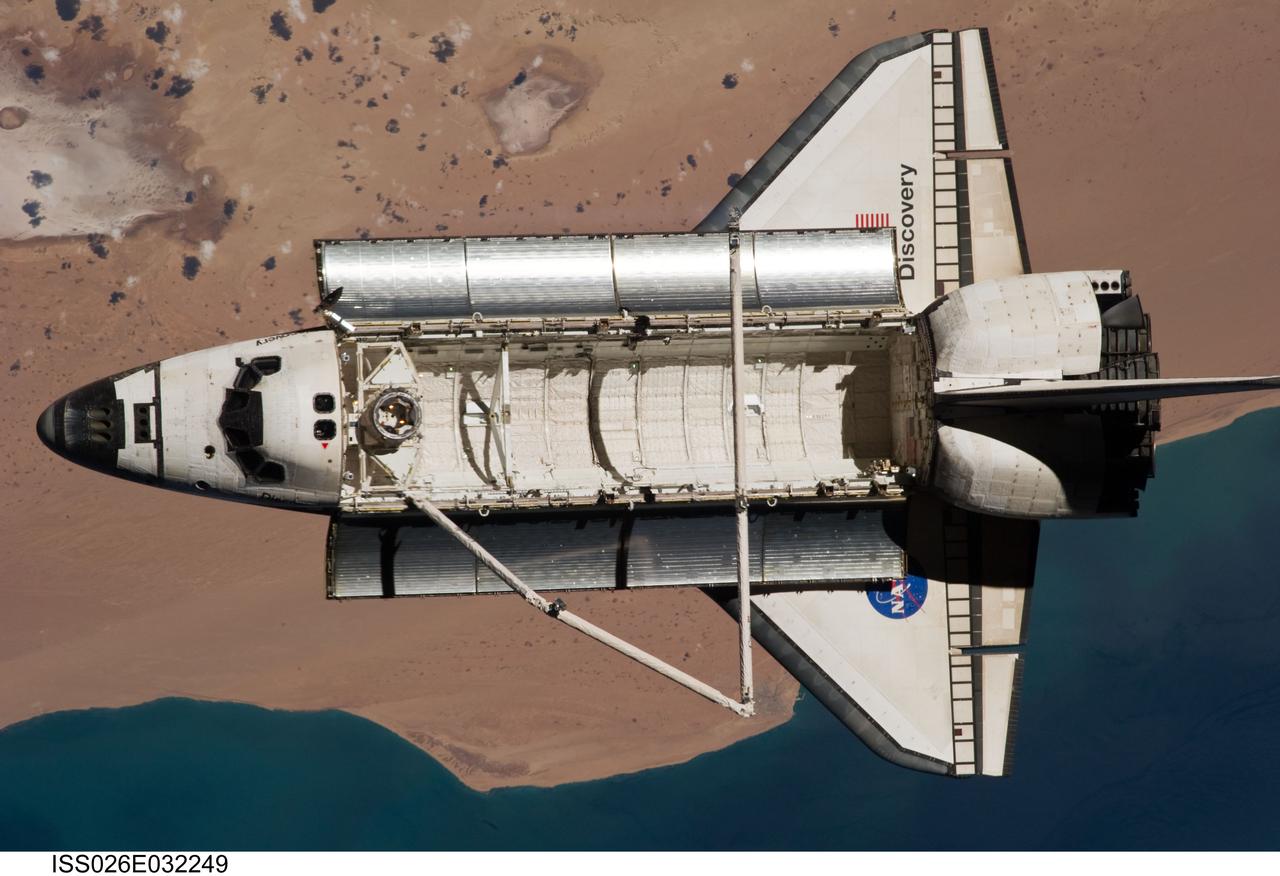
ISS026-E-032249 (7 March 2011) --- The space shuttle Discovery is seen from the International Space Station as the two orbital spacecraft accomplish their relative separation on March 7 after an aggregate of 12 astronauts and cosmonauts worked together for over a week. The area below is the southwestern coast of Morocco in the northern Atlantic. During a post undocking fly-around, the crew members aboard the two spacecraft collected a series of photos of each other’s vehicle.
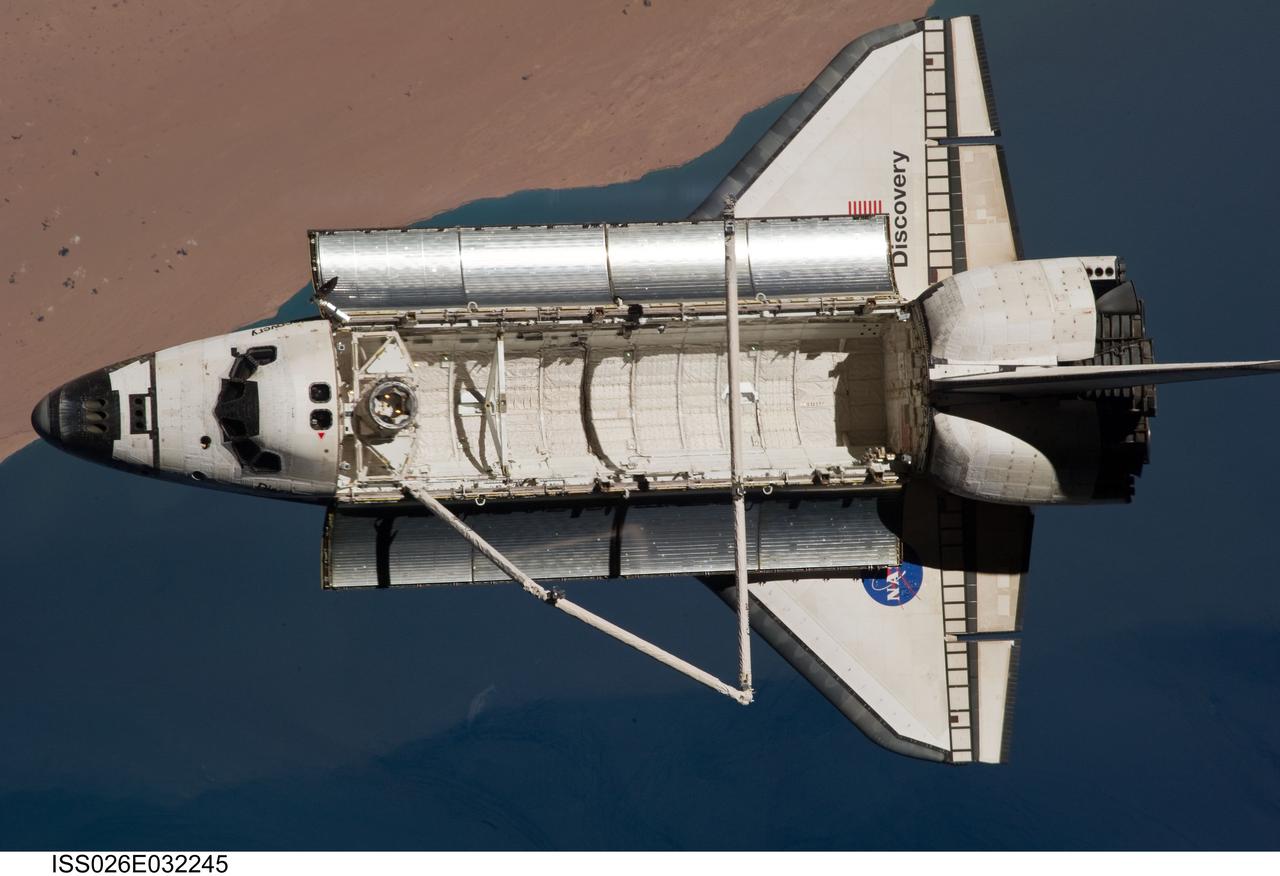
ISS026-E-032245 (7 March 2011) --- The space shuttle Discovery is seen from the International Space Station as the two orbital spacecraft accomplish their relative separation on March 7 after an aggregate of 12 astronauts and cosmonauts worked together for over a week. The area below is the southwestern coast of Morocco in the northern Atlantic. During a post undocking fly-around, the crew members aboard the two spacecraft collected a series of photos of each other’s vehicle.
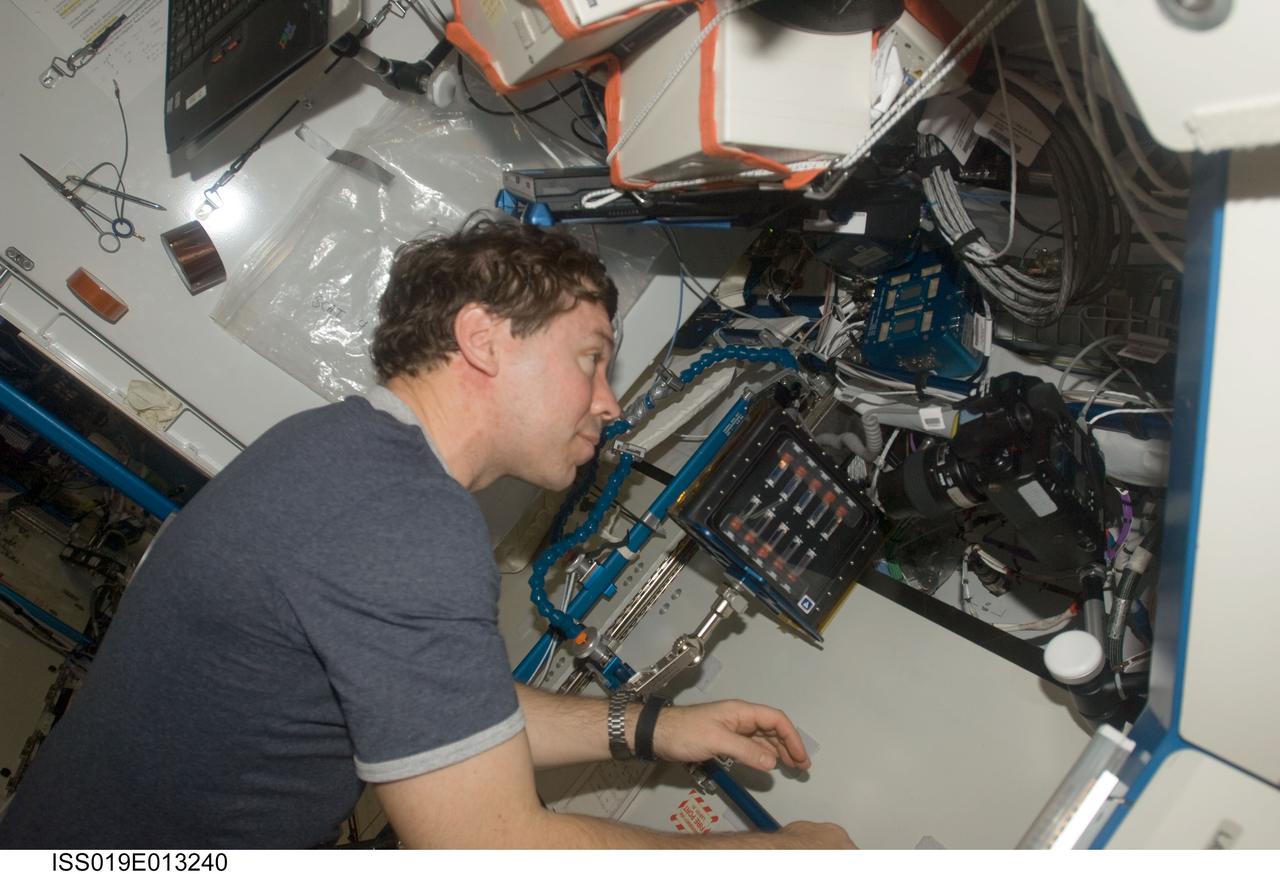
ISS019-E-013240 (2 May 2009) --- Astronaut Michael Barratt, Expedition 19/20 flight engineer, conducts a session with the Binodal Colloidal Aggregation Test?4 (BCAT-4) in the Destiny laboratory of the International Space Station. This experiment studies the long-term behavior of colloids ? fine particles suspended in a fluid in a microgravity environment, where the effects of sedimentation and convention are removed. Results from this study may lead to new colloid materials with applications in the communications and computer industries for switches, displays and optical devices with properties that could rival those of lasers.
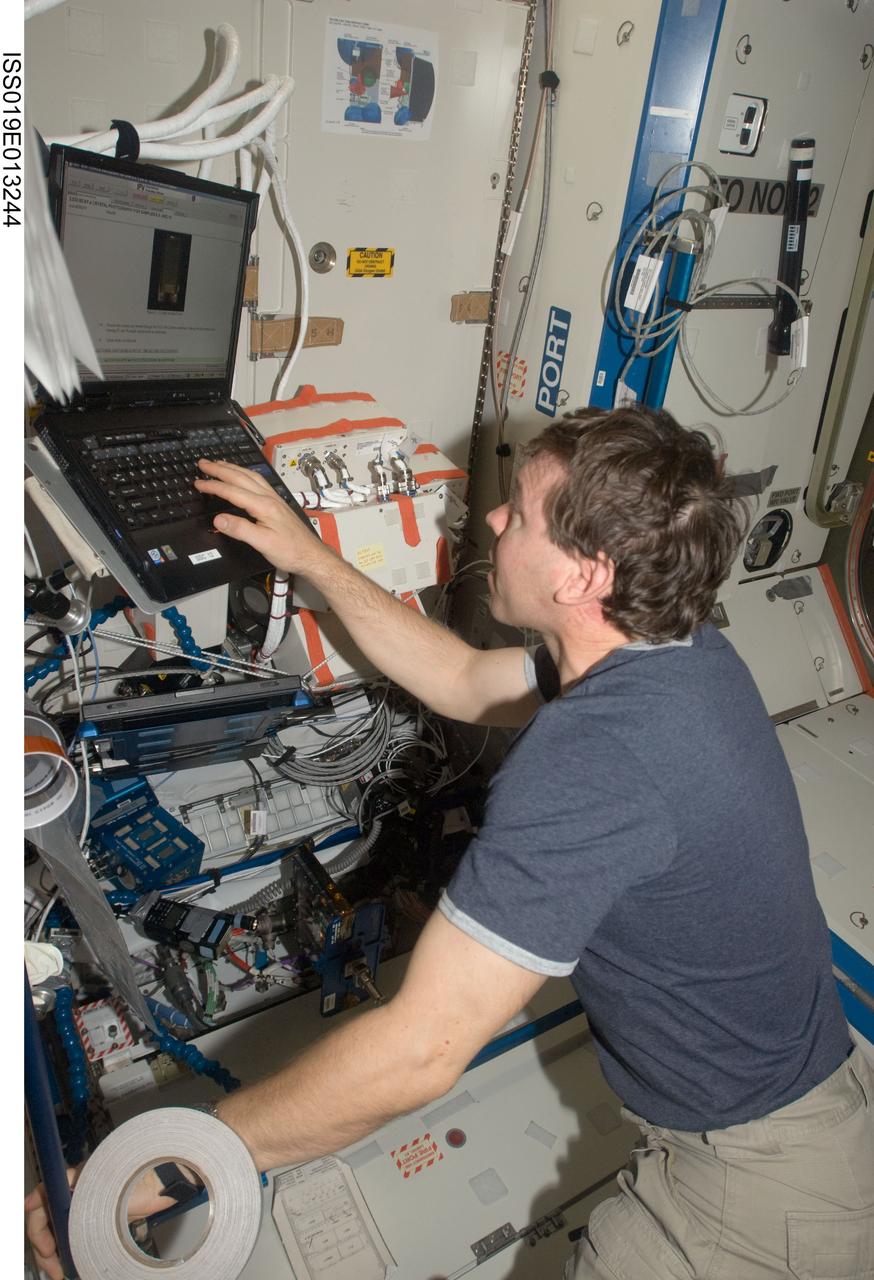
ISS019-E-013244 (2 May 2009) --- Astronaut Michael Barratt, Expedition 19/20 flight engineer, uses a computer during a session with the Binodal Colloidal Aggregation Test?4 (BCAT-4) in the Destiny laboratory of the International Space Station. This experiment studies the long-term behavior of colloids ? fine particles suspended in a fluid in a microgravity environment, where the effects of sedimentation and convention are removed. Results from this study may lead to new colloid materials with applications in the communications and computer industries for switches, displays and optical devices with properties that could rival those of lasers.

iss060e008906 (7/17/2019) --- Photo documentation of the Hermes Cassette-1 investigation aboard the International Space Station (ISS). Hermes Cassette-1 is the the first set of experiments in the Hermes Facility, it explores the dynamics and properties of material on the surface of small asteroids, including regolith. Regolith creates a loosely aggregated surface on airless bodies and researchers expect it is dominated by interactions between individual grains of the material. Results improve understanding of asteroid and small body dynamics and validate and improve small body models, essential for future crewed and robotic missions to these small bodies.
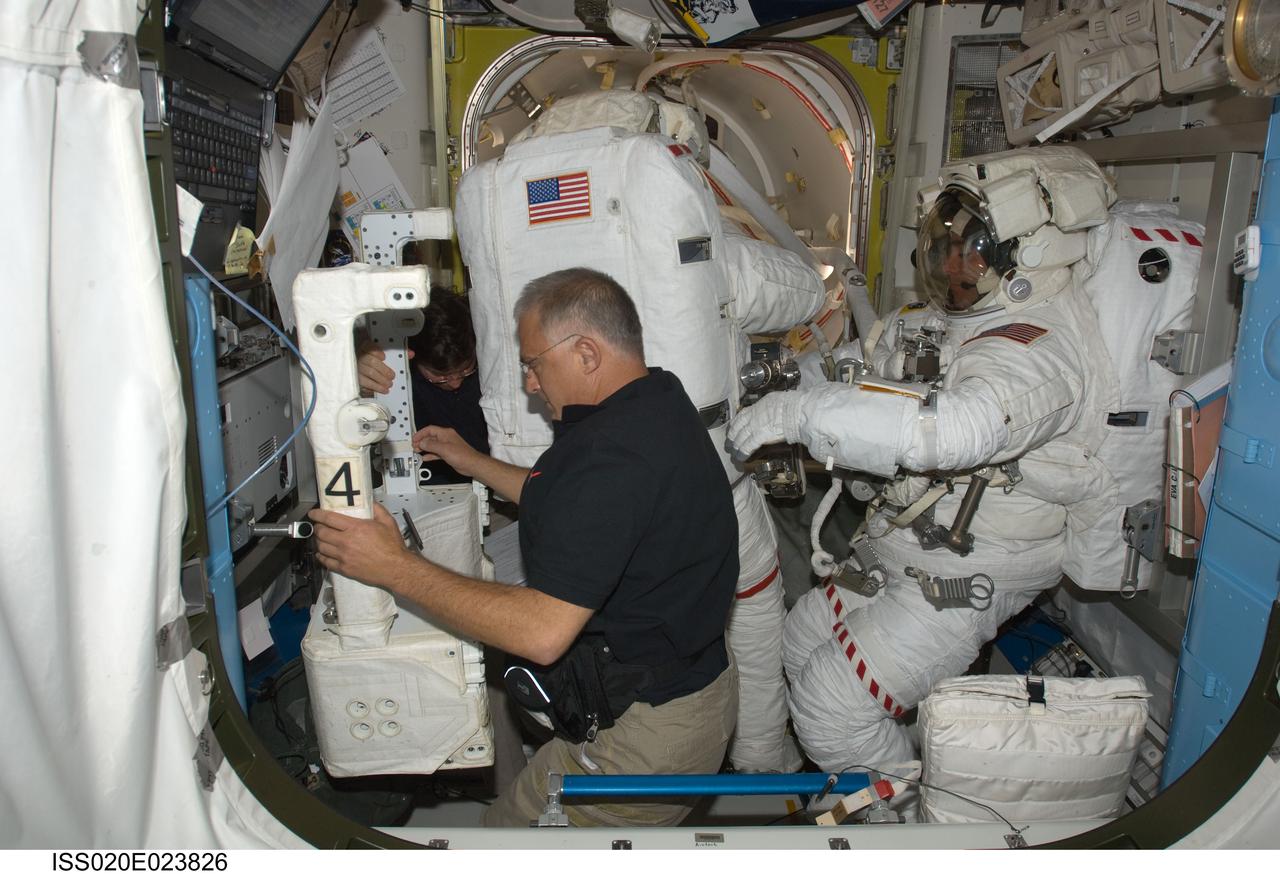
ISS020-E-023826 (24 July 2009) --- Astronaut Dave Wolf assists astronaut Tom Marshburn with some final touches on his extravehicular mobility unit spacesuit in the joint airlock, while astronaut Christopher Cassidy stands suited and almost ready at right. Marshburn and Cassidy were about to participate in the July 24 flight day 10 spacewalk. They are scheduled to wrap up the EVA work with a fifth overall session on July 27. The three mission specialists are part of a 13-member aggregation of astronauts and cosmonauts currently onboard the orbital outpost while its crew of six plays host to Endeavour's crew of seven.
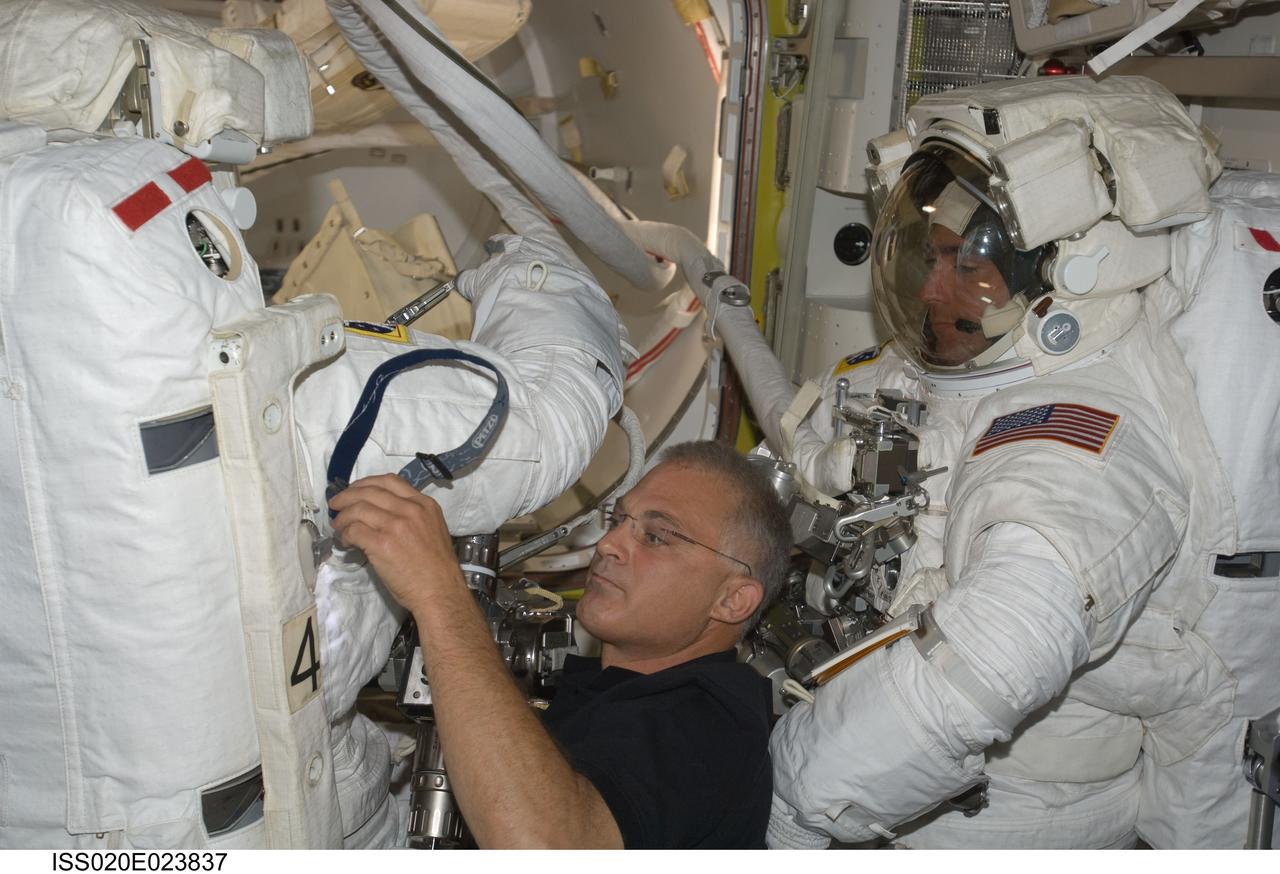
ISS020-E-023837 (24 July 2009) --- Astronaut Dave Wolf assists astronaut Tom Marshburn with his extravehicular mobility unit spacesuit in the joint airlock, while astronaut Christopher Cassidy stands suited and almost ready at right. The two were about to participate in the July 24 flight day 10 spacewalk, and they are scheduled to wrap up the EVA work with a fifth overall session on July 27. The three mission specialists are part of a 13-member aggregation of astronauts and cosmonauts currently onboard the orbital outpost while its crew of six plays host to Endeavour's crew of seven.
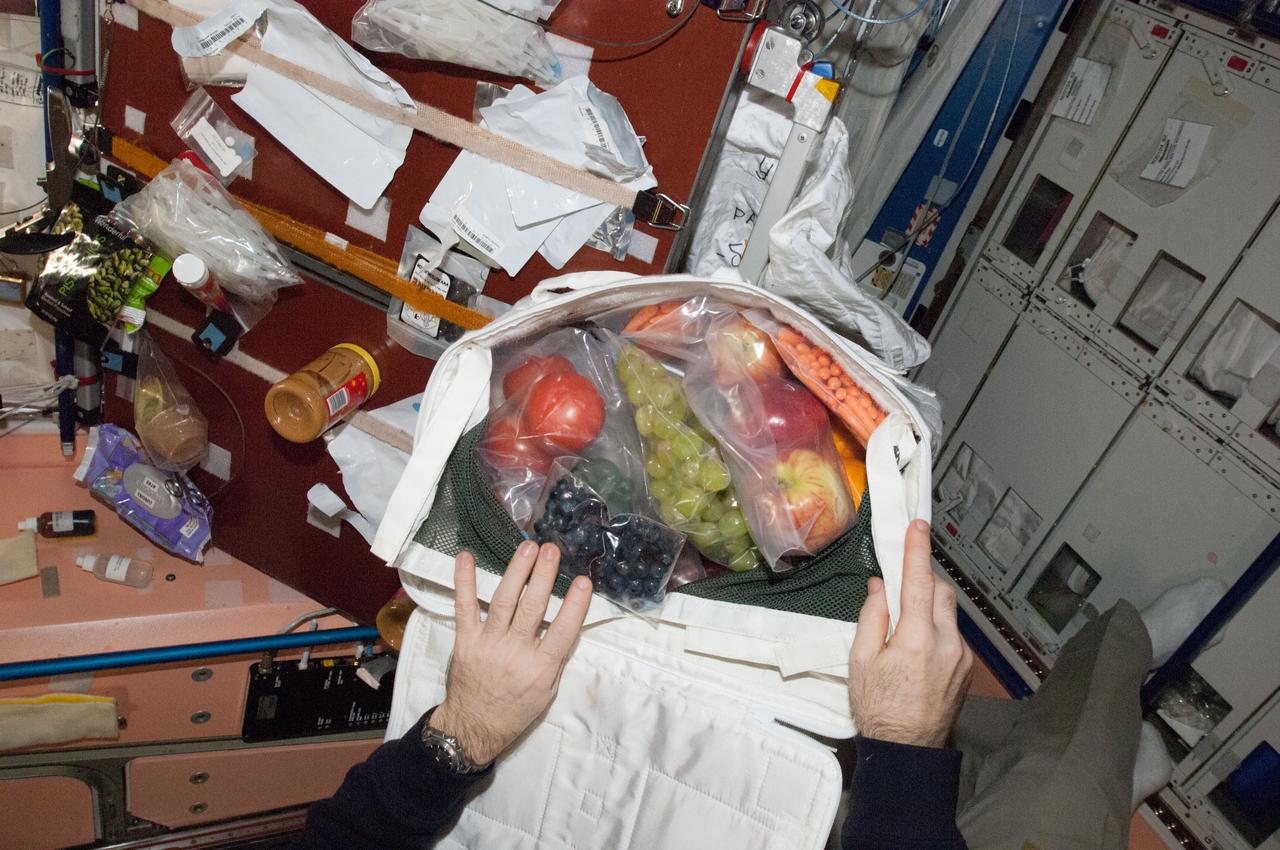
ISS034-E-062087 (3 March 2013) --- The hands of Expedition 34 Commander Kevin Ford, NASA astronaut, open a bag revealing a highly welcomed aggregate of fruit which was sent up from Earth a couple of days earlier and which arrived at the International Space Station on March 3. It was just a very small portion of all the fresh supplies which arrived aboard the unmanned Space X Dragon spacecraft. The scene, being witnessed by many of the astronauts and cosmonauts out of the camera's view, took place in Node 1 or Unity.
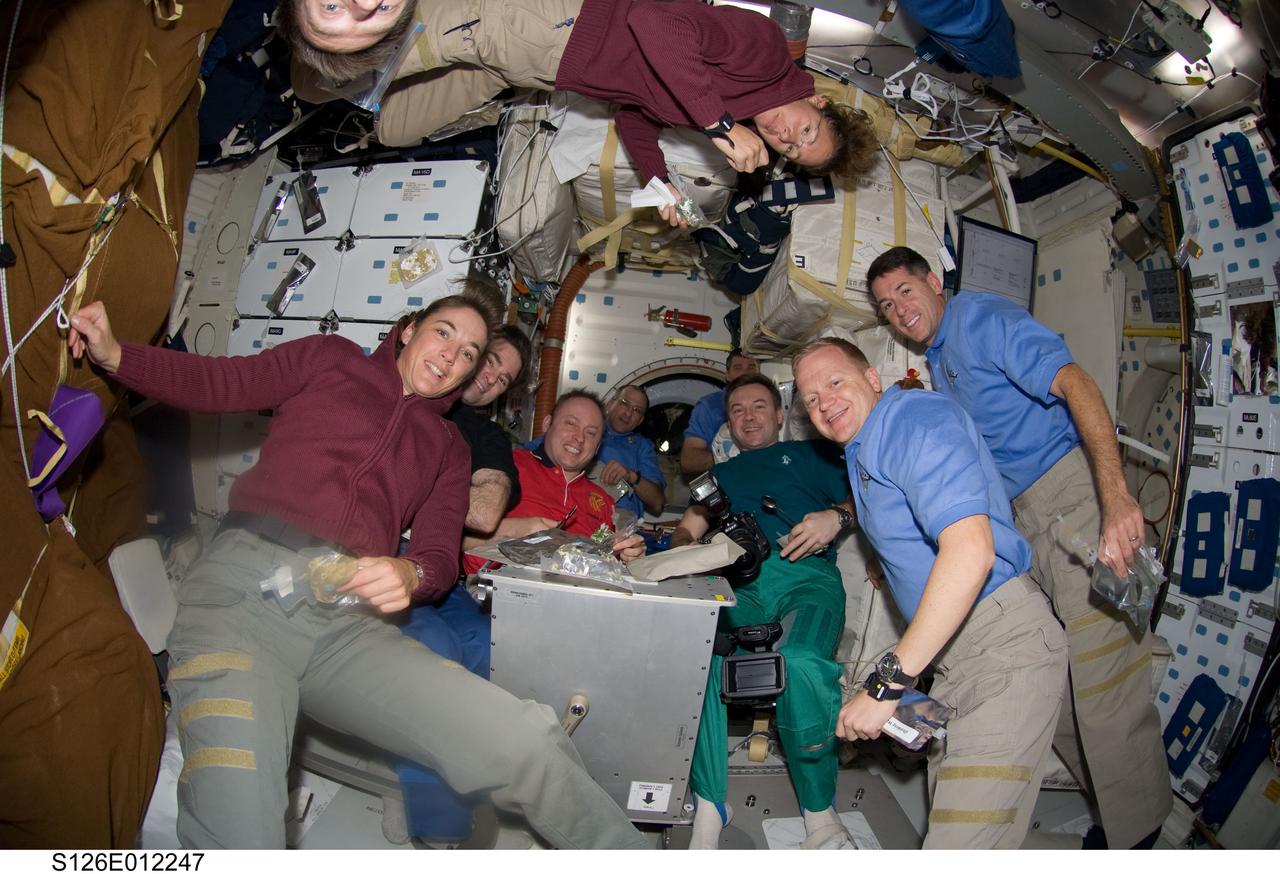
S126-E-012247 (27 Nov. 2008) --- Getting all ten members of an aggregation consisting of seven Endeavour astronauts and three Expedition 18 crewmembers into a single photo wasn't easy as the two crews shared a Thanksgiving meal on the middeck of the orbiter. Astronaut Sandra Magnus, Expedition 18 flight engineer, appears at top center. Clockwise from her position are astronauts Shane Kimbrough and Eric Boe, along with cosmonaut Yury Lonchakov, and astronauts Steve Bowen (partially visible behind Lonchakov), Donald Pettit, Michael Fincke, Gregory Chamitoff, Heidemarie Stefanyshyn-Piper and Chris Ferguson (partially visible at top right). Ferguson is STS-126 commander, and Fincke is commander for the station crew.
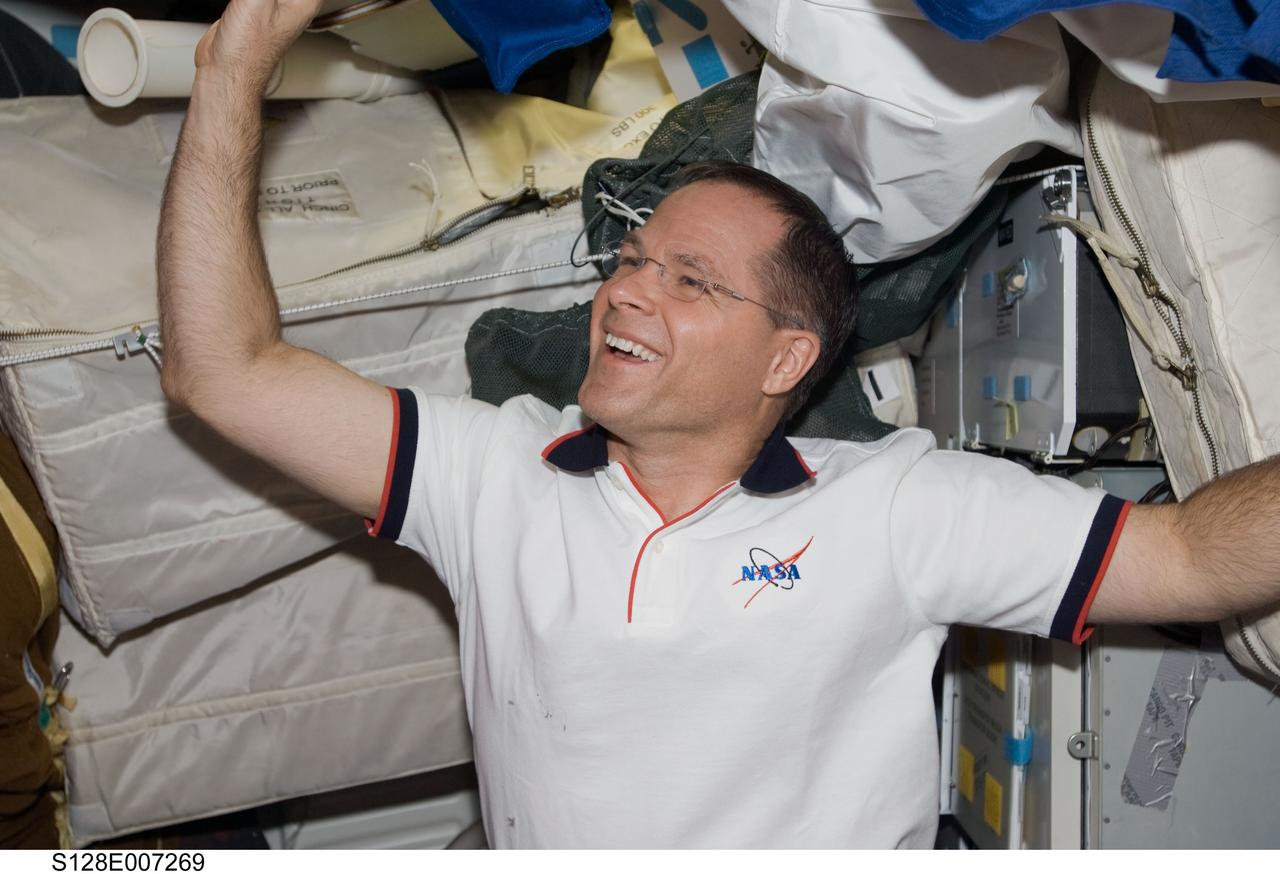
S128-E-007269 (4 Sept. 2009) --- As the STS-128 crew and the Shuttle Discovery half just passed the half way point of their mission, the countenance of astronaut Kevin Ford, pilot, shows his pleasure with the way things are going. At this point, from inside the shuttle and station, Ford and his crewmates have supported two of three spacewalks, with the final one scheduled for Sept. 5. Aside from the spacewalks, a long list of tasks has been performed by the aggregation of 13 astronauts and cosmonauts sharing space on the two spacecraft for several days.
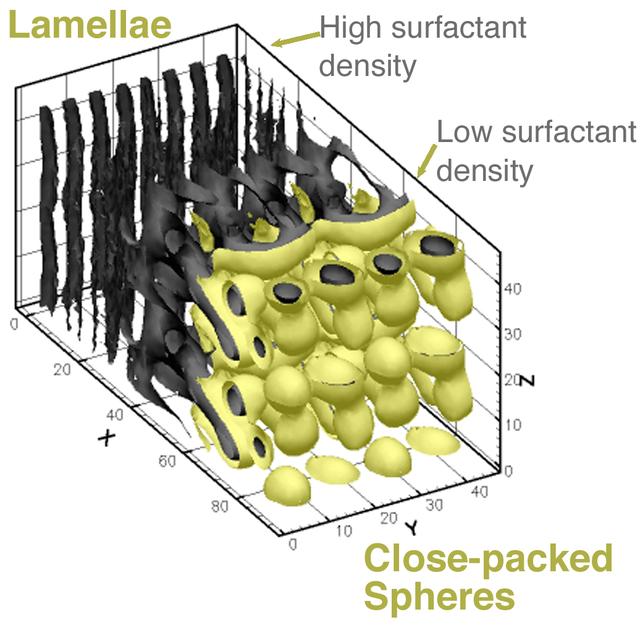
NASA is looking to biological techniques that are millions of years old to help it develop new materials and technologies for the 21st century. Sponsored by NASA, Jeffrey Brinker of the University of New Mexico is studying how multiple elements can assemble themselves into a composite material that is clear, tough, and impermeable. His research is based on the model of how an abalone builds the nacre, also called mother-of-pearl, inside its shell. Strong thin coatings, or lamellae, in Brinker's research are formed when objects are dip-coated. Evaporation drives the self-assembly of molecular aggregates (micelles) of surfactant, soluble silica, and organic monomers and their further self-organization into layered organic and inorganic assemblies.
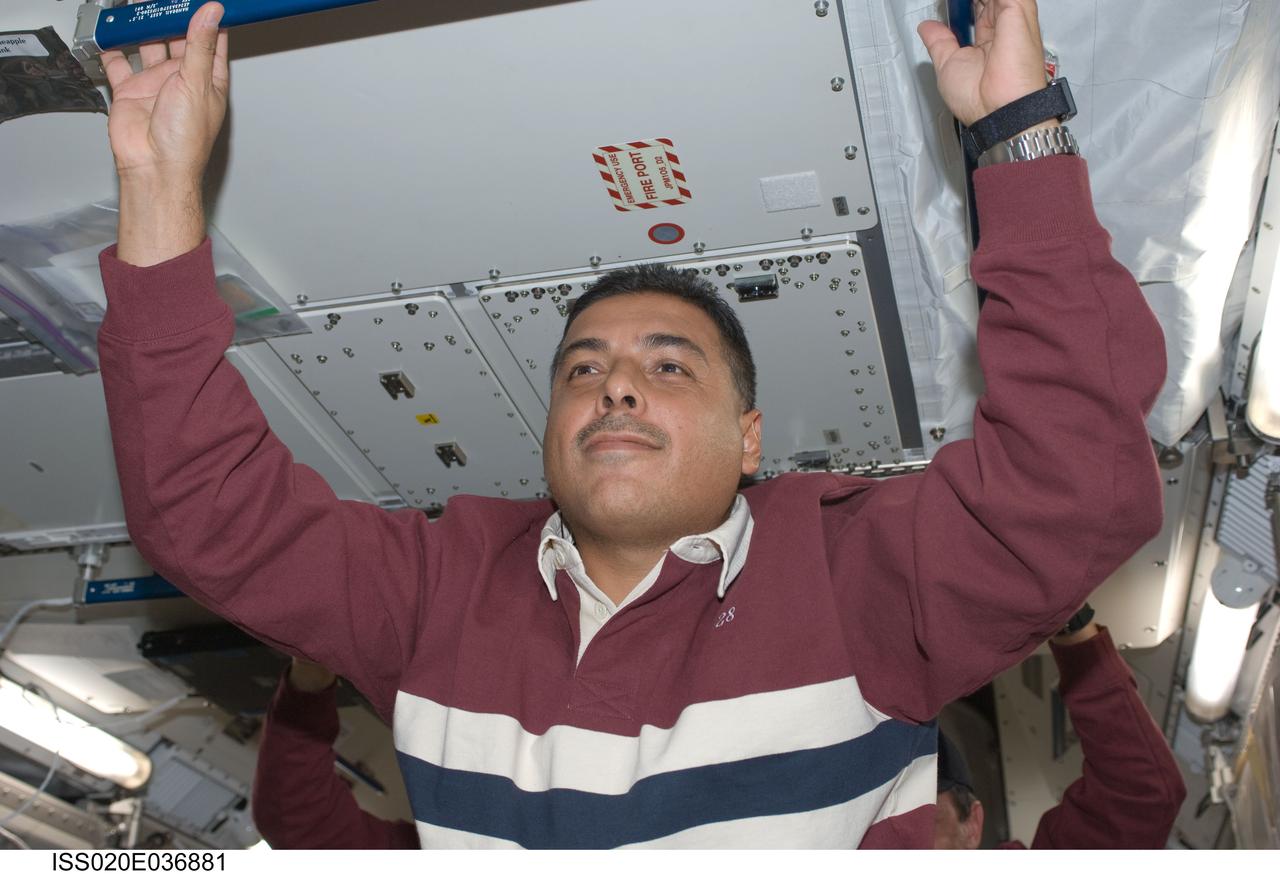
ISS020-E-036881 (30 Aug. 2009) --- This is one of a series of digital still images that were recorded shortly after the STS-128 and Expedition 20 crewmembers reunited in space and not long after the Space Shuttle Discovery and the International Space Station joined up in Earth orbit to create the second consecutive 13-person aggregation to perform more work on the orbital outpost. Making his first flight in space is astronaut Jose Hernandez, one of the STS-128 mission specialists who are part of the seven-member crew that flew up to the station onboard Discovery.
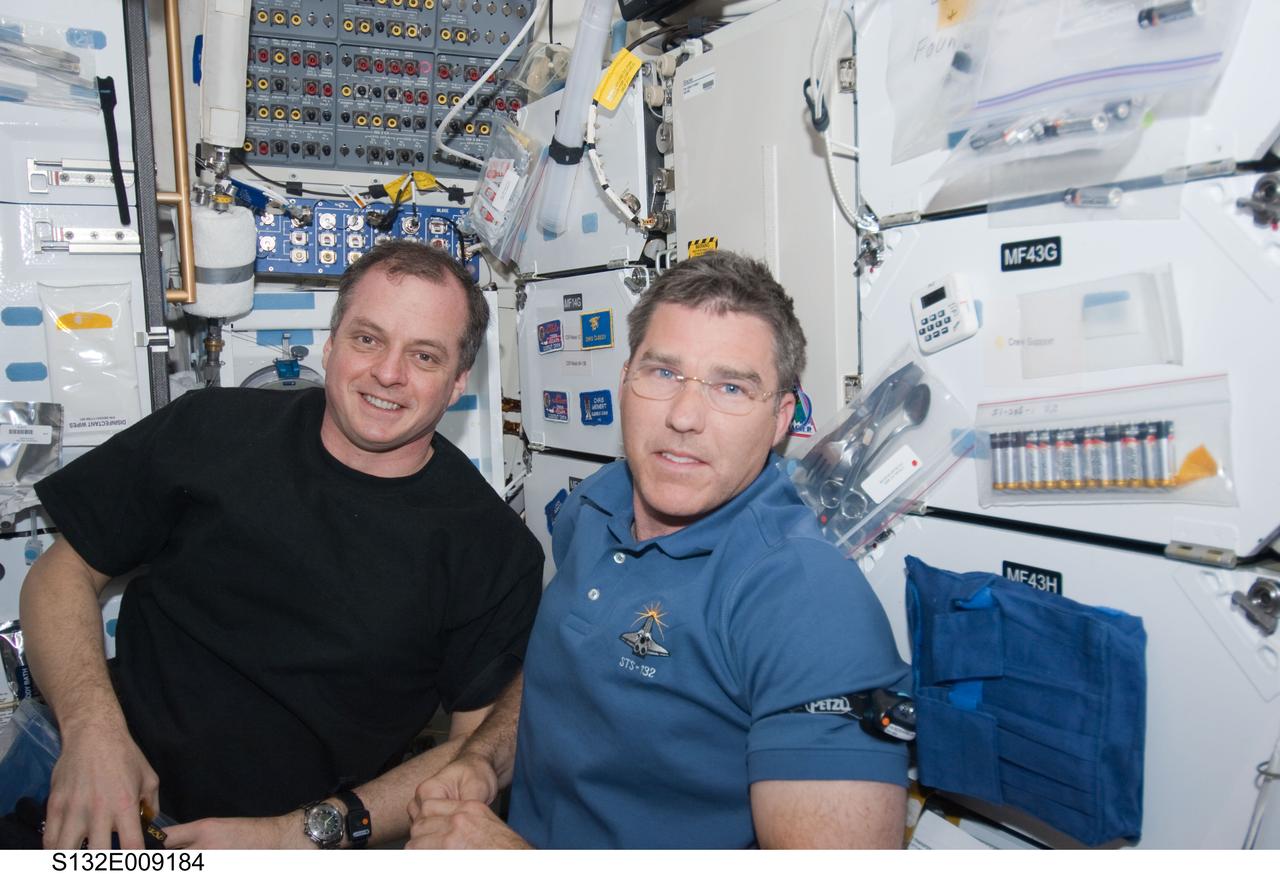
S132-E-009184 (22 May 2010) --- NASA astronauts T.J. Creamer (left), Expedition 23 flight engineer, and Steve Bowen, STS-132 mission specialist, are on the mid deck of the space shuttle Atlantis, which is currently docked to the International Space Station. This Atlantis visit represents relatively new surroundings to Creamer, who is in the latter stages of a long duration stay aboard the orbital outpost. For approximately a week now, the station has hosted an aggregate of twelve astronauts and cosmonauts who have joined efforts in working on completion of the station. Photo credit: NASA or National Aeronautics and Space Administration
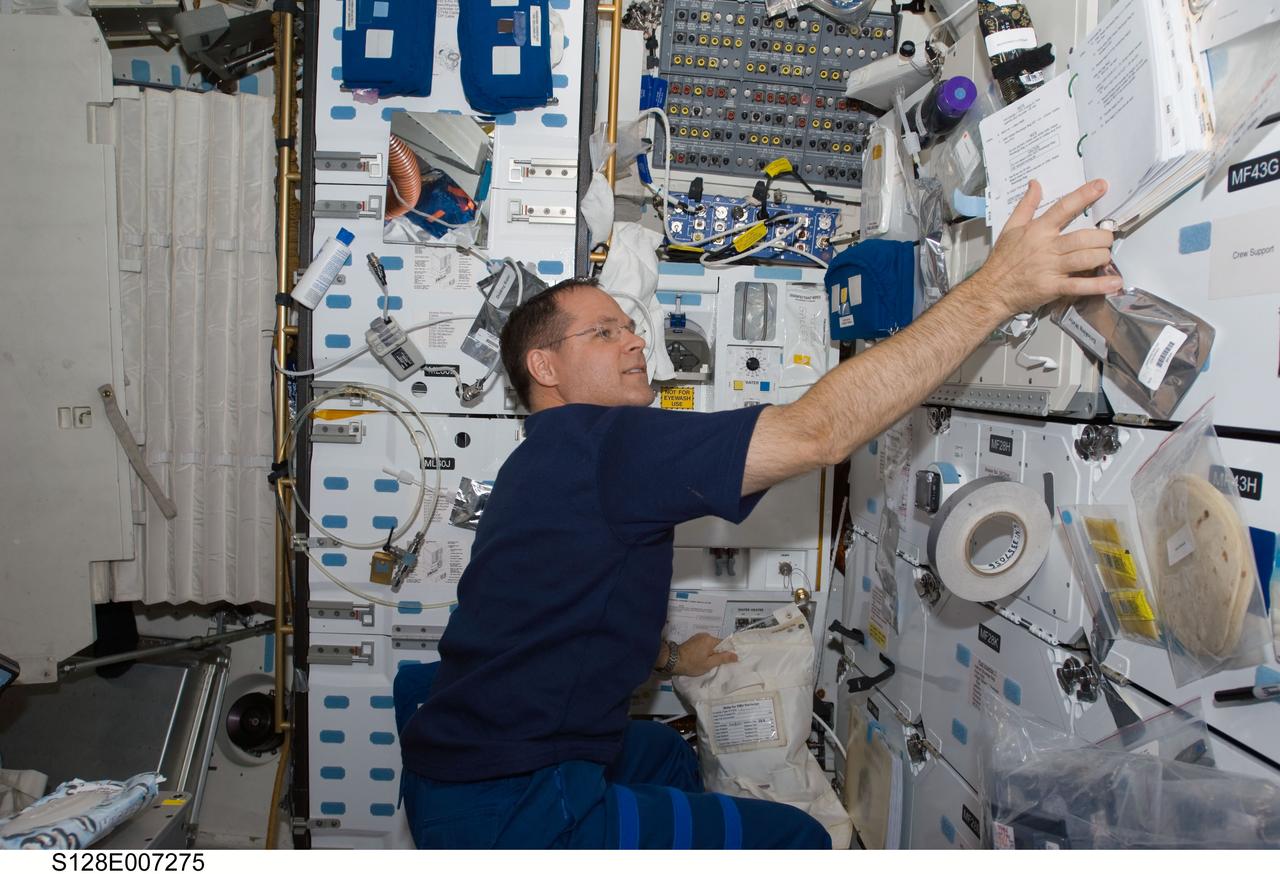
S128-E-007275 (4 Sept. 2009) --- As the STS-128 crew and the Space Shuttle Discovery are about half way through their mission, the countenance of astronaut Kevin Ford, pilot, seen here on the middeck, shows his pleasure with the way things are going. At this point, from inside the shuttle and station, Ford and his crewmates have supported two of three spacewalks, with the final one scheduled for Sept. 5. Aside from the spacewalks, a long list of tasks has been performed by the aggregation of 13 astronauts and cosmonauts sharing space on the two spacecraft for several days.
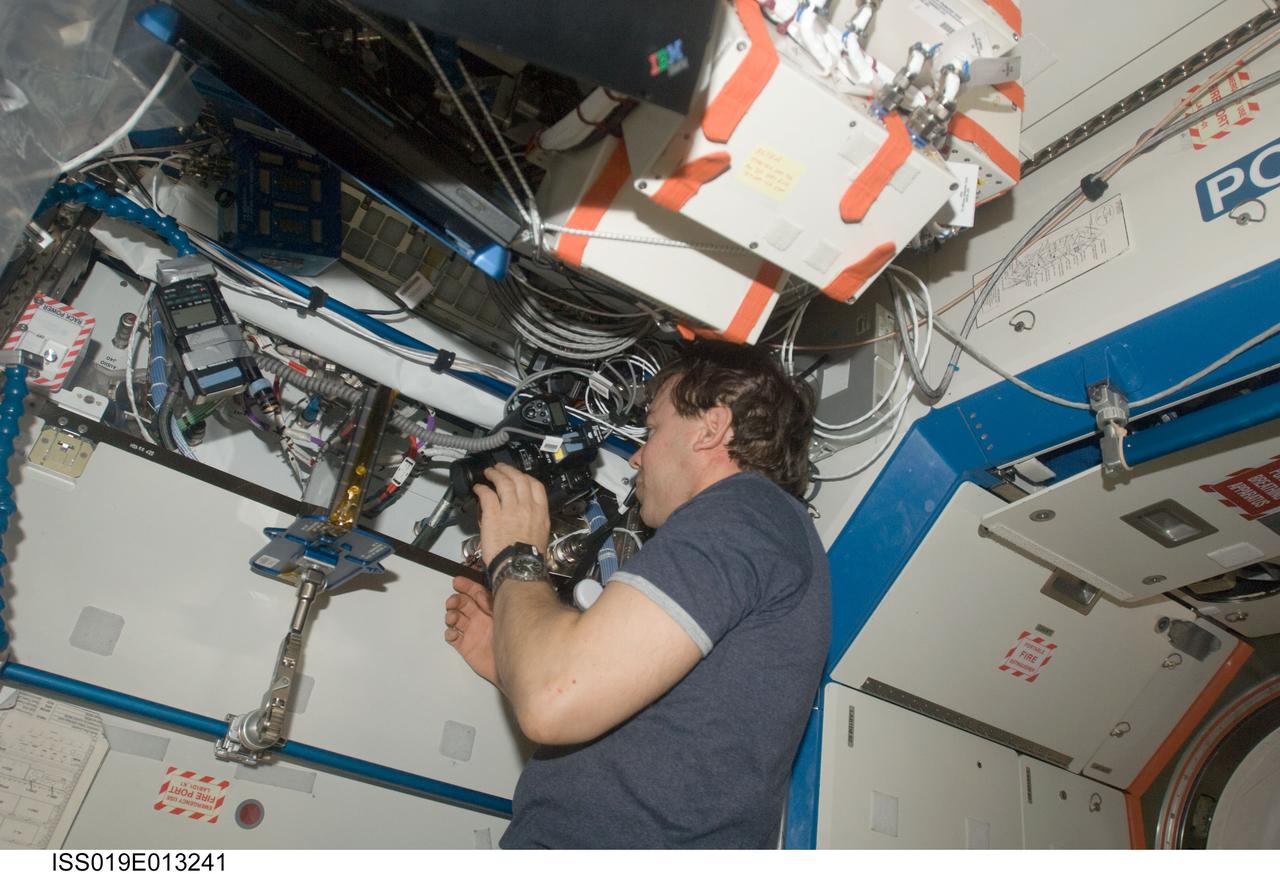
ISS019-E-013241 (2 May 2009) --- Astronaut Michael Barratt, Expedition 19/20 flight engineer, prepares to photograph Binodal Colloidal Aggregation Test?4 (BCAT-4) experiment samples in the Destiny laboratory of the International Space Station. This experiment studies the long-term behavior of colloids ? fine particles suspended in a fluid in a microgravity environment, where the effects of sedimentation and convention are removed. Results from this study may lead to new colloid materials with applications in the communications and computer industries for switches, displays and optical devices with properties that could rival those of lasers.
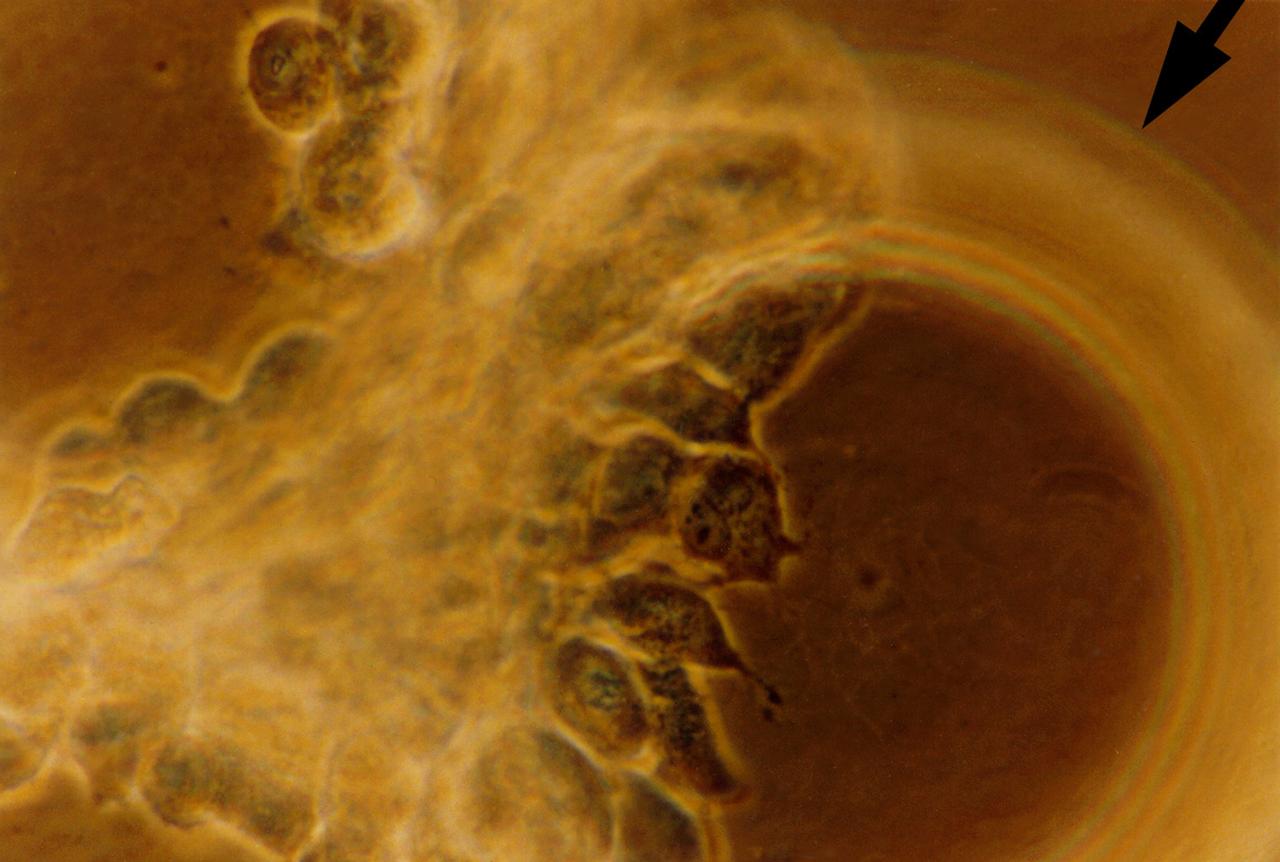
Human primary breast tumor cells after 49 days of growth in a NASA Bioreactor. Tumor cells aggregate on microcarrier beads (indicated by arrow). NASA's Marshall Space Flight Center (MSFC) is sponsoring research with Bioreactors, rotating wall vessels designed to grow tissue samples in space, to understand how breast cancer works. This ground-based work studies the growth and assembly of human mammary epithelial cell (HMEC) from breast cancer susceptible tissue. Radiation can make the cells cancerous, thus allowing better comparisons of healthy vs. tunorous tissue. Credit: Dr. Jearne Becker, University of South Florida
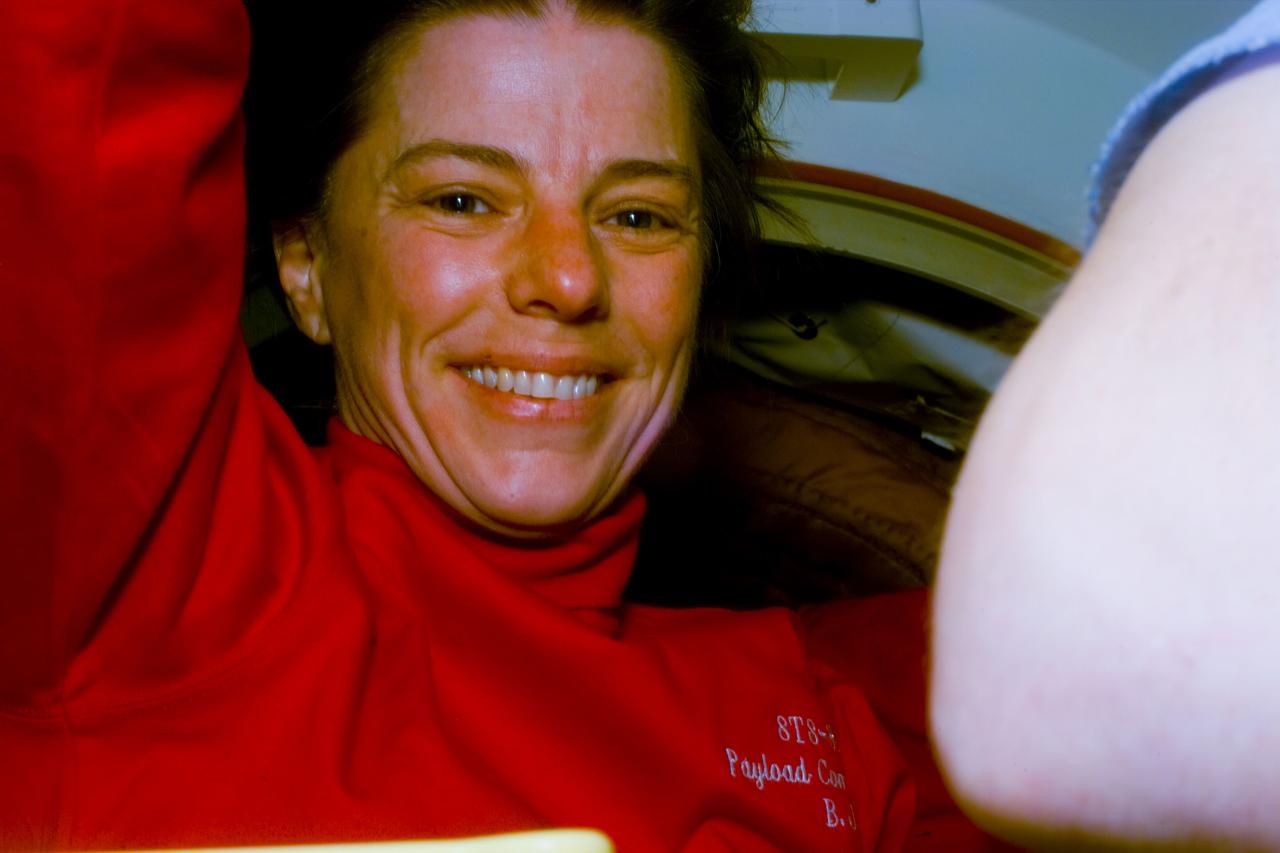
S89-E-5175 (24 Jan 1998) --- This Electronic Still Camera (ESC) image shows astronaut Bonnie J. Dunbar, payload commander, shortly after Shuttle/Mir docking activities began. "Deja-vu" may have come to the mind of Dunbar as she boarded Russia's Mir Space Station. Dunbar was a member of the STS-71 crew -- the first United States aggregation to visit Mir -- along with cosmonaut Anatoliy Y. Solovyev, Mir-24 commander. The ESC view was taken at 22:37:23 GMT, on January 24, 1998.
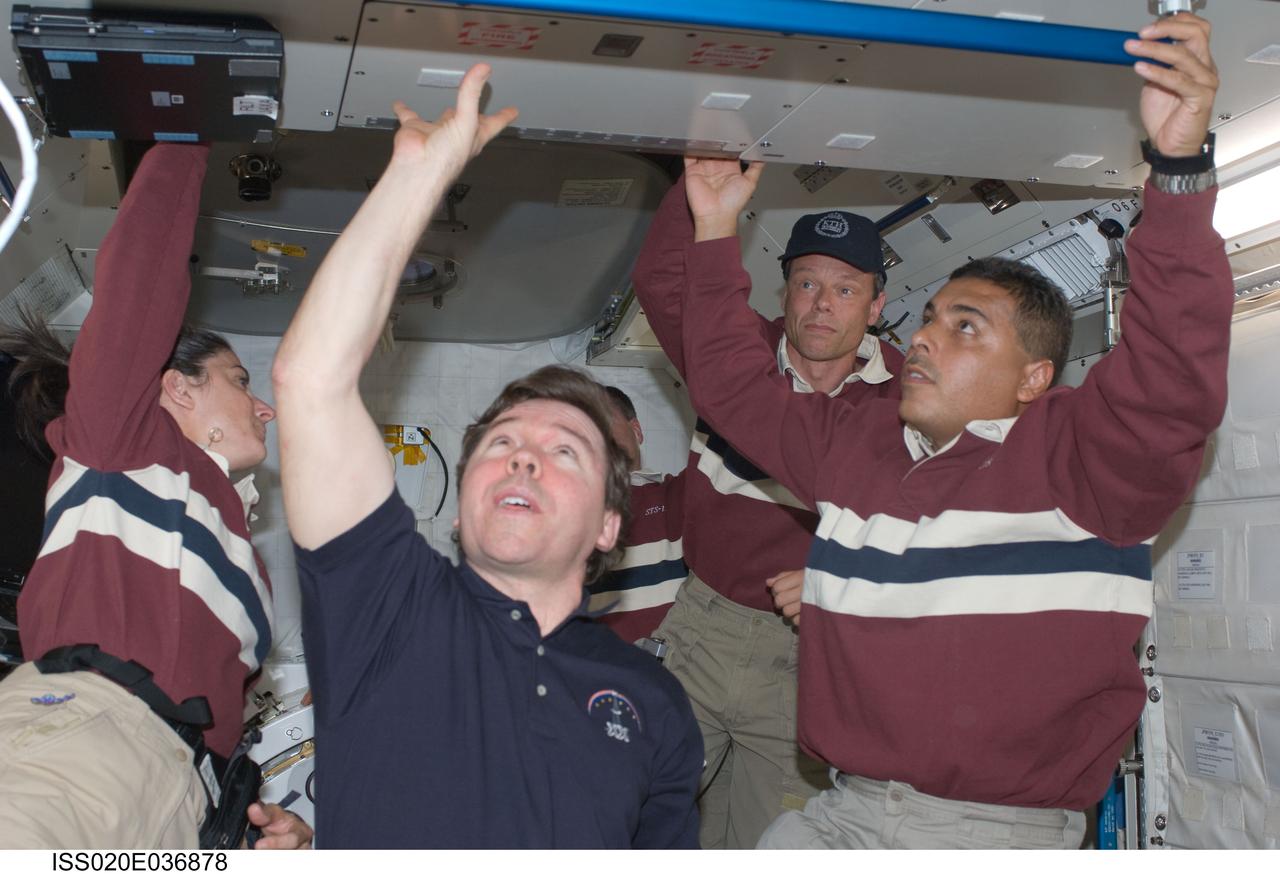
ISS020-E-036878 (30 Aug. 2009) --- This is one of a series of digital still images that were recorded shortly after the STS-128 and Expedition 20 crewmembers reunited in space and not long after the Space Shuttle Discovery and the International Space Station joined up in Earth orbit to create the second consecutive 13-person aggregation to perform more work on the orbital outpost. From the left are astronauts Nicole Stott, STS-128 mission specialist, soon to transfer into a role as Expedition 20 flight engineer, and Michael Barratt, Expedition 20 flight engineer, along with European Space Agency astronaut Christer Fugelsang, STS-128 mission specialist.
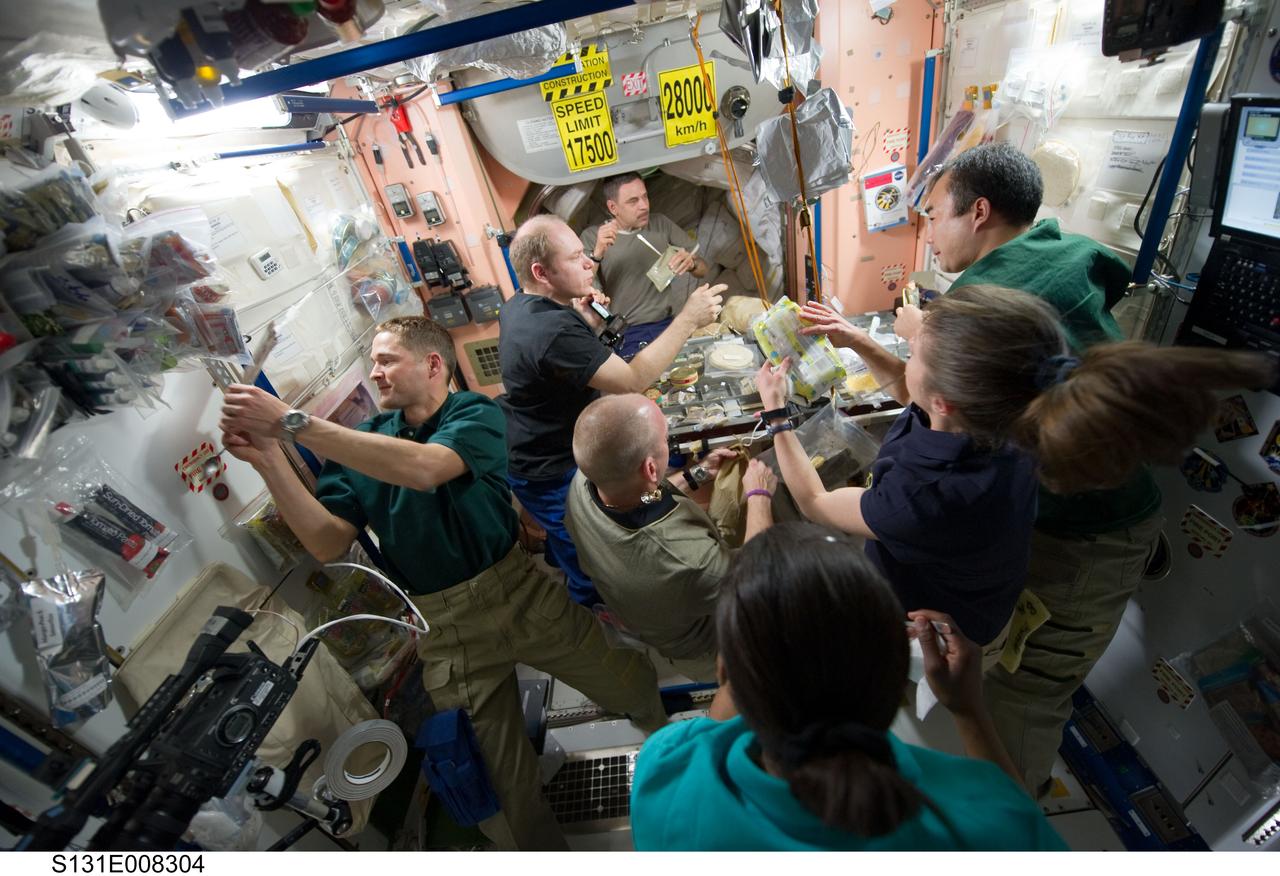
S131-E-008304 (9 April 2010) --- With 13 astronauts and cosmonauts onboard the station at one time, activities around the galley in the Unity node get rather busy at meal time. Over half the 13 are seen in this flight day five aggregation. NASA astronaut James P. Dutton Jr., STS-131 pilot, prepares part of his meal at left. Also pictured clockwise (from the right) are JAXA astronaut Soichi Noguchi and NASA astronaut Tracy Caldwell Dyson, both Expedition 23 flight engineers; NASA astronauts Stephanie Wilson and Clayton Anderson, both STS-131 mission specialists; along with Russian cosmonauts Oleg Kotov and Mikhail Kornienko, Expedition 23 commander and flight engineer, respectively.
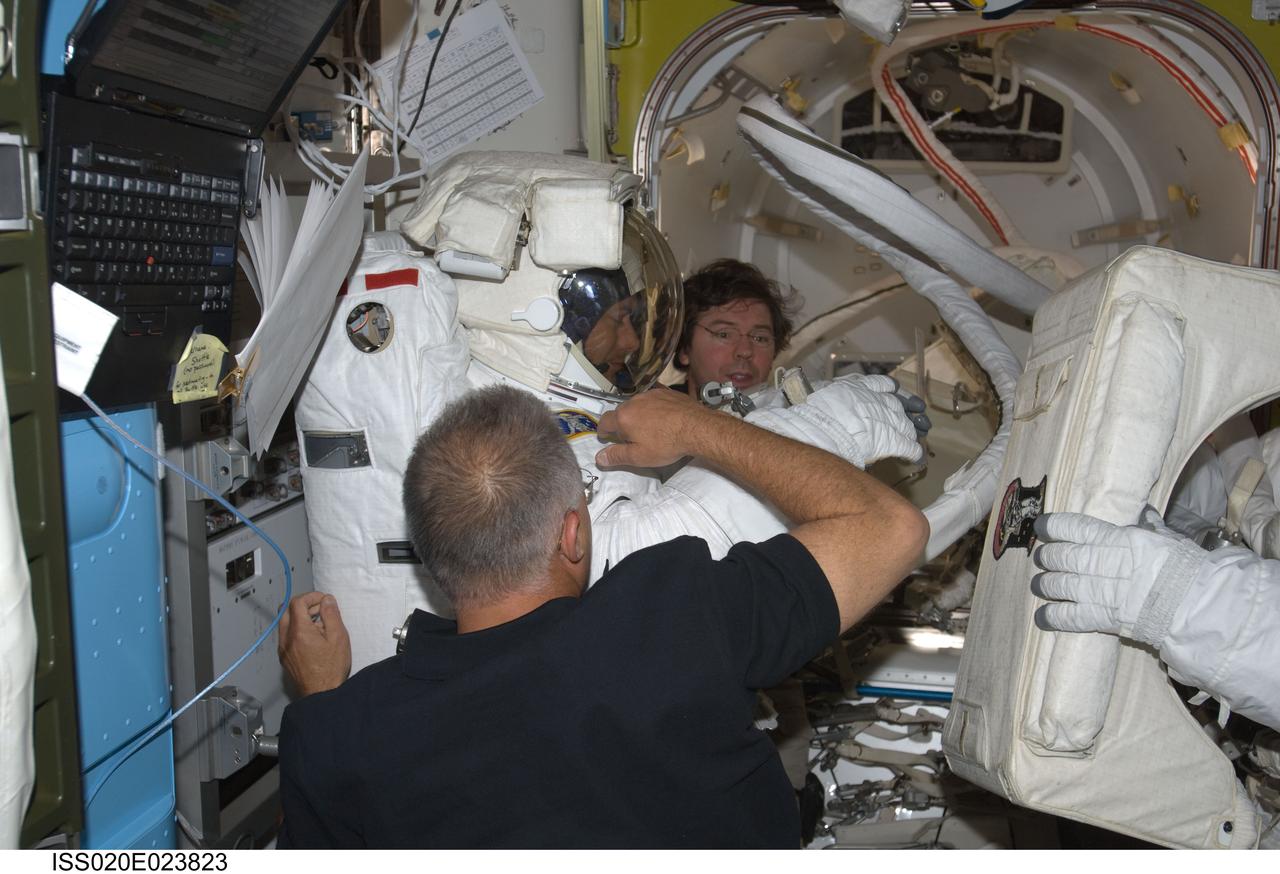
ISS020-E-023823 (24 July 2009) --- Astronauts Dave Wolf (foreground with back to camera) and Mike Barratt assist astronaut Tom Marshburn with his extravehicular mobility unit spacesuit in the joint airlock, while astronaut Christopher Cassidy (almost out of frame at right) gets ready to join him. Marshburn and Cassidy were about to participate in the July 24 flight day 10 spacewalk. They are scheduled to wrap up the EVA work with a fifth overall session on July 27. The three STS-127 mission specialists and station flight engineer are part of a 13-member aggregation of astronauts and cosmonauts currently onboard the orbital outpost while its crew of six plays host to Endeavour's crew of seven.
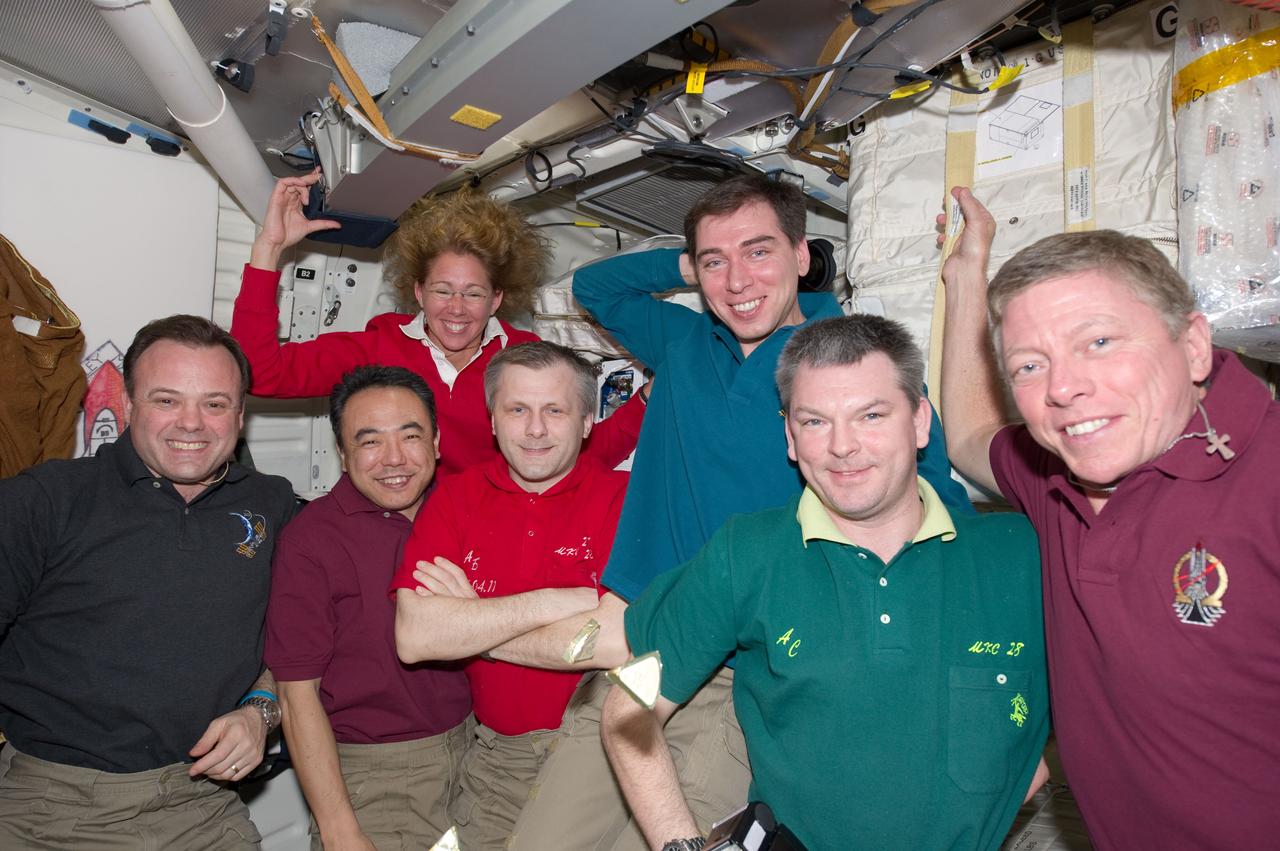
S135-E-007815 (14 July 2011) --- Part of an aggregate of seven astronauts ? six from NASA and one from the Japan Aerospace Exploration Agency (JAXA) ? and three Russian cosmonauts prepares to participate on July 14, 2011 in a special meal on the Space Shuttle Atlantis' middeck. One of the final meals shared between shuttle and station crews has been called ?The All-American Meal.? The STS-135 crew consists of NASA astronauts Chris Ferguson, Doug Hurley, Sandy Magnus and Rex Walheim; the Expedition 28 or station crew members are JAXA astronaut Satoshi Furukawa, NASA astronauts Ron Garan and Mike Fossum, and Russian cosmonauts Andrey Borisenko, Alexander Samokutyaev and Sergei Volkov. Not in this frame are Ferguson, Walheim and Hurley. Photo credit: NASA
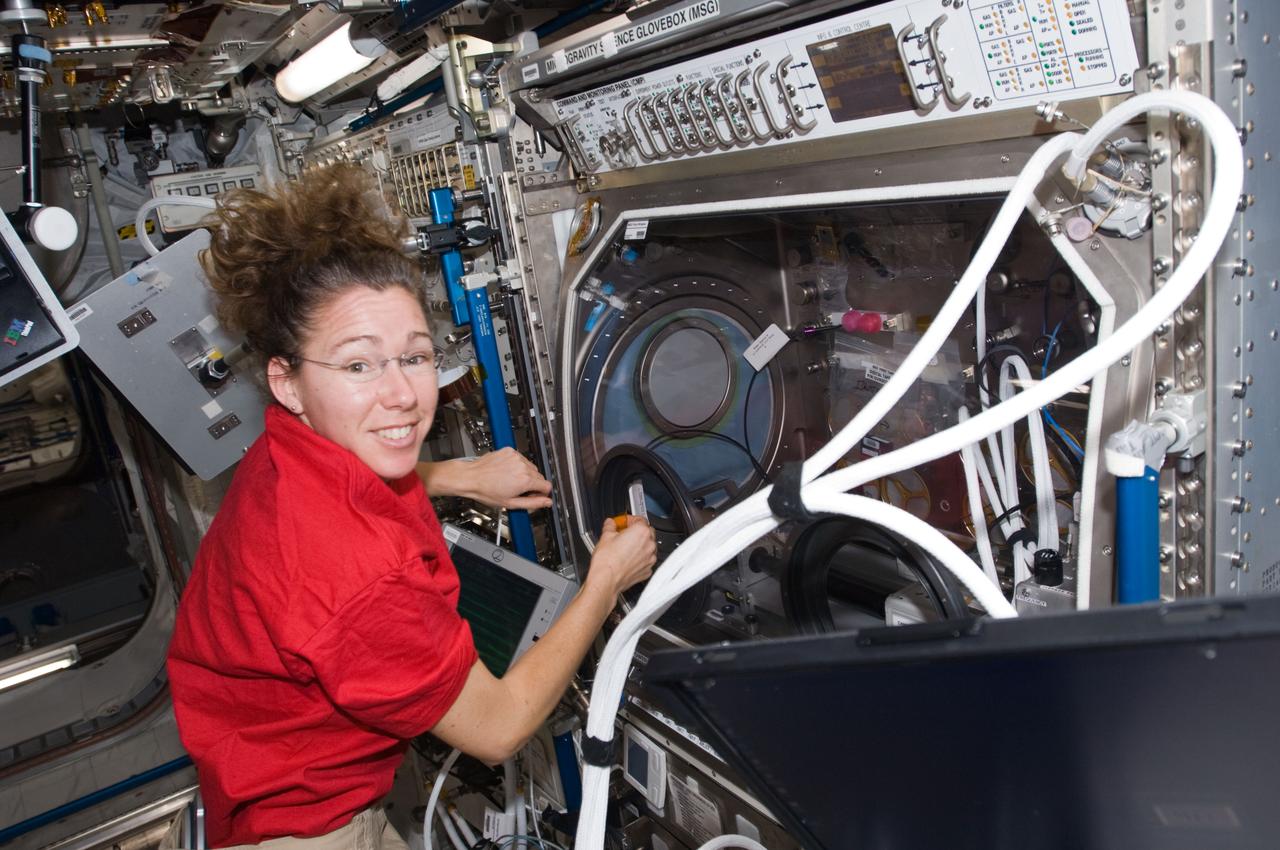
ISS018-E-024515 (30 Jan. 2009) --- Astronaut Sandra Magnus, Expedition 18 flight engineer, works with the Microgravity Science Glovebox (MSG) in the Columbus laboratory of the International Space Station.
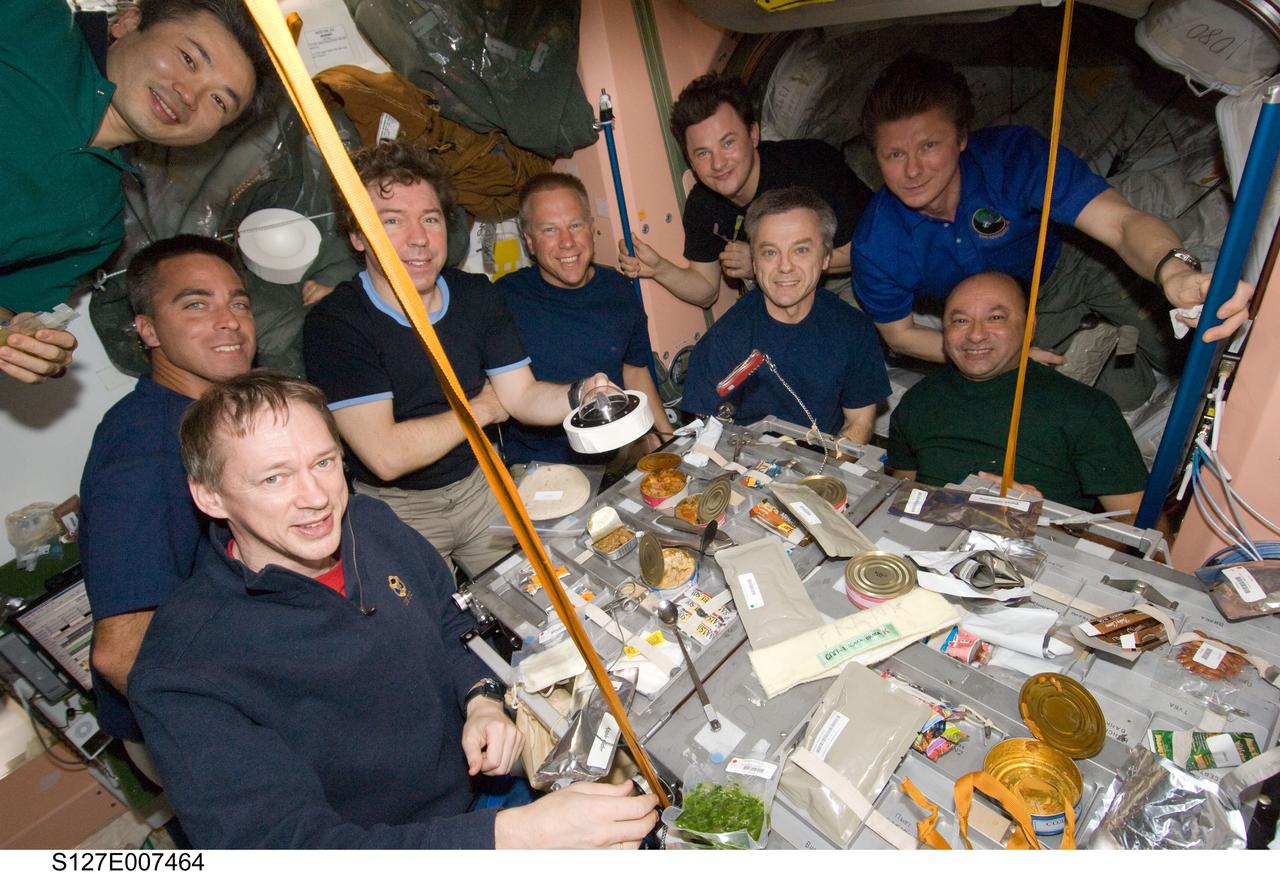
S127-E-007464 (21 July 2009) --- Nine of a total aggregation of 13 astronauts and cosmonauts are pictured at meal time aboard the International Space Station. Seated at the table, clockwise from bottom left, are European Space Agency astronaut Frank De Winne, astronaut Christopher Cassidy, along with astronauts Mike Barratt and Tim Kopra and Canadian Space Agency astronaut Robert Thirsk and astronaut Mark Polansky. From left to right at top are Japanese Aerospace Exploration Agency astronaut Koichi Wakata and Russian Federal Space Agency cosmonauts Roman Romanenko and Gennady Padalka. Not pictured are astronauts Tom Marshburn, Dave Wolf and Doug Hurley, plus Canadian Space Agency astronaut Julie Payette. Barratt is holding a display version of an Apollo 11 lunar sample that had earlier been taken up by a shuttle mission (STS-119) to be onboard the orbital outpost at the time of the current observance of the first moon landing's 40th anniversary. Seven astronauts left Kennedy Space Center one week ago aboard the Space Shuttle Endeavour to join up with the six Expedition 20 crew members on the space station to continue work on it. The space fliers have completed two of five scheduled spacewalks up to this point.
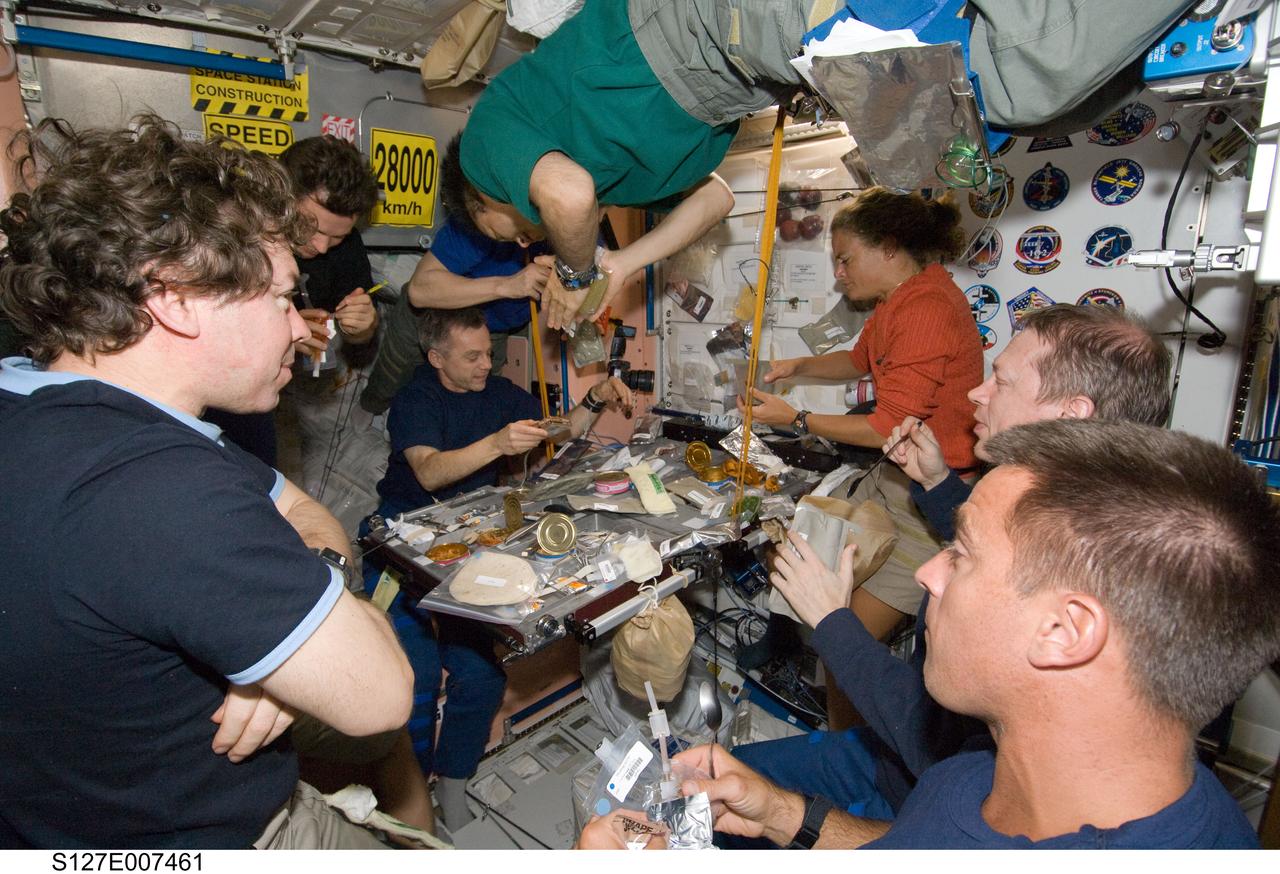
S127-E-007461 (21 July 2009) --- Eight of a total aggregation of 13 astronauts and cosmonauts are pictured at meal time aboard the International Space Station. Pictured, clockwise from bottom right, are astronauts Christopher Cassidy and Mike Barratt, with Russian Federal Space Agency cosmonaut Roman Romanenko, an unidentified crew member, Japanese Aerospace Exploration Agency astronaut Koichi Wakata (floating above), Canadian Space Agency astronauts Robert Thirsk and Julie Payette, European Space Agency astronaut Frank De Winne, and astronaut Christopher Cassidy. Either out of frame or not clearly seen are astronauts Mark Polansky, Doug Hurley, Dave Wolf, Tim Kopra and Tom Marshburn, plus Russian Federal Space Agency cosmonaut Gennady Padalka. Seven astronauts left Kennedy Space Center one week ago aboard the Space Shuttle Endeavour to join up with the six Expedition 20 crew members on the orbital outpost to continue work on it. The space fliers have completed two of five scheduled spacewalks up to this point.
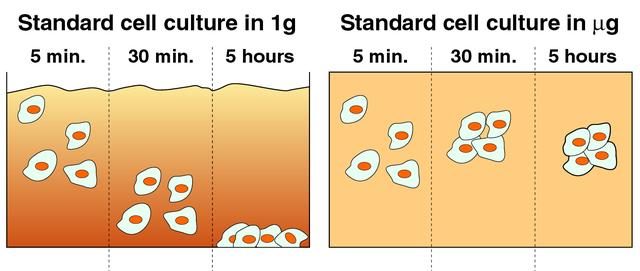
Cells cultured on Earth (left) typically settle quickly on the bottom of culture vessels due to gravity. In microgravity (right), cells remain suspended and aggregate to form three-dimensional tissue. The NASA Bioreactor provides a low turbulence culture environment which promotes the formation of large, three-dimensional cell clusters. The Bioreactor is rotated to provide gentle mixing of fresh and spent nutrient without inducing shear forces that would damage the cells. Due to their high level of cellular organization and specialization, samples constructed in the bioreactor more closely resemble the original tumor or tissue found in the body. The work is sponsored by NASA's Office of Biological and Physical Research. The bioreactor is managed by the Biotechnology Cell Science Program at NASA's Johnson Space Center (JSC). NASA-sponsored bioreactor research has been instrumental in helping scientists to better understand normal and cancerous tissue development. In cooperation with the medical community, the bioreactor design is being used to prepare better models of human colon, prostate, breast and ovarian tumors. Cartilage, bone marrow, heart muscle, skeletal muscle, pancreatic islet cells, liver and kidney are just a few of the normal tissues being cultured in rotating bioreactors by investigators.
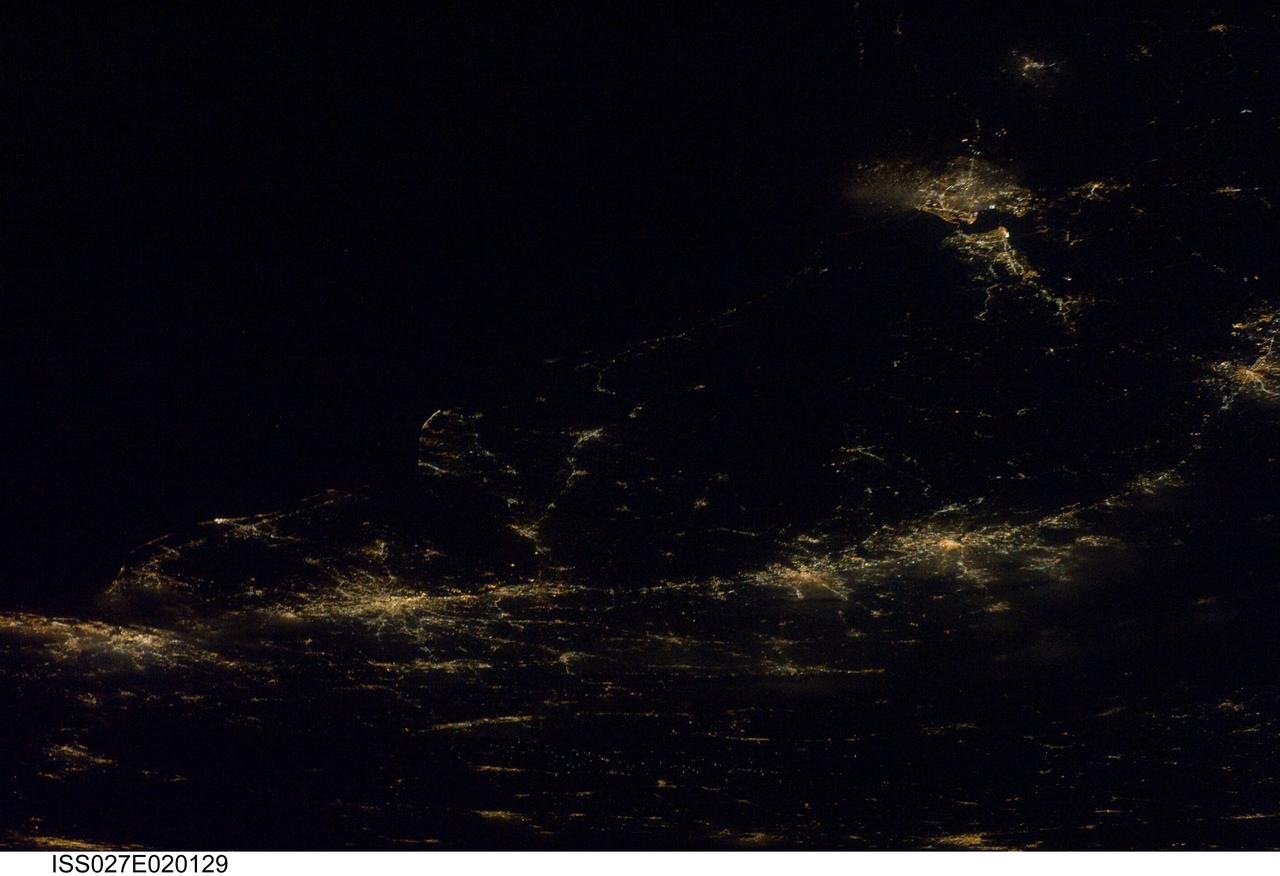
ISS027-E-020129 (6 April 2011) --- A night time view of the Atlantic Seaboard Conurbation, United States of America, is featured in this image photographed by an Expedition 27 crew member on the International Space Station. As regional metropolitan areas expand in both physical area and population, they typically aggregate to form economically, politically, and to some extent socially linked entities known as conurbations – the term “megalopolis” has also been used. One of the largest conurbations in the world is located along the eastern coastline of the United States, and has been termed the Atlantic Seaboard Conurbation (ASC). The ASC extends over 1,000 kilometers and includes the major economic, governmental, and cultural centers of Boston, Mass.; New York, N.Y.; Philadelphia, Pa.; Baltimore, Md.; and Washington, D.C. This photograph includes every metropolitan area in the ASC except for Boston, Mass. (located off the image to the northeast of New York, N.Y.). The image was taken during “local night”, which highlights the position and extent of each metropolitan area along the eastern seaboard by their urban lighting patterns. The establishment and growth of the conurbation was facilitated by transportation networks (railroads, highways, and air travel routes) for transfer of goods, materials, and population between the metropolitan areas. Two other large metropolitan areas are visible in the image – Norfolk, Va. and Richmond, Va. at upper right – but these are not considered to be part of the ASC. In contrast to the city lights that mark metropolitan areas and smaller communities along the sea coast and interior, the Atlantic Ocean appears as a featureless dark region occupying the upper left quarter of the image.
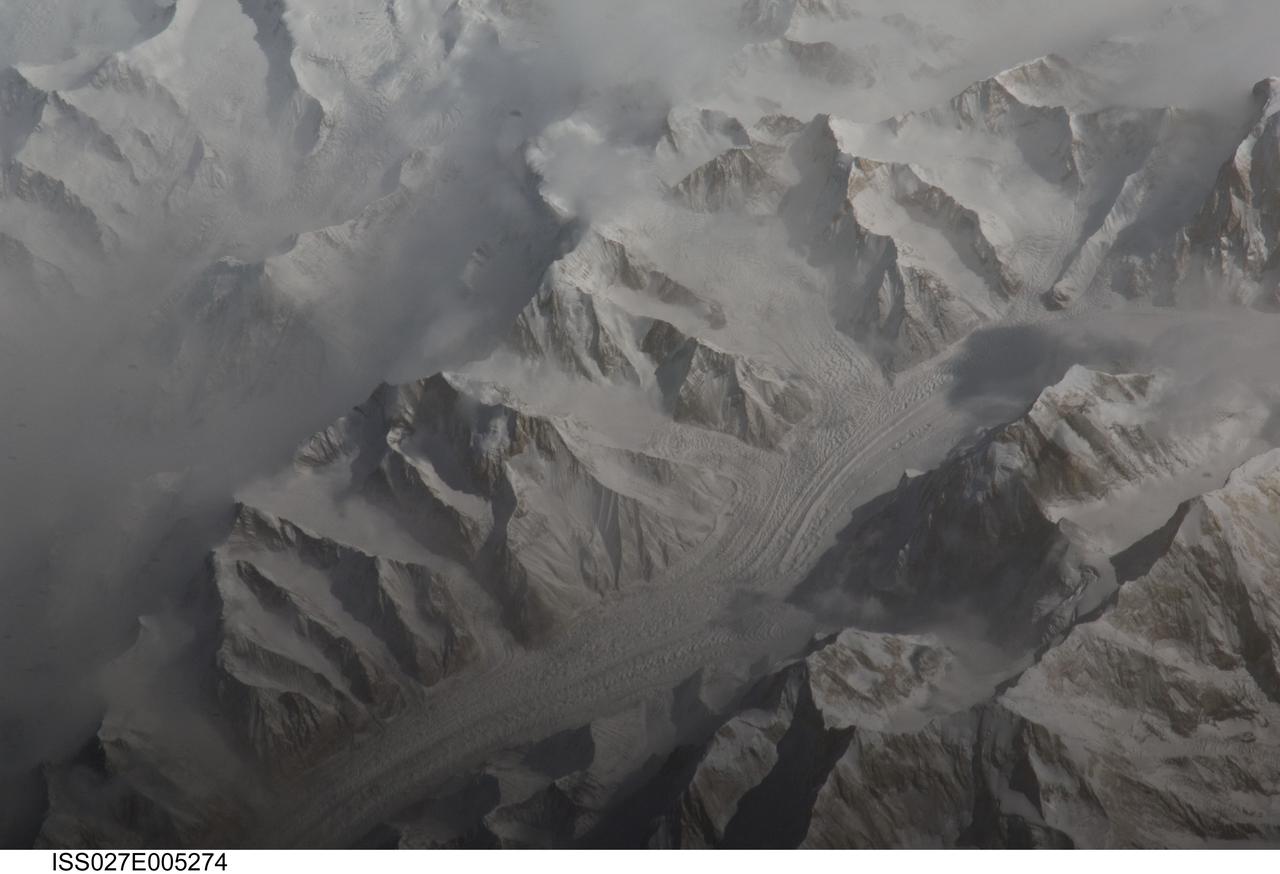
ISS027-E-005274 (16 March 2011) --- Central Tien Shan in the People?s Republic of China is featured in this image photographed by an Expedition 27 crew member on the International Space Station (ISS). The Tien Shan (or ?celestial mountains? in Chinese) is one of the largest continuous mountain ranges in the world, extending approximately 2,500 kilometers roughly east-west across Central Asia. This photograph provides a detailed view of part of the central Tien Shan, located approximately 64 kilometers east of a point where the borders of China, Kyrgyzstan, and Kazakhstan meet. While the image looks like it might have been taken from an airplane, it was taken from the space station at an altitude of 341 kilometers. The distance between the ISS ground track position (approximately 304 kilometers to the southwest) and the imaged area produces an oblique ? looking outwards an angle, rather than straight down ? view that, together with shadowing of valleys, accentuates the mountainous topography. Like the Himalayas to the south, the uplift of the Tien Shan results from the ongoing collision between the Eurasian and Indian continental tectonic plates. The rugged topography of the range is the result of subsequent erosion by water, wind, and in the highest parts of the range, active glaciers. Two types of glaciers are visible in the image; cirque glaciers occupy amphitheater-like depressions on the upper slopes of the mountains, and feed ice downslope to aggregate into large valley glaciers such as the one visible at center. Low clouds obscure an adjacent valley and glaciers to the north (upper left). Two high peaks of the central Tien Shan are identifiable in the image. Xuelian Feng has a high summit of 6,527 meters above sea level. To the east, the aptly-named Peak 6231 has summit of 6,231 meters above sea level.