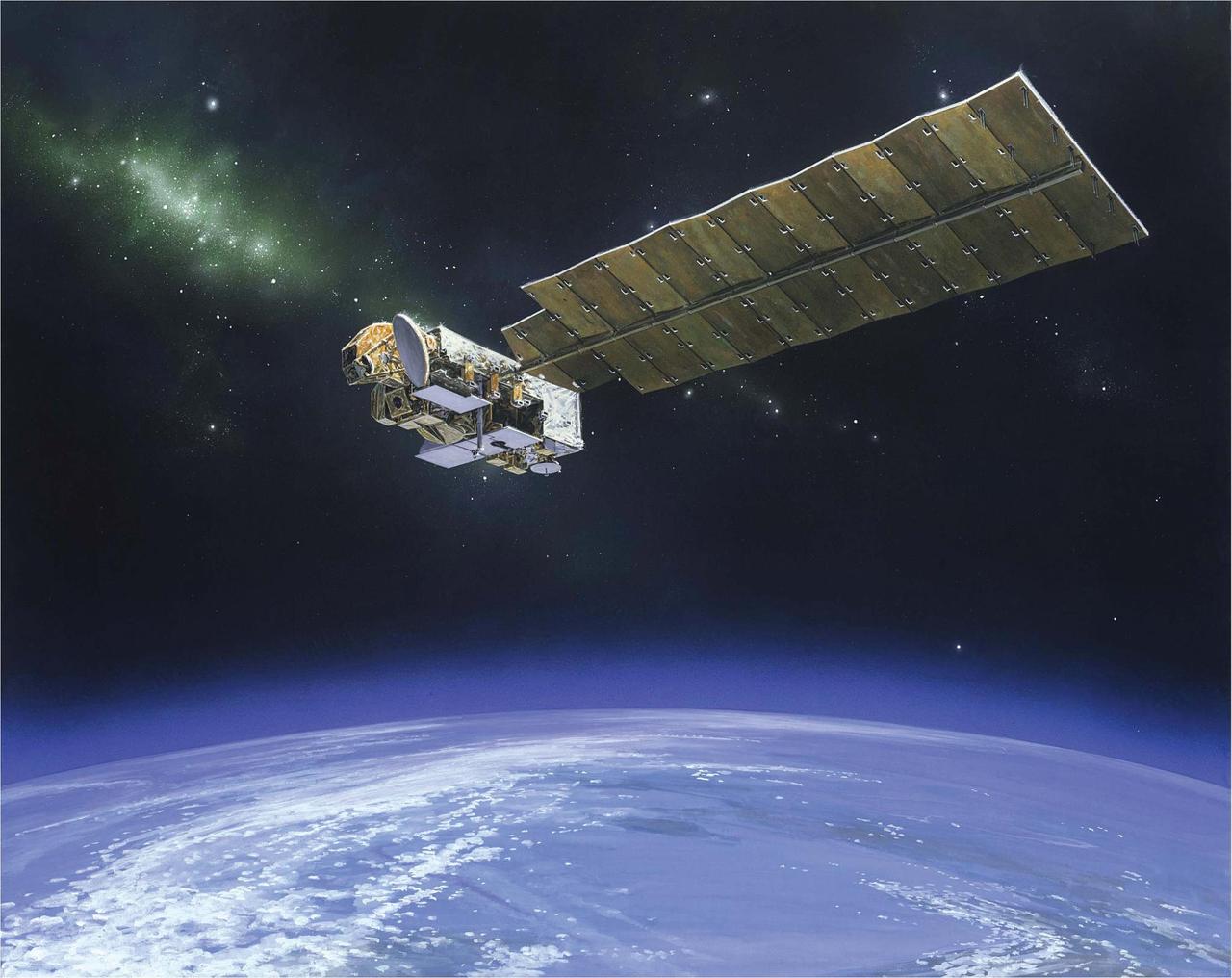
The Aura spacecraft is NASA atmospheric chemistry mission that is monitoring the Earth protective atmosphere.
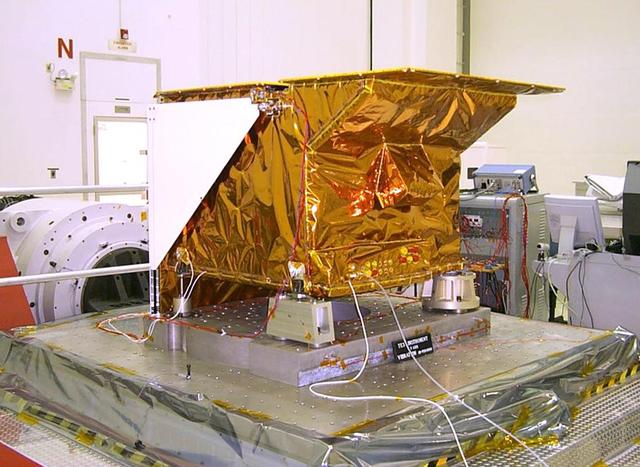
Technicians install NASA's Tropospheric Emission Spectrometer (TES) instrument on NASA's Aura spacecraft prior to launch. Launched in July 2004 and designed to fly for two years, the TES mission is currently in an extended operations phase. Mission managers at NASA's Jet Propulsion Laboratory, Pasadena, California, are evaluating an alternate way to collect and process science data from the Tropospheric Emission Spectrometer (TES) instrument on NASA's Aura spacecraft following the age-related failure of a critical instrument component. TES is an infrared sensor designed to study Earth's troposphere, the lowermost layer of Earth's atmosphere, which is where we live. The remainder of the TES instrument, and the Aura spacecraft itself, are operating as expected, and TES continues to collect science data. TES is one of four instruments on Aura, three of which are still operating. http://photojournal.jpl.nasa.gov/catalog/PIA15608

NASA Aura spacecraft sees El Niño effects on the atmosphere. An El Niño is characterized by an abnormal warming of sea surface temperatures in the equatorial central and eastern Pacific Ocean.
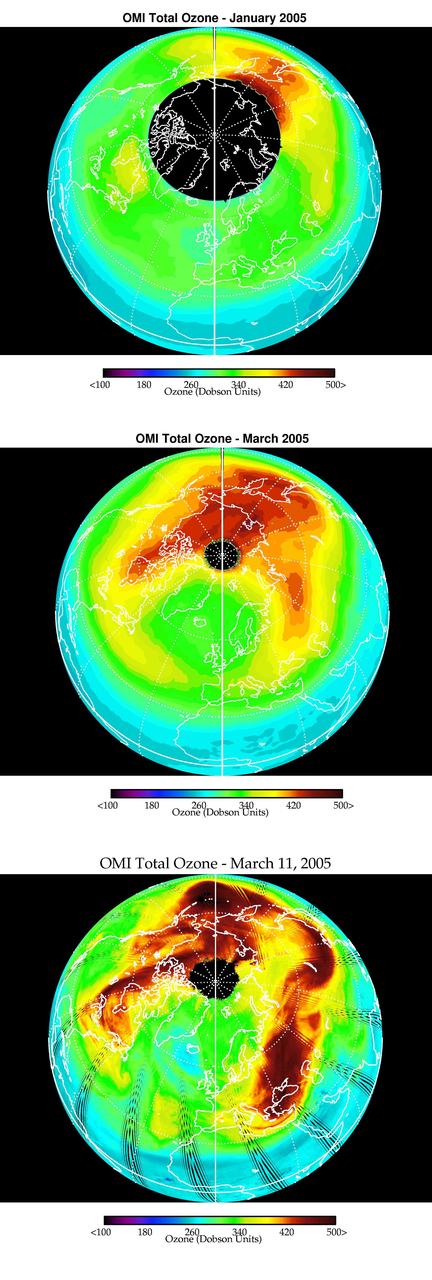
Images from the Ozone Monitoring Instrument onboard NASA Aura spacecraft shows the average total column ozone during the months of January and March, and the total column ozone on the single day of 11 March, 2005.
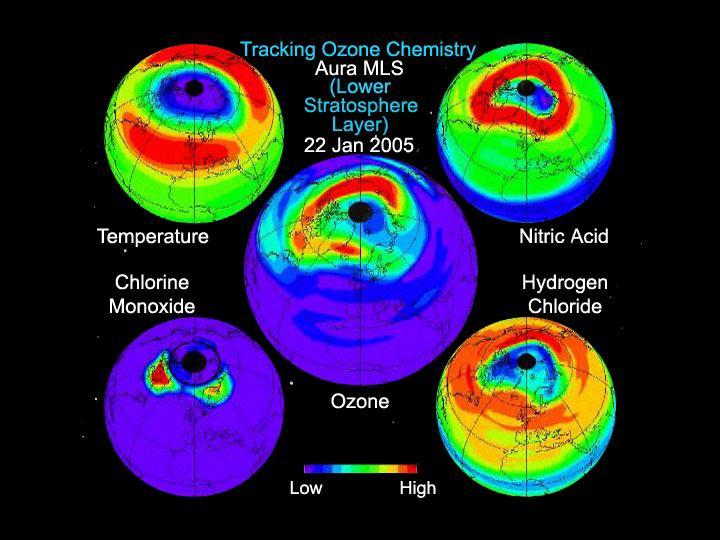
This still from an animation created from data from the Microwave Limb Sounder instrument on NASA Aura spacecraft depicts the complex interaction of chemicals involved in the destruction of ozone during the 2005 Arctic winter.
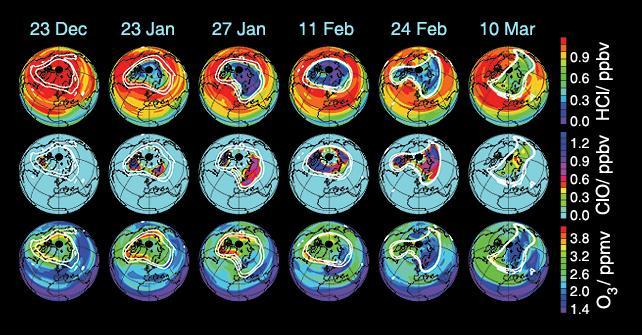
These data maps from the Microwave Limb Sounder on NASA Aura spacecraft depict levels of hydrogen chloride, chlorine monoxide, and ozone at an altitude of approximately 19 km 490,000 ft on selected days during the 2004-05 Arctic winter.

This vertical profile view from the Tropospheric Emission Spectrometer TES instrument on NASA Aura satellite depicts the distribution of water vapor molecules over Earth tropics across one transect of the satellite orbit on January 6, 2006.
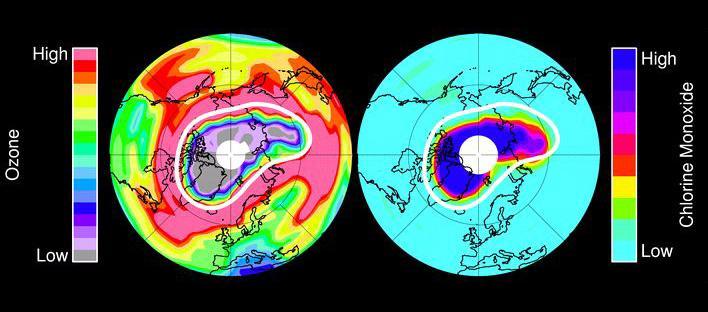
In mid-March 2011, NASA Aura spacecraft observed ozone in Earth stratosphere -- low ozone amounts are shown in purple and grey colors, large amounts of chlorine monoxide are shown in dark blue colors.
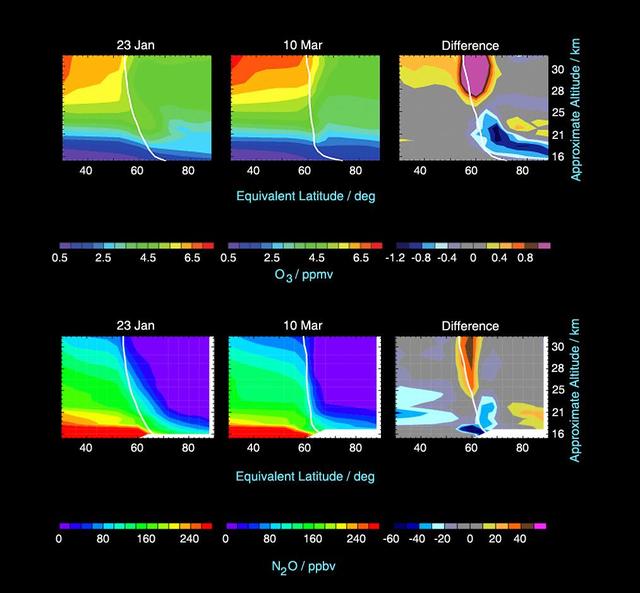
This image from the Microwave Limb Sounder instrument on NASA Aura spacecraft depicts the relationship between nitrous oxide levels and ozone loss, 2004-2005 Arctic winter.
![KENNEDY SPACE CENTER, FLA. - - With rockets and main engine firing, the Boeing Delta II launch vehicle leaps off the pad at NASA’s Space Complex 2 on Vandenberg Air Force Base, Calif., carrying the Aura spacecraft. Aura, a mission dedicated to the health of Earth's atmosphere, successfully launched today at 3:01:59 a.m. Pacific Time. Spacecraft separation occurred at 4:06 a.m. Pacific Time, inserting Aura into a 438-mile orbit. NASA’s latest Earth-observing satellite, Aura will help us understand and protect the air we breathe. Aura will also help scientists understand how the composition of the atmosphere affects and responds to Earth's changing climate. The results from this mission will help scientists better understand the processes that connect local and global air quality. With the launch of Aura, the first series of NASA’s Earth Observing System satellites is complete. The other satellites are Terra, which monitors land, and Aqua, which observes Earth’s water cycle. [Photo: Boeing/Thom Baur]](https://images-assets.nasa.gov/image/KSC-04pd1475/KSC-04pd1475~medium.jpg)
KENNEDY SPACE CENTER, FLA. - - With rockets and main engine firing, the Boeing Delta II launch vehicle leaps off the pad at NASA’s Space Complex 2 on Vandenberg Air Force Base, Calif., carrying the Aura spacecraft. Aura, a mission dedicated to the health of Earth's atmosphere, successfully launched today at 3:01:59 a.m. Pacific Time. Spacecraft separation occurred at 4:06 a.m. Pacific Time, inserting Aura into a 438-mile orbit. NASA’s latest Earth-observing satellite, Aura will help us understand and protect the air we breathe. Aura will also help scientists understand how the composition of the atmosphere affects and responds to Earth's changing climate. The results from this mission will help scientists better understand the processes that connect local and global air quality. With the launch of Aura, the first series of NASA’s Earth Observing System satellites is complete. The other satellites are Terra, which monitors land, and Aqua, which observes Earth’s water cycle. [Photo: Boeing/Thom Baur]

Matt Mountain, president of AURA, speaks about the history of the Hubble Space Telescope’s partnerships during an event titled “Beyond the Deep Field: Hubble’s Legacy and the Future of Cosmic Observation,” Friday, June 5, 2026, at the Mary W. Jackson NASA Headquarters building in Washington. Photo Credit: (NASA/Aubrey Gemignani)

Matt Mountain, president of AURA, speaks about the history of the Hubble Space Telescope’s partnerships during an event titled “Beyond the Deep Field: Hubble’s Legacy and the Future of Cosmic Observation,” Friday, June 5, 2026, at the Mary W. Jackson NASA Headquarters building in Washington. Photo Credit: (NASA/Aubrey Gemignani)
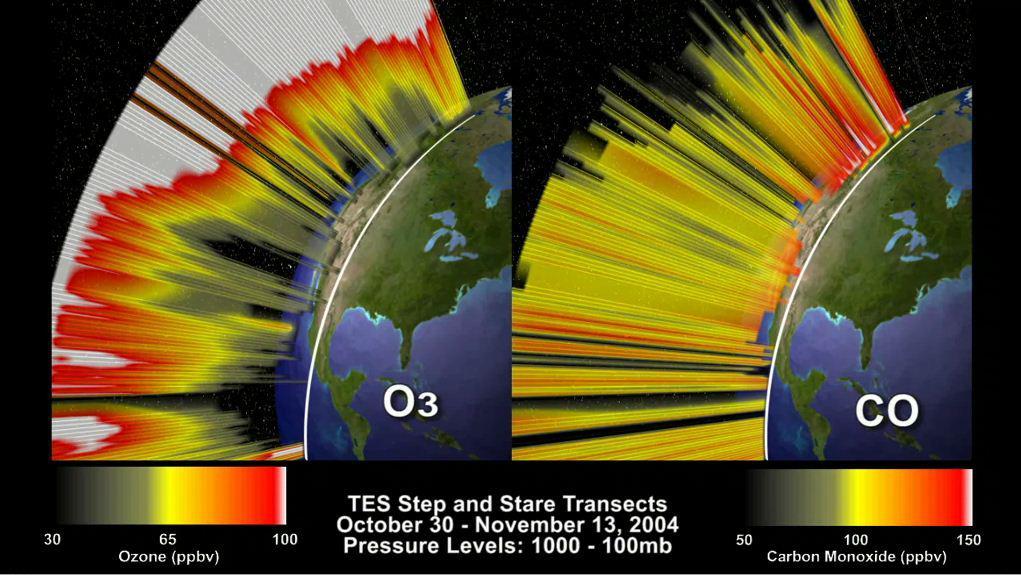
This frame from an animation depicts the distribution of O3 and CO in the atmosphere over North America. This visualization is based on data acquired by NASA Tropospheric Emission Spectrometer TES.
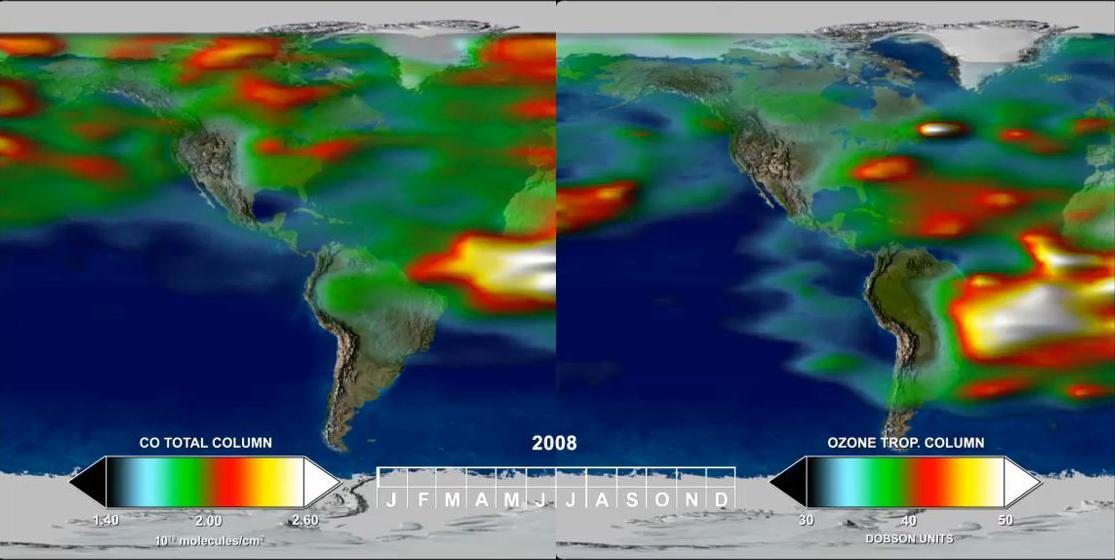
This frame from a time series, from one year of Tropospheric Emission Spectrometer TES measurements, shows how powerful the TES data are for understanding emissions, chemistry, and transport in the troposphere.
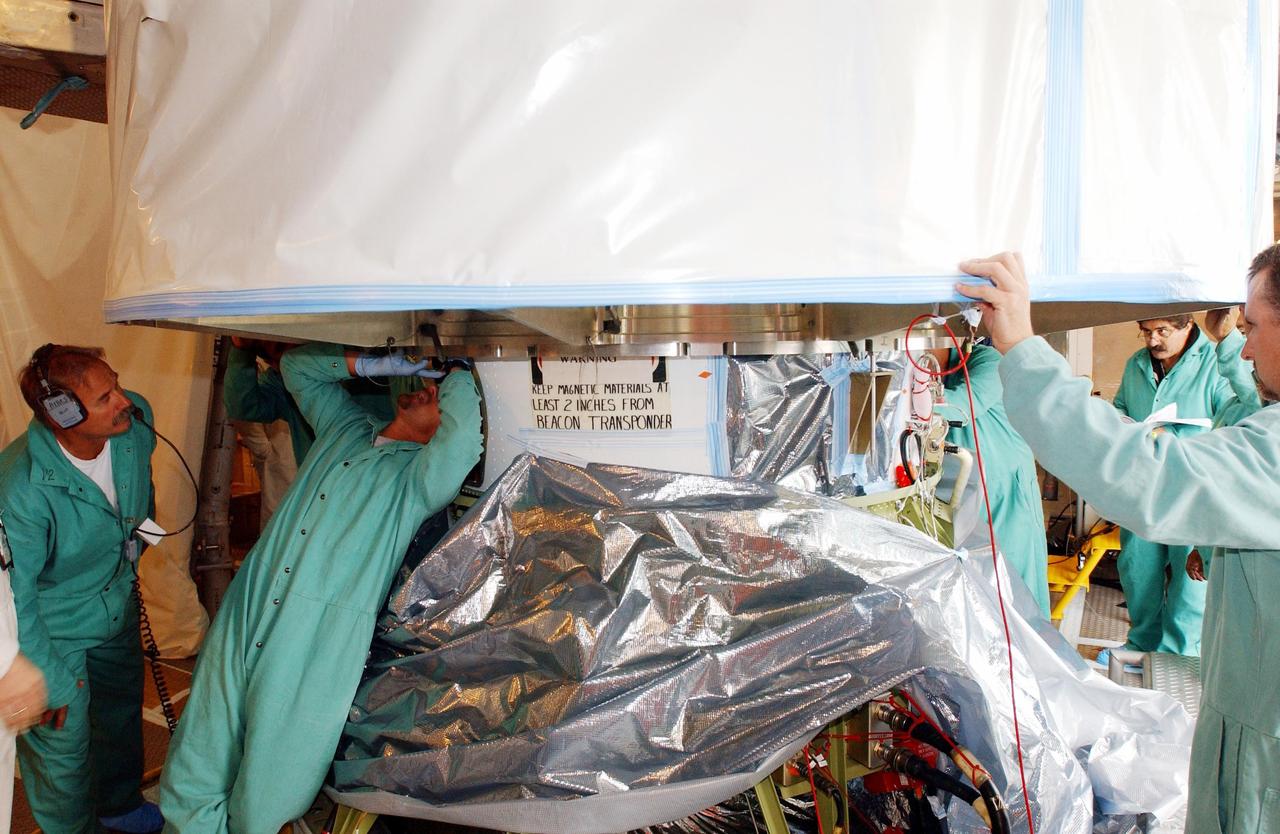
KENNEDY SPACE CENTER, FLA. - Workers on the mobile service tower, or gantry, at Space Launch Complex 2 on North Vandenberg Air Force Base, Calif., check connections as the protective cover is lifted off the Aura spacecraft. Aura will be mated to the second stage of the Boeing Delta II rocket before the fairing is installed. The latest in the Earth Observing System (EOS) series, Aura is scheduled to launch July 10. Aura’s four state-of-the-art instruments will study the dynamics of chemistry occurring in the atmosphere. The spacecraft will provide data to help scientists better understand the Earth’s ozone, air quality and climate change.
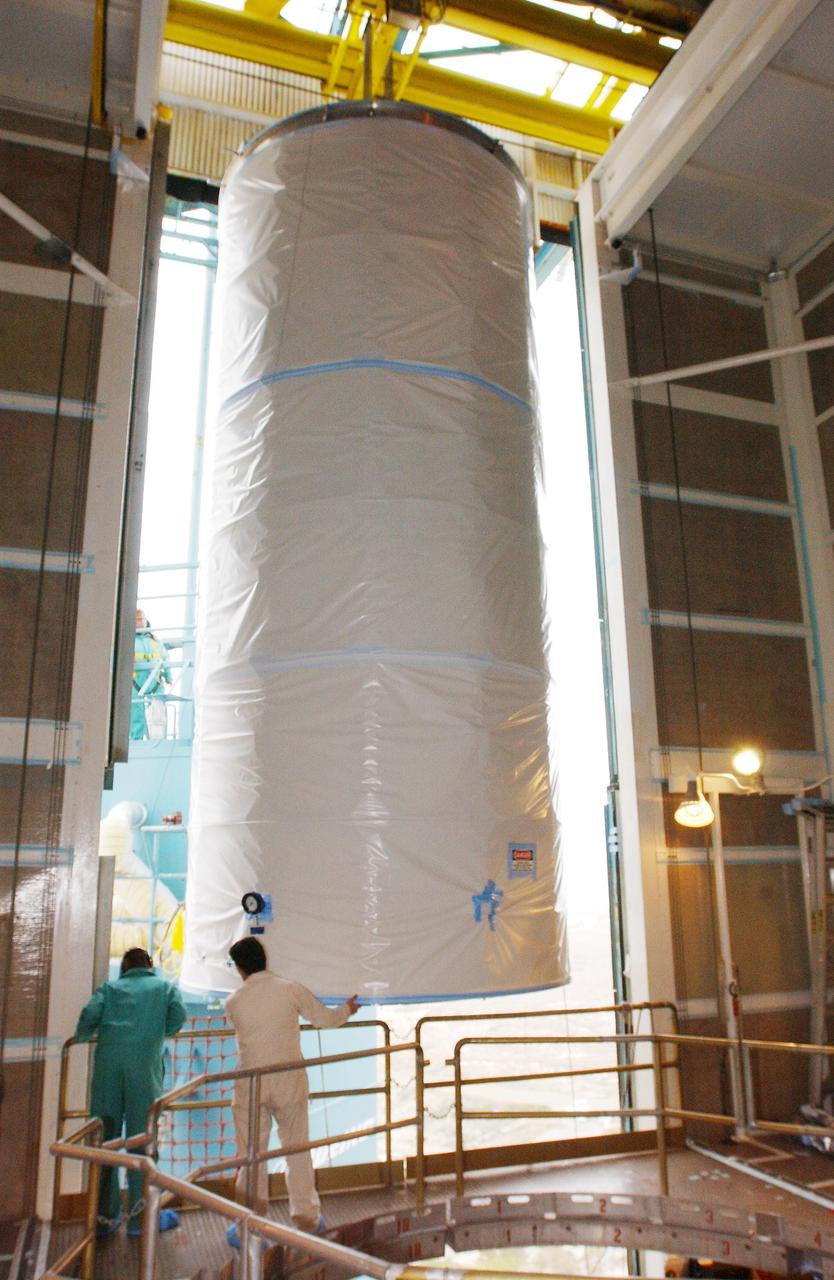
KENNEDY SPACE CENTER, FLA. - At Space Launch Complex 2 on North Vandenberg Air Force Base, Calif., the Aura spacecraft arrives at the top of the mobile service tower, or gantry. It will be moved and then mated with the second stage of the Boeing Delta II rocket. The latest in the Earth Observing System (EOS) series, Aura is scheduled to launch July 10. Aura’s four state-of-the-art instruments will study the dynamics of chemistry occurring in the atmosphere. The spacecraft will provide data to help scientists better understand the Earth’s ozone, air quality and climate change.
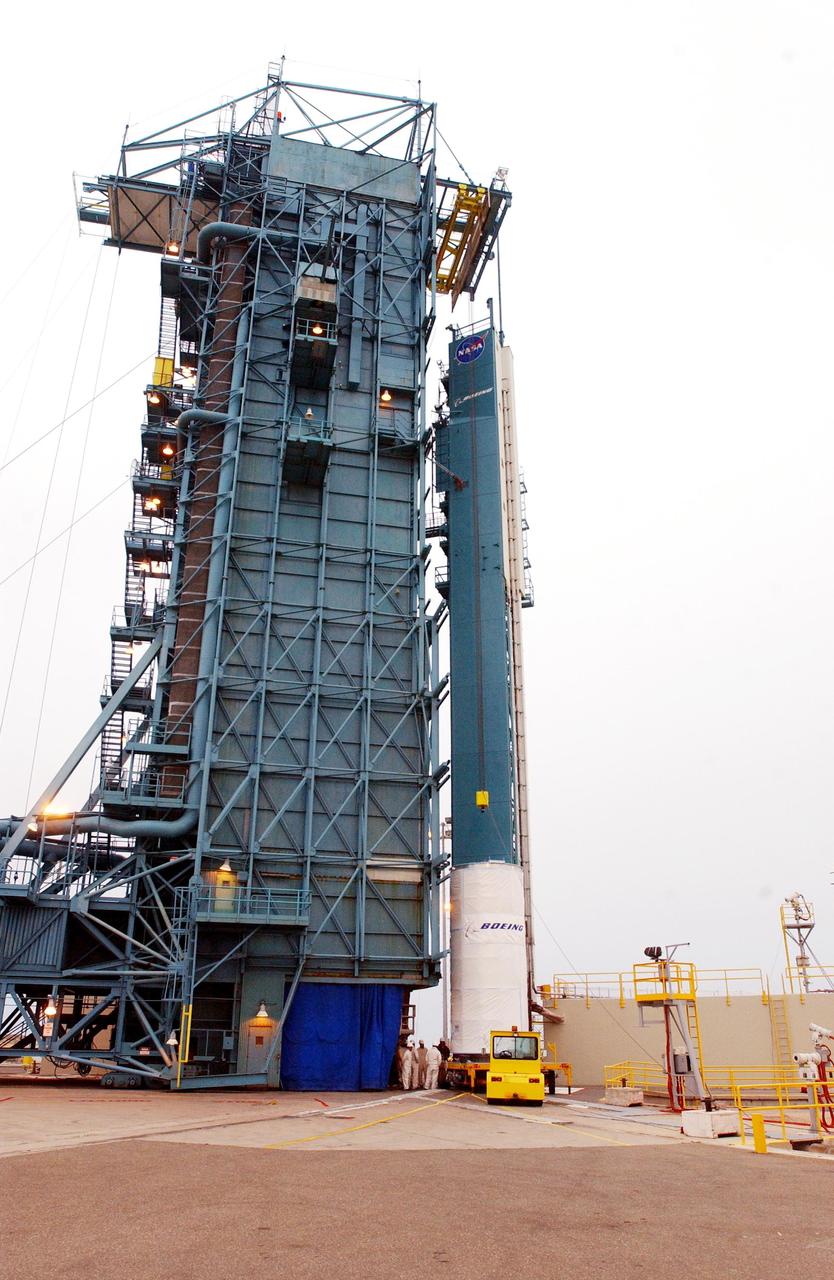
KENNEDY SPACE CENTER, FLA. - At Space Launch Complex 2 on North Vandenberg Air Force Base, Calif., the Aura spacecraft arrives at the base of the mobile service tower, or gantry. The latest in the Earth Observing System (EOS) series, Aura is scheduled to launch July 10 aboard the Boeing Delta II rocket. Aura’s four state-of-the-art instruments will study the dynamics of chemistry occurring in the atmosphere. The spacecraft will provide data to help scientists better understand the Earth’s ozone, air quality and climate change.
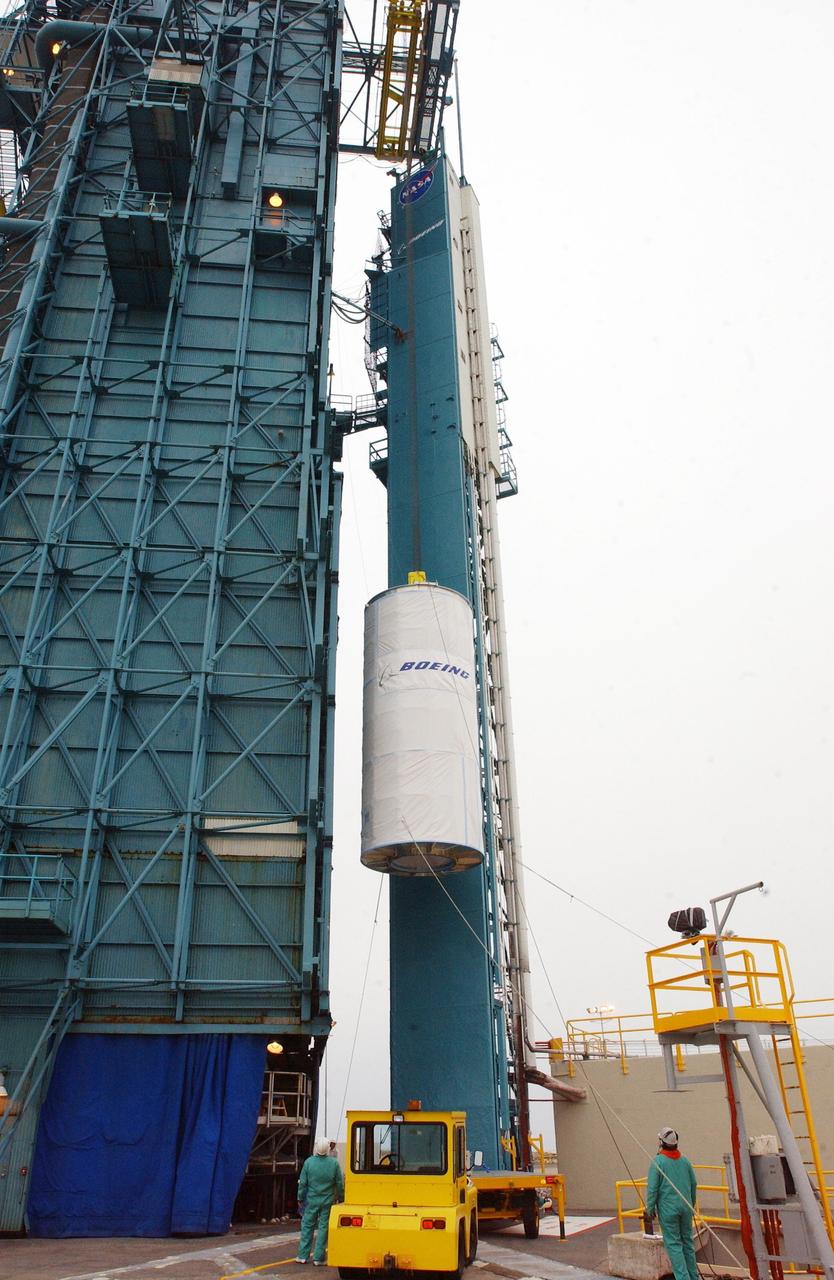
KENNEDY SPACE CENTER, FLA. - At Space Launch Complex 2 on North Vandenberg Air Force Base, Calif., the Aura spacecraft is lifted up the mobile service tower, or gantry. The latest in the Earth Observing System (EOS) series, Aura is scheduled to launch July 10 aboard the Boeing Delta II rocket. Aura’s four state-of-the-art instruments will study the dynamics of chemistry occurring in the atmosphere. The spacecraft will provide data to help scientists better understand the Earth’s ozone, air quality and climate change.
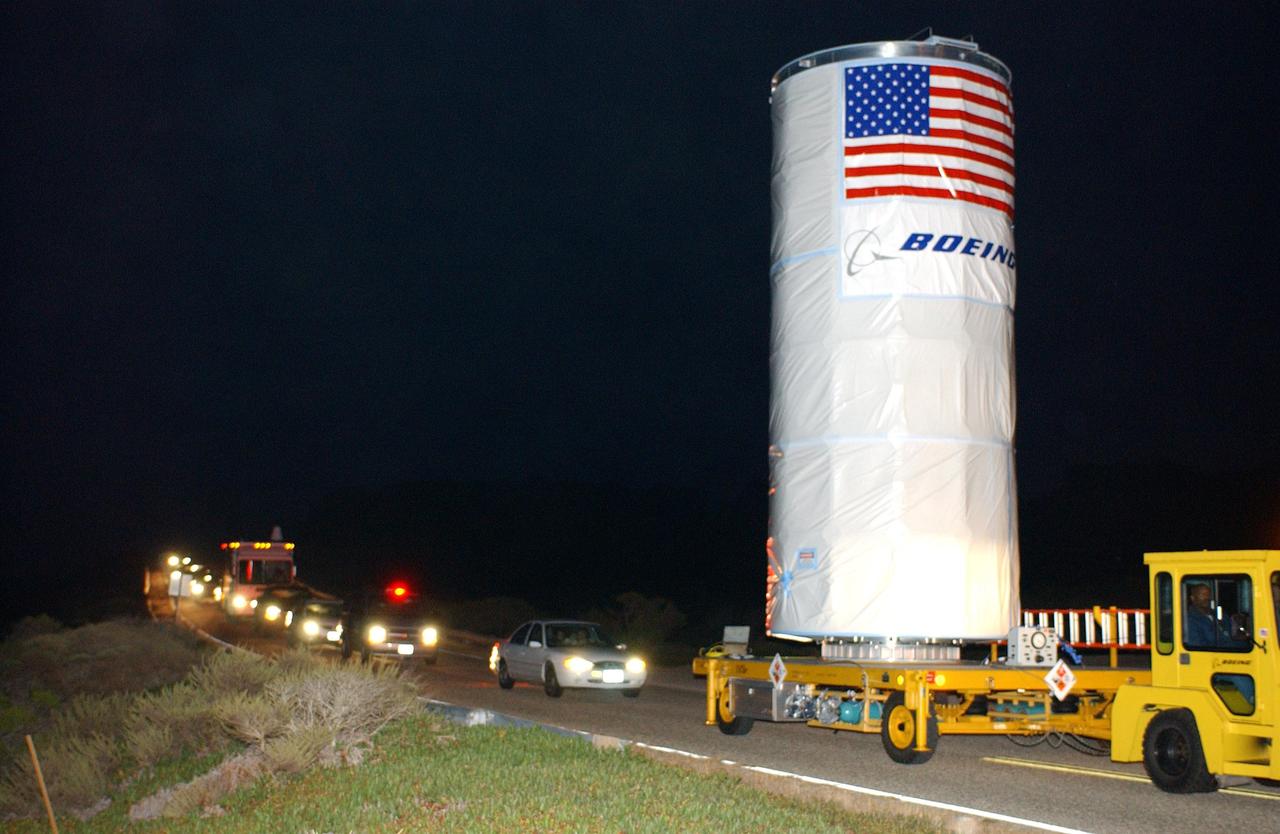
KENNEDY SPACE CENTER, FLA. - The Aura spacecraft on a transporter heads a convoy of vehicles in the predawn hours as it moves to Space Launch Complex 2 on North Vandenberg Air Force Base, Calif. The latest in the Earth Observing System (EOS) series, Aura is scheduled to launch July 10 aboard a Boeing Delta II rocket. Aura’s four state-of-the-art instruments will study the dynamics of chemistry occurring in the atmosphere. The spacecraft will provide data to help scientists better understand the Earth’s ozone, air quality and climate change.
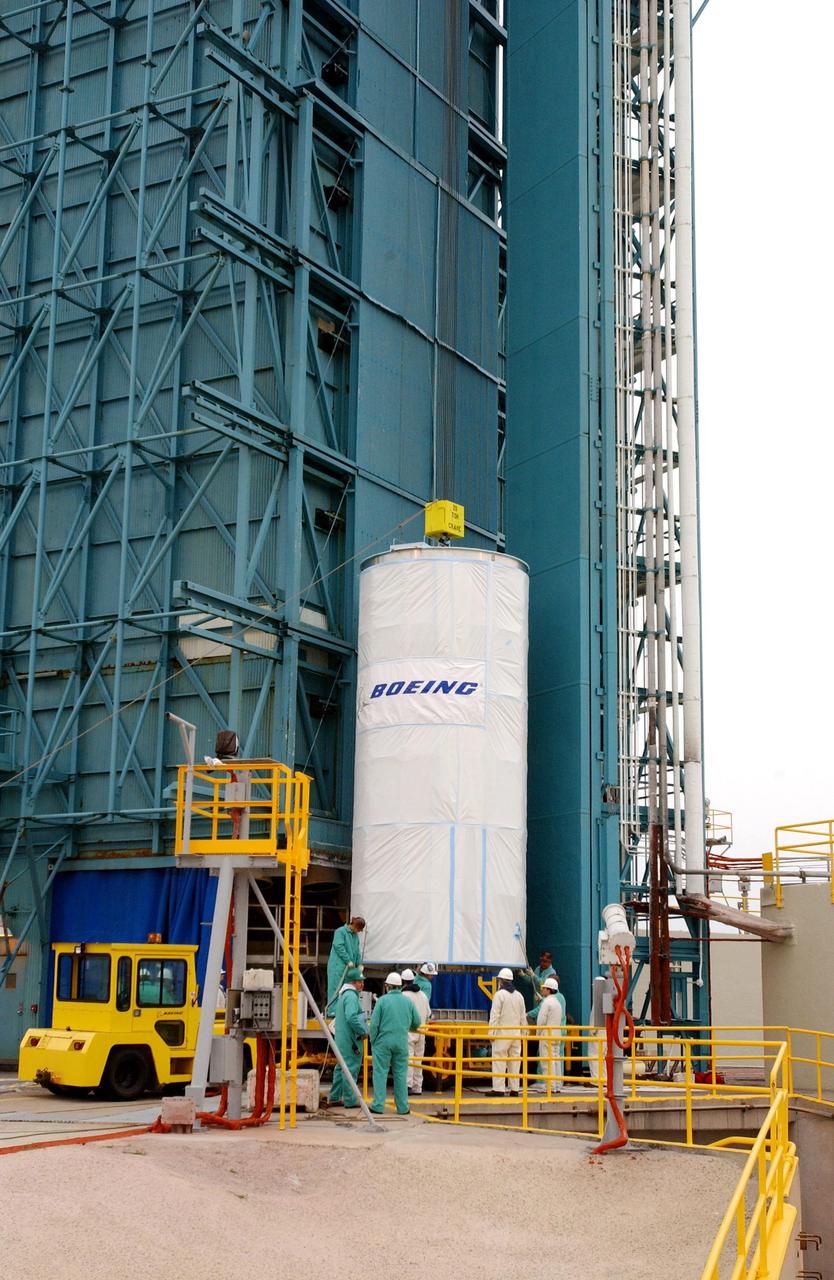
KENNEDY SPACE CENTER, FLA. - At Space Launch Complex 2 on North Vandenberg Air Force Base, Calif., the Aura spacecraft is prepared for its lift up the mobile service tower, or gantry. The latest in the Earth Observing System (EOS) series, Aura is scheduled to launch July 10 aboard the Boeing Delta II rocket. Aura’s four state-of-the-art instruments will study the dynamics of chemistry occurring in the atmosphere. The spacecraft will provide data to help scientists better understand the Earth’s ozone, air quality and climate change.
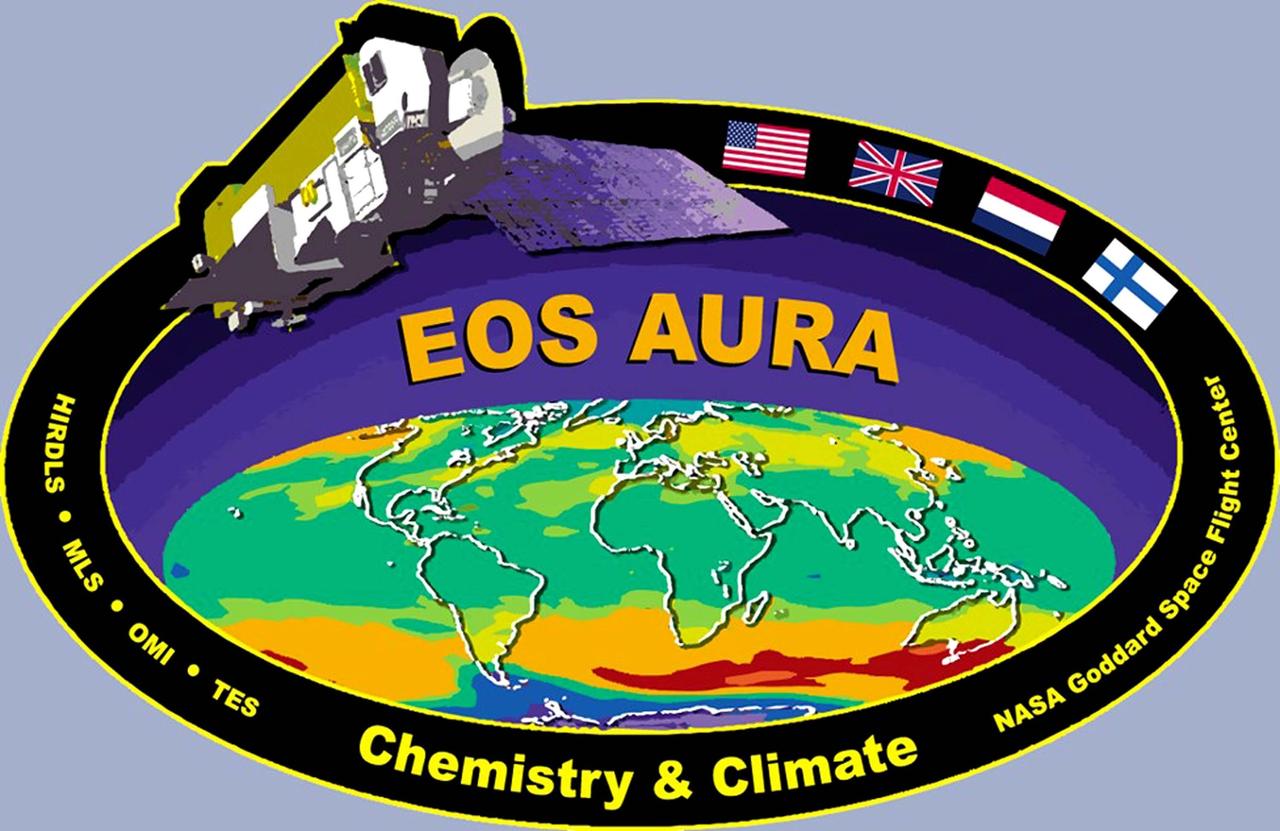
KENNEDY SPACE CENTER, FLA. -- EOS Aura: The Aura mission will study air quality, climate and stratospheric ozone depletion. Aura is the third of NASA’s major Earth Observing System (EOS) orbital platforms and has four instruments. The Microwave Limb Sounder (MLS) and the High Resolution Dynamics Limb Sounder (HIRDLS) will make complementary measurements of stratospheric ozone and the chemicals that destroy it. HIRDELS and MLS will also measure upper tropospheric water vapor and ozone - key gases that regulate climate. The Aura payload also includes the Tropospheric Emission Spectrometer (TES), which will make the first global measurements of lower atmospheric ozone, and the Ozone Monitoring Instrument (OMI), which will measure the total amount of atmospheric ozone as well as lower atmospheric dust, smoke and other aerosols. Aura is scheduled to launch in 2004. The flags on the decals represent the countries participating in the mission: United States, United Kingdom, Netherlands and Finland. The EOS Aura mission is being managed by NASA’s Goddard Space Flight Center.
![KENNEDY SPACE CENTER, FLA. - With rockets and main engine firing, the Boeing Delta II launch vehicle leaps off the pad at NASA’s Space Complex 2 on Vandenberg Air Force Base, Calif., carrying the Aura spacecraft. Aura, a mission dedicated to the health of Earth's atmosphere, successfully launched today at 3:01:59 a.m. Pacific Time. Spacecraft separation occurred at 4:06 a.m. Pacific Time, inserting Aura into a 438-mile orbit. NASA’s latest Earth-observing satellite, Aura will help us understand and protect the air we breathe. Aura will also help scientists understand how the composition of the atmosphere affects and responds to Earth's changing climate. The results from this mission will help scientists better understand the processes that connect local and global air quality. With the launch of Aura, the first series of NASA’s Earth Observing System satellites is complete. The other satellites are Terra, which monitors land, and Aqua, which observes Earth’s water cycle. [Photo: Boeing/Thom Baur]](https://images-assets.nasa.gov/image/KSC-04pd1474/KSC-04pd1474~medium.jpg)
KENNEDY SPACE CENTER, FLA. - With rockets and main engine firing, the Boeing Delta II launch vehicle leaps off the pad at NASA’s Space Complex 2 on Vandenberg Air Force Base, Calif., carrying the Aura spacecraft. Aura, a mission dedicated to the health of Earth's atmosphere, successfully launched today at 3:01:59 a.m. Pacific Time. Spacecraft separation occurred at 4:06 a.m. Pacific Time, inserting Aura into a 438-mile orbit. NASA’s latest Earth-observing satellite, Aura will help us understand and protect the air we breathe. Aura will also help scientists understand how the composition of the atmosphere affects and responds to Earth's changing climate. The results from this mission will help scientists better understand the processes that connect local and global air quality. With the launch of Aura, the first series of NASA’s Earth Observing System satellites is complete. The other satellites are Terra, which monitors land, and Aqua, which observes Earth’s water cycle. [Photo: Boeing/Thom Baur]
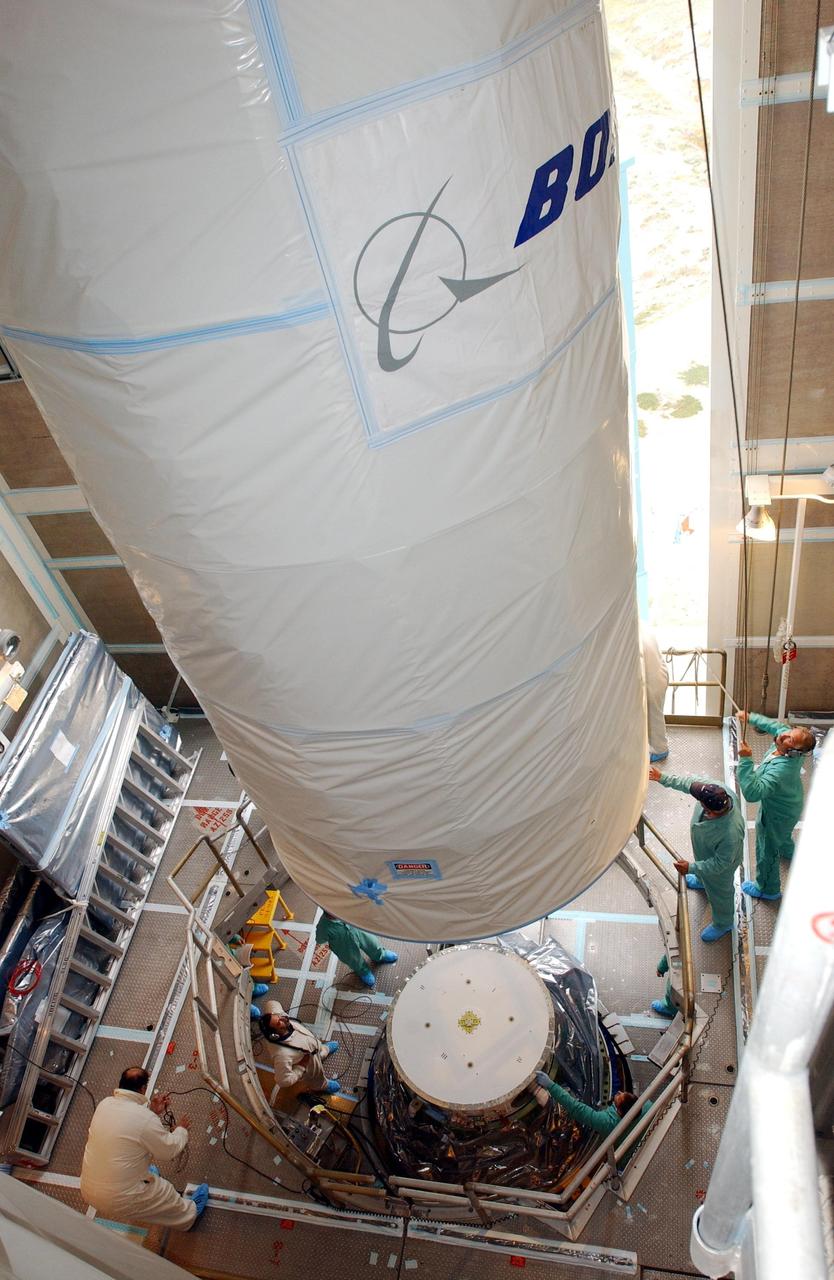
KENNEDY SPACE CENTER, FLA. - Inside the mobile service tower, or gantry, at Space Launch Complex 2 on North Vandenberg Air Force Base, Calif., the Aura spacecraft is maneuvered into position over the second stage of the Boeing Delta II rocket. After it is mated with the second stage, the fairing will be installed. The latest in the Earth Observing System (EOS) series, Aura is scheduled to launch July 10. Aura’s four state-of-the-art instruments will study the dynamics of chemistry occurring in the atmosphere. The spacecraft will provide data to help scientists better understand the Earth’s ozone, air quality and climate change.
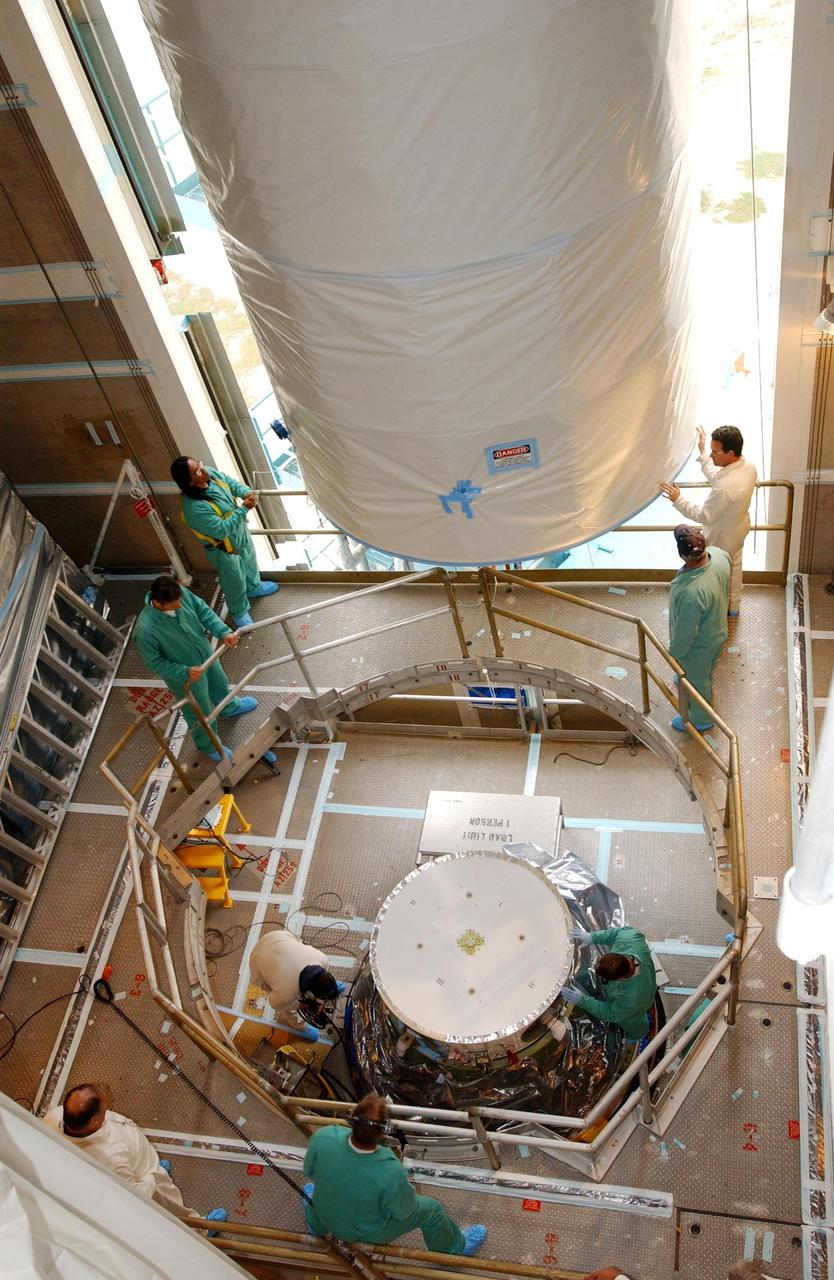
KENNEDY SPACE CENTER, FLA. - Inside the mobile service tower, or gantry, at Space Launch Complex 2 on North Vandenberg Air Force Base, Calif., workers help guide the Aura spacecraft toward the second stage of the Boeing Delta II rocket. After mating with the second stage, the fairing will be installed. The latest in the Earth Observing System (EOS) series, Aura is scheduled to launch July 10. Aura’s four state-of-the-art instruments will study the dynamics of chemistry occurring in the atmosphere. The spacecraft will provide data to help scientists better understand the Earth’s ozone, air quality and climate change.
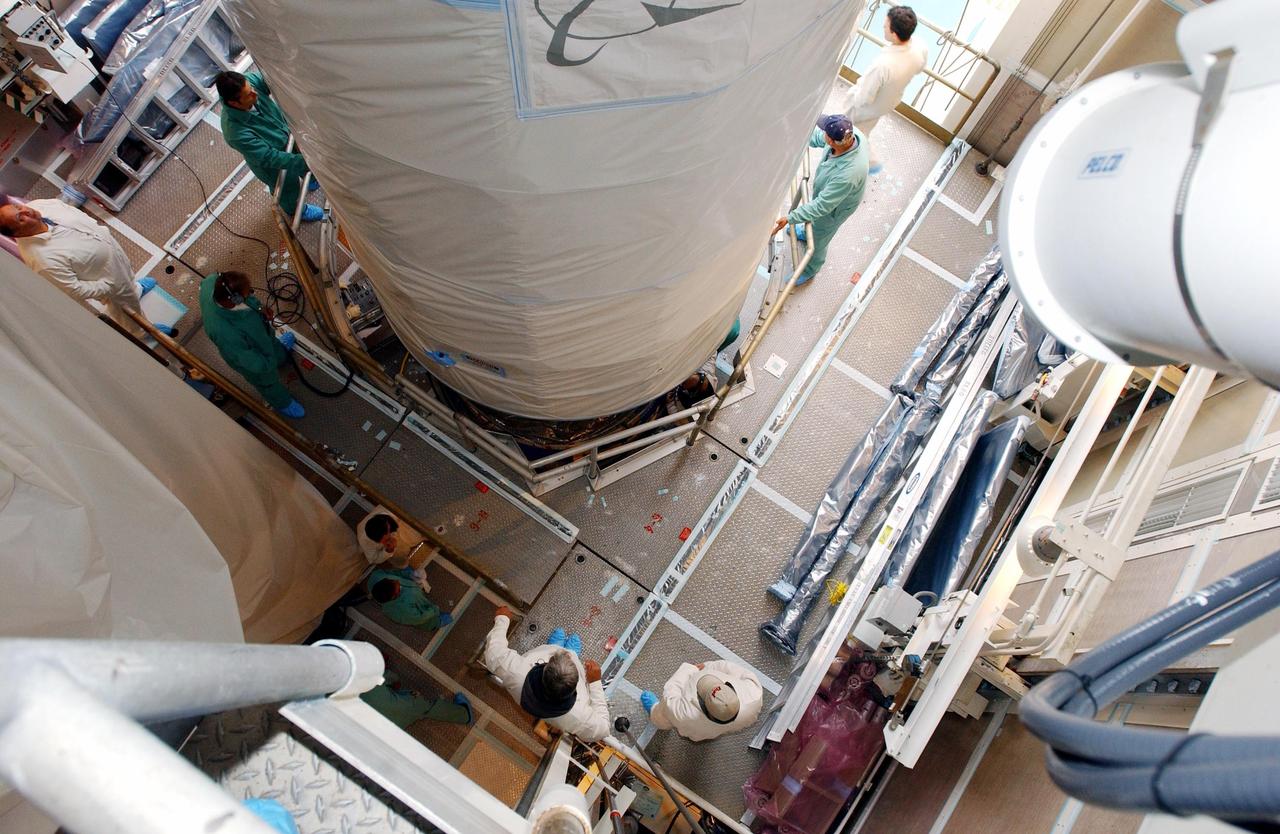
KENNEDY SPACE CENTER, FLA. - Inside the mobile service tower, or gantry, at Space Launch Complex 2 on North Vandenberg Air Force Base, Calif., the Aura spacecraft is lowered toward the second stage of the Boeing Delta II rocket. After it is mated with the second stage, the fairing will be installed. The latest in the Earth Observing System (EOS) series, Aura is scheduled to launch July 10. Aura’s four state-of-the-art instruments will study the dynamics of chemistry occurring in the atmosphere. The spacecraft will provide data to help scientists better understand the Earth’s ozone, air quality and climate change.
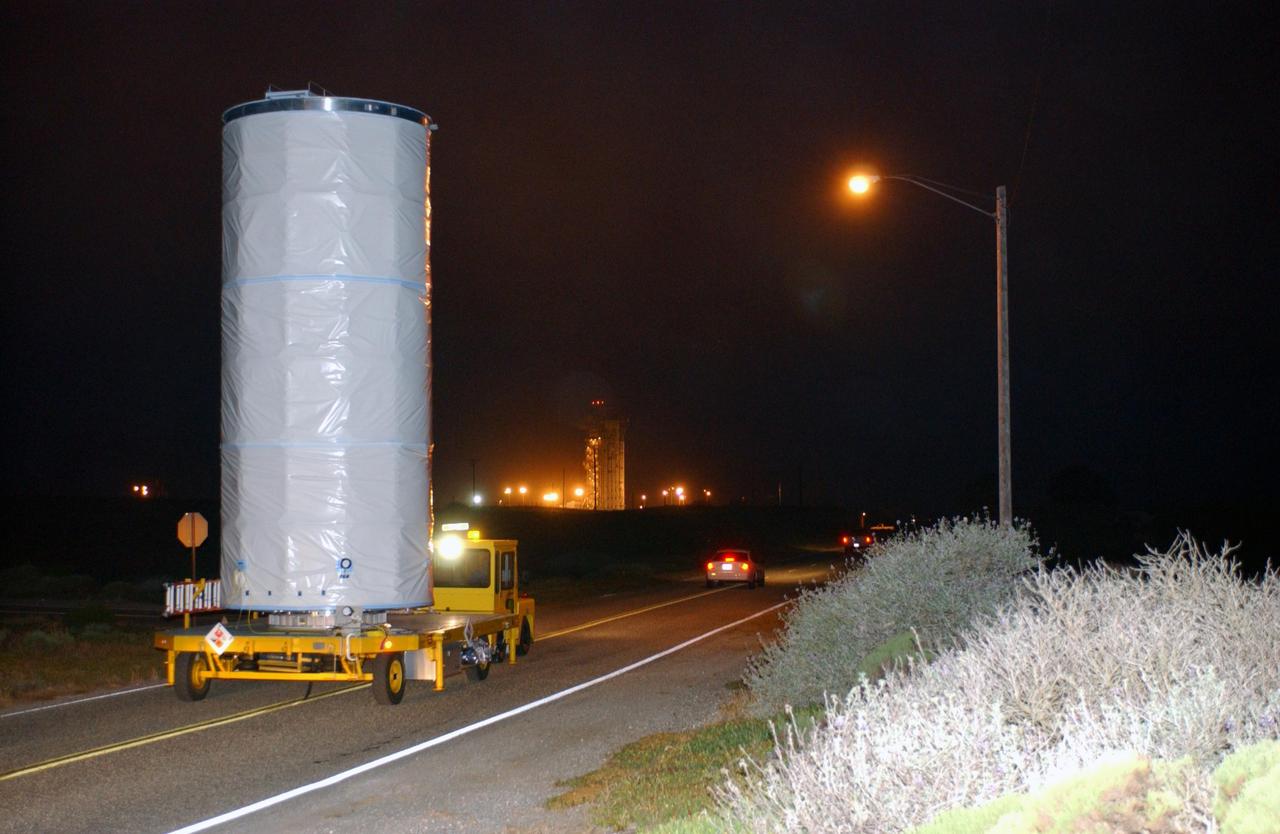
KENNEDY SPACE CENTER, FLA. - In the predawn hours, the Aura spacecraft is transported the short distance from the Astrotech payload processing facility to Space Launch Complex 2 on North Vandenberg Air Force Base, Calif. The latest in the Earth Observing System (EOS) series, Aura is scheduled to launch July 10 aboard a Boeing Delta II rocket. Aura’s four state-of-the-art instruments will study the dynamics of chemistry occurring in the atmosphere. The spacecraft will provide data to help scientists better understand the Earth’s ozone, air quality and climate change.
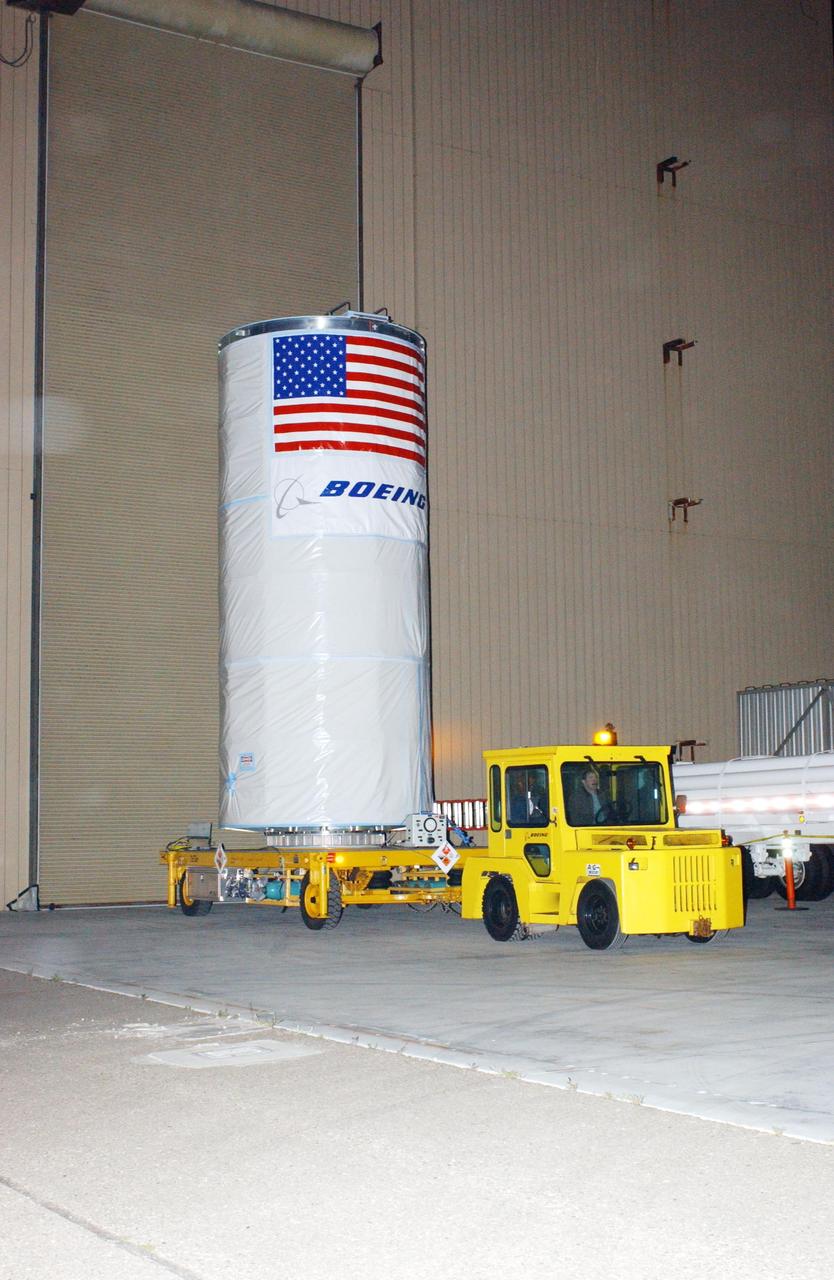
KENNEDY SPACE CENTER, FLA. - In the predawn hours, the Aura spacecraft is being transported from the Astrotech payload processing facility located a few miles south of Space Launch Complex 2 on North Vandenberg Air Force Base, Calif. The latest in the Earth Observing System (EOS) series, Aura is scheduled to launch July 10 aboard a Boeing Delta II rocket. Aura’s four state-of-the-art instruments will study the dynamics of chemistry occurring in the atmosphere. The spacecraft will provide data to help scientists better understand the Earth’s ozone, air quality and climate change.
![VANDENBERG AFB, CALIF. - The Aura spacecraft atop its Boeing Delta II launch vehicle sits on NASA’s Space Complex 2 at Vandenberg Air Force Base in California waiting to launch. Liftoff is now scheduled for no earlier than July 14. The latest in the Earth Observing System (EOS) series, Aura’s four state-of-the-art instruments will study the dynamics of chemistry occurring in the atmosphere. The spacecraft will provide data to help scientists better understand the Earth’s ozone, air quality and climate change. [Photo by Bill Ingalls/NASA]](https://images-assets.nasa.gov/image/KSC-04pd1469/KSC-04pd1469~medium.jpg)
VANDENBERG AFB, CALIF. - The Aura spacecraft atop its Boeing Delta II launch vehicle sits on NASA’s Space Complex 2 at Vandenberg Air Force Base in California waiting to launch. Liftoff is now scheduled for no earlier than July 14. The latest in the Earth Observing System (EOS) series, Aura’s four state-of-the-art instruments will study the dynamics of chemistry occurring in the atmosphere. The spacecraft will provide data to help scientists better understand the Earth’s ozone, air quality and climate change. [Photo by Bill Ingalls/NASA]
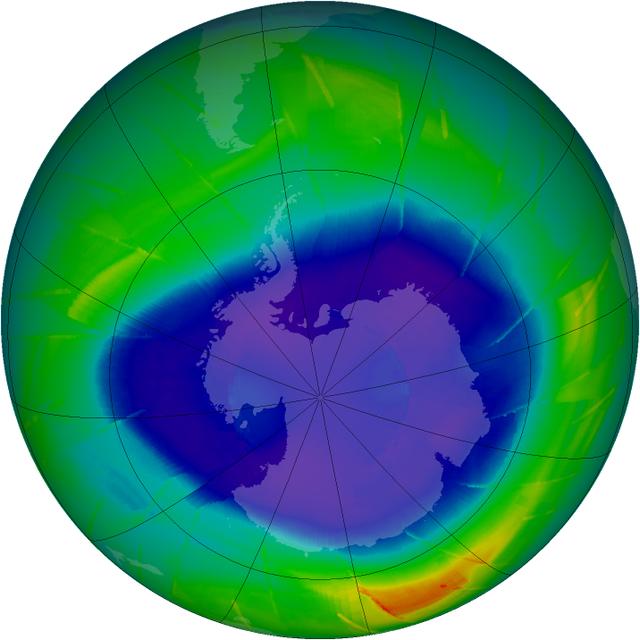
The annual ozone hole has started developing over the South Pole, and it appears that it will be comparable to ozone depletions over the past decade. This composite image from September 10 depicts ozone concentrations in Dobson units, with purple and blues depicting severe deficits of ozone. "We have observed the ozone hole again in 2009, and it appears to be pretty average so far," said ozone researcher Paul Newman of NASA's Goddard Space Flight Center in Greenbelt, Md. "However, we won't know for another four weeks how this year's ozone hole will fully develop." Scientists are tracking the size and depth of the ozone hole with observations from the Ozone Monitoring Instrument on NASA's Aura spacecraft, the Global Ozone Monitoring Experiment on the European Space Agency's ERS-2 spacecraft, and the Solar Backscatter Ultraviolet instrument on the National Oceanic and Atmospheric Administration's NOAA-16 satellite. The depth and area of the ozone hole are governed by the amount of chlorine and bromine in the Antarctic stratosphere. Over the southern winter, polar stratospheric clouds (PSCs) form in the extreme cold of the atmosphere, and chlorine gases react on the cloud particles to release chlorine into a form that can easily destroy ozone. When the sun rises in August after months of seasonal polar darkness, the sunlight heats the clouds and catalyzes the chemical reactions that deplete the ozone layer. The ozone hole begins to grow in August and reaches its largest area in late September to early October. Recent observations and several studies have shown that the size of the annual ozone hole has stabilized and the level of ozone-depleting substances has decreased by 4 percent since 2001. But since chlorine and bromine compounds have long lifetimes in the atmosphere, a recovery of atmospheric ozone is not likely to be noticeable until 2020 or later. Visit NASA's Ozone Watch page for current imagery and data: <a href="http://ozonewatch.gsfc.nasa.gov/index.html" rel="nofollow">ozonewatch.gsfc.nasa.gov/index.html</a>
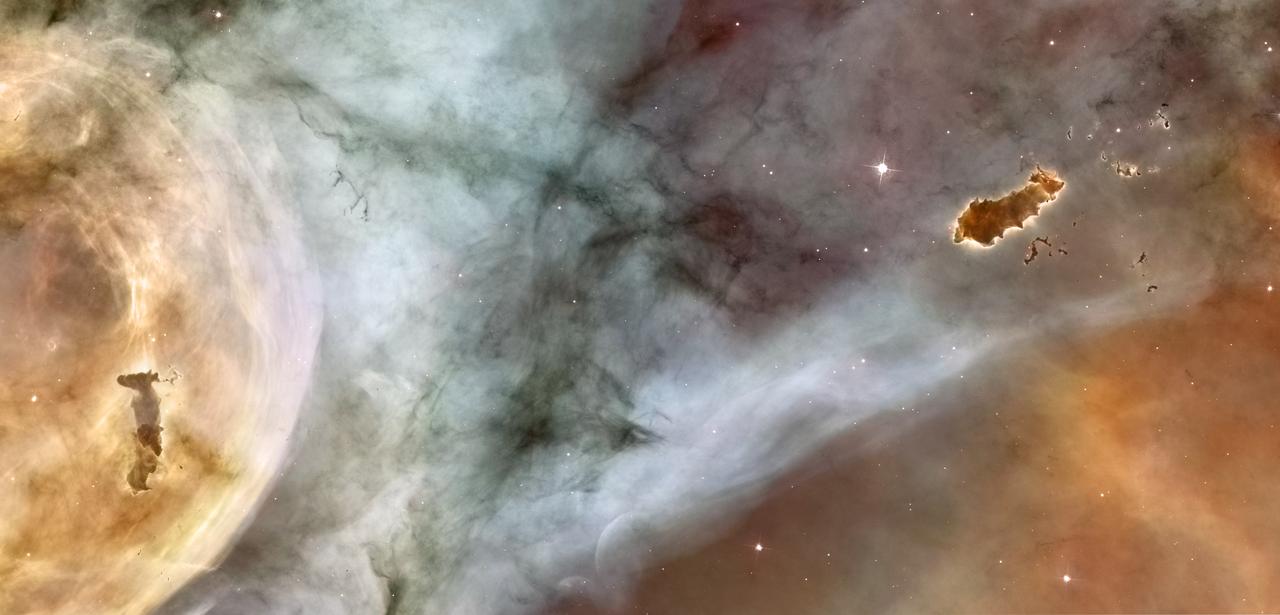
Carina Nebula Details: The Caterpillar Credit for Hubble Image: NASA, ESA, N. Smith (University of California, Berkeley), and The Hubble Heritage Team (STScI/AURA) Credit for CTIO Image: N. Smith (University of California, Berkeley) and NOAO/AURA/NSF The Hubble Space Telescope is a project of international cooperation between NASA and the European Space Agency. NASA's Goddard Space Flight Center manages the telescope. The Space Telescope Science Institute conducts Hubble science operations. Goddard is responsible for HST project management, including mission and science operations, servicing missions, and all associated development activities. To learn more about the Hubble Space Telescope go here: <a href="http://www.nasa.gov/mission_pages/hubble/main/index.html" rel="nofollow">www.nasa.gov/mission_pages/hubble/main/index.html</a>
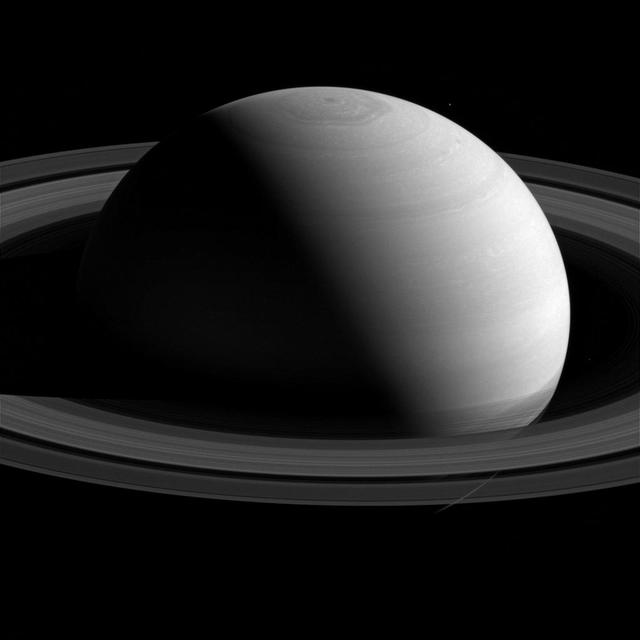
From a distance Saturn seems to exude an aura of serenity and peace. In spite of this appearance, Saturn is an active and dynamic world. Its atmosphere is a fast-moving and turbulent place with wind speeds in excess of 1,100 miles per hour (1,800 km per hour) in places. The lack of a solid surface to create drag means that there are fewer features to slow down the wind than on a planet like Earth. Mimas, to the upper-right of Saturn, has been brightened by a factor of 2 for visibility. In this view, Cassini was at a subspacecraft latitude of 19 degrees North. The image was taken with the Cassini spacecraft wide-angle camera on Feb. 4, 2015 using a spectral filter centered at 752 nanometers, in the near-infrared portion of the spectrum. The view was obtained at a distance of approximately 1.6 million miles (2.5 million kilometers) from Saturn. Image scale is 96 miles (150 kilometers) per pixel. http://photojournal.jpl.nasa.gov/catalog/pia18314

Carina Nebula Details: Great Clouds Credit for Hubble Image: NASA, ESA, N. Smith (University of California, Berkeley), and The Hubble Heritage Team (STScI/AURA) Credit for CTIO Image: N. Smith (University of California, Berkeley) and NOAO/AURA/NSF The Hubble Space Telescope is a project of international cooperation between NASA and the European Space Agency. NASA's Goddard Space Flight Center manages the telescope. The Space Telescope Science Institute conducts Hubble science operations. Goddard is responsible for HST project management, including mission and science operations, servicing missions, and all associated development activities. To learn more about the Hubble Space Telescope go here: <a href="http://www.nasa.gov/mission_pages/hubble/main/index.html" rel="nofollow">www.nasa.gov/mission_pages/hubble/main/index.html</a> <b><a href="http://www.nasa.gov/centers/goddard/home/index.html" rel="nofollow">NASA Goddard Space Flight Center</a></b> is home to the nation's largest organization of combined scientists, engineers and technologists that build spacecraft, instruments and new technology to study the Earth, the sun, our solar system, and the universe. <b>Follow us on <a href="http://twitter.com/NASA_GoddardPix" rel="nofollow">Twitter</a></b> <b>Join us on <a href="http://www.facebook.com/pages/Greenbelt-MD/NASA-Goddard/395013845897?ref=tsd" rel="nofollow">Facebook</a><b> </b></b>

NASA image release April 22, 2010 Object Names: Carina Nebula, NGC 3372 Image Type: Astronomical Credit: NASA/N. Smith (University of California, Berkeley) and NOAO/AURA/NSF To read learn more about this image go to: <a href="http://www.nasa.gov/mission_pages/hubble/science/hubble20th-img.html" rel="nofollow">www.nasa.gov/mission_pages/hubble/science/hubble20th-img....</a> <b><a href="http://www.nasa.gov/centers/goddard/home/index.html" rel="nofollow">NASA Goddard Space Flight Center</a></b> is home to the nation's largest organization of combined scientists, engineers and technologists that build spacecraft, instruments and new technology to study the Earth, the sun, our solar system, and the universe.

Barred Spiral Galaxy NGC 1300 Credit: NASA, ESA, and The Hubble Heritage Team (STScI/AURA) Acknowledgment: P. Knezek (WIYN) The Hubble Space Telescope is a project of international cooperation between NASA and the European Space Agency. NASA's Goddard Space Flight Center manages the telescope. The Space Telescope Science Institute conducts Hubble science operations. Goddard is responsible for HST project management, including mission and science operations, servicing missions, and all associated development activities. To learn more about the Hubble Space Telescope go here: <a href="http://www.nasa.gov/mission_pages/hubble/main/index.html" rel="nofollow">www.nasa.gov/mission_pages/hubble/main/index.html</a>
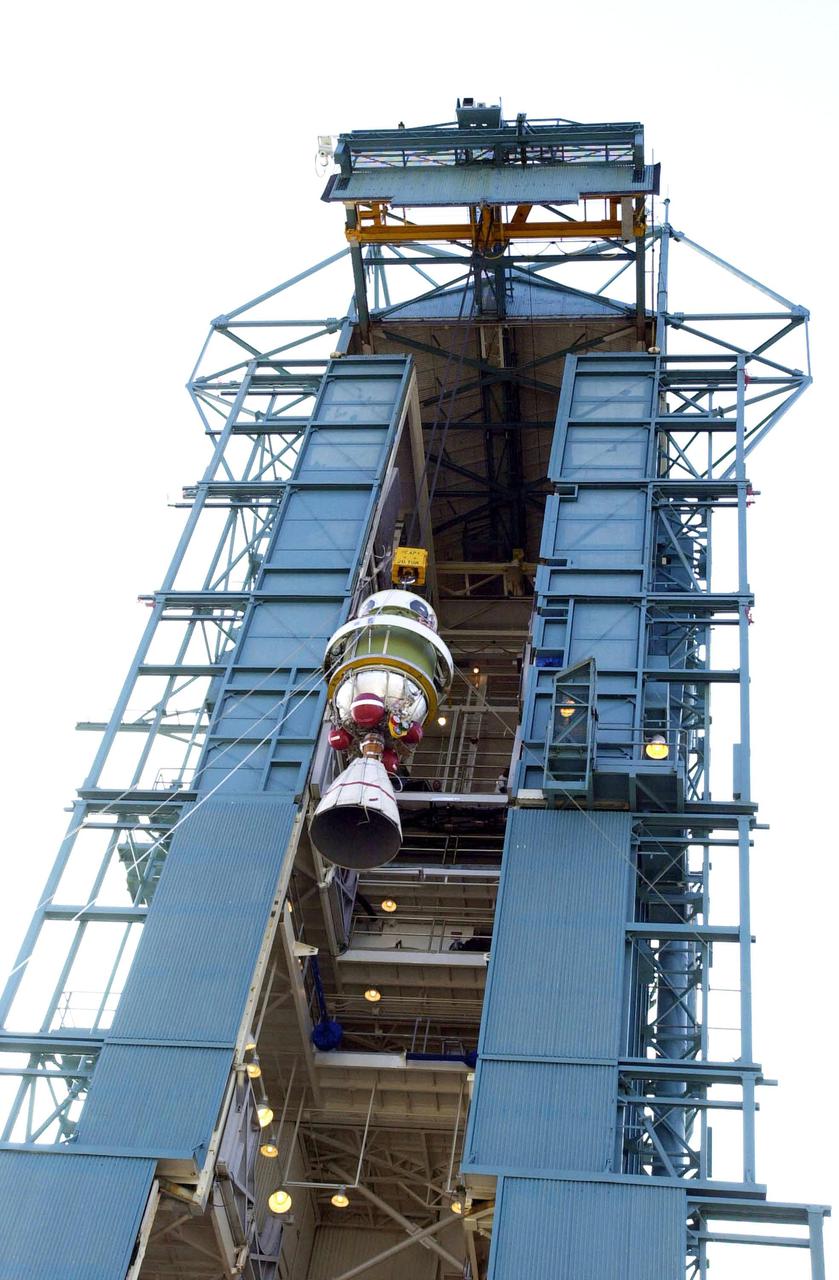
VANDENBERG AFB, CALIF. - The second stage of the Delta II rocket is lifted up the gantry on the launch pad. The Delta II rocket will launch the Aqua-EOS satellite. Aqua is one of a series of spacebased platforms that are central to NASA's Earth Science Enterprise (ESE), a long-term study of the scope, dynamics and implications of global change. The Aqua program is composed of Aqua and other spacecraft (including Terra and Aura) and a data distribution system (ESDIS, and Mission Operations Center Implementation Team). Flying in an orbit that covers the globe every 16 days, Aqua will provide a six-year chronology of the planet and its processes. Comprehensive measurements taken by its onboard instruments will allow multidisciplinary teams of scientists and researchers from North and South America, Asia, Australia and Europe to assess long-term change, identify its human and natural causes and advance the development of models for long-term forecasting. Launch is scheduled for April 26 from Vandenberg

VANDENBERG AFB,CALIF. - On the SLC-2 launch pad, the gantry closes in on the Delta II rocket to enable mating of the second stage. The Delta II will launch the Aqua-EOS satellite. Aqua is one of a series of spacebased platforms that are central to NASA's Earth Science Enterprise (ESE), a long-term study of the scope, dynamics and implications of global change. The Aqua program is composed of Aqua and other spacecraft (including Terra and Aura) and a data distribution system (ESDIS, and Mission Operations Center Implementation Team). Flying in an orbit that covers the globe every 16 days, Aqua will provide a six-year chronology of the planet and its processes. Comprehensive measurements taken by its onboard instruments will allow multidisciplinary teams of scientists and researchers from North and South America, Asia, Australia and Europe to assess long-term change, identify its human and natural causes and advance the development of models for long-term forecasting. Launch is scheduled for April 26 from Vandenberg
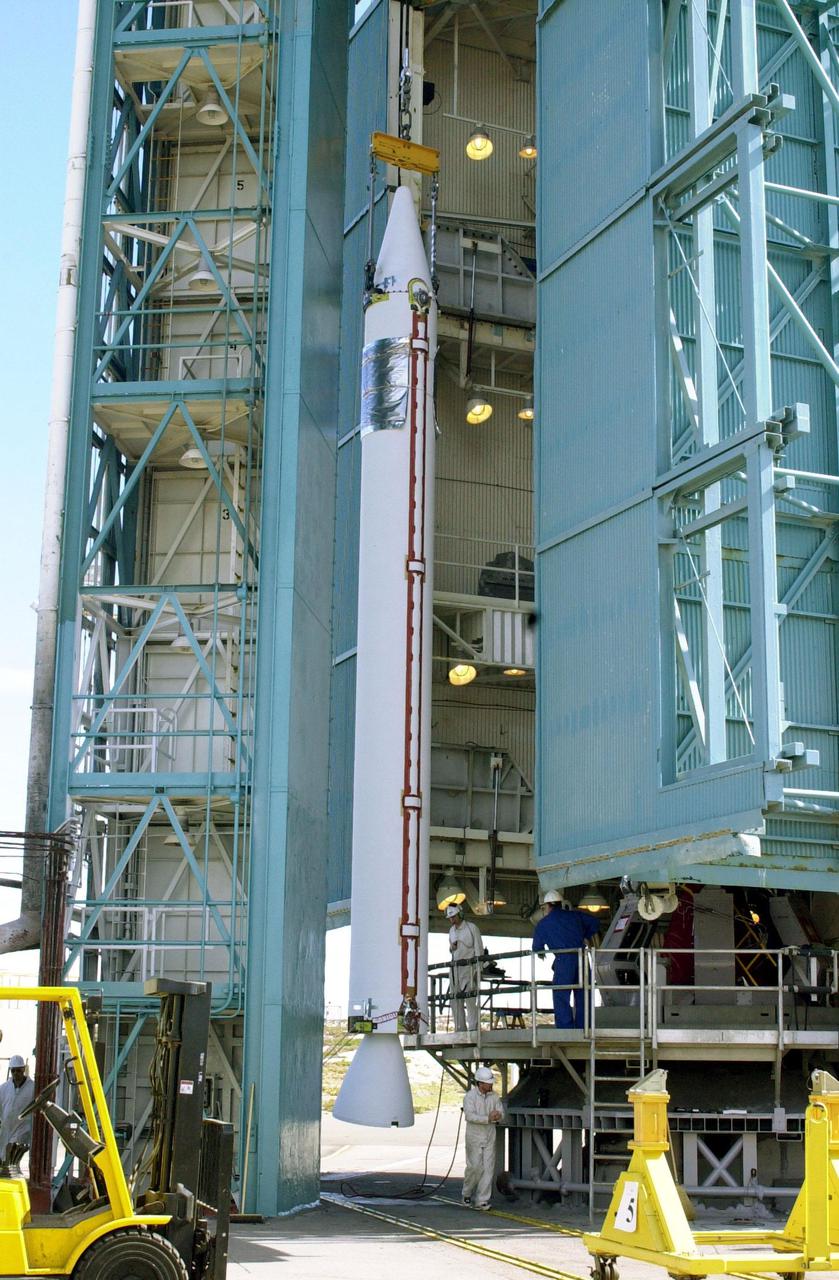
VANDENBERG AFB, CALIF. -- On the launch pad, a solid rocket booster is lifted up the gantry for mating with the Delta II rocket that will launch the Aqua-EOS satellite. Aqua is one of a series of spacebased platforms that are central to NASA's Earth Science Enterprise (ESE), a long-term study of the scope, dynamics and implications of global change. The Aqua program is composed of Aqua and other spacecraft (including Terra and Aura) and a data distribution system (ESDIS, and Mission Operations Center Implementation Team). Flying in an orbit that covers the globe every 16 days, Aqua will provide a six-year chronology of the planet and its processes. Comprehensive measurements taken by its onboard instruments will allow multidisciplinary teams of scientists and researchers from North and South America, Asia, Australia and Europe to assess long-term change, identify its human and natural causes and advance the development of models for long-term forecasting. Launch is scheduled for April 26 from Vandenberg

Release Date March 30, 2010 The raised arcs, lines, dots, and other markings in this 17-by-11-inch Hubble Space Telescope image of the Carina Nebula highlight important features in the giant gas cloud, allowing visually impaired people to feel what they cannot see and form a picture of the nebula in their minds. To read more abou this image go to: <a href="http://www.nasa.gov/mission_pages/hubble/science/carina-touch.html" rel="nofollow">www.nasa.gov/mission_pages/hubble/science/carina-touch.html</a> Credit: NASA, ESA, and M. Mutchler (STScI/AURA) and N. Grice (You Can Do Astronomy LLC) <b><a href="http://www.nasa.gov/centers/goddard/home/index.html" rel="nofollow">NASA Goddard Space Flight Center</a></b> is home to the nation's largest organization of combined scientists, engineers and technologists that build spacecraft, instruments and new technology to study the Earth, the sun, our solar system, and the universe.
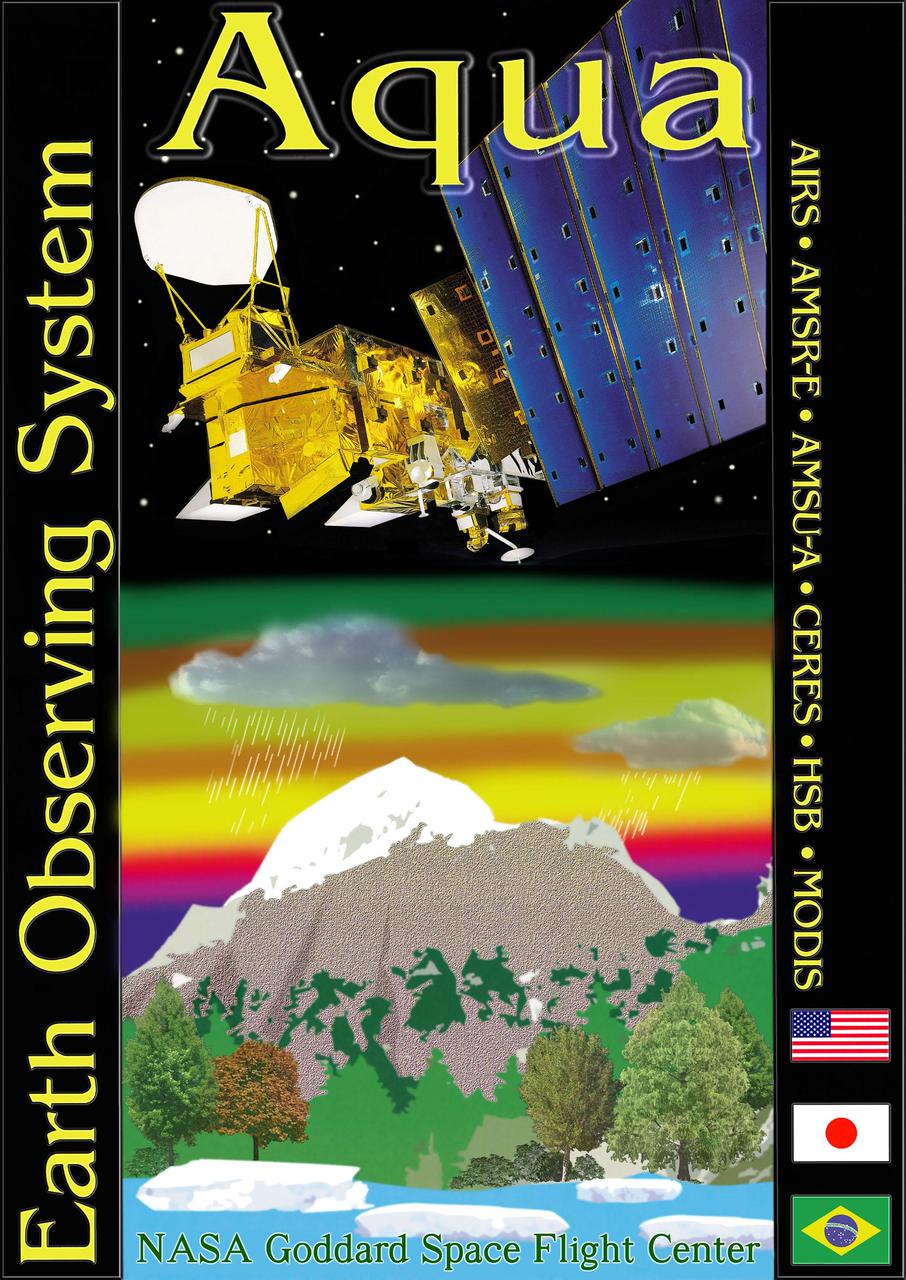
KENNEDY SPACE CENTER, FLA. -- The Aqua-EOS logo. Aqua is one of a series of spacebased platforms that are central to NASA's Earth Science Enterprise (ESE), a long-term study of the scope, dynamics and implications of global change. The Aqua program is composed of Aqua and other spacecraft (including Terra and Aura) and a data distribution system (ESDIS, and Mission Operations Center Implementation Team). Flying in an orbit that covers the globe every 16 days, Aqua will provide a six-year chronology of the planet and its processes. Comprehensive measurements taken by its onboard instruments will allow multidisciplinary teams of scientists and researchers from North and South America, Asia, Australia and Europe to assess long-term change, identify its human and natural causes and advance the development of models for long-term forecasting. Launch is scheduled from Vandenberg Air Force Base, Calif
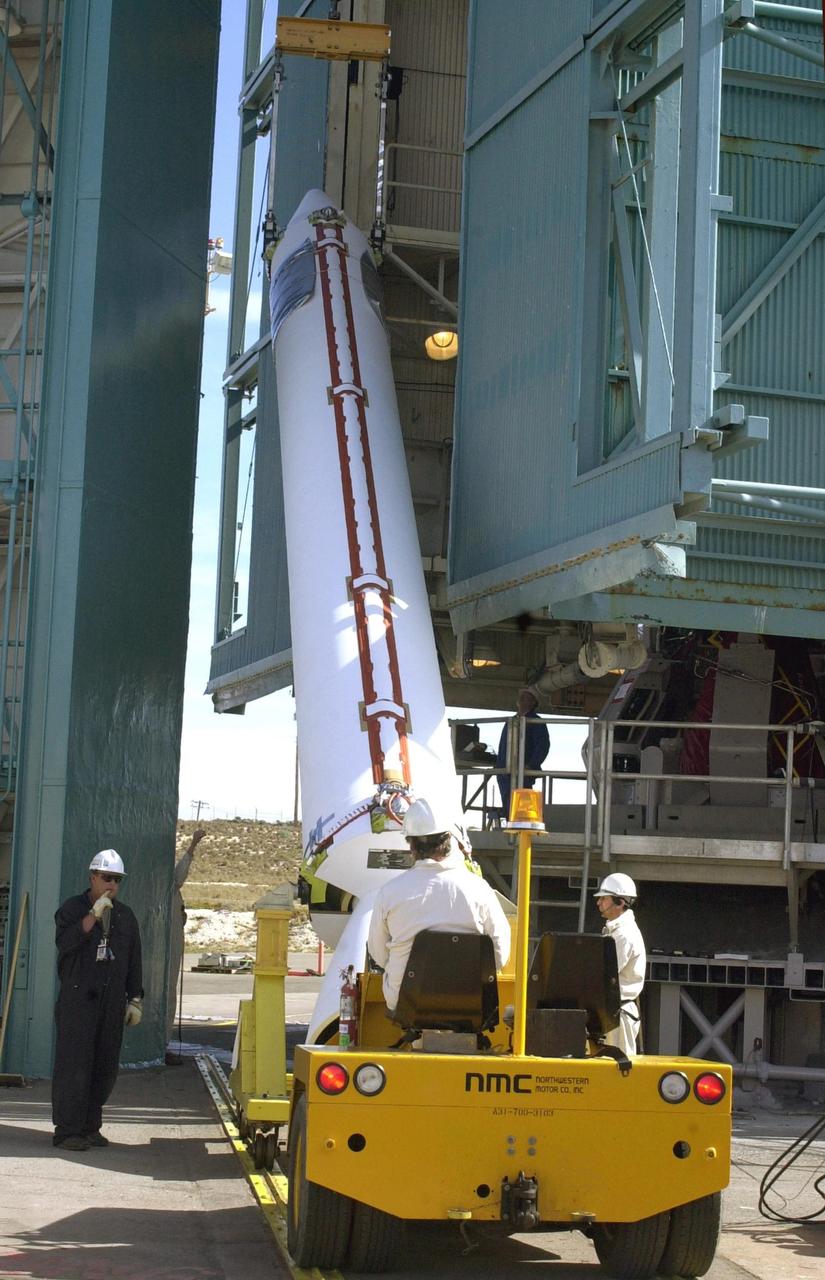
VANDENBERG AFB, CALIF. -- On the launch pad, an overhead crane lifts a solid rocket booster to vertical for mating with the Delta II rocket that will launch the Aqua-EOS satellite. Aqua is one of a series of spacebased platforms that are central to NASA's Earth Science Enterprise (ESE), a long-term study of the scope, dynamics and implications of global change. The Aqua program is composed of Aqua and other spacecraft (including Terra and Aura) and a data distribution system (ESDIS, and Mission Operations Center Implementation Team). Flying in an orbit that covers the globe every 16 days, Aqua will provide a six-year chronology of the planet and its processes. Comprehensive measurements taken by its onboard instruments will allow multidisciplinary teams of scientists and researchers from North and South America, Asia, Australia and Europe to assess long-term change, identify its human and natural causes and advance the development of models for long-term forecasting. Launch is scheduled for April 26 from Vandenberg
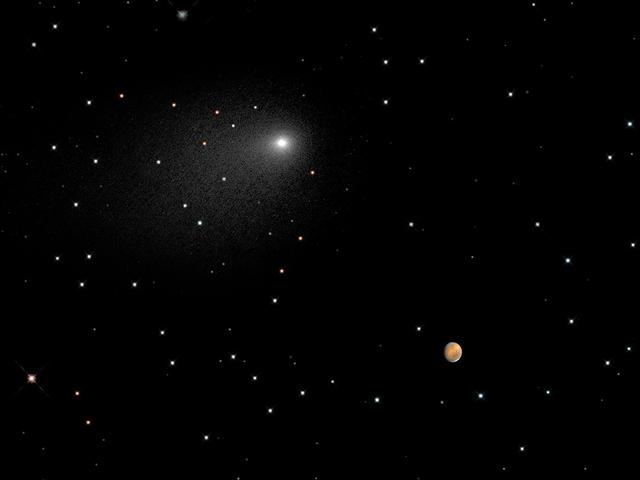
This composite NASA Hubble Space Telescope Image captures the positions of comet Siding Spring and Mars in a never-before-seen close passage of a comet by the Red Planet, which happened at 2:28 p.m. EDT October 19, 2014. The comet passed by Mars at approximately 87,000 miles (about one-third of the distance between Earth and the Moon). At that time, the comet and Mars were approximately 149 million miles from Earth. The comet image shown here is a composite of Hubble exposures taken between Oct. 18, 8:06 a.m. EDT to Oct. 19, 11:17 p.m. EDT. Hubble took a separate photograph of Mars at 10:37 p.m. EDT on Oct. 18. The Mars and comet images have been added together to create a single picture to illustrate the angular separation, or distance, between the comet and Mars at closest approach. The separation is approximately 1.5 arc minutes, or one-twentieth of the angular diameter of the full Moon. The background starfield in this composite image is synthesized from ground-based telescope data provided by the Palomar Digital Sky Survey, which has been reprocessed to approximate Hubble’s resolution. The solid icy comet nucleus is too small to be resolved in the Hubble picture. The comet’s bright coma, a diffuse cloud of dust enshrouding the nucleus, and a dusty tail, are clearly visible. This is a composite image because a single exposure of the stellar background, comet Siding Spring, and Mars would be problematic. Mars is actually 10,000 times brighter than the comet, and so could not be properly exposed to show detail in the Red Planet. The comet and Mars were also moving with respect to each other and so could not be imaged simultaneously in one exposure without one of the objects being motion blurred. Hubble had to be programmed to track on the comet and Mars separately in two different observations. The images were taken with Hubble’s Wide Field Camera 3. Credit: NASA, ESA, PSI, JHU/APL, STScI/AURA Credit: NASA, ESA, PSI, JHU/APL, STScI/AURA

This composite image shows a hot spot in Jupiter's atmosphere. In the image on the left, taken on Sept. 16, 2020, by the Gemini North telescope on the island of Hawaii, the hot spot appears bright in the infrared at a wavelength of 5 microns. In the inset image on the right, taken by Juno's JunoCam visible-light imager, also on Sept. 16 during Juno's 29th perijove pass, the hot spot appears dark. Scientists have known of Jupiter's hot spots for a long time. On Dec. 7, 1995, the Galileo probe likely descended into a similar hot spot. To the naked eye, Jupiter's hot spots appear as dark, cloud-free areas in Jupiter's equatorial belt, but at infrared wavelengths, which are invisible to the human eye, they are extremely bright, revealing the warm, deep atmosphere below the clouds. High-resolution images of hot spots such as these are key both to understanding the role of storms and waves in Jupiter's atmosphere. Citizen scientist Brian Swift processed the images to enhance the color and contrast, with further processing by Tom Momary to map the JunoCam image to the Gemini data. The international Gemini North telescope is a 26.6-foot-diameter (8.1-meter-diameter) optical/infrared telescope optimized for infrared observations, and is managed for the NSF by the Association of Universities for Research in Astronomy (AURA). https://photojournal.jpl.nasa.gov/catalog/PIA24299

SCI2012_0003: SOFIA mid-infrared image of the planetary nebula Minkowski 2-9 (M2-9), also known as the Butterfly Nebula, compared with a visual-wavelength Hubble Space Telescope image at the same scale and orientation. The nebula is composed of two lobes of gas & dust expelled from a dying star with about the mass of our Sun that is seen at the center of the lobes. The HST image shows mostly ionized gas in the lobes whereas the SOFIA image shows mostly solid grains condensing in the gas. The SOFIA data were obtained during SOFIA's Early Science program in 2011 by a Guest Investigator team led by Michael Werner of Caltech/JPL using the FORCAST camera (P.I.Terry Herter, Cornell University). Credit: SOFIA image, RGB = 37, 24, 20 microns; NASA/DLR/USRA/DSI/FORCAST team/M. Werner et al./A. Helton, J. Rho; HST image: NASA/ESA/NSF/AURA/Hubble Heritage Team/STScI/B. Balick, V. Icke, G. Mellema

VANDENBERG AFB, CALIF. - - Inside the gantry on the SLC-2 launch pad, workers check the fitting on the second stage of a Delta II rocket mated with the first stage, below. The Delta II will launch the Aqua-EOS satellite. Aqua is one of a series of spacebased platforms that are central to NASA's Earth Science Enterprise (ESE), a long-term study of the scope, dynamics and implications of global change. The Aqua program is composed of Aqua and other spacecraft (including Terra and Aura) and a data distribution system (ESDIS, and Mission Operations Center Implementation Team). Flying in an orbit that covers the globe every 16 days, Aqua will provide a six-year chronology of the planet and its processes. Comprehensive measurements taken by its onboard instruments will allow multidisciplinary teams of scientists and researchers from North and South America, Asia, Australia and Europe to assess long-term change, identify its human and natural causes and advance the development of models for long-term forecasting. Launch is scheduled for April 26 from Vandenberg
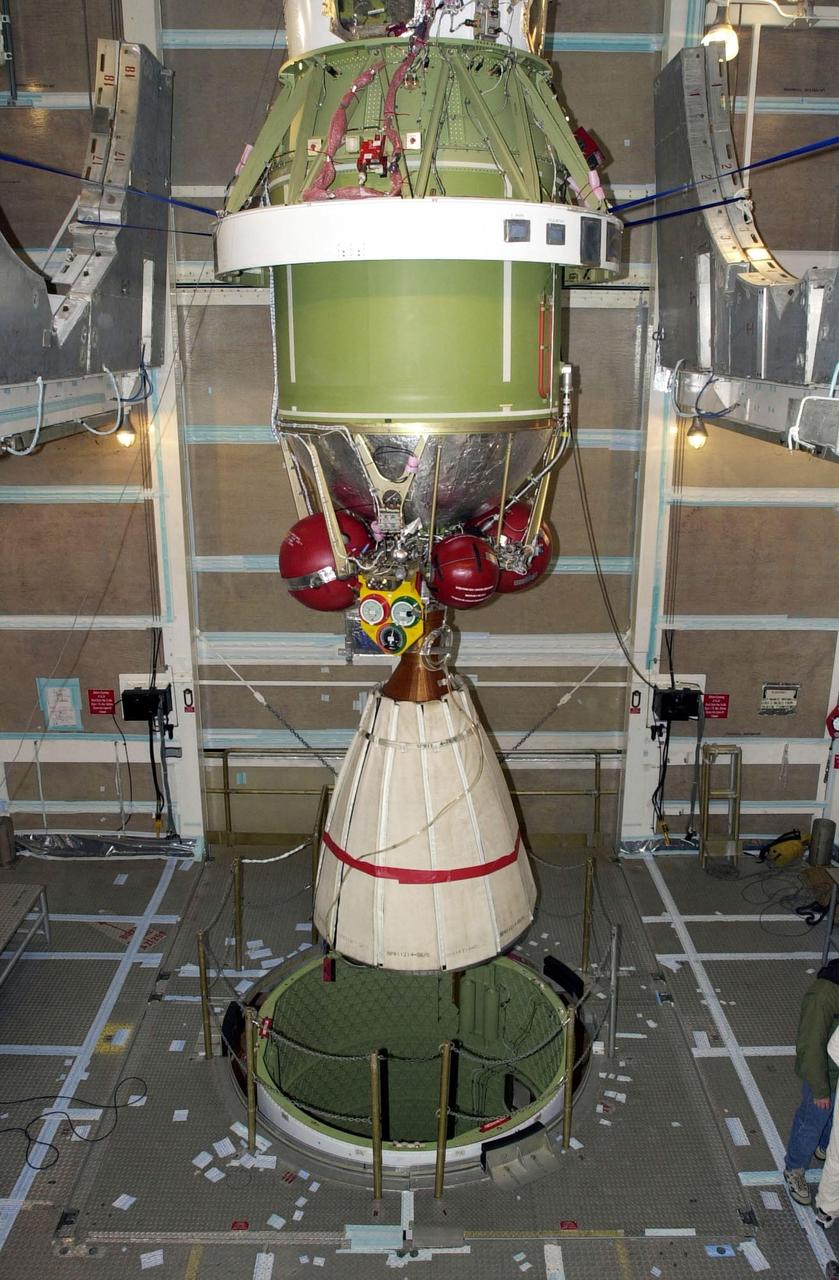
VANDENBERG AFB, CALIF. - Inside the gantry on the SLC-2 launch pad, the second stage of a Delta II rocket is lowered for mating with the first stage, below. The Delta II will launch the Aqua-EOS satellite. Aqua is one of a series of spacebased platforms that are central to NASA's Earth Science Enterprise (ESE), a long-term study of the scope, dynamics and implications of global change. The Aqua program is composed of Aqua and other spacecraft (including Terra and Aura) and a data distribution system (ESDIS, and Mission Operations Center Implementation Team). Flying in an orbit that covers the globe every 16 days, Aqua will provide a six-year chronology of the planet and its processes. Comprehensive measurements taken by its onboard instruments will allow multidisciplinary teams of scientists and researchers from North and South America, Asia, Australia and Europe to assess long-term change, identify its human and natural causes and advance the development of models for long-term forecasting. Launch is scheduled for April 26 from Vandenberg
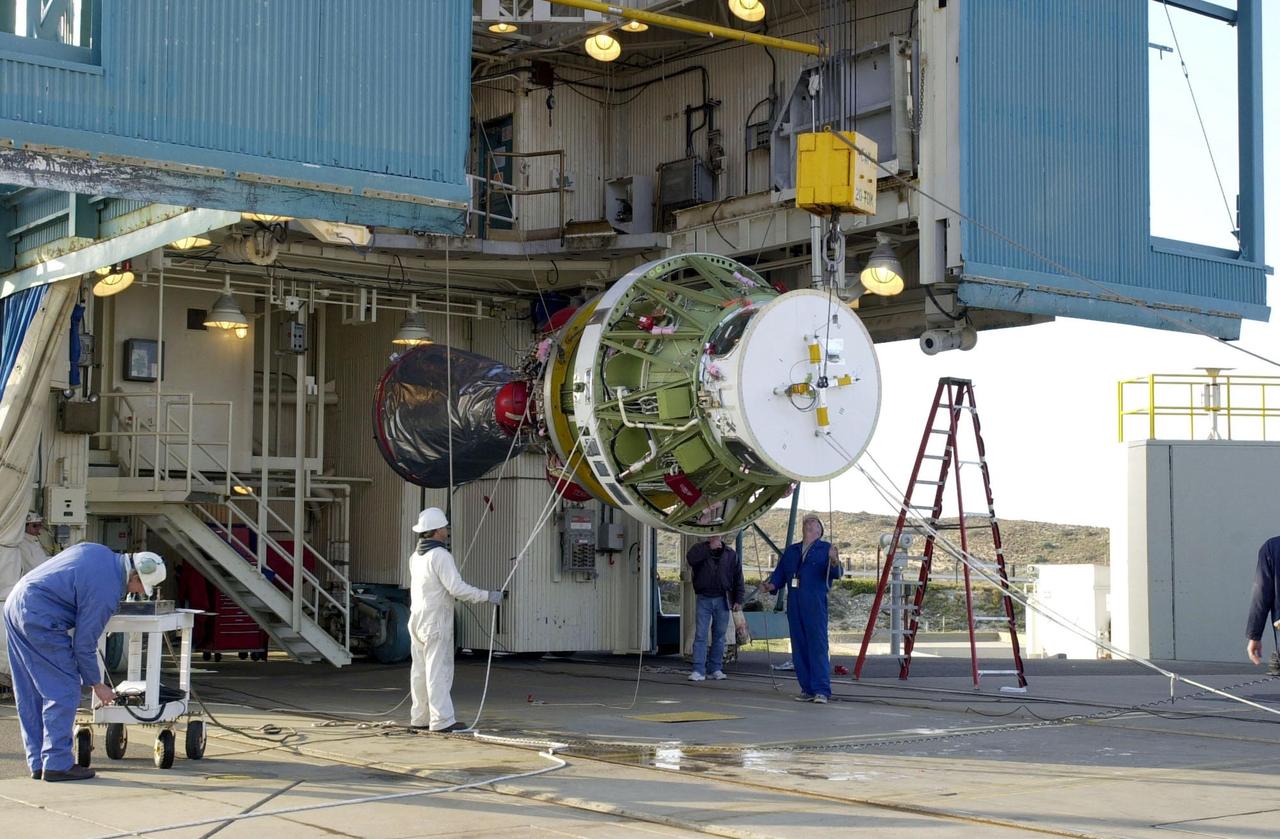
VANDENBERG AFB, CALIF. -- The second stage of the Delta II rocket is ready to be raised to vertical for its lift up the gantry on the launch pad. The Delta II rocket will launch the Aqua-EOS satellite. Aqua is one of a series of spacebased platforms that are central to NASA's Earth Science Enterprise (ESE), a long-term study of the scope, dynamics and implications of global change. The Aqua program is composed of Aqua and other spacecraft (including Terra and Aura) and a data distribution system (ESDIS, and Mission Operations Center Implementation Team). Flying in an orbit that covers the globe every 16 days, Aqua will provide a six-year chronology of the planet and its processes. Comprehensive measurements taken by its onboard instruments will allow multidisciplinary teams of scientists and researchers from North and South America, Asia, Australia and Europe to assess long-term change, identify its human and natural causes and advance the development of models for long-term forecasting. Launch is scheduled for April 26 from Vandenberg

JANUARY 9, 2014: The vibrant magentas and blues in this Hubble image of the barred spiral galaxy M83 reveal that the galaxy is ablaze with star formation. The galactic panorama unveils a tapestry of the drama of stellar birth and death. The galaxy, also known as the Southern Pinwheel, lies 15 million light-years away in the constellation Hydra. Credit: NASA, ESA, and the Hubble Heritage Team (STScI/AURA) Acknowledgement: W. Blair (STScI/Johns Hopkins University) and R. O'Connell (University of Virginia) <b><a href="http://www.nasa.gov/audience/formedia/features/MP_Photo_Guidelines.html" rel="nofollow">NASA image use policy.</a></b> <b><a href="http://www.nasa.gov/centers/goddard/home/index.html" rel="nofollow">NASA Goddard Space Flight Center</a></b> enables NASA’s mission through four scientific endeavors: Earth Science, Heliophysics, Solar System Exploration, and Astrophysics. Goddard plays a leading role in NASA’s accomplishments by contributing compelling scientific knowledge to advance the Agency’s mission. <b>Follow us on <a href="http://twitter.com/NASA_GoddardPix" rel="nofollow">Twitter</a></b> <b>Like us on <a href="http://www.facebook.com/pages/Greenbelt-MD/NASA-Goddard/395013845897?ref=tsd" rel="nofollow">Facebook</a></b> <b>Find us on <a href="http://instagram.com/nasagoddard?vm=grid" rel="nofollow">Instagram</a></b>
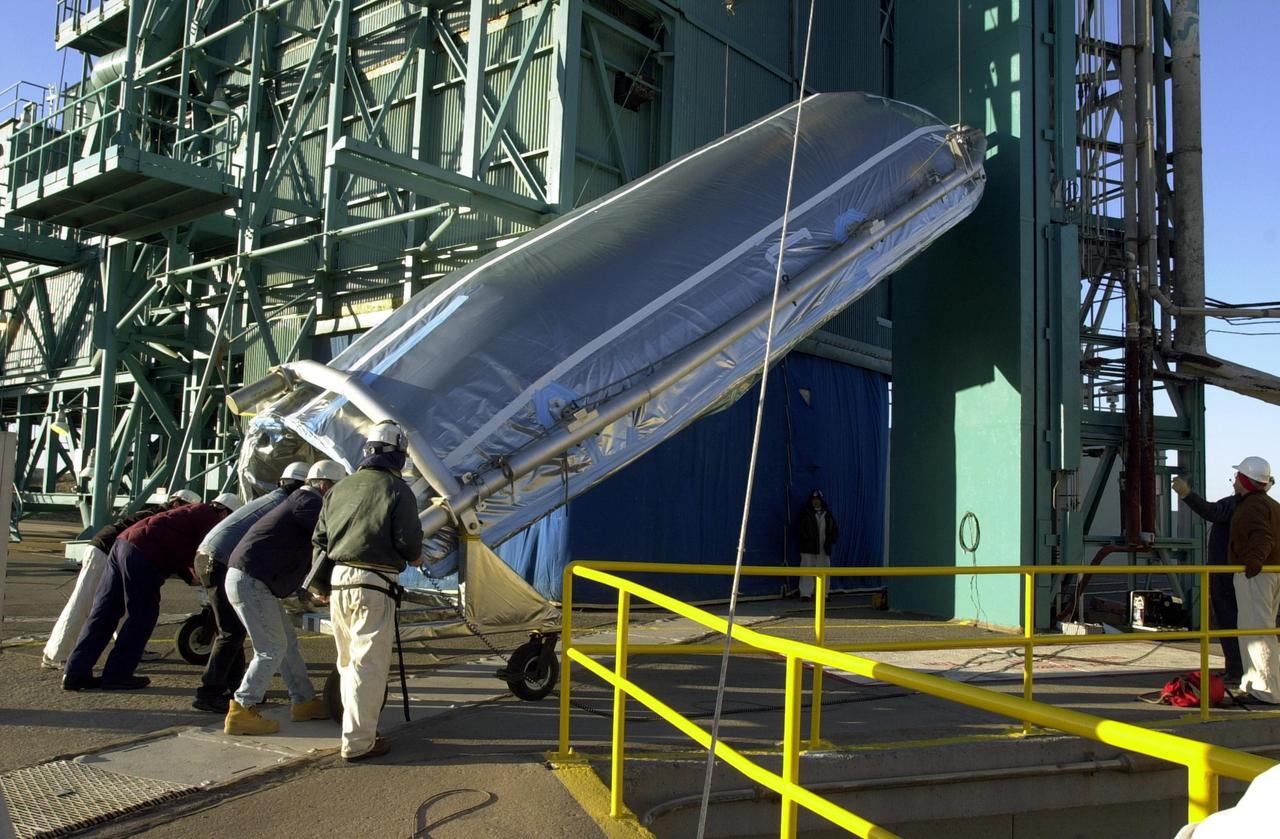
VANDENBERG AFB, CALIF. - On the SLC-2 launch pad, the first half of the Delta II fairing for the Aqua-EOS satellite arrives at the gantry. The Delta II will launch the Aqua-EOS satellite. Aqua is one of a series of spacebased platforms that are central to NASA's Earth Science Enterprise (ESE), a long-term study of the scope, dynamics and implications of global change. The Aqua program is composed of Aqua and other spacecraft (including Terra and Aura) and a data distribution system (ESDIS, and Mission Operations Center Implementation Team). Flying in an orbit that covers the globe every 16 days, Aqua will provide a six-year chronology of the planet and its processes. Comprehensive measurements taken by its onboard instruments will allow multidisciplinary teams of scientists and researchers from North and South America, Asia, Australia and Europe to assess long-term change, identify its human and natural causes and advance the development of models for long-term forecasting. Launch is scheduled for April 26 from Vandenberg
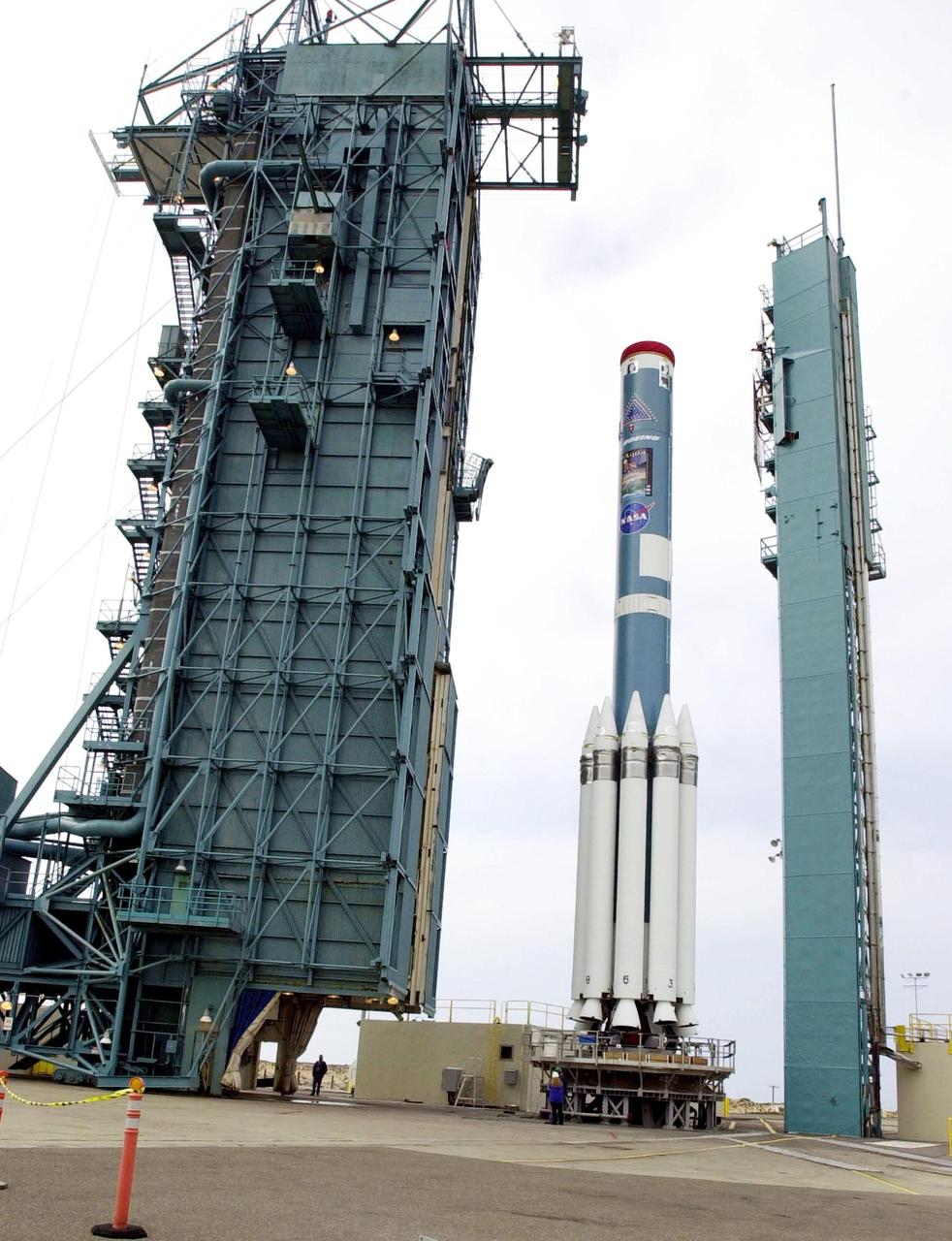
VANDENBERG AFB,CALIF. - The gantry (left) on SLC-2 moves toward the first stage of the Delta II rocket, for mating with the second stage. The Delta II will launch the Aqua-EOS satellite. Aqua is one of a series of spacebased platforms that are central to NASA's Earth Science Enterprise (ESE), a long-term study of the scope, dynamics and implications of global change. The Aqua program is composed of Aqua and other spacecraft (including Terra and Aura) and a data distribution system (ESDIS, and Mission Operations Center Implementation Team). Flying in an orbit that covers the globe every 16 days, Aqua will provide a six-year chronology of the planet and its processes. Comprehensive measurements taken by its onboard instruments will allow multidisciplinary teams of scientists and researchers from North and South America, Asia, Australia and Europe to assess long-term change, identify its human and natural causes and advance the development of models for long-term forecasting. Launch is scheduled for April 26 from Vandenberg
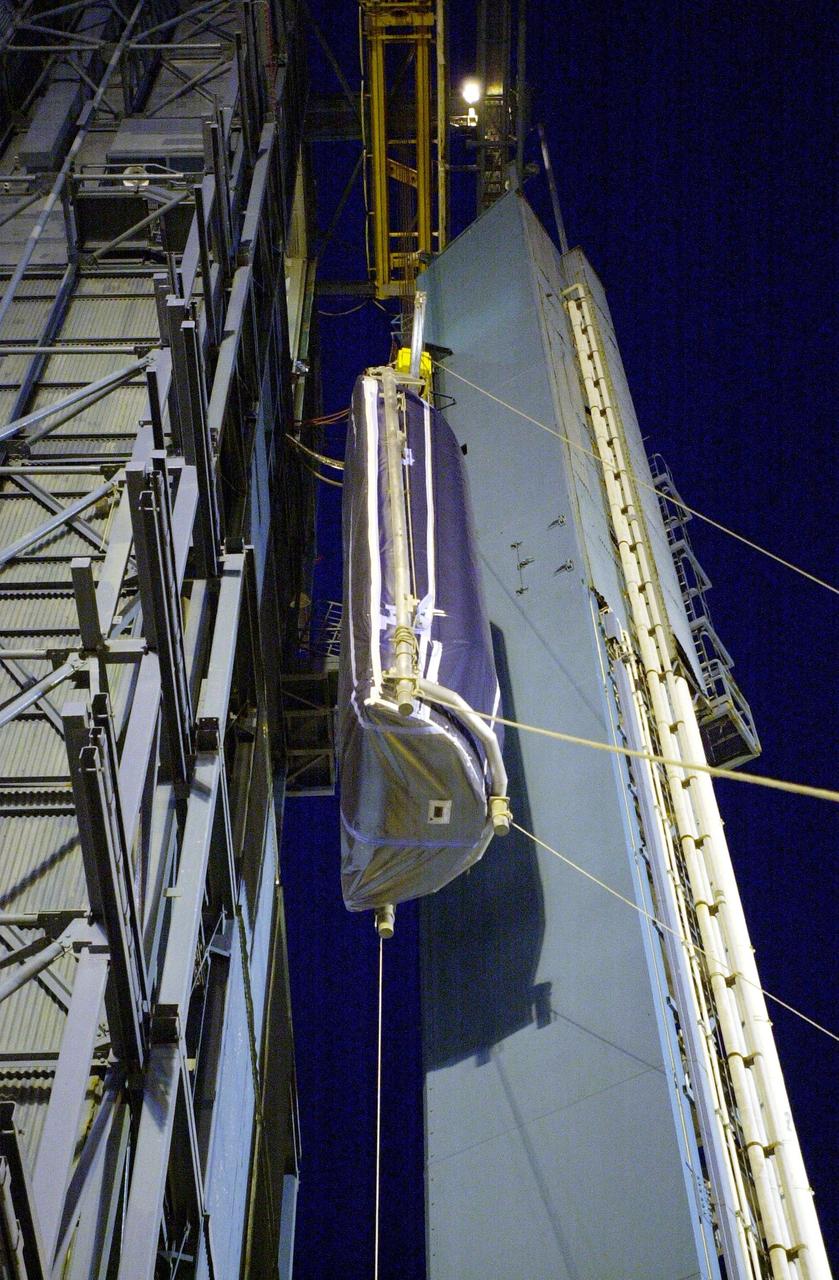
VANDENBERG AFB, CALIF. - On the SLC-2 launch pad, the first half of the Delta II fairing for the Aqua-EOS satellite is lifted up the gantry. The Delta II will launch the Aqua-EOS satellite, one of a series of spacebased platforms that are central to NASA's Earth Science Enterprise (ESE), a long-term study of the scope, dynamics and implications of global change. The Aqua program is composed of Aqua and other spacecraft (including Terra and Aura) and a data distribution system (ESDIS, and Mission Operations Center Implementation Team). Flying in an orbit that covers the globe every 16 days, Aqua will provide a six-year chronology of the planet and its processes. Comprehensive measurements taken by its onboard instruments will allow multidisciplinary teams of scientists and researchers from North and South America, Asia, Australia and Europe to assess long-term change, identify its human and natural causes and advance the development of models for long-term forecasting. Launch is scheduled for April 26 from Vandenberg
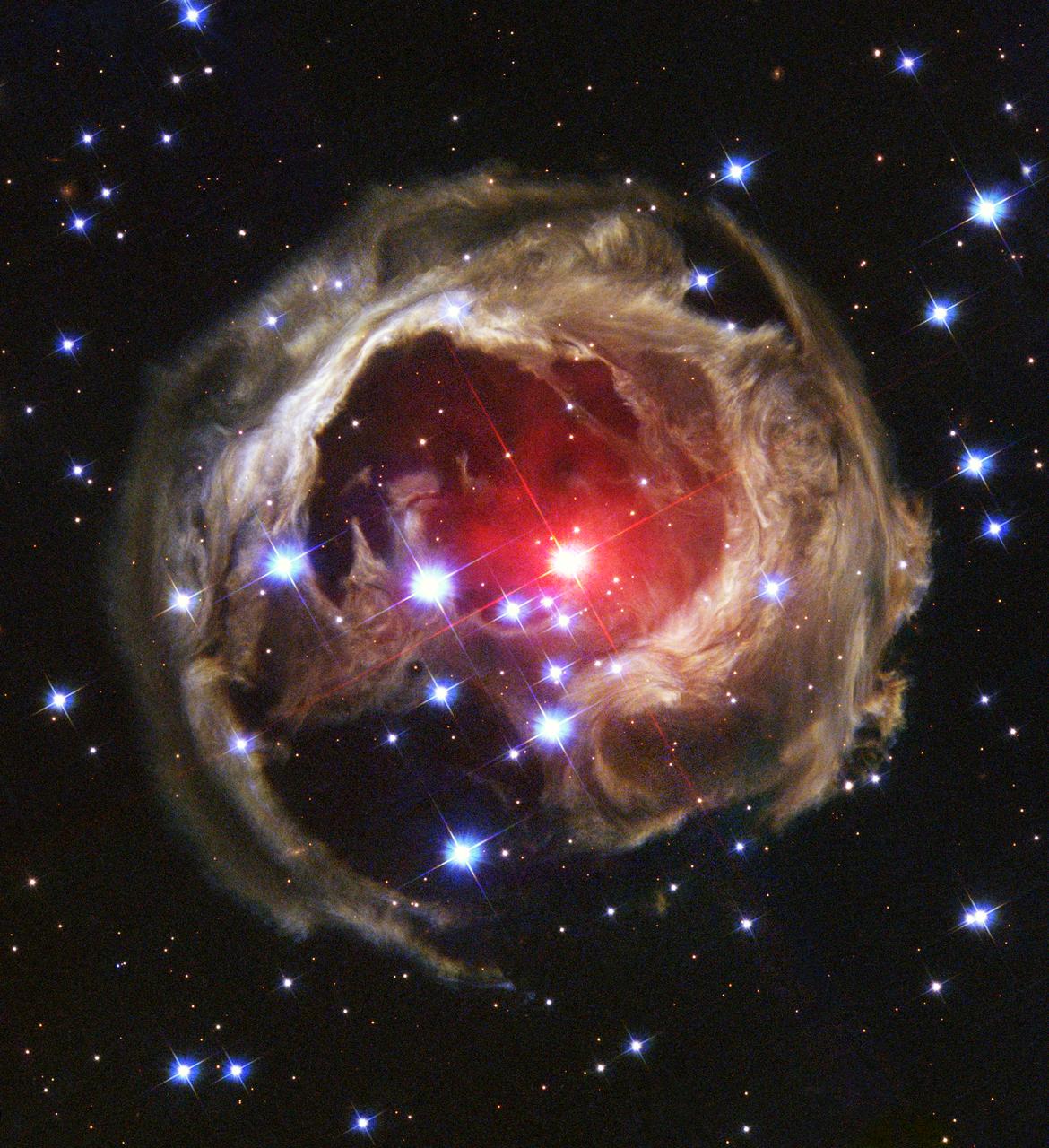
"Light Echo" Illuminates Dust Around Supergiant Star V838 Monocerotis (V838 Mon) Credit: NASA and The Hubble Heritage Team (AURA/STScI) The Hubble Space Telescope is a project of international cooperation between NASA and the European Space Agency. NASA's Goddard Space Flight Center manages the telescope. The Space Telescope Science Institute conducts Hubble science operations. Goddard is responsible for HST project management, including mission and science operations, servicing missions, and all associated development activities. To learn more about the Hubble Space Telescope go here: <a href="http://www.nasa.gov/mission_pages/hubble/main/index.html" rel="nofollow">www.nasa.gov/mission_pages/hubble/main/index.html</a> <b><a href="http://www.nasa.gov/centers/goddard/home/index.html" rel="nofollow">NASA Goddard Space Flight Center</a></b> is home to the nation's largest organization of combined scientists, engineers and technologists that build spacecraft, instruments and new technology to study the Earth, the sun, our solar system, and the universe. <b>Follow us on <a href="http://twitter.com/NASA_GoddardPix" rel="nofollow">Twitter</a></b> <b>Join us on <a href="http://www.facebook.com/pages/Greenbelt-MD/NASA-Goddard/395013845897?ref=tsd" rel="nofollow">Facebook</a><b> </b></b>
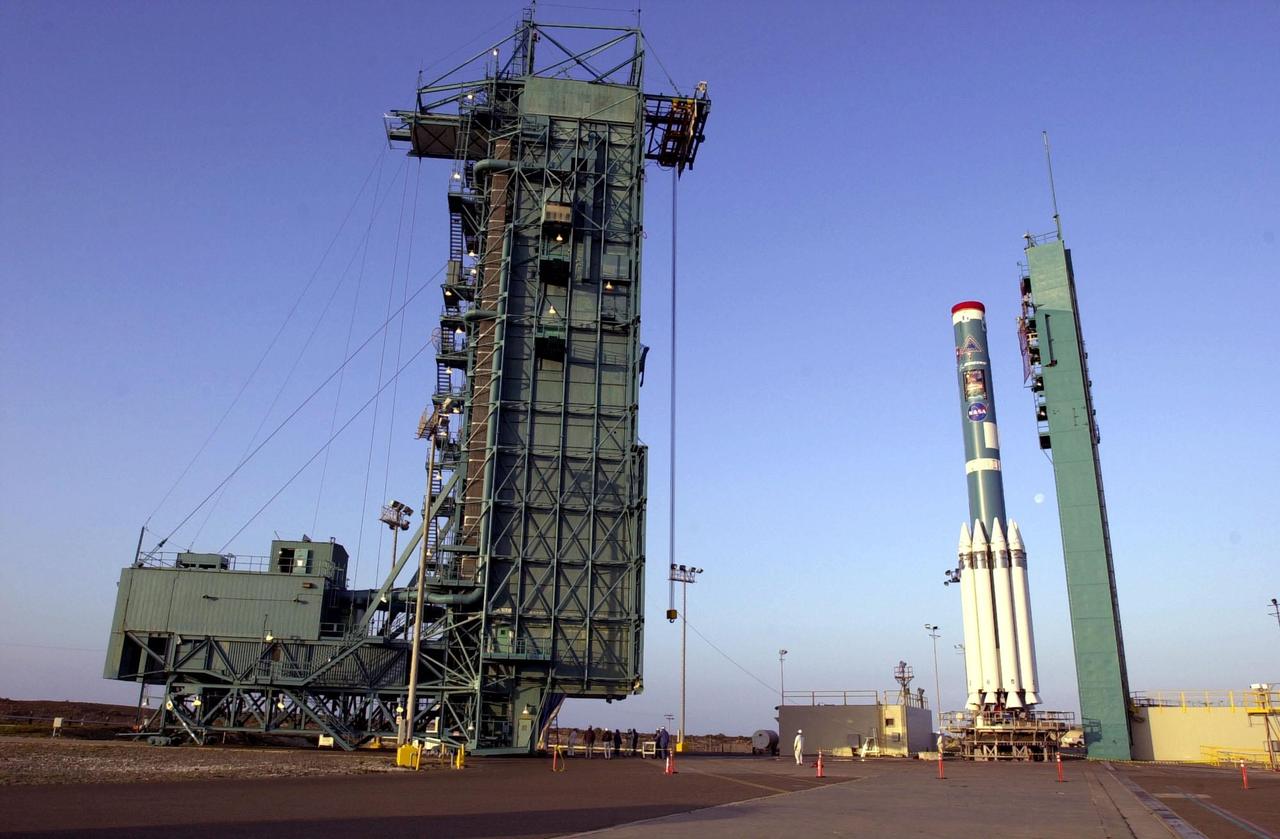
VANDENBERG AFB, CALIF. -- The partially assembled Delta II rocket (right) and the gantry (left) wait for the rocket's second stage to be transported to the launch pad. The Delta II rocket will launch the Aqua-EOS satellite. Aqua is one of a series of spacebased platforms that are central to NASA's Earth Science Enterprise (ESE), a long-term study of the scope, dynamics and implications of global change. The Aqua program is composed of Aqua and other spacecraft (including Terra and Aura) and a data distribution system (ESDIS, and Mission Operations Center Implementation Team). Flying in an orbit that covers the globe every 16 days, Aqua will provide a six-year chronology of the planet and its processes. Comprehensive measurements taken by its onboard instruments will allow multidisciplinary teams of scientists and researchers from North and South America, Asia, Australia and Europe to assess long-term change, identify its human and natural causes and advance the development of models for long-term forecasting. Launch is scheduled for April 26 from Vandenberg
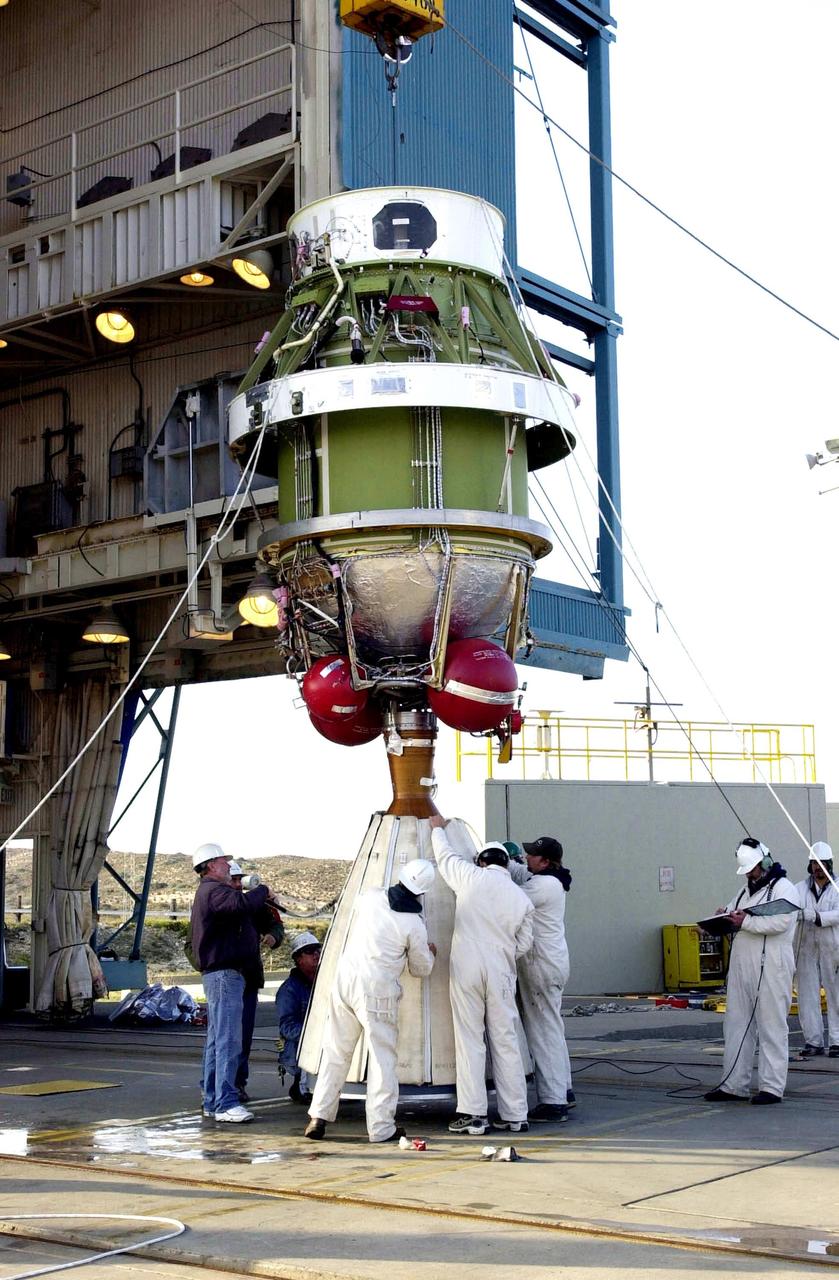
VANDENBERG AFB, CALIF. - Workers on the launch pad ready the second stage of the Delta II rocket for its lift up the gantry on the launch pad. The Delta II rocket will launch the Aqua-EOS satellite. Aqua is one of a series of spacebased platforms that are central to NASA's Earth Science Enterprise (ESE), a long-term study of the scope, dynamics and implications of global change. The Aqua program is composed of Aqua and other spacecraft (including Terra and Aura) and a data distribution system (ESDIS, and Mission Operations Center Implementation Team). Flying in an orbit that covers the globe every 16 days, Aqua will provide a six-year chronology of the planet and its processes. Comprehensive measurements taken by its onboard instruments will allow multidisciplinary teams of scientists and researchers from North and South America, Asia, Australia and Europe to assess long-term change, identify its human and natural causes and advance the development of models for long-term forecasting. Launch is scheduled for April 26 from Vandenberg
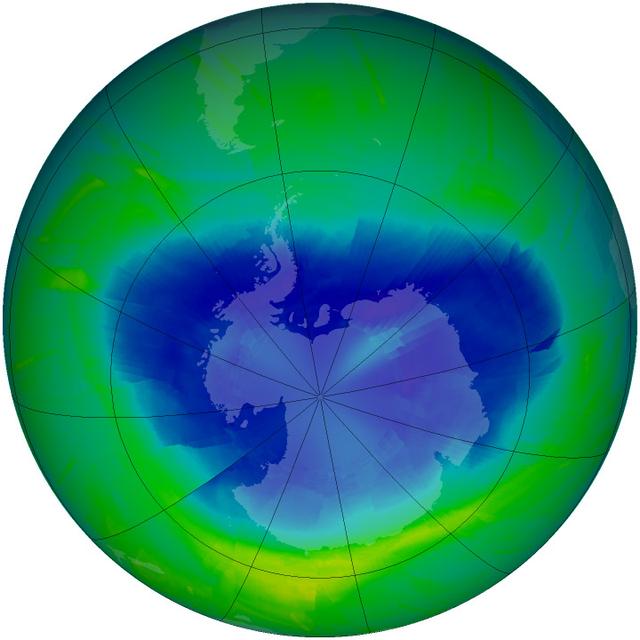
Image acquired September 12, 2010 The yearly depletion of stratospheric ozone over Antarctica – more commonly referred to as the “ozone hole” – started in early August 2010 and is now expanding toward its annual maximum. The hole in the ozone layer typically reaches its maximum area in late September or early October, though atmospheric scientists must wait a few weeks after the maximum to pinpoint when the trend of ozone depletion has slowed down and reversed. The hole isn’t literal; no part of the stratosphere — the second layer of the atmosphere, between 8 and 50 km (5 and 31 miles) — is empty of ozone. Scientists use "hole" as a metaphor for the area in which ozone concentrations drop below the historical threshold of 220 Dobson Units. Historical levels of ozone were much higher than 220 Dobson Units, according to NASA atmospheric scientist Paul Newman, so this value shows a very large ozone loss. Earth's ozone layer protects life by absorbing ultraviolet light, which damages DNA in plants and animals (including humans) and leads to skin cancer. The Ozone Monitoring Instrument (OMI) on NASA’s Aura satellite acquired data for this map of ozone concentrations over Antarctica on September 12, 2010. OMI is a spectrometer that measures the amount of sunlight scattered by Earth’s atmosphere and surface, allowing scientists to assess how much ozone is present at various altitudes — particularly the stratosphere — and near the ground. So far in 2010, the size and depth of the ozone hole has been slightly below the average for 1979 to 2009, likely because of warmer temperatures in the stratosphere over the far southern hemisphere. However, even slight changes in the meteorology of the region this month could affect the rate of depletion of ozone and how large an area the ozone hole might span. You can follow the progress of the ozone hole by visiting NASA’s Ozone Hole Watch page. September 16 is the International Day for the Preservation of the Ozone Layer, a commemoration of the day in 1987 when nations commenced the signing of the Montreal Protocol to limit and eventually ban ozone-depleting substances such as chlorofluorocarbons (CFCs) and other chlorine and bromine-containing compounds. The ozone scientific assessment panel for the United Nations Environment Program, which monitors the effectiveness of the Montreal Protocol, is expected to release its latest review of the state of the world’s ozone layer by the end of 2010. (The last assessment was released in 2006.) Paul Newman is one of the four co-chairs of the assessment panel. NASA image courtesy Ozone Hole Watch. Caption by Michael Carlowicz. Instrument: Aura - OMI To learn more go to: <a href="http://ozonewatch.gsfc.nasa.gov/" rel="nofollow">ozonewatch.gsfc.nasa.gov/</a> Credit: <b><a href="#//earthobservatory.nasa.gov/" rel="nofollow"> NASA’s Earth Observatory</a></b> <b><a href="http://www.nasa.gov/centers/goddard/home/index.html" rel="nofollow">NASA Goddard Space Flight Center</a></b> is home to the nation's largest organization of combined scientists, engineers and technologists that build spacecraft, instruments and new technology to study the Earth, the sun, our solar system, and the universe. <b>Follow us on <a href="http://twitter.com/NASA_GoddardPix" rel="nofollow">Twitter</a></b> <b>Join us on <a href="http://www.facebook.com/pages/Greenbelt-MD/NASA-Goddard/395013845897?ref=tsd" rel="nofollow">Facebook</a></b>
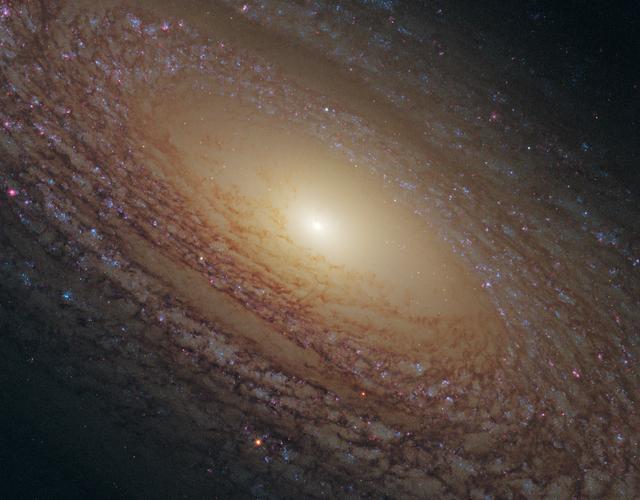
NASA image release Feb. 17, 2011 <b>To see a hd vidoe of this sprial galaxy go to: <a href="http://www.flickr.com/photos/gsfc/5453173577/">www.flickr.com/photos/gsfc/5453173577/</a></b> The Hubble Space Telescope revealed this majestic disk of stars and dust lanes in this view of the spiral galaxy NGC 2841. A bright cusp of starlight marks the galaxy's center. Spiraling outward are dust lanes that are silhouetted against the population of whitish middle-aged stars. Much younger blue stars trace the spiral arms. Notably missing are pinkish emission nebulae indicative of new star birth. It is likely that the radiation and supersonic winds from fiery, super-hot, young blue stars cleared out the remaining gas (which glows pink), and hence shut down further star formation in the regions in which they were born. NGC 2841 currently has a relatively low star formation rate compared to other spirals that are ablaze with emission nebulae. NGC 2841 lies 46 million light-years away in the constellation of Ursa Major (The Great Bear). This image was taken in 2010 through four different filters on Hubble’s Wide Field Camera 3. Wavelengths range from ultraviolet light through visible light to near-infrared light. NASA, ESA, and the Hubble Heritage (STScI/AURA)-ESA/Hubble Collaboration; Acknowledgment: M. Crockett and S. Kaviraj (Oxford University, UK), R. O’Connell (University of Virginia), B. Whitmore (STScI), and the WFC3 Scientific Oversight Committee <b><a href="http://www.nasa.gov/centers/goddard/home/index.html" rel="nofollow">NASA Goddard Space Flight Center</a></b> enables NASA’s mission through four scientific endeavors: Earth Science, Heliophysics, Solar System Exploration, and Astrophysics. Goddard plays a leading role in NASA’s accomplishments by contributing compelling scientific knowledge to advance the Agency’s mission. <b>Follow us on <a href="http://twitter.com/NASAGoddardPix" rel="nofollow">Twitter</a></b> <b>Join us on <a href="http://www.facebook.com/pages/Greenbelt-MD/NASA-Goddard/395013845897?ref=tsd" rel="nofollow">Facebook</a></b>
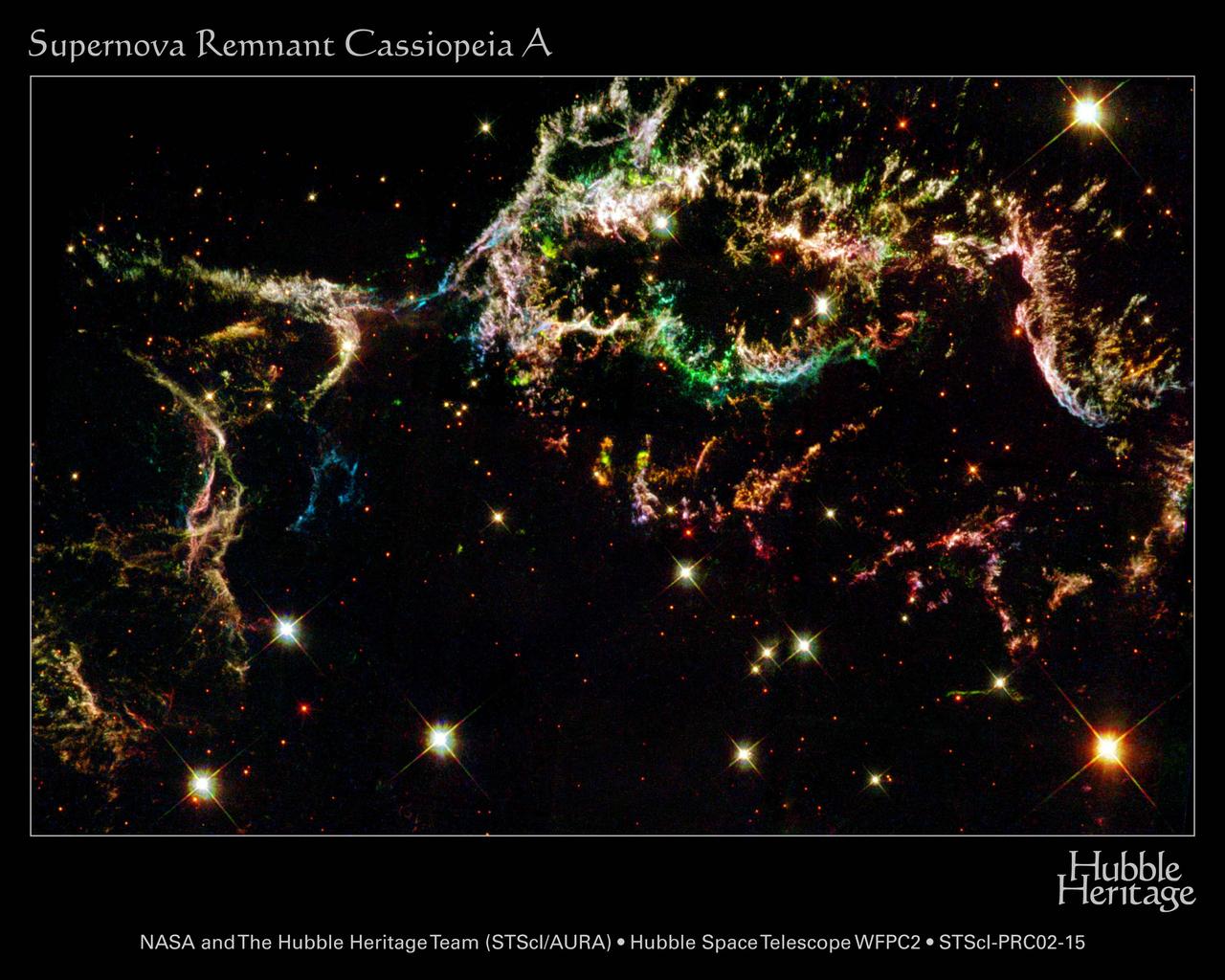
The colorful streamers that float across the sky in this photo taken by NASA's Hubble Space Telescope (HST) were created by the universe's biggest firecracker, the titanic supernova explosion of a massive star. The light from the exploding star reached Earth 320 years ago, nearly a century before the United States celebrated its birth with a bang. The dead star's shredded remains are called Cassiopeia A, or "Cas A" for short. Cas A is the youngest known supernova remnant in our Milky Way Galaxy and resides 10,000 light-years away in the constellation Cassiopeia, so the star actually blew up 10,000 years before the light reached Earth in the late 1600s. This HST image of Cas A shows for the first time that the debris is arranged into thousands of small, cooling knots of gas. This material eventually will be recycled into building new generations of stars and planets. Our own Sun and planets are constructed from the debris of supernovae that exploded billions of years ago. This photo shows the upper rim of the super nova remnant's expanding shell. Near the top of the image are dozens of tiny clumps of matter. Each small clump, originally just a small fragment of the star, is tens of times larger than the diameter of our solar system. The colors highlight parts of the debris where chemical elements are glowing. The dark blue fragments, for example, are richest in oxygen; the red material is rich in sulfur. The images were taken with the Wide Field and Planetary Camera 2 in January 2000 and January 2002. Image Credit: NASA and HST team (Stoics/AURA). Acknowledgment: R. Fesen (Darmouth) and J. Morse ( Univ. of Colorado).
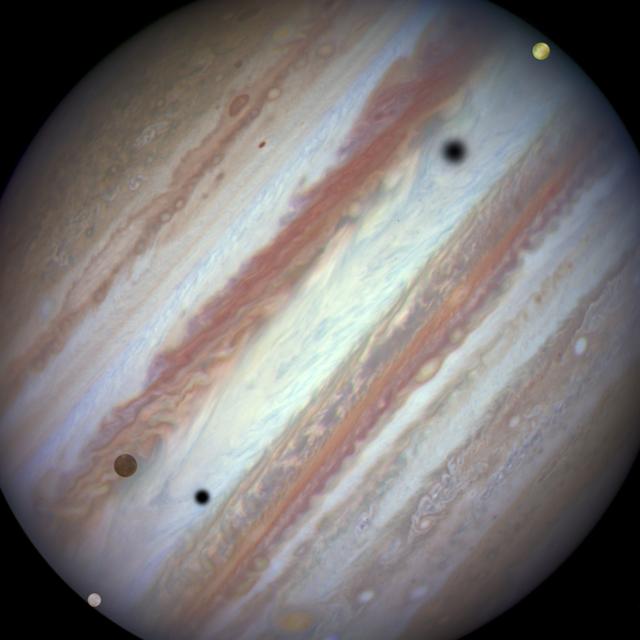
Three moons and their shadows parade across Jupiter near the end of the event at 07:10 UT on January 24, 2015. Europa has entered the frame at lower left. Slower-moving Callisto is above and to the right of Europa. Fastest-moving Io is approaching the eastern limb of the planet. Europa's shadow is toward the left side of the image and Callisto's shadow to the right. (The moons' orbital velocities are proportionally slower with increasing distance from the planet.) Credit: NASA, ESA, and the Hubble Heritage Team (STScI/AURA) More info: Firing off a string of snapshots like a sports photographer at a NASCAR race, NASA's Hubble Space Telescope captured a rare look at three of Jupiter's largest moons zipping across the banded face of the gas-giant planet: Europa, Callisto, and Io. Jupiter's four largest moons can commonly be seen transiting the face of the giant planet and casting shadows onto its cloud tops. However, seeing three moons transiting the face of Jupiter at the same time is rare, occurring only once or twice a decade. Missing from the sequence, taken on January 24, 2015, is the moon Ganymede that was too far from Jupiter in angular separation to be part of the conjunction. <b><a href="http://www.nasa.gov/audience/formedia/features/MP_Photo_Guidelines.html" rel="nofollow">NASA image use policy.</a></b> <b><a href="http://www.nasa.gov/centers/goddard/home/index.html" rel="nofollow">NASA Goddard Space Flight Center</a></b> enables NASA’s mission through four scientific endeavors: Earth Science, Heliophysics, Solar System Exploration, and Astrophysics. Goddard plays a leading role in NASA’s accomplishments by contributing compelling scientific knowledge to advance the Agency’s mission. <b>Follow us on <a href="http://twitter.com/NASAGoddardPix" rel="nofollow">Twitter</a></b> <b>Like us on <a href="http://www.facebook.com/pages/Greenbelt-MD/NASA-Goddard/395013845897?ref=tsd" rel="nofollow">Facebook</a></b> <b>Find us on <a href="http://instagram.com/nasagoddard?vm=grid" rel="nofollow">Instagram</a></b>
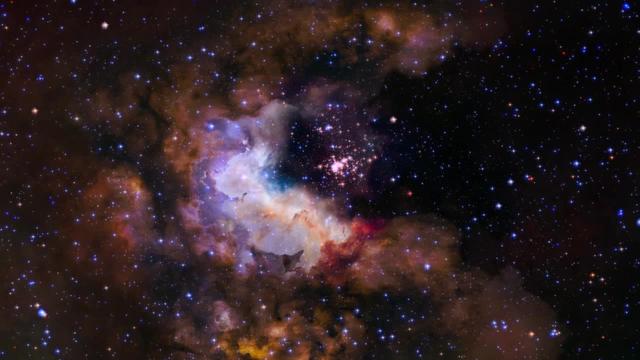
This visualization provides a three-dimensional perspective on Hubble's 25th anniversary image of the nebula Gum 29 with the star cluster Westerlund 2 at its core. The flight traverses the foreground stars and approaches the lower left rim of the nebula Gum 29. Passing through the wispy darker clouds on the near side, the journey reveals bright gas illuminated by the intense radiation of the newly formed stars of cluster Westerlund 2. Within the nebula, several pillars of dark, dense gas are being shaped by the energetic light and strong stellar winds from the brilliant cluster of thousands of stars. Note that the visualization is intended to be a scientifically reasonable interpretation and that distances within the model are significantly compressed. Download here: <a href="http://hubblesite.org/newscenter/archive/releases/2015/12/video/" rel="nofollow">hubblesite.org/newscenter/archive/releases/2015/12/video/</a> Credit: NASA, ESA, G. Bacon, L. Frattare, Z. Levay, and F. Summers (Viz3D Team, STScI), and J. Anderson (STScI) Acknowledgment: The Hubble Heritage Team (STScI/AURA), A. Nota (ESA/STScI), the Westerlund 2 Science Team, and ESO <b><a href="http://www.nasa.gov/audience/formedia/features/MP_Photo_Guidelines.html" rel="nofollow">NASA image use policy.</a></b> <b><a href="http://www.nasa.gov/centers/goddard/home/index.html" rel="nofollow">NASA Goddard Space Flight Center</a></b> enables NASA’s mission through four scientific endeavors: Earth Science, Heliophysics, Solar System Exploration, and Astrophysics. Goddard plays a leading role in NASA’s accomplishments by contributing compelling scientific knowledge to advance the Agency’s mission. <b>Follow us on <a href="http://twitter.com/NASAGoddardPix" rel="nofollow">Twitter</a></b> <b>Like us on <a href="http://www.facebook.com/pages/Greenbelt-MD/NASA-Goddard/395013845897?ref=tsd" rel="nofollow">Facebook</a></b> <b>Find us on <a href="http://instagrid.me/nasagoddard/?vm=grid" rel="nofollow">Instagram</a></b>

Image released April 19, 2013. Astronomers have used NASA's Hubble Space Telescope to photograph the iconic Horsehead Nebula in a new, infrared light to mark the 23rd anniversary of the famous observatory's launch aboard the space shuttle Discovery on April 24, 1990. Looking like an apparition rising from whitecaps of interstellar foam, the iconic Horsehead Nebula has graced astronomy books ever since its discovery more than a century ago. The nebula is a favorite target for amateur and professional astronomers. It is shadowy in optical light. It appears transparent and ethereal when seen at infrared wavelengths. The rich tapestry of the Horsehead Nebula pops out against the backdrop of Milky Way stars and distant galaxies that easily are visible in infrared light. <b>Credit:</b> NASA, ESA, and the Hubble Heritage Team (STScI/AURA) <b><a href="http://www.nasa.gov/mission_pages/hubble/science/horsehead-different.html" target="_blank" rel="nofollow">More on this image.</a></b> <b><a href="http://www.nasa.gov/audience/formedia/features/MP_Photo_Guidelines.html" rel="nofollow">NASA image use policy.</a></b> <b><a href="http://www.nasa.gov/centers/goddard/home/index.html" rel="nofollow">NASA Goddard Space Flight Center</a></b> enables NASA’s mission through four scientific endeavors: Earth Science, Heliophysics, Solar System Exploration, and Astrophysics. Goddard plays a leading role in NASA’s accomplishments by contributing compelling scientific knowledge to advance the Agency’s mission. <b>Follow us on <a href="http://twitter.com/NASAGoddardPix" rel="nofollow">Twitter</a></b> <b>Like us on <a href="http://www.facebook.com/pages/Greenbelt-MD/NASA-Goddard/395013845897?ref=tsd" rel="nofollow">Facebook</a></b> <b>Find us on <a href="http://instagrid.me/nasagoddard/?vm=grid" rel="nofollow">Instagram</a></b>
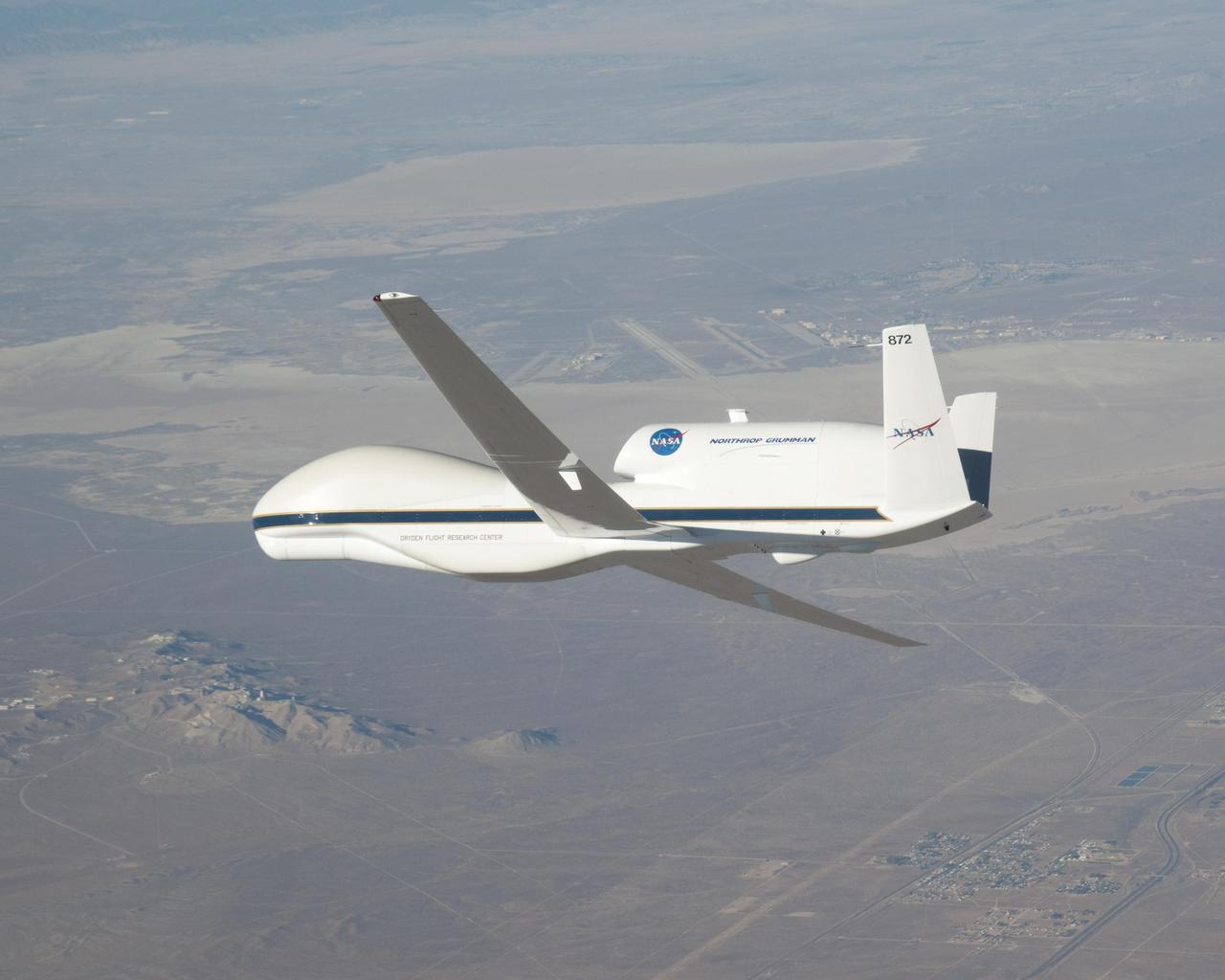
NASA image acquired October 23, 2009. At NASA’s Dryden Research Center in California, a group of engineers, scientists, and aviation technicians have set up camp in a noisy, chilly hangar on Edwards Air Force base. For the past two weeks, they have been working to mount equipment—from HD video cameras to ozone sensors—onto NASA’s Global Hawk, a remote-controlled airplane that can fly for up to 30 hours at altitudes up to 65,000 feet. The team is gearing up for the Global Hawk Pacific campaign, a series of four or five scientific research flights that will take the Global Hawk over the Pacific Ocean and Arctic regions. The 44-foot-long aircraft, with its comically large nose and 116-foot wingspan is pictured in the photograph above, banking for landing over Rogers Dry Lake in California at the end of a test flight on October 23, 2009. The long wings carry the plane’s fuel, and the bulbous nose is one of the payload bays, which house the science instruments. For the Global Hawk Pacific campaign, the robotic aircraft will carry ten science instruments that will sample the chemical composition of air in the troposphere (the atmospheric layer closest to Earth) and the stratosphere (the layer above the troposphere). The mission will also observe clouds and aerosol particles in the troposphere. The primary purpose of the mission is to collect observations that can be used to check the accuracy of simultaneous observations collected by NASA’s Aura satellite. Co-lead scientist Paul Newman from Goddard Space Flight Center is writing about the ground-breaking mission for the Earth Observatory’s Notes from the Field blog. NASA Photograph by Carla Thomas. <b><a href="http://www.nasa.gov/centers/goddard/home/index.html" rel="nofollow">NASA Goddard Space Flight Center</a></b> is home to the nation's largest organization of combined scientists, engineers and technologists that build spacecraft, instruments and new technology to study the Earth, the sun, our solar system, and the universe. To learn more about this image go to: <a href="http://earthobservatory.nasa.gov/IOTD/view.php?id=43291" rel="nofollow">earthobservatory.nasa.gov/IOTD/view.php?id=43291</a>

Hubble’s Spirograph In this classic Hubble image from 2000, the planetary nebula IC 418 glows like a multifaceted jewel with enigmatic patterns. IC 418 lies about 2,000 light-years from Earth in the direction of the constellation Lepus. A planetary nebula represents the final stage in the evolution of a star similar to our sun. The star at the center of IC 418 was a red giant a few thousand years ago, but then ejected its outer layers into space to form the nebula, which has now expanded to a diameter of about 0.1 light-year. The stellar remnant at the center is the hot core of the red giant, from which ultraviolet radiation floods out into the surrounding gas, causing it to fluoresce. Over the next several thousand years, the nebula will gradually disperse into space, and then the star will cool and fade away for billions of years as a white dwarf. Our own sun is expected to undergo a similar fate, but fortunately, this will not occur until some 5 billion years from now. The Hubble image of IC 418 is shown with colors added to represent the different camera filters used that isolate light from various chemical elements. Red shows emission from ionized nitrogen (the coolest gas in the nebula, located furthest from the hot nucleus), green shows emission from hydrogen and blue traces the emission from ionized oxygen (the hottest gas, closest to the central star). The remarkable textures seen in the nebula are newly revealed by the Hubble Space Telescope, and their origin is still uncertain. Read more: <a href="https://go.nasa.gov/2roofKS" rel="nofollow">go.nasa.gov/2roofKS</a> Credit: NASA and The Hubble Heritage Team (STScI/AURA); Acknowledgment: Dr. Raghvendra Sahai (JPL) and Dr. Arsen R. Hajian (USNO)

Image released 11 Aug 2011. The "Necklace Nebula" is located 15,000 light-years away in the constellation Sagitta (the Arrow). In this composite image, taken on July 2, 2011, Hubble's Wide Field Camera 3 captured the glow of hydrogen (blue), oxygen (green), and nitrogen (red). The object, aptly named the Necklace Nebula, is a recently discovered planetary nebula, the glowing remains of an ordinary, Sun-like star. The nebula consists of a bright ring, measuring 12 trillion miles wide, dotted with dense, bright knots of gas that resemble diamonds in a necklace. <a href="http://www.nasa.gov/mission_pages/hubble/science/necklace-nebula.html" target="_blank" rel="nofollow"></a> <b>Credit:</b> NASA, ESA, and the Hubble Heritage Team (STScI/AURA) <b><a href="http://www.nasa.gov/centers/goddard/home/index.html" rel="nofollow">NASA Goddard Space Flight Center</a></b> enables NASA’s mission through four scientific endeavors: Earth Science, Heliophysics, Solar System Exploration, and Astrophysics. Goddard plays a leading role in NASA’s accomplishments by contributing compelling scientific knowledge to advance the Agency’s mission. <b>Follow us on <a href="http://twitter.com/NASA_GoddardPix" rel="nofollow">Twitter</a></b> <b>Like us on <a href="http://www.facebook.com/pages/Greenbelt-MD/NASA-Goddard/395013845897?ref=tsd" rel="nofollow">Facebook</a></b> <b>Find us on <a href="http://web.stagram.com/n/nasagoddard/?vm=grid" rel="nofollow">Instagram</a></b>
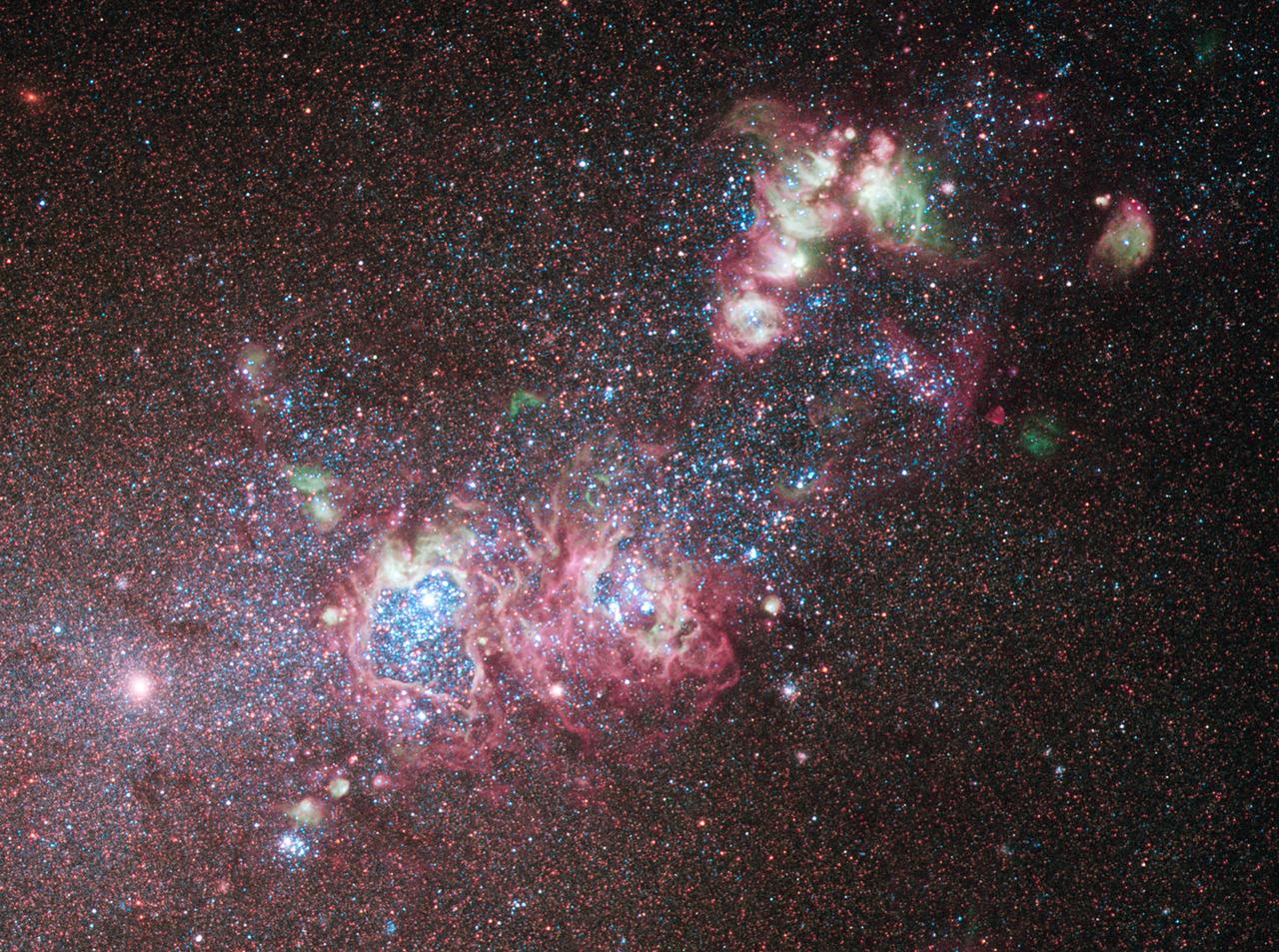
The dwarf galaxy NGC 4214 is ablaze with young stars and gas clouds. Located around 10 million light-years away in the constellation of Canes Venatici (The Hunting Dogs), the galaxy's close proximity, combined with the wide variety of evolutionary stages among the stars, make it an ideal laboratory to research the triggers of star formation and evolution. Intricate patterns of glowing hydrogen formed during the star-birthing process, cavities blown clear of gas by stellar winds, and bright stellar clusters of NGC 4214 can be seen in this optical and near-infrared image. Observations of this dwarf galaxy have also revealed clusters of much older red supergiant stars. Additional older stars can be seen dotted all across the galaxy. The variety of stars at different stages in their evolution indicates that the recent and ongoing starburst periods are not the first, and the galaxy's abundant supply of hydrogen means that star formation will continue into the future. This color image was taken using the Wide Field Camera 3 in December 2009. Credit: NASA, ESA, and the Hubble Heritage (STScI/AURA)-ESA/Hubble Collaboration Acknowledgment: R. O'Connell (University of Virginia) and the WFC3 Scientific Oversight Committee <b><a href="http://www.nasa.gov/audience/formedia/features/MP_Photo_Guidelines.html" rel="nofollow">NASA image use policy.</a></b> <b><a href="http://www.nasa.gov/centers/goddard/home/index.html" rel="nofollow">NASA Goddard Space Flight Center</a></b> enables NASA’s mission through four scientific endeavors: Earth Science, Heliophysics, Solar System Exploration, and Astrophysics. Goddard plays a leading role in NASA’s accomplishments by contributing compelling scientific knowledge to advance the Agency’s mission. <b>Follow us on <a href="http://twitter.com/NASAGoddardPix" rel="nofollow">Twitter</a></b> <b>Like us on <a href="http://www.facebook.com/pages/Greenbelt-MD/NASA-Goddard/395013845897?ref=tsd" rel="nofollow">Facebook</a></b> <b>Find us on <a href="http://instagram.com/nasagoddard?vm=grid" rel="nofollow">Instagram</a></b>
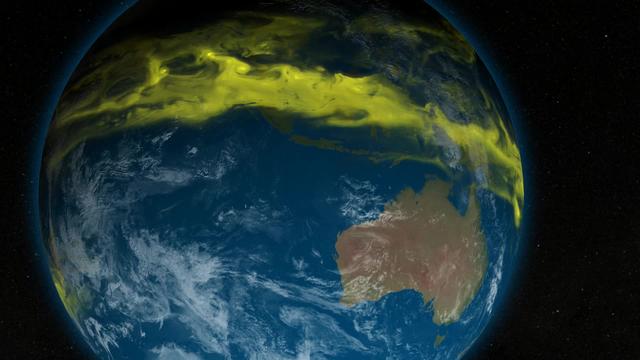
Caption: This is a conceptual animation showing ozone-depleting chemicals moving from the equator to the poles. The chemicals become trapped by the winds of the polar vortex, a ring of fast moving air that circles the South Pole. Watch full video: <a href="https://youtu.be/7n2km69jZu8" rel="nofollow">youtu.be/7n2km69jZu8</a> -- The next three decades will see an end of the era of big ozone holes. In a new study, scientists from NASA Goddard Space Flight Center say that the ozone hole will be consistently smaller than 12 million square miles by the year 2040. Ozone-depleting chemicals in the atmosphere cause an ozone hole to form over Antarctica during the winter months in the Southern Hemisphere. Since the Montreal Protocol agreement in 1987, emissions have been regulated and chemical levels have been declining. However, the ozone hole has still remained bigger than 12 million square miles since the early 1990s, with exact sizes varying from year to year. The size of the ozone hole varies due to both temperature and levels of ozone-depleting chemicals in the atmosphere. In order to get a more accurate picture of the future size of the ozone hole, scientists used NASA’s AURA satellite to determine how much the levels of these chemicals in the atmosphere varied each year. With this new knowledge, scientists can confidently say that the ozone hole will be consistently smaller than 12 million square miles by the year 2040. Scientists will continue to use satellites to monitor the recovery of the ozone hole and they hope to see its full recovery by the end of the century. Research: Inorganic chlorine variability in the Antarctic vortex and implications for ozone recovery. Journal: Geophysical Research: Atmospheres, December 18, 2014. Link to paper: <a href="http://onlinelibrary.wiley.com/doi/10.1002/2014JD022295/abstract" rel="nofollow">onlinelibrary.wiley.com/doi/10.1002/2014JD022295/abstract</a>.

Astronomers using NASA's Hubble Space Telescope have found compelling evidence of a planet forming 7.5 billion miles away from its star, a finding that may challenge current theories about planet formation. Of the almost 900 planets outside our solar system that have been confirmed to date, this is the first to be found at such a great distance from its star. The suspected planet is orbiting the diminutive red dwarf TW Hydrae, a popular astronomy target located 176 light-years away from Earth in the constellation Hydra the Sea Serpent. Read more: <a href="http://1.usa.gov/196B6lZ" rel="nofollow">1.usa.gov/196B6lZ</a> NASA, ESA, J. Debes (STScI), H. Jang-Condell (University of Wyoming), A. Weinberger (Carnegie Institution of Washington), A. Roberge (Goddard Space Flight Center), G. Schneider (University of Arizona/Steward Observatory), and A. Feild (STScI/AURA) <b><a href="http://www.nasa.gov/audience/formedia/features/MP_Photo_Guidelines.html" rel="nofollow">NASA image use policy.</a></b> <b><a href="http://www.nasa.gov/centers/goddard/home/index.html" rel="nofollow">NASA Goddard Space Flight Center</a></b> enables NASA’s mission through four scientific endeavors: Earth Science, Heliophysics, Solar System Exploration, and Astrophysics. Goddard plays a leading role in NASA’s accomplishments by contributing compelling scientific knowledge to advance the Agency’s mission. <b>Follow us on <a href="http://twitter.com/NASA_GoddardPix" rel="nofollow">Twitter</a></b> <b>Like us on <a href="http://www.facebook.com/pages/Greenbelt-MD/NASA-Goddard/395013845897?ref=tsd" rel="nofollow">Facebook</a></b> <b>Find us on <a href="http://instagram.com/nasagoddard?vm=grid" rel="nofollow">Instagram</a></b>
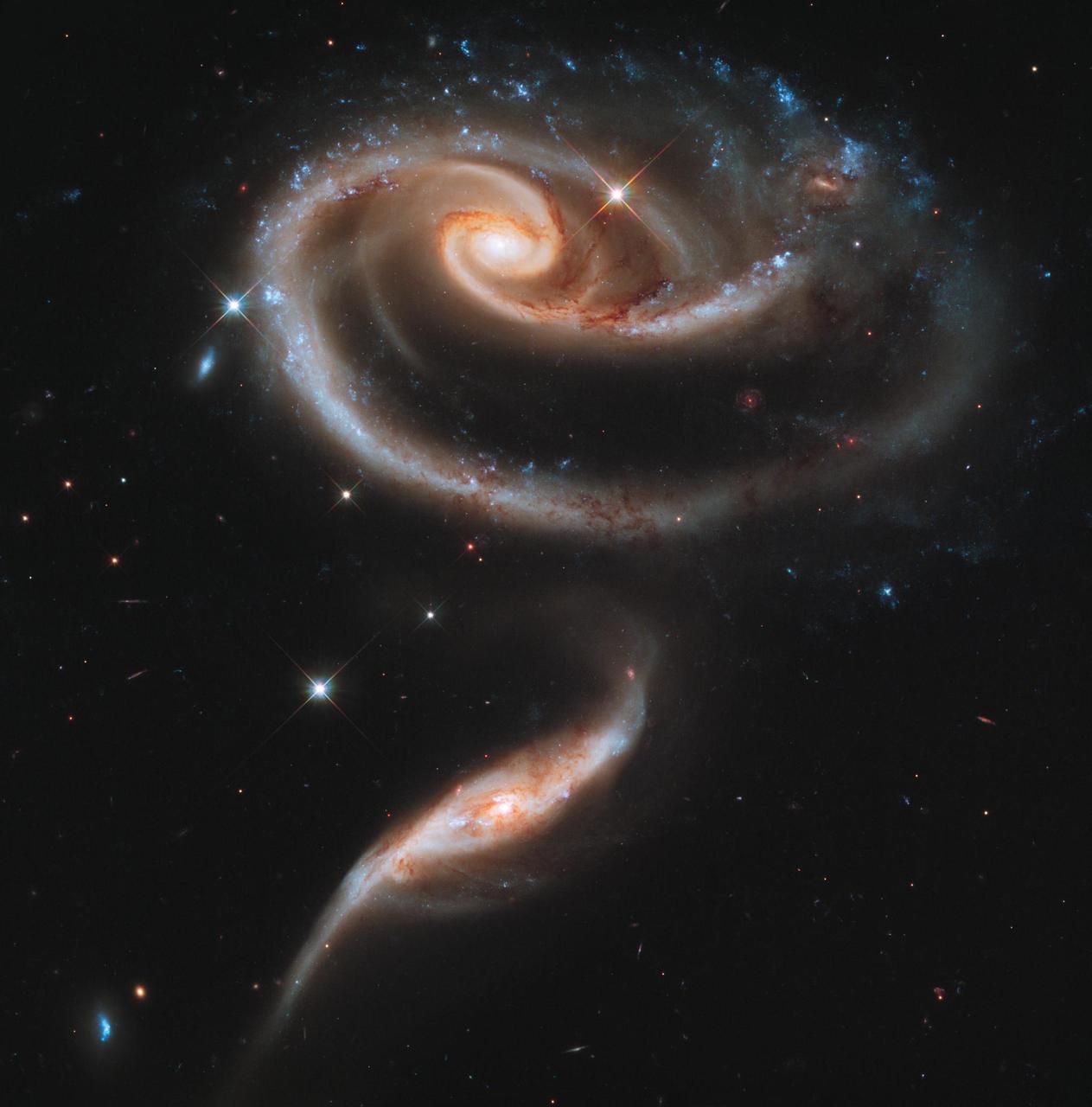
NASA image release April 20, 2011 To see a video of this image go here: <a href="http://www.flickr.com/photos/gsfc/5637796622">www.flickr.com/photos/gsfc/5637796622</a> To celebrate the 21st anniversary of the Hubble Space Telescope's deployment into space, astronomers at the Space Telescope Science Institute in Baltimore, Md., pointed Hubble's eye at an especially photogenic pair of interacting galaxies called Arp 273. The larger of the spiral galaxies, known as UGC 1810, has a disk that is distorted into a rose-like shape by the gravitational tidal pull of the companion galaxy below it, known as UGC 1813. This image is a composite of Hubble Wide Field Camera 3 data taken on December 17, 2010, with three separate filters that allow a broad range of wavelengths covering the ultraviolet, blue, and red portions of the spectrum. Hubble was launched April 24, 1990, aboard Discovery's STS-31 mission. Hubble discoveries revolutionized nearly all areas of current astronomical research from planetary science to cosmology. Credit: NASA, ESA, and the Hubble Heritage Team (STScI/AURA) To read more about this image go here: <a href="http://www.nasa.gov/mission_pages/hubble/science/hubble-rose.html" rel="nofollow">www.nasa.gov/mission_pages/hubble/science/hubble-rose.html</a> <b><a href="http://www.nasa.gov/centers/goddard/home/index.html" rel="nofollow">NASA Goddard Space Flight Center</a></b> enables NASA’s mission through four scientific endeavors: Earth Science, Heliophysics, Solar System Exploration, and Astrophysics. Goddard plays a leading role in NASA’s accomplishments by contributing compelling scientific knowledge to advance the Agency’s mission. <b>Follow us on <a href="http://twitter.com/NASA_GoddardPix" rel="nofollow">Twitter</a></b> <b>Join us on <a href="http://www.facebook.com/pages/Greenbelt-MD/NASA-Goddard/395013845897?ref=tsd" rel="nofollow">Facebook</a></b>
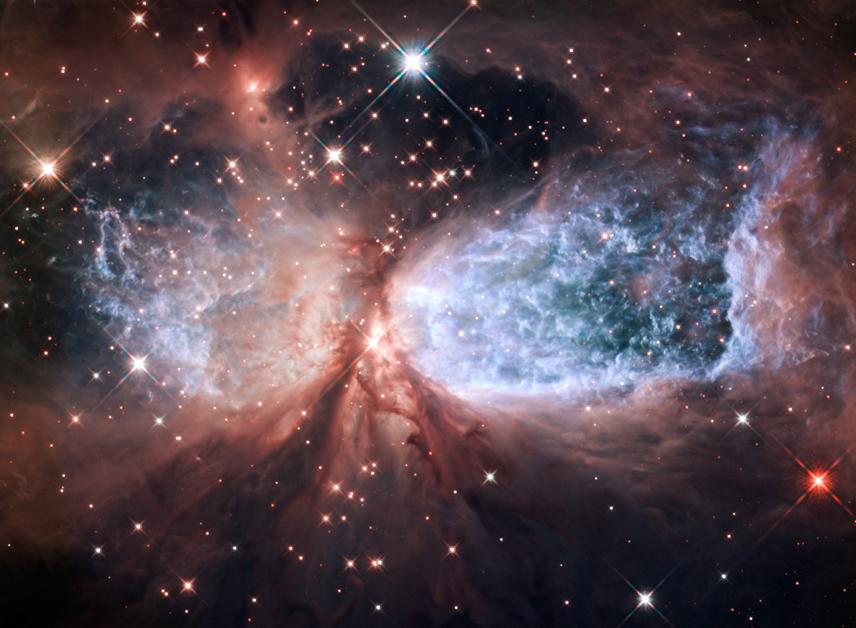
The bipolar star-forming region, called Sharpless 2-106, looks like a soaring, celestial snow angel. The outstretched “wings” of the nebula record the contrasting imprint of heat and motion against the backdrop of a colder medium. Twin lobes of super-hot gas, glowing blue in this image, stretch outward from the central star. This hot gas creates the “wings” of our angel. A ring of dust and gas orbiting the star acts like a belt, cinching the expanding nebula into an “hourglass” shape. To read more about this image go to: <a href="http://www.nasa.gov/mission_pages/hubble/science/snow-angel.html" rel="nofollow">www.nasa.gov/mission_pages/hubble/science/snow-angel.html</a> Credit: NASA, ESA, and the Hubble Heritage Team (STScI/AURA) <b><a href="http://www.nasa.gov/audience/formedia/features/MP_Photo_Guidelines.html" rel="nofollow">NASA image use policy.</a></b> <b><a href="http://www.nasa.gov/centers/goddard/home/index.html" rel="nofollow">NASA Goddard Space Flight Center</a></b> enables NASA’s mission through four scientific endeavors: Earth Science, Heliophysics, Solar System Exploration, and Astrophysics. Goddard plays a leading role in NASA’s accomplishments by contributing compelling scientific knowledge to advance the Agency’s mission. <b>Follow us on <a href="http://twitter.com/NASA_GoddardPix" rel="nofollow">Twitter</a></b> <b>Like us on <a href="http://www.facebook.com/pages/Greenbelt-MD/NASA-Goddard/395013845897?ref=tsd" rel="nofollow">Facebook</a></b> <b>Find us on <a href="http://instagrid.me/nasagoddard/?vm=grid" rel="nofollow">Instagram</a></b>

NASA image release June 6, 2010 Like a July 4 fireworks display a young, glittering collection of stars looks like an aerial burst. The cluster is surrounded by clouds of interstellar gas and dust - the raw material for new star formation. The nebula, located 20,000 light-years away in the constellation Carina, contains a central cluster of huge, hot stars, called NGC 3603. This environment is not as peaceful as it looks. Ultraviolet radiation and violent stellar winds have blown out an enormous cavity in the gas and dust enveloping the cluster, providing an unobstructed view of the cluster. Most of the stars in the cluster were born around the same time but differ in size, mass, temperature, and color. The course of a star's life is determined by its mass, so a cluster of a given age will contain stars in various stages of their lives, giving an opportunity for detailed analyses of stellar life cycles. NGC 3603 also contains some of the most massive stars known. These huge stars live fast and die young, burning through their hydrogen fuel quickly and ultimately ending their lives in supernova explosions. Star clusters like NGC 3603 provide important clues to understanding the origin of massive star formation in the early, distant universe. Astronomers also use massive clusters to study distant starbursts that occur when galaxies collide, igniting a flurry of star formation. The proximity of NGC 3603 makes it an excellent lab for studying such distant and momentous events. This Hubble Space Telescope image was captured in August 2009 and December 2009 with the Wide Field Camera 3 in both visible and infrared light, which trace the glow of sulfur, hydrogen, and iron. The Hubble Space Telescope is a project of international cooperation between NASA and the European Space Agency. NASA’s Goddard Space Flight Center manages the telescope. The Space Telescope Science Institute (STScI) conducts Hubble science operations. STScI is operated for NASA by the Association of Universities for Research in Astronomy, Inc. in Washington, D.C. Credit: NASA, ESA, R. O'Connell (University of Virginia), F. Paresce (National Institute for Astrophysics, Bologna, Italy), E. Young (Universities Space Research Association/Ames Research Center), the WFC3 Science Oversight Committee, and the Hubble Heritage Team (STScI/AURA) <b><a href="http://www.nasa.gov/centers/goddard/home/index.html" rel="nofollow">NASA Goddard Space Flight Center</a></b> is home to the nation's largest organization of combined scientists, engineers and technologists that build spacecraft, instruments and new technology to study the Earth, the sun, our solar system, and the universe.

This image, taken by the NASA/ESA Hubble Space Telescope, shows the colorful "last hurrah" of a star like our sun. The star is ending its life by casting off its outer layers of gas, which formed a cocoon around the star's remaining core. Ultraviolet light from the dying star makes the material glow. The burned-out star, called a white dwarf, is the white dot in the center. Our sun will eventually burn out and shroud itself with stellar debris, but not for another 5 billion years. Our Milky Way Galaxy is littered with these stellar relics, called planetary nebulae. The objects have nothing to do with planets. Eighteenth- and nineteenth-century astronomers called them the name because through small telescopes they resembled the disks of the distant planets Uranus and Neptune. The planetary nebula in this image is called NGC 2440. The white dwarf at the center of NGC 2440 is one of the hottest known, with a surface temperature of more than 360,000 degrees Fahrenheit (200,000 degrees Celsius). The nebula's chaotic structure suggests that the star shed its mass episodically. During each outburst, the star expelled material in a different direction. This can be seen in the two bowtie-shaped lobes. The nebula also is rich in clouds of dust, some of which form long, dark streaks pointing away from the star. NGC 2440 lies about 4,000 light-years from Earth in the direction of the constellation Puppis. The material expelled by the star glows with different colors depending on its composition, its density and how close it is to the hot central star. Blue samples helium; blue-green oxygen, and red nitrogen and hydrogen. Credit: NASA, ESA, and K. Noll (STScI), Acknowledgment: The Hubble Heritage Team (STScI/AURA) <b><a href="http://www.nasa.gov/audience/formedia/features/MP_Photo_Guidelines.html" rel="nofollow">NASA image use policy.</a></b> <b><a href="http://www.nasa.gov/centers/goddard/home/index.html" rel="nofollow">NASA Goddard Space Flight Center</a></b> enables NASA’s mission through four scientific endeavors: Earth Science, Heliophysics, Solar System Exploration, and Astrophysics. Goddard plays a leading role in NASA’s accomplishments by contributing compelling scientific knowledge to advance the Agency’s mission. <b>Follow us on <a href="http://twitter.com/NASAGoddardPix" rel="nofollow">Twitter</a></b> <b>Like us on <a href="http://www.facebook.com/pages/Greenbelt-MD/NASA-Goddard/395013845897?ref=tsd" rel="nofollow">Facebook</a></b> <b>Find us on <a href="http://instagrid.me/nasagoddard/?vm=grid" rel="nofollow">Instagram</a></b>

To view a video of this story go to: <a href="http://www.flickr.com/photos/gsfc/8448332724">www.flickr.com/photos/gsfc/8448332724</a> Working with astronomical image processors at the Space Telescope Science Institute in Baltimore, Md., renowned astro-photographer Robert Gendler has taken science data from the Hubble Space Telescope (HST) archive and combined it with his own ground-based observations to assemble a photo illustration of the magnificent spiral galaxy M106. Gendler retrieved archival Hubble images of M106 to assemble a mosaic of the center of the galaxy. He then used his own and fellow astro-photographer Jay GaBany's observations of M106 to combine with the Hubble data in areas where there was less coverage, and finally, to fill in the holes and gaps where no Hubble data existed. The center of the galaxy is composed almost entirely of HST data taken by the Advanced Camera for Surveys, Wide Field Camera 3, and Wide Field Planetary Camera 2 detectors. The outer spiral arms are predominantly HST data colorized with ground-based data taken by Gendler's and GaBany's 12.5-inch and 20-inch telescopes, located at very dark remote sites in New Mexico. The image also reveals the optical component of the "anomalous arms" of M106, seen here as red, glowing hydrogen emission. To read more go to: <a href="http://www.nasa.gov/mission_pages/hubble/science/m106.html" rel="nofollow">www.nasa.gov/mission_pages/hubble/science/m106.html</a> Credit: NASA, ESA, the Hubble Heritage Team (STScI/AURA), R. Gendler (for the Hubble Heritage Team), and G. Bacon (STScI) <b><a href="http://www.nasa.gov/audience/formedia/features/MP_Photo_Guidelines.html" rel="nofollow">NASA image use policy.</a></b> <b><a href="http://www.nasa.gov/centers/goddard/home/index.html" rel="nofollow">NASA Goddard Space Flight Center</a></b> enables NASA’s mission through four scientific endeavors: Earth Science, Heliophysics, Solar System Exploration, and Astrophysics. Goddard plays a leading role in NASA’s accomplishments by contributing compelling scientific knowledge to advance the Agency’s mission. <b>Follow us on <a href="http://twitter.com/NASA_GoddardPix" rel="nofollow">Twitter</a></b> <b>Like us on <a href="http://www.facebook.com/pages/Greenbelt-MD/NASA-Goddard/395013845897?ref=tsd" rel="nofollow">Facebook</a></b> <b>Find us on <a href="http://instagrid.me/nasagoddard/?vm=grid" rel="nofollow">Instagram</a></b>

This is a Hubble Space Telescope composite image of a supernova explosion designated SN 2014J in the galaxy M82. At a distance of approximately 11.5 million light-years from Earth it is the closest supernova of its type discovered in the past few decades. The explosion is categorized as a Type Ia supernova, which is theorized to be triggered in binary systems consisting of a white dwarf and another star — which could be a second white dwarf, a star like our sun, or a giant star. Astronomers using a ground-based telescope discovered the explosion on January 21, 2014. This Hubble photograph was taken on January 31, as the supernova approached its peak brightness. The Hubble data are expected to help astronomers refine distance measurements to Type Ia supernovae. In addition, the observations could yield insights into what kind of stars were involved in the explosion. Hubble’s ultraviolet-light sensitivity will allow astronomers to probe the environment around the site of the supernova explosion and in the interstellar medium of the host galaxy. Because of their consistent peak brightness, Type Ia supernovae are among the best tools to measure distances in the universe. They were fundamental to the 1998 discovery of the mysterious acceleration of the expanding universe. A hypothesized repulsive force, called dark energy, is thought to cause the acceleration. Among the other major NASA space-based observatories used in the M82 viewing campaign are Spitzer Space Telescope, Chandra X-ray Observatory, Nuclear Spectroscopic Telescope Array (NuSTAR), Fermi Gamma-ray Space Telescope, Swift Gamma Ray Burst Explorer, and the Stratospheric Observatory for Infrared Astronomy (SOFIA). Image Credit: NASA, ESA, A. Goobar (Stockholm University), and the Hubble Heritage Team (STScI/AURA) <b><a href="http://www.nasa.gov/audience/formedia/features/MP_Photo_Guidelines.html" rel="nofollow">NASA image use policy.</a></b> <b><a href="http://www.nasa.gov/centers/goddard/home/index.html" rel="nofollow">NASA Goddard Space Flight Center</a></b> enables NASA’s mission through four scientific endeavors: Earth Science, Heliophysics, Solar System Exploration, and Astrophysics. Goddard plays a leading role in NASA’s accomplishments by contributing compelling scientific knowledge to advance the Agency’s mission. <b>Follow us on <a href="http://twitter.com/NASAGoddardPix" rel="nofollow">Twitter</a></b> <b>Like us on <a href="http://www.facebook.com/pages/Greenbelt-MD/NASA-Goddard/395013845897?ref=tsd" rel="nofollow">Facebook</a></b> <b>Find us on <a href="http://instagram.com/nasagoddard?vm=grid" rel="nofollow">Instagram</a></b>
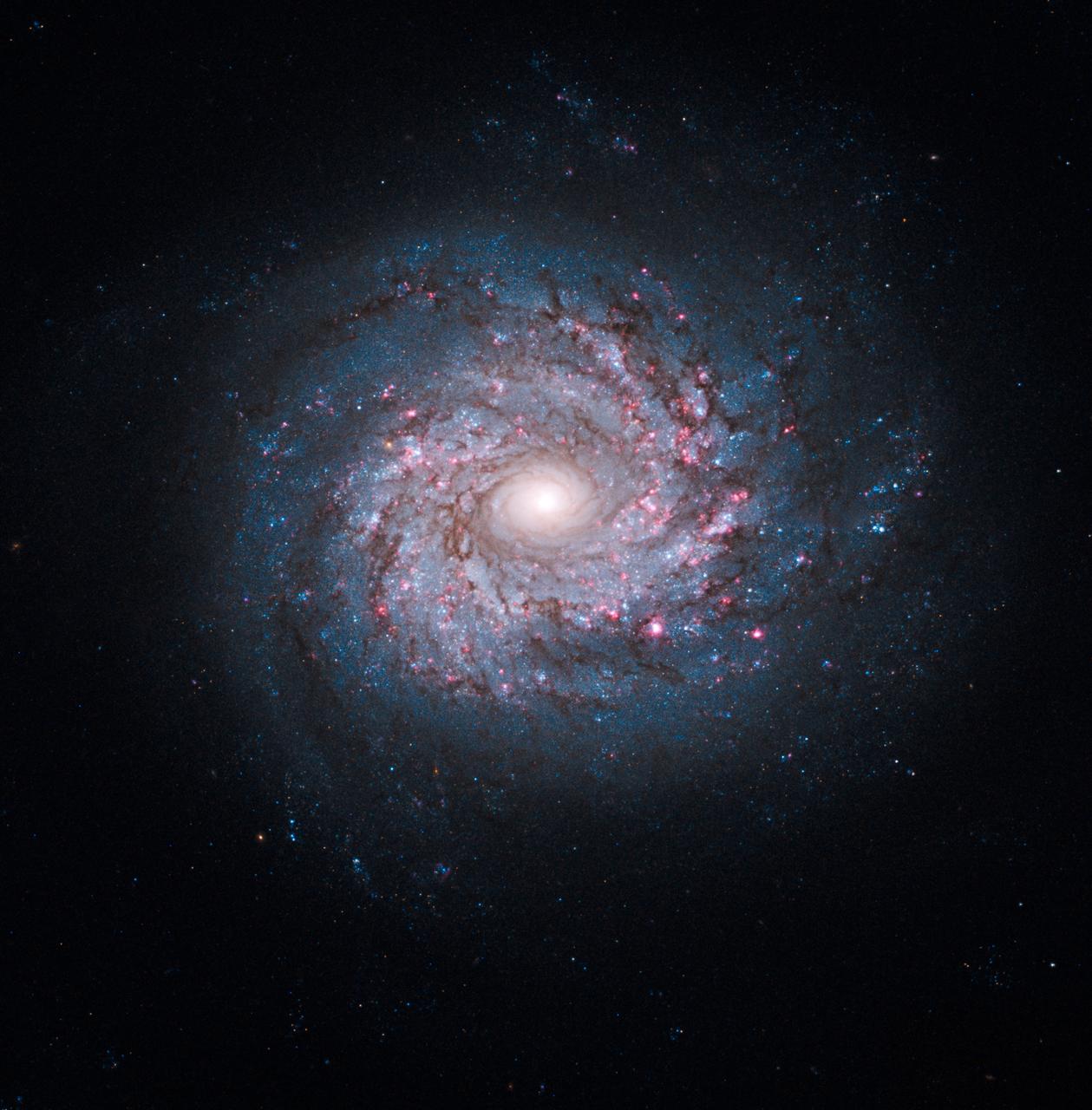
NASA image release October 19, 2010 Though the universe is chock full of spiral-shaped galaxies, no two look exactly the same. This face-on spiral galaxy, called NGC 3982, is striking for its rich tapestry of star birth, along with its winding arms. The arms are lined with pink star-forming regions of glowing hydrogen, newborn blue star clusters, and obscuring dust lanes that provide the raw material for future generations of stars. The bright nucleus is home to an older population of stars, which grow ever more densely packed toward the center. NGC 3982 is located about 68 million light-years away in the constellation Ursa Major. The galaxy spans about 30,000 light-years, one-third of the size of our Milky Way galaxy. This color image is composed of exposures taken by the Hubble Space Telescope's Wide Field Planetary Camera 2 (WFPC2), the Advanced Camera for Surveys (ACS), and the Wide Field Camera 3 (WFC3). The observations were taken between March 2000 and August 2009. The rich color range comes from the fact that the galaxy was photographed invisible and near-infrared light. Also used was a filter that isolates hydrogen emission that emanates from bright star-forming regions dotting the spiral arms. The Hubble Space Telescope is a project of international cooperation between NASA and the European Space Agency. NASA's Goddard Space Flight Center manages the telescope. The Space Telescope Science Institute (STScI) conducts Hubble science operations. STScI is operated for NASA by the Association of Universities for Research in Astronomy, Inc. in Washington, D.C. Credit: NASA, ESA, and the Hubble Heritage Team (STScI/AURA) Acknowledgment: A. Riess (STScI) <b><a href="http://www.nasa.gov/centers/goddard/home/index.html" rel="nofollow">NASA Goddard Space Flight Center</a></b> enables NASA’s mission through four scientific endeavors: Earth Science, Heliophysics, Solar System Exploration, and Astrophysics. Goddard plays a leading role in NASA’s accomplishments by contributing compelling scientific knowledge to advance the Agency’s mission. <b>Follow us on <a href="http://twitter.com/NASA_GoddardPix" rel="nofollow">Twitter</a></b> <b>Join us on <a href="http://www.facebook.com/pages/Greenbelt-MD/NASA-Goddard/395013845897?ref=tsd" rel="nofollow">Facebook</a></b>
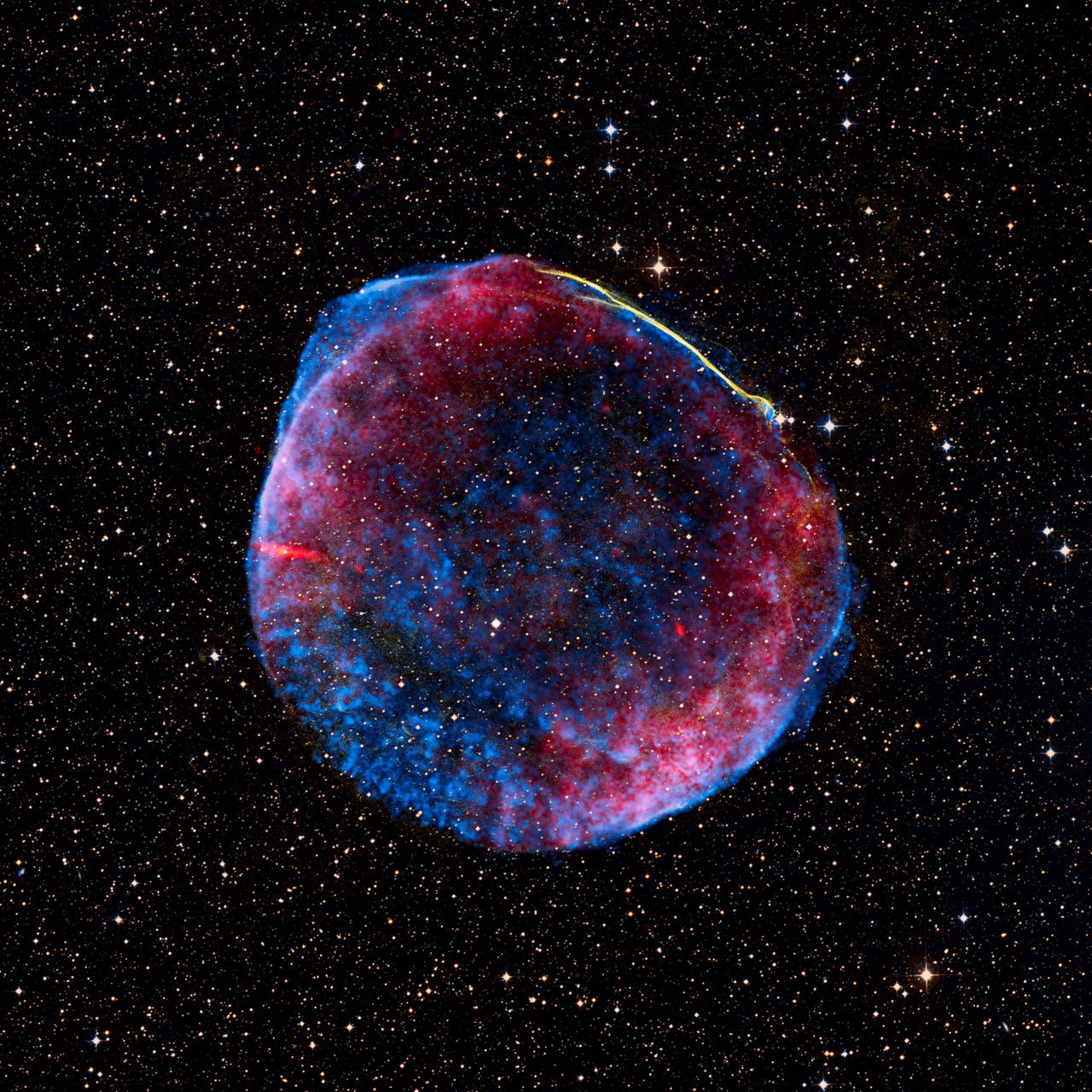
Release date: July 1, 2008 This image is a composite of visible (or optical), radio, and X-ray data of the full shell of the supernova remnant from SN 1006. The radio data show much of the extent that the X-ray image shows. In contrast, only a small linear filament in the northwest corner of the shell is visible in the optical data. The object has an angular size of roughly 30 arcminutes (0.5 degree, or about the size of the full moon), and a physical size of 60 light-years (18 parsecs) based on its distance of nearly 7,000 light-years. The small green box along the bright filament at the top of the image corresponds to the dimensions of the Hubble release image. The optical data was obtained at the University of Michigan's 0.9-meter Curtis Schmidt telescope at the National Science Foundation's Cerro Tololo Inter-American Observatory (CTIO) near La Serena, Chile. H-alpha, continuum-subtracted data were provided by F. Winkler (Middlebury COllege) et al. The X-ray data were acquired from the Chandra X-ray Observatory's AXAF CCD Imaging Spectrometer (ACIS) at 0.5-3keV, and were provided by J. Hughes (Rutgers University) et al. The radio data, supplied by K. Dyer (NRAO, Socorro) et al., were a composite from the National Radio Astronomy Observatory's Very Large Array (NRAO/VLA) in Socorro, New Mexico, along with the Green Bank Telescope (GBT) in Green Bank, West Virginia. Data of the supernova remnant were blended on a visible-light stellar background created using the Digitized Sky Survey's Anglo-Australian Observatory (AAO2) blue and red plates. Photo Credit: NASA, ESA, and Z. Levay (STScI) Science Credit: Radio: NRAO/AUI/NSF GBT+VLA 1.4 GHz mosaic (Dyer, Maddalena and Cornwell, NRAO); X-ray: NASA/CXC/Rutgers/G. Cassam-Chenai and J. Hughes et al.; Optical: F.Winkler/Middlebury College and NOAO/AURA/NSF; and DSS To learn more about the Hubble Space Telescope go here: <a href="http://www.nasa.gov/mission_pages/hubble/main/index.html" rel="nofollow">www.nasa.gov/mission_pages/hubble/main/index.html</a> <b><a href="http://www.nasa.gov/centers/goddard/home/index.html" rel="nofollow">NASA Goddard Space Flight Center</a></b> is home to the nation's largest organization of combined scientists, engineers and technologists that build spacecraft, instruments and new technology to study the Earth, the sun, our solar system, and the universe. <b>Follow us on <a href="http://twitter.com/NASAGoddardPix" rel="nofollow">Twitter</a></b> <b>Join us on <a href="http://www.facebook.com/pages/Greenbelt-MD/NASA-Goddard/395013845897?ref=tsd" rel="nofollow">Facebook</a><b> </b></b>
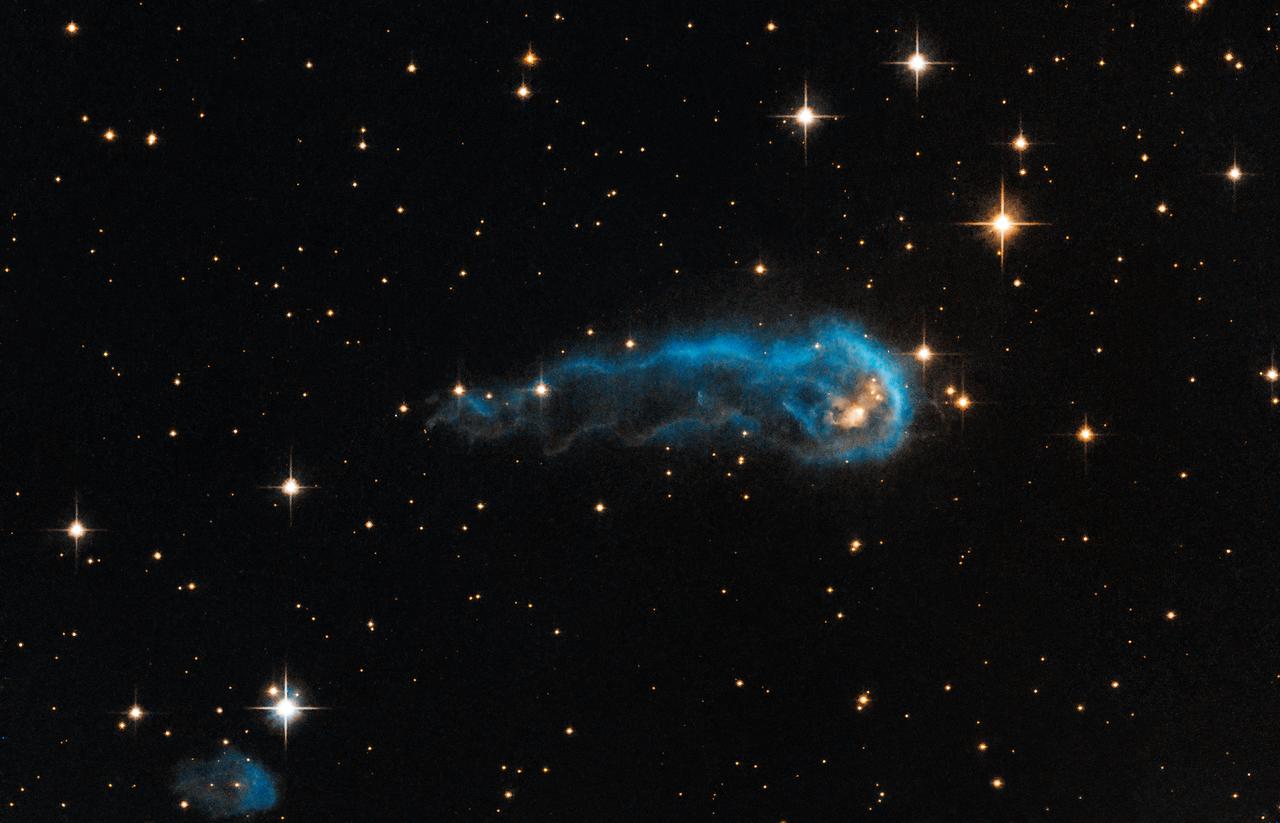
This light-year-long knot of interstellar gas and dust resembles a caterpillar on its way to a feast. But the meat of the story is not only what this cosmic caterpillar eats for lunch, but also what's eating it. Harsh winds from extremely bright stars are blasting ultraviolet radiation at this "wanna-be" star and sculpting the gas and dust into its long shape. The culprits are 65 of the hottest, brightest known stars, classified as O-type stars, located 15 light-years away from the knot, towards the right edge of the image. These stars, along with 500 less bright, but still highly luminous B-type stars make up what is called the Cygnus OB2 association. Collectively, the association is thought to have a mass more than 30,000 times that of our sun. The caterpillar-shaped knot, called IRAS 20324+4057, is a protostar in a very early evolutionary stage. It is still in the process of collecting material from an envelope of gas surrounding it. However, that envelope is being eroded by the radiation from Cygnus OB2. Protostars in this region should eventually become young stars with final masses about one to ten times that of our sun, but if the eroding radiation from the nearby bright stars destroys the gas envelope before the protostars finish collecting mass, their final masses may be reduced. Spectroscopic observations of the central star within IRAS 20324+4057 show that it is still collecting material quite heavily from its outer envelope, hoping to bulk up in mass. Only time will tell if the formed star will be a "heavy-weight" or a "light-weight" with respect to its mass. This image of IRAS 20324+4057 is a composite of Hubble Advanced Camera for Surveys data taken in green and infrared light in 2006, and ground-based hydrogen data from the Isaac Newton Telescope in 2003. The object lies 4,500 light-years away in the constellation Cygnus. Credit: NASA, ESA, and the Hubble Heritage Team (STScI/AURA) <b><a href="http://www.nasa.gov/audience/formedia/features/MP_Photo_Guidelines.html" rel="nofollow">NASA image use policy.</a></b> <b><a href="http://www.nasa.gov/centers/goddard/home/index.html" rel="nofollow">NASA Goddard Space Flight Center</a></b> enables NASA’s mission through four scientific endeavors: Earth Science, Heliophysics, Solar System Exploration, and Astrophysics. Goddard plays a leading role in NASA’s accomplishments by contributing compelling scientific knowledge to advance the Agency’s mission. <b>Follow us on <a href="http://twitter.com/NASA_GoddardPix" rel="nofollow">Twitter</a></b> <b>Like us on <a href="http://www.facebook.com/pages/Greenbelt-MD/NASA-Goddard/395013845897?ref=tsd" rel="nofollow">Facebook</a></b> <b>Find us on <a href="http://instagram.com/nasagoddard?vm=grid" rel="nofollow">Instagram</a></b>

This NASA Hubble Space Telescope image, taken in near-infrared light, transforms the pillars into eerie, wispy silhouettes, which are seen against a background of myriad stars. The near-infrared light can penetrate much of the gas and dust, revealing stars behind the nebula as well as hidden away inside the pillars. Some of the gas and dust clouds are so dense that even the near-infrared light cannot penetrate them. New stars embedded in the tops of the pillars, however, are apparent as bright sources that are unseen in the visible image. The ghostly bluish haze around the dense edges of the pillars is material getting heated up by the intense ultraviolet radiation from a cluster of young, massive stars and evaporating away into space. The stellar grouping is above the pillars and cannot be seen in the image. At the top edge of the left-hand pillar, a gaseous fragment has been heated up and is flying away from the structure, underscoring the violent nature of star-forming regions. Astronomers used filters that isolate the light from newly formed stars, which are invisible in the visible-light image. At these wavelengths, astronomers are seeing through the pillars and even through the back wall of the nebula cavity and can see the next generations of stars just as they're starting to emerge from their formative nursery. Credit: NASA, ESA, and the Hubble Heritage Team (STScI/AURA) Read more: <a href="http://1.usa.gov/1HGfkqr" rel="nofollow">1.usa.gov/1HGfkqr</a> <b><a href="http://www.nasa.gov/audience/formedia/features/MP_Photo_Guidelines.html" rel="nofollow">NASA image use policy.</a></b> <b><a href="http://www.nasa.gov/centers/goddard/home/index.html" rel="nofollow">NASA Goddard Space Flight Center</a></b> enables NASA’s mission through four scientific endeavors: Earth Science, Heliophysics, Solar System Exploration, and Astrophysics. Goddard plays a leading role in NASA’s accomplishments by contributing compelling scientific knowledge to advance the Agency’s mission. <b>Follow us on <a href="http://twitter.com/NASAGoddardPix" rel="nofollow">Twitter</a></b> <b>Like us on <a href="http://www.facebook.com/pages/Greenbelt-MD/NASA-Goddard/395013845897?ref=tsd" rel="nofollow">Facebook</a></b> <b>Find us on <a href="http://instagrid.me/nasagoddard/?vm=grid" rel="nofollow">Instagram</a></b>

Mars is looking mighty fine in this portrait nabbed by the Hubble Space Telescope on a near close approach! Read more: <a href="http://go.nasa.gov/1rWYiBT" rel="nofollow">go.nasa.gov/1rWYiBT</a> The Hubble Space Telescope is more well known for its picturesque views of nebulae and galaxies, but it's also useful for studying our own planets, including Mars. Hubble imaged Mars on May 12, 2016 - ten days before Mars would be on the exact opposite side of the Earth from the Sun. Bright, frosty polar caps, and clouds above a vivid, rust-colored landscape reveal Mars as a dynamic seasonal planet in this NASA Hubble Space Telescope view taken on May 12, 2016, when Mars was 50 million miles from Earth. The Hubble image reveals details as small as 20 to 30 miles across. The large, dark region at far right is Syrtis Major Planitia, one of the first features identified on the surface of the planet by seventeenth-century observers. Christiaan Huygens used this feature to measure the rotation rate of Mars. (A Martian day is about 24 hours and 37 minutes.) Today we know that Syrtis Major is an ancient, inactive shield volcano. Late-afternoon clouds surround its summit in this view. A large oval feature to the south of Syrtis Major is the bright Hellas Planitia basin. About 1,100 miles across and nearly five miles deep, it was formed about 3.5 billion years ago by an asteroid impact. The orange area in the center of the image is Arabia Terra, a vast upland region in northern Mars that covers about 2,800 miles. The landscape is densely cratered and heavily eroded, indicating that it could be among the oldest terrains on the planet. Dried river canyons (too small to be seen here) wind through the region and empty into the large northern lowlands. Credit: NASA, ESA, the Hubble Heritage Team (STScI/AURA), J. Bell (ASU), and M. Wolff (Space Science Institute) #nasagoddard #mars #hubble #space <b><a href="http://www.nasa.gov/audience/formedia/features/MP_Photo_Guidelines.html" rel="nofollow">NASA image use policy.</a></b> <b><a href="http://www.nasa.gov/centers/goddard/home/index.html" rel="nofollow">NASA Goddard Space Flight Center</a></b> enables NASA’s mission through four scientific endeavors: Earth Science, Heliophysics, Solar System Exploration, and Astrophysics. Goddard plays a leading role in NASA’s accomplishments by contributing compelling scientific knowledge to advance the Agency’s mission. <b>Follow us on <a href="http://twitter.com/NASAGoddardPix" rel="nofollow">Twitter</a></b> <b>Like us on <a href="http://www.facebook.com/pages/Greenbelt-MD/NASA-Goddard/395013845897?ref=tsd" rel="nofollow">Facebook</a></b> <b>Find us on <a href="http://instagrid.me/nasagoddard/?vm=grid" rel="nofollow">Instagram</a></b>
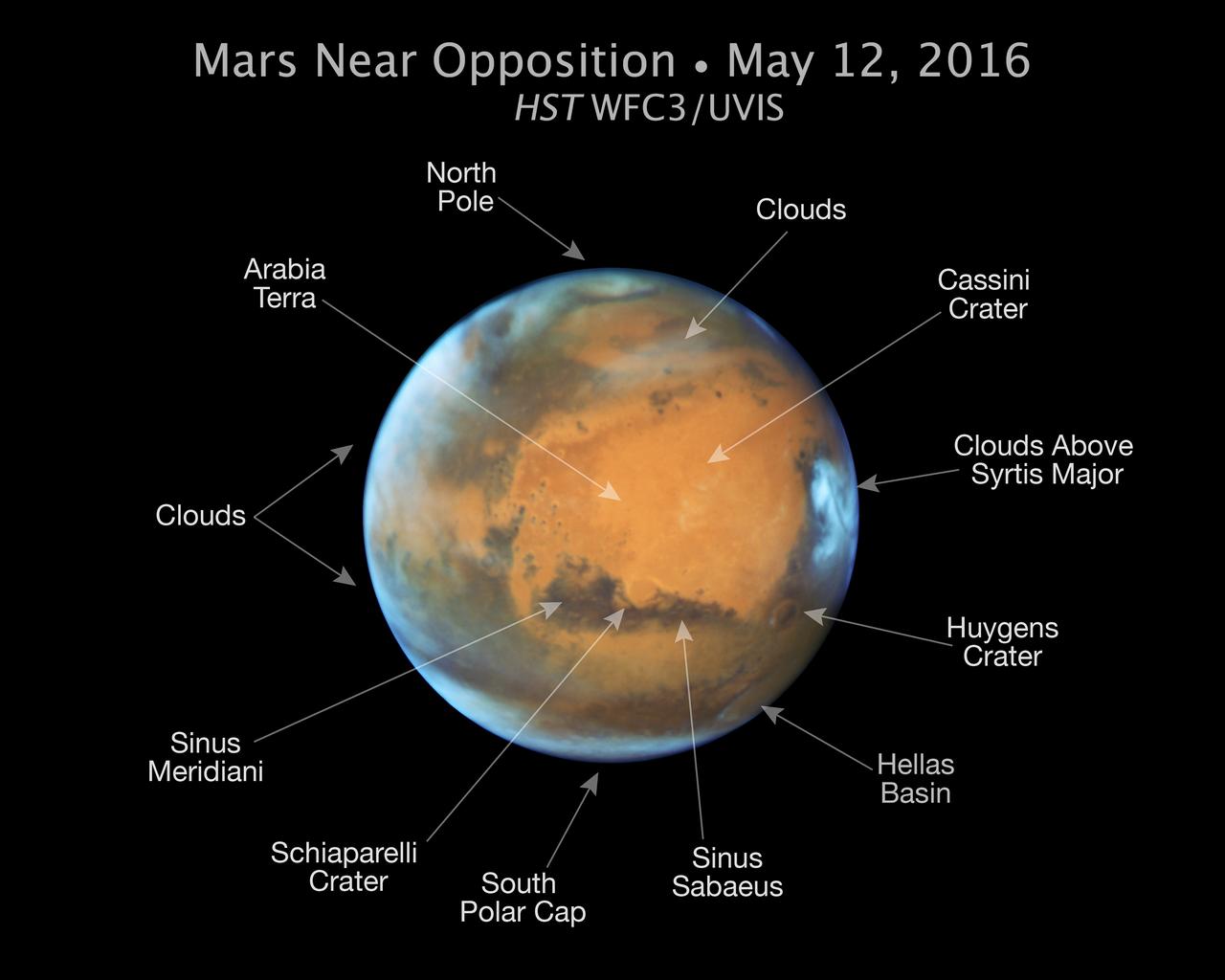
Mars is looking mighty fine in this portrait nabbed by the Hubble Space Telescope on a near close approach! Read more: <a href="http://go.nasa.gov/1rWYiBT" rel="nofollow">go.nasa.gov/1rWYiBT</a> The Hubble Space Telescope is more well known for its picturesque views of nebulae and galaxies, but it's also useful for studying our own planets, including Mars. Hubble imaged Mars on May 12, 2016 - ten days before Mars would be on the exact opposite side of the Earth from the Sun. Bright, frosty polar caps, and clouds above a vivid, rust-colored landscape reveal Mars as a dynamic seasonal planet in this NASA Hubble Space Telescope view taken on May 12, 2016, when Mars was 50 million miles from Earth. The Hubble image reveals details as small as 20 to 30 miles across. The large, dark region at far right is Syrtis Major Planitia, one of the first features identified on the surface of the planet by seventeenth-century observers. Christiaan Huygens used this feature to measure the rotation rate of Mars. (A Martian day is about 24 hours and 37 minutes.) Today we know that Syrtis Major is an ancient, inactive shield volcano. Late-afternoon clouds surround its summit in this view. A large oval feature to the south of Syrtis Major is the bright Hellas Planitia basin. About 1,100 miles across and nearly five miles deep, it was formed about 3.5 billion years ago by an asteroid impact. The orange area in the center of the image is Arabia Terra, a vast upland region in northern Mars that covers about 2,800 miles. The landscape is densely cratered and heavily eroded, indicating that it could be among the oldest terrains on the planet. Dried river canyons (too small to be seen here) wind through the region and empty into the large northern lowlands. Credit: NASA, ESA, the Hubble Heritage Team (STScI/AURA), J. Bell (ASU), and M. Wolff (Space Science Institute) #nasagoddard #mars #hubble #space <b><a href="http://www.nasa.gov/audience/formedia/features/MP_Photo_Guidelines.html" rel="nofollow">NASA image use policy.</a></b> <b><a href="http://www.nasa.gov/centers/goddard/home/index.html" rel="nofollow">NASA Goddard Space Flight Center</a></b> enables NASA’s mission through four scientific endeavors: Earth Science, Heliophysics, Solar System Exploration, and Astrophysics. Goddard plays a leading role in NASA’s accomplishments by contributing compelling scientific knowledge to advance the Agency’s mission. <b>Follow us on <a href="http://twitter.com/NASAGoddardPix" rel="nofollow">Twitter</a></b> <b>Like us on <a href="http://www.facebook.com/pages/Greenbelt-MD/NASA-Goddard/395013845897?ref=tsd" rel="nofollow">Facebook</a></b> <b>Find us on <a href="http://instagrid.me/nasagoddard/?vm=grid" rel="nofollow">Instagram</a></b>
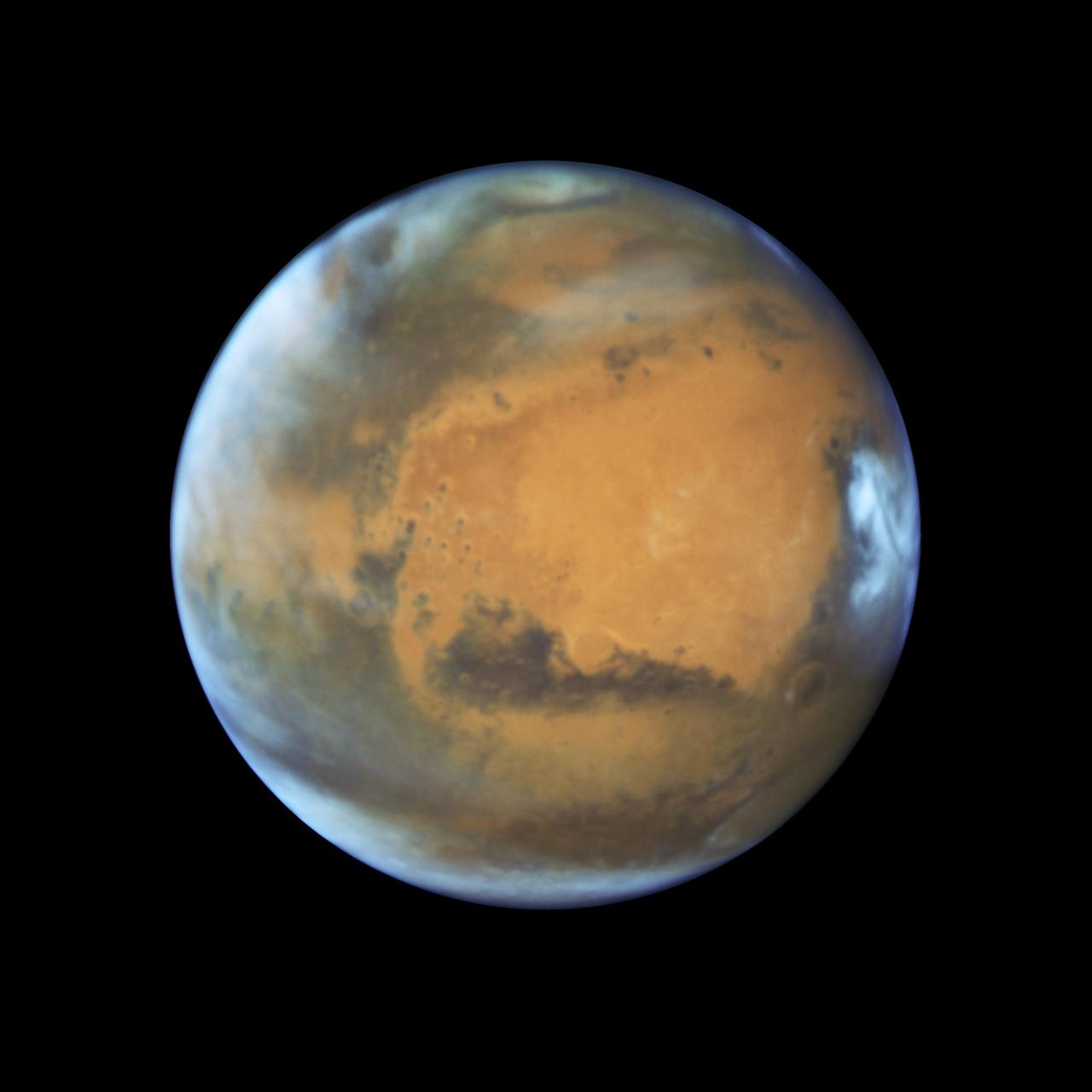
Mars is looking mighty fine in this portrait nabbed by the Hubble Space Telescope on a near close approach! Read more: <a href="http://go.nasa.gov/1rWYiBT" rel="nofollow">go.nasa.gov/1rWYiBT</a> The Hubble Space Telescope is more well known for its picturesque views of nebulae and galaxies, but it's also useful for studying our own planets, including Mars. Hubble imaged Mars on May 12, 2016 - ten days before Mars would be on the exact opposite side of the Earth from the Sun. Bright, frosty polar caps, and clouds above a vivid, rust-colored landscape reveal Mars as a dynamic seasonal planet in this NASA Hubble Space Telescope view taken on May 12, 2016, when Mars was 50 million miles from Earth. The Hubble image reveals details as small as 20 to 30 miles across. The large, dark region at far right is Syrtis Major Planitia, one of the first features identified on the surface of the planet by seventeenth-century observers. Christiaan Huygens used this feature to measure the rotation rate of Mars. (A Martian day is about 24 hours and 37 minutes.) Today we know that Syrtis Major is an ancient, inactive shield volcano. Late-afternoon clouds surround its summit in this view. A large oval feature to the south of Syrtis Major is the bright Hellas Planitia basin. About 1,100 miles across and nearly five miles deep, it was formed about 3.5 billion years ago by an asteroid impact. The orange area in the center of the image is Arabia Terra, a vast upland region in northern Mars that covers about 2,800 miles. The landscape is densely cratered and heavily eroded, indicating that it could be among the oldest terrains on the planet. Dried river canyons (too small to be seen here) wind through the region and empty into the large northern lowlands. Credit: NASA, ESA, the Hubble Heritage Team (STScI/AURA), J. Bell (ASU), and M. Wolff (Space Science Institute) #nasagoddard #mars #hubble #space <b><a href="http://www.nasa.gov/audience/formedia/features/MP_Photo_Guidelines.html" rel="nofollow">NASA image use policy.</a></b> <b><a href="http://www.nasa.gov/centers/goddard/home/index.html" rel="nofollow">NASA Goddard Space Flight Center</a></b> enables NASA’s mission through four scientific endeavors: Earth Science, Heliophysics, Solar System Exploration, and Astrophysics. Goddard plays a leading role in NASA’s accomplishments by contributing compelling scientific knowledge to advance the Agency’s mission. <b>Follow us on <a href="http://twitter.com/NASAGoddardPix" rel="nofollow">Twitter</a></b> <b>Like us on <a href="http://www.facebook.com/pages/Greenbelt-MD/NASA-Goddard/395013845897?ref=tsd" rel="nofollow">Facebook</a></b> <b>Find us on <a href="http://instagrid.me/nasagoddard/?vm=grid" rel="nofollow">Instagram</a></b>
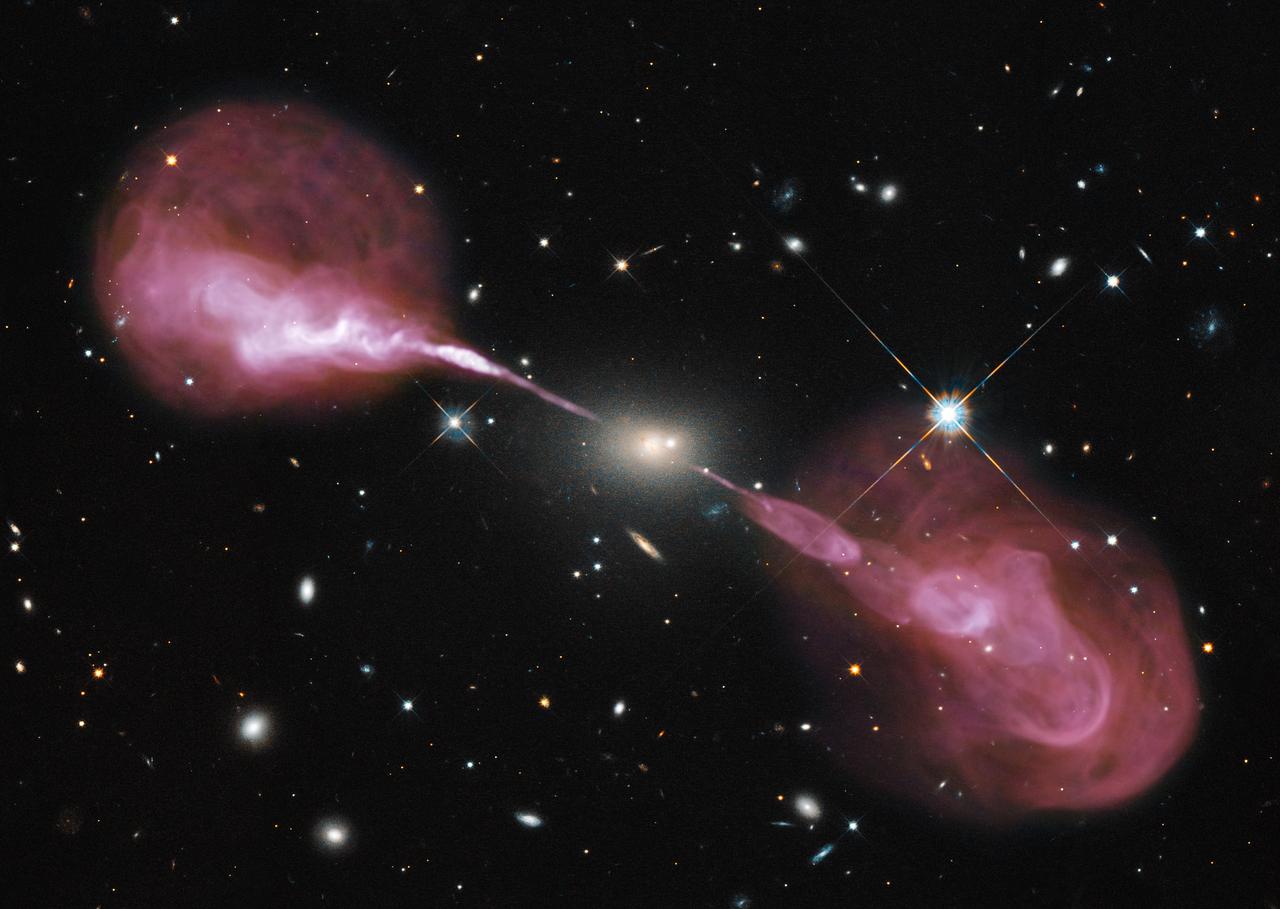
Spectacular jets powered by the gravitational energy of a super massive black hole in the core of the elliptical galaxy Hercules A illustrate the combined imaging power of two of astronomy's cutting-edge tools, the Hubble Space Telescope's Wide Field Camera 3, and the recently upgraded Karl G. Jansky Very Large Array (VLA) radio telescope in New Mexico. <b>To view a video of this go to: <a href="http://bit.ly/Ue2ypS" rel="nofollow">bit.ly/Ue2ypS</a> </b> Some two billion light-years away, the yellowish elliptical galaxy in the center of the image appears quite ordinary as seen by Hubble in visible wavelengths of light. The galaxy is roughly 1,000 times more massive than the Milky Way and harbors a 2.5-billion-solar-mass central black hole that is 1,000 times more massive than the black hole in the Milky Way. But the innocuous-looking galaxy, also known as 3C 348, has long been known as the brightest radio-emitting object in the constellation Hercules. Emitting nearly a billion times more power in radio wavelengths than our Sun, the galaxy is one of the brightest extragalactic radio sources in the entire sky. Credit: NASA, ESA, S. Baum and C. O'Dea (RIT), R. Perley and W. Cotton (NRAO/AUI/NSF), and the Hubble Heritage Team (STScI/AURA) To read more about this image go to: <a href="http://1.usa.gov/Yu7uvX" rel="nofollow">1.usa.gov/Yu7uvX</a> <b><a href="http://www.nasa.gov/audience/formedia/features/MP_Photo_Guidelines.html" rel="nofollow">NASA image use policy.</a></b> <b><a href="http://www.nasa.gov/centers/goddard/home/index.html" rel="nofollow">NASA Goddard Space Flight Center</a></b> enables NASA’s mission through four scientific endeavors: Earth Science, Heliophysics, Solar System Exploration, and Astrophysics. Goddard plays a leading role in NASA’s accomplishments by contributing compelling scientific knowledge to advance the Agency’s mission. <b>Follow us on <a href="http://twitter.com/NASA_GoddardPix" rel="nofollow">Twitter</a></b> <b>Like us on <a href="http://www.facebook.com/pages/Greenbelt-MD/NASA-Goddard/395013845897?ref=tsd" rel="nofollow">Facebook</a></b> <b>Find us on <a href="http://instagram.com/nasagoddard?vm=grid" rel="nofollow">Instagram</a></b>
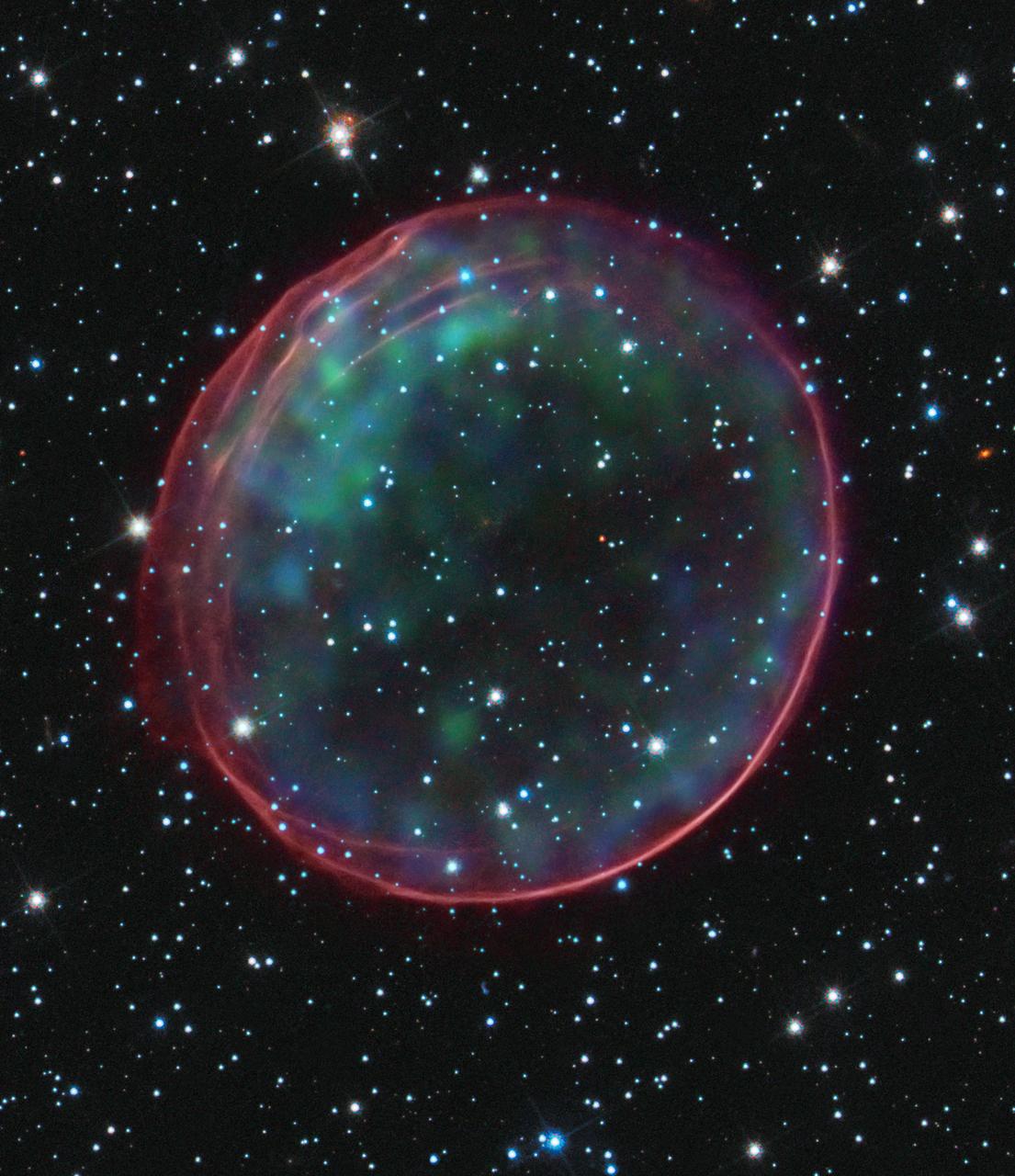
NASA image release January 11, 2012 Using NASA's Hubble Space Telescope, astronomers have solved a longstanding mystery on the type of star, or so-called progenitor, that caused a supernova in a nearby galaxy. The finding yields new observational data for pinpointing one of several scenarios that could trigger such outbursts. Based on previous observations from ground-based telescopes, astronomers knew that a kind of supernova called a Type Ia created a remnant named SNR 0509-67.5, which lies 170,000 light-years away in the Large Magellanic Cloud galaxy. The type of system that leads to this kind of supernova explosion has long been a high importance problem with various proposed solutions but no decisive answer. All these solutions involve a white dwarf star that somehow increases in mass to the highest limit. Astronomers failed to find any companion star near the center of the remnant, and this rules out all but one solution, so the only remaining possibility is that this one Type Ia supernova came from a pair of white dwarfs in close orbit. To read more go to: <a href="http://www.nasa.gov/mission_pages/hubble/science/supernova-source.html" rel="nofollow">www.nasa.gov/mission_pages/hubble/science/supernova-sourc...</a> Image Credit: NASA, ESA, CXC, SAO, the Hubble Heritage Team (STScI/AURA), and J. Hughes (Rutgers University) <b><a href="http://www.nasa.gov/audience/formedia/features/MP_Photo_Guidelines.html" rel="nofollow">NASA image use policy.</a></b> <b><a href="http://www.nasa.gov/centers/goddard/home/index.html" rel="nofollow">NASA Goddard Space Flight Center</a></b> enables NASA’s mission through four scientific endeavors: Earth Science, Heliophysics, Solar System Exploration, and Astrophysics. Goddard plays a leading role in NASA’s accomplishments by contributing compelling scientific knowledge to advance the Agency’s mission. <b>Follow us on <a href="http://twitter.com/NASA_GoddardPix" rel="nofollow">Twitter</a></b> <b>Like us on <a href="http://www.facebook.com/pages/Greenbelt-MD/NASA-Goddard/395013845897?ref=tsd" rel="nofollow">Facebook</a></b> <b>Find us on <a href="http://instagrid.me/nasagoddard/?vm=grid" rel="nofollow">Instagram</a></b>
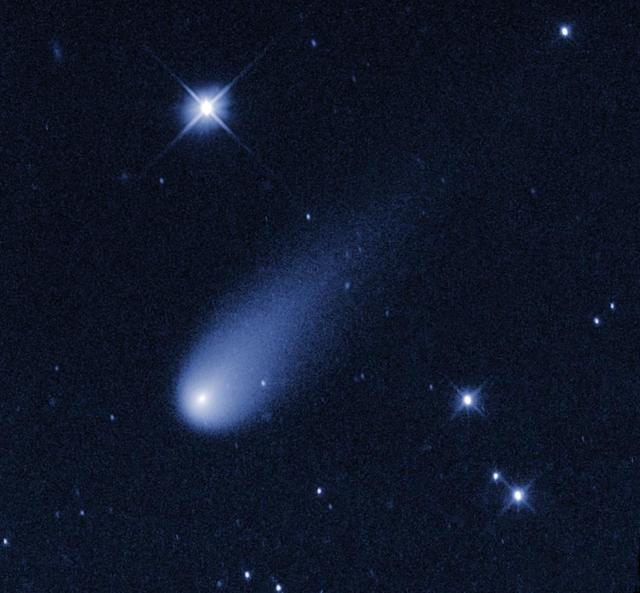
Superficially resembling a skyrocket, Comet ISON is hurtling toward the Sun at a whopping 48,000 miles per hour in this still from a Hubble animation.
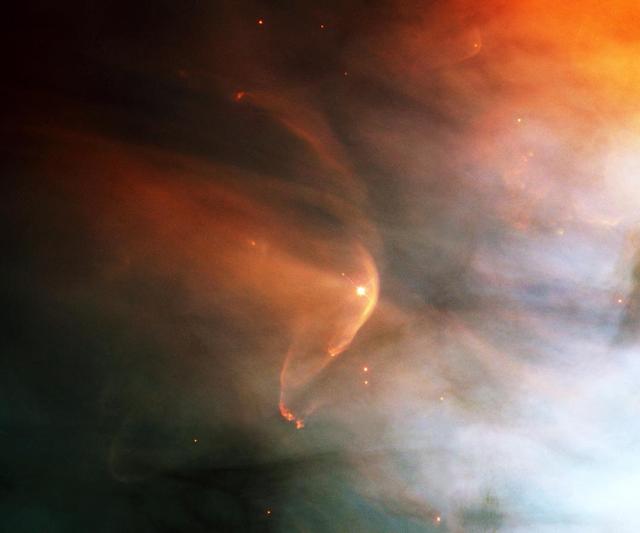
This image, taken by the Hubble Space Telescope, shows a bow shock around a very young star, LL Ori. The bow shock shows where the star's heliosphere collides with the interstellar medium. Our star, the Sun, is also surrounded by a heliosphere. https://photojournal.jpl.nasa.gov/catalog/PIA22914
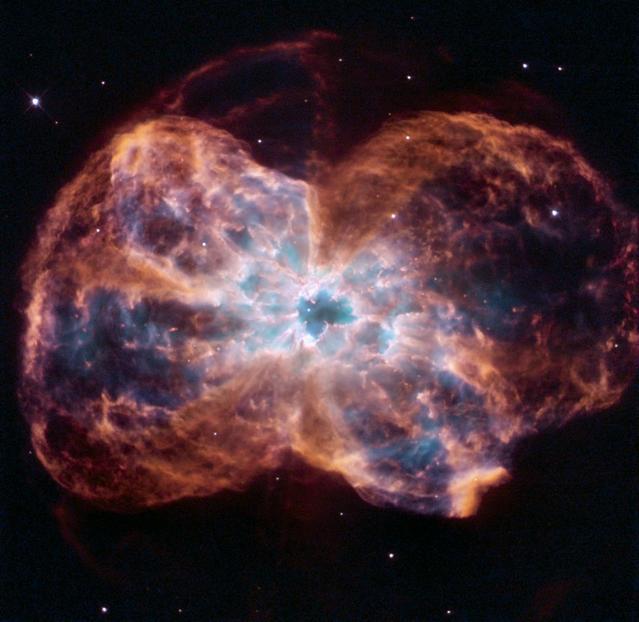
This image, taken by NASA Hubble Space Telescope, shows the colorful last hurrah of a star like our Sun. The star is ending its life by casting off its outer layers of gas, which formed a cocoon around the star remaining core.

Lying at the southern edge of the rich Virgo cluster of galaxies, Messier 104, also called the Sombrero galaxy, is one of the most famous objects in the sky in this image from NASA Hubble Space Telescope.
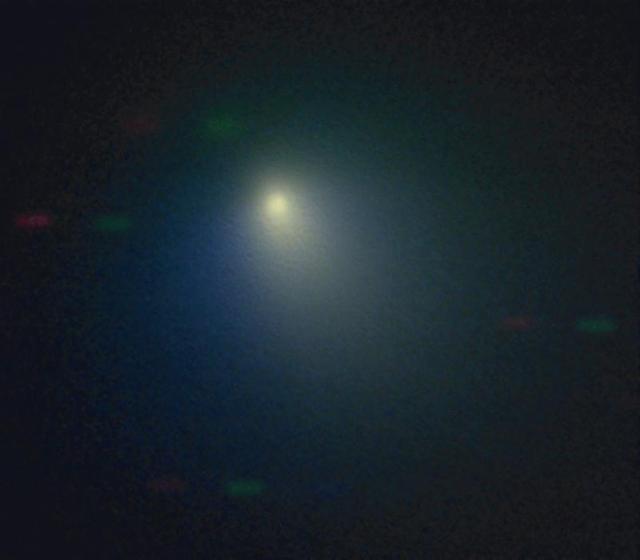
he Kitt Peak National Observatory 2.1-meter telescope observed comet Tempel 1 on April 11, 2005, when the comet was near its closest approach to the Earth. A pinkish dust jet is visible to the southwest, with the broader neutral gas coma surrounding it.

The Cat's Eye Nebula, one of the first planetary nebulae discovered, also has one of the most complex forms known to this kind of nebula. Eleven rings, or shells, of gas make up the Cat's Eye. The full beauty of the Cat's Eye Nebula is revealed in this detailed view from NASA's Hubble Space Telescope. The image from Hubble's Advanced Camera for Surveys (ACS) shows a bull's eye pattern of eleven or even more concentric rings, or shells, around the Cat's Eye. Each 'ring' is actually the edge of a spherical bubble seen projected onto the sky -- that's why it appears bright along its outer edge. Observations suggest the star ejected its mass in a series of pulses at 1,500-year intervals. These convulsions created dust shells, each of which contain as much mass as all of the planets in our solar system combined (still only one percent of the Sun's mass). These concentric shells make a layered, onion-skin structure around the dying star. The view from Hubble is like seeing an onion cut in half, where each skin layer is discernible. The bull's-eye patterns seen around planetary nebulae come as a surprise to astronomers because they had no expectation that episodes of mass loss at the end of stellar lives would repeat every 1,500 years. Several explanations have been proposed, including cycles of magnetic activity somewhat similar to our own Sun's sunspot cycle, the action of companion stars orbiting around the dying star, and stellar pulsations. Another school of thought is that the material is ejected smoothly from the star, and the rings are created later on due to formation of waves in the outflowing material. Credit: NASA, ESA, HEIC, and The Hubble Heritage Team (STScI/AURA) Acknowledgment: R. Corradi (Isaac Newton Group of Telescopes, Spain) and Z. Tsvetanov (NASA) The Hubble Space Telescope is a project of international cooperation between NASA and the European Space Agency. NASA's Goddard Space Flight Center manages the telescope. The Space Telescope Science Institute conducts Hubble science operations. Goddard is responsible for HST project management, including mission and science operations, servicing missions, and all associated development activities. To learn more about the Hubble Space Telescope go here: <a href="http://www.nasa.gov/mission_pages/hubble/main/index.html" rel="nofollow">www.nasa.gov/mission_pages/hubble/main/index.html</a> <b><a href="http://www.nasa.gov/audience/formedia/features/MP_Photo_Guidelines.html" rel="nofollow">NASA image use policy.</a></b> <b><a href="http://www.nasa.gov/centers/goddard/home/index.html" rel="nofollow">NASA Goddard Space Flight Center</a></b> enables NASA’s mission through four scientific endeavors: Earth Science, Heliophysics, Solar System Exploration, and Astrophysics. Goddard plays a leading role in NASA’s accomplishments by contributing compelling scientific knowledge to advance the Agency’s mission. <b>Follow us on <a href="http://twitter.com/NASAGoddardPix" rel="nofollow">Twitter</a></b> <b>Like us on <a href="http://www.facebook.com/pages/Greenbelt-MD/NASA-Goddard/395013845897?ref=tsd" rel="nofollow">Facebook</a></b> <b>Find us on <a href="http://instagram.com/nasagoddard?vm=grid" rel="nofollow">Instagram</a></b>

NASA image release December 14, 2010 A delicate sphere of gas, photographed by NASA's Hubble Space Telescope, floats serenely in the depths of space. The pristine shell, or bubble, is the result of gas that is being shocked by the expanding blast wave from a supernova. Called SNR 0509-67.5 (or SNR 0509 for short), the bubble is the visible remnant of a powerful stellar explosion in the Large Magellanic Cloud (LMC), a small galaxy about 160,000 light-years from Earth. Ripples in the shell's surface may be caused by either subtle variations in the density of the ambient interstellar gas, or possibly driven from the interior by pieces of the ejecta. The bubble-shaped shroud of gas is 23 light-years across and is expanding at more than 11 million miles per hour (5,000 kilometers per second). Astronomers have concluded that the explosion was one of an especially energetic and bright variety of supernovae. Known as Type Ia, such supernova events are thought to result from a white dwarf star in a binary system that robs its partner of material, takes on much more mass than it is able to handle, and eventually explodes. Hubble's Advanced Camera for Surveys observed the supernova remnant on Oct. 28, 2006 with a filter that isolates light from glowing hydrogen seen in the expanding shell. These observations were then combined with visible-light images of the surrounding star field that were imaged with Hubble's Wide Field Camera 3 on Nov. 4, 2010. With an age of about 400 years as seen from Earth, the supernova might have been visible to southern hemisphere observers around the year 1600, however, there are no known records of a "new star" in the direction of the LMC near that time. A more recent supernova in the LMC, SN 1987A, did catch the eye of Earth viewers and continues to be studied with ground- and space-based telescopes, including Hubble. For images and more information about SNR 0509, visit: <a href="http://hubblesite.org/news/2010/27" rel="nofollow">hubblesite.org/news/2010/27</a> <a href="http://heritage.stsci.edu/2010/27" rel="nofollow">heritage.stsci.edu/2010/27</a> <a href="http://www.nasa.gov/hubble" rel="nofollow">www.nasa.gov/hubble</a> The Hubble Space Telescope is a project of international cooperation between NASA and the European Space Agency. NASA's Goddard Space Flight Center manages the telescope. The Space Telescope Science Institute (STScI) conducts Hubble science operations. STScI is operated for NASA by the Association of Universities for Research in Astronomy, Inc., in Washington, D.C. <b>Credit: NASA, ESA, and the Hubble Heritage Team (STScI/AURA) Acknowledgment: J. Hughes (Rutgers University)</b> <b><a href="http://www.nasa.gov/centers/goddard/home/index.html" rel="nofollow">NASA Goddard Space Flight Center</a></b> enables NASA’s mission through four scientific endeavors: Earth Science, Heliophysics, Solar System Exploration, and Astrophysics. Goddard plays a leading role in NASA’s accomplishments by contributing compelling scientific knowledge to advance the Agency’s mission. <b>Follow us on <a href="http://twitter.com/NASA_GoddardPix" rel="nofollow">Twitter</a></b> <b>Join us on <a href="http://www.facebook.com/pages/Greenbelt-MD/NASA-Goddard/395013845897?ref=tsd" rel="nofollow">Facebook</a></b>
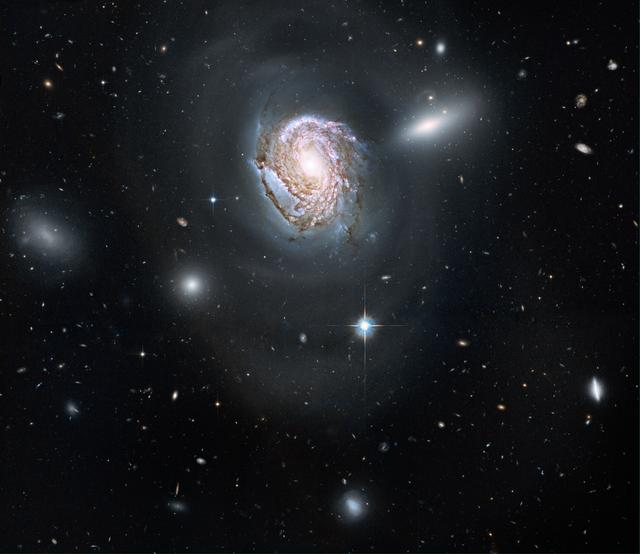
NASA image release August 10, 2010 A long-exposure Hubble Space Telescope image shows a majestic face-on spiral galaxy located deep within the Coma Cluster of galaxies, which lies 320 million light-years away in the northern constellation Coma Berenices. The galaxy, known as NGC 4911, contains rich lanes of dust and gas near its center. These are silhouetted against glowing newborn star clusters and iridescent pink clouds of hydrogen, the existence of which indicates ongoing star formation. Hubble has also captured the outer spiral arms of NGC 4911, along with thousands of other galaxies of varying sizes. The high resolution of Hubble's cameras, paired with considerably long exposures, made it possible to observe these faint details. NGC 4911 and other spirals near the center of the cluster are being transformed by the gravitational tug of their neighbors. In the case of NGC 4911, wispy arcs of the galaxy's outer spiral arms are being pulled and distorted by forces from a companion galaxy (NGC 4911A), to the upper right. The resultant stripped material will eventually be dispersed throughout the core of the Coma Cluster, where it will fuel the intergalactic populations of stars and star clusters. The Coma Cluster is home to almost 1,000 galaxies, making it one of the densest collections of galaxies in the nearby universe. It continues to transform galaxies at the present epoch, due to the interactions of close-proximity galaxy systems within the dense cluster. Vigorous star formation is triggered in such collisions. Galaxies in this cluster are so densely packed that they undergo frequent interactions and collisions. When galaxies of nearly equal masses merge, they form elliptical galaxies. Merging is more likely to occur in the center of the cluster where the density of galaxies is higher, giving rise to more elliptical galaxies. This natural-color Hubble image, which combines data obtained in 2006, 2007, and 2009 from the Wide Field Planetary Camera 2 and the Advanced Camera for Surveys, required 28 hours of exposure time. The Hubble Space Telescope is a project of international cooperation between NASA and the European Space Agency. NASA's Goddard Space Flight Center manages the telescope. The Space Telescope Science Institute (STScI) conducts Hubble science operations. STScI is operated for NASA by the Association of Universities for Research in Astronomy, Inc. in Washington, D.C. Credit: NASA, ESA, and the Hubble Heritage Team (STScI/AURA) Acknowledgment: K. Cook (Lawrence Livermore National Laboratory) To learn more about Hubble go to: <a href="http://www.nasa.gov/mission_pages/hubble/main/index.html" rel="nofollow">www.nasa.gov/mission_pages/hubble/main/index.html</a> <b><a href="http://www.nasa.gov/centers/goddard/home/index.html" rel="nofollow">NASA Goddard Space Flight Center</a></b> is home to the nation's largest organization of combined scientists, engineers and technologists that build spacecraft, instruments and new technology to study the Earth, the sun, our solar system, and the universe. <b>Follow us on <a href="http://twitter.com/NASA_GoddardPix" rel="nofollow">Twitter</a></b> <b>Join us on <a href="http://www.facebook.com/pages/Greenbelt-MD/NASA-Goddard/395013845897?ref=tsd" rel="nofollow">Facebook</a><b></b></b>

For the 26th birthday of NASA’s Hubble Space Telescope, astronomers are highlighting a Hubble image of an enormous bubble being blown into space by a super-hot, massive star. The Hubble image of the Bubble Nebula, or NGC 7635, was chosen to mark the 26th anniversary of the launch of Hubble into Earth orbit by the STS-31 space shuttle crew on April 24, 1990 “As Hubble makes its 26th revolution around our home star, the sun, we celebrate the event with a spectacular image of a dynamic and exciting interaction of a young star with its environment. The view of the Bubble Nebula, crafted from WFC-3 images, reminds us that Hubble gives us a front row seat to the awe inspiring universe we live in,” said John Grunsfeld, Hubble astronaut and associate administrator of NASA’s Science Mission Directorate at NASA Headquarters, in Washington, D.C. The Bubble Nebula is seven light-years across—about one-and-a-half times the distance from our sun to its nearest stellar neighbor, Alpha Centauri, and resides 7,100 light-years from Earth in the constellation Cassiopeia. The seething star forming this nebula is 45 times more massive than our sun. Gas on the star gets so hot that it escapes away into space as a “stellar wind” moving at over four million miles per hour. This outflow sweeps up the cold, interstellar gas in front of it, forming the outer edge of the bubble much like a snowplow piles up snow in front of it as it moves forward. As the surface of the bubble's shell expands outward, it slams into dense regions of cold gas on one side of the bubble. This asymmetry makes the star appear dramatically off-center from the bubble, with its location in the 10 o’clock position in the Hubble view. Dense pillars of cool hydrogen gas laced with dust appear at the upper left of the picture, and more “fingers” can be seen nearly face-on, behind the translucent bubble. The gases heated to varying temperatures emit different colors: oxygen is hot enough to emit blue light in the bubble near the star, while the cooler pillars are yellow from the combined light of hydrogen and nitrogen. The pillars are similar to the iconic columns in the “Pillars of Creation” Eagle Nebula. As seen with the structures in the Eagle Nebula, the Bubble Nebula pillars are being illuminated by the strong ultraviolet radiation from the brilliant star inside the bubble. The Bubble Nebula was discovered in 1787 by William Herschel, a prominent British astronomer. It is being formed by a proto-typical Wolf-Rayet star, BD +60º2522, an extremely bright, massive, and short-lived star that has lost most of its outer hydrogen and is now fusing helium into heavier elements. The star is about four million years old, and in 10 million to 20 million years, it will likely detonate as a supernova. Hubble’s Wide Field Camera-3 imaged the nebula in visible light with unprecedented clarity in February 2016. The colors correspond to blue for oxygen, green for hydrogen, and red for nitrogen. This information will help astronomers understand the geometry and dynamics of this complex system. The Bubble Nebula is one of only a handful of astronomical objects that have been observed with several different instruments onboard Hubble. Hubble also imaged it with the Wide Field Planetary Camera (WFPC) in September 1992, and with Wide Field Planetary Camera-2 (WFPC2) in April 1999. The Hubble Space Telescope is a project of international cooperation between NASA and the European Space Agency. NASA's Goddard Space Flight Center in Greenbelt, Maryland, manages the telescope. The Space Telescope Science Institute (STScI) in Baltimore, Maryland, conducts Hubble science operations. STScI is operated for NASA by the Association of Universities for Research in Astronomy in Washington, D.C. Credit: NASA, ESA, and the Hubble Heritage Team (STScI/AURA)

NASA image release July 3, 2012 Caption: Resembling a Fourth of July skyrocket, Herbig-Haro 110 is a geyser of hot gas from a newborn star that splashes up against and ricochets off the dense core of a cloud of molecular hydrogen. Although the plumes of gas look like whiffs of smoke, they are actually billions of times less dense than the smoke from a July 4 firework. This Hubble Space Telescope photo shows the integrated light from plumes, which are light-years across. -- Herbig-Haro (HH) objects come in a wide array of shapes, but the basic configuration stays the same. Twin jets of heated gas, ejected in opposite directions away from a forming star, stream through interstellar space. Astronomers suspect that these outflows are fueled by gas accreting onto a young star surrounded by a disk of dust and gas. The disk is the "fuel tank," the star is the gravitational engine, and the jets are the exhaust. When these energetic jets slam into colder gas, the collision plays out like a traffic jam on the interstate. Gas within the shock front slows to a crawl, but more gas continues to pile up as the jet keeps slamming into the shock from behind. Temperatures climb sharply, and this curving, flared region starts to glow. These "bow shocks" are so named because they resemble the waves that form at the front of a boat. In the case of the single HH 110 jet, astronomers observe a spectacular and unusual permutation on this basic model. Careful study has repeatedly failed to find the source star driving HH 110, and there may be good reason for this: perhaps the HH 110 outflow is itself generated by another jet. Astronomers now believe that the nearby HH 270 jet grazes an immovable obstacle - a much denser, colder cloud core - and gets diverted off at about a 60-degree angle. The jet goes dark and then reemerges, having reinvented itself as HH 110. The jet shows that these energetic flows are like the erratic outbursts from a Roman candle. As fast-moving blobs of gas catch up and collide with slower blobs, new shocks arise along the jet's interior. The light emitted from excited gas in these hot blue ridges marks the boundaries of these interior collisions. By measuring the current velocity and positions of different blobs and hot ridges along the chain within the jet, astronomers can effectively "rewind" the outflow, extrapolating the blobs back to the moment when they were emitted. This technique can be used to gain insight into the source star's history of mass accretion. This image is a composite of data taken with Hubble's Advanced Camera for Surveys in 2004 and 2005 and the Wide Field Camera 3 in April 2011. Credit: NASA, ESA, and the Hubble Heritage Team (STScI/AURA) <b><a href="http://www.nasa.gov/audience/formedia/features/MP_Photo_Guidelines.html" rel="nofollow">NASA image use policy.</a></b> <b><a href="http://www.nasa.gov/centers/goddard/home/index.html" rel="nofollow">NASA Goddard Space Flight Center</a></b> enables NASA’s mission through four scientific endeavors: Earth Science, Heliophysics, Solar System Exploration, and Astrophysics. Goddard plays a leading role in NASA’s accomplishments by contributing compelling scientific knowledge to advance the Agency’s mission. <b>Follow us on <a href="http://twitter.com/NASA_GoddardPix" rel="nofollow">Twitter</a></b> <b>Like us on <a href="http://www.facebook.com/pages/Greenbelt-MD/NASA-Goddard/395013845897?ref=tsd" rel="nofollow">Facebook</a></b> <b>Find us on <a href="http://instagrid.me/nasagoddard/?vm=grid" rel="nofollow">Instagram</a></b>
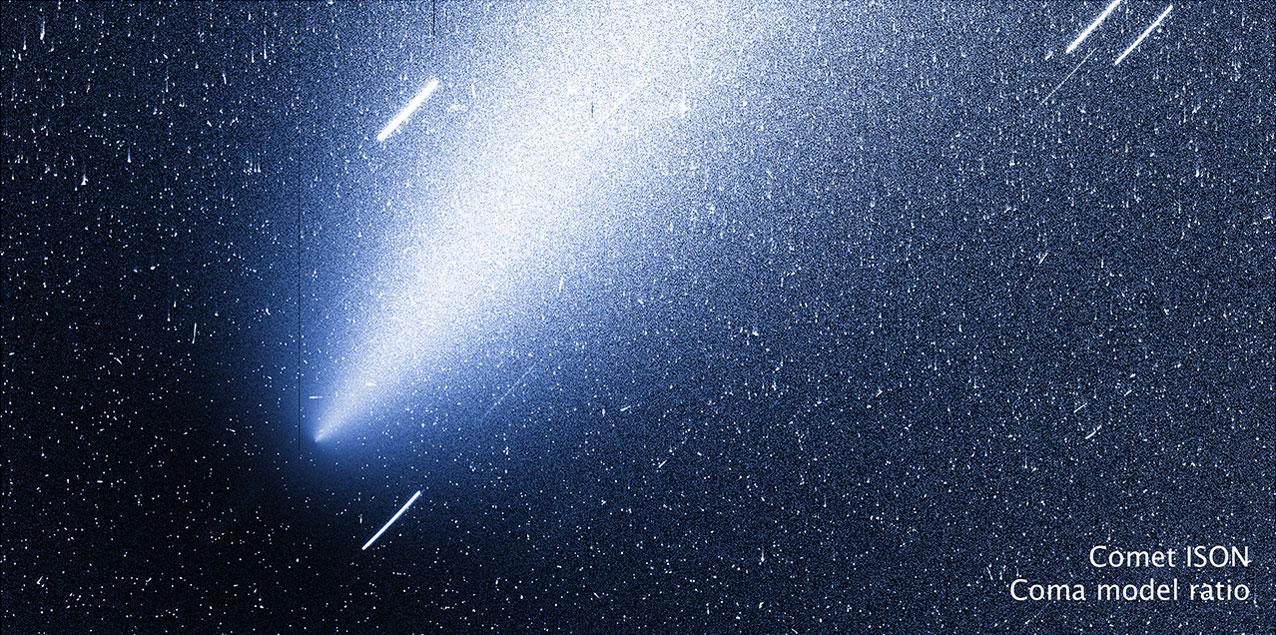
In this modeled image of ISON, the coma has been subtracted, leaving behind the nucleus. Credit: NASA, ESA, the Hubble Heritage Team (AURA/STScI) and Jian-Yang Li (Planetary Science Institute) -------- More details on Comet ISON: Comet ISON began its trip from the Oort cloud region of our solar system and is now travelling toward the sun. The comet will reach its closest approach to the sun on Thanksgiving Day -- 28 Nov 2013 -- skimming just 730,000 miles above the sun's surface. If it comes around the sun without breaking up, the comet will be visible in the Northern Hemisphere with the naked eye, and from what we see now, ISON is predicted to be a particularly bright and beautiful comet. Catalogued as C/2012 S1, Comet ISON was first spotted 585 million miles away in September 2012. This is ISON's very first trip around the sun, which means it is still made of pristine matter from the earliest days of the solar system’s formation, its top layers never having been lost by a trip near the sun. Comet ISON is, like all comets, a dirty snowball made up of dust and frozen gases like water, ammonia, methane and carbon dioxide -- some of the fundamental building blocks that scientists believe led to the formation of the planets 4.5 billion years ago. NASA has been using a vast fleet of spacecraft, instruments, and space- and Earth-based telescope, in order to learn more about this time capsule from when the solar system first formed. The journey along the way for such a sun-grazing comet can be dangerous. A giant ejection of solar material from the sun could rip its tail off. Before it reaches Mars -- at some 230 million miles away from the sun -- the radiation of the sun begins to boil its water, the first step toward breaking apart. And, if it survives all this, the intense radiation and pressure as it flies near the surface of the sun could destroy it altogether. This collection of images show ISON throughout that journey, as scientists watched to see whether the comet would break up or remain intact. The comet reaches its closest approach to the sun on Thanksgiving Day -- Nov. 28, 2013 -- skimming just 730,000 miles above the sun’s surface. If it comes around the sun without breaking up, the comet will be visible in the Northern Hemisphere with the naked eye, and from what we see now, ISON is predicted to be a particularly bright and beautiful comet. ISON stands for International Scientific Optical Network, a group of observatories in ten countries who have organized to detect, monitor, and track objects in space. ISON is managed by the Keldysh Institute of Applied Mathematics, part of the Russian Academy of Sciences. <b><a href="http://www.nasa.gov/audience/formedia/features/MP_Photo_Guidelines.html" rel="nofollow">NASA image use policy.</a></b> <b><a href="http://www.nasa.gov/centers/goddard/home/index.html" rel="nofollow">NASA Goddard Space Flight Center</a></b> enables NASA’s mission through four scientific endeavors: Earth Science, Heliophysics, Solar System Exploration, and Astrophysics. Goddard plays a leading role in NASA’s accomplishments by contributing compelling scientific knowledge to advance the Agency’s mission. <b>Follow us on <a href="http://twitter.com/NASA_GoddardPix" rel="nofollow">Twitter</a></b> <b>Like us on <a href="http://www.facebook.com/pages/Greenbelt-MD/NASA-Goddard/395013845897?ref=tsd" rel="nofollow">Facebook</a></b> <b>Find us on <a href="http://instagram.com/nasagoddard?vm=grid" rel="nofollow">Instagram</a></b>

NASA image release January 13, 2011 <b><a href="http://www.flickr.com/photos/gsfc/5352962836">These images</a></b> by NASA's Hubble Space Telescope show off two dramatically different face-on views of the spiral galaxy M51, dubbed the Whirlpool Galaxy. <b>The image above,</b> taken in visible light, highlights the attributes of a typical spiral galaxy, including graceful, curving arms, pink star-forming regions, and brilliant blue strands of star clusters. <b><a href="http://www.flickr.com/photos/gsfc/5352344517">In the image here,</a></b> most of the starlight has been removed, revealing the Whirlpool's skeletal dust structure, as seen in near-infrared light. This new image is the sharpest view of the dense dust in M51. The narrow lanes of dust revealed by Hubble reflect the galaxy's moniker, the Whirlpool Galaxy, as if they were swirling toward the galaxy's core. To map the galaxy's dust structure, researchers collected the galaxy's starlight by combining images taken in visible and near-infrared light. The visible-light image captured only some of the light; the rest was obscured by dust. The near-infrared view, however, revealed more starlight because near-infrared light penetrates dust. The researchers then subtracted the total amount of starlight from both images to see the galaxy's dust structure. The red color in the near-infrared image traces the dust, which is punctuated by hundreds of tiny clumps of stars, each about 65 light-years wide. These stars have never been seen before. The star clusters cannot be seen in visible light because dense dust enshrouds them. The image reveals details as small as 35 light-years across. Astronomers expected to see large dust clouds, ranging from about 100 light-years to more than 300 light-years wide. Instead, most of the dust is tied up in smooth and diffuse dust lanes. An encounter with another galaxy may have prevented giant clouds from forming. Probing a galaxy's dust structure serves as an important diagnostic tool for astronomers, providing invaluable information on how the gas and dust collapse to form stars. Although Hubble is providing incisive views of the internal structure of galaxies such as M51, the planned James Webb Space Telescope (JWST) is expected to produce even crisper images. Researchers constructed the image by combining visible-light exposures from Jan. 18 to 22, 2005, with the Advanced Camera for Surveys (ACS), and near-infrared light pictures taken in December 2005 with the Near Infrared Camera and Multi-Object Spectrometer (NICMOS). Credit: NASA, ESA, S. Beckwith (STScI), and the Hubble Heritage Team (STScI/AURA) The Hubble Space Telescope is a project of international cooperation between NASA and the European Space Agency. NASA's Goddard Space Flight Center manages the telescope. The Space Telescope Science Institute (STScI) conducts Hubble science operations. STScI is operated for NASA by the Association of Universities for Research in Astronomy, Inc., in Washington, D.C. <b><a href="http://www.nasa.gov/centers/goddard/home/index.html" rel="nofollow">NASA Goddard Space Flight Center</a></b> enables NASA’s mission through four scientific endeavors: Earth Science, Heliophysics, Solar System Exploration, and Astrophysics. Goddard plays a leading role in NASA’s accomplishments by contributing compelling scientific knowledge to advance the Agency’s mission. <b>Follow us on <a href="http://twitter.com/NASA_GoddardPix" rel="nofollow">Twitter</a></b> <b>Join us on <a href="http://www.facebook.com/pages/Greenbelt-MD/NASA-Goddard/395013845897?ref=tsd" rel="nofollow">Facebook</a></b>

For the 26th birthday of NASA’s Hubble Space Telescope, astronomers are highlighting a Hubble image of an enormous bubble being blown into space by a super-hot, massive star. The Hubble image of the Bubble Nebula, or NGC 7635, was chosen to mark the 26th anniversary of the launch of Hubble into Earth orbit by the STS-31 space shuttle crew on April 24, 1990 “As Hubble makes its 26th revolution around our home star, the sun, we celebrate the event with a spectacular image of a dynamic and exciting interaction of a young star with its environment. The view of the Bubble Nebula, crafted from WFC-3 images, reminds us that Hubble gives us a front row seat to the awe inspiring universe we live in,” said John Grunsfeld, Hubble astronaut and associate administrator of NASA’s Science Mission Directorate at NASA Headquarters, in Washington, D.C. The Bubble Nebula is seven light-years across—about one-and-a-half times the distance from our sun to its nearest stellar neighbor, Alpha Centauri, and resides 7,100 light-years from Earth in the constellation Cassiopeia. The seething star forming this nebula is 45 times more massive than our sun. Gas on the star gets so hot that it escapes away into space as a “stellar wind” moving at over four million miles per hour. This outflow sweeps up the cold, interstellar gas in front of it, forming the outer edge of the bubble much like a snowplow piles up snow in front of it as it moves forward. As the surface of the bubble's shell expands outward, it slams into dense regions of cold gas on one side of the bubble. This asymmetry makes the star appear dramatically off-center from the bubble, with its location in the 10 o’clock position in the Hubble view. Dense pillars of cool hydrogen gas laced with dust appear at the upper left of the picture, and more “fingers” can be seen nearly face-on, behind the translucent bubble. The gases heated to varying temperatures emit different colors: oxygen is hot enough to emit blue light in the bubble near the star, while the cooler pillars are yellow from the combined light of hydrogen and nitrogen. The pillars are similar to the iconic columns in the “Pillars of Creation” Eagle Nebula. As seen with the structures in the Eagle Nebula, the Bubble Nebula pillars are being illuminated by the strong ultraviolet radiation from the brilliant star inside the bubble. The Bubble Nebula was discovered in 1787 by William Herschel, a prominent British astronomer. It is being formed by a proto-typical Wolf-Rayet star, BD +60º2522, an extremely bright, massive, and short-lived star that has lost most of its outer hydrogen and is now fusing helium into heavier elements. The star is about four million years old, and in 10 million to 20 million years, it will likely detonate as a supernova. Hubble’s Wide Field Camera-3 imaged the nebula in visible light with unprecedented clarity in February 2016. The colors correspond to blue for oxygen, green for hydrogen, and red for nitrogen. This information will help astronomers understand the geometry and dynamics of this complex system. The Bubble Nebula is one of only a handful of astronomical objects that have been observed with several different instruments onboard Hubble. Hubble also imaged it with the Wide Field Planetary Camera (WFPC) in September 1992, and with Wide Field Planetary Camera-2 (WFPC2) in April 1999. The Hubble Space Telescope is a project of international cooperation between NASA and the European Space Agency. NASA's Goddard Space Flight Center in Greenbelt, Maryland, manages the telescope. The Space Telescope Science Institute (STScI) in Baltimore, Maryland, conducts Hubble science operations. STScI is operated for NASA by the Association of Universities for Research in Astronomy in Washington, D.C. Credit: NASA, ESA, and the Hubble Heritage Team (STScI/AURA)
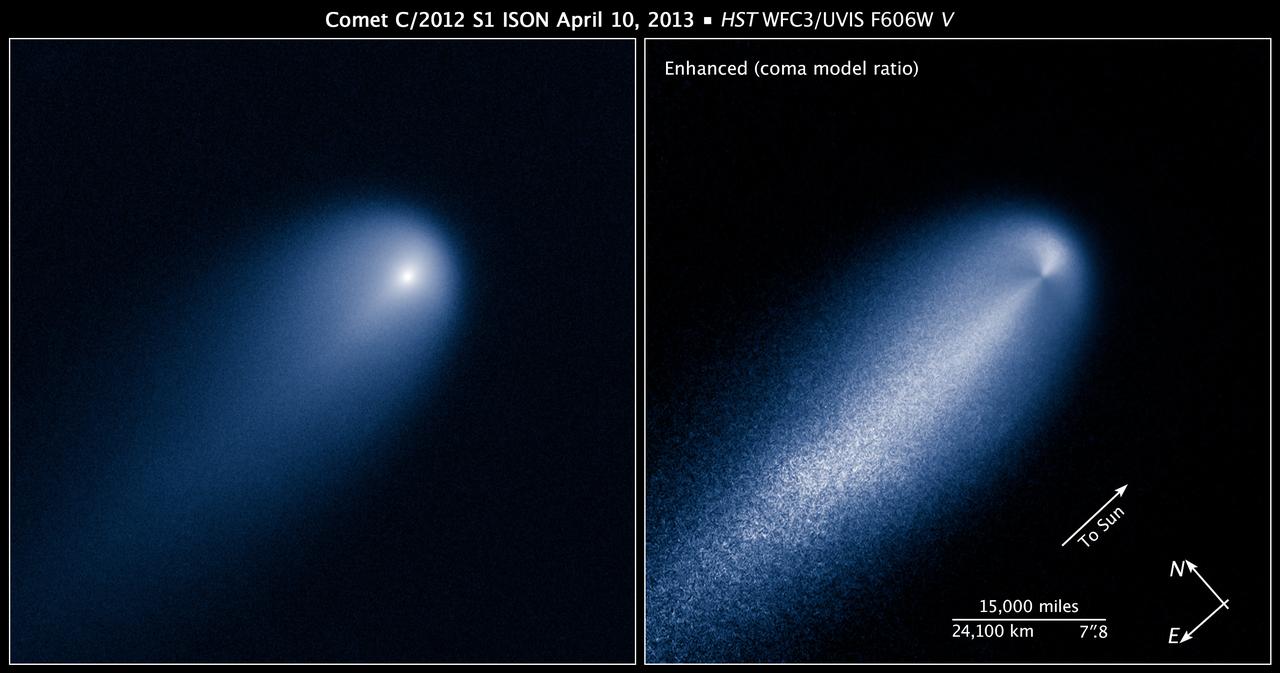
This NASA Hubble Space Telescope image of Comet (C/2012 S1) ISON was photographed on April 10, 2013, when the comet was slightly closer than Jupiter's orbit at a distance of 394 million miles from Earth. Even at that great distance the comet is already active as sunlight warms the surface and causes frozen volatiles to boil off. Astronomers used such early images to try to measure the size of the nucleus, in order to predict whether the comet would stay intact when it slingshots around the sun -- at 700,000 miles above the sun's surface -- on Nov. 28, 2013. The comet's dusty coma, or head of the comet, is approximately 3,100 miles across, or 1.2 times the width of Australia. A dust tail extends more than 57,000 miles, far beyond Hubble's field of view. This image was taken in visible light. The blue false color was added to bring out details in the comet structure. Credit: NASA/ ESA/STScI/AURA -------- More details on Comet ISON: Comet ISON began its trip from the Oort cloud region of our solar system and is now travelling toward the sun. The comet will reach its closest approach to the sun on Thanksgiving Day -- 28 Nov 2013 -- skimming just 730,000 miles above the sun's surface. If it comes around the sun without breaking up, the comet will be visible in the Northern Hemisphere with the naked eye, and from what we see now, ISON is predicted to be a particularly bright and beautiful comet. Catalogued as C/2012 S1, Comet ISON was first spotted 585 million miles away in September 2012. This is ISON's very first trip around the sun, which means it is still made of pristine matter from the earliest days of the solar system’s formation, its top layers never having been lost by a trip near the sun. Comet ISON is, like all comets, a dirty snowball made up of dust and frozen gases like water, ammonia, methane and carbon dioxide -- some of the fundamental building blocks that scientists believe led to the formation of the planets 4.5 billion years ago. NASA has been using a vast fleet of spacecraft, instruments, and space- and Earth-based telescope, in order to learn more about this time capsule from when the solar system first formed. The journey along the way for such a sun-grazing comet can be dangerous. A giant ejection of solar material from the sun could rip its tail off. Before it reaches Mars -- at some 230 million miles away from the sun -- the radiation of the sun begins to boil its water, the first step toward breaking apart. And, if it survives all this, the intense radiation and pressure as it flies near the surface of the sun could destroy it altogether. This collection of images show ISON throughout that journey, as scientists watched to see whether the comet would break up or remain intact. The comet reaches its closest approach to the sun on Thanksgiving Day -- Nov. 28, 2013 -- skimming just 730,000 miles above the sun’s surface. If it comes around the sun without breaking up, the comet will be visible in the Northern Hemisphere with the naked eye, and from what we see now, ISON is predicted to be a particularly bright and beautiful comet. ISON stands for International Scientific Optical Network, a group of observatories in ten countries who have organized to detect, monitor, and track objects in space. ISON is managed by the Keldysh Institute of Applied Mathematics, part of the Russian Academy of Sciences. <b><a href="http://www.nasa.gov/audience/formedia/features/MP_Photo_Guidelines.html" rel="nofollow">NASA image use policy.</a></b> <b><a href="http://www.nasa.gov/centers/goddard/home/index.html" rel="nofollow">NASA Goddard Space Flight Center</a></b> enables NASA’s mission through four scientific endeavors: Earth Science, Heliophysics, Solar System Exploration, and Astrophysics. Goddard plays a leading role in NASA’s accomplishments by contributing compelling scientific knowledge to advance the Agency’s mission. <b>Follow us on <a href="http://twitter.com/NASA_GoddardPix" rel="nofollow">Twitter</a></b> <b>Like us on <a href="http://www.facebook.com/pages/Greenbelt-MD/NASA-Godd</b>
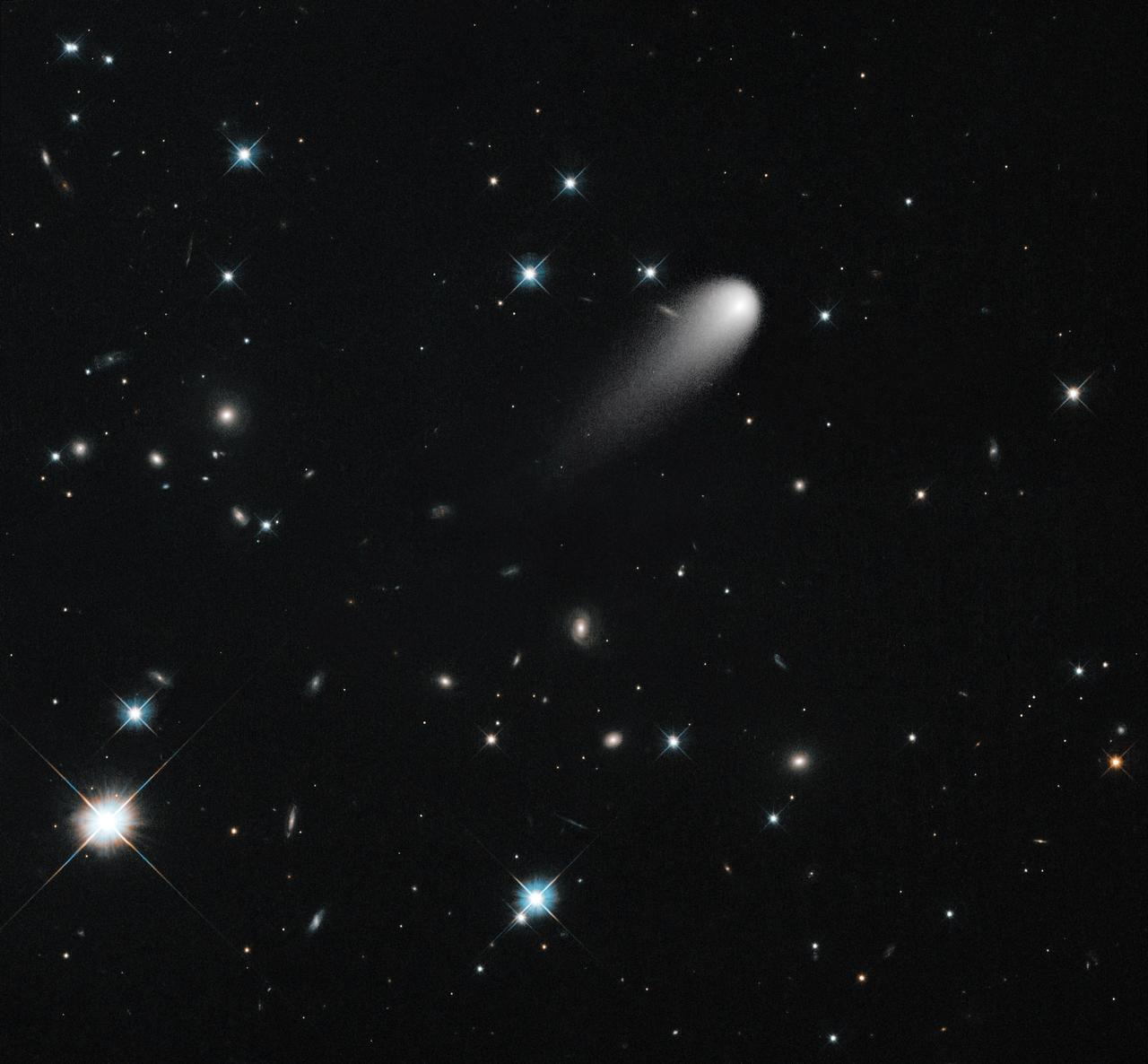
On April 30, NASA's Hubble Space Telescope observed Comet ISON again. The comet is in the upper middle, showing the long tail. Various galaxies and stars appear behind it. In this image, Hubble trained its telescope on the stars instead of following the comet. The result is that the comet appears fuzzier, but the stars and galaxies are more detailed and precise. These dimmer features don't pop out if the camera is moving, following along with ISON. To see them, you really need to dwell in one place until they emerge from the noise. Credit: NASA/ESA/STScI/AURA -------- More details on Comet ISON: Comet ISON began its trip from the Oort cloud region of our solar system and is now travelling toward the sun. The comet will reach its closest approach to the sun on Thanksgiving Day -- 28 Nov 2013 -- skimming just 730,000 miles above the sun's surface. If it comes around the sun without breaking up, the comet will be visible in the Northern Hemisphere with the naked eye, and from what we see now, ISON is predicted to be a particularly bright and beautiful comet. Catalogued as C/2012 S1, Comet ISON was first spotted 585 million miles away in September 2012. This is ISON's very first trip around the sun, which means it is still made of pristine matter from the earliest days of the solar system’s formation, its top layers never having been lost by a trip near the sun. Comet ISON is, like all comets, a dirty snowball made up of dust and frozen gases like water, ammonia, methane and carbon dioxide -- some of the fundamental building blocks that scientists believe led to the formation of the planets 4.5 billion years ago. NASA has been using a vast fleet of spacecraft, instruments, and space- and Earth-based telescope, in order to learn more about this time capsule from when the solar system first formed. The journey along the way for such a sun-grazing comet can be dangerous. A giant ejection of solar material from the sun could rip its tail off. Before it reaches Mars -- at some 230 million miles away from the sun -- the radiation of the sun begins to boil its water, the first step toward breaking apart. And, if it survives all this, the intense radiation and pressure as it flies near the surface of the sun could destroy it altogether. This collection of images show ISON throughout that journey, as scientists watched to see whether the comet would break up or remain intact. The comet reaches its closest approach to the sun on Thanksgiving Day -- Nov. 28, 2013 -- skimming just 730,000 miles above the sun’s surface. If it comes around the sun without breaking up, the comet will be visible in the Northern Hemisphere with the naked eye, and from what we see now, ISON is predicted to be a particularly bright and beautiful comet. ISON stands for International Scientific Optical Network, a group of observatories in ten countries who have organized to detect, monitor, and track objects in space. ISON is managed by the Keldysh Institute of Applied Mathematics, part of the Russian Academy of Sciences. <b><a href="http://www.nasa.gov/audience/formedia/features/MP_Photo_Guidelines.html" rel="nofollow">NASA image use policy.</a></b> <b><a href="http://www.nasa.gov/centers/goddard/home/index.html" rel="nofollow">NASA Goddard Space Flight Center</a></b> enables NASA’s mission through four scientific endeavors: Earth Science, Heliophysics, Solar System Exploration, and Astrophysics. Goddard plays a leading role in NASA’s accomplishments by contributing compelling scientific knowledge to advance the Agency’s mission. <b>Follow us on <a href="http://twitter.com/NASA_GoddardPix" rel="nofollow">Twitter</a></b> <b>Like us on <a href="http://www.facebook.com/pages/Greenbelt-MD/NASA-Goddard/395013845897?ref=tsd" rel="nofollow">Facebook</a></b> <b>Find us on <a href="http://instagram.com/nasagoddard?vm=grid" rel="nofollow">Instagram</a></b>
This NASA Hubble Space Telescope image of Comet (C/2012 S1) ISON was photographed on April 10, 2013, when the comet was slightly closer than Jupiter's orbit at a distance of 394 million miles from Earth. Even at that great distance the comet is already active as sunlight warms the surface and causes frozen volatiles to boil off. Astronomers used such early images to try to measure the size of the nucleus, in order to predict whether the comet would stay intact when it slingshots around the sun -- at 700,000 miles above the sun's surface -- on Nov. 28, 2013. The comet's dusty coma, or head of the comet, is approximately 3,100 miles across, or 1.2 times the width of Australia. A dust tail extends more than 57,000 miles, far beyond Hubble's field of view. This image was taken in visible light. The blue false color was added to bring out details in the comet structure. Credit: NASA/ ESA/STScI/AURA -------- More details on Comet ISON: Comet ISON began its trip from the Oort cloud region of our solar system and is now travelling toward the sun. The comet will reach its closest approach to the sun on Thanksgiving Day -- 28 Nov 2013 -- skimming just 730,000 miles above the sun's surface. If it comes around the sun without breaking up, the comet will be visible in the Northern Hemisphere with the naked eye, and from what we see now, ISON is predicted to be a particularly bright and beautiful comet. Catalogued as C/2012 S1, Comet ISON was first spotted 585 million miles away in September 2012. This is ISON's very first trip around the sun, which means it is still made of pristine matter from the earliest days of the solar system’s formation, its top layers never having been lost by a trip near the sun. Comet ISON is, like all comets, a dirty snowball made up of dust and frozen gases like water, ammonia, methane and carbon dioxide -- some of the fundamental building blocks that scientists believe led to the formation of the planets 4.5 billion years ago. NASA has been using a vast fleet of spacecraft, instruments, and space- and Earth-based telescope, in order to learn more about this time capsule from when the solar system first formed. The journey along the way for such a sun-grazing comet can be dangerous. A giant ejection of solar material from the sun could rip its tail off. Before it reaches Mars -- at some 230 million miles away from the sun -- the radiation of the sun begins to boil its water, the first step toward breaking apart. And, if it survives all this, the intense radiation and pressure as it flies near the surface of the sun could destroy it altogether. This collection of images show ISON throughout that journey, as scientists watched to see whether the comet would break up or remain intact. The comet reaches its closest approach to the sun on Thanksgiving Day -- Nov. 28, 2013 -- skimming just 730,000 miles above the sun’s surface. If it comes around the sun without breaking up, the comet will be visible in the Northern Hemisphere with the naked eye, and from what we see now, ISON is predicted to be a particularly bright and beautiful comet. ISON stands for International Scientific Optical Network, a group of observatories in ten countries who have organized to detect, monitor, and track objects in space. ISON is managed by the Keldysh Institute of Applied Mathematics, part of the Russian Academy of Sciences. <b><a href="http://www.nasa.gov/audience/formedia/features/MP_Photo_Guidelines.html" rel="nofollow">NASA image use policy.</a></b> <b><a href="http://www.nasa.gov/centers/goddard/home/index.html" rel="nofollow">NASA Goddard Space Flight Center</a></b> enables NASA’s mission through four scientific endeavors: Earth Science, Heliophysics, Solar System Exploration, and Astrophysics. Goddard plays a leading role in NASA’s accomplishments by contributing compelling scientific knowledge to advance the Agency’s mission. <b>Follow us on <a href="http://twitter.com/NASA_GoddardPix" rel="nofollow">Twitter</a></b> <b>Like us on <a href="http://www.facebook.com/pages/Greenbelt-MD/NASA-Godd</b>
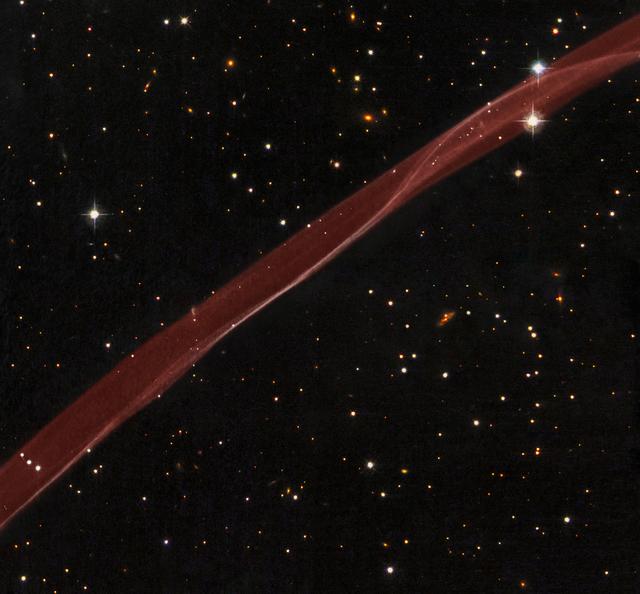
Release date: July 1, 2008 SN 1006 Supernova Remnant (Hubble) A delicate ribbon of gas floats eerily in our galaxy. A contrail from an alien spaceship? A jet from a black-hole? Actually this image, taken by NASA's Hubble Space Telescope, is a very thin section of a supernova remnant caused by a stellar explosion that occurred more than 1,000 years ago. On or around May 1, 1006 A.D., observers from Africa to Europe to the Far East witnessed and recorded the arrival of light from what is now called SN 1006, a tremendous supernova explosion caused by the final death throes of a white dwarf star nearly 7,000 light-years away. The supernova was probably the brightest star ever seen by humans, and surpassed Venus as the brightest object in the night time sky, only to be surpassed by the moon. It was visible even during the day for weeks, and remained visible to the naked eye for at least two and a half years before fading away. It wasn't until the mid-1960s that radio astronomers first detected a nearly circular ring of material at the recorded position of the supernova. The ring was almost 30 arcminutes across, the same angular diameter as the full moon. The size of the remnant implied that the blast wave from the supernova had expanded at nearly 20 million miles per hour over the nearly 1,000 years since the explosion occurred. In 1976, the first detection of exceedingly faint optical emission of the supernova remnant was reported, but only for a filament located on the northwest edge of the radio ring. A tiny portion of this filament is revealed in detail by the Hubble observation. The twisting ribbon of light seen by Hubble corresponds to locations where the expanding blast wave from the supernova is now sweeping into very tenuous surrounding gas. The hydrogen gas heated by this fast shock wave emits radiation in visible light. Hence, the optical emission provides astronomers with a detailed "snapshot" of the actual position and geometry of the shock front at any given time. Bright edges within the ribbon correspond to places where the shock wave is seen exactly edge on to our line of sight. Today we know that SN 1006 has a diameter of nearly 60 light-years, and it is still expanding at roughly 6 million miles per hour. Even at this tremendous speed, however, it takes observations typically separated by years to see significant outward motion of the shock wave against the grid of background stars. In the Hubble image as displayed, the supernova would have occurred far off the lower right corner of the image, and the motion would be toward the upper left. SN 1006 resides within our Milky Way Galaxy. Located more than 14 degrees off the plane of the galaxy's disk, there is relatively little confusion with other foreground and background objects in the field when trying to study this object. In the Hubble image, many background galaxies (orange extended objects) far off in the distant universe can be seen dotting the image. Most of the white dots are foreground or background stars in our Milky Way galaxy. This image is a composite of hydrogen-light observations taken with Hubble's Advanced Camera for Surveys in February 2006 and Wide Field Planetary Camera 2 observations in blue, yellow-green, and near-infrared light taken in April 2008. The supernova remnant, visible only in the hydrogen-light filter was assigned a red hue in the Heritage color image. Credit: NASA, ESA, and the Hubble Heritage Team (STScI/AURA) Acknowledgment: W. Blair (Johns Hopkins University) To learn more about the Hubble Space Telescope go here: <a href="http://www.nasa.gov/mission_pages/hubble/main/index.html" rel="nofollow">www.nasa.gov/mission_pages/hubble/main/index.html</a> <b><a href="http://www.nasa.gov/audience/formedia/features/MP_Photo_Guidelines.html" rel="nofollow">NASA image use policy.</a></b> <b><a href="http://www.nasa.gov/centers/goddard/home/index.html" rel="nofollow">NASA Goddard Space Flight Center</a></b> enables NASA’s mission through four scientific endeavors: Earth Science, Heliophysics, Solar System Exploration, and Astrophysics. Goddard plays a leading role in NASA’s accomplishments by contributing compelling scientific knowledge to advance the Agency’s mission. <b>Follow us on <a href="http://twitter.com/NASAGoddardPix" rel="nofollow">Twitter</a></b> <b>Like us on <a href="http://www.facebook.com/pages/Greenbelt-MD/NASA-Goddard/395013845897?ref=tsd" rel="nofollow">Facebook</a></b> <b>Find us on <a href="http://instagram.com/nasagoddard?vm=grid" rel="nofollow">Instagram</a></b>
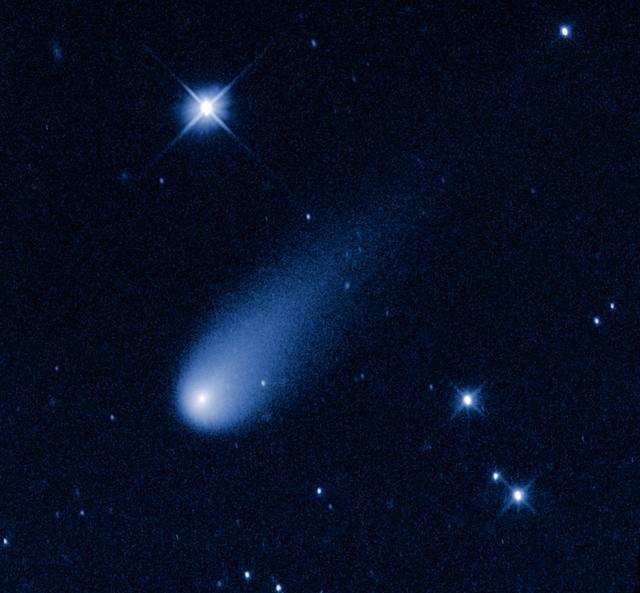
Superficially resembling a skyrocket, Comet ISON is hurtling toward the Sun at a whopping 48,000 miles per hour. Its swift motion is captured in this image taken May 8, 2013, by NASA's Hubble Space Telescope. At the time the image was taken, the comet was 403 million miles from Earth, between the orbits of Mars and Jupiter. Unlike a firework, the comet is not combusting, but in fact is pretty cold. Its skyrocket-looking tail is really a streamer of gas and dust bleeding off the icy nucleus, which is surrounded by a bright, star-like-looking coma. The pressure of the solar wind sweeps the material into a tail, like a breeze blowing a windsock. As the comet warms as it moves closer to the Sun, its rate of sublimation will increase. The comet will get brighter and the tail grows longer. The comet is predicted to reach naked-eye visibility in November. The comet is named after the organization that discovered it, the Russia-based International Scientific Optical Network. This false-color, visible-light image was taken with Hubble's Wide Field Camera 3. Credit: NASA, ESA, and the Hubble Heritage Team (STScI/AURA) -------- More details on Comet ISON: Comet ISON began its trip from the Oort cloud region of our solar system and is now travelling toward the sun. The comet will reach its closest approach to the sun on Thanksgiving Day -- 28 Nov 2013 -- skimming just 730,000 miles above the sun's surface. If it comes around the sun without breaking up, the comet will be visible in the Northern Hemisphere with the naked eye, and from what we see now, ISON is predicted to be a particularly bright and beautiful comet. Catalogued as C/2012 S1, Comet ISON was first spotted 585 million miles away in September 2012. This is ISON's very first trip around the sun, which means it is still made of pristine matter from the earliest days of the solar system’s formation, its top layers never having been lost by a trip near the sun. Comet ISON is, like all comets, a dirty snowball made up of dust and frozen gases like water, ammonia, methane and carbon dioxide -- some of the fundamental building blocks that scientists believe led to the formation of the planets 4.5 billion years ago. NASA has been using a vast fleet of spacecraft, instruments, and space- and Earth-based telescope, in order to learn more about this time capsule from when the solar system first formed. The journey along the way for such a sun-grazing comet can be dangerous. A giant ejection of solar material from the sun could rip its tail off. Before it reaches Mars -- at some 230 million miles away from the sun -- the radiation of the sun begins to boil its water, the first step toward breaking apart. And, if it survives all this, the intense radiation and pressure as it flies near the surface of the sun could destroy it altogether. This collection of images show ISON throughout that journey, as scientists watched to see whether the comet would break up or remain intact. The comet reaches its closest approach to the sun on Thanksgiving Day -- Nov. 28, 2013 -- skimming just 730,000 miles above the sun’s surface. If it comes around the sun without breaking up, the comet will be visible in the Northern Hemisphere with the naked eye, and from what we see now, ISON is predicted to be a particularly bright and beautiful comet. ISON stands for International Scientific Optical Network, a group of observatories in ten countries who have organized to detect, monitor, and track objects in space. ISON is managed by the Keldysh Institute of Applied Mathematics, part of the Russian Academy of Sciences. <b><a href="http://www.nasa.gov/audience/formedia/features/MP_Photo_Guidelines.html" rel="nofollow">NASA image use policy.</a></b> <b><a href="http://www.nasa.gov/centers/goddard/home/index.html" rel="nofollow">NASA Goddard Space Flight Center</a></b> enables NASA’s mission through four scientific endeavors: Earth Science, Heliophysics, Solar System Exploration, and Astrophysics. Goddard plays a leading role in NASA’s accomplishments by contributing compelling scienti
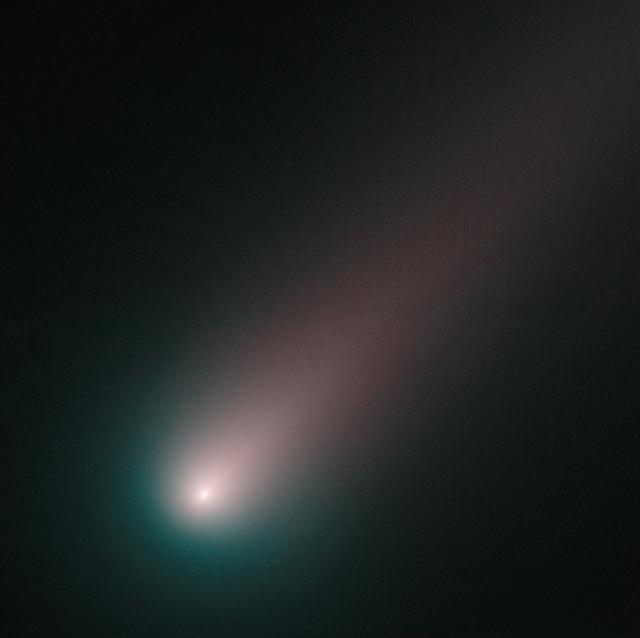
As of mid-November, ISON is officially upon us. Using Hubble, we've taken our closest look yet at the innermost region of the comet, where geysers of sublimating ice are fueling a spectacular tail. Made from observations on November 2nd, the image combines pictures of ISON taken through blue and red filters. As we expect, the round coma around ISON's nucleus is blue and the tail has a redder hue. Ice and gas in the coma reflect blue light from the Sun, while dust grains in the tail reflect more red light than blue light. This is the most color separation we've seen so far in ISON -- that's because the comet, nearer than ever to the Sun, is brighter and more structured than ever before. We've certainly come a long way since Hubble started observing Comet ISON, way back in April. Of course, our eight-month retrospective pales in comparison with ISON's own journey, which started some 10,000 years ago in the Oort cloud. ISON will come closest to the Sun on November 28, a point in its orbit known as perihelion. What's remarkable here is that the entire ISON, this awesome, shimmery space tadpole, is being produced from a dusty ball of ice estimated to be a few kilometers in diameter. Compared to ISON's full extent, Hubble's latest image is tiny. It only shows the very base of the tail. Yet even in this closest closeup we've ever had, a single pixel spans 24 km across the comet. Now that Comet ISON is close, amateur astromers rule the day. But Hubble observations, including this latest image, are still providing key insights into the science and spectacle of a comet we hope will continue to impress. Credit: NASA, ESA, and the Hubble Heritage Team (STScI/AURA) -------- More details on Comet ISON: Comet ISON began its trip from the Oort cloud region of our solar system and is now travelling toward the sun. The comet will reach its closest approach to the sun on Thanksgiving Day -- 28 Nov 2013 -- skimming just 730,000 miles above the sun's surface. If it comes around the sun without breaking up, the comet will be visible in the Northern Hemisphere with the naked eye, and from what we see now, ISON is predicted to be a particularly bright and beautiful comet. Catalogued as C/2012 S1, Comet ISON was first spotted 585 million miles away in September 2012. This is ISON's very first trip around the sun, which means it is still made of pristine matter from the earliest days of the solar system’s formation, its top layers never having been lost by a trip near the sun. Comet ISON is, like all comets, a dirty snowball made up of dust and frozen gases like water, ammonia, methane and carbon dioxide -- some of the fundamental building blocks that scientists believe led to the formation of the planets 4.5 billion years ago. NASA has been using a vast fleet of spacecraft, instruments, and space- and Earth-based telescope, in order to learn more about this time capsule from when the solar system first formed. The journey along the way for such a sun-grazing comet can be dangerous. A giant ejection of solar material from the sun could rip its tail off. Before it reaches Mars -- at some 230 million miles away from the sun -- the radiation of the sun begins to boil its water, the first step toward breaking apart. And, if it survives all this, the intense radiation and pressure as it flies near the surface of the sun could destroy it altogether. This collection of images show ISON throughout that journey, as scientists watched to see whether the comet would break up or remain intact. The comet reaches its closest approach to the sun on Thanksgiving Day -- Nov. 28, 2013 -- skimming just 730,000 miles above the sun’s surface. If it comes around the sun without breaking up, the comet will be visible in the Northern Hemisphere with the naked eye, and from what we see now, ISON is predicted to be a particularly bright and beautiful comet. ISON stands for International Scientific Optical Network, a group of observatories in ten countries who have organized to detect, monitor, and track objects in space. ISON is
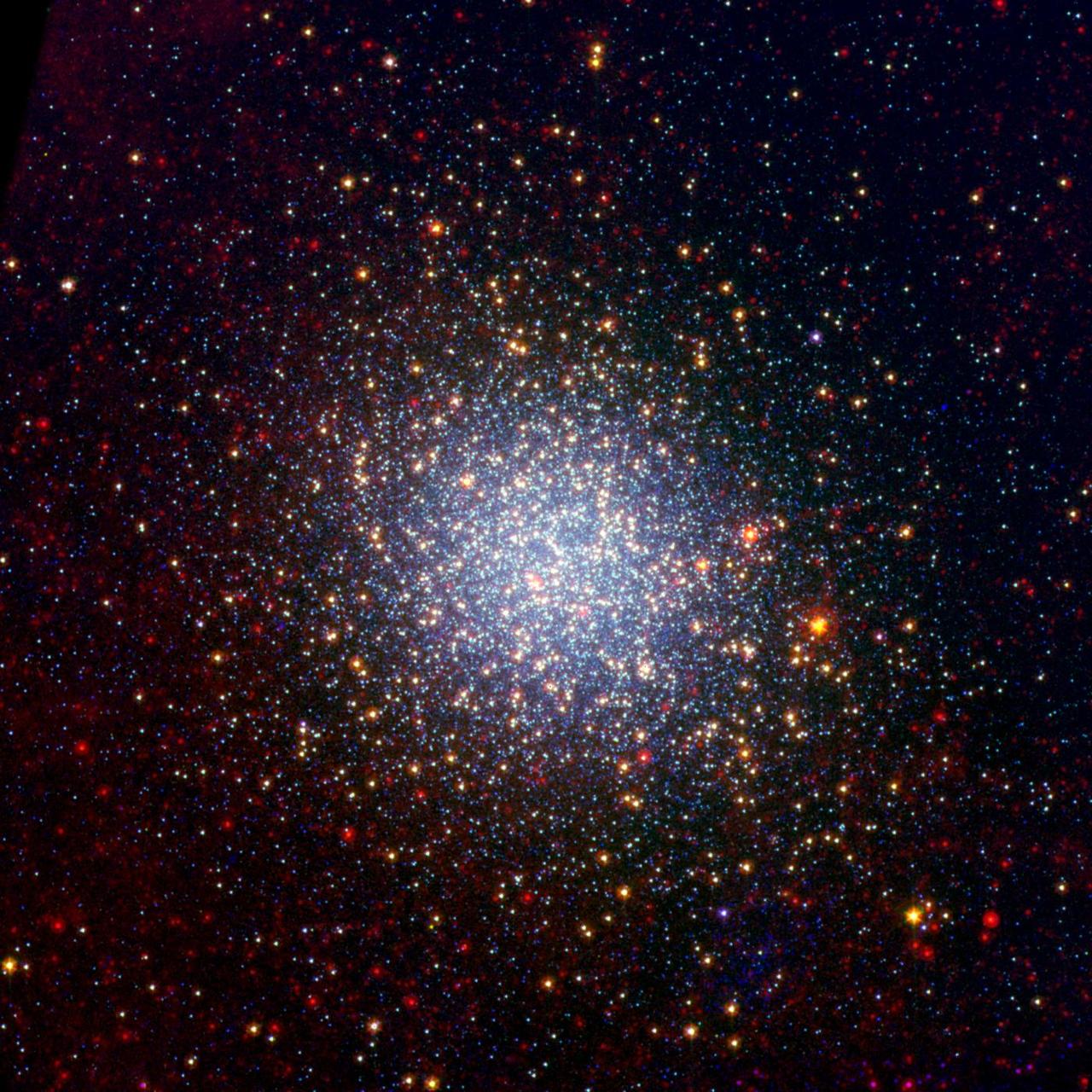
A cluster brimming with millions of stars glistens like an iridescent opal in this image from NASA Spitzer Space Telescope. Called Omega Centauri, the sparkling orb of stars is like a miniature galaxy.