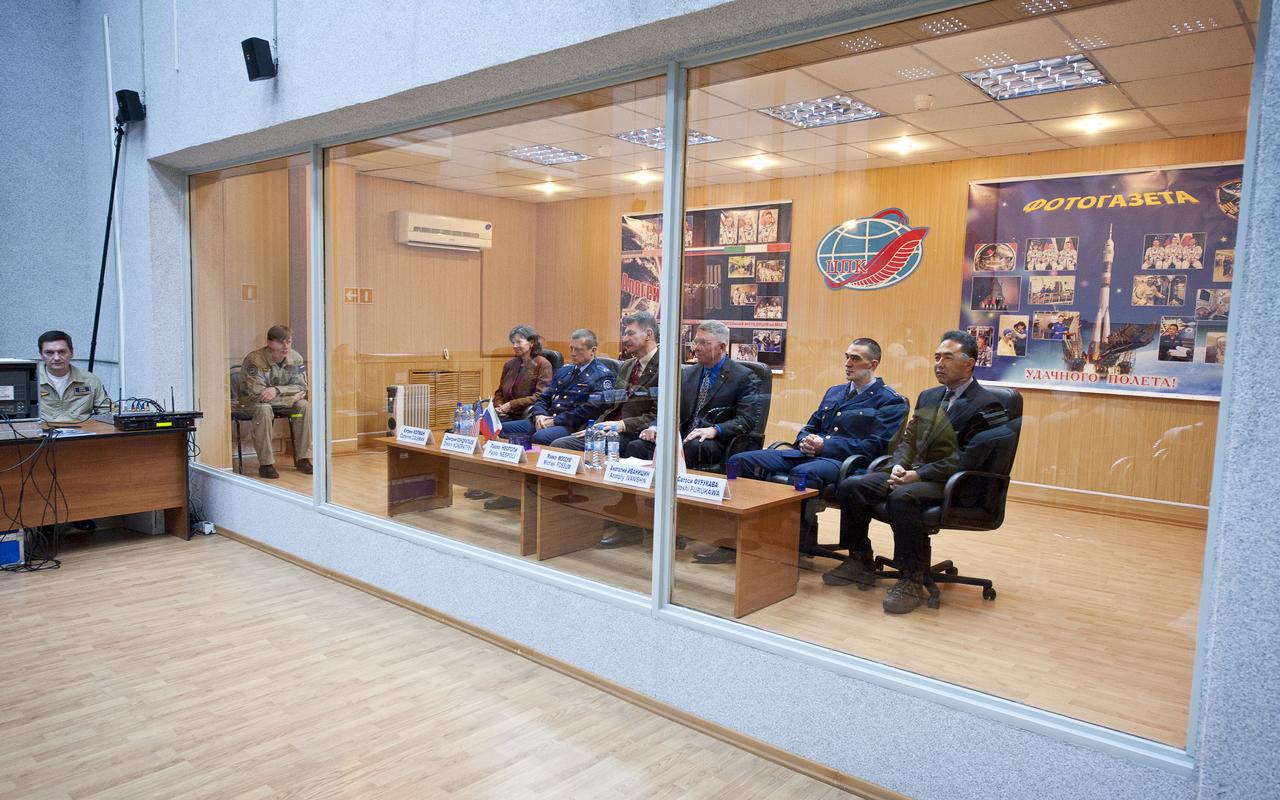
From left; Catherine Coleman, NASA Flight Engineer, Dmitry Kondratyev, Soyuz Commander, Paolo Nespoli, Italian astronaut and Flight Engineer, Michael Fossum, Expedition 26 back up crew member, Anatoly Ivanishin, Expedition 26 back up crew member and Satoshi Furukawa, Expedition 26 back up crew member are seen at the State Commission meeting held at the Cosmonaut Hotel in Baikonur, Kazakhstan on Tuesday, Dec. 14, 2010. Photo Credit: (NASA/Carla Cioffi)
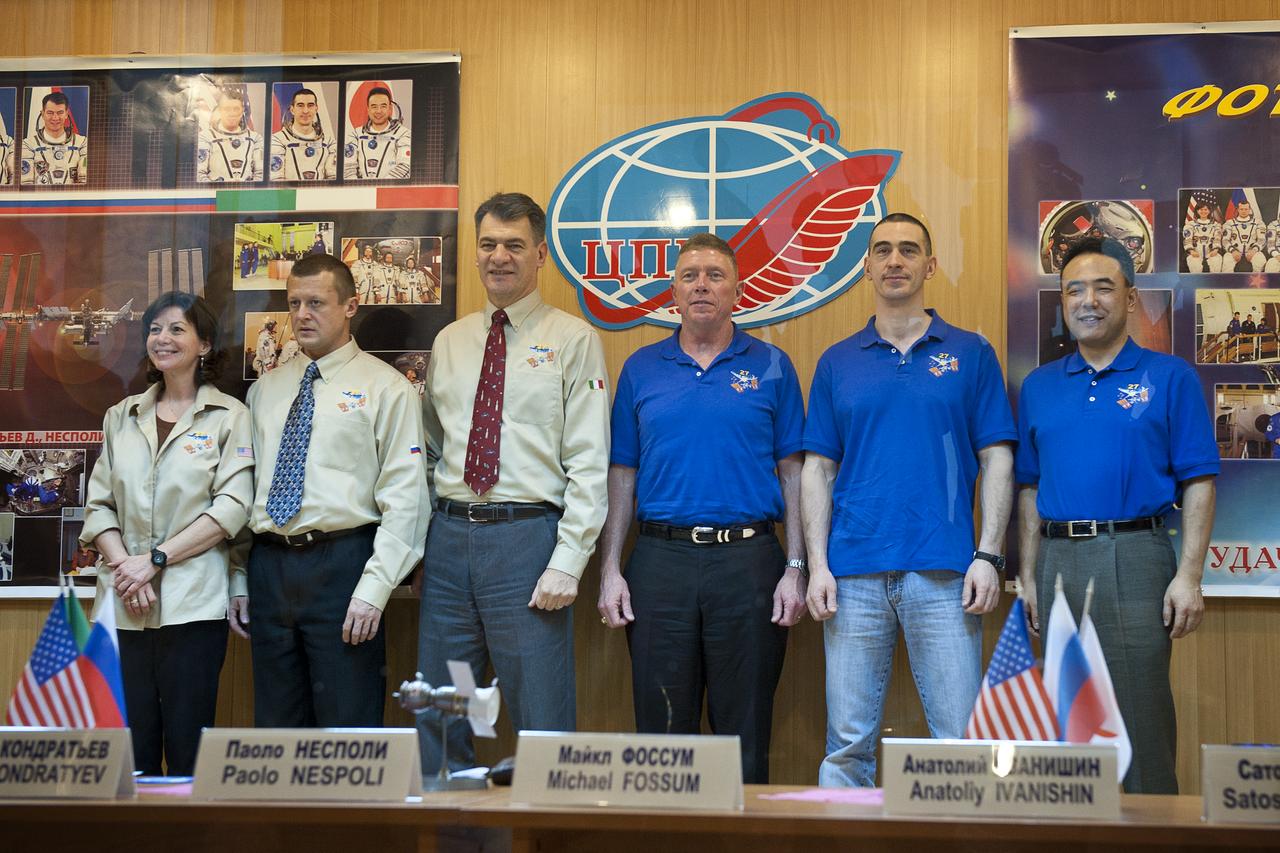
From left; Catherine Coleman, NASA Flight Engineer, Dmitry Kondratyev, Soyuz Commander, Paolo Nespoli, Italian astronaut and Flight Engineer, Michael Fossum, Expedition 26 back up crew member, Anatoly Ivanishin, Expedition 26 back up crew member and Satoshi Furukawa, Expedition 26 back up crew member are seen at the State Commission press conference held at the Cosmonaut Hotel in Baikonur, Kazakhstan on Tuesday, Dec. 14, 2010. Photo Credit: (NASA/Carla Cioffi)
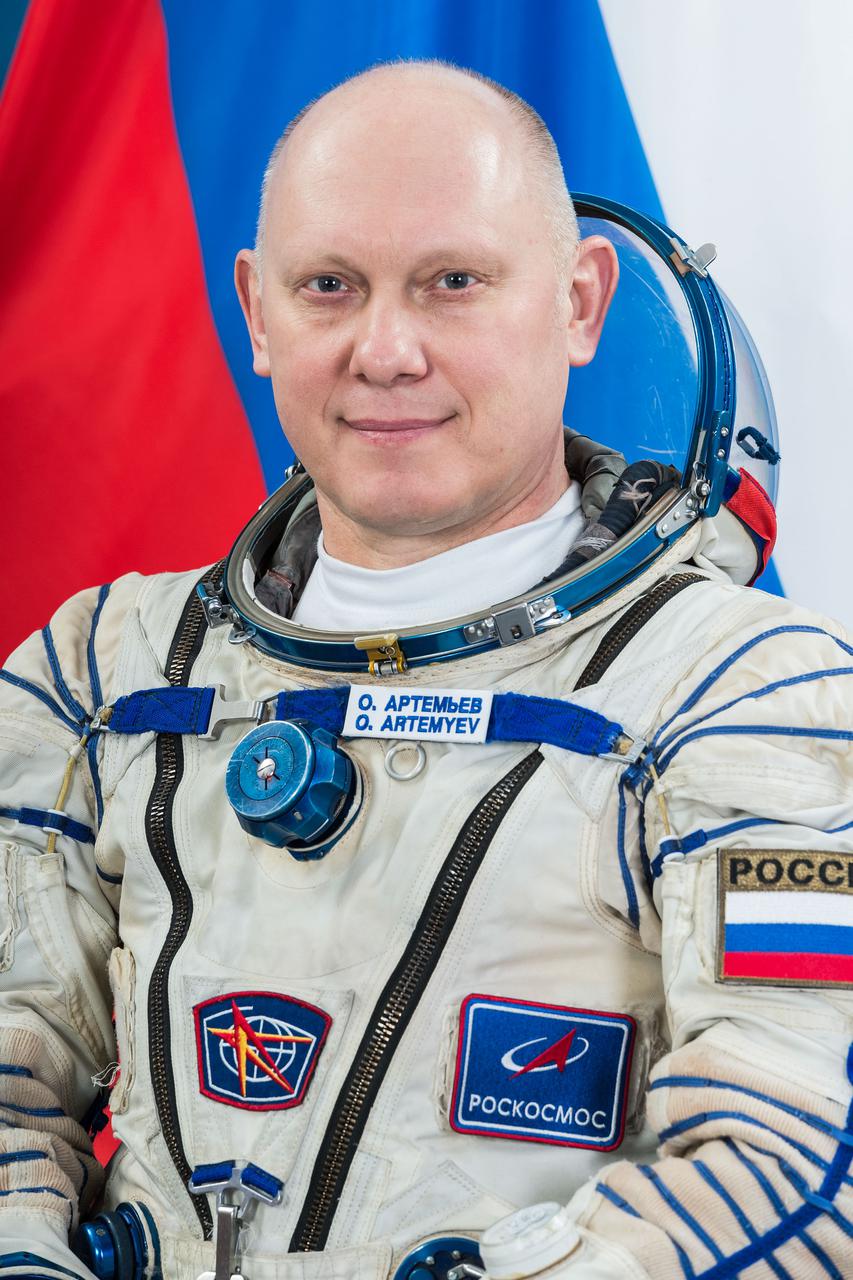
jsc2021e010292 - Exp-65 Soyuz MS-18/64S Back Up Crew Member Oleg Artemyev from GCTC
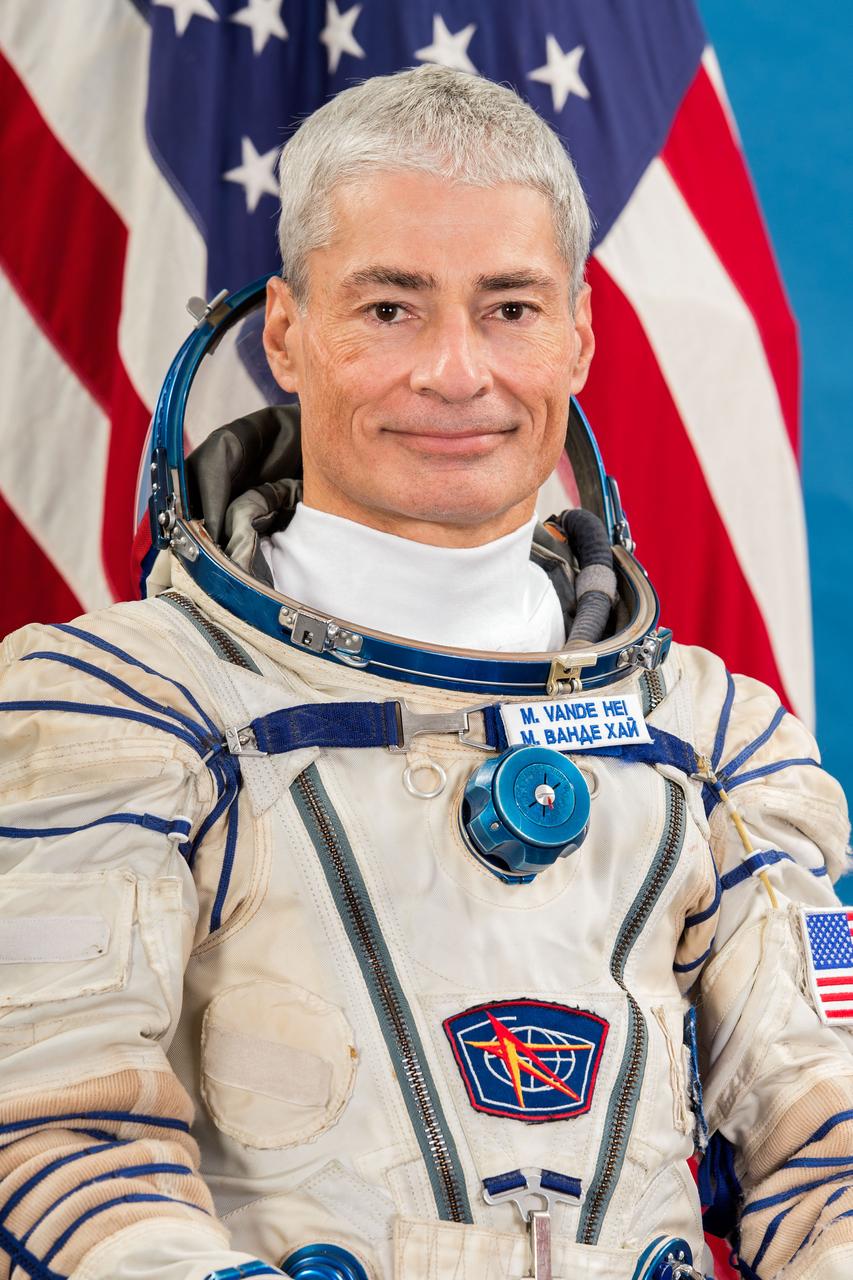
jsc2020e036116 - Exp-64 Back Up Crew - Individual GCTC Portraits - Mark Vande Hei
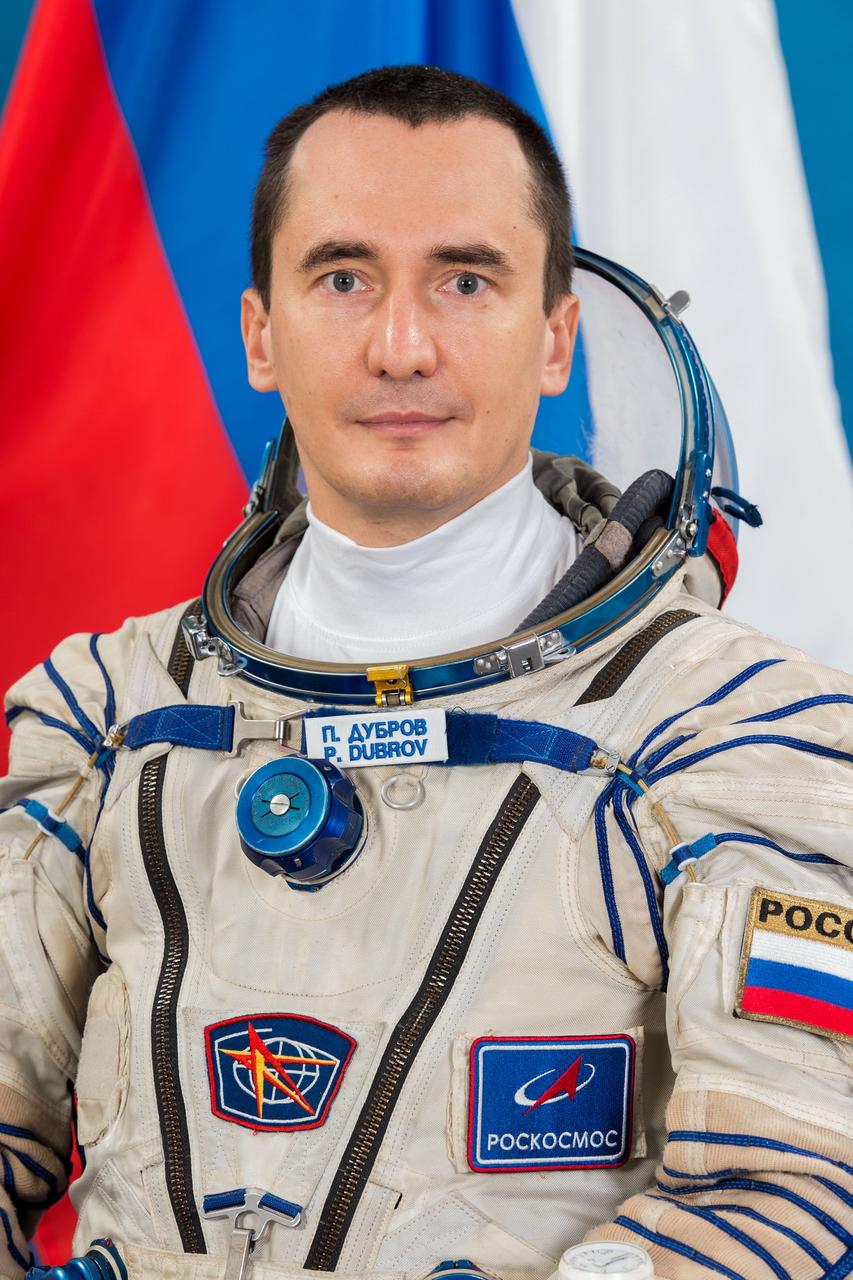
jsc2020e036115 - Exp-64 Back Up Crew - Individual GCTC Portraits - Petr Dubrov
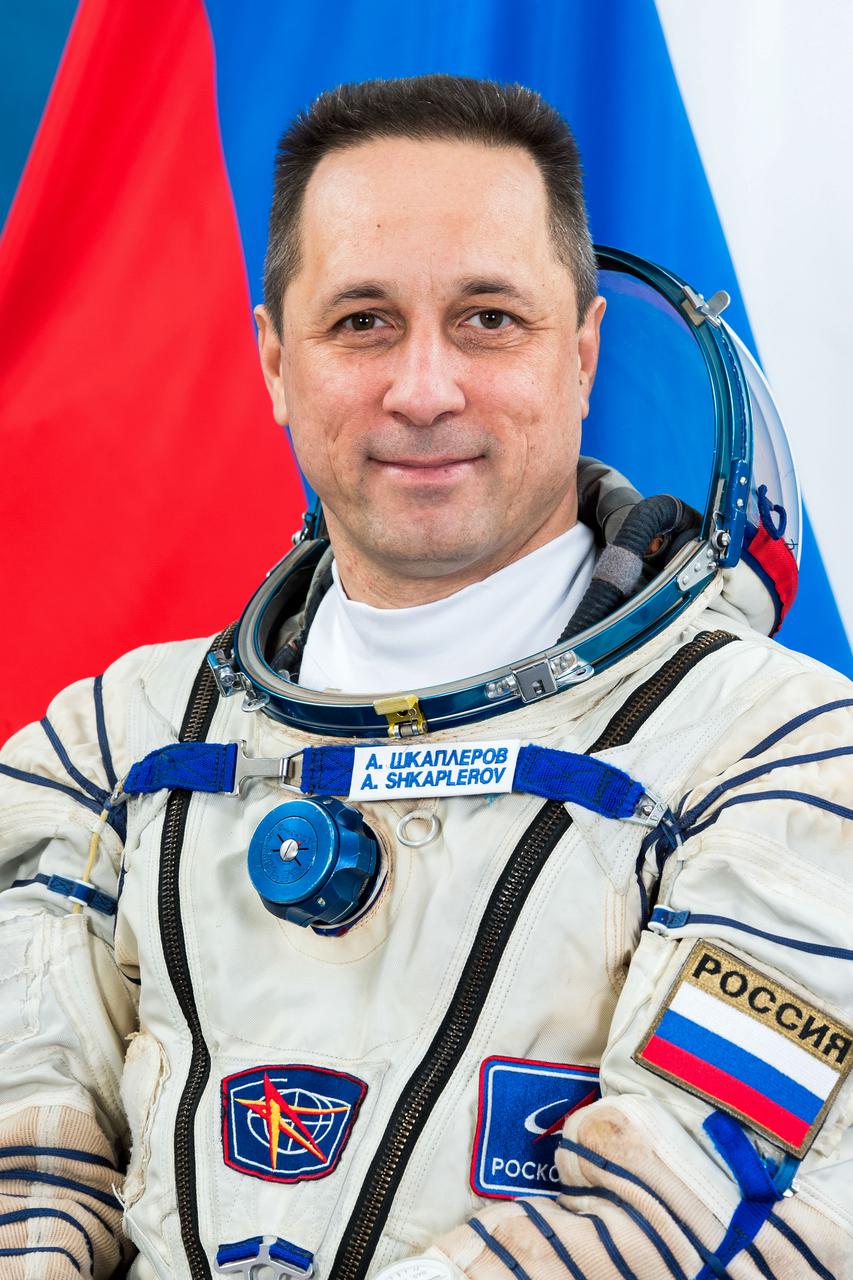
jsc2021e010293 - Exp-65 Soyuz MS-18/64S Back Up Crew Member Anton Shkaplerov from GCTC
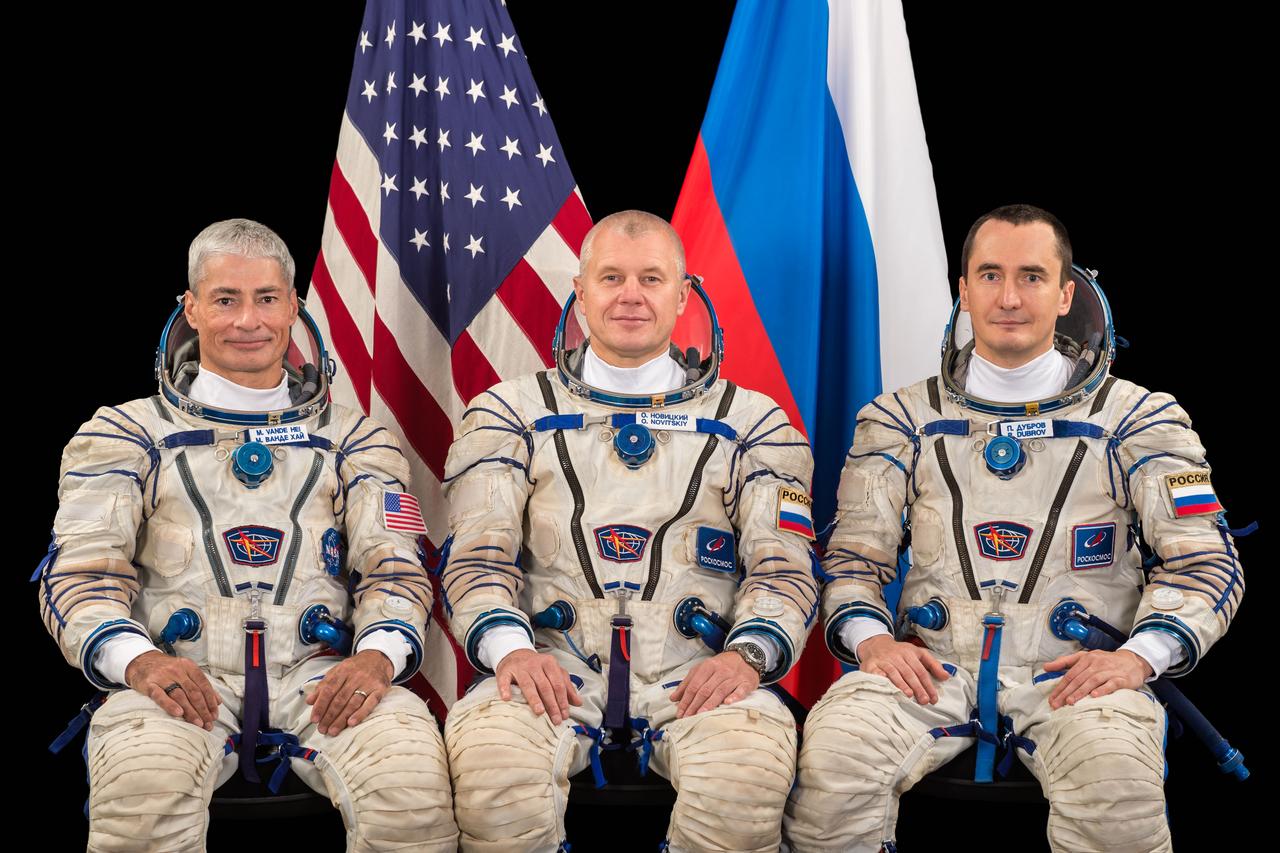
jsc2020e036117 - Exp-64 Back Up Crew - GCTC Portrait - Mark Vande Hei, Oleg Novitskiy, Petr Dubrov
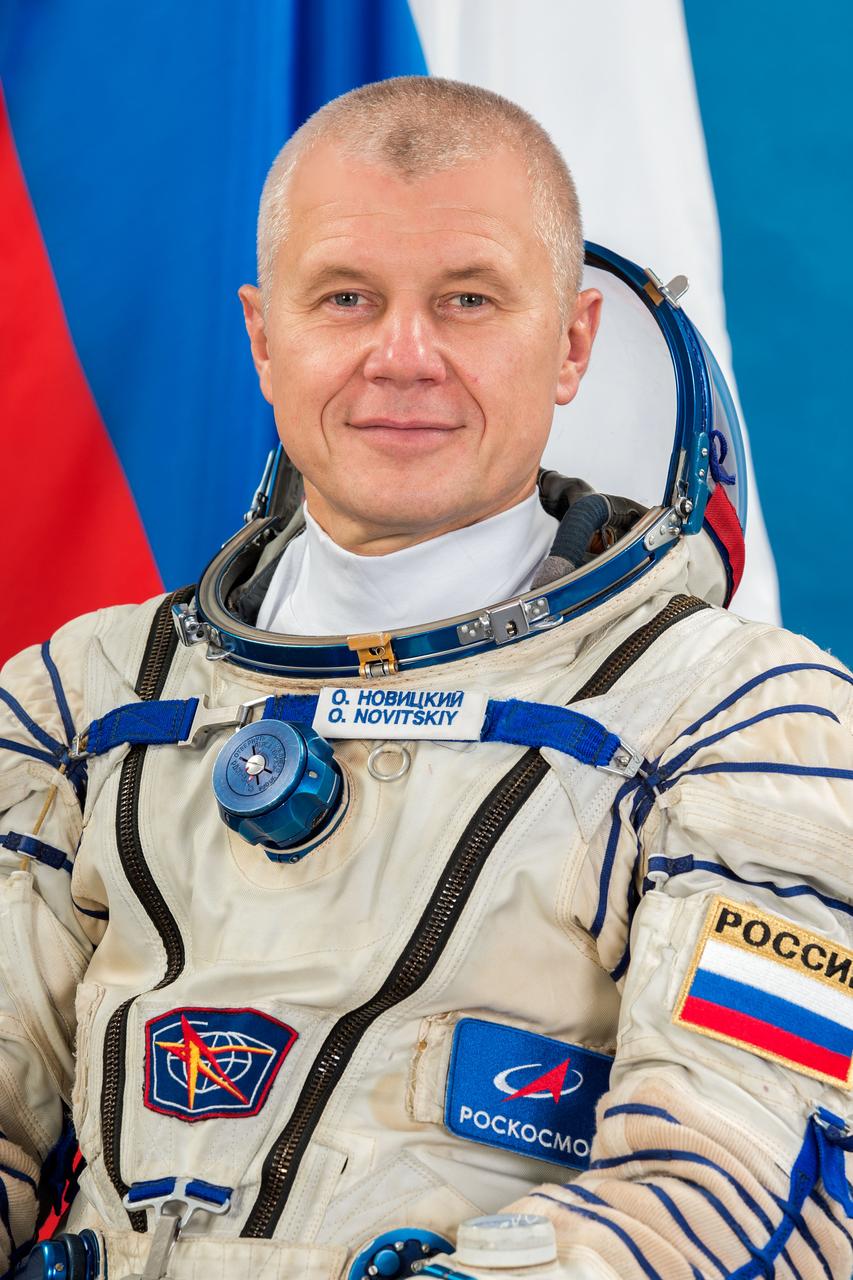
jsc2020e036114 - Exp-64 Back Up Crew - Individual GCTC Portraits - Oleg Novitskiy
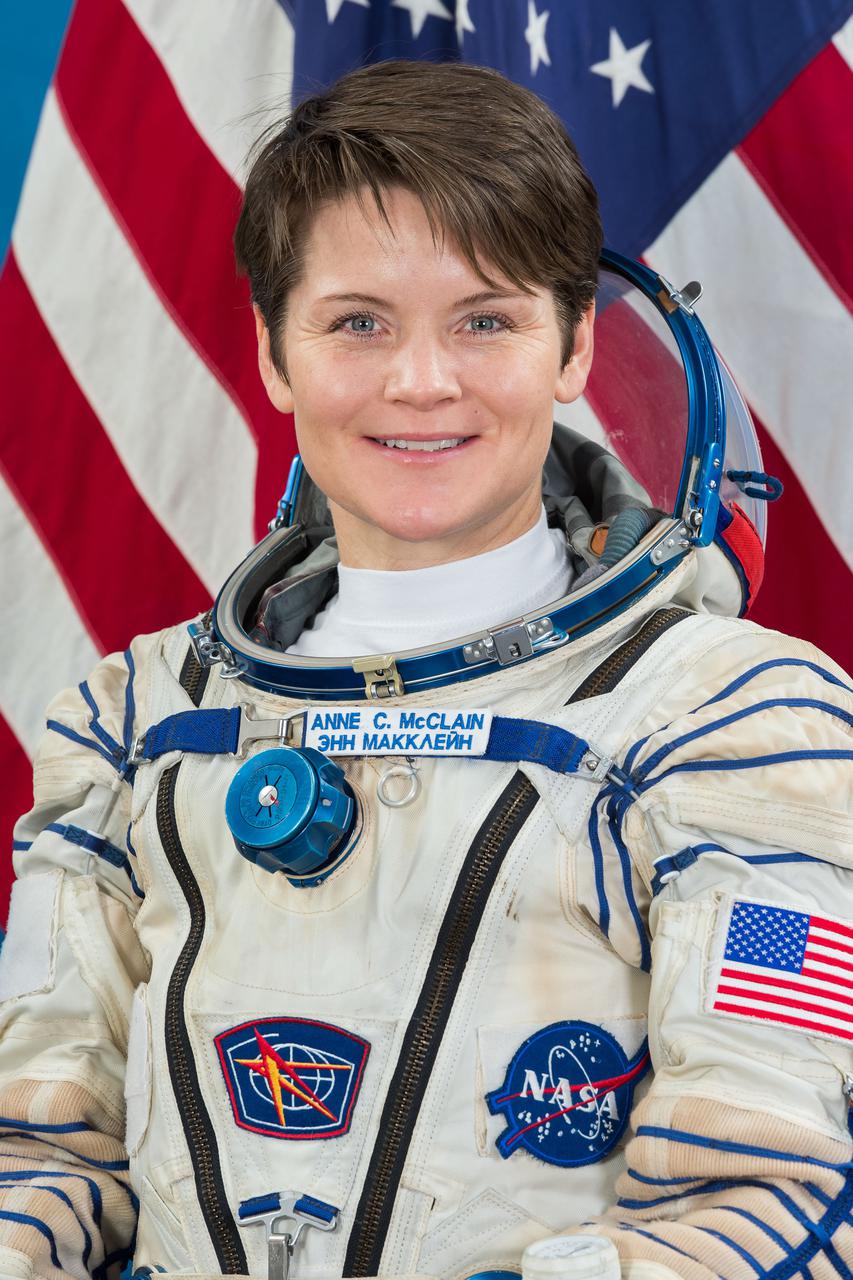
jsc2021e010291 - Exp-65 Soyuz MS-18/64S Back Up Crew Member Anne McClain from GCTC
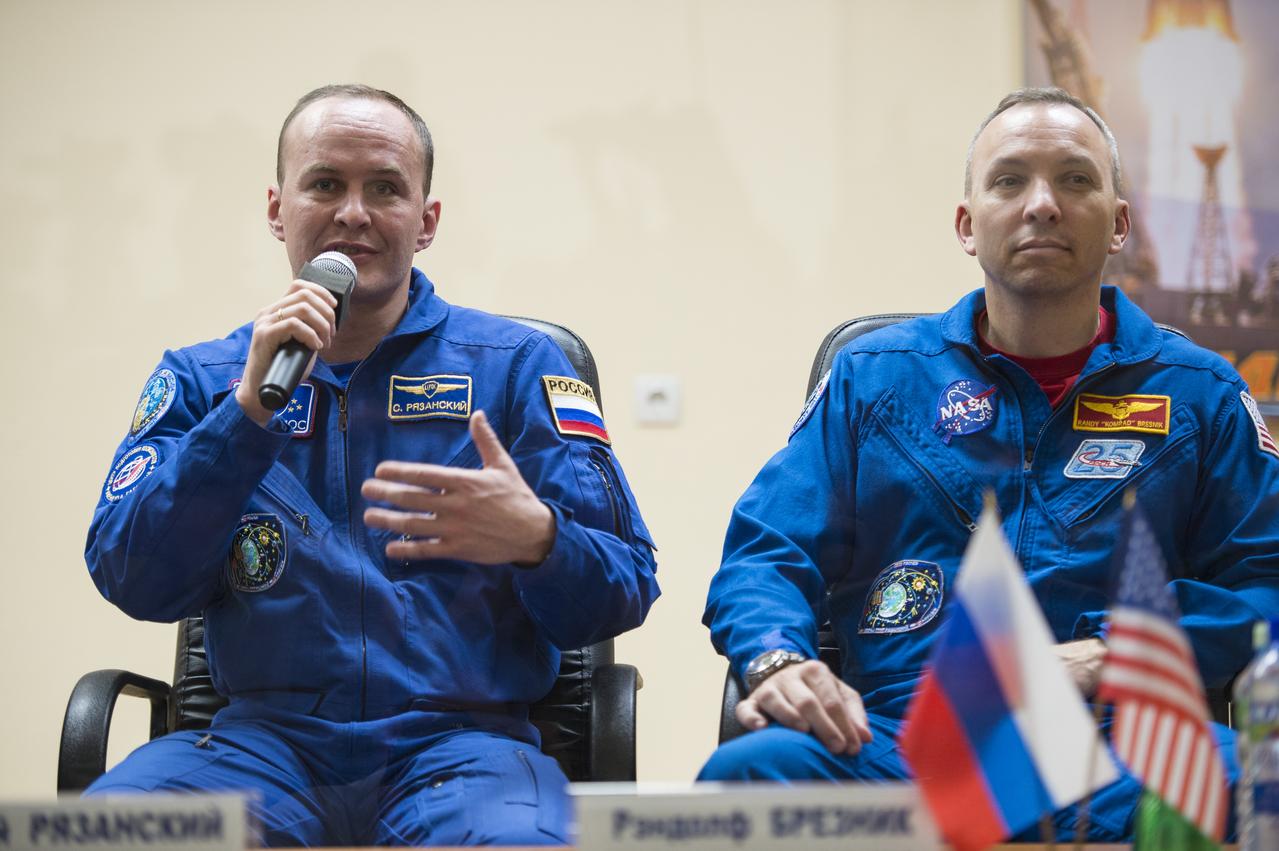
Expedition 51 back up crew member, Soyuz Commander Sergey Ryazanskiy of Roscosmos, left, answers a question during a press conference held at the Cosmonaut Hotel in Baikonur, Kazakhstan on Wednesday, April 19, 2017. He is seen with Expedition 51 back up crew mate Randy Bresnik of NASA. The Expedition 51 prime crew is set to launch April 20 from the Baikonur Cosmodrome. Photo Credit: (NASA/Aubrey Gemignani)
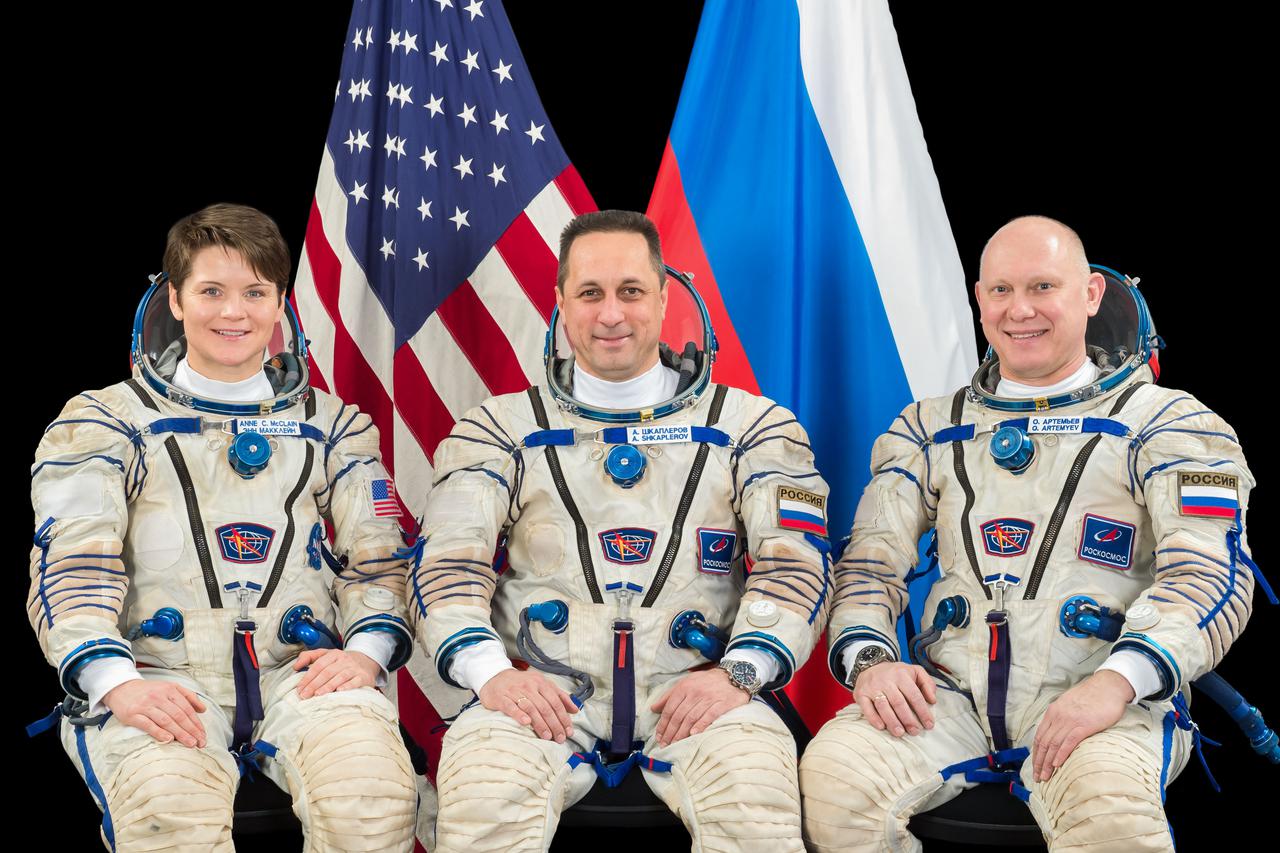
jsc2021e010290 - Exp-65 Soyuz MS-18/64S Crew Photo - Back Up; Anne McClain, Anton Shkaplerov and Oleg Artemyev from GCTC
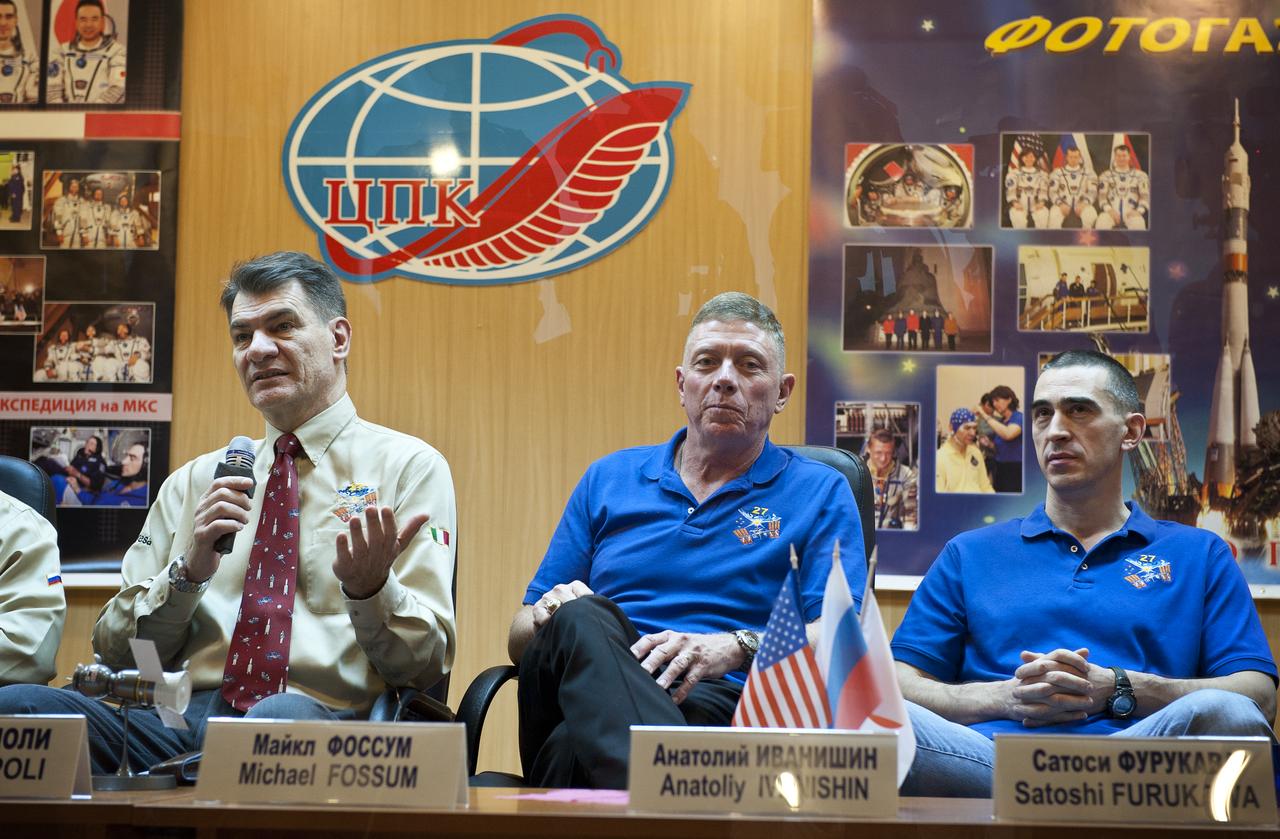
Italian astronaut Paolo Nespoli, Expedition 26 Flight Engineer, left, answers a question as Michael Fossum, Expedition 26 back up crew member and Anatoly Ivanishin, Expedition 26 back up crew member, right, look on during the State Commission press conference held at the Cosmonaut Hotel in Baikonur, Kazakhstan on Tuesday, Dec. 14, 2010. Photo Credit: (NASA/Carla Cioffi)
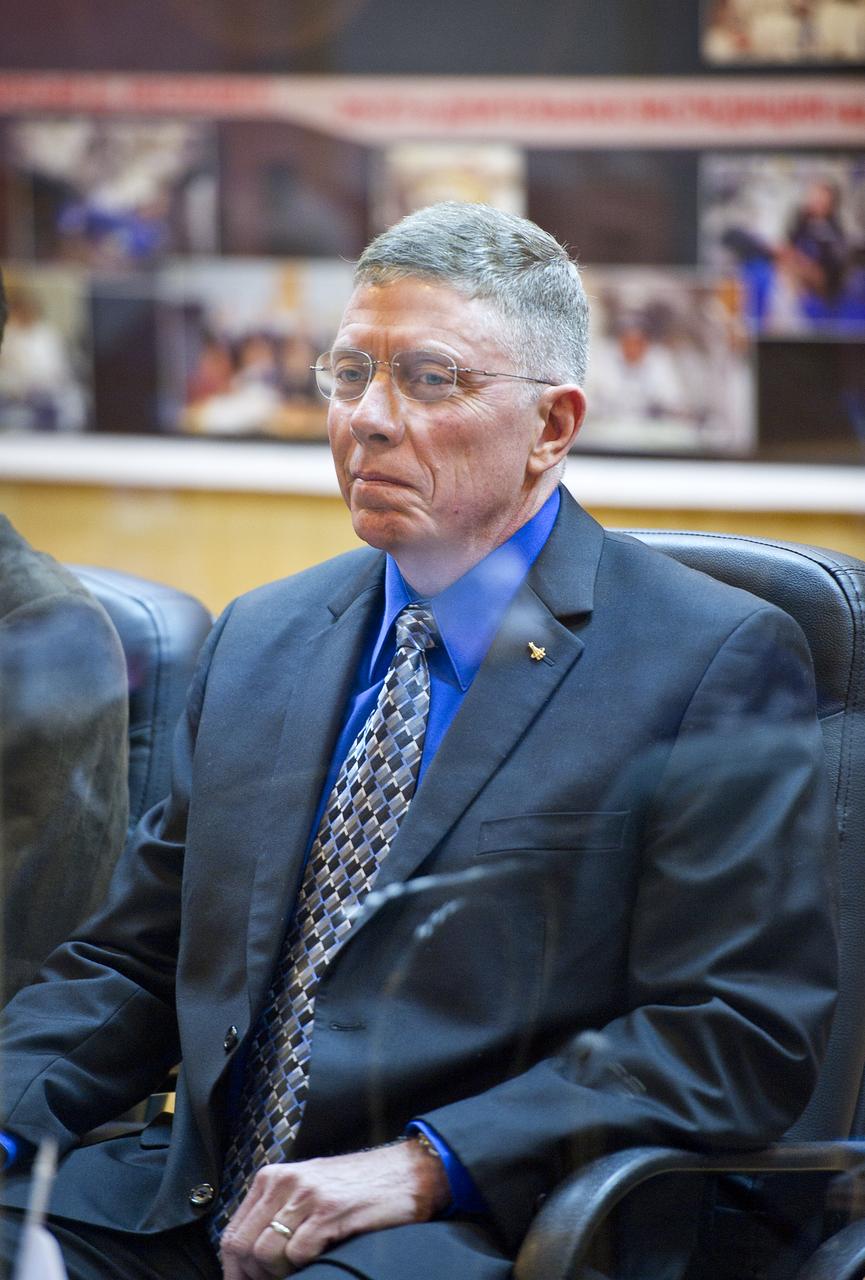
Michael Fossum, Expedition 26 back up crew member, is seen at the State Commission meeting held at the Cosmonaut Hotel in Baikonur, Kazakhstan on Tuesday, Dec. 14, 2010. Photo Credit: (NASA/Carla Cioffi)
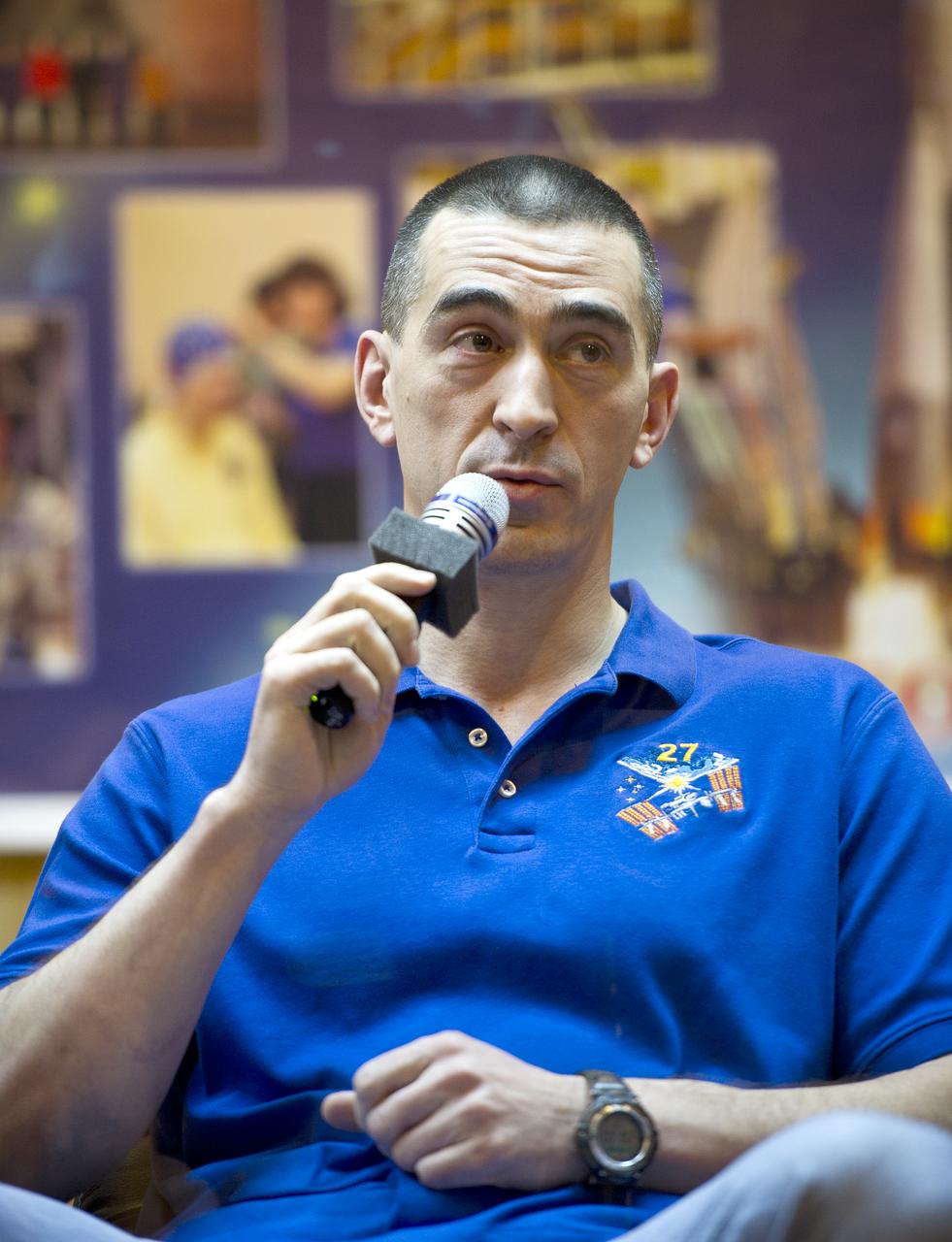
Anatoly Ivanishin, Expedition 26 back up crew member, speaks at the State Commission press conference held at the Cosmonaut Hotel in Baikonur, Kazakhstan on Tuesday, Dec. 14, 2010. Photo Credit: (NASA/Carla Cioffi)
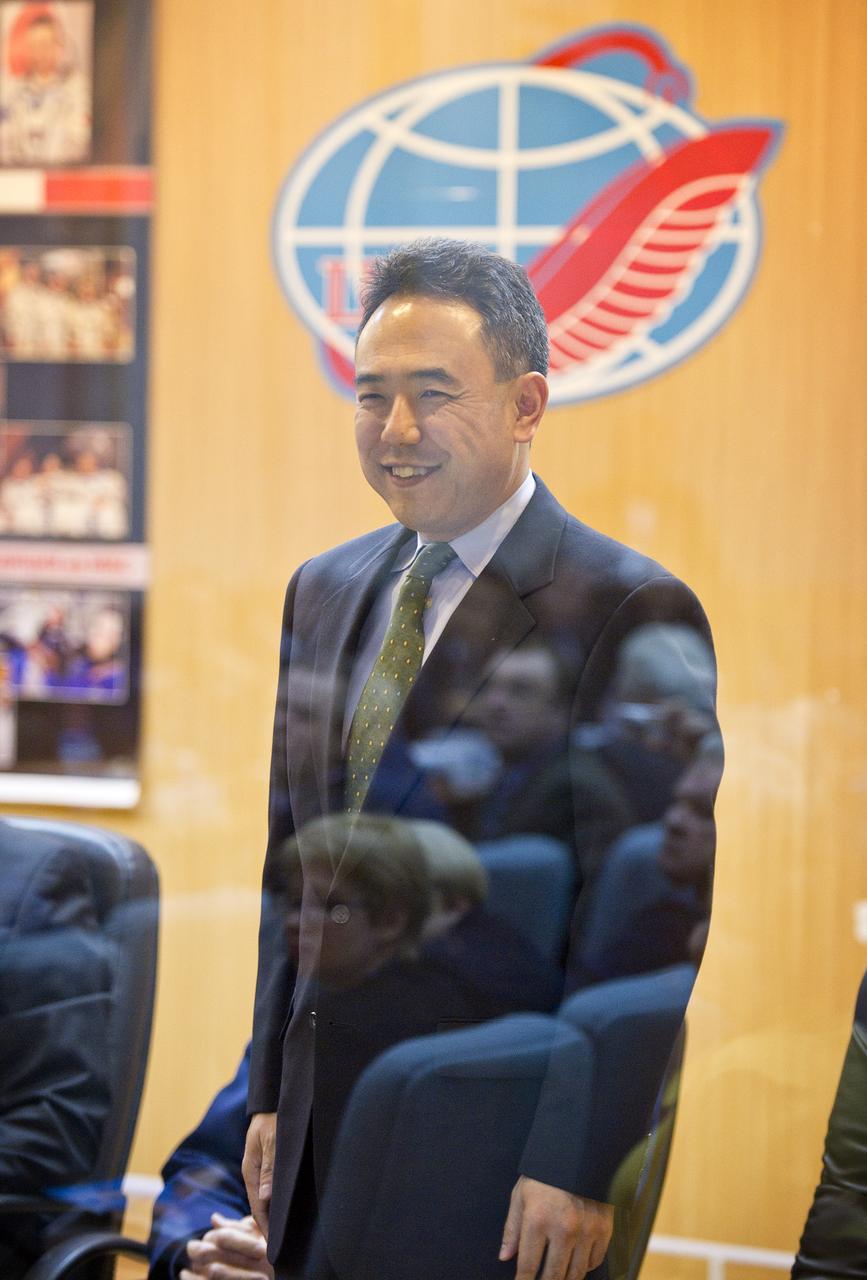
Satoshi Furukawa, Expedition 26 back up crew member, is seen at the State Commission meeting held at the Cosmonaut Hotel in Baikonur, Kazakhstan on Tuesday, Dec. 14, 2010. Photo Credit: (NASA/Carla Cioffi)
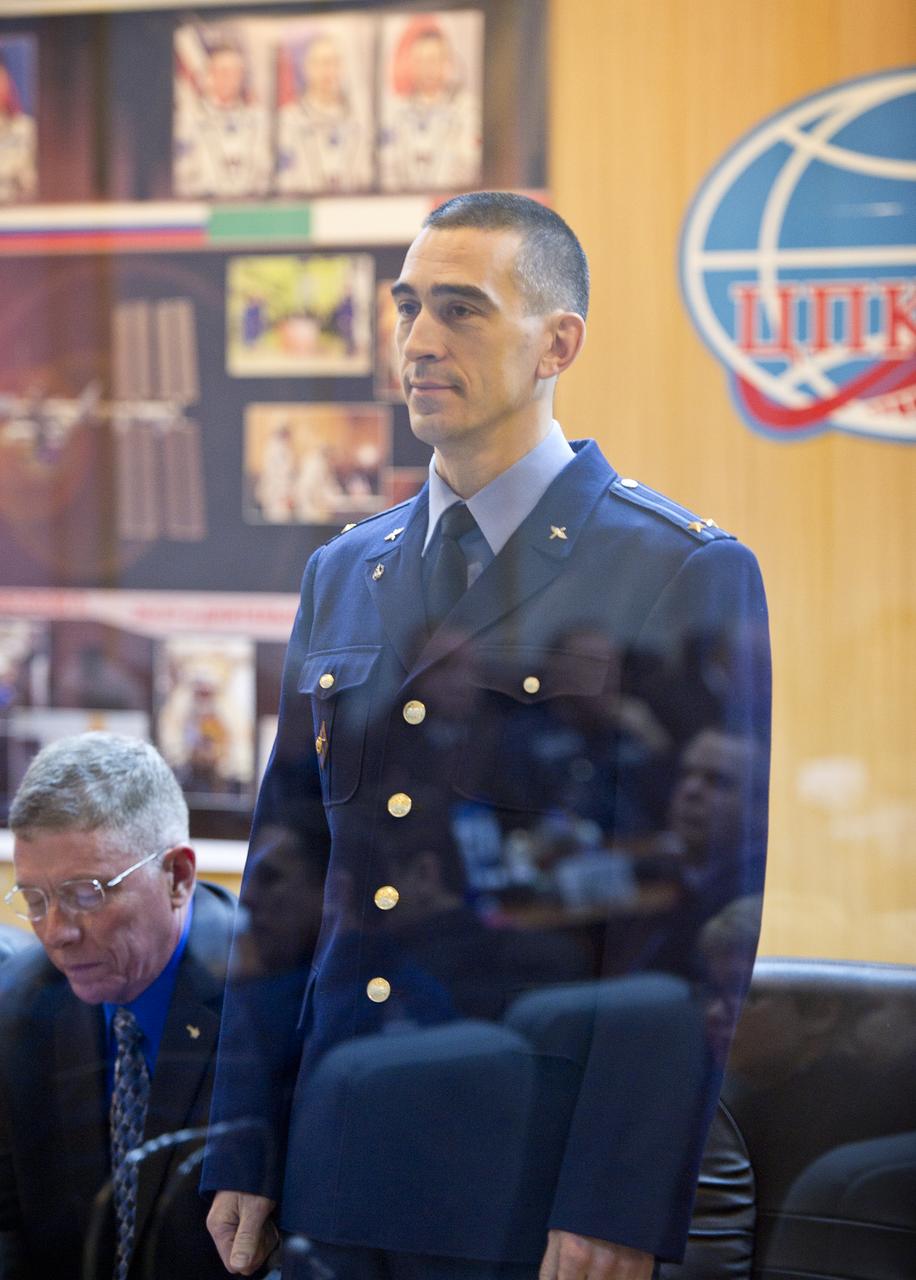
Anatoly Ivanishin, Expedition 26 back up crew member is seen at the State Commission meeting held at the Cosmonaut Hotel in Baikonur, Kazakhstan on Tuesday, Dec. 14, 2010. Photo Credit: (NASA/Carla Cioffi)
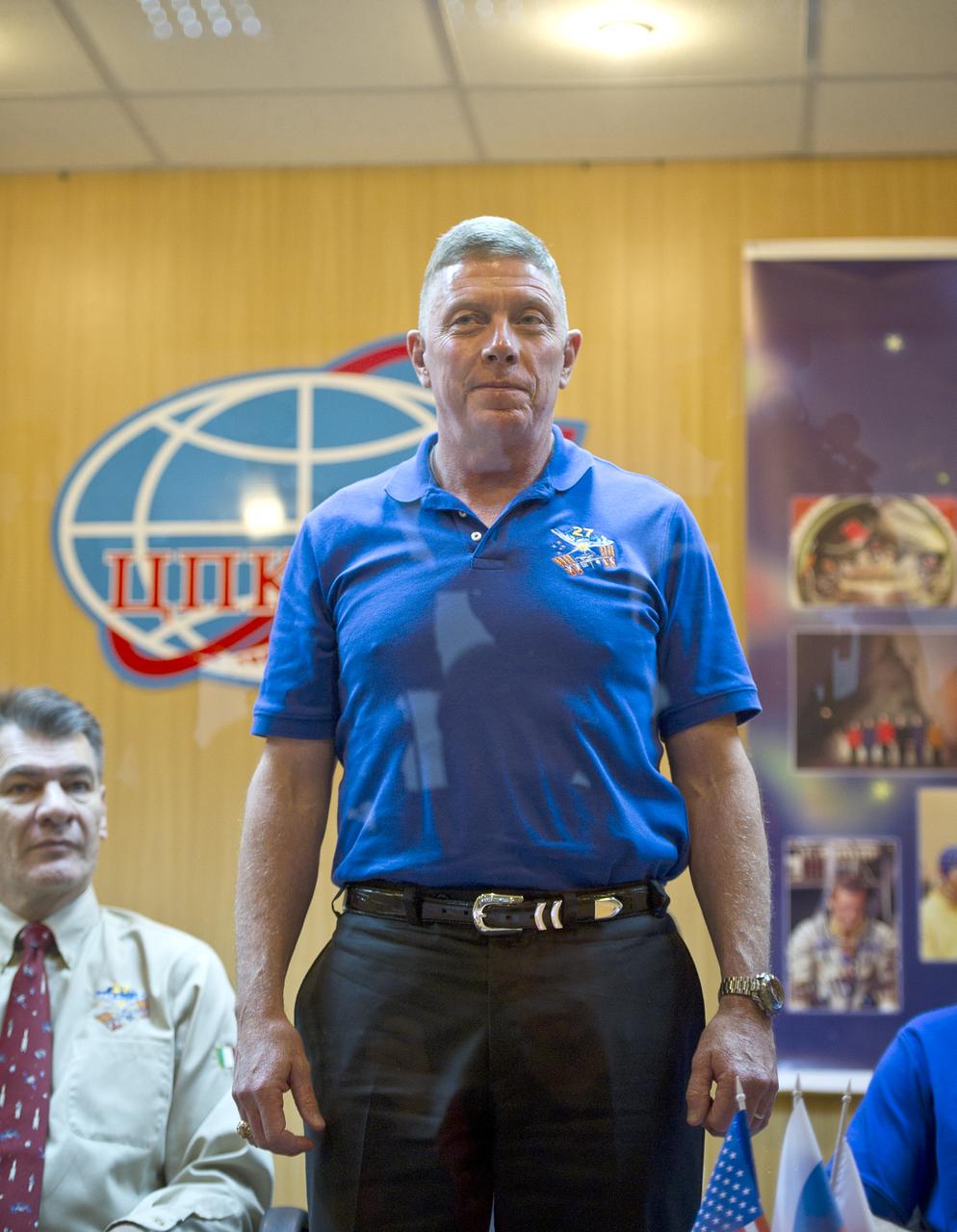
Expedition 26 back up crew member Michael Fossum is seen at the State Commission press conference held at the Cosmonaut Hotel in Baikonur, Kazakhstan on Tuesday, Dec. 14, 2010. Photo Credit: (NASA/Carla Cioffi)
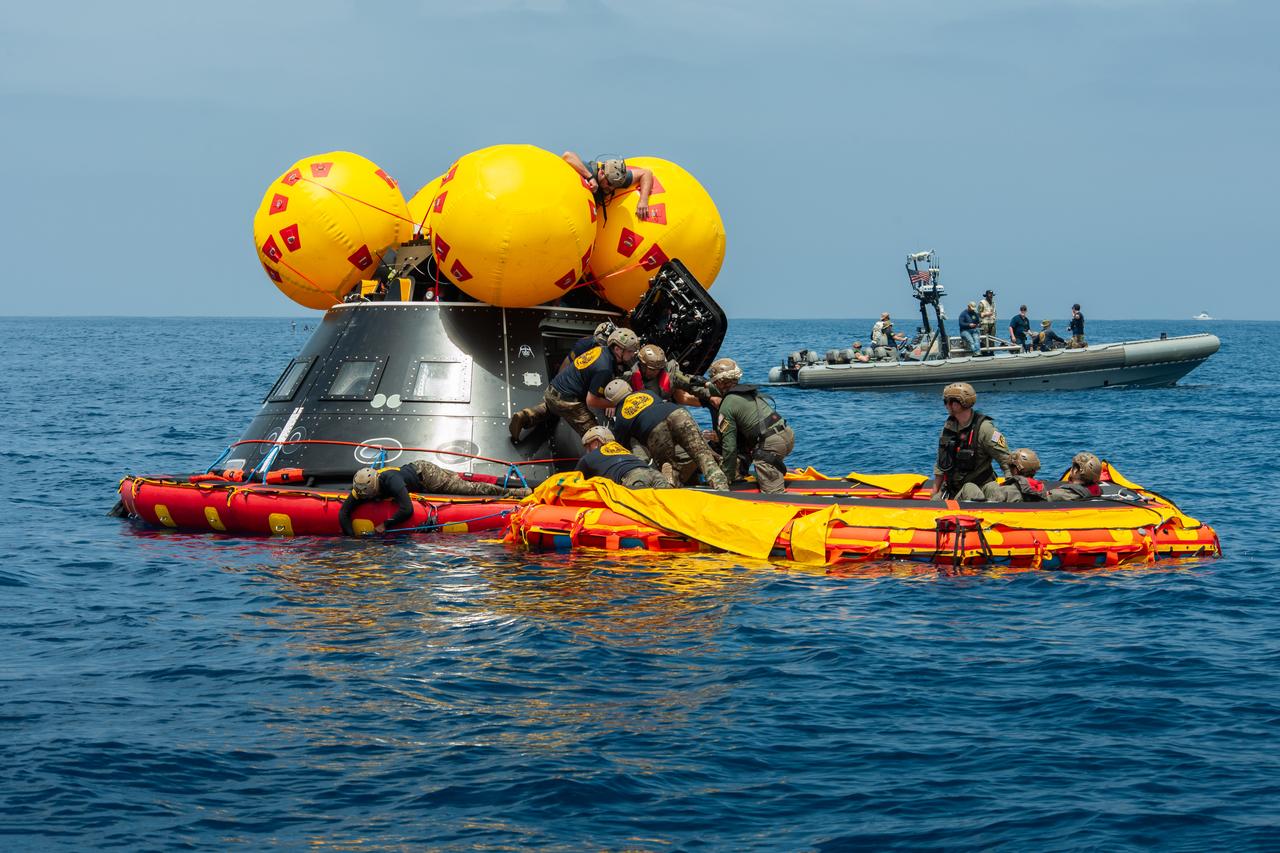
NASA, Navy, and Air Force personnel practice Artemis recovery procedures in the Pacific Ocean as part of Underway Recovery Test 10 (URT-10) off the coast of San Diego. In this photo, Navy divers are seen entering the Orion Crew Module Test Article (CMTA) and assisting a simulated crew member exiting the spacecraft to practice recovering astronauts out of the spacecraft and onto an inflatable “front porch” where the crew will be picked up with helicopters and lifted up via helicopter back to the recovery vessel.
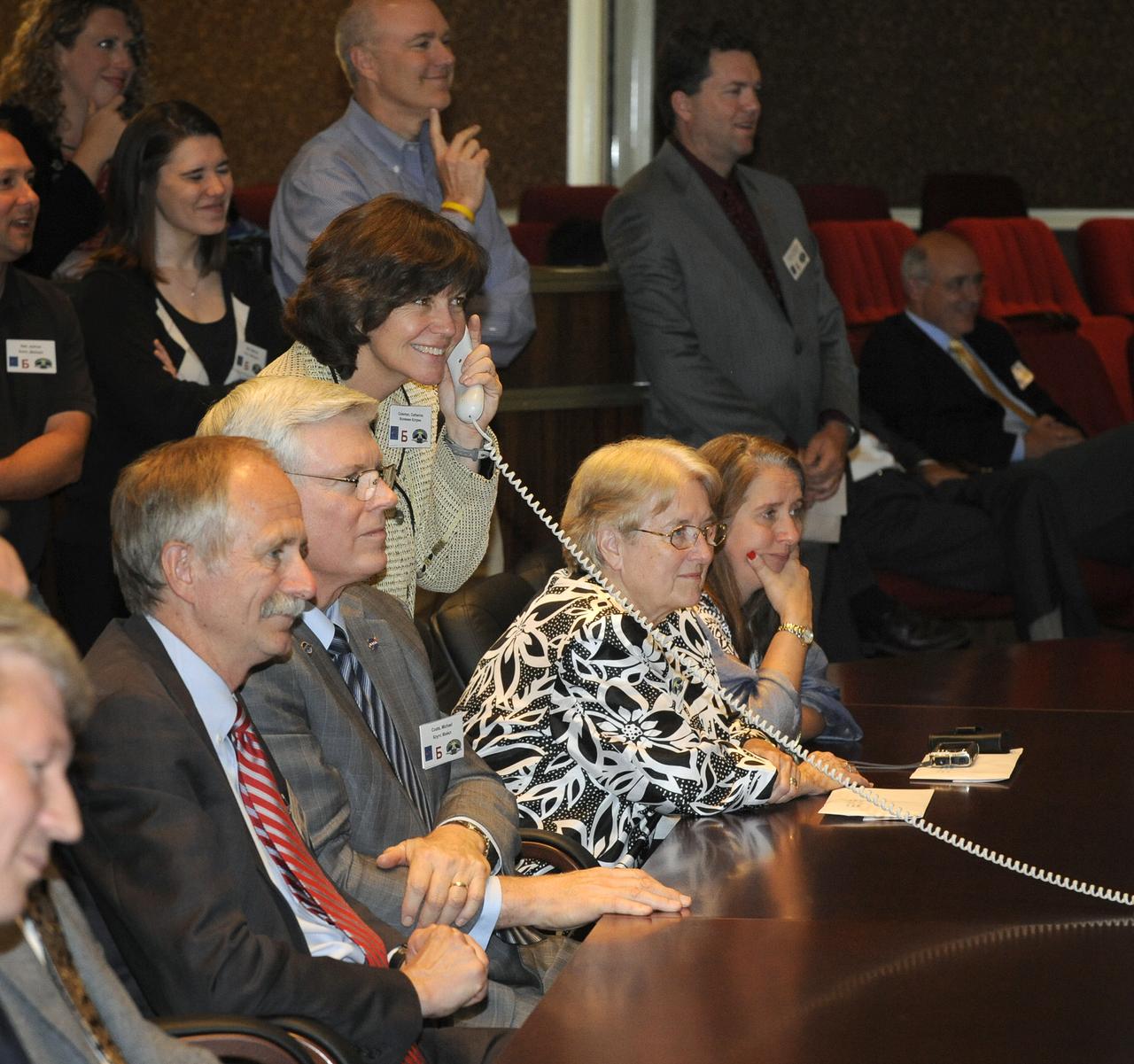
NASA astronaut and Expedition 24 back-up crew member, Cady Coleman, speaks with the crew of Expedition 24 upon their arrival to the International Space Station on Friday, June 18, 2010 at Russian Mission Control Center in Korolev, Russia. Photo Credit: (NASA/Carla Cioffi)
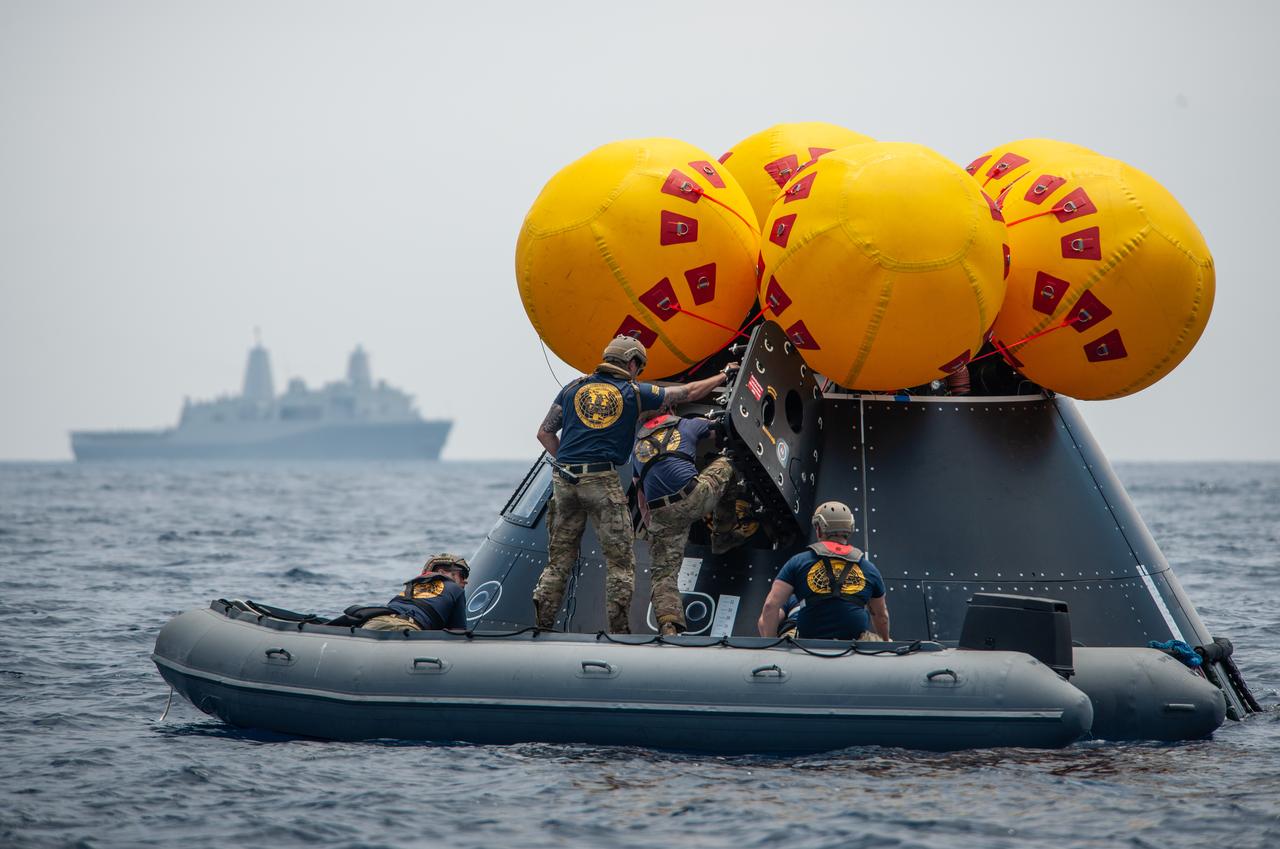
NASA, Navy, and Air Force personnel practice Artemis recovery procedures in the Pacific Ocean as part of Underway Recovery Test-10 off the coast of San Diego. In this photo Navy divers are seen entering the Orion Crew Module Test Article to prepare to practice recovering astronauts out of the spacecraft and onto an inflatable “front porch” where the crew will be picked up with helicopters and lifted up via helicopter back to the recovery vessel.
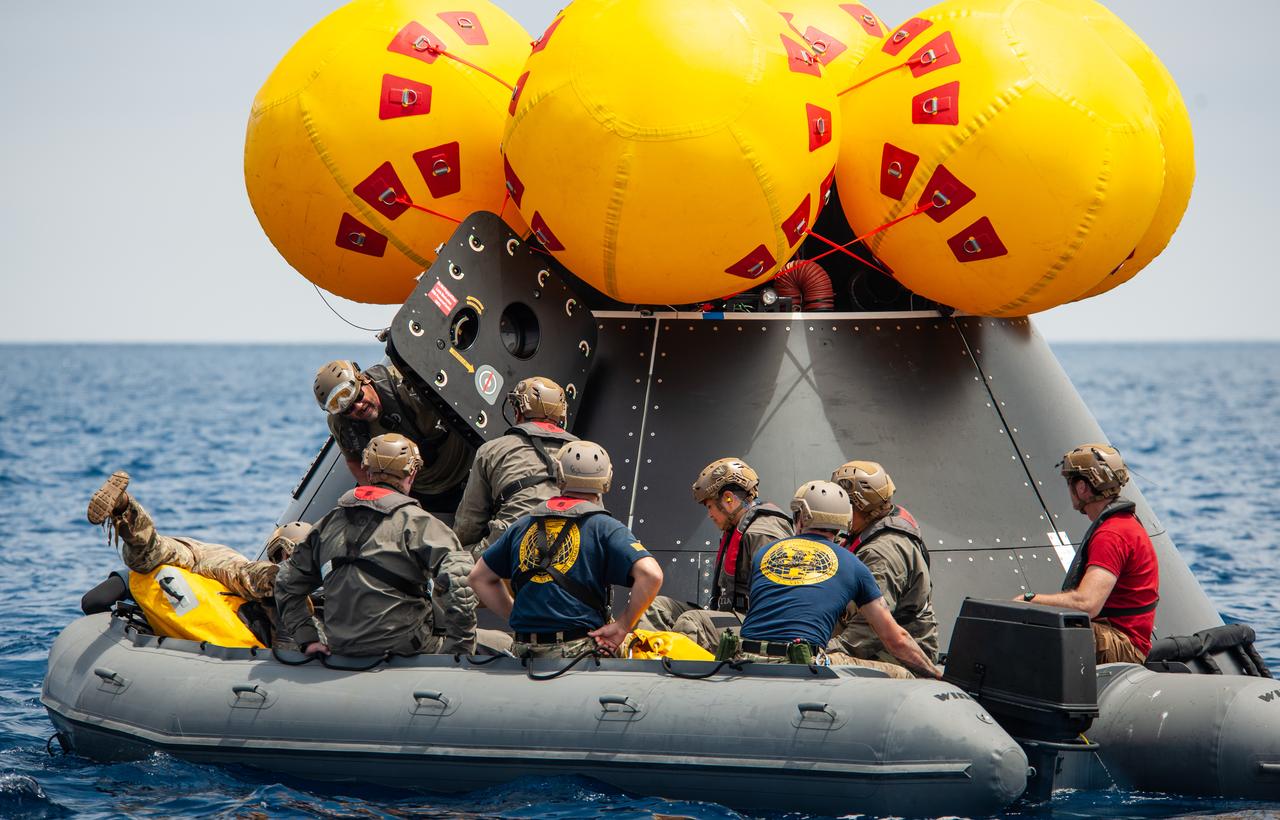
NASA, Navy, and Air Force personnel practice Artemis recovery procedures in the Pacific Ocean as part of Underway Recovery Test-10 off the coast of San Diego. In this photo Navy divers are seen entering the Orion Crew Module Test Article to prepare to practice recovering astronauts out of the spacecraft and onto an inflatable “front porch” where the crew will be picked up with helicopters and lifted up via helicopter back to the recovery vessel.
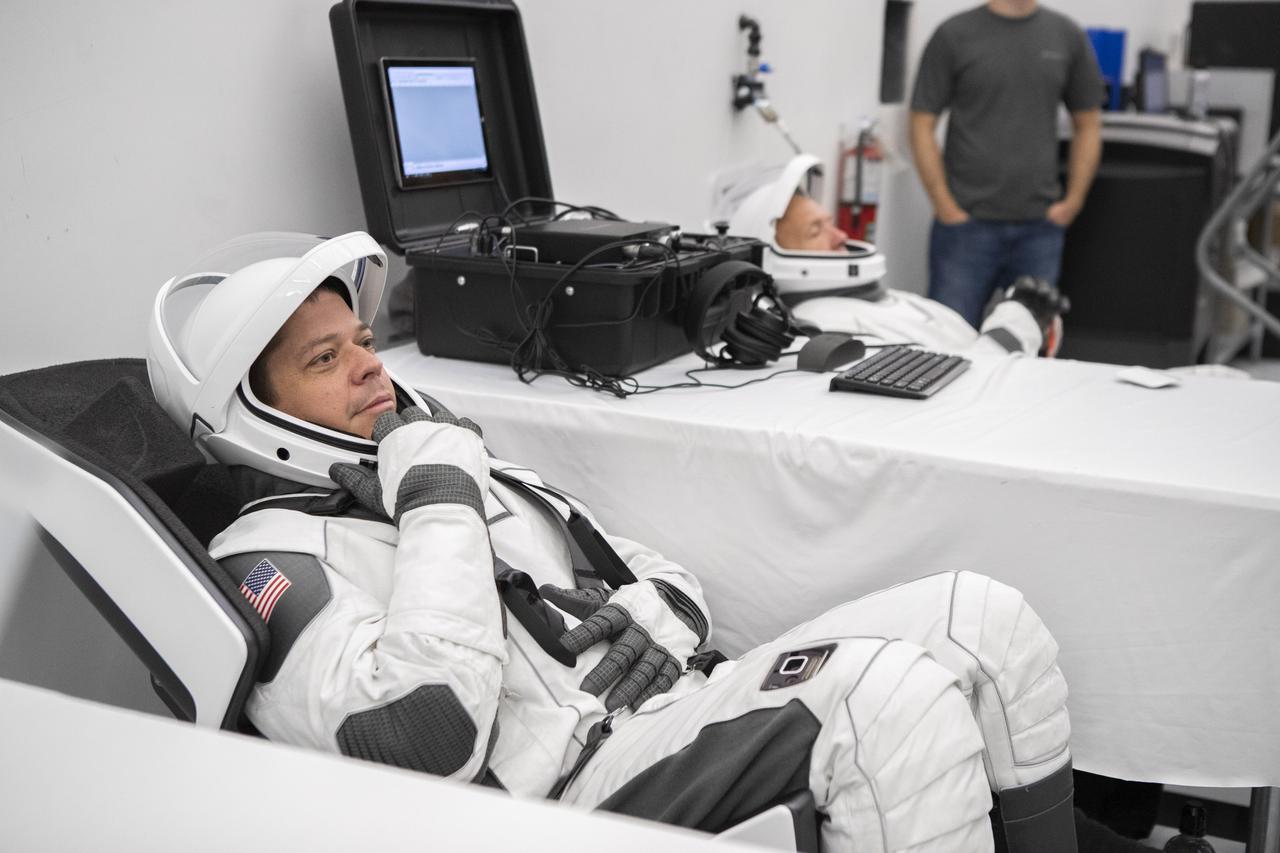
NASA and SpaceX held a joint training event for pre-launch operations, which provided an opportunity for the crew and ground operators to rehearse all of the activities, procedures, and communication the teams will exercise on launch day from crew suit-up in Kennedy Space Center’s Operations & Checkout (O&C) building in Florida through launch; this training event also included simulated emergency egress scenarios. NASA astronauts Bob Behnken, in front, and Doug Hurley, in back, are participating in a suit-up for launch, using the same Ground Support Equipment hardware, such as the seats and suit leak check boxes, that the crew will use for launch, with the SpaceX ground closeout team and suit engineers that will help the crew suit up and ingress the Dragon on launch day. Following crew suit-up, the crew ingressed the capsule simulator in Hawthorne, California, as they would on launch day, and the teams performed a simulated launch countdown and several emergency egress scenarios.
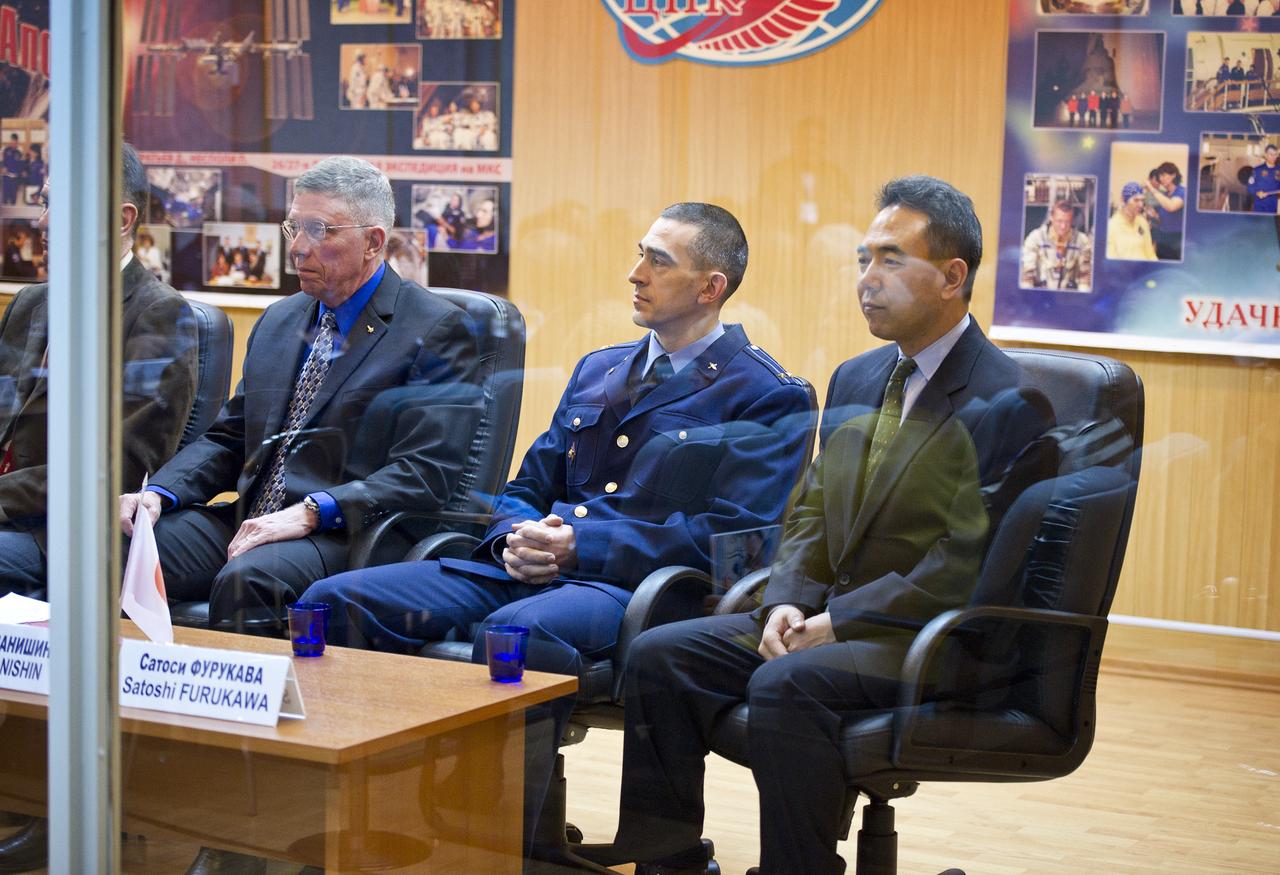
Expedition 26 back up crew members Michael Fossum, left, Anatoly Ivanishin and Satoshi Furukawa are seen talking at the State Commission meeting held at the Cosmonaut Hotel in Baikonur, Kazakhstan on Tuesday, Dec. 14, 2010. Photo Credit: (NASA/Carla Cioffi)
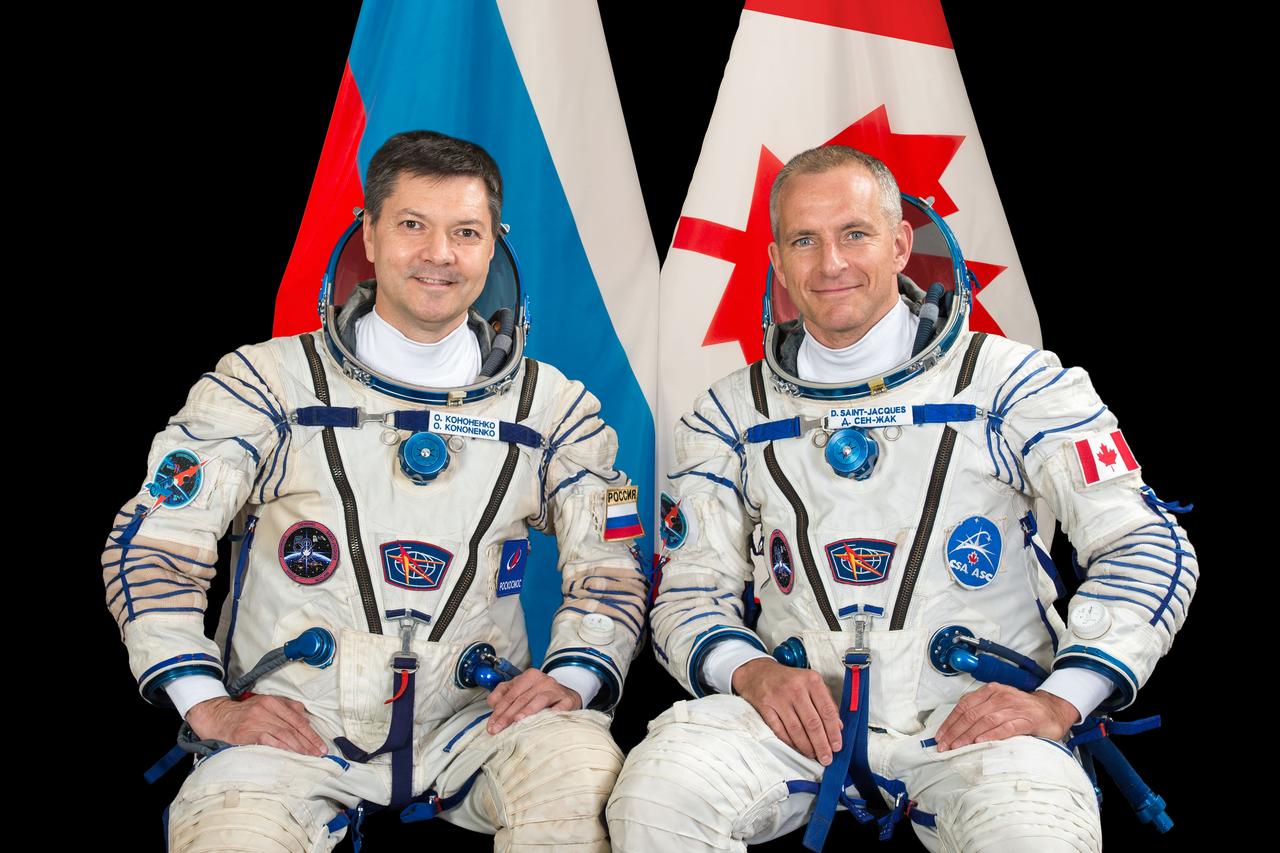
jsc2018e078861 (Nov. 16, 2017) --- Expedition 57-58 back up crew members (from left) Oleg Kononenko of Roscosmos and David Saint-Jacques of the Canadian Space Agency are pictured in Sokol launch and entry suits at the Gagarin Cosmonaut Training Center.
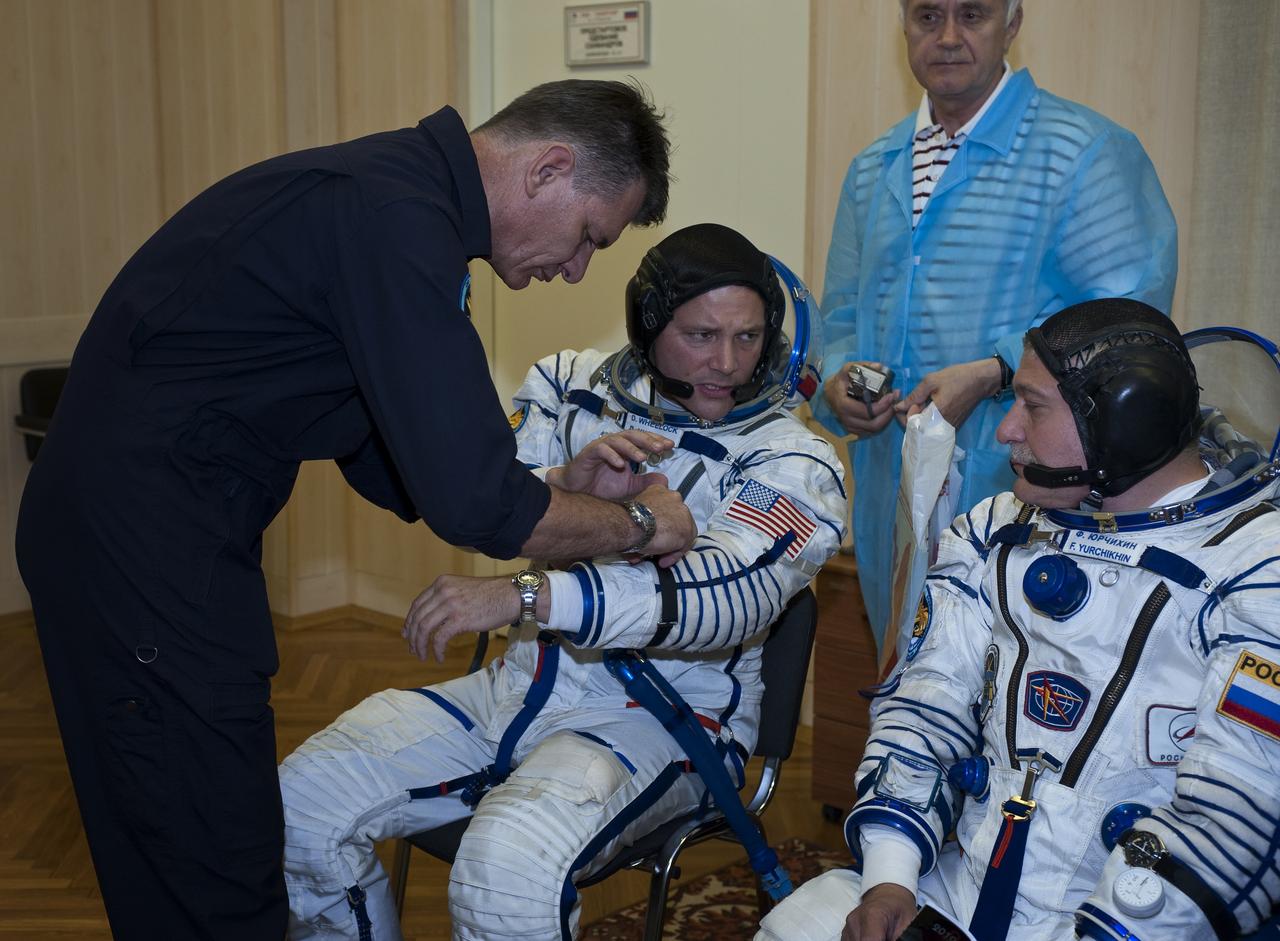
Expedition 24 back-up European Space Agency crew member Paolo Nespoli of Italy, far left, helps Doug Wheelock and Soyuz Commander Fyodor Yurchikhin with their Russian Sokol suit preparations at the Baikonur Cosmodrome in Baikonur, Kazakhstan, Tuesday, June 15, 2010. Photo Credit: (NASA/Carla Cioffi)
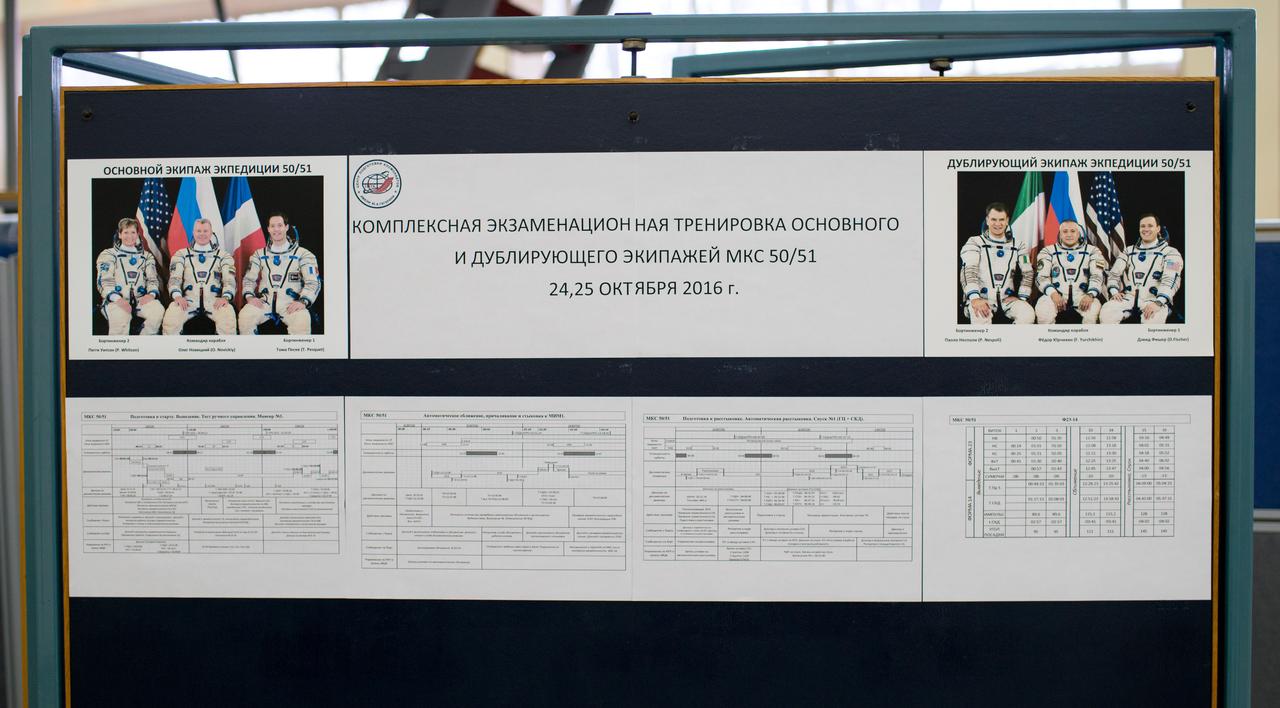
A bulletin board is seen with details about the qualification exams of the main and back-up crews for Expedition 50, Tuesday, Oct. 25, 2016, at the Gagarin Cosmonaut Training Center (GCTC) in Star City, Russia. Photo Credit: (NASA/Bill Ingalls)
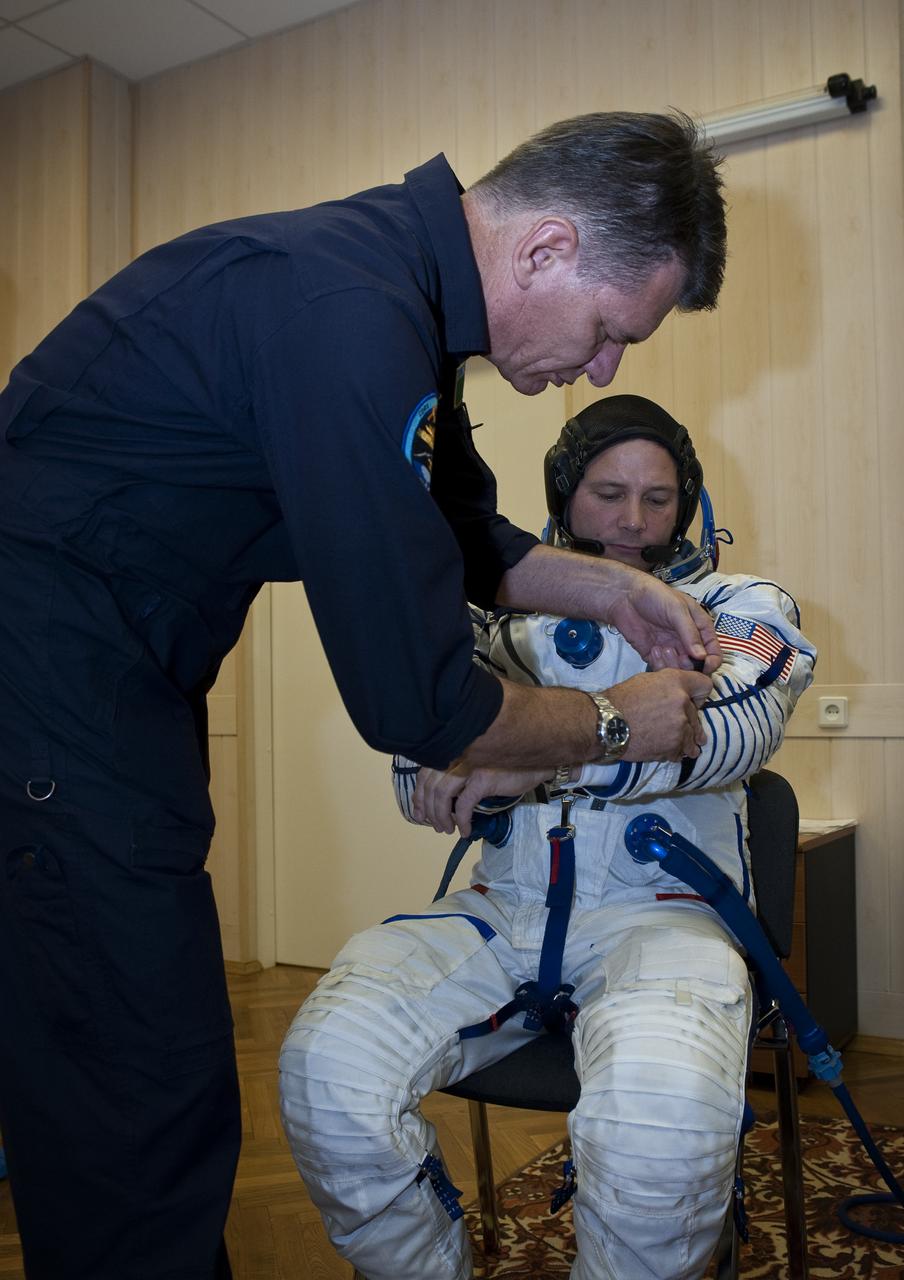
Expedition 24 back-up European Space Agency crew member Paolo Nespoli of Italy helps Doug Wheelock with his Russian Sokol suit preparations at the Baikonur Cosmodrome in Baikonur, Kazakhstan, Tuesday, June 15, 2010. Photo Credit: (NASA/Carla Cioffi)
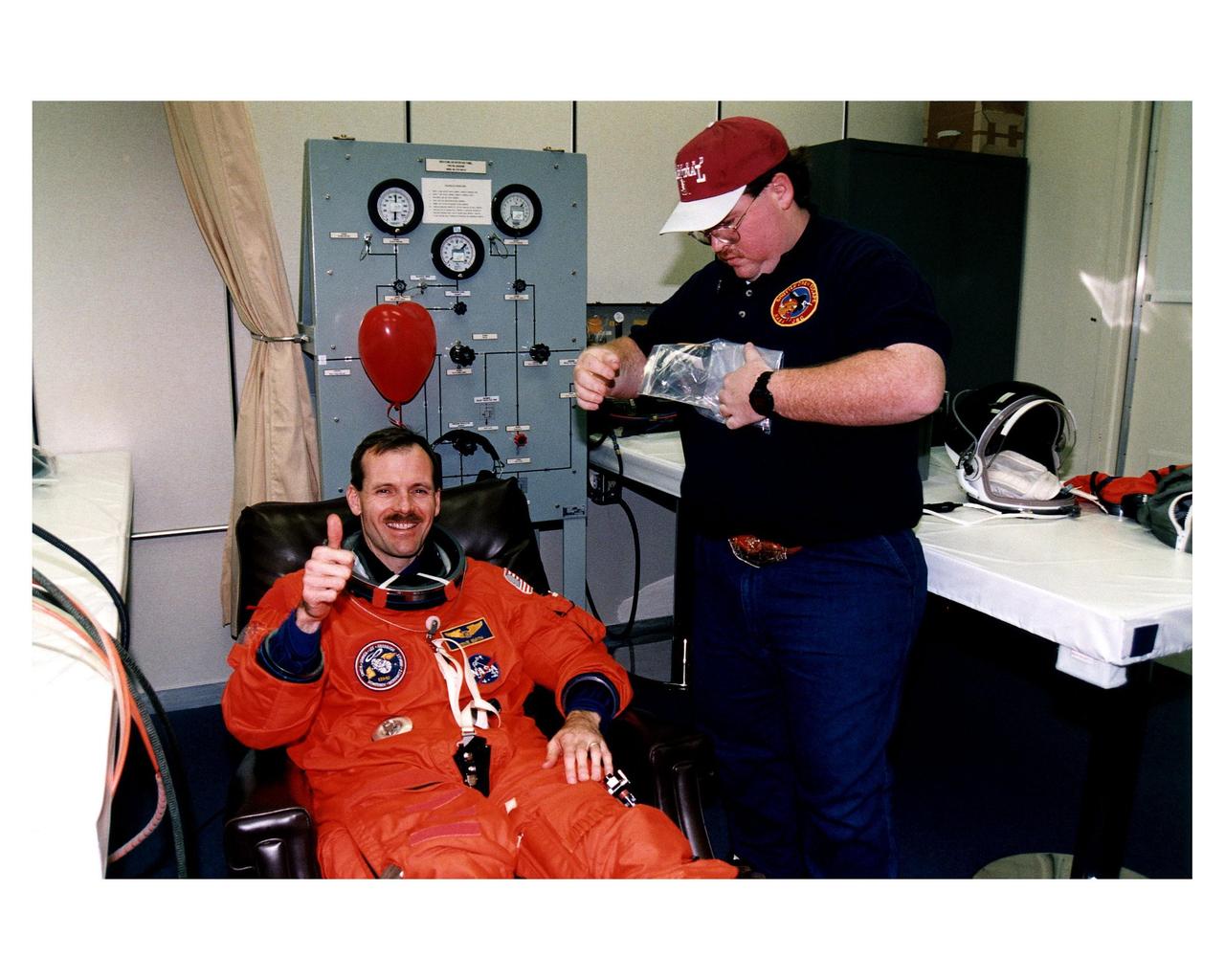
STS-82 Mission Specialist Steven L. Smith gives a "thumbs up" while donning his launch and entry suit in the Operations and Checkout Building. A suit technician stands ready to assist with final adjustments. This is Smith’s second space flight. He and the six other crew members will depart shortly for Launch Pad 39A, where the Space Shuttle Discovery awaits liftoff on a 10-day mission to service the orbiting Hubble Space Telescope (HST). This will be the second HST servicing mission. Four back-to-back spacewalks are planned
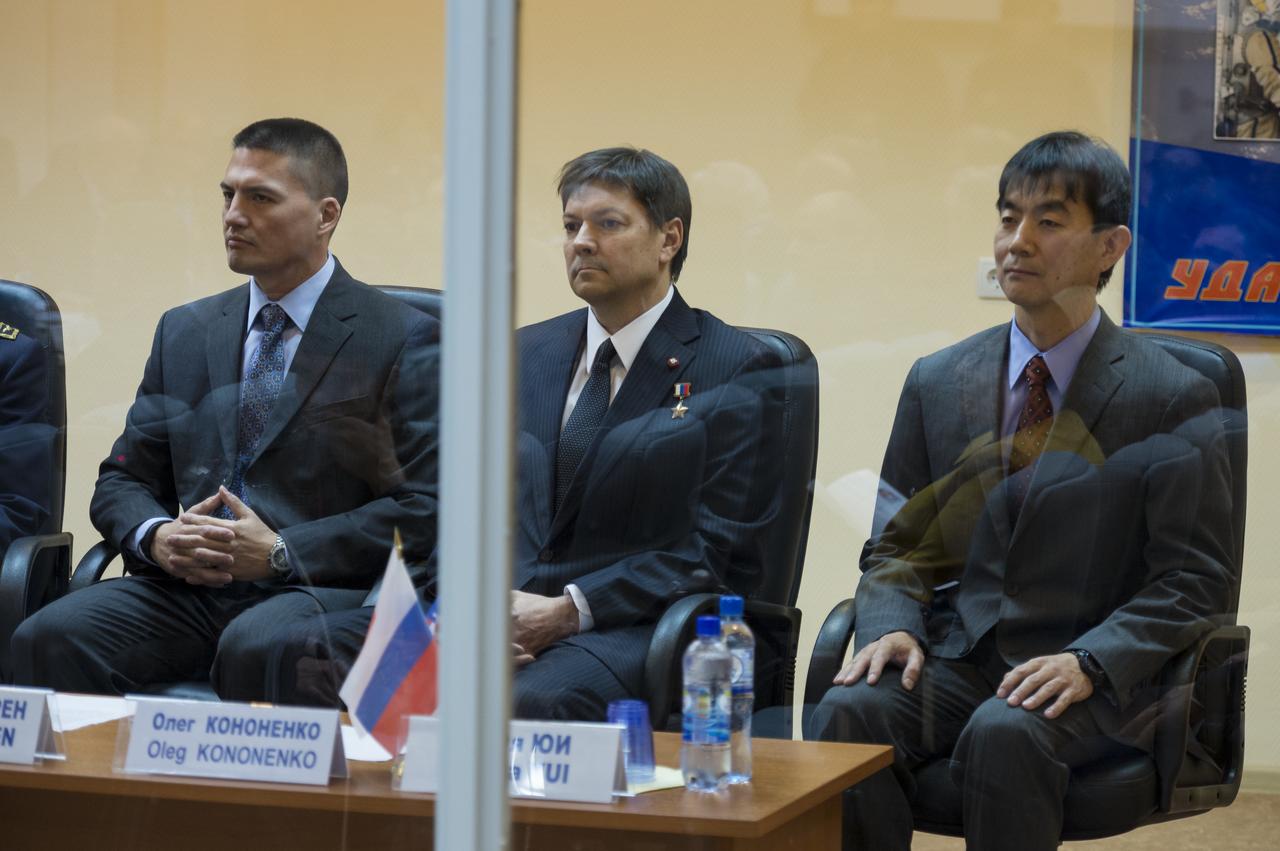
Expedition 42 backup crew members, Flight Engineer Kjell Lindgren of NASA (left), Soyuz Commander Oleg Kononenko of the Russian Federal Space Agency (Roscosmos) (center), and Flight Engineeer Kimiya Yui of the Japan Aerospace Exploration Agency (JAXA) (right) are seen at the State Commission meeting to approve the Soyuz launch of Expedition 42 to the International Space Station in Baikonur, Kazakhstan on Saturday, Nov. 22, 2014. The mission is set to launch Nov. 24 from the Baikonur Cosmodrome. Photo Credit: (NASA/Aubrey Gemignani)

NASA astronaut Don Pettit puts his hand up to the bus window and his family reaches back to him, as he and fellow crew mates, Roscosmos cosmonauts Alexey Ovchinin, and Ivan Vagner, depart the Cosmonaut Hotel to suit-up for their Soyuz launch to the International Space Station, Wednesday, Sept. 11, 2024, in Baikonur, Kazakhstan. The launch will send Pettit, Ovchinin, and Vagner on a mission to the International Space Station. Photo Credit: (NASA/Bill Ingalls)
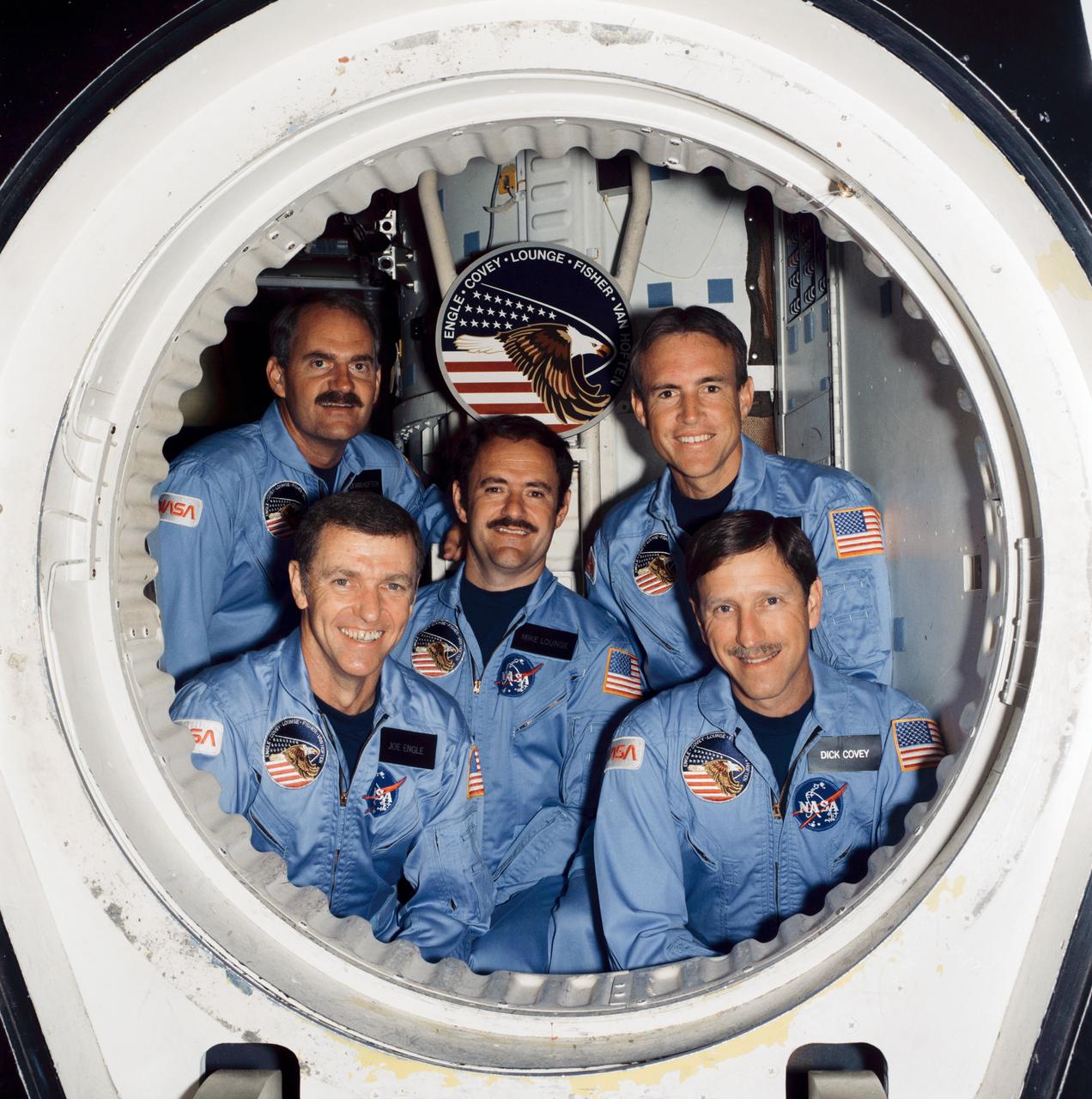
S85-36062 (1 July 1985) --- These five NASA astronauts make up the crew for the mission STS-51I, scheduled for launch in August of this year. Taking a break from rehearsals in the crew compartment trainer in the Shuttle Mockup and Integration Laboratory at JSC are astronauts Joe H. Engle (front left), crew commander; Richard O. Covey (front right), pilot; and (back row, left-to-right) astronauts James D. van Hoften, John M. (Mike) Lounge and William F. Fisher -- all mission specialists.
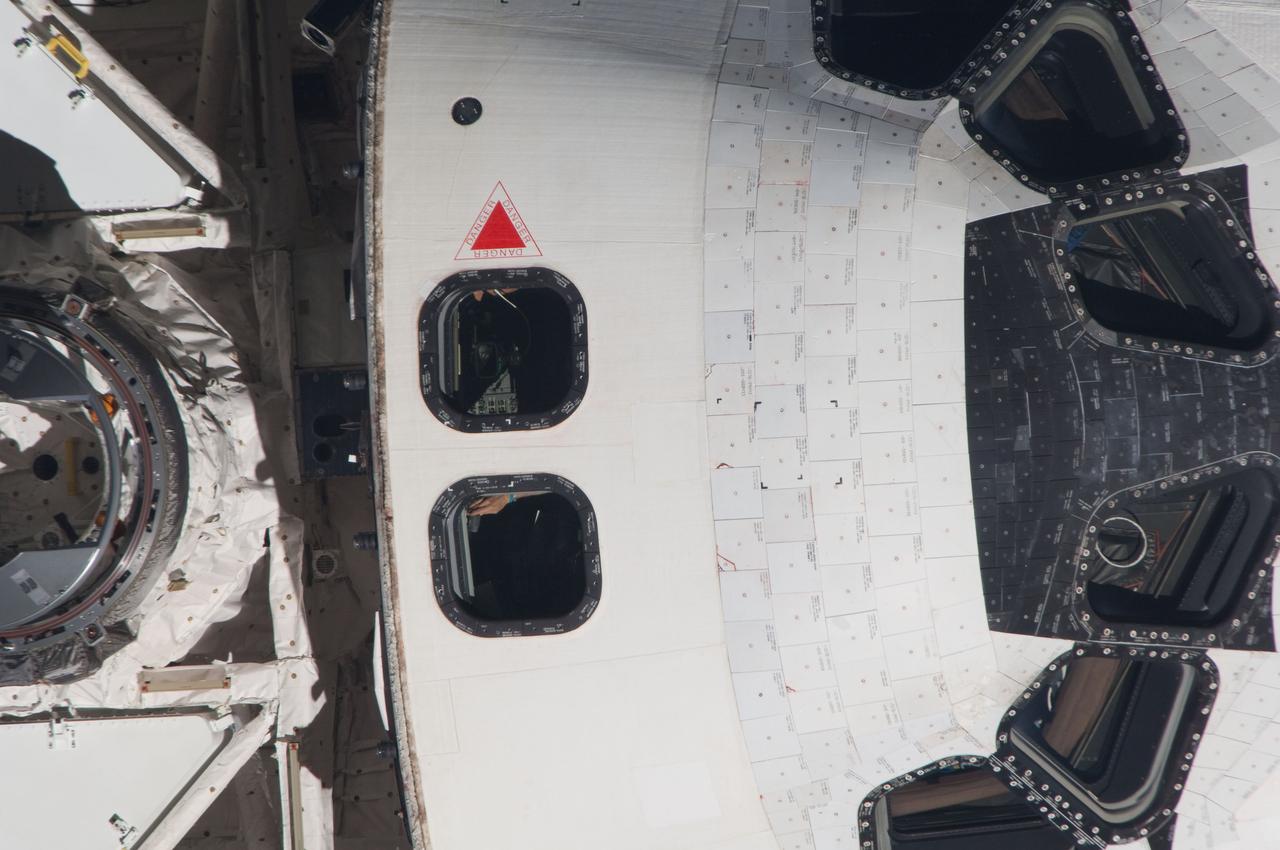
ISS027-E-032063 (18 May 2011) --- This close-up view of the crew cabin of space shuttle Endeavour was provided by an Expedition 27 crew member during a survey of the approaching STS-134 vehicle prior to docking with the International Space Station. As part of the survey and part of every mission's activities, Endeavour performed a back-flip for the rendezvous pitch maneuver (RPM). The station crew member used a digital still camera with an 800mm focal length, as the two spacecraft were approximately 600 feet (180 meters) apart.
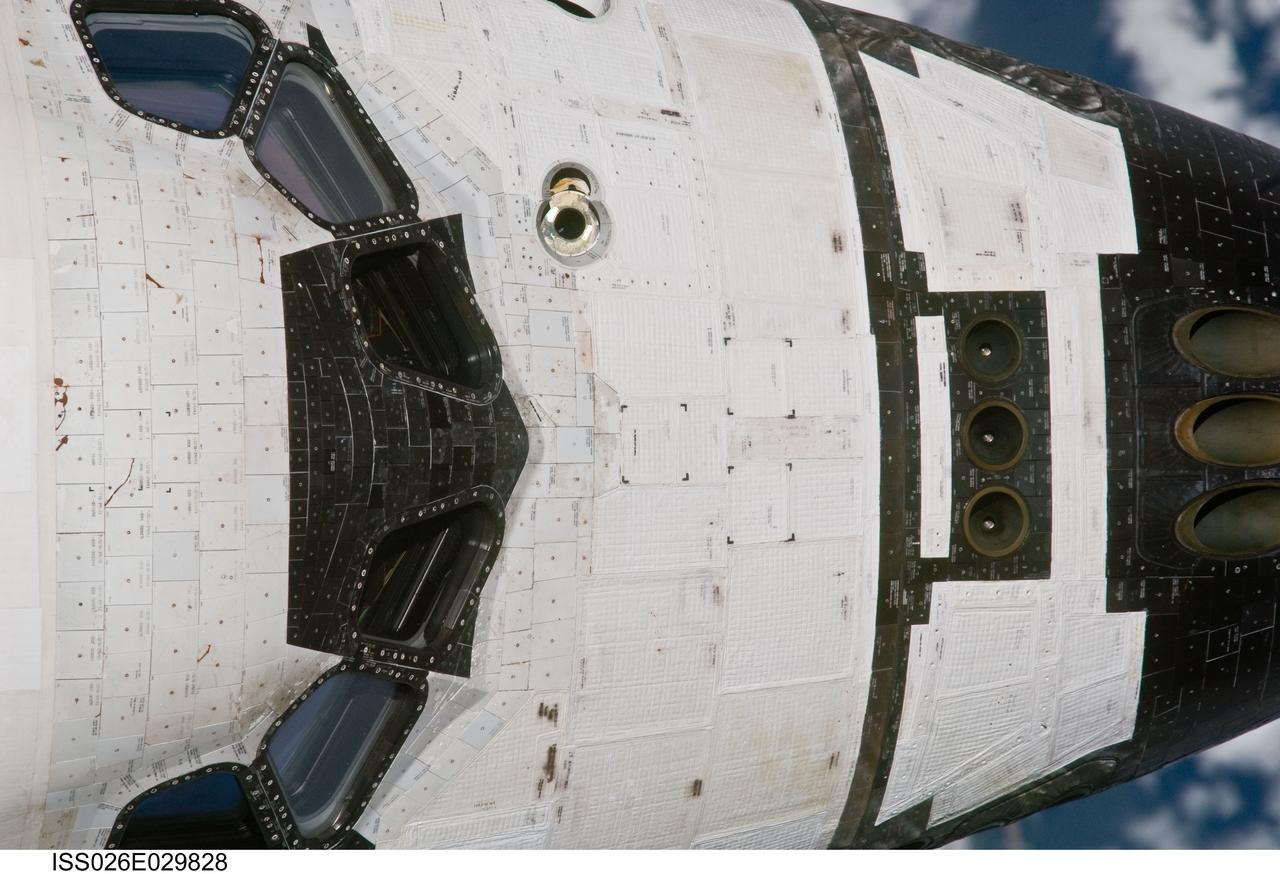
ISS026-E-029828 (26 Feb. 2011) --- This close-up view of the crew cabin of space shuttle Discovery was provided by an Expedition 26 crew member during a survey of the approaching STS-133 vehicle prior to docking with the International Space Station. As part of the survey and part of every mission's activities, Discovery performed a back-flip for the rendezvous pitch maneuver (RPM). The station crew member used a digital still camera with an 800mm focal length, as the two spacecraft were approximately 600 feet (180 meters) apart.
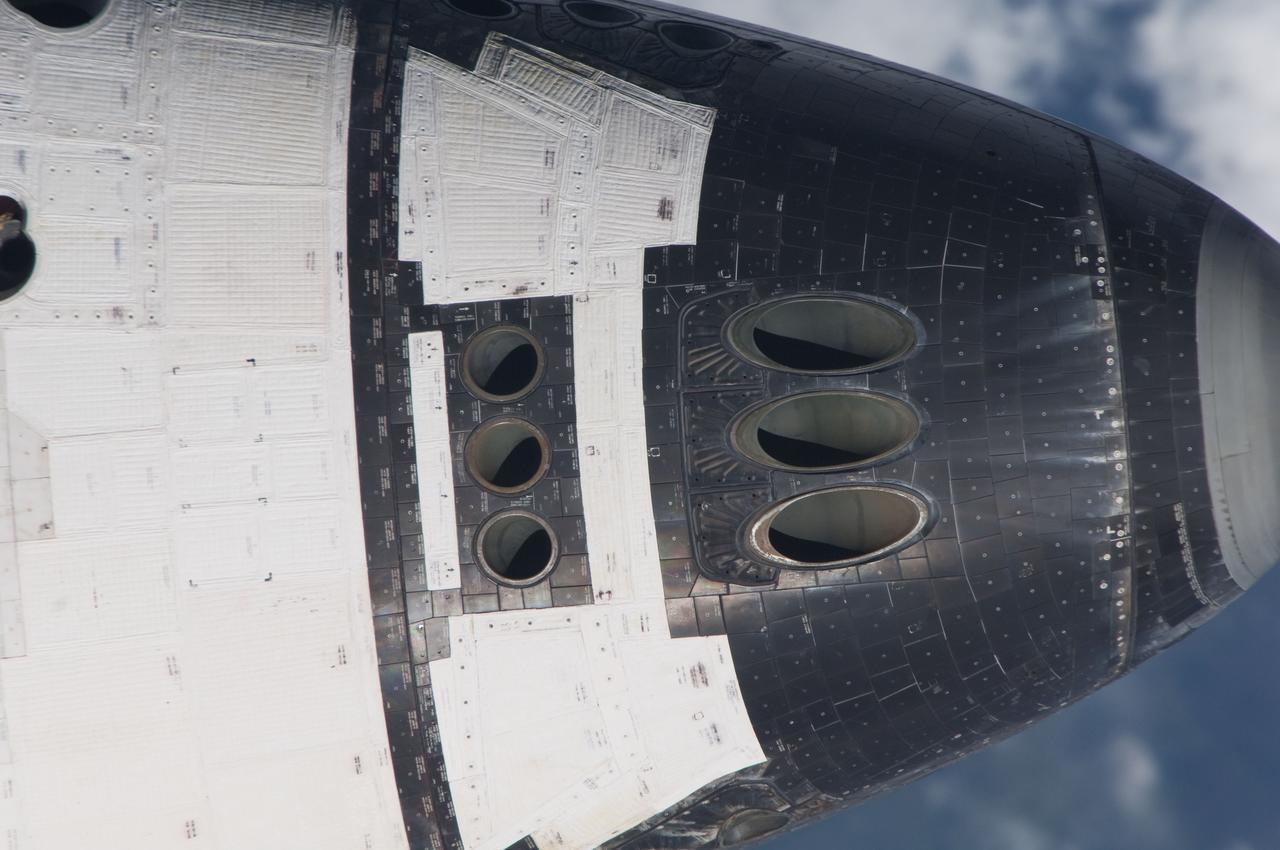
ISS027-E-032065 (18 May 2011) --- This close-up view of the nose of space shuttle Endeavour was provided by an Expedition 27 crew member during a survey of the approaching STS-134 vehicle prior to docking with the International Space Station. As part of the survey and part of every mission's activities, Endeavour performed a back-flip for the rendezvous pitch maneuver (RPM). The station crew member used a digital still camera with an 800mm focal length, as the two spacecraft were approximately 600 feet (180 meters) apart.
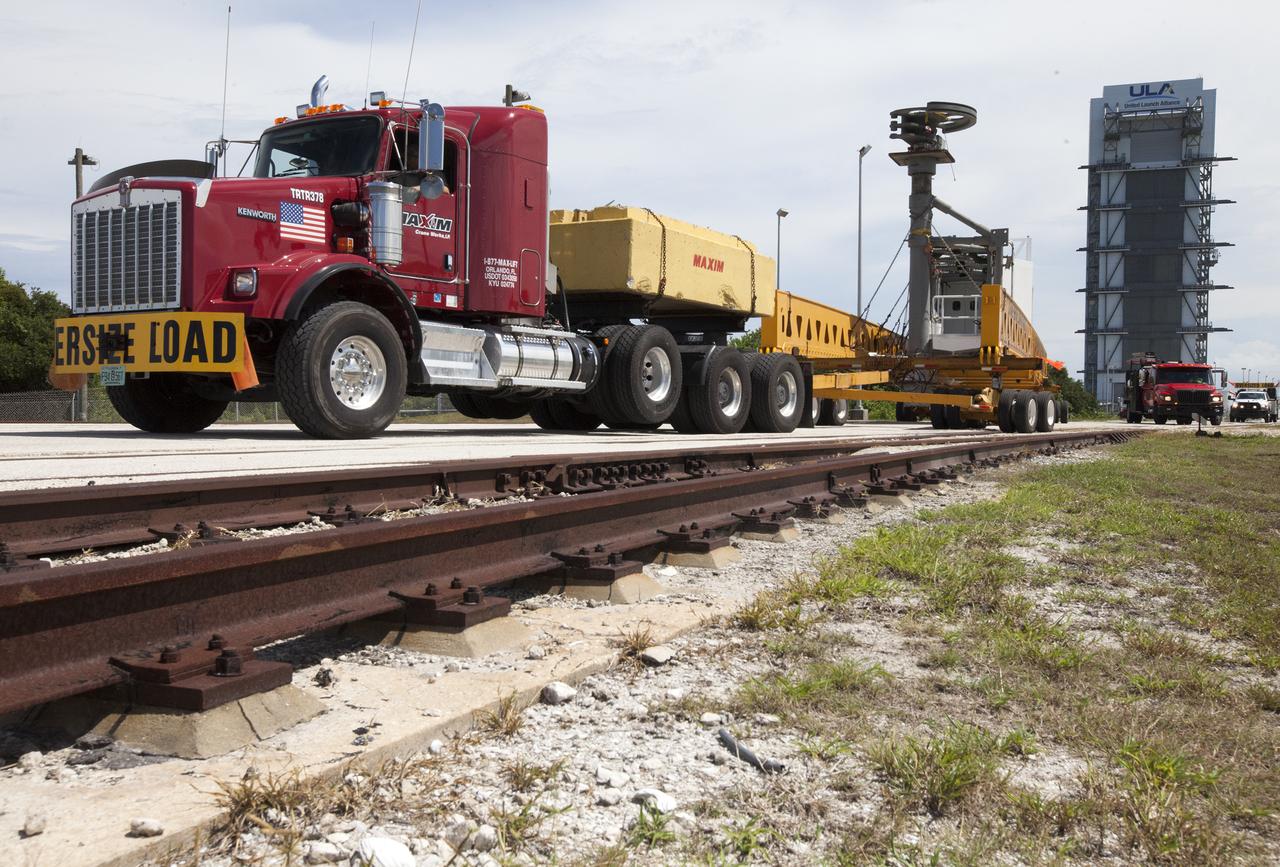
A heavy-lift transport truck, carrying the Crew Access Arm for Space Launch Complex 41, backs up toward Complex 41 at Cape Canaveral Air Force Station in Florida. The arm will be installed on the Complex 41 Crew Access Tower. It will be used as a bridge by astronauts to board Boeing's CST-100 Starliner spacecraft as it stands on the launch pad atop a United Launch Alliance Atlas V rocket.
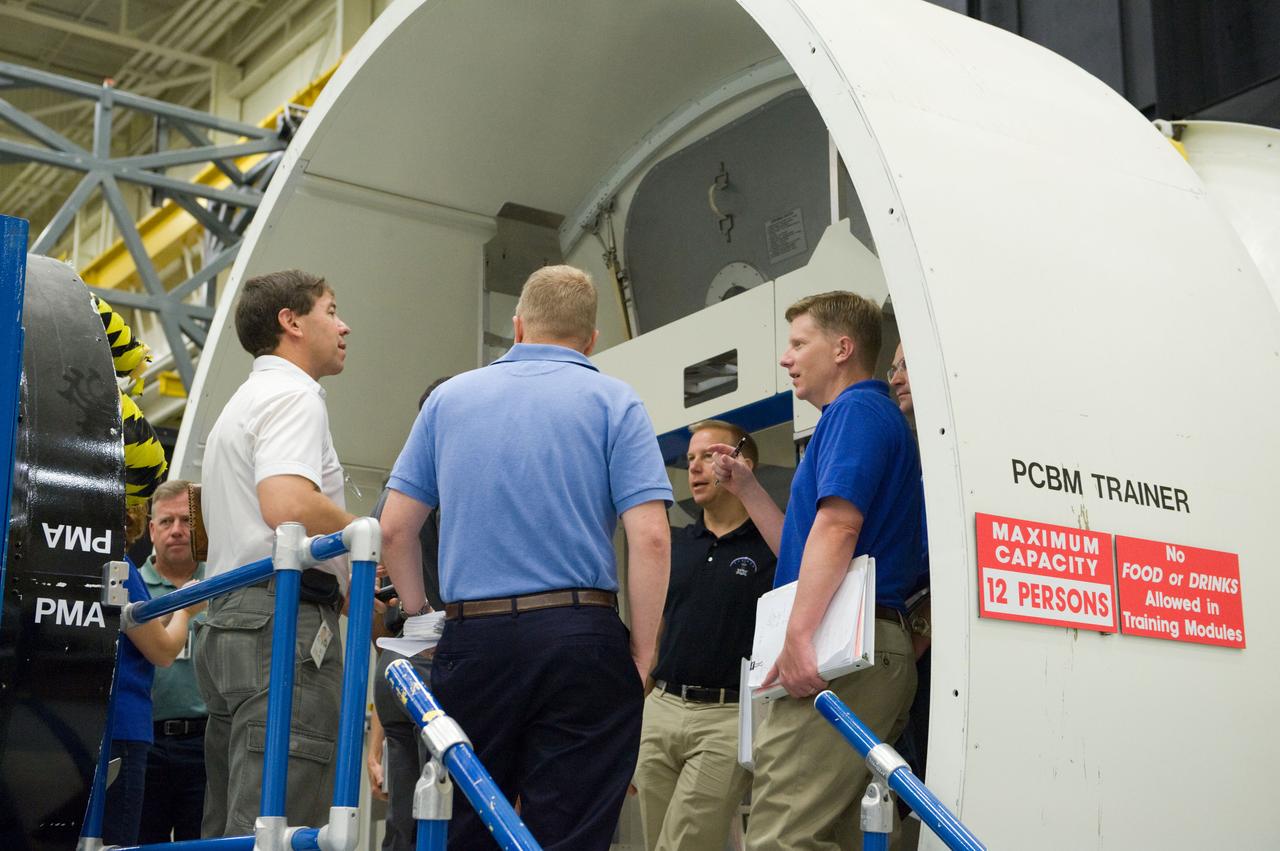
JSC2010-E-171438 (30 Sept. 2010) --- NASA astronauts Steve Lindsey (left background), STS-133 commander; Eric Boe (back to camera), pilot; Michael Barratt (left), Tim Kopra and Alvin Drew (mostly obscured at center), all mission specialists, participate in an ingress/egress timeline training session in the Space Vehicle Mock-up Facility at NASA's Johnson Space Center. Crew instructor Gary W. Kilgo (right) assisted the crew members. Photo credit: NASA or National Aeronautics and Space Administration
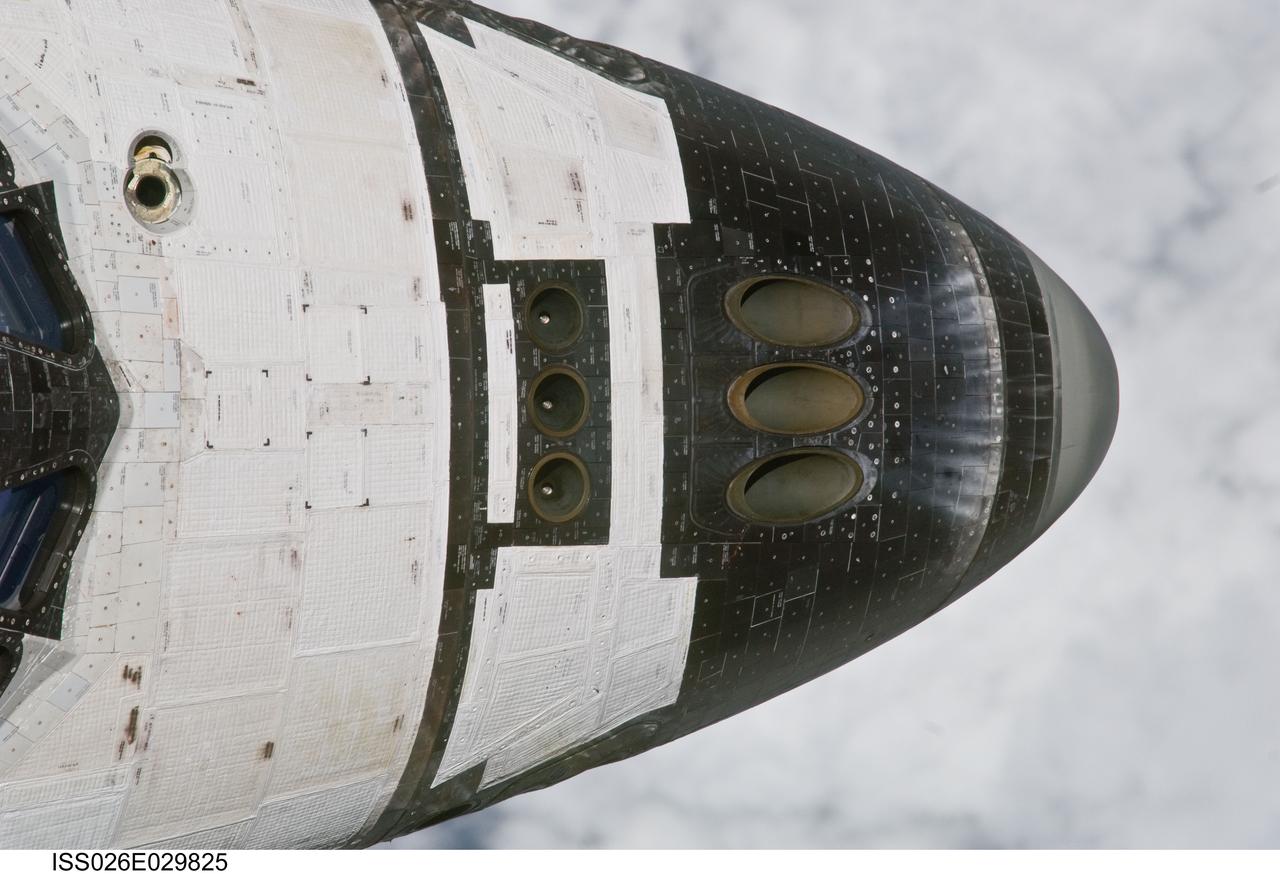
ISS026-E-029825 (26 Feb. 2011) --- This close-up view of the nose of space shuttle Discovery was provided by an Expedition 26 crew member during a survey of the approaching STS-133 vehicle prior to docking with the International Space Station. As part of the survey and part of every mission's activities, Discovery performed a back-flip for the rendezvous pitch maneuver (RPM). The station crew member used a digital still camera with an 800mm focal length, as the two spacecraft were approximately 600 feet (180 meters) apart.
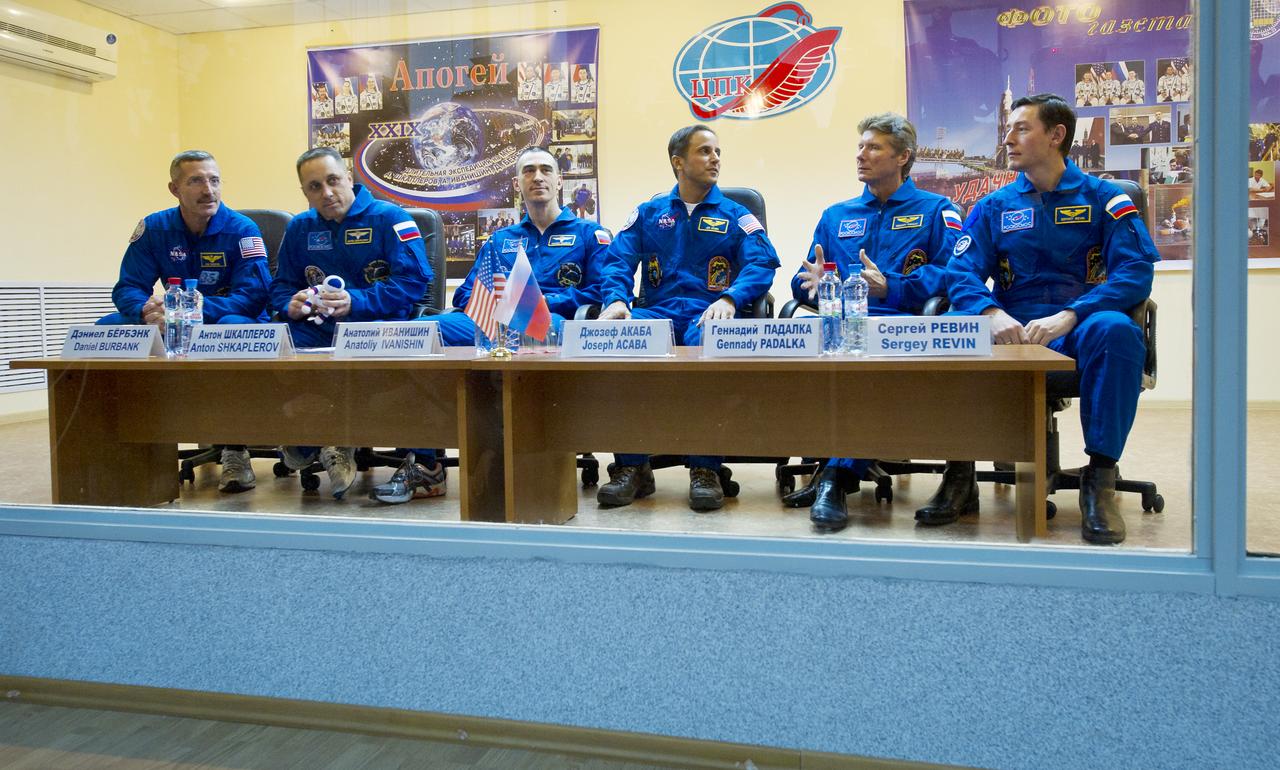
Expedition 29 crew members NASA Flight Engineer Daniel Burbank, far left, Russian Soyuz Commander Anton Shkaplerov, Russian Flight Engineer Anatoly Ivanishin, Expedition 29 NASA back up crew member Joseph Acaba, backup Soyuz Commander Gennady Padalka and backup Flight Engineer Sergei Revin are seen at the start of a press conference held at the Cosmonaut Hotel in Baikonur, Kazakhstan on Saturday, Nov. 12, 2011. Photo Credit: (NASA/Carla Cioffi)
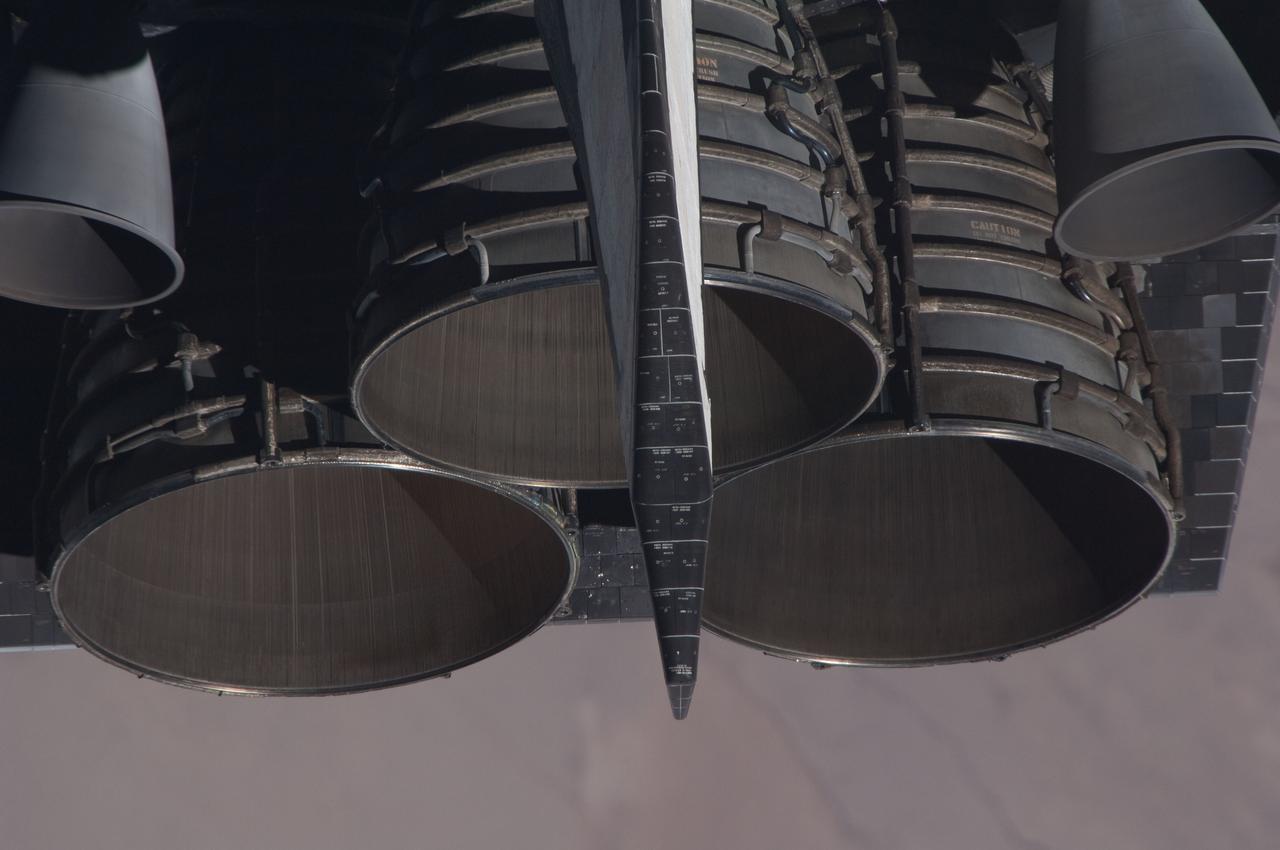
ISS027-E-032089 (18 May 2011) --- This close-up view of the space shuttle Endeavour’s three main engines was provided by an Expedition 27 crew member during a survey of the approaching STS-134 vehicle prior to docking with the International Space Station. As part of the survey and part of every mission's activities, Endeavour performed a back-flip for the rendezvous pitch maneuver (RPM). The station crew member used a digital still camera with an 800mm focal length, as the two spacecraft were approximately 600 feet (180 meters) apart.
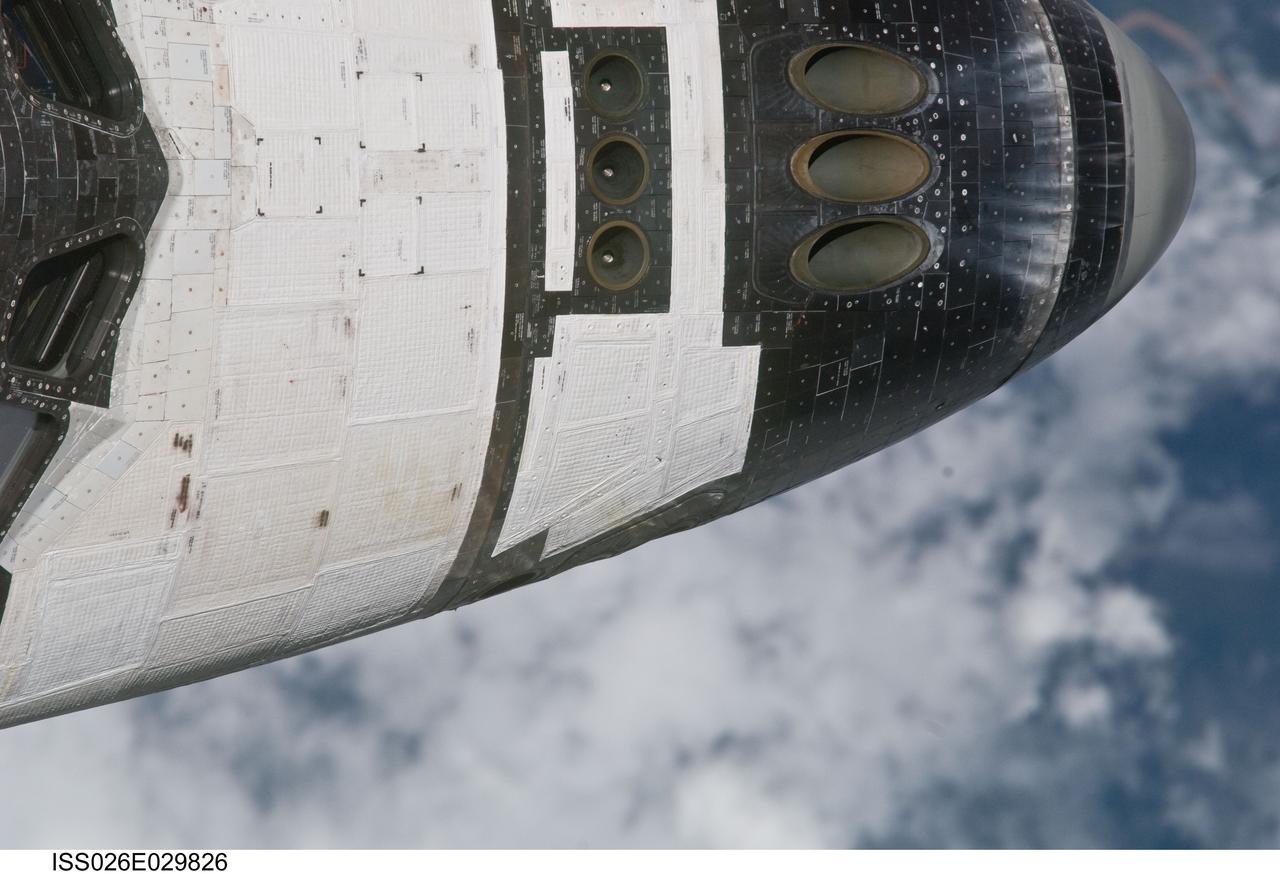
ISS026-E-029826 (26 Feb. 2011) --- This close-up view of the nose of space shuttle Discovery was provided by an Expedition 26 crew member during a survey of the approaching STS-133 vehicle prior to docking with the International Space Station. As part of the survey and part of every mission's activities, Discovery performed a back-flip for the rendezvous pitch maneuver (RPM). The station crew member used a digital still camera with an 800mm focal length, as the two spacecraft were approximately 600 feet (180 meters) apart.

Expedition 51 prime crew members, Flight Engineer Jack Fischer of NASA, left, and Soyuz Commander Fyodor Yurchikhin of Roscosmos, second left, are seen with Expedition 51 back up crew members, Soyuz Commander Sergey Ryazanskiy of Roscosmos, second from right, and Flight Engineer Randy Bresnik of NASA, right, during a press conference held at the Cosmonaut Hotel in Baikonur, Kazakhstan on Wednesday, April 19, 2017. The mission is set to launch April 20 from the Baikonur Cosmodrome. Photo Credit: (NASA/Aubrey Gemignani)
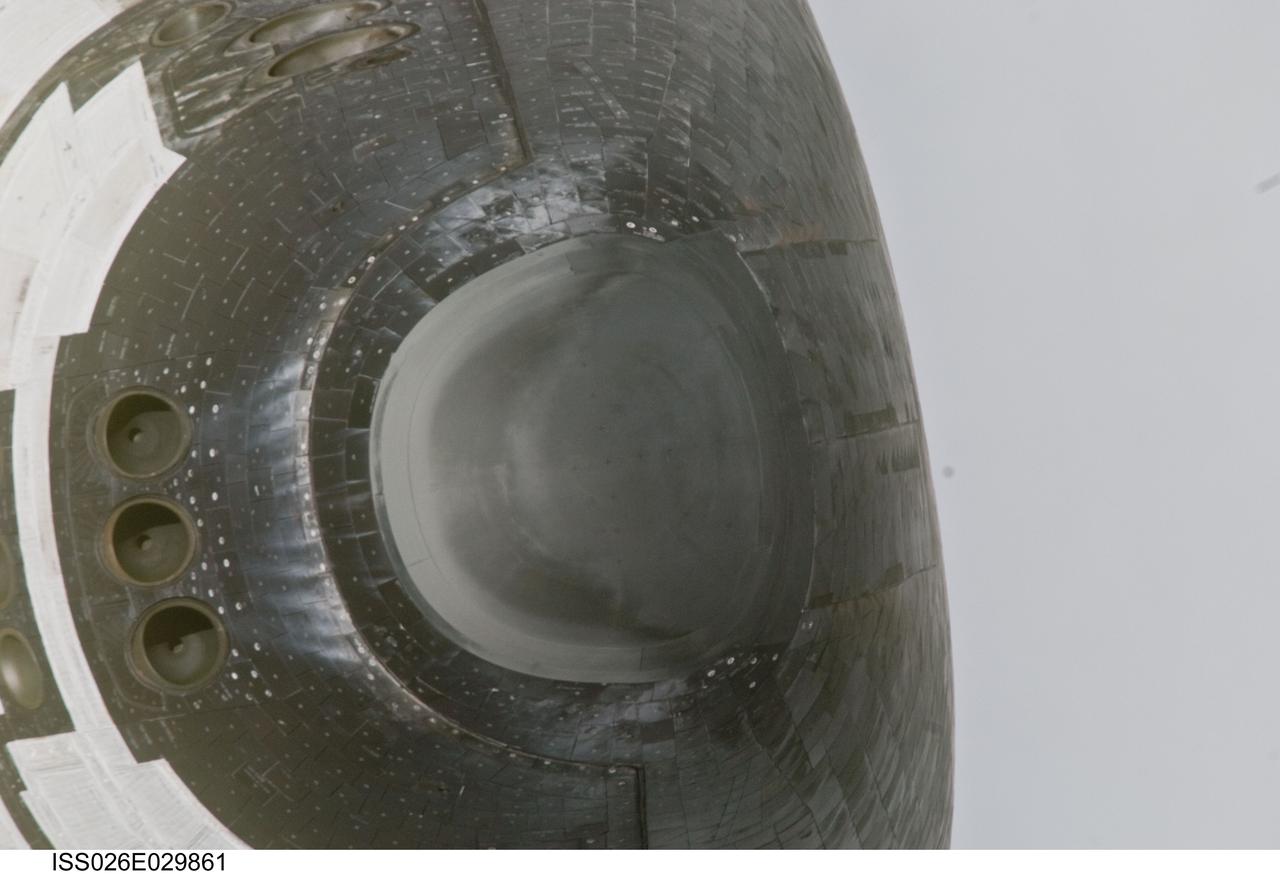
ISS026-E-029861 (26 Feb. 2011) --- This close-up view of the nose of space shuttle Discovery was provided by an Expedition 26 crew member during a survey of the approaching STS-133 vehicle prior to docking with the International Space Station. As part of the survey and part of every mission's activities, Discovery performed a back-flip for the rendezvous pitch maneuver (RPM). The station crew member used a digital still camera with an 800mm focal length, as the two spacecraft were approximately 600 feet (180 meters) apart.
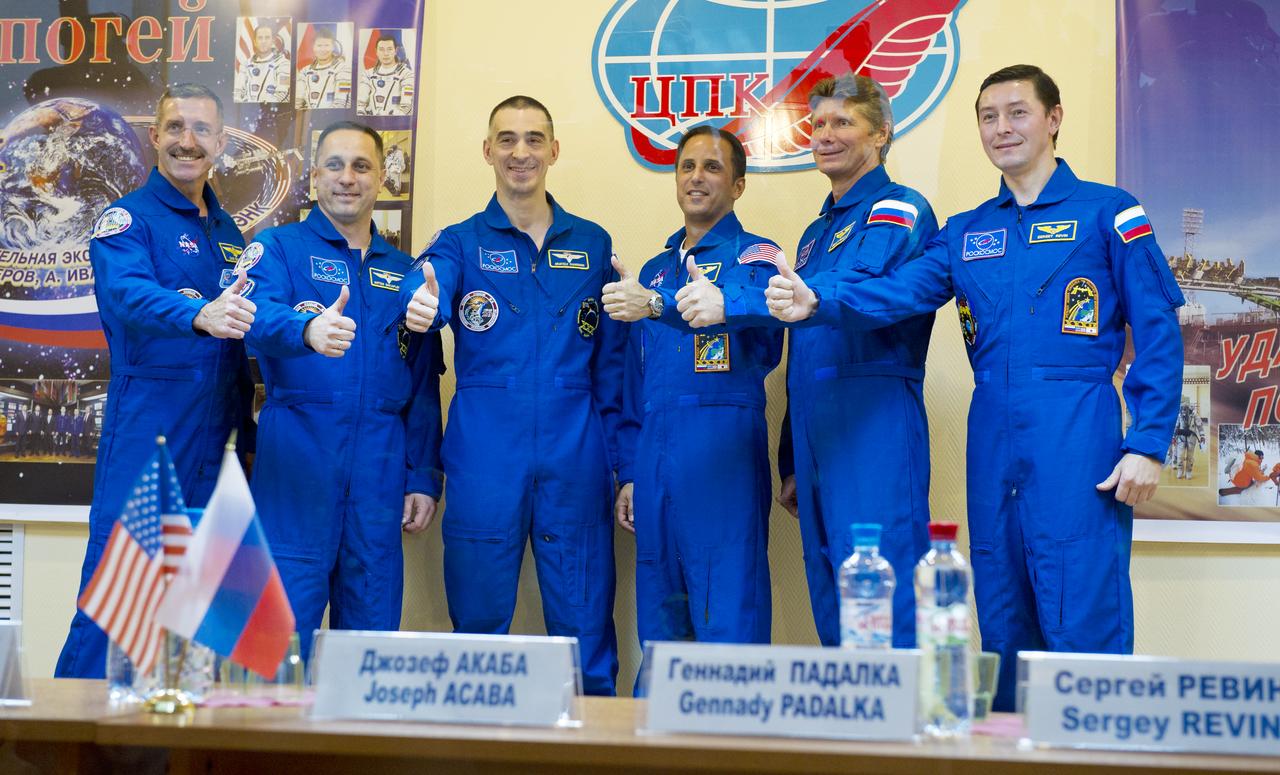
Expedition 29 crew members NASA Flight Engineer Daniel Burbank, far left, Russian Soyuz Commander Anton Shkaplerov, Russian Flight Engineer Anatoly Ivanishin, Expedition 29 NASA back up crew member Joseph Acaba, backup Soyuz Commander Gennady Padalka and backup Flight Engineer Sergei Revin, far right, pose for photos at the end of a press conference held at the Cosmonaut Hotel in Baikonur, Kazakhstan on Saturday, Nov. 12, 2011. Photo Credit: (NASA/Carla Cioffi)
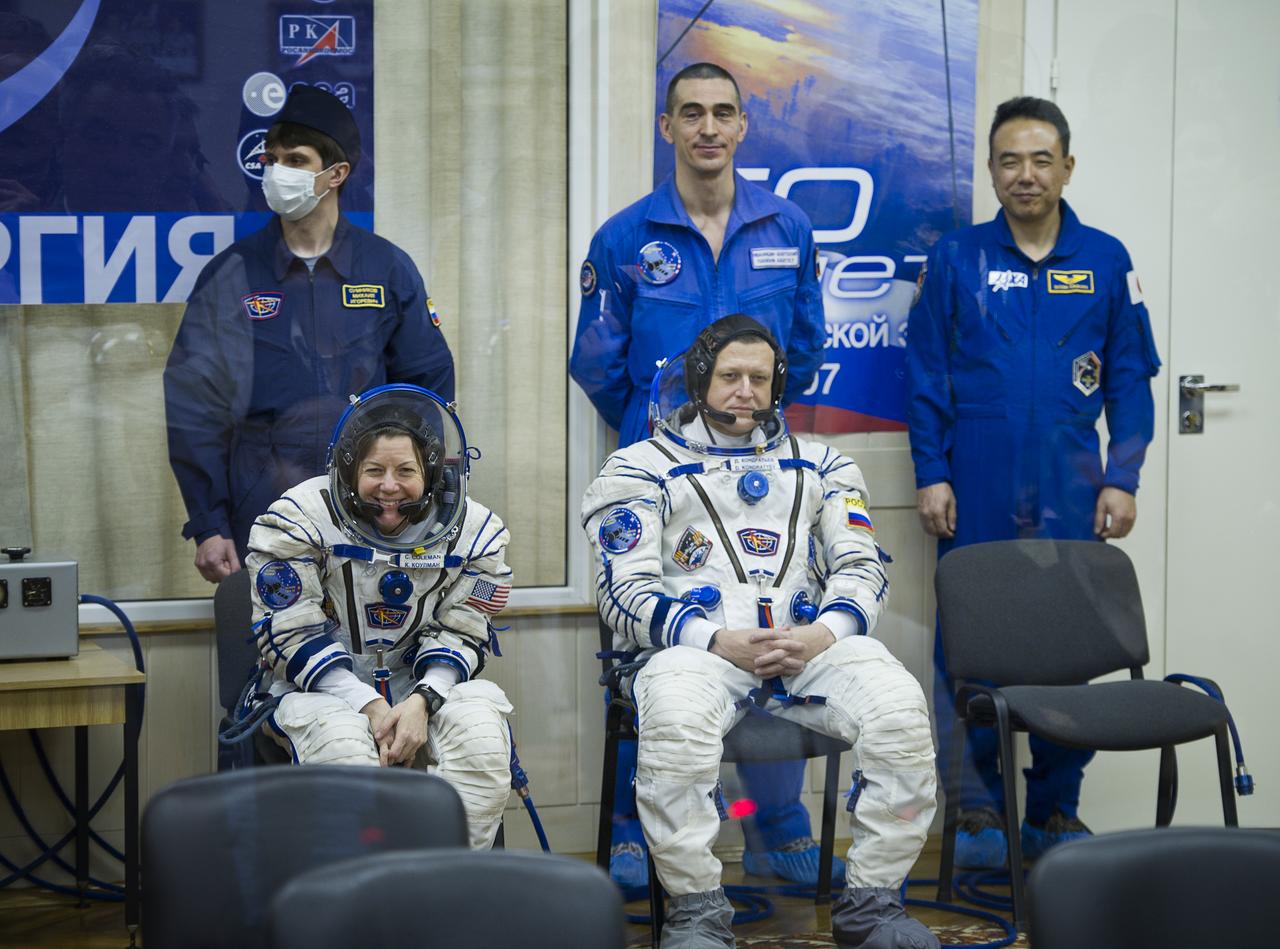
Expedition 26 Flight Engineer Catherine Coleman, smiling, and Expedition 26 Soyuz Commander Dmitry Kondratyev wait to have their Russian Sokol suits pressure checked at the Baikonur Cosmodrome Wednesday, Dec. 15, 2010 in Kazakhstan. Expedition 26 back up crew members Satoshi Furukawa, standing far right, and Anatoly Ivanishin are seen as they support the prime crew. Photo Credit: (NASA/Carla Cioffi)
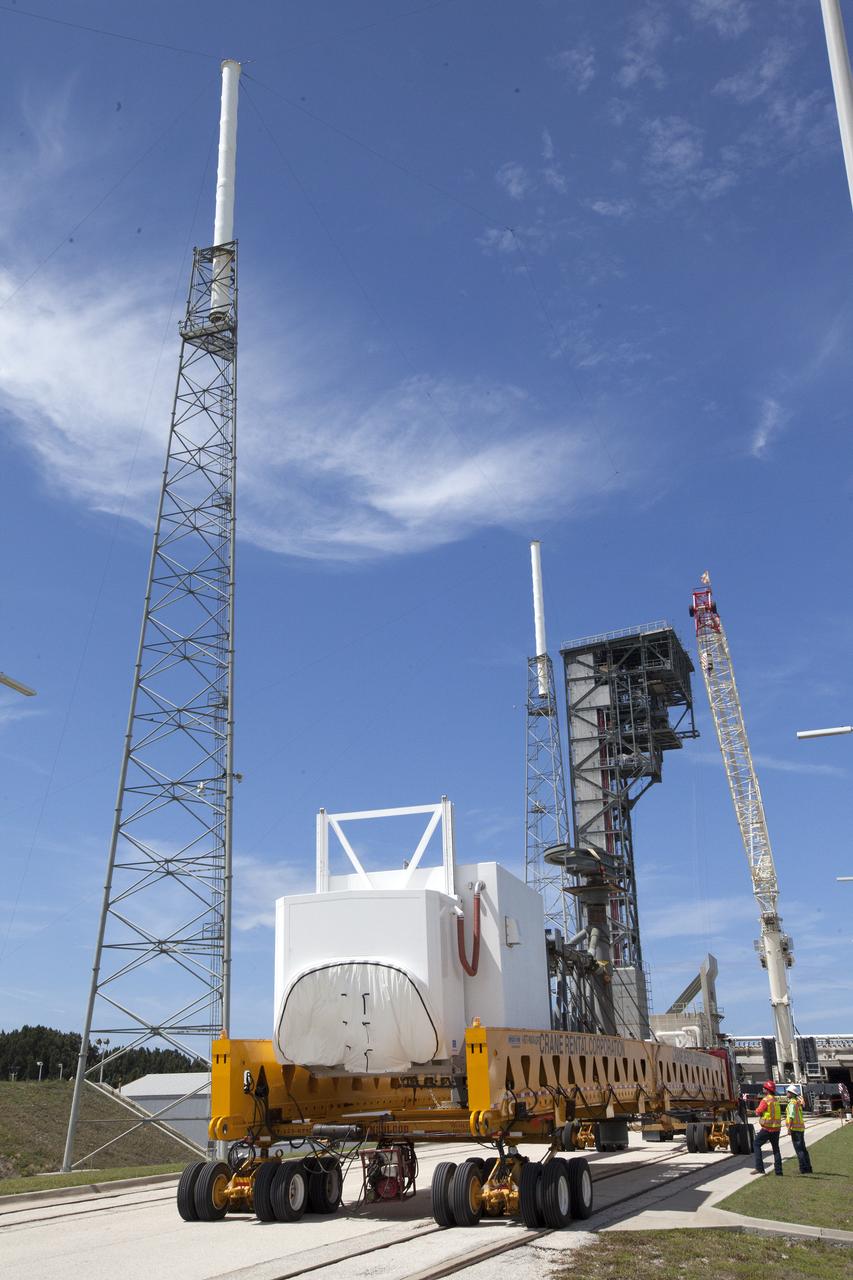
A heavy-lift transport truck, carrying the Crew Access Arm for Space Launch Complex 41, backs up toward Complex 41 at Cape Canaveral Air Force Station in Florida. The arm will be installed on the Complex 41 Crew Access Tower. It will be used as a bridge by astronauts to board Boeing's CST-100 Starliner spacecraft as it stands on the launch pad atop a United Launch Alliance Atlas V rocket.
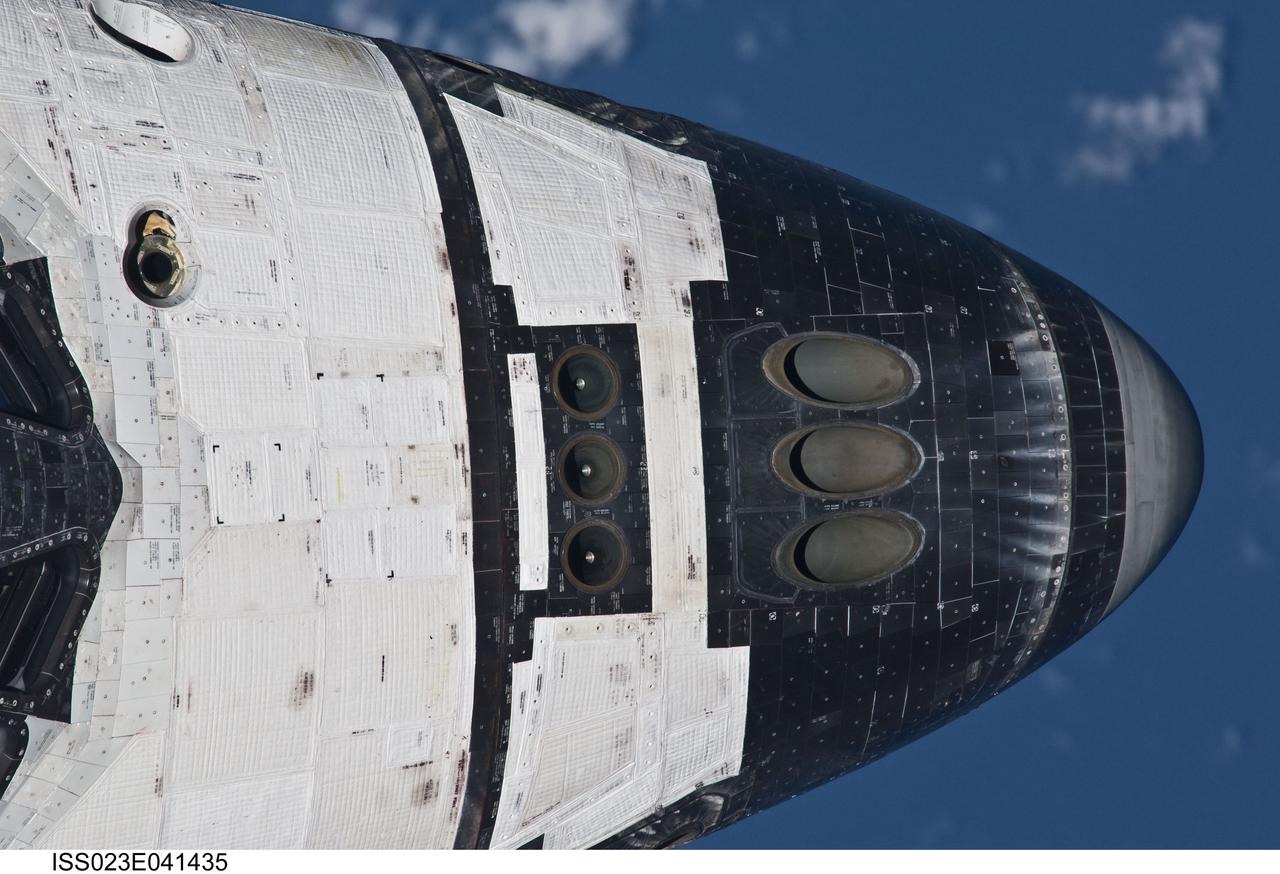
ISS023-E-041435 (16 May 2010) --- This close-up view of the nose of space shuttle Atlantis was provided by an Expedition 23 crew member during a survey of the approaching STS-132 vehicle prior to docking with the International Space Station. As part of the survey and part of every mission's activities, Atlantis performed a back-flip for the rendezvous pitch maneuver (RPM). The station crew member used a digital still camera with an 800mm focal length, as the two spacecraft were approximately 600 feet (180 meters) apart.
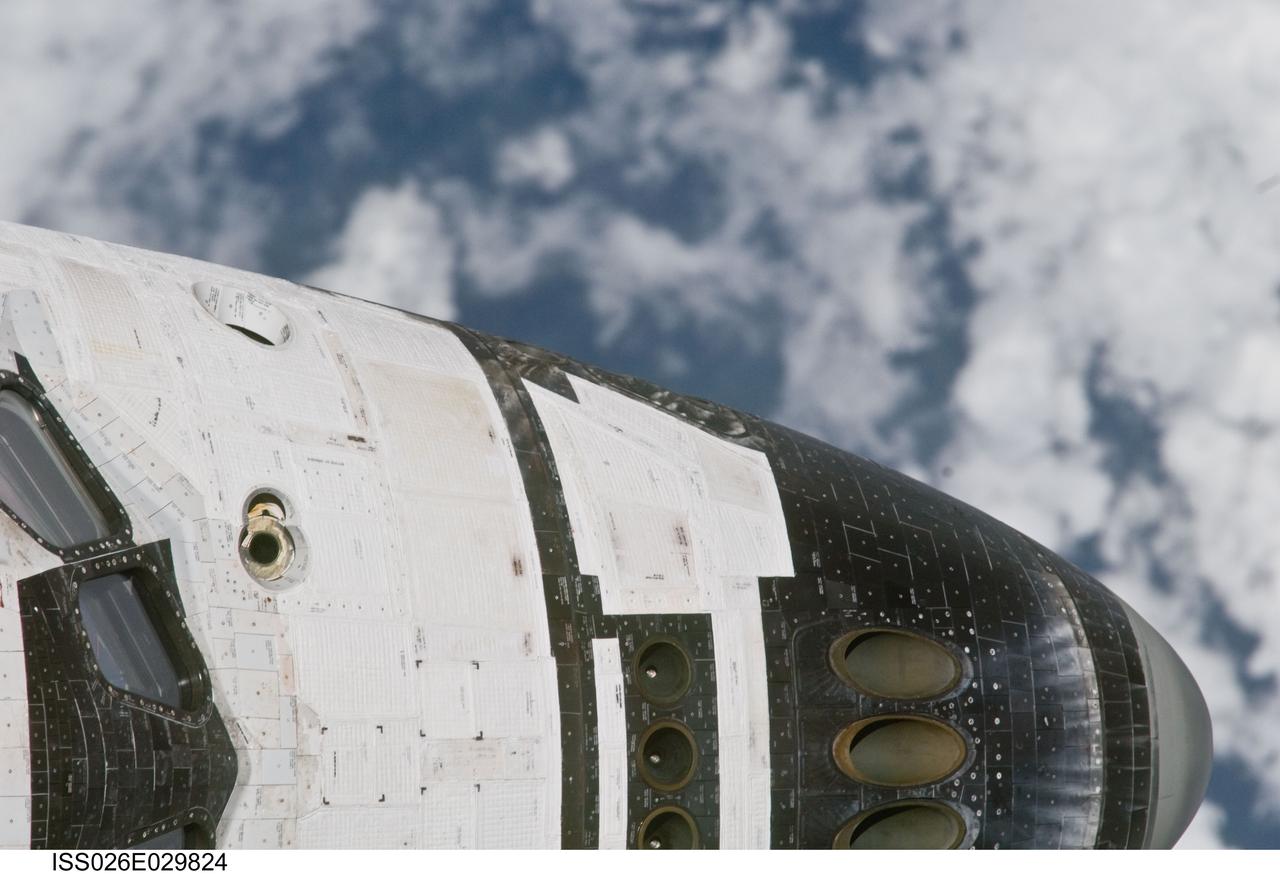
ISS026-E-029824 (26 Feb. 2011) --- This close-up view of the nose of space shuttle Discovery was provided by an Expedition 26 crew member during a survey of the approaching STS-133 vehicle prior to docking with the International Space Station. As part of the survey and part of every mission's activities, Discovery performed a back-flip for the rendezvous pitch maneuver (RPM). The station crew member used a digital still camera with an 800mm focal length, as the two spacecraft were approximately 600 feet (180 meters) apart.
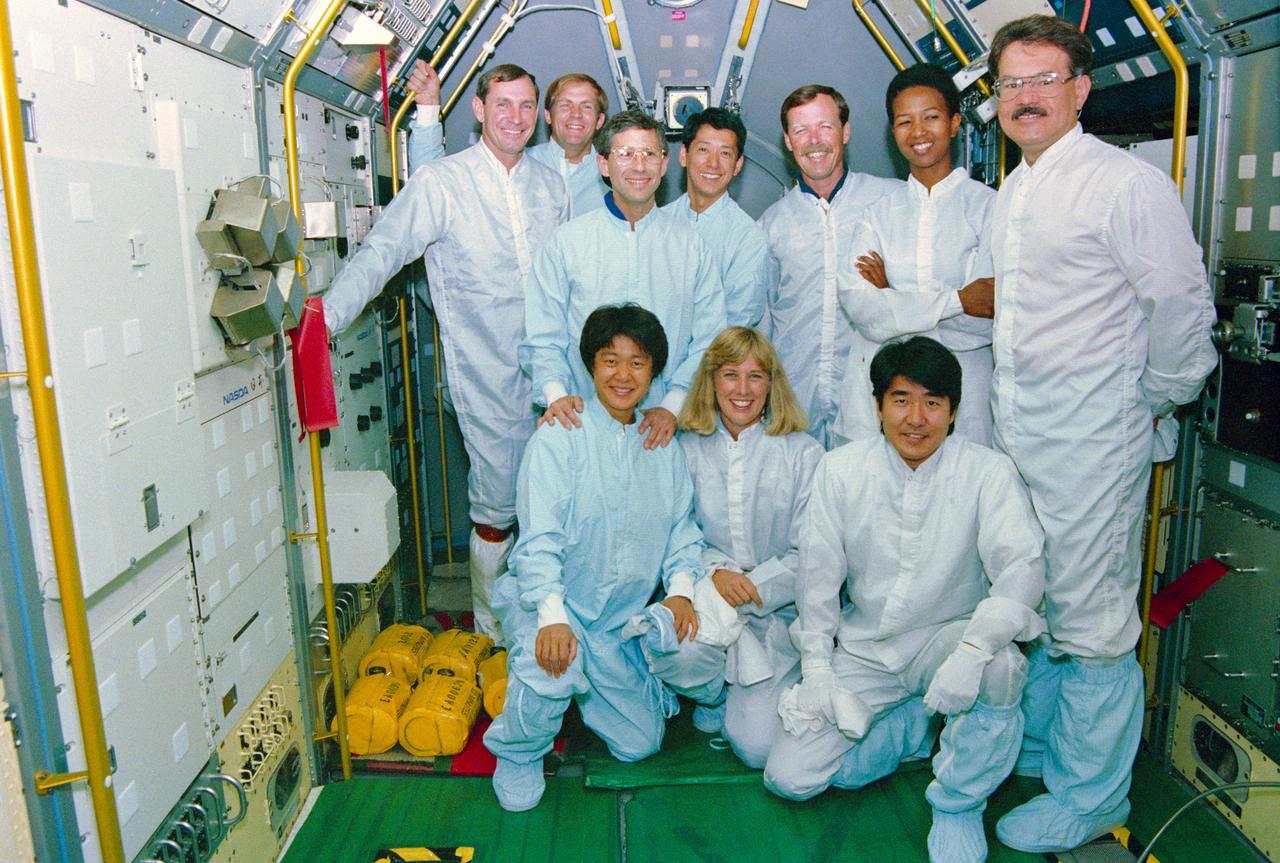
S92-44303 --- STS-47 Endeavour, Orbiter Vehicle (OV) 105, crew members and back-up payload specialists, wearing clean suits, pose for a group portrait in the Spacelab Japan (SLJ) module. The team is at the Kennedy Space Center's (KSC's) Orbiter Processing Facility (OPF) to inspect SLJ configuration and OV-105 preparations. Kneeling, from left, are back-up Payload Specialist Chiaki Naito-Mukai; Mission Specialist N. Jan Davis; and backup Payload Specialist Takao Doi. Standing, from the left, are Pilot Curtis L. Brown,Jr; Payload Commander Mark C. Lee; Jerome Apt; Payload Specialist Mamoru Mohri; Commander Robert L. Gibson; Mae C. Jemison; and back-up Payload Specialist Stanely L. Koszelak. Mohri, Mukai, and Doi represent the National Space Development Agency of Japan (NASDA). View provided by KSC with alternate KSC number KSC-92PC-1647. Photo credit: NASA
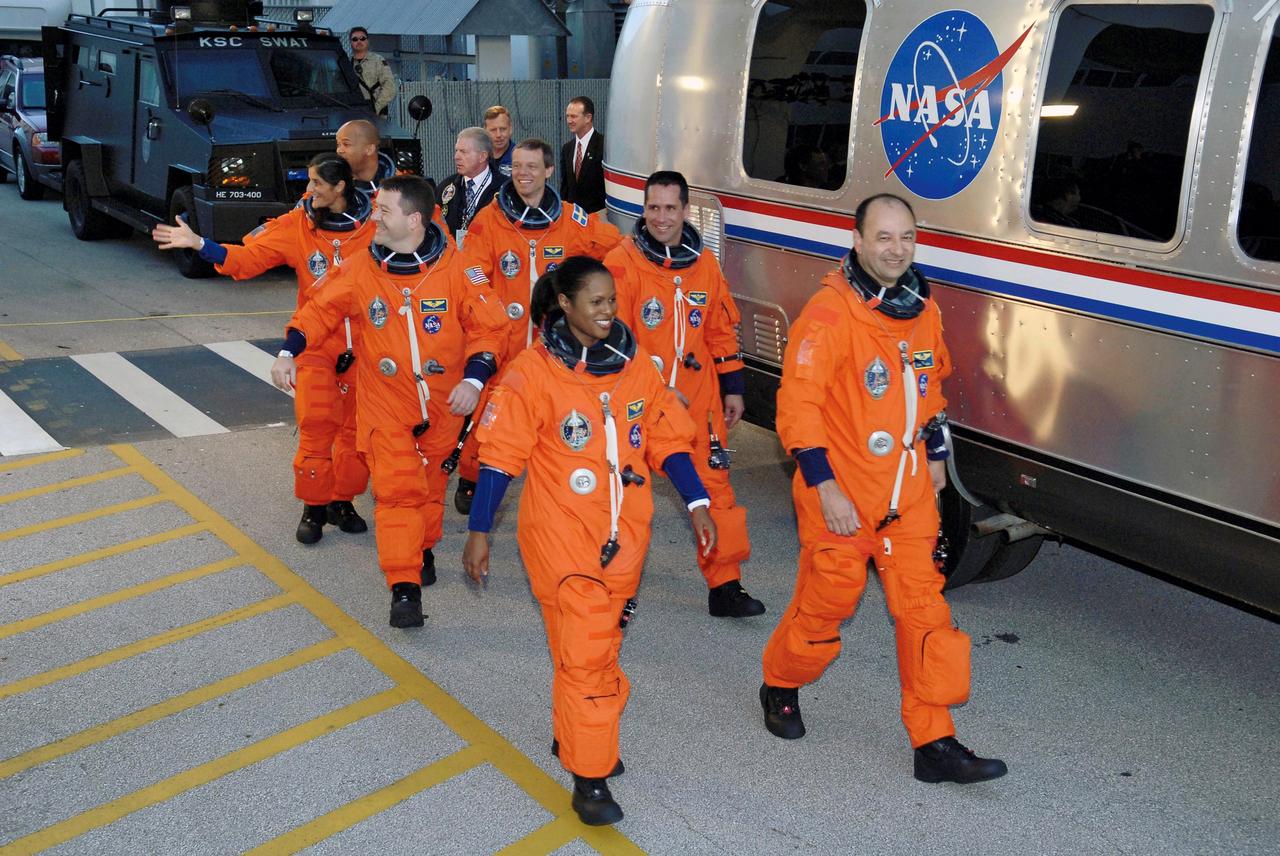
STS116-S-006 (9 Dec. 2006) --- After suiting up, the STS-116 crewmembers exit the Operations and Checkout Building to board the Astrovan, which will take them to launch pad 39B at Kennedy Space Center. On the right (front to back) are astronauts Mark L. Polansky, commander; William S. (Bill) Oefelein, pilot; and Christer Fuglesang, mission specialists representing the European Space Agency (ESA). On the left (front to back) are astronauts Joan E. Higginbotham, Nicholas J. M. Patrick, Sunita L. Williams and Robert L. Curbeam, Jr., all mission specialists. Discovery's seven-member crew will link up with the International Space Station on Monday, Dec. 11, to begin a complex, week-long stay that will rewire the outpost and increase its power supply. During three spacewalks and intricate choreography with ground controllers, the astronauts will bring electrical power on line generated by a giant solar array wing delivered to the station in September.
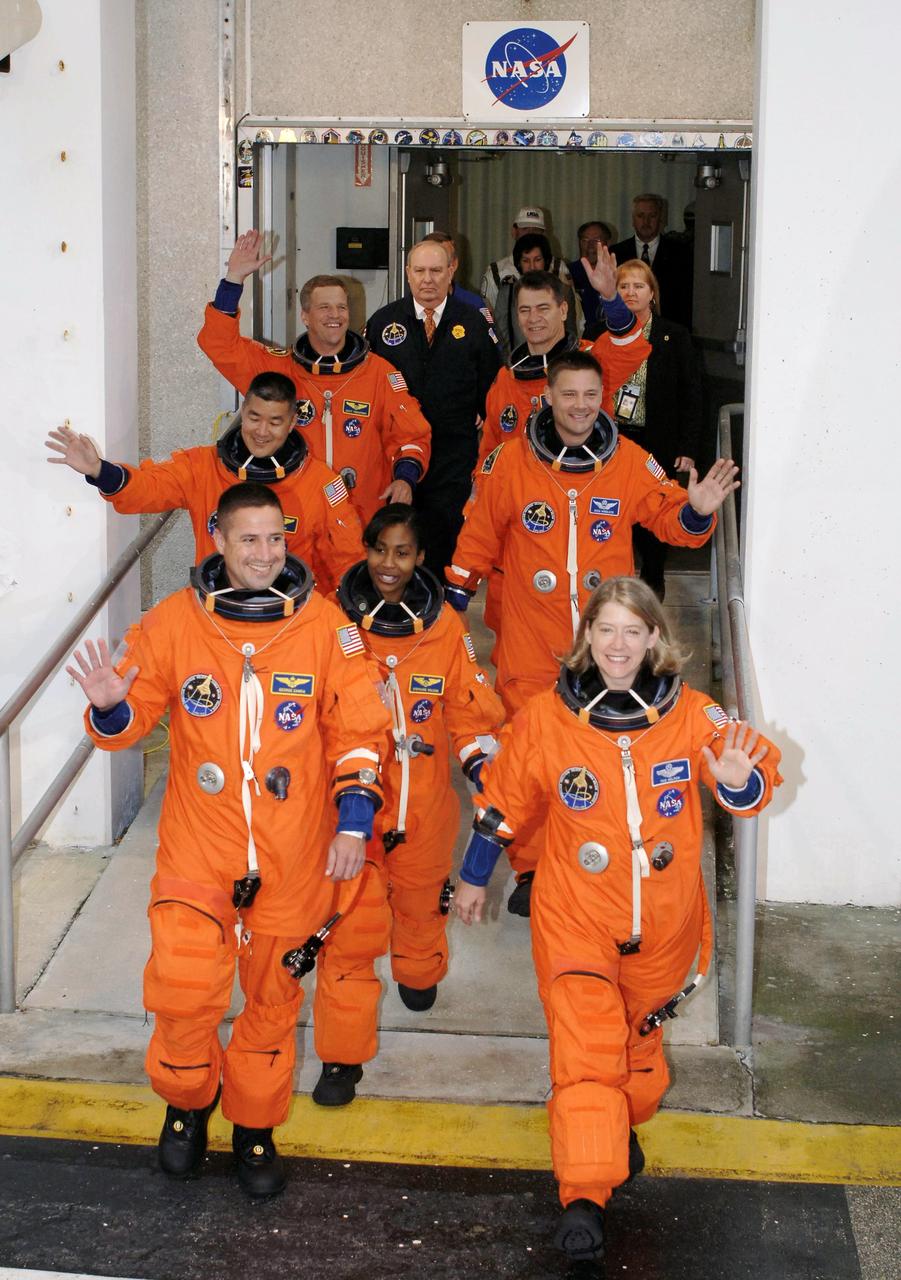
STS120-S-005 (23 Oct. 2007) --- After suiting up, the STS-120 crewmembers exit the Operations and Checkout Building to board the Astrovan, which will take them to launch pad 39A at Kennedy Space Center. On the right (front to back) are astronauts Pam Melroy, commander; Doug Wheelock and European Space Agency's (ESA) Paolo Nespoli, both mission specialists. On the left (front to back) are astronauts George Zamka, pilot; Stephanie Wilson, Daniel Tani and Scott Parazynski, all mission specialists. Discovery will link up with the International Space Station on Thursday, Oct. 25, to begin a joint mission to continue construction by delivering the Italian-built U.S. Node 2, called Harmony. During the 14-day mission, the crew will install Harmony and move the P6 solar arrays to their permanent position and deploy them.
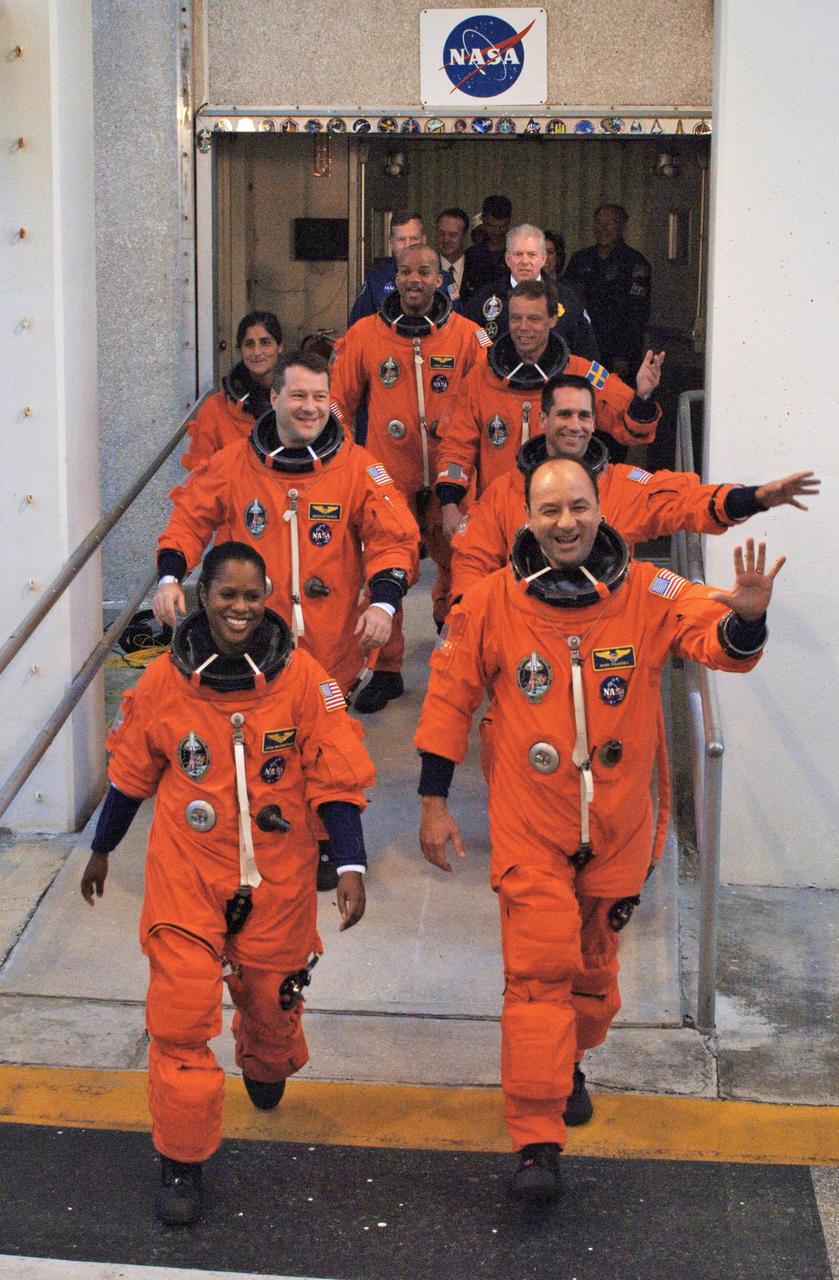
STS116-S-005 (9 Dec. 2006) --- After suiting up, the STS-116 crewmembers exit the Operations and Checkout Building to board the Astrovan, which will take them to launch pad 39B at Kennedy Space Center. On the right (front to back) are astronauts Mark L. Polansky, commander; William S. (Bill) Oefelein, pilot; and Christer Fuglesang, mission specialists representing the European Space Agency (ESA). On the left (front to back) are astronauts Joan E. Higginbotham, Nicholas J. M. Patrick, Sunita L. Williams and Robert L. Curbeam, Jr., all mission specialists. Discovery's seven-member crew will link up with the International Space Station on Monday, Dec. 11, to begin a complex, week-long stay that will rewire the outpost and increase its power supply. During three spacewalks and intricate choreography with ground controllers, the astronauts will bring electrical power on line generated by a giant solar array wing delivered to the station in September.
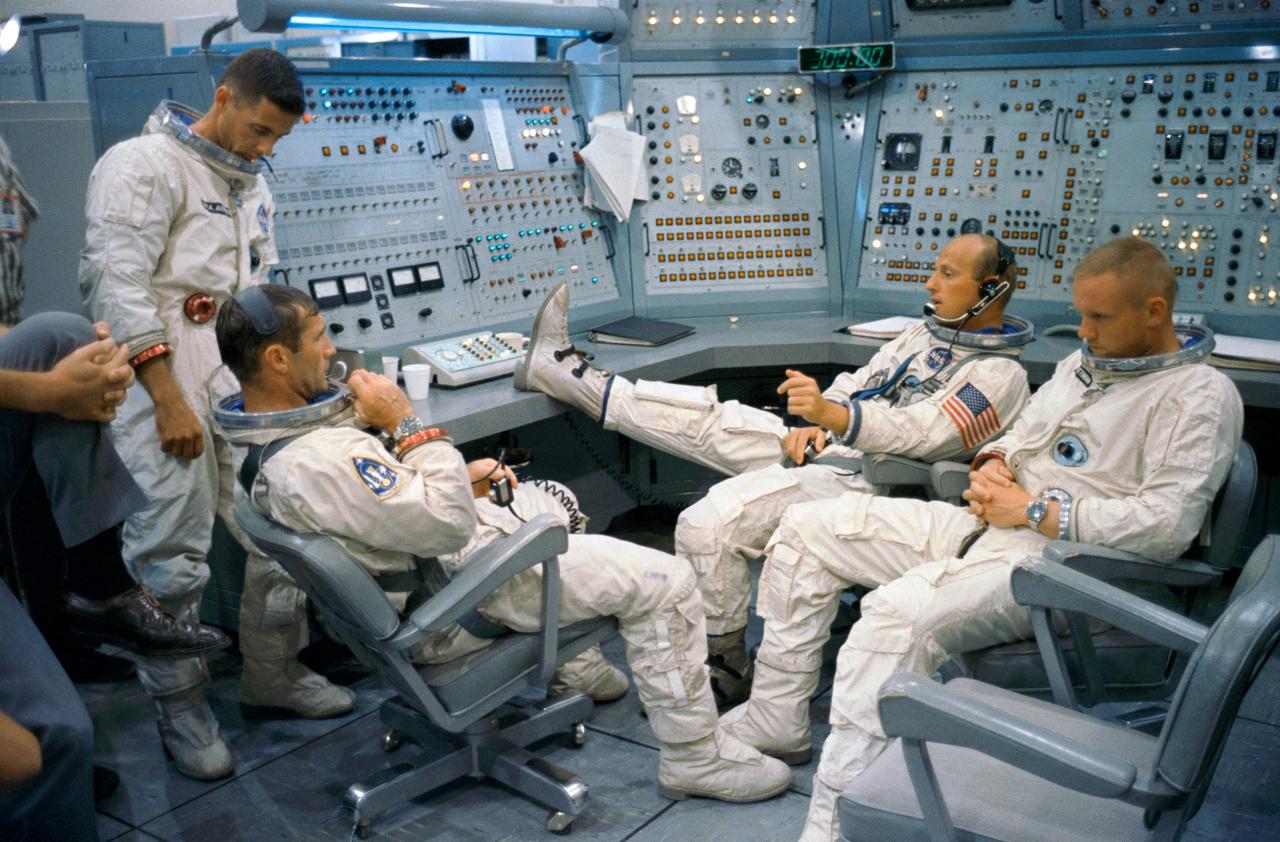
S66-50769 (8 Sept. 1966) --- Gemini-11 prime and backup crews are pictured at the Gemini Mission Simulator at Cape Kennedy, Florida. Left to right are astronauts William A. Anders, backup crew pilot; Richard F. Gordon Jr., prime crew pilot; Charles Conrad Jr. (foot on desk), prime crew command pilot; and Neil A. Armstrong, backup crew command pilot. Photo credit: NASA
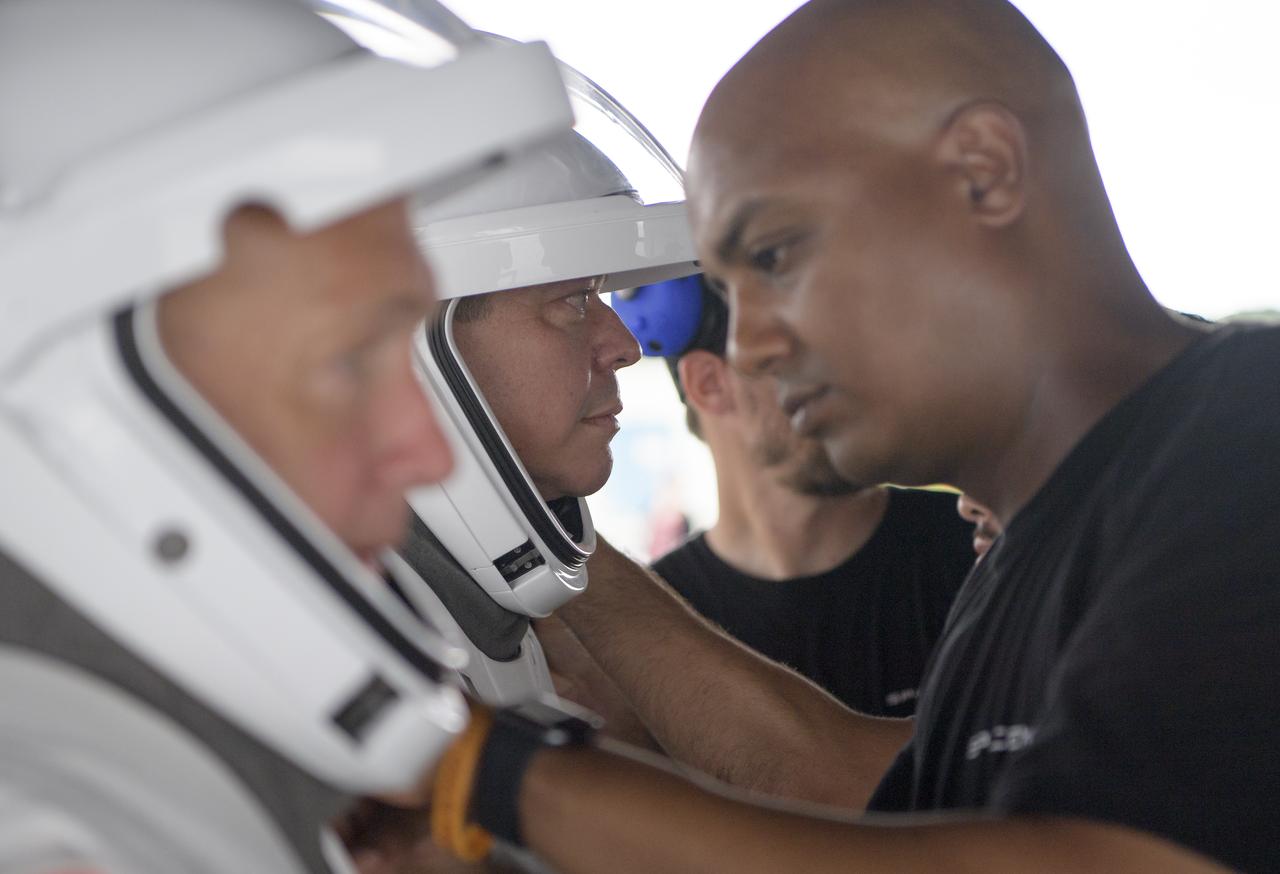
NASA astronauts Doug Hurley, left, and Bob Behnken work with teams from NASA and SpaceX to rehearse crew extraction from SpaceX’s Crew Dragon, which will be used to carry humans to the International Space Station, on August 13, 2019 at the Trident Basin in Cape Canaveral, Florida. Using the Go Searcher ship SpaceX uses to recover their spacecraft after splashdown and a mock-up of the Crew Dragon, the teams worked through the steps necessary to get NASA astronauts Doug Hurley and Bob Behnken out of the Dragon and back to dry land. Hurley and Behnken will fly to the space station aboard the Crew Dragon for the SpaceX Demo-2 mission. Photo Credit: (NASA/Bill Ingalls)
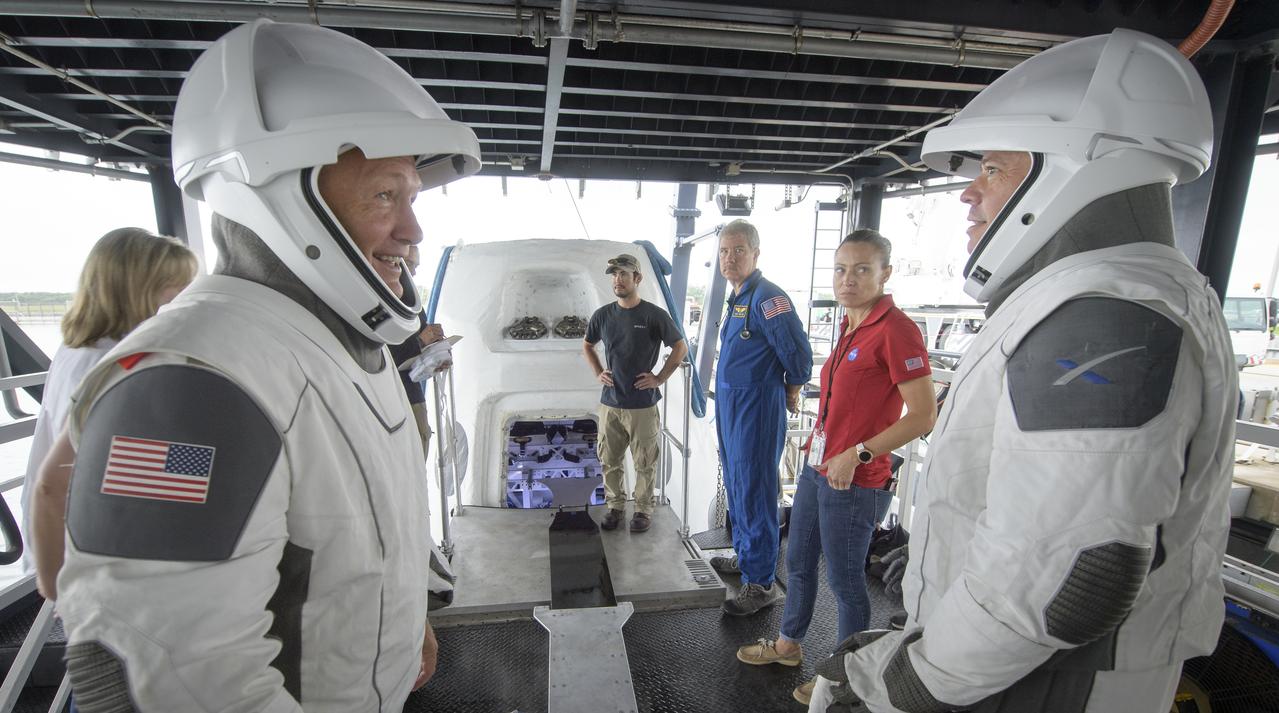
NASA astronauts Doug Hurley, left, and Bob Behnken work with teams from NASA and SpaceX to rehearse crew extraction from SpaceX’s Crew Dragon, which will be used to carry humans to the International Space Station, on August 13, 2019 at the Trident Basin in Cape Canaveral, Florida. Using the Go Searcher ship SpaceX uses to recover their spacecraft after splashdown and a mock-up of the Crew Dragon, the teams worked through the steps necessary to get NASA astronauts Doug Hurley and Bob Behnken out of the Dragon and back to dry land. Hurley and Behnken will fly to the space station aboard the Crew Dragon for the SpaceX Demo-2 mission. Photo Credit: (NASA/Bill Ingalls)
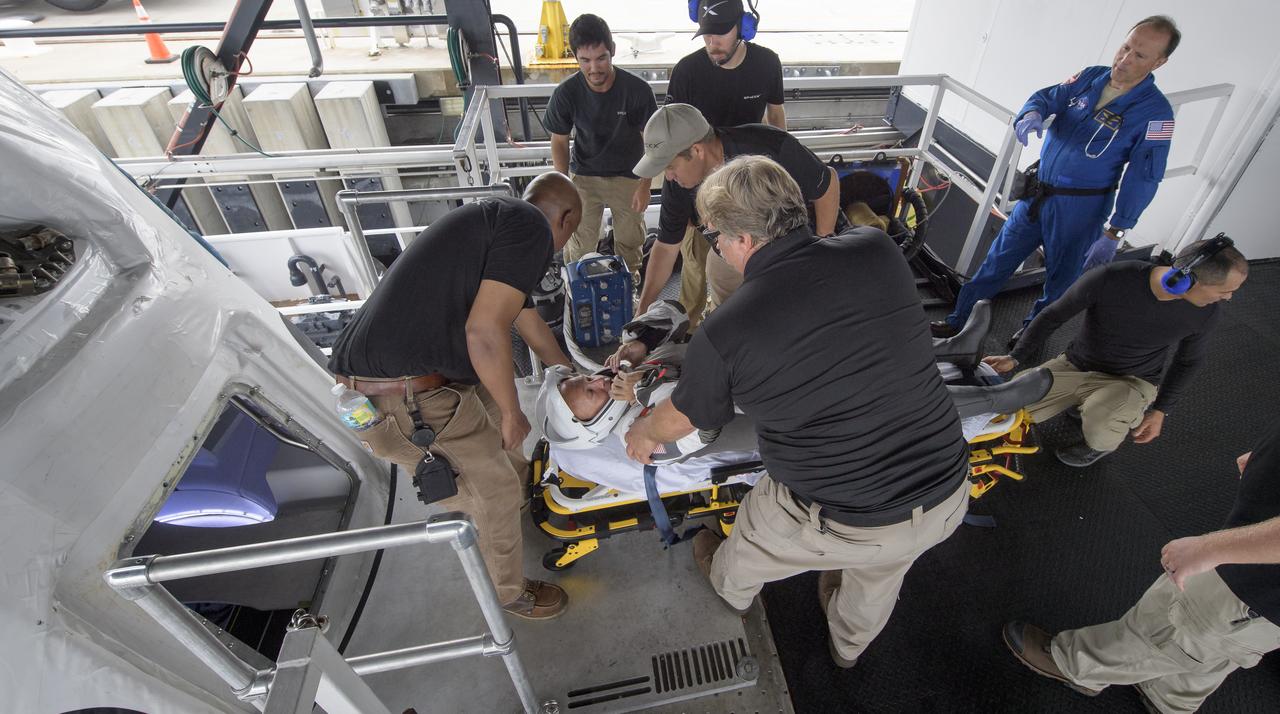
NASA astronaut Doug Hurley, along with teams from NASA and SpaceX, rehearse crew extraction from SpaceX’s Crew Dragon, which will be used to carry humans to the International Space Station, on August 13, 2019 at the Trident Basin in Cape Canaveral, Florida. Using the Go Searcher ship SpaceX uses to recover their spacecraft after splashdown and a mock-up of the Crew Dragon, the teams worked through the steps necessary to get NASA astronauts Doug Hurley and Bob Behnken out of the Dragon and back to dry land. Hurley and Behnken will fly to the space station aboard the Crew Dragon for the SpaceX Demo-2 mission. Photo Credit: (NASA/Bill Ingalls)
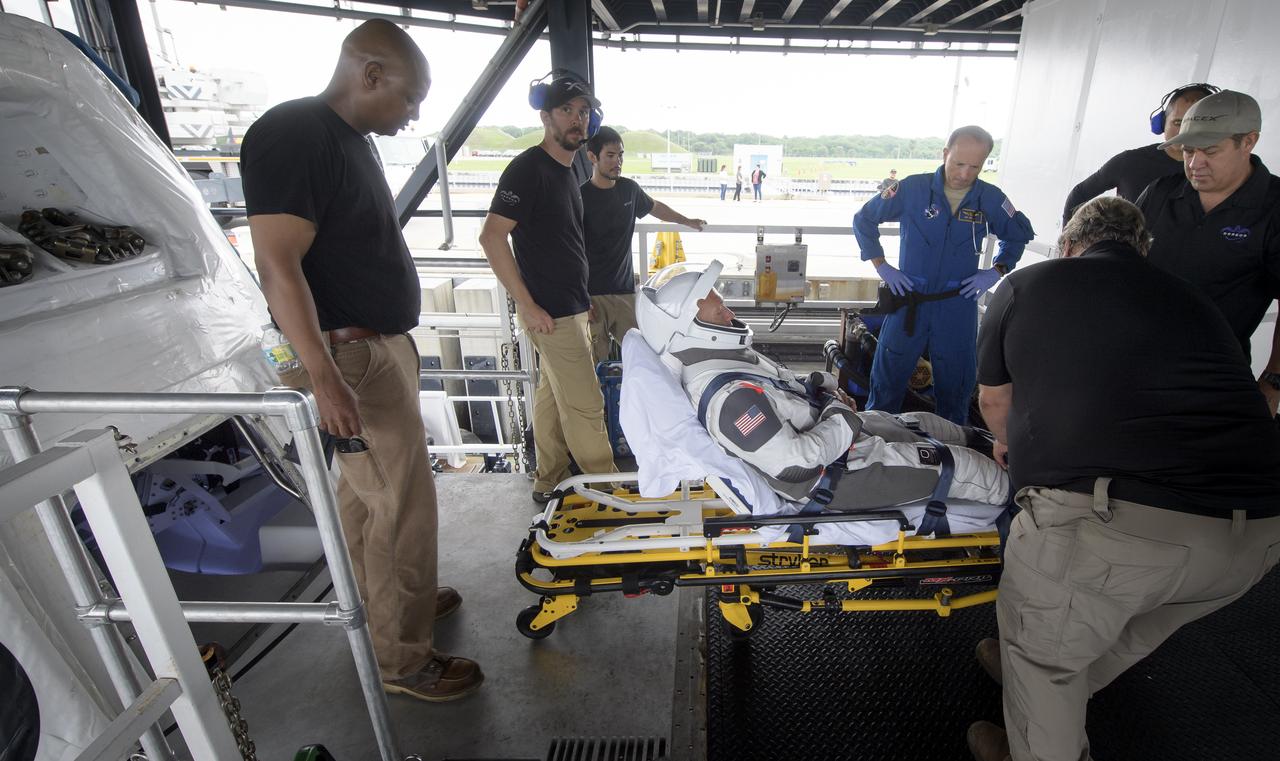
NASA astronaut Doug Hurley, along with teams from NASA and SpaceX, rehearse crew extraction from SpaceX’s Crew Dragon, which will be used to carry humans to the International Space Station, on August 13, 2019 at the Trident Basin in Cape Canaveral, Florida. Using the Go Searcher ship SpaceX uses to recover their spacecraft after splashdown and a mock-up of the Crew Dragon, the teams worked through the steps necessary to get NASA astronauts Doug Hurley and Bob Behnken out of the Dragon and back to dry land. Hurley and Behnken will fly to the space station aboard the Crew Dragon for the SpaceX Demo-2 mission. Photo Credit: (NASA/Bill Ingalls)

ISS027-E-035707 (21 May 2011) --- Inside the Kibo lab onboard the International Space Station, the six astronauts and cosmonauts making up the Expedition 27 crew pose for a traditional group shot. From left to right (front row) are NASA astronaut Cady Coleman, Russian cosmonaut Dmitry Kondratyev and European Space Agency astronaut Paolo Nespoli; and (back row) NASA astronaut Ron Garan, along with cosmonauts Alexander Samokutyaev and Andrey Borisenko.
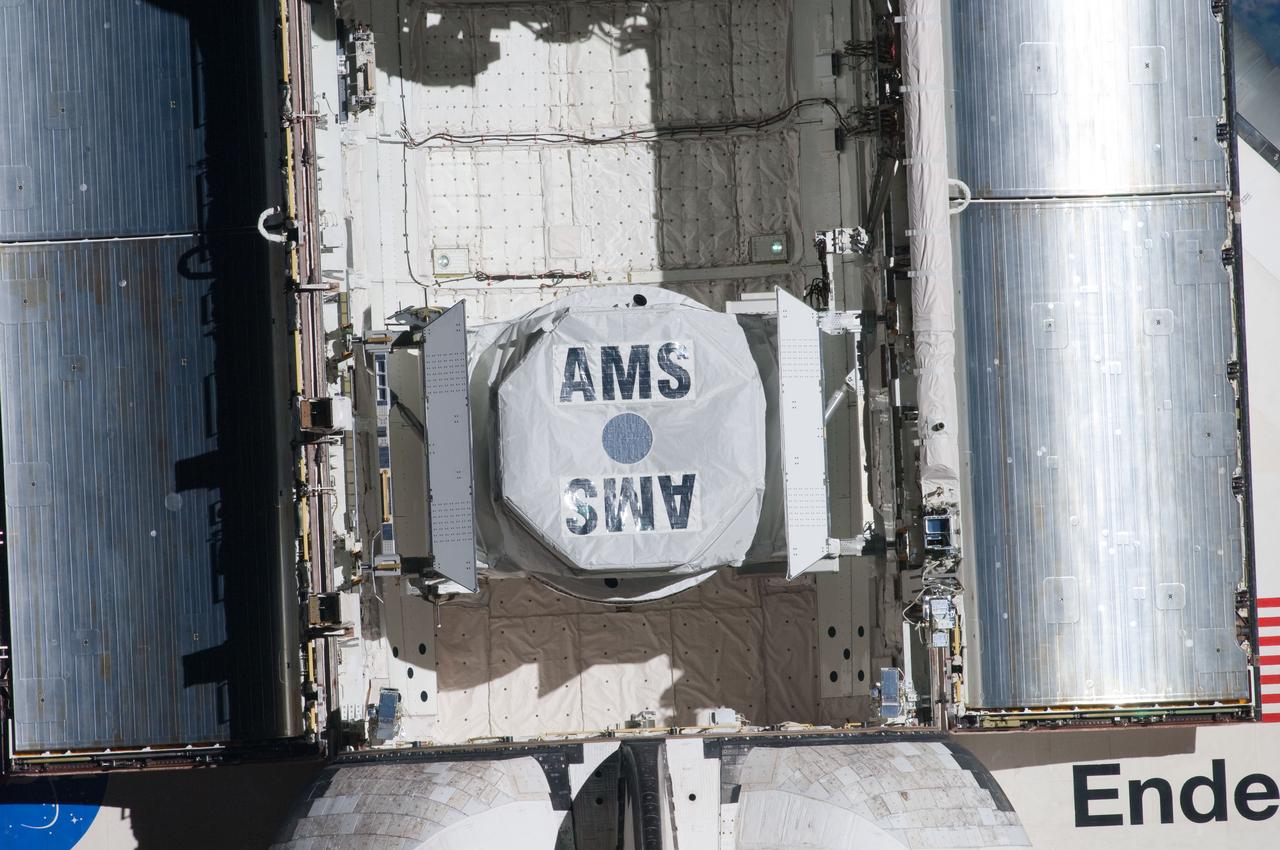
ISS027-E-032216 (18 May 2011) --- This close-up view of the Alpha Magnetic Spectrometer-2 (AMS) in space shuttle Endeavour’s payload bay was provided by an Expedition 27 crew member during a survey of the approaching STS-134 vehicle prior to docking with the International Space Station. As part of the survey and part of every mission's activities, Endeavour performed a back-flip for the rendezvous pitch maneuver (RPM). The image was photographed with a digital still camera, using a 400mm lens at a distance of about 600 feet (180 meters).
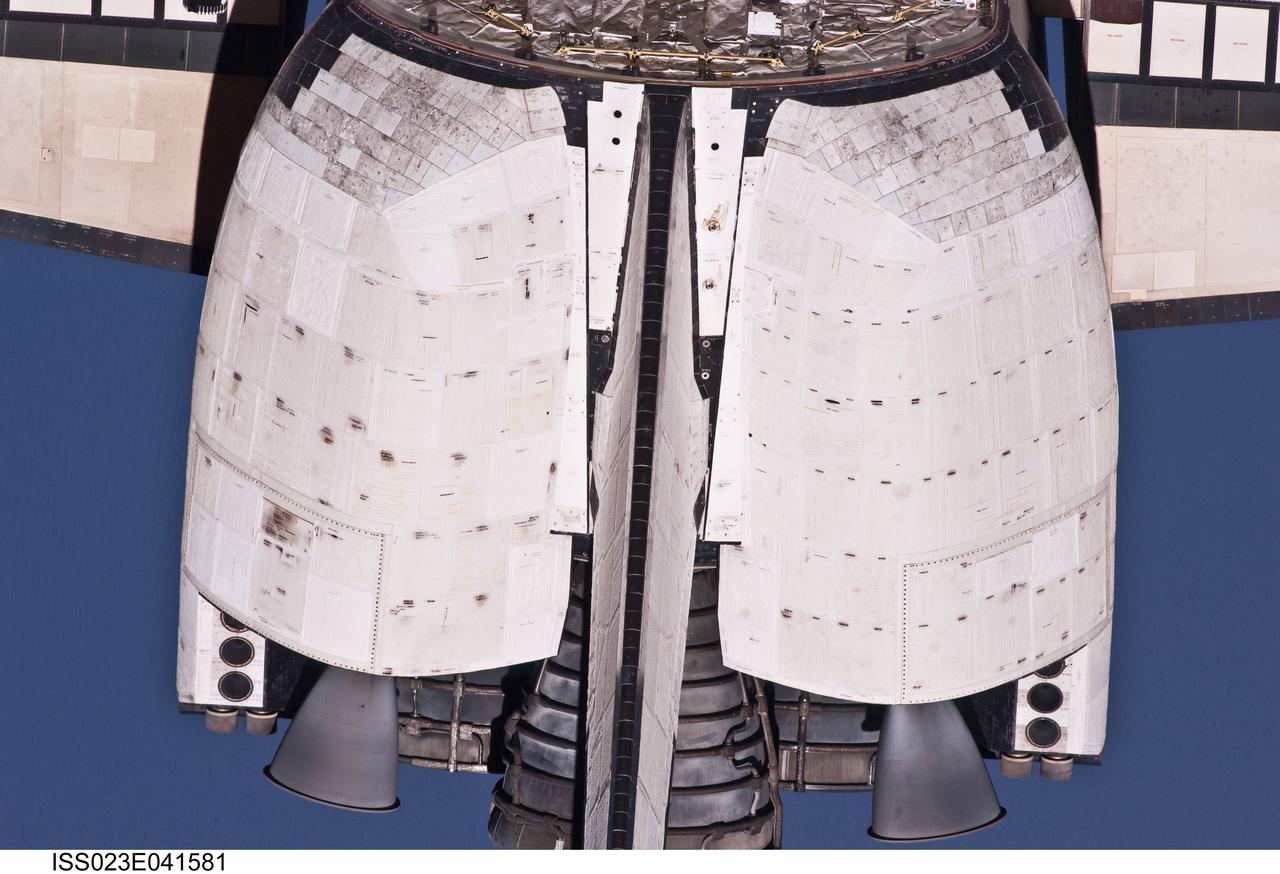
ISS023-E-041581 (16 May 2010) --- This close-up view of the vertical stabilizer and orbital maneuvering system (OMS) pods of the space shuttle Atlantis was provided by an Expedition 23 crew member during a survey of the approaching STS-132 vehicle prior to docking with the International Space Station. As part of the survey and part of every mission's activities, Atlantis performed a back-flip for the rendezvous pitch maneuver (RPM). The image was photographed with a digital still camera, using a 400mm lens at a distance of about 600 feet (180 meters).
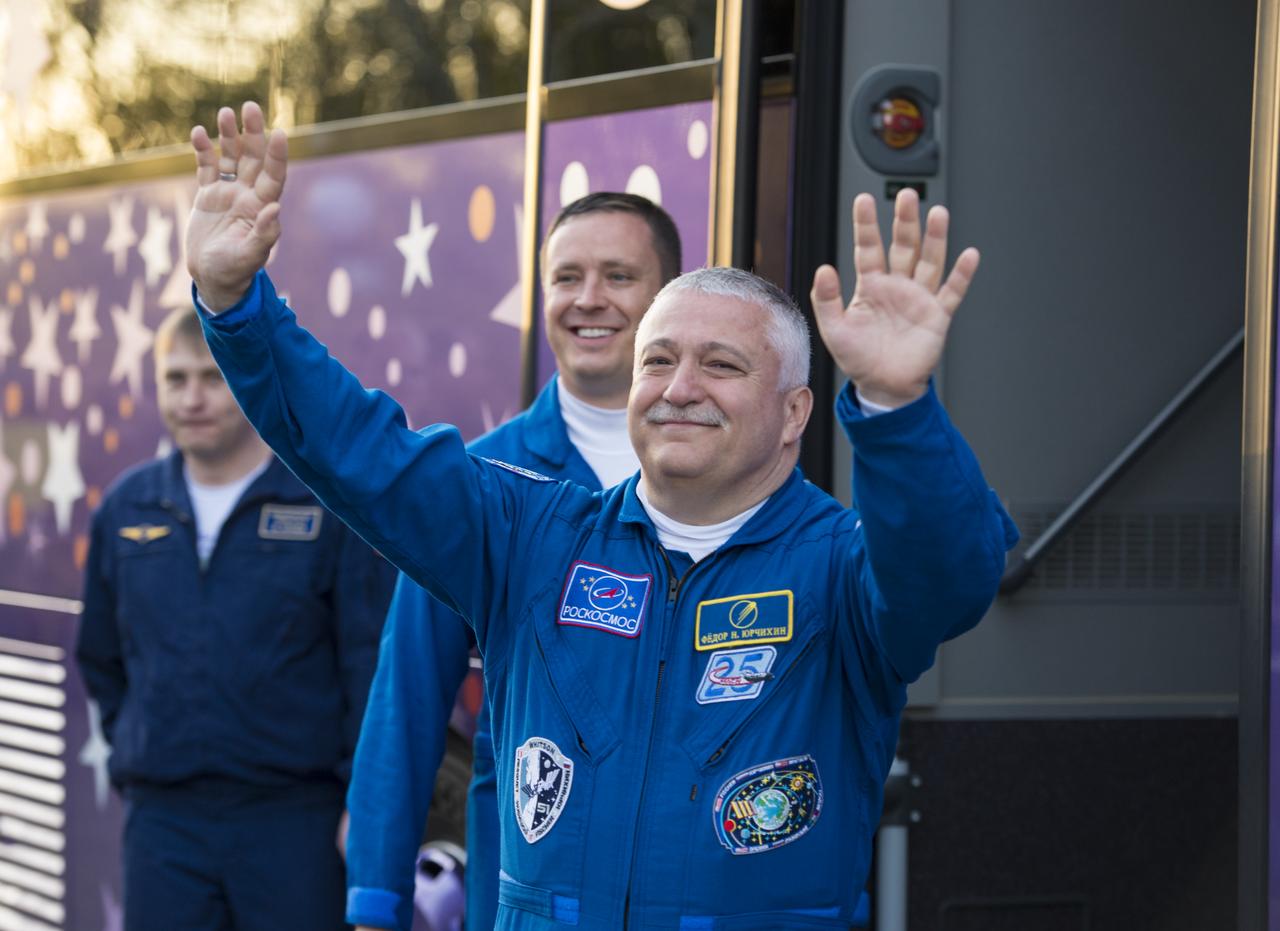
Expedition 51 crew members, Soyuz Commander Fyodor Yurchikhin of Roscosmos, front, and Flight Engineer Jack Fischer of NASA, back, wave farewell to family and friends as they depart the Cosmonaut Hotel to suit-up for their Soyuz launch to the International Space Station on Thursday, April 20, 2017 in Baikonur, Kazakhstan. Launch of the Soyuz rocket is scheduled for 1:13PM April 20 Baikonur time and will send Yurchikhin and Fischer on a four and a half month mission aboard the International Space Station. Photo Credit: (NASA/Aubrey Gemignani)

Expedition 24 Flight Engineer Shannon Walker, left, and back-up crew member Cady Coleman smile during a press conference held at the Cosmonaut Hotel in Baikonur, Kazakhstan, Monday, June 14, 2010. The launch of the Soyuz spacecraft with Expedition 24 NASA Flight Engineers Shannon Walker and Douglas Wheelock, and Soyuz Commander Fyodor Yurchikhin is scheduled for Wednesday, June 16, 2010 at 3:35 a.m. Kazakhstan time. Photo Credit: (NASA/Carla Cioffi)
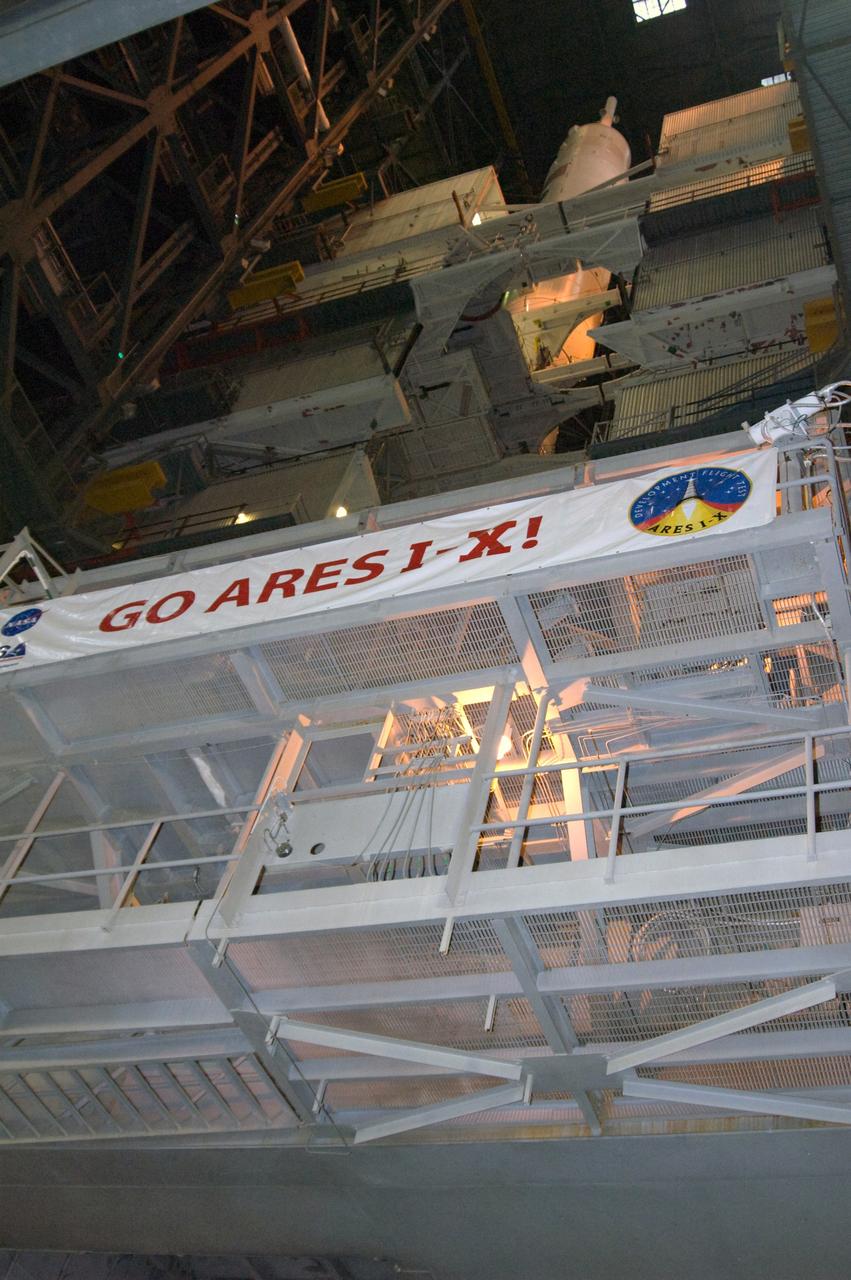
CAPE CANAVERAL, Fla. – In NASA Kennedy Space Center's Vehicle Assembly Building High Bay 3, NASA's Ares I-X rocket is ready to undergo its first power-up. Part of the Constellation Program, the Ares I-X is the test vehicle for the Ares I, which is the essential core of a space transportation system that eventually will carry crewed missions back to the moon, on to Mars and out into the solar system. The Ares I-X flight test is targeted for Oct. 31. Photo credit: NASA/Cory Huston

iss069e071222 (Aug. 20, 2023) --- The seven-member Expedition 69 crew give a thumbs up in this portrait from inside the International Space Station's Kibo laboratory module. In the front row from left are, Flight Engineers Andrey Fedyaev of Roscosmos; Woody Hoburg and Stephen Bowen, both from NASA; and Sultan Alneyadi from UAE (United Arab Emirates. In the back from left are, Flight Engineer Dmitri Petelin and Commander Sergey Prokopyev, both from Roscosmos; and Flight Engineer Frank Rubio from NASA.
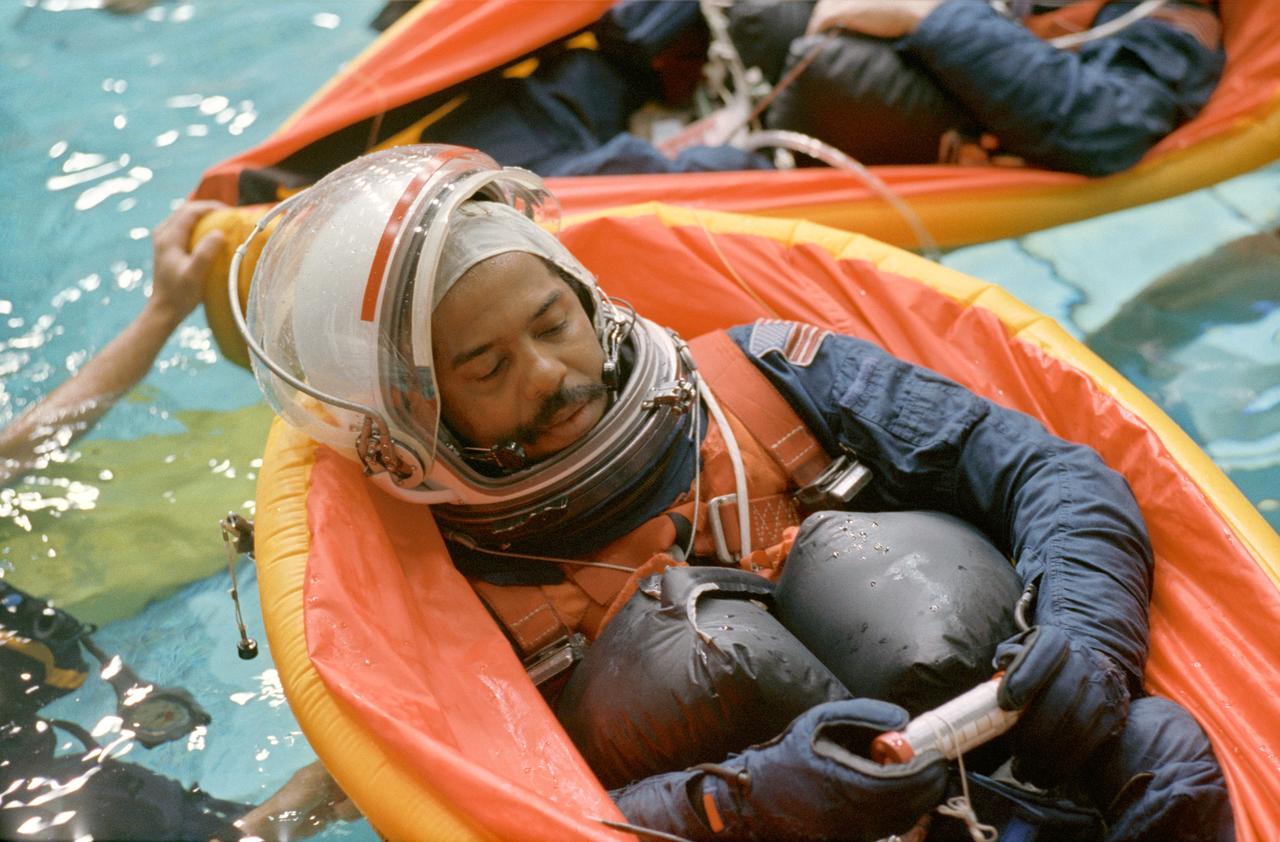
S92-50679 (Dec 1992) --- Using a small life raft, astronaut Bernard A. Harris Jr., mission specialist for the STS-55\D-2 mission, participates in bailout training at the Johnson Space Center's (JSC) Weightless Environment and Training Facility (WET-F). Harris is attired in a training version of the partial pressure Shuttle launch and entry garment. All seven prime flight crew members and the two back-up payload specialists participated in the training session.
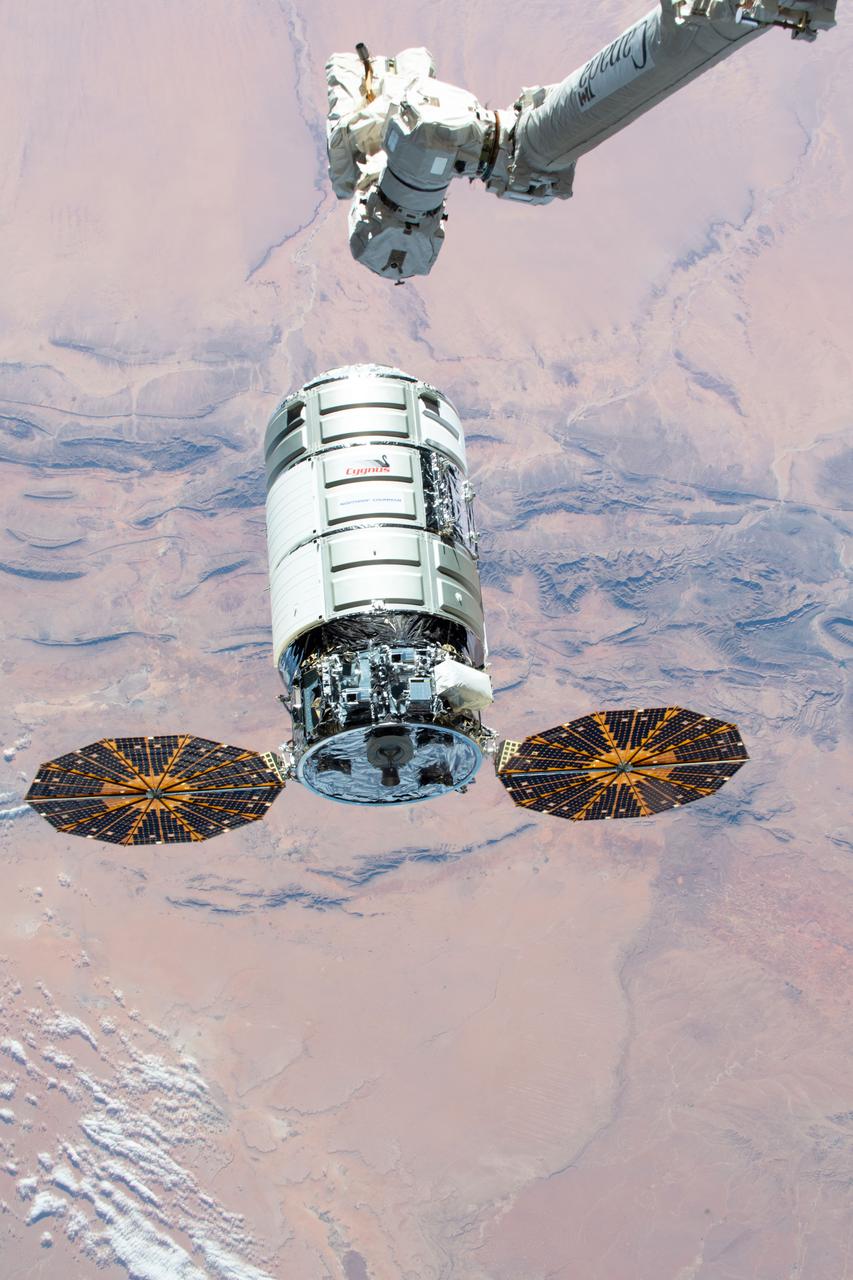
iss061e028279 (Nov. 4, 2019) --- The U.S. Cygnus space freighter approaches the International Space Station carrying over four tons of science experiments, crew supplies and station hardware. The Canadarm2 robotic arm, guided by NASA astronaut Jessica Meir with fellow Flight Engineer Christina Koch as her back up, is poised to capture the 12th resupply ship from Northrop Grumman.
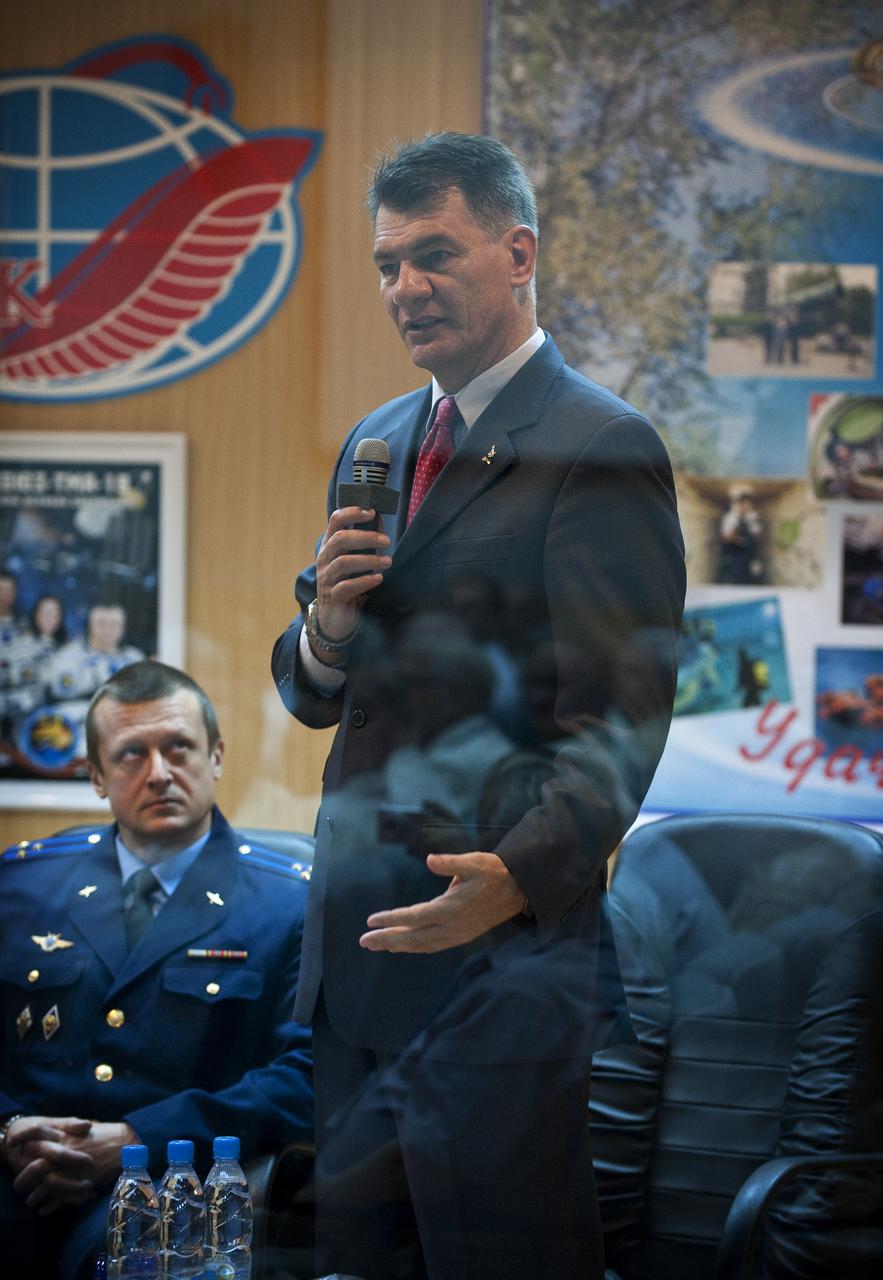
European Space Agency back-up crew member Paolo Nespoli of Italy speaks during the State Commission meeting to approve the Soyuz launch of Expedition 24 Flight Engineers Doug Wheelock, Shannon Walker and Soyuz Commander Fyodor Yurchikhin on Monday, June 14, 2010 in Baikonur, Kazakhstan. Photo Credit: (NASA/Carla Cioffi)

STS113-S-002 (September 2002) --- These four astronauts are in training for the STS-113 mission, scheduled this autumn to take up the sixth crew to the International Space Station (ISS) and bring back the members of the fifth expedition, as well as perform a variety of other duties. In front are astronauts James D. Wetherbee (right) and Paul S. Lockhart, commander and pilot, respectively. Attired in training versions of the extravehicular mobility unit (EMU) space suits are astronauts Michael E. Lopez-Alegria (left) and John B. Herrington, both mission specialists.
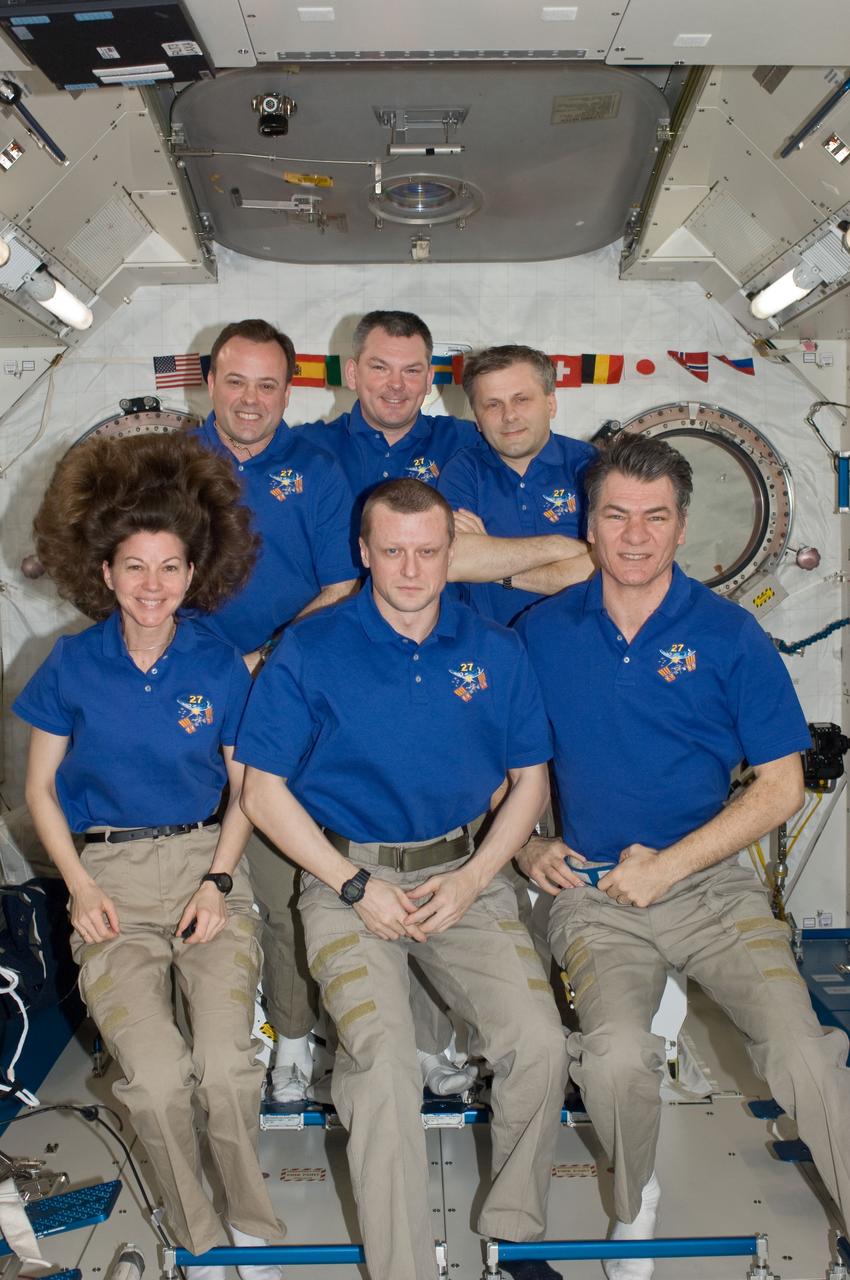
ISS027-E-035709 (21 May 2011) --- Inside the Kibo lab onboard the International Space Station, the six astronauts and cosmonauts making up the Expedition 27 crew pose for a traditional group shot. From left to right (front row) are NASA astronaut Cady Coleman, Russian cosmonaut Dmitry Kondratyev and European Space Agency astronaut Paolo Nespoli; and (back row) NASA astronaut Ron Garan, along with cosmonauts Alexander Samokutyaev and Andrey Borisenko.
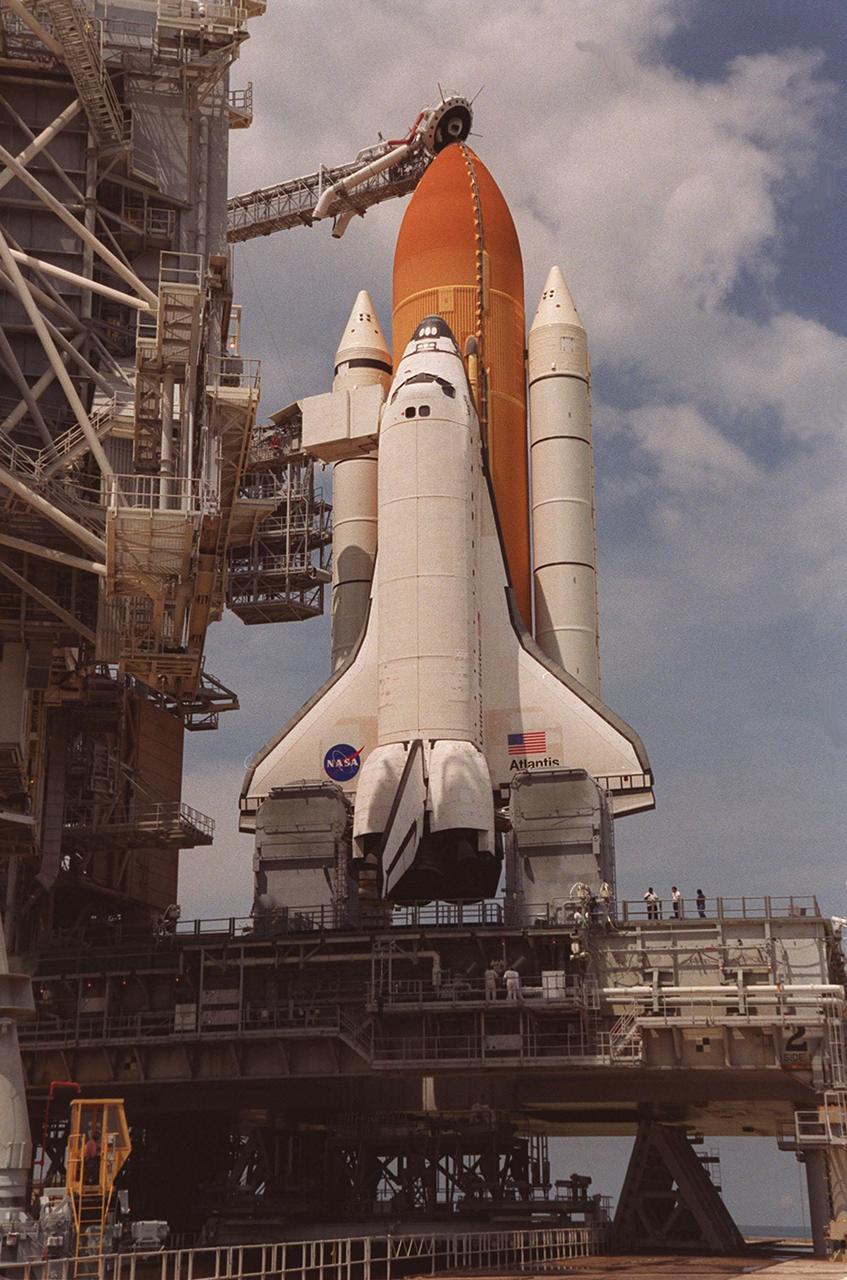
KENNEDY SPACE CENTER, Fla. -- With the Rotating Service Structure rolling back, Space Shuttle Atlantis is revealed on the Mobile Launcher Platform. At the top is the 13-foot-wide “beanie cap,” at the end of the Gaseous Oxygen Vent Arm, designed to vent gaseous oxygen vapors away from the Space Shuttle. Lower is the Orbiter Access Arm with the environmental chamber, known as the “white room,” extended to the orbiter. The chamber provides entry for the crew into the orbiter and also serves as emergency egress up to 7 minutes 24 seconds before launch
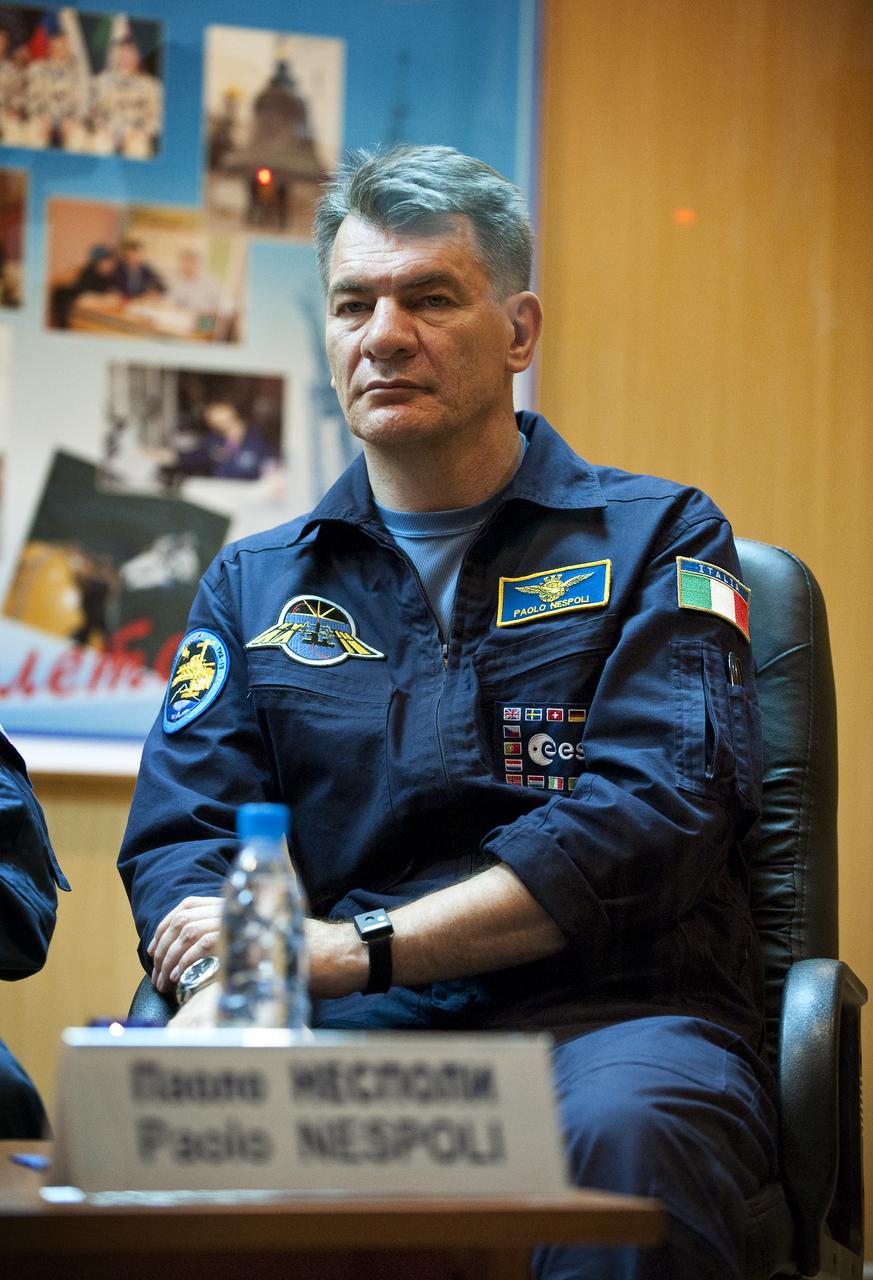
Expedition 24 European Space Agency back-up crew member Paolo Nespoli listens to a reporter’s question during a press conference held at the Cosmonaut Hotel in Baikonur, Kazakhstan on Monday, June 14, 2010. The launch of the Soyuz spacecraft with Expedition 24 NASA Flight Engineers Shannon Walker and Douglas Wheelock, and Soyuz Commander Fyodor Yurchikhin is scheduled for Wednesday, June 16, 2010 at 3:35 a.m. Kazakhstan time. Photo Credit: (NASA/Carla Cioffi)
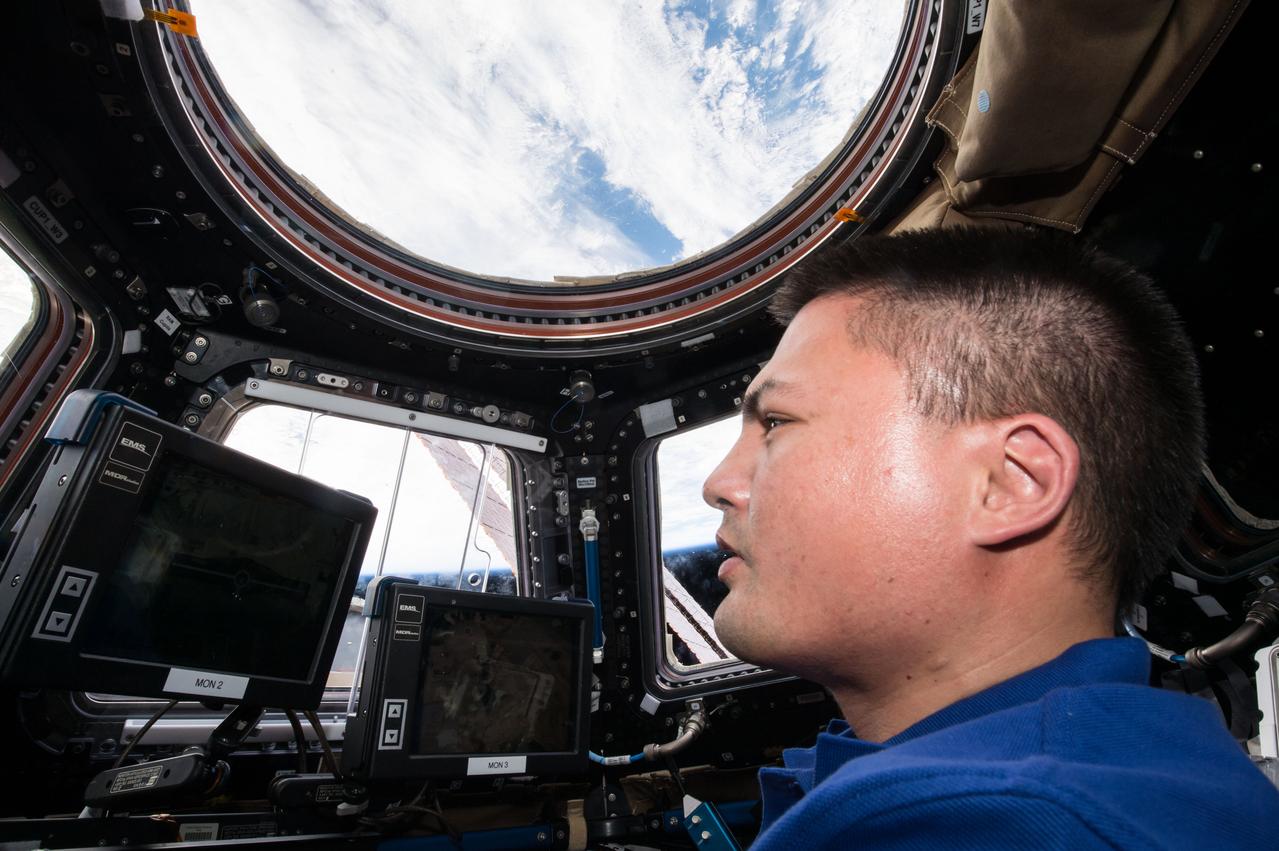
ISS044E053870 (08/13/2015) --- NASA astronaut Kjell Lindgren trains his skills with the International Space Station’s Canadarm2 robotic arm in advance of the arrival of the fifth Japanese HTV cargo vehicle. Lindgren will back up fellow Expedition 44 crew member Kimiya Yui during the capture operations scheduled to take place on Aug. 24.
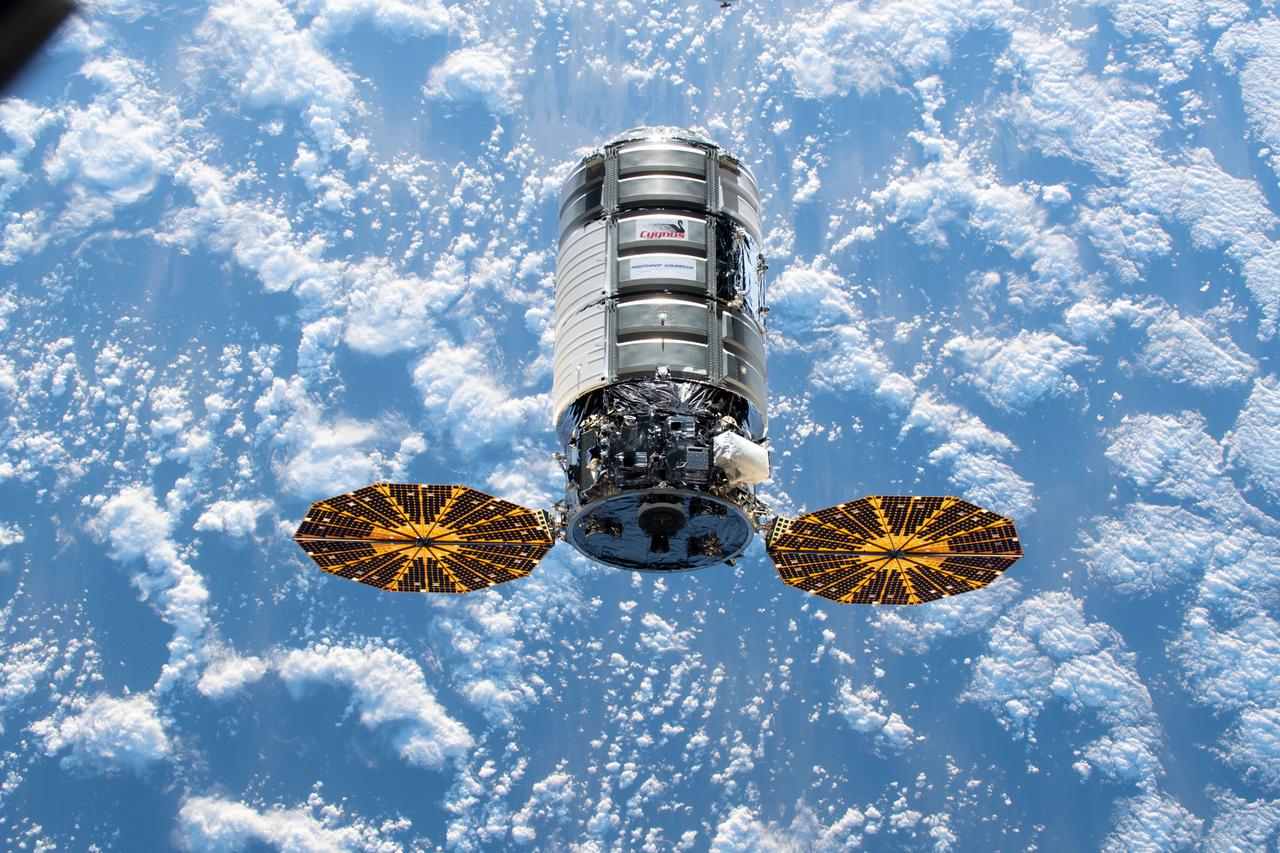
iss061e028279 (Nov. 4, 2019) --- The U.S. Cygnus space freighter approaches the International Space Station carrying over four tons of science experiments, crew supplies and station hardware. NASA astronaut Jessica Meir, with fellow Flight Engineer Christina Koch as her back up, would go on to command the Canadarm2 robotic arm to capture the 12th resupply ship from Northrop Grumman.
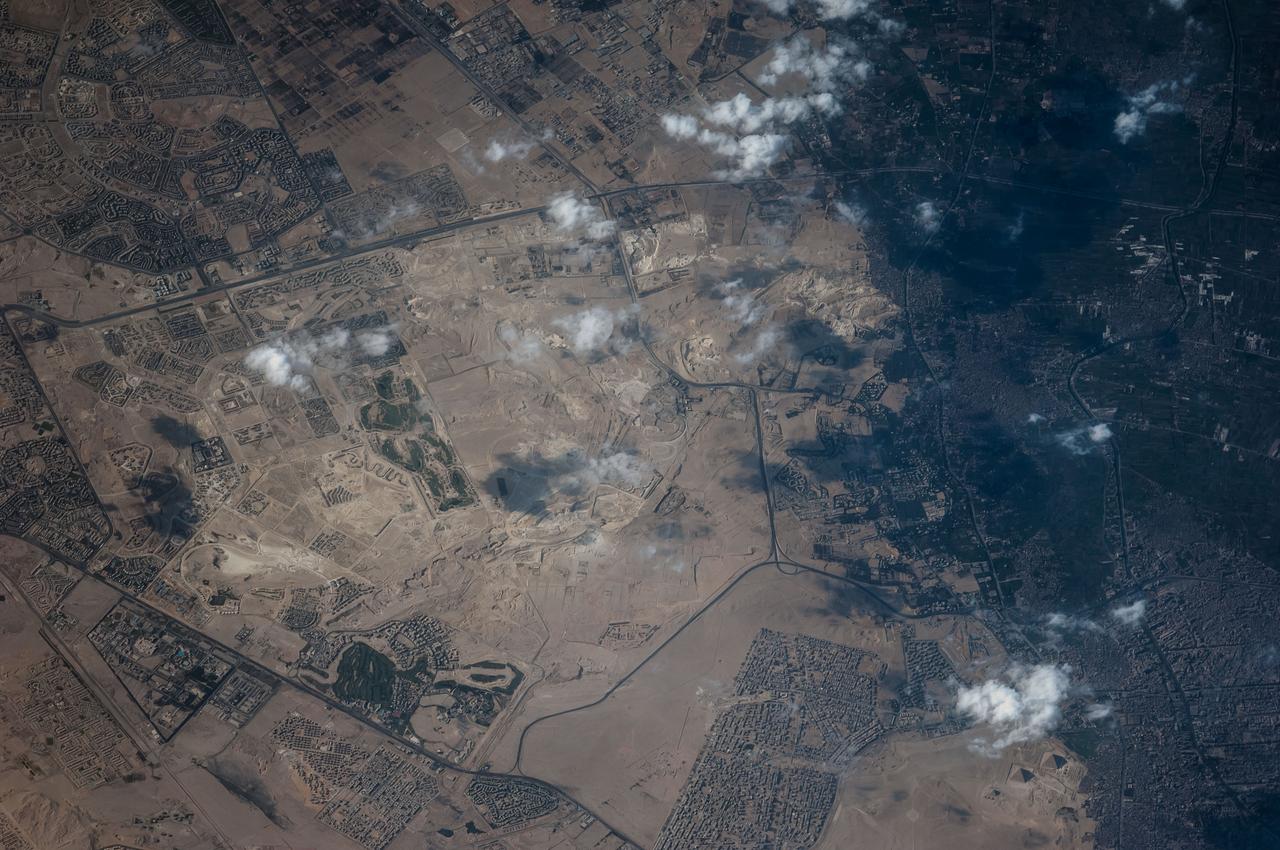
ISS040-E-124097 (5 Sept. 2014) --- A close look in the lower right corner of this photograph of Egyptian land near Cairo reveals three pyramids making up the Pyramids of Giza which have a history dating back over two millennia B.C. One of the Expedition 40 crew members aboard the International Space Station recorded the image on Sept. 5, 2014.
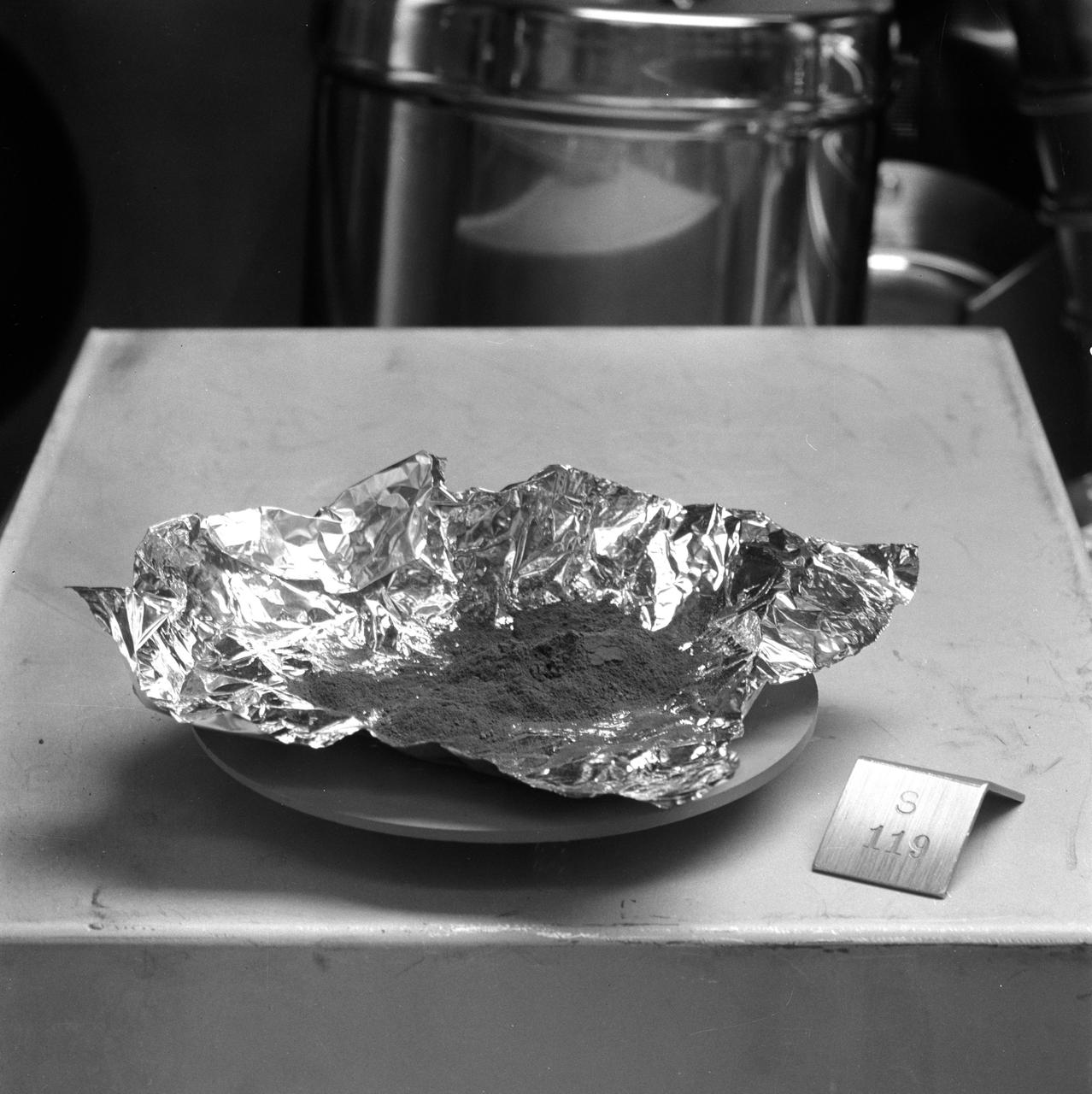
S71-19269 (12 Feb. 1971) --- A close-up view of Apollo 14 sample number 14414 & 14412, a fine lunar powder-like material under examination in the Sterile Nitrogen Atmospheric Processing (SNAP) line in the Lunar Receiving Laboratory (LRL) at the Manned Spacecraft Center (MSC). Scientists are currently making preliminary analyses of material brought back from the moon by the crew of Apollo 14 lunar landing mission.
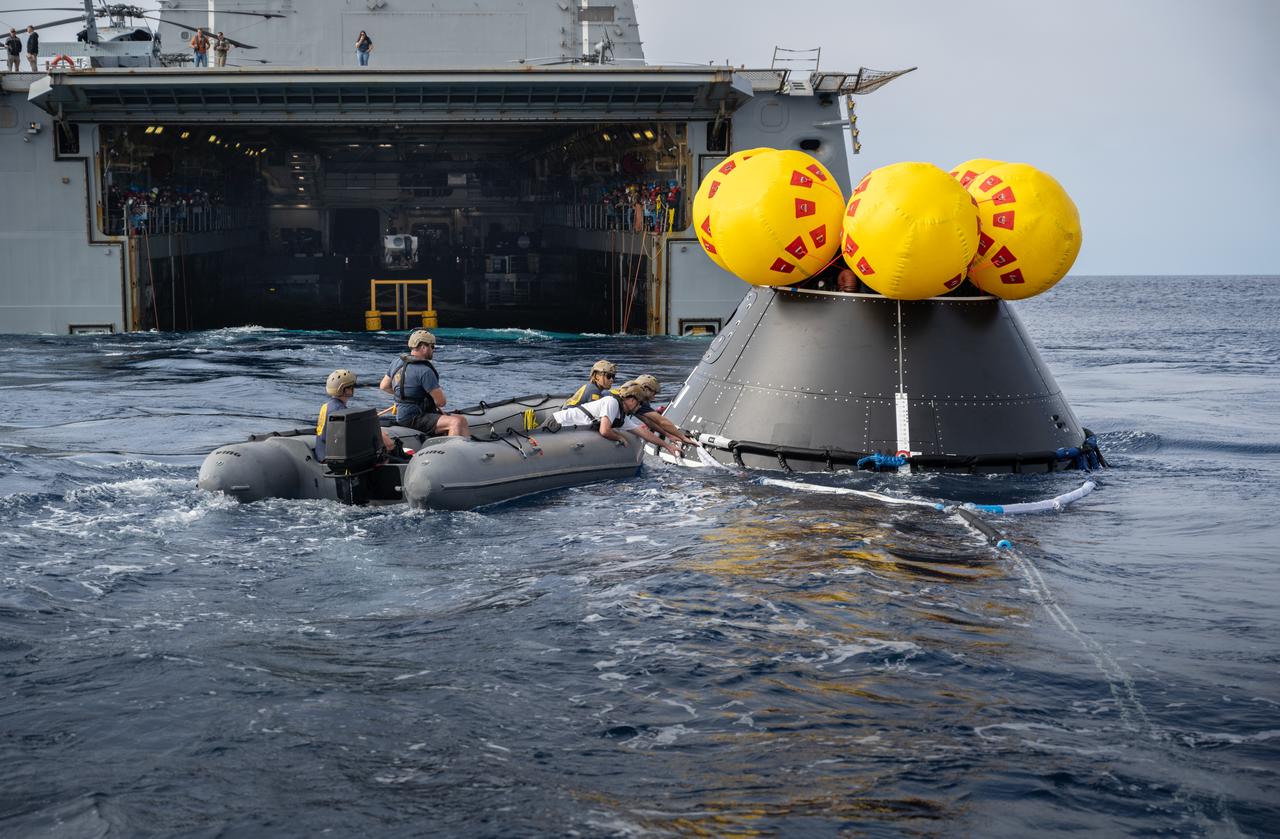
NASA, Navy, and Air Force personnel practice Artemis recovery procedures in the Pacific Ocean as part of Underway Recovery Test 10 (URT-10) off the coast of San Diego. In this photo, Navy divers are seen surrounding the Orion Crew Module Test Article (CMTA) and preparing to recover it inside the recovery ship while simulated astronauts are picked up on an inflatable “front porch” by Naval helicopter pilots from Helicopter Sea Combat Squadron (HSC) 23 “Wildcards” and flown back to the USS John P. Murtha.
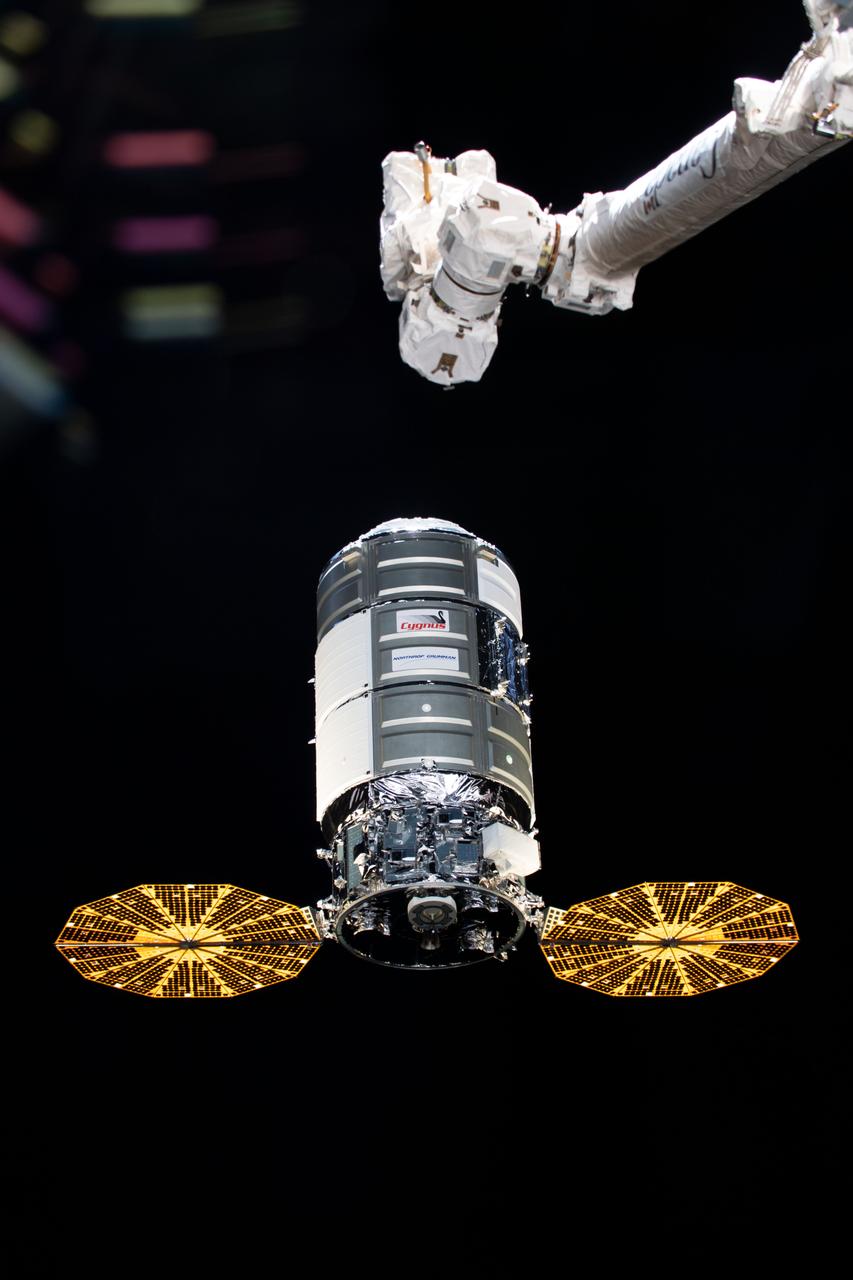
iss061e027734 (Nov. 4, 2019) --- The U.S. Cygnus space freighter approaches the International Space Station carrying over four tons of science experiments, crew supplies and station hardware. The Canadarm2 robotic arm, guided by NASA astronaut Jessica Meir with fellow Flight Engineer Christina Koch as her back up, is poised to capture the 12th resupply ship from Northrop Grumman.
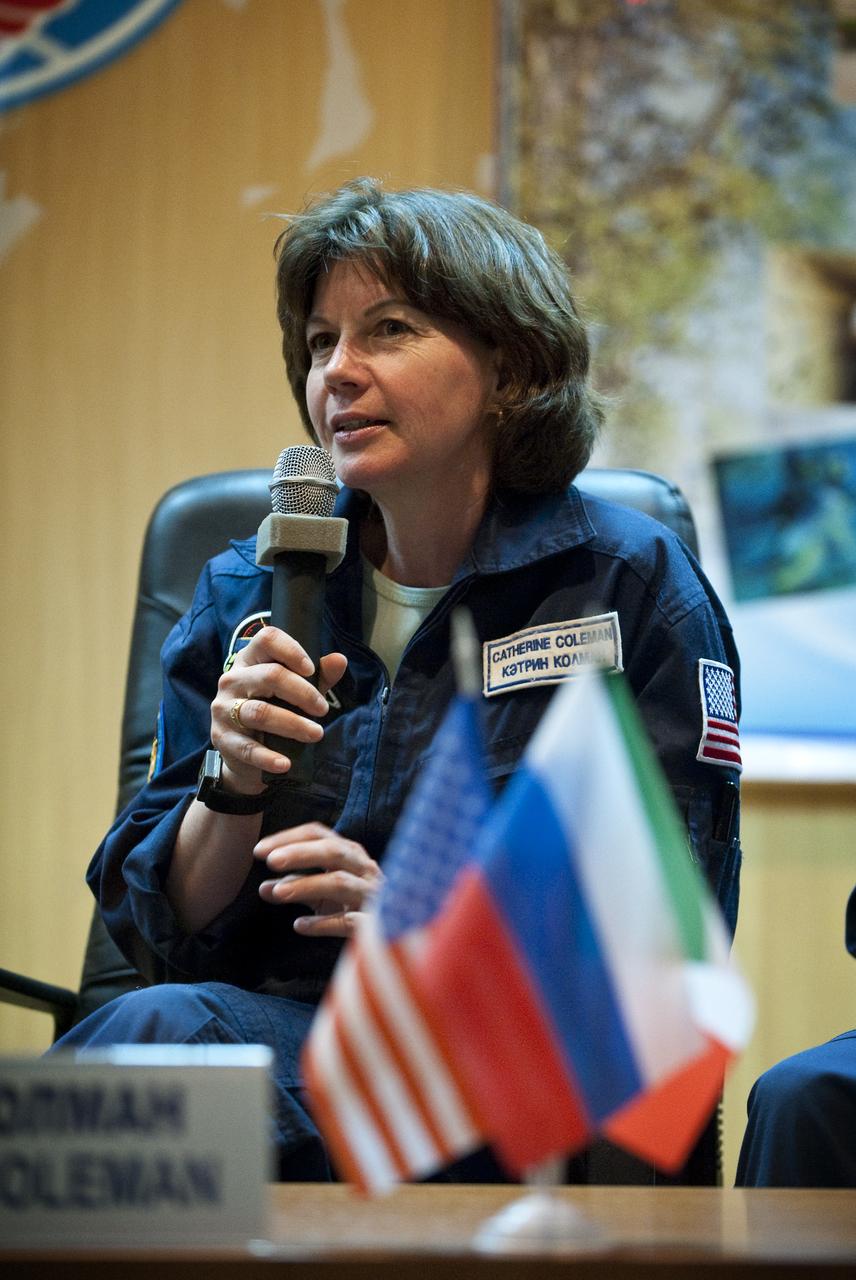
Expedition 24 NASA back-up crew member Cady Coleman answers a reporter’s question during a press conference held at the Cosmonaut Hotel in Baikonur, Kazakhstan on Monday, June 14, 2010. The launch of the Soyuz spacecraft with Expedition 24 NASA Flight Engineers Shannon Walker and Douglas Wheelock, and Soyuz Commander Fyodor Yurchikhin is scheduled for Wednesday, June 16, 2010 at 3:35 a.m. Kazakhstan time. Photo Credit: (NASA/Carla Cioffi)
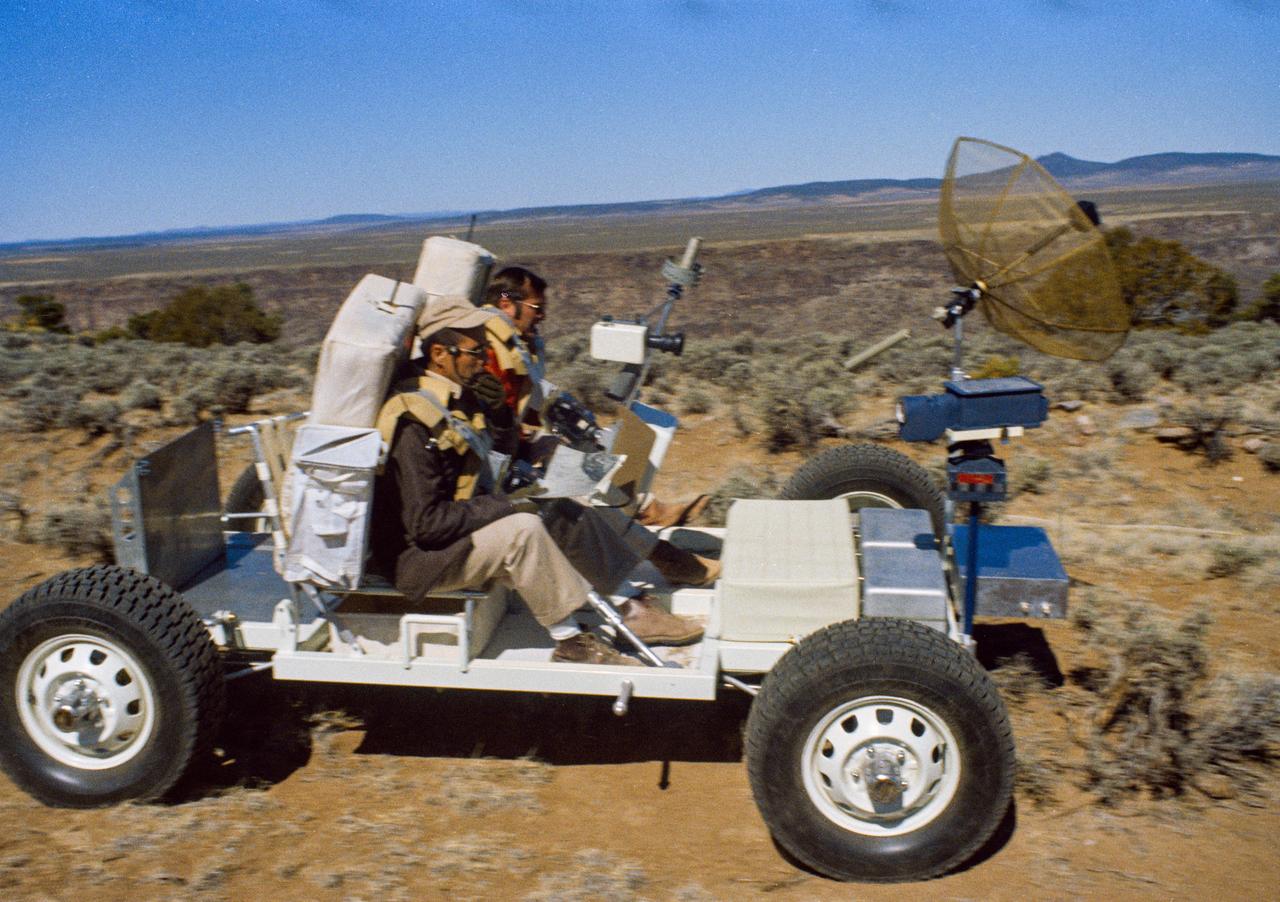
S71-24079 (1971) --- Astronauts Richard F. Gordon Jr., right, and Harrison H. Schmitt ? back-up crew members for the Apollo 15 lunar landing mission -- traverse in an Earth-bound training version of the Apollo Lunar Roving Vehicle (LRV or Rover) during geology training in Hawaii. Photo credit: NASA Note: There are elements of this description that have not been confimred. Please hold any release of descriptive information until such can be confirmed.
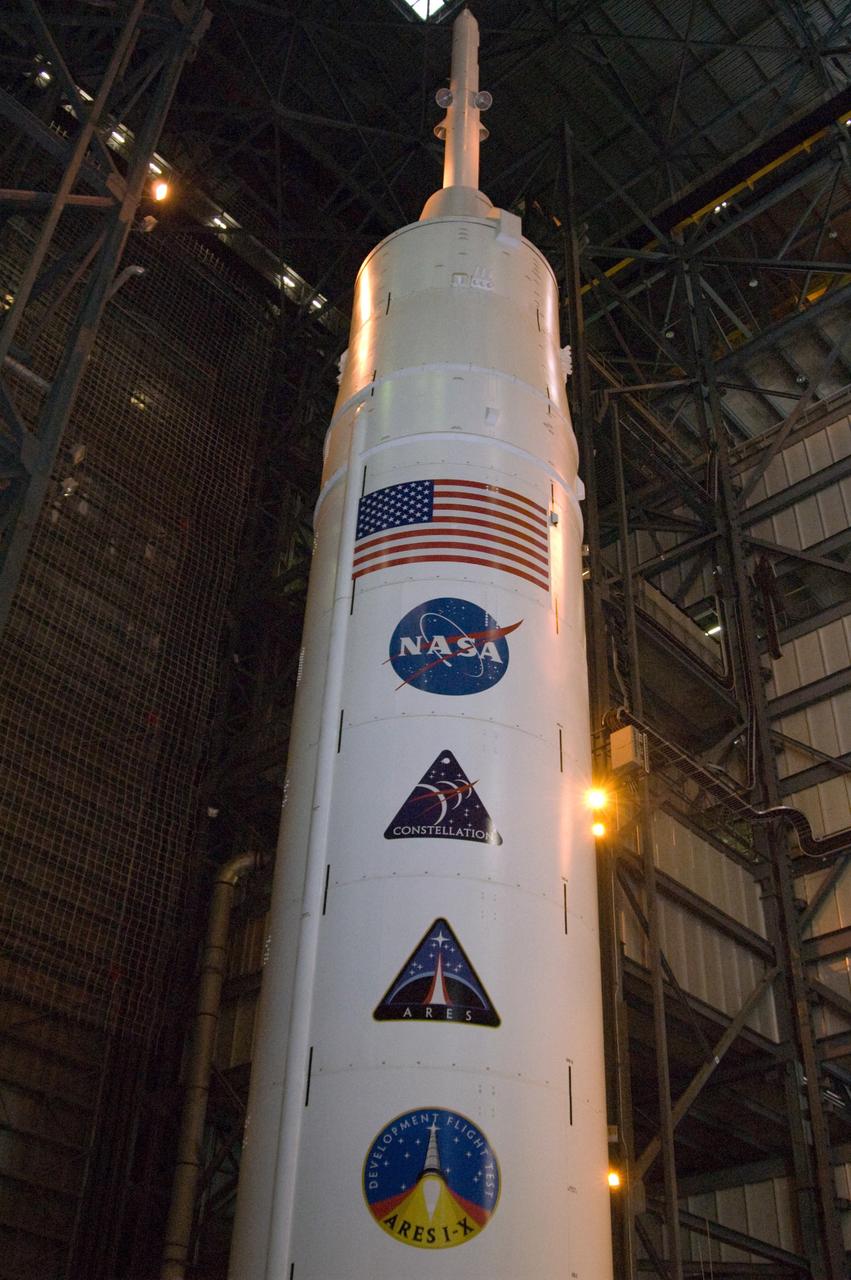
CAPE CANAVERAL, Fla. – In NASA Kennedy Space Center's Vehicle Assembly Building High Bay 3, NASA's Ares I-X rocket undergoes its first power-up. Part of the Constellation Program, the Ares I-X is the test vehicle for the Ares I, which is the essential core of a space transportation system that eventually will carry crewed missions back to the moon, on to Mars and out into the solar system. The Ares I-X flight test is targeted for Oct. 31. Photo credit: NASA/Cory Huston
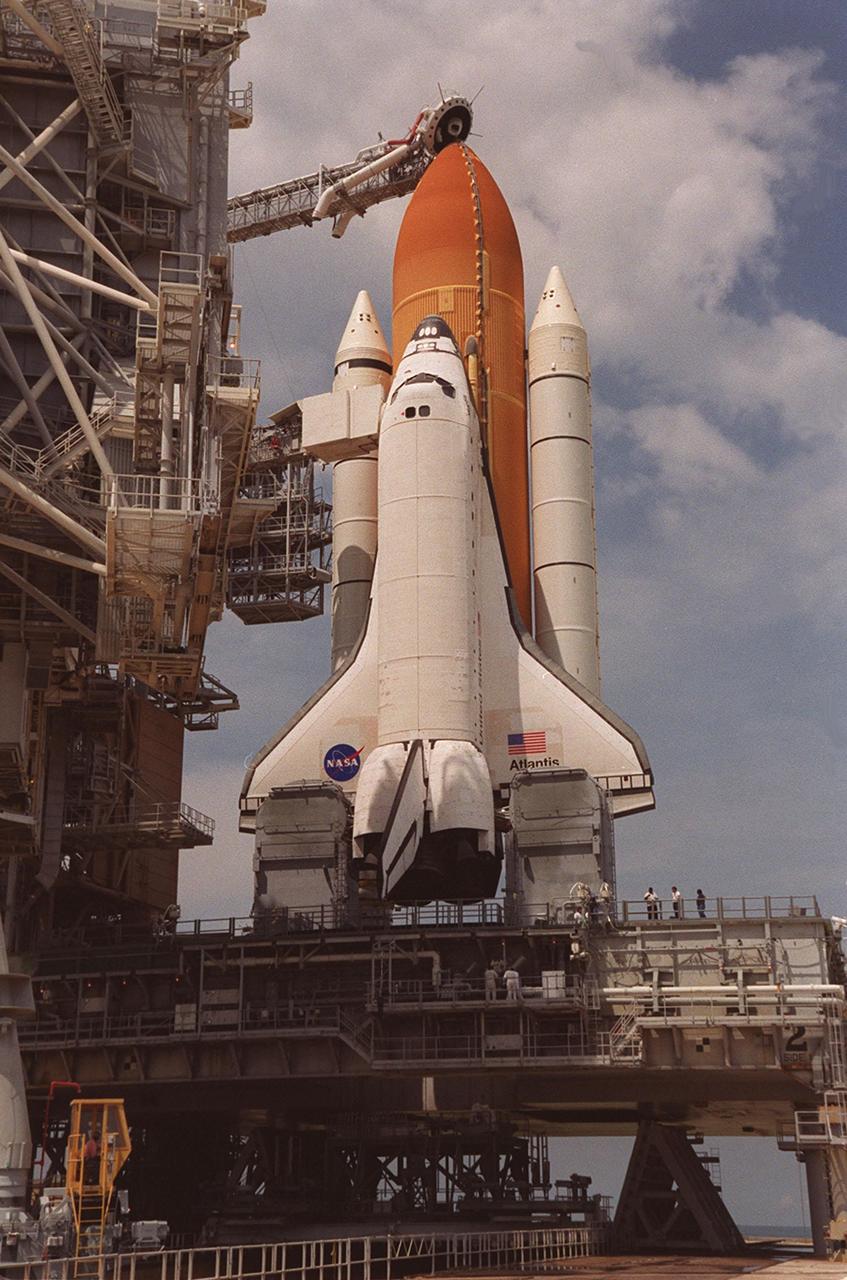
KENNEDY SPACE CENTER, Fla. -- With the Rotating Service Structure rolling back, Space Shuttle Atlantis is revealed on the Mobile Launcher Platform. At the top is the 13-foot-wide “beanie cap,” at the end of the Gaseous Oxygen Vent Arm, designed to vent gaseous oxygen vapors away from the Space Shuttle. Lower is the Orbiter Access Arm with the environmental chamber, known as the “white room,” extended to the orbiter. The chamber provides entry for the crew into the orbiter and also serves as emergency egress up to 7 minutes 24 seconds before launch
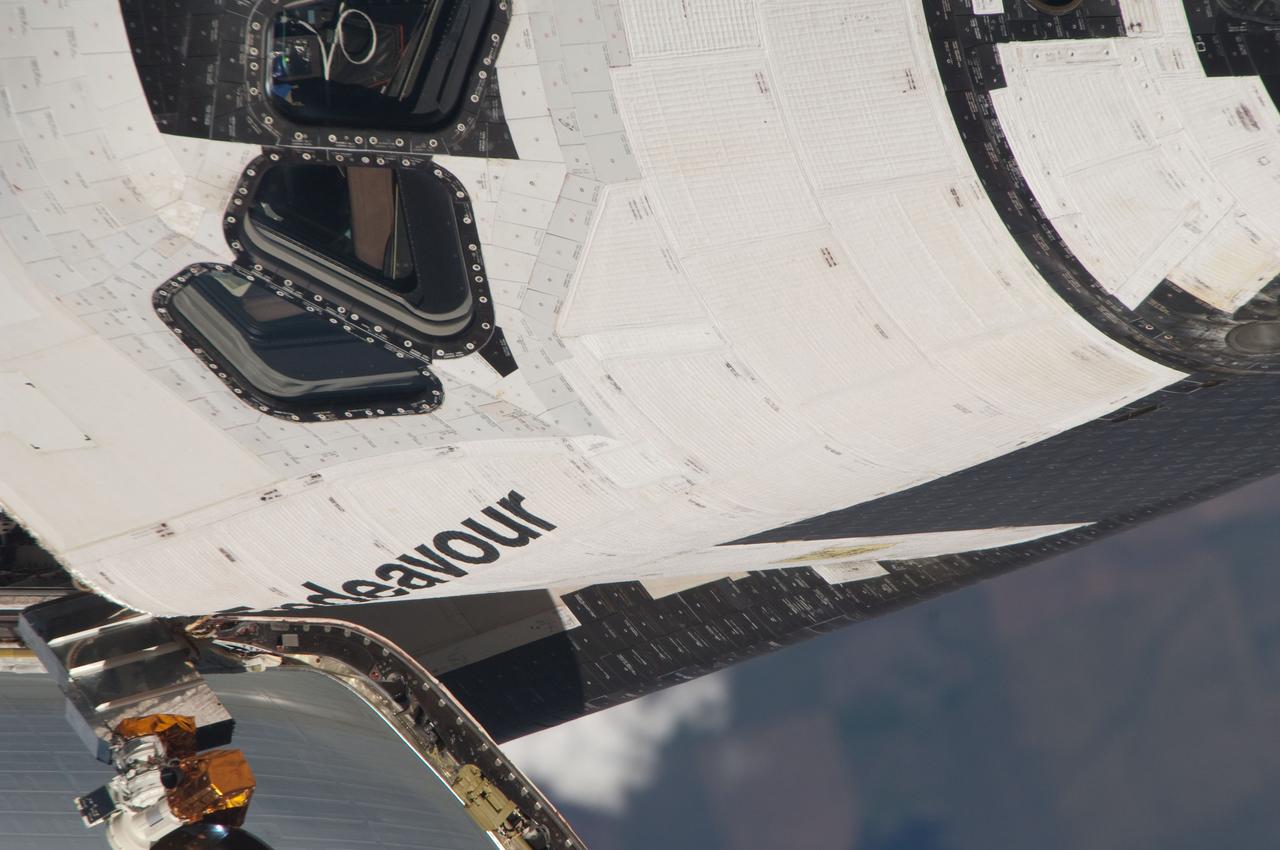
ISS027-E-032126 (18 May 2011) --- This close-up view of the starboard side of space shuttle Endeavour’s crew cabin was provided by an Expedition 27 crew member during a survey of the approaching STS-134 vehicle prior to docking with the International Space Station. As part of the survey and part of every mission's activities, Endeavour performed a back-flip for the rendezvous pitch maneuver (RPM). The station crew member used a digital still camera with an 800mm focal length, as the two spacecraft were approximately 600 feet (180 meters) apart.
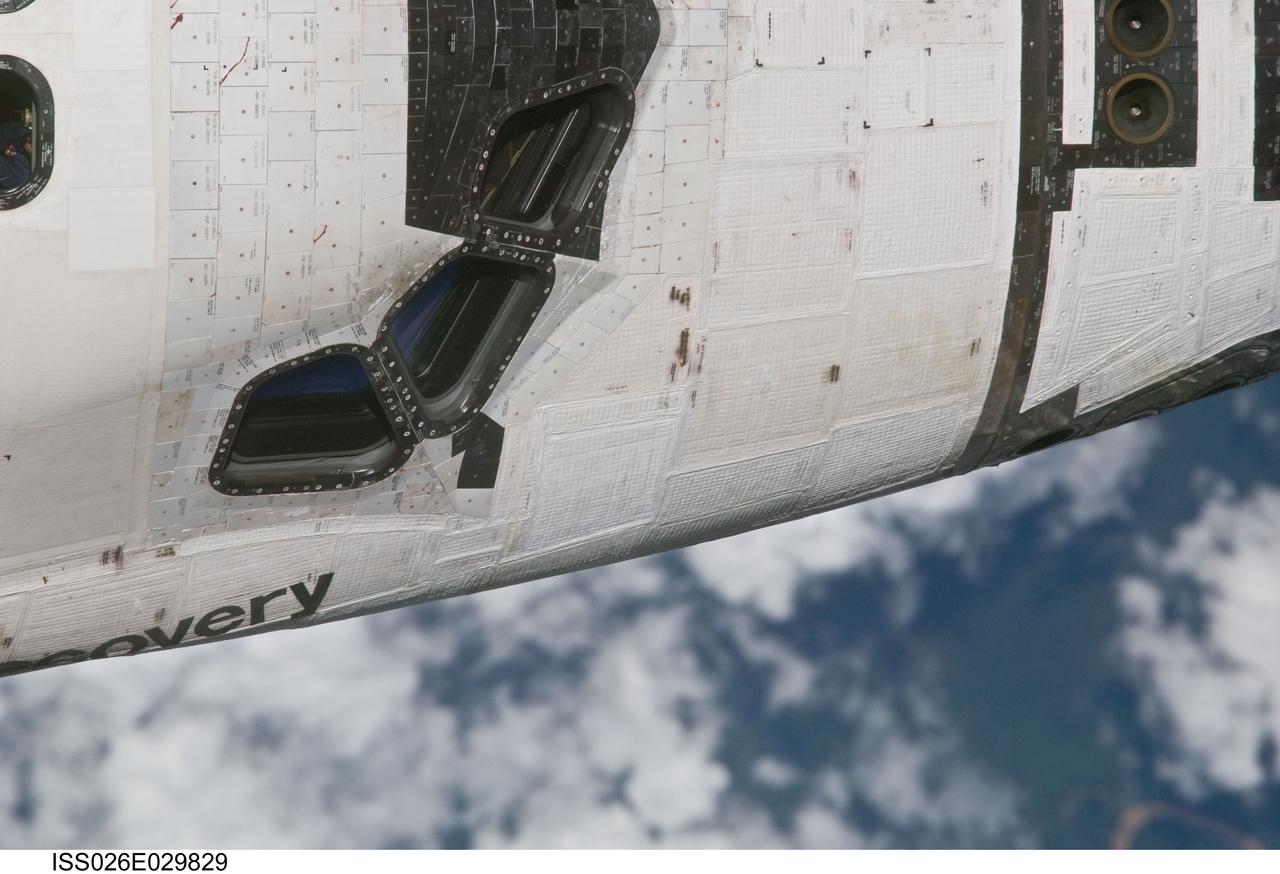
ISS026-E-029829 (26 Feb. 2011) --- This close-up view of the starboard side of the crew cabin of space shuttle Discovery was provided by an Expedition 26 crew member during a survey of the approaching STS-133 vehicle prior to docking with the International Space Station. As part of the survey and part of every mission's activities, Discovery performed a back-flip for the rendezvous pitch maneuver (RPM). The station crew member used a digital still camera with an 800mm focal length, as the two spacecraft were approximately 600 feet (180 meters) apart.
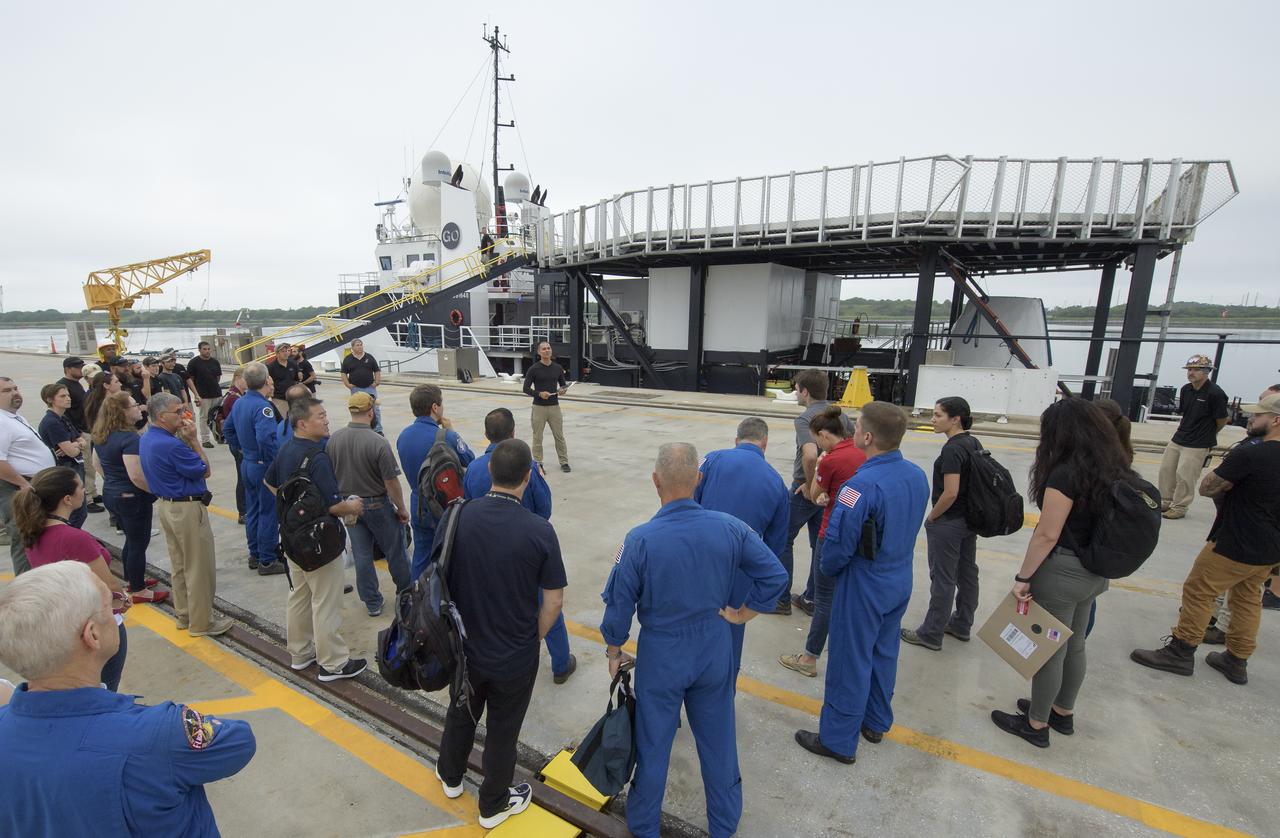
Teams from NASA and SpaceX gather at the Trident Basin in Cape Canaveral, Florida, on August 13, 2019 to rehearse extracting astronauts from SpaceX’s Crew Dragon, which will be used to carry humans to the International Space Station. Using the Go Searcher ship SpaceX uses to recover their spacecraft after splashdown and a mock-up of the Crew Dragon, the teams worked through the steps necessary to get NASA astronauts Doug Hurley and Bob Behnken out of the Dragon and back to dry land. Hurley and Behnken will fly to the space station aboard the Crew Dragon for the SpaceX Demo-2 mission. Photo Credit: (NASA/Bill Ingalls)
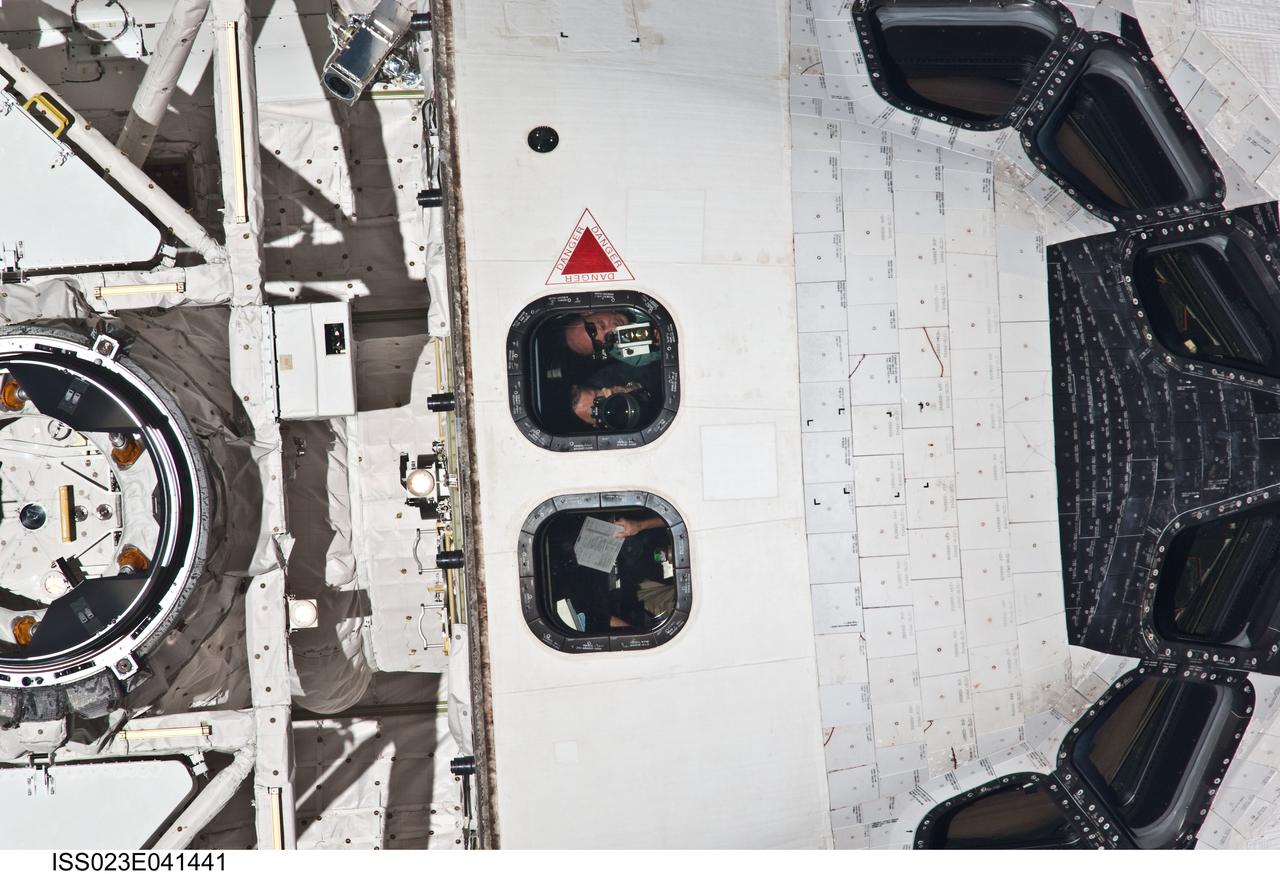
ISS023-E-041441 (16 May 2010) --- This close-up view of the crew cabin and forward portion of the payload bay of space shuttle Atlantis was provided by an Expedition 23 crew member during a survey of the approaching STS-132 vehicle prior to docking with the International Space Station. As part of the survey and part of every mission's activities, Atlantis performed a back-flip for the rendezvous pitch maneuver (RPM). The station crew member used a digital still camera with an 800mm focal length, as the two spacecraft were approximately 600 feet (180 meters) apart.
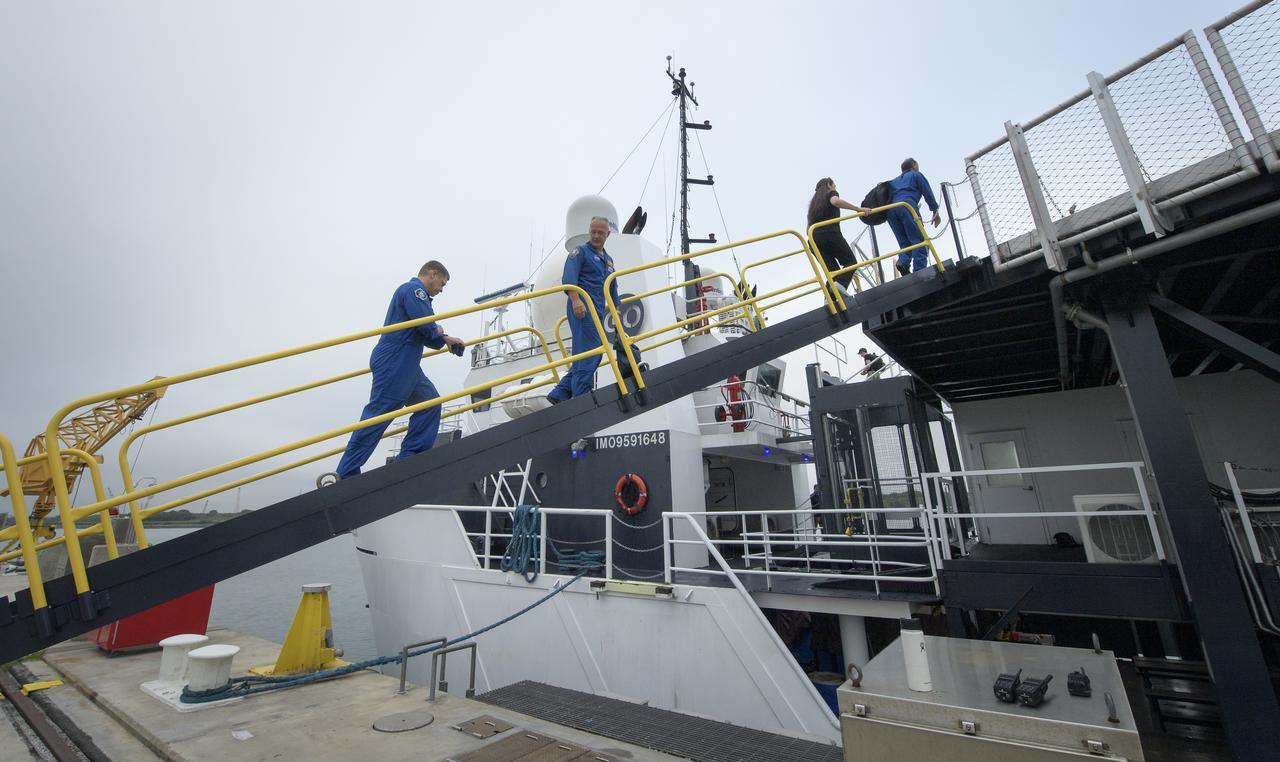
NASA astronauts Bob Behnken, left, and Doug Hurley board the SpaceX GO Searcher ship at the Trident Basin in Cape Canaveral, Florida, on August 13, 2019 to rehearse extracting astronauts from SpaceX’s Crew Dragon, which will be used to carry humans to the International Space Station. Using the Go Searcher ship SpaceX uses to recover their spacecraft after splashdown and a mock-up of the Crew Dragon, the teams worked through the steps necessary to get NASA astronauts Doug Hurley and Bob Behnken out of the Dragon and back to dry land. Hurley and Behnken will fly to the space station aboard the Crew Dragon for the SpaceX Demo-2 mission. Photo Credit: (NASA/Bill Ingalls)
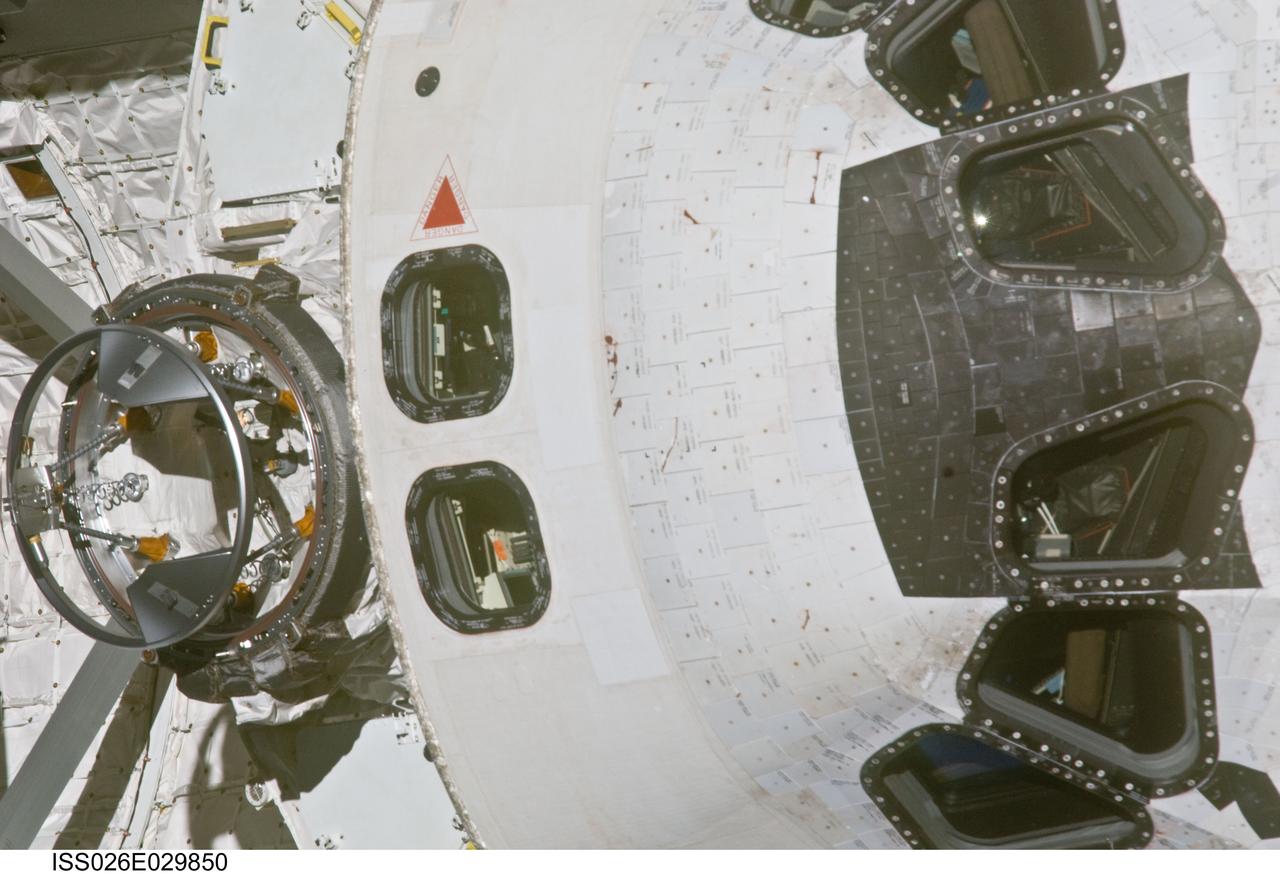
ISS026-E-029850 (26 Feb. 2011) --- This close-up view of the crew cabin and forward cargo bay of space shuttle Discovery was provided by an Expedition 26 crew member during a survey of the approaching STS-133 vehicle prior to docking with the International Space Station. As part of the survey and part of every mission's activities, Discovery performed a back-flip for the rendezvous pitch maneuver (RPM). The station crew member used a digital still camera with an 800mm focal length, as the two spacecraft were approximately 600 feet (180 meters) apart.
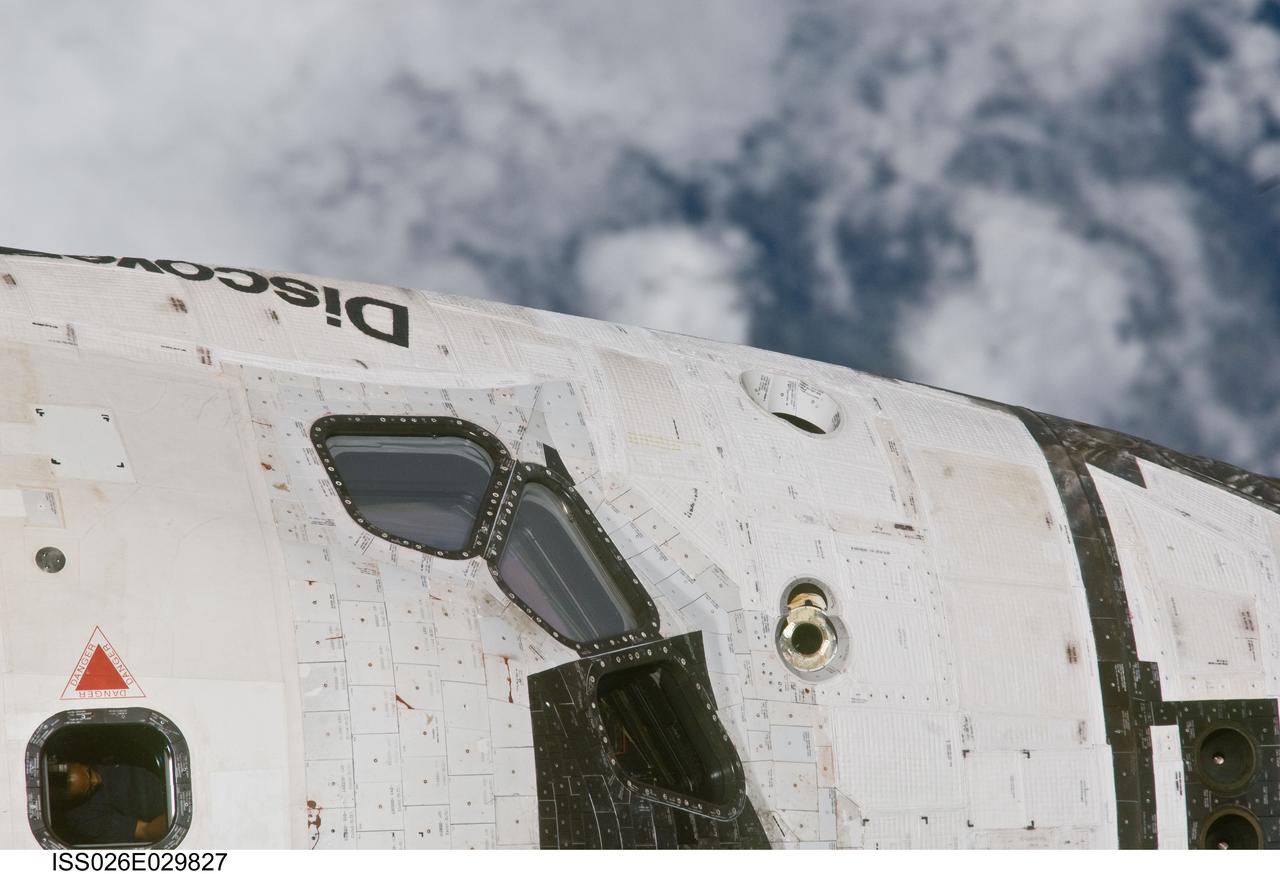
ISS026-E-029827 (26 Feb. 2011) --- This close-up view of the port side of the crew cabin of space shuttle Discovery was provided by an Expedition 26 crew member during a survey of the approaching STS-133 vehicle prior to docking with the International Space Station. As part of the survey and part of every mission's activities, Discovery performed a back-flip for the rendezvous pitch maneuver (RPM). The station crew member used a digital still camera with an 800mm focal length, as the two spacecraft were approximately 600 feet (180 meters) apart.
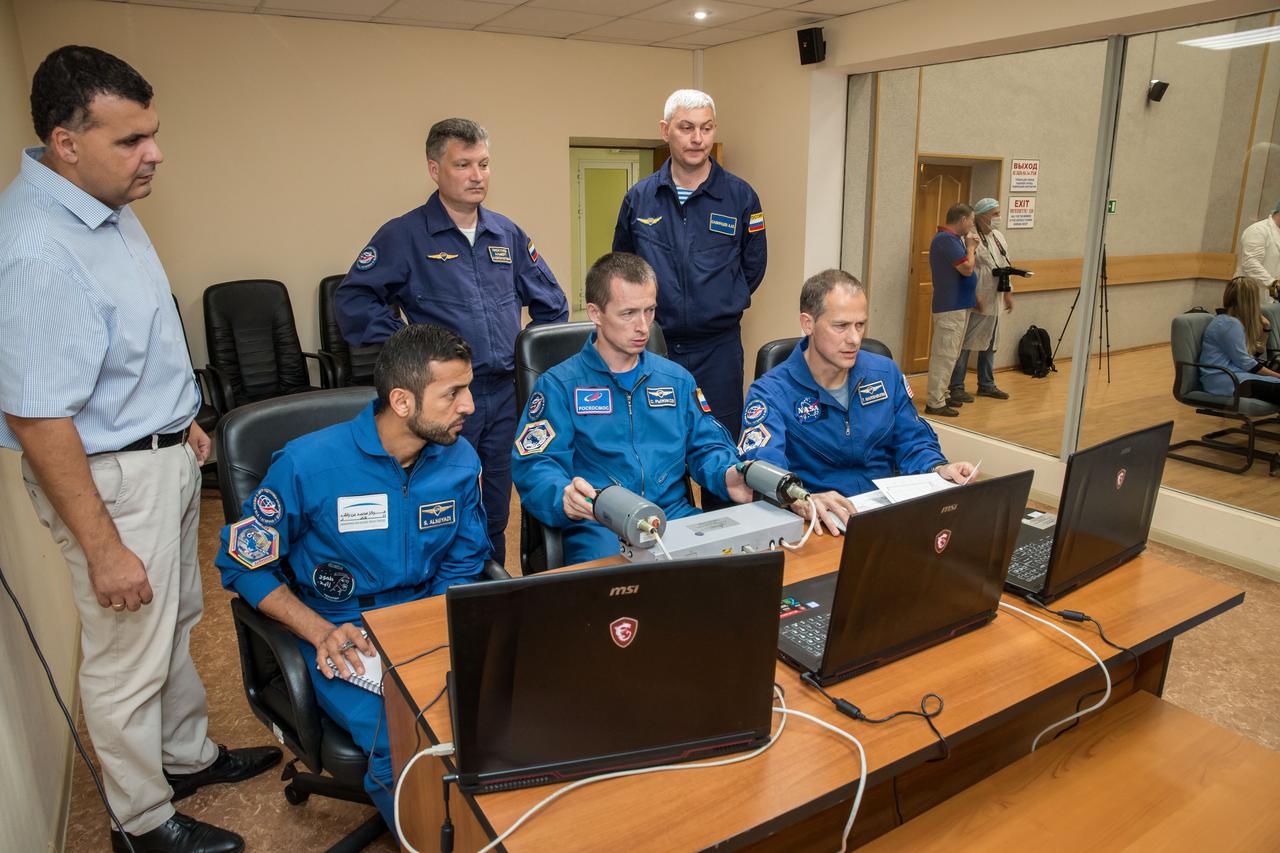
jsc2019e053718 - At the Cosmonaut Hotel crew quarters in Baikonur, Kazakhstan, the backups to the next crew to launch to the International Space Station practices rendezvous techniques Sept. 18 as part of pre-launch training. Backup spaceflight participant Sultan Al-Neyadi of the United Arab Emirates (left) and crewmates Sergey Ryzhikov of Roscosmos (center) and Tom Marshburn of NASA (right) will back up the prime crew, spaceflight participant Hazzaa ali Almansoori of the United Arab Emirates, Oleg Skripochka of Roscosmos and Jessica Meir of NASA, who are set to launch Sept. 25 from the Baikonur Cosmodrome in Kazakhstan on the Soyuz MS-15 spacecraft for a mission on the International Space Station...NASA/Victor Zelentsov
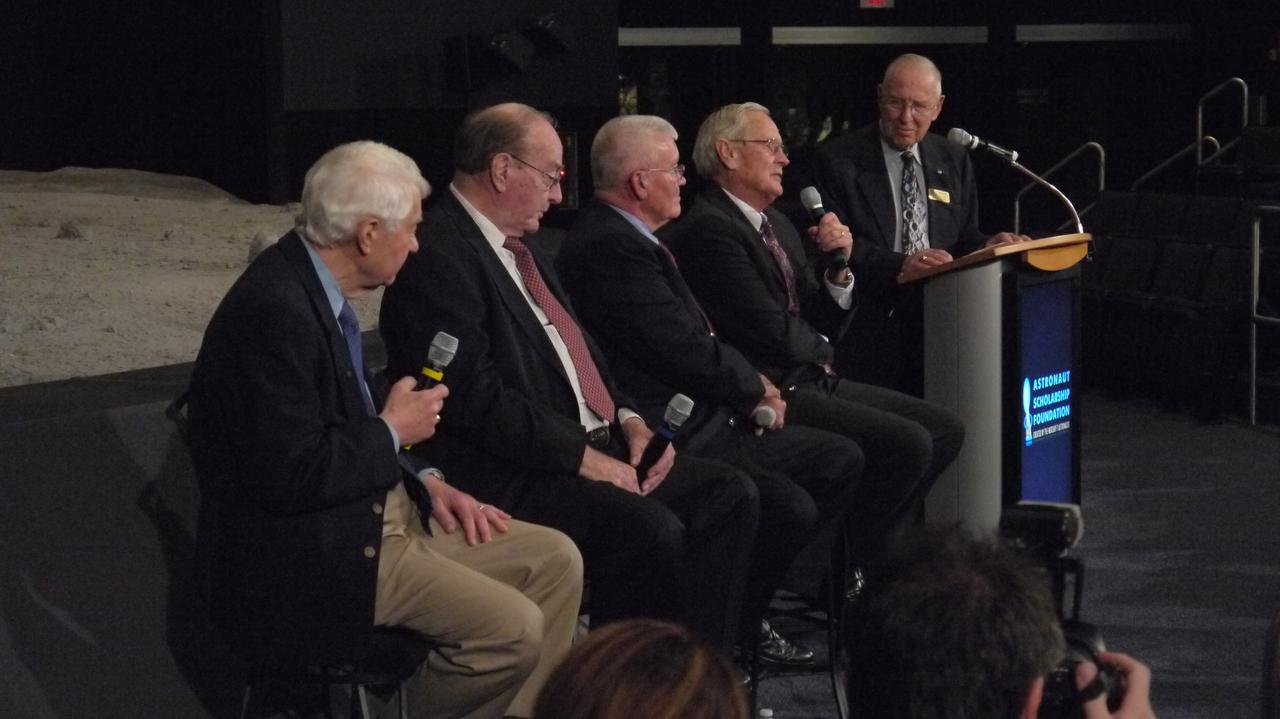
CAPE CANAVERAL, Fla. -- The Astronaut Scholarship Foundation helps celebrate the 40th anniversary of Apollo 16's lunar landing, which occurred April 20, 1972, with a soiree at the Kennedy Space Center Visitor Complex's Saturn V Center. Panel members who addressed the audience are, from left, astronaut support crew member for Apollo 16 Hank Hartsfield, Apollo 14 Lunar Module Pilot and Apollo 16 back-up crew member Edgar Mitchell, Apollo 13 Lunar Module Pilot and Apollo 16 back-up crew member Fred Haise, Apollo 16 Lunar Module Pilot Charlie Duke, and Apollo 8 Command Module Pilot and Apollo 13 Commander Jim Lovell. The 11-day Apollo 16 mission featured three moonwalks, including a nearly 17-mile lunar rover road trip to collect more than 200 pounds of moon rocks to return to Earth. Photo credit: NASA/Chris Chamberland

CAPE CANAVERAL, Fla. -- The Astronaut Scholarship Foundation helps celebrate the 40th anniversary of Apollo 16's lunar landing, which occurred April 20, 1972, with a soiree at the Kennedy Space Center Visitor Complex's Saturn V Center. Panel members who addressed the audience are, from left, astronaut support crew member for Apollo 16 Hank Hartsfield, Apollo 14 Lunar Module Pilot and Apollo 16 back-up crew member Edgar Mitchell, Apollo 13 Lunar Module Pilot and Apollo 16 back-up crew member Fred Haise, Apollo 16 Lunar Module Pilot Charlie Duke, and Apollo 8 Command Module Pilot and Apollo 13 Commander Jim Lovell. The 11-day Apollo 16 mission featured three moonwalks, including a nearly 17-mile lunar rover road trip to collect more than 200 pounds of moon rocks to return to Earth. Photo credit: NASA/Chris Chamberland
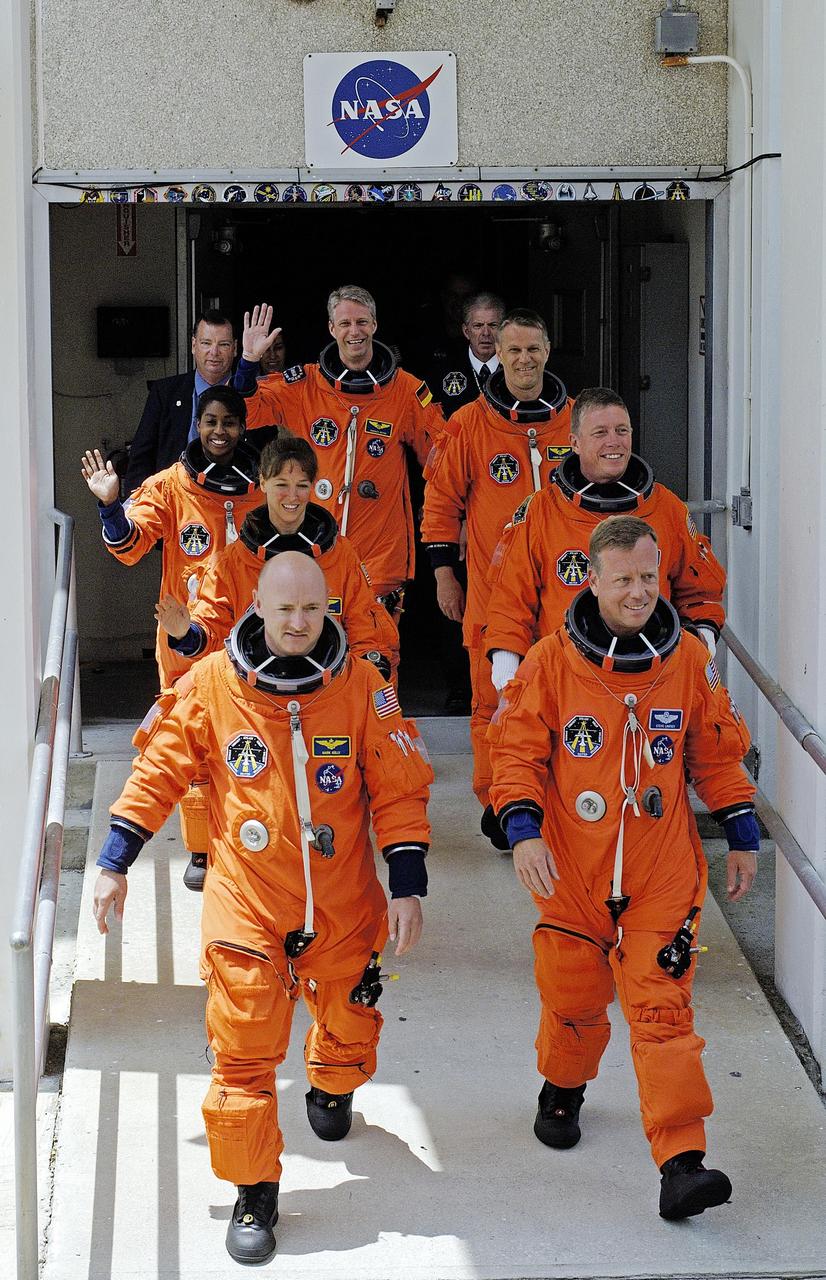
KENNEDY SPACE CENTER, FLA. - The STS-121 crew strides out of the Operations and Checkout Building after suiting up for launch today on Space Shuttle Discovery. On the left column from back to front are Mission Specialists Thomas Reiter, Stephanie Wilson and Lisa Nowak, and Pilot Mark Kelly. On the right column from back to front are Mission Specialists Piers Sellers and Michael Fossum, with Commander Steven Lindsey leading the way. The launch is the 115th shuttle flight and the 18th U.S. flight to the International Space Station. During the 12-day mission, the STS-121 crew will test new equipment and procedures to improve shuttle safety, as well as deliver supplies and make repairs to the International Space Station. Photo courtesy of Nikon/Scott Andrews
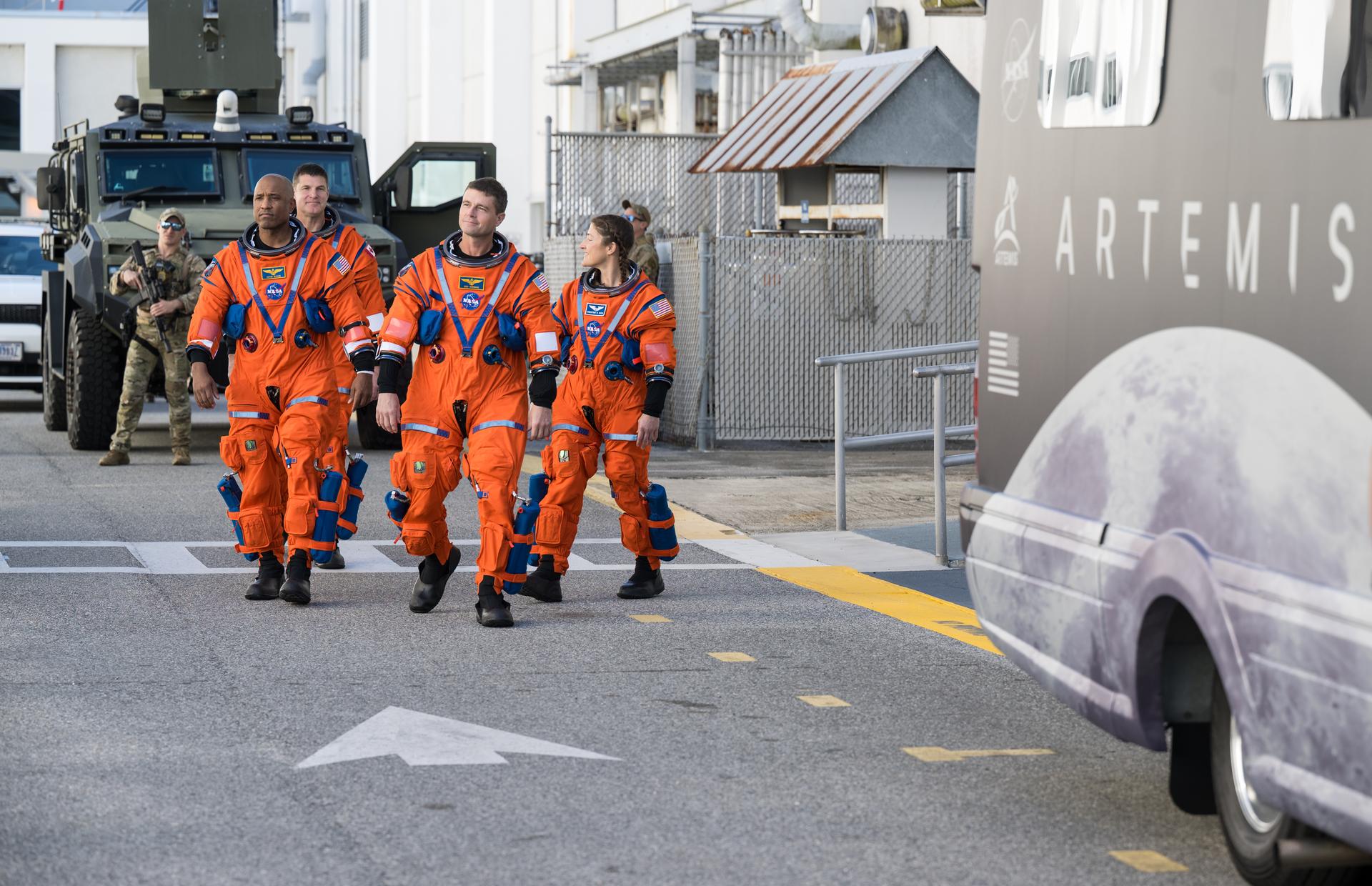
NASA astronauts Victor Glover, pilot, front left; Reid Wiseman, commander, front right; Christina Koch, mission specialist, back right; and CSA (Canadian Space Agency) astronaut Jeremy Hansen, mission specialist, back left, are seen as they depart the Neil A. Armstrong Operations and Checkout Building to board their Orion spacecraft atop NASA’s Space Launch System rocket inside the Vehicle Assembly Building as part of the Artemis II countdown demonstration test, Saturday, Dec. 20, 2025, at NASA’s Kennedy Space Center in Florida. For this operation, the Artemis II crew and launch teams are simulating the launch day timeline including suit-up, walkout, and spacecraft ingress and egress. Through the Artemis campaign, NASA will send astronauts to explore the Moon for scientific discovery, economic benefits, and to build the foundation for the first crewed missions to Mars, for the benefit of all. Photo Credit: (NASA/Aubrey Gemignani)
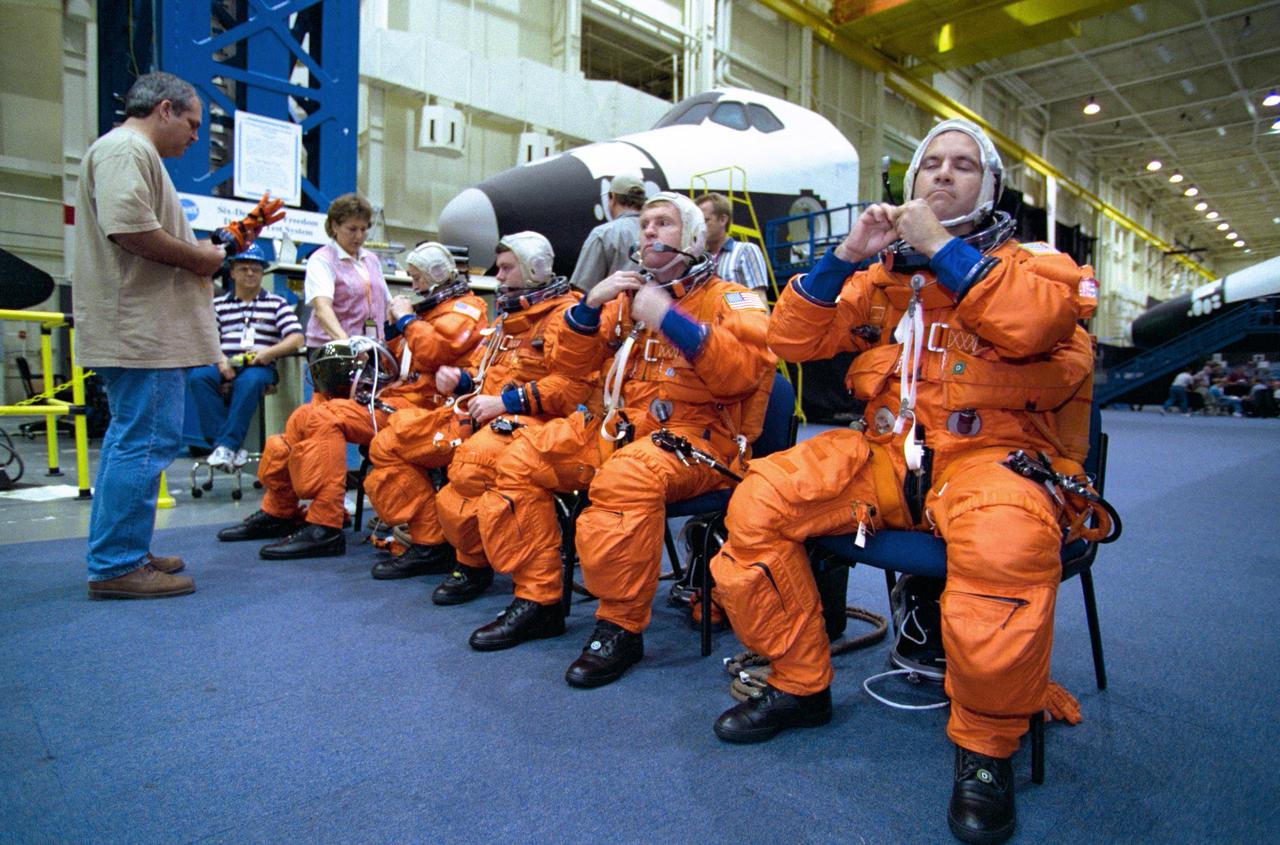
JSC2000-05551 (3 August 2000) --- Four astronauts, who comprise the core crew for STS-102, listen to a launch and entry garment briefing by suit technician Lloyd Armintor in the Systems Integration Facility as they suit up for a contingency simulation exercise in preparation for next year's visit to the International Space Station (ISS). From the left are astronauts James D. Wetherbee, commander; James M. Kelly, pilot; and Andrew S.W. Thomas and Paul W. Richards, both mission specialists. The four will be joined by a cosmonaut and two other astronauts scheduled to share the "up" ride for a lengthy stay aboard the orbiting outpost. Then, they will bring back a threesome made up an astronaut and two cosmonauts who will have been onboard the station since early November 2000.
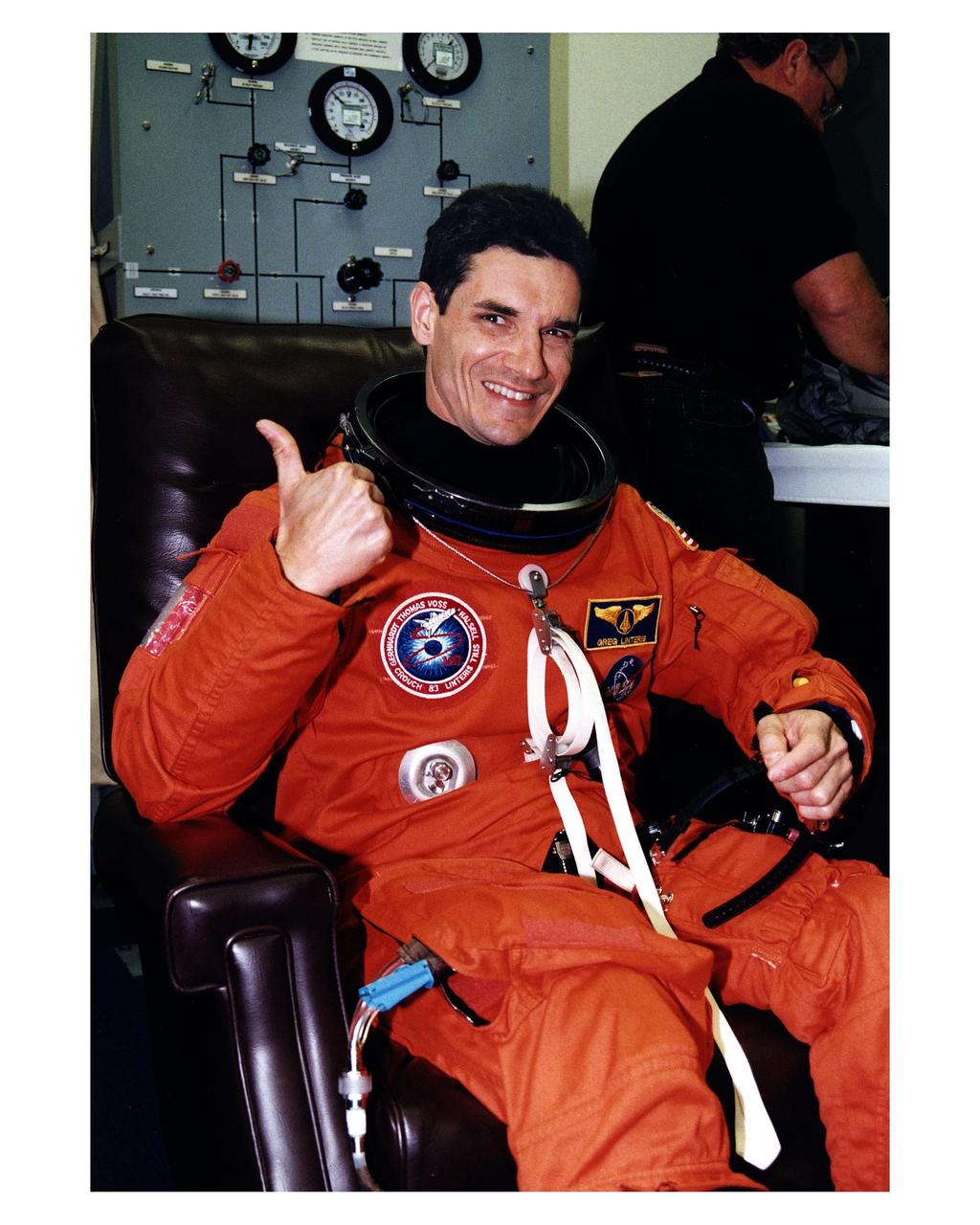
STS-83 Payload Specialist Gregory T. Linteris gives a thumbs-up as he is assisted into his launch/entry suit in the Operations and Checkout (O&C) Building. He holds a doctorate in mechanical and aerospace engineering. Linteris has worked at the National Institute of Standards and Technology and is the Principal Investigator on a NASA microgravity combustion experiments. As a member of the Red team, Linteris will concentrate on three combustion experiments. Two of these experiments are housed in the Combustion Module. He will also be backing up crew members on the other Microgravity Science Laboratory-1 (MSL-1) investigations. He and six fellow crew members will shortly depart the O&C and head for Launch Pad 39A, where the Space Shuttle Columbia will lift off during a launch window that opens at 2:00 p.m. EST, April 4
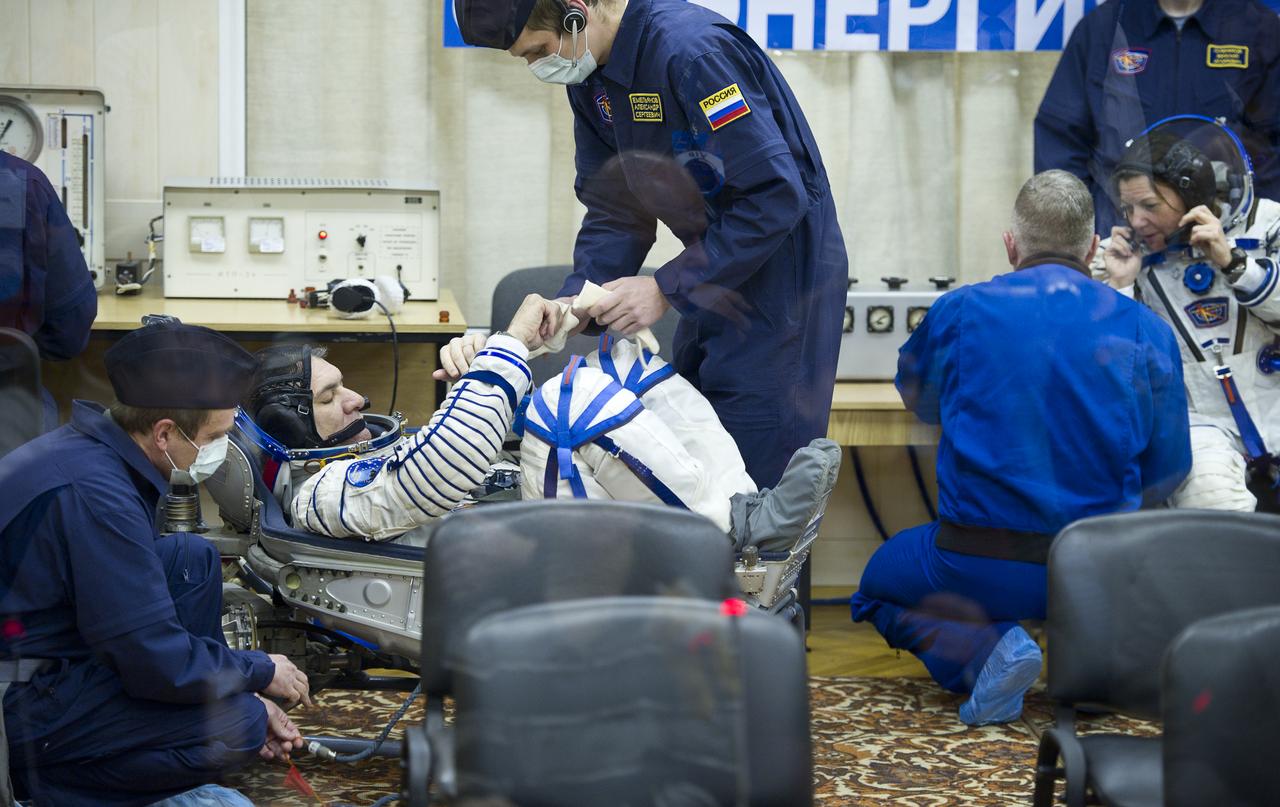
Expedition 26 European Space Agency astronaut Paolo Nespoli has his Russian Sokol suit pressure checked, while Expedition 26 Flight Engineer Catherine Coleman, far right, speaks with back up crew member Mike Fossum at the Baikonur Cosmodrome in Baikonur, Kazakhstan, Wednesday, Dec. 15, 2010. Nespoli and fellow Expedition 26 crew members Soyuz Commander Dmitry Kondratryev and NASA Flight Engineer Catherine Coleman launched in their Soyuz TMA-20 rocket from the Baikonur Cosmodrome in Kazakhstan the following morning at 1:09 a.m. local time. (Photo Credit: NASA/Carla Cioffi)
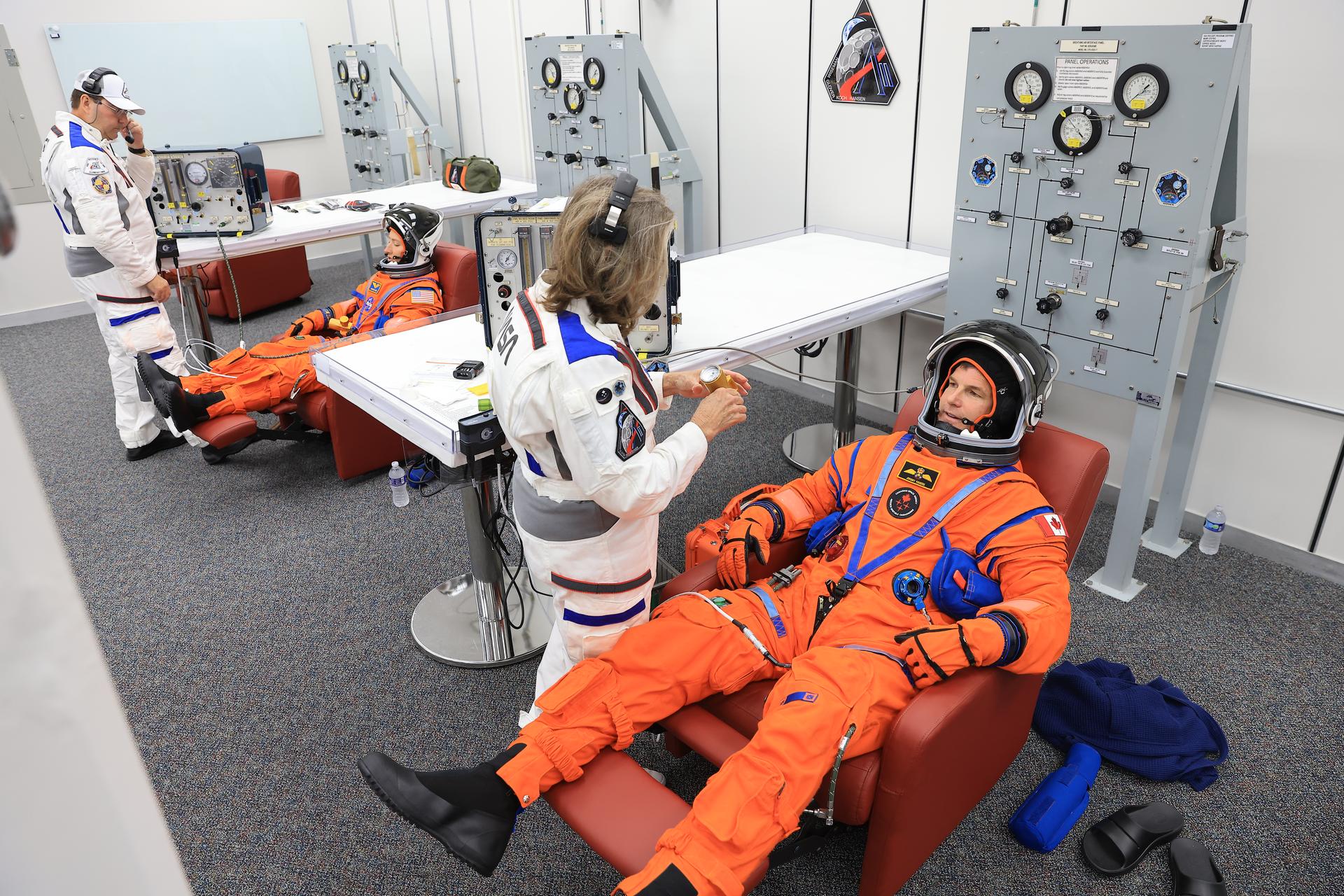
From left, Artemis II Mission Specialist Christina Koch, and Mission Specialist Jeremy Hansen from the CSA (Canadian Space Agency) complete leak checks on their spacesuits inside the crew suit-up room in the Neil A. Armstrong Operations and Checkout Building at the agency’s Kennedy Space Center in Florida on Wednesday, April 1, 2026, ahead of the Artemis II test flight. The mission will take the crew on a 10-day journey around the Moon and back aboard NASA’s SLS (Space Launch System) rocket and Orion spacecraft with a two hour launch window opening at 6:24 p.m. EDT from Launch Complex 39B at NASA Kennedy.
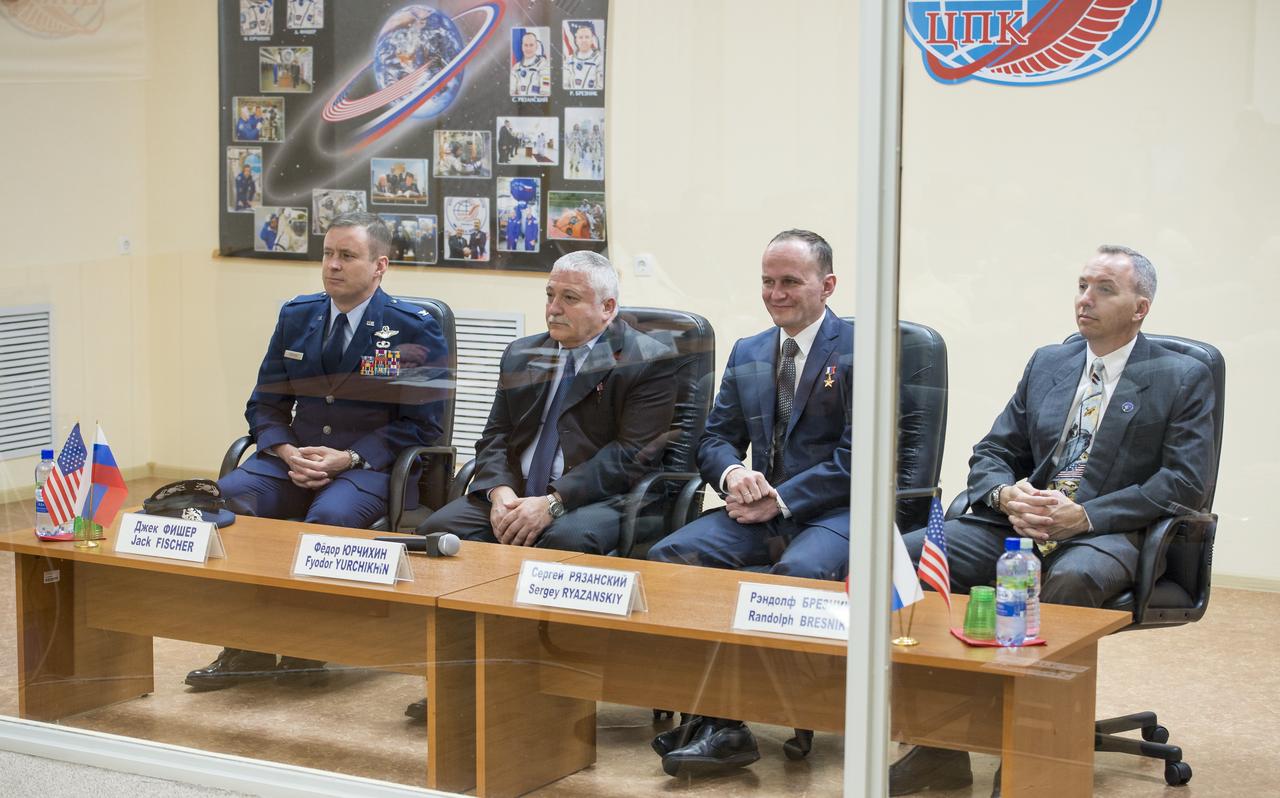
Expedition 51 prime crew members, Flight Engineer Jack Fischer of NASA, left, and Soyuz Commander Fyodor Yurchikhin of Roscosmos, second left, are seen with Expedition 51 back up crew members, Soyuz Commander Sergey Ryazanskiy of Roscosmos, second from right, and Flight Engineer Randy Bresnik of NASA, right at the State Commission meeting to approve the Soyuz launch of Expedition 51 to the International Space Station in Baikonur, Kazakhstan on Wednesday, April 19, 2017. The mission is set to launch April 20 from the Baikonur Cosmodrome. Photo Credit: (NASA/Aubrey Gemignani)
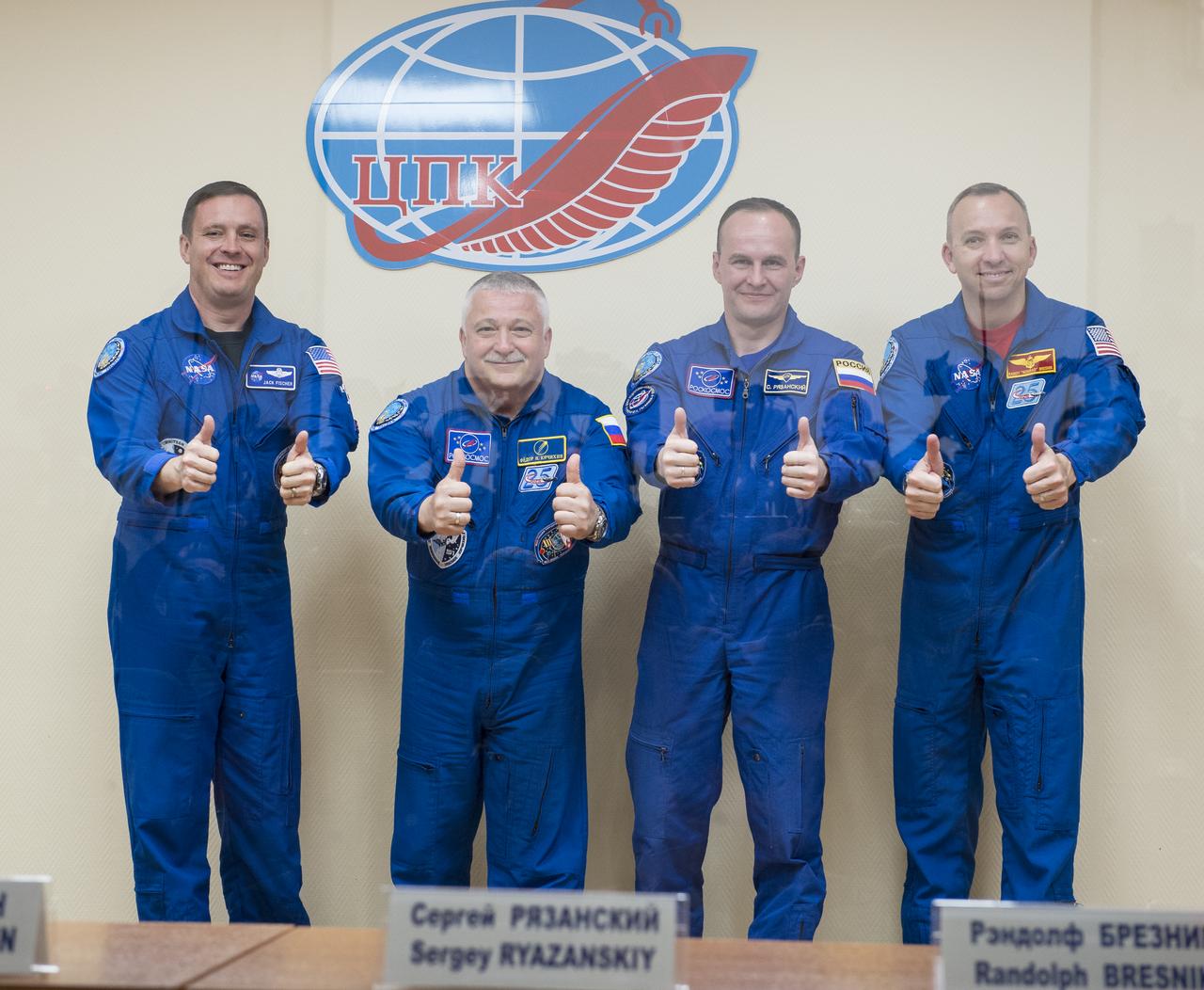
Expedition 51 prime crew members, Flight Engineer Jack Fischer of NASA, left, and Soyuz Commander Fyodor Yurchikhin of Roscosmos, second from left, pose for a photo with Expedition 51 back up crew members, Soyuz Commander Sergey Ryazanskiy of Roscosmos, second from right, and Flight Engineer Randy Bresnik of NASA, right, at the conclusion of the press conference held at the Cosmonaut Hotel in Baikonur, Kazakhstan on Wednesday, April 19, 2017. The mission is set to launch April 20 from the Baikonur Cosmodrome. Photo Credit: (NASA/Aubrey Gemignani)
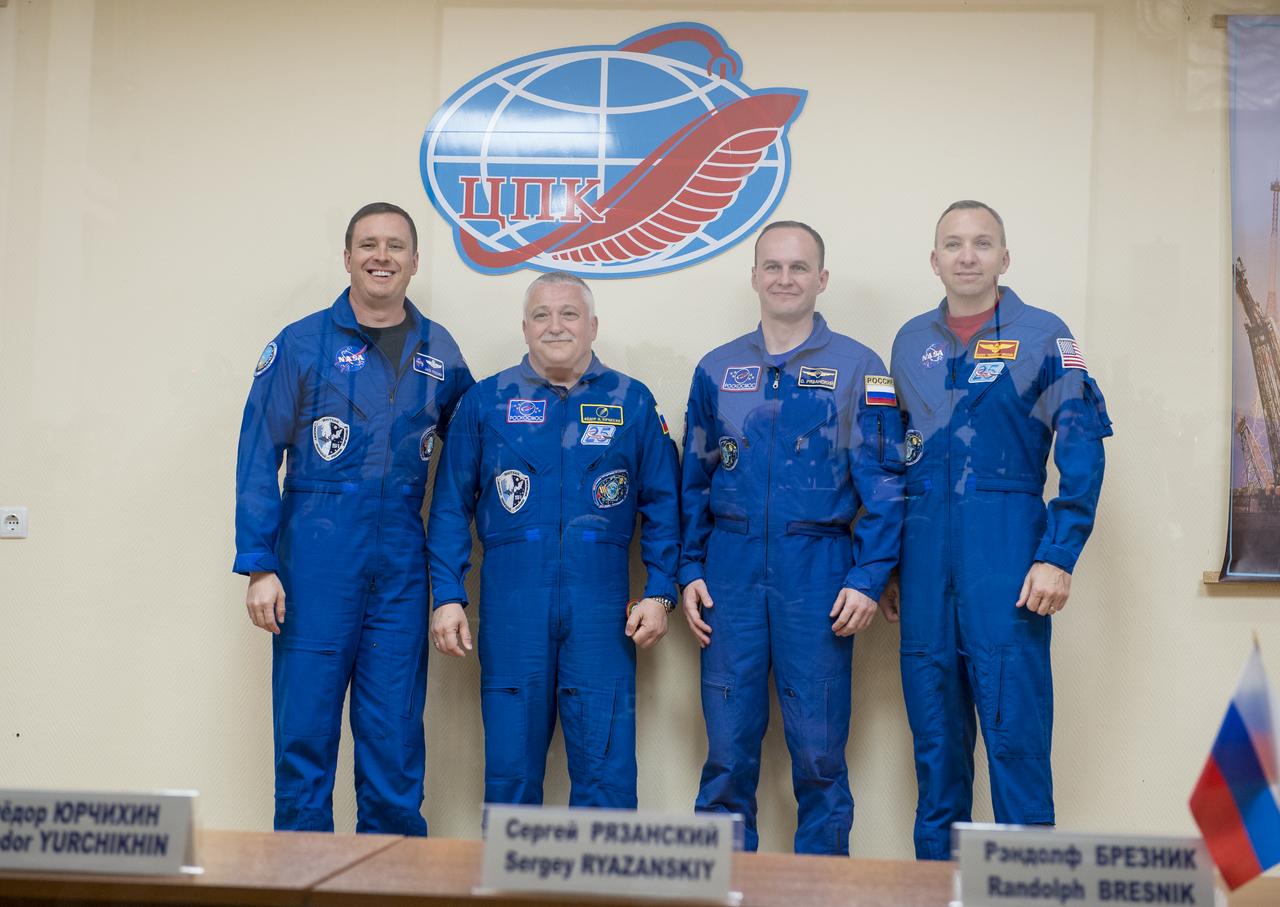
Expedition 51 prime crew members, Flight Engineer Jack Fischer of NASA, left, and Soyuz Commander Fyodor Yurchikhin of Roscosmos, second from left, pose for a photo with Expedition 51 back up crew members, Soyuz Commander Sergey Ryazanskiy of Roscosmos, second from right, and Flight Engineer Randy Bresnik of NASA, right, at the conclusion of the press conference held at the Cosmonaut Hotel in Baikonur, Kazakhstan on Wednesday, April 19, 2017. The mission is set to launch April 20 from the Baikonur Cosmodrome. Photo Credit: (NASA/Aubrey Gemignani)
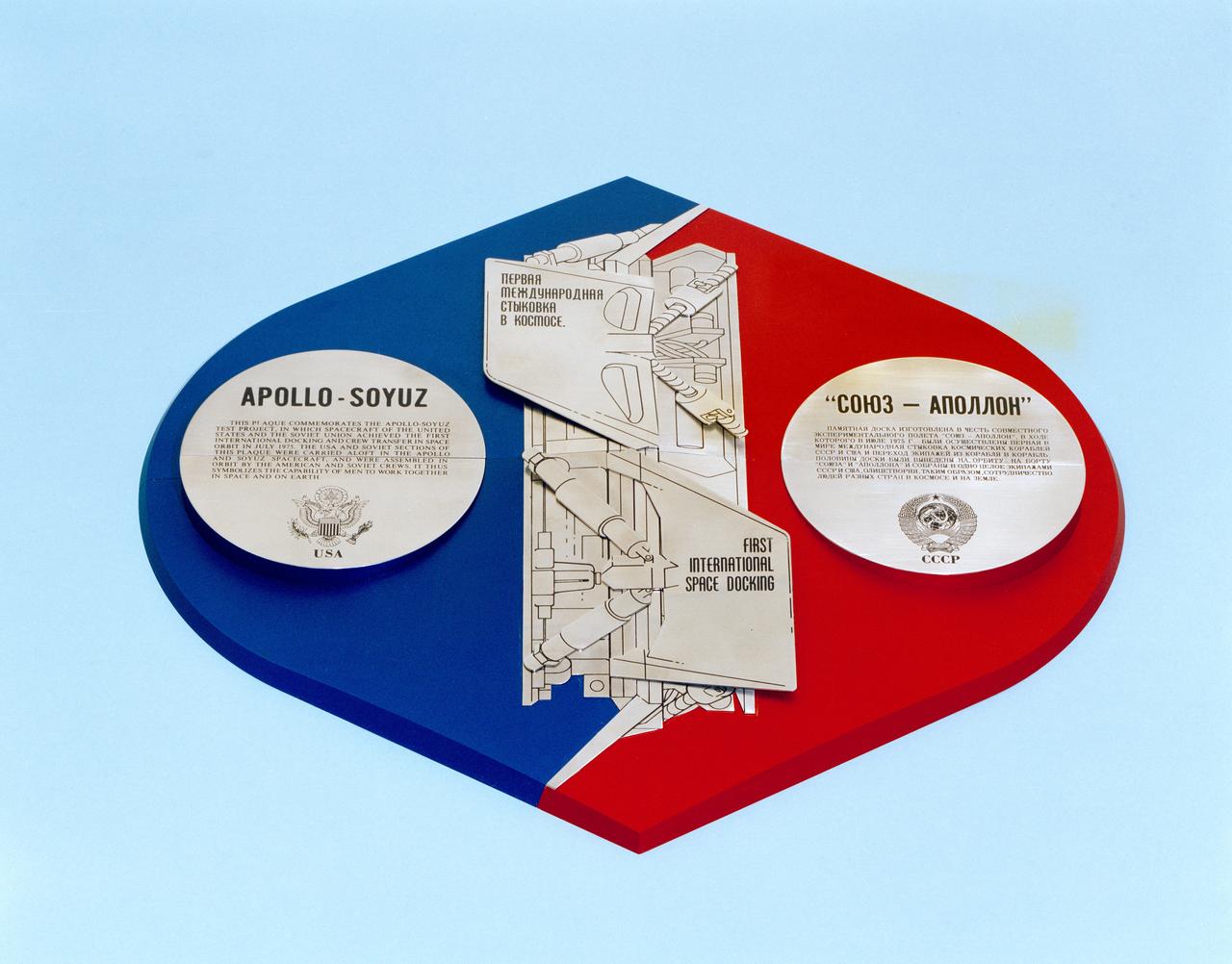
S75-26927 (July 1975) --- A close-up view of the Commemorative Plaque for the Apollo-Soyuz Test Project. Two plaques divided into four quarters each will be flown on the ASTP mission. A four-part plaque is completely assembled here. The American ASTP crew will carry the four U.S. quarter pieces aboard Apollo; and the Soviet ASTP crew will carry the four USSR quarter sections aboard Soyuz. The eight quarter pieces will be joined together to form two complete commemorative plaques after the two spacecraft rendezvous and dock in Earth orbit. One complete plaque then will be returned to Earth by the astronauts; and the other complete plaque will be brought back by the cosmonauts. The plaque is written in both English and Russian.