
S81-26158 (Feb 1981) --- A close-up view of a training version of a STS-40/SLS-1 blood kit. Blood samples from crewmembers are critical to a number of Space Life Sciences-1 (SLS-1) investigations. One day's collection equipment, color coded for each crewmember, is neatly organized in the kit.
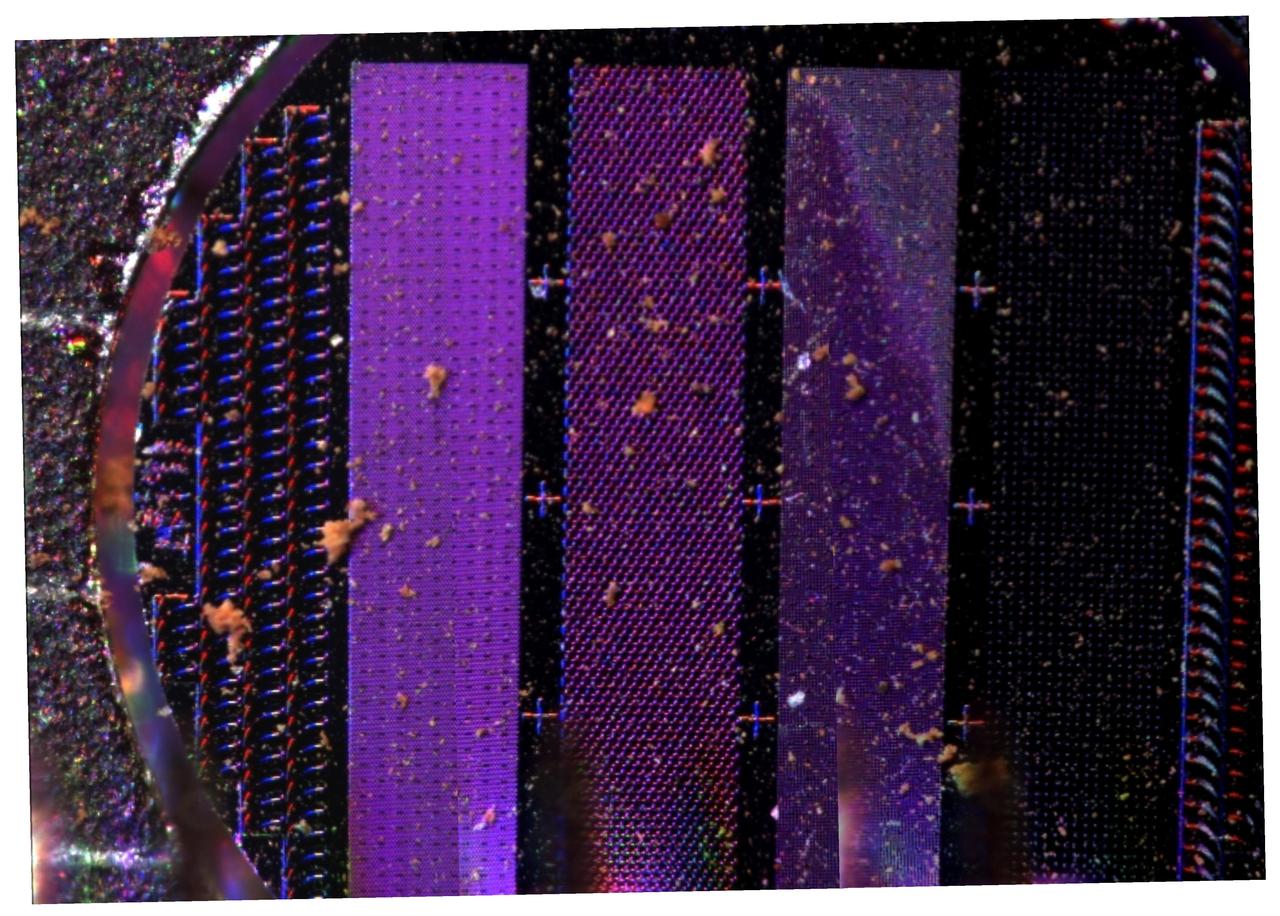
Martian Dust Collected by Phoenix Arm
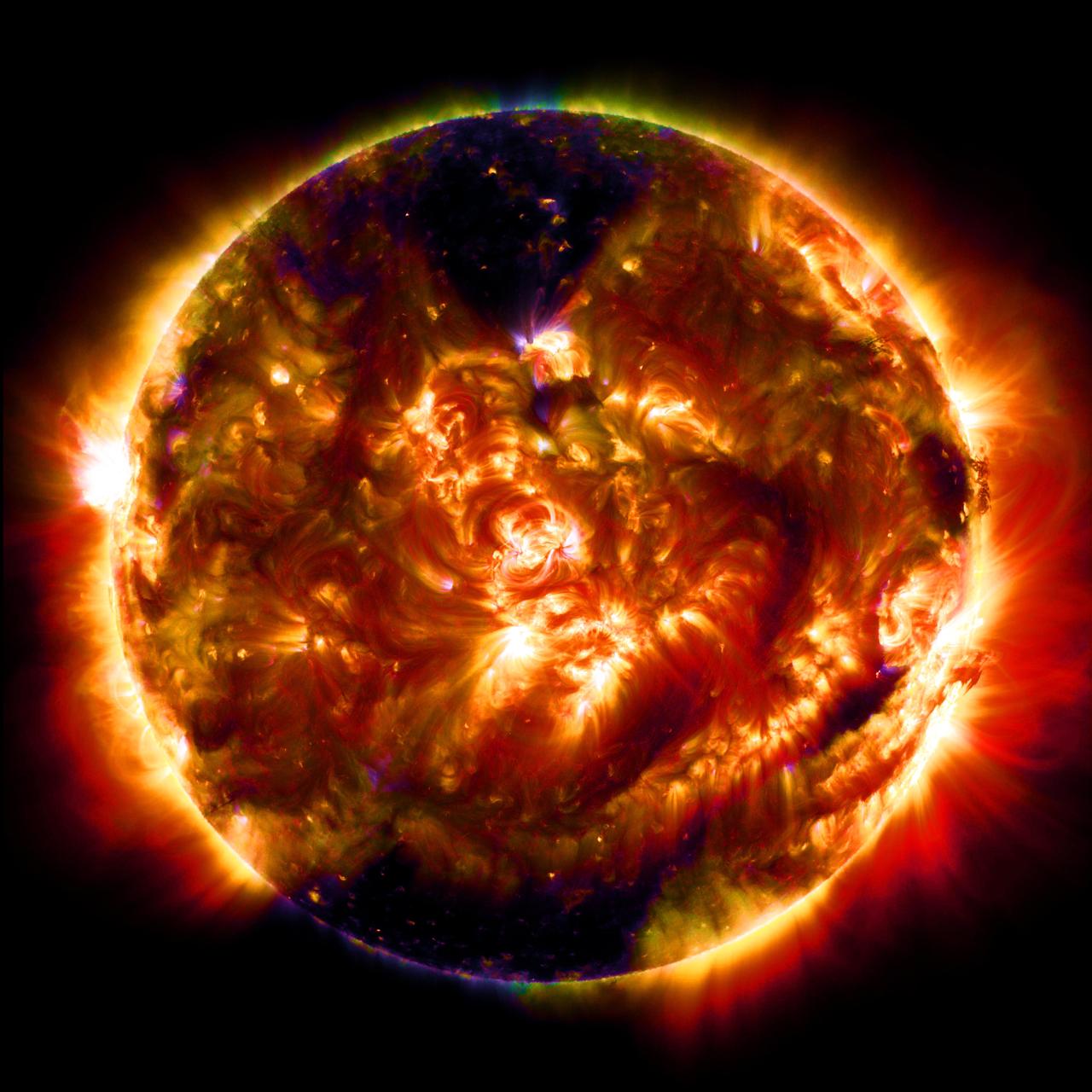
An instrument on our Solar Dynamics Observatory (SDO) captured its 100 millionth image of the sun. The instrument is the Atmospheric Imaging Assembly, or AIA, which uses four telescopes working parallel to gather eight images of the sun – cycling through 10 different wavelengths -- every 12 seconds. This is a processed image of SDO multiwavelength blend from Jan. 19, 2015, the date of the spacecraft's 100th millionth image release. Credit: NASA/Goddard/SDO Read more: <a href="http://www.nasa.gov/content/goddard/sdo-telescope-collects-its-100-millionth-image/" rel="nofollow">www.nasa.gov/content/goddard/sdo-telescope-collects-its-1...</a> <b><a href="http://www.nasa.gov/audience/formedia/features/MP_Photo_Guidelines.html" rel="nofollow">NASA image use policy.</a></b> <b><a href="http://www.nasa.gov/centers/goddard/home/index.html" rel="nofollow">NASA Goddard Space Flight Center</a></b> enables NASA’s mission through four scientific endeavors: Earth Science, Heliophysics, Solar System Exploration, and Astrophysics. Goddard plays a leading role in NASA’s accomplishments by contributing compelling scientific knowledge to advance the Agency’s mission. <b>Follow us on <a href="http://twitter.com/NASAGoddardPix" rel="nofollow">Twitter</a></b> <b>Like us on <a href="http://www.facebook.com/pages/Greenbelt-MD/NASA-Goddard/395013845897?ref=tsd" rel="nofollow">Facebook</a></b> <b>Find us on <a href="http://instagram.com/nasagoddard?vm=grid" rel="nofollow">Instagram</a></b>
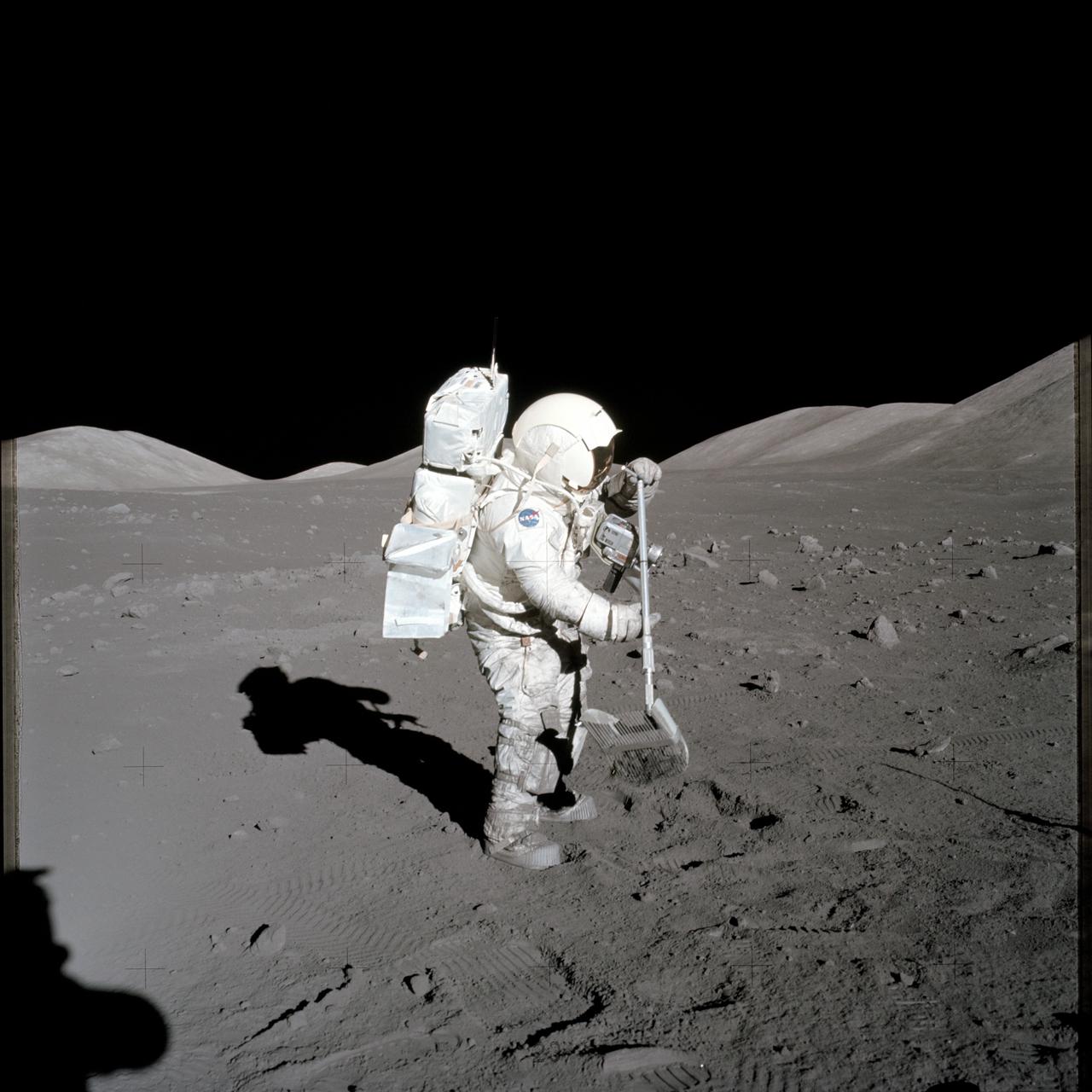
AS17-134-20425 (11 Dec. 1972) --- Scientist-astronaut Harrison H. Schmitt, lunar module pilot, collects lunar rake samples at Station 1 during the first Apollo 17 extravehicular activity (EVA) at the Taurus-Littrow landing site. This picture was taken by astronaut Eugene Cernan, commander. The lunar rake, an Apollo lunar geology hand tool, is used to collect discrete samples of rocks and rock chips ranging in size from one-half inch (1.3 centimeter) to one inch (2.5 centimeter).
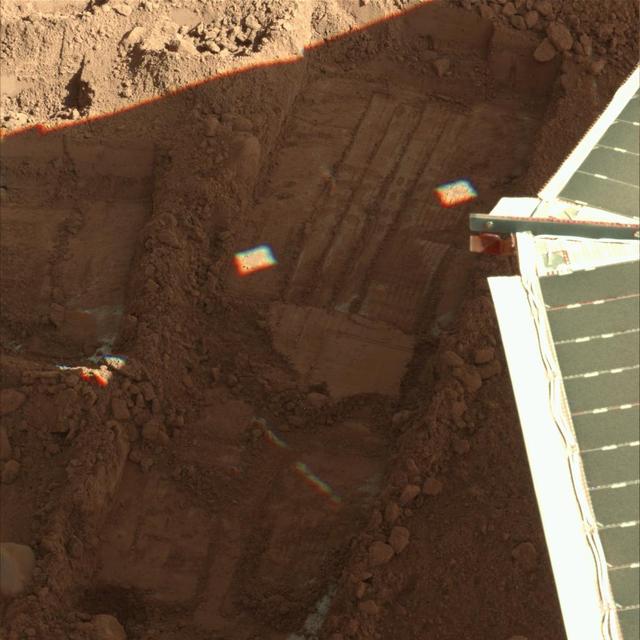
Snow White Trench Prepared for Sample Collection
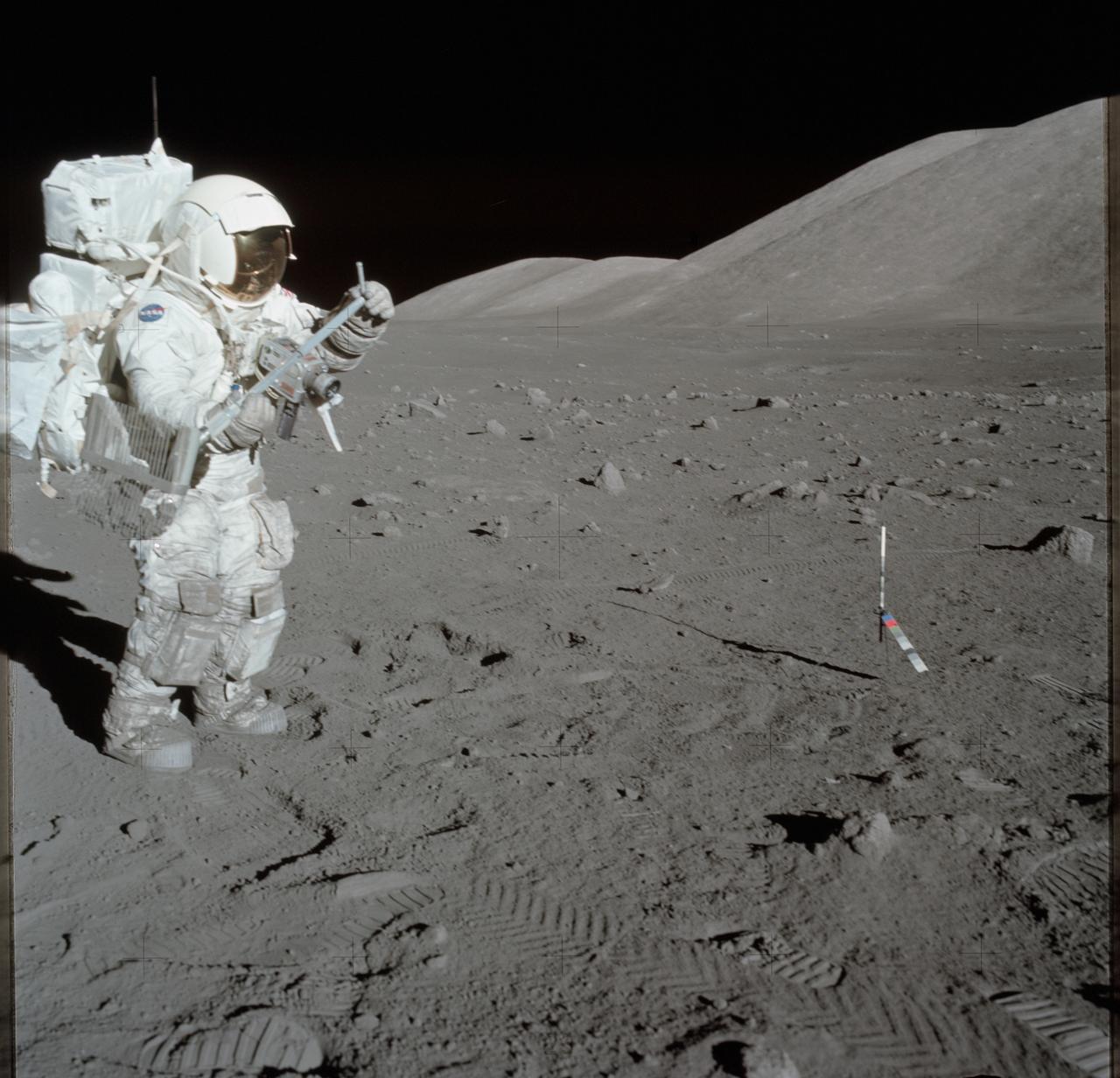
AS17-134-20426 (11 Dec. 1972) --- Scientist-astronaut Harrison H. Schmitt collects lunar rake samples at Station 1 during the first Apollo 17 extravehicular activity (EVA) at the Taurus-Littrow landing site. This picture was taken by astronaut Eugene A. Cernan, Apollo 17 commander. Schmitt is the lunar module pilot. The Lunar Rake, an Apollo Lunar Geology Hand Tool, is used to collect discrete samples of rocks and rock chips ranging in size from one-half inch (1.3 cm) to one inch (2.5 cm).
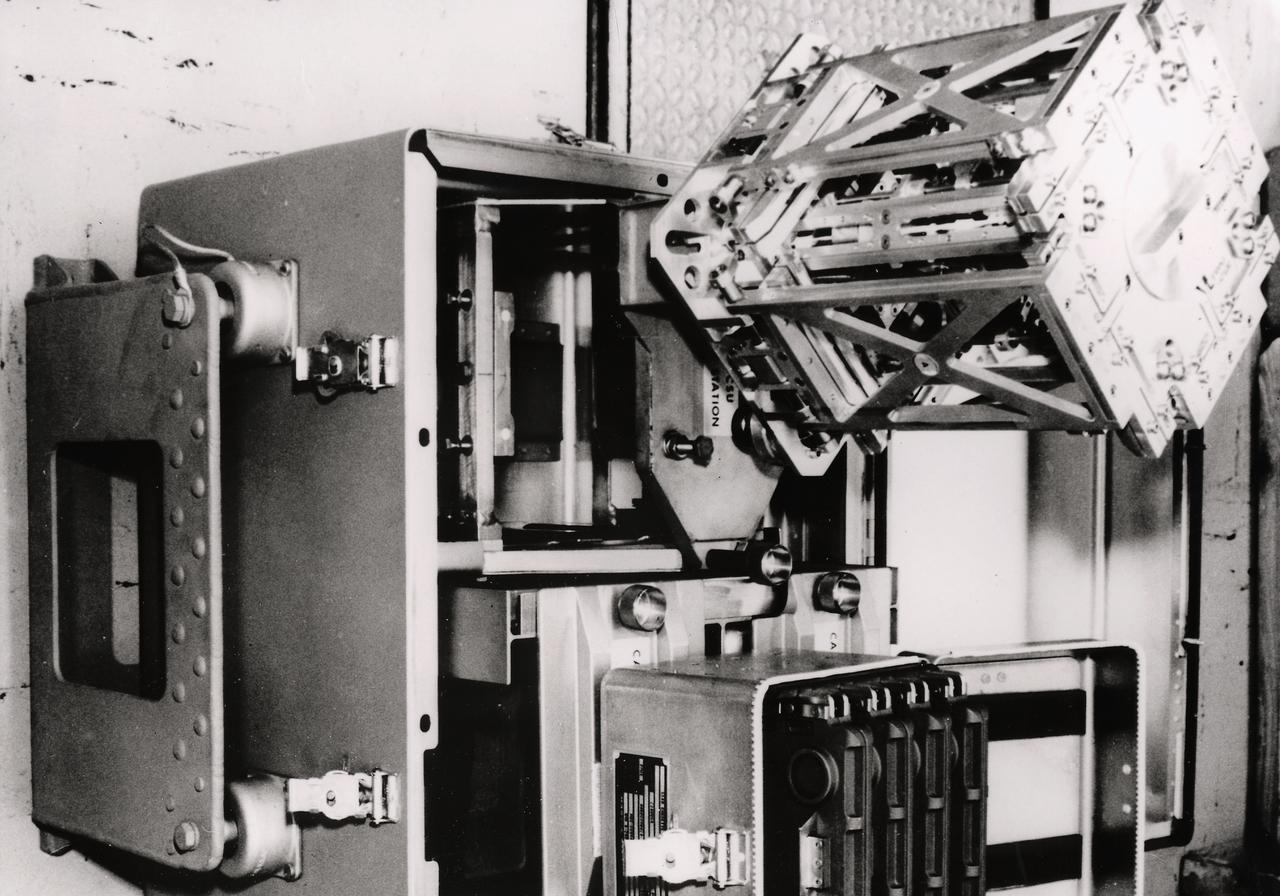
This photograph shows Skylab's Particle Collection device, a scientific experiment designed to study micro-meteoroid particles in near-Earth space and determine their abundance, mass distribution, composition, and erosive effects. The Marshall Space Flight Center had program management responsibility for the development of Skylab hardware and experiments.
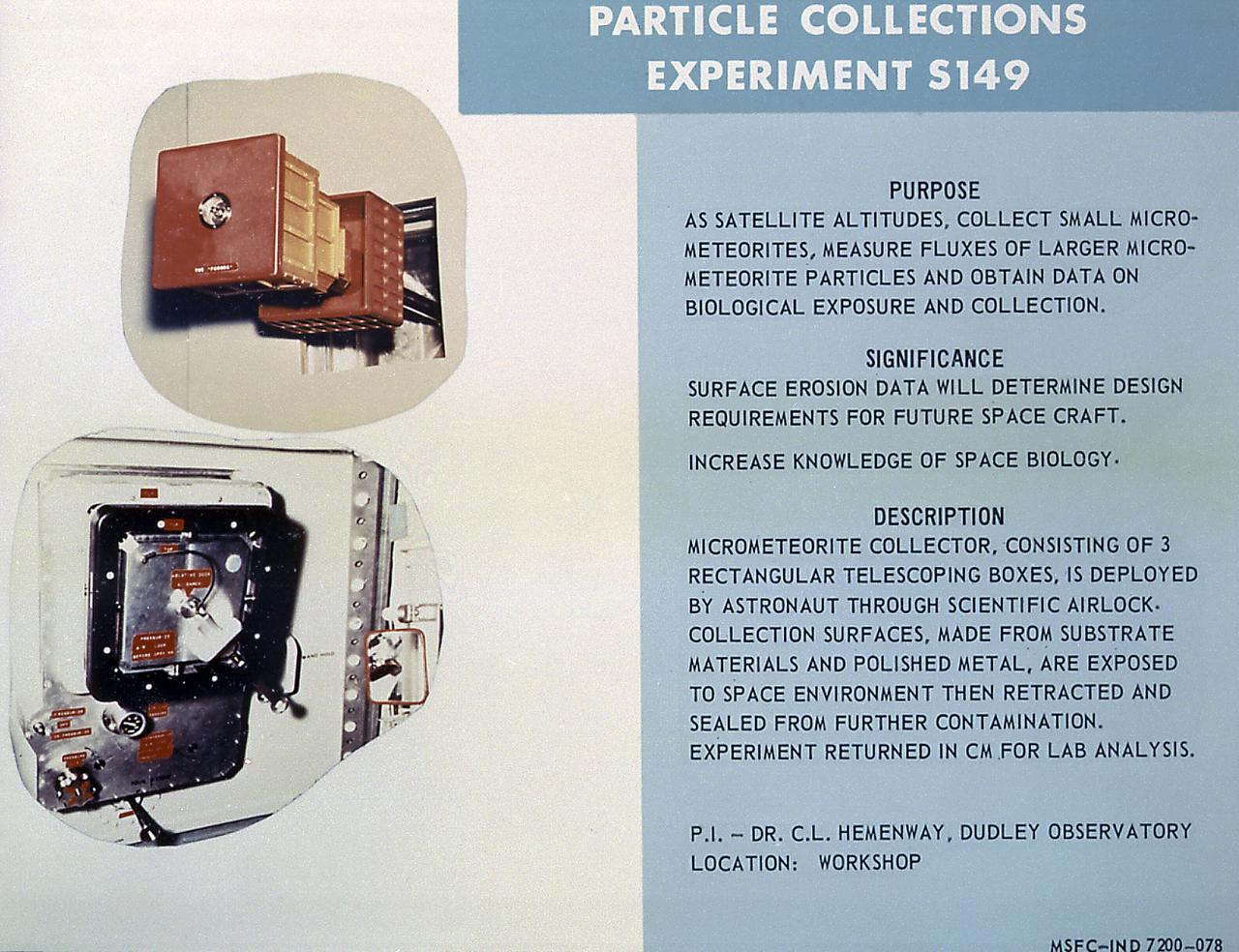
This chart describes Skylab's Particle Collection device, a scientific experiment designed to study micro-meteoroid particles in near-Earth space and determine their abundance, mass distribution, composition, and erosive effects. The Marshall Space Flight Center had program management responsibility for the development of Skylab hardware and experiments.
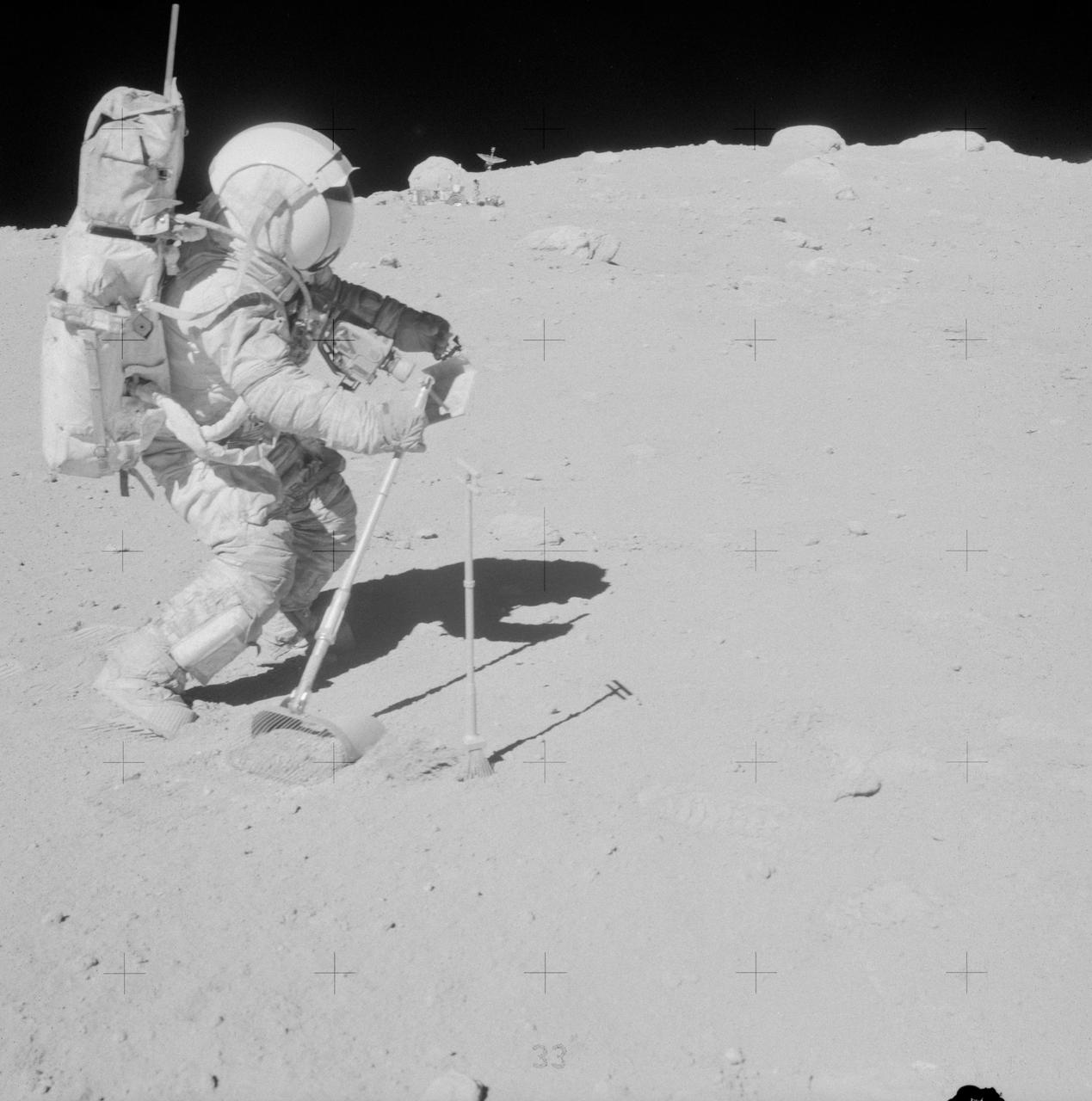
AS16-106-17340 (23 April 1972) --- Astronaut John W. Young, commander of the Apollo 16 lunar landing mission, is photographed collecting lunar samples near North Ray Crater during the third Apollo 16 extravehicular activity (EVA) at the Descartes landing site. This picture was taken by astronaut Charles M. Duke Jr., lunar module pilot. Young is using the lunar surface rake and a set of tongs. The Lunar Roving Vehicle (LRV) is parked in the field of large boulders in the background. While astronauts Young and Duke descended in the Lunar Module (LM) "Orion" to explore the moon, astronaut Thomas K. Mattingly II, command module pilot, remained with the Command and Service Modules (CSM) in lunar orbit.
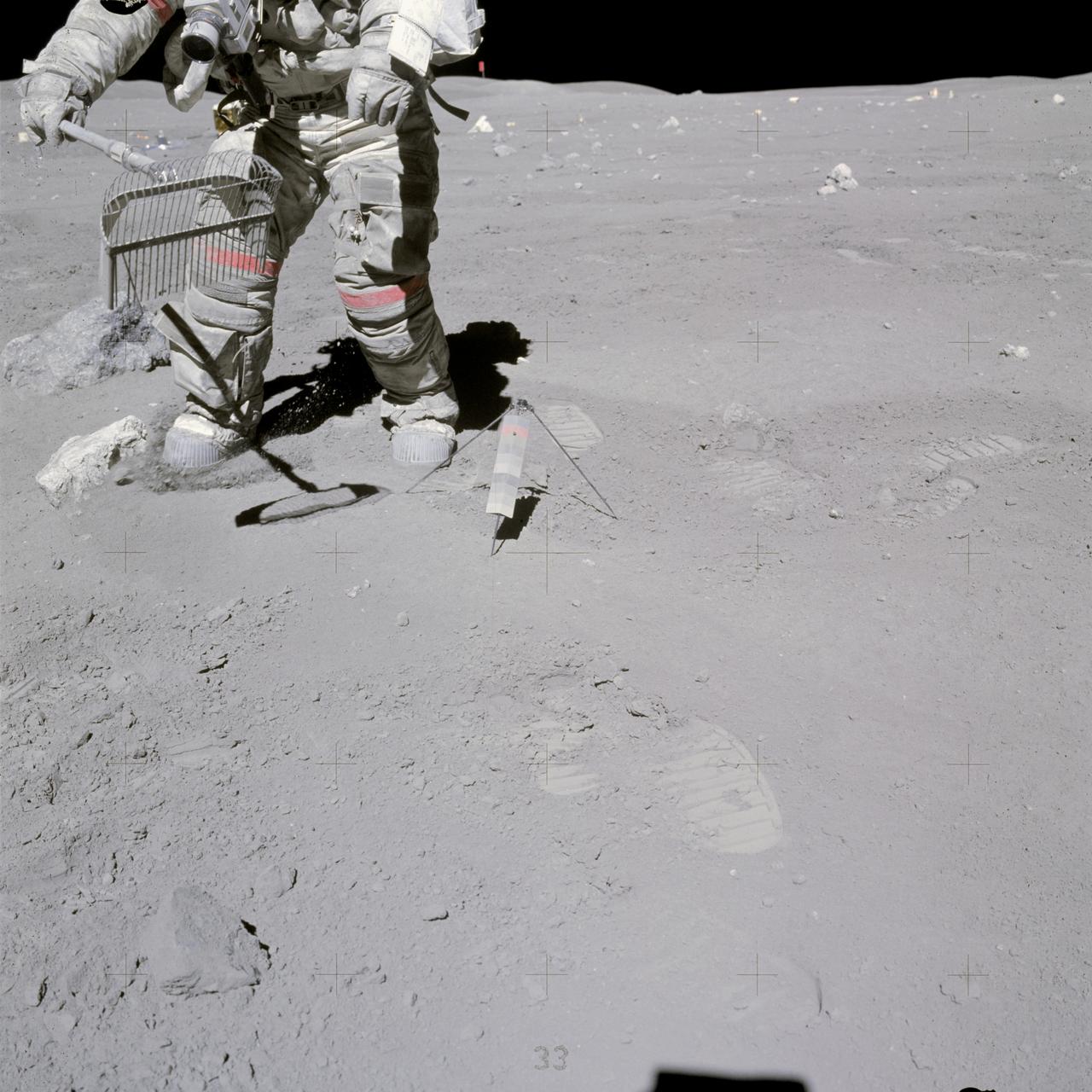
AS16-117-18826 (23 April 1972) --- Astronaut John W. Young collects samples at the North Ray Crater geological site during the mission's third and final Apollo 16 extravehicular activity (EVA). He has a rake in his hand, and the gnomon is near his foot. Note how soiled Young's Extravehicular Mobility Unit (EMU) is. While astronauts Young, commander; and Charles M. Duke Jr., lunar module pilot; descended in the Apollo 16 Lunar Module (LM) "Orion" to explore the Descartes highlands landing site on the moon, astronaut Thomas K. Mattingly II, command module pilot, remained with the Command and Service Modules (CSM) "Casper" in lunar orbit.
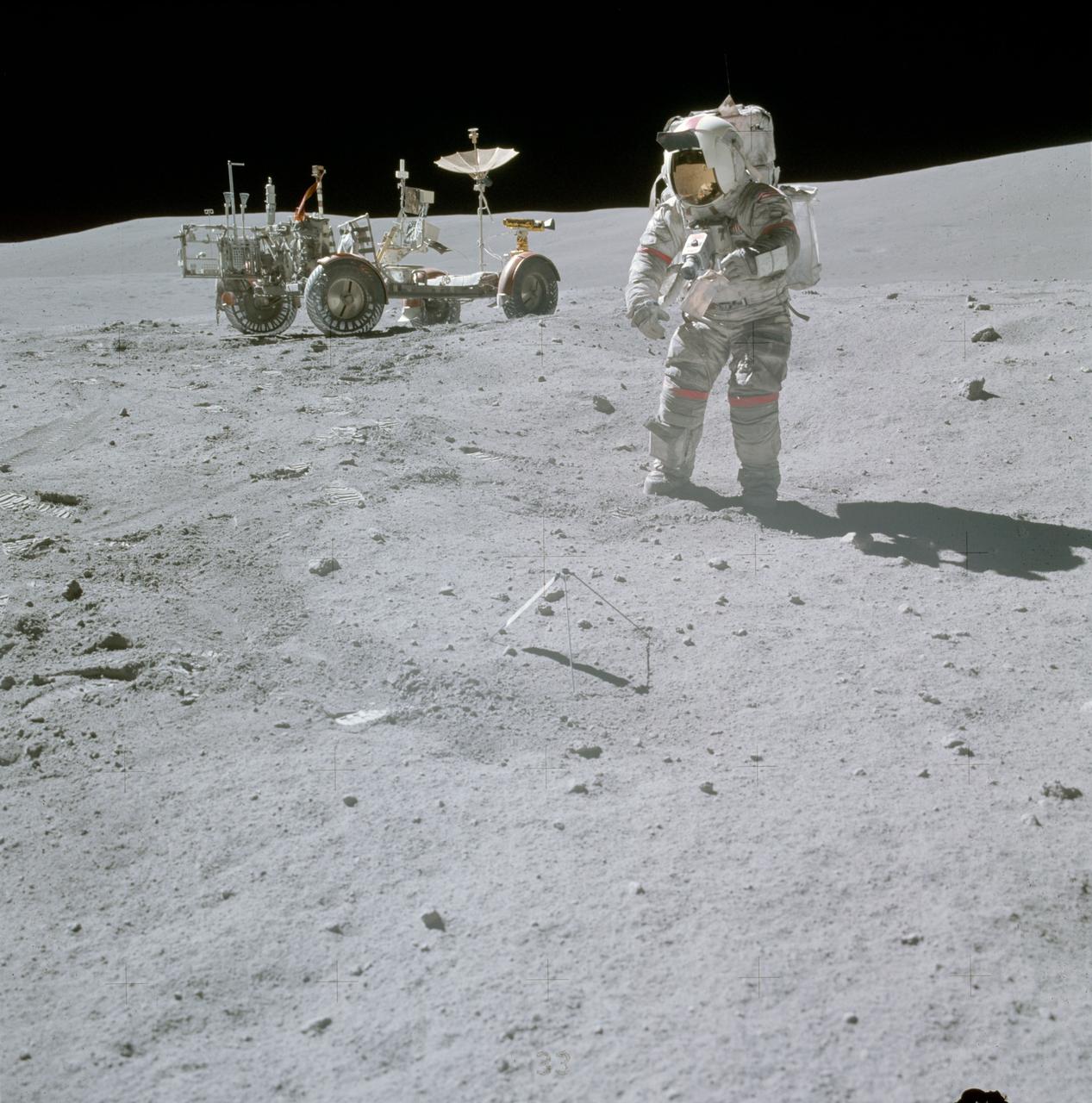
AS16-117-18825 (23 April 1972) --- Astronaut John W. Young, Apollo 16 commander, with a sample bag in his left hand, moves toward the bottom part of the gnomon (center) while collecting samples at the North Ray Crater geological site. Note how soiled Young's Extravehicular Mobility Unit (EMU) is during this the third and final Apollo 16 extravehicular activity (EVA). The Lunar Roving Vehicle (LRV) is parked at upper left.
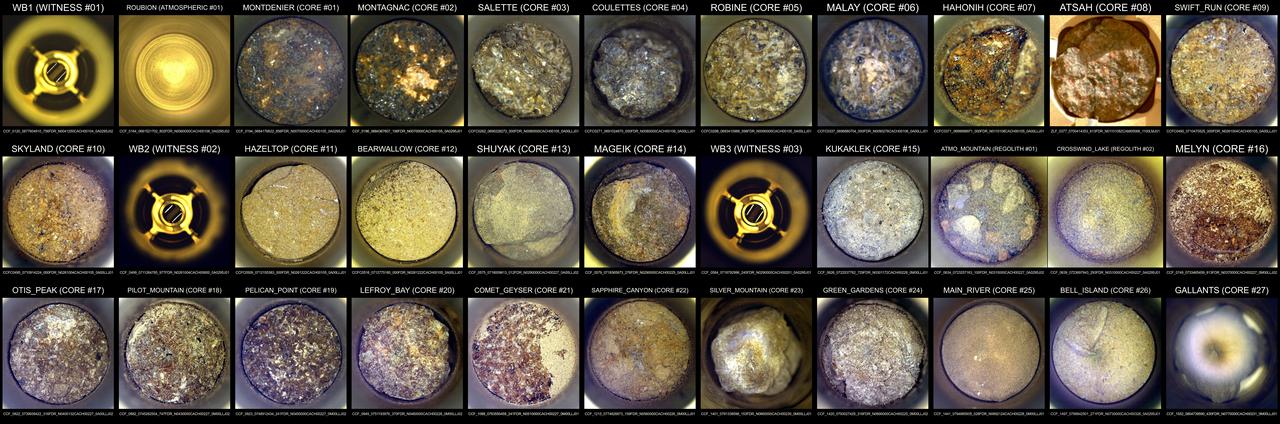
Shown here is an annotated composite image of the interiors of the 33 tubes NASA's Perseverance Mars rover has used to collect samples as of July 24, 2025, the 1,574th Martian day (or sol) of the mission. At this point, Perseverance has collected 27 rock cores, two samples of regolith (broken Mars rock and dust), and one atmospheric sample. The composite also includes images of the three witness tube interiors. Atop each image in white text is the name given to the sample by the rover science team. Ten of the samples depicted here – including one atmospheric sample and one witness tube – were deposited in January 2023 at the rover's sample depot at a location dubbed "Three Forks" within Jezero Crater. The other 23 samples collected thus far remain aboard the rover. Visit this page for details on each sample. The images of the sample tube interiors were collected by the rover's Sampling and Caching System Camera (known as CacheCam). https://photojournal.jpl.nasa.gov/catalog/PIA26643
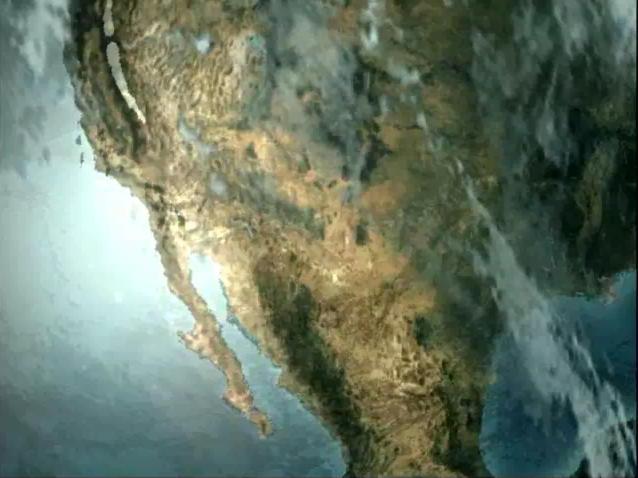
The Atmospheric Infrared Sounder AIRS onboard NASA Aqua satellite collects data and creates a temperature profile, September, 2008.

AS16-114-18423 (21 April 1972) --- Astronaut Charles M. Duke Jr., lunar module pilot, is photographed collecting lunar samples at Station No. 1, during the first Apollo 16 extravehicular activity (EVA), at the Descartes landing site. This picture, looking eastward, was taken by astronaut John W. Young, commander. Duke is standing at the rim of Plum Crater. The parked Lunar Roving Vehicle (LRV) can be seen in the left background. While astronauts Young and Duke descended in the Lunar Module (LM) "Orion" to explore the Descartes highlands region of the moon, astronaut Thomas K. Mattingly II, command module pilot, remained with the Command and Service Modules (CSM) "Casper" in lunar orbit.
The dart and associated launching system was developed by engineers at MSFC to collect a sample of the aluminum oxide particles during the static fire testing of the Shuttle's solid rocket motor. The dart is launched through the exhaust and recovered post test. The particles are collected on sticky copper tapes affixed to a cylindrical shaft in the dart. A protective sleeve draws over the tape after the sample is collected to prevent contamination. The sample is analyzed under a scarning electron microscope under high magnification and a particle size distribution is determined. This size distribution is input into the analytical model to predict the radiative heating rates from the motor exhaust. Good prediction models are essential to optimizing the development of the thermal protection system for the Shuttle.
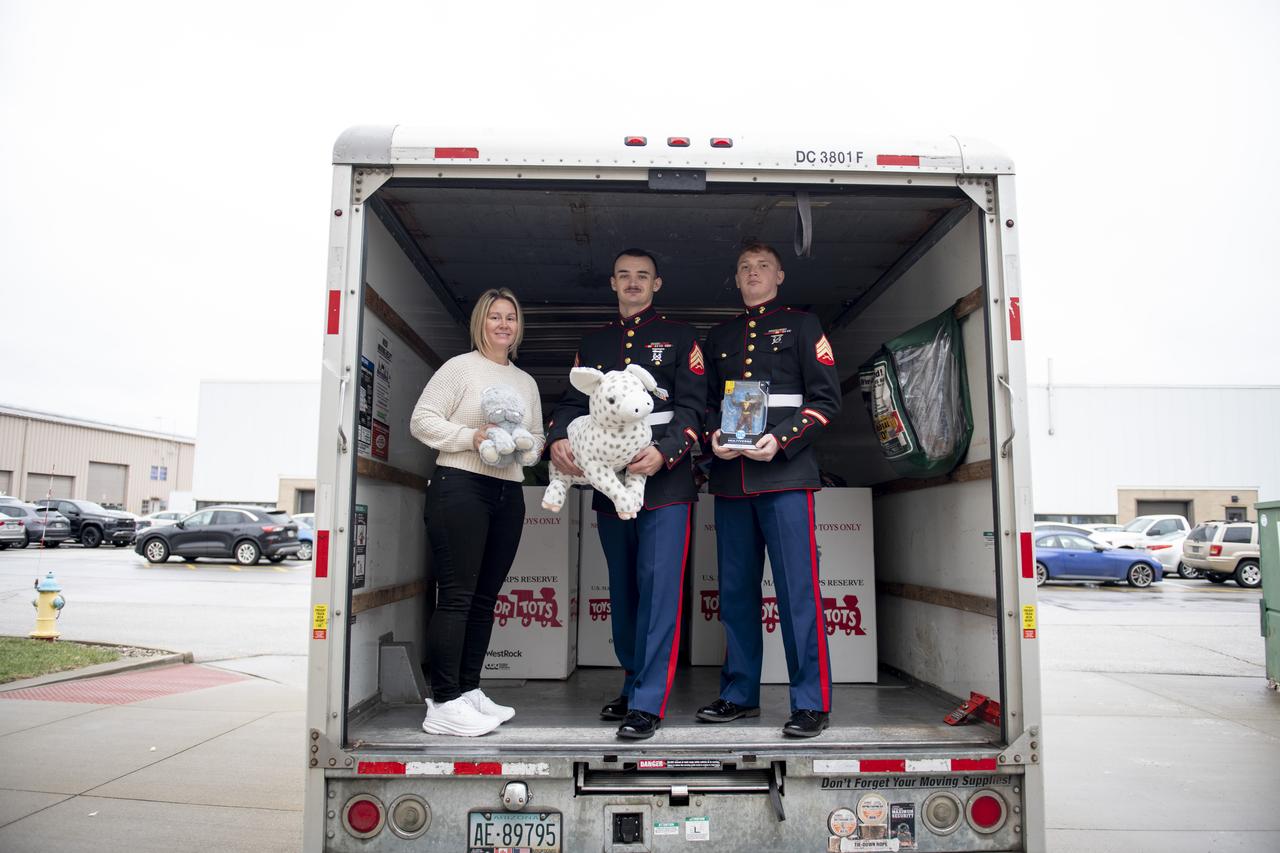
The US Marine Corps Reserve Collected Toy Donations for the 2024 Holiday Season. Samantha Yousef and two members of the Marines poses with the collections. Photo Credit: (NASA/Sara Lowthian-Hanna)
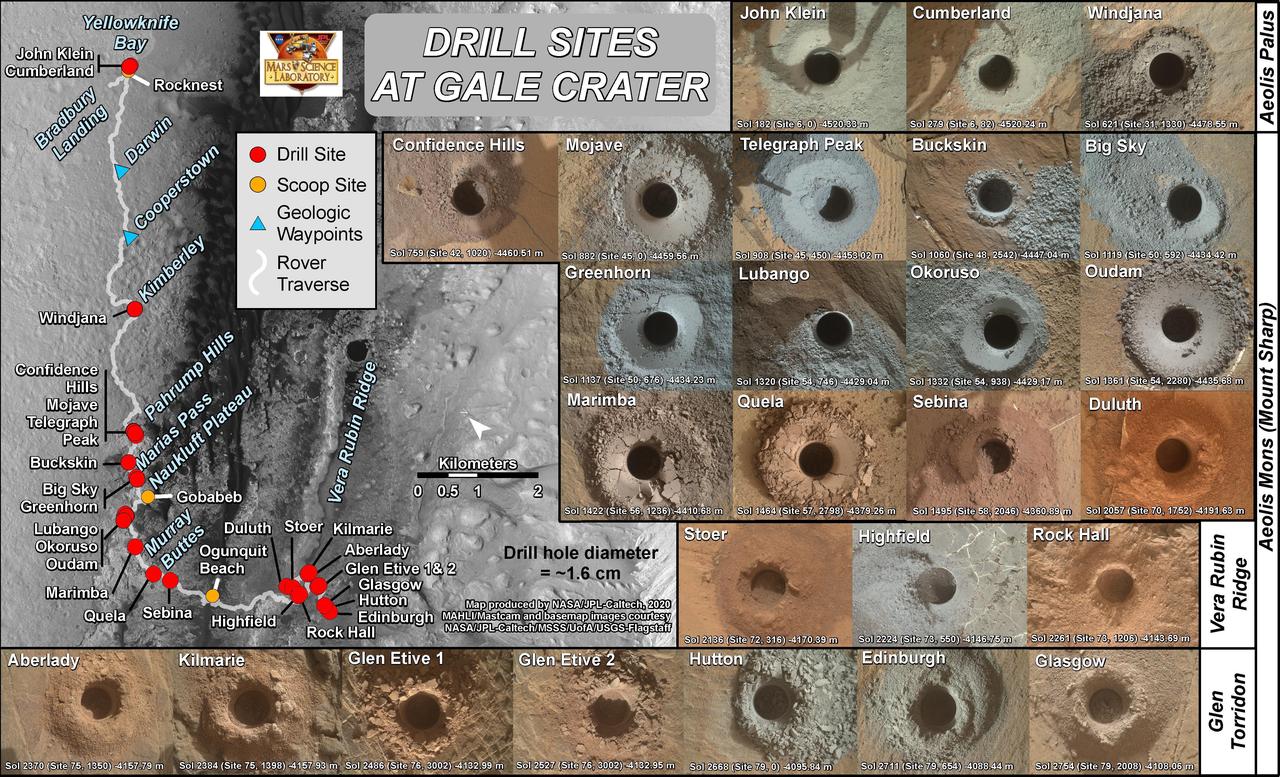
These 26 holes represent each of the rock samples NASA's Curiosity Mars rover has collected as of early July 2020. A map in the upper left shows where the holes were drilled along the rover's route, along with where it scooped six samples of soil. https://photojournal.jpl.nasa.gov/catalog/PIA23977
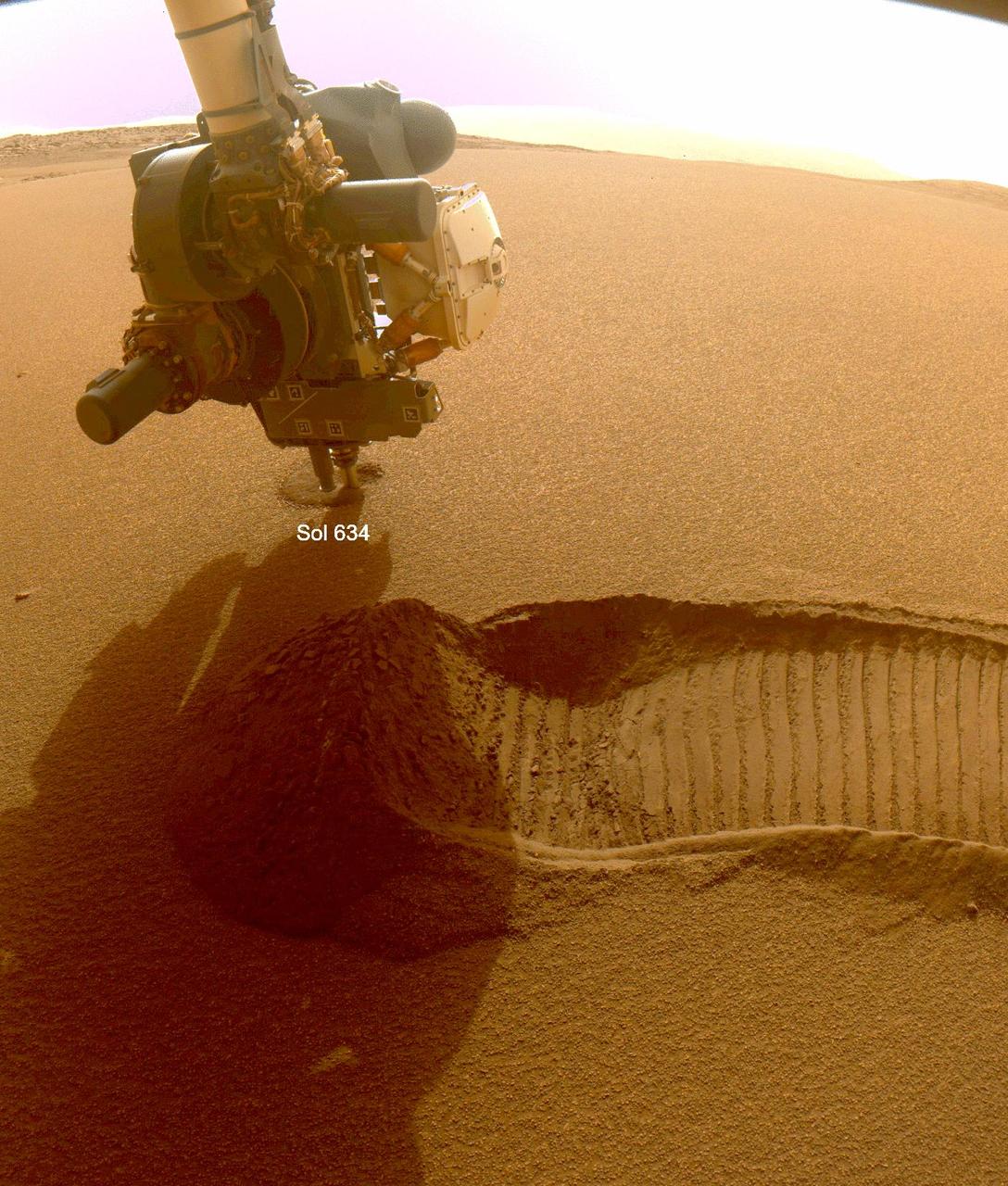
This GIF shows NASA's Perseverance Mars rover collecting two samples of regolith – broken rock and dust – with a regolith sampling bit on the end of its robotic arm. The samples were collected on Dec. 2 and 6, 2022, the 634th and 639th Martian days, or sols, of the mission. The images were taken by one of the rover's front hazard cameras. One of the two regolith samples will be considered for deposit on the Martian surface in coming weeks as part of the Mars Sample Return campaign. Studying regolith with powerful lab equipment back on Earth will allow scientists to better understand the processes that have shaped the surface of Mars and help engineers design future missions as well as equipment used by future Martian astronauts. A key objective for Perseverance's mission on Mars is astrobiology, including the search for signs of ancient microbial life. The rover will characterize the planet's geology and past climate, pave the way for human exploration of the Red Planet, and be the first mission to collect and cache Martian rock and regolith (broken rock and dust). Subsequent NASA missions, in cooperation with ESA (European Space Agency), would send spacecraft to Mars to collect these sealed samples from the surface and return them to Earth for in-depth analysis. The Mars 2020 Perseverance mission is part of NASA's Moon to Mars exploration approach, which includes Artemis missions to the Moon that will help prepare for human exploration of the Red Planet. Movie available at https://photojournal.jpl.nasa.gov/catalog/PIA25654
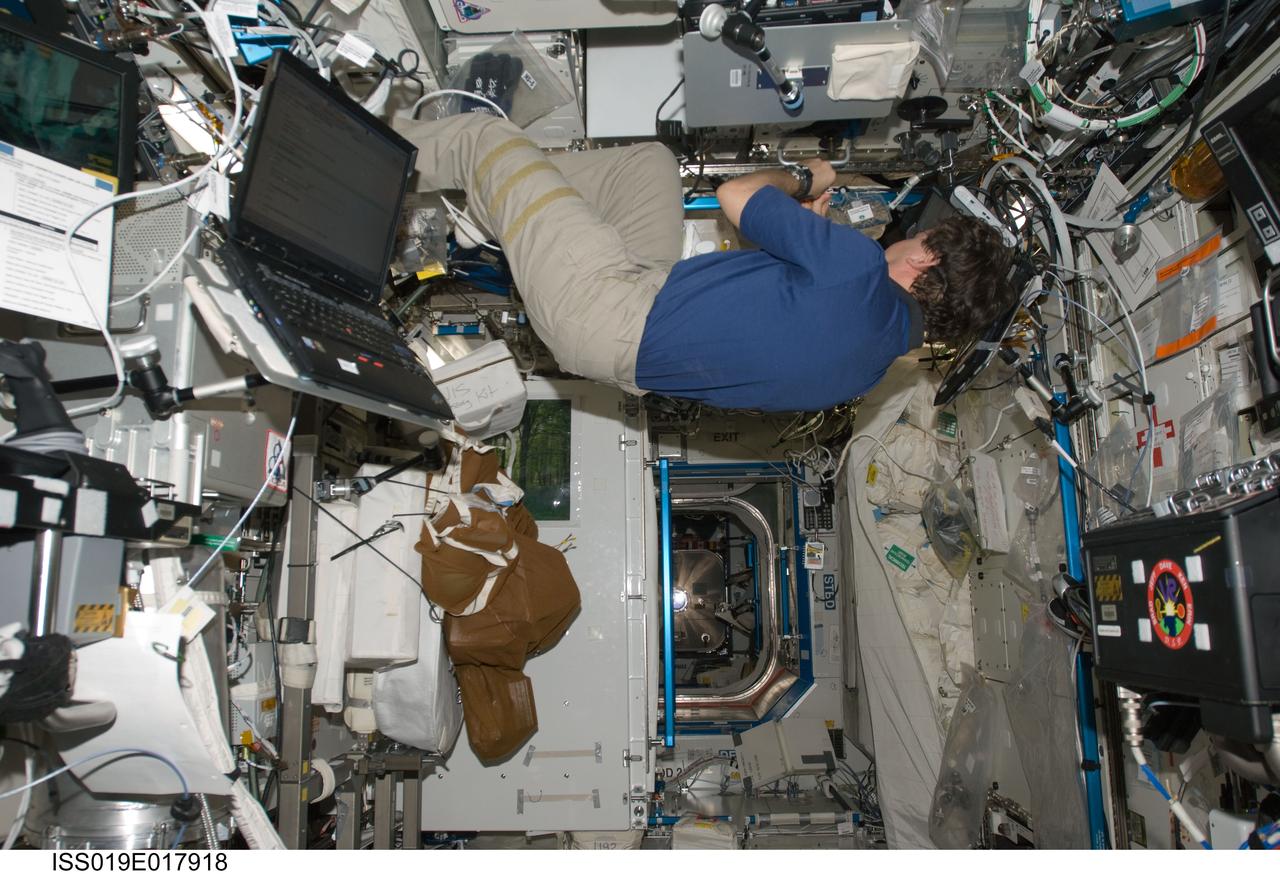
ISS019-E-017918 (19 May 2009) --- Astronaut Michael Barratt, Expedition 19/20 flight engineer, collects a sample from the Water Recovery System (WRS) in the Destiny laboratory of the International Space Station.
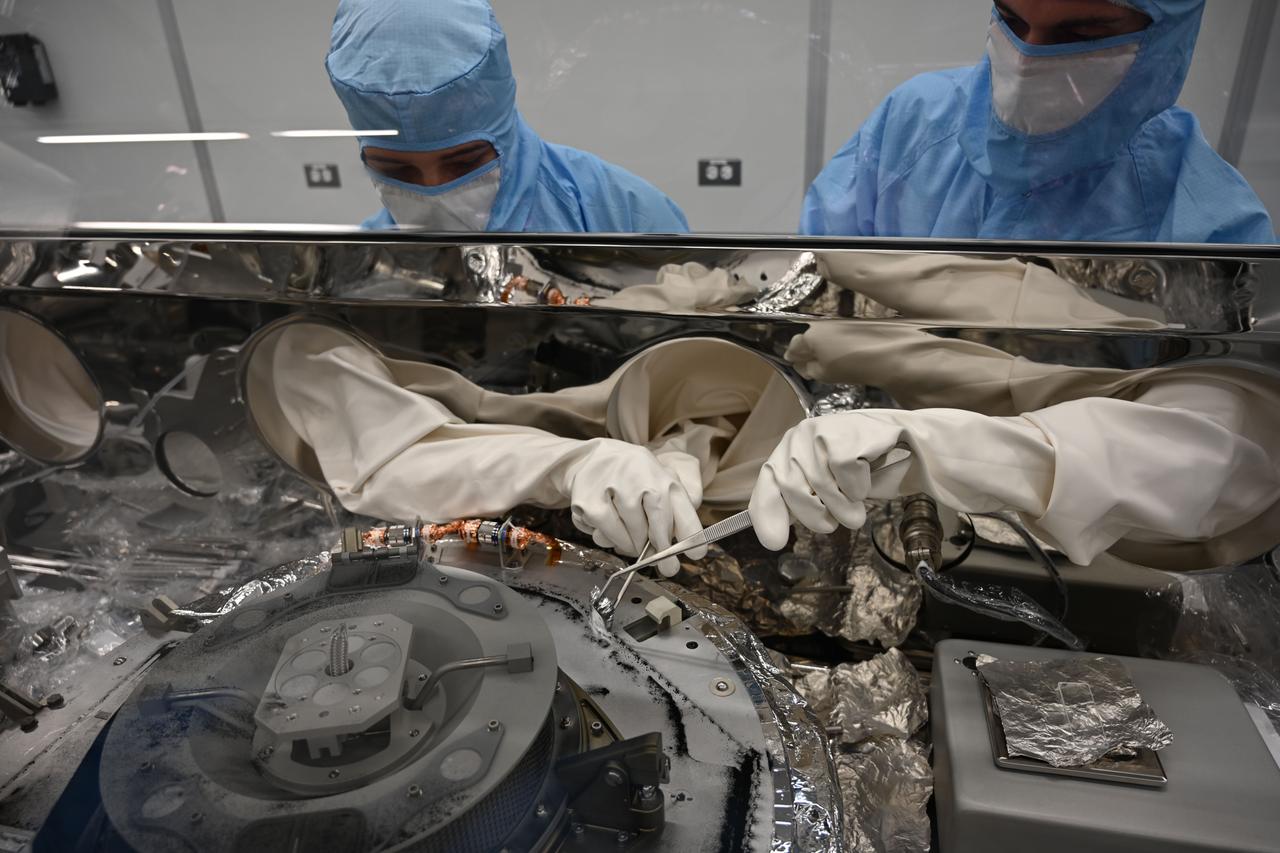
Astromaterials processors Mari Montoya, left, and Curtis Calva, right, use tools to collect asteroid particles from the base of the OSIRIS-REx science canister. Credit: NASA
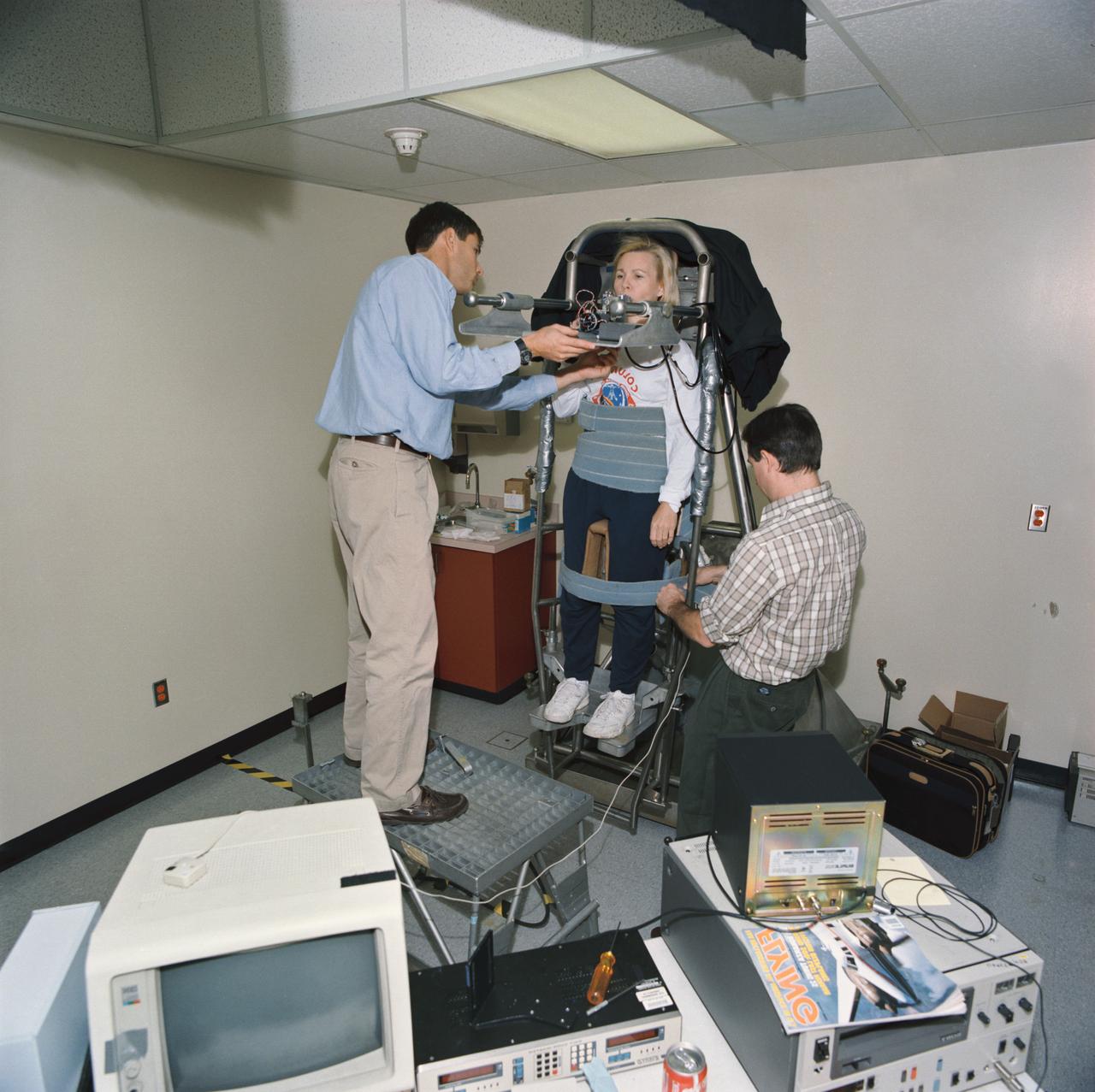
S93-45376 (29 Sept 1993) --- Astronaut Rhea Seddon, STS-58 payload commander, participates in data collection for neurovestibular functions. The data collection process was in preparation for the Spacelab Life Sciences (SLS-2) flight scheduled for next month.
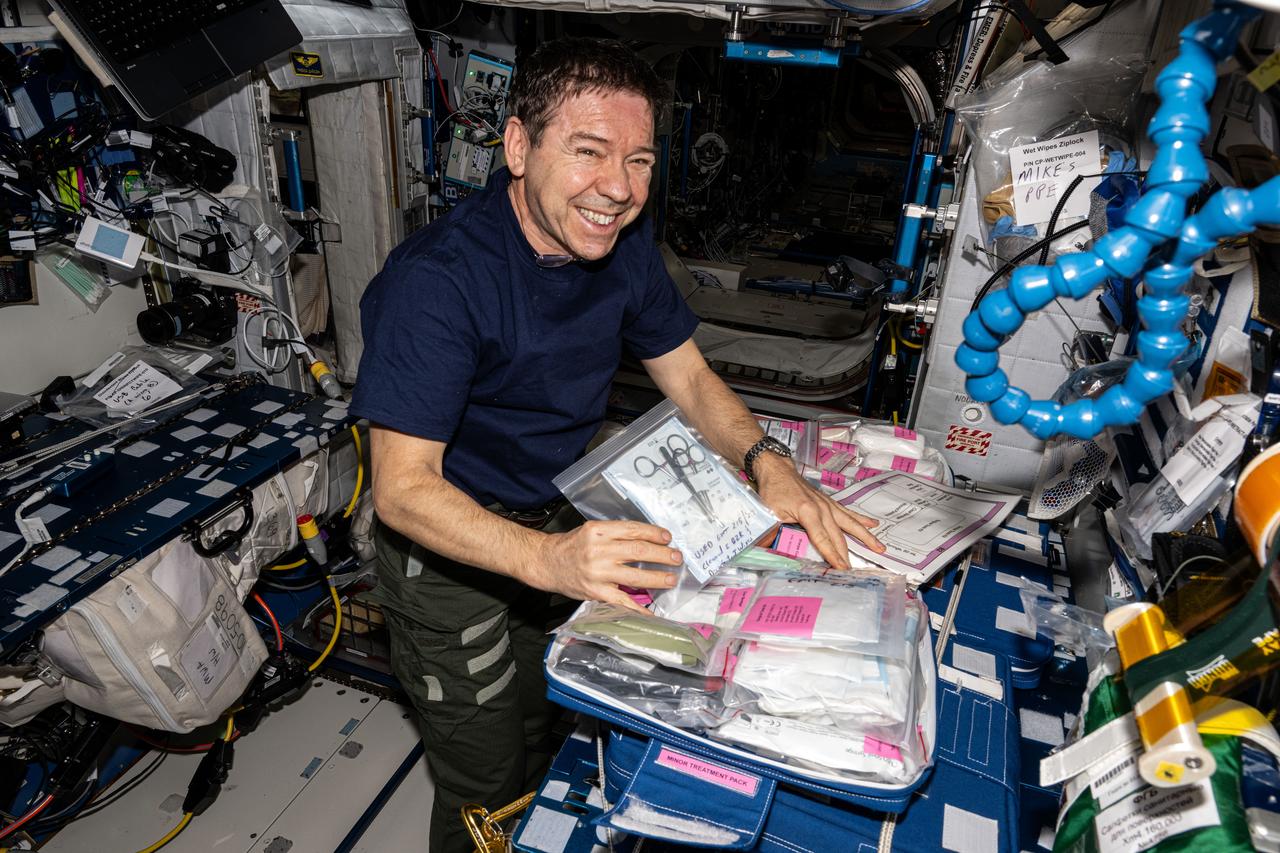
iss071e414062 (Aug. 3, 2024) --- NASA astronaut and Expedition 71 Flight Engineer Mike Barratt collects and organizes medical supplies aboard the International Space Station's Harmony module.
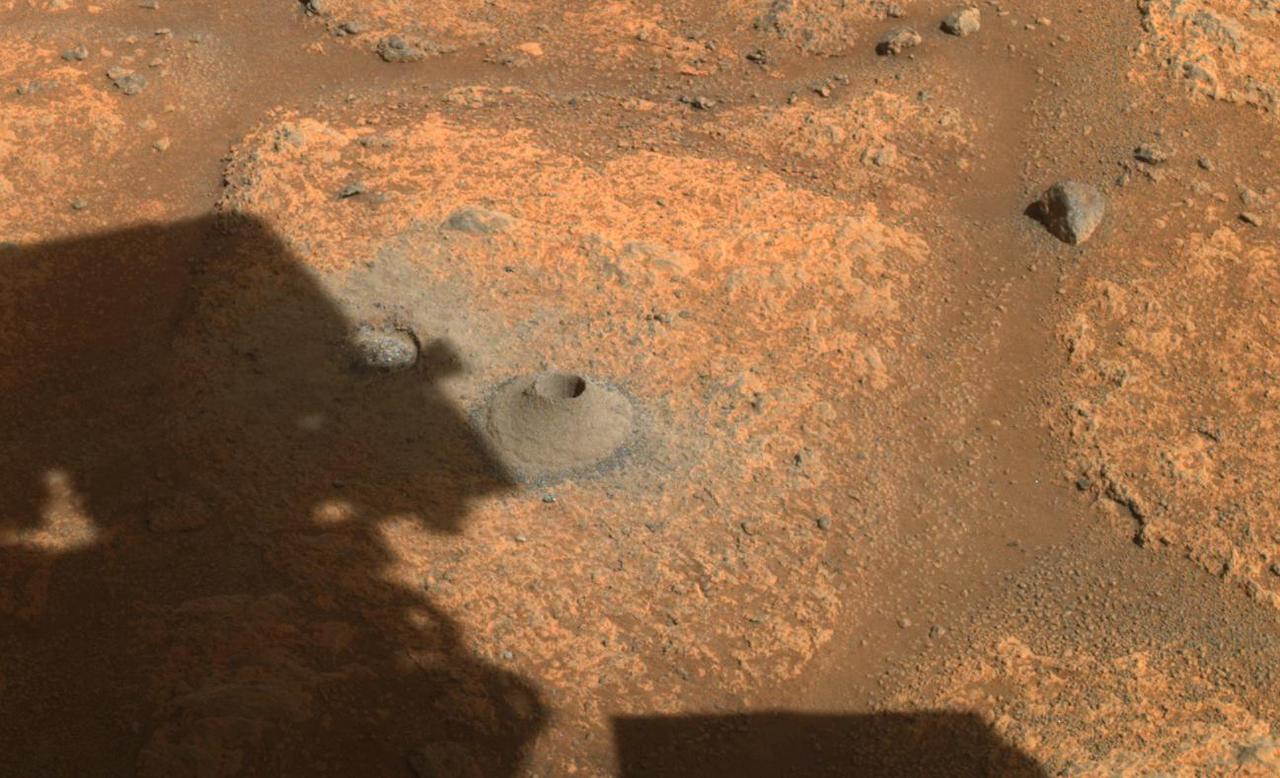
This image taken by NASA's Perseverance rover on August 6, 2021, shows the hole drilled in a Martian rock in preparation for the rover's first attempt to collect a sample. It was taken by one of the rover's hazard cameras in what the rover's science team has nicknamed a "paver rock" in the "Crater Floor Fractured Rough" area of Jezero Crater. A key objective for Perseverance's mission on Mars is astrobiology, including the search for signs of ancient microbial life. The rover will characterize the planet's geology and past climate, pave the way for human exploration of the Red Planet, and be the first mission to collect and cache Martian rock and regolith (broken rock and dust). Subsequent NASA missions, in cooperation with ESA (European Space Agency), would send spacecraft to Mars to collect these sealed samples from the surface and return them to Earth for in-depth analysis. The Mars 2020 Perseverance mission is part of NASA's Moon to Mars exploration approach, which includes Artemis missions to the Moon that will help prepare for human exploration of the Red Planet. https://photojournal.jpl.nasa.gov/catalog/PIA24795

ISS015-E-32031 (October 2007) --- Cosmonaut Oleg V. Kotov, Expedition 15 flight engineer representing Russia's Federal Space Agency, uses a Bioproby Kit to collect surface samples for analysis for the Russian Biodegradation experiment in the Zvezda Service Module of the International Space Station.
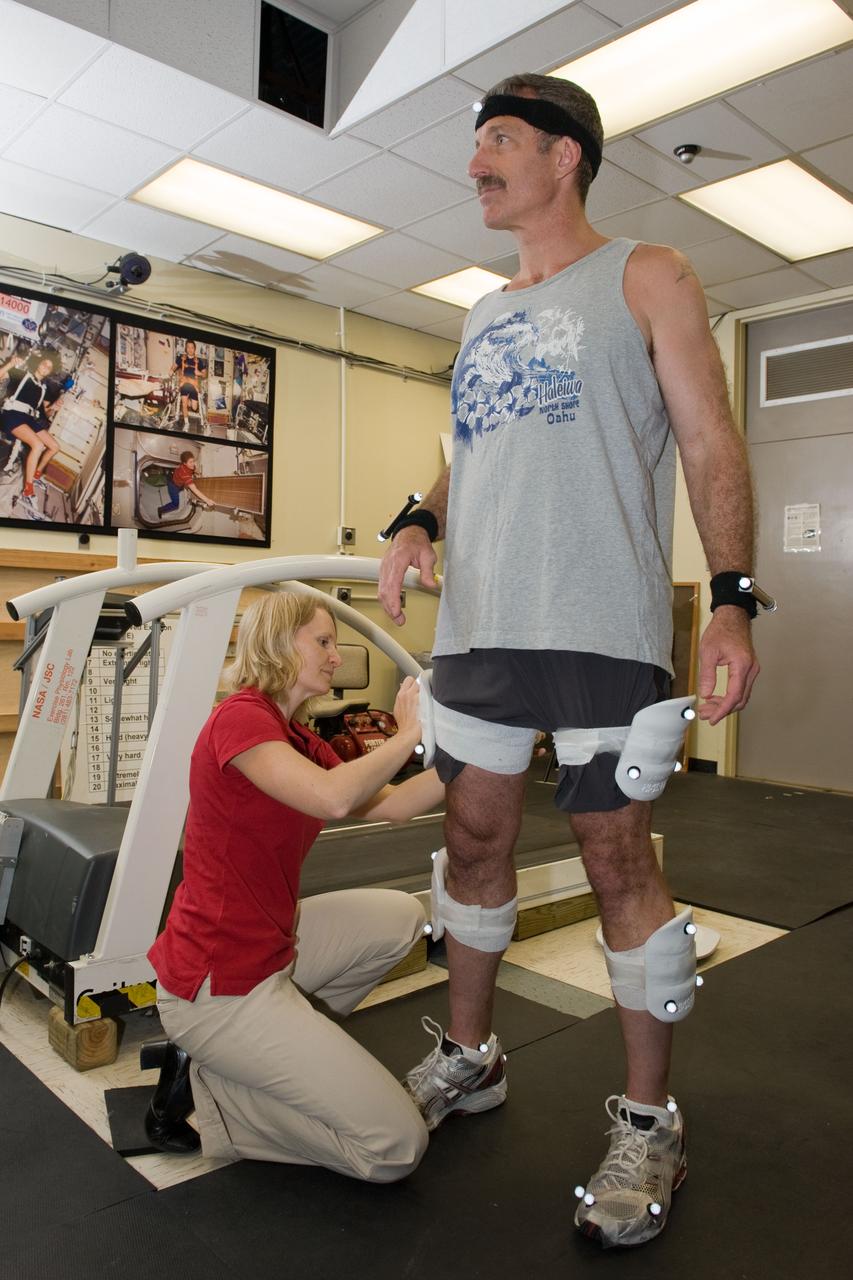
PHOTO DATE: 5-12-11 LOCATION: Building 261 - Room 138 SUBJECT: Expedition 29 Preflight Training with Dan Burbank during Treadmill Kinematics Baseline Data Collection. WORK ORDER: 2011-1214 PHOTOGRAPHER: Lauren Harnett
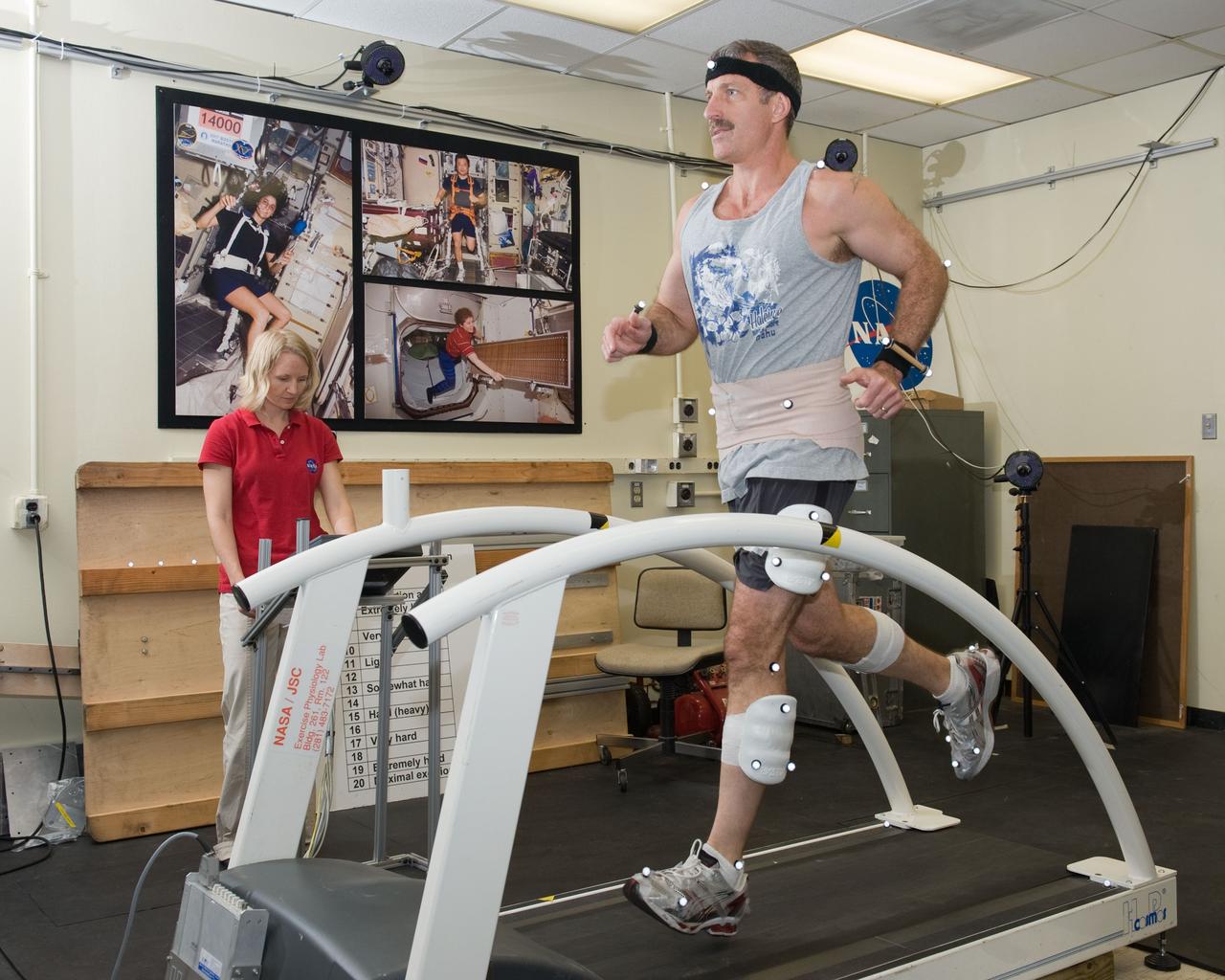
PHOTO DATE: 5-12-11 LOCATION: Building 261 - Room 138 SUBJECT: Expedition 29 Preflight Training with Dan Burbank during Treadmill Kinematics Baseline Data Collection. WORK ORDER: 2011-1214 PHOTOGRAPHER: Lauren Harnett
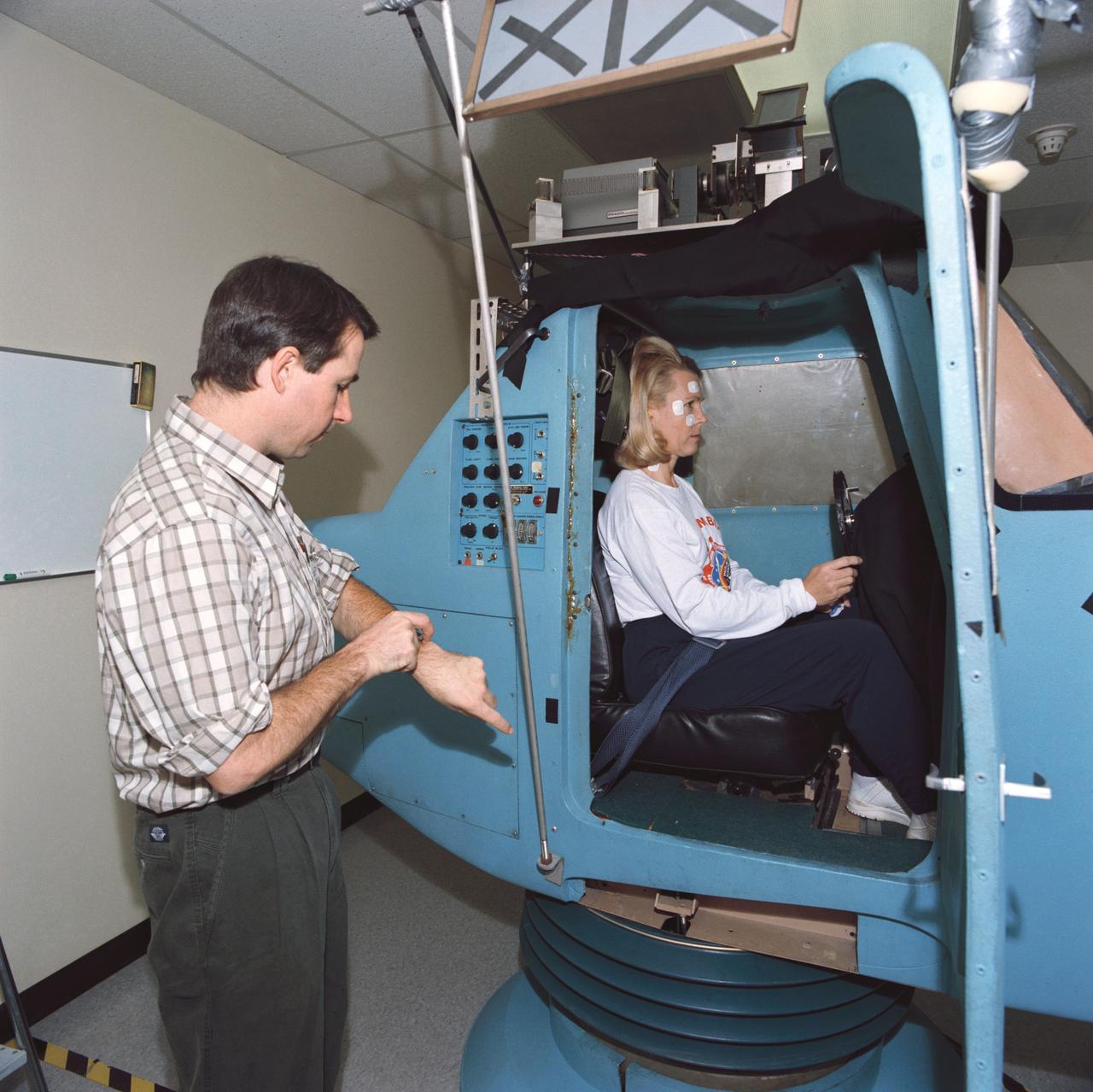
S93-45373 (29 Sept 1993) --- Astronaut Rhea Seddon, STS-58 payload commander, is in a piloting simulator as part of a pre-flight data collection project for neurovestibular functions. The seven Spacelab Life Sciences (SLS-2) crew members devoted a full day to miscellaneous biomedical data collection in preparation for next month's two week mission aboard Columbia.
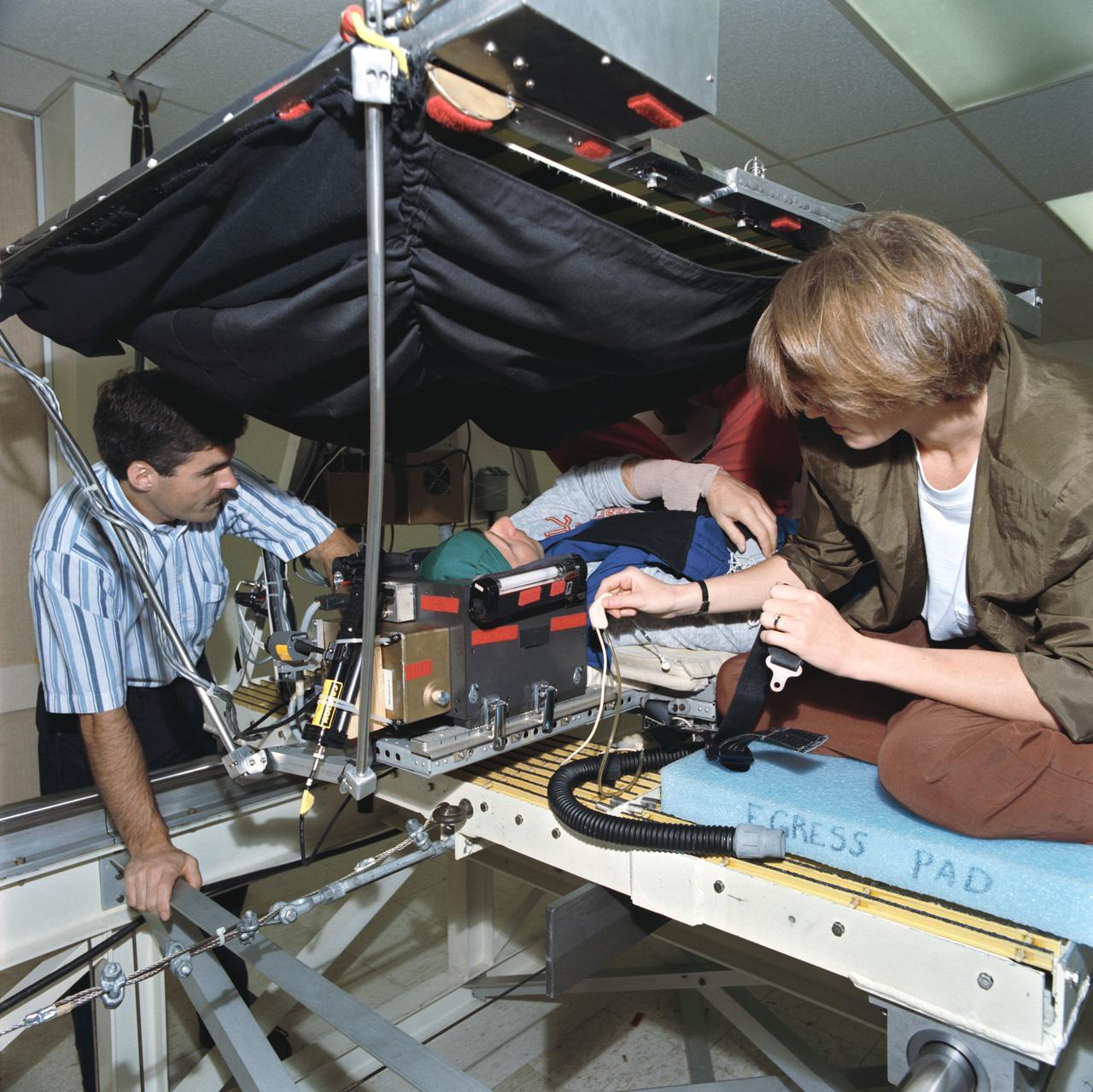
S93-45363 (29 Sept 1993) --- Payload specialist Martin J. Fettman, in an oscillating sled device, participates in a data collection project for neurovestibular functions. The seven Spacelab Life Sciences (SLS-2) crewmembers devoted a full day to miscellaneous biomedical data collection in preparation for next month's two week mission aboard Columbia.
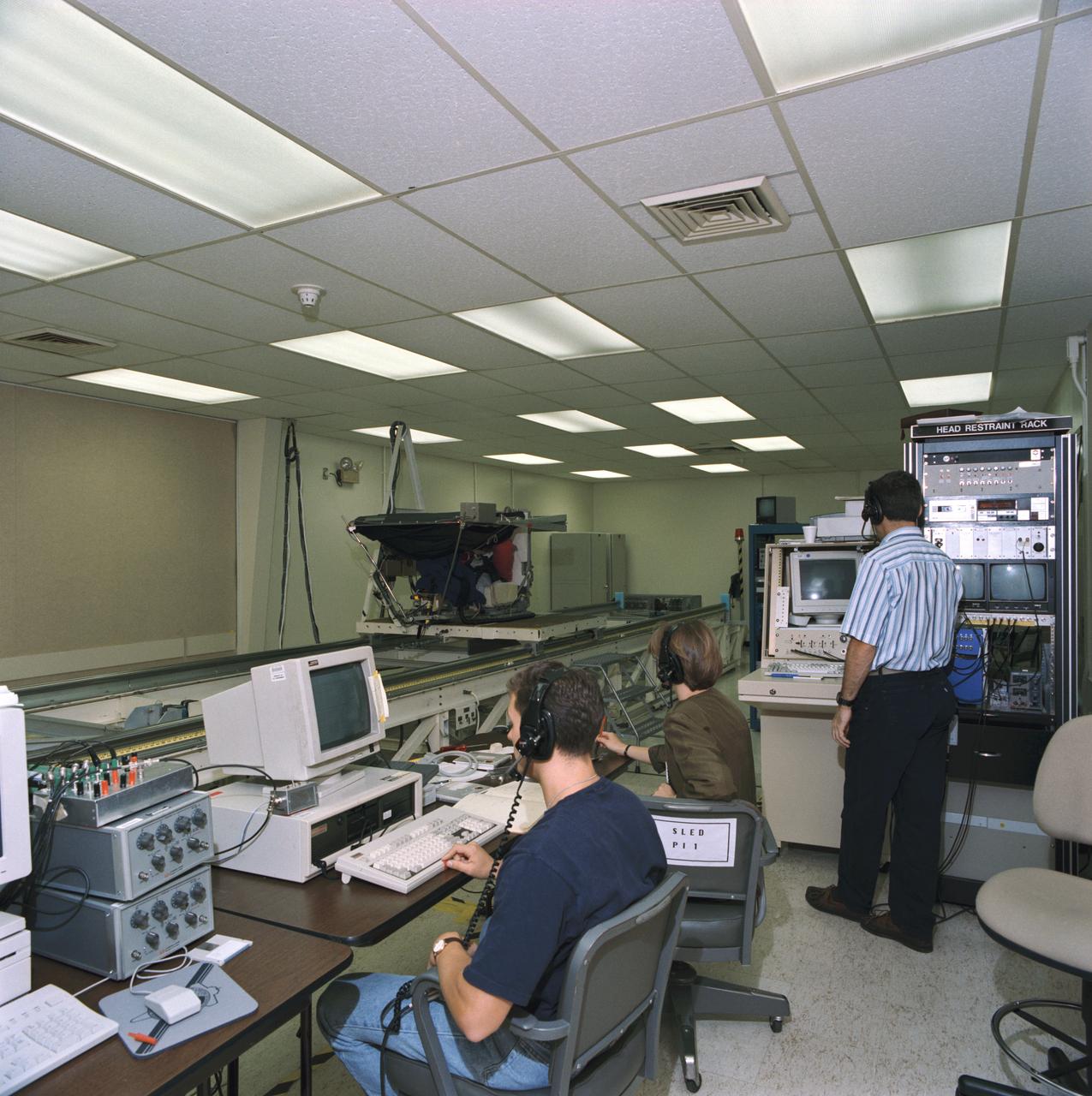
S93-45365 (29 Sept 1993) --- Payload specialist Martin J. Fettman, in an oscillating sled device in upper left, participates in a data collection project for neurovestibular functions. His responses to the sled's movements are recorded by a team of monitors in the foreground. The seven Spacelab Life Sciences (SLS-2) crew members devoted a full day to miscellaneous biomedical data collection in preparation for next month's two week mission aboard Columbia.
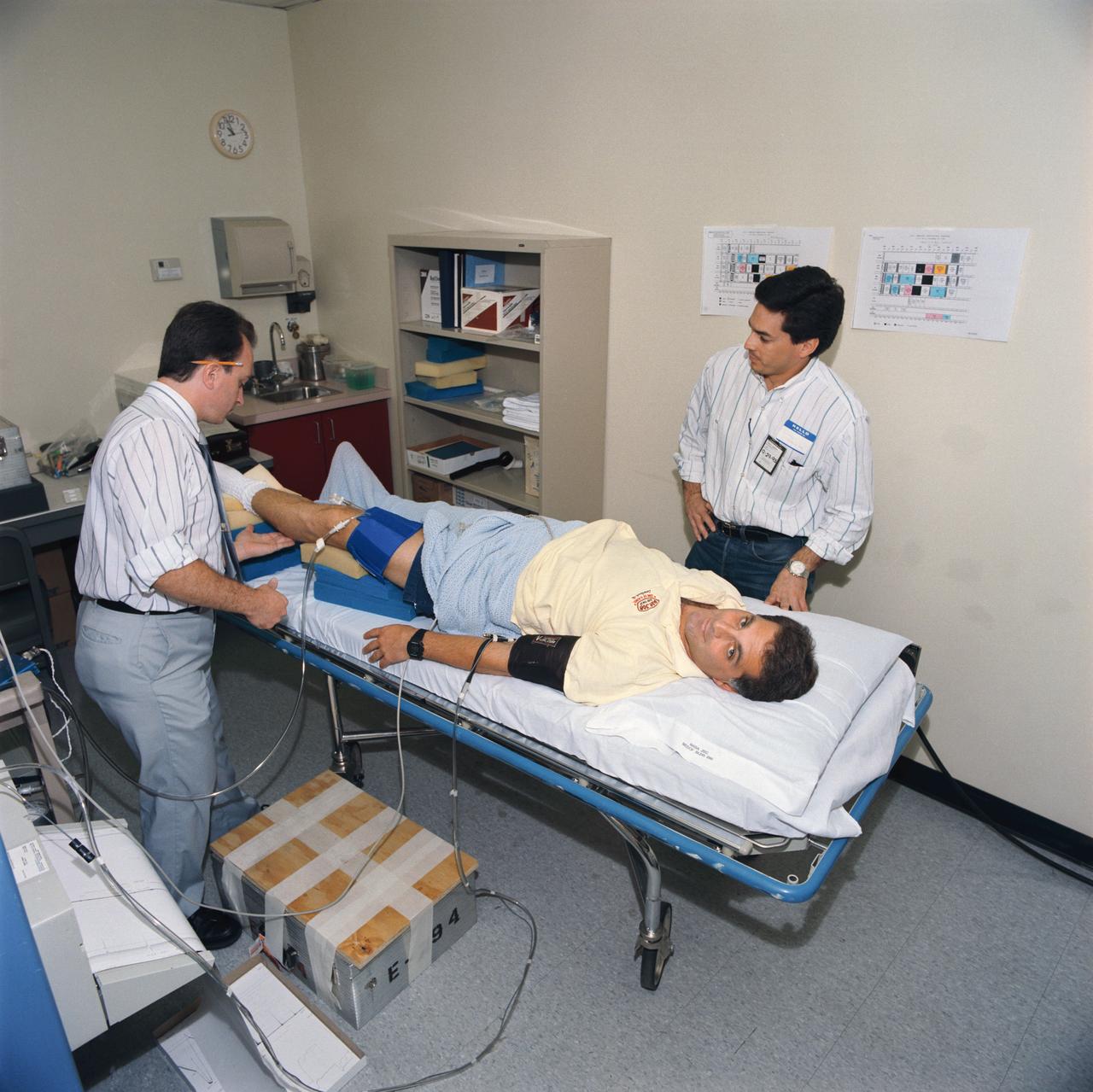
S93-45375 (29 Sept 1993) --- Astronaut David A. Wolf, STS-58 mission specialist, has blood drawn from his leg for volume measuring. The blood draw was part of the cardiovascular function data collection in preparation for the Spacelab Life Sciences (SLS-2) mission. The seven Spacelab Life Sciences crewmembers devoted a full day to miscellaneous biomedical data collection in preparation for next month's two week mission aboard Columbia.
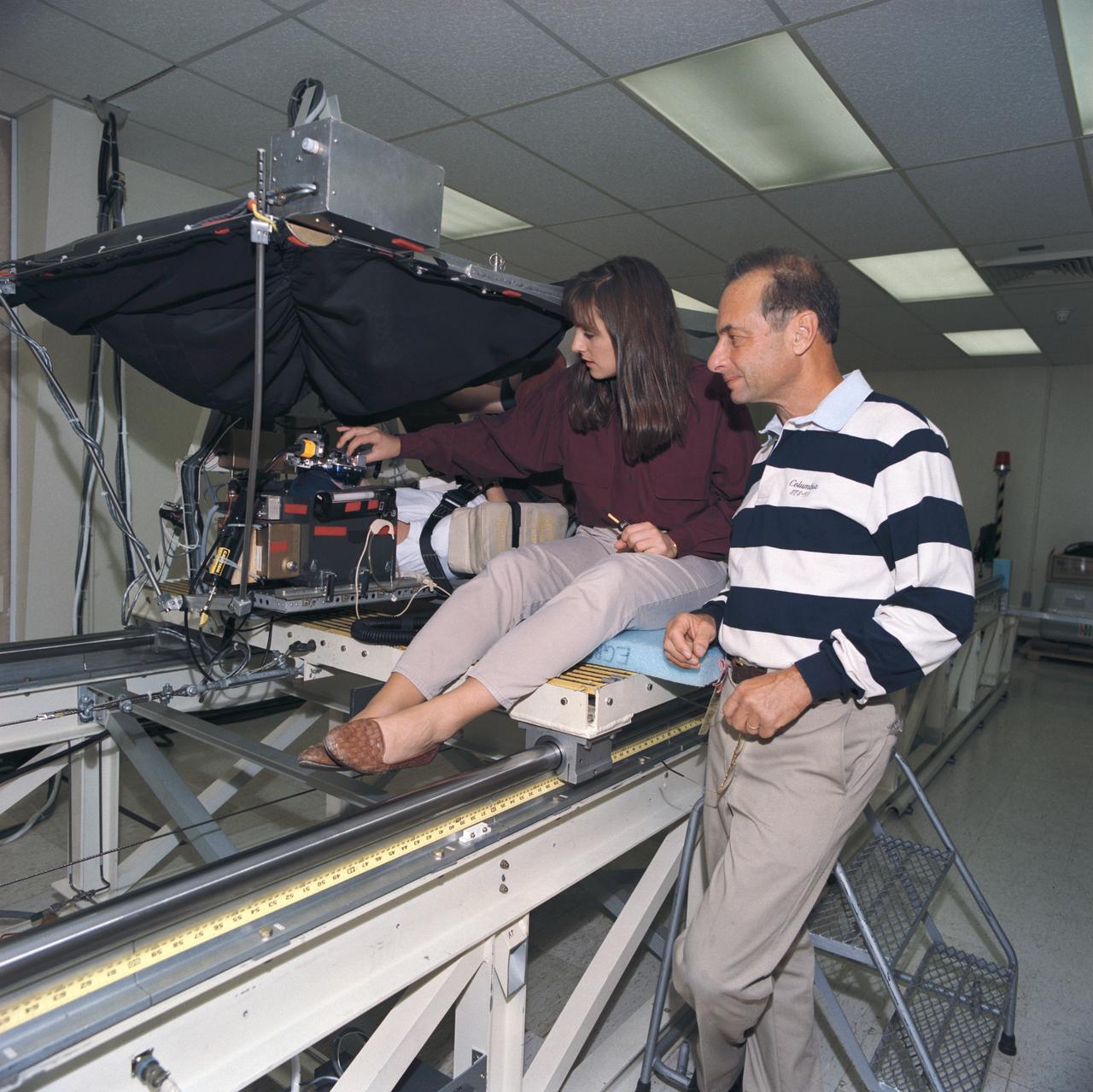
S93-45368 (29 Sept 1993) --- Payload specialist Martin J. Fettman (face obscured), in an oscillating sled device, participates in a data collection project for neurovestibular functions. Assisting the test are Dr. Laurence Young, alternate payload specialist, and an unidentified MIT student. The seven Spacelab Life Sciences (SLS-2) crew members devoted a full day to miscellaneous biomedical data collection in preparation for next month's two week mission aboard Columbia.
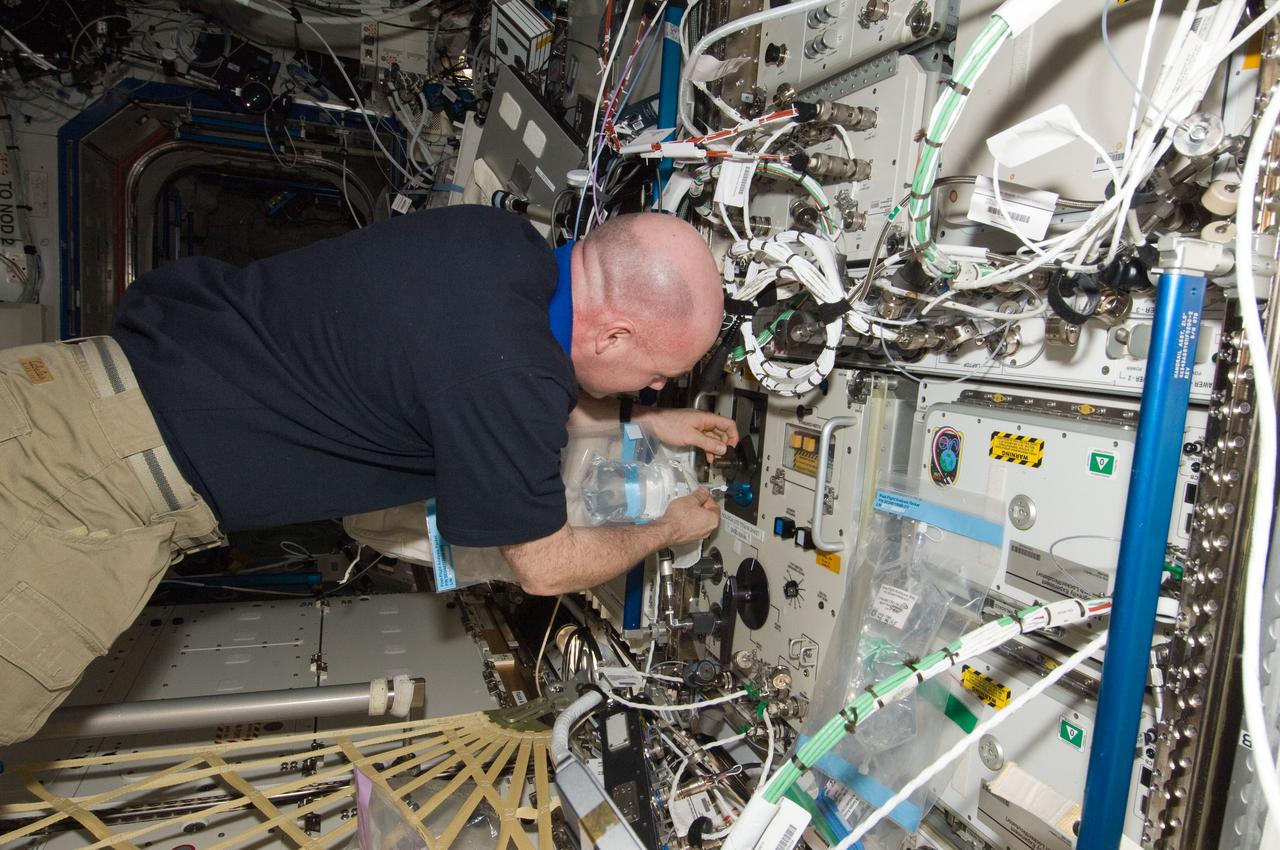
ISS031-E-079015 (15 May 2012) --- European Space Agency astronaut Andre Kuipers, Expedition 31 flight engineer, collects a sample from the Water Recovery System (WRS) in the Destiny laboratory of the International Space Station.
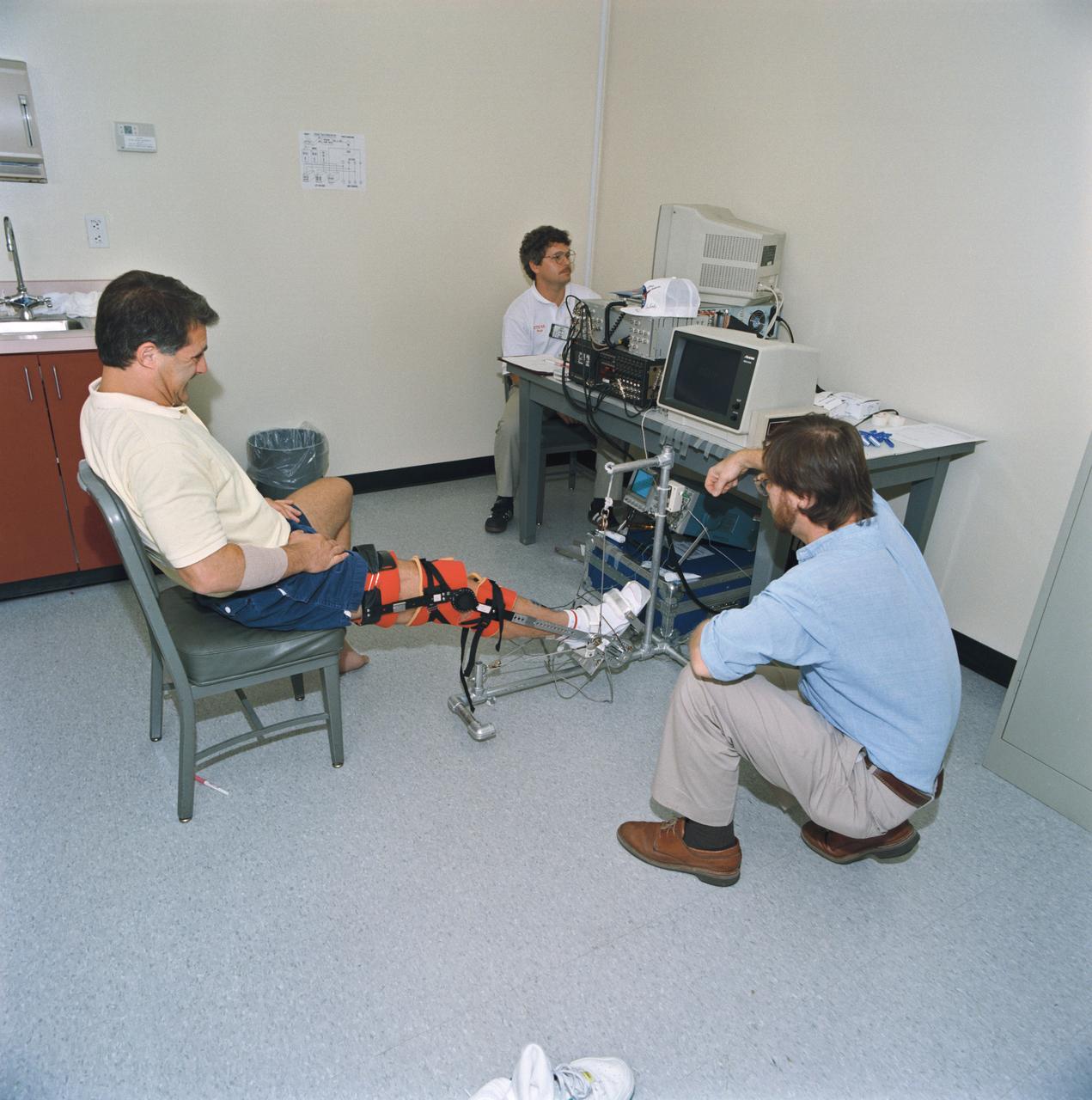
S93-45364 (29 Sept 1993) --- Astronaut David A. Wolf, mission specialist, participates in pre-flight data collection for the cardiovascular experiments scheduled to fly aboard Columbia for the Spacelab Life Sciences (SLS-2) mission.
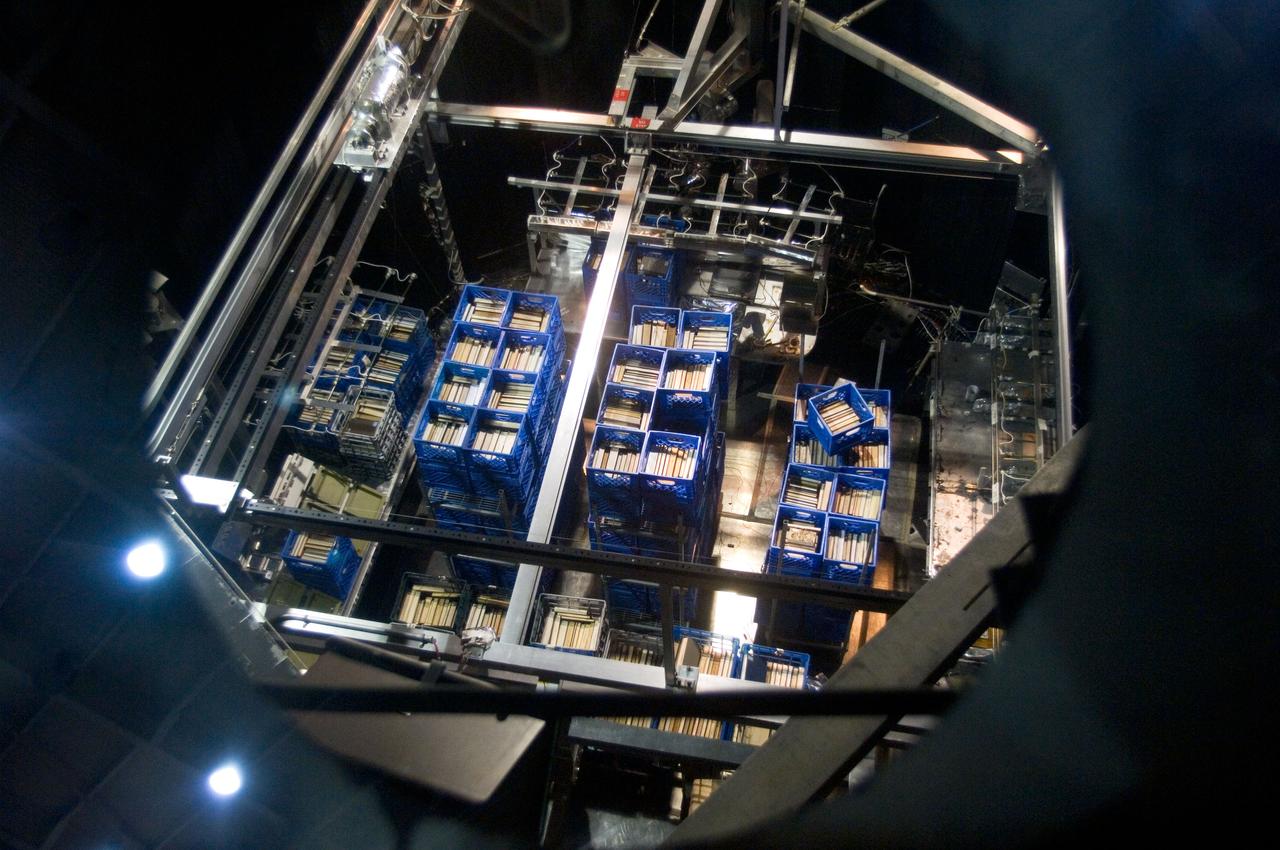
Documentation for the University of Houston (UH) Clear Lake collection of their library books after the Vacuum Chamber runs were performed to remove the water from them. Vacuum Chamber B in Building 32 was used.
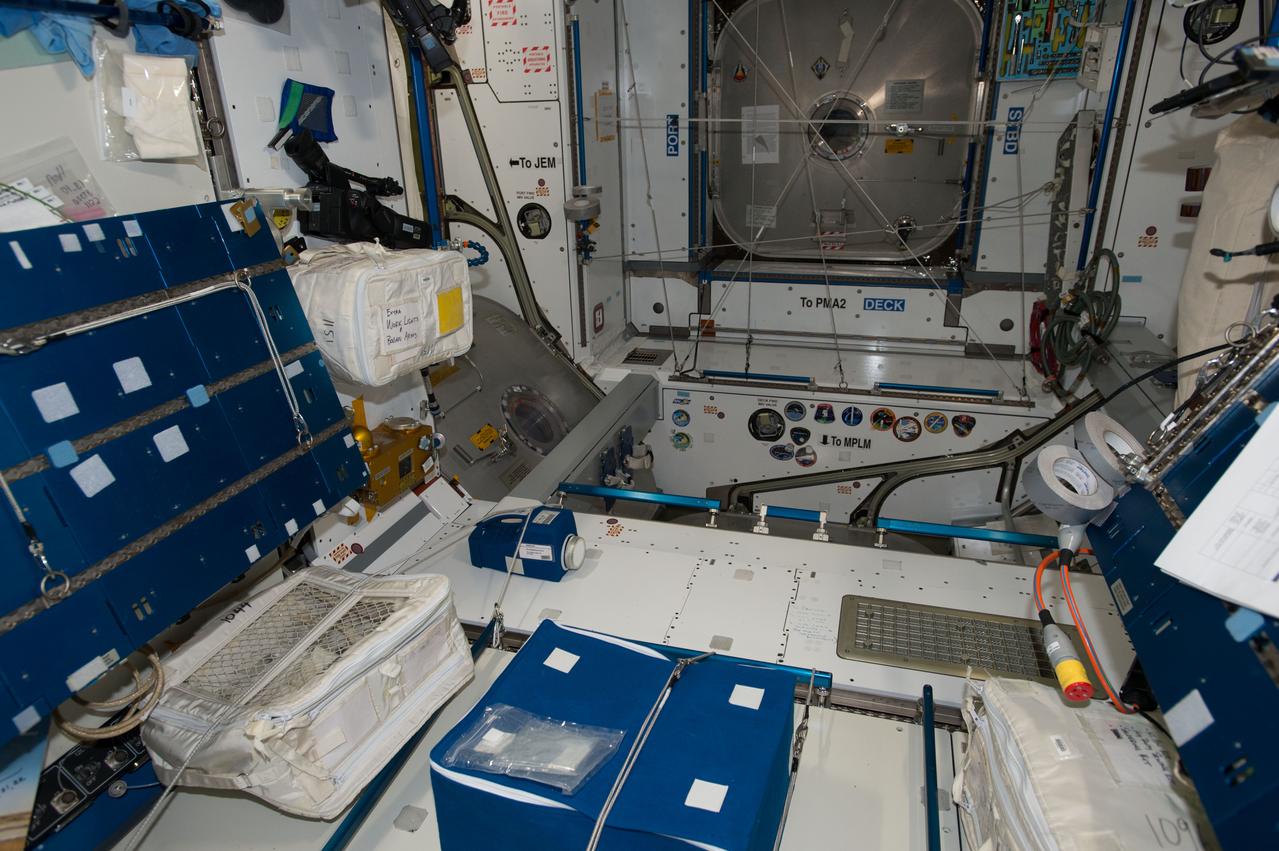
iss042e29609 (3/4/2015) --- Photographic documentation taken prior to collection of surface and air samples using various devices in multiple locations to characterize the types of microbial populations on the International Space Station (ISS) for the Microbial Observatory-1 payload. The Microbial Payload Tracking Series (Microbial Observatory-1) investigation monitors the types of microbes present on ISS over a one-year period. Samples are returned to Earth for further study, enabling scientists to understand the diversity of the microbial flora on the ISS and how it changes over time.
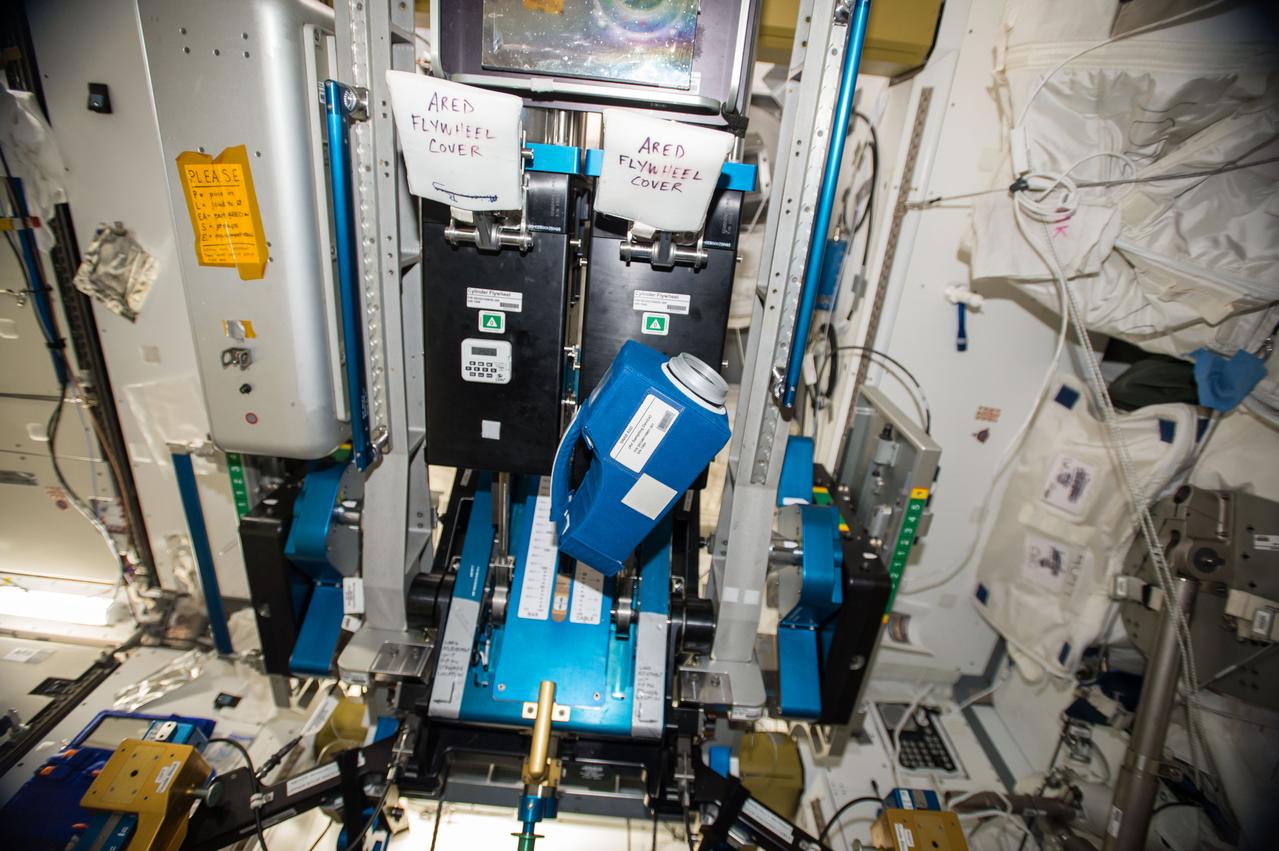
iss043e198394 (5/15/2015) --- Photographic documentation taken prior to collection of surface and air samples using various devices in multiple locations to characterize the types of microbial populations on the International Space Station (ISS) for the Microbial Observatory-1 payload. The Microbial Payload Tracking Series (Microbial Observatory-1) investigation monitors the types of microbes present on ISS over a one-year period. Samples are returned to Earth for further study, enabling scientists to understand the diversity of the microbial flora on the ISS and how it changes over time.
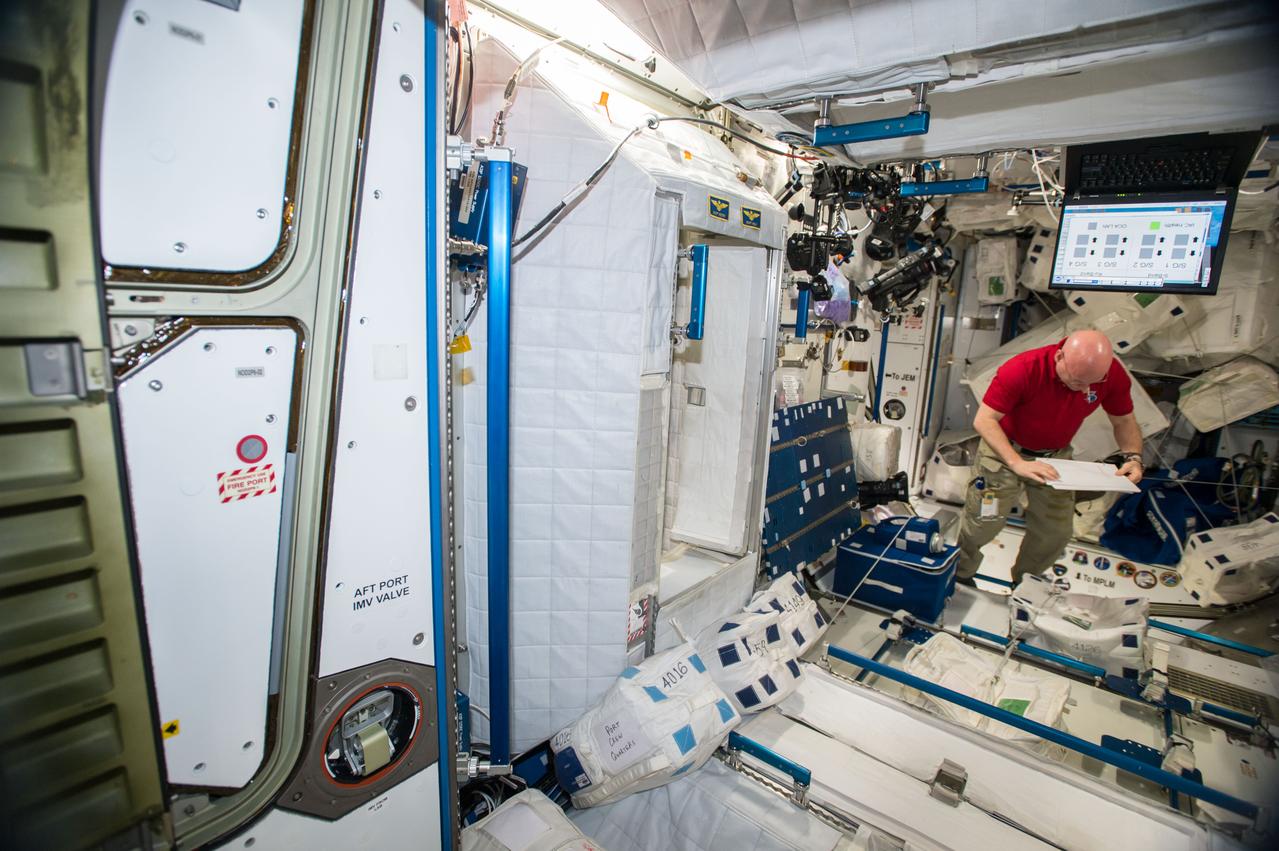
iss043e198418 (5/15/2015) --- NASA astronaut Scott Kelly is shown during the collection of surface and air samples using various devices in multiple locations to characterize the types of microbial populations on the International Space Station (ISS) for the Microbial Observatory-1 payload. The Microbial Payload Tracking Series (Microbial Observatory-1) investigation monitors the types of microbes present on ISS over a one-year period. Samples are returned to Earth for further study, enabling scientists to understand the diversity of the microbial flora on the ISS and how it changes over time.
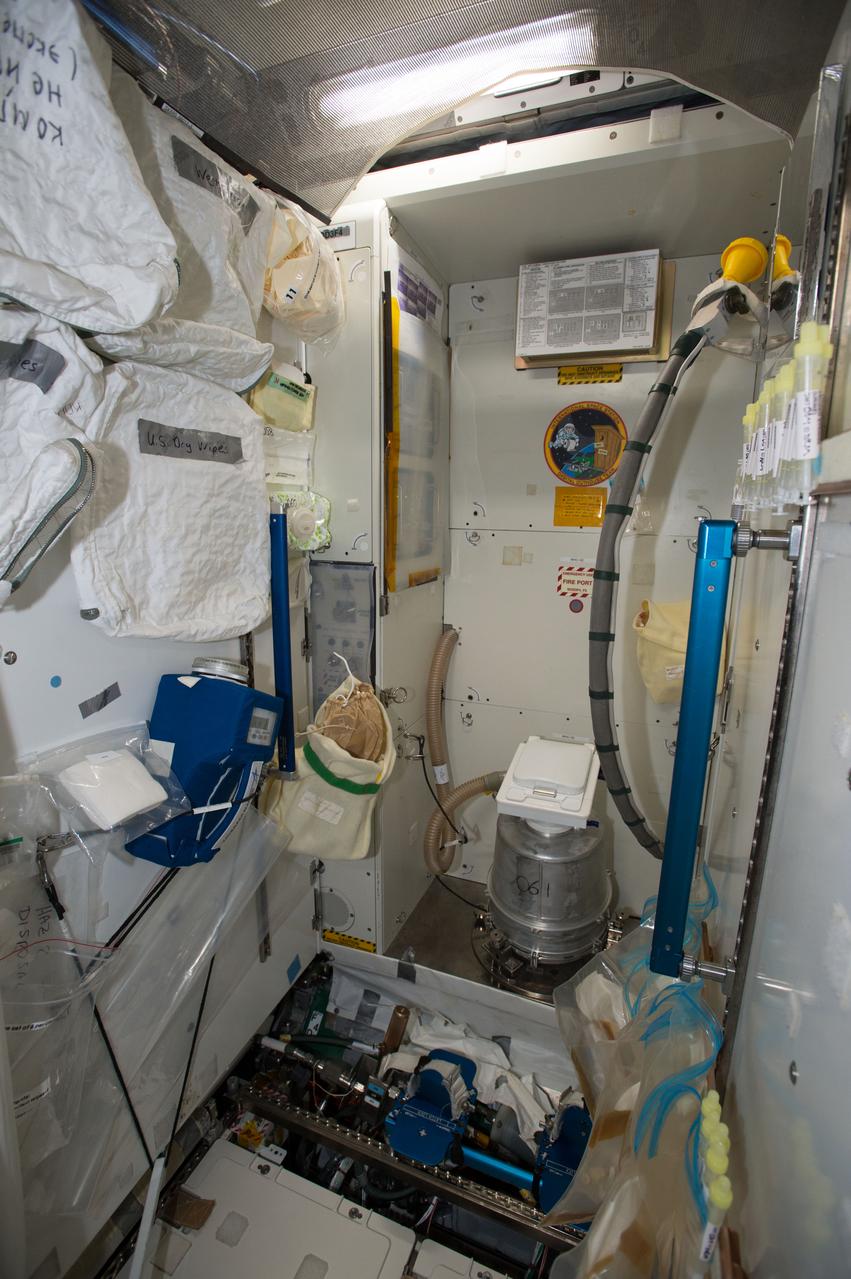
iss042e296534 (3/4/2015) --- Photographic documentation taken prior to collection of surface and air samples using various devices in multiple locations to characterize the types of microbial populations on the International Space Station (ISS) for the Microbial Observatory-1 payload. The Microbial Payload Tracking Series (Microbial Observatory-1) investigation monitors the types of microbes present on ISS over a one-year period. Samples are returned to Earth for further study, enabling scientists to understand the diversity of the microbial flora on the ISS and how it changes over time.
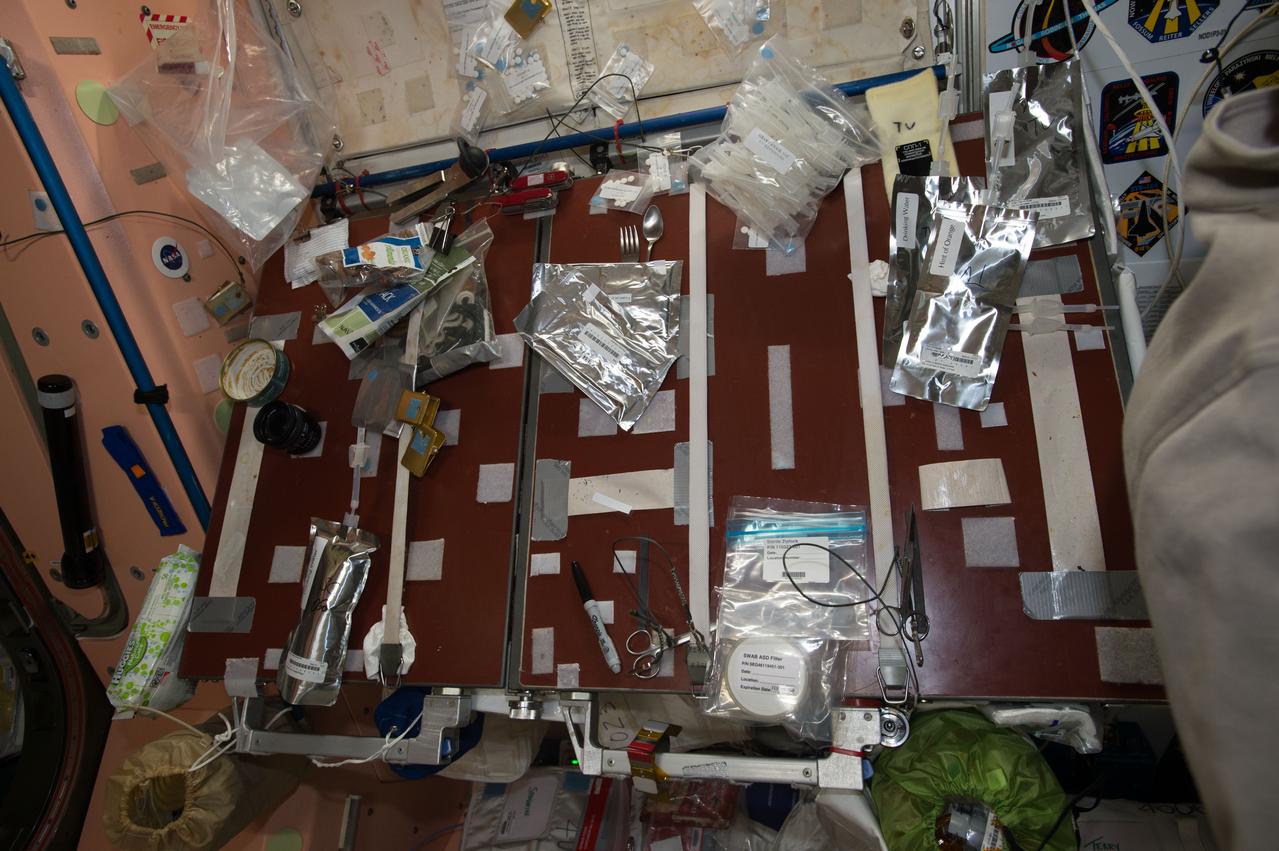
iss042e296526 (3/4/2015) --- Photographic documentation taken prior to collection of surface and air samples using various devices in multiple locations to characterize the types of microbial populations on the International Space Station (ISS) for the Microbial Observatory-1 payload. The Microbial Payload Tracking Series (Microbial Observatory-1) investigation monitors the types of microbes present on ISS over a one-year period. Samples are returned to Earth for further study, enabling scientists to understand the diversity of the microbial flora on the ISS and how it changes over time.
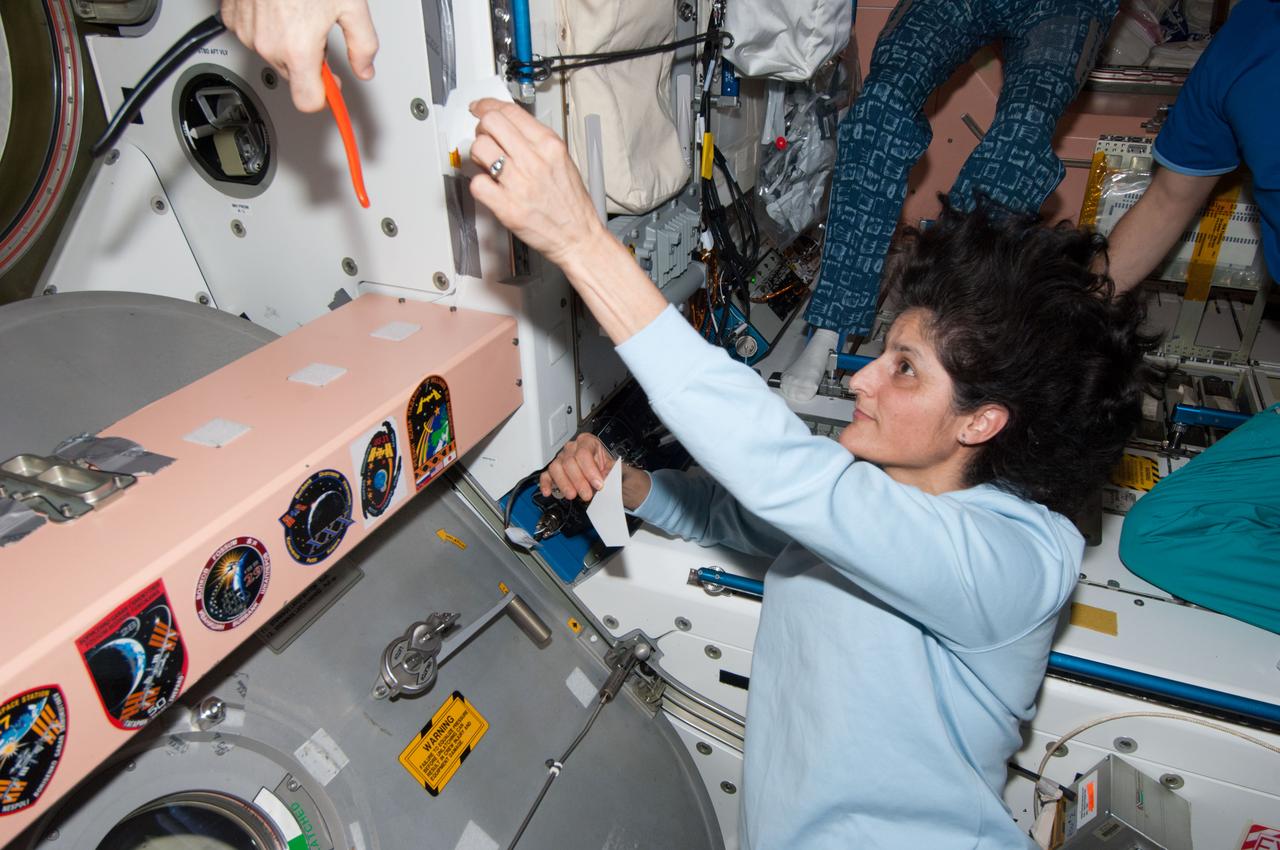
ISS033-E-022048 (17 Nov. 2012) --- In the Unity node, NASA astronaut Sunita Williams, Expedition 33 commander, prepares to add the Expedition 33 patch to the growing collection of insignias representing crews who have worked on the International Space Station, following the ceremony of Changing-of-Command from Expedition 33 to Expedition 34.
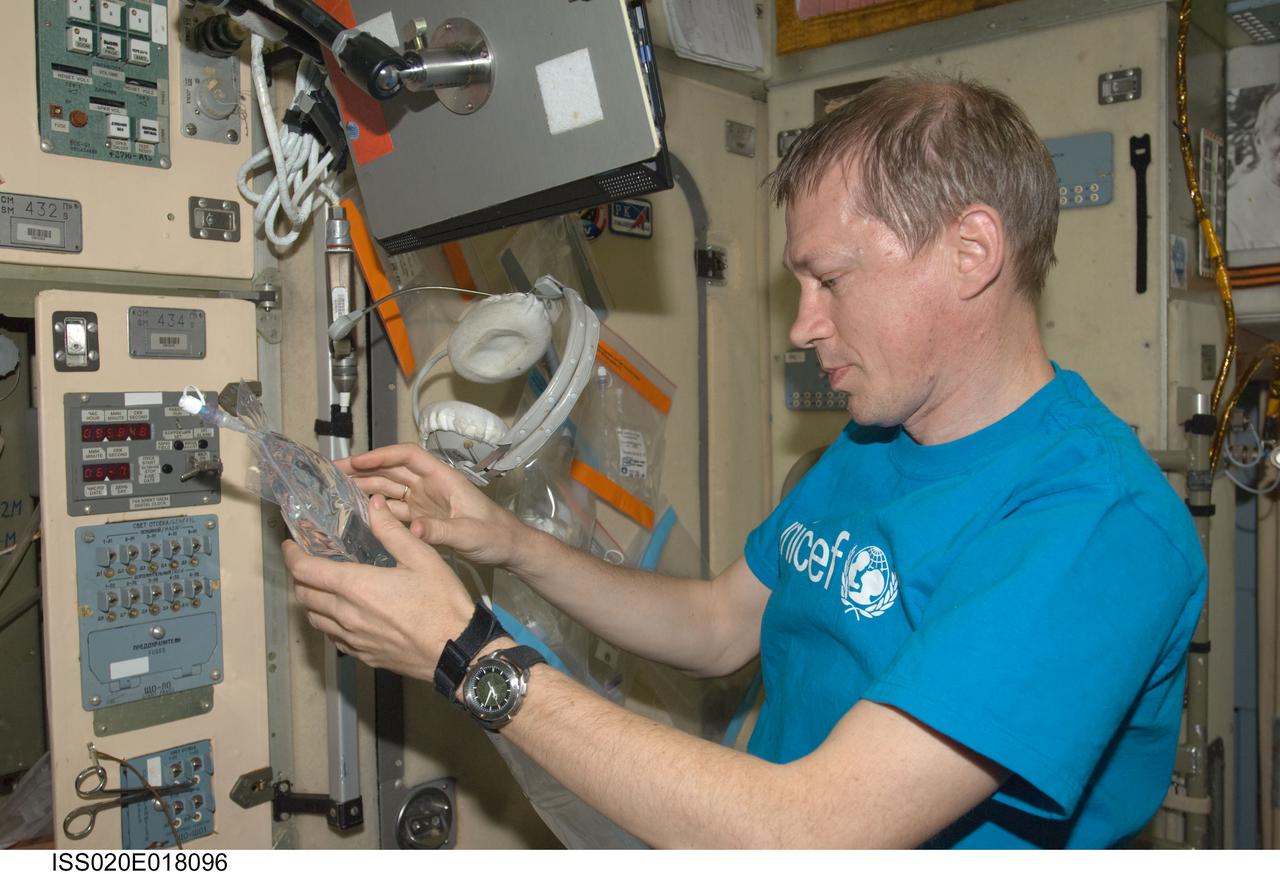
ISS020-E-018096 (7 July 2009) --- European Space Agency astronaut Frank De Winne, Expedition 20 flight engineer, collects water samples at the galley in the Zvezda Service Module of the International Space Station for in-flight analysis.
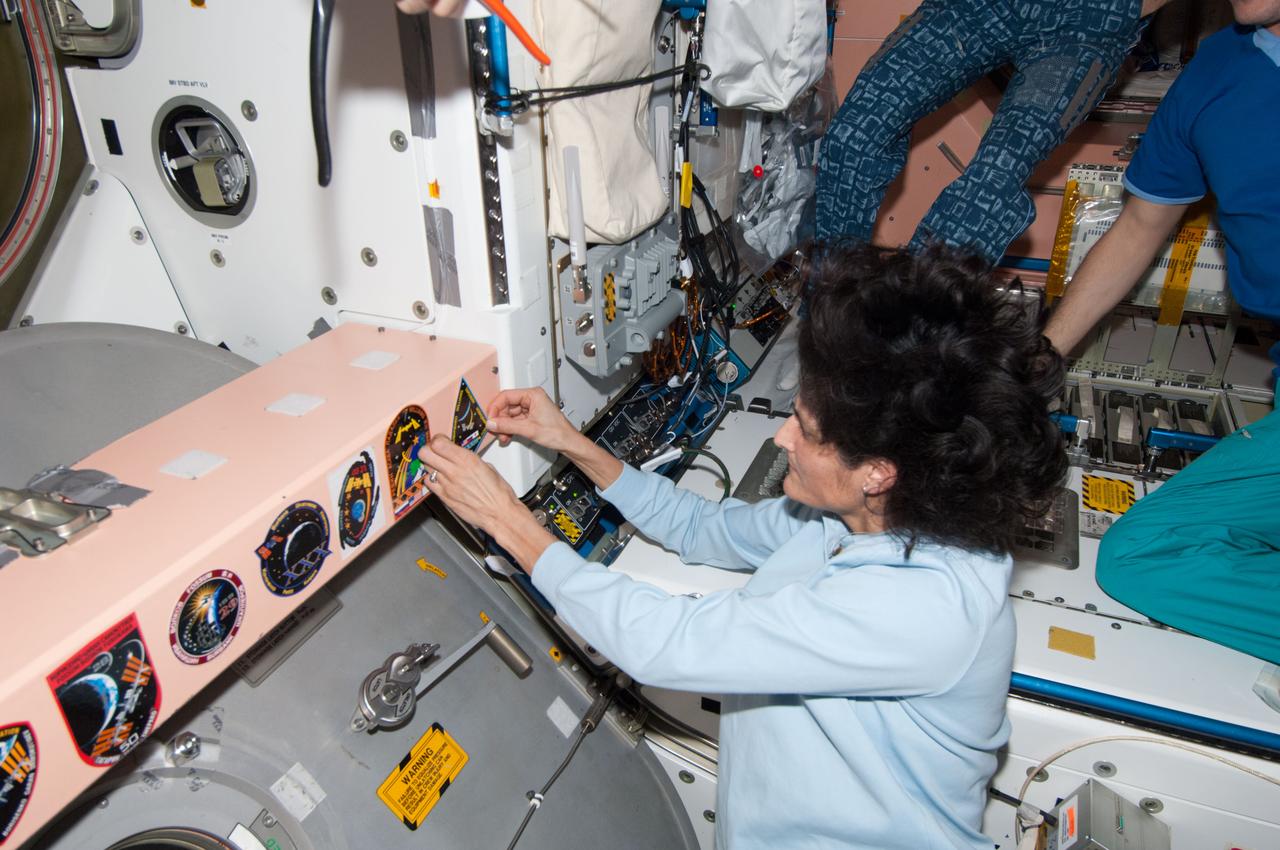
ISS033-E-022049 (17 Nov. 2012) --- In the Unity node, NASA astronaut Sunita Williams, Expedition 33 commander, adds the Expedition 33 patch to the growing collection of insignias representing crews who have worked on the International Space Station, following the ceremony of Changing-of-Command from Expedition 33 to Expedition 34.
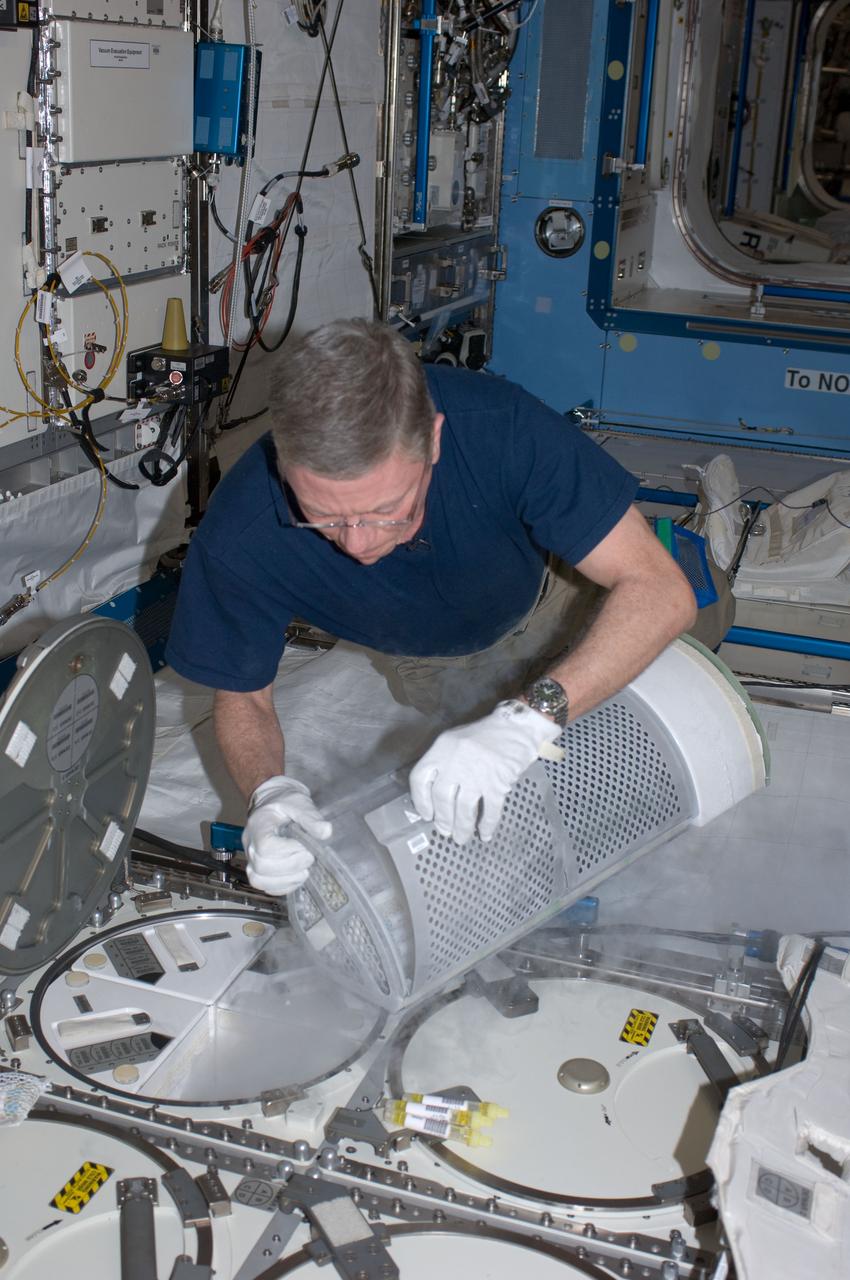
ISS029-E-015096 (4 Oct. 2011) --- In the International Space Station?s Kibo laboratory, NASA astronaut Mike Fossum, Expedition 29 commander, prepares to insert samples into a Minus Eighty Laboratory Freezer for ISS (MELFI-1) dewar tray for the second NUTRITION w/Repository collection period.
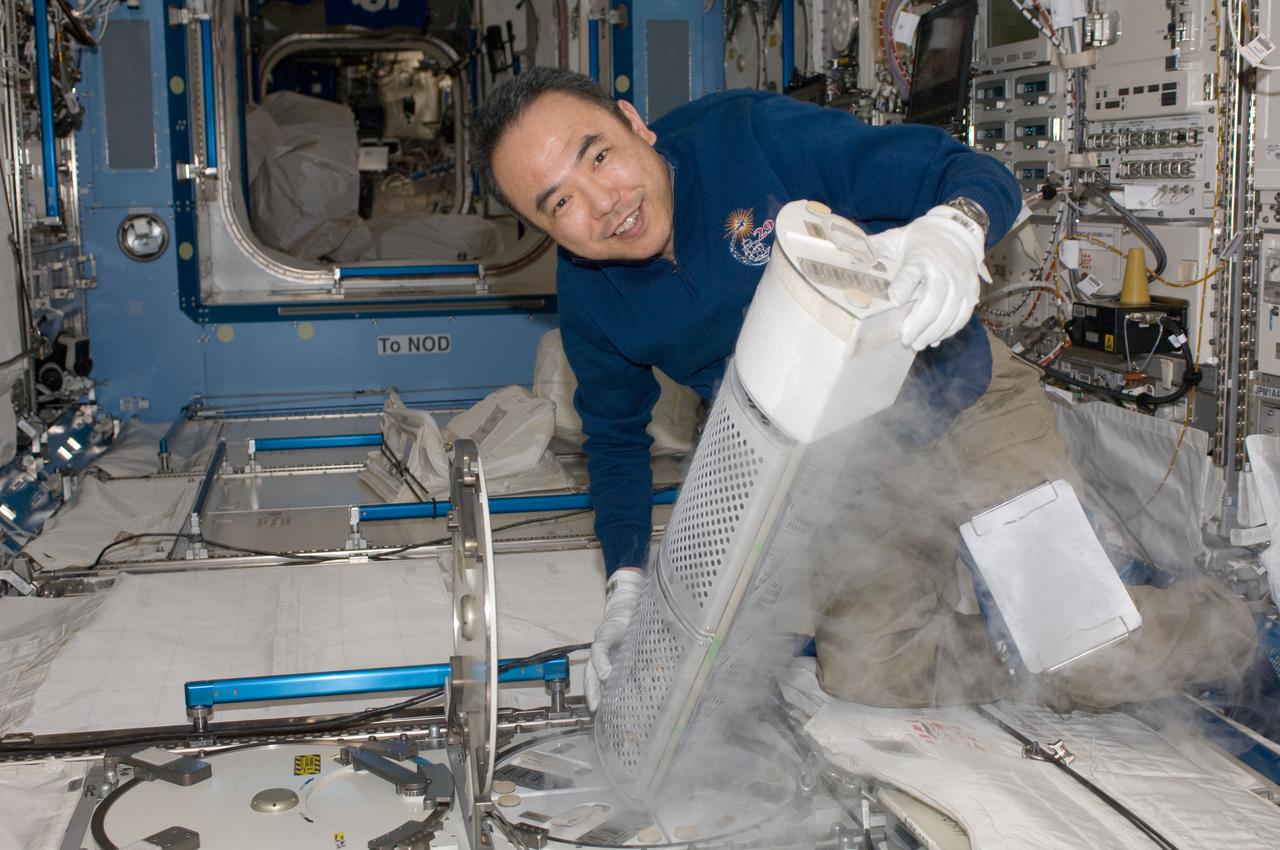
iss029e028495 (10/18/2011) --- Japan Aerospace Exploration Agency astronaut Satoshi Furukawa,Expedition 29 flight engineer,prepares to put samples from the CSA (Canadian Space Agency) Vascular Blood Collection protocol into the MELFI-1 (Minus Eighty Laboratory Freezer for ISS 1) unit.
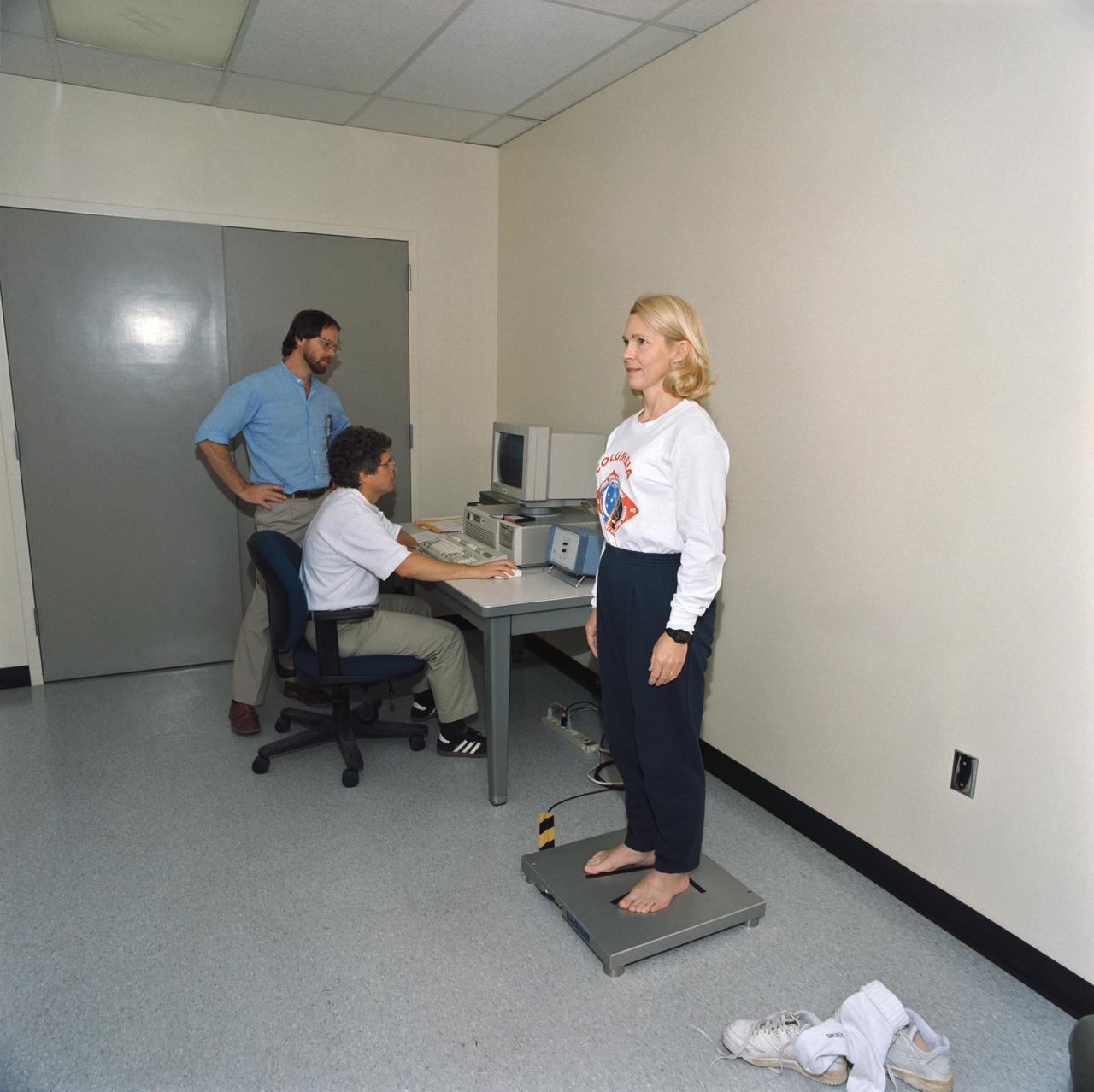
S93-45367 (29 Sept 1993) --- Astronaut Rhea Seddon, STS-58 payload commander, participates in biomedical data collection. The seven member crew spent an entire day recording important pre-flight data in preparation for the two week Spacelab Life Sciences (SLS-2) mission, scheduled for next month.
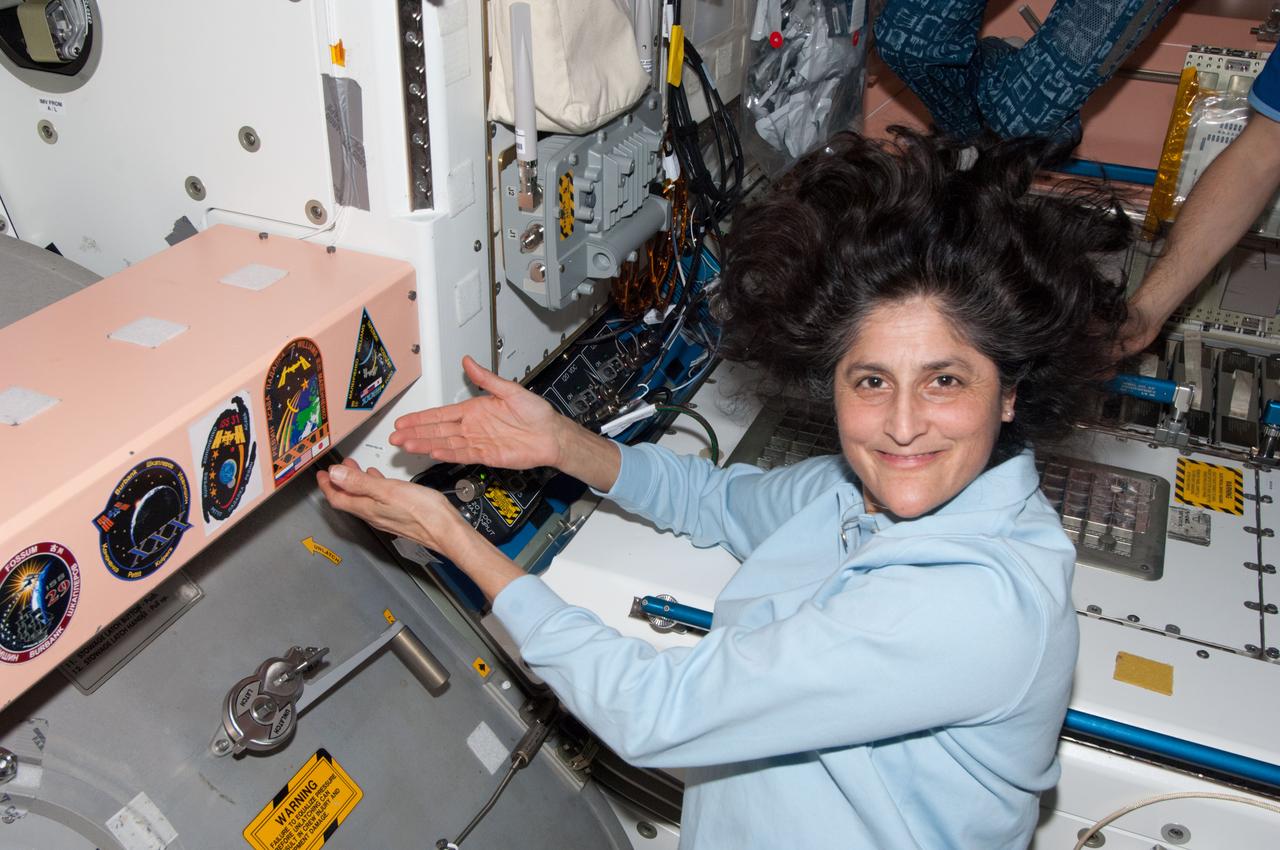
ISS033-E-022053 (17 Nov. 2012) --- In the Unity node, NASA astronaut Sunita Williams, Expedition 33 commander, adds the Expedition 33 patch to the growing collection of insignias representing crews who have worked on the International Space Station, following the ceremony of Changing-of-Command from Expedition 33 to Expedition 34.
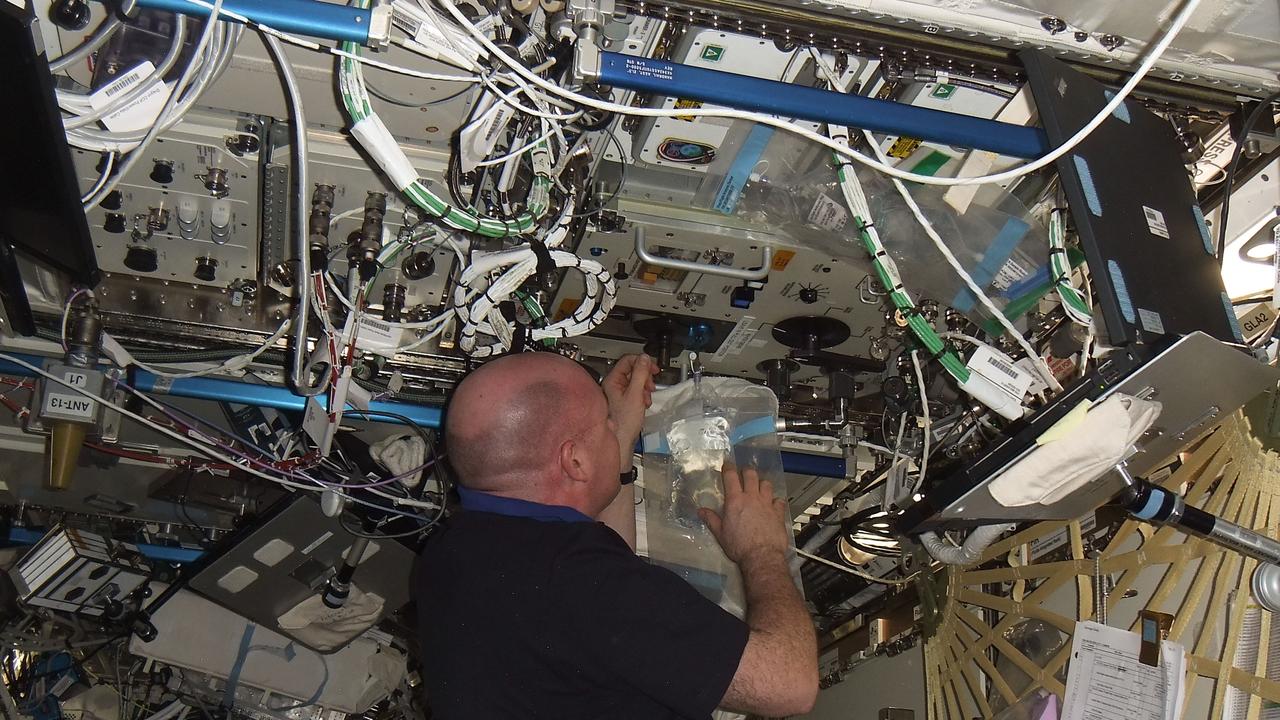
ISS031-E-157783 (15 May 2012) --- European Space Agency astronaut Andre Kuipers, Expedition 31 flight engineer, collects a water sample from the Potable Water Dispenser (PWD) in the Destiny laboratory of the International Space Station.
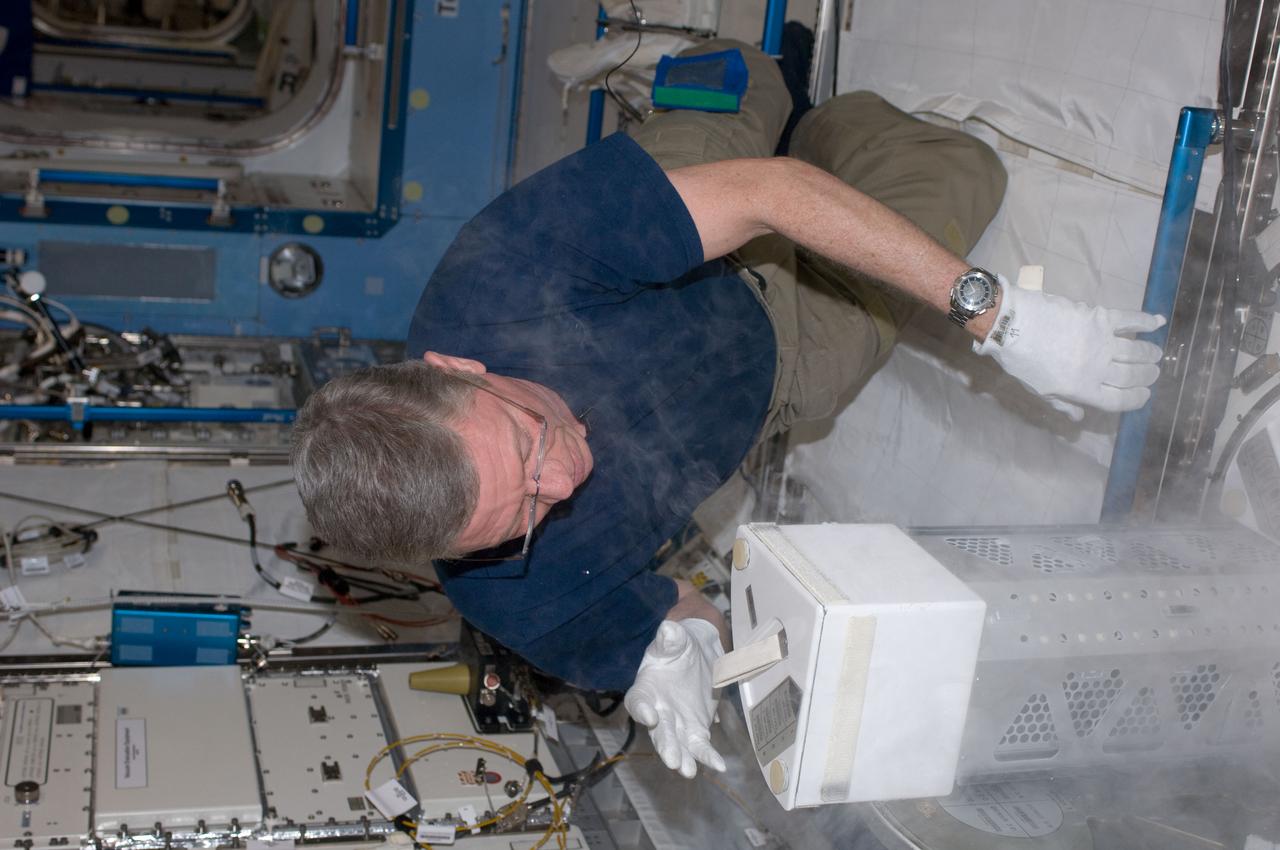
ISS029-E-015110 (4 Oct. 2011) --- In the International Space Station?s Kibo laboratory, NASA astronaut Mike Fossum, Expedition 29 commander, inserts a dewar tray of samples into the Minus Eighty Laboratory Freezer for ISS (MELFI-1) for the second NUTRITION w/Repository collection period.
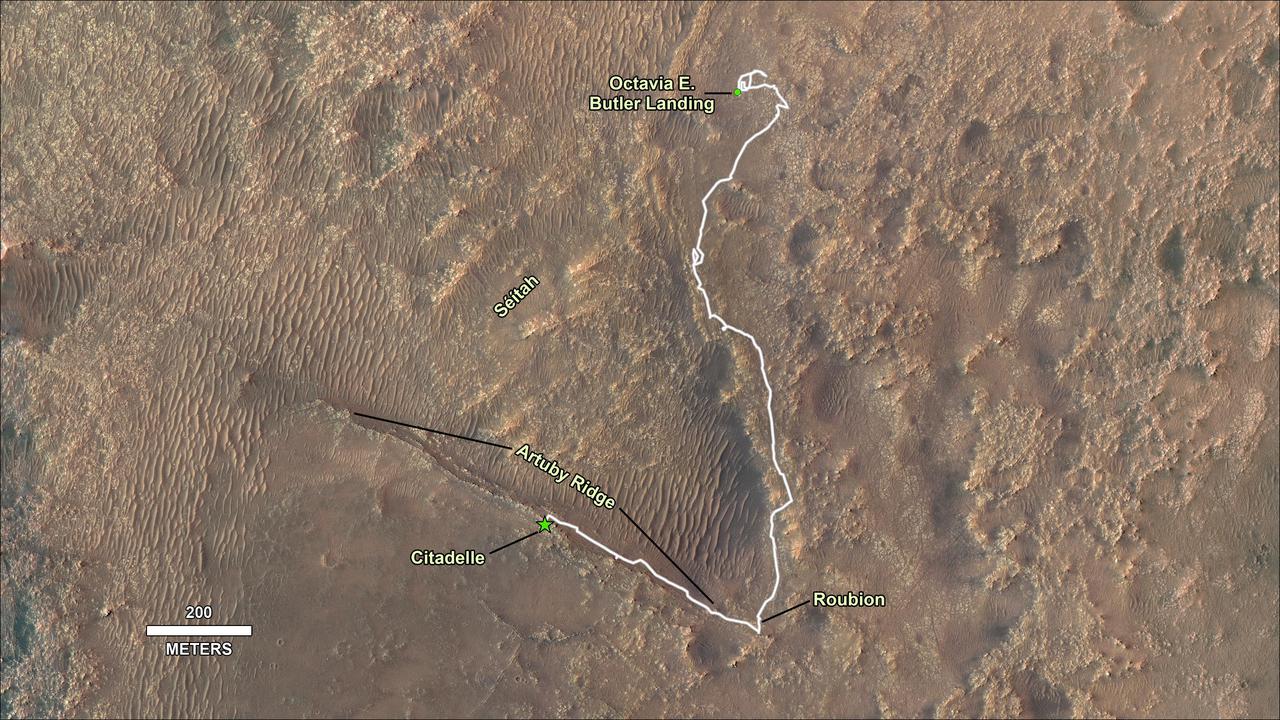
This image shows the journey of NASA's Perseverance rover across the floor of Mars' Jezero Crater in the approximately seven months since landing on Feb. 18, 2021. From the landing site "Octavia E. Butler Landing," the rover drove south and attempted to collect its first sample at a drill hole called "Roubion" in early August. After that rock proved too crumbly to provide a core sample, Perseverance drove northwest along "Artuby" ridge to an area known as "Citadelle," where it successfully collected its first two samples in early September 2021. The first core was taken from a block of rock called "Rochette," at the drill hole called "Montdenier." The second, or paired, sample of Montdenier was taken at the drill hole called "Montagnac.") "Séítah," a future area of rover exploration, is also shown. This map is composed of images from the High Resolution Imaging Experiment (HiRISE) aboard NASA's Mars Reconnaissance Orbiter. A key objective for Perseverance's mission on Mars is astrobiology, including the search for signs of ancient microbial life. The rover will characterize the planet's geology and past climate, pave the way for human exploration of the Red Planet, and be the first mission to collect and cache Martian rock and regolith. The Mars 2020 Perseverance mission is part of NASA's Moon to Mars exploration approach, which includes Artemis missions to the Moon that will help prepare for human exploration of the Red Planet. Subsequent NASA missions, in cooperation with ESA (European Space Agency), would send spacecraft to Mars to collect these sealed samples from the surface and return them to Earth for in-depth analysis. https://photojournal.jpl.nasa.gov/catalog/PIA24750
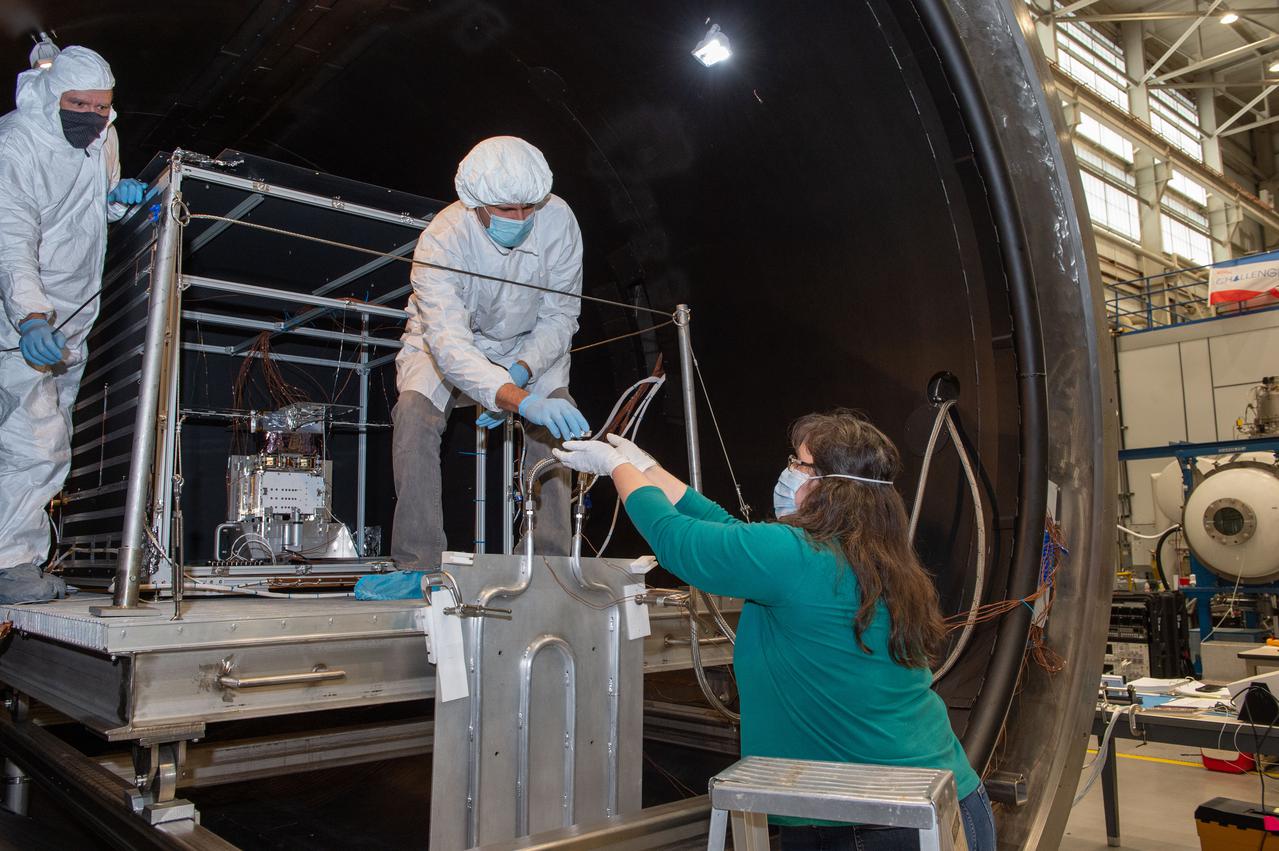
Miria Finckenor collects Optical Witness Samples and swab samples for analysis to verify that the NEA Scout thermal vacuum bake-out is complete and the chamber is clean.
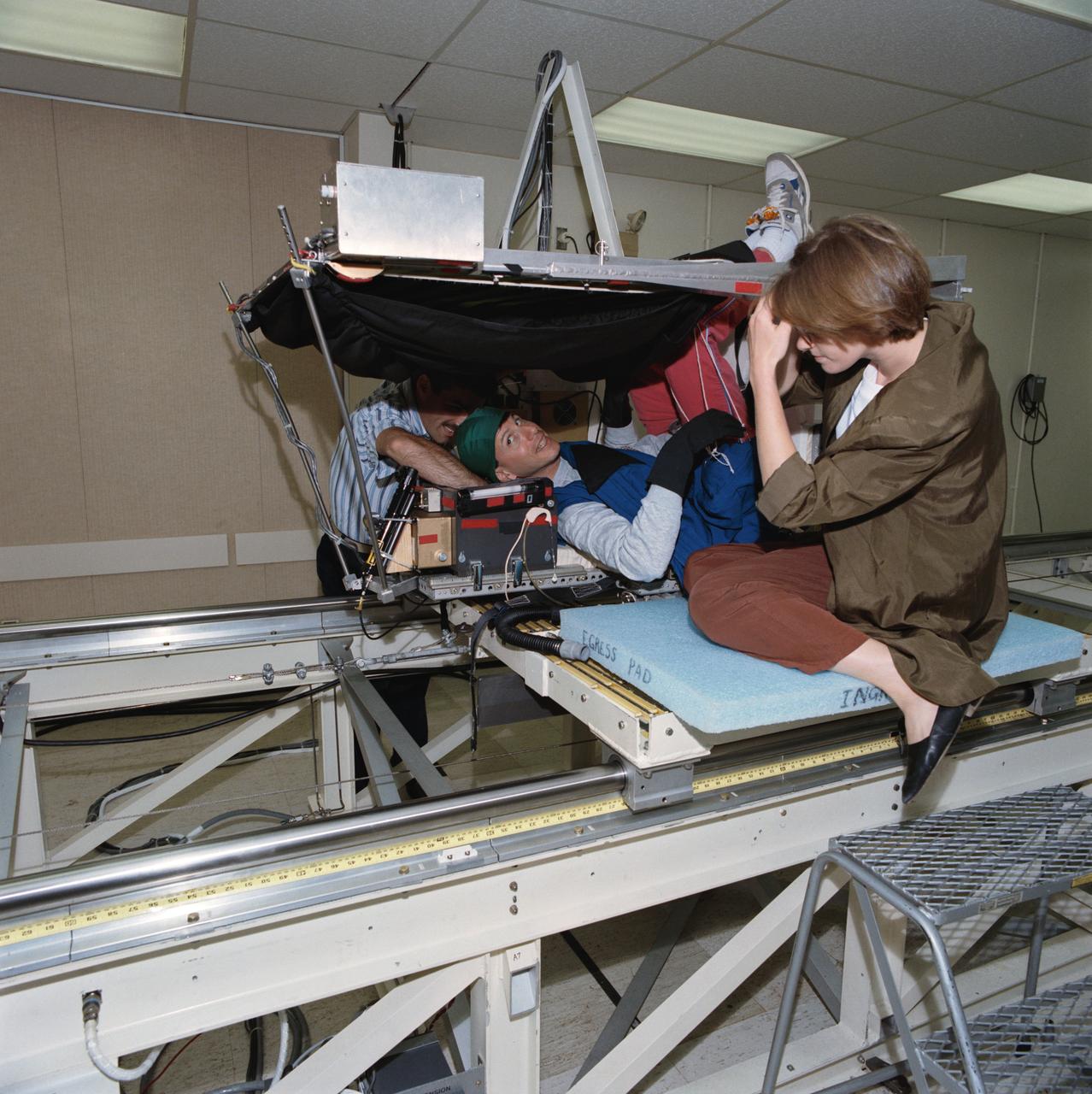
S93-45314 (29 Sept 1993) --- Payload specialist Martin J. Fettman, in an oscillating sled device, participates in a data collection project for neurovestibular functions. The seven Spacelab Life Sciences (SLS-2) crewmembers devoted a full day to miscellaneous biomedical data collection in preparation for next month's two week mission aboard Columbia.
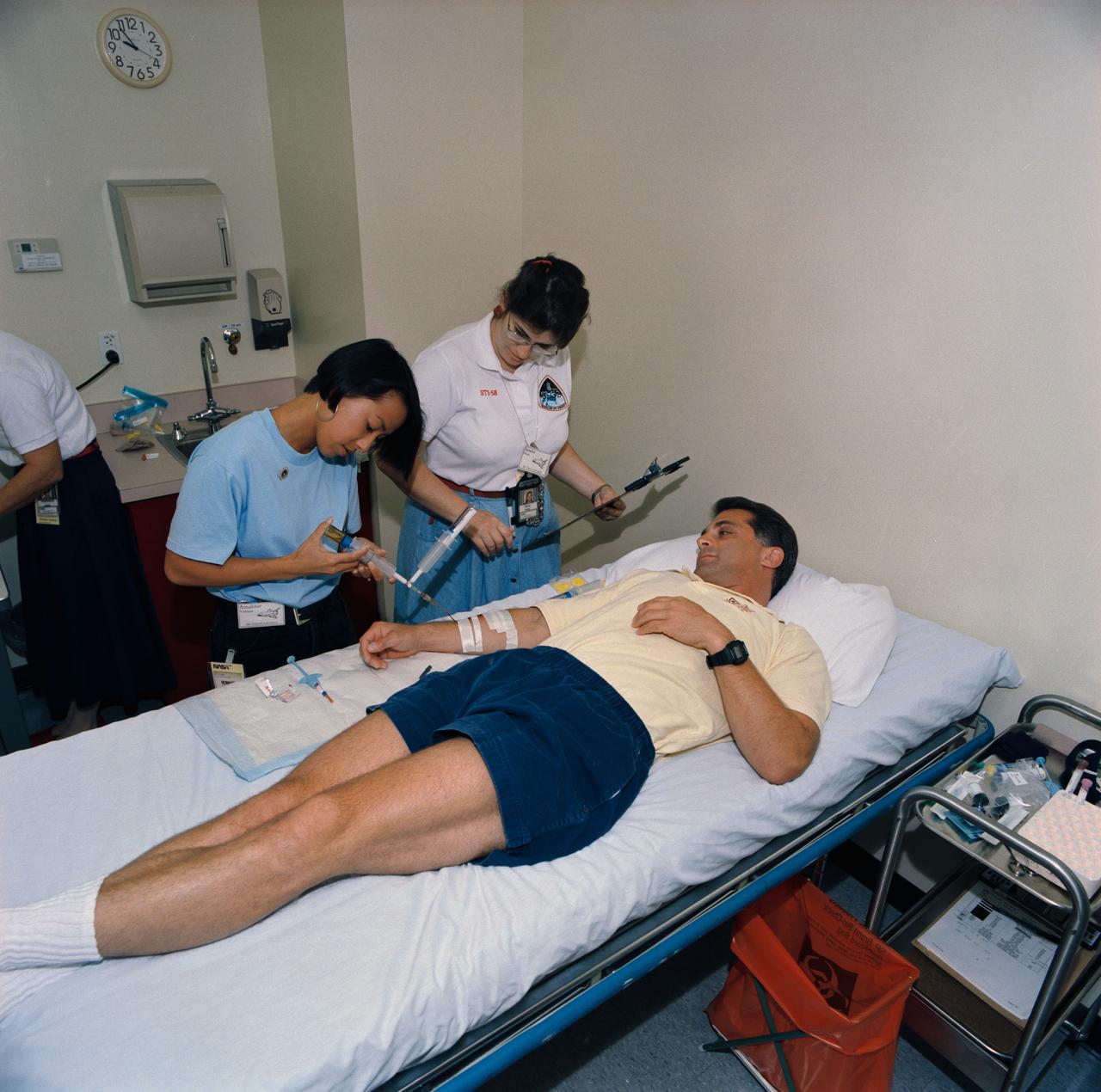
S93-45370 (29 Sept 1993) --- Blood samples from crew members are critical to several Spacelab Life Sciences (SLS-2) investigations. Amalour Veloso (left) and Sandra Prow draw blood from David A. Wolf, mission specialist. Wolf was participating with five other NASA astronauts and a payload specialist on data collection and training in preparation for the two week SLS-2 mission.

art002e027814 (April 8, 2026) – NASA astronaut Reid Wiseman collects a saliva sample aboard the Orion spacecraft for the Artemis II Immune Biomarkers study. The study looks at proteins, enzymes, and other biomarkers found in the samples to help researchers pinpoint how the body responds to mission stressors during deep space missions. These biomarkers give insight into crews’ immune health, inflammation, nutritional status, bone health, and more. Credit: NASA

art002e027812 (April 8, 2026) – NASA astronaut Reid Wiseman collects a saliva sample aboard the Orion spacecraft for the Artemis II Immune Biomarkers study. The study looks at proteins, enzymes, and other biomarkers found in the samples to help researchers pinpoint how the body responds to mission stressors during deep space missions. These biomarkers give insight into crews’ immune health, inflammation, nutritional status, bone health, and more. Credit: NASA

art002e027815 (April 8, 2026) – NASA astronaut Reid Wiseman collects a saliva sample aboard the Orion spacecraft for the Artemis II Immune Biomarkers study. The study looks at proteins, enzymes, and other biomarkers found in the samples to help researchers pinpoint how the body responds to mission stressors during deep space missions. These biomarkers give insight into crews’ immune health, inflammation, nutritional status, bone health, and more. Credit: NASA
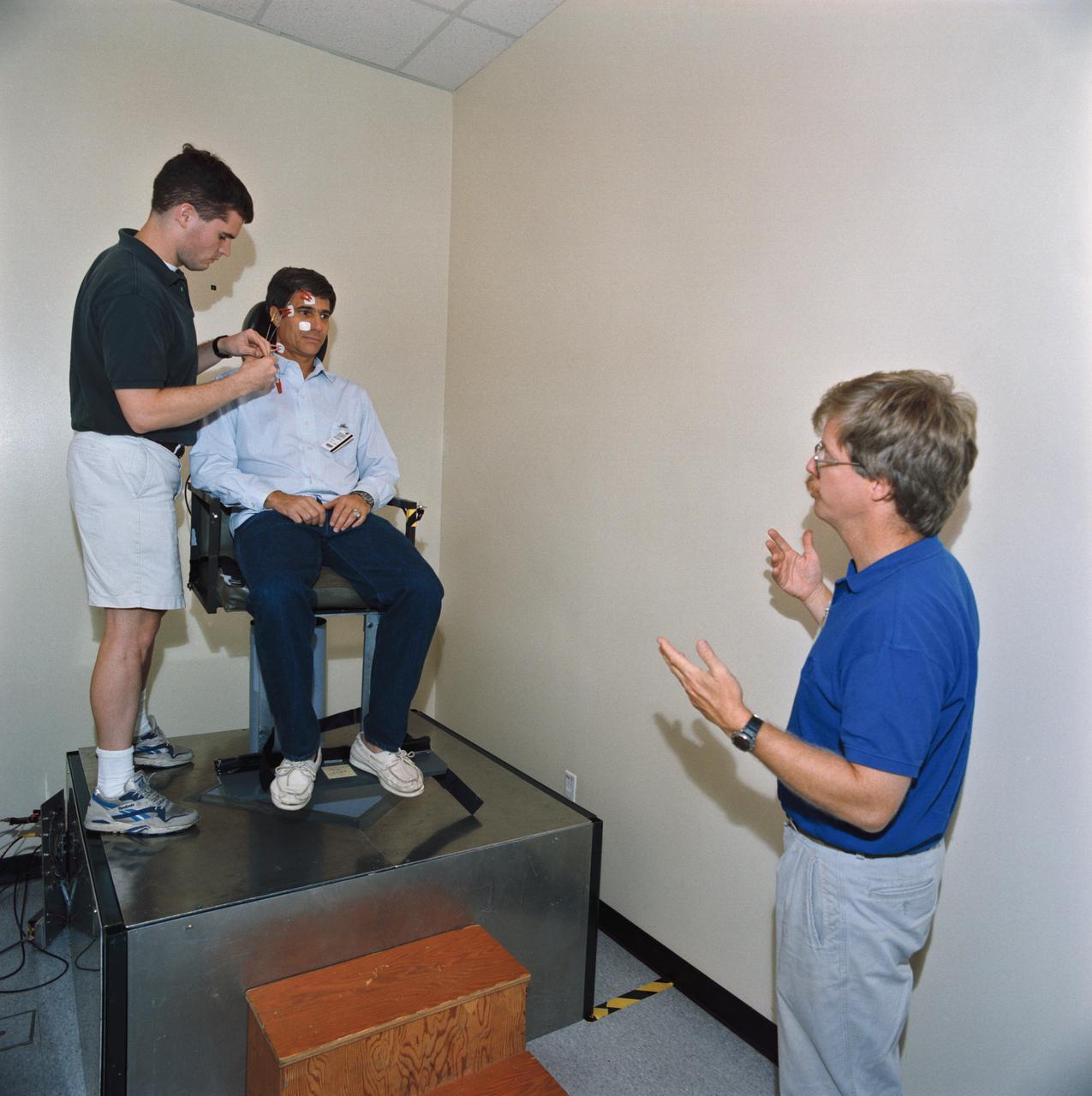
S93-45366 (29 Sept 1993) --- Astronaut John E. Blaha, STS-58 mission commander, sits in a training version of the rotating chair test device. Sensors are attached to Blaha's head and face to record responses to the rotation. Blaha was participating with five other NASA astronauts and a payload specialist for data collection and training in preparation for the two week Spacelab Life Sciences (SLS-2) mission.
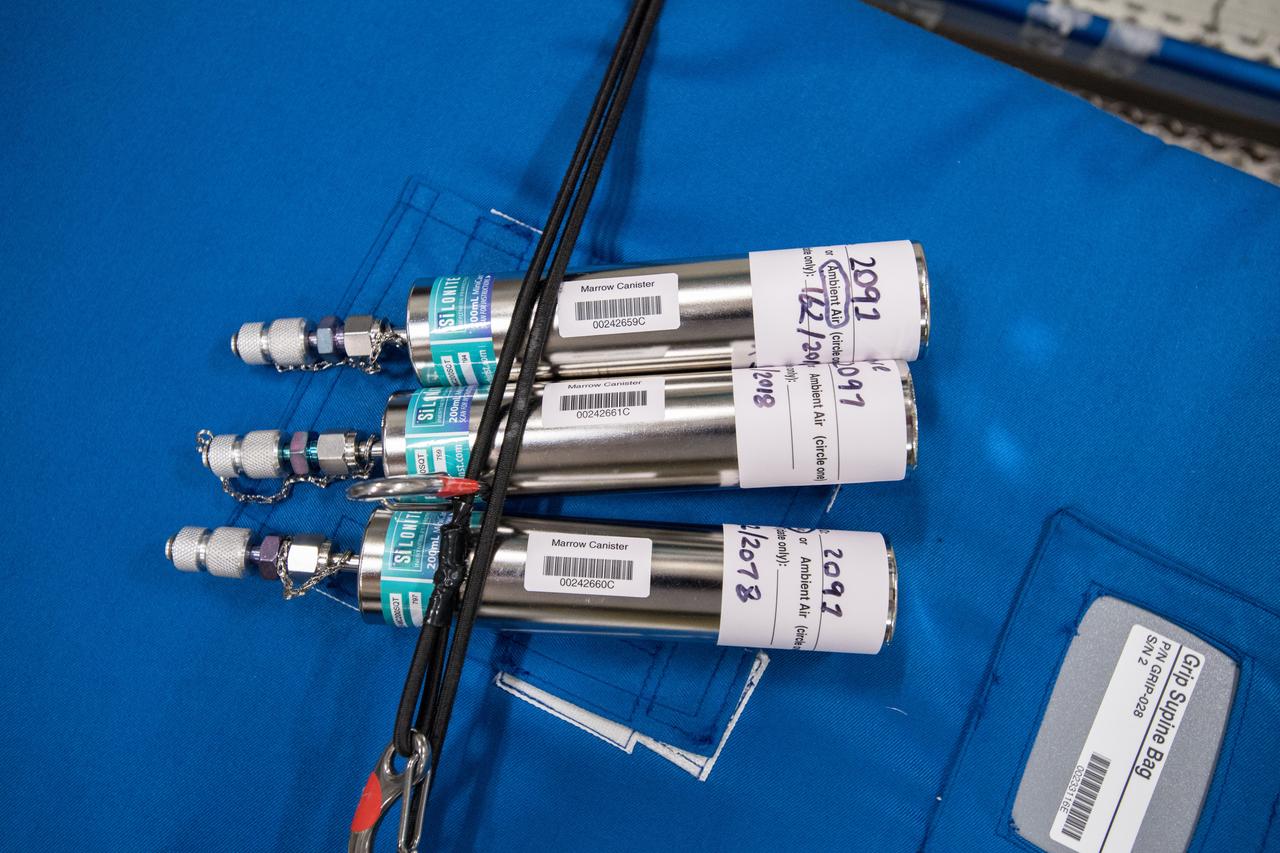
iss056e005940 (6/10/2018) --- Air sample collection hardware for The MARROW Study (Bone Marrow Adipose Reaction: Red or White?). The Marrow investigation looks at the effects of microgravity on bone marrow and analyzes breath samples to measure red blood cell function to help doctors understand how blood cell production is altered in microgravity. Results may improve the health of astronauts on long-term missions and help patients on Earth with mobility and age-related issues.

art002e027816 (April 8, 2026) – NASA astronaut Reid Wiseman collects a saliva sample aboard the Orion spacecraft for the Artemis II Immune Biomarkers study. The study looks at proteins, enzymes, and other biomarkers found in the samples to help researchers pinpoint how the body responds to mission stressors during deep space missions. These biomarkers give insight into crews’ immune health, inflammation, nutritional status, bone health, and more. Credit: NASA
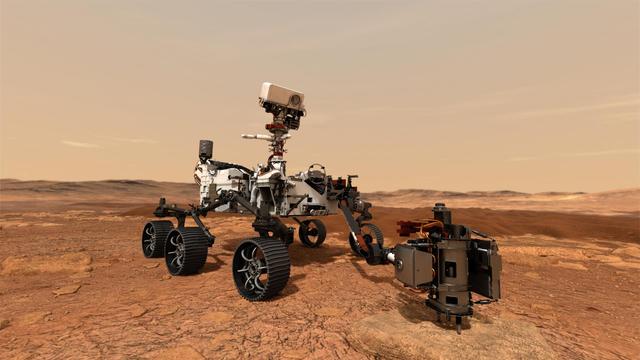
In this illustration, NASA's Mars 2020 rover uses its drill to core a rock sample on Mars. Scheduled to launch in July 2020, the Mars 2020 rover represents the first leg of humanity's first round trip to another planet. The rover will collect and store rock and soil samples on the planet's surface that future missions will retrieve and return to Earth. NASA and the European Space Agency are solidifying concepts for a Mars sample return mission. https://photojournal.jpl.nasa.gov/catalog/PIA23491
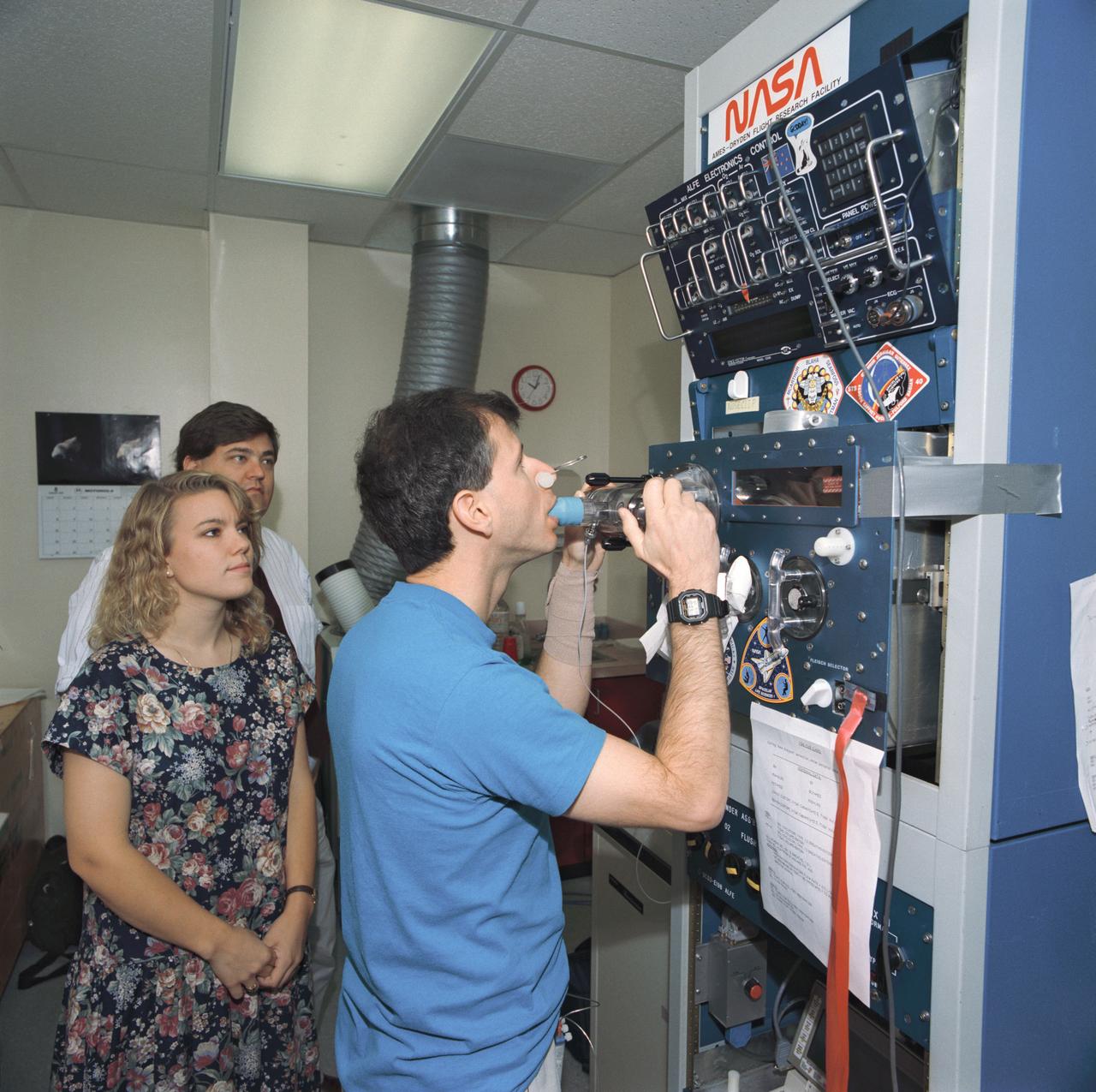
S93-45369 (29 Sept 1993) --- Training on the pre-breathing assembly, Martin J. (Marty) Fettman, DVM, inhales a predetermined gas composition. A gas analyzer mass spectrometer determines the composition of the gases he exhales. The re-breathing assembly and gas analyzer system are part of an investigation that explores how lung function is altered in space flight. The payload specialist for the Spacelab Life Sciences (SLS-2) mission was participating with six NASA astronauts, also assigned to STS-58, for data collection and training.
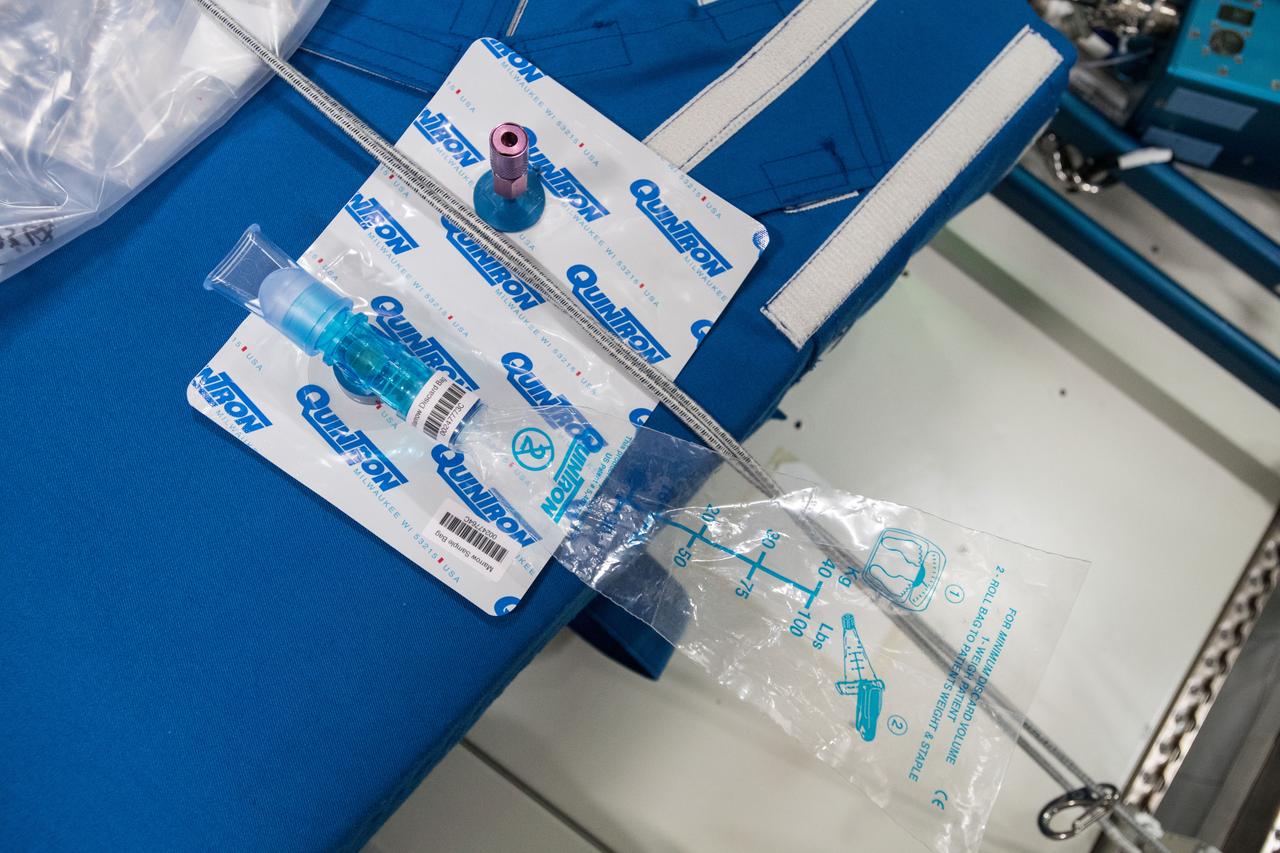
iss056e005938 (6/10/2018) --- Air sample collection hardware for The MARROW Study (Bone Marrow Adipose Reaction: Red or White?). The Marrow investigation looks at the effects of microgravity on bone marrow and analyzes breath samples to measure red blood cell function to help doctors understand how blood cell production is altered in microgravity. Results may improve the health of astronauts on long-term missions and help patients on Earth with mobility and age-related issues.

iss049e035512 (10/14/2016) --- NASA astronaut Kate Rubins during Microbe IV Sampling Sheet and White Tube Collection in the Japanese Experiment Module (JEM) Pressurized Module (JPM). The JAXA KIBO Utilization scenario, studies the relationship between humans and microbes in space habitation environments, which are critical for success in long-duration missions. Credit: JAXA/Takuya Onishi

art002e027809 (April 8, 2026) – NASA astronaut Reid Wiseman prepares to collect a saliva sample aboard the Orion spacecraft for the Artemis II Immune Biomarkers study, which uses proteins, enzymes, and other biomarkers found in saliva samples to learn more about how the crew adapted to spaceflight. These biomarkers give insight into crews’ immune health, inflammation, nutritional status, bone health, and more. Credit: NASA
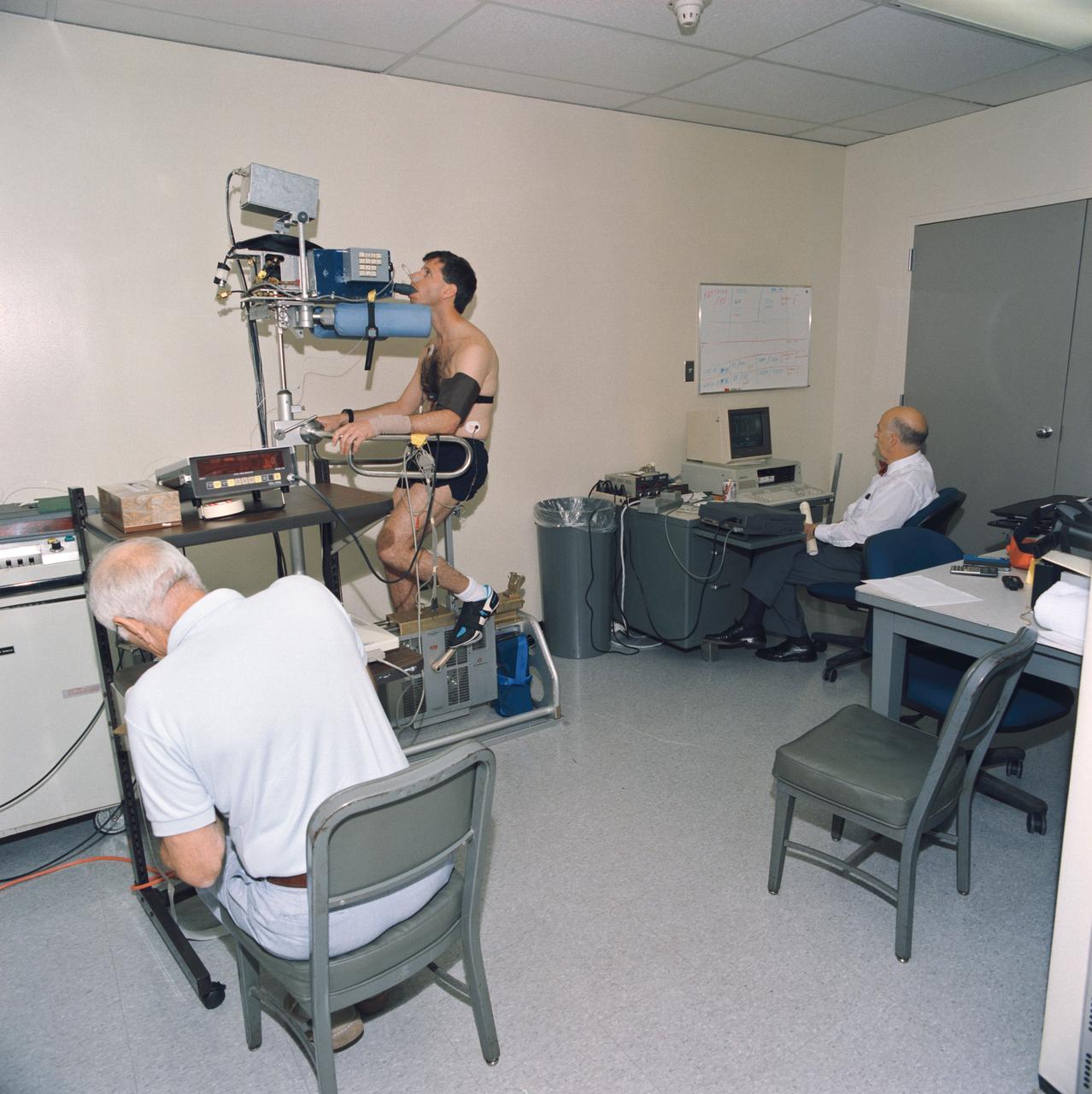
S93-45371 (29 Sept 1993) --- Astride the bicycle ergometer, Martin J. (Marty) Fettman, DVM, breathes quietly into the cardiovascular re-breathing unit during the resting phase of an experiment. The payload specialist for the Spacelab Life Sciences (SLS-2) mission was participating with six NASA astronauts, also assigned to STS-58, for data collection and training.
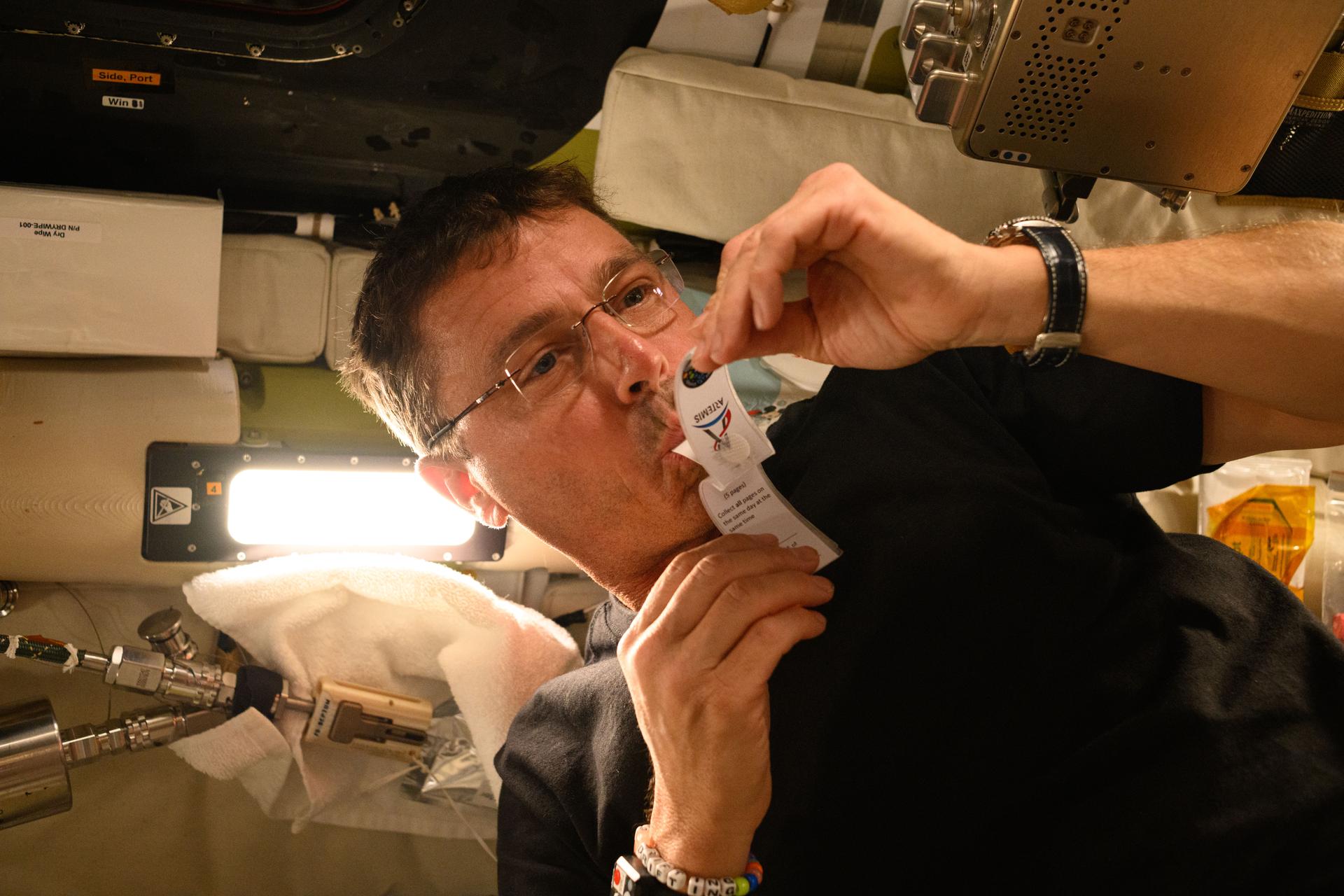
art002e027817 (April 8, 2026) – NASA astronaut Reid Wiseman collects a saliva sample aboard the Orion spacecraft for the Artemis II Immune Biomarkers study. The study looks at proteins, enzymes, and other biomarkers found in the samples to help researchers pinpoint how the body responds to mission stressors during deep space missions. These biomarkers give insight into crews’ immune health, inflammation, nutritional status, bone health, and more. Credit: NASA
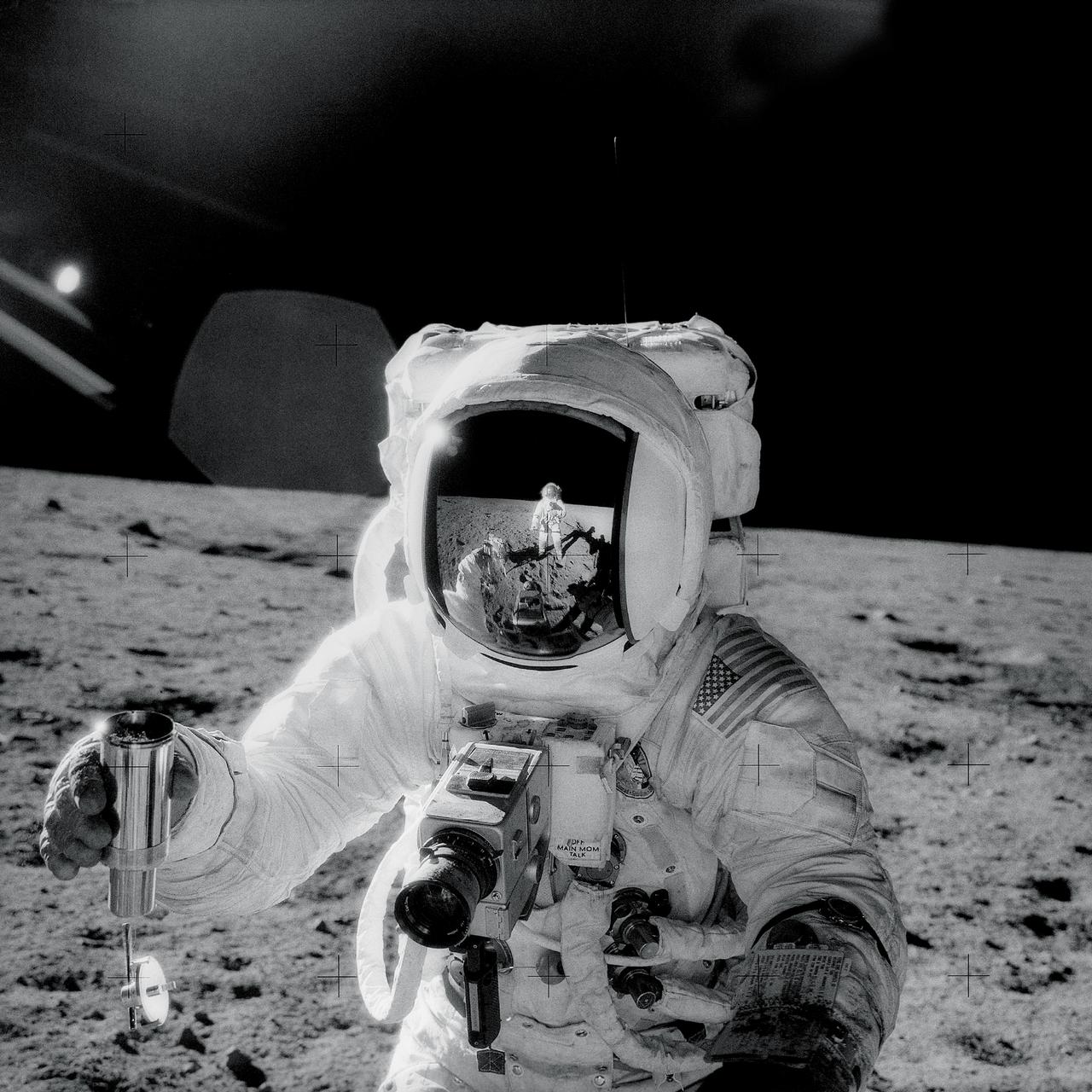
AS12-49-7278 (19-20 Nov. 1969) --- Astronaut Alan L. Bean holds a Special Environmental Sample Container filled with lunar soil collected during the extravehicular activity (EVA) in which astronauts Charles Conrad Jr., commander, and Bean, lunar module pilot, participated. Conrad, who took this picture, is reflected in Bean's helmet visor. Conrad and Bean descended in the Apollo 12 Lunar Module (LM) to explore the lunar surface while astronaut Richard F. Gordon Jr., command module pilot, remained with the Command and Service Modules (CSM) in lunar orbit. Photo credit: NASA

ISS013-E-75813 (4 Sept. 2006) --- Cosmonaut Pavel V. Vinogradov, Expedition 13 commander representing Russia's Federal Space Agency, adds the Expedition 13 patch to the Unity node's growing collection of insignias representing crews who have lived and worked on the International Space Station.
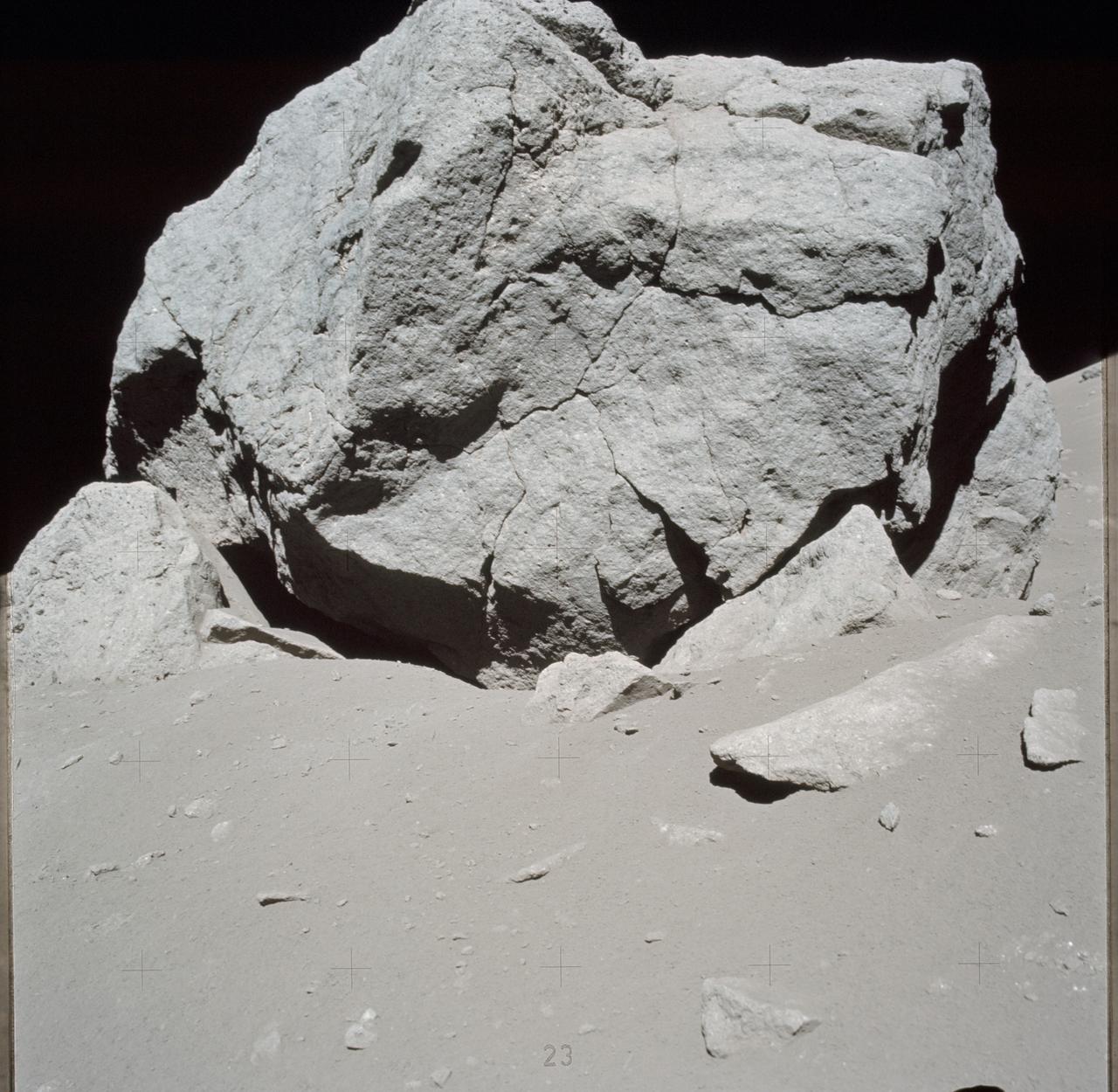
AS17-140-21438 (7-19 Dec. 1972) --- This 70mm frame features a close-up view of a large multi-cracked boulder discovered by astronauts Eugene A. Cernan, commander, and Harrison H. (Jack) Schmitt, lunar module pilot, during their visit to extravehicular activity (EVA) Station 6. This boulder, referred to as number two, provided several samples for the crew members' record-setting volume of rock collections. While astronauts Cernan and Schmitt descended in the Lunar Module (LM) "Challenger" to explore the Taurus-Littrow region of the moon, astronaut Ronald E. Evans, command module pilot, remained with the Command and Service Modules (CSM) "America" in lunar orbit. Cernan and Schmitt were the last crew members to explore the moon in the Apollo Program.
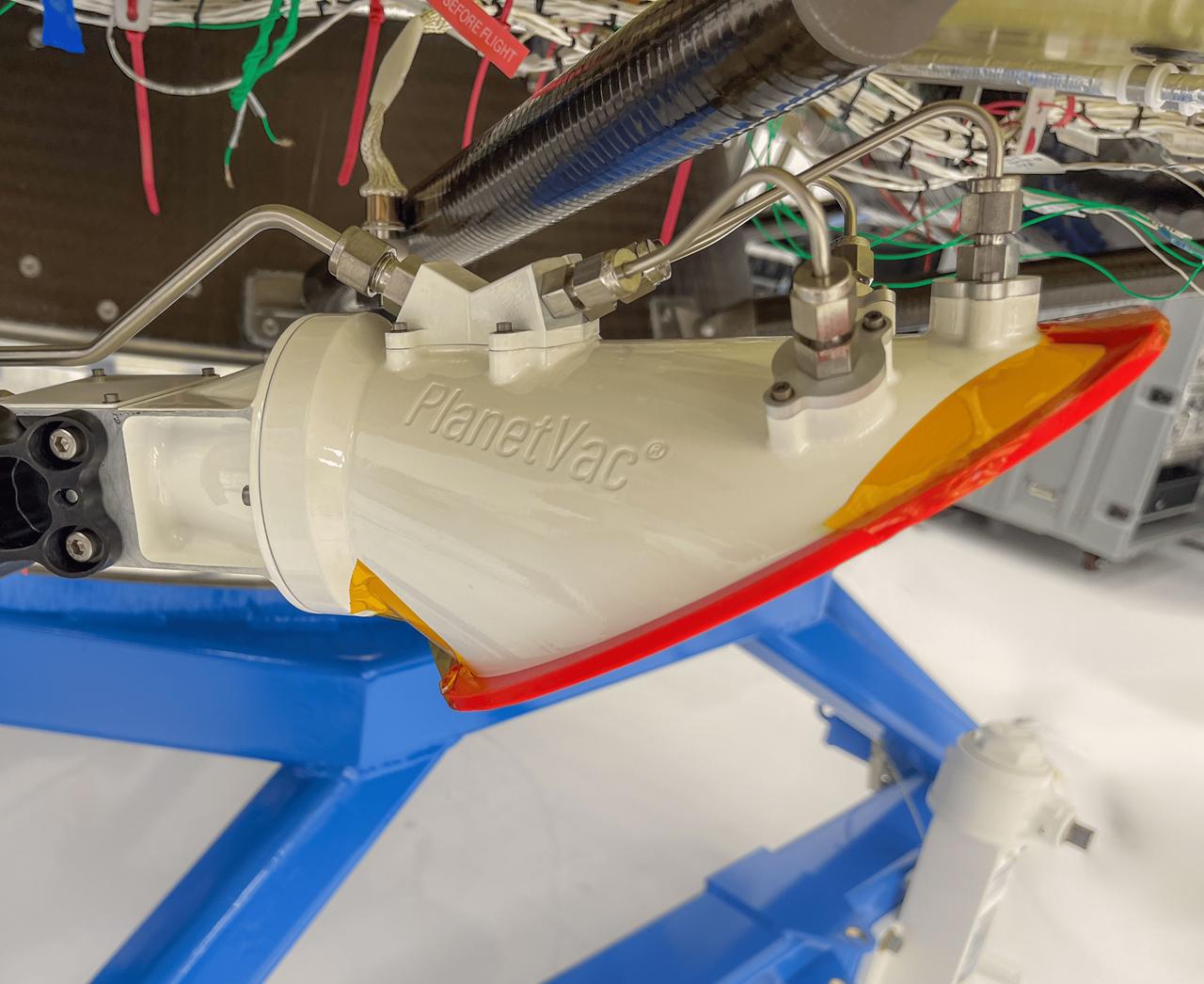
A technology demonstration flying aboard the next delivery for NASA’s CLPS (Commercial Lunar Payload Services) initiative could change how research teams collect and study soil and rock samples on other planetary bodies. Lunar PlanetVac, or LPV, is one of 10 payloads set to be carried to the Moon by the Blue Ghost 1 lunar lander in 2025. Developed by Honeybee Robotics, a Blue Origin company of Altadena, California, LPV is designed to, essentially, operate as a vacuum cleaner with a pneumatic, compressed gas-powered sample acquisition and delivery system to efficiently collect and transfer lunar soil from the surface to other science instruments or sample return containers. Investigations and demonstrations, such as LPV, launched on CLPS flights will help NASA study Earth’s nearest neighbor under Artemis and pave the way for future crewed missions on the Moon. NASA’s Marshall Space Flight Center in Huntsville, Alabama, manages the development for seven of the 10 CLPS payloads that will be carried on Firefly’s Blue Ghost lunar lander.
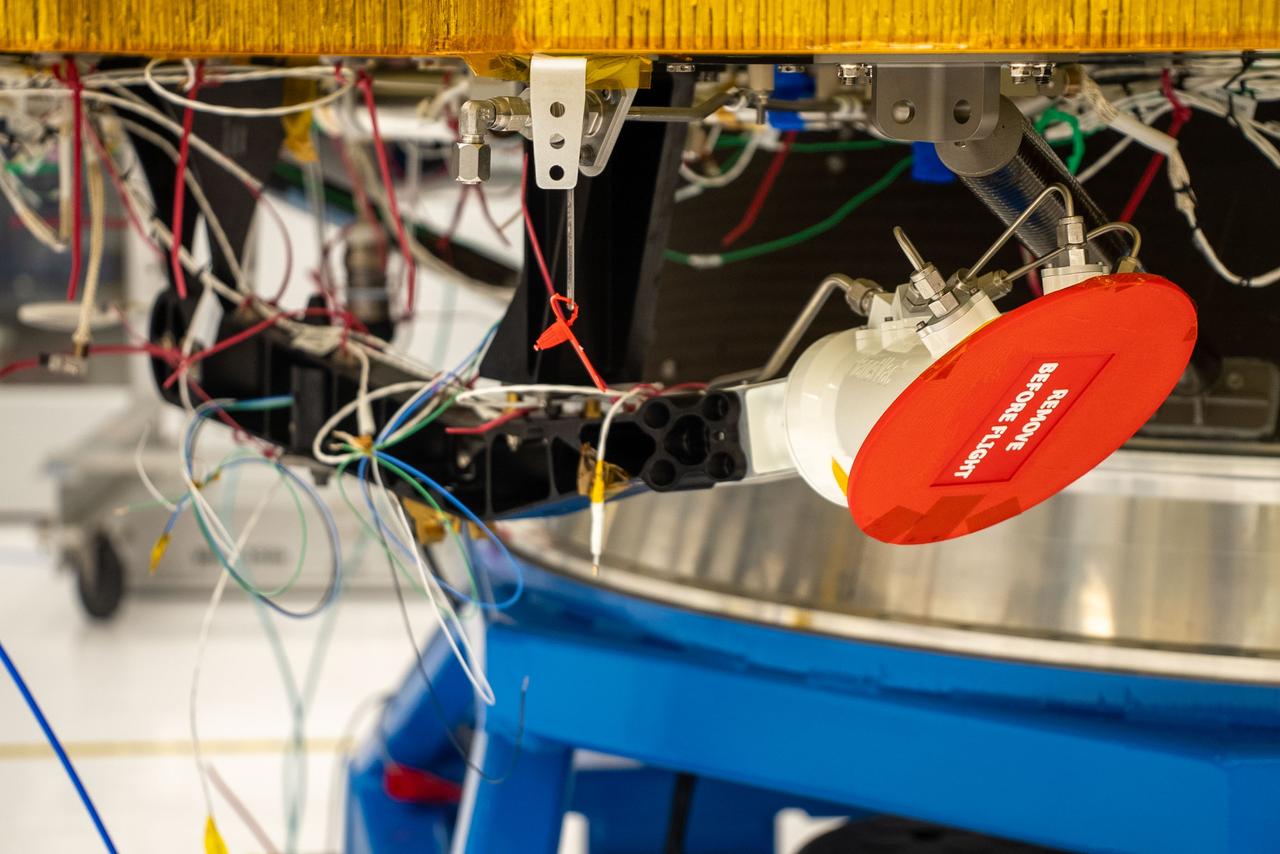

A technology demonstration flying aboard the next delivery for NASA’s CLPS (Commercial Lunar Payload Services) initiative could change how research teams collect and study soil and rock samples on other planetary bodies. Lunar PlanetVac, or LPV, is one of 10 payloads set to be carried to the Moon by the Blue Ghost 1 lunar lander in 2025. Developed by Honeybee Robotics, a Blue Origin company of Altadena, California, LPV is designed to, essentially, operate as a vacuum cleaner with a pneumatic, compressed gas-powered sample acquisition and delivery system to efficiently collect and transfer lunar soil from the surface to other science instruments or sample return containers. Investigations and demonstrations, such as LPV, launched on CLPS flights will help NASA study Earth’s nearest neighbor under Artemis and pave the way for future crewed missions on the Moon. NASA’s Marshall Space Flight Center in Huntsville, Alabama, manages the development for seven of the 10 CLPS payloads that will be carried on Firefly’s Blue Ghost lunar lander.
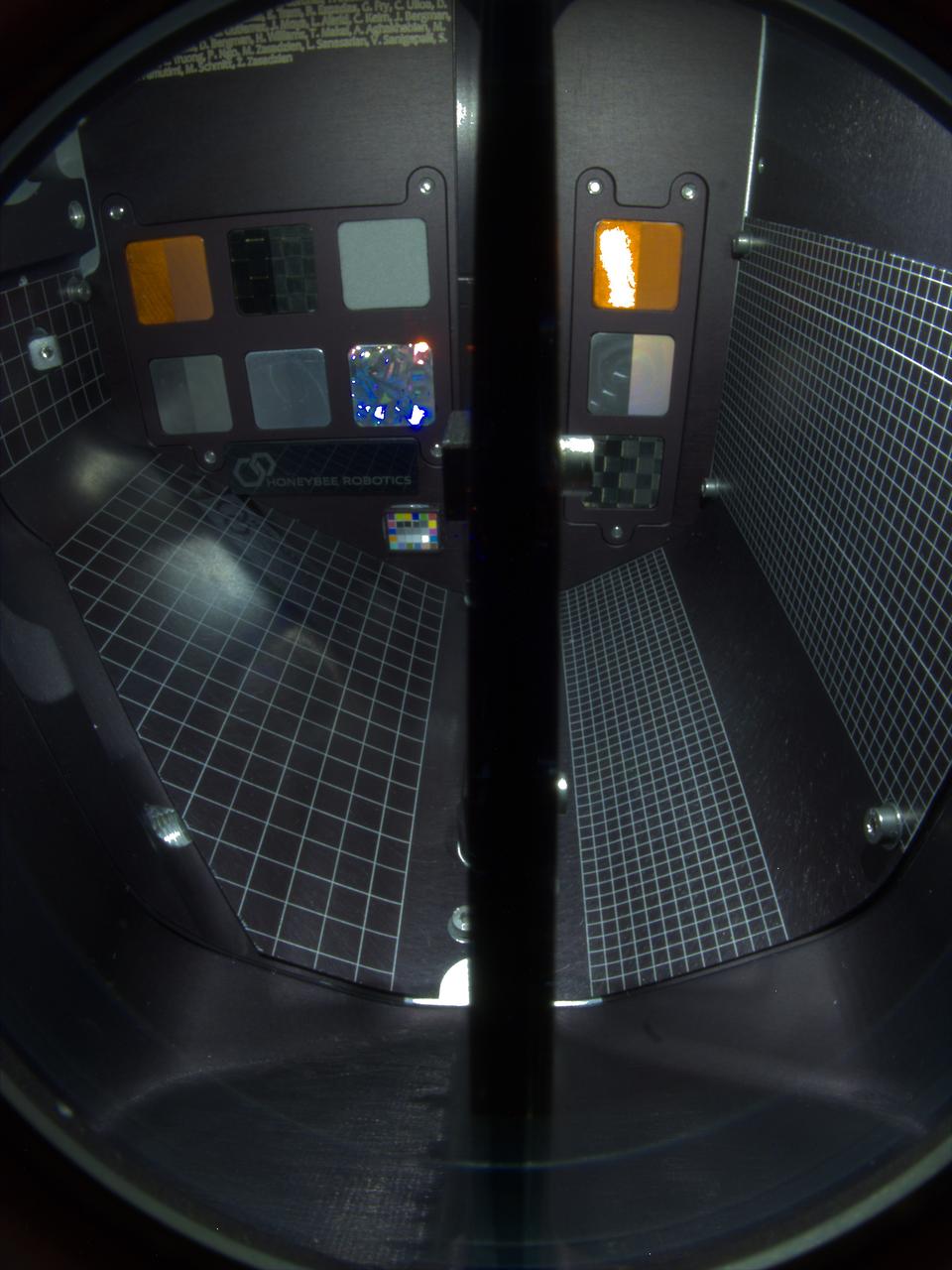

A technology demonstration flying aboard the next delivery for NASA’s CLPS (Commercial Lunar Payload Services) initiative could change how research teams collect and study soil and rock samples on other planetary bodies. Lunar PlanetVac, or LPV, is one of 10 payloads set to be carried to the Moon by the Blue Ghost 1 lunar lander in 2025. Developed by Honeybee Robotics, a Blue Origin company of Altadena, California, LPV is designed to, essentially, operate as a vacuum cleaner with a pneumatic, compressed gas-powered sample acquisition and delivery system to efficiently collect and transfer lunar soil from the surface to other science instruments or sample return containers. Investigations and demonstrations, such as LPV, launched on CLPS flights will help NASA study Earth’s nearest neighbor under Artemis and pave the way for future crewed missions on the Moon. NASA’s Marshall Space Flight Center in Huntsville, Alabama, manages the development for seven of the 10 CLPS payloads that will be carried on Firefly’s Blue Ghost lunar lander.
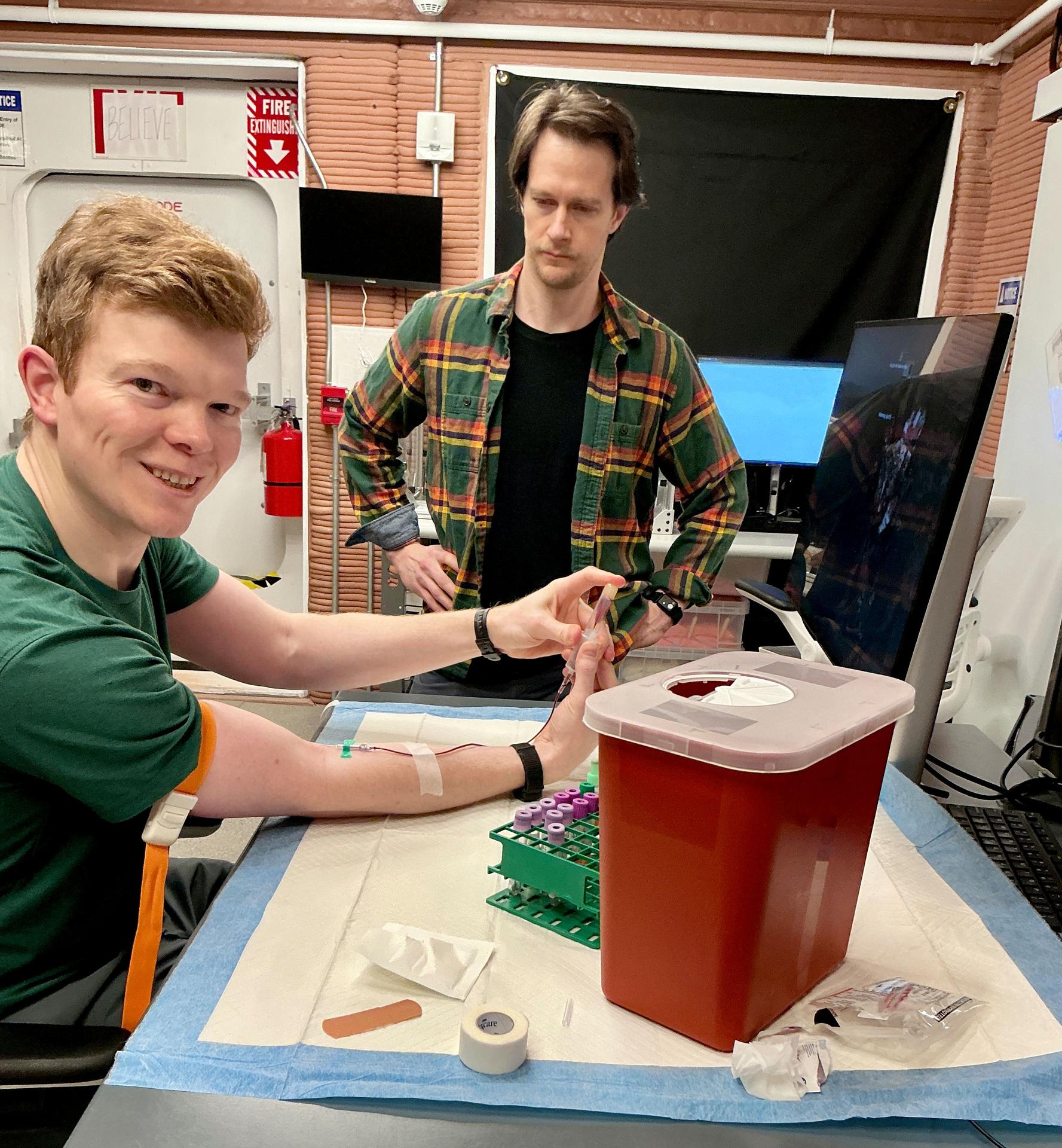
jsc2026e403175 (April 15, 2026) -- CHAPEA crew members perform blood collections to monitor their health (From left: James Spicer, Matthew Montgomery). Credit: NASA
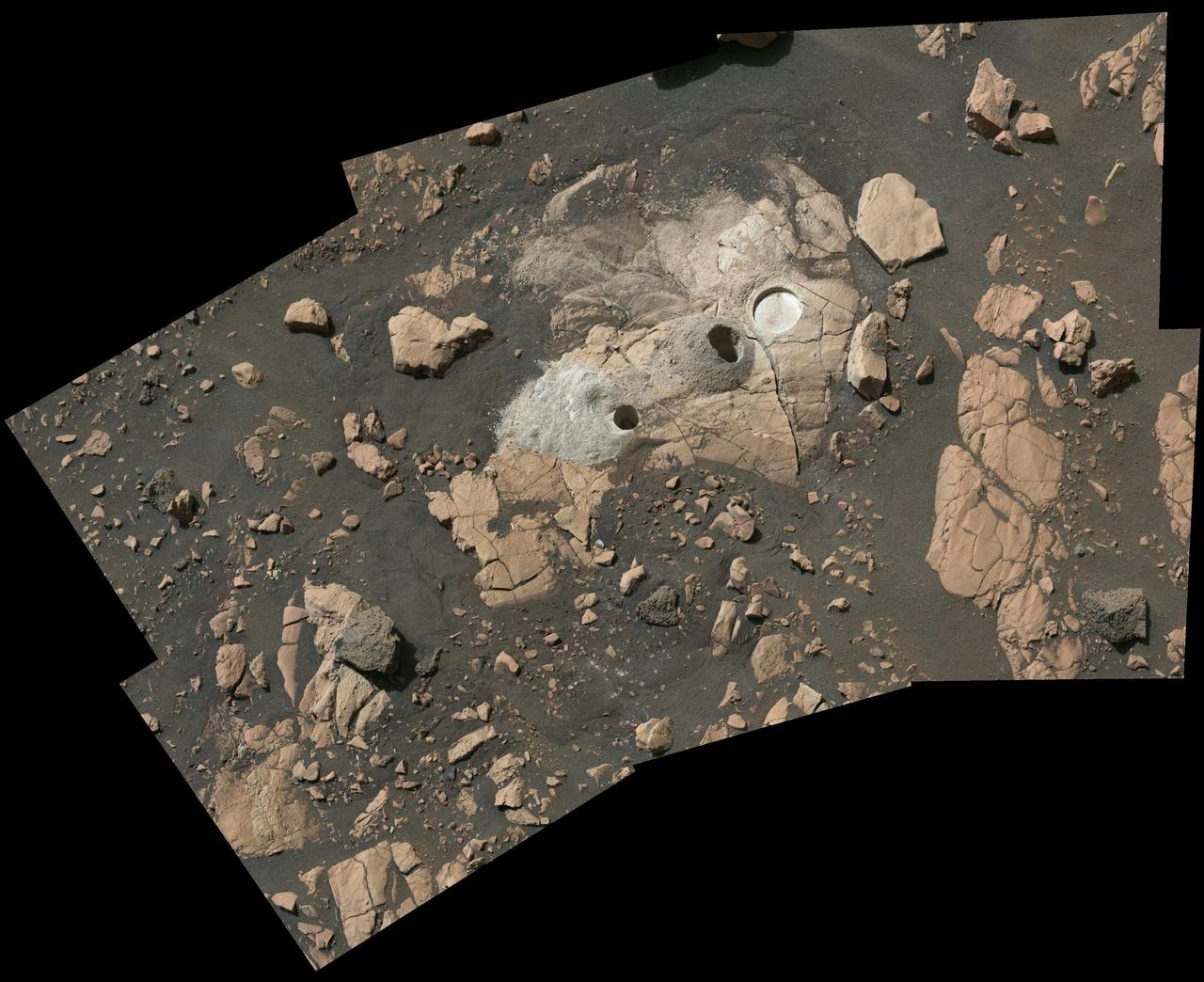
Composed of multiple images from NASA's Perseverance Mars rover, this mosaic shows a rocky outcrop called "Wildcat Ridge," where the rover extracted two rock cores and abraded a circular patch to investigate the rock's composition. The site is in the delta, a fan-shaped area where, billions of years ago, a river once flowed into a lake in Jezero Crater. Scientists consider this area one of the best places on Mars to search for potential signs of ancient microbial life. The images were obtained by the Mastcam-Z instrument on Aug. 4, 2022, the 518th Martian day, or sol, of the rover's mission. For scale, the bright circular abrasion patch on the right is approximately 2 inches (5 centimeters) in diameter. The color bands of the image have been processed to improve visual contrast and accentuate color differences. The rock cores obtained by Perseverance – each about the size of a piece of classroom chalk – were sealed in ultra-clean sample tubes. They are currently stored in the rover's Sampling and Caching System. The verification of ancient life on Mars carries an enormous burden of proof. A key objective for Perseverance's mission on Mars is astrobiology, including the search for signs of ancient microbial life. The rover will characterize the planet's geology and past climate, pave the way for human exploration of the Red Planet, and be the first mission to collect and cache Martian rock and regolith (broken rock and dust). Subsequent NASA missions, in cooperation with ESA (European Space Agency), would send spacecraft to Mars to collect these sealed samples from the surface and return them to Earth for in-depth analysis. The Mars 2020 Perseverance mission is part of NASA's Moon to Mars exploration approach, which includes Artemis missions to the Moon that will help prepare for human exploration of the Red Planet. https://photojournal.jpl.nasa.gov/catalog/PIA24928
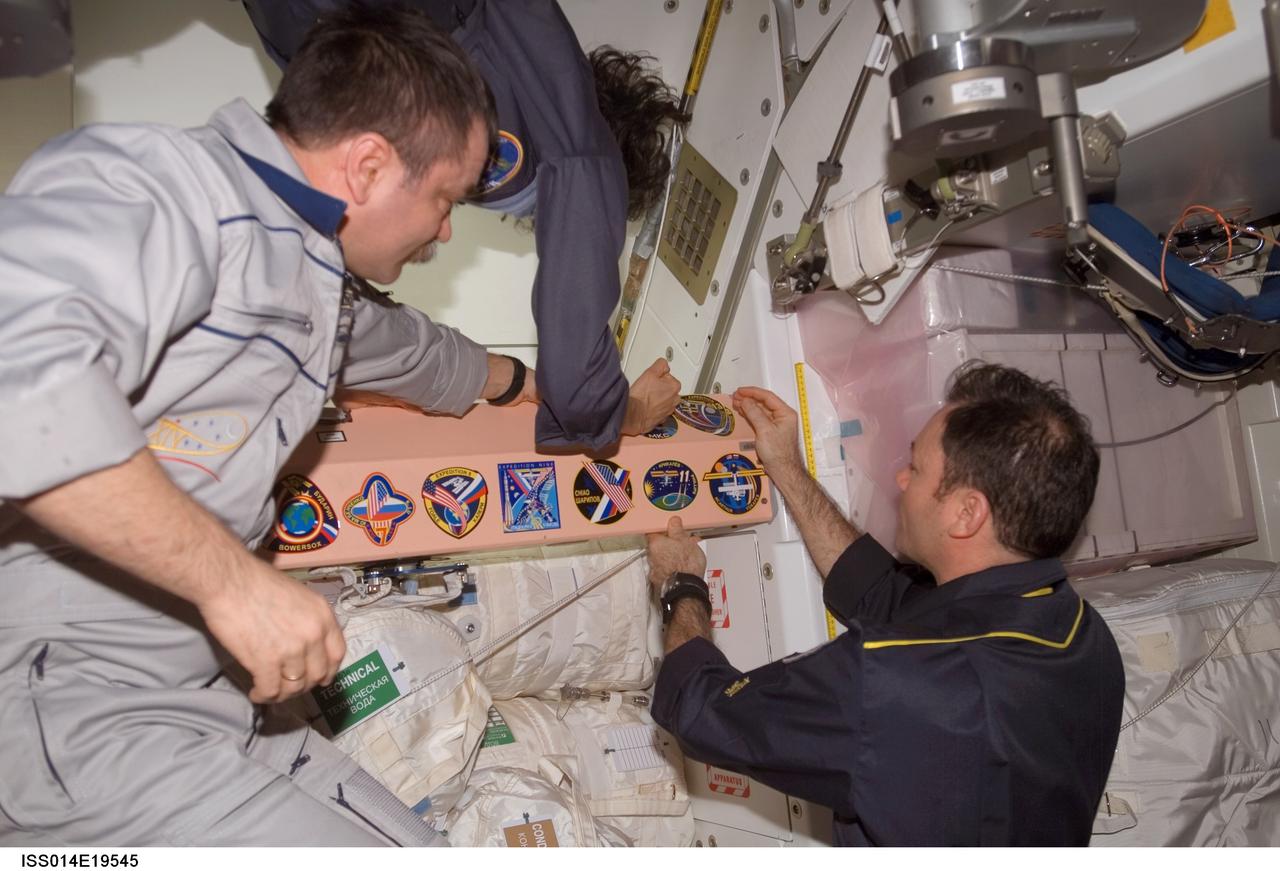
ISS014-E-19545 (17 April 2007) --- Astronauts Michael E. Lopez-Alegria (right), Expedition 14 commander and NASA space station science officer; Sunita L. Williams, flight engineer; and cosmonaut Mikhail Tyurin (left), flight engineer representing Russia's Federal Space Agency, add the Expedition 14 patch to the Unity node's growing collection of insignias representing crews who have lived and worked on the International Space Station.
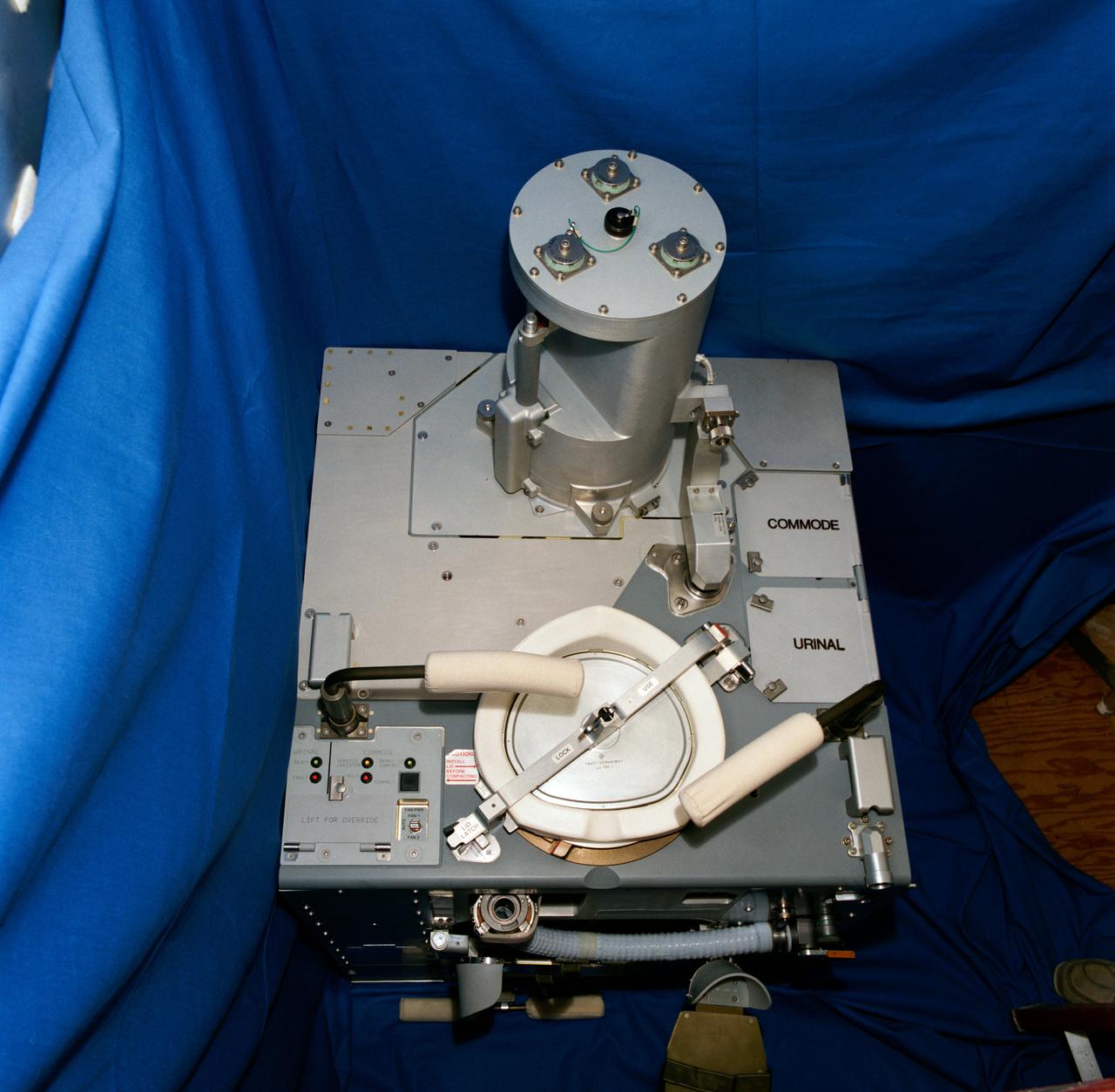
S92-46726 (November 1992) --- A high angle view of the Improved Waste Collection System (IWCS) scheduled to fly aboard NASA's Space Shuttle Endeavour for the STS-54 mission. Among the advantages the new IWCS is hoped to have over the current WCS are greater dependability, better hygiene, virtually unlimited capacity and more efficient preparation between Shuttle missions. Unlike the previous WCS, the improved version will not have to be removed from the spacecraft to be readied for the next flight.
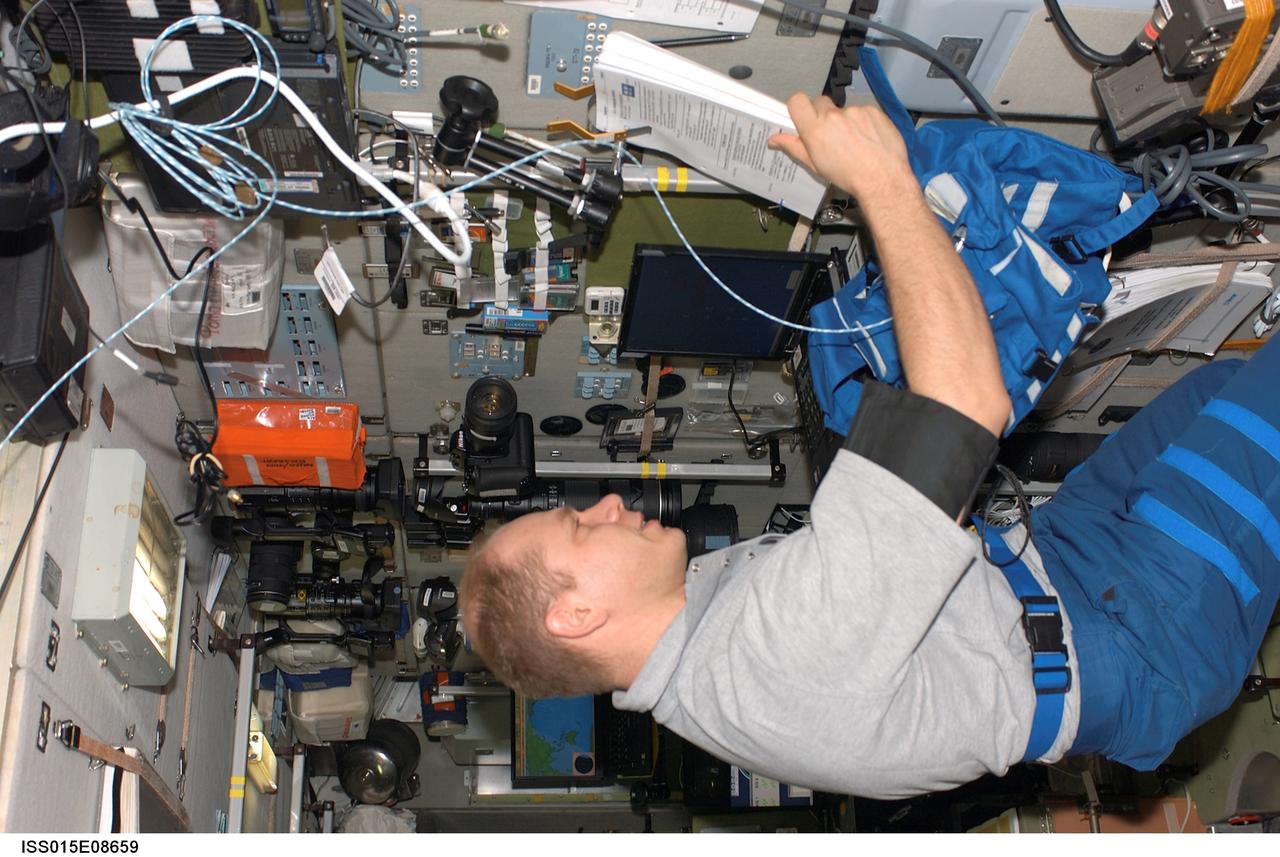
ISS015-E-08659 (May 2007) --- Cosmonaut Oleg V. Kotov, Expedition 15 flight engineer representing Russia's Federal Space Agency, checks procedures checklists while collecting medical data for the Cognitive Cardiovascular (Cardiocog-2) experiment in the Zvezda Service Module of the International Space Station. Cardiocog-2 will determine the impact of weightlessness on the cardiovascular system and respiratory system and the cognitive reactions of crewmembers. The results of this study will be used to develop additional countermeasures that will continue to keep crewmembers healthy during long-duration space exploration.
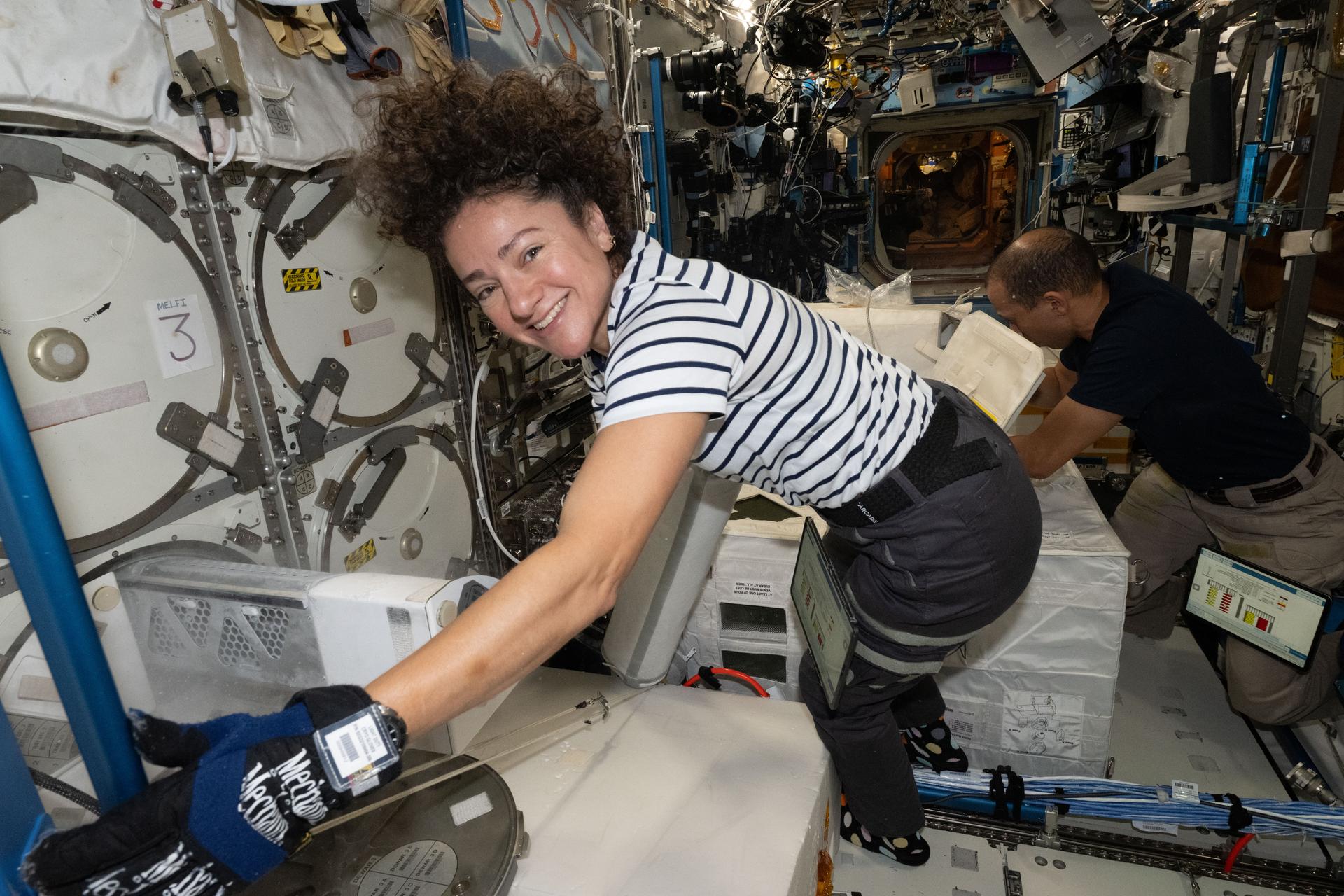
iss074e0333988 (Feb. 26, 2026) --- Expedition 74 Flight Engineers Jessica Meir and Chris Williams, both NASA astronauts, collect frozen research samples from inside the International Space Station's Destiny laboratory module. The samples were stowed inside science freezers aboard a SpaceX Dragon spacecraft for retrieval and analysis on Earth. Credit: ESA/Sophie Adenot
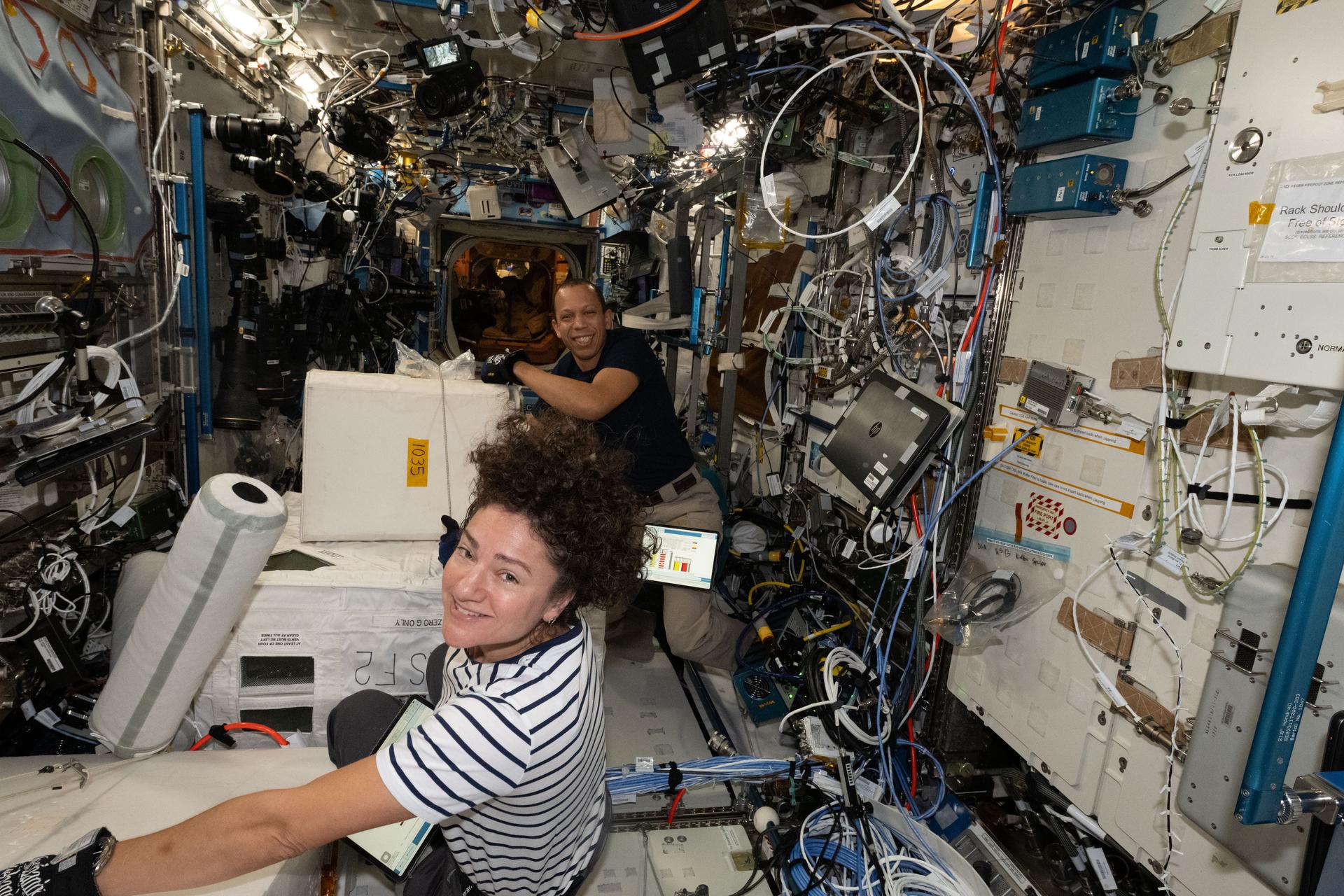
iss074e0333991 (Feb. 26, 2026) --- Expedition 74 Flight Engineers Jessica Meir and Chris Williams, both NASA astronauts, collect frozen research samples from inside the International Space Station's Destiny laboratory module. The samples were stowed inside science freezers aboard a SpaceX Dragon spacecraft for retrieval and analysis on Earth. Credit: ESA/Sophie Adenot
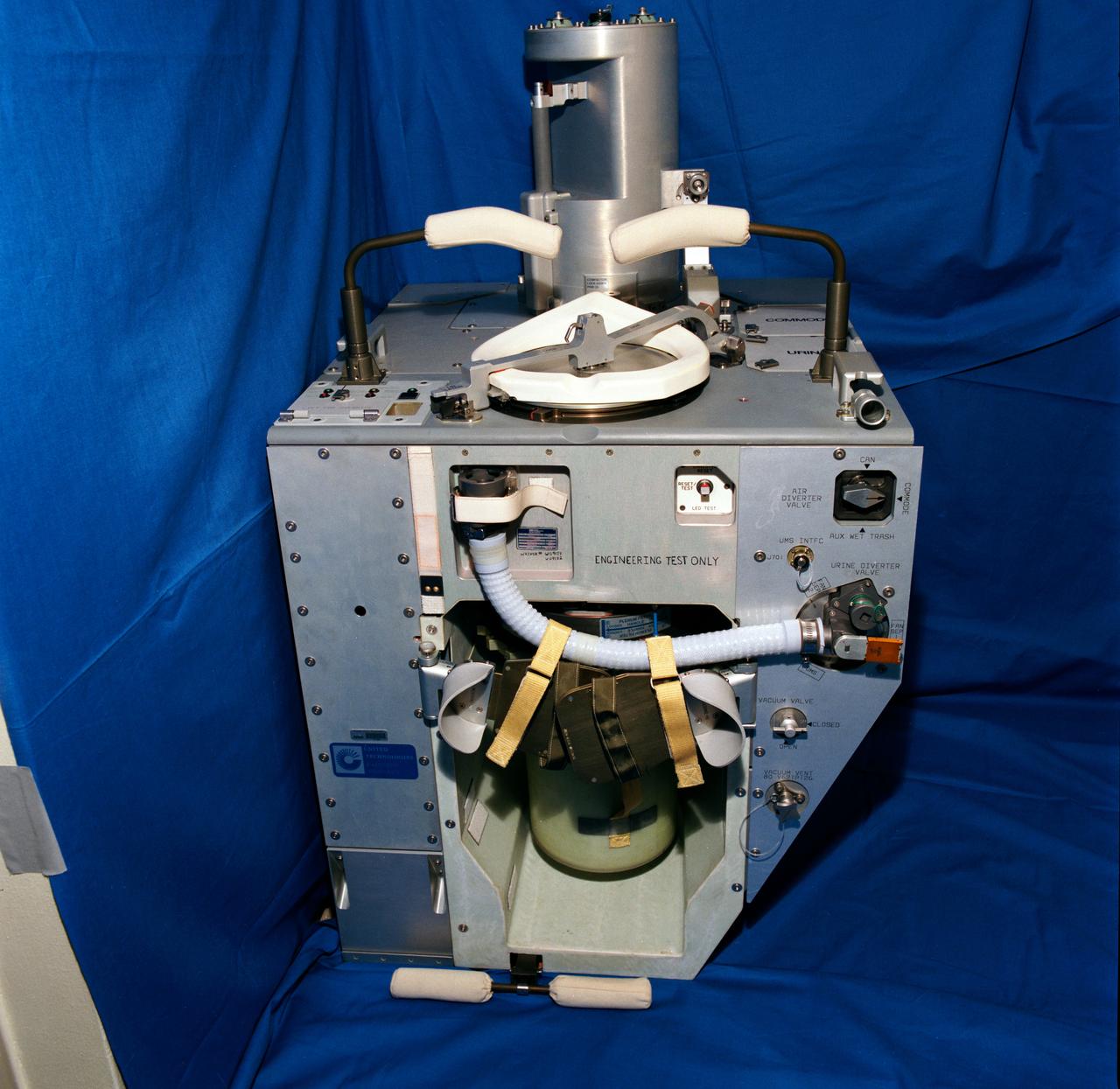
S92-46717 (November 1992) --- A front view of the improved waste collection system (IWCS) scheduled to fly aboard NASA's Space Shuttle Endeavour for the STS-54 mission. Among the advantages the new IWCS is hoped to have over the current WCS are greater dependability, better hygiene, virtually unlimited capacity and more efficient preparation between Shuttle missions. Unlike the previous WCS, the improved version will not have to be removed from the spacecraft to be readied for the next flight.
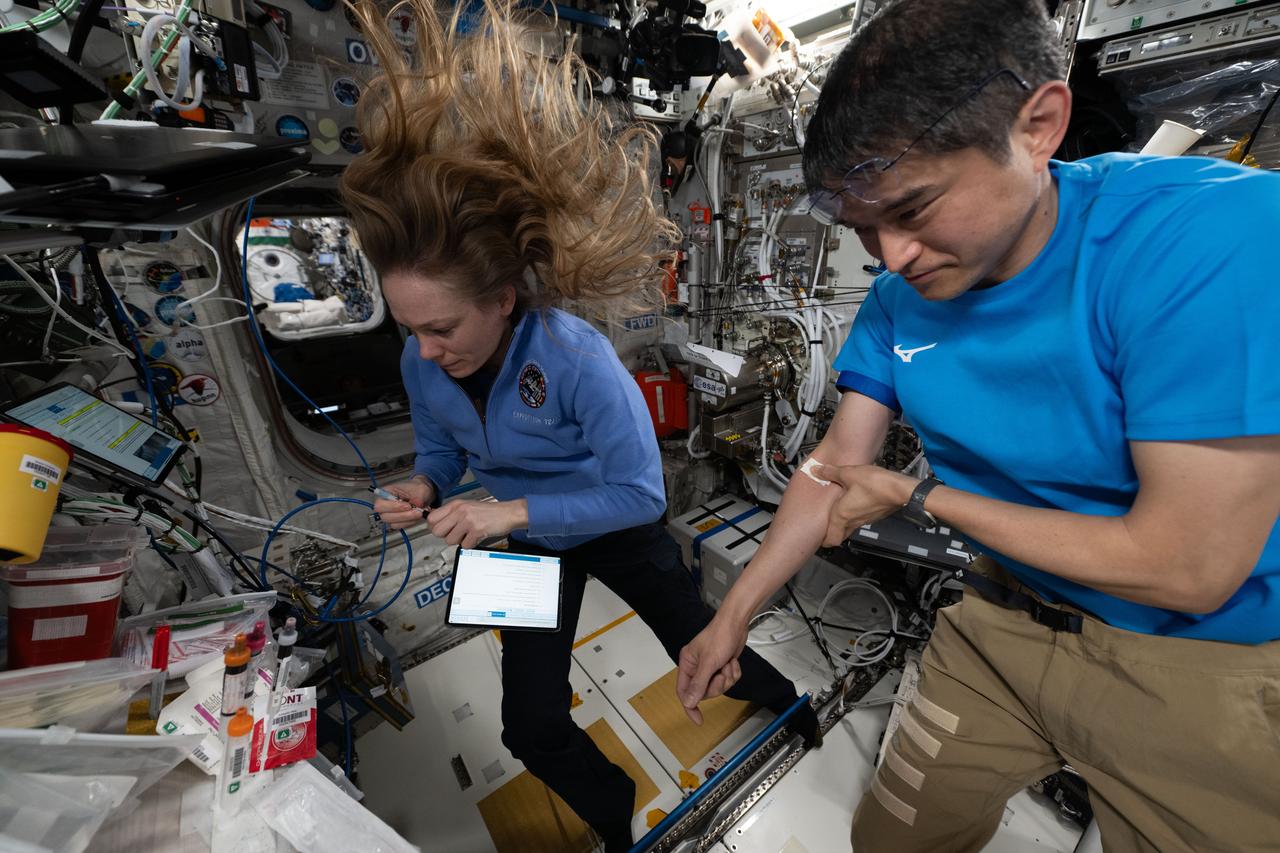
iss073e0284440 (July 8, 2025) --- Expedition 73 Flight Engineer Nichole Ayers of NASA and International Space Station Commander Takuya Onishi of JAXA (Japan Aerospace Exploration Agency) collect blood samples for the Immunity Assay human research investigation. The study will analyze the blood samples for signs of space-caused stress on cellular immune function to help doctors monitor crew health and keeps crews healthy on long term space missions.
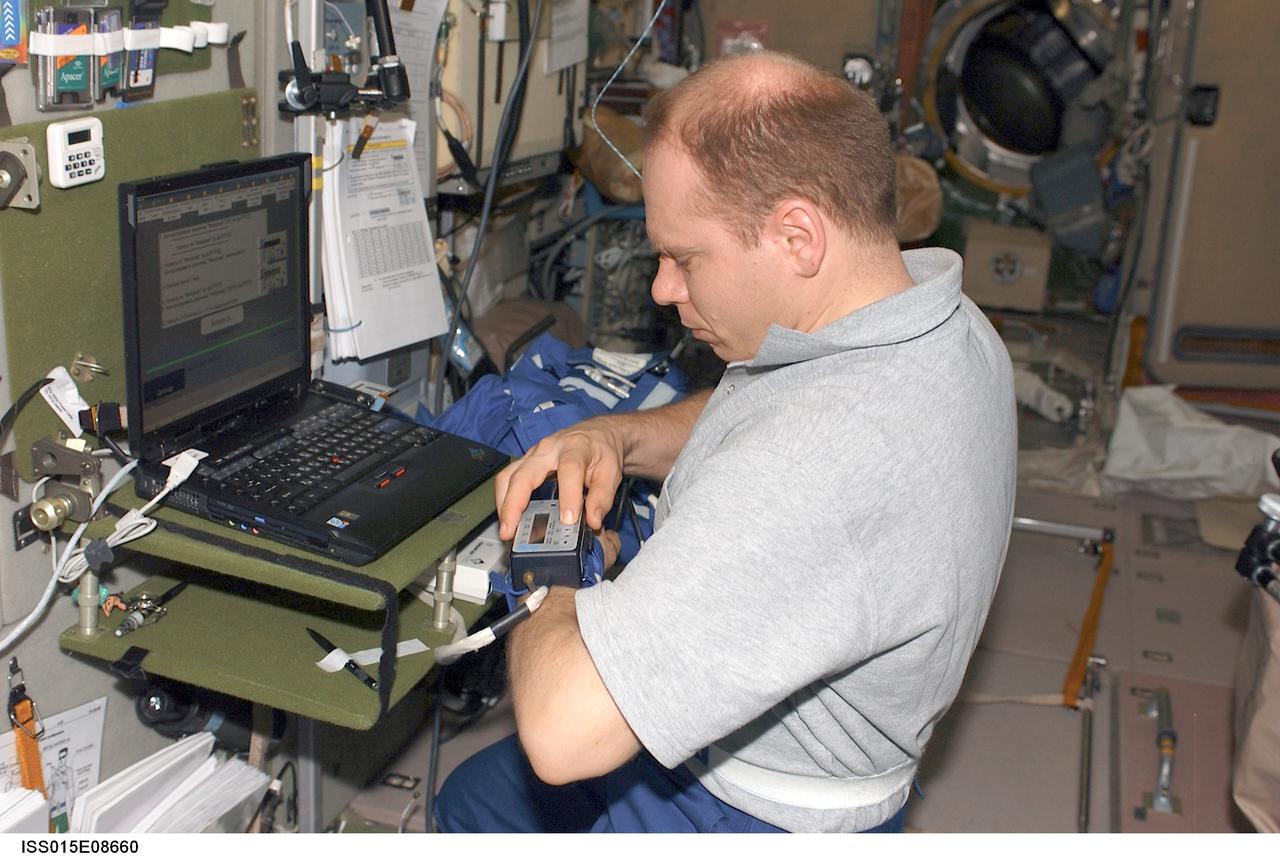
ISS015-E-08660 (May 2007) --- Cosmonaut Oleg V. Kotov, Expedition 15 flight engineer representing Russia's Federal Space Agency, collects medical data for the Cognitive Cardiovascular (Cardiocog-2) experiment in the Zvezda Service Module of the International Space Station. Cardiocog-2 will determine the impact of weightlessness on the cardiovascular system and respiratory system and the cognitive reactions of crewmembers. The results of this study will be used to develop additional countermeasures that will continue to keep crewmembers healthy during long-duration space exploration.
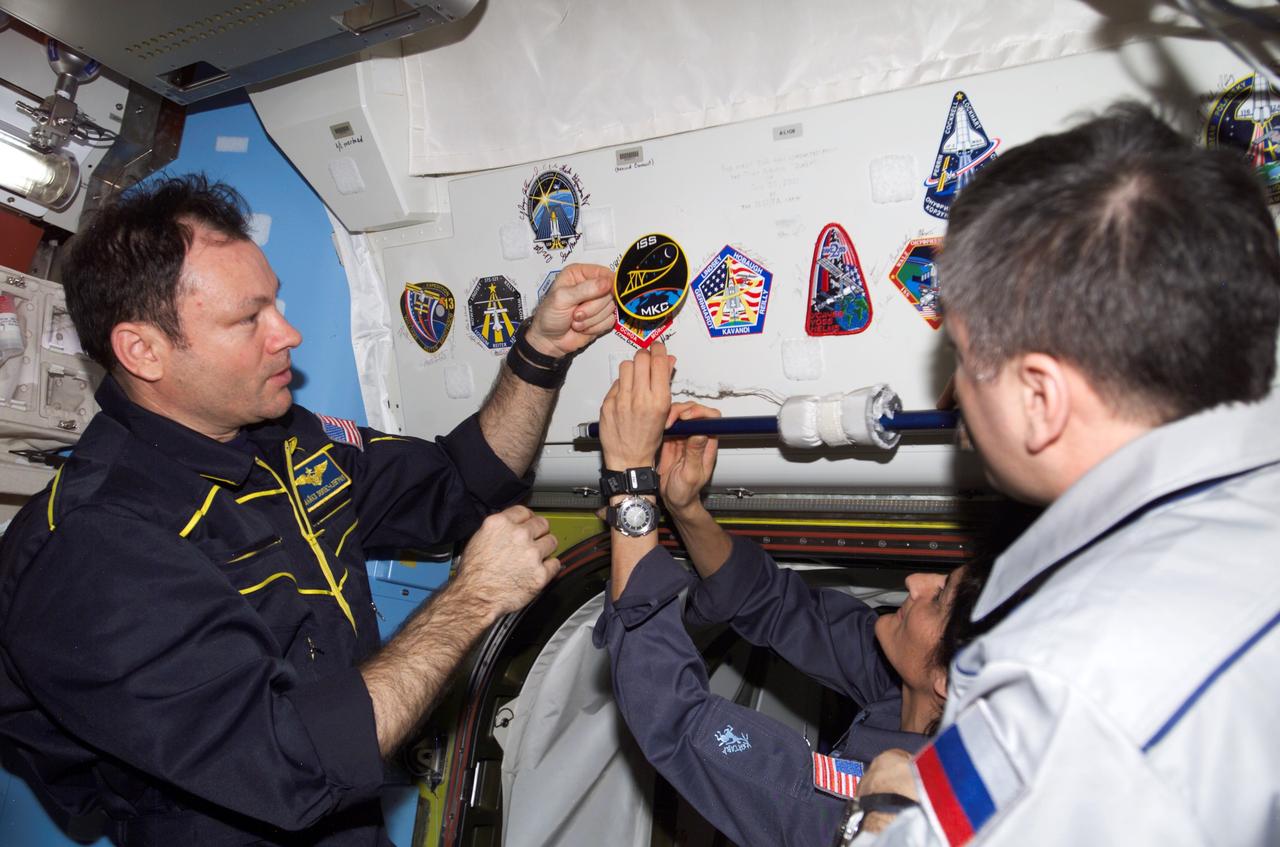
ISS014-E-19558 (17 April 2007) --- Astronauts Michael E. Lopez-Alegria (left), Expedition 14 commander and NASA space station science officer; Sunita L. Williams, flight engineer; and cosmonaut Mikhail Tyurin, flight engineer representing Russia's Federal Space Agency, adds the Expedition 14 patch to the growing collection of insignias representing crews who have performed spacewalks from the Quest Airlock of the International Space Station.
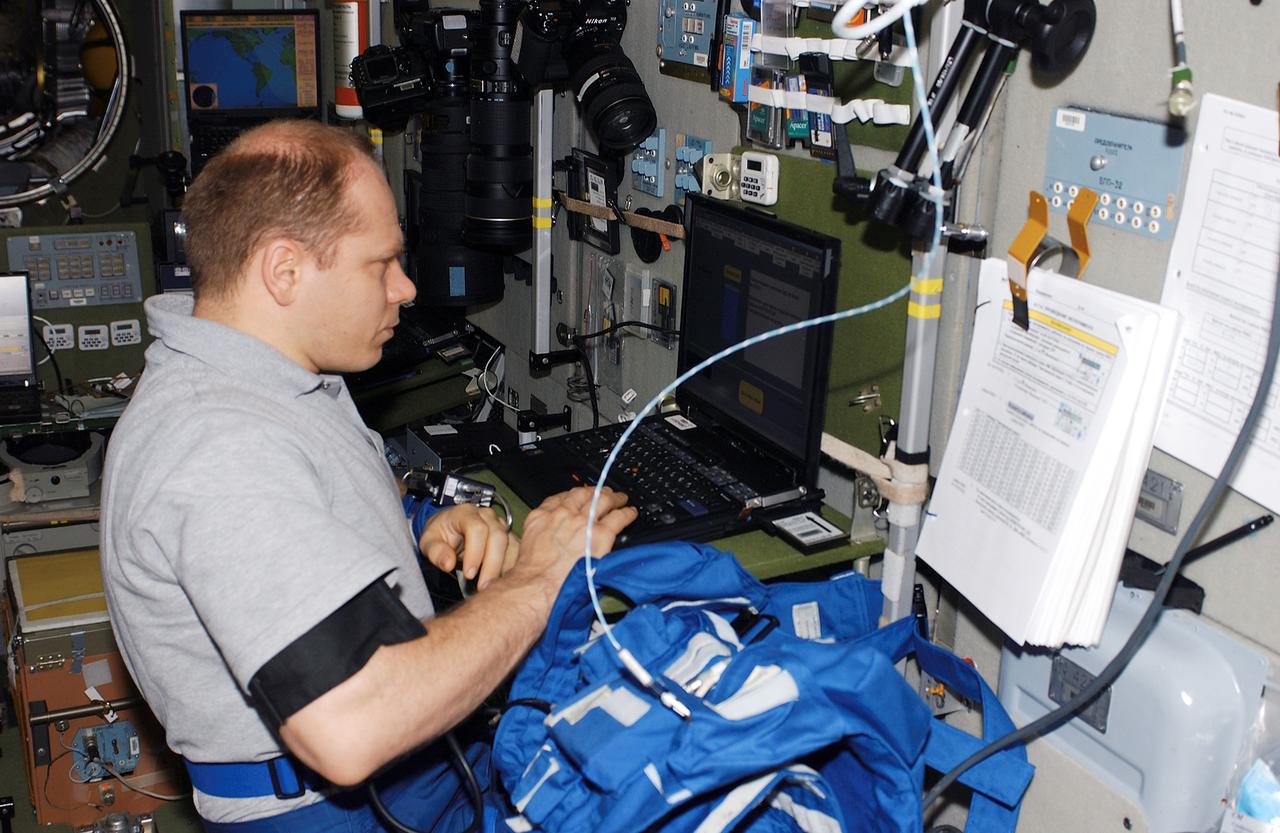
ISS015-E-08661 (May 2007) --- Cosmonaut Oleg V. Kotov, Expedition 15 flight engineer representing Russia's Federal Space Agency, collects medical data for the Cognitive Cardiovascular (Cardiocog-2) experiment in the Zvezda Service Module of the International Space Station. Cardiocog-2 will determine the impact of weightlessness on the cardiovascular system and respiratory system and the cognitive reactions of crewmembers. The results of this study will be used to develop additional countermeasures that will continue to keep crewmembers healthy during long-duration space exploration.
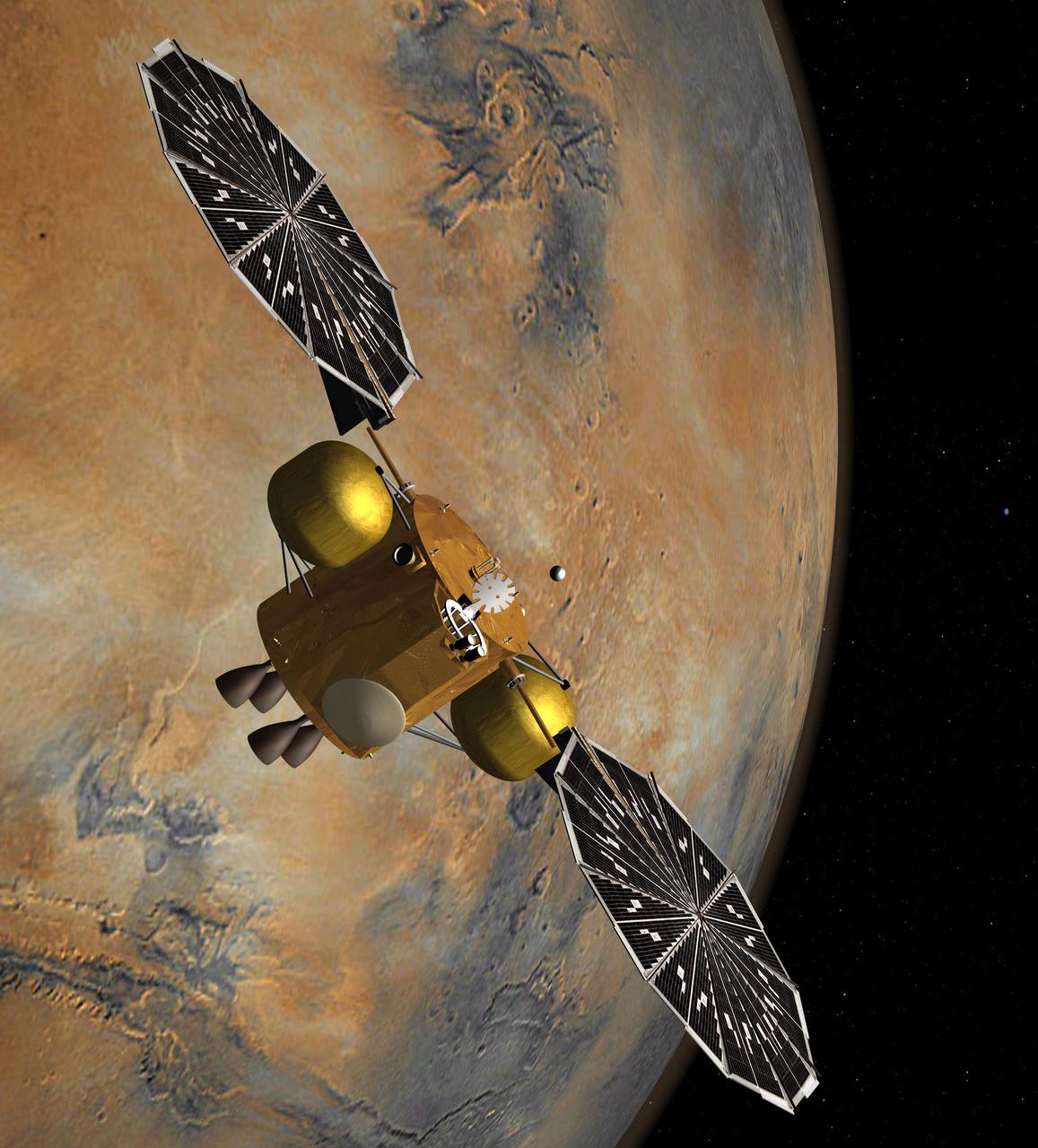
This artist concept of a proposed Mars sample return mission portrays the capture of a collection of Martian samples by a spacecraft orbiting Mars. The samples would have been collected on Mars by a rover and lifted to orbit by an ascent vehicle.
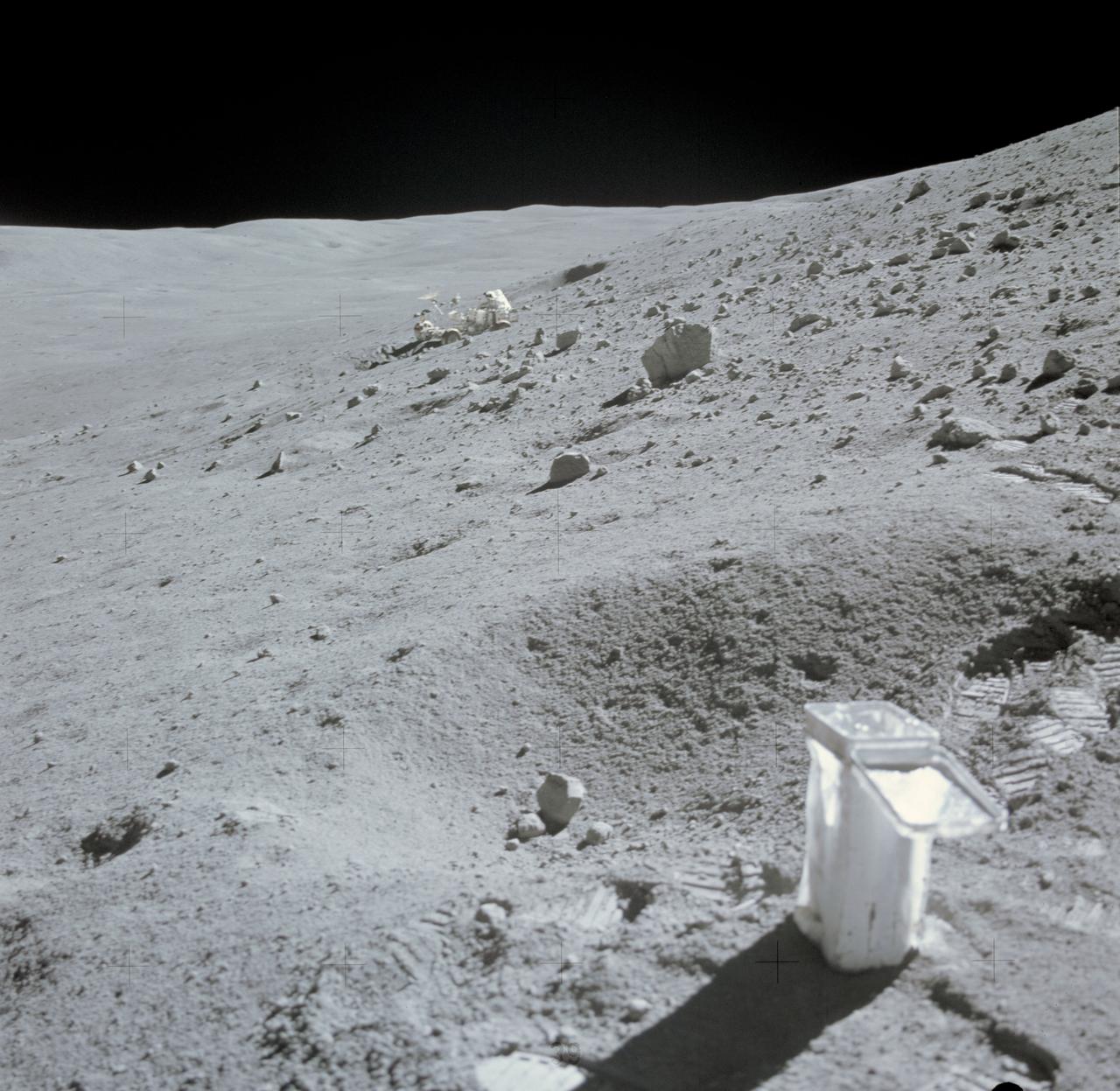
AS16-107-17473 (22 April 1972) --- The Lunar Roving Vehicle (LRV) appears to be parked in a deep lunar depression, on the slope of Stone Mountain. This photograph of the lunar scene at Station No. 4 was taken during the second Apollo 16 extravehicular activity (EVA) at the Descartes landing site. A sample collection bag is in the right foreground. Note field of small boulders at upper right. While astronauts John W. Young, commander, and Charles M. Duke Jr., lunar module pilot, descended in the Lunar Module (LM) "Orion" to explore the moon, astronaut Thomas K. Mattingly II, command module pilot, remained with the Command and Service Modules (CSM) in lunar orbit.
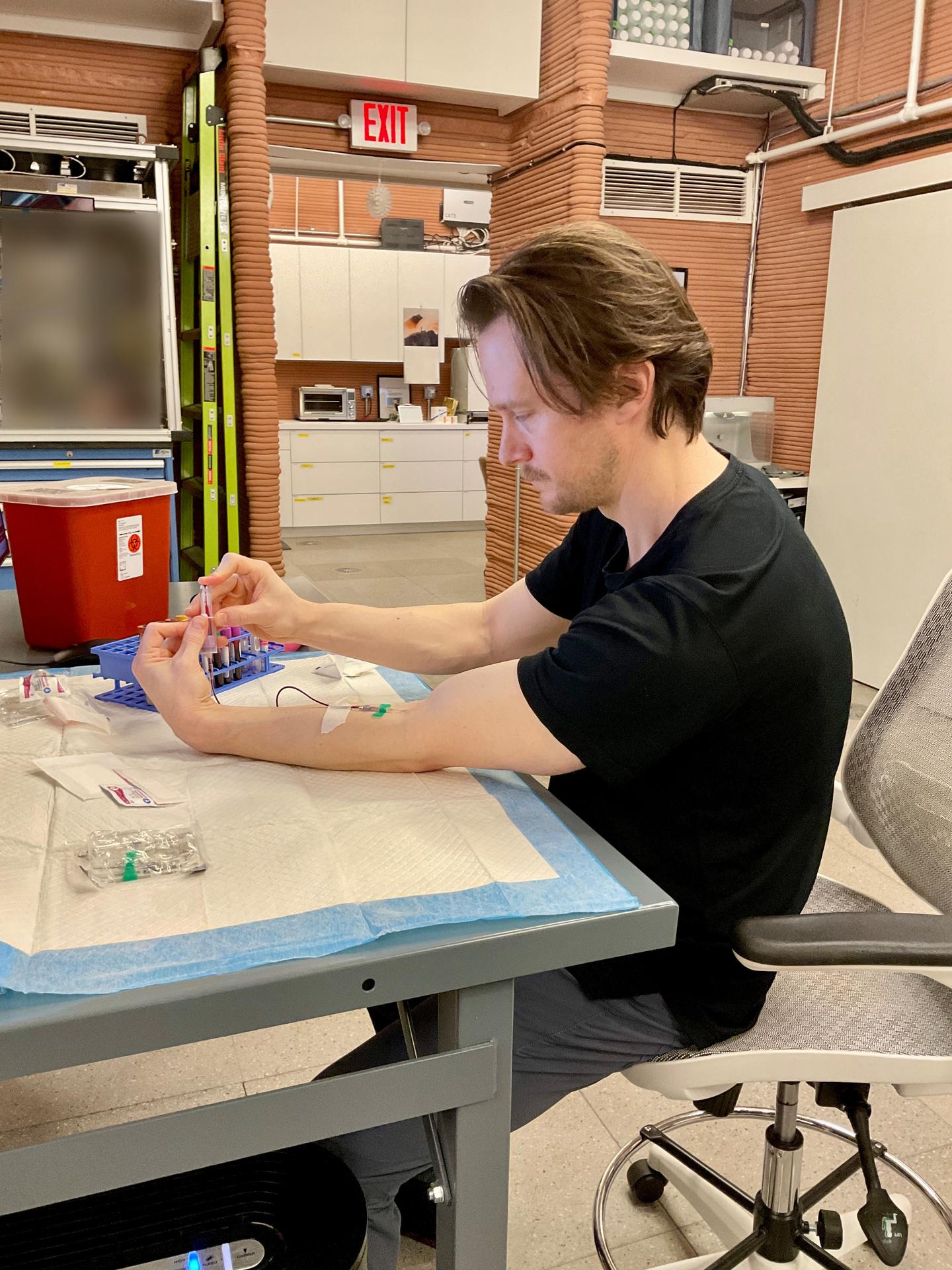
jsc2026e403178 (May 20, 2026) -- Matthew Montgomery, Crew Health and Performance Exploration Analog (CHAPEA) Mission 2 science officer, performing blood collection to monitor crew health. Credit: NASA
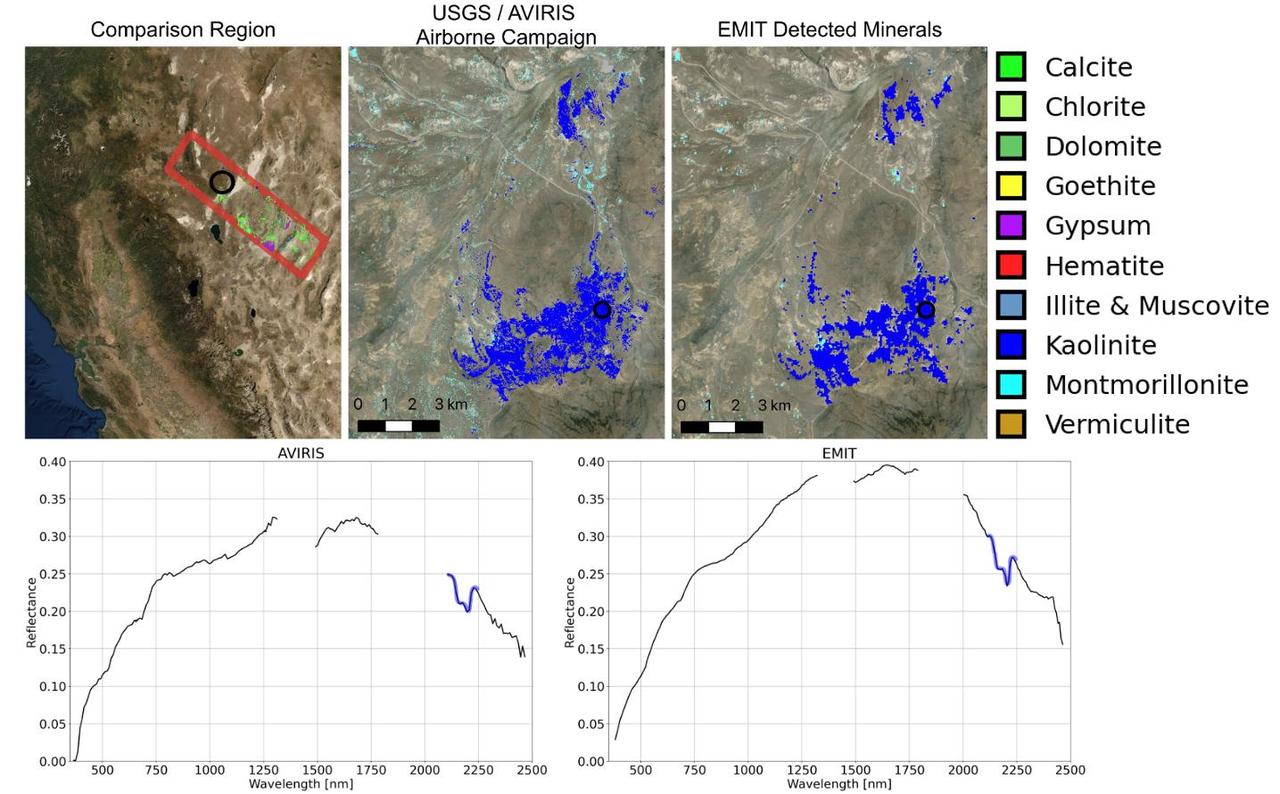
Since NASA's Earth Surface Mineral Dust Source Investigation (EMIT) imaging spectrometer was installed on the International Space Station in late July 2022, the EMIT science team has been validating its data against data gathered in 2018 by NASA's Airborne Visible/Infrared Imaging Spectrometer (AVIRIS). EMIT recently collected data from a mountainous area of Nevada about 130 miles (209 kilometers) northeast of Lake Tahoe. The instrument measures reflected solar energy from Earth across hundreds of wavelengths from the visible to the infrared range of the spectrum. The intensity of the reflected light varies by wavelength based on the material. Scientists use these patterns, called spectral fingerprints, to pinpoint the locations of surface minerals on a map. The top left map shows the region both the EMIT and AVIRIS data sets cover. The center image is a mineral map featuring AVIRIS data. At right is a map generated with EMIT data. The center and right images reveal portions of the landscape dominated by kaolinite, a light-colored clay mineral that scatters sunlight. This comparison, which shows a close match of the data, was one of many that confirmed the accuracy of EMIT's data. The bottom row features an AVIRIS spectral fingerprint, left, beside EMIT data for the same location. The graphs show agreement in the kaolinite fingerprint region, which is marked in blue. Over the course of its 12-month mission, EMIT will collect measurements of 10 important surface minerals – kaolinite, hematite, goethite, illite, vermiculite, calcite, dolomite, montmorillonite, chlorite, and gypsum – in arid regions between 50-degree south and north latitudes in Africa, Asia, North and South America, and Australia. The data EMIT collects will help scientists better understand the role of airborne dust particles in heating and cooling Earth's atmosphere on global and regional scales. https://photojournal.jpl.nasa.gov/catalog/PIA25428

art002e027810 (April 8, 2026) – NASA astronaut Reid Wiseman holds a sample booklet as he prepares to collect a saliva sample aboard the Orion spacecraft. During the 10-day Artemis II mission, crew members blotted saliva samples on special paper for the Immune Biomarkers study. On Earth, scientists are analyzing those samples, looking at proteins, enzymes, and other biomarkers to understand how the crew adapted to deep space conditions aboard Orion. These biomarkers give insight into crews’ immune health, inflammation, nutritional status, bone health, and more. Credit: NASA
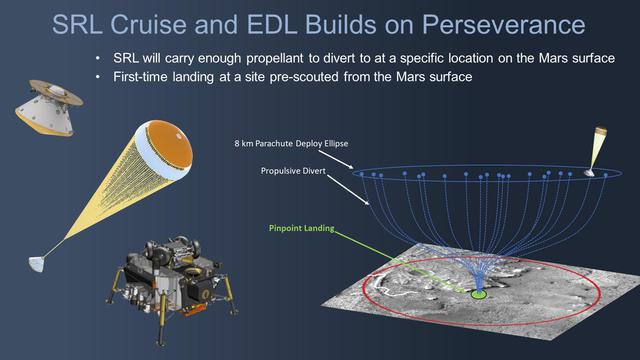
During the NASA Mars 2020 Perseverance rover mission, pristine samples of Mars rock and regolith (broken rock and dust) will be collected and sealed inside collection tubes. At strategic locations during the rover's drive, these tubes will be deposited onto the Martian surface to create collection points, or "depots." This marks the first phase of the Mars Sample Return campaign, which will be followed by the Sample Retrieval Lander mission in the late 2020s. Tasked with collecting these containers for their eventual return to Earth, the Sample Retrieval Lander will be the first Mars mission to land at a specific location already scouted out from the surface. As such, to enable such a precise landing close to one of these depots, the lander will carry enough fuel make a propulsive divert maneuver (powered by its rocket thrusters) after being slowed down sufficiently by its parachute on entering the Martian atmosphere. https://photojournal.jpl.nasa.gov/catalog/PIA24164
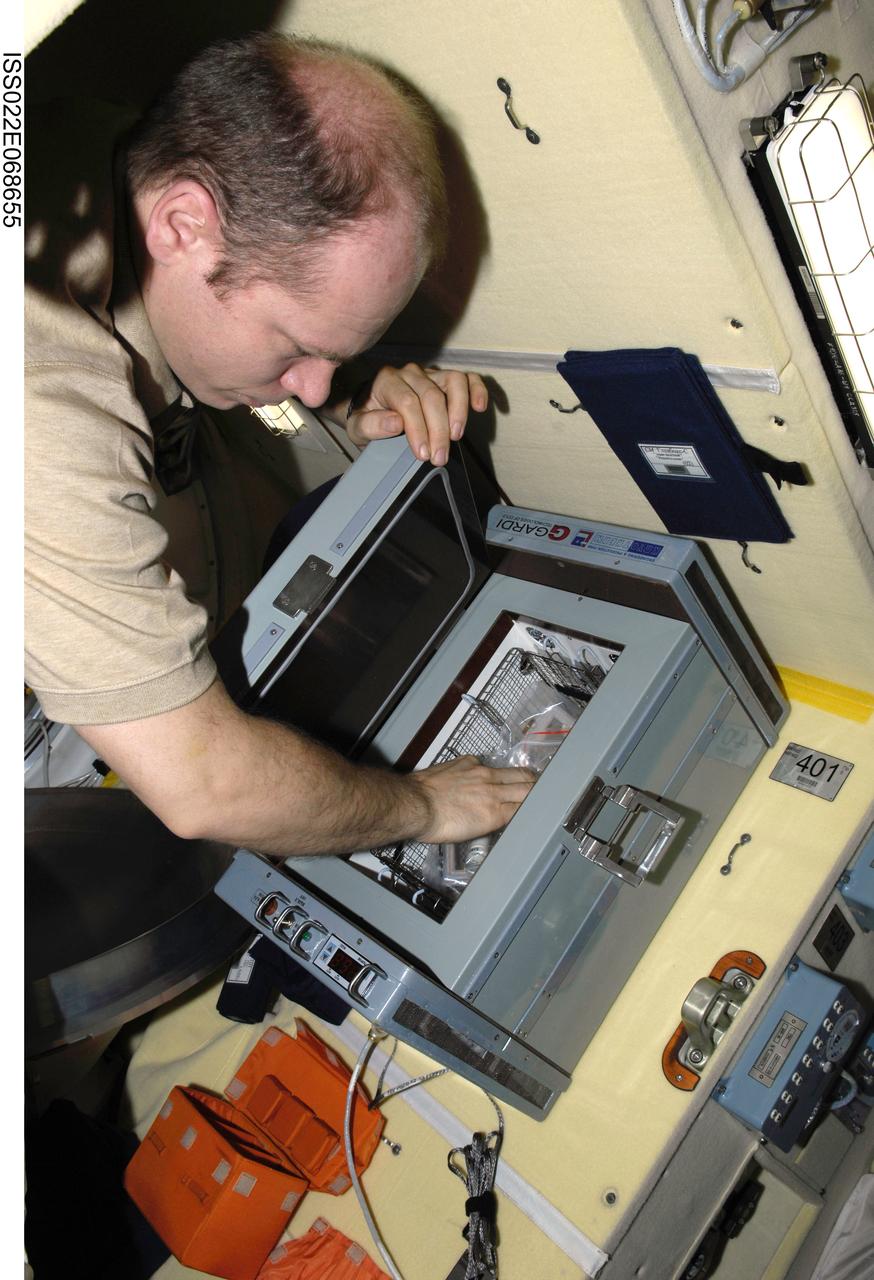
ISS022-E-068655 (19 Feb. 2010) --- Russian cosmonaut Oleg Kotov, Expedition 22 flight engineer, collects samples from the new bioscience experiment ASEPTIC (BTKh-39) in the Poisk Mini-Research Module 2 (MRM2) of the International Space Station.

ISS022-E-068654 (19 Feb. 2010) --- Russian cosmonaut Oleg Kotov, Expedition 22 flight engineer, collects samples from the new bioscience experiment ASEPTIC (BTKh-39) in the Poisk Mini-Research Module 2 (MRM2) of the International Space Station.
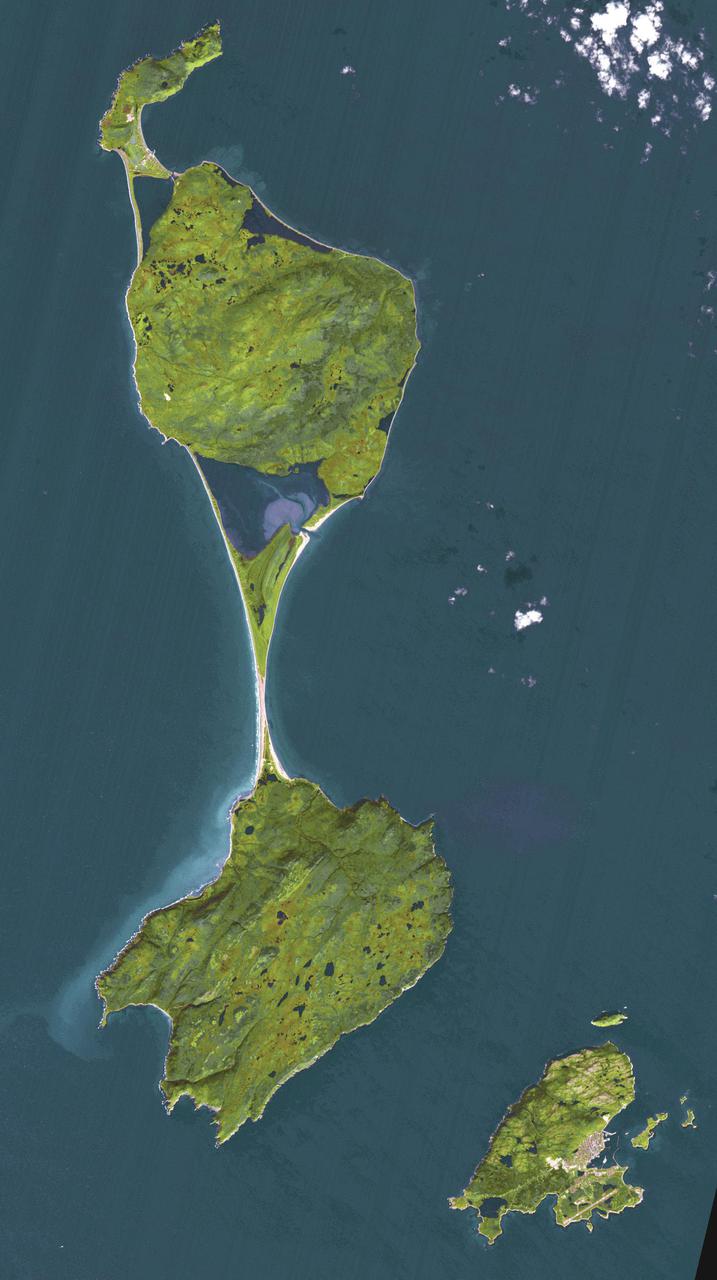
The Territorial Collectivity of Saint-Pierre and Miquelon is a self-governing overseas collectivity of France, off the southern coast of Newfoundland. It is the last remaining part of New France in North America to retain French sovereignty; its 6000 residents are French citizens. During the early part of its 500 year history, the island changed ownership numerous times between France and Britain. Only in 1816 were the islands permanently claimed by France, and French settlers came from Brittany, Normandy, and the Basque areas. The image was acquired September 27, 2011, covers an area of 25.5 by 45.6 km, and is located at 46.9 degrees north, 56.4 degrees west. https://photojournal.jpl.nasa.gov/catalog/PIA24554

ISS014-E-17547 (20 March 2007) --- Astronaut Michael E. Lopez-Alegria, Expedition 14 commander and NASA space station science officer, prepares to insert a test sample in the Minus Eighty Degree Laboratory Freezer for ISS (MELFI) as part of the Nutritional Status Assessment (NUTRITION) experiment in the Destiny laboratory of the International Space Station. MELFI is a low temperature freezer facility with nominal operating temperatures of -80, -26 and +4 degrees Celsius that will preserve experiment materials over long periods.

ISS014-E-17550 (20 March 2007) --- Astronaut Michael E. Lopez-Alegria, Expedition 14 commander and NASA space station science officer, prepares to insert a test sample in the Minus Eighty Degree Laboratory Freezer for ISS (MELFI) as part of the Nutritional Status Assessment (NUTRITION) experiment in the Destiny laboratory of the International Space Station. MELFI is a low temperature freezer facility with nominal operating temperatures of -80, -26 and +4 degrees Celsius that will preserve experiment materials over long periods.
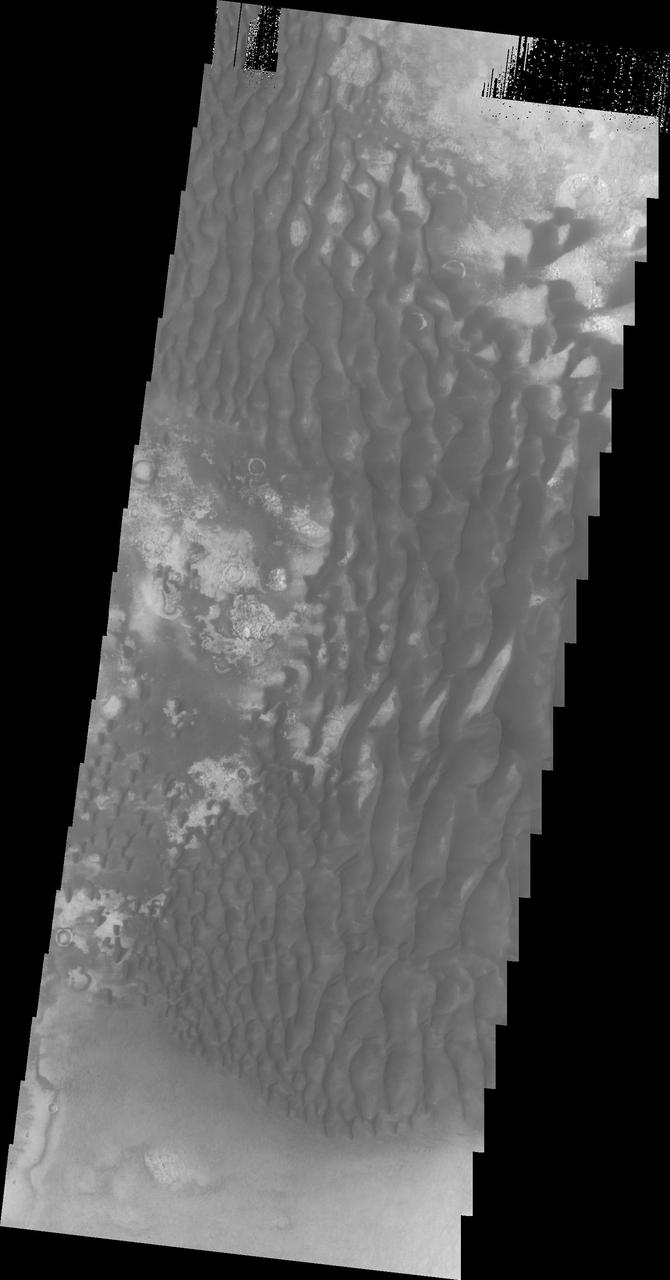
This image was collected at the same time as yesterday infrared image. In the visible wavelengths the dunes are dark, in IR they are bright warm.
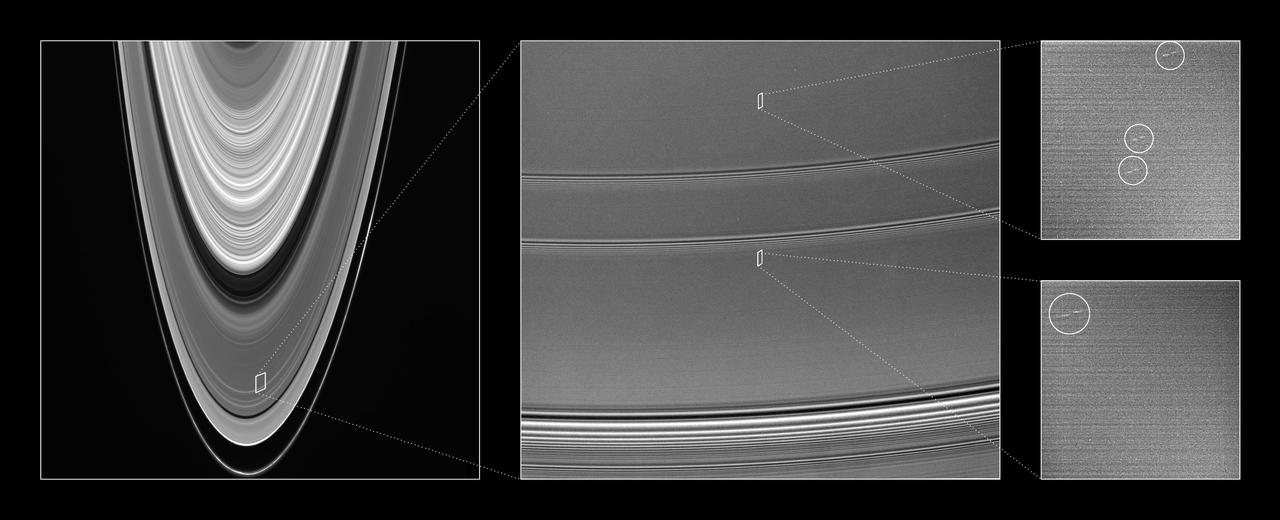
This collection of Cassini images provides context for understanding the location and scale of propeller-shaped features observed within Saturn A ring
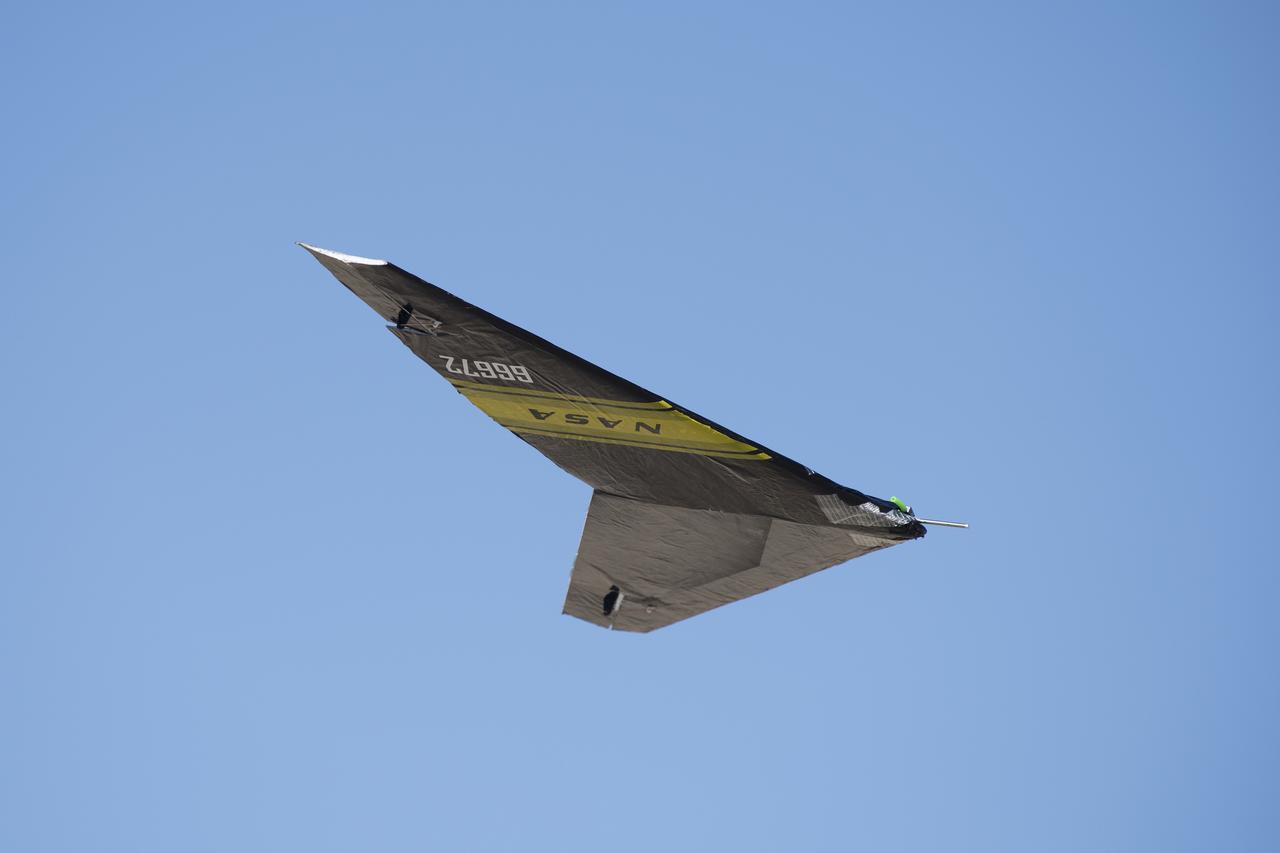
Test flights of the Prandtl-M have resumed. The airframe also is the basis for another aircraft that will collect weather data.
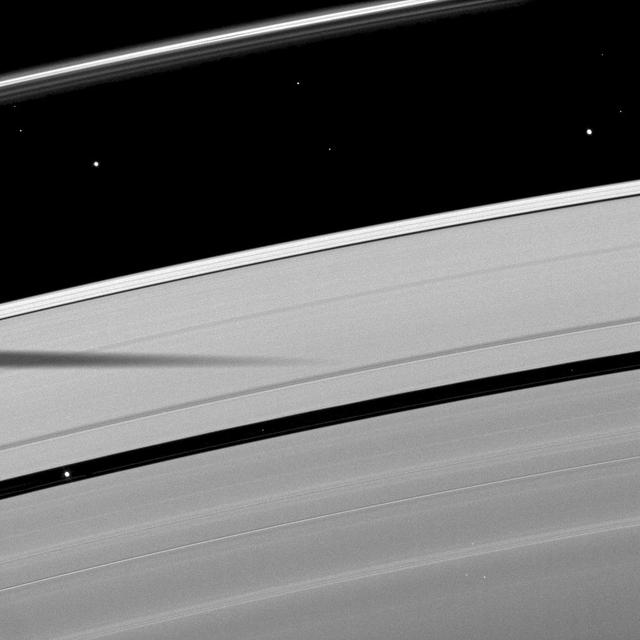
The shadow of the moon Mimas is cast on Saturn outer A ring in this image which also shows a couple of moons and a collection of stars.
This image is a tar cal frame collected about a month before NASA MESSENGER first flyby of Venus.
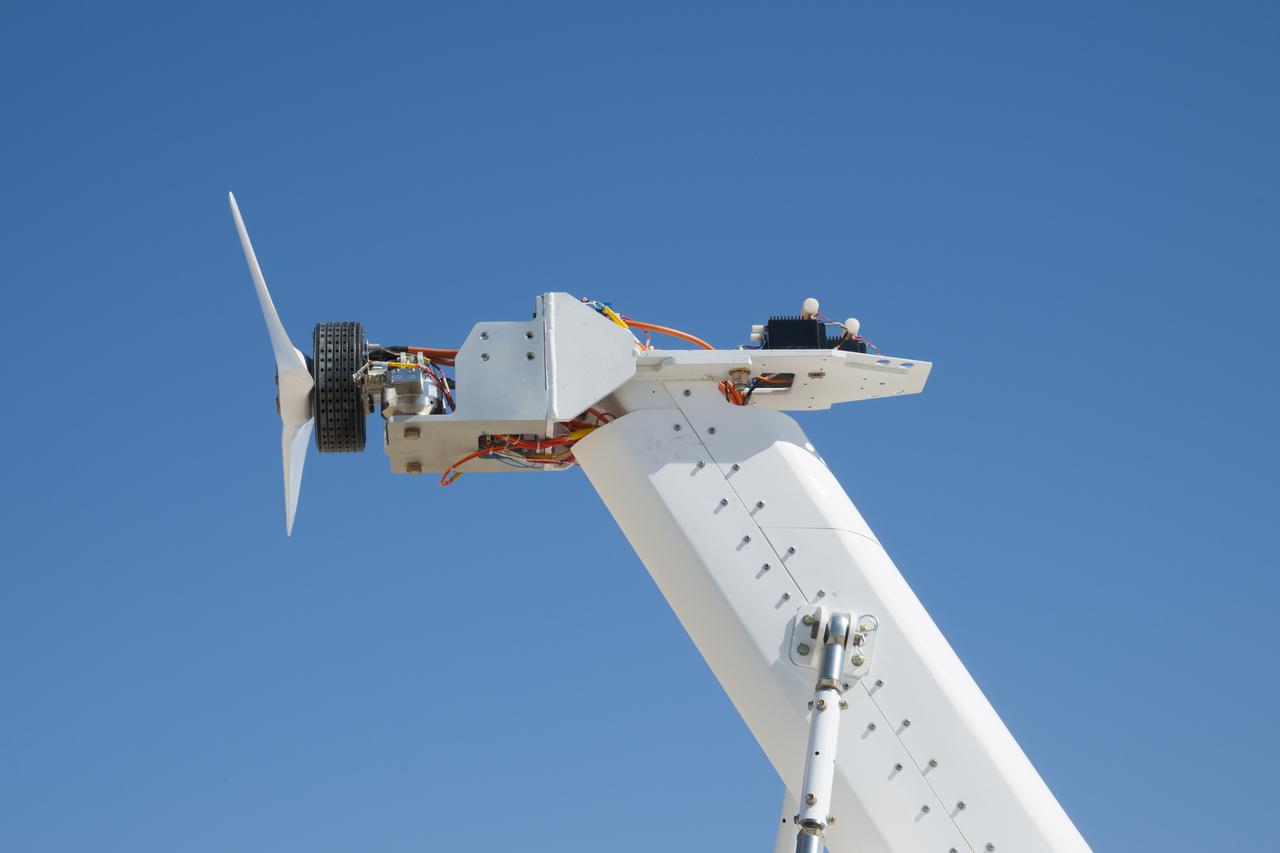
The electric propulsion system to be tested is secured at the top of the Airvolt test stand and instrumented to collect data.