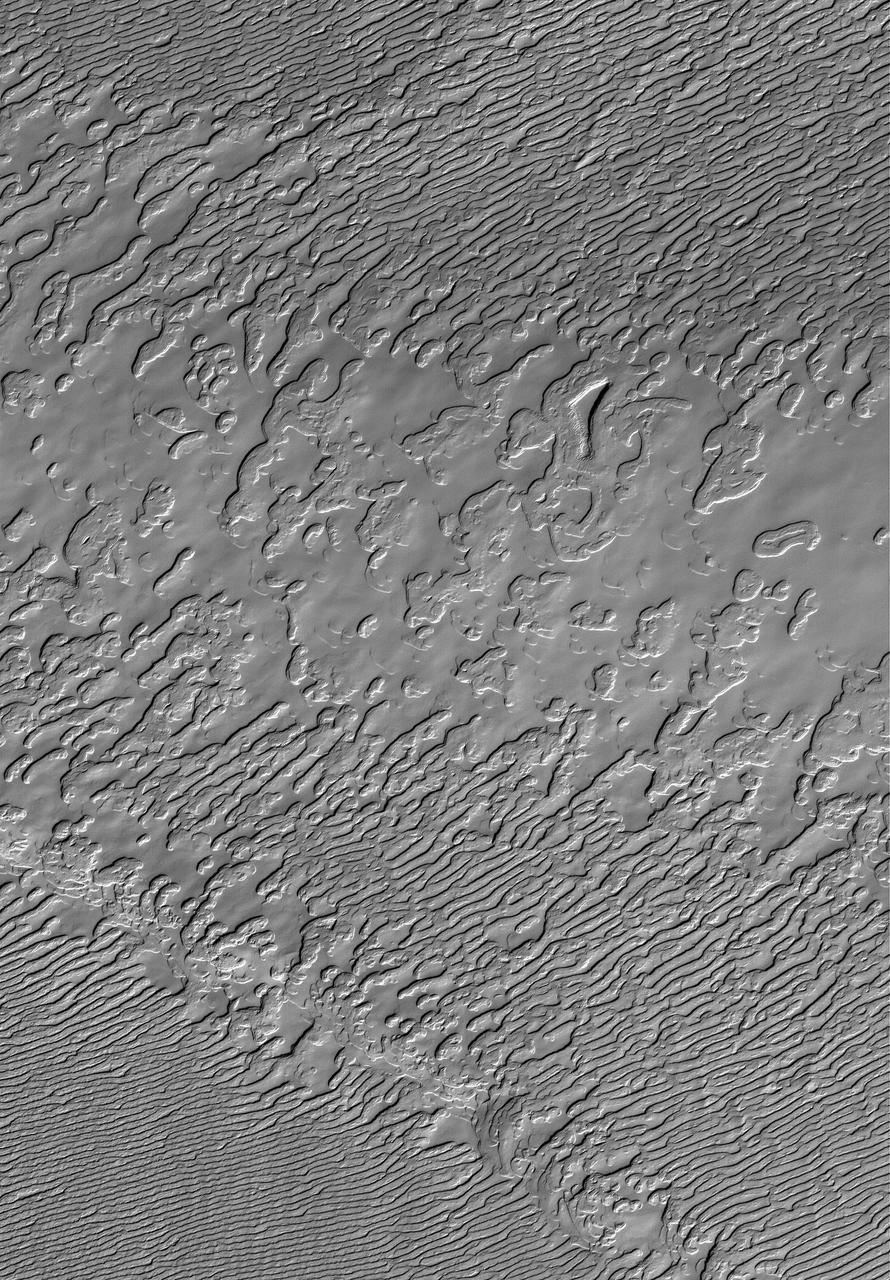
Frozen Frozen CO<sub>2</sub>
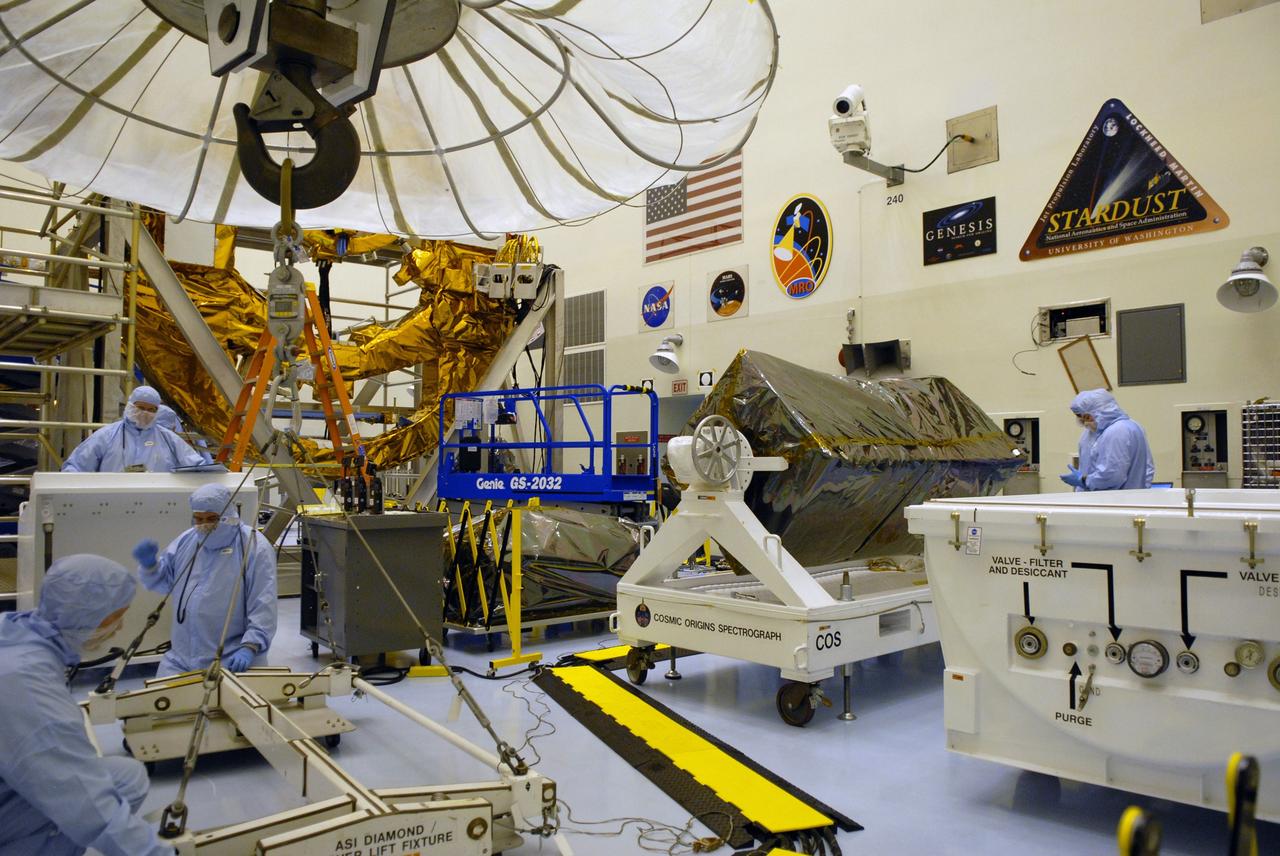
CAPE CANAVERAL, Fla. – In the Payload Hazardous Servicing Facility at NASA's Kennedy Space Center in Florida, the crane has been removed from the Cosmic Origins Spectrograph, or COS, after placing the COS on a test stand. The COS is part of the payload on space shuttle Atlantis for the Hubble servicing mission, targeted to launch in mid-May. Installing the COS during the mission will effectively restore spectroscopy to Hubble’s scientific arsenal, and at the same time provide the telescope with unique capabilities. COS is designed to study the large-scale structure of the universe and how galaxies, stars and planets formed and evolved. It will help determine how elements needed for life such as carbon and iron first formed and how their abundances have increased over the lifetime of the universe. Photo credit: NASA/Jack Pfaller
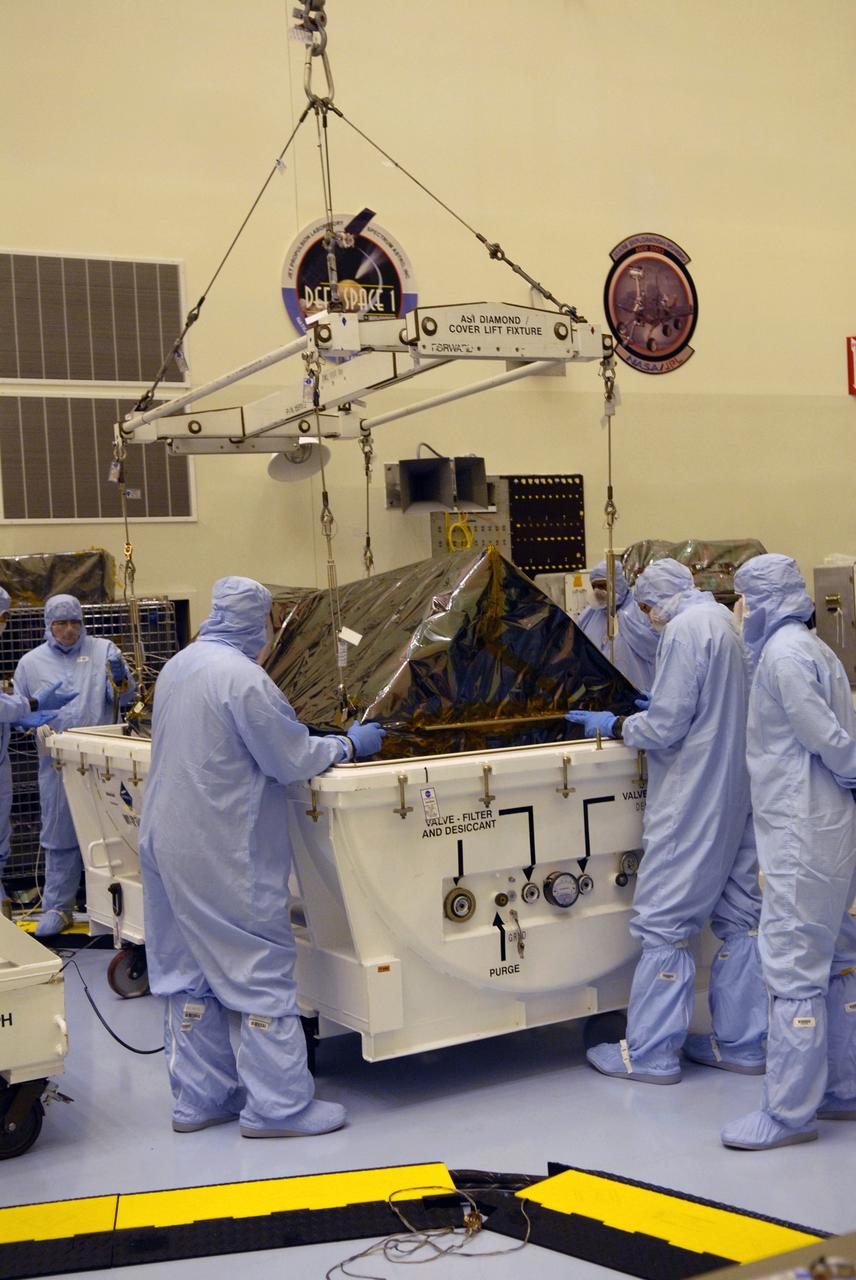
CAPE CANAVERAL, Fla. – In the Payload Hazardous Servicing Facility at NASA's Kennedy Space Center in Florida, a crane is attached to the Cosmic Origins Spectrograph, or COS, still in its shipping container. The crane will remove the COS and place it on a test stand. The COS is part of the payload on space shuttle Atlantis for the Hubble servicing mission, targeted to launch in mid-May. Installing the COS during the mission will effectively restore spectroscopy to Hubble’s scientific arsenal, and at the same time provide the telescope with unique capabilities. COS is designed to study the large-scale structure of the universe and how galaxies, stars and planets formed and evolved. It will help determine how elements needed for life such as carbon and iron first formed and how their abundances have increased over the lifetime of the universe. Photo credit: NASA/Jack Pfaller

CAPE CANAVERAL, Fla. – In the clean room of the Payload Hazardous Processing Facility at NASA's Kennedy Space Center, a worker from NASA's Goddard Space Flight Center uses black light inspection for a thorough cleaning of the Cosmic Origins Spectrograph, or COS. Black light inspection uses UVA fluorescence to detect possible particulate microcontamination, minute cracks or fluid leaks. The COS will be installed on the Hubble Space Telescope on space shuttle Atlantis' STS-125 mission. COS will be the most sensitive ultraviolet spectrograph ever flown on Hubble and will probe the "cosmic web" - the large-scale structure of the universe whose form is determined by the gravity of dark matter and is traced by galaxies and intergalactic gas. The COS far-ultraviolet channel has a sensitivity 30 times greater than that of previous spectroscopic instruments for the detection of extremely low light levels. Launch of Atlantis on the STS-125 mission is targeted for Oct. 8. Photo credit: NASA/Kim Shiflett
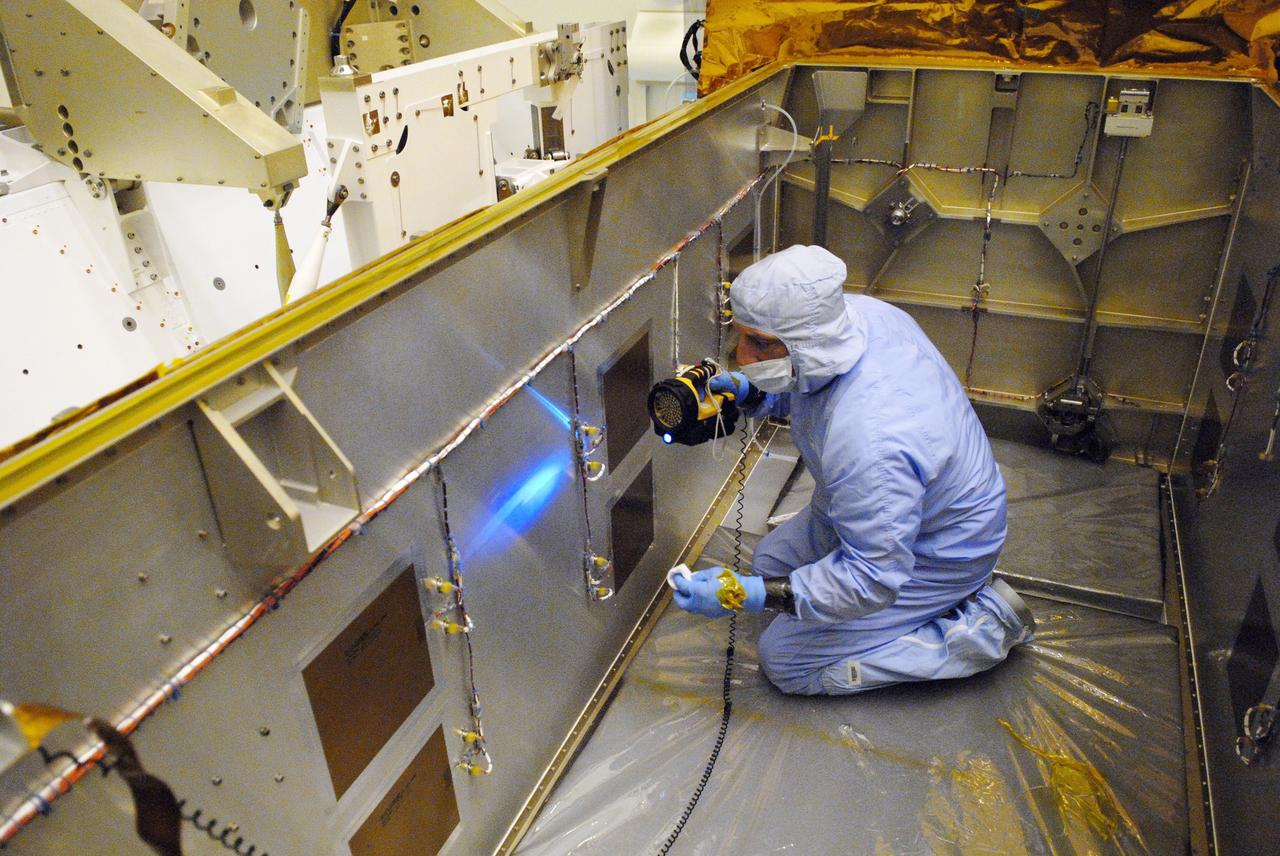
CAPE CANAVERAL, Fla. – In the clean room of the Payload Hazardous Processing Facility at NASA's Kennedy Space Center, workers from NASA's Goddard Space Flight Center use black light inspection for a thorough cleaning of the protective carrier for the Cosmic Origins Spectrograph, or COS. Black light inspection uses UVA fluorescence to detect possible particulate microcontamination, minute cracks or fluid leaks. The COS will be installed on the Hubble Space Telescope on space shuttle Atlantis' STS-125 mission. COS will be the most sensitive ultraviolet spectrograph ever flown on Hubble and will probe the "cosmic web" - the large-scale structure of the universe whose form is determined by the gravity of dark matter and is traced by galaxies and intergalactic gas. The COS far-ultraviolet channel has a sensitivity 30 times greater than that of previous spectroscopic instruments for the detection of extremely low light levels. Launch of Atlantis on the STS-125 mission is targeted for Oct. 8. Photo credit: NASA/Kim Shiflett
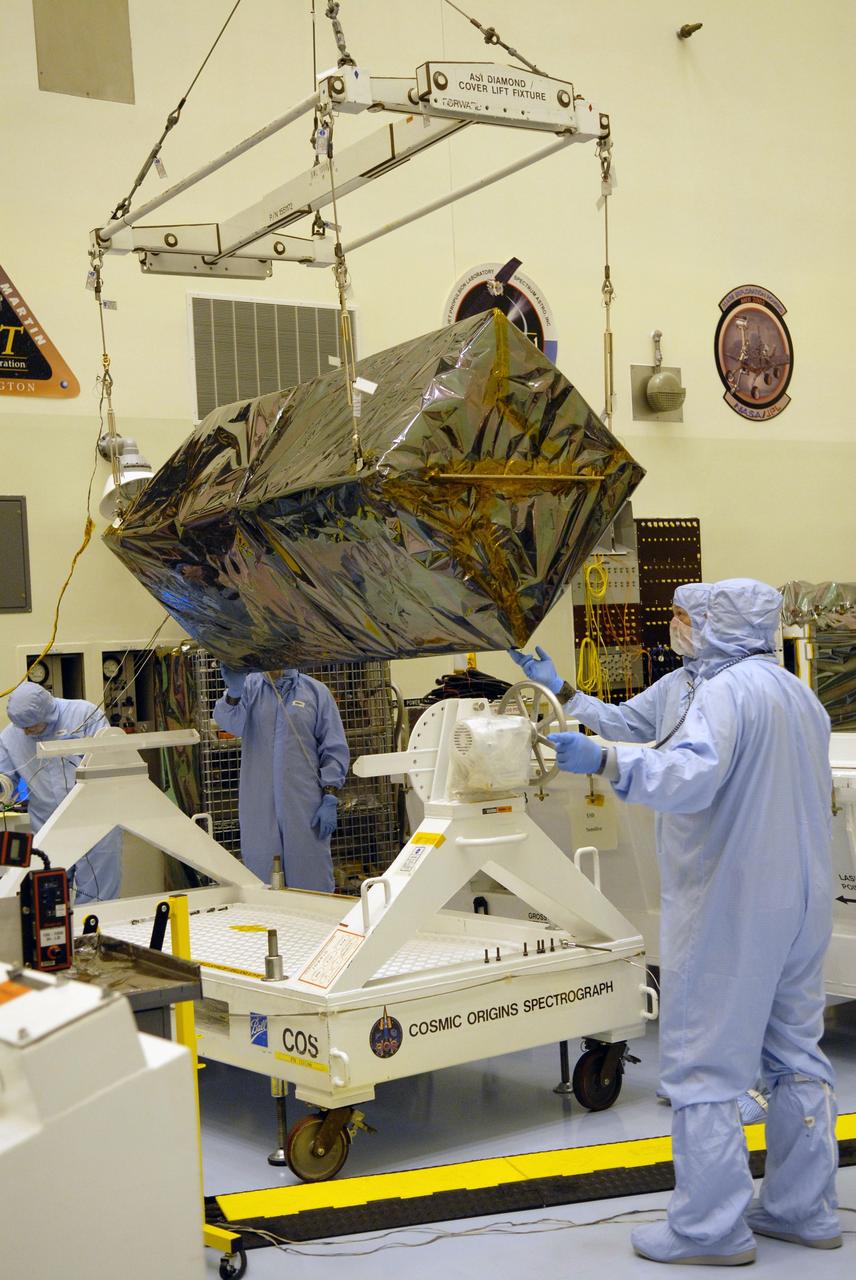
CAPE CANAVERAL, Fla. – In the Payload Hazardous Servicing Facility at NASA's Kennedy Space Center in Florida, under the guidance of the technicians, a crane lowers the Cosmic Origins Spectrograph, or COS, onto a test stand. The COS is part of the payload on space shuttle Atlantis for the Hubble servicing mission, targeted to launch in mid-May. Installing the COS during the mission will effectively restore spectroscopy to Hubble’s scientific arsenal, and at the same time provide the telescope with unique capabilities. COS is designed to study the large-scale structure of the universe and how galaxies, stars and planets formed and evolved. It will help determine how elements needed for life such as carbon and iron first formed and how their abundances have increased over the lifetime of the universe. Photo credit: NASA/Jack Pfaller
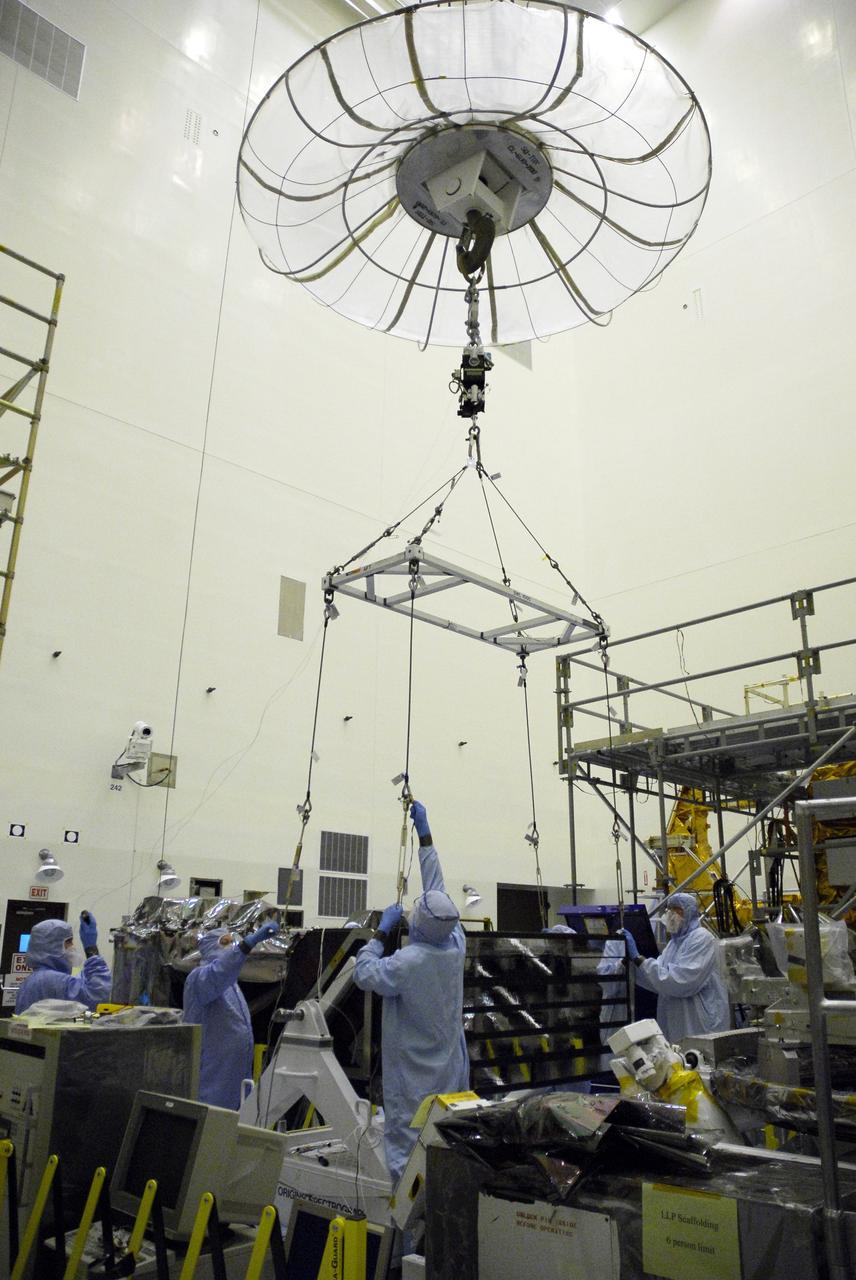
CAPE CANAVERAL, Fla. – In the clean room of the Payload Hazardous Processing Facility at NASA's Kennedy Space Center, workers prepare to attach an overhead crane to the Cosmic Origins Spectrograph, or COS. The COS will be lifted and moved to a protective enclosure on the Orbital Replacement Unit Carrier, part of the payload for the fifth and final Hubble servicing mission, STS-125. Other payloads include the Flight Support System, the Super Lightweight Interchangeable Carrier and the Multi-Use Lightweight Equipment, or MULE, carrier. COS will be the most sensitive ultraviolet spectrograph ever flown on Hubble and will probe the "cosmic web" - the large-scale structure of the universe whose form is determined by the gravity of dark matter and is traced by galaxies and intergalactic gas. The COS far-ultraviolet channel has a sensitivity 30 times greater than that of previous spectroscopic instruments for the detection of extremely low light levels. Launch of Atlantis on the STS-125 mission is targeted for Oct. 8. Photo credit: NASA/Kim Shiflett
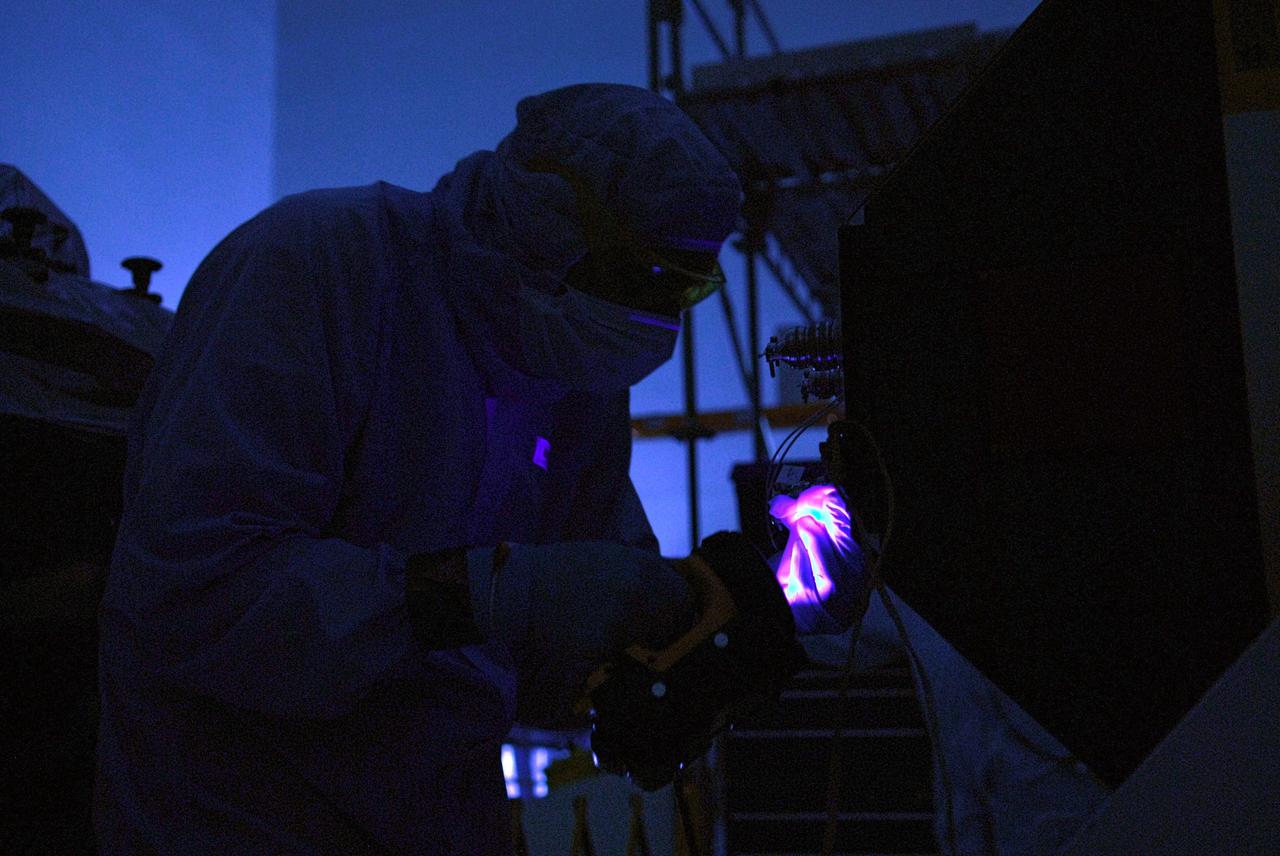
CAPE CANAVERAL, Fla. – In the clean room of the Payload Hazardous Processing Facility at NASA's Kennedy Space Center, a worker from NASA's Goddard Space Flight Center uses black light inspection for a thorough cleaning of the Cosmic Origins Spectrograph, or COS. Black light inspection uses UVA fluorescence to detect possible particulate microcontamination, minute cracks or fluid leaks. The COS will be installed on the Hubble Space Telescope on space shuttle Atlantis' STS-125 mission. COS will be the most sensitive ultraviolet spectrograph ever flown on Hubble and will probe the "cosmic web" - the large-scale structure of the universe whose form is determined by the gravity of dark matter and is traced by galaxies and intergalactic gas. The COS far-ultraviolet channel has a sensitivity 30 times greater than that of previous spectroscopic instruments for the detection of extremely low light levels. Launch of Atlantis on the STS-125 mission is targeted for Oct. 8. Photo credit: NASA/Kim Shiflett
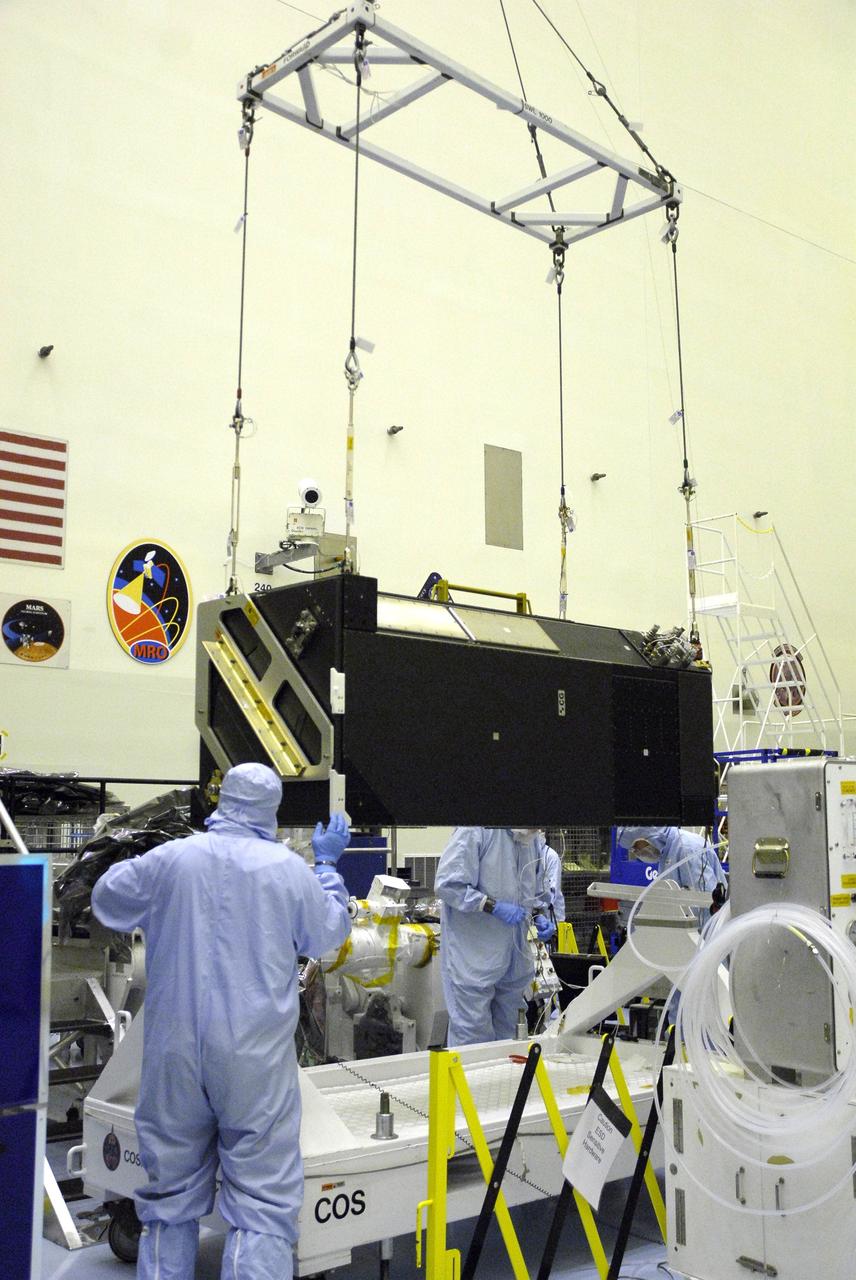
CAPE CANAVERAL, Fla. – In the clean room of the Payload Hazardous Processing Facility at NASA's Kennedy Space Center, an overhead crane lifts the Cosmic Origins Spectrograph, or COS. The COS is being lifted and moved to a protective enclosure on the Orbital Replacement Unit Carrier, part of the payload for the fifth and final Hubble servicing mission, STS-125. Other payloads include the Flight Support System, the Super Lightweight Interchangeable Carrier and the Multi-Use Lightweight Equipment, or MULE, carrier. COS will be the most sensitive ultraviolet spectrograph ever flown on Hubble and will probe the "cosmic web" - the large-scale structure of the universe whose form is determined by the gravity of dark matter and is traced by galaxies and intergalactic gas. The COS far-ultraviolet channel has a sensitivity 30 times greater than that of previous spectroscopic instruments for the detection of extremely low light levels. Launch of Atlantis on the STS-125 mission is targeted for Oct. 8. Photo credit: NASA/Kim Shiflett

CAPE CANAVERAL, Fla. –The outside of the Cosmic Origins Spectrograph, or COS, is seen before black light inspection in the clean room of the Payload Hazardous Processing Facility at NASA's Kennedy Space Center. Black light inspection uses UVA fluorescence to detect possible particulate microcontamination, minute cracks or fluid leaks. The COS will be installed on the Hubble Space Telescope on space shuttle Atlantis' STS-125 mission. COS will be the most sensitive ultraviolet spectrograph ever flown on Hubble and will probe the "cosmic web" - the large-scale structure of the universe whose form is determined by the gravity of dark matter and is traced by galaxies and intergalactic gas. The COS far-ultraviolet channel has a sensitivity 30 times greater than that of previous spectroscopic instruments for the detection of extremely low light levels. Launch of Atlantis on the STS-125 mission is targeted for Oct. 8. Photo credit: NASA/Kim Shiflett
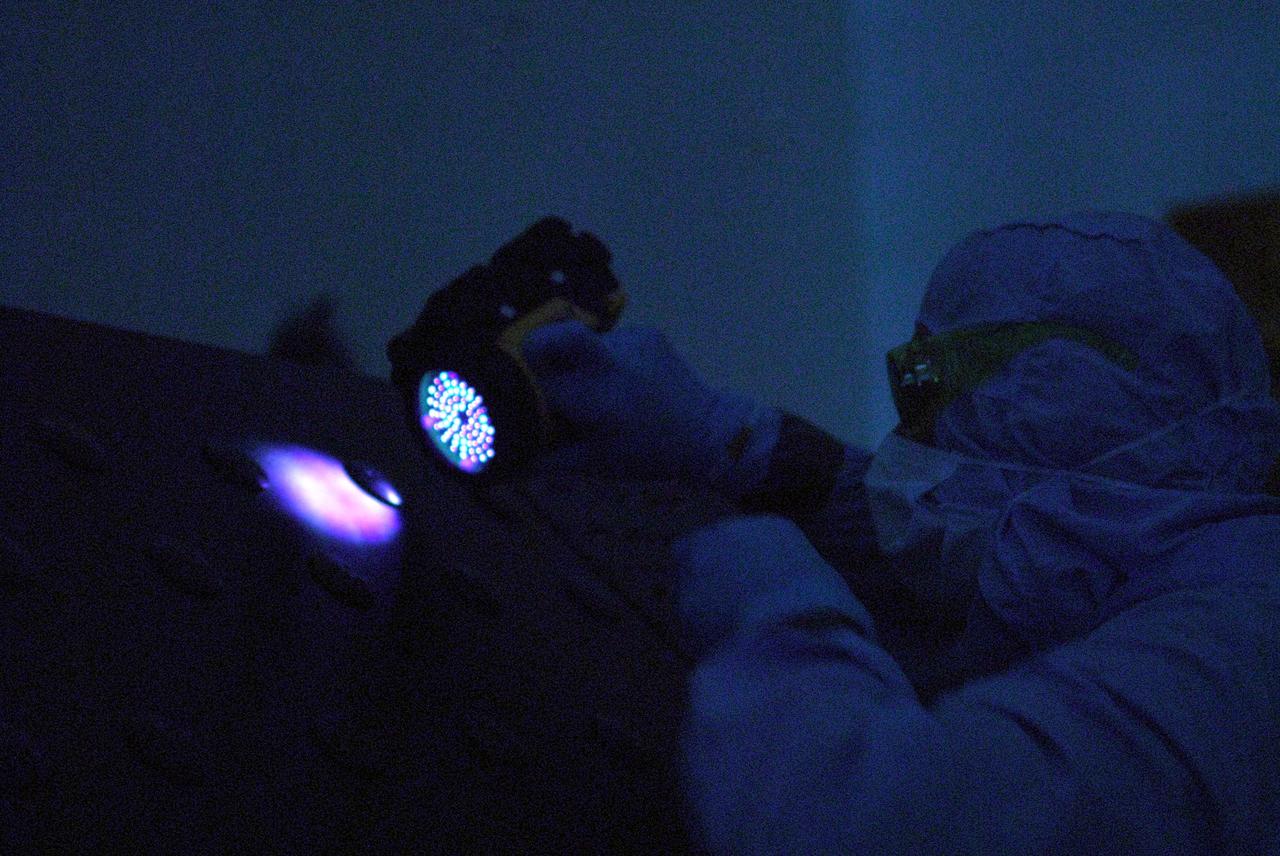
CAPE CANAVERAL, Fla. –In the clean room of the Payload Hazardous Processing Facility at NASA's Kennedy Space Center, a worker from NASA's Goddard Space Flight Center uses black light inspection for a thorough cleaning of the Cosmic Origins Spectrograph, or COS. Black light inspection uses UVA fluorescence to detect possible particulate microcontamination, minute cracks or fluid leaks. The COS will be installed on the Hubble Space Telescope on space shuttle Atlantis' STS-125 mission. COS will be the most sensitive ultraviolet spectrograph ever flown on Hubble and will probe the "cosmic web" - the large-scale structure of the universe whose form is determined by the gravity of dark matter and is traced by galaxies and intergalactic gas. The COS far-ultraviolet channel has a sensitivity 30 times greater than that of previous spectroscopic instruments for the detection of extremely low light levels. Launch of Atlantis on the STS-125 mission is targeted for Oct. 8. Photo credit: NASA/Kim Shiflett
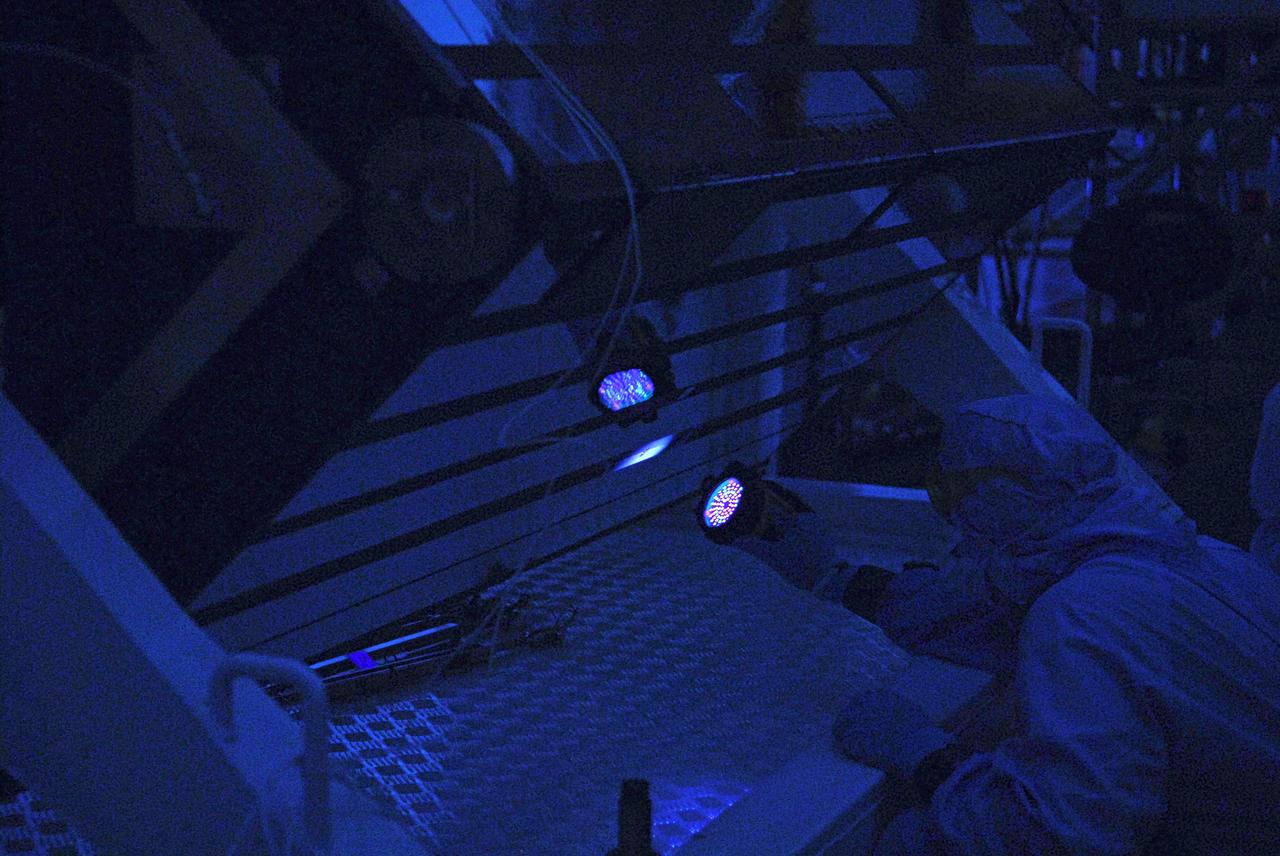
CAPE CANAVERAL, Fla. – In the clean room of the Payload Hazardous Processing Facility at NASA's Kennedy Space Center, a worker from NASA's Goddard Space Flight Center uses black light inspection for a thorough cleaning of the Cosmic Origins Spectrograph, or COS. Black light inspection uses UVA fluorescence to detect possible particulate microcontamination, minute cracks or fluid leaks. The COS will be installed on the Hubble Space Telescope on space shuttle Atlantis' STS-125 mission. COS will be the most sensitive ultraviolet spectrograph ever flown on Hubble and will probe the "cosmic web" - the large-scale structure of the universe whose form is determined by the gravity of dark matter and is traced by galaxies and intergalactic gas. The COS far-ultraviolet channel has a sensitivity 30 times greater than that of previous spectroscopic instruments for the detection of extremely low light levels. Launch of Atlantis on the STS-125 mission is targeted for Oct. 8. Photo credit: NASA/Kim Shiflett
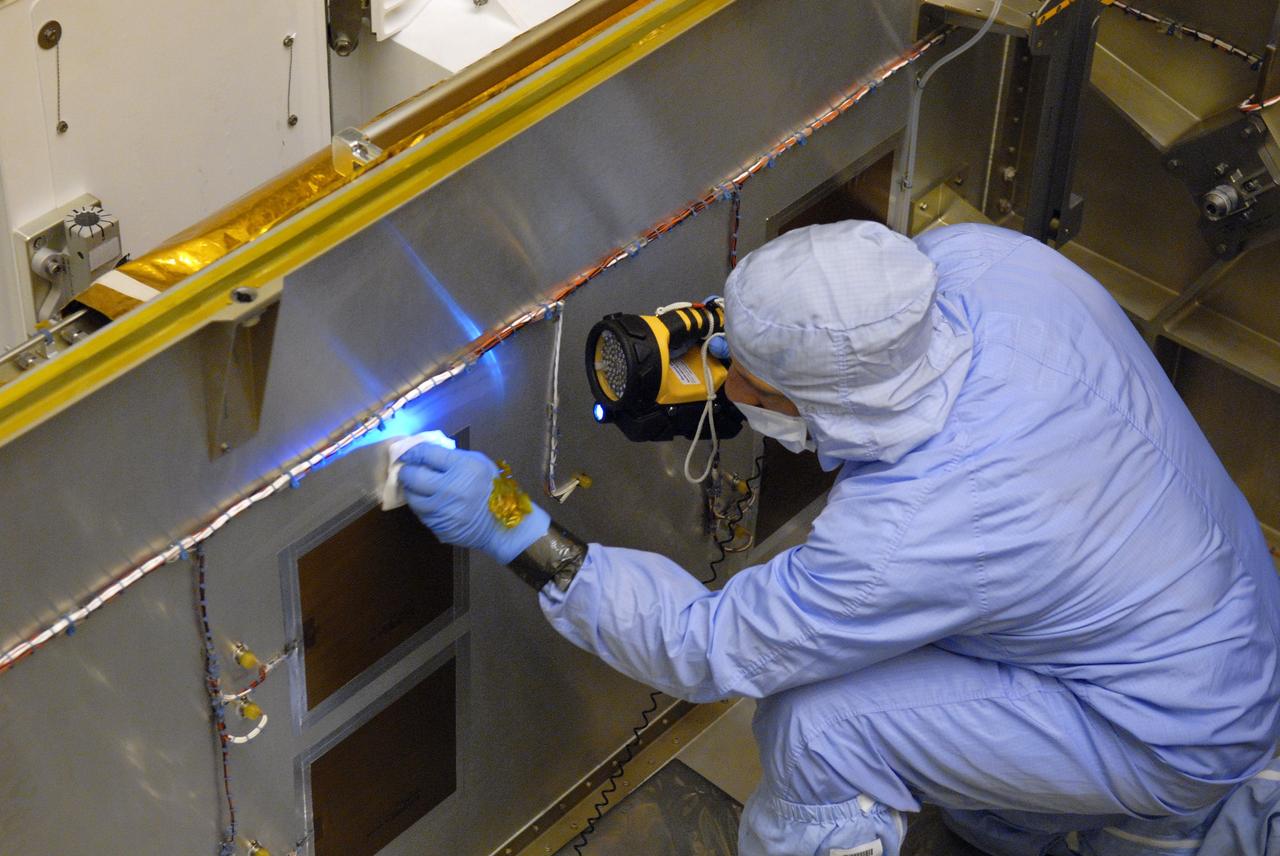
CAPE CANAVERAL, Fla. – In the clean room of the Payload Hazardous Processing Facility at NASA's Kennedy Space Center, workers from NASA's Goddard Space Flight Center use black light inspection for a thorough cleaning of the protective carrier for the Cosmic Origins Spectrograph, or COS. Black light inspection uses UVA fluorescence to detect possible particulate microcontamination, minute cracks or fluid leaks. The COS will be installed on the Hubble Space Telescope on space shuttle Atlantis' STS-125 mission. COS will be the most sensitive ultraviolet spectrograph ever flown on Hubble and will probe the "cosmic web" - the large-scale structure of the universe whose form is determined by the gravity of dark matter and is traced by galaxies and intergalactic gas. The COS far-ultraviolet channel has a sensitivity 30 times greater than that of previous spectroscopic instruments for the detection of extremely low light levels. Launch of Atlantis on the STS-125 mission is targeted for Oct. 8. Photo credit: NASA/Kim Shiflett
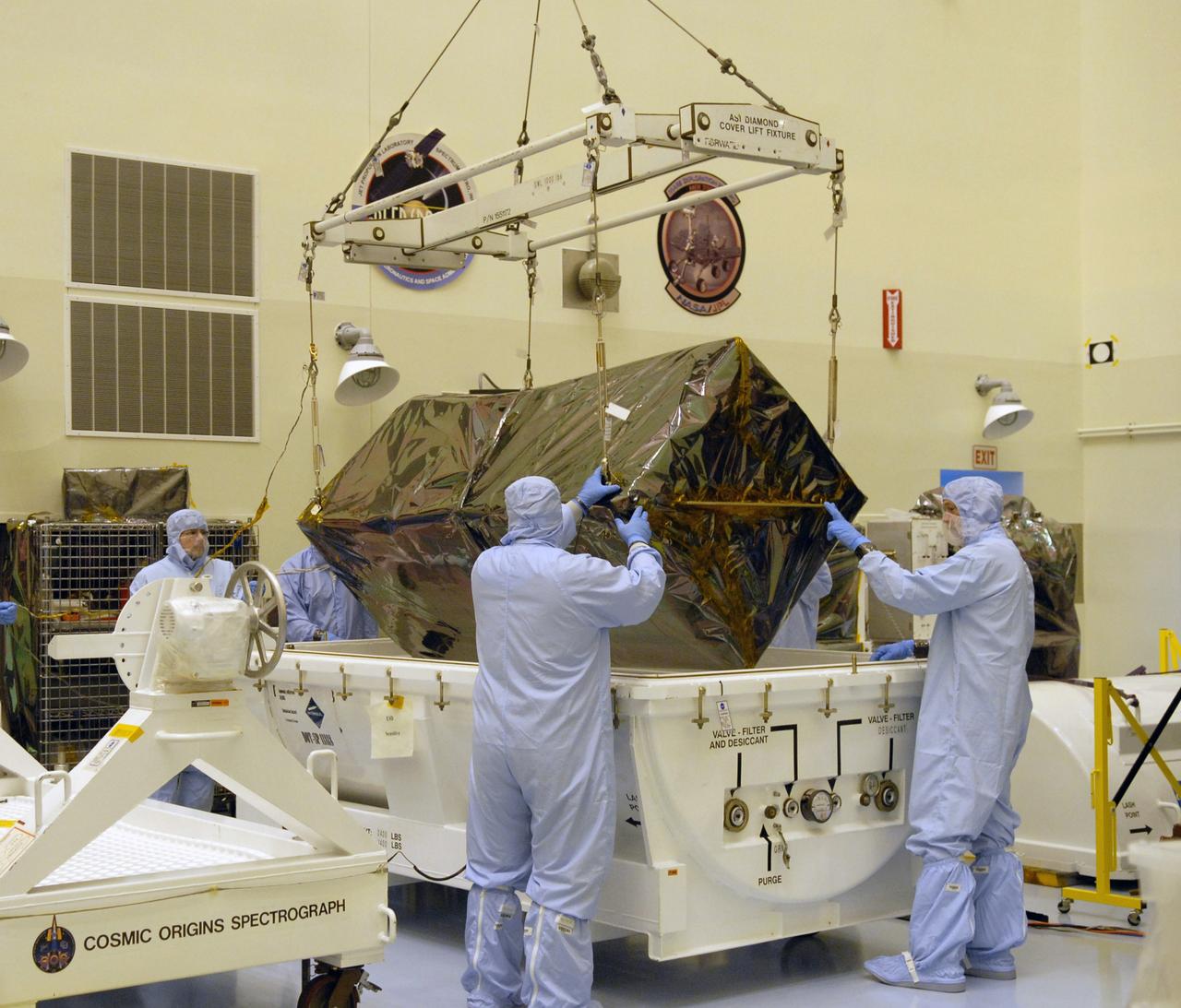
CAPE CANAVERAL, Fla. – In the Payload Hazardous Servicing Facility at NASA's Kennedy Space Center in Florida, under the guidance of the technicians, a crane lifts the Cosmic Origins Spectrograph, or COS, from the shipping container. The COS, part of the payload on space shuttle Atlantis for the Hubble servicing mission, targeted to launch in mid-May, is being moved to a test stand. Installing the COS during the mission will effectively restore spectroscopy to Hubble’s scientific arsenal, and at the same time provide the telescope with unique capabilities. COS is designed to study the large-scale structure of the universe and how galaxies, stars and planets formed and evolved. It will help determine how elements needed for life such as carbon and iron first formed and how their abundances have increased over the lifetime of the universe. Photo credit: NASA/Jack Pfaller
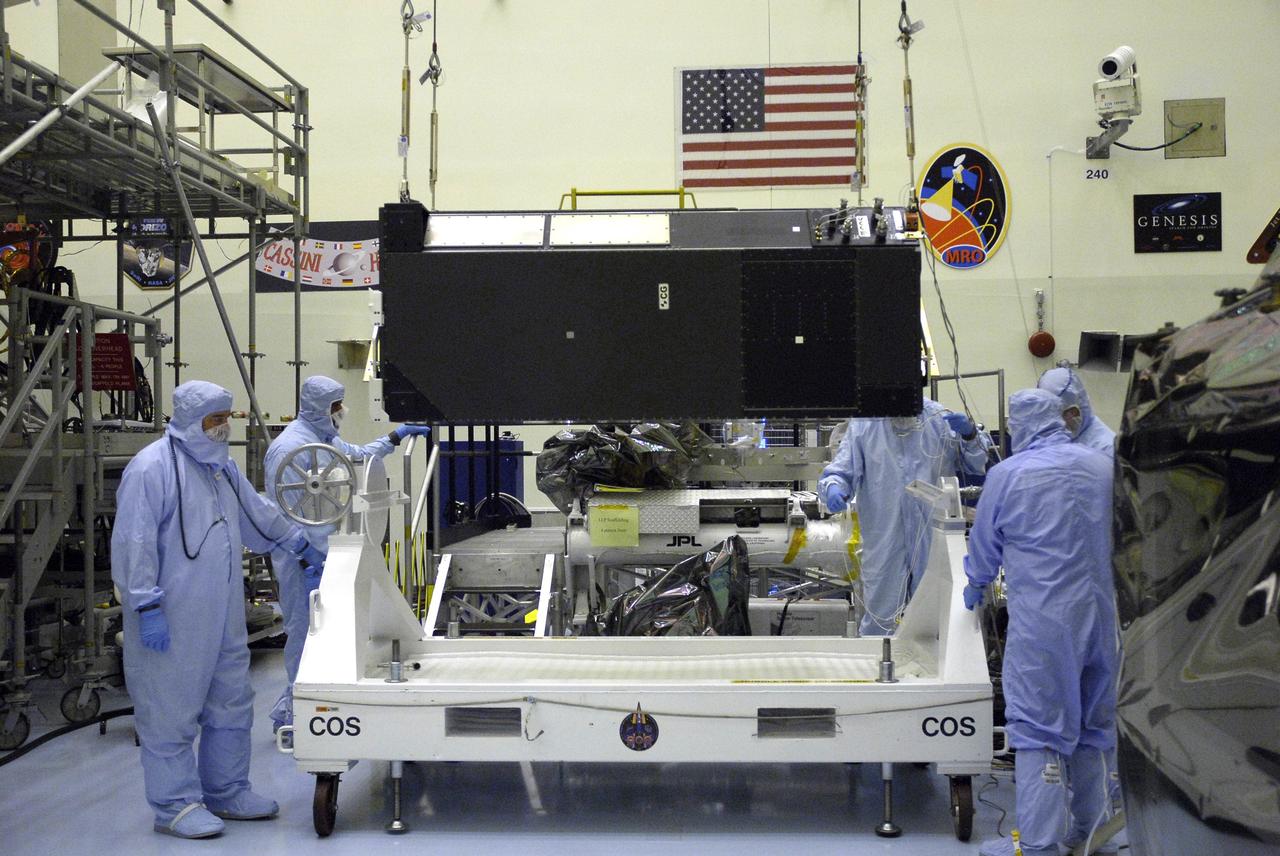
CAPE CANAVERAL, Fla. – In the clean room of the Payload Hazardous Processing Facility at NASA's Kennedy Space Center, an overhead crane lifts the Cosmic Origins Spectrograph, or COS. The COS is being lifted and moved to a protective enclosure on the Orbital Replacement Unit Carrier, part of the payload for the fifth and final Hubble servicing mission, STS-125. Other payloads include the Flight Support System, the Super Lightweight Interchangeable Carrier and the Multi-Use Lightweight Equipment, or MULE, carrier. COS will be the most sensitive ultraviolet spectrograph ever flown on Hubble and will probe the "cosmic web" - the large-scale structure of the universe whose form is determined by the gravity of dark matter and is traced by galaxies and intergalactic gas. The COS far-ultraviolet channel has a sensitivity 30 times greater than that of previous spectroscopic instruments for the detection of extremely low light levels. Launch of Atlantis on the STS-125 mission is targeted for Oct. 8. Photo credit: NASA/Kim Shiflett

CAPE CANAVERAL, Fla. – In the clean room of the Payload Hazardous Processing Facility at NASA's Kennedy Space Center, an overhead crane lifts the Cosmic Origins Spectrograph, or COS. The COS is being lifted and moved to a protective enclosure on the Orbital Replacement Unit Carrier, part of the payload for the fifth and final Hubble servicing mission, STS-125. Other payloads include the Flight Support System, the Super Lightweight Interchangeable Carrier and the Multi-Use Lightweight Equipment, or MULE, carrier. COS will be the most sensitive ultraviolet spectrograph ever flown on Hubble and will probe the "cosmic web" - the large-scale structure of the universe whose form is determined by the gravity of dark matter and is traced by galaxies and intergalactic gas. The COS far-ultraviolet channel has a sensitivity 30 times greater than that of previous spectroscopic instruments for the detection of extremely low light levels. Launch of Atlantis on the STS-125 mission is targeted for Oct. 8. Photo credit: NASA/Kim Shiflett
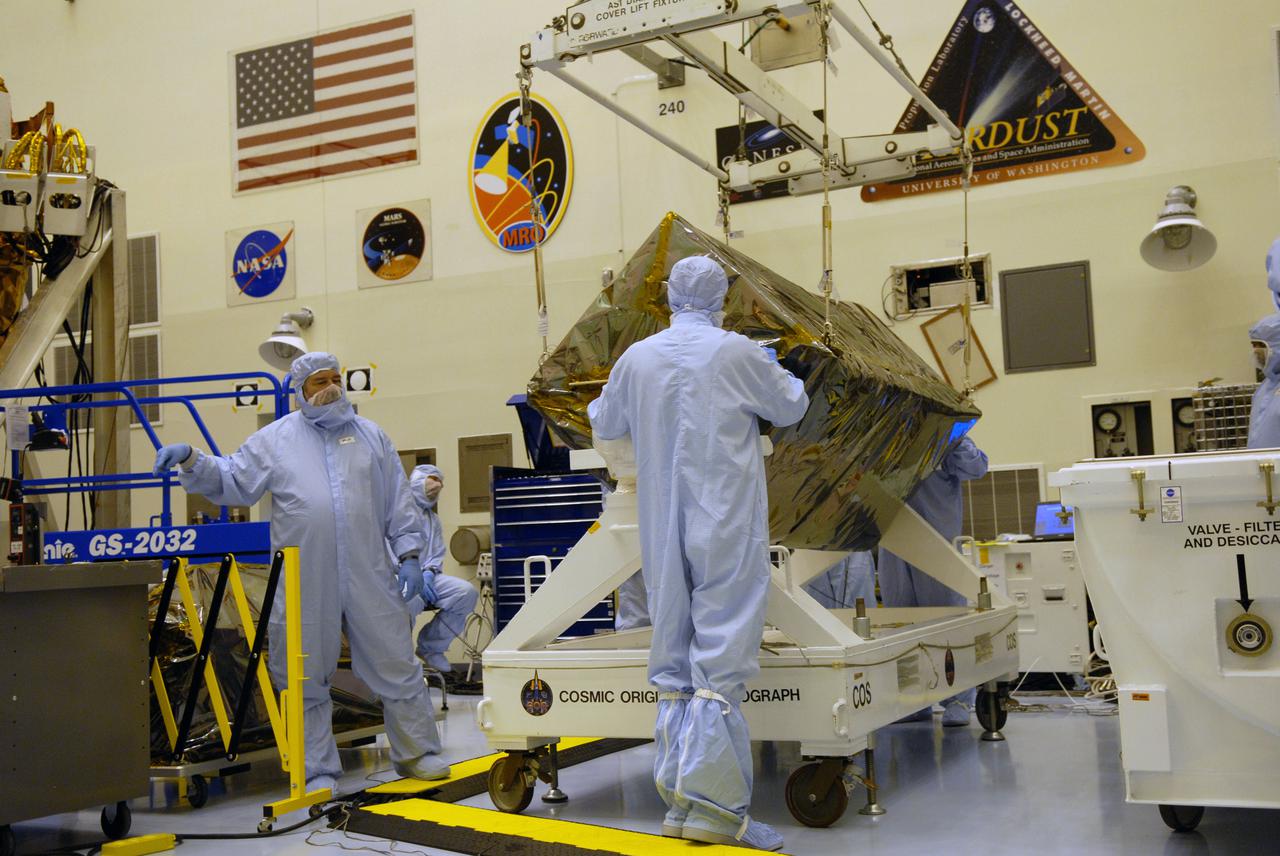
CAPE CANAVERAL, Fla. – In the Payload Hazardous Servicing Facility at NASA's Kennedy Space Center in Florida, under the guidance of the technicians, a crane lowers the Cosmic Origins Spectrograph, or COS, onto a test stand. The COS is part of the payload on space shuttle Atlantis for the Hubble servicing mission, targeted to launch in mid-May. Installing the COS during the mission will effectively restore spectroscopy to Hubble’s scientific arsenal, and at the same time provide the telescope with unique capabilities. COS is designed to study the large-scale structure of the universe and how galaxies, stars and planets formed and evolved. It will help determine how elements needed for life such as carbon and iron first formed and how their abundances have increased over the lifetime of the universe. Photo credit: NASA_Jack Pfaller

CAPE CANAVERAL, Fla. – In the clean room of the Payload Hazardous Processing Facility at NASA's Kennedy Space Center, workers attach an overhead crane to the Cosmic Origins Spectrograph, or COS. The COS is being lifted and moved to a protective enclosure on the Orbital Replacement Unit Carrier, part of the payload for the fifth and final Hubble servicing mission, STS-125. Other payloads include the Flight Support System, the Super Lightweight Interchangeable Carrier and the Multi-Use Lightweight Equipment, or MULE, carrier. COS will be the most sensitive ultraviolet spectrograph ever flown on Hubble and will probe the "cosmic web" - the large-scale structure of the universe whose form is determined by the gravity of dark matter and is traced by galaxies and intergalactic gas. The COS far-ultraviolet channel has a sensitivity 30 times greater than that of previous spectroscopic instruments for the detection of extremely low light levels. Launch of Atlantis on the STS-125 mission is targeted for Oct. 8. Photo credit: NASA/Kim Shiflett
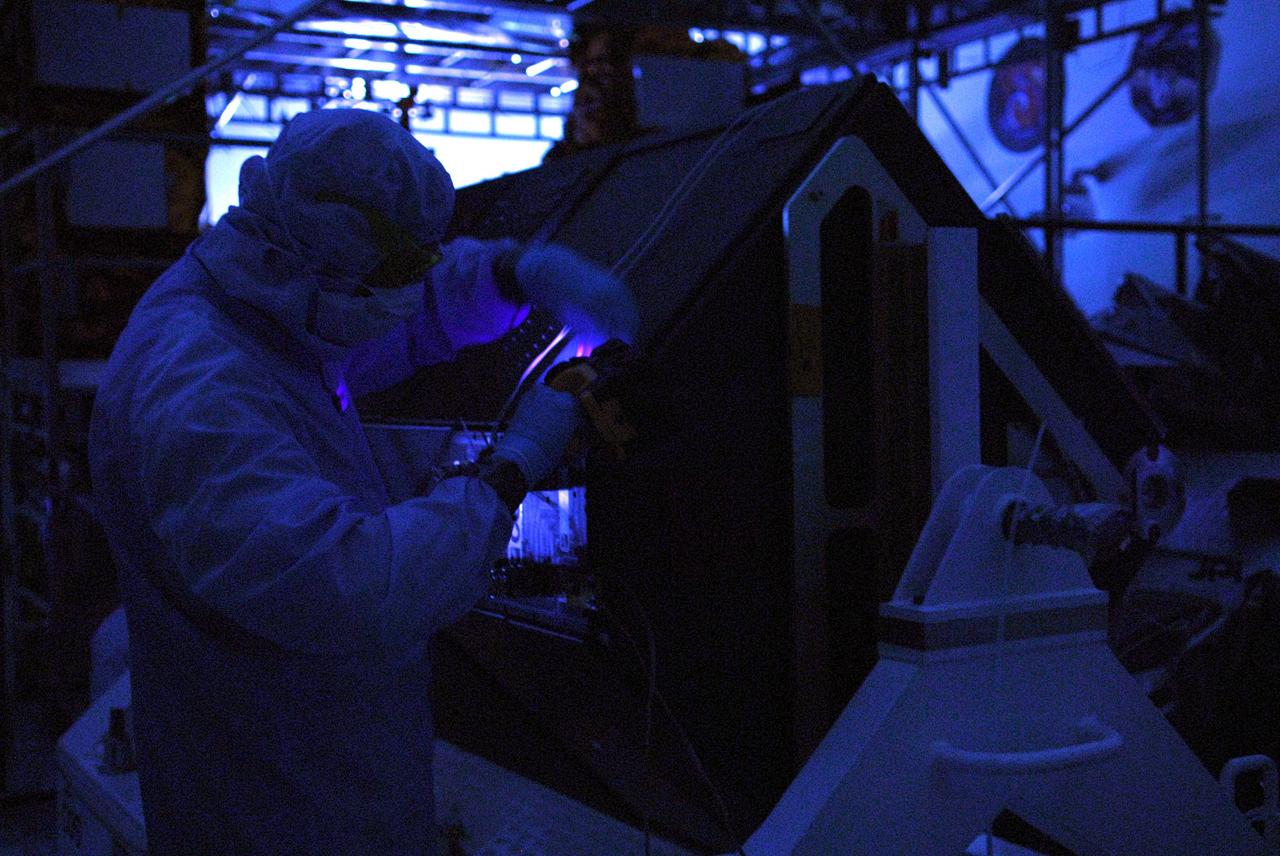
CAPE CANAVERAL, Fla. – In the clean room of the Payload Hazardous Processing Facility at NASA's Kennedy Space Center, a worker from NASA's Goddard Space Flight Center uses black light inspection for a thorough cleaning of the Cosmic Origins Spectrograph, or COS. Black light inspection uses UVA fluorescence to detect possible particulate microcontamination, minute cracks or fluid leaks. The COS will be installed on the Hubble Space Telescope on space shuttle Atlantis' STS-125 mission. COS will be the most sensitive ultraviolet spectrograph ever flown on Hubble and will probe the "cosmic web" - the large-scale structure of the universe whose form is determined by the gravity of dark matter and is traced by galaxies and intergalactic gas. The COS far-ultraviolet channel has a sensitivity 30 times greater than that of previous spectroscopic instruments for the detection of extremely low light levels. Launch of Atlantis on the STS-125 mission is targeted for Oct. 8. Photo credit: NASA/Kim Shiflett
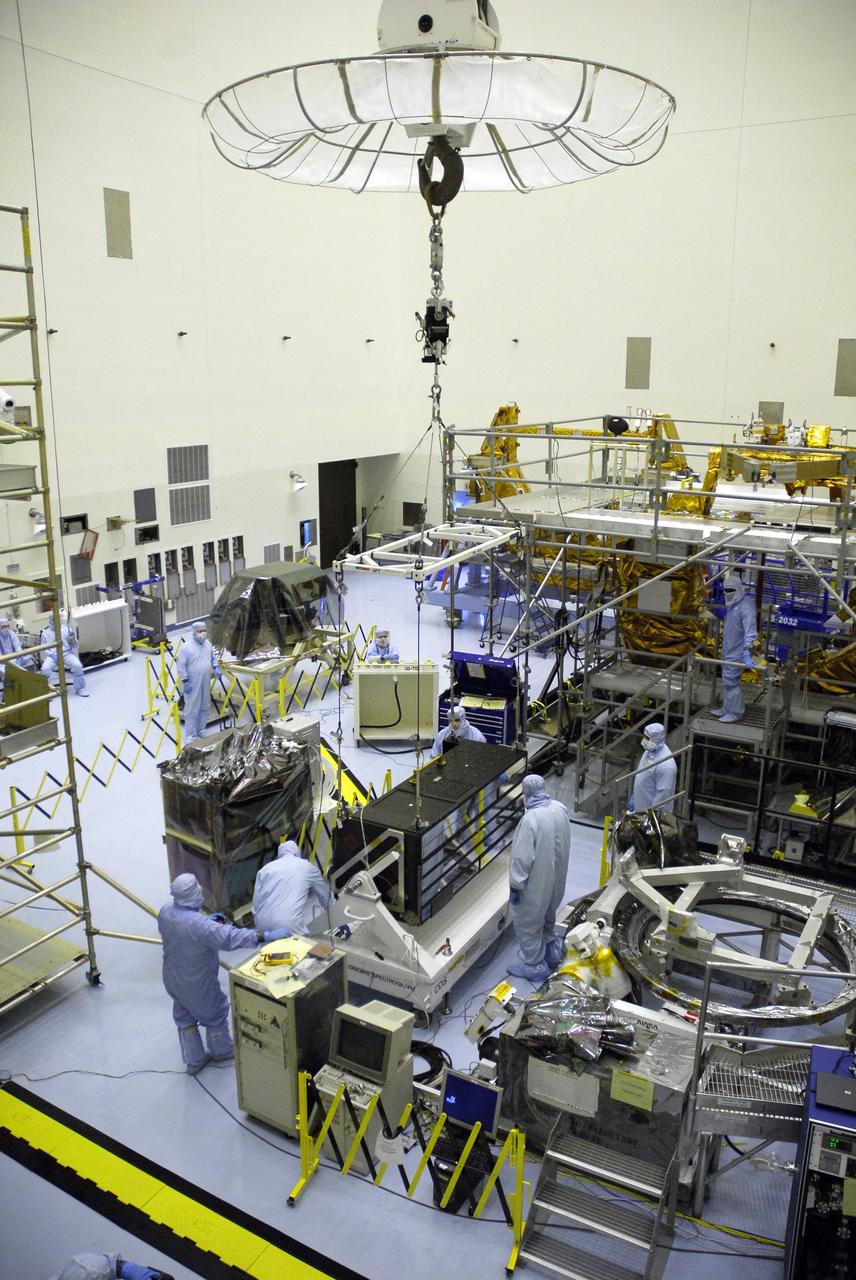
CAPE CANAVERAL, Fla. – In the clean room of the Payload Hazardous Processing Facility at NASA's Kennedy Space Center, an overhead crane lifts the Cosmic Origins Spectrograph, or COS. The COS is being lifted and moved to a protective enclosure on the Orbital Replacement Unit Carrier, part of the payload for the fifth and final Hubble servicing mission, STS-125. Other payloads include the Flight Support System, the Super Lightweight Interchangeable Carrier and the Multi-Use Lightweight Equipment, or MULE, carrier. COS will be the most sensitive ultraviolet spectrograph ever flown on Hubble and will probe the "cosmic web" - the large-scale structure of the universe whose form is determined by the gravity of dark matter and is traced by galaxies and intergalactic gas. The COS far-ultraviolet channel has a sensitivity 30 times greater than that of previous spectroscopic instruments for the detection of extremely low light levels. Launch of Atlantis on the STS-125 mission is targeted for Oct. 8. Photo credit: NASA/Kim Shiflett
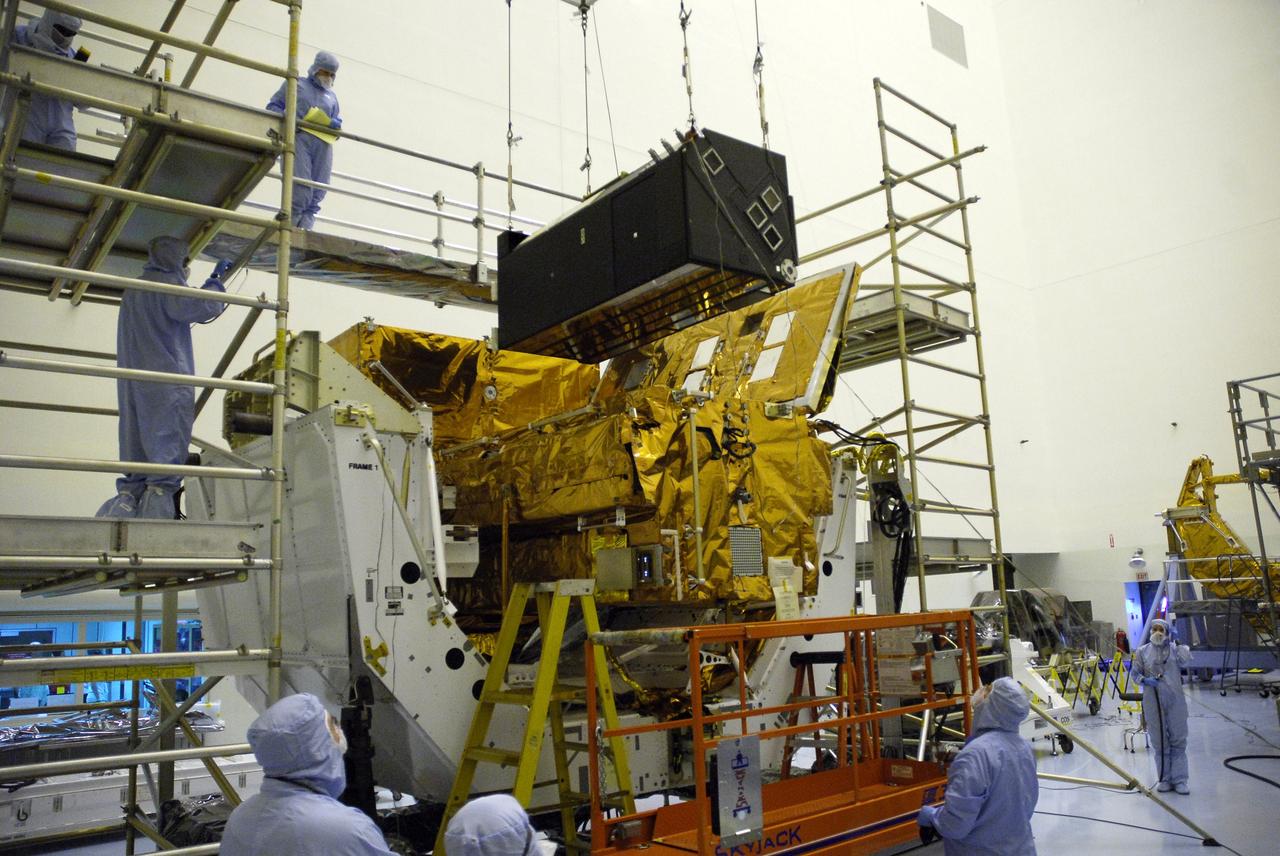
CAPE CANAVERAL, Fla. – In the clean room of the Payload Hazardous Processing Facility at NASA's Kennedy Space Center, an overhead crane lowers the Cosmic Origins Spectrograph, or COS, toward a protective enclosure on the Orbital Replacement Unit Carrier, part of the payload for the fifth and final Hubble servicing mission, STS-125. Other payloads include the Flight Support System, the Super Lightweight Interchangeable Carrier and the Multi-Use Lightweight Equipment, or MULE, carrier. COS will be the most sensitive ultraviolet spectrograph ever flown on Hubble and will probe the "cosmic web" - the large-scale structure of the universe whose form is determined by the gravity of dark matter and is traced by galaxies and intergalactic gas. The COS far-ultraviolet channel has a sensitivity 30 times greater than that of previous spectroscopic instruments for the detection of extremely low light levels. Launch of Atlantis on the STS-125 mission is targeted for Oct. 8. Photo credit: NASA/Kim Shiflett
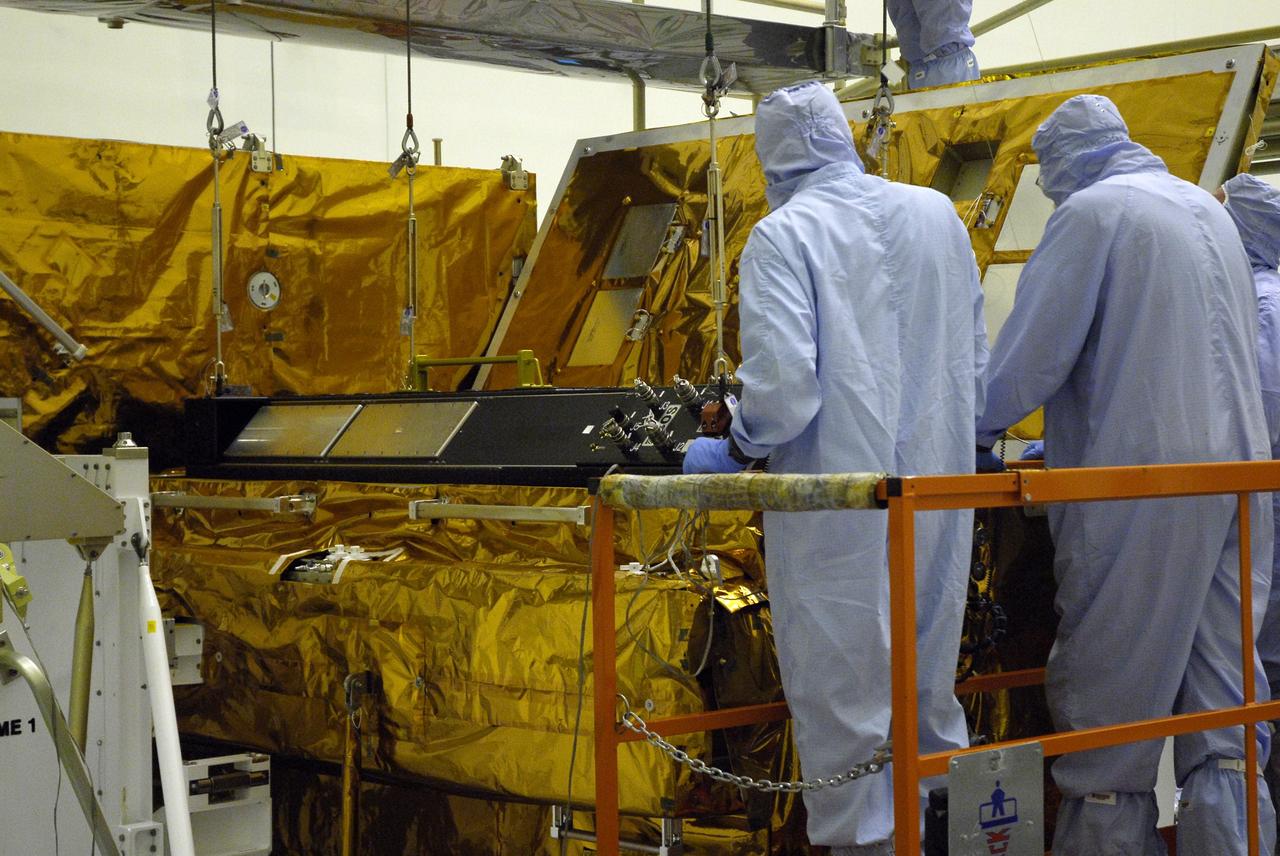
CAPE CANAVERAL, Fla. – In the clean room of the Payload Hazardous Processing Facility at NASA's Kennedy Space Center, an overhead crane settles the Cosmic Origins Spectrograph, or COS, in a protective enclosure on the Orbital Replacement Unit Carrier, part of the payload for the fifth and final Hubble servicing mission, STS-125. Other payloads include the Flight Support System, the Super Lightweight Interchangeable Carrier and the Multi-Use Lightweight Equipment, or MULE, carrier. COS will be the most sensitive ultraviolet spectrograph ever flown on Hubble and will probe the "cosmic web" - the large-scale structure of the universe whose form is determined by the gravity of dark matter and is traced by galaxies and intergalactic gas. The COS far-ultraviolet channel has a sensitivity 30 times greater than that of previous spectroscopic instruments for the detection of extremely low light levels. Launch of Atlantis on the STS-125 mission is targeted for Oct. 8. Photo credit: NASA/Kim Shiflett

CAPE CANAVERAL, Fla. – In the clean room of the Payload Hazardous Processing Facility at NASA's Kennedy Space Center, an overhead crane moves the Cosmic Origins Spectrograph, or COS, toward a protective enclosure on the Orbital Replacement Unit Carrier, part of the payload for the fifth and final Hubble servicing mission, STS-125. Other payloads include the Flight Support System, the Super Lightweight Interchangeable Carrier and the Multi-Use Lightweight Equipment, or MULE, carrier. COS will be the most sensitive ultraviolet spectrograph ever flown on Hubble and will probe the "cosmic web" - the large-scale structure of the universe whose form is determined by the gravity of dark matter and is traced by galaxies and intergalactic gas. The COS far-ultraviolet channel has a sensitivity 30 times greater than that of previous spectroscopic instruments for the detection of extremely low light levels. Launch of Atlantis on the STS-125 mission is targeted for Oct. 8. Photo credit: NASA/Kim Shiflett
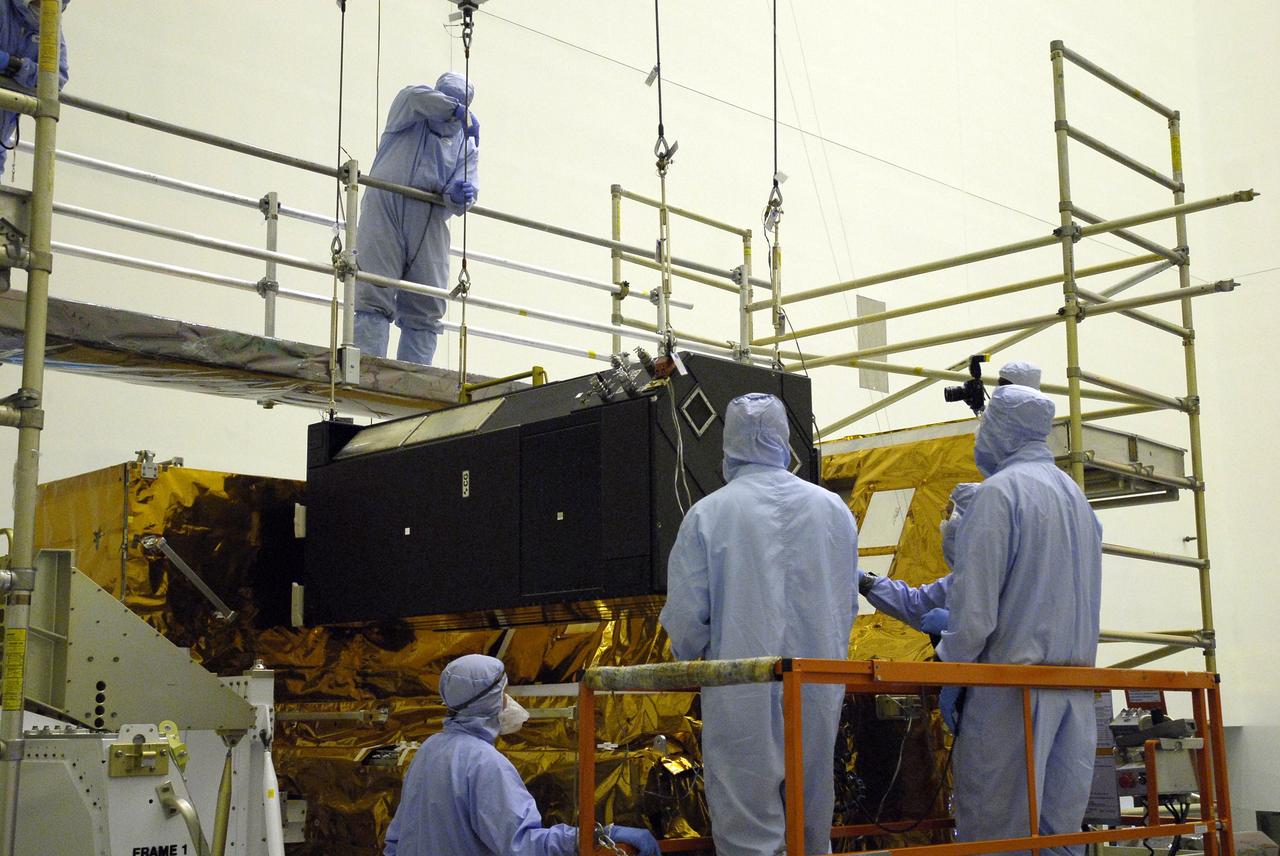
CAPE CANAVERAL, Fla. – In the clean room of the Payload Hazardous Processing Facility at NASA's Kennedy Space Center, an overhead crane lowers the Cosmic Origins Spectrograph, or COS, into a protective enclosure on the Orbital Replacement Unit Carrier, part of the payload for the fifth and final Hubble servicing mission, STS-125. Other payloads include the Flight Support System, the Super Lightweight Interchangeable Carrier and the Multi-Use Lightweight Equipment, or MULE, carrier. COS will be the most sensitive ultraviolet spectrograph ever flown on Hubble and will probe the "cosmic web" - the large-scale structure of the universe whose form is determined by the gravity of dark matter and is traced by galaxies and intergalactic gas. The COS far-ultraviolet channel has a sensitivity 30 times greater than that of previous spectroscopic instruments for the detection of extremely low light levels. Launch of Atlantis on the STS-125 mission is targeted for Oct. 8. Photo credit: NASA/Kim Shiflett
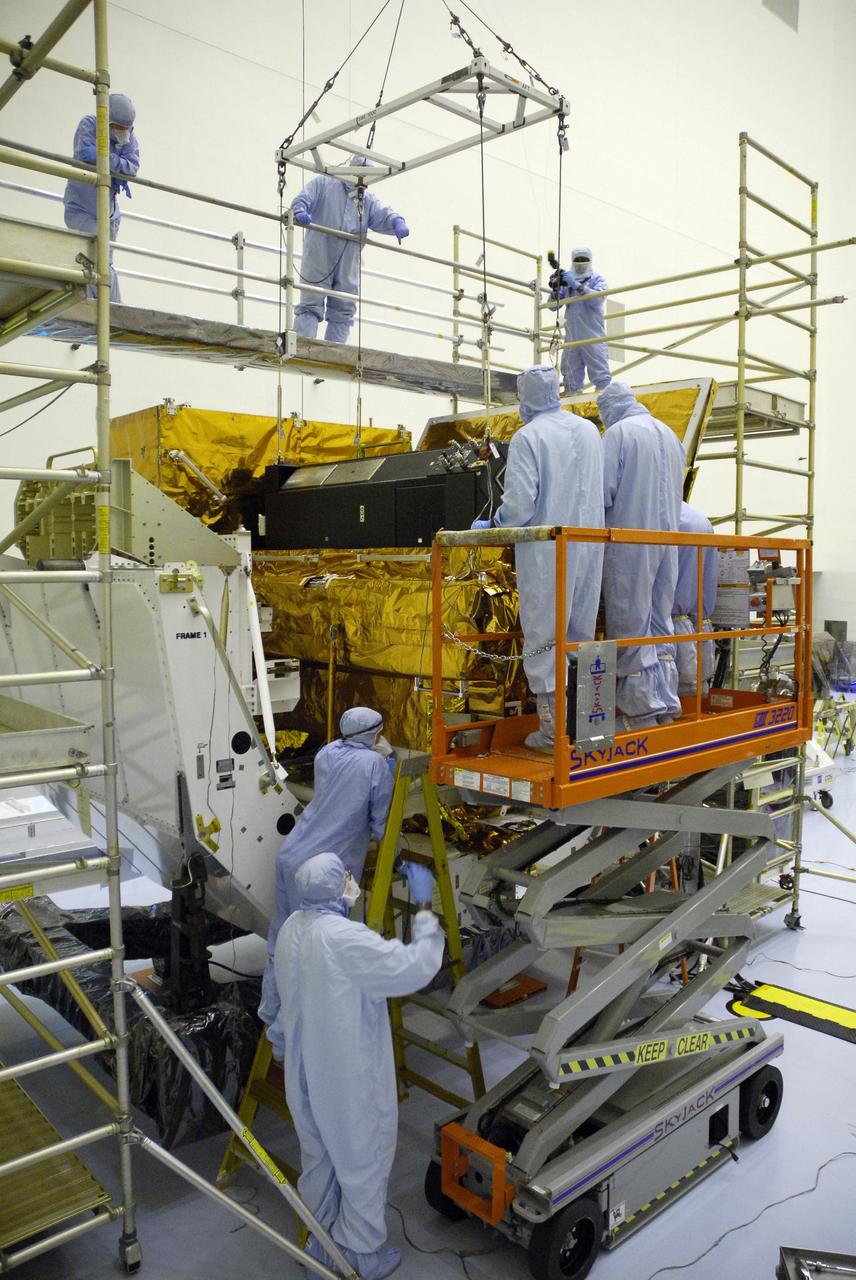
CAPE CANAVERAL, Fla. – In the clean room of the Payload Hazardous Processing Facility at NASA's Kennedy Space Center, an overhead crane lowers the Cosmic Origins Spectrograph, or COS, into a protective enclosure on the Orbital Replacement Unit Carrier, part of the payload for the fifth and final Hubble servicing mission, STS-125. Other payloads include the Flight Support System, the Super Lightweight Interchangeable Carrier and the Multi-Use Lightweight Equipment, or MULE, carrier. COS will be the most sensitive ultraviolet spectrograph ever flown on Hubble and will probe the "cosmic web" - the large-scale structure of the universe whose form is determined by the gravity of dark matter and is traced by galaxies and intergalactic gas. The COS far-ultraviolet channel has a sensitivity 30 times greater than that of previous spectroscopic instruments for the detection of extremely low light levels. Launch of Atlantis on the STS-125 mission is targeted for Oct. 8. Photo credit: NASA/Kim Shiflett
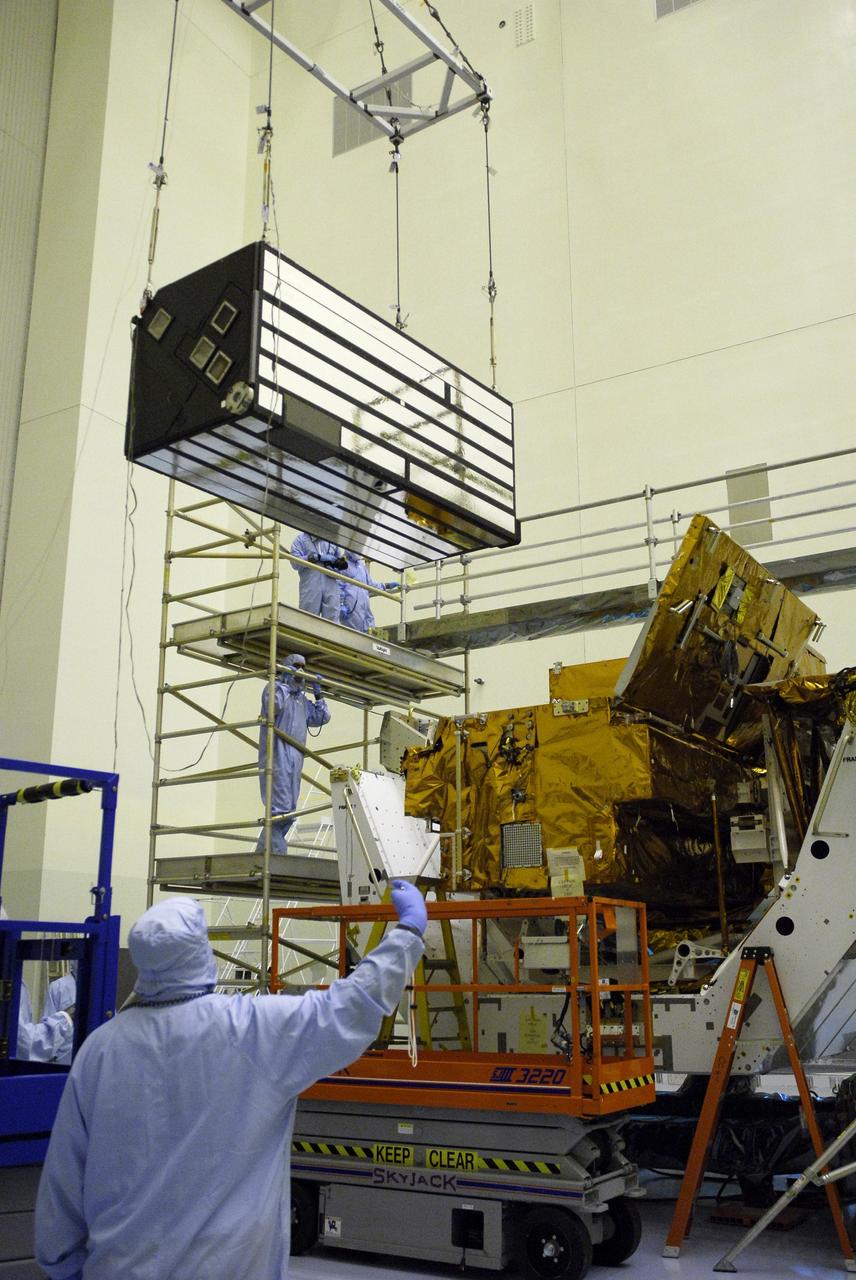
CAPE CANAVERAL, Fla. – In the clean room of the Payload Hazardous Processing Facility at NASA's Kennedy Space Center, an overhead crane lowers the Cosmic Origins Spectrograph, or COS, toward a protective enclosure on the Orbital Replacement Unit Carrier, part of the payload for the fifth and final Hubble servicing mission, STS-125. Other payloads include the Flight Support System, the Super Lightweight Interchangeable Carrier and the Multi-Use Lightweight Equipment, or MULE, carrier. COS will be the most sensitive ultraviolet spectrograph ever flown on Hubble and will probe the "cosmic web" - the large-scale structure of the universe whose form is determined by the gravity of dark matter and is traced by galaxies and intergalactic gas. The COS far-ultraviolet channel has a sensitivity 30 times greater than that of previous spectroscopic instruments for the detection of extremely low light levels. Launch of Atlantis on the STS-125 mission is targeted for Oct. 8. Photo credit: NASA/Kim Shiflett
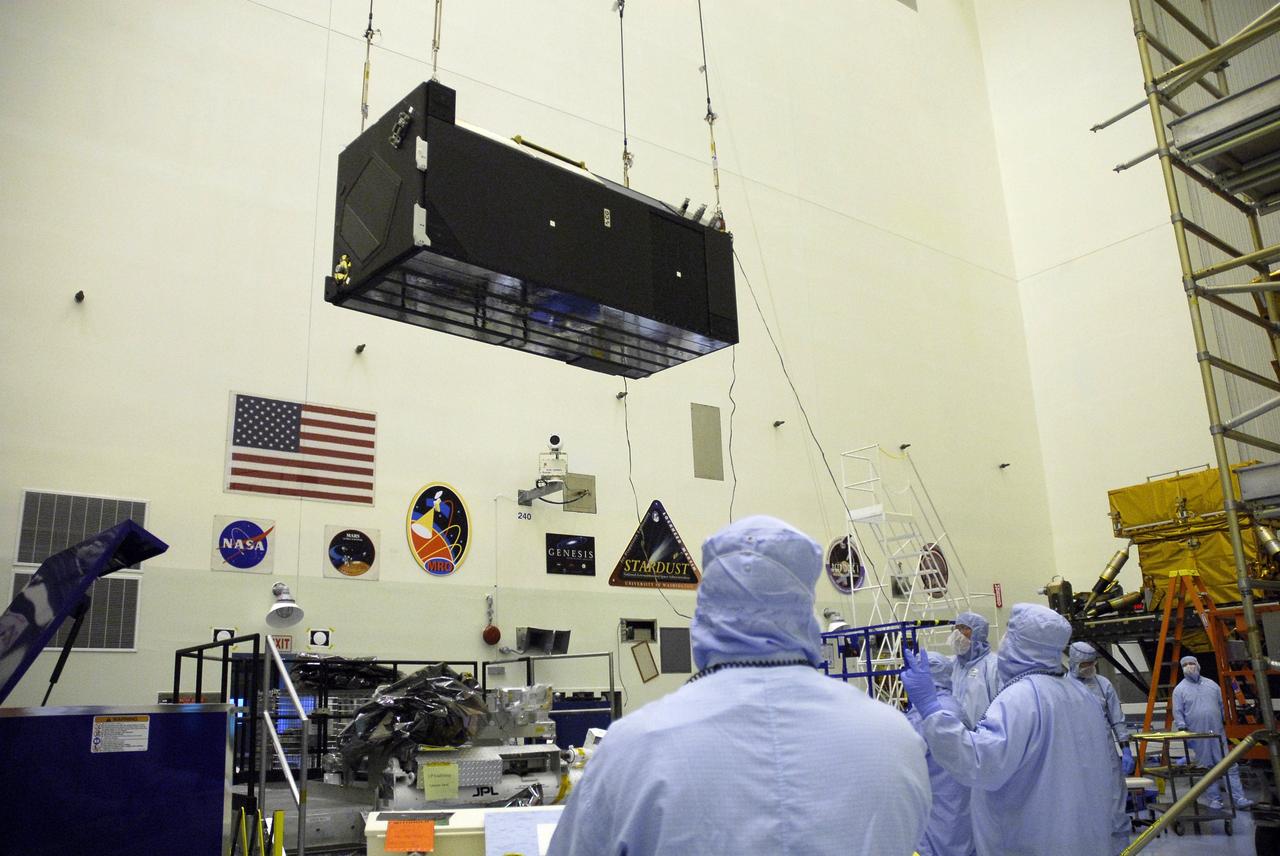
CAPE CANAVERAL, Fla. – In the clean room of the Payload Hazardous Processing Facility at NASA's Kennedy Space Center, an overhead crane moves the Cosmic Origins Spectrograph, or COS, toward a protective enclosure on the Orbital Replacement Unit Carrier, part of the payload for the fifth and final Hubble servicing mission, STS-125. Other payloads include the Flight Support System, the Super Lightweight Interchangeable Carrier and the Multi-Use Lightweight Equipment, or MULE, carrier. COS will be the most sensitive ultraviolet spectrograph ever flown on Hubble and will probe the "cosmic web" - the large-scale structure of the universe whose form is determined by the gravity of dark matter and is traced by galaxies and intergalactic gas. The COS far-ultraviolet channel has a sensitivity 30 times greater than that of previous spectroscopic instruments for the detection of extremely low light levels. Launch of Atlantis on the STS-125 mission is targeted for Oct. 8. Photo credit: NASA/Kim Shiflett
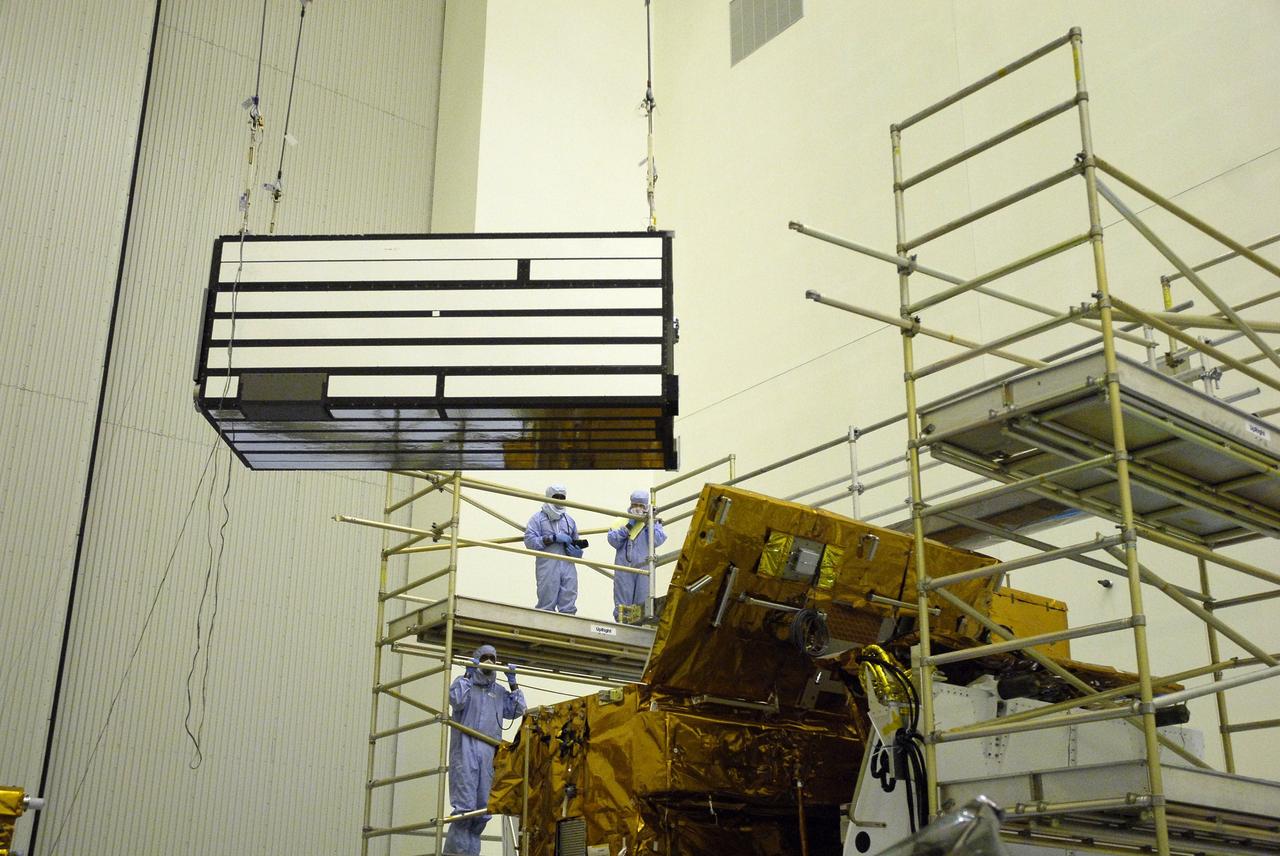
CAPE CANAVERAL, Fla. – In the clean room of the Payload Hazardous Processing Facility at NASA's Kennedy Space Center, an overhead crane lowers the Cosmic Origins Spectrograph, or COS, toward a protective enclosure on the Orbital Replacement Unit Carrier, part of the payload for the fifth and final Hubble servicing mission, STS-125. Other payloads include the Flight Support System, the Super Lightweight Interchangeable Carrier and the Multi-Use Lightweight Equipment, or MULE, carrier. COS will be the most sensitive ultraviolet spectrograph ever flown on Hubble and will probe the "cosmic web" - the large-scale structure of the universe whose form is determined by the gravity of dark matter and is traced by galaxies and intergalactic gas. The COS far-ultraviolet channel has a sensitivity 30 times greater than that of previous spectroscopic instruments for the detection of extremely low light levels. Launch of Atlantis on the STS-125 mission is targeted for Oct. 8. Photo credit: NASA/Kim Shiflett
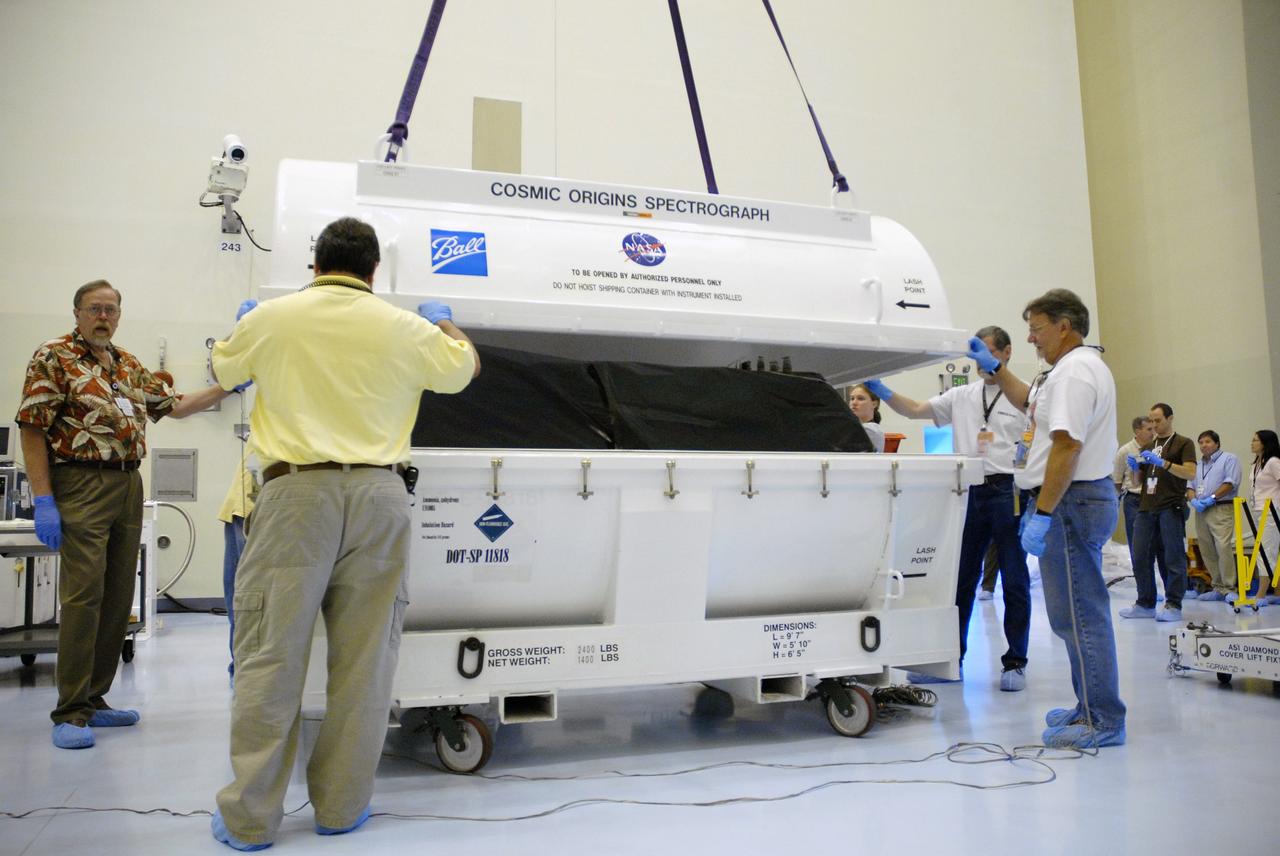
CAPE CANAVERAL, Fla. – In the airlock of the Payload Hazardous Servicing Facility at NASA's Kennedy Space Center, workers from NASA's Goddard Space Flight Center open the transportation canister in which the Cosmic Origins Spectrograph, or COS, is protected. The COS will be installed on the Hubble Space Telescope on space shuttle Atlantis' STS-125 mission. COS will be the most sensitive ultraviolet spectrograph ever flown on Hubble and will probe the "cosmic web" - the large-scale structure of the universe whose form is determined by the gravity of dark matter and is traced by galaxies and intergalactic gas. COS's far-ultraviolet channel has a sensitivity 30 times greater than that of previous spectroscopic instruments for the detection of extremely low light levels. Launch of STS-125 is targeted for Oct. 8. Photo credit: NASA/Jack Pfaller
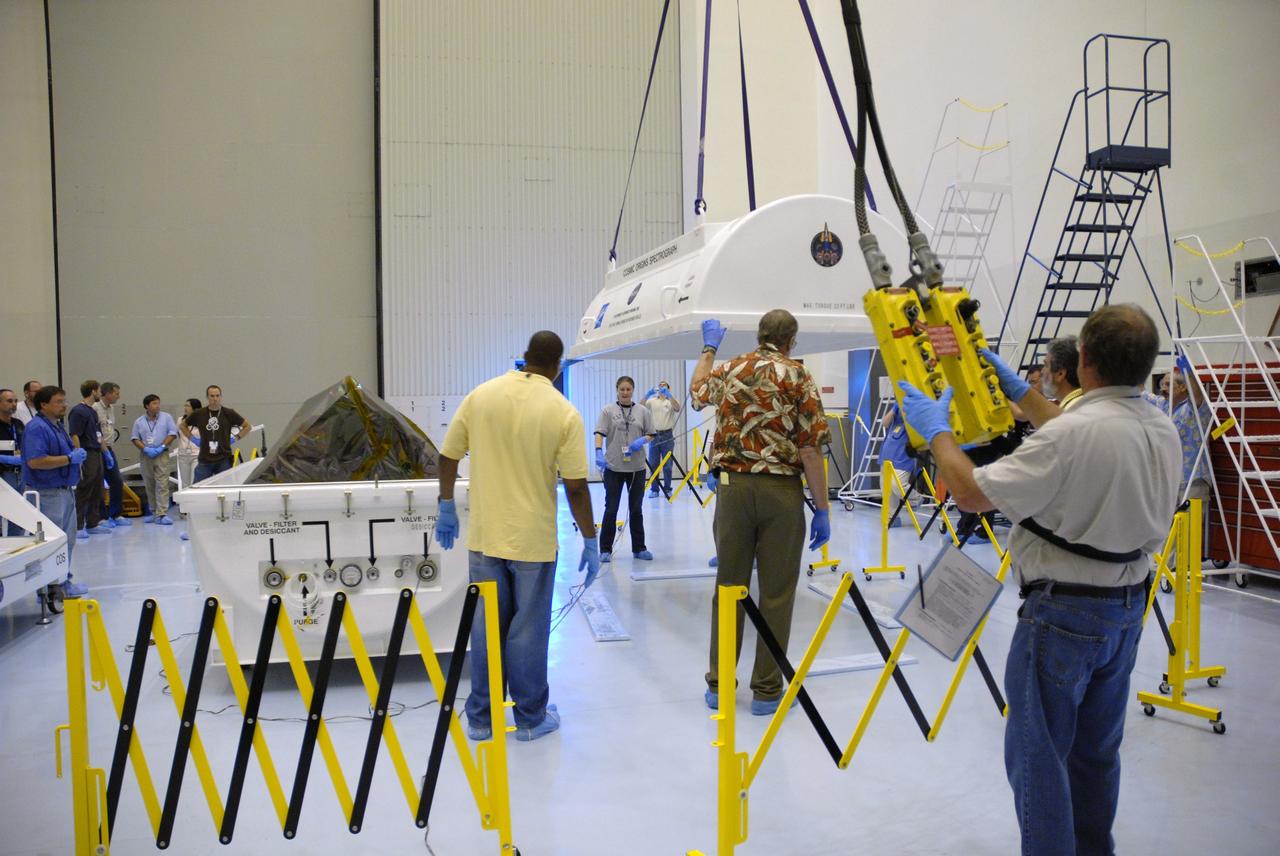
CAPE CANAVERAL, Fla. – In the airlock of the Payload Hazardous Servicing Facility at NASA's Kennedy Space Center, workers from NASA's Goddard Space Flight Center remove the top from the transportation canister in which the Cosmic Origins Spectrograph, or COS, arrived. The COS will be installed on the Hubble Space Telescope on space shuttle Atlantis' STS-125 mission. COS will be the most sensitive ultraviolet spectrograph ever flown on Hubble and will probe the "cosmic web" - the large-scale structure of the universe whose form is determined by the gravity of dark matter and is traced by galaxies and intergalactic gas. COS's far-ultraviolet channel has a sensitivity 30 times greater than that of previous spectroscopic instruments for the detection of extremely low light levels. Launch of STS-125 is targeted for Oct. 8. Photo credit: NASA/Jack Pfaller
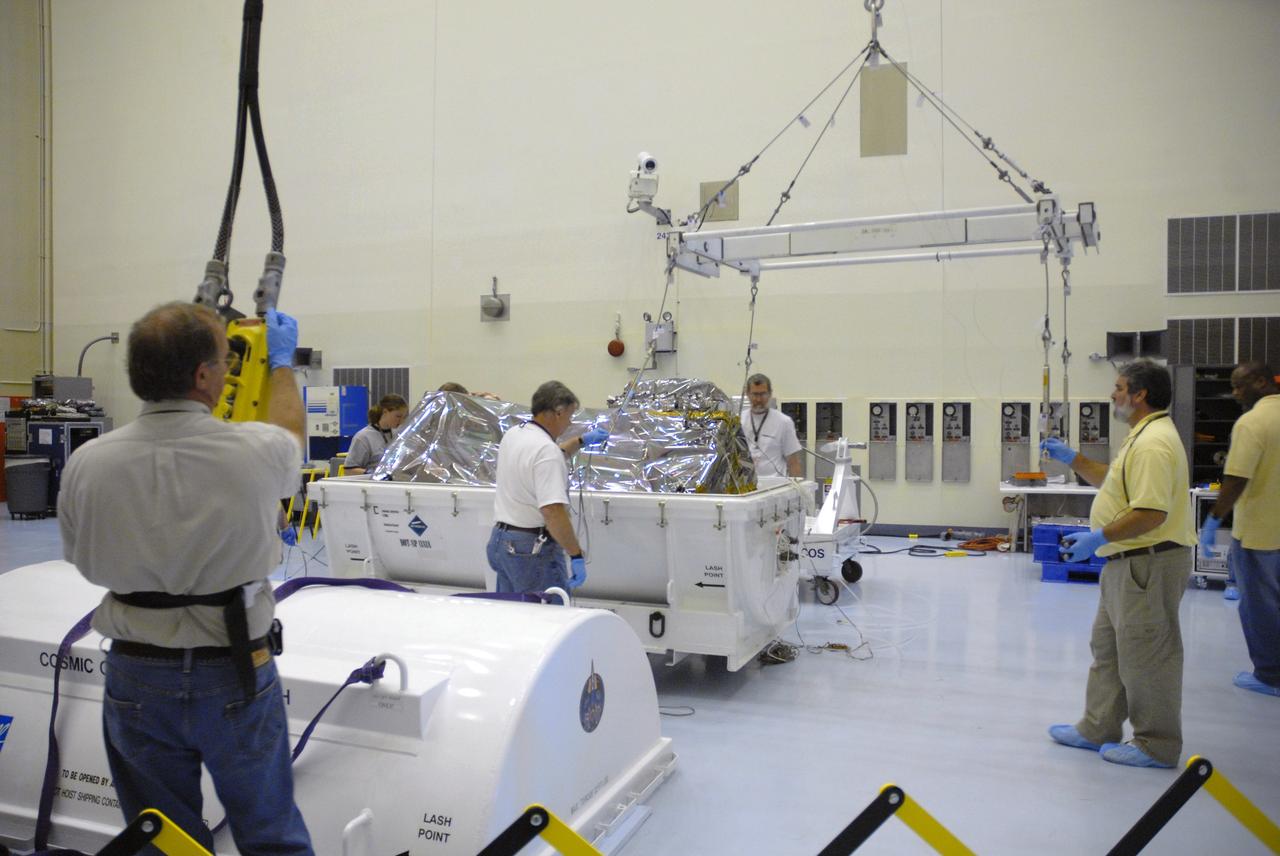
CAPE CANAVERAL, Fla. – In the airlock of the Payload Hazardous Servicing Facility at NASA's Kennedy Space Center, workers from NASA's Goddard Space Flight Center examine the Cosmic Origins Spectrograph, or COS, after the top from its transportation canister is removed. The COS will be installed on the Hubble Space Telescope on space shuttle Atlantis' STS-125 mission. COS will be the most sensitive ultraviolet spectrograph ever flown on Hubble and will probe the "cosmic web" - the large-scale structure of the universe whose form is determined by the gravity of dark matter and is traced by galaxies and intergalactic gas. COS's far-ultraviolet channel has a sensitivity 30 times greater than that of previous spectroscopic instruments for the detection of extremely low light levels. Launch of STS-125 is targeted for Oct. 8. Photo credit: NASA/Jack Pfaller
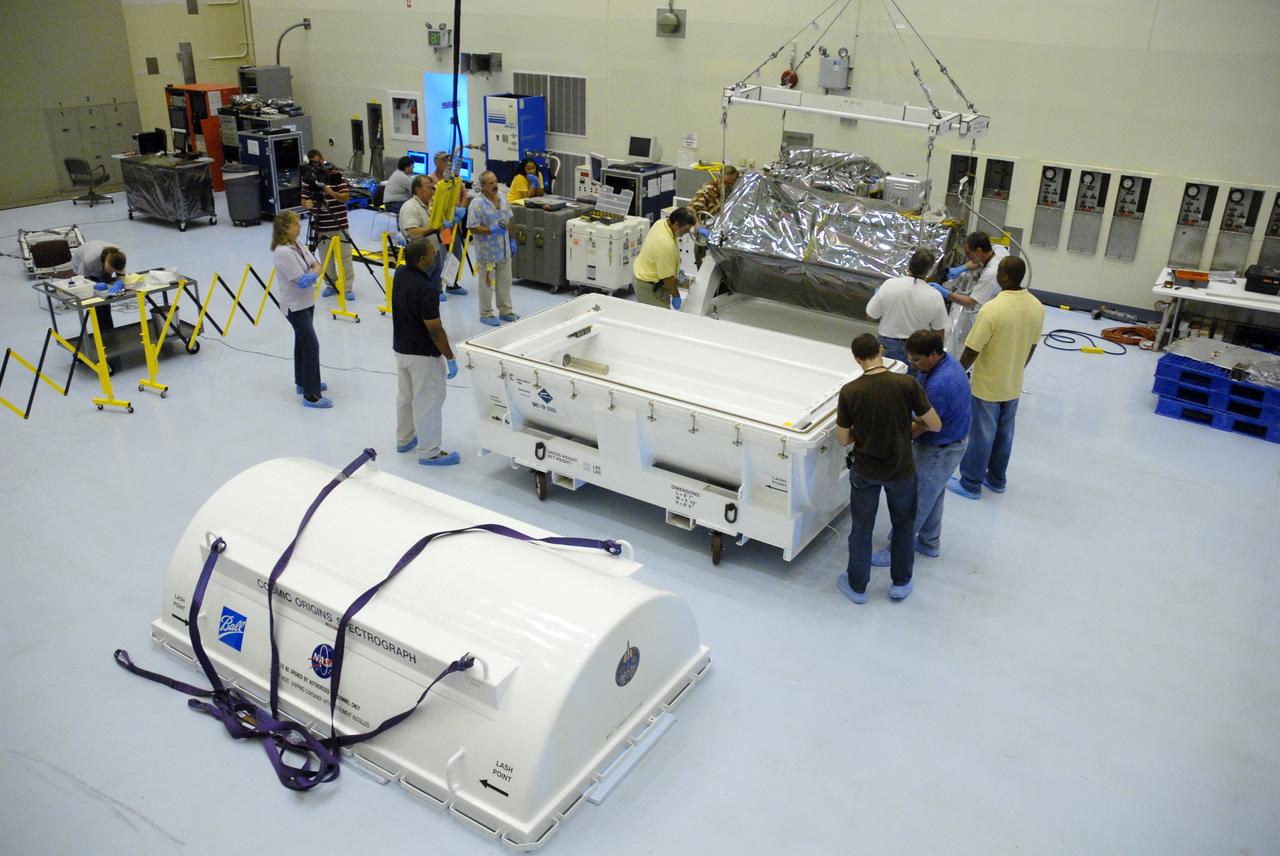
CAPE CANAVERAL, Fla. – In the airlock of the Payload Hazardous Servicing Facility at NASA's Kennedy Space Center, workers from NASA's Goddard Space Flight Center lower the Cosmic Origins Spectrograph, or COS, onto a dolly for its move into the clean room. The COS will be installed on the Hubble Space Telescope on space shuttle Atlantis' STS-125 mission. COS will be the most sensitive ultraviolet spectrograph ever flown on Hubble and will probe the "cosmic web" - the large-scale structure of the universe whose form is determined by the gravity of dark matter and is traced by galaxies and intergalactic gas. COS's far-ultraviolet channel has a sensitivity 30 times greater than that of previous spectroscopic instruments for the detection of extremely low light levels. Launch of STS-125 is targeted for Oct. 8. Photo credit: NASA/Jack Pfaller
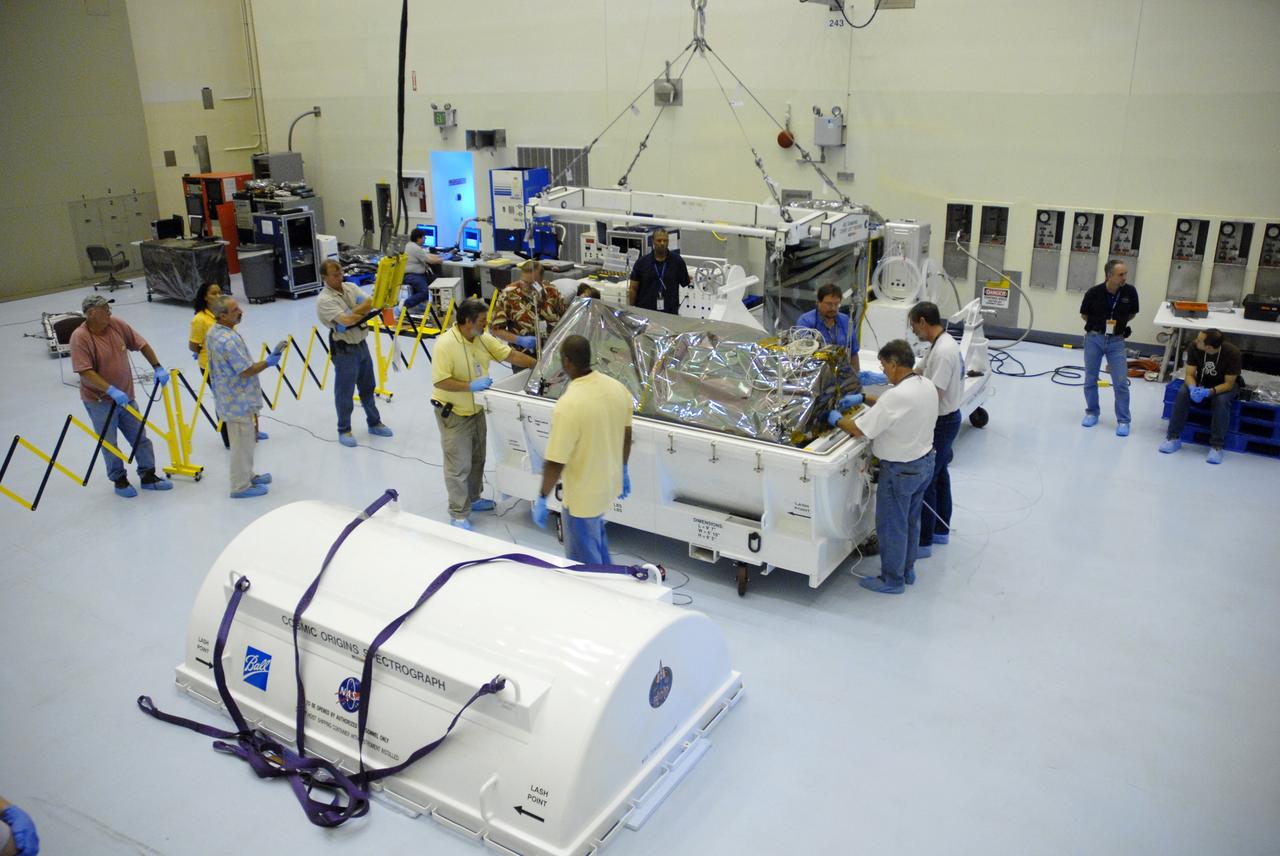
CAPE CANAVERAL, Fla. – In the airlock of the Payload Hazardous Servicing Facility at NASA's Kennedy Space Center, workers from NASA's Goddard Space Flight Center prepare to remove the Cosmic Origins Spectrograph, or COS, from its transportation canister. The COS will be installed on the Hubble Space Telescope on space shuttle Atlantis' STS-125 mission. COS will be the most sensitive ultraviolet spectrograph ever flown on Hubble and will probe the "cosmic web" - the large-scale structure of the universe whose form is determined by the gravity of dark matter and is traced by galaxies and intergalactic gas. COS's far-ultraviolet channel has a sensitivity 30 times greater than that of previous spectroscopic instruments for the detection of extremely low light levels. Launch of STS-125 is targeted for Oct. 8. Photo credit: NASA/Jack Pfaller
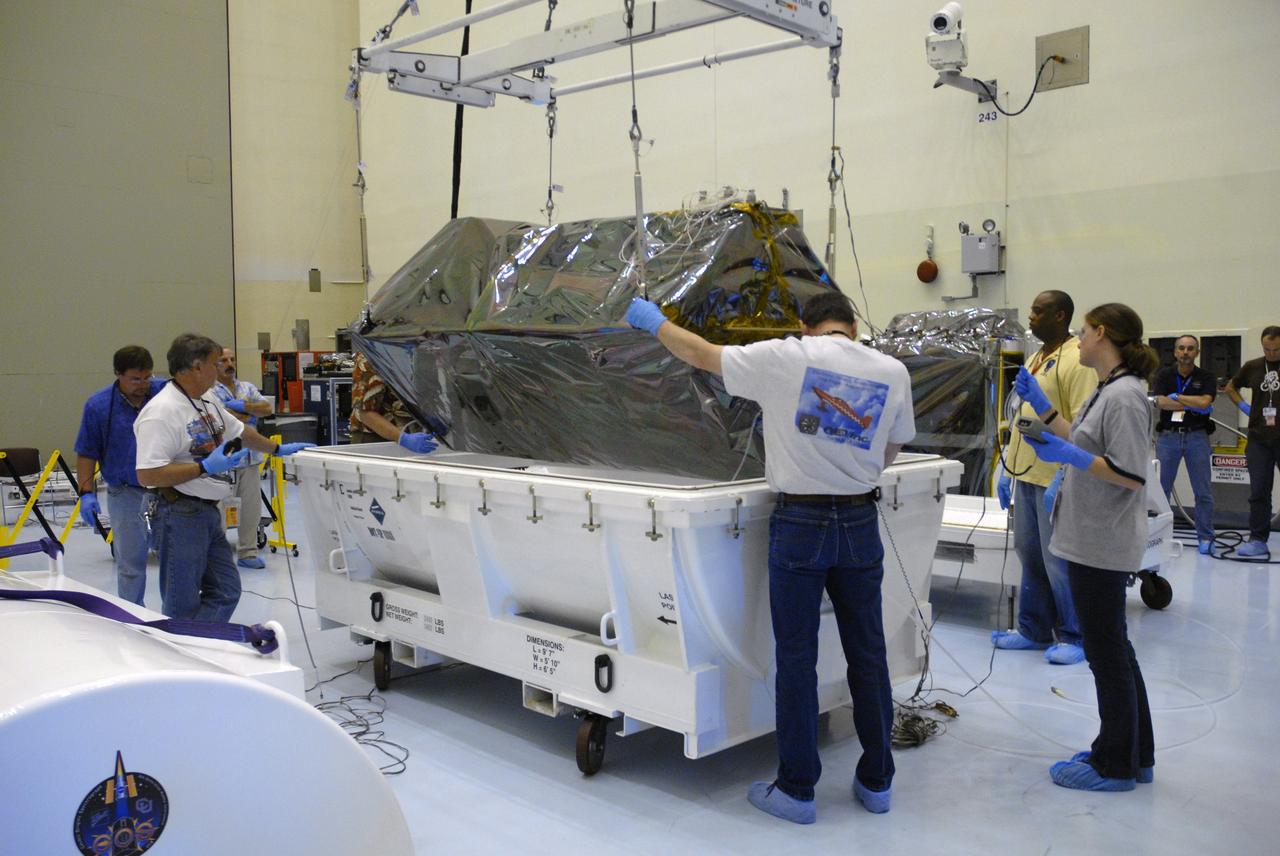
CAPE CANAVERAL, Fla. – In the airlock of the Payload Hazardous Servicing Facility at NASA's Kennedy Space Center, workers from NASA's Goddard Space Flight Center prepare to lift the Cosmic Origins Spectrograph, or COS, from its transportation canister. The COS will be installed on the Hubble Space Telescope on space shuttle Atlantis' STS-125 mission. COS will be the most sensitive ultraviolet spectrograph ever flown on Hubble and will probe the "cosmic web" - the large-scale structure of the universe whose form is determined by the gravity of dark matter and is traced by galaxies and intergalactic gas. COS's far-ultraviolet channel has a sensitivity 30 times greater than that of previous spectroscopic instruments for the detection of extremely low light levels. Launch of STS-125 is targeted for Oct. 8. Photo credit: NASA/Jack Pfaller
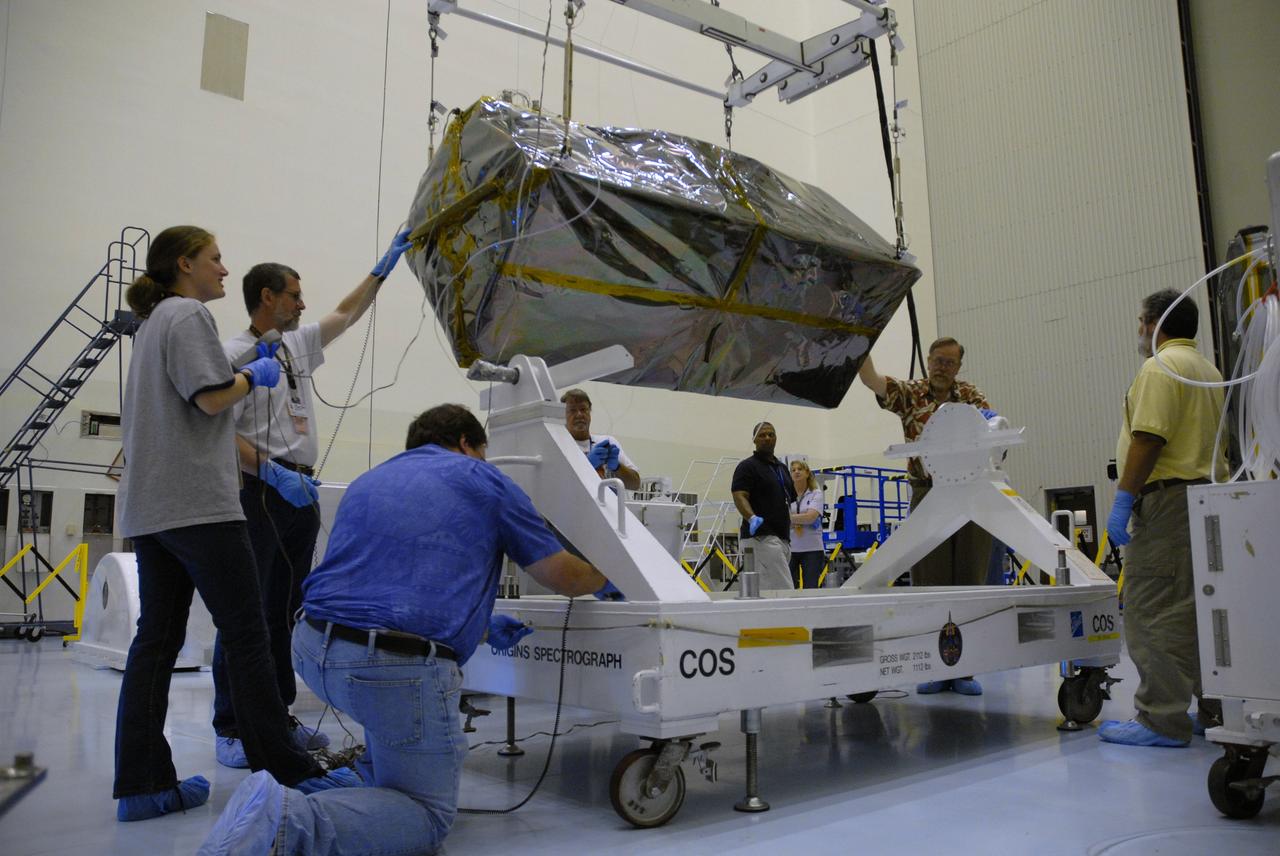
CAPE CANAVERAL, Fla. – In the airlock of the Payload Hazardous Servicing Facility at NASA's Kennedy Space Center, workers from NASA's Goddard Space Flight Center lift the Cosmic Origins Spectrograph, or COS, from its transportation canister onto a dolly for its move into the clean room. The COS will be installed on the Hubble Space Telescope on space shuttle Atlantis' STS-125 mission. COS will be the most sensitive ultraviolet spectrograph ever flown on Hubble and will probe the "cosmic web" - the large-scale structure of the universe whose form is determined by the gravity of dark matter and is traced by galaxies and intergalactic gas. COS's far-ultraviolet channel has a sensitivity 30 times greater than that of previous spectroscopic instruments for the detection of extremely low light levels. Launch of STS-125 is targeted for Oct. 8. Photo credit: NASA/Jack Pfaller
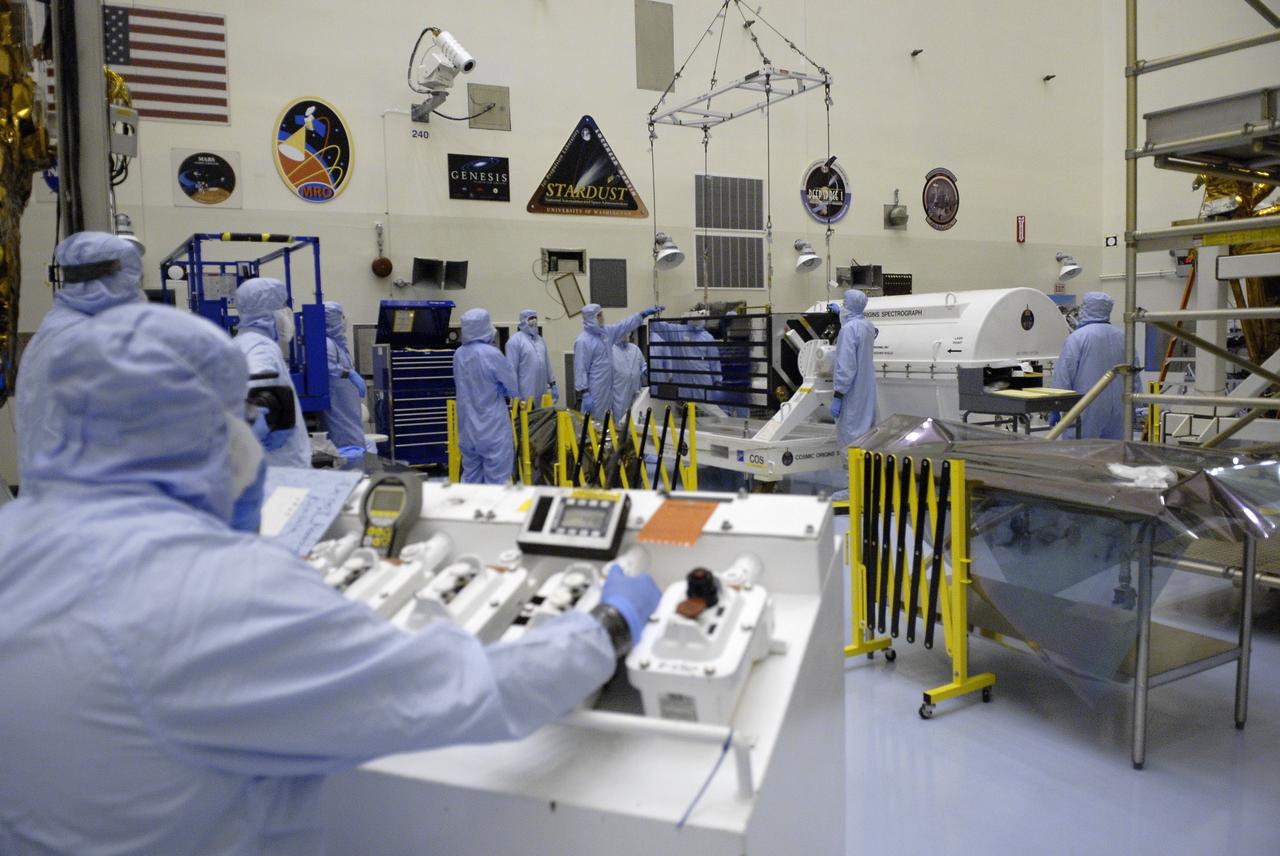
CAPE CANAVERAL, Fla. – In the Payload Hazardous Servicing Facility at NASA's Kennedy Space Center in Florida, technicians oversee the lifting of the Cosmic Origins Spectrograph, or COS, from a stand. The COS will be moved to and placed on the Orbital Replacement Unit Carrier that will be installed in space shuttle Atlantis' payload bay. The COS is part of the payload for the Hubble servicing mission, STS-125, targeted to launch in mid-May. Installing the COS during the mission will effectively restore spectroscopy to Hubble’s scientific arsenal, and at the same time provide the telescope with unique capabilities. COS is designed to study the large-scale structure of the universe and how galaxies, stars and planets formed and evolved. It will help determine how elements needed for life such as carbon and iron first formed and how their abundances have increased over the lifetime of the universe. Photo credit: NASA/Kim Shiflett
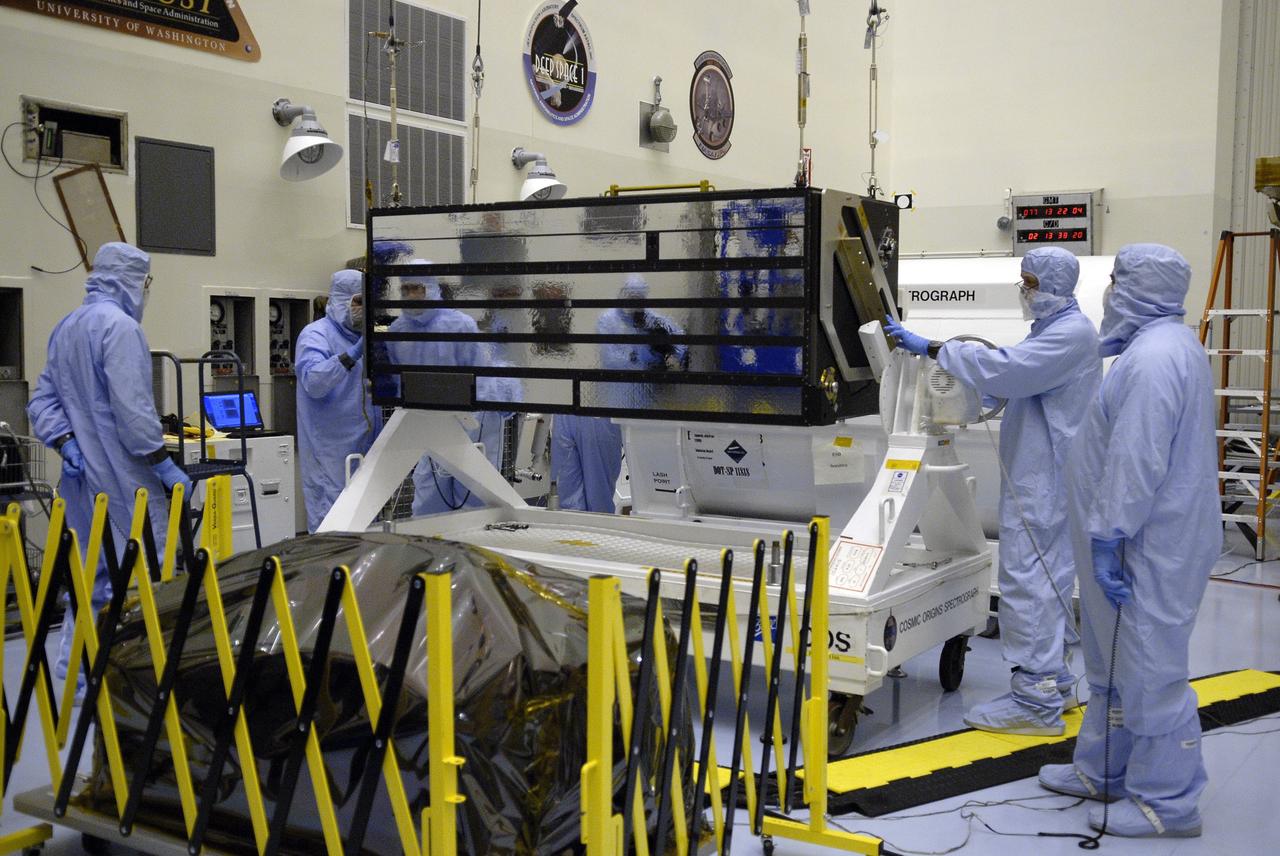
CAPE CANAVERAL, Fla. – In the Payload Hazardous Servicing Facility at NASA's Kennedy Space Center in Florida, technicians help with the lifting of the Cosmic Origins Spectrograph, or COS, from a stand. The COS will be moved to and placed on the Orbital Replacement Unit Carrier that will be installed in space shuttle Atlantis' payload bay. The COS is part of the payload for the Hubble servicing mission, STS-125, targeted to launch in mid-May. Installing the COS during the mission will effectively restore spectroscopy to Hubble’s scientific arsenal, and at the same time provide the telescope with unique capabilities. COS is designed to study the large-scale structure of the universe and how galaxies, stars and planets formed and evolved. It will help determine how elements needed for life such as carbon and iron first formed and how their abundances have increased over the lifetime of the universe. Photo credit: NASA/Kim Shiflett
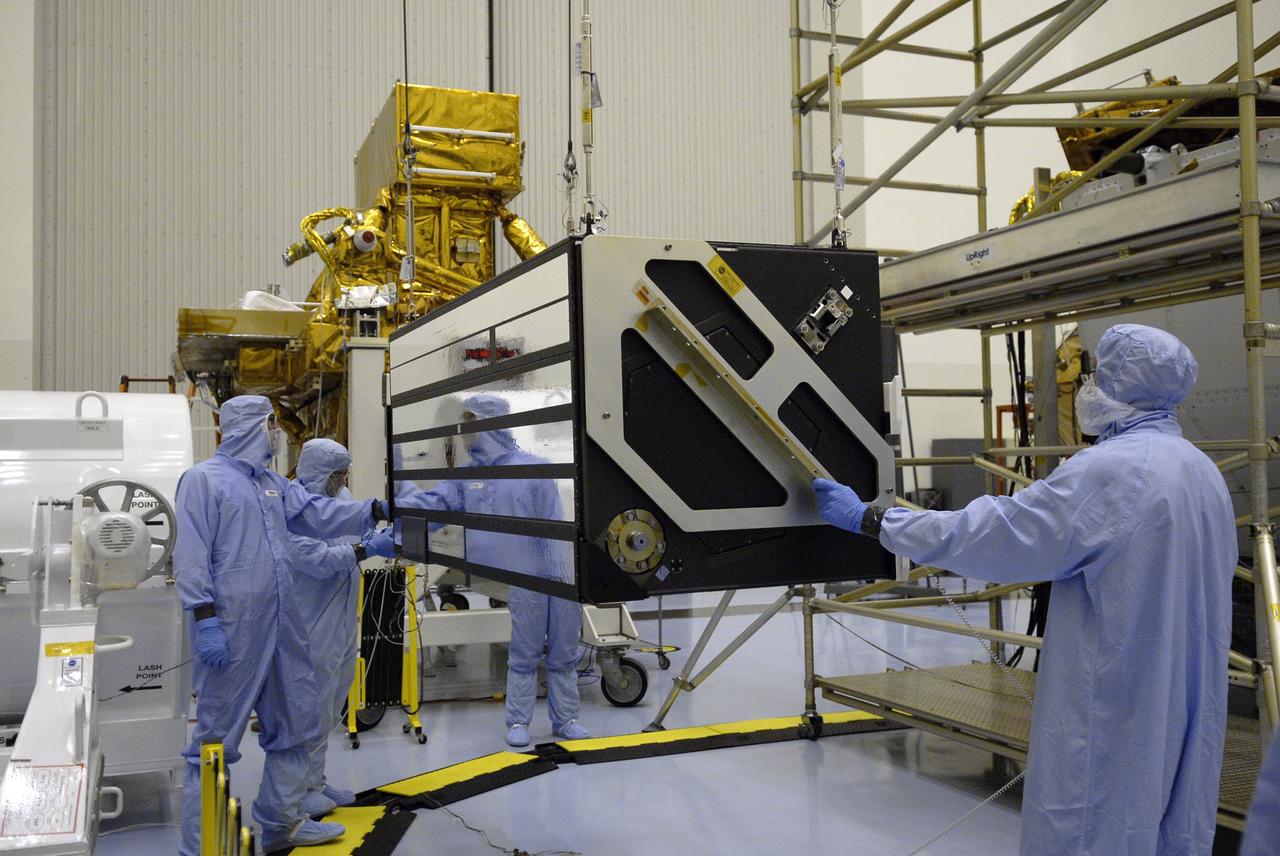
CAPE CANAVERAL, Fla. – In the Payload Hazardous Servicing Facility at NASA's Kennedy Space Center in Florida, technicians help guide the Cosmic Origins Spectrograph, or COS, as it is lifted from a stand. The COS will be moved to and placed on the Orbital Replacement Unit Carrier that will be installed in space shuttle Atlantis' payload bay. The COS is part of the payload for the Hubble servicing mission, STS-125, targeted to launch in mid-May. Installing the COS during the mission will effectively restore spectroscopy to Hubble’s scientific arsenal, and at the same time provide the telescope with unique capabilities. COS is designed to study the large-scale structure of the universe and how galaxies, stars and planets formed and evolved. It will help determine how elements needed for life such as carbon and iron first formed and how their abundances have increased over the lifetime of the universe. Photo credit: NASA/Kim Shiflett
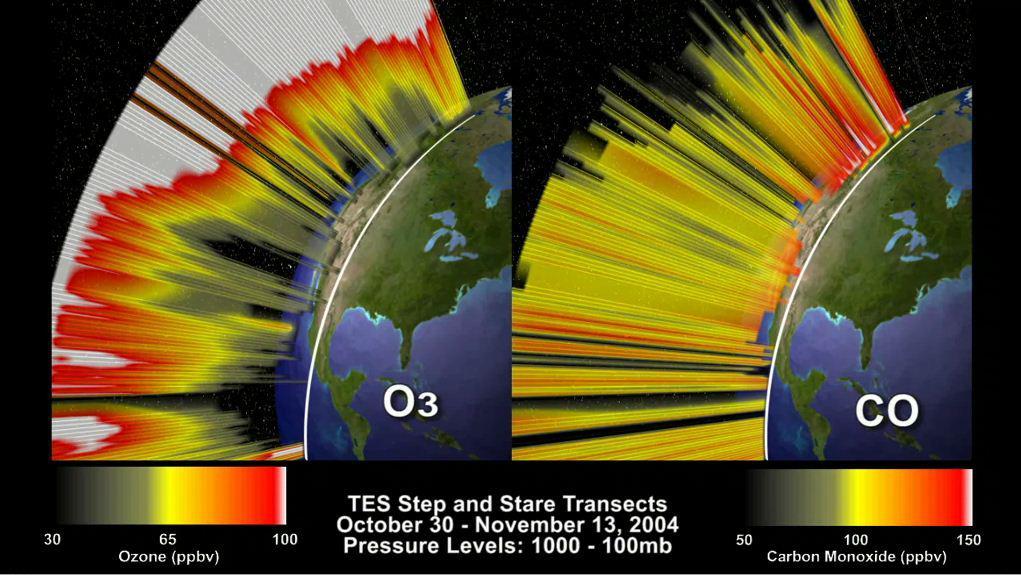
This frame from an animation depicts the distribution of O3 and CO in the atmosphere over North America. This visualization is based on data acquired by NASA Tropospheric Emission Spectrometer TES.
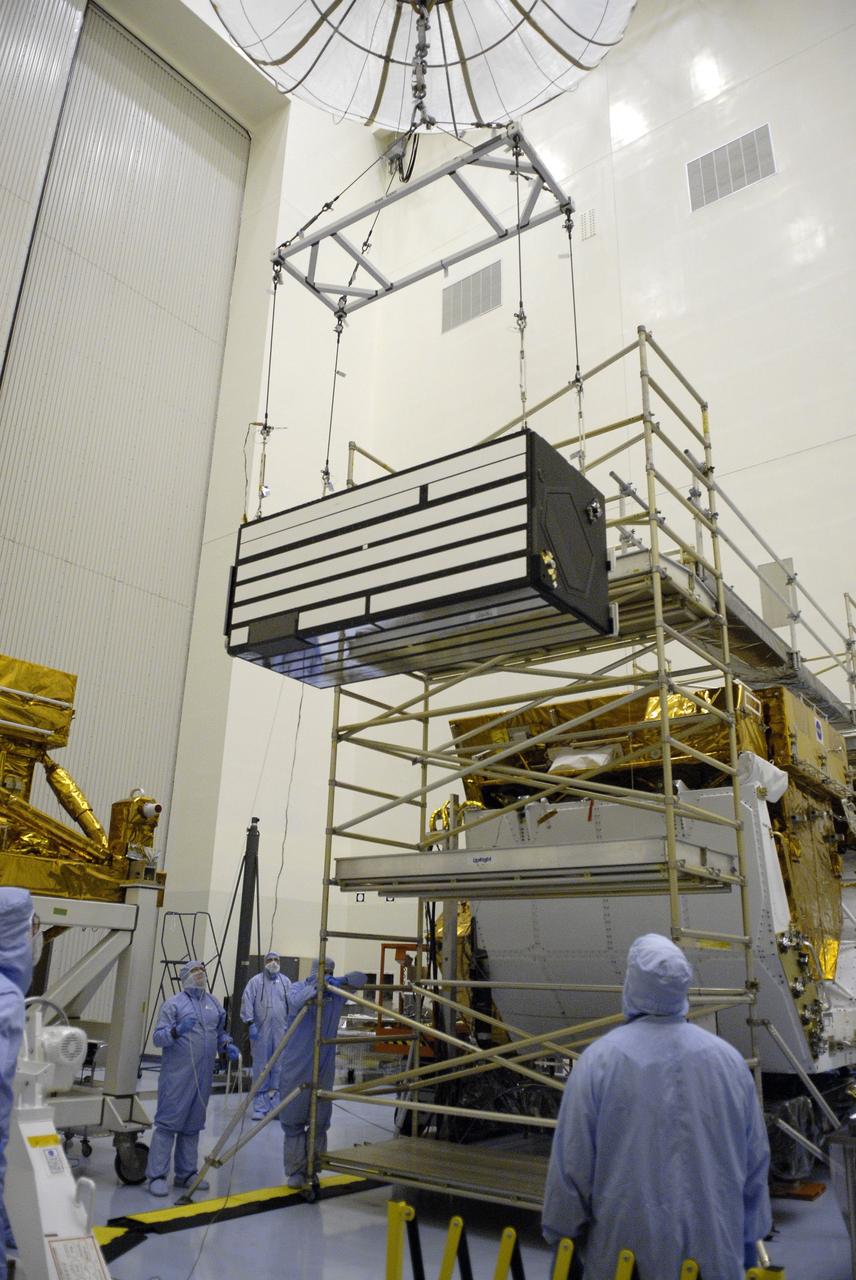
CAPE CANAVERAL, Fla. – In the Payload Hazardous Servicing Facility at NASA's Kennedy Space Center in Florida, a crane moves the Cosmic Origins Spectrograph, or COS, toward the Orbital Replacement Unit Carrier where it will be installed. The carrier will be placed in space shuttle Atlantis' payload bay for the Hubble servicing mission, STS-125, targeted to launch in mid-May. Installing the COS during the mission will effectively restore spectroscopy to Hubble’s scientific arsenal, and at the same time provide the telescope with unique capabilities. COS is designed to study the large-scale structure of the universe and how galaxies, stars and planets formed and evolved. It will help determine how elements needed for life such as carbon and iron first formed and how their abundances have increased over the lifetime of the universe. Photo credit: NASA/Kim Shiflett
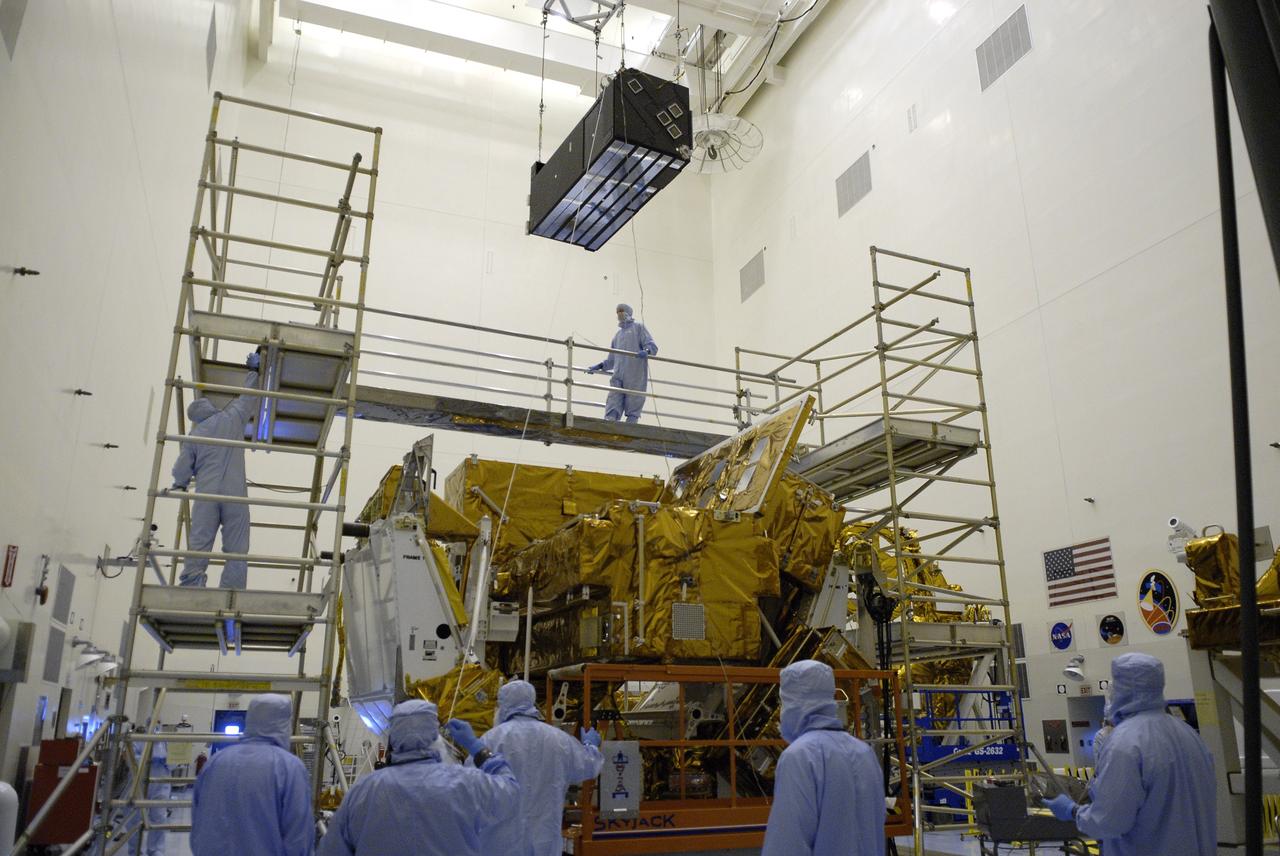
CAPE CANAVERAL, Fla. – In the Payload Hazardous Servicing Facility at NASA's Kennedy Space Center in Florida, a crane lowers the Cosmic Origins Spectrograph, or COS, toward the Orbital Replacement Unit Carrier where it will be installed. The carrier will be placed in space shuttle Atlantis' payload bay for the Hubble servicing mission, STS-125, targeted to launch in mid-May. Installing the COS during the mission will effectively restore spectroscopy to Hubble’s scientific arsenal, and at the same time provide the telescope with unique capabilities. COS is designed to study the large-scale structure of the universe and how galaxies, stars and planets formed and evolved. It will help determine how elements needed for life such as carbon and iron first formed and how their abundances have increased over the lifetime of the universe. Photo credit: NASA/Kim Shiflett
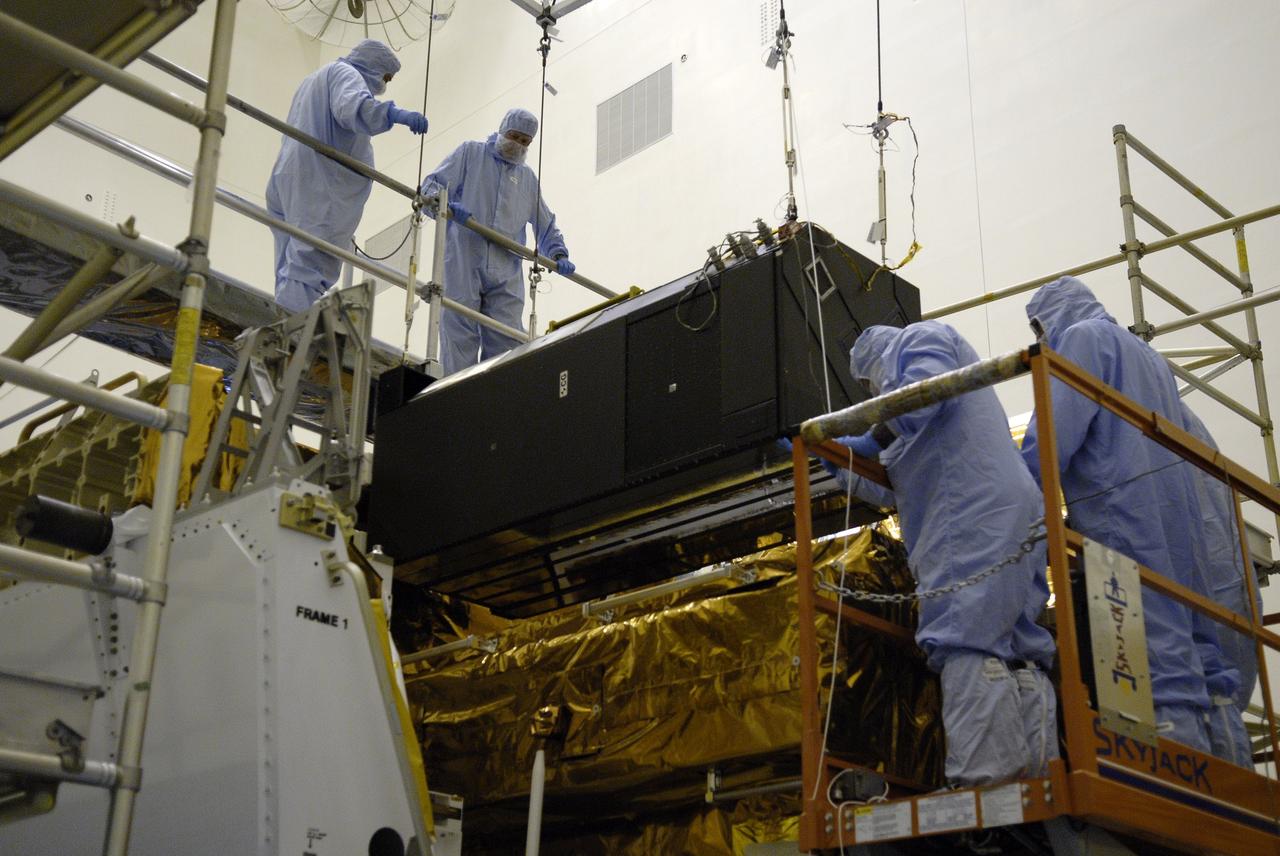
CAPE CANAVERAL, Fla. – In the Payload Hazardous Servicing Facility at NASA's Kennedy Space Center in Florida, a crane places the Cosmic Origins Spectrograph, or COS, on the Orbital Replacement Unit Carrier where it will be installed. The carrier will be placed in space shuttle Atlantis' payload bay for the Hubble servicing mission, STS-125, targeted to launch in mid-May. Installing the COS during the mission will effectively restore spectroscopy to Hubble’s scientific arsenal, and at the same time provide the telescope with unique capabilities. COS is designed to study the large-scale structure of the universe and how galaxies, stars and planets formed and evolved. It will help determine how elements needed for life such as carbon and iron first formed and how their abundances have increased over the lifetime of the universe. Photo credit: NASA/Kim Shiflett
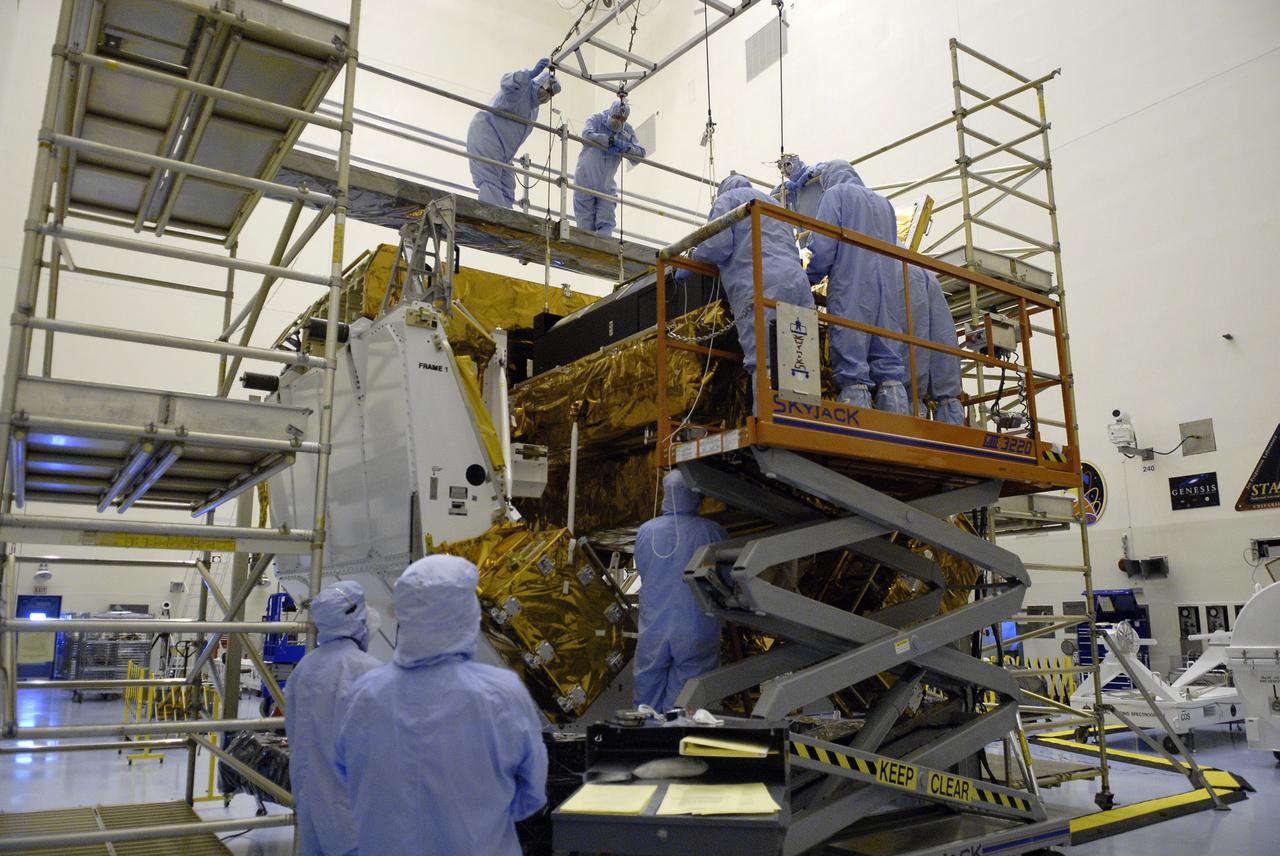
CAPE CANAVERAL, Fla. – In the Payload Hazardous Servicing Facility at NASA's Kennedy Space Center in Florida, technicians secure the Cosmic Origins Spectrograph, or COS, on the Orbital Replacement Unit Carrier. The carrier will be placed in space shuttle Atlantis' payload bay for the Hubble servicing mission, STS-125, targeted to launch in mid-May. Installing the COS during the mission will effectively restore spectroscopy to Hubble’s scientific arsenal, and at the same time provide the telescope with unique capabilities. COS is designed to study the large-scale structure of the universe and how galaxies, stars and planets formed and evolved. It will help determine how elements needed for life such as carbon and iron first formed and how their abundances have increased over the lifetime of the universe. Photo credit: NASA/Kim Shiflett
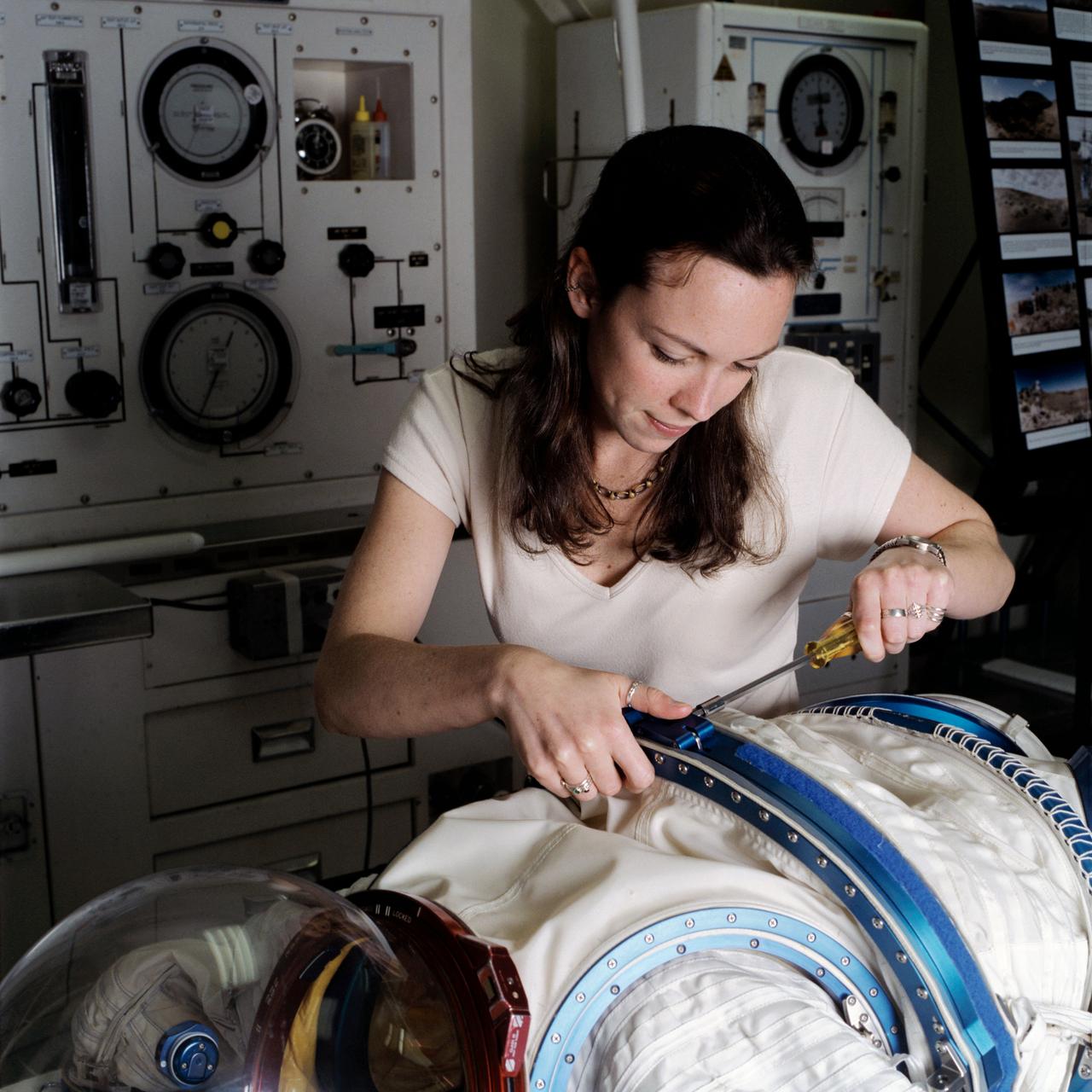
Photographic documentation showing co-operative students performing their various tasks around Johnson Space Center. These images will be used for displays and brochures for the co-operative program. Images include: a student tightening a bolt on the upper torso of the experimental soft space suit (04726-7); three students working at the Guidance/Navigation (GNC) console in the Mission Control Center (MCC) in Building 30S - the front large screens are visible in the background (04728); two students working at the Guidance/Navigation (GNC) console in the Mission Control Center (MCC) in Building 30S - the front large screens are visible in the background (04729); two students working with an experimental soft space suit (04730); three students working with an experimental soft space suit (04731); and a student tests her manual dexterity using a glove box while another student looks on (04732-3).
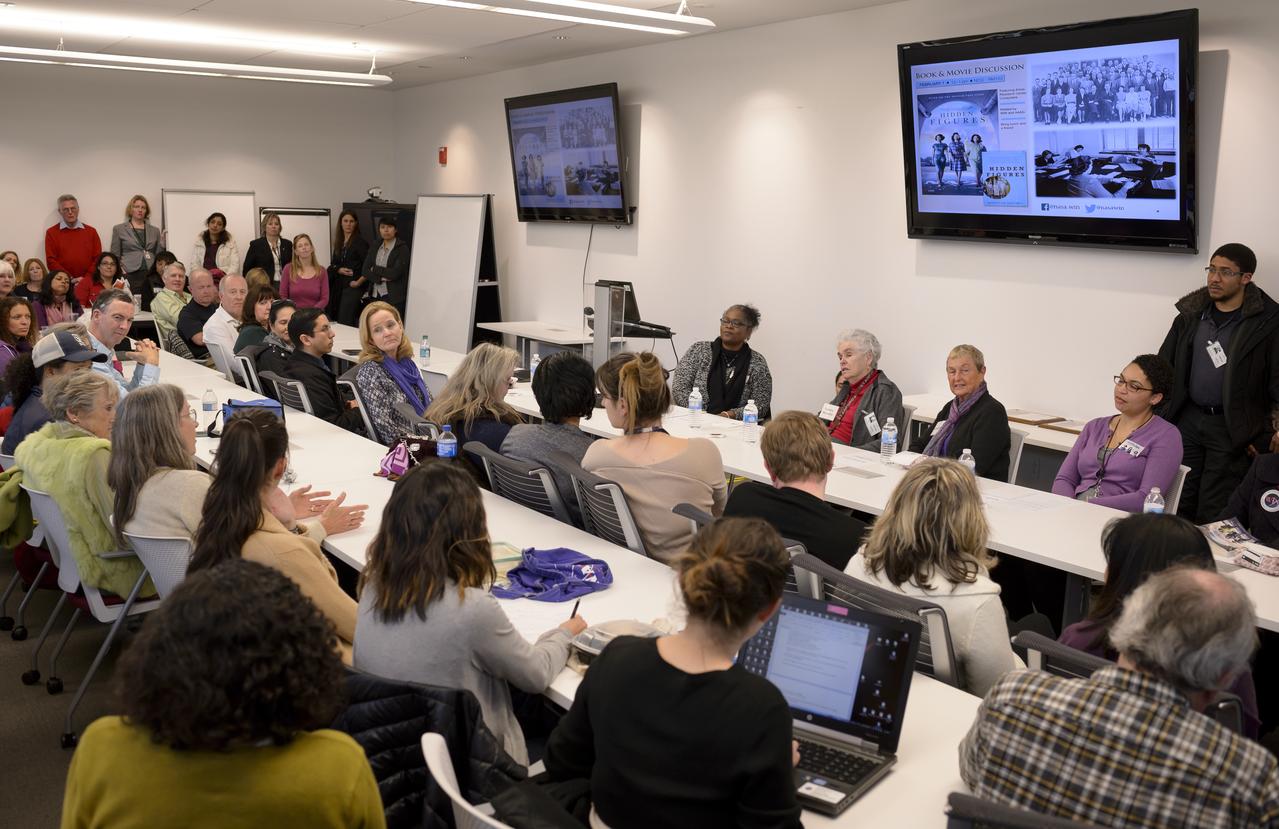
Ames Women's Influence Network (WIN) Hidden Figures talk with "Computers" Carolyn Hofstetter and Carol Mead co-sponsored by the AAAG.
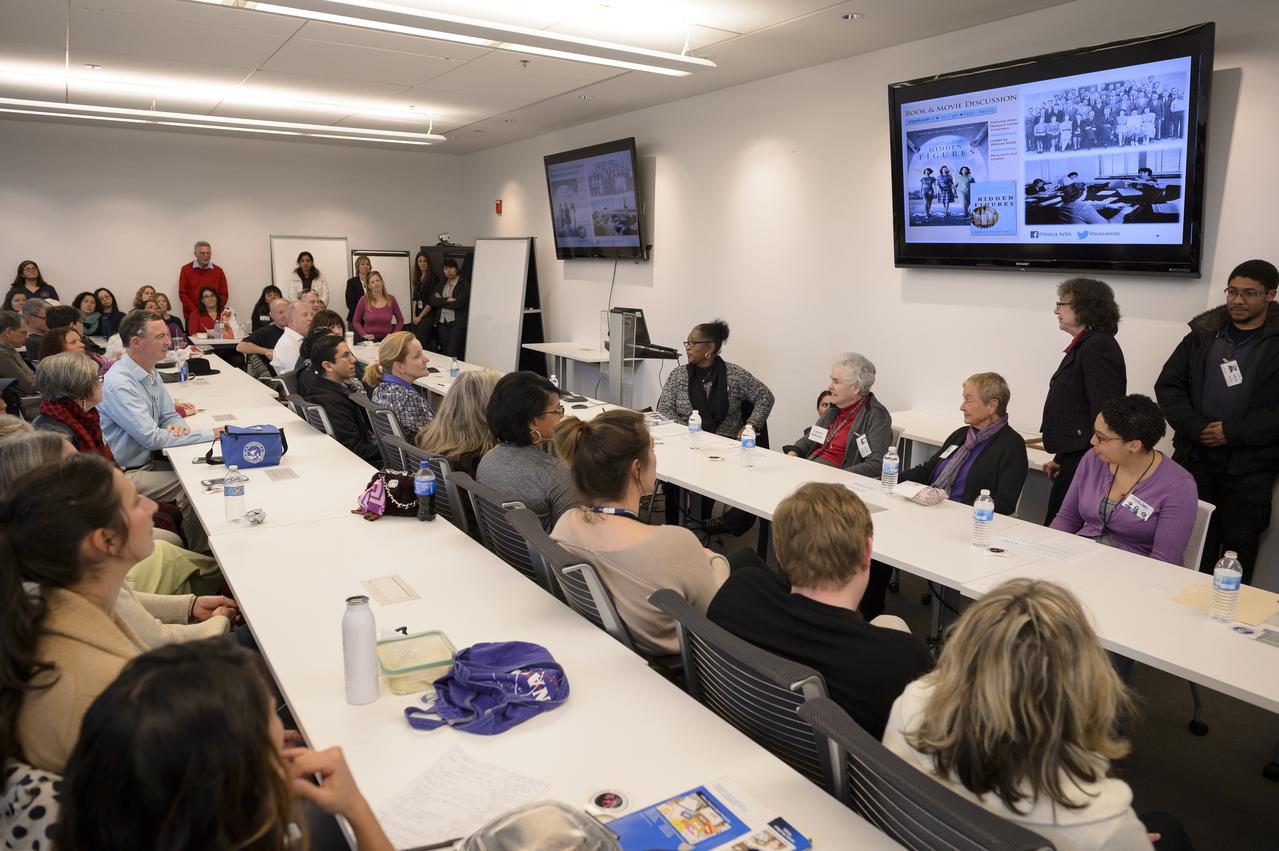
Ames Women's Influence Network (WIN) Hidden Figures talk with "Computers" Carolyn Hofstetter and Carol Mead co-sponsored by the AAAG.

Ames Women's Influence Network (WIN) Hidden Figures talk with "Computers" Carolyn Hofstetter and Carol Mead co-sponsored by the AAAG.
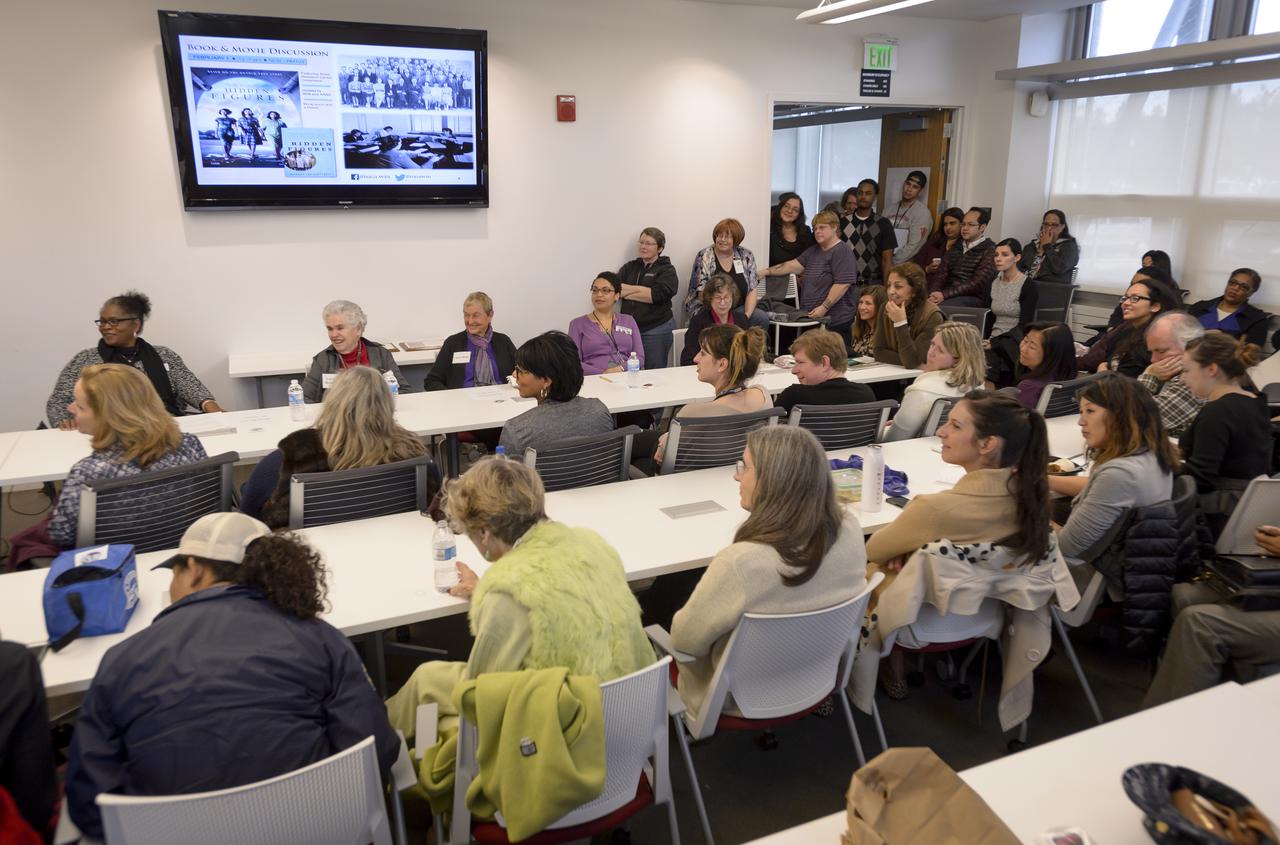
Ames Women's Influence Network (WIN) Hidden Figures talk with "Computers" Carolyn Hofstetter and Carol Mead co-sponsored by the AAAG.
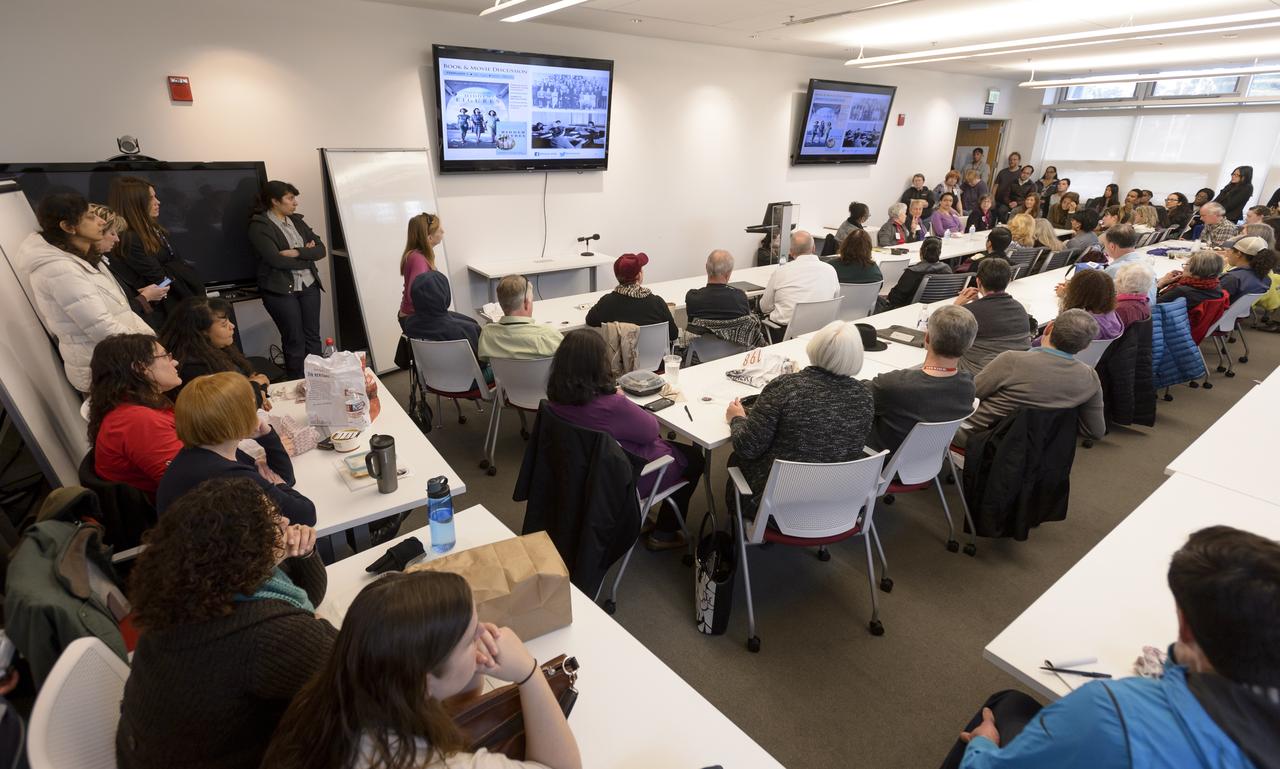
Ames Women's Influence Network (WIN) Hidden Figures talk with "Computers" Carolyn Hoffetter and Carol Mead co-sponsored by the AAAG.
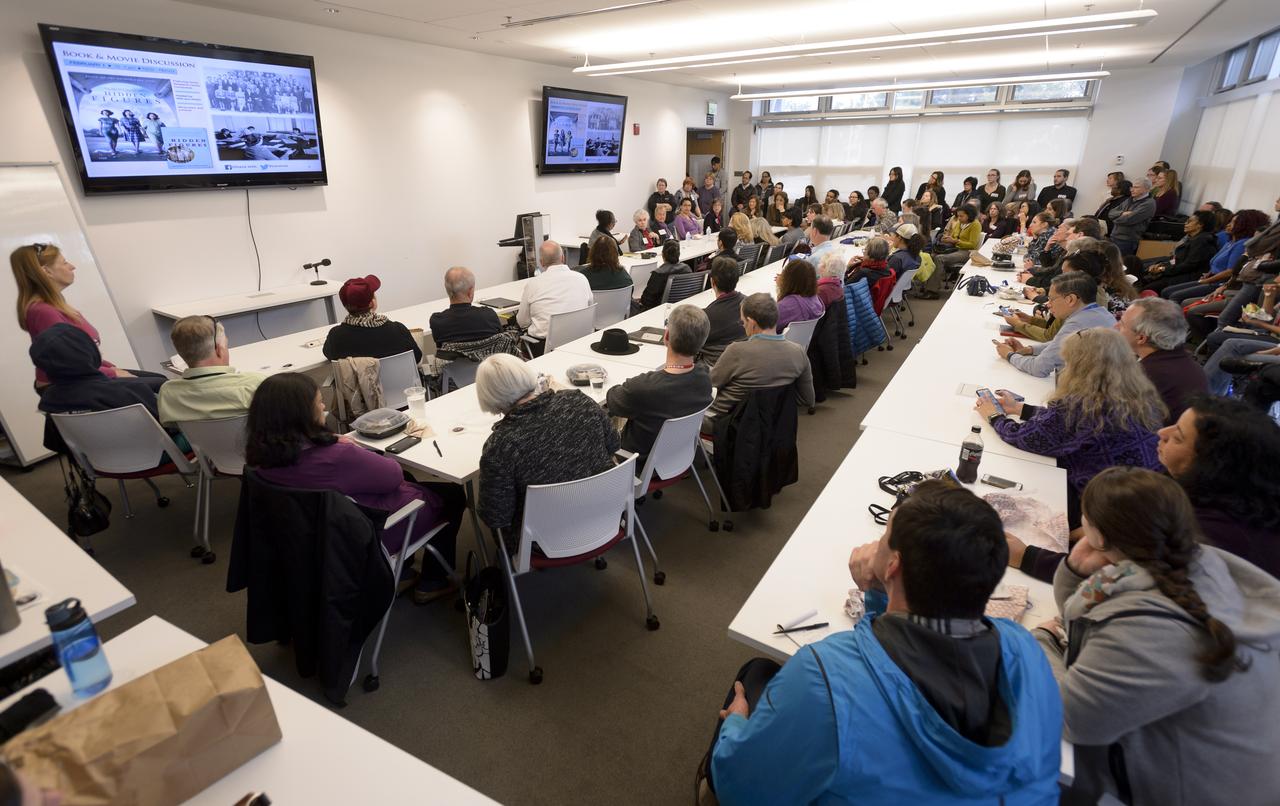
Ames Women's Influence Network (WIN) Hidden Figures talk with "Computers" Carolyn Hofstetter and Carol Mead co-sponsored by the AAAG.
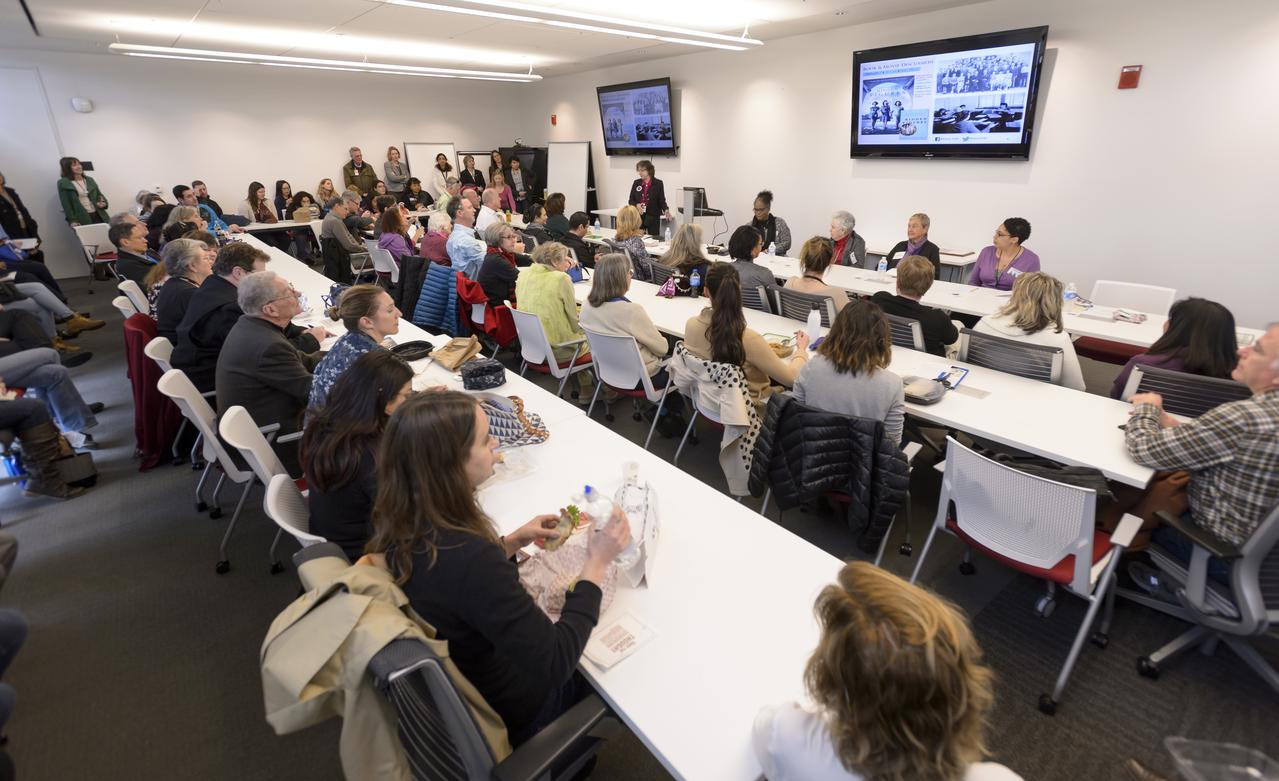
Ames Women's Influence Network (WIN) Hidden Figures talk with "Computers" Carolyn Hofstetter and Carol Mead co-sponsored by the AAAG
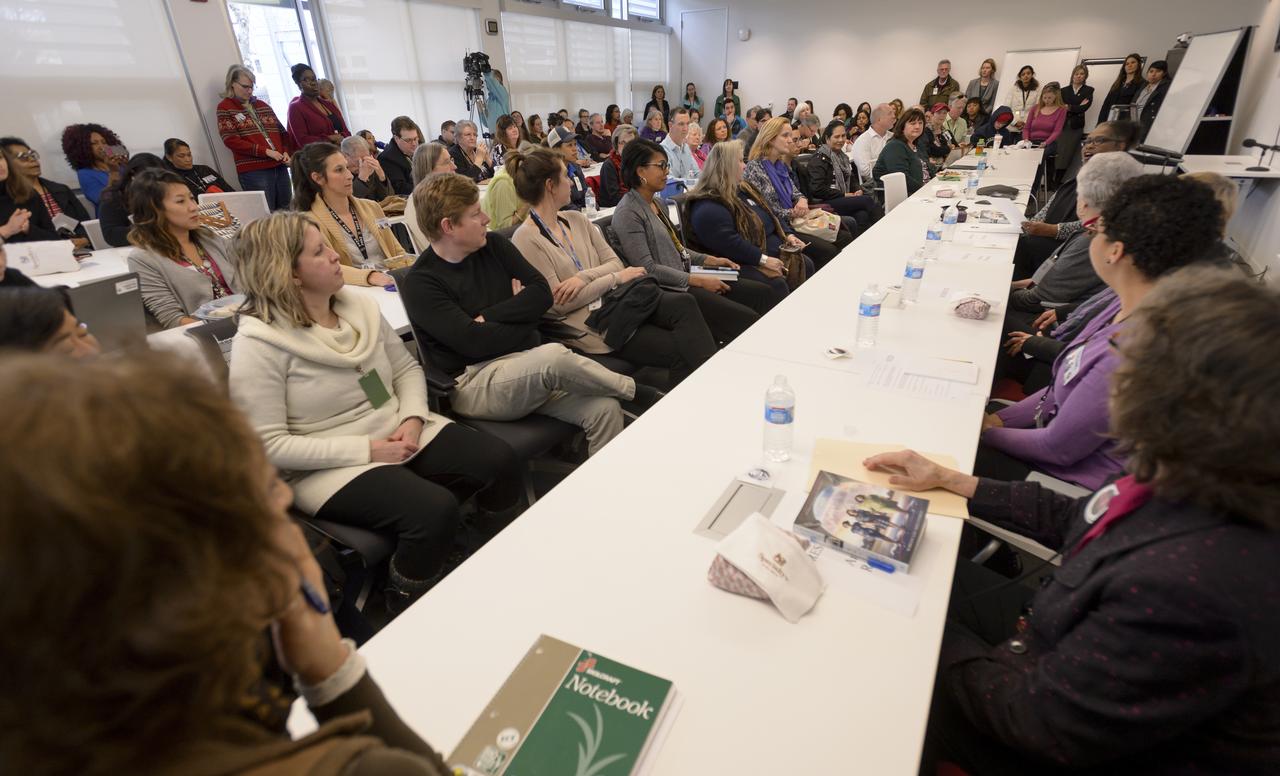
Ames Women's Influence Network (WIN) Hidden Figures talk with "Computers" Carolyn Hofstetter and Carol Mead co-sponsored by the AAAG
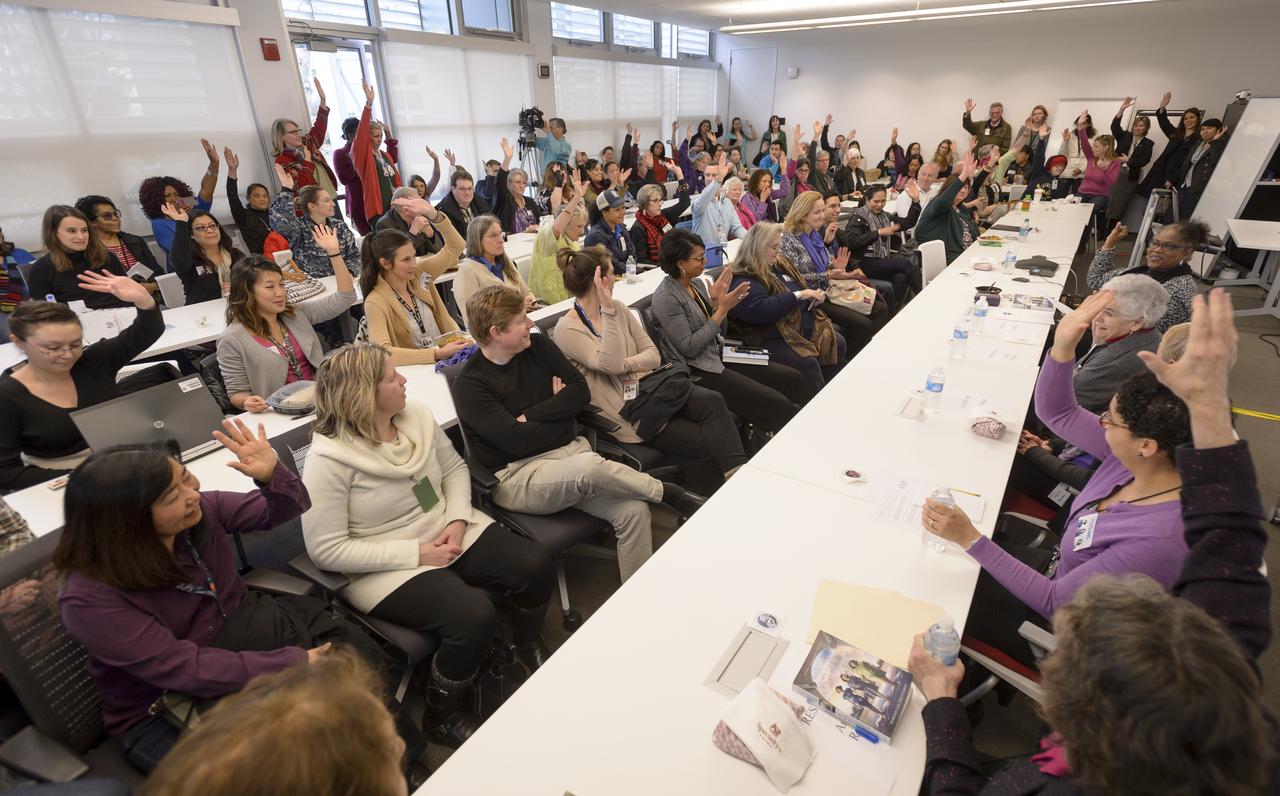
Ames Women's Influence Network (WIN) Hidden Figures talk with "Computers" Carolyn Hofstetter and Carol Mead co-sponsored by the AAAG
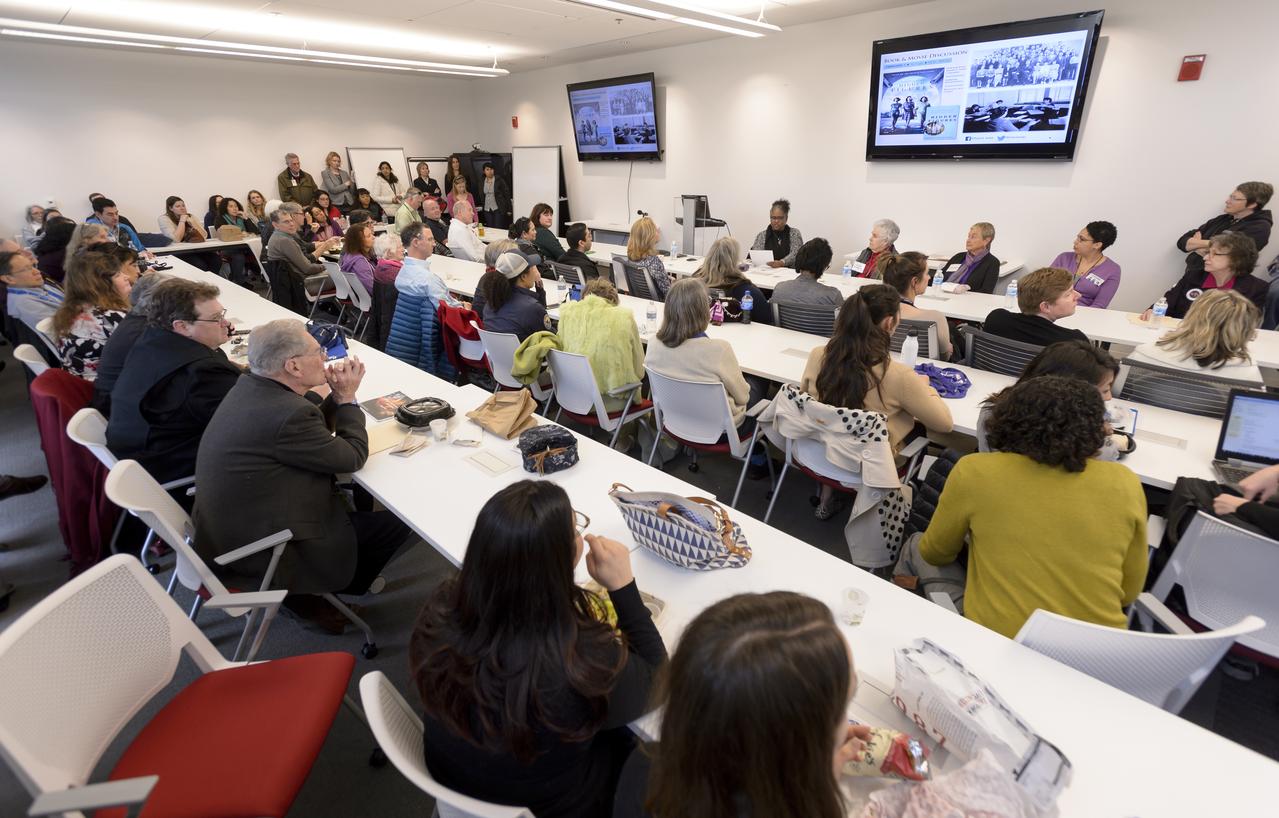
Ames Women's Influence Network (WIN) Hidden Figures talk with "Computers" Carolyn Hofstetter and Carol Mead co-sponsored by the AAAG
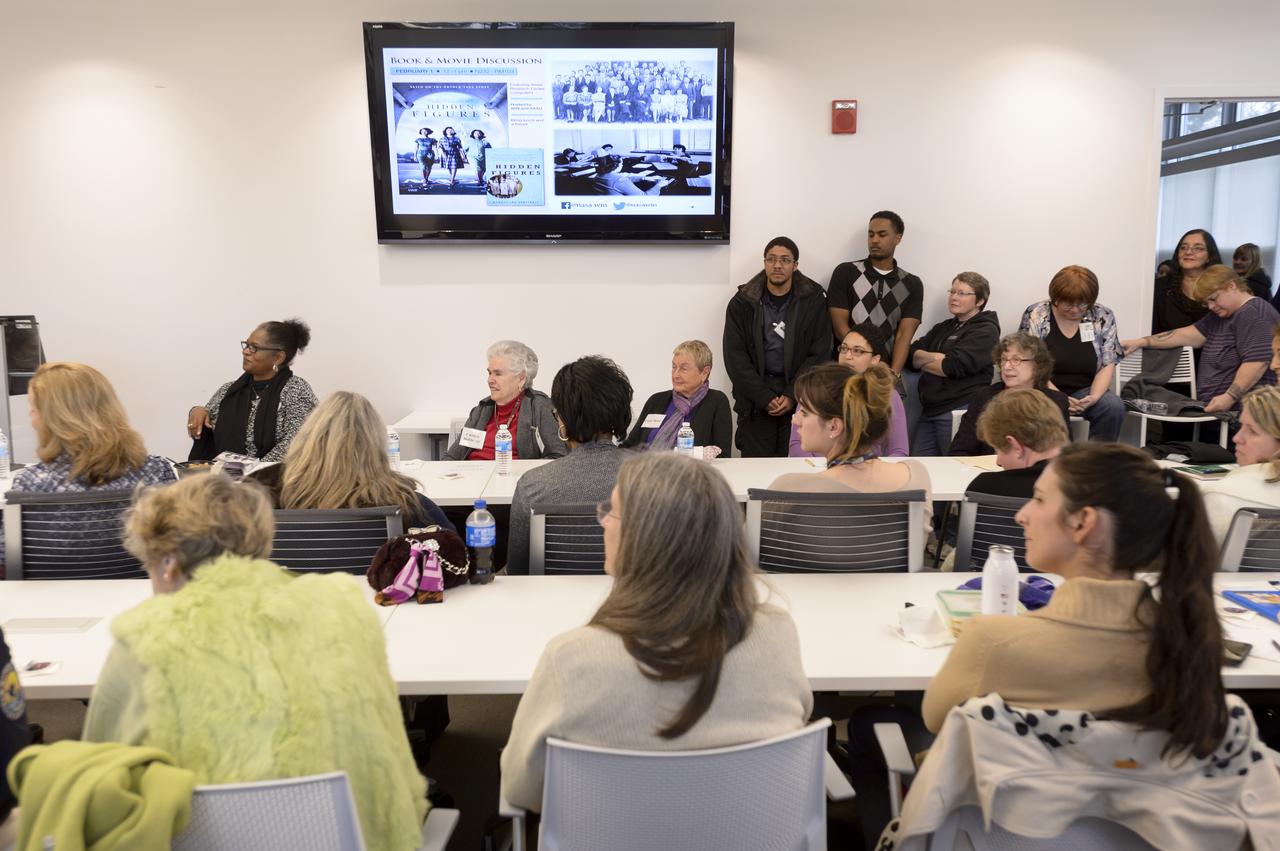
Ames Women's Influence Network (WIN) Hidden Figures talk with "Computers" Carolyn Hofstetter and Carol Mead co-sponsored by the AAAG.
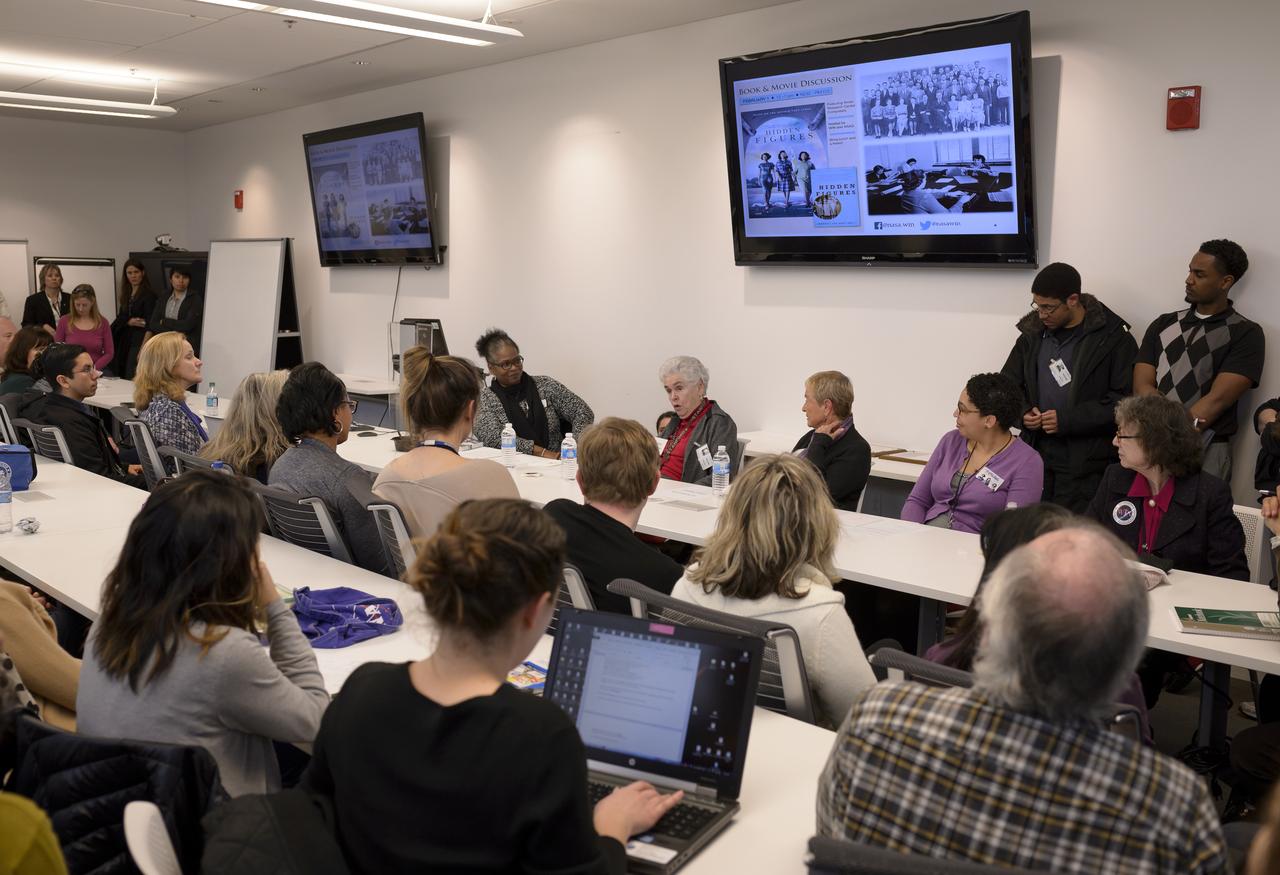
Ames Women's Influence Network (WIN) Hidden Figures talk with "Computers" Carolyn Hofstetter and Carol Mead co-sponsored by the AAAG.
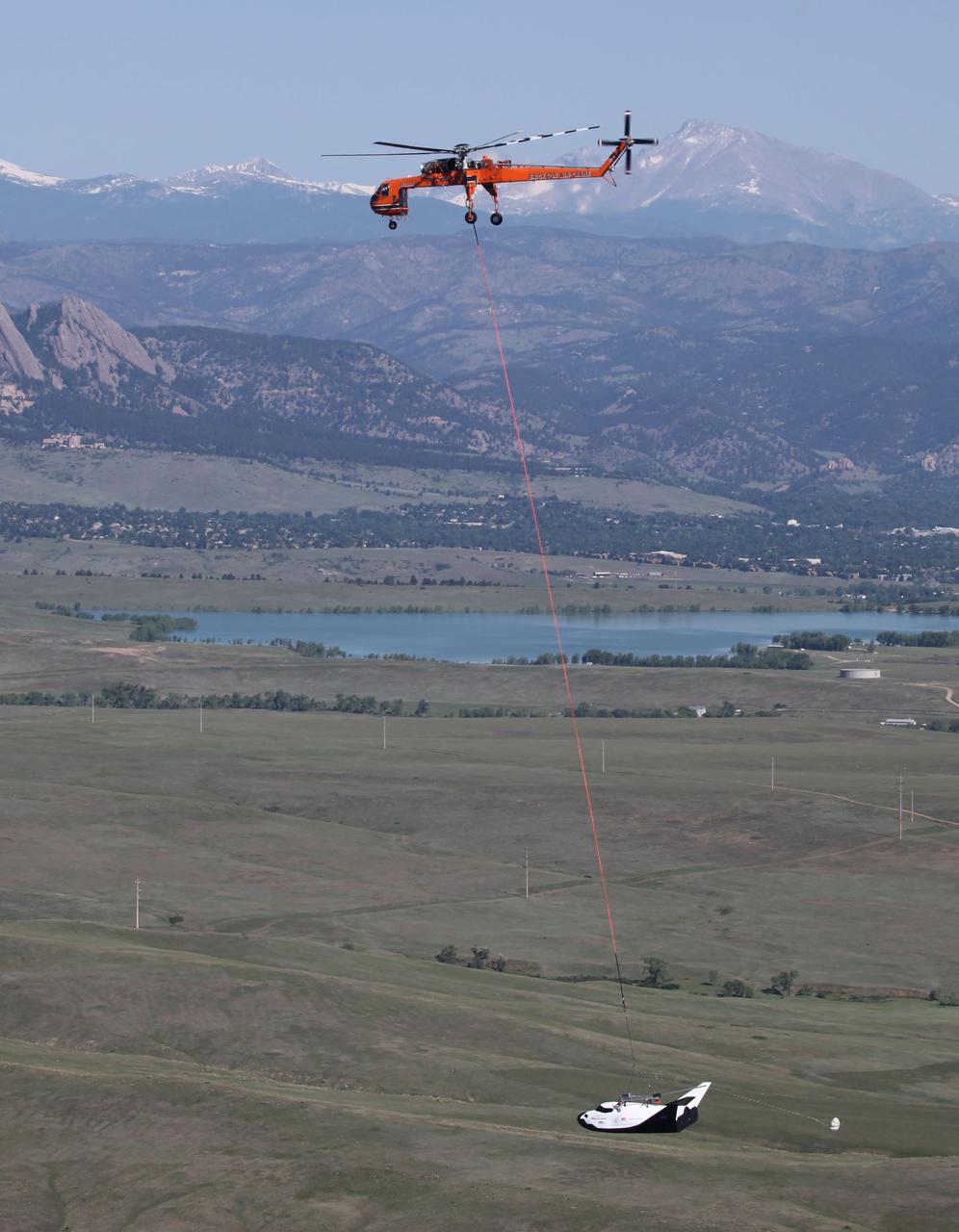
LOUISVILLE, Colo. – An Erickson Air-Crane helicopter lifts Sierra Nevada Corporation Space Systems’ Dream Chaser full-scale test vehicle to verify proper aerodynamic flight performance near the Rocky Mountain Metropolitan Airport in Jefferson County, Colo. This captive-carry test is one of several milestones the company is meeting during its partnership with NASA’s Commercial Crew Program CCP. Data from this test will provide SNC an early opportunity to evaluate and prove hardware, facilities and ground operations in preparation for approach and landing tests scheduled for later this year. In 2011, NASA selected Sierra Nevada during Commercial Crew Development Round 2 CCDev2) activities to mature the design and development of a crew transportation system with the overall goal of accelerating a United States-led capability to the International Space Station. The goal of CCP is to drive down the cost of space travel as well as open up space to more people than ever before by balancing industry’s own innovative capabilities with NASA's 50 years of human spaceflight experience. Six other aerospace companies also are maturing launch vehicle and spacecraft designs under CCDev2, including Alliant Techsystems Inc. ATK, The Boeing Co., Excalibur Almaz Inc., Blue Origin, Space Exploration Technologies SpaceX, and United Launch Alliance ULA. For more information, visit www.nasa.gov/commercialcrew. Image credit: Sierra Nevada Corp.
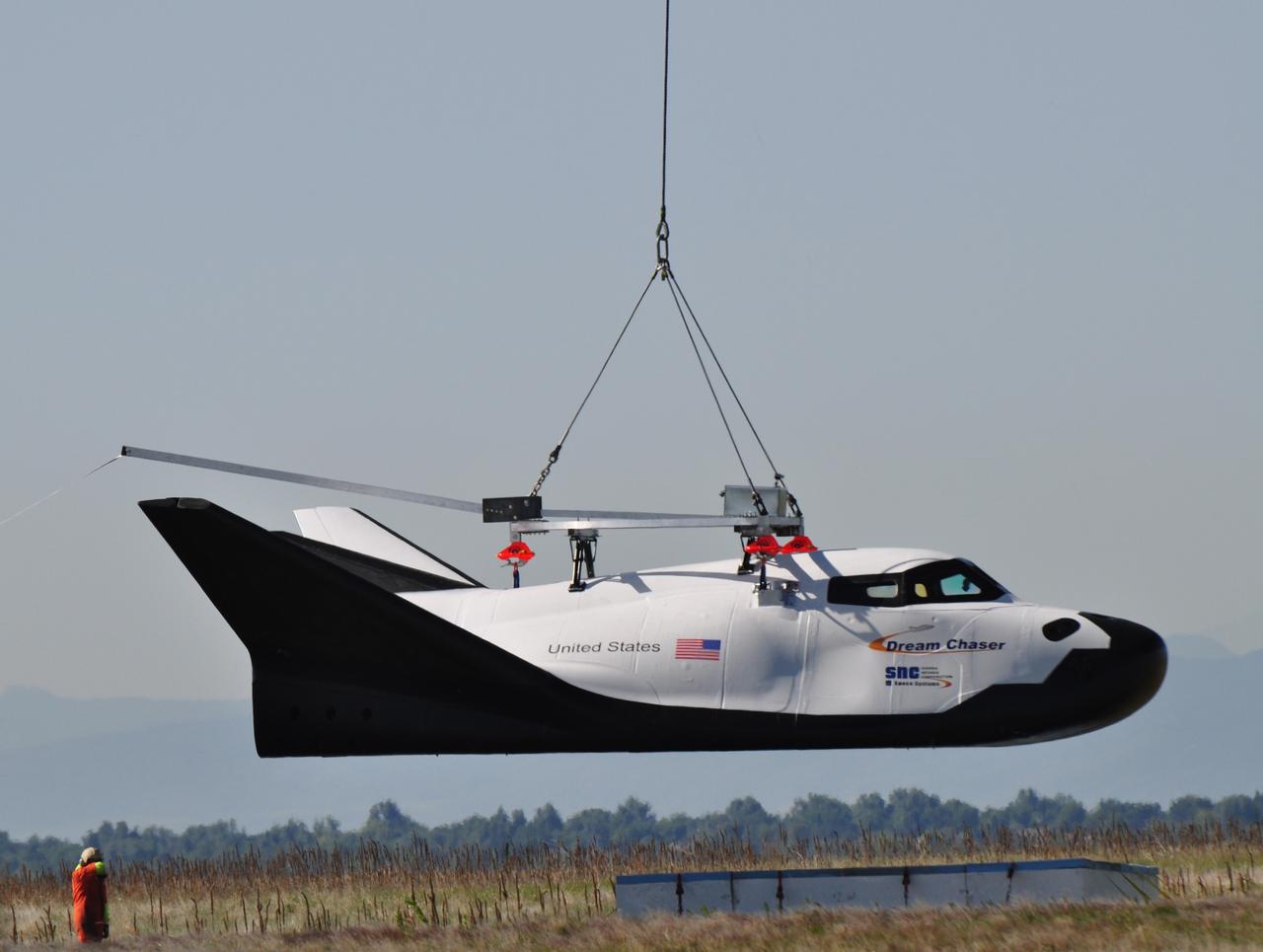
LOUISVILLE, Colo. – Sierra Nevada Corporation Space Systems’ Dream Chaser full-scale test vehicle is lifted by an Erickson Air-Crane helicopter to verify proper aerodynamic flight performance near the Rocky Mountain Metropolitan Airport in Jefferson County, Colo. This captive-carry test is one of several milestones the company is meeting during its partnership with NASA’s Commercial Crew Program CCP. Data from this test will provide SNC an early opportunity to evaluate and prove hardware, facilities and ground operations in preparation for approach and landing tests scheduled for later this year. In 2011, NASA selected Sierra Nevada during Commercial Crew Development Round 2 CCDev2) activities to mature the design and development of a crew transportation system with the overall goal of accelerating a United States-led capability to the International Space Station. The goal of CCP is to drive down the cost of space travel as well as open up space to more people than ever before by balancing industry’s own innovative capabilities with NASA's 50 years of human spaceflight experience. Six other aerospace companies also are maturing launch vehicle and spacecraft designs under CCDev2, including Alliant Techsystems Inc. ATK, The Boeing Co., Excalibur Almaz Inc., Blue Origin, Space Exploration Technologies SpaceX, and United Launch Alliance ULA. For more information, visit www.nasa.gov/commercialcrew. Image credit: Sierra Nevada Corp.
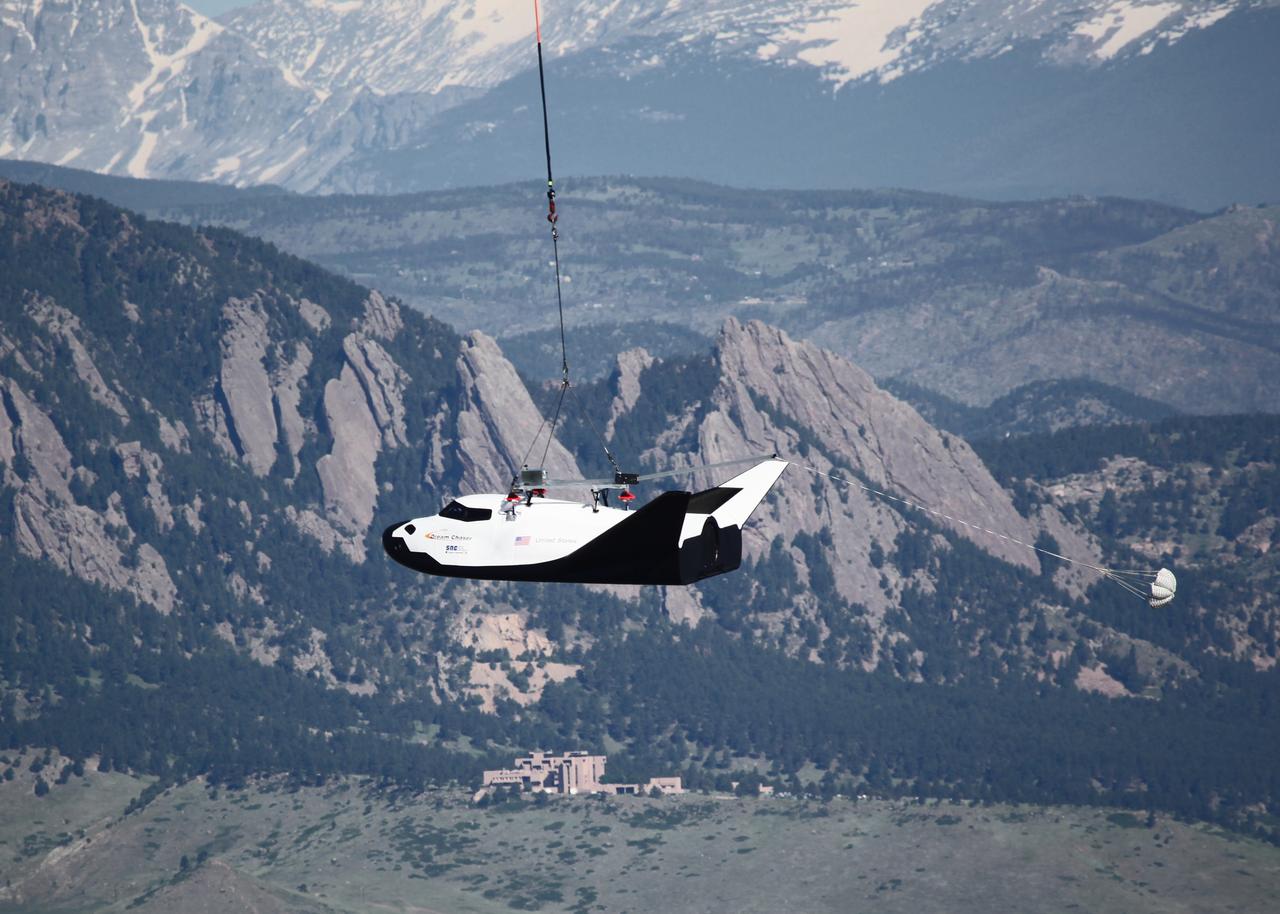
LOUISVILLE, Colo. – Sierra Nevada Corporation Space Systems’ Dream Chaser full-scale test vehicle is lifted by an Erickson Air-Crane helicopter to verify proper aerodynamic flight performance near the Rocky Mountain Metropolitan Airport in Jefferson County, Colo. This captive-carry test is one of several milestones the company is meeting during its partnership with NASA’s Commercial Crew Program CCP. Data from this test will provide SNC an early opportunity to evaluate and prove hardware, facilities and ground operations in preparation for approach and landing tests scheduled for later this year. In 2011, NASA selected Sierra Nevada during Commercial Crew Development Round 2 CCDev2) activities to mature the design and development of a crew transportation system with the overall goal of accelerating a United States-led capability to the International Space Station. The goal of CCP is to drive down the cost of space travel as well as open up space to more people than ever before by balancing industry’s own innovative capabilities with NASA's 50 years of human spaceflight experience. Six other aerospace companies also are maturing launch vehicle and spacecraft designs under CCDev2, including Alliant Techsystems Inc. ATK, The Boeing Co., Excalibur Almaz Inc., Blue Origin, Space Exploration Technologies SpaceX, and United Launch Alliance ULA. For more information, visit www.nasa.gov/commercialcrew. Image credit: Sierra Nevada Corp.
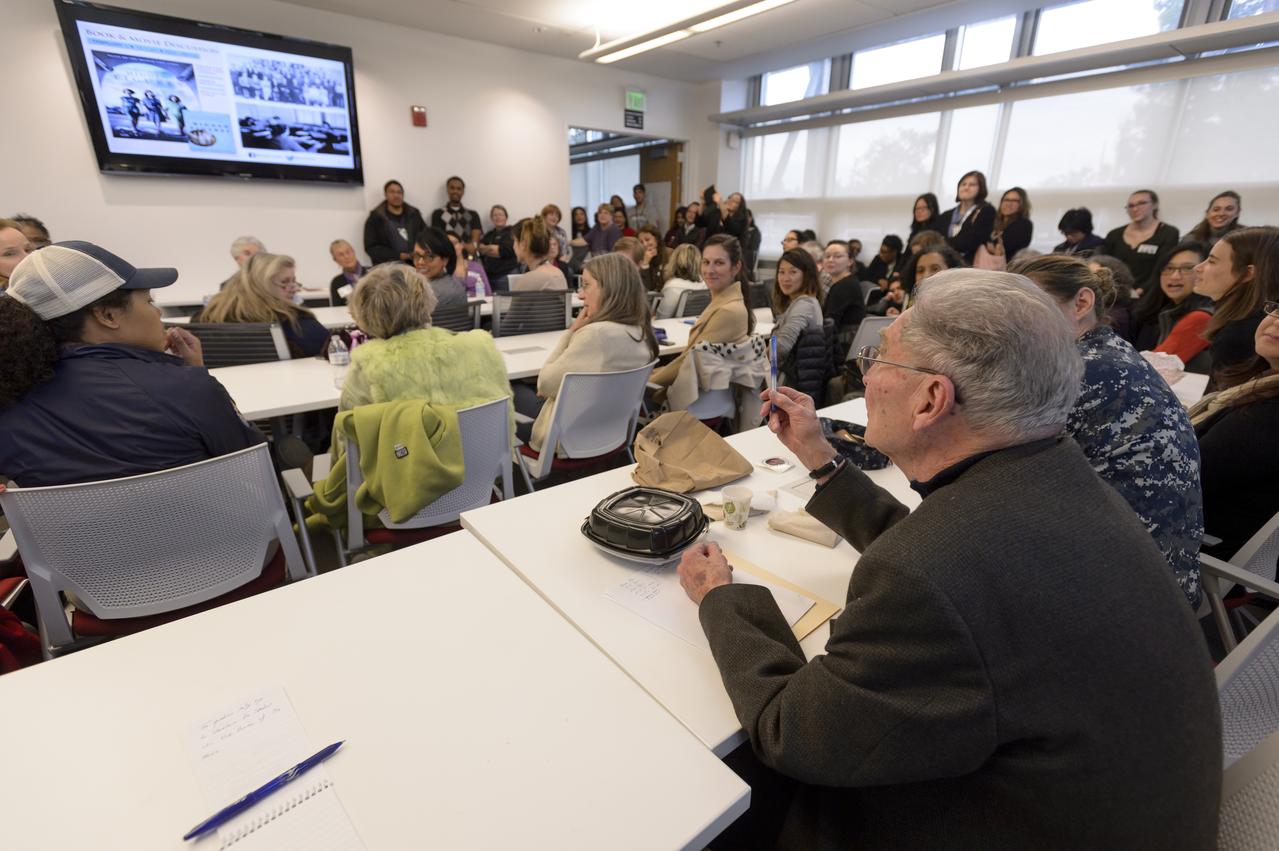
Ames Women's Influence Network (WIN) Hidden Figures talk with "Computers" Carolyn Hofstetter and Carol Mead co-sponsored by the AAAG. Jack Boyd talk of working in the same 6ft w.t. group as Carol Mead.
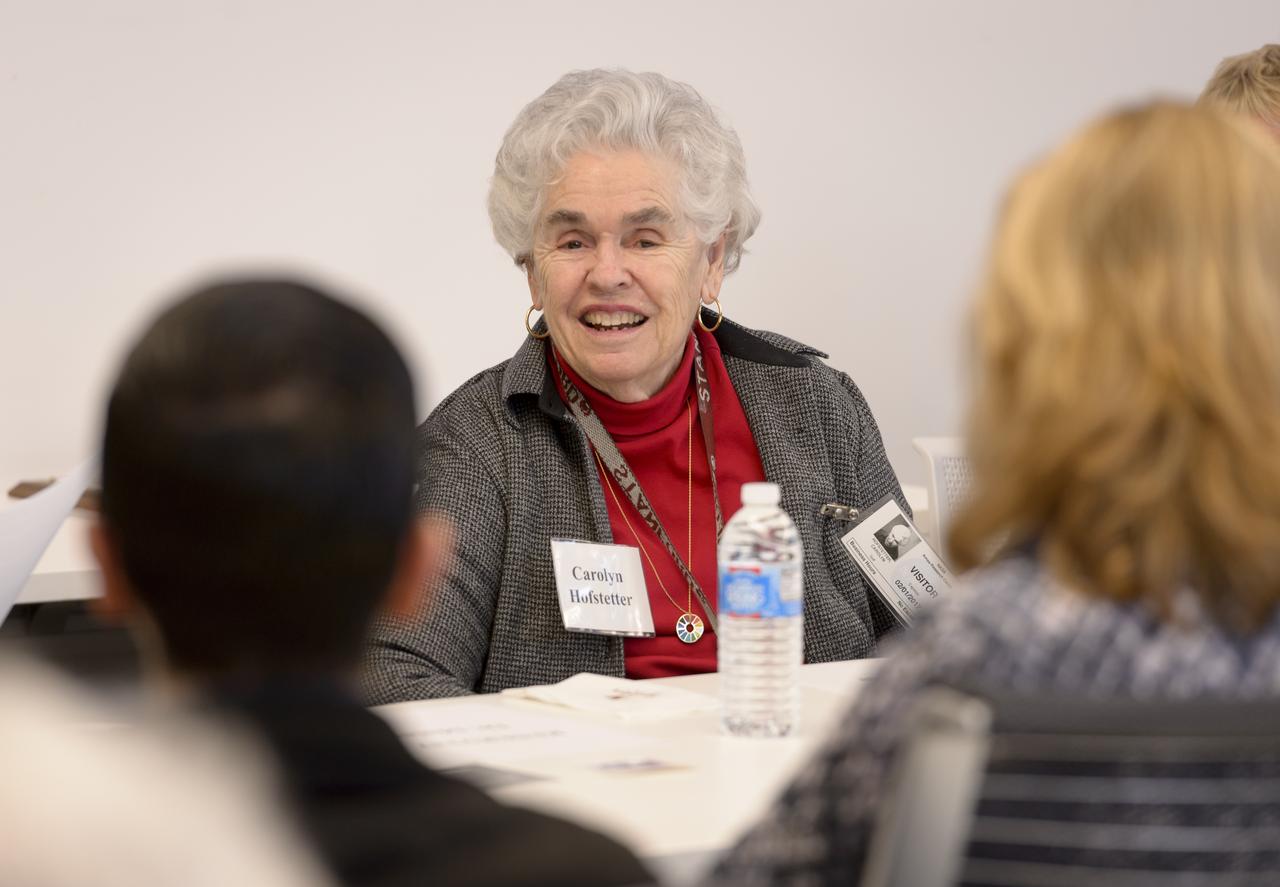
Ames Women's Influence Network (WIN) Hidden Figures talk with "Computers" Carolyn Hofstetter and Carol Mead co-sponsored by the AAAG. Computer Carolyn Hofstetter during Q & A
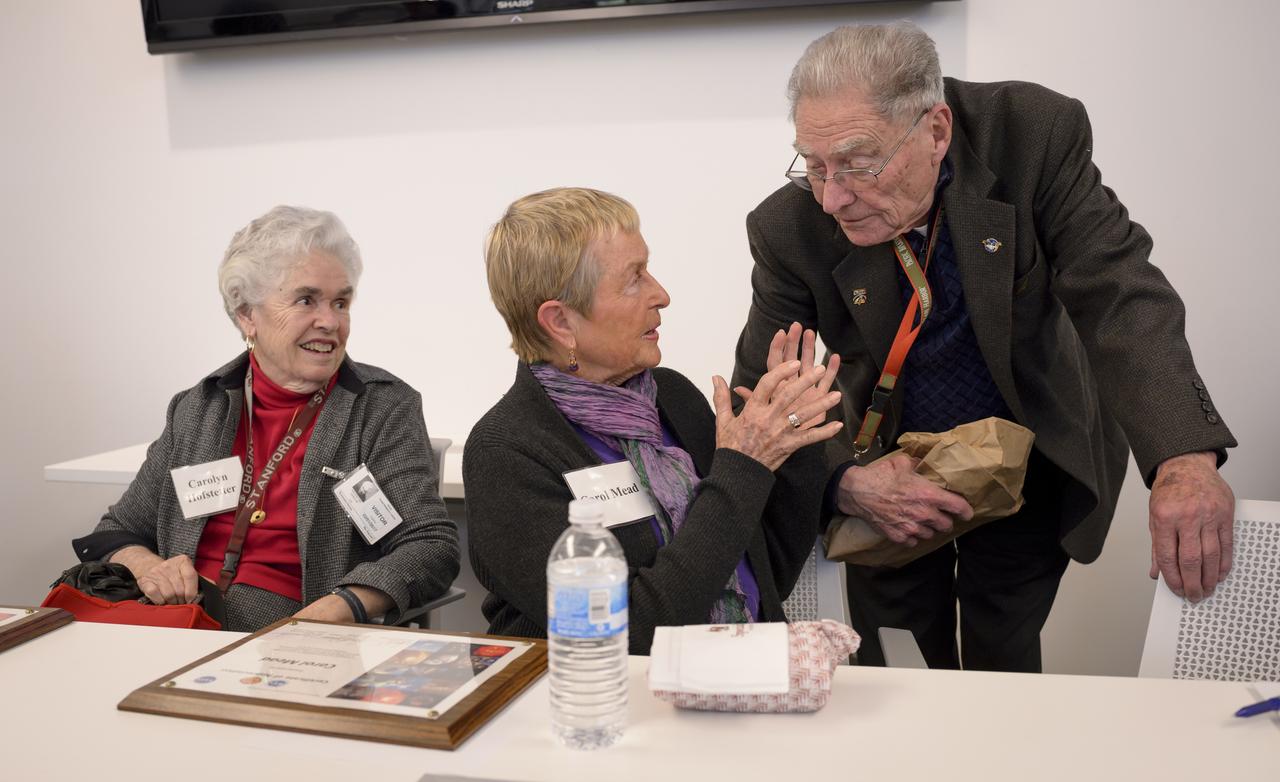
Ames Women's Influence Network (WIN) Hidden Figures talk with "Computers" Carolyn Hofstetter and Carol Mead co-sponsored by the AAAG. Left to right Computers Carolyn Hofstetter, Carol Mead and Jack Boyd
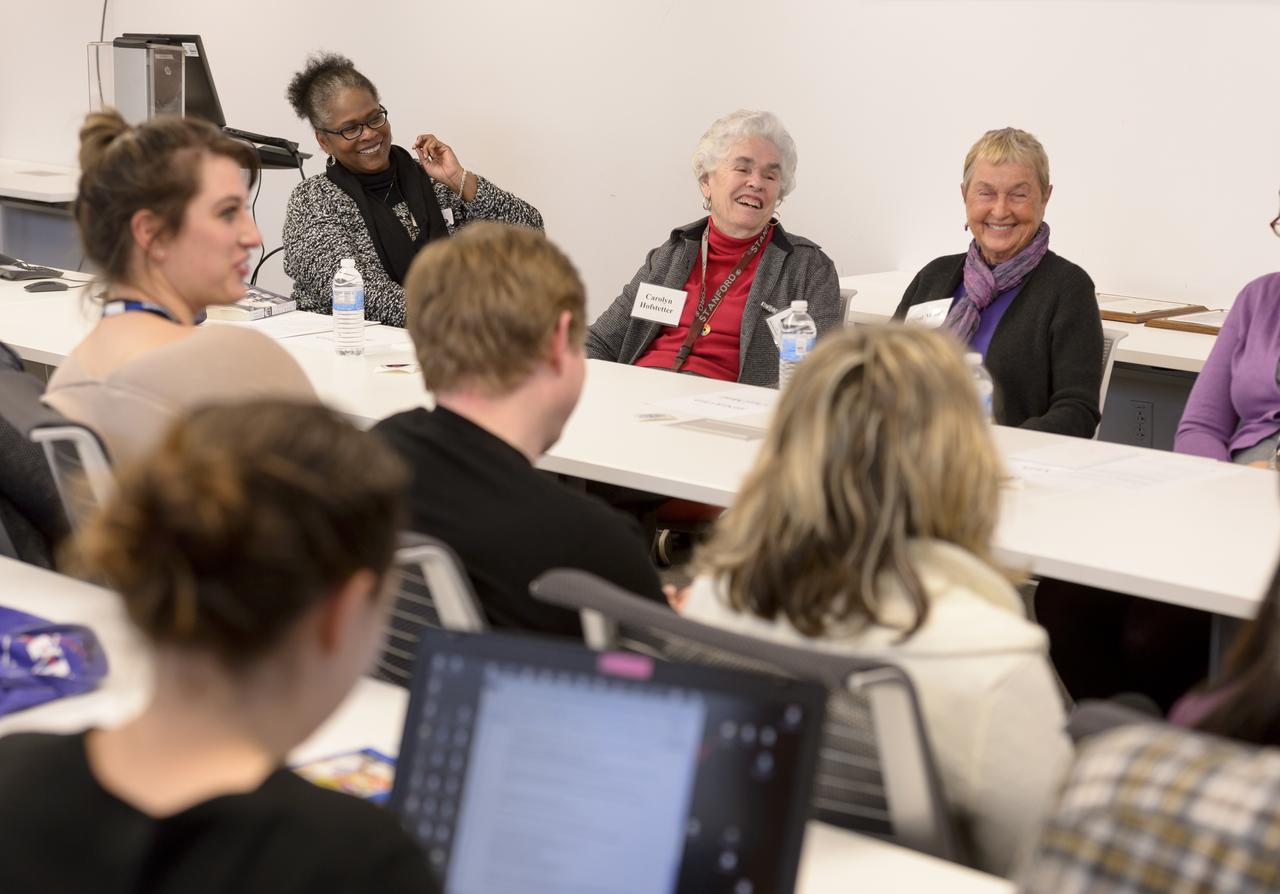
Ames Women's Influence Network (WIN) Hidden Figures talk with "Computers" Carolyn Hofstetter and Carol Mead co-sponsored by the AAAG. Left to right Barbara Miller, Ames EEO, Computers Carolyn Hofstetter and Carol Mead
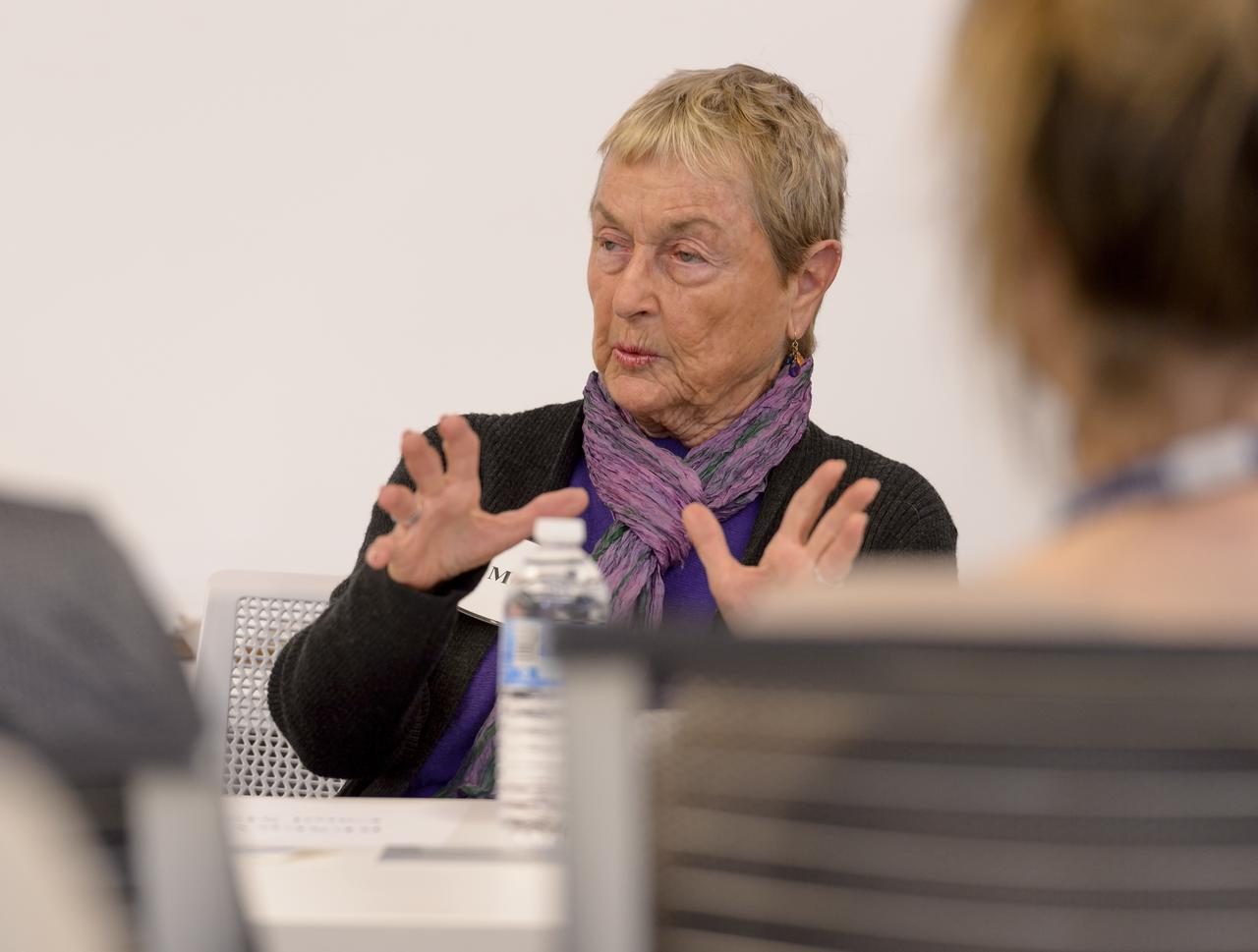
Ames Women's Influence Network (WIN) Hidden Figures talk with "Computers" Carolyn Hofstetter and Carol Mead co-sponsored by the AAAG... Computer Carol Mead during Q& A
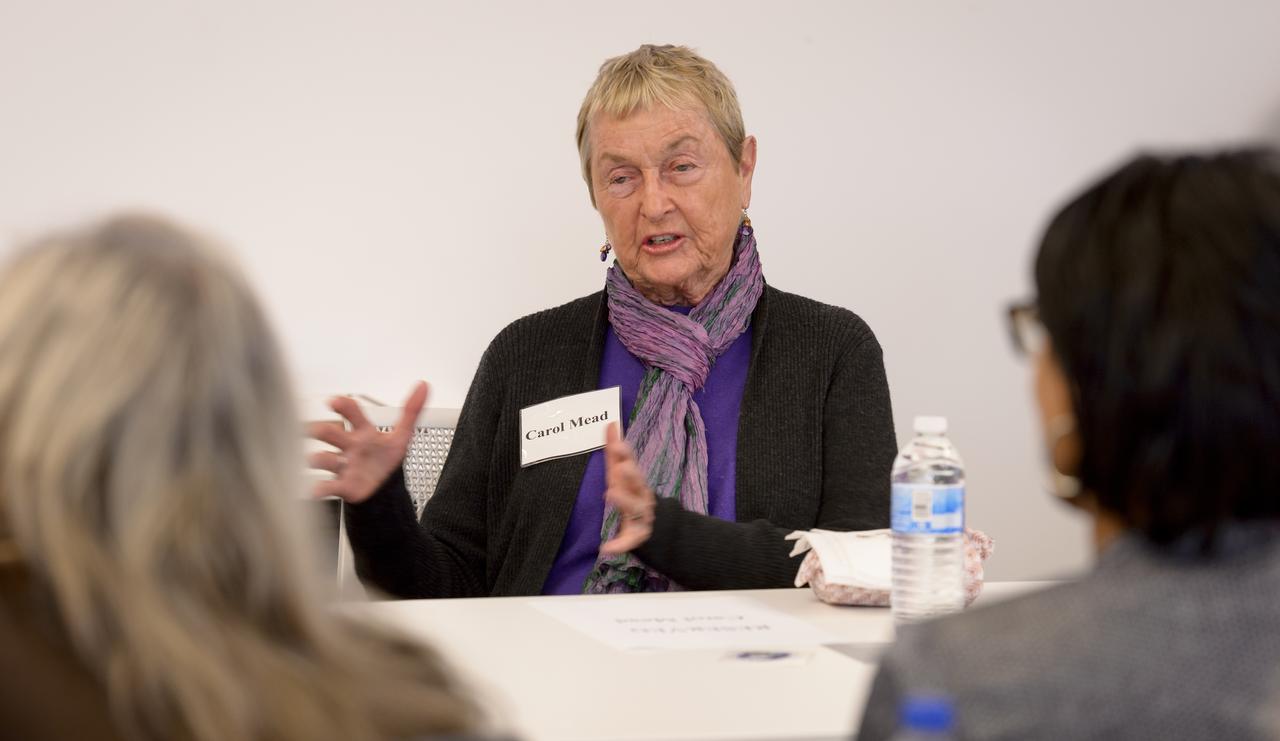
Ames Women's Influence Network (WIN) Hidden Figures talk with "Computers" Carolyn Hofstetter and Carol Mead co-sponsored by the AAAG. Computer Carol Mead during Q& A
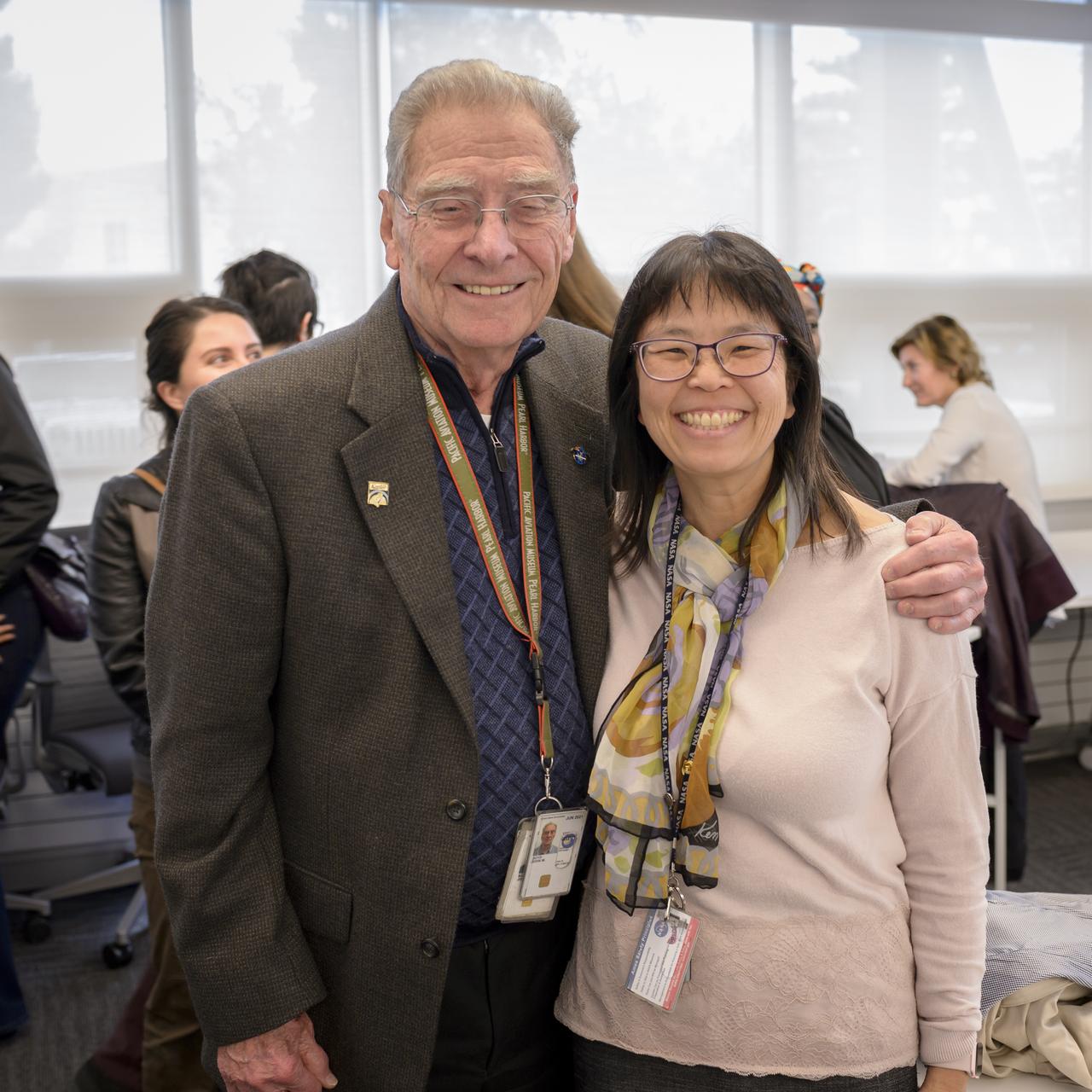
Ames Women's Influence Network (WIN) Hidden Figures talk with "Computers" Carolyn Hofstetter and Carol Mead co-sponsored by the AAAG. Attending event are Jack Boyd and Cathy Lee
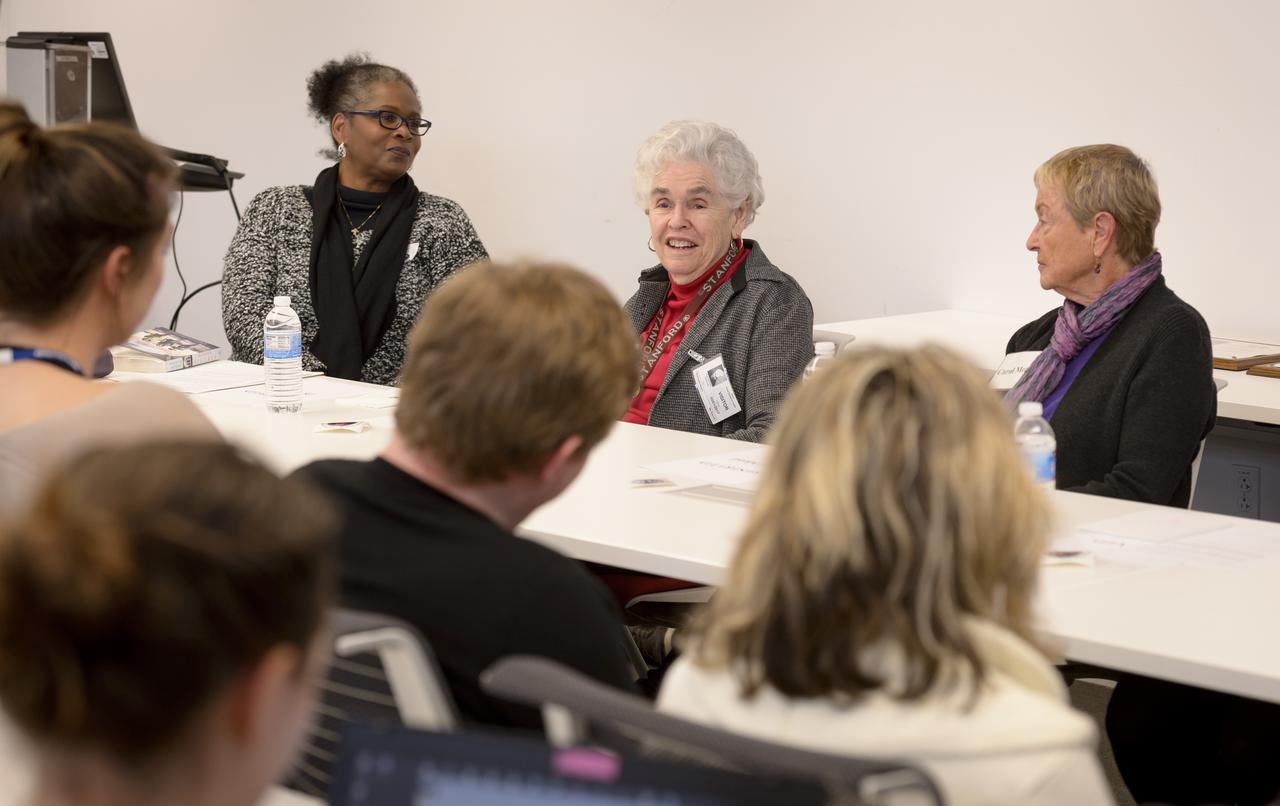
Ames Women's Influence Network (WIN) Hidden Figures talk with "Computers" Carolyn Hofstetter and Carol Mead co-sponsored by the AAAG.. Left to right Barbara Miller, Ames EEO, Computers Carolyn Hofstetter and Carol Mead

Ames Women's Influence Network (WIN) Hidden Figures talk with "Computers" Carolyn Hofstetter and Carol Mead co-sponsored by the AAAG. Computer Carol Mead during Q& A
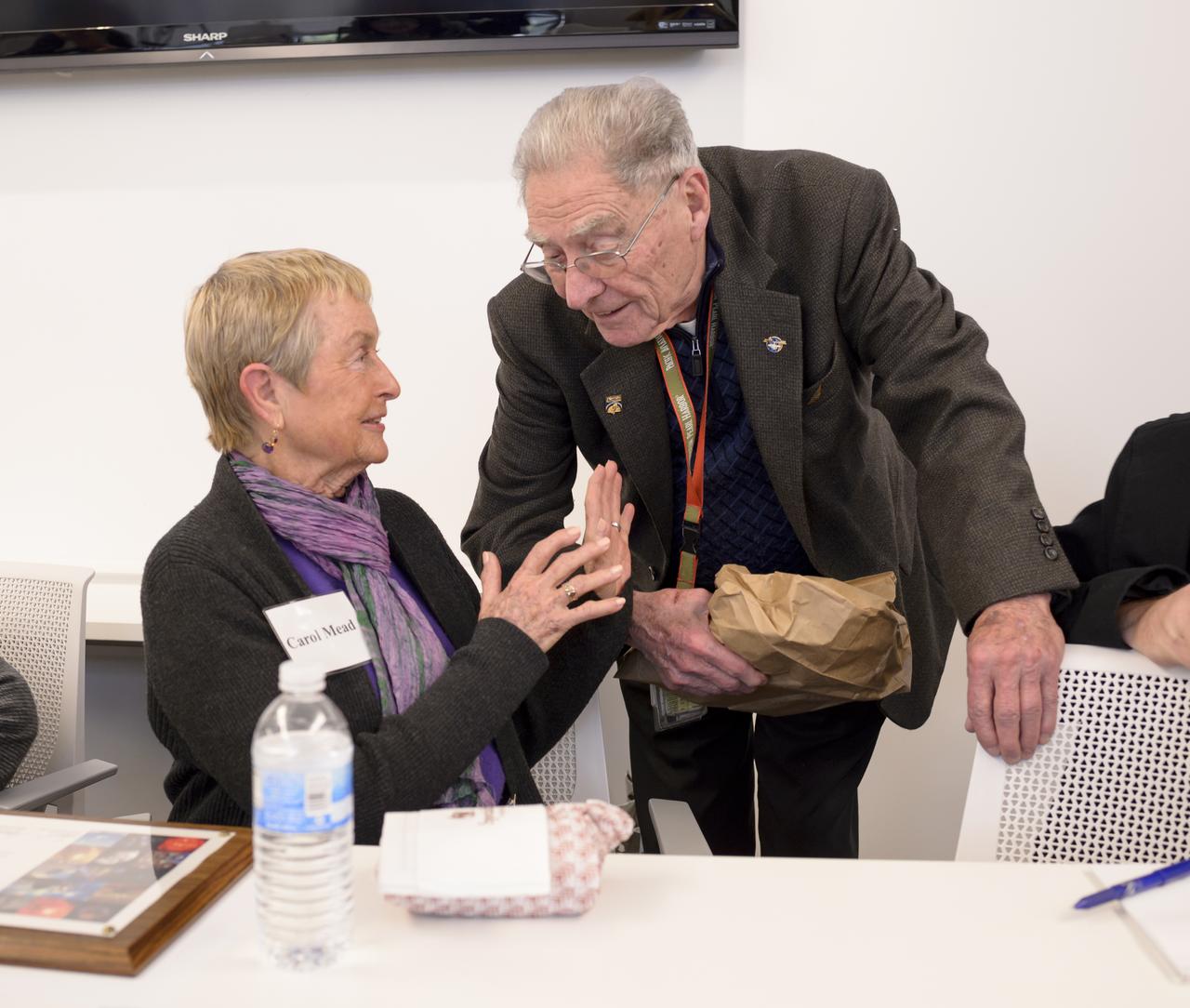
Ames Women's Influence Network (WIN) Hidden Figures talk with "Computers" Carolyn Hofstetter and Carol Mead co-sponsored by the AAAG. Left to right Carol Mead and Jack Boyd
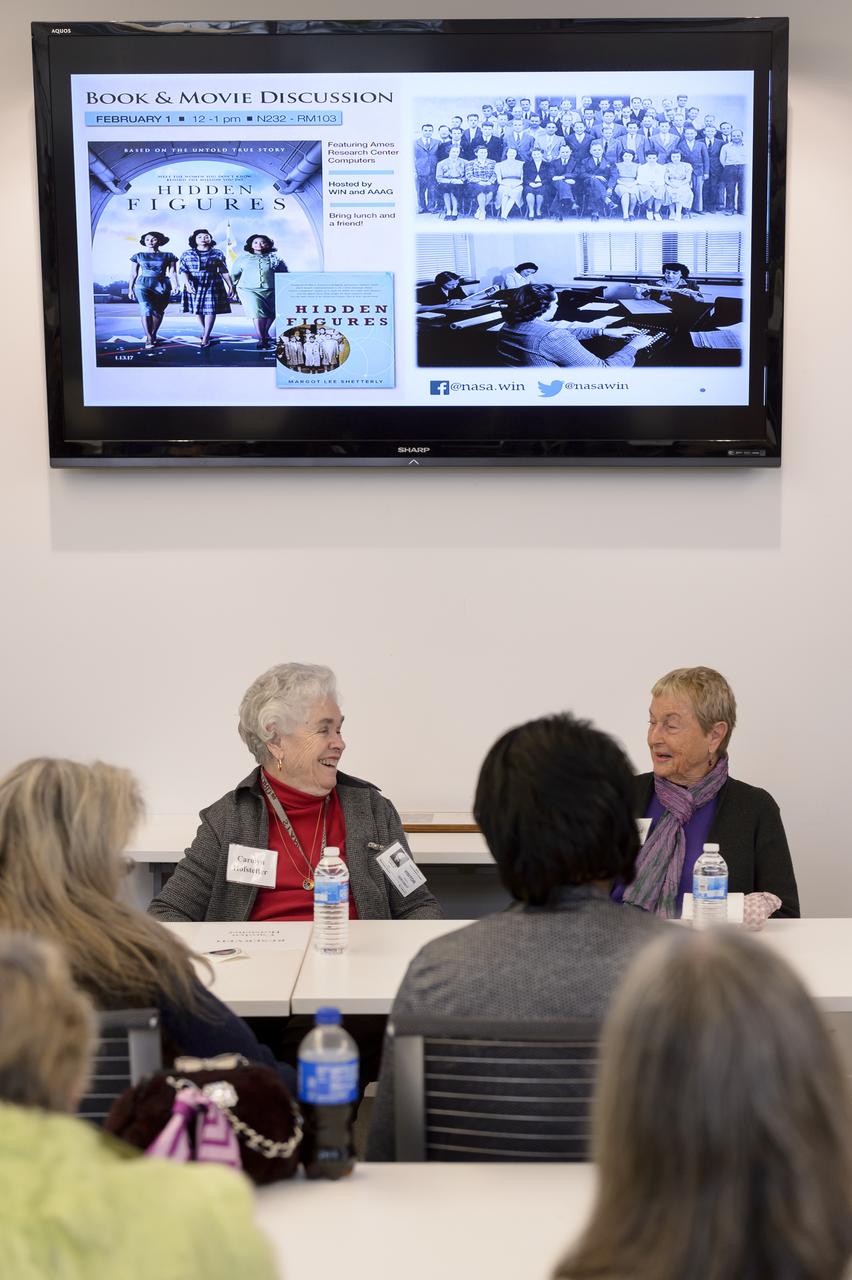
Ames Women's Influence Network (WIN) Hidden Figures talk with "Computers" Carolyn Hofstetter and Carol Mead co-sponsored by the AAAG. At table left to right Carolyn Hofstetter and Carol Mead
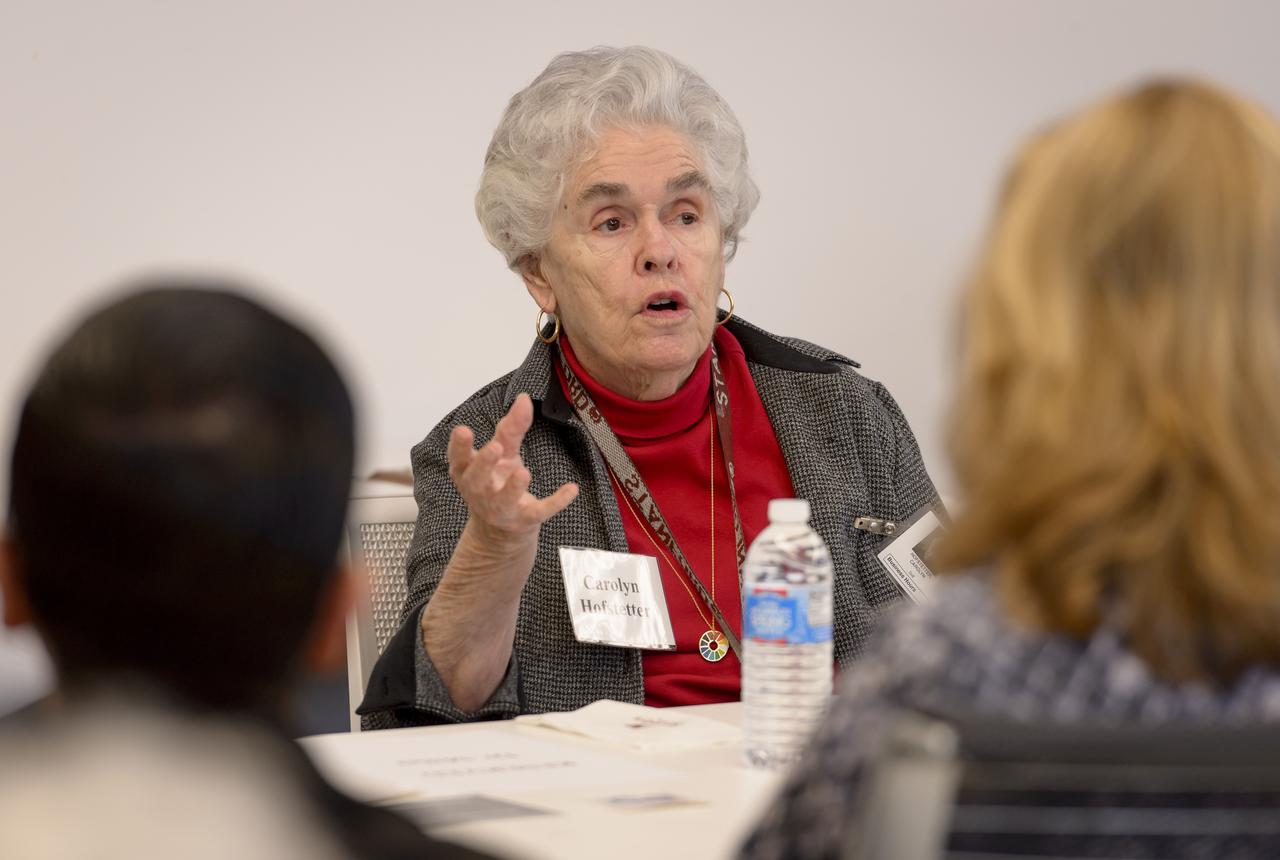
Ames Women's Influence Network (WIN) Hidden Figures talk with "Computers" Carolyn Hofstetter and Carol Mead co-sponsored by the AAAG. Computer Carolyn Hofstetter during Q & A
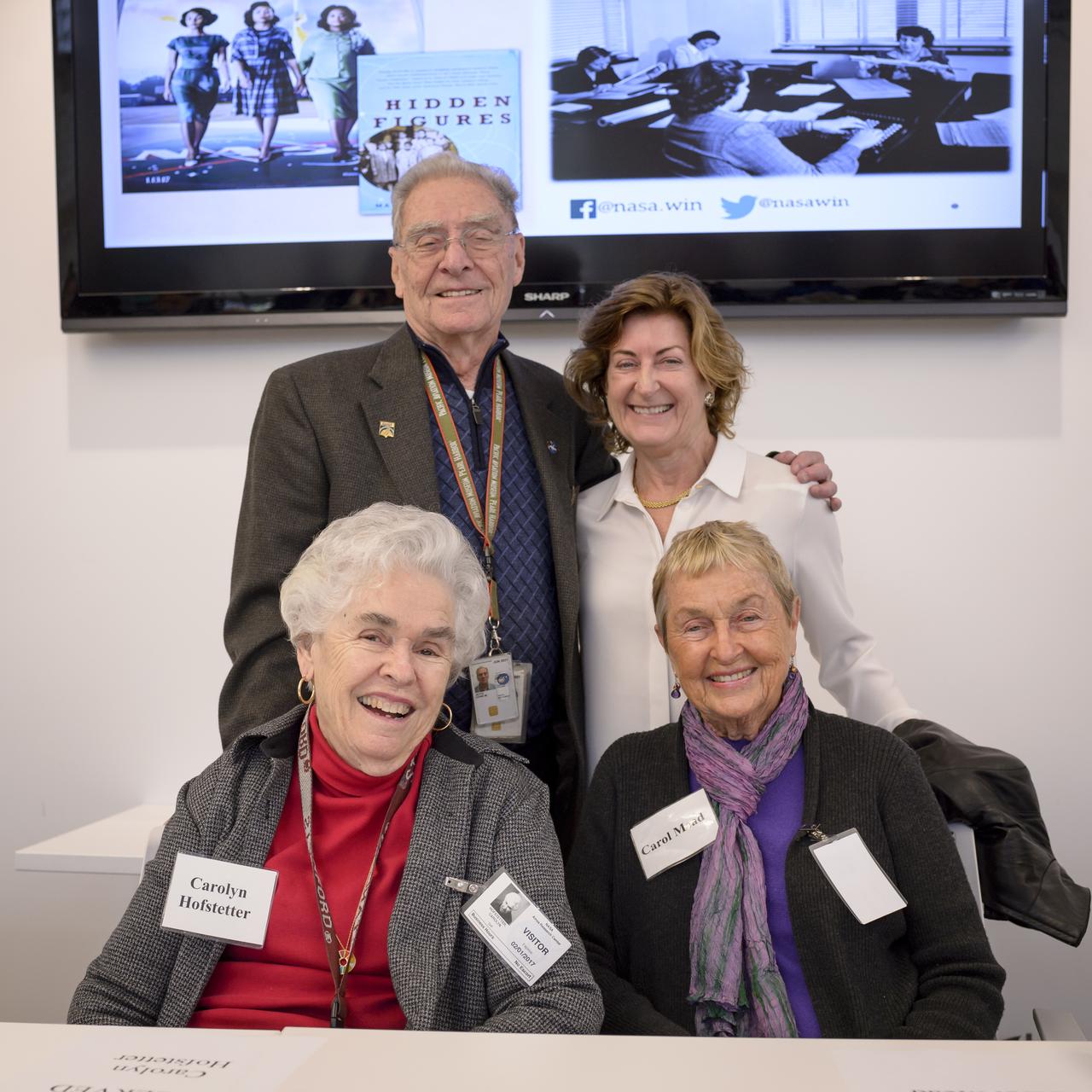
Ames Women's Influence Network (WIN) Hidden Figures talk with "Computers" Carolyn Hofsetter and Carol Mead co-sponsored by the AAAG. clockwise Jack Boyd, Miss Mead daughter of Carol Mead, Carol Mead and Carolyn Hofstetter
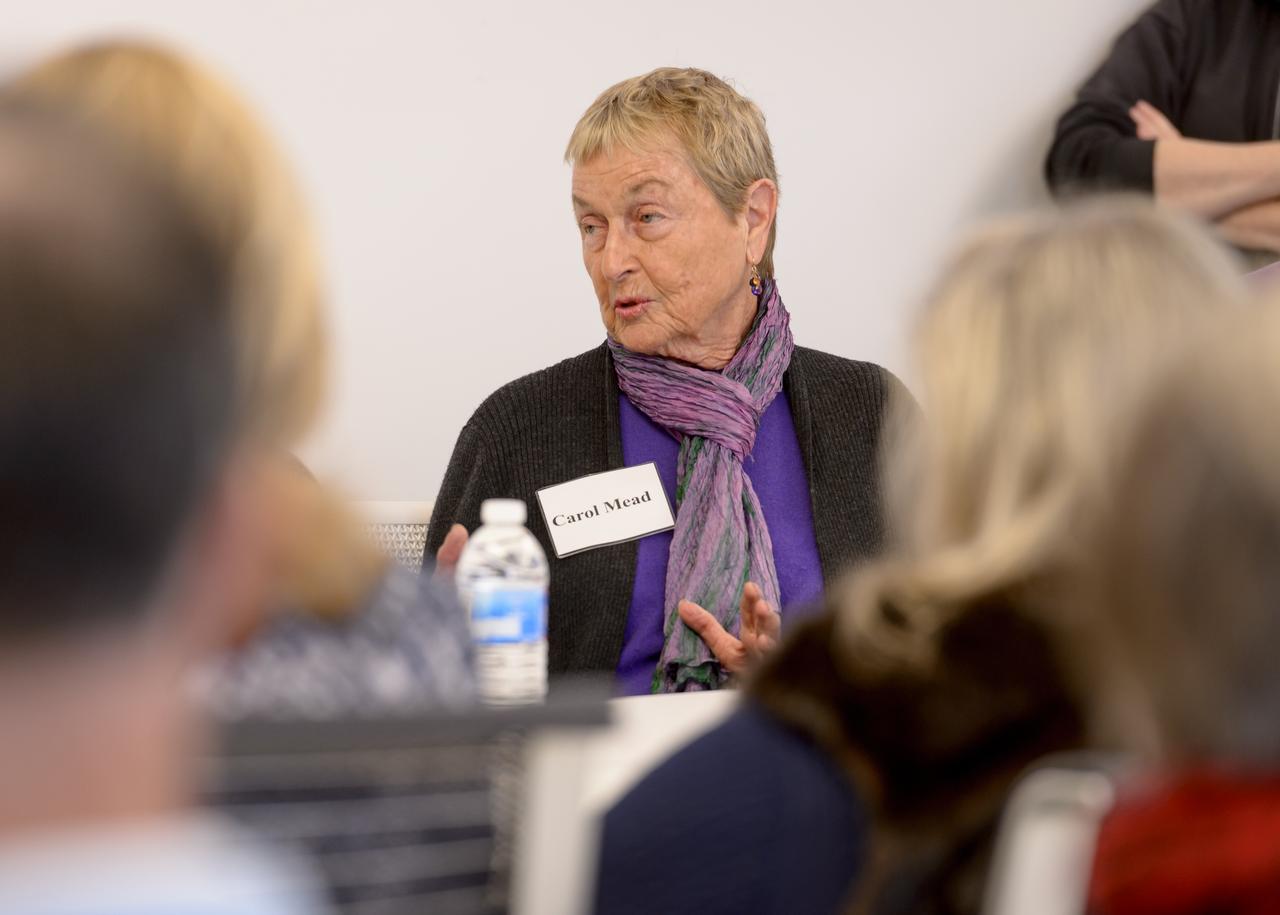
Ames Women's Influence Network (WIN) Hidden Figures talk with "Computers" Carolyn Hofstetter and Carol Mead co-sponsored by the AAAG. Computer Carol Mead during Q& A
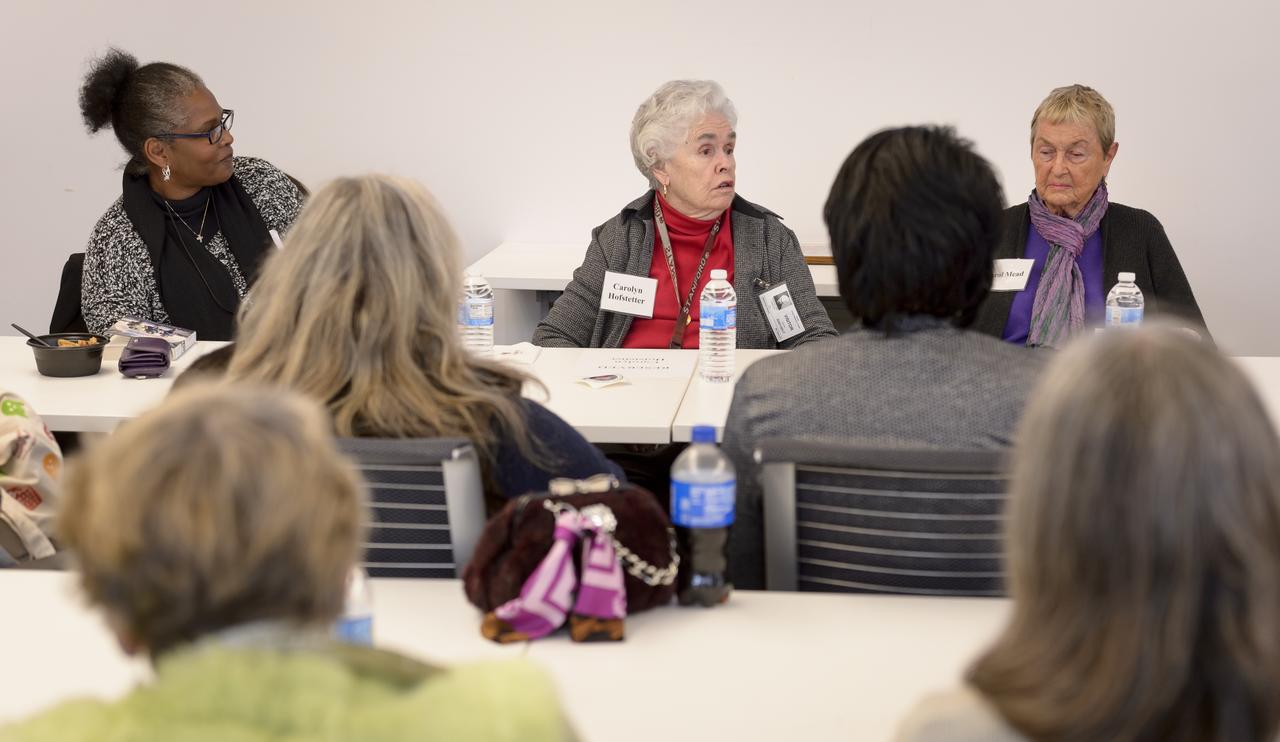
Ames Women's Influence Network (WIN) Hidden Figures talk with "Computers" Carolyn Hofstetter and Carol Mead co-sponsored by the AAAG. Left to right Barbara Miller, Ames EEO, Computers Carolyn Hofstetter and Carol Mead
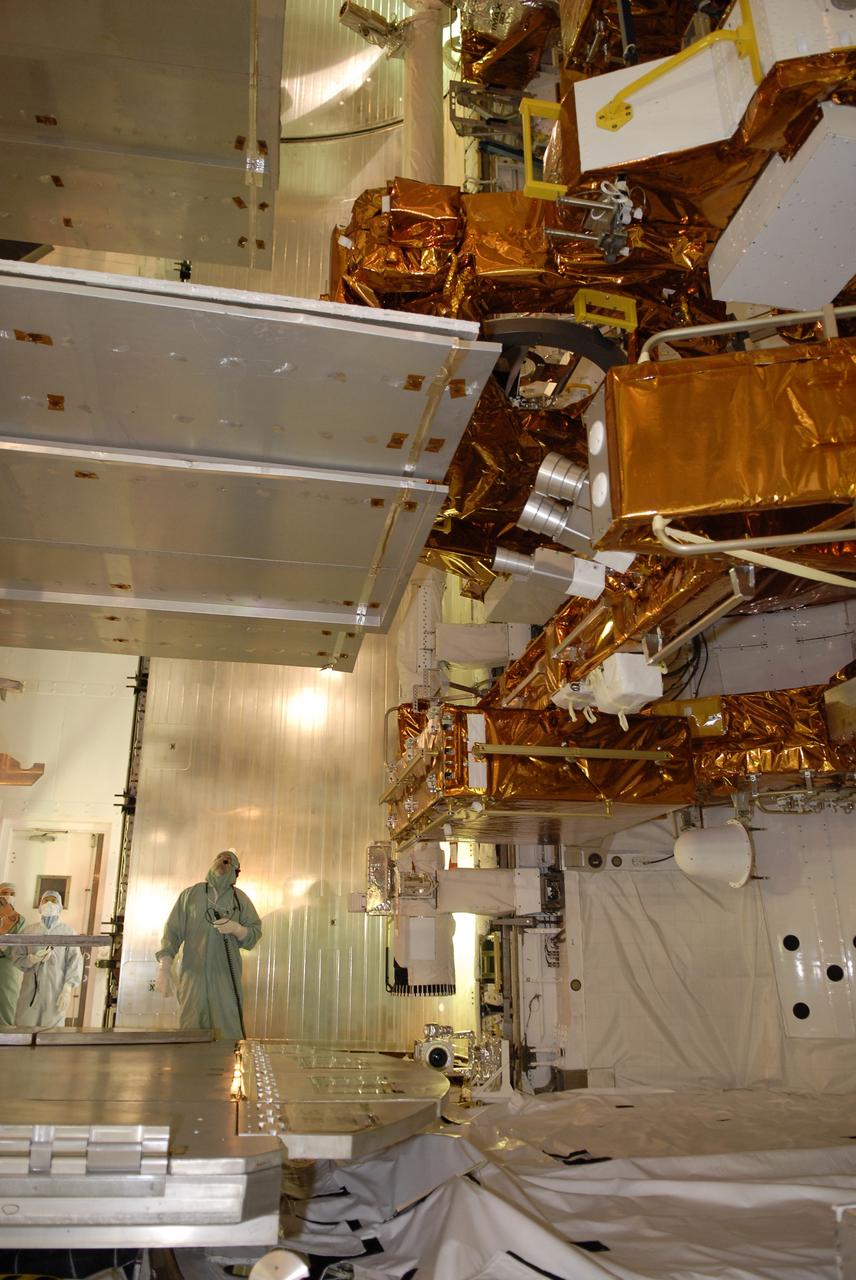
CAPE CANAVERAL, Fla. – On Launch Pad 39A at NASA's Kennedy Space Center in Florida, the payload ground-handling mechanism, known as the PGHM, is retracted after installing the payloads in space shuttle Atlantis' payload bay, at right, for the STS-125 mission. The payload includes the Flight Support System, or FSS, carrier with the Soft Capture Mechanism; the Multi-Use Lightweight Equipment, or MULE, carrier with the Science Instrument Command and Data Handling Unit, or SIC&DH; the Orbital Replacement Unit Carrier, or ORUC, with the Cosmic Origins Spectrograph, or COS, and an IMAX 3D camera. Atlantis' crew will service NASA's Hubble Space Telescope for the fifth and final time. The flight will include five spacewalks during which astronauts will refurbish and upgrade the telescope with state-of-the-art science instruments. As a result, Hubble's capabilities will be expanded and its operational lifespan extended through at least 2014. Photo credit: NASA/Kim Shiflett
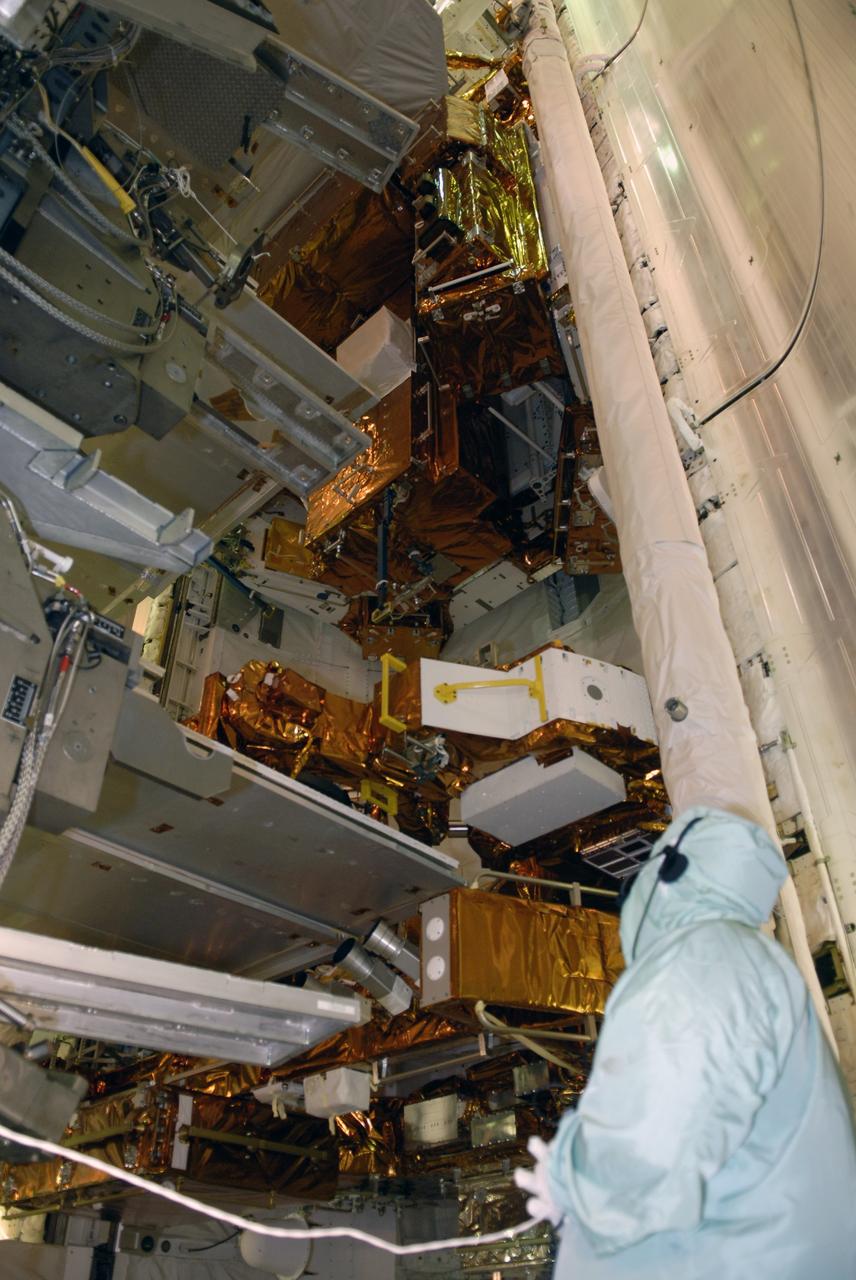
CAPE CANAVERAL, Fla. – On Launch Pad 39A at NASA's Kennedy Space Center in Florida, the payload ground-handling mechanism, known as the PGHM, is retracted after installing the payloads in space shuttle Atlantis' payload bay for the STS-125 mission. Seen here are the service platforms of the PGHM. The payload includes the Flight Support System, or FSS, carrier with the Soft Capture Mechanism; the Multi-Use Lightweight Equipment, or MULE, carrier with the Science Instrument Command and Data Handling Unit, or SIC&DH; the Orbital Replacement Unit Carrier, or ORUC, with the Cosmic Origins Spectrograph, or COS, and an IMAX 3D camera. Atlantis' crew will service NASA's Hubble Space Telescope for the fifth and final time. The flight will include five spacewalks during which astronauts will refurbish and upgrade the telescope with state-of-the-art science instruments. As a result, Hubble's capabilities will be expanded and its operational lifespan extended through at least 2014. Photo credit: NASA/Kim Shiflett
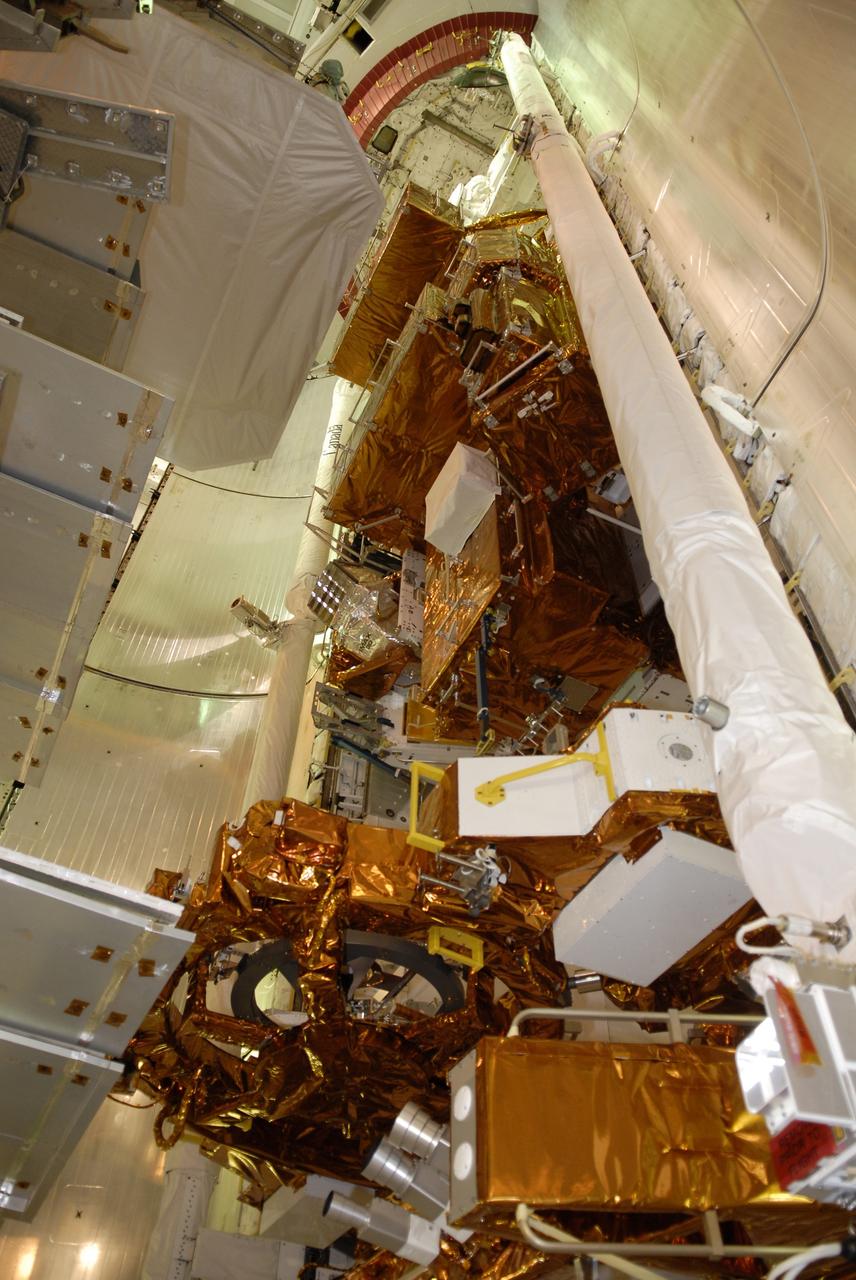
CAPE CANAVERAL, Fla. – On Launch Pad 39A at NASA's Kennedy Space Center in Florida, space shuttle Atlantis' payload bay is filled with hardware for the STS-125 mission to service NASA's Hubble Space Telescope. From the bottom are the Flight Support System with the Soft Capture mechanism and Multi-Use Lightweight Equipment Carrier with the Science Instrument Command and Data Handling Unit, or SIC&DH. At center is the Orbital Replacement Unit Carrier with the Cosmic Origins Spectrograph, or COS, and an IMAX 3D camera. At top is the Super Lightweight Interchangeable Carrier with the Wide Field Camera 3. Atlantis' crew will service NASA's Hubble Space Telescope for the fifth and final time. The flight will include five spacewalks during which astronauts will refurbish and upgrade the telescope with state-of-the-art science instruments. As a result, Hubble's capabilities will be expanded and its operational lifespan extended through at least 2014. Photo credit: NASA/Kim Shiflett
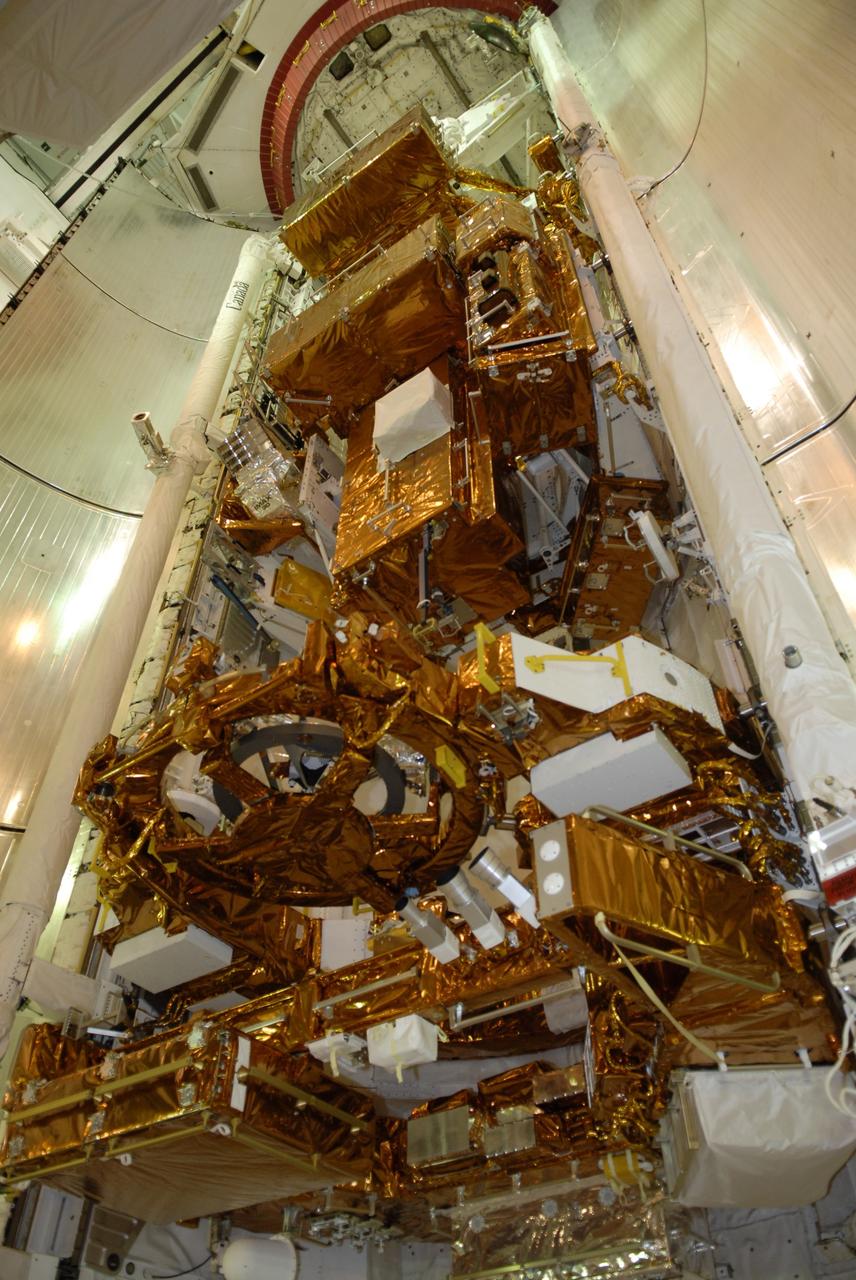
CAPE CANAVERAL, Fla. – On Launch Pad 39A at NASA's Kennedy Space Center in Florida, space shuttle Atlantis' payload bay is filled with hardware for the STS-125 mission to service NASA's Hubble Space Telescope. At the bottom are the Flight Support System with the Soft Capture mechanism and Multi-Use Lightweight Equipment Carrier with the Science Instrument Command and Data Handling Unit, or SIC&DH. At center is the Orbital Replacement Unit Carrier with the Cosmic Origins Spectrograph, or COS, and an IMAX 3D camera. At top is the Super Lightweight Interchangeable Carrier with the Wide Field Camera 3. Atlantis' crew will service NASA's Hubble Space Telescope for the fifth and final time. The flight will include five spacewalks during which astronauts will refurbish and upgrade the telescope with state-of-the-art science instruments. As a result, Hubble's capabilities will be expanded and its operational lifespan extended through at least 2014. Photo credit: NASA/Kim Shiflett

CAPE CANAVERAL, Fla. – On Launch Pad 39A at NASA's Kennedy Space Center in Florida, space shuttle Atlantis' payload bay is filled with hardware for the STS-125 mission to service NASA's Hubble Space Telescope. From the bottom are the Flight Support System with the Soft Capture mechanism and Multi-Use Lightweight Equipment Carrier with the Science Instrument Command and Data Handling Unit, or SIC&DH; the Orbital Replacement Unit Carrier with the Cosmic Origins Spectrograph, or COS, and an IMAX 3D camera; and the Super Lightweight Interchangeable Carrier with the Wide Field Camera 3. Atlantis' crew will service NASA's Hubble Space Telescope for the fifth and final time. The flight will include five spacewalks during which astronauts will refurbish and upgrade the telescope with state-of-the-art science instruments. As a result, Hubble's capabilities will be expanded and its operational lifespan extended through at least 2014. Photo credit: NASA/Kim Shiflett
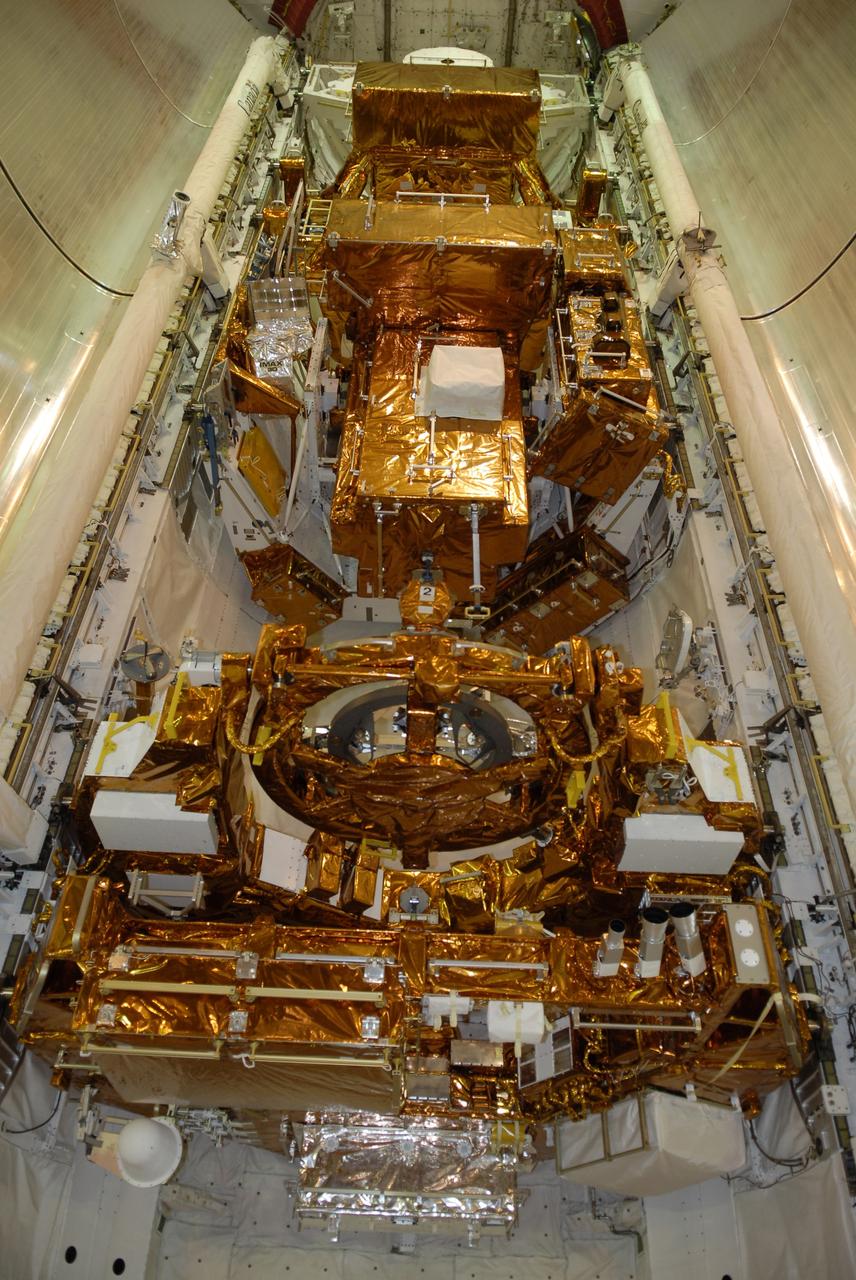
CAPE CANAVERAL, Fla. – On Launch Pad 39A at NASA's Kennedy Space Center in Florida, space shuttle Atlantis' payload bay is filled with hardware for the STS-125 mission to service NASA's Hubble Space Telescope. At the bottom is the Flight Support System with the Soft Capture mechanism. At center is the Orbital Replacement Unit Carrier with the Cosmic Origins Spectrograph, or COS, and an IMAX 3D camera. At top is the Super Lightweight Interchangeable Carrier with the Wide Field Camera 3. Atlantis' crew will service NASA's Hubble Space Telescope for the fifth and final time. The flight will include five spacewalks during which astronauts will refurbish and upgrade the telescope with state-of-the-art science instruments. As a result, Hubble's capabilities will be expanded and its operational lifespan extended through at least 2014. Photo credit: NASA/Kim Shiflett
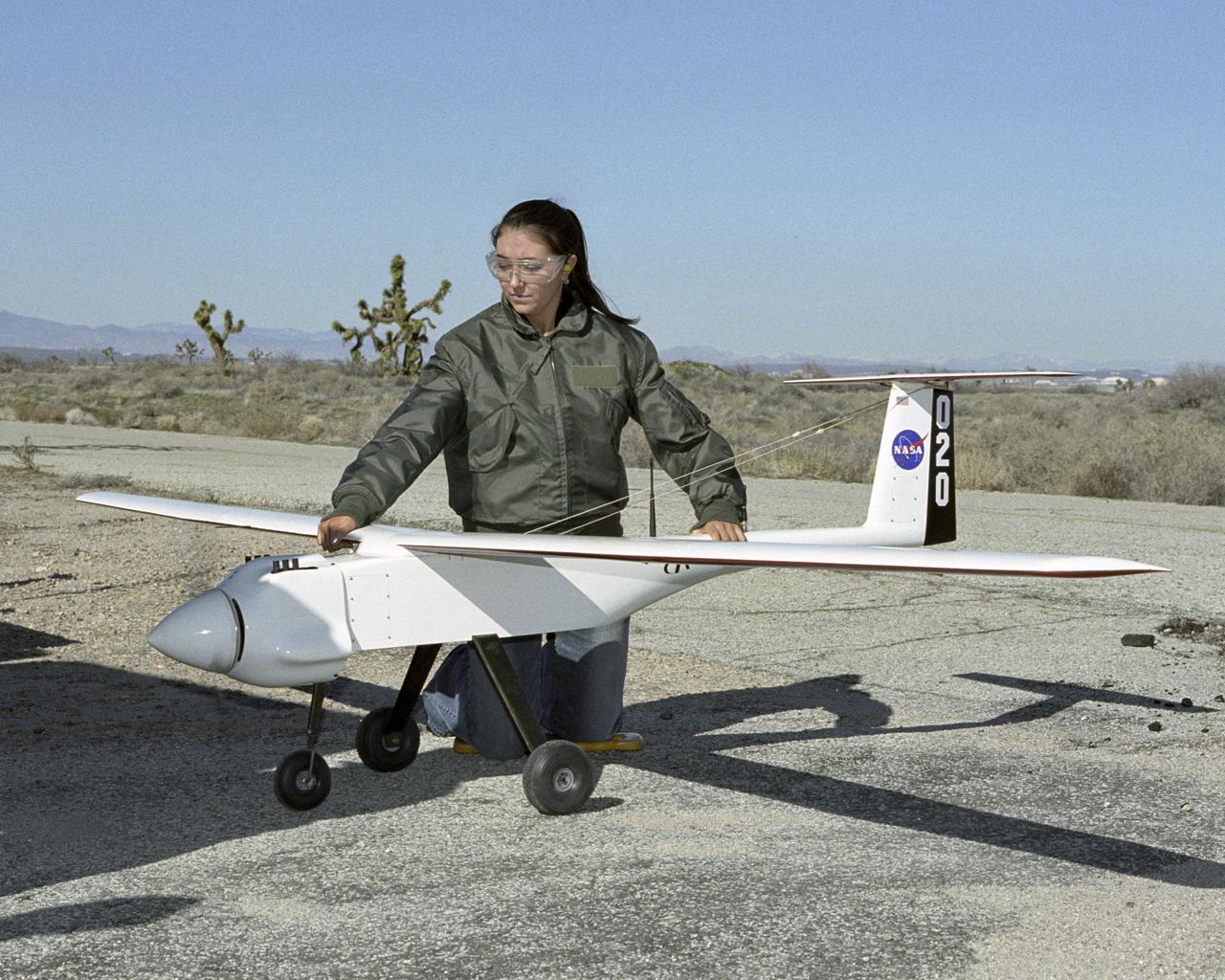
NASA Dryden Operations co-op student Shannon Kolensky holds one of the APV-3 UAVs flown in the Networked UAV Teaming Experiment steady during an engine runup.
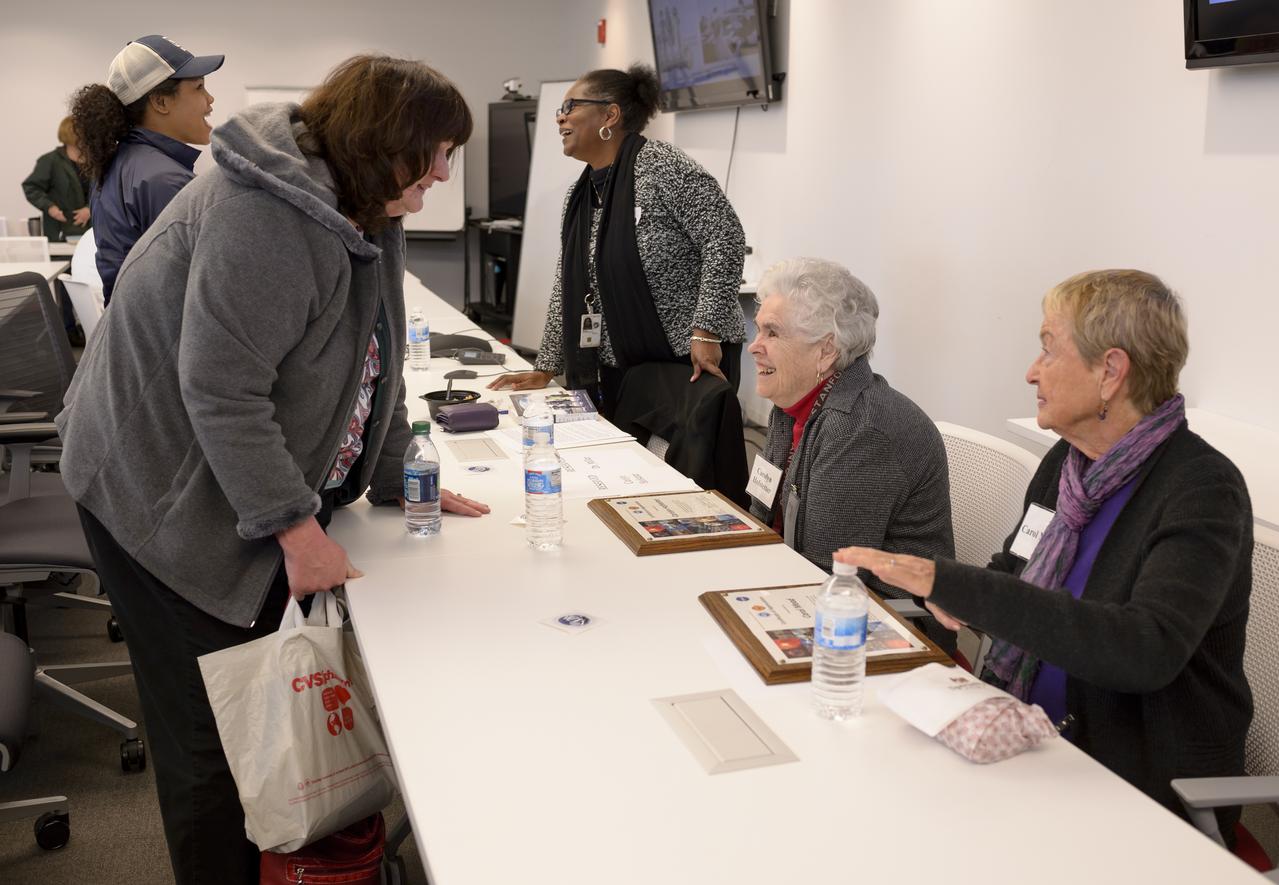
Ames Women's Influence Network (WIN) Hidden Figures talk with "Computers" Carolyn Hofstetter and Carol Mead co-sponsored by the AAAG. Left to right Barbara Miller, Ames EEO, Computers Carolyn Hoffstetter and Carol Mead, talking to Carolyn Hofstetter is Arlene Spencer
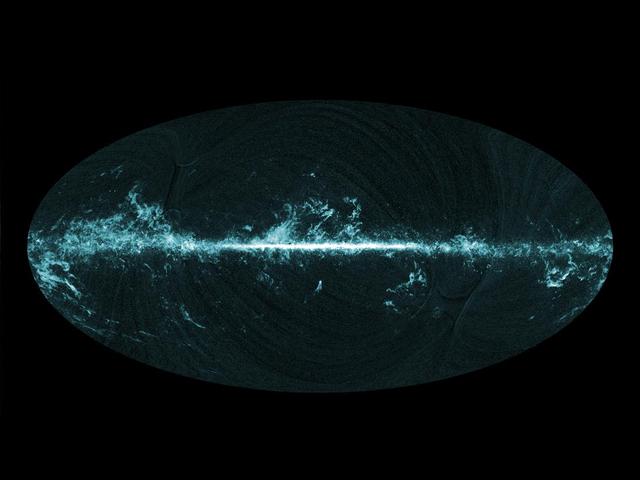
This all-sky image shows the distribution of carbon monoxide CO, a molecule used by astronomers to trace molecular clouds across the sky, as seen by Planck.
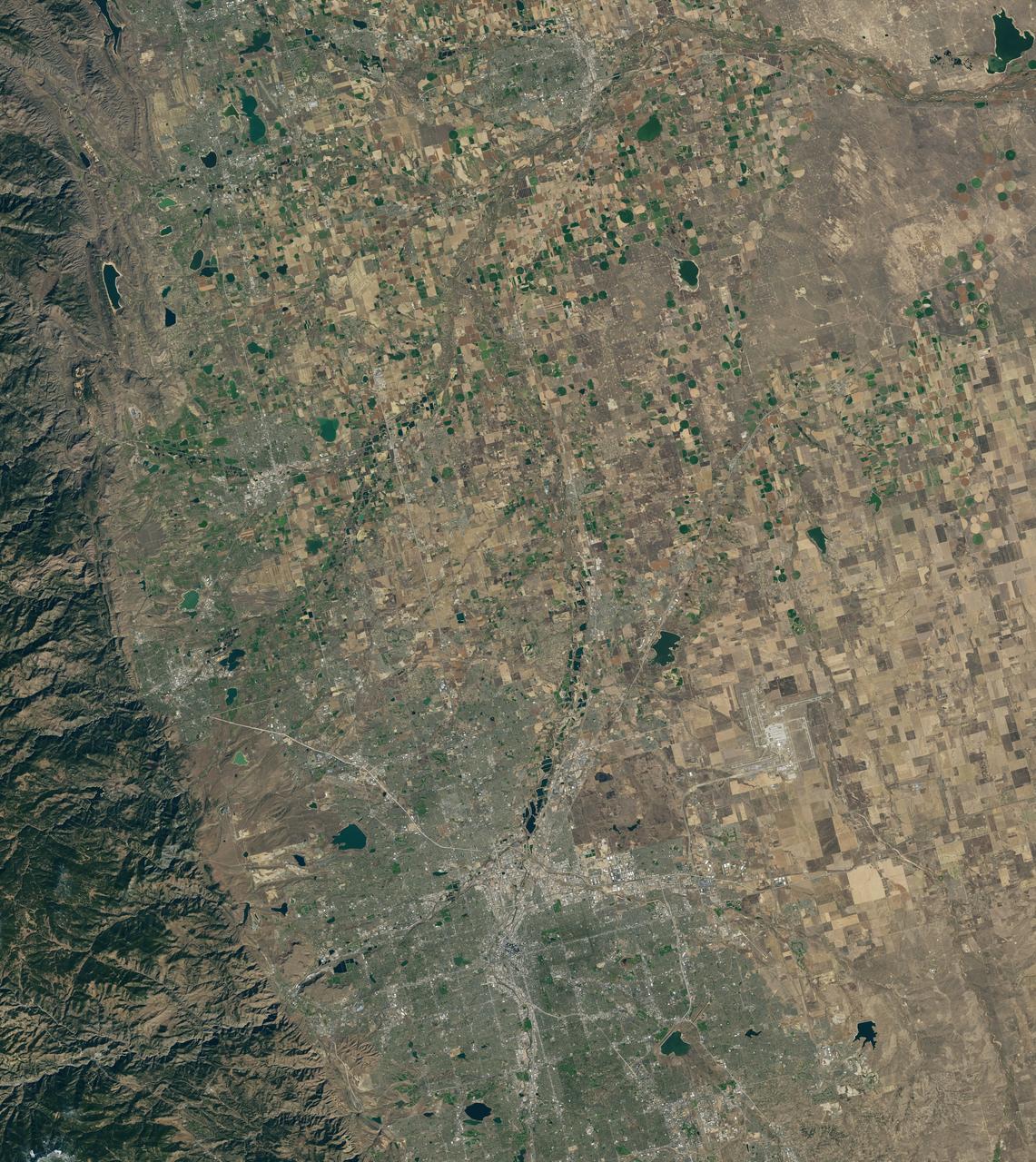
Landsat 7 image of Denver area acquired Nov 3, 2015. Landsat 7 is a U.S. satellite used to acquire remotely sensed images of the Earth's land surface and surrounding coastal regions. It is maintained by the Landsat 7 Project Science Office at the NASA Goddard Space Flight Center in Greenbelt, MD...Landsat satellites have been acquiring images of the Earth’s land surface since 1972. Currently there are more than 2 million Landsat images in the National Satellite Land Remote Sensing Data Archive. For more information visit: <a href="http://landsat.usgs.gov/" rel="nofollow">landsat.usgs.gov/</a>..To learn more about the Landsat satellite go to:.<a href="http://landsat.gsfc.nasa.gov/" rel="nofollow">landsat.gsfc.nasa.gov/</a> Credit: NASA/GSFC/Landsat 7 <b><a href="http://www.nasa.gov/audience/formedia/features/MP_Photo_Guidelines.html" rel="nofollow">NASA image use policy.</a></b> <b><a href="http://www.nasa.gov/centers/goddard/home/index.html" rel="nofollow">NASA Goddard Space Flight Center</a></b> enables NASA’s mission through four scientific endeavors: Earth Science, Heliophysics, Solar System Exploration, and Astrophysics. Goddard plays a leading role in NASA’s accomplishments by contributing compelling scientific knowledge to advance the Agency’s mission. <b>Follow us on <a href="http://twitter.com/NASAGoddardPix" rel="nofollow">Twitter</a></b> <b>Like us on <a href="http://www.facebook.com/pages/Greenbelt-MD/NASA-Goddard/395013845897?ref=tsd" rel="nofollow">Facebook</a></b> <b>Find us on <a href="http://instagrid.me/nasagoddard/?vm=grid" rel="nofollow">Instagram</a></b>
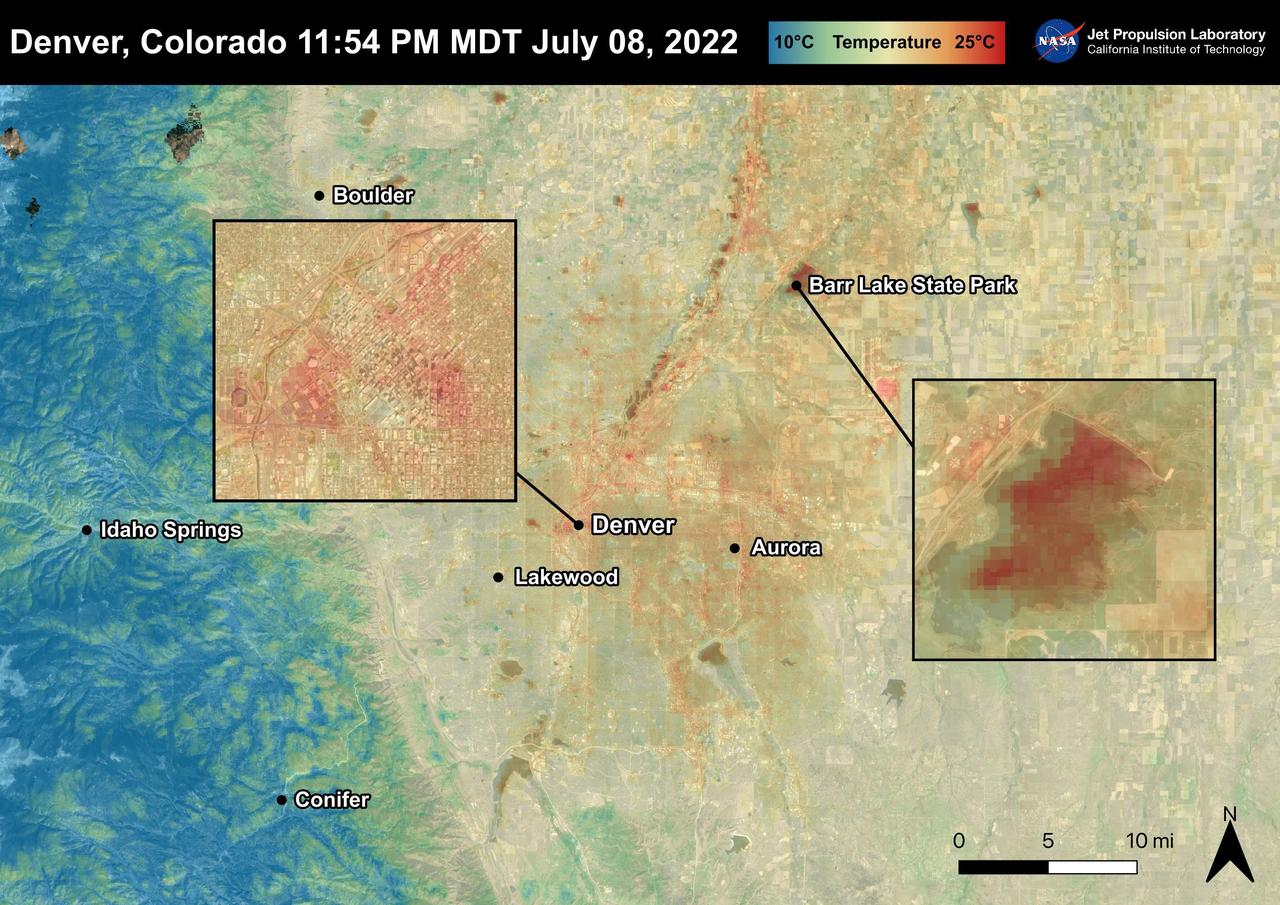
Denver, Colorado reached 96 degrees Fahrenheit on July 8th, 2022. In the two days following, temperatures rose to 101 degrees Fahrenheit. For cities like Denver, heat dissipates more slowly and create urban heat islands. High temperatures due to urban heat, especially at night, can lead to adverse health effects in vulnerable populations like children and the elderly. This image also shows that bodies of water, like Barr Lake, remain warm into the night due to water's high heat capacity. ECOSTRESS captured this Land Surface Temperature image on July 8th, 2022 at 11:54 PM MDT. ECOSTRESS is a thermal instrument on the International Space Station that measures the temperature of the ground, which is hotter than the air temperature during the day. It was launched to the space station in 2018. Its primary mission is to identify critical thresholds of water use and water stress in plants and to detect the timing, location, and predictive factors leading to plant water uptake decline and/or cessation. The nature of the high-resolution data provided by ECOSTRESS allows it to record heat related phenomena such as heat waves and wildfires. https://photojournal.jpl.nasa.gov/catalog/PIA25483
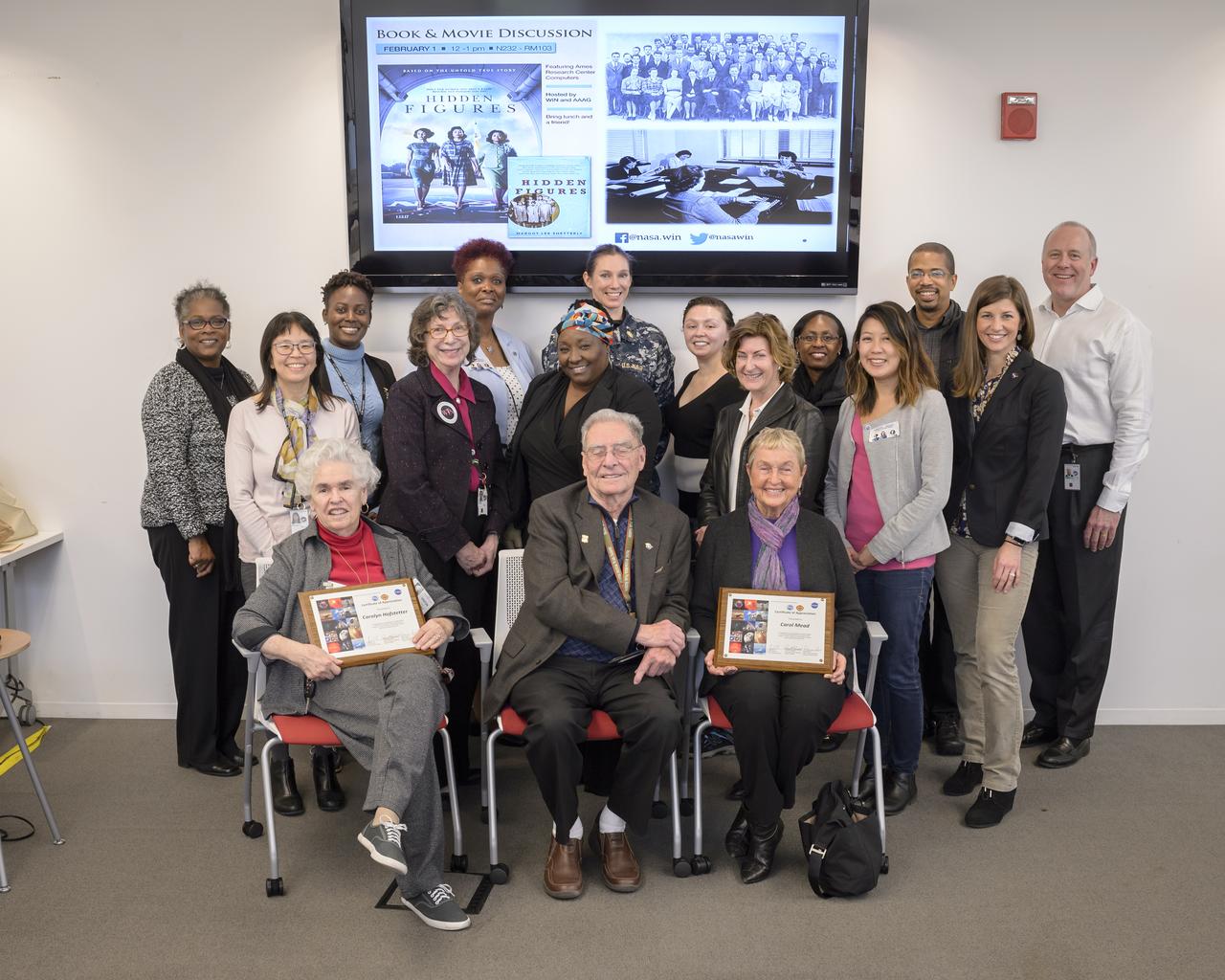
Ames Women's Influence Network (WIN) Hidden Figures talk with "Computers" Carolyn Hofstetter and Carol Mead co-sponsored by the AAAG. Group photo Front Row left to right; Carolyn Hofstetter, Jack Boyd, Carol Mead Middle Row: Kathy Lee, Annette Randall, Trincella Lewis, Ann Mead (daughter to Carol Mead), Vanessa Kuroda, Netti Halcomb Roozeboom Back Row; Dr Barbara Miller, Dr Wendy Okolo, Denise Snow, Leedjia Svec, Erika Rodriquez, Rhonda Baker, Ray Gilstrap, Glenn Bugos
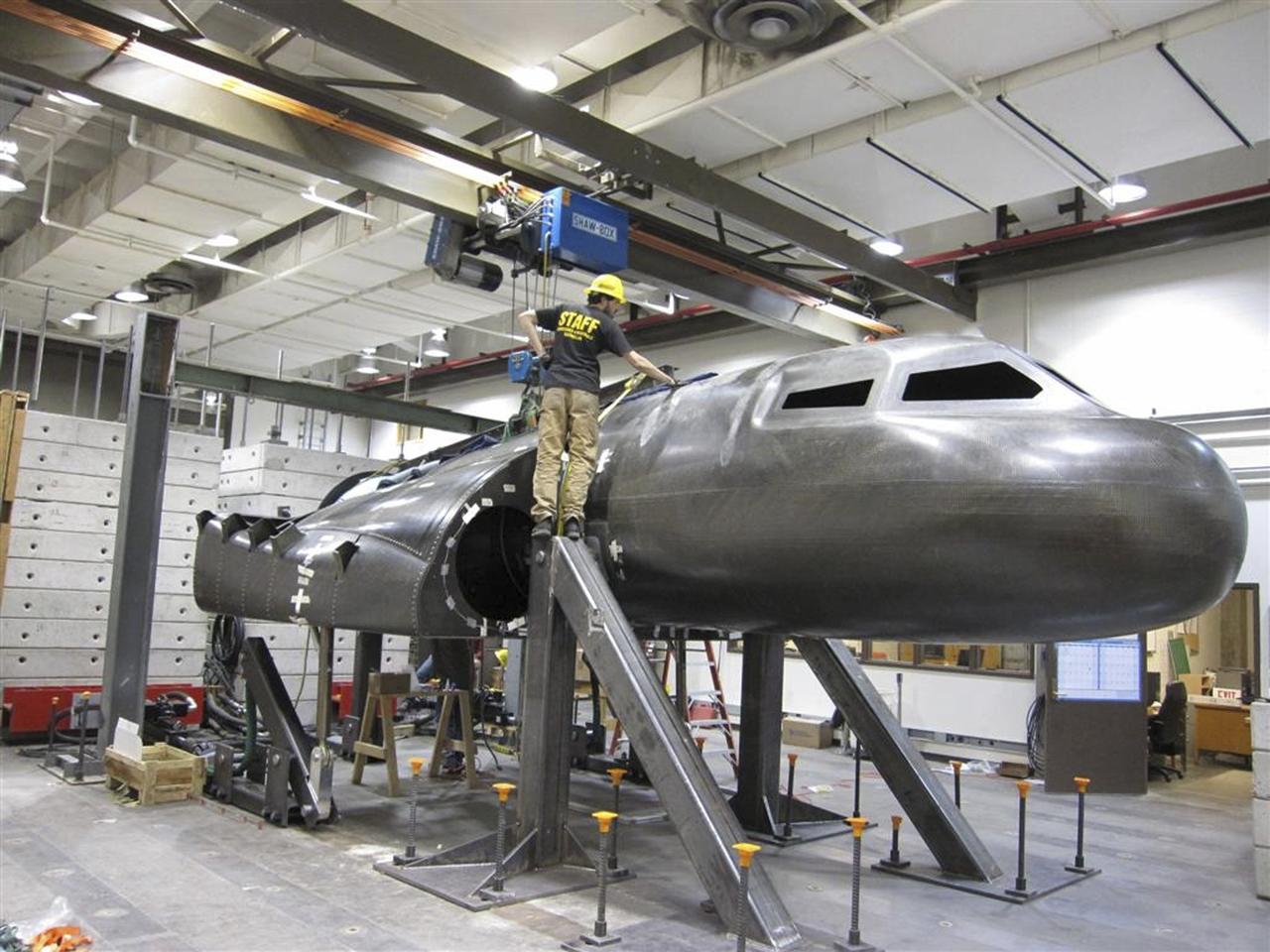
BOULDER, Colo. – A Sierra Nevada Corp. team member examines the company's structural test article for the Dream Chaser spacecraft in the University of Colorado at Boulder’s Facility for Advanced Spatial Technology. The university is one of Sierra Nevada’s partners on the design and development of the Dream Chaser orbital crew vehicle. Dream Chaser is one of five systems NASA invested in during Commercial Crew Development Round 1 CCDev1 activities in order to aid in the innovation and development of American-led commercial capabilities for crew transportation and rescue services to and from the International Space Station and other low Earth orbit destinations. In 2011, NASA's Commercial Crew Program CCP entered into another funded Space Act Agreement with Sierra Nevada for the second round of commercial crew development CCDev2) so the company could further develop its Dream Chaser spacecraft for NASA transportation services. For information about CCP, visit www.nasa.gov/commercialcrew. Photo credit: Sierra Nevada Corp.

LOUISVILLE, Colo. – During NASA's Commercial Crew Development Round 2 CCDev2) activities for the Commercial Crew Program CCP, Sierra Nevada Corp. SNC built a Simulator and Avionics Laboratory to help engineers evaluate the Dream Chaser's characteristics during the piloted phases of flight. Located at Sierra Nevada’s Space Systems facility in Louisville, Colo., it consists of a physical cockpit and integrated simulation hardware and software. The simulator is linked to the Vehicle Avionics Integration Laboratory, or VAIL, which serves as a platform for Dream Chaser avionics development, engineering testing and integration. VAIL also will also be used for verification and validation of avionics and software. Sierra Nevada is one of seven companies NASA entered into Space Act Agreements SAAs with during CCDev2 to aid in the innovation and development of American-led commercial capabilities for crew transportation and rescue services to and from the International Space Station and other low Earth orbit destinations. For information about CCP, visit www.nasa.gov/commercialcrew. Photo credit: Sierra Nevada Corp.

Rod Coil Co-polymer Technology
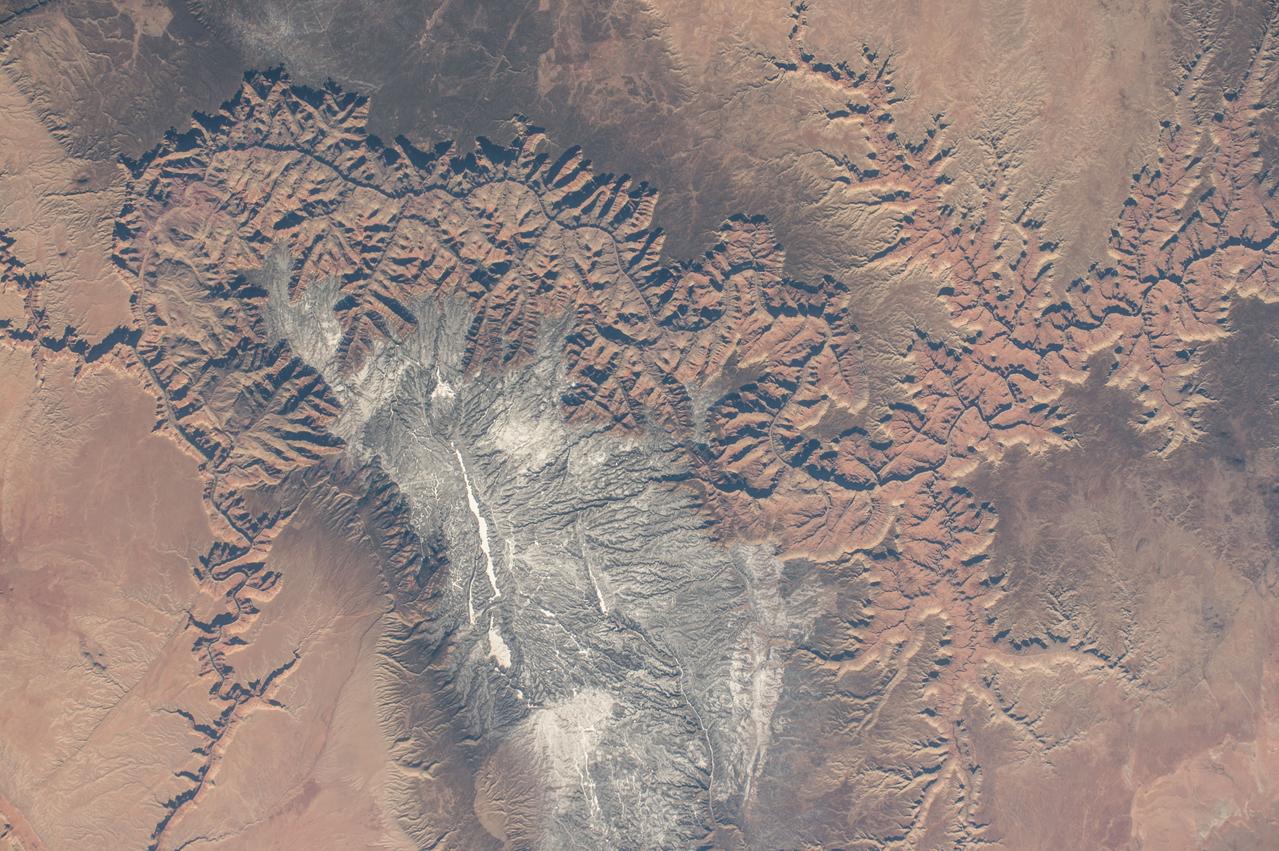
GMT357_21_03_Terry Virts_CA AZ CO zoom_129
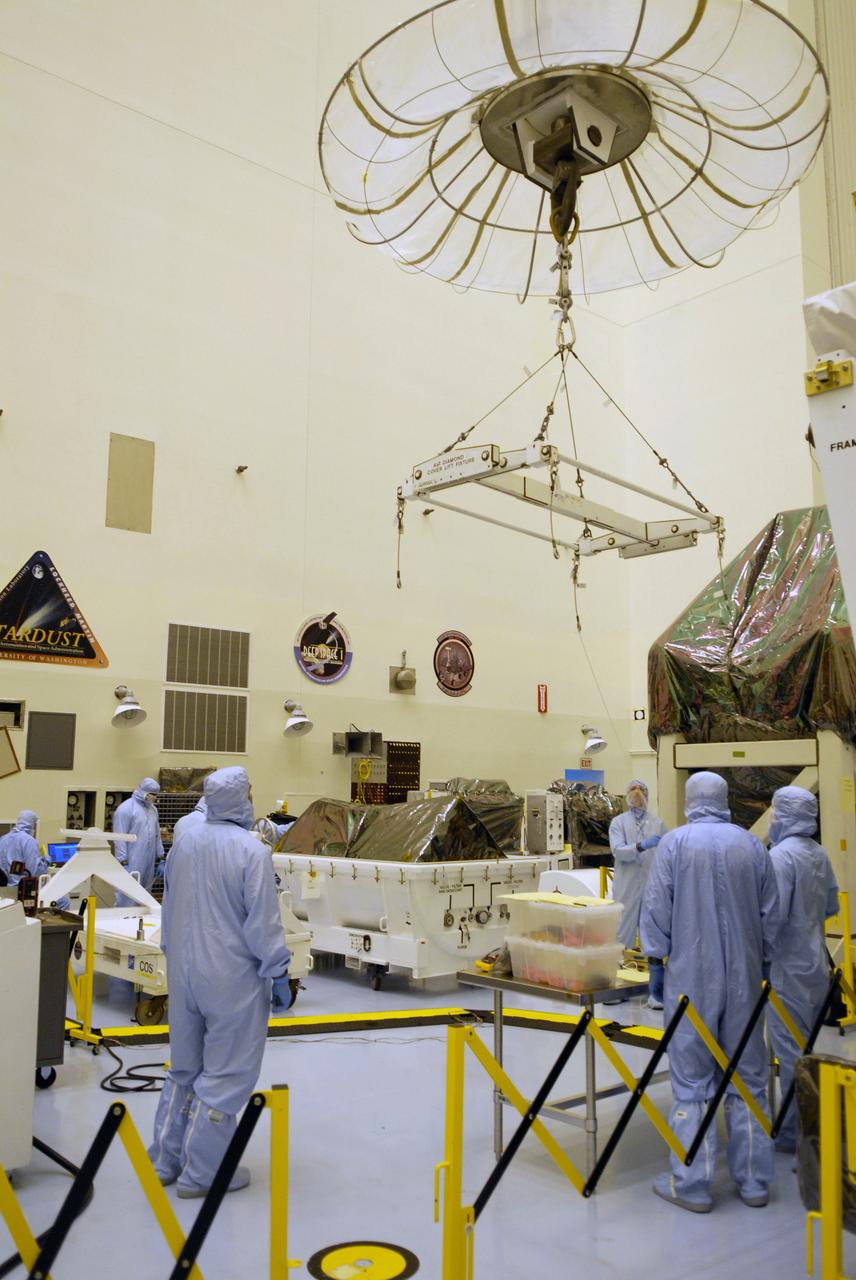
CAPE CANAVERAL, Fla. – In the Payload Hazardous Servicing Facility at NASA's Kennedy Space Center in Florida, a crane is moved to the shipping container with the Cosmic Origins Spectrograph, or COS, inside. The crane will remove the COS and place it on a test stand. The COS is part of the payload on space shuttle Atlantis for the Hubble servicing mission, targeted to launch in mid-May. Installing the COS during the mission will effectively restore spectroscopy to Hubble’s scientific arsenal, and at the same time provide the telescope with unique capabilities. COS is designed to study the large-scale structure of the universe and how galaxies, stars and planets formed and evolved. It will help determine how elements needed for life such as carbon and iron first formed and how their abundances have increased over the lifetime of the universe. Photo credit: NASA/Jack Pfaller
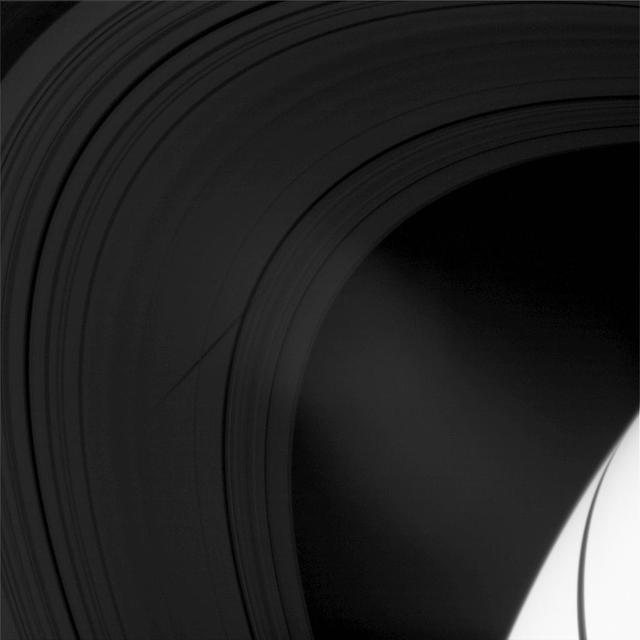
The shadow of the moon Epimetheus crosses Saturn rings in this image taken as the planet approached its August 2009 equinox.
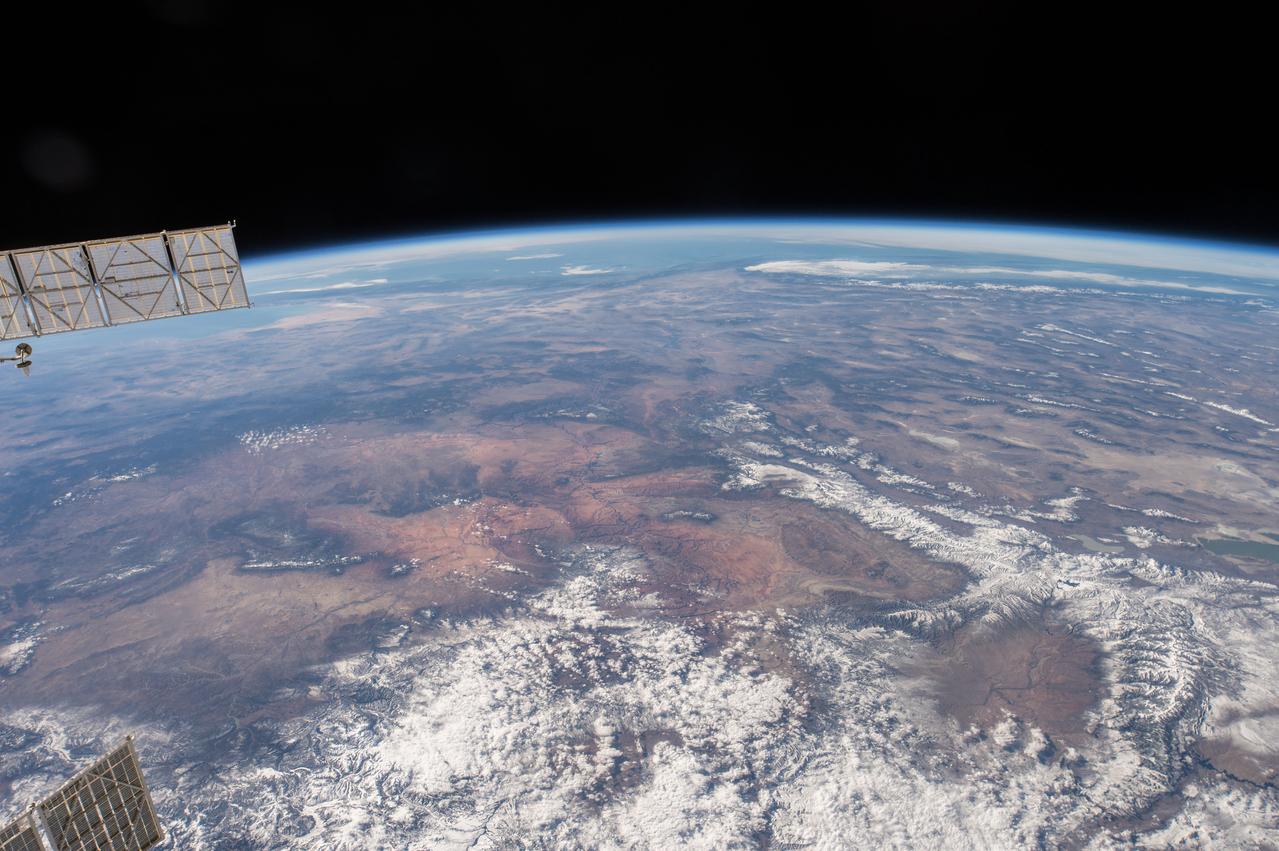
GMT357_21_00_Terry Virts_CA AZ CO day wide_123
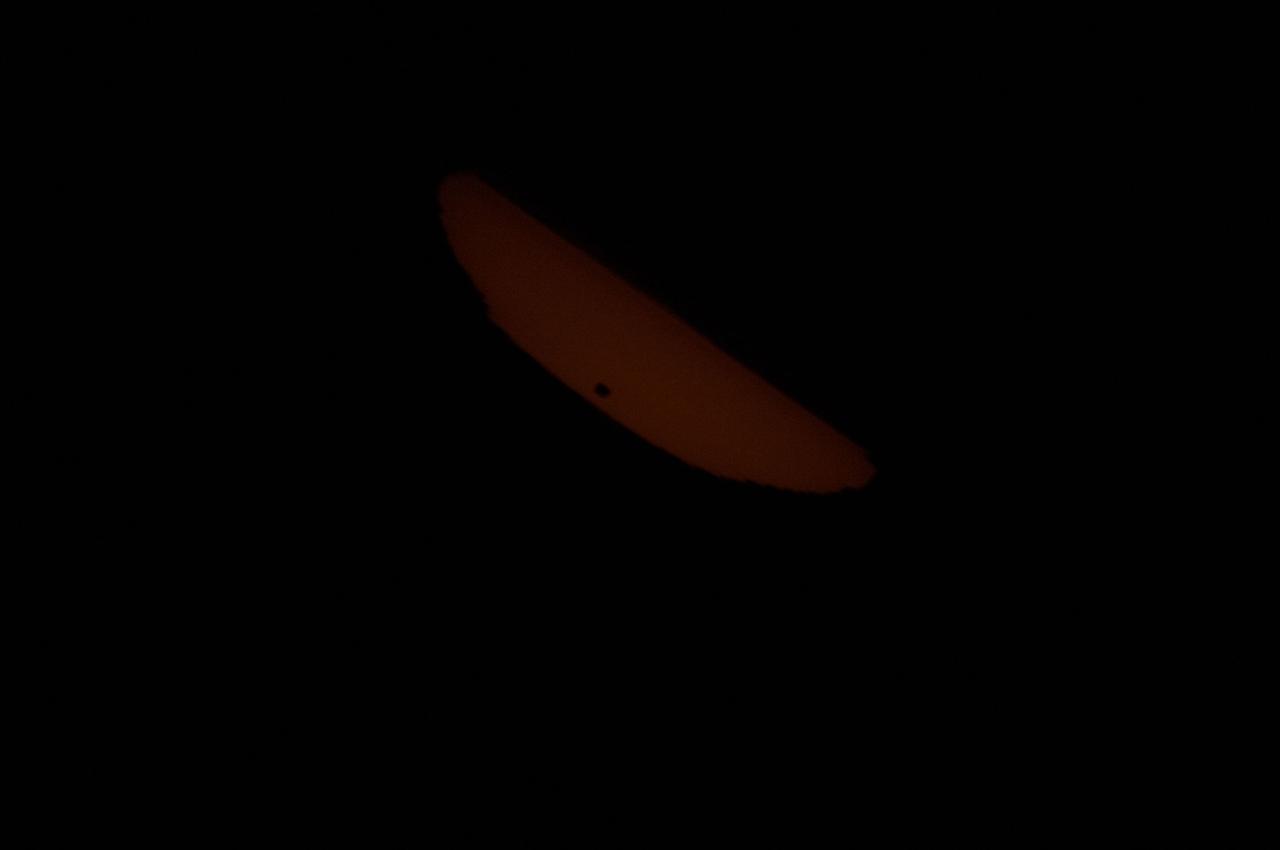
Transit of Venus as seen at 762nm in the CO Module.
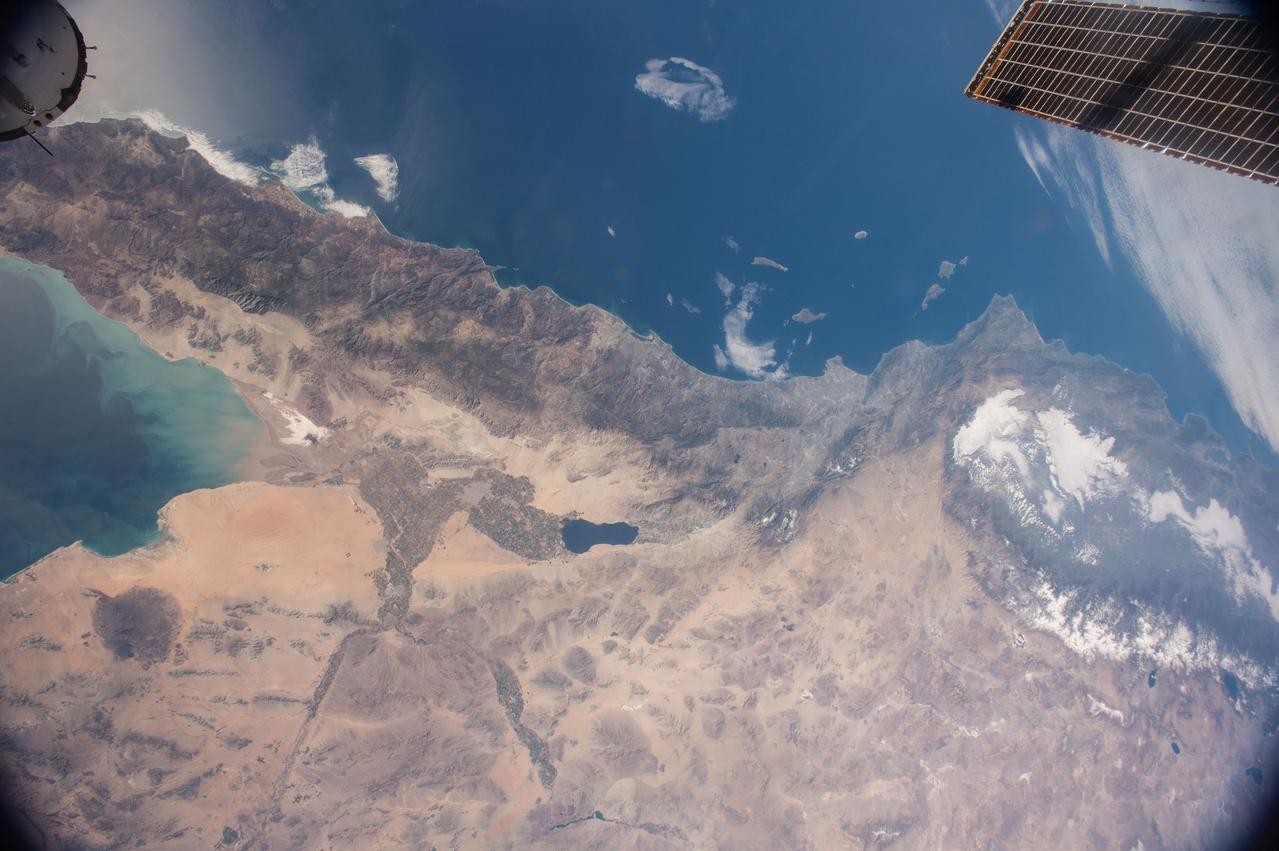
GMT357_21_00_Terry Virts_CA AZ CO day wide_123
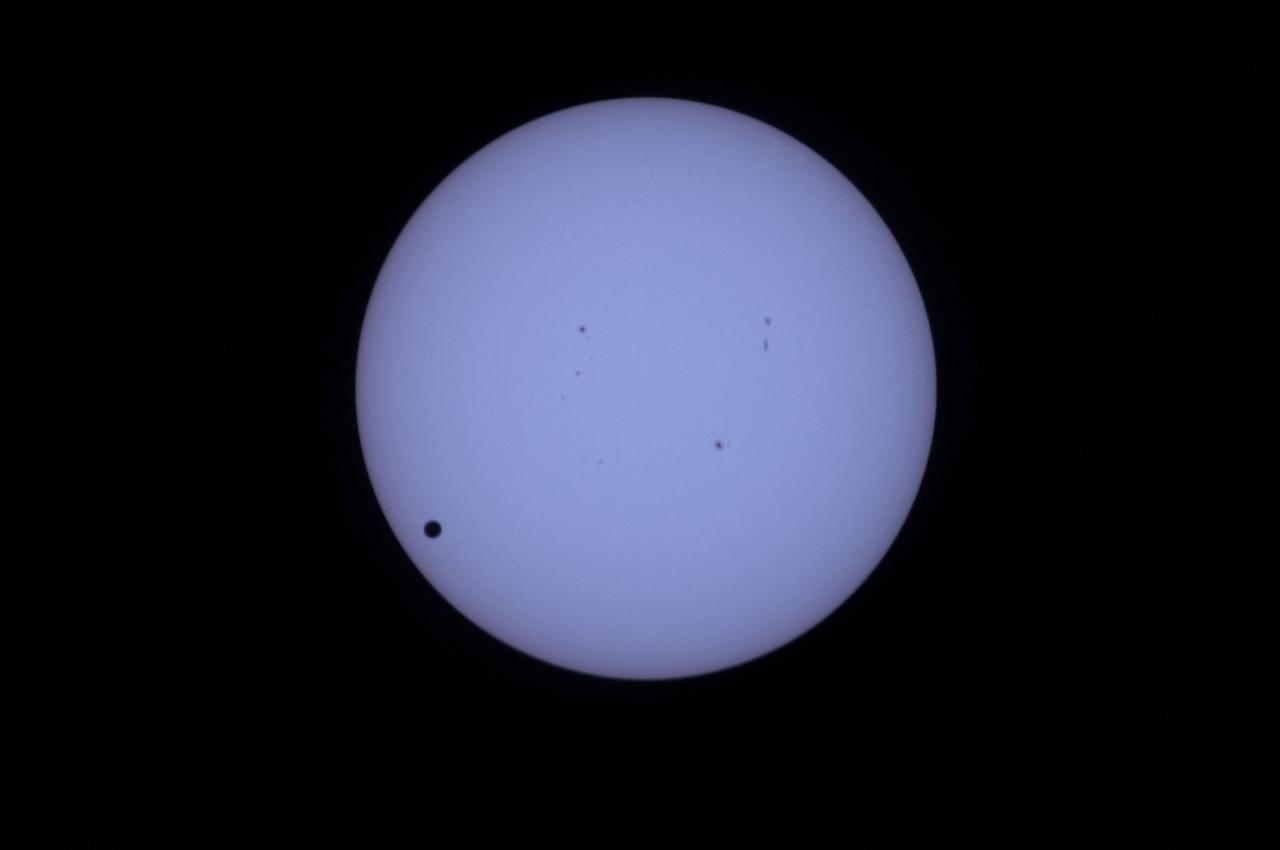
Transit of Venus as seen from the CO and Cupola Modules.
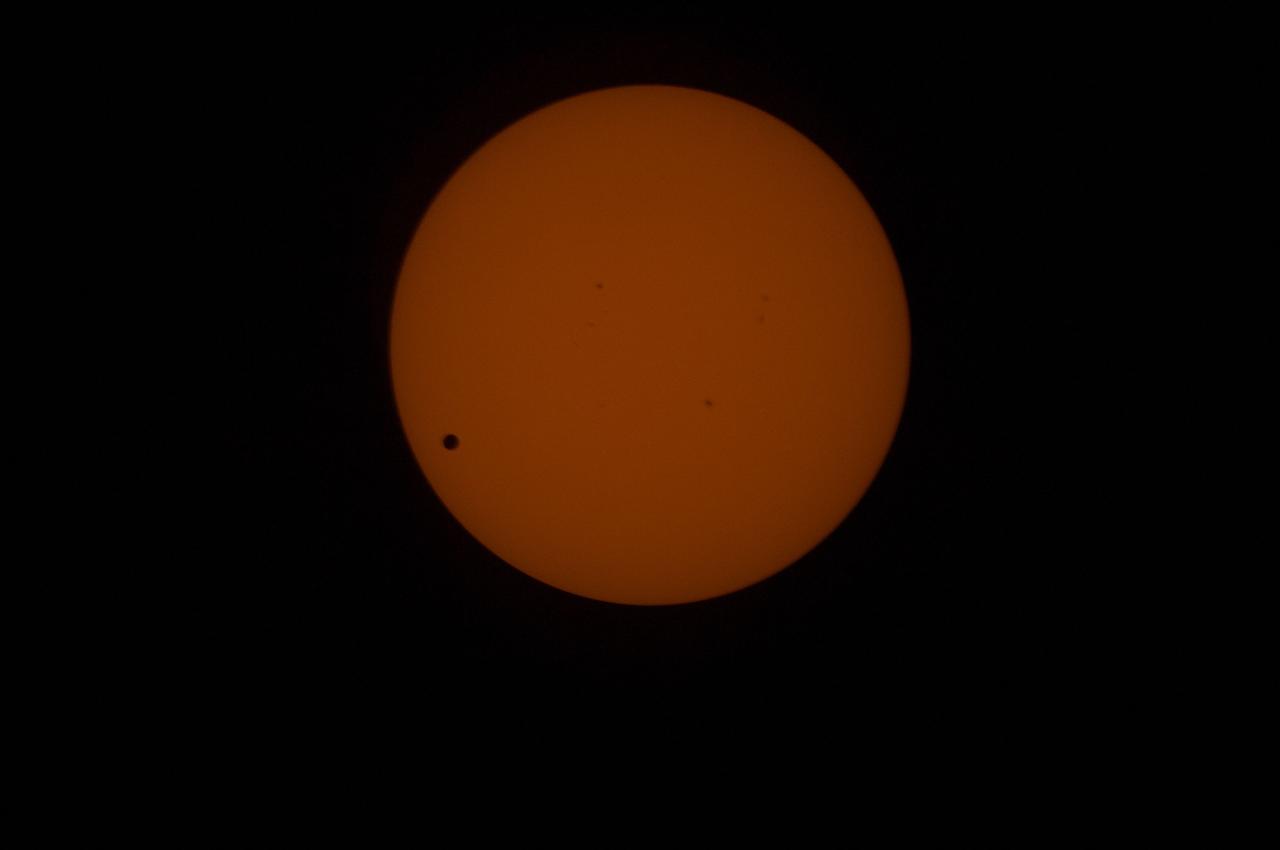
Transit of Venus as seen at 762nm in the CO Module.
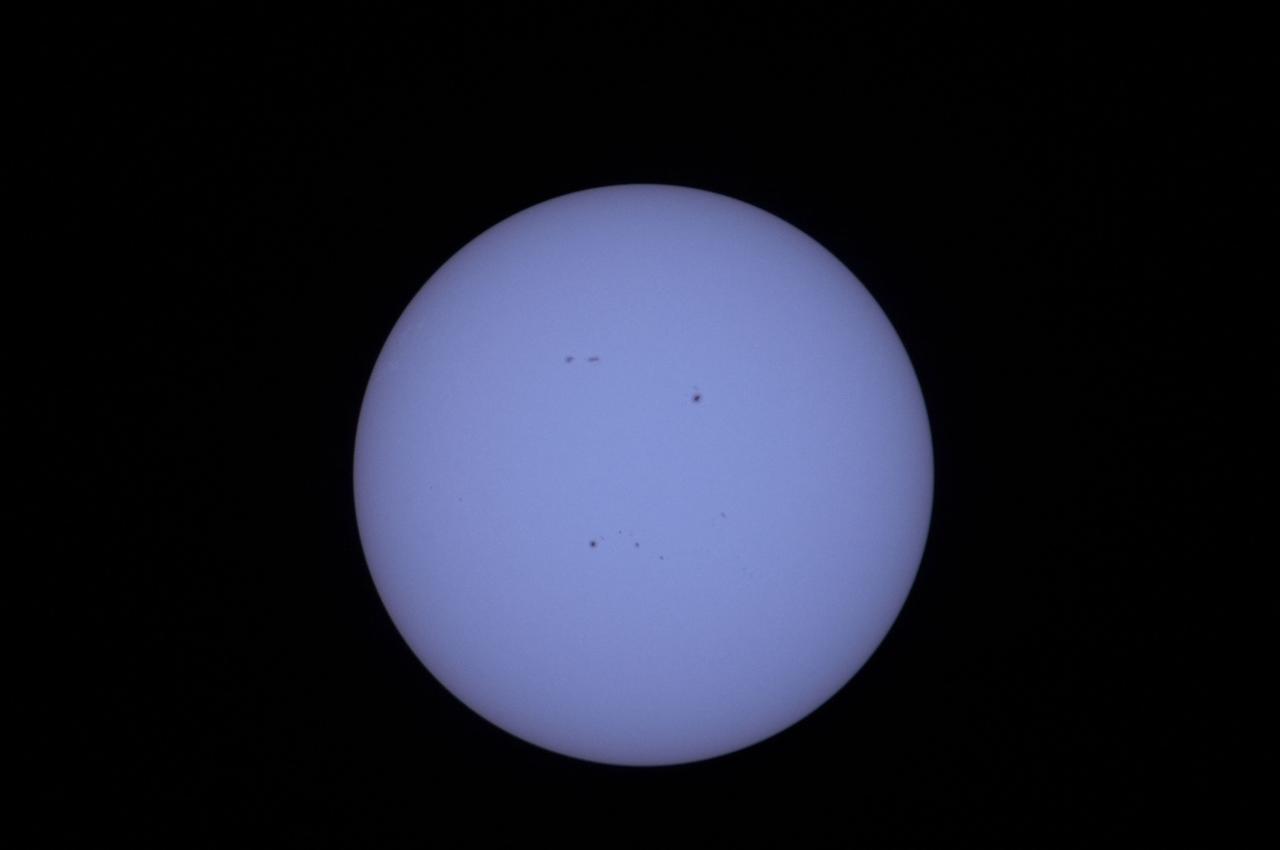
Transit of Venus as seen from the CO and Cupola Modules.
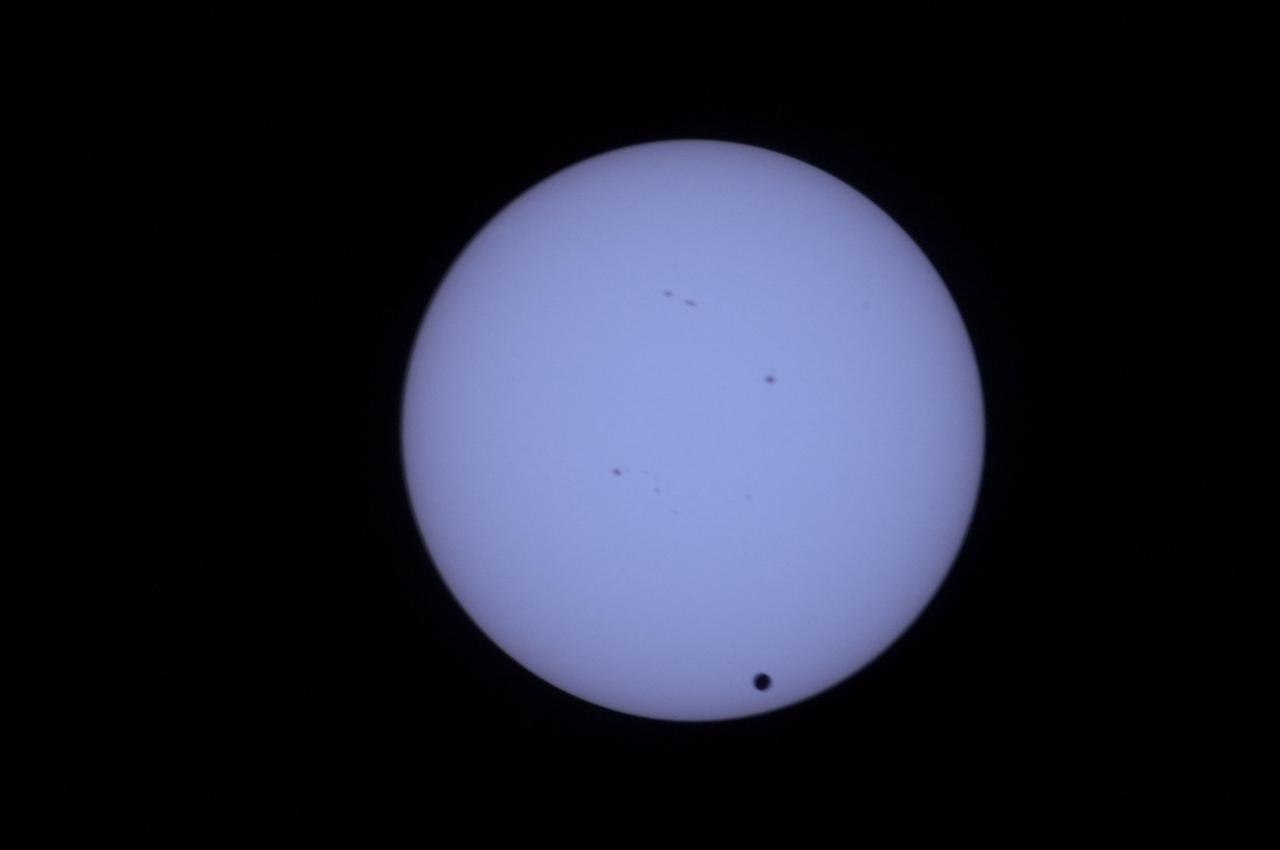
Transit of Venus as seen from the CO and Cupola Modules.

New Horizons co-investigator John Spencer of the Southwest Research Institute (SwRI), Boulder, CO, speaks about the flyby of Ultima Thule during an overview of the New Horizons Mission, Monday, Dec. 31, 2018 at Johns Hopkins University Applied Physics Laboratory (APL) in Laurel, Maryland. Photo Credit: (NASA/Joel Kowsky)