
S97-06573 (30 April 1997) --- Astronaut Franklin R. Chang-Diaz, mission specialist.
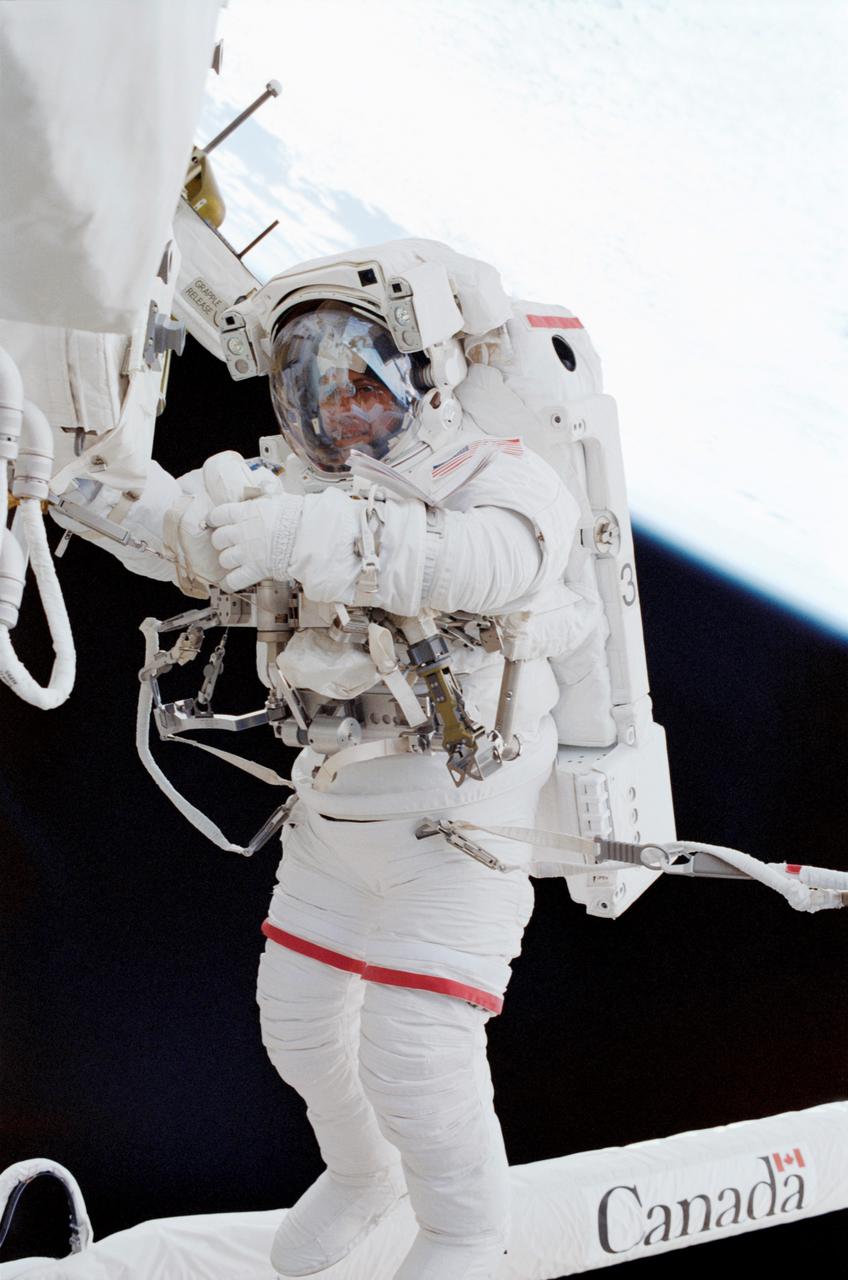
The STS-111 mission, the 14th Shuttle mission to visit the International Space Station (ISS), was launched on June 5, 2002 aboard the Space Shuttle Orbiter Endeavour. On board were the STS-111 and Expedition Five crew members. Astronauts Kerneth D. Cockrell, commander; Paul S. Lockhart, pilot; and mission specialists Franklin R. Chang-Diaz and Philippe Perrin were the STS-111 crew members. Expedition Five crew members included Cosmonaut Valery G. Korzun, commander; and Astronaut Peggy A. Whitson and Cosmonaut Sergei Y. Treschev, flight engineers. Three space walks enabled the STS-111 crew to accomplish the delivery and installation of the Mobile Remote Servicer Base System (MBS), an important part of the Station's Mobile Servicing System that allows the robotic arm to travel the length of the Station, which is necessary for future construction tasks. In this photograph, Astronaut Franklin R. Chang-Diaz participates in the first scheduled session of extra vehicular activity (EVA) for the STS-111 mission. During the space walk, Chang-Diaz and Perrin attached a Power and Data Grapple Fixture onto the ISS's P6 Truss, setting the stage for the future relocation of the P6. The next major task was to remove Service Module Debris Panels from Space Shuttle Endeavour's payload bay and attach them to their temporary location on Pressurized Mating Adapter 1 (PMA-1). The space walkers also removed thermal blankets to prepare the MBS for installation onto the station's Mobile Transporter (MT).
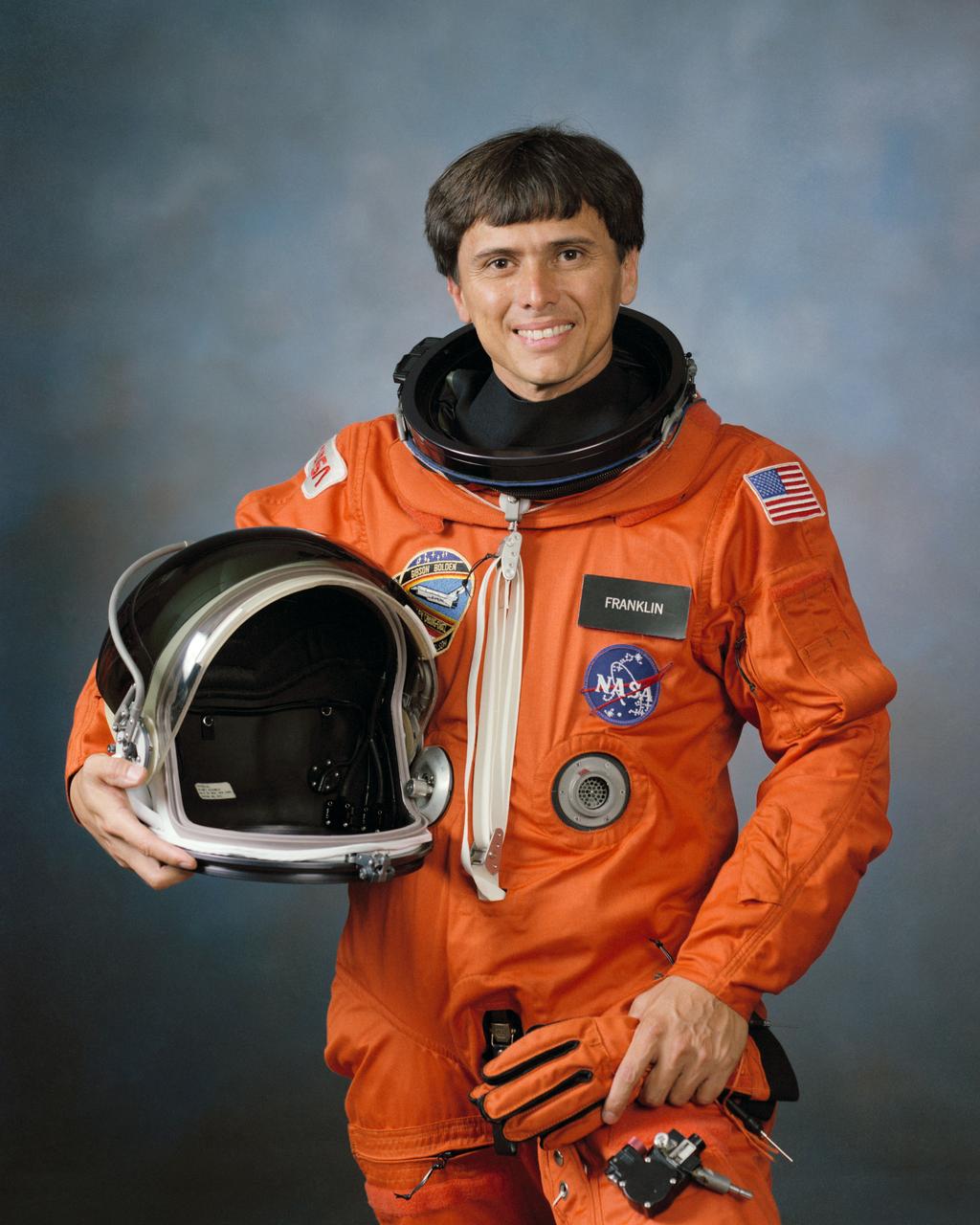
S88-43990 (Nov 1988) --- Astronaut Franklin R. Chang-Diaz, mission specialist.
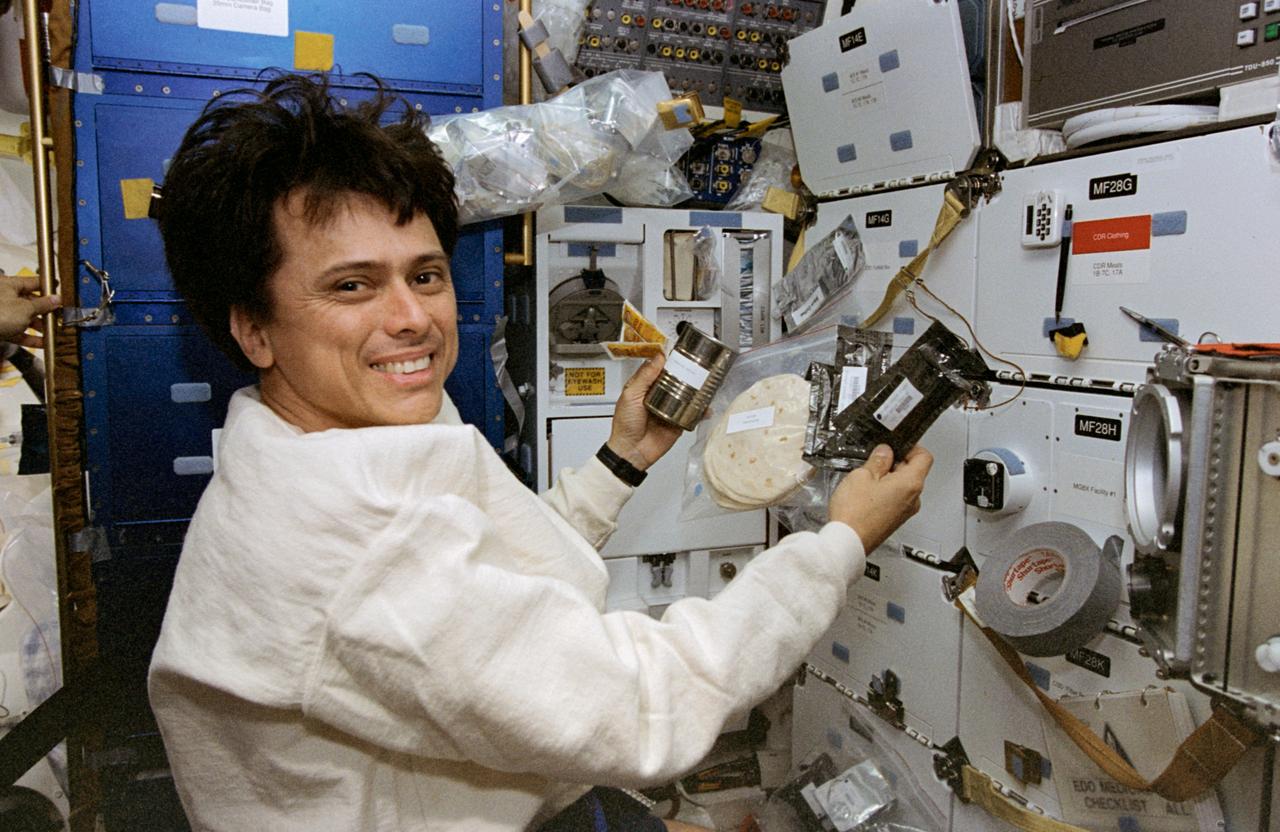
STS075-350-030 (22 Feb.-9 March 1996) --- Astronaut Franklin R. Chang-Diaz, STS-75 payload commander, holds food items at the galley on the middeck of the Earth-orbiting space shuttle Columbia. Photo credit: NASA or National Aeronautics and Space Administration
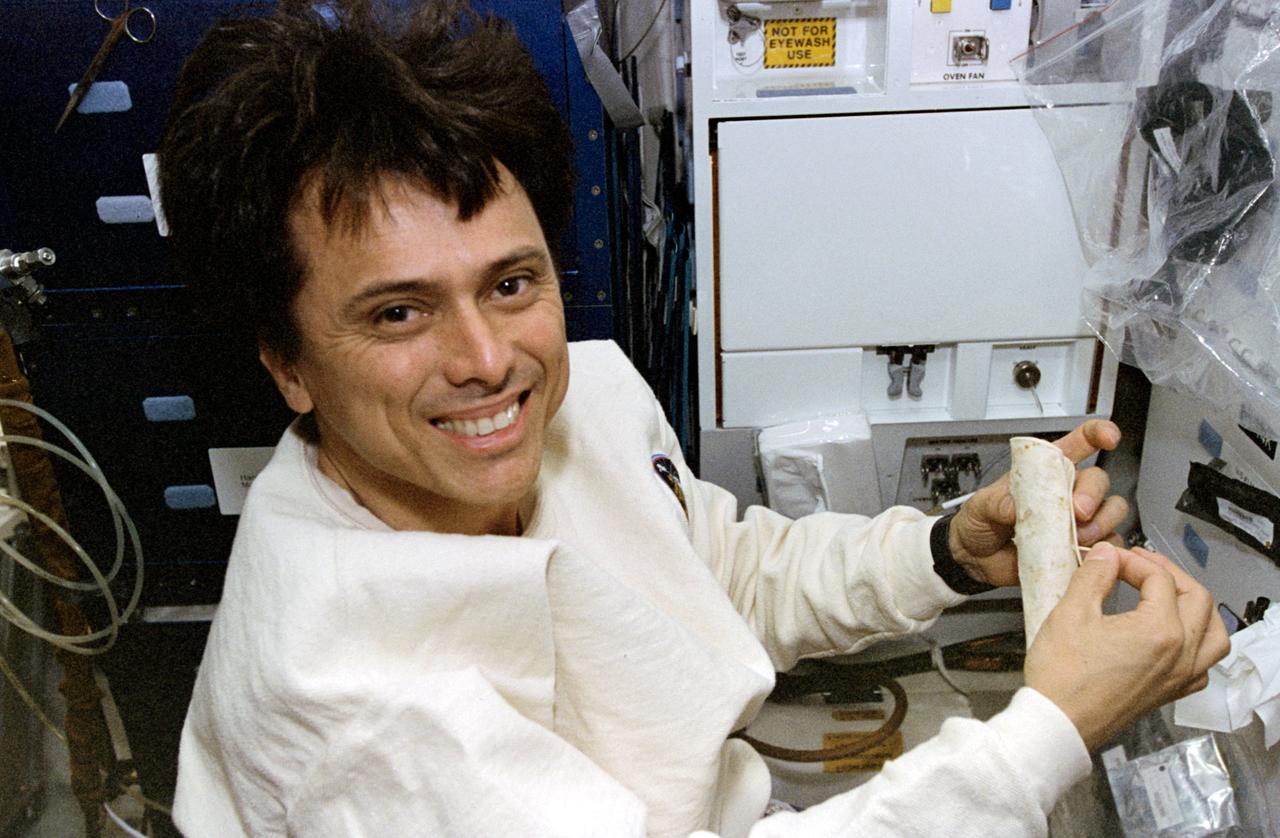
STS075-350-035 (22 Feb.-9 March 1996) --- Astronaut Franklin R. Chang-Diaz, STS-75 payload commander, holds a taco at the galley on the middeck of the Earth-orbiting space shuttle Columbia. Photo credit: NASA or National Aeronautics and Space Administration
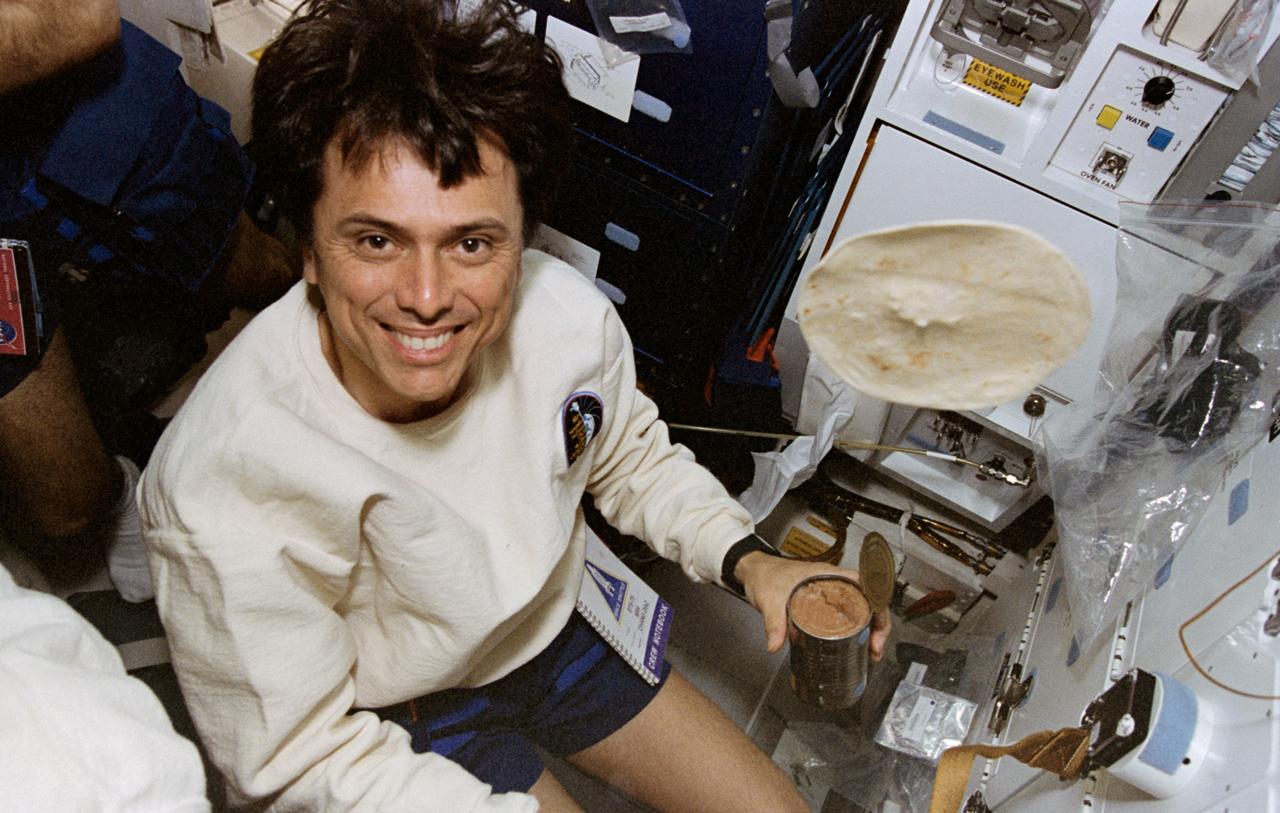
STS075-350-032 (22 Feb.-9 March 1996) --- Astronaut Franklin R. Chang-Diaz, STS-75 payload commander, is pictured with food items at the galley on the middeck of the Earth-orbiting space shuttle Columbia. Photo credit: NASA or National Aeronautics and Space Administration
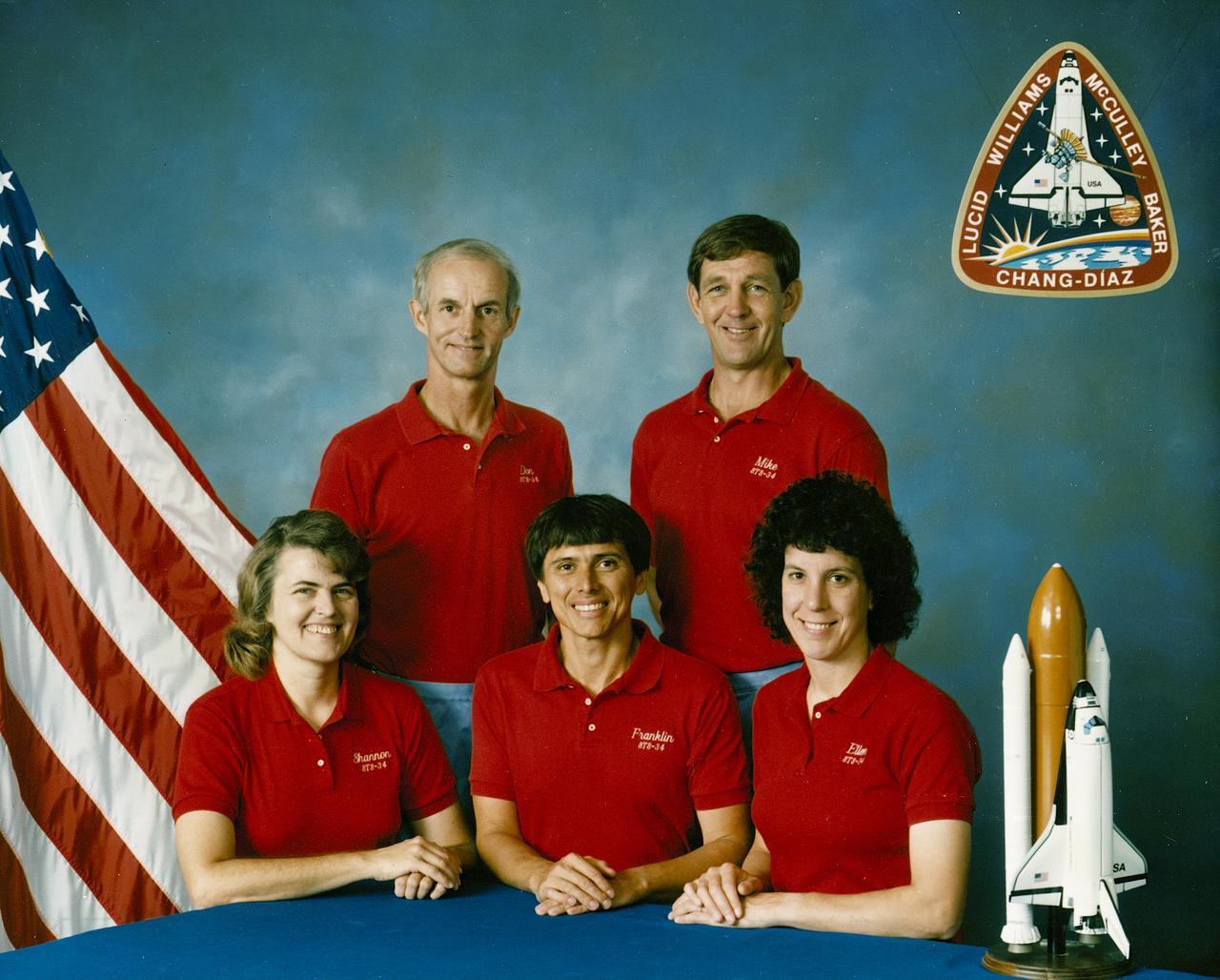
The STS-34 crew portrait includes 5 astronauts. Pictured left to right are Shannon W. Lucid, mission specialist; Donald E. Williams, commander; Franklin R. Chang-Diaz, mission specialist; Michael J. McCulley, pilot; and Ellen S. Baker, mission secialist. The crew of 5 launched aboard the Space Shuttle Orbiter Atlantis on October 18, 1989 at 12:53:40pm (EDT). The primary payload was the Galileo Jupiter Spacecraft and attached inertial upper stage (IUS). Deployed 6 hours and 30 minutes into the flight, the IUS stages fired, boosting Galileo on trajectory for a 6 year trip to Jupiter.
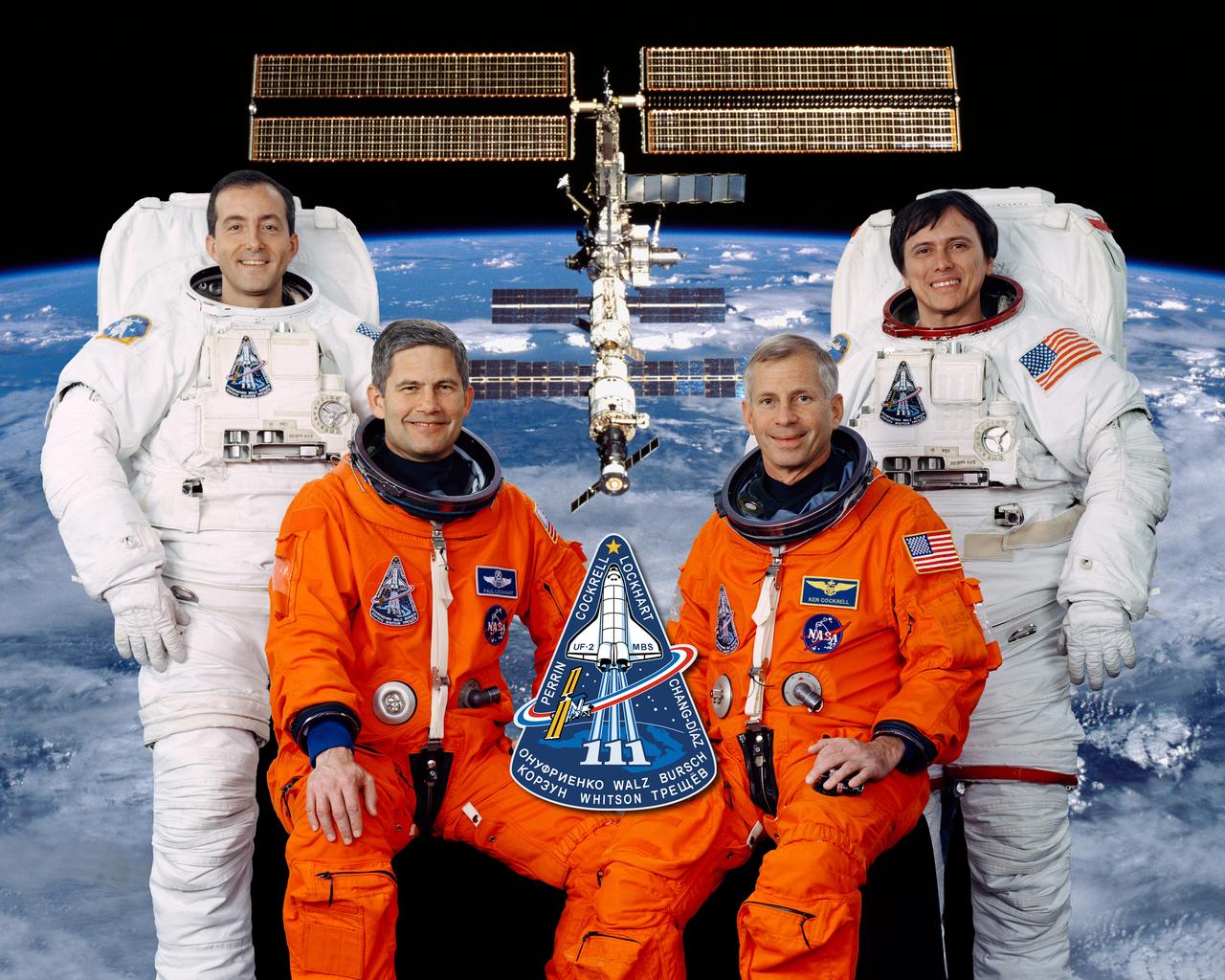
Launched aboard the Space Shuttle Endeavor on June 6, 2002, these four astronauts comprised the prime crew for NASA's STS-111 mission. Astronaut Kenneth D. Cockrell (front right) was mission commander, and astronaut Paul S. Lockhart (front left) was pilot. Astronauts Philippe Perrin (rear left), representing the French Space Agency, and Franklin R. Chang-Diaz were mission specialists assigned to extravehicular activity (EVA) work on the International Space Station (ISS). In addition to the delivery and installation of the Mobile Base System (MBS), this crew dropped off the Expedition Five crew members at the orbital outpost, and brought back the Expedition Four trio at mission's end.
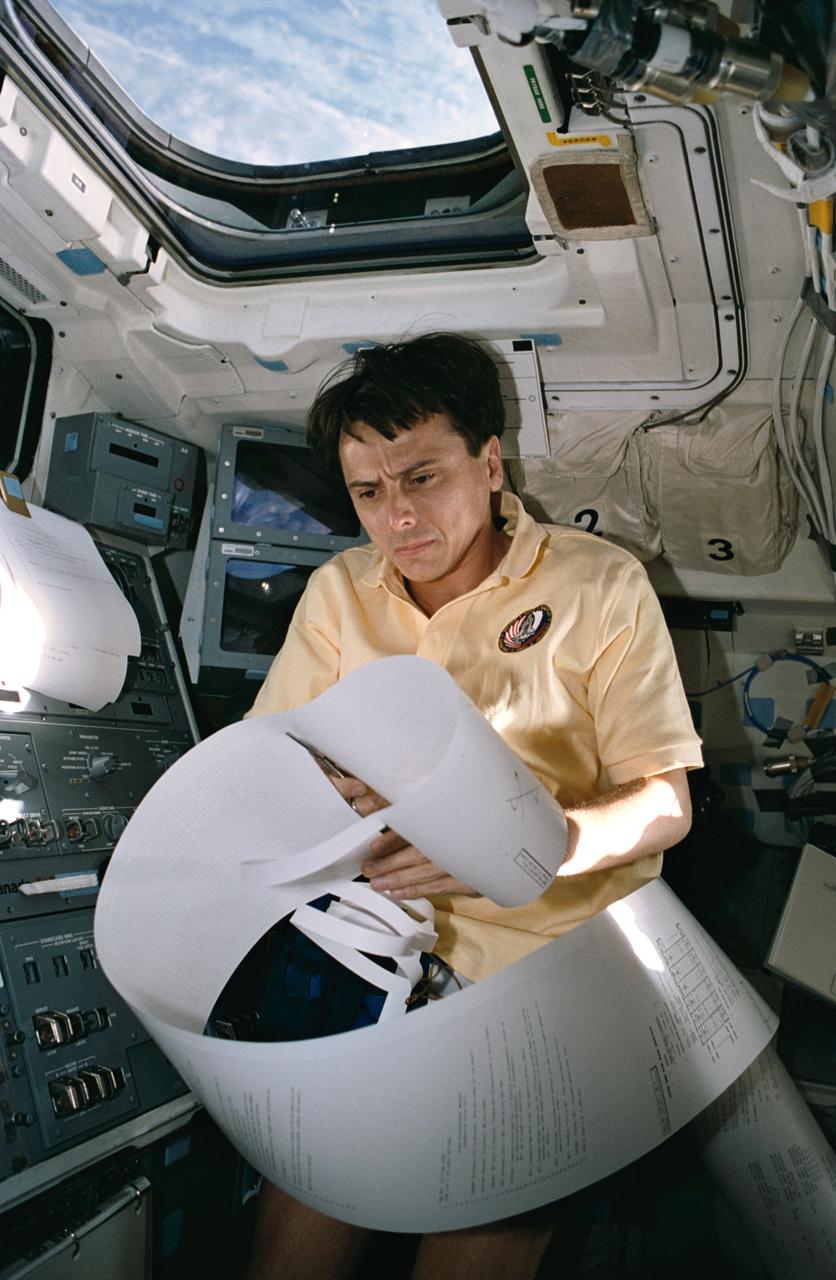
STS060-25-016 (6 Feb. 1994) --- On space shuttle Discovery?s aft flight deck, astronaut Franklin R. Chang-Diaz, STS-60 payload commander, begins to organize what was believed to be among the longest mail messages in shuttle history. Though early shuttle flights could brag of longer teleprinted messages, the Thermal Imaging Printing System?s day four correspondence, most of which is out of frame here, is record length for recent flights. Chang-Diaz joined four other NASA astronauts and a Russian cosmonaut for eight days aboard Discovery. Photo credit: NASA or National Aeronautics and Space Administration
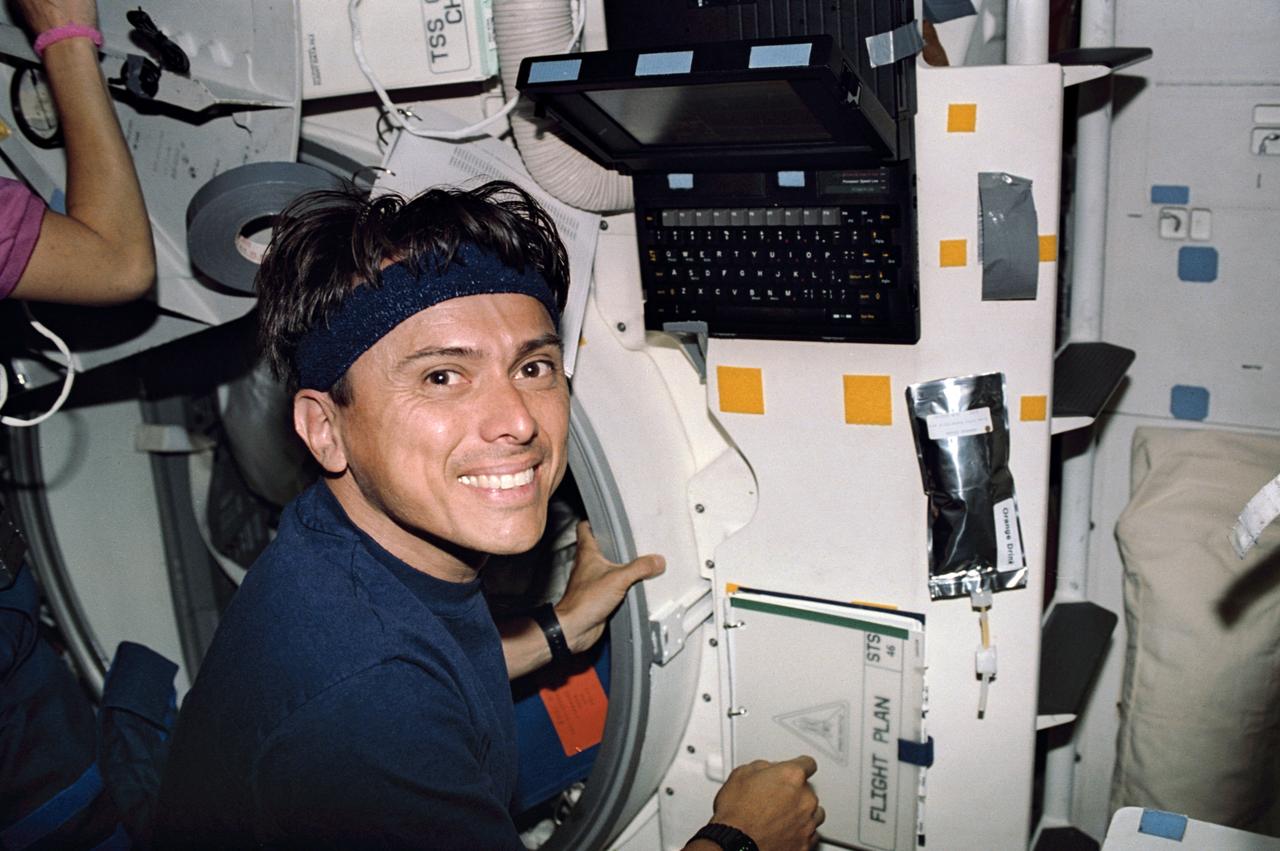
STS046-24-009 (31 July-8 Aug 1992) --- Astronaut Franklin R. Chang-Diaz, mission specialist, prepares to input data on the personal general support computer on the middeck of the Space Shuttle Atlantis as it makes one of its 127 total orbits for the eight-day mission. Chang-Diaz, wearing a headband, joined four other NASA astronauts and two European scientists for the mission.
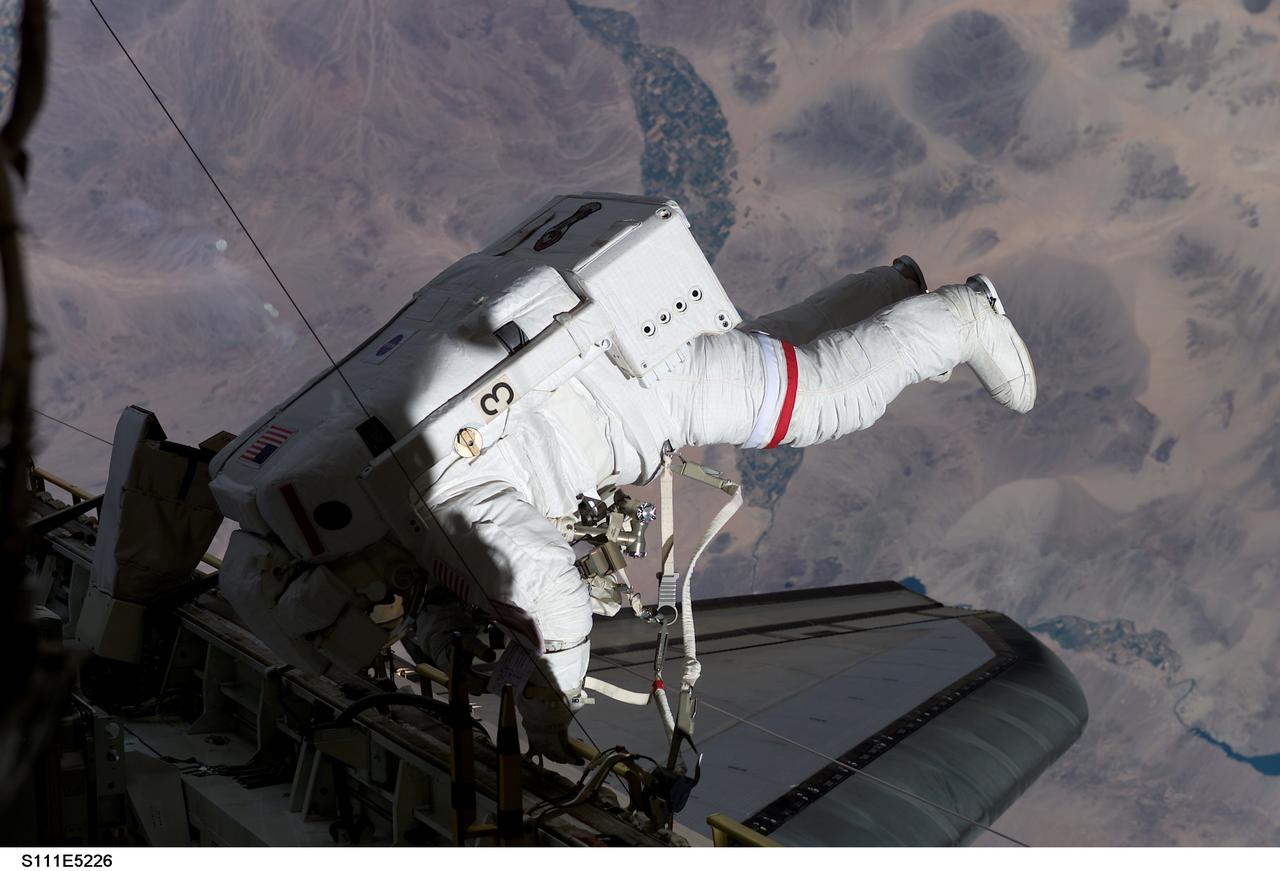
STS111-E-5226 (11 June 2002) --- Astronaut Franklin R. Chang-Diaz, STS-111 mission specialist, participates in the second scheduled session of extravehicular activity (EVA) for the STS-111 mission. During the 5-hour spacewalk, Chang-Diaz and Perrin completed installation of the Mobile Remote Servicer Base System (MBS) on the International Space Station’s (ISS) railcar, the Mobile Transporter.

ISS004-329-024 (5-19 June 2002) --- Astronaut Franklin R. Chang-Diaz, STS-111 mission specialist, is photographed in the Unity node on the International Space Station (ISS) during the transfer of supplies and equipment.
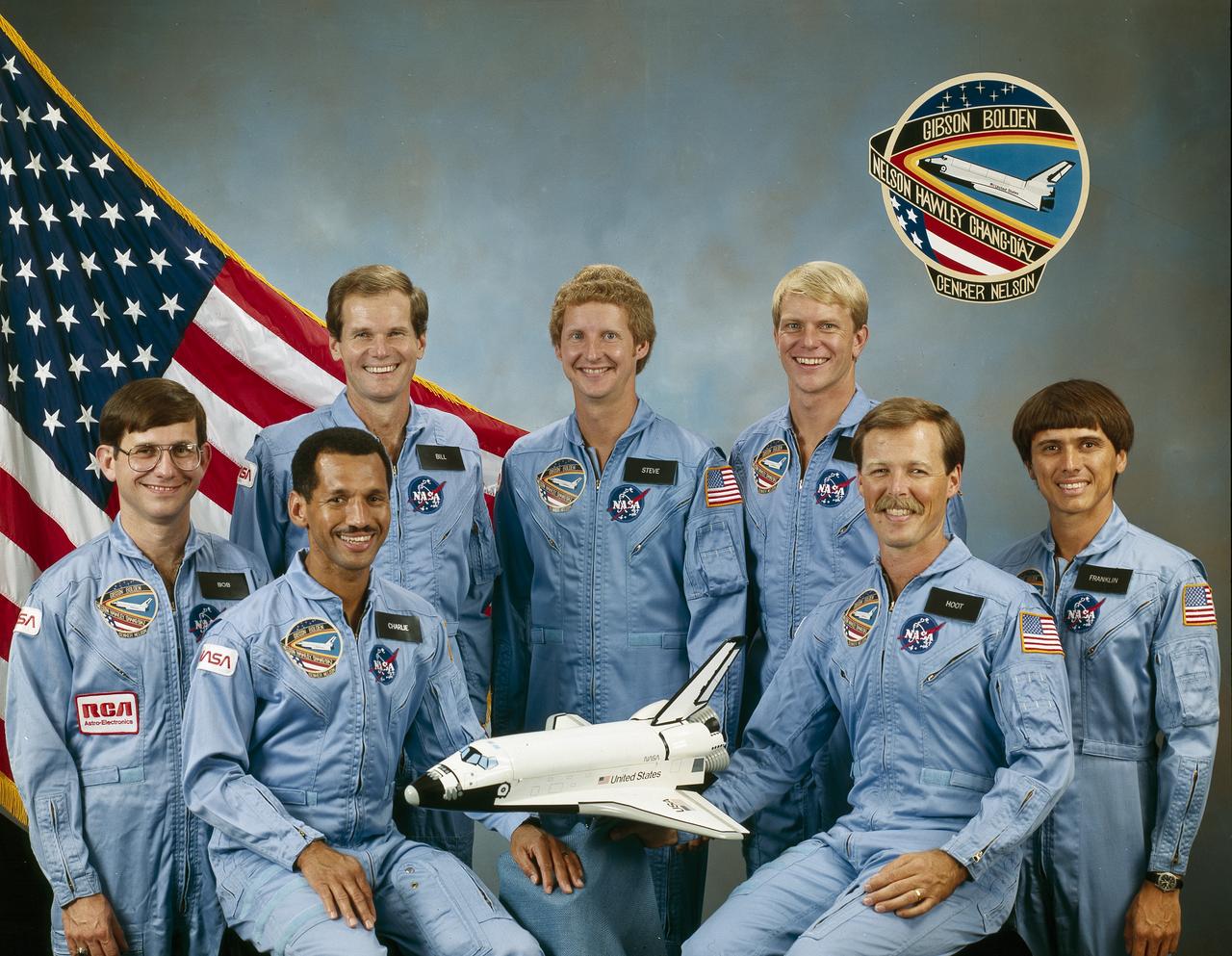
The crew assigned to the STS-61C mission included (seated left to right) Charles F. Bolden, Jr., pilot; and Robert L. (Hoot) Gibson, commander. On the back row, left to right, are payload specialists Robert J. Cenker, and Congressman Bill Nelson. To the right of Nelson are mission specialists Steven A. Hawley, George D. Nelson, and Franklin R. Chang-Diaz. Launched aboard the Space Shuttle Columbia on January 12, 1986 at 6:55:00 am (EST), the STS-61C mission’s primary payload was the communications satellite SATCOM KU-1 (RCA Americom).
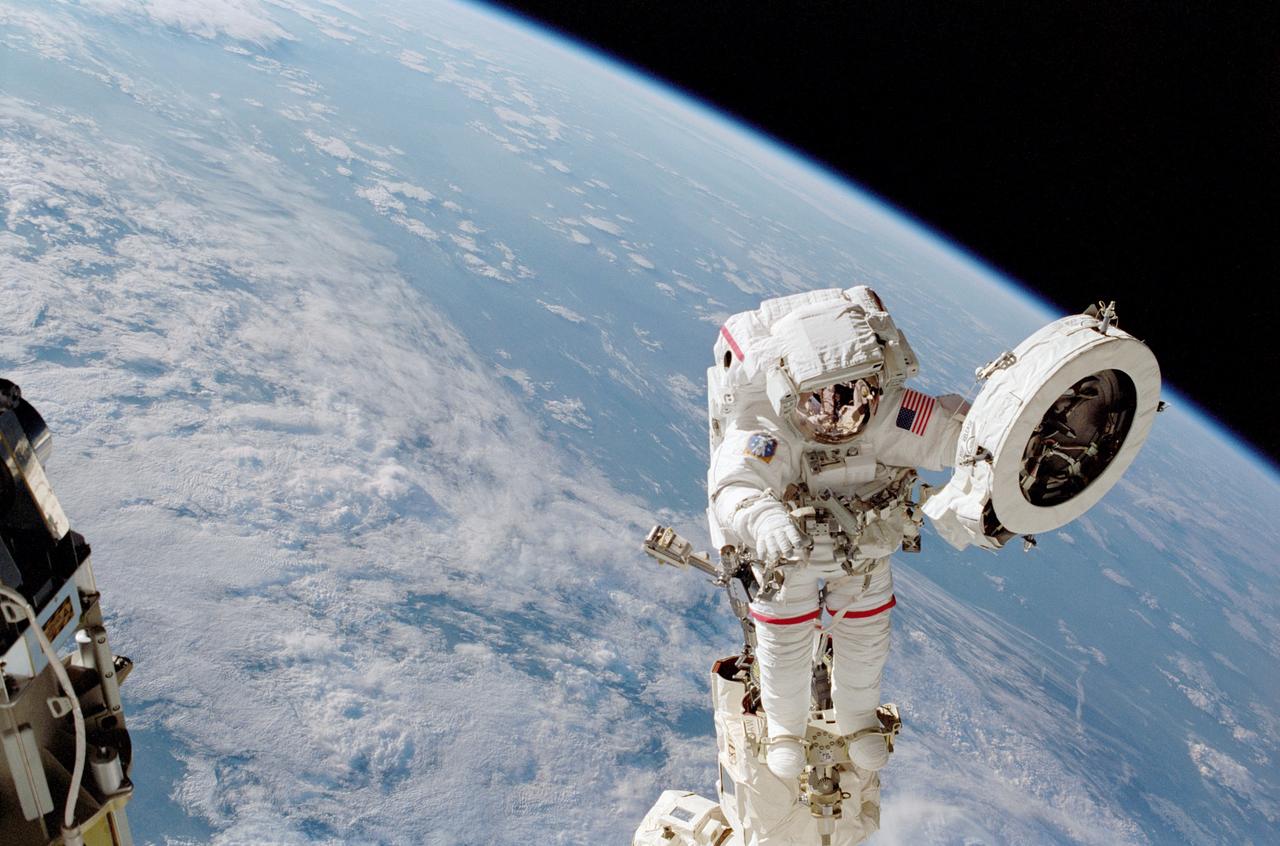
STS111-306-012 (9 June 2002) --- Astronaut Franklin R. Chang-Diaz works with a grapple fixture during extravehicular activity (EVA) to perform work on the International Space Station (ISS). The first spacewalk of the STS-111 mission began with the installation of a Power and Data Grapple Fixture (PDGF) for the station's robotic arm on the complex's P6 truss. The PDGF will allow the robotic arm to grip the P6 truss for future station assembly operations. Astronauts Chang-Diaz and Philippe Perrin (with French Space Agency, CNES) went on to install the new fixture about halfway up the P6 truss, the vertical structure that currently supports the station's set of large U.S. solar arrays.
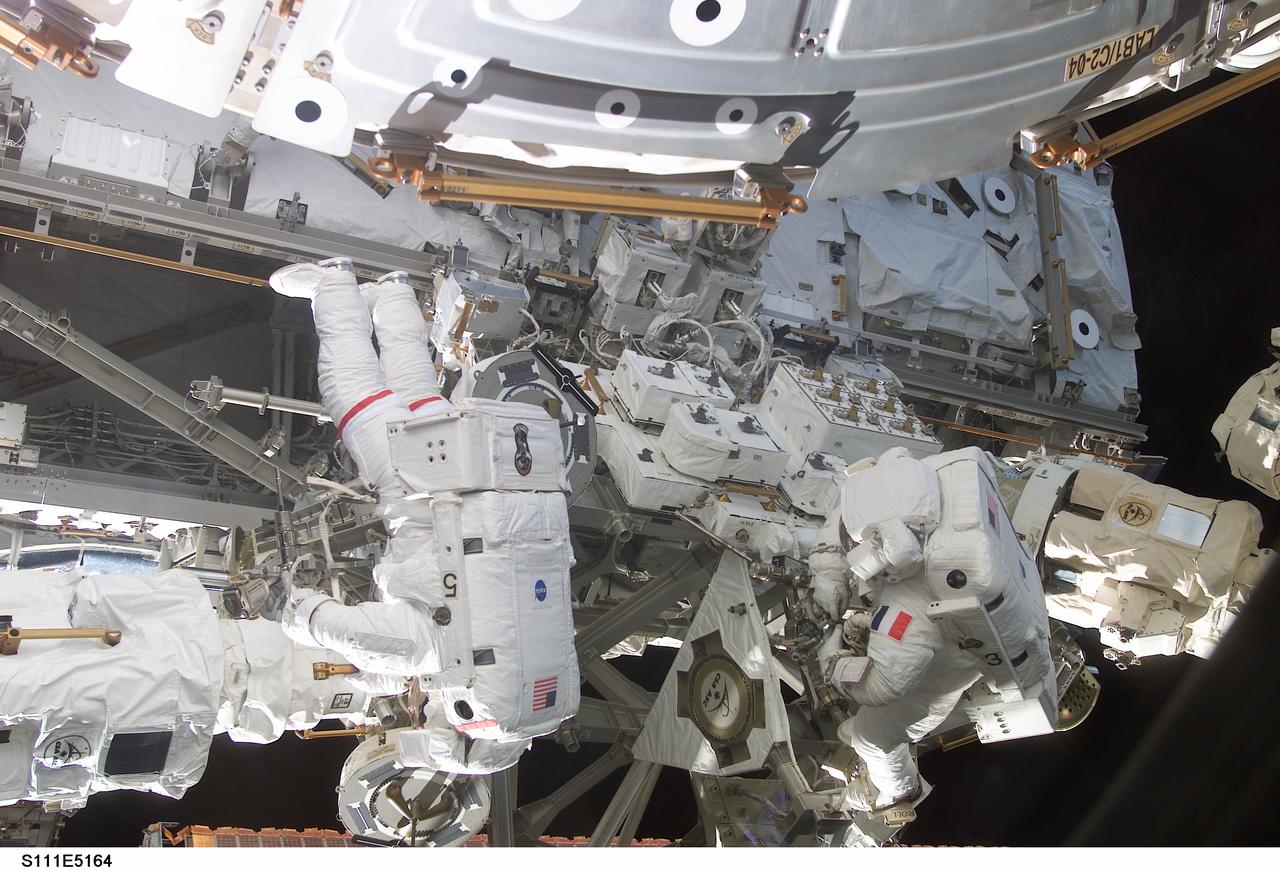
STS111-E-5164 (11 June 2002) --- Astronauts Franklin R. Chang-Diaz (left) and Philippe Perrin, both STS-111 mission specialists, work in tandem on the second scheduled session of extravehicular activity (EVA) for the STS-111 mission. During the spacewalk, Chang-Diaz and Perrin attached power, data and video cables from the International Space Station (ISS) to the Mobile Base System (MBS) and used a power wrench to complete the attachment of the MBS onto the Mobile Transporter (MT). Perrin represents CNES, the French Space Agency.
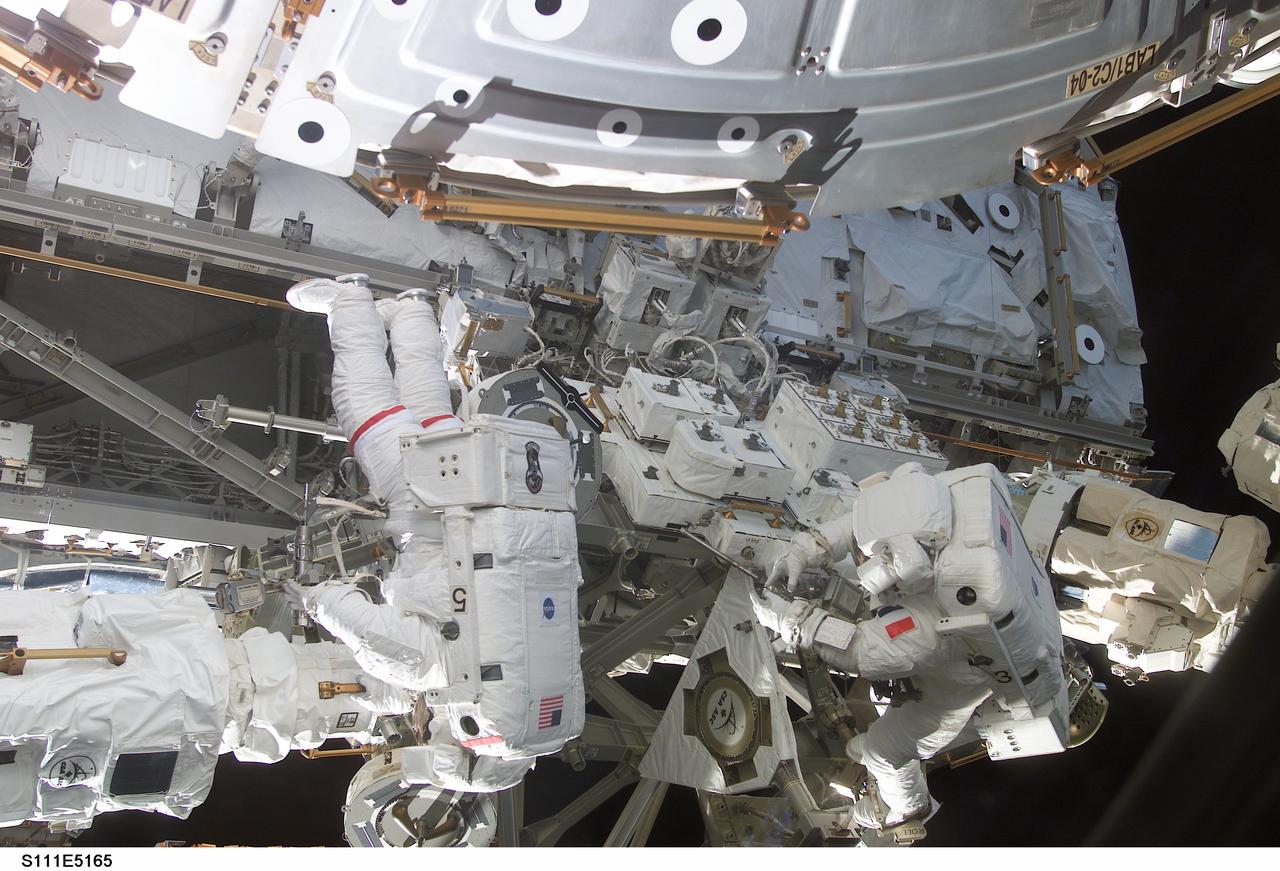
STS111-E-5165 (11 June 2002) --- Astronauts Franklin R. Chang-Diaz (left) and Philippe Perrin, both STS-111 mission specialists, work in tandem on the second scheduled session of extravehicular activity (EVA) for the STS-111 mission. During the spacewalk, Chang-Diaz and Perrin attached power, data and video cables from the International Space Station (ISS) to the Mobile Base System (MBS) and used a power wrench to complete the attachment of the MBS onto the Mobile Transporter (MT). Perrin represents CNES, the French Space Agency.
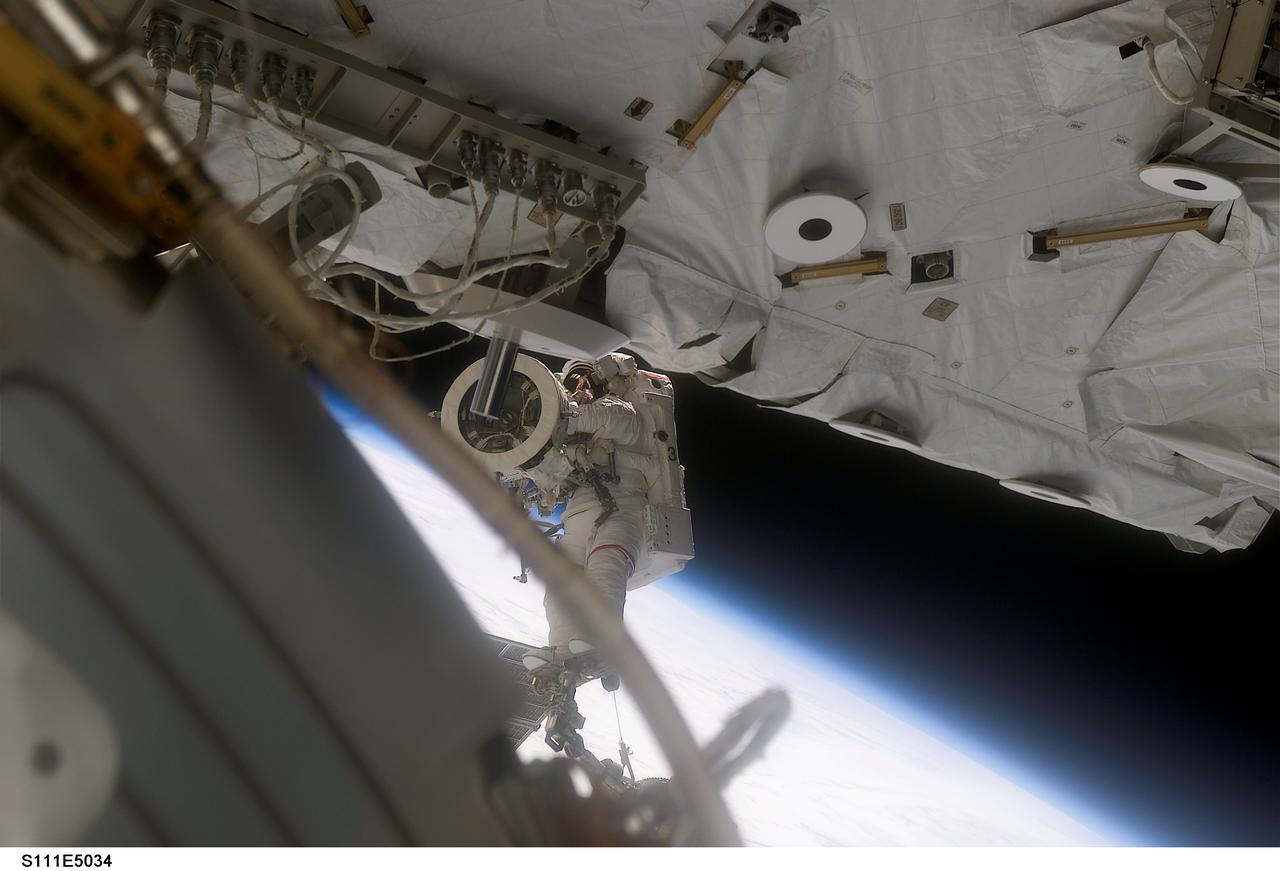
STS111-E-5034 (8 June 2002) --- Astronaut Franklin R. Chang-Diaz works with a grapple fixture during extravehicular activity (EVA) to perform work on the International Space Station (ISS). The first spacewalk of the STS-111 mission began with the installation of a Power and Data Grapple Fixture (PDGF) for the station's robotic arm on the complex's P6 truss. The PDGF will allow the robotic arm to grip the P6 truss for future station assembly operations. Astronauts Chang-Diaz and Philippe Perrin (with French Space Agency, CNES) went on to install the new fixture about halfway up the P6 truss, the vertical structure that currently supports the station's set of large U.S. solar arrays.
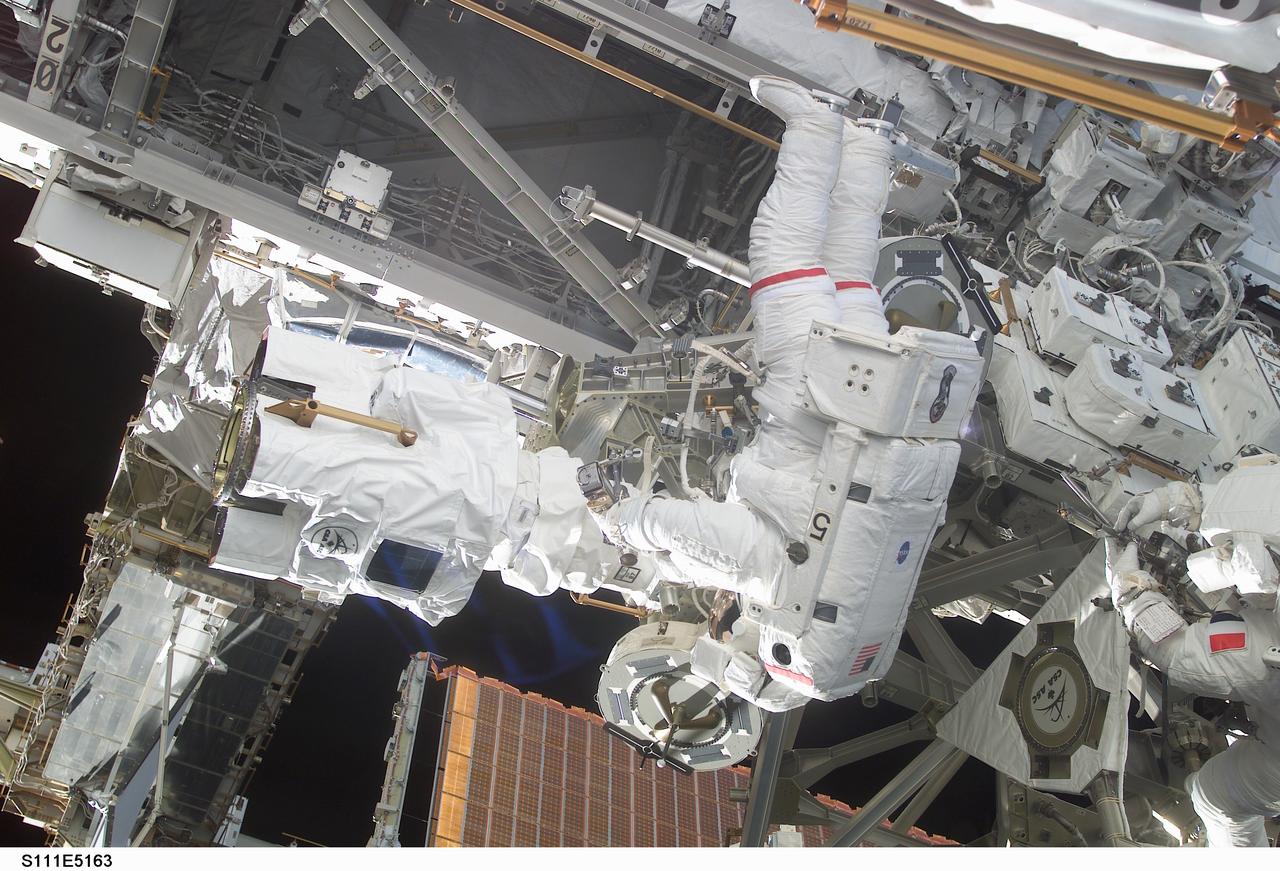
STS111-E-5163 (11 June 2002) --- Astronauts Franklin R. Chang-Diaz (center frame) and Philippe Perrin (partially obscured), both STS-111 mission specialists, work in tandem on the second scheduled session of extravehicular activity (EVA) for the STS-111 mission. During the spacewalk, Chang-Diaz and Perrin attached power, data and video cables from the International Space Station (ISS) to the Mobile Base System (MBS) and used a power wrench to complete the attachment of the MBS onto the Mobile Transporter (MT). Perrin represents CNES, the French Space Agency.
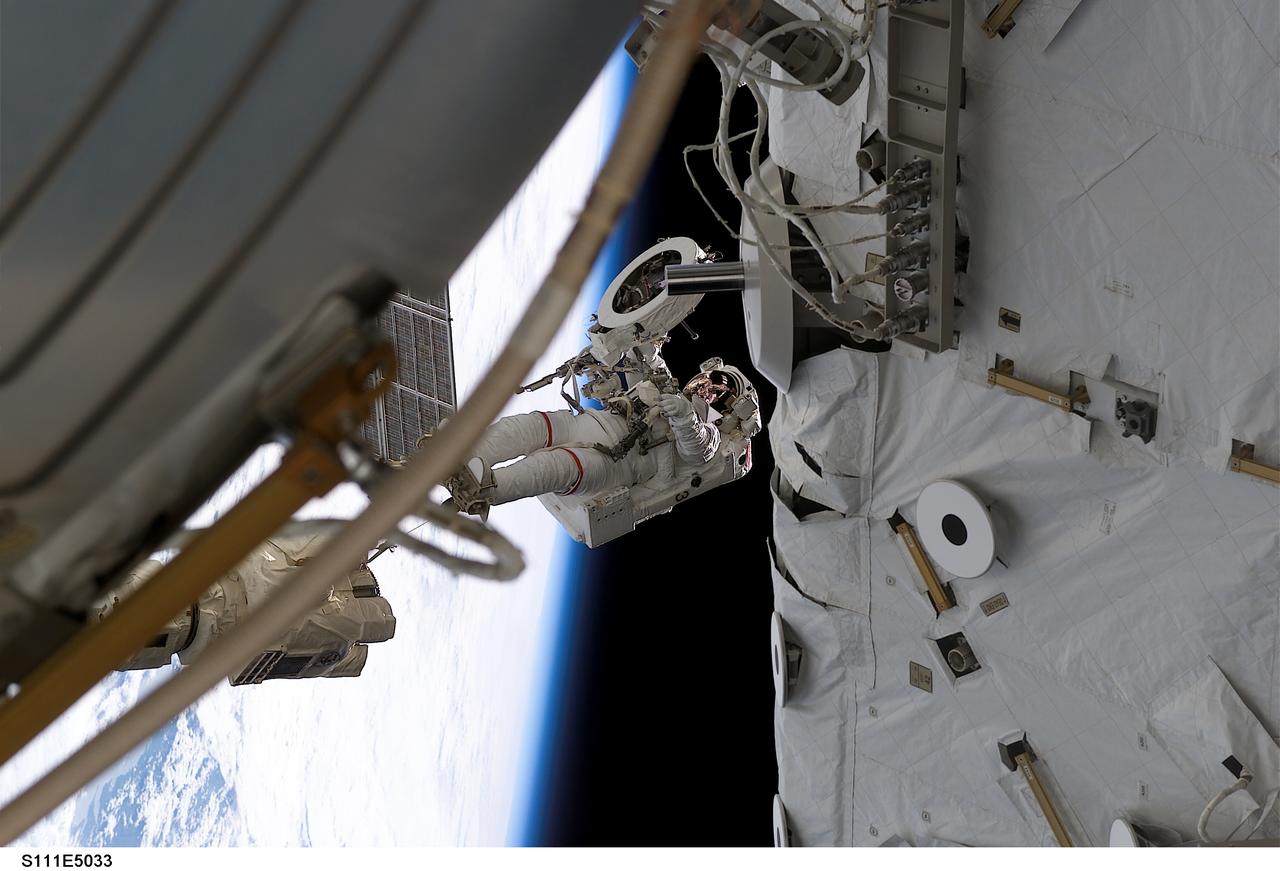
STS111-E-5033 (8 June 2002) --- Astronaut Franklin R. Chang-Diaz works with a grapple fixture during extravehicular activity (EVA) to perform work on the International Space Station (ISS). The first spacewalk of the STS-111 mission began with the installation of a Power and Data Grapple Fixture (PDGF) for the station's robotic arm on the complex's P6 truss. The PDGF will allow the robotic arm to grip the P6 truss for future station assembly operations. Astronauts Chang-Diaz and Philippe Perrin (with French Space Agency, CNES)went on to install the new fixture about halfway up the P6 truss, the vertical structure that currently supports the station's set of large U.S. solar arrays.
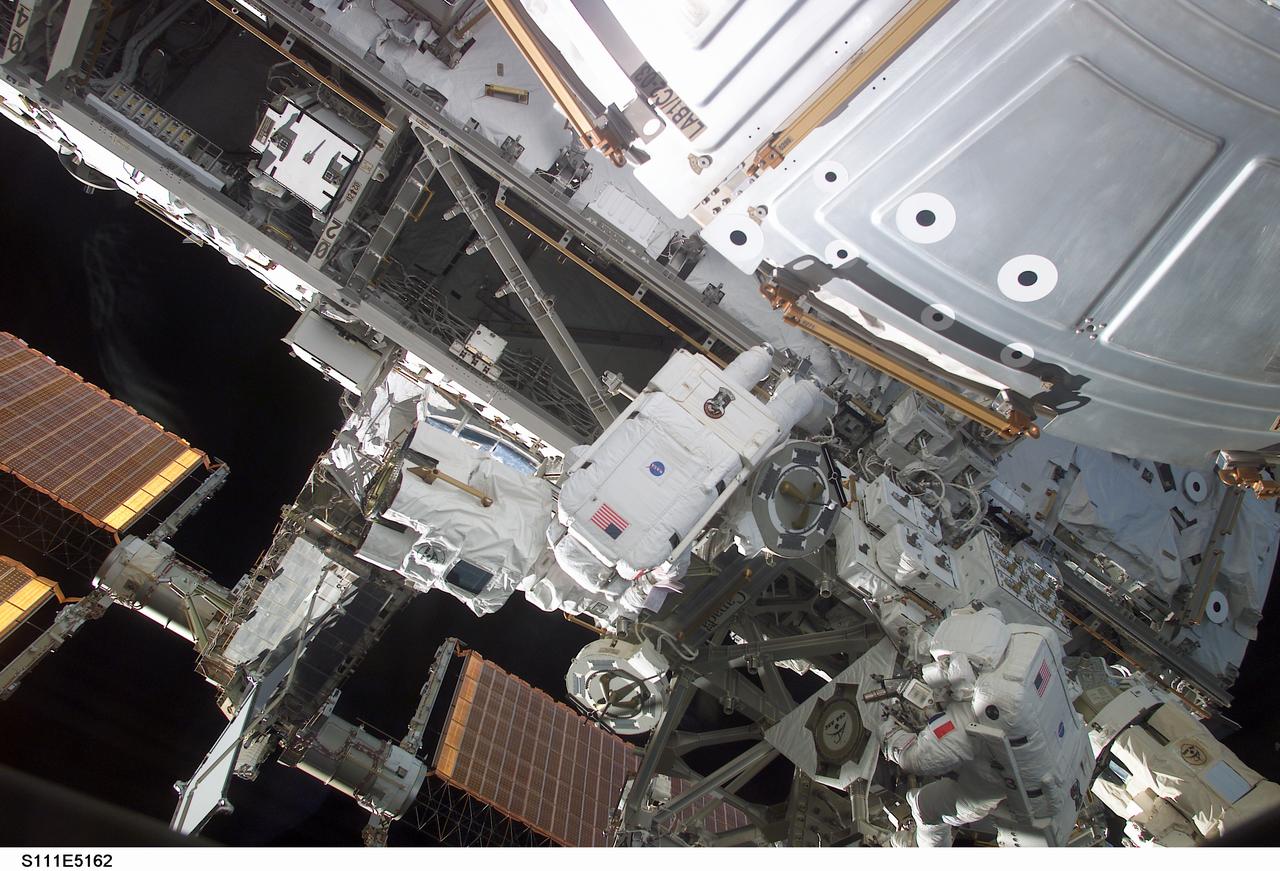
STS111-E-5162 (11 June 2002) --- Astronauts Franklin R. Chang-Diaz (center frame) and Philippe Perrin, both STS-111 mission specialists, work in tandem on the second scheduled session of extravehicular activity (EVA) for the STS-111 mission. During the spacewalk, Chang-Diaz and Perrin attached power, data and video cables from the International Space Station (ISS) to the Mobile Base System (MBS) and used a power wrench to complete the attachment of the MBS onto the Mobile Transporter (MT). Perrin represents CNES, the French Space Agency.
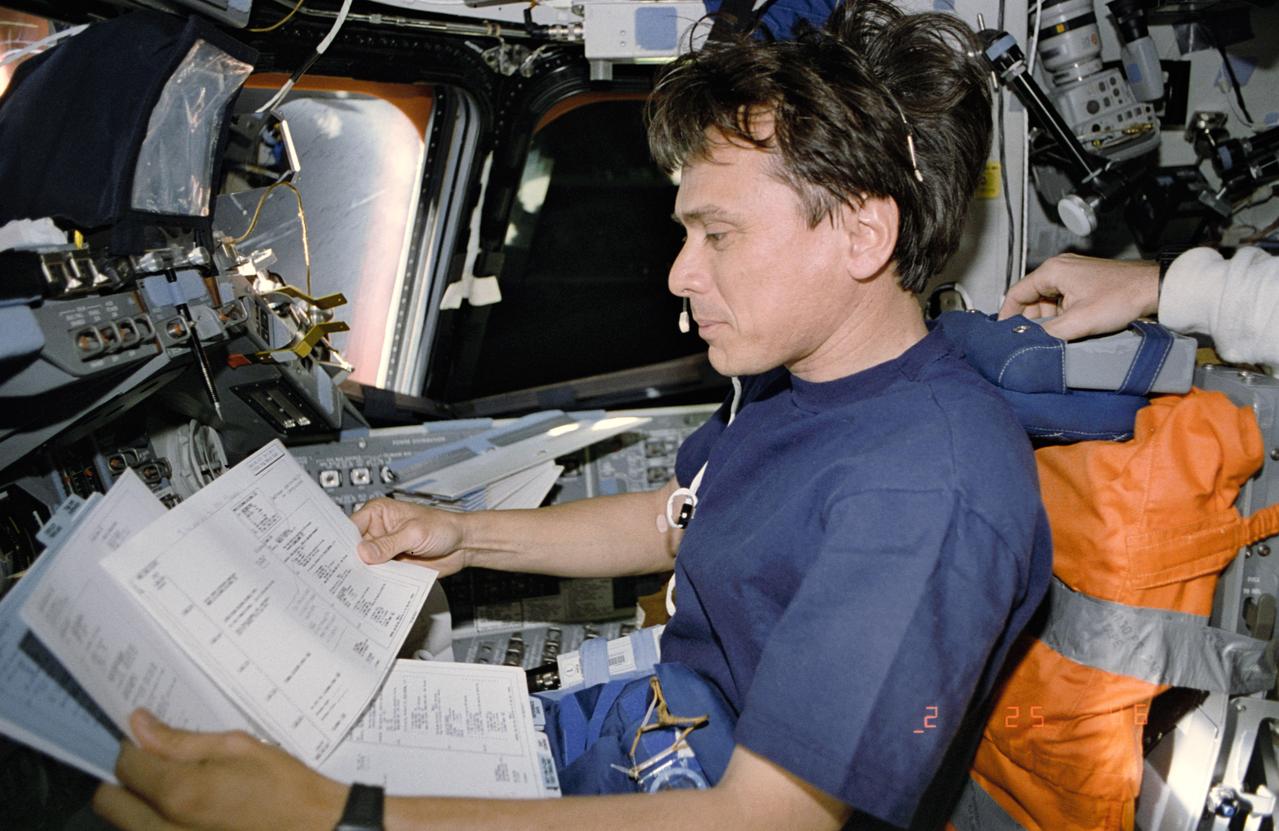
STS075-328-018 (25 Feb. 1996) --- Astronaut Franklin R. Chang-Diaz, STS-75 payload commander, is busy at the pilot's station during operations to deploy the Tethered Satellite System (TSS). His five crew mates (out of frame) were also on the flight deck, of the Earth-orbiting space shuttle Columbia, during the busy deployment activities.
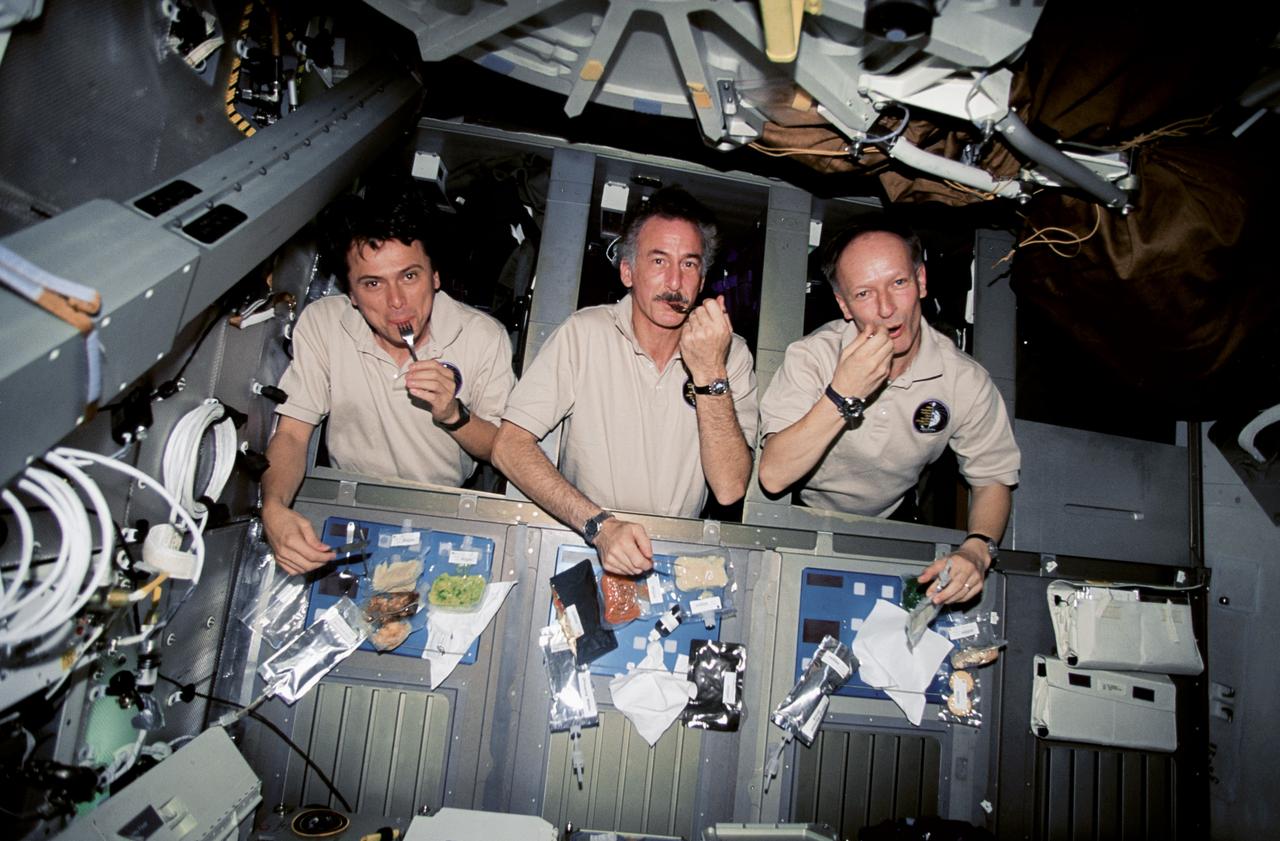
STS075-302-016 (22 Feb.-9 March 1996) --- Soon after reaching Earth orbit, the blue shift team set up what they referred to as a "formal" meal on the space shuttle Columbia's middeck. Left to right are astronauts Franklin R. Chang-Diaz, STS-75 payload commander; Jeffrey A. Hoffman and Claude Nicollier, both mission specialists. Hoffman later told a gathering of Johnson Space Center employees that the meal was accompanied by classical music. Photo credit: NASA or National Aeronautics and Space Administration
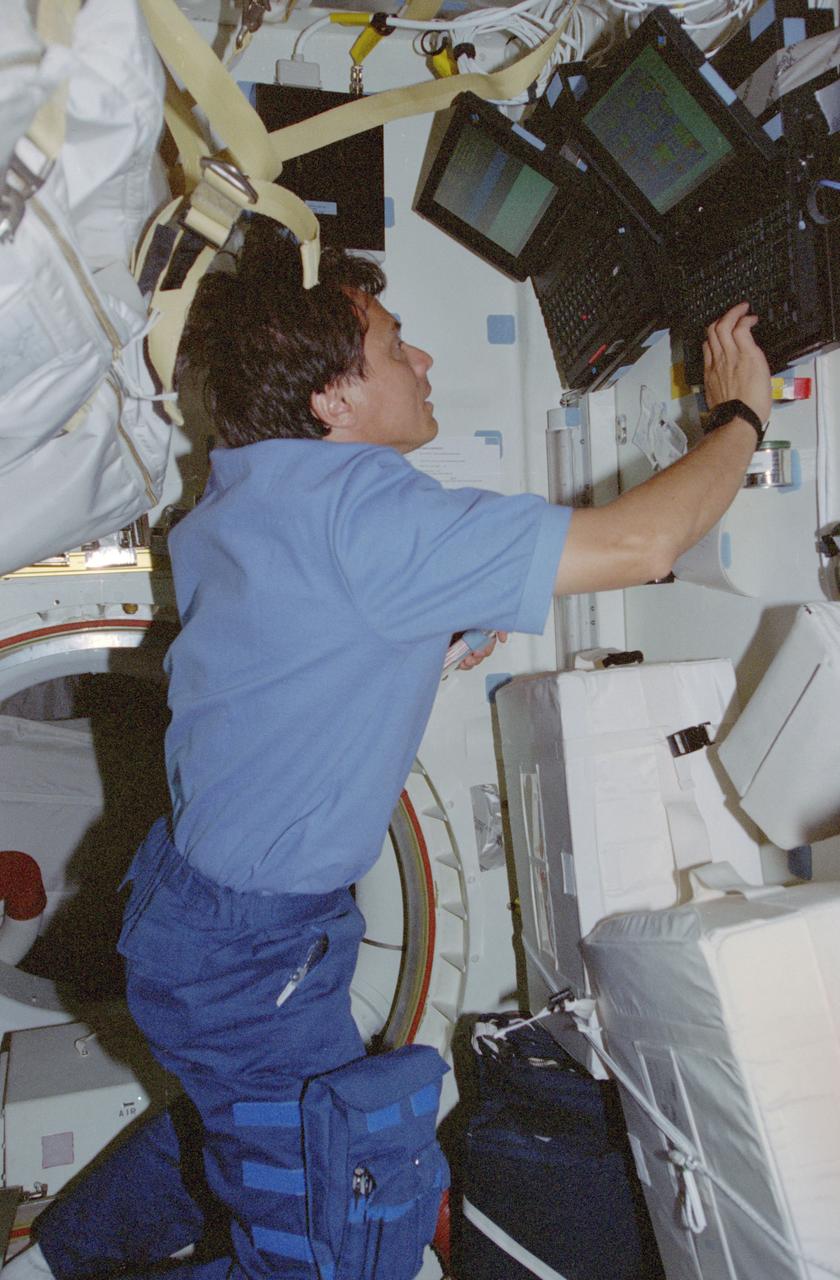
STS091-378-028 (2-12 June 1998) --- Astronaut Franklin R. Chang-Diaz, payload commander, inputs data on a laptop computer associated with the Alpha Magnetic Spectrometer (AMS) hardware located in the aft cargo bay. Reference JSC photo number STS091-367-033, which shows the hardware as seen from Russia's Mir space station, which was docked with Discovery at the time. AMS is the first large magnet experiment ever placed in Earth orbit. The scientific goal of this high-energy physics experiment is to increase our understanding of the composition and origin of the universe. It is designed to search for and measure charged particles, including antimatter, outside Earth's atmosphere. The charge of such particles can be identified by their trajectories in a magnetic field.
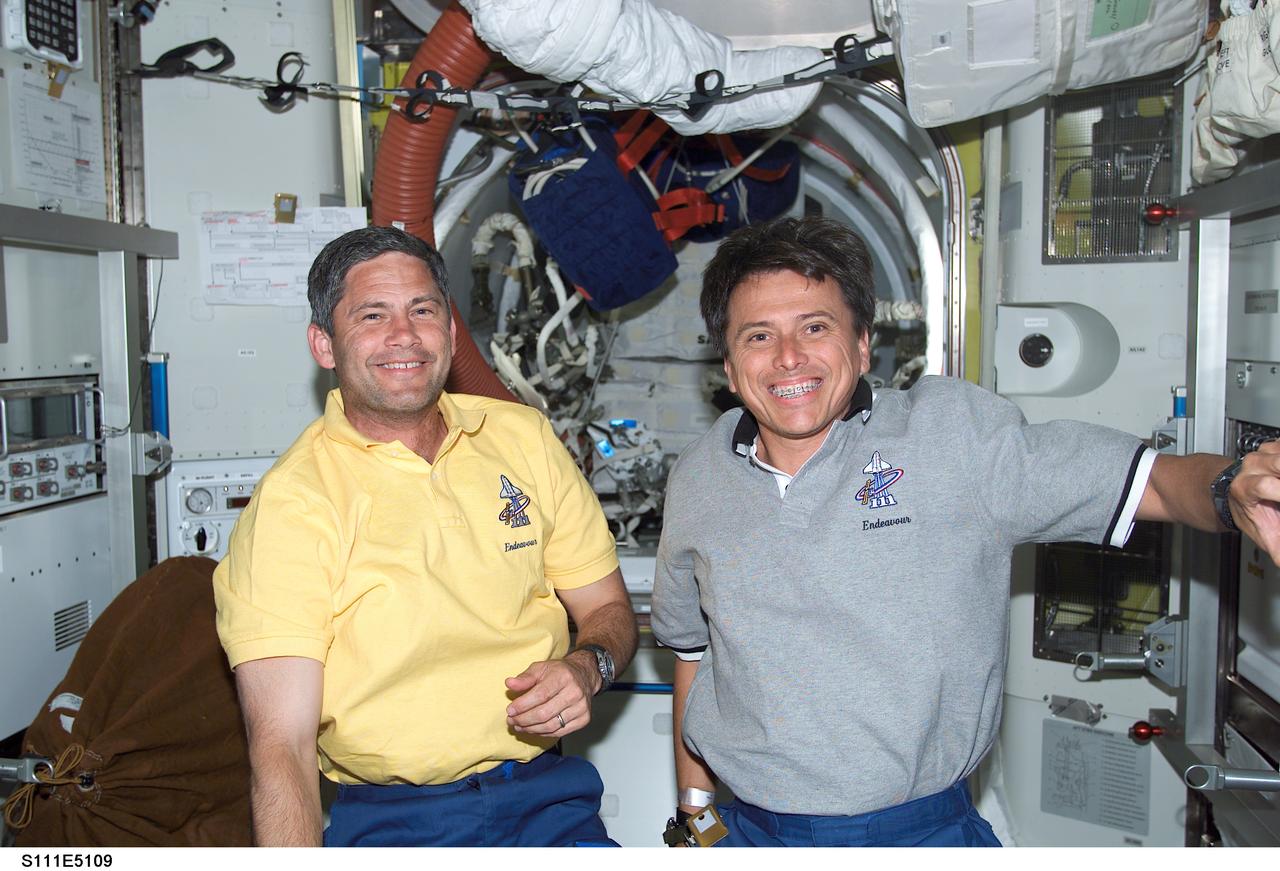
STS111-E-5109 (7 June 2002) --- Astronauts Paul S. Lockhart (left), STS-111 pilot, and Franklin R. Chang-Diaz, mission specialist, greet Expedition Four members (out of frame) with smiles during a brief reunion not long after hatch-opening on June 7, 2002.
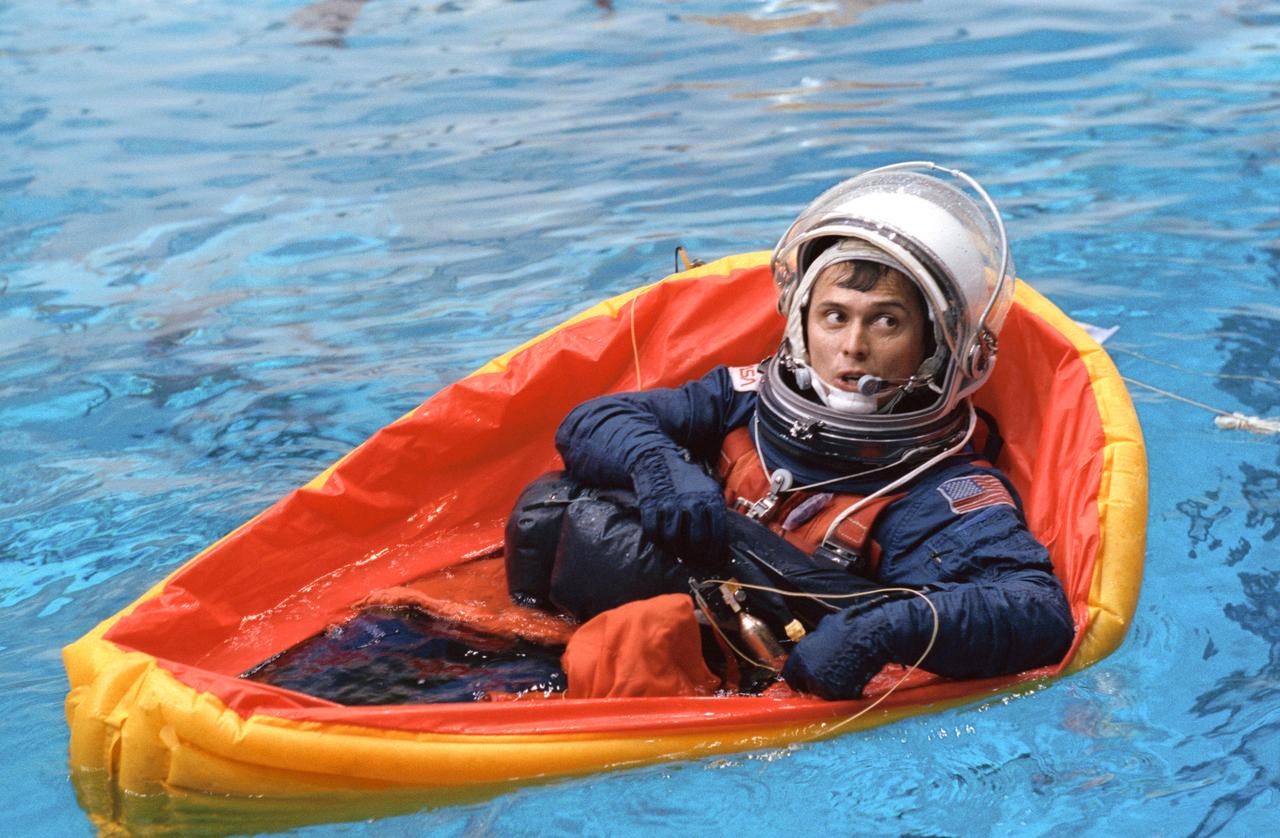
S92-33478 (12 March 1992) --- Astronaut Franklin R. Chang-Diaz, mission specialist, relies on a one-person life raft to get him to "safety" during a STS-46 bailout simulation exercise. The training took place in the Johnson Space Center's weightless environment training facility.
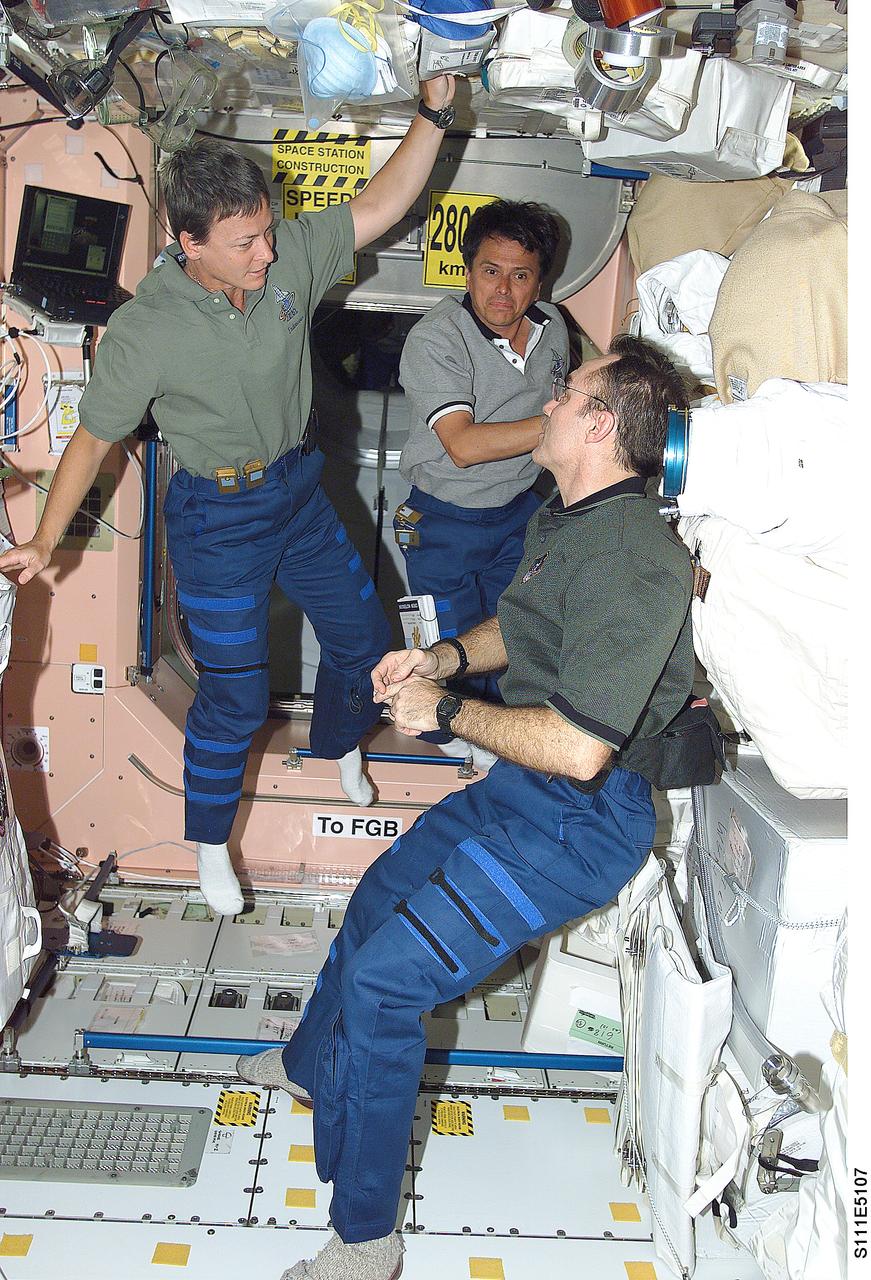
STS111-E-5107 (7 June 2002) --- Astronauts Peggy A. Whitson (left), Expedition Five flight engineer, Franklin R. Chang-Diaz, STS-111 mission specialist, and Carl E. Walz, Expedition Four flight engineer, are photographed in the Unity node on the International Space Station (ISS).

STS111-E-5132 (9 June 2002) --- Astronaut Franklin R. Chang-Diaz, STS-111 mission specialist, anchored to the foot restraint at the end of the International Space Station’s (ISS) Canadarm2, participates in the first scheduled session of extravehicular activity (EVA) for the STS-111 mission. During the spacewalk, Chang-Diaz and Perrin attached a Power and Data Grapple Fixture onto the International Space Station’s (ISS) P6 Truss, setting the stage for the future relocation of the P6. The next major task was to remove Service Module Debris Panels from Space Shuttle Endeavour’s payload bay and attach them to their temporary location on Pressurized Mating Adapter 1 (PMA-1). The spacewalkers also removed thermal blankets to prepare the Mobile Base System (MBS) for installation onto the station’s Mobile Transporter (MT).
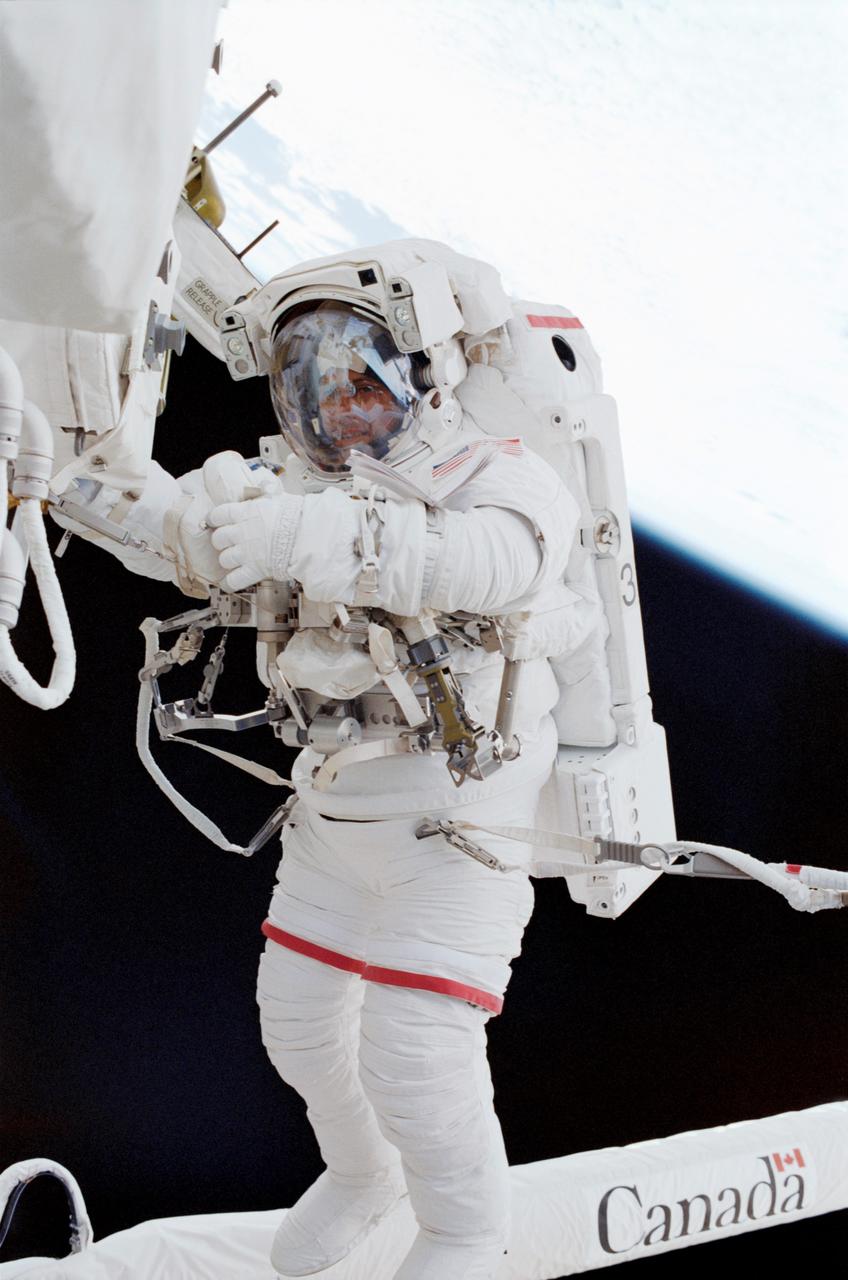
STS111-306-023 (9 June 2002) --- Astronaut Franklin R. Chang-Diaz, STS-111 mission specialist, participates in the first scheduled session of extravehicular activity (EVA) for the STS-111 mission. During the spacewalk, Chang-Diaz and Perrin attached a Power and Data Grapple Fixture onto the International Space Station’s (ISS) P6 Truss, setting the stage for the future relocation of the P6. The next major task was to remove Service Module Debris Panels from Space Shuttle Endeavour’s payload bay and attach them to their temporary location on Pressurized Mating Adapter 1 (PMA-1). The spacewalkers also removed thermal blankets to prepare the Mobile Base System (MBS) for installation onto the station’s Mobile Transporter (MT).
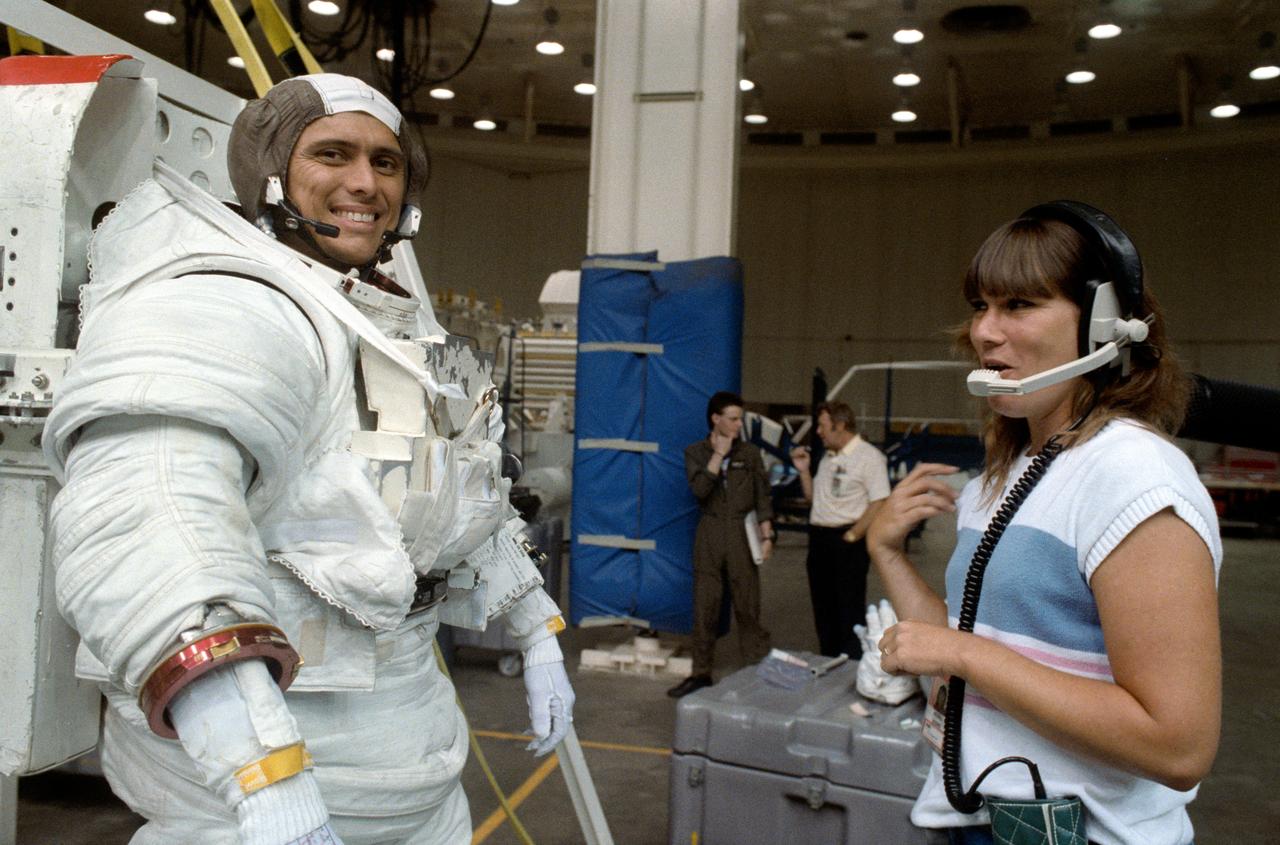
S89-42667 (24 Aug 1989) --- Astronaut Franklin R. Chang-Diaz tests his communications gear with Pam S. Peters of RSO, prior to participating in an underwater simulation of a contingency extravehicular activity (EVA) for his mission specialist assignment on NASA's STS-34 mission. He stands on a platform that will lower him into a 25-ft. deep pool, part of JSC's weightless environmental test facility (WET-F). Also participating in the contingency EVA rehearsal was astronaut Ellen S. Baker (out of frame).
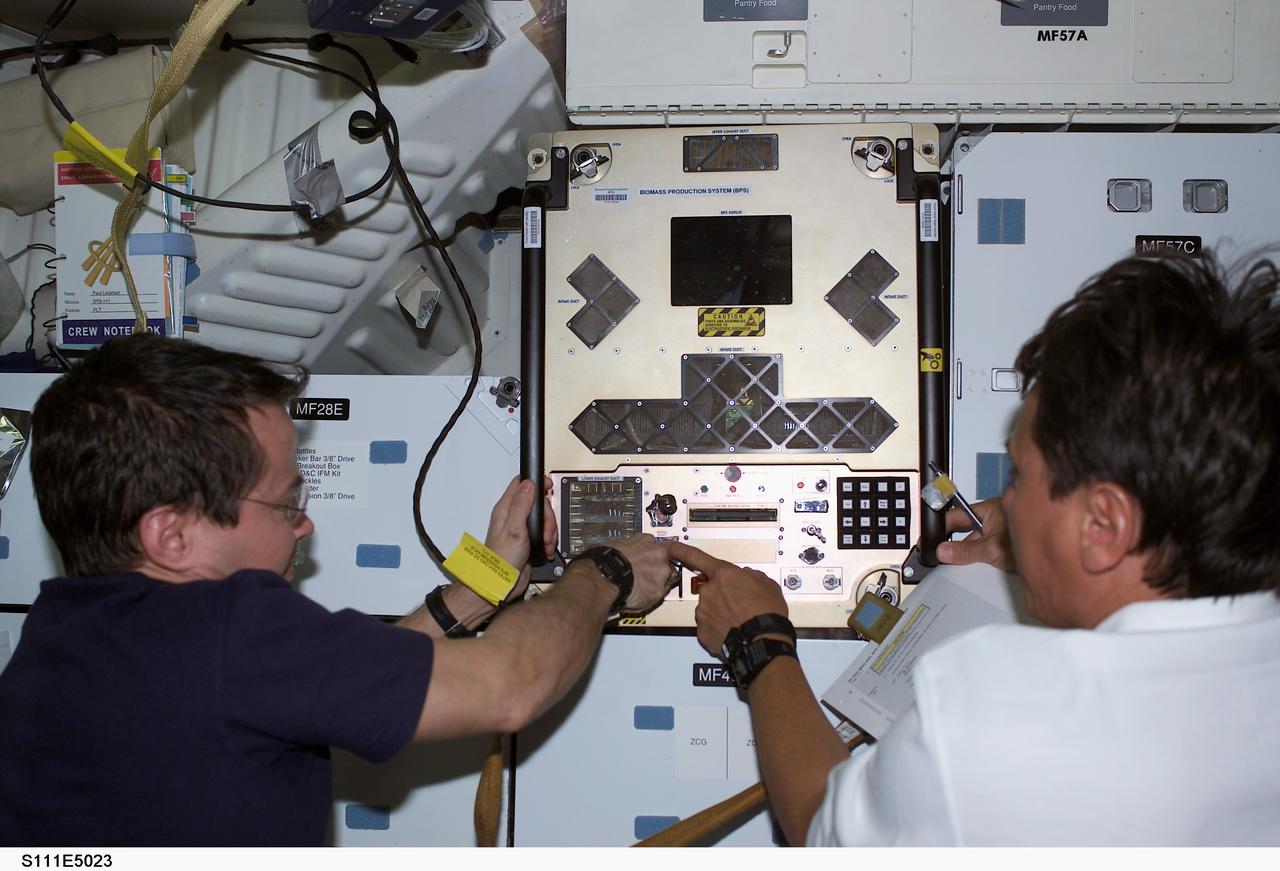
STS111-E-5023 (7 June 2002) --- Astronaut Daniel W. Bursch (left), who has been aboard the International Space Station (ISS) for the past six months, wastes little time in going to work on board the Space Shuttle Endeavour following linkup of the shuttle and station on June 7, 2002. Bursch, who will return home aboard Endeavour in a few days, shares a task with astronaut Franklin R. Chang-Diaz at the Biomass Production System (BPS) on Endeavour's mid deck.
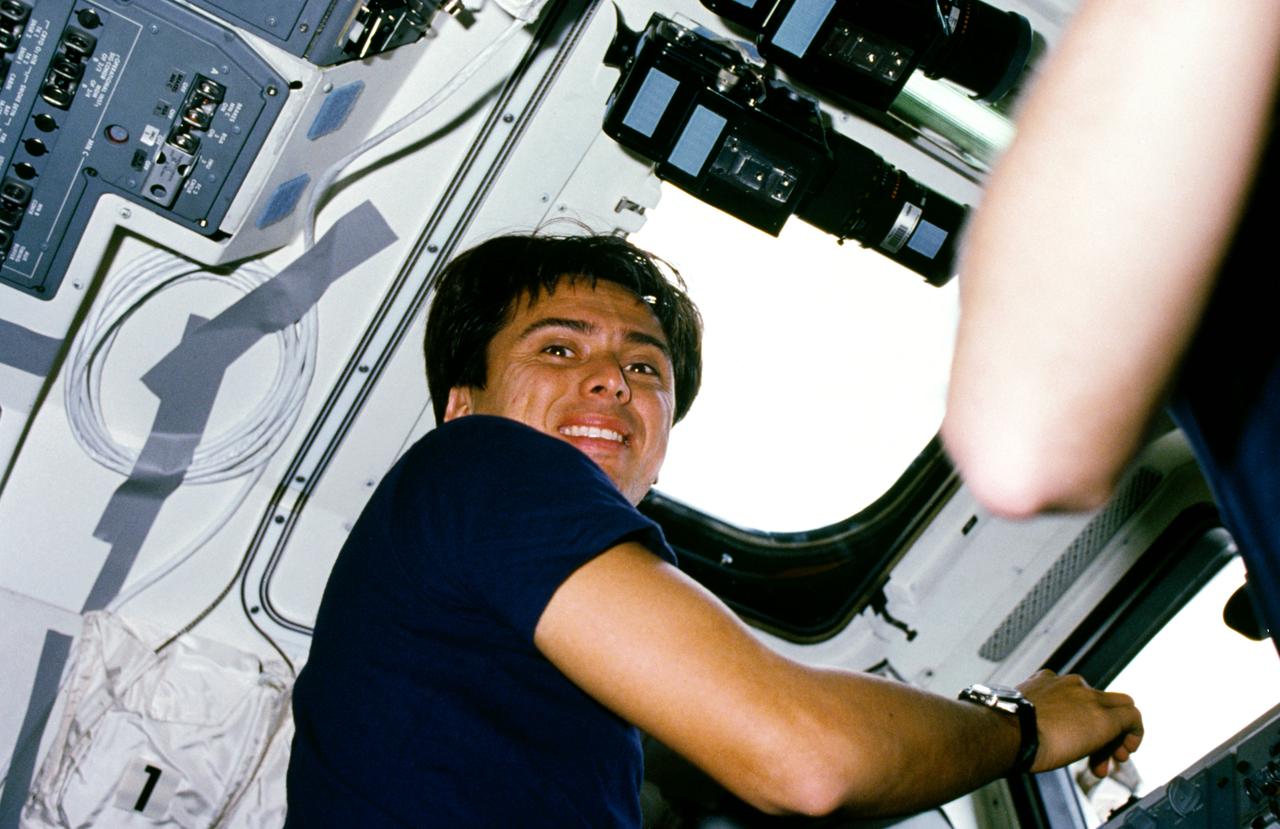
61C-02-032 (12-18 Jan. 1986) --- Astronaut Franklin R. Chang-Diaz, STS-61C mission specialist, while checking cargo in the space shuttle Columbia's payload bay, turns to smile at a fellow crew member using a 35mm camera. Some of the prolific camera gear onboard the spacecraft is affixed above the mission specialist's right shoulder.
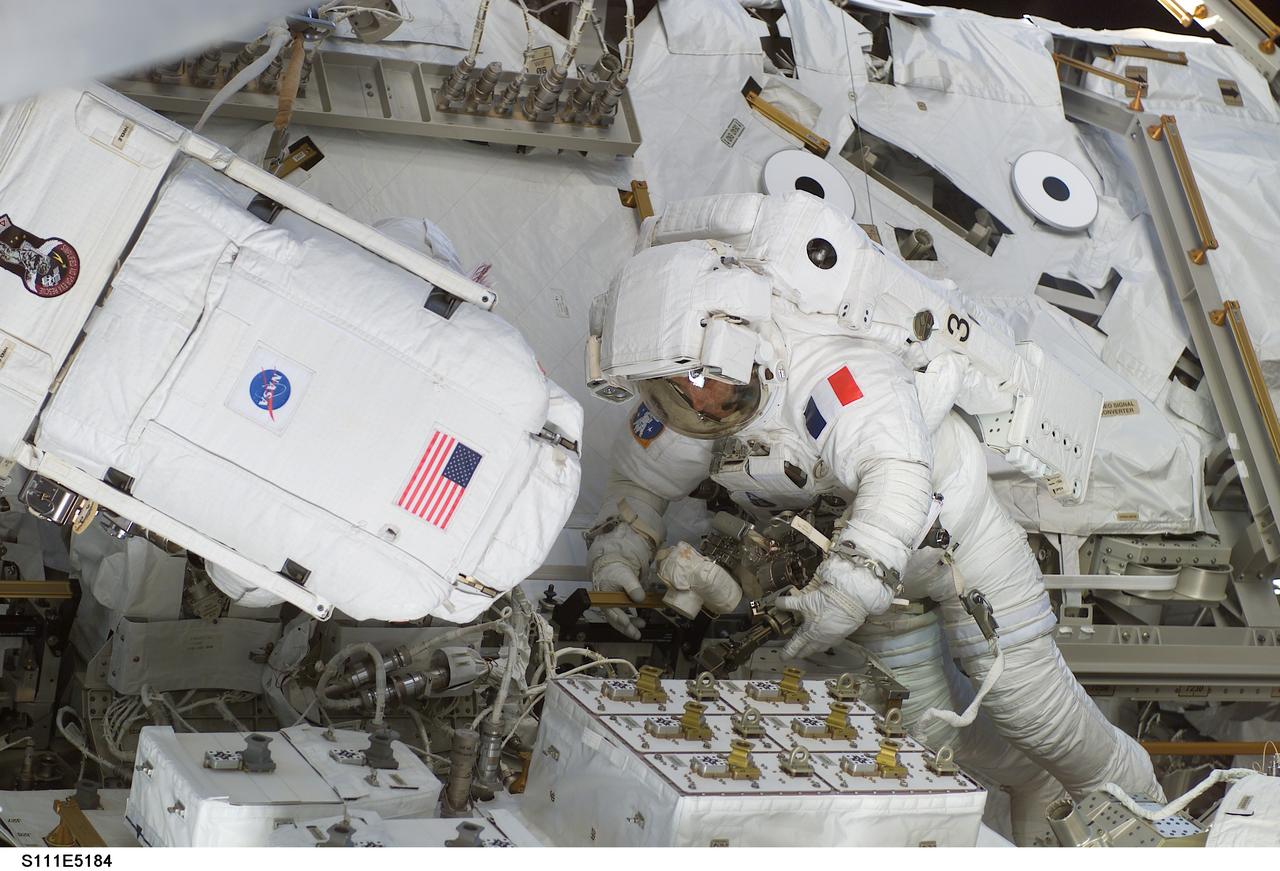
STS111-E-5184 (11 June 2002) --- Astronauts Franklin R. Chang-Diaz (left) and Philippe Perrin, both mission specialists, work on the Mobile Remote Servicer Base System (MBS) and the Mobile Transporter on the International Space Station (ISS) during the second scheduled session of extravehicular activity (EVA) for the STS-111 mission. The boxes in front of the spacewalkers are the Canadian Remote Power Control Modules (RPCM). The S0 (S-zero) Truss is partially visible in the background. Perrin represents CNES, the French Space Agency.

STS111-E-5183 (11 June 2002) --- Astronauts Franklin R. Chang-Diaz (left) and Philippe Perrin, both mission specialists, work on the Mobile Remote Servicer Base System (MBS) and the Mobile Transporter on the International Space Station (ISS) during the second scheduled session of extravehicular activity (EVA) for the STS-111 mission. The boxes in front of the spacewalkers are the Canadian Remote Power Control Modules (RPCM). The S0 (S-zero) Truss is partially visible in the background. Perrin represents CNES, the French Space Agency.
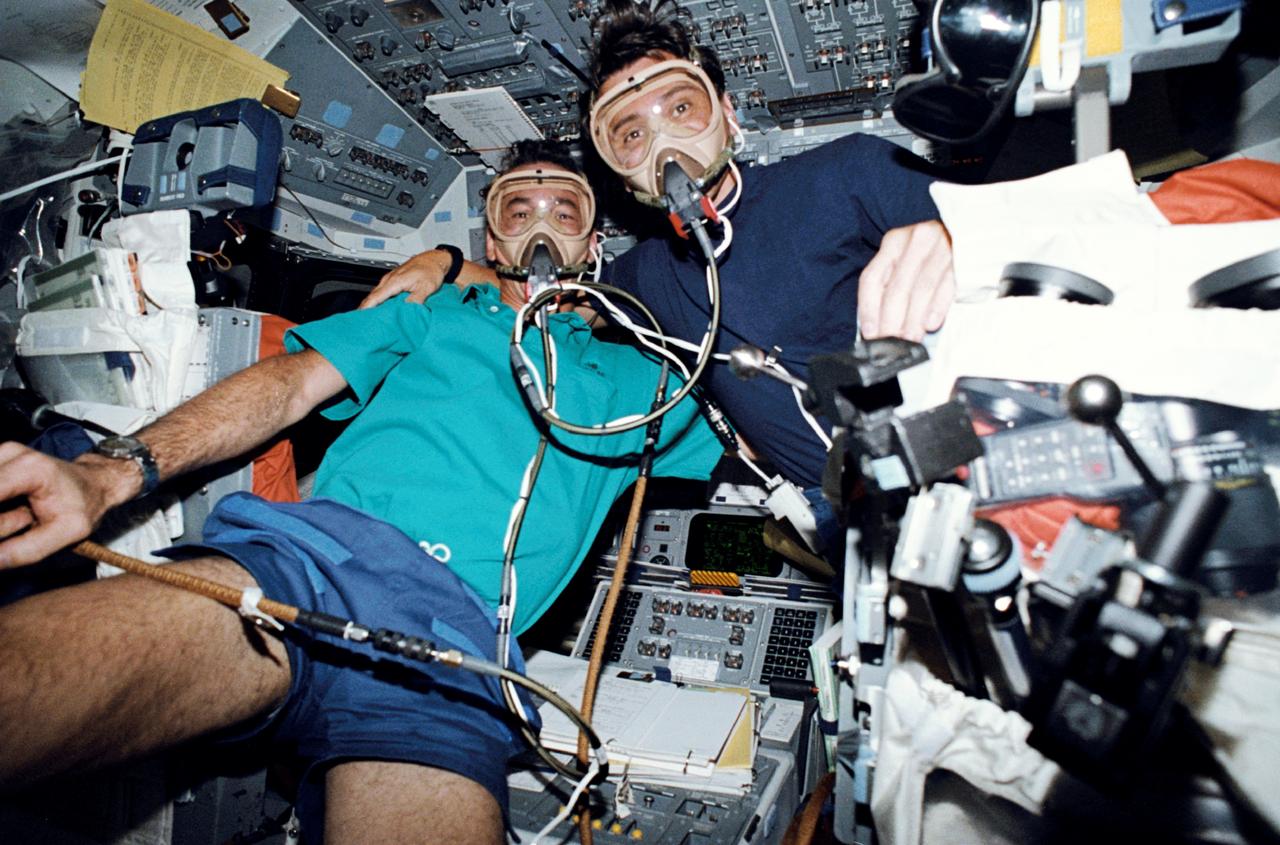
STS046-33-028 (4 Aug. 1992) --- With the possibility of an extravehicular activity (EVA) being added to the agenda, the two EVA-trained crew members begin their "pre-breathe" period on the space shuttle Atlantis' flight deck. Astronauts Jeffrey A. Hoffman (left), payload commander, and Franklin R. Chang-Diaz, mission specialist, reported to this station and began the "pre-breathe" process when problems developed during the extension of the Tethered Satellite System (TSS). When the human body is exposed to a sudden decrease in atmospheric pressure (for instance, from the 10.2 ppsi in the crew cabin to the 4.5 ppsi of the Extravehicular Mobility Unit (EMU) spacesuit), nitrogen traces in the bloodstream will expand. This expansion can create tiny bubbles and potential for the "bends". In order to lessen the effect, an astronaut must "pre-breathe" pure oxygen (the same pure oxygen that he will breathe in the suit) to help "purge" nitrogen from his/her bloodstream before exerting him/herself in the low-pressure environment of the suit. The "pre-breathe" exercise and the EVA turned out to be not needed as the TSS operations were resumed by remote operations.
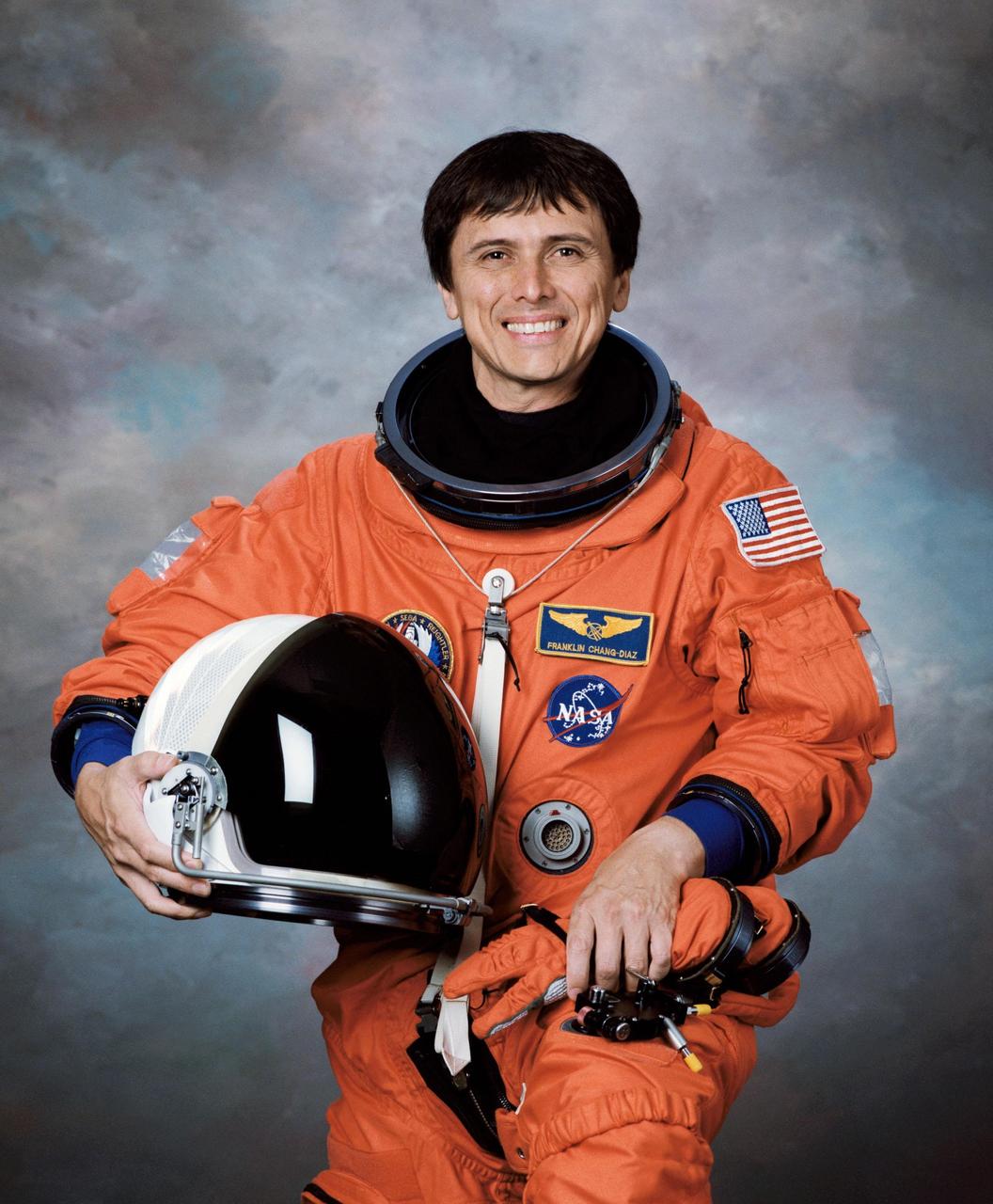
JOHNSON SPACE CENTER, HOUSTON, TX -- (JSC 597-06573) --Official Portrait of astronaut Franklin R. Chang-Diaz, STS-111 mission specialist
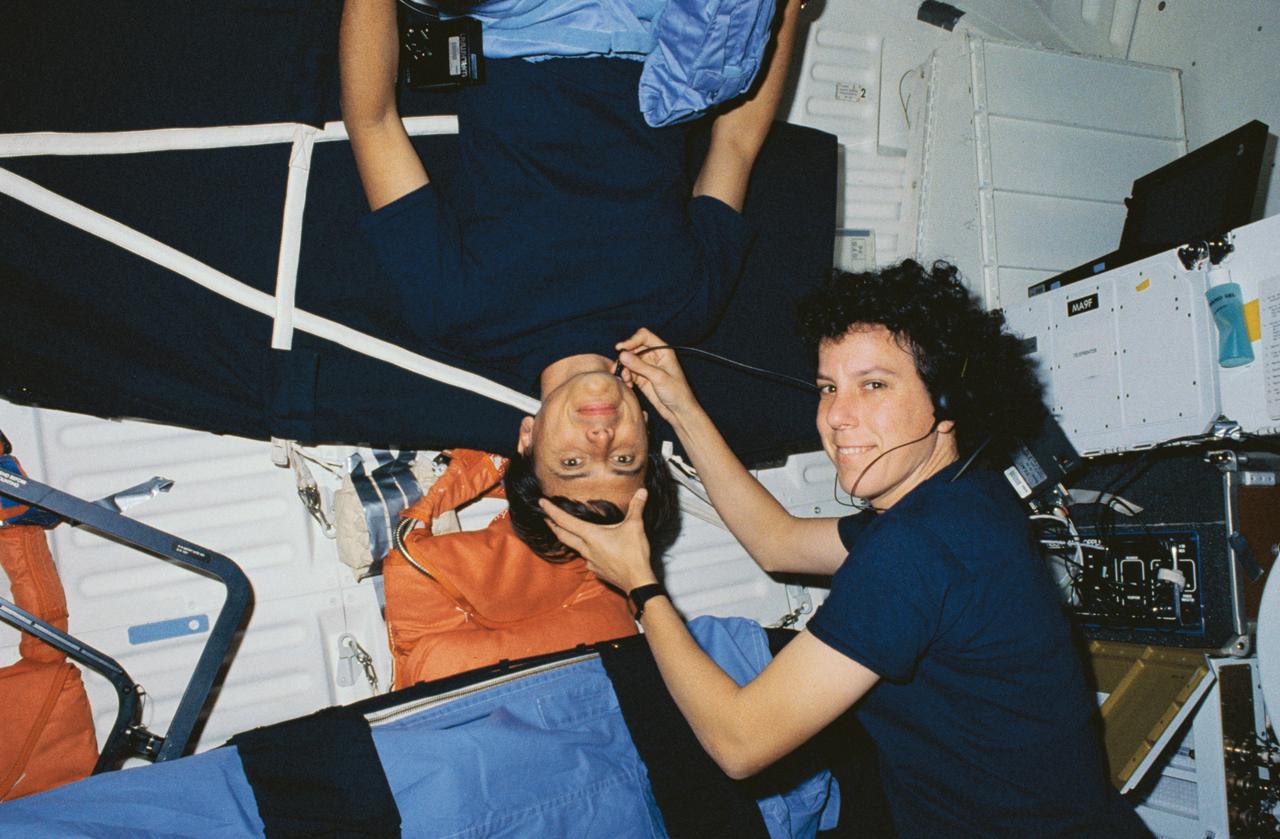
STS034-08-007 (18-23 Oct. 1989) --- Astronaut Ellen S. Baker, an STS-34 mission specialist and medical doctor, conducts a medical examination on astronaut Franklin R. Chang-Diaz, mission specialist, on the middeck of the Earth-orbiting space shuttle Atlantis. Dr. Baker was monitoring Chang-Diaz's blood flow. The scene was recorded on film with a 35mm camera.Photo credit: NASA or National Aeronautics and Space Administration
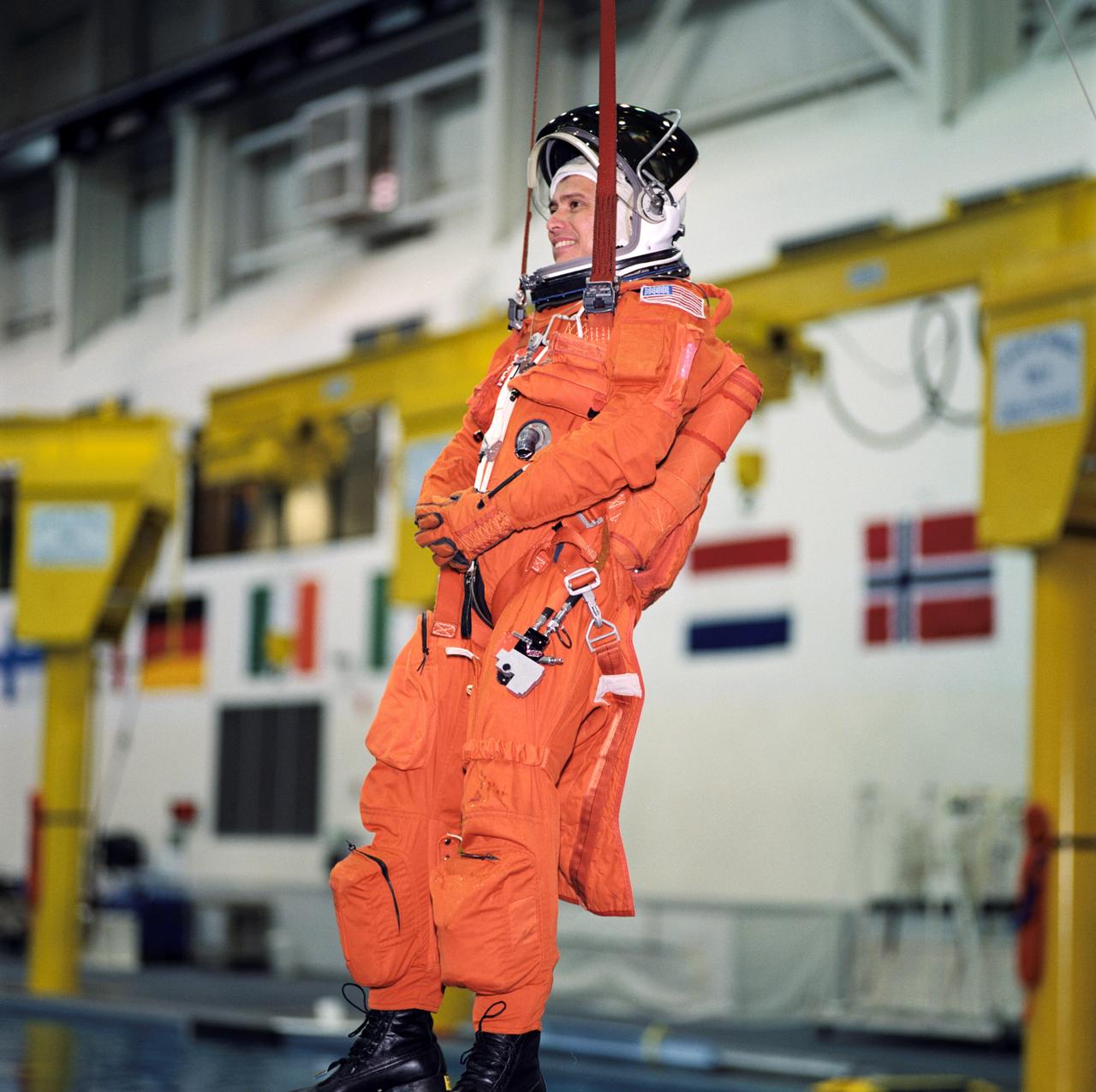
JSC2002-00417 (4 February 2002) --- Astronaut Franklin R. Chang-Diaz, STS-111 mission specialist, simulates a parachute drop into water during an emergency bailout training session at the Neutral Buoyancy Laboratory (NBL) near the Johnson Space Center (JSC). Chang-Diaz is attired in a training version of the shuttle launch and entry garment. STS-111 will be the 14th shuttle mission to visit the International Space Station (ISS).
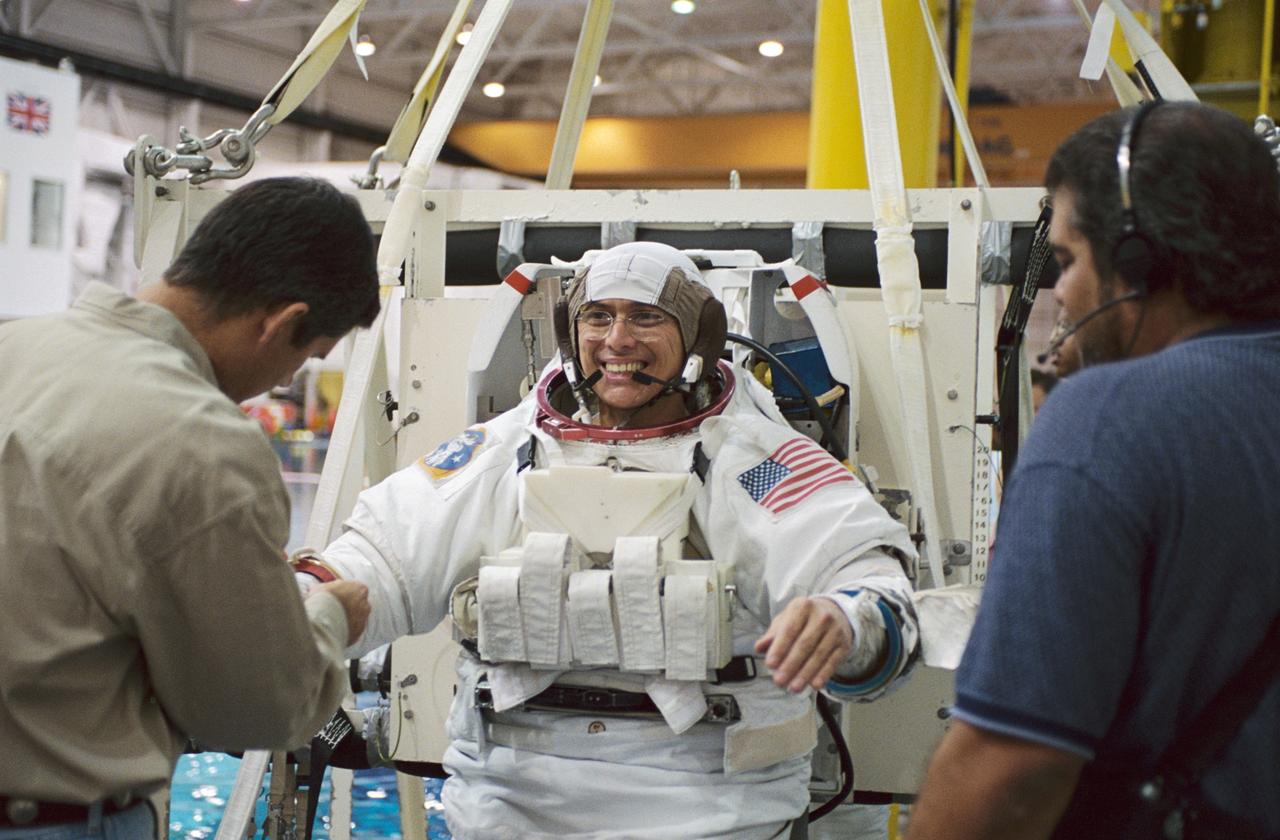
JSC2001-02945 (26 November 2001) --- Astronaut Franklin R. Chang-Diaz, STS-111 mission specialist, is photographed as the final touches are made on the training version of the Extravehicular Mobility Unit (EMU) space suit prior to being submerged in the waters of the Neutral Buoyancy Laboratory (NBL) near the Johnson Space Center (JSC). Fellow crewmember Paul S. Lockhart (left), pilot, and crew trainer Joe Cambiaso assist Chang-Diaz. STS-111 will be the 14th shuttle mission to visit the International Space Station (ISS).
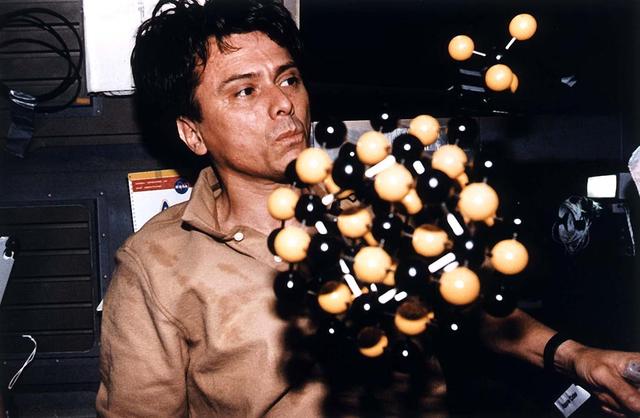
Astronaut Franklin R. Chang-Diaz, payload commander, ponders the elements of a model representing the Commercial Protein Crystal Growth (CPCG) experiment. This flight of the experiment marks the first joint United States--Latin America effort in this discipline. The project brings together a small team of investigators from Costa Rica (Chang-Diaz's native land), Chile, and the United States.
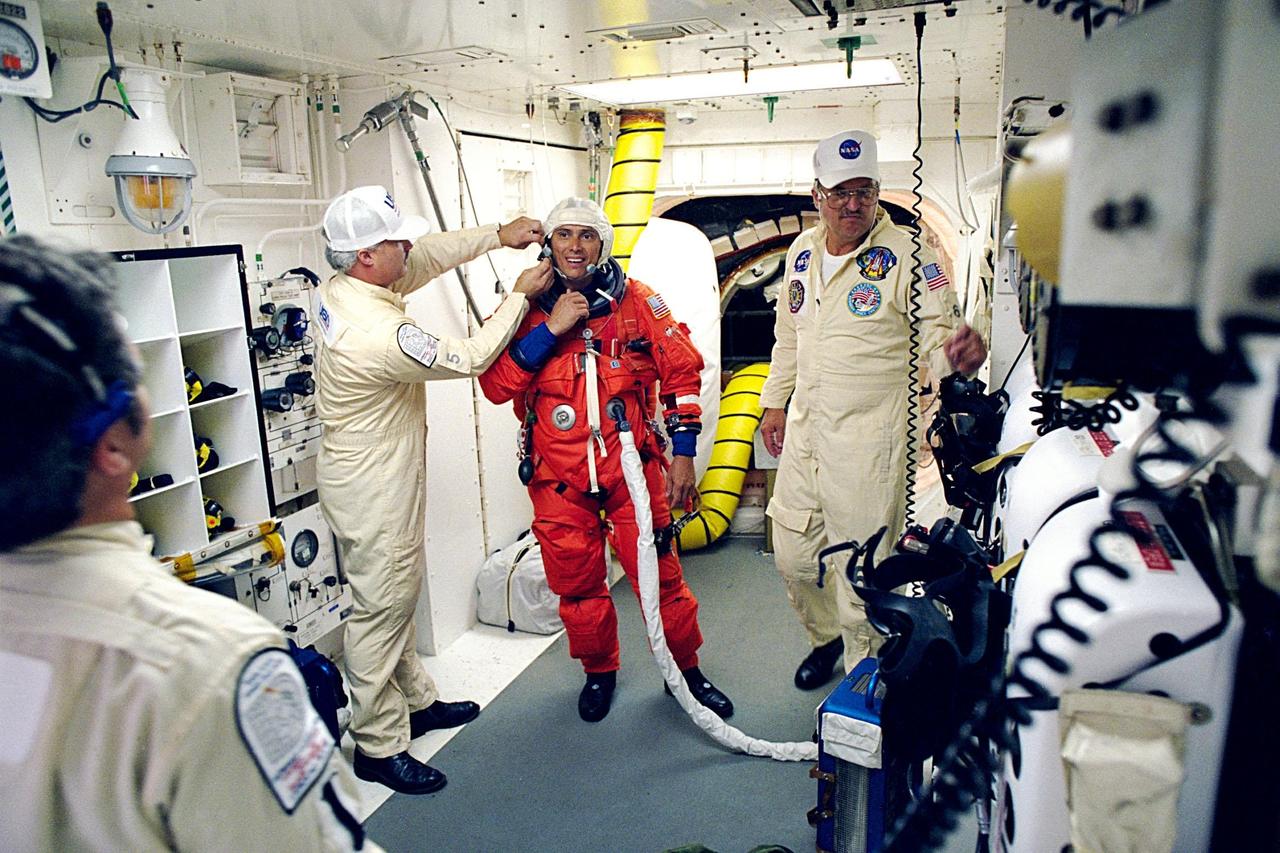
White room crew members Greg Lohning (left) and Chris Meinert help STS-91 Mission Specialist Franklin R. Chang-Diaz prepare to enter the Space Shuttle Discovery at Launch Pad 39A
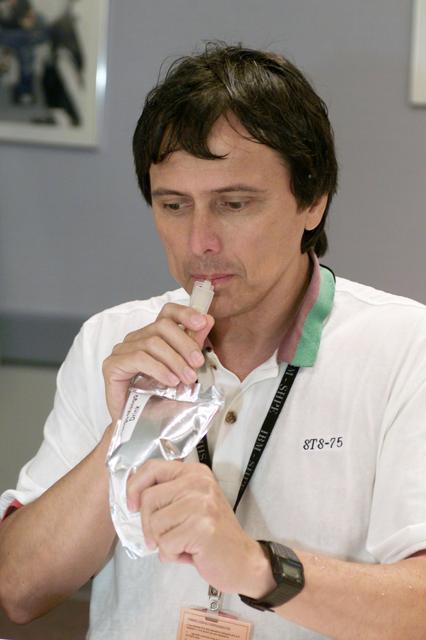
JSC2001-E-25713 (27 August 2001) --- Astronaut Franklin R. Chang-Diaz, STS-111 mission specialist, is photographed during food testing in the Flight Projects Division Laboratory at the Johnson Space Center (JSC).
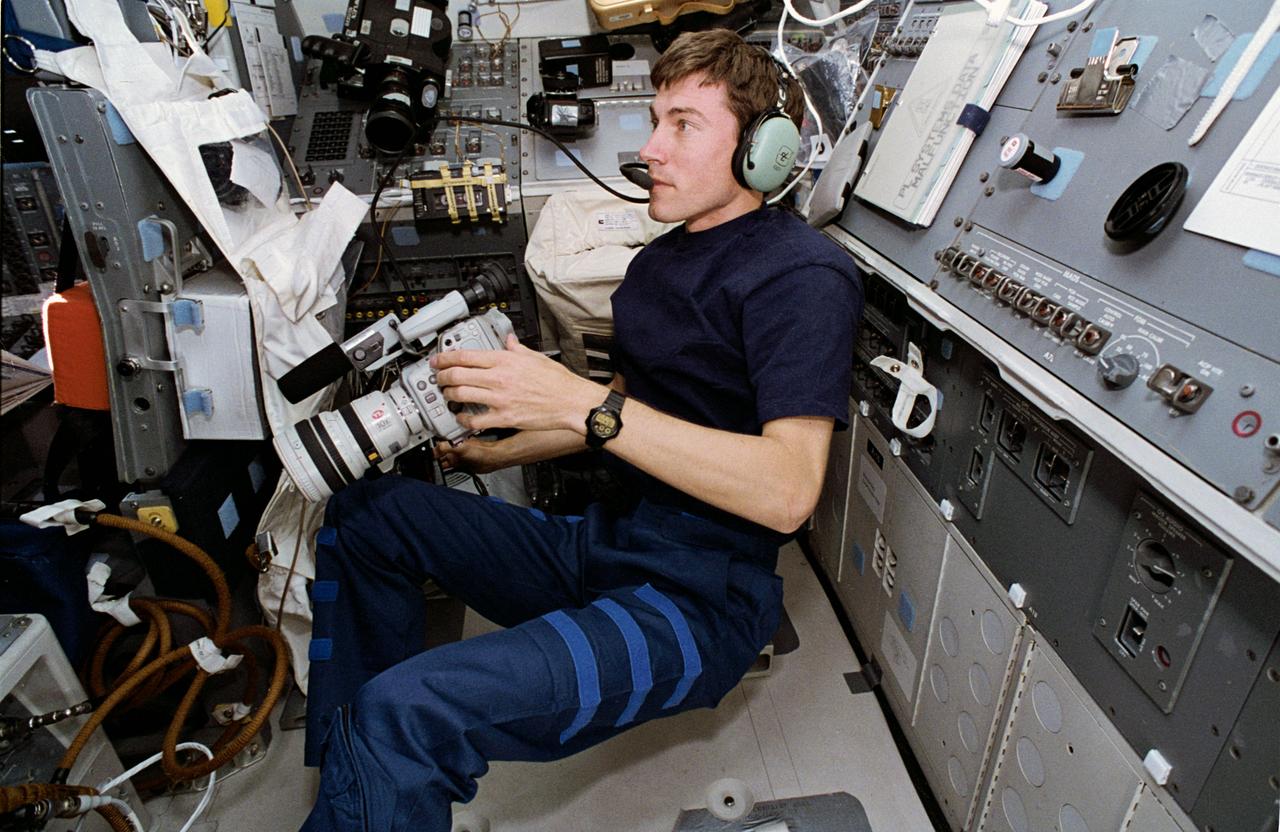
STS60-29-009 (10 Feb 1994) --- On the Space Shuttle Discovery's aft flight deck, Russian cosmonaut Sergei K. Krikalev prepares for one chore while performing another. Using the Shuttle Amateur Radio Experiment (SAREX) gear, the mission specialist was talking with students in Maine. He holds a camcorder, which was later called into action to record inflight activities. Krikalev joined five NASA astronauts for eight days in space aboard Discovery.
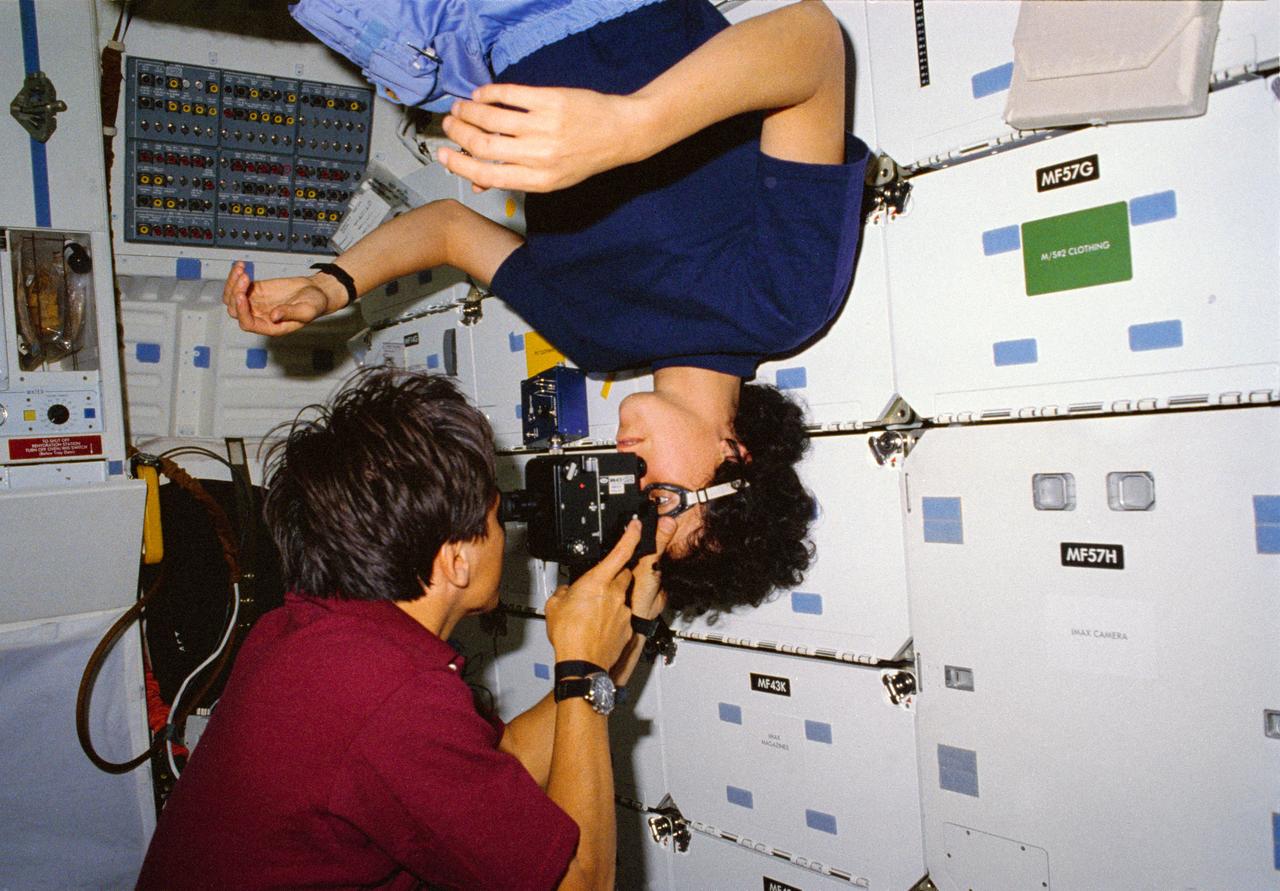
STS034-10-015 (18-23 Oct. 1989) --- Astronaut Franklin R. Chang-Diaz performs an eye examination on astronaut Ellen S. Baker, both STS-34 mission specialists, on the middeck of the Earth-orbiting space shuttle Atlantis.
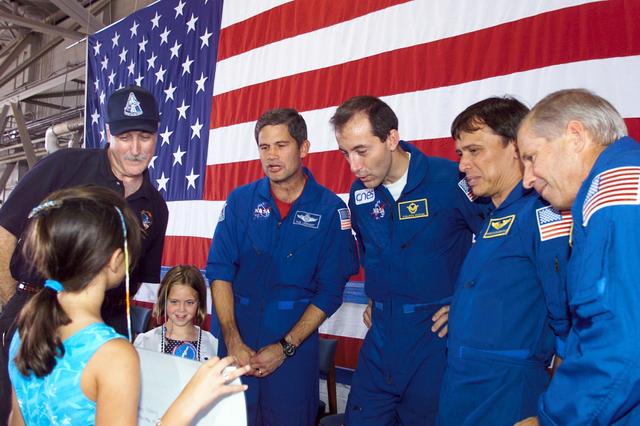
JSC2002-E-25983 (21 June 2002) --- NASA Administrator Sean O'Keefe (from left), astronauts Paul S. Lockhart, Philippe Perrin, Franklin R. Chang-Diaz and Kenneth D. Cockrell check out the welcome home sign of a young greeter during crew return ceremonies in Hangar 990 at Elligngton Field.
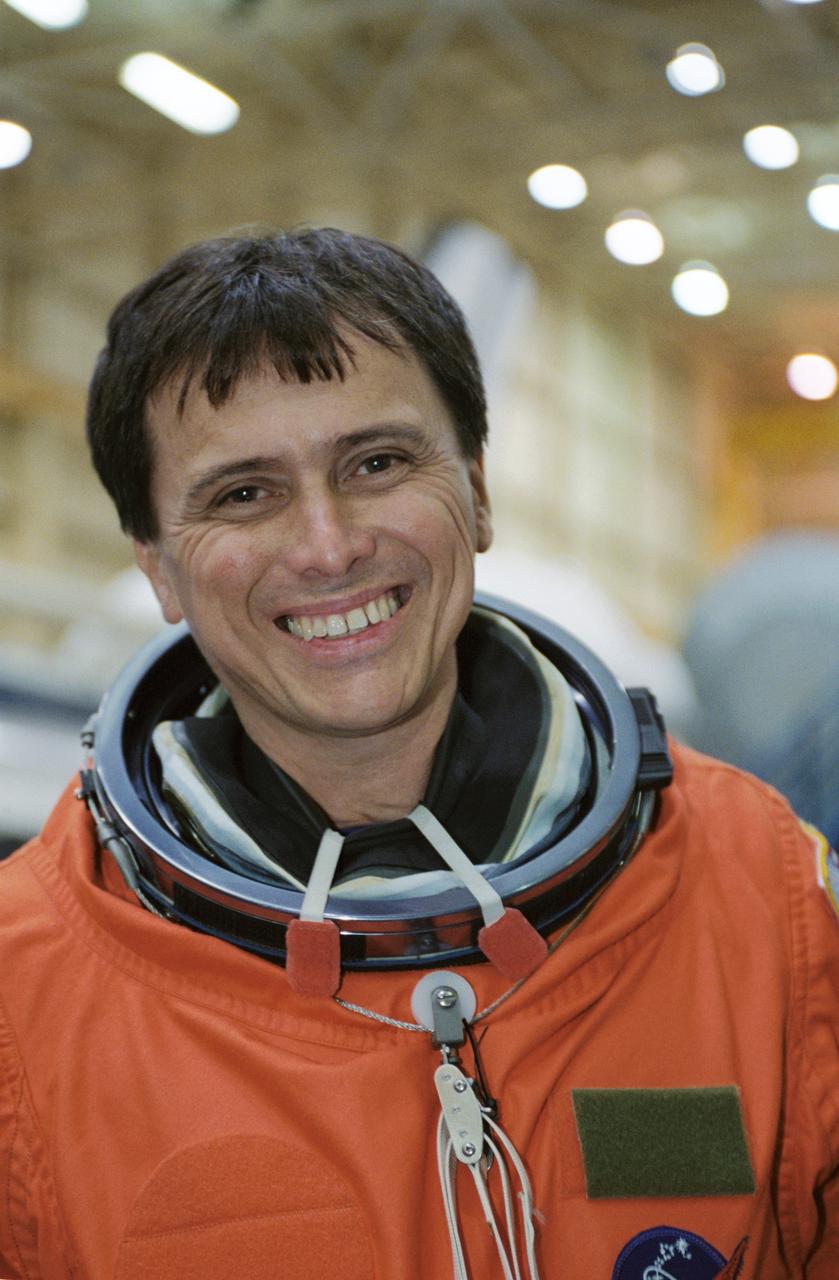
JSC2002-00722 (29 March 2002) --- Astronaut Franklin R. Chang-Diaz, STS-111 mission specialist, attired in a training version of the shuttle launch and entry suit, waits for a mission training session in the Space Vehicle Mockup Facility at the Johnson Space Center (JSC).
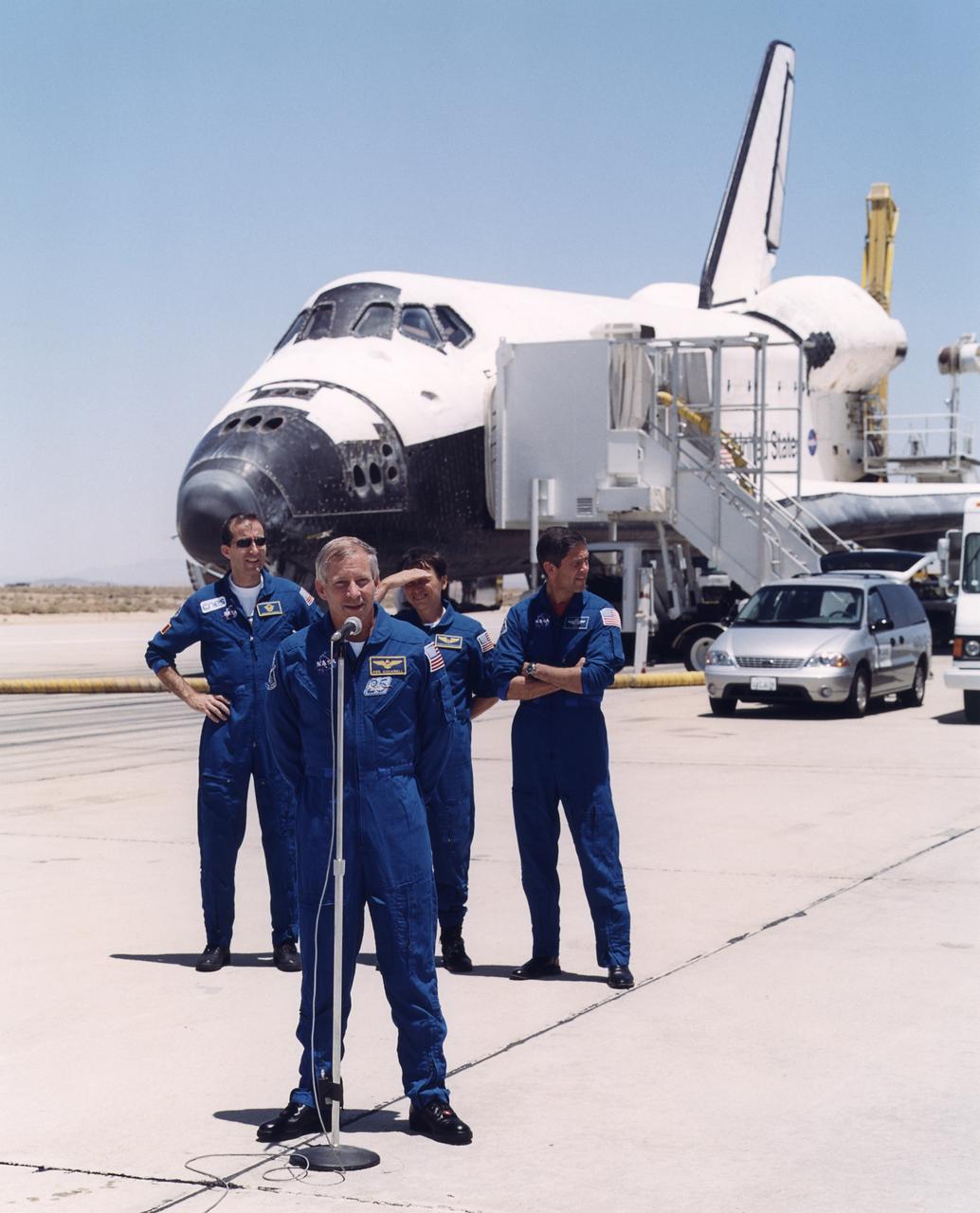
STS-111 commander Ken Cockrell greets dignitaries and recovery technicians on the runway at Edwards Air Force Base following the landing of the space shuttle Endeavour on June 19, 2002. Behind Cockrell are (from left) mission specialists Philippe Perrin and Franklin Chang-Diaz and Shuttle pilot Paul Lockhart.
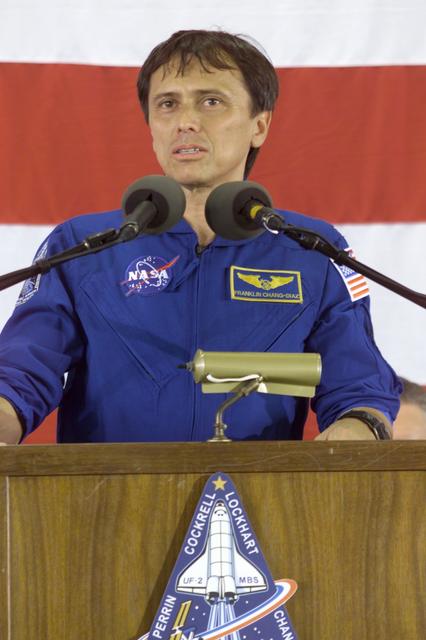
JSC2002-E-26032 (21 June 2002) --- Astronaut Franklin R. Chang-Diaz, STS-111 mission specialist, speaks from the lectern in Hangar 990 at Ellington Field during the STS-111 and Expedition Four crew return ceremonies.
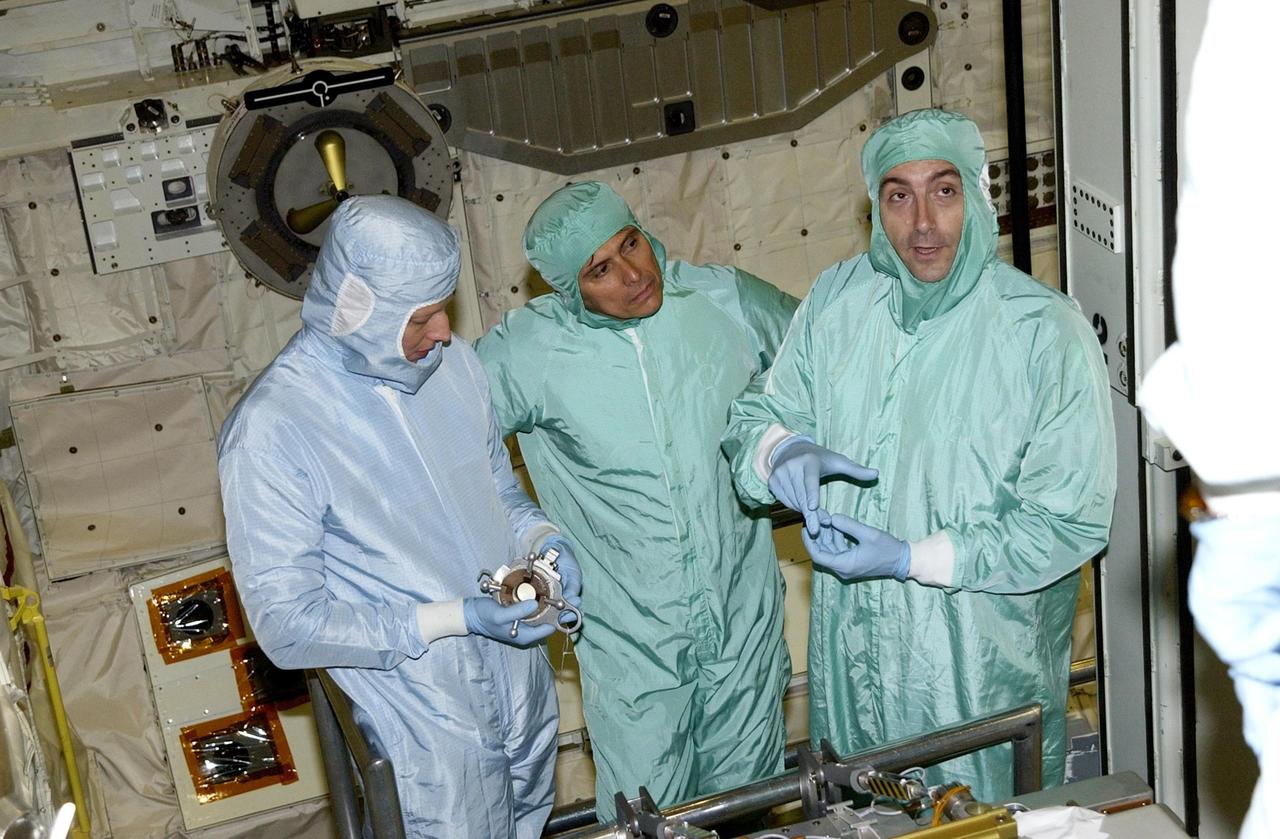
KENNEDY SPACE CENTER, FLA. -- In the Orbiter Processing Facility, STS-111 Mission Specialists Franklin Chang-Diaz (center) and Phillippe Perrin (right) check equipment with a trainer (left) in orbiter Endeavour. Perrin is with the French Space Agency (CNES). Perrin and Chang-Diaz, with other crew members, are taking part in a Crew Equipment Interface Test in preparation for launch. Mission STS-111 will carry to the International Space Station the Multipurpose Logistics Module (MPLM), filled with experiment racks and three stowage and resupply racks, and the Mobile Base System (MBS), which will attach to the Mobile Transporter and complete the Canadian Mobile Servicing System, or MSS. The Station's mechanical arm will then have the capability to "inchworm" from the U.S. Lab to the MSS and travel along the truss to work sites on the Station. Launch of Endeavour on mission STS-111 is scheduled for May 30, 2002
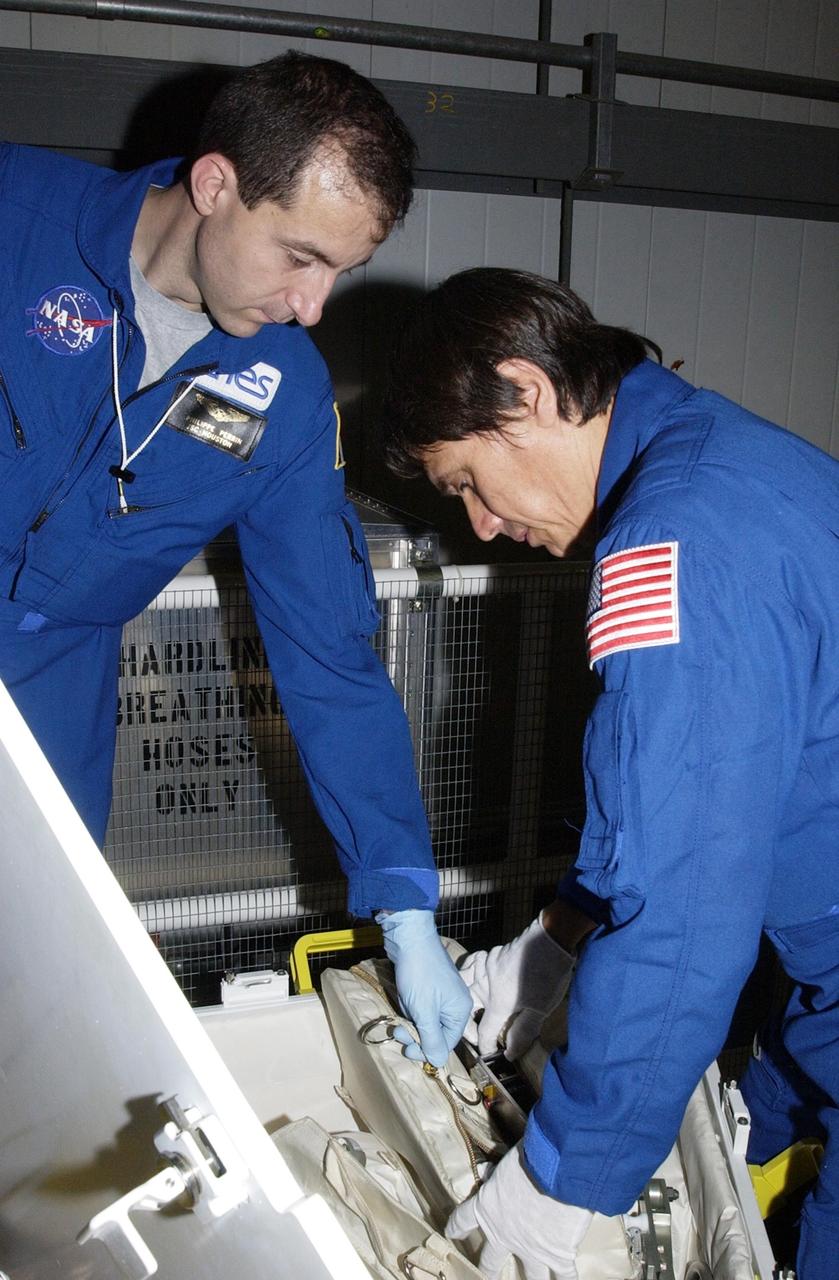
KENNEDY SPACE CENTER, FLA. -- In the Orbiter Processing Facility, STS-111 Mission Specialists Phillippe Perrin (left) and Franklin Chang-Diaz (right) check equipment for their mission. Perrin is with the French Space Agency (CNES). Perrin and Chang-Diaz, with other crew members, are taking part in a Crew Equipment Interface Test in preparation for launch. Mission STS-111 will carry to the International Space Station the Multipurpose Logistics Module (MPLM), filled with experiment racks and three stowage and resupply racks, and the Mobile Base System (MBS), which will attach to the Mobile Transporter and complete the Canadian Mobile Servicing System, or MSS. The Station's mechanical arm will then have the capability to "inchworm" from the U.S. Lab to the MSS and travel along the truss to work sites on the Station. Launch of Endeavour on mission STS-111 is scheduled for May 30, 2002
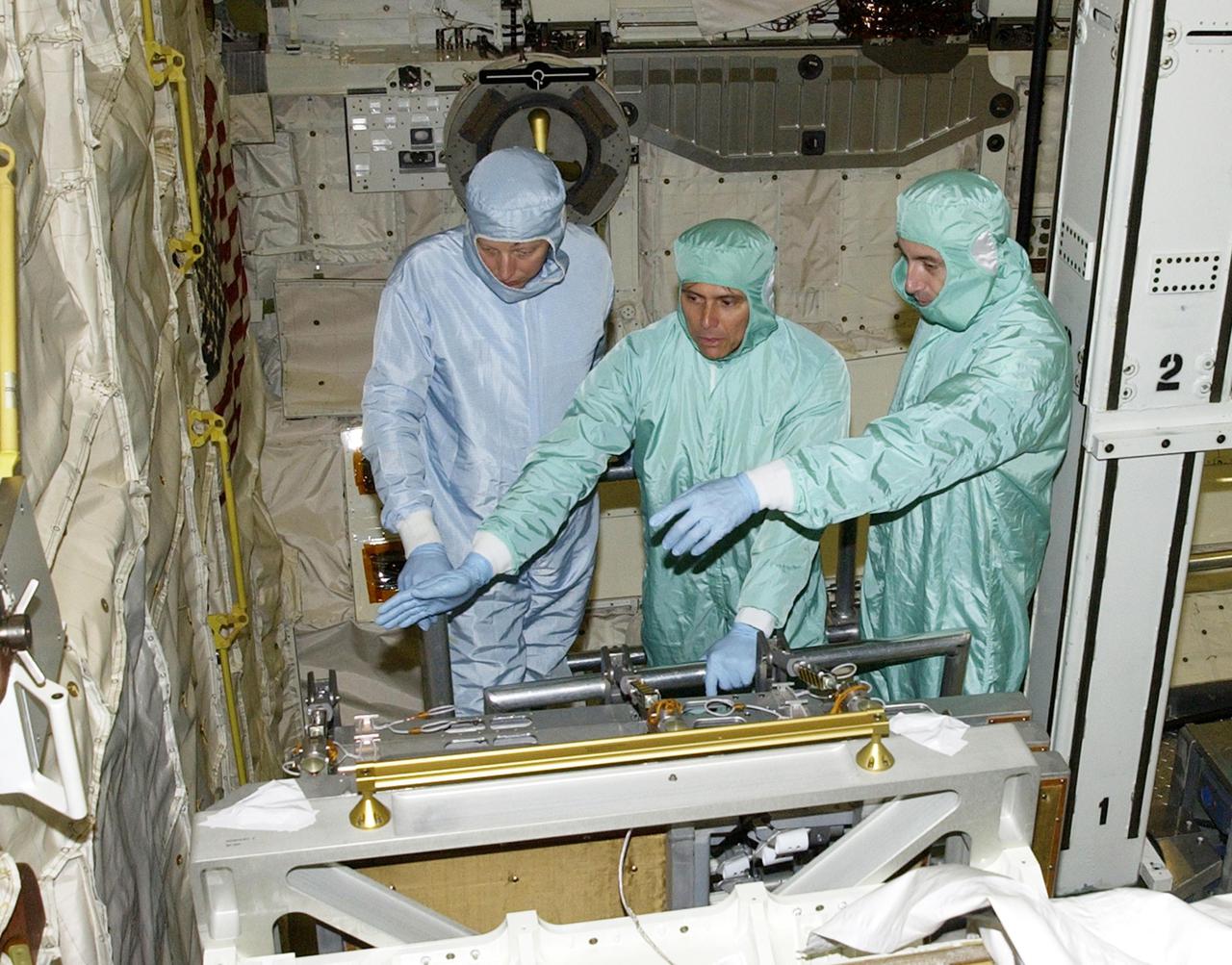
KENNEDY SPACE CENTER, FLA. - In the Orbiter Processing Facility, STS-111 Mission Specialists Franklin Chang-Diaz (center) and Phillippe Perrin (right) look over equipment with a trainer (left) in orbiter Endeavour. Perrin is with the French Space Agency (CNES). Perrin and Chang-Diaz, with other crew members, are taking part in a Crew Equipment Interface Test in preparation for launch. Mission STS-111 will carry to the International Space Station the Multipurpose Logistics Module (MPLM), filled with experiment racks and three stowage and resupply racks, and the Mobile Base System (MBS), which will attach to the Mobile Transporter and complete the Canadian Mobile Servicing System, or MSS. The Station's mechanical arm will then have the capability to 'inchworm' from the U.S. Lab to the MSS and travel along the truss to work sites on the Station. Launch of Endeavour on mission STS-111 is scheduled for May 30, 2002
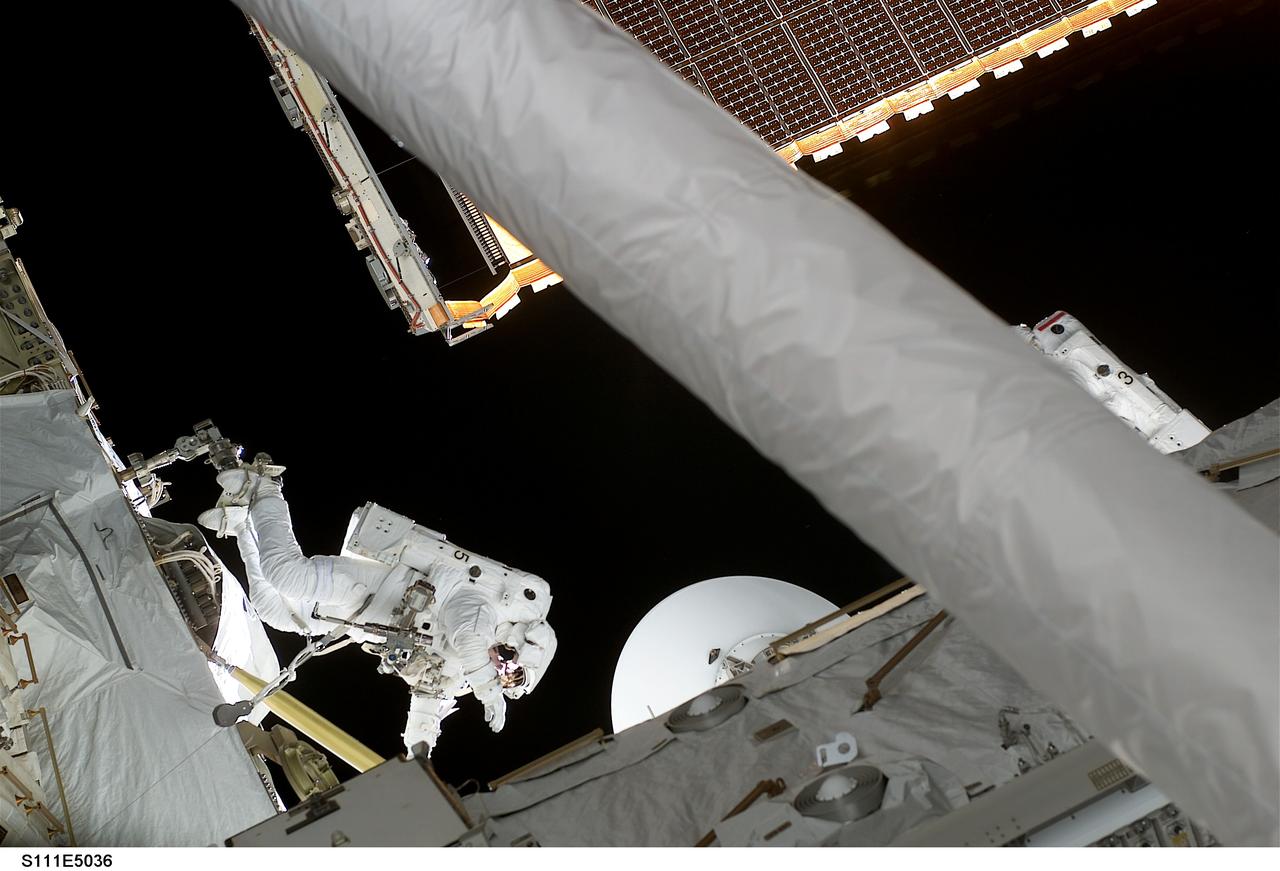
STS111-E-5036 (8 June 2002) --- Astronauts Philippe Perrin (left center) and Franklin R. Chang-Diaz (partially obscured by robot arm) work in chorus during extravehicular activity (EVA) to perform work on the International Space Station (ISS). The first spacewalk of the STS-111 mission began with the installation of a Power and Data Grapple Fixture (PDGF) for the station's robotic arm, known as Canadarm2, on the complex's P6 truss. The PDGF will allow the robotic arm to grip the P6 truss for future station assembly operations. Astronauts Chang-Diaz and Perrin (with French Space Agency, CNES) went on to install the new fixture about halfway up the P6 truss, the vertical structure that currently supports the station's set of large U.S. solar arrays.
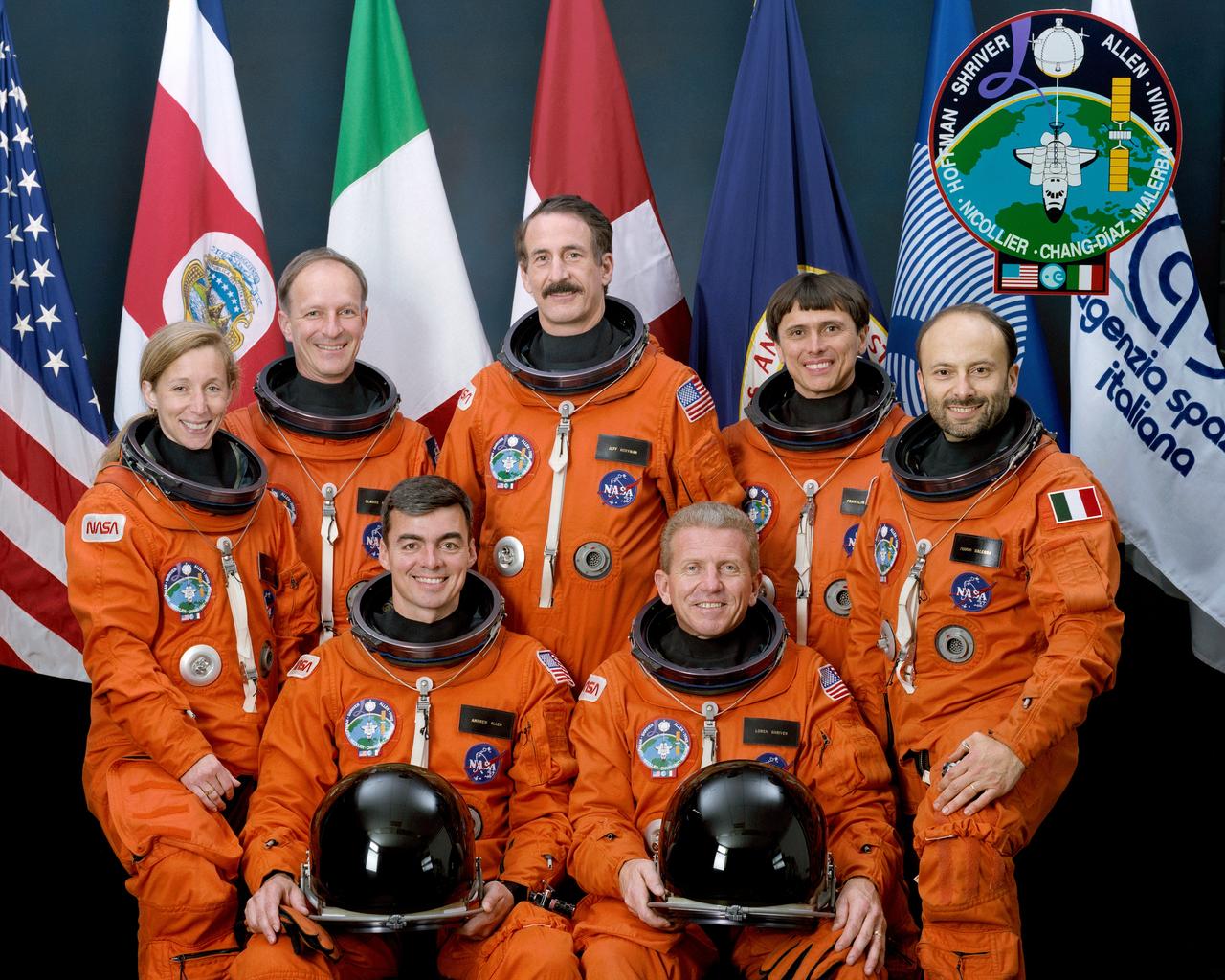
STS046-S-002 (May 1992) --- The crew members assigned to the STS-46 mission pose with seven flags that represent participation on the flight. Loren J. Shriver (right front) is mission commander; Andrew M. Allen (left front) is pilot. Others are (left to right) Marsha S. Ivins, mission specialist; Claude Nicollier, mission specialist representing the European Space Agency (ESA); Jeffrey A. Hoffman, payload commander; Franklin R. Chang-Diaz, mission specialist; and Franco Malerba, flying for the Italian Space Agency (ASI). The flags, left to right, represent the United States of America, Costa Rica (Chang's native country), Italy, Switzerland (Nicollier's homeland), NASA, ESA and ASI.
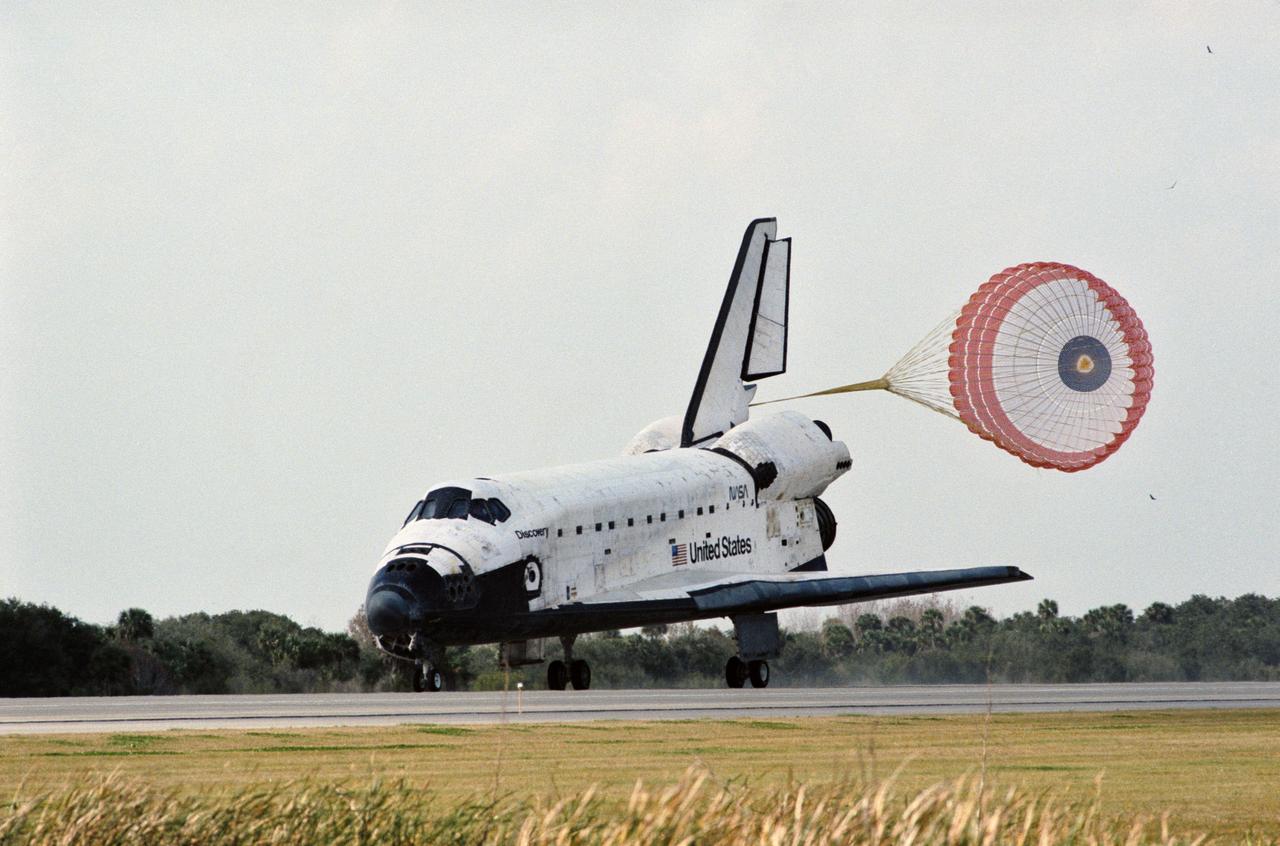
STS060-S-035 (11 Feb 1994) --- The drag chute for Space Shuttle Discovery is deployed on the Shuttle Landing Facility, marking an end to the eight-day STS-60 mission. Landing occurred at 2:19:22 p.m. (EST). Onboard were astronauts Charles F. Bolden Jr., Kenneth S. Reightler Jr., Franklin R. Chang-Diaz, N. Jan Davis and Ronald M. Sega along with Russian cosmonaut Sergei K. Krikalev.
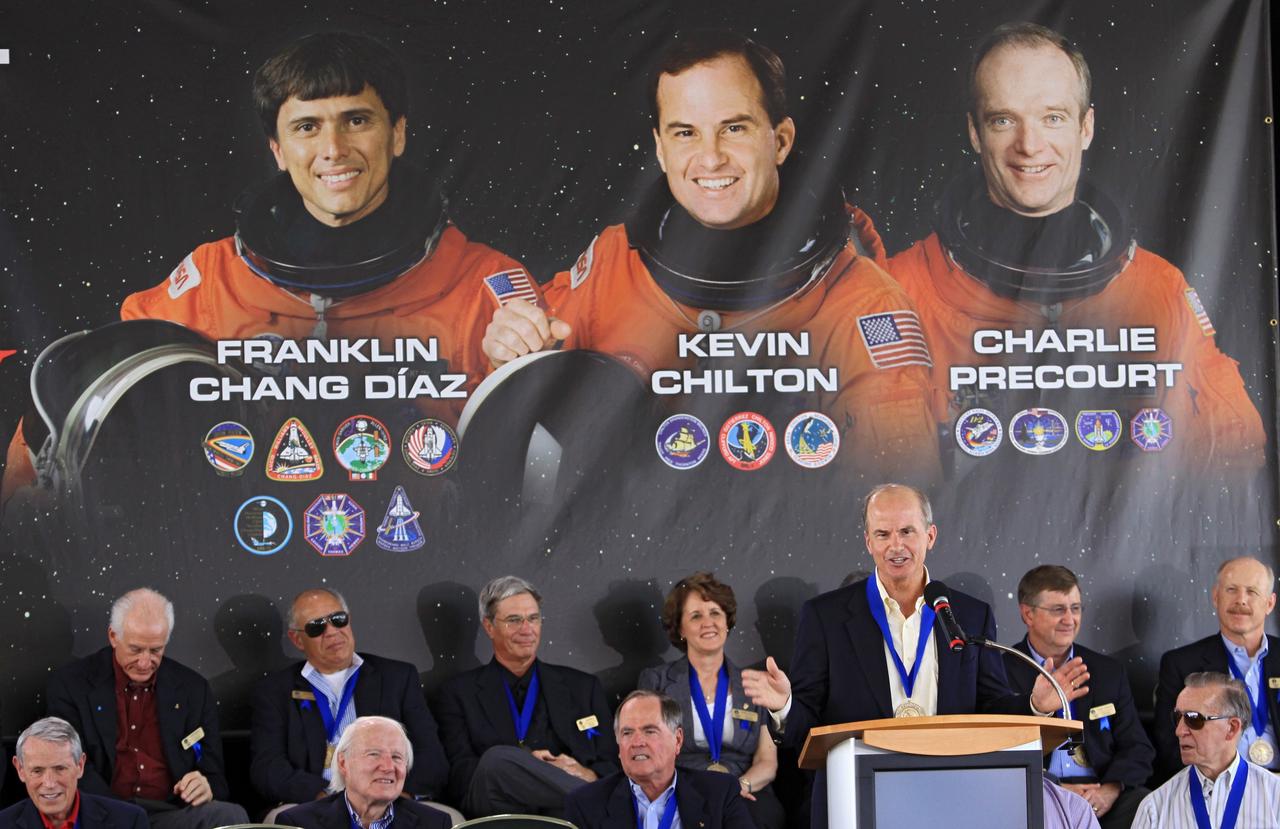
CAPE CANAVERAL, Fla. – At NASA’s Kennedy Space Center Visitor Complex in Florida, shuttle astronaut Kevin Chilton speaks after being inducted into the U.S. Astronaut Hall of Fame Class of 2012. Shuttle astronauts Franklin Chang Diaz and Charlie Precourt also were inducted into the Hall of Fame. The year’s inductees were selected by a committee of current Hall of Fame astronauts, former NASA officials, historians and journalists. The selection process is administered by the Astronaut Scholarship Foundation. Photo credit: NASA/Jim Grossmann
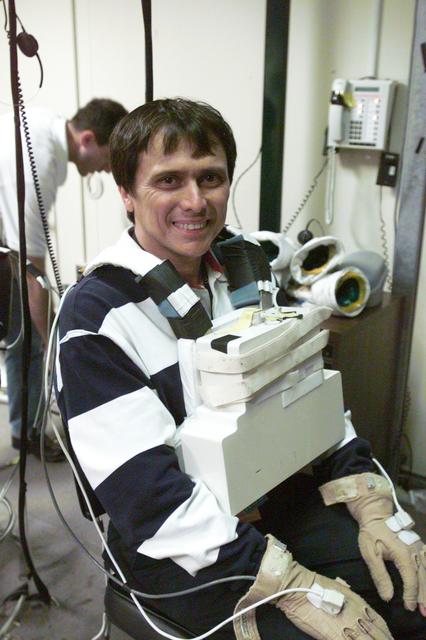
JSC2001-E-39080 (18 October 2001) --- Astronaut Franklin R. Chang-Diaz, STS-111 mission specialist, prepares to use specialized gear in the virtual reality lab at the Johnson Space Center (JSC) to train for his duties aboard the Space Shuttle Endeavour. This type of virtual reality training allows the astronauts to wear a helmet and special gloves while looking at computer displays simulating actual movements around the various locations on the International Space Station (ISS) hardware with which they will be working.
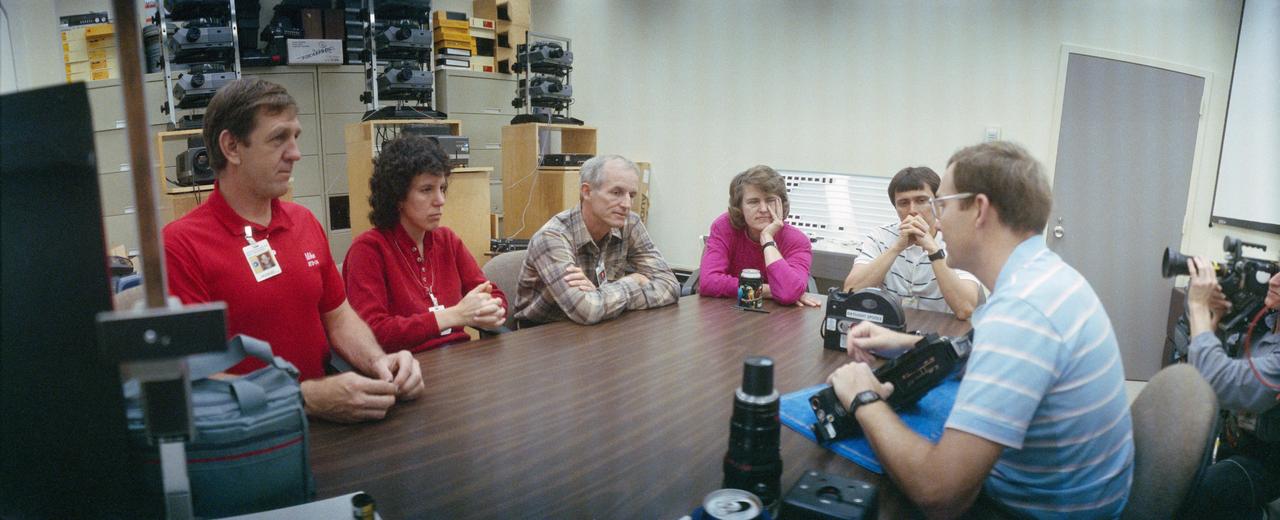
STS-34 Atlantis, Orbiter Vehicle (OV) 104, crewmembers listen to trainer Bill Bowers explain ARRIFLEX camera equipment during briefing at JSC. Across the table from Bowers are (left to right) Pilot Michael J. McCulley, Mission Specialist (MS) Ellen S. Baker, Commander Donald E. Williams, MS Shannon W. Lucid, and MS Franklin R. Chang-Diaz.
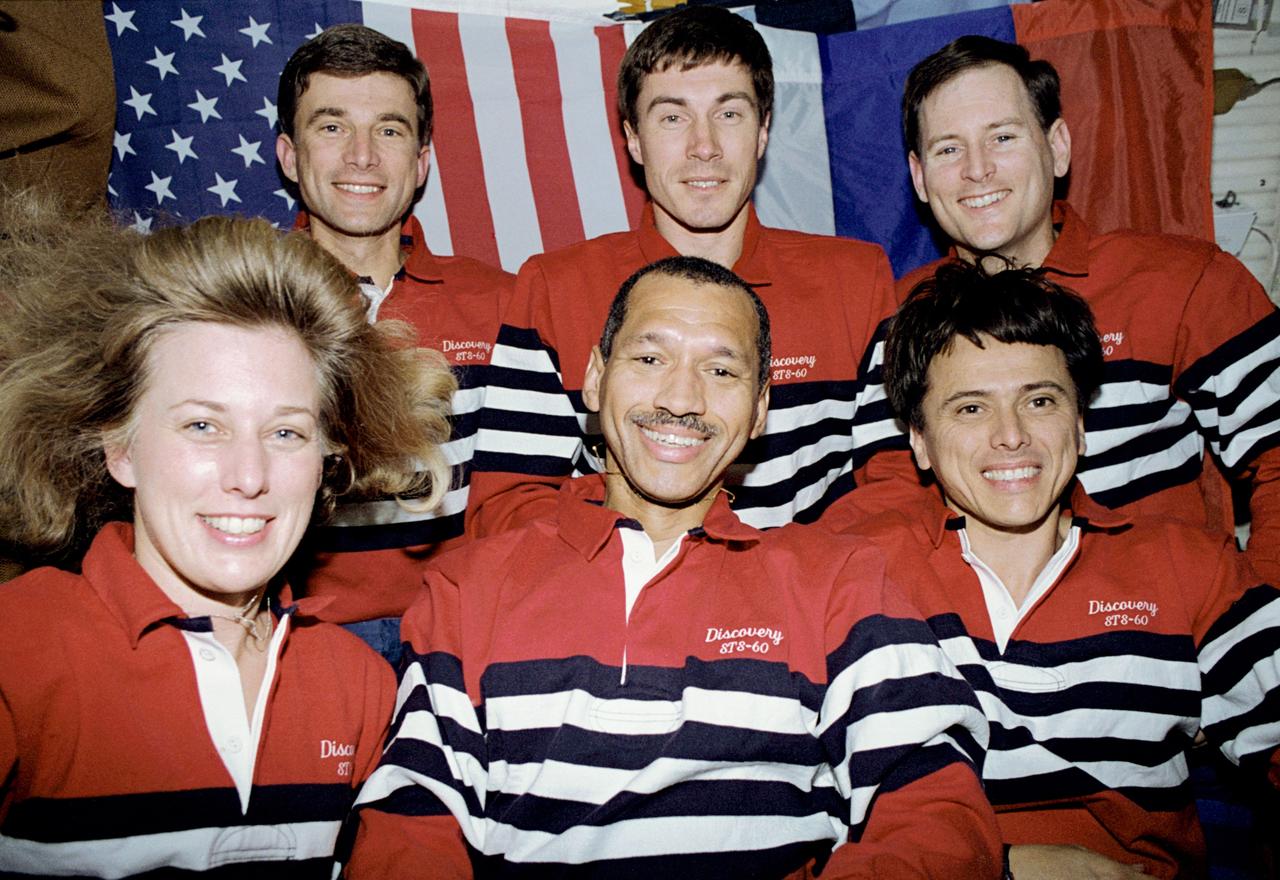
STS060-31-009 (3-11 Feb. 1994) --- The six-member STS-60 crew pose for the traditional in-flight crew portrait, with American and Russian flags forming the backdrop on the space shuttle Discovery’s middeck. Left to right (front row) are N. Jan Davis, Charles F. Bolden Jr. and Franklin R. Chang-Diaz; and (back row) Ronald M. Sega, Sergei K. Krikalev and Kenneth S. Reightler Jr. Photo credit: NASA or National Aeronautics and Space Administration
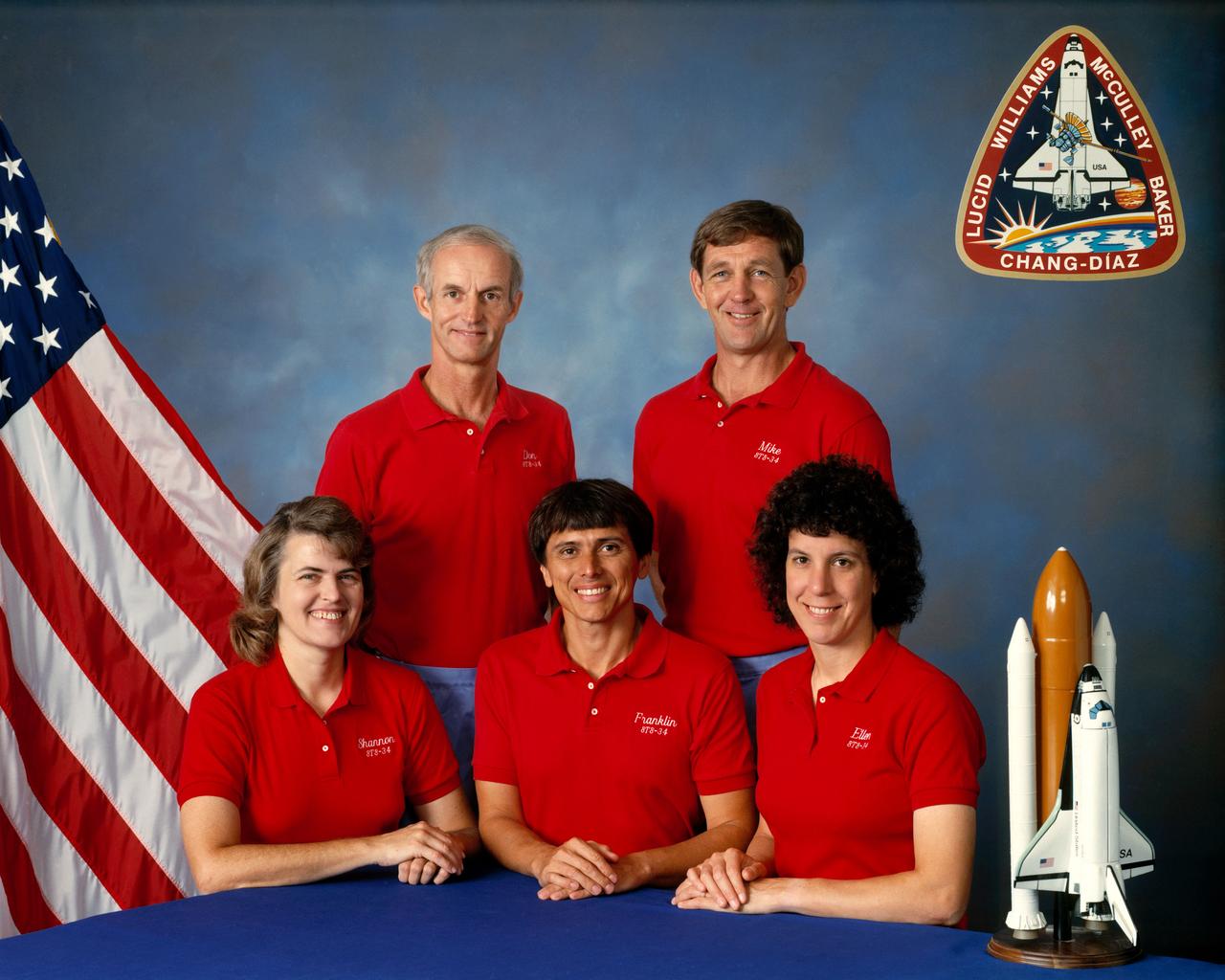
S89-39803 (July 1989) --- These five astronauts have been assigned to fly the Space Shuttle Atlantis for the mission on which the Jupiter probe, Galileo will be deployed. The mission is scheduled for October of this year. Seated, left to right, are mission specialists Shannon W. Lucid, Ph.D.; Franklin Chang-Diaz, Ph.D.; and Ellen S. Baker, M.D. Standing behind the mission specialists are left, Donald E. Williams, commander; and Michael J. McCulley, pilot.
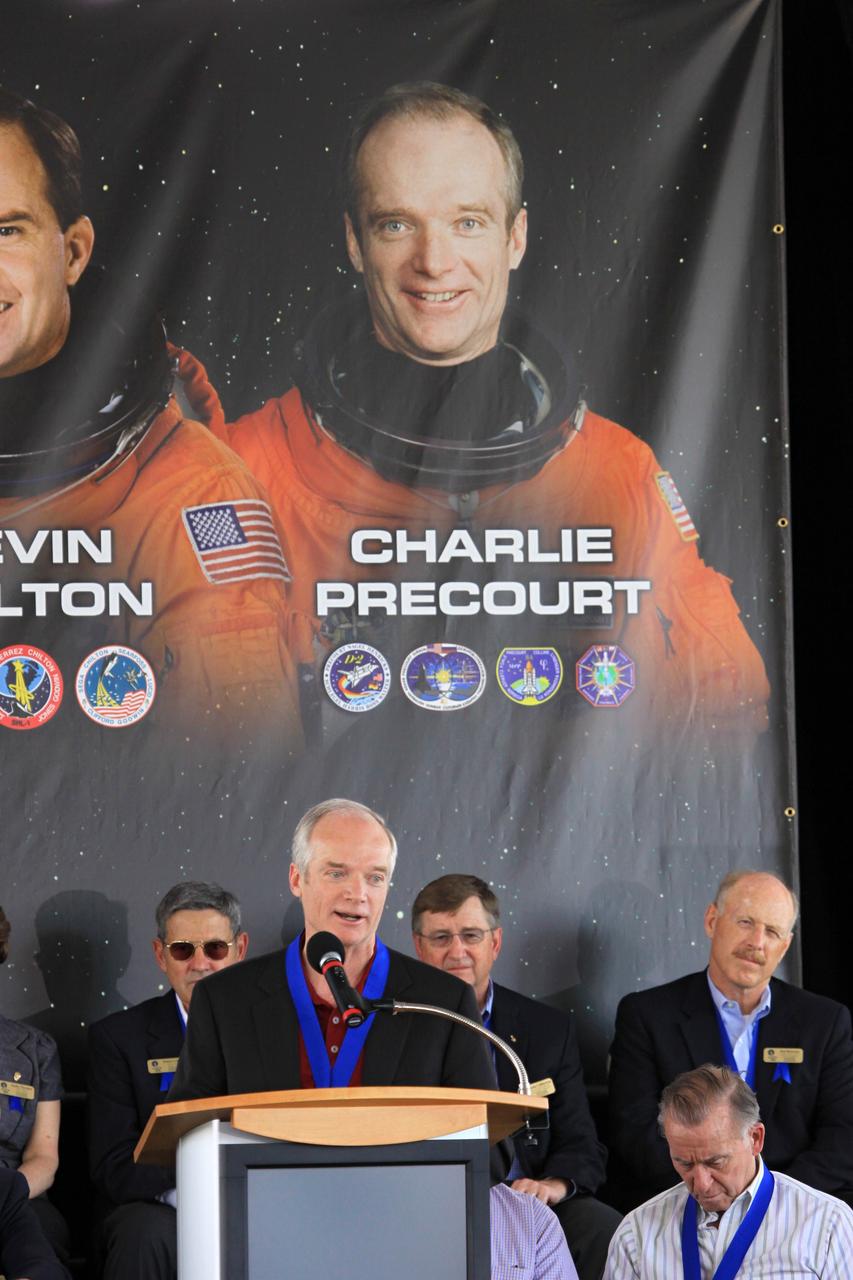
CAPE CANAVERAL, Fla. – At NASA’s Kennedy Space Center Visitor Complex in Florida, shuttle astronaut Charlie Precourt speaks after being inducted into the U.S. Astronaut Hall of Fame Class of 2012. Shuttle astronauts Franklin Chang Diaz and Kevin Chilton also were inducted into the Hall of Fame. The year’s inductees were selected by a committee of current Hall of Fame astronauts, former NASA officials, historians and journalists. The selection process is administered by the Astronaut Scholarship Foundation. Photo credit: NASA/Jim Grossmann
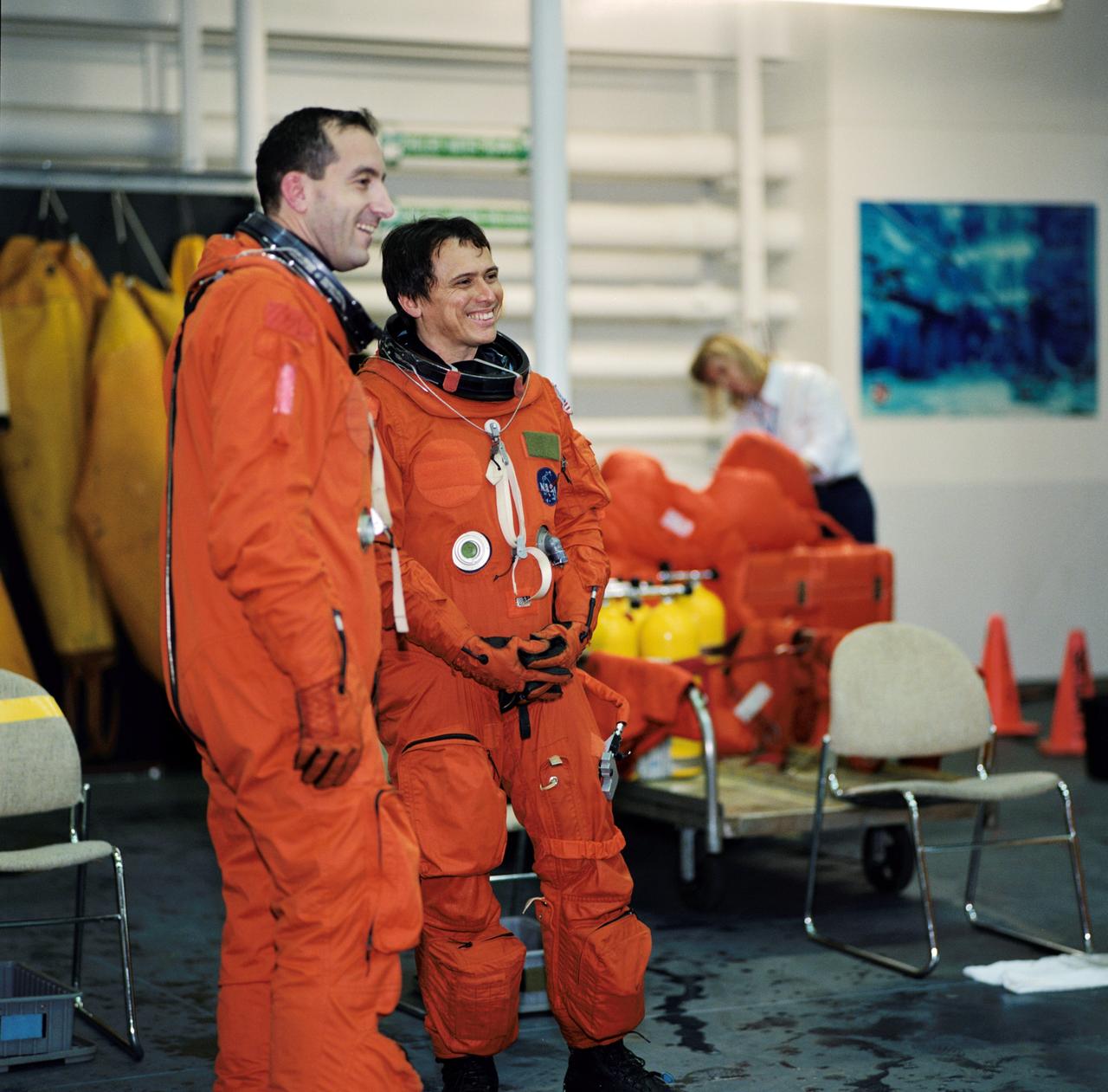
JSC2002-00405 (4 February 2002) --- Astronauts Philippe Perrin (left) and Franklin R. Chang-Diaz, both STS-111 mission specialists attired in training versions of the shuttle launch and entry garment, await the start of a training session at the Neutral Buoyancy Laboratory (NBL) near the Johnson Space Center (JSC). STS-111 will be the 14th shuttle mission to visit the International Space Station (ISS).
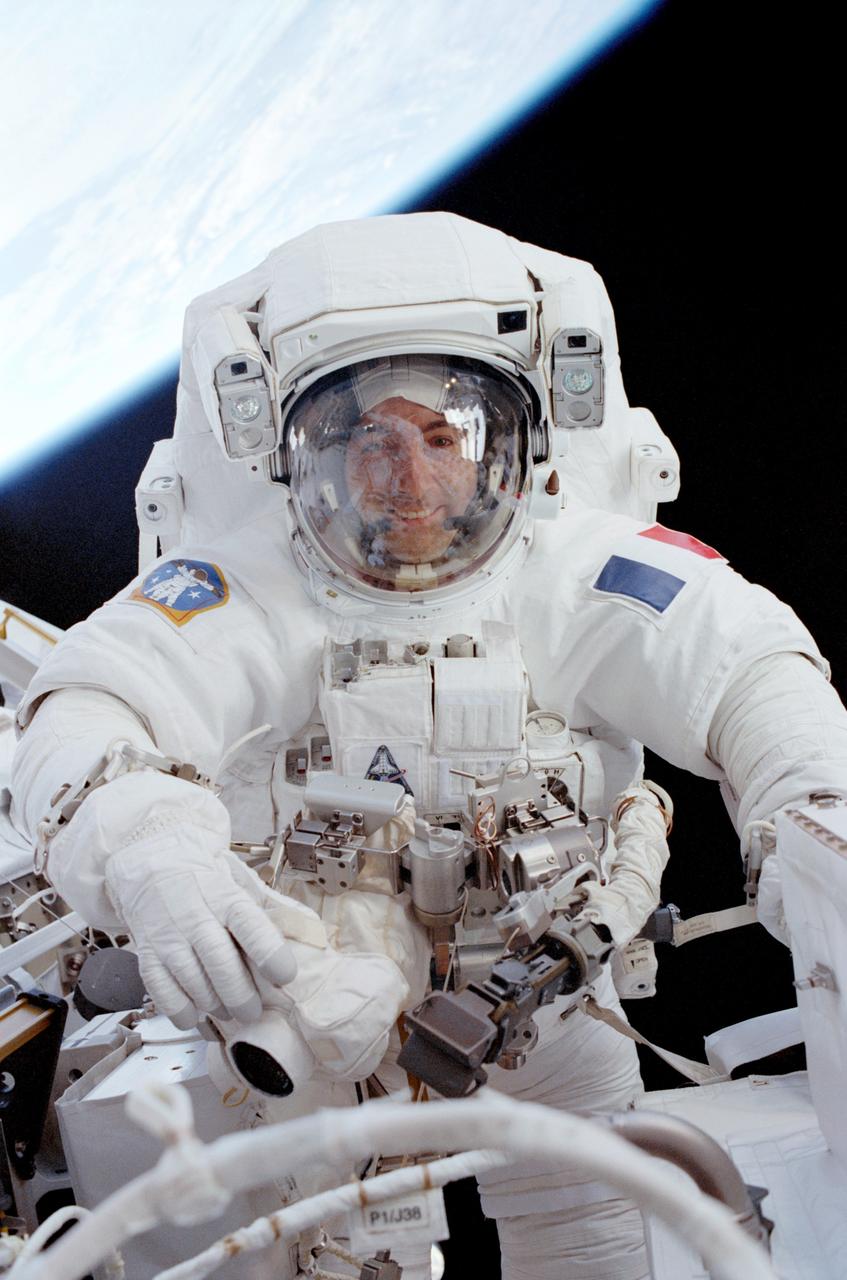
STS111-307-017 (11 June 2002) --- Astronaut Philippe Perrin, STS-111 mission specialist representing CNES, the French Space Agency, participates in the second scheduled session of extravehicular activity (EVA) for the STS-111 mission. During the spacewalk, Perrin and Chang-Diaz attached power, data and video cables from the International Space Station (ISS) to the Mobile Base System (MBS) and used a power wrench to complete the attachment of the MBS onto the Mobile Transporter (MT).

CAPE CANAVERAL, Fla. – At NASA’s Kennedy Space Center Visitor Complex in Florida, shuttle astronaut Kevin Chilton speaks after being inducted into the U.S. Astronaut Hall of Fame Class of 2012. Shuttle astronauts Franklin Chang Diaz and Charlie Precourt also were inducted into the Hall of Fame. The year’s inductees were selected by a committee of current Hall of Fame astronauts, former NASA officials, historians and journalists. The selection process is administered by the Astronaut Scholarship Foundation. Photo credit: NASA/Jim Grossmann
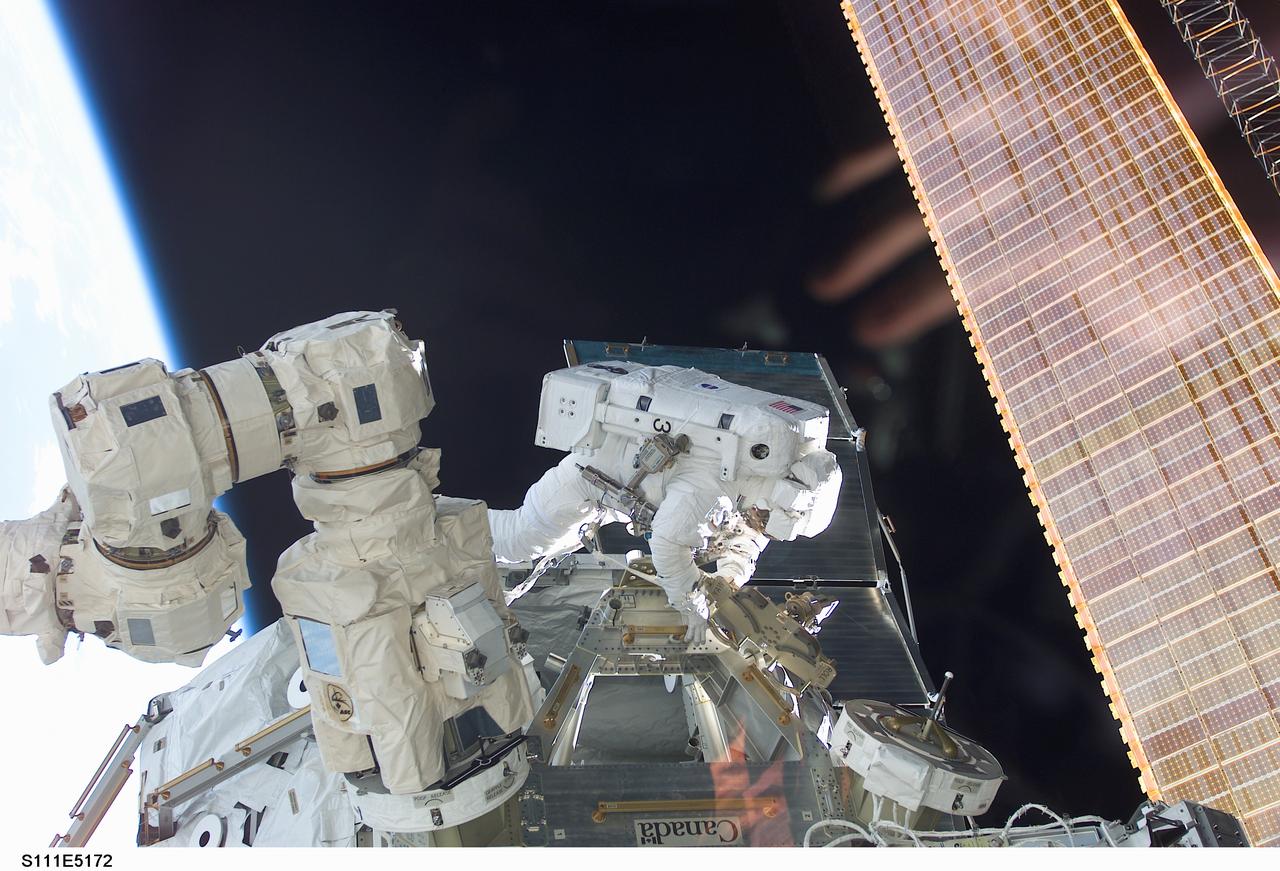
STS111-E-5172 (11 June 2002) --- Astronaut Philippe Perrin, mission specialist representing CNES, the French Space Agency, participates in the second scheduled session of extravehicular activity (EVA) for the STS-111 mission. During the spacewalk, Perrin and Chang-Diaz attached power, data and video cables from the International Space Station (ISS) to the Mobile Base System (MBS) and used a power wrench to complete the attachment of the MBS onto the Mobile Transporter (MT).

STS-91 Mission Specialists Franklin Chang-Diaz, Ph.D., and Janet Kavandi, Ph.D., participate in the Crew Equipment Interface Test, or CEIT, inside an airlock in KSC's Orbiter Processing Facility Bay 2. During CEIT, the crew have an opportunity to get a hands-on look at the payloads with which they'll be working on-orbit. The STS-91 crew are scheduled to launch aboard the Shuttle Discovery for the ninth and final docking with the Russian Space Station Mir from KSC's Launch Pad 39A on May 28 at 8:05 EDT
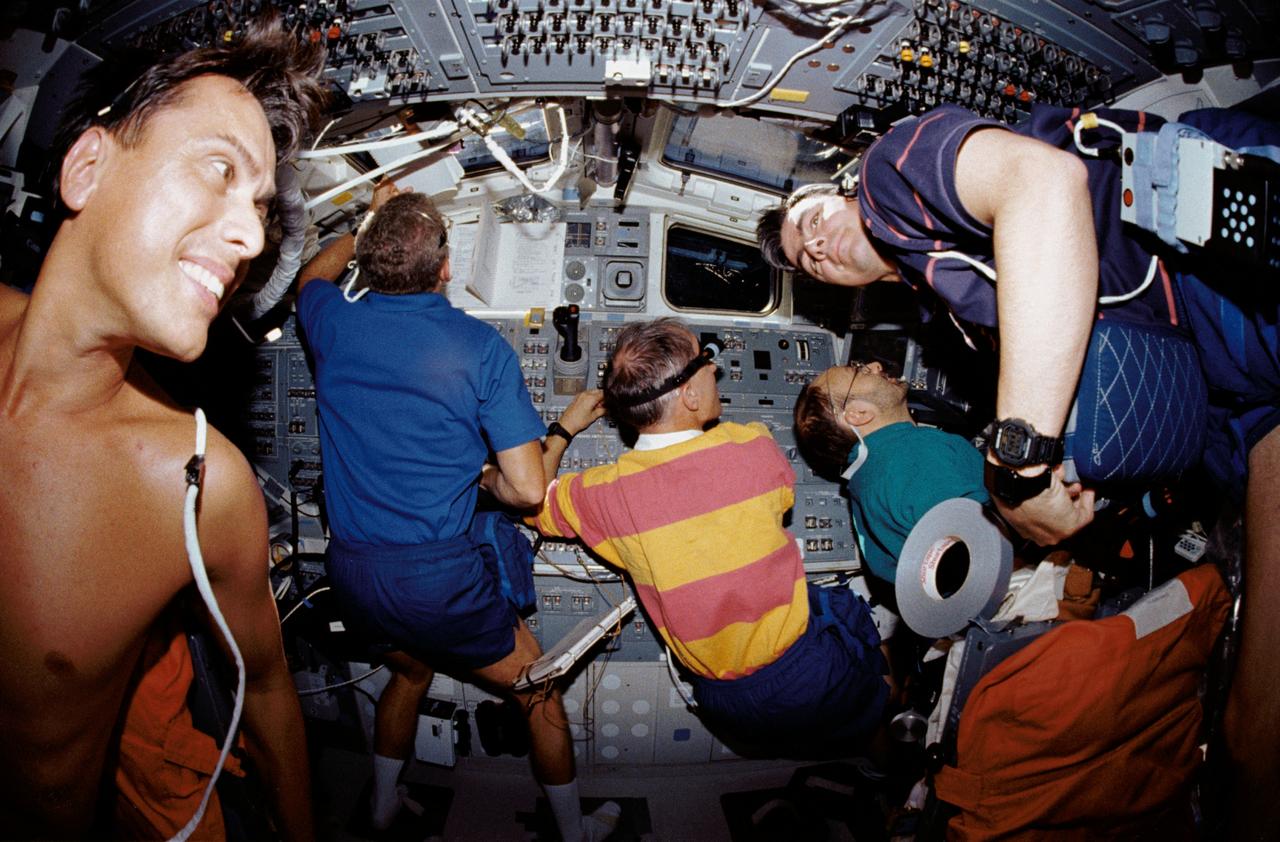
STS046-14-013 (4 Aug. 1992) --- Five of the seven crew members squeezed into this busy scene on the Space Shuttle Atlantis' flight deck during operations with the Tethered Satellite System (TSS). Pictured are, left to right, Franklin R. Chang-Diaz, Loren J. Shriver, Claude Nicollier, Franco Malerba and Andrew M. Allen. Not pictured are astronauts Jeffrey A. Hoffman and Marsha S. Ivins. Mission specialist Ivins used a 35mm camera with a 16mm lens to take this picture.
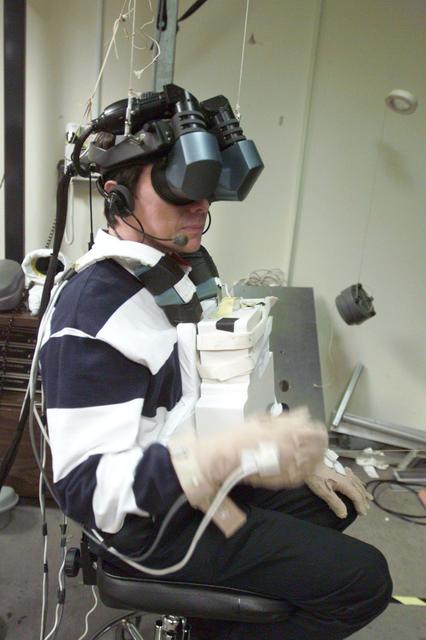
JSC2001-E-39083 (18 October 2001) --- Astronaut Franklin R. Chang-Diaz, STS-111 mission specialist, uses specialized gear in the virtual reality lab at the Johnson Space Center (JSC) to train for his duties aboard the Space Shuttle Endeavour. This type of virtual reality training allows the astronauts to wear a helmet and special gloves while looking at computer displays simulating actual movements around the various locations on the International Space Station (ISS) hardware with which they will be working.
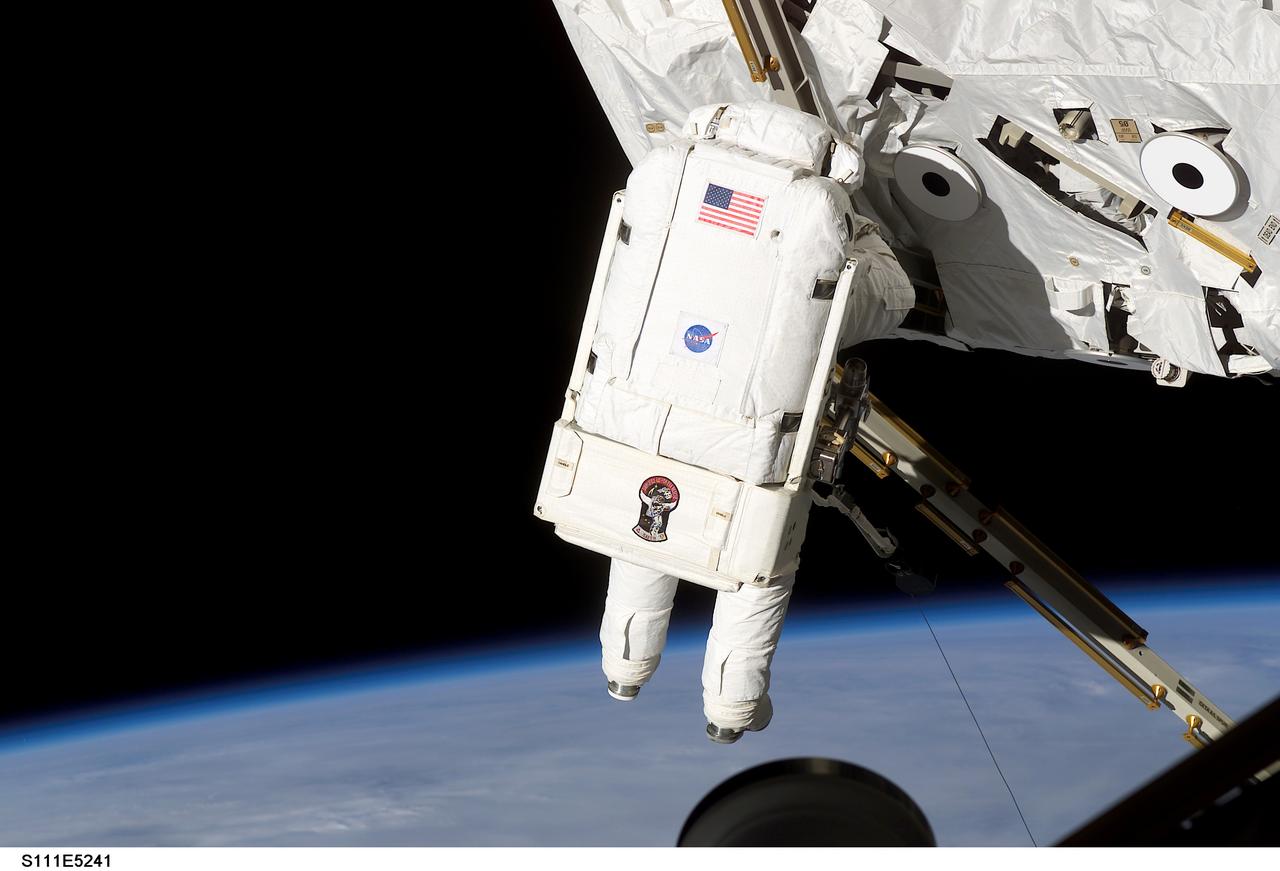
STS111-E-5241 (11 June 2002) --- Astronaut Philippe Perrin, STS-111 mission specialist, photographed near the S0 (S-Zero) Truss on the International Space Station (ISS), participates in the second scheduled session of extravehicular activity (EVA) for the STS-111 mission. During the 5-hour spacewalk, Perrin and Chang-Diaz completed installation of the Mobile Remote Servicer Base System (MBS) on the station’s railcar, the Mobile Transporter. Perrin represents CNES, the French Space Agency.
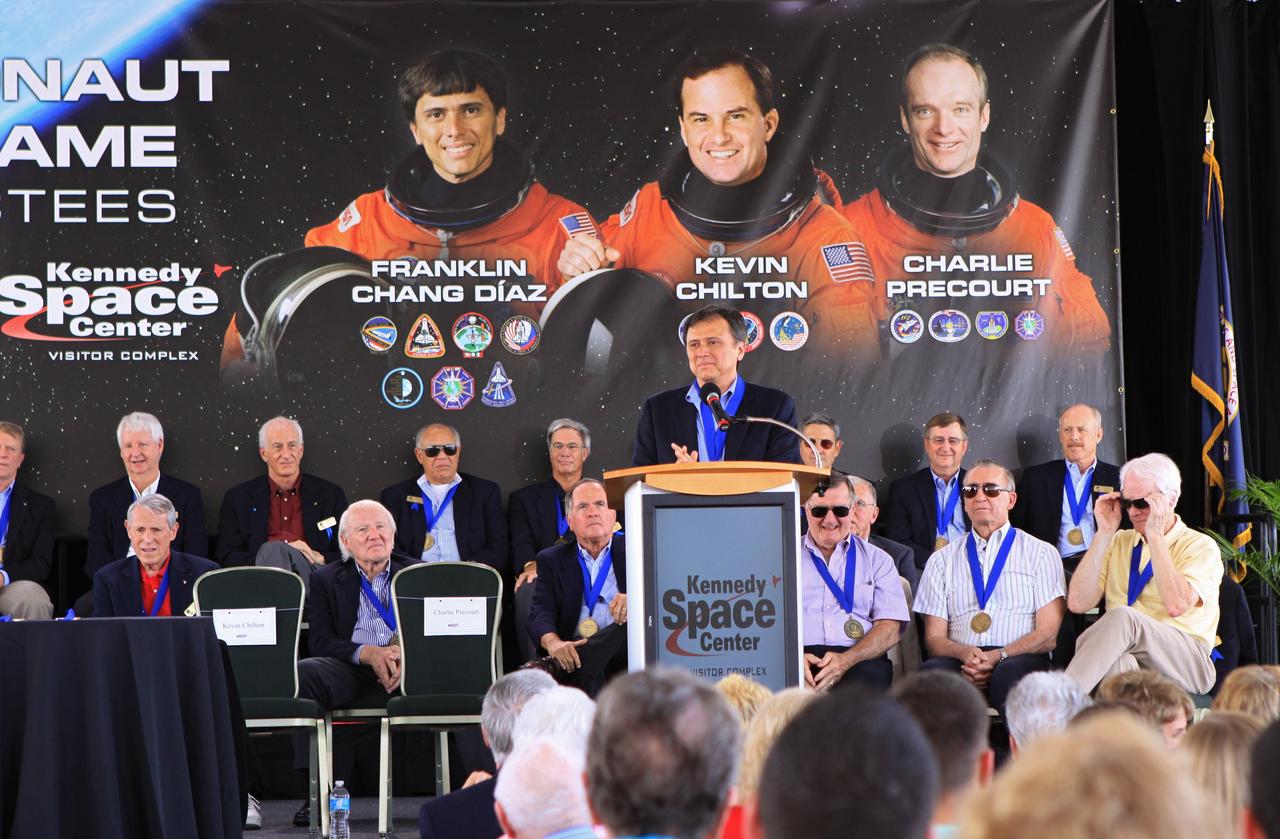
CAPE CANAVERAL, Fla. – At NASA’s Kennedy Space Center Visitor Complex in Florida, space shuttle astronaut and U.S. Astronaut Hall of Fame Class of 2012 inductee Franklin Chang Diaz, at the podium, speaks during the induction ceremony. Shuttle astronauts Kevin Chilton and Charlie Precourt also were inducted into the Hall of Fame. The year’s inductees were selected by a committee of current Hall of Fame astronauts, former NASA officials, historians and journalists. The selection process is administered by the Astronaut Scholarship Foundation. Photo credit: NASA/Jim Grossmann
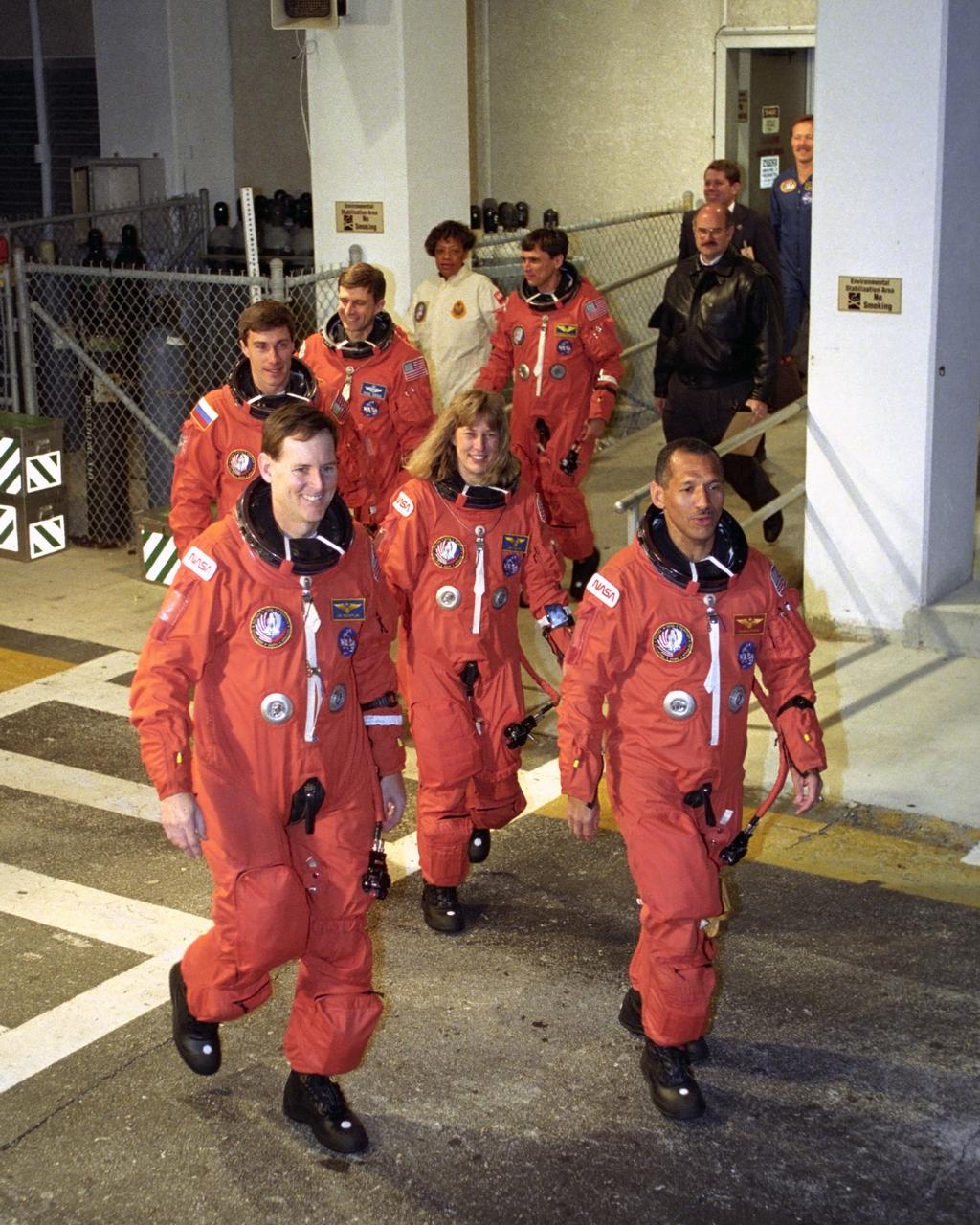
STS-60 pilot Ken Reightler (front left) and Mission Commander Charlie Bolden (front right) lead the way from the O&C bldg. enroute to Discovery at Pad 39A. Behidn are (from felt) Mission Specs Sega adn Krikalev: Payload Commander Chang-Diaz: and Misssion Spec Davis. (Op. No. D6022)(Item D-112C)
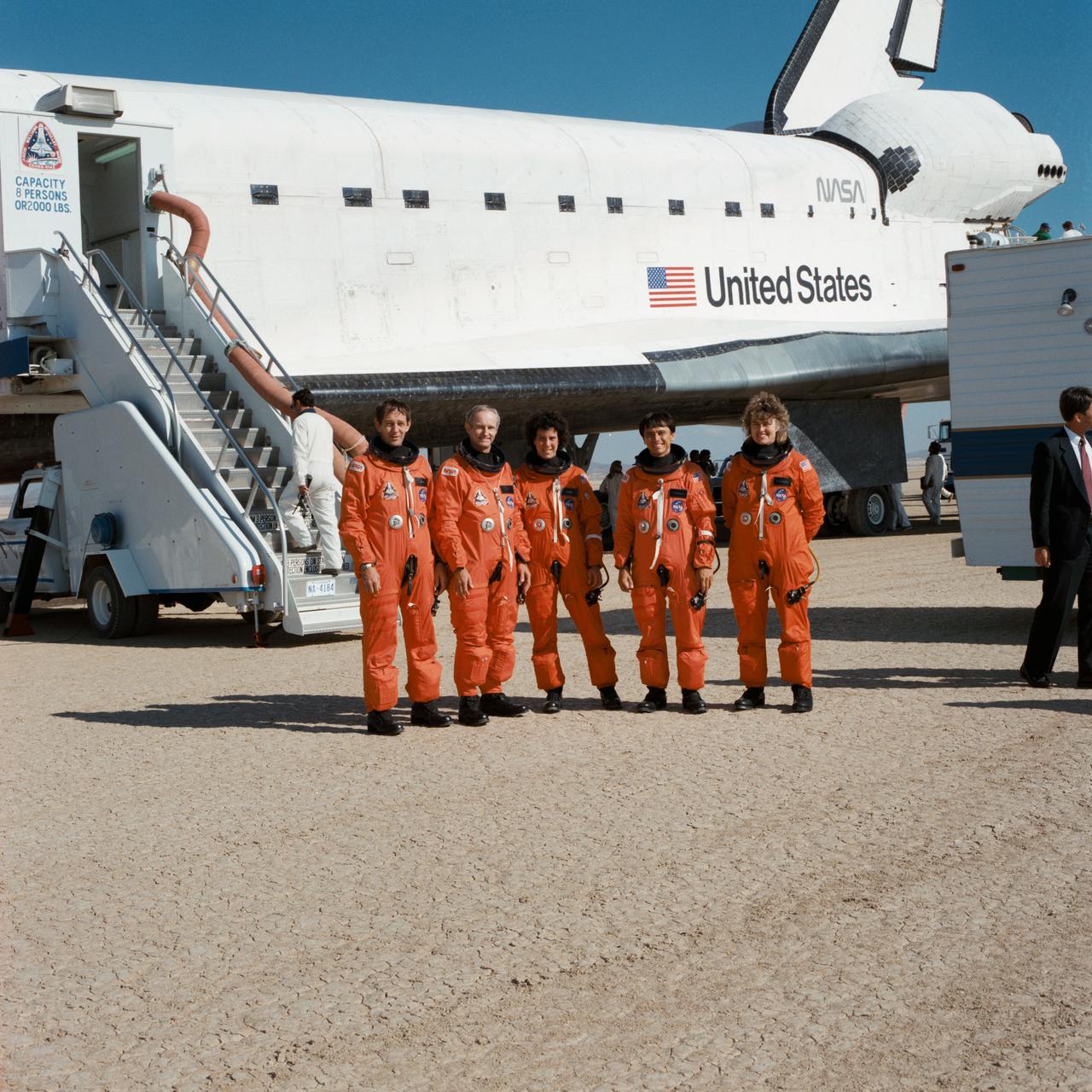
STS-34 crewmembers, wearing launch and entry suits (LESs), stand in front of Atlantis, Orbiter Vehicle (OV) 104, on Runway 23 dry lake bed at Edwards Air Force Base (EAFB), California. Left to right are Pilot Michael J. McCulley, Commander Donald E. Williams, Mission Specialist (MS) Ellen S. Baker, MS Franklin R. Chang-Diaz, and MS Shannon W. Lucid. Ground crews service OV-104 in the background.
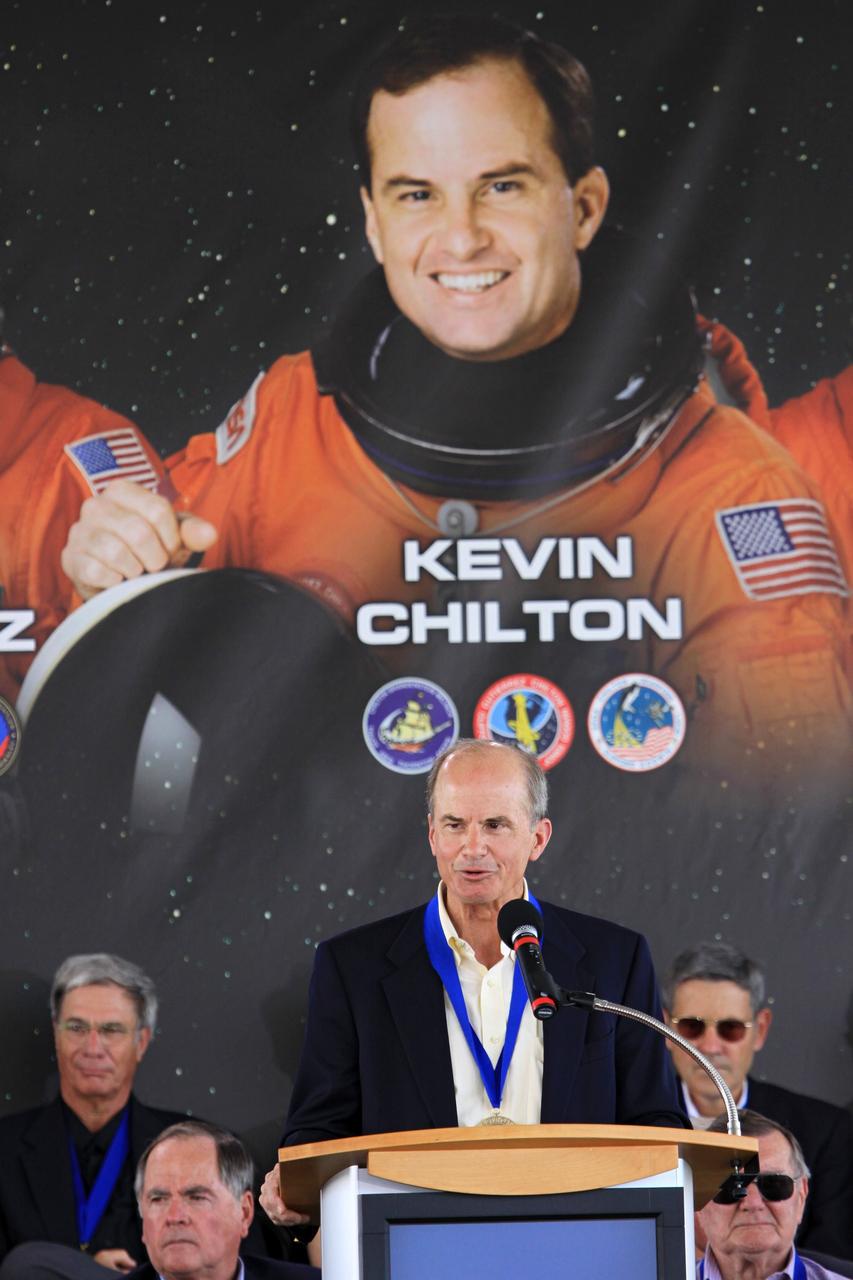
CAPE CANAVERAL, Fla. – At NASA’s Kennedy Space Center Visitor Complex in Florida, shuttle astronaut Kevin Chilton speaks after being inducted into the U.S. Astronaut Hall of Fame Class of 2012. Shuttle astronauts Franklin Chang Diaz and Charlie Precourt also were inducted into the Hall of Fame. The year’s inductees were selected by a committee of current Hall of Fame astronauts, former NASA officials, historians and journalists. The selection process is administered by the Astronaut Scholarship Foundation. Photo credit: NASA/Jim Grossmann
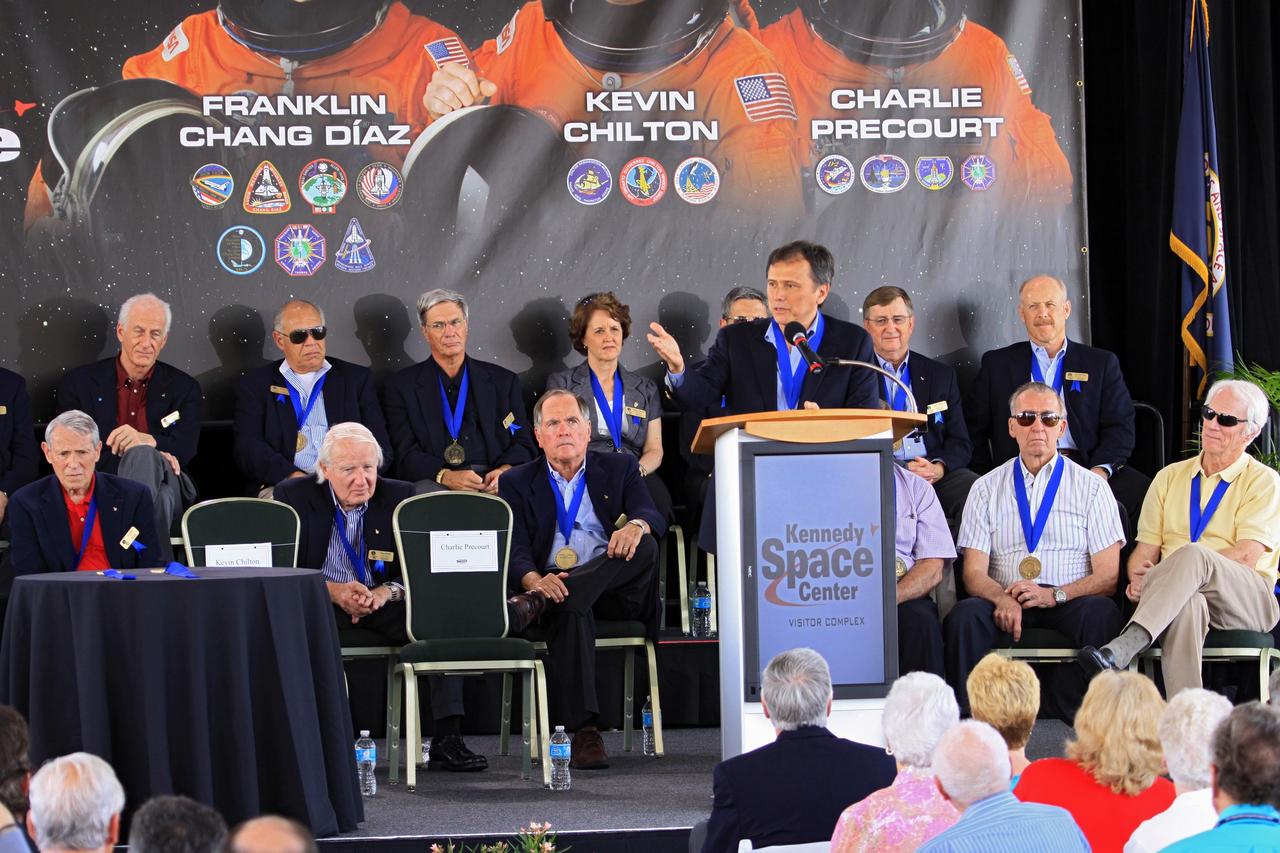
CAPE CANAVERAL, Fla. – At NASA’s Kennedy Space Center Visitor Complex in Florida, space shuttle astronaut and U.S. Astronaut Hall of Fame Class of 2012 inductee Franklin Chang Diaz, at the podium, speaks during the induction ceremony. Shuttle astronauts Kevin Chilton and Charlie Precourt also were inducted into the Hall of Fame. The year’s inductees were selected by a committee of current Hall of Fame astronauts, former NASA officials, historians and journalists. The selection process is administered by the Astronaut Scholarship Foundation. Photo credit: NASA/Jim Grossmann
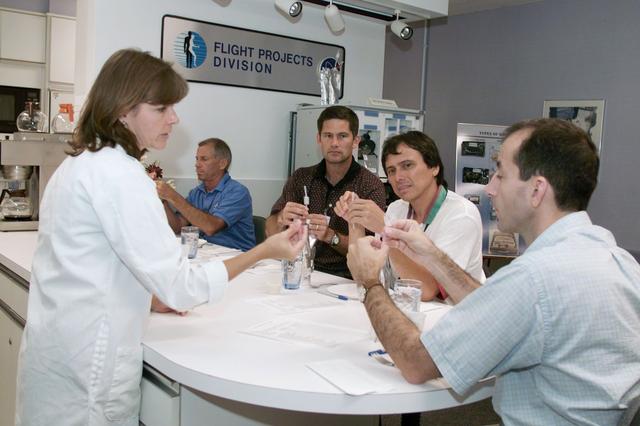
JSC2001-E-25712 (27 August 2001) --- The STS-111 crewmembers are briefed by dietitian Gloria Mongan with Lockheed Martin Space Operations during food testing in the Flight Projects Division Laboratory at the Johnson Space Center (JSC). From back to front are astronauts Kenneth D. Cockrell and Paul S. Lockhart, mission commander and pilot, respectively, and Franklin R. Chang-Diaz and Philippe Perrin, both mission specialists. Perrin represents CNES, the French Space Agency.
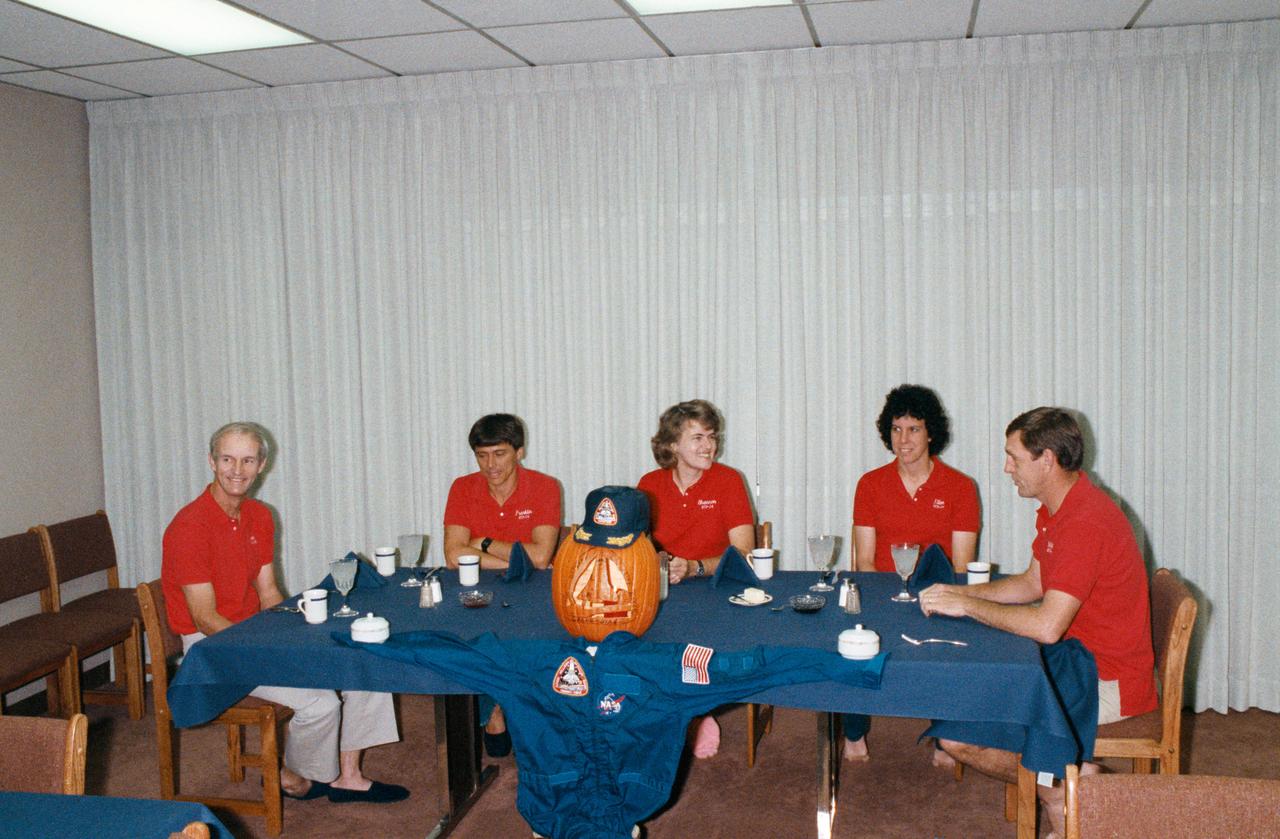
STS034-S-021 (18 Oct 1989) --- The traditional light pre-launch breakfast greets the five astronaut crew-members for NASA's STS-34 mission in the Operations and Checkout Facility at Kennedy Space Center (KSC). From the left are Astronauts Donald E. Williams, mission commander; Franklin R. Chang-Diaz, Shannon W. Lucid and Ellen S. Baker, all mission specialists; and Michael J. McCulley, pilot. A pumpkin converted into a Jack-o-lantern adds a seasonal touch to the table.
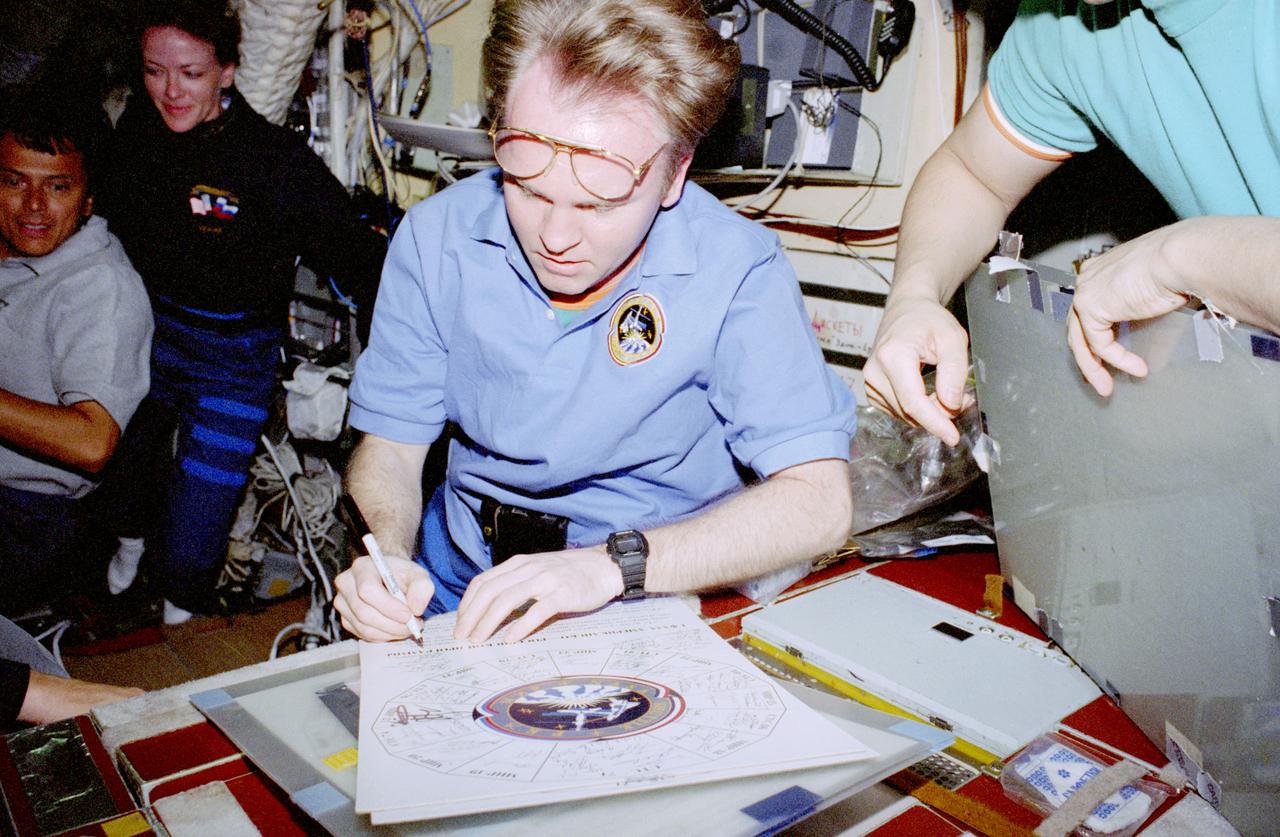
STS091-361-034 (2-12 June 1998) --- Andrew S.W. Thomas signs a plaque containing the names of all the visitors to Russia's Mir space station. Thomas is the final of seven NASA astronauts to serve as a guest cosmonaut researcher aboard Mir as part of International Space Station (ISS) Phase I. Looking on in the background are astronauts Franklin R. Chang-Diaz, payload commander; and Janet L. Kavandi, mission specialist.
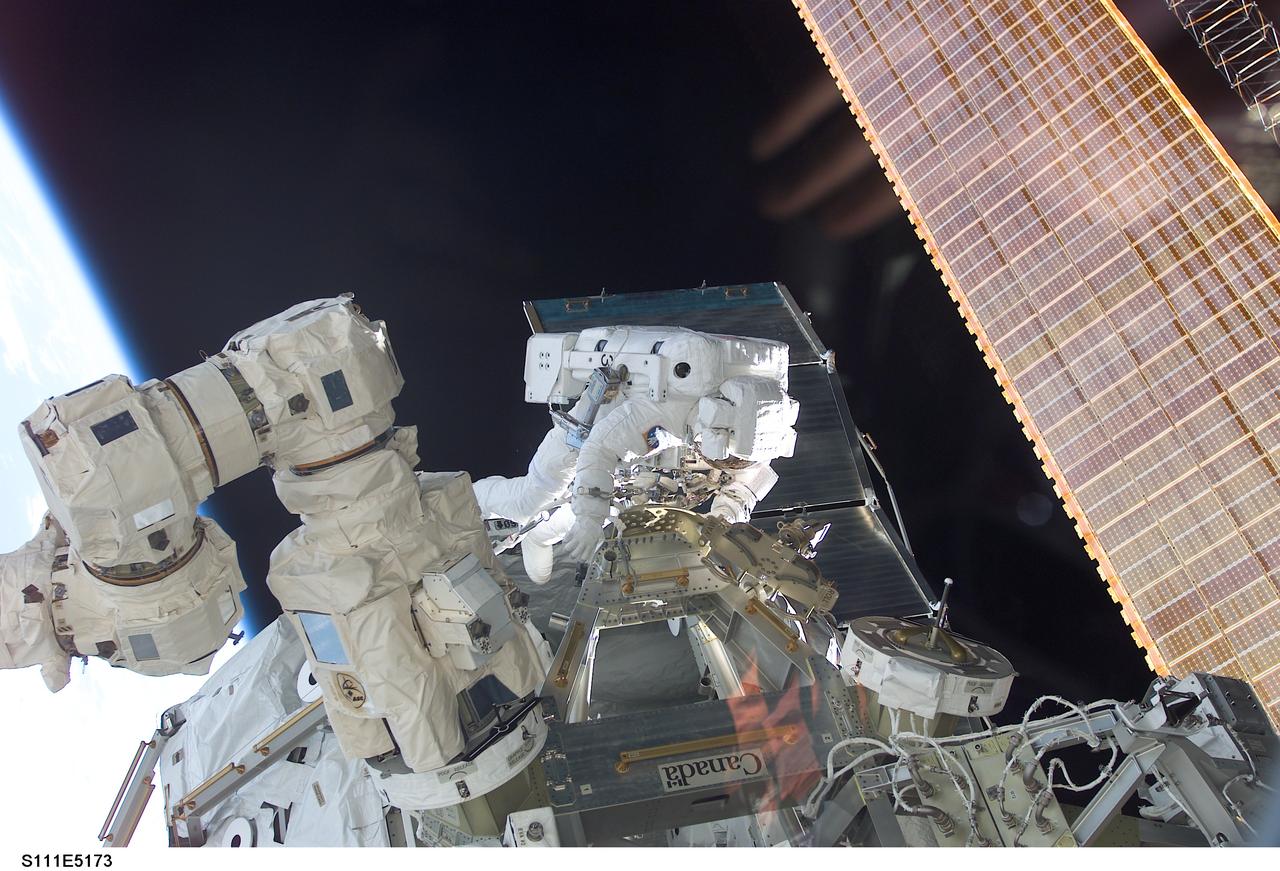
STS111-E-5173 (11 June 2002) --- Astronaut Philippe Perrin, mission specialist representing CNES, the French Space Agency, participates in the second scheduled session of extravehicular activity (EVA) for the STS-111 mission. During the spacewalk, Perrin and Chang-Diaz attached power, data and video cables from the International Space Station (ISS) to the Mobile Base System (MBS) and used a power wrench to complete the attachment of the MBS onto the Mobile Transporter (MT).
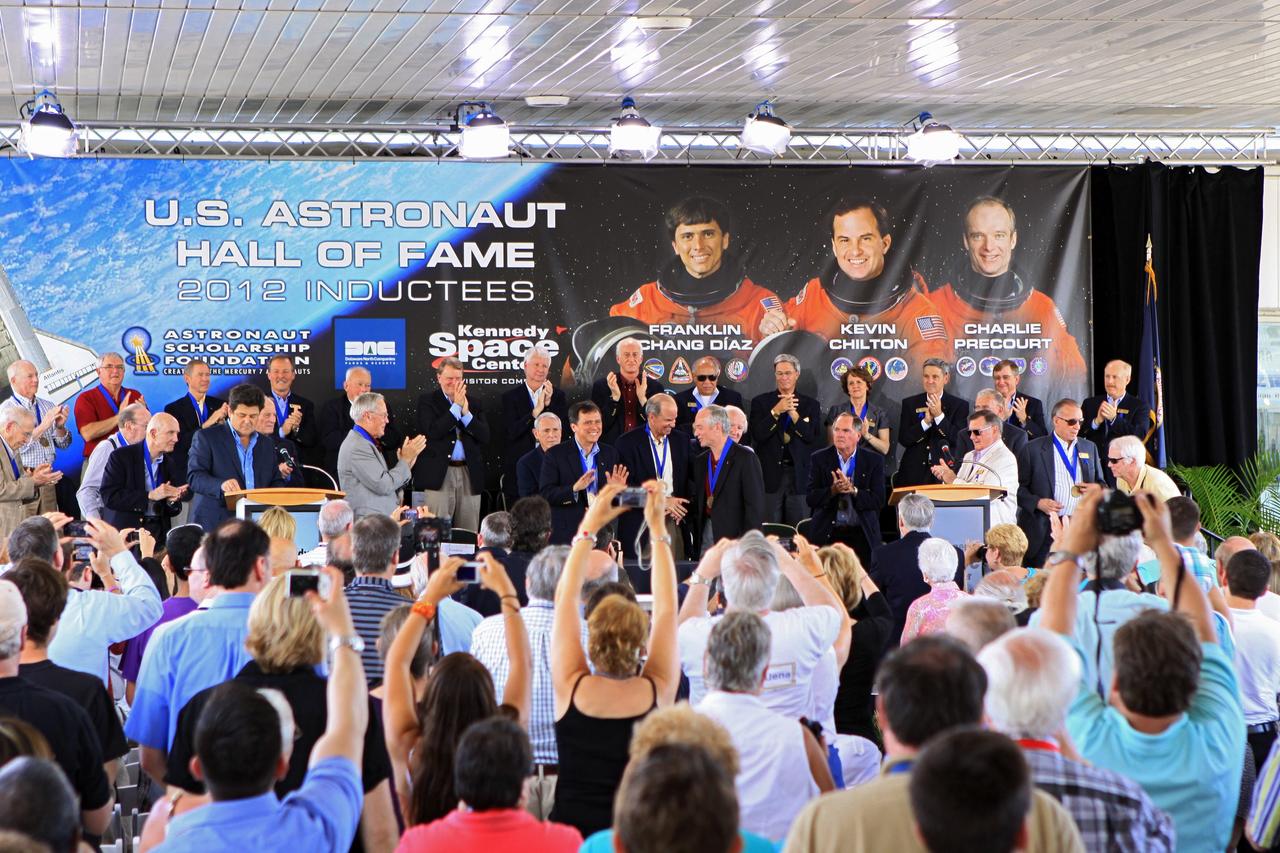
CAPE CANAVERAL, Fla. – At NASA’s Kennedy Space Center Visitor Complex in Florida, shuttle astronauts Franklin Chang Diaz, at left, Kevin Chilton and Charlie Precourt stand together after being inducted into the U.S. Astronaut Hall of Fame Class of 2012. The year’s inductees were selected by a committee of current Hall of Fame astronauts, former NASA officials, historians and journalists. The selection process is administered by the Astronaut Scholarship Foundation. Photo credit: NASA/Jim Grossmann
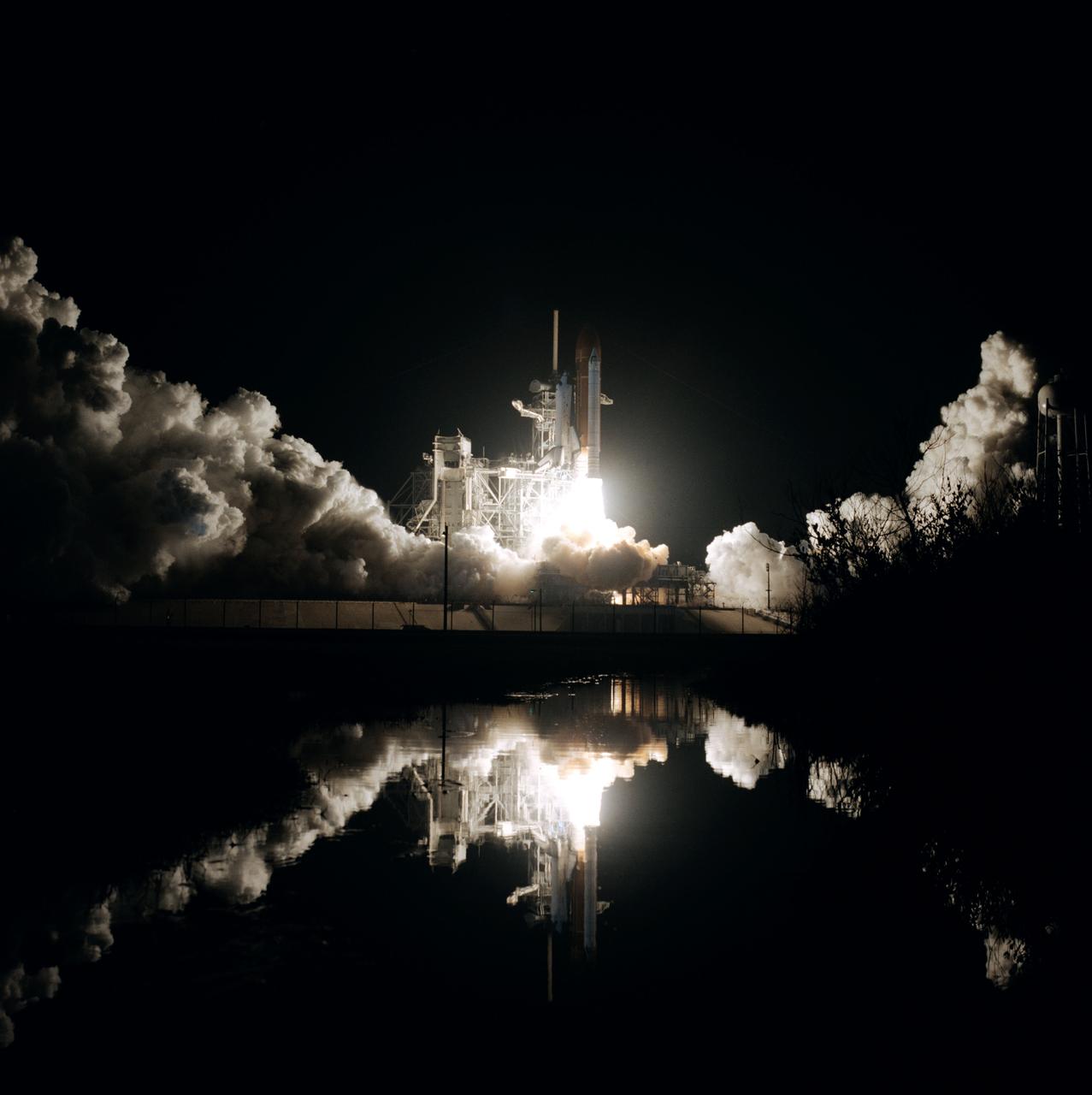
STS61C-S-048 (12 Jan. 1986) --- This is a wide shot of the early morning launch at Florida?s Kennedy Space Center of the space shuttle Columbia and the STS-61C crew on Jan. 12, 1986. Onboard were the following crew members -- Mission Commander Robert L. Gibson and Pilot Charles F. Bolden, along with Mission Specialists Franklin R. Chang-Diaz, Steven A. Hawley and George D. Nelson and Payload Specialists Robert J. Cenker of RCA and U.S. Rep. Bill Nelson. Photo credit: NASA
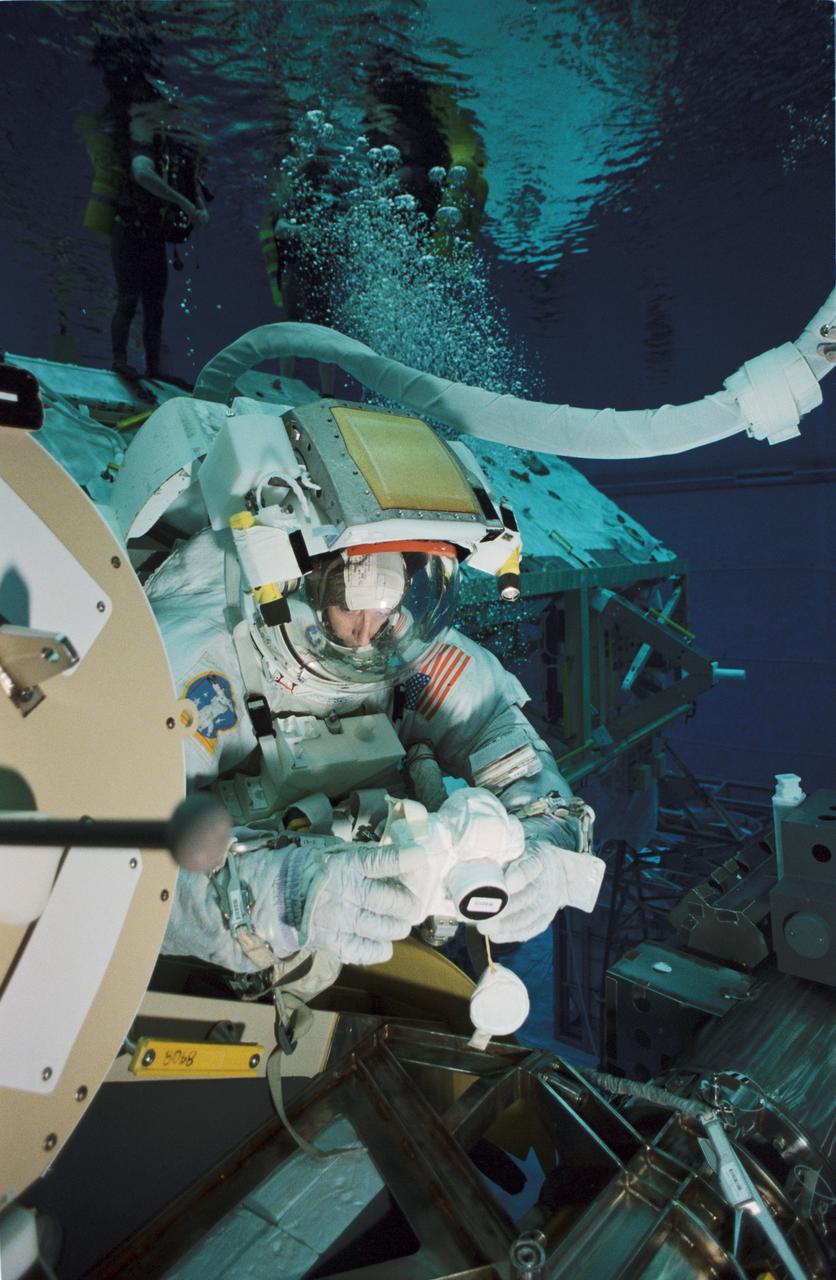
JSC2002-00511 (15 January 2002) --- Astronaut Philippe Perrin, STS-111 mission specialist, wears a training version of the Extravehicular Mobility Unit (EMU) space suit during an underwater simulation of extravehicular activity (EVA) scheduled for the 14th shuttle mission to the International Space Station (ISS). Perrin, representing CNES, the French Space Agency, was joined by astronaut Franklin R. Chang-Diaz (out of frame) for the simulation, conducted in the Neutral Buoyancy Laboratory (NBL) near the Johnson Space Center.
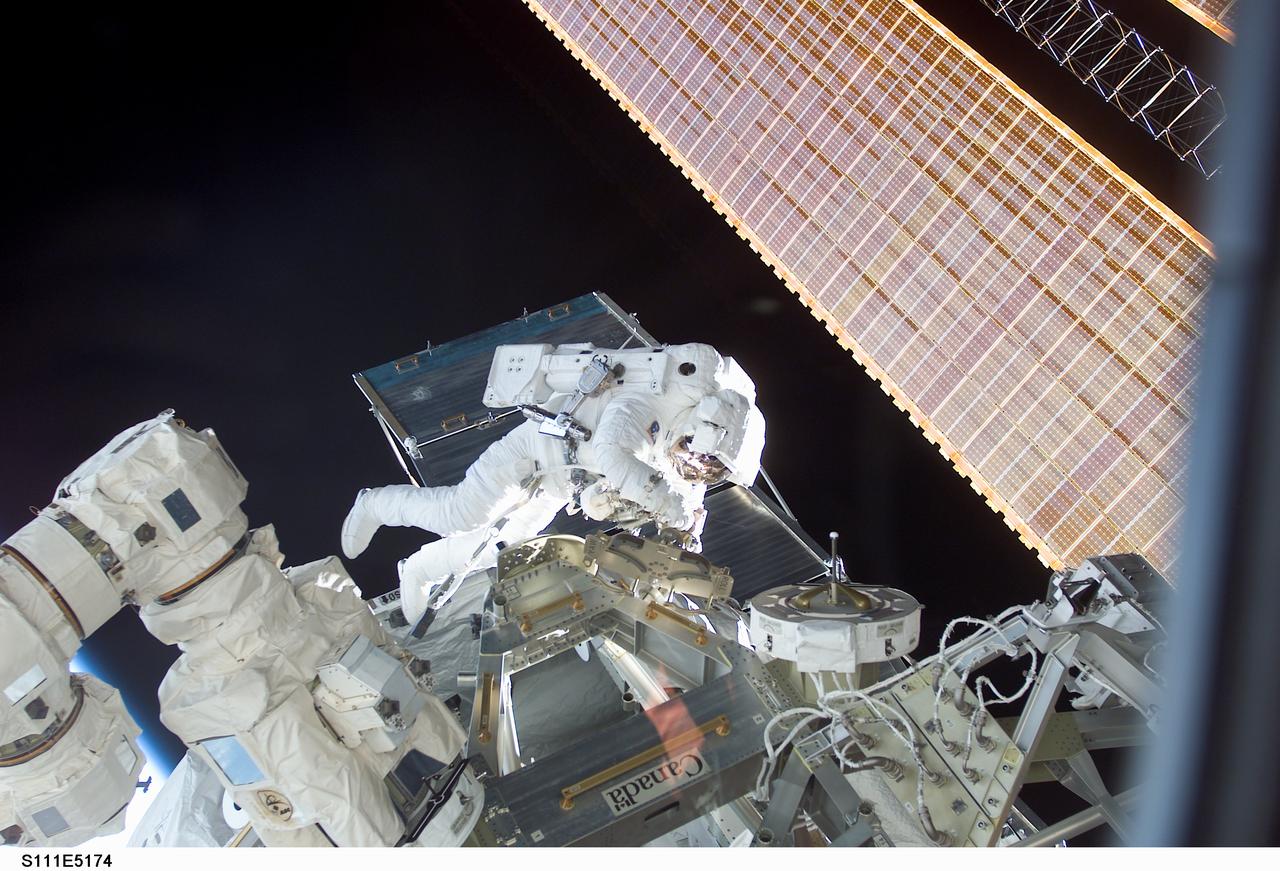
STS111-E-5174 (11 June 2002) --- Astronaut Philippe Perrin, mission specialist representing CNES, the French Space Agency, participates in the second scheduled session of extravehicular activity (EVA) for the STS-111 mission. During the spacewalk, Perrin and Chang-Diaz attached power, data and video cables from the International Space Station (ISS) to the Mobile Base System (MBS) and used a power wrench to complete the attachment of the MBS onto the Mobile Transporter (MT).
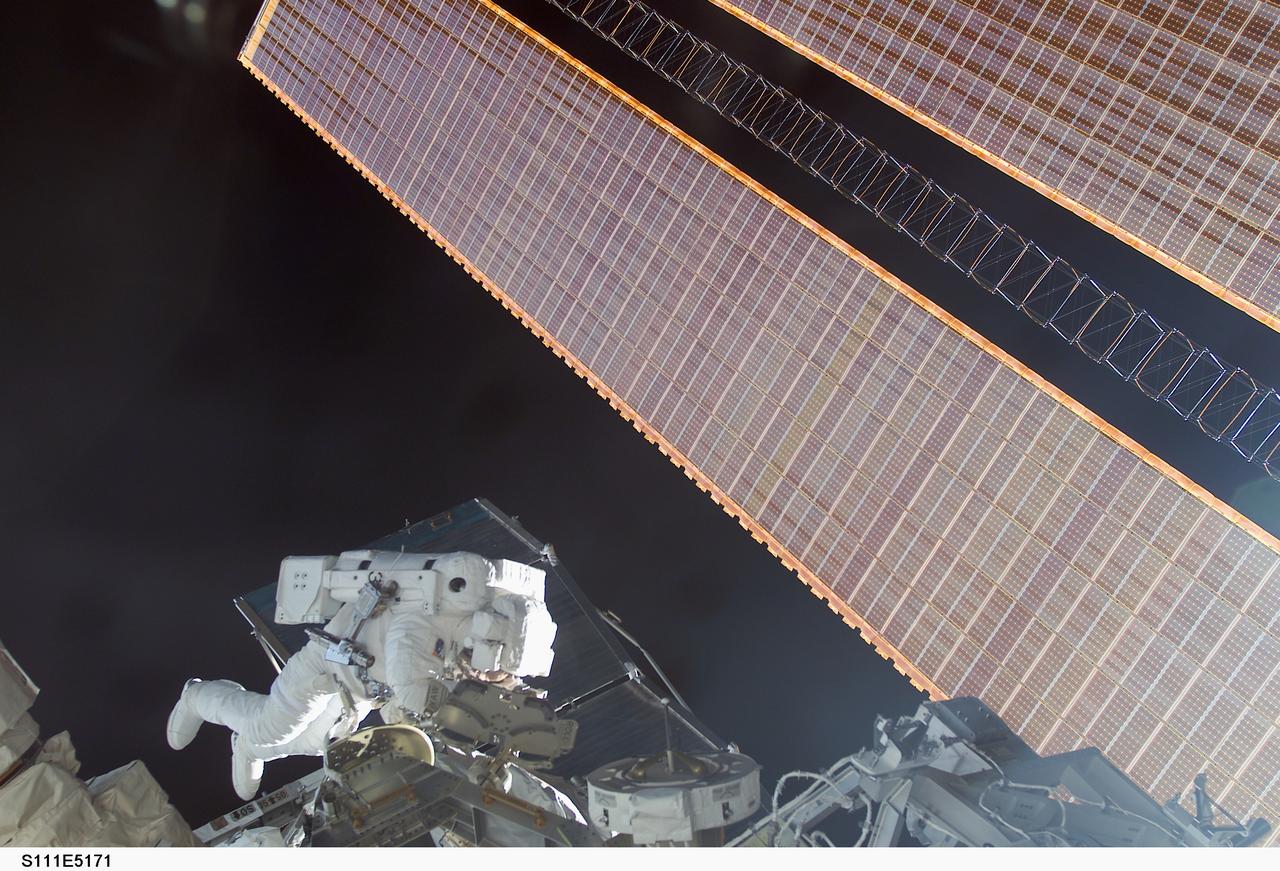
STS111-E-5171 (11 June 2002) --- Astronaut Philippe Perrin, mission specialist representing CNES, the French Space Agency, participates in the second scheduled session of extravehicular activity (EVA) for the STS-111 mission. During the spacewalk, Perrin and Chang-Diaz attached power, data and video cables from the International Space Station (ISS) to the Mobile Base System (MBS) and used a power wrench to complete the attachment of the MBS onto the Mobile Transporter (MT).
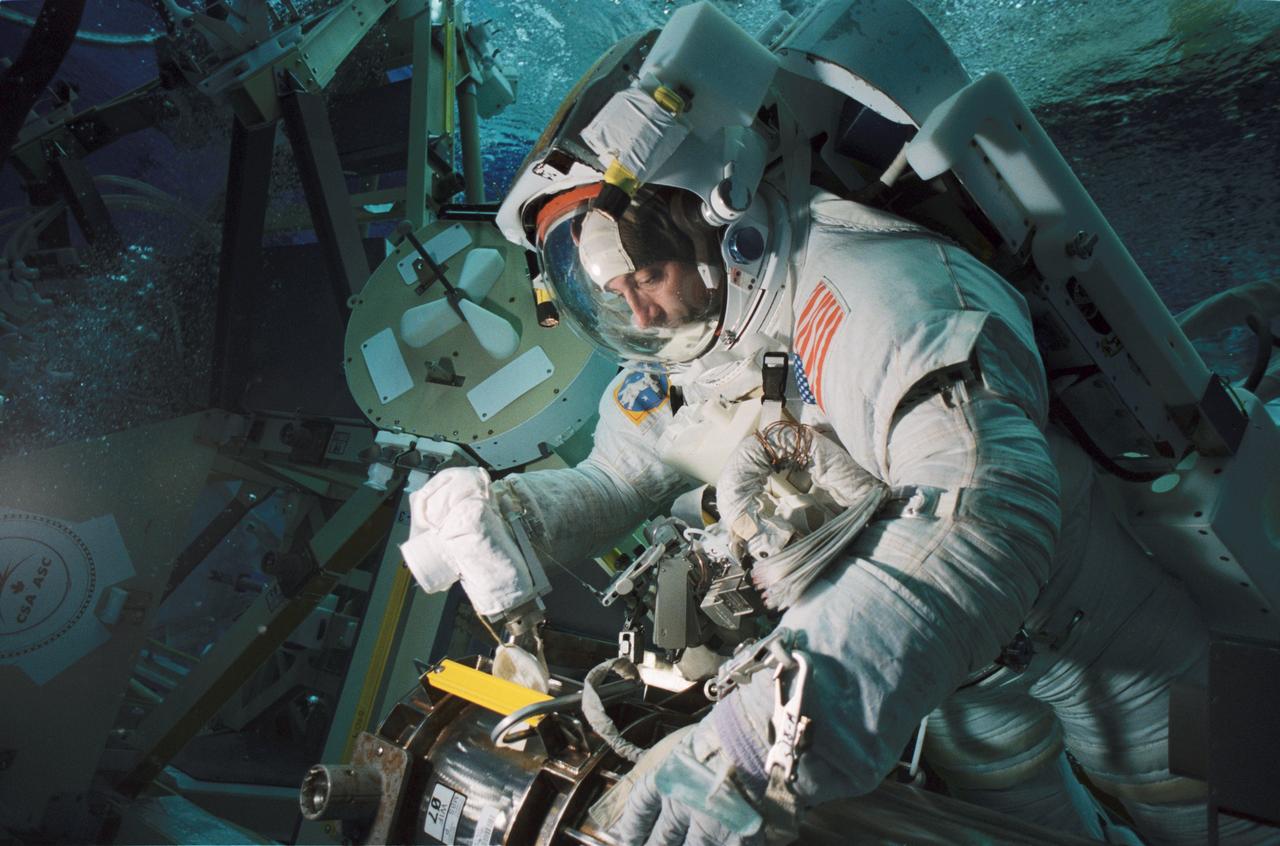
JSC2002-00510 (15 January 2002) --- Astronaut Philippe Perrin, STS-111 mission specialist, wears a training version of the Extravehicular Mobility Unit (EMU) space suit during an underwater simulation of extravehicular activity (EVA) scheduled for the 14th shuttle mission to the International Space Station (ISS). Perrin, representing CNES, the French Space Agency, was joined by astronaut Franklin R. Chang-Diaz (out of frame) for the simulation, conducted in the Neutral Buoyancy Laboratory (NBL) near the Johnson Space Center.
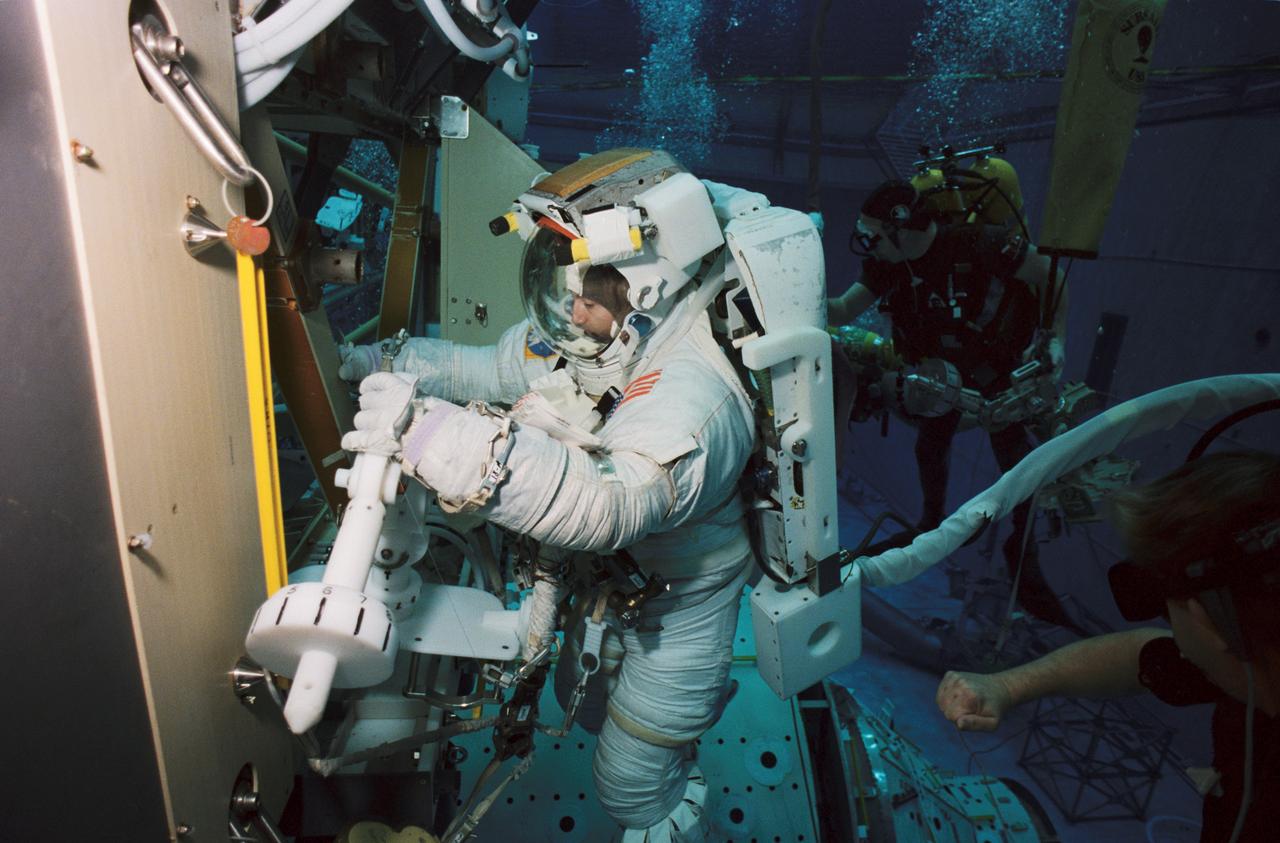
JSC2002-00507 (15 January 2002) --- Astronaut Philippe Perrin, STS-111 mission specialist, wears a training version of the Extravehicular Mobility Unit (EMU) space suit during an underwater simulation of extravehicular activity (EVA) scheduled for the 14th shuttle mission to the International Space Station (ISS). Perrin, representing CNES, the French Space Agency, was joined by astronaut Franklin R. Chang-Diaz (out of frame) for the simulation, conducted in the Neutral Buoyancy Laboratory (NBL) near the Johnson Space Center.
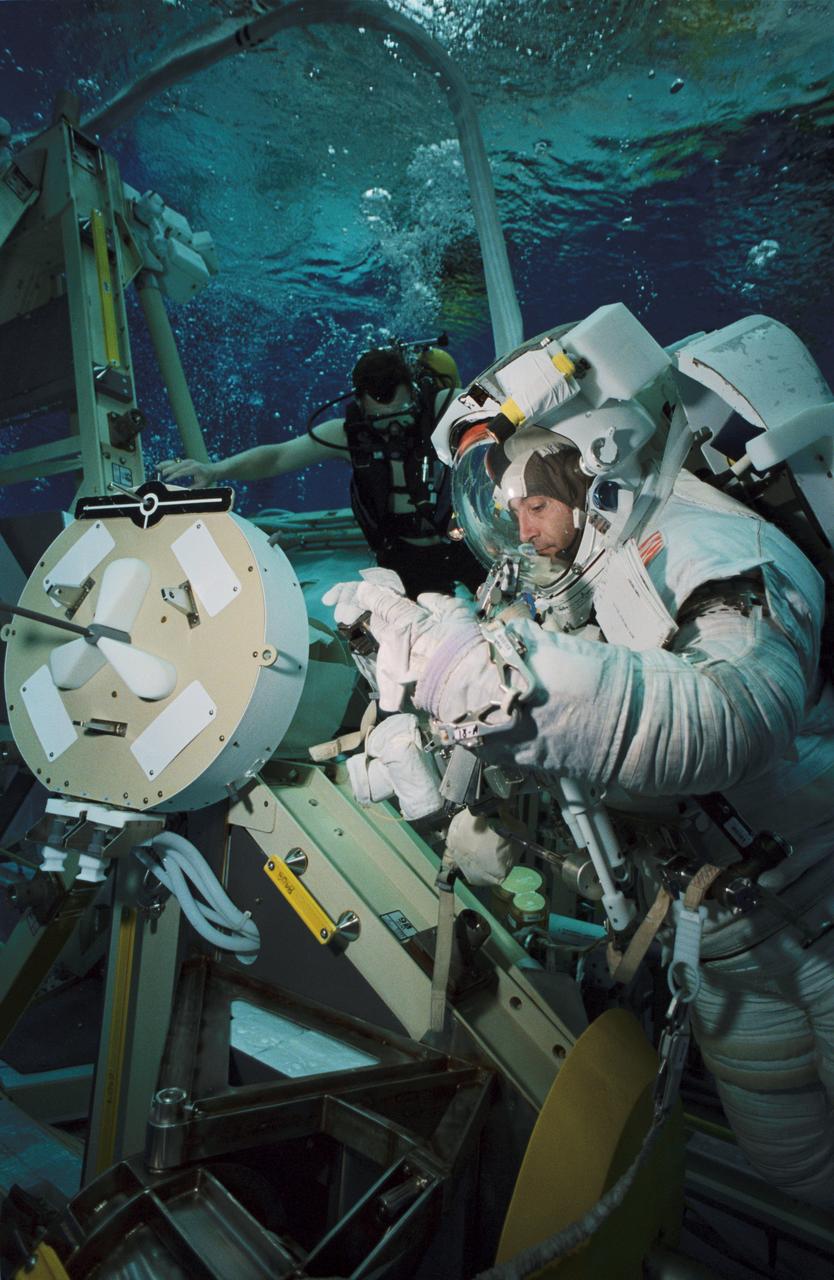
JSC2002-00508 (15 January 2002) --- Astronaut Philippe Perrin, STS-111 mission specialist, wears a training version of the Extravehicular Mobility Unit (EMU) space suit during an underwater simulation of extravehicular activity (EVA) scheduled for the 14th shuttle mission to the International Space Station (ISS). Perrin, representing CNES, the French Space Agency, was joined by astronaut Franklin R. Chang-Diaz (out of frame) for the simulation, conducted in the Neutral Buoyancy Laboratory (NBL) near the Johnson Space Center.
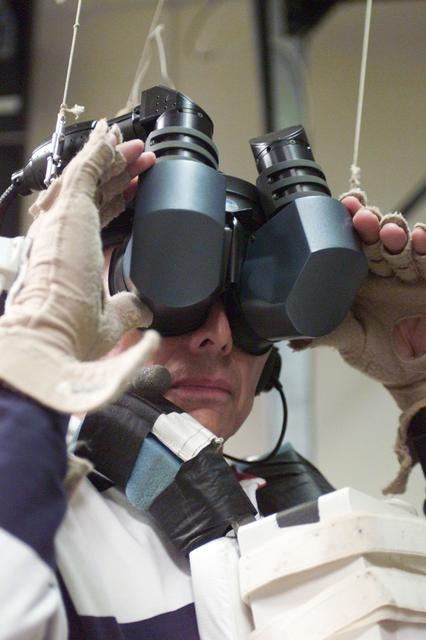
JSC2001-E-39088 (18 October 2001) --- Astronaut Franklin R. Chang-Diaz, STS-111 mission specialist, uses specialized gear in the virtual reality lab at the Johnson Space Center (JSC) to train for his duties aboard the Space Shuttle Endeavour. This type of virtual reality training allows the astronauts to wear a helmet and special gloves while looking at computer displays simulating actual movements around the various locations on the International Space Station (ISS) hardware with which they will be working.
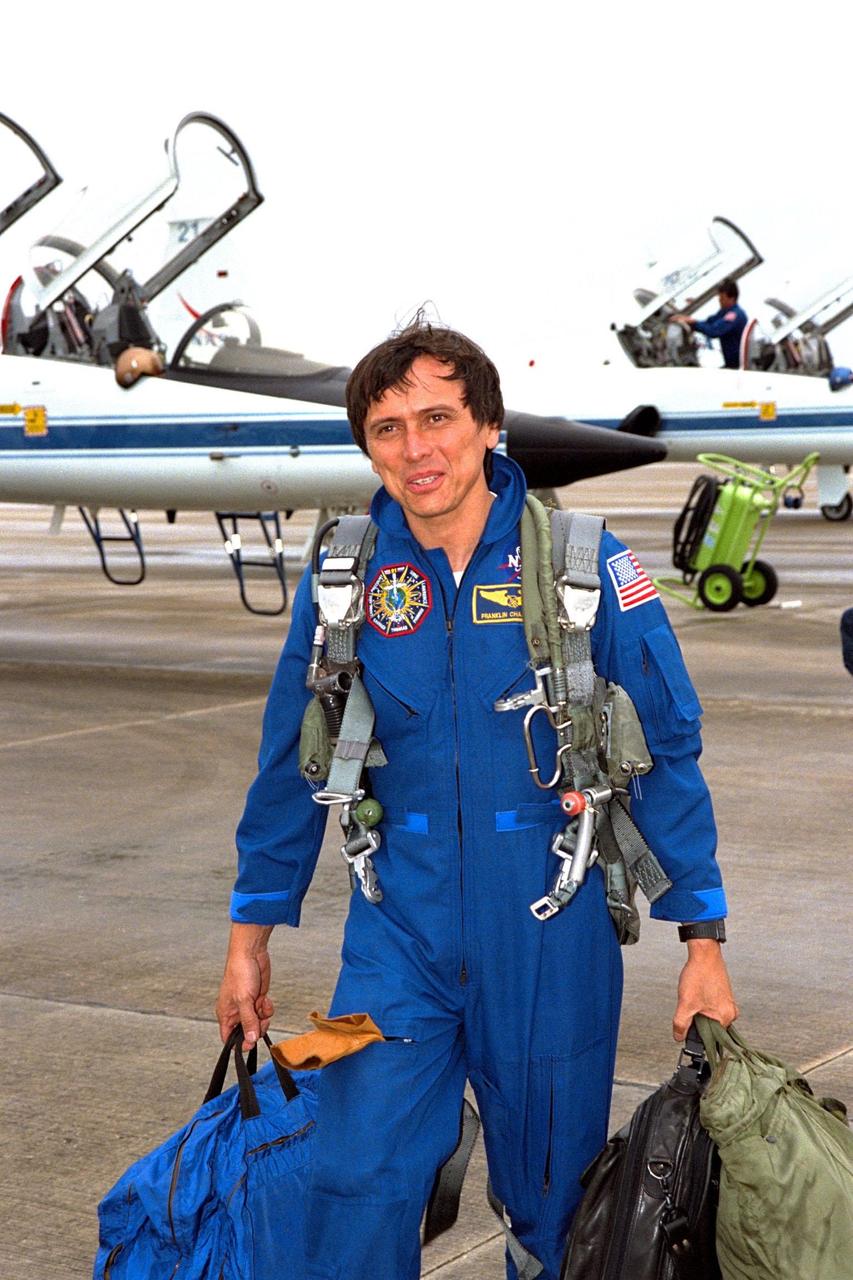
STS-91 Mission Specialist Franklin Chang-Diaz, Ph.D., arrives at Kennedy Space Center's Shuttle Landing Facility aboard a T-38 jet. He is here to participate in the Terminal Countdown Demonstration Test (TCDT), a dress rehearsal for launch. The STS-91 launch is targeted for June 2 with a launch window opening around 6:10 p.m. EDT. The mission will conclude Phase I of the joint U.S.-Russian International Space Station Program. Although it will be the ninth Shuttle docking with the Russian Space Station Mir, it will be the first Mir docking for the Space Shuttle orbiter Discovery. Chang-Diaz is making his sixth space flight. The STS-91 mission will also be the first flight for the new Space Shuttle super lightweight external tank. The STS-91 flight crew also includes Mission Commander Charles Precourt; Pilot Dominic Gorie; and Mission Specialists Wendy B. Lawrence; Janet Lynn Kavandi, Ph.D.; and Valery Ryumin, with the Russian Space Agency. Andrew Thomas, Ph.D., will be returning to Earth with the crew after living aboard Mir since January 25, 1998

STS-91 Mission Specialist Franklin R. Chang-Diaz gets assistance from a suit technician as he dons his flight suit in the Operations and Checkout (O&C) Building. The fitting takes place prior to the crew walkout and transport to Launch Pad 39A. He is on his sixth space flight. Chang-Diaz holds a doctorate in applied plasma physics and is director of the Advanced Space Propulsion Laboratory at the University of Houston. Franklin’s background will serve him well during the mission, since he will be primarily responsible for crew activities in support of the of the Alpha Magnetic Spectrometer. He will also back up Lawrence with the mideck experiments and Kavandi with SPACEHAB operations. STS-91 is scheduled to be launched on June 2 with a launch window opening around 6:10 p.m. EDT. The mission will feature the ninth and final Shuttle docking with the Russian Space Station Mir, the first Mir docking for Discovery, the first on-orbit test of the Alpha Magnetic Spectrometer (AMS), and the first flight of the new Space Shuttle super lightweight external tank. Astronaut Andrew S. W. Thomas will return to Earth as a STS-91 crew member after living more than four months aboard Mir
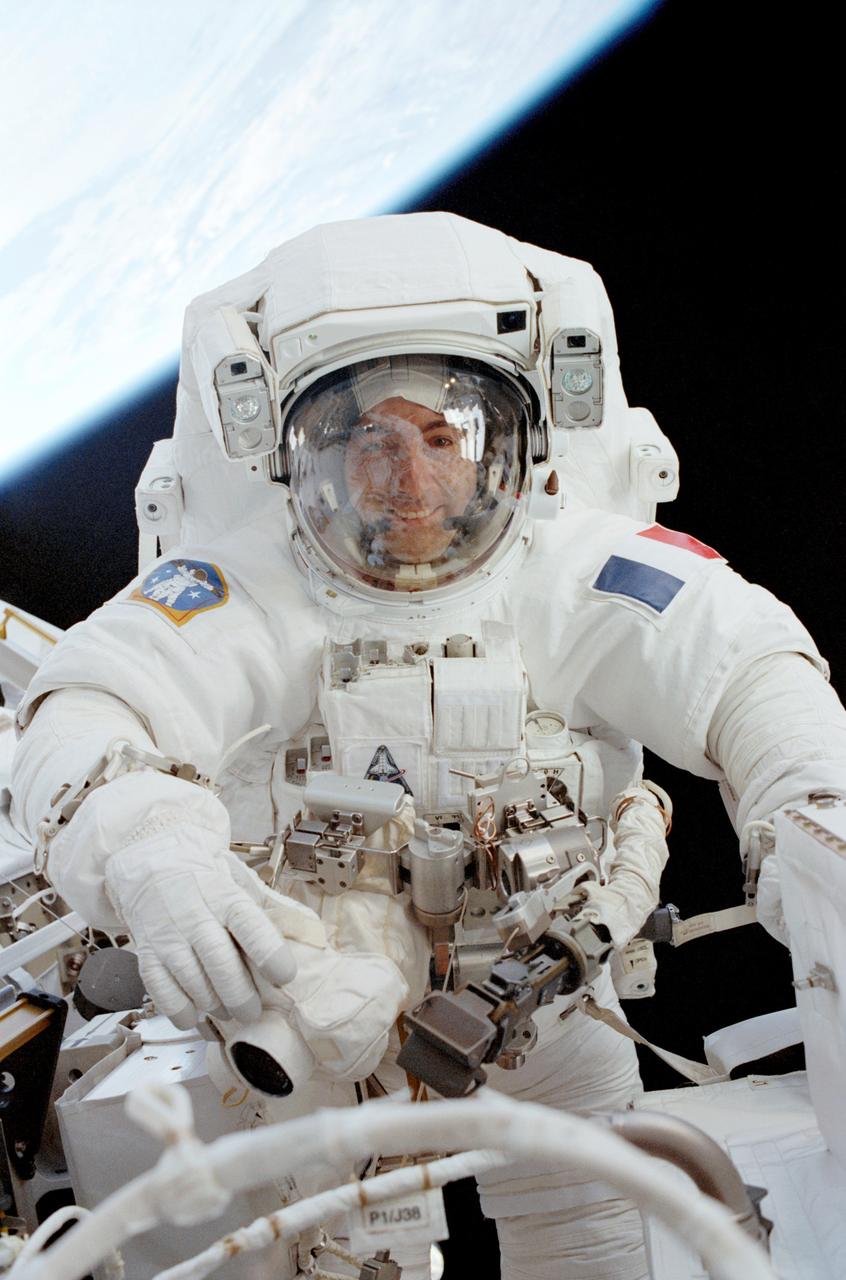
The STS-111 mission, the 14th Shuttle mission to visit the International Space Station (ISS), was launched on June 5, 2002 aboard the Space Shuttle Orbiter Endeavour. On board were the STS-111 and Expedition Five crew members. Astronauts Kerneth D. Cockrell, commander; Paul S. Lockhart, pilot; and mission specialists Franklin R. Chang-Diaz and Philippe Perrin were the STS-111 crew members. Expedition Five crew members included Cosmonaut Valeri G. Korzun, commander; Astronaut Peggy A. Whitson and Cosmonaut Sergei Y. Treschev, flight engineers. Three space walks enabled the STS-111 crew to accomplish the delivery and installation of the Mobile Remote Servicer Base System (MBS), an important part of the Station's Mobile Servicing System that allows the robotic arm to travel the length of the Station, which is necessary for future construction tasks. In this photograph, Astronaut Philippe Perrin, representing CNES, the French Space Agency, participates in the second scheduled EVA. During the space walk, Perrin and Chang-Diaz attached power, data, and video cables from the ISS to the MBS, and used a power wrench to complete the attachment of the MBS onto the Mobile Transporter (MT).
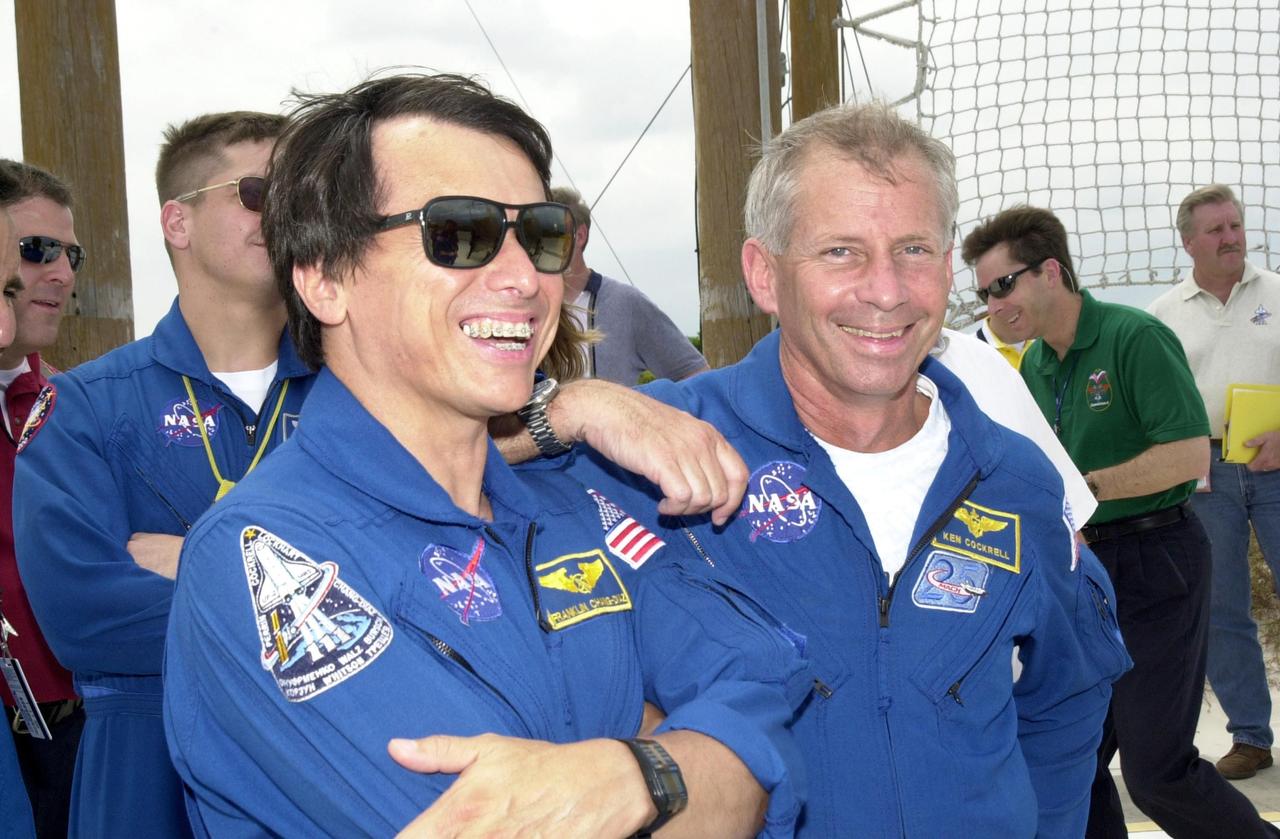
KENNEDY SPACE CENTER, FLA. - During emergency egress training at the pad, STS-111 Mission Specialist Franklin Chang-Diaz (left, foreground) and Commander Kenneth Cockrell share a lighthearted moment. Behind Chang-Diaz is Expedition 5 Commander Valeri Korzun. The training is part of Terminal Countdown Demonstration Test activities, which also include a simulated launch countdown. Mission STS-111 is known as Utilization Flight 2, carrying supplies and equipment in the Multi-Purpose Logistics Module Leonardo to the International Space Station. The payload also includes the Mobile Base System, which will be installed on the Mobile Transporter to complete the Canadian Mobile Servicing System, or MSS, and a replacement wrist/roll joint for Canadarm 2. The mechanical arm will then have the capability to "inchworm" from the U.S. Lab Destiny to the MSS and travel along the truss to work sites. Expedition 5 will travel to the Station on Endeavour as the replacement crew for Expedition 4, who will return to Earth aboard the orbiter. Launch is scheduled for May 30, 2002
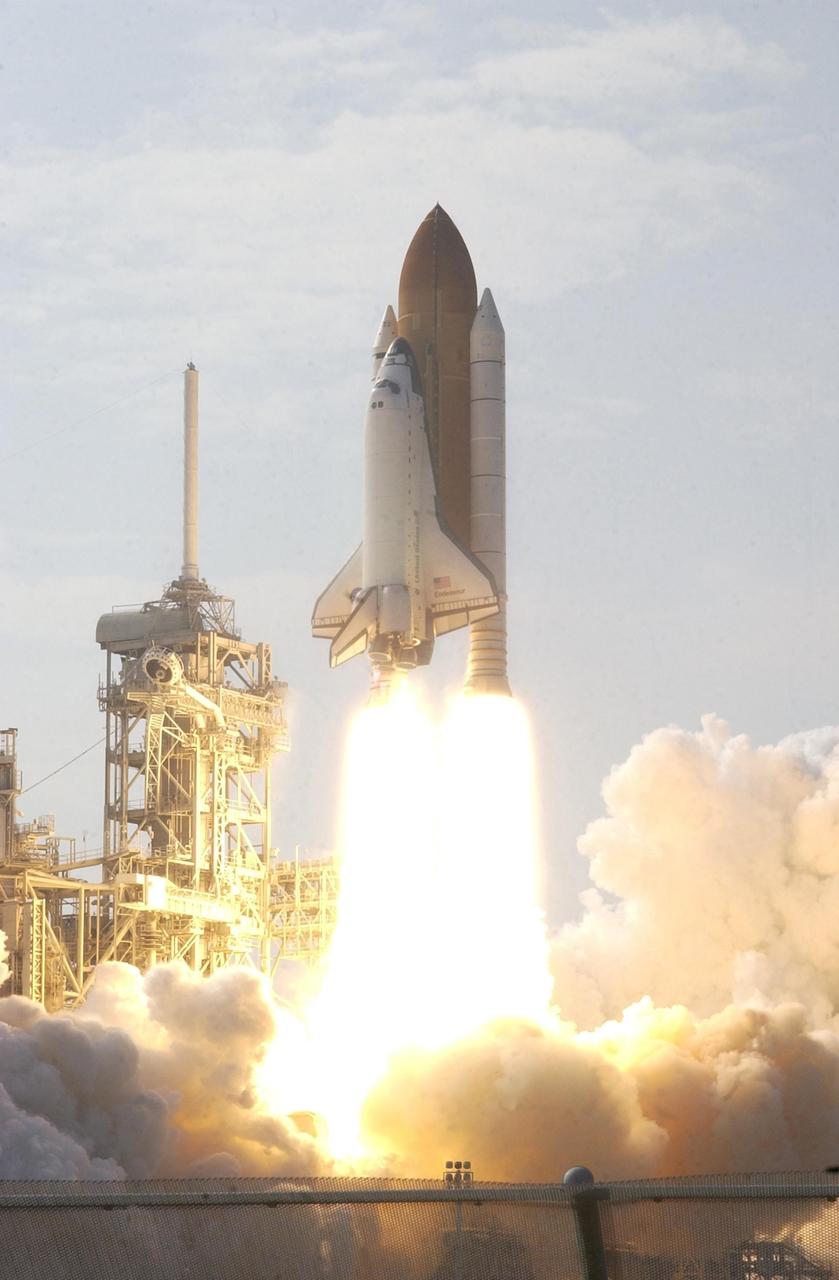
KENNEDY SPACE CENTER, FLA. - Space Shuttle Endeavour erupts from billows of smoke and steam as it hurtles into space on mission STS-111 to the International Space Station. Liftoff occurred at 5:22:49 p.m. EDT. The STS-111 crew includes Commander Kenneth Cockrell, Pilot Paul Lockhart, and Mission Specialists Franklin Chang-Diaz and Philippe Perrin (CNES), as well as the Expedition Five crew members Valeri Korzun, Peggy Whitson and Sergei Treschev. This mission marks the 14th Shuttle flight to the International Space Station and the third Shuttle mission this year. Mission STS-111 is the 18th flight of Endeavour and the 110th flight overall in NASA's Space Shuttle program
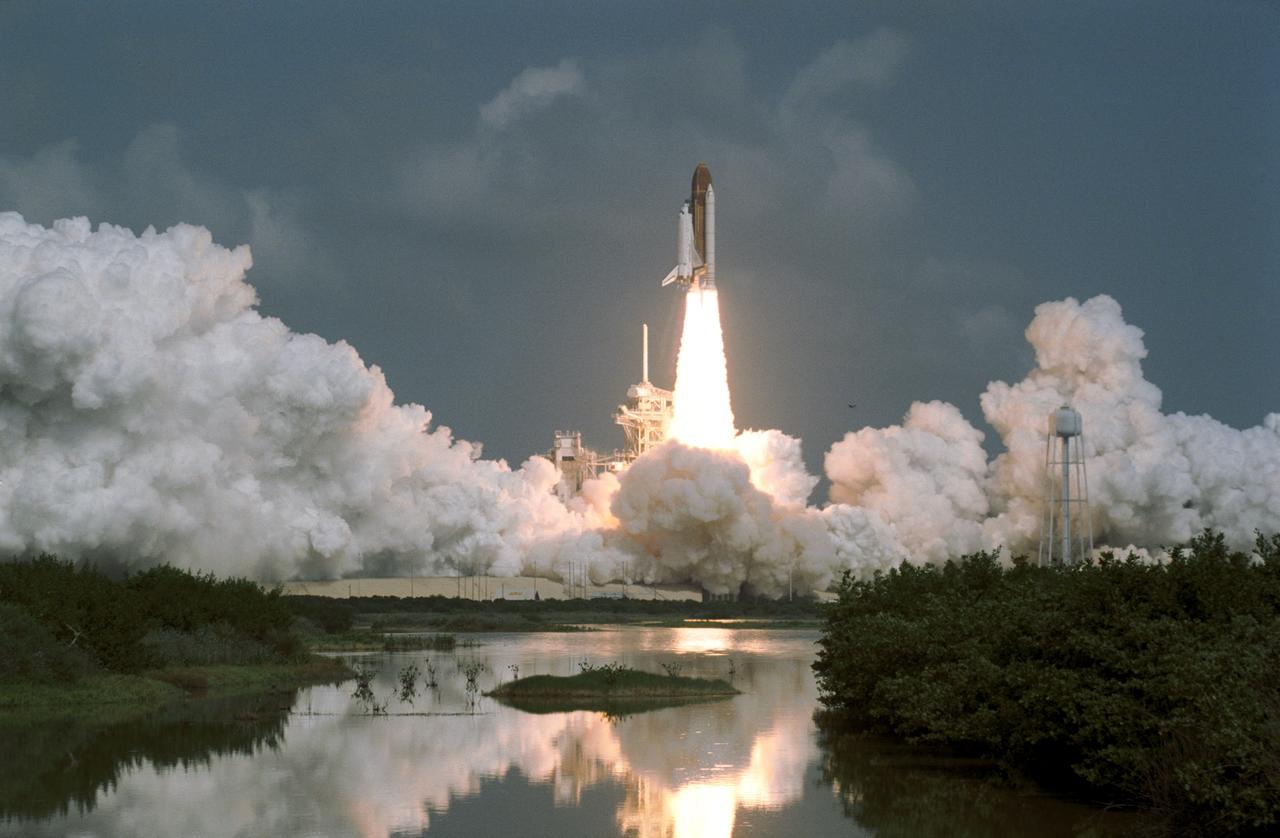
STS046-S-082 (31 July 1992) --- This panoramic scene at Kennedy Space Center's Launch Complex 39 shows the Space Shuttle Atlantis as it blasts off on its way to eight days of Earth orbital operations with a crew of five NASA astronauts and two European scientists onboard. Launch occurred at 9:56:47:976 a.m. (EDT), July 31, 1992. Onboard the spacecraft were astronauts Loren J. Shriver, Andrew M. Allen, Jeffrey A. Hoffman, Marsha S. Ivins and Franklin R. Chang-Diaz, along with the European Space Agency's Claude Nicollier and the Italian Space Agency's Franco Malerba.
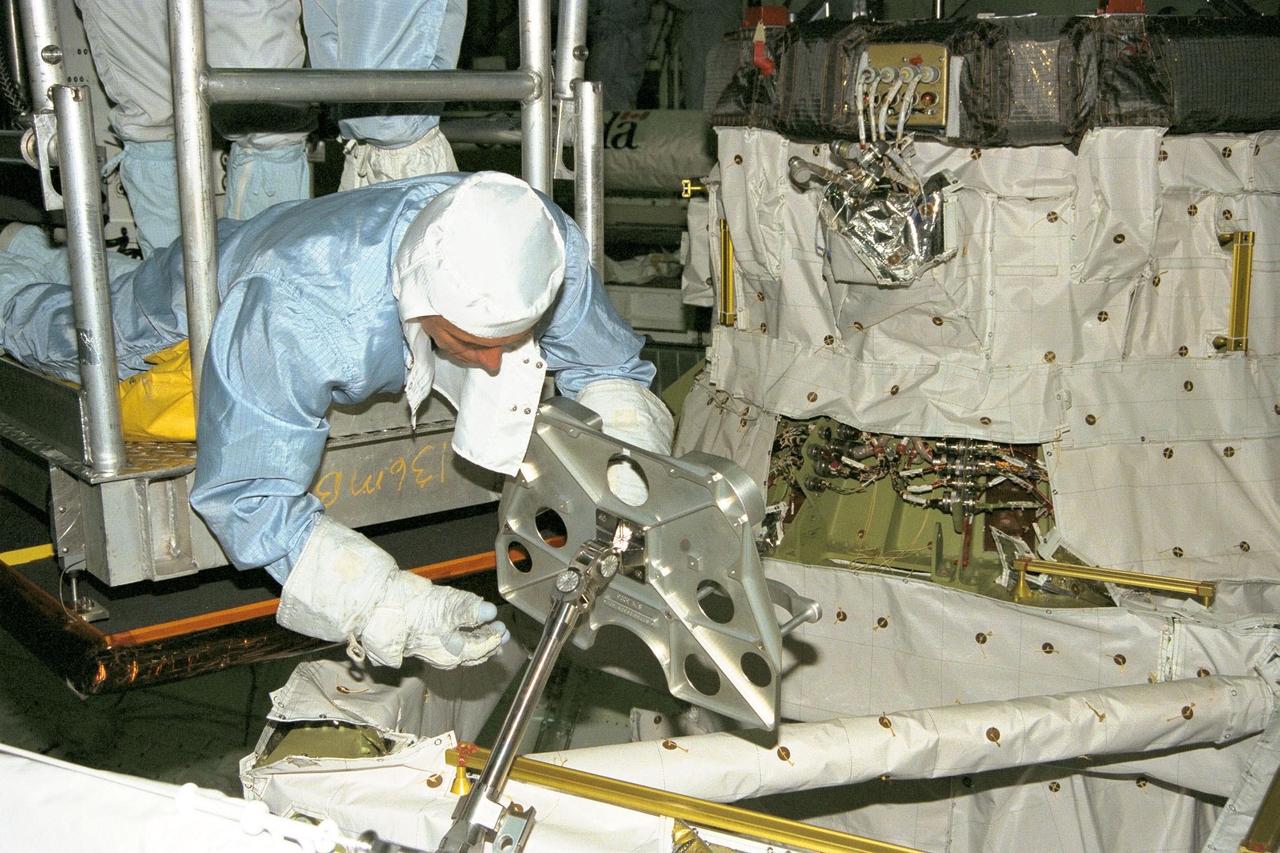
STS-91 Mission Specialist Franklin Chang-Diaz, Ph.D., participates in the Crew Equipment Interface Test, or CEIT, in KSC's Orbiter Processing Facility Bay 2. He is inspecting a foot restraint for an external vehicular activity (EVA) spacewalk. During CEIT, the crew have an opportunity to get a hands-on look at the payloads and equipment with which they'll be working on-orbit. The STS-91 crew are scheduled to launch aboard the Shuttle Discovery for the ninth and final docking with the Russian Space Station Mir from KSC's Launch Pad 39A on May 28 at 8:05 EDT
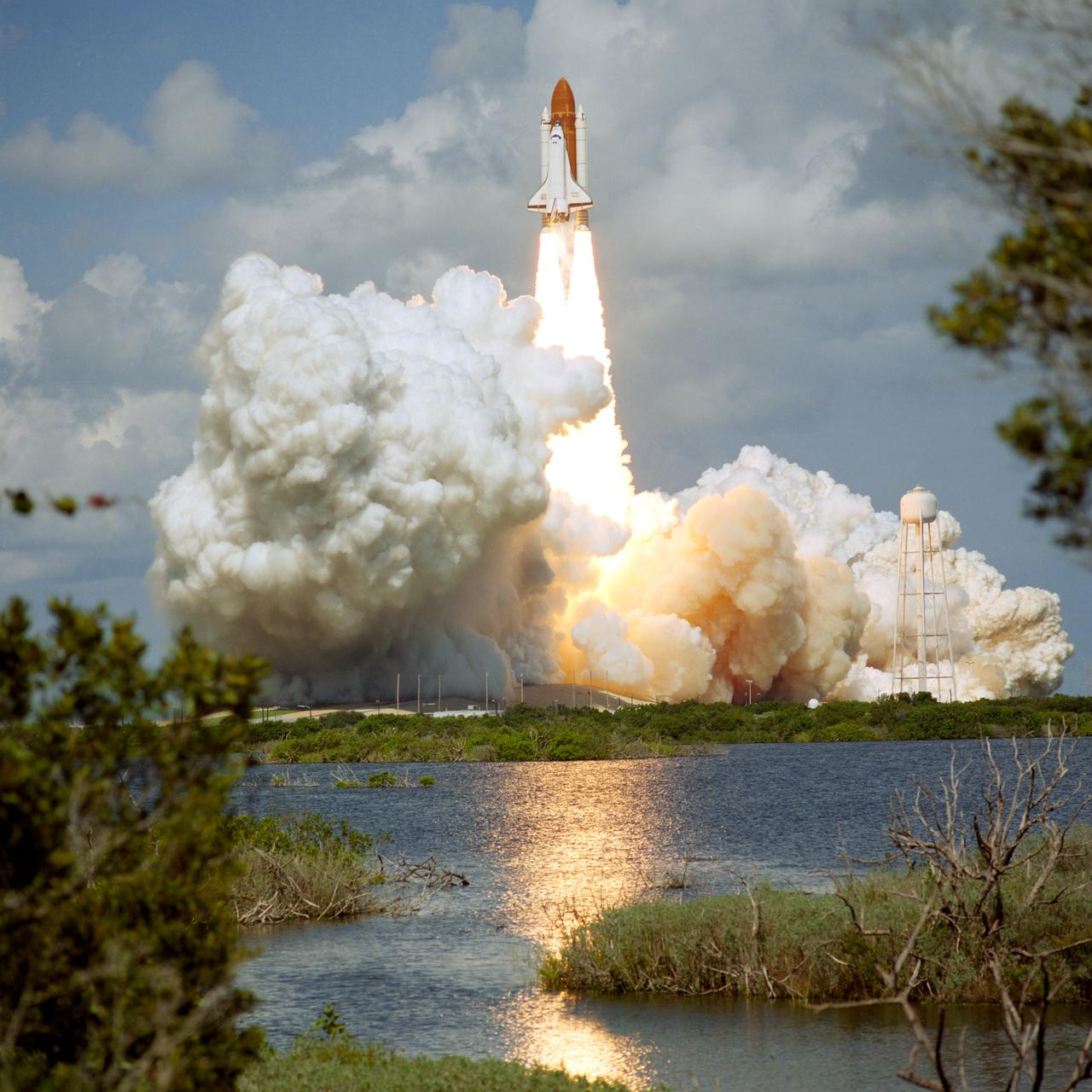
STS034-S-025 (18 Oct 1989) --- The STS-34 Space Shuttle Atlantis lifts off from Launch Pad 39-B at 2:53:39:983 p.m. (EDT), marking the beginning of a five-day mission in space. Atlantis carries a crew of five and the spacecraft Galileo, along with a number of other scientific experiments. The Jupiter-bound probe will be deployed from Atlantis some six hours after launch. The journey to the giant planet is expected to take over six years. Crewmembers for the mission are astronauts Donald E. Williams, Michael J. McCulley, Shannon W. Lucid, Franklin R. Chang-Diaz and Ellen S. Baker. The scene was recorded with a 70mm camera.
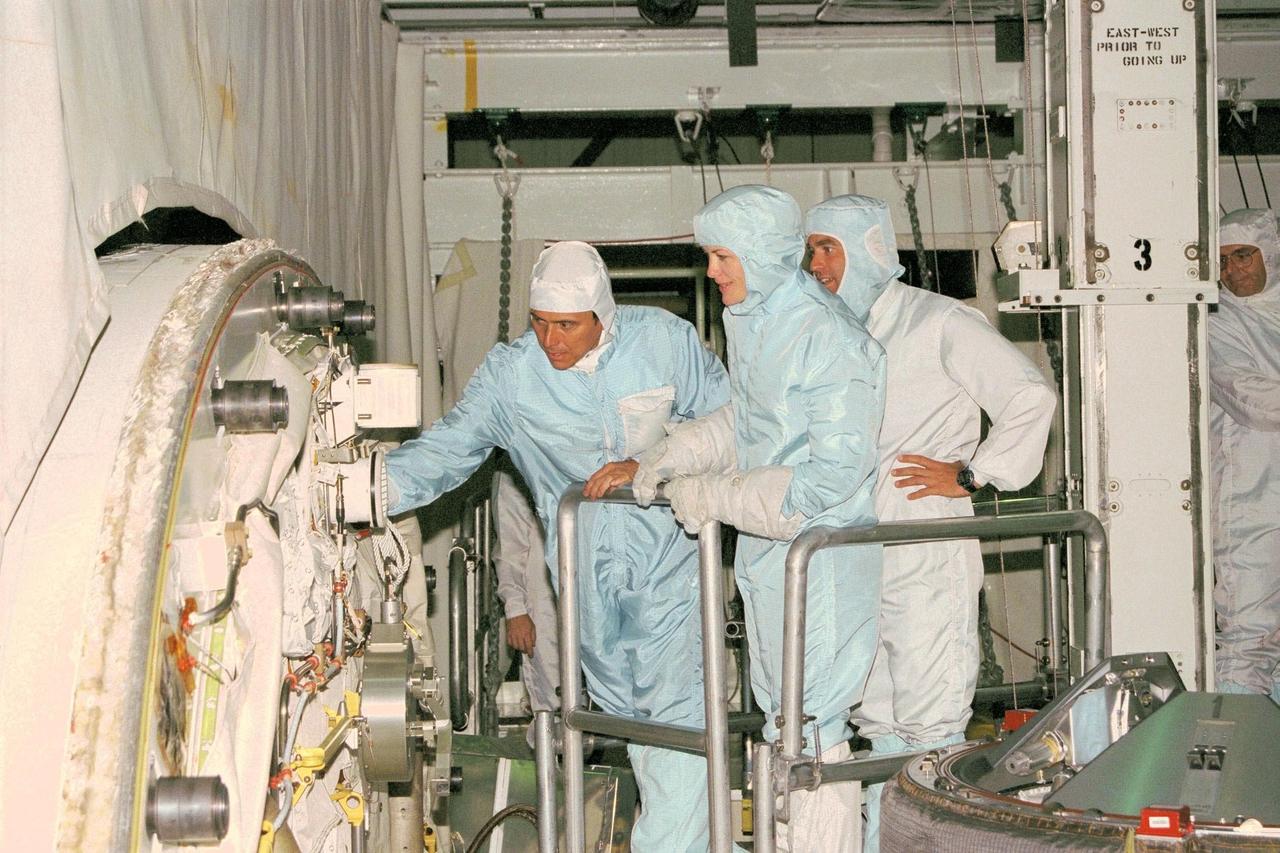
STS-91 crew members participate in the Crew Equipment Interface Test, or CEIT, in KSC's Orbiter Processing Facility Bay 2. From left to right are STS-91 Mission Specialists Franklin Chang-Diaz, Ph.D., and Janet Kavandi, Ph.D., along with Kieth Johnson, an EVA trainer/flight controller from Johnson Space Center. During CEIT, the crew have an opportunity to get a hands-on look at the payloads with which they'll be working on-orbit. The STS-91 crew are scheduled to launch aboard the Shuttle Discovery for the ninth and final docking with the Russian Space Station Mir from KSC's Launch Pad 39A on May 28 at 8:05 EDT
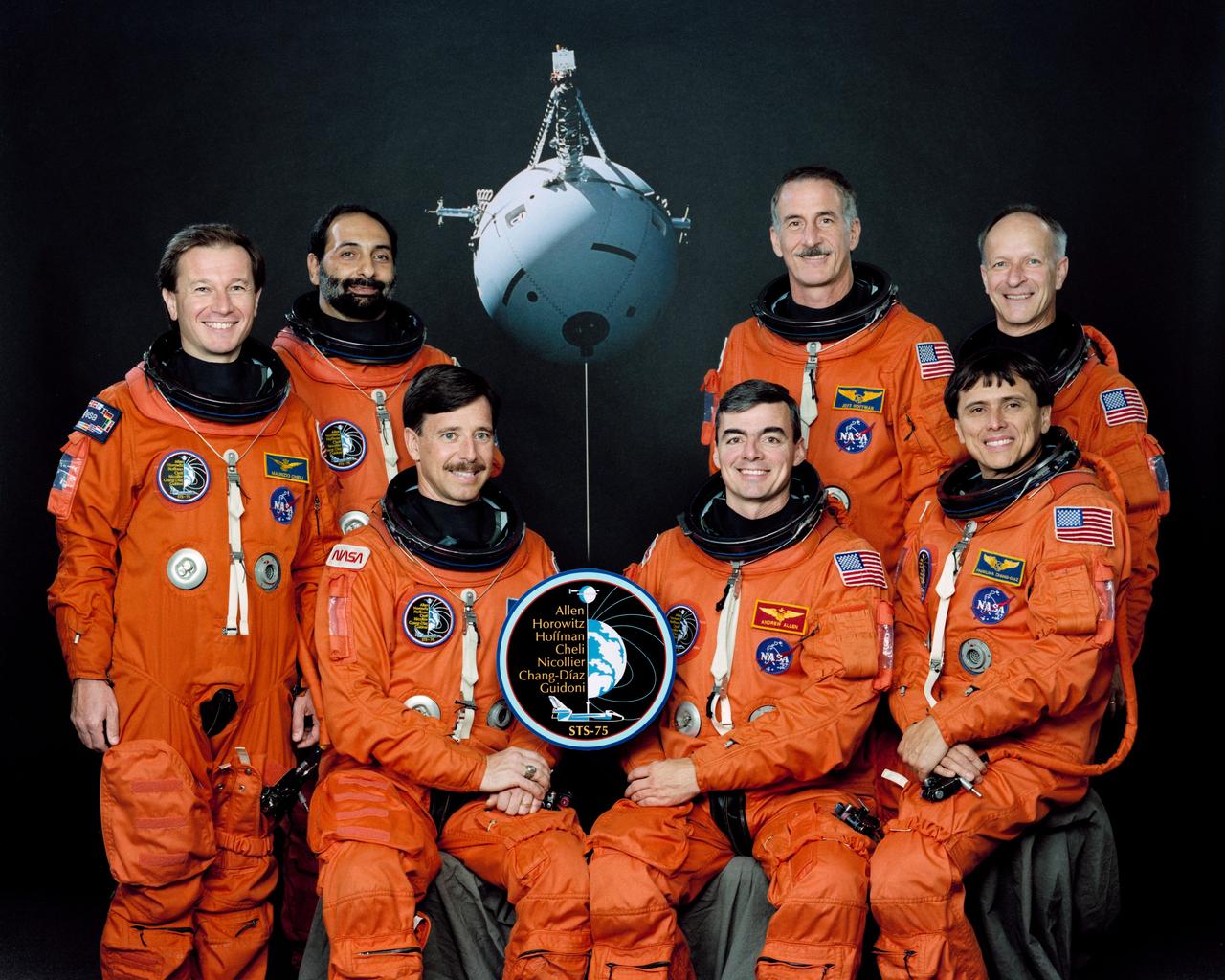
STS075-S-002 (December 1995) --- With their major payload as the backdrop, members of the crew pose for the traditional crew portrait. The crew will deploy and work with the Tethered Satellite System (TSS-1R). Seated at center are astronauts Scott J. Horowitz (left), pilot; and Andrew M. Allen, commander. Astronaut Franklin R. Chang-Diaz (front right) is payload commander. In the rear are (left to right) European Space Agency (ESA) astronaut Maurizio Cheli, mission specialist; payload specialist Umberto Guidoni of the Italian Space Agency (ASI); Jeffrey A. Hoffman and ESA astronaut Claude Nicollier, mission specialists.
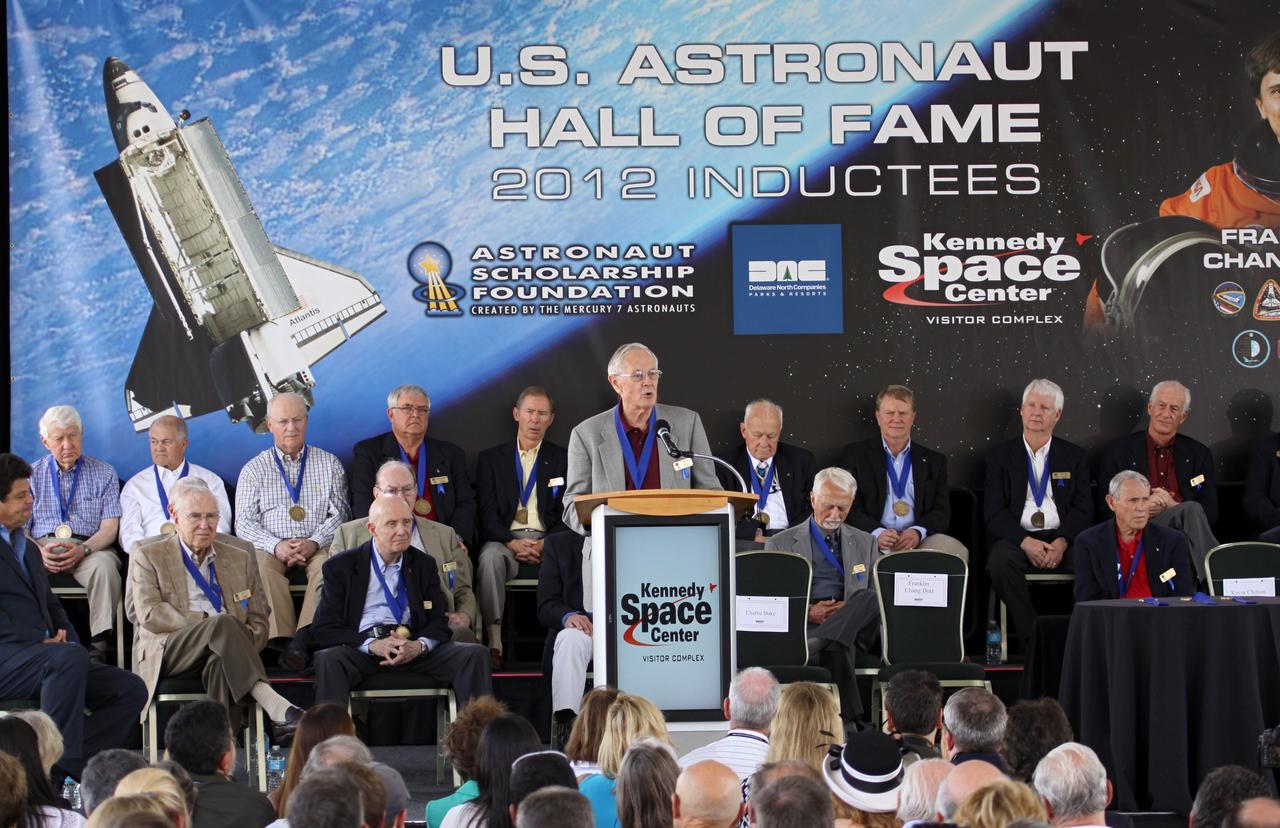
CAPE CANAVERAL, Fla. – At NASA’s Kennedy Space Center Visitor Complex in Florida, Astronaut Scholarship Foundation Chairman and Hall of Fame astronaut Charlie Duke speaks during the U.S. Astronaut Hall of Fame induction ceremony. Space shuttle astronauts Franklin Chang Diaz, Kevin Chilton and Charlie Precourt were inducted into the Hall of Fame Class of 2012. The year’s inductees were selected by a committee of current Hall of Fame astronauts, former NASA officials, historians and journalists. The selection process is administered by the Astronaut Scholarship Foundation. Photo credit: NASA/Jim Grossmann
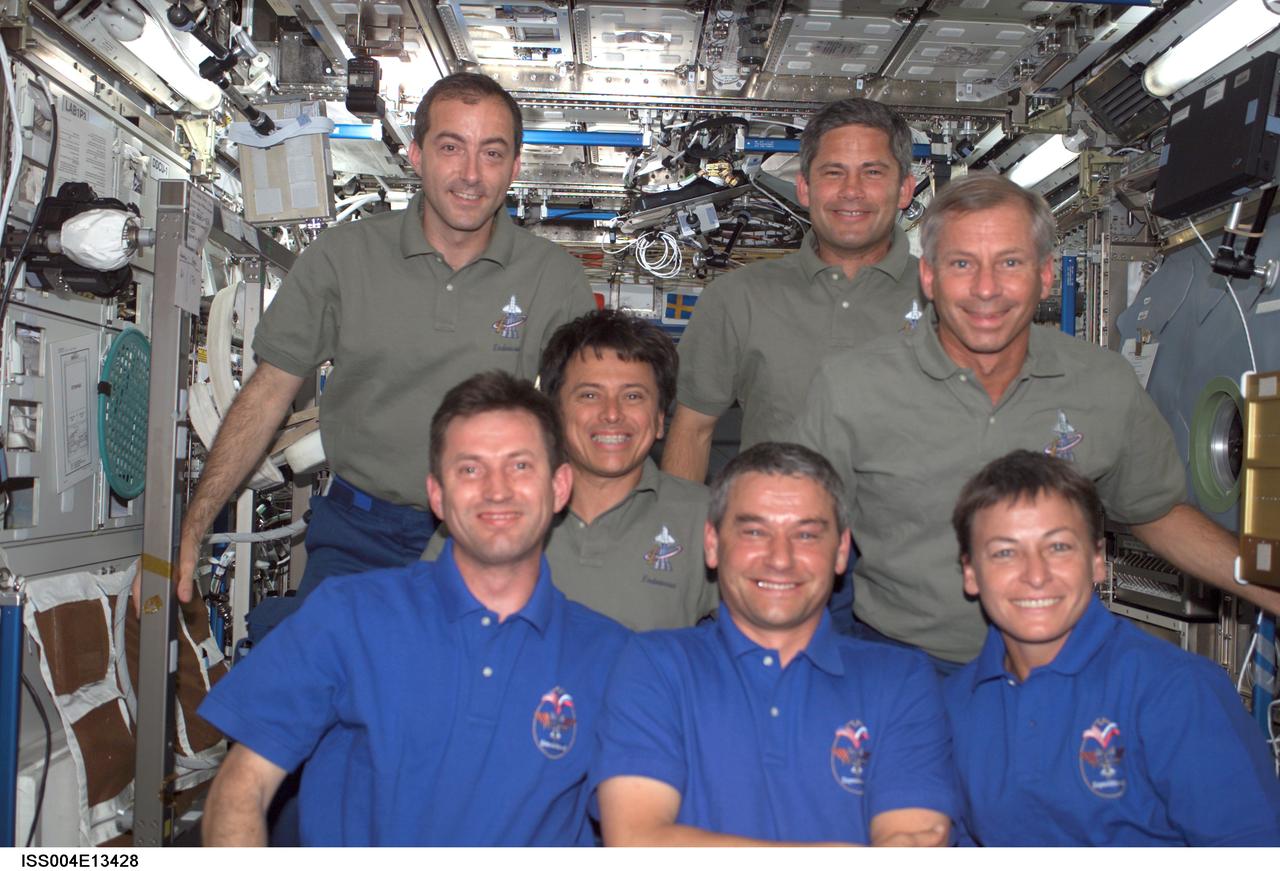
ISS004-E-13428 (June 2002) --- The Expedition Five (front row) and STS-111 crews assemble for a group photo in the Destiny laboratory on the International Space Station (ISS). The Expedition Five crewmembers, from left to right, are cosmonauts Sergei Y. Treschev, flight engineer; Valery G. Korzun, mission commander; and astronaut Peggy A. Whitson, flight engineer. The STS-111 crewmembers, from left to right, are astronauts Philippe Perrin and Franklin R. Chang-Diaz, both mission specialists; Paul S. Lockhart and Kenneth D. Cockrell, pilot and mission commander, respectively. Onufrienko, Korzun and Treschev represent Rosaviakosmos and Perrin represents CNES, the French Space Agency.
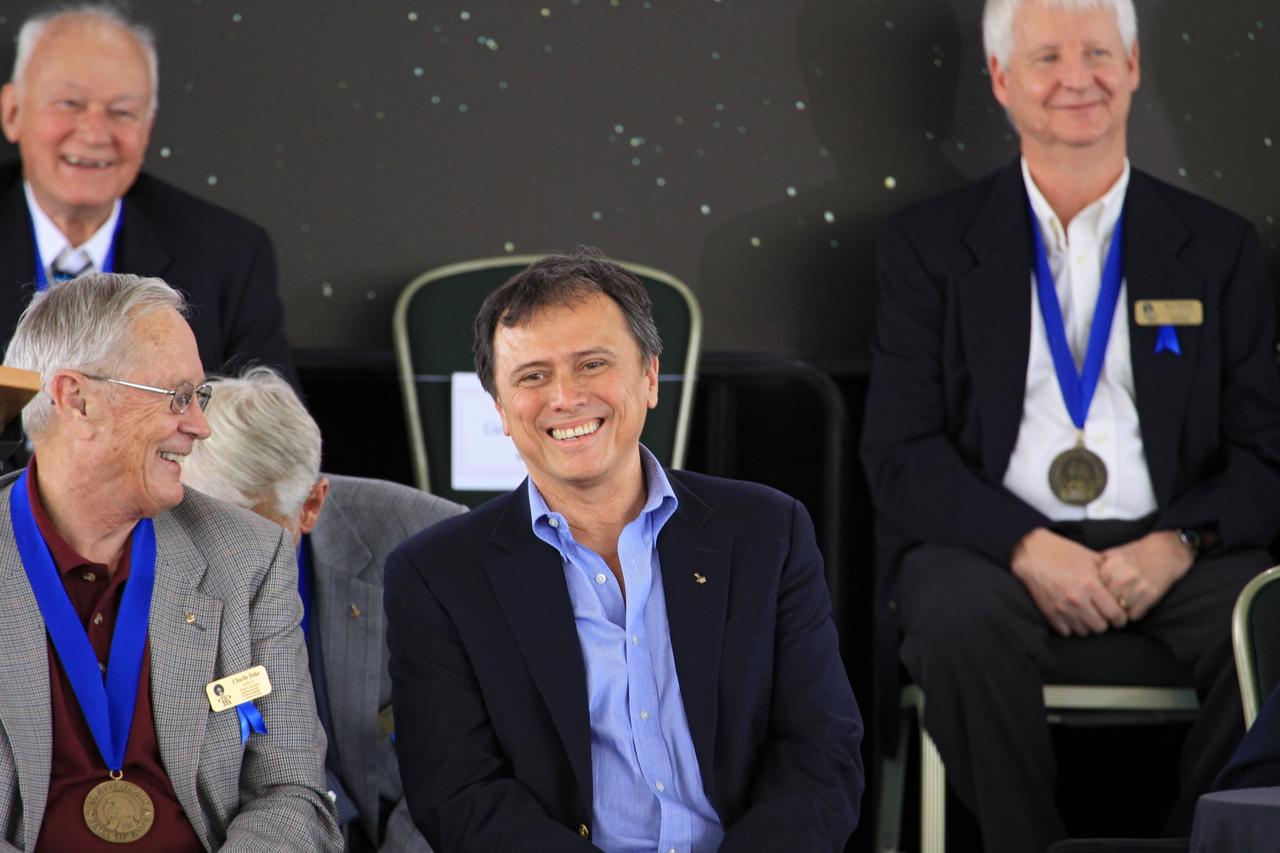
CAPE CANAVERAL, Fla. – At NASA’s Kennedy Space Center Visitor Complex in Florida, space shuttle astronaut and U.S. Astronaut Hall of Fame Class of 2012 inductee Franklin Chang Diaz at right shares a humorous moment with Astronaut Scholarship Foundation Chairman and Hall of Fame astronaut Charlie Duke during the induction ceremony. Shuttle astronauts Kevin Chilton and Charlie Precourt also were inducted into the Hall of Fame. The year’s inductees were selected by a committee of current Hall of Fame astronauts, former NASA officials, historians and journalists. The selection process is administered by the Astronaut Scholarship Foundation. Photo credit: NASA/Jim Grossmann
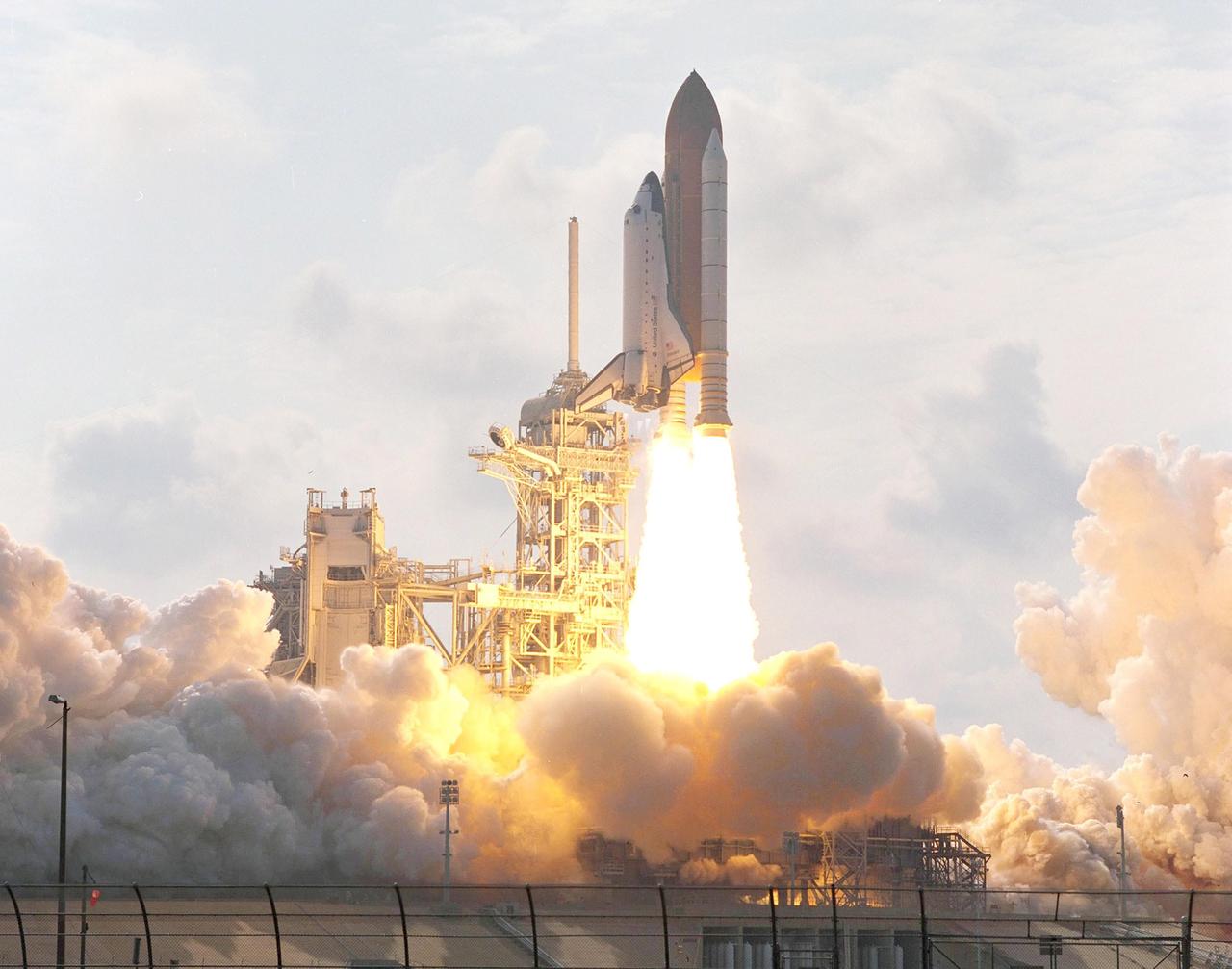
KENNEDY SPACE CENTER, FLA. - Space Shuttle Endeavour clears the lightning mast as it hurtles into space on mission STS-111 to the International Space Station. Liftoff occurred at 5:22:49 p.m. EDT. The STS-111 crew includes Commander Kenneth Cockrell, Pilot Paul Lockhart, and Mission Specialists Franklin Chang-Diaz and Philippe Perrin (CNES), as well as the Expedition Five crew members Valeri Korzun, Peggy Whitson and Sergei Treschev. This mission marks the 14th Shuttle flight to the International Space Station and the third Shuttle mission this year. Mission STS-111 is the 18th flight of Endeavour and the 110th flight overall in NASA's Space Shuttle program
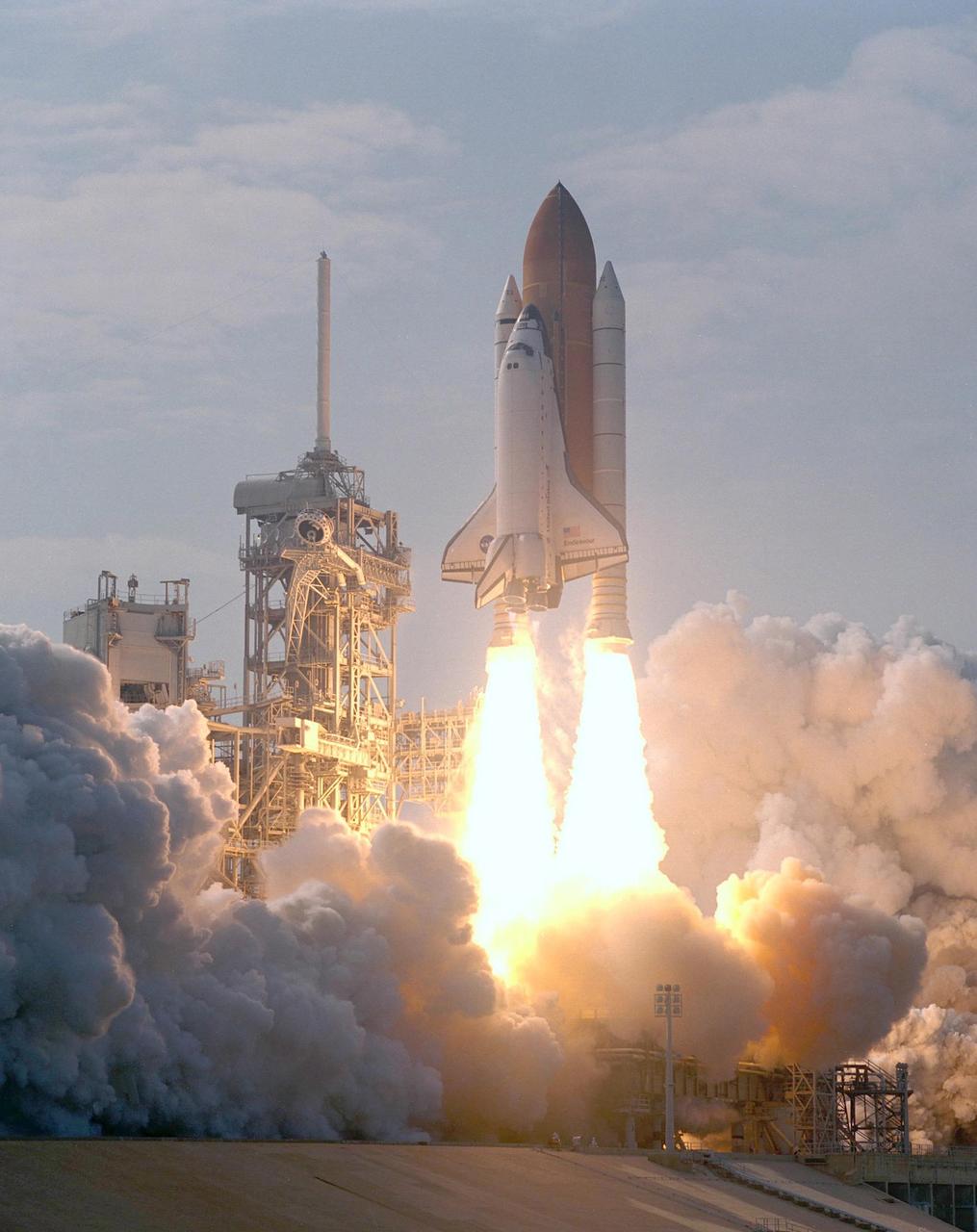
KENNEDY SPACE CENTER, FLA. -- Twin columns of fire trail Space Shuttle Endeavour as it roars toward space on mission STS-111 to the International Space Station. Liftoff occurred at 5:22:49 p.m. EDT. The STS-111 crew includes Commander Kenneth Cockrell, Pilot Paul Lockhart, and Mission Specialists Franklin Chang-Diaz and Philippe Perrin (CNES), as well as the Expedition Five crew members Valeri Korzun, Peggy Whitson and Sergei Treschev. This mission marks the 14th Shuttle flight to the International Space Station and the third Shuttle mission this year. Mission STS-111 is the 18th flight of Endeavour and the 110th flight overall in NASA's Space Shuttle program