
This is an artist concept depicting NASA CloudSat in orbit around Earth.
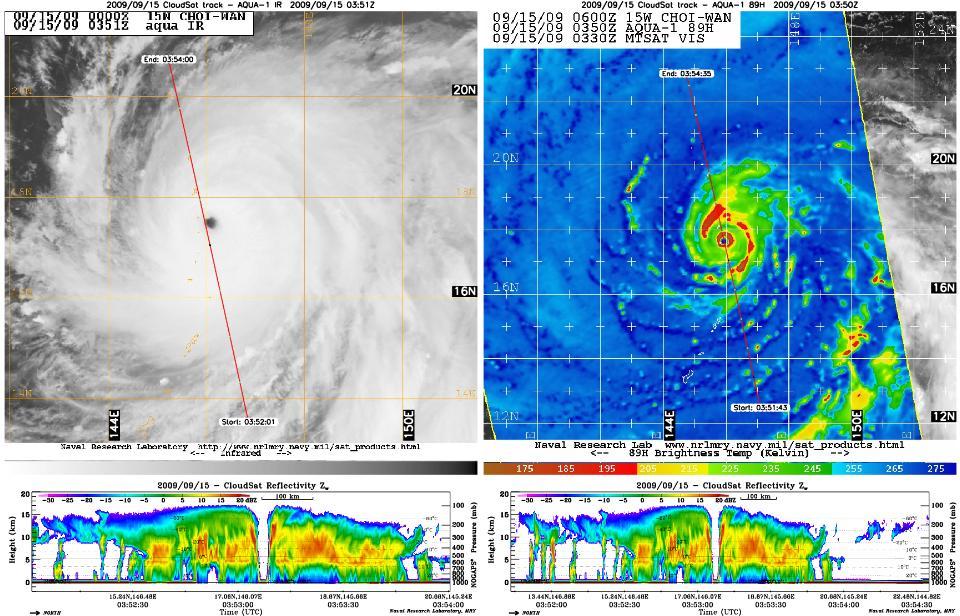
NASA CloudSat satellite captured an eye overpass of Super Typhoon Choi-Wan in the Western Pacific on September 15, 2009 at 0352Z.
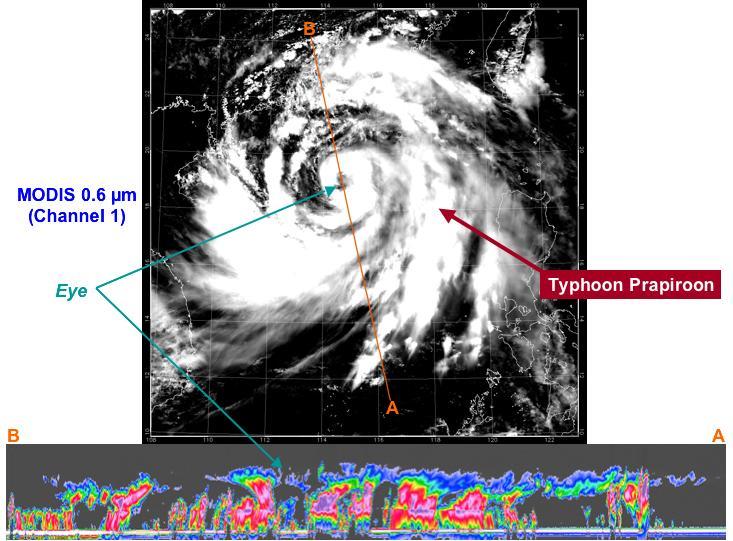
At approximately 0553 UTC 1:53 am EDT, on 2 Aug 2006, NASA CloudSat flew over the eye of Typhoon Prapiroon as it approached southern China.
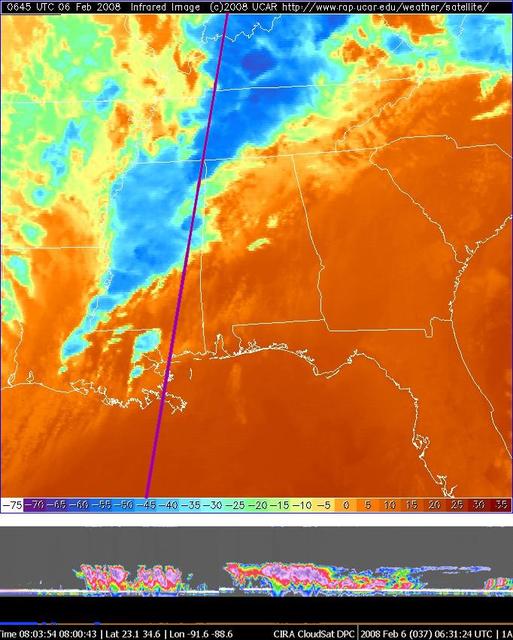
NASA CloudSat made a nighttime overpass approximately 0630 UTC of the thunderstorms responsible for the tornadic outbreak over Kentucky, Tennessee, and Mississippi on Tuesday, February 5, 2008.
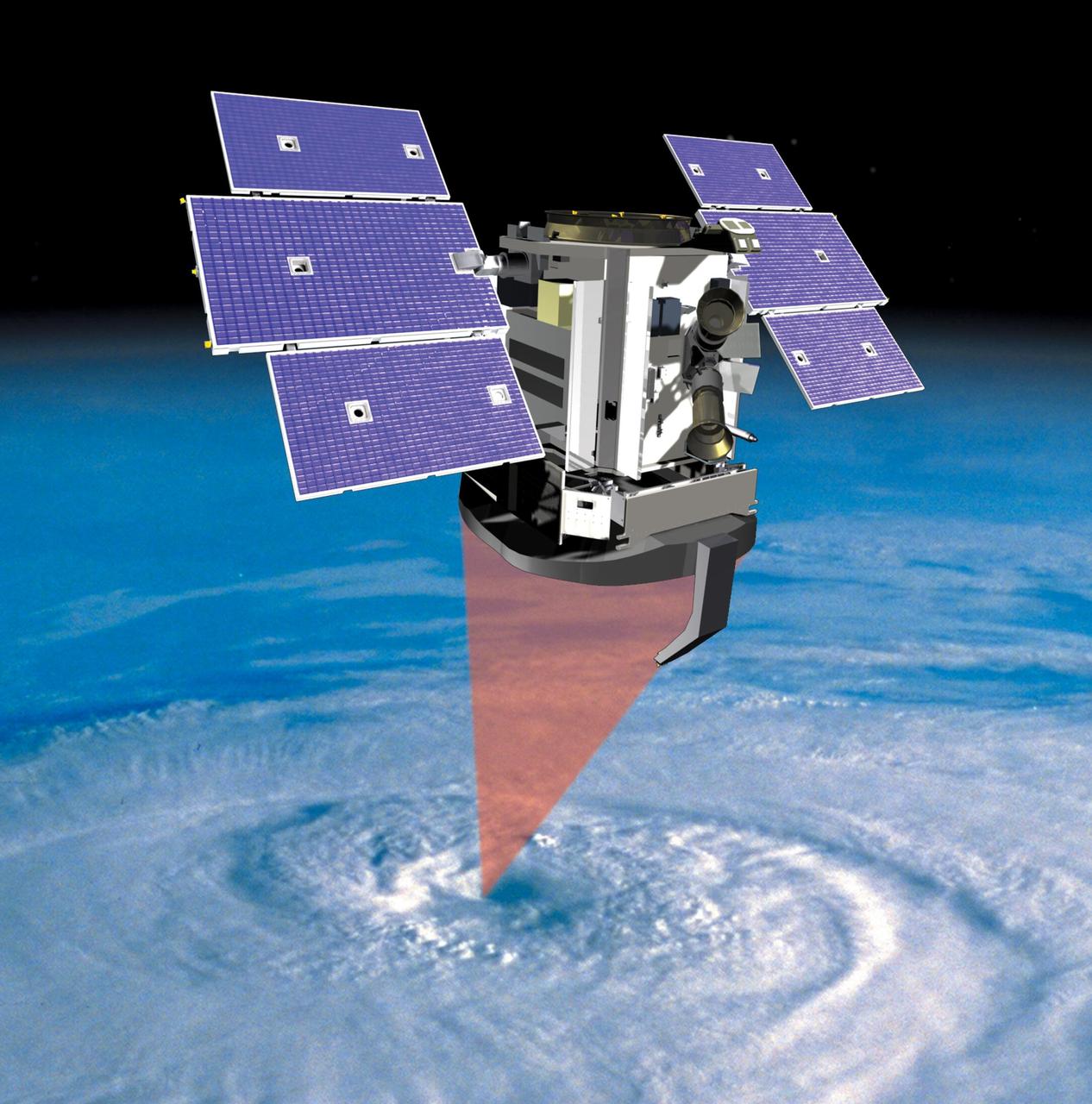
This artist concept shows NASA CloudSat spacecraft and its Cloud Profiling Radar using microwave energy to observe cloud particles and determine the mass of water and ice within clouds.

NASA CloudSat image of a horizontal cross-section of a polar night storm near Antarctica.

NASA CloudSat image of a horizontal cross-section of tropical clouds and thunderstorms over east Africa.

NASA CloudSat spacecraft overpassed Hurricane Sandy on Oct. 29, 2012 just as Sandy was approaching the Atlantic coastline. Sandy contained estimated maximum sustained winds of 90 miles per hour 78 knots.

NASA CloudSat satellite completed a stunning eye overpass of Typhoon Dolphin in the western Pacific Ocean on May 16, 2015, at 0407 UTC.

NASA CloudSat passed over Sandy at 10:32 a.m. EDT on Oct. 27, 2012. Light to moderate precipitation associated with parts of the outer bands of Hurricane Sandy were moving on shore into parts of North Carolina.
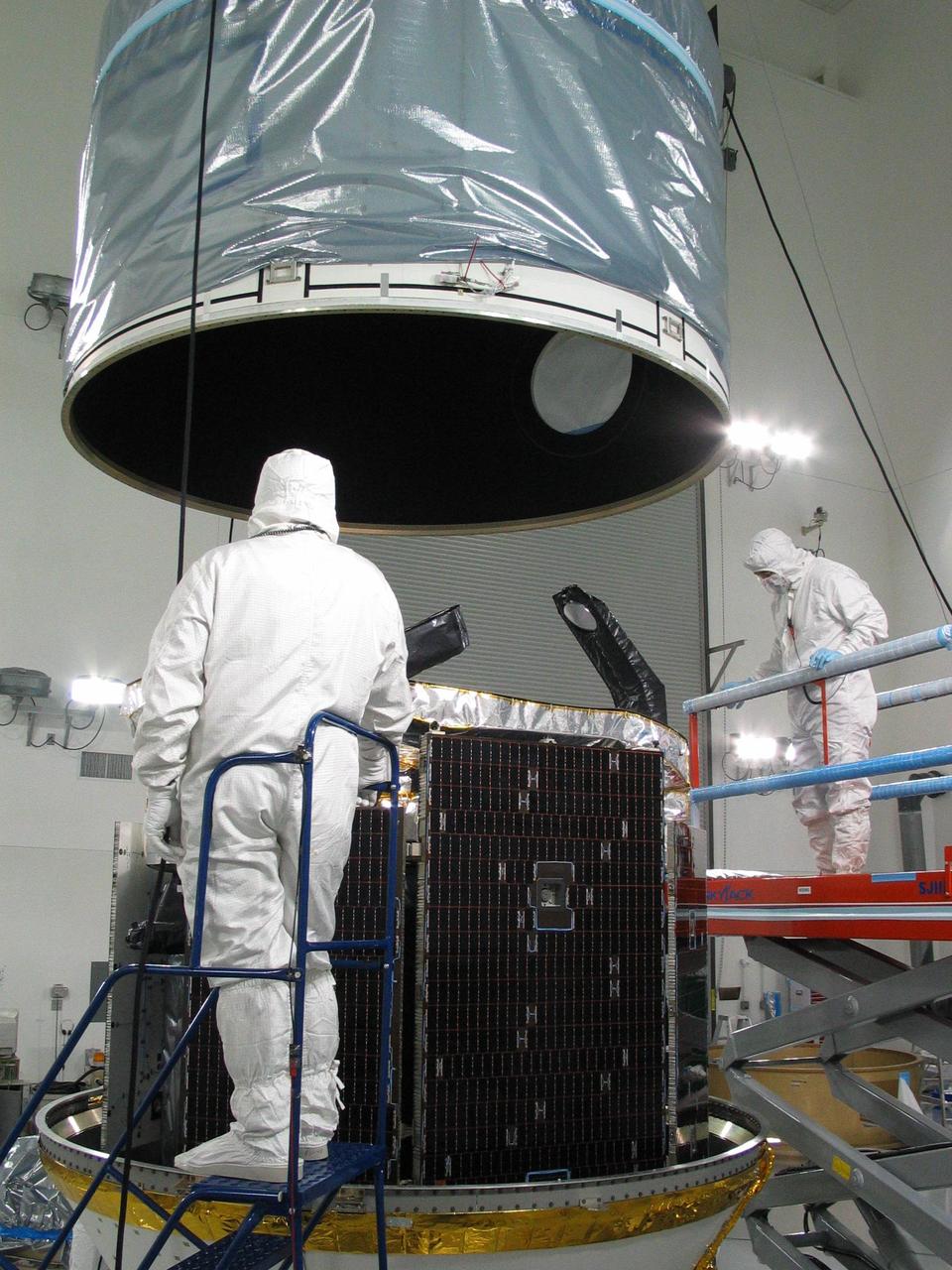
NASA CloudSat spacecraft sits encapsulated within its Boeing Delta launch vehicle dual payload attach fitting at Vandenberg Air Force Base, Calif.

NASA CloudSat first image, of a warm front storm over the Norwegian Sea, was obtained on May 20, 2006.
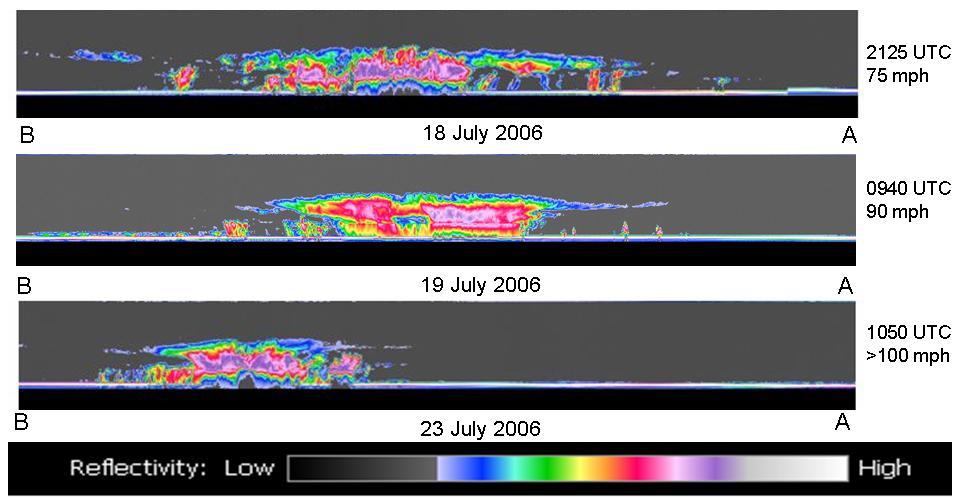
Hurricane Daniel intensified between July 18 and July 23rd. NASA new CloudSat satellite was able to capture and confirm this transformation in its side-view images of Hurricane Daniel as seen in this series of images
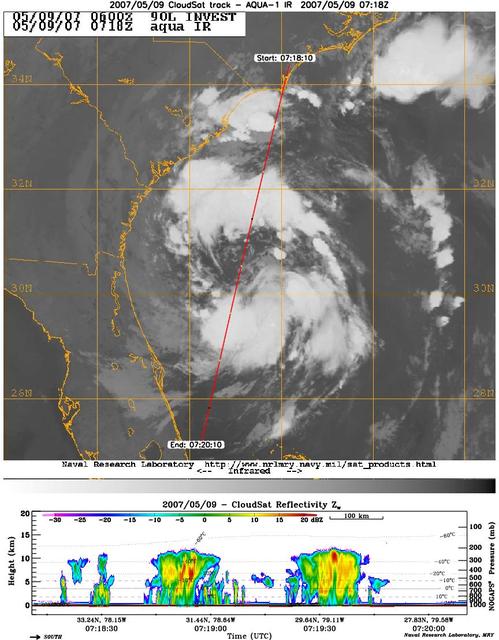
CloudSat's Cloud Profiling Radar captured a profile across Tropical Storm Andrea on Wednesday, May 9, 2007, near the South Carolina/Georgia/Florida Atlantic coast. The upper image shows an infrared view of Tropical Storm Andrea from the Moderate Resolution Imaging Spectroradiometer instrument on NASA's Aqua satellite, with CloudSat's ground track shown as a red line. The lower image is the vertical cross section of radar reflectivity along this path, where the colors indicate the intensity of the reflected radar energy. CloudSat orbits approximately one minute behind Aqua in a satellite formation known as the A-Train. http://photojournal.jpl.nasa.gov/catalog/PIA09379
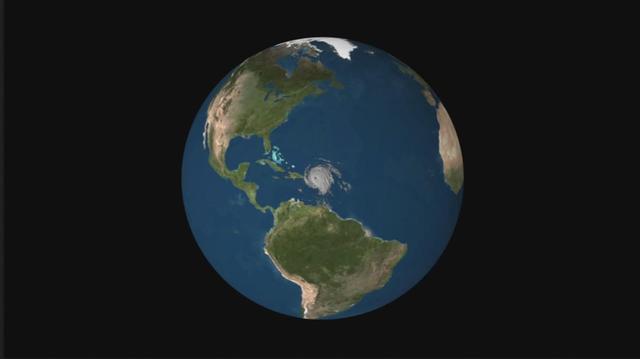
NASA's CloudSat satellite flew over Hurricane Irma on Sept. 6, 2017 at 1:45 p.m. EDT (17:45 UTC) as the storm was approaching Puerto Rico in the Atlantic Ocean. Hurricane Irma contained estimated maximum sustained winds of 185 miles per hour (160 knots) with a minimum pressure of 918 millibars. CloudSat transected the eastern edge of Hurricane Irma's eyewall, revealing details of the storm's cloud structure beneath its thick canopy of cirrus clouds. The CloudSat Cloud Profiling Radar excels in detecting the organization and placement of cloud layers beneath a storm's cirrus canopy, which are not readily detected by other satellite sensors. The CloudSat overpass reveals the inner details beneath the cloud tops of this large system; intense areas of convection with moderate to heavy rainfall (deep red and pink colors), cloud-free areas (moats) in between the inner and outer cloud bands of Hurricane Irma and cloud top heights averaging around 9 to 10 miles (15 to 16 kilometers). Lower values of reflectivity (areas of green and blue) denote smaller-sized ice and water particle sizes typically located at the top of a storm system (in the anvil area). The Cloud Profiling Radar loses signal at around 3 miles (5 kilometers) in height (in the melting layer) due to water (ice) particles larger than 0.12 inches (3 millimeters) in diameter. Moderate to heavy rainfall occurs in these areas where signal weakening is detectable. Smaller cumulus and cumulonimbus cloud types are evident as CloudSat moves farther south, beneath the thick cirrus canopy. An animation is available at https://photojournal.jpl.nasa.gov/catalog/PIA21947

NASA CloudSat satellite flew over Typhoon Utor in the West Pacific on Aug. 11, 2013 at 0518 UTC, passing within about 6.2 miles 10 kilometers from the center of the storm, and revealing the structure of the storm eye and eyewall.
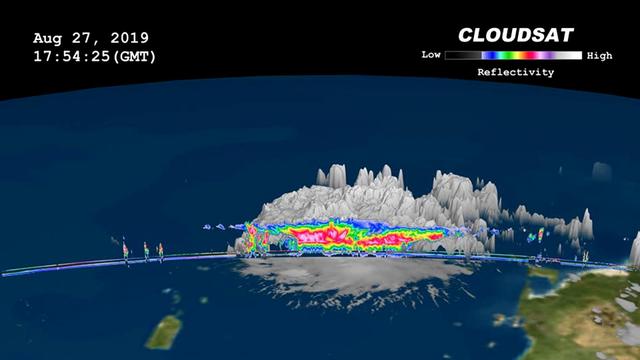
On, Aug. 27, 2019 NASA's CloudSat satellite passed over Dorian, still a tropical storm at the time, near Puerto Rico. CloudSat uses an advanced cloud-profiling radar that "slices" through clouds giving us the ability to see how tall they are, where the different cloud layers are, and where the heavier bands of rain are found within the storm system. The 3D animation shows Dorian when it had maximum sustained winds of 52 mph (84 kph) with some of its cloud tops extending about 9 miles (15 kilometer) into the atmosphere. The colors represent the size of water or ice droplets inside the storm — deep red and pink indicate larger droplets with areas of moderate and heavy rainfall. Movie available at https://photojournal.jpl.nasa.gov/catalog/PIA23359
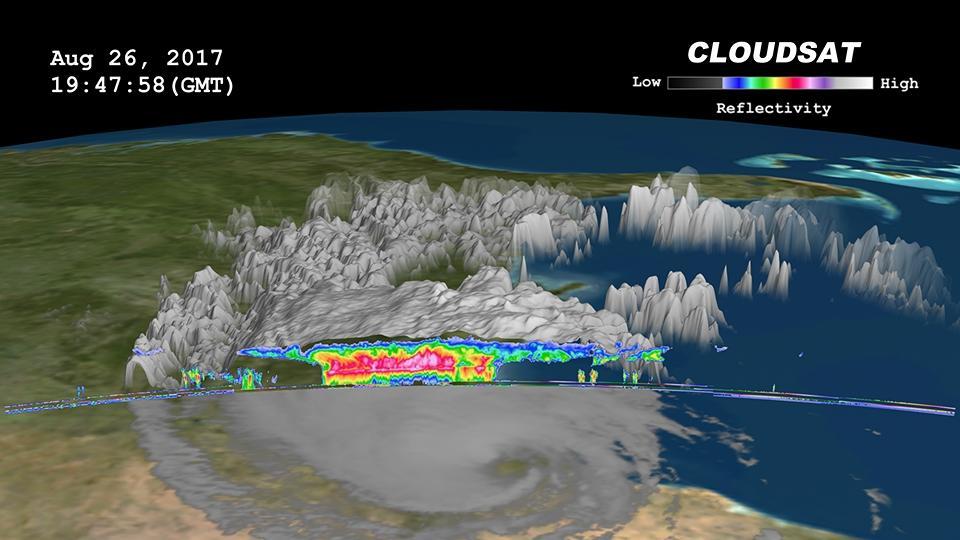
Click on the image for larger animation NASA's CloudSat satellite flew over then-Tropical Storm Harvey on Aug. 26, 2017, at 2:45 p.m. CDT (19:45 UTC) as the storm was nearly stationary over south Texas. At that time, Harvey contained estimated maximum sustained winds of 69 miles per hour (60 knots). CloudSat flew over Harvey northeast of the storm center through an area of moderate to heavy rainfall in the outer rainbands. As seen in the image and animation, large amounts of liquid and ice water (denoted by the red and pink colors) are visible beneath the cloud tops. The lack of a radar signal (attenuation) beneath the melting layer (located around 3 miles, or 5 kilometers, above ground) can be seen in the heavier areas of precipitation, since CloudSat's cloud profiling radar (CPR) signal dampens when precipitation particles are larger than 0.12 inches (3 millimeters) in size. Smaller cumulus and cumulonimbus clouds are seen north of the area of moderate to heavy precipitation. The cirrus canopy (anvil clouds) extends outward from the storm system (shown in blue and green colors). An animation is available at https://photojournal.jpl.nasa.gov/catalog/PIA17392
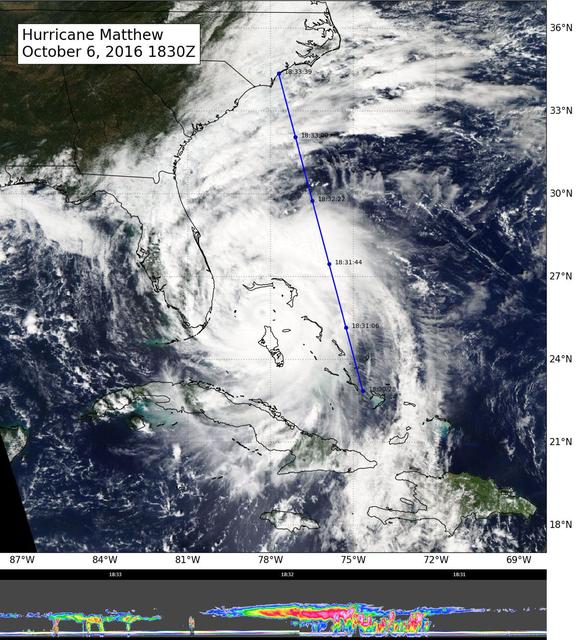
NASA's CloudSat flew east of Hurricane Matthew's center on Oct. 6 at 11:30 a.m. PDT (2:30 p.m. EDT), intersecting parts of Matthew's outer rain bands and revealing Matthew's anvil clouds (thick cirrus cloud cover), with cumulus and cumulonimbus clouds beneath (lower image). Reds/pinks are larger water/ice droplets. http://photojournal.jpl.nasa.gov/catalog/PIA21095
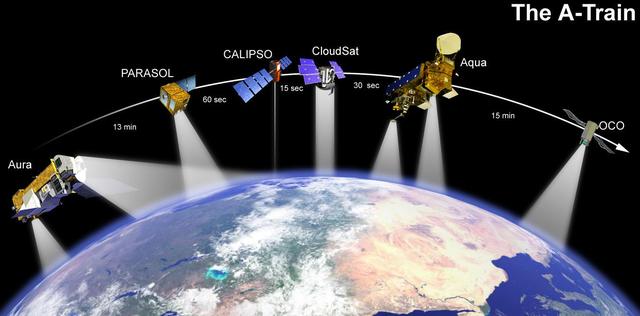
This artist concept shows how NASA’s CALIPSO and CloudSat will fly in formation with other Earth Observing Satellites.
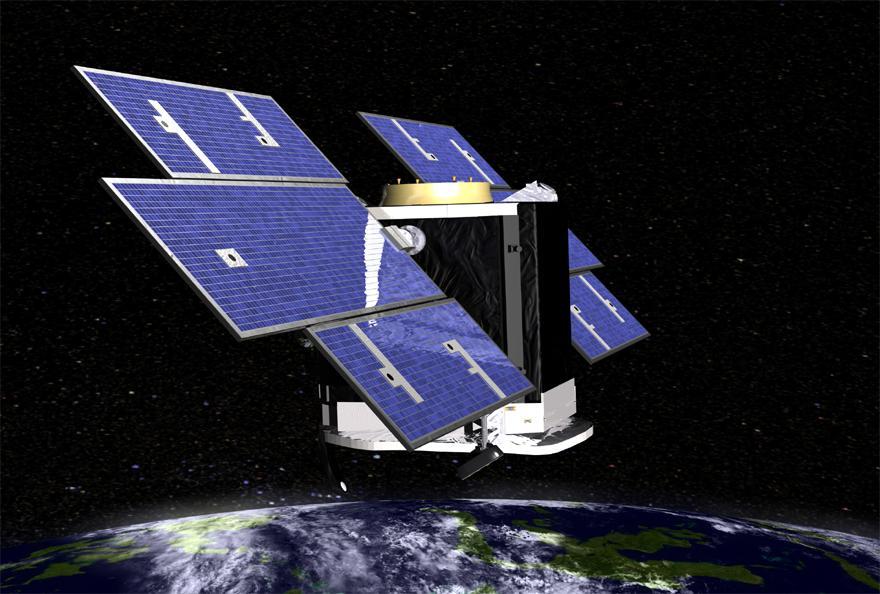
Artist concept of NASA CloudSat spacecraft, which will provide the first global survey of cloud properties to better understand their effects on both weather and climate.
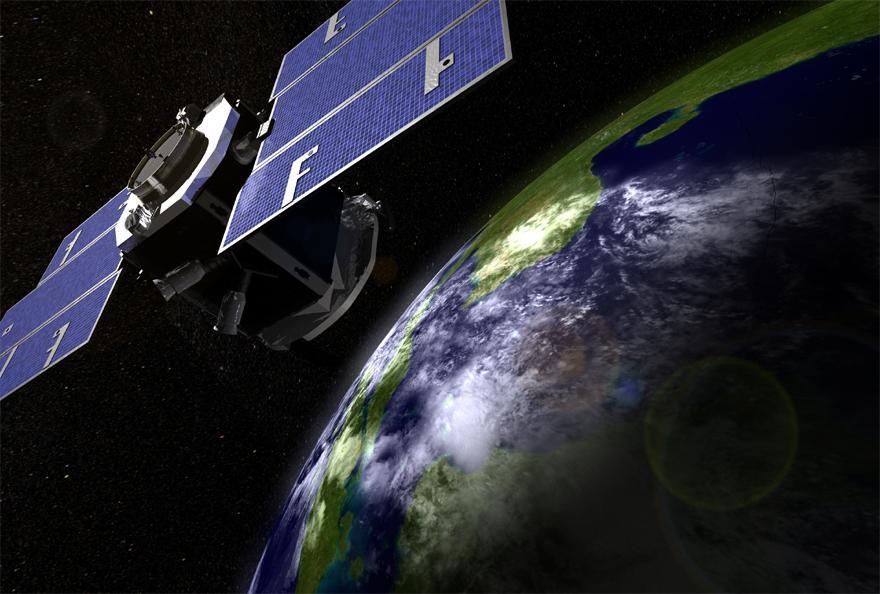
Artist concept of NASA CloudSat spacecraft, which will provide the first global survey of cloud properties to better understand their effects on both weather and climate.

NASA new CloudSat satellite captured its first tropical storm, Alberto, as it spun over the Gulf of Mexico the morning of June 12, 2006.
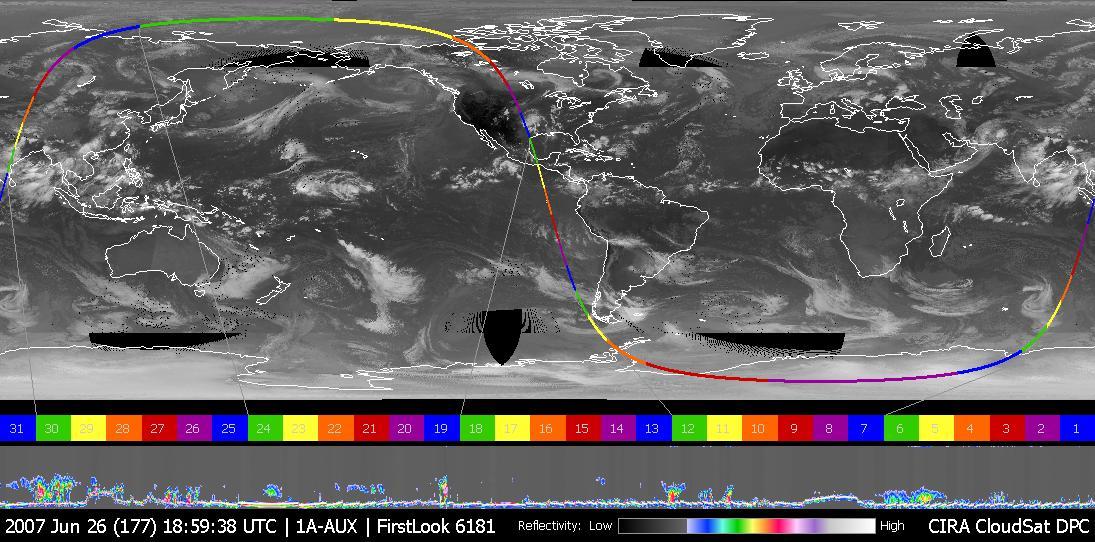
This image was taken on June 26, 2007, UTC 20:00. In this image an obvious storm hangs over the middle of the United States. Figure 1 shows NASA CloudSat data looking, in profile, at the cloud in this storm.
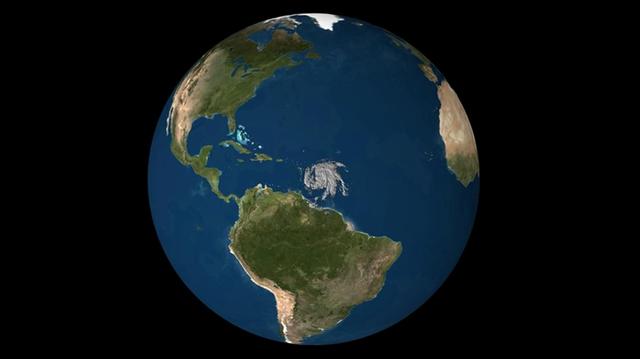
NASA's CloudSat satellite flew over Hurricane Maria on Sept. 17, 2017, at 1:23 p.m. EDT (17:23 UTC) as the storm had just strengthened into a hurricane in the Atlantic Ocean. Hurricane Maria contained estimated maximum sustained winds of 75 miles per hour (65 knots) and had a minimum barometric pressure of 986 millibars. CloudSat flew over Maria through the center of the rapidly intensifying storm, directly through an overshooting cloud top (a dome-shaped protrusion that shoots out of the top of the anvil cloud of a thunderstorm). CloudSat reveals the vertical extent of the overshooting cloud top, showing the estimated height of the cloud to be 11 miles (18 kilometers). Areas of high reflectivity with deep red and pink colors extend well above 9 miles (15 kilometers) in height, showing large amounts of water being drawn upward high into the atmosphere. A movie is available at https://photojournal.jpl.nasa.gov/catalog/PIA21961

The image at the top of figure 1 is from a geostationary imager. The colors relate to the temperature of the clouds. The higher the clouds, the lower the temperature. The highest, coldest clouds are located near the center of the hurricane.
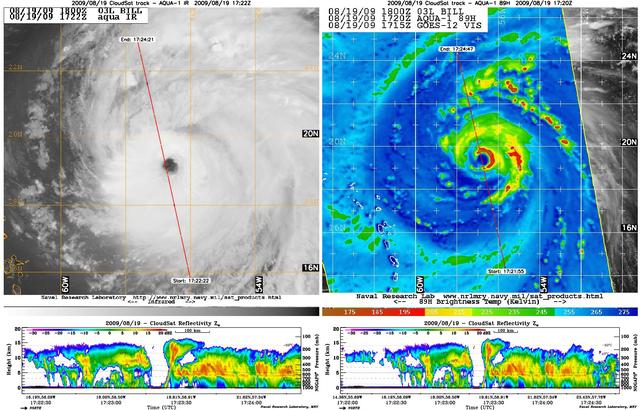
NASA satellite CloudSat captured an extraordinary eye overpass of a category 4 Hurricane Bill on August 19, 2009 at 1720 UTC 1220 EDT. Bill maximum sustained winds are 132 mph 115 knots with a central pressure of 947 mb.
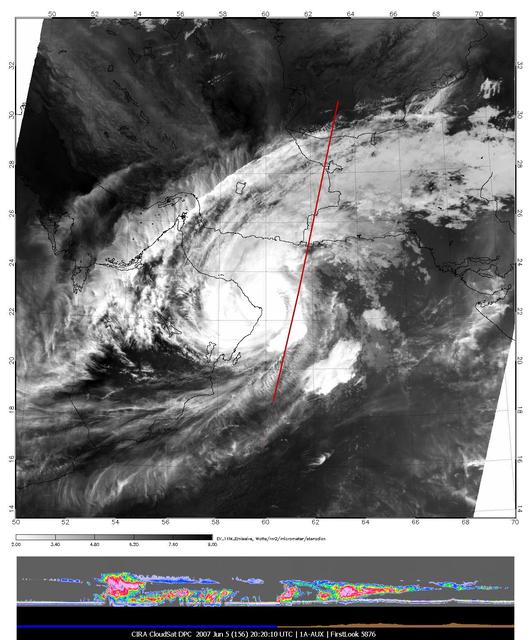
The image of Tropical Cyclone Gonu in the upper panel was taken by the Moderate Resolution Imaging Spectroradiometer MODIS instrument on NASA Aqua satellite on June 5, 2007, at approximately 20:20 UTC.
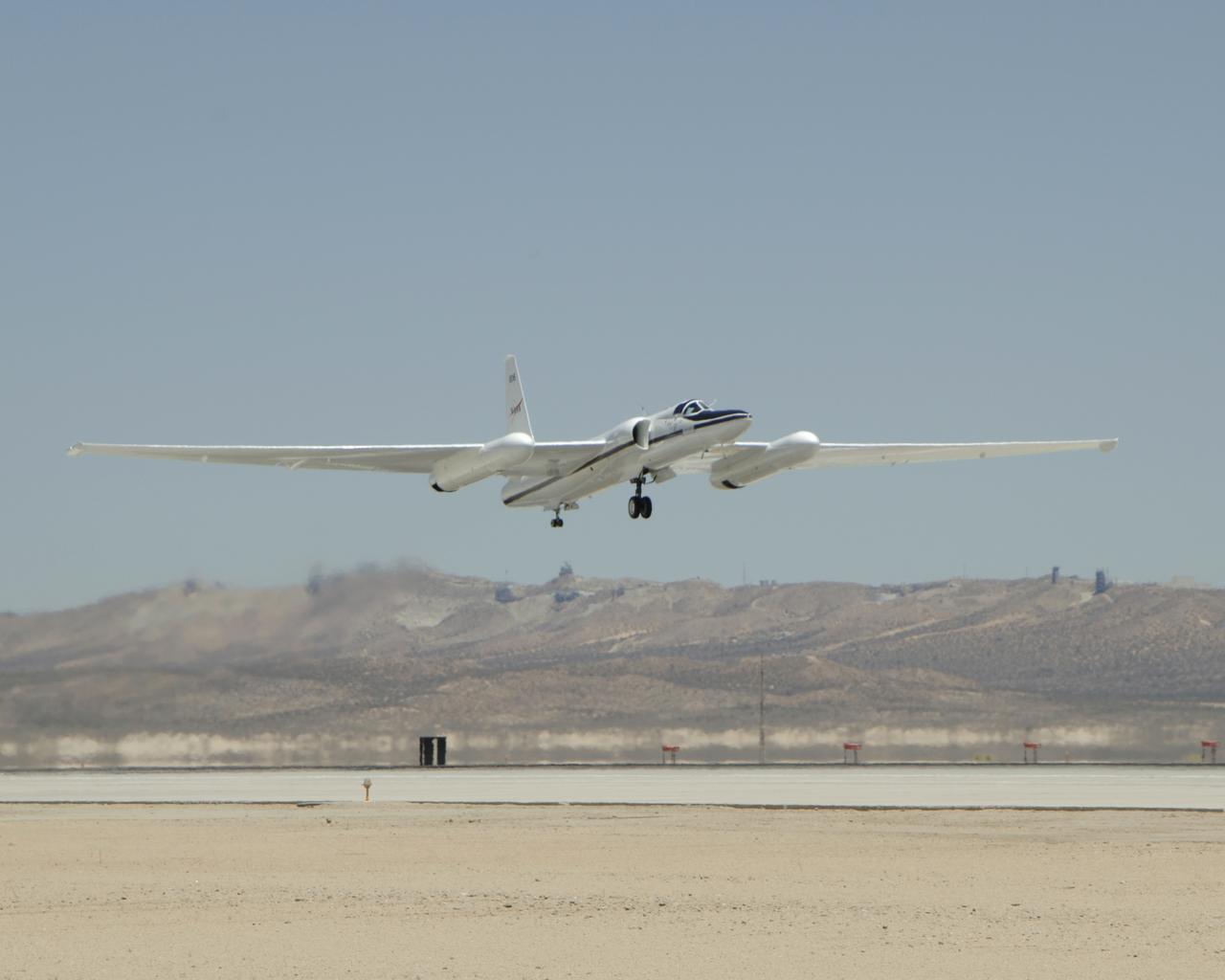
NASA'S ER-2 #806 lifts off from Edwards Air Force Base on a CALIPS/CloudSat validation instrument checkout flight.
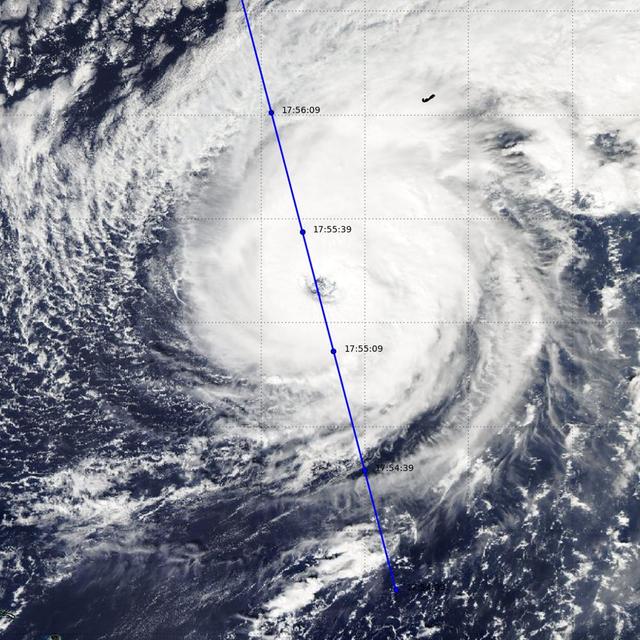
NASA's CloudSat satellite completed an eye overpass of Hurricane Nicole on Oct. 12, 2016, at 10:55 a.m. PDT (17:55 UTC) as the storm was moving toward Bermuda. At the time the system had sustained winds of 109 miles per hour (95 knots), with a minimum pressure of 962 millibars. CloudSat viewed the system just as it was going through a period of intensification (from 98 miles per hour, or 85 knots, to 121 miles per hour (105 knots) during a 12-hour period. http://photojournal.jpl.nasa.gov/catalog/PIA21098
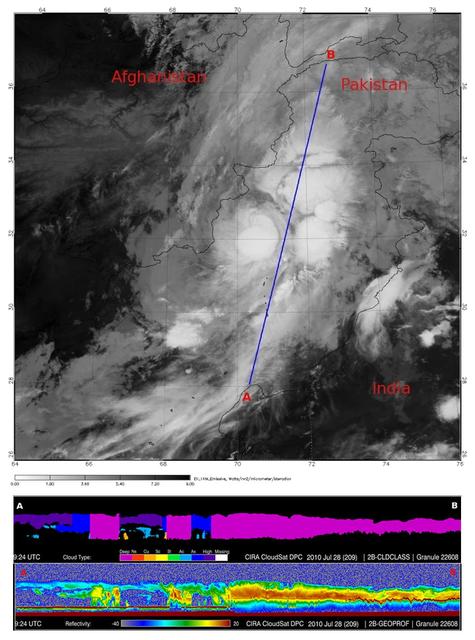
In late July 2010, flooding caused by heavy monsoon rains began in several regions of Pakistan. This image from NASA Aqua spacecraft reveals the bright white cloud tops from the cluster of thunderstorms.
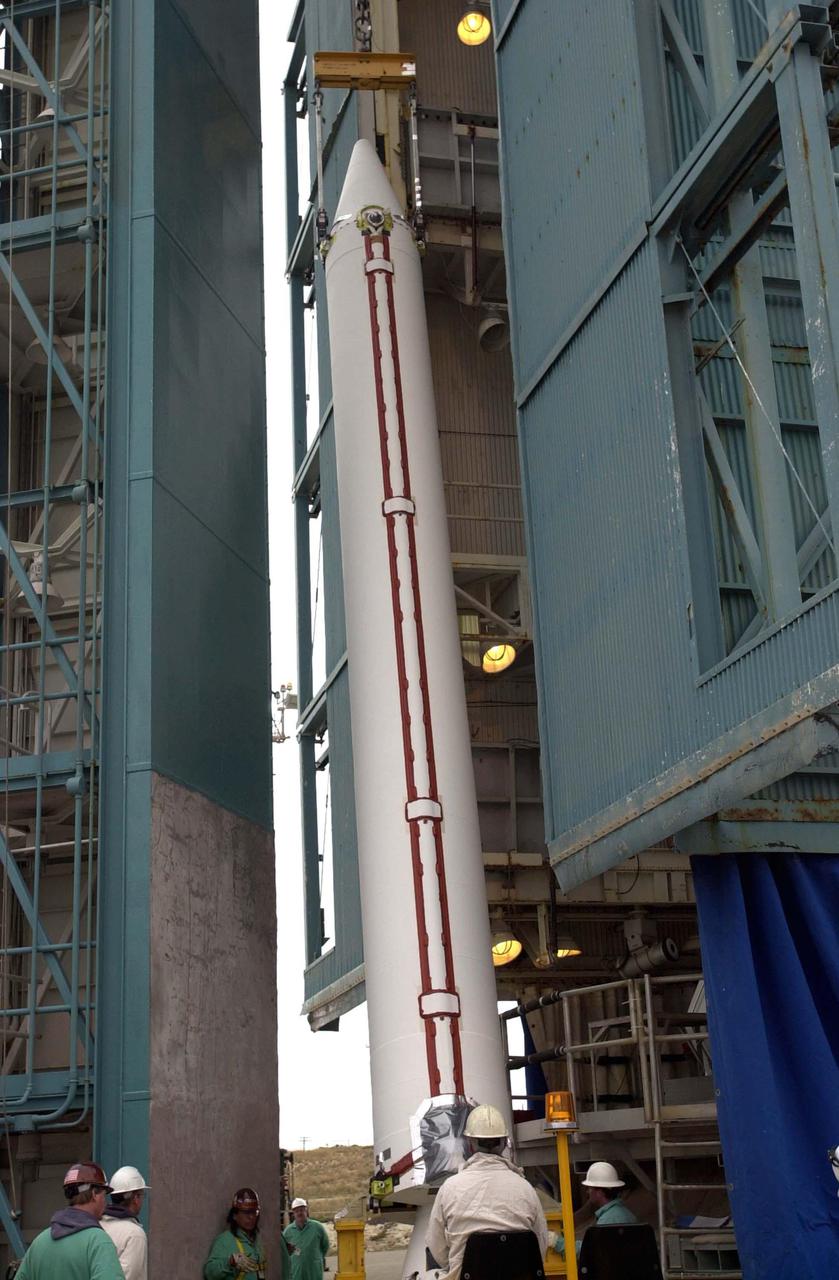
VANDENBERG AIR FORCE BASE, CALIF. - One of four Solid Rocket Boosters for the CALIPSO_CloudSat launch is ready for lifting into the mobile service tower, or gantry, where it will be attached to the Boeing Delta II rocket. CALIPSO stands for Cloud-Aerosol Lidar and Infrared Pathfinder Satellite Observation. CALIPSO and CloudSat are highly complementary satellites and together will provide never-before-seen 3-D perspectives of how clouds and aerosols form, evolve, and affect weather and climate. CALIPSO and CloudSat will fly in formation with three other satellites in the A-train constellation to enhance understanding of our climate system. Launch of CALIPSO_CloudSat aboard a Boeing Delta II rocket is scheduled for 3:01 a.m. Sept. 29.
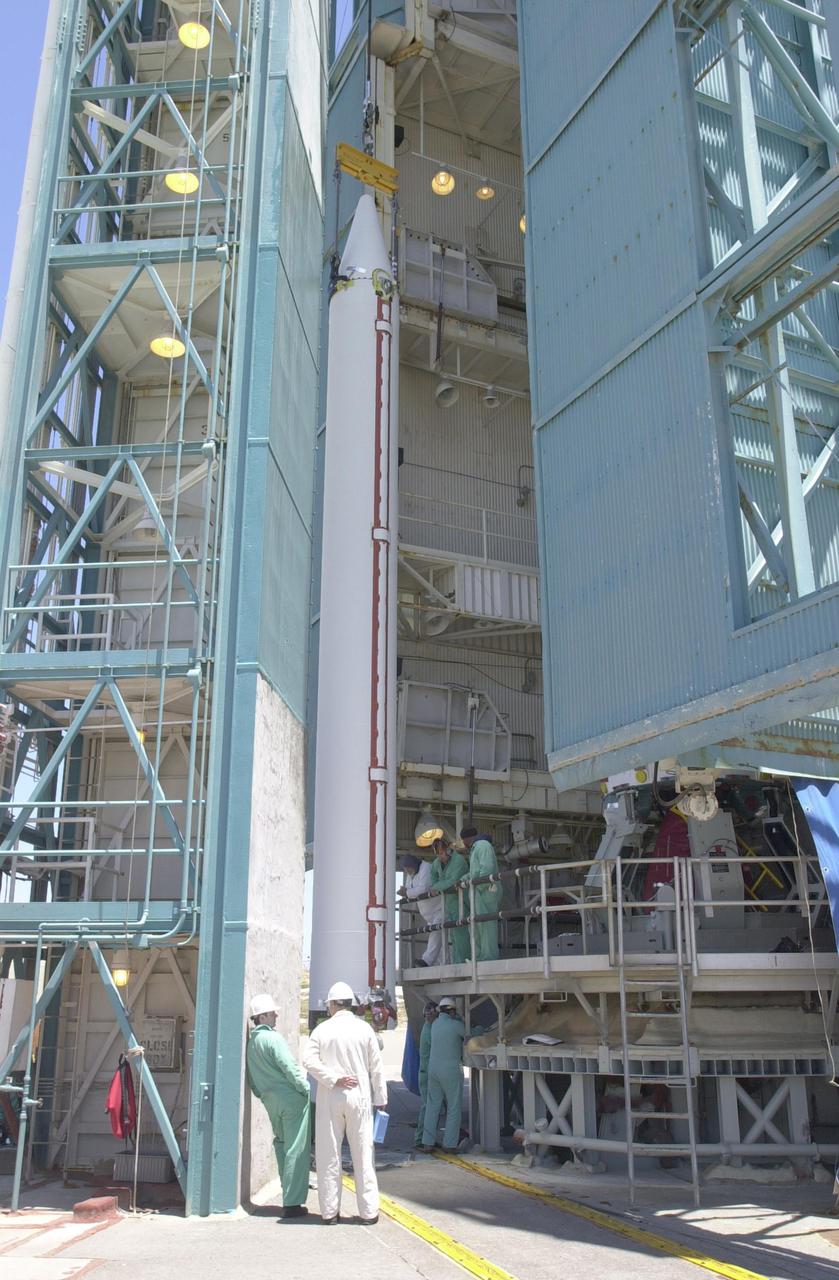
VANDENBERG AIR FORCE BASE, CALIF. - At NASA Space Launch Complex 2 on Vandenberg Air Force Base in California, another Solid Rocket Booster is attached to the Boeing Delta II rocket seen behind it. The Delta is the launch vehicle for the CALIPSO_CloudSat spacecraft. CALIPSO stands for Cloud-Aerosol Lidar and Infrared Pathfinder Satellite Observation. CALIPSO and CloudSat are highly complementary satellites and together will provide never-before-seen 3-D perspectives of how clouds and aerosols form, evolve, and affect weather and climate. CALIPSO and CloudSat will fly in formation with three other satellites in the A-train constellation to enhance understanding of our climate system. Launch of CALIPSO_CloudSat aboard a Boeing Delta II rocket is scheduled for 3:01 a.m. Sept. 29.
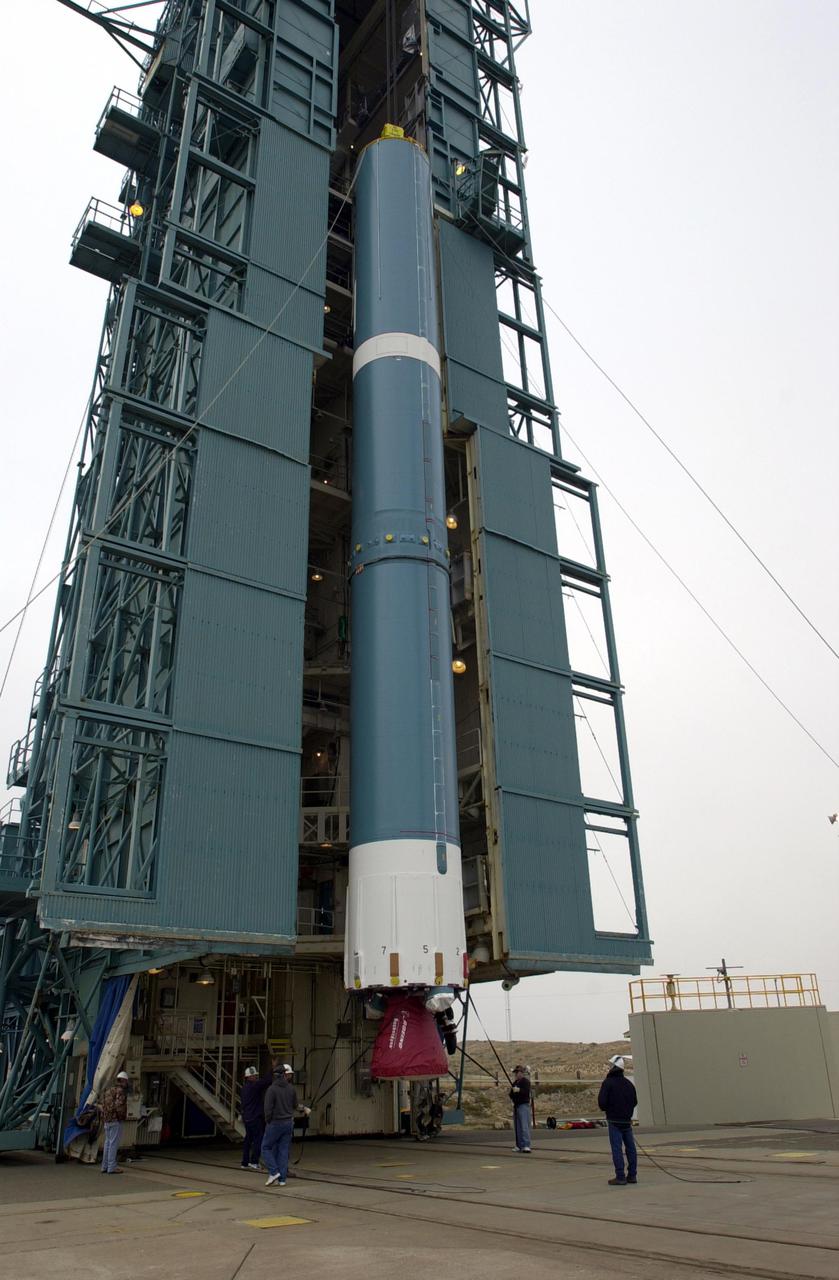
VANDENBERG AIR FORCE BASE, CALIF. - At NASA Space Launch Complex 2 on Vandenberg Air Force Base in California, the Boeing Delta II rocket, launch vehicle for the CALIPSO_CloudSat spacecraft, is ready to lifted into the mobile service tower, or gantry. CALIPSO stands for Cloud-Aerosol Lidar and Infrared Pathfinder Satellite Observation. CALIPSO and CloudSat are highly complementary satellites and together will provide never-before-seen 3-D perspectives of how clouds and aerosols form, evolve, and affect weather and climate. CALIPSO and CloudSat will fly in formation with three other satellites in the A-train constellation to enhance understanding of our climate system. Launch of CALIPSO_CloudSat aboard a Boeing Delta II rocket is scheduled for 3:01 a.m. Sept. 29.
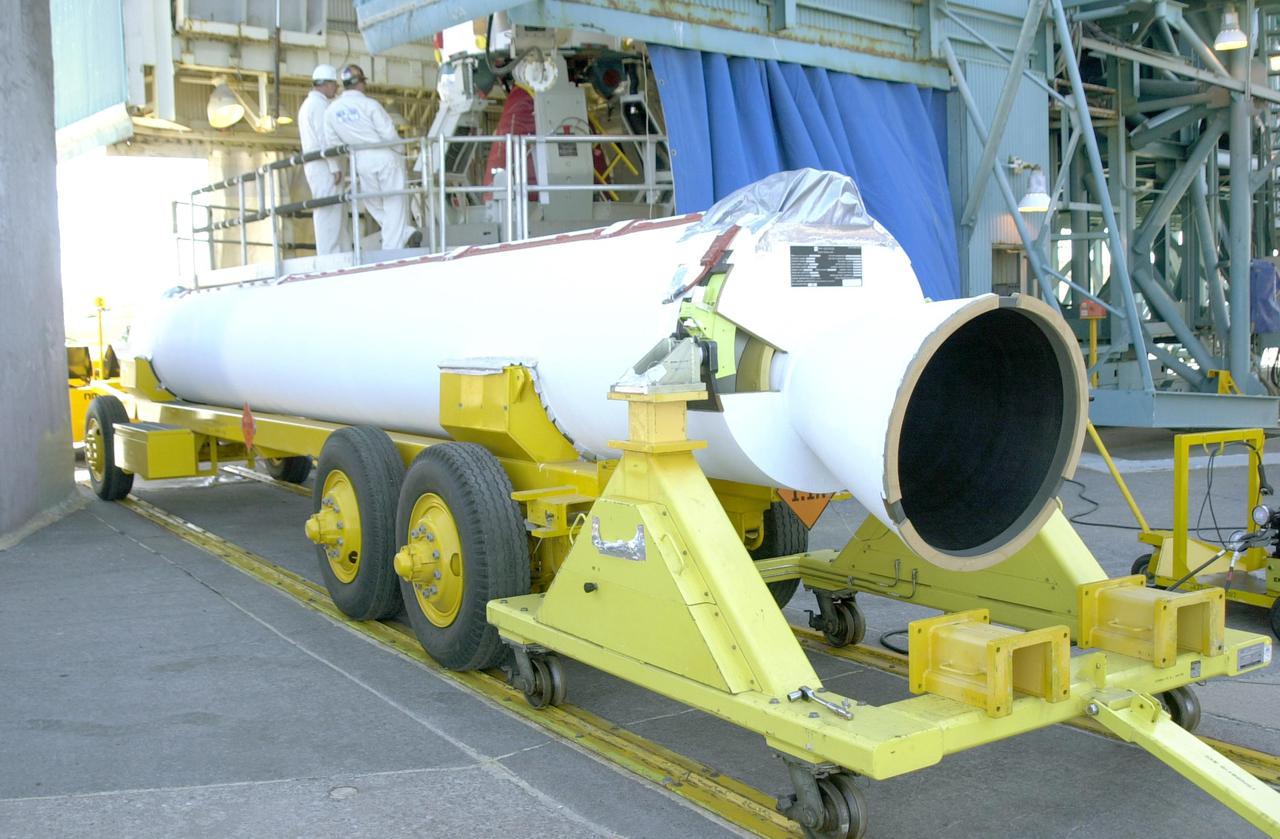
VANDENBERG AIR FORCE BASE, CALIF. - Another Solid Rocket Booster for the CALIPSO_CloudSat launch is ready to be raised to a vertical position at NASA Space Launch Complex 2 on Vandenberg Air Force Base in California. It will then be lifted into the mobile service tower, or gantry, and attached to the Boeing Delta II rocket. The Delta is the launch vehicle for the CALIPSO_CloudSat spacecraft. CALIPSO stands for Cloud-Aerosol Lidar and Infrared Pathfinder Satellite Observation. CALIPSO and CloudSat are highly complementary satellites and together will provide never-before-seen 3-D perspectives of how clouds and aerosols form, evolve, and affect weather and climate. CALIPSO and CloudSat will fly in formation with three other satellites in the A-train constellation to enhance understanding of our climate system. Launch of CALIPSO_CloudSat aboard a Boeing Delta II rocket is scheduled for 3:01 a.m. Sept. 29.
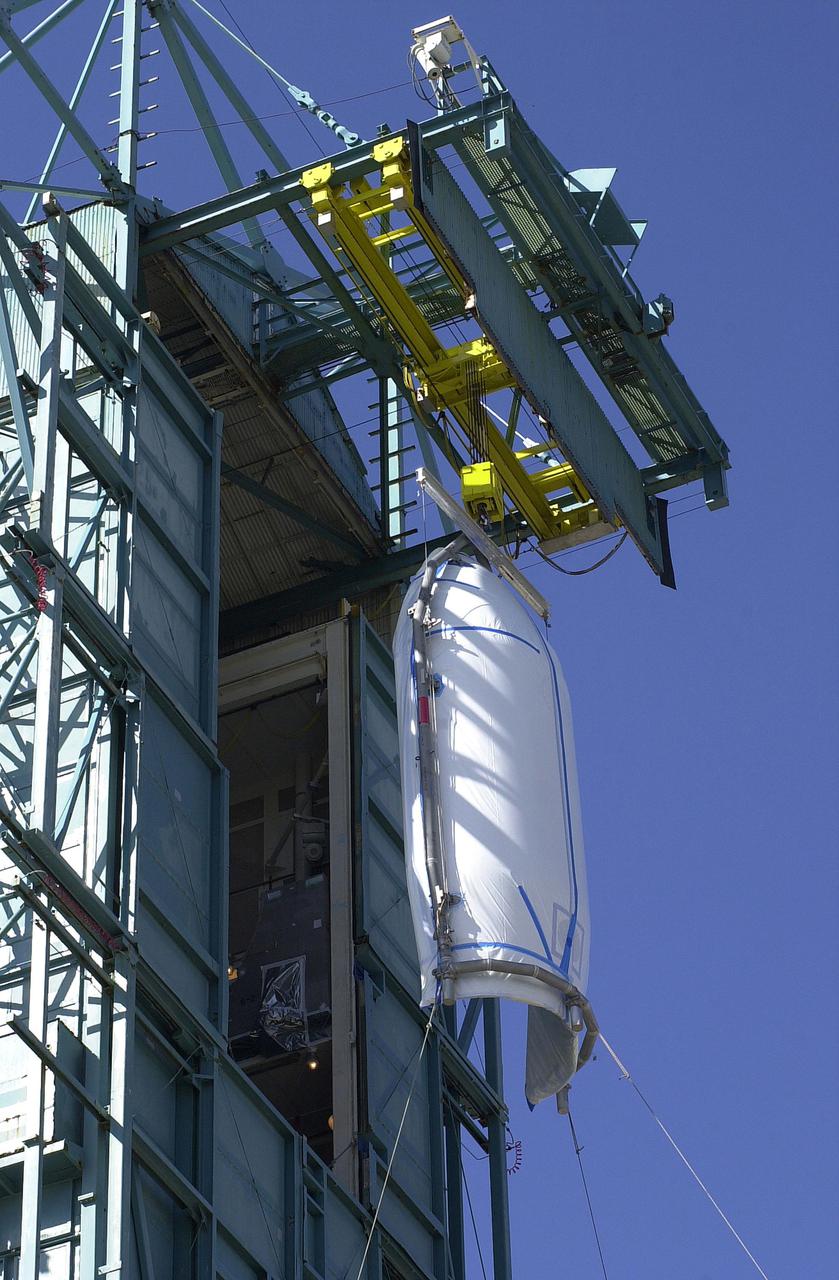
VANDENBERG AIR FORCE BASE, CALIF. - At NASA Space Launch Complex 2 on Vandenberg Air Force Base in California, the first half of the fairing for CALIPSO_CloudSat reaches the top of the mobile service tower, or gantry. The fairing encloses and protects the spacecraft during launch and flight through the atmosphere. Once in space, it is jettisoned. CALIPSO stands for Cloud-Aerosol Lidar and Infrared Pathfinder Satellite Observation. CALIPSO and CloudSat are highly complementary satellites and together will provide never-before-seen 3-D perspectives of how clouds and aerosols form, evolve, and affect weather and climate. CALIPSO and CloudSat will fly in formation with three other satellites in the A-train constellation to enhance understanding of our climate system. Launch of CALIPSO_CloudSat aboard a Boeing Delta II rocket is scheduled for 3:01 a.m. Sept. 29.
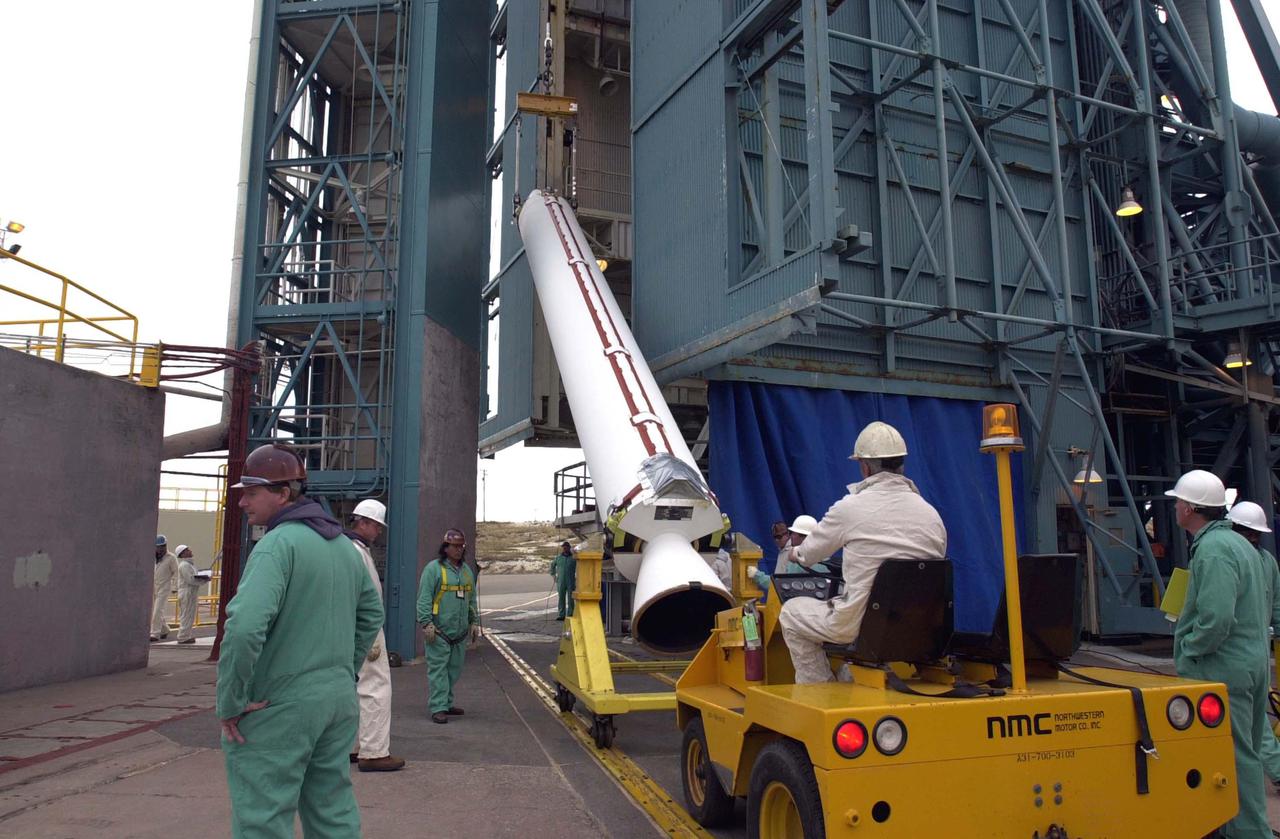
VANDENBERG AIR FORCE BASE, CALIF. - One of four Solid Rocket Boosters for the CALIPSO_CloudSat launch is raised off the transporter to a vertical position. It will be lifted into the mobile service tower, or gantry, and attached to the Boeing Delta II rocket. CALIPSO stands for Cloud-Aerosol Lidar and Infrared Pathfinder Satellite Observation. CALIPSO and CloudSat are highly complementary satellites and together will provide never-before-seen 3-D perspectives of how clouds and aerosols form, evolve, and affect weather and climate. CALIPSO and CloudSat will fly in formation with three other satellites in the A-train constellation to enhance understanding of our climate system. Launch of CALIPSO_CloudSat aboard a Boeing Delta II rocket is scheduled for 3:01 a.m. Sept. 29.
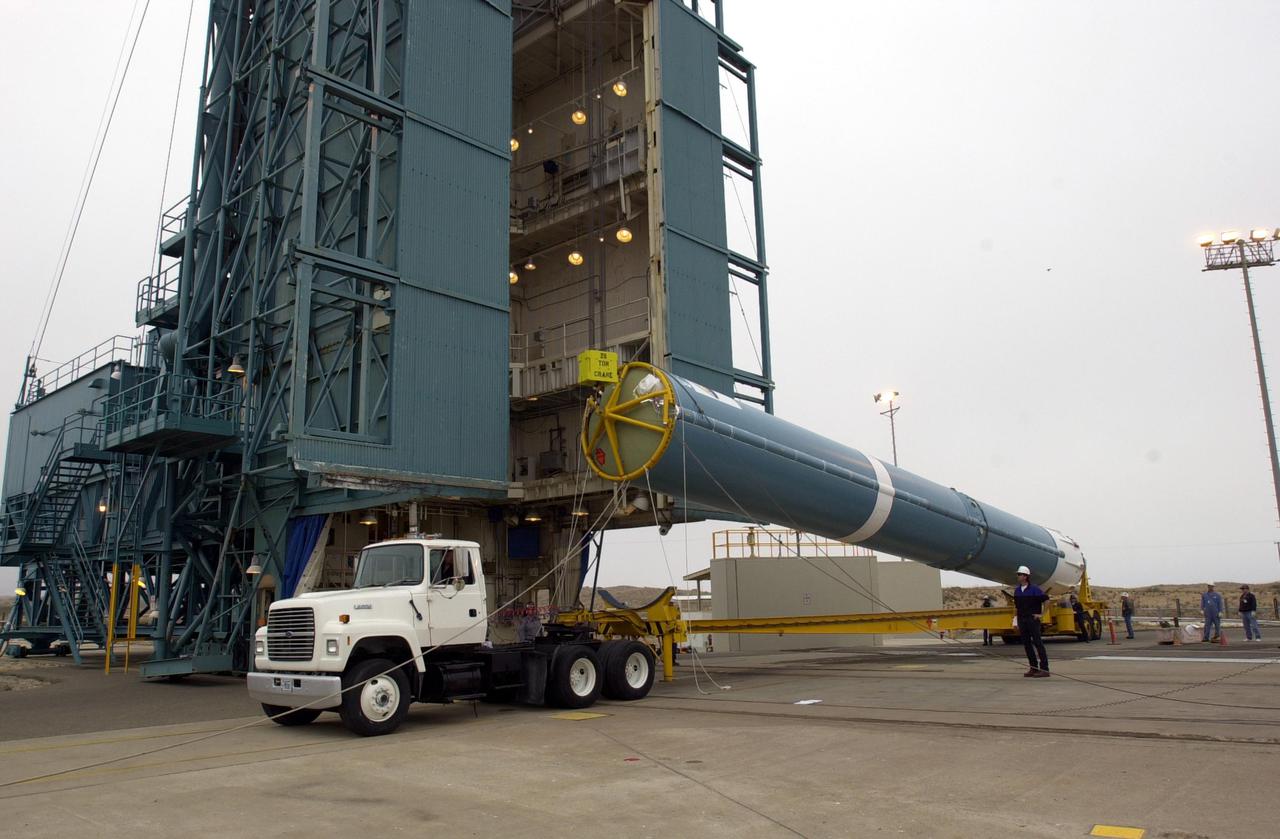
VANDENBERG AIR FORCE BASE, CALIF. - At NASA Space Launch Complex 2 on Vandenberg Air Force Base in California, the first stage of the Boeing Delta II rocket, launch vehicle for the CALIPSO_CloudSat spacecraft, is raised off the transporter. Once it is vertical, it will be lifted up into the mobile service tower, or gantry. CALIPSO stands for Cloud-Aerosol Lidar and Infrared Pathfinder Satellite Observation. CALIPSO and CloudSat are highly complementary satellites and together will provide never-before-seen 3-D perspectives of how clouds and aerosols form, evolve, and affect weather and climate. CALIPSO and CloudSat will fly in formation with three other satellites in the A-train constellation to enhance understanding of our climate system. Launch of CALIPSO_CloudSat aboard a Boeing Delta II rocket is scheduled for 3:01 a.m. Sept. 29.
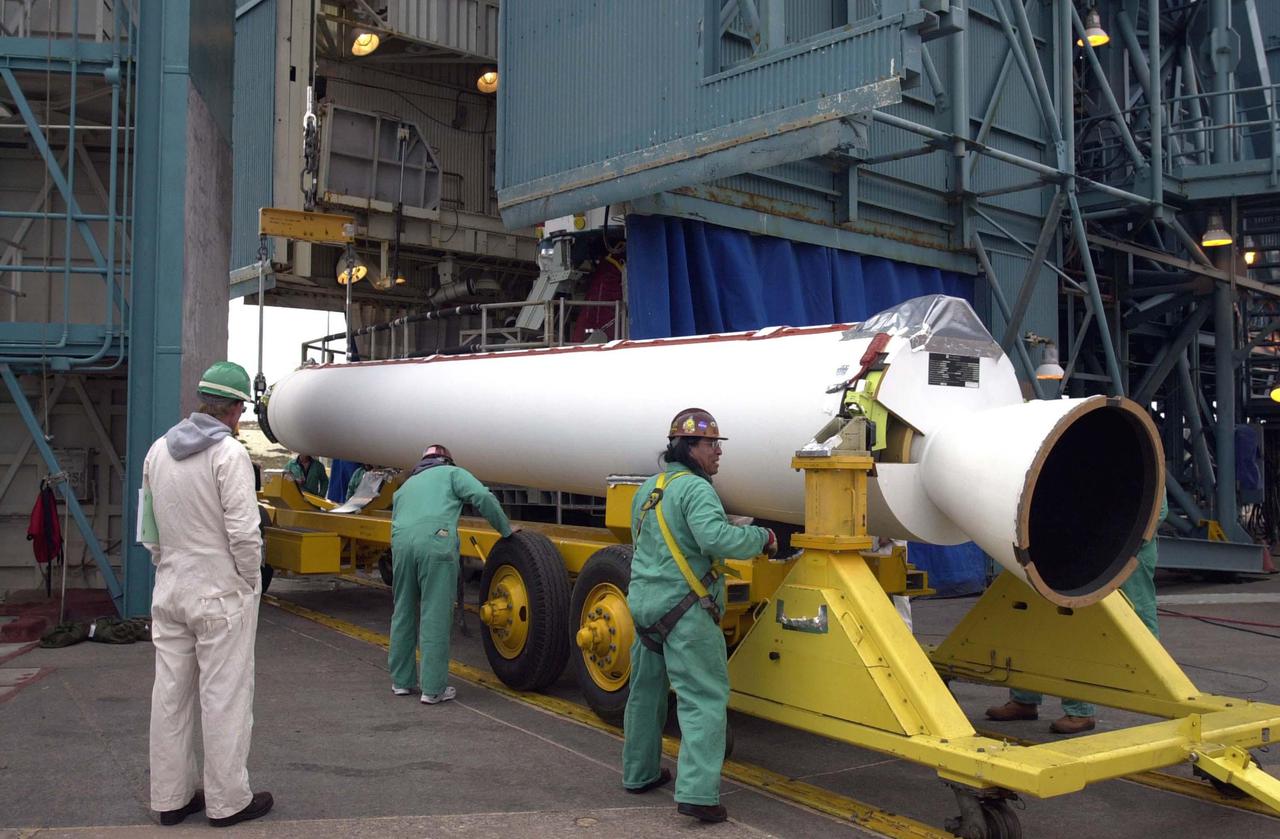
VANDENBERG AIR FORCE BASE, CALIF. - One of four Solid Rocket Boosters for the CALIPSO_CloudSat launch arrives at NASA Space Launch Complex 2 on Vandenberg Air Force Base in California. It will be lifted into the mobile service tower, or gantry, and attached to the Boeing Delta II rocket. CALIPSO stands for Cloud-Aerosol Lidar and Infrared Pathfinder Satellite Observation. CALIPSO and CloudSat are highly complementary satellites and together will provide never-before-seen 3-D perspectives of how clouds and aerosols form, evolve, and affect weather and climate. CALIPSO and CloudSat will fly in formation with three other satellites in the A-train constellation to enhance understanding of our climate system. Launch of CALIPSO_CloudSat aboard a Boeing Delta II rocket is scheduled for 3:01 a.m. Sept. 29.
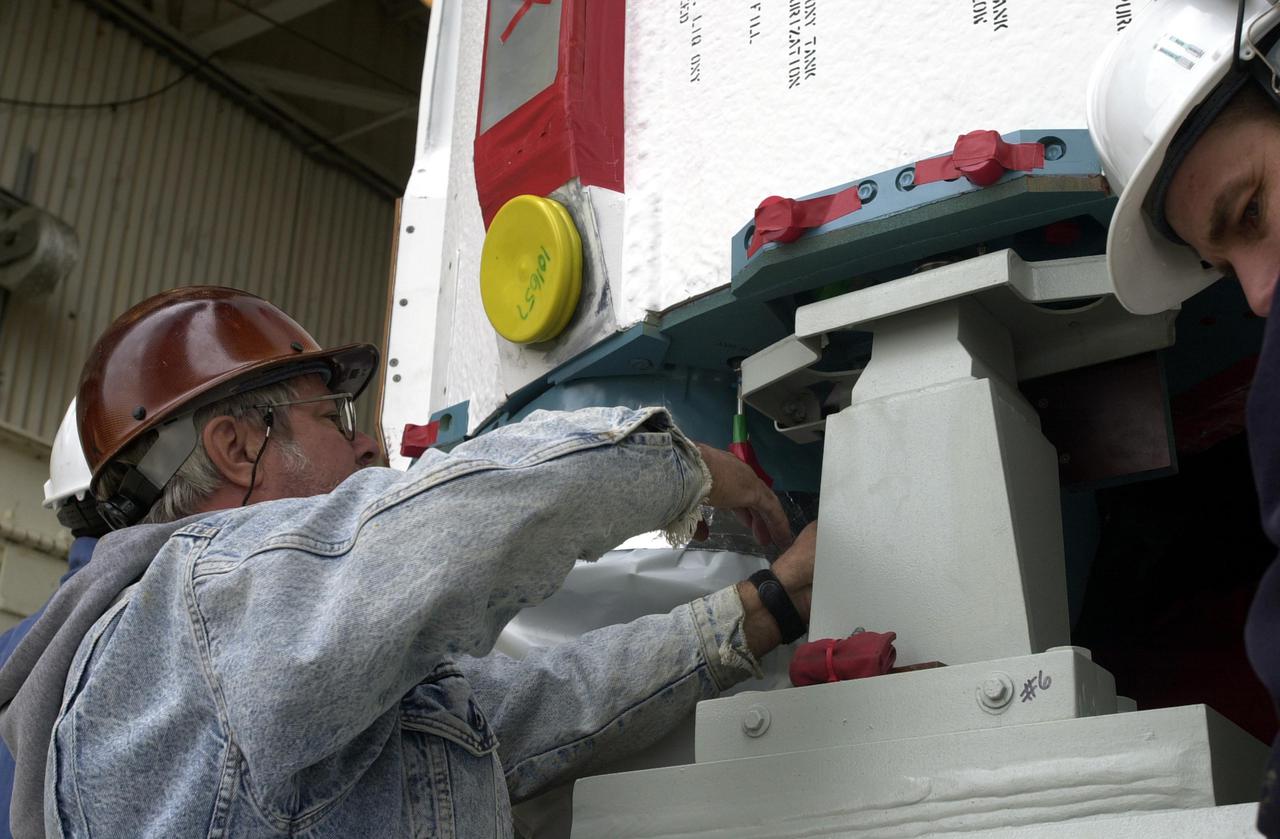
VANDENBERG AIR FORCE BASE, CALIF. - At NASA Space Launch Complex 2 on Vandenberg Air Force Base in California, the Boeing Delta II rocket, launch vehicle for the CALIPSO_CloudSat spacecraft, is prepared for lifting into the mobile service tower, or gantry. CALIPSO stands for Cloud-Aerosol Lidar and Infrared Pathfinder Satellite Observation. CALIPSO and CloudSat are highly complementary satellites and together will provide never-before-seen 3-D perspectives of how clouds and aerosols form, evolve, and affect weather and climate. CALIPSO and CloudSat will fly in formation with three other satellites in the A-train constellation to enhance understanding of our climate system. Launch of CALIPSO_CloudSat aboard a Boeing Delta II rocket is scheduled for 3:01 a.m. Sept. 29.
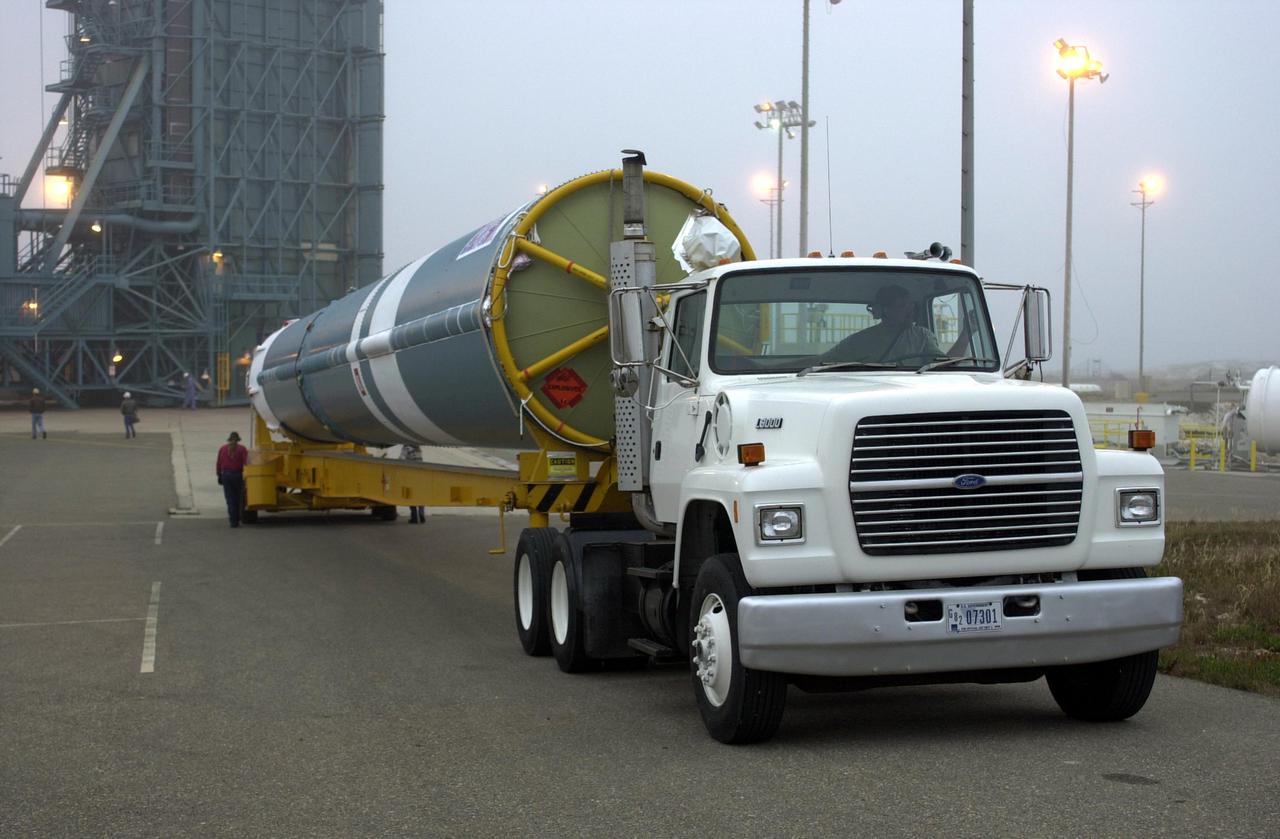
VANDENBERG AIR FORCE BASE, CALIF. - At NASA Space Launch Complex 2 on Vandenberg Air Force Base in California, the first stage of the Boeing Delta II rocket for the CALIPSO_CloudSat launch arrives on the pad. It will be raised to vertical and lifted up into the mobile service tower, or gantry. CALIPSO stands for Cloud-Aerosol Lidar and Infrared Pathfinder Satellite Observation. CALIPSO and CloudSat are highly complementary satellites and together will provide never-before-seen 3-D perspectives of how clouds and aerosols form, evolve, and affect weather and climate. CALIPSO and CloudSat will fly in formation with three other satellites in the A-train constellation to enhance understanding of our climate system. Launch of CALIPSO_CloudSat aboard a Boeing Delta II rocket is scheduled for 3:01 a.m. Sept. 29.
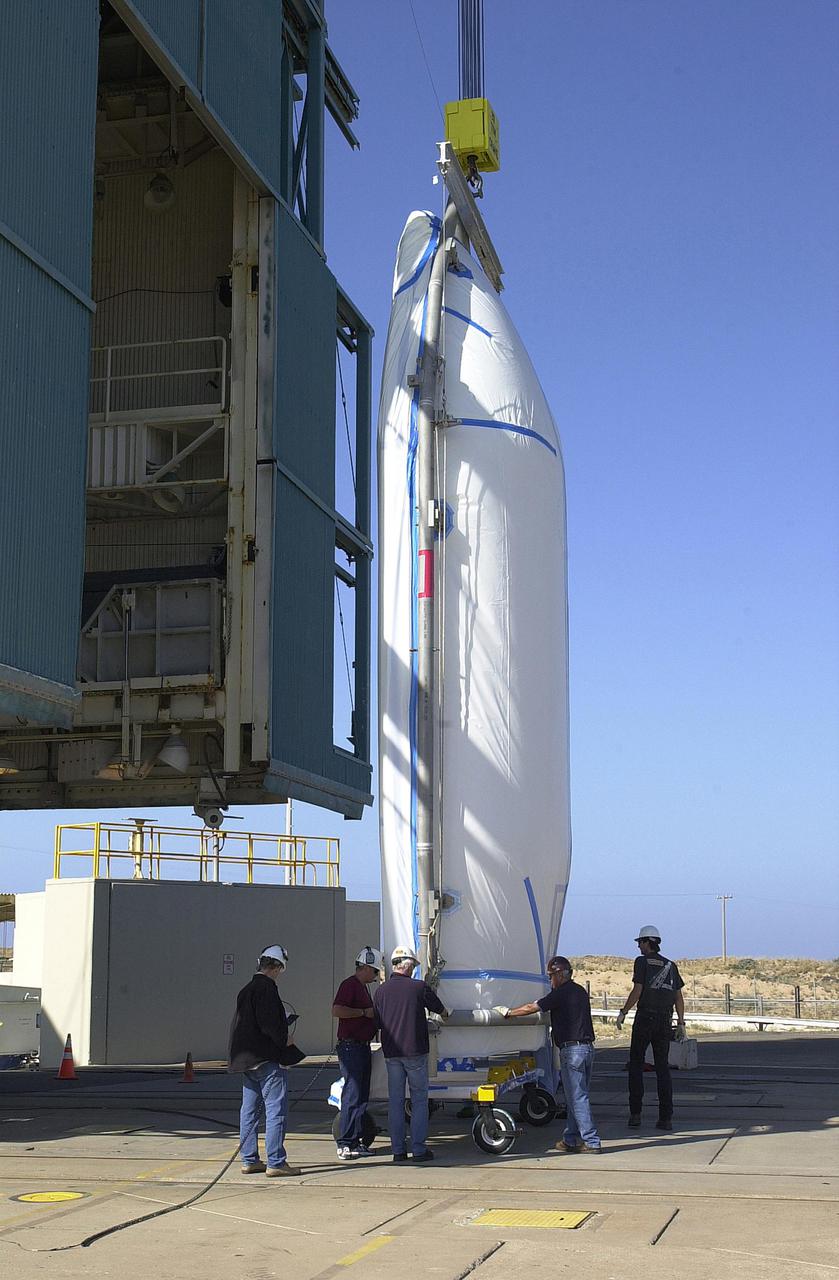
VANDENBERG AIR FORCE BASE, CALIF. - At NASA Space Launch Complex 2 on Vandenberg Air Force Base in California, one half of the fairing for CALIPSO_CloudSat is ready to be lifted into the mobile service tower, or gantry. The fairing encloses and protects the spacecraft during launch and flight through the atmosphere. Once in space, it is jettisoned. CALIPSO stands for Cloud-Aerosol Lidar and Infrared Pathfinder Satellite Observation. CALIPSO and CloudSat are highly complementary satellites and together will provide never-before-seen 3-D perspectives of how clouds and aerosols form, evolve, and affect weather and climate. CALIPSO and CloudSat will fly in formation with three other satellites in the A-train constellation to enhance understanding of our climate system. Launch of CALIPSO_CloudSat aboard a Boeing Delta II rocket is scheduled for 3:01 a.m. Sept. 29.
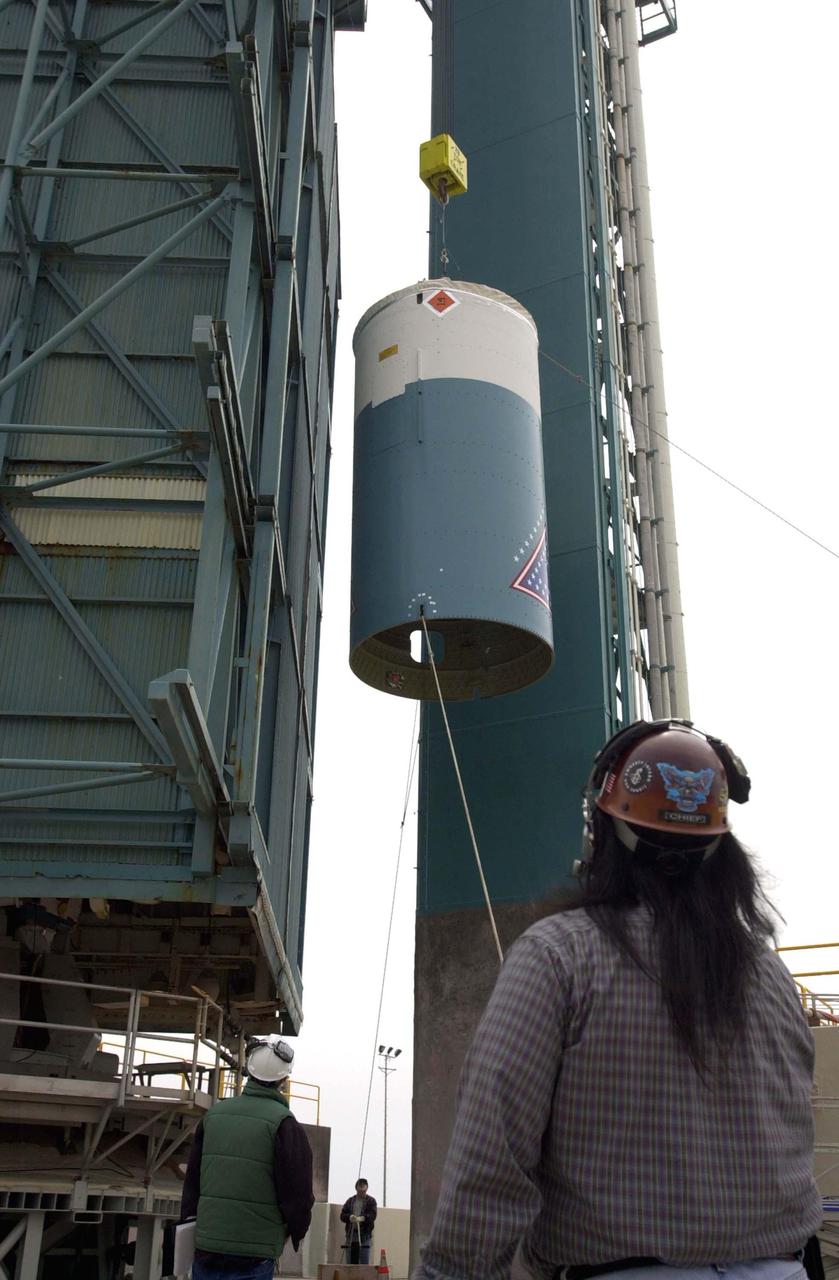
VANDENBERG AIR FORCE BASE, CALIF. - At NASA Space Launch Complex 2 on Vandenberg Air Force Base in California, the interstage for the Boeing Delta II rocket is lifted up the mobile service tower, or gantry. There it will be mated with the first stage already there. The Delta is the launch vehicle for the CALIPSO_CloudSat spacecraft. CALIPSO stands for Cloud-Aerosol Lidar and Infrared Pathfinder Satellite Observation. CALIPSO and CloudSat are highly complementary satellites and together will provide never-before-seen 3-D perspectives of how clouds and aerosols form, evolve, and affect weather and climate. CALIPSO and CloudSat will fly in formation with three other satellites in the A-train constellation to enhance understanding of our climate system. Launch of CALIPSO_CloudSat aboard a Boeing Delta II rocket is scheduled for 3:01 a.m. Sept. 29.
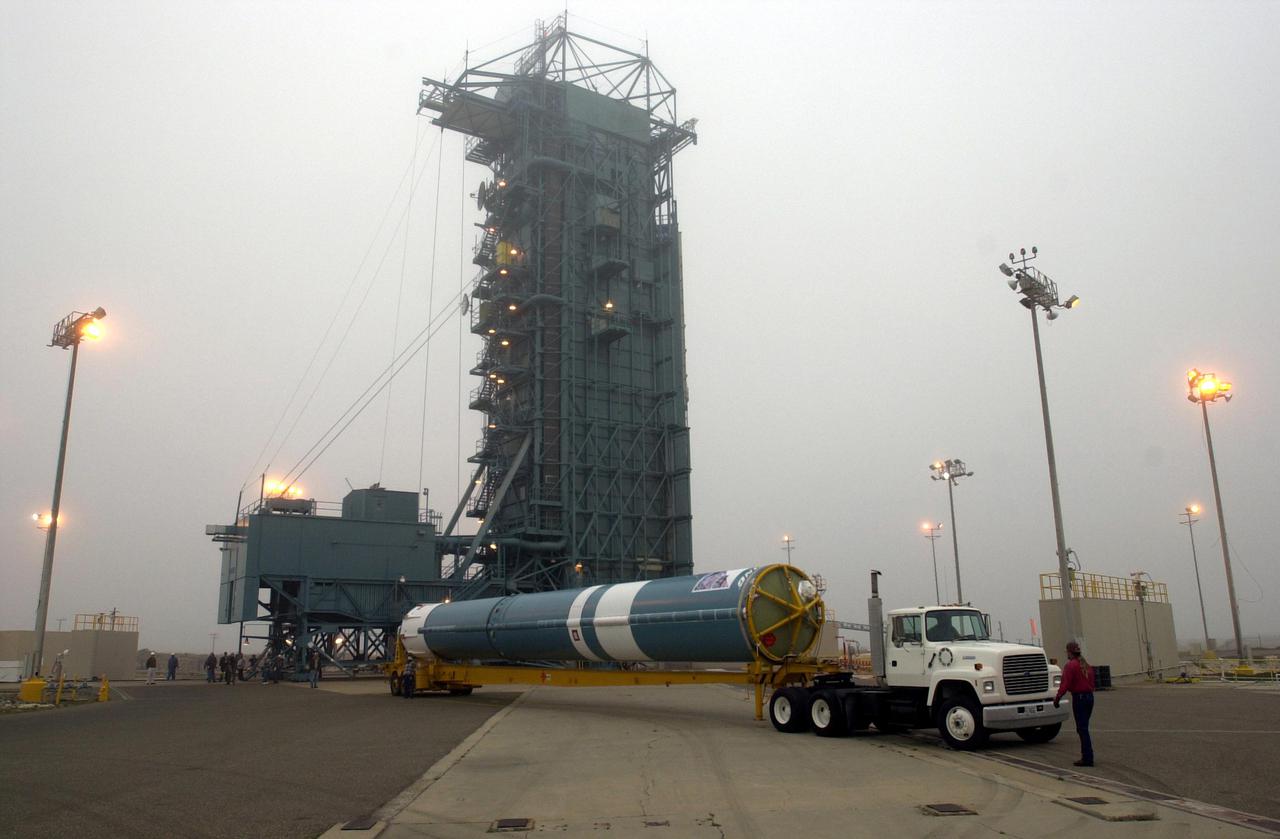
VANDENBERG AIR FORCE BASE, CALIF. - At NASA Space Launch Complex 2 on Vandenberg Air Force Base in California, the first stage of the Boeing Delta II rocket for the CALIPSO_CloudSat launch arrives on the pad. It will be raised to vertical and lifted up into the mobile service tower, or gantry. CALIPSO stands for Cloud-Aerosol Lidar and Infrared Pathfinder Satellite Observation. CALIPSO and CloudSat are highly complementary satellites and together will provide never-before-seen 3-D perspectives of how clouds and aerosols form, evolve, and affect weather and climate. CALIPSO and CloudSat will fly in formation with three other satellites in the A-train constellation to enhance understanding of our climate system. Launch of CALIPSO_CloudSat aboard a Boeing Delta II rocket is scheduled for 3:01 a.m. Sept. 29.
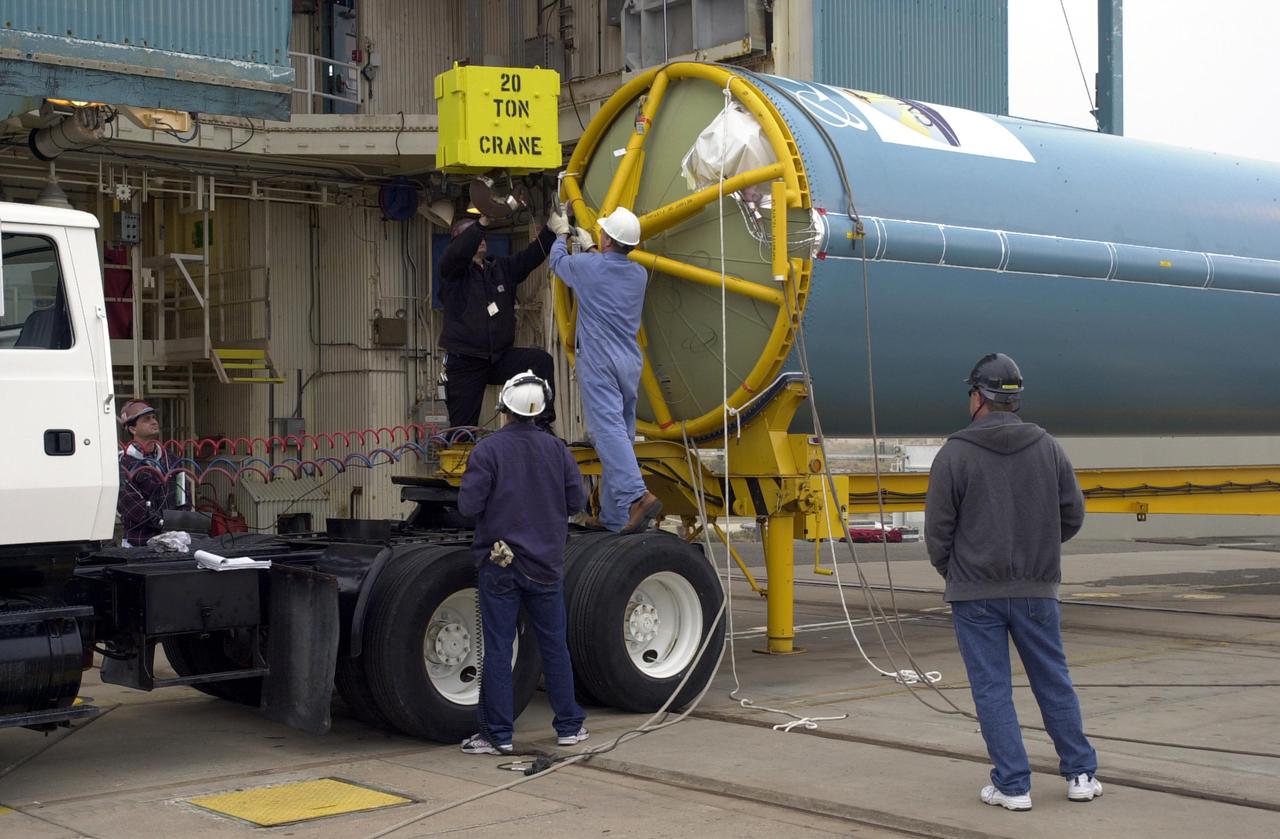
VANDENBERG AIR FORCE BASE, CALIF. — At NASA Space Launch Complex 2 on Vandenberg Air Force Base in California, workers get ready to raise the first stage of the Boeing Delta II rocket, launch vehicle for the CALIPSO_CloudSat spacecraft. Once it is vertical, it will be lifted up into the Mobile service tower, or gantry. CALIPSO stands for Cloud-Aerosol Lidar and Infrared Pathfinder Satellite Observation. CALIPSO and CloudSat are highly complementary satellites and together will provide never-before-seen 3-D perspectives of how clouds and aerosols form, evolve, and affect weather and climate. CALIPSO and CloudSat will fly in formation with three other satellites in the A-train constellation to enhance understanding of our climate system. Launch of CALIPSO_CloudSat aboard a Boeing Delta II rocket is scheduled for 3:01 a.m. Sept. 29.
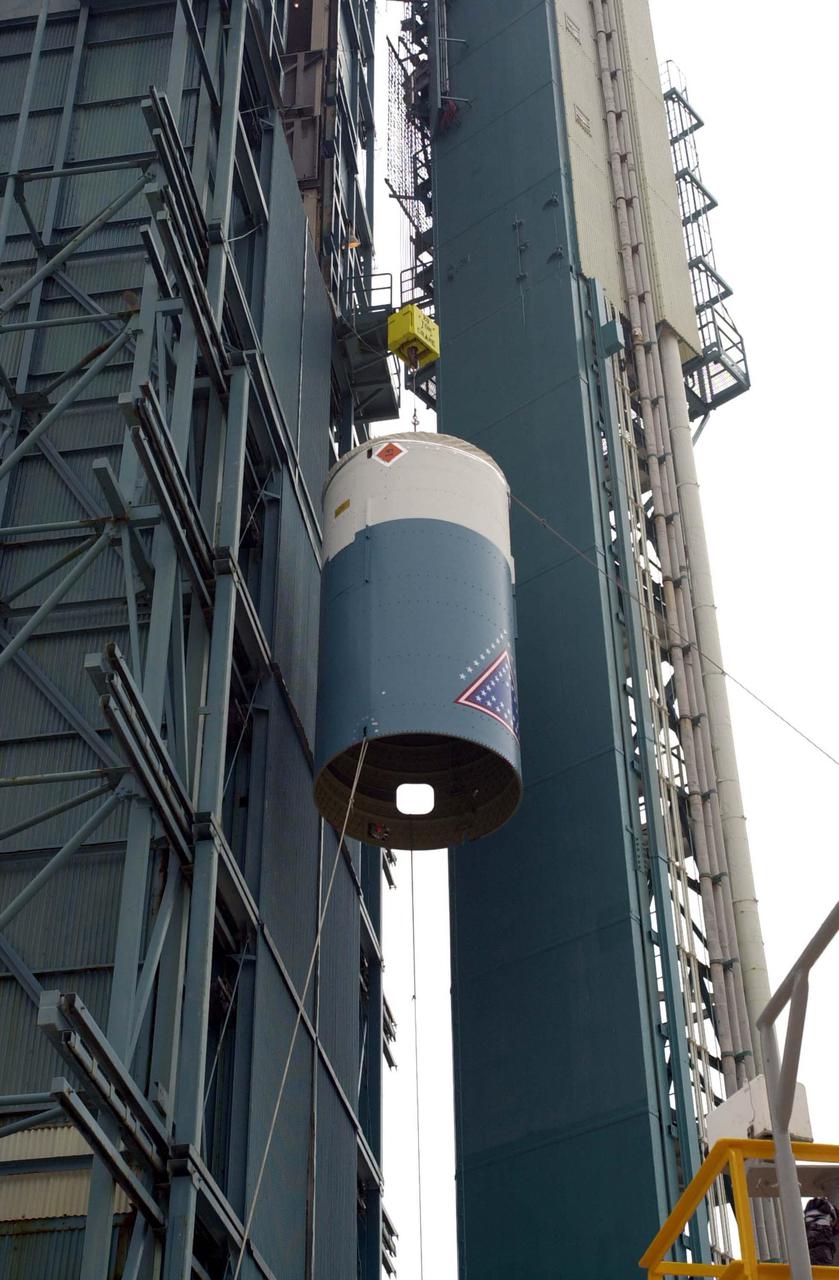
VANDENBERG AIR FORCE BASE, CALIF. - At NASA Space Launch Complex 2 on Vandenberg Air Force Base in California, the interstage for the Boeing Delta II rocket is lifted up the mobile service tower, or gantry. There it will be mated with the first stage already there. The Delta is the launch vehicle for the CALIPSO_CloudSat spacecraft. CALIPSO stands for Cloud-Aerosol Lidar and Infrared Pathfinder Satellite Observation. CALIPSO and CloudSat are highly complementary satellites and together will provide never-before-seen 3-D perspectives of how clouds and aerosols form, evolve, and affect weather and climate. CALIPSO and CloudSat will fly in formation with three other satellites in the A-train constellation to enhance understanding of our climate system. Launch of CALIPSO_CloudSat aboard a Boeing Delta II rocket is scheduled for 3:01 a.m. Sept. 29.
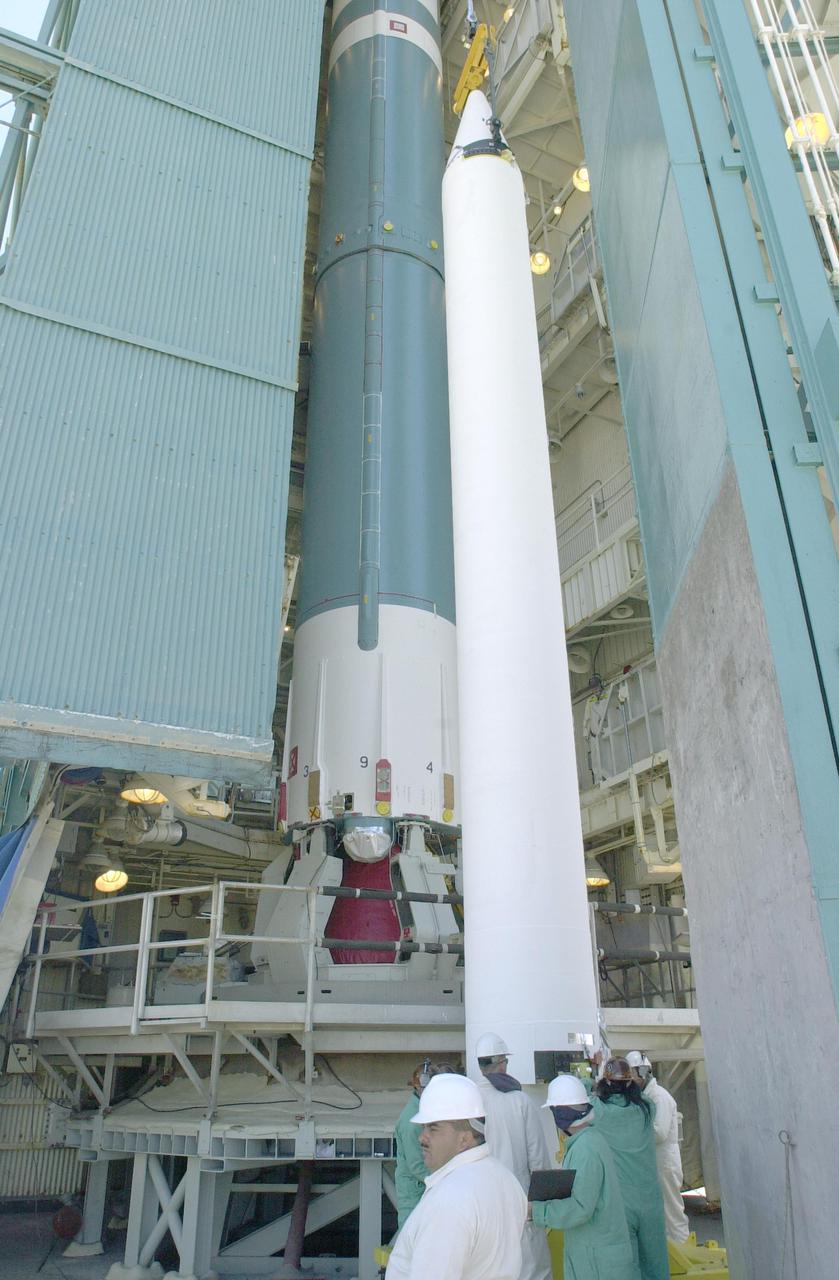
VANDENBERG AIR FORCE BASE, CALIF. - At NASA Space Launch Complex 2 on Vandenberg Air Force Base in California, another Solid Rocket Booster is ready to be attached to the Boeing Delta II rocket seen behind it. The Delta is the launch vehicle for the CALIPSO_CloudSat spacecraft. CALIPSO stands for Cloud-Aerosol Lidar and Infrared Pathfinder Satellite Observation. CALIPSO and CloudSat are highly complementary satellites and together will provide never-before-seen 3-D perspectives of how clouds and aerosols form, evolve, and affect weather and climate. CALIPSO and CloudSat will fly in formation with three other satellites in the A-train constellation to enhance understanding of our climate system. Launch of CALIPSO_CloudSat aboard a Boeing Delta II rocket is scheduled for 3:01 a.m. Sept. 29.
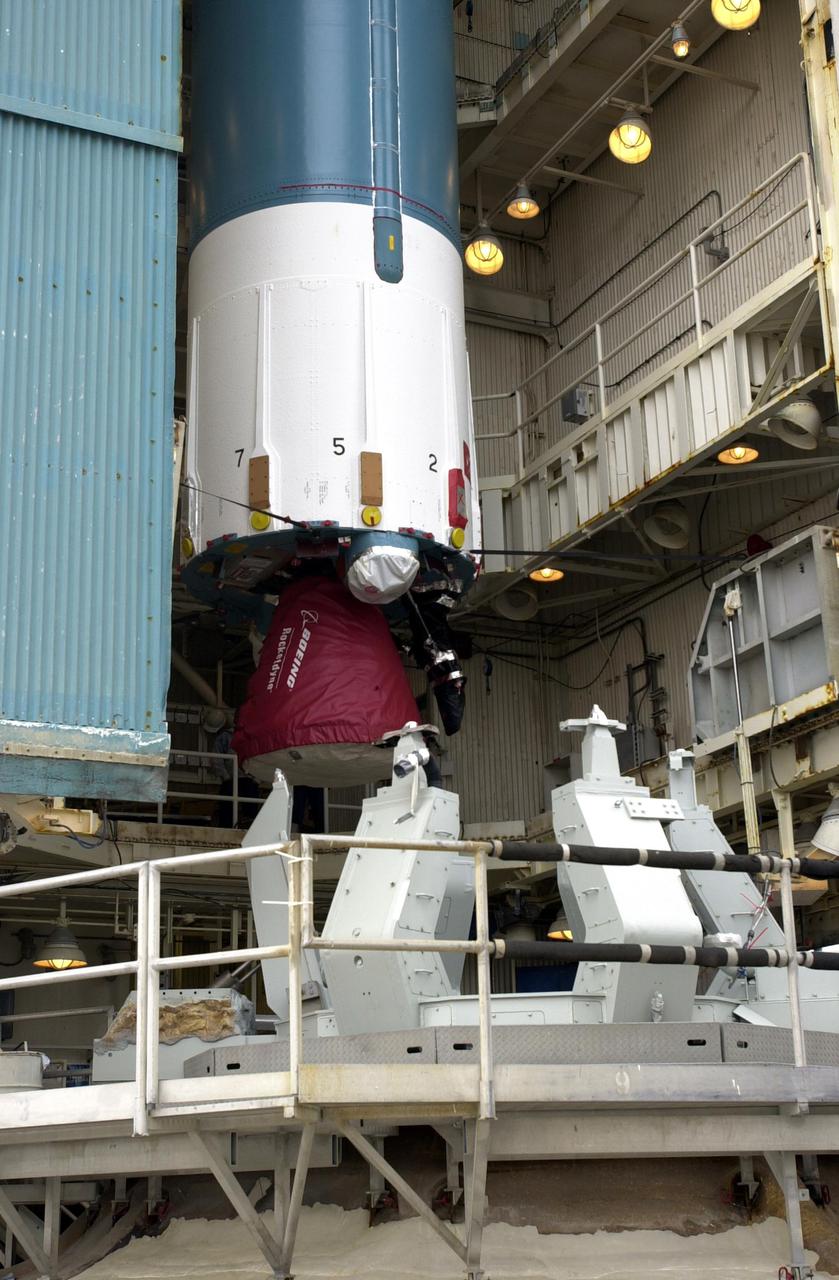
VANDENBERG AIR FORCE BASE, CALIF. - At NASA Space Launch Complex 2 on Vandenberg Air Force Base in California, the first stage of the Boeing Delta II rocket, launch vehicle for the CALIPSO_CloudSat spacecraft, begins to be lifted into the mobile service tower, or gantry. CALIPSO stands for Cloud-Aerosol Lidar and Infrared Pathfinder Satellite Observation. CALIPSO and CloudSat are highly complementary satellites and together will provide never-before-seen 3-D perspectives of how clouds and aerosols form, evolve, and affect weather and climate. CALIPSO and CloudSat will fly in formation with three other satellites in the A-train constellation to enhance understanding of our climate system. Launch of CALIPSO_CloudSat aboard a Boeing Delta II rocket is scheduled for 3:01 a.m. Sept. 29.
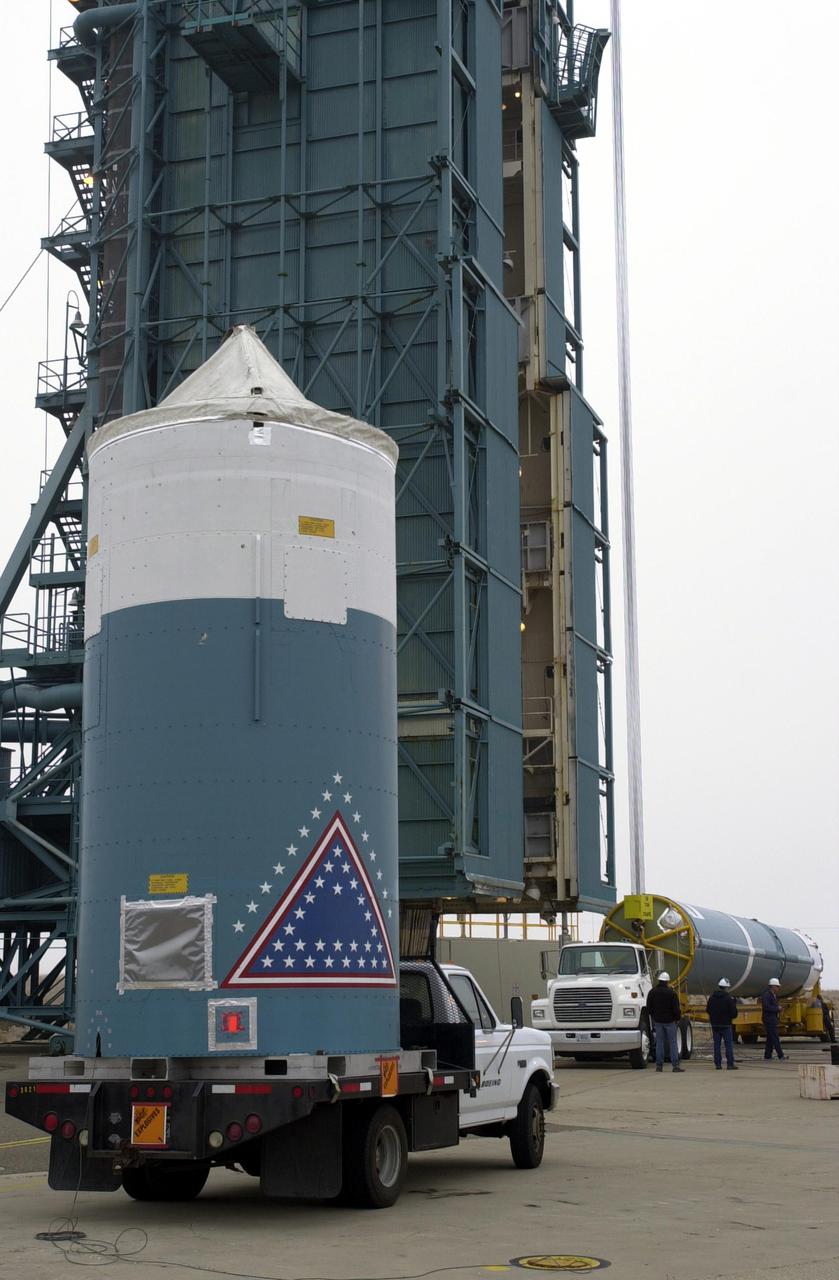
VANDENBERG AIR FORCE BASE, CALIF. - At NASA Space Launch Complex 2 on Vandenberg Air Force Base in California, the interstage for the Boeing Delta II rocket, launch vehicle for the CALIPSO_CloudSat spacecraft, arrives at the pad. It will be lifted up into the mobile service tower, or gantry, and mated with the first stage. CALIPSO stands for Cloud-Aerosol Lidar and Infrared Pathfinder Satellite Observation. CALIPSO and CloudSat are highly complementary satellites and together will provide never-before-seen 3-D perspectives of how clouds and aerosols form, evolve, and affect weather and climate. CALIPSO and CloudSat will fly in formation with three other satellites in the A-train constellation to enhance understanding of our climate system. Launch of CALIPSO_CloudSat aboard a Boeing Delta II rocket is scheduled for 3:01 a.m. Sept. 29.
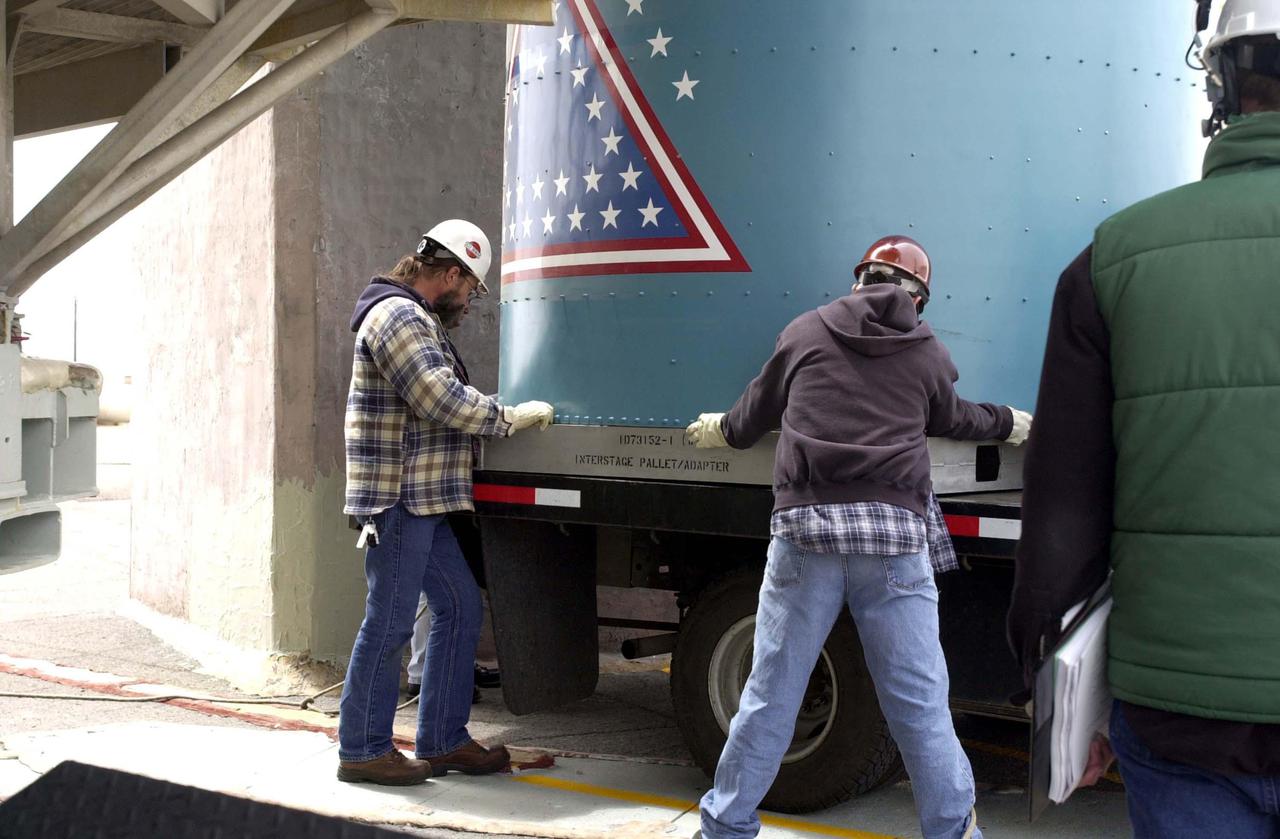
VANDENBERG AIR FORCE BASE, CALIF. - At NASA Space Launch Complex 2 on Vandenberg Air Force Base in California, workers prepare the interstage for the Boeing Delta II rocket to be lifted up the mobile service tower, or gantry. Then it will be mated with the first stage already there. The Delta is the launch vehicle for the CALIPSO_CloudSat spacecraft. CALIPSO stands for Cloud-Aerosol Lidar and Infrared Pathfinder Satellite Observation. CALIPSO and CloudSat are highly complementary satellites and together will provide never-before-seen 3-D perspectives of how clouds and aerosols form, evolve, and affect weather and climate. CALIPSO and CloudSat will fly in formation with three other satellites in the A-train constellation to enhance understanding of our climate system. Launch of CALIPSO_CloudSat aboard a Boeing Delta II rocket is scheduled for 3:01 a.m. Sept. 29.
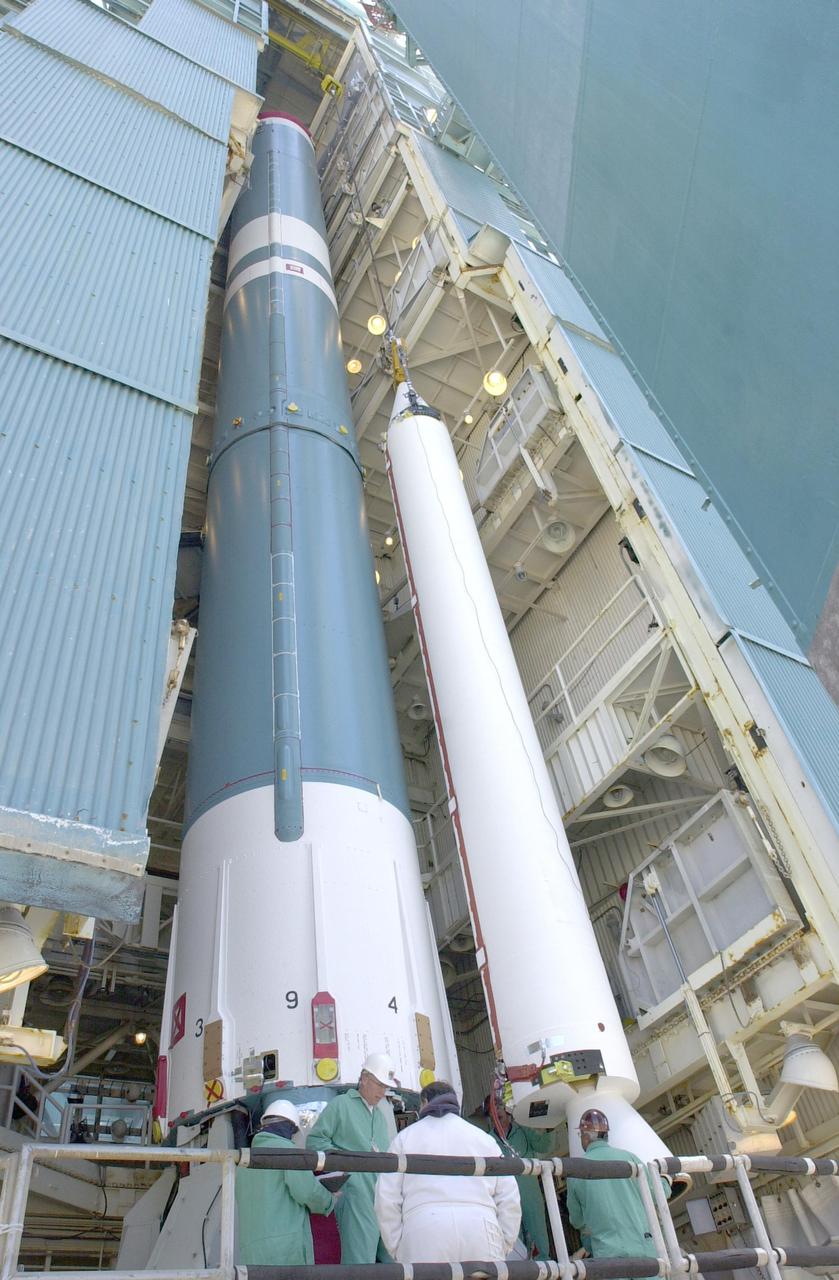
VANDENBERG AIR FORCE BASE, CALIF. - At NASA Space Launch Complex 2 on Vandenberg Air Force Base in California, another Solid Rocket Booster is attached to the Boeing Delta II rocket seen behind it. The Delta is the launch vehicle for the CALIPSO_CloudSat spacecraft. CALIPSO stands for Cloud-Aerosol Lidar and Infrared Pathfinder Satellite Observation. CALIPSO and CloudSat are highly complementary satellites and together will provide never-before-seen 3-D perspectives of how clouds and aerosols form, evolve, and affect weather and climate. CALIPSO and CloudSat will fly in formation with three other satellites in the A-train constellation to enhance understanding of our climate system. Launch of CALIPSO_CloudSat aboard a Boeing Delta II rocket is scheduled for 3:01 a.m. Sept. 29.
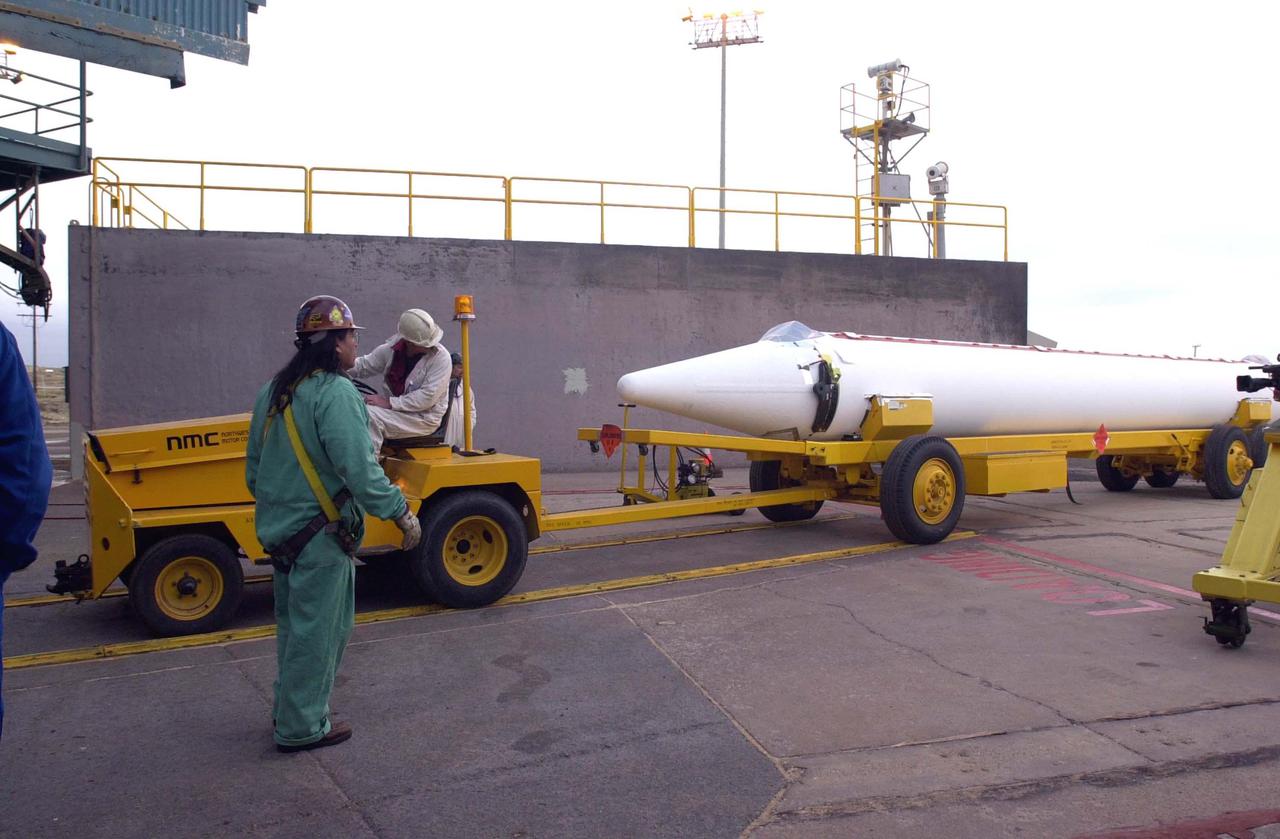
VANDENBERG AIR FORCE BASE, CALIF. - The first Solid Rocket Booster for the CALIPSO_CloudSat launch arrives at NASA Space Launch Complex 2 on Vandenberg Air Force Base in California. It will be lifted into the mobile service tower, or gantry, and attached to the Boeing Delta II rocket. CALIPSO stands for Cloud-Aerosol Lidar and Infrared Pathfinder Satellite Observation. CALIPSO and CloudSat are highly complementary satellites and together will provide never-before-seen 3-D perspectives of how clouds and aerosols form, evolve, and affect weather and climate. CALIPSO and CloudSat will fly in formation with three other satellites in the A-train constellation to enhance understanding of our climate system. Launch of CALIPSO_CloudSat aboard a Boeing Delta II rocket is scheduled for 3:01 a.m. Sept. 29.
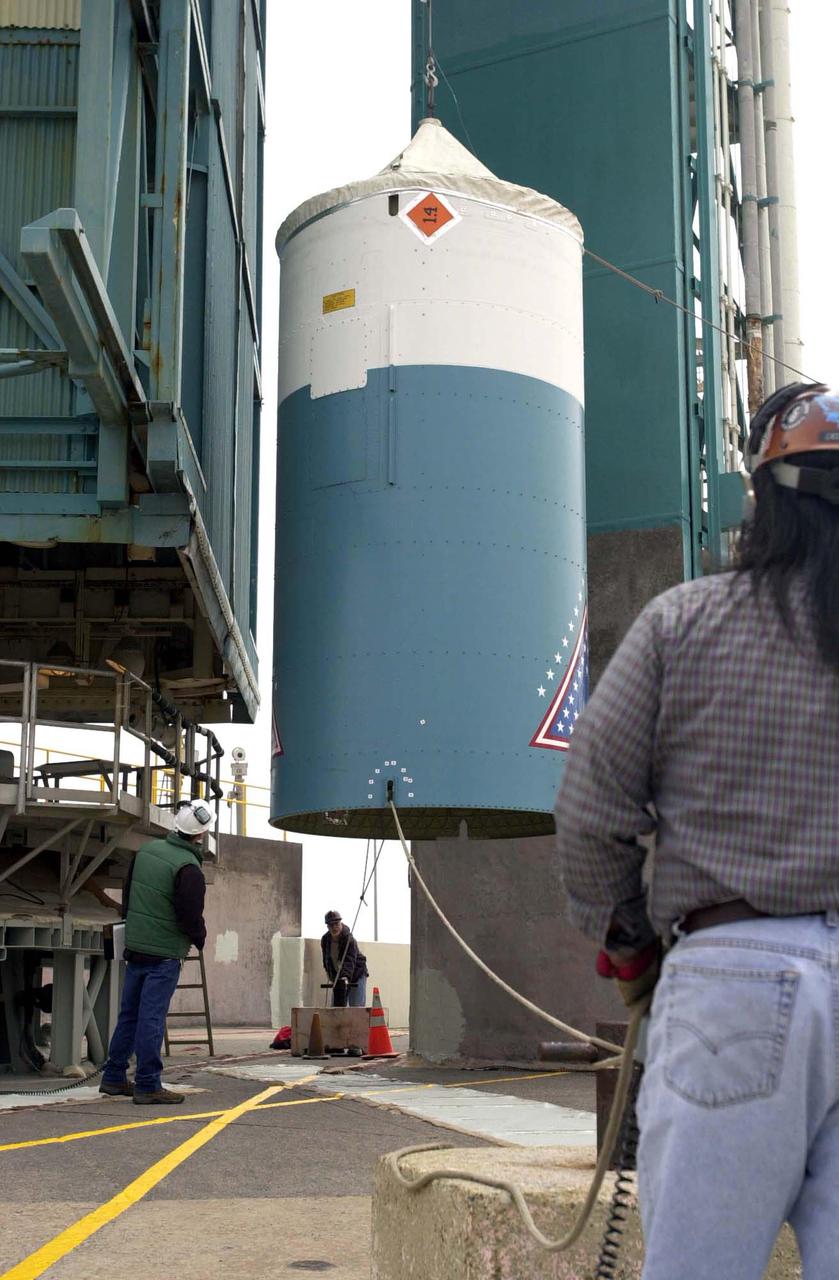
VANDENBERG AIR FORCE BASE, CALIF. - At NASA Space Launch Complex 2 on Vandenberg Air Force Base in California, the interstage for the Boeing Delta II rocket is lifted up the mobile service tower, or gantry. Then it will be mated with the first stage already there. The Delta is the launch vehicle for the CALIPSO_CloudSat spacecraft. CALIPSO stands for Cloud-Aerosol Lidar and Infrared Pathfinder Satellite Observation. CALIPSO and CloudSat are highly complementary satellites and together will provide never-before-seen 3-D perspectives of how clouds and aerosols form, evolve, and affect weather and climate. CALIPSO and CloudSat will fly in formation with three other satellites in the A-train constellation to enhance understanding of our climate system. Launch of CALIPSO_CloudSat aboard a Boeing Delta II rocket is scheduled for 3:01 a.m. Sept. 29.
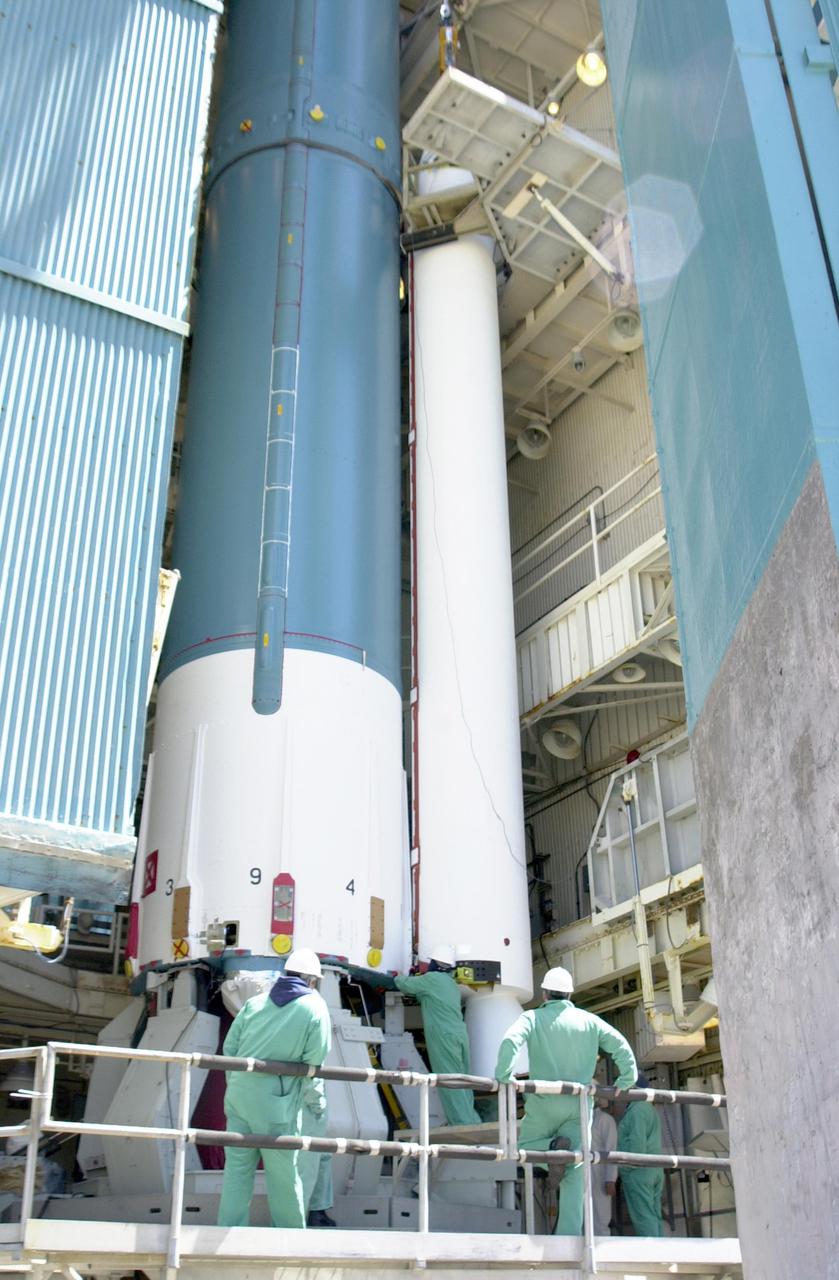
VANDENBERG AIR FORCE BASE, CALIF. - At NASA Space Launch Complex 2 on Vandenberg Air Force Base in California, another Solid Rocket Booster is attached to the Boeing Delta II rocket seen behind it. The Delta is the launch vehicle for the CALIPSO_CloudSat spacecraft. CALIPSO stands for Cloud-Aerosol Lidar and Infrared Pathfinder Satellite Observation. CALIPSO and CloudSat are highly complementary satellites and together will provide never-before-seen 3-D perspectives of how clouds and aerosols form, evolve, and affect weather and climate. CALIPSO and CloudSat will fly in formation with three other satellites in the A-train constellation to enhance understanding of our climate system. Launch of CALIPSO_CloudSat aboard a Boeing Delta II rocket is scheduled for 3:01 a.m. Sept. 29.
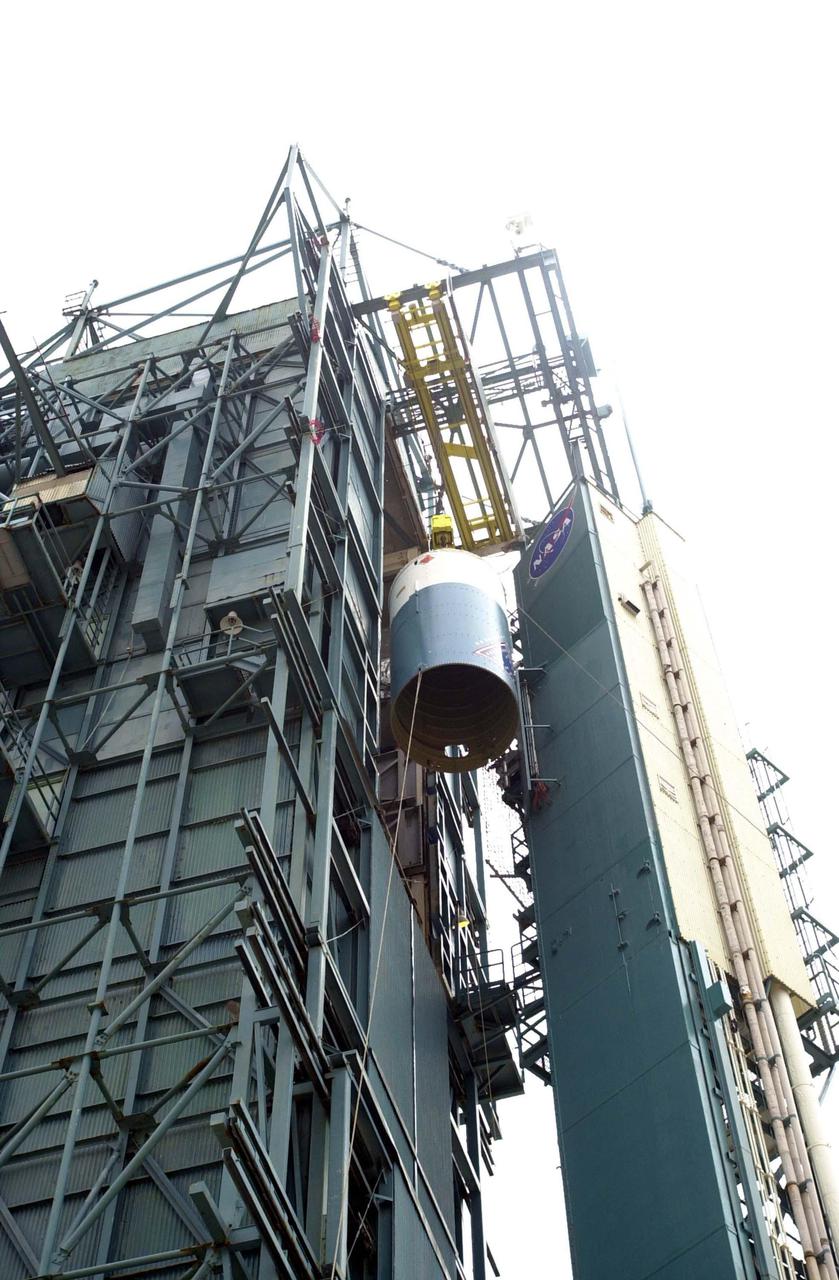
VANDENBERG AIR FORCE BASE, CALIF. - At NASA Space Launch Complex 2 on Vandenberg Air Force Base in California, the interstage for the Boeing Delta II rocket nears the top of the mobile service tower, or gantry. Then it will be mated with the first stage already there. The Delta is the launch vehicle for the CALIPSO_CloudSat spacecraft. CALIPSO stands for Cloud-Aerosol Lidar and Infrared Pathfinder Satellite Observation. CALIPSO and CloudSat are highly complementary satellites and together will provide never-before-seen 3-D perspectives of how clouds and aerosols form, evolve, and affect weather and climate. CALIPSO and CloudSat will fly in formation with three other satellites in the A-train constellation to enhance understanding of our climate system. Launch of CALIPSO_CloudSat aboard a Boeing Delta II rocket is scheduled for 3:01 a.m. Sept. 29.
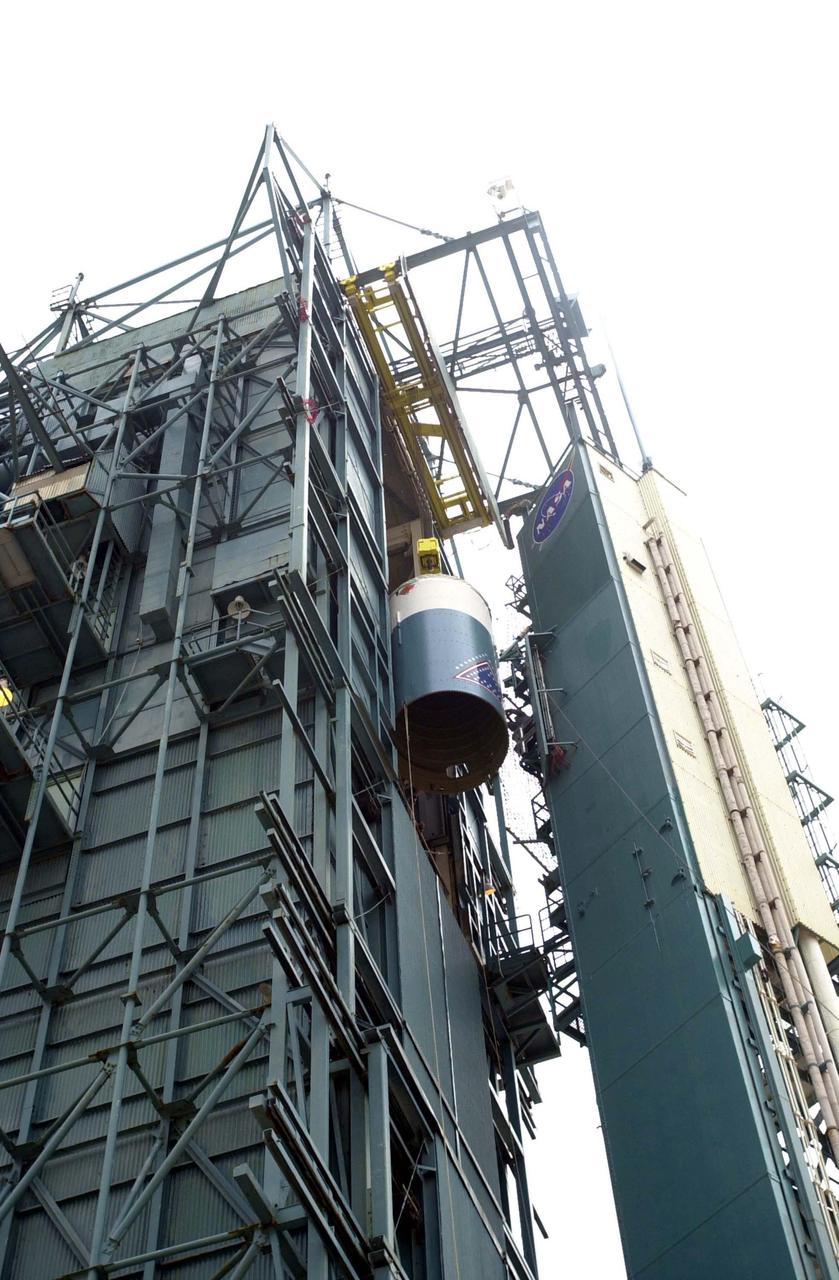
VANDENBERG AIR FORCE BASE, CALIF. - At NASA Space Launch Complex 2 on Vandenberg Air Force Base in California, the interstage for the Boeing Delta II rocket nears the top of the mobile service tower, or gantry. There it will be mated with the first stage already there. The Delta is the launch vehicle for the CALIPSO_CloudSat spacecraft. CALIPSO stands for Cloud-Aerosol Lidar and Infrared Pathfinder Satellite Observation. CALIPSO and CloudSat are highly complementary satellites and together will provide never-before-seen 3-D perspectives of how clouds and aerosols form, evolve, and affect weather and climate. CALIPSO and CloudSat will fly in formation with three other satellites in the A-train constellation to enhance understanding of our climate system. Launch of CALIPSO_CloudSat aboard a Boeing Delta II rocket is scheduled for 3:01 a.m. Sept. 29.
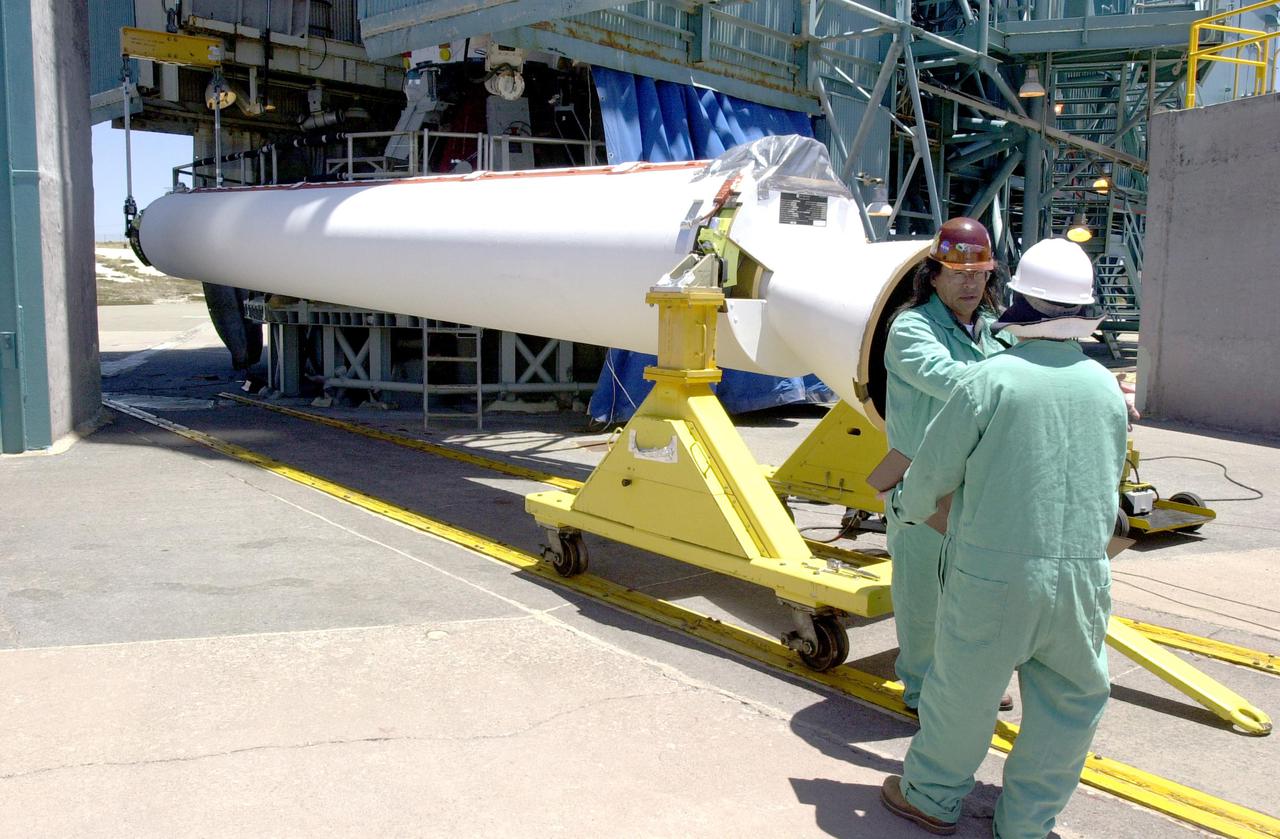
VANDENBERG AIR FORCE BASE, CALIF. - At NASA Space Launch Complex 2 on Vandenberg Air Force Base in California, workers prepare a Solid Rocket Booster to be raised to a vertical position. It will then be lifted into the mobile service tower, or gantry, and attached to the Boeing Delta II rocket. The Delta is the launch vehicle for the CALIPSO_CloudSat spacecraft. CALIPSO stands for Cloud-Aerosol Lidar and Infrared Pathfinder Satellite Observation. CALIPSO and CloudSat are highly complementary satellites and together will provide never-before-seen 3-D perspectives of how clouds and aerosols form, evolve, and affect weather and climate. CALIPSO and CloudSat will fly in formation with three other satellites in the A-train constellation to enhance understanding of our climate system. Launch of CALIPSO_CloudSat aboard a Boeing Delta II rocket is scheduled for 3:01 a.m. Sept. 29.
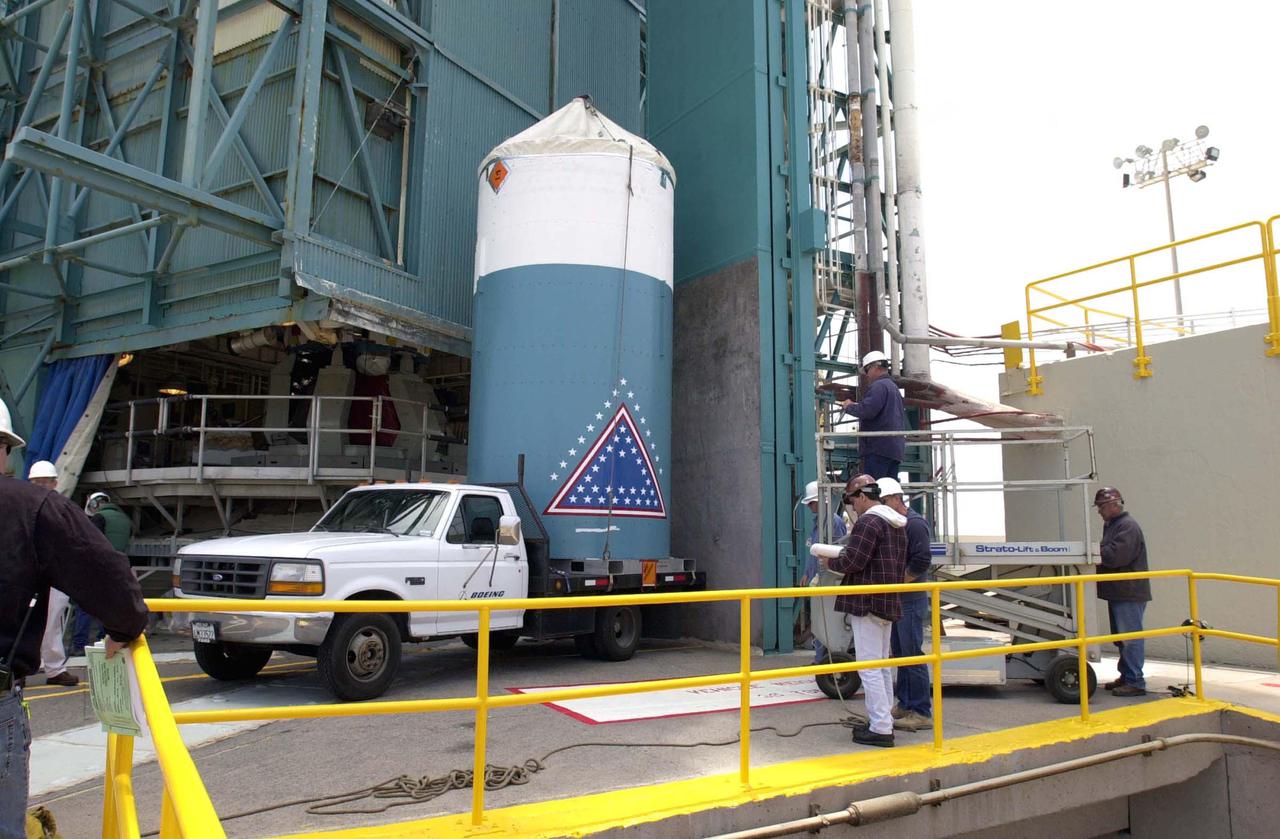
VANDENBERG AIR FORCE BASE, CALIF. - At NASA Space Launch Complex 2 on Vandenberg Air Force Base in California, the interstage for the Boeing Delta II rocket arrives on the pad. It will be lifted up the mobile service tower, or gantry, and mated with the first stage already there. The Delta is the launch vehicle for the CALIPSO_CloudSat spacecraft. CALIPSO stands for Cloud-Aerosol Lidar and Infrared Pathfinder Satellite Observation. CALIPSO and CloudSat are highly complementary satellites and together will provide never-before-seen 3-D perspectives of how clouds and aerosols form, evolve, and affect weather and climate. CALIPSO and CloudSat will fly in formation with three other satellites in the A-train constellation to enhance understanding of our climate system. Launch of CALIPSO_CloudSat aboard a Boeing Delta II rocket is scheduled for 3:01 a.m. Sept. 29.
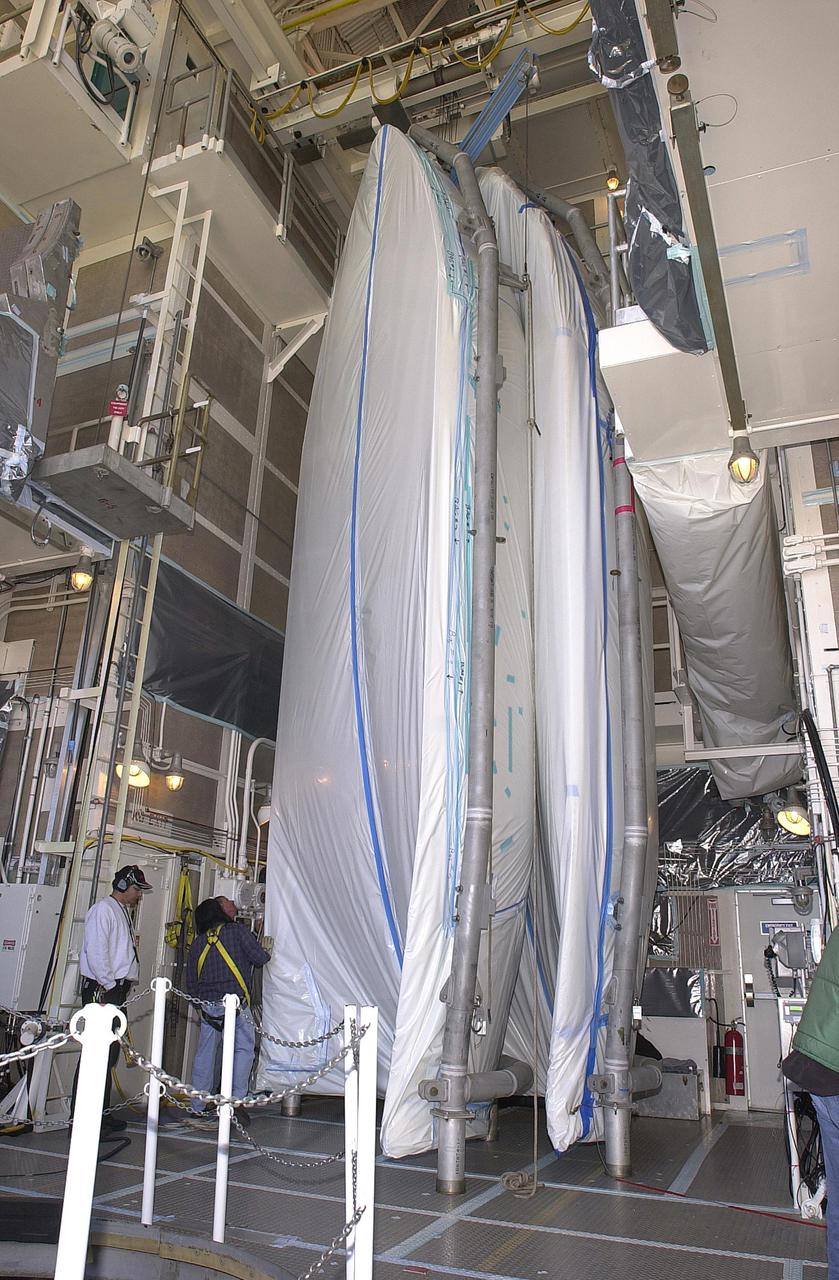
VANDENBERG AIR FORCE BASE, CALIF. - In the mobile service tower, or gantry, at NASA Space Launch Complex 2 on Vandenberg Air Force Base in California, the two halves of the fairing are ready to encapsulate CALIPSO_CloudSat for launch. The fairing encloses and protects the spacecraft during launch and flight through the atmosphere. Once in space, it is jettisoned. CALIPSO stands for Cloud-Aerosol Lidar and Infrared Pathfinder Satellite Observation. CALIPSO and CloudSat are highly complementary satellites and together will provide never-before-seen 3-D perspectives of how clouds and aerosols form, evolve, and affect weather and climate. CALIPSO and CloudSat will fly in formation with three other satellites in the A-train constellation to enhance understanding of our climate system. Launch of CALIPSO_CloudSat aboard a Boeing Delta II rocket is scheduled for 3:01 a.m. Sept. 29.
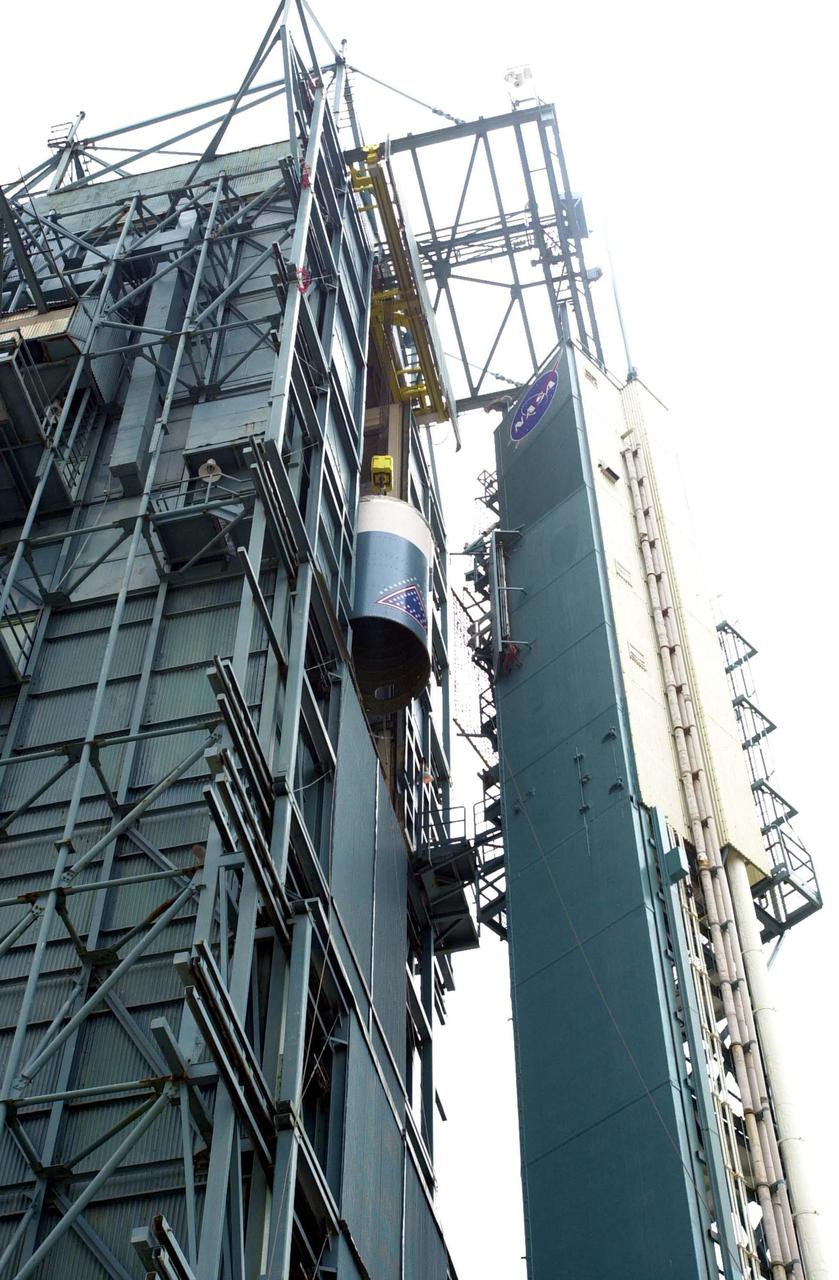
VANDENBERG AIR FORCE BASE, CALIF. - At NASA Space Launch Complex 2 on Vandenberg Air Force Base in California, the interstage for the Boeing Delta II rocket nears the top of the mobile service tower, or gantry. There it will be mated with the first stage already there. The Delta is the launch vehicle for the CALIPSO_CloudSat spacecraft. CALIPSO stands for Cloud-Aerosol Lidar and Infrared Pathfinder Satellite Observation. CALIPSO and CloudSat are highly complementary satellites and together will provide never-before-seen 3-D perspectives of how clouds and aerosols form, evolve, and affect weather and climate. CALIPSO and CloudSat will fly in formation with three other satellites in the A-train constellation to enhance understanding of our climate system. Launch of CALIPSO_CloudSat aboard a Boeing Delta II rocket is scheduled for 3:01 a.m. Sept. 29.
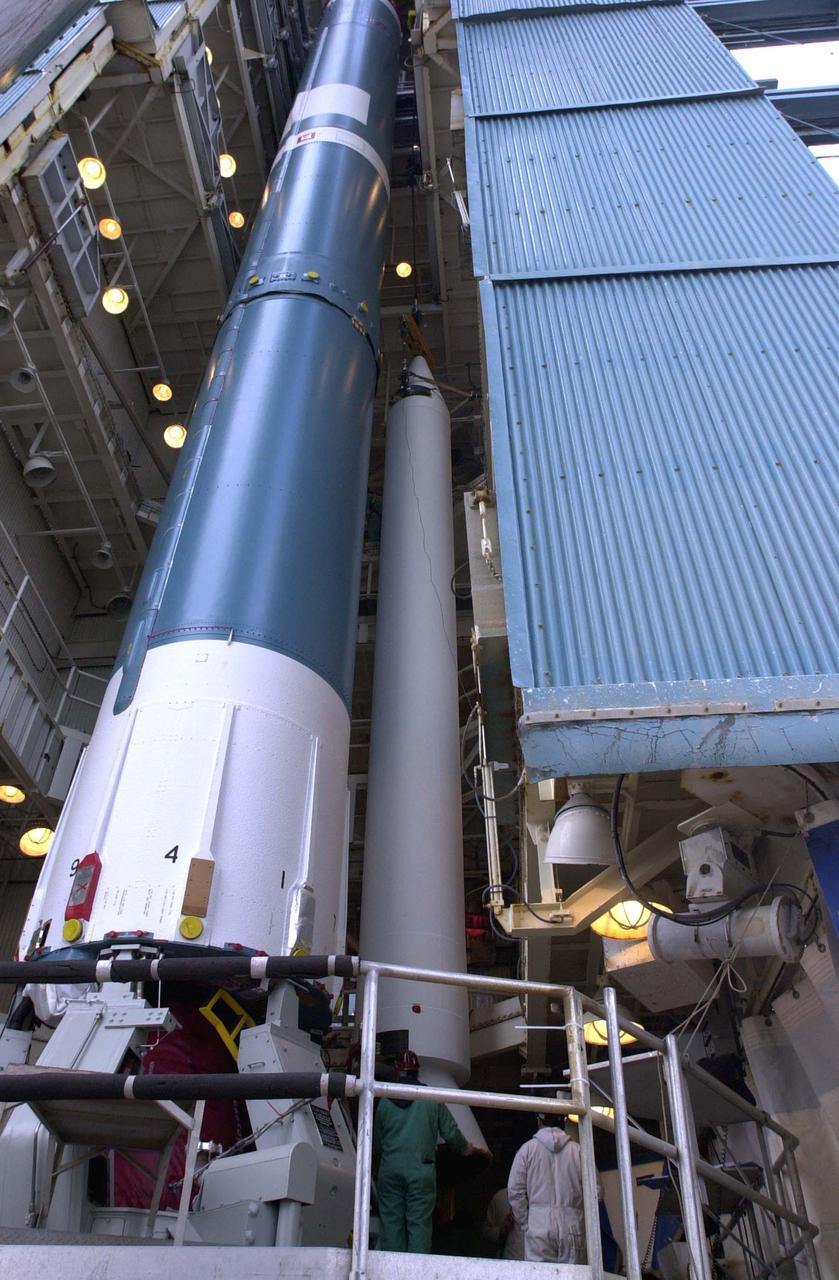
VANDENBERG AIR FORCE BASE, CALIF. - Workers on NASA Space Launch Complex 2 at Vandenberg Air Force Base in California are ready to attach a Solid Rocket Booster to the Boeing Delta II rocket. The Delta is the launch vehicle for the CALIPSO_CloudSat spacecraft. CALIPSO stands for Cloud-Aerosol Lidar and Infrared Pathfinder Satellite Observation. CALIPSO and CloudSat are highly complementary satellites and together will provide never-before-seen 3-D perspectives of how clouds and aerosols form, evolve, and affect weather and climate. CALIPSO and CloudSat will fly in formation with three other satellites in the A-train constellation to enhance understanding of our climate system. Launch of CALIPSO_CloudSat aboard a Boeing Delta II rocket is scheduled for 3:01 a.m. Sept. 29.
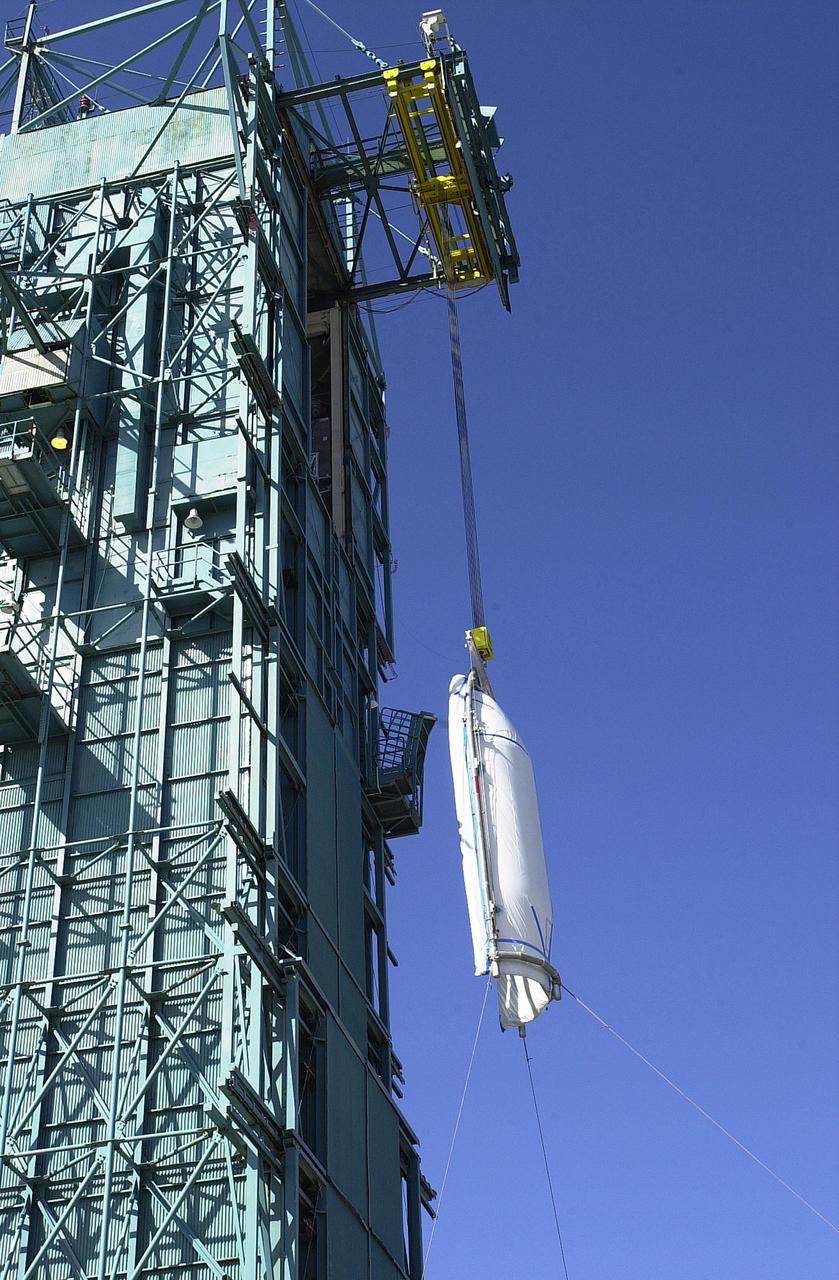
VANDENBERG AIR FORCE BASE, CALIF. - At NASA Space Launch Complex 2 on Vandenberg Air Force Base in California, one half of the fairing for CALIPSO_CloudSat is being lifted up the mobile service tower, or gantry. The fairing encloses and protects the spacecraft during launch and flight through the atmosphere. Once in space, it is jettisoned. CALIPSO stands for Cloud-Aerosol Lidar and Infrared Pathfinder Satellite Observation. CALIPSO and CloudSat are highly complementary satellites and together will provide never-before-seen 3-D perspectives of how clouds and aerosols form, evolve, and affect weather and climate. CALIPSO and CloudSat will fly in formation with three other satellites in the A-train constellation to enhance understanding of our climate system. Launch of CALIPSO_CloudSat aboard a Boeing Delta II rocket is scheduled for 3:01 a.m. Sept. 29.
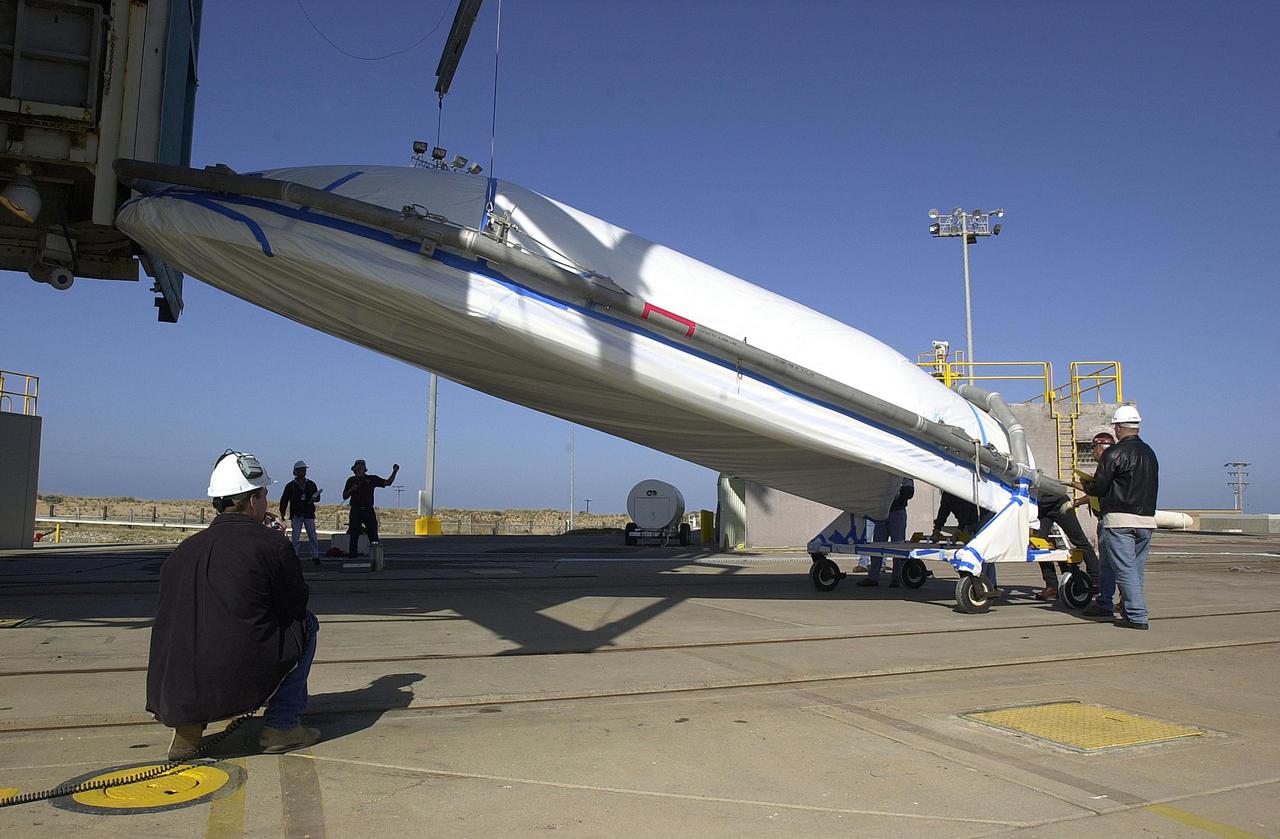
VANDENBERG AIR FORCE BASE, CALIF. - At NASA Space Launch Complex 2 on Vandenberg Air Force Base in California, one half of the fairing for CALIPSO_CloudSat to cover CALIPSO_CloudSat is being raised to a vertical position. It will then be lifted into the mobile service tower, or gantry. The fairing encloses and protects the spacecraft during launch and flight through the atmosphere. Once in space, it is jettisoned. CALIPSO stands for Cloud-Aerosol Lidar and Infrared Pathfinder Satellite Observation. CALIPSO and CloudSat are highly complementary satellites and together will provide never-before-seen 3-D perspectives of how clouds and aerosols form, evolve, and affect weather and climate. CALIPSO and CloudSat will fly in formation with three other satellites in the A-train constellation to enhance understanding of our climate system. Launch of CALIPSO_CloudSat aboard a Boeing Delta II rocket is scheduled for 3:01 a.m. Sept. 29.
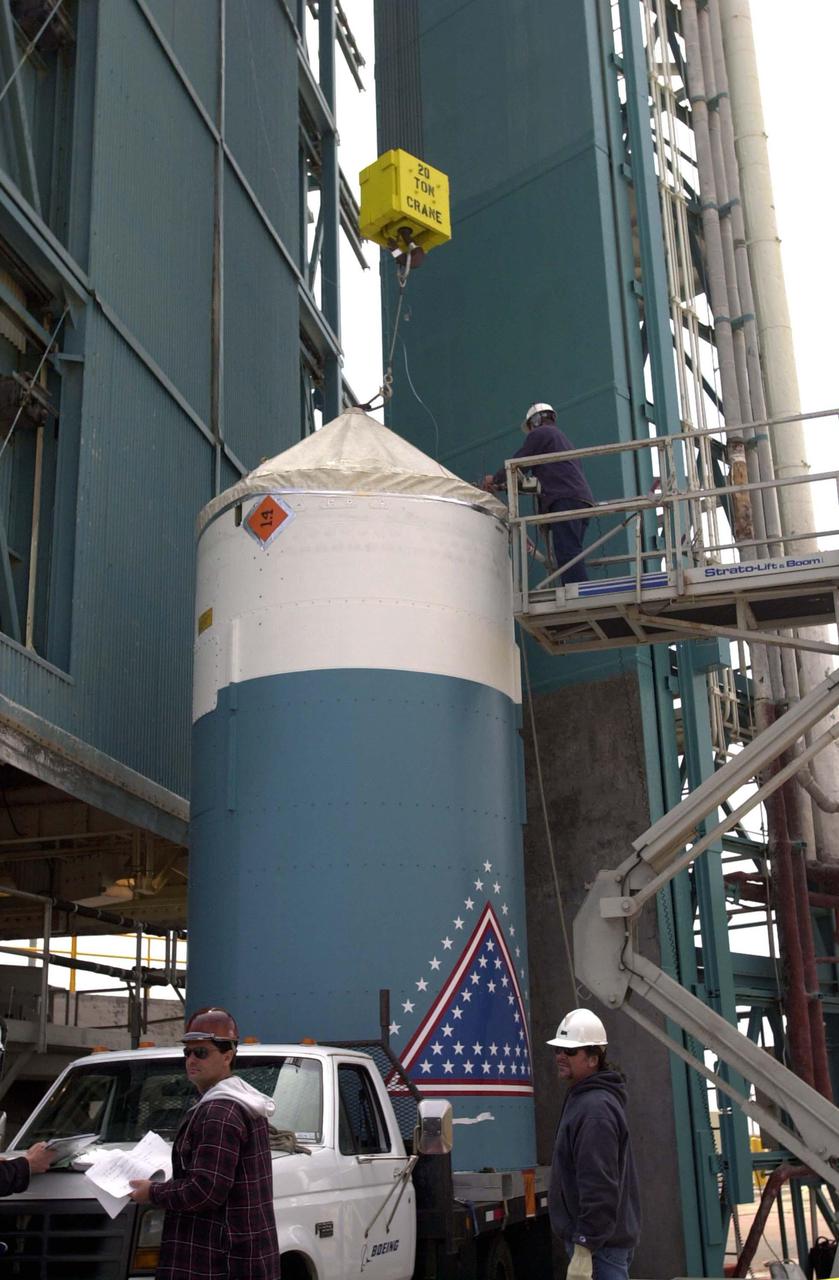
VANDENBERG AIR FORCE BASE, CALIF. - At NASA Space Launch Complex 2 on Vandenberg Air Force Base in California, the interstage for the Boeing Delta II rocket waits to be lifted up the mobile service tower, or gantry. Then it will be mated with the first stage already there. The Delta is the launch vehicle for the CALIPSO_CloudSat spacecraft. CALIPSO stands for Cloud-Aerosol Lidar and Infrared Pathfinder Satellite Observation. CALIPSO and CloudSat are highly complementary satellites and together will provide never-before-seen 3-D perspectives of how clouds and aerosols form, evolve, and affect weather and climate. CALIPSO and CloudSat will fly in formation with three other satellites in the A-train constellation to enhance understanding of our climate system. Launch of CALIPSO_CloudSat aboard a Boeing Delta II rocket is scheduled for 3:01 a.m. Sept. 29.
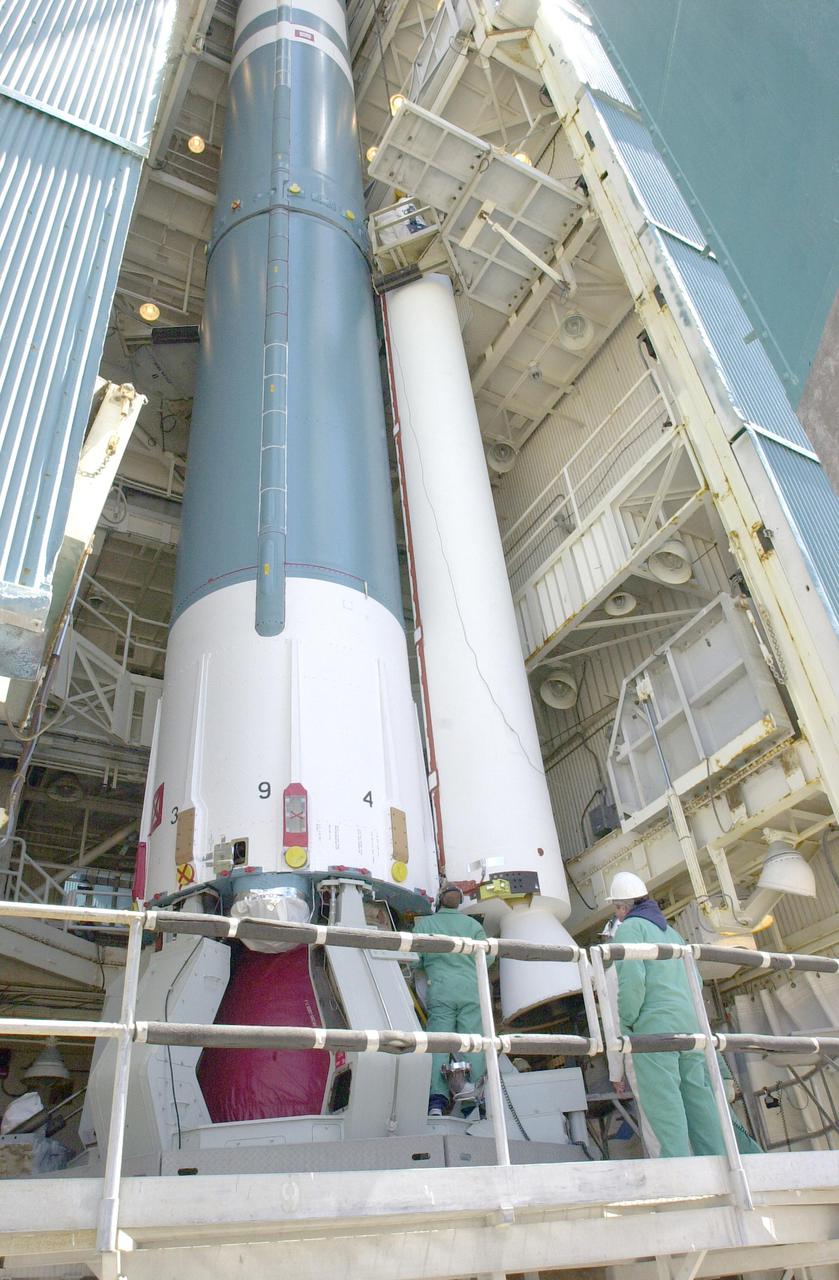
VANDENBERG AIR FORCE BASE, CALIF. - At NASA Space Launch Complex 2 on Vandenberg Air Force Base in California, another Solid Rocket Booster is attached to the Boeing Delta II rocket seen behind it. The Delta is the launch vehicle for the CALIPSO_CloudSat spacecraft. CALIPSO stands for Cloud-Aerosol Lidar and Infrared Pathfinder Satellite Observation. CALIPSO and CloudSat are highly complementary satellites and together will provide never-before-seen 3-D perspectives of how clouds and aerosols form, evolve, and affect weather and climate. CALIPSO and CloudSat will fly in formation with three other satellites in the A-train constellation to enhance understanding of our climate system. Launch of CALIPSO_CloudSat aboard a Boeing Delta II rocket is scheduled for 3:01 a.m. Sept. 29.
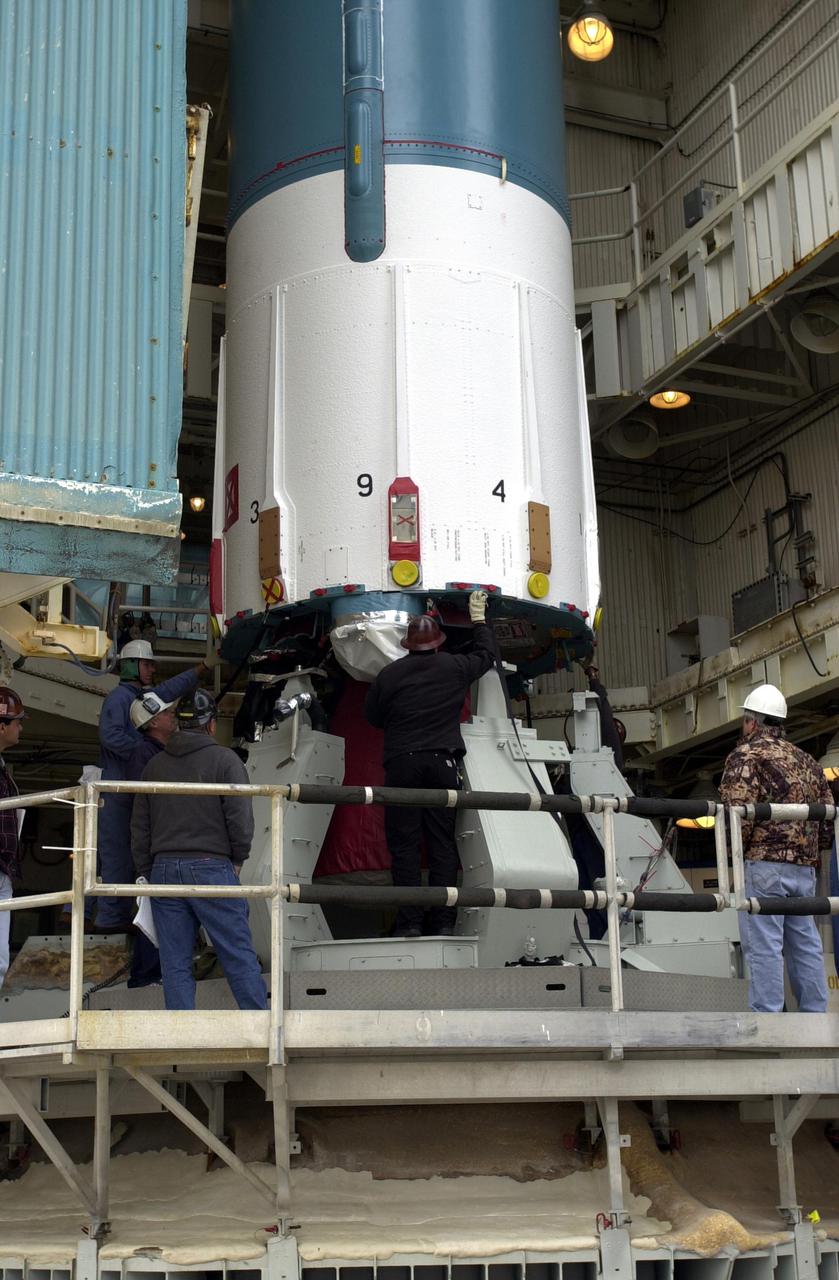
VANDENBERG AIR FORCE BASE, CALIF. - At NASA Space Launch Complex 2 on Vandenberg Air Force Base in California, the Boeing Delta II rocket, launch vehicle for the CALIPSO_CloudSat spacecraft, is prepared for lifting into the mobile service tower, or gantry. CALIPSO stands for Cloud-Aerosol Lidar and Infrared Pathfinder Satellite Observation. CALIPSO and CloudSat are highly complementary satellites and together will provide never-before-seen 3-D perspectives of how clouds and aerosols form, evolve, and affect weather and climate. CALIPSO and CloudSat will fly in formation with three other satellites in the A-train constellation to enhance understanding of our climate system. Launch of CALIPSO_CloudSat aboard a Boeing Delta II rocket is scheduled for 3:01 a.m. Sept. 29.
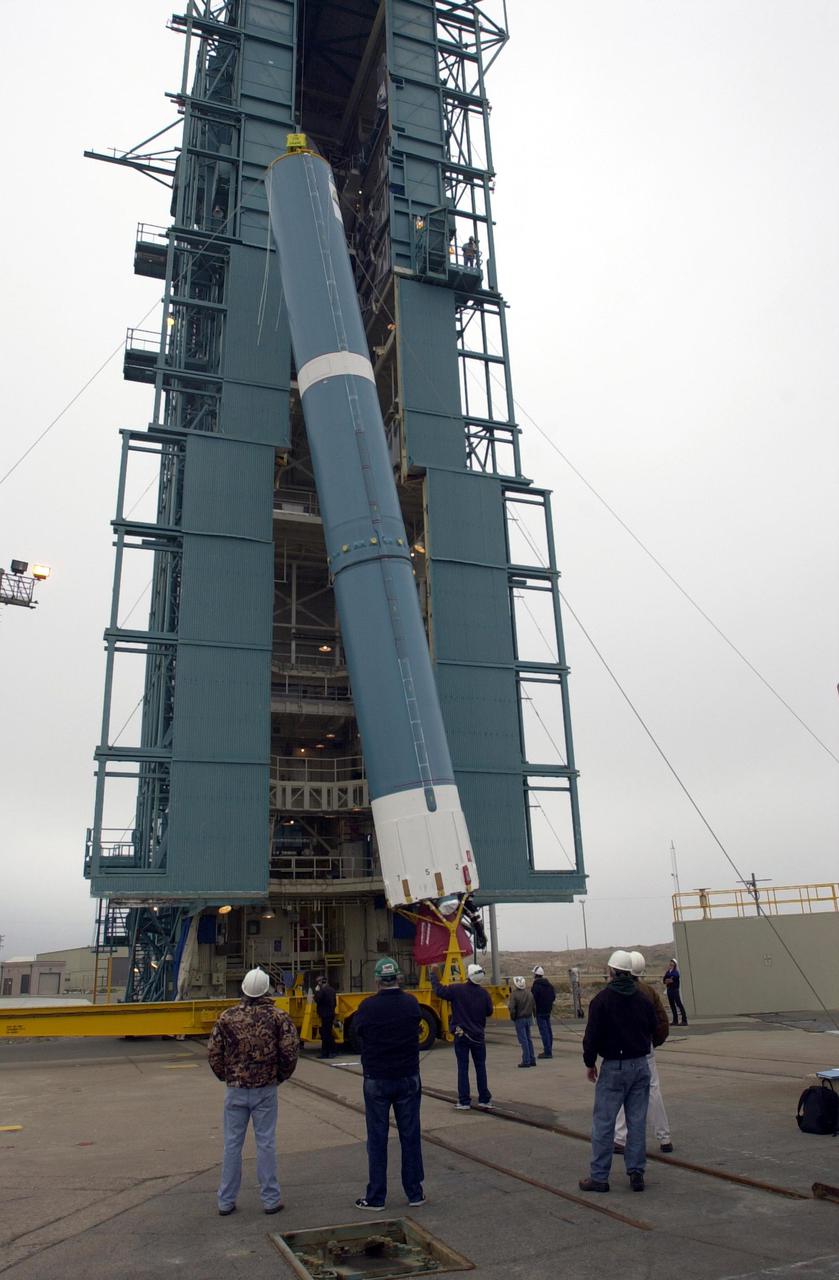
VANDENBERG AIR FORCE BASE, CALIF. - At NASA Space Launch Complex 2 on Vandenberg Air Force Base in California, the Boeing Delta II rocket, launch vehicle for the CALIPSO_CloudSat spacecraft, is being raised to a vertical position. Once it is vertical, it will be lifted up into the mobile service tower, or gantry. CALIPSO stands for Cloud-Aerosol Lidar and Infrared Pathfinder Satellite Observation. CALIPSO and CloudSat are highly complementary satellites and together will provide never-before-seen 3-D perspectives of how clouds and aerosols form, evolve, and affect weather and climate. CALIPSO and CloudSat will fly in formation with three other satellites in the A-train constellation to enhance understanding of our climate system. Launch of CALIPSO_CloudSat aboard a Boeing Delta II rocket is scheduled for 3:01 a.m. Sept. 29.

KENNEDY SPACE CENTER, FLA. - At NASA Space Launch Complex 2 on Vandenberg Air Force Base in California, a hoist and crane is placed around a Solid Rocket Booster to raise it to a vertical position. It will then be lifted into the mobile service tower, or gantry, and attached to the Boeing Delta II rocket. The Delta is the launch vehicle for the CALIPSO_CloudSat spacecraft. CALIPSO stands for Cloud-Aerosol Lidar and Infrared Pathfinder Satellite Observation. CALIPSO and CloudSat are highly complementary satellites and together will provide never-before-seen 3-D perspectives of how clouds and aerosols form, evolve, and affect weather and climate. CALIPSO and CloudSat will fly in formation with three other satellites in the A-train constellation to enhance understanding of our climate system. Launch of CALIPSO_CloudSat aboard a Boeing Delta II rocket is scheduled for 3:01 a.m. Sept. 29.
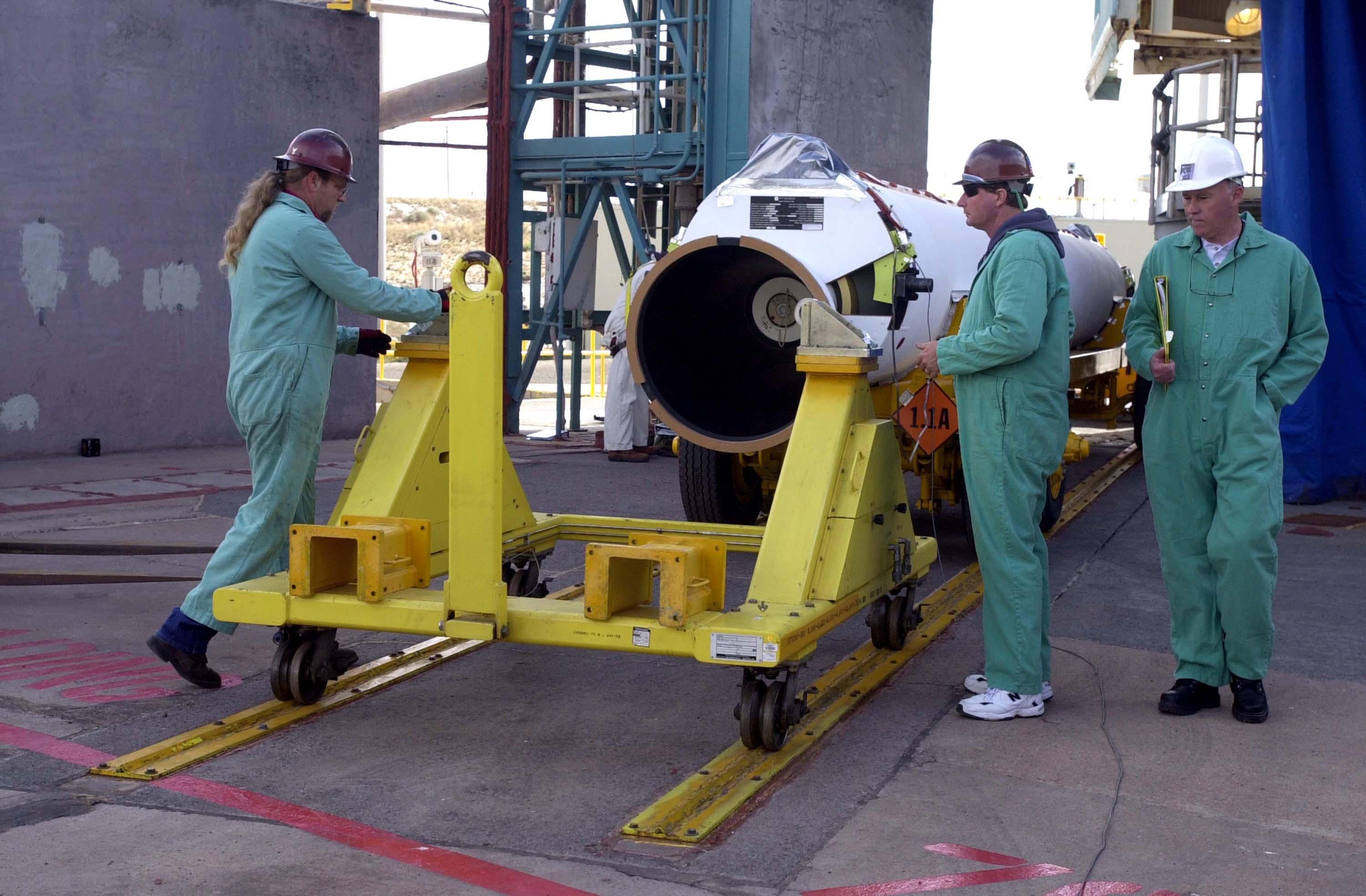
VANDENBERG AIR FORCE BASE, CALIF. - Another Solid Rocket Booster arrives on NASA Space Launch Complex 2 at Vandenberg Air Force Base in California. It will be lifted up the mobile service tower, or gantry, where it will be attached to the Boeing Delta II rocket. The Delta is the launch vehicle for the CALIPSO_CloudSat spacecraft. CALIPSO stands for Cloud-Aerosol Lidar and Infrared Pathfinder Satellite Observation. CALIPSO and CloudSat are highly complementary satellites and together will provide never-before-seen 3-D perspectives of how clouds and aerosols form, evolve, and affect weather and climate. CALIPSO and CloudSat will fly in formation with three other satellites in the A-train constellation to enhance understanding of our climate system. Launch of CALIPSO_CloudSat aboard a Boeing Delta II rocket is scheduled for 3:01 a.m. Sept. 29.
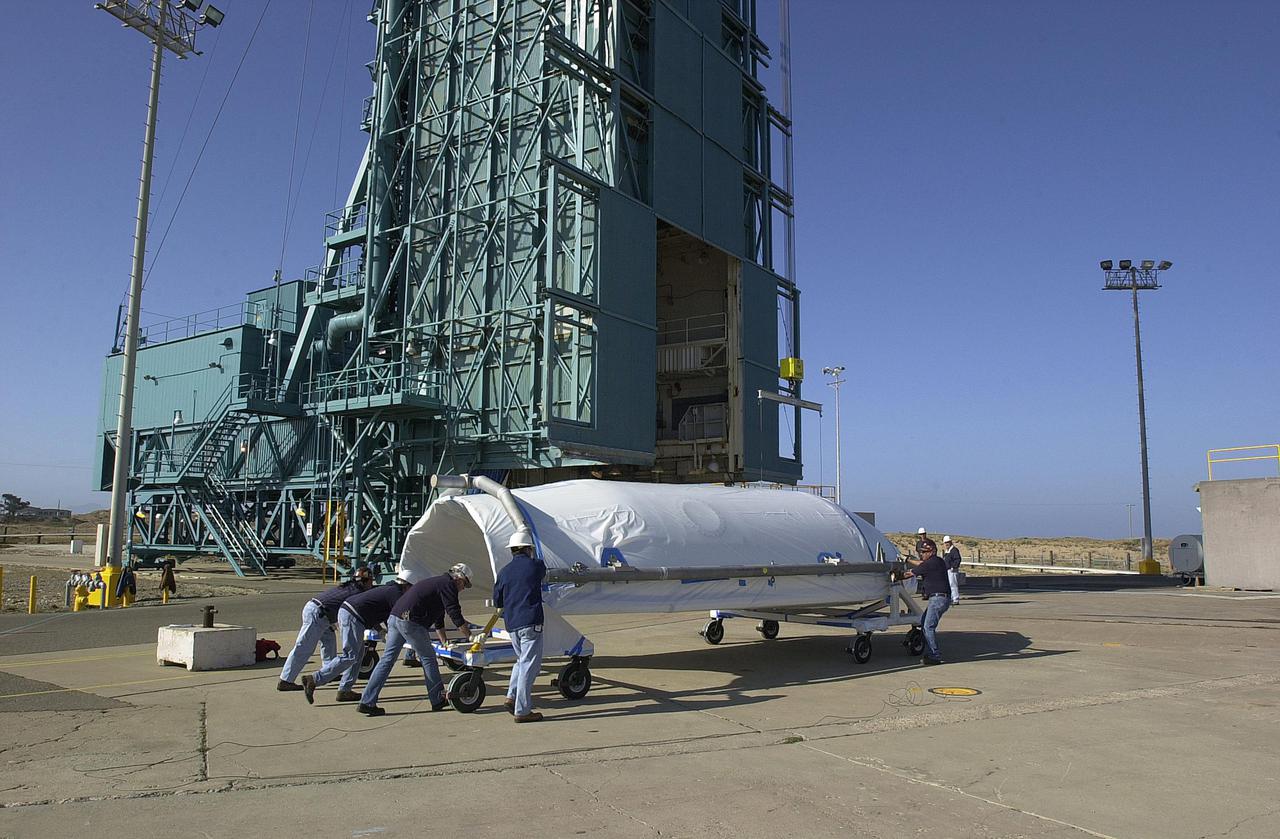
VANDENBERG AIR FORCE BASE, CALIF. - One half of the fairing to cover CALIPSO_CloudSat arrives at NASA Space Launch Complex 2 on Vandenberg Air Force Base in California. The fairing encloses and protects the spacecraft during launch and flight through the atmosphere. Once in space, it is jettisoned. CALIPSO stands for Cloud-Aerosol Lidar and Infrared Pathfinder Satellite Observation. CALIPSO and CloudSat are highly complementary satellites and together will provide never-before-seen 3-D perspectives of how clouds and aerosols form, evolve, and affect weather and climate. CALIPSO and CloudSat will fly in formation with three other satellites in the A-train constellation to enhance understanding of our climate system. Launch of CALIPSO_CloudSat aboard a Boeing Delta II rocket is scheduled for 3:01 a.m. Sept. 29.
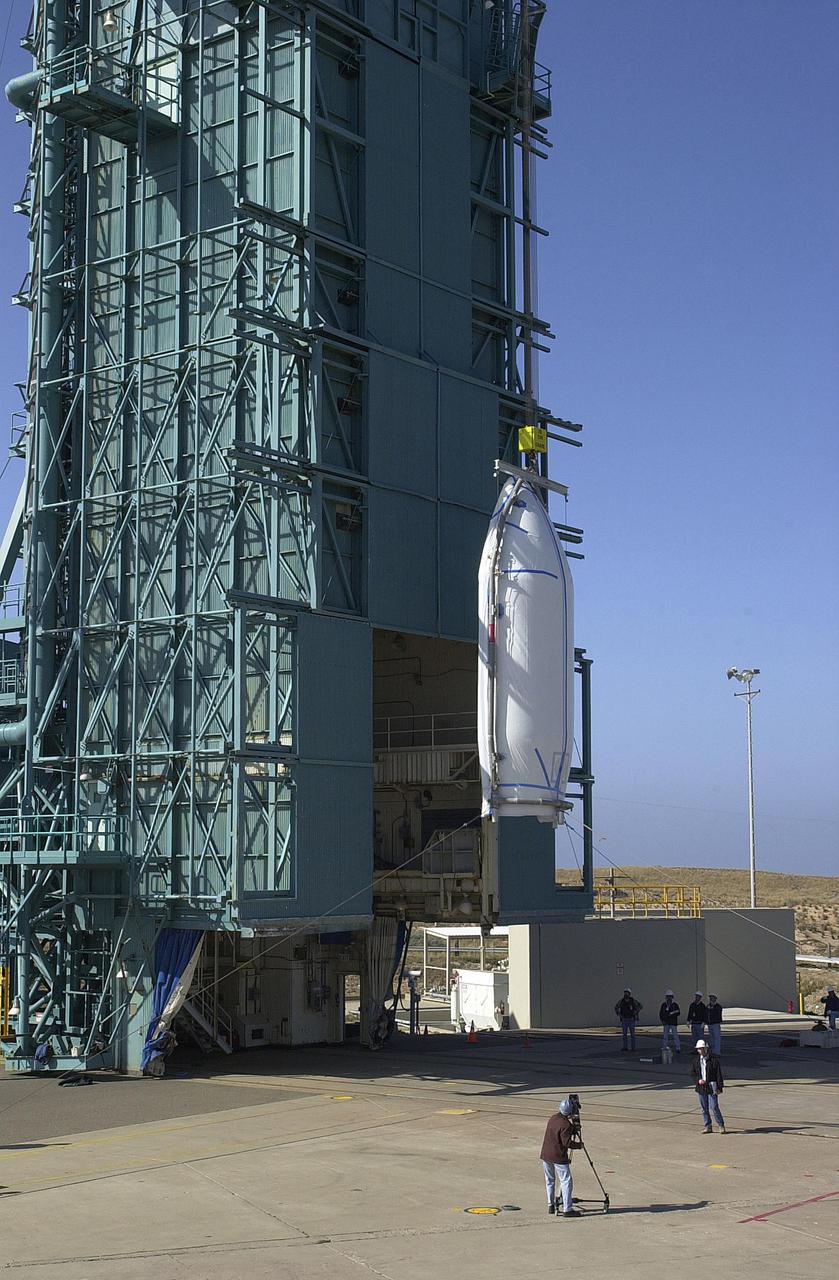
VANDENBERG AIR FORCE BASE, CALIF. - At NASA Space Launch Complex 2 on Vandenberg Air Force Base in California, one half of the fairing for CALIPSO_CloudSat begins the slow lift up the mobile service tower, or gantry. The fairing encloses and protects the spacecraft during launch and flight through the atmosphere. Once in space, it is jettisoned. CALIPSO stands for Cloud-Aerosol Lidar and Infrared Pathfinder Satellite Observation. CALIPSO and CloudSat are highly complementary satellites and together will provide never-before-seen 3-D perspectives of how clouds and aerosols form, evolve, and affect weather and climate. CALIPSO and CloudSat will fly in formation with three other satellites in the A-train constellation to enhance understanding of our climate system. Launch of CALIPSO_CloudSat aboard a Boeing Delta II rocket is scheduled for 3:01 a.m. Sept. 29.
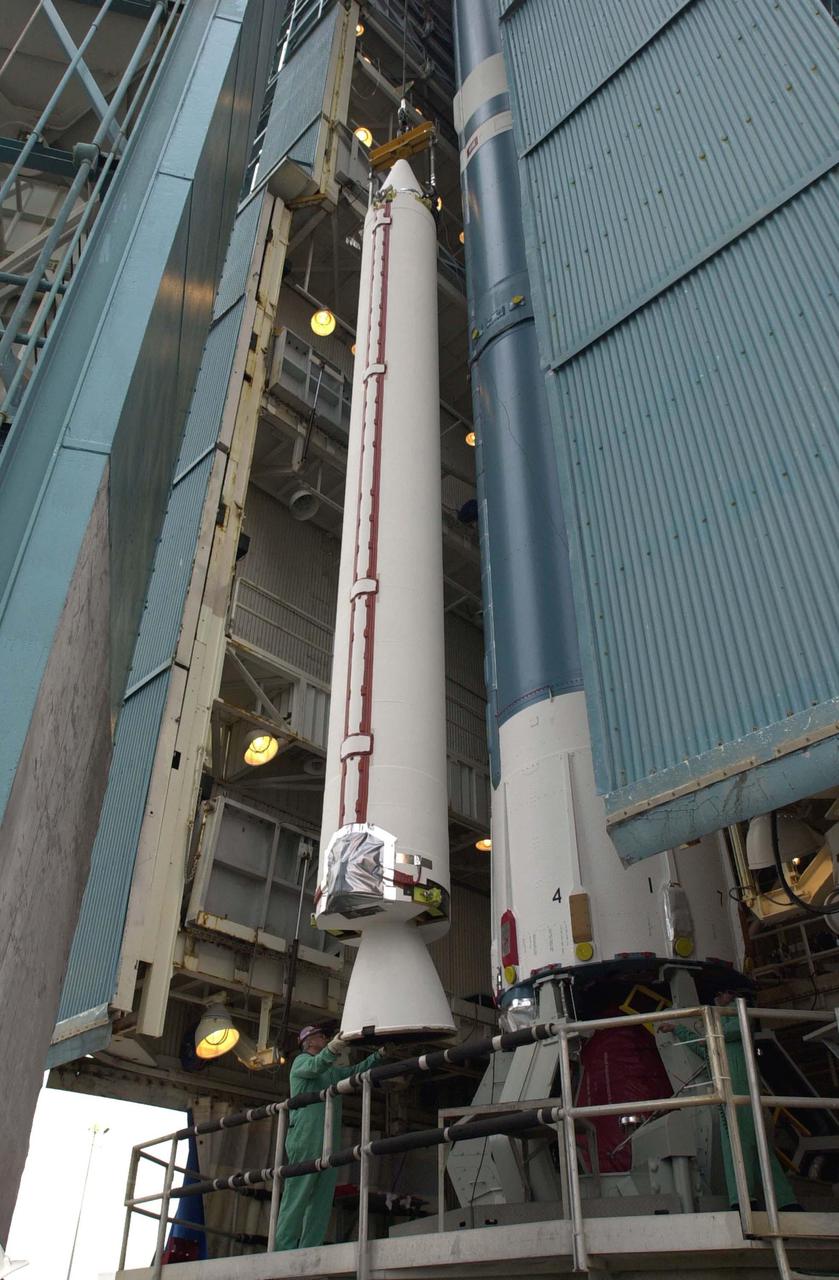
VANDENBERG AIR FORCE BASE, CALIF. - Workers on NASA Space Launch Complex 2 at Vandenberg Air Force Base in California prepare the Solid Rocket Booster for lifting into the mobile service tower, or gantry, where it will be attached to the Boeing Delta II rocket. The Delta is the launch vehicle for the CALIPSO_CloudSat spacecraft. CALIPSO stands for Cloud-Aerosol Lidar and Infrared Pathfinder Satellite Observation. CALIPSO and CloudSat are highly complementary satellites and together will provide never-before-seen 3-D perspectives of how clouds and aerosols form, evolve, and affect weather and climate. CALIPSO and CloudSat will fly in formation with three other satellites in the A-train constellation to enhance understanding of our climate system. Launch of CALIPSO_CloudSat aboard a Boeing Delta II rocket is scheduled for 3:01 a.m. Sept. 29.
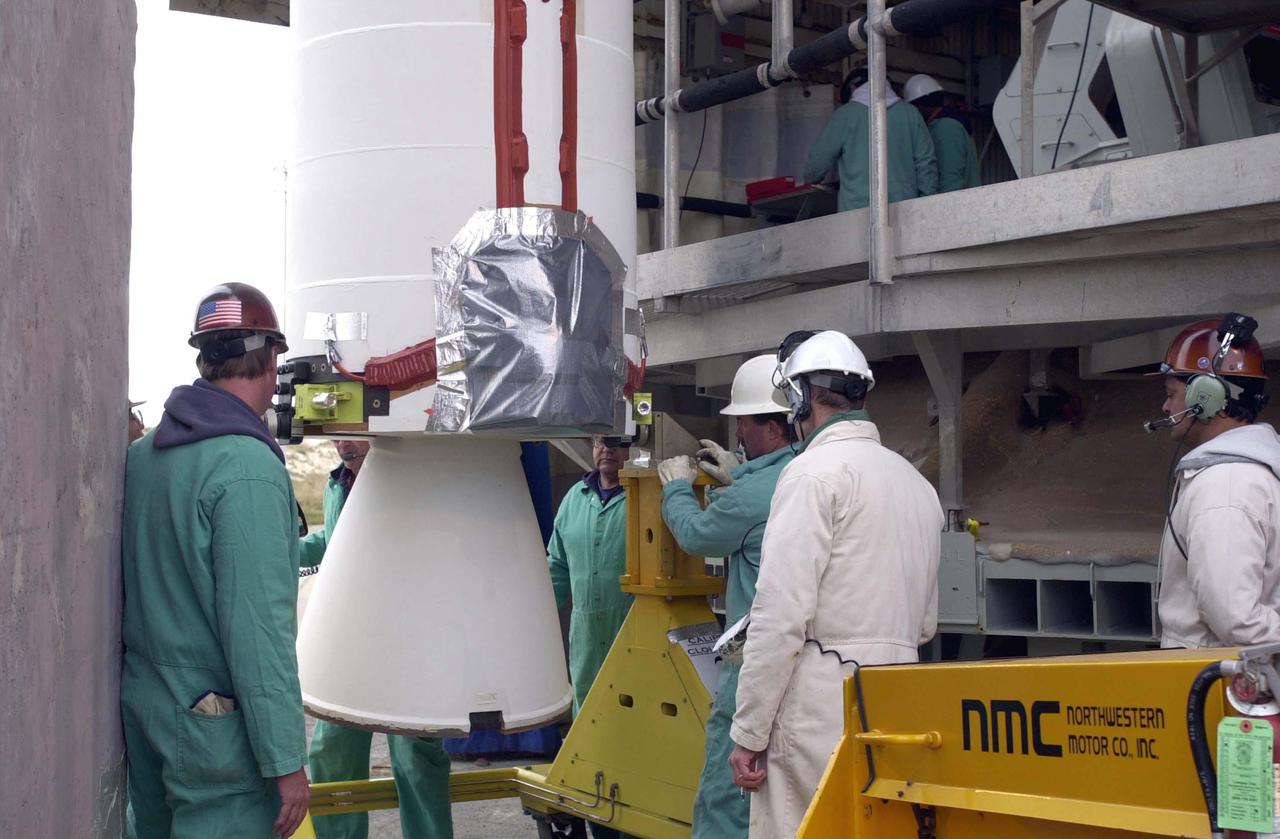
VANDENBERG AIR FORCE BASE, CALIF. - Workers on NASA Space Launch Complex 2 at Vandenberg Air Force Base in California prepare the Solid Rocket Booster for lifting into the mobile service tower, or gantry, where it will be attached to the Boeing Delta II rocket. The Delta is the launch vehicle for the CALIPSO_CloudSat spacecraft. CALIPSO stands for Cloud-Aerosol Lidar and Infrared Pathfinder Satellite Observation. CALIPSO and CloudSat are highly complementary satellites and together will provide never-before-seen 3-D perspectives of how clouds and aerosols form, evolve, and affect weather and climate. CALIPSO and CloudSat will fly in formation with three other satellites in the A-train constellation to enhance understanding of our climate system. Launch of CALIPSO_CloudSat aboard a Boeing Delta II rocket is scheduled for 3:01 a.m. Sept. 29.
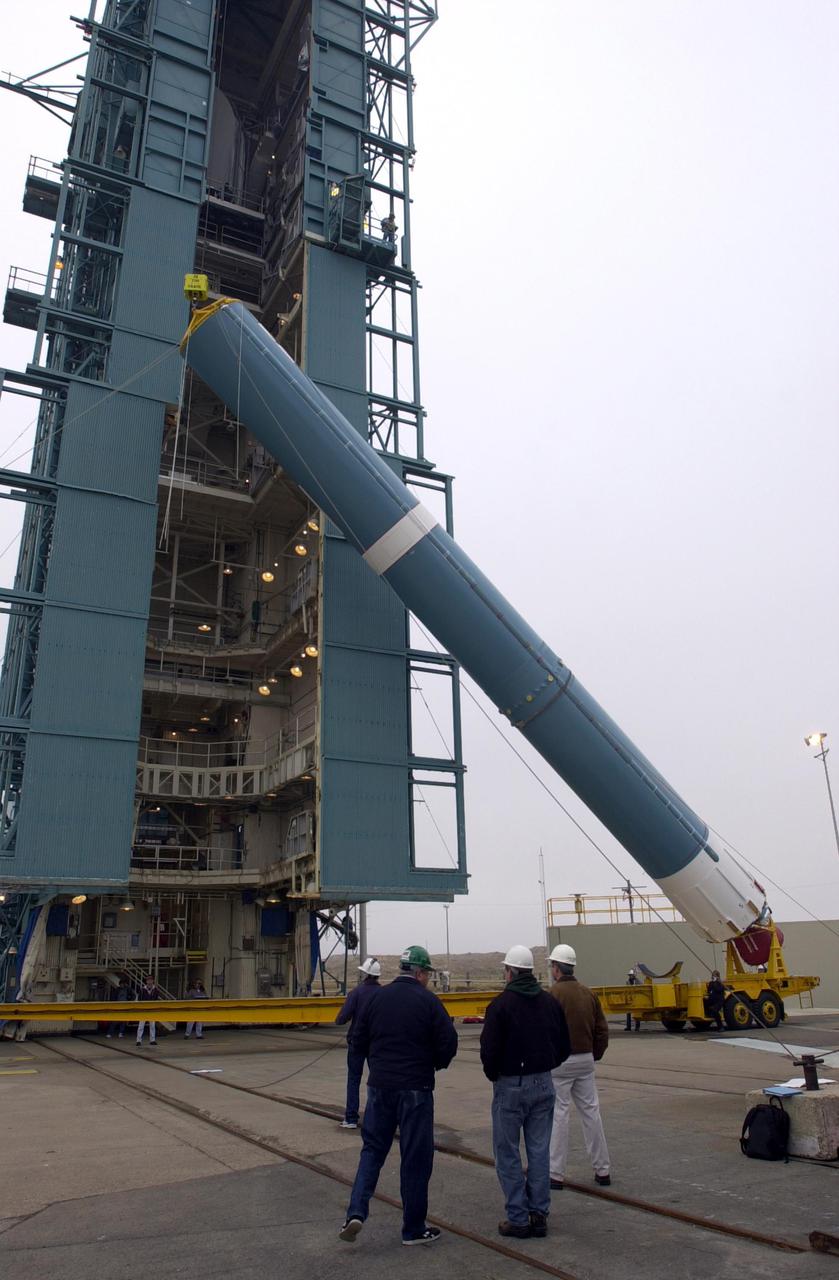
VANDENBERG AIR FORCE BASE, CALIF. - At NASA Space Launch Complex 2 on Vandenberg Air Force Base in California, the Boeing Delta II rocket, launch vehicle for the CALIPSO_CloudSat spacecraft, is being raised to a vertical position. Once it is vertical, it will be lifted up into the Mobile service tower, or gantry. CALIPSO stands for Cloud-Aerosol Lidar and Infrared Pathfinder Satellite Observation. CALIPSO and CloudSat are highly complementary satellites and together will provide never-before-seen 3-D perspectives of how clouds and aerosols form, evolve, and affect weather and climate. CALIPSO and CloudSat will fly in formation with three other satellites in the A-train constellation to enhance understanding of our climate system. Launch of CALIPSO_CloudSat aboard a Boeing Delta II rocket is scheduled for 3:01 a.m. Sept. 29.

VANDENBERG AIR FORCE BASE, Calif. - This is the mission patch for the CALIPSO/CloudSat mission showing the dual spacecraft. It hangs on the wall inside the Astrotech Payload Processing Facility at Vandenberg Air Force Base in California, where the CALIPSO/CloudSat spacecraft is being readied for launch. CALIPSO stands for Cloud-Aerosol Lidar and Infrared Pathfinder Satellite Observation. It will fly in combination with the CloudSat satellite to provide never-before-seen 3-D perspectives of how clouds and aerosols form, evolve, and affect weather and climate. CALIPSO and CloudSat will join three other satellites in orbit to enhance understanding of climate systems. Launch of CALIPSO/CloudSat is scheduled for April 21.
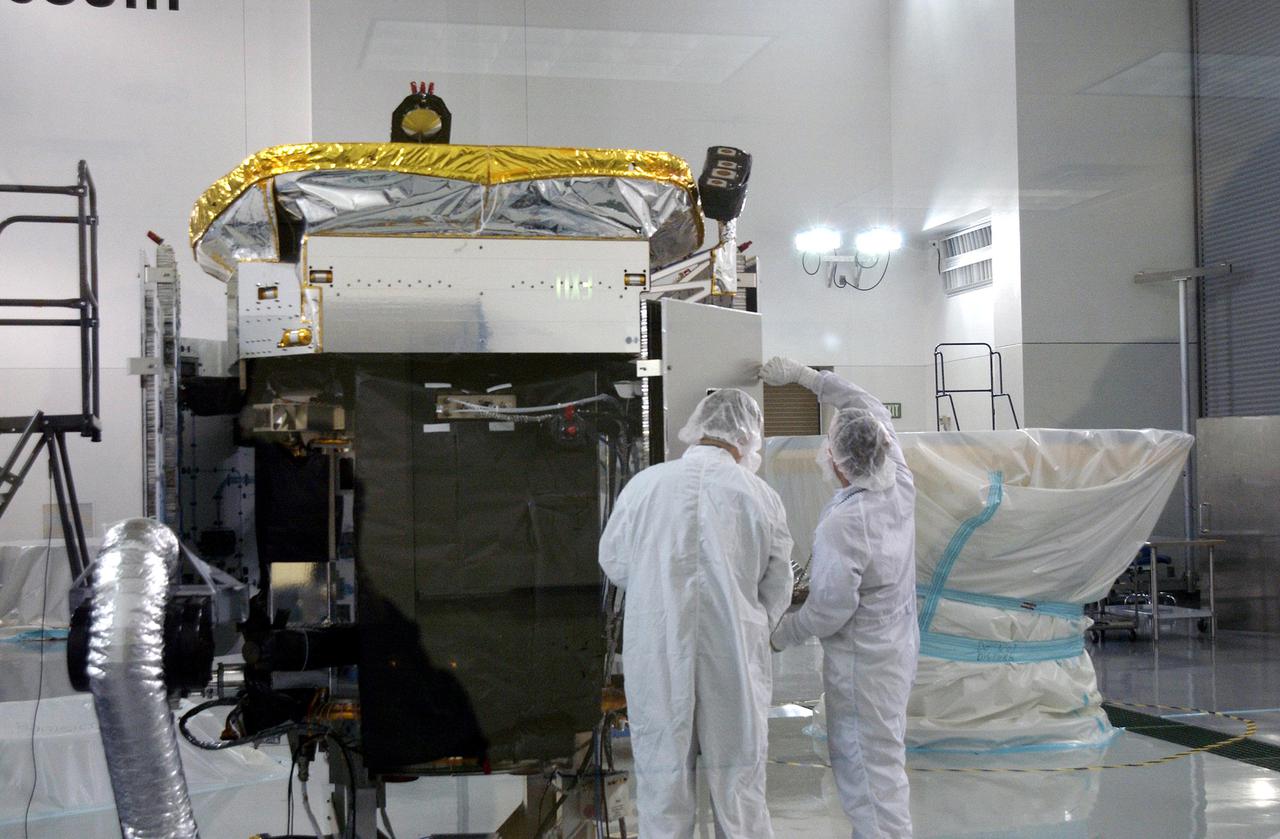
KENNEDY SPACE CENTER, FLA. - In the Astrotech Payload Processing Facility at Vandenberg Air Force Base, workers from NASA’s Jet Propulsion Laboratory in California and Ball Aerospace from Boulder, Colo., prepare the CloudSat spacecraft before conducting the Cloud Profiling Radar (CPR) functional tests. CloudSat will fly in combination with the Cloud-Aerosol Lidar and Infrared Pathfinder Satellite Observation (CALIPSO) to provide never-before-seen 3-D perspectives of how clouds and aerosols form, evolve, and affect weather and climate. CALIPSO and CloudSat will join three other satellites to enhance understanding of climate systems. The launch date for CALIPSO_ CloudSat is no earlier than Aug. 22.
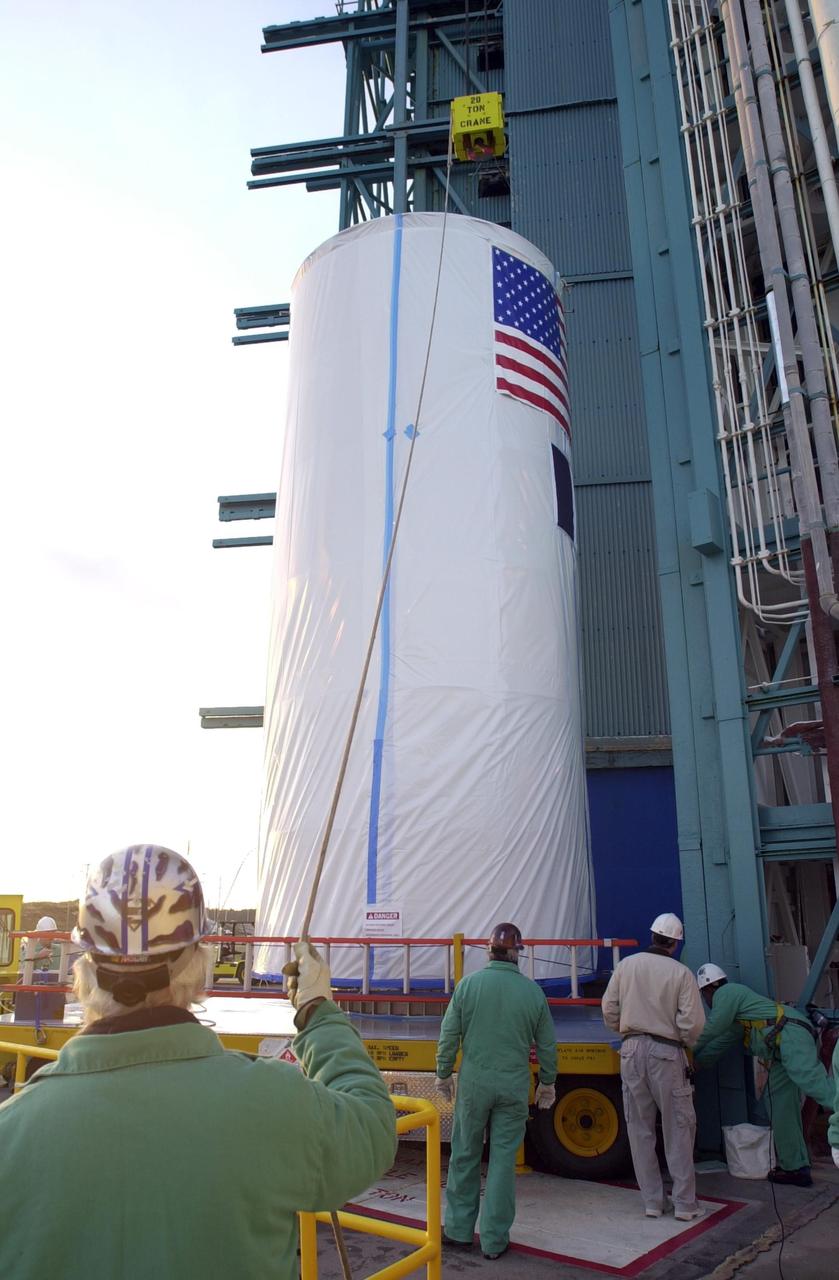
VANDENBERG AIR FORCE BASE, Calif. - On Space Launch Complex 2 at Vandenberg Air Force Base in California, a crane is attached to the dual spacecraft CALIPSO and CloudSat, covered by a transport canister. The spacecraft will be lifted and mated with a Boeing Delta II rocket for launch on April 21. CALIPSO stands for Cloud-Aerosol Lidar and Infrared Pathfinder Satellite Observation. It will fly in combination with the CloudSat satellite to provide never-before-seen 3-D perspectives of how clouds and aerosols form, evolve, and affect weather and climate. CALIPSO and CloudSat will join three other satellites in orbit to enhance understanding of climate systems. Launch of CALIPSO/CloudSat is scheduled for April 21.
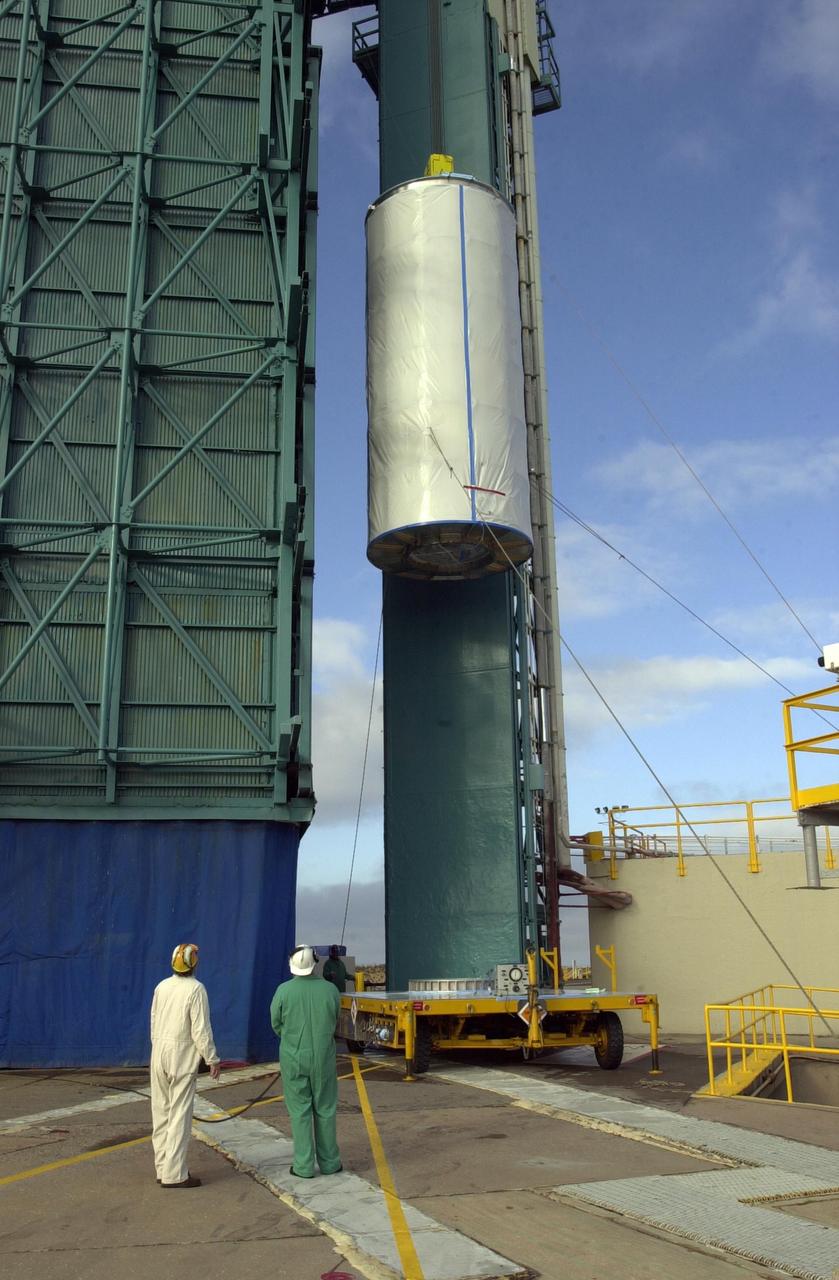
VANDENBERG AIR FORCE BASE, Calif. - On Space Launch Complex 2 at Vandenberg Air Force Base in California, the dual spacecraft CALIPSO and CloudSat, covered by a transport canister, is lifted up into the mobile service tower. There the spacecraft will be mated with a Boeing Delta II rocket for launch on April 21. CALIPSO stands for Cloud-Aerosol Lidar and Infrared Pathfinder Satellite Observation. It will fly in combination with the CloudSat satellite to provide never-before-seen 3-D perspectives of how clouds and aerosols form, evolve, and affect weather and climate. CALIPSO and CloudSat will join three other satellites in orbit to enhance understanding of climate systems. Launch of CALIPSO/CloudSat is scheduled for April 21.

VANDENBERG AIR FORCE BASE, Calif. - On Space Launch Complex 2 at Vandenberg Air Force Base in California, the dual spacecraft CALIPSO and CloudSat, removed from its transport canister, is being mated with the second stage of its Boeing Delta II rocket for launch on April 21. CALIPSO stands for Cloud-Aerosol Lidar and Infrared Pathfinder Satellite Observation. It will fly in combination with the CloudSat satellite to provide never-before-seen 3-D perspectives of how clouds and aerosols form, evolve, and affect weather and climate. CALIPSO and CloudSat will join three other satellites in orbit to enhance understanding of climate systems. Launch of CALIPSO/CloudSat is scheduled for April 21.
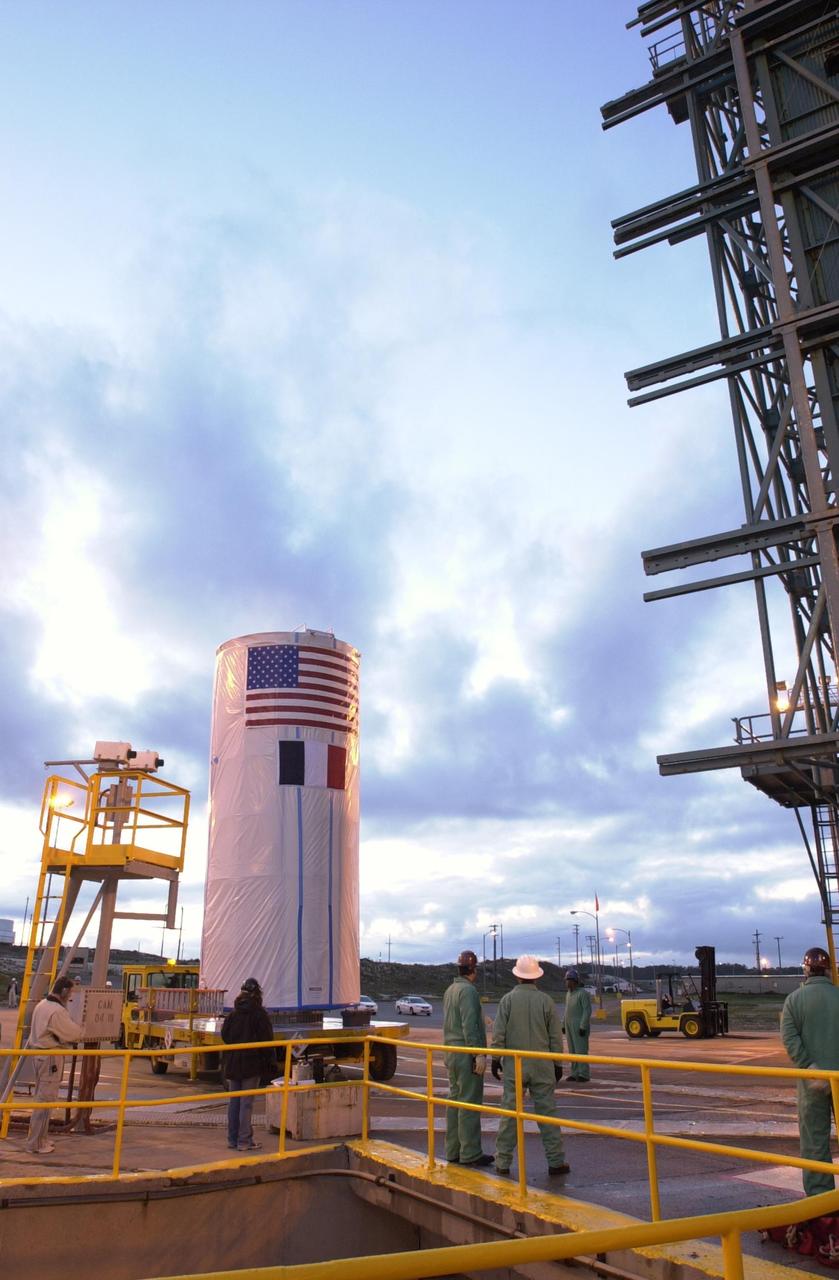
VANDENBERG AIR FORCE BASE, Calif. - On Vandenberg Air Force Base in California, the dual spacecraft CALIPSO and CloudSat, covered by a transport canister, moves toward the mobile service tower on Space Launch Complex 2. There the spacecraft will be lifted and mated with a Boeing Delta II rocket for launch on April 21. CALIPSO stands for Cloud-Aerosol Lidar and Infrared Pathfinder Satellite Observation. It will fly in combination with the CloudSat satellite to provide never-before-seen 3-D perspectives of how clouds and aerosols form, evolve, and affect weather and climate. CALIPSO and CloudSat will join three other satellites in orbit to enhance understanding of climate systems. Launch of CALIPSO/CloudSat is scheduled for April 21.

VANDENBERG AIR FORCE BASE, Calif. - On Space Launch Complex 2 at Vandenberg Air Force Base in California, the dual spacecraft CALIPSO and CloudSat, removed from its transport canister, is being mated in the mobile service tower with the second stage of its Boeing Delta II rocket for launch on April 21. CALIPSO stands for Cloud-Aerosol Lidar and Infrared Pathfinder Satellite Observation. It will fly in combination with the CloudSat satellite to provide never-before-seen 3-D perspectives of how clouds and aerosols form, evolve, and affect weather and climate. CALIPSO and CloudSat will join three other satellites in orbit to enhance understanding of climate systems. Launch of CALIPSO/CloudSat is scheduled for April 21.
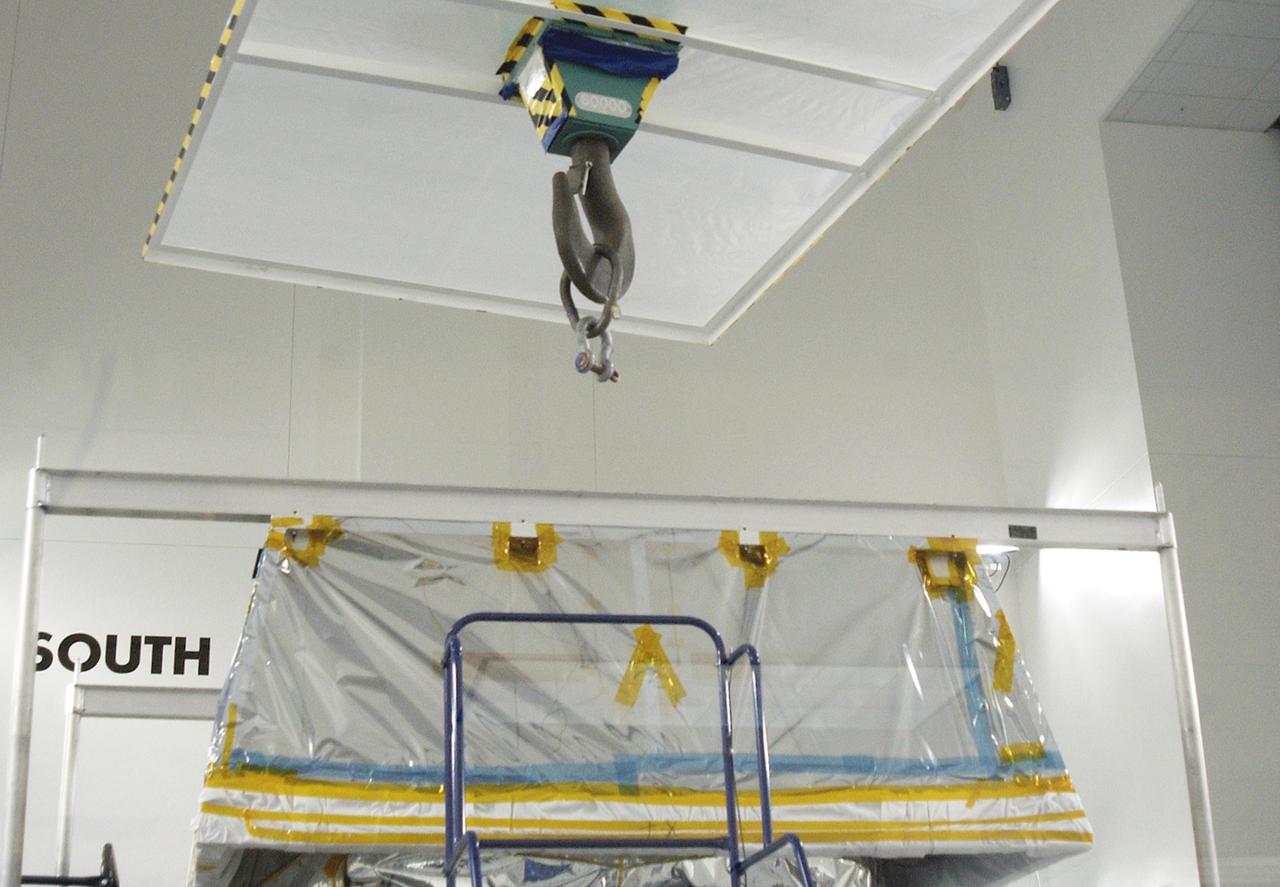
KENNEDY SPACE CENTER, FLA. - In the Astrotech Payload Processing Facility at Vandenberg Air Force Base, the CloudSat spacecraft sports a “hat” seen here that will be used during Cloud Profiling Radar (CPR) functional tests. The hat is used to absorb the RF radiation that is emitted by the instrument during the test. CloudSat will fly in combination with the Cloud-Aerosol Lidar and Infrared Pathfinder Satellite Observation (CALIPSO) to provide never-before-seen 3-D perspectives of how clouds and aerosols form, evolve, and affect weather and climate. CALIPSO and CloudSat will join three other satellites to enhance understanding of climate systems. The launch date for CALIPSO_ CloudSat is no earlier than Aug. 22.
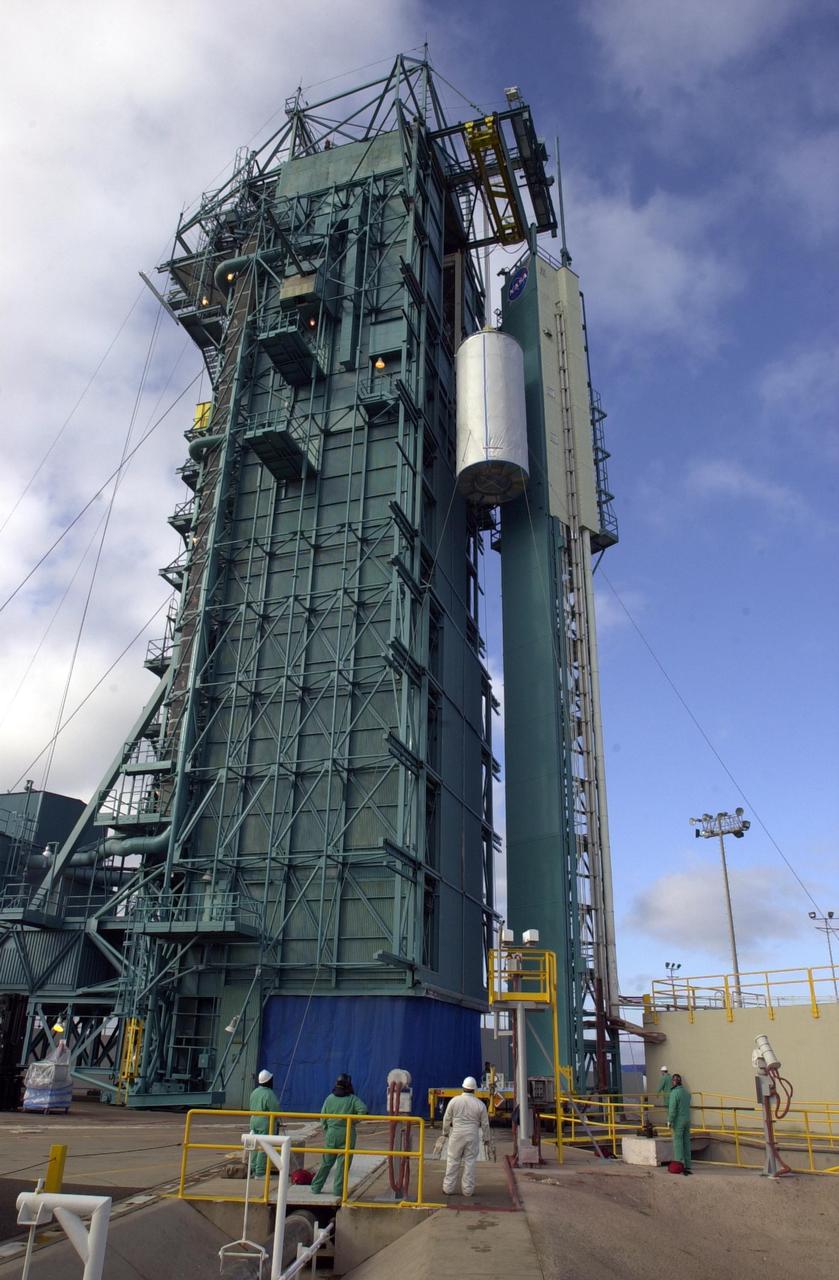
VANDENBERG AIR FORCE BASE, Calif. - On Space Launch Complex 2 at Vandenberg Air Force Base in California, the dual spacecraft CALIPSO and CloudSat, covered by a transport canister, is lifted up into the mobile service tower. There the spacecraft will be mated with a Boeing Delta II rocket for launch on April 21. CALIPSO stands for Cloud-Aerosol Lidar and Infrared Pathfinder Satellite Observation. It will fly in combination with the CloudSat satellite to provide never-before-seen 3-D perspectives of how clouds and aerosols form, evolve, and affect weather and climate. CALIPSO and CloudSat will join three other satellites in orbit to enhance understanding of climate systems. Launch of CALIPSO/CloudSat is scheduled for April 21.
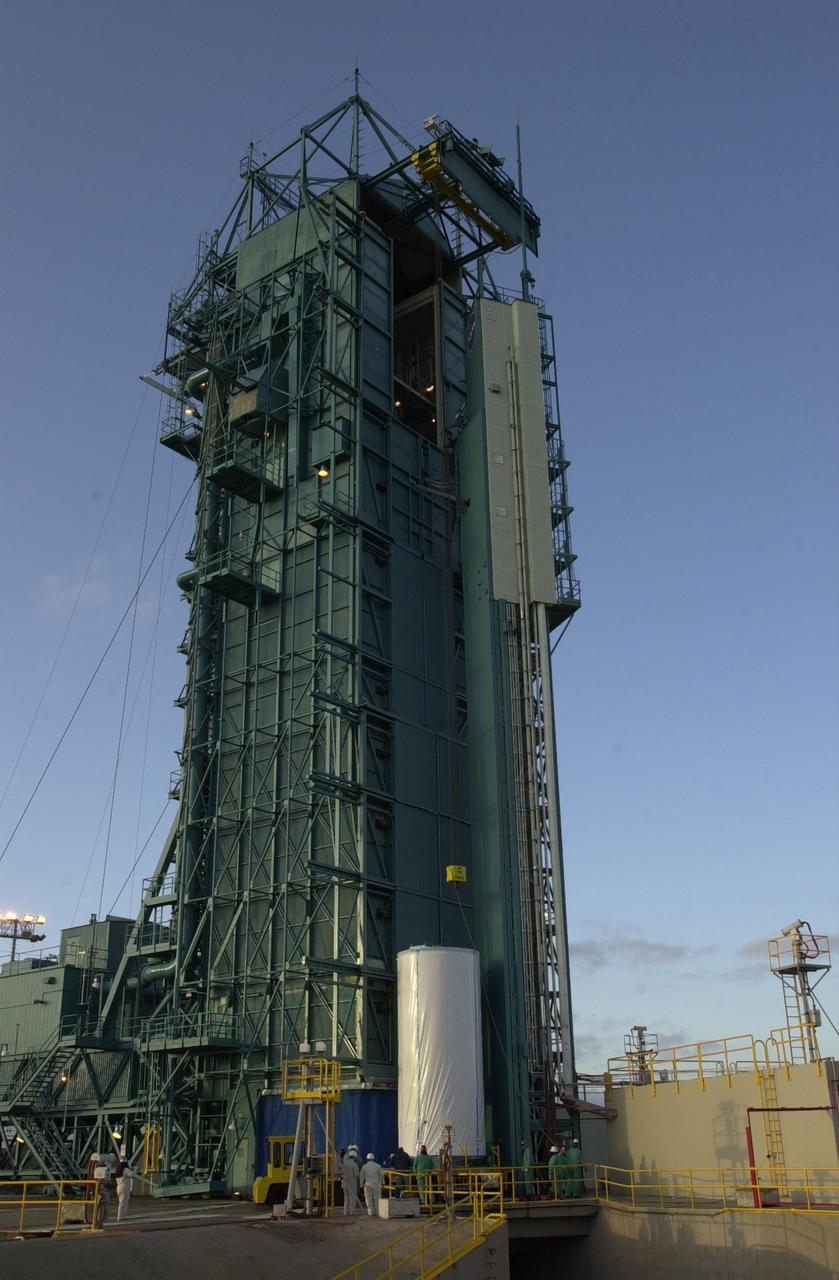
VANDENBERG AIR FORCE BASE, Calif. - On Space Launch Complex 2 at Vandenberg Air Force Base in California, the dual spacecraft CALIPSO and CloudSat, covered by a transport canister, is ready for lifting up into the mobile service tower. There the spacecraft will be mated with a Boeing Delta II rocket for launch on April 21. CALIPSO stands for Cloud-Aerosol Lidar and Infrared Pathfinder Satellite Observation. It will fly in combination with the CloudSat satellite to provide never-before-seen 3-D perspectives of how clouds and aerosols form, evolve, and affect weather and climate. CALIPSO and CloudSat will join three other satellites in orbit to enhance understanding of climate systems. Launch of CALIPSO/CloudSat is scheduled for April 21.
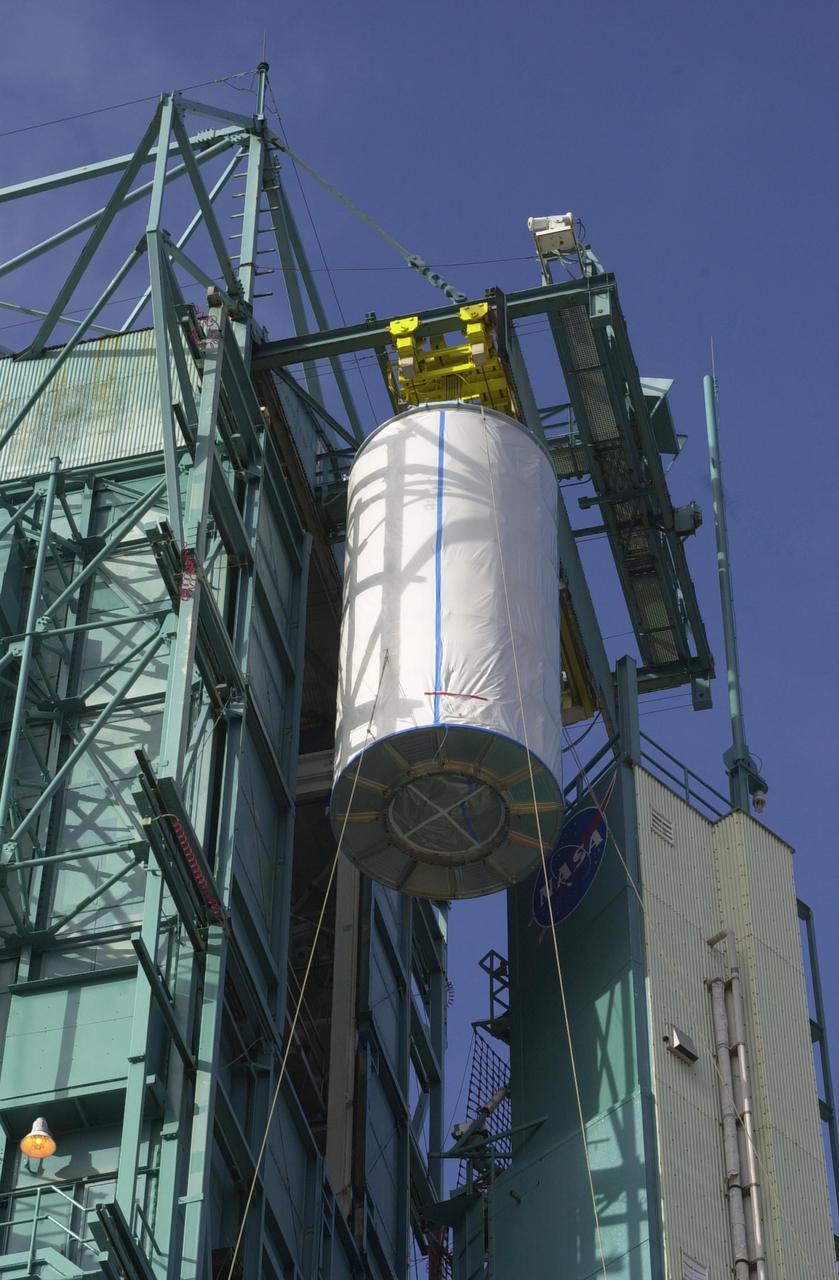
VANDENBERG AIR FORCE BASE, Calif. - On Space Launch Complex 2 at Vandenberg Air Force Base in California, the dual spacecraft CALIPSO and CloudSat, covered by a transport canister, is lifted up into the mobile service tower. There the spacecraft will be mated with a Boeing Delta II rocket for launch on April 21. CALIPSO stands for Cloud-Aerosol Lidar and Infrared Pathfinder Satellite Observation. It will fly in combination with the CloudSat satellite to provide never-before-seen 3-D perspectives of how clouds and aerosols form, evolve, and affect weather and climate. CALIPSO and CloudSat will join three other satellites in orbit to enhance understanding of climate systems. Launch of CALIPSO/CloudSat is scheduled for April 21.
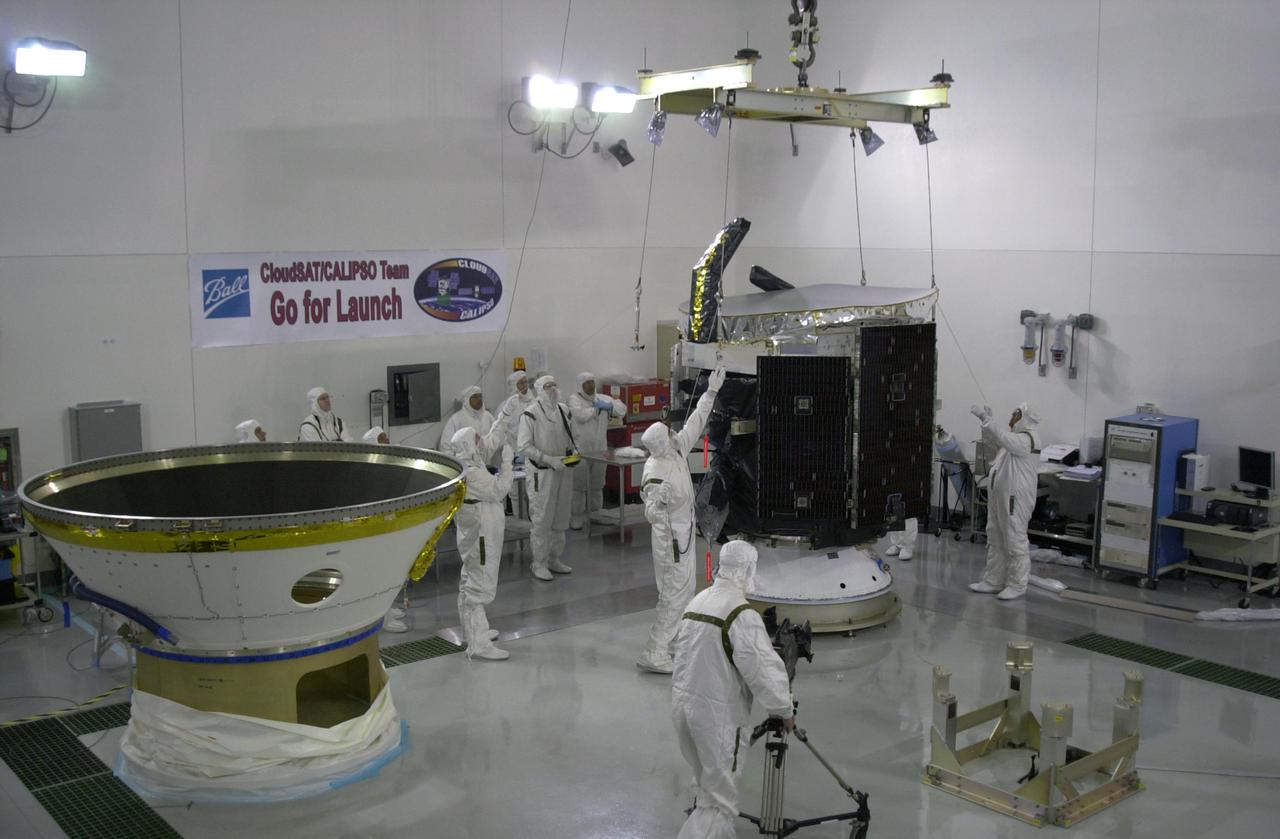
KENNEDY SPACE CENTER, FLA. - In a clean room at Vandenberg Air Force Base in California, at right, a crane is attached to NASA's CloudSat spacecraft. CloudSat is being moved for installation into the lower portion of the Delta Payload Attach Fitting at left. CloudSat joins the CALIPSO spacecraft for launch. CALIPSO stands for Cloud-Aerosol Lidar and Infrared Pathfinder Satellite Observation. CALIPSO and CloudSat are highly complementary satellites that will provide never-before-seen 3-D perspectives of how clouds and aerosols form, evolve, and affect weather and climate. CALIPSO and CloudSat will fly in formation with three other satellites in the A-train constellation to enhance understanding of our climate system. Launch of CALIPSO_CloudSat aboard a Boeing Delta II rocket is scheduled for 3:01 a.m. PDT Sept. 29.
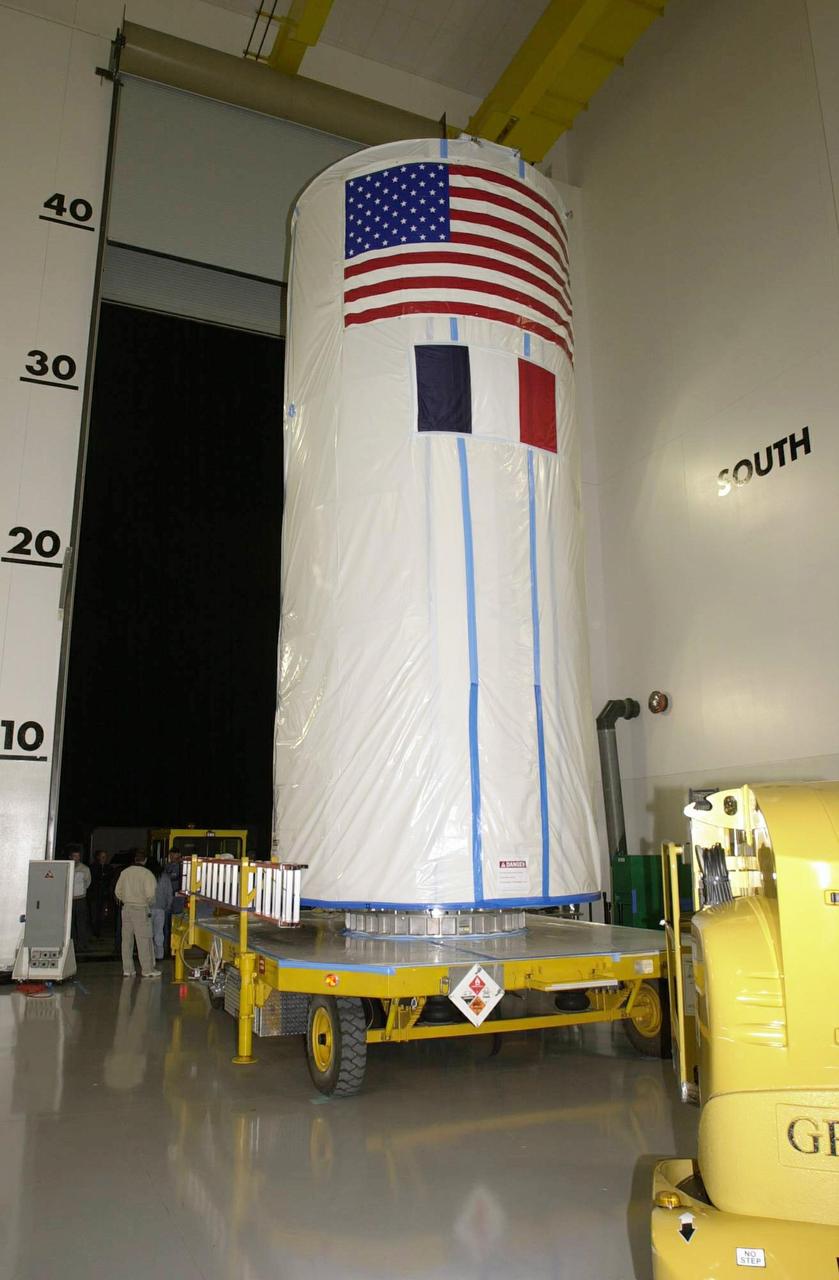
VANDENBERG AIR FORCE BASE, CALIF. - The CALIPSO/CloudSat spacecraft is in a transport canister ready for the move to Space Launch Complex 2. There it will be lifted and mated with a Boeing Delta II rocket for launch on April 21. CALIPSO stands for Cloud-Aerosol Lidar and Infrared Pathfinder Satellite Observation. It will fly in combination with the CloudSat satellite to provide never-before-seen 3-D perspectives of how clouds and aerosols form, evolve, and affect weather and climate. CALIPSO and CloudSat will join three other satellites in orbit to enhance understanding of climate systems.
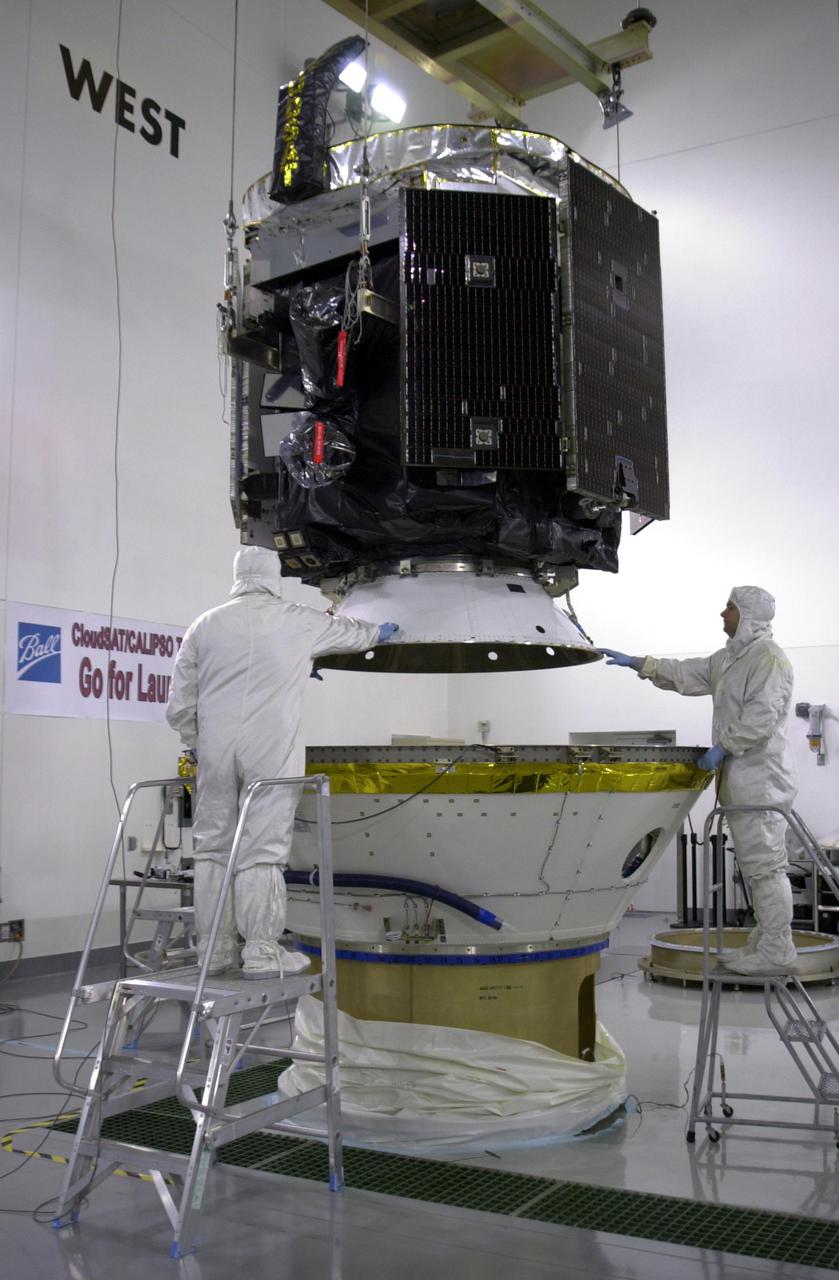
KENNEDY SPACE CENTER, FLA. - In a clean room at Vandenberg Air Force Base in California, workers ensure NASA's CloudSat spacecraft is lowered safely into the lower portion of the Delta Payload Attach Fitting. CloudSat joins the CALIPSO spacecraft for launch. CALIPSO stands for Cloud-Aerosol Lidar and Infrared Pathfinder Satellite Observation. CALIPSO and CloudSat are highly complementary satellites that will provide never-before-seen 3-D perspectives of how clouds and aerosols form, evolve, and affect weather and climate. CALIPSO and CloudSat will fly in formation with three other satellites in the A-train constellation to enhance understanding of our climate system. Launch of CALIPSO_CloudSat aboard a Boeing Delta II rocket is scheduled for 3:01 a.m. PDT Sept. 29.
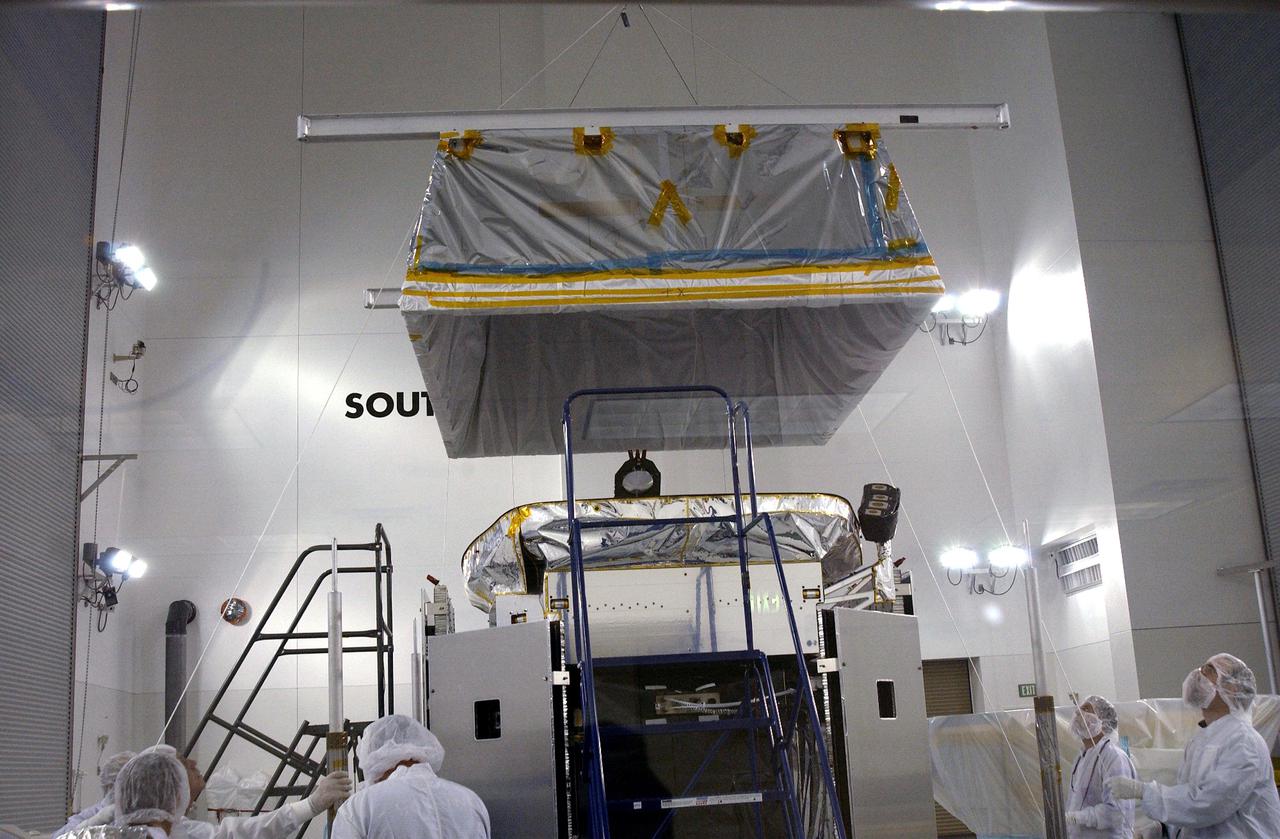
KENNEDY SPACE CENTER, FLA. - In the Astrotech Payload Processing Facility at Vandenberg Air Force Base, workers from NASA’s Jet Propulsion Laboratory in California and Ball Aerospace from Boulder, Colo., lower a 'hat' toward the CloudSat spacecraft before conducting the Cloud Profiling Radar (CPR) functional tests. The hat is used to absorb the RF radiation that is emitted by the instrument during the test. CloudSat will fly in combination with the Cloud-Aerosol Lidar and Infrared Pathfinder Satellite Observation (CALIPSO) to provide never-before-seen 3-D perspectives of how clouds and aerosols form, evolve, and affect weather and climate. CALIPSO and CloudSat will join three other satellites to enhance understanding of climate systems. The launch date for CALIPSO_ CloudSat is no earlier than Aug. 22.
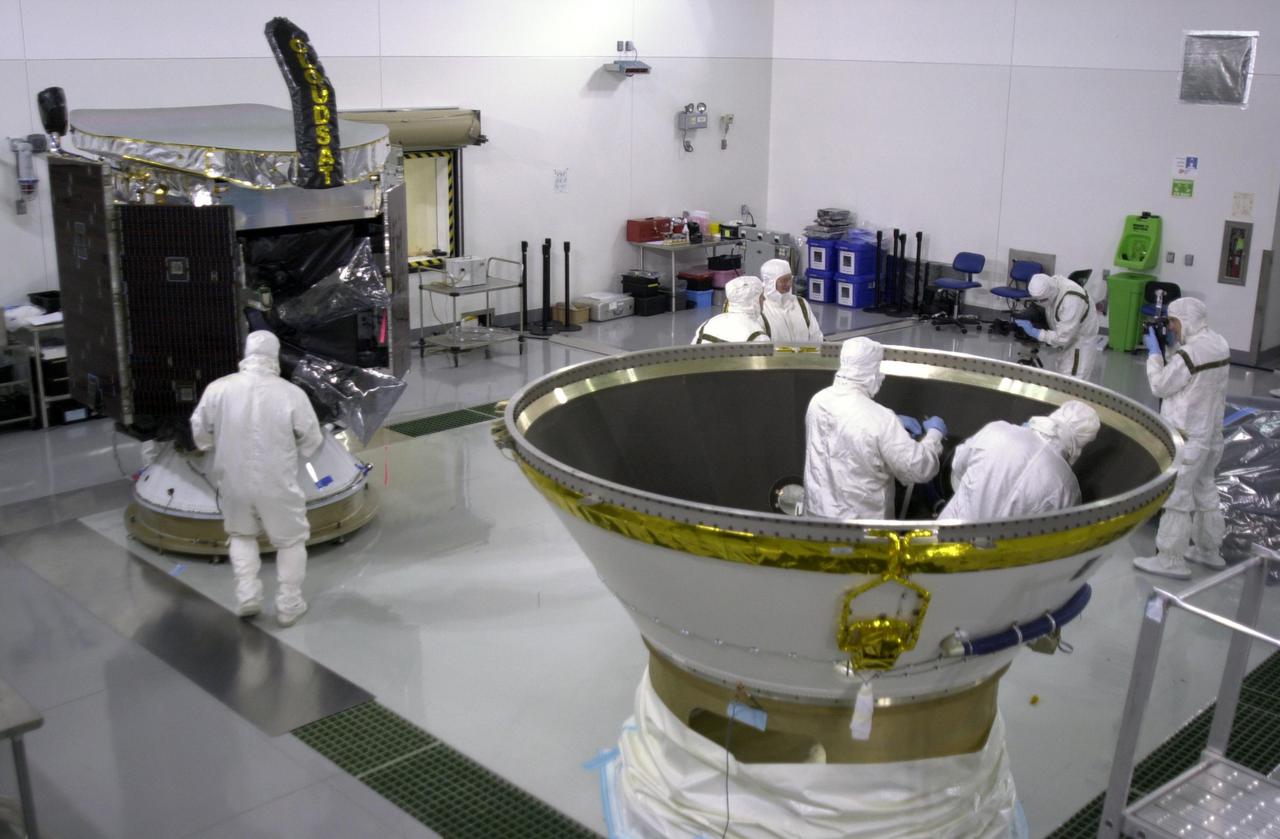
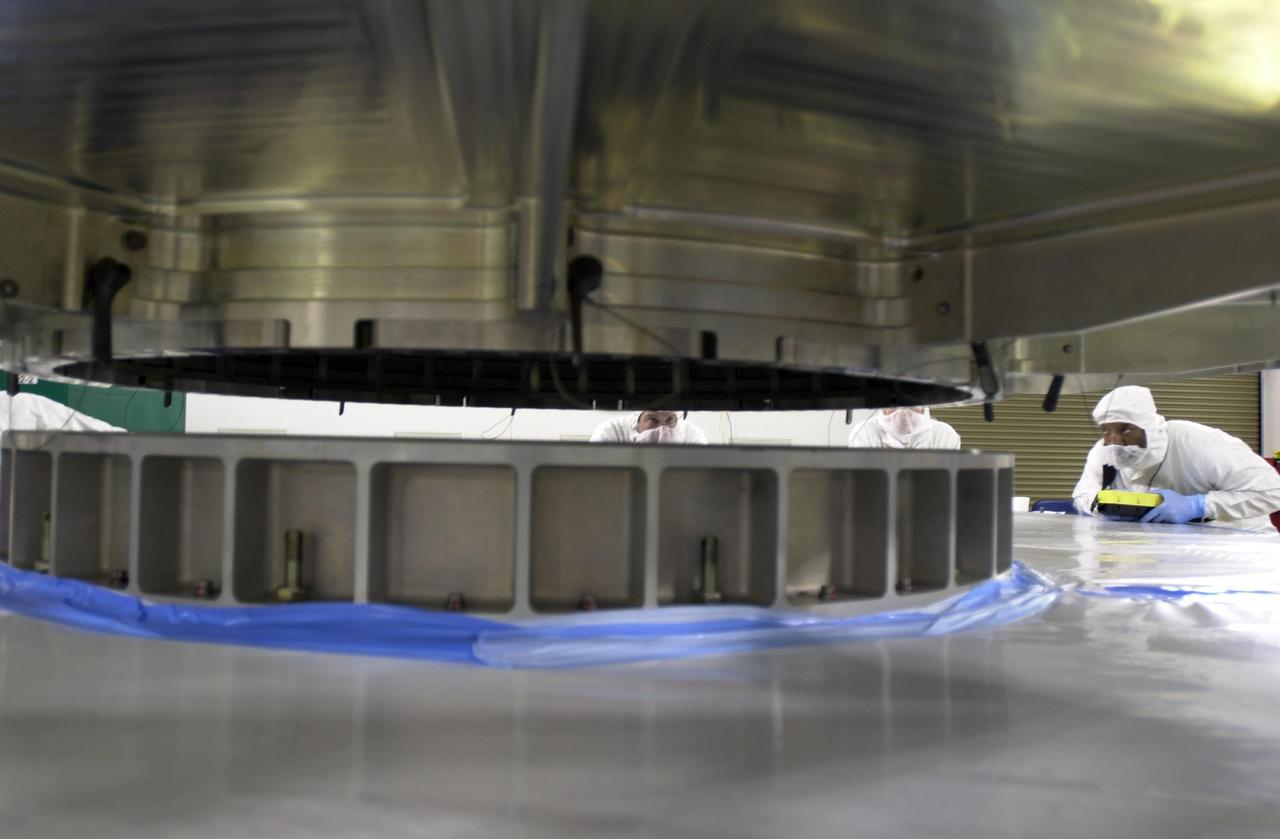
KENNEDY SPACE CENTER, FLA. - In a clean room at Vandenberg Air Force Base in California, workers prepare the inside of the lower portion of the Delta Payload Attach Fitting (right) for the installation of NASA's CloudSat spacecraft (left). CloudSat joins the CALIPSO spacecraft for launch. CALIPSO stands for Cloud-Aerosol Lidar and Infrared Pathfinder Satellite Observation. CALIPSO and CloudSat are highly complementary satellites that will provide never-before-seen 3-D perspectives of how clouds and aerosols form, evolve, and affect weather and climate. CALIPSO and CloudSat will fly in formation with three other satellites in the A-train constellation to enhance understanding of our climate system. Launch of CALIPSO_CloudSat aboard a Boeing Delta II rocket is scheduled for 3:01 a.m. PDT Sept. 29.
VANDENBERG AIR FORCE BASE, Calif. - Inside the Astrotech Payload Processing Facility on Vandenberg Air Force Base in California, the dual spacecraft CALIPSO and CloudSat, covered by a transport canister, is lowered onto a payload transporter. The spacecraft is being moved to Space Launch Complex 2. There the spacecraft will be lifted and mated with a Boeing Delta II rocket for launch on April 21. CALIPSO stands for Cloud-Aerosol Lidar and Infrared Pathfinder Satellite Observation. It will fly in combination with the CloudSat satellite to provide never-before-seen 3-D perspectives of how clouds and aerosols form, evolve, and affect weather and climate. CALIPSO and CloudSat will join three other satellites in orbit to enhance understanding of climate systems. Launch of CALIPSO/CloudSat is scheduled for April 21.
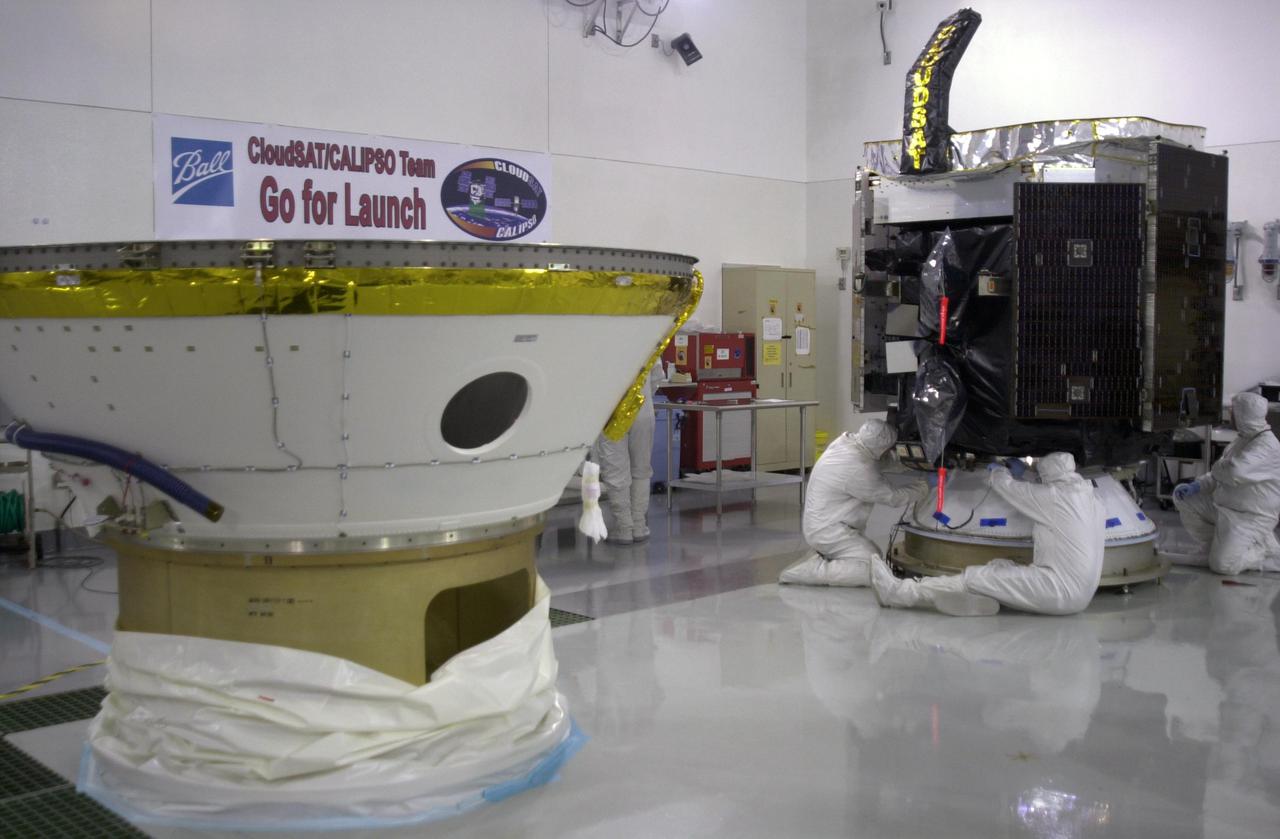
KENNEDY SPACE CENTER, FLA. - In a clean room at Vandenberg Air Force Base in California, workers prepare NASA's CloudSat spacecraft (right) that will be fitted inside the lower portion of the Delta Payload Attach Fitting at left. CloudSat joins the CALIPSO spacecraft for launch. CALIPSO stands for Cloud-Aerosol Lidar and Infrared Pathfinder Satellite Observation. CALIPSO and CloudSat are highly complementary satellites that will provide never-before-seen 3-D perspectives of how clouds and aerosols form, evolve, and affect weather and climate. CALIPSO and CloudSat will fly in formation with three other satellites in the A-train constellation to enhance understanding of our climate system. Launch of CALIPSO_CloudSat aboard a Boeing Delta II rocket is scheduled for 3:01 a.m. PDT Sept. 29.
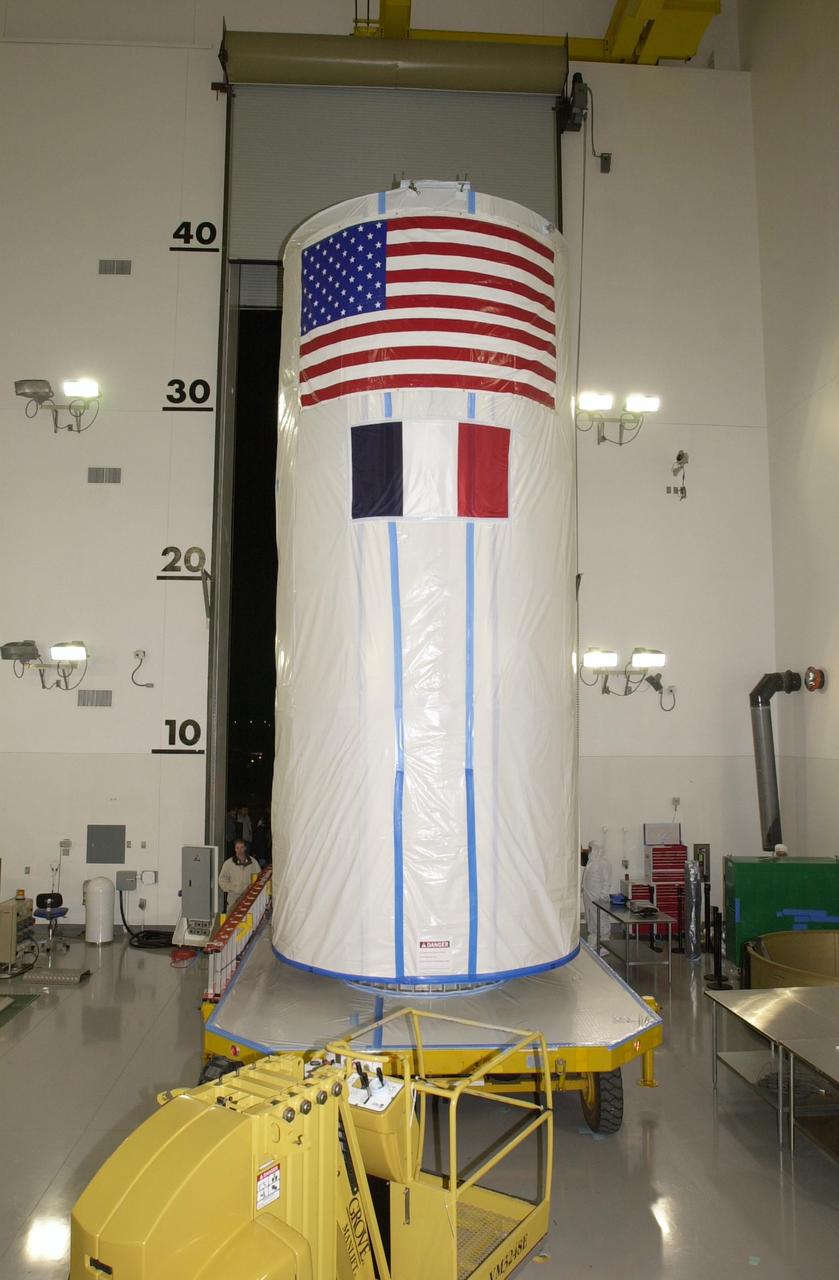
VANDENBERG AIR FORCE BASE, Calif. - Inside the Astrotech Payload Processing Facility on Vandenberg Air Force Base in California, the dual spacecraft CALIPSO and CloudSat, covered by a transport canister, is lowered onto a transporter. The spacecraft is being moved to Space Launch Complex 2. There the spacecraft will be lifted and mated with a Boeing Delta II rocket for launch on April 21. CALIPSO stands for Cloud-Aerosol Lidar and Infrared Pathfinder Satellite Observation. It will fly in combination with the CloudSat satellite to provide never-before-seen 3-D perspectives of how clouds and aerosols form, evolve, and affect weather and climate. CALIPSO and CloudSat will join three other satellites in orbit to enhance understanding of climate systems. Launch of CALIPSO/CloudSat is scheduled for April 21.
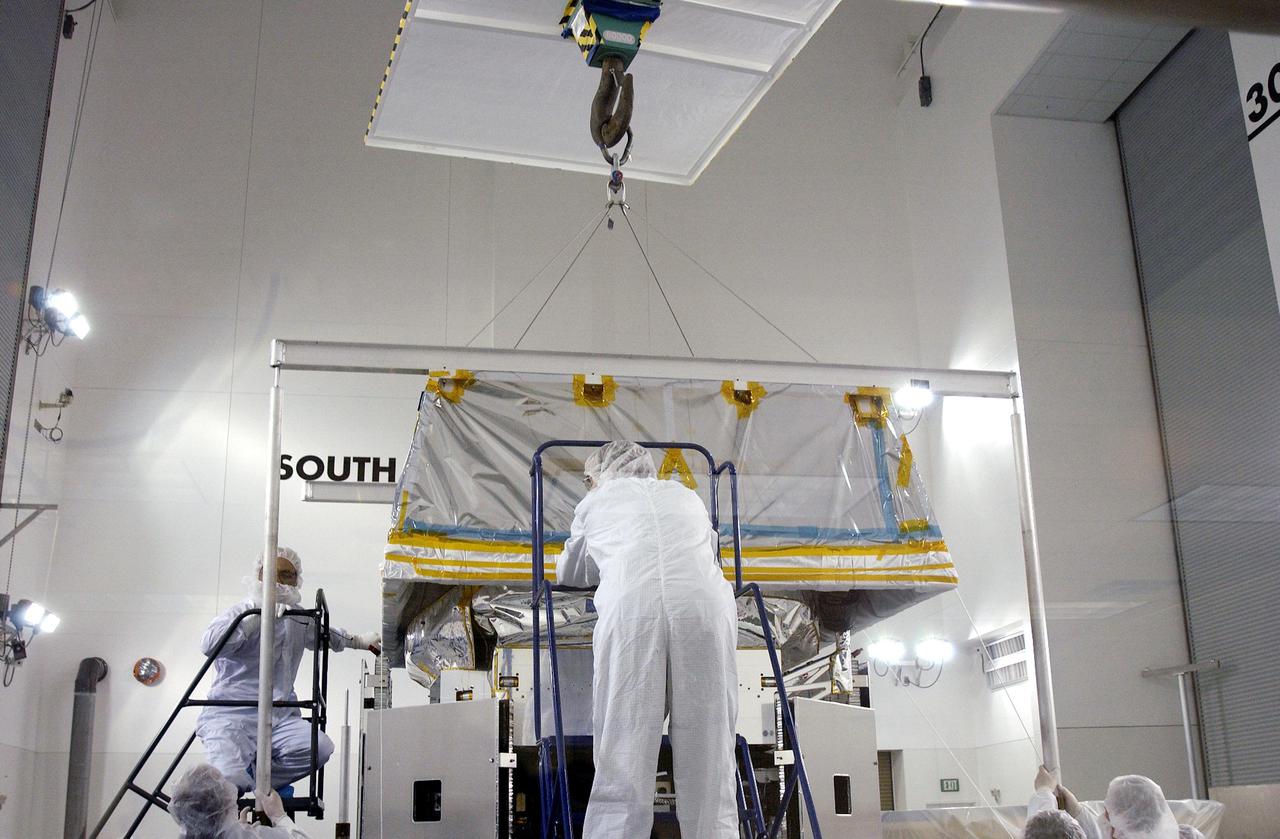
KENNEDY SPACE CENTER, FLA. - In the Astrotech Payload Processing Facility at Vandenberg Air Force Base, workers from NASA’s Jet Propulsion Laboratory in California and Ball Aerospace from Boulder, Colo., help guide a “hat” into place on the CloudSat spacecraft before conducting the Cloud Profiling Radar (CPR) functional tests. The hat is used to absorb the RF radiation that is emitted by the instrument during the test. CloudSat will fly in combination with the Cloud-Aerosol Lidar and Infrared Pathfinder Satellite Observation (CALIPSO) to provide never-before-seen 3-D perspectives of how clouds and aerosols form, evolve, and affect weather and climate. CALIPSO and CloudSat will join three other satellites to enhance understanding of climate systems. The launch date for CALIPSO_ CloudSat is no earlier than Aug. 22.
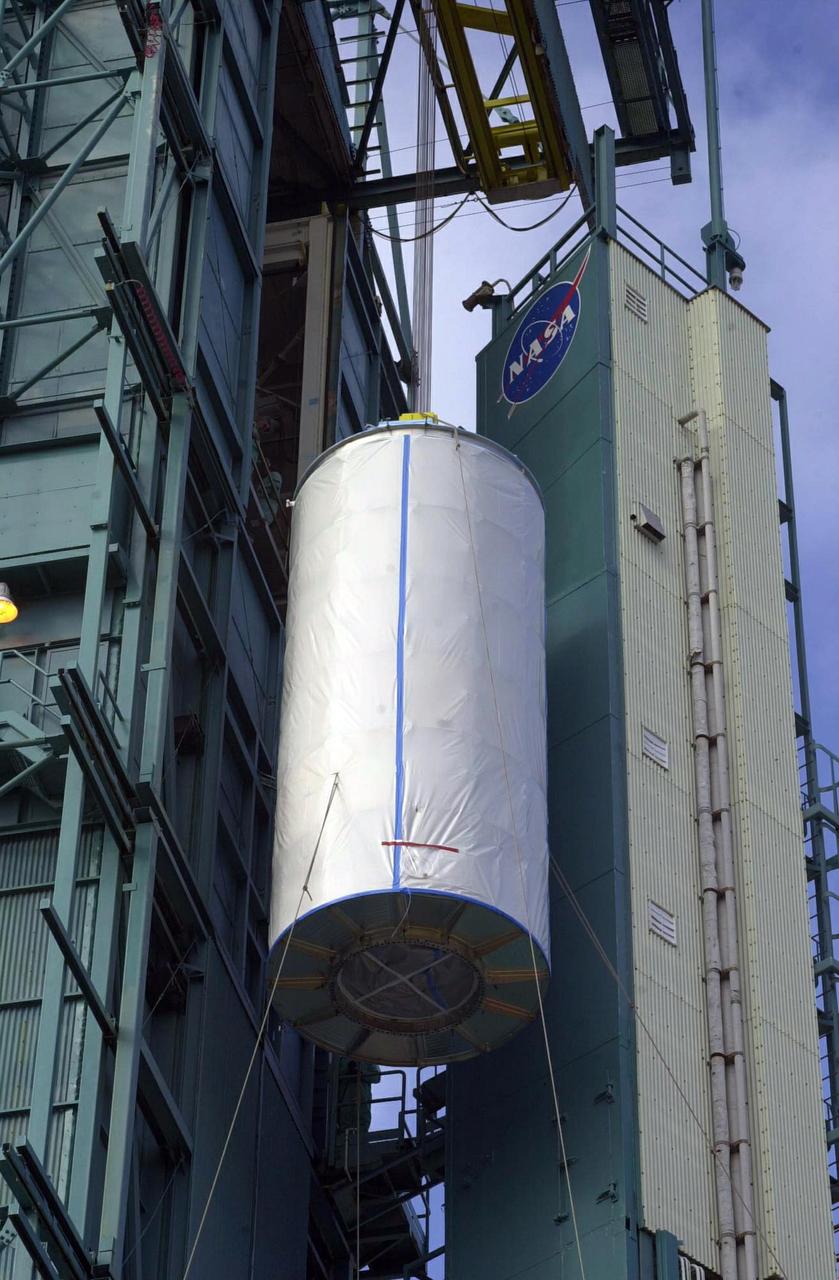
VANDENBERG AIR FORCE BASE, CALIF. - NASA's CALIPSO/CloudSat spacecraft are lifted at Space Launch Complex 2 at Vandenberg Air Force Base in preparation for integration with the Boeing Delta II launch vehicle. Launch of the dual spacecraft is scheduled for April 21. CALIPSO stands for Cloud-Aerosol Lidar and Infrared Pathfinder Satellite Observation. It will fly in combination with the CloudSat satellite to provide never-before-seen 3-D perspectives of how clouds and aerosols form, evolve, and affect weather and climate. CALIPSO and CloudSat will join three other satellites in orbit to enhance understanding of climate systems.
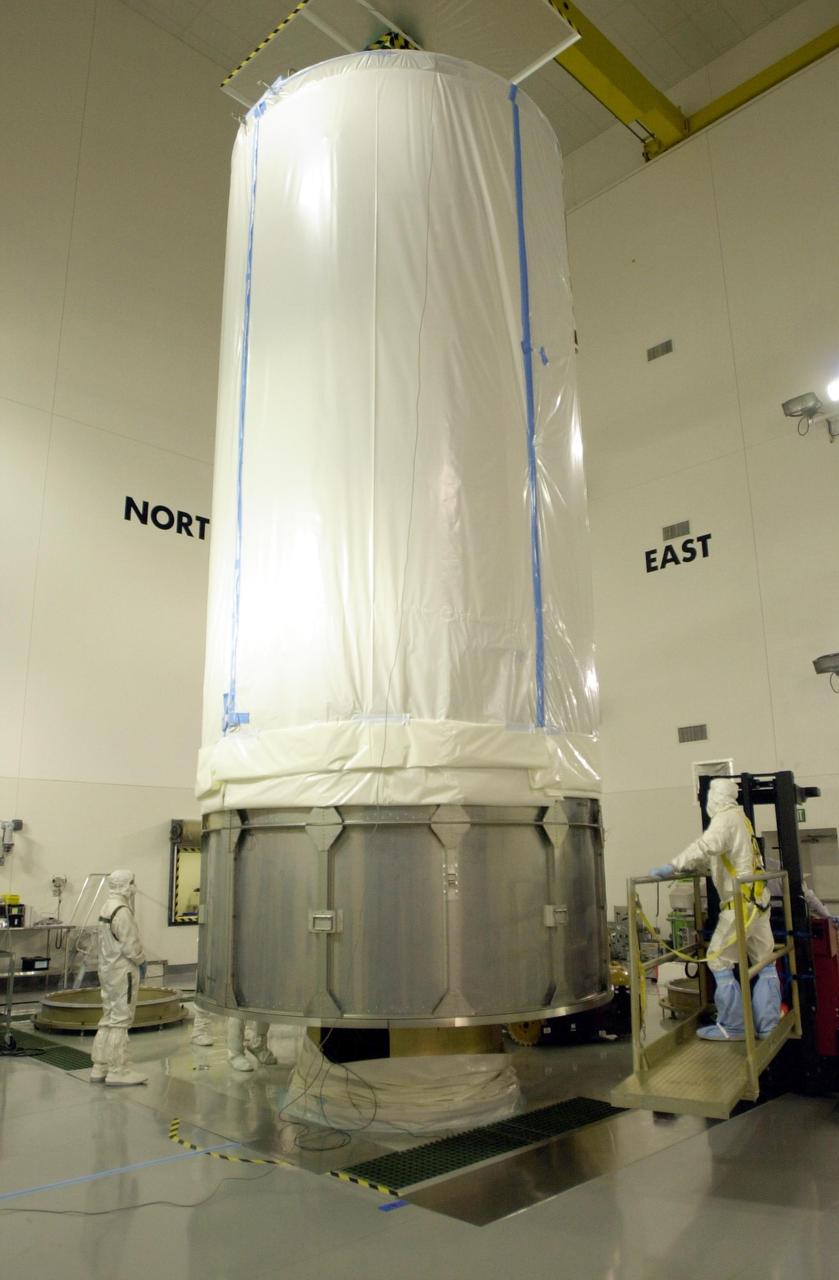
VANDENBERG AIR FORCE BASE, Calif. - Inside the Astrotech Payload Processing Facility on Vandenberg Air Force Base in California, the transport canister covers the dual spacecraft CALIPSO and CloudSat. The spacecraft will be moved to Space Launch Complex 2. There the spacecraft will be lifted and mated with a Boeing Delta II rocket for launch on April 21. CALIPSO stands for Cloud-Aerosol Lidar and Infrared Pathfinder Satellite Observation. It will fly in combination with the CloudSat satellite to provide never-before-seen 3-D perspectives of how clouds and aerosols form, evolve, and affect weather and climate. CALIPSO and CloudSat will join three other satellites in orbit to enhance understanding of climate systems.
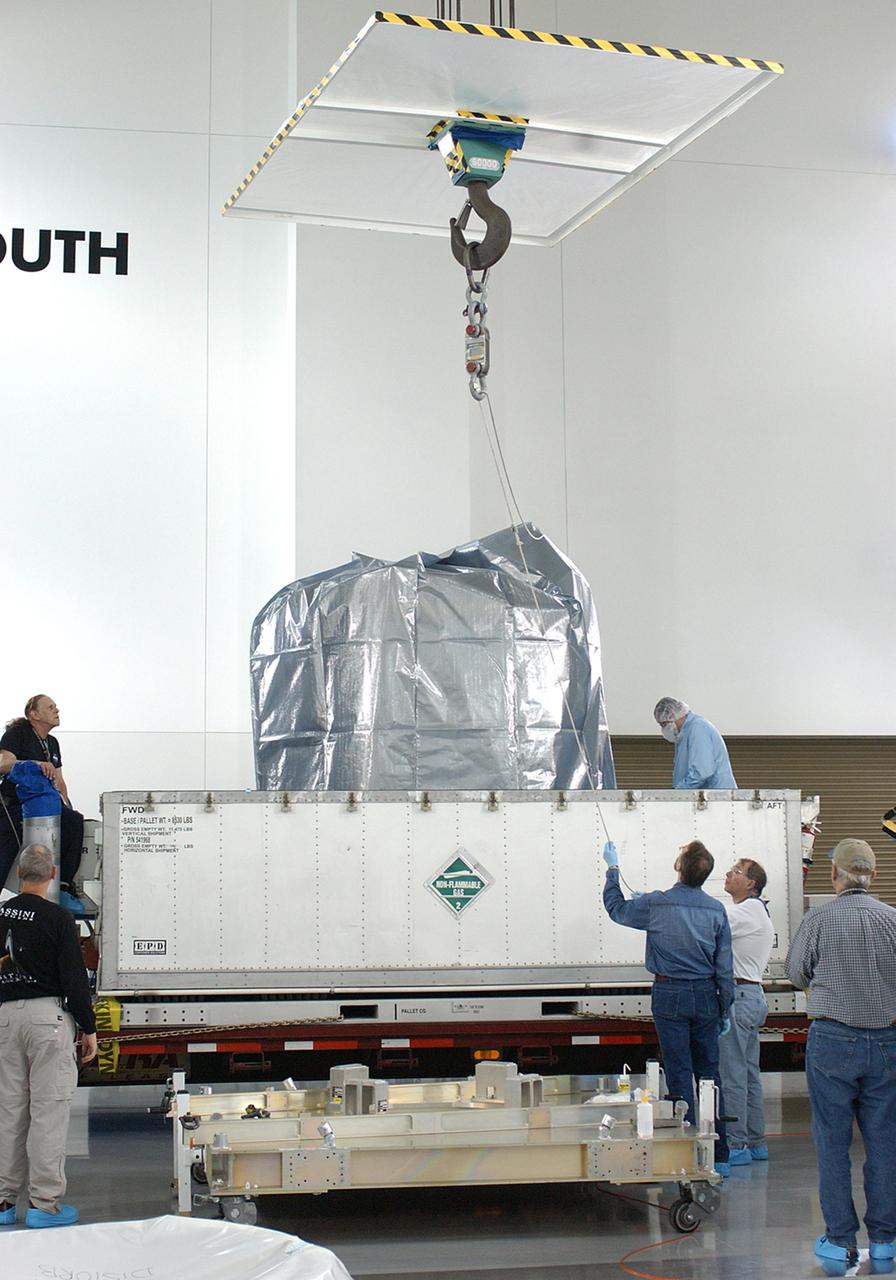
KENNEDY SPACE CENTER, FLA. - At the Astrotech Payload Processing Facility on Vandenberg Air Force Base in California, an overhead crane is attached to the CloudSat spacecraft to lift it out of its shipping container. CloudSat was shipped from Ball Aerospace and Technologies Corp. in Boulder, Colo. The spacecraft will undergo electrical and spacecraft transmitter testing. In combination with the Cloud-Aerosol Lidar and Infrared Pathfinder Satellite Observation (CALIPSO), the spacecraft will provide never-before-seen 3-D perspectives of how clouds and aerosols form, evolve, and affect weather and climate. CALIPSO and CloudSat will fly in formation with three other satellites to enhance understanding of climate systems. The launch date for CloudSat_CALIPSO is no earlier than Aug. 22.
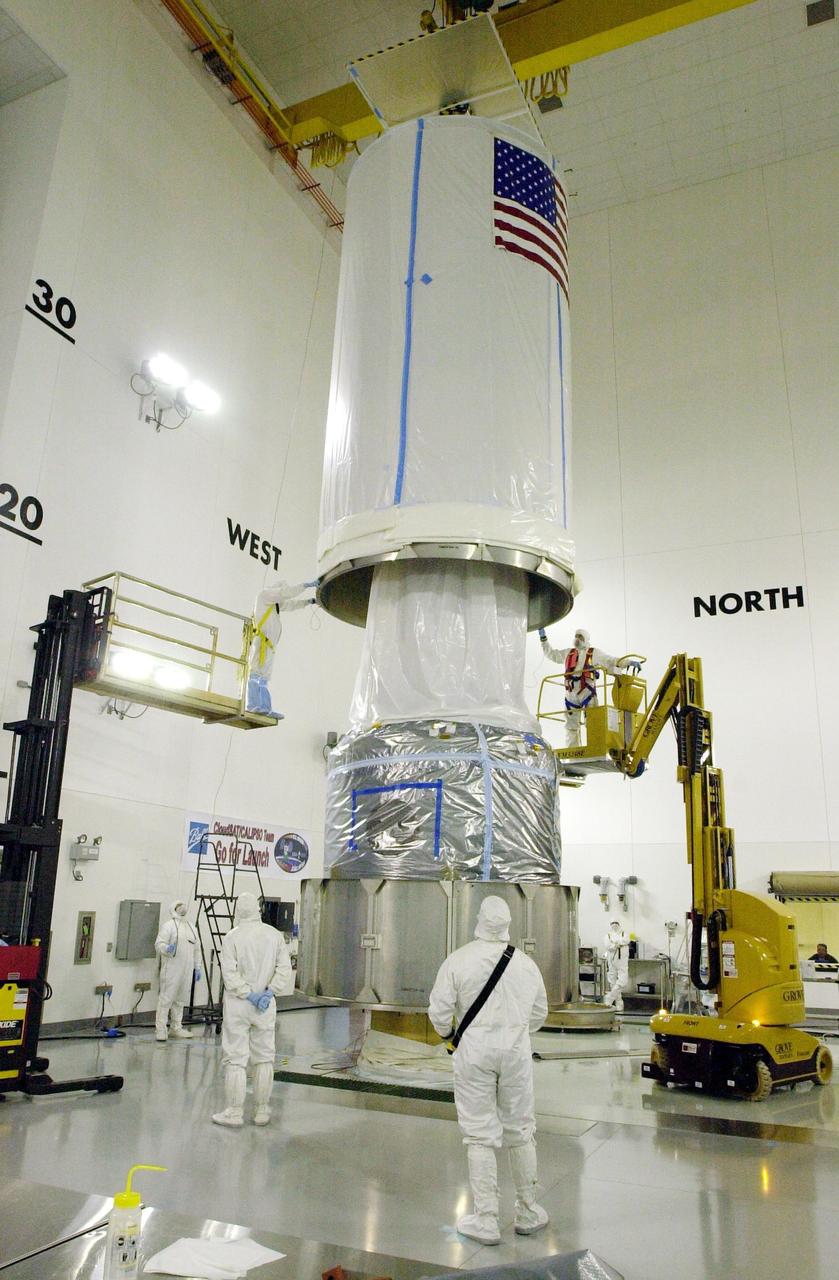
VANDENBERG AIR FORCE BASE, Calif. - Inside the Astrotech Payload Processing Facility on Vandenberg Air Force Base in California, the transport canister is lowered over the covered dual spacecraft CALIPSO and CloudSat below. Once inside the canister, the spacecraft will be moved to Space Launch Complex 2. There the spacecraft will be lifted and mated with a Boeing Delta II rocket for launch on April 21. CALIPSO stands for Cloud-Aerosol Lidar and Infrared Pathfinder Satellite Observation. It will fly in combination with the CloudSat satellite to provide never-before-seen 3-D perspectives of how clouds and aerosols form, evolve, and affect weather and climate. CALIPSO and CloudSat will join three other satellites in orbit to enhance understanding of climate systems.

VANDENBERG AIR FORCE BASE, Calif. - Inside the Astrotech Payload Processing Facility on Vandenberg Air Force Base in California, the transport canister is prepared for lifting. It will be placed over the covered dual spacecraft, CALIPSO and CloudSat, for the move to Space Launch Complex 2. There the spacecraft will be lifted and mated with a Boeing Delta II rocket for launch on April 21. CALIPSO stands for Cloud-Aerosol Lidar and Infrared Pathfinder Satellite Observation. It will fly in combination with the CloudSat satellite to provide never-before-seen 3-D perspectives of how clouds and aerosols form, evolve, and affect weather and climate. CALIPSO and CloudSat will join three other satellites in orbit to enhance understanding of climate systems.
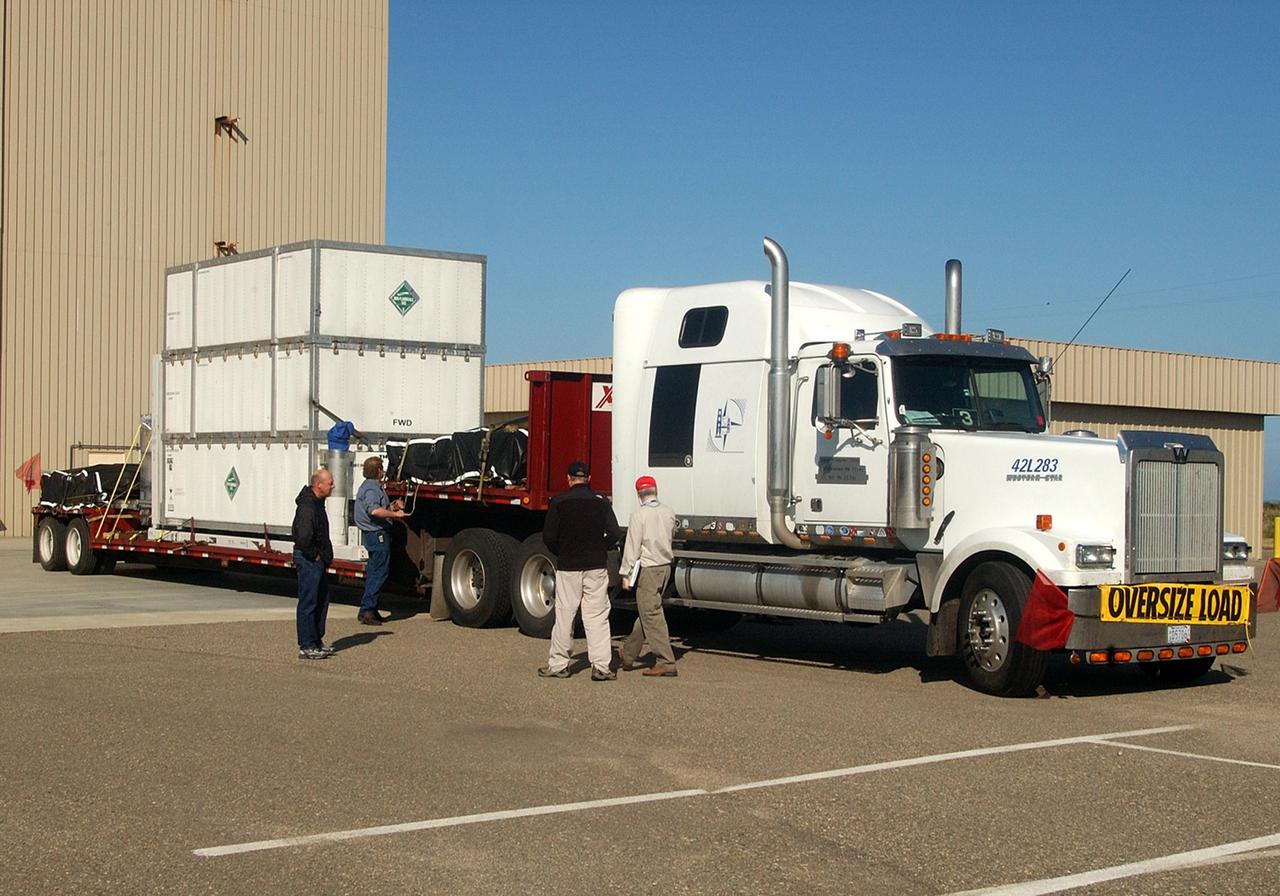
KENNEDY SPACE CENTER, FLA. - The CloudSat spacecraft arrives via truck at the Astrotech Payload Processing Facility on Vandenberg Air Force Base in California from Ball Aerospace and Technologies Corp. in Boulder, Colo. CloudSat will undergo electrical and spacecraft transmitter testing. In combination with the Cloud-Aerosol Lidar and Infrared Pathfinder Satellite Observation (CALIPSO), the spacecraft will provide never-before-seen 3-D perspectives of how clouds and aerosols form, evolve, and affect weather and climate. CALIPSO and CloudSat will fly in formation with three other satellites to enhance understanding of climate systems. The launch date for CloudSat_CALIPSO is no earlier than Aug. 22.