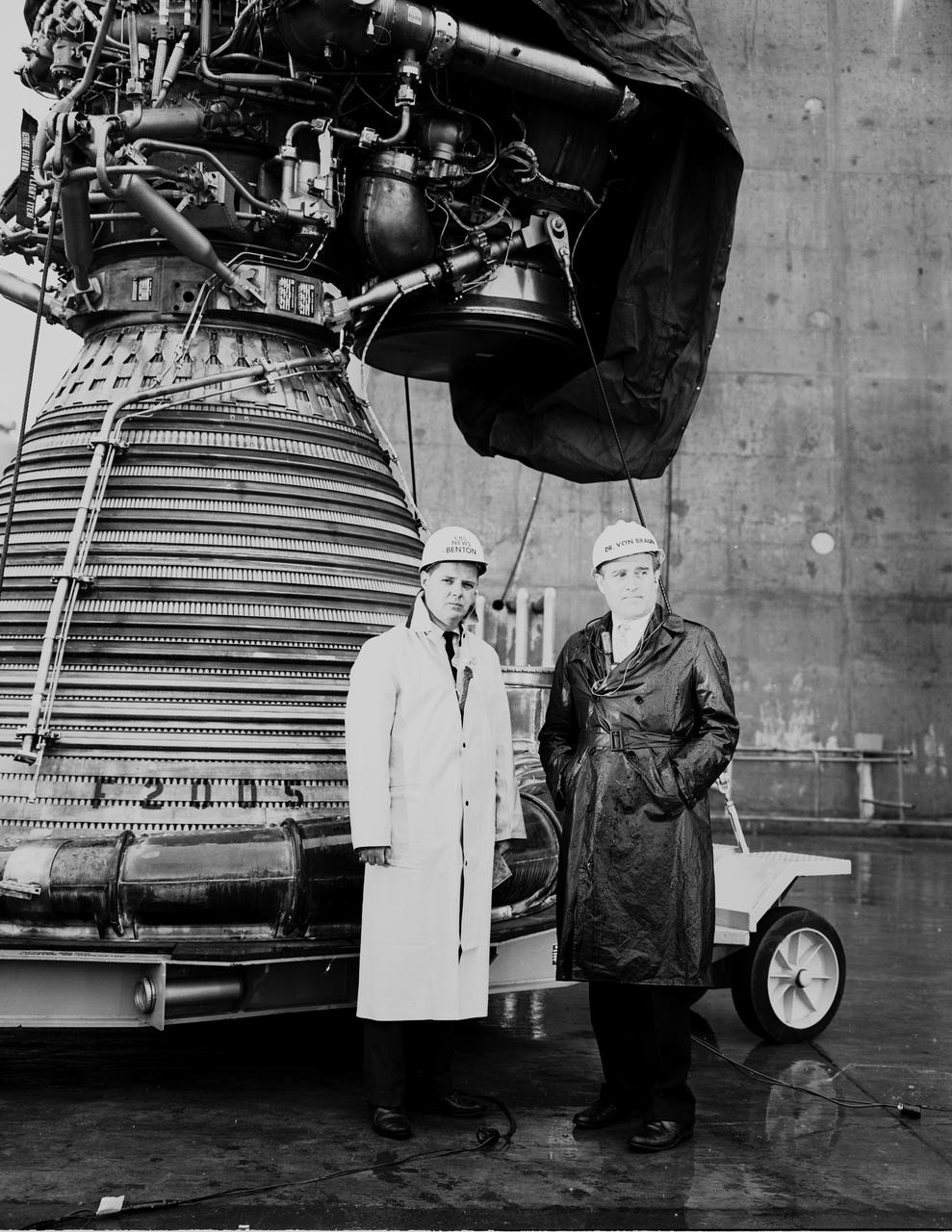
This is a photograph, probably from the early 1960s, that shows Dr. von Braun, right, with a correspondent for CBS News. The correspondent is believed to be Nelson Benton. The two men are standing in front of a huge rocket engine.

STS064-23-025 (9-20 Sept. 1994) --- With scissors in hand, astronaut Jerry M. Linenger, STS-64 mission specialist, prepares to cut off a lengthy sheet of correspondence from ground controllers. Called the Thermal Imaging Printing System (TIPS), the message center occupies a stowage locker on the space shuttle Discovery's middeck. Astronaut L. Blaine Hammond, pilot, retrieves a clothing item from a nearby locker. Photo credit: NASA or National Aeronautics and Space Administration
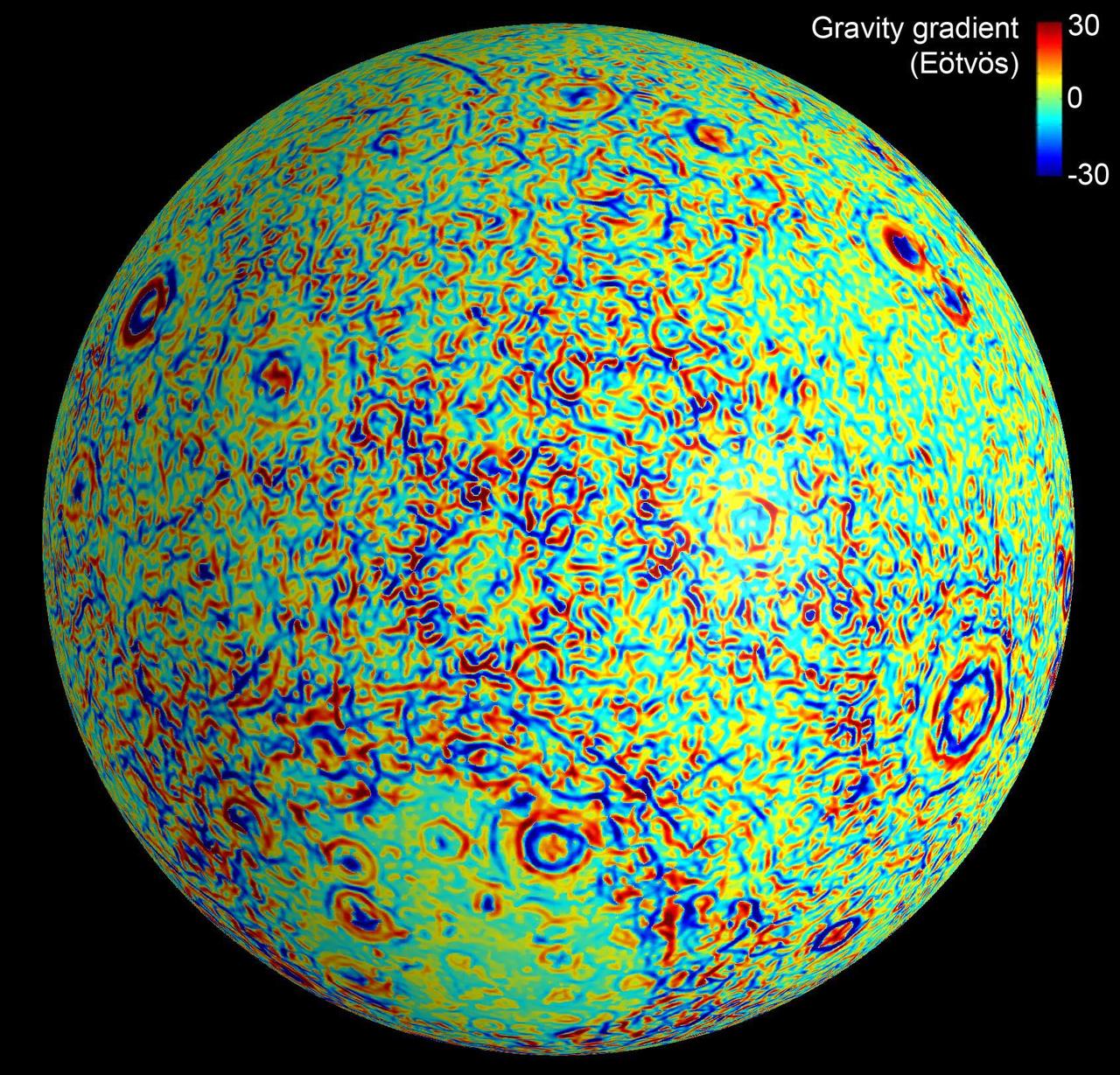
This moon map shows the gravity gradients calculated by NASA GRAIL mission. Red and blue correspond to stronger gravity gradients.
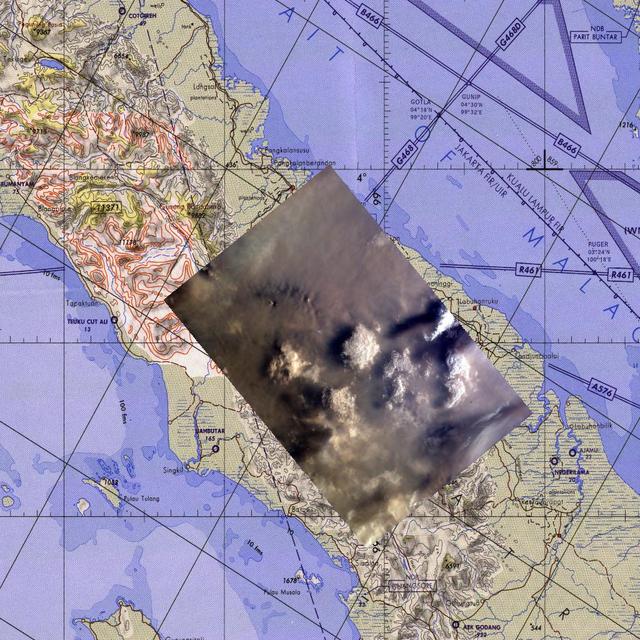
This map corresponds to NASA KidSat image MET 00215424 of the northern regions of Sumatra that was captured on Sept., 1997 during the Shuttle flight STS-86.

Prometheus dips into the inner F ring at its farthest point from Saturn in its orbit, creating a dark gore and a corresponding bright streamer
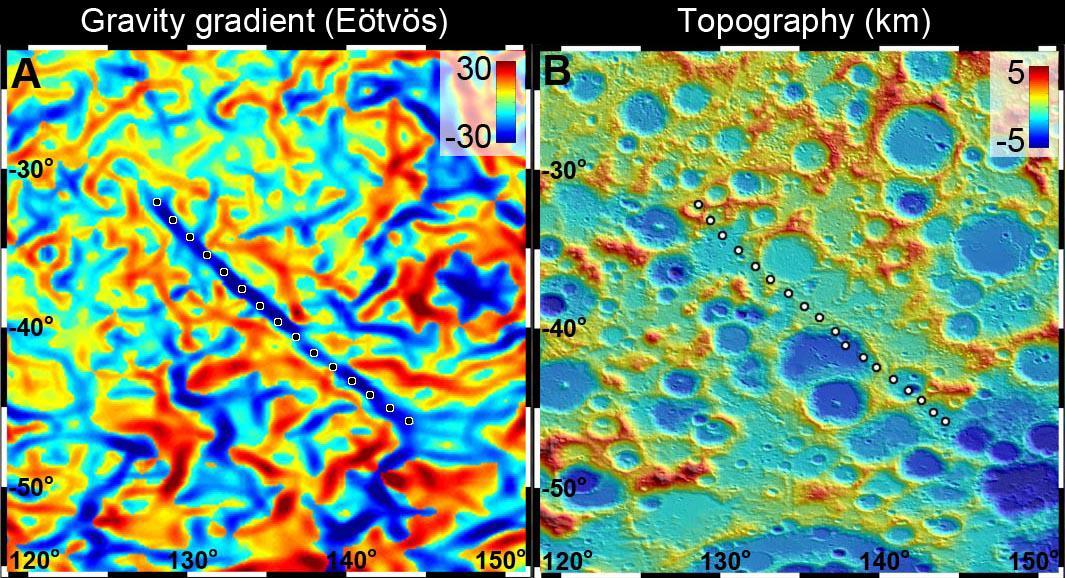
A 300-mile-long linear gravity anomaly on the far side of the moon has been revealed by gravity gradients measured by NASA GRAIL mission. GRAIL data are shown on the left, with red and blue corresponding to stronger gravity gradients.
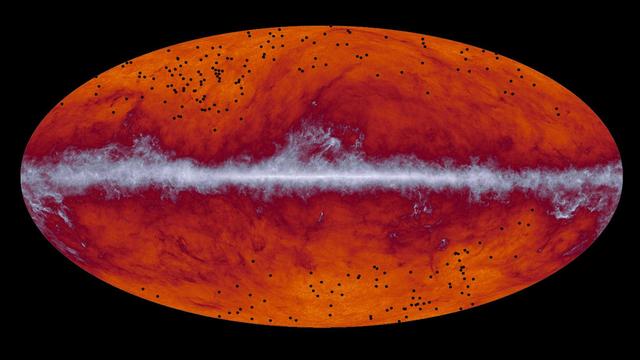
This map of the entire sky was captured by the European Space Agency's Planck mission. The band running through the middle corresponds to dust in our Milky Way galaxy. The black dots indicate the location of galaxy cluster candidates identified by Planck and subsequently observed by the European Space Agency's Herschel mission. http://photojournal.jpl.nasa.gov/catalog/PIA19330
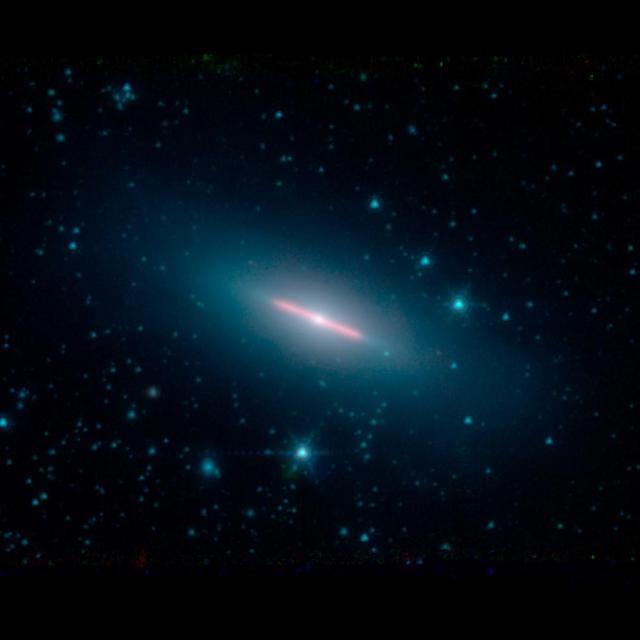
Galaxy NGC 5866 lies 44 million light-years from Earth and has a diameter of roughly 60,000 light-years — a little more than half the diameter of our own Milky Way galaxy. From our viewpoint, NGC 5866 is oriented almost exactly edge-on, yielding most of its structural features invisible. Spitzer detects infrared light, and the red color here corresponds to a wavelength typically emitted by dust. The clean edges of the dust emission from NGC 5866 indicate that there is a very flat ring or disk of dust circling the outer region of the galaxy. Spitzer took this image during its "cold" mission, which ended in 2009. The colors represent three infrared wavelengths captured by the Infrared Array Camera instrument. Blue light corresponds to a wavelength of 3.6 microns, produced mainly by stars; green corresponds to 4.5 microns, and red corresponds to 8 microns. https://photojournal.jpl.nasa.gov/catalog/PIA23129
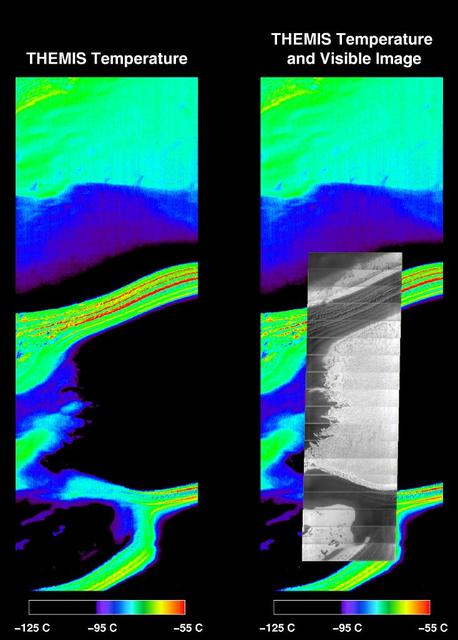
Simultaneous infrared and visible images taken byNASA Mars Odyssey show the Martian south polar cap in late summer. The black areas are at a temperature near -125 degrees Celsius -193 degrees Fahrenheit and correspond to solid carbon dioxide ice.
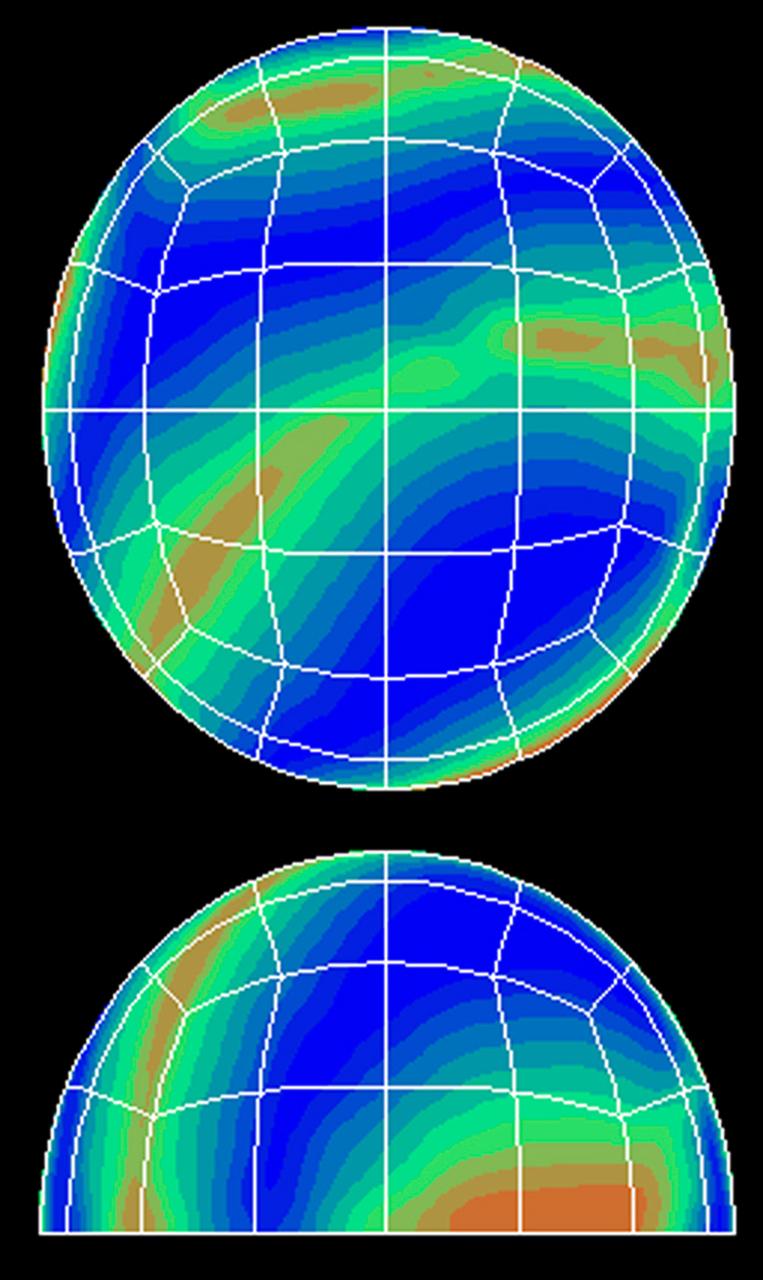
Computer simulation of atmospheric flow corresponds well to imges taken during the second Geophysical Fluid Flow Cell (BFFC) mission. The top shows a view from the pole, while the bottom shows a view from the equator. Red corresponds to hot fluid rising while blue shows cold fluid falling. This simulation was developed by Anil Deane of the University of Maryland, College Park and Paul Fischer of Argorne National Laboratory. Credit: NASA/Goddard Space Flight Center
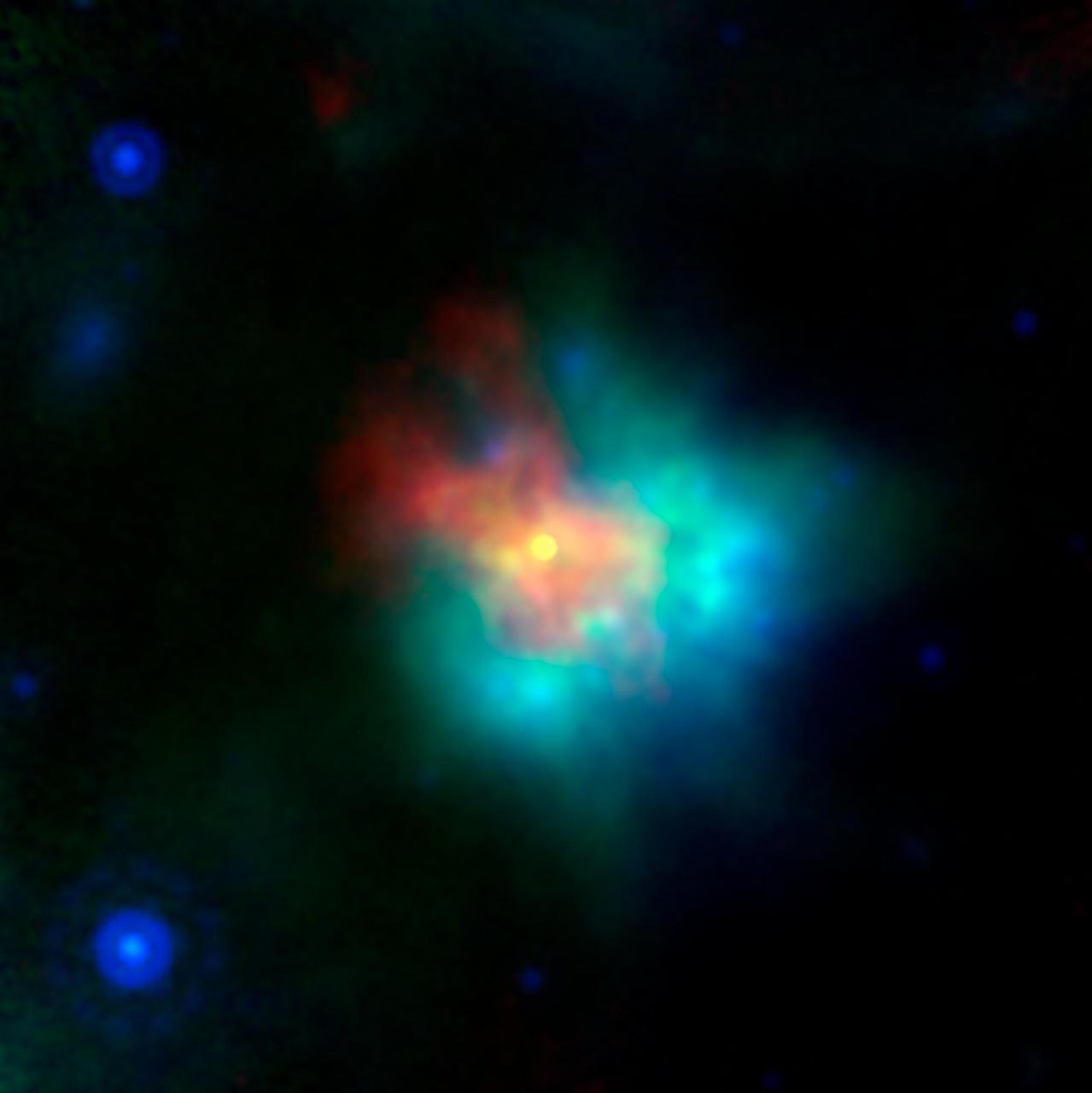
This image of supernova remnant G54.1+0.3 includes radio, infrared and X-ray light. The saturated yellow point at the center of the image indicates strong X-ray source at the center of the supernova remnant. This is an incredibly dense object called a neutron star, which can form as a star runs out of fuel to keep it inflated, and the unsupported material collapses down on to the star's core. G54.1+0.3 contains a special type of neutron star called a pulsar, which emits particularly bright radio and X-ray emissions. The blue and green emissions show the presence of dust, including silica. The red hues correspond to radio data from the Karl G. Jansky Very Large Array; green corresponds to 70 µm wavelength infrared light from the European Space Agency's Herschel Space Observatory; blue corresponds to 24 µm wavelength infrared light from the Multiband Imaging Photometer (MIPS) instrument on NASA's Spitzer Space Telescope; yellow corresponds to X-ray data from the Chandra X-ray Observatory. https://photojournal.jpl.nasa.gov/catalog/PIA22569

jsc2024e021223 (10/12/2023) --- This image, taken 22 days after initiation for the Veg-01 investigation, shows alfalfa plants (reduced lignin line and corresponding control) growing well. Image courtesy of Dr. Tom Dreschel.
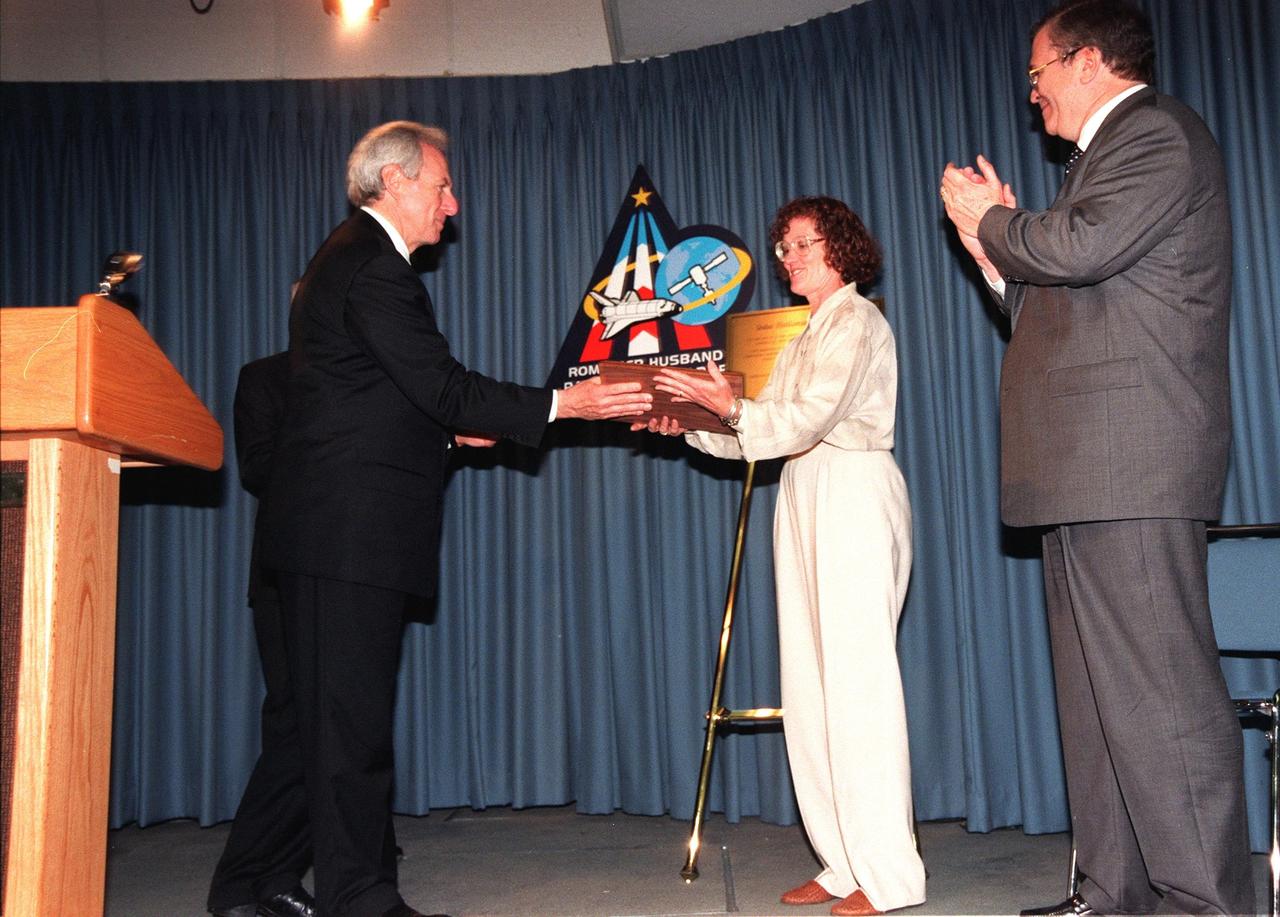
NASA Administrator Daniel S. Goldin hands Mrs. Dianne Holliman a plaque honoring her late husband, John Holliman, a CNN national correspondent. Standing behind Goldin is Center Director Roy Bridges. At right is Tom Johnson, news group chairman of CNN. A ceremony dedicated the KSC Press Site auditorium as the John Holliman Auditorium to honor the correspondent for his enthusiastic, dedicated coverage of America's space program. The auditorium was built in 1980 and has been the focal point for new coverage of Space Shuttle launches. The ceremony followed the 94th launch of a Space Shuttle, on mission STS-96, earlier this morning
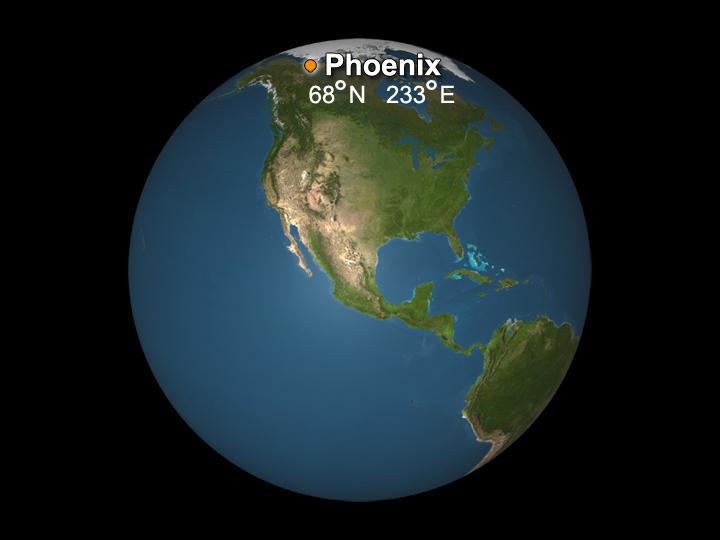
The targeted landing site for NASA Phoenix Mars Lander is at about 68 degrees north latitude, 233 degrees east longitude in the Martian arctic. The Phoenix lander, which landed May 25, 2008 ceased its operations about six months later.
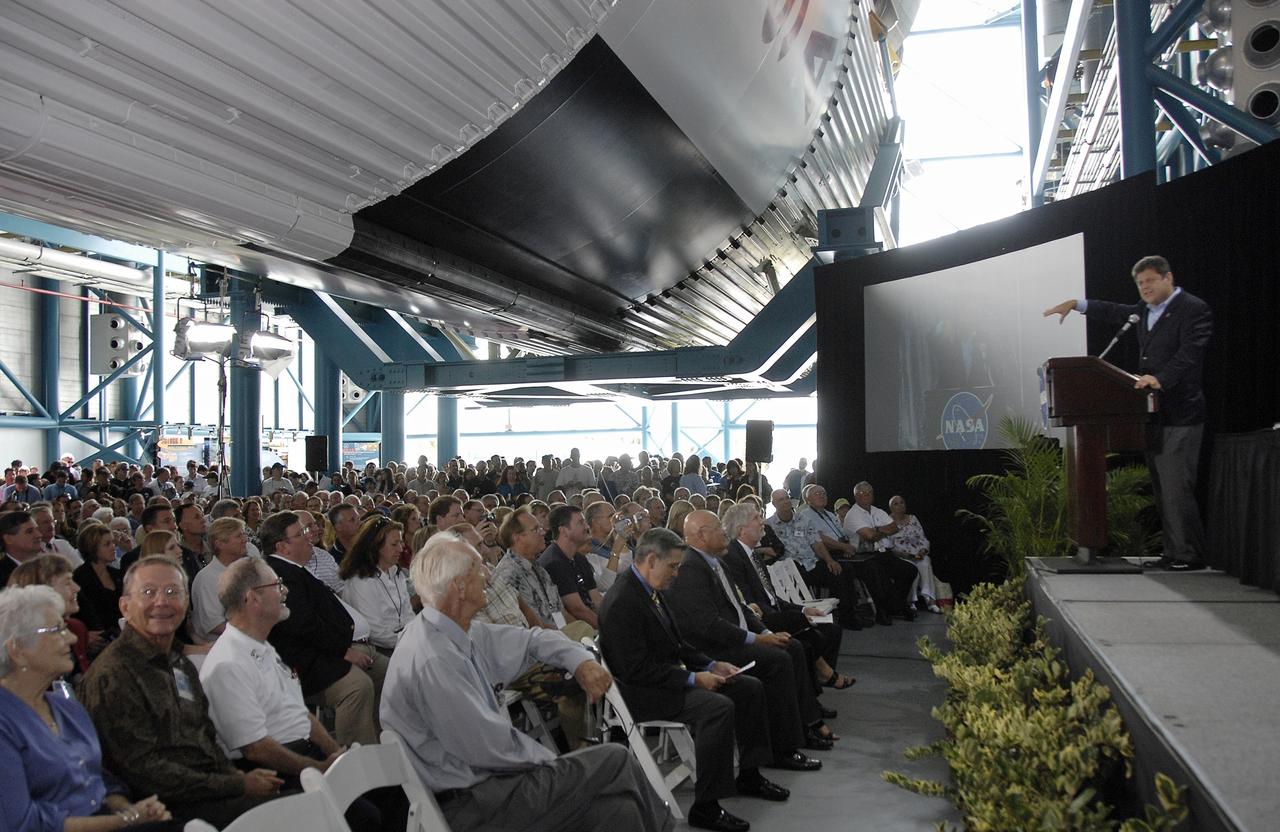
CAPE CANAVERAL, Fla. – CNN correspondent John Zarella moderates the 40th Anniversary of Apollo Celebration held in the Apollo/Saturn V Center at NASA's Kennedy Space Center in Florida. Celebrating the moon launch and landing in July 1969, eight Apollo astronauts shared their experiences with a crowd of guests. Photo credit: NASA/Kim Shiflett
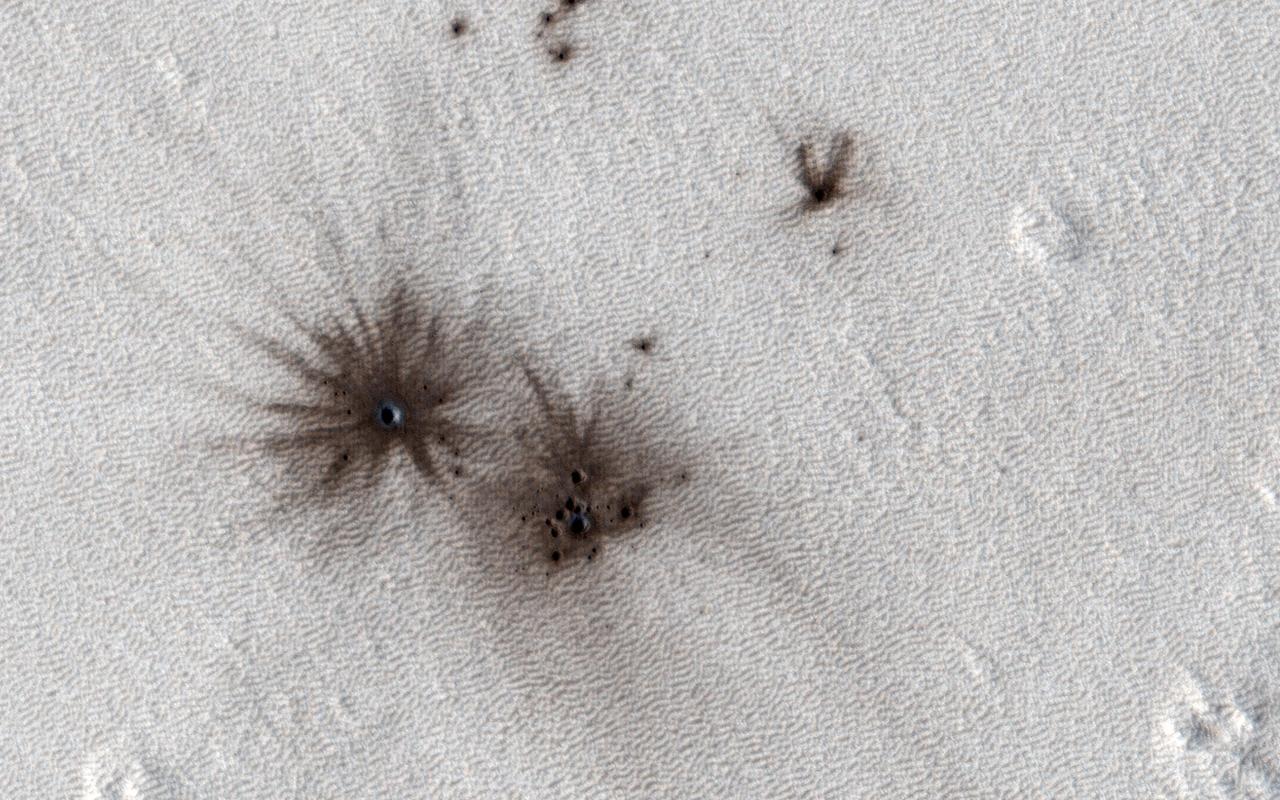
HiRISE and the Context Camera (CTX, also on board the Mars Reconnaissance Orbiter) are always on the lookout for new impact craters. New impacts can be identified by comparing images of the same region taken at different times (typically years apart) and looking for visual clues of recent impacts. CTX is more adept at identifying new impacts because of its larger and repeated surface coverage, but HiRISE allows us to study those impacts in higher resolution. In this image, we can see multiple dark spots corresponding to numerous new craters. We can also identify a slightly larger crater, and a number of smaller ones, particularly in a cluster next to it. That clustering gives us the first indication that these craters were formed in a single event. As the impactor was falling towards Mars, the friction with the atmosphere led to the body fragmenting into smaller pieces shortly before striking the surface creating this notable pattern. https://photojournal.jpl.nasa.gov/catalog/PIA26322
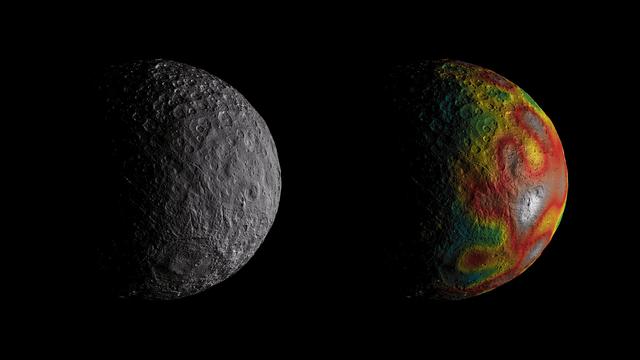
This frame from an animation shows Ceres as seen by NASA's Dawn spacecraft from its high-altitude mapping orbit at 913 miles (1,470 kilometers) above the surface. The colorful map overlaid at right shows variations in Ceres' gravity field measured by Dawn, and gives scientists hints about the dwarf planet's internal structure. Red colors indicate more positive values, corresponding to a stronger gravitational pull than expected, compared to scientists' pre-Dawn model of Ceres' internal structure; blue colors indicate more negative values, corresponding to a weaker gravitational pull. The animation was created by projecting a map of Ceres onto a rotating sphere. The image scale is about 450 feet (140 meters) per pixel. The animations are available at https://photojournal.jpl.nasa.gov/catalog/PIA22083
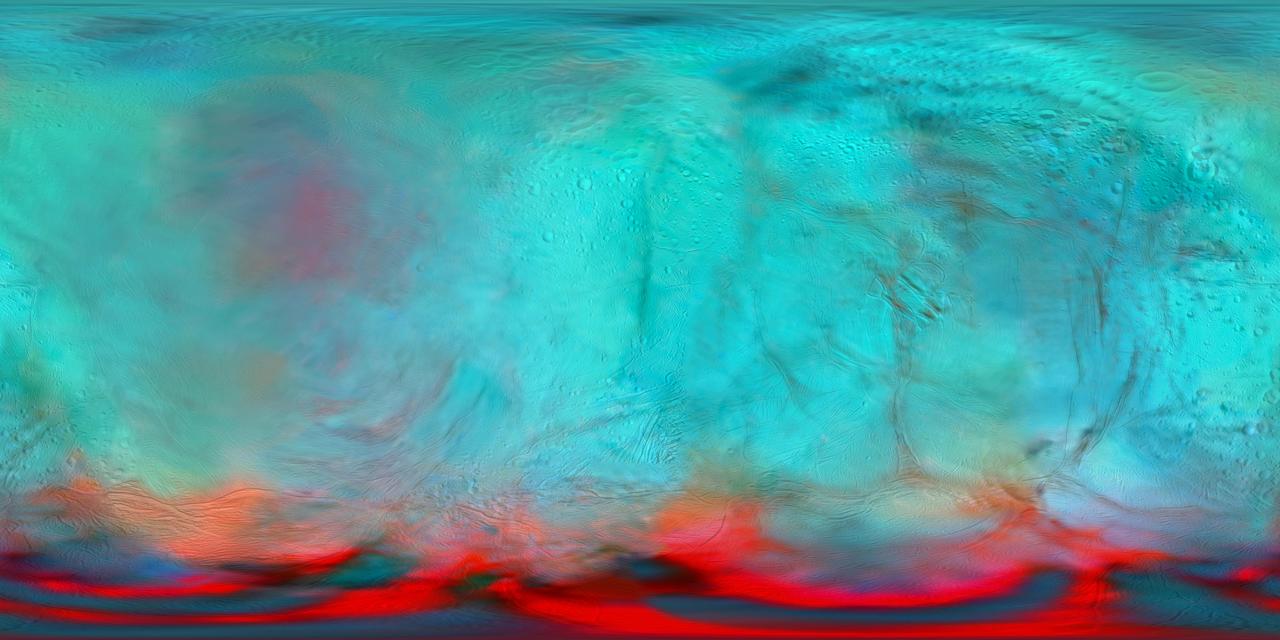
This infrared global map of Saturn's icy moon Enceladus was created using images acquired by NASA's Cassini spacecraft. It is a companion to the global views presented in PIA24023. It combines infrared maps obtained by the spacecraft's Visual and Infrared Mapping Spectrometer (VIMS), published by Robidel et al. (2020), and the visible map from the Imaging Science Subsystem (ISS), published by Bland et al. (2018). The colors used in this map represent infrared data collected by the VIMS instrument. The red color channel corresponds to a ratio of Enceladus' brightness observed at 3.1 microns divided by its brightness at 1.65 microns; the green channel corresponds to the brightness at 2.0 microns; and the blue channel corresponds to the brightness at 1.8 microns. These colors highlight the location of fresh crystalline ice, indicated by a red tint. Researchers also superimposed a high-resolution map of the moon's surface taken with the ISS camera (clear filter images), in order to show geologic features. All seams and spurious artifacts were removed to produce a globally smooth image used in the orthographic views published in PIA24023. This map is an equirectangular projection center at 0° longitude. The mean radius of Enceladus used for the projection of this map is 252.1 km (corresponding to a scale of 200 meters per pixel at the equator). References: - Robidel et al. (2020) - https://doi.org/10.1016/j.icarus.2020.113848 - Bland et al (2018) - https://doi.org/10.1029/2018EA000399 More information about Cassini can be found here: https://solarsystem.nasa.gov/cassini. https://photojournal.jpl.nasa.gov/catalog/PIA24027
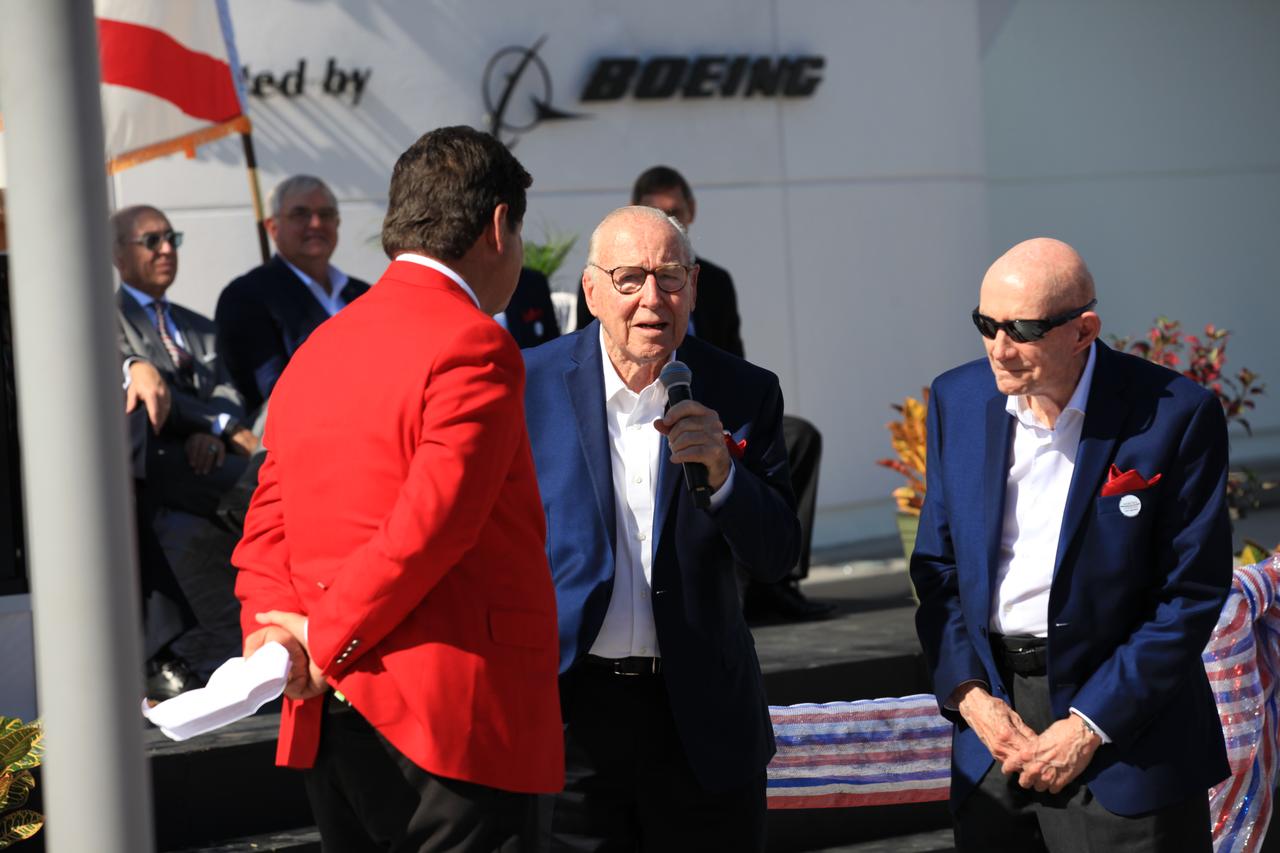
Former CNN space correspondent John Zarrella, left, interviews Gemini and Apollo astronauts Jim Lovell, center and Tom Stafford during opening ceremonies for the Heroes and Legends attraction at the Kennedy Space Center Visitor Complex. The new facility includes the U.S. Astronaut Hall of Fame and looks back to the pioneering efforts of Mercury, Gemini and Apollo. It sets the stage by providing the background and context for space exploration and the legendary men and women who pioneered the nation's journey into space.
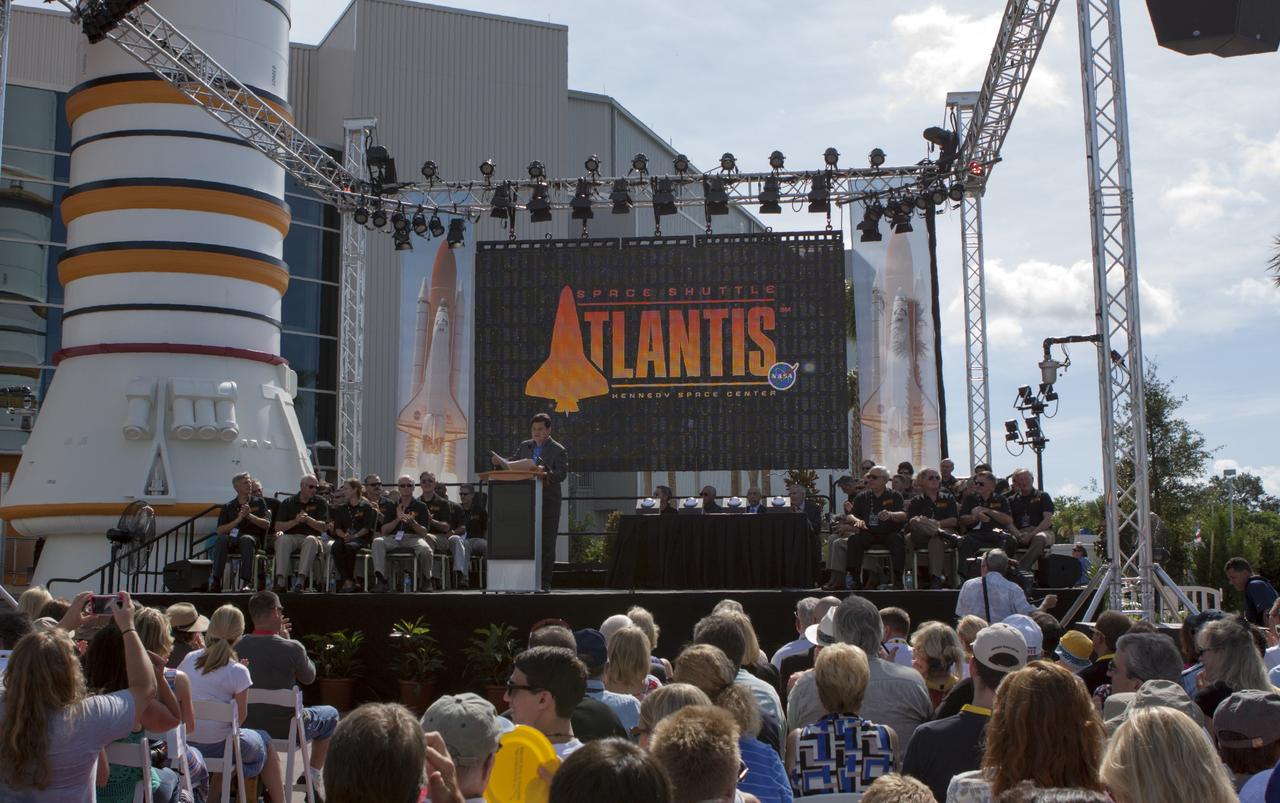
CAPE CANAVERAL, Fla. -- At the Kennedy Space Center Visitor Complex in Florida, CNN correspondent John Zarrella speaks to guests at the opening of the new "Space Shuttle Atlantis" facility. Zarrella served as master of ceremonies for the event. The new $100 million facility includes interactive exhibits that tell the story of the 30-year Space Shuttle Program and highlight the future of space exploration. The "Space Shuttle Atlantis" exhibit formally opened to the public on June 29, 2013.Photo credit: NASA/Jim Grossmann
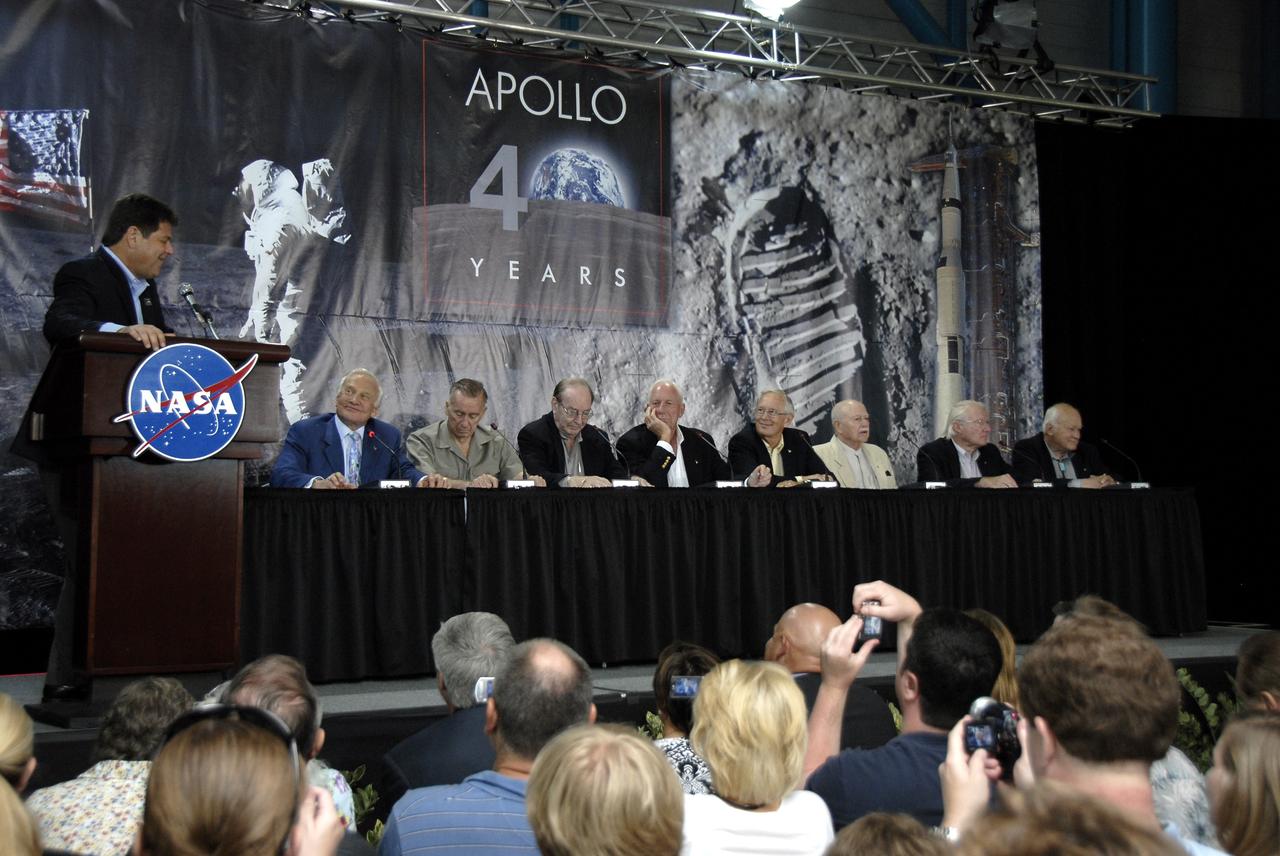
CAPE CANAVERAL, Fla. – CNN correspondent John Zarella, left, moderates NASA's 40th Anniversary of Apollo Celebration of the July 1969 launch and landing on the moon. The ceremony, held in the Apollo/Saturn V Center at NASA's Kennedy Space Center in Florida featured Apollo astronauts (at the dais) Buzz Aldrin, Walt Cunningham, Edgar Mitchell, Al Worden, Charlie Duke, Vance Brand, Gerald Carr and Bruce McCandless. Photo credit: NASA/Kim Shiflett

KENNEDY SPACE CENTER, FLA. - Inside NASA Kennedy Space Center’s Apollo/Saturn V Center, CBS correspondent Ed Bradley (center) points to the lunar module behind him overhead during the taping of his interview with former astronaut Neil Armstrong (left). During the interview, Armstrong talked about his historic milestone - walking on the moon - and the public’s response and affect on his career afterward. The show aired Nov. 6.
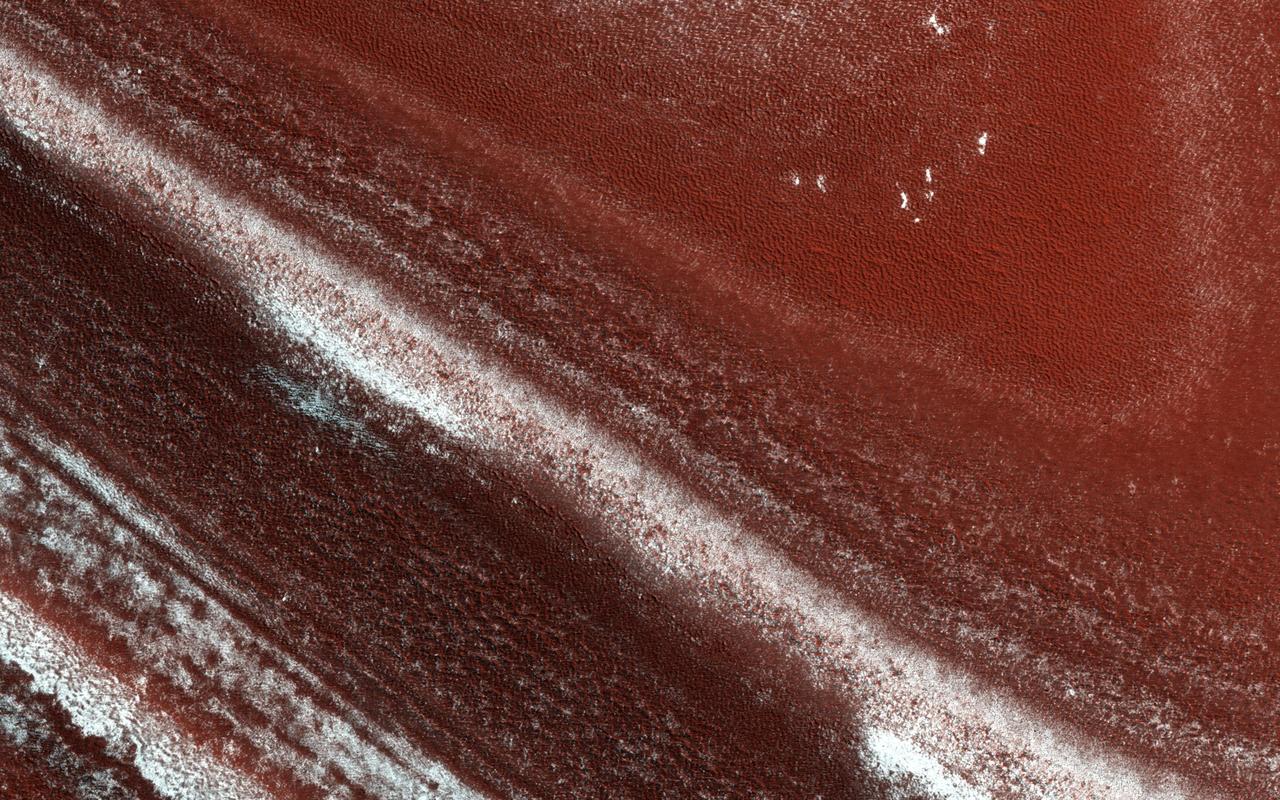
At the edge of Mars' permanent North Polar cap, we see an exposure of the internal layers, each with a different mix of water ice, dust and dirt. These layers are believed to correspond to different climate conditions over the past tens of thousands of years. When we zoom in closer, we see that the distinct layers erode differently. Some are stronger and more resistant to erosion, others only weakly cemented. The strong layers form ledges. http://photojournal.jpl.nasa.gov/catalog/PIA21022
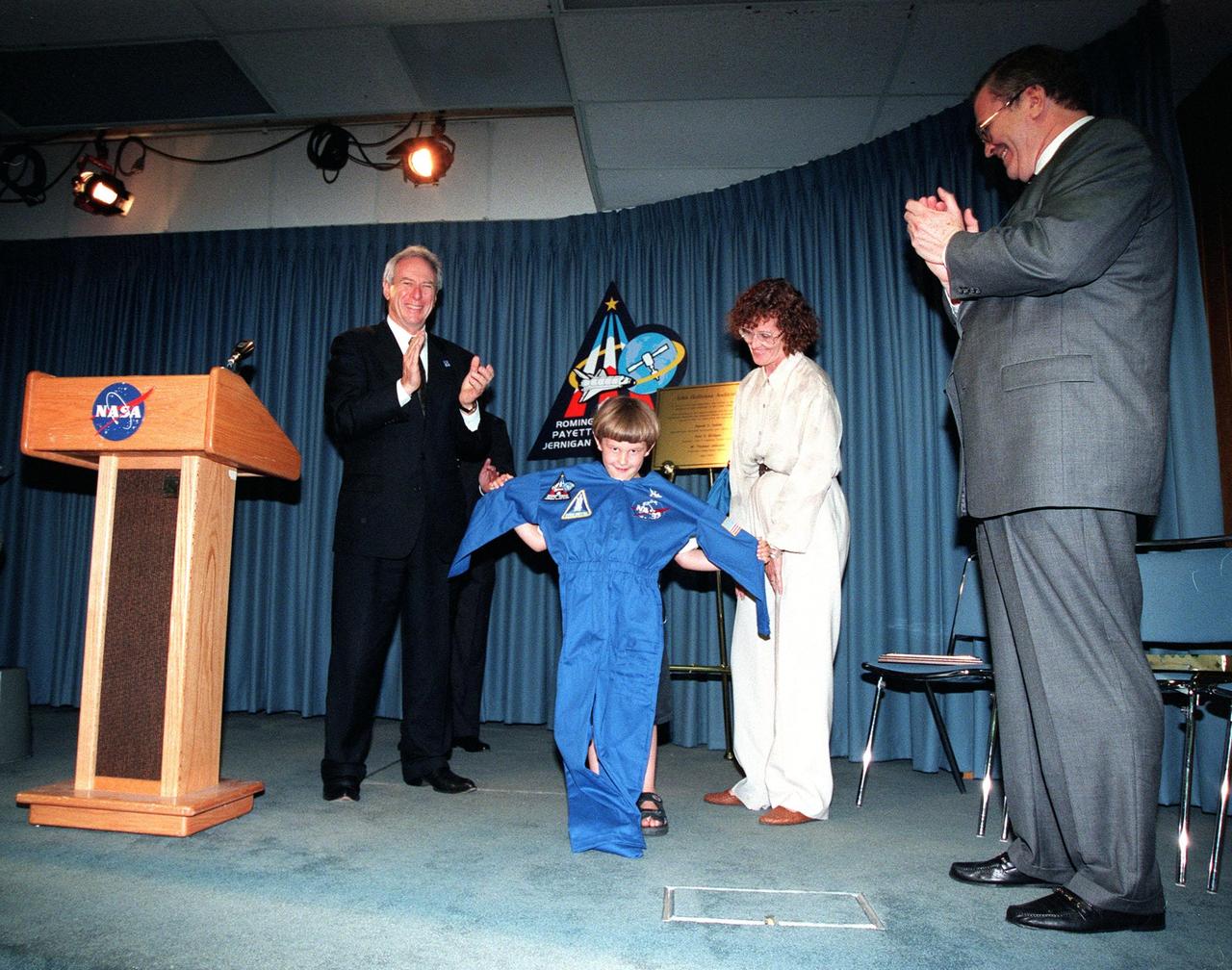
A ceremony dedicated the KSC Press Site auditorium as the John Holliman Auditorium to honor the correspondent for his enthusiastic, dedicated coverage of America's space program. The auditorium was built in 1980 and has been the focal point for news coverage of Space Shuttle launches. The ceremony followed the 94th launch of a Space Shuttle, on mission STS-96, earlier this morning
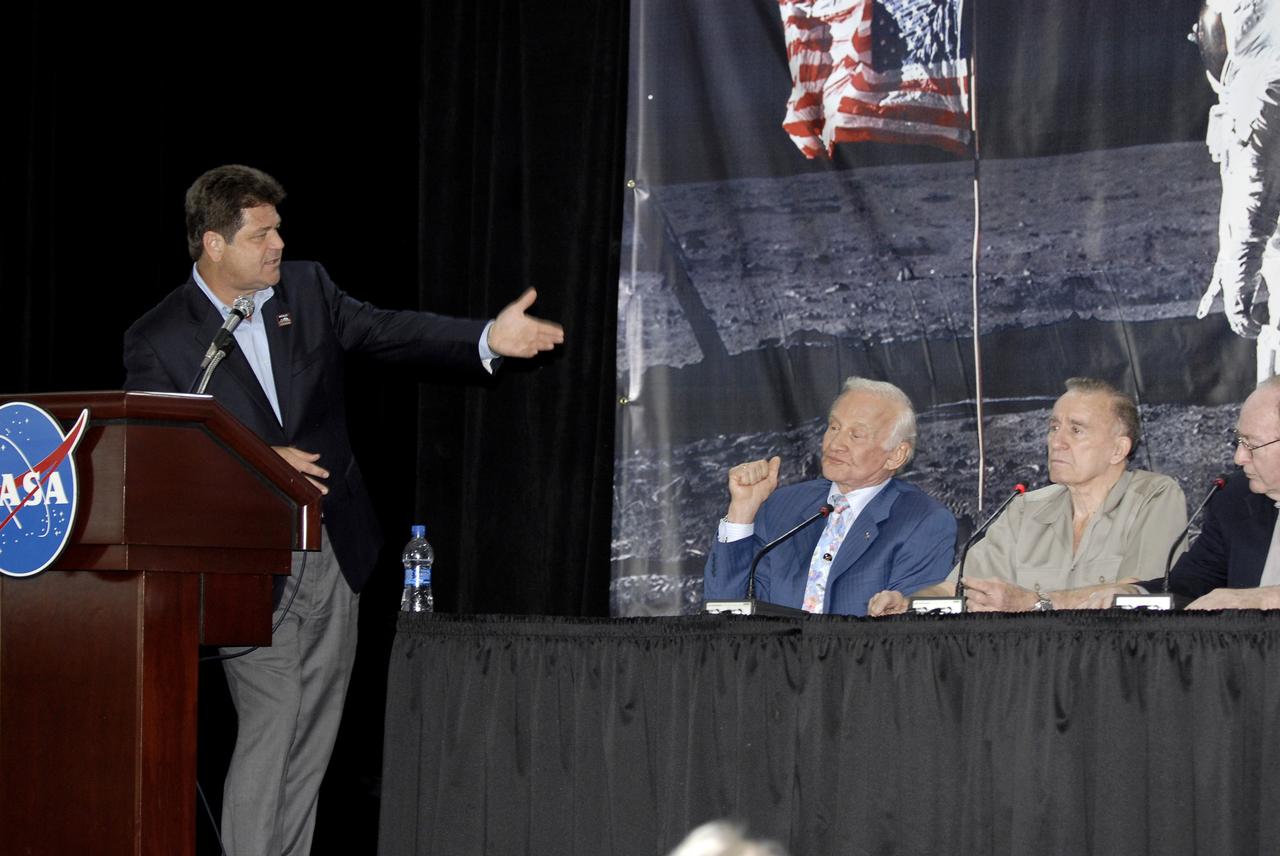
CAPE CANAVERAL, Fla. – CNN Correspondent John Zarella (left), moderates NASA's 40th Anniversary of Apollo Celebration of the moon launch and landing in July 1969, which was held in the Apollo/Saturn V Center at NASA's Kennedy Space Center in Florida. At right are Apollo astronauts Buzz Aldrin, Walt Cunningham and Edgar Mitchell. Eight Apollo astronauts shared their experiences with a crowd of guests. Photo credit: NASA/Kim Shiflett
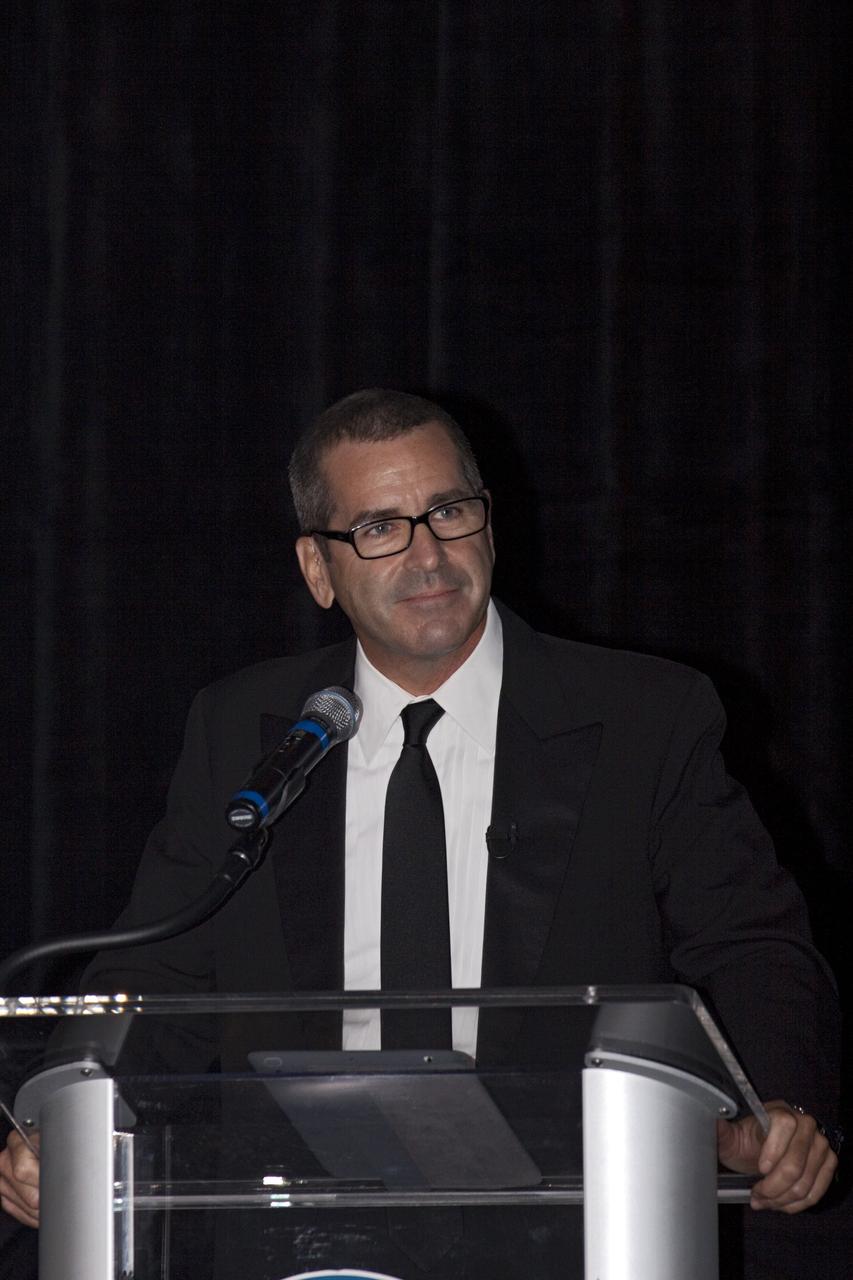
CAPE CANAVERAL, Fla. – PBS NewsHour Science Correspondent Miles O’Brien, speaks to attendees during Kennedy Space Center’s 50th Anniversary Gala event at the Kennedy Space Center Visitor Complex Apollo/Saturn V Center in Florida. The gala was coordinated by Kennedy and the National Space Club Florida Committee with the theme, “Celebrating the Past and Preparing for the Future.” The event was attended by about 650 current and retired NASA and contractor workers, dignitaries, and several former Kennedy Space Center directors. Photo credit: NASA/Kim Shiflett
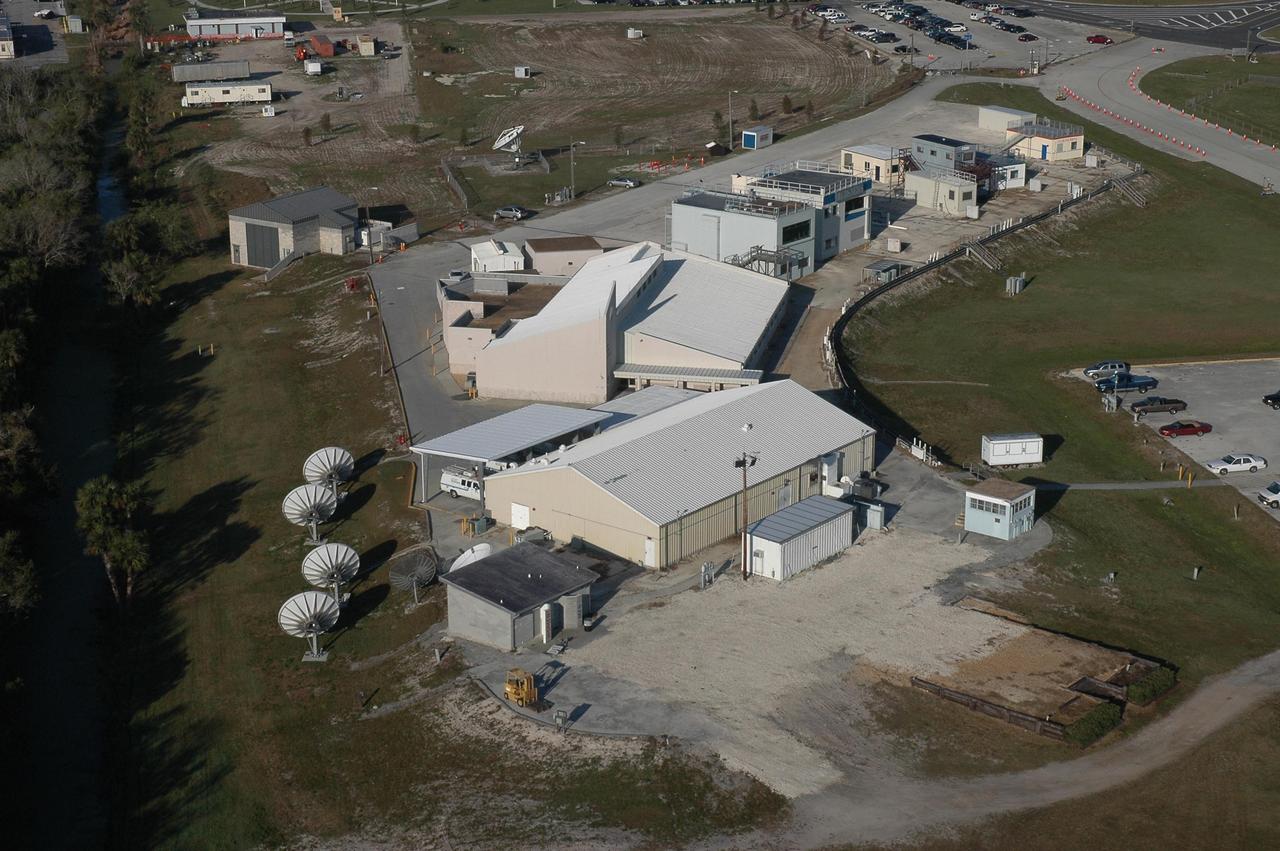
KENNEDY SPACE CENTER, FLA. - This aerial view of the Press Site shows the NASA TV studio (foreground), the NASA News Center behind it, buildings used by local NBC and CBS television stations, and newly erected prefabricated buildings for local newspapers and correspondents for CNN, AP and others. A year-long project removed and replaced hurricane-damaged trailers and grandstands from the site. Photo credit: Cory Huston
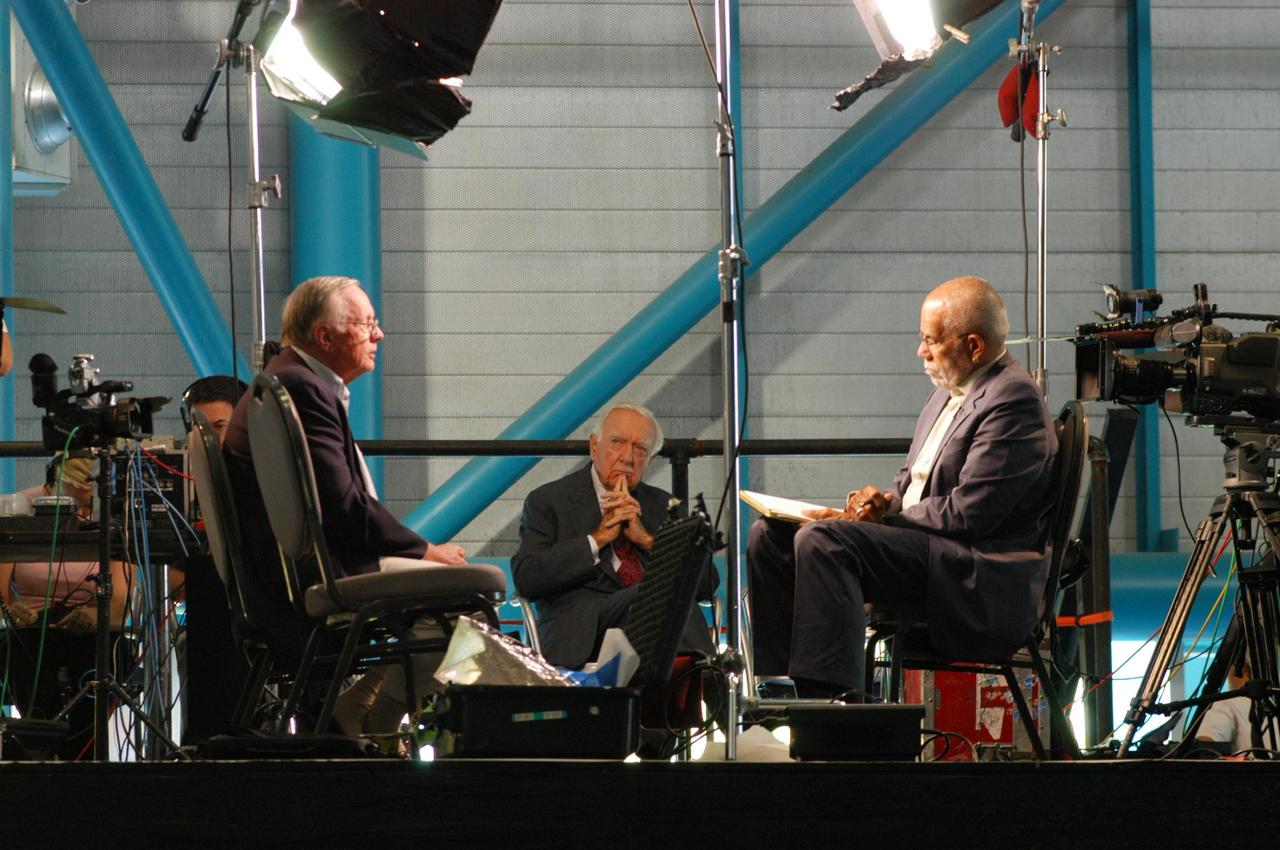
KENNEDY SPACE CENTER, FLA. - The CBS news program “60 Minutes” is taping a segment inside NASA Kennedy Space Center’s Apollo/Saturn V Center. Correspondent Ed Bradley (right) is seen here interviewing former astronaut Neil Armstrong, the subject of the interview. They talked about Armstrong’s historic milestone - walking on the moon - and the public’s response and affect on his career afterward. In the background is CBS broadcaster Walter Cronkite, who reunited with Armstrong for the 60 Minutes show. The show aired Nov. 6.
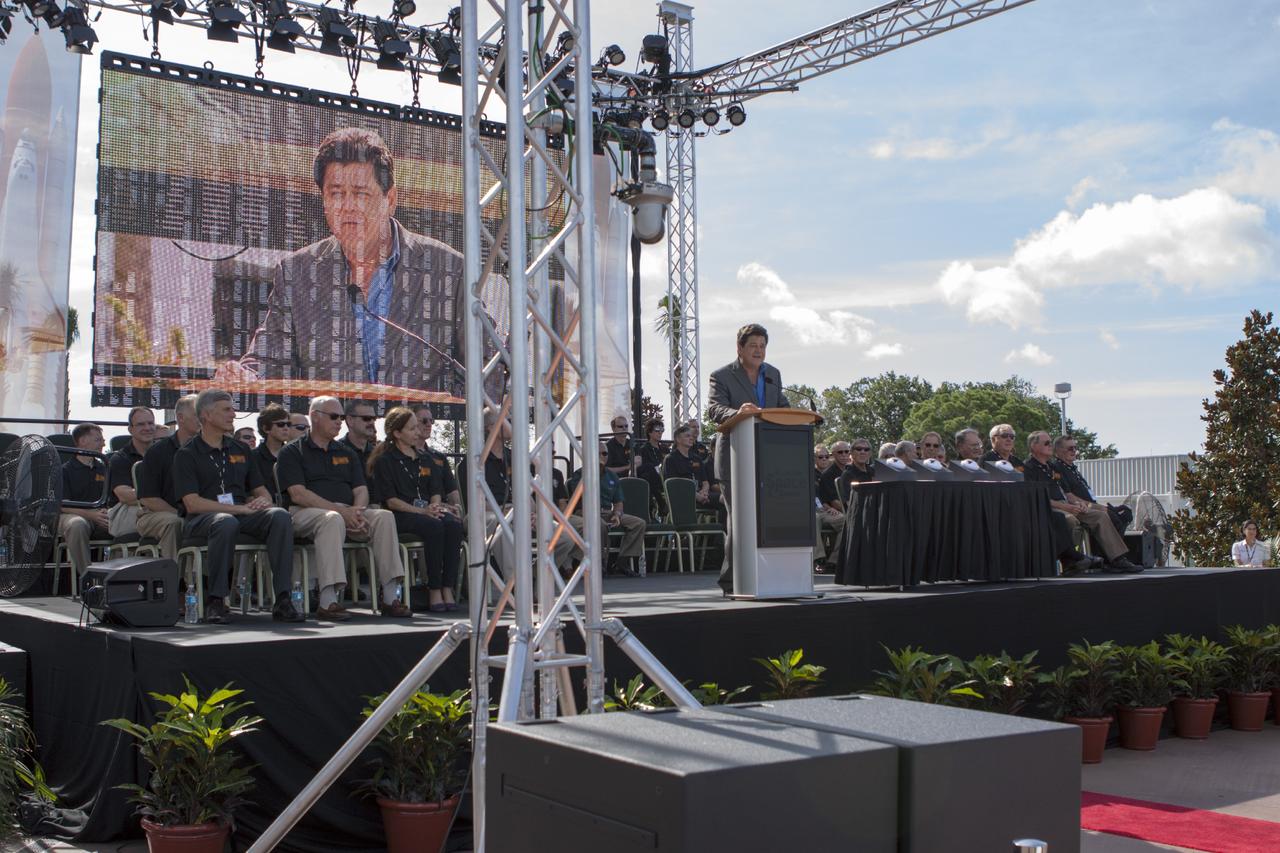
CAPE CANAVERAL, Fla. -- At the Kennedy Space Center Visitor Complex in Florida, CNN correspondent John Zarrella speaks to guests at the opening of the new "Space Shuttle Atlantis" facility. Zarrella served as master of ceremonies for the event. The new $100 million facility includes interactive exhibits that tell the story of the 30-year Space Shuttle Program and highlight the future of space exploration. The "Space Shuttle Atlantis" exhibit formally opened to the public on June 29, 2013.Photo credit: NASA/Jim Grossmann
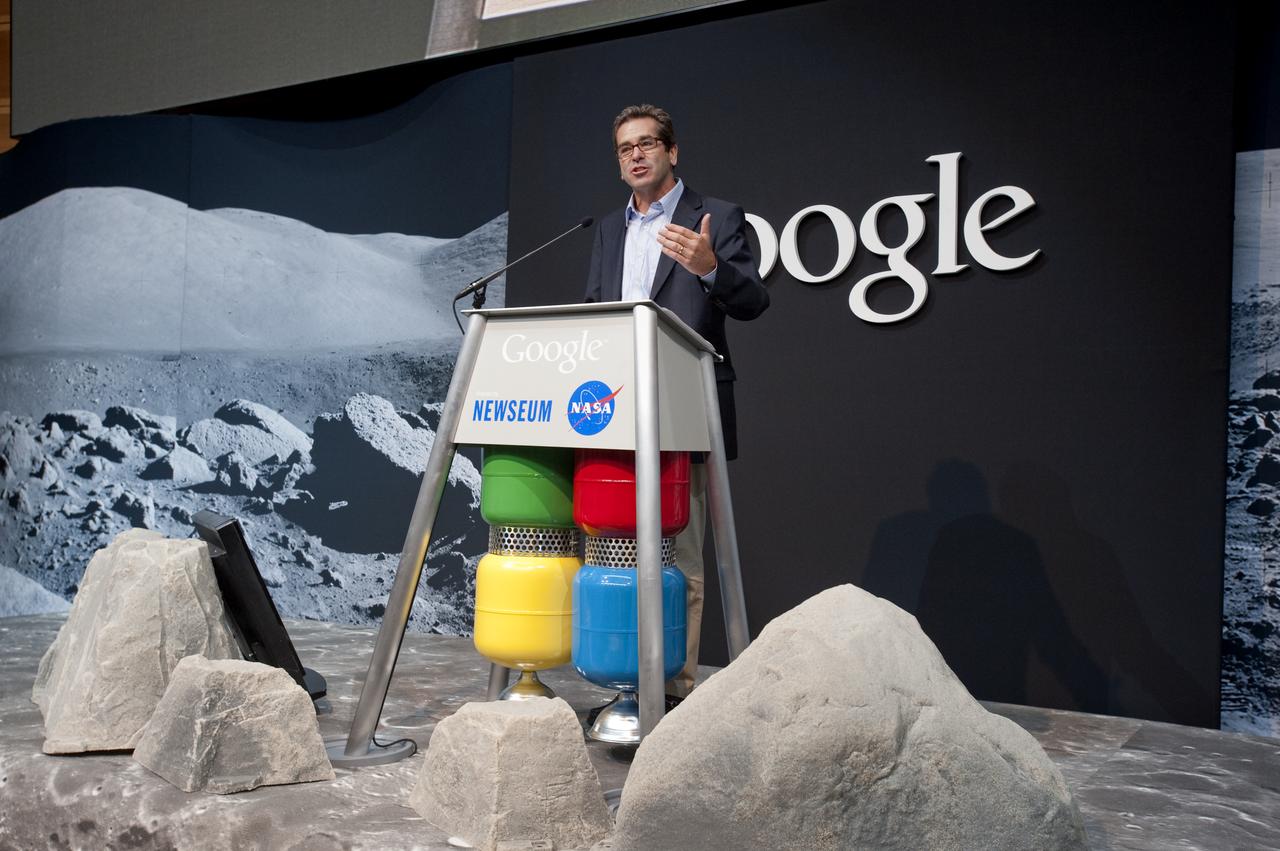
Miles O'Brien, former chief science and tech correspondent for CNN, speaks during a press conference, Monday, July 20, 2009, announcing the launch of Moon in Google Earth, an immersive 3D atlas of the Moon, accessible within Google Earth 5.0, Monday, July 20, 2009, at the Newseum in Washington. Photo Credit: (NASA/Bill Ingalls)
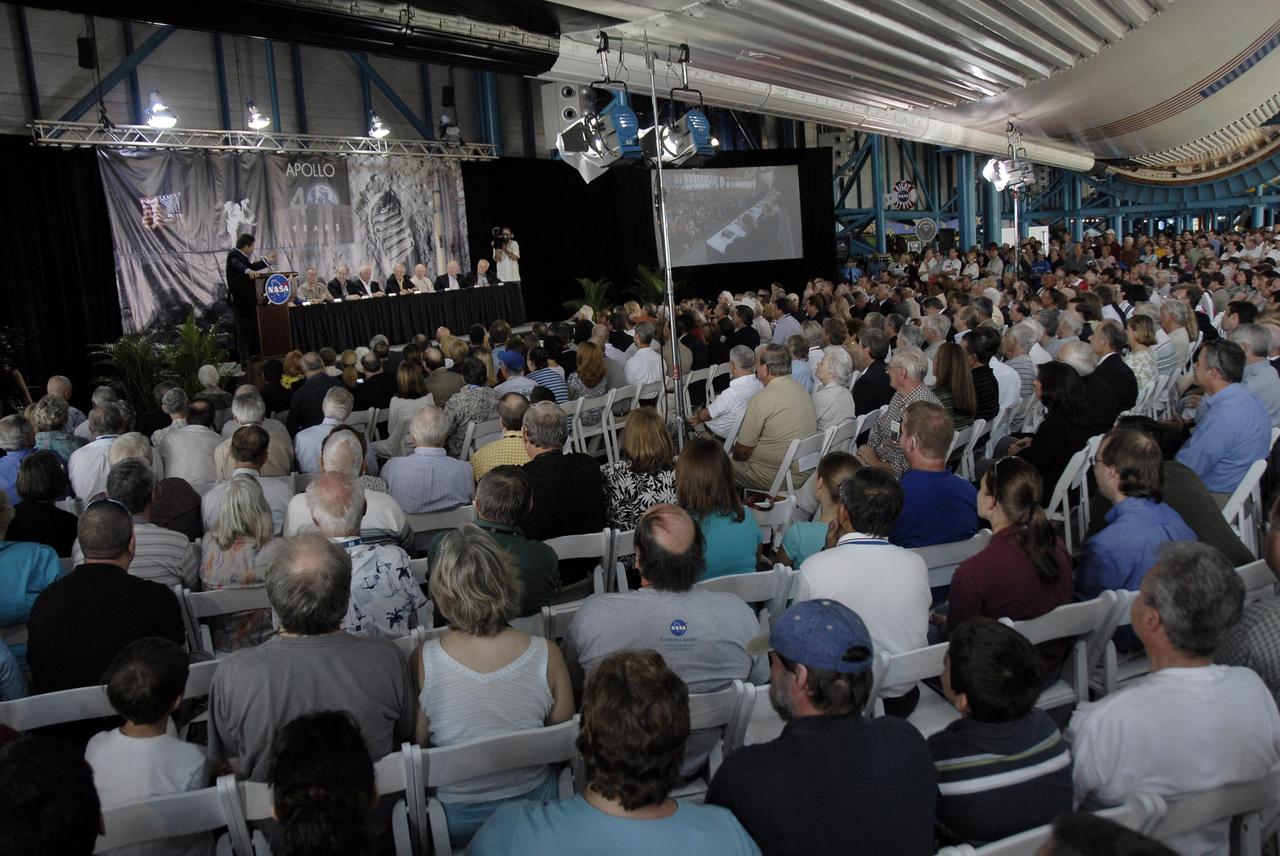
CAPE CANAVERAL, Fla. – The Apollo/Saturn V Center at NASA's Kennedy Space Center in Florida is filled with guests gathered to hear about the Apollo 11 launch and landing in July 1969 from eight Apollo astronauts: . The event is part of NASA's 40th Anniversary of Apollo Celebration. Participating are CNN correspondent, who moderated, Buzz Aldrin, Walt Cunningham, Edgar Mitchell, Al Worden, Charlie Duke, Vance Brand, Gerald Carr and Bruce McCandless. Photo credit: NASA/Kim Shiflett

Suzanne Malveaux, a correspondent with CNN, serves as a moderator at a panel discussion as part of an event celebrating the 50th Anniversary of the Civil Rights Act of 1964 on Monday, June 23, 2014 in the James E. Webb Auditorium at NASA Headquarters in Washington, DC. The event highlighted the influence of the Civil Rights Act on NASA. Photo Credit: (NASA/Joel Kowsky)
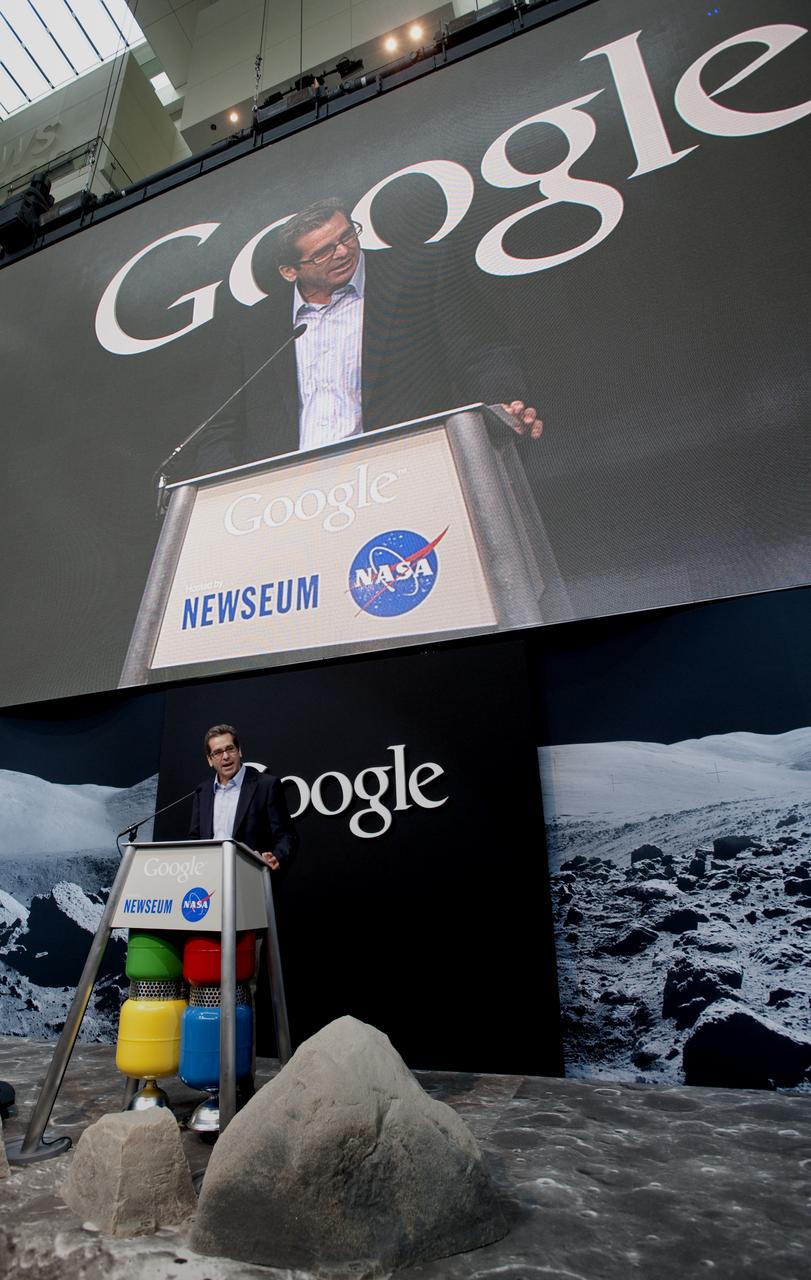
Miles O'Brien, former chief science and tech correspondent for CNN, speaks during a press conference, Monday, July 20, 2009, announcing the launch of Moon in Google Earth, an immersive 3D atlas of the Moon, accessible within Google Earth 5.0, Monday, July 20, 2009, at the Newseum in Washington. Photo Credit: (NASA/Bill Ingalls)
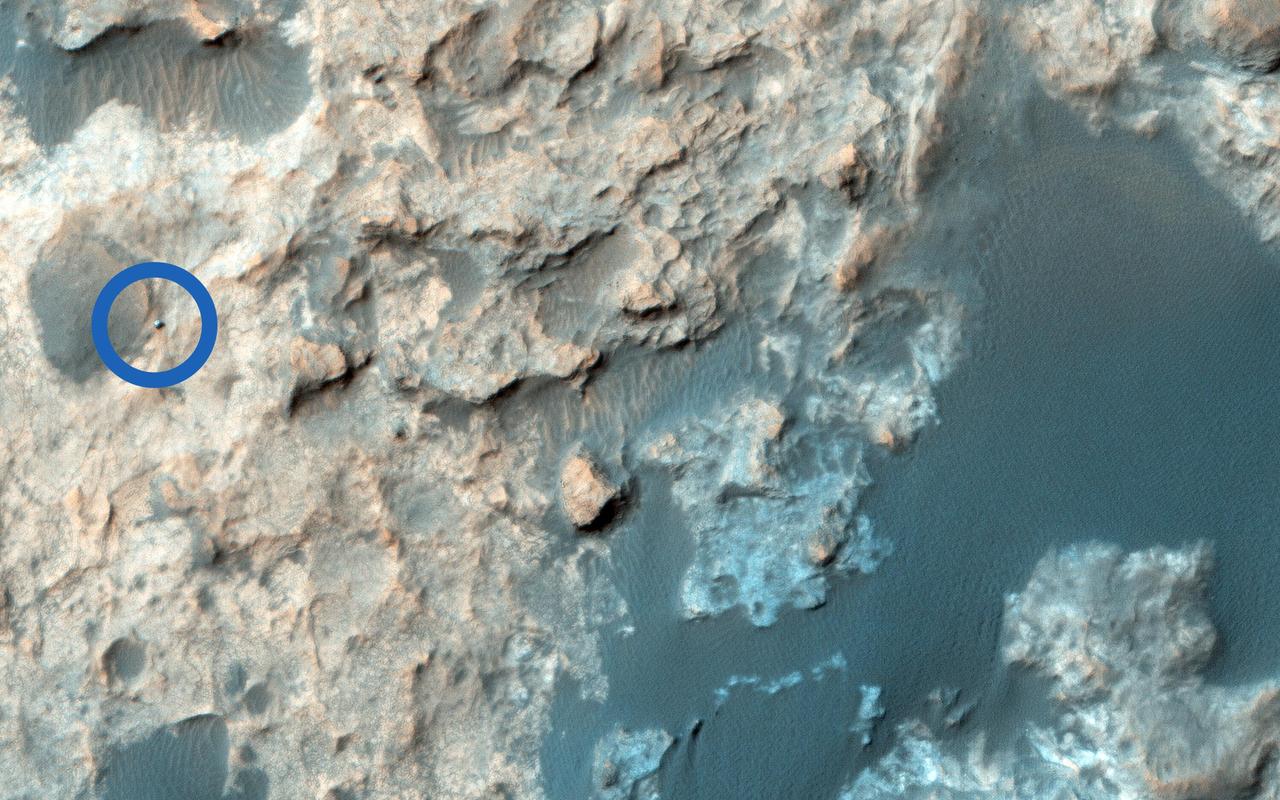
The Mars Science Laboratory, Curiosity, continues its exciting traverse of Mars. In an image acquired in September, it was exploring the boundary between two rock units: the light-toned Murray Formation and the overlying and darker-toned Stimson unit. We can clearly see the rover in a complex terrain marked by tonally varied rocks, which on the surface, can correspond to the contact between rock units and dark sand. http://photojournal.jpl.nasa.gov/catalog/PIA20211
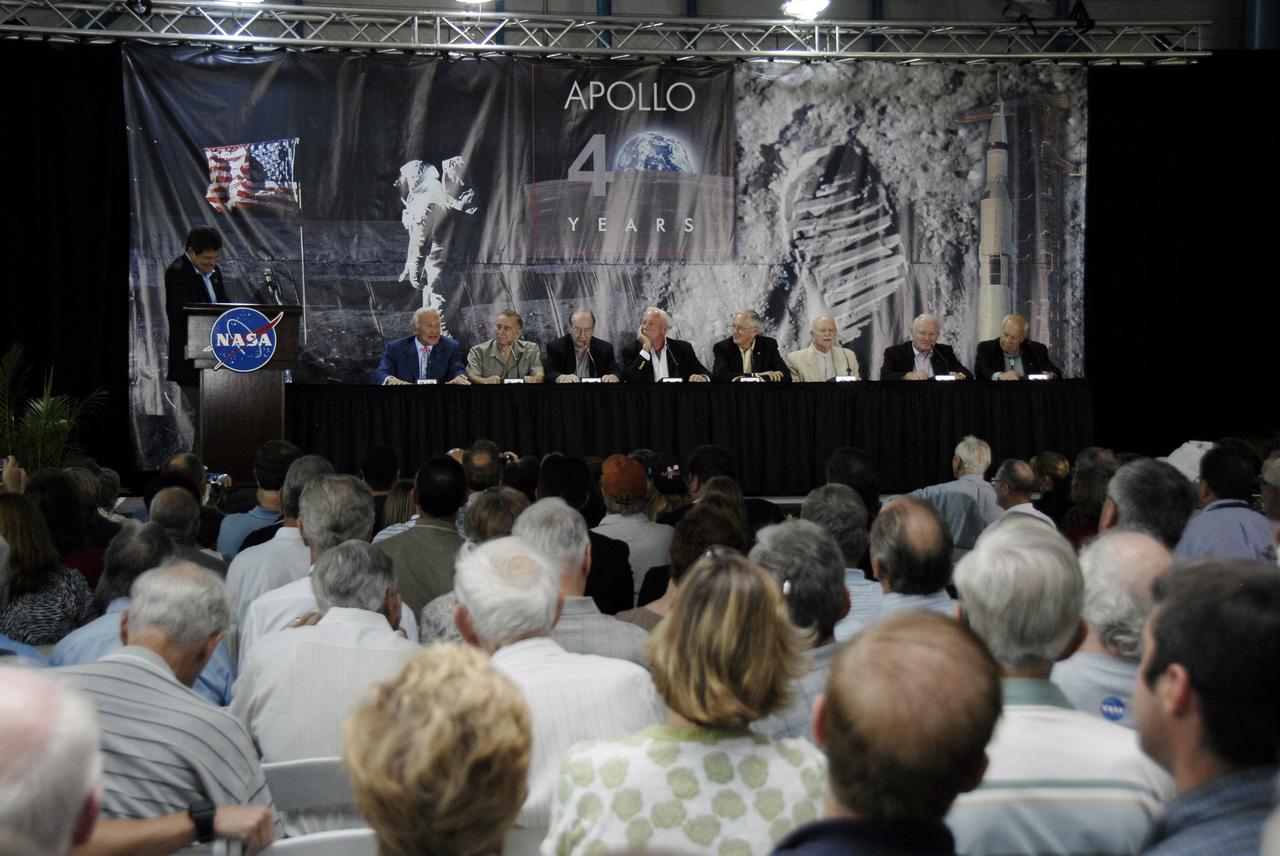
CAPE CANAVERAL, Fla. – With CNN correspondent John Zarella (left) moderating, Apollo astronauts (at the dais) Buzz Aldrin, Walt Cunningham, Edgar Mitchell, Al Worden, Charlie Duke, Vance Brand, Gerald Carr and Bruce McCandless share stories of their experiences during NASA's 40th Anniversary of Apollo Celebration of the July 1969 launch and landing on the moon. The ceremony was held in the Apollo/Saturn V Center at NASA's Kennedy Space Center in Florida. Photo credit: NASA/Kim Shiflett
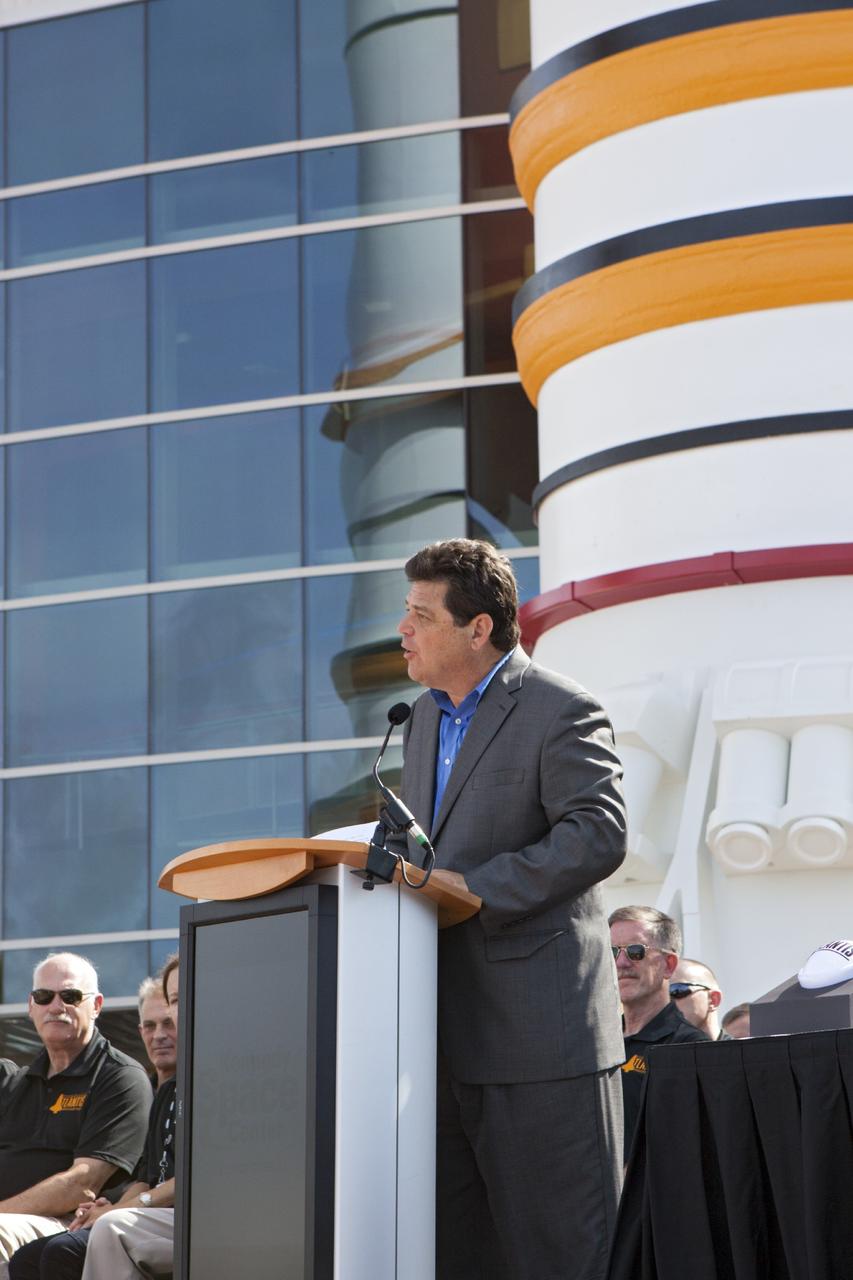
CAPE CANAVERAL, Fla. -- At the Kennedy Space Center Visitor Complex in Florida, CNN correspondent John Zarrella speaks to guests at the opening of the new "Space Shuttle Atlantis" facility. Zarrella served as master of ceremonies for the event. The new $100 million facility includes interactive exhibits that tell the story of the 30-year Space Shuttle Program and highlight the future of space exploration. The "Space Shuttle Atlantis" exhibit formally opened to the public on June 29, 2013.Photo credit: NASA/Jim Grossmann
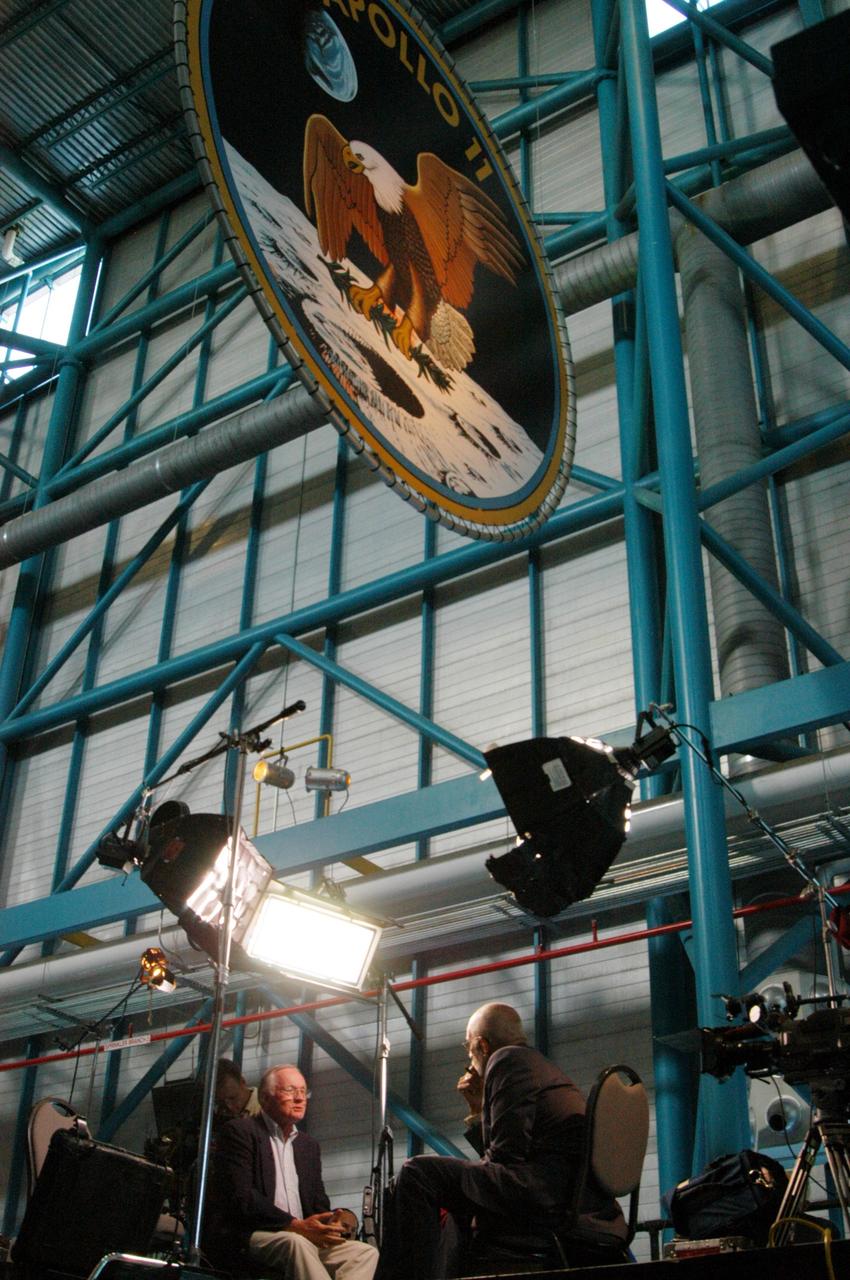
KENNEDY SPACE CENTER, FLA. - The CBS news program “60 Minutes” is taping a segment inside NASA Kennedy Space Center’s Apollo/Saturn V Center. Correspondent Ed Bradley (right) is seen here interviewing former astronaut Neil Armstrong, the subject of the interview. They talked about Armstrong’s historic milestone - walking on the moon - and the public’s response and affect on his career afterward. The show aired Nov. 6.
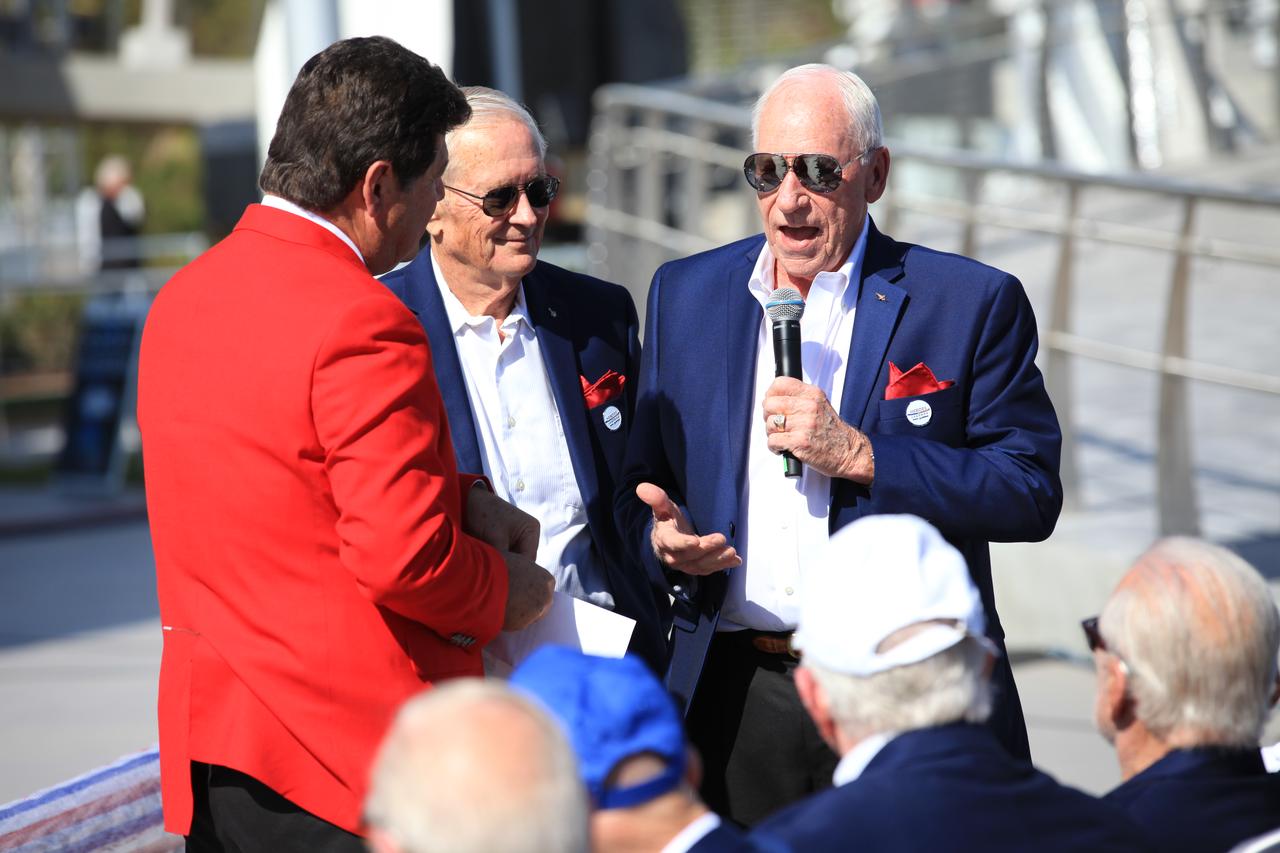
Former CNN space correspondent John Zarrella, left, interviews Apollo astronauts Charlie Duke, center and Walt Cunningham during opening ceremonies for the Heroes and Legends attraction at the Kennedy Space Center Visitor Complex. The new facility includes the U.S. Astronaut Hall of Fame and looks back to the pioneering efforts of Mercury, Gemini and Apollo. It sets the stage by providing the background and context for space exploration and the legendary men and women who pioneered the nation's journey into space.
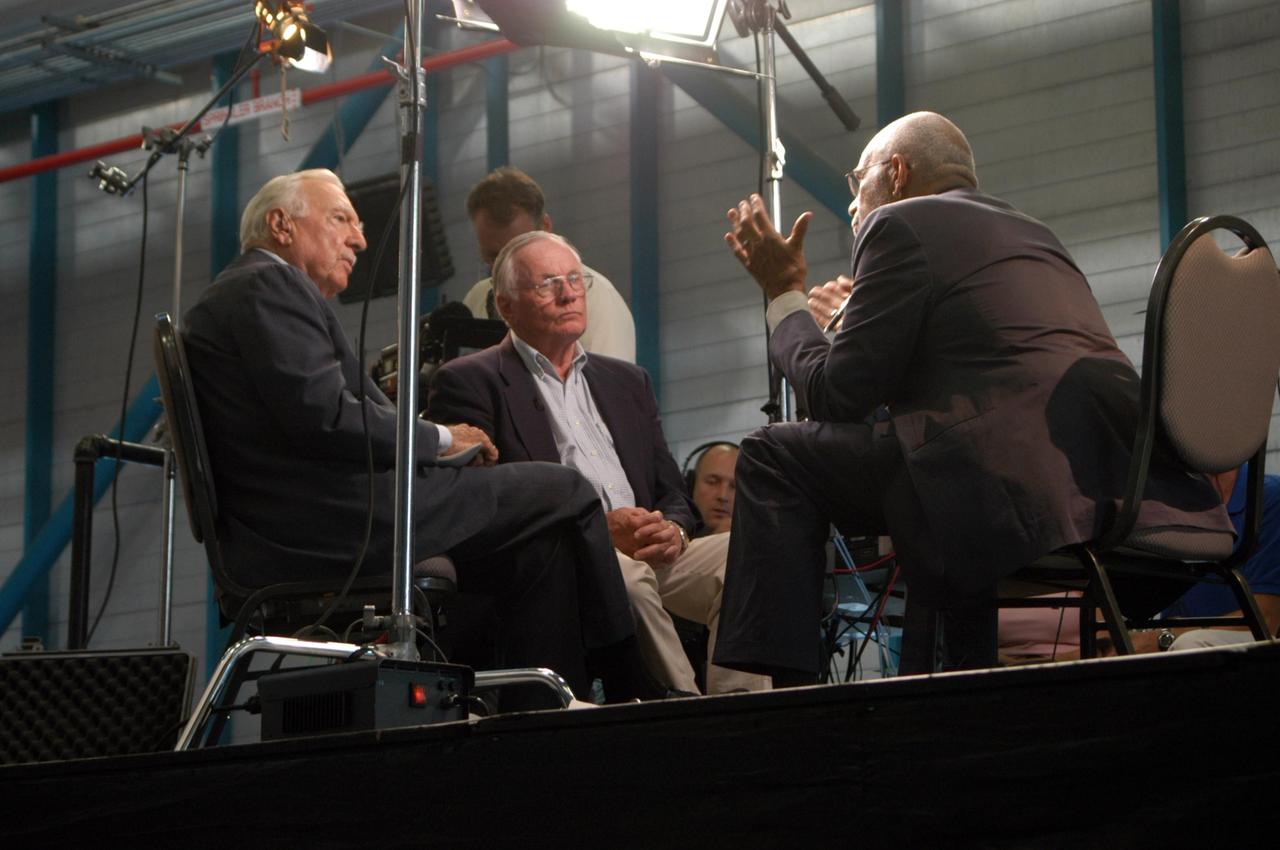
KENNEDY SPACE CENTER, FLA. - Inside NASA Kennedy Space Center’s Apollo/Saturn V Center, former CBS broadcaster Walter Cronkite (left) and former astronaut Neil Armstrong (center) are interviewed by CBS correspondent Ed Bradley (right). Armstrong talked about his historic milestone - walking on the moon - and the public’s response and affect on his career afterward. The show aired Nov. 6.
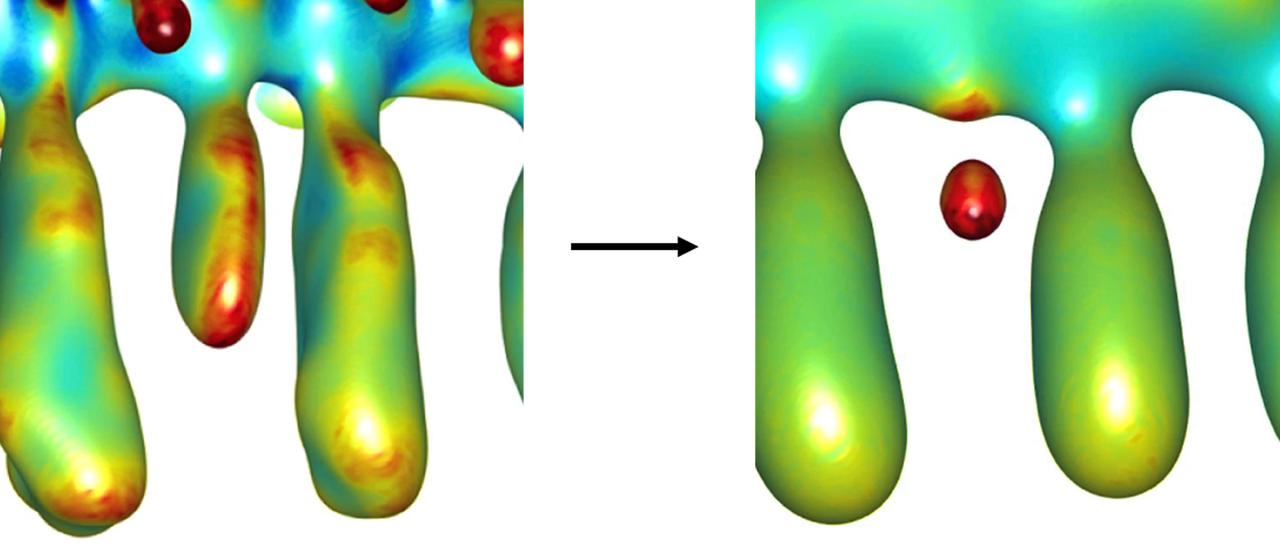
jsc2020e030481 (7/8/2020) --- This preflight image of the Dendrite Fragmentation and Morphology during Melting and Solidification (DFM) (SUBSA-DFM) investigation of shows a small portion of an experimentally determined dendrite. The image on the right shows the same portion with the formation of a fragment and other morphological changes after a simulated temperature change. Colors show the mean curvature of the dendrite interfaces (red corresponds to high positive curvature, blue to high negative curvature, and green to zero curvature). (Image Courtesy Techshot, Inc.)
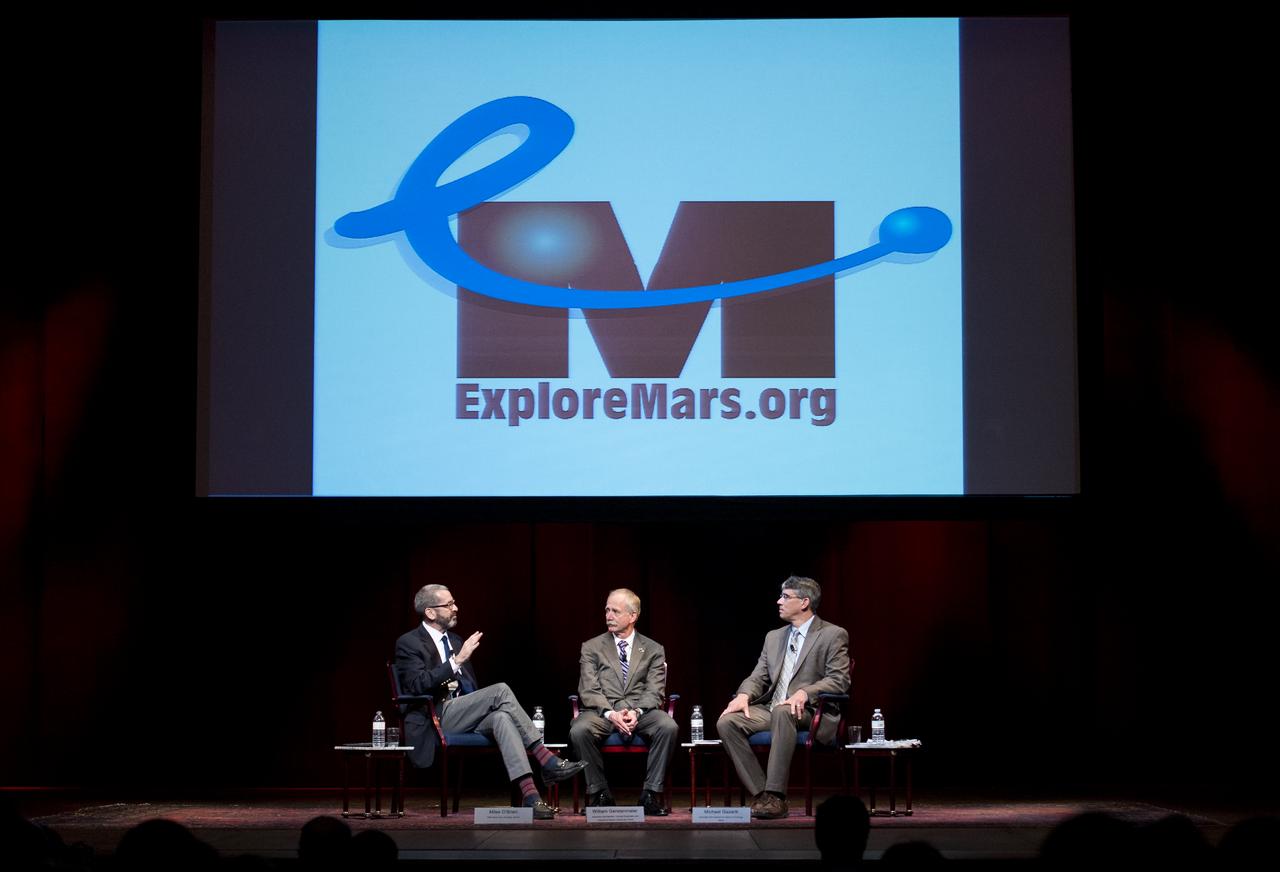
Miles O'Brien, science correspondant for PBS NewsHour, left, leads a panel discussion on Mars exploration with William Gerstenmaier, NASA Associatate Administrator for Human Explorations and Operations, center, and Michael Gazarik, NASA Associate Administrator for Space Technology, left, at the Humans to Mars Summit on April 22, 2014 at George Washington University in Washington, DC. Photo Credit: (NASA/Joel Kowsky)
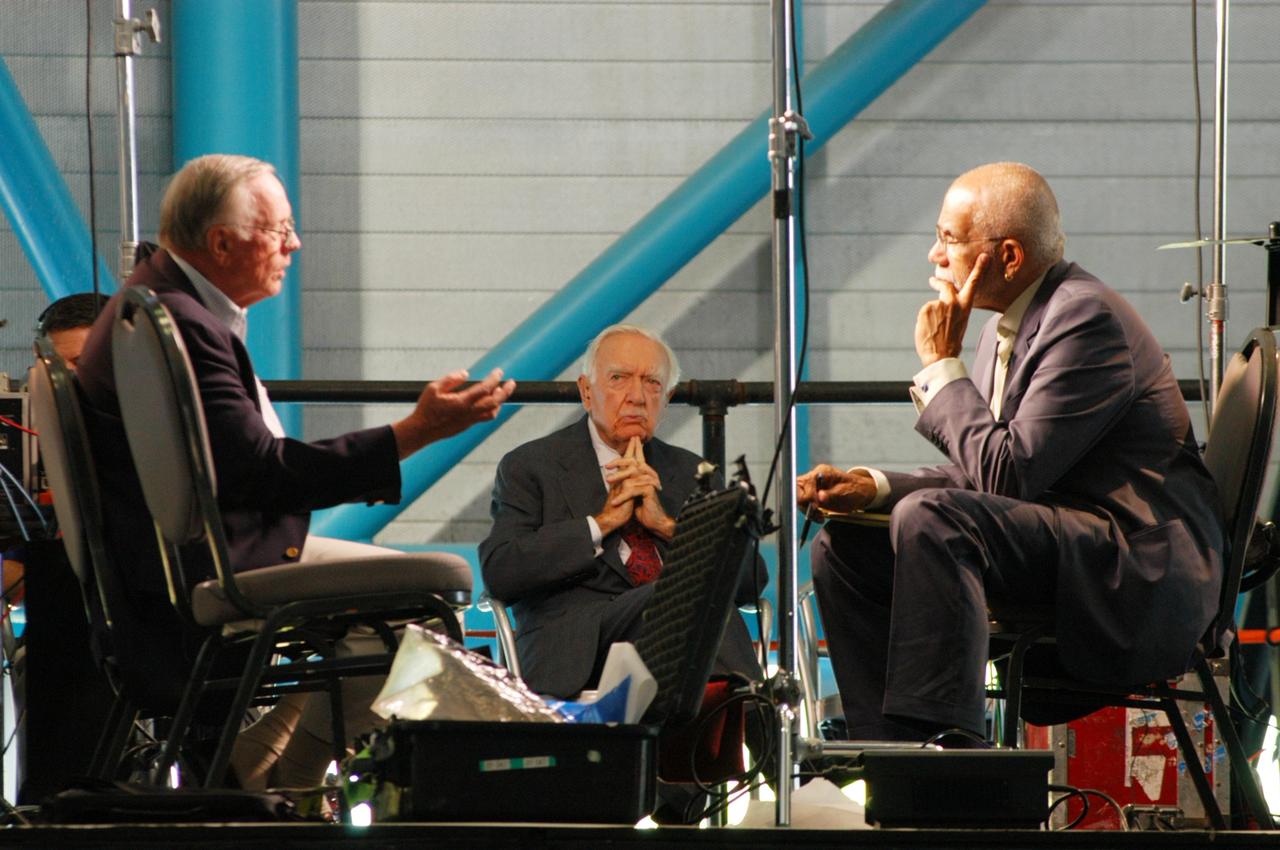
KENNEDY SPACE CENTER, FLA. - The CBS news program “60 Minutes” is taping a segment inside NASA Kennedy Space Center’s Apollo/Saturn V Center. Correspondent Ed Bradley (right) is seen here listening intently to former astronaut Neil Armstrong (left), the subject of the interview. In the background is CBS broadcaster Walter Cronkite, who reunited with Armstrong for the 60 Minutes show. The show aired Nov. 6.
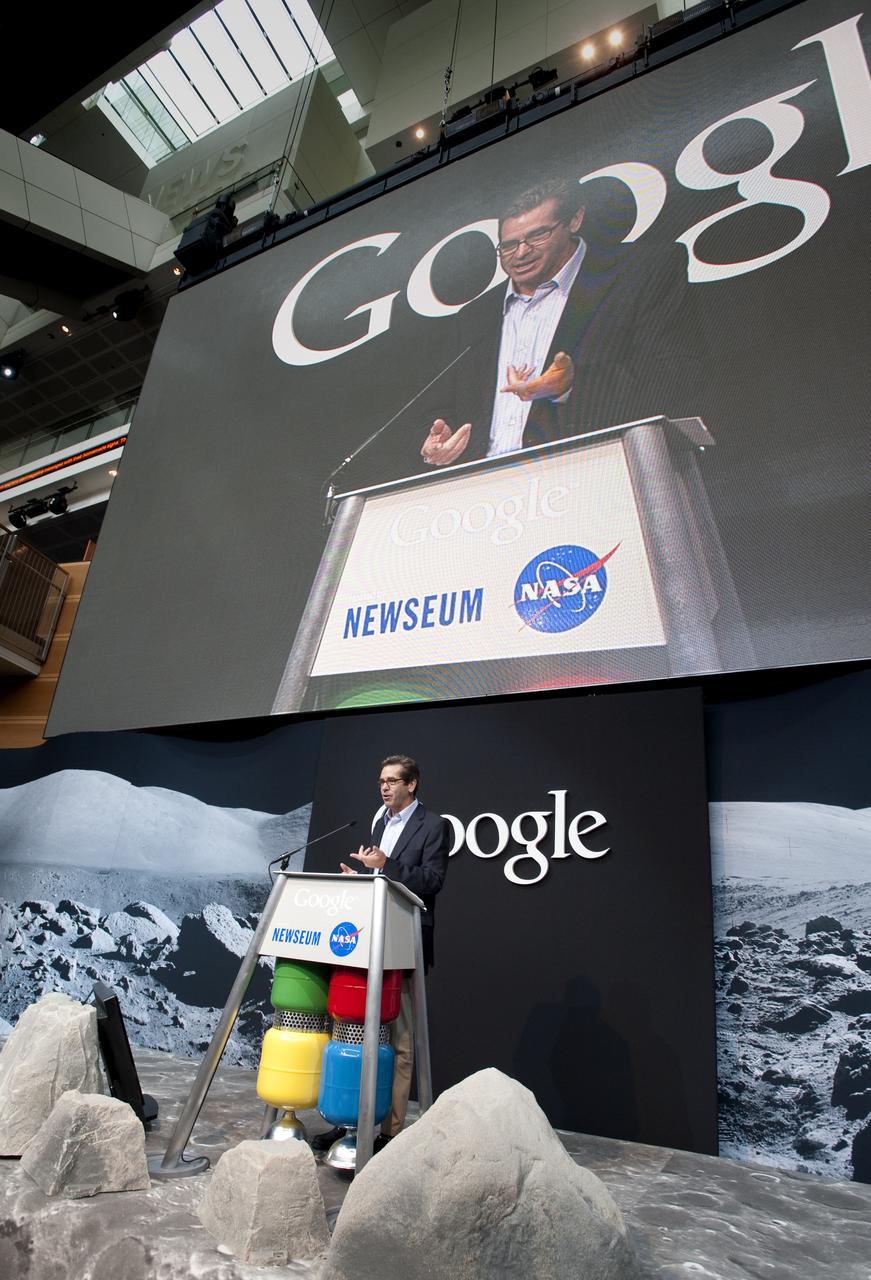
Miles O'Brien, former chief science and tech correspondent for CNN, speaks during a press conference, Monday, July 20, 2009, announcing the launch of Moon in Google Earth, an immersive 3D atlas of the Moon, accessible within Google Earth 5.0, Monday, July 20, 2009, at the Newseum in Washington. Photo Credit: (NASA/Bill Ingalls)
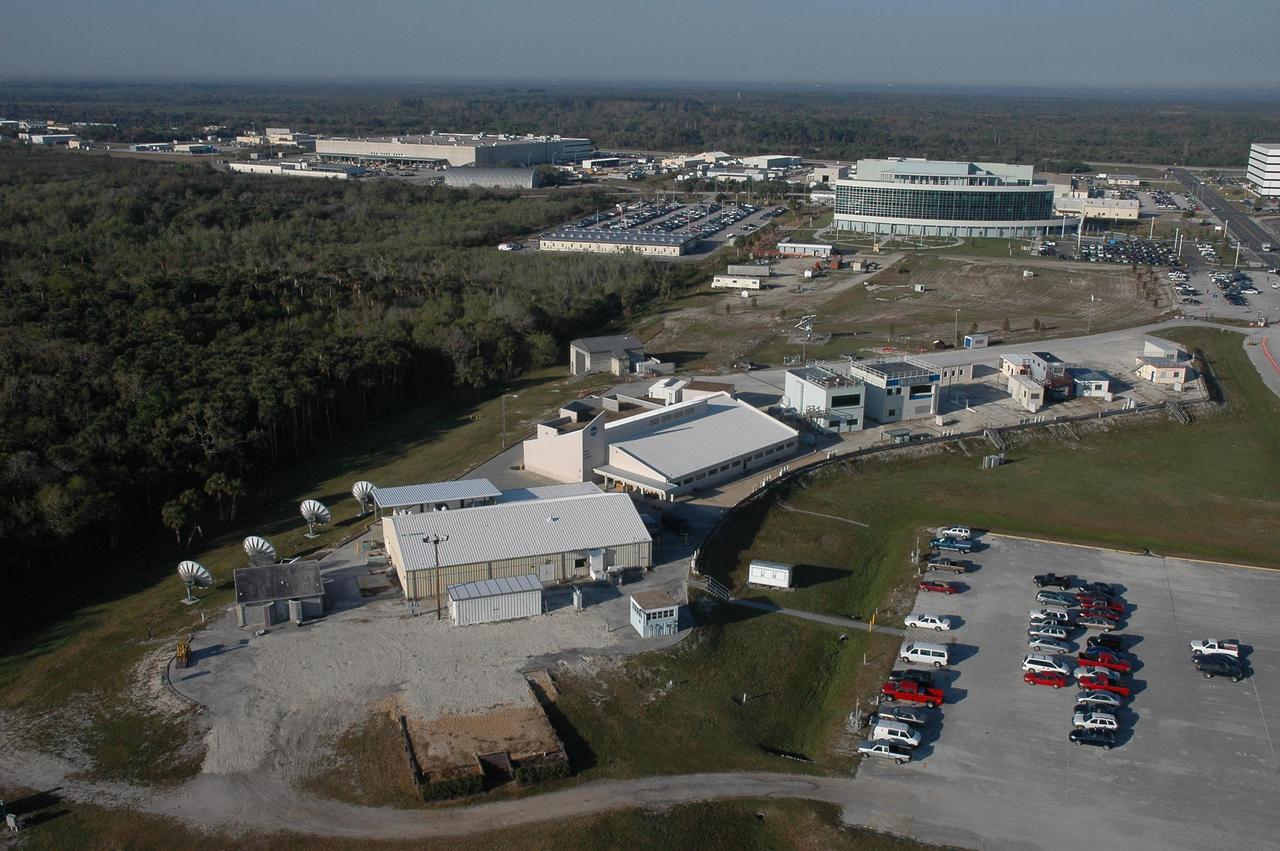
KENNEDY SPACE CENTER, FLA. - This aerial view shows the Press Site (in the foreground) comprising the NASA TV studio, the NASA News Center behind it, buildings used by local NBC and CBS television stations, and newly erected prefabricated buildings for local newspapers and correspondents for CNN, AP and others. A year-long project removed and replaced hurricane-hazardous trailers and bleachers from the site. In the background, at right, is the newly build Operations Support Building II. Photo credit: Cory Huston
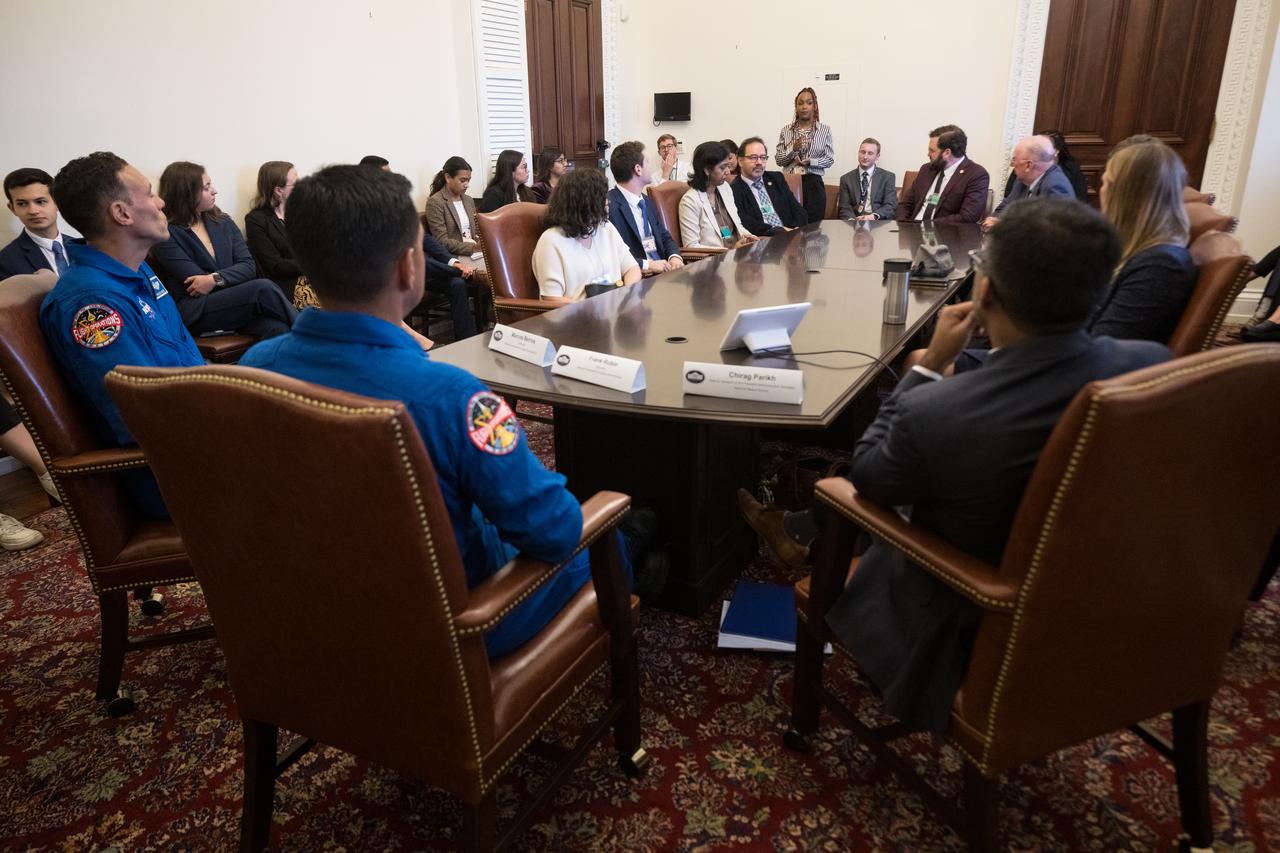
Carrington Jones-Jackson, Intern, Vice Presidential Correspondence, asks a question at at a staff engagement event that took place during a White House Hispanic Heritage month event titled “Soaring Together: Inspiring the Next Generation of Space Leaders” at the Eisenhower Executive Office Building, Monday, Sept. 30, 2024 in Washington. Photo Credit: (NASA/Aubrey Gemignani)
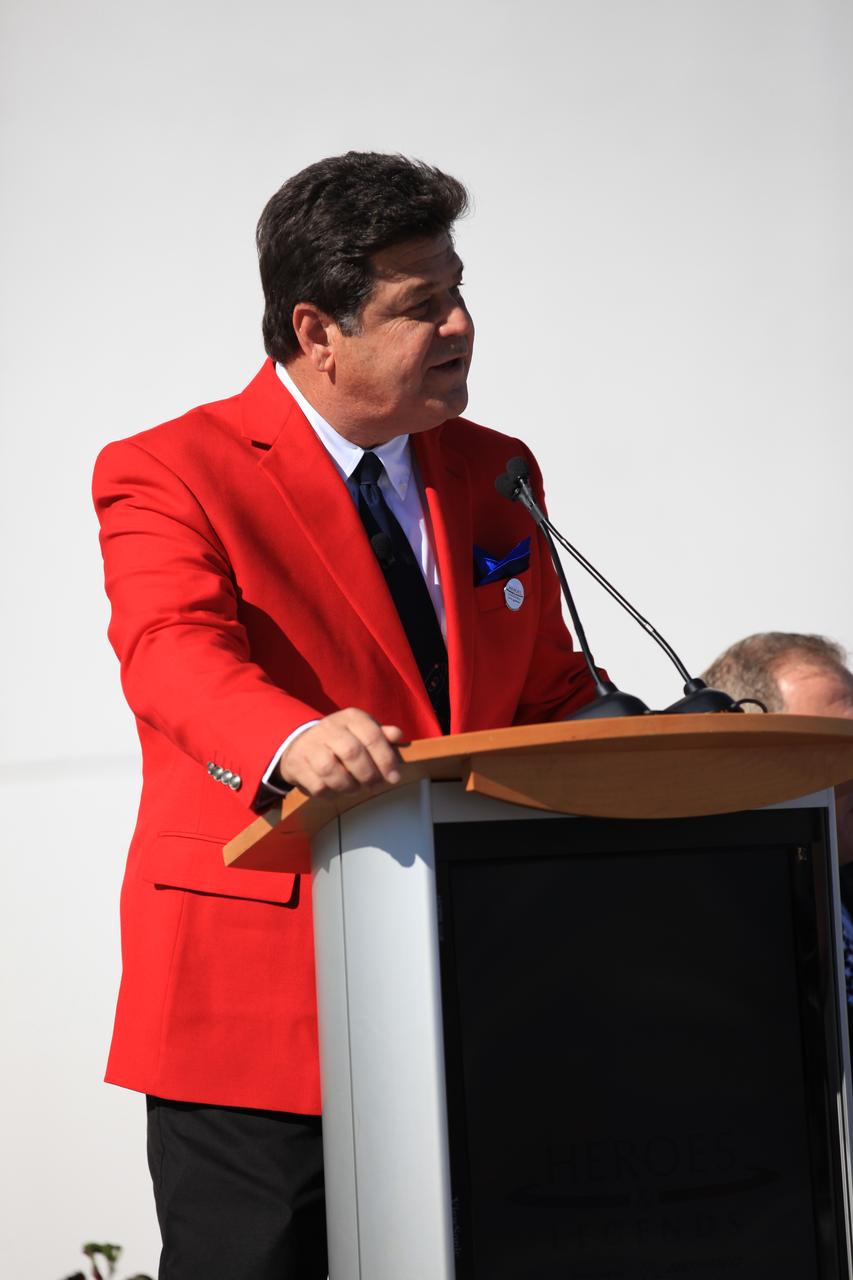
Former CNN space correspondent John Zarrella serves as master of ceremonies during the opening of the Heroes and Legends attraction at the Kennedy Space Center Visitor Complex. The new facility includes the U.S. Astronaut Hall of Fame and looks back to the pioneering efforts of Mercury, Gemini and Apollo. It sets the stage by providing the background and context for space exploration and the legendary men and women who pioneered the nation's journey into space.
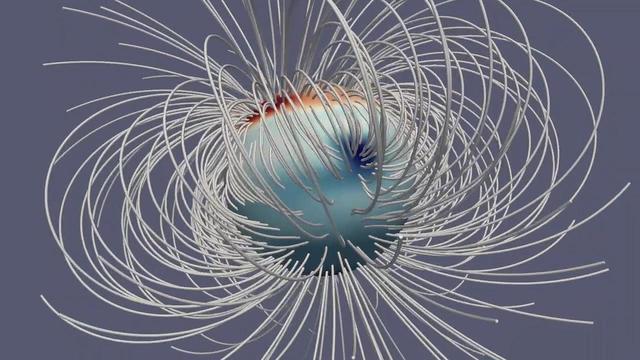
This animation illustrates Jupiter's magnetic field at a single moment in time. The Great Blue Spot, an-invisible-to-the-eye concentration of magnetic field near the equator, stands out as a particularly strong feature. The gray lines (called field lines) show the field's direction in space, and the deepness of the color corresponds to the strength of the magnetic field (with dark red and dark blue for regions with strongly positive and strongly negative fields, respectively). The animation first appeared in a Sept. 5, 2018, paper in the Journal Nature. Animation available at https://photojournal.jpl.nasa.gov/catalog/PIA23229.
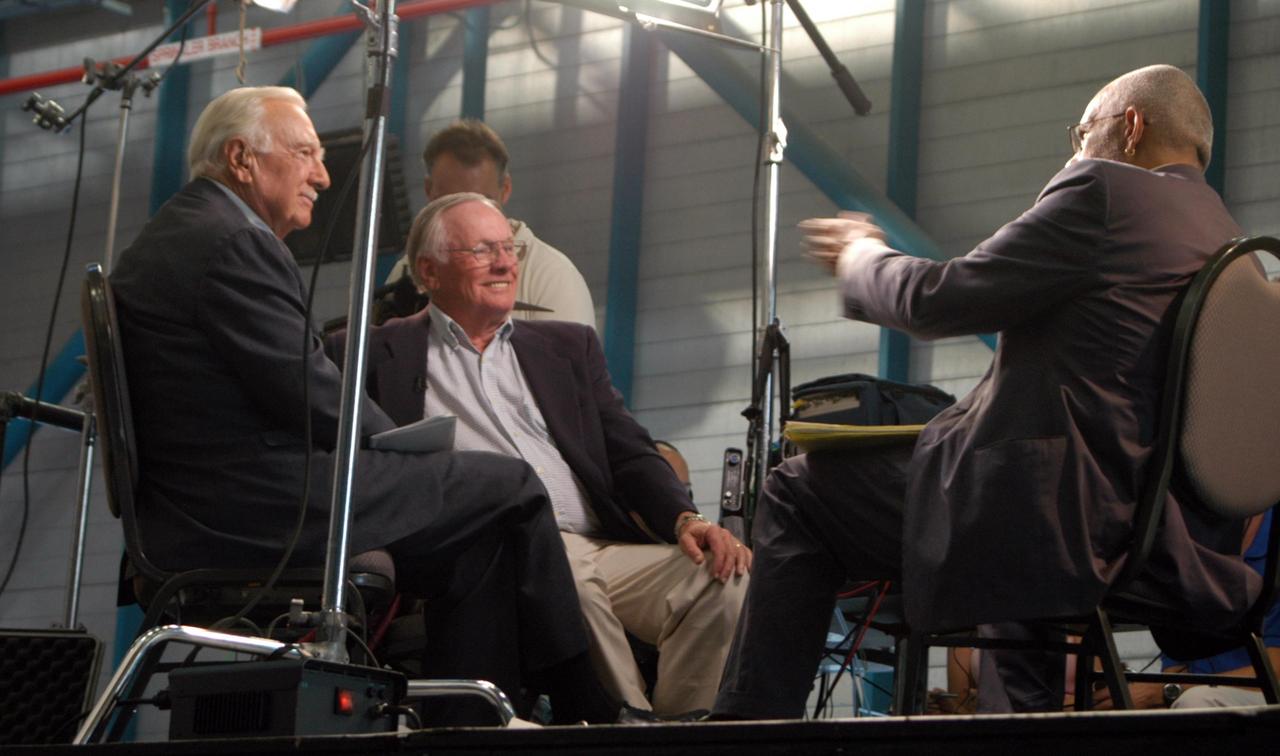
KENNEDY SPACE CENTER, FLA. - Inside NASA Kennedy Space Center’s Apollo/Saturn V Center, former CBS broadcaster Walter Cronkite (left) and former astronaut Neil Armstrong (center) are interviewed by CBS correspondent Ed Bradley (right). Armstrong talked about his historic milestone - walking on the moon - and the public’s response and affect on his career afterward. The show aired Nov. 6.
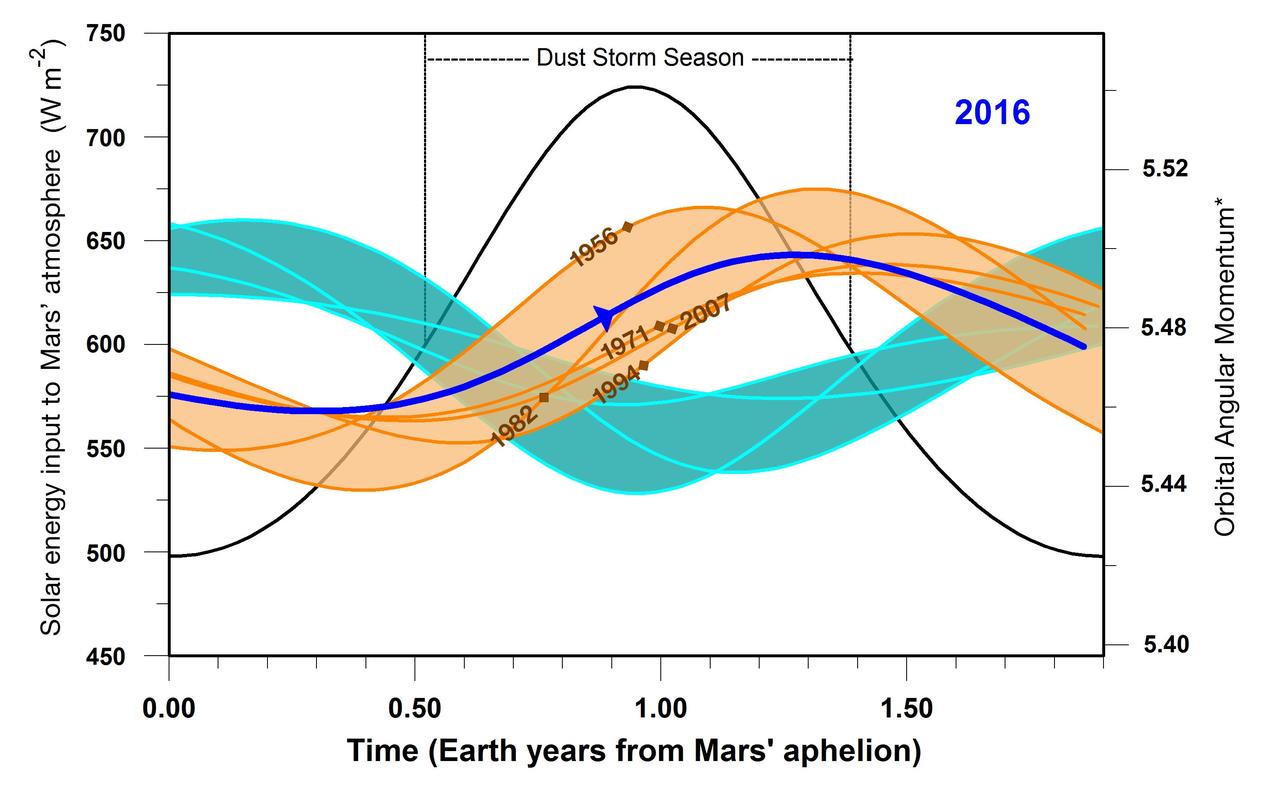
This graphic indicates a similarity between 2016 (dark blue line) and five past years in which Mars has experienced a global dust storm (orange lines and band), compared to years with no global dust storm (blue-green lines and band). The arrow nearly midway across in the dark blue line indicates the Mars time of year in late September 2016. A key factor in the graph is the orbital angular momentum of Mars, which would be steady in a system of only one planet orbiting the sun, but varies due to relatively small effects of having other planets in the solar system. The horizontal scale is time of year on Mars, starting at left with the planet's farthest distance from the sun in each orbit. This point in the Mars year, called "Mars aphelion," corresponds to late autumn in the southern hemisphere. Numeric values on the horizontal axis are in Earth years; each Mars year lasts for about 1.9 Earth years. The vertical scale bar at left applies only to the black-line curve on the graph. The amount of solar energy entering Mars' atmosphere (in watts per square meter) peaks at the time of year when Mars is closest to the sun, corresponding to late spring in the southern hemisphere. The duration of Mars' dust storm season, as indicated, brackets the time of maximum solar input to the atmosphere. The scale bar at right, for orbital angular momentum, applies to the blue, brown and blue-green curves on the graph. The values are based on mass, velocity and distance from the gravitational center of the solar system. Additional information on the units is in a 2015 paper in the journal Icarus, from which this graph is derived. The band shaded in orange is superimposed on the curves of angular momentum for five Mars years that were accompanied by global dust storms in 1956, 1971, 1982, 1994 and 2007. Brown diamond symbols on the curves for these years in indicate the times when the global storms began. The band shaded blue-green lies atop angular momentum curves for six years when no global dust storms occurred: 1939, 1975, 1988, 1998, 2000 and 2011. Note that in 2016, as in the pattern of curves for years with global dust storms, the start of the dust storm season corresponded to a period of increasing orbital angular momentum. In years with no global storm, angular momentum was declining at that point. Observations of whether dust from regional storms on Mars spreads globally in late 2016 or early 2017 will determine whether this correspondence holds up for the current Mars year. http://photojournal.jpl.nasa.gov/catalog/PIA20855
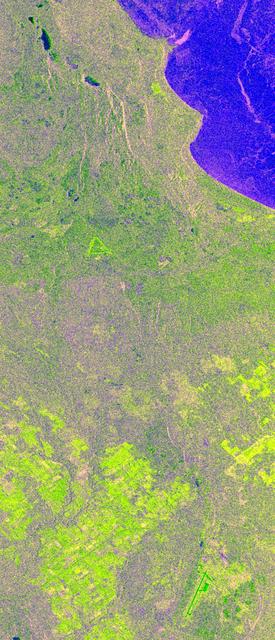
This is an X-band image of seasonal changes at the ecological test site of Raco, Michigan, located south of Whitefish Bay on Lake Superior. The image is centered at about 46 degrees north latitude and 85 degrees west longitude. This image was acquired by the X-band Synthetic Aperture Radar onboard the space shuttle Endeavour on April 10th, 1994, and on October 1, 1994. The areas shown in red correspond to the April 10th data; the areas in blue correspond to data acquired on October 1, 1994; green indicates the ratio of data acquired on April 10 and October 1, 1994. The area shown is 22.7 kilometers by 53 kilometers (14 miles by 33 miles). Lake Superior in the upper right was frozen in April and had small waves (ripples) on its surface in October. The land area contains mostly forests and, to a lesser extent, agricultural regions. In April the area was covered in wet snow. By October, there agricultural areas were covered with grass. Vegetation and soils were moist due to rainfalls three days before the data was acquired on October 1, 1994. The bright light green/yellow tones in the lower half of the image show the stronger reflections of the snow-covered agricultural fields. The pinkish color corresponds to the coniferous and deciduous forests. The green area represents red pines. These trees are smaller than the surrounding forest cover and allow more radar penetration. The area is green because the radar is sensing the surface, which undergoes great change from snow to grass and fern undergrowth between April and October. The bright green triangle in the upper half of the image is an old airstrip, while the modern airport can be seen on the bottom right side of the image. The Raco site is an important location for monitoring seasonal changes and future global change because it is situated at the ecological transition zone between the boreal forests and the northern temperate forests. This transitional zone is expected to be ecologically sensitive to anticipated global changes resulting from climatic warming. Baseline studies of vegetation are essential in monitoring these expected changes. http://photojournal.jpl.nasa.gov/catalog/PIA01734
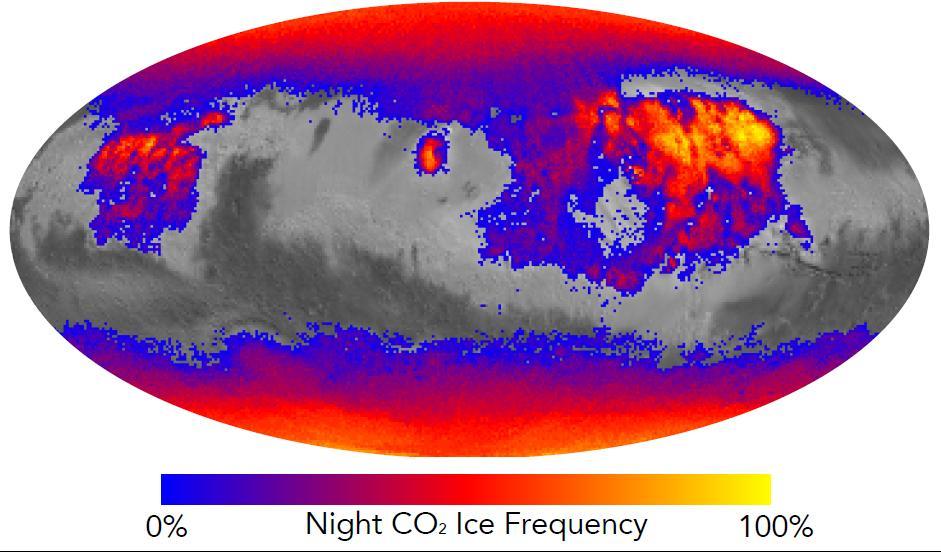
This map shows the frequency of carbon dioxide frost's presence at sunrise on Mars, as a percentage of days year-round. Carbon dioxide ice more often covers the ground at night in some mid-latitude regions than in polar regions, where it is generally absent for much of summer and fall. Color coding is based on data from the Mars Climate Sounder instrument on NASA's Mars Reconnaissance Orbiter. A color-key bar below the map shows how colors correspond to frequencies. Yellow indicates high frequencies, identifying areas where carbon dioxide ice is present on the ground at night during most of the year. Blue identifies areas where it is rarely present; red is intermediate. Areas without color coding are regions where carbon dioxide frost is not detected at any time of year. The areas with highest frequency of overnight carbon dioxide frost correspond to regions with surfaces of loose dust, which do not retain heat well, compared to rockier areas. Those areas also have some of the highest mid-afternoon temperatures on the planet. The dust surface heats up and cools off rapidly. http://photojournal.jpl.nasa.gov/catalog/PIA20758
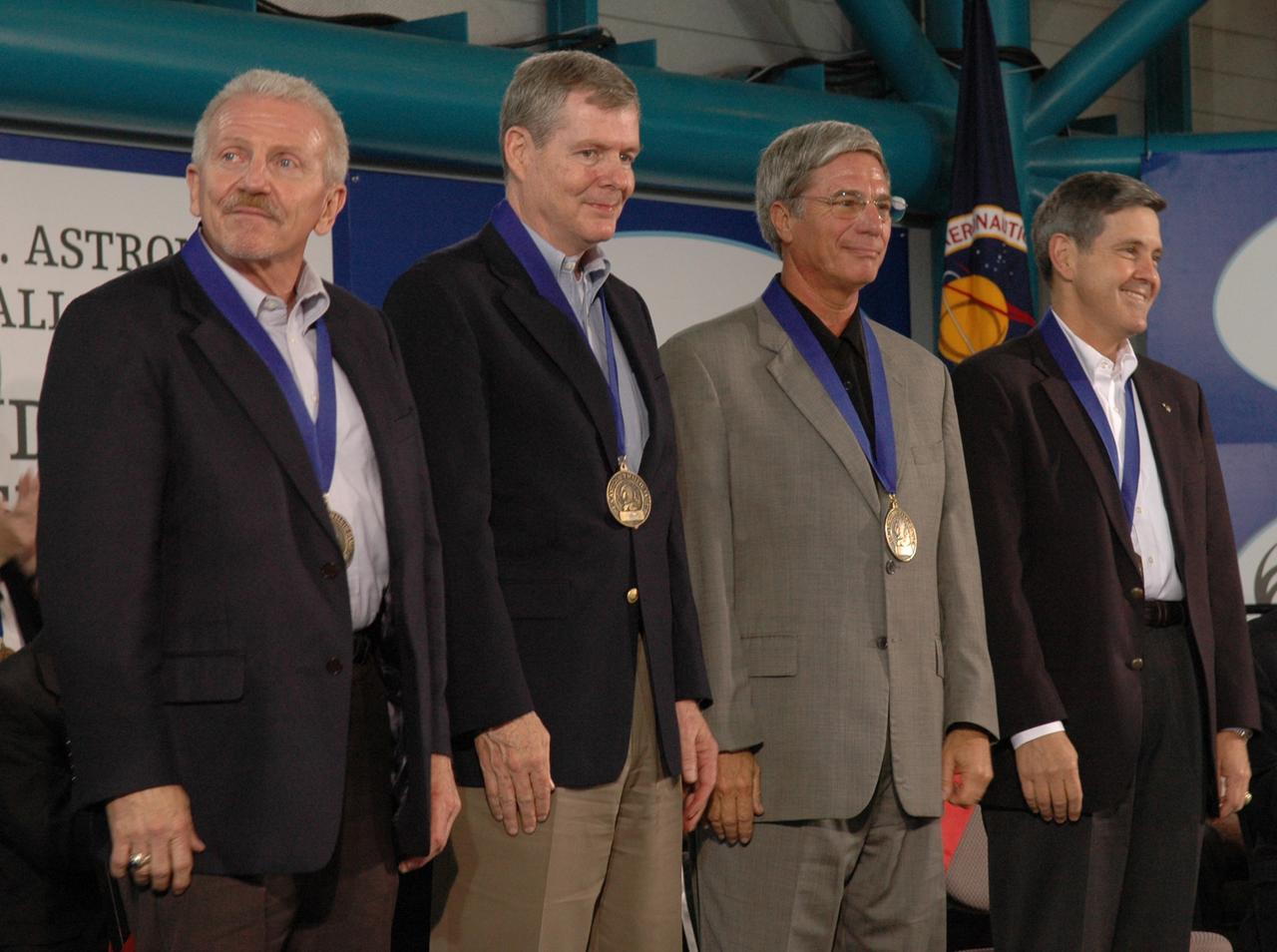
CAPE CANAVERAL, Fla. -- The new inductees into the U.S. Astronaut Hall of Fame stand for an ovation during the ceremony May 3 at NASA's Kennedy Space Center. From left are Loren Shriver; Bryan O'Connor, NASA's chief of Safety and Mission Assurance at NASA Headquarters in Washington; John Blaha; and Robert Cabana, center director of NASA's Stennis Space Center in Mississippi. Other former astronauts attending included Scott Carpenter, John Young, Bob Crippen, and Walt Cunningham. The U.S. Astronaut Hall of Fame is operated by Kennedy Space Center Visitor Complex on behalf of NASA. CNN correspondent John Zarrella hosted the event.
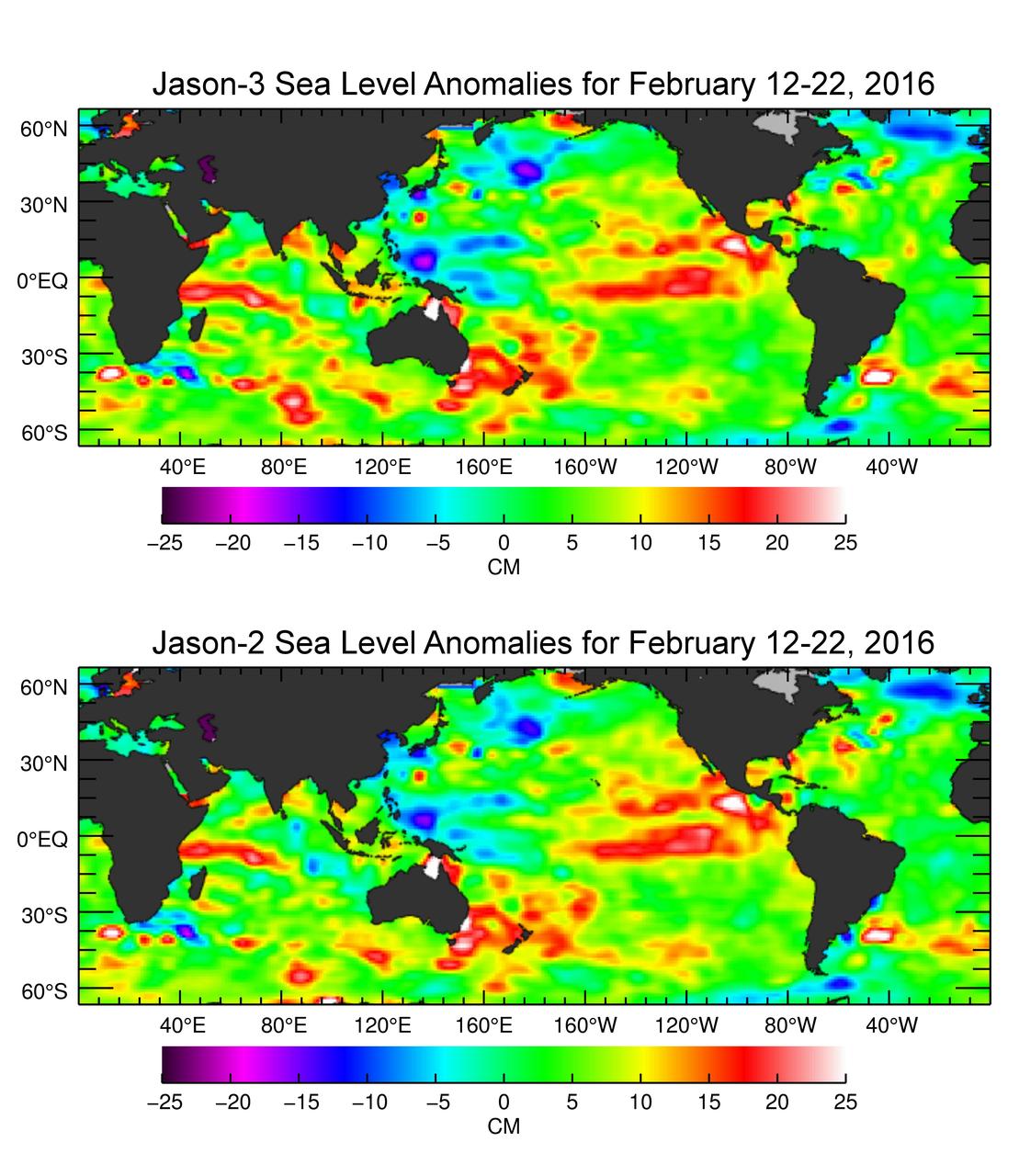
The U.S./European Jason-3 satellite has produced its first map of sea surface height, which corresponds well to data from its predecessor, Jason-2. Higher-than-normal sea levels are red; lower-than-normal sea levels are blue. El Niño is visible as the red blob in the eastern equatorial Pacific. Extending the timeline of ocean surface topography measurements begun by the Topex/Poseidon and Jason 1 and 2 satellites, Jason 3 will make highly detailed measurements of sea-level on Earth to gain insight into ocean circulation and climate change. http://photojournal.jpl.nasa.gov/catalog/PIA20532
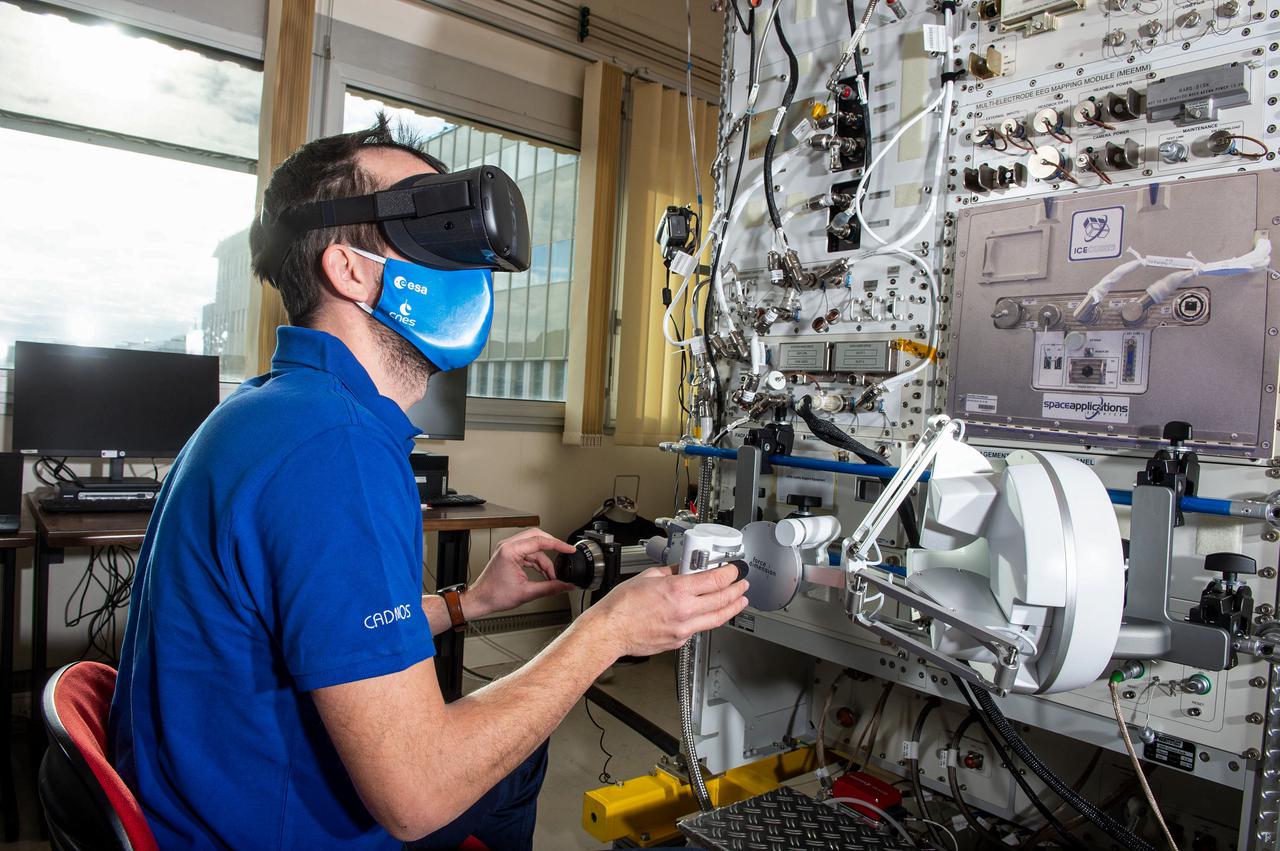
jsc2021e019399 (1/12/2021) --- Simulation of the Pilote experiment. In order to test the ergonomics of a multisensory interface for controlling robotic arms and spacecraft, it is necessary to perform the trials in microgravity. Performing the test on Earth would lead to a design of a work station using terrestrial ergonomic principles that do not correspond to conditions experienced on a spacecraft in orbit. The Pilote investigation tests the effectiveness of novel control schemes for the remote operation of robotic arms and space vehicles, using virtual reality and a new class of user-machine interfaces based on haptics. Image courtesy of CNES/GRIMAULT Emmanuel.

jsc2021e019401 (1/19/2021) --- A preflight macro shot of SIGMA-7 interface for Pilote experiment, In order to test the ergonomics of a multisensory interface for controlling robotic arms and spacecraft, it is necessary to perform the trials in microgravity. Performing the test on Earth would lead to a design of a work station using terrestrial ergonomic principles that do not correspond to conditions experienced on a spacecraft in orbit. The Pilote investigation tests the effectiveness of novel control schemes for the remote operation of robotic arms and space vehicles, using virtual reality and a new class of user-machine interfaces based on haptics. Image courtesy of CNES/DE PRADA Thierry.
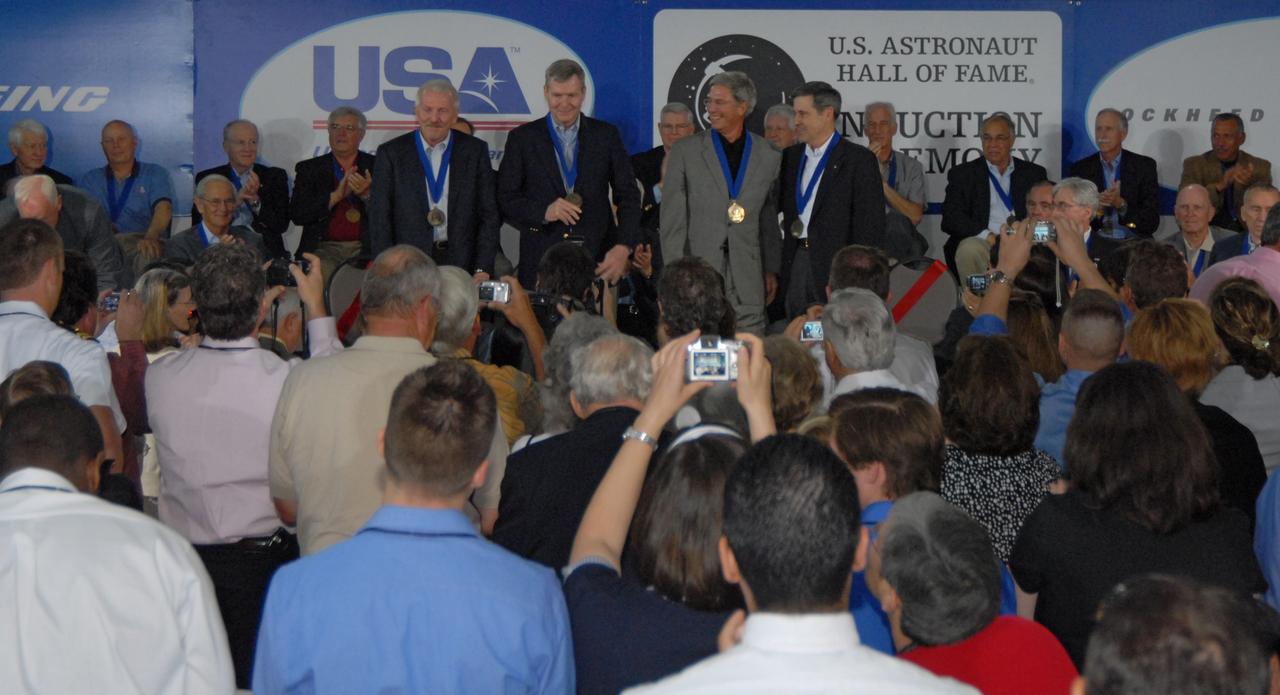
CAPE CANAVERAL, Fla. -- The new inductees into the U.S. Astronaut Hall of Fame step forward on stage for photographs following their induction. From left are Loren Shriver; Bryan O'Connor, NASA's chief of Safety and Mission Assurance at NASA Headquarters in Washington; John Blaha; and Robert Cabana, center director of NASA's Stennis Space Center in Mississippi. The ceremony was held May 3 at NASA's Kennedy Space Center. Other former astronauts attending included Scott Carpenter, John Young, Bob Crippen, and Walt Cunningham. The U.S. Astronaut Hall of Fame is operated by Kennedy Space Center Visitor Complex on behalf of NASA. CNN correspondent John Zarrella hosted the event.
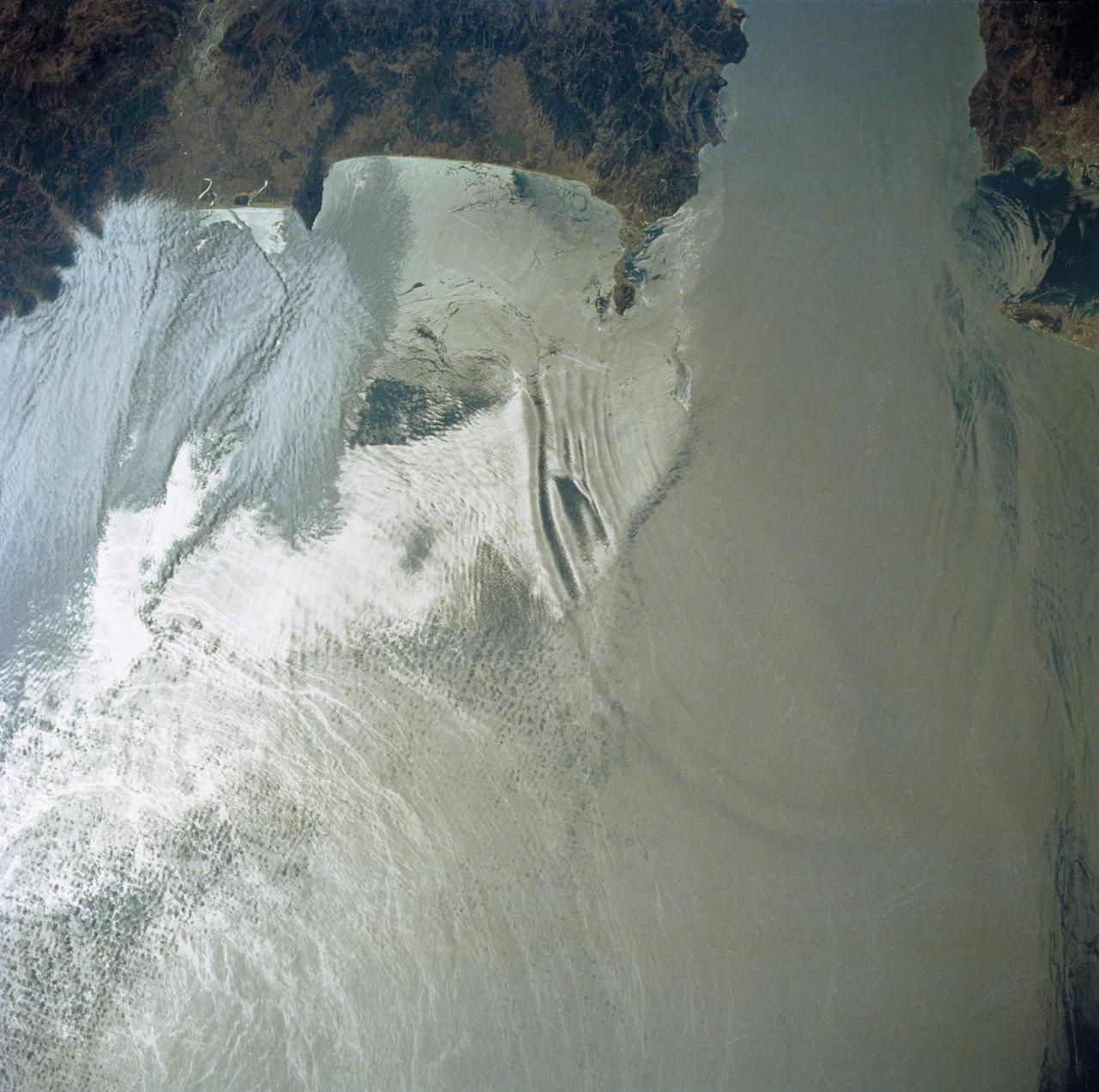
41G-34-098 (5-13 Oct 1984) --- Strait of Gibraltar and western Mediterranean photographed sunglint. Sun reflection on water delineates surface texture, which corresponds to the ocean's dynamics. The large group of waves connecting Gibraltar with the Moroccan coast is the response of the ocean to a tidal pulse moving into the Mediterranean. The low level wing shear line extending out from the Moroccan coastline into the Mediterranean for approximately 40 miles is the southern extremity of the wind funneling through the strait. This is the first high resolution photograph ever taken of this phenomenon permitting detailed delineation of individual waves which comprise the wave packet.
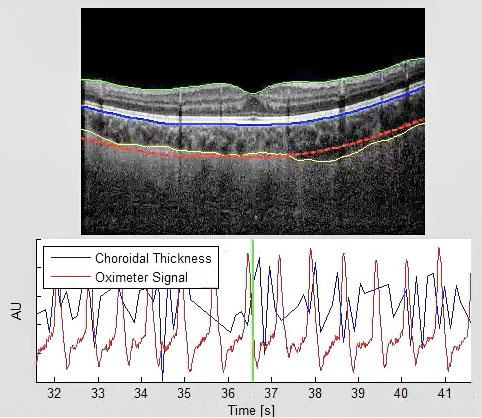
jsc2022e004236 (1/28/2022) --- A Optical coherence tomography (OCT) image of the posterior segement of the eye (top), and chorioidal thickness and oximeter signal time series (bottom). At the top, segmentation lines depict the boundaries of the retina in green and blue. The red colored line shows the mean distance between the retina and the outer limit of the choroid (in yellow) which corresponds to choroidal thickness. At the bottom, the variation in choroidal thickness and the heart rate over time are shown. Space Flight-Associated Neuro-Ocular Syndrome Ocular Rigidity Investigation (SANSORI) investigates whether stiffness of the eye, called ocular rigidity, contributes to development of Space Flight-Associated Neuro-Ocular Syndrome (SANS). Image courtesy University of Montreal
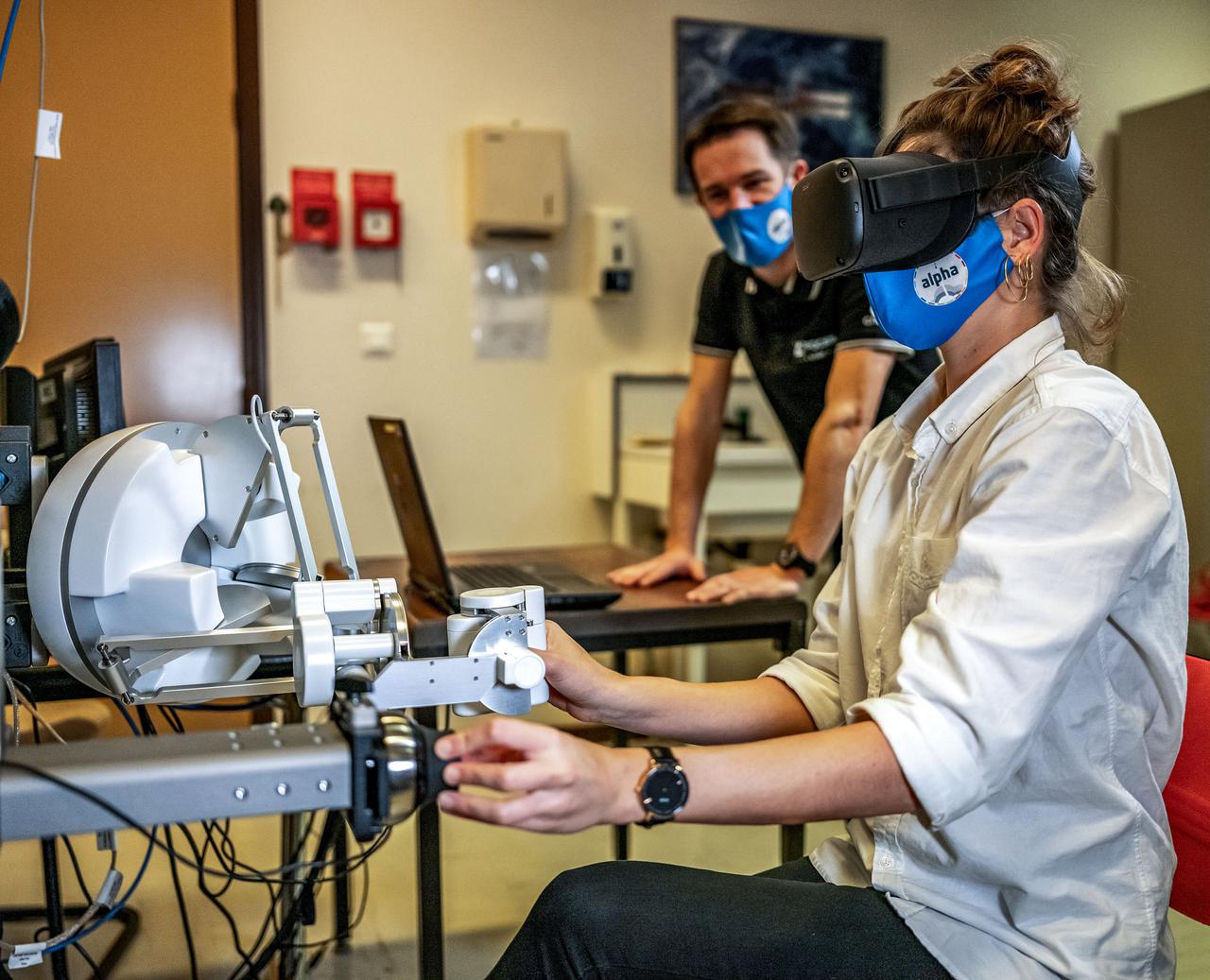
jsc2021e019398 (12/9/2020) --- Simulation of the Pilote experiment. In order to test the ergonomics of a multisensory interface for controlling robotic arms and spacecraft, it is necessary to perform the trials in microgravity. Performing the test on Earth would lead to a design of a work station using terrestrial ergonomic principles that do not correspond to conditions experienced on a spacecraft in orbit. The Pilote investigation tests the effectiveness of novel control schemes for the remote operation of robotic arms and space vehicles, using virtual reality and a new class of user-machine interfaces based on haptics. Image courtesy of CNES/DE PRADA Thierry.
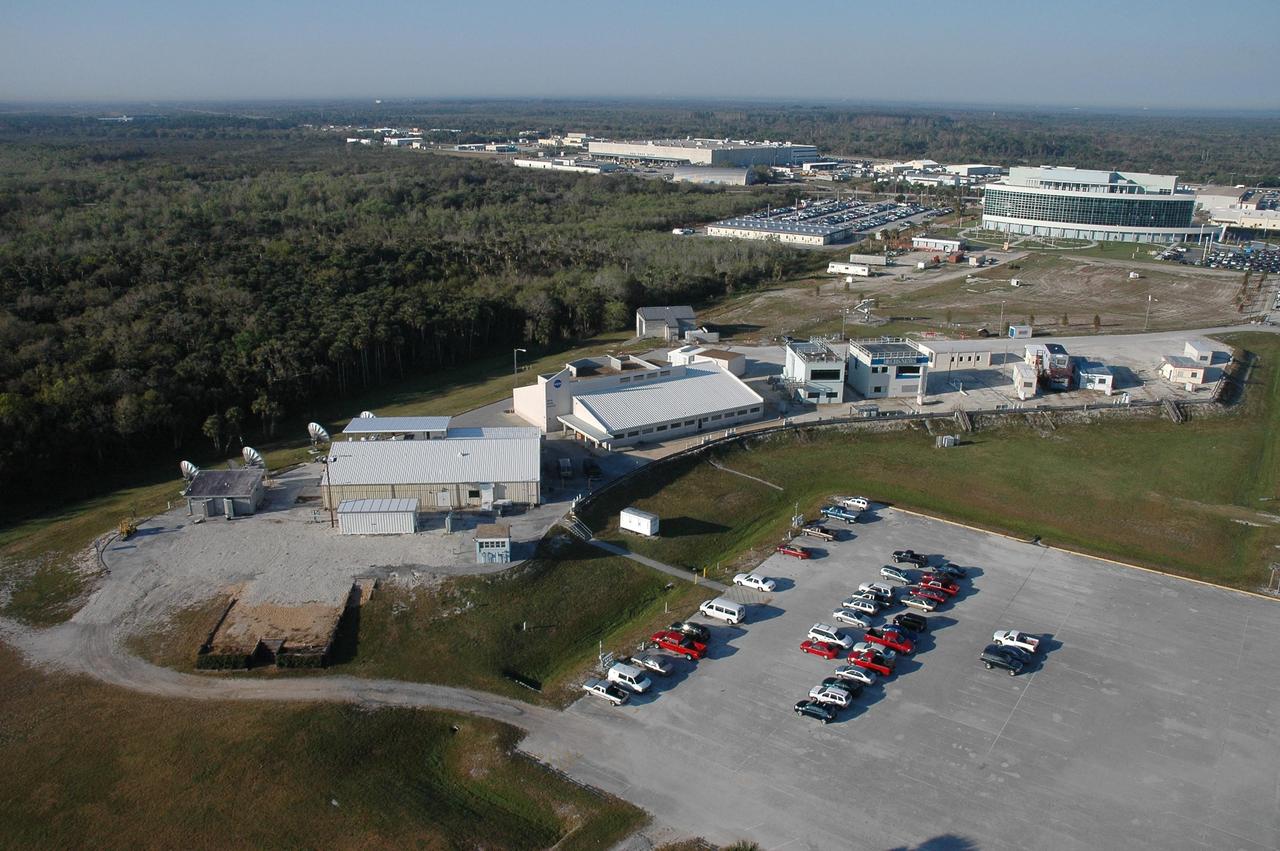
KENNEDY SPACE CENTER, FLA. - This aerial view shows the Press Site (in the foreground) comprising the NASA TV studio, the NASA News Center behind it, buildings used by local NBC and CBS television stations, and newly erected prefabricated buildings for local newspapers and correspondents for CNN, AP and others. A year-long project removed and replaced hurricane-damaged trailers and grandstands from the site. In the background, at right, is the newly built Operations Support Building II, which replaced modular housing and trailers in the Launch Complex 39 area. Photo credit: Cory Huston

From left, Center Director Roy Bridges and NASA Administrator Daniel S. Goldin applaud as Jay Holliman, with the help of his mother, Mrs. Dianne Holliman, unveils a plaque honoring his father, the late John Holliman. At right is Tom Johnson, news group chairman of CNN. The occasion was the dedication of the KSC Press Site auditorium as the John Holliman Auditorium to honor the CNN national correspondent for his enthusiastic, dedicated coverage of America's space program. The auditorium was built in 1980 and has been the focal point for new coverage of Space Shuttle launches. The ceremony followed the 94th launch of a Space Shuttle, on mission STS-96, earlier this morning
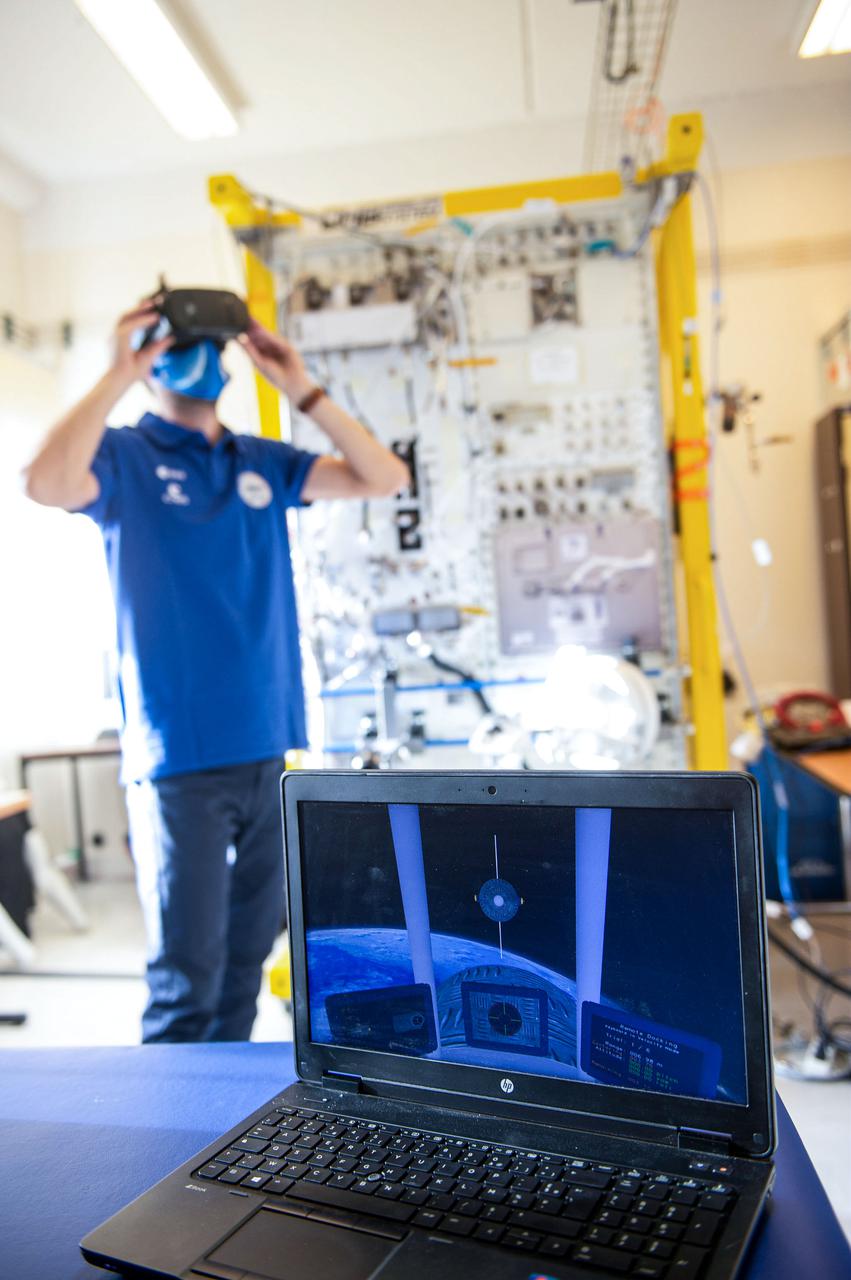
jsc2021e019400 (1/12/2021) --- Simulation of the Pilote experiment. In order to test the ergonomics of a multisensory interface for controlling robotic arms and spacecraft, it is necessary to perform the trials in microgravity. Performing the test on Earth would lead to a design of a work station using terrestrial ergonomic principles that do not correspond to conditions experienced on a spacecraft in orbit. The Pilote investigation tests the effectiveness of novel control schemes for the remote operation of robotic arms and space vehicles, using virtual reality and a new class of user-machine interfaces based on haptics. Image courtesy of CNES/GRIMAULT Emmanuel.
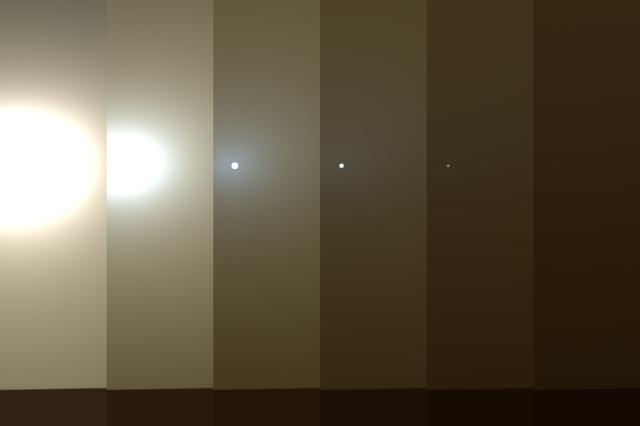
This series of images shows simulated views of a darkening Martian sky blotting out the Sun from NASA's Opportunity rover's point of view, with the right side simulating Opportunity's current view in the global dust storm (June 2018). The left starts with a blindingly bright mid-afternoon sky, with the sun appearing bigger because of brightness. The right shows the Sun so obscured by dust it looks like a pinprick. Each frame corresponds to a tau value, or measure of opacity: 1, 3, 5, 7, 9, 11. https://photojournal.jpl.nasa.gov/catalog/PIA22521
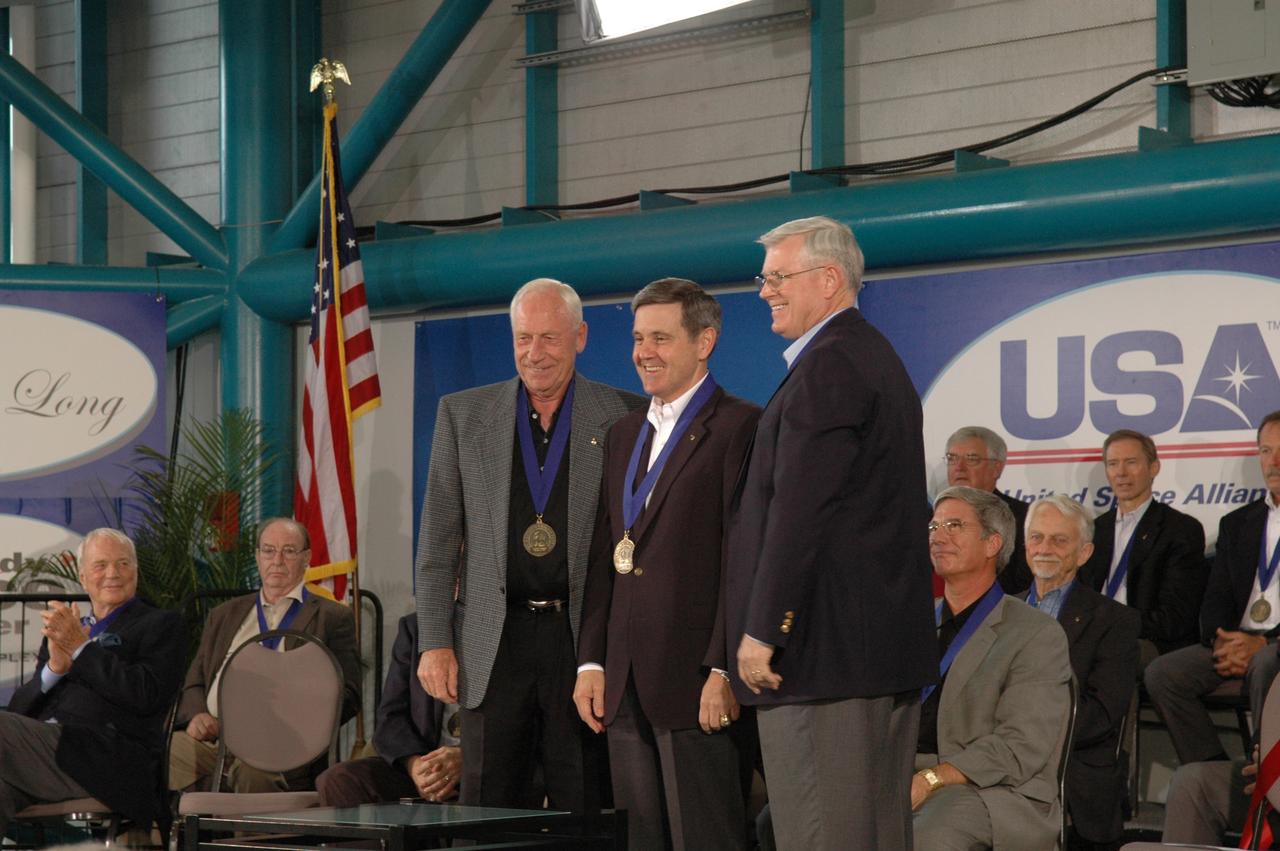
CAPE CANAVERAL, Fla. -- Former astronaut Robert Cabana (center) receives congratulations on his induction into the U.S. Astronaut Hall of Fame from former inductees Al Worden (left) and Michael Coats (right). Other inductees were John Blaha, Loren Shriver; and Bryan O'Connor, NASA's chief of Safety and Mission Assurance at NASA Headquarters in Washington. Other former astronauts attending included Scott Carpenter, John Young, Bob Crippen, and Walt Cunningham. The U.S. Astronaut Hall of Fame is operated by Kennedy Space Center Visitor Complex on behalf of NASA. CNN correspondent John Zarrella hosted the event.
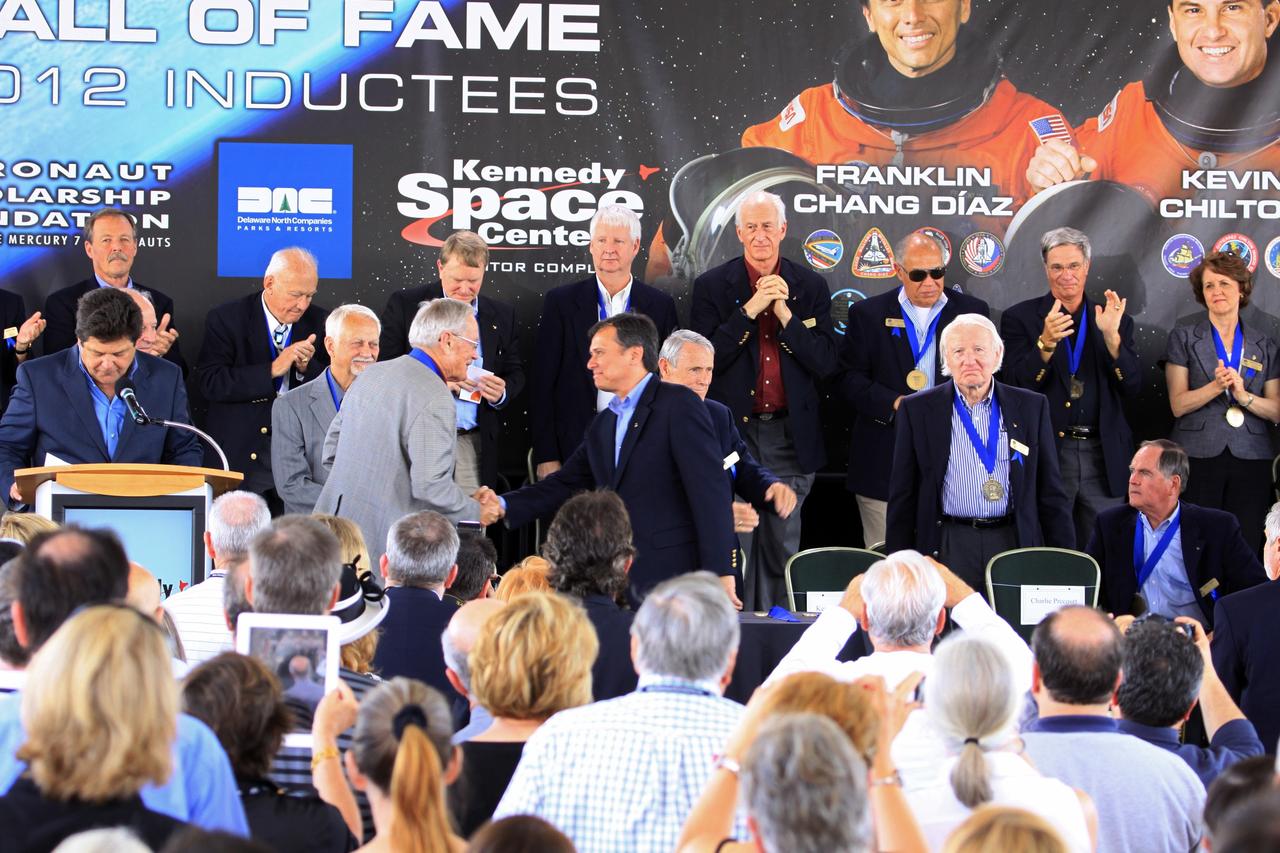
CAPE CANAVERAL, Fla. – At NASA’s Kennedy Space Center Visitor Complex in Florida, Astronaut Scholarship Foundation Chairman and Hall of Fame astronaut Charlie Duke inducts shuttle astronaut Franklin Chang Diaz into the U.S. Astronaut Hall of Fame Class of 2012. At the podium to the left, is CNN correspondent and Master of Ceremonies John Zarrella. Also inducted into the Hall of Fame were shuttle astronauts Kevin Chilton and Charlie Precourt. The year’s inductees were selected by a committee of current Hall of Fame astronauts, former NASA officials, historians and journalists. The selection process is administered by the Astronaut Scholarship Foundation. Photo credit: NASA/Jim Grossmann
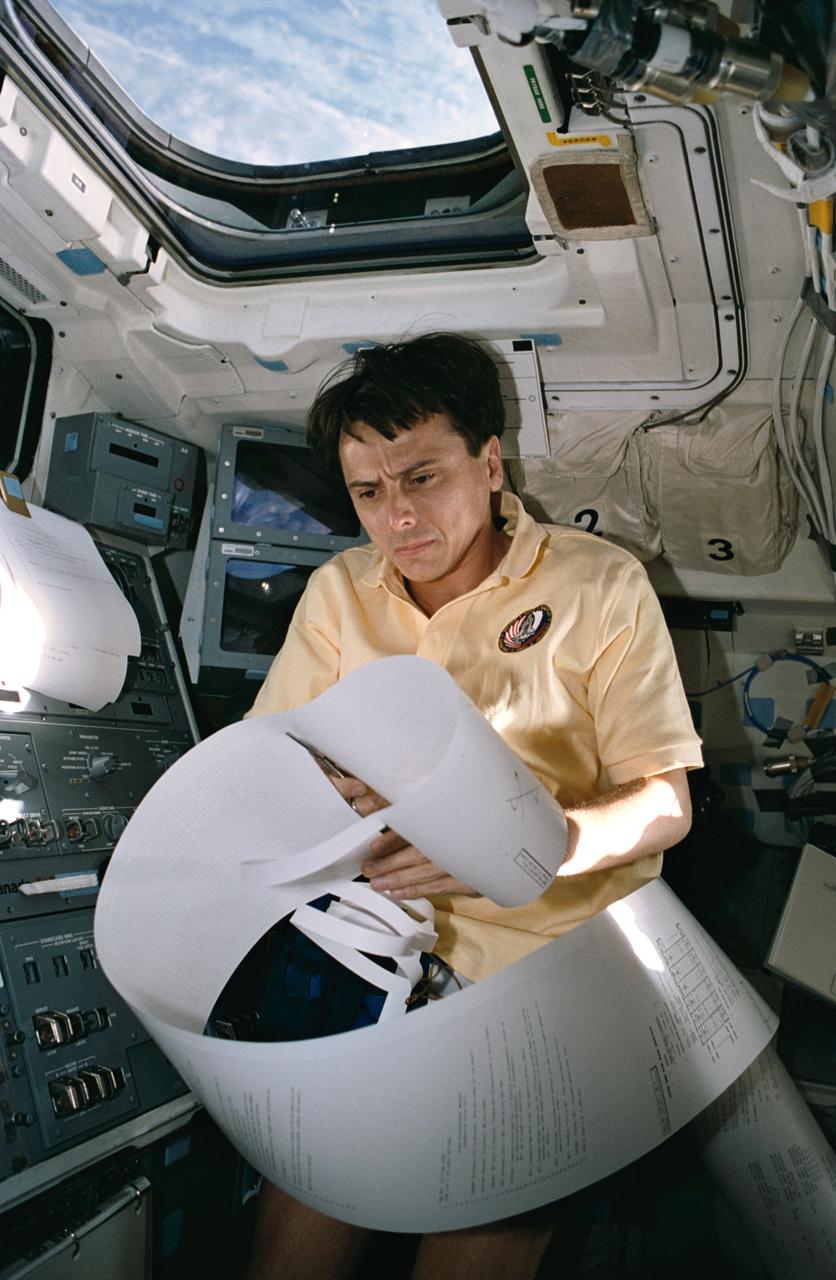
STS060-25-016 (6 Feb. 1994) --- On space shuttle Discovery?s aft flight deck, astronaut Franklin R. Chang-Diaz, STS-60 payload commander, begins to organize what was believed to be among the longest mail messages in shuttle history. Though early shuttle flights could brag of longer teleprinted messages, the Thermal Imaging Printing System?s day four correspondence, most of which is out of frame here, is record length for recent flights. Chang-Diaz joined four other NASA astronauts and a Russian cosmonaut for eight days aboard Discovery. Photo credit: NASA or National Aeronautics and Space Administration
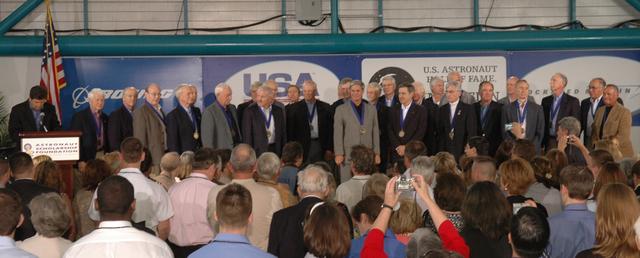
CAPE CANAVERAL, Fla. -- Members of the U.S. Astronaut Hall of Fame stand for an ovation following the induction of the newest members (at center): Loren Shriver; Bryan O'Connor, NASA's chief of Safety and Mission Assurance at NASA Headquarters in Washington; John Blaha; and Robert Cabana, center director of NASA's Stennis Space Center in Mississippi. The ceremony was held May 3 at NASA's Kennedy Space Center. Other former astronauts attending included Scott Carpenter, John Young, Bob Crippen, and Walt Cunningham. The U.S. Astronaut Hall of Fame is operated by Kennedy Space Center Visitor Complex on behalf of NASA. CNN correspondent John Zarrella hosted the event.
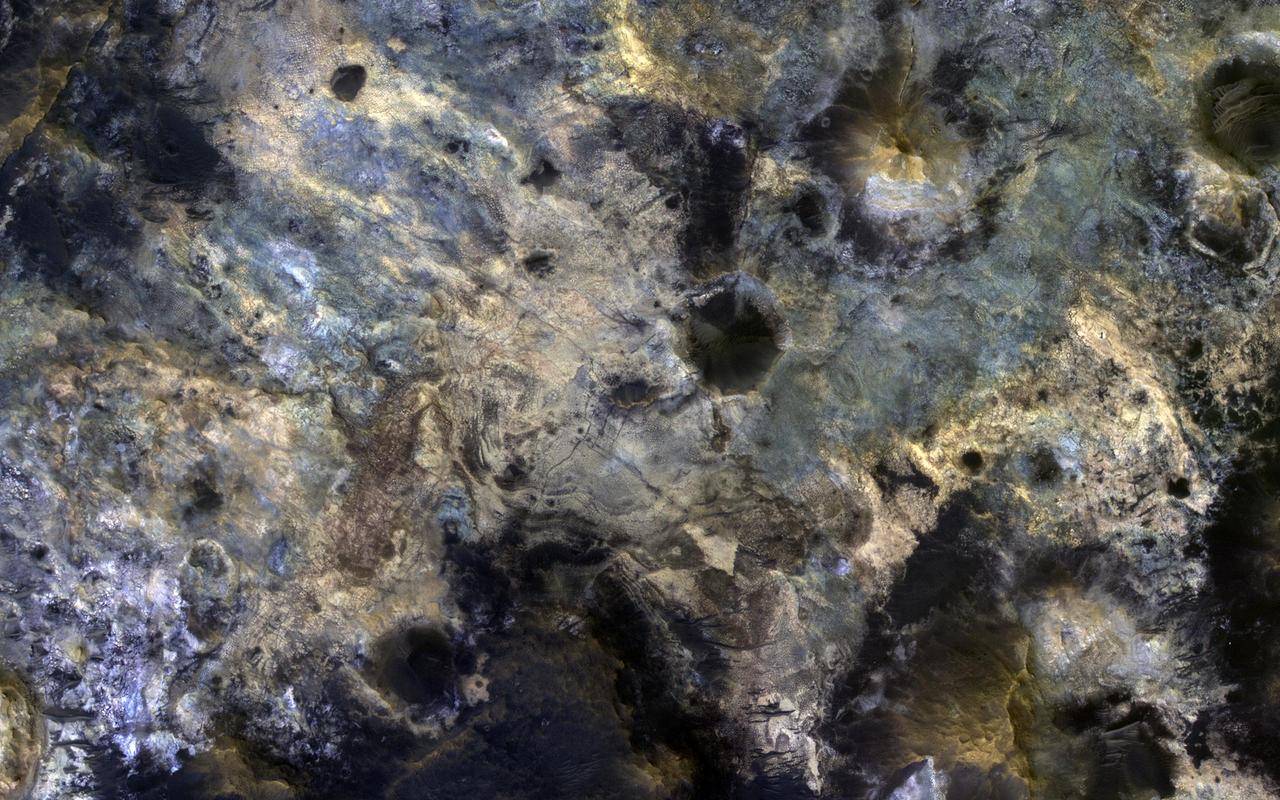
Mawrth Vallis is a place on Mars that has fascinated scientists because of the clays and other hydrated minerals detected from orbit. In this image, the enhanced black colors are most likely basaltic sands and rocks, while the green, yellow, and blue colors correspond to the different hydrated minerals. This particular image was taken of a location in Mawrth Vallis that has a mineral called jarosite. Jarosite on Earth forms under wet, oxidizing, and acidic conditions. Another place on Mars where the Opportunity rover landed and explored also has jarosite. https://photojournal.jpl.nasa.gov/catalog/PIA23080
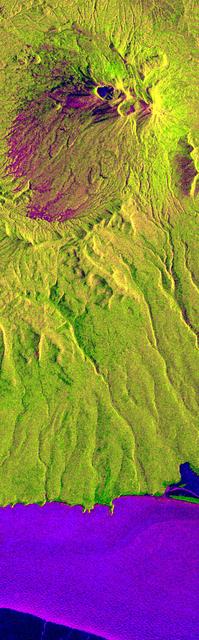
This is an X-band seasonal image of the Maly Semlyachik volcano, which is part of the Karymsky volcano group on Kamchatka peninsula, Russia. The image is centered at 54.2 degrees north latitude and 159.6 degrees east longitude. This image was acquired by the Spaceborne Imaging Radar-C and X-band Synthetic Aperture Radar (SIR-C/X-SAR) aboard the space shuttle Endeavour on April 9, 1994, during the first flight of the radar system, and on September 30, 1994, during the second flight. The image channels have been assigned the following colors: red corresponds to data acquired on April 9; green corresponds to data acquired on September 30; and blue corresponds to the ratio between data from April 9 and September 30, 1994. Kamchatka is twice as large as England, Scotland and Wales combined and is home to approximately 470,000 residents. The region is characterized by a chain of volcanoes stretching 800 kilometers (500 miles) across the countryside. Many of the volcanoes, including the active Maly Semlyachik volcano in this image, have erupted during this century. But the most active period in creating the three characteristic craters of this volcano goes back 20,000, 12,000 and 2,000 years ago. The highest summit of the oldest crater reaches about 1,560 meters (1,650 feet). The radar images reveal the geological structures of craters and lava flows in order to improve scientists' knowledge of these sometimes vigorously active volcanoes. This seasonal composite also highlights the ecological differences that have occurred between April and October 1994. In April the whole area was snow-covered and, at the coast, an ice sheet extended approximately 5 kilometers (3 miles) into the sea. The area shown surrounding the volcano is covered by low vegetation much like scrub. Kamchatka also has extensive forests, which belong to the northern frontier of Taiga, the boreal forest ecosystem. This region plays an important role in the world's carbon cycle. Trees require 60 years to mature in Kamchatka's 120-day growing season. The forest industry is managing these forests and practicing selective cutting to allow younger trees time to grow and reseed. X-SAR images will aid in mapping these deforested areas and in encouraging further recultivation efforts. http://photojournal.jpl.nasa.gov/catalog/PIA01728
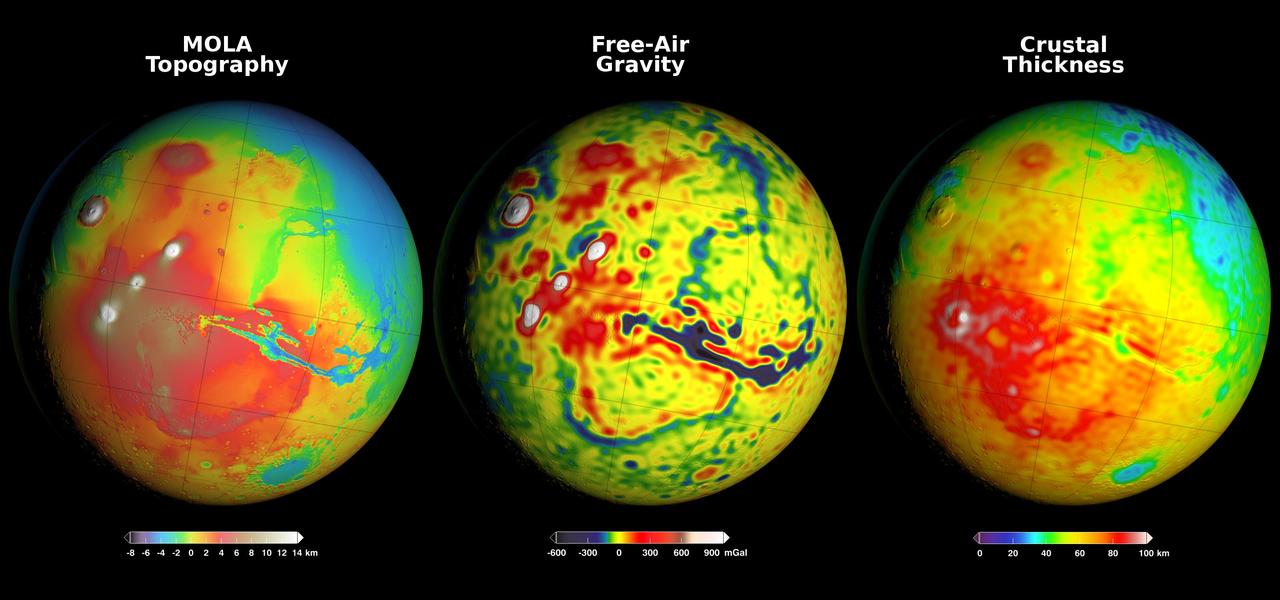
Newly detailed mapping of local variations in Mars' gravitational pull on orbiters (center), combined with topographical mapping of the planet's mountains and valleys (left) yields the best-yet mapping of Mars' crustal thickness (right). These three views of global mapping are centered at 90 degrees west longitude, showing portions of the planet that include tall volcanoes on the left and the deep Valles Marineris canyon system just right of center. Additional views of these global maps are available at http://svs.gsfc.nasa.gov/goto?4436. The new map of Mars' gravity (center) results from analysis of the planet's gravitational effects on orbiters passing over each location on the globe. The data come from many years of using NASA's Deep Space Network to track positions and velocities of NASA's Mars Global Surveyor, Mars Odyssey and Mars Reconnaissance Orbiter. If Mars were a perfectly smooth sphere of uniform density, the gravity experienced by the spacecraft would be exactly the same everywhere. But like other rocky bodies in the solar system, including Earth, Mars has both a bumpy surface and a lumpy interior. As the spacecraft fly in their orbits, they experience slight variations in gravity caused by both of these irregularities, variations which show up as small changes in the velocity and altitude of the three spacecraft. The "free-air" gravity map presents the results without any adjustment for the known bumpiness of Mars' surface. Local gravitational variations in acceleration are expressed in units called gals or galileos. The color-coding key beneath the center map indicates how colors on the map correspond to mGal (milligal) values. The map on the left shows the known bumpiness, or topography, of the Martian surface, using data from the Mars Orbiter Laser Altimeter (MOLA) instrument on Mars Global Surveyor. Mars has no actual "sea level," but does have a defined zero elevation level. The color-coding key beneath this map indicates how the colors correspond to elevations above or below zero, in kilometers. Analysis that subtracts effects of the surface topography from the free-air gravity mapping, combined with an assumption that crust material has a uniform density, leads to the derived mapping of crustal thickness -- or subsurface "lumpiness" -- on the right. Highs in gravity indicate places where the denser mantle material beneath the crust is closer to the surface, and hence where the crust is thinner. The color-coding key for this map indicates how the colors on the map correspond to the thickness of the crust, in kilometers. http://photojournal.jpl.nasa.gov/catalog/PIA20277
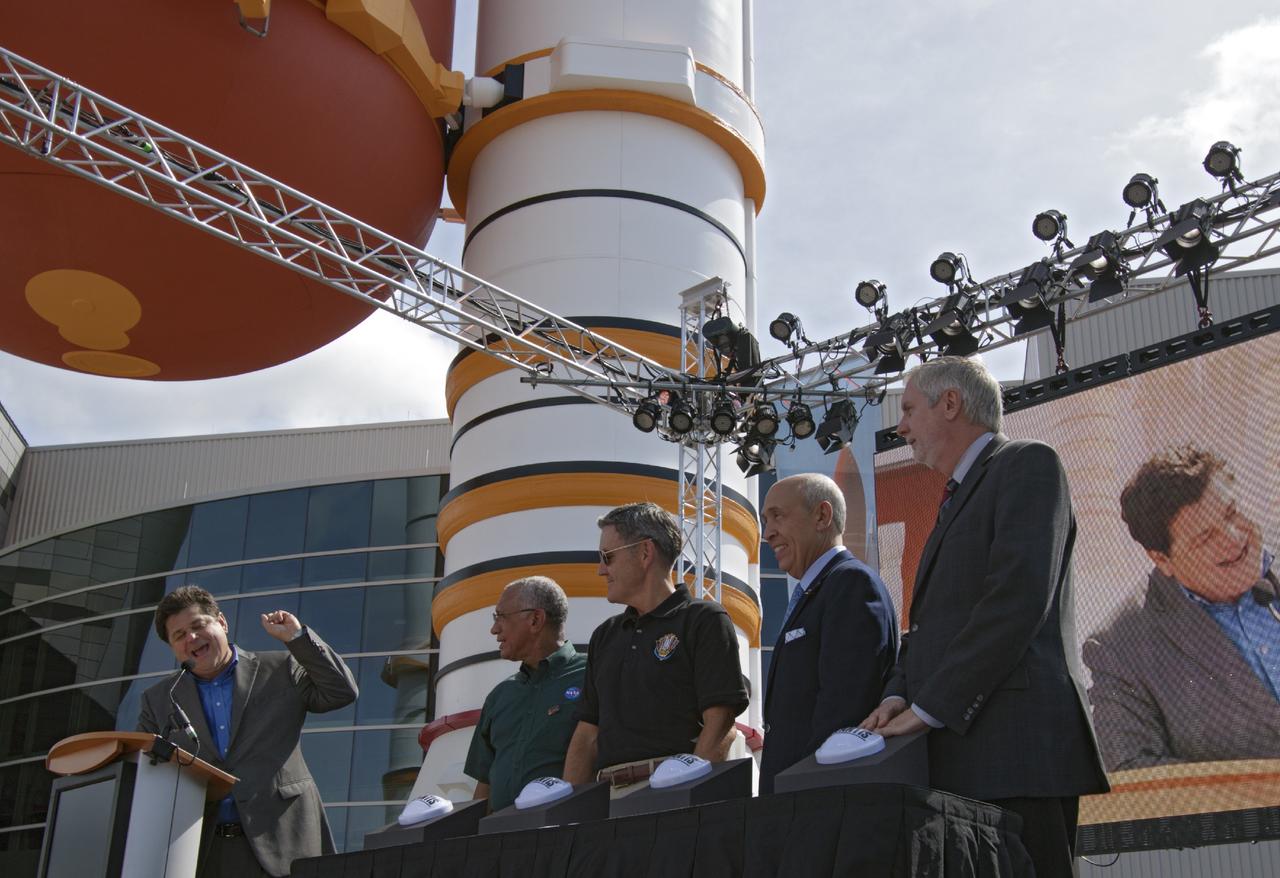
CAPE CANAVERAL, Fla. -- At the Kennedy Space Center Visitor Complex in Florida, CNN correspondent John Zarrella counts down for the ceremonial opening of the new "Space Shuttle Atlantis" facility. Ready to press buttons to mark the opening the new exhibit, from the left, are Charlie Bolden, NASA administrator, Bob Cabana, Kennedy director, Rick Abramson, Delaware North Parks and Resorts president, and Bill Moore, Delaware North Parks and Resorts chief operating officer. The new $100 million facility includes interactive exhibits that tell the story of the 30-year Space Shuttle Program and highlight the future of space exploration. The "Space Shuttle Atlantis" exhibit formally opened to the public on June 29, 2013.Photo credit: NASA/Jim Grossmann
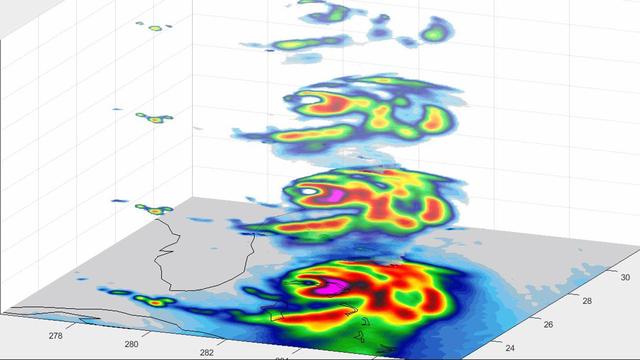
In this animation, TEMPEST-D — a weather-observing satellite the size of a cereal box — captured imagery of Hurricane Dorian off the coast of Florida at 2 a.m. EDT on Sep. 3, 2019 (11 p.m. PDT on Sept. 2, 2019). At a vantage point 250 miles (400 kilometers) above the storm, the CubeSat used its miniaturized radio-wave-based instrument to see through the clouds, revealing different depths of the hurricane with areas with heavy rainfall and moisture being pulled into the storm. The green colors indicate moisture spiraling into the storm's center, and the yellow, red and pink areas correspond to the most intense rainfall. TEMPEST-D — short for Temporal Experiment for Storms and Tropical Systems Demonstration — is an experiment in shrinking weather satellites to a size that makes them inexpensive enough to produce in multiples. The goal is eventual real-time storm coverage with many small satellites that can track storms around the world. Movie available at https://photojournal.jpl.nasa.gov/catalog/PIA23431
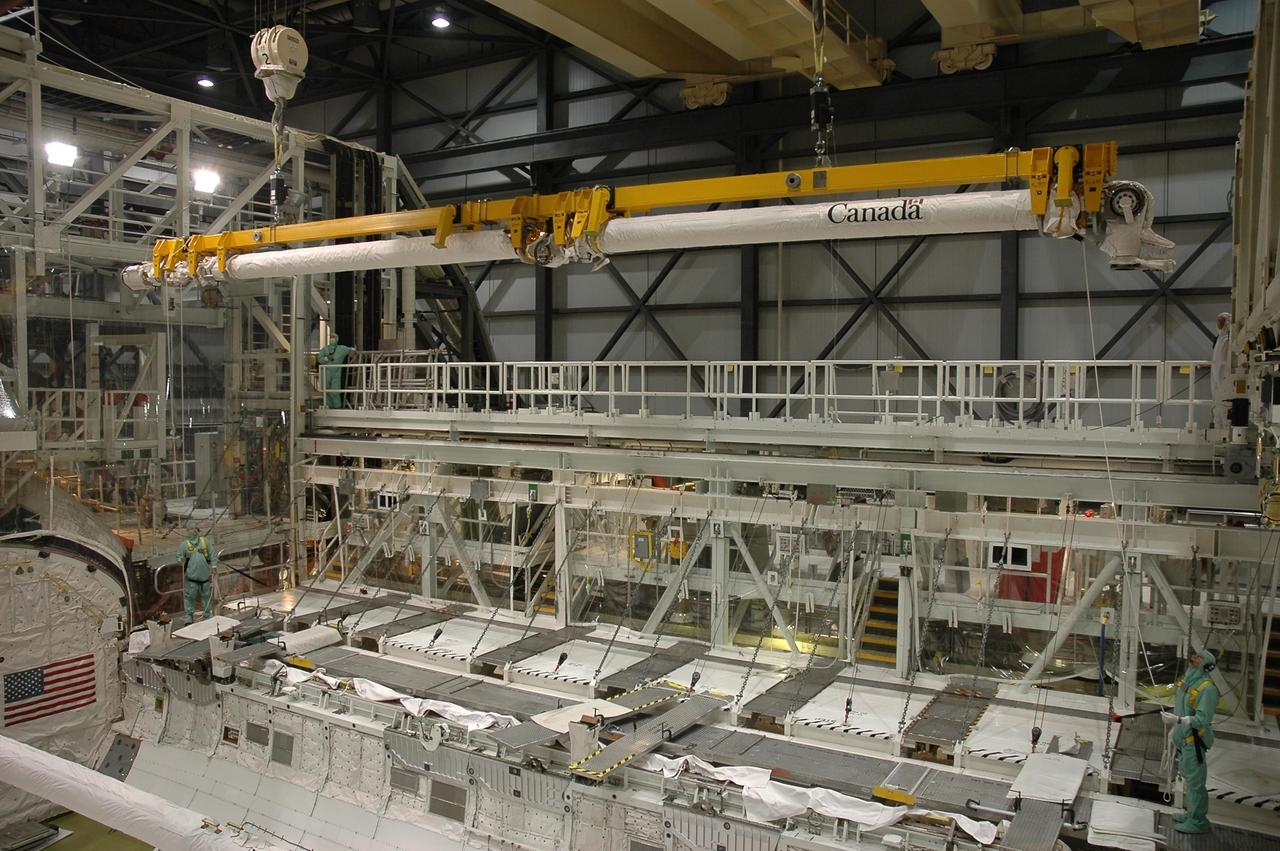
KENNEDY SPACE CENTER, FLA. - In the Orbiter Processing Facility Bay 1 at NASA Kennedy Space Center, a crane lifts the remote manipulator system boom out of Atlantis’ payload bay. The boom will be temporarily stored. The RMS includes the electromechanical arm that maneuvers a payload from the payload bay of the orbiter to its deployment position and then releases it. It can also grapple a free-flying payload, maneuver it to the payload bay of the orbiter and berth it in the orbiter. The RMS arm is 50 feet 3 inches long and 15 inches in diameter. It weighs 905 pounds, and the total system weighs 994 pounds. The RMS has six joints that correspond roughly to the joints of the human arm, with shoulder yaw and pitch joints; an elbow pitch joint; and wrist pitch, yaw and roll joints. The end effector is the unit at the end of the wrist that actually grabs, or grapples, the payload.
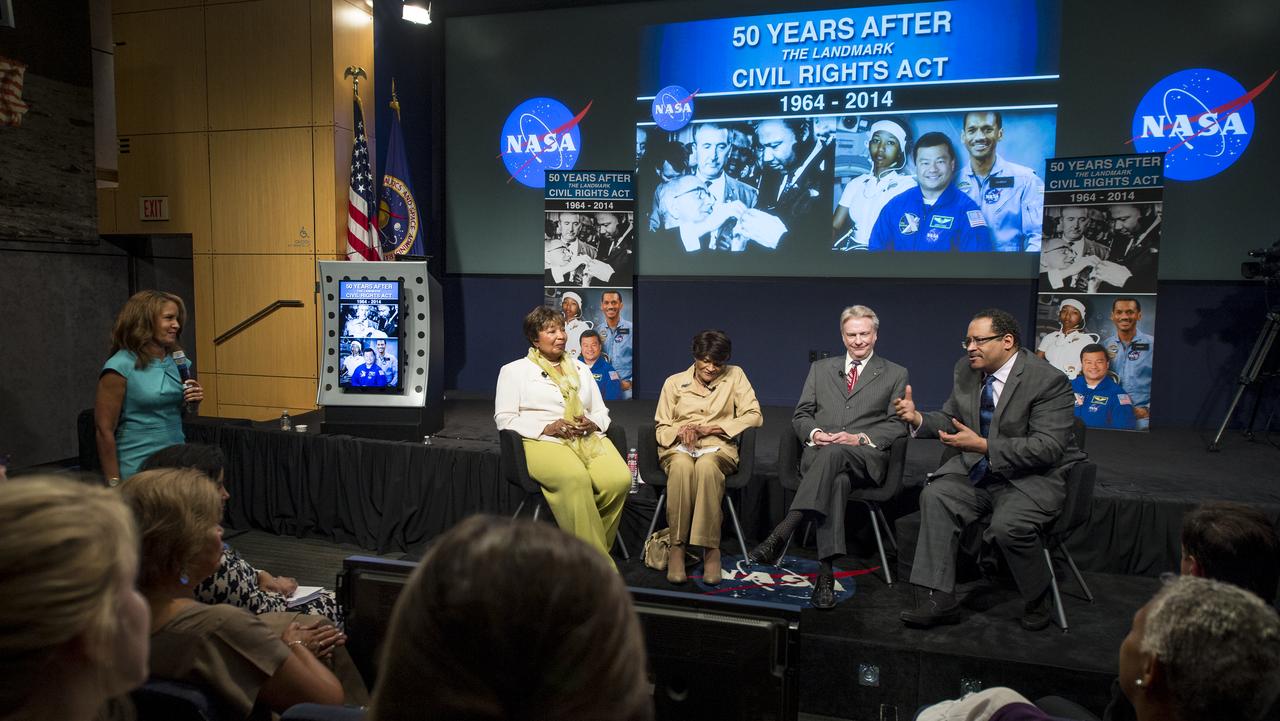
Dr. Michael Eric Dyson, a professor of sociology at Georgetown University, left; speaks as part of a panel discussion at an event celebrating the 50th Anniversary of the Civil Rights Act of 1964 on Monday, June 23, 2014 in the James E. Webb Auditorium at NASA Headquarters in Washington, DC. The panel was moderated by Suzanne Malveaux, a correspondent with CNN, left; and also included U.S. Representative Eddie Bernice Johnson, of Texas, second from left; Dr. Harriet Jenkins, Former Assistant Administrator for Equal Opportunity Programs at NASA, third from left; and Dr. Roger Launius, Associate Director of Collections and Curatorial Affairs at the Smithsonian National Air and Space Museum, second from right. The event highlighted the influence of the Civil Rights Act on NASA. Photo Credit: (NASA/Joel Kowsky)
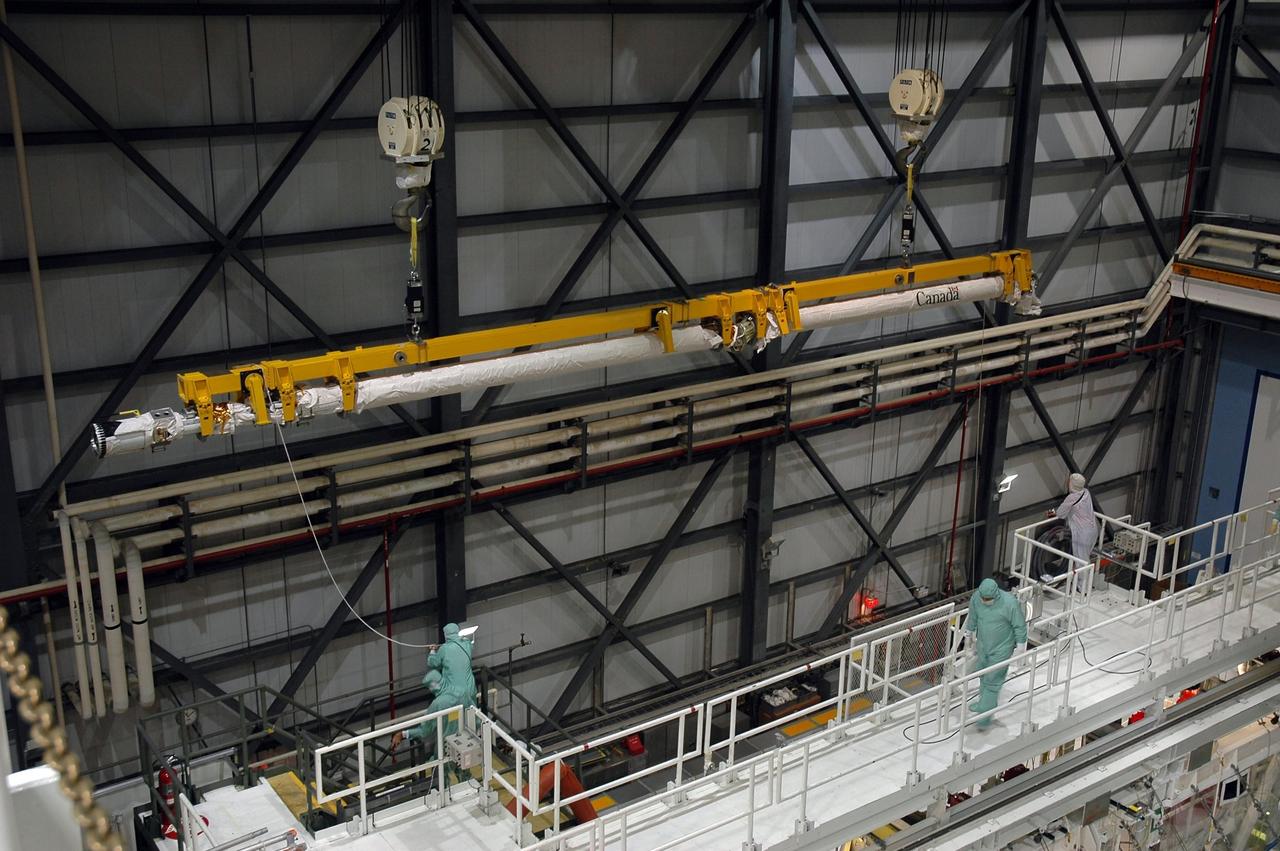
KENNEDY SPACE CENTER, FLA. - In the Orbiter Processing Facility Bay 1 at NASA Kennedy Space Center, the remote manipulator system boom that was removed from Atlantis’ payload bay is lifted out of the way. The boom will be temporarily stored. The RMS includes the electromechanical arm that maneuvers a payload from the payload bay of the orbiter to its deployment position and then releases it. It can also grapple a free-flying payload, maneuver it to the payload bay of the orbiter and berth it in the orbiter. The RMS arm is 50 feet 3 inches long and 15 inches in diameter. It weighs 905 pounds, and the total system weighs 994 pounds. The RMS has six joints that correspond roughly to the joints of the human arm, with shoulder yaw and pitch joints; an elbow pitch joint; and wrist pitch, yaw and roll joints. The end effector is the unit at the end of the wrist that actually grabs, or grapples, the payload.

This is an x-ray image of the Crab Nebula taken with the High Energy Astronomy Observatory (HEAO)-2/Einstein Observatory. The image is demonstrated by a pulsar, which appears as a bright point due to its pulsed x-ray emissions. The strongest region of diffused emissions comes from just northwest of the pulsar, and corresponds closely to the region of brightest visible-light emission. The HEAO-2, the first imaging and largest x-ray telescope built to date, was capable of producing actual photographs of x-ray objects. Shortly after launch, the HEAO-2 was nicknamed the Einstein Observatory by its scientific experimenters in honor of the centernial of the birth of Albert Einstein, whose concepts of relativity and gravitation have influenced much of modern astrophysics, particularly x-ray astronomy. The HEAO-2, designed and developed by TRW, Inc. under the project management of the Marshall Space Flight Center, was launched aboard an Atlas/Centaur launch vehicle on November 13, 1978.
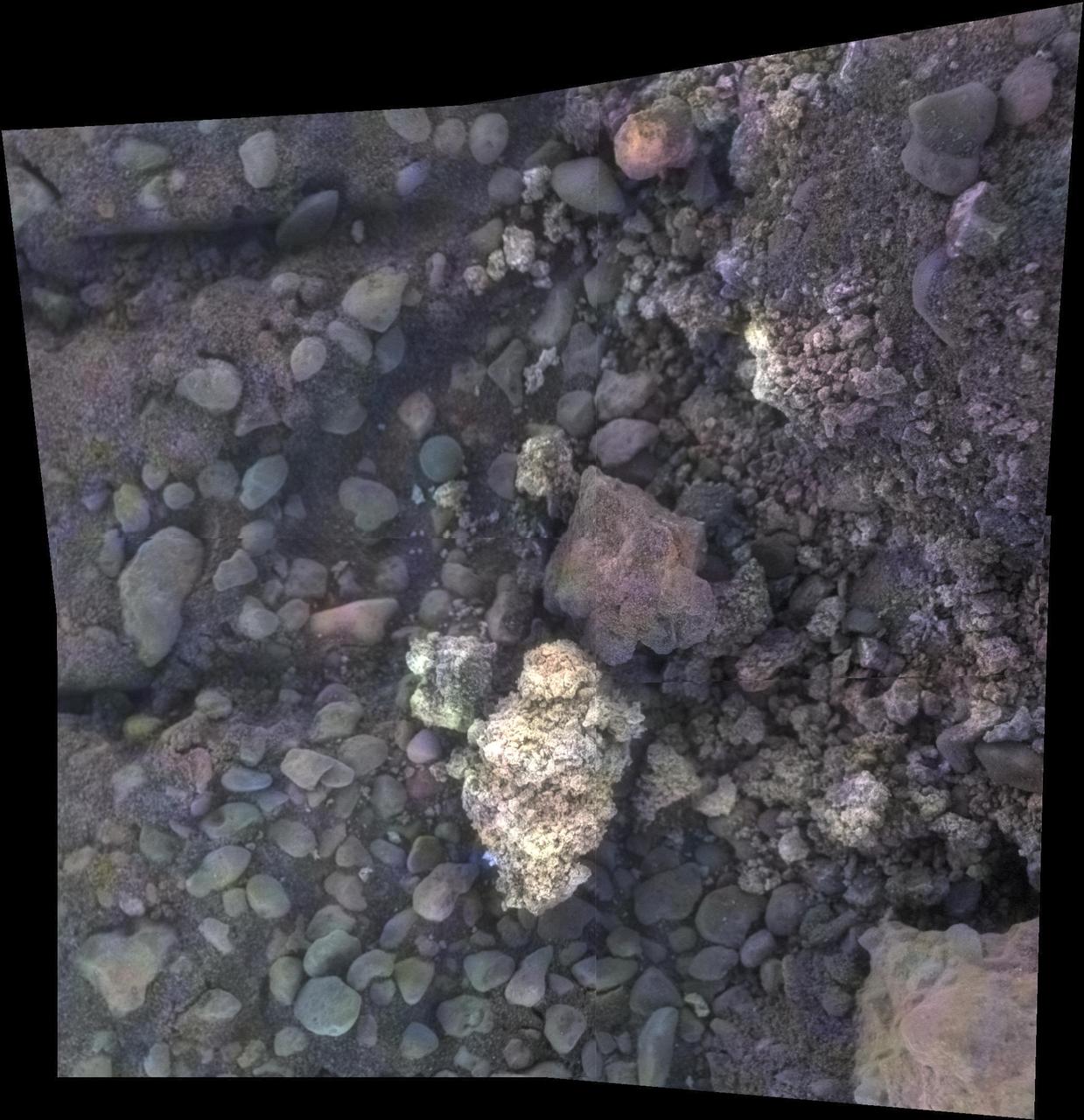
This image of a target called "Private Joseph Field" combines four images from the microscopic imager on the robotic arm of NASA's Mars Exploration Rover Opportunity, with enhanced color information added from the rover's panoramic camera. This target is within the "Marathon Valley" area of the western rim of Endeavour Crater. The component images were taken on May 29, 2016, during the 4,389th Martian day, or sol, of Opportunity's work on Mars. The mosaic shows an area spanning about 2 inches (5 centimeters). Geochemical data indicate the presence of magnesium and iron sulfates at this location, most likely corresponding to the white pebble visible near the center of the image. These sulfates may have formed by the interaction of acidic fluids with the rocks along the rim of Endeavour crater. http://photojournal.jpl.nasa.gov/catalog/PIA21142
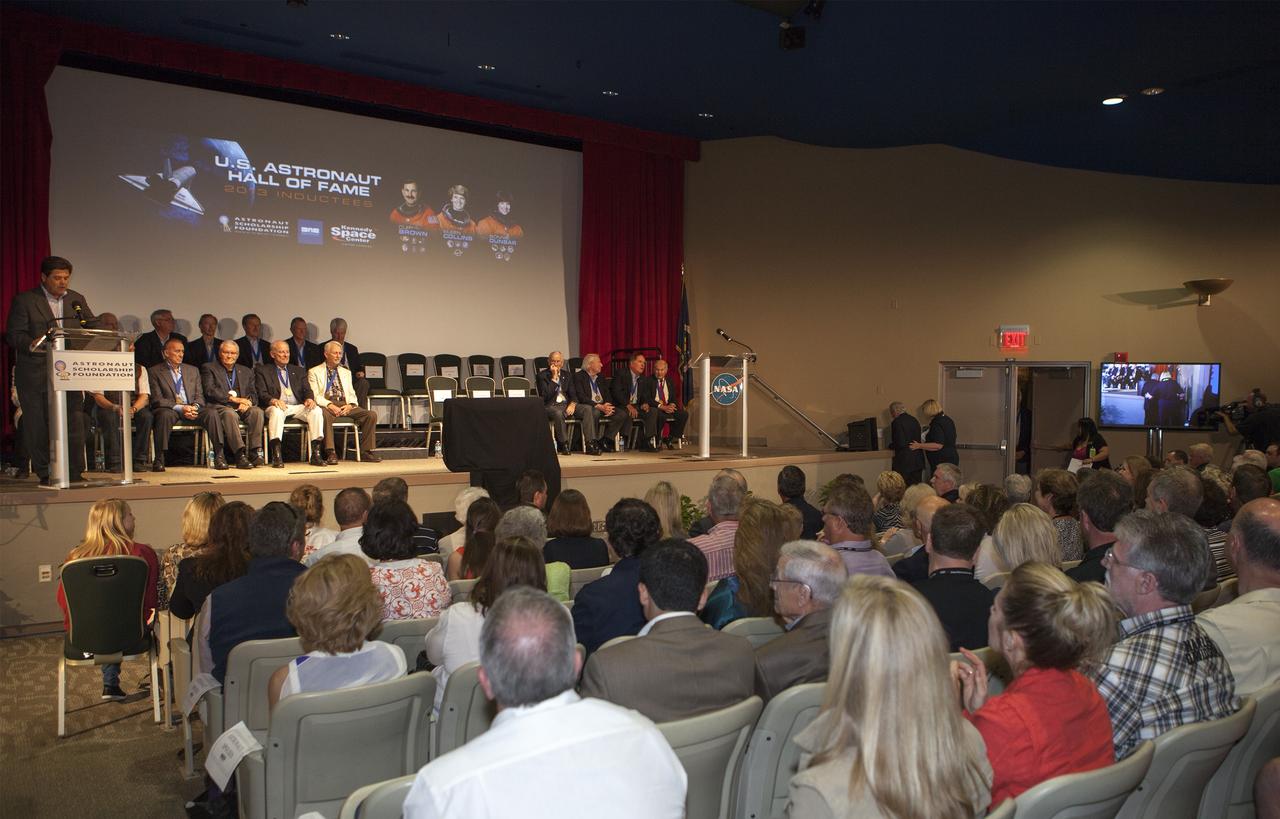
CAPE CANAVERAL, Fla. – At NASA’s Kennedy Space Center Visitor Complex in Florida, Master of Ceremonies John Zarrella, CNN's principal correspondent for coverage of NASA’s space programs, introduces Hall of Fame astronauts who gathered to honor 2013 inductees Curt Brown, Eileen Collins and Bonnie Dunbar. This induction is the twelfth group of space shuttle astronauts named to the AHOF, and the first time two women are inducted at the same time. The year’s inductees were selected by a committee of current Hall of Fame astronauts, former NASA officials, historians and journalists. The selection process is administered by the Astronaut Scholarship Foundation. For more on the U.S. Astronaut Hall of Fame, go to http://www.kennedyspacecenter.com/astronaut-hall-of-fame.aspx For more on the Astronaut Scholarship Foundation, go to http://astronautscholarship.org/ Photo credit: NASA/ Kim Shiflett
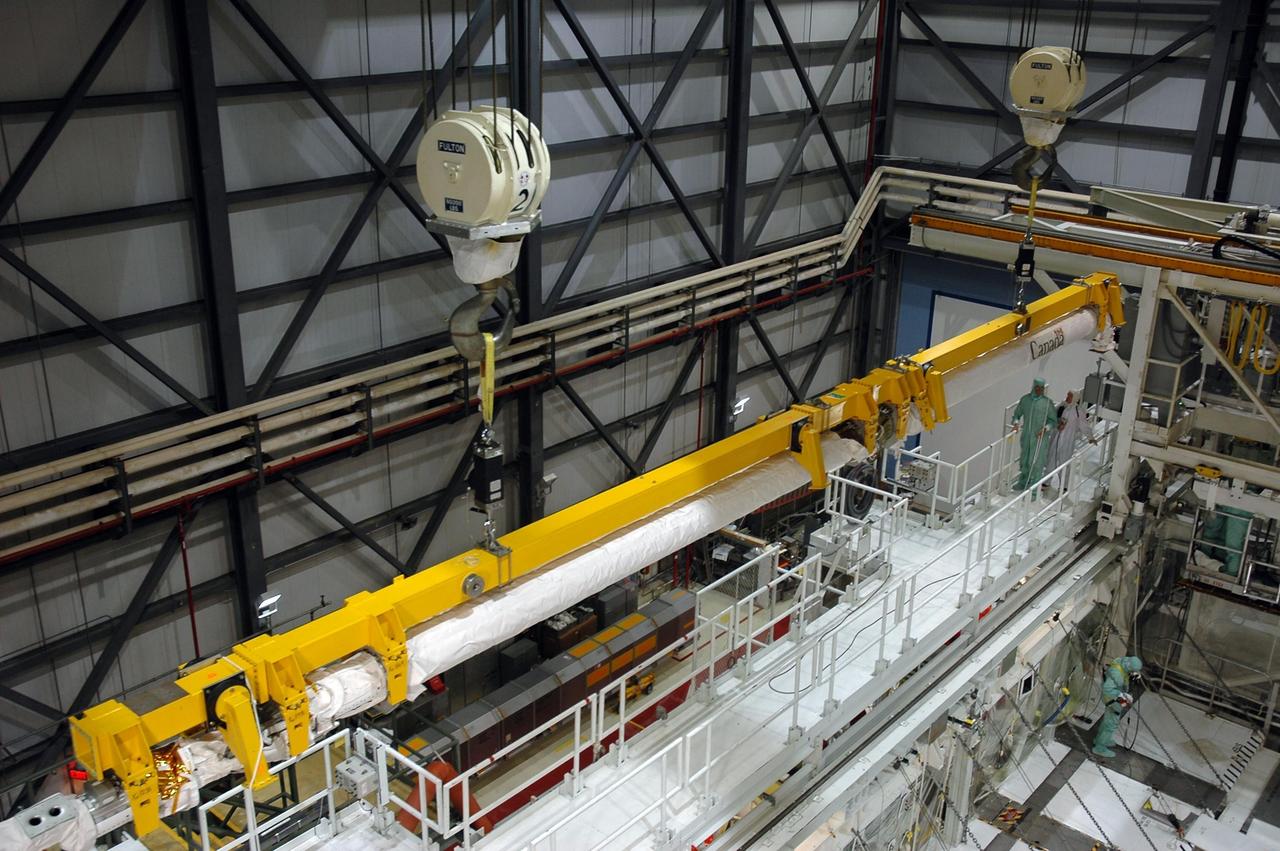
KENNEDY SPACE CENTER, FLA. - In the Orbiter Processing Facility Bay 1 at NASA Kennedy Space Center, the remote manipulator system boom is lifted away from Atlantis’ payload bay and will be temporarily stored. The RMS includes the electromechanical arm that maneuvers a payload from the payload bay of the orbiter to its deployment position and then releases it. It can also grapple a free-flying payload, maneuver it to the payload bay of the orbiter and berth it in the orbiter. The RMS arm is 50 feet 3 inches long and 15 inches in diameter. It weighs 905 pounds, and the total system weighs 994 pounds. The RMS has six joints that correspond roughly to the joints of the human arm, with shoulder yaw and pitch joints; an elbow pitch joint; and wrist pitch, yaw and roll joints. The end effector is the unit at the end of the wrist that actually grabs, or grapples, the payload.
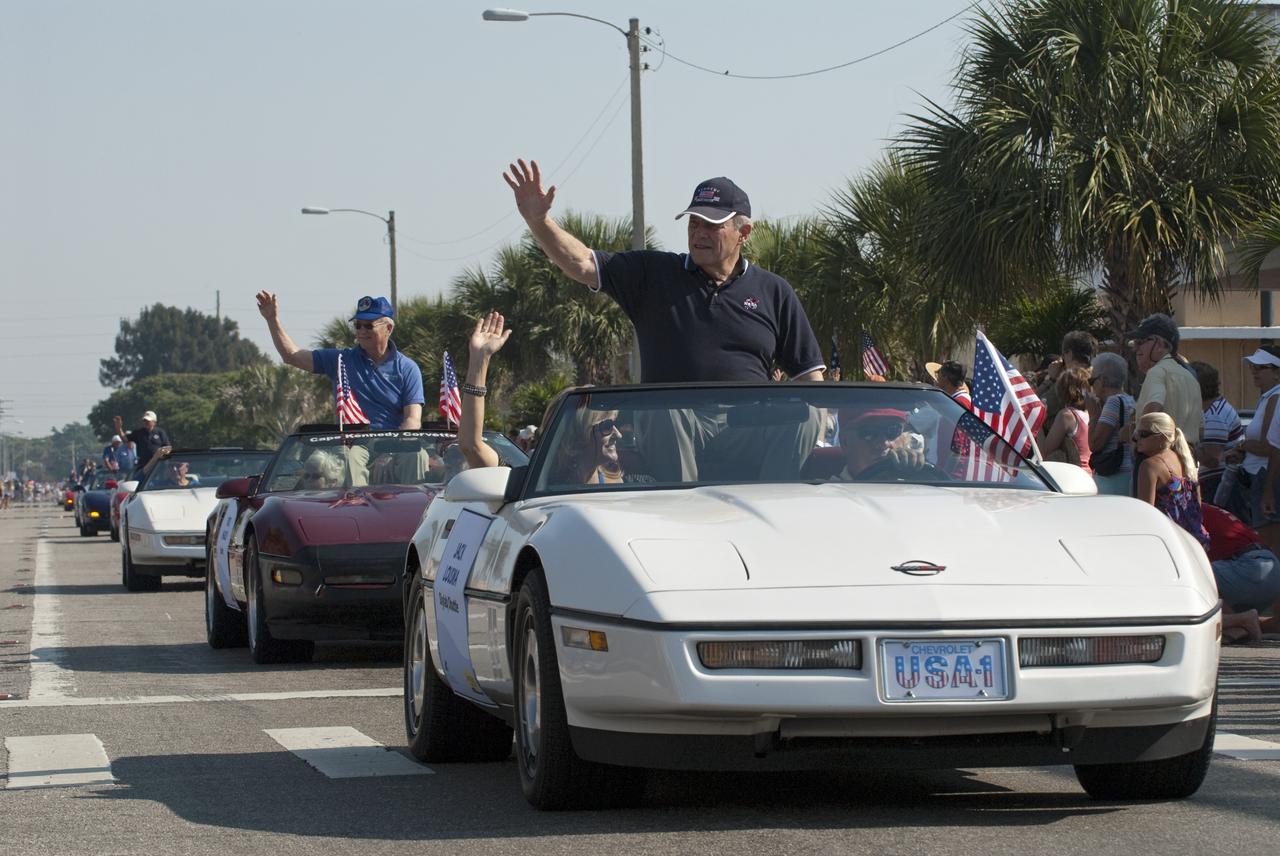
Cape Canaveral, Fla. -- Retired shuttle and Skylab astronaut Dick Lousma greets spectators from a Chevrolet Corvette during a commemorative parade in Cocoa Beach, Fla. A group of current and retired NASA astronauts gathered in Cocoa Beach to commemorate NASA’s 50 years of accomplishments and to honor astronaut Alan Shepard’s Mercury/Freedom 7 suborbital flight May 5, 1961.The event was marked by a parade, with the astronauts riding in a fleet of Chevrolet Corvettes that corresponded with the time period of their space missions. Members of the Cape Kennedy Corvette Club, a group established in 1967, escorted almost two dozen astronauts or their family representatives in club members' cars. The Corvette parade started at the glass bank building, at 9:34 a.m. EDT, the same time Shepard launched into space. Photo credit: NASA/Kim Shiflett
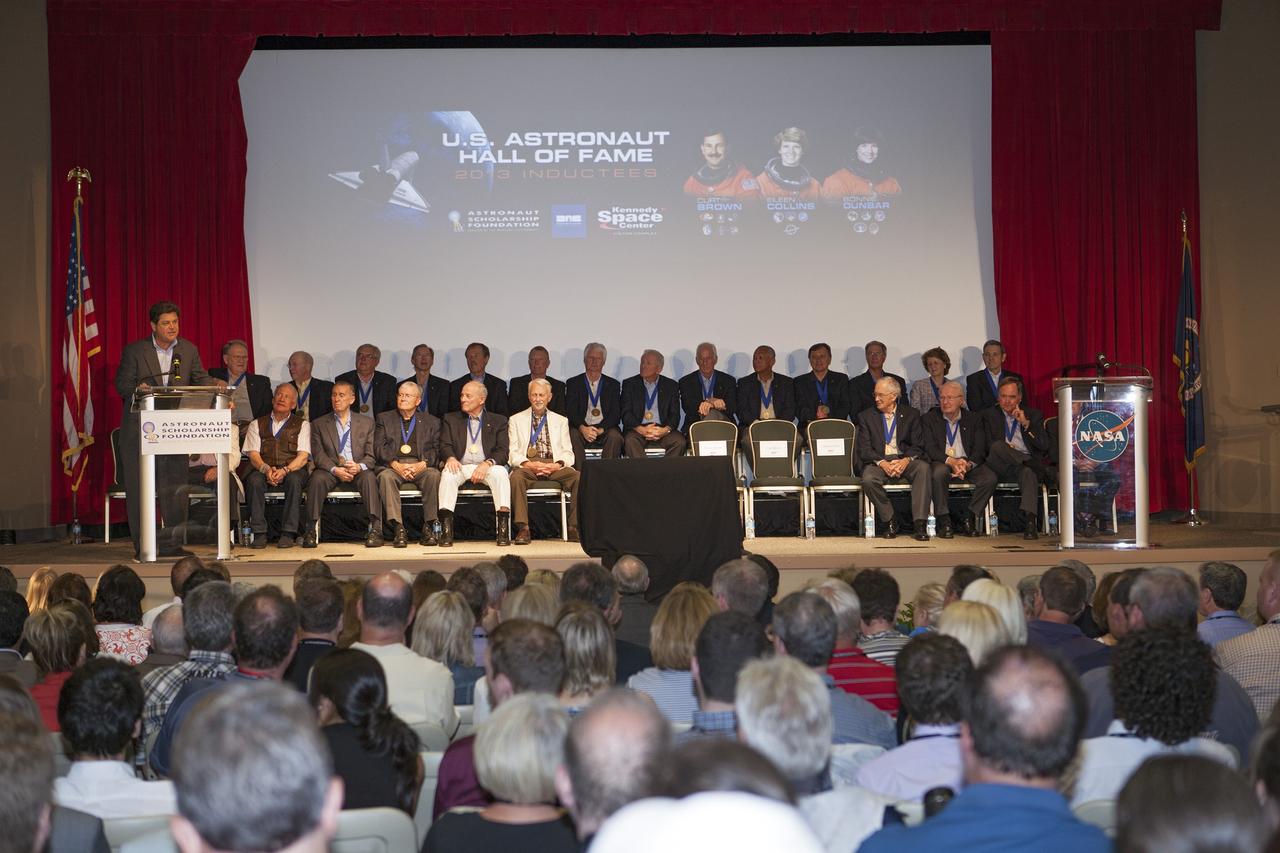
CAPE CANAVERAL, Fla. – At NASA’s Kennedy Space Center Visitor Complex in Florida, Master of Ceremonies John Zarrella, CNN's principal correspondent for coverage of NASA’s space programs, addresses the inductees and visitors with opening remarks. Hall of Fame astronauts and visitors gathered to honor 2013 inductees Curt Brown, Eileen Collins and Bonnie Dunbar. This induction is the twelfth group of space shuttle astronauts named to the AHOF, and the first time two women are inducted at the same time. The year’s inductees were selected by a committee of current Hall of Fame astronauts, former NASA officials, historians and journalists. The selection process is administered by the Astronaut Scholarship Foundation. For more on the U.S. Astronaut Hall of Fame, go to http://www.kennedyspacecenter.com/astronaut-hall-of-fame.aspx For more on the Astronaut Scholarship Foundation, go to http://astronautscholarship.org/ Photo credit: NASA/ Kim Shiflett
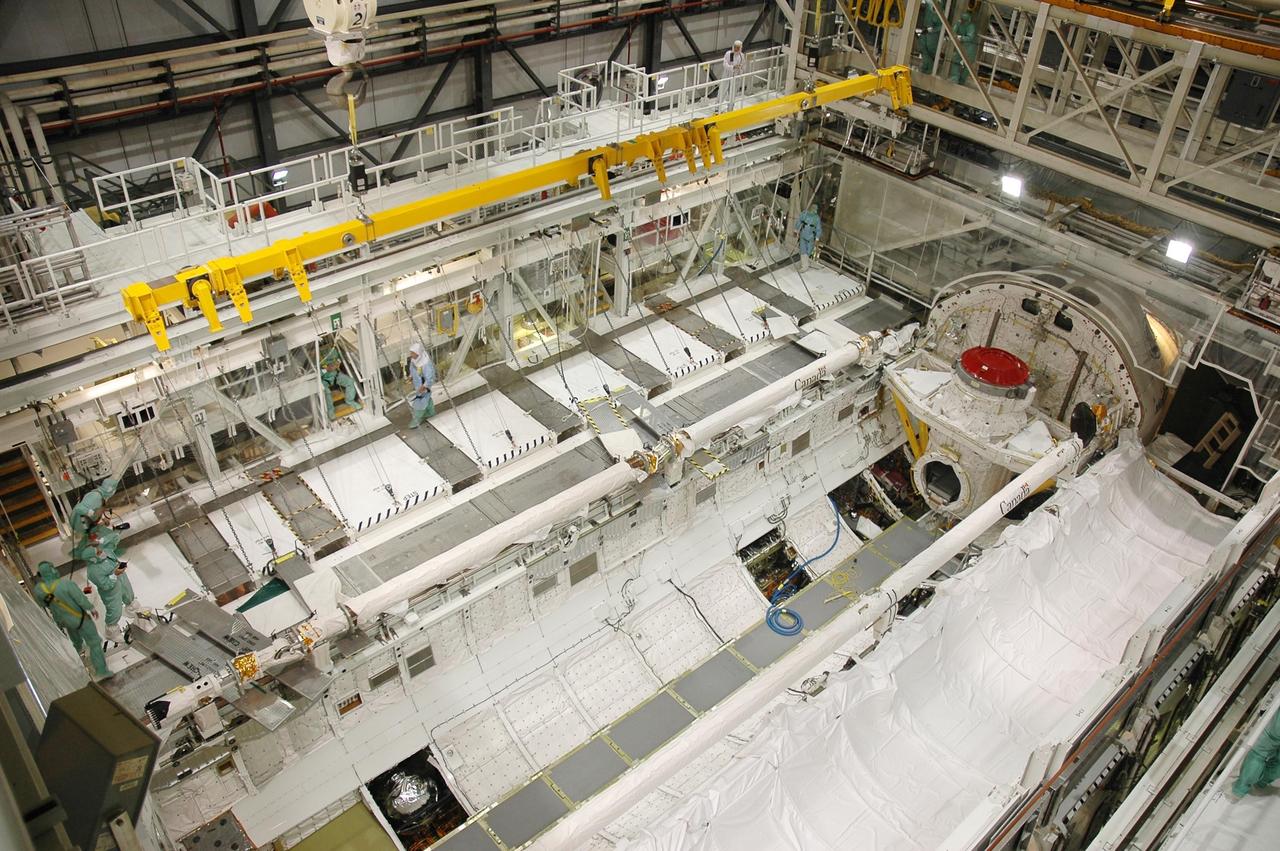
KENNEDY SPACE CENTER, FLA. - In the Orbiter Processing Facility Bay 1 at NASA Kennedy Space Center, a crane is lowered toward the remote manipulator system boom in Atlantis’ payload bay. The boom is being removed from Atlantis and will be temporarily stored. The RMS includes the electromechanical arm that maneuvers a payload from the payload bay of the orbiter to its deployment position and then releases it. It can also grapple a free-flying payload, maneuver it to the payload bay of the orbiter and berth it in the orbiter. The RMS arm is 50 feet 3 inches long and 15 inches in diameter. It weighs 905 pounds, and the total system weighs 994 pounds. The RMS has six joints that correspond roughly to the joints of the human arm, with shoulder yaw and pitch joints; an elbow pitch joint; and wrist pitch, yaw and roll joints. The end effector is the unit at the end of the wrist that actually grabs, or grapples, the payload.
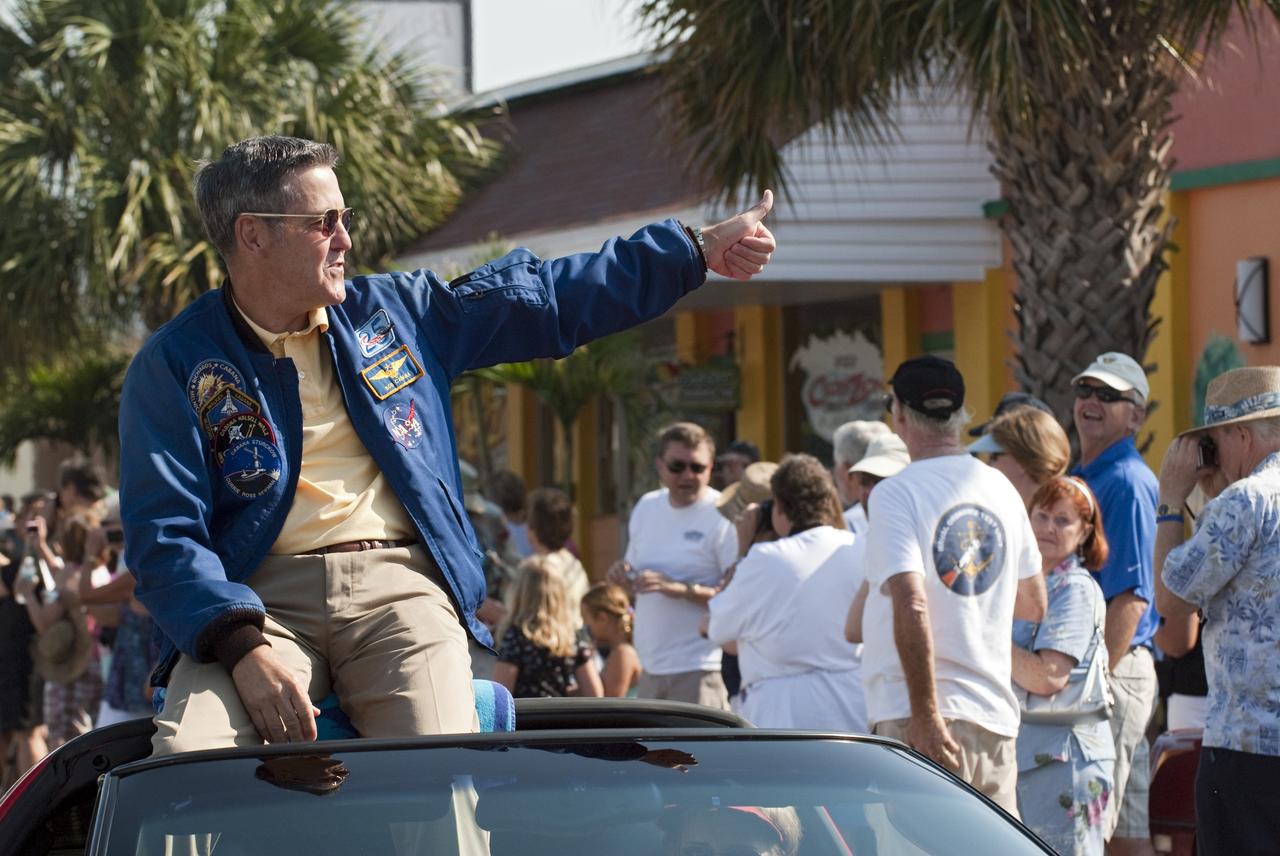
Cape Canaveral, Fla. -- Kennedy Space Center Director and former space shuttle astronaut Bob Cabana gives a thumbs-up to spectators from a Chevrolet Corvette during a commemorative parade in Cocoa Beach, Fla. A group of current and retired NASA astronauts gathered in Cocoa Beach to commemorate NASA’s 50 years of accomplishments and to honor astronaut Alan Shepard’s Mercury/Freedom 7 suborbital flight May 5, 1961.The event was marked by a parade, with the astronauts riding in a fleet of Chevrolet Corvettes that corresponded with the time period of their space missions. Members of the Cape Kennedy Corvette Club, a group established in 1967, escorted almost two dozen astronauts or their family representatives in club members' cars. The Corvette parade started at the glass bank building, at 9:34 a.m. EDT, the same time Shepard launched into space. Photo credit: NASA/Kim Shiflett
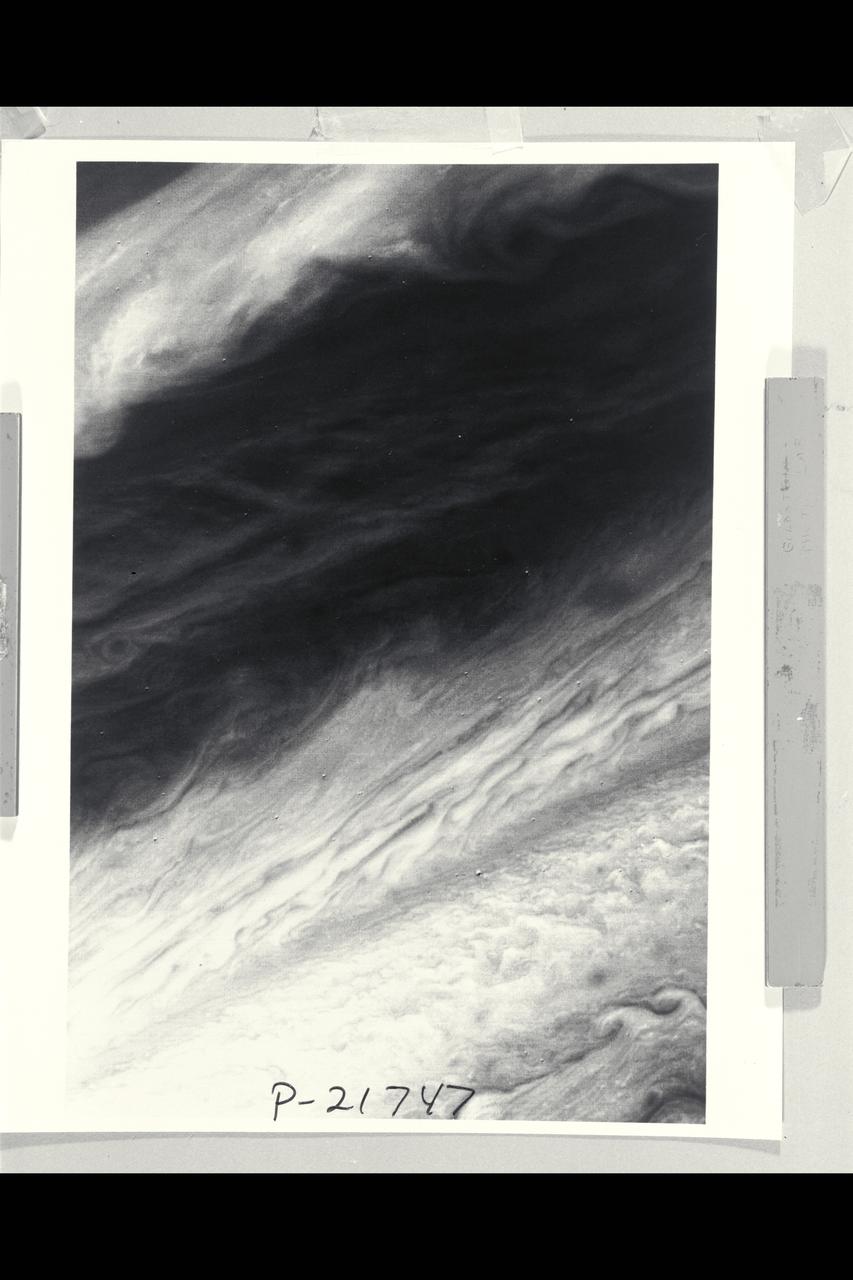
P-21747 BW Range: 2,200,000 miles This image shows a region of the Jovian atmosphere from approximately 25° N to the equatorial region. The north temperate jet, at approximately 23° N, where the wind speed is about 150 meters per second, is seen as a dark brown line from the left-hand edge to the right-hand corner of the picture. The wispy clouds of the north equatorial belt appear as shades of brown. The lower right-hand corner of the image shows the brighter (white) clouds of the equatorial region. A small blue area is apparent near the lower edge, which corresponds to a region free of the upper clouds, where it is possible to penetrate to cloud layers approximately 60 kilometers below the visible surface.
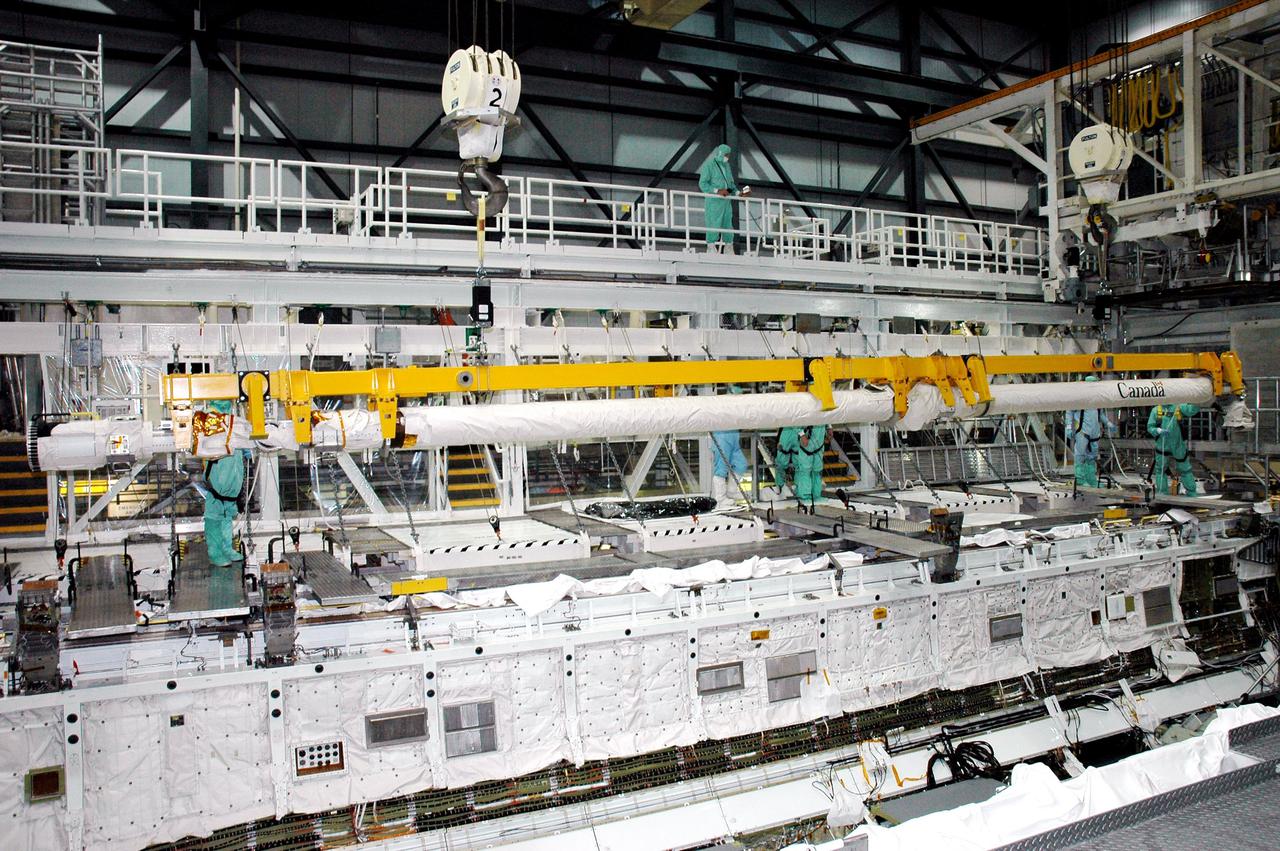
KENNEDY SPACE CENTER, FLA. - In the Orbiter Processing Facility, an overhead crane lowers the Remote Manipulator System (RMS), or Shuttle arm, toward Atlantis for installation in the payload bay. The RMS includes the electromechanical arm that maneuvers a payload from the payload bay of the orbiter to its deployment position and then releases it. It can also grapple a free-flying payload, maneuver it to the payload bay of the orbiter and berth it in the orbiter. The RMS arm is 50 feet 3 inches long and 15 inches in diameter. It weighs 905 pounds, and the total system weighs 994 pounds. The RMS has six joints that correspond roughly to the joints of the human arm, with shoulder yaw and pitch joints; an elbow pitch joint; and wrist pitch, yaw and roll joints. The end effector is the unit at the end of the wrist that actually grabs, or grapples, the payload. Atlantis is the designated orbiter to fly on mission STS-121. The mission has a launch window of July 12 - July 31, 2005.
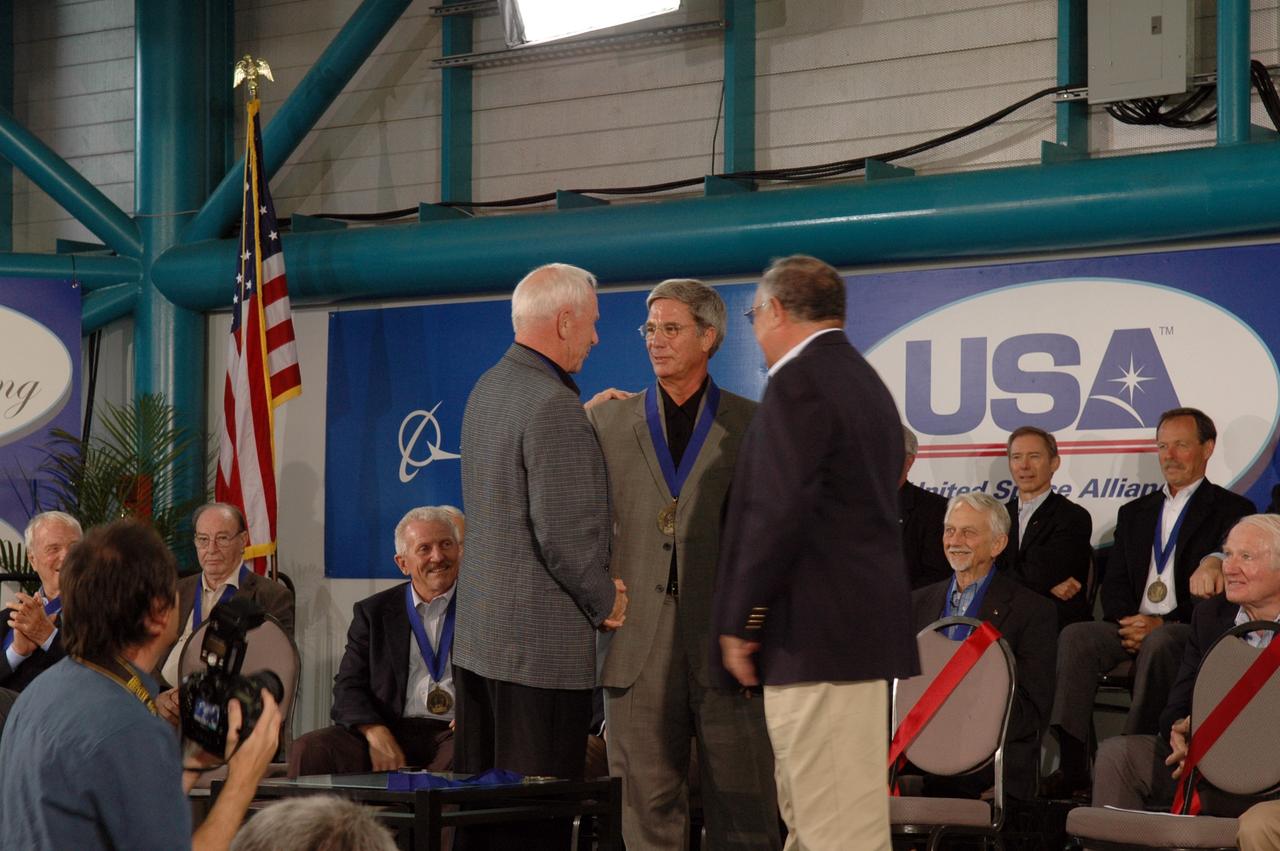
CAPE CANAVERAL, Fla. -- Former astronaut John Blaha (center) receives congratulations on his induction into the U.S. Astronaut Hall of Fame May 3 at NASA's Kennedy Space Center from former inductees Al Worden (left) and Fred Gregory (right). Other inductees were Loren Shriver; Bryan O'Connor, NASA's chief of Safety and Mission Assurance at NASA Headquarters in Washington; and Bob Cabana, center director of NASA's Stennis Space Center in Mississippi. Other former astronauts attending included Scott Carpenter, John Young, Bob Crippen, and Walt Cunningham. The U.S. Astronaut Hall of Fame is operated by Kennedy Space Center Visitor Complex on behalf of NASA. CNN correspondent John Zarrella hosted the event.

CAPE CANAVERAL, Fla. -- At the Kennedy Space Center Visitor Complex in Florida, CNN correspondent John Zarrella counted down for the ceremonial opening of the new "Space Shuttle Atlantis" facility. Smoke bellows near a full-scale set of space shuttle twin solid rocket boosters and external fuel tank at the entrance to the exhibit building. Guests may walk beneath the 184-foot-tall boosters and tank as they enter the facility. The new $100 million facility includes interactive exhibits that tell the story of the 30-year Space Shuttle Program and highlight the future of space exploration. The "Space Shuttle Atlantis" exhibit formally opened to the public on June 29, 2013.Photo credit: NASA/Jim Grossmann

P-21747 C Range: 2,200,000 miles This image shows a region of the Jovian atmosphere from approximately 25° N to the equatorial region. The north temperate jet, at approximately 23° N, where the wind speed is about 150 meters per second, is seen as a dark brown line from the left-hand edge to the right-hand corner of the picture. The wispy clouds of the north equatorial belt appear as shades of brown. The lower right-hand corner of the image shows the brighter (white) clouds of the equatorial region. A small blue area is apparent near the lower edge, which corresponds to a region free of the upper clouds, where it is possible to penetrate to cloud layers approximately 60 kilometers below the visible surface.
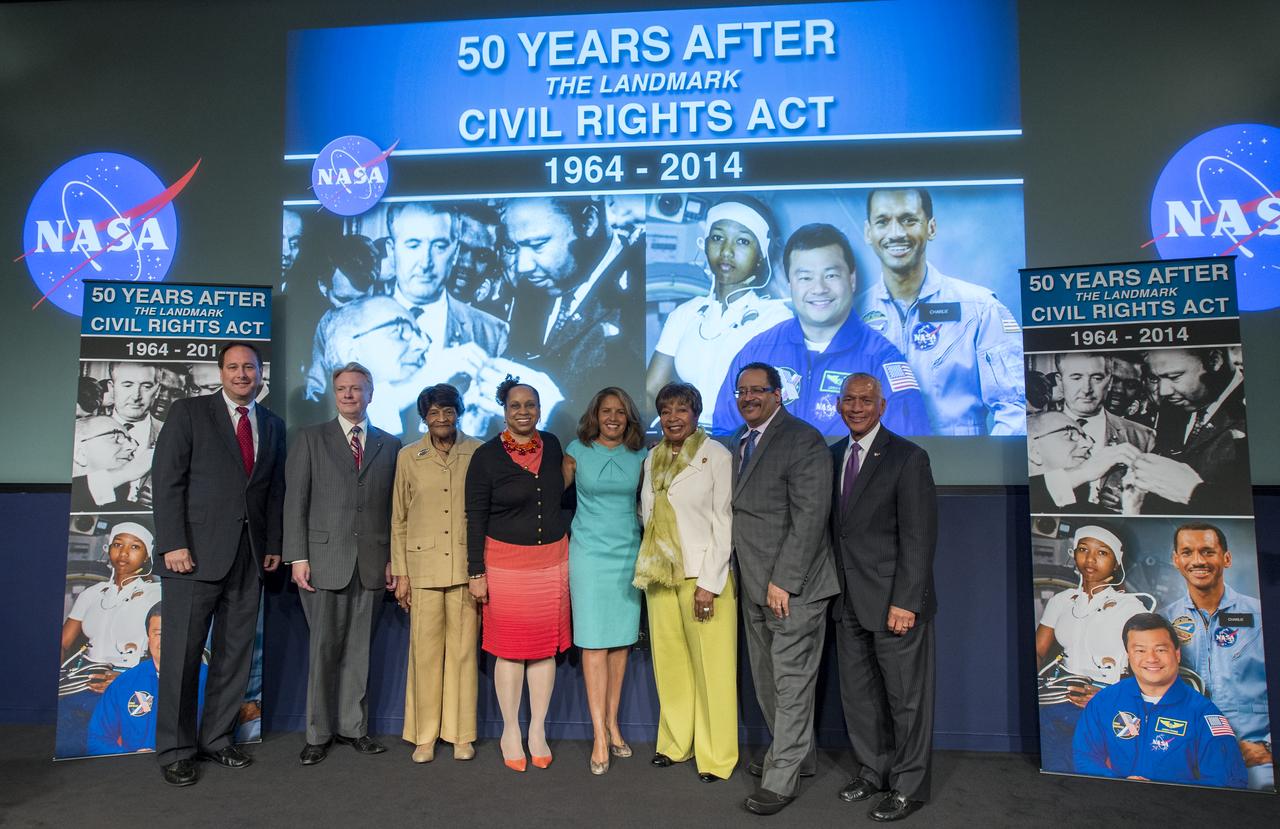
From left: Robert Lightroot. NASA Associate Administrator; Dr. Roger Launius, Associate Director of Collections and Curatorial Affairs at the Smithsonian National Air and Space Museum; Dr. Harriett Jenkins, Former Assistant Administrator for Equal Opportunity Programs at NASA; Brenda Manuel, Associate Administrator for Diversity and Equal Opportunity at NASA; Suzanne Malveaux, CNN Correspondent and panel moderator; U.S. Representative Eddie Bernice Johnson, of Texas; Dr. Michael Eric Dyson, professor of sociology at Georgetown University; and Charles Bolden, NASA Administrator; pose for a picture following an event celebrating the 50th Anniversary of the Civil Rights Act of 1964 on Monday, June 23, 2014 in the James E. Webb Auditorium at NASA Headquarters in Washington, DC. The event highlighted the influence of the Civil Rights Act on NASA. Photo Credit: (NASA/Joel Kowsky)
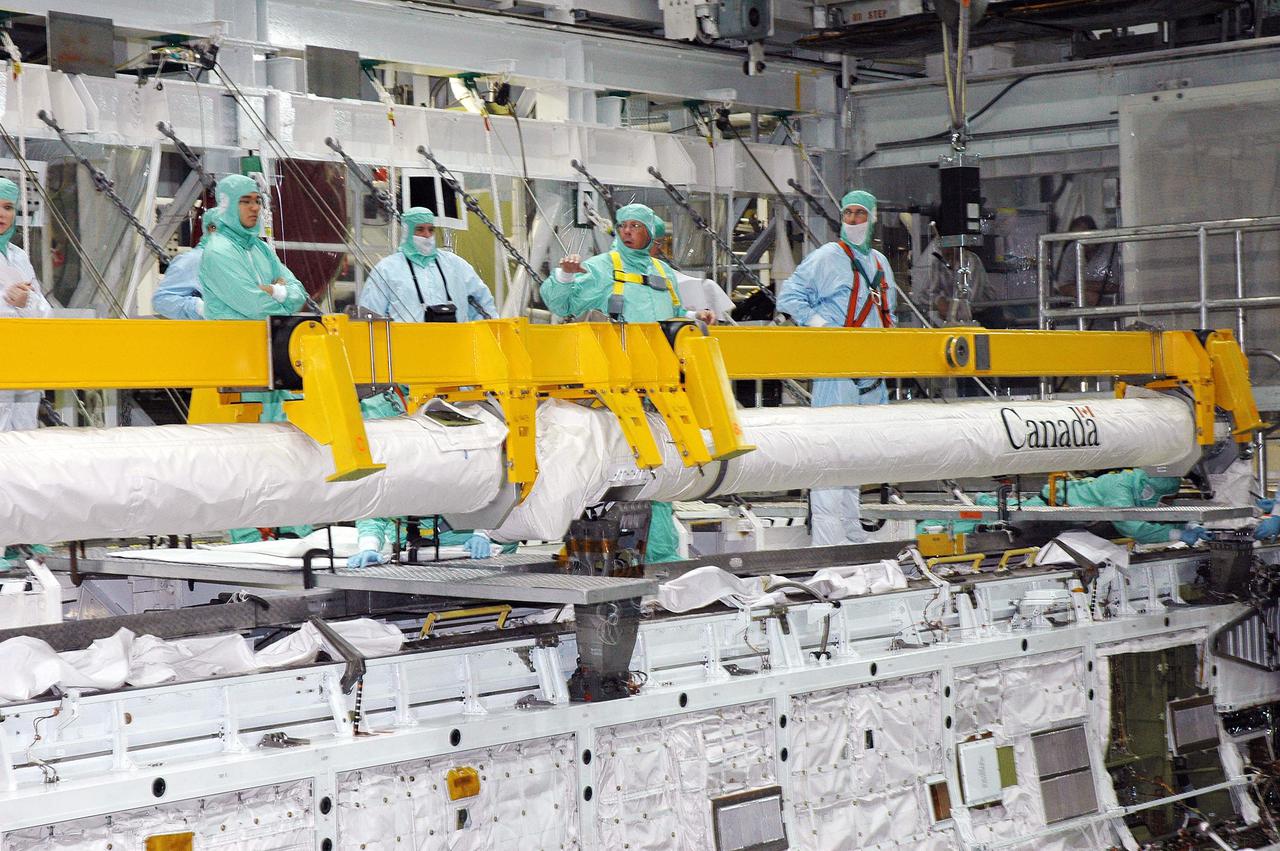
KENNEDY SPACE CENTER, FLA. - Workers in the Orbiter Processing Facility prepare to install the Remote Manipulator System (RMS), or Shuttle arm, in Atlantis’ payload bay. The RMS includes the electromechanical arm that maneuvers a payload from the payload bay of the orbiter to its deployment position and then releases it. It can also grapple a free-flying payload, maneuver it to the payload bay of the orbiter and berth it in the orbiter. The RMS arm is 50 feet 3 inches long and 15 inches in diameter. It weighs 905 pounds, and the total system weighs 994 pounds. The RMS has six joints that correspond roughly to the joints of the human arm, with shoulder yaw and pitch joints; an elbow pitch joint; and wrist pitch, yaw and roll joints. The end effector is the unit at the end of the wrist that actually grabs, or grapples, the payload. Atlantis is the designated orbiter to fly on mission STS-121. The mission has a launch window of July 12 - July 31, 2005.
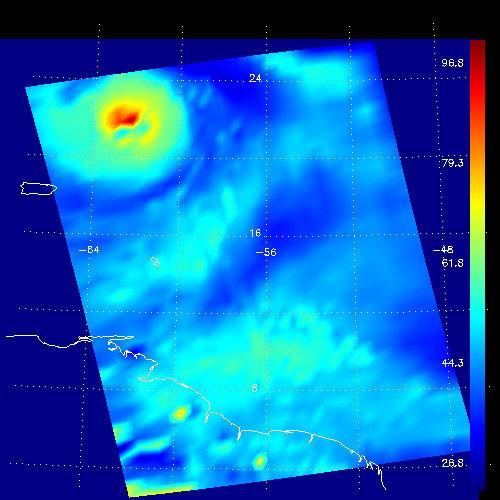
This false-color image shows the amount of atmospheric water vapor observed by AIRS two weeks prior to the passage of Hurricane Isabel, and then when it was a Category 5 storm. The region shown includes parts of South America and the West Indies. Puerto Rico is the large island below the upper left corner. Total water vapor represents the depth of a layer if all the water vapor in the atmosphere were to condense and fall to the surface. The color bar on the right sides of the plots give the thickness of this layer in millimeters (mm). The first image, from August 28, shows typical tropical water vapor amounts over the ocean: between roughly 25 and 50 mm, or 1 to 2 inches. The highest values of roughly 80 mm, seen as a red blob over South America, corresponds to intense thunderstorms. Thunderstorms pull in water vapor from surrounding regions and concentrate it, with much of it then falling as rain. http://photojournal.jpl.nasa.gov/catalog/PIA00430
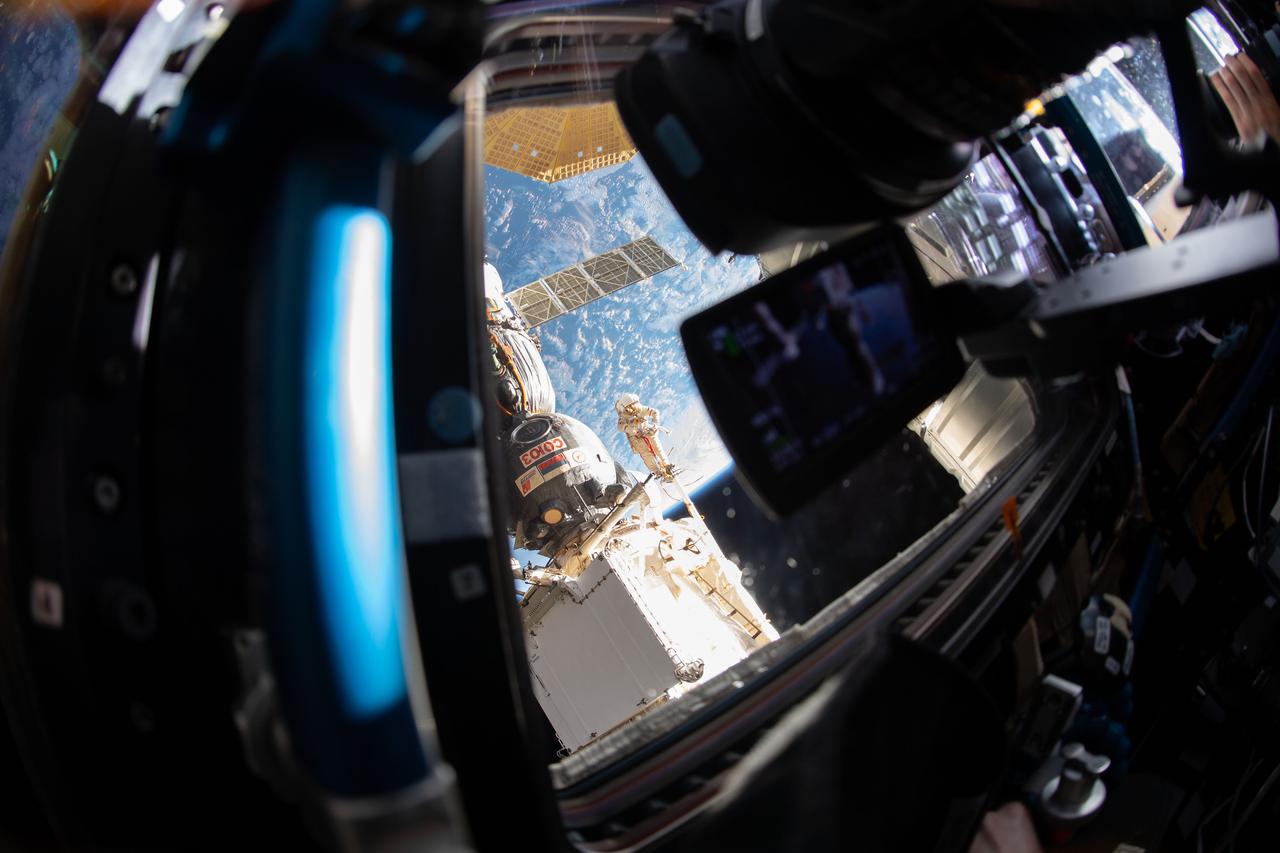
iss057e131556 (Dec. 11, 2018) --- An Expedition 57 crew member inside the cupola photographed Russian spacewalker Oleg Kononenko (suit with red stripes) attached to the Strela boom outside the International Space Station about 250 miles above Earth to inspect the Soyuz MS-09 spacecraft. During the spacewalk, he and fellow spacewalker Sergey Prokopyev (out of frame) examined the external hull of the Soyuz crew ship docked to the Rassvet module. The area corresponded with the location of a small hole inside the Soyuz habitation module that was found in August and caused a decrease in the space station’s pressure. The hole was fixed internally with a sealant within hours of its detection. During the spacewalk, Kononenko and Prokopyev collected samples of some of the sealant that extruded through hole to the outer hull before heading back inside the Pirs docking compartment and closing the hatch completing a seven-hour, 45-minute spacewalk.
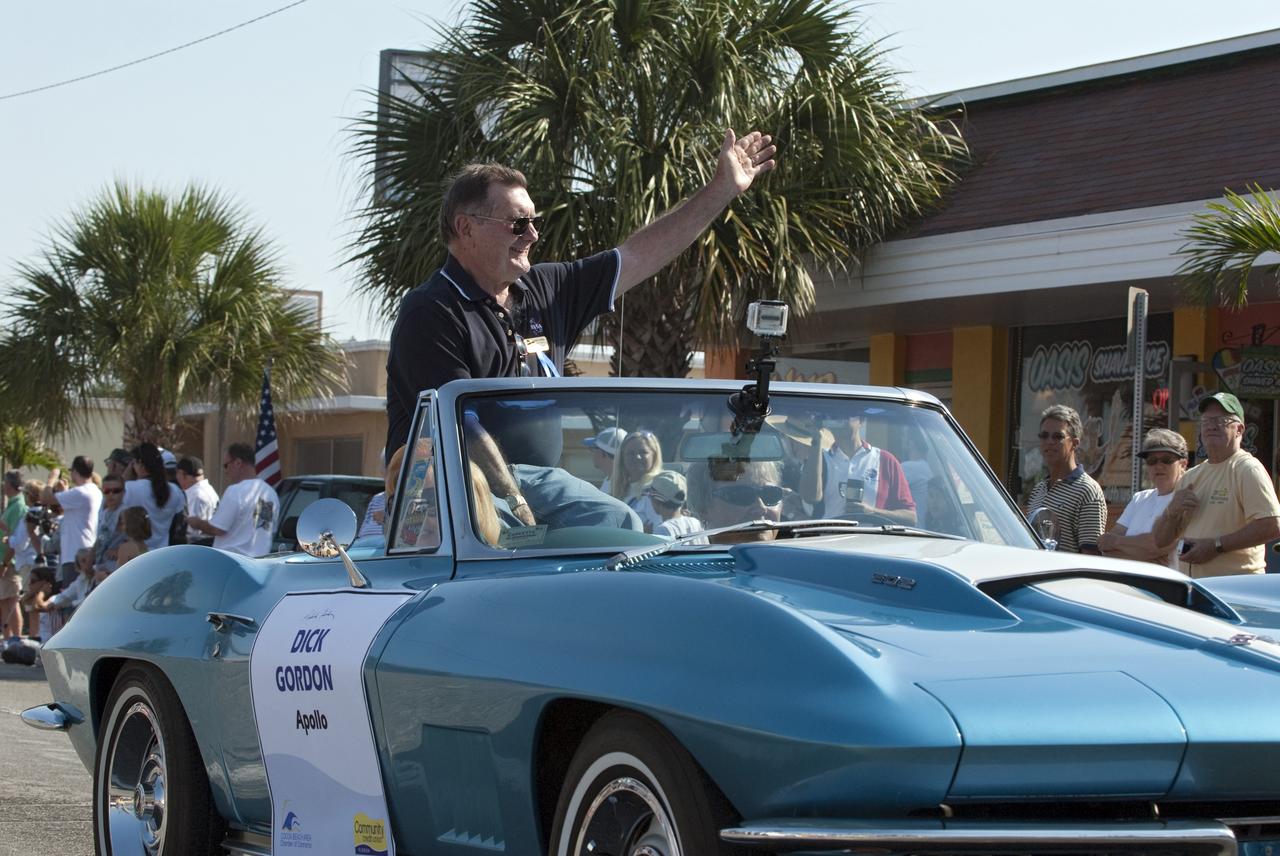
Cape Canaveral, Fla. -- Retired Gemini and Apollo astronaut Dick Gordon waves to spectators from a vintage Chevrolet Corvette during a commemorative parade in Cocoa Beach, Fla. A group of current and retired NASA astronauts gathered in Cocoa Beach to commemorate NASA’s 50 years of accomplishments and to honor astronaut Alan Shepard’s Mercury/Freedom 7 suborbital flight May 5, 1961.The event was marked by a parade, with the astronauts riding in a fleet of Chevrolet Corvettes that corresponded with the time period of their space missions. Members of the Cape Kennedy Corvette Club, a group established in 1967, escorted almost two dozen astronauts or their family representatives in club members' cars. The Corvette parade started at the glass bank building, at 9:34 a.m. EDT, the same time Shepard launched into space. Photo credit: NASA/Kim Shiflett
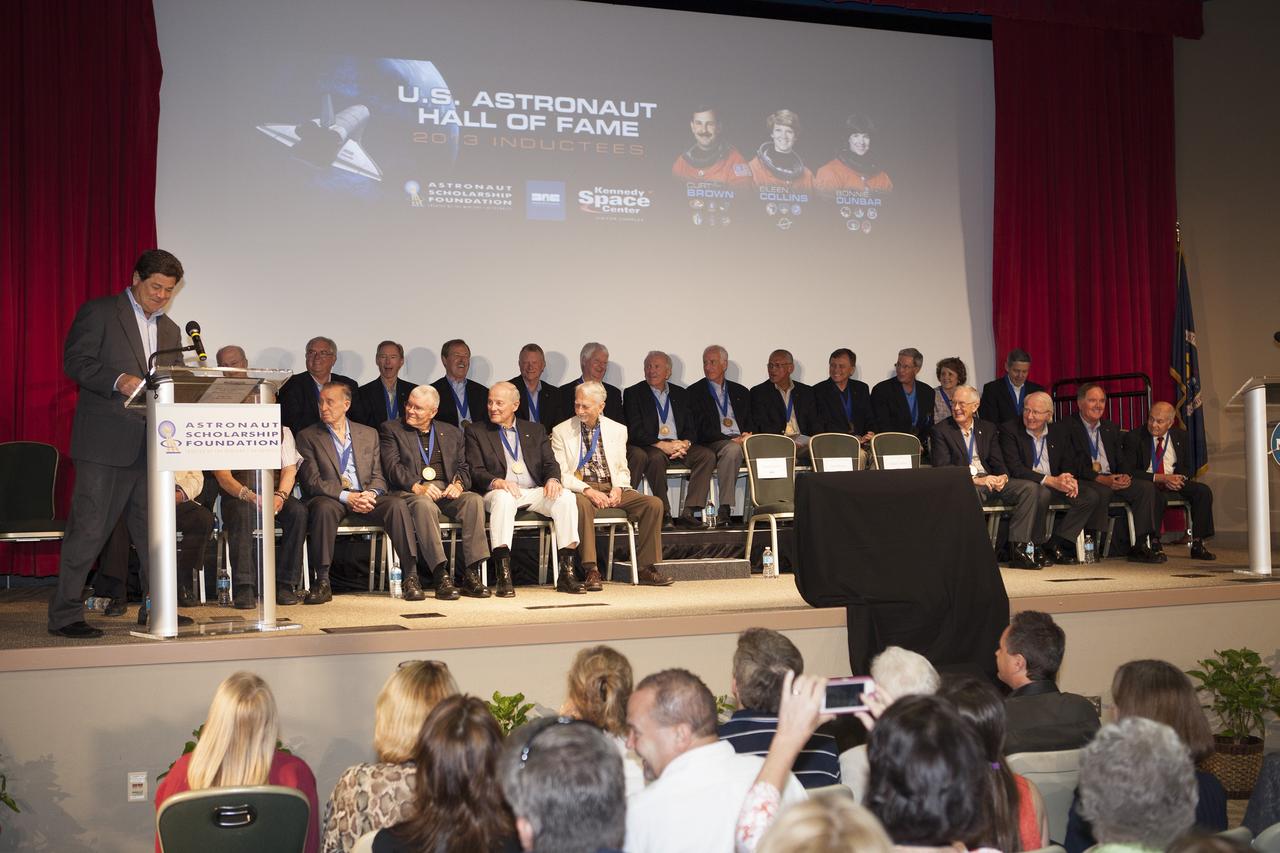
CAPE CANAVERAL, Fla. – At NASA’s Kennedy Space Center Visitor Complex in Florida, Master of Ceremonies John Zarrella, CNN's principal correspondent for coverage of NASA’s space programs, addresses the inductees and visitors with opening remarks. Hall of Fame astronauts and visitors gathered to honor 2013 inductees Curt Brown, Eileen Collins and Bonnie Dunbar. This induction is the twelfth group of space shuttle astronauts named to the AHOF, and the first time two women are inducted at the same time. The year’s inductees were selected by a committee of current Hall of Fame astronauts, former NASA officials, historians and journalists. The selection process is administered by the Astronaut Scholarship Foundation. For more on the U.S. Astronaut Hall of Fame, go to http://www.kennedyspacecenter.com/astronaut-hall-of-fame.aspx For more on the Astronaut Scholarship Foundation, go to http://astronautscholarship.org/ Photo credit: NASA/ Kim Shiflett
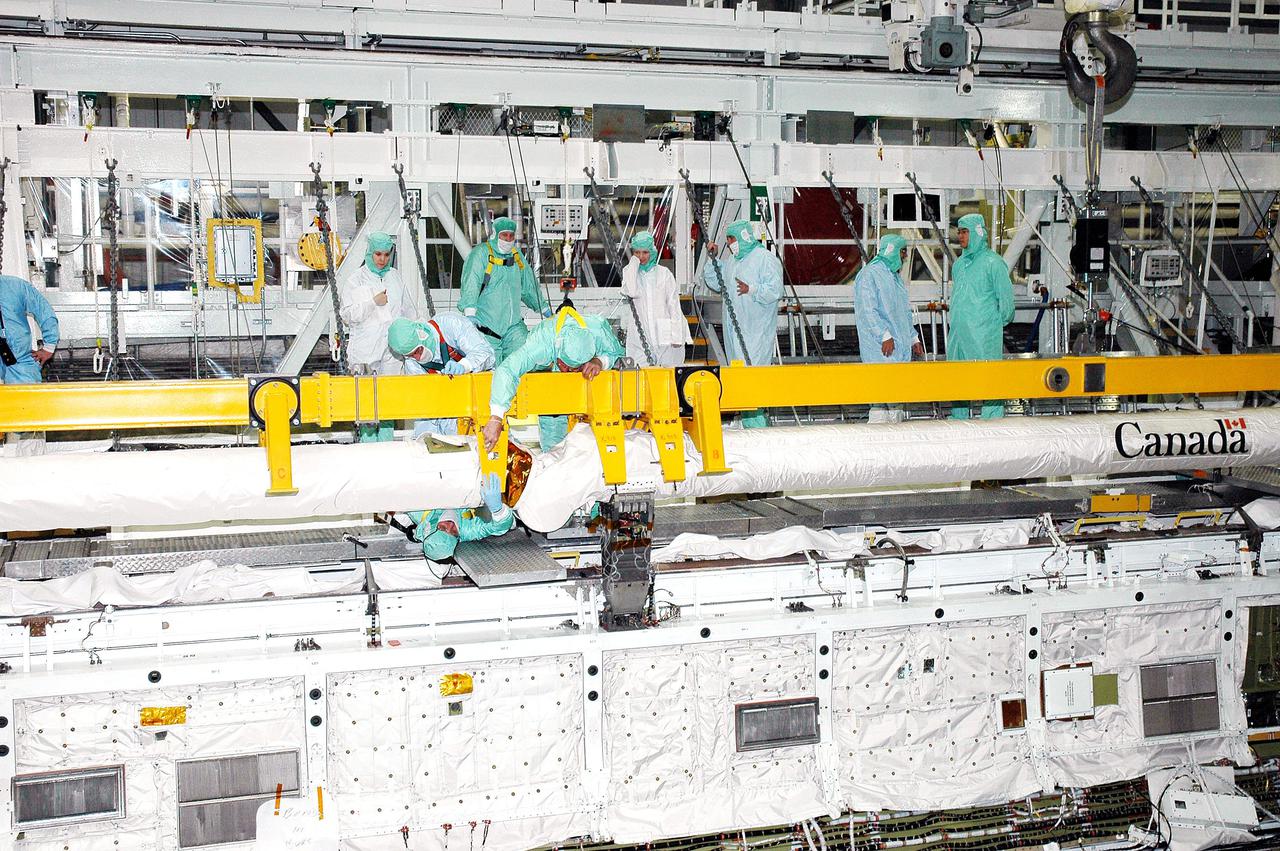
KENNEDY SPACE CENTER, FLA. - Workers in the Orbiter Processing Facility complete attachment of the Remote Manipulator System (RMS), or Shuttle arm, into place in Atlantis’ payload bay. The RMS includes the electromechanical arm that maneuvers a payload from the payload bay of the orbiter to its deployment position and then releases it. It can also grapple a free-flying payload, maneuver it to the payload bay of the orbiter and berth it in the orbiter. The RMS arm is 50 feet 3 inches long and 15 inches in diameter. It weighs 905 pounds, and the total system weighs 994 pounds. The RMS has six joints that correspond roughly to the joints of the human arm, with shoulder yaw and pitch joints; an elbow pitch joint; and wrist pitch, yaw and roll joints. The end effector is the unit at the end of the wrist that actually grabs, or grapples, the payload. Atlantis is the designated orbiter to fly on mission STS-121. The mission has a launch window of July 12 - July 31, 2005.
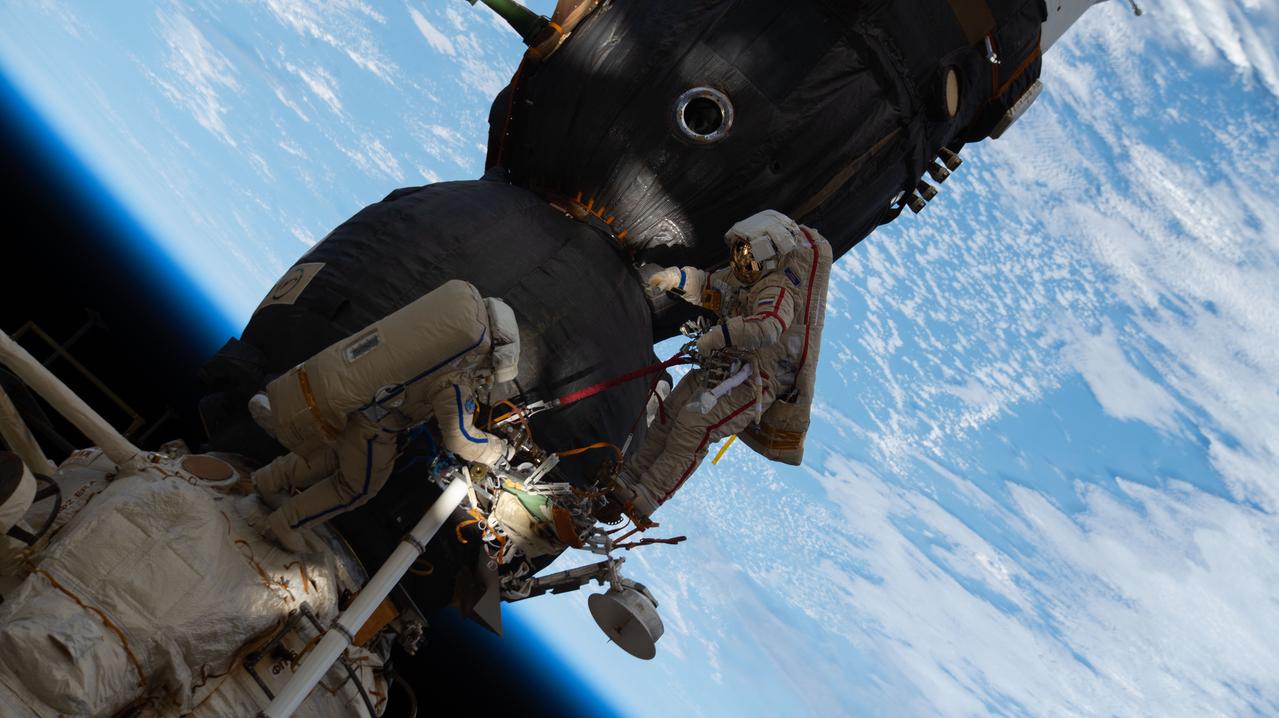
iss057e131662 (Dec. 11, 2018) --- Russian spacewalkers Oleg Kononenko (suit with red stripes) and Sergey Prokopyev (suit with blue stripes) work outside the International Space Station over 250 miles above Earth to inspect the Soyuz MS-09 spacecraft. During the spacewalk, the duo examined the external hull of the Soyuz crew ship docked to the Rassvet module. The area corresponded with the location of a small hole inside the Soyuz habitation module that was found in August and caused a decrease in the space station’s pressure. The hole was fixed internally with a sealant within hours of its detection. During the spacewalk, Kononenko and Prokopyev collected samples of some of the sealant that extruded through hole to the outer hull before heading back inside the Pirs docking compartment and closing the hatch completing a seven-hour, 45-minute spacewalk.
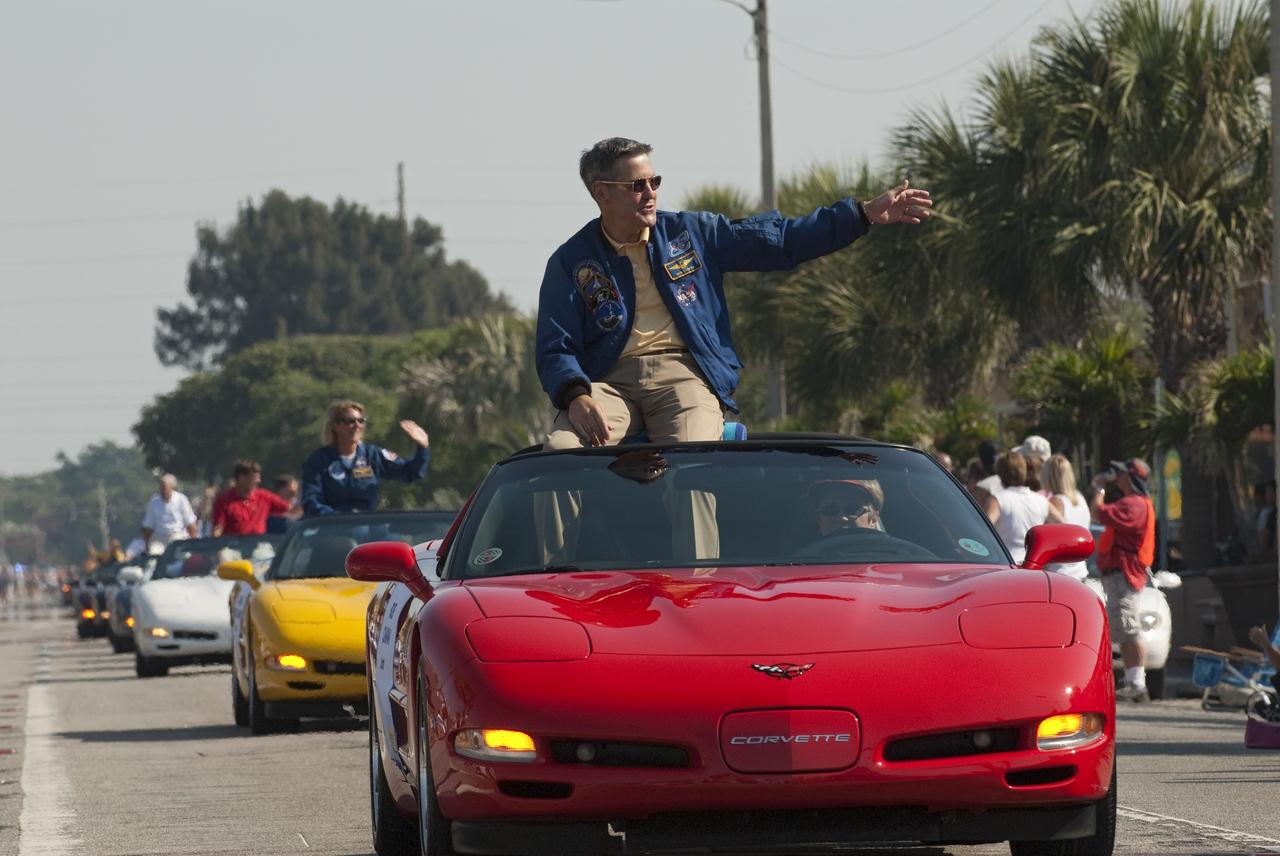
Cape Canaveral, Fla. -- Kennedy Space Center Director and former space shuttle astronaut Bob Cabana waves to spectators from a Chevrolet Corvette during a commemorative parade in Cocoa Beach, Fla. A group of current and retired NASA astronauts gathered in Cocoa Beach to commemorate NASA’s 50 years of accomplishments and to honor astronaut Alan Shepard’s Mercury/Freedom 7 suborbital flight May 5, 1961.The event was marked by a parade, with the astronauts riding in a fleet of Chevrolet Corvettes that corresponded with the time period of their space missions. Members of the Cape Kennedy Corvette Club, a group established in 1967, escorted almost two dozen astronauts or their family representatives in club members' cars. The Corvette parade started at the glass bank building, at 9:34 a.m. EDT, the same time Shepard launched into space. Photo credit: NASA/Kim Shiflett
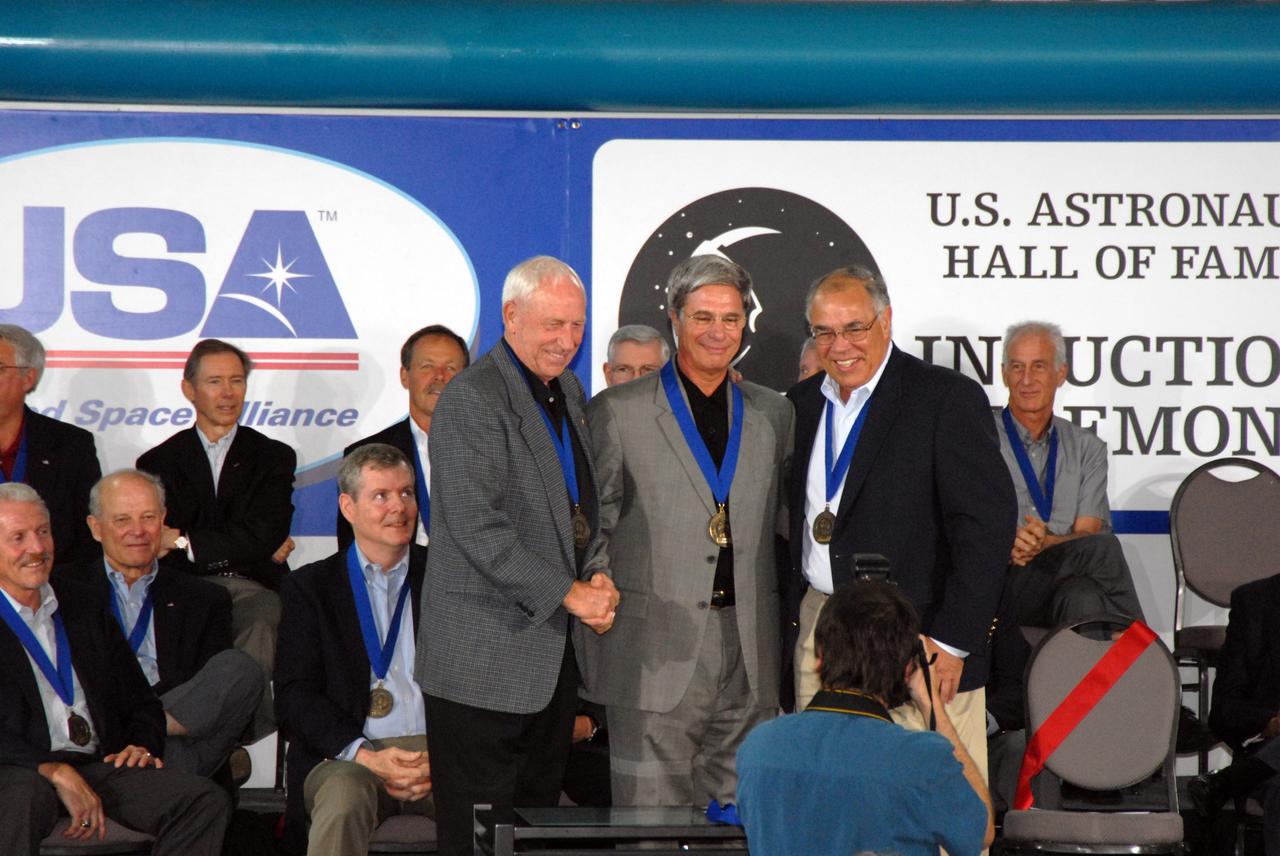
CAPE CANAVERAL, Fla. -- Former astronaut John Blaha (center) is inducted into the U.S. Astronaut Hall of Fame May 3 at NASA's Kennedy Space Center. Presenting the medal are former inductees Al Worden (left) and Fred Gregory (right). Other inductees were Loren Shriver; Bryan O'Connor, NASA's chief of Safety and Mission Assurance at NASA Headquarters in Washington; and Bob Cabana, center director of NASA's Stennis Space Center in Mississippi. Other former astronauts attending included Scott Carpenter, John Young, Bob Crippen, and Walt Cunningham. The U.S. Astronaut Hall of Fame is operated by Kennedy Space Center Visitor Complex on behalf of NASA. CNN correspondent John Zarrella hosted the event.
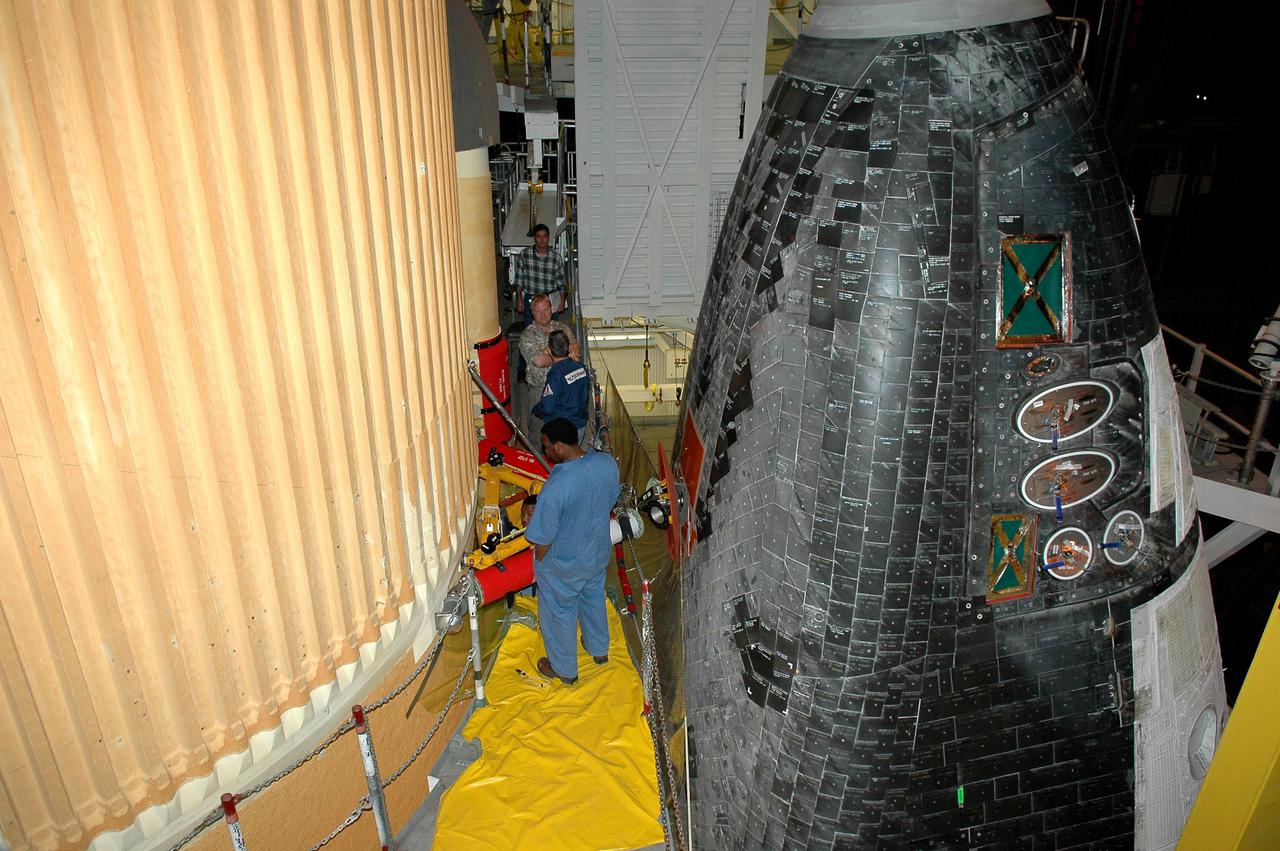
KENNEDY SPACE CENTER, FLA. - In the Vehicle Assembly Building at NASA’s Kennedy Space Center, workers mate the External Tank, at left, to the underside of Space Shuttle Discovery, at right. Each of two aft external tank umbilical plates mate with a corresponding plate on the orbiter. The plates help maintain alignment among the umbilicals. The attach fitting is aft of the nose gear wheel well. Workers next will perform an electrical and mechanical verification of the mated interfaces to verify all critical vehicle connections. A Shuttle interface test is performed using the launch processing system to verify Space Shuttle vehicle interfaces and Space Shuttle vehicle-to-ground interfaces. In approximately one week, Space Shuttle Discovery will be ready for rollout to Launch Pad 39B for Return to Flight mission STS-114. The launch window for STS-114 is May 15 to June 3.
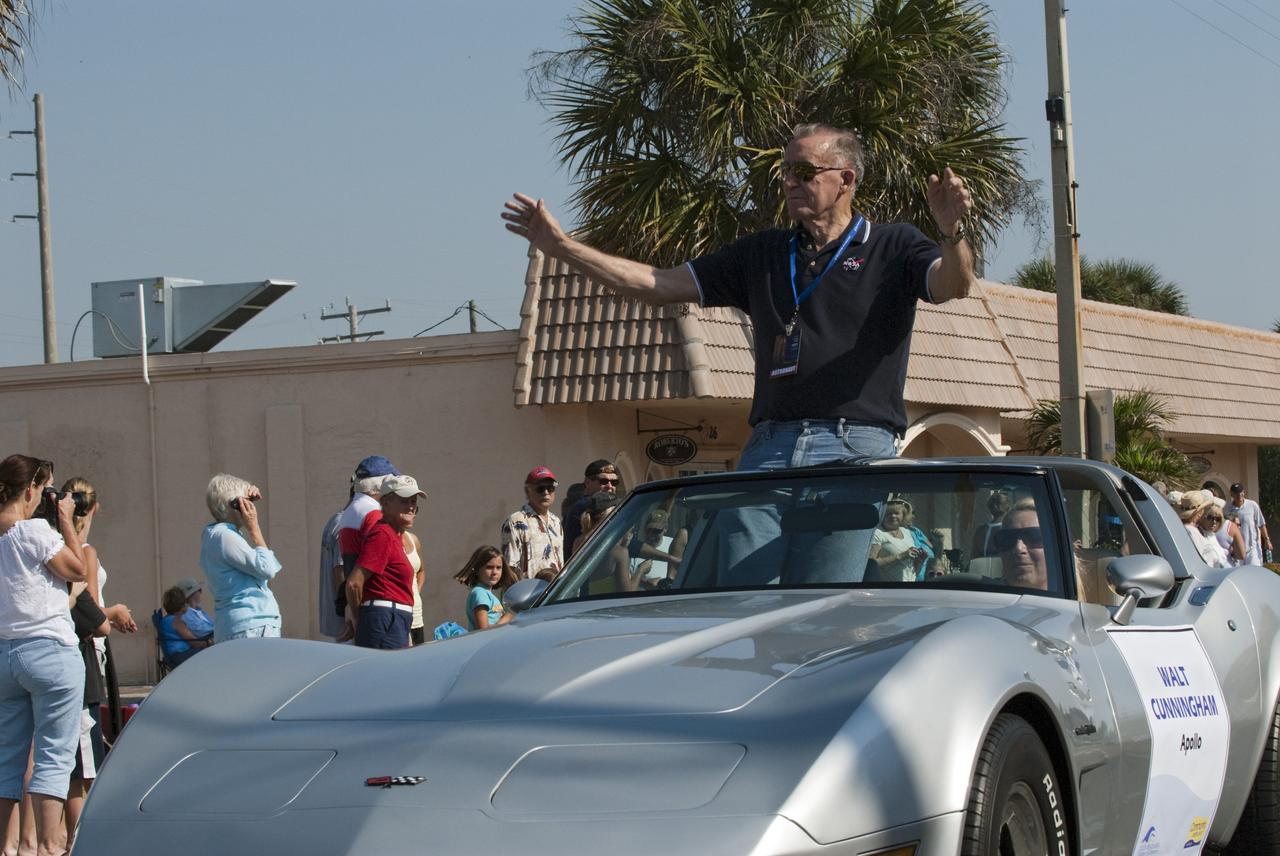
Cape Canaveral, Fla. -- Retired Apollo astronaut Walt Cunningham greets spectators from a vintage Chevrolet Corvette during a commemorative parade in Cocoa Beach, Fla. A group of current and retired NASA astronauts gathered in Cocoa Beach to commemorate NASA’s 50 years of accomplishments and to honor astronaut Alan Shepard’s Mercury/Freedom 7 suborbital flight May 5, 1961.The event was marked by a parade, with the astronauts riding in a fleet of Chevrolet Corvettes that corresponded with the time period of their space missions. Members of the Cape Kennedy Corvette Club, a group established in 1967, escorted almost two dozen astronauts or their family representatives in club members' cars. The Corvette parade started at the glass bank building, at 9:34 a.m. EDT, the same time Shepard launched into space. Photo credit: NASA/Kim Shiflett