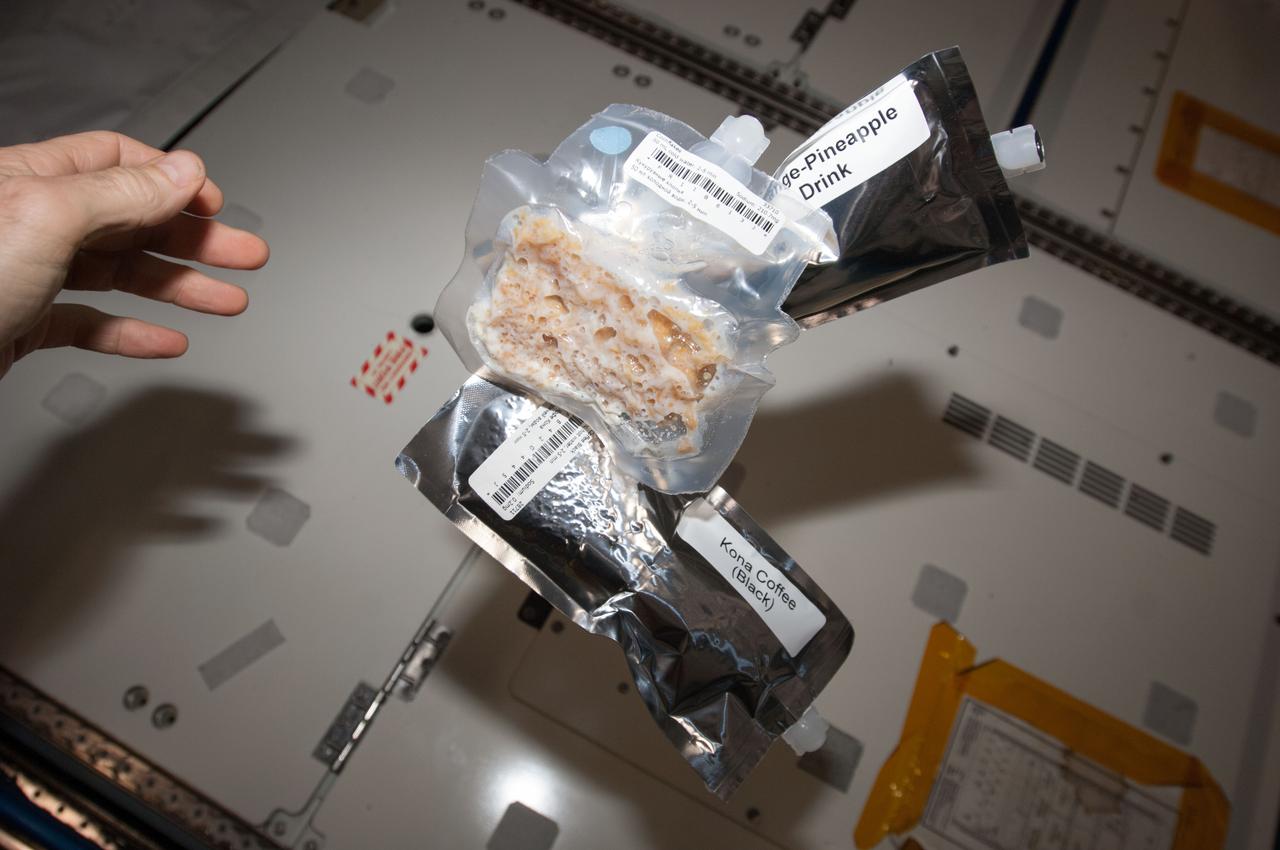
View of drink packets floating,in the U.S. Laboratory. Orange-pineapple drink,cold water,and Kona-coffee (black) are visible. Photo was taken during Expedition 34.
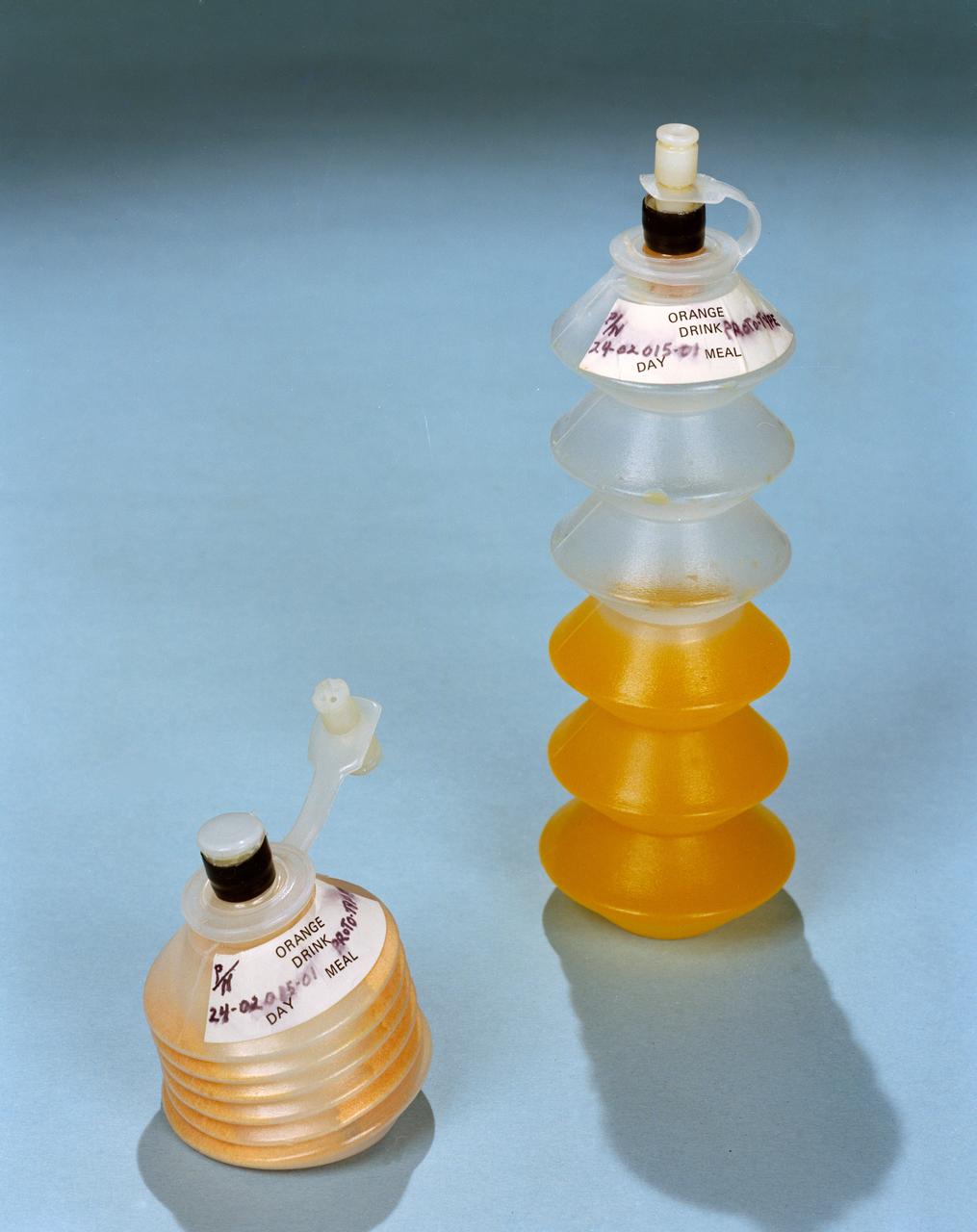
S72-50247 (1972) --- A close-up view of Skylab drink containers. Photo credit: NASA

STS095-E-5055 (30 Oct. 1998) --- U.S. Sen. John H. Glenn Jr. drinks from a rehydratable beverage tube during a busy day of medical tests onboard Discovery. The photograph was taken with an electronic still camera (ESC) at 10:42:55 GMT, Oct. 30.
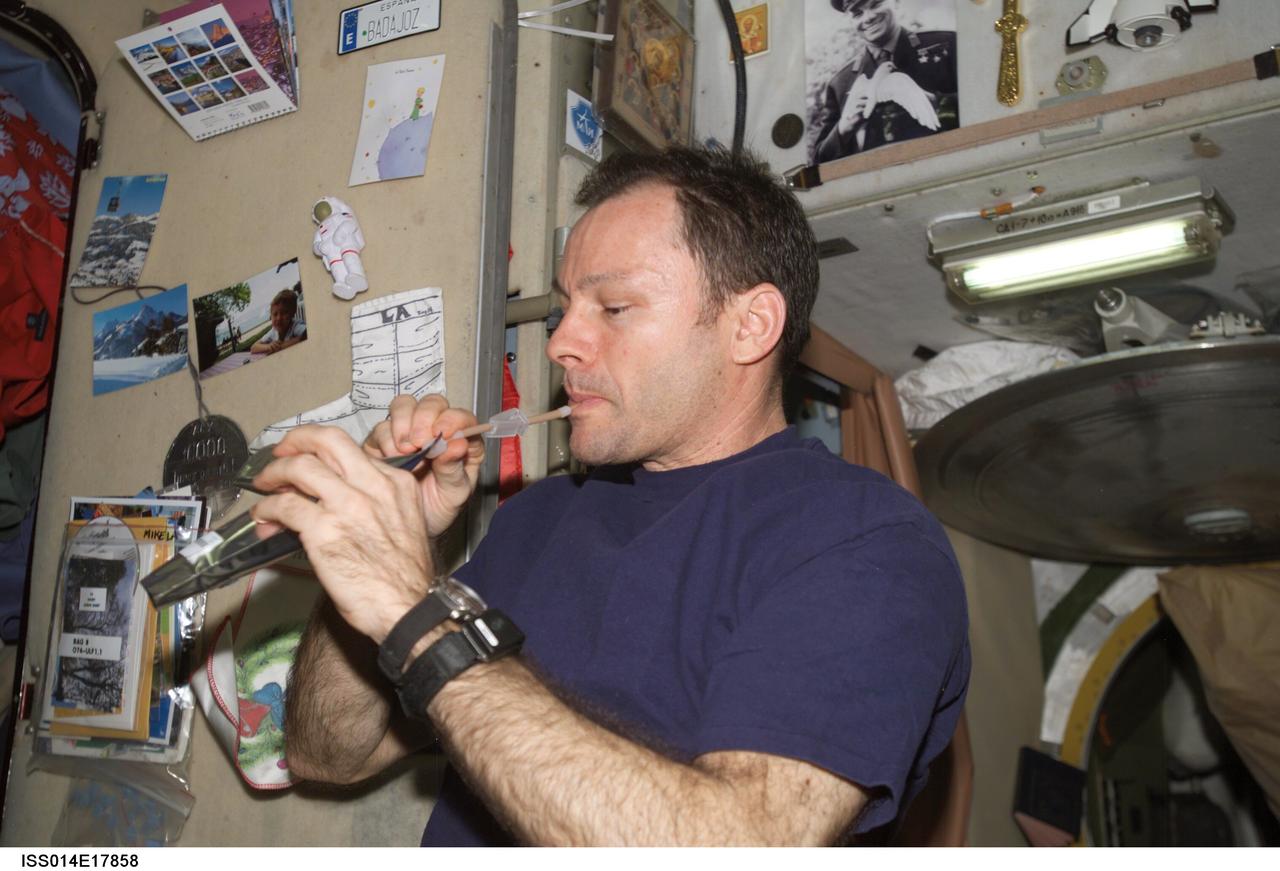
ISS014-E-17858 (11 March 2007) --- Astronaut Michael E. Lopez-Alegria, Expedition 14 commander and NASA space station science officer, drinks a beverage in the Zvezda Service Module of the International Space Station.
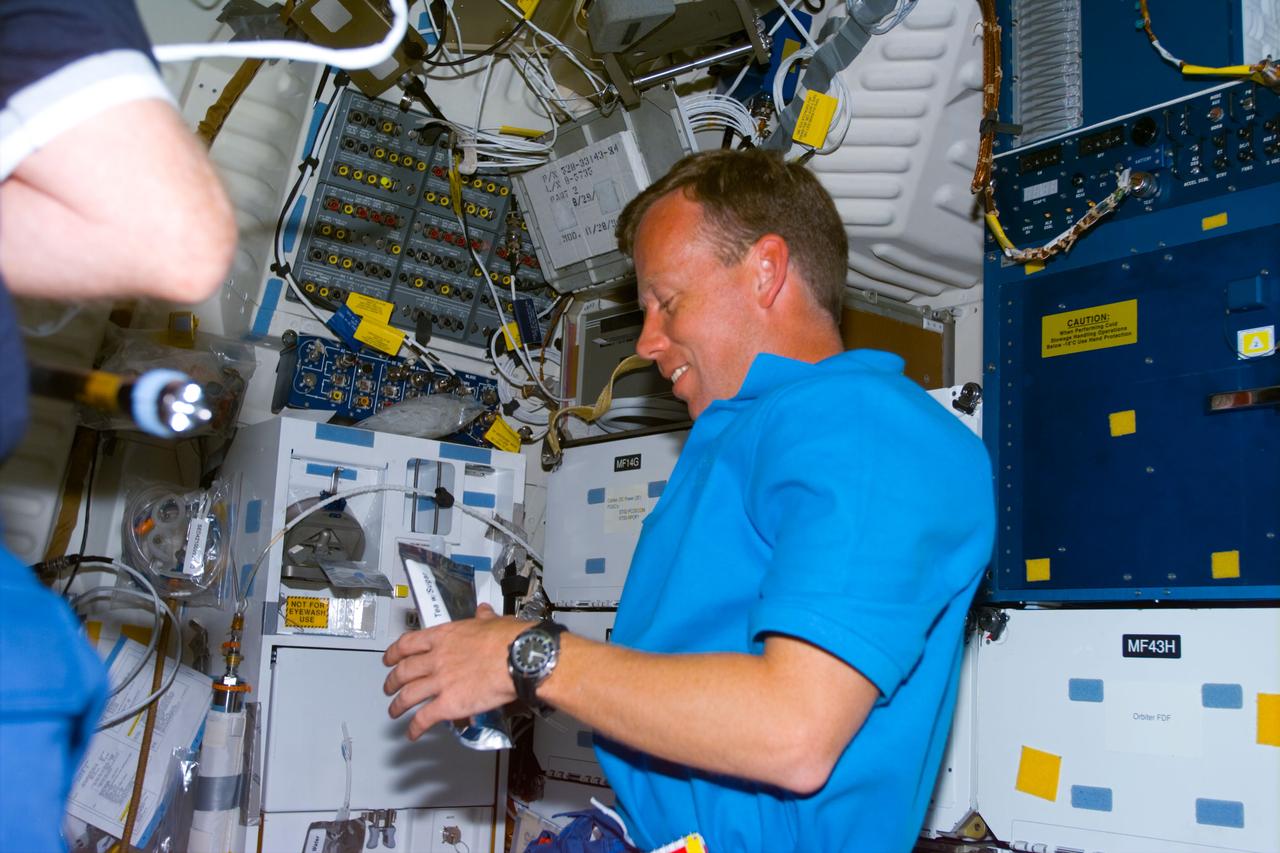
STS095-E-5035 (10-29-98) --- Astronaut Steven W. Lindsey, pilot, rehydrates a drink at the galley on Discovery's mid deck during Flight Day 1 activities. The photo was taken with an electronic still camera (ESC) at 11:47:56 GMT, Oct. 29.

S123-E-007261 (19 March 2008) --- Cosmonaut Yuri I. Malenchenko, Expedition 16 flight engineer representing Russia's Federal Space Agency, drinks a beverage in the Zvezda Service Module of the International Space Station while Space Shuttle Endeavour (STS-123) is docked with the station.
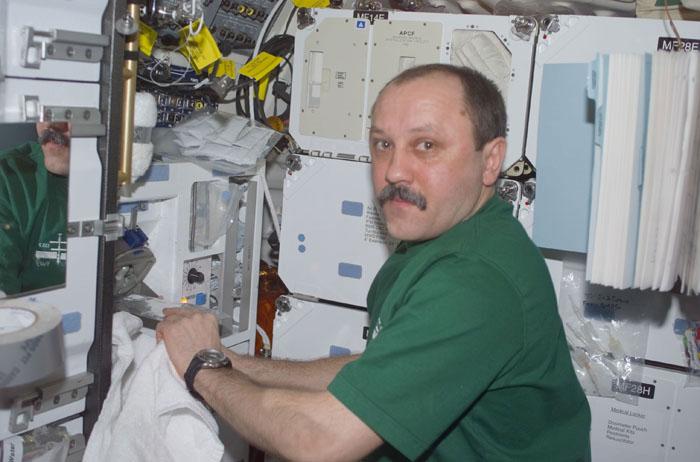
STS105-E-5409 (20 August 2001) --- Yury V. Usachev of Rosaviakosmos, Expedition Two mission commander, prepares a drink for himself at the galley on the middeck of the Space Shuttle Discovery. Usachev and fellow Expedition Two crewmembers Susan J. Helms and James S. Voss are returning to Earth after completing their five month mission aboard the International Space Station (ISS). This image was taken with a digital still camera.
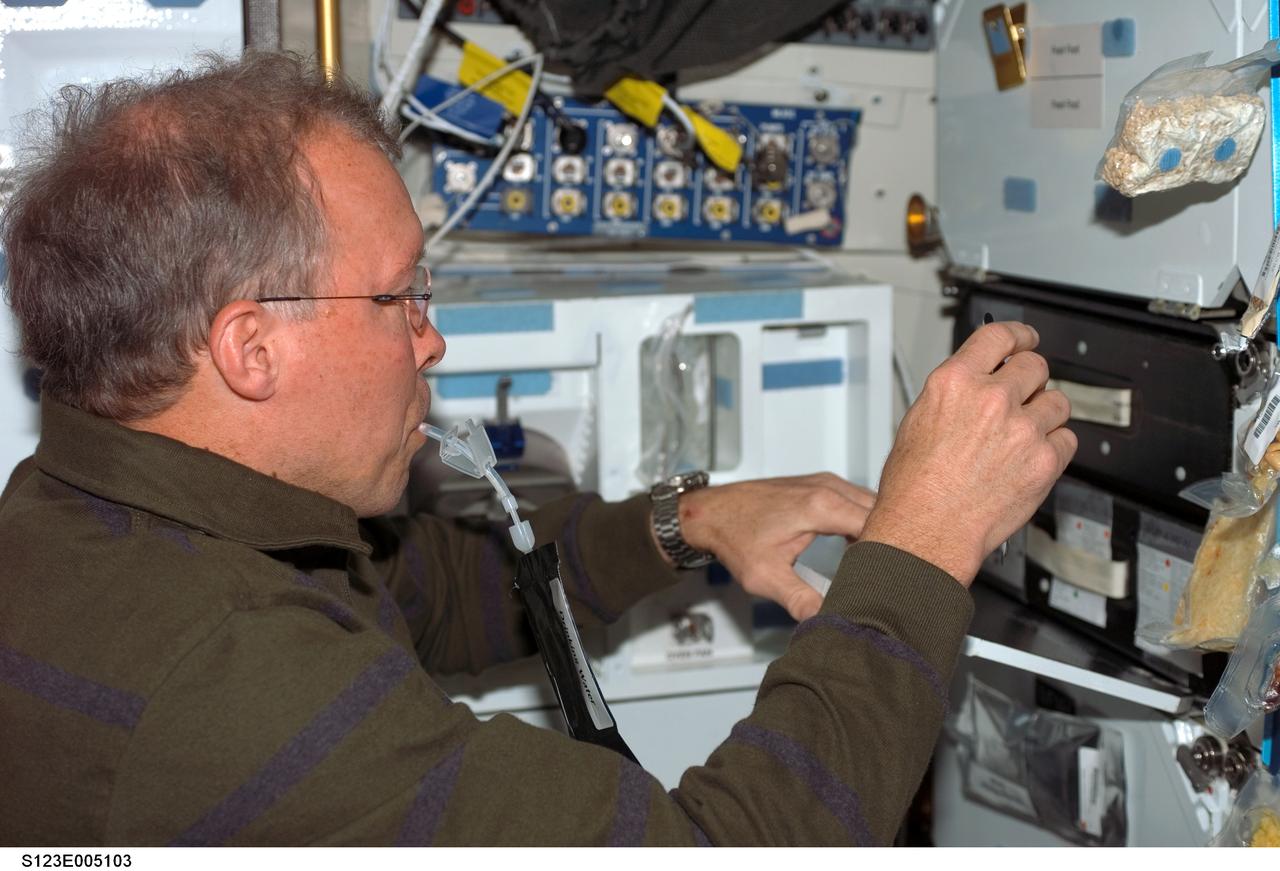
S123-E-005103 (11 March 2008) --- Astronaut Dominic Gorie, STS-123 commander, drinks a beverage at the galley on the middeck of Space Shuttle Endeavour late in flight day one activities.
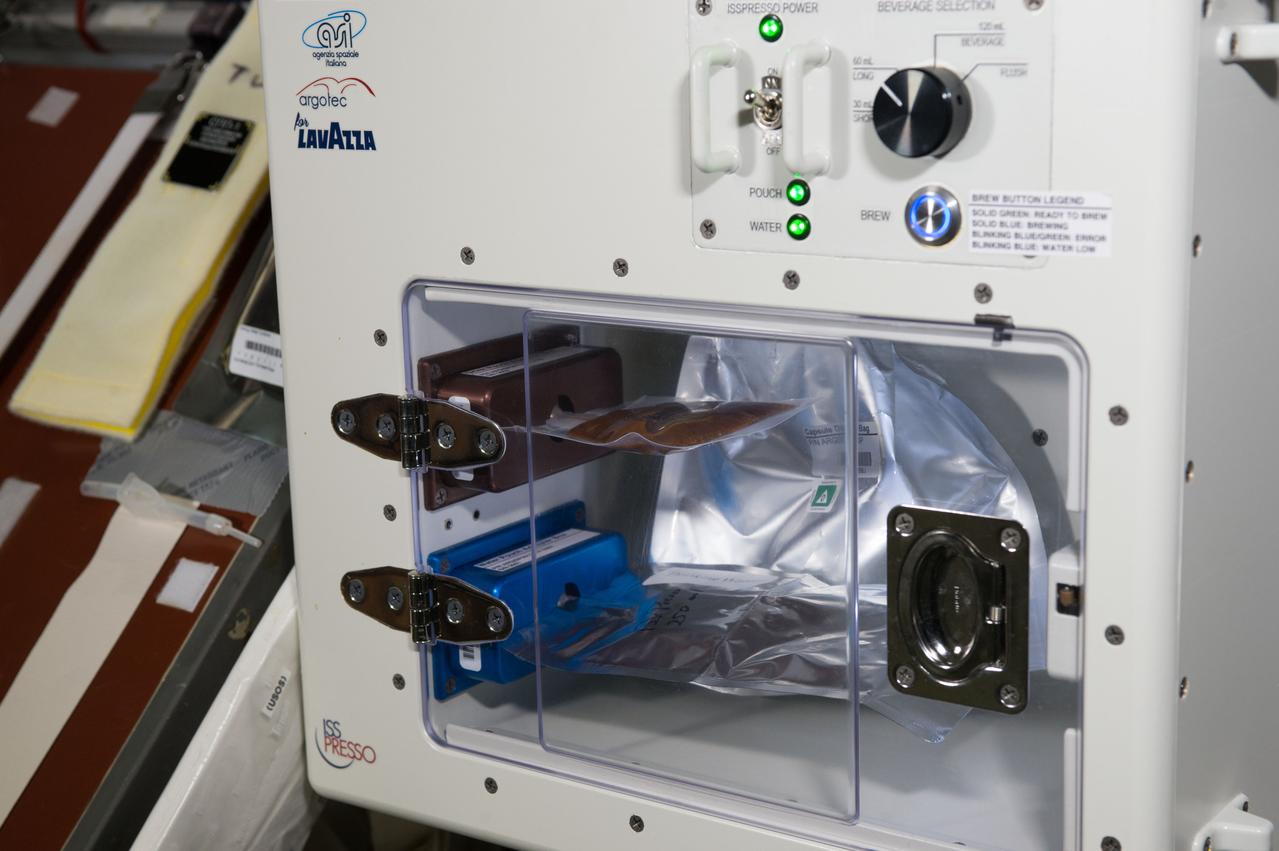
ISS043E160227 (05/03/2015) --- The new ISSpresso machine was recently installed on the International Space Station. In order to utilize the ISSpresso, a NASA standard drink bag is installed, along with a capsule containing the beverage item that the crew member wishes to drink. After the item has been brewed, the used capsule and the drink bag are removed.
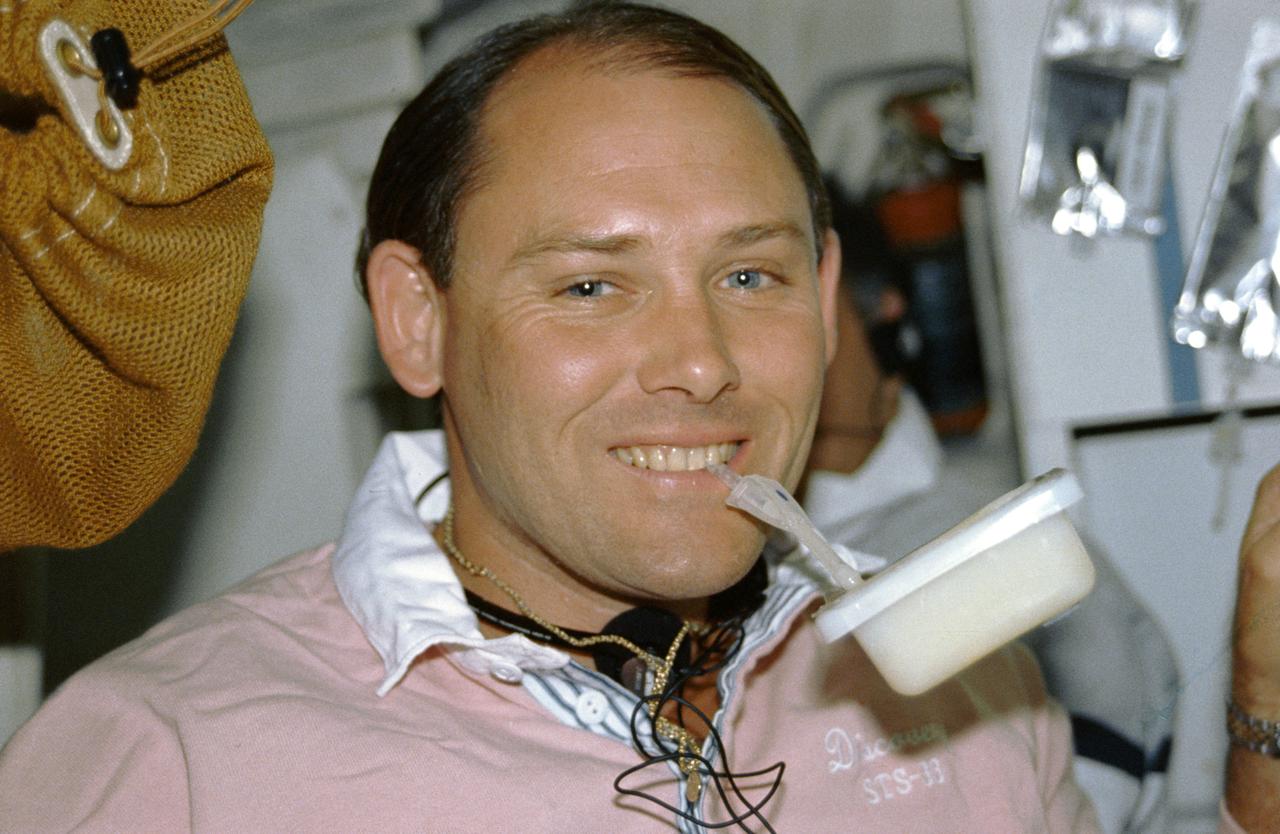
STS033-17-005A (27 Nov 1989) --- Astronaut Manley L. Carter, Jr., STS-33 mission specialist, smiling, sips drink from a beverage container using a straw on Discovery's, Orbiter Vehicle (OV) 103's, middeck. Around Carter's neck are a necklace and tape recorder headphones (headset). A net stowage bag free floats next to Carter's head.
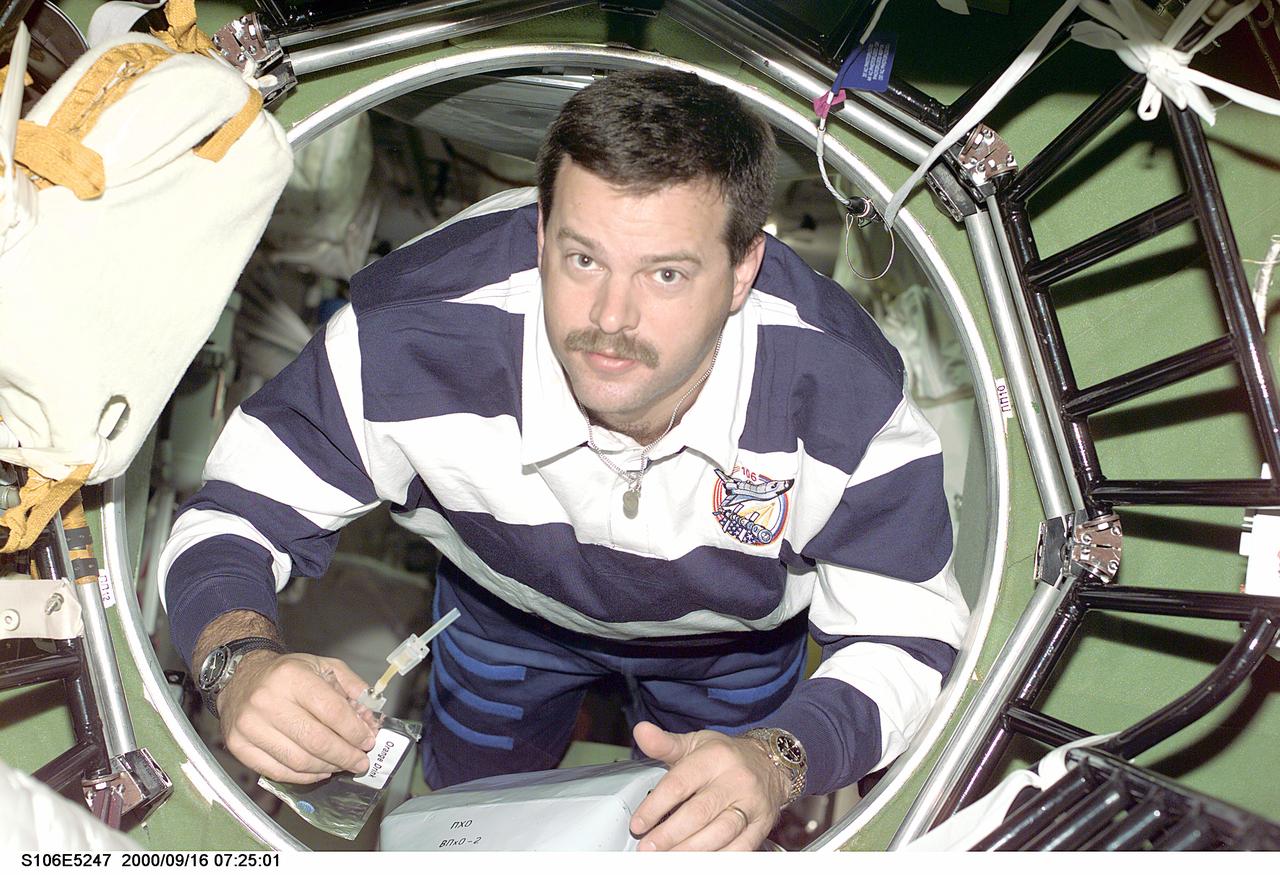
STS-106 Pilot Scott Altman moves through a hatch with a stowage bag and a drink container in the International Space Station (ISS).

Astronaut Karen Nyberg,Expedition 36 flight engineer,is photographed holding a drink packet in the Node 2 module.
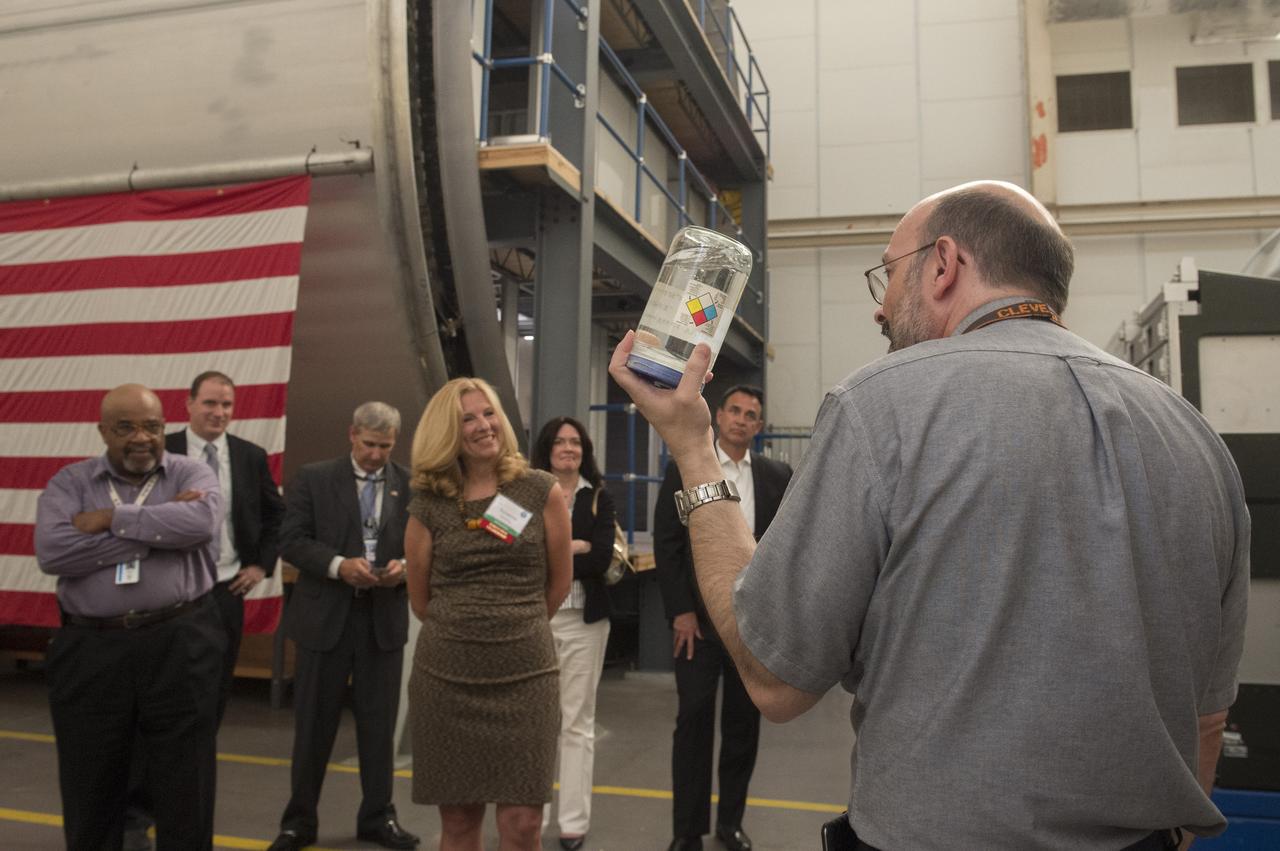
SUZANNE SPAULDING AND STAFF LEARN ABOUT PROCESSING URINE TO CLEAN DRINKING WATER ON SPACE STATION FROM KEITH PARRISH
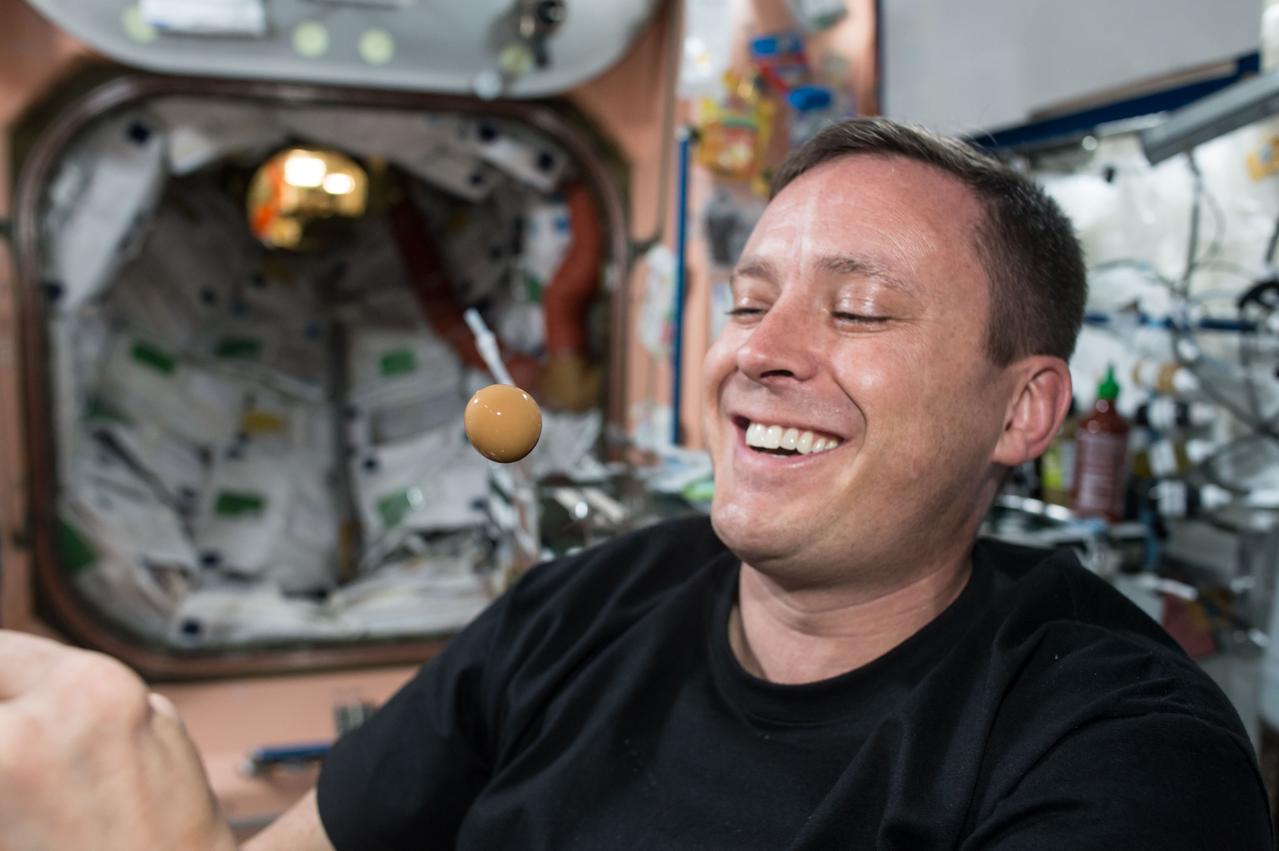
iss051e020855 (April 23, 2017) --- NASA astronaut Jack Fischer watches as liquid from his drink turns into a floating sphere in the weightless environment of microgravity.
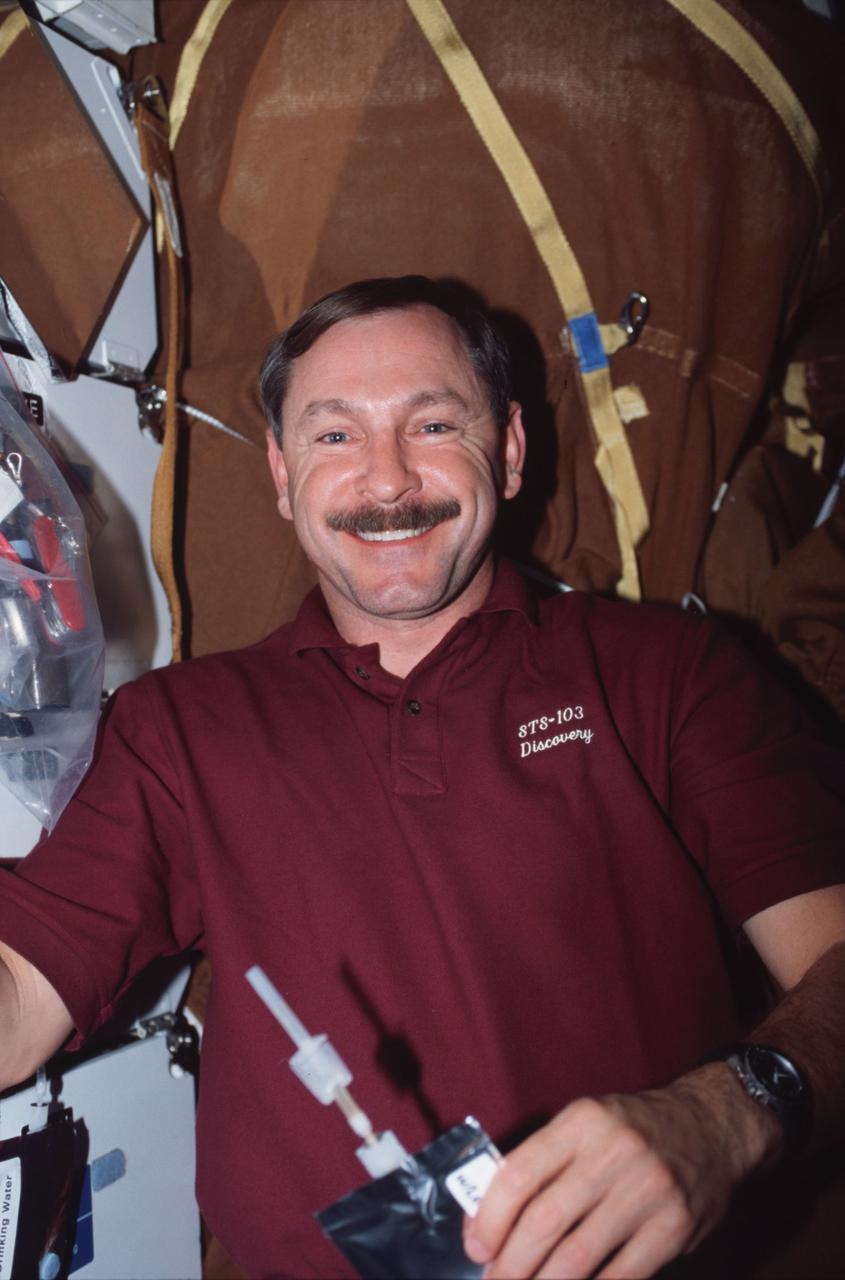
STS103-329-018 (19-27 December 1999) --- Astronaut Curtis L. Brown Jr., mission commander, on Discovery's mid deck holding a drink bag.
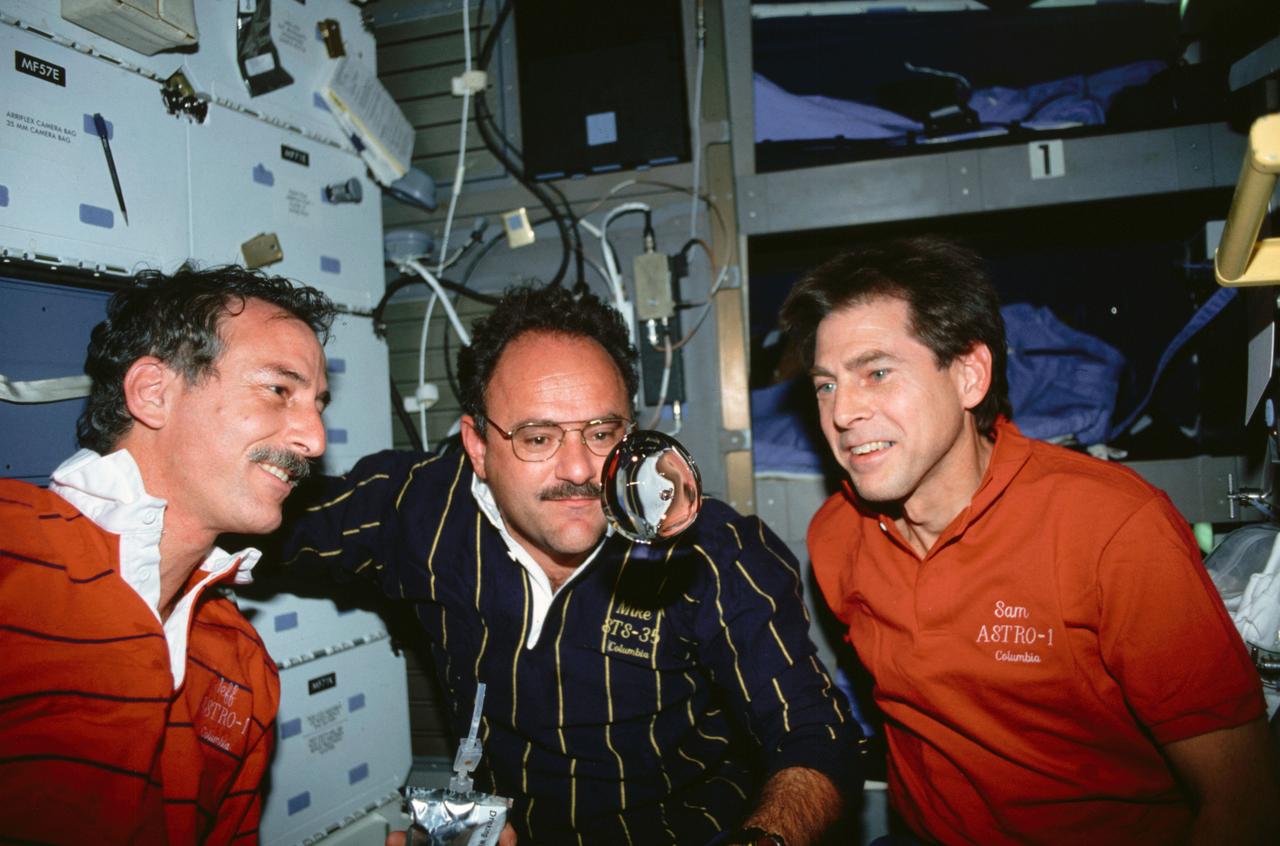
STS035-15-035 (2-10 Dec 1990) --- STS-35 crewmembers perform a microgravity experiment using their drinking water while on the middeck of Columbia, Orbiter Vehicle (OV) 102. Mission Specialist (MS) Jeffrey A. Hoffman (left) has released some water from a drinking container which he holds in his hand. MS John M. Lounge (wearing glasses, center) and Payload Specialist Samuel T. Durrance along with Hoffman study the changing shape and movement of the sphere of water.
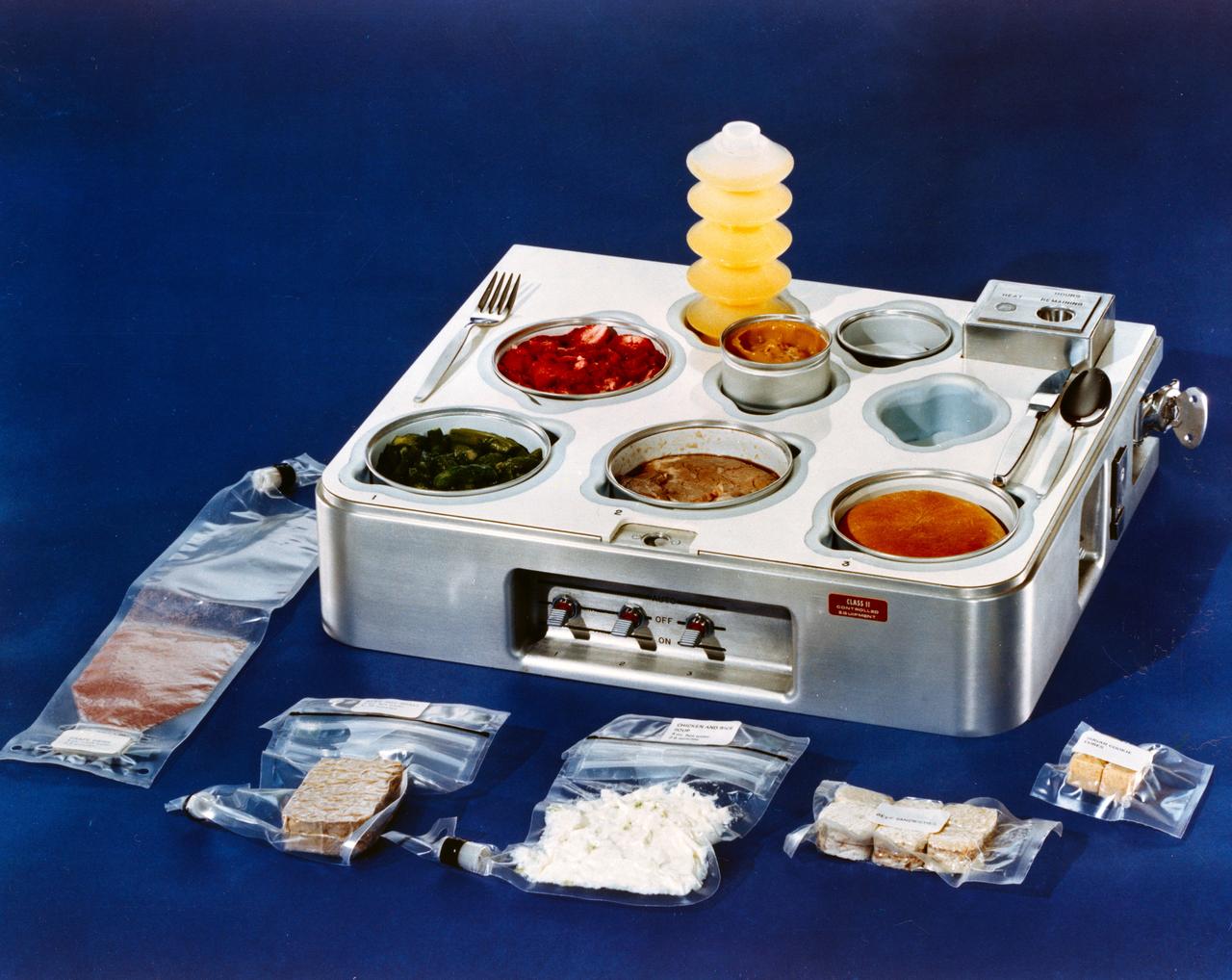
S72-15409 (1972) --- A close-up view of a food tray which is scheduled to be used in the Skylab program. Several packages of space food lie beside the tray. The food in the tray is ready to eat. Out of tray, starting from bottom left: grape drink, beef pot roast, chicken and rice, beef sandwiches and sugar cookie cubes. In tray, from back left: orange drink, strawberries, asparagus, prime rib, dinner roll and butterscotch pudding in the center. Photo credit: NASA
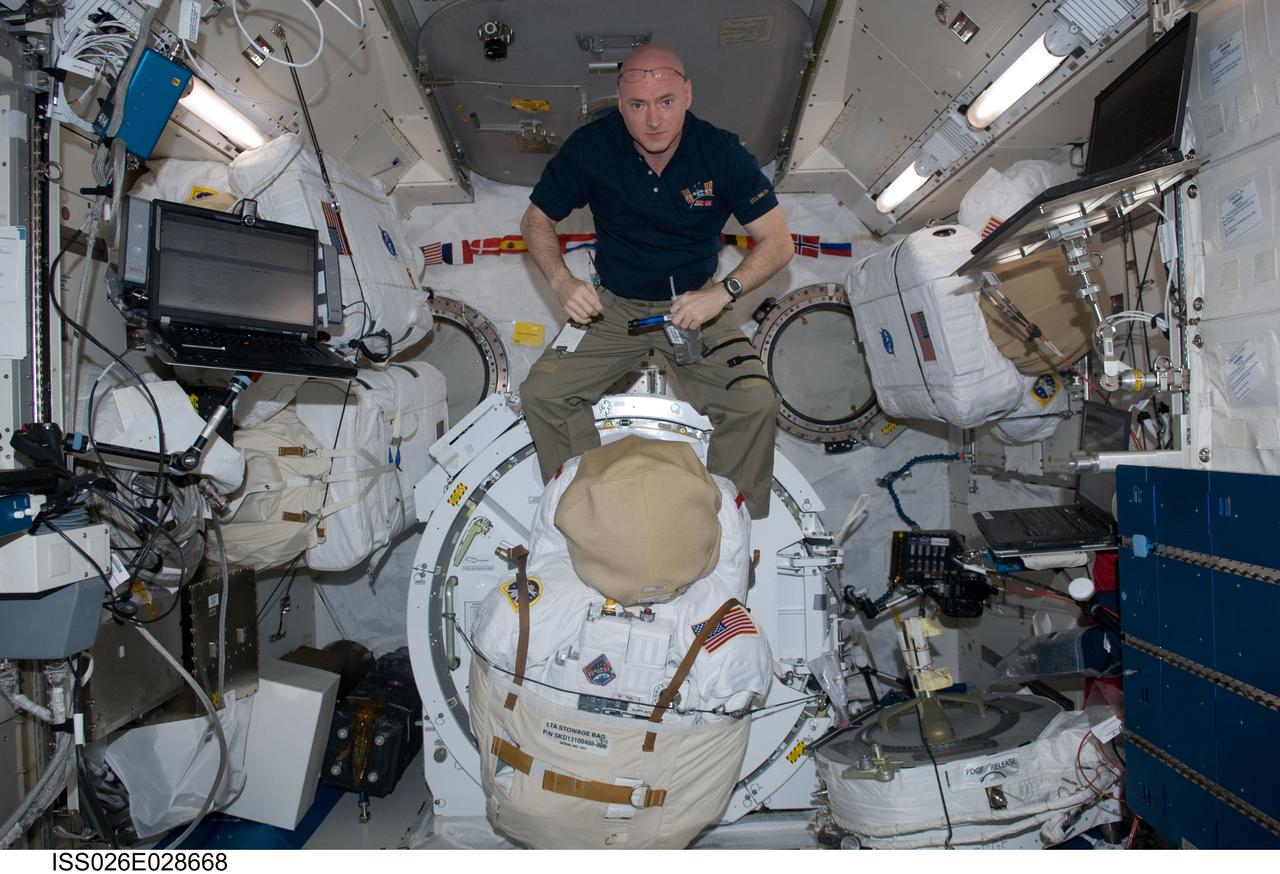
ISS026-E-028668 (23 Feb. 2011) --- NASA astronaut Scott Kelly, Expedition 26 commander, is pictured in the Kibo laboratory of the International Space Station.
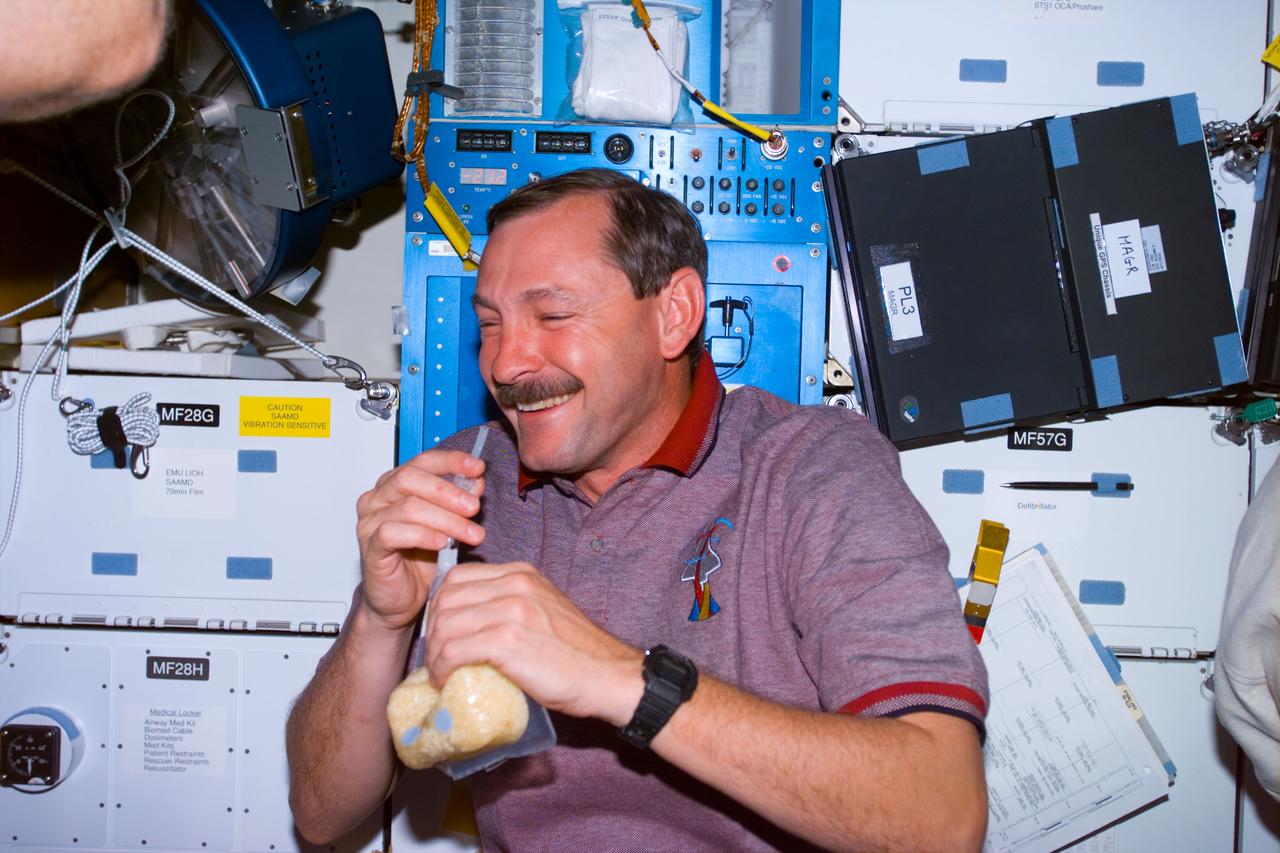
STS095-E-5125 (31 Oct. 1998) --- Astronaut Curtis L. Brown Jr., STS-95 commander, has just added water to a snack at Discovery's galley on the middeck. The photo was taken with an electronic still camera (ESC) at 9:52:32, Oct. 31.
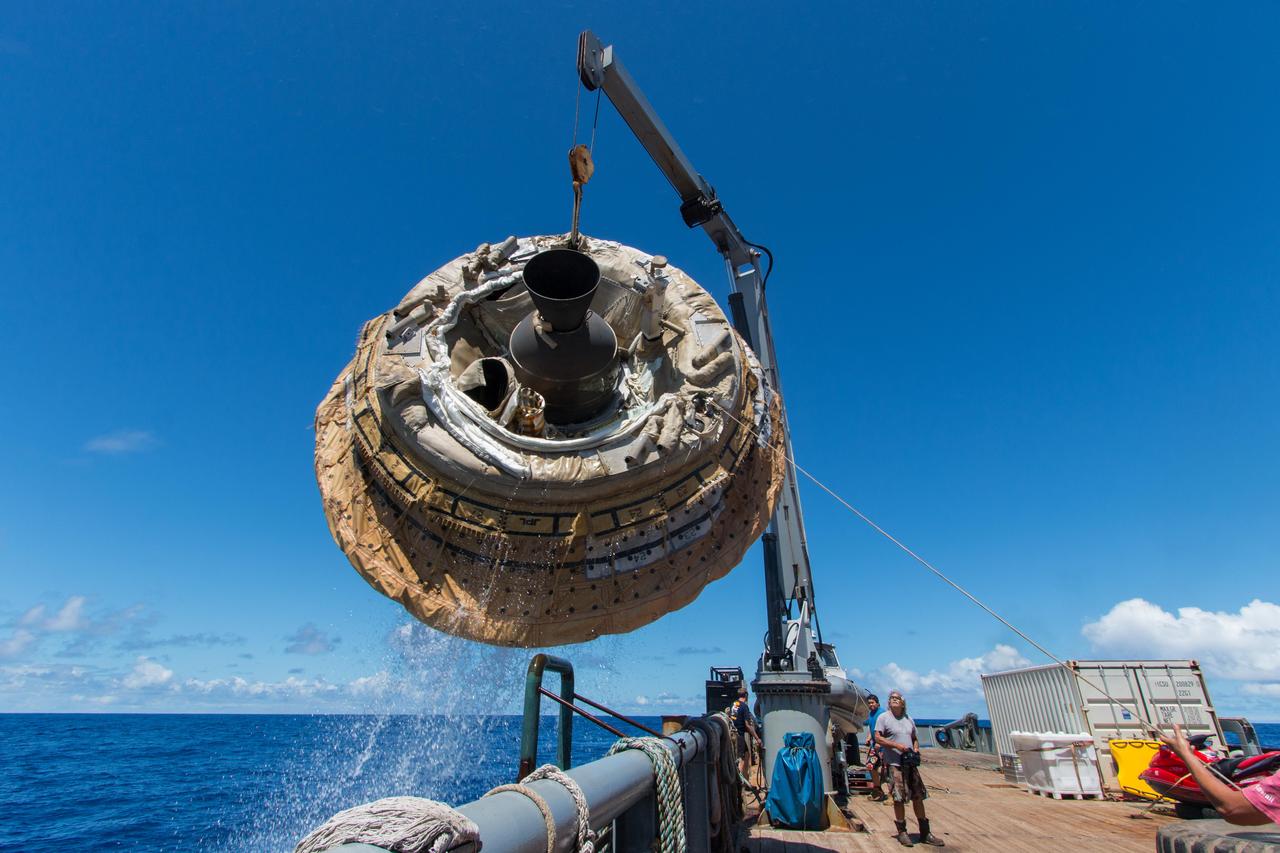
Hours after the June 28, 2014, test of NASA Low-Density Supersonic Decelerator over the U.S. Navy Pacific Missile Range, the saucer-shaped test vehicle is lifted aboard the Kahana recovery vessel.
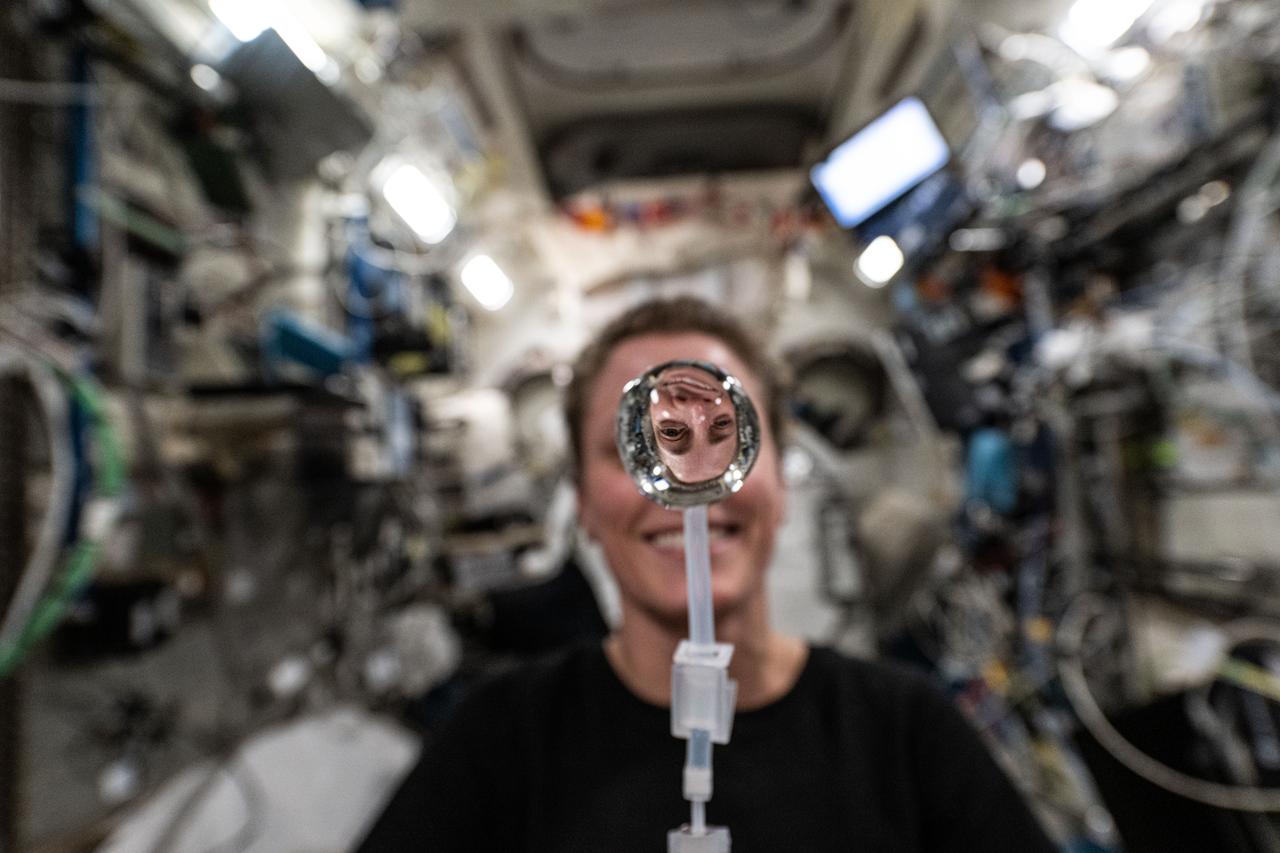
iss070e133764 (April 1, 2024) --- Expedition 70 Flght Engineer and NASA astronaut Loral O'Hara's image is refracted in a water bubble she squeezed from a drinking bag aboard the International Space Station's Kibo laboratory module.
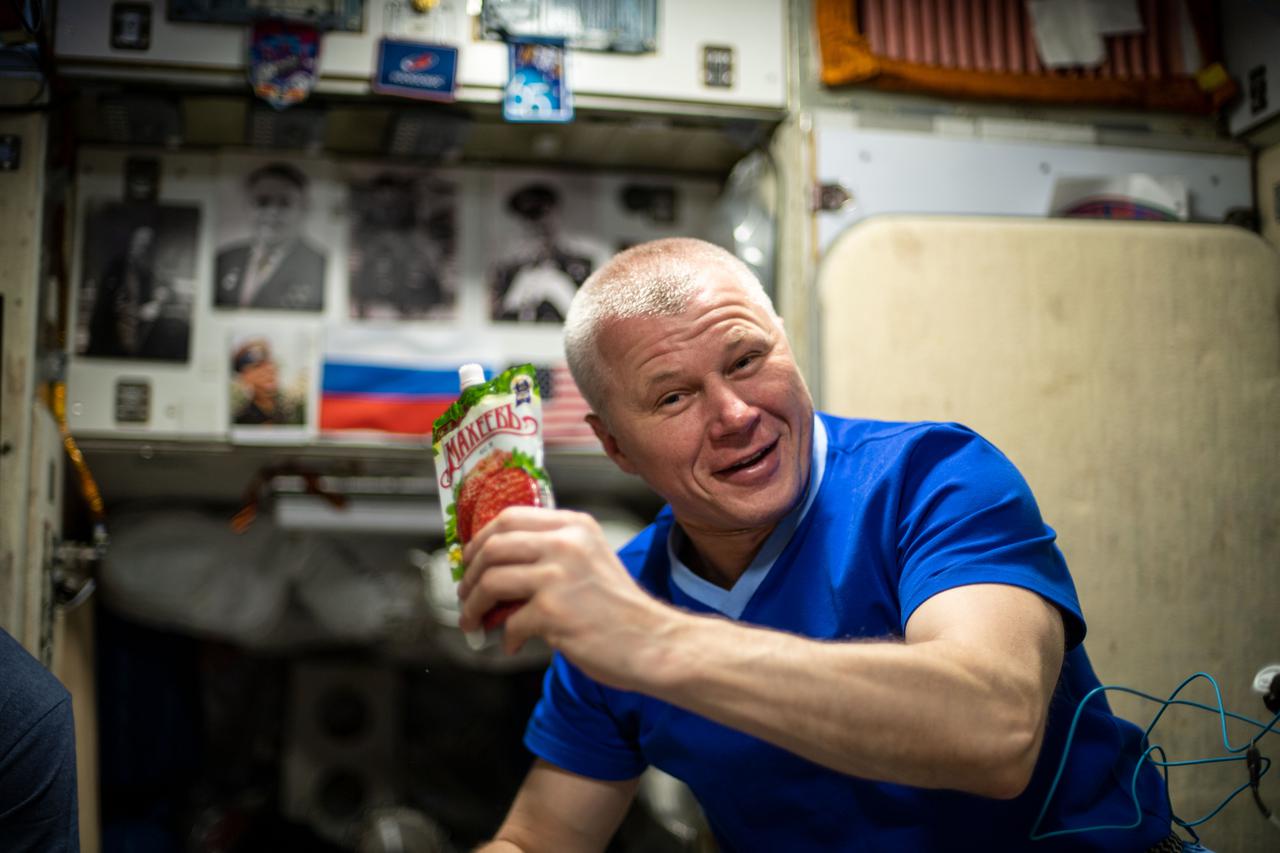
iss065e099693 (June 11, 2021) --- Roscosmos cosmonaut and Expedition 65 Flight Engineer Oleg Novitskiy shows off a drink bag during a midday meal aboard the International Space Station.
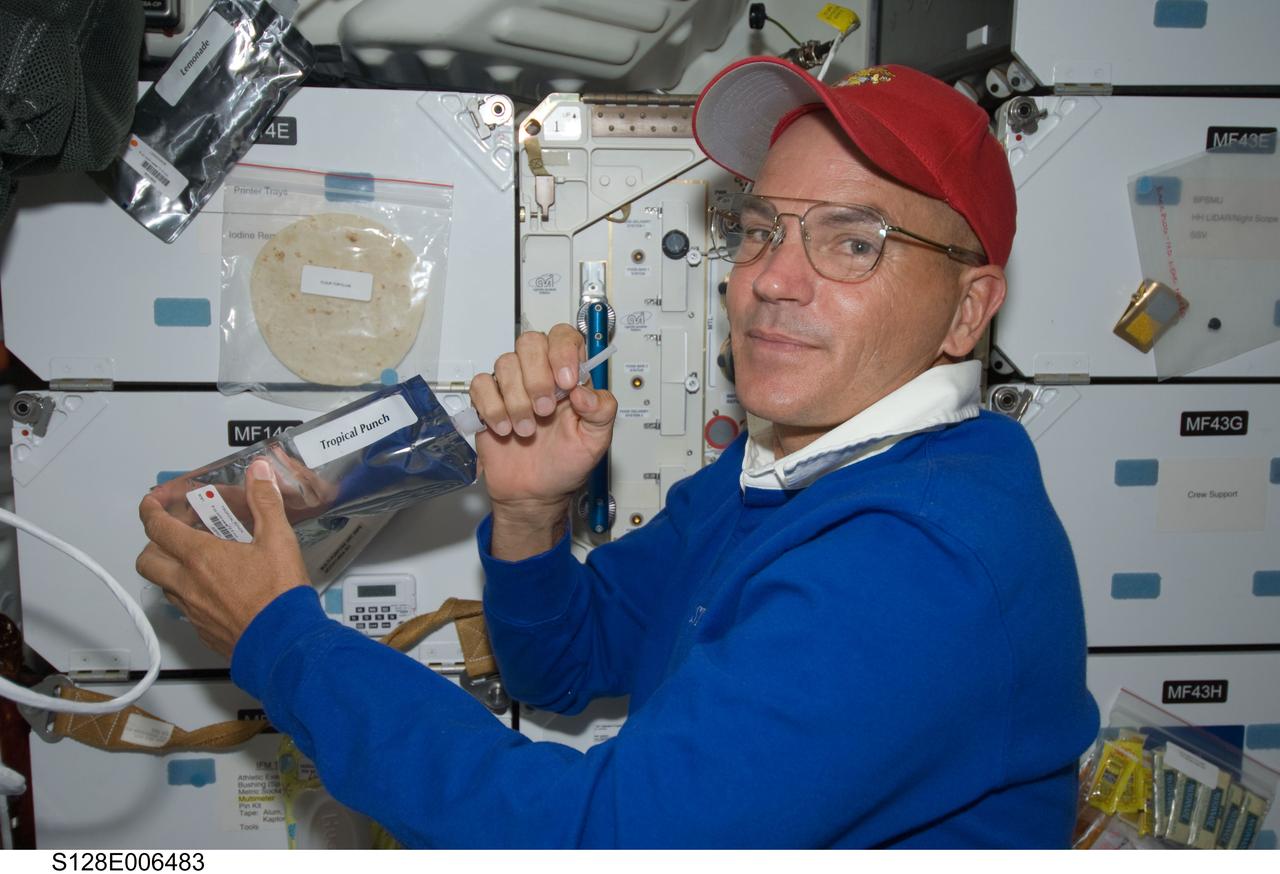
S128-E-006483 (29 Aug. 2009) --- Astronaut Rick Sturckow, STS-128 commander, drinks a beverage on the middeck of the Earth-orbiting Space Shuttle Discovery during flight day two activities.
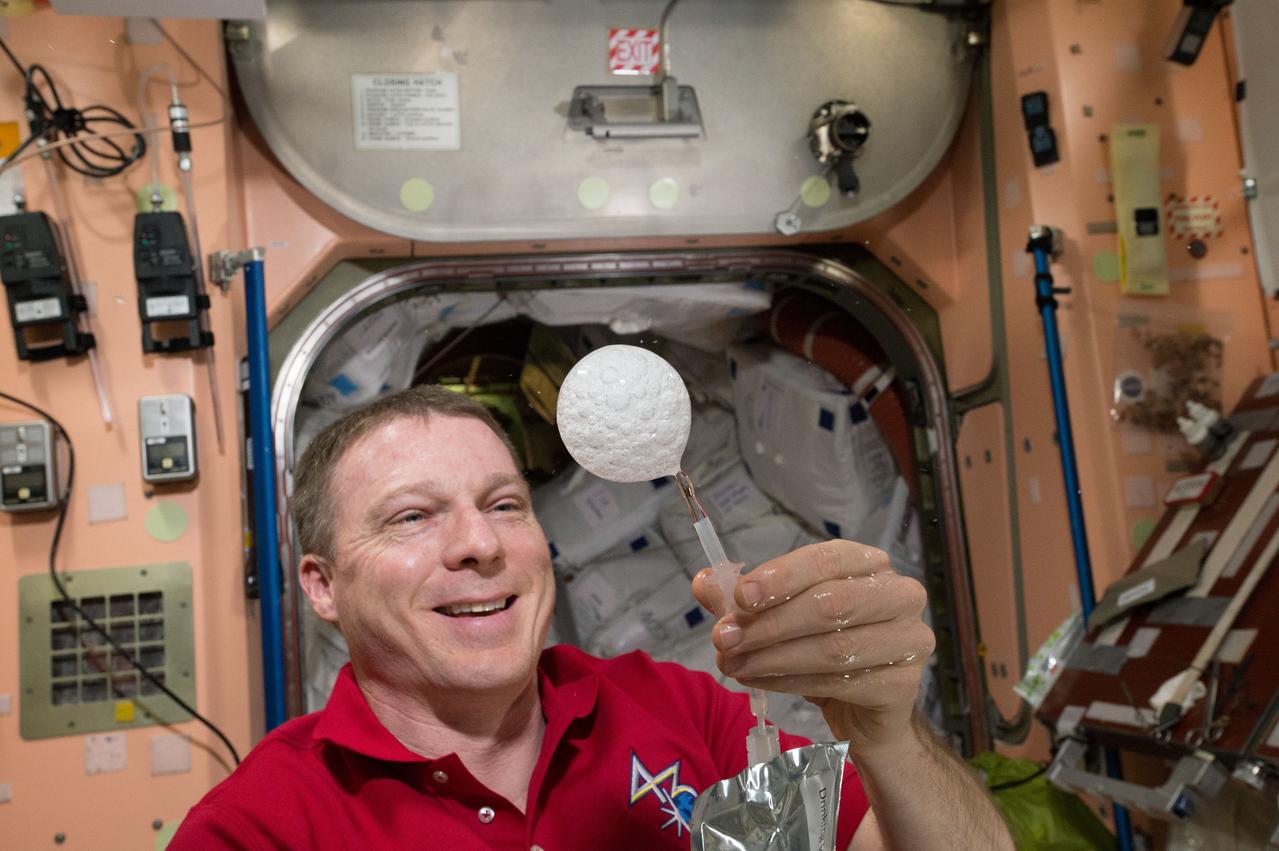
ISS043E276537 (05/31/2015) --- Expedition 43 Commander and NASA astronaut Terry Virts creates a sphere of bubbles in the station’s microgravity environment using drinking water and an antacid tablet.
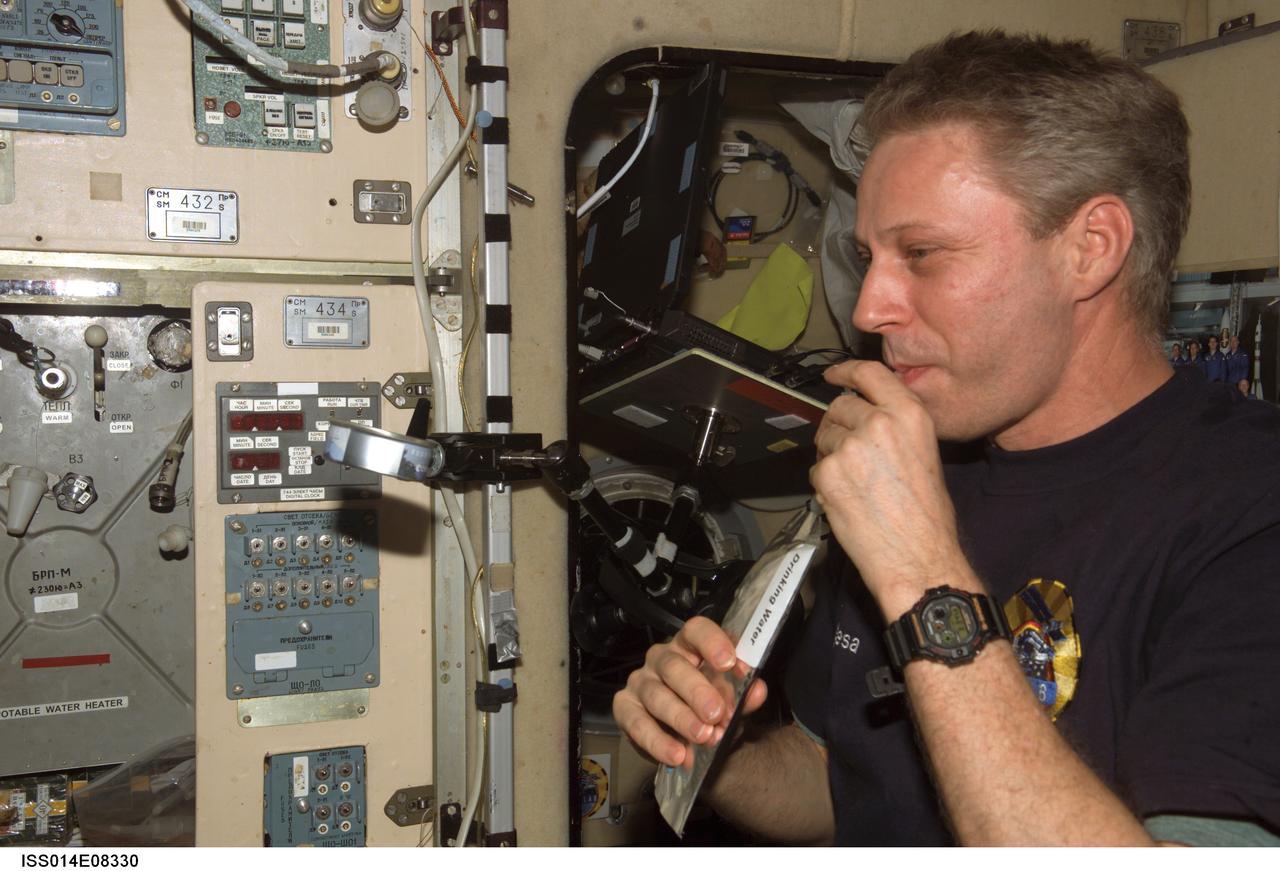
ISS014-E-08330 (27 Nov. 2006) --- European Space Agency (ESA) astronaut Thomas Reiter, Expedition 14 flight engineer, drinks a beverage in the Zvezda Service Module of the International Space Station.
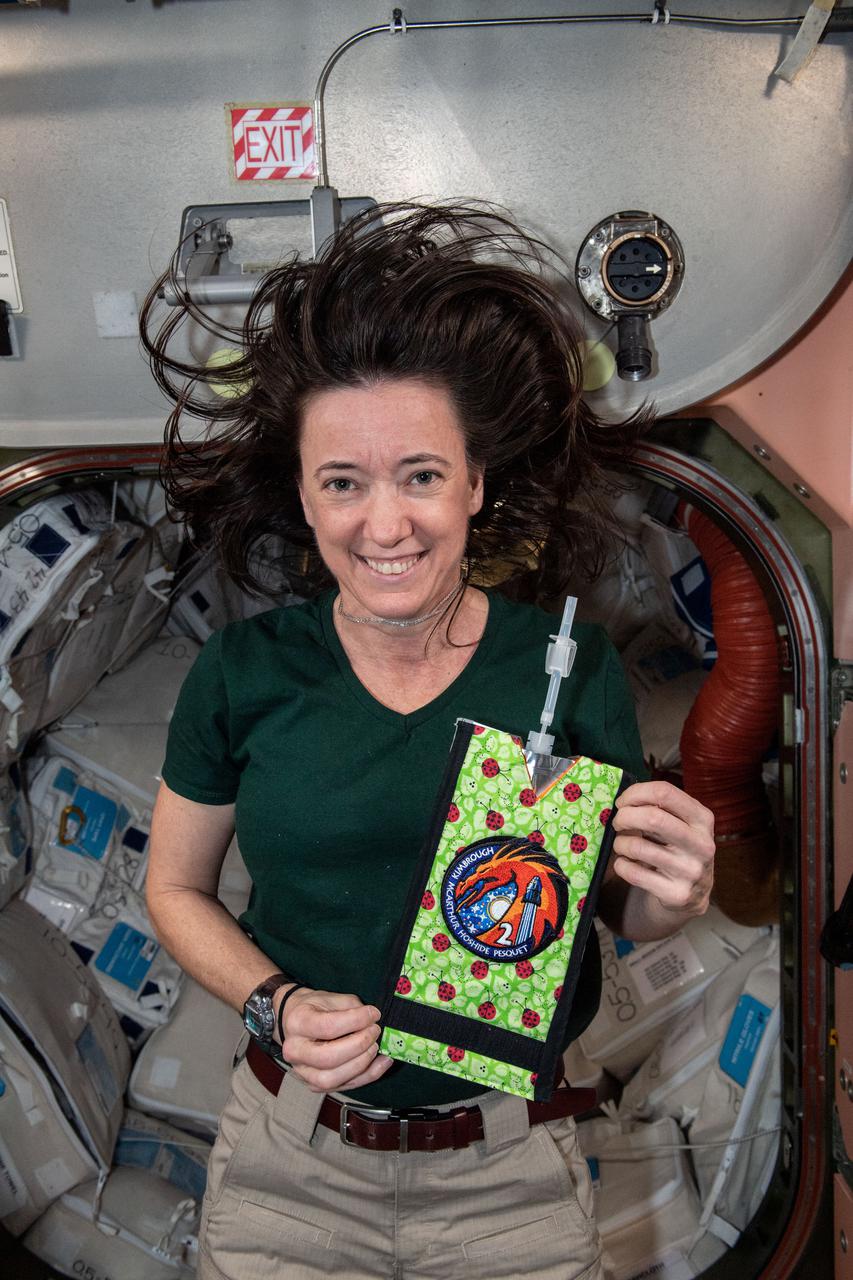
iss066e008128 (Oct. 21, 2021) --- NASA astronaut and Expedition 66 Flight Engineer Megan McArthur holds a personalized drink pouch bearing the SpaceX Crew-2 mission insignia patch.
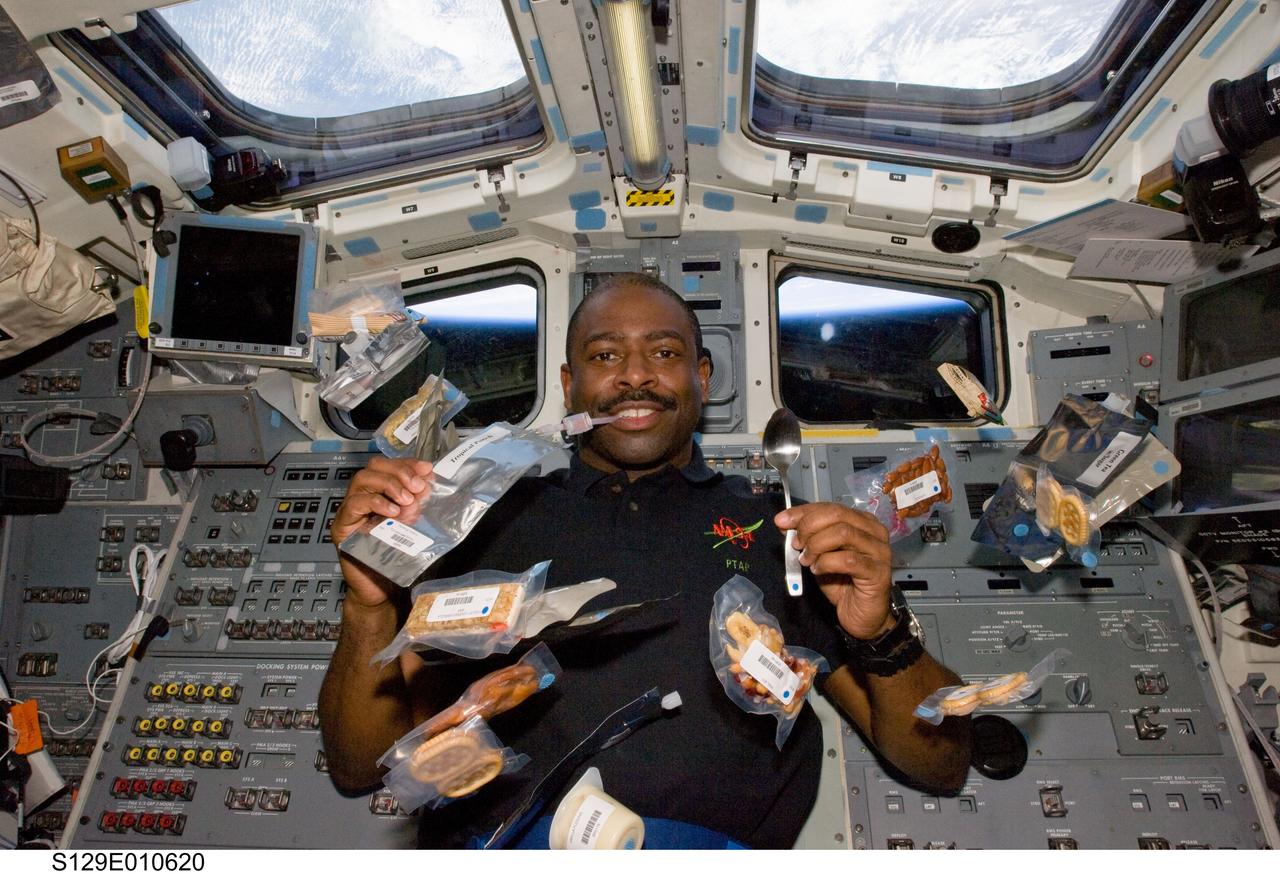
View of Mission Specialist 1 (MS1) Leland Melvin posing for a photo on the shuttle Atlantis Flight Deck (FD). Drink and food packets float around him. Photo taken during the STS-129 return flight home.

View of Mission Specialist 1 (MS1) Leland Melvin posing for a photo on the shuttle Atlantis Flight Deck (FD). Drink and food packets float around him. Photo taken during the STS-129 return flight home.
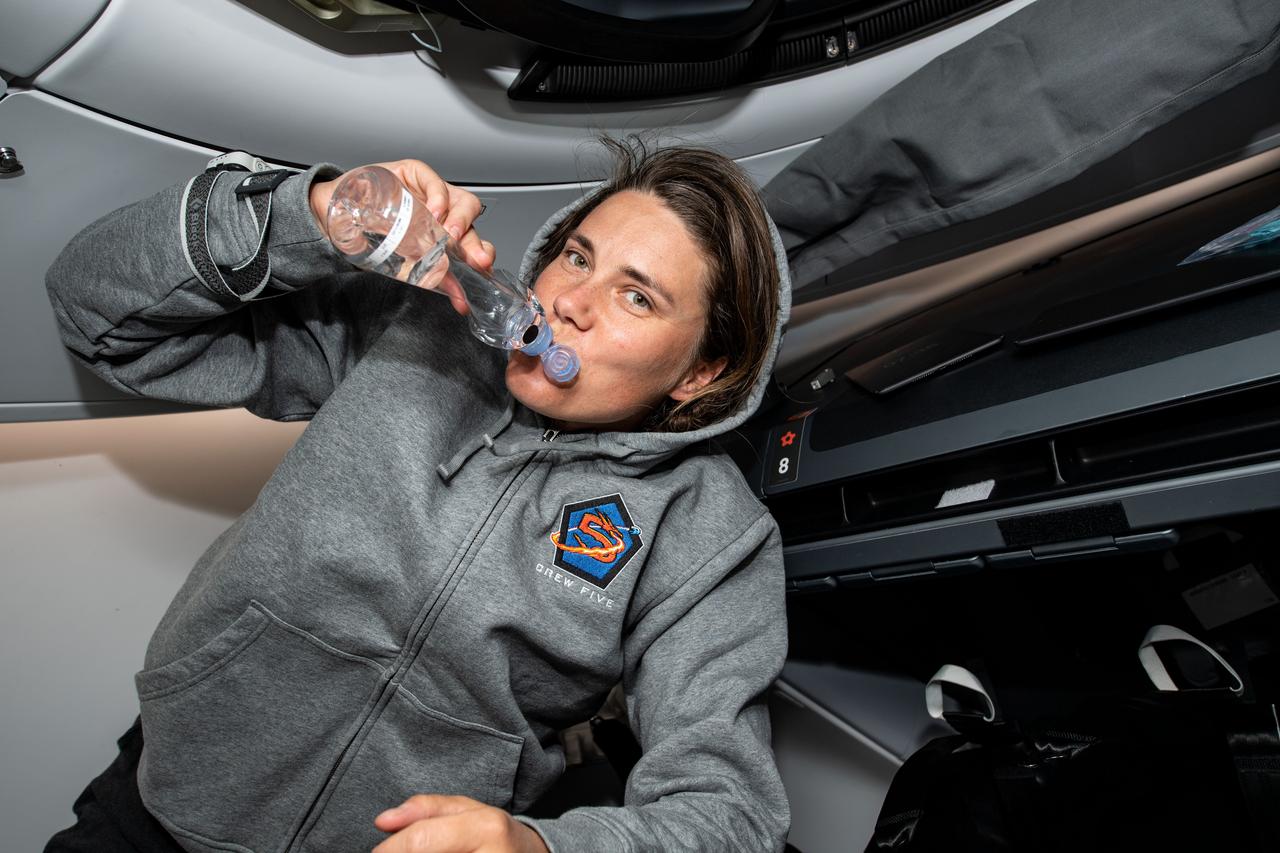
iss068e012328 (Oct. 6, 2022) --- SpaceX Crew-5 Mission Specialist Anna Kikina of Roscosmos drinks from a water bottle aboard the Dragon Endurance crew ship during a flight to the International Space Station.
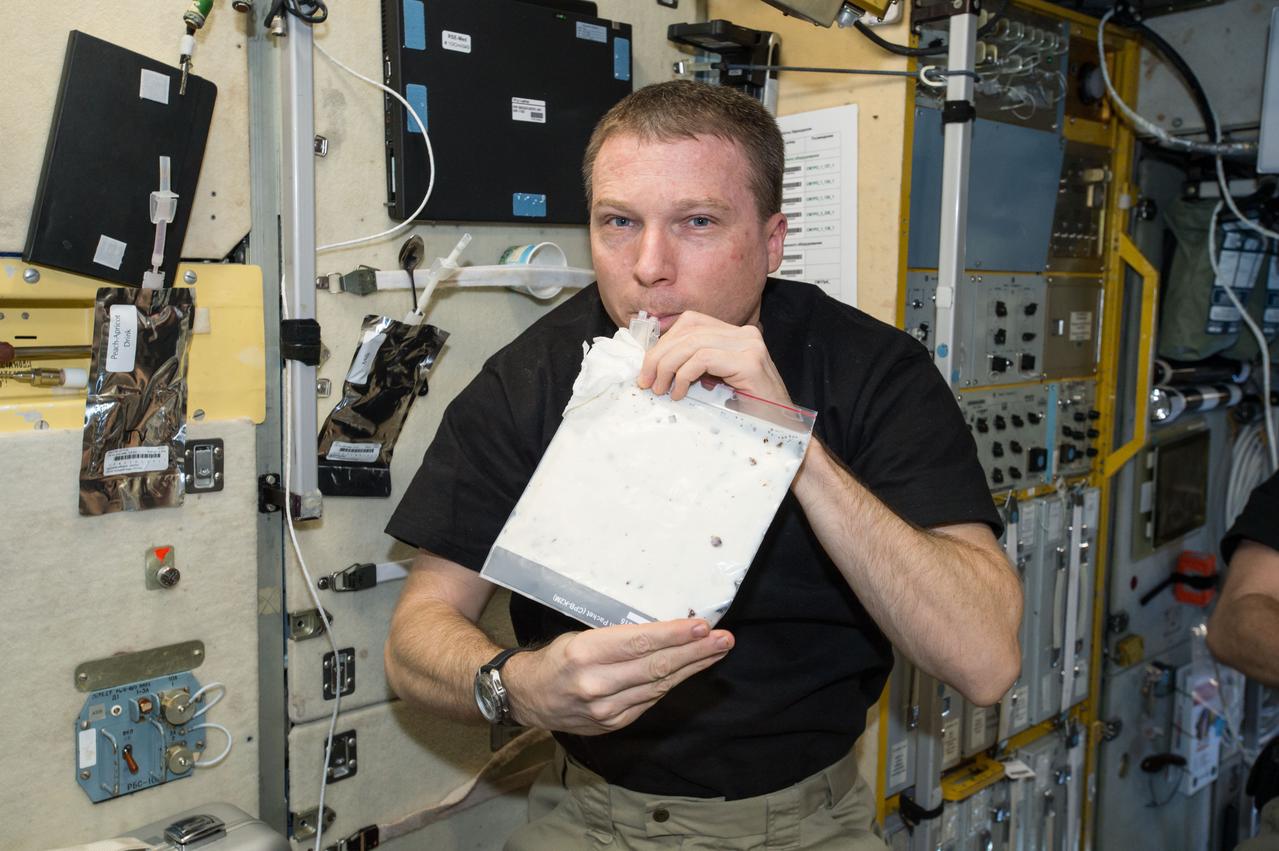
ISS043E182212 (05/08/2015) --- NASA astronaut and Expedition 43 commander Terry Virts takes a drink of his very first milkshake onboard the International Space Station.

ISS019-E-018483 (20 May 2009) --- After NASA's Mission Control gave the Expedition 19 astronaut crew aboard the International Space Station a "go" to drink water that the station's new recycling system has purified, the three celebrated with a ?toast? that also involved Mission Control, Houston, and the Payload Operations Center at Marshall Space Flight Center in Huntsville, Ala., which led development of the Water Recovery System. Pictured are Expedition 19 Commander Gennady Padalka (center) and Flight Engineers Mike Barratt (right) and Koichi Wakata, holding drink bags with special commemorative labels in the Destiny laboratory.
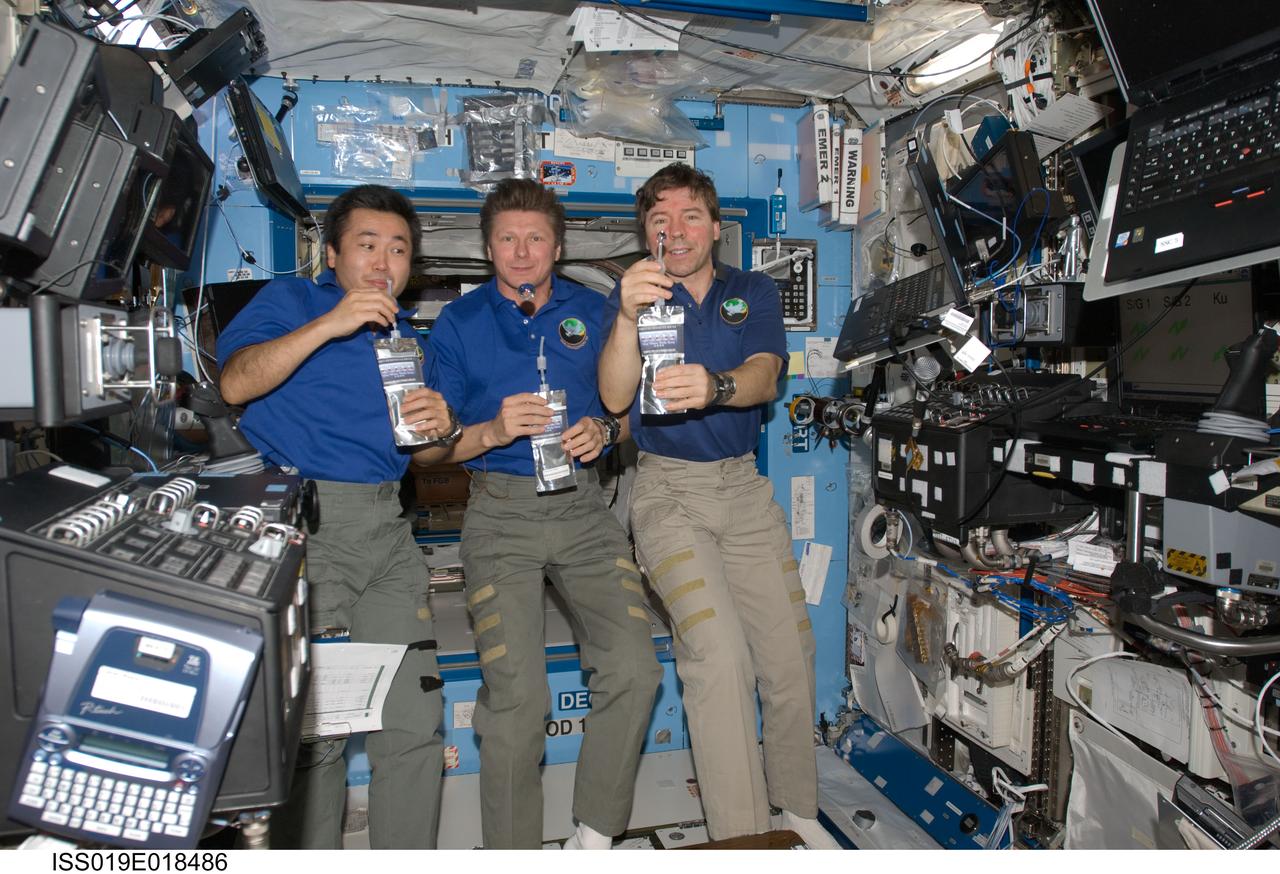
ISS019-E-018486 (20 May 2009) --- After NASA's Mission Control gave the Expedition 19 astronaut crew aboard the International Space Station a "go" to drink water that the station's new recycling system has purified, the three celebrated with a ?toast? that also involved Mission Control, Houston, and the Payload Operations Center at Marshall Space Flight Center in Huntsville, Ala., which led development of the Water Recovery System. Pictured are Expedition 19 Commander Gennady Padalka (center) and Flight Engineers Mike Barratt (right) and Koichi Wakata, holding drink bags with special commemorative labels in the Destiny laboratory.
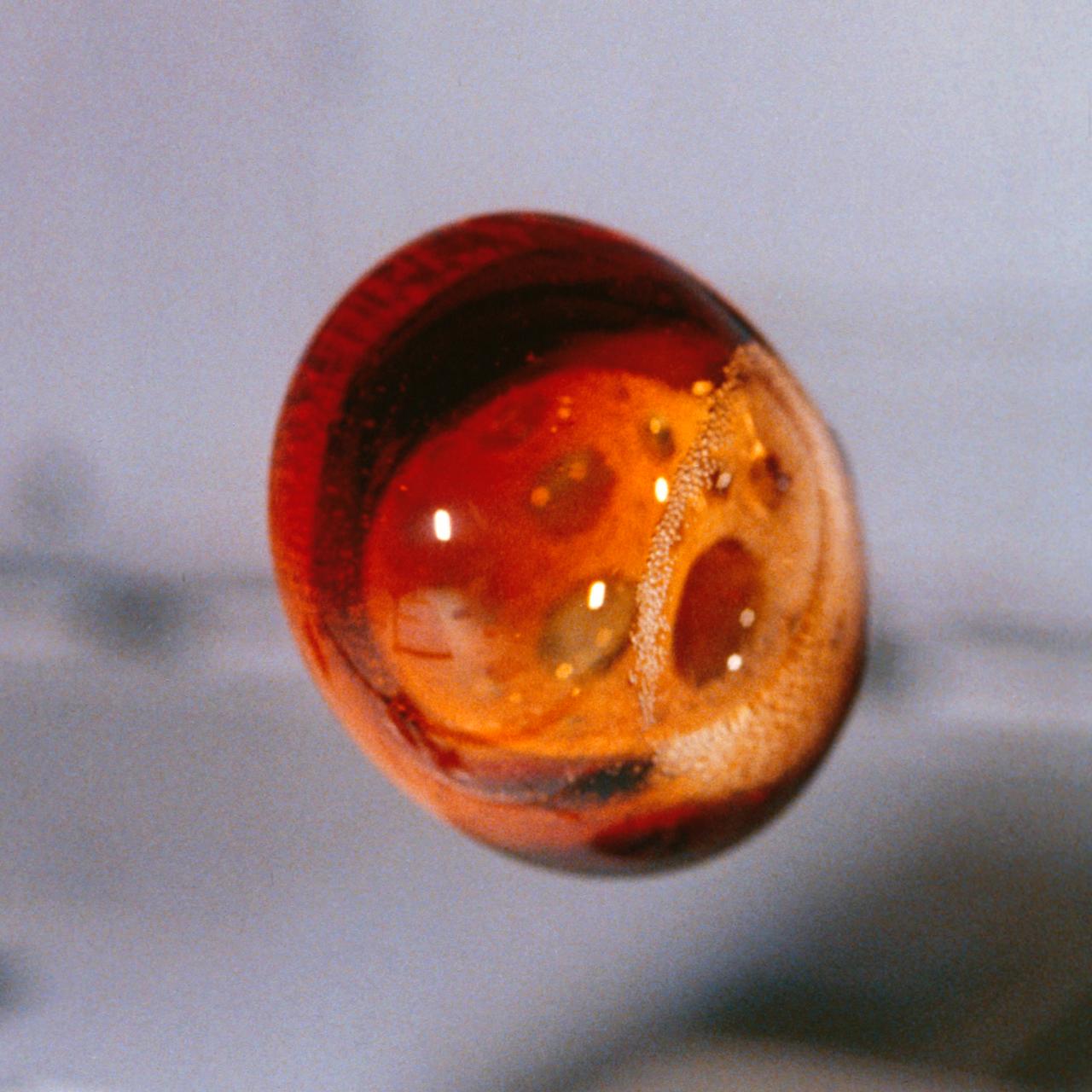
The lack of normal convection in microgravity is demonstrated by a carbonated soft drink floating in the middeck of the Space Shuttle. While the droplet is oscillating slightly and starting to assume a spherical shape, it is filled with carbon dioxide bubbles in a range of sizes. On Earth, the bubbles would quickly foat up to form a head. In space, they are suspended. They may drift with time and eventually the surface tension between individual bubbles breaks, allowing larger bubbles to form. This image was taken during STS-51F mission (Spacelab 2) which carried test models of dispensers from two pupular soft drink manufacturers. Photo credit: NASA/Johnson Space Center (JSC)
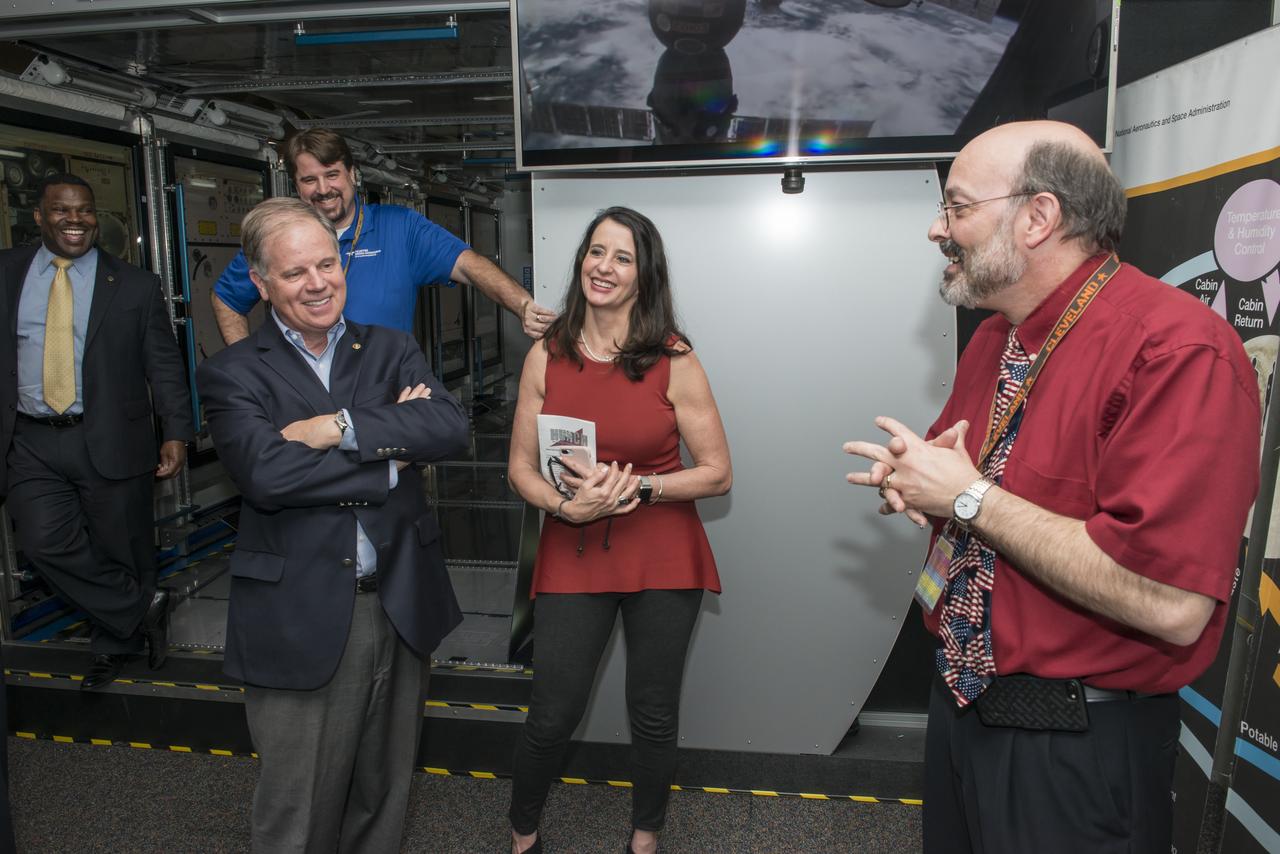
Senator Doug Jones (D-Al.) and wife Louise are presented an overview of the Environmental Control and Life Support System (ECLSS) which was developed at Marshall Space flight Center. Marshall engineer Keith Parrish explains the steps in converting waste fluids generated on the International Space Station (ISS) into purified drinking water.

S123-E-008367 (21 March 2008) --- Cosmonaut Yuri I. Malenchenko, Expedition 16 flight engineer representing Russia's Federal Space Agency, drinks a beverage while working in the Zvezda Service Module of the International Space Station while Space Shuttle Endeavour (STS-123) is docked with the station.
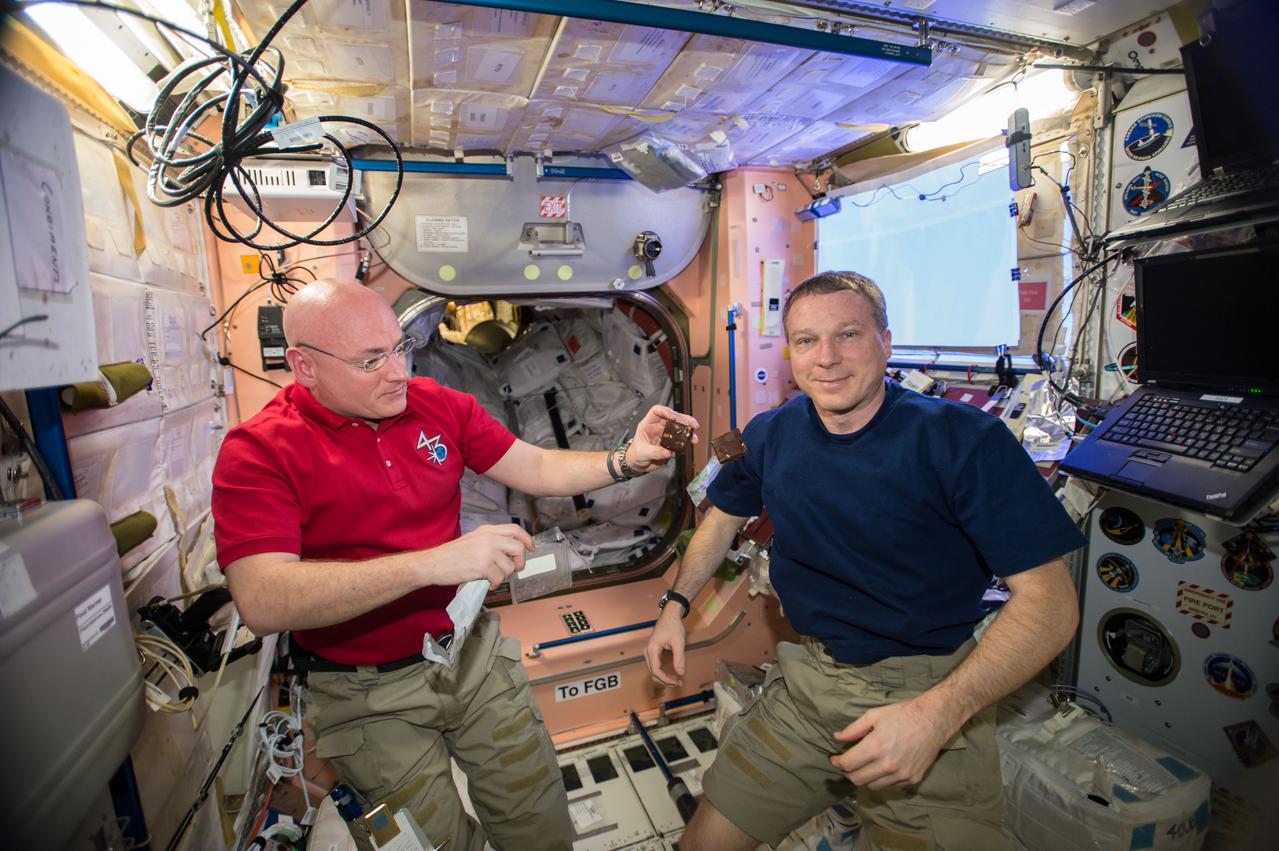
ISS043E198419 (05/15/2015) --- NASA astronauts Scott Kelly (left) and Terry Virts (right) share a snack while inside the station’s Unity module which holds the food and drink supply for the U.S. segment of the International Space Station.
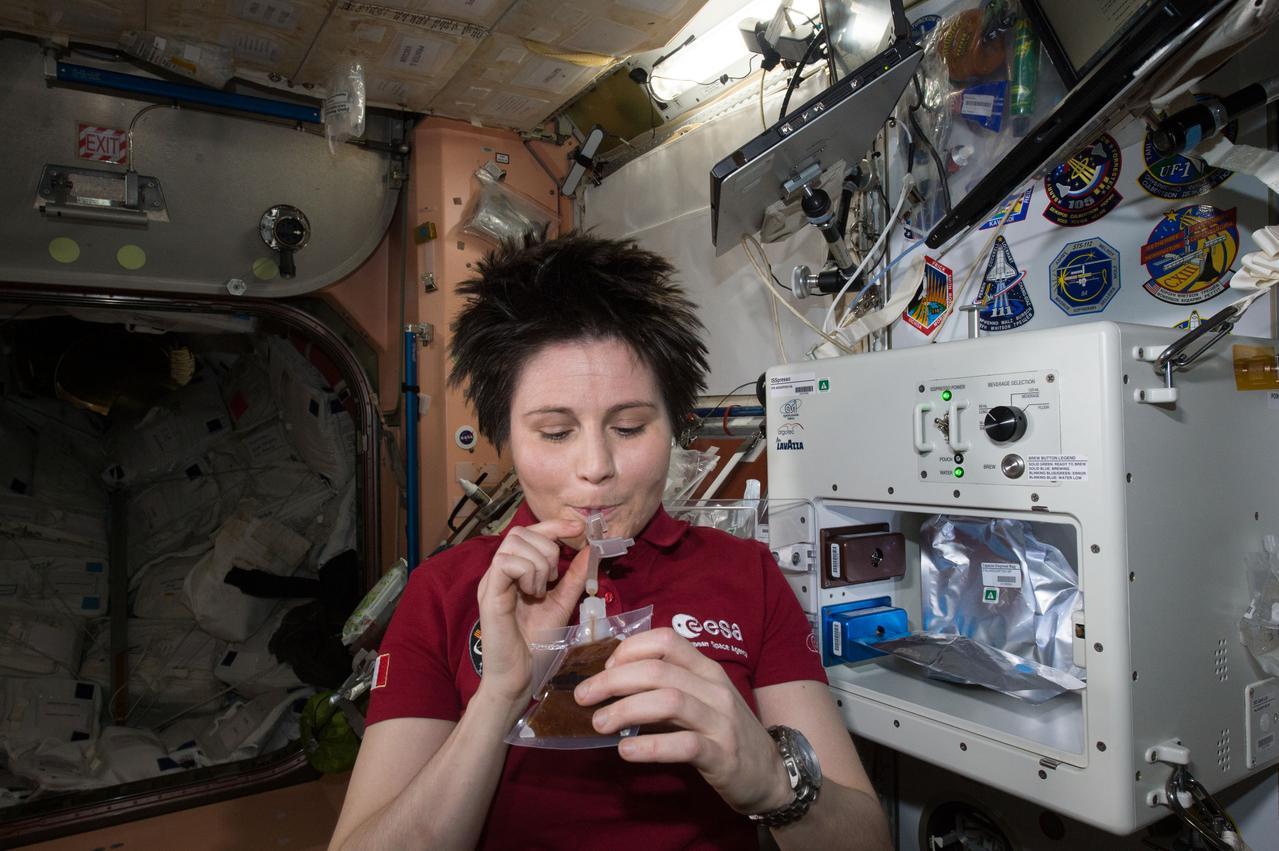
ISS043E160082 (05/03/2015) --- ESA (European Space Agency) astronaut Samantha Cristoforetti enjoys her first drink from the new ISSpresso machine. The espresso device allows crews to make tea, coffee, broth, or other hot beverages they might enjoy.
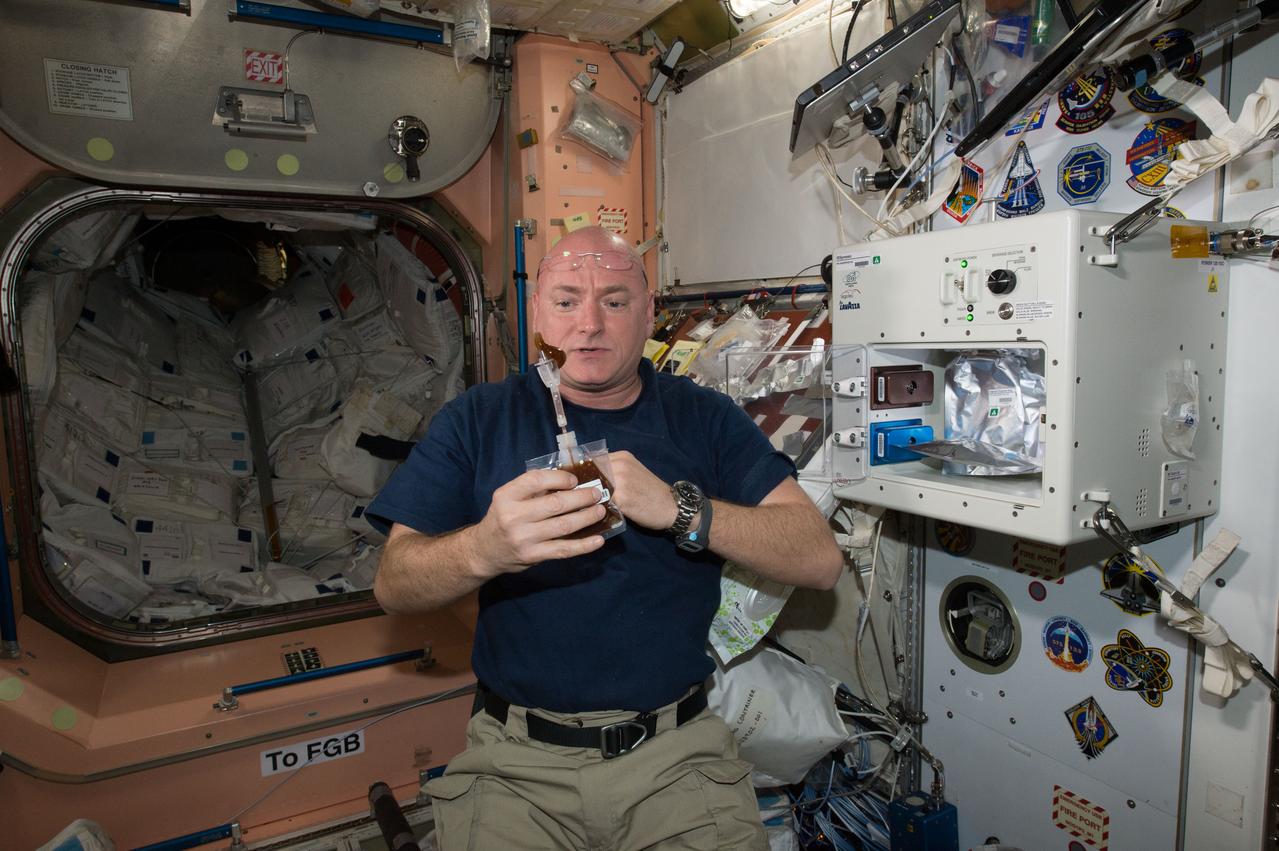
ISS043E160084 (05/03/2015) --- NASA astronaut Scott Kelly enjoys his first drink from the new ISSpresso machine. The espresso device allows crews to make tea, coffee, broth, or other hot beverages they might enjoy.
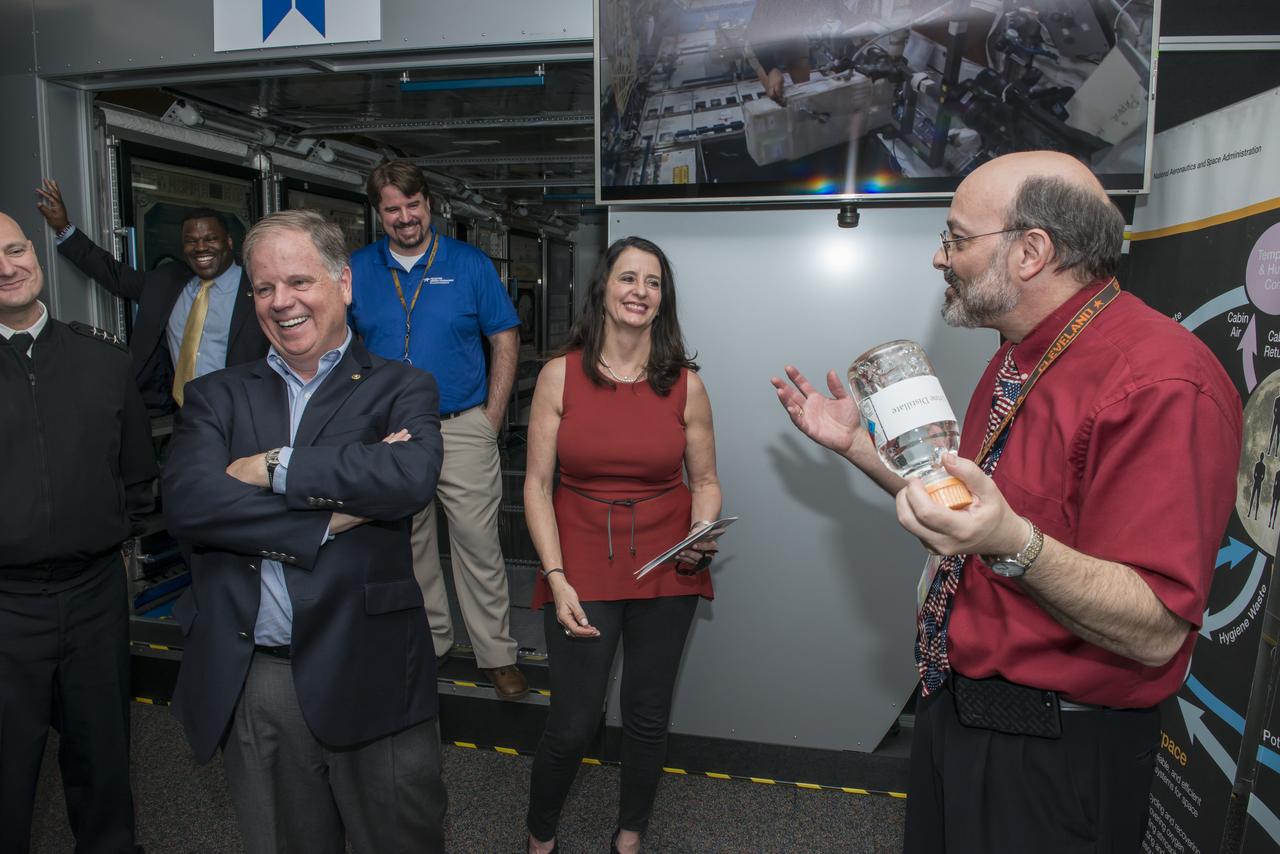
Senator Doug Jones (D-Al.) and wife Louise are presented an overview of the Environmental Control and Life Support System (ECLSS) which was developed at Marshall Space flight Center. Marshall engineer Keith Parrish explains the steps in converting waste fluids generated on the International Space Station (ISS) into purified drinking water.

S73-34172 (August 1973) --- Scientist-astronaut Owen K. Garriott, Skylab 3 science pilot, watches a drink container spinning and tumbling in zero-gravity during a science demonstration television transmission from the Skylab space station in Earth orbit. Garriott is in the Orbital Workshop (OWS). Photo credit: NASA
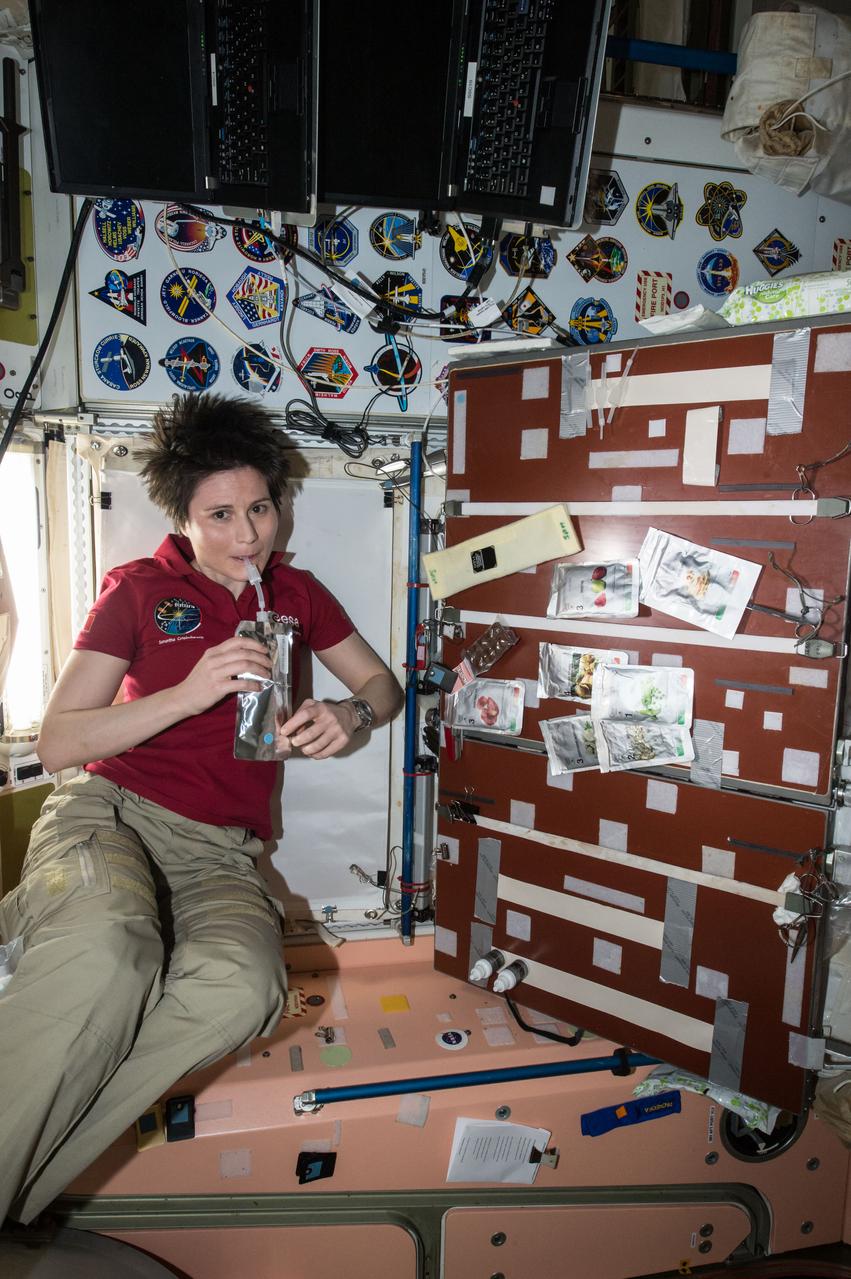
ISS043E162881 (04/27/2015) --- ESA (European Space Agency) astronaut Samantha Cristoforetti seen taking a drink in the Unity module aboard the International Space Station Apr. 27. 2015. The crew’s food galley is located in Unity and there are several food packets visible to the right.
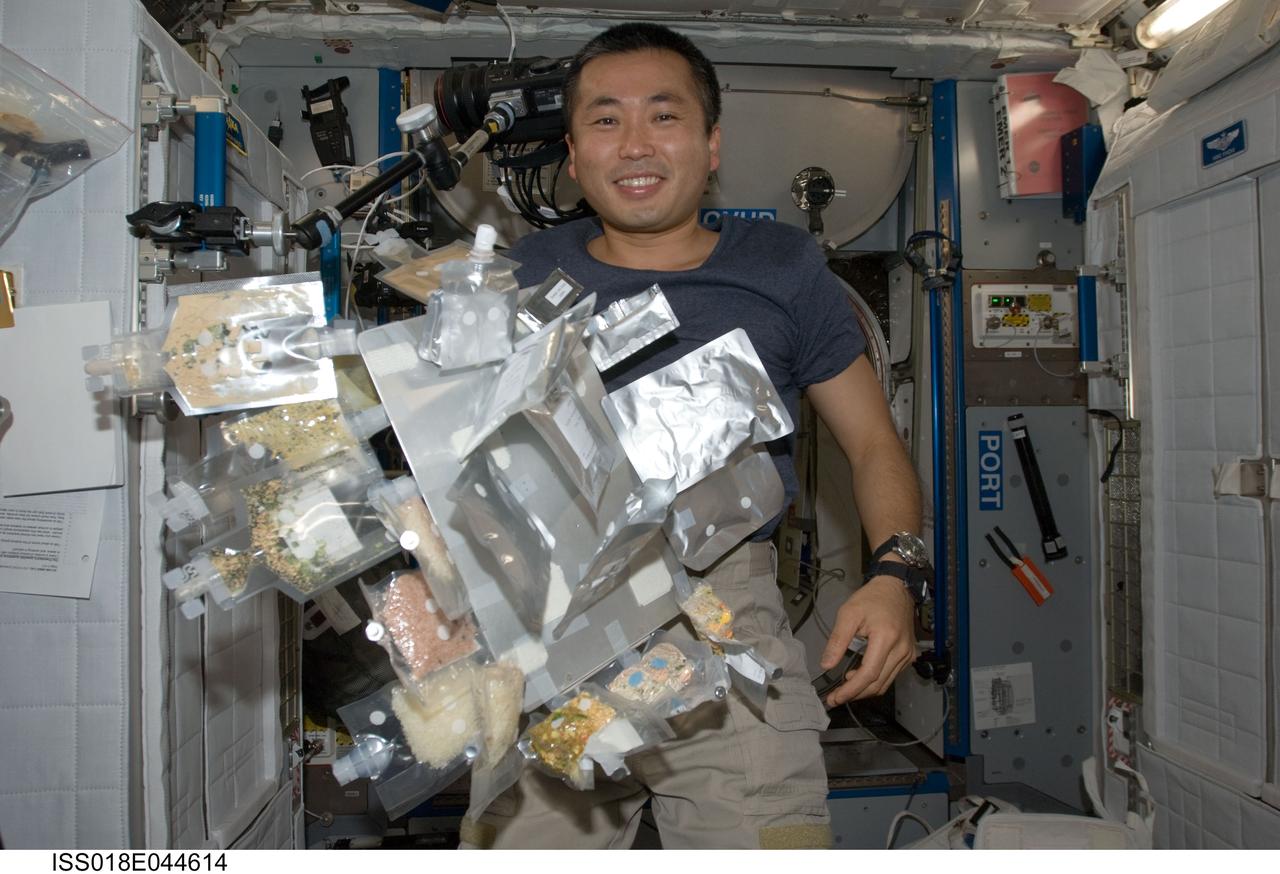
ISS018-E-044614 (4 April 2009) --- Japan Aerospace Exploration Agency (JAXA) astronaut Koichi Wakata, Expedition 18/19 flight engineer, is pictured near food and drink containers floating freely in the Harmony node of the International Space Station.

ISS016-E-008976 (2 Nov. 2007) --- Cosmonaut Yuri I. Malenchenko, Expedition 16 flight engineer representing Russia's Federal Space Agency, drinks a beverage in the Zvezda Service Module of the International Space Station while Space Shuttle Discovery (STS-120) is docked with the station.
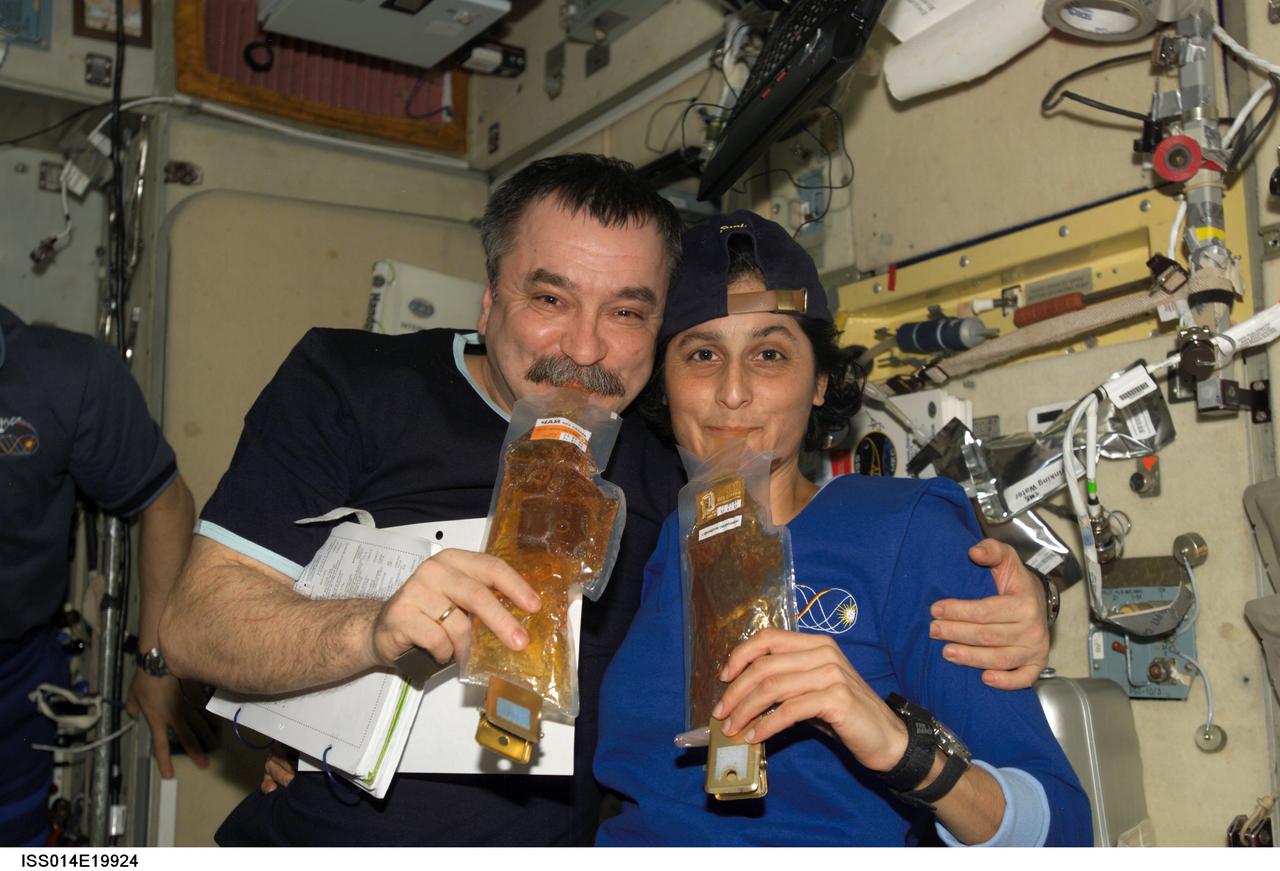
ISS014-E-19924 (21 April 2007) --- Cosmonaut Mikhail Tyurin (left), Expedition 14 flight engineer representing Russia's Federal Space Agency, and astronaut Sunita L. Williams, Expedition 15 flight engineer, drink beverages as they pose for a photo in the Zvezda Service Module of the International Space Station.
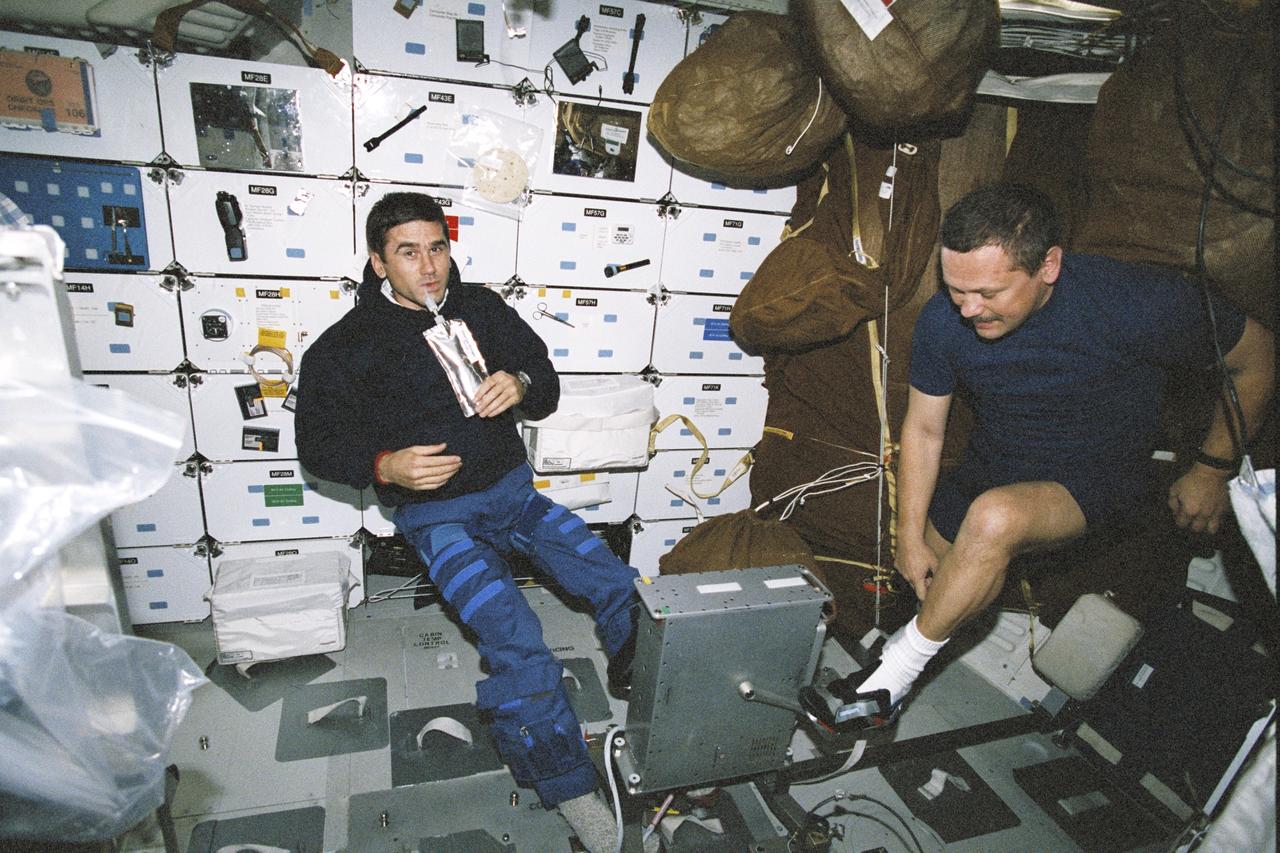
STS106-316-031 (8-20 September 2000) --- Cosmonaut Yuri I. Malenchenko (left), drinks a beverage, as cosmonaut Boris V. Morukov, prepares to exercise using an ergometer on the mid deck of the Space Shuttle Atlantis. Malenchenko and Morukov are mission specialists who represent Rosaviakosmos.
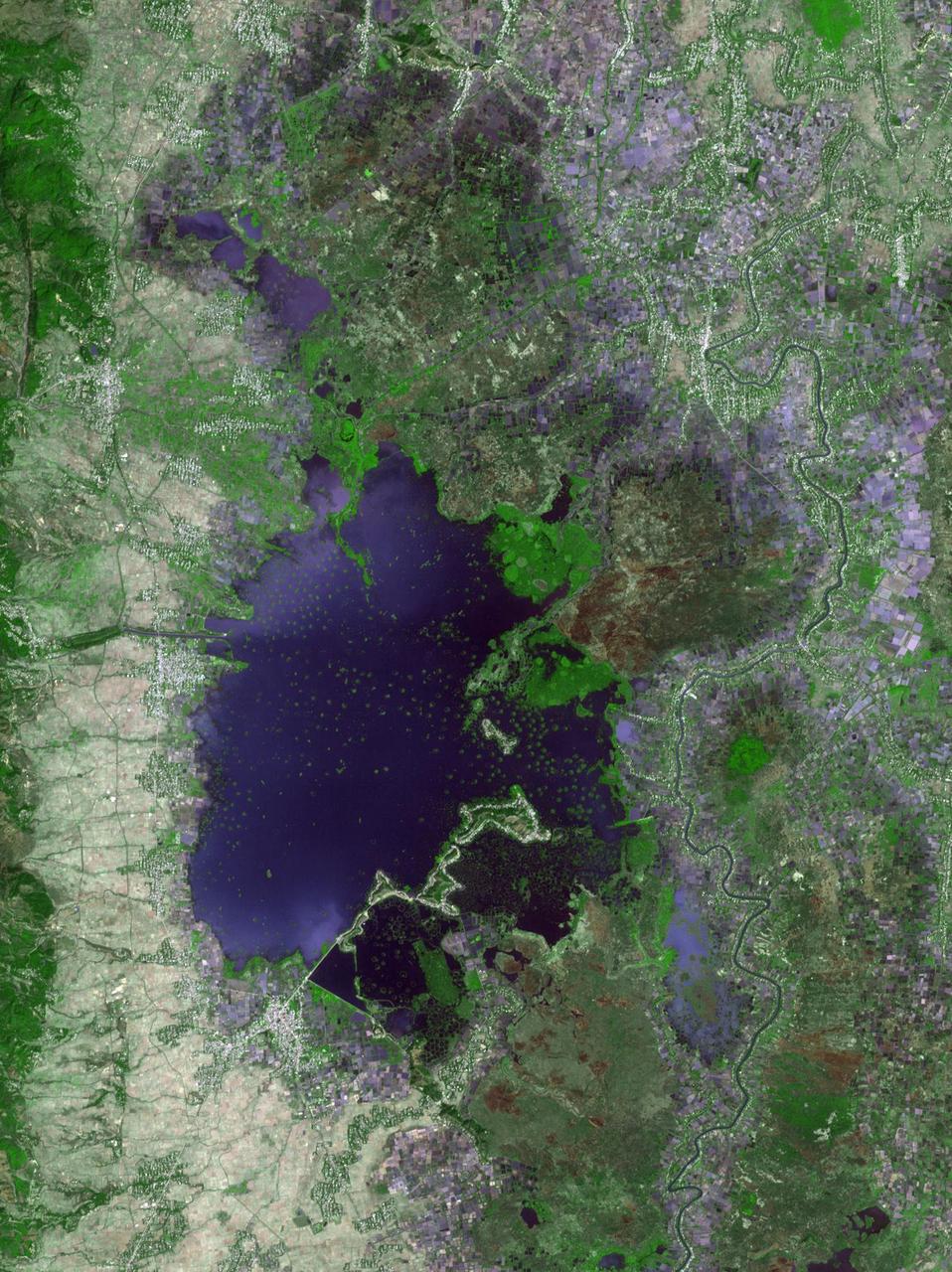
Loktak Lake is the largest freshwater lake in northeast India, and is famous for the floating "phudmis," masses of vegetation, soil and organic material. The lake is a source of water for hydropower, irrigation, drinking water, and livelihood for fish farmers. The image was acquired March 19, 2018, covers an area of 20.5 by 27.3 kilometers, and is located at 24.5 degrees north, 93.8 degrees east. https://photojournal.jpl.nasa.gov/catalog/PIA22369

iss071e650313 (Sept. 14, 2024) --- Expedition 71 Flight Engineer (from left) Don Pettit from NASA demonstrates filling a specially-made coffee cup from a drink bag to Expedition 71 Flight Engineer Alexey Ovchinin from Roscosmos. The coffee stays inside the cup due to surface tension, a property that enables liquids to resist an external force, such as microgravity, and adhere, or stick to a surface.
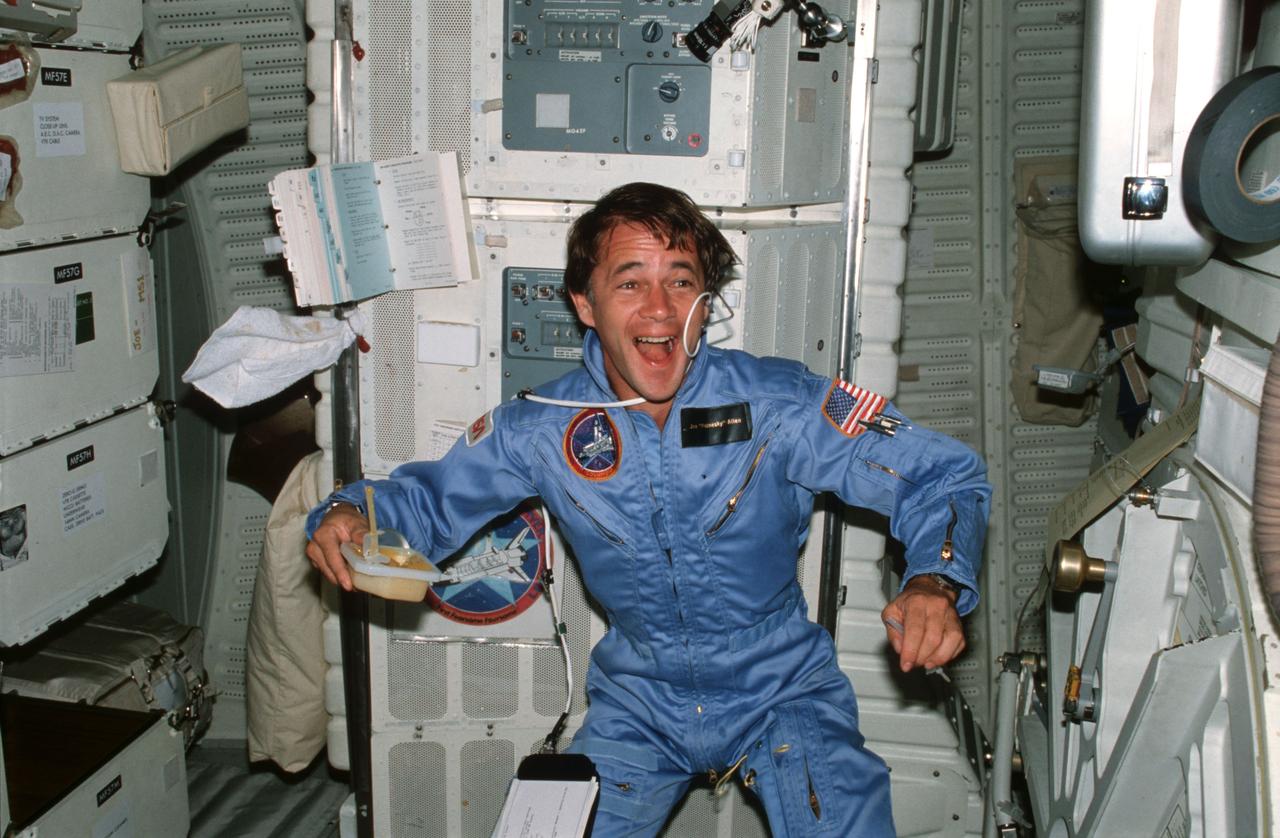
STS005-04-134 (11-16 Nov. 1982) --- Astronaut Joseph P. Allen IV, STS-5 mission specialist, uses beverage container and drinking straw, experiments with microgravity characteristics of orange juice on middeck in front of the Development Flight Instrument (DFI) unit and forward lockers. Allen laughs as he watches the results of his experimentation. Photo credit: NASA
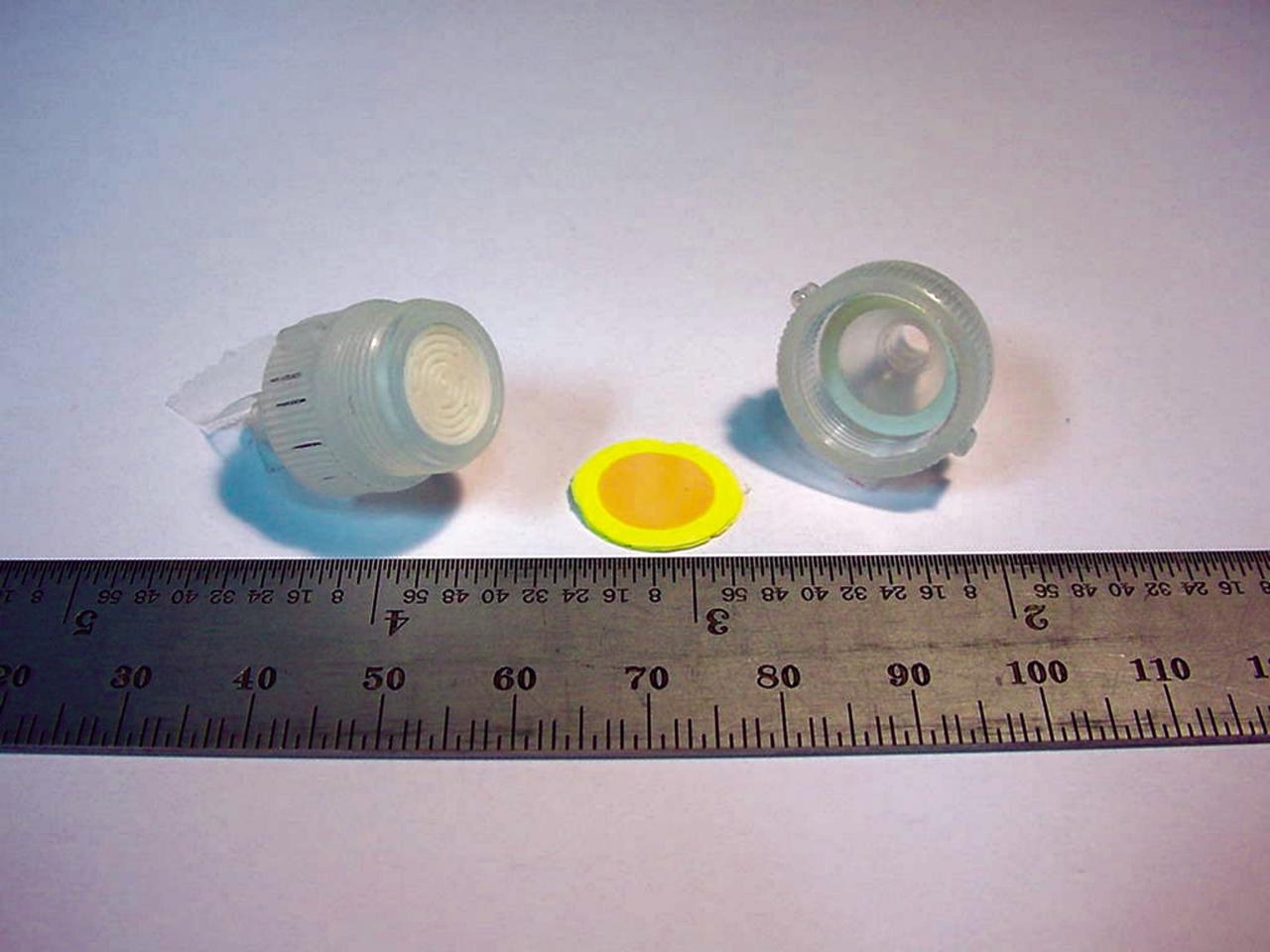
The heart of a colorimetric solid phase extractor (CSPE) test kit quickly measures the concentration of the biocides silver or iodine in astronauts’ drinking water to determine whether concentrations are safe. When 10 milliliters (ml) of water is drawn through the disk, the disk will turn color (yellow in this picture for iodine) indicating the presence of the biocides. The device could someday be used to test water safety at reservoirs and water treatment plants on Earth. (photo credit: Microanalytical Instrumentation Center, Iowa State University).
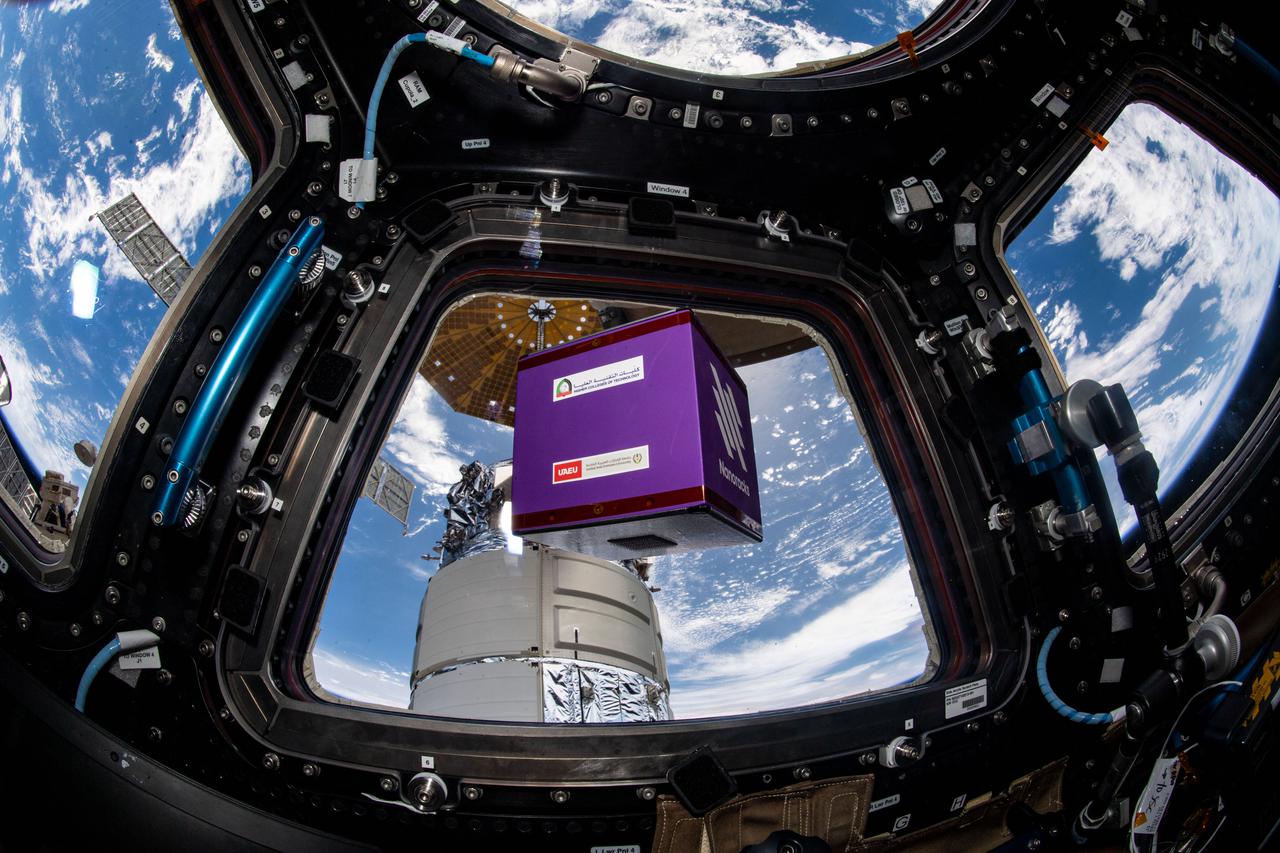
iss065e096320 (6/11/2021) --- A view of the SmoothISS Nanolab in the Cupola window aboard the International space Station (ISS). Space Food for Bone Health: Vitamin D Fortified Camel Milk with Dates Smoothie (SmoothISS) tests microgravity’s effects on the sensory, nutritional, and microbial properties of a smoothie drink made from dehydrated camel’s milk, dates, and vitamin D.
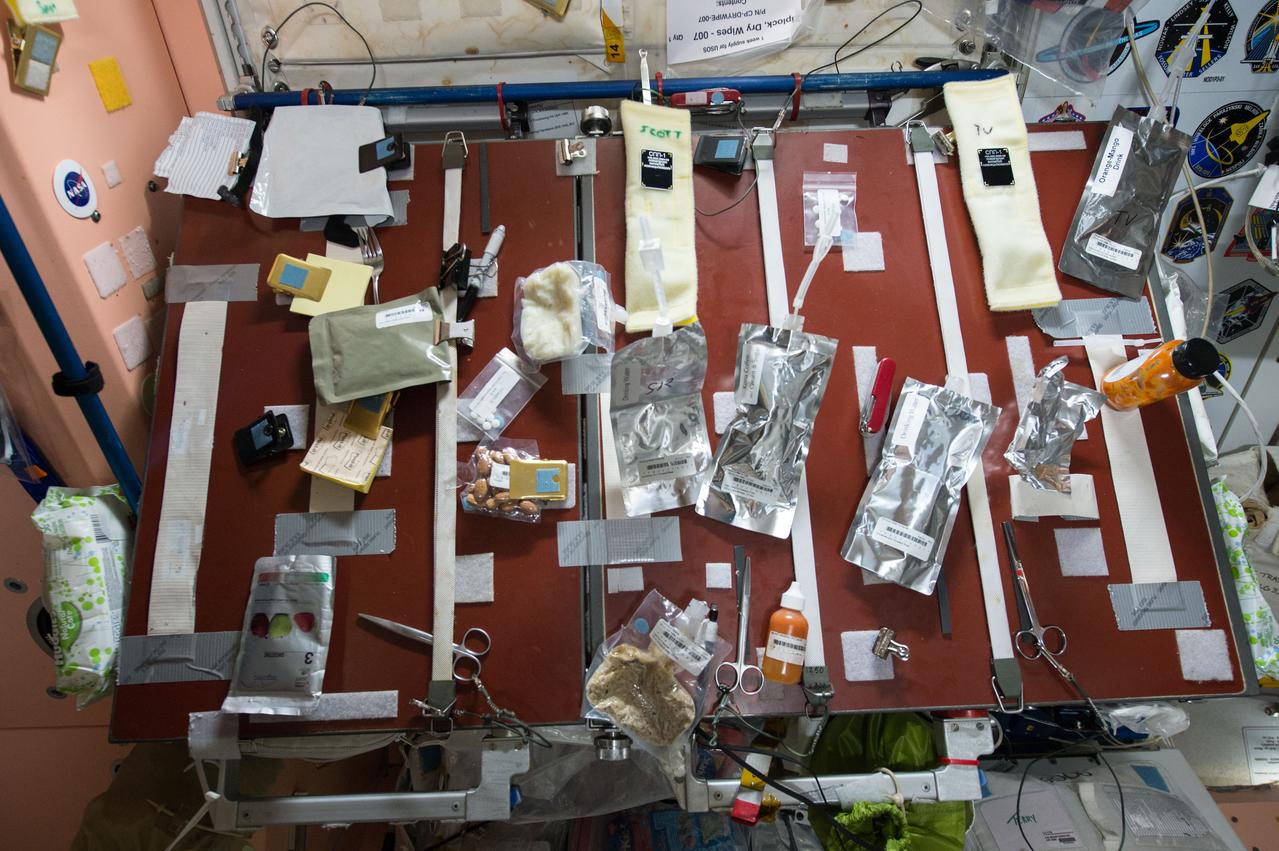
ISS043E091650 (04/08/2015) --- A view of the food table located in the Russian Zvezda service module on the International Space Station taken by Expedition 43 Flight Engineer Scott Kelly. Assorted food, drink and condiment packets are visible. Kelly tweeted this image along with the comment: ""Looks messy, but it's functional. Our #food table on the @space station. What's for breakfast? #YearInSpace".
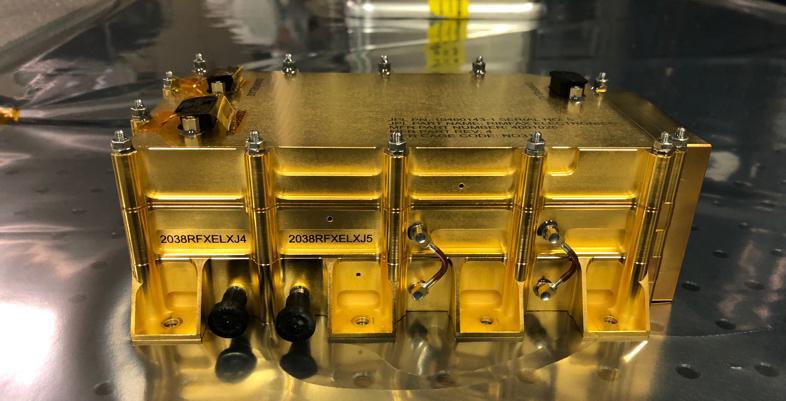
The Radar Imager for Mars' Subsurface Experiment (RIMFAX) electronics box before being integrated into the Perseverance rover at NASA's Jet Propulsion Laboratory in Pasadena, California. RIMFAX is a ground penetrating radar that will image layers of rock or ice to more than 30 feet (10 meters) beneath the surface of Mars. Water ice a potential resource for drinking or making fuel, would be a valuable find for future astronauts exploring Mars. https://photojournal.jpl.nasa.gov/catalog/PIA24205
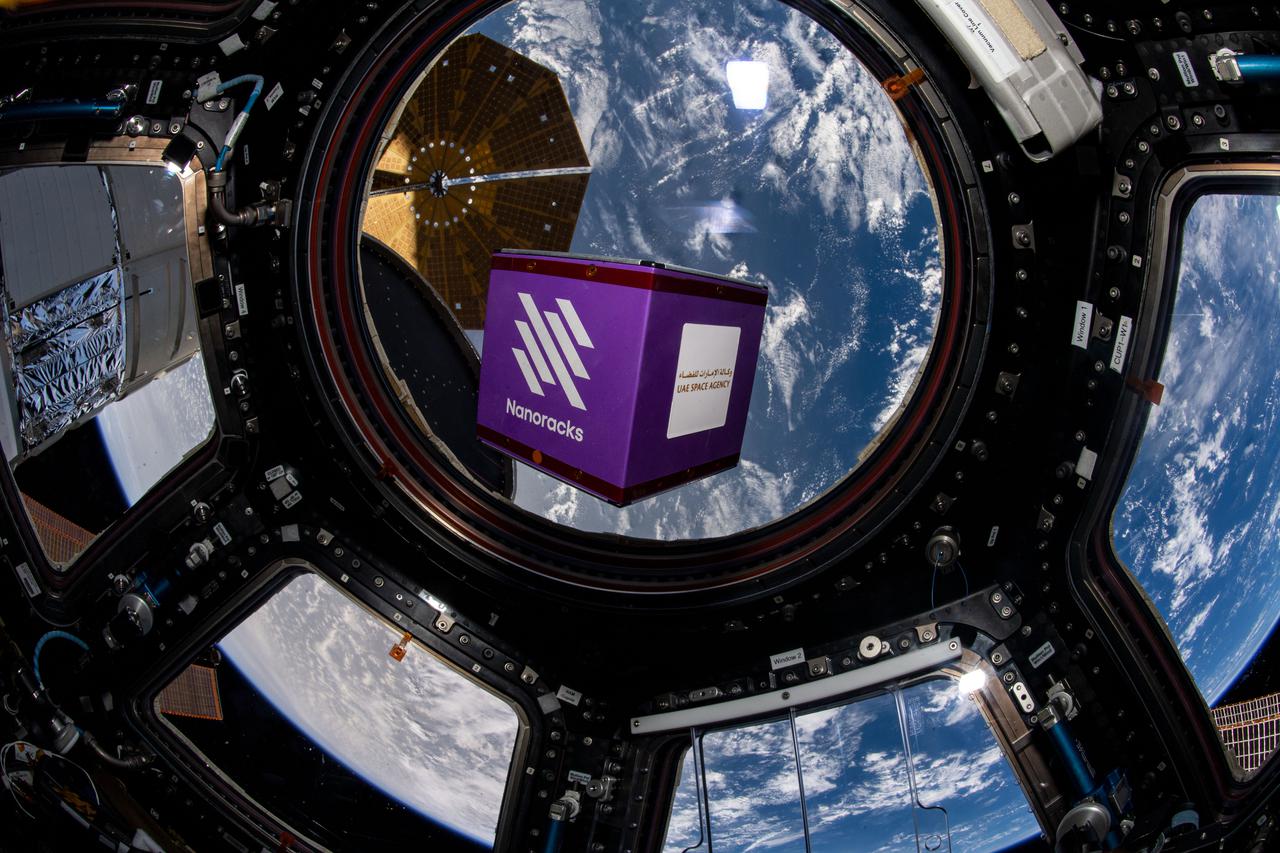
iss065e096305 (6/11/2021) --- A view of the SmoothISS Nanolab in the Cupola window aboard the International space Station (ISS). Space Food for Bone Health: Vitamin D Fortified Camel Milk with Dates Smoothie (SmoothISS) tests microgravity’s effects on the sensory, nutritional, and microbial properties of a smoothie drink made from dehydrated camel’s milk, dates, and vitamin D.
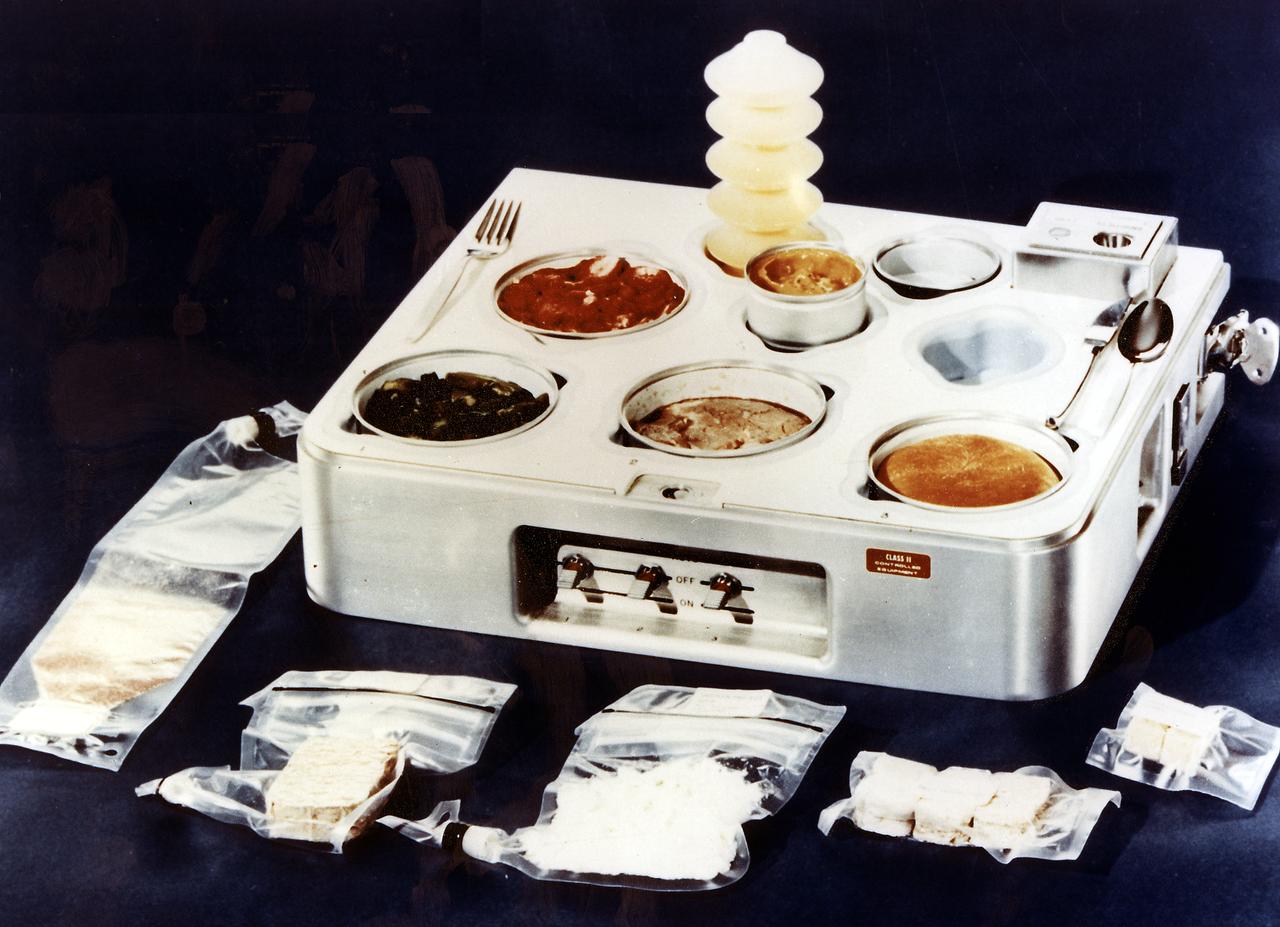
Shown here is the Skylab food heating and serving tray with food, drink, and utensils. The tray contained heating elements for preparing the individual food packets. The food on Skylab was a great improvement over that on earlier spaceflights. It was no longer necessary to squeeze liquified food from plastic tubes. Skylab's kitchen in the Orbital Workshop wardroom was so equipped that each crewman could select his own menu and prepare it to his own taste. The Marshall Space Flight Center had program management responsibility for the development of Skylab hardware and experiments.
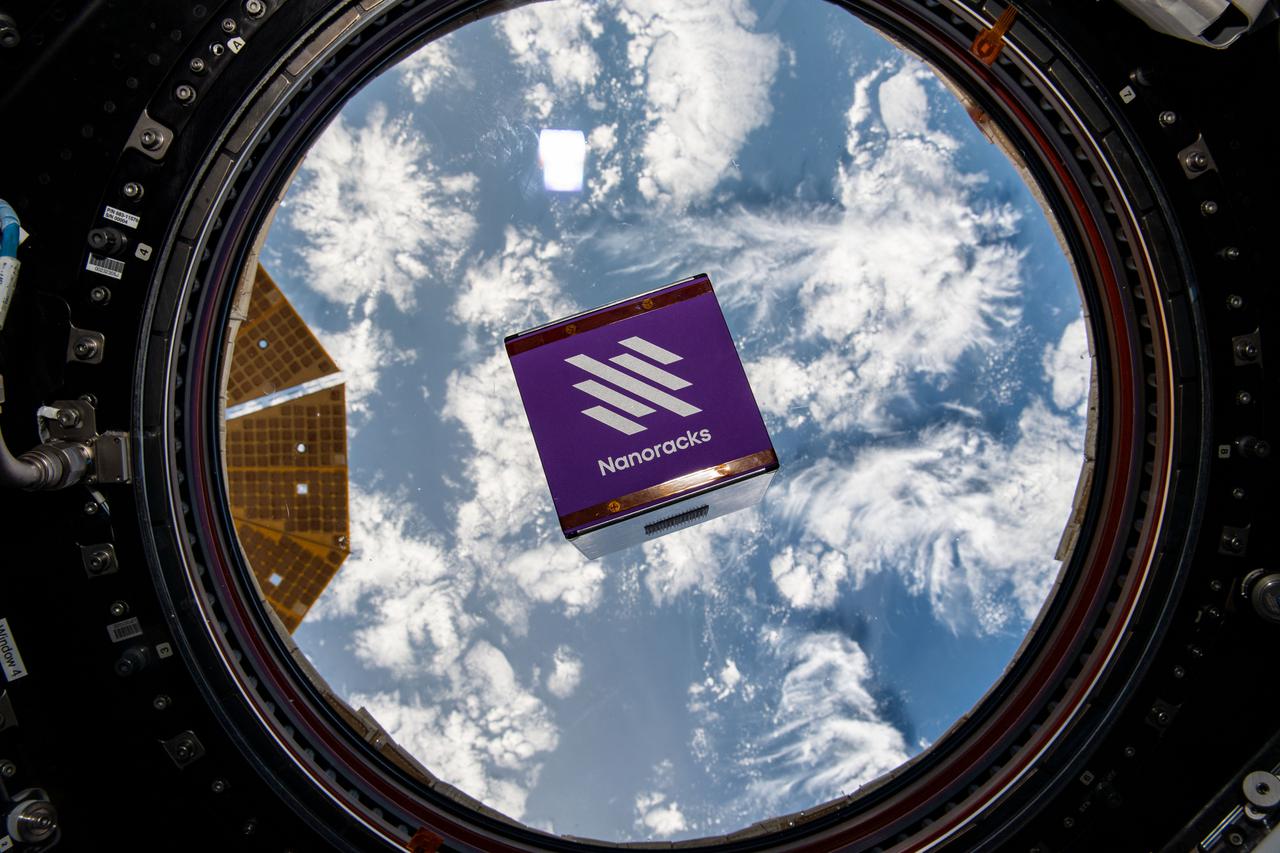
iss065e096031 (6/11/2021) --- A view of the SmoothISS Nanolab in the Cupola window aboard the International space Station (ISS). Space Food for Bone Health: Vitamin D Fortified Camel Milk with Dates Smoothie (SmoothISS) tests microgravity’s effects on the sensory, nutritional, and microbial properties of a smoothie drink made from dehydrated camel’s milk, dates, and vitamin D.
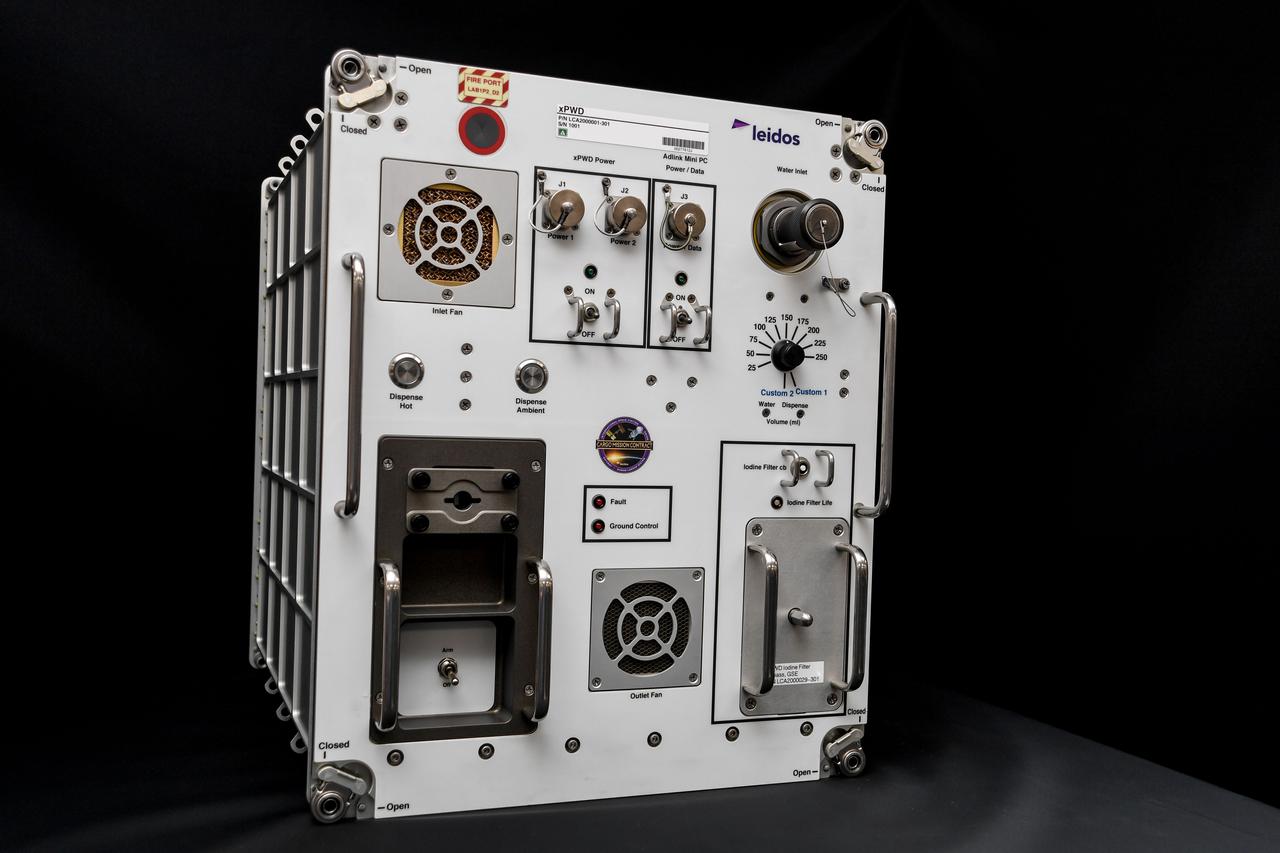
jsc2023e013692 (Feb. 9, 2023) --- A preflight image of the Exploration Potable Water Dispenser (Exploration PWD). Exploration PWD is a device that dispenses ambient and hot water into crew food and drink bags. The Exploration PWD is an improvement to the International Space Station (ISS) legacy PWD. Successful demonstration of this technology could lead to its adoption for future exploration missions and continued use for the space station crew.
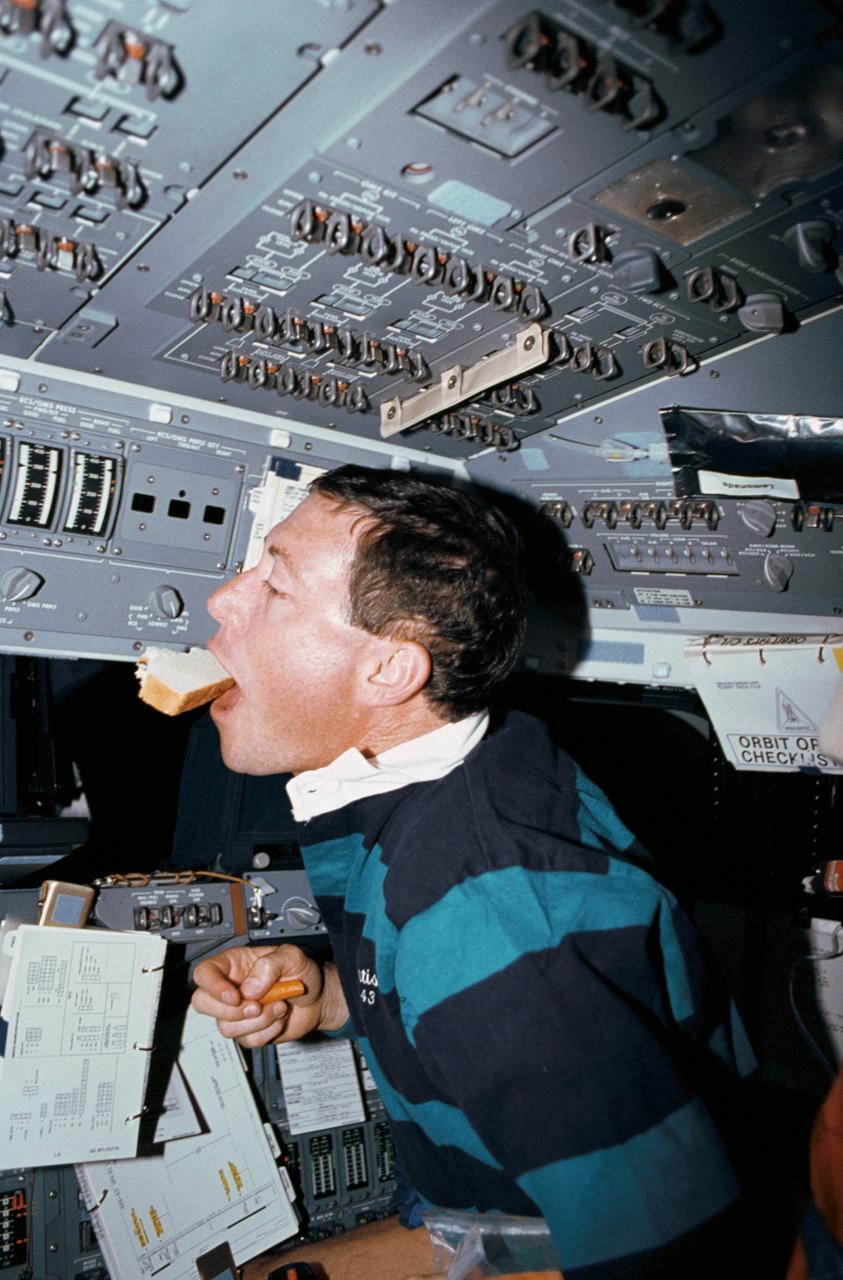
STS043-02-020 (2-11 Aug. 1991) --- Astronaut Michael A. Baker, STS-43 pilot, seated at the forward flight deck pilot station controls of the Space Shuttle Atlantis, eats a free-floating peanut butter and jelly sandwich while holding a carrot. Surrounding Baker are procedural checklists, control panels, and windows. A lemonade drink bag is velcroed to overhead panel.
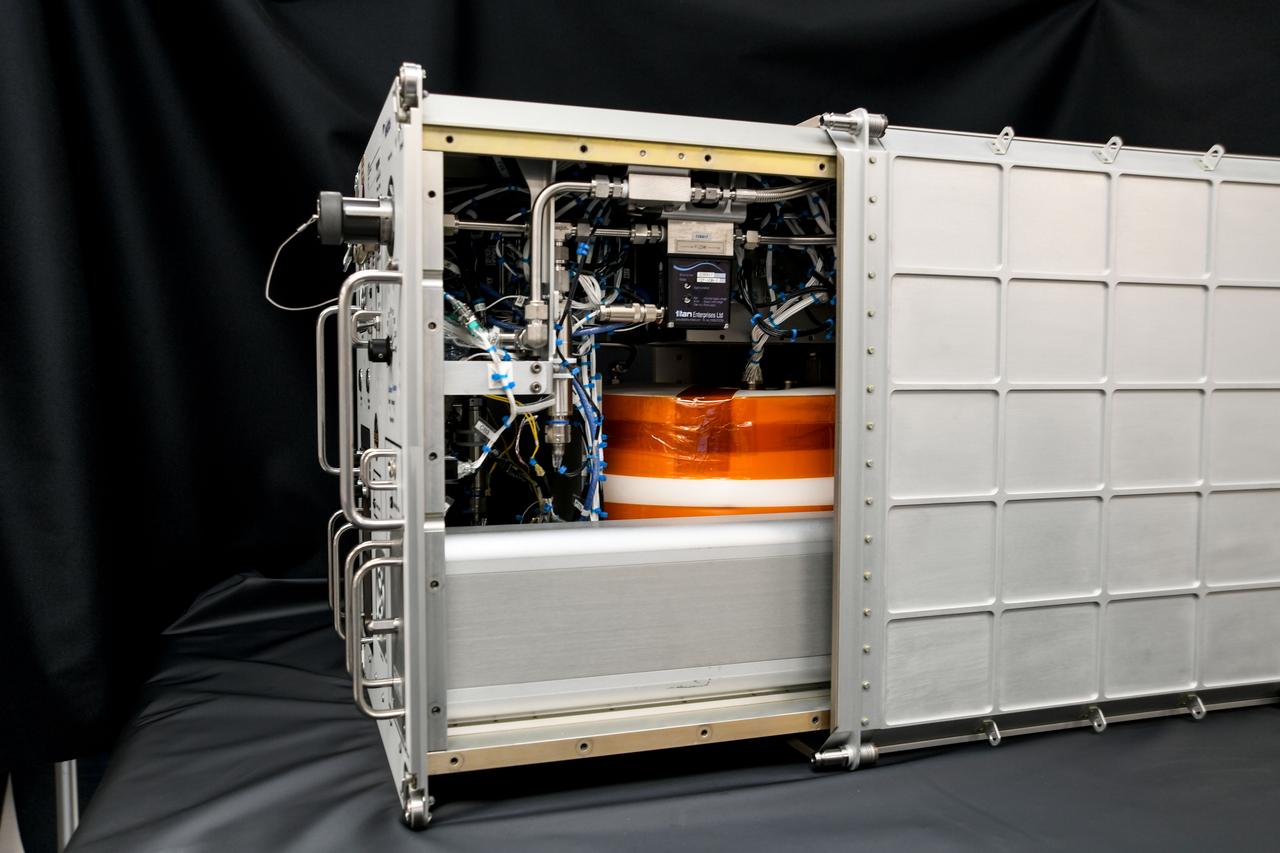
jsc2023e013698 (Feb. 9, 2023) --- A preflight image showing the inside of the Exploration Potable Water Dispenser (Exploration PWD) with a partial panel removed. Exploration PWD is a device that dispenses ambient and hot water into crew food and drink bags. The Exploration PWD is an improvement to the International Space Station (ISS) legacy PWD. Successful demonstration of this technology could lead to its adoption for future exploration missions and continued use for the space station crew.
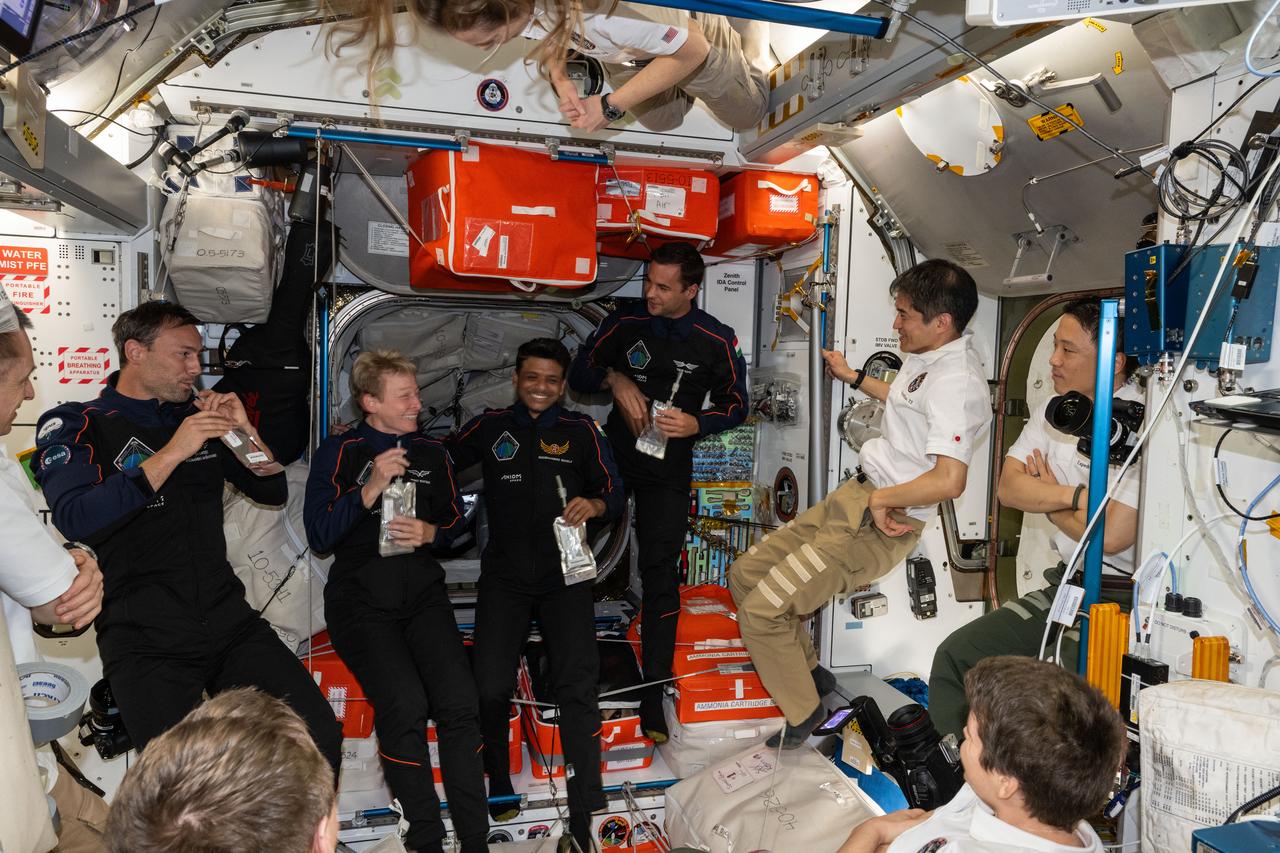
iss073e0249239 (June 26, 2025) --- The Axiom Mission 4 private astronauts gather with drink pouches inside the International Space Station shortly after docking to the orbital outpost's space-facing port on the Harmony module. In the dark suits (from left) are, Ax-4 crewmates Sławosz Uznański-Wiśniewski, Peggy Whitson, Shubhanshu Shukla, and Tibor Kapu. Surrounding the Ax-4 crew (clockwise from top are) Expedition 73 crewmates Nichole Ayers, Takuya Onishi, Jonny Kim, Anne McClain, Kirill Peskov, and Sergey Ryzhikov.
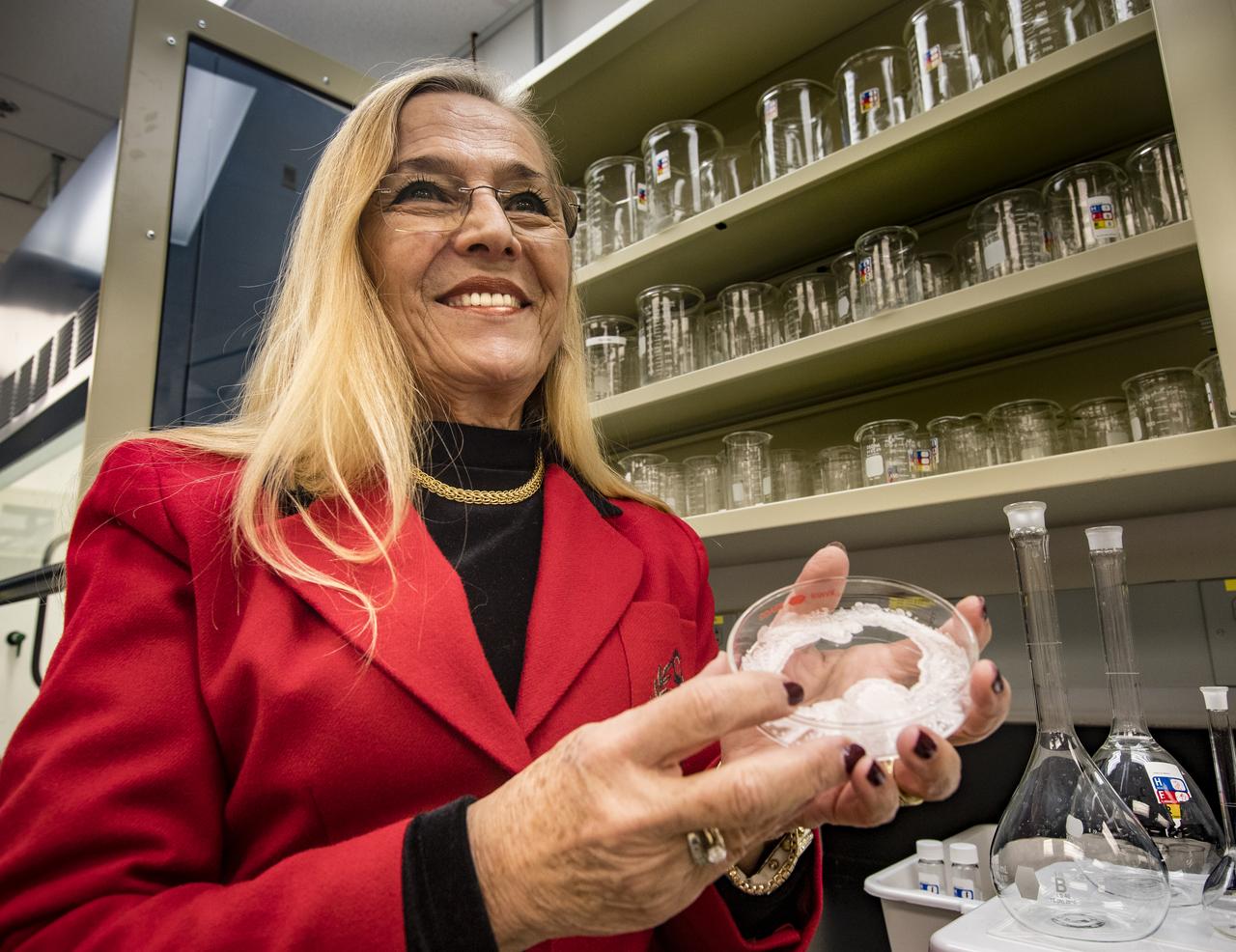
Dr. Luz M. Calle, a principal investigator for corrosion research at NASA’s Kennedy Space Center, shows a dish of crystals left over from an experiment to separate salt from water Dec. 12, 2018. Astronauts traveling on long-duration missions in space will need to recycle water, which means having to remove salt and other chemicals from wastewater to turn it back into drinking water.
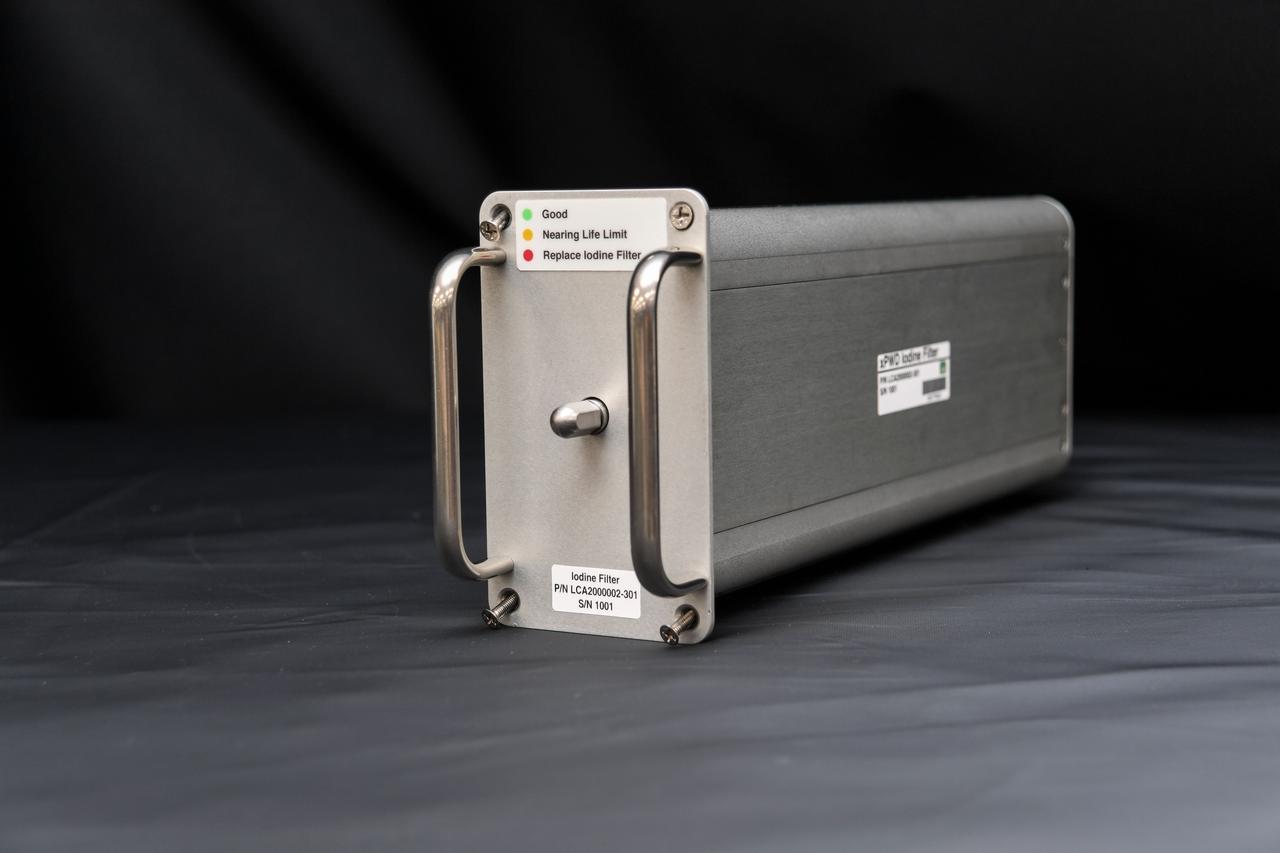
jsc2023e008494 (Feb. 10, 2023) --- A preflight image of the Exploration Potable Water Dispenser (Exploration PWD) iodine filter. Exploration PWD is a device that dispenses ambient and hot water into crew food and drink bags. The Exploration PWD is an improvement to the International Space Station (ISS) legacy PWD. Successful demonstration of this technology could lead to its adoption for future exploration missions and continued use for the space station crew.
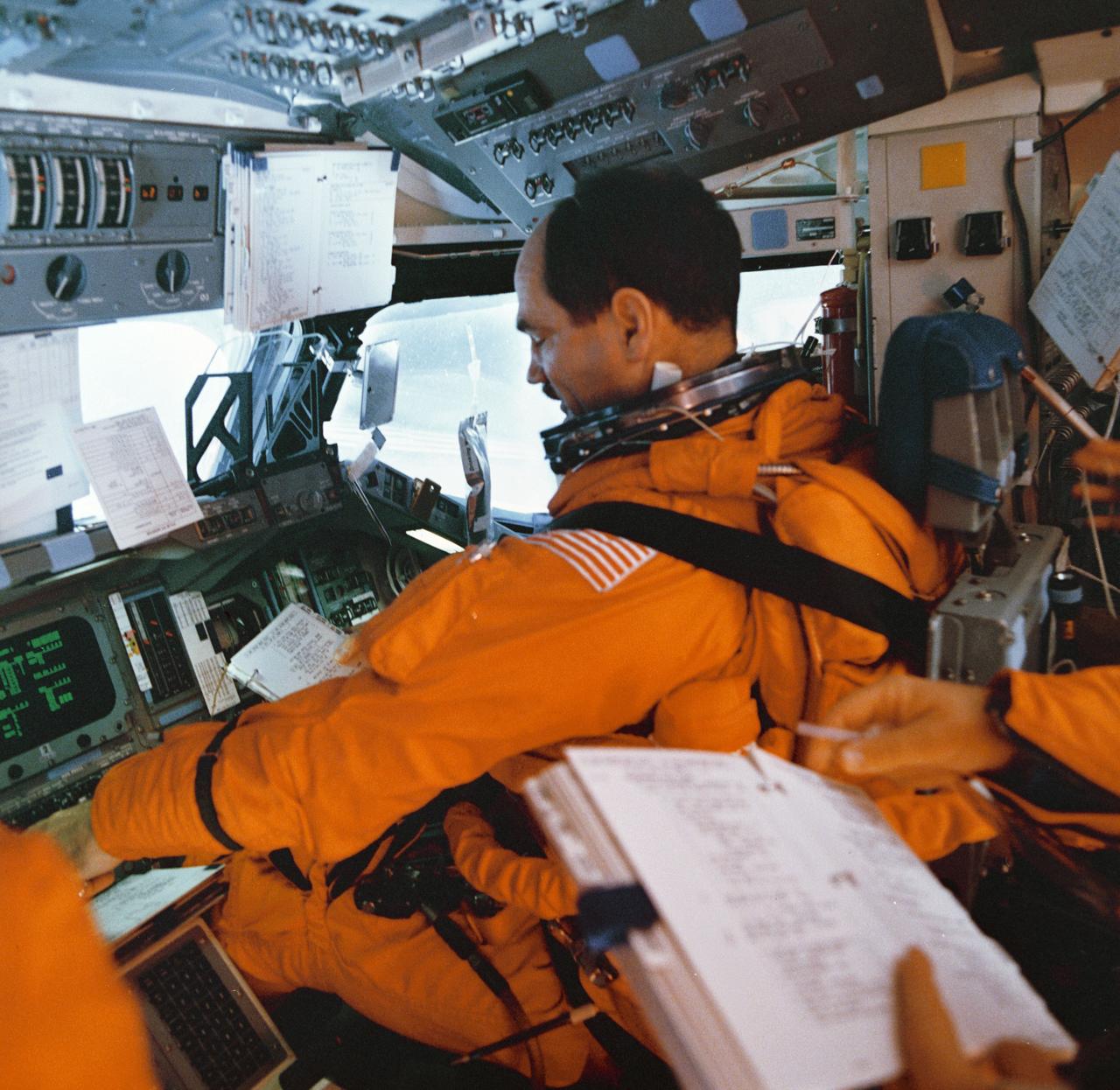
STS035-515-003 (2-10 Dec 1990) --- STS-35 Pilot Guy S. Gardner, wearing his launch and entry suit (LES), reviews descent checklist while at the pilots station on the forward flight deck of Columbia, Orbiter Vehicle (OV) 102. Crewmembers are conducting procedures related to the final stages of the mission and the landing sequence. Silhouetted in forward windows W4 and W5 are the head up display (HUD), flight mirror assembly, and a drinking water bag with straw.
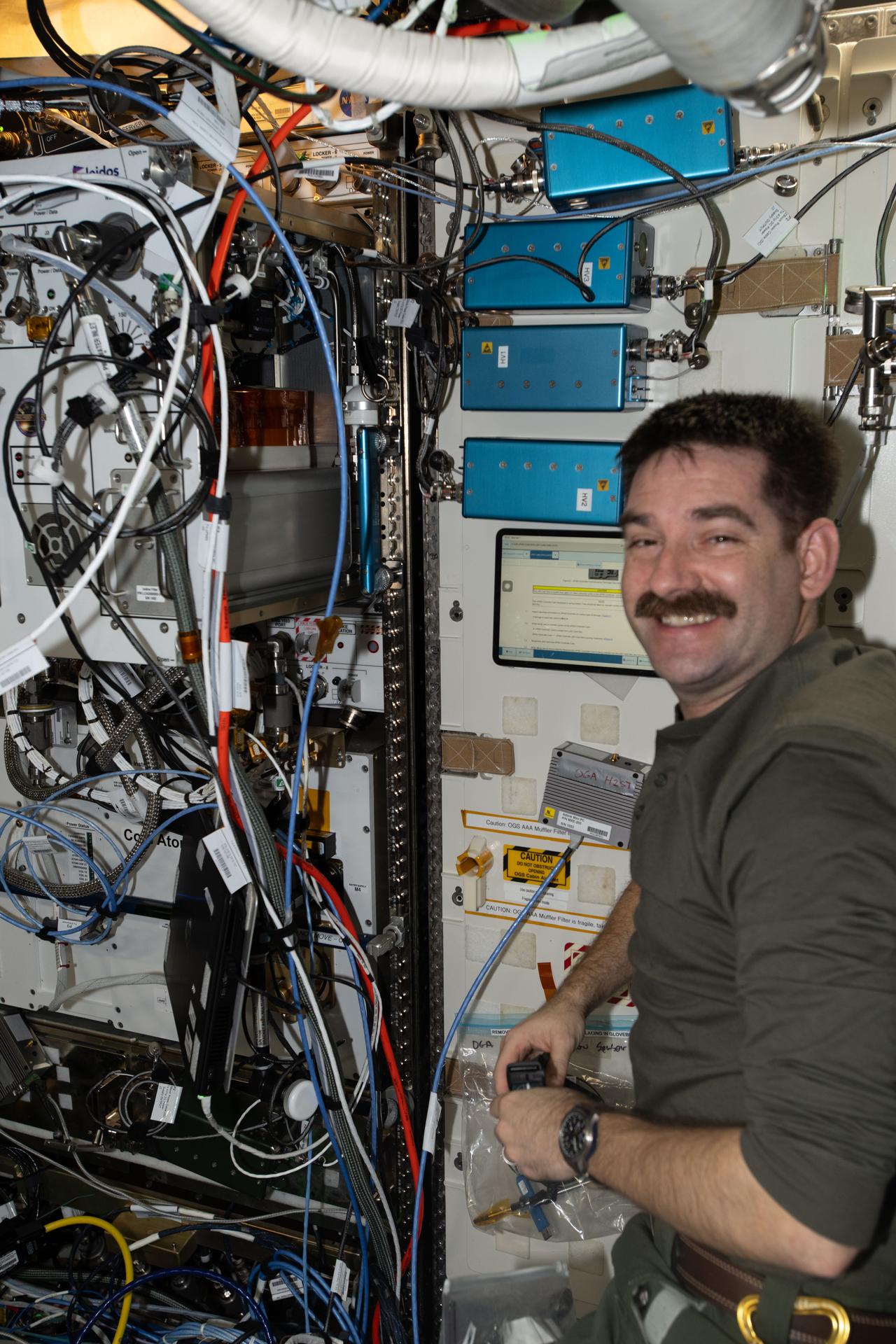
iss074e0430982 (April 1, 2026) --- NASA astronaut and Expedition 74 flight engineer Jack Hathaway poses for a portrait inside the International Space Station’s Destiny laboratory module. Hathaway was checking the operation of the Exploration Potable Water Dispenser, a technology demonstration designed to advance water‑sanitization methods, reduce microbial growth, and dispense hot water into crew food and drink bags. Credit: NASA/Jack Hathaway
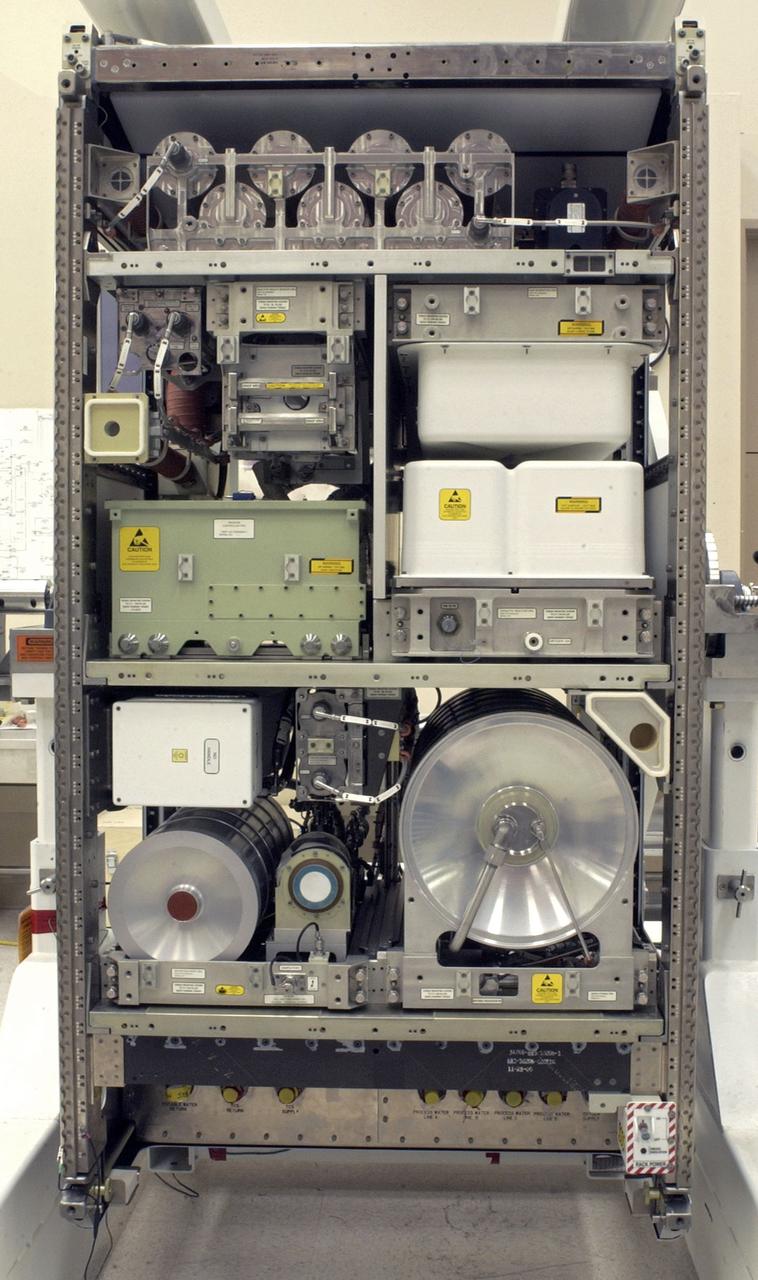
CAPE CANAVERAL, Fla. – This photo shows the Water Recovery System's rack 1 that will be delivered to the International Space Station aboard space shuttle Endeavour on the STS-126 mission. The two units of the Water Recovery System are designed to provide drinking-quality water through the reclamation of wastewater, including urine and hygiene wastes. The water that’s produced will be used to support the crew and work aboard the station. Endeavour and its crew of seven are scheduled to lift off at 7:55 p.m. Nov. 14 for the 15-day STS-126 mission. Photo credit: NASA
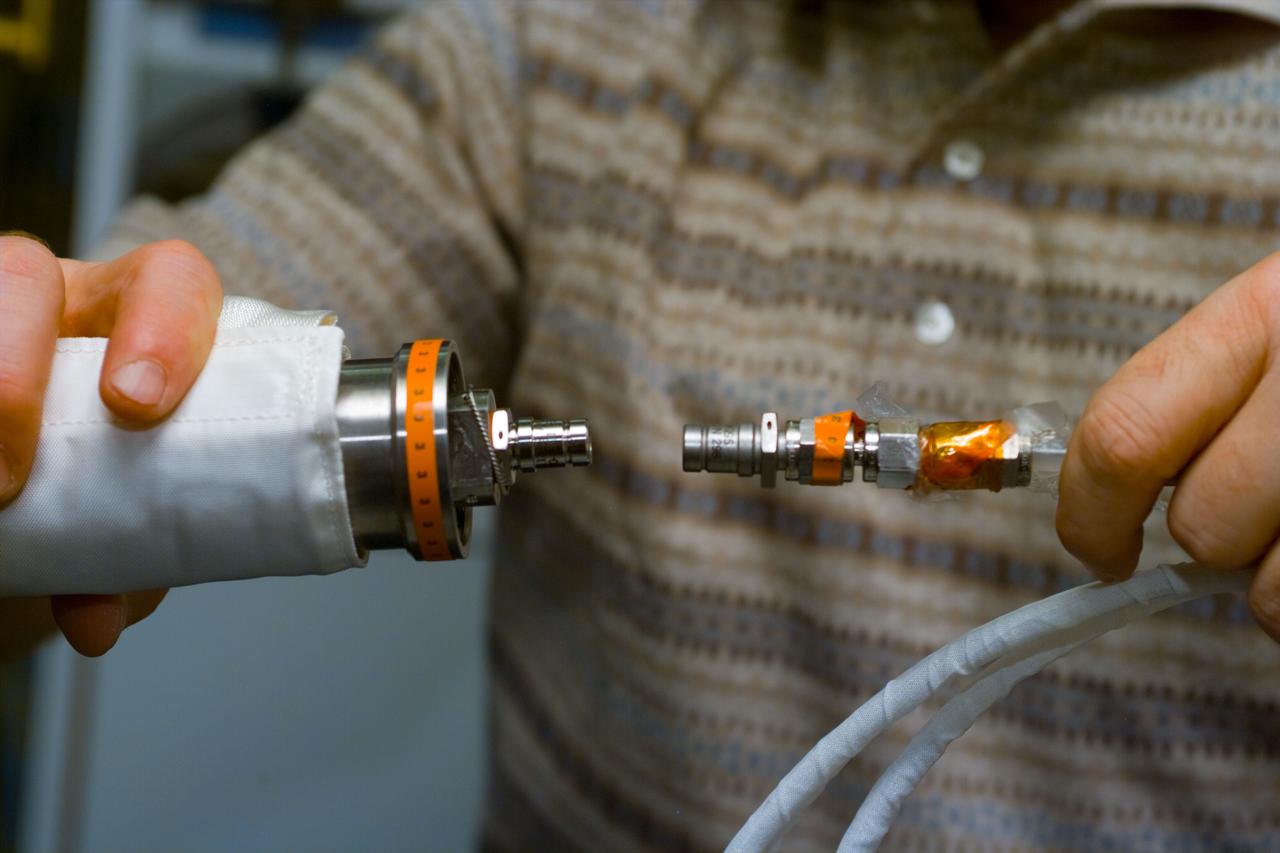
S88-E-5001 (12-04-98) --- Astronaut Jerry L. Ross, mission specialist, discovered incompatible connections involved in one of the STS-88 detailed test objectives (DTO), this one having to do with the crew's drinking water. The proper female counterpart for the connection was later found. DTO 691 is an in-cabin experiment dealing with a low-iodine residual system. Newly developed technology replacing the Galley Iodine Removal System (GIRA) is expected to reduce the concentration of iodine in the Shuttle's potable water system. The photo was taken with an electronic still camera (ESC) at 14:09:17 GMT, Dec. 4.
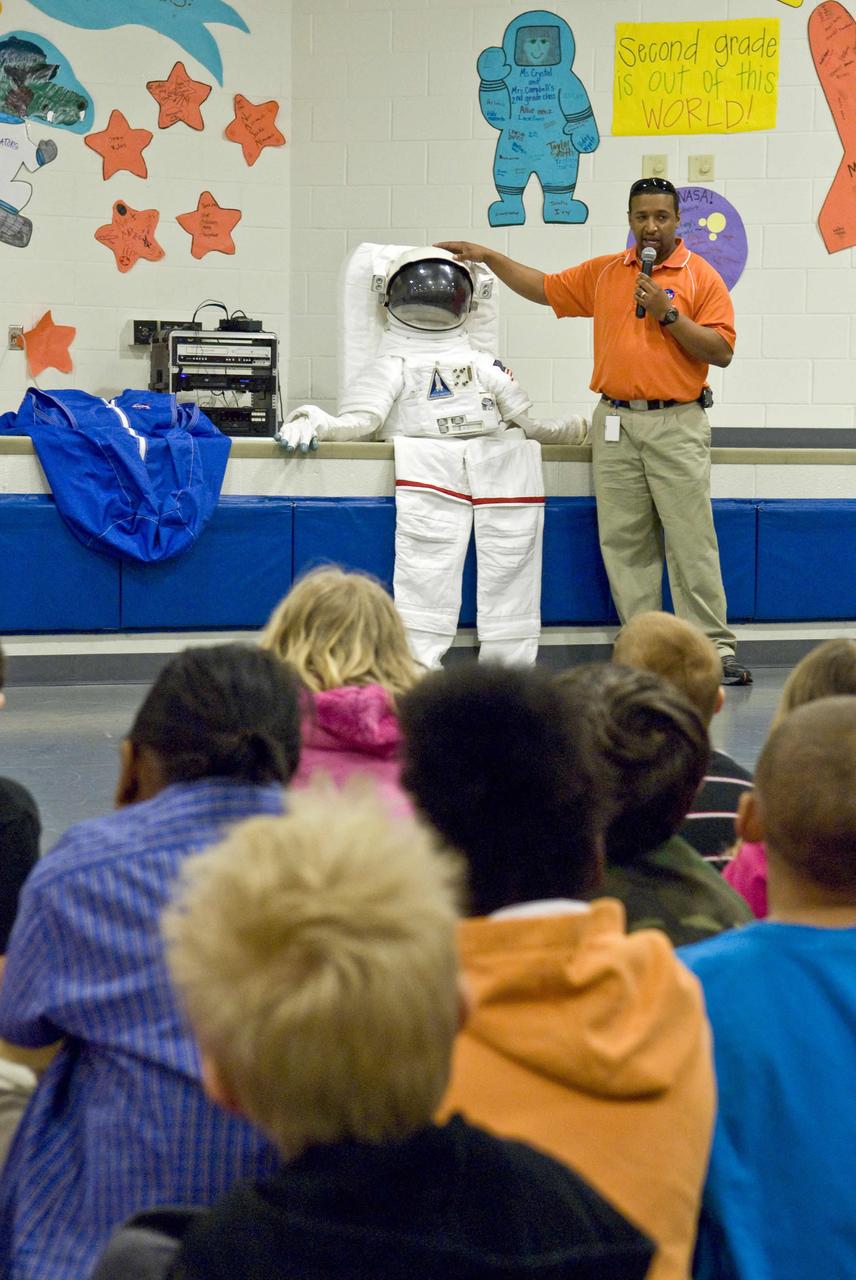
Alexis Harry, assistant director of Astro Camp at NASA's John C. Stennis Space Center, talks with students at Lake Cormorant (Miss.) Elementary School during a 'Living and Working in Space' presentation March 30. Stennis hosted the school presentation during a visit to the Oxford area. Harry, who also is a high school biology teacher in Slidell, La., spent time discussing space travel with students and answering questions they had about the experience, including queries about how astronauts eat, sleep and drink in space. The presentation was sponsored by the NASA Office of External Affairs and Education at Stennis. For more information about NASA education initiatives, visit: http://education.ssc.nasa.gov/.
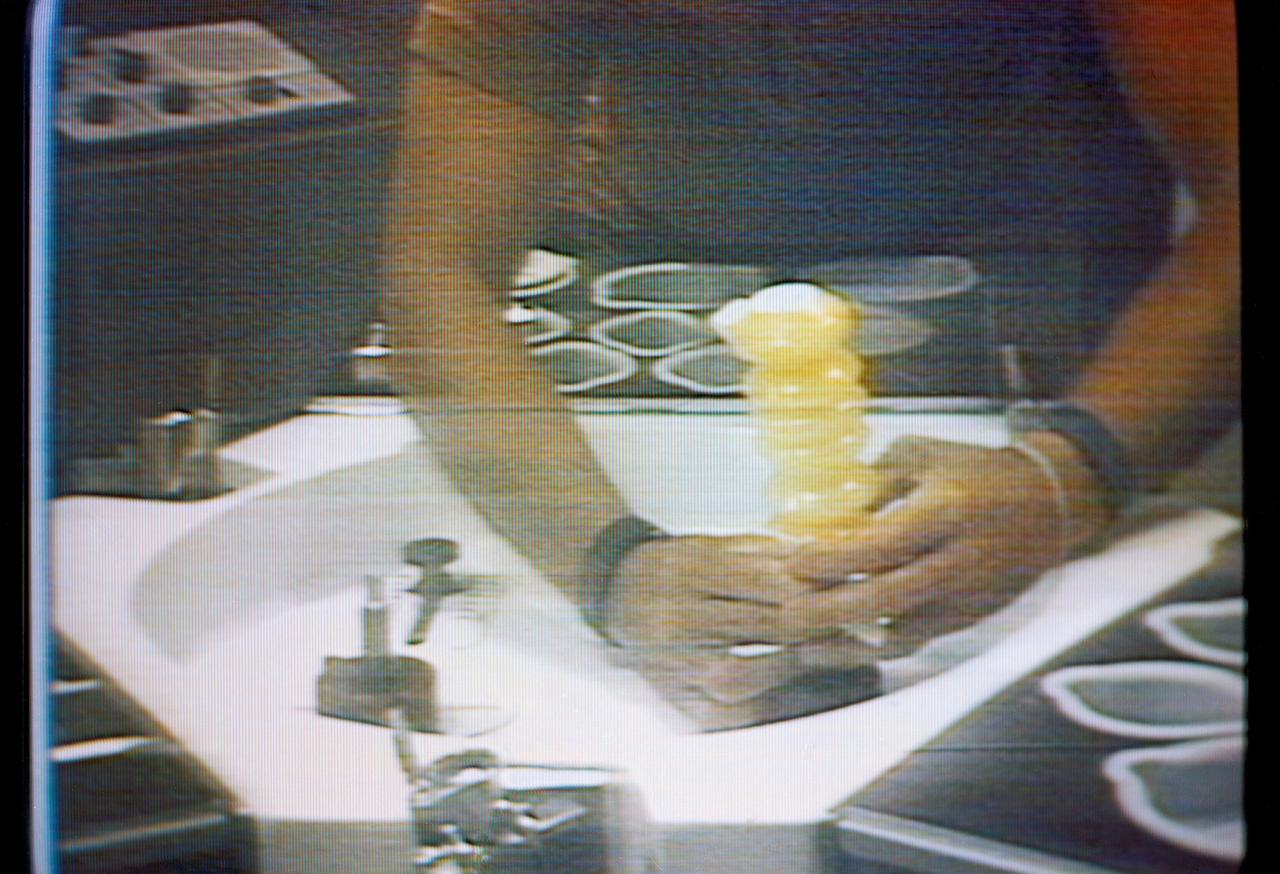
S73-27078 (30 May 1973) --- An accordian-style beverage dispenser filled with orange juice is held by astronaut Charles Conrad Jr., Skylab 2 commander, in this close-up view which is a reproduction taken from a color television transmission made by a TV camera aboard the Skylab 1 & 2 space station cluster in Earth orbit. Conrad (head and face not in view) is seated at the wardroom table in the crew quarters of the Orbital Workshop. The dispenser contained beverage crystals, and Conrad has just added the prescribed amount of water to make the orange drink. Photo credit: NASA
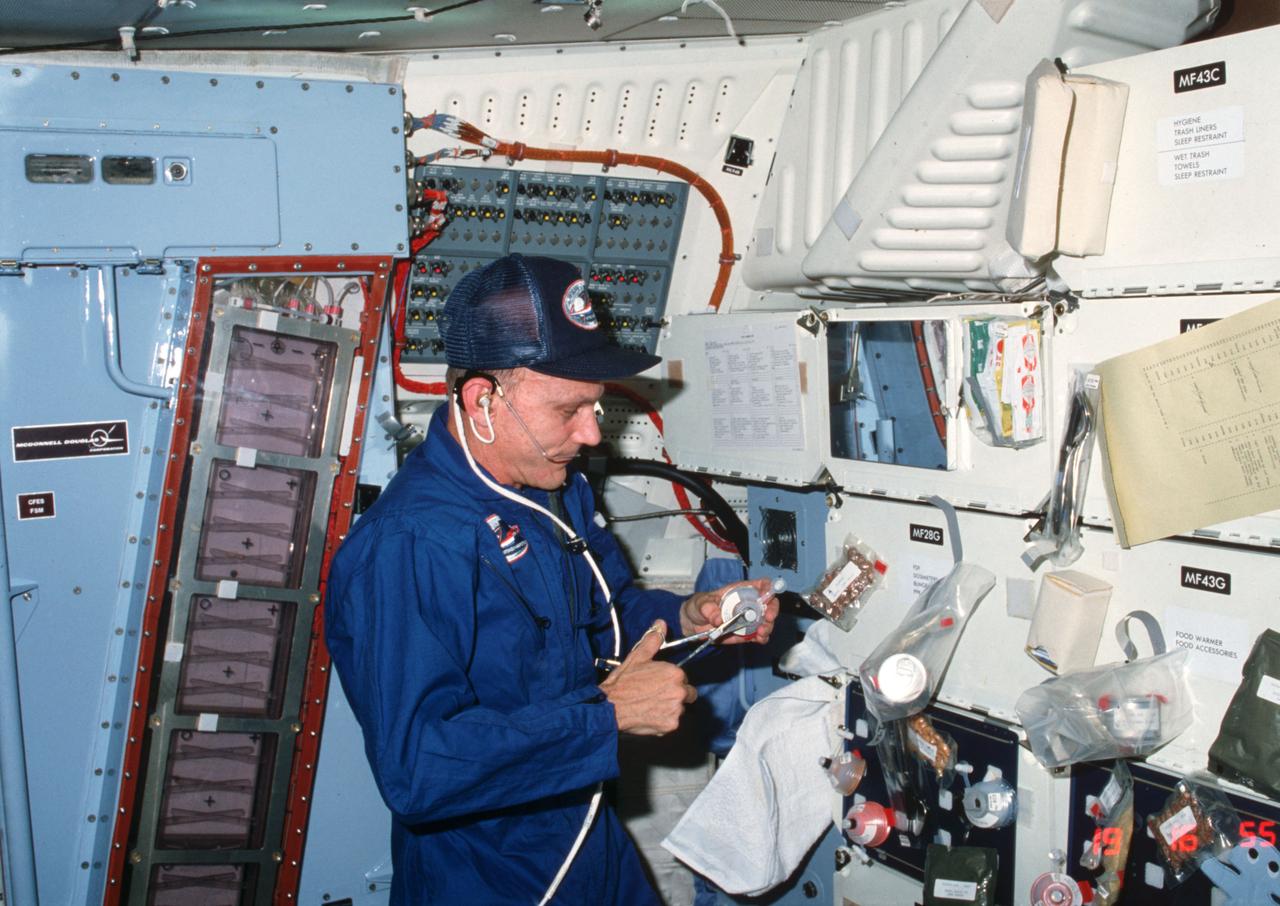
STS004-28-312 (27 June-4 July 1982) --- Astronaut Thomas K. Mattingly II, STS-4 crew commander, prepares a meal in the middeck area of space shuttle Columbia. He uses scissors to open a drink container. Various packages of food and meal accessories are attached to locker doors. At far left edge of the frame is the tall payload called continuous flow electrophoresis experiment (CFES) system-designed to separate biological materials according to their surface electrical charges as they pass through an electrical field. Astronaut Henry W. Hartsfield Jr. exposed this frame with a 35mm camera. Photo credit: NASA
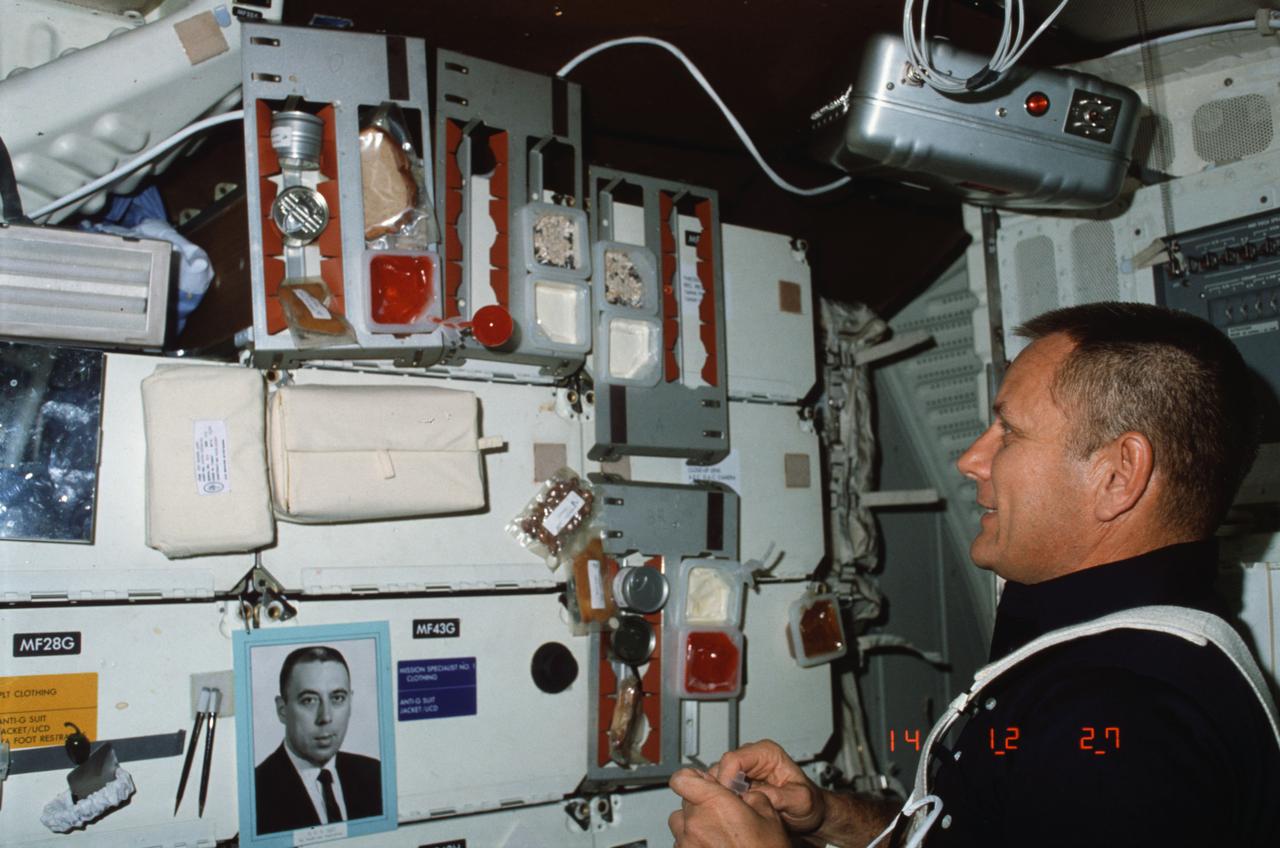
STS005-07-255 (19 Nov. 1982) --- Astronaut Robert F. Overmyer, STS-5 pilot, using beverage container and drinking straw secured in meal tray assembly (ASSY), experiments with microgravity characteristics of liquid on middeck in front of forward lockers. Overmyer also looks over packages of food attached to middeck lockers in meal tray assemblies. Carry-on food warmer appears overhead and other meal tray assemblies, personal hygiene mirror assembly, personal hygiene kit, and portrait of G.W.S. Abbey, Johnson Space Center's (JSC) Director of Flight Operations, appear on lockers. Photo credit: NASA
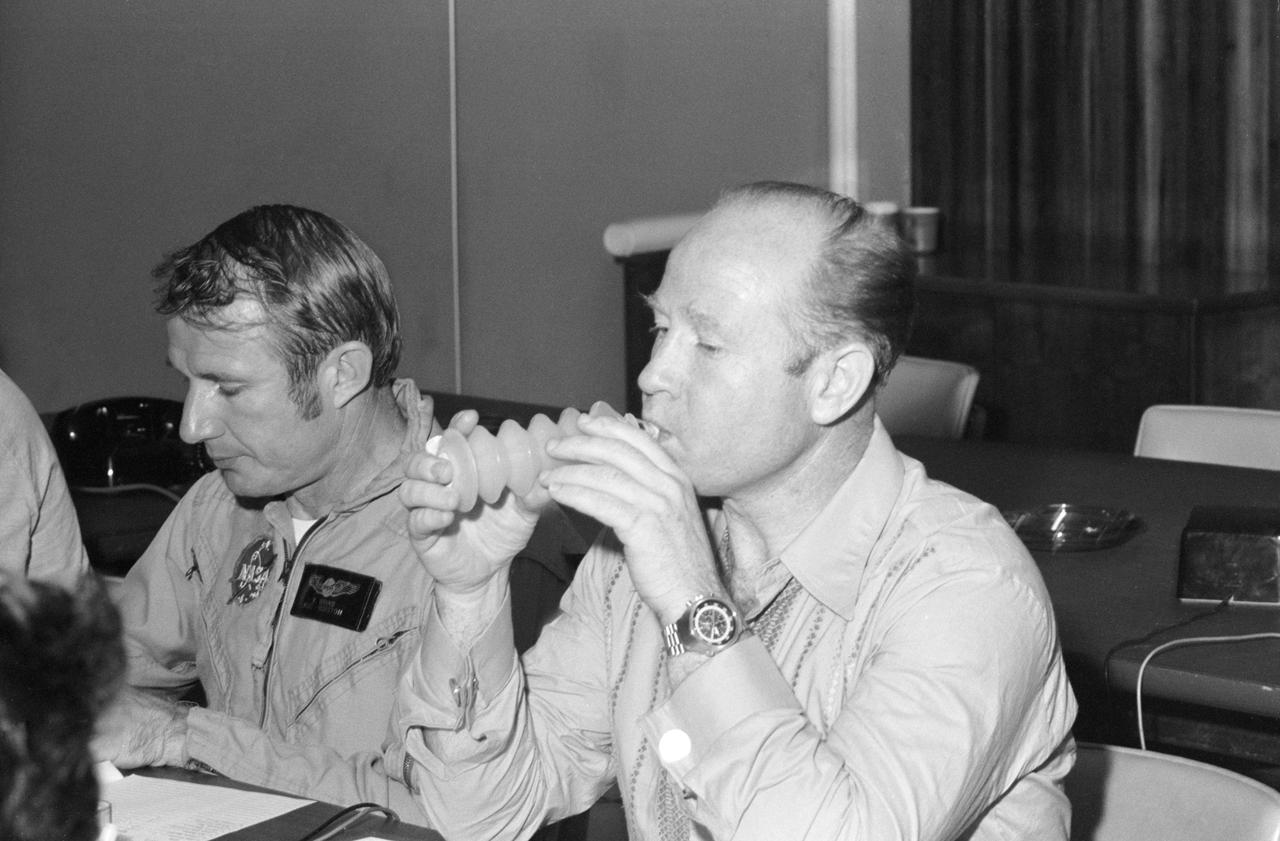
S74-20798 (23 April 1974) --- Candidate food items being considered for the joint U.S.-USSR Apollo-Soyuz Test Project mission are sampled by two ASTP crewmen in Building 4 at the Johnson Space Center. They are, left to right, astronaut Vance D. Brand, command module pilot of the American ASTP crew; and cosmonaut Aleksey A. Leonov, commander of the Soviet ASTP crew. Leonov is drinking orange juice from an accordion-like dispenser. The two Soviet crewmen will have an opportunity to eat with the three American crewmen while the Apollo and Soyuz spacecraft are docked in Earth orbit. Leonov will dine on food being chosen by him now.
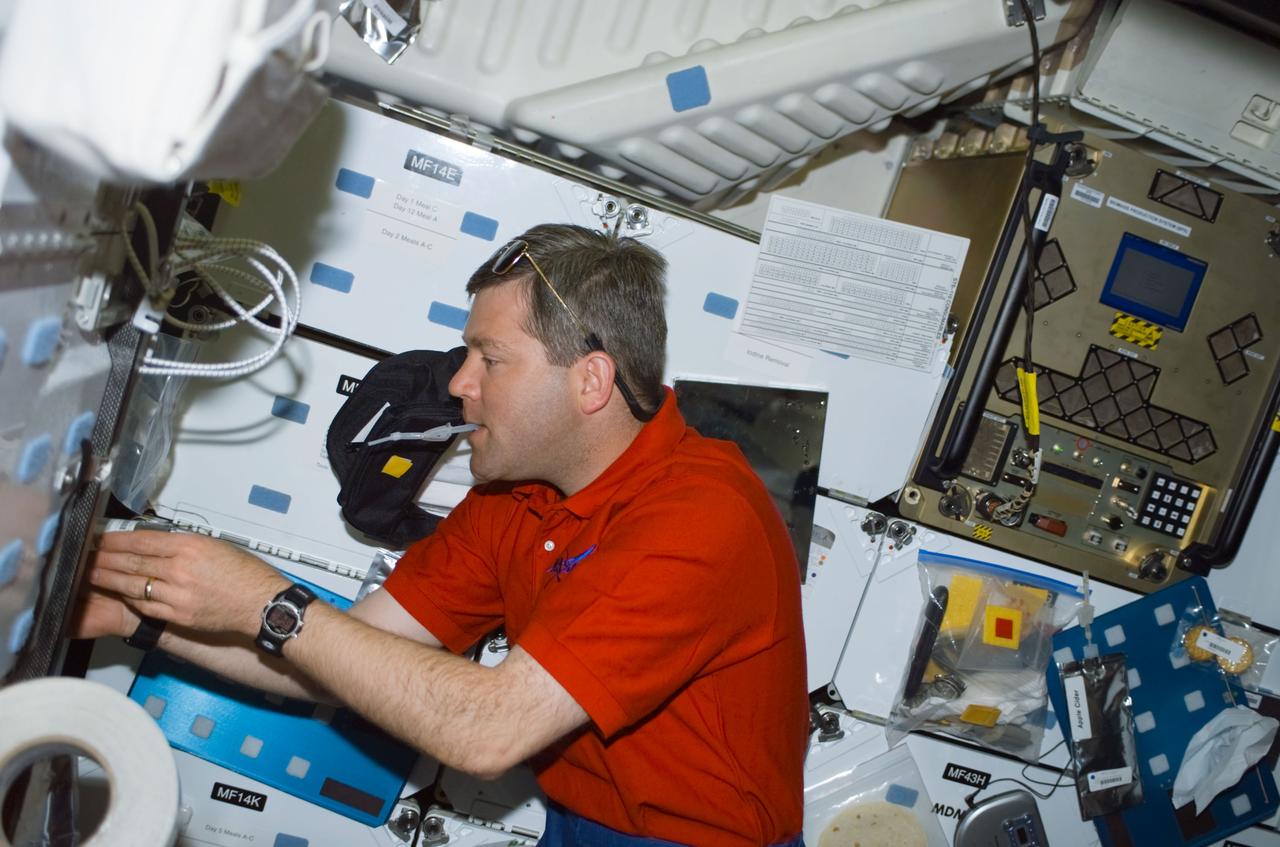
STS110-E-5042 (9 April 2002) --- Astronaut Stephen N. Frick, STS-110 pilot, works on the mid deck of the Space Shuttle Atlantis. The image was taken with a digital still camera.
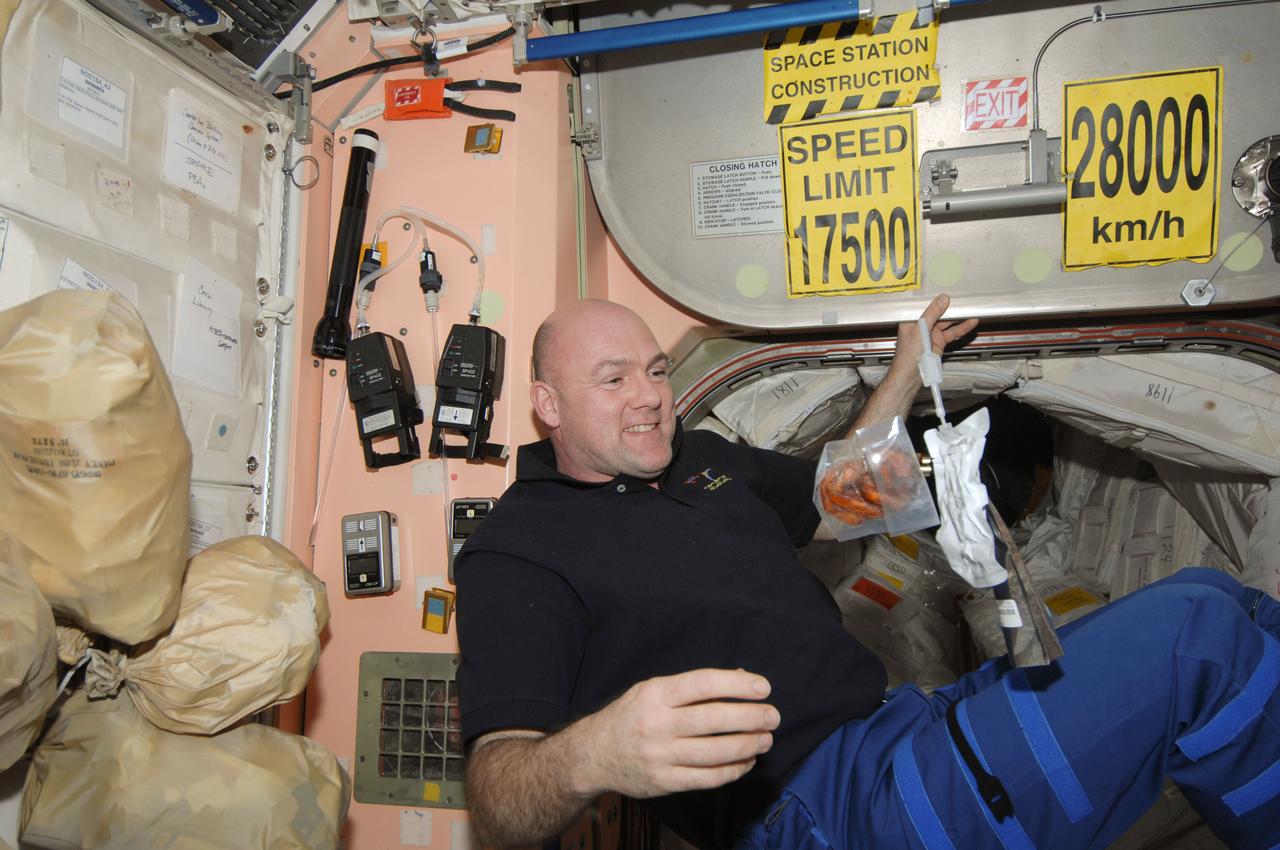
ISS030-E-166649 (30 Jan. 2012) --- European Space Agency astronaut Andre Kuipers, Expedition 30 flight engineer, is pictured near food and beverage packages floating freely in the Unity node of the International Space Station.
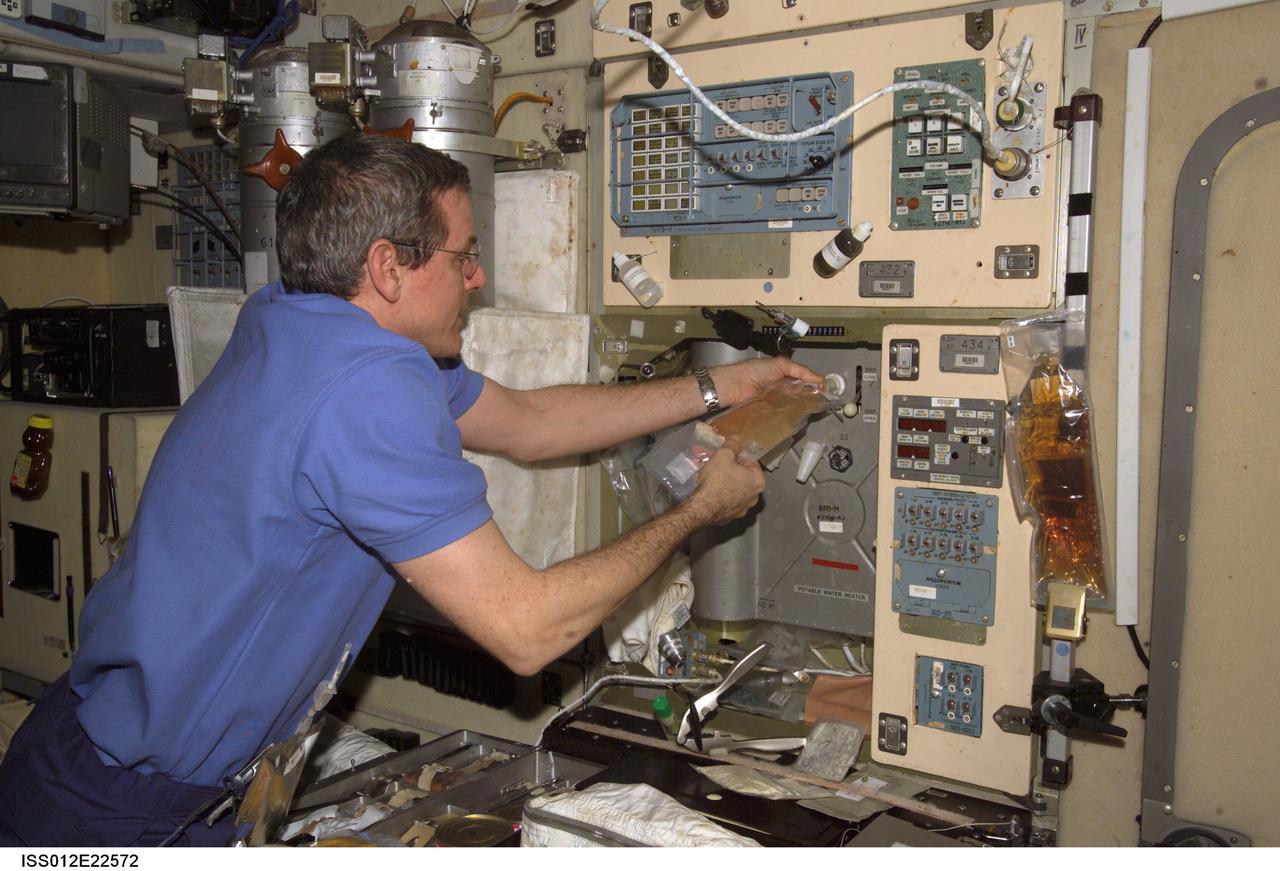
ISS012-E-22572 (21 March 2006) --- Astronaut William S. (Bill) McArthur, Expedition 12 commander and NASA space station science officer, adds potable water to a soft beverage container at the galley in Zvezda Service Module of the International Space Station.
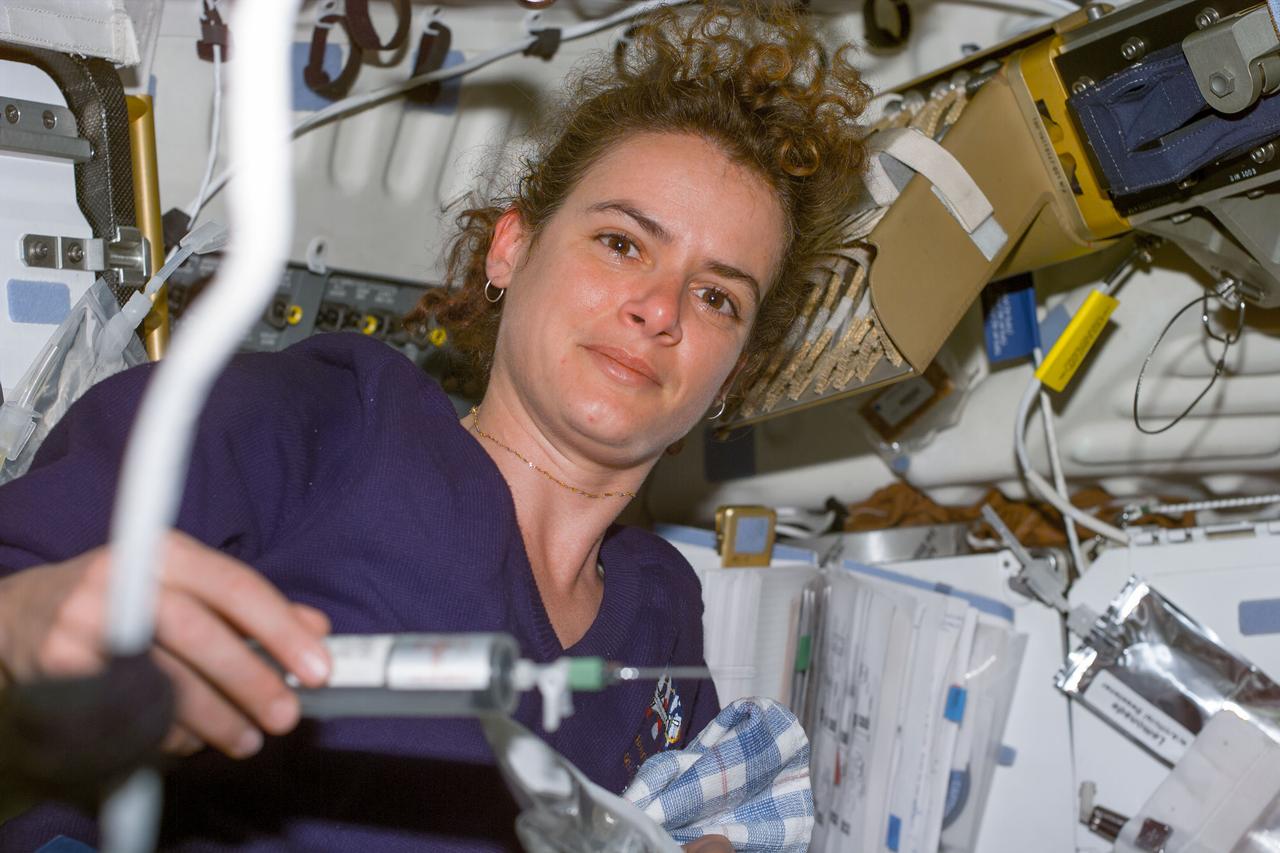
S96-E-5024 (29 May 1999) --- Astronaut Julie Payette, mission specialist representing the Canadian Space Agency (CSA), holds a syringe during a busy fourth day in space for the Space Shuttle Discovery. The image was recorded with an electronic still camera (ESC) at 06:14:52 GMT, May 29, 1999.
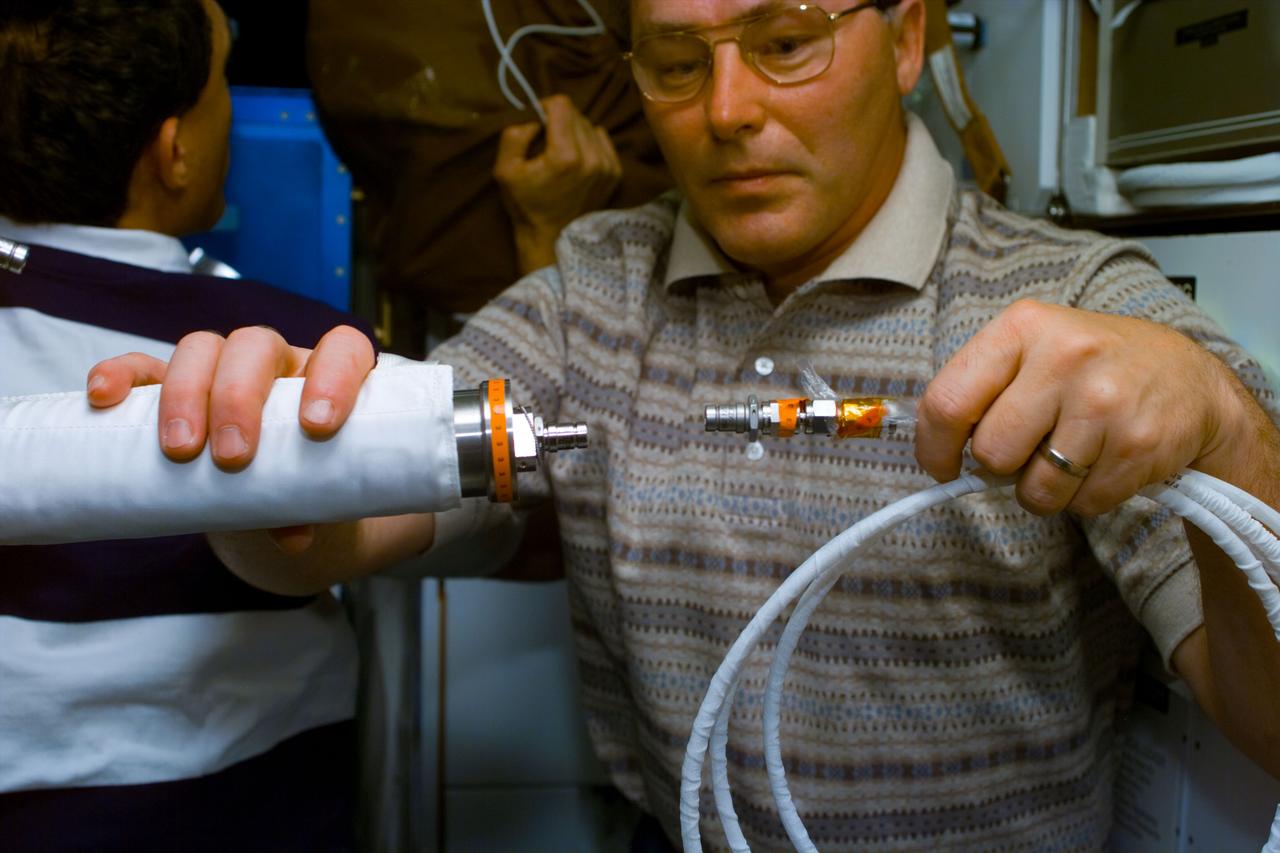
S88-E-5002 (12-04-98) --- Astronaut Jerry L. Ross, mission specialist, holds up two incompatible connections involved in one of the STS-88 detailed test objectives (DTO), this one having to do with the crew's drinking water. The proper counterpart was later located and the connection was successfully accomplished. Astronaut James H. Newman, mission specialist, is at left background. DTO 691 is an in cabin experiment dealing with a low-iodine residual system. Newly developed technology replacing the Galley Iodine Removal System (GIRA) is expected to reduce the concentration of iodine in the Shuttle's potable water system. The photo was taken with an electronic still camera (ESC) at 14:09:40 GMT, Dec. 4.
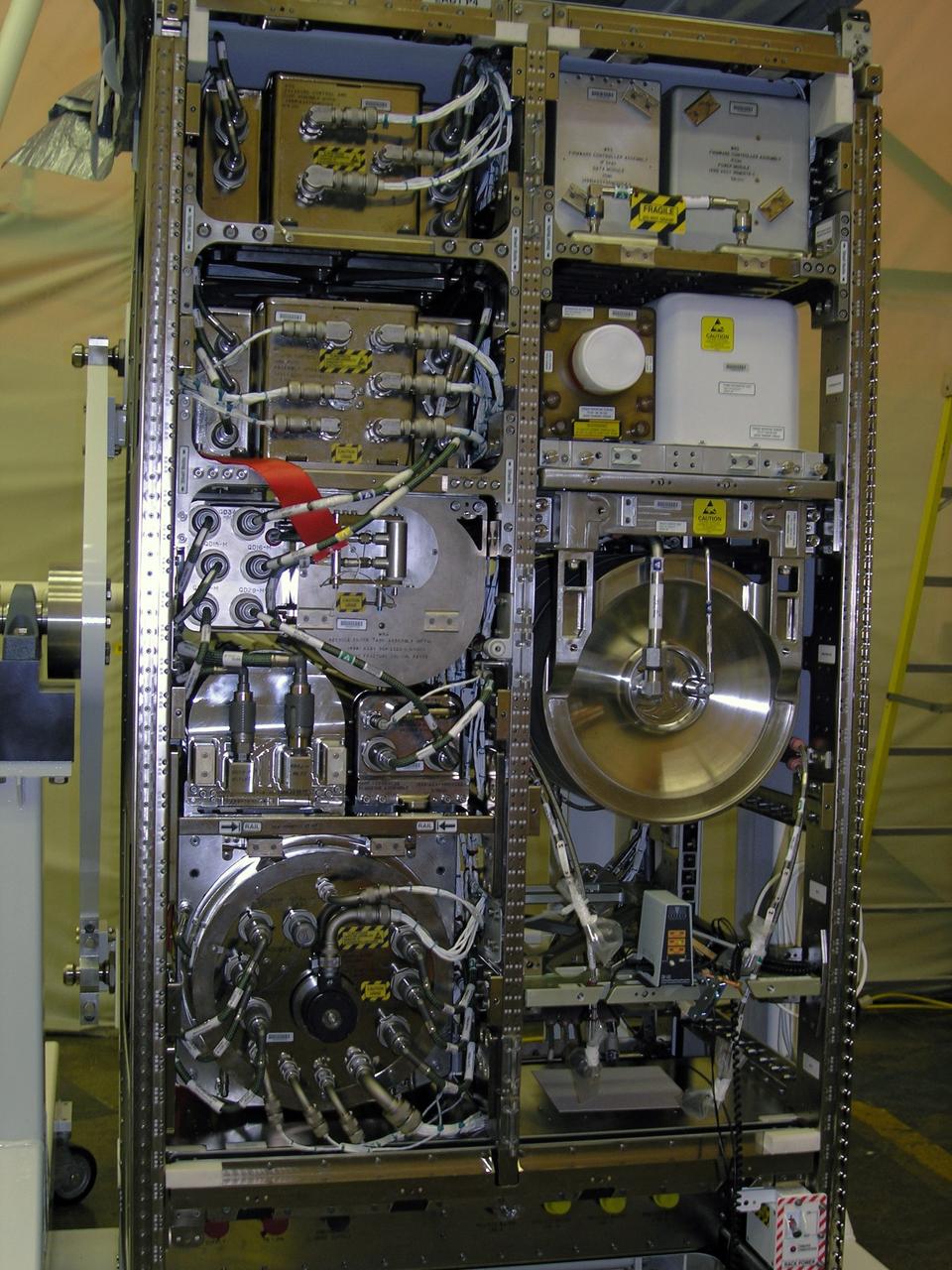
CAPE CANAVERAL, Fla. – This photo shows the Water Recovery System's rack 2, that will be delivered to the International Space Station aboard space shuttle Endeavour on the STS-126 mission. Its primary purpose is to process urine and waster water so that Waste Recovery System's rack 1 can perform the final cleanup. The two units of the Water Recovery System are designed to provide drinking-quality water through the reclamation of wastewater, including urine and hygiene wastes. The water that’s produced will be used to support the crew and work aboard the station. Endeavour and its crew of seven are scheduled to lift off at 7:55 p.m. Nov. 14 for the 15-day STS-126 mission. Photo credit: NASA

This image from NASA's Mars Reconnaissance Orbiter shows Malea Planum,a polar region in the Southern hemisphere of Mars, directly south of Hellas Basin, which contains the lowest point of elevation on the planet. The region contains ancient volcanoes of a certain type, referred to as "paterae." Patera is the Latin word for a shallow drinking bowl, and was first applied to volcanic-looking features, with scalloped-edged calderas. Malea is also a low-lying plain, known to be covered in dust. These two pieces of information provide regional context that aid our understanding of the scene and features contained in our image. The area rises gradually to a ridge (which can be seen in this Context Camera image) and light-colored dust is blown away by gusts of the Martian wind, which accelerate up the slope to the ridge, leading to more sharp angles of contact between light and dark surface materials. https://photojournal.jpl.nasa.gov/catalog/PIA21784
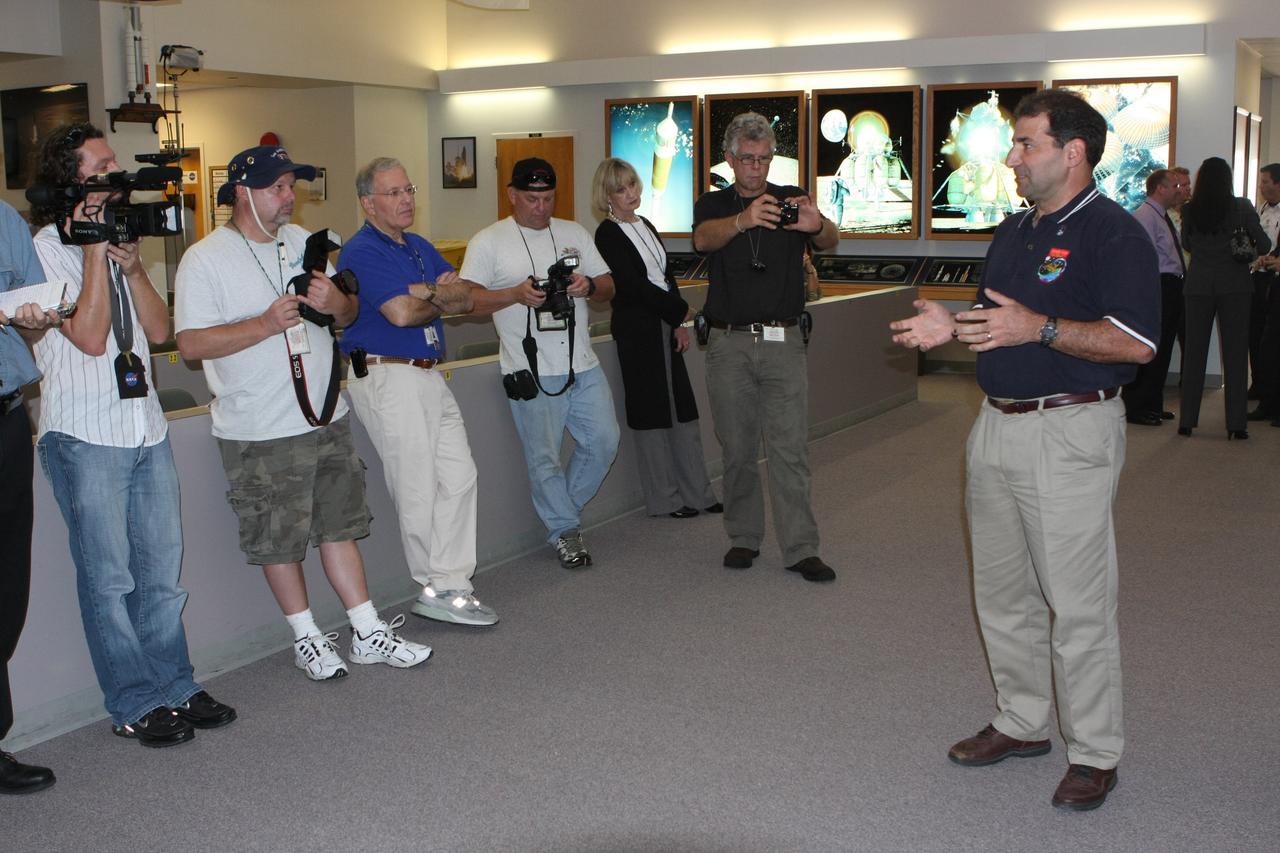
CAPE CANAVERAL, Fla. – In the News Center at NASA's Kennedy Space Center in Florida, Bob Bagdigian (right) talks to the media about the Water Recovery System being delivered to the International Space Station on space shuttle Endeavour's STS-126 mission. The two units of the Water Recovery System are designed to provide drinking-quality water through the reclamation of wastewater, including urine and hygiene wastes. The water that’s produced will be used to support the crew and work aboard the station. STS-126 is the 124th space shuttle flight and the 27th flight to the International Space Station. The mission will feature four spacewalks and work that will prepare the space station to house six crew members for long- duration missions. Liftoff is scheduled for 7:55 p.m. EST Nov. 14. Photo credit: NASA/Dimitri Gerondidakis
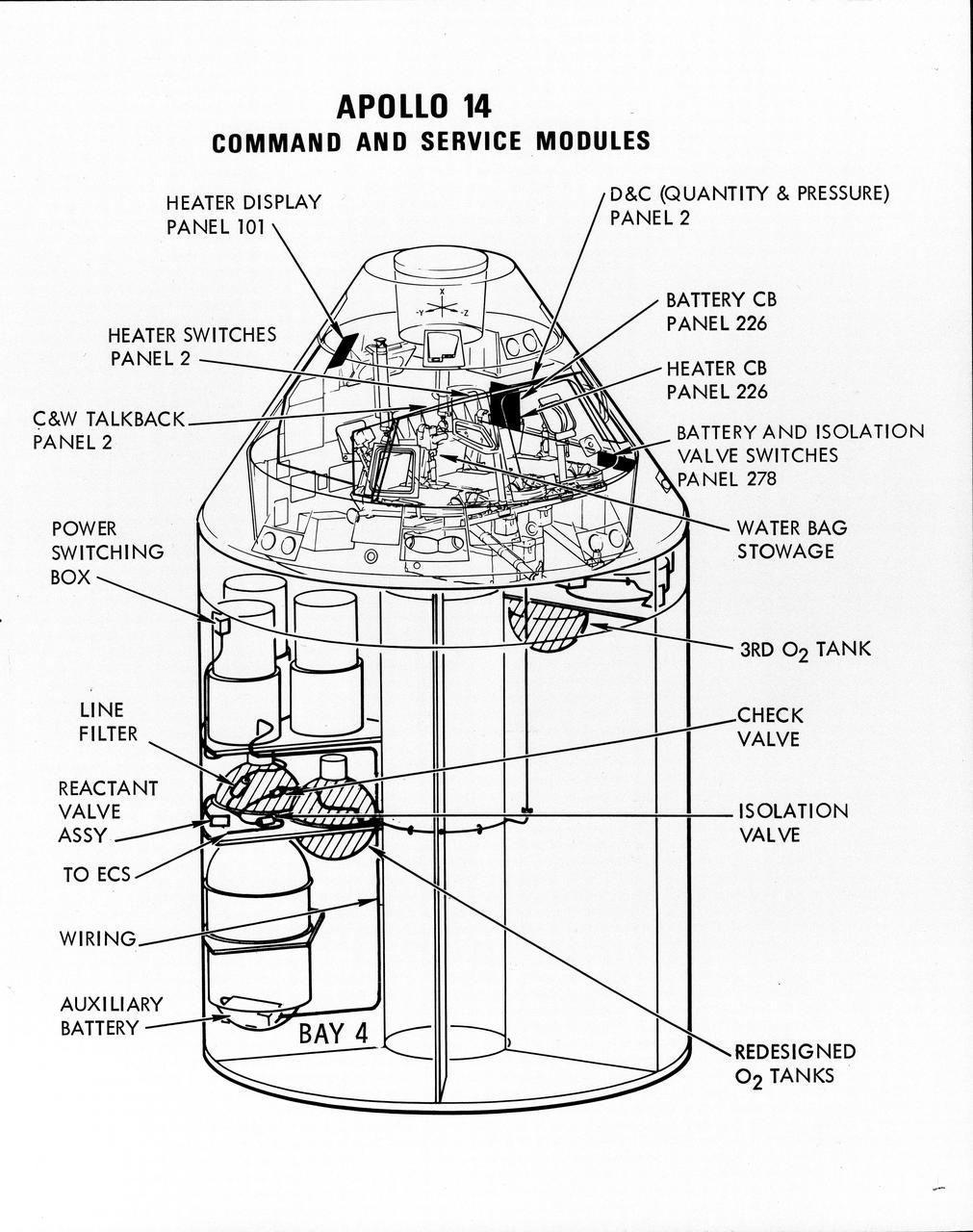
S71-16823 (January 1971) --- A line drawing illustrating a cutaway view of the Apollo 14 Command and Service Modules, showing the engineering changes in the CSM which were recommended by the Apollo 13 Review Board. (The Apollo 13 abort was caused by a short circuit and wiring overheating in one of the SM cryogenic oxygen tanks.) The major changes to the Apollo 14 CSM include adding a third cryogenic oxygen tank installed in a heretofore empty bay (in sector one) of the SM, addition of an auxiliary battery in the SM as a backup in case of fuel cell failure, and removal of destratification fans in the cryogenic oxygen tanks and removal of thermostat switches from the oxygen tank heater circuits. Provision for stowage of an emergency five-gallon supply of drinking water has been added to the CM.
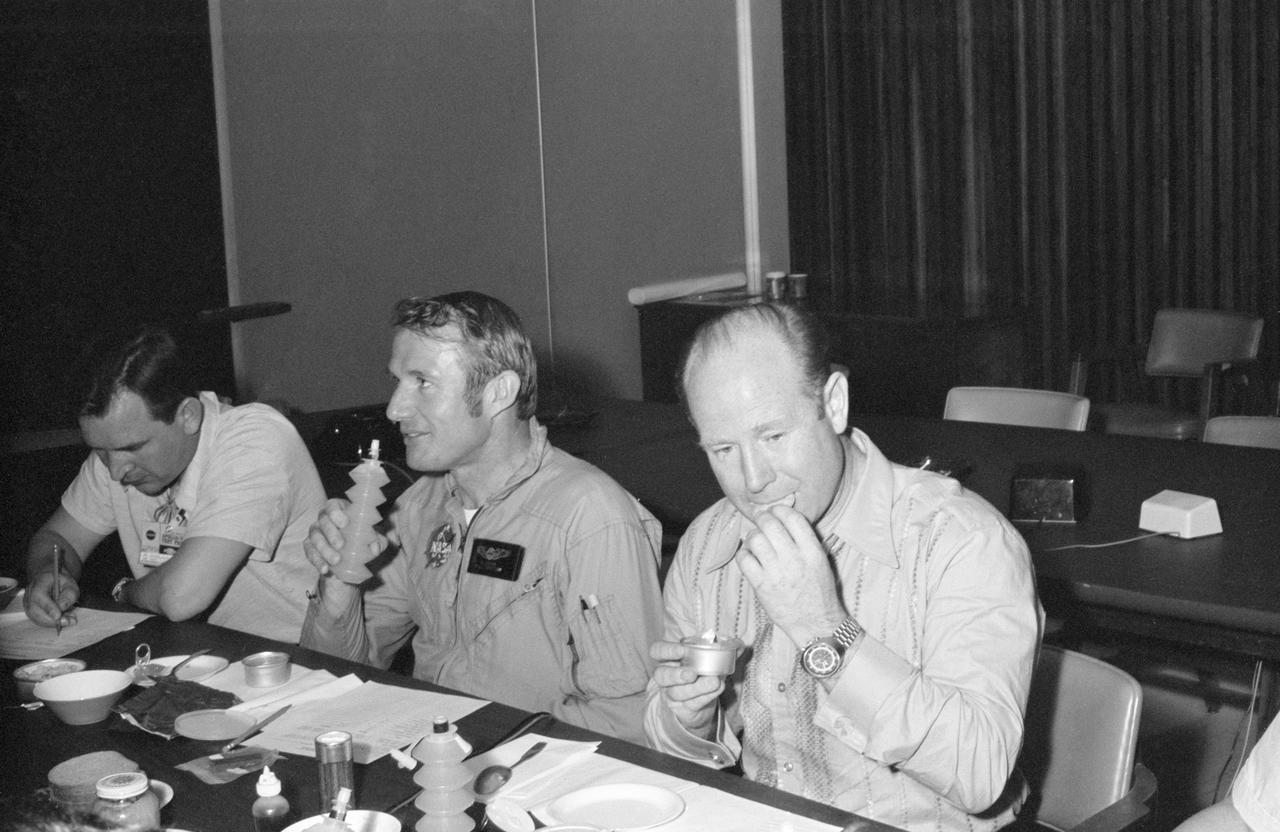
S74-20797 (23 April 1974) --- Candidate food items being considered for the joint U.S.-USSR Apollo-Soyuz Test Project mission are sampled by three ASTP crewmen in Building 4 at the Johnson Space Center. They are, left to right, cosmonaut Valeriy N. Kubasov, engineer on the Soviet ASTP crew; astronaut Vance D. Brand, command module pilot of the American ASTP crew; and cosmonaut Aleksey A. Leonov, commander of the Soviet ASTP crew. Kubasov is marking a food rating chart on which the crewmen mark their choices, likes and dislikes of the food being sampled. Brand is drinking orange juice from an accordion-like dispenser. Leonov is eating butter cookies. The two Soviet crewmen will have an opportunity to eat with the three American crewmen while the Apollo and Soyuz spacecraft are docked in Earth orbit. Leonov and Kubasov will dine on food being chosen individually by them now.
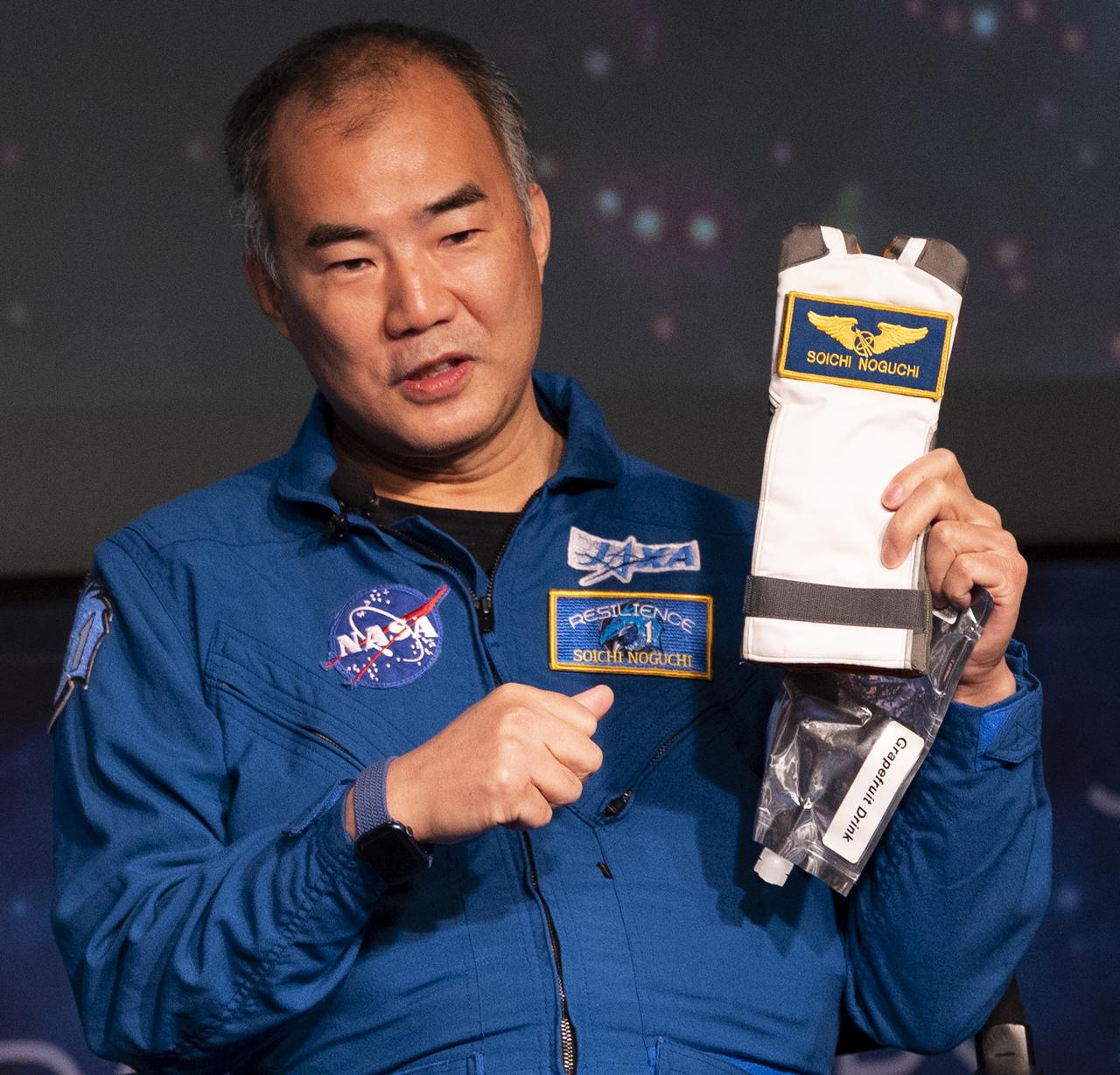
Japan Aerospace Exploration Agency (JAXA) astronaut Soichi Noguchi holds up a drink bag holder from his mission aboard the International Space Station as he speaks with employees of the Space Operations and Exploration Systems Development Mission Directorates about the Crew-1 mission with fellow crew members NASA astronauts Mike Hopkins, Victor Glover, and Shannon Walker, Monday, Nov. 15, 2021, at the Mary W. Jackson NASA Headquarters Building in Washington. Hopkins, Glover, Walker, and Noguchi launched on the first crew rotation mission to the International Space Station for SpaceX’s Falcon 9 and Crew Dragon spacecraft as part of the agency’s Commercial Crew Program and spent 168 days in space across Expeditions 64 and 65. Photo Credit: (NASA/Joel Kowsky)

S69-26149 (6 March 1969) --- Astronaut James A. McDivitt, Apollo 9 commander, is seen inside the Lunar Module "Spider" drinking from a hand water dispenser in this photograph from the second live television transmission from Apollo 9. Astronaut Russell L. Schweickart, lunar module pilot, is in the left background. The telecast was made early Thursday afternoon on the fourth day in space. At this moment Apollo 9 was orbiting Earth with the Command and Service Modules docked nose-to-nose with the Lunar Module. Astronaut David R. Scott, command module pilot, remained at the controls in the Command Module "Gumdrop" while the other two astronauts checked out the Lunar Module. McDivitt and Schweickart moved into the Lunar Module from the Command Module by way of the docking tunnel.

Boulder-size blocks of water ice can be seen around the rim of this giant meteoroid impact crater on Mars, as viewed by the High-Resolution Imaging Science Experiment (HiRISE camera) aboard NASA's Mars Reconnaissance Orbiter. The crater was formed on Dec. 24, 2021, when a meteoroid struck the ground in a region of Mars called Amazonis Planitia. The impact churned up a layer of water ice buried under the ground here – the closest to the Martian equator buried water ice has ever been found. NASA scientists are interested in finding deposits of water ice as close to the Martian equator as possible, where it's warmer and safer to land. This ice would be a critical resource for astronauts as drinking water, for agriculture, and for rocket propellant. https://photojournal.jpl.nasa.gov/catalog/PIA25583

In this image from NASA's Mars Reconnaissance Rover (MRO) we can see the edge of a mound of ice in one of these mid-latitude craters. Some of it has already been removed, so we can see layering that used to be in the crater's interior. Scientists use ice deposits like these to figure out how the climate has changed on Mars. Another upside of recognizing this ice is that future astronauts will have plenty of drinking water. Scientists now realize that ice is very common on the Martian surface. It often fills up craters and valleys in the mid-latitudes in older climates, although when it's covered in dust it can be hard to recognize. Today the climate on Mars makes this ice unstable and some of it has evaporated away. https://photojournal.jpl.nasa.gov/catalog/PIA22255
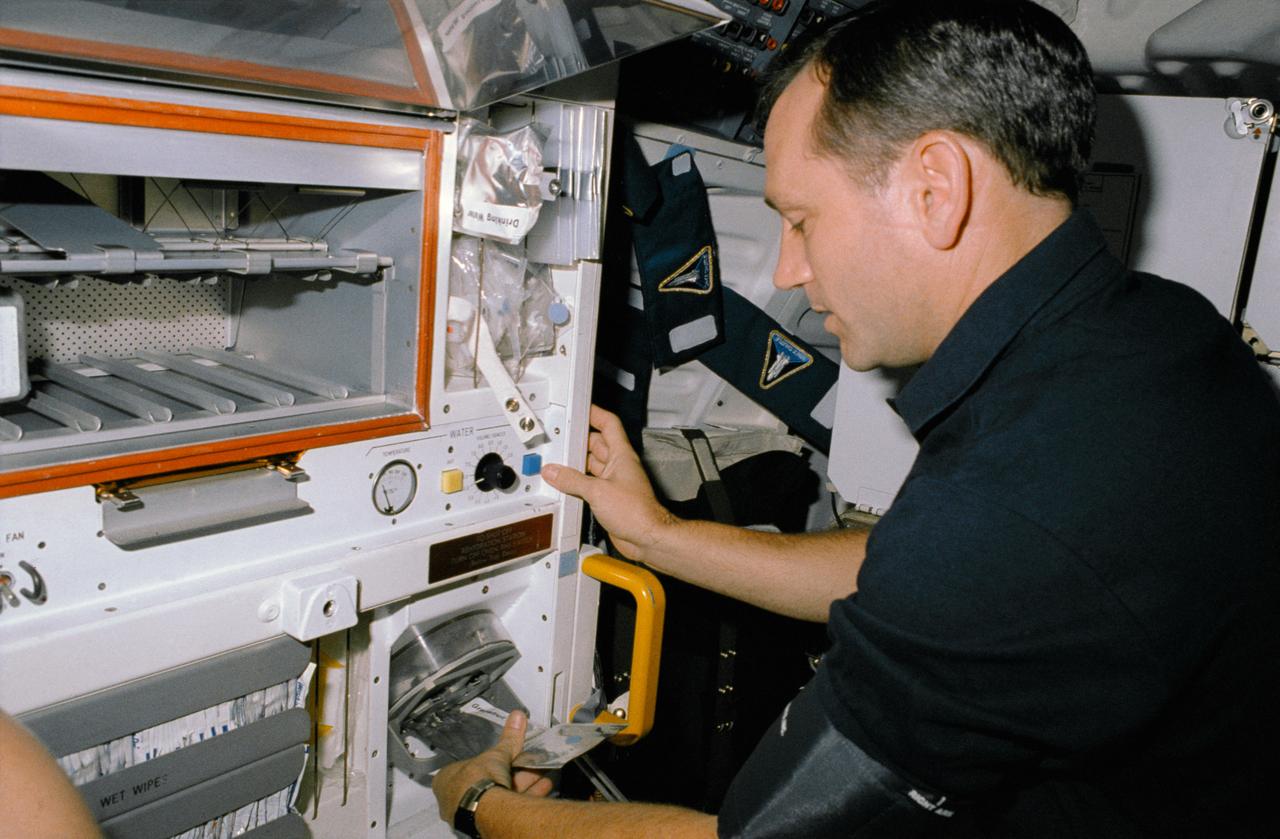
STS041-06-004 (6-10 Oct 1990) --- A 35mm scene of astronaut Thomas D. Akers, STS-41 mission specialist, using Space Shuttle Discovery?s galley water feed to rehydrate a package of food.
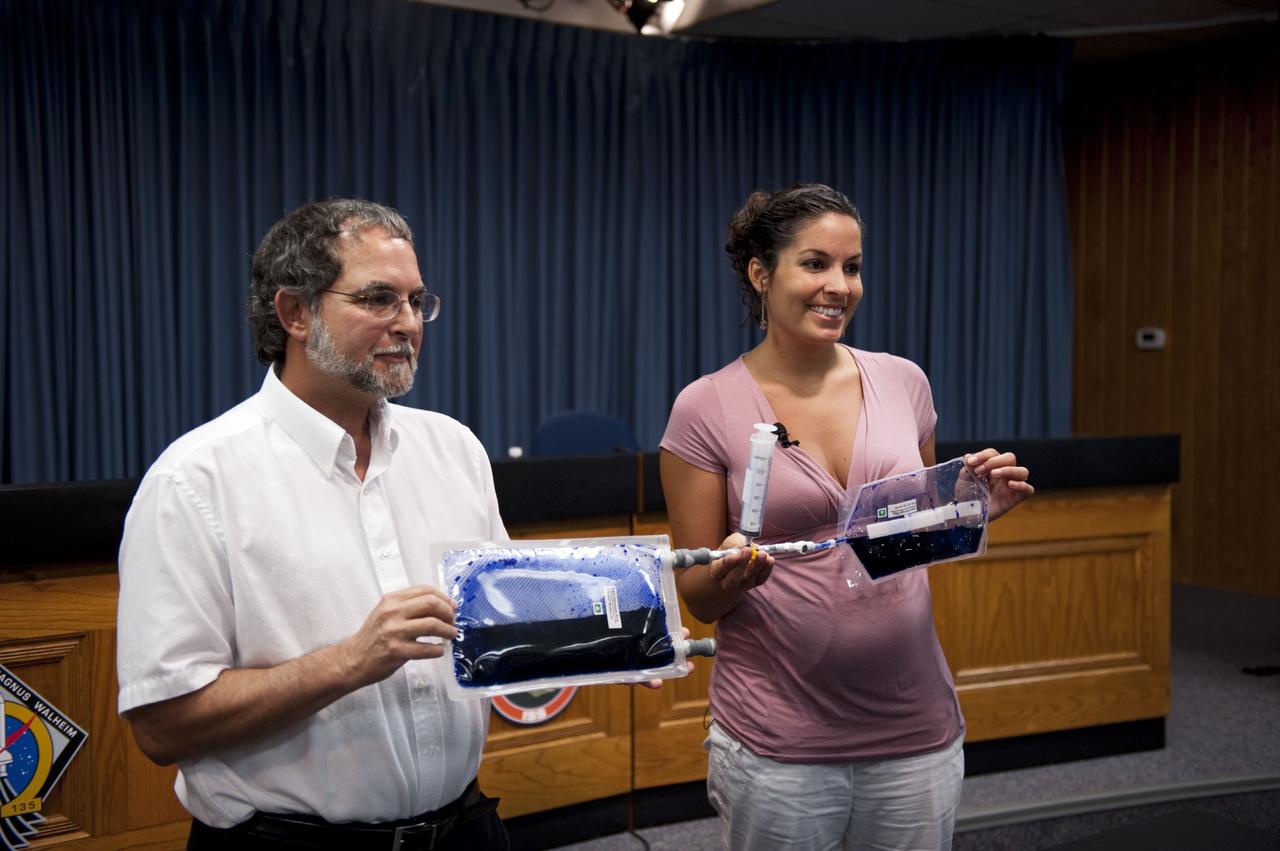
CAPE CANAVERAL, Fla. -- In the Press Site auditorium at NASA's Kennedy Space Center in Florida, NASA Project Scientist Dr. Howard Levine and Project Engineer Monica Soler with Qinetiq North America demonstrate to media a liquid purifying system called "forward osmosis." The idea is to make a fortified drink that provides hydration and nutrients from all sources available aboard a spacecraft, such as wastewater. A space-adapted version of the system will be aboard space shuttle Atlantis for testing during the STS-135 mission to the International Space Station. Atlantis and its crew of four are scheduled to lift off at 11:26 a.m. EDT on July 8 to deliver the Raffaello multi-purpose logistics module packed with supplies and spare parts to the station. The STS-135 mission also will fly a system to investigate the potential for robotically refueling existing satellites and return a failed ammonia pump module to help NASA better understand the failure mechanism and improve pump designs for future systems. STS-135 will be the 33rd flight of Atlantis, the 37th shuttle mission to the space station, and the 135th and final mission of NASA's Space Shuttle Program. For more information visit, www.nasa.gov/mission_pages/shuttle/shuttlemissions/sts135/index.html. Photo credit: NASA/Kim Shiflett
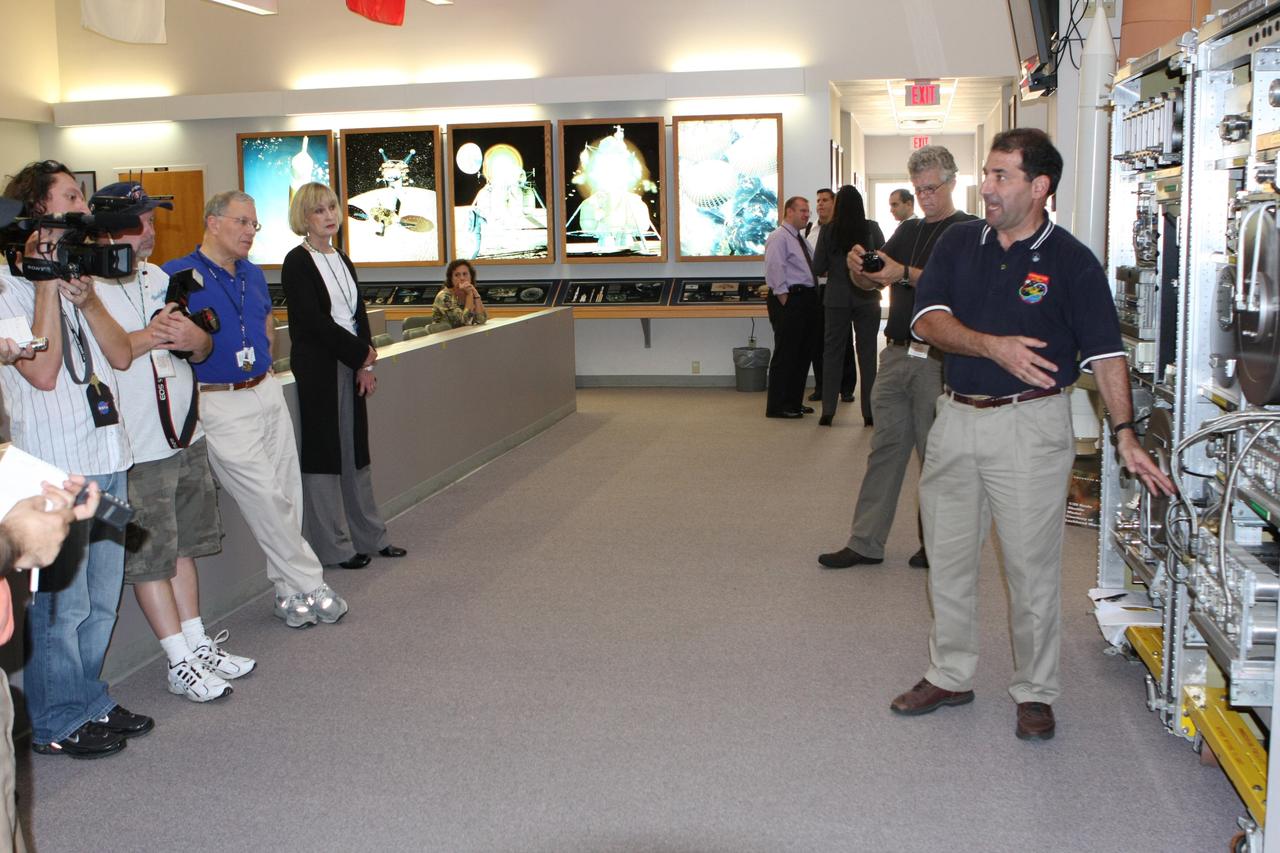
CAPE CANAVERAL, Fla. – In In the News Center at NASA's Kennedy Space Center in Florida, Bob Bagdigian (right) talks to the media about the Water Recovery System being delivered to the International Space Station on space shuttle Endeavour's STS-126 mission. Bagdigian is a project manager with NASA's Regenerative Environmental Control and Life Support System at Marshall Space Flight Center in Huntsville, Ala. Behind Bagdigian is a mockup of the two racks that will be used. The two units of the Water Recovery System are designed to provide drinking-quality water through the reclamation of wastewater, including urine and hygiene wastes. The water that’s produced will be used to support the crew and work aboard the station. STS-126 is the 124th space shuttle flight and the 27th flight to the International Space Station. The mission will feature four spacewalks and work that will prepare the space station to house six crew members for long- duration missions. Liftoff is scheduled for 7:55 p.m. EST Nov. 14. Photo credit: NASA/Dimitri Gerondidakis
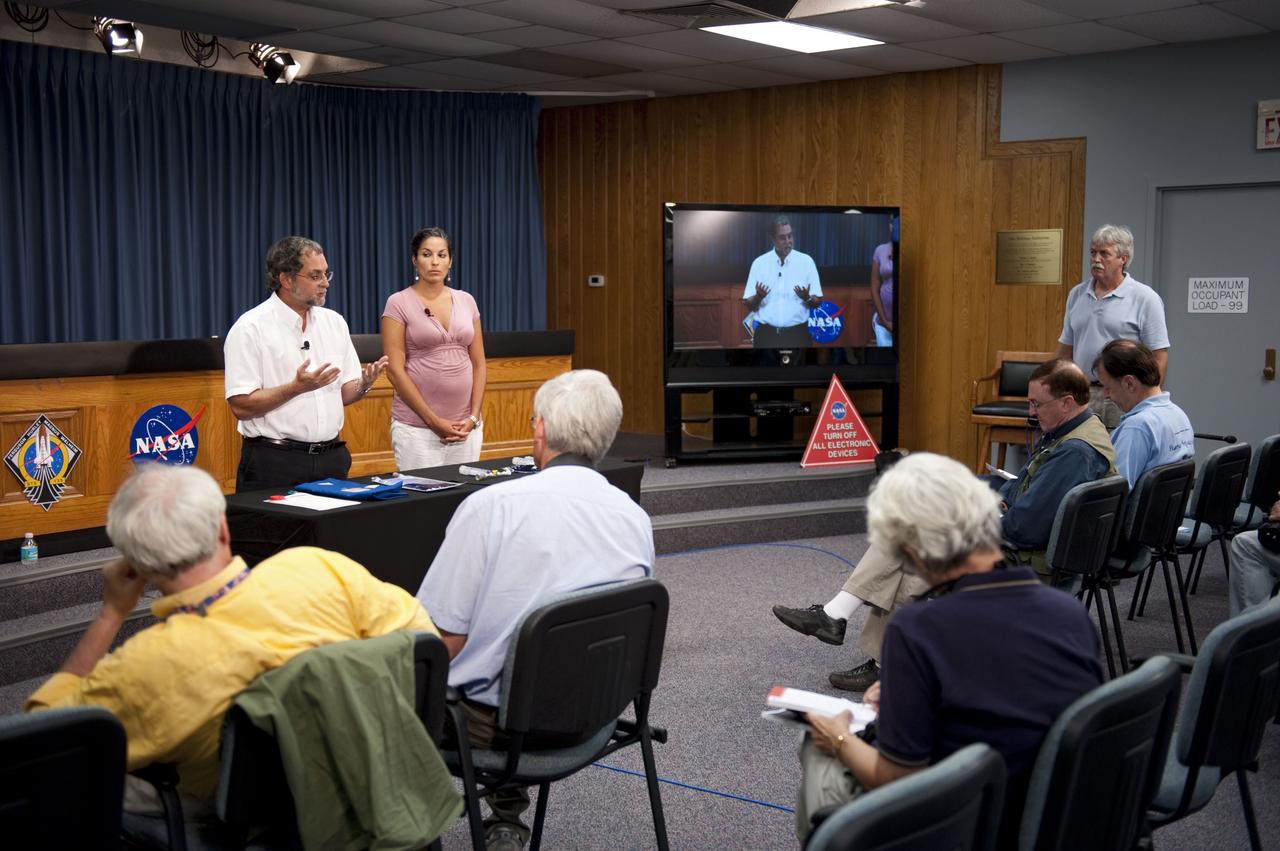
CAPE CANAVERAL, Fla. -- In the Press Site auditorium at NASA's Kennedy Space Center in Florida, NASA Project Scientist Dr. Howard Levine and Project Engineer Monica Soler with Qinetiq North America demonstrate to media a liquid purifying system called "forward osmosis." The idea is to make a fortified drink that provides hydration and nutrients from all sources available aboard a spacecraft, such as wastewater. A space-adapted version of the system will be aboard space shuttle Atlantis for testing during the STS-135 mission to the International Space Station. Atlantis and its crew of four are scheduled to lift off at 11:26 a.m. EDT on July 8 to deliver the Raffaello multi-purpose logistics module packed with supplies and spare parts to the station. The STS-135 mission also will fly a system to investigate the potential for robotically refueling existing satellites and return a failed ammonia pump module to help NASA better understand the failure mechanism and improve pump designs for future systems. STS-135 will be the 33rd flight of Atlantis, the 37th shuttle mission to the space station, and the 135th and final mission of NASA's Space Shuttle Program. For more information visit, www.nasa.gov/mission_pages/shuttle/shuttlemissions/sts135/index.html. Photo credit: NASA/Kim Shiflett
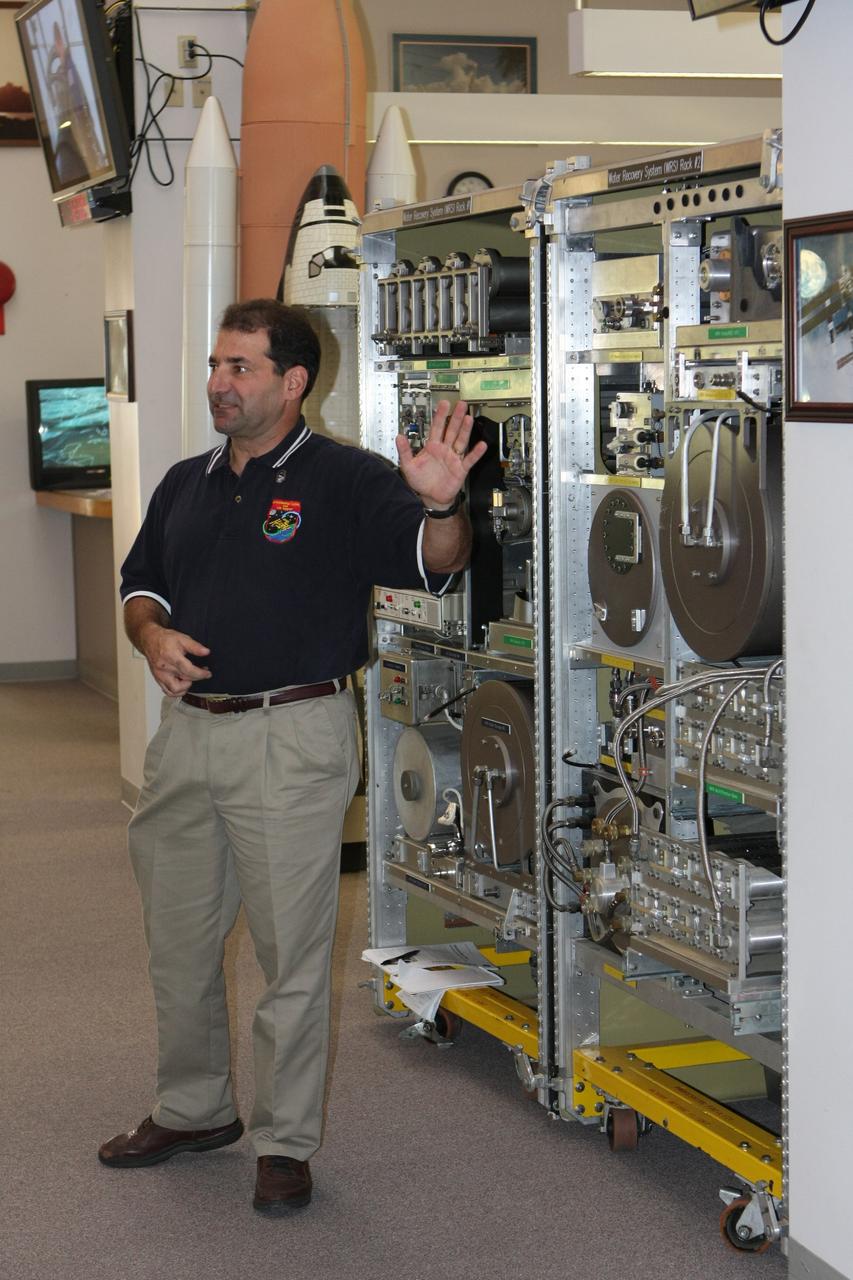
CAPE CANAVERAL, Fla. – In the News Center at NASA's Kennedy Space Center in Florida, Bob Bagdigian talks to the media about the Water Recovery System being delivered to the International Space Station on space shuttle Endeavour's STS-126 mission. Bagdigian is a project manager with NASA's Regenerative Environmental Control and Life Support System at Marshall Space Flight Center in Huntsville, Ala. Behind Bagdigian is a mockup of the two racks that will be used. The two units of the Water Recovery System are designed to provide drinking-quality water through the reclamation of wastewater, including urine and hygiene wastes. The water that’s produced will be used to support the crew and work aboard the station. STS-126 is the 124th space shuttle flight and the 27th flight to the International Space Station. The mission will feature four spacewalks and work that will prepare the space station to house six crew members for long- duration missions. Liftoff is scheduled for 7:55 p.m. EST Nov. 14. Photo credit: NASA/Dimitri Gerondidakis
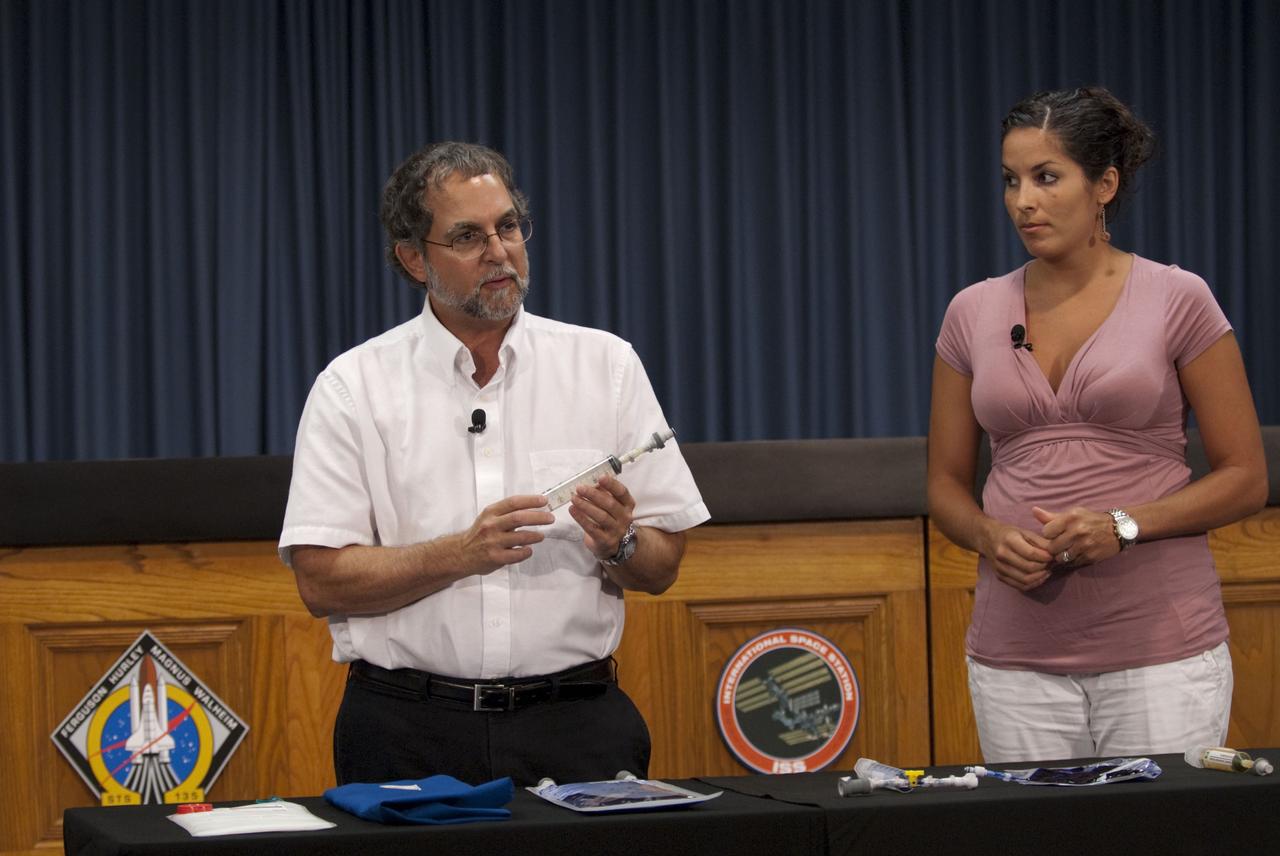
CAPE CANAVERAL, Fla. -- In the Press Site auditorium at NASA's Kennedy Space Center in Florida, NASA Project Scientist Dr. Howard Levine and Project Engineer Monica Soler with Qinetiq North America demonstrate to media a liquid purifying system called "forward osmosis." The idea is to make a fortified drink that provides hydration and nutrients from all sources available aboard a spacecraft, such as wastewater. A space-adapted version of the system will be aboard space shuttle Atlantis for testing during the STS-135 mission to the International Space Station. Atlantis and its crew of four are scheduled to lift off at 11:26 a.m. EDT on July 8 to deliver the Raffaello multi-purpose logistics module packed with supplies and spare parts to the station. The STS-135 mission also will fly a system to investigate the potential for robotically refueling existing satellites and return a failed ammonia pump module to help NASA better understand the failure mechanism and improve pump designs for future systems. STS-135 will be the 33rd flight of Atlantis, the 37th shuttle mission to the space station, and the 135th and final mission of NASA's Space Shuttle Program. For more information visit, www.nasa.gov/mission_pages/shuttle/shuttlemissions/sts135/index.html. Photo credit: NASA/Kim Shiflett

CAPE CANAVERAL, Fla. – In the News Center at NASA's Kennedy Space Center in Florida, Bob Bagdigian talks to the media about the Water Recovery System being delivered to the International Space Station on space shuttle Endeavour's STS-126 mission. Bagdigian is a project manager with NASA's Regenerative Environmental Control and Life Support System at Marshall Space Flight Center in Huntsville, Ala. Behind Bagdigian is a mockup of the two racks that will be used. The two units of the Water Recovery System are designed to provide drinking-quality water through the reclamation of wastewater, including urine and hygiene wastes. The water that’s produced will be used to support the crew and work aboard the station. STS-126 is the 124th space shuttle flight and the 27th flight to the International Space Station. The mission will feature four spacewalks and work that will prepare the space station to house six crew members for long- duration missions. Liftoff is scheduled for 7:55 p.m. EST Nov. 14. Photo credit: NASA/Dimitri Gerondidakis
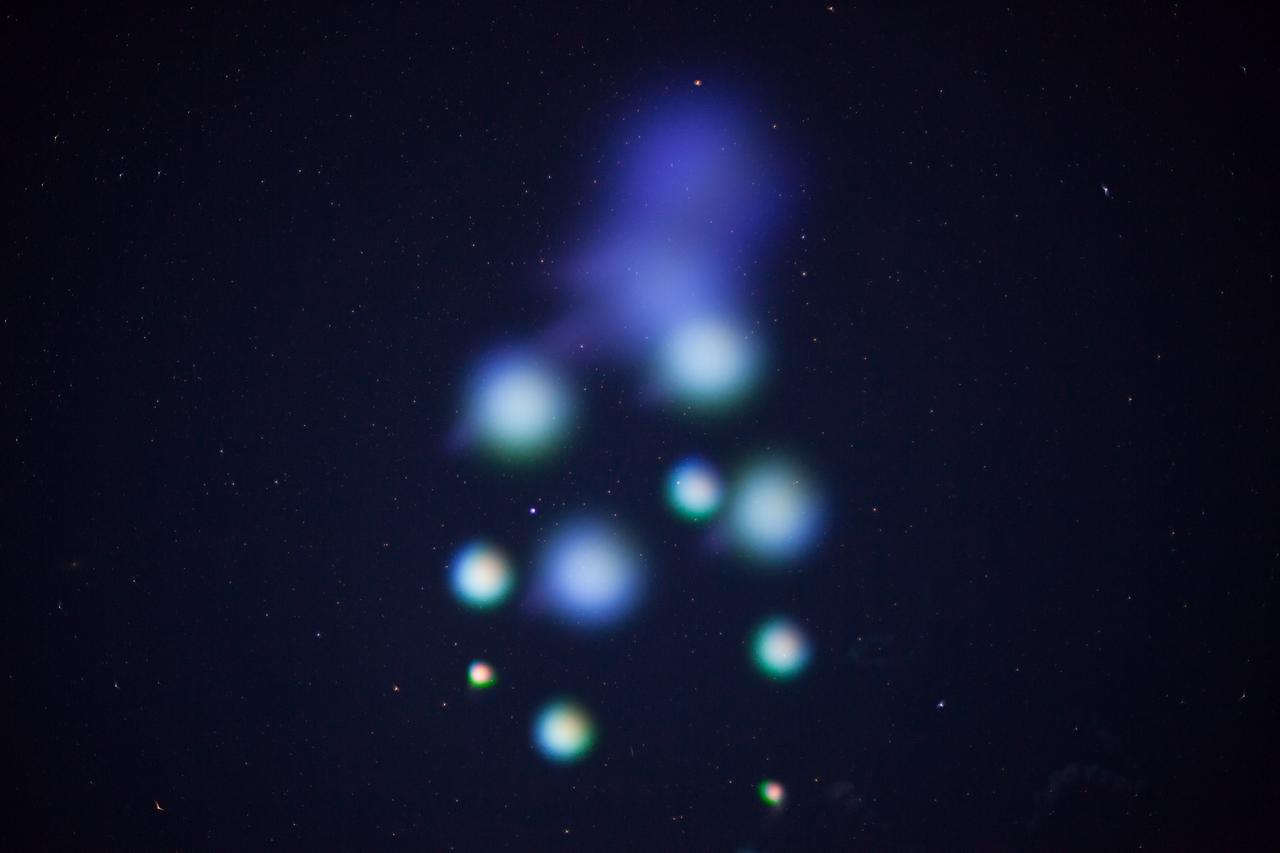
July 4 fireworks came early when a NASA Terrier-Improved Malemute sounding rocket was successfully launched at 4:25 a.m., Thursday, June 29, from the agency’s Wallops Flight Facility in Virginia. During the 8-minute flight, 10 canisters about the size of a soft drink can were ejected in space, 6 to 12 miles away from the 670-pound main payload. The canisters deployed blue-green and red vapor that formed artificial clouds visible from New York to North Carolina. During an ionosphere or aurora science mission, these clouds, or vapor tracers, allow scientists on the ground to visually track particle motions in space. The development of the multi-canister ampoule ejection system will allow scientists to gather information over a much larger area than previously possible when deploying the tracers just from the main payload. Credit: NASA/Wallops <b><a href="http://www.nasa.gov/audience/formedia/features/MP_Photo_Guidelines.html" rel="nofollow">NASA image use policy.</a></b> <b><a href="http://www.nasa.gov/centers/goddard/home/index.html" rel="nofollow">NASA Goddard Space Flight Center</a></b> enables NASA’s mission through four scientific endeavors: Earth Science, Heliophysics, Solar System Exploration, and Astrophysics. Goddard plays a leading role in NASA’s accomplishments by contributing compelling scientific knowledge to advance the Agency’s mission. <b>Follow us on <a href="http://twitter.com/NASAGoddardPix" rel="nofollow">Twitter</a></b> <b>Like us on <a href="http://www.facebook.com/pages/Greenbelt-MD/NASA-Goddard/395013845897?ref=tsd" rel="nofollow">Facebook</a></b> <b>Find us on <a href="http://instagrid.me/nasagoddard/?vm=grid" rel="nofollow">Instagram</a></b>
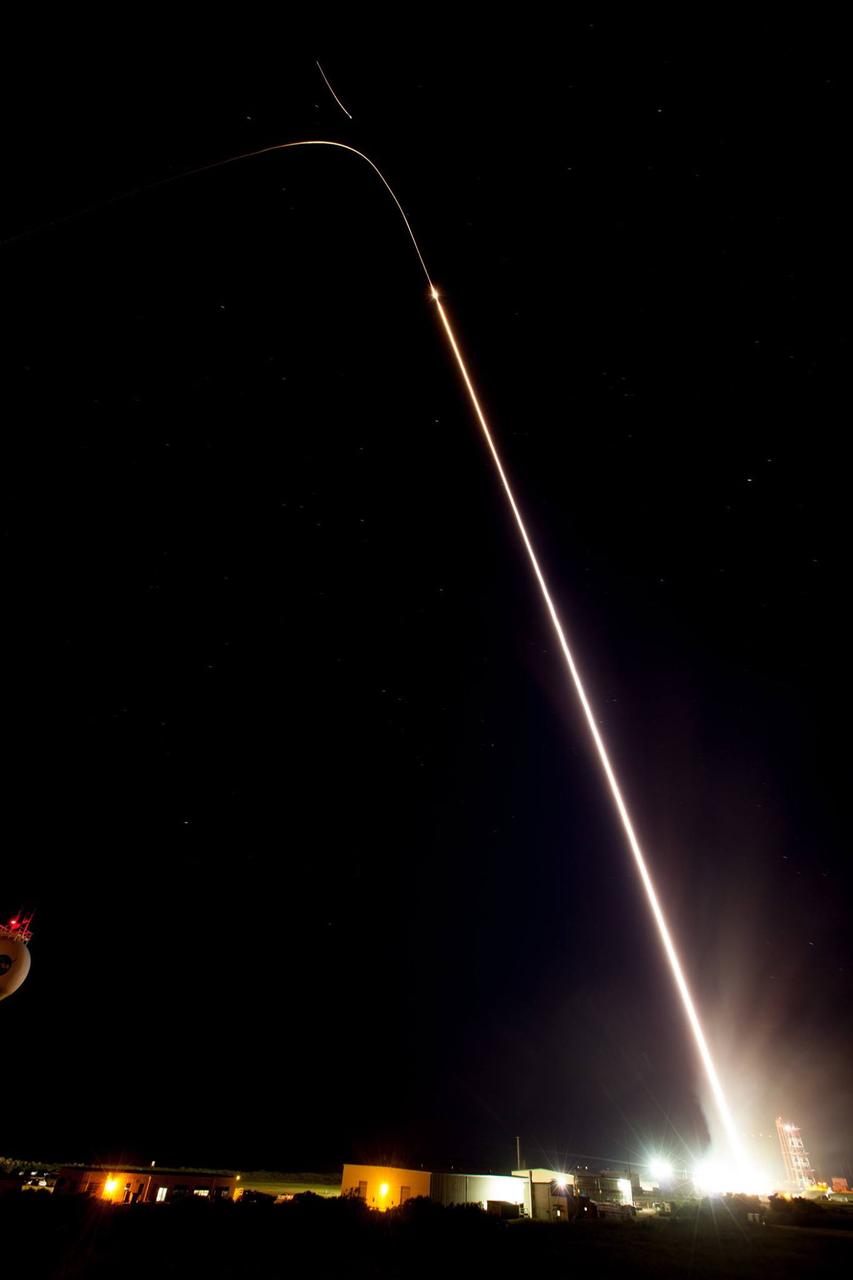
July 4 fireworks came early when a NASA Terrier-Improved Malemute sounding rocket was successfully launched at 4:25 a.m., Thursday, June 29, from the agency’s Wallops Flight Facility in Virginia. During the 8-minute flight, 10 canisters about the size of a soft drink can were ejected in space, 6 to 12 miles away from the 670-pound main payload. The canisters deployed blue-green and red vapor that formed artificial clouds visible from New York to North Carolina. During an ionosphere or aurora science mission, these clouds, or vapor tracers, allow scientists on the ground to visually track particle motions in space. The development of the multi-canister ampoule ejection system will allow scientists to gather information over a much larger area than previously possible when deploying the tracers just from the main payload. Read more here: <a href="https://www.nasa.gov/feature/wallops/2017/nasa-sounding-rocket-will-release-early-morning-artificial-clouds0lighting-up-the-mid-atlantic-coast-may-31" rel="nofollow">www.nasa.gov/feature/wallops/2017/nasa-sounding-rocket-wi...</a> <b><a href="http://www.nasa.gov/audience/formedia/features/MP_Photo_Guidelines.html" rel="nofollow">NASA image use policy.</a></b> <b><a href="http://www.nasa.gov/centers/goddard/home/index.html" rel="nofollow">NASA Goddard Space Flight Center</a></b> enables NASA’s mission through four scientific endeavors: Earth Science, Heliophysics, Solar System Exploration, and Astrophysics. Goddard plays a leading role in NASA’s accomplishments by contributing compelling scientific knowledge to advance the Agency’s mission. <b>Follow us on <a href="http://twitter.com/NASAGoddardPix" rel="nofollow">Twitter</a></b> <b>Like us on <a href="http://www.facebook.com/pages/Greenbelt-MD/NASA-Goddard/395013845897?ref=tsd" rel="nofollow">Facebook</a></b> <b>Find us on <a href="http://instagrid.me/nasagoddard/?vm=grid" rel="nofollow">Instagram</a></b>
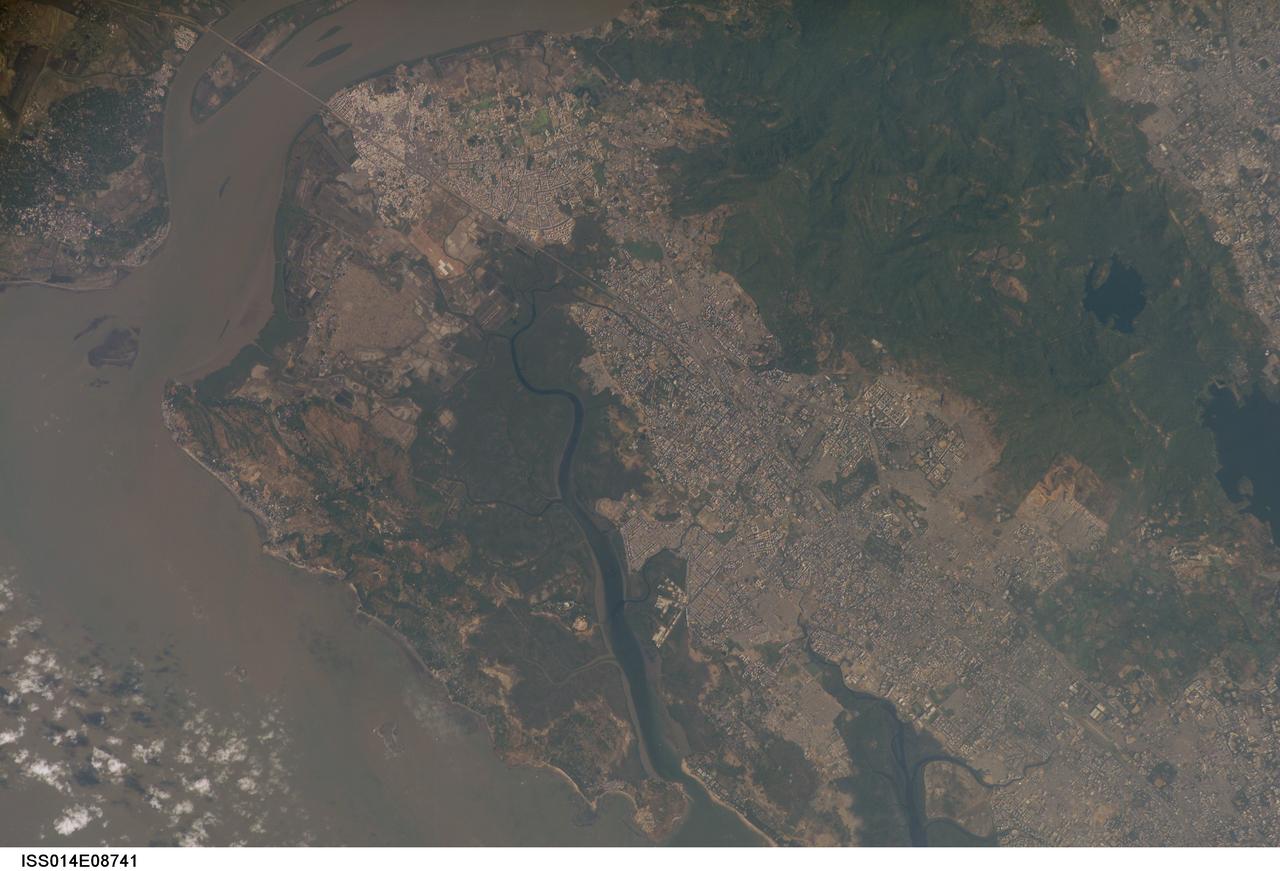
ISS014-E-08741 (28 Nov. 2006) --- Mumbai, India is featured in this image photographed by an Expedition 14 crewmember on the International Space Station. This view is one of three (frames 8741, 8742 and 8744) acquired within ten seconds of each other as the station passed over India. Mumbai (formerly known as Bombay) is a so-called mega city, with over 21 million people living in the greater Mumbai metropolitan region. Mega cities like Tokyo, New York, Sao Paulo, and Mumbai are also known as conurbations -- large contiguous areas of urban land cover formed from the growth and merging together of previously separate and distinct urban centers. The Mumbai conurbation includes several municipal entities including Bhiwandi, Kalyan, Thane, and Ulhasnagar. Located along the coast of western India on Salsette Island, Mumbai is generally considered to be the most modern of India's cities and is a major economic, transportation, and cultural center. Almost cloud-free conditions reveal the continuous urban land cover of the mega city extending north to south across Salsette Island -- a distance of nearly 50 kilometers. Sanjay Gandhi National Park, bordered on three sides by the urbanized area, is the largest national park in the world located within city limits. In addition to providing a refuge for native flora and fauna, the park also includes two lakes that form part of the Mumbai drinking water system.
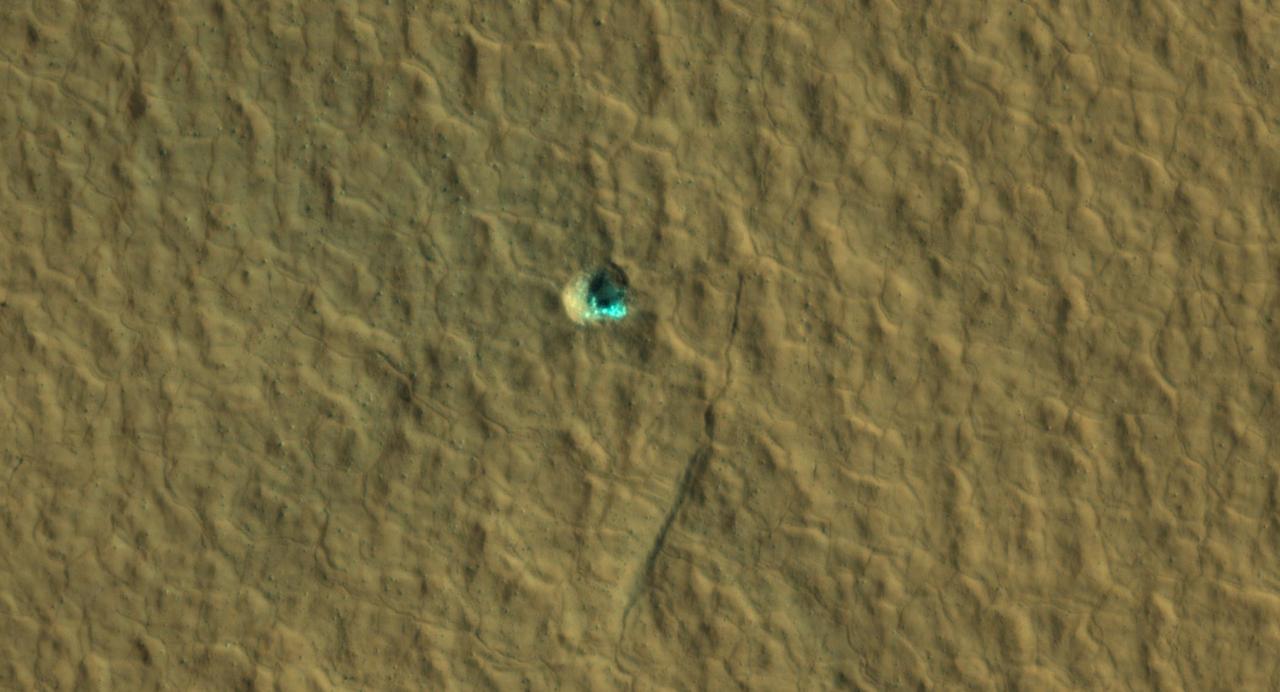
The ice-exposing impact crater at the center of this image is an example of what scientists look for when mapping places where future astronauts should land on Mars. NASA's Mars Reconnaissance Orbiter captured this view using its High-Resolution Imaging Science Experiment (HiRISE) camera on July 17, 2016. The color in this image has been enhanced for effect; water ice would not actually look this blue on Mars. The crater is estimated to be about 59 feet wide (18 meters wide). Surrounding the impact is a rough kind of surface known as "polygon terrain," which on Earth is known to form when subsurface ice expands and contracts repeatedly over time. Seeing this terrain surrounding an ice-exposing crater suggests much more ice could be found there. This impact is one of many included in a NASA-funded mapping project called Subsurface Water Ice Mapping, or SWIM. Mars has both water ice and carbon dioxide ice (dry ice); water ice would be a critical resource for the first astronauts to step foot on Mars, who can use it for drinking, rocket fuel, and other purposes. The more water ice these astronauts land next to, the less they need to bring with them. Because the Martian atmosphere is so thin – less than 1% the pressure experienced at sea level on Earth – liquid water is unstable on the Red Planet and will vaporize unless it's frozen. But water ice on the planet's surface is only stable at high latitudes that are far too cold for astronauts and robots to survive. So SWIM attempts to locate water ice preserved within the subsurface in the mid-latitudes, where landing would be feasible. Such regions are far enough toward the poles for water ice to be plentiful, but close enough to the equator to avoid the coldest temperatures seen on Mars. https://photojournal.jpl.nasa.gov/catalog/PIA26044
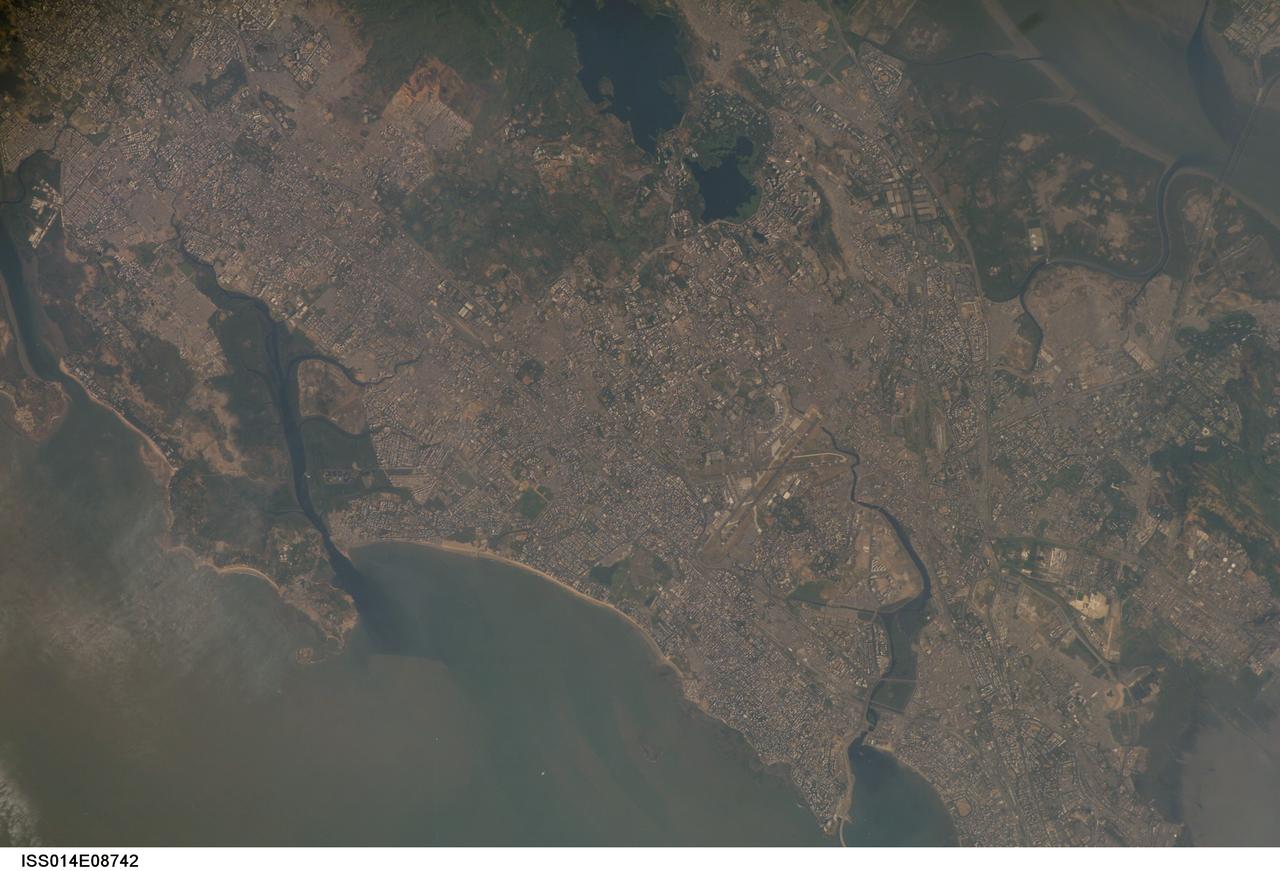
ISS014-E-08742 (28 Nov. 2006) --- Mumbai, India is featured in this image photographed by an Expedition 14 crewmember on the International Space Station. This view is one of three (frames 8741, 8742 and 8744) acquired within ten seconds of each other as the station passed over India. Mumbai (formerly known as Bombay) is a so-called mega city, with over 21 million people living in the greater Mumbai metropolitan region. Mega cities like Tokyo, New York, Sao Paulo, and Mumbai are also known as conurbations -- large contiguous areas of urban land cover formed from the growth and merging together of previously separate and distinct urban centers. The Mumbai conurbation includes several municipal entities including Bhiwandi, Kalyan, Thane, and Ulhasnagar. Located along the coast of western India on Salsette Island, Mumbai is generally considered to be the most modern of India's cities and is a major economic, transportation, and cultural center. Almost cloud-free conditions reveal the continuous urban land cover of the mega city extending north to south across Salsette Island -- a distance of nearly 50 kilometers. Sanjay Gandhi National Park (partially out of frame), bordered on three sides by the urbanized area, is the largest national park in the world located within city limits. In addition to providing a refuge for native flora and fauna, the park also includes two lakes that form part of the Mumbai drinking water system.
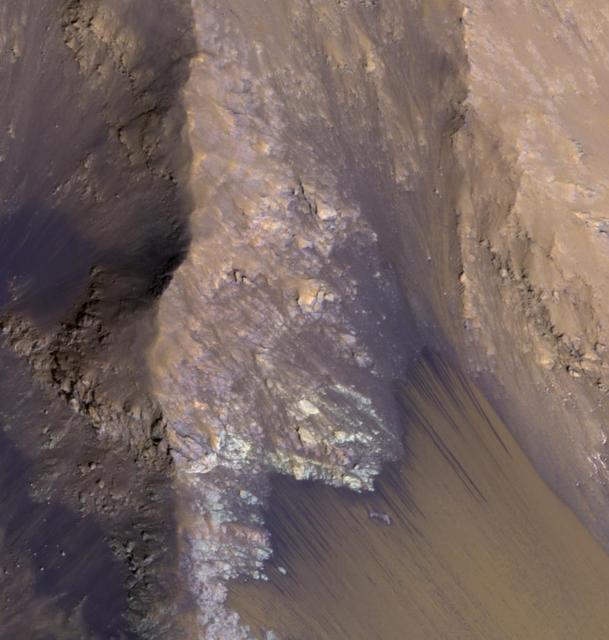
Among the many discoveries by NASA's Mars Reconnaissance Orbiter since the mission was launched on Aug. 12, 2005, are seasonal flows on some steep slopes. These flows have a set of characteristics consistent with shallow seeps of salty water. This July 21, 2015, image from the orbiter's High Resolution Imaging Science Experiment (HiRISE) camera shows examples of these flows on a slope within Coprates Chasma, which is part of the grandest canyon system on Mars, Valles Marineris. The image covers an area of ground one-third of a mile (536 meters) wide. These flows are called recurring slope lineae because they fade and disappear during cold seasons and reappear in warm seasons, repeating this pattern every Martian year. The flows seen in this image are on a north-facing slope, so they are active in northern-hemisphere spring. The flows emanate from the relatively bright bedrock and flow onto sandy fans, where they are remarkably straight, following linear channels. Valles Marineris contains more of these flows than everywhere else on Mars combined. At any season, some are active, though on different slope aspects at different seasons. Future human explorers (and settlers?) will need water to drink, grow food, produce oxygen to breath, and make rocket fuel. Bringing all of that water from Earth would be extremely expensive, so using water on Mars is essential. Although there is plenty of water ice at high latitudes, surviving the cold winters would be difficult. An equatorial source of water would be preferable, so Valles Marineris may be the best destination. However, the chemistry of this water must be understood before betting any lives on it. http://photojournal.jpl.nasa.gov/catalog/PIA19805
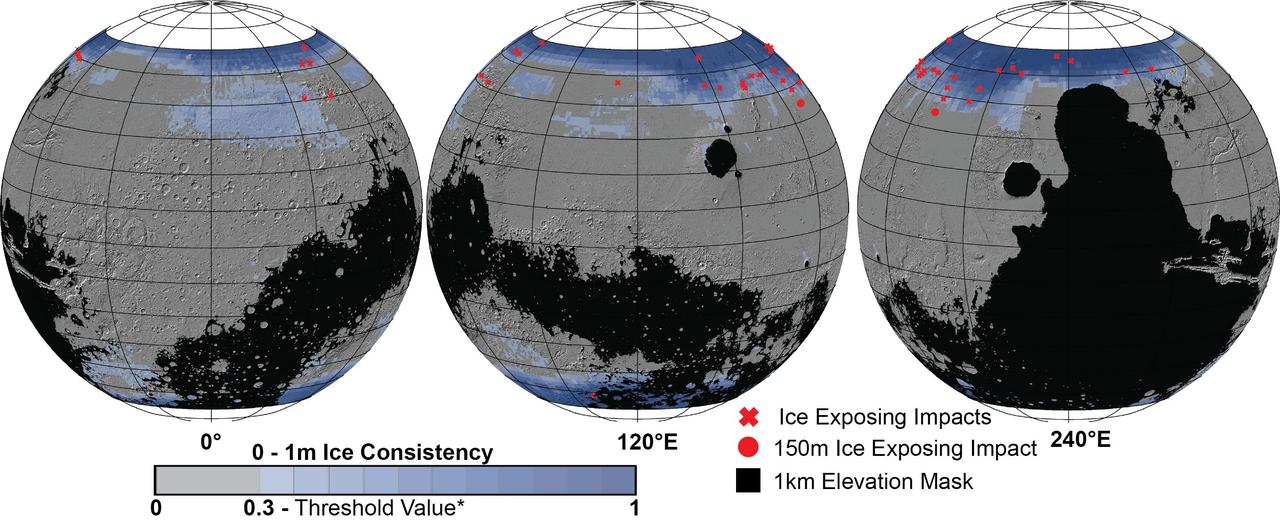
These Mars global maps show the likely distribution of water ice buried within the upper 3 feet (1 meter) of the planet's surface and represent the latest data from the Subsurface Water Ice Mapping project, or SWIM. SWIM uses data acquired by science instruments aboard three NASA orbital missions to estimate where ice may be hiding below the surface. Superimposed on the globes are the locations of ice-exposing meteoroid impacts, which provide an independent means to test the mapping results. The ice-exposing impacts were spotted by the High-Resolution Imaging Science Experiment (HiRISE), a camera aboard NASA's Mars Reconnaissance Orbiter. While other instruments at Mars can only suggest where buried water ice is located, HiRISE's imagery of ice-exposing impacts can confirm where ice is present. Most of these craters are no more than 33 feet (10 meters) in diameter, although in 2022 HiRISE captured a 492-foot-wide (150-meter-wide) impact crater that revealed a motherlode of ice that had been hiding beneath the surface. This crater is indicated with a circle in the upper-left portion of the right-most globe above. Scientists can use mapping data like this to decide where the first astronauts on Mars should land: Buried ice will be a vital resource for the first people to set foot on Mars, serving as drinking water and a key ingredient for rocket fuel. It would also be a major scientific target: Astronauts or robots could one day drill ice cores much as scientists do on Earth, uncovering the climate history of Mars and exploring potential habitats (past or present) for microbial life. The need to look for subsurface ice arises because liquid water isn't stable on the Martian surface: The atmosphere is so thin that water immediately vaporizes. There's plenty of ice at the Martian poles – mostly made of water, although carbon dioxide, or dry ice, can be found as well – but those regions are too cold for astronauts (or robots) to survive for long. https://photojournal.jpl.nasa.gov/catalog/PIA26046
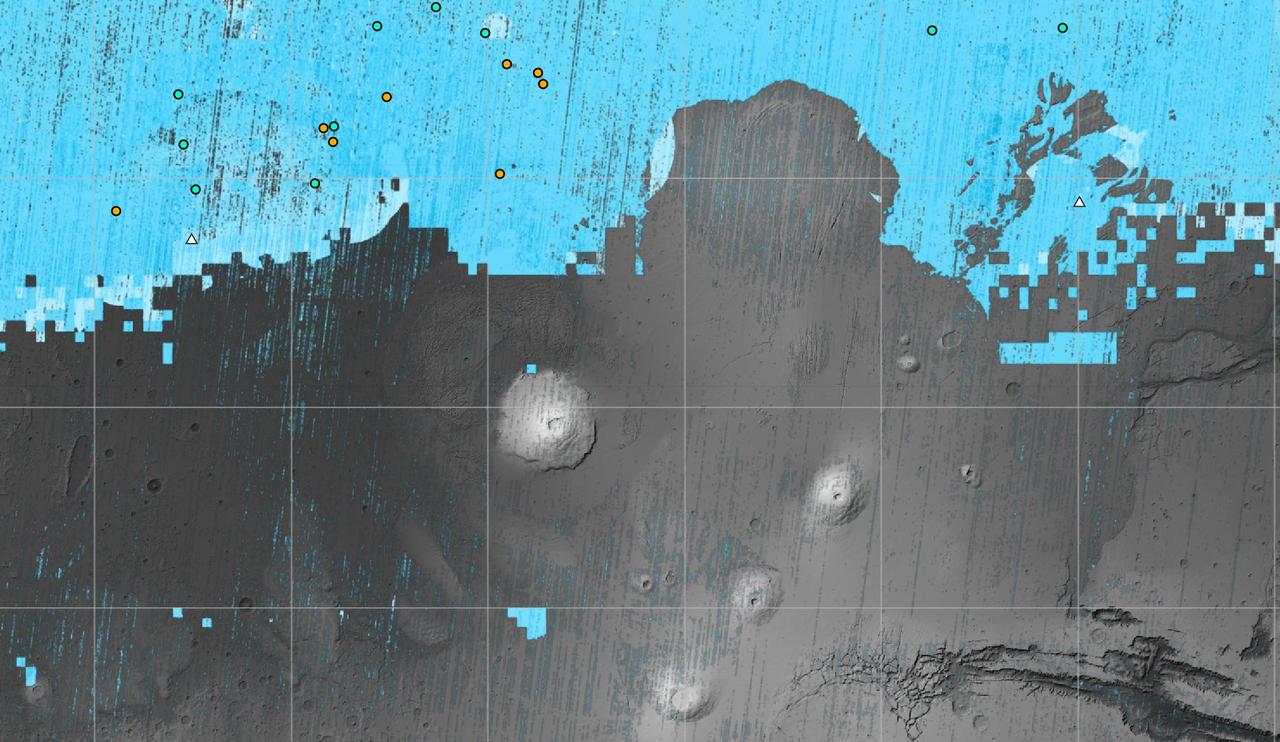
The blue areas on this map of Mars show regions where NASA missions have detected subsurface water ice. Scientists can use the map – part of the Subsurface Water Ice Mapping project, or SWIM – to decide where the first astronauts to set foot on the Red Planet should land. Triangles on the map are past and present Mars missions; circles are ice-exposing impact craters. Mars has both water ice and carbon dioxide ice (dry ice); water ice would be a critical resource for the first astronauts to step foot on Mars, who can use it for drinking, rocket fuel, and other purposes. The more water ice these astronauts land next to, the less they need to bring with them. Because the Martian atmosphere is so thin – less than 1% the pressure experienced at sea level on Earth – liquid water is unstable on the Red Planet and will vaporize unless it's frozen. But water ice on the planet's surface is only stable at high latitudes that are far too cold for astronauts and robots to survive. So SWIM attempts to locate water ice preserved within the subsurface in the mid-latitudes, where landing would be feasible. Such regions are far enough toward the pole for water ice to be plentiful, but close enough to the equator to avoid the coldest temperatures seen on Mars. SWIM combines data from several NASA missions, including the Mars Reconnaissance Orbiter (MRO), 2001 Mars Odyssey, and the now-inactive Mars Global Surveyor. The project mapped the area from the equator to 60 degrees north latitude. https://photojournal.jpl.nasa.gov/catalog/PIA26045
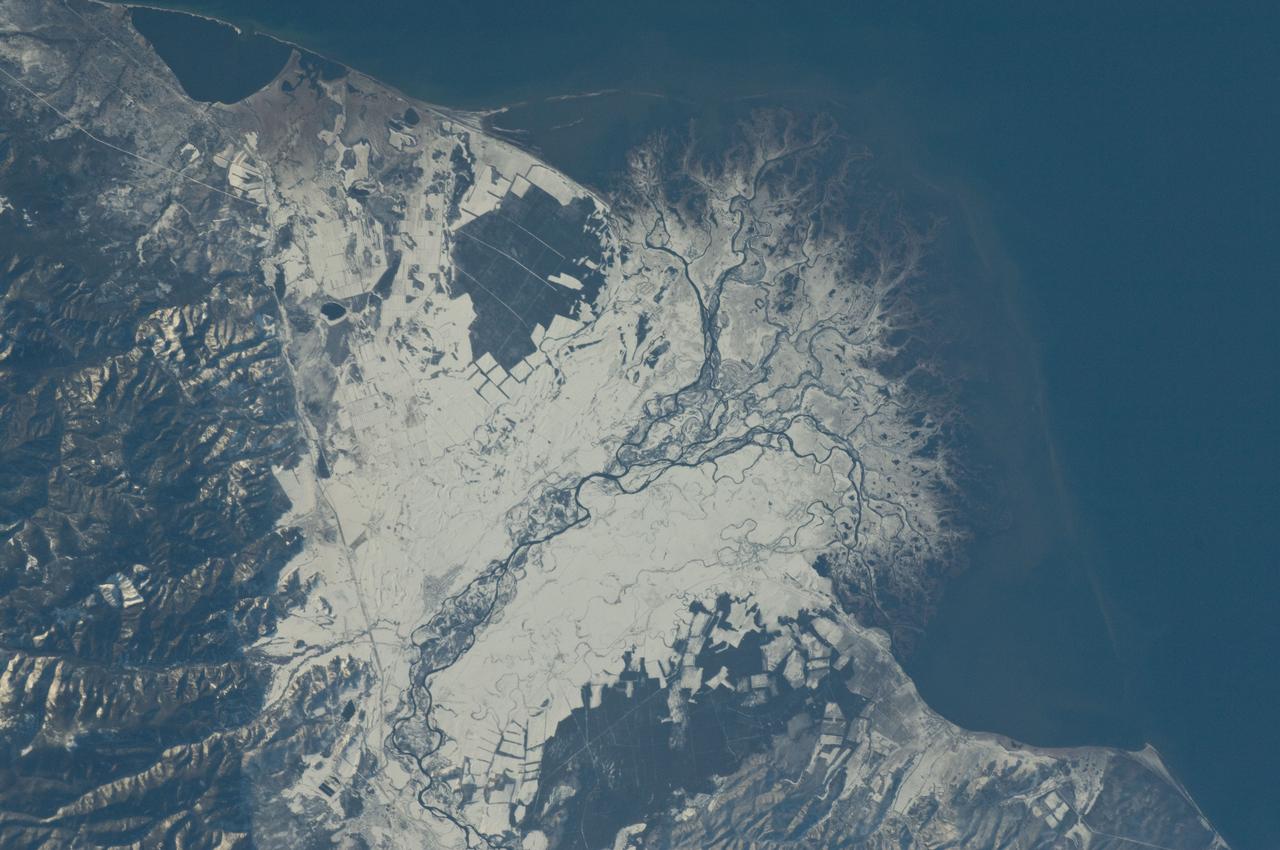
ISS029-E-037915 (3 Nov. 2011) --- Snowfall on the Selenga River Delta, Russian Federation is featured in this image photographed by an Expedition 29 crew member on the International Space Station. This photograph illustrates the Selenga River Delta built out into Lake Baikal in Russia. The Selenga River delta (center) is lobate in form, with an intricate network of distributary channels and levees surrounded by marshlands building out into Lake Baikal. This suggests that development of the delta is governed by the sediment load carried by the river, and any modifications of form due to lake tides or waves are relatively minor. Further out, dark brown depositional bars are visible forming a rough arc marking the edge of the delta. Snow cover on the river floodplain highlights numerous secondary channels, as well as channels previously occupied by the river but now abandoned. The regular outlines of agricultural fields to the southwest and northeast of the river are also highlighted by the snow cover. Lake Baikal is a World Heritage Site. The Selenga River is the major contributor of water to Lake Baikal; it occupies approximately 82 per cent of the watershed area for the lake. The wetlands of the Selenga River delta are designated as a RAMSAR site and provide valuable habitat for more than 170 species of birds, including many that are migrating. Like Baikal, the Selenga Delta is home to unique ecosystems, including more than 70 rare or endangered species of plants and animals. Waters of the Selenga River serve many (and differing) uses in both Mongolia and Russia, including support of agriculture, provision of drinking water, light industry, mining, recreation, and tourism. These uses also contribute to degradation of the river water quality, downstream availability of water, and ecological impacts. For example, a pulp and paper plant in the city of Selenginsk (lower left) has been tied to high levels of pollution in the river. International efforts to integrate management of the Selenga River basin for both ecological and economic sustainability are ongoing.